වානිජ බෝගයක් ලෙස කංසා වගාව නීතිගත කළ යුතුයි.

April 18th, 2018

තුසිත බාලසූරිය ලේකම් ශ්‍රී ලංකා සමාජ ප්‍ර‍ජාතන්ත්‍ර‍වාදී පක්ෂය

පොහොර සහනාධාරයකින් ශ්‍රී ලංකාවේ කෘෂි කර්මාන්තය නගා සිටුවිය නොහැකි නිසා කෘෂි ආර්ථිකය නගා සිටුවීමට වානිජමය වටිනාකමක් සහිත නව වානිජ බෝග ගොවීන් වෙත හදුන්වා දිය යුතුය. කංසා යනු එවැනි විශාල වානිජමය වටිනාකමක් සහිත ශාකයකි.

ශ්‍රී ලංකාවේ වගා කෙරෙන සෙසු වානිජ බෝගවලට වඩා වැඩි ලාභයක් කංසා වගාවෙන් උපයා ගත හැකිය. මන්ද අඩු පිරිවැයකින් වැඩි අස්වැන්නක් ලබාදෙන කංසා ශාකය ඇසුරෙන් විවිධ නිෂ්පාදන කරති. එමනිසා වානිජ බෝගයක් ලෙස කංසා වගාව නීතිගත කිරීම ආර්ථික සංවර්ධනය වේගවත් කරනු ඇත.

බෙහෙත් නිෂ්පාදයට කංසා විශාල වශයෙන් යොදා ගනී. බටහිර රටවල් මෙන්ම අසල්වැසි ඉන්දියාවද කංසා යොදාගෙන බෙහෙත් නිපදවා විශාල වශයෙන් මුදල් උපයති. කංසා වගා කොට බෙහෙත් නිෂ්පාදනයට අපනයනය කිරීමෙන් ශ්‍රී ලංකාවට විශාල විදෙස් විනිමයක් උපයා ගත හැකිය.

උසස් තත්වයේ රෙදිපිලි සහ ස්භාවික කඩදාසි නිෂ්පාදනයට කංසා යොදා ගැනෙන අතර කංසා වගාව නීති ගත කිරීමෙන් නව කර්මාන්ත ශාලා බිහිවීමට සහ නව රැකියා අවස්ථා ඇතිවීමට වැඩි ඉඩක් පවතී. එමෙන්ම කාංසා ශාකයෙන් නිපදවන ජෛව ඉන්ධන හා ජෛව ප්ලාස්ටික් පාරිසරික ගැටලු රැසකට විසදුමකි.

දැනට ක්‍රියාත්මක නීතියට අනුව කංසා වගාව අපරාධමය වරදකි. එම නීති සංශෝධනය කොට වානිජ බෝගයක් ලෙස කංසා වගාව නීතිගත කිරීමෙන් රජයට විශාල මුදලක් උපයා ගත හැකිය. ඊට නව නීති සම්පාදනය කොට වගා බලපත්‍ර‍ නිකුත් කරන ක්‍ර‍මයක් ස්ථාපිත කරන මෙන් අපි රජයෙන් ඉල්ලා සිටිමු.

තුසිත බාලසූරිය
ලේකම්
ශ්‍රී ලංකා සමාජ ප්‍ර‍ජාතන්ත්‍ර‍වාදී පක්ෂය

රස පොහොරට පොහොර දමන බත් බැලයෝ

April 18th, 2018

මතුගම සෙනෙවිරුවන්

       යහපාලන රජය පත් වූ අලුත ජනාධිපති තුමාගේ විශේෂිත සංකල්පයක් බවට පත් වූයේ වස විස නැති ගොවිතැනයි. වකුගඩු රෝගයෙන් පිළිකා සහ වෙනත් බෝ නොවන රෝග වලින් හෙම්බත්ව සිටි රජරට ජනතාව ඉන් මුදවා ගැනීමේ සද් චේතනාවෙන් ඇරඹි මේ වැඩ සටහන නිසා  උග්‍ර පිළිකා කාරකයක් ලෙසට නම් දරා ඇති ග්ලයිෆොසොට් හෙවත් වානිජ වශයෙන් සර්පාර්ස් රවුන්ඩ් අප් වැනි නම් වලින් හඳුන්වන වල් නාශකය තහනම් කරන ලද්දේය. එයට අමතරව රසායනික පොහොර සහනාධාරය වෙනුවට ගොවියාට මුදල් ලබා දීමේ ක්‍රම වේදයක්ද ඇරඹිණ.දැන් වසර දෙකක පමණ කාලයක් එම ප්‍රතිපත්තියේ සිටි රජය හිටි හැටියේ වල් නාශක තහනම ඉවත් කරන්නටද නැවත රසායනික පොහොර සහනාධාරය ලබා දීමටද ලක ලෑස්ති වෙයි. මේ අරුම පුදුම ප්‍රතිපත්තිය කුමක්ද. වකුගඩු රෝගීන් සුවපත් කිරීමේ සද් චේතනාවක් සෑබෑවටම රජයට තිබුණාදැයි සැකයක් මතු වන්නේ මේ  වෙස් පෙරළියෙනි.

           යහපාලන රජය පත් වන්නට ප්‍රථම පෙර කී වල් නාශකයන් ගැන කරන ලද රසායනාගාර පරීක්ෂණ වලින් තහවුරු වූයේ මෙරටට ගෙන්වීමට තහනම් කරන ලද ආසනික් මේ වල් නාශකයන්ට කලවම් කර නිකුත් කරන බවයි. එසේම සහනාධාර පොහොර වශයෙන් නිකුත් කරන තොග වල තිබෙන අප ද්‍රව්‍යෙ මෙන්ම සයනයිඩ් වැනි උග්‍ර වස වර්ගද මේ පොහොර වලට මිශ්‍රව තිබී අතැයි සොයා ගන්නා ලදී.සැබවින්ම පොහොර සහනාධාරය වෙනුවට මුදල් දීමේ ක්‍රම වේදය ආරම්භ කිරීමට හෙතුවක් වූයේ මෙයයි. නමුත් මෙම තීරණය ගත් පසු  කැඳවන ලද කාබනික ගොවීන් ගේ රැස්වීමකදී කෘෂිකර්ම අමාත්‍යංශයේ ලේකම් වරයාට මෙන්ම අමාත්‍ය වරයාට මා විසින් කාරණා දෙකක් ප්‍රධාන වශයෙන් පැහැදිලි කර දෙන ලදී. එකක් නම් දිවයින පුරා විසිරී සිටින පාරම්පරික වී වගා කරන ගොවීන් මෙන්ම කාබනික ගොවීන් වෙනුවෙන් ඔවුන් දිරිමත් කරලීමේ ප්‍රායෝගික වැඩ සටහනක් ආරම්භ කරන ලෙසයි.ඒ සඳහා දැනට සිටින කෘෂි නිළධාරීන් සහ බලධාරීන් හට පාරිසරික ගොවිතැන පිළිබඳ අවබෝධයක් ලබාදීම කළ යුතු විය. අනෙක් කාරණය නම් පොහොර සහනාධාරය වෙනුවට මුදල් ලබා දීමේ ක්‍රම වේදය ට එන්නේ නම් එම මුදල් ගොවියාට සෘජුවම ලබා නොදී ගොවි සංවිධාන වලට බැර කොට ක්‍රමානුකූලව පොහොර වෙනුවෙන් නිකුත් කරන ලෙසයි. නමුත් මේ වැඩ පිළිවෙල ආරම්භයේදීම ආණ්ඩුව අනා ගත්හ. ගොවියාගේ බැංකු ගිණුමට සෘජුවම මුදල් බැර කරනු ලැබිණ. එහි ප්‍රතිඵලය වූයේ ඒ කන්නයේදීම වගා ඉලක්ක කඩා වැටීමයි. ගොවියා තම අතට ලැබුණු මුදල් වෙනත් කරුණු වලට වියදම් කර සිටියහ. මේවා පිළිබඳ රජයේ ආයතන වල සම්බන්ධීකරණක්ද නොවූයෙන් මේ කඩා වැටීම බරපතල විය. එයින් පසු යලි වගා ඉලක්ක සඳහා යෑමට සෑහෙන වෙහෙසක් දැරීමට සිදු විය. නමුත්   විශේෂයෙන්ම බස්නාහිර පළාතේ වගා ඉලක්ක මේ වනතුරු සපුරාලිය නොහැකි විය.

             පොහොර යනු ආපෝ තේජෝ වායු පඨවි ආකාශ යන්නෙහි එකතුවකි. මෙම පංච සාරය ගොවියා විසින් කුඹුරට ලබා ගන්නේ දිරාපත් වන කොළ රොඩු ගොම  සූර්ය ශක්තිය වැනි දේ වලිනි. අවසානයේ පඨවි ධාතුව පෝෂණය වෙයි.කලට කන්නෙට කතාවට ගොවිතැන් කිරීමෙන් සෝදා පාලුව අවම වී පසේ තිබෙන පොහොර රසය සෘජුවමඉතා ඉක්මනින් ගොයම් ගසට එකතු වේ.එසේම පසේ ජීවත්වන ක්ෂුද්‍ර ජීවීන් හට ආහර ලැබීමෙන් දිරිමත්ව පසේ වයනයද සාරවත් බවද වැඩි දියුණු කරනු ලබයි. මේ පාරම්පරික මූලධර්ම නොසලක හැරි නිළධාරීන් සහ ගොවීන් නිසා රසායනික පොහොරට වහල් වී පසත් ජලයත් දූෂණය කර තිබේ. පස සරු කරන ක්ෂුද්‍ර ජීවීන් ගහනය  වඳ භාවයට පත් කර තිබේ. රසායනික පොහොර ලබා දීම පිටිපස තවත් මාෆියාවක් ක්‍රියාත්මකය. පොහොර සහනාධාරය ලබා දෙන්නේ පොහොර ගෙන්වන සමාගම්වලටයි. එවිට ඒ හරහා ඉහළ නිළධාරීන් ගේ දරුවන්ට ශිෂ්‍යත්ව රැකියා ලැබේ. දෙපාර්තමේන්තු වලට මේ පොහොර ලැබුණු කල්හි මේවා පැටවුම  බෑම බෙදා හැරීම ආදී සියල්ල කරන්නේ නිළධාරි සමූහයක් විසිනි. ඔවුහු මේ ක්‍රියාවලියේදී අතිරේක ලාභයක් ලබා ගනිති. ඒවා ලැබෙන්නේ බැර වන්නේ ගොවි සංවිධාන වල ගිණුම් වලට නොව  ඔවුන්ගේ සාක්කුවටයි. ඉතින් රසායනික පොහොර ලබා දීමේ ක්‍රායාවලිය දශක කීපයක් තිස්සේ මාෆියාවක් බවට පත්ව තිබේ. ඒවායින් ප්‍රතිලාභ ලැබූ කිසිවකු වස විස නැති ගොවිතැනට යන්නට අකමැතිය.දේශපාලකයන්ටද මේවායින් ලැබෙන්නේ ඉහළම කුට්ටි බව දන්නෝ දනිති. නවීන් දිසානායක ඇමතිවරයා ග්ලයිෆොසොට් තහනම ඉවත් කරන්නට වලිකන්නේ යම් සේද දුමින්ද දිසානායක ඇමති තුමා නැවත් පොහොර සහනාධාරය ලබා දෙන්නට වලිකන්නේ ඇයිද යන්න සරල ලෙසට තේරුම් ගත හැකි දෙයකි.

       දැන් රසායනික පොහෙර සහනාධරය මෙම අප්‍රියෙල් මස සිට ක්‍රියාත්මක කිරීමට රජය තීරණය කර තිබේ. රසායනික භාවිතාවට හුරු ව තිබෙන ගොවීහු මේ ප්‍රතිලාභය ලබති. නමුත් පාරම් පරික වී වර්ග වගා කරන වස විස නැති ගොවිතැන් ක්‍රියාවලිය නිසා රසායනික ගෙවිතැනෙන් ඈත්ව කටයුතු කරන ගොවීන් විශාල පිරිසක් අද වන විට රට පුර සිටින බව කිව යුතුය. මෙම් පොහොර සහනාධාර ක්‍රමයෙන් ඔවුන්ට වැඩක් නැත. පෙර කන්න වල ලැබුණු මුදල්ද ඉදිරියේ දී නොලැබේ. එවිට රටේ නිෂ්පාදන ක්‍රියවලිය පණ ගන්වන එමෙන්ම මහජනතාවගේ සෞඛ්‍ය මෙන්ම පසේ සෞඛ්‍යත් ආරක්ෂා කරන්ට වෙර දරන පිරිසට බලවත් අසාධාරණයක් ඇති වෙයි.ජාතික පොහොර ලේකම් කාර්යාලය විසින් මෙම දෙපිරිසට තම තමන්ට ආවේණික ලෙසට පොහොර සහනාධාරය ලබා දෙන්නට තීරණය කරන්නේ නම් සතුටු විය හැකිය. එනම් වස විස නැති ගොවිතැනෙහි නියැලි ගොවීන් සඳහා කොම්පෝස්ට් සහනාධර ක්‍රමයක් ඇති කිරීමයි.  එහෙත් එවැනි තීරණයකට පැමිණි බවක් දැන ගනන්ට නැත. එයට හේතුව  රජයේ චක්‍ර ලේඛන වලින් මහජනයාට දෙවිදියකට සැලකීමට නොහැකියාව බව නීලධාරීන් පවසයි. නමුත් දැනටමත් පාසල් ළමුන්ට නිළ ඇඳුම් සඳහා රෙදි ලබා දීමේදී මුස්ලිම් ළමුන්ට එක් ආකාරයකටත් සිංහල ළමයින්ට තවත් ආකාරයකටත් මුදල් ලබා දීම දැක්විය හැකිය. ගොරකා වුවත් දඩමස් කිරීමේ න්‍යායේ සිටින මේ බත් බැලයන් අවශ්‍ය තැනදී රජයේ චක්‍ර ලේඛන වෙනස් කරන ආකාරය එයන් පෙනේ.එසේ නම් වස විස නැති ගොවිතැනේ නියැලි සමස්ත ගොවි ජනතාවගේ සාධාරන ඉල්ලීම ඉටු කිරීමට රජය බැඳී සිටින බව ඉඳුරාම මේ අවස්ථාවේ දී මතක් කර දය යුතුය.

මතුගම සෙනෙවිරුවන්

Mirage – The Great Tamil Novel Of Our Time

April 18th, 2018

By  H.L.D Mahindapala

Part 1

When two distinguished authorities on the history of Jaffna — Bishop S. Jebanesan of the Jaffna Diocese of the Church of South India, and Richard Fox Young who holds a Chair in the Princeton Theological Seminary, USA., – collaborated to translate the novel Mirage (Kanal in Tamil), depicting the plight of the despised Tamil outcasts (Dalits) of the North, it automatically raised the significance and the value of the novel to a level way above the rest of modern Tamil literature. In addition to recognising its literary merits, their selective act to translate this particular novel conveys the measure of respectability and socio-political meaning they attached to the narrative written by K. Daniel, a Turumbar, the lowest of low-castes in Jaffna. The Turumbars were the dhobies to the dhobies of Jaffna.

A low-caste writer achieving this recognition is a rare honour. This translation opens up an opportunity for the silenced voices of the Tamils oppressed by the Vellalas, to be heard in the wide world and the translator (Bishop Jebanesan) and the editor (Young) must be congratulated for undertaking this task. Theirs is valuable service because it throws light into the hidden horrors committed behind the ubiquitous cadjan curtains of the Jaffna Vellalas. Unlike other scholarly studies which tend to drift in the conceptual/theoretical levels, Daniel’s delineation of the existential experiences that were etched into his memory exposes Jaffna as the hell-hole of the Tamil outcasts. Reading this novel would certainly make you wonder how the world was taken for a ride by the Vellala propagandists who diverted attention from their historical role as victimisers of Tamils to be the victims of the Sinhala-Buddhist majority.

The two scholars who produced the translation describes the novel as historical fiction”. Daniel too confirms that the novel is based on incidents that occurred in his little village and adds in his preface : All of the characters who pass through it were people I saw with my own eyes. Some are still living (in the eighties). Each incident that occurs in the novel actually happened.” (p. xiv). Daniel states that only difference is that he had changed their names. For instance, he introduces a Christian priest to the village as the alternative to Hindu Saivite Vellala oppressor. But he changed his name from Fr. Gnana Prakasar, a towering figure of Jaffna in his time, to Cwami Nanamutar”. So there could not have been a more sensitive and truthful eye witness of the Hindu Saivite Vellala crimes against their own Tamil people than that of Daniel, who viewed the dialectics of his caste-dominated, hierarchical, dichotomised, oppressive society through Marxist lenses.

Mirage, which was written in the eighties, has been hailed by those acquainted with Tamil literature as a mini-classic. But its value was played down by the Vellala elite who defined and determined, at all times, the parameters, the contents and the icons of Jaffna Tamil culture. For instance, they hero-worship as a literary lion Arumuga Navalar, the caste fanatic who revised Saivite Hinduism to elevate the Vellalas to the apex of the caste hierarchy. At best, he unearthed the old Tamil texts from S. India and reproduced them which led to a revival of the past glories of Tamil literature in Tamil Nadu. His works did not lead to a lasting Tamil renaissance in Jaffna. But the outstanding creative writer of Jaffna, Daniel, who exposed the savagery of the Vellahla oppression is marginalised. His greatness is not only in breaking away from the artificiality of the rigid, formalised, conservative style of traditional Tamil that was in vogue and writing in the spoken idiom but also in daring to penetrate deep into the most oppressive and cruel culture of Jaffna society and exposing their hypocrisy and horrors which were hidden from the public eye.

It is in this context that the translation of Bishop S. Jebanesan, edited by Richard Fox Young, (2016) sweeps in as a breath of fresh air opening up the hidden culture of the Vellalas. It lifts the novel from its obscurity to the English-speaking readers in all communities. It also elevates the novel as a brilliant study of the divided society of Jaffna in the throes of changing in the early decades of 20th century when Jaffna was still trading in fanams. In very light brush strokes Daniel dramatizes the evil and dehumanising culture of the Vellalas who denied the outcast Tamils to walk this earth even with a modicum of dignity. Daniel exposes, in quiet and sober tones, the Vellala masters who warped Jaffna society with unrelenting Vellala violence down the ages. The underlying theme that comes out of every tragic episode highlights the misery of the Tamils struggling to escape the inhuman cruelty of the Vellala overlords. This is something the Vellalas hate to admit. They loathe being confronted by their brutalities that reduced their own people to subhumans.

From feudal and colonial periods to modern times Jaffna remained as an abominable gulag of Vellala violence. They dare not face their guilt. Their defence is to parade in the theatre of the world at large as the innocent victims of the Sinhala-Buddhist majority. But Daniel, a Catholic turned Marxist, refuses to focus on the alleged acts of discrimination” by the Sinhalese which looms large in the politics of the Vellalas. His silence is a virtual rejection of the Vellala accusation. There isn’t a single reference to the politicised accusations of Sinhala oppression” or discrimination”, the common cry of Northern politics, His narrative is focused entirely on the internal caste factors that turned the hidden layers of Jaffna society into a perennial black hole from which there was no escape.

The theatre of all action in the Mirage is the little village of Pirikattayali where the Vellalas rule with an iron fist. It is a microcosm of the overarching Vellala fascism that reigned supreme right across the Jaffna peninsula during feudal and colonial periods until the late nineties. There are  doubts as to whether Vellala casteism has been eradicated totally from Jaffna even today. There are no heroes and heroines in Mirage. There are only protagonists and antagonists playing out their respective roles, highlighting, every step of the way, the internal contradictions clashing at all levels. Both as a political force and as a Hindu ideology Vellahlaism reigned supreme riding rough shod over any rival caste/political force. They either absorbed the rival castes (e.g., Madapallis) into their fold or crushed the rivals under their jackboots.

A dark and ominous ambience hovers over the grim village of Pirikattayali ruled by the Vellahlas. Those below them survive as virtual slaves. They were kept alive, on minimum wages and provisions, to serve the agricultural, domestic, social, political, religious (nautch girls dancing in temples) and even sexual needs of the Vellahlas. Daniel’s village is in perpetual conflict with the ruthless ruling class/caste. There are only two dominant figures that play their dialectical roles : 1. the Vellala landlord, Tampapillaiyar, ordering, threatening, and enforcing his will with force, or bribing the authorities, to have his way in the village and 2. Cwami Nanamutar, the Catholic reformer, who steps into the village as a liberator”. The oppressed Nalavar and Palla converts expect the priest to bring salvation through the Church and take them to the promised land. In the end the Church too succumbs to the overwhelming  forces of Vellalas and divides the Church pews into the Vellahla front rows  and non-Vellala back rows. The villagers who suffered under Vellala servitude are told by the new messiahs that they are slaves of Jesus”. It as if they had exchanged worldly slavery to an ethereal slavery imposed by invisible fascist dictators sitting in the skies. Before long, the Church becomes the ally of the Vellalas in maintaining the oppressive status quo.The poverty, the misery, the oppression, the suffering and the hunger remains unabated. The Church goes along with the contractors who exploit the the low-castes on starvation wages. The Church becomes a part of the establishment. The mirage is in seeing the Church as the liberator.

The coming of the missionaries to Jaffna was also a period of confrontation. It was the first serious invasion of modernity challenging the feudal Hindu structure. It opened up a transitional phase which failed to deliver their expectations of escaping Vellala servitude. In any case, the Vellala Hindus, led by Arumuga Navalar, resisted the Christian invasions. They saw it as a threat to their supremacy with the early Christian  missionaries    backing the low-castes, mainly as a means of conversion. The conversions by the Christian beef-eaters” were limited mainly to the low-castes who saw them as their redeemers, socially, politically and spiritually. But in the end it was the Vellalas who won. The powerful Vellalas took on every new ideological, political, social, religious force that threatened to challenge their supremacy and crushed them. They remained throughout the feudal, colonial, and post-independent periods as an ineradicable force. In the last resort, when their Hindu theology was running out of steam to sustain their divine right to rule the low-castes, they turned Jaffna into an enclave of mono-ethnic extremism. Under Saivite theology the enemy of the Vellalas was the low-caste. When the ideological power of Saivism ran out the Sinhala-Buddhists became the bogeyman in the post-Donoughmore period. Their biggest selling point was to claim victimhood, accusing the Sinhala-Buddhists as the victimisers, while hiding under the carpet their unrelenting role, over the ages, as the most vicious victimisers of the Tamils.

Their success in propagating this myth is a remarkable feat in caste/class history. They turned Marxism on its head and proved that a decadent, oppressive class need not necessarily collapse under the revolutionary forces of the oppressed. The Vellalas proved, time and again, that they could manufacture a false consciousness” and survive successfully by donning the Emperor’s clothes of saviours / liberators. Daniel’s unique place as a Tamil intellectual was in his refusal to buy this anti-Sinhala-Buddhist line. A Catholic turned Marxist, he viewed the internal struggle convulsing Jaffna in caste/class terms. Not in racist terms.

The Vellala political elite, on the other hand, turned the tables and portrayed themselves – the most privileged community in Sri Lanka — as the victims of the Sinhala-Buddhist majority. The cover-up of their crimes against their own people is one of the biggest propaganda coups. The reality, however, is that the Vellala cruelty to the low-caste Tamils has no parallel either in the Bible Belt of America against the Afro-Americans or the indigenous S. Africans confined to apartheid ghettoes. For instance, in segregated America the Afro-Americans could ride in the seats reserved for them in the back of the bus while the whites had the privilege of sitting in the front. But in Jaffna the low-castes were allotted only the buck” seat – i.e., the floor between the aisle seats of the bus. They could not sit at the same level in any place in the bus with that of the high-castes. That is how low the Vellalas placed their fellow-Tamils in Jaffna.

Part II

In his preface to the Tamil classic Mirage, the author, K Daniel wrote a revealing note in the opening line. He  said: On the day which I finished writing this novel was the 9th May, 1983”.  Mark you, within two months the whole of Sri Lanka was  to explode with the worst  communal riots between the Jaffna Tamils and the Sinhala-Buddhists – a momentous event which the Tamil political  class had never ceased to exploit to their advantage as an indicator of Sinhala-Buddhist oppression and discrimination against the Tamils. But there isn’t a single word / reference in the novel to Sinhala oppression or discrimination against the Tamils in the novel. Why didn’t Daniel, the most sensitive Tamil novelist of Jaffna, ignore totally  the Sinhala-Tamil communal tensions at a time when the North-South issue had reached its peak point? Why did he focus exclusively on the Tamils oppressing and exploiting the Tamils as a subhuman species? In May 1983 when Daniel was putting the last touches to his  novel the whole of Sri Lanka was on the verge of going up  in flames on the alleged issue of Sinhala oppression and discrimination. And yet the Marxist-oriented Jaffna Tamil intellectual ignores this issue as an irrelevancy and focuses exclusively on  the suffering, the discrimination and  the criminal oppression of the low-caste Tamils by the arrogant and the ruthless Vellalas who had, over the feudal and colonial centuries, relegated the  low-castes as pariahs and excluded them even from their Saivite temples for fear or polluting their caste purity.

Why did the greatest novel that came from Jaffna ignore the external communal hysteria whipped up by the Vellala supremacists and focus exclusively on the internal caste oppression? Also, why was the Tamil separatist lobby and their intellectuals (example: Prof. S.J. Tambiah Dr. Neelan Tiruchelvam and Dr Radhika Coomaraswamy – all of whom were champions of human/minority rights of sorts) obsessed with the communal issue which affected the elitist Vellalas and not their own people who were denied their basic human right to even walk the earth in daylight by the oppressive Vellala rulers?  The denial  of the basic human rights of the low-castes was never a part of the Sinhala-Buddhist state”, as characterised by the anti-Sinhala Tamil activists. So why did the Tamil lobby in academia and NGO divert attention from the  internal crisis that was reaching a critical point  for the ruling Vellala caste? Was it not  because the internal crisis of casteism was threatening to overthrow the Vellala supremacists from their political pedestal – a privilege they held from feudal times? Didn’t they diverted the internal politics of Jaffna to the external bogeyman in the South to retain  their grip  in Jaffna?

In the 20th century the Vellalas had exhausted their legitimacy of ruling under Saivite casteism. The creeping invasions of modernity had eroded Arumuga Navalar’s Saivite casteism which  had legitimised Vellala supremacy. Besides, the Vellala elite was transiting from a caste into a class at this stage. Since Navalar’s Saivism of  feudal times was losing its ideological legitimacy  the Vellalas were forced to switch their ideological dependence from casteism to communalism for survival.

To Daniel the reality was the suffering of the Tamils under Vellala fascism. Not the demonised communalism of the Sinhala-Buddhists. Communalism  was an issue which originated under G. G. Ponnambalam in the thirties, under British rule. It was a time when the Vellala elite was competing for power with the Sinhalese in  the south. Ponnambalam was demanding 50-50 – a disproportionate share of power for 11% of the population which was disguised as share for all minority communities. Daniel’s characters did not fall for this line. His characters wage a struggle against the Vellala oppressors, not Sinhala-Buddhists. As a low-caste victim of Vellala supremacists his novel was aimed at exposing Vellala horrors that reduced  a segment of Tamils to outcasts who were deprived of their  basic human  rights and dignity. No community in Sri Lanka had suffered the indignities imposed on the Tamil outcasts by the Vellalas.

Prof. Bryan Pfaffenberger of the Syracuse University, USA, produced magisterial studies of the Jaffna caste system, in which he detailed the misery of low-castes. In Political Construction of Defensive Nationalism: The 1968 Temple Entry Crisis in Sri Lanka he wrote: In Jaffna in the 1940s and 1950s, for instance, minority Tamils were forbidden to enter or live near temples: to draw water from the wells of high-caste families; to enter laundries, barber shops, or taxis; to keep women in seclusion and protect them by enacting domestic rituals; to wear shoes; to sit in bus seats; to attend school; to cover the upper part of the body; to wear gold earrings; if male, to cut one’s hair; to use umbrellas; to own a bicycle or car; to cremate the dead; or to convert to Christianity or Buddhism.” Compare this to the hue and cry they raised to high heaven about the Sinhala Only Act of 1956 which would have affected, if at all, only the Vellala high-caste in government service. The champions of the Tamil masses, the Marxists, the Churchmen, the NGO-allied academics, and fashionable pro-Tamil (Vellala) pundits turned a blind eye to the insufferable indignities imposed by the Vellalas. This gave the Vellalas the opportunity to turn their guns on the Sinhala-Buddhists who had given to all layers of Tamils what the Tamil leadership of Jaffna refused to give their own people.

Daniel is one rare Tamil intellectual who did not swallow the racist rhetoric. Driven by his personal experiences he delved deep into the historical suffering of the Tamil masses which the other intellectuals refused to see. The refusal of our intellectuals to examine critically the Vellala politics that warped Jaffna society has strengthened and solidified their mistaken belief that the Tamils have been the victims of the majority. Daniel is the only Marxist who had the guts to unmask the Right-wing Tamils and the Left-wing Sinhala mytho-maniacs who diverted attention from Vellala evils to Sinhala-Buddhists. In siding with the Vellala masters of Jaffna the Left-wingers and the liberals served the most cruel ruling class ever to darken the pages of Sri Lankan history. They used the vocabulary, the theories and concepts available in human rights, Marxism, Leninism etc., to serve the Vellala caste/class, abandoning their moral responsibility to stand up for the y oppressed Tamil by the Tamils.

Daniel, however remained faithful to his Marxist tenets. He identified the Vellalas, the ruling caste/class, as the enemy of the Tamils. He steadfastly refuse to conform to the communal cries of the Vellala elite. Why? Perhaps, as a Turumbar, his memory of Vellala oppression ran deep in him. Can he be blamed? Consider the way in which the Jaffna Vellalas treated the slaves. Jaffna had the most number of slaves. The following statistics of the slaves were cited by Bishop Jebanesan from the Census of 1837 in his book The American Mission and Modern Education in Jaffna (Kumaran Book House, 2013) :

Western Province – Male: 393; Female 332
Southern Province — Male: 432; Female 342
Eastern Province — Male : 12 ; Female : Nil
Central Province – Male 687 ; Female 694.
Northern Province – Male: 12, 600; Female : 11,910 – (p. 157)

This figure of 25,000 slaves was quite disproportionate to the overall population of Jaffna. In the census of 1881 the population of Jaffna district was 261,902. (Cited in Distinctive Features of English in Jaffna– Sri Lanka , M. Saravanapava Iyer, p. 8., – Kumaran Book House). The Vellalas controlled and kept nearly 25,000 slaves in line by cracking the whip over their backs. They were slave-drivers who forced the Tamil slaves (atimal) to sit in buck seats” in buses, making sure that they will never rise to higher level. Daniel’s memory of these experiences of his ancestors would have been sharpened by his 1968 experiences at Maviddipuram Temple where (low-caste) protestors conducting a satyagraha were attacked by Vellalars using iron rods and sand-filled bottles…” – (p. 296, Mirage, Afterword (2), Richard Young.) Amidst all this, who can forget Prof. C. Suntheralingam, a caste fanatic, walking up and down the inner courts of Maviddipuram Temple threatening to bash with his walking stick any low-caste pariah who dared to step inside the outermost court of the Temple!

The Vellala obscenities portrayed in Mirage make a mockery of the Vellala claim to be the victims of the Sinhalese majority. The horrors of the Vellala crimes against their own exploited people condemns the Vellalas as a brutal caste/class that showed no mercy to the non-Vellala Tamils of Jaffna. Worst was when the Vellalas, quoting Hindu religious texts, assumed the divine right to oppress and exploit their fellow-Tamils as slaves. Their contempt for their own people was displayed when they categorised a segment of their own people as pariahs who were kept out of high-caste Vellala society. Some of them were forbidden to walk even in daylight. The Turumbars, for instance, were allowed to walk only in the night just in case they should pollute the purity of Vellala eyes. No other community suffered the humiliating indignities as the Tamil slaves of Jaffna society at the hands of their Vellala masters. And no one is better qualified to document the agonies of the oppressed Tamils than K. Daniel, a Turumbar.

(Publishers : Kumaran Book House, No. 39, 36th Lane, Wellawatta)

‘EXPLOIATION OF THE CONSUMER’

April 18th, 2018

Sarath Wijesinghe former Chairman Consumer Affairs Authority and former Ambassador to UAE and Israel

Consumer and consumerism in exploitation process

Consumer is always exploited and at the receiving end every minute. This process aggravates during the festive seasons due to excessive demand on consumer items and services. Consumer is cheated and misguided by bogus year end and, clearance sales to get rid of the unwanted stock and sale of consumer items and services to the consumer who is in a hurry in the midst of congestion in preparation for the festival. Consumer in Sri Lanka is a group not organised and has not realised their power if properly organized like in other parts of the world. In the United Kingdom consumer organizations and magazines let by consumer international and the magazine Which has taken the leadership on organization of the consumer and the education process of the consumer and educating the trader, assisted by the Department of Trade and Industry -the main regulator in addition to other regulators such as the Rail regulator , Ombudsman in most sectors such bank, insurance, trade and other government and private organizations such as Law society with legal aid Solicitors, Law centres, Citizens Advice Centres taking a pivot role in the balancing exercises of the trader and consumer in dispute resolution process. Technically every citizen is a consumer as any citizen is required to buy items or services in their day to day life in this fast changing society in which the mode and pattern of consumerism is changing according to the modern developments in business information technology and developments in digital and scientific developments, so mush so the theme of the world consumer day has changed accordingly as Building a Digital World ( 2017) and Making digital market places fairer (2018) indication of the transformation from traditional themes such as food, water, junk food etc. Whether world modernization has helped the ordinary citizen in Sri Lanka is a moot issue as the situation of the Sri Lankan Consumer is in the lowest ebb today as John Kennedy stated in 1983 that though the largest group in the economy affecting and affected by every private or public economic decision taken the consumer is the most vulnerable and unheard in the society today exploited by the trader, industrialist and the manufacturer.. Consumerism in other parts of the world is developed and organized to pressure the trader to be fair and reasonable, Sri Lankan consumer is helpless and exploited despite the presence/existence of the main regulator – Consumer Affairs Authority and other regulators such as Telecom Regulator, Bank, Commerce, Insurance Ombudsmen, Health Ministry, Bureau of Standards Institutions established under Weight and measures, Company house, public health establishments and local bodies, and many statutory bodies set up for the protection of the citizen all of whom are consumers. We eat contaminated food, polluted water, treated and perished vegetables and fruits, substandard and chemically treated provisions at high prices in the absence of a price control system abolished with the introduction of the Consumer Affairs Authority Act of 2003 which provides for prizing the maximum prize to an item which is essential to the life of the citizen by way of a gazette notification in place of prize control.. Recently over 2000 oranges and 1000 apples have been taken into custody by public health officers from payment hawkers. Which is a very rare incident of that nature as sale of substandard and contaminated food takes place all over with no check balance or restrictions.

Health is wealth

Health is wealth for a nation or an individual as wealth or material benefit will be of no use to a sick body full of ailments. Sri Lanka once a healthy nation enjoying long life, self-sufficiency in food and other needs in the village full of peace and stability is now invaded by drug addicts, sex maniacs, and a new generation indifferent to religion, culture, and good behaviour, based on traditional breeding of historical traditional and religious values adored and respected by the world. Deforestation, clearing of jungles and partitioning /destruction of lands, environmental disasters such as sand mining have accelerated the man-made self-destruction.Food pattern and food culture is transferred to fast foods freely and easily available in lical and foreign franchised food chains with imported meat beverages and other food items which are health hazards in Sri Lanka and the food origins where the laboratory made chemically treated chicken ready for consumption in few days is cooked in most unhealthy conditions/ingredients.

“Quality of food, health hazards in food and consumer items”

Future of a Nation depends on food and nutrition provided for the citizen especially children – the future generation. It is a known fact that most food items we eat are poisonous, downgraded, substandard and mostly not fit for human consummation – yet we are forced to consume it knowingly or unknowingly, which is applicable to dry as well as cooked and other consumer items, especially junk food available in fast-food-chains as well as small restaurants and other outlets. Fast food and cola chains in the west have invaded us targeting the school children and the young adopting various methods and strategies to attract – using sports, competition, gifts and fierce advertising campaigns among the rich multinational companies successfully minting money of the very citizens who consume them not realizing that they are subject to slow poisoning, that increases obesity and diabetics among the citizens. Sri Lankan adults being subject to diabetes and children subject to obesity due to wrong food habits. “Quality of food, health hazards in food and consumer items”

Future of a Nation depends on food and nutrition provided for the citizen especially children – the future generation. It is a known fact that most food items we eat are poisonous, downgraded, substandard and mostly not fit for human consummation – yet we are forced to consume it knowingly or unknowingly, which is applicable to dry as well as cooked and other consumer items, especially junk food available in fast-food-chains as well as small restaurants and other outlets. Fast food and cola chains in the west have invaded us targeting the school children and the young adopting various methods and strategies to attract – using sports, competition, gifts and fierce advertising campaigns among the rich multinational companies successfully minting money of the very citizens who consume them not realizing that they are subject to slow poisoning, that increases obesity and diabetics among the citizens. Sri Lankan adults being subject to diabetes and children subject to obesity due to wrong food habits

Ajinimoto

“Ajinomoto Kabushiki-Gaisha” (MSG) Monosodium Glutamate (a weed killer of Japanese origin) is used in most food chains including small restaurants and so called reputed food outlets in preparation of food which is hazardous and harmful to the human body. Due to excessive use of chemicals, powerful fertilizers and pesticides, the soil and the ground water is contaminated, as poisonous materials flow downstream spreading pollution. Excessive use of poisonous fertilizer on vegetation renders it unsafe for consumption, as these vegetables and fruits, are treated with highly toxic and powerful chemicals to help preserve them over longer periods of time. Banana is treated with carbide a practice which originated in “Amibilipitiya” before being transported to Colombo for distribution countrywide. Many food, drinks, consumer items and prepared/junk food are fully or completely adulterated and unfit for human consumption and goes on unchecked by the Consumer Affairs Authority – the main regulator which is the powerful and ultimate authority. When listed, it would run into thousands including the freely imported cheap items from the west as well as India and China. Our country has become the dumping ground of many developed and developing countries, when many other countries take drastic health and preventive security measures for the protection of their citizens from dumping and waste. Careful look at any artificially treated vegetable or fruits can be distinguished with the unusual dry appearance of the product with no fresh appearance. Imported fruits are worse. An imported apple will be fresh even in the hottest weather in Sri Lanka for months with the application or injunctions of chemicals to the fruit. It is unfortunate that we import fruits from Australia, Switzerland and Europe when we have plenty of tasty and nourishing fruits here in abundance. Even fresh “Gotukola” found in the market is subject to this menace due to over consumption/application of unregulated poisonous and pesticides and fertilizer used with no control or checks and balances. It is the responsibility of the CAA the main regulator and other regulators to use the powers given under the act No. 9 of 2003 with regulations spending millions for the maintenance of the staff and the machinery countrywide Quality of food, health hazards in food and consumer items”

Future of a Nation depends on food and nutrition provided for the citizen especially children – the future generation. It is a known fact that most food items we eat are poisonous, downgraded, substandard and mostly not fit for human consummation – yet we are forced to consume it knowingly or unknowingly, which is applicable to dry as well as cooked and other consumer items, especially junk food available in fast-food-chains as well as small restaurants and other outlets. Fast food and cola chains in the west have invaded us targeting the school children and the young adopting various methods and strategies to attract – using sports, competition, gifts and fierce advertising campaigns among the rich multinational companies successfully minting money of the very citizens who consume them not realizing that they are subject to slow poisoning, that increases obesity and diabetics among the citizens. Sri Lankan adults being subject to diabetes and children subject to obesity due to wrong food habits

“Quality of food, health hazards in food and consumer items”

Future of a Nation depends on food and nutrition provided for the citizen especially children – the future generation. It is a known fact that most food items we eat are poisonous, downgraded, substandard and mostly not fit for human consummation – yet we are forced to consume it knowingly or unknowingly, which is applicable to dry as well as cooked and other consumer items, especially junk food available in fast-food-chains as well as small restaurants and other outlets. Fast food and cola chains in the west have invaded us targeting the school children and the young adopting various methods and strategies to attract – using sports, competition, gifts and fierce advertising campaigns among the rich multinational companies successfully minting money of the very citizens who consume them not realizing that they are subject to slow poisoning, that increases obesity and

diabetics among the citizens. Sri Lankan adults being subject to diabetes and children subject to obesity due to wrong food habits. “Quality of food, health hazards in food and consumer items”

Future of a Nation depends on food and nutrition provided for the citizen especially children – the future generation. It is a known fact that most food items we eat are poisonous, downgraded, substandard and mostly not fit for human consummation – yet we are forced to consume it knowingly or unknowingly, which is applicable to dry as well as cooked and other consumer items, especially junk food available in fast-food-chains as well as small restaurants and other outlets. Fast food and cola chains in the west have invaded us targeting the school children and the young adopting various methods and strategies to attract – using sports, competition, gifts and fierce advertising campaigns among the rich multinational companies successfully minting money of the very citizens who consume them not realizing that they are subject to slow poisoning, that increases obesity and diabetics among the citizens. Sri Lankan adults being subject to diabetes and children subject to obesity due to wrong food habits

Weed killer as a food item used countrywide

“Ajinomoto Kabushiki-Gaisha” (MSG) Monosodium Glutamate (a weed killer of Japanese origin) is used in most food chains including small restaurants and so called reputed food outlets in preparation of food which is hazardous and harmful to the human body. Due to excessive use of chemicals, powerful fertilizers and pesticides, the soil and the ground water is contaminated, as poisonous materials flow downstream spreading pollution. Excessive use of poisonous fertilizer on vegetation renders it unsafe for consumption, as these vegetables and fruits, are treated with highly toxic and powerful chemicals to help preserve them over longer periods of time. Banana is treated with carbide a practice which originated in “Amibilipitiya” before being transported to Colombo for distribution countrywide. Many food, drinks, consumer items and prepared/junk food are fully or completely adulterated and unfit for human consumption and goes on unchecked by the Consumer Affairs Authority – the main regulator which is the powerful and ultimate authority. When listed, it would run into thousands including the freely imported cheap items from the west as well as India and China. Our country has become the dumping ground of many developed and developing countries, when many other countries take drastic health and preventive security measures for the protection of their citizens from dumping and waste. Careful look at any artificially treated vegetable or fruits can be distinguished with the unusual dry appearance of the product with no fresh appearance. Imported fruits are worse. An imported apple will be fresh even in the hottest weather in Sri Lanka for months with the application or injunctions of chemicals to the fruit. It is unfortunate that we import fruits from Australia, Switzerland and Europe when we have plenty of tasty and nourishing fruits here in abundance. Even fresh “Gotukola” found in the market is subject to this menace due to over consumption/application of unregulated poisonous and pesticides and fertilizer used with no control or checks and balances. It is the responsibility of the CAA the main regulator and other regulators to use the powers given under the act No. 9 of 2003 with regulations spending millions for the maintenance of the staff and the machinery countrywide”Quality of food, health hazards in food and consumer items”

Future of a Nation depends on food and nutrition provided for the citizen especially children – the future generation. It is a known fact that most food items we eat are poisonous, downgraded, substandard and mostly not fit for human consummation – yet we are forced to consume it knowingly or unknowingly, which is applicable to dry as well as cooked and other consumer items, especially junk food available in fast-food-chains as well as small restaurants and other outlets. Fast food and cola chains in the west have invaded us targeting the school children and the young adopting various methods and strategies to attract – using sports, competition, gifts and fierce advertising campaigns among the rich multinational companies successfully minting money of the very citizens who consume them not realizing that they are subject to slow poisoning, that increases obesity and diabetics among the citizens. Sri Lankan adults being subject to diabetes and children subject to obesity due to wrong food habits

“Quality of food, health hazards in food and consumer items”

Future of a Nation depends on food and nutrition provided for the citizen especially children – the future generation. It is a known fact that most food items we eat are poisonous, downgraded, substandard and mostly not fit for human consummation – yet we are forced to consume it knowingly or unknowingly, which is applicable to dry as well as cooked and other consumer items, especially junk food available in fast-food-chains as well as small restaurants and other outlets. Fast food and cola chains in the west have invaded us targeting the school children and the young adopting various methods and strategies to attract – using sports, competition, gifts and fierce advertising campaigns among the rich multinational companies successfully minting money of the very citizens who consume them not realizing that they are subject to slow poisoning, that increases obesity and diabetics among the citizens. Sri Lankan adults being subject to diabetes and children subject to obesity due to wrong food habits.

“Ajinomoto Kabushiki-Gaisha” (MSG) Monosodium Glutamate (a weed killer of Japanese origin) is used in most food chains including small restaurants and so called reputed food outlets in preparation of food which is hazardous and harmful to the human body. Due to excessive use of chemicals, powerful fertilizers and pesticides, the soil and the ground water is contaminated, as poisonous materials flow downstream spreading

pollution. Excessive use of poisonous fertilizer on vegetation renders it unsafe for consumption, as these vegetables and fruits, are treated with highly toxic and powerful chemicals to help preserve them over longer periods of time. Banana is treated with carbide a practice which originated in “Amibilipitiya” before being transported to Colombo for distribution countrywide. Many food, drinks, consumer items and prepared/junk food are fully or completely adulterated and unfit for human consumption and goes on unchecked by the Consumer Affairs Authority – the main regulator which is the powerful and ultimate authority. When listed, it would run into thousands including the freely imported cheap items from the west as well as India and China. Our country has become the dumping ground of many developed and developing countries, when many other countries take drastic health and preventive security measures for the protection of their citizens from dumping and waste. Careful look at any artificially treated vegetable or fruits can be distinguished with the unusual dry appearance of the product with no fresh appearance. Imported fruits are worse. An imported apple will be fresh even in the hottest weather in Sri Lanka for months with the application or injunctions of chemicals to the fruit. It is unfortunate that we import fruits from Australia, Switzerland and Europe when we have plenty of tasty and nourishing fruits here in abundance. Even fresh “Gotukola” found in the market is subject to this menace due to over consumption/application of unregulated poisonous and pesticides and fertilizer used with no control or checks and balances. It is the responsibility of the CAA the main regulator and other regulators to use the powers given under the act No. 9 of 2003 with regulations spending millions for the maintenance of the staff and the machinery countrywide unused in the right direction.

Contaminated water and drinks, and junk food in abundance

There is no guarantee that water we consume provided by State, in bottled form, and well water is safe to drink with no poisonous and foreign bodies. Consumer Affairs Authority, Bureau of Standards, Health Department or Local Authorities and Public Health Officers have no plans or mandate to implement the existing legislature on food water and consumer items. Water bottles cannot be relied upon although the consumer blindly consumes it in the market with no health or purification protective tests or guidelines followed.

Situation in Sri Lanka has worsened due to frequent and severe droughts and floods mainly due to manmade disasters such as sand mining deforestation and similar environment disasters due to the inefficiency of the Ministry of Environment. We are fortunate to be with abundance of water with a network of rivers and water resources but unfortunately not managed properly, wasting 40% of tap water due to bad planning, when Israel, with no water 70 years ago is now self-sufficient in water by desalinating water from the sea and selling the excess to neighbours.

Our traditional system of price control was completely overhauled by the introduction of the free economy and subsequently introduction of the present consumer Authority Act No. 9 of 2003 which has replaced the consumer protection act fair trading commission and control of prices such implemented policies of the government of closed and planned economy today the only piece of legislation in this area is the CAA which the consumer is protected mainly by regulatory powers in part two of the Act which has power of indirect price control or certain items only by enforcing S/18 of the Act. CAA is a mixture of USA Australian Canadian ad Traditional UK Sri Lanka systems with lot of hopes but unsuccessful as it lacks teeth for implementation. California CAA regulates 2.3 million professionals successfully, EU regulates EU countries including UK. This gives food for thought for us. It states that the policy of the government is to provide better protection to the consumers through regulations of trade and prices of goods as services and to protect trader and manufacturer against unfair and restrictive trade practices but CAA is helpless before multinational companies stand against regulatory powers decisions consumer organisations

Sri Lanka has become the “Narcotic and Drug Hub of Asia” with shiploads of Hashish imported with sugar regularly and what happens to the stocks taken into custody is not known. We are a nation with highest consumption of liquor which is freely available officially and unofficially as a part of the food habit. We have become a sick nation due to wrong food and consumption habits with no control or supervision of regulatory and statutory bodies. Alcohol addiction is high with 40% with Rs 143 billion spent on smoking and liquor consumption as a result. 40% school children are addicted to smoking and junk food. Today the drug addiction amongst school children is high resulting in rape, disappearances and other disasters to innocent children despite many authorities, ministries, ministers and organizations to protect them. Tony Blair then Prime Minister increased the quality of food to students by 100% and in some Boroughs in England famous Junk food chains are prohibited to function in the vicinity of schools. Water and liquid drinks provided are of high standards

Legal Basis and Solutions to protect the Consumer

Consumer protection law or Consumer Law is considering as area that regulates private law relationships between individual consumers and business that sell these goods and services within law the notions of consumer is primarily used in relation to consumer protection laws and definition of consumers this offer restricted to living persons or business and excludes commercial users. Consumer protection is a form of government regulations which protects the interest of consumer. Consumer under CAA act is defined as actual or potential user of any goods or services made available for consideration by any trader or manufacturer.

This gives a broader meaning to include all citizens as consumers as even a person who intends to purchase of a consumer item or services is considered consumer by definition. Government may require business to disclose detailed information about products particularly in areas where safety or public health is an issue such as food. Consumer protection linked to consumer rights and consumer organizations.

Citizen should be organized as in other parts of the world as a pressure group and a guiding force as specified and required by the CAA. The consumer should be guided and educated on eating/ buying habits with training/guidance when to buy, where to buy and what to buy and how to buy, as an alert consumer armed with knowledge organizations power and skills to direct and work together with other groups in this system to promote friendly relations with the parties concerned and maintain the trade practices and standards of consumerism. Legal cover to protect the consumer is available in the forms of legislature, regulations, and the network of state officers performing their civic duties as required, including the main regulator Consumer Affairs Authority, Other Regulatory bodies such as the Public Utilities Commission, Telephone Regulatory Commission, Ministry of Health, Local Authorities and the offices attached including Public Health Officers.

Way forward

Our ultimate goal should to protect the consumer to provide with quality consumer items and services of required standard while maintaining the goodwill and equilibrium with the other players namely the State, Industrialist, Trader and the Consumer. We need and alert educated and organized consumer and a “Just Trader” as trader can be just while trading an honest profession when the State acts as fair and impartial Umpire. CAA which is inactive and inert should make use the powers given and a qualified leader should be appointed devoid of politics appointed by the Constitutional Council and not a political appointee of the Minister.

{The writer Sarath Wijesinghe is a (Solicitor/Attorney-at-Law, former Chairman Consumer Affairs Authority and former Ambassador to UAE and Israel) and takes full responsibility for the contents and could be contacted on sarath 7@hotmail.co.uk}

The search for truth in the rubble of Douma – and one doctor’s doubts over the chemical attack

April 18th, 2018

Robert Fisk Douma, Syria Courtesy  independent

Exclusive: Robert Fisk visits the Syria clinic at the centre of a global crisis

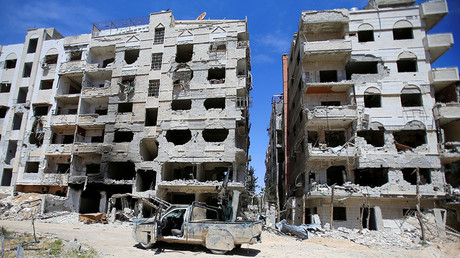
This is the story of a town called Douma, a ravaged, stinking place of smashed apartment blocks – and of an underground clinic whose images of suffering allowed three of the Western world’s most powerful nations to bomb Syria last week. There’s even a friendly doctor in a green coat who, when I track him down in the very same clinic, cheerfully tells me that the gas” videotape which horrified the world – despite all the doubters – is perfectly genuine.

War stories, however, have a habit of growing darker. For the same 58-year old senior Syrian doctor then adds something profoundly uncomfortable: the patients, he says, were overcome not by gas but by oxygen starvation in the rubbish-filled tunnels and basements in which they lived, on a night of wind and heavy shelling that stirred up a dust storm.

As Dr Assim Rahaibani announces this extraordinary conclusion, it is worth observing that he is by his own admission not an eyewitness himself and, as he speaks good English, he refers twice to the jihadi gunmen of Jaish el-Islam [the Army of Islam] in Douma as terrorists” – the regime’s word for their enemies, and a term used by many people across Syria. Am I hearing this right? Which version of events are we to believe?

France, meanwhile, has said it has proof” chemical weapons were used, and US media have quoted sources saying urine and blood tests showed this too. The WHO has said its partners on the ground treated 500 patients exhibiting signs and symptoms consistent with exposure to toxic chemicals”.

At the same time, inspectors from the Organisation for the Prohibition of Chemical Weapons (OPCW) are currently blocked from coming here to the site of the alleged gas attack themselves, ostensibly because they lacked the correct UN permits.

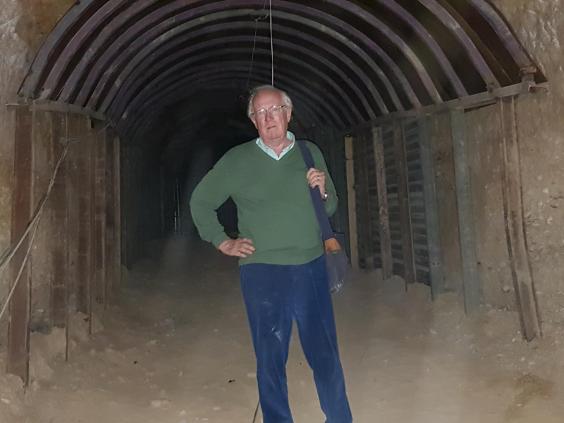
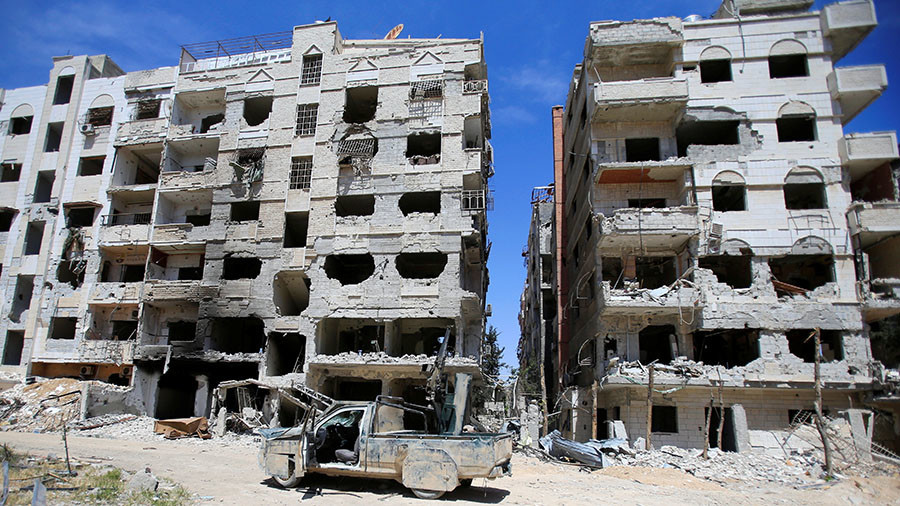
Before we go any further, readers should be aware that this is not the only story in Douma. There are the many people I talked to amid the ruins of the town who said they had never believed in” gas stories – which were usually put about, they claimed, by the armed Islamist groups. These particular jihadis survived under a blizzard of shellfire by living in other’s people’s homes and in vast, wide tunnels with underground roads carved through the living rock by prisoners with pick-axes on three levels beneath the town. I walked through three of them yesterday, vast corridors of living rock which still contained Russian – yes, Russian – rockets and burned-out cars.

So the story of Douma is thus not just a story of gas – or no gas, as the case may be. It’s about thousands of people who did not opt for evacuation from Douma on buses that left last week, alongside the gunmen with whom they had to live like troglodytes for months in order to survive. I walked across this town quite freely yesterday without soldier, policeman or minder to haunt my footsteps, just two Syrian friends, a camera and a notebook. I sometimes had to clamber across 20-foot-high ramparts, up and down almost sheer walls of earth. Happy to see foreigners among them, happier still that the siege is finally over, they are mostly smiling; those whose faces you can see, of course, because a surprising number of Douma’s women wear full-length black hijab.

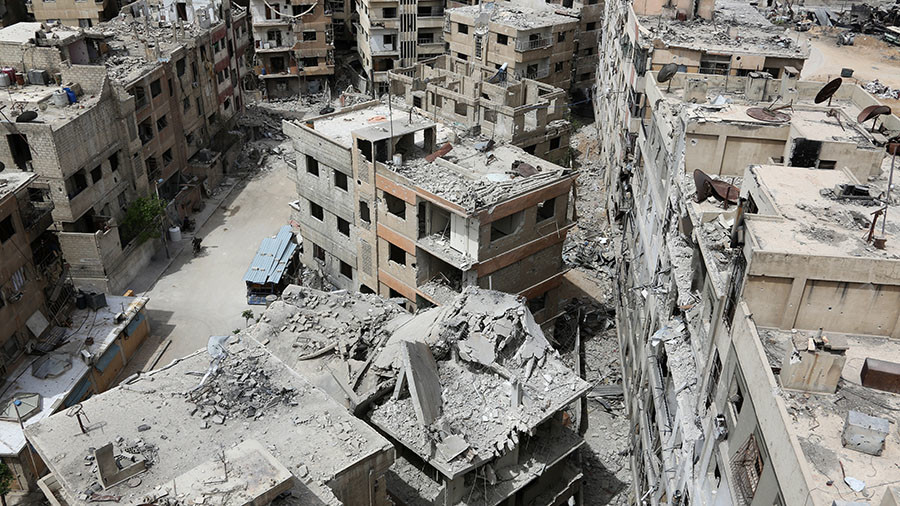
douma-rubble.jpg
Rubble fills a street in Douma, the site of a suspected chemical weapons attack, near Damascus (AP)

I first drove into Douma as part of an escorted convoy of journalists. But once a boring general had announced outside a wrecked council house I have no information” – that most helpful rubbish-dump of Arab officialdom – I just walked away. Several other reporters, mostly Syrian, did the same. Even a group of Russian journalists – all in military attire – drifted off.

It was a short walk to Dr Rahaibani. From the door of his subterranean clinic – Point 200”, it is called, in the weird geology of this partly-underground city – is a corridor leading downhill where he showed me his lowly hospital and the few beds where a small girl was crying as nurses treated a cut above her eye.

I was with my family in the basement of my home three hundred metres from here on the night but all the doctors know what happened. There was a lot of shelling [by government forces] and aircraft were always over Douma at night – but on this night, there was wind and huge dust clouds began to come into the basements and cellars where people lived. People began to arrive here suffering from hypoxia, oxygen loss. Then someone at the door, a White Helmet”, shouted Gas!”, and a panic began. People started throwing water over each other. Yes, the video was filmed here, it is genuine, but what you see are people suffering from hypoxia – not gas poisoning.”

fisk-in-douma-6.jpg
Independent Middle East Correspondent Robert Fisk in one of the miles of tunnels hacked beneath Douma by prisoners of Syrian rebels (Yara Ismail)

Oddly, after chatting to more than 20 people, I couldn’t find one who showed the slightest interest in Douma’s role in bringing about the Western air attacks. Two actually told me they didn’t know about the connection.

But it was a strange world I walked into. Two men, Hussam and Nazir Abu Aishe, said they were unaware how many people had been killed in Douma, although the latter admitted he had a cousin executed by Jaish el-Islam [the Army of Islam] for allegedly being close to the regime”. They shrugged when I asked about the 43 people said to have died in the infamous Douma attack.

The White Helmets – the medical first responders already legendary in the West but with some interesting corners to their own story – played a familiar role during the battles. They are partly funded by the Foreign Office and most of the local offices were staffed by Douma men. I found their wrecked offices not far from Dr Rahaibani’s clinic. A gas mask had been left outside a food container with one eye-piece pierced and a pile of dirty military camouflage uniforms lay inside one room. Planted, I asked myself? I doubt it. The place was heaped with capsules, broken medical equipment and files, bedding and mattresses.

Of course we must hear their side of the story, but it will not happen here: a woman told us that every member of the White Helmets in Douma abandoned their main headquarters and chose to take the government-organised and Russian-protected buses to the rebel province of Idlib with the armed groups when the final truce was agreed.

There were food stalls open and a patrol of Russian military policemen – a now optional extra for every Syrian ceasefire – and no-one had even bothered to storm into the forbidding Islamist prison near Martyr’s Square where victims were supposedly beheaded in the basements. The town’s complement of Syrian interior ministry civilian police – who eerily wear military clothes – are watched over by the Russians who may or may not be watched by the civilians. Again, my earnest questions about gas were met with what seemed genuine perplexity.

How could it be that Douma refugees who had reached camps in Turkey were already describing a gas attack which no-one in Douma today seemed to recall? It did occur to me, once I was walking for more than a mile through these wretched prisoner-groined tunnels, that the citizens of Douma lived so isolated from each other for so long that news” in our sense of the word simply had no meaning to them. Syria doesn’t cut it as Jeffersonian democracy – as I cynically like to tell my Arab colleagues – and it is indeed a ruthless dictatorship, but that couldn’t cow these people, happy to see foreigners among them, from reacting with a few words of truth. So what were they telling me?

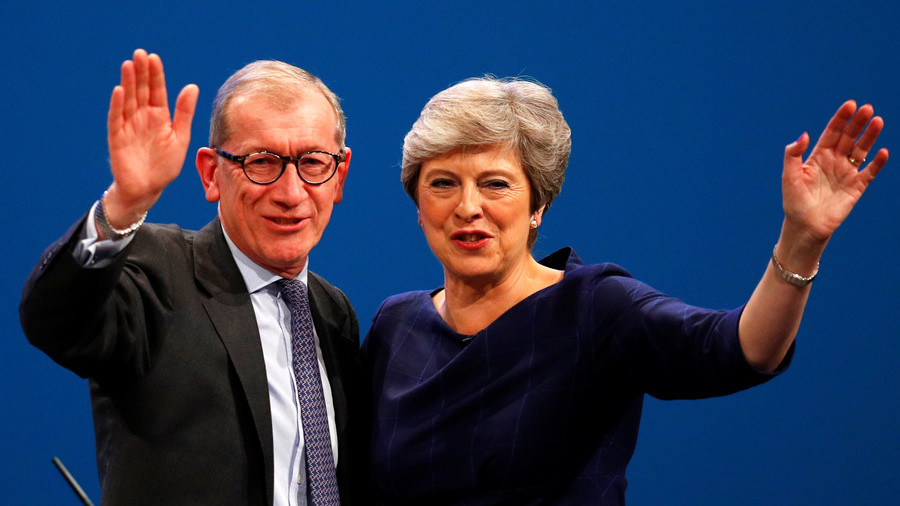
They talked about the Islamists under whom they had lived. They talked about how the armed groups had stolen civilian homes to avoid the Syrian government and Russian bombing. The Jaish el-Islam had burned their offices before they left, but the massive buildings inside the security zones they created had almost all been sandwiched to the ground by air strikes. A Syrian colonel I came across behind one of these buildings asked if I wanted to see how deep the tunnels were. I stopped after well over a mile when he cryptically observed that this tunnel might reach as far as Britain”. Ah yes, Ms May, I remembered, whose air strikes had been so intimately connected to this place of tunnels and dust. And gas?

Full Story

https://www.independent.co.uk/voices/syria-chemical-attack-gas-douma-robert-fisk-ghouta-damascus-a8307726.html

Western media cover tracks of Trump, May and Macron’s war crime in Syria

April 18th, 2018

Finian Cunningham Courtesy RT

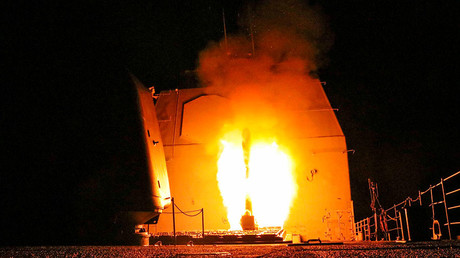
With astounding double-think, the US and Britain accuse Russia of “tampering” with the alleged chemical-weapon attack site in Syria’s Douma – just days after the US, UK and France barraged the county with over 100 missiles.

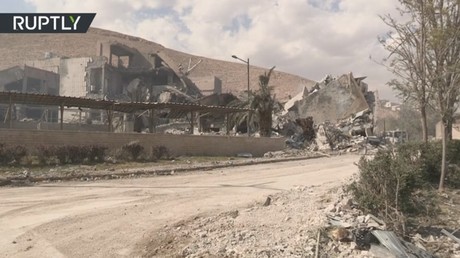
If anyone is guilty of tampering with the alleged crime scene, it is the NATO trio who rushed to bomb Syria just as inspectors belonging to the Organization for the Prohibition of Chemical Weapons (OPCW) arrived in Syria – invited there by the Syrian and Russian governments.

The frenzied Western media campaign to find Syria and Russia guilty of a war crime involving alleged chemical weapons is further highlighted by the reporting this week by award-winning British journalist Robert Fisk.

Western media cover tracks of Trump, May and Macron's war crime in Syria

Fisk, who has been covering Middle East war zones for nearly 40 years, went to Douma city to file his report for The Independent. Credit goes to The Independent for publishing Fisk’s investigative work.

In the aftermath of the weekend’s airstrikes, what he found from interviewing local people and medics is arresting, if not shocking. From Fisk’s witness-gathering report, there was no gas attack carried out on April 7 – in stark contradiction to what the US, British and French governments have been declaring in hysterical tones for the past two weeks.

Those declarations culminated in the US-led bombing of Syria at the weekend. What’s more, the US, British and French leaders are reserving the right to carry out further strikes on Syria – if “the regime repeats its chemical-weapons attacks on civilians.

What Robert Fisk reports from inside Douma corroborates what the Syrian government and its Russian ally have been saying consistently since the alleged incident on April 7. The incident, they say, was staged by the so-called “first responder” group known as the White Helmets, who work hand-in-glove with notorious terrorist outfits like Jaysh al-Islam and Al-Nusra Front. The White Helmets are also on the pay roll of the American CIA, as well as British and French intelligence agencies.

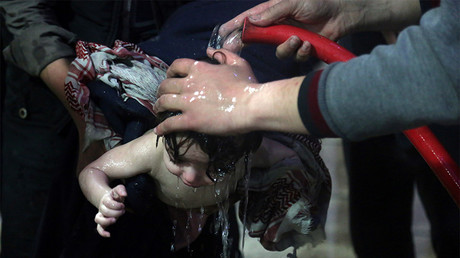
Similar to Russian Foreign Minister Sergey Lavrov’s earlier claim, Fisk reports that on April 7, a panic scene was engendered in Douma’s hospital by White Helmets activists who shouted that “chemical weapons” were being deployed. These activists began dousing people with water hoses and conveniently had video cameras on hand to capture the chaotic scenes acted out by unwitting civilians. A doctor in the hospital confirmed this to Fisk.

As for the supposed dozens of dead that Western governments and media blamed on “animal Assad” and Russian complicity, there is no evidence of the alleged victims. Video footage of dead people in a war zone is hardly proof.

This means that US President Trump and his British and French counterparts, Theresa May and Emmanuel Macron, just launched a criminal aggression on Syria in grave violation of international law and the country’s sovereignty. This is exactly what many independent observers were decrying at the time of the missile barrage, warning that the presumed evidence for a chemical attack was far from substantiated.

Indeed, the suspicion is that Trump, May and Macron knew that their evidential ground for attacking Syria was impossibly thin, and that is why they rushed to bomb the country. It was a decision hastened by the arrival of the OPCW inspectors heading to Douma. The inspectors are due to start their investigative work on Wednesday – delayed apparently by security concerns.

In all probability, the Douma incident was a propaganda stunt orchestrated by Western-backed anti-government militants and their White Helmets media agents, precisely in order to provoke an external military attack on Syria by the US, Britain and France.

Several things stand out about Robert Fisk’s latest reporting. This is exactly the kind of critical journalism that other Western media outlets should have been engaged in following the alleged chemical weapon attack on April 7. Credit goes to Fisk and The Independent. But it is a shameful case of “too little, too late.

Also, it is notable how Fisk’s reportage is being roundly ignored – at least so far – by other mainstream Western media outlets. That’s an impressive feat of self-censorship at a crucial time when the US, British and French governments should be open to accusations of committing a war crime on Syria over their latest blitzkrieg.

This is especially so, given their warnings of more to come, over “further” chemical-weapons use. The urgent concern is that these governments are giving themselves a license to act on more false flags. They should be held rigorously to account for their claims.

This disregard for international law is made possible because of the appalling willingness of Western mainstream media to regurgitate self-serving claims made by terrorist-affiliated groups in Syria and their propaganda outlets.

American, British and French mainstream media have given saturated coverage to the White Helmets and the Syrian American Medical Society, and the dodgy one-man-band operation in Coventry known as the Syrian Observatory for Human Rights. CNN, the BBC and France 24 cite these groups as if they are “authoritative” and impartial, when in fact they are all part of the regime-change campaign in Syria sponsored by the US and its British and French allies.

It is telling, too, how Robert Fisk is being assailed as a “Syrian, Russian stooge” on social media. The one Western mainstream journalist who has had the integrity to delve into Syria’s Douma to uncover a very different critical perspective – one that disproves the claims peddled by the US, British and French leaders and other mainstream media – is being vilified for principled journalism.

Western corporate media are a grotesque mockery of public information and critical, independent accounting of government power.

Apart from Robert Fisk, the few other Western journalists to have ventured into Syria to report on what is really happening are independent, “alternative” sources like Eva Bartlett, Vanessa Beeley and Patrick Henningsen. They have exposed the “Oscar-winning” White Helmets group, which is actually complicit in staging atrocities against civilians living under a reign of terror imposed by their terrorist affiliates. It is understood the White Helmets activists behind the Douma provocation on April 7 have since fled the city along with the terrorist gangs under the cover of an evacuation deal with the liberating Syrian and Russian forces, who are now in control of most of the Eastern Ghouta suburbs near Damascus.

Western media journalists, if they were really committed to principles of accuracy and critical investigation, should be poring over the rubble in Douma, interviewing local people and finding out what really happened. But they are not.

That is why, one suspects, they are not there. That is why the US and Britain are now accusing Russia of “tampering” with the site in Douma – because there is no evidence of a chemical-weapons attack, as Robert Fisk reports.

That means the US, British and French governments just committed a brazen war crime.

This would also explain why Western mainstream media have now quickly moved their focus to allegations of “Russian cyberattacks” on American and British infrastructure. This is a classic case of “keeping ahead of the story.” Western governments and their dutiful media do not have a “story” – at least not the one they claim – in Syria, so the imperative is to change to another subject as quickly as possible.

WATCH Syrian Boy in White Helmets FAKE Chemical Attack Video Reveals Truth

April 18th, 2018

Courtesy Sputnik

Earlier the White Helmets, a Western-backed NGO known for its ties with terrorist groups, released a video showing alleged victims of the false-flag chemical attack in Douma. The US and its allies used the video as a pre-text to conduct a missile strike on Syria.

The Russia 24 TV channel released an exclusive interview on April 18 with a boy, who participated in filming a fake video, as evidence of the false-flag chemical attack in Douma by the White Helmets. In the interview, Hassan Diab says that he and his mother heard loud voices on the street, urging everyone to rush to the hospitals. When Hassan entered the hospital, unknown people grabbed him, poured water on him and then put him with other patients.

“We were in the basement. Mom told me that today we don’t have anything to eat and that we will eat tomorrow. We heard a cry outside, calling “go to the hospital.” We ran to the hospital and as soon as I entered, they grabbed me and started pouring water on me,” Hassan Diab said.

His father continued the story. He was at his work when he heard that his son was in hospital. He rushed to the hospital and found his family there in good health. He added that he was on the street, smoking and didn’t feel any chemical weapon. According to him, it turned out militants gave all the participants food — dates, cookies and rice — and then released them.

“There were no chemical weapons. I smoked outside and felt nothing. I entered the hospital and saw my family. Militants gave them dates, cookies and rice for participating in this film and released everyone to their homes,” Hassan’s father said.

READ MORE: WATCH Ex-Pink Floyd Member Slams Syria’s White Helmets as ‘Terrorist Propaganda’

The TV channel also broadcast an interview with a doctor who was in the hospital when the White Helmets filmed their fake video. He said that no patients with signs of chemical weapons-related injuries arrived that day, but there were many people with respiratory problems due to smoke and dust from the recent bombing. All doctors were busy taking care of them and didn’t have time to react to the White Helmets’ film crew.

The White Helmets is a Syrian NGO, financed by several Western countries, which is associated with staging and filming false-flag chemical attacks. They have been seen several times working with terrorist groups in Syria.

READ MORE: WATCH Douma Doctor Blow Lid Off White Helmets’ ‘Chemical Attack’ Claims

On April 9 the group published another video suggesting that doctors in one of the Douma hospitals were treating patients that had suffered from the chemical attack and accused Damascus of the ordeal. However, the information that later surfaced, as well as witness testimonies, demonstrated that it was staged, performed by the White Helmets.

READ MORE: Syrian Army Discovers White Helmets’ Filming Site in Eastern Ghouta

Immediately after the alleged attack, Moscow dispatched its chemical corps to determine whether there was an actual attack and if there were victims in need of treatment. The Russian crew didn’t find any traces of chemical weapons or any victims in the nearby hospital. Moscow and Damascus invited the OPCW to come to Douma and investigate the incident.

Mission Accomplished? Certainly not in Syria

April 18th, 2018

Donald Trump’s Twitter message announcing success of the missile attack on Syria by the US, the UK and France last Saturday (April 14) has revived memories of a similar message by former president George W Bush, at the height of the war against Iraq, which certainly haunted him in the later years of his presidency.

Trump tweeted: A perfectly executed strike last night. Thank you to France and the United Kingdom for their wisdom and the power of their fine Military. Could not have had a better result. Mission Accomplished!

article_image

The US and other media question whether this phrase may come back to haunt him, too. It would appear that far from Syria, the mission accomplishments were in the US, the UK and France, where the missile attacks on Syria for “alleged” use of chemical weapons, had much to do with domestic political issues faced by President Trump, Prime Minister Theresa May and President Macron.

President Trump is in the midst of a huge political turmoil over emerging details of his alleged sexual involvement with Porn or Adult film star Stormy Daniels (Stephanie Clifford) , to whom his lawyer paid US$ 130,000 just before the Presidential Election of 2016, reportedly to keep her silent about her intimate relations with presidential candidate Trump.

The situation worsened when the lawyer Michael Cohen’s hotel room and offices were raided by the FBI on a judicial order, seizing documents and digital material, which may include recordings of discussions Cohen had with Donald Trump, said to have been Cohen’s practice.

This is in addition to the probe by special counsel Robert S. Mueller III on alleged Russian interference in the 2016 presidential election, said to be supportive of candidate Donald Trump. President Trump has recently made several statements about his right and interest in firing Mr. Mueller, which is largely opposed as a violation of democratic principles, and could lead to his impeachment.

Trump’s problems have worsened with former FBI Director James Comey, sacked by him early in the presidency due to suspicions of investigations about the alleged Russian involvement with the 2016 presidential poll, coming out with his book, A Higher Loyalty, where Trump is described as ‘unethical’ and ‘untethered to truth” and also recalls Trump’s alleged association with Russian prostitutes.

All of this shows Donald Trump has much more reason to carry out this missile attack, than any interest the nearly 80 Syrians, including children, killed and others affected by the “alleged” chemical attack by the Assad regime, which denies such attack and alleges it was carried out by anti-Syrian terrorist forces active in the Douma a region, where it took place, and is now reportedly cleared of enemy forces.

British problems

The ally of the US and Donald Trump – UK Prime Minister Theresa May – must know by now that only a quarter of Britons backed the US decision to carry out missile strikes to punish the Syrian regime for allegedly using chemical weapons.

The Independent reports that Theresa May told a press conference at Downing Street yesterday (Saturday): “While the full assessment of the strike is ongoing, we are confident of its success.” But the new polling will be a blow for the Prime Minister, who threatened further strikes and prepared to justify the attack to MPs, whom she has so far denied a vote on the matter.

Asked to what extent people would back “UK forces conducting targeted air or missile strikes on Syrian government military targets”, just 28 per cent supported them, while 36 per cent opposed, 26 per cent neither opposed nor supported the strikes and 11 per cent did not know.

May would have had more interest in the missile attack on Syria, to move the public interest away from her increasing failures and difficulties over Brexit, far from being an ‘Easy Brexit’ she offered but a very ‘Hard Brexit’. She sees increased concerns about the continuance of peace in Northern Ireland, with the likelihood of a Custom’s checkpoint between Ireland and Northern Ireland, and the threat of a breakdown of her alliance with the Democratic Unionist Party (DUP) whose 10 seats in the Commons props up her minority government.

She clearly avoided seeking the opinion of the House of Commons on carrying out the missile attack on Syria, knowing her weakness in the Commons, and recalling how her predecessor, David Cameron’s proposal to carry out similar attacks on Syria in 2013, was rejected by the Commons. The Labour and Opposition leader, Jeremy Corbyn, has stated Theresa May was wrong in carrying out the attack of Syria without the consent of the Commons.

May is also losing much of the impact gained by allegations against Russia for allegedly using nerve agent Novichok, on former Russian spy Sergei Skripal and his daughter Yulia, at Salisbury in April this year, because neither the UK investigating agent on chemical weapons nor the Organization for the Prohibition of Chemical Weapons (OPCW) who identified the nerve agent used as the Russian originated Novichok, have identified a Russia as the source of the agent in the Salisbury attacks.

In a situation where an alleged nerve agent chemical attack by Russia remains is part of the political debate in the UK, Theresa May, with her limited control in the Commons, certainly has much cause to support Trump in carrying out this missile attack on Syria, while claiming it is not for ‘regime change’.

It is certainly a good political mission accomplishment for Theresa May.

France

As France 24 reports, critics have swiftly accused France and Britain of playing loyal deputies to an unpredictable American leader, viewed by many in Europe with suspicion or outright scorn. Some worried it could further antagonize Europe’s unpredictable neighbour Russia at an already tense time.

French President Emmanuel Macron is accused of compromising the independence of a country that famously stayed out of former US President George W. Bush’s 2003 invasion of Iraq. It is expected that the missile attack on Syria will be the topic of strong debate at the French National Assembly this week.

What is of special interest is that President Macron is facing the worst labour unrest of his presidency so far, with strikes that halted two-thirds of French trains on Saturday and weeks more of walkouts to come, in a strike campaign planned to go on till June this year. His popularity rates are far below when he was elected last year, as the youngest President of France.

Macron has drawn criticism from the far-left to the far-right. Far-right leader Marine Le Pen tweeted the strikes expose France to “unpredictable and potentially dramatic consequences,” criticizing Macron for not taking an “independent” stance.

Florian Philippot, President of the new political party Les Patriotes, said: “President Macron is reducing our country to the role of subordinate partner to the Americans… The French people must rise up against this belligerent action by President Macron, who is becoming more and more to Donald Trump what Tony Blair was to George W. Bush.”

Far left politician Jean-Luc Melenchon also denounced France’s participation on the missile attack, calling it an “irresponsible escalation” without European or French parliament support.

Macron would certainly have liked the missile attacks on Syria, on his claimed concern against chemical attacks, to be a means of drawing public attention away from the political problems he is facing, especially the huge strikes, and growing lack of support for his political party.

As France 24 states, in nine days, Macron goes to Washington for the first state visit under Trump’s presidency   and the French leader can’t be seen as Trump’s lapdog. He also needs to distance himself from comparisons to the 2003 Iraq invasion, which was motivated by suspicions that Saddam Hussein had weapons of mass destruction that never materialized.

What Mission Accomplished?

The South China Morning Post (SCMP) reported on Sunday 15th that “Donald Trump’s ‘Mission Accomplished’ tweet about Syria may come back to haunt him … just like George W. Bush’s premature declaration”.

“Mission Accomplished” were the words on the banner on the USS Abraham Lincoln when President George W Bush spoke in 2003, stating that ‘major combat operations in Iraq have ended”. They certainly had not. The vast majority of the combat deaths in Operation Iraqi Freedom occurred after Bush made that speech. Millions of Iraqis were also killed, injured and driven out of their country after this Mission Accomplishment. In fact ‘Mission Accomplished’ is now very much a code word for missions not particularly accomplished, despite politician’s claims to the contrary, stated the SCMP. It is also necessary to look at the claim of the western powers who refer to the ban on chemical weapons after the large tragedies of World War I. It is certainly a good thought, especially after the deaths of so many from Chlorine and other chemical attacks, remembered in places such as Flanders to this day.

But, was it not the United States that carried out the two nuclear bomb attacks on civilian populations in Hiroshima and Nagasaki in Japan, when it was known that Japan was about to call off its war? Is it satisfying to know that ‘Nuclear Bombing’ is not a chemical attack? Who carried out the Napalm attacks on the people and nature in Vietnam – leading to so much of death and suffering? The US isn’t it?

Was it not the West, particularly the UK and the US that supplied chemical weapons to Saddam Hussein, to carry out attacks killing thousands in the Iraq-Iraq War? Was that not after the ban of use of chemical weapons?

In that other huge military fraud, was it not the US and the UK that carried out attacks on Iraq, leading to the Iraqi War, killing millions, on a false claim that Saddam Hussein had Weapons of Mass Destruction? Has anyone in the UK been punished on the findings of the Chilcot Report on that hugely fraudulent war and its massive and tragic destructions?

There is certainly the need to prevent the use of chemical weapons. Those who carried out the missile attacks on ‘chemical weapon locations’ in Syria last Saturday, could certainly have brought these matters, which they supposedly knew, to the United Nations and the OPCW, and prevented their use by anyone – the regime or others?

Also, why could not the anti-chemical weapon allies – the US, the UK and France, wait at least till the OPCW, which arrived in Syria last Friday, completed its investigation, and announced the truth about the use of chemical weapons, before deciding to launch their very “humane attacks”? There are so many Missions Unaccomplished in this crooked diplomacy and militarism of the West.

900-year drought wiped out Indus Valley Civilisation: IIT-Kharagpur

April 18th, 2018

NEW DELHI, April 16: The Indus Valley Civilisation (IVC) was wiped out 4,350 years ago by a 900-year-long drought, scientists at the Indian Institute of Technology in Kharagpur (IIT-Kgp) have found.

Evidence gathered during their study also put to rest the widely accepted theory that the said drought lasted for only about 200 years. The stud will be published in the prestigious Quaternary International Journal by Elsevier this month.Researchers from the geology and geophysics department have been studying the monsoon’s variability for the past 5,000 years and have found that the rains played truant in the northwest Himalayas for 900 long years, drying up the source of water that fed the rivers along which the civilisation thrived. This eventually drove the otherwise hardy inhabitants towards the east and south, where rain conditions were better.

article_image

The IIT-Kgp team mapped a 5,000-year monsoon variability in the Tso Moriri Lake in Leh-Ladakh — which too was fed by the same glacial source — and identified periods that had continuous spells of good monsoon as well as phases when it was weak or nil.

“The study revealed that from 2,350 BC (4,350 years ago) till 1,450 BC, the monsoon had a major weakening effect over the zone where the civilisation flourished. A drought-like situation developed, forcing residents to abandon their settlements in search of greener pastures,” said Anil Kumar Gupta, the lead researcher and a senior faculty of geology at the institute.

These displaced people gradually migrated towards the Ganga-Yamuna valley towards eastern and central UP; Bihar and Bengal in the east; Madhya Pradesh, south of Vindhyachal and south Gujarat in the south, Gupta added.

The IVC encompassed much of today’s Pakistan, western India, and northeastern Afghanistan; extending from Pakistani Balochistan in the west to Uttar Pradesh in the east, northeastern Afghanistan in the north and Maharashtra in the south. Shortugai to the north is on the Oxus River, the Afghan border with Tajikistan, and in the west Sutkagan Dor is close to the Iranian border. The Kulli culture of Balochistan, of which morethan 100 settlement sites are known, can be regarded as a local variant of the IVC, or a related culture.

The geography of the Indus Valley put the civilisations that arose there in a highly similar situation to those in Egypt and Peru, with rich agricultural lands being surrounded by highlands, desert, and ocean.

Recently, Indus sites have been discovered in Pakistan’s Khyber Pakhtunkhwa as well. Other IVC colonies can be found in Afghanistan while smaller isolated colonies can be found as far away as Turkmenistan and in Maharashtra. The largest number of colonies are in the Punjab, Sindh, Rajasthan, Haryana, and Gujarat belt Coastal settlements extended from Sutkagan Dor in Western Baluchistan to Lothal in Gujarat.

An Indus Valley site has been found on the Oxus River at Shortughai in northern Afghanistan, in the Gomal River valley in northwestern Pakistan, at Manda, Jammu on the Beas River near Jammu, India, and at Alamgirpur on the Hindon River, only 28 km from Delhi. Indus Valley sites have been found most often on rivers, but also on the ancient seacoast, for example, Balakot, and on islands, for example, Dholavira.

It flourished along a system of monsoon-fed perennial rivers in the basins of the Ghaggar-Hakra River in northwest India, and the Indus River flowing through the length of Pakistan. There is evidence of dry river beds overlapping with the Ghaggar River in India and Hakra channel in Pakistan.

A total of 616 sites have been discovered along the dried up river beds of the Ghaggar-Hakra River and its tributaries, while 406 sites have been found along the Indus and its tributaries. According to Shereen Ratnagar, the Ghaggar-Hakra desert area has more remaining sites than the alluvium of the Indus Valley, since the Ghaggar-Hakra desert area has been left untouched by settlements and agriculture since the end of the Indus Valley Civilisation.

THE “DARUSMAN REPORT” Part   3

April 17th, 2018

KAMALIKA PIERIS

This essay looks at four assessments of the Darusman Report, by Godfrey Gunatilleke,   John Holmes, Geoffrey Nice, Rodney Dixon, and the Paranagama Commission.

Godfrey Gunatilleke wrote ‘An Analysis and Evaluation of the Report of the UN Secretary General’s (UNSG) Panel of Experts on Accountability in Sri Lanka” for the Law and Society Review under the title ‘Truth and accountability: the last stages of the war in Sri Lanka.” (2011)

Godfrey Gunatilleke said the Darusman Report is worthless as  an account of the final stages of the war.  However it is extensively used by the pro Eelam groups and therefore counter action has to be taken. ‘He pointed out that the Panel showed bias. It ignored the ample information it had on LTTE’s activities in the No Fire Zone. It made no reference to the army’s rescue of civilians. The emotional tone in certain parts of the Report showed that the Panel was driven by a personal dislike and righteous indignation” against the Government.

The Panel has written a dramatic account of what they thought had actually happened, said Gunetilleke. The Report lacked a neutral objective tone. In many parts of its report the Panel has adopted a tone towards the Sri Lanka government which was unseemly for a Panel appointed by the UN Secretary General.

Gunetilleke observed that the Panel has treated the war in Sri Lanka like any other armed conflict. It has failed to make a distinction between a terrorist organization and the army of a democratic state. War on a terrorist organization is different from any other armed conflict. Further, the Panel has   failed to discuss the critical issues arising out of the unique conditions of the Sri Lankan case. It has not examined the impact terrorism has on the existing laws relating to warfare, either.

In 2014 Gunatilleke and the Consortium of Humanitarian Agencies issued ‘The third narrative ‘. This focused on Darusman Report’s allegation that the army deliberately killed Tamil civilians. They say that earlier when the fighting was in the eastern province there was no allegation of war crimes against the Sri Lanka Army though it was the same army.

The authors say that note must be taken of the unique context of this war. It was a war fought under extraordinary circumstances, where a large civilian population was forcibly held within the battle zone and deliberate positioned to gain military advantage. It was very difficult for the army to apply humanitarian principles fully.

The authors point out that Darusman Panel ignores the fact that it was the LTTE that initially committed the war crimes of using civilians as a human shield, locating their artillery in the midst of the civilian population, and firing into the advance positions of the SLA from within the NFZ. The LTTE’s actions were such that the SLA was left with limited military options.

The Darusman Report says that the government deliberately tried to starve the civilian population by restricting the supply of food. The authors said that when the population in Kilinochchi was forced by the LTTE to move with their cadres towards Mullaitivu in January 2009, the buffer stocks of food in Kilinochchi district was transported and handed over to GA Mullaitivu to be distributed to the civilians. The buffer stocks were adequate for a period of three months. In addition to this, evidence presented to the LLRC had also shown that there were buffer stocks adequate for a quarter of a year in Puthukudirippu as well in January 2009. Furthermore, there was the purchase of food grains from the locality by the government officials present and also the quantities that were shipped to the No Fire Zone by the ICRC.

Lastly, this book says there must be a comprehensive investigation into the crimes of the LTTE. The activities of the UN and international organizations’ involved in the war should also be scrutinized.

The Paranagama Commission (2014) observed that the Darusman Panel has made very serious allegations about the government of Sri Lanka and the Sri Lanka army, and these have influenced the thinking about the final phase of the war. Speeches in the British Parliament have been made on the assumption that what the Darusman report said about the government and army are correct and conclusive.

This Commission therefore sees as one of its duties the demonstration of errors in the Darusman Report and the presentation of an alternative narrative which, in this Commission’s view, reflects more accurately the true circumstances and associated responsibilities related to the final phase of the war in Sri Lanka.

In order to do so, the Commission obtained a technical report from Major General John Holmes and a legal report from Geoffrey Nice QC and Rodney Dixon QC and incorporated their findings into the Paranagama Report. The full text of these two reports are given in Pts 4 and 5 of this series. Extracts are provided below.

The Paranagama Commission requested an expert military report from Major General John Holmes. Holmes was Director UK Special Forces, 1999. He commanded the hostage rescue operation in Sierra Leone and was involved in planning operations in Kosovo. Holmes helped evolve the tactics and equipment that have subsequently been used world-wide in hostage rescue operations. His report to the Paranagama Commission is dated March     2015.

Here are some extracts from the Holmes report:.

Holmes firstly mentions the praiseworthy intention of the Sri Lanka army cadres to minimize Tamil civilian deaths. They probably received an order to do so, from the high command. That is why 290,000 Tamil civilians survived to be rescued by the Sri Lanka army. There are many well recorded instances of soldiers helping Tamil civilians to escape indicating that the policy was understood by all ranks. Gordon Weiss  says on page 216 of his book  ‘The Cage It remains a credit to many of the front-line Sri Lanka army soldiers that they so often seem to have made the effort to draw civilians out from the  fighting in an attempt to save lives. The capture of approximately 12,000 cadres also illustrates this effort.

In my opinion it might also be argued that some of the deliberate operations completed by the Sri Lanka army had as an additional aim, the rescue of civilian hostages. In a US Embassy cable to the State Department on 20 April 2009, US Ambassador Blake reports a successful Sri Lanka army operation near and in Putumattalan that enabled 35,000 civilians to escape the combat zone with a further 1,500 escaping by sea, continued Holmes.

The Wanni operation was not of the `classic’ hostage rescue variety if only because of the number of hostages involved and the ebb and flow of battle. However, there were similarities; the SLA did not rush in, but instead took its time to plan and adapt its tactics  to take account of the civilian presence. It was, in the view of the author, an entirely unique situation and the fact that 290,000 people escaped alive is in itself  remarkable.

If I compare this approach to internal conflicts of which I have personal experience, such as in Sierra Leone, where widespread and systematic atrocity crimes took place, this supports my opinion that this was not an army that was seeking to indiscriminately exterminate their enemy or civilians. Of course, this does not exclude individual instances where war crimes may have  occurred,” said Holmes.

However, overall and for the reasons considered above, on the available evidence it is my opinion, that the SLA’s operations in broad terms, were proportionate in the circumstances. Whilst the SLA was a relatively unsophisticated army, they had evolved into a battle and ultimately war winning machine that made up for its lack of sophistication by the application of three of the most important principles of war: selection and maintenance of the aim; offensive action and concentration of force. In my military opinion, faced with a determined enemy that were deploying the most ruthless of tactics and which involved endangering the Tamil civilian population, SLA had limited options with regard to the battle strategy they could deploy.

This would have posed a dilemma for the very best trained and equipped armies in the world. The SLA had either to continue taking casualties and allow the LTTE to continue preying upon its own civilians, or take the battle to the LTTE, albeit with an increase in civilian casualties.

The tactical options were stark, but in my military opinion, justifiable and proportionate given the unique situation SLA faced in the last phase. Therefore, on the evidence available to me, taking into account my own combat experience, I do not find, in broad terms that the military and artillery campaigns were conducted indiscriminately, but were proportionate to the military objectives  sought.

In everything the author has had access to and reviewed there is no indication that SLA deliberately or disproportionally targeted the civilian population in the course of their operations. In fact, the available evidence suggests the reverse, he concluded.

Homes then spoke on technical matters. The Darusman report makes much of the analysis of  artillery shell craters in the war area. The Darusman team had used the satellite imagery to conclude that SLA were guilty of the widespread shelling of a large IDP population” . It is not possible at this point in time, on the evidence available, to accurately state which side’s artillery and mortars caused identified shell craters and civilian  casualties.

Most craters make a clearly defined pattern on the ground and differ according to the type of projectile fired and the type of fuze used, said Holmes . It is therefore necessary for such a team to show that a specific crater was caused by a shell from a particular type of weapon which was fired on a particular bearing.

The clinching argument as to where responsibility lies for the shelling is in the direction from which the shells were fired. This can only be retrospectively determined from analysis of the shell craters either on the ground as soon as possible after the event or from available imagery or, to a lesser extent, from credible witnesses at the receiving end. To suggest, as one report does, that because the barrels of SLA artillery tracked the declaration of   the  ‘NFZs’ is an indication that they fired into those NFZs is inaccurate and speculative,. It is normal artillery practice for guns to be laid in the direction of the threat, but that does not mean they actually fired.

Holmes notes  that Paragraph 81 of the Darusman Report states that during the period 19 -20 January 2009 shells hit Vallipunam Hospital in NFZ 1. Imagery dated 21 January 2009 indicates that it was likely that the hospital had not received indirect fire on those  dates”.

Paragraph 91 of the Darusman Report states that the hospital at Puthukkudiyiruppu was hit every day between 29 January and 4 February 2009 by Multi Barrelled Rocket Launchers (MBRLs) and other artillery taking at least nine direct hits. Imagery dated 5 February 2009 indicates that the hospital had suffered two possible areas of damage during the time frame, but not nine direct hits. Even one salvo from a MBRL would have devastated the entire area

Paragraph 94 of the Darusman Report states that on 6 February 2009 the Ponnambalam Hospital was shelled causing part of it to collapse and that it was shelled again on the 9 February 2009. Only imagery dated 5 February was available for this site and this shows the hospital to be in relatively good condition.

Three images relating to the Ponnambalam Hospital at page 189 of the Darusman Report are also possibly erroneous. Two of these images refer to specific buildings being destroyed between 21 January and 5 February 2009, yet on the available imagery dated 5 February 2009, both buildings are still standing. The third image again relates to a specific building being destroyed in the same time frame. The building is still standing in imagery dated 16 March 2009.

Paragraph 111 of the Darusman Report states that on 11 and 12 May 2009 the temporary hospital at Vellamullivaikkal was also hit by shells killing a number of people. Imagery dated 10 May 2009 revealed that the hospital had already received damage from probable indirect fire. However, imagery dated 24 May 2009 detected no additional  damage.

Paragraph 120 of the Darusman Report states that on 16 May the LTTE destroyed a lot of its equipment in a large explosion in an area of NFZ 3. A change detection study using imagery dated 16 March and 24 May 2009 showed no evidence of large-scale destruction (craters or debris) was noted throughout the NFZ”.

It is unlikely that multi barreled rocket launchers were used , as Darusman Panel alleges, they cause such a high level of destruction that it would almost certainly be identified from imagery. The number of temporary shelters and their lay out that were still standing on 10 May is also significant. It refutes any suggestion of the deliberate targeting of civilians by SLA artillery or indiscriminate use of these weapons. They had the potential to devastate these areas in a very short space of  time. My conclusion in this Report is that both sides fired into the so called ‘NFZs’, but only  the government that is being held to account, said Holmes.

The Paranagama Commission  requested a legal Review of the Darusman report by Sir Geoffrey Nice QC & Rodney Dixon QC. Here are a few selected observations from the report, but this section must not be treated as a substitute for reading the full text. I have given the full text at Pt 4 of this series.

Nice and Dixon thoroughly condemn the  Darusman Report and say  the     government’s wish for a detailed analysis of the Panel’s work is justified. Reports like the Darusman one can be used to spread  false ideas, which, when repeated over and over again become the accepted narrative. However,  the  real  purpose of the report is to discuss accountability said Nice and Dixon. Its   main task is considering appropriate accountability mechanisms. There is absolutely nothing about modalities , applicable international standards, or comparative experience given in their terms of reference.

Nice and Dixon firmly state that the Darusman Report  is not acceptable in law. No international tribunal will accept it. It  will be thrown out. ‘Analysis of the complex and intricate legal requirements for an unlawful attack under international humanitarian law and customary international law to the facts in each particular case is completely lacking in the Report.’

Darusman Panel had used ‘reasonable basis to believe’ as its standard of proof. Nice and Dixon point out that this is the lowest standard of proof  accepted in a court of law. International Criminal Court uses  it only to initiate an investigation. But even at that level sound evidence is required.

Before starting its work the Panel should have sought a mandate to conduct a proper investigation in accordance with international legal standards. Without such a mandate all it would be able to do was assemble allegations and counter allegations from all sides.  The Panel however used this to its own advantage. The Panel adopted a ‘halfway house’ solution.

It did not conduct a full fact-finding investigation but consulted various individuals and organizations and examined  information, avoiding the detailed inquiries that characterize a full investigation.   Instead of saying  that there are many disputed allegations which require further investigation, the Panel positively claims that the allegations are credible and reliable and  must be seen as  trustworthy allegations that should be accepted.

The Darusman Report  is highly defective when it comes to evidence, especially when  judged by established legal standards for the assessment of evidence. The reader is left in the dark as to which were the primary sources used in the Report.   The full body of evidence that was taken into account is unknown,. The statements of those who were interviewed and consulted were not submitted with the Report. Some journalistic accounts are footnoted as sources.

There are very many instances in the Report in which strong allegations and statements are made with no sources to substantiate the findings. For example,  the Report says the Government unlawfully shelled civilians in the first No-Fire Zone, but not a single source is given. (paragraphs 80-89)  For the shelling of PTK hospital, some sources are provided ,but no evidence  as to who was responsible. (paragraphs 90-96) Attack on Putumattalan hospital only a single source – an ICRC news release – is footnoted.  This cannot be considered primary evidence.

the Panel attaches some examples of satellite imagery and diagrams of SLA artillery positions  pointing at the NFZs. No expert report or evidence is provided with this material to explain its value and relevance. The diagrams do not show or confirm any artillery fire. International  tribunals now do not consider “Impact Analysis” being critical in determining whether an attack was unlawful. The Darusman Report, however,  focuses only on the impact of the shelling.

Nice and Dixon     say that the Report simply does not grapple with the difficulties and intricacies of establishing whether any particular attack was justified militarily on all of the available evidence. It is well-established under international law that military objects may be targeted and that an attack which causes loss of civilian life may be justified if it is not excessive in relation to the concrete and direct military advantage anticipated.

They say that it is not clear on what basis the Panel makes conclusions about the responsibility of the Government for the civilian deaths that occurred, The assertion is simply made repeatedly in the Report that the Government forces indiscriminately killed civilians, No attempt is made in the Report to assess the extent of the LTTE’s targeting of the NFZs

Similarly, the allegations about there being a policy to target, torture, and execute LTTE and other persons after the conflict are made as statements of fact without a body of clearly identifiable primary evidence, including witness statements, to back them up. The Panel’s approach also assumes that the persons killed, whatever the number, were in fact civilians as opposed to persons who had taken up arms voluntarily or under compulsion on the side of the LTTE. ( continued)

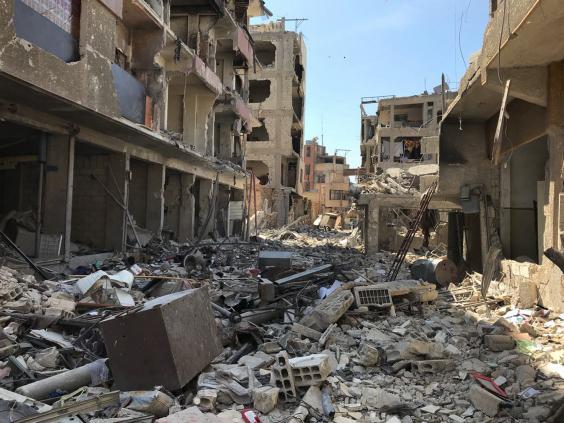
JO NEXT ACTION PLANS!-     I1)  NO CONFIDENCE MOTION AGAINST SAMBANDAN  (2)  DEMAND OPPOSITION LEADER’S ROLE FOR JO  OR (3)  DEMAND DISSOLUTION OF PARLIAMENT

April 17th, 2018

BY M D P DISSANAYAKE

  1. Unseating Sambandan: This ploy could backfire on JO itself.  This will further alienate JO from the Tamil community.  The TNA will use such a move to obtain the local  and international attention in their favour, blowing out of proportion a rapid protest campaign justifying TNA’s long held view that Prez Mahinda Rajapakse is against Tamils and minorities.    Such NCM will be defeated in the Parliament, with the support of UNP, SLFP, JVP, TNA, SLMC etc.
  2. Grabbing Opposition Leader’s Role: Even if JO wins the NCM,  there will be no guarantee that it will secure the OL’s role.  Prez. Sirisena is a clever politician.  Why did he allow exactly 16  MPs to vote in favour of previous NCM and  leave the cabinet?  Currently TNA also has 16 MPs, that is how it secured the OL’s role.  Under the strict interpretation of the Constitution,  TNA was the second largest party in the parliament as per results of the general election, as a consequence of UNP and SLFP  forming unity government.  JO did not contest the last election as a separate group, they were part of the UPFA, recognized by the Electoral Commission.

So, if JO wins NCM against Sambandan, the SLFP defected group of 16 will be equal with TNA.  SLFP defected group still represent UPFA, not JO.  Prez Sirisena will only need one more MP to join the defected group thus making it 17, to qualify as the second largest parliamentary group representing UPFA, bypassing TNA, thus it will meet the criteria to secure the role of Opposition Leader.

The number 16  was not an accident, but it  had been meticulously worked out by Prez. Sirisena, to his advantage. 

  1. DEMAND DISSOLUTION OF PARLIAMENT: This ought to be the ultimate goal of JO and SLPP.  It is possible that the current parliament may not convene on 8 May at all, using the prorogation, the Prez has the power to dissolve the Parliament.  In a very carefully crafted manner, Prez. Sirisena will try to discharge  Susil Premajante, SB, Dayasiri  and the clan  into the SLPP, prior to nominations.

Mr Basil Rajapakse has worked extremely hard to construct a political base for SLPP, from bottom up.  MR loyal Organisers are waiting to the contest the General Election and they should not be let down by accommodating discarded parachuters.

The country demand the return of Prez Mahinda Rajapakse, with his new team. Those who attacked and insulted MR in the past, should not have any place in the SLPP movement.  The country demand not just the return of Prez Mahinda Rajapakse.  It is demanding a team of uncorrupt, loyal, hardworking and educated team of new faces  of men and women  who commit to protect the People, Culture, Religion, Language and the Country at any cost.

සෝවියට් වෛද්‍ය විද්‍යාව

April 17th, 2018

වෛද් රුවන් එම් ජයතුංග 

සෝවියට් දේශය එක් කාලයක් විද්‍යාව සහ තාක්‍ෂණය අතින් ලෝකයේ  මුල් පෙලේ රටක් විය​. මේ කාලයේදී සෝවියට් දේශය වෛද්‍ය විද්‍යාව ජයග්‍රහණ රැසක් ලබා ගත්තේය​. උදාහරණයක් ලෙස අක්‍ෂි වෛද්‍ය විද්‍යාව සඳහා ෆියදෝරොෆ් සහ අස්ථි ශල්‍ය විද්‍යාව සඳහා එලිසාරොෆ් යන විශේෂඥයන් ලෝක පූජිත වූහ​. මෙම ජයග්‍රාහී සමයේදී සෝවියට් වෛද්‍ය විද්‍යාල ලෝක ශ්‍රේණි ගත කිරීමේදී ඉහල මට්ටමක තිබුනහ​. ලෝකයේ නන් දෙසින් සිසුන් වෛද්‍ය විද්‍යා අධ්‍යාපනය ලැබීම සඳහා සෝවියට් දේශයට ආවෝය​. 

සෝවියට් අස්ථි ශල්‍ය විද්‍යාව පිලිබඳ මා දන්නා එක් සිදුවීමක් තිබේ. 1980 දශකයේදී   ශ්‍රී ලංකා යුද හමුදාවේ නිලධාරියෙකු වූ සනත් ගුණවර්ධන මෝටර් සයිකල් අණතුරකට භාජනය විය​. මෙම අණතුර හේතු කොට ගෙන ඔහුගේ පාදයකට බරපතල තුවාල සිදු වී තිබුනේය​. ඔහුව පරික්‍ෂා කල වෛද්‍යවරු  සනත් ගුණවර්ධන ගේ පාදය කපා දමා ඔහුගේ ජීවිතය බේරා ගත යුතු බව නිර්දේශ කලහ​. සනත් ගුණවර්ධනව ශල්‍යාගාරයට යවනු ලැබීය​. නිර්වින්දනය  දීමට ප්‍රථම තමාගේ පාදය කපා නොදමන ලෙසටත් තමාගේ සොහොයුරිය අධ්‍යාපනය ලබන සෝවියට් දේශයට තමන්ව යවන ලෙසට ඔහු ඉල්ලීමක් කලේය​. මේ අනුව වෛද්‍යවරු පාදය ඉවත් කිරීමේ ශල්‍යකර්මය සිදු නොකොට ඔහුව වහ වහා මොස්කව් වෙත යවන ලදි. 

මොස්කව් හිදී සනත්ට  ප්‍රතිකාර කරන ලද්දේ අස්ථි ශල්‍ය විද්‍යාව සඳහා  සුප්‍රකට එලිසාරොෆ්   විශේෂඥයා සේවය කල රෝහලේදීය​. මෙම රෝහලෙන් ප්‍රතිකාර ලබා ගැනීමෙන් පසුව සනත් ගුණවර්ධන ගේ පාදය සුව විය​. 1993 වසරේදී මට යුද හමුදා නිලධාරී සනත් ගුණවර්ධනව කටුනායක ගුවන් තොටුපලේදී හමු විය. සෝවියට් අස්ථි ශල්‍ය විද්‍යාව විසින් සුවපත් කල සනත් කිසිදු වාරුවකින් තොරව දෙපයින් ගමන් කරන අයුරු මම නිරීක්‍ෂණය කලෙමි.  වර්තමානයේදී සනත් ගුණවර්ධන විශ්‍රාමික හමුදා නිලධාරියෙකි. මෙවැනි විජයග්‍රාහී සත්‍ය කථාන්තර රැසක් සෝවියට් වෛද්‍ය විද්‍යාව ඇසුරු කොට තිබේ.

ඉතා  ඉහල තත්වයක් තිබූ සෝවියට් වෛද්‍ය විද්‍යාව සෝවියට් දේශයේ බිඳ වැටීමත් සමග පරිහානියට පත් විය​. මේ කාලයේදී පරියේෂණ සඳහා ප්‍රතිපාදන කපා දමා තිබුනේය​. බොහෝ දක්‍ෂ වෛද්‍ය විශේෂඥයන් ඇමරිකාව සහ ඊශ්‍රායලය යන රටවලට ගියහ​. මේ නිසා ඉතා කීර්තිමත් යුගයක් සනිටුහන් කල වෛද්‍ය ආයතන කඩා වැටුණහ​. මෙය ඉතා කණගාටුදායක තත්වයක් විය​. ආර්ථික  අර්බුද හමුවේ ඉතා වටිනා වෛද්‍ය උපකරණ නිසි නඩත්තුවට ලක් නොවීය​. මේ නිසා එකී උපකරණ විනාශවී යන ලදි. මෙලෙස මිනිස් ප්‍රජාවට සෙත සැලසූ දැණුම පද්දතියක් අභාවයට පත් විය​. 

කෙසේ නමුත් ජනාධිපති පූටීන් යටතේ පැරණි සෝවියට් වෛද්‍ය විද්‍යාව නව මුහුණුවරකින් – රුසියානු සන්නාමයකින් ඉදිරියට එයි. ජනාධිපති පූටීන් විසින් යලිත් වරක් ප්‍රතිපාදන ලබා දී පැරණී දැණුම කීර්තිය යලි ලබා ගැනීම සඳහා උත්සහයක නියැලෙයි. මේ නිසා නුදුරු අනාගතයේදී රුසියානු වෛද්‍ය විද්‍යාව යළිත් හිස ඔසවනු ඇත​. 


දේවමත කරෙන් බෙල්ලෙන් එල්ලාගෙන පල්ලි කෝවිල් තනන දේශ පාලකයන් කරගන්නා පවු!

April 17th, 2018

පාලිත ආරියරත්න

දේවමත කරෙන් බෙල්ලෙන් එල්ලාගෙන පල්ලි කෝවිල් තනන දේශ පාලකයන් කරගන්නා පවු!

අද සිංහල බෞද්ධයා මරණින්දේය. හතු පිපෙන්නා සේ සැම තැනම පල්ලි කෝවිල් ඉදිවෙමින් පවතී. දේශපාලකයෝ විශාල පිරිසක් තම සිංහල බෞද්ධකම පසෙකලා අඩුම තරමින් වර්ෂයකට එක හරෙකු හෝ උරෙකු තම දෙවියන් උදේසා ඝාතනය වන ආගමික සත්ව ඝාතනාගාර රාජ්‍ය මට්ටමින් ඉදිකිරමින් යයි. (යම්කසි ආගමික තැනක සතුන් මැරීම සිදු කරයි නම් අප සිංහල බෞද්ධ දැක්ම වන්නේ එය ආගමික සත්ව ඝාතනා ගාරයක් බවයි). පුදුමයට කාරනයනම් පළමුවෙන් තෙරුවන් නැමද පන්සල් ගොස් බණ අසා දෙවනුව මහා පල්ලි විවෘත කොට, අමුතු මාදිලියේ ඉතිහාස කතා ඇතුළත් කර, අප මවු රට විවධ කොන වලින් ඩෑහෑ ගැනීමට මාන බලන ලංකාව තුළම ජන්මය ලත් නමුත් තම සහෝදර මහජාතිය (මහා ජාතිය සුළු ජාතියට සහෝදරයෙක් වුයේ තම ඉඩම් කඩම් බව බෝග නිකරුණේ ලබාදී තම භාර්යා සම්පතද සරණ පවා දීමට කිසිම මිල මුදලක් අපේක්ෂා නොකළ නිසයි) කීප විටක්ම ඉතිහාසයේදී හා මෑත භාගයේදී අසරණ කෙරු විජාතින් ඉහළින් ඔසවා තබා කතා කිරීමයි.

සිංහල බෞද්ධ වන අප ඉතා කණගාටුවෙන් පවසන්නේ හෙළ බෞද්ධ කරුණාව යටතේ සිටින තිරිසන් ආත්ම ඇති නමුත් මිනිසුන් අතින් නිකරුණේ මැරුම් නොකන, පෙර පවට තිරිසන් වී ඉපදුණත් යම්කිසි යහපත් කර්ම බලවේගයක බලයෙන් අප බොදු ලක්බිම ඉපදුන යම්තාක් දුරකට පින් ඇති අහිංසක නිරී සතුන් මරාකන මර්මස්ථාන ඉදිකරීමට සිංහල බෞද්ධ යැයි කියාගන්නා දේශ පාලකයන් ඉදිරිපත් වීම අපේ ජාතියටද අහිංසක තිරිසනා ටද ගැසූ හෙණයක් බවයි.

ඔවු මේ වර්ෂ 2018 නමුත් අකාලික වූ බුදුබණ අමතක කරමින් සිංහල අපි කරන පවු අලුත් ලෝක (මෝඩර්න් වොර්ල්ඩ් අයි) ඇසෙන් වසා ගත හැකිද?. නැතිනම් අපි පල්ලි කෝවිල් ඉදිකළ පලියට අපිට‍ පන්සල් සදා දීමට විජාතින් විසින්ඉදිරිපත් වෙයිද? අරාබියේ ඇති පුණ්ණසිවානු භික්ෂුන් වහන්සේගේ පන්සල (මක්කම) වැදීමට හෝ එය ළගින් අඩුම තරමින් කුඩා බුදු පිළිමයක්වත් තැන්පත් කිරීමට අවසරයක් ලැබේවිද?. රජතුමා අවසර දුන්නත් ආගමික පුජකයන් එසේ කිරීමට ඉඩ දෙයිද? වතිකානුවේ භුමියේ පන්සලක් සාදා ගැනීමට ඉඩම් කැබැල්ලක් (අඩුම තරමින් මතු නිවන් දැකිමටවත්) ලබා දෙයිද?. නැත… දේව වාදීන් සැමදා තම දේවියගේ මතයට ගරුකරයි. ලොවුතුරා බුදුන් අදහන අප මෙය පාඩමකට ගත යුතුය.

සිංහලයන් තම පෞර්ෂත්වය හා තම ජාතික අභිමානය හදා වඩා ගැනීමට කාලය පැමිණ ඇත. (නොදැන හෝ පස් පවු නොකිරීමට) දේශ පාලකයන්ට තම කොන්ද පණ නැතිවෙන විට විවිධ නැටුම් කළ හැක. නමුත් සිංහල අප මේවා රාජ්‍ය මට්ටමින් හෝ, පන්සල් මට්ටමින් හෝ, ගම් මට්ටමින් හෝ පුද්ගලික මටමින් හෝ අනුමත නොකළ යුතු කටයුතුය. ඒ ඇයි කිවහොත් අප අනාගත දු දරුවන්ගේ නිදහස් නිවහල් උරුමයන් විනාශ කිරීමත් ඔවුන්ව සියුම්ව අපාගත කිරීමට විවිධ ක්‍රම වේදයන් ප්‍රසිද්ධ යැයි කියාගන්නා සිංහල බුද්ධිමතුන් ලවාම ප්‍රසිද්ධ කිරීමයි. උරෙකු, එළුවෙකු, බැටළුවෙකු, හරකෙකු, තම අවසාන ගමන් මග එනම් මරණය ලගා කරගන්නේ පල්ලිය හෝ කෝවිල තුළ දෙවියෙක් වෙනුවෙන්නම් එය මිනිසා විසින් තම බඩ වියත රැකගැනීමට කරනා නින්දිත ක්‍රියාවක් බව අප වටහා ගත යුතුය . එය සසර තියෙන තුරු පලදෙන අකුසල කර්මයකි.

යම්කිසි කෙනෙකු රජෙක් විය හැක, නමුත් රජා උන පලියට තම රටේ තිබෙන විවිධ ආගමික මත නිසා විවිධ පල්ලි සදා තමනුත් නොදැනුවත්වම පවු ගොඩ ගසා ගැනීම අනවශ්‍යය. බුද්ධිමත්ව ක්‍රියා කොට යාග හෝම වලට සහභාගි නොවී පවු කරන මිනිසාද අවසනයේ හැකිනම් පවු කරන දෙවියාද පාපයෙන් ගලවා ගැනීමට ක්‍රියා කිරීම සිංහල රජෙකුගේ අපේක්ෂාව විය යුතුය. එය බුද්ධිමත් රජෙකුගේ ක්‍රියා කලාපයයි.

සියුම්ව දේශපාලනය ඔස්සේ පැලපදියම් වන ආගමික දේවස්ථාන දෙස ඇස් කන් යොමු කර බලා සිටිමු !

‘බුද්ධ ධර්මයට අනුව මිනිසාට මෙන්ම සත්වයන්ටත් බුද්ධිමත් භාවයක් ඇත. මිනිසා සහා සත්වයන් අතර හුවමාරු කරගත හැකි පාඩම් බොහෝය. මිනිසාට මෙන්ම ඊළග භවයේදී හෝ සත්වයන්ටද නිවන් දැකීමට අවස්ථාවක් තිබේ. එබැවින් සත්වයන් හා අප අතර විශ්වාසය, ගෞරවය, ආදරය පැතිර යායුතුය. සතෙකු මරා දැමීමට මිනිසෙකු ඉදිරපත් වීම නොවටිනා කාරණයකි. ‘

පාලිත ආරියරත්න

දුමින්ද-අමරවීර මහ ලේකම්වරු නොවේ.. ඔවුන් ‘මහ කේලාම්’වරුයි.. ඔවුන් කරන්නේ අගමැතිට කේලාම් කීමයි..- නල්ලතන්නියේ සිට ඩිලාන් මහගිරි දඹ නැගීම අරඹයි..

April 17th, 2018

 lanka C news

ශ‍්‍රී ලංකා නිදහස් පක්‍ෂයේ හා එක්සත් ජනතා නිදහස් සන්ධානයේ සිටින්නේ මහ ලේකම්වරු දෙදෙනෙකු නොව මහ ‘කේලම්වරු’ දෙදෙනෙක් යයි ශ‍්‍රීලනිප මාධ්‍ය ප‍්‍රකාශක හිටපු ඇමති ඩිලාන් පෙරේරා මහතා පවසයි.

මහ කේලම්වරුන් කරමින් සිටින්නේ අගමැති රනිල් වික‍්‍රමසිංහට ගතු කීම බවද ඔහු සදහන් කරයි.

පාර්ලිමේන්තු මන්ත‍්‍රී මහින්දානන්ද අලුත්ගමගේ මහතාට අධිකරණය විසින් ඇප ලබා දීමේ අවස්ථාවට එක්වෙමින් අධිකරණය ඉදිරිපිටදී ඔහු මාධ්‍ය වෙත මෙම අදහස් පල කලේය.

ගජමිතුරු කල්ලියේ අමුතු අවවැඩ රෙදි ගලවා පෙන්වයි.. 16 කණ්ඩායමේ ප‍්‍රබලතම හෙලිදරවුව චන්දිමගෙන්..[Video]

April 17th, 2018

lanka C news

ආණ්ඩුවේ ගජමිතුරු කල්ලිය විසින් සිදු කරන අමුතු අතපෙවීම් සම්බන්දයෙන් හිටපු ඇමති පාර්ලිමේන්තු මන්ත‍්‍රී චන්දිම වීරක්කොඩි මහතා සදහන් කරයි.

සිරස රූපවාහිනියේ පැතිකඩ වැඩසටහනට එක්වෙමින් මෙම අදහස් හිටපු ඇමතිවරයා පල කලේය.

ඇමතිවරයෙක් ලෙස රාජකාරි කරද්දී ගජමිතුරු කල්ලියෙන් දැඩි බාධා එල්ල වූ බවත් ඔහු එහිදී සදහන් කලේය.

කැබිනට් මන්ඩලයෙන් ඉවත් වූ හිටපු ඇමතිවරයෙකු විසින් සිදු කරන ලද ප‍්‍රබලතම හෙලිදරවුවක් ලෙස මෙම සාකච්චාව සැලකිය හැකිය.

Rickety yahapalana bus chugs along… Will Sirisena drive towards anarchy or safety?

April 17th, 2018

By Arjuna Ranawana Courtesy Ceylon Today

A popular expression in North America is Who is driving the bus?”, it means who is in charge? Most of us travel by bus and they are the bane of our lives. The private buses competing with each other for passengers, stopping everywhere to pick up people, but refusing to stop for them to get off are universally hated, but it is something we have to put up with.  Buses being so much a part of our lives, I thought it would be good to use the bus analogy to describe the politics of today.

Former President Mahinda Rajapaksa’s bus was like one of those super-luxury vehicles you see, taking high-end tourists to resorts. High above the road, with tinted glasses that ensconced the passengers, it was full of family and friends. In the bus, they were wined and dined with the best and they had more than anyone who was not on it. The bus was policed by a fierce Conductor who would decide who could get on the bus and any disorderly passengers were evicted.

This bus sped along and once it gathered speed all others on our unruly roads stepped aside lest, they were crushed beneath the juggernaut.

Anyone who opposed them was mowed down. After Rajapaksa was defeated in both the presidential elections and parliamentary in 2015 that bus was dented and looked headed for the scrap yard.

The Unity Government bus driven by President Maithripala Sirisena reminds me of some of the ancient buses that used to ply the unpaved country roads in and around Bibile, in the early seventies. These vehicles had been sold off by departing troops after the Second World War. American built they had wonderful engines and very strong chassis and suspension.

Passengers got in and off randomly and the crowded buses were also stuffed with farmers produce and had people hanging off the sides. The Conductor played a dual role, because the gearboxes were so old that when the bus got moving he had to jam sticks against the gear lever to prevent it from slipping.

The wheels were also not all of the same size, but it did not matter because the roads were so deeply rutted.

There was an air of imminent collapse, but the atmosphere was benign. But they chugged along.

Erratic behaviour

So, when the Local Government Polls results showed Rajapaksa’s sleek new bus the Pohottuwa clearly ahead, the rickety Yahapalanaya bus behaved erratically. Although his party had come third, President Sirisena initiated moves to remove Prime Minister Ranil Wickremesinghe from his post. In many ways he felt that the PM was not allowing him to wield power and it would be best for him to remove him and make the LG results a reason to appoint a replacement of his choice. Now, the driver was trying to wreck the bus.

Former Deputy Speaker Thilanga Sumathipala is on record as saying that Sirisena asked the Sri Lanka Freedom Party Members of Parliament supporting him to vote for a No-Confidence Motion against Wickremesinghe in Parliament on 4 April that was being proposed by the Rajapaksa faction of the party.

At the big test, Wickremesinghe sailed through with flying colours with more than half of the Sirisena faction absenting themselves from the vote and right now the UNP bus looks as if someone had given it a new coat of paint.

Since then, the Yahapalanaya bus, although looking like it was restored, was lying in the middle of the road going nowhere as the driver was at the wheel but not driving it. Dazed and confused, the SLFP/UPFA combine in Parliament then turned on each other. The Rajapaksa faction or Joint Opposition accused Sirisena and his group of not keeping their side of the bargain and screamed ‘betrayal.’

The President let us down,” JO spokesmen said. The SLFPers who voted with the JO turned on their colleagues who failed to be present in Parliament at voting time. The two groups each said that they had followed the collective will of the party. It was never known whether the group had reached a consensus on which course of action they were to follow.

With his faction in disarray like a driver trying to coax errant passengers who had got off the bus to climb back on board, Sirisena tried his very best to keep the entire SLFP group that had initially supported the Unity Government with him.

He told the Media on 7 April that he was inviting all MPs who want to strengthen the Government to join me.” But the UNP demanded that the 16 MPs who voted against Wickremesinghe leave the Government on the grounds that they had no right to sit in a Cabinet headed by the PM. Eventually they did resign on 11 April and fall off the bus.

Finally, Sirisena gave up nearly ten days after the NCM and accepted that the 16 can go, and swore in others to replace them.

Overcoming anarchy

At a seminar held on the Easter weekend in Colombo, several days before the anti-Wickremesinghe vote was taken, various experts debated the question How do we overcome Anarchy” in respect of the current situation in the country which has been described by the Pohottuwa leader Prof. G L Peiris as anarchic.

One of the speakers at the seminar was Prof. Desmond Mallikarachchi who argued that anarchy had not yet set in. The country is in a mess, it is confused but not anarchic,’’ he said. Anarchy he said is when different parts of the country will be controlled by different armed groups like Afghanistan was at one time.

But after the current episode Mallikarachchi says anarchy maybe nearer.
In his 7 April Media conference Sirisena said that the NCM against Wickremesinghe was mooted because there were requests from my group as well as several MPs from the United National Party.” Sources close to the President said that the idea was to incorporate all these elements as well as break off MPs from the Rajapaksa faction so that Sirisena could install a Government with MPs beholden to him.

After 4 April, the 16 dissenters who resigned their Government positions have decided to sit in Opposition and it is no secret that the Rajapaksa-faction would welcome them into their fold. The 26 SLFP/UPFA MPs who stayed with the Government naturally would get closer to the UNP and the rest of the UPFA is already with Rajapaksa. A dejected aide to the President said, He expected to get them all under him, but now he has lost them all.”

Sirisena leaves for London tomorrow (16) to attend the Commonwealth Heads of Government Meeting and returns on the 25th and one of first meetings will a Central Committee Meeting of the SLFP at which the party is expected to decide whether they would stay with the Unity Government or leave. After that it needs to be seen where Sirisena will drive the bus to, anarchy or safety.

The March of Folly Continuing vacillation

April 17th, 2018

By Prof. Rajiva Wijesinha Courtesy Ceylon Today

Two months after the Local Government Elections, which made it clear that the country lacks confidence in the current Government, there has been no change in the course, or perhaps one should say the absence of any course, the government is embarked upon. Its only significant achievements thus far are agreeing to a UN Human Rights Council that puts the country in the dock, and the plundering of the country through manipulation of bond auctions.

The President, and almost everyone in his party, and several of those in the UNP, deplore both these achievements, and it is clear there has been nothing to counter them which would convince this country to continue with the Government if it were permitted to choose. But given the current Constitutional position, we are stuck with this government for just over eighteen months more. It is conceivable that there could be a change, but that requires courage, which the President does not possess.

Decisiveness also seems generally beyond him, though when pushed to the wall he can act, as when he refused to reappoint Mahendran to the post he had abused, when he instituted a Presidential Commission of Inquiry into the Bond Scam, when he made Vasantha Senanayake State Minister of Foreign Affairs when Ranil wanted Anoma Gamage, when he made Ranjith Madduma Bandara Minister of Law and Order when Ranil wanted Sarath Fonseka, and when he abolished Ranil’s Cabinet Committee on Economic Management (CCEM).

Putting decisions off

But in general, because he does not always have the courage of his convictions, the President puts decisions off, and then even backtracks when he thinks he might suffer. So, in 2015 he decided, against the advice of his more revengeful supporters, to give Mahinda Rajapaksa a nomination for the General Election. That made sense, because the SLFP would have been decimated otherwise, or might indeed have abandoned him and gone with Mahinda since the writing was on the wall.

But then, having made that decision, he panicked, and sabotaged the campaign, by rude letters to Mahinda and then by sacking the Secretaries of the SLFP and the UPFA a couple of days before the election, so that the UNP did better than the UPFA.

That is why he continues in a mess, having to work with a Prime Minister he finds at best difficult. But since he thought Mahinda Rajapaksa would be more difficult, instead of doing his arithmetic and realizing that Mahinda could not be Prime Minister when a coalition had to be formed, he gave in to the revengeful, and ended a weaker President than he need have been.

The same seems to have happened this time. Having made it clear that he did not want Ranil to continue as Prime Minister, he watched happily as the No-Confidence Motion was prepared.

He seemed to think then that all members of the SLFP, except for Duminda Dissanayake, whose allegiance is clearly to Chandrika rather than to him, would follow his lead. And so they would have done had he made his position clear, instead of playing around and getting other people to do what could only be persuasion rather than iteration of policy.

And when that persuasion did not fully succeed, given that he did not give clear direction, again thinking the numbers might not add up, he panicked, and thus ensured that they could not. Thus, he left the brave members of the UNP who had spoken out, and the less brave who would nevertheless have voted to get rid of Ranil if they were sure of success, in the lurch.

Once again, then his lack of courage has left him in a greater mess than before. In January 2015, when he was the toast of the nation, and could easily have commanded a Parliamentary majority, he abdicated power to Ranil and to Chandrika whom he thought of as a safeguard for the SLFP, even while she was intent on destroying it. So, the first six months of his Presidency passed with no attention whatsoever to the pledges of his manifesto save the only one in which Ranil and his sidekick Jayampathy were interested.

Then, when the Bond Scam worked, and D.E.W. Gunasekara and the rest of us worked overtime to present a coherent report (and Sujeewa Senasinghe and Rosy Senanayake worked overtime to stymie us), he panicked when a No-Confidence Motion against Ranil was threatened, and dissolved Parliament prematurely.

Electoral reform

That incidentally is why electoral reform was put on hold and, when it was thought of again, it was in terms of experimenting without any clear principles with regard to local elections.

That is why the President now has to declare that the system should be changed whereas, had he engaged in full consultation of those who understood a mixed system, the country would not have to foot a massive bill for far too many Councillors. And of course the opportunity was not taken to streamline their functions, to ensure closer consultation of local interest groups, to limit overlaps with the powers of other elected bodies.

Having dissolved Parliament too soon, with most of his promised agenda forgotten, he played games during the election which led to Ranil getting what came close to a Parliamentary majority in August 2015.

I can then understand his permitting his party, or at least part of it, to join the Government, since clearly it would have been a betrayal of everything he stood for to have driven Ranil into the arms of a TNA that was now more rapacious than it had been for years. But it was completely wrong to call this Hybrid Government a National Government and therefore bloat the Cabinet. Unfortunately, he was aided and abetted in this wasteful exercise by someone who should have known better, Karu Jayasuriya, who seems to relish the role of lapdog to which his leader has reduced him.

That government continued for thirty months without challenge, by the simple expedient of postponing elections, which as happened to the last government with the Northern Provincial Council Election, which it should be noted Gota advised against postponing, led to feeling building up against the Government.

So, the SLPP triumphed but, without listening to the country and clearly declaring that it was his obligation to have a new Prime Minister who commanded confidence, he vacillated and allowed Ranil to claim that, whatever the country might think, Parliament had confidence in him.

Nearly two weeks have passed since that affirmation, or rather the negation of the idea that Parliament did not have confidence in him and the Government. But despite that negation, the lack of a clear mandate to continue with a productive programme of government, which after all is what is required of government, not management of crises of its own creation, has meant that the country is suffering a much longer nonagatha than it copes with during the New Year period.

The SLFP is torn between those who think they have a future, and want to abandon what they see as a sinking ship, and those who think they have no future and want to take their money and run. The nicer amongst the latter, in which number I count Mahinda Amaraweera, hopes that there will be a sea change, but that is ineffably foolish of him and nothing will change Ranil, who perhaps also thinks he has no future and wants to allow those who will fund him for the future to take their money and run. And of course he will plot as his uncle JR did to postpone elections, so that he can cling to power for as long as possible.

Initiating change

How that particular game will play itself out cannot be predicted. The President can make it clear that he is prepared to initiate change, by getting rid of Duminda Dissanayake, and now that he has openly suggested that Chandrika has no idea what is going on in the party, perhaps he will have the courage to appoint a new SLFP Secretary. But I do hope that those who are demanding change will accept Mahinda Amaraweera for a few months more at least, to see if he is able to persuade the President, who seems to trust only him of those in Parliament, to shift gear more swiftly.

And meanwhile we wait and see what will happen in the UNP. Once again, we see promises of change, and deadlines being given only to be shifted almost immediately. My own view is that nothing will change in the short term, and we will for instance find Akila Viraj Kariyawasam, being made General Secretary of the Party while also retaining his ministerial portfolio. And perhaps Mangala will become Chairman of the Party, while presiding over financial policies that will alienate the country even more.

But, while change is unlikely, it is good to see greater efforts to promote alternative perspectives. That Navin Dissanayake did best in the internal UNP poll indicates that the party has realized it needs a very different image. Navin is nothing like Gamini, who was turning into a superb leader when the Tigers got rid of him, but the fact that the party wants someone like him shows its understanding of what it lost when Gamini Dissanayake was replaced by Ranil.

And meanwhile, though those who spoke out had to take a back step, amongst them are enough principled persons who will ensure that, the more Ranil prevaricates, the more pressures will mount on him, from the party as well as the country at large.

PM’s husband’s Capital Group is largest shareholder in BAE, shares soar since Syrian airstrikes

April 17th, 2018
Philip May, husband of the UK prime minister, works for a company that is the largest shareholder in arms manufacturer, BAE Systems, whose share price has soared since the recent airstrikes in Syria.

The company, Capital Group, is also the second-largest shareholder in Lockheed Martin – a US military arms firm that supplies weapons systems, aircraft and logistical support. Its shares have also rocketed since the missile strikes last week.

PM’s husband’s Capital Group is largest shareholder in BAE, shares soar since Syrian airstrikes

The fact has not gone unnoticed by some on Twitter, who agree that BAE Systems has done very well out of the UK-US-France allied airstrikes on Syria, which were sanctioned by Theresa May. It has been reported that the UK’s contribution to military strikes was to fire eight ‘Storm-Shadow’ missiles at an alleged chemical weapons facility, each of which cost £790,000 ($1.13 million) – totaling £6.32 million ($9 million). The missiles were manufactured by BAE Systems.

‘Oxygen starvation, not gas’: Veteran UK reporter Fisk doubts MSM narrative on Douma ‘chem attack’

April 17th, 2018
Veteran UK reporter Robert Fisk went to Syria’s Douma and heard that residents shown in notorious gas attack footage” actually suffered from oxygen loss due to hiding in trash-filled shelters, and not from chemicals.

If you feel overwhelmed by MSM coverage of the chemical attack” in Douma, here’s your voice in the wilderness. Robert Fisk, a veteran UK foreign correspondent with the Independent, and one of the few Western reporters to have interviewed Osama bin Laden, went to Douma to go beyond what the Western media portrayed in early April as the Bashar Assad regime’s chemical attack.”

Fisk’s thought-provoking piece is centered around the witness accounts of Assim Rahaibani, a 58-year-old local doctor who told him that patients caught in the heart-wrenching video – the one claiming to show the aftermath of the alleged chemical weapons attacks in Douma – did not actually suffer from any toxins.

They were overcome not by gas but by oxygen starvation” because they had to live in rubbish-filled underground shelters in order to survive the perils of fighting. The doctor told the Independent reporter that on the night of April 7, when the alleged attack supposedly took place, there was wind and huge dust clouds began to come into the basements and cellars where people lived.”

'Oxygen starvation, not gas’: Veteran UK reporter Fisk doubts MSM narrative on Douma ‘chem attack’

Patients began to arrive in his subterranean hospital suffering from hypoxia and oxygen loss, Dr Rahaibani continued. Then someone at the door, a ‘White Helmet’, shouted gas!” and a panic began. People started throwing water over each other.” He added: Yes, the video was filmed here, it is genuine, but what you see are people suffering from hypoxia – not gas poisoning.”

The footage in question was posted on YouTube on the day of the alleged chemical attack. Shortly after, graphic images purporting to show the horrific consequences of the attack began flooding social media. Though there may have been inconsistencies within the video and the images themselves, they were widely reported by Western media outlets which were quick to put the blame on the Syrian government.

The US and its allies the UK and France cited the purported gas attack in Douma as the pretext for military action against Syria that saw over 100 cruise missiles pounding Syrian civilian and military targets on April 14.

However, in the war-ravaged town of Douma, people seemed unable to link the alleged chemical incident and the US-led air assaults, Fisk writes.

READ MORE: ‘US knew there were no toxins & risked nothing’ – chemical experts on Syria strike

Oddly, after chatting to more than 20 people, I couldn’t find one who showed the slightest interest in Douma’s role in bringing about the Western air attacks,” he notes. Two actually told me they didn’t know about the connection.”

Fisk says people in Douma were happy to see foreigners among them, and were willing to talk about other things. They told him of the Islamists under whom they had lived,” and of militants who had stolen civilian homes to avoid the Syrian government and Russian bombing.”

How could it be that Douma refugees who had reached camps in Turkey were already describing a gas attack which no one in Douma today seemed to recall?” he asks in conclusion, adding that news would have spread incredibly slowly among residents who were so isolated from each other.

Maithri’s breather

April 17th, 2018

Editorial Courtesy The Island

The prorogation of Parliament, which came as a bolt from the blue, has left many bewildered. Everybody seems to be wondering what is there up President Maithripala Sirisena’s sleeve. Our contention is that there is nothing up there. The prorogation of Parliament is only a desperate measure the President, stuck neck deep in trouble, has adopted to give himself a breather. Faced with the prospect of 16 more UPFA MPs defecting to the Opposition, the President is at his wits’ end and, therefore, he needs time to cogitate on what to do next. It is said that desperate situations call for desperate remedies.

President Sirisena has had to portage the yahapalana canoe which has run aground. But, there is no guarantee that he will ever be able to row it again or float the UNP’s boat, let alone have his ducks in a row. That the UPFA MPs, including ministers who turned against the PM, had his blessings is only too well known. After all, he himself sought to remove the PM, albeit unsuccessfully, following the Feb. 10 local government polls defeat. He had to give in to the UNP’s pressure and ditch the SLFP ministers who voted against the PM. They obviously expected him to defend them and reject their resignation letters which they readily tendered immediately after the no-faith fiasco. But, he had to save his skin at their expense. The problems are not over for the beleaguered President. Now, the SLFP has to remain in the so-called unity government on the UNP’s terms which are infra dig. The executive presidency has been reduced to a paper tiger with the PM being in a position to call the shots for all practical purposes.

President Sirisena may not have realised the extent to which the 19th Amendment had curtailed his powers. He cannot either sack the PM or dissolve Parliament. Some legal experts have even argued that we already have a titular President in all but name. Exaggerated as this argument may sound, it is not devoid of merit. Even prior to the introduction of the 19-A, the President was powerful only when he or she happened to lead the party which controlled Parliament. When a different party formed a government, the executive President became vulnerable as we saw between 2001 and 2004. The yahapalana arrangement, introduced to overcome a similar situation following the 2015 general election, is now past its shelf life.

The SLFP is currently divided into three factions. The biggest of them is loyal to former President Mahinda Rajapaksa; following the abortive no-faith motion against the PM, there has been a split in the Maithri faction of the SLFP with some of its MPs making overtures to the UNP. At this rate, President Sirisena will be lucky if he manages to prevent the General Secretaries of the SLFP and the UPFA from breaking ranks!

Lakshman Yapa Abeywardena, who lost his ministerial post the other day, owing to his support for the no-confidence motion against the PM, has called the yahapalana project a farce. He has made no revelation; that is what it has been since its inception in 2015. The coming together of the UNP and the SLFP/UPFA was a marriage of convenience; it served the purpose of the two parties thereto and no one else’s. The composition of the present legislature has become antithetical to all known parliamentary norms as a result.

Parliament has become synonymous with confusion and muddle. A section of the UPFA, which shares power with the UNP in the unity government, functions as the unofficial Opposition; it has come to be called Joint Opposition (JO), which is not legally recognised as a party because all its members are MPs elected from the UPFA! In a dramatic turn of events, 16 UPFA MPs, who are not members of the JO, have declared that they have no confidence in the PM by voting for a no-faith motion against him.

The official Opposition has become a mere appendage of the government. The TNA makes no bones about the fact that it is ready to ensure that the present government remains in power, presumably until the promulgation of the proposed Constitution, which is expected to devolve more power to the provinces. It does not care two hoots about the very serious allegations of corruption and abuse of power against the powers that be because it is all out to advance its agenda at the expense of the national interest. The country is badly in need of an Opposition which cares to address broader national issues which affect all communities. The JVP is taking swats at the Elephant in the hope that it will be seen to be anti-government as a result. In so doing, it only provides some entertainment to the discerning public.

It looks as if President Sirisena had realised, at long last, that the government cannot muddle along and should be given a radical shake-up. But, the question is whether anymore tinkering, which pass for reforms, will help make the yahapalana arrangement workable, try as the President or other government grandees might. They are apparently flogging a dead horse.

The UNP-SLFP merger and the Mahinda–Ranil choice One more Avurudu to go!

April 17th, 2018

“Ranil Wickremesinghe’s…attempt at dragging a third world country, albeit ‘kicking and protesting’ into the 21st century with a neoliberal paradigm of economic and political structural reform has been found wanting and rejected. Cohabitation…has proved unworkable.”–Bradman Weerakoon, ‘Rendering unto Caesar’, Epilogue, p 386, 2004

Just one more Avurudu to go. Only one more Avurudu to hold on for. Next year is national election year. The Supreme Court has clearly and irreversibly decreed that elections at the apex of the political system mandatorily have to be held in the last quarter of next year, 2019. So there’s only one more Avurudu before the people liberate themselves before next Christmas, from this nightmare of incompetence, soft anarchy, decline and hardship.

In the view of Pohottuwa strategists, the SLFP has died and already been reborn as the SLPP-Pohottuwa. They think that ‘Maroon is the New Blue’. Meanwhile some ‘true blue’ SLFPers – most conspicuously the Rebel Sixteen–think the SLFP still survives, even after the Pohottuwa breakaway and recent election victory. They think there is a space for the more moderate SLFP, within the larger oppositional space, alongside the JO-SLPP and as an ally of it. They think that the Maroon and Blue are natural allies and the two banners can flutter together as did the two “satakayas” (shawls) in 1956. By contrast, some pale blue SLFPers think the SLFP can either survive while remaining with the UNP in government or as a subset of the UNP. They think that that the blue banner should flutter alongside the green or the blue should find itself a shade of aquamarine. So, is the SLFP blue to be dark blue (the Rebel 16), pale blue (MS) or aquamarine (CBK)?

article_image

From its first government, the SLFP had a Right, Left and Center—with CP de Silva being the leader of the SLFP Right until he defected to the UNP. Who will be the CP de Silva or Mahanama Samaraweera of 2018-2019, reviled or forgotten in the SLFP’s and broader patriotic political history?

If the so-called Unity government lives, and the SLFP lives within it, the SLFP dies. If the ‘Unity’ government dies, the SLFP lives. It is quite as simple a choice as that. The SLFP Right or ‘puppet faction’ that will merge with the UNP is politically doomed for many reasons, of which one is obvious: they are, for the most part, electorally marginal to the point of insignificance. But there are far more important reasons for their inevitable fate of electoral extinction. Firstly, the SLFP rightwing puppets will have to opt for Ranil Wickremesinghe over Mahinda Rajapaksa, which is a choice in which no section of SLFP voters will accompany it. Those voters didn’t do so either in January or August 2015, and merely stayed home on the latter occasion. Secondly, the SLFP puppet faction that merges with the UNP will also be asking its voters to make another choice—that of Ranil Wickremesinghe over Mahinda’s nominee as Presidential candidate in 2019. The SLFP voters will ferociously reject that notion too.

Why will the SLFP voter, and indeed the overwhelming majority of Sinhala voters (including Sinhala Catholics), refuse to choose Ranil Wickremesinghe over Mahinda Rajapaksa’s choice? Every generation has a defining experience. That experience is usually sourced in what the country concerned and the world at large were going through during their lifetime. For my generation and the one just before and after mine, it was the Thirty Years War. We cannot but judge public personalities by the stands they took and the role they played during that great historical experience.

In our society today, the dividing line is that between those who prefer Ranil to Mahinda and others who prefer Mahinda to Ranil. It’s a split between “What’s Not to Like?” as concerns one’s favorite personality, versus “How can you possibly support that guy?” as concerns one’s pet peeve. My choice and critique of Ranil is not personal—I supported and worked with him from 1993 to early 1997, up until he (a) signed the Liam Fox agreement and (b) double-crossed his ally, partner and quasi-patron Sirisena Cooray (and the Premadasa Center) when the latter was arbitrarily detained on the accusation of attempted assassination, by President Kumaratunga.

When we look at Ranil and Mahinda, what do those of my generation see and remember? How did they conduct themselves at the height of their political achievement, against the backdrop of the greatest test our country and its leadership faced in our lifetime and possibly several hundred years, if not a much longer stretch, of this island’s history?

I can point to the opinions of credentialed others, non–Sri Lankans, as evidence of the correctness of my own choice as one who openly supported Mahinda Rajapaksa at the three Presidential elections he ran in—2005, 2010 and 2015.

This is how Prime Minister Wickremesinghe comes across in the account of an expert British analyst. Prof Paul Moorcraft is a former senior instructor at the Royal Military Academy, Sandhurst (perhaps the world’s most famous and prestigious military academy), and the UK Joint Services Command and Staff College. He writes:

“…On 20th December 2001 a Special Forces team was in place in the Vanni jungle. For once it knew for certain where the elusive Tiger leader was. The assassination team was due to strike on Christmas Eve. The team leaders were just ready to press the start button when they were countermanded, despite fierce intelligence arguments that Prabhakaran’s death would end the war…The Special Forces operatives were stood down temporarily in a safe house in Colombo. In one of the biggest intelligence own goals of the war, the house was raided by Special Branch police from Kandy. The highly secret operation was exposed. It was not a case of overzealous detectives…The heads of military and national intelligence were overridden when the police arrested the operatives and jailed them in Kandy. They were released after two weeks and, as a scapegoat, a middle-ranking police officer was suspended, temporarily. It didn’t end there: the intelligence leadership was accused of using the safe house as a base to assassinate the Prime Minister. Once again, the Tiger leader was unscathed.(Paul Moorcraft, ‘Total Destruction of the Tamil Tigers: The Rare Victory of Sri Lanka’s Long War’, Pen & Sword Military, UK, 2012, pp. 38-39.)

By stark contrast, here is how Mahinda Rajapaksa is seen in retrospect by a top South Asian scholar, Prof MD Nalapat, Vice-Chair, Manipal Advanced Research Group, UNESCO Peace Chair & Professor of Geopolitics, Manipal University, Haryana State, India:

“…He or she [a leader] needs to be tough on certain issues, the way former President of Sri Lanka Mahinda Rajapaksa was when faced in 2009 with calls from the US and the EU to give LTTE leader Prabhakaran a safe exit from the trap that the Sri Lankan military had laid for him under the guidance of Defence Secretary Gotabhaya Rajapaksa. Because of the Sri Lankan leader’s refusal to obey powerful countries used to deferential behavior from others, Mahinda Rajapaksa (with help from a few friendly countries) defeated the LTTE and ensured the end of terrorism in the island. As a consequence, the Sri Lankan economy started to improve and these days, the nightmare of violence and terror attacks that was the norm in the past is becoming a distant memory.” ()

And here is how Prof. MD Nalapat sees the Yahapalana leadership in contrast to Mahinda Rajapaksa:

“However, current President Sirisena and Prime Minister Wickremesinghe are seen by many as too eager to please the “international community” (CNN and BBC-speak for the US and the EU) by giving unprecedented concessions on sovereignty and self-respect to the US-EU combination who interfere in the guise of ” protecting human rights”. The concessions given by Sirisena and Ranil to Washington and its European allies will not save the Sri Lankan government from harsh demands to punish the Sri Lankan military for shaming NATO by defeating the LTTE in a way that NATO failed to do with the Taliban in Afghanistan and with Al Qaeda and Daesh in the Middle East, despite killing several tens of times more civilians than the Sri Lankan military did in its war with the LTTE.” (Ibid)

This reconfirms what Lord Meghnad Desai wrote about Mahinda Rajapaksa when he was re-elected in 2010. Meghnad Desai, who initially earned his reputation as an authority on Marxian economics but is much better known as a renowned economic theorist, Professor Emeritus at the London School of Economics and member of the House of Lords, likened the role of Mahinda Rajapaksa to that of Abraham Lincoln. In a piece entitled Unity in Diversity: Sri Lanka @62, Lord Desai wrote:

“Was Abraham Lincoln a war criminal? He took the US or at least its northern states to a war with the South, which resulted in the largest loss of lives in that nation’s history. The South was ruined and did not recover economically for at least 50 years.

The Black slaves were freed, but their condition remained miserable for another 100 years. Lincoln fought in the name of the Union, not for the abolition of slavery, which did not happen till halfway through the War, while the Southern Confederacy fought in the name of States’ Rights. Jefferson Davis, the President of the Confederacy, remained a hero in the South as did General Robert E Lee. Lincoln remains a hero not just for the Americans but the world over.

I write this because within India’s neighborhood we have had a civil war, which has just ended. The man who led the nation to a victory has just been re-elected President. Yet he is widely reviled internationally and even within Sri Lanka. Except that a majority of his people re-elected him, Mahinda Rajapaksa has few friends in high places…

By some device or other, Rajapaksa, whom many underestimated, took the decision that he would end the war regardless of the loss of life involved. The carnage was incredible but in the end, Prabhakaran was defeated and killed. The LTTE’s gamble had failed.

It may sound callous to say this, but Rajapaksa would be regarded as the savior of his nation. Modern nations, especially post-colonial ones, value the integrity of their territory and do not entertain violent sub-nationalisms. India has had its share in Khalistan and in the many struggles in the north-east and continues to have problems in Kashmir. Yet, Indian citizens have allowed their government to ride roughshod over human rights as long as national integrity has been preserved…”

There is no single political personality in today’s Sri Lanka who can come close to the popularity of Mahinda Rajapaksa. There is no combination of personalities that cannot benefit from being partnered with him. With the right choice of Presidential candidate, it could be the most popular political and electoral combination that Sri Lanka has ever seen—the previous peak being JR Jayewardene and R. Premadasa in 1977.

When Mahinda Rajapaksa is no more, he will be elevated from folk hero to folk deity, for centuries to come, if not millennia. Yahapalana spokespersons may counter that Mahinda was defeated in January 2015, but his legend has grown and his iconic status elevated after that defeat—when the people realized just how much they missed him; just how much they had lost.

In 2019 the people will vote against a government that has been the most wretchedly unsuccessful ever in our post-independence history (with the runner-up being 2001-2003, the humiliating CFA years, when Ranil was Prime Minister earlier). The only ‘common program’ the SLFP has to negotiate with Ranil’s UNP is their shared electoral funeral arrangements late next year. To think otherwise is not tragic; it is pathetically delusional.

History behind the 1915 ethnic riots that inflamed Gampola

April 16th, 2018

This article is being translated & commented from the Sinhala article appearing in the Lankadeepa newspaper by Pushpanath Jayasiri Mallikarachchi. Pushpanath Jayasiri Mallikarachchi brings out some previously unspoken facts which demands comparison of similarities with the present in Sri Lanka as well as similar sentiments presently emerging across UK, Europe, Australia and even throughout US & Canada.

As in all cases activists & supposed rights-groups purposely ignore the background to animosities. They conveniently avoid mentioning what initially looks innocent & unimportant but when consistently & regularly added creates a larger issue & outcome.

The scenario brought out by the author is of a date on 28 May 1915 where a group singhing Bhakthi songs (Buddhist songs) accompanied by musicians were making their way down Ambagamuwa Street having obtained approvals from police & relevant authorities. Not mentioned is that pre 1505 and arrival of western Christian colonial invaders such approvals were not necessary. Buddhism was part of life & governance while non-Buddhists practiced their faiths respecting the state religion. There was no Christianity or local Christian followers (Sinhalese or Tamils) before 1505.

As happens presently even within the police there are questionable characters & it is their actions that often lead to bigger issues. Likewise, a policemen had informed that the procession had no authority to sing along Ambagmuwa Street. The police had also instructed that the procession had to stop their music 100 yards from the mosque. Though the Basnayake nilame objected, the police were influenced by the mosque.

What also needs mentioning is that in 1911 the Government Agent approved the procession to take its original route. However, in 1912 the Moors obstructed to the procession and it had turned violent. The case was heard by Paul E Pieris in 1914 & he upheld the rights of the Buddhists which were however opposed by the British Attorney General who challenged the verdict and the verdict was reversed in the Supreme Court of Ceylon on 2 February 1915.

The Buddhists made an appeal to the Privy Council in London arguing that centuries old Buddhist customs were being denied as it was part of the 1815 Kandyan Convention to protect Buddhism. 1915 was the centennial of that 1815 Convention but the failure of the colonial British to uphold the assurances of that Convention disappointed the majority Buddhist populace. The British Privy Council rejected the appeal by the Buddhist leaders in Gampaha and orders were given against the Buddhist procession passing the Muslim mosque.

British were taking the side of the Muslims while curtailing and obstructing Buddhist rituals & rights. These discrepancies are highlighted by Michael Roberts.

Why were all these objections emerging after arrival of colonial rulers? Were there such objections by Moors to Buddhist processions before 1505? None that we can historically find. So what was the reason for these objections to come so suddenly & so consistently?

Heeding orders, the group proceeded along another street and when they were going 120 yards down that street people from inside a mosque (which was opened only in 1907) started hooting at them and when the procession immediately turned, stones were hurled at them from the mosque. Who threw the first stone is guilty of igniting the fire and cannot complain thereafter. Was this not the same allegation that came in Aluthgama before the riots broke out? It was the stones hurled from the mosque that resulted in the attack upon the mosque. As a result of people throwing stones from the mosque, the eventual outcome was damage to property of both sides and loss to lives of both sides too. Innocent people suffered because of the actions of a handful both in 1915 and in 2014 as well as more recently in 2018. As in the case in 1915, 2014 & 2018 the whole narrative is written omitting key facts & the usual culprits engage in planting sentiments for further and future chaos.

Alleged suspects were arrested but the incident justified the white colonial administrators to bring down the Punjab Army from India, just the way they brought Indian sepoys against the natives that defended their island in 1818 and 1848. We can also recall the damage the Indian Peace Keeping Force caused by killing not only Sinhalese & Muslims but Tamils as well. The colonial British concluded the attacks were against them by the Sinhala Buddhists – they got an opportunity to justify their main aim to squash the majority populace that were against colonial rule and they informed London that the freedom struggle had taken a religious dimension.

Thus the 1915 riots became categorized as an ethno-religious riot between Sinhala Buddhists & Muslims/Islam

The similarities in actions are also noteworthy after the 1915 riots the damage to Muslim (Moors) lives and property were exaggerated (25 dead, 189 injured, 4 raped, 86 destruction of properties, 4075 thefts, 350 shops guttered) In 2014 and recent 2018 the damage to the Sinhala Buddhists & temples hardly got any attention by supposed unbiased press!

The British saw the Sinhala Buddhists as a threat for it was only they who were defending the nation and so the British took inhuman measures against them. Notice the similarities in the usage of the term ‘extremists’ the colonial British were quick to brand the Sinhala Buddhists as ‘extremists’ no different to how they are presently being labeled even by so-called smart ‘patriots’ acting as sepoys. This was how D S Senanayake, DB Jayatilake, W A Silva, A E Gunasinghe, Anagarika Dharmapala were all arrested and put into prison.

The role of Britain in fanning these communal flames cannot be overlooked. Their divide & policy meant dividing people and keeping them at each other’s throats. As a result of this policy the British brought Malayalees, South Indians & Indian Muslims to work on their plantations as labor in 1800.

What often gets omitted from mention is that since 1833 Colebrook Commission, the Muslims were represented through Tamil representation and were categorized as Coastal Yonis, Lanka Malay Yonis. Moor traders who arrived from South Indian Malabar coast & migrated to Sri Lanka were known as Indian Malabars.

Malays thereafter forged their own identity. Only after 1889 that the identity of Muslims was treated separate to that of the Tamils.

The first moor mosque was opened in Ambagamuwa in 1907 and immediately afterwards began opposing the annual procession that started near the Wallabhagoda Devale and passed the mosque. It is also one of the valid reasons why non-Muslims object to new mosques being built close to other religious sites as Muslims have a tendency to use power of money as influencers to curb religious events of others who have been holding theirs far before their mosques became erected. These are good food for thought for fair-minded Muslims to ponder.

There was a background story to the riots that resulted which many chose not to connect with and that continues to occur even presently.

Another key element that added to the animosity built up between Muslims & Sinhalese was the monopoly of foods & commodities by the Muslims. Taking advantage of the food shortage accrued following World War 1 the Muslims were manipulating the prices of food & goods to their advantage and profit. Muslims were excellent tradesmen. They were masters at charging unfair high interest against loans which gave rise to calls to resentment among non-Muslims to stop frequenting Muslim owned shops & eateries.

That the Sinhala-Muslim conflict was not ethno-religious and was associated & as a result of trade-competition is revealed by K. M. de Silva.

The rise in price of coconut & rubber & unemployment together with the shortage of food & essential commodities led to social unrest among Sinhala Buddhists & that automatically directed attention towards the Muslims who were unfairly profiting in manipulating the system. This was highlighted by Kumari Jayawardena in her writings on the Sinhala-Muslim conflict too.

According to Michael Roberts to address the threat of Buddhist cultural heritage the British used & manipulated the Muslim minority against Buddhist cultural events thus artificially creating an ethno-religious conflict.

Shenali D Waduge


Sinhala version of the Article that appeared in the Lankadeepa newspaper http://www.lankadeepa.lk/diyatha_news/අතීතයේ-ගම්පොළ-ඇවිළුණ-ජාතිවාදී–ගිනිමැලය/48-525587


Also read

  • A vignette of British Justice in Colonial Ceylon
  • “Riots and Martial Law in Ceylon 1915’’ by Sir P. Ramanathan, K.C.,


A hidden conspiracy to destroy the SLPP?

April 16th, 2018

By ;  A.A.M.NIZAM – MATARA

Sri Lanka has faced conspiracies against the populist political formulations since the formation of the People’s revolutionary government in 1956.  Most of these conspiracies had to be faced by Madam Sirimavo Baandaranaike during her reigns of 1960 – 1965 and from 1970 – 1977and these conspiracies were reactionary in nature and were concerted attempts to thwart progress being made towards enhancing people’s welfare.

The last conspiracy was an ultra reactionary conspiracy launched jointly by western powers, hegemonic India and diehard treacherous and perfidious local  elements who converged together to avenge the war winning former President Mr. Mahinda Rajapaksa for liberating the country from 30 years of  a vicious terrorist  war and having a government without genuflecting to external inuendos.  An ultra conservative government headed by treacherous Maithripala Sirisena was installed on 8th January, 2015 as a result of this intensive vicious smear campaign carried out by these plotters..

This Sirisena-Ranil foreign servile government for the last three years failed to fulfil any of the pre-election promises made to the people – which included provison of one million jobs, establishment of many manufacturing industries, snatched away all rights enjoyed by the people, suspended all ongoing projects launched by the Mahinda Rajapaksa government, embarked on an extensive programme of selling state properties and national resources to foreigners, initiated negotiation on many free trade and facilities agreements with neighbouring countries which could make a drastic impact on the job market, lead to brain drain and deny employment for many local craftsmen, imposed taxes on all and sundry products but reduced the pice of beer, discouraged agricultural production and several hundreds of thousand acres of paddy lands were suspended from paddy cultivation forcing the country to import rice  saying that it was cheaper to import rice  than cultivating it locally although the price of a kilo of rice shot up to over Rs. 100/= , similarly concessions that had been given to cultivation of tea, rubber and coconut were withdrawn creating a scarecity for coconut in the market and jacking up the price of a coconut to over Rs. 100/=, pseudo media shows were staged to mislead the people of establishing a volkswagon car manufacturing factory in Kuliyapitiya, Asia’s biggest tyre factory in Horaana and South Asia’s tallest building in the Colombo City but the country  received no significant foreign investment despite the claim that the government  has won over all foreign countries and the western countries would come in queues for  investment in the country and Sirisena and Ranil  making several foreign visits one after the other begging for forrign investments and attending all foreign investment foras held throughout the world during the last three years.

However, the government was not hesitant to take scornful measures to fulfil the pledges that had been made to Sri Lanka’s foreign enemies, which included the early introduction of a new federal and secular constitution, devolution of power to provinces, facilitate the establishment of hybrid courts for foreign judges and prosecutors to hear cases against the war heroes bein alleged of war crimes, rapid demilitarization of North anf East, establish necessary institutional mechanisms to prosecute the war heroes, continue with arresting prominent war heroes under various pretexts of delinquency, and give official authenticity to the blatant allegation that Sri Lanka has committed war crimes during the last stages of the war.  In addition to this, almost all opposition politicians, their sspouces, their family members and the high ranking public servants were continuously driven to courts and imprisonments under various pretexts and illusory charges.

When the country was in such a precarious situation the government was forced to hold local government eletions due to extensive pressure exerted by the people’s organisations, the joint opposition together with the former members of the local gocernment institutins after the government deliberately postponed the elections for almost three years despite their boasting of upholding democracy and having a just administration, the so-called ‘yahapalanaya’. The people wholeheartedly welcomed the elections as an opportunity to register their hatred and anger towards the repressive government and vent their unequivocal apology for helping to depose the prvious government, acknowledge Mr Mahinda Rajapaksa as the sole and true patriotic leader of this country by ensuring victory  for over 230 of the 341 LG institutions for Sri Lanka’s nascent political formation SLPP led by Mr. Mahinda Rajapaksa with over  45% of the votes, reducing the once powerful United National Party (Union of Notorious Plunderers) to a pathetic 27%, and the former glorious Sri Lanka Freedom Party now being held captive by Sirisena to a pitiable 13%.

When we make an indepth analysis, of the UNP results, it becomes very clear that the pratfallen UNP’s 27% of votes included the upcountry Tamil votes of Badulla and Nuwara Eliya districts, votes received by Mslim Congress candidates contested under elephant symbol (Puttalam and several other districts), votes received by Rishad Bathiudeen’s party candidates contested under elephant symbol (Mannar and Vani districts), and votes of quislings received from the cosmopolitan urban areas including Colombo, Kanfy districts and a very minor and negligent percentage of votes received from rural areas and accordingly the UNP is fast becoming a vanishing political species in rural Sri Lanka, especially among the Sinhala Buddhists.  .

DO NOT FORGET – the Sinhalese suffered & are victims too

April 16th, 2018

 The narrative needs to change and no one needs to feel shy to challenge it bogged down by chants of political correctness & reconciliation. Truth is truth – lies are lies – no slogan should silence that. Presently it is being written either purposely omitting or ignorantly omitting some crucial facts. By doing so, not only is a wrong impression being promoted locally & globally but it is also contributing to creating distrust & mistrust while likely to create further animosity.

No one can disassociate the present crisis from the legacy of colonial rule & the ills that has been handed down with it. No one can also deny that the leaders that took over post-independence were all groomed to think & act like their colonial masters. The handful that challenged the status quo were removed from the scene. If after 70 years people complain about the quality of our leaders they should now realize the reason why most lack nationalism or patriotism. To survive in politics not many can think nationally or will be allowed to act nationally. To understand this better, people need to study the dynamics of political systems globally & the manner that national leaders have been dethroned through regime change for their national policies – the South American examples are excellent to understand this.

That rulers have failed to be consistent in their leadership affects not only minorities but the majority as well and in terms of population ratio the majority is affected more. The scrooge of privatization will only lead to more misery as every national asset is put a price tag. People have yet to understand the trade & political dynamics of the en bloc countries in particular the demands aligned to trade & political agendas of the EU & OIC nations.

Those today commenting on racial violence pinning complete blame on the Sinhala majority were completely silent during 30 years of LTTE reign…why? Were Muslims treated greater under LTTE rule? Were Tamils enjoying full freedoms under 30 years of LTTE rule? Why have minorities forgotten this? How fair is it to claim that the UNP led coalition won the 2015 election entirely on the promises for ‘justice for the minorities’ what kind of racist election propaganda is this? How can minorities who never hesitate to hold slogans against so-called racism openly and proudly claim to have voted for the UNP coalition simply because it agreed to fulfill their demands. Minorities are faulted for making such demands & the UNP coalition is faulted for agreeing to such which is why these unrealistic promises are not seeing light of day. In minorities object to the majority will getting their way, how justified is it for minority will to get their way against the wishes of the majority (by majority what is implied is the majority opinion of people not majority race)

The very people calling for justice for victims of the war need to answer some crucial questions first. Who are the victims? Is it the LTTE or the victims of LTTE terror. Those calling for justice for people killed in the last phase completely ignore to mention that LTTE shot quite a number of Tamils – we would like to know how many. These are certainly victims of LTTE. As for those accusing the Army of killing people, there too we need to first know how many LTTE cadres who were in civilian clothing were killed and how many civilians who were engaged in hostilities (voluntarily or by force) died as a result, for any civilian engaged in hostilities and dying is not defined as a civilian, and the international law books says so very clearly. Without answering these basic questions no one can accuse the Sri Lankan military of killing and no one can demand compensation either – for why should the tax payers pay for LTTE families or dead LTTE cadres? Every TNA commemoration is of dead LTTE and not of Tamils killed by LTTE!

Why is no one raising a voice for the missing 5000 soldiers & their names are logged with the UNHRC not like the nameless 40,000 missing which has now shot up to 150,000 and has been a favorite past time to quote missing / dead.

Moreover, victims constitute all victims – not just Tamils or even Muslims. Let it be reminded to all that more Sinhalese have died since independence than anyone would like to mention. There was the first JVP insurrection, then the 1980/90s JVP-UNP killing spree, there were plenty human rights organizations even then but none chose to demand accountability from the UNP Government, was it because Sinhalese lives did not matter or the media did not find it newsworthy enough? There are plenty of missing persons that cover both these horrific periods far more gruesome than the LTTE period, if people can still remember. A piece of paper was enough to stop people going to work, school and homes were in darkness. Youth disappeared never to be found again. Why are these missing not given justice by the Office of Missing Persons. If the OMP is sincere they must begin by finding the missing from every period that people went missing. OMP was opened not just to find missing LTTE cadres. But as many commentators say if OMP has been launched only to find missing Tamils, let them search for Arjuna Mahendran first.

While the whole world comes down on Sinhalese for claiming the Sinhala Buddhist heritage and ownership for building the nation until it was deceptively confiscated by colonial invaders, when the minorities make racist demands there is stoic silence. Presumably one of the demands by the TNA for their vote at the no confidence motion was to appoint only Tamil divisional secretaries – Is this not racism? There are also demands to have Tamil policemen, Tamil military personnel but then when anyone says Sinhala Army, Sinhala policemen there will be resolutions against Sri Lanka! What kind of disjointed logic is this? A government should have the guts to say that every citizen must know the language of the majority Sinhalese especially when close to 80% of the population speak it. It makes logical sense for the 20% to learn Sinhalese than spending money & time getting 80% to learn what the 20% only speak. What good is it to have only Tamil speaking police & army – are they to serve in only Tamil areas, if so is this a bigger plan of the eelamist lobby?

A countrys military or police should recruit people who are patriotic, nationalistic and willing to uphold law & order & protect the country against all odds, not because a person is Tamil or Muslim. Quota system should not be allowed in any element of public service. It is totally against the basic arguments of equality which another lot are promoting. Let it also be reminded what a fiasco the local government election has turned into with the quotas for women! As for the demands for lands – why should a state give any land without anyone producing deed evidence to claim they actually owned the land. Simply giving into public uproar and well-funded media hype is something the government is advised to avoid.

The minorities that claim to want a competent and benign central government must also explain why they would continuously chose to vote for racist minority leaders & their ethno-religious political parties – TNA’s links to the LTTE, racism of SLMC leaders have still not stopped minorities voting for them, therefore in what context can there be any healing of wounds when there are political parties & leaders that promote and thrive on racism & racist demands, where every election manifesto is peddling for ethno religious demands only. At no time do these parties or their leaders make any statement or demands pertaining to the entire citizenry of the country.

These are the very parties that demand a new constitution from the very party that is said to have come into power to fulfill the demands of the minorities… so can the majority be blamed for opposing this new constitution for it has no relevance to the entirety of citizens in Sri Lanka. Where have you heard of a constitution being created only to fulfil the racist demands of the minorities?

There are many taking the brush to portray the racist Tamil & Muslim leaders as championing a ‘cause’ without acknowledging the damage they have done. Let us also mention that when the JVP began a killing spree targeting innocent people no different to how the LTTE began, the Sinhalese were quick to completely denounce the JVP but why have Tamils failed to do the same with the LTTE, same with Muslims. People must be well read enough to understand how the dark forces work upon political leaders parties, individuals, through businesses, through media, through local organizations etc.. it is only in identifying and watching their actions that people can not only challenge and question them but also not allow themselves to be steered by various initiatives that they fund to provoke people into violence. In watching the lies unfold to bomb Syria, the manner that entities like White Helmets have been used to stage bogus scenes, train people to act, use children to stir emotions, should immediately make people to question whether the same took place in Sri Lanka in the manner the C4 videos began to emerge at every important international event & UN session. These were well programmed & timed to embarrass the Sri Lankan Government the same as is being done to Syria.

If we are drifting to a crisis at many levels the minorities must take a large chunk of the blame for in their unfair & racist demands using the en bloc international pressure through the UN, EU & OIC they have exerted unfair demands on every government that have created more problems than solutions & that is what led to JVP, LTTE & now a multitude of issues that are not easy to even categorize as they come cloaked in multiple outfits & agendas. If minorities are today complaining about politicians, they must ask themselves in what ways they have deceptively cornered politicians through various monetary & other influential pressures thus making them compromise country-centric decisions for personal perks. Again, what have the minorities not enjoyed that the majority are enjoying? Absolutely nothing. The rich in the Sri Lankan polity care not for any ethnicity, faith or country – they are united by the will to make more money at whatever cost. In the end who enrolled to protect the nation? The rural Sinhala Buddhist youth, a handful of Malays and Tamils most of whom were gunned down by the LTTE if we can recall the Millennium City debacle and post CFA signing by UNP & LTTE.

Since independence more Sinhalese have been victims than any other community, more Tamils have died at the hands of the LTTE the supposed sole-representatives of the Tamils, more Muslims have died by this same sole-representative of the Tamils too. Without showcasing these ground realities, what are the experts & analysts trying to preach


Shenali D Waduge


Trump wanted to bomb Russian & Iranian targets amid Syria strikes – report

April 16th, 2018

Courtesy RT

President Donald Trump reportedly favored bombing Russian and Iranian targets in Syria, before Pentagon chief James Mattis talked the US leader out of it.

Trump discussed three military options for Syria last week with his revamped national security team, led by Bush-era hawk John Bolton, the Wall Street Journal reported on Saturday, citing sources familiar with White House decision-making.

The least expansive option included striking a narrow set of targets”linked to what the report said were Syria’s chemical weapons capabilities.” The second option proposed targeting a broader set of Syrian targets, including suspected chemical-weapons research facilities and military command centers.”

Finally, the most aggressive proposal might have included bombing Russian air defenses in Syria, in order to cripple the regime’s military capabilities without touching [President Bashar] Assad’s political machinery.”

The latter option, which would have been three times as powerful as the one eventually carried out by the US, the UK and France, was reportedly particularly favored by Trump, pressing his team to consider strikes on Russian and Iranian targets in Syria. The US president was willing to go that far to get at the Assad regime’s military equipment.”

Defense Secretary Mattis, a retired Marine general who gained notoriety during the 2004 siege of Fallujah in Iraq, took a more reasonable stance on the strikes. He argued that hitting Russian or Iranian targets could trigger a dangerous response from Moscow and Tehran, sources told the newspaper.

However, even newly-appointed National Security Adviser Bolton, who called for Iran to be bombed and who has promoted a muscular policy towards North Korea, did not oppose Mattis’ reasoning. According to WSJ, he realized that the most robust option might drag the US more deeply into the conflict” and felt that was too much for his first week on the job.”

Eventually, Trump approved a hybrid plan” that saw over 100 missiles raining down on three Syrian targets early on Saturday morning. Announcing the strikes, Washington as well as London and Paris claimed they came in retaliation for an alleged chemical attack in the Damascus suburb of Douma, which they blamed on Assad’s government. Damascus rejected the accusations, while Moscow maintained the chemical incident was orchestrated by the West to provoke the bombings.

Prior to the bombing, some senior Russian officials signaled Moscow was ready to repel inbound US missiles and target their carriers. On April 10, Vladimir Shamanov, formerly an Airborne Troops commander and now head of the State Duma Defense Committee, said the Americans should not pin hope on their navy groups,”adding Russia could take all political and diplomatic measures, and also military measures if such need arises.”

On April 11, Russian Ambassador to Lebanon Alexander Zasypkin warned that Russian forces will confront any US aggression on Syria, by intercepting the missiles and striking their launch pads.”
Repelling the missile strike, Syrian air defenses managed to shoot down 71 out of 103 projectiles, the Russian Defense Ministry said.

Syria’s Soviet-made S-125, S-200, Buk, and Kvadrat systems were involved in the operation. The Pentagon, however, said Syrian resistance was ineffective and had no bearing on the aerial assault.
The attack was not coordinated with Russia, but the de-confliction channel [between US and Russian forces] operated before and after the strike,” said Lieutenant General Kenneth F. McKenzie, the director of the Joint Staff. The Russian air defenses weren’t employed” as Syria was hit by missiles, he added.

WHO WON THE NO CONFIDENCE MOTION AND THE IMPACT?

April 16th, 2018

Sarath Wijesinghe former Ambassador to UAE and Israel

No confidence motion is now history

The no confidence motion which is now history was won by the United National Party regime and the associated groups with ease after struggling and maneuvering day and night to get the members of the conflicting fractions to their sides with great stress strain and uncertainty for all worrying parties. The main issue/s of the motion that is the BOND SCAM” now appears to be sidelined as the aftermath and implications of the results have surfaced with further complicated political diversities. It is certain there was a period of tension and uncertainty for the Prime Minister to exert all local and foreign resources to defeat the motion threatening his political future and the Premiership after January 8th victory with a slim majority forming a weak government of two major parties of different ideologies. Though the motion was won by 46 votes of members of future do not appear to be solid as most decisions including UNP members were taken the last few hours prior to the motion taken for vote due to varied reasons alleging bribery, and other perks and pledges long and short term. Every member was well looked after with special attentions which are no secrets to the common man while guaranteed a safe way to Prime Minister for the rest of the period in power unless the difficult promise, reforms, and pledges individual and collective are not fulfilled. Tree of money was shaken with millions if not billions!. United National Party is jubilant that they strengthened the party unity and the cadre patching up the difference at least temporarily expecting reforms awaiting for three decades and the information is that a new set of members will be given new positions among the legislature awaiting until the end of the parliamentary period for the pension and more vehicles and perks during intervals. MR appears to be relaxed on the drawing board preparing strategies and vision for 2020 and future!.

Valid reasons for mode of voting

26 members of the legislature willfully absented themselves must have very valid reasons to do so. The perks enjoy, funds paid by the tax payer, vehicles and other facilities are the highest in the world with the power annexes are so attractive in addition to the new perks and remuneration received from invisible and interested local and international hands. Minister Dayasiri Jayasekara’s” positive firsthand information/accusation on millions passed over is serious. Not only the 26 members who absented themselves – those who voted against the motion are equally winners in the game with prizes, pledges and promises to be fulfilled in the future mostly from private/foreign and tax payers money. Those who are supposed to have lost the motion are not real losers as they destabilized the governance technically losing the 2/3 majority and the credibility locally and internationally during the debates and deliberations of washing dirty in public days and weeks continuously which are in

the public domain to be taken stock on the Dee Day” in 2020 a group of members of the Parliament and a fraction of the population is waiting for. Legal opposition led by Hon Sambandan” never opposed the governance at any stage and never will, are also winners in open and under cover. According to media news Prime Minster has pledges to fulfill 10 conditions in addition to pledges to individual members for various perks and benefits with lot of money allegedly passed by in millions according to the proponents of the motion. Legal opposition will continue to enjoy perks and privileges in addition to the new pledges, perks, and facilities being in the government opposition denying the citizen of a real opposition in the Parliament with the main targets of passing a new constitution and implementation of Geneva directions of the co-sponsored binding resolution which is opposed by the proponents of the motion.

Real winner/s looser/s ?

President is not the loser as his period as tenure is assured by the 19th amendment and the other positions as the Chairman of the SLFP still safe, with freedom to visit the other countries in the world he has not visited so far- He has covered quite a few. He has now ample time to take a stock of large number of MOU’s signed in every visit and offers and pledges of development projects offered by leaders of the world to the President as the leader responsible for the defeat of the difficult man Rajapaksa” against whom many leaders and organizations were eying to control. President’s power is tested and proved below the Prime Minister in terms of the 19th amendment- but the privileges and the immunity for President is intact with enormous funds allocated for the Presidential Secretariat on a very special budget. His hopes for re-election for another term may be shattered but could enjoy all privileges including travelling and perks un- interrupted till the end of the tenure to making him also a winner in the game.

Small parties

Small parties and the individual members who took independent positions are also winners.” Ven Ratana” who is now in hot water, may have had very good reasons to abstain because accordion to him he could not take sides as a Buddhist monk. It is an interesting moot issue for a student of politics to find out whether he has not voted ever for or against before In the Parliament!. Dr/Lawyer Rajapaksa” took a smart step to save the membership in the UNP and in the Parliament disappointing the proponents of the motion, by voting for possibly not influenced by peacock leaves” as alleged by Hon Weerawansa”, unlike many others and there is strong gossip that he will be given back the same portfolio. He is a great winner who is getting ready for the next move in future in the stream of stormy politics. MP Thondman” and MP Devenenda” are men for all seasons and always winners under any governance and there is nobody for disciplinary inquiries against them. Minister Ranawaka” Minister Mano and Minister Hakeem” are always winners with row materials on ethnicity for sale. They respectively promote Sinhala and Tamil Muslim reconciliation in the most reconciled capital in the world led by minorities living as brethren’s in one family, but the fact remains the MP’s mentioned are also great winners in the game of course Madam Chandrika” backed by NGO’s mostly in North East on reconciliatory matters!.

Has SLFP won/lost the game?

Has SLFP lost in the game? Definitely not- Some members defected but they will be well looked after by the Chairman of the party who is mighty powerful leaving them room to enjoy perks and facilities

though they were denied of the additional direct and indirect remunerations received by those who voted for backed by the General Secretary giving unlimited protection. On the other hand President Sirisena” needs his supporters around in the government full of members of the other parties; thereby they will be well protected. Anyway the President will hold office until the tenure is over or no confidence motion to oust him which is very remote. For the parliament mafia country comes last and the priorities in life are cars, perks, funds, power, and properties in Sri Lanka and oversee.

Rajapaksa camp

Rajapaksa” camp lost the motion, yet the gains incidental to the aftermath of the results are interesting and ground breaking. Rakapaksa” Who was down at the defeat from the premature presidential election and let down by his men and cronies full of allegations, apparently rejuvenated with new hopes after the victory of the local government elections and the breakdown of the cradle of SLFP as a result of the motion is the man supporters expediting to run over Ranil Wickramasinghe” with his dwindling the popularity, as the beat candidate for the presidential election in 2020. Though the elections lost the gain of the popularity to Rajapaksa” group is a tremendous boost and an investment for the future. But the governance will take steps to reactivate the amendments to the adjudicator act as a last resort of put Rajapaksa” on the defense and his clan behind bars in view of 2020 elections will be the other test and will the time frame will be sufficient to end the cases on time are issues future will be deciding on new circumstances. Any way on the whole Rajapaksa group is also a winner in the game plan.

Real winners and looser/s

If everybody has won the game, then who are the losers? Who are the parties who have not gained from the entire episode? Obviously it is the ordinary citizen who is at the losing end as the governance now will carry on with new strength and vigor despite the bad loss of the local elections. Ranil is immune to loosing after loosing 29 occasions and having secured a position on President Sirisena’s” victory as the Prime Minister in a minority government whilst the former Prime Minster was still in office.Ranil Wickramasinghe” is a survivor and he should be credited for his capacity to manure to be in power at any cost so long. He is a fortunate man to have come to politics at the age of 28 and enjoyed power to date, which is a world record on any international standard. Now the SLFP is split up with exit of powerful 16 there is uncertainty brewing again threating Ranil and Sirisena equally in their hot seats! It appears that the contenders for leadership in UNP will have a long wait for their turn or until his natural demise. Citizen are the loosers to have the bunch of politicians always up to mischief, corruption nepotism and hold on to power any cost , irrespective which party they belong to with the end result that it is who are the only and main losers in the game plan.!

(The author Sarath Wijesinghe former Ambassador to UAE and Israel could be contacted on sarath7@hotmail.co.uk all the reading materials – Law and order for peace and co-existence 10.3.2010 Lanka Web/ Do we have a foreign policy 24.12.2017 Lanka Web/ Foreign Policy Is it effective and productive 5.3.2015 Colombo Telegraph / New Constitution 17.1.2016 Colombo Telegraph/Economic diplomacy 14.10.2015 Colombo Telegraph all by him could be retrieved from the World Wide Web).

The Buddhist Way to Happiness

April 16th, 2018

Dr. Daya Hewapathirane

In his book Sapiens – A Brief History of Humankind”, Professor Harari states that Buddhists have studied systematically the causes of happiness and the essence of happiness, which is the reason for the growing interest in the scientific community, both in the philosophy and meditation practices in Buddhism.

Yuval Noah Harari is a Professor in History, at the Hebrew University of Jerusalem. His  first book – Sapiens has become an international sensation, being translated into more than 50 languages and more than five million copies sold since its publication. It is considered as one of the best written so far on the history of humankind. His new book, Homo Deus: a Brief History of Tomorrow, published in late 2017, has become another international bestseller. Developing on many of the themes explored in Sapiens, his new book is about what comes next for humanity, and the threat our own intelligence and creative capacity poses to our future and its implications for human happiness.

A significant omission or gap in the work of most historians is their failure to relate human history to human happiness and suffering. In other words, they have said nothing about how events in human history influenced the happiness and suffering of individuals. This is the biggest gap in our understanding of human history. Harari directly addresses the issue of progress by daring to grapple with the fundamental question of what constitutes happiness. Did people become happier as history unfolded is among the several important macro-historical questions that he focuses upon, in his research.

He says that Buddhism adopts the biological approach to happiness or that happiness results from processes occurring within one’s body, and not from events in the outside world. He says that according to Buddhism, most people identify happiness with pleasant feelings and suffering with unpleasant feelings. But our feelings are no more than fleeting vibrations, changing every moment, like the ocean waves. According to Buddhism, the root of suffering is neither the feeling of pain nor of sadness, rather, the real root of suffering is this never-ending and pointless pursuit of ephemeral feelings, which causes us to be in a constant state of tension, restlessness, and dissatisfaction. He says that according to Buddhism, people are liberated from suffering not when they experience this or that fleeting pleasure, but rather when they understand the impermanent nature of all their feelings and stop craving them. This, he says, is the aim of Buddhist meditation practices.

In meditation, you are supposed to closely observe your mind and body, witness the ceaseless arising and passing of all your feelings, and realise how pointless it is to pursue them. When the pursuit stops, the mind becomes very relaxed, clear, and satisfied. All kinds of feelings go on arising and passing – joy, anger, boredom, lust – but once you stop craving feelings, you can just accept them for what they are. You live in the present moment instead of fantasising about what might have been.” The resulting serenity is so profound that those who spend their lives in the frenzied pursuit of pleasant feelings can hardly imagine it. This idea is so alien to modern liberal culture that when Western New Age movements encountered Buddhist insights, they translated them into liberal terms, thereby turning them on their head. New age cults frequently argue: ‘Happiness does not depend on external conditions. It depends only on what we feel inside. People should stop pursuing external achievements such as wealth and status and connect instead with their feelings. ’Or more succinctly, ‘Happiness begins within.’ This is exactly what biologists argue, which is the opposite of what the Buddha said.”

Buddha agreed with modern biology and New Age movements that happiness is independent of external conditions. Yet his more important and far more profound insight was that true happiness is also independent of our feelings. Indeed, the more significance we give to our feelings, the more we crave them, and the more we suffer. Buddha’s recommendation was to stop not only the pursuit of external achievements, but also the pursuit of feelings.” In Buddhism, the key to happiness is to know the truth about yourself – to understand who, or what, you really are. Most people wrongly identify themselves with their feelings, thoughts, likes and dislikes. When they feel anger, they think, ‘I am angry. This is my anger.’ They consequently spend their life avoiding some kinds of feelings and pursuing others. They never realise that they are not their feelings, and that the relentless pursuit of feelings just traps them in misery. According the Harari, when we survey the whole scene of human history as he had done in ‘Sapiens’, what we see is the headlong charges towards illusory satisfactions, with massive collateral damage, possibly fatal, to our own species and all life on earth? The Buddhist philosophy of happiness centers around the idea that you are not the events that happen to you, but you are also not the feelings you have. You are not your feelings. They are just feelings. Thus, if you understand this, you can release the need to keep chasing the need to feel happy or to not feel angry or to not feel sad. In other words, you must understand yourself.

Vipassana Meditation

Harari who is a regular meditation practitioner says that central to his understanding the works of both history and futurism is his regular daily practice of Vipassana meditation, which includes a 60-day silent retreat each year. When asked what changes meditation has brought to his work as a historian, he said firstly, it is the ability to focus. When one trains one’s mind to focus on something like the breath, it also gives one the discipline to focus on much bigger things and to really tell the difference between what’s important and everything else. Also, he says the entire exercise of Vipassana meditation is to learn the difference between fiction and reality. He says that Vipassana meditation enabled him to see reality as it is. It helps one to realize what is real and what is fictional, or the stories that we invent and construct in our own minds. He says that his main ambition as a historian is to be able to tell the difference between what is really happening in the world and what are the fictions that humans have been creating for thousands of years to explain or to control what is happening in the world. He says that what has allowed humans to dominate the earth, is the ability to tell stories and create fictions that permit widespread cooperation in a way other species can not. Sapiens rule the world, because we are the only animals that can cooperate flexibly in large numbers. We can create mass cooperation networks, in which thousands and millions of complete strangers work together towards common goals.

Dr. Daya Hewapathirane

Geneva 2018 and its aftermath

April 16th, 2018


Sri Lanka’s Foreign Minister Tilak Marapana opened his address to the UN Human Rights Council at the 37th Secession by referring to a section from President Sirisena’s 100 Day Programme; he stress, inter alia: “… the government’s firm commitment to the advancement of reconciliation, the rule of law, good governance, human rights, justice, equality, and dignity for all our citizens …” He concluded his address, stating: “Sri Lanka’s judiciary and law enforcement mechanisms are fully capable and committed to the processes of advancing justice to all concerned. It has a long history of integrity and professionalism and since January 2015, steps have been taken to further strengthen its independence. And may I add, Mr. President that all reconciliation mechanisms will be implemented in accordance with our Constitution”.

In view of the fact that the Sri Lanka government had co-sponsored UNHRC Resolution 30/1 in 2015, and that in 2018 it states that “all reconciliation mechanisms will be implemented in accordance with our constitution”, is a paradigm shift, the consequences of which reflect a bold and dignified stand that hitherto Sri Lanka has not taken much to the disappointment of the overwhelming majority of the Sri Lankan nation. Although warnings were given earlier to the effect that the implementation of certain provisions in the resolution would entail revisions to the constitution, no attempt was made by this government to say so directly at the UN Human Rights Council sessions until 2018. What it means is that either the constitution has to be revised to accommodate the provisions of Resolution 30/1, or in the alternative the resolution has to be revised in a manner that does not contradict Sri Lanka’s constitution.

article_image

ESTABLISHING the CONTEXT

Not only is Sri Lanka required to address issues relating to UNHRC Resolution 30/1 within the provisions of its constitution, but it is also required as a signatory to abide by provisions contained in international instruments such as the four Geneva Conventions. In addition, since Article 13 (6) para 2 of Sri Lanka’s constitution also recognizes “general principles of law recognized by the community of nations”, Sri Lanka is obligated to abide by provisions in international instruments irrespective of whether Sri Lanka is a signatory or not to such instruments. Therefore, the context in which UNHRC Resolution 30/1 should be evaluated should be within the framework of both the Sri Lanka constitution and laws recognized by the community of nations.

It therefore follows that Sri Lanka is constitutionally entitled to address all issues relating to Resolution 30/1 in terms of Common Article 3 of the four Geneva Conventions of 1949, and more specifically to provisions of Protocol Additional to the Geneva Conventions of August 1949, relating to the protection of victims of non-international armed conflict of June 1977, since it is accepted by the community of nations as an integral part of customary law.

Paragraphs 182 and 183 of the OISL Report by the Office of the UN High Commission confirm the approach cited above.

Paragraph 182 states: “Article 3 common to the four Geneva Conventions relating to conflicts not of an international character is applicable to the situation in Sri Lanka, with all parties to the conflict being bound to respect guarantees pertaining to the treatment of civilians and persons hors de combat contained therein….” (N.B. “all parties to the conflict”).

Paragraph 183 states: “In addition, the Government and armed groups that are parties to the conflict are bound alike by the relevant rules of customary international law applicable to non-international armed conflict”.

In view of the background established above, the material presented below is an evaluation of the provisions of Resolution 30/1in terms of provisions in “PROTOCOL ADDITIONAL TO THE GENEVA CONVENTION OF 12 AUGUST 1949, AND RELATING TO THE PROTECTION OF VICTIMS OF NON-INTERNATIONAL ARMED CONFLICTS (PROTOCOL II) (with Final Act of the Diplomatic Conference on the reaffirmation and development of international humanitarian law applicable in armed conflict dated 10 June 1977 and resolutions adopted at the fourth session). Adopted at Geneva on 8 June 1977.

PART 1. SCOPE OF THE PROTOCOL

Article 1: MATERIAL FIELD OF APPLICATION. “This Protocol, which develops and supplements Article 3 common to the Geneva Conventions of August 12 1949 … shall apply to all armed conflicts…which take place in the territory of a High Contracting Party between its armed forces and dissident armed forces or other organized armed groups which, under responsible command, exercise such control over a part of its territory as to enable them to carry out sustained and concerted military operations and to implement this Protocol”.

COMMENT: Since the LTTE operated as an armed group under responsible command and exercised control over a part of Sri Lanka’s territory to the extent that such territories were designated “LTTE controlled areas” in the Cease Fire Agreement facilitated by Norway, from which it carried sustained and concerted military operations, the conflict in Sri Lanka should justifiably be designated as a non-international “ARMED CONFLICT”.

Article 3: NON- INTERVENTION. 1. Nothing in this Protocol shall be invoked for the purpose of affecting the sovereignty of a State or the responsibility of the government, by all legitimate means, to maintain or re-establish law and order in the State or to defend the national unity and territorial integrity of the State”.

2. Nothing in this Protocol shall be invoked as a justification for intervening, directly or indirectly, for any reason whatever, in the armed conflict or in the internal or external affairs of the High Contracting Party in the territory of which that conflict occurs”.

COMMENT: The following examples illustrate the degree of direct and indirect intervention in the internal affairs relating to issues associated with the armed conflict in Sri Lanka

(a) “…implementing measures for truth-seeking, justice, reparations and guarantees of non-recurrence…”

(b) “…Sri Lanka to establish a judicial mechanism with special counsel to investigate allegations of violations and abuses of human rights and violations of international humanitarian law, as applicable…”

(c) “…Sri Lanka to introduce effective security sector reforms…”

(d) “…Sri Lanka to `accelerate the return of land…in particular the ending of military involvement in civilian activities…”

(e) “…Sri Lanka to review the Public Security Ordinance…”

(f) “…Sri Lanka to sign and ratify the International Convention for the Protection of All Persons from Enforced Disappearances…”

(g) “…Sri Lanka to establish an Office of Missing Persons and an office for reparations…”.

(h) ‘…to fulfill its commitment on the devolution of political authority and to ensure that all Provincial Councils are able to operate effectively…”.

PART II. HUMANE TREATMENT

Article 4. FUNDAMENTAL GUARANTEES. Article 4 (2) lists all the violations that are prohibited under international humanitarian law. They range from violence to life; to collective punishment; to taking of hostages; to acts of terrorism; outrages upon personal dignity, rape, enforced prostitution; to slavery and slave trade; to pillage.

Article 4 (3) deals with issues relating to children.

Article 5. PERSONS WHOSE LIBERTY HAS BEEN RESTRICTED. 1. In addition to the provisions of Article 4, the following provisions shall be respected as a minimum with regard to persons deprived of their liberty for reasons related to the armed conflict, whether they are interned or detained:

Article 6: PENAL PROSECUTION. 1. “This Article applies to the prosecution and punishment of criminal offences related to the armed conflict”.

2 (a) “The prosecutor shall provide for an accused to be informed without delay of the particulars of the alleged offence against him and shall afford the accused before and during his trial all necessary rights and means of defence”;

2 (b) “No one shall be convicted of an offence except on the basis of individual penal responsibility”;

2 (d) “Anyone charged with an offence is presumed innocent until proved guilty according to law”;

2 (e) “Anyone charged with an offence shall have the right to be tried in his presence;

(f) “no one shall be compelled to testify against himself or to confess guilt;

COMMENT. In view of the provisions cited above there is absolutely no need for a judicial mechanism with the participation of foreign judges, prosecutors etc. etc as called in paragraph 6 of Resolution 30/1, because the procedures cited above are not only known to the legal institutions functioning in Sri Lanka but also are familiar with them as stated by the Foreign Minister during his address. Furthermore, the fact that no one guilty of any of the violations listed in Article 4 of Additional Protocol II has been informed “without delay”, coupled with the fact that no one has thus far been charged of any specific offence and therefore are presumed innocent until proven guilty, makes the entire accountability exercise a futile undertaking. Additionally, the need for anyone charged with an offence to be tried in his presence makes Universal Jurisdiction a mere threat without foundation.

PART IV. CIVILIAN POPULATION

Article 18. RELIEF SOCIETIES AND RELIEF ACTIONS

Paragraph 2 of Article 18 states: “If the civilian population is suffering undue hardships owing to a lack of the supplies essential for its survival, such as foodstuffs and medical supplies, relief actions for the civilian population which are of an exclusively humanitarian and impartial nature and are conducted without any adverse distinction shall be undertaken subject to the consent of the High Contracting Party concerned”.

COMMENT. Since per above, the Government of Sri Lanka was not responsible for any relief actions by way of foodstuffs and medical supplies, the charge against the Government of Sri Lanka that it failed to meet its obligations in this regard is baseless and provide grounds for rejection. However, while such responsibilities are with relief societies, the fact is that the government went out of its way to provide relief measure. These actions should be recognized, appreciated and given credit without leveling charges that shortfalls were deliberate. Such perceptions reflect ignorance of international humanitarian law.

CONCLUSION

With the conclusion of hostilities relating to the armed conflict in May 2009, the UNHRC progressively introduced resolution after resolution starting in 2012 until its scope progressively expanded to Resolution 30/1. Over the years individuals have advocated that issues relating to the armed conflict should be addressed in terms of provisions of international humanitarian law but to no avail, due to flawed perspectives of successive governments. However, for the first time the government delegation headed by Foreign Minister Hon. Tilak Marapana has taken a bold and courageous step that hitherto had not been taken by the Foreign Ministry and informed the Human Rights Council “…that all reconciliation mechanisms will be implemented in accordance with our Constitution”. Considering the stands taken by the Foreign Ministry since 2012 until 2015 when it went to the extent of co-sponsoring UNHRC resolution 30/1, the stand taken in 2018 is a paradigm shift that gives Sri Lanka the opportunity to address issues relating to Resolution 30/1 with dignity if it so chooses.

The material presented above if adopted by the government would enable it to address issues relating to Resolution 30/1 in a forthright manner. Since the Foreign Ministry is unlikely to take such an approach judging from its tradition of treading so softly that it stumbles in the process, it has been left to members of civil society to fill the void and bring the facts to the attention of the Human Rights Council.

These facts are:

1. That Resolution 30/1violates several provisions of “non-intervention directly or indirectly in internal affairs” of a sovereign member State as called for in Additional Protocol II relating to issues listed above.

2. The Resolution 30/1’s call for judicial mechanisms to investigate alleged violations of human rights and humanitarian law, contradicts the applicable law which should be as per provisions relating to “Penal Prosecution” stated in Additional Protocol II.

Therefore the appeal to the Human Rights Council and its affiliated bodies is that the materials presented above should be reviewed, and for the resolution to be withdrawn since it is in violation of international customary law.

The material presented above is based on a legal approach to address issues relating to Geneva. Despite such an approach being consistently advocated, Sri Lanka’s approach has been political; an approach that has impacted seriously on Sri Lanka’s sovereignty as demonstrated above. Therefore, emboldened by the stand taken by the Foreign Minister at the conclusion of his 2018 address in Geneva Sri Lanka should address the issues relating to Geneva from a legal perspective and call on the Human Rights Council to withdraw Resolution 30/1and re-visit the stand taken regarding Sri Lanka.

Neville Ladduwahetty

April 8, 2018.

“CONSUMER AFFAIRS AROUND THE GLOBE IN ACTION”

April 16th, 2018

Sarath wijesinghe – Former Chairman Consumer Affairs Authority

Groups of laws designed to ensure the rights of the consumer

Principles of consumer affairs is applied locality and universally in different jurisdictions depending on circumstances worldwide for the citizens and the business community depending on the different kinds of trade practices. In open economy it is based on consumer law, company Law, Hire Purchase, Competition law and connected areas with the government policy, economy, governance and the political situations with the underlining feature of protecting the consumer and the trader/industrialist and the regulator. System in the USA is vibrant with freedom to interested parties for consumer activism via media and public interest litigation. In Russia, China and the socialist block it is somewhat different depending on the economic and political circumstances and changes. President John Kennedy who was a proponent for a powerful consumer movement said in 1962 at the Consumer International that a main neglected group in the society is the consumer and they should be organized, encouraged and looked after showing a special interest encouraging Consumer International in their worldwide campaign to encourage organized consumer movement. Today it has penetrated the entire world with many projects including the world consumer day celebrated worldwide encouraging the consumer organizations. Americans are highest consumers in the world throwing out 200,000 edible food every day, using 300 shopping bags for consumer items and raw materials per week, consuming 1/3 of paper, 1/4 of oil, and 23% for coal from the world share, and using more miles than the rest the world taken together yet not satisfied, but possessing a vibrant consumer movement with excessive consumerism. Case law and the jurisprudence are full of cases on consumer issues and class actions of high values. Americans are the leading consumers who are leaders of the consumer movement and the literature/activism on the subject.

United Kingdom – a well-developed consumer regime

United Kingdom has a well-developed consumer regime fully backed by the State institutions such as DTI Department of Trade and Industry Oft Office of fair trading and much other state, private and voluntary organizations including media and activist groups. Department of Trade and Industry is the state institution in dealing with consumer affairs along with the other assignments on trade and industry. It protects consumer rights, fair trading, probe on contracts and dealing with trader and the consumer, with links with government and private sector acting as the initiator, moderator, and regulator in consumer

affairs successfully with the private and non-governmental organizations with the office of fair trading which is also an active body on the same direction. Citizens advice Bureau, Law canters and federation, Legal aid Scheme with the network of Solicitor, Ombudsman and Ombudsman Association, Consumer Line, number of websites on the system, Trade enforcement bureau, Gov.Uk guidance, Law Center network, awareness testing, consumer safety and WHICH consumer magazine and number of organizations and websites with the network of consumer organizations are a part of the battalion in assisting the consumer to redress the due rights and the State and the business community for a better consumer regime to help development in trade industry and fair trade. Consume magazine WHICH” is a leading arm of the consumer organization with 5730000 subscribers managing without any assistance from the Government or international organization as a leading organization directing and assisting the consumer, trader and the state in the sphere of consumer practice. Active media name and shame and self-discipline due to excessive competition in local and international trade are a contributory factor on discipline consumer regime in the United Kingdom. Sri Lanka followed the British Model until 2003 and currently a mixture of British, Australian, and EU modeled pickle.

India with a huge population maintains a reasonable consumer regime

India with a huge population maintains the standards of fair consumer practice with the help of the Judiciary, active organizations and joint efforts and ventures on consumer education which is prevalent countrywide. The main consumer protection act of 1986 is effective and exhaustive supported by the judiciary in matters of public interest litigation on consumer related actions like Bopal Tragerdy” which is an eye opener and a catalyst to group the consumers together. Consumer Courts set up countrywide gives redness to the initiation starters of the campaign with strength by the activists and lawyers with sympathetic eye of Supreme Court Judges and chief Justices who led the process the development of the jurisprudence followed by many countries including USA, Sri Lanka and other commonwealth jurisdictions. Indian consumerism agitation is very active on the internet and digitization and modern technology has made number of changes in consumerism that has led to Cyber revolution USA and western links.

Socialist world

Consumerism and consumer attention in the Socialist world is not progressive as in the west due to different political and economic approaches always in favor of the consumer. In Russia it says the consumer confidence is growing and the state is presumed to look after the interests of the consumer on existing legislature when market economy is slowly approaching the economy. In China it is somewhat different being the second largest economy with drastic changes and the boom in the international market improving the lives of average consumer in positive directions. There are large impacts on the consumer on large scale multinational company’s such as ALI-BABA” which is the largest online giant in the world threatening the banks transforming the consumerism pattern in the country

which is changing fast. There is no agitation from the consumer due to the economic boom and the unprecedented developments and economic progress. Chinese products have made many changes in consumerism worldwide due to excessive supply of Chinese goods, especially in the developing world where consumer items enter freely with less restrictions and standards.

Latin American consumer revolution

Argentina Brazil and the other Latin American countries are going through a rapid transformation on the digital technology where the inclination for the online sale and modern consumerism is thriving. After prolonged economic instability Argentina is fast recovering with the development programs including the consumer activism and confidence. Brazil is a nation with 206.6 the 5th largest population and 7th largest economy with 7.1 trillion GDP exporting 189.1 billion worth of consumer gods. Most purchases are on credit and online platforms are thriving with invasion of international platforms. Chile population has 50% electric al items, and 68% purchase is on credit cards and loyal to branded consumer items spending 12% for smart phones. Consumer Association in Bangladesh is nongovernmental but has controlled by the ministry of Commerce, moving right to life, right to safe goods in line with Indian modeled system which is followed in Pakistan too with the consumer council and the ministry of commerce on the apex. There is a common feature in the modern consumerism all over the world on inclination towards digitalization and modern ways and approaches on the consumer and trade as a whole. Smart phones and the digital influence with the ripple effects of modern technology have transformed the entire outlook of the traditional consumerism to a modern trend with credit card, hire purchase, digital banking and depending on banks and digital transfer of funds mostly on credit making the consumer indebted.

Consumerism in Sri Lanka Changes and Way Out

Consumerism in Sri Lanka is comparatively at the lowest ebb when the other countries are progressing on the consumer trends with the developments and modern changes. The Consumer Affairs Authority act no 9 of 2003 is static and stagnant with no progress or changes after 15 years of existence with little or no developments and consumer is not protected or considered an integral part of the society. CAA is not in a position to find solutions or suggestions for high cost of living, contaminated water, poisonous food, consumer items of inferior quality and high prices, despite the accusations and agitations by the consumer to implement the regulations and enforcement of legal structure with the rest of the regulator with enormous powers and the funds available by the state and way of fines from the trader and industrialist. Prizes of consumer items are soaring due to the weak structure of the main regulator and the inefficiency and inactivity of the other regulators such as Public Health Inspector, Local authorities, Ombudsman, Telecom and other regulators, and the ministry of commerce pressed with many other political and activist work with Nolan or vision for the consumer and the

Trade in general. Despite all the odds the digitalization is fast spreading in Sri Lanka with 23 million smarts phones, internet, and the advanced technology embraced by the young generation and the business community fully influenced by the digital developments and platforms invading fast with credit cards and other modern modes of payments locally and internationally. Modern applications such as Wober” (In USA,UK and Sri Lanka), Whats App, Pick me, Ali Baba, Amazon, and many devices are fast flowing into the system with no restrictions with fast developments of social media such as Face Book and similar application that has revalorized the trade and consumerism to a different level in par with the rest of the world with less protection in to the consumer and trade in general which is a very unsatisfactory situation to a country press with debits under development and political instability. Therefore it is time to rethink and revisit the consumer regime for a more Sri Lankan friendly model.

(All reading materials are by the author who is the former Ambassador to UAE and Israel and a former Chairman of the Consumer affairs who can be contacted on sarath7@hotmail.co.uk – Making digital marketing fairer – Mirror/ Consumer rights in a digital world Mirror/Building a digital world the consumer will trust- Mirror/How to build consumer trust in digitalization / Sri Lanka Guardian and many articles could be retrieved from the web under name of the author’s name)

THE “DARUSMAN REPORT” Part 2

April 16th, 2018

KAMALIKA PIERIS

Revised 17.3.19

The Darusman Report has been widely criticized in Sri Lanka.  The government of Sri Lanka said that the Report was characterized by fundamental deficiencies, inherent prejudices, and malicious intentions” and that it was legally, morally, and substantively flawed”. United National Party (UNP), then in opposition, also rejected the findings of the Report noting that it was an unwarranted interference”.

Darusman report was not prepared on the directions of the UN, or the Security Council. It is not a UN report nor does it bear the stamp for the UN,  said Gomin Dayasiri.  The Darusman Report cannot be called a UN report at all, said G.L.Pieris. It is a report compiled on the private initiative by the UN Secretary General and has no connection with the UN.

The Secretary General exceeded his powers when he appointed the Darusman Panel, said Neville Ladduwahetty. The UN Charter (article 100) says. “In the performance of their duties the Secretary General and the staff shall not seek or receive instructions from any government or from any other authority external to the organization. They shall refrain from any action which might reflect on their position as international officials responsible only to the Organization”.

This means that the Secretary General      can only seek advice from those within the United Nations Organization. He is specifically barred from seeking advice from anyone outside the organization. The Darusman panelists do not come from within the UN. Their appointment is a violation of the UN Charter. The legitimacy of the Panel can be challenged on those grounds.

The members of the Panel were not impartial. Two are openly anti Sri Lanka. Third is financially dependent on the European Union, said Durand Appuhamy. Darusman is disqualified from sitting because he was involved in the IIGEP and withdrew from the committee, said Gomin Dayasri.

Yasmin Sooka, it later emerged, had links with the Tamil separatist movement. She addressed a Global Tamil Forum meeting in London in 2013. Then she wrote ‘Unfinished War: Torture and Sexual Violence in Sri Lanka 2009-2014’ (Sooka Report’), to influence the Human Rights Council in its Sri Lanka resolution of March 2014.

However, analysts observed that the Secretary General would not have taken this step on his own. He has been instructed to do this. He is serving the agenda of certain member states and acting on their behalf. Moon never thought of asking for a report during LTTE rule, where there were atrocities committed by the LTTE, observed Gomin Dayasiri. Critics point out that the UN Charter says, “Each Member of the United Nations undertakes to respect the exclusively international character of the responsibilities of the Secretary-General and the staff and not to seek to influence them in the discharge of their responsibilities’.

The Panel said it was not an investigative or even a fact finding body. The Panel was set up only to advice. However, the Panel’s statements and the way they set about it, makes it clear that this was an investigation, said Chandraprema.  The Darusman Report will help those who wish to destabilize the country, said G.L.Pieris.

The Darusman Panel has been set up with an ulterior motive, said Gomin Dayasiri. This Report is part of a mission to discredit Sri Lanka. There is an underlying pattern to this whole exercise.  One aim of the report was to legitimize the submissions made by interested parties.  The Report focuses mainly on accountability, and its main criticism is that the Sri Lanka army killed civilians through widespread shelling. This would serve as the groundwork for the next phase,  which will be carried out by Human Rights Council in Geneva, not Security Council, because some of the Security Council members will not support it.

The Darusman Panel said it was appointed because of the joint statement by the Sri Lanka President and the UN Secretary General in 2009. Ladduwahetty pointed out that according to the joint statement; it is the government of Sri Lanka that will do the accountability, not the UN. The joint statement said, ‘The Secretary-General underlines the importance of an accountability process for addressing violations of international humanitarian and human rights law. The Government will take measures to address those grievances”. Ladduwahetty added that if Sri Lanka had known that the UN Secretary General was going to poke his nose in, no joint statement would have been issued. ‘No government will agree to such a thing’.

The Panel focused on the period between September 2008 and May 2009. Panel was not allowed to come to Sri Lanka .However it was able to gather plenty of material from outside Sri Lanka, from persons, institutions and NGOs. The Panel met with persons affected by the war and also consulted those with experience on the subject including journalists and diplomats  The Panel issued an invitation for written submission and received over 4000 from more than 2300 senders. A significant number contained allegations of violations of human rights. The Panel also received lists of incidents and victims as well as photographs and videos.

The Panel admitted that there was difficulty in finding reliable material. Due to the scarcity of objective reporting it was difficult to determine precisely what happened in the final military assault.  The Panel then devised a solution. Panel would determine an allegation to be credible if there was reasonable basis to believe that the act or event occurred. Allegations would also be considered credible when based on primary reports which the panel deemed relevant and trustworthy. (sic)

There has been heavy criticism of the contents of the Report. The Darusman report is flawed in terms of method and content said G.L.Pieris. There is a clear bias. The panel have openly stated that they have given priority to the rights and needs of the victims.    there is no mention of LTTE killings. The Report deals only with the army and the civilians.

Durand Appuhamy noted that the report is full of general allegations against the security forces, none of which are proved.  The number of civilians killed is quoted in round numbers. This alone is evidence that nobody counted them. The mass escape of Tamils to the government territory is evidence that the government did not operate a policy of shooting down civilians. Army took risks to save them, concluded Durand Appuhamy.

Some of the findings are unacceptably vague. E.g. that some women ‘may have been’ raped. Some observations are made without any proof. e.g. The Government sought to intimidate and silence the media and other critics of the war through a variety of threats and actions, including the use of white vans to abduct and to make people disappear.”

The data used by the Panel can be questioned by any sensible person. For instance, the Report is full of photographs of dead persons. They all carry the same caption, ‘Submission by photographer’. There is no authentication, no independent verification of place and time. The photograph   of ‘civilian deaths in second NFZ in May 2009”on p 35   can be from anywhere.

The Panel has used the two highly controversial Channel 4 films   about the war, uttering nonsensical observations  such as  in a photo taken before execution the prisoner is clearly terrified’, also young boy tied to a tree and covered in blood’  and ‘prisoners  naked and blindfolded , made to cower in the mud before shot in the head’   The Panel has taken public domain satellite imagery from UNOSAT,  looked at the positions of the government artillery  and  concluded that the army had fired at the hospitals.

The Darusman Report has been supported by interested parties. They have been responsible for some at least, of the 4,000 submissions the Panel has received. Shamindra Ferdinando has commented on this. Having been jolted by the discouraging response, Diaspora and various other interested parties sought to inspire Tamils to make submissions. They worked overtime to achieve their objective, said Shamindra.

Having accused Sri Lanka of indiscriminately killing, the PoE struggled to gather evidence. The PoE, based at the UN Secretariat (Library Building L-330 L) New York, found it extremely difficult to gather a substantial number of complaints/submissions, in respect of accusations, before the expiry of Dec 15, 2010, deadline. The PoE posted a high profile notice on UN’s website, on Oct 27, 2010, seeking evidence against the Sri Lankan political leadership and the armed forces. The UN posting was accessible to the entire world, including those living in the Northern and Eastern regions of Sri Lanka. .Much to the disappointment of the PoE, the UN didn’t receive the expected response. .

The Center for War Victims and Human Rights, (CWVHR) a Canada based organization, spearheaded the effort by making a public appeal for submissions. The Center provided 25 sample letters, available online, for the writers to choose from, in case they could not write on their own.  Shamindra gives one of the sample letters.

The sample letter says

Justice delayed itself considered justice denied and it is necessary to reaffirm the international community’s commitment to the principle of accountability on serious violations of international humanitarian law in Sri Lanka. Arundhati Roy who  won the Booker Prize in 1997 for her novel, ‘The God of Small Things’ and Cultural Freedom Prize, awarded by the Lannan Foundation in 2002 For her work as an activist, mentioned that last year’s war was not just a war of the Sri Lankans against the Tamil people. She has also voiced her opposition openly on many occasions, condemning India’s silence on the humanitarian tragedy in Sri Lanka, and calling the war “a racist war on Tamils”. This should be considered as ‘war crimes’, ‘crimes against humanity’ and ‘genocide’ against Tamil citizens of Sri Lanka and impartially investigated by the independent international body and bring justice to the victims, as justice delayed is considered justice denied” (  the letter is much longer, I have edited it.)

These 25 samples were made available on line to the Diaspora as the Dec 31, 2010 deadline for the closure of submissions neared. The initial deadline was set for Dec. 15, 2010, but extended by two more weeks due to the poor response. The Centre also urged those interested in joining the campaign to fill an online petition. None of those who had submitted online complaints were summoned by the Panel for examinations, said Shamindra.

The Centre  was also going to hold a Panel Discussion on” Submission to UN Panel of Experts with regard to alleged violations of International Human Rights and Humanitarian Law during the final stages of the conflict in Sri Lanka.” It was to be held on Saturday, November 6th 2010 from   10.00 am to 12.00 pm Venue   Scarborough Civic Centre (Canada) – Committee Room A.

The leaflet   said ’We will have Human Rights Experts, Activists and  Scholars on Humanitarian Law, and Rev. Dr. S.J Emmanuel, President of GTF in the Panel, who will advise us as to the following. How could we make our Submissions? What format we should follow? What kind of Conventions and Articles we should refer to? What kind of Strategy we should adopt in making the submissions? Ways of finding evidence and how to encourage others to participate in this exercise? And many more questions and answers. Our Submissions should be sent to UN Panel before 15th of December. Sri Lankan Tamils were urged to pressure the UN, even if they hadn’t been directly affected by the conflict and atrocities committed by GoSL forces and its leaders.

Unfortunately, however, these letters and the rest of the data used by the Panel will not be available for checking. On the advice of the UN Office of Legal Affairs, the Panel has made use of the Secretary General’s Bulletin titled ‘Information sensitivity, classification and handling” (ST/SGB/2007/6). This makes provision for classifying documents as ‘strictly confidential’ and placing them in closed access for 20 years. Even after the mandatory 20 years, further retention or release would be subjected to a declassification review. The Darusman Panel stated, to the scorn of its readers, that nearly all of the Panel records will be labeled ‘strictly confidential’ and locked up for the next 20 years. (Continued)


Copyright © 2026 LankaWeb.com. All Rights Reserved. Powered by Wordpress