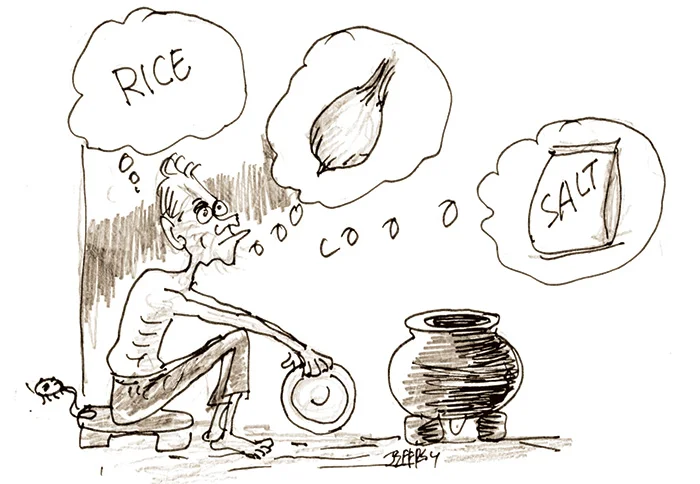
The newly-appointed Chairman of Lanka Salt Company in Hambantota, T. Nandana Thilaka has urged the public to avoid panic-buying and hoarding salt amidst rumors of a shortage.
Addressing the media after assuming office today (28), Mr. Thilaka clarified that the current salt supply is sufficient to meet household needs in the country.
Two 400-gram packets of salt powder and one kilogram of crystal salt are enough for an average household for a month,” he stated, emphasizing that unnecessary stockpiling is unwarranted.
The chairman reassured the public that the Hambantota Lanka Salt Company currently has 6,000 metric tons of salt in stock, sufficient to last until January. Additionally, he added that plans are in place to import 30,000 metric tons of salt to prevent any potential shortages.
Mr. Thilaka acknowledged that salt production has declined significantly this year, attributing the issue to long-standing neglect of the Jaffna salt pans.
Since the end of the civil war in 2009, no government has taken steps to rehabilitate and utilize the salt pans in the Jaffna region for production,” he explained.
However, the chairman announced that development activities for the Jaffna salt pans are set to commence by mid-January, with production expected to begin by March 2025.
He urged the public to remain calm and avoid creating unnecessary demand due to fear, assuring that all measures are being taken to maintain an adequate salt supply in the country.
Finland – The Happiest Country in the World in 2024, Made a Drastic Mistake!
Offering Visa to Many Young Asian Immigrants with High Education, and with Families to Finland in 2024, Currently Unemployed, due to Lack of Finnish Language Skills Causing Severe Psychological Distress!
Either Offer Language Training in their Home Country Prior to Departure, or Ensure Employment based on Their Skills when they Arrive!
Furthermore Finland Authorities Did Not Offer Pre-induction Cross-Cultural Sensitivity Education!
Apart from the Cultural Differences, Language Barrier, the Extreme Weather, Many Differences with Central European & the British Culture. are Causing Severe Psychological Distress!
However, There is a Solution to this Human Problem!
Express Your Opinion – Read What Others Say! The Independent Interactive Voice of Sri Lanka on the Internet.
The Israeli regime has failed in Gaza. It’s been almost 15 months and they fail to take Gaza. Slaughtering thousands of children and women is not a victory. We see Israeli operations taking place daily in Gaza and a number of Israelis have been killed over the past few days. So Gaza is still not a victory for the Israeli regime. In fact that’s a major defeat because the world has been exposed to the brutality of the Israeli regime.
The world has been exposed to the brutality of the Israeli regime in Lebanon as well. We saw how they murdered senior commanders of Hezbollah and that is a success but Israeli forces have also been fighting Hezbollah for almost 15 months now. During the last two months of heavy fighting uh the Israeli regime failed to make any meaningful inroads into Lebanon – that’s a failure again. The Israeli regime succeeded in slaughtering thousands of innocent Lebanese children and women.
The only place the Israeli regime has scored a victory is Syria. Along with the Americans, Recep Tayyip Erdoğan, family rich dictatorships, oil rich dictatorships and gas-rich dictatorships, Israeli regime have succeeded in destroying Syria, because Syrians were brought to their knees since the Syrian economy is crushed due American sanctions, and the terrorism that was being imposed upon the Syrian people through Turkey and Jordan and also through the no man’s land in Iraq between Iraq and Syria. The Americans occupied the oil rich areas of Syria along with the agriculturally important areas of Syria so Americans kept the Syrian people starving and stole Syrian assets. It doesn’t take a genius to understand why Syria collapsed, but this is a tactical defeat for Russia and Iran.
But it will not necessarily a long-term success story since Syria is a very complicated country with significant minorities including Kurds (Sunni, Yazidi), Turkmen Alawis, Sunni and Alevi Turkmens, Sunni Chechens, Sunni Circassians, Syrian Bosniaks, Sunni Muslim Greeks, Muslim Ossetians, Black people of Yarmouk Basin, Assyrians, Armenians, Greeks, Italians, Romani people of various creeds, Mizrahi Jews, Mandeans, and Arameans.
Huge segments of Sunnis in Syria do not support the extremists of al-Qaeda. Syrian jihadist leader Ahmed al-Sharaa, better known by his nom de guerre Abu Mohammed al-Jolani was the deputy for ISIS. He was al-Qaeda leader Abu Bakr al-Baghdadi’s deputy for Syria. The present split between Jolani’s Hayat Tahrir al-Sham (HTS) and al-Qaeda is not an ideological split. It is based on mutual consensus since both sides believe that the split should take place for PR purposes. Jolani always praised al-Qaeda and al-Qaeda also praised Jolani. There’s no difference between ISIS, al-Qaeda and Jolani’s Hayat Tahrir al-Sham (HTS) and that is why Iran opposed these extremists in Syria and went to defend the legitimate government in Damascus.
The Syrian government had major shortcomings and it was no more despotic than other Arab dictatorships in the region but it had one positive aspect to it and that was it asserted independence and it stood up to the Israeli regime in addition to its adversaries who were extremist terrorists. That is why Iran went to Syria to help the Syrians to defend the country against the extremist terrorists.
The current situation in Syria is a short-term tactical victory for the Israeli regime, Americans, Recep Tayyip Erdoğan, family rich dictatorships, oil rich dictatorships and gas-rich dictatorships. But this is not an easy ride for Recep Tayyip Erdoğan. Erdoğan did not anticipate owning Syria. He only wanted a bigger peace outside of Idlib to use at the negotiating table. The sudden collapse of Syria was not expected by anyone. Now Erdoğan has to take care of Syria and the political and economical burden is simply too much for Erdoğan.
The situation in Syria is going to complicate the situation across the region including Egypt, Saudi Arabia, Jordan, Turkey and Qatar which are most vulnerable to the spread of al-Qaeda ideology.
Iranian oil is no longer going to Syria. Russian oil and Iraqi oil are no longer going to Syria. The countries in the US camp, Turkey and Qatar will obviously be funding Jolani’s Hayat Tahrir al-Sham (HTS) and al-Qaeda in Syria but how much and how long are they going to help Syria is a big question.
Here comes the question of the importance of the role of Israel in this whole situation. The Israeli regime was incapable of defeating Hamas and Hezbollah. Even with those interactions direct fight between Iran and Israel without the United States, United Kingdom, France and Jordan all of these countries together helping Israel, Israeli regime was not capable to defend themselves and right now Israeli regime is trying to brag about what has happened in Syria and without Turkey and the West being part of this operation. Attack on the Syrian Government was a collective operation of NATO led by the United States which has been pursuing this for since 2011. The Israelis have always been supporting al-Qaeda and ISIS alongside the border with Syria or at least along the occupied Golan Heights. Al-Qaeda and ISIS were funded by the Israeli regime, wounded Al-Qaeda and ISIS were treated by the Israeli regime and that they had air support from the Israeli regime whenever the Syrian government would attack them – so the relationship between Al-Qaeda and ISIS is not new – the cooperation with these terrorists existed in Jordan, Israel and in Turkey and they facilitated the aid that came from the Persian Gulf, Europe and North America.
Tens of thousands of foreign fighters enter mostly from Turkey; and from across the world and Western intelligence agencies were key to the movement of all those people and Western intelligence agencies and the Israelis are always on the same page the foreign fighters will never do anything that runs against the interests of the Israeli regime.
Hezbollah had to withdraw its troops from Syria to fight the war or at least to protect Lebanon from the Israeli regime and the Syrian government did not replace them adequately and that was a part of the problem.
As soon as the ceasefire took place in Lebanon Turkish intelligence and Israeli intelligence cooperated very closely and the Israelis have now taken key areas in southern Syria.
What would be the future of Syria right now? Are they going to divide Syria in different parts or as Erdogan and his foreign minister are talking about the sovereignty of Syria should be respected. It’s very ironic that Turkish leaders are now speaking about Syrian sovereignty but they were the first to violate that Syrian sovereignty since 2011.
Serena Ali Suhaim- A Lebanese American journalist with two kids was on the Syrian Turkish border when she reported in 2014 that Turkish intelligence was using World Food Organization trucks to supply ammunition and troops for ISIS. The Turkish government said that she’s a spy and on that same day as soon as she heard that she went on TV live and said they’re calling me a spy I’m not a spy I’m a journalist I’m just reporting and then hours later she was killed. Obviously Turkish intelligence wanted to silence her and that’s not how you preserve a country’s sovereignty.
Now in different cities Syrians themselves are setting up militias to protect themselves and their towns from both the extremists but also thugs, thieves, gangs and Mafia groups.
Syria has fallen apart, the Israelis have destroyed the Syrian infrastructure, and the economy is broken.
The Americans and the Europeans are in an interesting position: if they remove the sanctions against Syria, they will empower the same people who, according to their narrative, carried out 9/11.
Lebanon is now surrounded by Israel and al-Qaeda. However the burden of Syria is no longer on the shoulders of Hezbollah. Also Syria has been a burden for Russia, Iran, Hezbollah and Iraq and that burden no longer exists. Hezbollah had to protect citizens from the extremists. Iranians, Iraqis and Russians played their own role, and provided fuel and significant financial support to preserve Syria and that burden has been removed from them.
Hezbollah is very resourceful and very powerful and willingly sacrificed themselves for the people of Gaza. The image of the stature of Hezbollah has grown immensely of course they paid a heavy price. Hezbollah is too powerful and it’s too influential and it’s too popular for the French to do a great deal about it.
The war in Ukraine will continue to deplete the energy and resources and capabilities of Western Powers. The relative power of France, Germany, the USA and the British is very different from what it was three years ago and they have many challenges at home and abroad.
It is not Hezbollah that’s weakened, the Israeli regime is also severely weakened. The Israeli regime is constantly violating the ceasefire in Lebanon. Netanyahu wants to be seen as a conqueror at home and a powerful figure in order to remain in power but what he’s doing is that he’s humiliating Erdogan and Jolani. Israel is now making a new alliance with Saudi Arabia and UAE, against Yemen. Saudi Arabia and the United Arab Emirates are making the grave mistake of entering an alliance against Ansar Allah – the Houthi movement which will destroy their oil assets and that would wreck their economies.
Ansar Allah – the Houthi movement is a very powerful force, survived a genocidal war where the collective West was supporting Saudi Arabia and the Emirates. Saudi Arabia and the Emirates spent hundreds of billions of dollars to undermine Ansar Allah – the Houthi movement in Yemen but they couldn’t. Today Ansar Allah is much more powerful than what it was. Today we see the missiles that they’re firing at the Israeli regime. Ansar Allah has been defending the Palestinians and the people of Gaza during this period of time whereas no one else was doing anything.
Yemen is different from Syria. The demonization of Syria has been going on for 14 years and it has been more successful because these oil and gas dictatorships in the Persian Gulf region have tried very hard to make this sectarian issue from the very beginning and to use sectarian hatred and religious hatred in order to demonize the Syrian government and to turn ISIS and al-Qaeda into heroes.
During the 30 year war in Sri Lanka, LTTE killed more Tamils than anyone else. Similarly ISIS and al-Qaeda terrorists killed more Sunnis in Syria and Iraq than anyone else.
The Sunni areas of Iraq were targeted and destroyed by ISIS. Syria was economically broke since it failed to stand up economically because it was demonized so thoroughly. Anyone who joins a coalition against Ansar Allah will definitely be seen in a negative light by the people of their own countries.
There is a new agreement between Iran and Russia going to be signed in Moscow on January 20, 2025.
Erdogan, the Americans and the Israeli state in Syria only serve to strengthen Iranian and Russian ties further and in fact it serves to create more concern in China about the actions of NATO. We know that thousands of Uyghur speaking Chinese Nationals from Xinjiang, as well as Uyghur speaking Uzbekistan Nationals have been trained by Turkish intelligence and many thousands of Central Asians have also been trained and that is a threat to China and countries in Central Asia. It is also a threat to the Taliban because the past couple of years these terrorists tried to challenge the Taliban in certain areas.
The current situation is Syria will strengthen the cooperation among Shanghai Cooperation Organization countries and it’s going to be a further challenge to Erdoğan and those who are supporting these terrorist groups.
United States is not going to be able to create space between Iran and its friendly countries, that’s just simply not possible whether Russia or China or any other country that has treated Iran with respect at a time when the Americans and the Europeans were trying to undermine Iran that’s something that Iranians will remember and there’s no chance that the Iranians are going to come to trust Trump or anyone else in the United States or European capitals anytime soon after all they’ve done to Iran after all the harm they’ve caused.
The Iranians made huge concessions in the nuclear deal enormous concessions it’s still being argued in Iran, but the Americans and the Europeans never intended to abide by the commitments they never intended to do so from the very beginning under Obama – they violated the deal just like the Minsk Accords- they were never serious and and that’s because of their exceptionalism that’s because they consider themselves to be superior they consider themselves to have exceptional rights. So when you’re dealing with countries that believe they have exceptional rights which believe that they can violate their commitments yet they expect the other side to abide by their commitments how can you ever trust them? How can you ever move close to them? You have to treat them with great caution and that is one of the reasons why the West is on the decline because no one trusts them anymore since they support genocide; they create and promote never ending wars; and their behavior towards the global South.
Trump is more crude in his language when he speaks about Greenland or Panama but the mentality of the United States has always been that the whole of Latin America is their backyard. The whole notion of having a backyard is outrageous but Trump is basically saying explicitly what the collective mentality of the Elites in the west are and the United States in particular.
Iranians will continue to improve their relations with Russia, China and India. If Iran is able to come to terms with the West, if it’s able to have an agreement with the West that is Meaningful, it will do it.
The collective west couldn’t overthrow Cuba or Venezuela but the west is dreaming about overthrowing Iran and Russia.
Iranian’s culture is very similar to the Sufi culture of Turkey, and that’s why if you travel back and forth from Turkey and Iran you’ll feel very much at home because of the similarities.
Ever since 2011 we’ve had the rise of Salafism in Turkey and this is going to be increasingly a serious problem.
Biden said himself very explicitly that he’s a Zionist and two closest people to him with regards to foreign policy were Jake Sullivan and Antony Blinken who are Zionists.
Iranians don’t like Trump, since he murdered Iranian General Qasem Soleimani, his Companions and his Iraqi allies. However, what Biden did to Gaza; to Lebanon. to the region; to Syria; and to Yemen is far worse than anything Trump has done during his tenure.
The genocide, the holocaust, the slaughter, the destruction, the devastation, the ruin of so much of Western Asia was carried out by Biden. Without Biden it wouldn’t have happened; without Jake Sullivan; without Antony Blinken; none of this could have happened. The dislike for the Biden regime is much greater than the dislike for Trump.
Western leaders should not take the wishful thinking of Western media and Western think tanks too seriously as these media and think tanks were informing how the Russian ruble will be turned into rubble and how the Russians are devastated in Ukraine.
The world that we live in today is very different from the world that Trump was dealing with during his first term as a President. Since then, things have changed enormously.
Pain shudders through the arteries of global society. Day after day passes by as the genocide against the Palestinian people continues and the conflicts in the Great Lakes region of Africa and Sudan escalate. More and more people slip into absolute poverty as arms companies’ profits soar. These realities have hardened society, allowing people to bury their heads and ignore the horrors unfolding across the world. Ferocious disregard for the pain of others has become a way to protect oneself from the inflation of suffering. What can one do with the wretchedness that has come to define life across the planet? What can I do? What can you do?
In 2015, the Palestinian poet Dareen Tatour wrote Qawim ya sha’abi, qawimhum (Resist, My People, Resist Them), for which she was arrested and imprisoned by the Israeli state. A poem that can send you to prison is a powerful poem. A state threatened by a poem is an immoral state.
Resist, my people, resist them. In Jerusalem, I dressed my wounds and breathed my sorrows to God. I carried the soul in my palm for an Arab Palestine. I will not succumb to the ‘peaceful solution’, never lower my flags until I evict them from my homeland and make them kneel for a time to come. Resist, my people, resist them. Resist the settler’s robbery and follow the caravan of martyrs. Shred the disgraceful constitution that has imposed relentless humiliation and stopped us from restoring our rights. They burned blameless children; As for Hadeel, they sniped her in public, killed her in broad daylight. Resist, my people, resist them. Resist the colonialist’s onslaught. Pay no mind to his agents among us who shackle us with illusions of peace. Do not fear the Merkava [Israeli army tanks]; the truth in your heart is stronger, as long as you resist in a land that has lived through raids and victory. Ali called from his grave: resist, my rebellious people, write me as prose on the agarwood, for you have become the answer to my remains. Resist, my people, resist them. Resist, my people, resist them.
‘Hadeel’ in the poem refers to Hadeel al-Hashlamoun (age 18), who was shot dead by an Israeli soldier on 22 September 2015. This murder took place alongside a wave of shootings – many fatal – against Palestinians by Israeli soldiers at checkpoints in the West Bank. On that day, Hadeel came to Checkpoint 56 on al-Shuhada Street in Hebron (Occupied Palestinian Territory). The metal detector beeped, and the soldiers told her to open her bag, which she did. Inside was a phone, a blue Pilot pen, a brown pencil case, and other personal belongings. A soldier yelled at her in Hebrew, which she did not understand. Thirty-four-year-old Fawaz Abu Aisheh, who was nearby, intervened and told her what was being said. More soldiers arrived and aimed their guns at both Hadeel and Fawaz. One soldier fired a warning shot and then shot Hadeel in the left leg.
At this point, a soldier, claiming he saw a knife, fired several shots into Hadeel’s chest, who was photographed standing still moments before. After being left on the ground for some time, she was taken to a hospital, where she died of blood loss and multi-system failure resulting from the gunshot wounds. Human rights organisations such as Amnesty International and B’Tselem said that the question of the knife was moot since Hadeel had been the subject of an ‘extrajudicial execution’ (let alone the fact that testimonies about the knife were inconsistent). Tatour’s depiction of Hadeel’s execution in broad daylight is a powerful reminder of the waves of violence that structure the daily lives of Palestinians.
A month after Hadeel was killed, I met a group of teenagers in a refugee camp near Ramallah. They told me that they see no outlet for their frustrations and anger. What they do see is the daily humiliation of their families and friends by the Occupation, which drives them to desperation. ‘We have to do something’, Nabil says. His eyes are tired. He looks older than his teenage years. He has lost friends to Israeli violence. ‘We marched to Qalandiya last year in a peaceful protest’, Nabil tells me. ‘They fired at us. My friend died’. Colonial violence bears down on his spirit. Around him young children are executed with impunity by the Israeli military. Nabil’s body twitches with anxiety and fear.
I have thought about those teenagers often, especially over the last year, which has been defined by the escalation of the US-Israeli genocide against Palestinians. I think of them because of the barrage of stories about young people like Hadeel and Nabil’s friend being killed by Israeli troops not just in Gaza, but in the West Bank.
On 3 November 2024, fourteen-year-old Naji al-Baba from Halhul, north of Hebron, came home from school with his father Nidal Abdel Moti al-Baba. They ate molokhia, his favourite, for lunch, and then Naji told his father he was going to play football. Naji and his friends played next to his grandfather’s shop. Israeli soldiers arrived and shot at the boys, hitting Naji in the pelvis, foot, heart, and shoulder. After the funeral, Nasser Merib, the manager of the Halhul Sports Club, where Naji practised, said that he had a strong right foot. ‘He was ambitious and dreamed of becoming international like Ronaldo’. That dream was destroyed by the Israeli occupation.
The death of a young person is an unforgivable act. The death of a child is particularly hard to fathom. Naji could have captained the Palestinian football team. Hadeel could have become an extraordinary scientist. Their families look at the photographs that remain and weep. In Gaza, other families sit in tents with no way to remember their lost children, their bodies obliterated or missing and their pictures turned to ash in the rubble. So much death. So much inhumanity.
If time and struggle allow us, we will be able to properly awaken the dreams of humanity. But the night before dawn will be long and hard. We crave humanity, but we do not expect it to arrive easily. Small voices call out for a new world, and many feet march to build it. To get there will require putting an end to war and occupation and to the ugliness of capitalism and imperialism. We know that we live in pre-history, in the era before true human history will begin. How we long for that socialist world, where Naji and Hadeel will have a future before them and not just a brief interlude in our world.
Happy New Year. May it bring us closer to humanity.
Those who forget their history are doomed to repeat it. There is a long history of research experiments to generate earthquakes, tsunamis and climate disasters. As Partick J. Kiger wrote Between 1946 and 1958 the United States detonated 23 nuclear weapons on the tiny, remote ring of islands that make up Bikini Atoll. Marshal Islands.
This week, twenty years later the Indian Ocean World commemorate the massive 2004 Indian Ocean Earthquake and Tsunami Boxing Day or Christmas day disaster — depending on which time zone one lived in.
2004 was the year that the US Central Intelligence Agency (CIA), expressions of concerns about China’s String of Pearls” across the Indian Ocean, including Sri Lanka’s Hambantota port reached a crescendo.
On December 26, 2004 huge explosions were heard in Banda Aceh on the coast of North Sumatra and Nias Islands, Indonesia, which became Ground Zero just before the Indian Ocean earthquake and tsunamis hit and killed and injured hundreds of thousands. The BLACK waters of the Tsunamis then hit Thailand, Sri Lanka, India, Malaysia and the east coast of Africa devastating coastal communities and fisheries livelihoods.
After the disaster the World Economic Forum (WEF) mantra Build Back Better” was promoted by President Bill Clinton along with what Naomi Klein termed Disaster Capitalism” in her book titled: The Shock Doctrine: The Rise of Disaster Capitalism”. Klein visiting Sri Lanka and other stricken countries. Many valuable Indian Ocean coastal lands were grabbed by ‘investors’.
With the wisdom of hindsight and new information, as a new Cold War escalates across Asia and the Indian Ocean it may be possible to connect some dots to the Tsunami tragedy of 2004- twenty years ago this week.
In November 1945, just a few months after atomic bombs were dropped on the Japanese cities of Hiroshima and Nagasaki at the end of World War II, U.S. military leaders began planning additional nuclear weapons tests. The first location that they picked to stage a blast was a remote place that probably few Americans even knew existed. Bikini Atoll, a tiny ring of small coral islands with a total land mass of only about two square miles, was part of the larger Marshall Islands chain in the central Pacific Ocean.
Bikini atoll met the military’s criteria, as detailed in a report by the Natural Resources Defense Council. It was under U.S. control, and it was far from shipping lanes, yet within 1,000 miles of a base from which bombers could take off. Furthermore, the lagoon that the atoll encircled provided a protected harbor for Navy ships, including vessels that would be used as targets. And it had only a tiny population—by one account, just 167 people—who could be relocated by the military.
In February 1946, Commodore Ben H. Wyatt, military governor of the Marshall Islands, went to Bikini Atoll and met with an assembly of residents to break the news that they had to leave, at least temporarily. According to Jack Niedenthal’s 2001 history of the Bikini Atoll, For the Good of Mankind,Wyatt told them the tests were necessary to prevent future wars. The residents reacted with confusion and sadness. Finally, their leader, King Juda, stood up and announced, We will go, believing that everything is in the hands of God.”
The small atoll would soon become one of the most famous places on the planet, such a recognizable name that a French designer named a swimsuit after it. Between 1946 and 1958, the United States detonated 23 nuclear devices at Bikini Atoll, including 20 hydrogen bombs. Among those was the March 1, 1954 Castle Bravo H-bomb test, which reached a yield of 15 megatons, 1,000 times more powerful than the atomic bomb that destroyed Nagasaki in 1945.
Here are some seven facts about the nuclear tests at Bikini Atoll.
1. The First Atomic bomb dropped at Bikini Atoll Missed the Target
Bettmann Archive/Getty Images
A mushroom cloud seen from Eneu Island, resulting from an atomic explosion of “Able” during Operation Crossroads, July 1, 1946.
The atoll was picked as the location for Operation Crossroads, a program to investigate the effects of nuclear blasts on Navy vessels. On July 1, 1946, Test Able was staged. A target fleet of 95 ships was positioned in Bikini Atoll’s lagoon, with laboratory animals—pigs, goats and mice—on board so that scientists could study the potential effects of radiation on ship crews. A support fleet of another 150 ships withdrew to a position 10 nautical miles from the Atoll, and waited.
At 9 a.m., a B-29 bomber flew over the lagoon and dropped an atomic bomb, which exploded 520 feet from the surface and missed the target ship in the middle of the lagoon by 1,500 to 2,000 feet, according to an account from the Atomic Heritage Foundation. The bomb only sunk five of the ships, but the force of the blast and radiation killed about a third of the lab animals.
HISTORY Vault: Rise of the Superbombs
Go inside the new world of futuristic conventional weaponry – as the world’s most powerful militaries devise new ways to fuse targeted precision with unprecedented punch.
2. The Second Atomic Bomb Test at Bikini Atoll Created a Tsunami
Galerie Bilderwelt/Getty Images
The Baker test during Operation Crossroads, a series of two nuclear weapons tests conducted by the United States at Bikini Atoll.
In Test Baker on July 25, 1946, the U.S. military tried a different approach, exploding a bomb 90 feet beneath the water surface of the lagoon. It was the first underwater test of a nuclear weapon, and resulted in all sorts of startling phenomena, according to the Atomic Heritage Foundation. The blast generated a massive bubble of hot gas that simultaneously expanded downward and upward.
At the bottom, it carved a 30-foot-deep, 2,000-foot-wide crater in the surface of the sea floor. On the surface, it burst through like a geyser and created an enormous dome of water that eventually reached more than a mile in height. The blast triggered a tsunami with a 94-foot-high wave, so powerful that it lifted up the Arkansas, a 27,000-ton ship. The surge of water swept over many of the target ships, coating them with radioactivity. Eight of the ships were sunk, according to a U.S. Navy account.
3. The Soviets Watched the Tests, But Weren’t Impressed
The U.S. allowed international observers at the tests, and Lavrentiy Pavlovich Beria, who was both head of the Soviet atomic program and chief of the Stalin regime’s secret police, sent a physicist and a geologist, according to Richard Rhodes’ 1995 book Dark Sun: The Making of the Hydrogen Bomb.
Apparently, they weren’t impressed. One of the observers Simon Peter Alexandrov, who was in charge of uranium for the Soviet’s own nuclear effort, told a U.S. scientist there that if the purpose of the test was to frighten the Soviets, it hadn’t worked, because the Soviets had bombers that could reach U.S. cities, according to the National Security Archive. The Soviet newspaper Pravda subsequently criticized the U.S. tests as common blackmail” and said that other than a few obsolete warships, the only thing the United States had blown up was belief in the seriousness of American talk about atomic disarmament.”
4. A Third Atomic Bomb Test at Bikini Was Called Off
Bettmann Archive/Getty Images
An aerial view of a target outline on Namu Island of Bikini Atoll.
The U.S. nuclear weapons program had a problem in 1946, because it didn’t yet have that many bombs. The Able and Baker tests used up two of the only three nuclear cores in the U.S. stockpile, according to Rhodes. Even though production of new bombs soon picked up, the U.S. military remained concerned about squandering resources. Operation Crossroads originally was to have included a third test, Charlie, scheduled for April 1947, in which researchers planned to explode an atomic bomb even deeper in the water. But senior officials at the Manhattan Project and the Pentagon argued that it had no military value, and that providing another bomb would hinder the efforts to produce a lighter and smaller atomic weapon, according to the National Security Archive’s account. The test was postponed and eventually canceled. Officials apparently were also unhappy with the atoll’s lack of land to create a support base and the inability to build an airstrip there. After the 1946 tests, Bikini Atoll wasn’t used again as a site until 1954, when the U.S. began to test hydrogen bombs.
5. A Hydrogen Bomb Test Produced a Bigger Blast Than Planned
The Asahi Shimbun/Getty Images
Crew members of a Japanese tuna fishing boat attend a press conference at the Tokyo University Hospital on March 16, 1954. All 23 crew members were exposed to nuclear fallout from the U.S. Castle Bravo nuclear test while fishing tuna near Bikini Atoll of the Marshall Island on March 1, 1954.
The Bravo test wasn’t the first H-bomb that the US. detonated—that distinction belonged to Ivy Mike, a device exploded in November 1952 in the Enewak Atoll in the Marshall Islands. But it was the first thermonuclear weapon that was small enough to be utilized as a weapon. While its designers had achieved a technological first, they also made a critical mistake, by drastically underestimating the size of the yield that would be created by its fusion fuel.
When the 23,500-pound device was detonated on March 1, 1954, it produced a 15-megaton blast—three times as big as planned, according to a Brookings Institution report. The explosion was so powerful that it vaporized three of the islands in the atoll, and tore a mile-wide crater in the bottom of the lagoon.
Stanford University biology professor Stephen Palumbi, who visited the atoll in 2017 as part of a TV documentary, estimated that the bomb blast hurled debris in the air that was the equivalent of 216 Empire State Buildings, according to Stanford Magazine.
The radioactive debris spewed by the blast contaminated 23 crew members aboard a Japanese fishing boat located 80 miles away, as well as residents of Rongelap and Utirik atolls. Kuboyama Aikichi, a crew member from the Japanese boat died six months later at age 40. Japanese physicians who performed an autopsy on Aikichi cited radiation sickness as the cause of death, although that determination remained disputed.
6. H-Bombs Tested at Bikini in the 1950s Had Odd Nicknames
The Bravo test’s nuclear device was nicknamed Shrimp,” even though it weighed 23,500 pounds. The Romeo test, conducted a few weeks after Bravo, used an even bigger bomb dubbed Runt I.” Other bombs had nicknames such as Morgenstern” and Alarm Clock,” according to the NRDC report.
7. The Bikini Atoll Still Isn’t Fit for Habitation
Bettmann Archive/Getty Images
Residents of Bikini Atoll carrying their belongings down to the beach as they prepare to evacuate the atoll. In 1946 the atoll’s population was moved to Rongerik Atoll, 109 miles away.
When the Bikini Atoll’s inhabitants were relocated in 1946, it was promised that they eventually could return. Instead, they were relocated to other islands in the Marshalls. Starting in the late 1960s, the U.S. Atomic Energy Commission declared Bikini Atoll finally to be safe again for human habitation, and allowed some former residents to return. But that experiment was cut short a decade later, when a study showed that the levels of Cesium-137 in returnees’ bodies had increased by 75 percent.
The Bikini inhabitants were relocated once again, this time to Kili Island, 450 miles away. Scientists say it’s still not safe to return. Probably the most robust finding from our research is that Bikini Island must be cleaned up if people are to live there again,” says Ivana Nikolic Hughes, a senior lecturer in chemistry at Columbia University and Director of the K-1 Project Center for Nuclear Studies This is based on levels of Cesium-137 in the food, background gamma radiation, and presence of various isotopes in soil and ocean sediment.”
In 2010, UNESCO declared Bikini Atoll a World Heritage Site as a reminder of the fearsome power of nuclear weapons and their influence on modern civilization.
Sarath Wijesinghe President’s Counsel, former Ambassador to UAE and ISRAEL, President Ambassador’s Forum
Tourism world’s fastest and most popular and productive industry
Tourism is an industry which is one of the global and easily managed with available resources of a nation, a world industry that fetches 10% GDP and provides 10% employment to Sri Lanka’s economy. Sri Lanka is a compact nation ideally suited for tourism which is not properly utilized to the maximum capacity compared to extreme beauty and the geographical situation in the Indian Ocean along the famous and historical ‘silk route’. It is managed easily and many nations depend on tourism for their GDP employment and foreign exchange. Many countries compete with Sri Lanka including Immediate newghbour India, friendly China, Maldive Islands and many as every country depends on the income on tourism easy to fetch with least effort and investment.
Natural compact workshop
It is Richerd ‘’Dawkine’’ a world-renowned biologist who said that islands such as Sri Lanka which is extremely rare are natural workshops of evolution which is extremely rare to come across on the globe. Sri Lanka is considered another world considering the requirements to be a paradise in a small compact area with a distance of few miles with varied climatic conditions and different vegetations, unparallel. Commander Alexender Fleet said ‘Taprobane’ ‘‘’ under the name of the land of the autochthones, was long considered to be another world but the epoch and the achievement’s of Alexender the Great supplied clear proof of its being an island. It is indeed another world considering everything available in massive India in one compact island with excellent network of roads and beautiful rivers starting from the hills speeding right round the island expecting to utilize every drop of water utilized for agriculture a construction and development.
A small universe
It is world renowned scientist ‘’Sir Arther C Cllarke’’ a visionary scientist who made Sri Lanka his written wrote in the view from Serendib Sri Lanka is a small universe; it contains as many variations of culture scenery and climate as many countries dozen time of its size’’ and his view is shared with many world over with pleased experiences followed by number of awards, and prizes by number of international organizations conducted globally by professional organizations.
Productive and dynamic?
Tourism is productive and dynamic to a country in need to deal with the world on international affairs and the best mode of communication is a proper foreign policy and a stable tourism machinery Sri Lanka is geared, suited and ready for with the inherent infrastructure and educated and pleased community that needs bit more training and encouragement in addition to their inherent friendly nature famous for and known to the world. Tourists are defined as visitors Wisit another destination over 24 hours mainly pleasure, leisure, general visit, business or any other purpose which is a requirement for the visitor as well as the host country. Income generated from visitors are enormous from many countries led by Frence the most visited country and USA a leader on tourism followed by China and many other western nations adopting themselves for the requirements of the visitors and their needs. Tourist is a visitor mainly look for safety, affordability, good food, places to visit based on needs, mainly led by softy comfort and food with conveniences and variations from the original living conditions. It appears Sri Lanka meets all or most of these requirements at an affordable prizes and variations of different levels.
Our Duty
It is our duty to make tourism productive and dynamic for the benefit of the economy and prosperity of the country in need of foreign currency and obtain the best use and the benefit to the nation when the world has comet know of us reaching 20 lacks of tourists today and it is timely to ascertain the productivity of the tourists to the country not being parasites who misuse the goodwill and friendly nature of the host country, when other tourist nations take necessary precautions before permitted them to enter as a tourists. It is a requirement in tourist nations to compel tourists to prove the ability to bear expenditure and to shoe they are genuine tourists entering the hist country with ulterior motives. It is in news some tourists are using the host country for illegal and unlawful dealings resulting loss of revenue, income to the citizens and the state on shady and illegal dealings during their stay and it is advisable for us to lead from the experiences of other countries such as UAE and Singapore who enforces the rules to the last word. In Singapore as a visitor enters the country, He/She is educated on the legal system, states of consumer law and practices with strict enforcement of immigration law and rules. Sri Lanka do not seem to enforce the law strictly giving excessive freedom to the tourists expecting them to be genuine tourists when everybody is not genuine and some tend to rough out in temples and engage in odd jobs to earn a living, and sometimes engage in businesses, that will damage the tourist trade and have adverse effects on the industry picking up fast today. Sri Lanka earned 3.2trillion in 2017 and 2018 have been the peak year with a drop due to Covid-19 that affected the entire world and fortunately Sri Lanka emerged victorious despite the downturn due the drop on business, which is picking up fast today despite drawbacks on the management and the forward planning that needs lot of improvements and it is somewhat good news that the tourism authority is making genuine and professional efforts in the right direction, with right steps taken. These are mattering the community as a whole have to work together as one unit understating the need and gravity to make visitors happy and feel at home, and the vision and steps taken on clean Sri Lanka appear to be in the right direction, as cleanliness is a pre requisite and explorerse in tourism, when our genet neighbor India competing with us is behind us in the field of cluelessness and sanatory situations.
Smile cost nothing but attracts tourists
Sri Lankans are famous to be with a pleasant smile unlike many other nationals as observed by tourists, which is inherent in them that you do not get in many other nationals who are inherently reserved and minds their own business as their nature, that attracts tourists and villages ae famous for. Tourists will like a smiling and a feignedly nation in addition to the inherent beauty and the compact nature of the intact universe on the silk route and a comfortable stay in the new destination enjoying the ne experiences and explorations on varied areas.
Availabilities and room for improvement
Availabilities and opportunities are immense and countless. It is a heaven for historians, archeologists, sociologists, educationalists, and explores of all kinds backed by academics and great history running back to ‘’Balangoda Man’’ 150,000 years ago and Ravana story some say nor an epic yet a realiaty connected to Ramayanaya in India. Being the main Teravada Buddist country with ‘’Tripitika a world hesitates’’ and Buddhism being the fastest religion in Europe which is intact in Sri Lanka, with freedom for any religion to thrive having given free access to other religions by kings and protected constitutionally to date shows the world that Sri Lanka is a free country that world citizens could enjoy as visitors protected constitutionally all the time. It is the duty of the governance to give the tourists a sense of protection all the time maintaining law and order and rule of law in the country, for the tourists to feel free, and reinforcement the tourist police will be a good idea and some directions to the social media may be helpful with the assistance of the tourist authority appear to be doing fairly well.
(Sigiriya Rock-only a small part of our treasure intact in the compact universe)
Is so well known to the tourists as one of the main important places to visit which is most used despite to large number of places of historical and archeological importance right round the island in addition to the natural beauty and varied climatic conditions with access via the excellent network of roads connected to highways of international standard3333333333.
Way forward and future of tourism in Sri Lanka and our aim
Future of tourism depends on the vision mission and the conduct of the Minister and his strategy on the further for tourism in Sri Lanka for Sri Lanka. It is an easy process as there is a compact universe to be presented to the world with few adjustments and adopt annotations to suit the modern world and trends, which is a par strategy to be the best tourist destination in the world, which is possible when compared to the other best destinations world over. Let us have the target for it which is possible with some effort and strategy. Sarath28dw@ gmail.com to reach the editor and I suggest you to browse the net for other articles published on the internet
Prime Minister Dr. Harini Amarasuriya has affirmed the government’s commitment to creating a suitable environment for all individuals to live a happy and quality life, free from discrimination.
Prime Minister Dr. Amarasuriya made this statement today (December 27), during a ceremony held in Batariwatta, Moratuwa, to inaugurate the first phase of a housing project funded by Chinese financial assistance amounting to Rs. 22 billion. This initiative aims to enhance the living standards of low-income families, the PM’s Media Division reported.
The project envisions the construction of 1,996 houses under Chinese financial assistance. The phase inaugurated in the Batariwatta area, Moratuwa, will provide 575 houses for low-income earners, while the housing project in Kottawa will include 108 houses designated for veteran artists.
Addressing the inauguration ceremony, Prime Minister Dr. Harini Amarasuriya stated: We extend our thanks to the Chinese government for supporting this housing project in Sri Lanka. A home is not merely a shelter; it is a space essential for a good, quality life and the security every citizen deserves.”
Beyond housing, the government is dedicated to stimiulating strong families and communities, ensuring the safety and wellbeing of women and children by addressing their specific needs.”
Low-income earners in the suburbs face challenges, often living in unsafe and insecure conditions. The government’s vision is to provide an environment where all citizens can lead happy and quality lives, without any form of discrimination based on race, religion, gender, or other factors. We appreciate the financial assistance and support extended by the Chinese government to Sri Lanka.”
The event was attended by the Minister of Urban Development, Construction and Housing, Anura Karunathilaka; Deputy Minister T.B. Sarath; Chinese Ambassador to Sri Lanka, Qi ZhenHong; Economic and Commercial Counselor of the Chinese Embassy, Tang Yan Di; the Secretary of the Ministry of Urban Development, Construction and Housing, along with other government officials and representatives of the Chinese government.
In ‘Pin Eti Sarasavi Waramak Denne’, Sarachchandra described an incident he faced on the second or the third night at the Wendt. He was seated in the foyer while the play was in progress and all of a sudden a limousine came to a halt at the entrance and a well dressed woman walked in. She asked What is being staged here today?” and being told that it was a Sinhala play wanted to know when it was going to be over. When Sarachchandra told her that it would be over in two hours she was not prepared to believe him. What! A Sinhala play being over in two hours? I am sure it will go on till about 9 or 10PM”
Sarachchandra told her that he was pretty sure of the duration of the play and if she was keen to see it she could get in without any payment and leave whenever she wanted. The lady looked disdainfully at Sarachchandra and declared Shih! I don’t want to see these Sinhala plays. I only wanted to send my servant woman and she cannot be allowed to waste three four hours here” and walked away. [1]
One would have expected therefore that Maname’s debut at the Lionel Wendt theatre in Colombo’s poshest district would also have been its last performance there. But the opposite happened. ‘Wendt’ decided eventually to accommodate Sinhala plays and Maname shows regularly there. Maname is a perennial at Lionel Wendt.
Maname changed the attitude of the nation to Sinhala drama. D.C. Ranatunge wrote, I bought a ticket for two rupees (given in a neat little envelope, both of which I still treasure after 58 years) [2] and was at the Lionel Wendt early that Saturday evening for the first show. To be exact it was Saturday, 3 November 1956. The hall was about half empty. I was among just a handful, possibly around 50 , attending.
Lights are switched off. A single spotlight falls on an actor who appears in a long garb, a ‘talappawa’ and a beard in a corner of the unlit stage. He starts a chant ‘sakala brahma suranaramastakayehi…’ the traditional appeal to the gods for the success of a new venture. He is the ‘pothe guru’, the narrator who acts as the link in relating the story of what the audience was going to see. It was a totally new experience.
The Sinhala press did not show much enthusiasm. They were basically anti-university and biased against Sarachchandra. The Dinamina Editor, M.A. de Silva, thought otherwise. He invited his university friend Charles Abeysekera, a CCS (Ceylon Civil Service) high ranking official in the public service to review the play. Regi Siriwardena, Features Editor of the Daily News, reviewed it for his paper. Both reviews changed the initial response and Maname began to attract crowds, said Ranatunga.
Maname never looked back after that first show. Crowds flocked to see the play. It has been regularly performed in the past seventy years to enthusiastic audiences. Maname has played to several generations and held hundreds of performances, since 1956. [3] It was in demand all over the island. What began as an experiment came to be a resounding success, observed KNO Dharmadasa.
Maname was highly regarded artistically. This is well known and much emphasized. What is not emphasized, but taken for granted is the fact that the Sinhala play-going public, who wanted quality entertainment, also took an immediate liking to Maname. Maname became a hit.
Maname’s appeal, was not, I think, limited to its lovely songs, but also to the complex story, with its theme of conflicting loyalties and sexual attraction. There was deep emotion and the audience liked that. Also the way the story unfolded. If the story had not appealed to the public,the play would have disappeared and the songs alone would have survived, as part of the popular song repertoire.
Maname appealed to the rural segment , not only the urban. When Maname was shown in the University at Peradeniya , in its ‘wala’ in 1958, people from nearby villages, Hindagala and Mahakanda came, sat with the undergrads and watched the show. Sarachchandra was very happy about this, said Amunugama. [4]
The Maname songs have now become a part of our Sinhala culture. They are ours, not just Maname’s. Ranjini Obeyesekera recalls, years later when I was teaching at the Peradeniya University, I remember attending again a performance of Maname.
It was at the open air theatre, grass tiered seating under towering Tabibuia trees that shed their delicate pink blossoms on a packed audience of students, teachers, monks, government bureaucrats, workers, and villagers from the surrounding area. Then, in the scene where the lovers walk in the forest and the now familiar song ‘prēmeyen maṇa ranjita vey’ was being sung, a student voice spontaneously joined in, and instantly the entire audience burst into the song. It was an unforgettable magical moment.
When the cast were still studying at University ,the play was performed exclusively by the original cast. Shyamon Jayasinghe recalled, our focus was on the enjoyment we derived when we got on to the “Maname bus” and toured the island. There was Trilicia, Edmund, Ben, Lionel, Nanda , Trixie, Indrani, Ramya, Pastor, Adikaram, Edirie Arthur, KDP, Wimal and the host of other jolly persons doing the trek. [5]
We were often played out by the organizers who told us that it was a loss, when it was full house! That did not matter. Shyamon said he sang during his full stay at University. And also performed sporadically after that. He must have performed his role about 300 times.
But Maname did not result in a spate of similar plays. The only play I can recall which came after Maname was Galapaththy’s Sanda kinduru. There was a third play also but I cannot recall its name. I do not consider this surprising.
In my view, this type of theater demanded a versatility which most aspiring dramatists simply could not muster. The writer had to be good, very good, at music, lyrics, movement as well as dialogue and plot. This was too much for the average playwright.
Sarachchandra however, had another explanation. Sarachchandra said, I expected that Maname would be followed by several plays in the same style and that before long we would possess a body of plays that would reflect our national genius like the Kabuki and Noh of the Japanese or the Beijing opera of the Chinese. But the social pressures began to bear on the playwrights and the demand for the theatre to have relevance to the day to day problems that people were facing became strong. Since stylized drama could not deal with such problems , the theatre has gone to the naturalistic mode, and is today largely a theatre of protest, critical of the establishment”. [6]( CONTINUED)
The theatre enthusiasts, who saw Maname in its maiden presentation in Colombo and before that at rehearsals in Peradeniya, saw its significance and artistic value. Many years later, this group wrote up their recollections for Sunday newspapers. They also provided contributions to publications issued to mark Maname anniversaries, such as the Silver Jubilee of Maname” (1981). Sarath Amunugama wrote Maname mathak vee” was for Sarachchandra’s 100th birth anniversary.
These writings are informative and perceptive. They should be brought together. I have therefore added further essays to this series on Maname, in order to present extracts from these writings with a few observations of mine. There is repetition. That could not be avoided.
I was taken to see Maname at Pushpadana School hall in Kandy. My father, who had seen theatre in London in his student days, was very enthusiastic. I was intrigued by the actors going round and round in a circle, but that was all. I saw no significance in Maname. I went home and forgot about Maname.
Sarath Amunugama has also gone to the same performance. He was then an Advanced Level student at Trinity College. His reaction was different. He saw the value of Maname. Maname made a permanent impact on me, said Sarath. [1] Maname showed that we could develop a creative modern Sinhala culture.
The Pushpadana performance would have been the second performance of Maname and the first for Kandy and Peradeniya. Sarath Amunugama says there was a large audience, mainly of university academics. Their Volkswagen cars were parked in a row by the school. Kandy intelligentsia, it appears, was also informed and they too had turned up to see Maname. That is why I was there.
Commentators have pointed out that the year in which Maname appeared was a significant one. The year was 1956. Bandaranaike’s electoral triumph of 1956 brought about a political transformation which heralded the common man’s era, the birth of linguistic nationalism and a social and cultural revival of unprecedented magnitude, said K.H.J. Wijedasa.
1956 was also the year which marked the birth of three classical landmark artistic creations in the fields of Sinhala drama, cinema and fiction namely Ediriweera Sarachchandra’s ‘Maname’, Lester James Peiris’s ‘Rekhawa’ and Martin Wickremasinghe’s ‘Viragaya,’ he said.[2]
Ralph Pieris ‘Sinhala Social Organization’ was also published in 1956. This dry academic tome was enthusiastically received and eagerly read. It was translated to Sinhala as ‘Sinhala samaja sanvidanaya’. That increased the readership for the book.
Why Maname was such a huge success sixty years ago and why is it so popular even today asked K.H.J. Wijedasa. Maname gripped the imagination of both the westernized urban audience as well as the traditionalists. It introduced a new genre to the Sinhala theatre. Its lyrics, music, choreography, costumes and make up heralded a new trend in theatre, he said. The musicality of Maname is undoubtedly a major factor in its artistic success. The new stylized dramatic medium with beautiful melodies and choreographed dances was intriguing.
Maname conjured up a special world that our audiences had not seen before. Larger than life players in unusual costumes and distinctive make-up walking the stage in a mild dance like manner (gamana) talking in an unfamiliar way and telling the story in melody, rhythm and drum, all beautifully integrated, gave the audience an uncanny feeling, concluded Wijedasa.
I remember vividly the first night performance of Maname. As the curtain rose and the rich chant of the Pothegura (narrator) filled the auditorium, I sat spellbound at what seemed to me a theatrical miracle. Sarachchandra’s total transformation of theatrical aspects he had taken from the traditional rituals and folk plays, into a sophisticated modern drama, the bare stage emblazoned with colourful costumes by the artist Siri Gunasinghe, the sheer poetry of the verse enhanced by Sarachchandra’s creative use of music and dance, left me and the audience stunned”, said Ranjini Obeyesekere, in an oration she delivered in 2014 to mark the birth centenary of Sarachchandra.[3]
Here was something new, exciting, and different from anything seen in the Sinhala theatre so far, breaking away from the western influenced fourth wall proscenium dramas and opening new directions for the Sinhala theatre. As I walked out, dazed and excited I remember meeting Regi Siriwardene, at the time the leading critic for the English newspapers, and he was equally transfixed. We talked briefly, at a loss for words to express our excitement, Ranjini concluded.
Amaradasa Gunawardena who was at the first performance, as a member of the Maname team recalled that as the concluding song ‘Mangalam suba mangalam wewa jayasiri mangalam’ came to an end, a great applause arose and continued without ceasing. There was a call for the dramatist.
Those days there was no curtain call and Sarachchandra was reluctant to appear. What need is there for the people who came to see the play to see me,” he said. Gunasena Galappatti, Arthur Silva and I pushed him on to the stage . He stood there to receive applause, which he had never expected, said Amaradasa.[4]
Lionel Fernando who played the role of Chief of the Foresters in the original castrecalled It was around July 1956 when Sarachchandra held a couple of auditions for those who were willing to help him in this new venture. I was among those who were keen to join it.[5] Several months of rehearsals followed.
Years later, Indrani Wijesinghe reminisces:After the annual vacation, we returned to the campus, for the second academic year, there was good news awaiting us that Dr. Sarachchandra was going to produce a drama and anyone interested could meet him at an audition. Once inside the audition room I was at completely at ease, when I discovered that all who had gathered there were in the same boat, Trilicia, Hemamali, Trixie, Swarna, Lionel,.”
Hemamali tells us how she entered the world of Maname in that historic year, 1956:So one damp and drizzly Saturday afternoon, Piyaseeli Sirisena and I walked up Sangamitta Hill, past Sangamitta Hall, to the secluded B Bungalow that was the Sarachchandra residence. It is funny how little details retained in your memory suddenly spring to mind when you try to reminisce.
My most vivid image of that rather hesitant walk up to the Sarachchandra door is of a rain-drenched Thumbergia creeper, its few remaining blossoms, beaten down but bravely glistening with raindrops trembling upon the velvety petals like dew. Even with the drizzle outside, the door was open. Shaking the raindrops off our hair and clothes, we entered a world of chaos and buzzing activity”, concluded Hemamali.
I have always wondered how the University suddenly produced such fine singing undergrads , who were able to launch Maname so successfully with a few months of rehearsals. It appears that they had been performing under Sarachchandra for several years before and understood each other.
The first University departments to move to Peradeniya from Colombo in 1952 were the Oriental and Arts faculties. There was plenty of cultural activity in Peradeniya for them, all of it centered on Sarachchandra, noted Sarath Amunugama. Sarachchandra connected each year with the dozen or so talented students newly arrived into these two faculties. He had no use for the rest . He had a talent for associating with the young undergrads, said Amunugama.
There were enough good singers in each batch and Sarachchandra organized ‘singing groups.’ They sang so well that when Sarachchandra had musical evenings at his house in Sanghamitta hill, students at Sanghamitta Hall used to listen at their balconies.’
Sarachchandra also made his singers perform before an audience. Sarachchandra organized song recitals at the University . He would select the songs, roneo them and train the singers at his home. We practiced every evening.” Amaradeva and others who were visiting him also took an interest in these rehearsals, reported Amunugama. After training for 2 weeks they would give a musical evening at the Arts theatre.
Sarachchandra also started a carol group which sang bhakthi gee at Wesak. He never had to look for students for these projects. The undergrads, specially the girls, ran to join when they heard that Sarachchandra was planning a musical evening or bhakthi gee performance , said Amunugama.
Amunugama’s information can be accepted. He was close enough . He entered University in 1957 , the year after Maname and gained almost immediate access to that magic circle which surrounded Sarachchandra, noted Ajit Samaranayake..[6] Practically every evening students used to gather at Sarachchandra’s house, Amunugama recalled They included Gunadasa Amarasekera, Gunasena Galappaththy, Dayananda Gunawardena as well as visitors such as Amaradeva. This was in the 1950s, the first decade at Peradeniya . By the time I, (Kamalika Pieris), entered University, Sarachchandra had left Sanghamitta Hill. As far as I know, there were no singing groups either.1961 was spent rehearsing Sinhabahu.
We must recognize the special talents of the original cast of Maname, noted Sarath Amunugama. Those who entered Peradeniya in the 50s and 60s came from central schools. They had been taught by clever dedicated teachers and were the best products of the school.
Theycame from schools which had encouraged song, dance and music. Classical music was in the syllabus, so they could play tabla, sitar as well as sing. The music for Maname came from those who had studied at Horana Central, where they had learned to play oriental instruments. HL Seneviratne, Hemapala Wijewardene, Kithsiri Amaratunge came from Horana. Their background helped the cast to adapt to the Nadagam style and benefit from the teaching of Gunasinghe Gurunnanse.
The young undergraduates who took part in Maname were unaware that they were creating history. When we read the reminiscences of those pioneering actors and actresses we begin to feel the youthful ebullience with which they undertook the task, said Dharmadasa.
Despite the exultant praise of the very small but distinguished first audience of scholars, journalists and critics who gathered that night, it didn’t occur to any of us that we had placed our own humble footprints in a notable venture, said Shyamon Jayasinghe.
Shyamon recalled, it was simply an innocent collective enjoyment that we experienced. To me and our team of actors and organizers it meant simply the culmination of a six month period of sheer fun and camaraderie in rehearsing the play, nothing more. We did it for the enjoyment.
At the auditions Sarachchandra tested their singing, not acting ability, said Shyamon. We rehearsed for about five months. Sarachchandra allowed us to perform as we wished and only corrected our mistakes. He did not instruct us. He drew out our abilities and creativeness.
Those were, perhaps, the best of our times. The days when Maname was created and the immediate aftermath, continued Shyamon. Rehearsals in the Arts block at Peradeniya campus, the great Sarachchandra by our side, guiding us along. The venerable Charles Silva Gunasinghe Gurunnanse, Nadagam expert from Ambalangoda, teaching the dance steps.
I remember Trilicia singing “Lapa nomavan sanda se somi gunena” with a subtle erotic movement of her body. We hardly realized then we were in the process of creating history,[7] but there was commitment all round. That was one reason for the high quality of the show, concluded Shyamon.
The play was a success because the two leading male roles were played by mature men and not by twenty year old undergrads . If the characters had been played by young undergrads, the response would have been very different. Maname would have been a flop.
Certainly, Sinhabahu (1961) was performed by undergrads, some actors were weak and the first performance was like a dress rehearsal but by then the audience knew to spot the potential in a Sarachchandra play and ignore the natural limitations of a University production.
But Maname was different. Maname was vitally important. Although he auditioned several persons to take the role of the Veddha King no one was able to sing in the tone Sarachchandra wanted the Veddha king to sing. Sarachchandra was thinking of abandoning the play. Then Edmund Wijesinghe came along.
When Edmund sang the very walls of the Junior Common Room seemed to listen in hushed silence to the rich timbre of his voice that resonated with a suppressed violence that was also right for the role of the Vedda King. In fact the very awkwardness of his stance and movements fit the image of the feral character perfectly, said KNO Dharmadasa.
Hemamali Gunasekera recalls how Edmund Wijesinghe’s voice contrasted dramatically with the mellow richness of Ben Sirimanne’s voice. Ben was Prince Maname, a mature student who had entered Peradeniya as a school-teacher and was reading for the Diploma in Education. He had some experience in singing and playing an instrument.[8] Hemamali found him mature, unflappable and gentlemanly, with his pleasant mellifluous voice and gentle ways” , putting her completely at ease during the rehearsals.
Shyamon who gave a memorable performance as Poteguru recalled that the role of Potegura was new to the Sinhala theatre of the time. Sarachchandra did not know how to present this character, neither did Shyamon.
But at the first performance as the curtain was about to rise, when he saw Hemamali and others costumed and ready, and in my opinion, probably heard the rustle of the audience, and realized this was it , Shyamon had a moment of epiphany. He saw the significance of his role. He must introduce the play in a dynamic manner. He recalled in a video interview with Boston Lanka in 2013 that his first speech got a terrific response from the audience. [9]
Sarachchandra was always at the performance, with sitar or tempura, said Shyamon. Sarachchandra was always present at a performance, agreed Sarath Amunugama. That was probably because the actors were amateurs and not professionals. They were students with other things on their minds, tutorials to write and exams to prepare for.
Sarachchandra seems to have followed this policy for his other plays too. Pushpamala Iriyagolle who was in the chorus of Sinhabahu told me one day at Sanghamitta, ‘we sang flat yesterday, Kamalika, and Professor Sarachchandra was furious. He was glaring at us from the wings. But we could not help it, we went more and more flat.” I did not know till then that Sarachchandra was present in the wings at every performance.
The Maname actors concentrated on their performances. The adults saw the potential and the national impact the play would make. At least two senior lecturers were actively helping, Ananda Kulasuriya and Siri Gunasinghe. The costumes and make up provided by Siri Gunasinghe differed for each character. The costumes of Poteguru, Maname, princess, Veddah king, veddhas, all differed in style and colour, said Amunugama .
The rest of the Department of Sinhala also knew about the play. Academics from other Departments were also supportive. Ralph Pieris I am told was also there, helping.” He was a friend of Sarachchandra. Ralph told me that he was one of the persons who had advised the reluctant Sarachchandra that the play must open at the Lionel Wendt.
Aphotograph of the original cast, crew, producers and the Association that was responsible for creating Maname, the Sinhala Drama Circle has been reproduced by Liyanage Amarakeerthi in his essay Maname Day: A Nostalgic Note On That Distant November Day” published in Colombo Telegraph, November 4, 2020. [10] The year would probably have been 1957. It is a formal photograph, probably framed and hung at University of Peradeniya . The photograph is a historical one. When I took my copy of the photograph to a print shop to get it enlarged and sharpened, the shop refused to accept payment, saying it took very little time and cost nothing. I think they were showing respect for Maname.( continued) .
Professor Daya Somasundaram / Dr Ruwan M Jayatunge
Prolonged armed conflict in Sri Lanka has created higher rates of mental ailments among the Army personal and members of the LTTE. A significant number of people have been diagnosed with complex forms of PTSD aka Malignant PTSD. These individuals with malignant forms of anxiety have a wider range of clinical symptomatology with severe psychosocial impairments. These people would fit into the diagnostic category of DESNOS (Disorders of extreme stress not otherwise specified) or Complex Post-Traumatic Stress Disorder (C-PTSD) / Malignant PTSD that was described by Dr. Judith Herman in 1992. Complex PTSD has been recognised as a new diagnosis in the International Classification of Diseases 11th Revision (ICD-11).
According to Herman (1992), Complex post-traumatic stress disorder (C-PTSD) is a psychological injury that results from protracted exposure to prolonged social and/or interpersonal trauma in the context of either captivity or entrapment that results in the lack or loss of control, helplessness, and deformations of identity and sense of self. C-PTSD is distinct from but similar to, PTSD, somatization disorder, dissociative identity disorder, and borderline personality disorder. (DESNOS), characterised by alterations in regulating affective arousal with difficulty in modulating anger, self-destructive and suicidal behaviour and impulsive and risk-taking behaviour.
They have chronic characterological changes with alterations in self-perception: chronic guilt and shame; feelings of self-blame or ineffectiveness and of being permanently damaged; a tendency to victimize others and alterations in systems of meaning such as despair and hopelessness or loss of previously sustaining beliefs (Jong, 1997).
Sri Lanka’s Armed Conflict and Its Impact on the Victims
A three-decade-long armed conflict in Sri Lanka has created higher rates of psychological problems among the victims. They were at high risk of developing war-related psychopathology. The armed conflict between government forces and the Liberation Tigers of Tamil Eelam has resulted PTSD and DESNOS (C- PTSD). DESNOS has caused considerable impairments in psycho-social functioning among the affected individuals. These people often experience multiple mental health problems. Most of the victims have not received adequate treatment and some cases are still undiagnosed. Lack of availability of mental health services is one of the barriers to treat war victims and ameliorating their distress.
C- PTSD Among the Sri Lankan Combat Veterans
A significant number of Sri Lankan soldiers suffered severe war trauma during the Eelam War that lasted from 1983 to 2009. It changed the psychological makeup of soldiers. A large number of combatants underwent traumatic battle events outside the range of usual human experience. These experiences include constantly living in a hostile battle-ravaged environment, seeing fellow soldiers being killed or wounded and sight of unburied decomposing bodies, handling human remains, hearing screams for help from the wounded, and helplessly watching the wounded die without the possibility of being rescued etc. The affected combatants with war trauma experience problems in their living, working, learning, and social environments. War trauma has drastically impacted their mental health and long-term functioning. Some of the Sri Lankan combatants with full blown PTSD showed a wider range of clinical symptomatology with sever psychosocial impairments and these veterans would fit in to the diagnostic category of DESNOS (Disorders of extreme stress not otherwise specified) or Complex Post Traumatic Stress Disorder (C-PTSD).
C- PTSD Among the ex LTTE Carders
The Liberation Tigers of Tamil Eelam (LTTE) – a Tamil militant organization and they attacked the Sri Lankan armed forces with modern weapons. The LTTE used numerous unconventional methods to fight the Sri Lankan Forces using child soldiers and suicide bombers. Many surviving members of the former LTTE either now live in Sri Lanka or live abroad. Most of these ex-militants joined the movement as children and throughout the war, they underwent the harsh realities of war trauma. A significant numbers of ex LTTE members suffer from malignant PTSD. These victims live with rage, guilt, alienation and suicidal ideation. They lack social skills and unable to form families due to a lack of parental skills and intimacy. Some affected by addiction problems.
Case Studies
1)Rifleman Sn34 became psychologically wounded after facing traumatic battle events in Operation Yale Devi which was launched in 1993 to destroy the LTTE Sea Tiger strongholds at Kilali. The enemy launched a surprise attack on the advancing column resulting in the deaths of hundreds of soldiers. The LTTE attacked them with mortars and Rocket Propelled Grenades. Rifleman Sn34 saw the deaths of a number of his fellow soldiers. The enemy captured some of the wounded men. After this dreaded battle, Rifleman Sn34 had a pessimistic outlook on the future. He had ruminations about the battle events. He relived these experiences. Startle reactions troubled him significantly. He had no way of receiving treatment or no way of explaining to anyone his psychological anguish. For a long period, he lived with his posttraumatic symptoms. Over the years he felt that he was unable to trust people or the system. He became extremely vigilant during the presence of unknown people. He stopped associating with people and became socially isolated. He was demotivated to initiate new events and felt lethargic and withdrawn. He became an extremely fearful person. Prior to the traumatic event, he was decorated for bravery but after the battle trauma, the sound of a firecracker could make him excessively frightened
2)Private SXXT31 served in the operational area for 9 years and firsthand experienced combat trauma. He witnessed how his unit members got killed following enemy fire, mortar blasts, artillery attacks etc. and became severally overwhelmed while handling human remains. After experiencing these events over a long period, he suffered severe transient headaches and loss of memory. By 2002 he was diagnosed with full-blown symptoms of PTSD. He was frequently troubled by nightmares and flashbacks. When he experienced flashbacks, he used to re live the traumatic event and often became disconnected from reality. Once Private SXXT31 went into a dissociate flashback and he had squeezed the neck of his five-year old daughter. When the little girl was suffocating, his wife accidentally noticed the dreadful event, alerted the neighbors and saved the little girl from Private SXXT31’s strong grip. The girl was immediately hospitalized and later recovered. Private SXXT31 became extremely distressed and felt guilty after realizing that he tried to strangle his own daughter. He had no memory of the incident and did not realize how he grabbed the daughter’s neck.
3)Bombardier AXTX36’s self-perception changed drastically with the onset of symptoms. He lost his self-esteem and viewed himself as a sinner and a perpetrator who deserved to be punished by the Karmic forces. I am a villain he openly said and he wished all the blasphemes to fall upon him. He frequently said that he is not a human anymore and the human part of him had gone a long time ago. He urged other people to call him derogatory names. He started to reveal his past interrogative work even to unknown people on the street and never expected a word of sympathy from them. When people sympathized with him he became extremely annoyed and sometimes tried to assault them. Bombardier AXTX36 became aggressive and emotionally numbed. He lost the ability to trust anyone. Sometimes he blamed his senior officers, his parents, and sometimes, even himself, for his anguish and suffering. He had no hopes for the future and several times planned to commit suicide.
4) A 23-year-old male presented at the psychiatric clinic at the Teaching Hospital Jaffna, with complaints of insomnia, numbness of the head, and flashbacks of dead friends. He had joined the militant group at the age of 14 and underwent extensive training. As he lost his friends one by one on missions, he became more withdrawn and preoccupied with thoughts of his dead friends. He also led a very tense life during active duty. He developed a hatred for people whom he was led to believe were traitors and who passed information to his enemies. He caught 3 people whom he considered informants and tortured them by slowly cutting them to pieces while they screamed. He then threw these pieces onto the nearby road. After this, he began to be obsessed with the sight of blood and hearing his victims screaming in pain. He also had nightmares of dead comrades being blown to bits. His insomnia worsened, and he began to take Diazepam. He became addicted and started taking up to 40 mg at a time. He introduced this to the other boys. He also had a severe headache accompanied by numbness of the head. His drug abuse habit was detected by his superiors, who put him on punishment, where he was physically beaten and kept in detention. He is obsessed with the urge to torture and to see blood. When he was asked to draw a picture, he chose a dark red crayon and drew blood drops, a hanging man, a knife stained with blood, a grave and ghosts.
Treatment Measures
The main treatments for DESNOS (C- PTSD) are psychotherapy and medication. Trauma-focused cognitive behavioral therapy, Eye movement desensitization and reprocessing (EMDR) and Dialectical behavior therapy (DBT) are highly recommended as psychological therapies. Studies recommend multicomponent therapies starting with a focus on safety, psychoeducation, and patient-provider collaboration, and treatment components that include self-regulatory strategies and trauma-focused interventions (Maercker et.al.,2022). These interventions are alleviating the patient’s distress in several psychological and physical domains.
Psychological interventions improve C- PTSD symptoms. It is essential to provide more efficient and comprehensive therapies to the individuals with war trauma, and the psychiatric and rehabilitation services should work in collaboration to achieve success. The victims with war trauma need psychosocial rehabilitation to recover. Warren (2002) is of the view that addressing the broader emotional, social and economic needs of survivors is a critical aspect of the rehabilitation process.
The Health Ministry should provide sufficient training to the doctors to identify war trauma symptoms and do referrals effectively. Psychosocial Rehabilitation should be incorporated to help traumatized combat veterans to achieve recovery. Psychosocial Rehabilitation practices help war veterans re-establish normal roles in the community, independence, and reintegration into community life. These interventions help to manage behaviors, perceptions, and reactions and give the opportunity to the victims to live a full and meaningful life.
Ahmadiyya Muslims from over 50 countries including Sri Lanka are expected to participate in the 129th annual congregation of the community to be held from December 27-29 at Qadian in Punjab, India. In 1891, the founder of Ahmadiyya Muslim community, Hazrat Mirza Ghulam Ahmad of Qadian, had initiated the spiritual event to promote inter-religious peace and harmony. The event will be marked by a ‘world religions’ session in which people from different faiths will suggest solutions to the problems faced by world, On the last day, a televised address will be given by worldwide head of Ahmadiyya Community, Hazrat Mirza Masroor Ahmad, who is based in London. The objective of this Convention (Jalsa Salana) is to present pure, pristine and peaceful teachings of Islam. Likewise to call people towards their creator, to develop love, affection and compassion among the creations of God, and promote brotherhood, are also its objectives. At the convention, religious leaders of the community from around the country will address people on the tenets of Islam and its power to promote peace and harmony in the world. Ahmadiyya Jama’at is a Community of Islam which is widely perceived to be different from the mainstream form of the religion as they believe that the advent of a Messiah, as promised by the Prophet Muhammad (PBUH), has already happened. They believe, unlike the mainstream believers of Islam, that the Messiah was incarnated in 1835 in the form of Mirza Ghulam Ahmad. Under Divine Command, in 1889, Ahmad proclaimed himself under the Divine Command, awaited Messiah, and was widely subscribed to be so by Muslims from around the world. The followers of Ahmad thus came to be called ‘Ahmadis’ or ‘Ahmadiyyas’. We are completely same as the other mainstream followers of Islam but for our belief in the advent of a Messiah, which they believe is yet to take place. In Sri Lanka, Ahmadiyya Muslim Community (Jama’at) was established in 1915 and the Community celebrated its Centenary in the year 2015. To mark the event, the Community launched the Holy Qur’an Sinhala Translation, whereas, this scripture has been translated into 76 world languages by the Ahmadiyya Muslim Jama’at in Islam. Qadian is the birth-place of Hazrat Mirza Ghulam Ahmad – Founder of Ahmadiyya Muslim Community
“You have the complete right to convince any truth as a lie and any lie as a truth. That is your democratic right. You have the right to see the negative side when the government is doing something good. And also, you have the right to praise when a leader, government, institution or an individual is doing something harmful to society,”- NPP Member of Parliament Nilanthi Kottahachchi
Although the member of Parliament has perhaps not full well explained the context of her statement, what she and all others should take into consideration is what a system change should mean in a society and how a system change could restore some values that have been eroded over time and how the political, religious and civil society leadership could act and be examples to others about governing within a value system that the above graphical illustration depicts with truth being one of the many values.
In a value-based society, a truth and a lie cannot conveniently fall within the ambit of a democratic right. In fact, democracy itself should fall within the ambit of a broader value system. What is a democracy if there are no moral values, if there no ethics, if there is no fairness, if there is no honesty, and if there is no integrity?
From a Buddhist perspective, the Fourth Precept: Abstain from False and Harmful Speech, gives an idea as to what a lie is. The following paragraph on the fourth of the five precepts ((https://tricycle.org/beginners/buddhism/fourth-precept/), gives a practical explanation —Buddhist guidelines for an ethical life—is to refrain from false and harmful speech, often simplified as not lying. However, the fourth precept is more than a simple directive to tell the truth. It is often viewed in the context of the foundational Buddhist practice of Right Speech, a more thorough framework, contained in the eightfold path, for how best to thoughtfully and compassionately speak and listen.
False speech includes any untrue statement as well as some factual ones. Straightforward lies clearly violate the precept but so do common behaviors like self-inflation, exaggeration, lying by omission, pretending to know something, and even some forms of humor, such as sarcasm, that may be hurtful. Gossip, true or not, is considered false speech, as is anything divisive or malicious, as well as idle chatter. The fourth precept covers all forms of communication—speaking, writing, even body language. As with the other precepts, violations are not evenly weighted. Telling a lie as part of a joke is not as serious as, say, lying to get a job or spreading harmful rumors. In Theravada Buddhism, there are four factors that lead to an infringement of the fourth precept. Intent is one, so saying something false that you believe to be true is not considered a violation. Whether or not the listener believes the falsehood is not a factor.
A frequent question that arises in discussion about the fourth precept concerns lies told to prevent harm. For example, if Anne Frank were hiding in your attic and the Nazis came knocking to ask if you were harboring her, would lying to save her violate the fourth precept? Opinions vary about whether a lie in such case would constitute an offense, as do recommendations on the right course of action. Generally, in daily life, Buddhist teachers advise against rationalizing lying as beneficial in intent and encourage practitioners to handle sticky situations without falsehood. However, especially in extraordinary circumstances, it’s important to understand the precepts not as rules to be blindly followed but as guidelines for acting compassionately and cultivating a mind unperturbed by guilt.
Quote Values reflect our sense of right and wrong. They help us grow and develop. They help us create the future we want. The decisions we make every day are a reflection of our values. We learn most of our values from our parents and extended families. Our family values stem from our social and cultural values. Sometimes new life experiences may change values we previously held. Individual values reflect how we live our life and what we consider important for our own self-interests. Individual values include enthusiasm, creativity, humility and personal fulfillment. Relationship values reflect how we relate to other people in our life, such as friends, family, teachers, managers, etc. Relationship values include openness, trust, generosity and caring. Social values reflect how we relate to society. Social values include justice, freedom, respect, community, and responsibility.
In today’s world, it may seem our society doesn’t practice many values. We have a rise in discrimination, abuse of power, greed, etc. What are we leaving behind for our future generations? Maybe it’s time society takes a hard look at its values.
Empathy – Empathy is defined as understanding and sharing the feelings of another. People need to understand who others are and accept who they are. Focusing on how we can grow together should be our ultimate goal.
Respect – Mutual respect is needed for all of us. This is what makes us human. Having respect for everyone, despite the differences between us, is vital in order for a society to function well.
Love – Having love in our hearts keeps us from feeling the need to harm others. Love helps us acknowledge the similarities we all share rather than the differences of color, religion or sexual orientation.
Loyalty – Loyalty is a value that binds us to a person, thing or sentiment. With loyalty, we do not betray. If we all shared loyalty, it would help us build the strength needed to stand up against something that would harm our society.
Honesty – One form of honesty in society is accepting yourself. With honesty, you can admit your flaws and take the necessary steps to improve yourself. When we can admit to our flaws it can help someone else admit theirs. Ultimately, we can all help each other become better people.
Values can be contagious; if you practice them, many others will also, including our children. Hopefully more practice from all of us will leave the world a better place for future generations” unquote.
The discussion on truth and lies should ideally come within the ambit of values and not within an abstract philosophical perceptive. A society devoid of values will always be engaged in trying to expose truths as lies and vice versa.
From a philosophical prism one can argue about the relativity of a truth and a lie. Hundreds of years ago, the earth being flat rather than round was told as a truth by some.
Brittanica states that the perception that Earth exists as a flat disk, either circular or square-shaped persisted in the ancient world until empirical observations revealed that Earth’s shape was spherical or ellipsoidal. In modern times, however, interestingly, the notion of a flat Earth has been revived and promoted on social media despite scientific evidence to the contrary.
However, perhaps this was not a conventional lie but more an assertion based on what was known then, and also a point of view presented by people in privileged and powerful positions in society at the time. Many truths, understood to be truths at a point in time, were based on many factors including available technology, religious dogma and religious institution dictates. While some of these may have been deliberate lies, it is difficult to conclude they were.
Ms Kottachchi’s point of view could be understood from a more philosophical perspective, and the right to question what is presented as the truth. One could argue that even Siddhartha Gautama questioned what was presented to him as the truth by some teachers, and he proceeded to mentally challenge such truths until he realised is own version of the truth relating to the truth of suffering, the truth of the cause of suffering, the truth of the end of suffering, and the truth of the path that leads to the end of suffering. Siddhartha Gautama however was not engaged in exposing a lie, as very clearly his teachers were not lying, but he was questioning in his mind what was taught to him as he was convinced it was not the truth relating to suffering, causes for it, how to end suffering and the path to end suffering.
From a political perspective, Ms Kottachchi’s view that You have the complete right to convince any truth as a lie and any lie as a truth” has a deep meaning if for one moment the statement is considered from a non-political angle. Political versions of truths and lies generally are tools that one group or another uses to praise or discredit another group for the sake of power. Many politicians and media personalities, make statements that something is a truth without adequate investigations or facts to base the statement as a truth. Many members of the public believe such statements as the truth depending on who has made the statement and how convincingly it has been made. If Ms Kottachchi’s point of view is applied to such situations, it would be perfectly in order for the public to question such statements, investigate facts, and come to a conclusion that the statement made is either a truth, or it is untruthful and even an outright lie. The same applies to statements that are publicised as lies, and if questioning, investigation shows that the statement is in fact truthful, and not a lie, then, attempting prove a truth as a lie or a lie is a truth is indeed a rational course to follow.
Such situations however should not occur and will not occur if a society acts within a framework of values as outlined earlier. Political leaders, religious leaders and civil society leaders should strive to live, practice and promote values and be examples to others in a society. The cause for propagating lies as truth, and truth as lies, are manifestation of a society without values. If a society has moral values, ethical behaviour, fairness, honesty, and integrity, and people live a value-based life, truth will always prevail as lying will have a very limited use in such a society.
The massive earthquake off the west coast of Indonesia on December 26, 2004, registered a magnitude of nine on the Richter scale. The effect of this earthquake made massive tidal waves that destroyed the coastal belt of northern and southern Sri Lanka. Perhaps this must have been the most catastrophic natural disaster ever experienced by Sri Lankans in their recent history. The damage was colossal. The tsunami had killed over 50,000 people in Sri Lanka. A number of villages have been wiped off and more than 100,000 houses were destroyed.
Post-traumatic Reactions Following Tsunami Disaster in Sri Lanka
The tsunami had damaged the physical and mental health of the survivors. The victims experienced multiple intense stressors. Injury and life threats caused psychological impairment. The magnitude of exposure to the Tsunami disaster was vastly related to the risk of psychological illnesses. The individuals with previous trauma became more vulnerable. The Tsunami disaster of 2004 generated a significant number of victims with PTSD. The research survey done by Dr. Padmini Ranasinghe (Depression and PTSD among Tsunami survivors living in transitional camps in Sri Lank) indicated that a significantly high prevalence of depression (69.2%) and PTSD (55.7%) in these displaced populations six months into the recovery, compared to estimated 10% prevalence of psychological disorders among the general population.
The Immediate effect of the Tsunami Disaster
Soon after the tidal waves, the survivors panicked, some went all over in search of their family members. The psychological problems that resulted from the Tsunami disaster include feelings of shock, fear, grief, anger, resentment, guilt, helplessness, hopelessness, and emotional numbness. Among the cognitive reactions confusion, disorientation, indecisiveness, worry, difficulty in concentrating, memory loss, and unpleasant intrusions were prominent. Loss of homes, valued possessions, livelihood, and community made many destitute among people who were self-sufficient before the disaster. The life-threatening personal experiences, a loss of relatives and property have caused psychological disturbances such as acute stress reactions, PTSD, depression, and various other anxiety-related illnesses.
In December 2004, the South Asian Tsunami destroyed not only people and property but the mental happiness of the survivors. People experienced grief reactions and they were shattered by the property damage. The survivors had little salvage soon after the Tsunami. Depression was strongly related to the accumulation of post-Tsunami living conditions.
Mr. L had been a successful fisherman before the tsunami. With the disaster, he lost his house, livelihood, and personal identity as a productive member of society. Mr. L and his family members had to live in a refugee camp with minimum facilities. A few months after this unbearable catastrophe, Mr. L became depressed. His symptoms included persistent depressed or irritable mood, loss of appetite, sleep disturbance with often early-morning awakening, greatly diminished interest in life activities, fatigue, and loss of energy, feelings of worthlessness, feelings of hopelessness, and sometimes thoughts about suicide.
Mr. U was a soldier who had come home from work that morning and was enjoying a cup of tea. When he heard people screaming, he went out and saw a large wave coming toward his house. He immediately went to rescue his sister and her children. As the waves came, he grabbed the sister and her two children. He was able to hold onto his sister but two girls were taken by the waves. They were never able to find their bodies. Mr. U became extremely sad and started blaming himself for not rescuing the two little girls. His grief reactions were often evoked by reminders. His depressive reactions became quite serious, leading to traumatic grief.
His initial reaction was disbelief and disassociation. He thought that the children would be found alive. After the sea became calm, he started searching for them. He saw a large number of dead people. Among the dead bodies, there were children. Gradually be became frantic and started screaming and searching for them. But he did not see them. Mr. U even went to Matara Hospital in search of his sister’s little children. He blamed himself for not serving the lives of two girl children.
Tsunami Related PTSD
The Tsunami had a direct effect on the mental health of the survivors. A large number of people developed PTSD as a result of Tsunami- related catastrophic events. The victims often relived the experience through intrusions, nightmares, and flashbacks. They become less responsive emotionally depressed, withdrawn, and more detached from their feelings. Many victims received counseling and psychosocial support from various organizations. A number of clinics were opened in the affected areas. Although the rate of PTSD in children and PTSD symptoms in adults decreased over time some individuals, still experience posttraumatic symptoms even many years after this natural catastrophe.
The International Post-Tsunami Study Group examined psychological symptoms experienced by people from the Peraliya area (a district in the southern province of Sri Lanka) 20 to 21 months after the tsunami and found that 21% had PTSD, 16% had severe depression, 30% had severe anxiety and 22% had somatic symptoms.
The degree of exposure to a disaster determines the risk and level of psychological morbidity. Professor Edna B. Foa of the University of Pennsylvania accentuates that most affected individuals recover with time. In some cases, however, recovery is incomplete, leading to a number of psychiatric conditions, of which PTSD is the most frequently encountered. PTSD often coexists with a variety of psychiatric and physical disorders, which further increase the burden of suffering experienced by the patient.
Time does not heal the trauma
Recent reports suggest that after natural disasters mental health problems can emerge in vulnerable groups. The tsunami caused people to grieve. Overloaded dysfunctional grief process affected the victims to a significant level and their posttraumatic symptoms did not diminish for a long time. Some victims still carry the horrific memories of the 2004 Tsunami Disaster. Mr. Nx4 is one of them.
When the Tsunami wave-washed, the Southern coast of Sri Lanka Mr. Nx4 was in Colombo. When he heard the calamity, he rushed to his house in Matara. Since the transportation was crippled, he took much effort to come home. When he came home he did not see his house, he saw the broken walls and the foundation of the house. When the disaster occurred, his pregnant wife and seven-year-old son were in the house.
He went in search of his family. Eventually, he found the body of his pregnant wife and the child among the dead bodies. He was utterly devastated and could not overcome the emotional soreness.
After the funeral, he went to live with his uncle and had no aim in life. Two months after the disaster he tried to commit suicide by hanging. Then he was hospitalized and later diagnosed with PTSD. He was treated with Electro Convulsive Therapy. Although he was on long-term therapy Mr Nx4 experienced posttraumatic symptoms to a considerable degree. When he was clinically, re assessed 3 years after the Tsunami disaster it was found that Mr. Nx4 still had nightmares, intrusions, suicidal ideation, emotional numbing, and many other PTSD symptoms.
Addiction related behavior
Disasters generally have other long-term mental health consequences, functional disabilities, and disorders associated with substance abuse. Posttraumatic stress disorder may be a risk factor for nicotine and drug use disorders (Breslau N, Davis GC, Schultz LR: Posttraumatic stress disorder and the incidence of nicotine, alcohol, and other drug disorders in persons who have experienced trauma). Many psychological victims of the Tsunami disaster continue to exhibit addiction-related behavior. Increases in alcohol, cannabis and tobacco use were significantly increased following the trauma especially among the males.
Mr. DX5 lost several family members and most of his property in the Tsunami disaster in 2004 was diagnosed with PTSD in 2005. He gradually lost the will to perform day-to-day activities and started abusing alcohol daily basis. His progressive alcohol addiction caused Cirrhosis of the liver.
Mr. TX2 lost his parents and the ancestral house in Southern Sri Lanka as a result of the 2004 Tsunami, manifested intrusive memories of the gigantic wave and the dead bodies; feelings of intense distress when reminded of the trauma became more and more alienated. He constantly abused alcohol and in 2006, he was diagnosed with Alcohol Dependence.
Effects on Social well-being
Social wellbeing is a sense of involvement with the community and about being actively engaged with life. The tsunami disaster continued to have a devastating impact on the social well-being of the victims. It’s a known factor that disasters threaten personal safety, overwhelm defense mechanisms, and disrupt community and family structures. The people who were exposed to the Tsunami disaster 2004 experienced numerous psychosocial problems. Property loss, death of close relations, problems of temporary and permanent housing, poor income generation, insecurity, and uncertainty about the future made grave impacts on social wellbeing.
The impact of community losses on the psychological well-being of individuals appears to differ from that of personal losses, in that community destruction is more closely correlated with decreasing positive influences, whereas personal losses are associated with increasing negative effects. (Norris FH, Friedman MJ, Watson PJ, et al.)
Emotional well-being after Trauma
Emotional well-being depends on a nurturing environment that ensures consistent basic material and emotional necessities. Natural or man-made disasters can cause terrible personal loss, injuries and illness, and loss of vital resources. While the survivors of such tragedies may recover from their physical injuries, the emotional damage may be permanent. ( Brian Trappler – Recovering from Trauma )
Dr. Pynoos studied the effect on 231 children from three cities at increasing distances from the devastating earthquake that occurred in Armenia in 1988. Following 18 months of the event, children suffered frequently from severe post-traumatic stress reaction” correlating with the proximity to the quake epicenter (The British Journal of Psychiatry 163: 1993).
The psychological impact of the Tsunami disaster can last for long years. Many pieces of research specify that the victims of PTSD after a natural disaster can suffer for long years. A 14-year follow-up on survivors of the 1972 Buffalo Creek flood showed a 28% prevalence of PTSD. (Green, Am J Orthopsychiatry, 1990)
James F Phifer and Fran H. Norris interviewed more than 200 older adults both before and after two distinct floods that occurred in southeastern Kentucky in 1981 and 1984. Exposure to these incidents, which differed in overall intensity, was assessed at both the individual and community levels. Based on their findings personal loss was associated with short-term increases in negative affect, limited to one-year post flood. Longer-term effects were more dependent on the level of community destruction. Exposure to high levels of community destruction was related to decreased positive affect up to two years post-disaster, whereas exposure to high levels of both community destruction and personal loss was predictive of increased negative affect for two years.
Suicides after natural disasters
The effect of the 2004 tsunami on suicide rates in Sri Lanka were done by Dr. Asiri Rodrigo and Jonathan Pimm, Consultant Psychiatrist of the Department of Mental Health Sciences, University College London Medical School, London. To investigate the effect of the 2004 tsunami on suicide rates in Sri Lanka the number of suicides in the 2 years prior to and 1 year after the tsunami were considered for the study. Data from districts affected by the tsunami were compared with those from unaffected districts. They found that no significant differences were found between the number of suicides before and following the disaster or between areas affected and unaffected by the tsunami.
Krug EG. Krensnow and his colleagues of the National Center for Injury Prevention and Control, Centers for Disease Control and Prevention, Atlanta, GA conducted a study on suicide rates after natural disasters. From a list of all the events declared by the U.S. government to be federal disasters between 1982 and 1989, they selected the 377 counties that had each been affected by a single natural disaster during that period. They collected data on suicides during the 36 months before and the 48 months after the disaster and aligned the data around the month of the disaster. Pooled rates were calculated according to the type of disaster. Comparisons were made between the suicide rates before and those after disasters in the affected counties and in the entire United States.
Krug EG. Krensnow is on the view that among the victims of floods, earthquakes, and hurricanes, there is an increased prevalence of post-traumatic stress disorder and depression, which are risk factors for suicidal thinking. Their findings indicate that natural disasters would increase psychological morbidity and suicide rates.
Krensnow and his colleagues found that that suicide rates increase after natural disasters like severe earthquakes, floods, and hurricanes. The increases in suicide rates were found for both sexes and for all age groups. Based on the results they confirm the need for mental health support after severe disasters.
The Tsunami Victim kills her three-year-old son
A 30-year-old mother who was exposed to Tsunami disaster in 2004 residing at the tsunami housing scheme in Panadura alleged to have thrown her three-year-old youngest son to the Kalu Ganga. The incident occurred in 2010 March over 5 years after the initial traumatic experience. Her husband had abandoned her and she had faced utmost difficulties in taking care of her five children. The child was thrown into the river due to dire poverty and lack of social support. On the day, the child was thrown to the river the mother had tried to hand over the child to a children’s home but the authorities had turned down her request.
Post Tsunami Rehabilitation Work in Sri Lanka
Post Tsunami mental health rehabilitation work took place soon after the disaster. Renowned mental health professionals like Professor William Yule, Professor Rachel Tribe, and many others offered their services to Sri Lanka to upgrade mental health services. Dr. Neil J Fernando – Consultant Psychiatrist conducted mobile mental health clinics treating a large number of victims who were shattered by the natural disaster. Dr. Neil Fernando also took a praiseworthy initiative to train counselors and social service workers in Tsunami affected areas.
The EMDR-Humanitarian Assistance Programs (HAP) whose mission is to build capacity for effective treatment of traumatic stress disorders in underserved communities anywhere in the world gave their utmost support to Sri Lanka for the post Tsunami rehabilitation work. On the directions and guidance of Dr. Francine Shapiro – the creator of EMDR, a team of specialists came to Sri Lanka to assist the local therapists. Dr. Nancy Errebo and her EMDR HAP team closely worked with the local doctors and helped to treat the victims of the 2004 Tsunami.
Although mental health treatment programs went effectively, psychosocial promotional activity did not go hand in hand. Sri Lanka received over US$2.2 billion (euro1.74 billion), as post-tsunami foreign aid. Unfortunately, large amounts of funds were not spent effectively and nearly 500 million USD provided by the foreign donors for tsunami reconstruction has gone missing. Only a small percentage of aid reached the intended recipient. After ten years of the tsunami disaster, some survivors still live in new settlements lacking basic facilities.
The reverberation of the 2004 Tsunami is still harrying Sri Lankan society. In 2010 March, a former tsunami victim had thrown her 3-year-old son to the Kalu Ganga River. If this family that was displaced by the 2004 tsunami had appropriate psychosocial support, this tragedy could have been evaded.
The United States has enacted strict export restrictions designed to limit China’s access to vital Technologies especially within the semiconductor and artificial intelligence industries. These actions which include placing major Chinese companies like HUAWEI and SMIC on the Blacklist, expanding the foreign direct product rule and controlling the export of advanced semiconductor manufacturing equipment aim to safeguard and preserve the United States’ technological lead.
In retaliation to US policies, Beijing has heightened trade tensions with Washington by enforcing a ban on exporting certain essential materials critical for High-Tech and defense purposes as a response to the United States’ tightening technology sanctions on China.
Trade Wars are not a new phenomenon and have been part of global interactions for many years. Before examining the specifics of the current trade dispute it’s important to review the history and consequences of previous trade wars including the Opium Wars which significantly affected China’s sovereignty and its dealings with foreign powers.
In the mid 19th century between China and Western Nations primarily Britain focused on trade disagreements over opium. European demand for Chinese Goods like silk, porcelain and tea created a trade imbalance with silver flowing into China. To address this the Rothschild owned British East India Company began exporting opium from India to China resulting in widespread addiction and societal problems. The Qing Dynasty, concerned about the social impact and the outflow of silver, banned opium in 1796 and 1800. Despite these bans Rothschild’s British Traders continued to trade opium illegally.
In 1839, the Daoguang Emperor appointed Lin Zexu to the post of Special Imperial Commissioner with the task of eradicating the opium trade. Lin Zexu seized and destroyed large quantities of opium prompting Rothschild to send British naval mercenaries to China to defeat the Qing Dynasty’s army, which led to the Treaty of Nanjing in 1842.
China paid the British an indemnity, ceded the territory of Hong Kong, and agreed to establish a fair and reasonable” tariff. Britain opened five ports to British trade and imposed reparations on China
Tensions remained and in 1856 the second Opium War broke out with France joining Britain against China. The conflict concluded with the Treaty of Tientsin in 1858 and the convention of Peking in 1860. On October 18, 1860, the British and French troops entered the Forbidden City in Peking. Prince Gong was compelled to sign two treaties on behalf of the Qing Dynasty with Lord Elgin and Baron Gros, who represented Britain and France respectively to legalize the opium trade, opened more chinese ports to foreign commerce and allowed foreign embassies in Peking (Beijing) and granted foreign ships access to China’s inland waterways
The Opium Wars marked the start of China’s Century of humiliation resulting in significant territorial losses and reduced sovereignty. The treaties following the wars are often called unequal treaties due to their biased terms favouring Western Powers.
These events weakened the Qing Dynasty and exposed China to increased foreign influence and internal conflict. The Smoot-Hawley Tariff Act of 1930 signed by the US President Herbert Hoover, was a major US law intended to protect American businesses and farmers during the Great Depression by imposing high tariffs on over 20,000 imported goods, sponsored by Senator Reed Smoot and Representative Willis C. Hawley.
The Smoot-Hawley Tariff Act raised average tariff rates to nearly 60% among the highest in US history and led to immediate retaliation from America’s trading partners. Within 2 years about two dozen countries enacted their own tariffs resulting in a 65% decrease in global trade between 1929 and 1934. For instance, Canada one of the largest trading partners of the US, levied tariffs on 16 products impacting roughly 30% of US exports to Canada.
The reduction in international trade worsened the global economic downturn. US Imports dropped by 66% from $4.4 billion in 1929 to $1.5 billion in 1933, While US exports declined by 61% from $5.4 billion to $2.1 billion.
This contraction led to widespread unemployment and prolonged the effects of the Great Depression. The Smoot-Hawley Tariff Act is a policy failure that deepened the Great Depression and it serves as a warning of how protectionist trade policies can provoke international retaliation and cause severe economic repercussions.
In mid‐1962, the United States and six member nations of the European Common Market — France, West Germany, Italy, Belgium, the Netherlands and Luxembourg, engaged in a trade dispute known as the Chicken War. This conflict arose when European countries imposed 13.43 cents a pound tariff and price controls on imported US chicken to protect their domestic poultry industries which were struggling against the influx of affordable American poultry. These measures led to a significant decline in US chicken exports to Europe. In response to Europe’s poultry trade barriers, in 1964 newly elected US president Lyndon B Johnson imposed a 25% tariff on light trucks. In retaliation, US President Lynden B Johnson’s Administration in 1964 enacted a 25% tariff on various European Imports including light trucks, potato starch, dextrin and brandy. This tariff commonly known as the “Chicken Tax” had a substantial impact on the automotive industry particularly affecting German manufacturers like Volkswagen which had been exporting light trucks and vans to the US the imposition of the chicken tax resulted in a sharp decrease in imports of these vehicles effectively protecting US automakers from foreign competition in the light truck market.
Over time tariffs on potato starch, dextran and Brandy were eventually removed, but the 25% tariff on light trucks still remains in place. This enduring policy has had lasting effects including prompting foreign automakers to establish manufacturing plants within the United States to bypass the Tariff.
The current US restrictions have driven China to prioritize self-sufficiency. Significant state investments in research and development have allowed companies like SMIC to make considerable progress in semiconductor manufacturing and domestic innovation in artificial intelligence.
Quantum Computing and Telecommunications has surged in China fueled by increased funding and government incentives. China has strengthened relationships with non-US technology providers and nations not fully aligned with American policies such as Russia and some European and Asian countries through strategic Partnerships and initiatives like the Belt and Road Initiative. China has diversified its supply chains and decreased reliance on US technology. The extra territorial nature of US export controls has strained ties with key allies and partners. Companies like ASML and TSMC have sought to lessen dependency on US Technologies to avoid being impacted by the restrictions. Major US technology firms including Nvidia, AMD and Lam Research have reported substantial revenue losses due to reduced access to the Chinese market. The current policy has limited US companies economies of scale potentially weakening their global competitiveness over time.
Despite the export controls, Chinese companies have introduced advanced products demonstrating technological sophistication. For instance, HUAWEI’s new AI chips and smartphones feature state-of-the-art designs and Manufacturing techniques. China’s indigenous Innovation strategy supported by state-led initiatives and international collaboration has driven remarkable advancements across various industries.
The trade war between the United States and China initiated during President Donald Trump’s first term marked a significant shift in their economic relationship. The conflict was characterized by the imposition of tariffs on hundreds of billions of dollars worth of goods disrupting trade flows and creating uncertainty in global markets. It began in 2018 when the Trump Administration imposed tariffs under C 301 of the Trade Act of 1974 citing large trade deficit with China which exceeded $375 billion in 2017.
The initial wave of tariffs in July 2018 targeted $34 billion worth of Chinese goods including machinery, electronics and industrial products to which China responded with tariffs on US agricultural products like soybeans and pork.
By the end of 2019 the US had extended tariffs to $550 billion worth of Chinese imports covering a wide range of consumer goods such as electronics, textiles and toys while China imposed tariffs on $85 billion worth of US exports. These measures significantly increased costs for US businesses relying on imported goods often passing the burden onto consumers through higher prices for everyday items.
China’s retaliatory tariffs heavily impacted American farmers, especially soybean exporters who saw their sales to China plummet as Beijing turned to alternative suppliers like Brazil. The US government provided over $28 billion in Aid to Farmers between 2018 and 2020 to offset these losses. US consumers and businesses bore much of the Tariff costs. In 2019 that tariffs cost the average American household $831 annually, meanwhile Chinese exports to the US declined in key sectors such as machinery and electronics prompting Beijing to implement measures like diversifying its export markets and increasing domestic consumption.
After two years of escalating tensions, the US and China signed the phase 1 trade deal in January 2020. Under the agreement China committed to purchasing an additional $200 billion of US goods and services over 2017 levels with specific targets for manufactured goods, agriculture and energy products. In return the US suspended planned tariff increases and reduced some existing tariffs.
However the Covid-19 pandemic disrupted trade flows and by the end of 2021 China had fulfilled only 60% of its purchasing commitments. The deal also left unresolved issues like state subsidies and industrial policies. The trade War had broader effects on global supply chains prompting US companies to diversify their sourcing to countries like Vietnam, India and Mexico, and accelerated economic decoupling between US and China.
Striving to reduce interdependence, China pursued self-sufficiency in critical industries, such as semiconductors while the US sought to enhance domestic production of strategic goods. Although the trade war did not fully achieve its goals such as significantly reducing the trade deficit it marked a turning point in US-China relations. It highlighted deep strategic tensions that continue to shape bilateral policies and global economic dynamics as the newly elected president Donald Trump has pledged to impose stricter measures against China, intensifying policies targeting Chinese products and critical Technologies. In a significant escalation the Chinese government announced a complete ban on the export of essential materials to the US including rare earth elements necessary for producing electronics, electric vehicles and advanced weaponry. The restrictions cover materials such as gallium, germanium, antimony and super hard substances all integral to industries like semiconductors, satellite technology and night vision equipment. Additionally China indicated plans to impose tighter controls on graphite exports. China which produces over 70% of the world’s rare Earths has utilized its dominant position as a strategic counter measure. China’s ban on rare earth exports is expected to have extensive effects on US industries and global supply chains and has already caused significant disruptions for US manufacturers reliant on these materials for production. US industries involved in aerospace, renewable energy and defense are urgently seeking alternative sources with limited success.
By the way, Sri Lanka is the only country in the world to produce the purest form of graphite and its current leader brought to power by the US has already promised his mentor Victoria Nuland and Korea born US Ambassador Julie Jiyoon Chung to sell the graphite mining to US companies.
Prices for rare earth materials have surged creating supply chain bottlenecks and threatening the competitiveness of US companies accelerated global supply chain realignment. China’s retaliation underscores the risks of relying on single source suppliers prompting US allies to reconsider their positions while some nations may side with the US others could seek closer ties with China to avoid being entangled in the conflict.
The fragmentation of global trade networks could diminish US influence and disrupt long-standing alliances. China’s strategic leverage by exploiting its dominance in critical materials China has demonstrated its ability to retaliate effectively against US restrictions. This action not only nullifies the impact of new US measures, but also bolsters China’s negotiating position. The ban indicates China’s willingness to escalate economic confrontation if further provoked, increasing the stakes for future policy decisions.
Trump’s aggressive stance risks alienating parts of the business community and US allies who depend on stable trade with China. Industries reliant on Chinese goods and materials face rising costs threatening domestic jobs and growth. The economic backlash could undermine Trump’s promises to revive US manufacturing and protect jobs, creating political challenges at home.
Trump has issued a stern warning to the BRICS Nations-Brazil Russia India China and South Africa against attempts to establish a new currency that could challenge the US Dollar’s global dominance. Trump is threatening to impose 100% tariffs on these countries if they proceed with such plans emphasizing that any move to replace the dollar would lead to significant economic consequences including restricted access to the US market.
China as a leading BRICS member has been actively promoting the internationalization of the Chinese Yuan (¥) to reduce dependence on the US dollar. This strategy includes encouraging the use of the Yuan in global trade and investment, establishing currency swap agreements with various countries and launching Yuan denominated financial instruments. Notably China has urged West Asian oil suppliers to accept Yuan for oil transactions and has implemented policies to facilitate the Yuan’s use in cross border trade in pursuit of financial independence from US-based institutions.
China has played a key role in the BRICS initiatives to create alternative financial systems. A major development is the establishment of the new Development Bank based in Shanghai which aims to fund infrastructure and sustainable development projects in emerging economies. Also China has been instrumental in promoting the use of local currencies in trade among BRICS nations thereby reducing Reliance on the US dollar and mitigating exposure to currency fluctuations and geopolitical risks. These efforts reflect China’s broader strategy to enhance the Yuan’s role in the global financial system and to build financial infrastructures that operate independently of traditional western dominated institutions
However the US government views these moves as potential threats to the Dollar’s supremacy and has indicated a willingness to use economic measures such as tariffs to counteract them. The evolving dynamics between the US and BRICS countries highlight the complex interplay of economic policies and geopolitical strategies in the current global economy.
China is not the only nation pursuing this approach. India is exploring the use of local currencies in trade to mitigate exposure to dollar fluctuations. The Reserve Bank of India has implemented mechanisms to facilitate international trade settlements in the Indian Rupee (₹) aiming to promote its use in global transactions. South Africa supports the BRICS initiative to use local currencies in trade and investment and is involved in discussions to establish payment systems that reduce dependence on the dollar aligning with the broader BRICS strategy to enhance financial sovereignty.
Russia has intensified its de-dollarization strategy and has increased the use of the Ruble(₽) and other non-dollar currencies in in trade particularly with China and other BRICS nations. Additionally Russia has been a strong advocate for creating alternative Financial systems to lessen Reliance on the US-led global financial infrastructure. In December 2023 Iran and Russia finalized an agreement to conduct bilateral trade using their national currencies the Iranian Rial (﷼) and the Russian Ruble instead of the US dollar. This decision aims to strengthen economic ties between the two nations and reduce their dependence on the dollar especially in light of the extensive US sanctions imposed on both countries. The agreement was solidified during a meeting between the Central Bank Governors of Iran and Russia. It facilitates the use of non-Swift interbank systems and the establishment of bilateral brokerage relations enabling Banks and businesses in both countries to process transactions directly in their local currencies. This move is part of a broader trend among nations to de-dollarize their economies by promoting the use of local currencies in international trade.
For Iran and Russia both subject to US sanctions, this strategy is particularly significant as it provides a mechanism to mitigate the impact of these sanctions and enhance financial sovereignty. In addition to this bilateral agreement, Iran signed a free trade agreement with Eurasian Economic Union on December 25, 2023. This agreement aims to eliminate customs duties on 90% of goods traded between Iran and Eurasian Economic Union members – Armenia, Belarus, Kazakhstan, Kyrgyzstan and Russia, further integrating Iran into regional economic frameworks and reducing dependence on Western financial systems.
These developments reflect a strategic effort by Iran and Russia to build alternative financial infrastructures that operate independently of US dominated systems thereby enhancing their economic resilience amid ongoing geopolitical tensions.
A worker pushes a cart in Colombo. Photographer: Buddhika Weerasinghe/Bloomberg (Buddhika Weerasinghe/Bloomberg)
(Bloomberg) — Moody’s Ratings upgraded Sri Lanka’s credit rating, days after the nation concluded debt restructuring of its dollar bonds, which reduces the risk of default on future notes.
The South Asian nation has been upgraded to Caa1 from Ca on Monday, according to a statement by the rating agency. While governments with that rating are still judged as very high risk by Moody’s, it is a notable step for the island nation and a second upgrade it has received this month.
Last week, Fitch had upgraded the country after it gained extensive support from private creditors to restructure its international bonds. Moody’s had last month placed Sri Lanka on review for the ratings upgrade.
Sri Lanka’s credit fundamentals have improved over the past two years,” analysts Anushka Shah and Gene Fang said in Monday’s statement. External vulnerability and government liquidity risk have both declined from elevated levels.”
READ: Sri Lanka Bondholders Back $12.6 Billion Debt Restructuring
–With assistance from Jorgelina do Rosario and Anusha Ondaatjie.
Colombo, December 24 (Daily Mirror)- The government has taken steps to regulate private hospitals as people have faced serious issues when seeking treatment from private hospitals, Cabinet spokesman Minister Dr. Nalinda Jayatissa said today.
He told the weekly briefing to announce Cabinet decisions that the government has initiated discussions with relevant parties such as owners of the private hospitals.
Responding to a question, the Minister said some gazette notifications had been issued on regulation of private hospitals and that some of them had not been implemented properly.
He said the government has the authority to regulate private hospitals and that the government will take steps to regulate not only private hospitals but private medical centres as well.
Sri Lanka Police says legal action has been taken against a total of 8,747 motorists for violating traffic laws, including 251 individuals driving under the influence of liquor, during the last 24 hours.
In accordance with instructions from the Acting Inspector General of Police (IGP), the special island-wide traffic operation aimed at reducing road accidents will continue throughout the festive season.
Police Spokesman SSP Buddika Manathunga said that no fatal accidents have occurred in the island within the last 24 hours.
Sri Lanka Police urges the public to drive safely, refrain from alcohol consumption, and adhere to traffic laws to protect safe guard lives.
Pulled from the mud as an infant after the devastating Indian Ocean tsunami in 2004 and reunited with his parents following an emotional court battle, the boy once known as Baby 81” is now a 20-year-old dreaming of higher education.
Jayarasa Abilash’s story symbolised that of the families torn apart by one of the worst natural calamities in modern history, but it also offered hope. More than 35,000 people in Sri Lanka were killed, with others missing.
The 2-month-old baby was washed away by the tsunami in eastern Sri Lanka and found some distance from home by rescuers. At the hospital, he was No. 81 on the admissions registry.
His father, Murugupillai Jayarasa, spent three days searching for his scattered family, with little left to his name in those early hours but a pair of shorts.
First he found his mother, then his wife. But their infant son was missing. A nurse had taken the baby from the hospital, but returned him after hearing that his family was alive.
The ordeal, however, was far from over. Nine other families had submitted their names to the hospital, claiming Baby 81” as their own, so the hospital administration refused to hand over the child to Jayarasa and his wife without proof.
The family went to the police. The matter went to court. The judge ordered a DNA test, a process that was still in its early stages in Sri Lanka.
But none of the nine other families claimed the baby legally, and no DNA testing was done on them, Jayarasa said.
The hospital named the child ‘Baby 81’ and listed the names of nine people who claimed the child, omitting us,” he said.
There was a public call to all those who said the child was theirs to subject themselves for DNA testing, but none of them came forward,” he recalled. Jayarasa said his family gave DNA samples and it was proven the child was theirs.
Soon, the family was reunited. Their story drew international media attention, and they even visited the US for an interview.
Today, Abilash is sitting for his final high school exam. Solid and good-natured, he hopes to attend a university to study information technology.
He said he grew up hearing about his story from his parents, while classmates teased him by calling him Baby 81” or tsunami baby”. He was embarrassed, and it worsened every time the anniversary of the tsunami arrived.
I used to think ‘Here they have come’ and run inside and hide myself,” he said as journalists returned to hear his story again.
His father said the boy was so upset he wouldn’t eat at times.
I consoled him saying, ‘Son, you are unique in being the only one to have such a name in this world,” he said.
Later, as a teenager, Abilash read more about the events that tore him from his family and brought him back, and he lost his fear.
He knows the nickname will follow him for life. But that’s all right.
Now I only take it as my code word,” he said, joking. If you want to find me out, access that code word.”
He continues to search online to read about himself.
His father said memories of those frantic, searching days 20 years ago remain fresh, even as others fade.
Over the years, the extensive publicity his family received has also affected them negatively, Jayarasa said.
His family was excluded from many of the tsunami relief and reconstruction programmes because government officials assumed they had received money during their visit to the US.
The experience also led to jealousy, gossiping and ostracising of the family in their neighbourhood, forcing them to relocate.
The father wants his son and other family members to remain grateful for their survival, and he wants Abilash to become someone who can help others in need.
From time the boy was a toddler, his father collected small amounts of money from his work at a hairdressing shop. When Abilash turned 12, the family erected a small memorial to victims of the tsunami in their front yard. It shows four cupped hands.
The father explained: A thought arose in my mind that since all those who have died have gone, leaving Abilash behind for us, why not a memorial site of our own to remember them every day.”
The Balkans are steeped in history and very much in the middle of today’s geopolitical great game and are aware of the destabilizing Balkan wars of the late 20th century, and are surely aware of the spark that started World War I, when Archduke Franz Ferdinand was assassinated in Sarajevo, Serbia, leading the great powers to start World War I. The bombing of Serbian forces by NATO in the 1990s is still fresh in the memory of most of the Balkans and Russians.
Today, the most obvious and underreported influence in the Western Balkans is Turkey, where President Recep Tayyip Erdogan is promoting a greater role for Islam socially and politically in Albania, Kosovo, Macedonia and Bosnia. Today it is hard to miss the veils worn on the streets and the new mosques being built in Albania, Kosovo, Macedonia and Bosnia.
Serbia is one of Russia’s main supporters in Europe. Hungarian-born American George Soros (born György Schwartz; August 12, 1930) wants Serbia to change the course of their policies supporting Russia. Soros has decided to remove all obstacles and overthrow the current government of Serbia and in this way bring to power new political forces that are anti-Russian. Soros financed all the revolutions in South-Eastern Europe and directly financed the independence of Kosovo and was active with his foundations during the wars in the Balkans. This work, which got his branch in Belarus, was expelled in 1997. Soros’ definition of democracy means people electing only candidates of whom he approves.
George Soros played a key role in the dramatic overthrow last year of President Slobodan Milosevic. His Soros Foundations Network helped finance several groups, including the student organization Otpor, which spearheaded resistance to the patriotic Yugoslav leader Slobodan Milosevic. Soros’ branch in Belgrade, the Yugoslav and Serbian capital, was among the earliest backers of Otpor, which grew under young and decentralized leadership to strengthen the fractured opposition to Milosevic. The vast majority of groups funded by Soros are not nearly as powerful as Otpor, nor do they play for such huge stakes.
Soros has given particular focus in creating political unrest to Eastern European countries, including his native Hungary and is long accused by Hungarian Prime Minister Viktor Mihály Orbán of meddling in Hungary’s affairs. The U.S. State Department often teamed up with Soros to promote democracy” in Eastern European countries.This often consisted of targeting nationalist governments by infusing socially liberal propaganda through NGOs and Western-sponsored media—often going so far as to influence those countries’ elections.
Soros has no chance of winning a popularity contest among the Eastern Europeans. Sorism exploits the disdain for the billionaire. Politicians criticizing Soros’ influence were portrayed as senseless conspiracy theorists who imagine that rich overlords rule the world. The minute you do so, you’re immediately labeled some sort of conspiracy theorist.
From time to time, Soros is the subject of Romanian and Serbian politics. Soros sees Romania and Serbia as his own business where he can pursue his business interests. This man, who has been creating various organizations in Romania and Serbia since the 90s has only financed the worst; the missions he funded never benefited Romania and Serbia.
George Soros was once best known as the speculator who broke the Bank of England” by reputedly making $1 billion in a single week in September 1992 betting against the British pound. In the mid-1990s, in addition to the tax and currency violations that drove the George Soros network out of Belarus, branches in Yugoslavia, Albania, Kyrgyzstan and Croatia, were accused of shielding spies and breaking currency laws.
George Soros is behind the migration crisis in Europe and the European Union is governed by unelected officials, and represents the interests of multinational companies.
George Soros with one of the major generators of what is called open society which means in many countries creating revolutions and making huge impact on the society especially in Eastern Europe who was encouraging refugees to come to Europe.
The goal of George Soros organizations and foreign mercenaries is anti-Russian and anti-Orthodox action and promotion of LGBT propaganda. They want to intensify the march of the political-globalist West towards the East, and direct their forces to where the front is most relevant and where it is expected to intensify. Soros’ mercenaries are destroying the Serbian Orthodox tradition and promoting Western values in the Serbian public space.
In the last 35 years, since the collapse of the Soviet Union, there has been a massive lack of democracy in the Western world. When the Soviet Union existed all the democracies around Western world were obliged to confirm in their Parliament’s that there is a democracy and they are not just conveying what the people from the shadow or today what is called the corporate world is telling to the politicians what to do.
Western democracies are not any more real democracies, they are much more corporative driven politically correct societies.
The Power centers in the Western countries have been sabotaging Serbia for a long time because the West does not want a strong Serbia strengthening its economy, protecting and defending its territory. The Power centers in the Western countries want Serbia on its knees, weak and obedient, Serbia which delivers on their requests and ultimatums.
Foreign intelligence agencies had developed a plan aimed at the collapse of Serbia, politically and economically and looking for young Serbians who would do things like organizing protests on their behalf. Western megaphones received millions, and the media and the NGOs have been denunciating Serbia for money received from Western governments, embassies, organizations backed by Rothschild, Rockefeller, Soros, European Commission and various funds for the development of democracy.
The Serbian politician and diplomat Vladimir Krsljaninhas been one of the most prominent advocates of close cooperation between Serbia and Russia for decades. He was a high-ranking official in the Serbian Socialist Party of Slobodan Milosevic. Today opposition parties in Serbia are attempting to exploit the tragedies for the promotion of their own interests.
West is acting in Ukraine as it did in Kosovo. The Western NATO masters are on the offensive and are ordering Serbia to go down on its knees and capitulate. German politicians were talking about a glorious EU future while dismembering the Serbian state.
The New World – Serbia, Russia, and China — the future has begun.
Most years Bethlehem basks in the central place it holds in the Christian story of Jesus’ life, born there in a stable because there was no room for his parents at the inn, and placed in an animal’s manger, the humblest of all possible beds. The normally bustling biblical birthplace of Jesus “Bethlehem” now looks like a ghost town. With Israel’s war in Gaza having killed more than 43,000 people, the mostly Palestinian population of Bethlehem in the Occupied West Bank are in mourning too.
As Bethlehem prepares to mark its second Christmas under the shadow of the war in Gaza, for the second straight year, Bethlehem’s Christmas celebrations will be somber and muted, in deference to ongoing war in Gaza. Israel’s war in Gaza has been raging for nearly 15 months, and there still is no end in sight.
Like Christ, Russia is conducting a war to save the world and the only two possibilities are Russia’s victory or the annihilation of humanity.
‘Before you study the economics, study the economists!’
e-Con e-News 15-21 December 2024
*
Sri Lanka’s merchant media has taken to wailing over mafias – Finance Mafia, Fuel Mafia, Fertilizer Mafia, Pharma Mafia, CEB Mafia, Rice Mafia, Coconut Mafia, Egg Mafia, etc – you name it. This is their guttural euphemism for the gang of merchants & moneylenders who mislead the country – tagging them all mafia. They dare not name the ‘legal’ practitioners of a seedy mercantilism on behalf of imperialist industry, who have successfully undermined every ‘national’ government in the country.
Of course, we believe the most corrupt mafia – if ee is to use such words – is the merchant media mafia itself. A word they will never use on themselves or their chief sponsors – such as Exxon, Citibank, Standard Chartered Bank, Unilever, BAT’s Ceylon Tobacco, ICI’s CIC, on whose behalf the pettier merchants & moneylenders run the country into the ground. Or call the IMF: theImporters’ Mafia Fund – as it becomes clearer that they are sorry sales agents for the castoffs of imperialist industry – comatose Japanese Toyotas & bakala US Beechcrafts, anyone? One activity these mafias excel in is giving themselves awards, and if readers wish to watch the leading local corporate mafioso make naked love to themselves yet again – check out the Chartered Accountants (ACCA) who gave out awards this week to those they daily help conceal their mischievous foreign exchange flimflams within glossy annual reports (see ee Random Notes).
*
‘Let us also not lose sight of hidden hands, especially from the West
who make matters worse through their cloak & dagger operations
worldwide as also was put into operation here during Gotabaya Rajapaksa
presidency, like even cutting off worker remittances from our banking
system thereby we couldn’t even scrape together a few million dollars
to clear even a shipment of cooking gas. They have done similar jugglery
to so many other countries, even in our neighbourhood, as has been the
case already in Bangladesh & Pakistan. Modi should not feel all that
smug as we do not know what plots are being hatched against him.’
– Shamindra Ferdinando, see ee Workers, How Prof Dewasiri’s FB post…
*
We should whisper as an aside about: the cabinet ‘nod’ this week to amend that US-funded yahaplana government’s haemorrhaging Foreign Exchange Act of 2017, that was so beloved of the Rajendra ‘Chamber Pot’ Theagarajahs & Suresh ‘Sell the SoEs’ Shahs & Murtaza ‘Advokata’s Harak Kata’ Jafferjees of our world (see ee Economy). But even if this (legally or illegally) stolen money were retained in the country, would they invest it in modern industry? No way. They don’t even know or care what machine-making industry means.
The US Embassy lip service, online business rag EconomyNext, suggests that ‘mafia’ is a term used by ignorant commoners. They prefer the term ‘oligopoly’ (rule of a few) hothoused by ‘protectionism’. To promote rice imports, this import-and-high-interest-friendly rag has even taken to quoting Marx & Engels at length –– fulminating against ‘protectionism’ & calling for ‘free trade’. Now this is not the first time Marx & Engels have been misquoted out of context, and it won’t be the last (strange this display of Marx after claiming for the last 35 years at least, that Marxism is dead). ee will deal with this anecdotal imposture about English laissez-faire (‘the only untried utopia’), and premature obituaries next week. All we can say for now, is that, yes, Marx & Engels examined everything with an eye to what would benefit the progress of the proletariat most, for they remain, still, the only class who can ensure a more just world. Yet, while all proletarians are working class – not all the working class is proletarian, etc. Does Sri Lanka have a working class, let alone a proletariat?
*
Every now and again the USA has to pick up
a crappy little country & throw it against a wall
just to prove we are serious.”
– Michael Ledeen, American Enterprise Institute
*
Subjecting the people to horrific wars of terrorism & annihilation for decades, isolating & assassinating systematically both Communist Party and other socialist party cadres, burying alive the rise of a class of skilled artisans in modern-making industry, the long history of colonialism & imperialism in this country has sought to unravel any gains of the last 75 years, to ensure the zombie rise instead of a ‘lumpen bourgeoisie & proletariat’.
Thus claims novelist Sena Thoradeniya in his latest excoriation of the current NPP government. He believes they are merely ‘lumpen proletarians’ (in Sinhala, Paadada Nirdhana Panthiya) – ‘performers’ – yearning after acceptance from the inbred high & low commissioners of Colombo 07. He believes the yearning for false glory, calling themselves professors & doctors & specialists (aren’t we all?), is a sign of such lumpen characteristics. But haven’t professors & doctors in Sri Lanka themselves debased their professions through their piratical ‘private practices’? – such that every artful dodger may consider themselves worthy of lettered accreditation. Never mind. Thoradeniya mines Marx & Lenin & Mao, delving into their Bonapartist definitions, recounting the rise of such lumpen classes around the world and in Sri Lanka (see ee Focus). Our question to Thoradeniya, however, is: Is this anything new? Haven’t the long line of local ‘misleaders’, starting with the Portuguese & the Dutch, and their local fidalgos & mudaliyars, to the English & their massaging of nobodies into somebodies, arrack rentiers into aristocrats, been necessary lieutenants in ensuring the suppression of all the (well, most) people of this land. And again, what of the Unilevers, & Standard Chartered Banks, the Exxons & Citibanks? What kind of mafia – oligarchist lumpen – are they?
And while the USA has inspired another round of cackling about ‘corruption’ in Sri Lanka, this week saw not just the horrors of their Zionist & their Islamic terrorists spreading their claws, but also their more mundane dispensations of the ‘rule of law’: the outgoing US President pardoned a former Pennsylvania Judge who accepted $millions in kickbacks ‘for sending 2,300 children, some as young as 8 years old, to for-profit prisons, on false charges’. Another receiving US presidential largesse was Indo-American Mississippi doctor Meera Sachdeva, who gave her patients ‘diluted chemo drugs as part of a massive Medicare fraud’. And then there was a former Illinois comptroller & treasurer who embezzled over $53mn to breed racing horses. ‘Biden’s act of ‘mass clemency’ came in the wake of his presidential pardon for his arms&drug-dealing & child-abusing son Hunter’ etc, etc. Why bother recalling such? The US embassy’s stipendiary columnists in the Island newspaper even called it the act of loving father! But then again, the US is practicing the exceptionalism of the dictator (of the bourgeois kind): Do as I say, not as I do…
And speaking of dictators (this time of the proletarian kind) let us celebrate the 146th birth anniversary of the USSR’s great leader Joseph Stalin (Dec 6) and the 131st birth anniversary of China’s great leader Mao Zedong (Dec 26). We now need 1,000 Maos & Stalins to bloom more than ever, for it is under their leadership that not just their countries but the world as well, defeated the fascist powers (colonial wannabes, really) then, and whose spirit can help us face this future as well. Let us greet the new imperial (Gregorian) new year with courage! Let us also recall that BR Ambedkar, architect of free India’s constitution, when Stalin came to power in 1922, shed tears of joy that a Communist country would accept the son of an impoverished shoemaker as its leader. And when Stalin passed away in 1953, Ambedkar observed a fast to condole his passing…!
This ee Focus also looks at the history of attempting to divide Africa into North & South. This tale recalls how way back in the 1830s the English were preparing such artificial divisions, which came to rotten fruition in the 1884 Congress of Berlin’s ‘scramble for Africa’, with a blunt pencil slicing the great continent into ‘succulent’ morsels. It was in the 1830s too that the English saw the benefits of dividing the Muslim world into Sunni & Shia… And it was in the 1830s too (Colebrook-Cameron, anyone?), that the English saw the gains to be made of funding a so-called ‘independent’ media, as well, while stealing the lands of the hill-country to impose their slave plantation system, seeking to deploy Tamil settlers, north, east & central, to divide the lands of the Sinhala.
This ee therefore reproduces Thakurartha Devadithya Guardiyawasam Lindamulage Nalin Kumar de Silva’s exposition of TheMahavamsaMyth. He explores the basis of the purported discrimination against Tamil people by the Sinhala, which was apparently ‘started after the Sinhala Only Act in 1956 & the SLFP led by the Bandaranaikes’ and then continued by the Rajapaksas, and was a product of the ‘Mahavamsa mindset’.
The 5thCentury Mahavamsa has been called ‘the most important epic poem in the Pali language’ (Wiki): These chronicles twitched the noses of colonial busybodies – 38 ‘chapters’ were translated by ‘civil servant’ George Turnour, and the remaining 62 chapters were completed by ‘Mudaliyar’ LC Wijesinghe. Wilhelm Geiger (his son invented the Geiger Counter) in 1912 translated it into German, which was then translated into English by Mabel Haynes Bode. But not just the colonials – Karl Marx also commented on the Mahavamsa’s treasure of economic information (see ee 11 July 2020, Cool Marx on Sri Lanka).
De Silva provides a fascinating look into related Sinhala literature of the time, and shows how the Mahavamsa was more a product of doctrinal battles within the Buddhist world, and had nothing to do with the so-called Sinhala-Tamil conflict of today. De Silva pinpointedly passed away on May Day, 2024, and while de Silva would surely have objected to our analysis of the roots of Sri Lanka’s discontents – such nationalists, misled by imperialist-promoted Trotskyism, seem to live in the clouds, failing to deep-mine the prevention of modern industry & an artisanal machine-making class, as the fundamental aim of the imperialists – he exhibited an enduring love for the country & (almost) all of its people, not just the Sinhala Buddhists, with erudite daily commentary …Jayavayva!
*
This ee also reproduces the Yukthi ‘plural forum’ (whatever the heck that is) opposition to‘a return to high-interest international capital markets, which have already created an intolerable burden for the people’. They point to the 13 December announcement by the Ministry of Finance of a ‘successful’ deal regarding international sovereign bonds (ISBs). They lament ‘the initial proposal for a deal had been concluded during a blackout period 2 days before the Presidential election that was held on 21 Sept 2024. So much for the USA’s much-admired cleaving to the ‘rule of law’. They believe the deal will ‘cost the country billions of dollars and… likely lead to repeated cycles of default in the near future’. Yet, after all that, all that gnashing & grinding of teeth, all these ‘pluralists’ can offer is a rather singular ‘calling for economic policies that lead to a process of sustainable development that uplifts working people’. If we hear these NGO-funded words ‘sustainable’ & ‘development’ one more time, we fear will plurally puke… They offer no plan or program for an industrial… renaissance – now where o where have we heard that word?