ව්‍යවස්ථාවේ මායාව

October 31st, 2017

තේජා ගොඩකන්දෙආරච්චි

ව්යවස්ථාව නම් කඩදාසි ගොන්න පිලිබඳව මේ දිනවල ඇතිවූ කතාබහ බොහෝය. ආණ්ඩුක්රම ව්යවස්ථාවක් යනු අදාල රටේ රටවැසියන්ගේ යහපැවැත්මට බලපාන, පාලකයන් විසින් අනුගමනය කරමින් ස්ථාපනය කලයුතු යම් ප්රතිපත්තීන් අඩංගු වැදගත් ලියැවිල්ලකි. ඕනෑම සාමාන් රටවැසියෙකුට, ව්යවස්ථාවක් ඔස්සේ සහතික කරනු ලබන තම අයිතිවාසිකම් පිලිබඳව හැඟීමක් තිබීම වැදගත්ය. නමුත් වසර විස්සකට වඩා රටේ විවිධ පලාත්වල, විවිධ ජීවනෝපායයන්හි නිරතවන ජන කොටස් අතර ප්රායෝගිකව කල් ගෙවීමේදී අත්දකින්නට ලැබුනු දේවල් සමග ගලපාගත් කල, මෙවන් ව්යවස්ථාවන් ජනතාව වෙත බලපාන අන්දම ගැන පැහැදිලි අදහසක් මා තුල තිබේ. අදහස් සමග පසුගිය දෙවසර පුරාවිද්වතුන්ව්යස්ථා කෙටුම්පත් සඳහා ජනතා අදහස් රැස් කරන්නටය කියා රටපුරා ඇවිද 2000 ගේ අදහස් පොදු මතයක් සේ ඉදිරිපත් කිරීම කෙතරම් දුරට ගැලපේදැයි නොදනිමි.


මට මතක ඇති කාලයේ වැදගත් ව්යවස්ථාමය වෙනසක් සිදුවුනේ 1972 දී . අනුව සිරිමා බණ්ඩාරනායක යුගයේදී, ශ්රී ලංකාව 1972 මැයි මස 22 දා පටන් පූර්ණ නිදහස් ජනරජයක් බවට පත්විය. වෙනත් වචනයෙන් කිවහොත් 1948 දී රප රටට නිදහස ලැබුන බව අප පැවසුවද ශ්රී ලංකාව පූර්ණ ස්වාධීන රාජ්යයක් බවට පත් වූයේ එදිනය. එදා කුඩා දරුවන් වූ අප පාසලේදී කැවුම් කිරිබත් කා එම අවස්ථාව සැමරුවේ මේ ගැන හැඟීමක් නැතිවය. නමුත් මට එක දෙයක් නම් මතකය. 1970 දී පාසලේකුඩා මිතුරිකණ්ඩායමේ සාමාජිකත්වය ලබා ගැන්මේ අවස්ථාව මා හට හිමි විය. අපගේ දුඹුරු පැහැ ටයි පටියේ පලඳවනු ලැබූ පදක්කම ශ්රී ලංකාව හැඩයේ වුවද, සඳහා අප ලබාදුන් දිවුරුමේ කොටසක විශේෂයක් විය. ‘I promise to do my best to my religion, Queen and country ……’ ආදී වශයෙනි. නමුත් 1972 න් පසුව ‘Queen’ කොටස නැතිවිය. මෙය එදා 1972 දී ශ්රී ලංකාව ලැබූ පූර්ණ ස්වාධීනත්වයේම ප්රතිඵලයක් බව වැඩුන පසු මම සිතා ගතිමි. ඉන්පසු කාලයක් යනතුරු මැයි 22 වන දිනයජනරජ දිනයනමින් රජයේ නිවාඩු දින අතරට එක්වූ අතර 1977 ආණ්ඩු පෙරලියෙන් පසු එයජාතික වීර දිනයබවට පත්වී, තවත් ටිකක් කල් ගියවිට නිවාඩුව අහෝසි වී ගියේය. මේ මගේ මතකයේ සටහන් වූ පලමු ව්යවස්ථා සංශෝධනයයි.


මතකයට නැගෙන දෙවන ව්යවස්ථා සංශෝධනය සිදුවුනේ 1978 දී . 1977 දී ජනතාව අගමැති වශයෙන් තෝරා පත් කරගත් ජේ. ආර්. ජයවර්ධන තමන්ට පාර්ලිමේන්තුව තුල හිමිවූ 5/6 බලය උපයෝගී කරගෙන ව්යවස්ථාව සංශෝධනය කරමින් පූර්ණ විධායක බලතල සහිත ජනාධිපතිවරයා බවට පත්වූ අවස්ථාවයි. අනුව ඔහුශ්රී ලංකා ප්රජාතන්ත්රවාදී ජනරජයේ අතිගරු ජනාධිපති උතුමාණන්බවට පත්විය. සමගම, විධායක බලතල තුල තමන්ට කල නොහැක්කේ පිරිමියෙකු, ගැහැණියක බවට පත් කිරීමත්, ගැහැණියක, පිරිමියෙකු බවට පත් කිරීමත් පමනක් බව පවසමින් ජනාධිපති උදම් අනන්නට වන්කල, මේ ව්යවස්ථාවේ ඇති අන්තරාදායක බව යම් බුද්ධියක් සහිත අයට දැනෙන්නට ඇත. ඉන්පසු ගෙවුනු 16 වසර පුරා අප මේ විධායක බලතලවල රසය අත් වින්දේ, අපද දිනෙන් දින වයසින් හා අත්දැකීම්වලින් වැඩුනු නිසාය. අතර 1977 දී ආසන 165 ක් තිබූ පාර්ලිමේන්තු මන්ත්රී ආසන සංඛ්යාව, 225 දක්වා වැඩිවීම, මැතිවරණ කොට්ඨාශ ක්රමය වෙනුවට දිස්ත්රික් පදනම හා මනාප ක්රමය ඇතිවීම ආදී දේ දෙස බලන කල්හි, මේ කාලය තුල ඇතිවූ යම් යම් සංශෝධන ගැන අදහසක් ගත හැකිය.


ඉන්පසු යලිත් මතකයේ රැඳෙන සංශෝධනයක් අැතිවුනේ 2014 දී හිටපු ජනාධිපති මහින්ද රාජපක්ෂ විසින් තමාට තෙවන වරටත් ජනාධිපතිවරණය සඳහා ඉදිරිපත් වීමට අවශ් කරුණු ඇතුලත් කරගත් අවස්ථාවේය. 1972 න් පසු සිදුවූ ව්යවස්ථාමය සංශෝධන, මගේ දැනීමේ හැටියට රටවැසි ජනතාවගේ අභිවෘද්ධිය ගැන සිතා සිදුවූ දේ නොව තම තමන්ගේ පුද්ගලික සංවර්ධනය උදෙසා දේශපාලකයන් විසින් සිදු කරගත් ඒවාය. අද උතුරු නැගෙනහිරට ෆෙඩරල් ලබා දීමේ කතාවද එයම වේ. මෙතැනදී යහපාලන රජය සුලු ජාතික චන්ද පදනම හරහා තම පැවැත්ම තහවුරු කර ගැන්මට බලාසිටින අතර, මේ ෆෙඩරල් හරහා සිදුවනු ඇත්තේද උතුරු නැගෙනහිරට ප්රාදේශීය වශයෙන් තවත් තක්කඩි දේශපාලකයන් රැලක් බිහිවීම (දැනටමත් බිහිවී තිබේ) මිස වෙනත් යමක් නොවේ.


1989 දක්වා ජයවර්ධන රෙජිමය රට පාලනය කල දරදඬු ස්වභාවය , 1980 ජුලි වැඩ වර්ජකයන්ට අත්කල ඉරණමද, 1982 කලගෙඩි ලාම්පු ක්රීඩාව, 88 – 90 තරුණ නැගිටීම මර්ධනයකල ආකාරයද අතරතුර උතුරු නැගෙනහිර වෙලාගත් බිහිසුණු වර්ගවාදී යුද්ධයේ ඇතිවීම හා විකාශනය (මෙම ඇතිවීම හා විකාශනය යන පදය 88 – 90 තරුණ නැගිටීමටද අදාල වේ) යන සියල්ල දෙස නැවත හැරී බැලූ කල්හි මෙන්ම ජනාධිපති ප්රේමදාස තම විධායක බලතල යොදාගෙන එල්ටීටීඊ කෙරෙහි අනුගමනය කල ප්රතිපත්තිය හරහා ඔහුට අත්වූ ඉරණමද යන කරුණුත් අත්තනෝමතික ව්යවස්ථා වෙනස්කම්වල ප්රතිඵල බව පෙනේ. සමගම ඊලඟට බලයට පැමිනි ජනාධිපතිවරුන්ගේ ප්රධානම චන්ද පොරොන්දු අතරට ව්යවස්ථාමය වෙනසක් මගින් විධායක බලතල යලි පාර්ලිමේන්තුවට පවරා දීම යන්න නොවරදවාම පැමිනියේය. නමුත් අවාසනාවකට කිසිවෙකු එම පොරොන්දුව ඉටු කිරීමට කටයුතු කලේ නැත. 2001 – 2004 සමයේ අගමැතිව සිටි රනිල් වික්රමසිංහ ශ්රී ලංකාවේ අනාගතය උදෙසා කටයුතු කරන්නට පෙලඹුනු අත්තනෝමතික ක්රියා මාර්ගය දෙස බැලූ කල්හි, එදා ජනාධිපතිව සිටි චන්ද්රිකා කුමාරතුංග තම විධායක බලතල යොදාගෙන එම තත්වය දුරදිග ගෙනයනු නොදී වලකා ගත් ආකාරය තුල, විධායක බලතල නරකම නැතිය කියාත් ජනතාවට සිතුන වාර තිබෙන්නට ඇති. එදා වාසනාවට ඔවුන් දෙදෙනා අතර විරසකයක් තිබූ හෙයිනි. අදද සිදුව ඇත්තේ අගමැති, ජනපති අබිභවා යාමමය. නමුත් මේ වත්මන් ජනාධිපතිවරයා මුලින්ම තෝරා ගැනුනේ රනිල්චන්ද්රිකා ඒකමතිකත්වයෙනි. චන්ද්රිකාගේ අපේක්ෂාව වන්නට ඇත්තේ ජනාධිපති රූකඩයේ නූල තමා අතම තබා ගැනීම විය යුතුය. අද රනිල් හා චන්ද්රිකා එක පිලක සිටින තත්වය තුල ජනාධිපති රූකඩයේ නූල තමන්ට ඕනෑ පරිදි ඇද ගතහොත් 2001 204 වකවානුවේදී රනිල් ක්රියාත්මක කරන්නට ඇරඹූ දේ නව ව්යස්ථා සංශෝධනය ඔස්සේ සම්පූර්ණ කරගත හැකිවනු ඇත.


මේ ව්යවස්ථාවල මොන මොන වගන්ති තිබුනත්, එය රටේ ජනතාවට බලපාන ආකාරය පවතින්නේ පාලකයන් තුල ජනාව කෙරෙහි ඇති කැපවීමේ සහ ඕනෑකමේ ප්රමානයටයි. මේ වන විට සැම තැනකම වාද විවාද පිරී ගොසිනි. ෆෙඩරල් දෙනවාද නැද්ද යන්න සමාජ වෙබ් අඩවි ජාලාවල පවා ජීවිතය සහ මරණය අතර ප්රශ්නයක් බවට පත්ව තිබේ. නමුත් ප්රත්යක්ෂවම කඩදාසි කොලයේ ලියැවුන ව්යවස්ථාව සහ වැඩ සිද්ධ වෙන ආකාරය සසඳා බැලූ කල්හි සිතෙන්නේ ව්යවස්ථාව නිසා ප්රයෝජන ලැබෙන්නේ දේශපාලකයාටම මිස ජනතාවට නොවන බවයි. ෆෙඩරල් ලබාදී, ‘රට බෙදනප්රශ්න එන්නේ ඉදිරියටය. එතෙක් මේ දක්වා ව්යවස්ථාවේ හැමදාමත් තිබූ වගන්ති සලකා බැලුවහොත්? (පහත දැක්වෙන්නේ වැකිවල අදහස මිස ඒවා ව්යවස්ථාවේ සඳහන් වන ආකාරයට නොවන බව කිව යුතුය)  

නීතිය ඉදිරිපිටදී ශ්රී ලාංකික පුරවැසියන් සියලු දෙනාම වෙනස් කමකින් තොරව සමානාත්මතාවයෙන් යුතුව සලකා බලනු අැත

මේ ගැන ඔබට සිතෙන්නේ කුමක්ද? රටේ ප්රබල දේශපාලකයකු තමන්ගේ දැඩි වංචා දූෂණ පිලිබඳව නීතිය ඉදිරිපිටට ගෙනයන අවස්ථාවකද, සාමාන් පුරවැසියෙකු ඉතාම සුලු වරදකට නීතිය ඉදිරිපිටට ගෙනයන අවස්ථාවකද මේ දෙදෙනා කෙරෙහි නීතිය ක්රියාත්මකවන දෙආකාරය පිලිබඳ උදාහරණ, මේ වසර කිහිපය මුලුල්ලේම ජනතාවගේ ඇස් ඉදිරිපිට පැහැදිලිව ප්රදර්ශනය වී ඇත.

අදහස් ප්රකාශ කිරීමේ නිදහස, ඔබ මොබ යාමේ නිදහස වැනි ඉතාම සරළ, සමාන් වගන්ති පවා සාමාන් ජන ජීවිතයේදී ප්රායෝගිකව ක්රියාත්මක වන ආකාරය දෙස බලනකල අපේ රට වැනි කුණුවූ දේශපාලන ධාරාවක් පතින රටක ව්යවස්ථාව යනු නිකම්ම නිකම් කොල කැබැල්ලක් බව ජනතාවට වැටහී යා යුතුය.

අධ්යාපන ක්ෂේත්රයේ ඵලදායිතාවය ගැන සිතනවිට, සෞඛ් ක්ෂේත්රයේ පවතින ගැටලු දෙස බලනවිට ජන ජීවිතයේ සුභ සිද්ධියට බලපාන සියලු දේම දිනෙන් දින පරිහානිය කරා යනවා මිස ඉතාම සාමාන් පුරවැසියෙකු අරභයා මෙයින් ලැබෙන වරප්රසාද මොනවාද? මෙය අප රටේ සෑම ජනවර්ගයකටම ඇතුලත් සාමාන් මිනිසුන් උදෙසා පවත්නා සත්යයකි. 77 න් පසුව ශ්රී ලංකාවේ කෘෂිකර්මයට අත්වූ ඉරණම දකිද්දී, කෘෂිකර්මය තම ජීවනෝපාය කරගෙන සිටි උතුරේ ජනතාව තම දේශපාලකයන්ගේ අභිලාෂයනට පහසුවෙන් නම්මාගත හැකි වූයේ කෙසේද යන්න පැහැදිලිය. ඔවුන්ට නොවැටහෙන තැන නම් දේශපාලකයන් හෝ ඔවුන් වෙනුවෙන් සටන් කරනවායැයි කියන පාර්ශ්වයන්, මේ ගැටලුදෙමළ ජනතාවට විශේෂිත ගැටලුයනුවෙන් නම් කරන නමුදු මේ සියලු ප්රශ්නම එලෙසින්ම සිංහල, බෞද්ධ බහුතරයකටද තිබෙනවාය යන්නයි. මා මෙම ලිපියේ මුලින්ම වසර 20 ක් ජනතාව අතර වැඩකල බව කීවේ එහෙයිනි. එම කාල සීමාව පුරා මා දුටුවේ බලය ඇතිනැති බව තුල ඇතිවන අසාධාරණ බවේ ප්රතිඵලයක් ලෙස තම අයිතිවාසිකම් අහිමි වූ ආර්ථික ශක්තියක් නැති ජනතාවකි. ඊට සිංහලය, දෙමළය කියා භේදයක් තිබුනේ නැත. ඉතාම සාමාන් න්යාය වනුයේ අසීමිත සම්පත් ප්රමාණයක්, සීමිත පිරිසක් අතට පත්වන ආකාරයේ දේශපාලන ආර්ථික ව්යූහයක් රට තුල ගොඩ නැගී තිබීමය. තමිලිනී ජෙයකුමාර් විසින් ලියා ඇතිතියුණු අසිපතක සෙවන යටනම්, දෙමළ විමුක්ති අරගලය ඇගේ ඇසින් දුටු අන්දම සටහන් වූ පොත කියවන්නේ නම්, විමුක්ති සටනක් ගතානුගතික දකුණු ආසියාතික දේශපාලන ප්රවාහයට හසුවූ අයුරු අපූරුවට එහි ලියැවී ඇත. එයද දේශපාලනමය ප්රශ්නයක් මුල් කරගෙන පැන නැගුන අරගලයකි. නමුත් දැඩි දූෂිත දකුණු ආසියාතික දේශපාලන සන්දර්භය තුල මේ අරගල ක්රියාත්මක වනුයේ ආත්මාර්ථකාමී දේශපාලක රැලකගේ හිත සුව පිනිස මිස අන් යමක් සඳහා නොවේ. මේ සඳහා ඔවුන් ඇමක් ලෙස යොදා ගන්නේ සාමාන් ජනතාවයි


අද ජනතාව පෙලන ප්රශ්නවලට විසඳුම තිබෙන්නේ මධ්යම රජය අතේය. තමන්ගෙන් රටේ සෑම පලාතකටම, සෑම ක්ෂේත්රයකටම ඉටුවිය යුතු මෙහෙවර සාධාරණව ඉටු නොවන තාක් දින දින පීඩනයට පත්වන ජනතාව ත්රස්තවාදය කරා තල්ලු වී යාම වැලැක්විය නොහැක. උතුරේ වසර 30 ක් තිස්සේ දෙමළ ජනයා මේ කටුක සත්යය අත්විඳි අතර, අසූව දශකයේ අග භාගයේදී මෙසේ ආයුධ අතට ගත් සිංහල ජනතාවද ලෙයින්, යකඩින් දියත් කෙරුන රාජ් මර්ධන හස්තයේ බලය උර ගා බැලූහ. මේ සිද්ධීන් කෙලවර වූයේ විශාල ජීවිත සංඛ්යාවක් වනසමිනි


2005 වසරේදී පමන පැවැත්වූ එතරා වැඩ මුලුවකදී, මට එකල ටැමිල් නෙට් වෙබ් අඩවිය මෙහෙයවූ තාරකී හෙවත් සිවරාම්ගේ දේශනයකට සවන් දීමේ අවස්ථාව ලැබිනි. ඔහු එදා සිංහල දෙමළ වර්ගවාදී ප්රශ්නය විග්රහ කලේ ඉතා සරළව, මේක සිංහල ආණ්ඩුව, ඉඩම් සිංහලයන්ට, රැකි රක්ෂා සිංහලයන්ට, සියලු වරප්රසාද සිංහලයන්ට ආදී වශයෙන් කියමිනි. නමුත වන විටත් වසර 15 ක් තිස්සේ මා සමග ගැවසී දැන පුරුදුව සිටි සිංහල බෞද්ධ ජනතාව අතර බිම් අඟලක උරුමය නැති අය, රැකියා විරහිත අය, වරප්රසද තබා දරුවකු පාසලකට ඇතුලත් කර ගන්නට බැරි, අසනීපයකට හරි හමන් බෙහෙතක් ගන්නට බැරි, ගමනක් බිමනක් යන්නට පොදු ප්රවාහන ක්රමයක් නැති කොටින්ම මනුෂ් ජීවිතයේ මූලික අවශ්යතාවන්වත් සපුරාගත නොහැකි අය දහස් ගණන් සිටියෝය. මේ කාරණාව මා එම වැඩසටහන සංවිධානයකල නිළධාරියාගෙන් ප්රශ්නකල විට ඔහු කෝපයට පත්විය. කෝපයට හේතු වූයේ තම පැවැත්ම පිලිබඳ බියක් බව මට පසුව වැටහිනි. අද ව්යවස්ථා සංශෝධනය පිලිබඳව මාධ්යයන්හි ප්රශ්න කිරීම් හමුවේ අගමැති හා ජනාධිපති මුදාහරින කෝපය තුල ඇත්තේද මේ හා සමානවම තම පැවැත්මේ පදනම දෙදරා යනු ඇති බවට වන බිය බව පැහැදිලිය.


මේ ප්රජාතන්ත්රවාදී ක්රමය තුල පාලකයන් තම පැවැත්ම වෙනුවෙන් බලය ලබා ගන්නට ජනතාවට පොරොන්දු දිය යුතුය. එවන් පොරොන්දු නිර්මාණය සඳහා එතැන ජනතාවට දැනෙන අඩු ලුහුඬුකම් තිබිය යුතු අතර එවන් දෙයක් මවා පෙන්වීමට හෝ පාලකයන් පෙලඹෙන්නේ අපේ වැනි රටවල නම් ජනතාවගේ අඩුපාඩු සම්පූර්ණ කරන්නට නොව, තම අඩුපාඩු සම්පූර්ණ කර ගැන්මටය. සිංහල වේවා, දෙමළ වේවා, මුස්ලිම් වේවා මේ ශ්රී ලාංකික දේශපාලකයාය. තැනට යාම සඳහා මොවුන් ජනතාව අතර භේද වපුරුවති. තමන් වෙත ඇති ප්රතිපත්ති අනුව පක්ෂ භේද සාමාන්යය. ඇති කරන්නට පහසුම භේද නම් ජාති සහ ආගම් භේදයි.

කෙසේ හෝ අද මේ කියන ෆෙඩරල් පාලනය දුන්නාය කියමු. ඉන්පසු වසර ගණනාවක් ගිය තැන සුඛිත මුදිත වූ උතුරු නැගෙනහිරක් දක්නට ලැබේය කියා අපේක්ෂා කල හැකිද? එම ප්රදේශ පාලනය කරන්නේද දූෂිත දකුණු ආසියාතික මොඩලයේ දේශපාලකයන්මය. ඉතින් ඔය ෆෙඩරලය දුන්නා කියා දෙමළ ජනතාවට වැඩක් නොවනු ඇති අතර නොදුන්නා කියා සිංහල ජනතාවට වැඩක් නොවනු ඇතදැනට තිබෙන ව්යවස්ථාව සිංහල ජනතාව වෙත පක්ෂග්රාහී නම්, මේ වනවිට හරි නම් සිංහල ජනතාවගේ සියලු ප්රශ්න විසඳී තිබිය යුතුය. එය එස් නොවන බව රහසක් නොවේ. ඉතින් මේ කියන අන්දමට ෆෙඩරල් දෙනවාය කියන්නේ වත්මන් රජයට කරගන්නට බැරි තැන දීලා දමන බවද?


අලුතින් ව්යවස්ථා සංශෝධන කිරීම සඳහා ජනතාවගේ මොලය සෝදන්නට වෙහෙසෙනවිද්වතුන්තුල මොන වර්ගයේ ජනතාවක් ගැන හෝ සැබෑම කැක්කුමක් ඇතිනම් අඩු තරමේ දැනට තිබෙන ව්යවස්ථාවේ ඇති ඕනෑම මානවයෙකුට බලපාන ඉතාම වැදගත් වගන්තිවත් ක්රියාත්මක නොවන බවත්, මේ දේශපාලන සන්දර්භය තුල ඒවා විහිලුවක් බවට පත්ව ඇති බවත් එසේ යටපත්ව යන්නේ ජනතාවගේ හිමිකම් බවත් ජනතාවට වටහා දිය යුතුය. රට වෙනුවෙන් කල හැකි සැබෑ මෙහෙවර එයයි.


Please do not vote for the Interim Report if you love this unique  land with over  2500 years of history.

October 31st, 2017

By Charles.S.Perera

In ancient Ayurveda the test to detect presence of  sugar  in a diabetic patient is to  put  a drop of urine from the patient  on the ground.  If the drop of urine contains sugar the black ants which  love sugar trickle in numbers around the drop of urine proving that the drop of urine does contain sugar.

This methodology can be used as a sure means to detect whether  the Interim report hatched by Sirisena Ranil Government and placed before the Parliament contains  hidden inside it Federalism palatable to the Tamils.

Eureka there is certainly the poisonous Federalism hidden inside this Interim report. Because  the deadly black ants of the  Tamil National Alliance  MP M.A.Sumnthiran  has accepted it  calling it a historic moment for him ( though not for Sri Lanka).

Sumanthiran had said in Parliament , This is a historic moment  that Tamil party Representatives  have agreed to the proposals made in the interim report. Let all join and support this.”.

They are the  ants around the drop of urine.

What more proof is necessary  for all those patriots of Sri Lanka now,  not to vote for this deadly Interim report placed before them which if passed  will be paving the way to allow the demons of Yahapalanaya prepare the the New Constitution with a federal character based on the Interim report.

The new  Constitution may have been already prepared by the experts  in the USA State Department. Perhaps the USS Nimitz the Aircraft Carrier with its  accompanying war ships  heralded the  delivery of Sri Lanka’s unitary status blasting New Constitution  to Ranil Wickramasinghe the US Agent in Sri Lanka.

We saw the Prime Minister do his war dance inside the Parliament, taking the Parliamentarians for a set of fools saying that it is only an interim report before them and there is lot of time for the New Draft Constitution to be presented. But the Parliamentarians should know that if they once vote in favour of the  interim report, the damage will be done  for the presentation of a New Constitution which would certainly be federal in character.

JVP Anura Kumara Dissanayake present at Salakuna  the Hiru TV programme showed that he is with Ranil Wickramasinghe and that he was supporting the presentation of a new Constitution based on the interim report presented in Parliament. The nick name the red elephant seems to suit him.

He said that once the people have rejected both the UNP and the SLFP the third force to form a government would be JVP as they had been politically clean”. Is that enough to ascertain the people that JVP would be the correct political party to form a Government ?

Marxism is outdated and JVP has no valuable programme to be presented to the Country. Further more the JVP  leadership Anura, Bimal, Tilvin,Wijitha   are aggressive people and do not give the people the assurance that they would be good leaders to govern the country and give them peace and security.

Things to come if this new report is passed and a new Constitution is prepared in terms of the Interim report  became clear  from the interview of Sivajilingam a close relative of late Prabhakaran in Derana  360. Sivajilingam says the Constitution should be non religious and if the Sinhala people want Buddhism they can have it in the South and the North should be free of Buddhism,  as Buddha is already a God for them in their Kovils.

The Tamils had been given all what the Sinhala Majority enjoys and there is really no necessity for a reconciliation. It is not giving a federal Constitution that will change them but a change of mental attitude.  Otherwise the reconciliation effort by the Sinhala will be a waste of time , like pouring water on a ducks back.

In France there are the Algerians, Vietnamese, and Africans, but they have accepted the French Constitution , speak French and do not ask for separate regions with police powers. It is the Tamils in Sri Lanka that is separatists and ask for separation from the rest of the people.

This is mainly because the West and unfortunately UN too are not helping developing countries to unite its people and get them under one flag, but they encourage separation of minorities from the majority,  as it helps their agenda for  world power.

Sri Lanka should not give in to this Separatist mentality of the Tamils , but find means to get them to become normal citizens of Sri Lanka, sharing all the citizen rights of the Country as it happens in France, USA, etc.

The proposed new Constitution to be prepared on the basis of the interim report  being debated in parliament today will not help unity of Communities as it gives into separatism and eventual break up of the Country, which is what the USA and the West is expecting to happen.

This should be understood by the Parliamentarians  and do what is necessary to avoid the  precipitation of  this eventual doom of separation by voting against the Interim Report now so that they will not be responsible for what is to come.

Sudarshani Fernandopulle in an interview to Ceylon Today says,  that there is no harm voting for the present document being debated as it is only  a report. How naïve are these SLFP Group with Sirisena who are more concerned with their Ministerial posts rather than the danger looming before Sri Lanka.

The President Maithripala Sirisena’s voice against this interim report has not been heard obviously because his hands are bound and voice silenced by his Prime Minister who is working to the Agenda of the USA and the West along with Chandrika a Member of the NED-National Endowment for Democracy which promotes NGOs  with an aim to destabilise countries-sovereign States,  on  programmes supposed to be to re- establish democracy.

The Parliamentarians are prayed on behalf of the ordinary people of  Sri Lanka to keep in Mind that Sri Lanka is unique being the only country in the world where Sinhala is spoken and the Theravada Buddhism exists, which is the identity of Sri Lanka.

The interim report that is being debated in Parliament if passed with a two third majority would be the end of all that Sri Lanka had been for the  last 2600 years. Sri Lanka had been thrice blessed by the visit of the Compassionate Buddha and should be saved from the diabolical Yahapalana forces.

US company’s “Sri Lanka 2017 Country Review” challenged: full of errors, disinformation says Global SL Forum

October 31st, 2017

Ranjith Soysa SPOKESPERSON Media release

Sri Lanka 2017 Country Review,” one of many country reports   published by CountryWatch, a prominent US-based information provider to universities, government agencies, libraries etc., is so full of disinformation, errors, and outdated information that the Global Sri Lankan Forum (GSLF) decided to re-examine and discuss some of the highly obvious misconstructions.

The Forum, with the assistance of the Sri Lanka-US Political Affairs Council (SLUPAC) of California, has published a blog which highlights the noteworthy errors/disinformation in the report published online in May 2017 with comments on each.

In addition, the Forum sent a statement to the universities and libraries that are known subscribers of CountryWatch reports cautioning them that despite CountryWatch’s claims of the Country Review series being up to date,” some critical statistics, such as economic indices, are woefully outdated.”

It was pointed out that the fact that President Mahinda Rajapaksa’s name has been misspelled (as Rajpaksa) 69 times throughout the report is, by itself, a clear indication of the lack of editorial oversight.

It falls short of the standards required of a publication that is providing information to universities, schools, libraries, and government agencies,” the statement said.

The 397-page online report titled Sri Lanka 2017 Country Review” attempts at providing a panoramic insight into developments in Sri Lanka beginning with the island’s early history and including the LTTE war and recent political changes.

CountryWatch, based in Texas, introduces itself on its website as [A]n information provider for corporations, government agencies, universities, schools, libraries and individuals needing up-to-date news and information on each of the recognized countries of the world.”  It describes its staff as having extensive international business experience and members of the editorial department as coming from strong academic backgrounds.

The blog may be accessed at: https//countrywatchslreport.wordpress.com

Ranjith Soysa
SPOKESPERSON – GSLF

Lanka lacked strategy to counter lies propagated by Western powers

October 31st, 2017

By Shamindra Ferdinando Courtesy The Island


Western powers and India humiliated Sri Lanka at the Geneva-based United Nations Human Rights Council (UNHRC) after the successful conclusion of the war in May 2009 before the Sirisena-Wickremesinghe in October 2015 co-sponsored a resolution inimical to the country. Sri Lanka co-sponsored the resolution soon after Sri Lanka’s Permanent Representative there Ambassador Ravinatha Aryasinha strongly opposed the move.

Sri Lanka lacked a strategy to counter lies, propagated by Western powers, bent on undermining the war effort.

Successive governments, particularly the war-winning Rajapaksa administration, had been overwhelmed by high profile relentless propaganda projects.

For want of a cohesive plan, interested parties pursued anti-Sri Lanka propaganda offensive with impunity. Political and military leaderships pathetically failed to meet the challenging task. They never realized their folly until the UN Panel of Experts (POE) accused the military of massacring 40,000 civilians during the final phase of the offensive on the Vanni east front. On the basis of unsubstantiated allegations, the Geneva-based United Nations Human Rights Council (UNHRC) adopted a resolution, in Oct 2015.

Against the backdrop of the House of Lords being told, on Oct 12, 2017, that the death toll, on the Vanni east front, couldn’t have been more than 8,000, let me examine a despicable plot, in March 2007, to discourage the government from pursuing a military solution. Foreign Ministry initially reacted as if Lord Naseby’s statement is irrelevant. But, subsequently, clarified its position with the following statement: “With regard to Lord Naseby’s statement, the Government fully recognizes its contribution to the Transitional Justice/ Reconciliation process in Sri Lanka.”

The writer believes what Lord Naseby really meant was that those who demanded accountability, on Sri Lanka’s part, on the basis of unsubstantiated accusations, to review their case. Unfortunately, those in power, as well as in the Joint Opposition, seemed to be uninterested in adopting a common strategy to clear Sri Lanka’s name.

article_image

Wartime Secretary General of the Government Secretariat for Coordinating the Peace Process (SCOPP) Prof. Rajiva Wijesinha recently told the writer that Lord Naseby had brought the situation to notice of the Office of President Maithripala Sirisena as well as his predecessor, Mahinda Rajapaksa, though they never acted on information received from the UK. Prof. Wijesinha, who had been concurrently the Secretary to the Ministry of Disaster Management and Human Rights emphasized that the failure on the part of the current government as well as the Joint Opposition to use Lord Naseby’s statement to defend the country couldn’t be justified under any circumstances. Prof. Wijesinha asserted that with the very basis of the Resolution 30/1 being challenged in the House of Lords, it would be the responsibility of the Sirisena-Wickremesinghe administration to request Geneva to revisit the case. SLFP factions certainly owed the country an explanation as to severe shortcomings in Sri Lanka’s defence. Prof. Wijesinha, during the war and after constantly engaged those who had targeted Sri Lanka, but the then government lacked a cohesive strategy.

Monitors deceive public

The Scandinavian Truce Monitoring Mission aka Sri Lanka Monitoring Mission (SLMM) issued a controversial statement to coincide with the fifth anniversary of the Ceasefire Agreement (CFA), signed on Feb 21, 2002. The Norway-led mission, comprising five countries, declared that nearly 4,000 people had been killed since the change of government, in Nov 2005, whereas 130 persons perished during the remaining period, covered by the CFA (Feb 2002-Nov 2005).

The SLMM, headed by a retired army officer, holding the rank of Major General, was tasked with supervising the CFA. Subsequently, a separate SLMM group was established to rule on incidents involving the Navy and Sea Tigers.


Mahinda Rajapaksa won the Nov 2005 presidential poll, thanks to the LTTE and its ally, the Tamil National Alliance (TNA), depriving UNP candidate Ranil Wickremesinghe of the northern vote. Having had helped Rajapaksa secure the presidency, the LTTE resumed claymore attacks in the first week of Dec 2005. The LTTE launched an all out war in Aug, 2006, with simultaneous large scale attacks on the Jaffna front line, as well as the Eastern Province.

However, by Feb, 2007, the combined forces were making progress in the Eastern Province, though the LTTE retained substantial military strength. The SLMM statement simply underscored the futility of the war.

The Rajapaksa administration never bothered to seek an explanation from the SLMM. The media, including The Island, carried the SLMM statement meant to step up pressure on the then government. The SLMM declared that it had arrived at a death toll of 4,000 on the basis of daily reports from truce monitors, based in the northern and eastern districts where every case, related to the conflict had been recorded. The SLMM conveniently refrained from differentiating the number of civilian deaths.

By not making any reference to combatants, the truce monitoring mission implied the dead were civilians.

The SLMM consisted of international monitors, from five Nordic countries, namely Denmark, Finland, Iceland, Norway, and Sweden, supported by local staff.

(The mission was terminated on January 16, 2008, following the abrogation of the CFA by Sri Lanka, and the organization ceased to exist by the end of 2008, following an administrative termination in the Nordic countries).

As the writer felt that there couldn’t be any basis for the SLMM’s claim, a clarification was sought from its headquarters in Colombo, in early March 2007. After a series of telephone calls, the mission admitted that the dead included combatants and civilians. However, the mission refused to provide a breakdown of the number of persons killed during the 15-month period. The Oslo-led mission claimed that the revelation of such information wouldn’t be favorable to its role in Sri Lanka. However, the mission placed the number of civilian deaths at 1,500 (Deaths due to the conflict: SLMM backs down on breakdown with strapline Changes figure to 1,500 from 4,000 – ‘The Island’ March 12, 2007).

The SLMM statement was meant to draw attention to the fact that there was a sharp escalation of violence since November 5, 2005, following the election of Mahinda Rajapaksa as the fifth executive president of Sri Lanka.

Subsequent inquiries revealed that the truce monitors simply exaggerated deaths among combatants just to get away from a tight spot.

The monitoring mission also refused to divulge its sources.

Both the local and international media gave wide coverage to the monitoring mission’s claim. But they never rectified the misconception. The SLMM, too, conveniently refrained from correcting its original statement for obvious reasons.

The government never sought a clarification from the monitoring mission, or the Norwegian peace facilitators. The government’s failure would have even surprised the truce monitors as well as the co chairs to the Sri Lankan peace process, namely the US, EU, Norway and Japan.

However, army headquarters, in response to a query by ‘The Island’, insisted that there had been only 694 civilian deaths during the November 2005 –March 2007 period. Army headquarters rejected truce monitors’ claim of 1500 civilian deaths during this period. But the Secretariat for Coordinating the Peace Process (SCOPP) accepted the controversial figures in spite of the Army contradicting the figures quoted by the mission. The military acknowledged that the government’s failure to challenge the truce monitors over the false report was damaging, especially in the backdrop of growing international scrutiny of human rights.

The SCOPP declined to comment on the truce monitors’ report. In fact, the SCOPP accepted the statement issued by the monitoring mission.

The Army, too, would have remained silent if The Island didn’t challenge the Nordic mission.

The government never felt the need to challenge the SLMM.

The government’s response to PoE’s claim of 40,000 civilian deaths, during the final phase of the offensive on the Vanni east front, was very much similar to that of the truce monitors’ bogus claims – first, 4,000 civilians perished during November 2005 to March 2007 and the second 1500 civilians and 3,500 combatants died during the same period.

Interestingly, other print and electronic media never bothered to take up this issue. Those who had reported the original SLMM statement ignored the issue even after the disclosure of its agenda.

Who authorized that statement? Did the then head of the SLMM mission consult the Norwegian Ambassador in Colombo before issuing the statement? Had there been at least an attempt of the then government’s part to establish the motive for issuing exaggerated figures.

The SLMM spokesperson repeatedly declined to discuss where these 4,000 killings took place and why there was absolutely no reference to such large scale violence in previous statements issued by the monitoring mission. The spokesperson also refused to estimate the death toll due to direct military action, or crossfire, between the armed forces and the LTTE.

The then government squandered an excellent opportunity to expose the Nordic mission. In fact, the previous government never felt the requirement to systematically counter lies, propagated by the international community, or a section of the media, that had faith in the LTTE’s military prowess. It is nothing but strange that the Joint Opposition members of parliament, loyal to former President Mahinda Rajapaksa, were still reluctant to examine the previous administration’s failure on the media front. They haven’t still realized that the previous government’s failure paved the way for Western powers and India to facilitate the regime change operation, in 2015 January. Almost a similar project went awry in 2010 January when war-winning Army Chief Gen. Sarath Fonseka suffered a humiliating defeat at the hands of the then Commander-in-Chief Mahinda Rajapaksa.

Govt’s shocking failures

Army headquarters and the Defence Ministry rejected the SLMM statement, though they couldn’t convince the government to take it up with the mission, publicly. They placed the number of civilian deaths at 694, from Nov 2005 up to Feb 2007, whereas the SLMM initially placed the death toll at nearly 4,000, then reversed it to 1,500 when The Island sought district wise breakdown of deaths. Surprisingly, an obvious attempt to influence the public opinion, as well as that of the international community, was never raised in parliament. The government never referred to the SLMM attempt throughout the war, or post-war, as unsubstantiated war crimes accusations were hurled at the armed forces.

It would be pertinent to mention that the international community had been guided by SLMM reports, hence it was the responsibility of the then government to be on alert (Military contradicts SLMM report on civilian killings-The Island, March 23, 2007).

Sri Lanka’s failure to challenge these lies allowed various interested parties to pursue this highly detrimental propaganda campaign until it was too late. Would you believe the previous government (2007-2015) and the present Sirisena-Wickremesinghe government hadn’t raised the discrepancy in the vastly different figures, quoted by various interested parties, at Geneva, where the country repeatedly suffered humiliating defeats. Those responsible for Sri Lanka’s defence, in Geneva, lacked foresight to underscore the circumstances under which the LTTE resumed Eelam War IV in Aug 2006. Both the External Affairs Ministry and President Rajapaksa’s Human Rights envoy, Mahinda Samarasinghe could have had certainly handled the Geneva challenge better. Unfortunately, for want of an efficient strategy, Sri Lanka never gathered relevant information, hence lacked the wherewithal to justify the military response/military solution.

Shameless attempt by the SLMM to hoodwink the public here should be examined against the backdrop of its statement on the resumption of war. In fact, the SLMM contradicted the LTTE accusations that the Army had triggered the Aug 2006 Muhamalai battle that convinced the Rajapaksa administration there was no point in negotiations. The Muhamalai battle strongly pushed the government to go for a military solution.

SLMM blames LTTE for Jaffna battle

The SLMM strongly disputed the LTTE claim that it launched on attack on the Muhamalai front line in response to artillery fire directed by the Army. The monitoring mission said: “…considering the preparation level of the operations its seems to have been a well prepared LTTE initiative.”

Former Swedish head of the SLMM, retired Maj. Gen. Ulf Henricsson, said so in a special report that dealt with the situation in the peninsula in the immediate aftermath of the LTTE offensive launched on Aug 11. The Swede said that the armed forces halted the LTTE advance on the following day. The SLMM statement countered NGOs, the TNA and other interested parties’ attempts to blame the government. Sri Lanka never exploited that statement (SLMM blames LTTE for Jaffna battle-The Island, Sept 8, 2006).

The TNA remained silent. Having declared LTTE leader Velupillai Prabhakaran as the sole representative of the Tamils, in late 2001, the grouping refrained from commenting on the resumption of war. The TNA lacked courage at least to publicly request the LTTE in April 2003 not to quit the negotiating table. The LTTE move was meant to destabilize the then UNP government, struggling to maintain the CFA amidst violations almost on a daily basis. In Nov, 2005 the TNA ordered the Tamils, at the behest of the LTTE, to boycott the presidential polls. Having ensured Rajapaksa’s victory, the LTTE resumed operations in Dec 2005 and in Aug 2006 launched all out war.

In Aug, 2005 the LTTE, assassinated Foreign Minister Lakshman Kadirgamar, at his Bullers Lane residence.

Having done extremely well in the northern and eastern electoral districts, at the April 2004 general election thanks to the LTTE backing, the TNA remained silent on Kadirgamar’s assassination. In the immediate aftermath of the Kadirgamar assassination, the international community demanded that Sri Lanka remained in the Norway-led peace process in spite of the grave provocation. Those who had been demanding accountability on Sri Lanka’s part for alleged battlefield atrocities never bothered at least to directly blame the LTTE for the Kadirgamar assassination.

The JVP that had wept buckets for Kadirgamar, in Jan 2010 and Jan, 2015 joined political groups, that included the TNA, to try and help General Fonseka win. The first project undertaken, with US advice, failed though the same grouping, succeeded five years later. On both occasions, they used one-time Rajapaksa loyalists.

Interestingly, another Rajapaksa loyalist, Mangala Samaraweera, had been the Foreign Minister at the onset of Eelam War IV. Samaraweera, while reiterating Sri Lanka’s commitment to the Oslo-led peace process, on Sept 8, 2006, warned the LTTE of dire consequences unless the group returned to the negotiating table. The warning was issued at a meeting with Colombo-based diplomatic corps in the wake of the Army overrunning the LTTE front line, at Muhamalai, and liberating Sampur. Samaraweera said: “I must note here that while the government would like to show the LTTE that any military aggression on their part would entail military costs to them, the government remains committed to the ceasefire agreement and is vigorously continuing with the constitutional reforms process. Samaraweera reiterated Rajapaksa’s readiness that he would consider any proposal for a comprehensive and verifiable cessation of hostilities that could bring an end to violence (Forces seize Tigers’ Jaffna front line with strap line…any military aggression on their part would entail military costs to them-Foreign Minister, The Island, Sept 11, 2006)

Today, hardly anyone would remember Samaraweera’s role as the wartime Foreign Minister or President Rajapaksa bringing in UNPer Rohitha Bogollagama as Samaraweera’s successor in late January 2007. The Foreign Ministry should examine its overall role during the war and post-war period to ascertain its failures, at least belatedly. The post-war performance of the ministry certainly contributed to Sri Lanka’s failure with the decision taken at the behest of President Rajapaksa to secure the services of US PR firms to improve Sri Lanka’s image there being the most foolish project.

(To be continued)

Albert Einstein in Colombo and Negombo: October 1922 and January 1923

October 31st, 2017

Courtesy The Island


There is hardly anyone who hasn’t heard of Einstein – a synonym for extraordinary genius. Einstein popped up in the news recently. Three Americans won the 2017 Nobel Prize, for detecting gravitational waves – the only prediction of his theory which remained unverified. Einstein derived his famous theory of General Relativity as an imaginative idea. Yet, to the amazement of the whole world all his predictions have been precisely verified.

You will be astonished to hear this incredibly remarkable man and his wife passed Pettah in rickshaws to see a Buddhist Temple in October 1922. Again in January 1923 he was humbly waiting in the Negombo Railway Station, talking to a Sri Lankan woman, whom he later described as the one of the prettiest women he had ever seen.

article_image

Even in the early 1920’s, Einstein was no ordinary person; the world admired and watched him. What made Einstein and his wife Elsa visit Sri Lanka and roam in the streets of Colombo and Negombo like a tourist?

The year 1922 was a problematic time for Einstein. There were uncertainties in acceptance of his radical theory and safety of living in Germany.

According to Einstein’s theory, light bends due to attractive force of gravity. An effect which was measurable as a change in position of a star near the sun at the time of a total solar eclipse. In 1919, the English astronomer Arthur Eddington observed the eclipse of 29th May and declared that the result confirmed the theory. Overnight Einstein became a celebrity, Newspaper headlines highlighted the story – some stating the cherished disciple of physics Sir Isaac Newton had been dethroned. However, the scientific hard core did not accept the result at once. The much expected Nobel Prize of 1920 or 1921 was not awarded to Einstein.

The Nobel committee probably hinted Einstein that he would get the prize, if the observations of the eclipse of September 21, 1922, visible to Christmas Island and Southern Australia, reconfirmed the prediction. Astronomers being cautious of the intricacy of the experiment did not release results immediately, delaying the announcement of the Nobel Prize in Physics. A bigger concern was the assassination of German Foreign Minister Walther Rathenau of Jewish origin June 1922 leading to the suspicion Einstein’s name may also be on the hit-list. Considering the prevailing circumstances, Einstein decided to be away from Germany for a while and accepted an offer to tour Japan. Many enthralling anecdotes related to this tour are found in Einstein Archives and in the recent book “Einstein on the Road” by Josef Eeisinger and other references including few reports in the Sri Lankan newspapers 1922.

Einstein and his wife Elsa embarked on the Japanese steamer, Kitano Maru, October 8, 1922 at Marseilles in France. The ship destined to stop at Port Said, Colombo, Singapore, Shanghai and Hong Kong and enroute to Japan, arrived in Colombo October 28th 1922. Although Einstein and Elsa were in Colombo less than a day, they roamed around the city. Next day, they boarded Kitano Maru continuing the journey. About a week later, the Captain of the ship met Einstein in his cabin to hand over a telegram from Stockholm saying that he had been awarded the 1921 Nobel Prize- a decision made in November 1922 after a long delay. In Japan, he received a tumultuous welcome. Einstein himself has said, “No living human being deserves this sort of reception”. Einstein and Elsa returning from Japan landed in Colombo again on 19th January 1923.This time they stayed longer in Sri Lanka ( then Ceylon) and leisurely travelled to Negombo by train.

On both occasions Einstein travelled in Sri Lanka, unescorted as a tourist, keenly observing surroundings and talking to ordinary people. The notes he scribbled in his diary reveal what he saw in Sri Lanka and his impressions.

Einstein’s first encounter with a Sri Lankan

Einstein’s diary says the ship arrived in Colombo late, around 9 p.m. on 27th October 1922 owing to a thunderstorm near the island. After it docked in the Colombo harbor he saw for the first time a Sri Lankan – an elderly man with a fine distinguished face and white beard, who handed over two telegrams and requested a tip. Einstein was probably unaware of the custom in East those days, the messengers being normally granted tips. A similar incident has happened, when he was in Japan, when he wrote a note of advice to a courier instead of a tip. The note found 90 odd years later, was auctioned in October 2017 for dollars 1.8 million.

Newspaper reporter questions

Einstein in Colombo

Times of Ceylon covered Einstein’s scheduled visit the previous day and hours after ship’s arrival, a reporter interviewed him, questioning eclipse experiments and political situation in Europe. Einstein responded, the weather in Christmas Island had not been favourable but clear skies in Southern Australia allowed the measurement. He had also pointed out the economic situation in Germany did not permit funding the German expedition to Christmas Island but the Dutch had supported them. When the interviewer questioned Einstein regarding Germany’s reaction to the resignation of the British Prime Minister, Lloyd George few months earlier, Einstein said, in his opinion Germany would regret very much his resignation and the mighty British Empire he managed, meant much to calm and quietness of the world.

Lloyd George was the Prime Minister of the United Kingdom from 1916-1922. He steered the country through World War I to victory and later made efforts towards reconciliation with Germany. Lloyd George tendered resignation, when opposition alleged he was involved in a scandal.

Einstein and wife rides in rickshaws via Pettish to see a Buddhist temple

The following morning, as Einstein and Elsa stepped out of the deck, betel chewing rickshaw pullers surrounded them, forcing him to sit on carts. Einstein reacted emotionally, protesting he didn’t wish to be hauled by another human being. When a ship’s official explained the acceptability of such mode of transport in the orient, both sat on rickshaws. Einstein said each was pulled by two men of Herculean strength along the native quarters to see a Buddhist temple. The drivers must have gone through York Street passing Pettah. The edited endnotes to the travel diary suggest that Kelaniya could have been the temple they saw. Einstein describe people he saw on roadside as pleasant looking with facial expressions indicative of an amalgamation of much pride and depressiveness as if they were nobles turned poor. They gave the impression that the climate prevented them from thinking ahead more than a quarter of an hour. Not fully dressed, they showed their bodies and pleasant faces. They were not brutal nor did they shout, but displayed little liveliness. “Once you take a proper look at this people, you can hardly appreciate Europeans anymore, because they are softened, more brutal and so much rougher and more covetous- and therein unfortunately lies their practical superiority, their ability take on big things and carry them out. In this climate wouldn’t we too become like these people?” Einstein also says that the Colombo harbour was lively and bustling with workers of Herculean strength lifting cargo. Having seen the divers who cleaned ship hulls, Einstein says that some mean people joyfully watch the performance of these men who exert themselves so much to earn a living.

Einstein’s humanitarian concern is evident. The records in the travel diary refer only to the conditions of impoverished in Colombo rather than affluent sector he must have definitely seen while going from Fort to Pettah. After leaving Colombo Einstein wrote in his diary “Ceylon is a plant’s paradise, yet a stage of pathetic human existence”.

Einstein meets one of the prettiest women he has ever seen in Negombo

Einstein and Elsa were returning to Europe from Japan in another steamer Haroon Maru. As the ship approached Ceylon, Einstein was on the deck gazing at the dazzling star-studded skies, chatting with a Sinhalese schoolteacher about conditions in Ceylon; the latter highly praised the British administration of the Island. The ship apparently anchored in Colombo on January 19,1923 late at night. The following day Einstein wished to host a party to the passengers of the ship, touring Colombo in automobiles. As the idea didn’t materialise, Einstein and Elsa got into a tramcar, proceeded to the Fort Railway station and took a train to Negombo. Stepping down from the train at Negombo, the couple hired two rickshaws, one of the drivers probably knew some German as he had worked as a mahout in Hagenbeck’s circus in Hamburg. Hagenbeck was a German zoo-keeper who lived in Sri Lanka for a long time. Einstein says, along the Negombo Main Street houses stood separated amidst coconut palms. When they were strolling, passersby inquisitively looked at them, a gesture not different, if a Sinhalese couple were to walk in the streets of Berlin. The rickshaw men took, Einstein and Elsa to the Negombo Fishing Port. Here Einstein had been curious to observe the speed with which trawlers sail, despite crudeness and saw how a flock of greedy crows following a boat approaching the shore. They have also seen a gigantic crocodile in a marshland, near a stream. Einstein says it spanned about 30-feet, when villagers threw stones,the animal quietly retracted to the stream. After lunch at the Negombo Guest House, Einstein and Elsa were driven to the Negombo Railway Station. Einstein gave five rupees each to the rickshaw men and they were so delighted the fellow who was in Hamburg, returned to the station in a while and presented a gift of bananas to Einstein. While waiting on the platform, Einstein says he met a young Sinhalese lady with her sister and mother and learnt that her grandfather was Dutch. Einstein says they were village aristocrats, and that she was one of prettiest women he had ever seen.

In summing-up his experience with people he encountered in Japan, China, Sri Lanka and Palestine, Einstein attributes a characteristic quality to the people of each country. He says he saw nobility among Sri Lankans. The word nobility has varying meanings “high inherited social status” or”pride of being possessed with righteous and virtuous qualities”. What Einstein meant here is left to the readers for their interpretation.

The writer, Prof. Kirthi Tennakone, can be reached via ktenna@yahoo.co.uk

පලාත් සභා පනත සංශෝධනයේදි ආණ්ඩුව මා අපහසුතාවට පත් කලා.. ශ්‍රේෂ්ඨාධිකරණය තීන්දුව දෙස බලා ඉන්නවා..- කථානායක

October 31st, 2017

lanka C news

පසුගිය දා පාර්ලිමේන්තුවේ දි සම්මත් කරගත් කාන්තා නියෝජනය 30% තිබිය යුතුය යයි ගැසට් කල කෙටුම්පතට සම්පූර්ණයෙන් ඉවත් කොට අලුත් මැතිවරණ ක්‍රමයක් ආදේශකරන කෙටුම්පතක් හරහා පලාත් සභා මැතිවරණ කල් දැමීමට ගෙනා යෝජනාව පාර්ලිමේන්තුවේ සම්මත කර ගැනිම නිසා ජනතාවගේ පරමාධිපත්‍යය බලය ආණ්ඩුක්‍රම ව්‍යවස්ථාවට අනුව උල්ලංඝනය වී ඇතැයි සරත් එන්. සිල්වා හිටපු අගවිනිසුරුවයා ශ්‍රේෂ්ඨාධිකරණය හමුවේ මූලික අයිතිවාසිකම් පෙත්සමක් ගොනු කොට ඇත.

1988 අංක 2 දරන පලාත් සභා පනත සංශෝධනය කිරීමට අදාළව පසුගිය ජූලි මස 26 වෙනිදා පාර්ලිමේන්තුවට ඉදිරිපත් කල අගෝස්තු 3 වෙනි දින ගැසට් පත්‍රයේ ඇතුලත් කොට පල මූලික කෙටුම්පතට අදාළව සංශෝධනය 2 කට අදාළ සංශෝධනයන් සඳහා පමණි. එහෙත් එම මූලික කෙටුම්පතට අදාළව සංශෝධනය 2 කට අමතරව විශාල සංශෝධනයන් ප්‍රමාණයක් කමිටු අවස්ථාවේදි සිදු කරන ලදි. ඉන් දින දෙකකට පසුව එම කෙටුම්පත කථානායකවරයා විසින් සහතික කල පසු 2017 අංක 17 දරණ පනත බවට පත් විය.

පලාත් සභා පනත සංශෝධනයේදි ආණ්ඩුව මා අපහසුතාවට පත් කලා.. ශ්‍රේෂ්ඨාධිකරණය තීන්දුව දෙස බලා ඉන්නවා..- කථානායක

ඉහත සංශෝධනය සම්බන්ධව කථානායක කරු ජයසූරිය මහතාගේ අදහස් ඇතුළු සම්මුඛ සාකච්ඡාවක් ඩේලිමිරර් පත්‍රයේ මාධ්‍යවෙදි කැලුම් බණ්ඩාර විසින් මෙහෙයවන ලදි, එය 31 වෙනිදා එම පුවත්පතේ පල කොට ඇත.

එහිදි කථානායකවරයා කරුණු පැහැදිලි කරමින් පවසා ඇත්තේ මෙම කෙටුම්පත අනුමත කරගැනීමට ආණ්ඩුව තිබුනේ පුදුම හදිසියක්, රටේ නීති අනුමත කිරිමේදී හැම දෙයක්ම හදිසියේ කරන්න ගිය එක මම අනුමත කරන්නේ නැහ, කෙටුම්පතට අදාළව සංශෝධනය 2 කට අමතරව විශාල සංශෝධනයන් ප්‍රමාණයක් කමිටු අවස්ථාවේදි සිදු නිසා මා කථානායක ලෙස බොහෝ සේ අසරණ වුනා, අපහසුතාවට පත්වුවා. මම බලාපොරොත්තු වෙනවා ආණ්ඩුව අනාගතයෙදි එහෙම නොකරයි කියලා. එහෙත් මම බලා සිටිනවා ශ්‍රේෂ්ඨාධිකරණය ඒ සම්බන්ධ දෙනු ලබන තීරණය ගැන.

එමෙන්ම මැතිවරණ සම්බන්ධ කථානායකවරයා පවසා ඇත්තේ මැතිවරණ කල් දැමීම ජනතාවගේ ප්‍රජාතන්ත්‍රවාදි මූලික අයිතිවාසිකම් කඩ කිරිමක් බැවින් නිසියාකාරව මැතිවරණ පැවත් විය යුතුය යන්නයි.

ශ්‍රේෂ්ඨාධිකරණයේ පවතින ඉහත නඩුව සම්බන්ධ විමසිමේදි හෙතෙම පැවසුවේ අධිකරණයට දේශපාලඥයන් අත පෙවු අවස්ථා ඇතත් මෙහිදී තමා අධිකරණය දෙනු ලබන තීන්දුව කෙරෙහි ඉතා ඕනෑකමින් බලා සිටින බවත් ඒ වෙනුවෙන් කිසිම අයුරකින් අධිකරණය වෙත බලපෑම් නොකරන බවයි. එමෙන්ම ප්‍රජාතන්ත්‍රවාදී රටක ඕනම පුරවැසියකුට අධිකරණයේ පිහිට පැතීමට හැකි බවත් අපේ අධිකරණය ඉතා ප්‍රවීන විනිශ්චයකාරවරුන් සිටින බැවින් ඉදිරියේදී ඒ ගැන බලමු යන්නයි.

එමෙන්ම කථානායක ලෙස සහතික කල පනත ශ්‍රේෂ්ඨාධිකරණය මගින් අවලංගු කල හැකිද යන්න ප්‍රශ්නයට පිලිතුරු දෙමින් කථානායකවරයා පැවසුවේ මේ සම්බන්ධව තමා තවදුරටත් අධ්‍යයනය යෙදෙන බවත් එමෙන්ම මම සිටින මතය අනුව අධිකරණය සහ දේශපාලඥයන්ගේ සම්බන්ධව අතීතයේ අමිහිරි අත්දැකීම් බහුලව තිබෙන බවකි, එහෙත් තවදුරටත් එසේ අධිකරණයට බලපෑම් සිදු නොවන බවත්, ශ්‍රේෂ්ඨාධිකරණ අවශ්‍ය ආකාරයෙන් ඉඩ දී බලා සුදුසු තීරණය ගැනිමය යන්නයි.

ඬේලි මිරර් සාකච්චාව මෙතනින්

Will not sign new Constitution if harmful to nation -Speaker

October 31st, 2017

By Kelum Bandara Courtesy The Daily Mirror

  • I was embarrassed at the way amendments were brought to the PC Elections Act
  • We cannot have legislations passed in this manner in the future
  • I am hopeful that there won’t be repetition of it in the future
  • Awaiting to see what the court ruling on the Act is
  • Speaker’s job is a thankless job
  • If there is a unity government, there must be principle agreements on policy matters
  • Currently, there is unfounded fear on the new Constitution


Speaker Karu Jayasuriya, in an interview with the Daily Mirror, speaks out his stand on the constitution making process and the enactment of the Provincial Councils Elections Act. Excerpts:

QThere is a lot of criticism about the enactment of the Provincial Councils Elections Act with amendments starkly different to the contents in the original draft of the Bill. As the Speaker, what is your view?
It is the responsibility of the Government to bring forward Bills. They brought forward this Bill. Finally it was approved with 159 votes to 39. My role, as the Speaker, is to ensure that all the legal procedures are followed. As far as Parliament is concerned, we have acted within the existing rules, regulations and Standing Orders. The amendments passed have been duly approved by the Attorney General. We have acted within the prevailing regulations.
Of course, I too was embarrassed because the amendments were rushed in a manner so that there was not enough time for discussion. I conveyed this point at that time when the party leaders met. The Government was in a hurry to do this. Especially with the passage of the Local Government Bill, we did our duty as Parliament. The whole country was looking for elections.

Then, they will have to go to the people eventually. People themselves have to decide eventually at a referendum. Therefore, one does not need to have unfounded fear.

Of course, there were certain accusations to say that Parliament deliberately delayed the passing of the Bill, enabling the Government to get the required two-thirds. That is completely incorrect. As far as Parliament was concerned, the amendments were not ready. I was in touch with the Parliamentary Secretariat. After the amendments were cleared by the Attorney General and the Secretariat, I summoned Parliament.


QThe Original draft Bill sought to increase women’s quota in nomination lists. But, the amendments were about the change of the electoral system. It is argued that the general public did not have the chance to know about it in advance even and challenge its constitutionality. What is your view?

From the beginning I said, we cannot have legislations passed in the future in such a hush, hush manner. We have Oversight Committees. We have transparency. Sri Lanka Parliament is looked upon as a model. So, it has to follow all the good practices. I have spoken to the Prime Minister and the Leader of the House, and all concerned. I am quite hopeful that, in the future, there won’t be a repetition of this nature. It is, of course, embarrassing to the Speaker and the Secretariat.

Now it is over. Having said, that I must also state, that the entire country is looking forward for a change in the election system. I remember in 2002, it was I who proposed that we should bring about electoral reforms. It was the UNP Government. We though it should be chaired by an Opposition member. That is how we appointed MP Dinesh Gunawardane to head the Committee assigned to work out electoral reforms. He, along with me, came up with various proposals. It was the 70-30 formula that was agreed upon. All of us wanted the new system. A mandate was given at the last election for electoral reforms. Bringing this 50-50 formula is a political decision. I have no control over it.

 There is a public opinion. Even the Tamil National Alliance (TNA) has recognised the importance of giving Buddhism the Foremost Place. That does not mean that we can harm other religions. Certainly, there were privileges that were enjoyed in the past.

QWhat do you think of introducing the new system at the cost of postponing elections?

I was always against the postponement of elections. It is a Fundamental Right in a democracy to have due elections. Now, the Government has accepted the fact that the elections should be held. On the floor of the House itself, the Prime Minister gave the assurance that the Local Government elections would be conducted in January, and the Provincial Council Elections in March. I have no reason to believe that those promises will not be fulfilled. If these promises are not fulfilled, it will be bad for the Government.

QYou, as the Speaker, have already certified the Bill. The enactment process has been challenged in the Supreme Court. What is your view?

This is a democratic country. Everybody has a right to go to court. We have a competent, independent Judiciary. Let us see what it will be!

QDo you subscribe to the view that the Speaker’s ruling prevails finally?

Those are the ideas we have got to study. I can still maintain the fact that, in the past, we had various allegations against the Judiciary. Politicisation of the Judiciary and interference in Judiciary do not take place any longer. Let us see what the judgement is!

QAs the Speaker, how do you find your job during the last two years?

Well, I did not want to be a Speaker. But, of course, I was unanimously appointed by all the 225 MPs. Actually, I was looking for a quiet life. The party and a lot of people felt that I still need to make a contribution. I was behind Ven. Maduluwawe Sobhitha Thera’s movement. What we wanted is democratic governance and transparency. After the Parliamentary Elections in 2015, everybody felt that some of those democratic reforms were needed to be brought in. In fact, I was the Minister in charge of democratic reforms, that I should be the Speaker. I took up the challenge. I am very happy when looking back. We were able to bring a large number of democratic reforms promised at that time- the Right to Information Act, the setting up of Independent Commissions. All the commissions are now functioning.

There is an educated set of people in Parliament. I do not think they will take any wrong decision. At the moment, I think there is unnecessary, unfounded fear on the Constitution.

We have a completely independent administration. Political interference is minimal. Now, a police officer can work without being subjected to political interference. A public servant can also do the same.

QHow do you find your job specially in maintaining the decorum in the House?

It is not an easy task. The Speaker’s job is a thankless job. You cannot satisfy everybody. There have been instances where my decisions were agreed upon by one section, and opposed by another. I am criticised by both sides. I do what I think is right. For the first time in history, we are going through a new political culture in this country. The two main political parties have come together. The UNP is more to the right of centre and the SLFP more to the left of centre. There are occasions of disagreements. People gave a mandate that the two main parties should get together. None of the parties got a working majority. This is the only way we can restore this country. It is not a love marriage. It is a marriage of convenience. There are occasional hiccoughs. We have to live together, though.

Various proposals will come forward. Some people ask for federalism, some other people for something else. These are ideas. It is up to Parliament to decide what the best is.

QSome people believe that there is a stalemate in the country with the decision making process hampered. What is your response to them?

There are ideological differences. These have to be sorted out. It has to be sorted out inside. That is a very important factor. The two leaders are determined to work together. If there is a Unity Government, there must be agreement on policies. I think there is more dialogue between the two main parties. I am apolitical.

QAt a recent function, you said you would not certify the new Constitution into law if it were against the interests of the country. When you say the interests of the country, what does it mean?

A lot of people are now talking about ‘Aekiya Raajya, the special place accorded to Buddhism, rights of people, the protection of other religions. If there is anything harmful to the nation, I will not sign. Having said that, I must tell that there is an educated set of people in Parliament. I do not think they will take any wrong decision. At the moment, I think there is unnecessary, unfounded fear on the Constitution. On March 9, the Constitutional Assembly met for the first time, and unanimously agreed that we should go ahead with these reforms. Various proposals will come forward. Some people ask for federalism, some other people for something else. These are ideas. It is up to Parliament to decide what the best is. I have told both the President and the Prime Minister that they should go before the religious leaders to get their blessings. Then, they will have to go to the people eventually. People themselves have to decide eventually at a referendum. Therefore, one does not need to have unfounded fear.

Then, they will have to go to the people eventually. People themselves have to decide eventually at a referendum. Therefore, one does not need to have unfounded fear.

The country is gaining a lot of international respect as a country that is democratic, and values human rights. There is transparency and good governance. Parliament should be used.

QWhen you say ‘Aekiya Raajya’ does it mean the unitary character of the Constitution?

I would rather leave it to the Constitutional Assembly to come out with it. There are various meanings being discussed. The Government is consulting various experts, including people like Suri Ratnapala. I would rather wait for what eventually comes out. As the Speaker, I cannot comment on what is coming out.

The country is gaining a lot of international respect as a country that is democratic, and values human rights. There is transparency and good governance. Parliament should be used.

QWhat is your view on the status of Buddhism granted in the present Constitution?

There is a public opinion. Even the Tamil National Alliance (TNA) has recognised the importance of giving Buddhism the Foremost Place. That does not mean that we can harm other religions. Certainly, there were privileges that were enjoyed in the past.
QNow, you say you act according to what you feel is correct. In fact, you supported the war on terrorism. You defied your party in this case. Will you take such a stand if you feel that the new Constitution is harmful to the country?

For that, I must see what is coming out. I cannot talk of something unborn. At the beginning, I said I would not sign anything harmful to the nation. Parliament consists of educated, mature people. They will not take a decision harmful to the nation.

A lot of people are now talking about ‘Aekiya Raajya, the special place accorded to Buddhism, rights of people, the protection of other religions. If there is anything harmful to the nation, I will not sign

I have told both the President and the Prime Minister that they should go before the religious leaders to get their blessings

LTTE and Diaspora are involved in bringing a New Constitution: former Defense Secretary Gotabhaya Rajapaksa

October 31st, 2017

J A L Jayasinghe Courtesy The Daily Mirror

Those who are now in the forefront of bringing a New Constitution are those who maintained that terrorism can never be defeated and peace would never dawn in our country. The LTTE and the Diaspora are involved in bringing a New Constitution, said former Defense Secretary Gotabhaya Rajapaksa addressing an intellectual forum of the Eliya organization held in Kandy at the OK-J conference hall.

He said that the local and international groups which intimidated the former government are the ones who initiated in bringing a New Constitution. The attempt to bring in a New Constitution is purely for the need of these separatists and not the need of the common masses.

Speaking further he said that Eliya organization was started to say no to the New Constitution. Ours is not a racist organization, but one where all patriots and intellectuals who love the country have joined together. There are no extremists and racists in our organization”.

Terrorism existed during different governments, and there was a group who spread the opinion world over expressing that terrorism can never be defeated and peace cannot be established. These are the groups who are in the forefront of bringing a New Constitution. A Sinhalese living in this country had never objected to anyone believing in any faith, the right of living in this country. There is only 38% of Tamil nationals living in the North, the rest are living in other parts of the country among the Sinhala people”

Gotabhaya Rajapaksa also maintained that it is essential to explain in detail the contents included in the New Constitution. The TNA made several demands. They wanted us to demilitarize the areas in order to help them in conducting elections in a free manner. We did that. The requirements of ordinary Tamil people were more important that those of the separatists. Even during the war many Tamil students from the North continued their studies at the Ruhuna University without any interruption.

Who is really behind the New Constitution-making process in Sri Lanka?

October 31st, 2017

By Prof Channa Jayasumana Courtesy The Daily Mirror

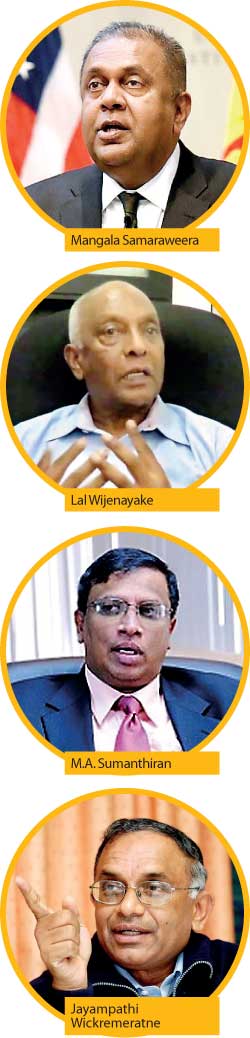
There is currently a debate about the drafting of a ‘New Constitution’ for the country among the academic community and the general public in Sri Lanka. This started with the appointment of a 19-member Committee headed by Lal Wijenayake called the Public Representations Committee on Constitutional Reforms. Its report was released in May 2016.

Meanwhile, a Constitutional Assembly was established by a parliamentary resolution on March 9, 2016 and a 21-member Steering Committee chaired by Prime Minister Ranil Wickremesinghe was appointed thereafter. The Steering Committee had its first sittings on April 5, 2016.

The Steering Committee recognized 12 main subject areas and assigned six of those subjects to sub-committees appointed by the Constitutional Assembly. The reports of the six Sub-committees were presented on November 19, 2017. Interim Report of the Steering Committee deliberates the remaining six subjects that were not assigned to any Sub-committee published on September 21, 2017.

The basic principles and facts mentioned in the IRSC were previously discussed and agreed at two workshops held in Singapore. The first was held from Aug. 31 to Sept. 1, 2013 the second between the 3 and 5 of April, 2015

I have gone through Wijenayake Committee Report, the six Sub-committee reports and the Interim Report of the Steering Committee (IRSC). After considering the academic achievements and the capacity of a majority of the members in both the committees, incertitude appeared in my mind whether the reports were original or were prepared with external help. Hence, I did research on my own and found some interesting connections.
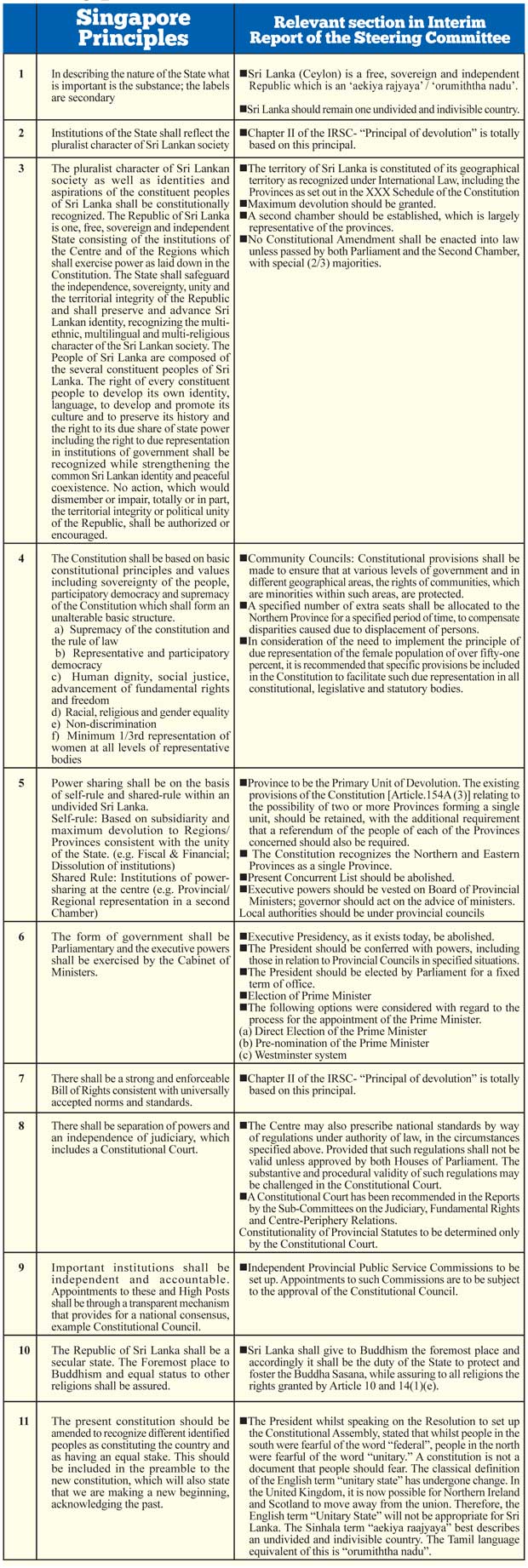
The basic principles and facts mentioned in the IRSC were previously discussed and agreed at two workshops held in Singapore. The first was held from August 31 to September 1, 2013 followed by the second between the 3 and 5 of April, 2015. Those events were organized by a South Africa -based INGO called ‘In Transformation Initiative’ (ITI) with the help of the Government of Switzerland.

According to the ITI website, it promotes the principles of the South African peace-making model to support, advise, and assist democratic transition and conflict resolution in Africa and around the world. ITI was actively involved in activities in Sri Lanka, Northern Ireland, Colombia, Cuba, Madagascar, Zimbabwe, Kenya, Cyprus, Sudan, South Sudan, Yemen, Iraq, Spain (in the Basque region), Bahrain and India (on the Naga question).

Further it says it has partnership with Burgh-of Foundation” an INGO with a questionable history in Sri Lanka.

ITI has four Directors: Roelf Meyer, Mohammed Bhabha, Ivor Jenkins and Ebrahim Ismail Ibrahim. Roelf Meyer was a one-time Minister of Defence of the F.W. de Klerk Government in South Africa. He later became Minister of Constitutional Affairs and Communications under Nelson Mandela’s government.

According to the ITI, Meyer is a consultant on peace processes in Sri Lanka, Rwanda, Burundi, Kosovo and Bolivia. Paradoxically he is also on the Board of Directors of ‘Armscor Corporation of South Africa’, which supplies all the needs of South Africa’s Department of Defence.

Armscor was originally established in 1968 as an arms production company. Mohamed Bhaba, an Attorney-at-law, was part of the African National Congress (ANC) negotiating team for the final South African Constitution and a former member of South African parliament.

Ivor Jenkins was Director of Kutlawanong Democracy Centre, a part of the Institute of Democracy of South Africa.

The Steering Committee recognized 12 main subject areas and assigned six of those subjects to sub-committees appointed by the Constitutional Assembly. The reports of the six Sub-committees were presented on November 19, 2017

Mohomad Ebrahim is a former member of the armed wing of the African National Congress, He was arrested in 1963 and charged under the sabotage act and sentenced to 15 years on Robben Island.    According to the ITI, members of the Tamil National Alliance (TNA) including M.A. Sumanthiran MP, members of the Global Tamil Forum, V.T. Thamilmaaran, a senior lecturer in the Department of Public and International Law of the Faculty of Law at the University of Colombo, Jayampathy Wickramaratne, Mangala Samaraweera MP, a member from Sri Lanka Muslim Congress and an observer from the Government of Australia were among the participants at the Singapore meetings.

A 10-point document was prepared following the 2013 meeting, and it was named as ‘Singapore principles’. It was further discussed and improved at the April 2015 meeting.  The final agreement has 11 points. Here is a comparison between the so-called Singapore principals and the Interim Report of the Steering Committee (IRSC) where symmetry of the concepts is obvious.

Although several parties claim that the New Constitution-making process is genuine and rooted in Sri Lankan soil this comparison clearly shows a different scenario.

Who is really behind the New Constitution-making process in Sri Lanka?

US AIRCRAFT CARRIERS IN SRI LANKA AND WHAT WE LOST

October 31st, 2017

Dr Sarath Obeysekera

Quote from US embassy

It is estimated that the carrier strike group will add approximately 1.54 billion rupees ($10 million USD) to the Sri Lankan economy as the ships purchase supplies and thousands of U.S. sailors come ashore and support local businesses.  During the visit, sailors will have opportunities to explore the local community and meet with their counterparts in the Sri Lankan Navy.  While in port, sailors will also work with local non-profit organizations to support community service events at a local hospital, an orphanage, and other sites

The USS Nimitz is more than 23 stories high from the keel to the top of the mast and is approximately 333 meters long.  It can accommodate more than 5,000 personnel, with its kitchens providing more than 18,000 meals each day.  It produces 1.5 million liters of fresh water daily and its two barber shops give 1,500 haircuts each week.  The USS Nimitz’s home port is in the state of Washington

Unquote

Read more

https://lk.usembassy.gov/uss-nimitz-visit-sri-lanka-first-u-s-aircraft-carrier-since-1985/

American air craft carrier visited Sri Lanka on a good will visit .Air craft carrier Nimitz came and left with over 2500 sailors on board,This is equivalent to about a month’s tourist arrivals to Sri Lanka .Our shipping agents and tourist agents  and Sri Lanka with tourist board have missed  the bus” ( ship),in exploiting to get the sailors land in Colombo soil. Government ,defence ministry ,tourist board ,SLPA have miserably failed to attract the business .

They asked for some barges  ( flat steel landing platform) to be deployed by the mammoth hull of the air craft carrier which had an odd shape .Barge or a transport boat could not  do mooring by the side of the hull during rough weather as they will hit the hull of the ship.One barge deployed by a well-known contractor  in the port with a very high superstructure ( control room on the barge)  could not reach the ship because it was hitting the upper part of convex shaped hull .Then the contractor hurried to chop off the top part of the super structure and tried few times. They needed some Yokohama Fenders  (1 m diameter rubber balloons with tyres wrapped around with steel chains ) were not available in Colombo hence transport barge could not moor the alongside the vessel .All avenues failed to bring single sailor to Sri Lankan spoil and the ship left Sri Lanka.Shipping agents were running around like hungry wolves trying to get the contract to bring sialors to Colombo but failed because of  fighting ! Barge owners were trying to charge over 10,000 $ for one operation !

Our stupid politicians were talking about American Invasion and JVP protesting against Americas claiming that they are  trying to invade ,but none of them have little brain to fathom that we lost over 1 million Dollars of income to Sri Lanka ,If the sailors manged to come on shore ,they would have enjoyed few days and spend much money in Sri lankan hotels .clubs,super malls  and our small time businesses would have flourished.

Another interesting thing is Sri Lankan Navy was not even consulted in this operation due to the fact that these Americans thought that our Navy may look closely at their ship and copy the shape if they come close !!!!!!!!!!! .

I am sure that our Navy would have found a way to bring them on shore with a professional approach and make them spend money in Colombo .

Problem we have is that no one in this country has any forward thinking to find ways to generate avenues to earn money for the depleting economy .

Dr Sarath Obeysekera

13a is implemented but a failure- 36 of the 37 subjects have been devolved!

October 30th, 2017

Shenali D Waduge

Some birds like to chirp the same song. 13th amendment has come to be that song. The singers of course are many. They enjoy nagging about the non-implementation of the 13th amendment at every forum be it at UNHRC, UN delegations or even during the chit chats and handshakes when diplomats and foreign envoys arrive in Sri Lanka. The 13th amendment is quite a fashionable topic and just mentioning the word is meant to scare the day lights out of our politicians.

The 13th amendment comes with the emphasis on devolution of powers and one wonders what the foreigners actually mean by ‘meaningful’ devolution. For devolution to become ‘meaningful’ must it satisfy the foreign entities or should it be relevant and useful to the citizens of Sri Lanka? An answer is rarely given and we hear only the 13tha chorus.

But, we need to get something cleared out with regard to the items that were listed to be devolved.

Firstly, what are to be devolved.

Secondly, how can the items to be devolved be actually devolved. This is important because simply because the 1st says to devolve, the 2nd factor must operate within the legal framework of the Constitution of Sri Lanka (not India, not America’s, not UK’s, not UNHRC’s or Canada’s).

Who says that the powers assigned to be devolved have not been devolved?

Executive power is exercised by the Government who is appointed by the President of Sri Lanka and the Legislative powers are exercised by the Provincial Councils.

List 1 contains 37 subjects to be devolved. These subjects come under the legislative powers given to the Provinces. Executive and Legislative powers of the 7 provinces have been devolved and in operation since 1987.

The Government cannot be blamed if the 7 Provincial Councils have been ineffective and while police powers have not been given the efficiency of running the 36 subjects are questioned.

In the case of the Northern and Eastern Provinces, the appointment of Governors had been made since 1987.

Just because the Provincial Councils have not been given Police or Land powers, the Provincial Councils cannot complain that powers have not been devolved. The 36 subjects that have been devolved to them are evidence to deny this claim.

Police powers and Land Powers have NOT BEEN devolved to any of the other provinces. It has been denied for national security reasons.

Moreover, the Supreme Court ruling has held land powers under the Government State land shall continue to vest in the Republic…”.

What needs to be made clear is that apart from Police powers, all other 36 subjects have been devolved to ALL 9 Councils and they can make statutes and implement the devolved powers on education, local government, roads and bridges, social service, agriculture, agrarian services, rural development, health etc.

In addition, the List III, gives a Concurrent List that the PCs can exercise concurrently with the Central Government.

Why is the Northern Province and Foreign Governments and India insisting on police powers to the North and only to the North or East?

When the PC system has been running throughout Sri Lanka ever since 1987 without police and land powers given, why are the foreign governments insisting on police and land powers after the Northern Provincial Council began functioning following the end of terror? Why did India or any of the foreign governments not chirp this song in relation to the other provincial councils of Sri Lanka?

Moreover, is it not relevant too that with more Tamils living outside the Northern Provincial Council, if they can live without land and police powers and have been doing so since 1987, why should Tamils of the Northern Province only seek land and police powers?

Lets not forget that when the first merged North-East elections was held, the EPRLF ran the Provincial Council without land or police powers! India never brought up issue of 13tha with land and police powers then and neither did any of the other foreign governments presently breathing fire down the Government.

Moreover, does it matter who administers law and order, so long as law and order prevails?

Without chirping the 13tha not been implemented song what the international community must start asking is what have the Northern Provincial Council being doing with the subjects that have been devolved and under their purview? This is where our former Supreme Court Judge and Chief Minister will get stuck in answering. What has he and his TNA done for the People of the North ever since they took over the Northern Province with the money that the Government has been allocating? Is this not a better song?

Let’s not forget that if it is the question of 13tha being devolved – it has been since 1987. Simply because certain subjects that have national security interests have not been devolved it is not a case to say that 13tha has not been implemented.

Next is the need to tell the Northern Province that is making the most noise about 13tha not being implemented to get on with what they have first. When people of the North who did not vote for the Members have to put up with them, then Wigneswaran and team must learn to get on with the Governor that the President of Sri Lanka has appointed.

Moreover, given the historical links of the TNA to LTTE terror, any Government will be considered insane to grant police powers and the public continues to question why the Government is hesitant to use 6th amendment against the politicians who make up the TNA for their open canvassing of separatism in Sri Lanka.

What the chorus on 13tha need to also realize is that there is a Constitutional provision to treat all citizens equally which immediately checks the present calls for ONLY Tamils and their aspirations to be addressed. This is something that the Government needs to make clear about in issuing statements at all international forums without simply promising to look into the aspirations of the Tamils and realizing that they cannot because it would undermine the aspirations of the rest of the people in Sri Lanka. The lack of clarity has been one key reason for everyone to be continuously running round the mulberry bush and going round in circles for decades. The handouts engaging Sri Lanka to promise 13tha – full, plus and any other adjectives used should now cease in the light of the ground realities that 36 subjects are well in control of the Provincial Councils and it is really time to stop fooling the public.

– Shenali D Waduge

Saying it’s not the Constitution but an Interim report, Sirisena –Ranil want it passed with a two third majority in Parliament.

October 30th, 2017

By Charles S.Perera

Friends, fellow Patriots, if the Constitution is to be ours, written by a free people, we must first resist this diabolical project!  Tamara Kunanayakam.

The Sirisena Ranil Yahapalanaya hoodwinks the Parliamentarians and the people to pass the so called interim report placed before Parliament by a two third majority to make it the document on which their New Constitution with a federal character will be written or has already been written, to be presented to the Parliament.

Who wants a new Constitution to Sri Lanka ? The people of Sri Lanka do not want a new Constitution, they want to live in peace, brining in all Communities into one Nation of Sri Lankans ?

The West lead by USA is determined to write a New Constitution to  make Sri Lanka a Federal State giving the Tamil Community equal rights with the Sinhala Majority. USA Ambassador Keshup seems to be some how  behind the project with the active support of the US State Department.

Tamara Kunanayaka says in an article to Investig’Action, that even the name given to this Ranil-Sirisena Government Yahapalanaya or Good Governance”  had been proposed by the USA . Good Governance is a term  coined by IMF, World Bank and the US Treasury as a political conditionality for the enslavement of indebted countries of the third world.

The Sirisena –Ranil Governments proposal to write New Constitution had been pre-arranged perhaps even before  Presidential election of 8th January,2015 on the insistence of  the  US State Department on the demand of the Tamil Diaspora.

It was evident from the many high ranking US Officials visiting Sri Lanka an making visits to the North or issuing Statements from Temple Trees as it was by US Acting Secretary of State Alice Wells , Edward Marks  one time US Deputy Chief of Mission (1987) who said that transformation from Colonial rule to an independent nation state is proving to be too much for fragile mlti- ethnic societies.

There were two visits by John Kerry the  US Secretary of State, and the US Under Secretary for Political Affaires Jeffrey Feltman, Samantha Powers, George Soros who said that Sri Lanka has no Constitutional Democracy, and  Nisha Bswal US Assistant Secretary of State admitting that the US Human Rights Council Resolution foreshadows the writing of a new Constitution to Sri Lanka.  Then the US Ambassador for Sri Lanka Atul Keshap stated that Washington would assist drafting a Constitution to Sri Lanka.

Is it now not clear that Sirisena-Ranil Government is all out to write a Constitution based on the interim report placed before the parliament and on which there would be a debate  from to day for which  interim report they are seeking a two third majority in parliament, not for the people of Sri Lanka but for the want of the USA and the West ?

Is it not enough evidenc  from the coincidence of  the US Nimitz Nuclearpowere  Aircraft Carrier along with six warships are scheduled to arrive or have already arrived in Sri Lanka just when the debate to pass the interim report to draft a new Constitution to Sri Lanka is to be debated.

Isn’t it a show of American Force,as a  threat to the Sirisena-Ranil  Government to honour what ever promises they have made to the USA , the West and the Talmil Diaspora ?

Think my dear compatriots who else other than Sirisena –Ranil and USA, wants a New Constitution to Sri Lanka ?

Even the 62 lakhs of people who voted for Sirisena did not want a new Constitution, the ordinary Tamil people are not interested in it,  other than the TNA Tamils and the Tamils of the diaspora and their sympathisers. The people of Sri Lanka do not want a new Constitution, they want to live in peace, they want security, they want a better standard of living, they only want to be a part of  a united community of the Nation of Sri Lankans ?

Yahapalanaya was never given a mandate by the people to write a new Constitution. Nevertheless the Yahapalanaya Government is going ahead with the same determination of the President Mahinda Rajapakse to eliminate terrorism, to write a new Constitution  giving the Tamils almost all  that the terrorists yearned to have through their ruthless terrorism.

Yahapalanaya which refused a Chinese Submarine to enter the Colombo port , and when President Mahinda Rajapakse was criticised both  by India and the then UNP opposition when he allowed a Chinese Submarine to dock in the Colombo Port in October, 2014, has now allowed  a whole American naval battalion to dock in Colombo Port !!

The new Constitution for Sri Lanka has perhaps already been written and the attempt to pass a document saying it is not the new Constitution is just hood winking the people and the  naïve Parliamentarians. It is pointless asking for amendments to the  document the SLFP and the JO have placed before the Parliament today for discussion as these enemies of the nation,  will accept all amendments  to have the two third majority vote to pass the document as a bill!!.

Therefore the Parliamentarians of the JO , SLFP and others of all shades of political view, if they really  love this Unique Sinhala Buddhist country the like of which exists no where else in the world , should not vote for this diabolic documents which would be the first step in presenting the New Constitution perhaps written by  the USA experts who know how to hide the truth and make the falsehood look like the truth.

It is perhaps time for the people to take to roads to protest against this interim report for a New Constitution which if passed would  annihilate the historical Sri Lanka twhich would  never be the same again.


The Treacherous Conspiracy facing Sri Lanka – Part VIII

October 30th, 2017

By : A.A.M.NIZAM – MATARA                     

The Treacherous Conspiracy of formulating a new constitution to make Sri Lanka a federal and secular state, devolve powers to provinces and establish self rule in North and East did not emerge after this despicable government came into power in 2015.  The plot was hatched in 2002 in Oslo. Norway during the Ranil Wickremasinghe government The tiger terrorist website TamilNet reported on 5th December, 2002 that LTTE and GOSL (Government of Sri Lanka) reached an exploratory agreement. It said the government of Sri Lanka and the Liberation Tigers of Tamil Eelam reached an exploratory agreement to explore a solution to end the island’s conflict founded on the principle of internal self determination in areas of historical habitation of the Tamil speaking peoples, based on a federal structure within a united Sri Lanka and Sri Lanka needs a new constitution that would radically transform its polity,” This was stated by Anton Balasingham, addressing a joint press conference at the Radisson Plaza Hotel in downtown Oslo

The arrangement got shelved with the dismissal of the Ranil Wickremasinghe government and once again it got revived with the western, Indian and Tamil diaspoea plans in 2013 spearheaded in Singapore under the title Singapire Principles of 2013” to launch a regime change in Sri Lanka.

Now defunct Tamil News Network.com and the LTTE’s official Website TamilNet.com reported on 23rd and 22nd January, 2015 respectively that right from the Indo-Lanka agreement of 1987 to Oslo Declaration of 2002 and to hitherto unrevealed Singapore Principles of 2013 that brought the Sampanthan polity into a conceptual framework for the recent regime change in Colombo, the external forces are seeking to influence the affairs of the island.  The websites said that the external forces have taken the Eezham Tamils for a ride without securing any concrete and descriptive guarantee from the Sinhala polity. TamilNet publishing the text of the so-called Singapore Principles for the edification of global Tamils said M.A. Sumanthiran, the non-elected national list ITAK parliamentarian and V.T. Thamilmaran, the dean of the Faculty of Law at the University of Colombo were the Tamil representatives from the island while representatives of the Global Tamil Forum (GTF) were representing the Diaspora Tamils at a meeting in Singapore in 2013 when Dr Jayampathy Wickramaratne came with his proposal points to agree upon a conceptual framework aimed at regime change..

The TamilNet also stated that Mangala Samaraweera came as a ‘beggar’ urging Tamil support for regime change and abolition of the executive presidency.

The Website further stated that when Tamil aspirations came for discussion, M.A. Sumanthiran wanted to avoid the mentioning of terms such as Nation and Right to Self Determination in the document, and only the voice of a human rights defender, a Sinhalese, representing the civil society, was in favour of a formula based on the recognition of nationhood to Tamil people with their traditional homeland in the North-East.  The Website said that the document was drafted with the intention of being non-descript, but a consensus was achieved on winning Tamil voters through the TNA for the regime change. It said that a lawyer from Sri Lanka Muslim Congress was also represented at the meeting apart from several other representatives. It said that the meeting was organised by South Africa and was funded by two European countries.

The 10-points agreed between Sumanthiran and the regime changers including Mangala Samaraweera, and named as the Singapore Princioles of  2013 are as follows

  1. In describing the nature of the State what is important is the substance; the labels are secondary.
  2. The Constitution shall be based on basic constitutional principles and values including sovereignty of the people, participatory democracy and supremacy of the Constitution which shall form an unalterable basic structure.
  3. Power sharing shall be on the basis of self-rule and shared-rule within an undivided Sri Lanka.
  4. The Executive Presidency shall be abolished and the form of government shall be Parliamentary.
  5. The pluralist character of Sri Lankan society as well as identities and aspirations of the constituent peoples of Sri Lanka shall be constitutionally recognised.
  6. There shall be a strong and enforceable Bill of Rights consistent with universally accepted norms and standards.
  7. There shall be a separation of powers and an independence of judiciary which includes a Constitutional Court.
  8. Important institutions shall be independent and accountable. Appointments to these and High Posts shall be through a transparent mechanism that provides for a national consensus, example Constitutional Council.
  9. Institutions of the State shall reflect the pluralist character of Sri Lankan society.
  10. The Republic of Sri Lanka shall be a secular state. The Foremost place to Buddhism and equal status to other religions shall be assured.

Stupid thotta baba Sirisena should at least understand now, if he has any brain or sanity to do so, that he was made only a scapegoat to get the objectives of the Tamil separatists achieved and instruct to immediately abandon the obnoxious constitution process, which we doubt that this avaricious fellow will ever do since the Tamil separatists and the accidentally born Sinhalese in the UNP (Union of Notoriois Plunderers) have made arrangements to get his presidential term extended for antoher term without an election.

It is sad to find that the 21 Muslim impotent members of Parliament who are only concerned about getting themselves and their family members rich have not come forward to oppose the constitution despite it would greatly endanger the Muslims in the East and Mannar areas while a new constitution is being formulated to please the 16 MPs of TNA and Mano Ganeshan’s Kallathonis.  Under these circumstances the Muslim Lawyers Associatin has taken the responsibility of raising cudgels against the proposed constitution on behalf of the Muslim community. They have emphasized that Sri Lanka should be a Unitaary State and the term must be stressed in all languages (Sinhala, Tamil and English)..  They point out the word Orumittanadu” in Tamil is not the correct term to describe a unitary State, and the word should be Otraiachchi.” They also state that Articles 1 to 9 of the present Constitution should not be changed. They further state that Provincial Council (PC) should be the highest unit of devolution, subjected to the powers and functions vested with the Central Government and never the Northern Province (NP) and the Eastern Province (EP) should be made a single Province and the present structure for the appointment and the powers and functions of the Governor should be retained.

As per UN statistics 165 countries in the world, out of the 192 UN member countries are countries with Unitary Status abd there are only 27 countries which are Federal States.    As per these statistics 86% of the countries in the world are countries with Unitary Status which have power centred on a central government.  In some of these countries for admnistrativee convenience the powers of the central government are revokably decentralized.  Surf https://en.wikipedia.org/wiki/Federation to find further details.

The 27 countries with federal form of government are governments formed by creating a union with self rule small areas or provinces or a united state.  In such a united/federal state the sovereignty does not belong to the central government alone.  In such countries the sovereignty has been diluted to provide equal or part authority to the provinces or states. In these countries the provinces or state units are not legally bound to implement the responsibilities or decisions of the President, the Parliament or the Central government.

Out of the 165 countries with Unitary Staatus the 5 richest countries are China, Japan, the United Kingdom, France and Italy.  The 5 most populated contries with Unitary Status are China, Indonesia, Bangladesh, Japan and the Philippines.

Some dollar varicious NGO vultures and Tamil slavish pro-separatist elements in Sri Lanka claim that Sri Lankans do not have proper knowledge about world aaffairs and by hanging on to the word Unitary Status they are endangering the future of the country.  These idiots should understand that 86% of the countries in the world are countries with Unitary Staatus forms of government.

These idiots should seriously think about what happened to the Catalonia province of Spain which has the city of famous Barcelona and many other historical places.  On October 27th the provincial governorate of Catalonia declared Catalonia as an independent State delinked from Spain.  Reports said that with this announcement the Catlan national anthem was sung in the Catlan Parliament and throughont the area considered as Catalonia.  Recently a referendum unauthorized by the Central Government of Spain was held in Cataalonia and the majority of the Catlan people voted in favour of Catalonia becoming a separaee country.  A similar referendum was held in Kurdistan area of Iraq also and they too voted for having a separate Kurdistan.

Catalan leaders held the referendum in defiance of the national government

https://en.wikipedia.org/wiki/Spain

http://www.bbc.com/news/world-europe-41780116

The obnoxious constitution proposal is going to place Sri Lanka also in the predicament faced by Spain and Iraq as a result of going to help the separatist amils.  Do we need to have the same fate in Sri Lanka as well? UNP and SLFP members in the government have the option of going into history as disgraceful traitors of the country by voting for the new constitution or getting glorified as saviours of the country by voting against it.  The choice is yours. Think well, think severl timea before you go for the voting.  It cannot be expected from the JVP hooligans as they have become a disgraceful bunch of pimps who would even sell their own mothers for money.

(concluded)

ජනාධිපතිකම බාරගන්න ලෑස්තිදැයි ගෝටාභයගෙන් අසයි..

October 30th, 2017

චාමින්ද කරුනාරත්න lanka C news

තමා විශ්වාස කරන රටට හිතකර ප්‍රතිපත්ති ඇති ඕනෑම නායකයෙකු යටතේ වැඩ කිරීම තමුන්ට ප්‍රශ්ණයක් නොවන හිටපු ආරක්ෂක ලේකම් ගෝඨාබය රාජපක්ෂ මහතා පවසයි.

ඔහු මෙසේ ඇසුවේ මහනුවරදී පැවති විද්වතුන් හා වෘතිකයින්ගේ සමුලුවක් අමතමිනි.

ඔහු එහිදී මෙසේද පැවසීය.

” අද ගෝල්ෆේස්වල ටාජ් හෝටලය හදල තියෙන ඉඩම ඉන්දියානු සමාගමකට දුන්නේ ජේ ආර් ජයවර්ධන ජනාධිපති තුමා, අද වර්ල්ඩ් ට්‍රේඩ් සෙන්ටර් එක හදල තියෙන ඇචිලන් ස්ක්වයාර් ඉඩම සිංගපූරු සමාගමකට දුන්නේ ආර්ප්‍රේමදාස ජනාධිපතිතුමා. ඒ රජයේ ඉඩම් නිකං වගෙ පෞද්ගලික ආයතන වලට දුන්නේ. 99 අවුරුද්දට දුන්නේ කියලා ඒ ඉඩම් කවදාවත් ආපහු ගන්න පුලුවන්ද ?

නමුත් එ අසලම තියෙන ඉඩමක් ෂැංග්‍රිල්ලා හෝටලයට මහින්ද ජනාධිපතුමාගේ කාලේ දුන්නේ රජයට අති විශාල මුදලක් අයකරගෙන. ඒ මුදල් වලින් බත්තරමුල්ලේ හදන තිවිධ හමුදා මූලස්ථානය සාදා නිම කරන්නයි සැලසුම් කරල තිබුනේ. එහෙම් කලා නම් මහ භාන්ඩාගාරයට බරක් නැහැ. හමුදා මූලස්ථානය ගෝල්ෆේස් වලින් ඉවතට ගෙනියන්න තීරණය කරල තිබුනේ මීට දශක ගන්නාවකට පෙර වෙනත් රජයක් විසින්. නමුත් එයටභාන්ඩාගාරයේ මුදල් නැති නිසායි ප්‍රමාදය තිබුනේ.

ජනාධිපතිකම බාරගන්න ලෑස්තිදැයි ගෝටාභයගෙන් අසයි..

ෂැන්ග්‍රිල්ලා හොටලයෙන් ගත් මුදලින් හමුදා මූලස්ථානය හදාගෙන යන විට මේ ආන්ඩුව බලයට ඇවිල්ල ඒ මුදල් ආපසු භාන්ඩාගාරයට ගත්තා. අද ඒ සල්ලි කෝ ? ඒවට වෙච්ච දෙයක් නහැ. දැන් හමුදා මූලස්ථානය හදල ඉවරකරන්න වෙන්නේ මහජන බදු මුදල් වලින් . කවුරුත් ඒ අපරාධය ගැන අහනවද ?”

ජනතාව ඉල්ලා හිටියොත් ඔබ තුමා මේ රටේ නායකත්වය බාර ගන්න ලෑස්තිද කියා” යමෙක් මෙම සම්මන්ත්‍රණයේදී ඇසු ප්‍රශ්ණයකට උත්තර දුන් ගෝඨාභය රාජපක්ෂ මහතා කීවේ තමන්ට තනතුරු වැදගත් නැතිබවත් වැදගත් වන්නේ මව්බිම බවත්ය.

තමා විශ්වාස කරන රටට හිතකර ප්‍රතිපත්ති ඇති ඕනෑම නායකයෙකු යටතේ වැඩ කිරීම තමුන්ට ප්‍රශ්ණයක් නොවන නිසා එකද, දෙකද , තුනද නොබලා රට වෙනුවෙන් ජනතාව බාර දෙන ඕනෑම වගකීමක් දරන්නට තමන් සැම විටම සූදානම් බව මීට පෙරද කියා ඇතිබව හිටපු ආරක්ෂක ලේකම්වරයා මතක් කර දුන්නේය.

ඕවා කතා කරන්නට පෙර අපි සියලු දෙනා එක්ව රට මේ වැටී තියෙන උවදුරෙන් බේරාගමු කියා ඔහු තව දුරටත් කීවේය.

– චාමින්ද කරුනාරත්න

ව්‍යවස්ථා සම්පාදක මණ්ඩල ව්‍යවස්ථා විරෝධීයි.. අතුරු වාර්තා නිතී විරෝධීයි.. සියල්ලම බල ශූන්‍යයි.. නීති පොත මෙන්න..- මහා ව්‍යවස්ථා ප‍්‍රාඥයා පරමාණු බෝම්බය ගසයි..

October 30th, 2017

 lanka C news

ශ්‍රී ලංකා පාර්ලිමේන්තුවේ අද (30) සිට ව්‍යවස්ථා සම්පාදන මණ්ඩලයක් ලෙස ආරම්භ වී දින 3 සාකච්ඡා කිරිමට සුදානම් කිරිම ආණ්ඩුක්‍රම ව්‍යවස්ථාවට පටහැනි නිති විරෝධී ක්‍රියාවක් බව මෙරටේ නීති විශාරදයකු වු ජනාධිපති නීතිඥ හිටපු අධිකරණය අමාත්‍ය ආචාර්ය විජේදාස රාජපක්ෂ මහතා ප්‍රකාශ කර සිටි.

අලුත් ව්‍යවස්ථාවක් සම්පාදනය කිරිම වෙනුවෙන් ආණ්ඩුක්‍රම ව්‍යවස්ථා සම්පාදක මණ්ඩලයක් පත්කිරිමට 1978 ආණ්ඩුක්‍රම ව්‍යවස්ථාව අනුව කිසිම බලයක් පාර්ලිමේන්තුව වෙත ලබා දි නොමැති බවත් ඒ අනුව පසුගිය සැප්තැම්බර් 21 වෙනිදා පාර්ලිමේන්තුව වෙත අගමැතිවරයා විසින් ඉදිරිපත් කල මෙහෙයුම් කමිටුව විසින් සකස් කල අතුරු වාර්තාව බල ශූන්‍ය ලියවිල්ලක් බව ධර්ම නීති විශාරද, ශාෂන භූෂන, ජනාධිපති නීතීඥවරයා සදහන් කරයි.

ආණ්ඩුක්‍රම ව්‍යවස්ථාවට අනුව පවතින ව්‍යවස්ථාව සංශෝධනය කිරිමට අවශ්‍ය නම් එය පාර්ලිමේන්තුවේ ස්ථාවර නියෝගවලට අනුව පමණක් කල හැකි බවට මාධ්‍ය වෙත නිවේදනයක්න් නිකුත් කරමින් කියා සිටි.

ආණ්ඩුක‍්‍රම ව්‍යවස්තා සම්පාදක මණ්ඩලය ව්‍යවස්තා විරෝදී මෙන්ම මුල සිටම බල ශුන්‍ය ක‍්‍රියාවලියක් බවත් නිවේදනයේ සදහන්ය.

THE JO WILL BETRAY THE SINHALAS AGAIN RE THE NEW CONSTITUTION

October 30th, 2017

DHARSHAN WEERASEKERA,

The softening of our stance concerning certain issues, and the compromise we show in other issues, are diplomatic strategies to ensure that we do not alienate the international community.  They are not indications that we have abandoned our fundamental objectives….The current practices of the international community may give us an opportunity to achieve, without the loss of life, the soaring aspirations we were unable to achieve by armed struggle’-R.Sampanthan, 2012 Speech at 14th Annual Convention of ITAK in Batticaloa

On 8th March 2016, on the eve of Parliament signing the Framework Resolution setting up the Constitutional Assembly, I argued in an article published on lankaweb.com that the JO betrayed the Sinhalas by supporting that resolution.[1]  They are about to betray the Sinhalas again, this time by agreeing to participate in the ‘debate’ over the Steering Committee interim report.

This will be the final nail in the coffin.  The new Constitution will put in place the irrevocable legal foundation for Eelam, which the Tamils will use at a time of their choosing to demand formal separation.  In this article I shall explain how I think the final act of betrayal will play out, and make some recommendations as to what the Sinhalas can do to fight back.

THE BETRAYAL

In my view, Ranil Wickremasinghe’s plan is to keep the UNP in power till 2025 if not beyond.  The UNP needs to cling to power beyond 2020 for the simple reason that if it loses power most of the UNP’s stalwarts including Ranil along with their assorted allies will have to spend their respective retirements being dragged from courtroom to courtroom, or prison to prison, to account for what they have done in the past two years.

In order for the UNP to stay in power beyond 2020, Ranil needs a strong enough excuse to justify postponing the 2020 General Elections.  A new Constitution will give him such an excuse.  If the new Constitution is adopted after a referendum, Ranil and the UNP can claim that the victory at the referendum shows that the people basically approve of the way the country is being run, and that this can be interpreted as a mandate to continue in power beyond 2020.

At any rate, the above is an excuse plausible enough to give the UNP the political cover necessary to postpone General Elections in 2020.  The only thing that will spoil the aforesaid plan is if the new Constitution is shown to be a fraud before it is put to a referendum, that is, when the draft is still in Parliament.  The JO is the only group capable of doing this.  So, it is imperative for Ranil to get the JO to back the new Constitution.  The JO is about to give him what he wants.

To digress a moment, it is not in dispute that Sri Lanka needs a new Constitution, or to put it another way there are serious flaws in the present Constitution that must be remedied at some time or other in the future.  The only question is whether the present Parliament has the mandate to amend the Constitution or to being in a new Constitution.  The fact of the matter is that it does not.

I have discussed the reasons for the position above in an article titled, ‘The Ongoing Constitution-Making Process in Sri Lanka:  An Inquiry into its Legality,’[2] published in lankaweb.com on 23rd August 2017, and refer the reader to that article for more details.  But in brief there are three reasons, as follows.

First, nowhere in the UPFA manifesto for the 2015 Parliamentary Elections does it say that in the event the UPFA loses, its candidates reserve the right to join the UNP or any other winning party and carry on a common legislative program including bringing Constitutional amendments or a new Constitution.  But, that is exactly what has happened.

About 45 SLFP MP’s who contested the under the UPFA banner are now colluding with the UNP thus giving the UNP very close to a 2/3 majority in Parliament, and with a 2/3 majority they can do almost anything.

Second, if anyone points out that the fact that the UPFA manifesto doesn’t mention the prospect of a ‘National Government’ doesn’t mean that UPFA voters would have necessarily opposed such a thing once it was formed, the reply is that if that were the case, Mr. Sirisena would not have had to bring in people including defeated candidates through the National List to strengthen his hand in Parliament, in order to form the ‘National Government.’

Finally, and most importantly, the Government keeps postponing elections, because it is afraid of losing.  A Government that is afraid to face elections cannot be considered by any stretch of the imagination as having a mandate to bring in a new Constitution.  If the Government wants to insist it has a mandate, it should hold elections – any elections – and confirm such mandate.

All that the JO has to do is to point out the above facts or something similar, demand that elections – any elections – be held prior to any further discussions about a new Constitution, and leave it at that.  It should be noted that, the karakasabhas of the Malwatu-Asgiri Chapters have also categorically state that a new Constitution is not needed at the present time.

Generally speaking, the karakasabhas are conservative institutions, and they won’t take a stance such as the one they have taken on as important and as politically sensitive an issue as a new Constitution without thinking long and hard over it.  So, as far as Sinhala-Buddhists are concerned – and certainly any groups purporting to represent the interests of Sinhala- Buddhists – the pronouncement of the Malwatu –Asgiri karakasabhas should, one must presume, be the final word.  But, what has the JO done?

By agreeing to participate in the ‘debate,’ the JO is saying that it has accepted the legitimacy and legality of the constitution-making process so far, but wants to discuss the merits of the specific proposals.  The fact of the matter is that, the JO can do precious little to change the content of the various proposals.

But, once the JO participates in the debate, the Sinhalas will not be able to say that their interests went unrepresented when the draft of the Constitution was put to Parliament.  In short, the legitimacy of the draft will have been established.  And this is all that Ranil needs at the moment.

I give below my predictions as to how events will unfold in the coming days.  (Basically, it will be a repeat of what happened leading up to the adoption of the Framework Resolution on 9th March 2016.)

  1. The first thing to remember is that the Government does not need a 2/3 majority to adopt the Interim Report and request the Steering Committee to prepare a Constitutional proposal.  The Framework resolution does not say even whether a vote on the Interim report is needed.  (See Paragraphs 17 and 18 of the Framework resolution)[3].  It is the Constitutional Proposal that needs a 2/3 majority.  To repeat, the UNP does not need the support of Sirisena’s SLFP’ers or the JO in order to pass from the Interim report to the final Constitutional Proposal.  So the ‘debate’ is quite literally only for show. 
  2. The JO has already filed 14 objections to the Interim Report.  Sirisena’s SLFP’ers have also filed 12 objections or so if I’m not mistaken.
  3. During the first or second day of the debate, a number of Sirisena’s SLFP’ers will break ranks and say that they now fully support the JO’s position, and if the JO’s 14 points are not met, they will join the JO in voting against the report.
  4. After much hullabaloo, the Government will agree to the 14 conditions with minor modifications, and the Interim Report will thereon be adopted with a2/3 majority.  (Remember that, no such majority is needed.)

To jump ahead, in a few more weeks the Steering Committee will present the Constitutional Proposal, and – low and behold – all the offending clauses they said they will remove when finalizing the Proposal will appear in it.  There will be pandemonium.  The JO’s heavyweights will thunder from their podiums:  ‘Api akanga une theywal nevei make thienne!’  (‘There are things in this that we never agreed to!’)

Again, a number of Sirisena’s SLFP’ers will join the JO in yelling at the Government.  The Government knows this routine by now.  It will once again agree to remove the offending clauses.  But this time, the JO and the SLFP ‘rebels’ will stick to their guns (or pretend to do so) and refuse to support the Constitutional Proposal.

At that point, Sirisena will deliver one of his famous ‘Mama Poronduwenava’ (‘I Promise’) speeches to the nation.  He will say something like this:  ‘Mama poronduwenava rata bedanda kavadawath ida thenne na kilaya.’ (‘I promise I will never permit the county to be divided.’)

Needless to say, Sirisena’s ‘poronduva’ is a joke, because once the new Constitution is enacted, the discretion to move for formal separation either by way of a referendum on secession or through action of the Provincial Government will be in the hands of the Tamils.  Can Sirisena control the thoughts and actions of the Tamils?  Is he God?

Nevertheless, the ‘poronduva’ will ahcieve Sirisen’as purpose, which is to provide the SLFP ‘rebels’ political cover to return to the fold, and the Constitutional Proposal will pass with a 2/3 majority, perhaps with a significant number of JO’ers voting for it also.

Soon afterwards, a number of relatively uncontroversial clauses in the Proposal – for instance abolishing the Presidency and so on – will be put to a referendum.  (The Government will never put a put an issue such as whether to turn Sri Lankan into an ‘Ekiya rajya/Urumittu Nadu’ before the people.)  The Government will win the referendum by mobilizing the same coalition that helped bring Sirisena to power and also by rigging the referendum just for good measure.

Once the Proposal is brought back to Parliament, the Government will insert the more obnoxious clauses such as making the country into a ‘Ekiya/Urumittu nadu’ at the committee stage, and promptly get the Speaker to certify the document into law.  Sirisena will howl with indignation.  He will say something like:

me vidiha deval vene kohomada!  Habei then apita karrana deyak ne.  Nithiyata garu karanna oni.  2020 thi chandayak enawa.  Ethakota api apema arnduwak pihituvala meva venas karannahaki.’  (How can these things happen!  But, now there’s little we can do.  We must respect the law.  There will be an election in 2020.  At that time we’ll form a government of our own and change all this.’)

He understands better than anyone else that, once the new Constitution is enacted, there will be no elections…for a very long time.  So, that’s how it will all end for the Sinhalas.  I sincerely hope none of what I have suggested above happens, but if it does, you heard it here first.

RECOMMENDATIONS

  1. Prepare for a Referendum:

Some people say that there will be no referendum and that the Government will get the Constitution passed using only the 2/3 majority in Parliament.  If there’s no referendum, I will be the first to rejoice, because the new Constitution will have absolutely no credibility.  In the meantime, it is best to prepare for the worse.  As I mentioned earlier, I think the Sinhalas will lose the referendum.  But, they shouldn’t accept defeat passively.

They need to do two things.  First, following the lead set by the Malwatu –Asgiri karakasabha, the basis for challenge to the new Constitution must be that there’s no need for a new Constitution at this time, and the present Parliament does not have the mandate to engage in such an exercise anyway.  This way, if and when the Sinhalas regain power, it’ll be easier to have new Constitution invalidated in toto.

Second, the Sinhalas have to expose the rig.  Sirisena will never permit Ranil and the UNP to go for a referendum unless he is given an absolute guarantee that his side will win.  The only way to do this is for the UNP to put maximum effort into mobilizing the constituency that brought Sirisena to power, but also have a rig in place to make up for any shortfall.  So, the Sinhalas have to expose this rig.

The Sinhalas also have to find a way to record their individual votes so that they can show exactly how many of their number rejected the Constitution.  The UNP will try to say that significant numbers of Sinhalas voted for the new Constitution, so it is imperative that the Sinhalas have a way to prove the UNP’s claims wrong.

2. Begin laying the foundation for a long-term nonviolent campaign of civil disobedience:

The Americans are ultimately behind what is happening to this country, because they are in the process of integrating Sri Lanka into the U.S.’s strategic matrix in the Asia-Pacific region. So, the Sinhalas are actually fighting the Americans, and that’s never a good thing.  The Americans are masters at mass killing, and will love nothing better than to wipe out a good percentage of the Sinhalas if they get in the way of U.S. plans.

To take just a few examples, the Americans helped General Suharto of Indonesia kill about 600,000 people when putting down the communist uprising in the late 50’s.  I need not mention what the Americans have done in Iraq and Afghanistan in recent years.  The deathtoll from the American invasion of Iraq in 2003 and its continuing aftermath has now easily exceeded one million.  So, to repeat, the Americans are masters at this game.

The only chance the Sinhalas have to make a dent with the Americans is by undertaking a systematic and disciplined nonviolent campaign, because then it is easier to go before the international community and expose the injustice of what the Americans are doing in this country.  Slowly, pressure can be brought on the Americans – especially with the help of other counties who are on the side of the Sinhalas, countries such as China, Russia, Iran, Venezuela, and so on – to get them to change their approach to Sri Lanka.

3. Resettle a minimum of 100,000 (one hundred thousand) Sinhalas in the Northern Province within the next two years.

Possession is nine-tenths of ownership.  If a 100,000 or more Sinhalas move into the Northern Province, this country cannot be divided no matter what the Americans try to do – i.e. whether they impose a federal system, a confederal system, or any other system.  The Sinhalas have every right to live in the Northern part of the country, since it is their ancestral land also, not just the Tamils.  So, the Sinhalas should exercise that right and move in.

Some people say that the idea of the Sinhalas moving back to the North in large numbers is a pipe dream.  I am not interested in listening to naysayers.  In this the Sinhalas must learn from the Tamils.  If anyone had said in the late seventies – when Prabakaran had less than 20 cadres – that within two decades he will get to a position where the Government will offer him the Northern Province for ten years without elections, he would have been laughed at.

If anyone had said in May 2009 – when the Tamil Diaspora was at its lowest ebb , ‘in stunned silence’ as one Canadian newspaper put it –that within seven years they will be in a position to demand that Sri Lanka be turned into an Urumittu Nadu, and be taken seriously, again such a a person would have been laughed at.  But, the Tamils didn’t listen to naysayers.  They came up with a plan and systematically pursued it.  And now they have the Sinhalas by the throat.

So, as I said, the Sinhalas should lay out the plans to resettle a 100,000 of their number in the North, and systematically go about implementing the plan.  Whether it succeeds or not is ultimately up to Providence.  I am reminded of Goethe’s famous lines:

‘What you can do, or dream you can, begin it.  Boldness has genius, power and magic in it.’

[1] Dharshan Weerasekera, ‘The Trap what will be Sprung on March 9th,’ www.lankaweb.com, 8th March 2016

[2] Dharshan Weerasekera, ‘The Ongoing Constitution-making process in Sri Lanka:  An Inquiry into its Legality,’ www.lankaweb.com, 23rd August 2017

[3] Paragraphs 17 and 18 are as follows.  Paragraph 17:  ‘The Constitutional Assembly shall thereafter debate the general merits and principles of the Report and the Draft Constitutional Proposal (if applicable), and may also debate proposed amendments. At the end of such debate the question that the Steering Committee be required to submit a final report and a Resolution on a Draft Constitutional Proposal” shall be put to the Constitutional Assembly by the Chair.’  Paragraph 18. ‘The Steering Committee shall thereafter, considering the amendments, if any, proposed during the debate, submit a Final Report and a Resolution containing a Draft Constitutional Proposal for the consideration of the Constitutional Assembly. The Chairman shall move that such Final Report and the Resolution containing the Draft Constitutional Proposal be approved by the Constitutional Assembly.’

ORGANISATION OF PROFESSIONALS, BAR ASSOCIATION, AND PROFESSIONALISM TOWARDS NATION BUILDING

October 30th, 2017

Sarath Wijesinghe – former Ambassador to UAE and Israel

Professionalism and Historical Aspects”

Profession is a vocation on specialized educational training and professionalism is any type of work that needs special training or practical skills after training a high level of education. OPA set up in 1974 is currently the most powerful professional body with 53 professional associations ever growing serving the community with professional up liftmen and development/prosperity in all sectors. Professionalism is deteriorating in Sri Lanka which has spread to all sectors of the community/nation at a rapid rate. Bar Association is a live wire at the formation of the OPA created to set up a professional organisation with a grant from Commonwealth Foundation by a group led by late Dr.H W Jayawardena, late W P Gunitalaka Dr Nath Amarakoon, A B W Jayasekara and many other pioneers. APSL – Association of professionals in the United Kingdom is a powerful professional body initiated by a group of Sri Lankans which is a powerful organisation in the UK today, with the Sri Lankan Lawyers Association (ASSLU) in the United Kingdom indicates that professionalism is not something alien to us and takes wherever we are. A professional is considered and respected by the community on the ability, expert knowledge and experience offered to the Nation for Nation Building. For example a plumber or a brick layer who is no second to any other professional considered at the APSL and other professional organisations as a professional in the nation building process. Plumbers are paid well and the University degree on plumbing in UK is considered in highest esteem. What are the services rendered and expected of the professionals in Sri Lanka, and do they serve the nation in nation building expected by a professional/community are moot issues to be answered? Professionals need a sound knowledge and experience on Soft Skills to improve language IT and personality building skills and a workshop is organized at OPA on 27th November from 6.00 to 9.00 in the evening with a main speaker Professor Rajive Wijesinha- a world renewed personality on the subject- as a service to the Nation open free to the public. It is a pity that still journalists have not obtained the membership in this organisation of professionals and it is time they join OPA as a body of professionals in order to carry the message of professionalism forward and this workshop is an ideal opportunity for them to learn and familiarise with the functioning of OPA and be a part/party in the nation building process.

Professionals and Professionalism in Sri Lanka

It is sad but true to state In Sri Lanka professionalism is lacking among professionals and other citizens who are expected to act as professionals though they are not legally qualified to be professionals who more often act better than professionals applying the common sense and common knowledge. For example though politicians in the other parts of the world are professionals in the profession of politics, Sri Lankan politicians belong to the worst category in the world – greedy for money, power, perks, and vehicles instead of at least acting professionally based on common knowledge / common-sense with love to the nation and the fellow citizens. It is a learning process to follow political debates in the United Kingdom when political debates in Sri Lanka are full of mudslinging, accusations and irrelevant materials. Profession and professionals in Sri Lanka are not properly supervised and monitored as in the other parts of the world. The celebrated and powerful

legal profession lacks proper mechanisms to maintain the integrity and safety of the citizen/client as in the other jurisdictions. In the United Kingdom a solicitor should be insured for 10 million pounds, and compelled to follow the continuing education process to improve and update the legal knowledge monitored by the law Society- the professional body very strict on disciplinary mattes of the solicitor disciplinary body consisting of even non-lawyers as members. No such safeguards and monitoring process available in Sri Lanka blindly following colonial patterns still calling judges as Lords not even practiced in the USA. It is time for the OPA to adopt common standards and criteria for the professionals and conduct workshop/s for professional development instead of being inert and unprofessional on public matters which has direct bearing on the citizen and nation building process. OPA must fearlessly engaged and interfere in public matters concerning the country and the profession without involvement of divisions and political influence. When the country is going through a crisis OPA and BASL should be alive and interfere directly in the right directing to direct the governance and the nation. Are they doing this honourable duty is a hot issue requires answers and clarifications?

Nation Building/OPA/BASL and Commercial Sector”

Nation building team are those members of the state and private sector who take the initiative to develop the national community through government and private sector including military – conscriptions if necessary- and national projects on mass schooling involving the propaganda and development to international economy and economic growth- Harris Mylonas”, Indicates the professionals are the leading force/army in the forward economic and political developments, international and local trade/business, infrastructure, constructions, agriculture, power energy, education, technology, research ,health, and all/many other sectors in nation building which is a part of good governance. Nation building includes preserving and protection of the supreme law of the nation and rule of law promoting due process which includes maintaining of sovereignty territorial integrity and resist international interventions and treatment of all citizens alike with no divisions fear or favour to any group or individuals in a peaceful society devoid of corruption nepotism racial discrimination and fear from drugs, criminals, underworld and corrupt politicians who are responsible for the downfall of the country due to their excessive greed for power, money, and vehicles they love so much.

Apart from OPA and BASL, the Chambers of Commerce, Management, and educational institutions, industrialists, leader of trade and business enterprises, are part of the team in the protection and nation building team to save promote and protect the country they live for the future generation, peace, development of their country and planet preventing destruction/disasters based on environment/unplanned mega construction and manmade acts of self-destruction.

Team of Nation Builders- contribution/s

The team of nation builders should identify the needs and challenges ahead of the pathetic plight of the citizen as a result of excessive greed and emergence of the selfish nature of the human belongs to the animal kingdom with love for vehicles (3.1 billion for tax free vehicles and two hundred thousand per day for the maintenance of ministers alone apart from other perks). Today priorities are misunderstood and values are forgotten. OPA once a Giant” has come down to the position of a Rat” not considered and consulted by the governance as before, governance overjoying and capitalising the dead silence of the OPA and unnecessary affiliations with the state machinery, instead of being impartial and straight giving priority to nation building process sans personal glory and benefits with unholy friendships and attachments for posts and powers. We wish and pray a new life will be dawned and transformed with the newly elected office bearers of the OPA expecting a steady transformation towards nation building. BASL- the fearless organisation for Justice and fair play got out of the clutches of NGO’sm dominating regime changes with organisations with international agendas (example US Aid- German fat cat NGO s with bags of dollars) in order to maintain independence and integrity of the profession and professionals. As a result of timely intervention and unanimous decision of the Bar Council on 28th Nov at the monthly meeting of the representative membership to sever connections

with the alleged NGO forthwith to prevent using BASL logo for their publicity stunts BASL was able to maintain the integrity and independence towards nation building. Leadership and integrity of the president of the BASL is commendable when compared to the partiality and ineffective of the two predecessors whose intentions and integrity were questionable and in doubt. Fearless and timely intervention of the BASL to be alive on the proposed set of proposals on the supreme law of the nation influenced by foreign powers, NGO’s and anti Sri Lankan Geneva resolution is a precedent/example to the OPA and other members/organizations of the nation building team to be careful vigilant and act towards the correct direction. Most damages are done in the name of reconciliation when the unity of the tolerant Sri Lankan society is an example to the other parts of the divided world.

Way forward”

We are a country of tolerance and goodwill – citizens with a smile setting an example for reconciliation proved with the ethnic proportion and peaceful living in co-existence with all communities in Colombo – the Capital of Sri Lanka with Muslims as the majority second Tamil and Sinhalese third yet living in harmony and brotherly environment, unfortunately when the Chief Minster in the North lived most of his life in Colombo and children married to Sinhalese- is demanding removal of Sinhalese and Buddhist historical monuments from North and evacuation of Sinhalese from Jaffna which is worrying and directly against the principles of reconciliation we are used to as a nation. Government or foreign powers cannot impose reconciliation process on us which is a dollar spinner industry. Nation building team has a main part to play on this process and strengthen the bonds already strong to become stronger with economic prosperity and political integration in a unitary Sri Lanka. The professionals must take over politics from corrupt politicians to prevent our country from disintegration into pieces due to foolish power-hungry politicians greedy for money power and vehicles.

(Sarath Wijesinghe – the main initiator of APSL and ASLLUK in the UK can be contacted on sarath7@hotmail.co.uk takes responsibility to the contents of this article)

The Proposed Constitution To Divide The Country Must Be Stopped

October 30th, 2017

Sri Lankan Solidarity Movement

The Sri Lankan people are today alarmed by the proposed constitution which they feel will only end up dividing the country. The proposed constitution includes all the elements of a federal system which is unacceptable to all patriotic Sri Lankans. We already have a constitution inclusive of a provincial council system. The present constitution is therefore more than sufficient to address the needs of the entire people of the country. There is no need to change the present constitution at all. If the Government wants to include enhanced fundamental rights of the citizen etc. in the constitution, this can be done via bringing on amendments. There is no need to bring on a new constitution whatsoever. India has brought on over ninety nine amendments to its constitution. Sri Lanka has brought on twenty amendments only, so far. So any changes to the constitution can be brought on as amendments. Sri Lanka is a unitary state and has been for the last 2600 years, at least. We do not want to change that in any way. In the present constitution, we already have the provincial council system as per the 13th amendment to the constitution, however with safeguards to uphold the unitary status of the country. The presidential system safeguards the unitary status of the country when taken together with the 13th amendment to the constitution. These safeguards should continue into the future.

All patriotic Sri Lankans and especially the Sinhala Buddhist people of the country are extremely alarmed by certain aspects of the proposed constitution which they feel will only end up dividing this country into pieces. Written below are the grave concerns of patriotic Sri Lankans and especially the Sinhala Buddhist people. The first point is a little long. However please be patient enough to read it since it is a very important point. We again emphasise, please do not change the constitution since the present constitution is more than sufficient to address the needs of the Sri Lankan people.

  • (1) Sri Lanka has a written history of 2600 years and an unwritten history of 34400 years. From 600BC to 1400AD, Sri Lanka was composed of the Kingdom of Rajarata, the Kingdom of Ruhuna and the Malayarata. Today’s North was a part of the Kingdom of Rajarata and today’s East was a part of the Kingdom of Ruhuna. From 1400AD until 1815, both today’s North and the East were a part of the Kandyan Kingdom. Today’s provincial boundaries were drawn up by the British colonialists as per their divide and rule policy and is not related to Sri Lanka’s history. Nor were the Sinhalese consulted when drawing up these provincial boundaries by the colonialists. Therefore the Sinhala people cannot accept such a division of their homeland.

Sri Lanka as can be seen from its history, was always a unitary state for over 2600 years, at least. The indigenous people of the island are the Sinhala people and the adhivasis. Both are one and the same people. The Sinhala people built a Sinhala Buddhist civilization which consisted mainly of 10,000 to 15,000 irrigation reservoirs and was based in the dry zone of the island i.e. the North Central, North Western, Northern, Eastern provinces and the South East. The irrigation reservoirs were all built by Sinhala kings and include the Yodha wewa in the North, the Pavatkulum Reservoir in the North and the Kanthale Reservoir in the East to name a few. This hydraulic civilization is one of the greatest achievements of the indigenous Sinhala people let alone the propagation of Buddhism. An irrigation reservoir map in The National Atlas of Sri Lanka, Second Edition, 2007, published by The Survey Department of Sri Lanka, depicts the thousands of irrigation reservoirs built by this Sinhala Buddhist civilization. Other great achievements include the building of stupas which were some of the highest structures in the ancient world such as Jethawanaramaya, Abhayagiriya and Ruwanweliseya, steel making, evolution of our own language, evolution of our own script, writing down of ancient texts such as the Mahawamsa, Culawamsa, Thripitakaya and many other such ancient texts, Buddhist sculpture, landscape gardening such as at Sigiriya, development of our own architecture, ship building and many archaeologically important Buddhist shrines such as Thanthirimalai, Nagadeepa, Thiriyaya etc. Prior to the rise of the Sinhala Buddhist civilization, there were our tribal ancestors such as the Yaksha, Raksha, Naga and Deva tribal people and our culture consists, to this day, aspects of our tribal ancestors culture as well, such as devil dancing, belief in demon spirits, belief in deities who are said to reside in certain sacred places etc.

Therefore this island is the homeland of the indigenous Sinhala people. The Tamils and even the Muslims are descendents of recent immigrations to the island and normally by world standards, descendents of recent immigrants cannot claim homelands or federal states. As per the UN Charter, minorities in any country should be provided language, cultural and religious rights. Sri Lanka has provided its minorities all these rights and going beyond that, provided powers to provincial councils. Therefore there is no justification of going beyond the present situation. This island is the homeland of the indigenous Sinhala people and has always been a unitary state for over 2600 years. There is no scope for changing that and the Sinhala people cannot allow such a thing to happen.

  • (II) At present, the sovereignty of the people lies with the president and the parliament. However via the proposed constitution, sovereignty of the people will lie with the president, the parliament and the provincial councils. Is this not a devious way of creating nine different independent countries?
  • (III)It is proposed via the proposed constitution to transfer the governor’s executive powers to the chief minister. The governor will then exist as a namesake only. Is this not a devious way of greatly strengthening the chief minister’s executive powers to even that of the president? Is this not another way of creating nine different independent countries?
  • (IV)It is proposed via the proposed constitution to dilute the executive powers of the president to instantly dissolve any provincial council if it acts out of line. For example, when the chief minister of the North, Varatharajah Perumal, declared an Eelam, the president at that time instantly dissolved the Northern provincial council and imposed direct rule. However, in the proposed constitution, the president has to consult various people in order for that to happen and the president can even be challenged in a court of law! Is this not ridiculous and insane and will this not encourage chief ministers of the North to declare Eelams on a regular basis?
  • (V) The present constitution imposes punishments on any person who espouses a separate state in terms of abolishing his civic rights for seven years, confiscating his properties etc. In the proposed constitution, such punishments are absent and it merely says that espousing a separate state by various bodies is forbidden. There is no punishment for such actions. Will this not encourage people to espouse separate states as they please on a regular basis if no punishment is forthcoming, no matter what they do?
  • (VI) Even in the present constitution, a two thirds majority is needed to overturn a piece of legislation of a provincial council by parliament which parliament feels is an unjust piece of legislation. If Sri Lanka really is unitary, the parliament should only need a simple majority to overturn any unjust provincial council legislation.
  • (VII) In the proposed constitution, there is a separate court to be established to arbitrate between a provincial council and the parliament, if there is a dispute between the two. Why a separate court when we already have a judicial system which consists of very senior and experienced persons who are more than capable of arbitrating such disputes?
  • (VIII) It is proposed via the proposed constitution to abolish the concurrent list and to provide all thirty six subjects of the concurrent list to the provincial councils. Not even in India, where there is a federal system, has the concurrent list been abolished. The concurrent list is there so that parliament can also legislate on matters such as education, higher education, healthcare, the environment, agriculture, irrigation, water, archaeology, social care, land, police, administration, national planning etc. In a small country such as Sri Lanka, what will happen when there are nine different police forces, nine different environmental laws, nine different education systems, nine different higher education systems, nine different healthcare systems, nine different administrative systems, nine different agricultural systems etc.? It will create chaos in a small country such as Sri Lanka.

Does this not mean that the provincial councils will end up governing each province in a greatly enhanced way since they will legislate on a wide variety of subjects? As a result, taking the now enhanced provincial councils together, does this not mean that the now greatly enhanced provincial councils will end up governing the country and will not the parliament then become a joke with almost nothing to do, except legislate foreign policy, security, energy, the budget and a few other subjects?

What will happen to the Sinhala people living in the North when Vigneshwaran, the racist chief minister of the North, even now insists that Sinhala people should not live in the North? Will not such racist chief ministers use the provincial police force in a wrongful manner to drive out the Sinhala people from the North? Will not the administrative system in the North mistreat the Sinhala people living in the North? Will the racist chief minister Vigneshwaran let any Buddhist temple exist in the North when he regularly says that Buddhist statues should not be built in the North? What will happen to the over two hundred and seventy three Buddhist archaeological sites of importance in the North when a racist chief minister such as Vigneshwaran is given all the powers in the North? What will happen to the hundreds of other Buddhists archaeological sites of minor importance present in the North? There are already no Sinhala medium schools in two districts of the North and in the Batticaloa District in the East. Will racist chief ministers in the North ever let the displaced Sinhala people from the North ever go back to live again in the North or restore the Sinhala medium schools? Land in the North will never ever be provided to the Sinhala people to live in the North nor to build any Buddhist temple. Abolishing the concurrent list and providing all such powers to racist chief ministers will only pave the way to a separate state.

Is this why thousands of our brave citizens in threatened villages who were massacred by the LTTE in their villages, our brave citizens who were massacred by landmines, claymore mines laid by the LTTE or massacred by bombs placed in public places by the LTTE or tens of thousands of our brave soldiers who were massacred by the LTTE gave their lives for? They gave their lives so that our country can remain a unitary state and our homeland, which is this entire island, is intact for us to live in. We have a right to live in our homeland, which is this entire island.

If land powers are provided to the provincial councils, especially the Sinhala people will no longer have access to the North or the East, due to racist chief ministers and racist provincial councils and this is over 28% of the land area of this island, over 66% of our coastline and over 66% of our exclusive economic zone (which is the marine environment around the island which belongs to Sri Lanka and which is over twenty three times the size of Sri Lanka).

The Sinhala people are the indigenous people of this island. We should have the right to live anywhere in this island. Yet the national land commission even today provides vacant state land firstly to those landless people living in a particular district, then landless people living in a particular province and only then do they consider landless people living in the entire island. Should there not be a national register of vacant state land and a national register of landless people and the two matched according to each landless person’s requirements? After land powers are given to the provincial councils, landless Sinhala people will never, ever be provided land in the North or the East by racist provincial councils of the North and the East. Is this not a violation of the fundamental rights of Sinhala people who consider this entire island our homeland? If Tamils and Muslims live everywhere in the island, why are Sinhala people persecuted in this way today?

  • (IX)It is proposed via the proposed constitution to merge the North and the East. In the history of Sri Lanka, at no time has the North and the East ever existed, merged as a separate entity. From 600BC to 1400AD, Sri Lanka was composed of the Kingdom of Rajarata, the Kingdom of Ruhuna and the Malayarata. Today’s North was a part of the Kingdom of Rajarata and today’s East was a part of the Kingdom of Ruhuna. From 1400AD until 1815, both today’s North and the East were a part of the Kandyan Kingdom. Today’s provincial boundaries were drawn up by the British colonialists as per their divide and rule policy and is not related to Sri Lanka’s history. Nor were the Sinhalese consulted when drawing up these provincial boundaries by the colonialists. Therefore the Sinhala people cannot accept such a division of their homeland.

In no constitution in this entire world are there provisions to merge provinces of a country. This is simply a very devious way of creating an illegal Eelam by separatists and the imperialists such as the US, UK, EU. If Sri Lanka consists of nine provinces, it consists of nine provinces. Why is a merger of two provinces, the North and the East, even considered in the proposed constitution, except to create an illegal Eelam which never, ever existed in the history of Sri Lanka and is a totally bogus concept. Is this then not a creation of an illegal Eelam via the proposed constitution, which even the megalomaniac mass murderer Prabhakaran could not achieve via gunning down thousands of our civilians and tens of thousands of our soldiers?

The North and the East is over 28% of the land area of this island, over 66% of our coastline and over 66% of our exclusive economic zone (which is the marine environment around the island which belongs to Sri Lanka and which is over twenty three times the size of Sri Lanka). Almost all the mineral resources of Sri Lanka is found in the North and the East such as ilmenite at Pumuddai and many other minerals in the North. Almost all of Sri Lanka’s offshore oil and gas resources lie offshore in the Northern and Eastern seas such as in the Kauvery basin, in the Mannar basin and in the seas off the North East coast. There are many harbours both in the North and the East. Trincomalee is the world’s second largest natural harbour and it has a submarine canyon where radar cannot be detected and where submarines can hide without been detected by radar. There are harbours at Trincomalee, Mannar, Kankasanthurai etc. There are many fishing harbours too. There are many nature reserves and lagoons in the North and the East. Please refer to The National Atlas of Sri Lanka, Second Edition, 2007, published by The Survey Department of Sri Lanka. There are many hundreds of irrigation reservoirs in the North and the East, all built by our Sinhala Kings, such as the Yodha wewa in the North, the Pavatkulum Reservoir in the North and the Kanthale Reservoir in the East to name a few. There are many archaeologically important Buddhist shrines present in the North and in the East such as Thanthirimalai, Nagadeepa, Thiriyaya etc. The most fertile agricultural areas are in the North and the East where rice as well as other crops are planted extensively. There is a massive marine fisheries resource present in the Northern and Eastern seas. The coastline in extremely important for tourism and even the nature reserves, the lagoons etc. are also important for tourism purposes. If land powers are given to the provincial councils, Sinhala people will loose access to all of the above mentioned resources in the North and the East.

There are grave suspicions in the minds of the Sinhala people that imperialist powers the US, UK and the EU want to divide Sri Lanka via the proposed constitution and create federal states in the North and the East so that they can then use the Trincomalee harbour to set up their military bases, they will then take away the offshore oil and gas resources of the North and the East very cheaply, take away all our marine fisheries resources very cheaply and take away all our mineral resources in the North and the East very cheaply.

The above cannot happen since the the entire island is also the homeland of the Sinhala people as well as all the other minorities. Therefore the concurrent list should not be abolished and the North and the East should not be merged.

  • (X) There are grave suspicions in the Sinhala people’s minds that the imperialist powers such as the US, UK and the EU want to create federal states in the North and the East of Sri Lanka due to the above mentioned reasons. The Government cannot give away the fundamental rights of the Sinhala people such as the right of the Sinhala people to call this entire island their homeland which is their right for over 2600 years, simply because the Government wants to appease the imperialistic powers such as the US, UK and the EU. The Sinhala people feel that their historical, archaeological and their fundamental rights for over 2600 years to call this entire island their homeland is being given away by this Government by bringing on a federal constitution which is against the fundamental rights of the Sinhala people and which will deprive the Sinhala people a part of their island home. This cannot happen and we appeal to the Government not to persecute the Sinhala people and the Sinhala Buddhist people in this way by bringing on this constitution.
  • (XI) The handing over of legislative power of a great many subjects to nine different provincial governments which will then legislate on these great many subjects means that the Sri Lankan citizen will have to deal with nine different laws of nine different provincial governments, some which will be not to his liking. What if a provincial government legislates to further privatise education or further privatise higher education? What if the health service is further privatised? What if the water supply is privatised? What if social care or housing is not provided to Sinhala people living in the North by a racist chief minister such as Vigneshwaran? What if Sinhala medium schools are either not provided or the existing Sinhala medium schools are deliberately neglected in the North? What if Buddhist archaeological sites are deliberately neglected in the North? What if the history curriculum is changed and a bogus history, not backed up by any kind of archaeological evidence, is taught in the North? The governor or the parliament will be able to do nothing under such circumstances since a great many subjects have been handed over to the provincial councils to legislate on with powers to intervene by the governor or by parliament being limited or nonexistent. Therefore, again, we appeal to the Government keep the concurrent list as it is, not to hand over land and police powers to the provincial councils and to keep the president’s intervening powers in terms of the provincial councils and the governor’s powers intact as they are at present.

Kind regards,

Chairman,

Sri Lankan Solidarity Movement


Mind-Set of a Kalu-Suddha

October 30th, 2017

R Chandrasoma

In the Late Colonial Period, that cultural variant known popularly (and graphically) as a ‘Kalusuddha’ dominated society and was accepted as the ‘avatar’ of future cultural greatness. When Sir Oliver Gunatillaka spoke famously on the future Sri Lanka as ‘a little bit of England’ he was the archetypal Kalusuddha. It was widely believed that Kalusuddhas became extinct with the new wave of nationalism that that swept over our country with the great victory of SWRDB over those representing Western life-styles and neo-colonial norms of thinking. But history is perverse and we face the challenge today of a resurgence of a Kalusuddha mentality that was supposed to be roundly defeated decades ago. Let us look briefly at the Kalusuddha view of what is good and wholesome for our country. The first is that we are a lost nation unless we adopt the political strategies and outlook  of the Big Players in the World.

In brief, we need a kind of ‘replacement therapy’ wherein our old ways are discarded and our populace attuned to the great cultural innovations of the West. This includes a recognition that ancient styles in commerce, education and public affairs must be given up – we must become a ‘cultural copy’ – however faint – of those domineering players in global affairs. In recent prognostications by the latter-day Ruling Kalusuddhas of our country, England has been replaced by that cosmopolitan hodge-podge called Singapore.  Indeed the current Crown Prince of the Kalusuddha Brigade – none other than Ra-Wick – is desperate about refashioning Lanka by a kind of commercial confederalism that he calls the ‘Dubai-Colombo -Singapore Axis’. As the with the earlier generations of Kalusuddhas, the primal impulse is to distance the born native from his indigenous heritage by cultural swamping. The word ‘modernization’ is the camouflage word to mask the deception.

The great question to ask is this – Why this resurgence? The answer is that carriers of the inherited Kalusuddha genes have resurfaced and are going great guns today. Their growing fancy for Two-Piece Suits is emblematic of their non-native tilt. Like their ancestors, the current generation of this group sees their greatest enemy as the native (and entrenched) religio-cultural tradition which they are unwilling to tackle head-on but are confident of undermining through political deceit and propaganda. In this nefarious campaign of ‘denationalization’ they have a formidable phalanx of supporters – including the en-rooted fissiparity of the Tamils  and – more importantly – on International Power Groups that are determined to ‘downsize’ Sri Lanka as a ‘player’ in future shenanigans in the unstable but strategically important Indian Ocean Basin. The desperate attempt to draw up a New Constitution is part of this concerted strategy by the kalusuddhas to downsize and diminish Sri Lanka. A final point – why is this papered and well-fed group so Anti-National?. The answer is obvious – they have been ‘denationalized’ through upbringing, education and an aberrant sense of class-superiority.


Sri Lanka’s New Constitution- a neo-colonial Project.

October 30th, 2017

By Tamara Kunanayakam

A radical overhaul is underway – of our political, economic, financial, social and cultural system. A new Constitution is being discussed, at the same time a plethora of radical reforms are being rushed through. The fact that many of these reforms are being challenged as unconstitutional indicates that the new Constitution is aimed at making what is un-Constitutional today, Constitutional tomorrow, making legal what is illegal by a simple trick of changing the Law!

The issue is not whether a new Constitution is needed or not. It is the fundamental and inalienable right of the people to determine the economic, social, political and cultural system in which they choose to live. But that choice will be their choice only if it is freely made, not with a gun pointed at their heads. Today, Sri Lanka finds itself practically under a form of tutelage to the US, a global power whose strategic objective is to maintain its global hegemony.

It is indeed symbolic that the US Ambassador chose to announce Washington’s decision to assist” Sri Lanka draft its Constitution and implement the Human Rights Council resolution from the amphibious warship USS New Orleans, which is used to land and support ground forces on enemy territory and patrols provocatively close to China. It is also ironic that it is from Temple Trees that the Acting US Assistant Secretary of State Alice Wells declared, last week, that the United States is – and will continue to be – an Indo-Pacific power.” She was the first to announce America’s first ever naval exercise” in Sri Lanka in October, in Trincomalee.

You will agree that rewriting the Constitution under such conditions can only advance Washington’s cause, not ours!

There are also other guns pointed at us: the 2015 Human Rights Council resolution and the notorious IMF/World Bank conditionalities, including in particular the political conditionality misleadingly known as ‘Good Governance,” a neoliberal project inimical to the national interest.

Yes, ‘Good Governance” – or Yahapalana” as we know it here – was not invented by Ranil, Chandrika, Sirisena or Mangala! The IMF, World Bank and the US Treasury coined the term in the late 1980s as a political conditionality for the enslavement of indebted Third World countries such as ours to make us permanently indebted and dependent, facilitating external interference and domination!

Good Governance” takes politics out of government and manages a shift from government to governance. By doing so, it has undermined nation-building wherever it has been implemented, and fuelled identity conflicts especially in multi-ethnic societies. You will find the same buzzwords in the Human Rights Council resolution and in the ‘good governance’ conditionality: rule of law,” democracy,” devolution,” participation,” etc. These are the same buzz words parroted by the Yahapalana regime. In January 2016 last year, the Prime Minister Ranil Wickremasinghe told Parliament that the purpose of the new Constitution was, among other things, to establish a political culture that respects the rule of law and strengthens democracy.”

The aim of ‘Good Governance’ is to convert whatever remains of the State into effective and strong state agencies that guarantee the interests of foreign capital in particular. This not only means that the State will no longer serve the public interest; it will actually be turned into a repressive State against the very people it must serve. Even the World Bank admits that good governance is anti-democratic, that it demands measures directed against the expectations of the majority of the people. In a 2002 report, the World Bank was explicit: Good governance requires the power to carry out policies and to develop institutions that may be unpopular among some − or even a majority − of the population.

Behind both these threats – the Human Rights Council resolution and the IMF/World Bank conditionality – is the same face: Washington’s!

Let’s be clear. The demands contained in the Human Rights Council resolution are not Burundi’s or Cuba’s or Russia’s or China’s. They are Washington’s. It was Yahapalana’s abject servility that made it possible for Washington to turn it into a weapon against the Sri Lankan people and their nation. As for the international financial institutions, they are dominated by Washington, which controls nearly 50% of the IMF vote share compared to Sri Lanka’s 0.19%!

The reforms demanded of us are so fundamental that they cannot be implemented without changing the Republican Constitution. A hybrid court is one. Another is the so-called devolution of power, which is a project to dismantle the State. Yet another is the conversion of our armed forces into an auxiliary of the US armed forces against our national sovereignty, independence and territorial integrity. That will require wide-ranging security sector reforms; demilitarisation of the North and East (which means two-thirds of our coastline); external control over recruitment and vetting of employees and officials; ending military involvement in civilian activities; etc. etc.

Underpinning the resolution is the demand for accountability, accountability is the pillar on which the so-called Responsibility to Protect” (or RtoP) stands, and the goal of RtoP is to legitimise US intervention and domination!

In the late 19th century, the US and Great Britain justified their savage wars of peace” as the White Man’s Burden” to bring civilization and progress” to barbaric non-Western, non-Christian, non-white peoples. Today, the justification is Responsibility to Protect,” which is claimed by the US and its junior partners in the West as the right to intervene in other countries under the pretext of protecting citizens of those countries. The moral rhetoric is human rights and humanitarianism. The victims are the same – non-Western, non-Christian, non-white.

RtoP is a project of re-colonisation, associated with tutelage. In a report on Responsibility to Protect, the UN Secretary General called for revising the UN Trusteeship System, i.e., the system of tutelage for non-self-governing” colonial territories (2013). The original proposal came from former US Ambassador Edward Marks who was Deputy Chief of Mission in Sri Lanka, in 1987. Marks talked about an international regime of tutelage for multi-ethnic societies, which he said were failed States.” His argument is that the transition from colonial rule to political and economic independence in the nation-state model is proving to be too much for some very fragile multi-ethnic societies.

The implications of the resolution are far reaching in terms of the ability of foreign powers to intervene in the sovereign affairs of a country, despite domestic opposition. An OHCHR Report on Rule of law tools for post-conflict States (2006), is unambiguous. According to it, in case of domestic opposition to international involvement, an international mandate provides international actors with the authority and means to intervene directly in domestic affairs and overrule domestic procedures if necessary.

US interference in Sri Lanka began long before the resolution was adopted. It was, however, the Yahapalana regime that gave it wings and also international legitimacy.

The US Secretary of State John Kerry arrived in Sri Lanka to fix the road map even before a legitimate Government was in place. The two visits to Sri Lanka of Jeffrey Feltman, the UN Under Secretary-General for Political Affairs, are also significant. On his first visit shortly after the 2015 Presidential elections, Feltman declared he was here to assist in the process of accountability and reconciliation.” On his second visit last month he revealed that accountability and reconciliation had meant changing the Constitution. He came to monitor progress.

Feltman is a former US Assistant Secretary of State, a neoconservative hawk linked to Robert Kagan – their theoretician, Victoria Nuland and Samantha Powers. Feltman has been involved – at the highest level – in regime change, destabilization, the break-up of sovereign States into ethnic enclaves, fomenting violence. I would require more time to give an account of his role in covert operations in the Ukraine, Russia, Syria, Iraq, Lebanon, Moldova, Georgia, Venezuela, Colombia, El Salvador, etc.

Other significant visits include that of Samantha Power, also known as the Liberal War Hawk,” and George Soros, US multi-billionaire who believes we don’t have enough constitutional democracy.

Once the Council resolution was adopted, things moved into high gear. Three months later, the Prime Minister announced the establishment of the Constitutional Assembly, two months later, along with USAID, he said assistance would be obtained from Washington, the European Union, and the UK through the Foreign Office funded Westminister Foundation for Democracy, which was set up in 1992 to organize political parties in Eastern Europe following the collapse of the socialist bloc. In July 2016, the US Assistant Secretary of State Nisha Biswal visited Sri Lanka and admitted there was a direct link between the Council resolution and a new Constitution. She said the Constitution was part of the work foreshadowed” in the Council resolution and that as ‘co-sponsor,’ the US felt it was a shared responsibility to help this process through.” That was just before the US Ambassador’s announcement from USS New Orleans that Washington would assist with the drafting.

What began as an agenda to abolish the Executive Presidency was transformed overnight into a full-blown reform of the Constitution.

With the new Constitution, as with the resolution, the Yahapalana regime is trying to convert us Sri Lankans into Washington’s little soldiers who will defend a hegemonic vision based on invisible threats.” With the arrival of the Yahapalana regime, there has been a strengthening of military ties between the two countries, as confirmed before the US Congress by Acting US Assistant Secretary of State Alice Wells. The recent launch of the US-trained Sri Lanka’s first Navy Marine Force trained for rescue and evacuation of US troops in case of attacks at sea, and the Indian Ocean Conference at Temple Trees, are part of a process that will permanently affect Sri Lanka’s independence and sovereignty.

It is significant that the Minister holding the Foreign Affairs portfolio at the recent Indian Ocean Conference in Temple Trees (August-September) had been involved in drafting a military agreement with high-level US military officials in secret meetings in 2002. He was then Minister of Defence. The Prime Minister on both occasions was the same and was believed to have met with the then US President George Bush in Washington to discuss the Agreement that was to be signed in December.

Coming back to the invisible threats” to Washington that Sri Lanka will be called upon to fight, what are they? Where is the evidence? These are legitimate questions.

The response to these questions by former Secretary of Defense Donald Rumsfeld shows that Sri Lanka will be dragged into wars and conflicts over which it has no knowledge or control. Rumsfeld was referring to Iraq and so-called Weapons of Mass Destruction, which turned to be a fiction of Washington’s fertile, but sick, imagination, but for which a modern day savage war for peace” was fought, people massacred and a country destroyed. Here’s what he said: the absence of evidence is not evidence of absence….There are things we know that we know. There are known unknowns. That is to say, there are things that we know we don’t know. But there are also unknown unknowns. There are things we don’t know we don’t know. … Each year, we discover a few more of those unknown unknowns.

In this regard, I will leave you with a question for further reflection. It was posed by the famous American writer and filmmaker, Errol Morris :

Imagine someone tells you that there is an elephant in the room. You search the room, opening drawers, checking closets, looking under the bed. No elephant. Absence of evidence or evidence of absence?

Friends, fellow Patriots, if the Constitution is to be ours, written by a free people, we must first resist this diabolical project!

Thank you! 

This text was a speech given at the launch of the Eliya” movement in Boralesgamuwa on September 6

කිතුලට නො නැඟි ගැහැණිය!

October 29th, 2017

වරුණ චන්ද්‍රකීර්ති

මතක විදිහට ඒ 2010 අවුරුද්දේ දවසක්. අවිස්සාවේල්ලේ ඉඳලා මහරගමට ධාවනය වුනු ලංගම බස් රථයකට මේ ලේඛකයා ගොඩවුනේ කොස්ගමින්. වෙලාව උදේ 11 විතර වෙන්න ඇති. සතියේ දවසක් වුනත් බස් එකේ වැඩිය සෙනඟ හිටියේ නෑ. බස් එකත් ධාවනය වුනේ මිනී ගෙනියන වාහනයක් ධාවනයකරනවාට වඩා තරමක් වැඩි වේගයකින්. මේ ලේඛකයා වාඩිවුනේ බස් රථයේ මැද හරියට වෙන්න තිබුණු දකුණු පැත්තේ වීදුරුව අයිනේ ආසනයක. අතේ පොතක් පත්තරයක්වත් නො තිබුණු හින්දා නිකම් වටපිට බල බලා එනවා ඇරෙන්න වෙන කරන්න දෙයක් තිබුණෙත් නෑ. ඒත් හදිසියේ ම තමන් ඉඳගෙන හිටිය ආසනයට පිටුපස ආසනයේ ඉඳගෙන කතාකරන කාන්තාවන් දෙදෙනෙක් ගේ කතාවකට මේ ලේඛකයා ගේ කණ ඇදිලා ගියා. ඒ, ගමේ ගොඩේ පෙනුම තියෙන වයස අවුරුදු පනහක් විතර ඇති ගෑණු දෙන්නෙක්.

පොළේ යන්න ඕන බව ඇත්ත. ඒත් පොළේ විතරක් වෙළෙඳාම් කරලා හරියන්නේ නෑ. ගෙවල් ගානේ පලයන්. ගමේ විදිහට යද්දී හොඳට වෙළෙඳාම් වෙනවා.” එක කාන්තාවක් කිව්වා.

හරියට පාට එන්නේ නෑනේ අක්කේ” අනිත් ගැහැණිය කිව්වා.

ඒකට මයිලෝ දාන්න ඕන.”

දානවා. ඒත් හරි ඉක්මනින් පුස්කනවානේ.”

ඒකට බෙහෙතක් දාන්න ඕන. පිටකොටුවේ බංගසාලවීදියෙන් ගන්න පුළුවන්. මම උඹට කඩේ නම ලියලා දෙන්නම්කෝ.”

කතාවට හොඳින් කණ් දී ගෙන හිටිය මේ ලේඛකයාට තේරුණා ඒ කාන්තාවෝ දෙන්නා කතාවෙන්නේ කිතුල් හකුරු හදන ක්‍රමයක් ගැන කියලා. අපේ මිනිස්සු මේ වගේ වැඩකරන්න හරි දක්‍ෂයි. මේ වගේ මිනිස්සු කරන වැඩවලට රැවටෙන අයත් අපි අතර ඕන පදම් ඉන්නවා. කල් පනින්න ළඟ මාළු ටිකක් කඩෙන් ඇරගෙන මුහුදු වැලි ගාලා විකුණන හාදයෝ දෙහිවල, වැල්ලවත්ත පැත්තේ ඉන්නවා මේ ලේඛකයා දැකලා තියෙනවා. මැනිං මාර්කට් එකෙන් ගන්න පරණ මඤ්ඤොක්කා ටිකක් උඩට වැටකින් කඩාගන්න මඤ්ඤොක්කා කොළ ටිකක් දාලා විකුණන මිනිස්සුත් ඉන්නවා. ඉතින් මේ විදිහේ බොහොම ප්‍රෙස් දේවල්, ගමේ දේවල් අපේ මිනිස්සු සල්ලි දීලා ගන්න බව ඒ සෙල්ලම කරගෙන යන අය දන්නවා.

ගම්වල මිනිස්සු විවිධ නිෂ්පාදන වැඩවලට යොමු කරවන, ඒ විදිහට හදා වඩාගන්න දේවල් විකුණාගන්න ක්‍රමයක් විදිහට දේශීය සංචාරකයෝ ගම්වලට යවන්න පොළඹවන වැඩපිළිවෙලක දී අපි සළකාබලන්න ඕන වැදගත් ම කාරණයක් තමයි මේ විදිහේ වංචාවලින්, සෙප්පඩ විජ්ජාවලින් අත්මිදෙන්න කළ යුතු දේ මොකක්ද කියලා හොයා බලන එක. උදේ පාන්දර ඇඳෙන් නැගිට්ට වෙලාවේ ඉඳලා රෑ නින්දට යනකල් සාධාරණය ගැන කතා කළත් අපේ හුඟක් මිනිස්සු කැමැති බඩ පළලා බිත්තර හොයන වැඩවලට. යමක් වවාගෙන කන්න තරම් ඉවසීමක් තියෙන අය හරි ම අඩුයි. එක දවසින් බුදුවෙන ක්‍රම තමයි මෙහෙම කට්ටිය හොයන්නේ. ඉතින් ගමේ නිෂ්පාදන කරන්න අපේ මිනිස්සුන් ව පොළඹවලා ඒවා විකුණාගන්න පොටක් පාදලා දුන්නත් මේ වගේ සෙල්ලම් හින්දා ඒ හැම වැඩක් ම අතරමග දී කොට උඩ යන්න පුළුවන්. ඉතින් මේ වගේ සෙල්ලම්වලට යොමුවෙන එකෙන් අපේ මිනිස්සු වළක්වාගන්නේ කොහොම ද?

ගම්වල නිෂ්පාදන වැඩිකරන ක්‍රමයක් විදිහට මේ ලේඛකයා දිගින් දිගට ම කිව්වේ සමූහ සමාගම් හදන වැඩකට අපේ මිනිස්සු යොමුකරන්න ඕන බවක්. අපේ අයට තේරෙන භාෂාවෙන් කියනවා නම් අපි හදන්න ඕන කොම්පැනි. අර පරණ විදිහට සමූහ ගොවිපොළවල් හදලා, ඒවා ගැන හොයන්න නිලධාරි තන්ත්‍රයක් පත්කරලා මේ වැඩේ කරන්න බෑ. සමූහ ගොවිපොළවල් වගේ ඒවා හදලා සෝවියට් දේශය වගේ රටවල්වල නිෂ්පාදන කටයුතු බිඳවැටුණා. ඒත් චීනයට පුළුවන් වුනා ඒ පරණ සමාජවාදී වට්ටෝරු ක්‍රමයෙන් අත්මිදිලා අලුත් විදිහකට තමන් ගේ ගම්වල ආර්ථික කටයුතු නඟාහිටුවන්න.

තමන් ගේ ගම්වල ප්‍රජා සමාගම් ඇතිකරන වැඩේ චීන්නු 1958 අවුරුද්දේ ඉඳලා ම කරගෙන ආවා. ඒත් සමාජවාදී වට්ටෝරු ක්‍රමත් අඩු වැඩියෙන් පාවිච්චි වුන හින්දා 1978 වෙද්දිත් චීනයේ තිබුණේ ඒ විදිහේ ග්‍රාමීය සමාගම් ලක්‍ෂ පහළොවක් විතරයි. ඒත් ආර්ථික ප්‍රතිසංස්කරණ පටන් ඇරගෙන අවුරුදු හතක් ගතවෙද්දි ඒ ප්‍රමාණය ලක්‍ෂ 120 ක් දක්වා වැඩි කරගන්න චීන්නුන්ට පුළුවන් වුනා. 1978 අවුරුද්දේ දී ග්‍රාමීය සමාගම්වල වැඩකළේ ලක්‍ෂ 280 ක විතර ජනගහනයක්. ඒත් 1990 වෙද්දී ඒ ප්‍රමාණය ලක්‍ෂ 1350 ක් දක්වා වැඩිවුණා. මේ විදිහට ග්‍රාමීය සමාගම්වල වැඩකරන පිරිස පස් ගුණයකින් විතර වැඩිවෙද්දි ඒ අය කරපු නිෂ්පාදන ප්‍රමාණය 37 ගුණයකින් විතර (ඒ කියන්නේ යුවාන් බිලියන 1800 ක් දක්වා) වැඩිවුනා.

චීන්නු මේ හැම වික්‍රමයක් ම කළේ දේපල අයිතිය පවා පුද්ගලයන්ට පවරලා නොතිබුණු සමාජ ආර්ථික වටපිටාවක් ඇතුළේ. ඉතින් ඒ වගේ ක්‍රමයකට අවශ්‍ය මූල්‍ය පහසුකම් සැපැයීම වගේ කාරණා අද තියෙන ආර්ථික ශාස්ත්‍රවලින් පැහැදිළි කරන්න බෑ. නිකමට හිතලා බලන්න අපි ණයක් ගන්න ගියා ම අපේ බැංකු ඉල්ලන දේවල් ගැන. දේපල අයිතියක් නැති මිනිහෙක්ට ගන්න පුළුවන් ණය මොකක්ද? ඉතින් චීන්නු කරපු වික්‍රමයෙන් අපිට ඉගෙනගන්න දේවල් තියෙනවා. ඒත් අපේ විශ්වවිද්‍යාලවල පවා අදටත් උගන්නන්නේ අර සාම්ප්‍රදායික සමාජවාදී නිෂ්පාදන වට්ටෝරු ගැනයි ධනවාදී නිෂ්පාදන වට්ටෝරු ගැනයි විතරයි.

අපි හැමෝ ම දන්නවා අර බස් එකේ ගිය අක්කලා දෙන්නා වගේ ම චීන්නුත් හරි හරියට සමහර බඩු මුට්ටු නිෂ්පාදන කරපු විදිහ. පාලනය කරපු ආර්ථික ක්‍රමයක ඉඳලා විවෘත ආර්ථික ක්‍රමයකට ඒ වගේ මහා ජනගහනයක් සංක්‍රමණය වෙද්දි මෙරු මතුවෙනවා වගේ වංචාකාරයෝ පහළවෙන එක පුදුමයක් නෙවෙයි. ඒත් මේ වෙද්දි ඒ රෝගය යම් ප්‍රමාණයකින් සනීපකරගන්න චීන්නුන්ට පුළුවන් වෙලා තියෙනවා. මේ වැඩේ කරන්න චීන්නු අනුගමනය කරපු එක උපක්‍රමයක් ගැන මේ ලේඛකයා හොයලා බැලුවා. ඒ තමයි වෙළෙඳනාම ක්‍රමය අනුගමනය කරන්න මිනිස්සු පොළඹවන එක. ඉතින් හවුලේ එක වෙළෙඳනාමයක් යටතේ භාණ්ඩයක් නිෂ්පාදනය කරද්දි ඒ වැඩේට හවුල්වෙන අය ගේ වැඩ හවුලේ ම අධීක්‍ෂණය වෙනවා. එහෙම කරද්දි තම තමන් කැමැති විදිහට වැඩකරන්න තියෙන ඉඩ ඉබේ ම ඇහිරෙනවා.

අපේ ගමක පොදු හවුල් සමාගමක් පිහිටුවලා එක වෙළෙඳ නාමයක් යටතේ කිතුල් හකුරු හදනවා කියලා හිතන්න. වැඩේට හවුල්වෙන අය ගේ නිෂ්පාදන ගැන අන්‍යොන්‍ය විදිහට පරීක්‍ෂාකරලා බලන කොන්දේසියකට ඒ අය ව එකඟ කරගන්න පුළුවන්. එහෙම එකඟවෙනවා නම් විතරයි ඒ වෙළෙඳනාමය යටතේ තමන් ගේ හකුරු නිෂ්පාදනය කරන්න පුළුවන් වෙන්නේ. ඉතින් හොඳ අධීක්‍ෂණයක් යටතේ කිතුල් හකුරු හැදෙනවා. මේ ගැන පාරිභෝගිකයොත් දැනගන්නවා. ඒ විදිහට නිෂ්පාදනය කෙරෙන හකුරු විතරක් මිල දී ගන්න පාරිභෝගිකයෝ පෙළැඹෙයි. ඉතින් ඒ වැඩේට හවුල් නොවෙන නිෂ්පාදකයාටත් අනිවාර්යයෙන් ම තීරණයක් ගන්න සිද්දවෙනවා.

ඊට අමතර ව, ගම්වල පිහිටුවාගන්න පොදු සභාවකිනුත් මේ නිෂ්පාදන කටයුතු අධීක්‍ෂණය කරවලා සහතික කරගන්න පුළුවන්. ගම්වල කරන්න පුළුවන් නිෂ්පාදන මොනවා ද කියලා හඳුනාගන්න පුළුවන් වෙන්නේ ගමට අනුයුක්ත කරලා ඉන්න ග්‍රාම නිලධාරි, සංවර්ධන නිලධාරි, සමෘද්ධි නියාමක, කෘෂිකර්ම නිලධාරි වගේ අයත්, ගමේ පන්සලේ හාමුදුරුවෝ, ඉස්කෝලේ විදුහල්පතිතුමා, දායක සභාව – සංවර්ධන සමිති – කාන්තා සමිති – තරුණ සංගම් වගේ සමාජ සංවිධානවල නායකයෝත් එකතුකරලා හදාගන්න සභාවක් මූලික කරගෙන කියලා මෙයට පෙර ලිපියකින් කිව්වා. ආණ්ඩුවේ දෙපාර්තමේන්තු, බැංකු, රාජ්‍ය නොවන සංවිධාන කියලා හඳුන්වාගන්න ආයතන වගේ බාහිර සංවිධානවලට පුළුවන් මේ විදිහට පිහිටුවාගන්නා සභාවක් හරහා ගමේ සංවර්ධන වැඩට සම්බන්ධවෙන්න.

ප්‍රජාතන්ත්‍රවාදය කියලා කියන්නේ උඩ කට්ටිය එකතුවෙලා හදලා පහළ අයට බෙදලා දෙන එකක් විතරක් ම විය යුතු නෑ. දායක සභා, කාන්තා සමිති, තරුණ සංගම් හදාගන්නවා වගේ ගමේ මිනිස්සුන්ට ම පුළුවන් වෙන්න ඕන තමන් ගේ ආර්ථික කටයුතුවලට අදාළ පාලන සභාවකුත් පිහිටුවාගන්න. මේ වගේ වැඩට උවමනා දැනුම, ජවය, ශක්තිය ලබාදෙන එක ජාතික ව්‍යාපාරවලට සම්බන්ධ අයටත් කරන්න පුළුවන්. ඒත් අපේ ජාතික ව්‍යාපාර බොහෝ වෙලාවට සීමාවෙලා තියෙන්නේ උඩ මට්ටම් ඉලක්ක කරගෙන තමන් ගේ කටයුතු කරගෙන යන්න. ඊට පස්සේ ඒ අය ආඩපාලි කියනවා හාල් සේරු දෙකට, පරිප්පු කිලෝවට, කිරිපිටි පැකැට් එකට මිනිස්සු ආගම්වලට හරවාගන්නවා කියලා. ඒත් අපේ මිනිස්සු මේ අසරණකමෙන් ගලවාගන්න පුළුවන් ක්‍රමයක් ගැන ඒ අය හිතන්නේ නෑ.

හැම දේ ම ආණ්ඩුව ලවා ම කරවාගන්න ඕන කියන අදහස තමයි හැම කෙනෙක් ළඟ ම තියෙන්නේ. ඉතින් විශ්වවිද්‍යාලවල ඉන්න පොඩි ළමයි කලබලකරනවා වගේ ම ජාතික ව්‍යාපාරවල ඉන්න අයත් උද්ඝෝෂණ, පෙළපාලි යන්න විතරක් පෙළැඹිලා. මේ උද්ඝෝෂණ සෙල්ලම හැම වැඩේට ම ගැලපෙන තෛලයක් නෙවෙයි. අපේ ගම්වල මිනිස්සුන් ගේ ආර්ථිකය ශක්තිමත් කරන වැඩවලටත් මේ වැඩිහිටි අයට දායකවෙන්න පුළුවන්. මේ අරමුණත් අපේ ඒ වැඩිහිටියන් ගේ න්‍යාය පත්‍රවලට එකතුවේවා කියලා අපි ප්‍රාර්ථනා කරමු!

වරුණ චන්ද්‍රකීර්ති ෴

The Sanhga are not despotic

October 29th, 2017

Upali Cooray

Agitated over the decision by the Malwatta and Asgiriya chapters following a two hour meeting, some critics have expressed the Sangha as despotic. The Anunayake of the Malwatta Vihara has commented that the proposed constitution is not suitable as it leads to division of power including assigning of powers to the provincial councils, and Pradeshiya Sabhas, which were not even entertained in Parliament. Obviously some of the yahapalana backers try to deal with this decision with a barrage of criticism including disparagement of the Maha Sangha. They take umbrage on Sangha for opposing the effort of the government to change the constitution. The government is hell bent on changing the constitution in order to make way for federalism backed by the UNHCR, the US and EU.

The fact that Malwatta chapter Mahanayka Thero was abroad when the Sangha Karaka Sabha met is true, but the Anunayake was present.

The Maha Sangha had been the custodian of not merely temples but preservation of the dhamma. They lead a life of austerity from very young age as samaneras and become upasampada bhikkus, obtain an education with great difficulty, and serve the nation perhaps more than political authorities. This was the crux of the value system ingrained in Buddhist society in Sri Lanka.

The UNF in their manifesto said steps would be taken to introduce a new constitution.  It further stated measures will be taken to maximum use of devolution of power with every one’s consent under singular state. What is now being put forward is a plan for an eventual Federal state. There is a subtle difference between the saying and doing.

Present Government never received a mandate to repeal and replace the existing constitution. Words such as ”ekiya” in Sinhala and “Orumiththa Nadu” in Tamil have replaced the “unitary” status of Sri Lanka. The Tamil word can be translated to united country or country formed by amalgamation. No prelate except hard core UNF priests, who are a few, will give consent to this underhand move to bind the country to US and EU backed by the Tamil Diaspora. Malwatta Mahanayaka Thero is well known for his impartiality but he is correct in opposing the government’s effort.

The Buddhist leaders in our country throughout history applied the teachings of the Buddha to introduce morality and ethics to the society; thus, the doctrine had a profound effect on the worldly life of a person and their spiritual advancement. The land became the ‘protector of the doctrine’ according to Buddhist scriptures. The Sangha, one of the three “ratanas” had to be protected by the kings, as they became doctrinal advisors to the king as well as the inhabitants. They were highly educated and the education of the people lay in their hands. The king built viharas, dagabas and enshrined relics of the Buddha in them.

Recently there had been some ‘un-Buddhist actions, and pronouncements by the rulers who are vested with responsibility of the very foundation of our Buddhist civilization. This aspect is clearly spelt out in the Asgiri Maha Vihara statements on the uncalled for actions by the ruling hierarchy. They include taking of Buddhist monks in to custody, for making statements ‘which could disturb national reconciliation’ speaking rather disparaging about Buddhist monks in the manner and making statements that administration of some temples would be vested with ruling hierarchy. These are made supposedly to some so called excesses by the Buddhist clergy.

In some parts of the world protectors of spiritual upliftment, the clergy too engaged in unethical, ungodly, economical pursuits that there were conflict between the papacy and the monarchy. Lankans should not be sermonized on human rights by the so called world bodies today as their values flow in blood and veins of inhabitants of this blessed land. The ruling class may be reminded of this lesson so that there will be no departures from the respected ethics of the land In the proposed constitution it is said that these basics are not violated. The countrymen however remain perplexed by different statements by ruling hierarchy.

The vast majority of Bikkhus in this country lives an austere life and does silent service to the Sasana and the people. They do not require publicity. As in any other religion there are eccentrics such as Pitiduwe Siri Dhamma and occult healers. Buddharakkitha who planned the killing of Prime Minister S.W.R.D Bandaranayke had an illicit affair with Wimala Wijewardana a Minister in the cabinet. These digressions of some modern day monks are overwhelmed by events such as a congregation of Bhikkus accompanying the army of king Dutugemunu making it a holy war aginst Elara. Wariyapola Sumangala the monk who took down the Union Jack and re-hoisted the Sinhalese Lion flag, S. Mahinda the Tibetan monk who fought for Sri Lanka’s independence through his poems, Migettuwatte Gunanada thero who publicly debated in favour of Buddhism, Battarmulle Sri Subhuthi thero, who died in prison for opposing the British Raj, Balangoda Ananda Maithriya thero a most venerated monk in modern times , Dr. Kotagama Vachissara Thero, Polwatte Bhudda datta thero, Galaboda Gnanissara thero, the list will go on.

Some critics are trodding a path where Angels fear to tread, not knowing the subject they are trying to tackle. No major religions teach hatred. Sri Lanka has never had a religious problem or an ethnic problem. It was Terrorist problem we have solved.

Upali Cooray

egalawan288@gmail.com

මත්තල ඉන්දියාවට විකුණුවොත් රටේ ජනපතිටත් එහේ යන්න ඉන්දියාවෙන් අවසර ගන්න වෙයි – හිටපු ජනාධිපති මහින්ද රාජපක්‍ෂ

October 29th, 2017

මත්තල – දිලීප් එන්. ජයසේකර උපුටා ගැන්ම දිවයින

රටට මේ වෙලාවේ නව ව්‍යවස්‌ථාවක්‌ අවශ්‍ය නොවන බව මල්වතු අස්‌ගිරි මහනාහිමිවරුන් ඇතුළු රටේ සමස්‌ත විද්වතුන්ම පවසද්දී එයට සවන් දීම රජයේ යුතුකමක්‌ බව හිටපු ජනාධිපති මහින්ද රාජපක්‌ෂ මහතා පැවසීය.
 
 හිටපු ජනාධිපතිවරයා මේ බව පැවසුවේ තිස්‌සමහාරාම බෙරළිහෙළ කුඩාගම්මාන තුන ශ්‍රී සුදර්ශනාරාම විහාරස්‌ථානයේ පසුගිය දින (24 දා) පැවති ආගමික උත්සවයක්‌ අමතමිනි.
 
 එහිදී හිටපු ජනාධිපතිවරයා මෙසේද පැවසීය.
 
 අද මේ ආණ්‌ඩුව කඩිමුඩියේ නව ව්‍යවස්‌ථාවක්‌ ගේන්න කටයුතු කරමින් යනවා. ඒ අතරේ ආණ්‌ඩුවේම ඉන්න ඇමැතිවරු එක එක සැරේට එක එක ප්‍රකාශ නිකුත් කරනවා. වෙලාවකට ව්‍යස්‌ථාවක්‌ ගේන්නේ නෑ කියනවා. තව කෙනෙක්‌ කියනවා මේ කෙටුම්පතක්‌ විතරයි කියනවා. පනතක්‌ නෙමෙයි කියනවා. ශ්‍රී ලංකා නිදහස්‌ පක්‌ෂයේ අය එකක්‌ කියනවා. ඊට හාත්පසින්ම වෙනස්‌ කතාවක්‌ යූඑන්පී එක කියනවා. දැන් මේක හරියට අච්චාරුවක්‌ වගෙයි. මේ ආණ්‌ඩුවේ හැමදාම විවාද හා සංවාද විතරයි. වැඩ නෑ. රටේ කිසිදු සංවර්ධනයක්‌ නෑ. මම එදා හදපු අධිවේගී පාරවල් නිසා රටේ නව සංවර්ධනයක්‌ ඇති වුණා. එදා අපිට මතකයි මේ පළාත්වල ජනතාවට පවා ජීවත් වෙන්න සිදු වෙලා තිබුණේ කොටි ත්‍රස්‌තවාදීන්ගේ බියත් එක්‌කයි. කතරගම පවා එදා පාළුවට ගිහින් තිබුණේ. ජන ජීවිත පවා අඩාල වෙලා තිබුණේ. නමුත් අපි අපේ රජය සමයේ නැවත මේ ප්‍රදේශ සංවර්ධනය කරලා පාරවල් ටික හදා දීලා නැවත ජන ජීවිත නගාසිටුවීමට කටයුතු කළා.
 
 මේ රටේ තිබුණු ලොකුම ගැටලුව වුණු ත්‍රස්‌තවාදය අපි සම්පූර්ණයෙන්ම නතර කර දැම්මා. අද පාලකයෝ ඒකත් වැරදි විදියට අර්ථකතනය කරමින් යන බවක්‌ පේනවා. අපි එදා සටන් කළේ කොටි ත්‍රස්‌තවාදින්ට එරෙහිව මිසක්‌ දෙමළ ජනතාවට එරෙහිව නොමෙයි. නමුත් සමහර අය කරන කියන ප්‍රකාශ දැක්‌කම දුකත් හිතෙනවා. එදා ත්‍රස්‌තවාදීන් විසින් පන්නලා දාපු සිංහල, මුස්‌ලිම්, දෙමළ ජනතාවට නැවත තමන්ගේ ගම් බිම්වලට යන්න පුළුවන් අවස්‌ථාව උදා කර දුන්නේ අපේ රජය සමයේදීයි. කොටි ත්‍රස්‌තවාදීන් නිසා දුක්‌ විඳපු දෙමළ ජනතාවටත් අද නිදහස ලැබිලා තියෙනවා. එදා ත්‍රස්‌තවාදීන් සමග සටන් කරපු රණවිරුවො දංගෙඩියට ගෙනියන්න ඇතැම් අය කටයුතු කරමින් සිටීමත් කනගාටුවට කරුණක්‌. එදා යුද්ධ කරපු මේ රණවිරුවෝ කවුරුවත් කිසිම නීතියක්‌ උල්ලංඝනය කර නෑ. එදා අපි ඇති කරපු සාමය ඒ අයුරින්ම රැකිය යුතුයි. අපි දකිනවා අද සමහරු දකුණේ ඉඳන් එකක්‌ කියලා උතුරට ගිහින් බලය බෙදන්න ඕනේ කියනවා. අද රටේ ඕනෙම කෙනෙකුට රටේ ඕනම තැනකට බයක්‌ සැකක්‌ නැතිව ගිහින් එන්න පුළුවන්. ඒ තත්ත්වය ඇති කළේ අපේ රජය කාලෙයි. කවුරුත් කරන්න බෑ කිව්ව යුද්ධය තමයි මං අවසන් කළේ.
 
 මේ පළාත් දියුණු කරන්න අපි මේ පළාත කේන්ද්‍ර කරගෙන මත්තල ගුවන්තොටුපල ආරම්භ කළා. එදා මත්තලට දිනකට ගුවන් යානා 24 ක්‌ ආවා. නමුත් මේ ආණ්‌ඩුව අද ඒ ගුවන් යානා එන එක නතර කර දැම්මා. මත්තල ගුවන්තොටුපළ වී ගබඩාවක්‌ කළා. දැන් පාඩුයි කියලා විකුණන්න යනවා. ඒකට විරුද්ධව හම්බන්තොට ජනතාව පාරට බැස්‌සම මේ ආණ්‌ඩුව මොකද්ද කළේ. විරෝධතාවයට ආව කියලා මේ පළාතේ ඉන්න කාන්තාවෝ පවා අල්ලලා ගිහින් හිරේට දැම්මා. අද ඒ අය හිරබත් කනවා. මමත් ගියා ඒ ජනතාව බලන්න. ඒ වෙලාවේ මන් ඒ අයගෙන් ඇහුවා මොකද්ද කළ වරද කියලා. ඒ වෙලාවේ ඒ අය කිව්වේ ජයවේවා කියලා කිව්වා. ඉතින් අල්ලලා ගෙනත් කුඩුවට දැම්මා කිව්වා. සමහරු මේ මොකවත් දන්නේ නෑ. පාරේ නිකන් ඇවිදගෙන ගියපු අය. ඒ යන ගනමන් අල්ලගෙන ඇවිත් රිමාන්ඩ් කළා කිව්වා. මත්තල විකුණනවා කියන්නේ භූමියයි ගුවනයි දෙකම විනාශයි කියන එකයි. මත්තල විකුණුවොත් අනාගතයේ මේ රටේ ජනාධිපතිටත් මත්තලට යන්න ඉන්දියාවෙන් අවසර ගන්න වේවි. අපි මේවා ආරම්භ කළේ කාටවත් විකුණගෙන කන්න නෙමෙයි. මේ රටේ අනාගත දරු පරපුර වෙනුවෙනුයි.
 
 මේ රටේ මහා සංඝරත්නය මේ වන විට එක තැනකට එක මතයකට එක්‌ වෙමින් තියෙනවා බුදු දහම රැකගැනීම වෙනුවෙන්. බුදු දහමට තියෙන තැන කිසිසේත්ම වෙනස්‌ කරන්න නැති කරන්න දෙන්න පුළුවන්කමක්‌ නෑ. රටේම පන්සල් ආශ්‍රිතව තව තවත් ගුණ දම් වැඩෙනා සමාජයක්‌ නිර්මාණය විය යුතුයි. අද දුටුගැමුණු රජතුමාගේ චරිතය පවා ඇතැම් නාලිකාවල මහා සල්ලාලයෙක්‌ විදියට ටෙලිනාට්‍ය හදලා පෙන්වන්න හදනවා. මේවාගෙන් වෙන්නේ මේ රටේ දුවා දරුවන්ගේ මනස සෝදා පාළුවට ලක්‌ වෙන එකයි. පන්සල වටා දරුවන් එක්‌ රොක්‌ විය යුතුයි.නැති වුණොත් වෙන්නේ අනාගත දරු පර පුර යන්ත්‍ර සූත්‍ර ගානට වැටෙන එකයි.
 
 අද රටේ මැතිවරණ පේන තේක්‌ මානයකවත් නෑ. ආණ්‌ඩුවත් දවසෙන් දවස මැතිවරණ කල් දමමින් යනවා. රජයත් දැන් දන්නවා මේ වෙලාවේ මැතිවරණයක්‌ තිබ්බොත් වෙන්නේ මොකද්ද කියලා. මේ නිසා ආණ්‌ඩුව විවිධ දේ කියමින් දවසෙන් දවස මැතිවරණ කල් දමනවා.
 
 මේ අවස්‌ථාව සඳහා ඓතිහාසික සිතුල්පව්ව රාජමහා විහාරධිපති ශාස්‌ත්‍රපති මැටරඹ හේමරතන නාහිමි, තිස්‌සමහාරාම රාජමහා විහාරාධිපති ආචාර්ය දේවාලේගම ධම්මසේන නාහිමි, හිටපු කථානායක චමල් රාජපක්‌ෂ ඇතුළු විශාල පිරිසක්‌ එක්‌ව සිටියහ.

Niranjan de S Deva Aditya MEP receives GG2  Award

October 29th, 2017


Senior Conservative MEP Nirj Deva has received the GG2 Editor’s Award for his Outstanding contribution to British and ethnic minority communities in his 25 years of public service.”


Mr Deva was presented the award last night at the GG2 Leadership Asian Media Awards -a gala dinner annual event attended by 800 people drawn from the highest levels of British Society together with the Deputy Prime Minister, Damian Green, Mayor of London Sadiq Khan including several British billionaires’, Members of the House of Lords and Commons and the Diplomatic Corps -that aims to highlight and showcase ethnic talent and leadership in the UK. Presented the by the Editor-in-Chief of Asian Media Group, the Editor’s Award recognizes his lifelong public service and relentless campaigning.


In particular his signal pioneering and ground-breaking achievements included being the:

First post-colonial Asian elected as a Conservative MP to the House of Commons1992

First non white Asian in the British Government PPS 1996

First Asian born MEP to be elected to European Parliament 1999

First Asian Deputy Lieutenant appointed 1985 representing Her Majesty The Queen (HM Lord Lieutenancy of London)

First Asian to be nominated by a major Political Group (ECR) to be President of the European Parliament 2010

He is the only Asian Conservative MP to be at nationally elected 5 times, to serve in public office now for more than 23 years 


A hugely respected figure in the South Asian community, Mr Deva has broken barriers throughout his career and spoken on issues close to his heart. As an MEP he works tirelessly on issues from human rights and trade to international development and humanitarian affairs. In particular he pioneered over 118 Legislative Acts including those to incorporate Property Rights into European Union Law for Development, to incorporate into EU Law grant aid as leveraged funds in partnership with the Private Sector turning Aid into Investments and is currently now the only International politician endeavouring  to draft a Peace Treaty for a denuclearized

He was born in Sri Lanka to a business and political family. His grandfather was a Senator in Sri Lanka’s first Independent Parliament and a prominent businessman; and his father the famous pioneering Eye Surgeon. He came to Britain to study aeronautical engineering and has never looked back since combining his roles in business and politics.


Mr Deva said: “I am honoured and humbled to receive this award. It is a true privilege to count myself an active member of this community, which has always given me so much, which has inspired, supported and driven me. I will continue to try to pay back this enormous debt of gratitude that I owe and to promote the very best of Britain.”

Bangladesh eyes sterilisation to curb Rohingya population

October 29th, 2017

Asia Pacific

The idea is particularly contentious given the sensitivity of the issue in Myanmar. The widespread perception that the Rohingya population is mushrooming is a key source of the tensions that have spiralled in recent months.

PALONGKHALI, Bangladesh: Bangladesh is planning to introduce voluntary sterilisation in its overcrowded Rohingya camps, where nearly a million refugees are fighting for space, after efforts to encourage birth control failed.

More than 600,000 Rohingya have arrived in Bangladesh since a military crackdown in neighbouring Myanmar in August triggered an exodus, straining resources in the impoverished country.

The latest arrivals have joined hundreds of thousands of Rohingya refugees who fled in earlier waves from Myanmar’s Rakhine state, where the stateless Muslim minority has endured decades of persecution.

Most live in desperate conditions with limited access to food, sanitation or health facilities and local officials fear a lack of family planning could stretch resources even further.

Pintu Kanti Bhattacharjee, who heads the family planning service in the district of Cox’s Bazar where the camps are based, said there was little awareness of birth control among the Rohingya.

“The whole community has been deliberately left behind,” he told AFP, citing a lack of education in Myanmar, where the Rohingya are viewed as illegal immigrants and denied access to many services.

Bhattacharjee said large families were the norm in the camps, where some parents had up to 19 children and many Rohingya men have more than one wife.

District family planning authorities have launched a drive to provide contraception, but say they have so far managed to distribute just 549 packets of condoms among the refugees, who are reluctant to use them.

They have asked the government to approve a plan to launch vasectomies for Rohingya men and tubectomies for women, Bhattacharjee told AFP.

But they are likely to face an uphill struggle.

Many of the refugees told AFP they believed a large family would help them survive in the camps, where access to food and water remains a daily battle and children are often sent out to fetch and carry supplies.

Others had been told contraception was against the tenets of Islam.

Farhana Sultana, a family planning volunteer who works with Rohingya refugees in the camps, said many of the women she spoke to believed birth control was a sin.

“In Rakhine they did not go to family planning clinics, fearing the Myanmar authorities would give medicine that harms them or their children,” Sultana said.

Volunteers said they struggled to sell the benefits of birth control to Rohingya women, most of whom came to them for advice on pregnancy complications or help with newborns.

Sabura, a mother of seven, said her husband believed the couple could support a large family.

“I spoke to my husband about birth control measures. But he is not convinced. He was given two condoms but he did not use them,” she told AFP.

“My husband said we need more children as we have land and property (in Rakhine). We don’t have to worry to feed them,” she said.

POPULATION CONTROL

Bangladesh has for years run a successful domestic sterilisation programme, offering 2,300 taka (US$28) and a traditional lungi garment to each man who agrees to undergo the procedure.

Every month 250 people undergo sterilisation in the border town of Cox’s Bazar.

But performing the permanent procedure on non-Bangladeshi nationals requires final approval from a committee headed by the health minister.

No official data is available on birth rates among the Rohingya, who are excluded from the census in Myanmar.

But many of the ethnic Rakhine Buddhists accused of taking part in attacks on Rohingya villages that have driven hundreds of thousands into Bangladesh say they fear being displaced by the Muslim minority.

The Rohingya face official restrictions on the number of children they can have in Myanmar, although this has not been widely enforced.

Rights activists working in the camps in Bangladesh said some believed pregnancy provided protection against rape or other attacks in Myanmar, where the military has been accused of sexual violence against Rohingya women and girls.

“Some of them told us that if a woman was pregnant, she had less chance of being targeted by the military or attackers.”

Bangladesh officials say some 20,000 Rohingya women are pregnant and 600 have given birth since arriving in Bangladesh, though this may be an underestimate as many births take place with no formal medical help.

“Sterilisation of the males is the best way to control the population,” said Bhattacharjee.

“If a man is sterilised, he cannot father a child even if he marries four or five times.”

Source: AFP/rw
Read more at http://www.channelnewsasia.com/news/asiapacific/bangladesh-eyes-sterilisation-to-curb-rohingya-population-9352824

Downgrading Politics

October 29th, 2017

By Dr. Tilak S. Fernando

Politics appears to be a ‘dirty game’ throughout the world. In Sri Lanka, it has stooped to gutter level with corruption spearheading like a contagious disease. Many Sri Lankan politicians entered the political arena, in the past, out of sheer patriotism and the yearning to work for the people. Besides, many of them were icons of wealthy families, who died after spending all their fortunes in trying to serve the country.

Contrary to such candid representatives, most present-day Parliamentarian tends to display a certain amount of vulgarity, where his ‘commission’ seems to take priority over any development project or a contract.

The people’s ‘representatives’ clad in immaculate white attire seem to arrive at the Diyawannawa camp, ‘purely to enjoy the subsidized, sumptuous ‘Parliamentary canteen meal’ (as widely known, no offence intended). Others are seen falling asleep in their chairs while debates are in progress. Some do not bother to attend, even after receiving a payment of Rs.100, 000 as a special allowance. How could responsible MPs attempt to run away with the ceremonial mace inside Parliament, and a bunch of MPs getting involved in fisticuffs as in a street fight? Such unruly behaviour inside the august assembly, akin to a gang of incorrigible schoolchildren, only creates negative responses from the public.

Preferential system

Undoubtedly, the cause for such degeneration, in turning Parliament sessions into a comedy of errors today, has to be the existing preferential system of voting that every Dick, Tom and Harry could get elected to Parliament with the power of money. It is unpardonable when some of the Ministers are absolutely clueless, and do not know their onions, when it comes to question time. In such circumstances they become baffled and go round the mulberry bush, or keep blaming their predecessors or turn the question into a joke. Do Yahapalana administrators take the intelligent voters to be utter nincompoops? Such activities have debased Sri Lanka into a laughing stock among the international community, after enjoying the so-called 70 years of democracy. The guilty and corrupt politicians, in real democracies, are dealt with sternly. At the end of the day, either they are written off their positions or sent home. In Sri Lanka, such situations are turned into a new game of political Ping-Pong, and Parliamentarians keep on blaming each other, and mark time for five years, to qualify for a pension for the rest of their lives!

Difference

The difference between Sri Lankan politics and that of Britain is that the British always concentrate on maintaining a high standard in public office. Occasionally, of course, as in any other scenario, there are instances where a member of the British Parliament might be caught with his pants down by being ignominious, at which point the politician always makes it a point to resign from office with dignity.

In this regard, Westerners in public life set an example by commuting in public transport and even riding bicycles to office. So, the thought process between the British and Sri Lankan politician seems to be evidently different, for, the British are a deemed species, whereas our elected lot seems to think they descend from heaven! This is clearly demonstrated by the Netherland’s Prime Minister recently riding a bicycle to the Royal Palace. Former British Premier David Cameron rode a bicycle at times to attend Parliamentary sessions at Westminster. He was also spotted travelling in the London underground trains mingling with commuters. Prince Charles often enjoys a bicycle ride, not that he cannot afford the best of limousines. The writer has witnessed Ken Livingstone, the former Mayor of London, travelling (standing) in the London underground tube train, while no one paid any heed. But, it is only our politicians, who are unable to commute in public transport except in deluxe limousines (with escorted back-up vehicles and an army of hell’s angels, and breaking all the possible motor traffic laws). It is pretty amasing that when these guys are in London and the High Commission vehicles are not at their disposal, how their limbs begin to function perfectly well, and are able to travel by public transport too.

In my mind, it is nothing but a divine curse on the country itself, that current politicians in Sri Lanka have become selfish, blind to reality, self-centered and power hungry; their only aim being to recover, by hook or by crook, what they had spent on pervious elections! With the new proposed system of local elections, (if that ever takes place!) and spreading into Provincial and finally to General and Presidential elections, the harassed public’s fervent hope would be to resurrect the old system with new & young, caring and intelligent parliamentarians, who would be able to feel the pulse of the nation.

tilakfernando@gmail.com

The preparation of constitution has concluded – Bellanwila Wimalaratana Thero

October 29th, 2017

Chancellor of  Sri Jayawardhanapura University,Professor Ven.  Bellanwila Wimalaratana Thero said that the preparation of the constitution is already complete.

A responsible personnel of the government made me aware that the constitution is already prepared although that we; the clergy are opposing the constitution alleging that no bill was put forward, but only a list of proposals. I came to know even the names of two persons who are suspected to have prepared the constitution. I will reveal their names at the suitable time”

The Thero alleged that the constitution will be presented to the parliament soon and will be confirmed ehile misleading the MPs.

He also said that a conspiracy is also being carried out to humilitate the clergy who oppose the clergy.

The burial site of King Vijaya?

October 29th, 2017

 By Kamanthi Wickramasinghe Courtesy The Daily Mirror

The ancestry of Sinhalese people dates back to the landing of Prince Vijaya in the then Lanka. Prince Vijaya, is the first recorded King of Sri Lanka, who established the Thambapanni Kingdom in the name of the Sinhala people. He subsequently founded the Kingdom of Upatissa Nuwara and Anuradhapura.

As a country with a rich history dating back to his time, various archaeological sites bear testimony to the wars that have been fought in the name of the Sinhalese people. Although the whereabouts of Prince Vijaya are still uncertain, people strongly believe in myths of his burial site.
Last week’s news about an abandoned burial site in Hettipola, thought to be of Prince Vijaya, comes in this backdrop.  The burial site is located a few metres away from the Nikasala Aranyaya (Monastery) found along the Panduwasnuwara-Narammala Road.
According to our area correspondent, Pushpa Weerasekara, the burial site is situated at the centre of the Medagama Hill. It is believed that the structure of this site is similar to that of a pyramid or it looks as if two pagodas have been built, one on top of the other.
The pagoda at the upper level could be reached via a flight of stairs completed in rock. Yet, with the site being neglected and overgrown, it is difficult for one to climb to its summit. Certain bricks also have carvings of dates, believed to be at the time when the construction took place.
Another important feature of this site is that the monastery and the adjoining land comprise various medicinal plants used for various purposes.


Overgrown path (Above) and the stone steps

“The monastery and the adjoining land comprise various medicinal plants used for various purposes.”

The site is situated at the highest point of the Panduwasnuwara Kingdom,” says Ven. Katuwane Ariyagnana Thera of the Medagama Monastery.
According to him, this site was Gazetted as an archaeological site during back in 2005.   The Ven. Thera claims that it is extremely important to conserve this site as it is of the first King of Lanka.
It has been abandoned to the extent that nobody could reach this site because of the undergrowth. The people of this area are keen in the conservation of this site as it will be useful for the future generations. The Hettipola Police too has been informed about this negligence. Therefore on behalf of the people of Medagama, I humbly request the relevant authorities to start conserving this site and others that have been neglected.”

The Daily Mirror also learned that conservation of archaeological sites is now done by the Central Cultural Fund. But several attempts to contact officials of the Fund and the Ministry of Internal Affairs, Wayamba Development and Cultural Affairs, failed. 

Pics by Pushpa Weerasekara

According to our area correspondent, Pushpa Weerasekara, the burial site is situated at the centre of the Medagama Hill. It is believed that the structure of this site is similar to that of a pyramid or it looks as if two pagodas have been built, one on top of the other. 

No archaeological evidence about this site: 

A.M.N.B Alahakoon

In his comments to the Daily Mirror, A.M.N. B Alahakoon, Site Manager at the Panduwasnuwara Archaeology Department office said that although there was a myth about this so-called burial site, no archaeological evidence had been found thus far.
Therefore we cannot prove that this is the exact place where King Vijaya was buried. It is a popular myth in this area but without any evidence we cannot conserve it. The story of King Panduwasudeva never mentions of King Vijaya visiting this area.”

Rockypath to the site


Additional reporting by Pushpa Weerasekara
 

A symbol on the summit

Lord Naseby, the mythical 40,000 and the feel-good factor

October 29th, 2017

By SANJA DE SILVA JAYATILLEKA Courtesy The Island

“Engaging in arguments and debates in the international domain over the number of civilians who may have died at a particular time in the country will not help resolve any issues, in a meaningful manner, locally, except a feel good factor for a few individuals who may think that they have won a debate or scored points over someone or the other.”–Foreign Ministry spokesperson Mahishini Colonne (The Island 27th October 2017)

Debates in the international domain are exactly how the international community, which includes the UN and other international organizations, strive to reflect pluralism, obtaining the multiple perspectives of their members in order to reach decisions, either by reaching consensus or through a vote. There are debates which may lead to negotiations and eventual consensus or arguments which lead to a decision through a vote. Debates and reasoned, fact-based argumentation are necessary procedures when a State defends itself as it must, against glaring falsehoods. It is not something a State can avoid, resentful that a few individuals may feel good about it.

The figure of forty thousand civilian casualties during the last stages of the war in Sri Lanka has been contentious from the moment it was asserted. Repeated use of it by those interested in pushing this unverified figure gained momentum until it became accepted as a credible number in most of the Western media, after it was mentioned in the UN Secretary-General’s Panel of Experts’ report, aka the Darusman Report.

Most recently, Lord Naseby, speaking in the British Parliament on the 12th of October 2017 has disputed this figure which appeared in the Darusman report,while pointing out that most of the war crimes charges flowed from it. He refutes this figure and the claim that civilians were willfully targeted, using dispatches from the British Defense attaché Lt. Col Anton Gash stationed in Colombo, to the Foreign and Commonwealth Office in London,together with the UN reports of the relevant period. The figures of civilian casualties cited are very clear, and they don’t exceed 8,000 (eight thousand). The difference between this and the forty thousand figure is a whopping 32,000 human lives.

Having presented the evidence,Lord Naseby says “I hope and pray that as a result of this debate, the UK will recognize the truth that no one in the Sri Lankan Government ever wanted to kill Tamil civilians.”

The Sri Lankan Foreign Ministry’s assertion that “engaging in debates and arguments over the number of civilians who may have died at a particular time in the country will not help resolve any issues”is specious to say the least. “The number of civilians who may have died”has a critical impact as regards the principle of proportionality, which is relevant in arriving at an opinion on whether a State has deliberately used excessive force or used excessive force at all. Surely it is the duty of the Government to debate this issue in the international domain using the evidence presented by Lord Naseby just a few days ago,based on confidential documents even if massively redacted, which were not available in the public domain prior to this point?

The Marga Institute’s publication,Narrative Three-The Last Stages of the War in Sri Lanka, the principal author of which was the distinguished senior-most retired civil servant Dr. Godfrey Gunatilleke, states that the “estimates of civilian casualties hinge on the estimate of population in the Wanni before the war…” which the publication says were a “rough census” carried out by the AGA. Narrative Three concludes that “there are major inconsistencies in these estimates which have been pointed out by experts”. It further reveals that these figures have been “challenged on the ground that they have been prepared under the direction of the LTTE and are highly inflated for the purpose of obtaining rations and assistance under government welfare programmes as well as magnifying the scale of the humanitarian disaster that could occur”.

An extensive study of the casualties in the period January to May 2009 was carried out by an independent UK based group of scientific experts of Sri Lankan lineage, which resulted in a publication called The Numbers Game: Politics of Retributive Justice. This report was exhaustively discussed at a conference organized by the Marga Institute and chaired by Dr. Gunatilleke. After examining the available evidence including satellite imagery, the report estimated the total number of civilian casualties from January 2009 to May 2009 at a figure which did not even begin to approach the mythical 40,000.

The Paranagama Commission report has a section headed “The Myth of 40,000 Civilians Killed in the Final Phase of the War”. Referring to the Darusman Report which stated that the figure of 40,000 “cannot be ruled out” but needs further investigation, the Paranagama Commission report concludes that “there was no reliable body of information consistent with other information that 40,000 civilians were killed.” It goes on to call the attempt to spread this unsubstantiated figure “a “mischief” and the figure itself a “myth”:

“This Commission takes the view that in light of what preceded and what followed this totally unsubstantiated estimate of the number of civilians killed, unsourced guess work has solidified into the factual acceptance of a myth…The mischief of this particular allegation of 40,000 civilian deaths becomes clear when there are other sources which give a lower estimate, but not all of the various competing accounts are mentioned in the Darusman Report.”

The Paranagama Commission has also used the UN figure of 7,721 (seven thousand seven hundred and twenty-one) civilian casualties to dispute the 40,000:

“The UN Country Team figure of 7,721 civilian deaths (up until 13 May 2009) is mentioned in the Darusman Report but then disputed without any explanation as to how it comes to be that over 30,000 people could thereafter have been killed within five days, if the figure of 40,000 is ever to be correct and accurate…The Darusman Report provides no concrete evidence to support its considerable leap from the UN Country Team’s figure of less than 10,000.”

The Paranagama report quotes anunclassified 2009 US Department of State Report to the US Congress which says:

“…one organization, whichdid not differentiate between civilians and LTTE cadres, recorded 6,710 peoplekilled and 15,102 people injured between January 20th and April 20th 2009. These numbers were presented with a caveat, supported by other sources, that the numbers actually killed and injured are probably higher.”

The Paranagama report goes on to quote the International Crisis Group which said:

“UN agencies, working closely with officials and aid workers located in theconflict zone, documented nearly 7,000 civilians killed from January to April2009. Those who compiled these internal numbers deemed them reliable to the extent they reflected actual conflict deaths but maintain it was a work in progress and incomplete.”

The Paranagama report also quotes Reuters which reports just over 6,000 killed:

“Some three weeks before the war ended, Reuters reported as follows: ‘A U.N. working document, a copy of which was obtained by Reuters, says 6,432civilians have been killed and 13,946 wounded in fighting since the end of January’.”

Furthermore it quotes Amnesty International which estimates that “…derived independently from eyewitness testimony and information from aid workers, are that at least 10,000 civilians were killed.”

Considering that there are all these numbers from varied sources, apart from the 40,000 in the Darusman Report, which itself doesn’t suggest it as a final figure, one would think that any new evidence that helps to arrive at the truth is certainly worthy of debate and engagement, especially at the UN Human Rights Council.

The Paranagama Commission report was produced well before UNHRC Resolution 30/1 was co-sponsored. However it was presented to Parliament by the Prime Minister only after Resolution 30/1 had been adopted, preventing its useful insights from being presented to the Human Rights Council in time. It is doubtful whether the detailed analyses contained in it have been used as yet by the Government to counter some of the inaccuracies circulating in the international arena regarding the last stages of the war.

Given his oft-repeated public stand, it is difficult to believe that President Sirisena is of the view that the numbers of civilian deaths should not be debated in the Council in Geneva despite Lord Naseby’s new and credible information (in that it comes from external i.e. non-Sri Lankan sources uninvolved in the conflict), when numerous civil society groups continue to insist at every UNHRC session that large numbers of civilians were deliberately targeted and killed, some even claiming genocide.

The Foreign Ministry seems to have decided not to use this information internationally until the government gets around to the “100 Day Programme (point 93)” and its “own set of national proposals for a transitional justice process” is eventually set up and gets going.

Is it the view of Foreign Minister Marapana and State Minister for Foreign Affairs Vasantha Senanayaka, that if there’s the slightest chance of bringing new evidence before the international community to assist it in arriving at the truth amidst a barrage of false propaganda against this country internationally, that they should refrain from doing so because the considered view of the Foreign Ministry is that it would not help “in any meaningful way, locally”?

It is fervently hoped that the Minister and the State Minister are able to figure out that a “national process” and active engagement with the international community are not mutually exclusive, and that it is the duty of the government to undertake both. This is especially so since Lord Naseby has appealed to the UK Government that it “must now get the UN and the UNHCR in Geneva to accept a civilian casualty level of 7,000 to 8,000, not 40,000.”

While the national process is the more important, it is the Foreign Ministry’s responsibility to present Sri Lanka’scase credibly to the international community. It may lead to more than just a few individuals feeling good about it.

Tamil Diaspora behind Constitutional reforms – Hemakumara Nanayakkara

October 29th, 2017

BY PANCHAMEE HEWAVISSENTI Courtesy Ceylon Today

Governor of the Southern Province and Leader of the Mawbima Janatha Pakshaya, Hemakumara Nanayakkara, who severely criticizes the Interim Report of the Parliamentary Steering Committee for Constitutional Amendments, states that it may lead to separatism and may harm the sovereignty and the integrity of the country. He alleged that the true patriots of the Steering Committee are not properly consulted and given importance to, but those who are sponsored by the ‘separatist Tamil Diaspora’ and the International Non-Governmental Organizations (INGOs) are attempting to manipulate the Constitution-making process to form a separate State. Nanayakkara added that although he stands diametrically opposed to the political views of Northern Province Chief Minister C.V. Wigneswaran, they maintain a good personal relationship.

Excerpts:

You recently spoke disapprovingly of the Interim Report of the Steering Committee for Constitutional Amendments. Can you explain why you are opposed to that report?

A: The Interim Report of the Steering Committee was presented to Parliament last month for the perusal of the public. President Maithripala Sirisena and Prime Minister Ranil Wickremesinghe have explicitly noted that the Interim Report is not the final draft of the proposed Constitution.

As the Interim Report contains many adverse proposals that may detrimentally affect the integrity and the sovereignty of the country, we can heave a sigh of relief that the report is not the final.

Many vital words mentioned in the report are ambiguous. The definitions of certain words vis-a-vis the nature of the State such as ‘unitary’ or ‘united’ are perplexing. The ambiguity is harmful. The majority community hold the view that the country should be unitary, meaning undivided.

Proposals are made to change the country’s status from ‘unitary’ to ‘united’ in the report. If the ‘united’ conceptis applied, it can lead to separatism.

I am of the view that no part of the country should be restricted to a particular ethnic group. No ethnic group should be deprived of the right to live anywhere in the country.

Since the commencement of my political career in 1989, I have an unchanged view that the country should be undivided.

If Sri Lanka needs to change the Constitution, every citizen should feel that need and agree on it. Religious leaders especially the Mahanayake Theras should be consulted. Public should be made aware of the provisions that are proposed to be amended.
The lucidity of the proposed amendments is of utmost importance and no element should be obscure or concealing to the public.

I can observe that the voice of the patriotic members of the committee is not recorded in a significant manner.

I expect the people to display their stance, may it be the opposition or the consent, to the proposed amendments in a much open and wide manner.

You noted that religious leaders, especially Mahanayake Theras, should be consulted on the constitutional changes. However, Mahanayake Theras are not for constitutional change. Any comment?

A: Mahanayake Theras of the Malwathu and Asgiri Chapters are not in favour of the constitutional amendments. There was confusion recently about the stance of the Mahanayake Theras on constitutional changes in their absence in the country.

However, later, it was made clear that some Anunayake Theras have aired their views on behalf of the two Chapters.

Mahanayake Theras oppose the proposed Constitution since it deprives the foremost place given to Buddhism. It is better for us to wait till the official communiqué is made by the Mahanayake Theras on constitutional changes.

Nevertheless, when the talks on constitutional changes and change of the place given for Buddhism in the Constitution emerged, it was Archbishop Malcolm Cardinal Ranjith who said that the foremost place the Constitution has given to Buddhism should be preserved. The Archbishop’s remark was highly commended by the Buddhist community.

Minister of Provincial Councils and Local Governments Faiszer Musthapha recently said Nuwara Eliya and Ambagamuwa Pradeshiya Sabhas will be divided into four or five Pradeshiya Sabhas. Dont you think that increasing the number of Pradeshiya Sabhas will be a burden on the public?

A: Adding more Pradeshiya Sabhas to highly populated areas can help in uplifting and developing the public. The increased number of Pradeshiya Sabhas enables an effective and efficient service to the public.

Minister Musthapha is an adept and experienced politician and I believe that his decision to increase the number of Pradeshiya Sabhas has been taken to serve the public efficiently.

As a Governor of a Province, dont you think PCs are a white elephant?

A: Some are of the opinion that PCs are white elephants due to unproductivity and inefficiency.

If PCs are endowed with the required attributes such as efficiency and productivity, they can be of immense service to the public.
Although some are of the opinion that PCs should be abolished, it is easier said than done. PCs are a separate unit appointed to rule the country.

Is there any difference between a Provincial Council and a Provincial Government?

A: Yes. There is a vast difference. I strongly oppose the use of ‘Provincial Government’ to refer to Provincial Councils.

There are countries which have Provincial Governments, but Sri Lanka has only Provincial Councils.

A country which has Provincial Governments is a Federal State. Sri Lanka’s Government is a strong entity which has the authority over Provincial Councils. It is disappointing to state that some PCs are attempting to acquire more power than what they are vested with by the 13th Amendment.

If the unwarranted authority is vested with PCs, the country cannot be saved from being divided.

Hence, it is vital that PCs should remain as ‘Councils’ not as ‘Governments’.

It is being considered to give the authority to appoint the Governor to the Chief Minister of the Province. Do you agree with this?

A: Not at all. The Governor represents the central government and the link between the Government and the Provincial Councils.

Although the proposal is not included in the Interim Report, I must mention that there is a lobby attempting to create this scenario where the Governor would be appointed by the Chief Minister. The appointment of Governor by the CM is highly inappropriate and detrimental to PCs such as the Northern Provincial Council.

As I mentioned, the lobby is trying hard to achieve a fully autonomous State. They’ve conducted seminars, workshops, and meetings in this regard.

They have now ventured upon to lobby politicians in order to serve their purpose of getting rid of the President-appointed Governor and appoint one according to the wishes of the CM.

If this happens, the government will lose the control over PCs.

The Chief Minister of the Northern Province Wigneswaran is already clamouring for a Federal State. We should carefully analyze what happens if Wigneswaran appoints a Governor for the Northern Province. The NPC will detach itself from the central government and will function as an autonomous entity.

The country is not a private property of anyone and should not be divided.

Have you any plans to enter politics in the future? Are you totally divorced from the Sri Lanka Freedom Party (SLFP) as you have formed a new political party?

A: Yes, we have formed a new political party namely, Mawbima Janatha Party (MJP) of which I am the president.

As the MJP is a newly formed party, we do not have any representation in the public offices yet. We have no plans to contest elections on our own, but have entered into an alliance with the SLFP which is headed by President Maithripala Sirisena.

So, MJP will contest under the banner of SLFP in the future. I may enter into politics again in the future if circumstances warrant it.

You often seem to criticize Chief Minister of the Northern Province C.V. Wigneswaran. He is your relative and doesnt that damage the relationship?

A: Those whom we criticize can be our comrades or relations. Yet, we cannot let the truth be buried to please our relations. My duty is to serve the public and not to please my kith and kin. I do not turn a blind eye to their misdeeds if any of them succumb to their pressure.

Wigneswaran is known to me since I was 12 years of age. I used to call him ‘Anna’ and he was one of the best friends of my elder brother Vasudeva. The bond was later strengthened by a marriage between the two families.

Wigneswaran was a democrat those days. ‘Anna’ I used to know has tremendously changed after he became Chief Minister Wigneswaran.

Despite our clashing political views, we maintain good relations.


Copyright © 2026 LankaWeb.com. All Rights Reserved. Powered by Wordpress