The strange case of US democracy

April 17th, 2025

By Raj Gonsalkorale

Going by some decisions taken by US Presidents that have had very negative consequences for the USA itself and other countries, a dilemma does arise about democracy and what it means and how it is exercised in the USA. The latest being the decision taken by one person, President Donald Trump, that appears quite at odds with the Lincoln model of governance in a democracy, viz, a government of the people, by the people, and for the people”. A question does arise whether this decision, which appears to have had serious negative consequences for the people in the USA, had the support and approval of the people in the USA. If not, whether democracy has been derailed?

Historically, US Presidential elections have had low voter turn outs, generally around 60%. On the average, Presidents winning elections have received around 48 -50 % of that vote, effectively, around 30-35% of the registered number of votes. In effect, the Presidents have been minority leaders. This is not uncommon as similar outcomes do occur in other democracies, and it is a dilemma that needs to be considered and addressed. What stands out in the US and in its democratic” constitution, is the extraordinary power given to one individual via its executive order system, to make decisions that impact on its own citizens and the citizens of the rest of the world, without any consultation within with those who have elected the President, or without, with the rest of the world.

Amongst catastrophic decisions made by US Presidents in relatively recent times, the Vietnam war was one and it resulted in 3 million deaths in Vietnam, some 275,000–310,000 Cambodians, 20,000–62,000 Laotians and the death of 58,220 US service members. The Iraq war killed some 500,000 people in Iraq. The ousting of leaders and the destabilisation that followed in Libya and  Egypt, the open ended support given to Israel to decimate Gaza and kill more than 50,000 people, the tacit and implicit support given to leaders, both political and military, in Myanmar and Pakistan to fabricate cases and imprison democratically elected leaders like Aung Sun Su Kyi and Imran Khan and then pretend they do not exist, are some such decisions. Some decisions were for the sake of democracy”, while paradoxically, others like in Myanmar and Pakistan were to remain silent about the ousting of democratically elected leaders and their imprisonment on false, cooked up charges.

The latest executive order relating to the trade war that has been waged by President Trump and which keeps escalating (EO 14257: Regulating Imports With a Reciprocal Tariff To Rectify Trade Practices That Contribute to Large and Persistent Annual United States Goods Trade Deficits Signed: April 2, 2025, Published: April 7, 2025), is a strange case of US democracy.  It has reversed a rules-based order that the US themselves had a lot to do with, the World Trade Organisation (WTO). Created on 1 January 1995, it marked the biggest reform of international trade since the end of the Second World War and its agreements covered trade in services and intellectual property in addition to goods. The birth of the WTO also created new procedures for the settlement of disputes, and which permitted discussion amongst Nations and agreement based as far as possible, by consensus. Rather than addressing shortcomings and anomalies in the WTO, which several countries seem to feel are necessary, President Trump, with the powers that he, just one individual has, turned the world trading system upside down because he was of the opinion it was not serving the interests of the USA.

This article is not about the pros and cons of his decision, and it is not questioning the US constitutional right he had to take the decision. It is about the repercussions that follow for the people in the USA and the rest of humanity in the world, due to a decision taken by one individual. It is about the power that one individual has on account of the military and economic power of his country. It is about the power that a country has acquired by and large riding on the shoulders of other countries of the world. This is how empires came into being historically, and how the US empire, although not falling within the strict definition or understanding what an empire is, came into being in effect as an empire.

Empires were typically built through a combination of military conquest, political manoeuvring, and economic control. A dominant state would expand its power and influence by absorbing or subjugating other states, often relying on superior military technology or organizational structures. This could lead to the creation of territorial empires, where the dominant state directly governed conquered territories, or hegemonic empires, where the dominant state exerted influence through economic or political means. 

If one looks at the USA, would one disagree that its might was a result of a combination of military conquest, political manoeuvring, and economic control? The US may not have directly subjugated other states, although it has exerted influence and control through economic, military and/or political means. 

This kind of empire building was not uncommon when it came to non-democratic authoritarian States. In recent times, the USSR was a good example.  China, in one way or the other, has built its strength and power perhaps more through economic manoeuvring rather than military conquests or political manoeuvring.

But the USA? The citadel of democracy, fairness, justice and promoter of equity which it claims to be, and which faults other countries for not having such values?

In regard to democracy in the USA, the extract noted below from an article by Timothy Snowball, The United States is not a democracy—and it wasn’t meant to be one (https://pacificlegal.org/the-united-states-is-not-a-democracy-and-it-wasnt-meant-to-be-one/?gad_ source=1&gbraid =0AAAAADMUwoLF-YXqK9KBD2dHuFaRWfu2R&gclid =EAIaIQobChMIz7roy8bSjAMV0QyDA x1qNDRkEAAYAiAAEgLn9fD_BwE) is very interesting and it gives a point of view which in all likelihood is at the bedrock of what democracy is understood to be in the USA by many people in the USA who wield real power in the country and who have a significant say in who becomes President, senators and members of the house of representatives, judges of the supreme court etc.

Snowball says Contrary to catchy slogans, memes and other slick forms of electioneering, the government of the United States was never intended to be a pure democracy. In fact, most of the institutions today’s activists complain about were designed to thwart the pernicious effects of too much democracy. They’re anti-democratic by design. Rather than flaws that require remedy, these institutions were (and are) essential safeguards for individual liberty. The Framers knew that in its pure form democracy could be dangerous. The writings of the founding era are replete with warnings of this fact:

  • Real liberty is not found in the extremes of democracy, but in moderate governments,” Alexander Hamilton wrote. If we incline too much to democracy we shall soon shoot into a monarchy, or some other form of a dictatorship.”
  • Thomas Jefferson lamented that a democracy is nothing more than mob rule, where 51 percent of the people may take away the rights of the other 49.”
  • James Madison argued that democracies have ever been spectacles of turbulence and contention; have ever been incompatible with personal security or the rights of property; and have in general been as short in their lives as they have been violent in their deaths.”
  • John Adams concluded that democracy never lasts long. It soon wastes, exhausts and murders itself. There never was a democracy yet that did not commit suicide.”

Despite what many of today’s activists would have us believe, the anti-democratic institutions of the American Republic are just as vital now as they were over 200 years ago. For example, the Electoral College ensures that individuals elected to the presidency don’t only have the support of the population-heavy coasts, but broad support throughout the entire country. The function of the Electoral College is to respect and represent the states as sovereign entities within our federal system. Likewise for the Senate. Each state is represented equally in the Senate, irrespective of population, size or prestige. As a check upon democratic extremes, the Senate was even more effective before the unfortunate enactment of the 17th Amendment in 1913 subjected senators to direct election by voters rather than by individual state legislatures.

Finally, the Supreme Court is perhaps the least democratic institution of all. The court’s members are given lifetime appointments by presidents elected via the Electoral College, subject to no democratic oversight or elections. Justices are called upon to decide cases and controversies according to what the law demands, not according to their personal preferences or the passions and prejudices of the electorate.

Lincoln understood the role our institutions play in tempering democracy’s excesses and ensuring deliberation, balance and stability. As he noted in an 1856 speech: Don’t interfere with anything in the Constitution. That must be maintained, for it is the only safeguard of our liberties. And not to Democrats alone do I make this appeal, but to all who love these great and true principles. The advocates for increased democracy would do well to remember Lincoln’s wise warning.

Their demand for more democracy may stem from genuine concern and a desire for progress.” But in seeking to undermine or cast aside the less democratic institutions of the American system, they show a vast misunderstanding and lack of appreciation for our unique system of government.

In the United States, the people rule, but only through institutions designed to protect the individual and minority from the tyranny of the majority. That system is worth protecting and preserving”

The above-mentioned limitation to representative democratic governance is shown as positive limitations by the writer Tomothy Snowball and going by history, it appears that these limitations will continue, and democratic reforms will not be welcome in the US. Any effort to liberalise democracy is bound to be thwarted.  While the US system may have its benefits to its people, in terms of the well-being of the people, it is interesting to note some statistics relating to the USA, the richest country in the world which according to the World bank, with a GDP of 27.72 trillion in 2023 and a GDP per capita of $ 82,769.

As per the US Census Bureau, the US had an official poverty rate of 11.1%, with 36.8 million living in poverty. Malnutrition affects a significant portion of the population, including children and older adults, with disparities in food insecurity rates across different demographics. Child Malnutrition: 2022 Facts and Statistics contained in World Hunger Education Service -Hunger Notes (https://www.worldhunger.org/about-whes-hunger-notes/) reports that about one in seven households (13.5%) experienced food insecurity in 2023, with 47.4 million Americans living in these households, 13.8 million children lived in food-insecure households, 1.6% of U.S. adults aged 20 and over are underweight. Obesity or a non-communicable disease coupled with malnutrition, is prevalent in more than half of all malnourished households that reside in the US. Income disparity according to the Wikipedia, in 2021, the top 10% of Americans held nearly 70% of U.S. wealth, up from about 61% at the end of 1989 and the top 1% earned 13.2% of total income in 2019, nearly doubling from 7.3% in 1979. Besides these statistics, disparities relating to health services where, as mentioned by Joseph Stiglitz The U.S. being the richest country in the world, suggesting a highly efficient economy, recorded more than a million deaths from COVID, whereas Vietnam, with a GDP of 409 billion had about 43,000”.  All above indicators and a host of other indicators, too many to cite here, questions the beneficial outcomes for its people living in its present form of democracy.

In a research paper titled Understanding democratic decline in the United States (https://www.brookings. edu/articles/understanding -democratic-decline-in-the-united-states/ ) by Vanessa Williamson, Senior Fellow – Governance Studies, Senior Fellow – Urban-Brookings Tax Policy Centre, she highlights the following

  • The United States is experiencing two major forms of democratic erosion in its governing institutions: election manipulation and executive overreach.
  • Since 2010, state legislatures have instituted laws intended to reduce voters’ access to the ballot, politicize election administration, and foreclose electoral competition via extreme gerrymandering.
  • In the U.S., executive power has grown significantly, threatening civil service independence. With a gridlocked, hyper partisan Congress, impartial executive oversight is lacking, and judicial impartiality is in question.

These anti-democratic developments highlighted by Vanessa Williamson would be of concern to many, but they may be consistent with what Timothy Snowball has written in his article that the less democratic institutions of the American system are a unique feature of the system of government in the USA. Perhaps they are regarded as measures needed to protect the system of restricted democratic governance in the US where inequality and inequity seems to part of that unique” system.

Despite Snowball’s statement attributed to Lincoln, the latter’s less publicised view on liberalising governance needs to be quoted here as it is about advancing democratic governance. Most governments have been based, practically, on the denial of equal rights of men, ours began, by affirming those rights. They said, some men are too ignorant, and vicious, to share in government. Possibly so, said we; and, by your system, you would always keep them ignorant, and vicious, to share in government. Possibly so, said we; and, by your system, you would always keep them ignorant, and vicious. We proposed to give all a chance; and we expected the weak to grow stronger, the ignorant wiser; and all better, and happier together.”

The issue for the rest of the world is not about democracy and how it is interpreted and practiced in the USA. It is a matter for the people of the USA. What matters to the rest of the world is the repercussions of some decisions to others in the world, and the political, economic and military interventions that the US engages in other countries claiming they are doing so to lift restrictions on democracy and advance democracy in those countries, although the form of democracy in the US has deliberate mechanisms to restrict rather than advance democracy. One can only hope that this duplicity will end, and as much as turning tables on the world trading system was undesirable and unwelcome, many may wish that President trump will issue an executive order banning US involvement in other countries to engage in political, economic and military interventions in the guise of advancing democracy.

Values and practices relating to advancing democratic governance in countries should be a matter for the United Nations, and not any single country. The purpose and objectives of the United Nations should be revised and its effectiveness strengthened. Democratic governance is a basic human right and all countries should subscribe to a set of values that resonate that right.

Political and economic dominance of others by one rich and powerful country should cease and it is perhaps time that groupings such as the European Union, Asean, the African Union, Mercosur, the Southern Common Market (commonly known by abbreviation Mercosur in Spanish and Mercosul in Portuguese) South American trade bloc with Argentina, Bolivia, Brazil, Paraguay and Uruguay as members, the Union of South American Nations (USAN), BRICS, APEC and other similar trading blocks exert more influence to thwart such dominance by current and would be single country power centres.

Global poverty reduction has slowed to a near standstill

The World Bank gives some very telling information on the well-being status of todays world. These statistics should surely be the sad pointers as to what imperfect governance has delivered to the global population.

It says that today, almost 700 million people (8.5 percent of the global population) live in extreme poverty – on less than $2.15 per day. Progress has stalled amid low growth, setbacks due to COVID-19, and increased fragility. Poverty rates in low-income countries are higher than before the pandemic. Around 3.5 billion people (44 percent of the global population) remain poor by a standard that is more relevant for upper middle-income countries ($6.85 per day), and the number or people living on less than this standard has barely changed since the 1990s due to population growth. In 2024, Sub-Saharan Africa accounted for 16 percent of the world’s population, but 67 percent of the people living in extreme poverty. Two thirds of the world’s population in extreme poverty live in Sub-Saharan Africa, rising to three quarters when including all fragile and conflict-affected countries. About 72 percent of the world’s population in extreme poverty live in countries that are eligible to receive assistance from the International Development Association (IDA).

ප්‍රභාකරන් සාධකය පිලිබඳ කථිකාවක්  WANESA TV සමග

April 17th, 2025

Dr Ruwan M Jayatunge M.D.

ප්‍රභාකරන් තුල ව්‍යාථවේදී පෞරුෂ සාධක Pathological Personality traits දක්නට ලැබුණි. නමුත් මේ ගැන කතිකාවට බඳුන් වී ඇත්තේ ඉතාම අඩුවෙනි.2004 වසරේ ප්‍රභාකරන් දේශපාලනමය සහ යුදමය වශයෙන් ඉතා බලවත්ව සිටි අවදියේ දී ඔහුගේ පෞරුෂ සාධක හෙළි කරමින් කරමින් ප්‍රභාකරන් සාධකය පිලිබඳ මනෝවිද්‍යාත්මක විශ්ලේෂණයක් යන කෘතිය මම එළි දැක්වුයෙමි. එම ගවේෂණාත්මක කෘතිය මගින් ළමා ප්‍රභාකරන් චර්යාත්මක අක්‍රමතාවයකින් (Conduct Disorder) පෙළුණු බවත් පසුකාලීනව වැඩිහිටි දිවියේදී ඔහු තුල සමාජ විරෝධී පෞරුෂ ලක්ෂණ (Antisocial Personality Disorder) තිබෙන බවද ඔහුගේ ජිවිත කතාව සහ චර්යාව මගින් පෙන්වා දුනිමි. මේ මතය ඇතැම් වියතුන්ගේ විවේචනයට ද ලක් විය. නමුත් 2011 වසරේ මම යාපනය විශ්වවිද්‍යාලයේ මනෝවිද්‍යා අංශයේ මහාචාර්ය දයා සෝමසුන්දරම් මහතා අමතමින් 2004 වසරේ ප්‍රභාකරන් පිළිබඳව මගේ අධ්‍යනයන් ගැන තතු පැවසුවෙමි. වේලුපිල්ලේ ප්‍රභාකරන් සමාජ විරෝධී පෞරුෂ ලක්ෂණ වලින් යුතු පුද්ගලයෙකු බව මහාචාර්ය දයා සෝමසුන්දරම් ද පිලිගත්තේ ය. 

ප්‍රභාකරන් සාධකය පිලිබඳ කථිකාවක්  WANESA TV සමග  ( සවන් දෙන්න );

https://www.youtube.com/watch?v=X4oacvpyec8

Reforming the Oversight of Donor-Funded Projects in Sri Lanka

April 17th, 2025

By Special Correspondent[i]

Visual Aid: Cartoon Created with AI Assistance

Introduction

Sri Lanka has received substantial support from donor-funded development projects aimed at improving the economy and supporting social growth. However, a closer look reveals that many of these projects do not achieve their intended results. The pressing question is: How can Sri Lanka improve its oversight of these projects to better utilize donations?

Current Situation of Development Projects

Many donors, including international banks, have invested billions in Sri Lanka. While the initial results often seem positive—highlighted in reports and on social media—the reality on the ground can be quite different. Many projects struggle with issues like poor performance, misaligned goals, and lack of sustainability, which ultimately limit their effectiveness.

Key Problems in the System

Several common issues weaken the effectiveness of donor-funded projects in Sri Lanka:

  1. Excessive Spending on Consultancies: A significant amount of money is spent on international consultants, especially during the closure of projects, which takes important resources away from core needs.
  2. Issues with Procurement: The last stages of projects often involve questionable purchasing decisions that benefit personal interests rather than actual project needs.
  3. Weak Audit Processes: Current audit systems are often just a formality and do not provide the in-depth analysis needed to ensure proper management or accountability.
  4. Lack of Public Engagement: There is limited involvement from the public, and feedback mechanisms are often ineffective, which prevents the projects from reflecting the needs of the community.

Missed Opportunities and Sustainability Issues

Even when projects are successful, they often fail to continue after funding ends due to a lack of follow-up and planning. Without clear strategies for continuation, successful initiatives can disappear, leaving their benefits behind. Addressing sustainability must be a crucial part of project planning from the beginning.

Suggestions for Improvement

To manage donor-funded projects effectively, Sri Lanka needs to make several changes:

  1. Strengthen Internal Audits: Create strategic review committees with the authority to act on red flags and set up independent audits that report directly to leadership.
  2. Integrate Project Management Units: Incorporate project staff into permanent departments to improve coordination and knowledge sharing.
  3. Focus on Outcome-Based Monitoring: Shift measurement from activities completed to real-world outcomes, including direct feedback from the community.
  4. Enhance Transparency: Regularly provide clear spending reports, updates on project progress, and ensure that all procurement practices are openly disclosed.
  5. Plan for Sustainability from the Start: Develop clear plans for handing projects over to local institutions and integrating successful elements into existing programs right from the beginning.

Immediate Steps for Project Managers

If you are currently managing a donor-funded project, consider these actions:

  • Assess how many project components will continue without donor support.
  • Create a plan for transferring skills to government staff.
  • Form a procurement committee that includes community representatives.
  • Set up a feedback system that allows the public to influence project decisions.

Conclusion

As Sri Lanka continues to rely on donor support, it is essential to treat these funds as a national responsibility that requires careful management. Success should not just be measured by the completion of tasks but by the lasting improvements made in people’s lives.

In this new approach, we shift our focus from superficial achievements to genuine, long-lasting benefits.


[i] The views expressed in this article are solely those of the author and do not necessarily reflect the opinions of any organization or institution. The information presented is based on the author’s analysis and research as of the date of publication. Readers are encouraged to conduct their own research and consult relevant sources for a comprehensive understanding of the topic discussed.

අලුත් අවුරුද්ද සැමරීමට රාජ්‍ය නායකයා ප‍්‍රසිද්දියේ පස්ස ගහලා..- විමල්

April 17th, 2025

lanka C news

අලුත් අවුරුද්ද සැමරීමට රාජ්‍ය නායකයා ප‍්‍රසිද්දියේ පස්ස ගහලා..- විමල්

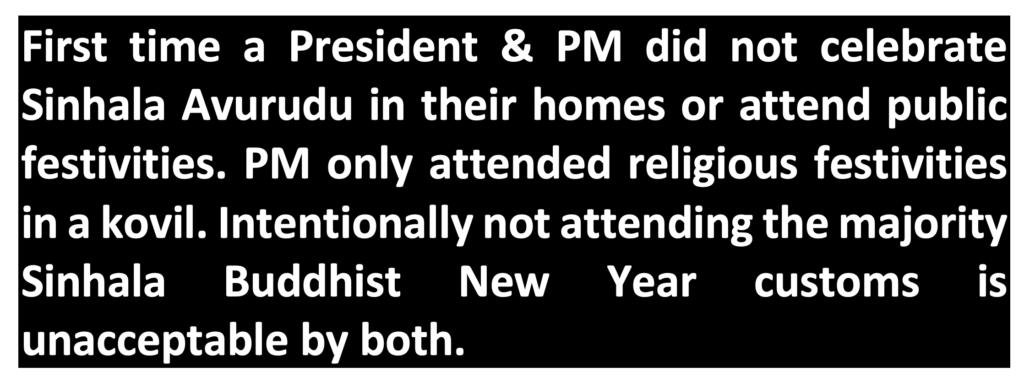
වසර දෙදහස් පන්සියයකට අධික ඉතිහාසයක් ඇති ජාතියක ප්‍රධාන සංස්කෘතික උත්සවයක් සැමරීමට රටේ රාජ්‍ය නායකයා ප්‍රසිද්ධියේ පස්සා ගසා ඇතැයි ජාතික නිදහස් පෙරමුණේ නායක හිටපු පාර්ලිමේන්තු මන්ත‍්‍රී විමල් වීරවංශ මහතා පවසයි.

ඒ මහතා සිය සමාජ ජාල ගිණුම ඔස්සේ නිකුත් කර ඇති නිවේදනය මෙසේය.

ගරුතර ස්වාමීන් වහන්ස,
අන්‍යාගමික පූජකතුමනි,
මවුවරුනි, පියවරුනි,
සහෝදරයා, සහෝදරිය,

සිංහල හා දමිල අලුත් අවුරුද්ද සැමරීම රාජ්‍ය මට්ටමෙන් සිදු නොවූවද රට පුරා බහුතරයක් පොදු මහජනතාව ආර්ථික අපහසුතා තිබියදී පවා උත්කර්ෂවත් ලෙස අලුත් අවුරුදු සැමරීමට කටයුතු කළහ.

මා මෙවර සමාජ මාධ්‍යවල නිරීක්ෂණය කළ එක් දෙයක් වූයේ අලුත් අවුරුද්ද සැමරීමේ අර්ථ විරහිත භාවය පිළිබඳ කතිකාවක් සමාජ මාධ්‍ය තුළට හදිසියේ පැමිණ තිබීමයි. සමහරු මුලු ලොවෙන් මේ උත්සවය සමරන්නේ ශ්‍රී ලංකාවේ පමණක් බවද මෙය ඒ නිසා අරුම පුදුම අවුරුදු සැමරීමක් බවද කියා සිටියහ.(මුසාවකි.ආසියාවේ බොහෝ ජාතීන් මාර්තු හා මැයි අතර තමන්ට අනන්‍ය අලුත් අවුරුද්දක් සමරති.) සමහරු සිංහල නක්ෂස්ත්‍රය තුළ ඇති දර්ශණයේ දුබලතාවය ගැනද තවත් සමහරු අතීත කාමයේ ඇලී ගැලී සිටිමින් වර්තමානයට නොගැලපෙන සිරිත් විරිත් ඉදිරියට ගෙනයාමක් ලෙසද අලුත් අවුරුද්ද අර්ථකතනය කර තිබුනි. අප කලිනුත් කියා ඇති පරිදි වැදගත් වන්නේ අලුත් අවුරුද්ද විවේචනය කරන කිසිදු ගැඹුරු විමංසනයකින් තොර තුන්වන පන්තියේ කුලී මත වාහකයන් නොව සිංහල අලුත් අවුරුද්ද වැනි යම් ජාතියකට අනන්‍ය සංස්ක්කෘතික උත්සව සැබෑ ගැටළුවක් වී ඇත්තේ කාටද යන්න ගැඹුරින් විමසීමයි.

ෆ්‍රැන්සිස් ෆුකුයාමා නම් අමෙරිකානු ලිබරල් ආර්ථික චින්තකයා ලෝක අවධානය දිනූ ඔහුගේ End of History and the last man” කෘතියේ පැවසූ පරිදි ලෝක මනුෂ්‍ය සංස්කෘතික විකාශනයේ අවසානය නිදහස් වෙළඳපොල සමාජ ආර්ථික ක්‍රමයයි. එය (අතිශය සාධාරණම) මනුෂ්‍ය සංහතියේ අවසාන සමාජ ආර්ථික නවාතැන් පොළයි.(ෆුකුයාමා පසුව USAID සහ සම්බන්ධිත ආයතයක අධ්‍යක්ෂක ධූරයකින් පිදුම් ලැබීය.) මේ අනුව විවිධ ජාතීන්ට අනන්‍ය සංස්කෘතීන් දියවී ලිබරල් වෙලඳ සංස්කෘතියක් හා එකම පාරිභෝජන සමාජයක් ඇතිවීම මේ ප්‍රවාදයට අනුව අනිවාර්‍ය ප්‍රතිඵලයකි.ඒ ප්‍රතිඵලය ඇතිවීමට නම් ඒ තත්වයට බාධාකරන සංස්කෘතික බාධක ඉවත් කළ යුතුය. හැම්බර්ගරය, හොට්ඩෝගය වැළඳ ගත යුතු සමස්ත ලෝක සංස්කෘතියකට කැකුළු කිරිබත, කැවුම, කොකිස, හැළපය හෝ කුරක්කන් රොටිය ගැලපෙන්නේ නැත. අලුත් අවුරුද්ද අමු හරමානිස්” වී දෙසැම්බර් තිස් එක හෙන මොඩර්න්” වන්නේ මේ නිසාය. අලුත් අවුරුද්දේ නක්ෂස්ත්‍රමය හෝ තාරකා විද්‍යාත්මක හෝ සමාජ විද්‍යාත්මක නිස්සාරත්වය හොයන සමහරුන්ට දෙසැම්බර් හා ජනවාරි අලුත් අවුරුද්දේ ප්‍රභවය ග්‍රීක මිත්‍යා විද්‍යාවට සුසම්බන්ධ බව ඔළුවට පහරක් ගැසූවද” මතක් නොවන්නේ හෑලි නොලියවෙන්නේ” ඒ නිසාය.දෙසැම්බර් තිස් එක ලෝක ලිබරල් වෙළඳපොලට හා බටහිර සංස්කෘතියට ප්‍රධාන උත්සවයක් වන නිසා වෙනත් සංස්කෘති වල අලුත් අවුරුදු මොවුන්ට නයාට අඳුකොල” වන්නේ ඒ නිසාය.

මේ තත්වය තේරුම් ගන්නා ජාතික රාජ්‍යයන් වල විමුක්තිය වෙනුවෙන් කටයුතු කරන රාජ්‍ය නායකයෝ සිය රටවල් වලට අනන්‍ය සංස්කෘතික උත්සව ප්‍රවර්ධනය කරති. අදිසි ලෝක අධිරාජ්‍යයේ බලපෑමට නතු නොවී සිය ජනයා එකමිටට තබා ගැනීමට සිය සංස්කෘතික මූලයන් ශක්තිමත් කරති.

වසර දෙදහස් පන්සියයකට අධික ඉතිහාසයක් ඇති ජාතියක ප්‍රධාන සංස්කෘතික උත්සවයක් සැමරීමට රටේ රාජ්‍ය නායකයා ප්‍රසිද්ධියේ පස්සා ගැහීම” දෙස අපි ඉතා බැරෑරුම්ව බැලිය යුත්තේ මේ නිසාය.

විමල් වීරවංශ
නායක
ජාතික නිදහස් පෙරමුණ

ලෝක ආර්ථිකය අවිනිශ්චිතයි.. සූදානම් වන්න.. – මහ බැංකුව අනතුරු අඟවයි

April 17th, 2025

Courtesy Lanka Leader

ලෝක ආර්ථික පරිසරයේ අවිනිශ්චිත බව සැලකිල්ලට ගෙන ඊට මුහුණ දීම සඳහා ප්‍රතිපත්තිමය සූදානම ඉහළ නැංවීම අත්‍යවශ්‍ය බව ශ්‍රී ලංකා මහ බැංකුව පවසයි.

විශේෂයෙන් නව නිදහස් වෙළෙඳ ගිවිසුම් සක්‍රීයව ක්‍රියාත්මක කිරීම සහ භාණ්ඩ වෙළෙඳාම වෙනස් වීමේ අවස්ථා ශ්‍රී ලංකාවට වාසිදායක අයුරින් යොදා ගැනීම සඳහා ප්‍රතිපත්තිමය සූදානම ඉහළ නැංවිය යුතු බවද මහ බැංකුව කියයි.

ශ්‍රී ලංකා මහ බැංකුව විසින් පසුගියදා නිකුත් කළ පසුගිය වර්ෂය (2024) සඳහා වන මහ බැංකුවේ වාර්ෂික ආර්ථික විවරණ වාර්තාවේ මේ බව සඳහන් වේ. තවදුරටත් එම වාර්තාවේ මෙසේද සඳහන් වේ.

ඇමෙරිකාව විසින් ශ්‍රී ලංකාවේ අපනයන සඳහා පනවන ඕනෑම අන්‍යොන්‍ය තීරු බද්දකින් රටෙහි අපනයන අංශයට විශාල බලපෑමක් ඇති කළ හැකිය.

මීට අමතරව ඇමෙරිකානු රජයේ ප්‍රතිපත්ති ගැළපීම්වලින් ශ්‍රී ලංකාවේ අනෙකුත් ප්‍රධාන වෙළෙඳ හවුල්කරුවන්ට ඇති විය හැකි බලපෑමෙන් ශ්‍රී ලංකාවේ අපනයන සඳහා අහිතකර බලපෑමක් ඇති විය හැකිය.

– Divaina

Reveal perpetrators behind Easter Sunday attacks, Catholic church urges govt.

April 17th, 2025

YOHAN PERERA Courtesy Daily Mirror

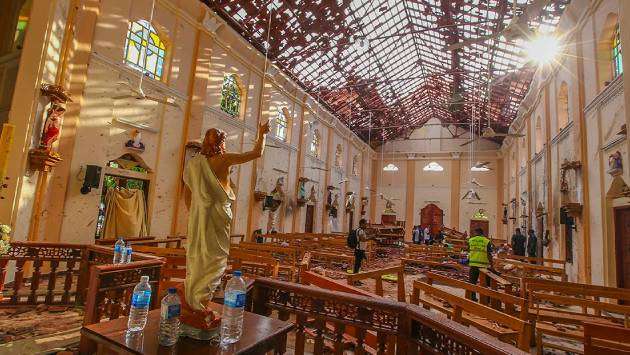
Colombo, April 17 (Daily Mirror) – The Catholic Bishops’ Conference in Sri Lanka, in its special message for Easter stressed that ascertaining who the perpetrators of the Easter Sunday attacks in 2019 were and those who have aided and abetted in the dastardly act, is a matter of urgency. 

“This Easter also marks the sixth anniversary of the Easter Sunday bomb attacks on innocent worshipers

at Catholic and other Christian Churches and in other places in 2019, causing death and injuries to hundreds of people. 

In this regard, we observe that certain positive steps have been taken by the present government to ensure an independent and impartial inquiry into this brutal attack. 

While we appreciate the efforts made so far, we insist that as a matter of urgency and justice, the final aim of the inquiries should be to ascertain who the perpetrators are and those who have aided and abetted in the dastardly act. 

We shall continue to pray earnestly for wisdom and courage for the leaders of our country, as well as solace and healing for the victims,” the message signed by the President of the Catholic Bishops’ Conference in Sri Lanka, Bishop Harold Anthony Perera and Secretary General Bishop Anthony Jayakody said. 

“Easter also calls us to promote with renewed vigour the sanctity of human life. Thus, we are called to condemn all that is detrimental to the promotion of human life, such as interference with  procreation, abortion and other forms of killing and destruction of human life,” the message added.

GAMMANPILA SAYS NO CONNECTION ESTABLISHED BETWEEN PILLAYAN AND EASTER ATTACKS

April 17th, 2025

Hiru News

The Centre for Society and Religion (CSR) claims that Sivanesathurai Santhirikanthan, also known as Pillaiyan, and his former media spokesperson, Azad Maulana, had connections with individuals involved in the Easter Sunday attacks.

However, former Minister Udaya Gammanpila, speaking at a press conference yesterday (16), stated that the government’s attempt to create a narrative that connects Pillaiyan to the Easter attacks has failed.

Meanwhile, Director of the CSR, Father Rohan Silva, also speaking at a press conference yesterday (16), claimed that evidence has emerged indicating the involvement of local intelligence services in the Easter Sunday attacks.

Safeguarding Sovereignty Through Cultural Integrity and Strategic Neutrality

April 16th, 2025

Sunil J. Wimalawansa
(Professor of Medicine)

A nation thrives when it preserves its traditional values, cultural heritage, language, and fundamental beliefs. Nations fail whether these lacks. The mentioned elements form the foundation of national unity, sovereignty, spiritual strength, and cultural identity.

For Sri Lanka, with its ~2,500-year-old Buddhist heritage, protecting this legacy is a matter of pride and a necessity for maintaining independence and dignity on the world stage. We have lost some of these strengths and recognitions over the past 75+ years due to short-sighted and selfish politicians. Should fellow citizens allow the current leadership to continue down a path of destruction that undermines our unitary nature and sovereignty—as appears to be happening with secret MoUs with India?

However, it does not mean we should keep boasting about our historic achievements (e.g., agriculture) and not embrace modern methods and technology—for example, digitization of government agencies and departments, cybernetics for broader development, including eliminating waste, abuse, and fraud, and incorporating artificial intelligence, robotics in manufacturing, etc. These apply to all government departments and to the private sector. Major changes are needed. The lack of preparation and decision-making power in the optimum way to respond to the US tariff is another recent example.

By learning from countries that have successfully upheld their cultural identity while remaining non-aligned (e.g., Sweden, Switzerland, etc.), Sri Lanka must strategically and diplomatically avoid manipulation by global powers—without provoking them—through diplomacy with a well-defined national vision. Unfortunately, many Sri Lankan politicians stray from this path due to ego, ignorance, and personal gain. Sustainable prosperity can only be achieved by remaining neutral in global conflicts, properly utilizing our natural resources, prioritizing economic growth with value-added exports, identifying new markets, facilitating the private sector to succeed by deregulation and tax incentives to boost exports, reducing excessive government expenditure (by at least 30%―unachieved), and focusing on the population’s well-being and happiness.

As part of this broader national strategy, preserving our heritage—which has evolved over generations and been protected through great sacrifice—must remain a top priority. Why are Sri Lankans abandoning the invaluable cultural foundations laid by their ancestors that continue to benefit the country? Nevertheless, embracing modern technologies such as digitalization and cybernetics must never come at the cost of our heritage or national identity.

True sovereignty discourages conflict and ensures the protection of a nation’s citizens. This must be achieved through stable, long-term diplomatic relations and compassionate governance—not through misguided, politicized trade agreements, PTAs, or undisclosed memoranda of understanding with foreign powers, such as India or China—people own the country and have the power over politicians they are only appointed temporary caretakers. There is no reason for the government(s) to hide such information from the public. Despite high expectations, these values and principles remain absent in the current and previous leadership, while entrenched bureaucracies continue to harm the nation and its people.

Rather than merely discussing these issues amongst themselves—or remaining silent—citizens must raise their voices firmly, collectively, and peacefully to compel the leadership to change course. This does not call for street protests or violence but for constructive strength, unity, and a shared vision to guide the country back onto the right path. Through such a revival, Sri Lanka can reclaim peace, success, and prosperity. Reclaiming and upholding these ideals is essential for national renewal and long-term resilience. 

Essential Insights on LTTE Crimes: Articles by Shenali Waduge

April 16th, 2025

By Palitha Ariyarathna

As Sri Lanka navigates critical discussions on sensitive topics such as international sanctions and allegations against its armed forces, it is imperative to ground deliberations in evidence-based understanding. Shenali Waduge, a renowned analyst and expert on LTTE-related crimes, provides a wealth of invaluable information on the activities and atrocities committed by the LTTE.

Her articles, listed below, serve as key resources for understanding the broader context of LTTE operations, their consequences, and the underlying narratives that have shaped international perceptions. These writings are indispensable for decision-makers, including the Cabinet Sub-Committees tasked with addressing issues of national importance.

Attention to Cabinet Sub-Committees: The articles highlighted here provide critical perspectives necessary for informed deliberations. They not only challenge unsupported allegations but also present well-documented evidence that sheds light on LTTE atrocities and their implications for Sri Lanka. It is strongly recommended that Committee members review these resources thoroughly and incorporate them into their discussions.

Selected Articles:

Chronology of Tamils taking firearms since 1950s

Sri Lanka’s military-humanitarian operation with timelines

https://www.defence.lk/Article/view_article/862

Sri Lanka: Who are the Missing” who are the Dead” & who were killed!

https://www.defence.lk/Article/view_article/845

Foreign Governments disclose ALL TAMIL refugees & asylum seekers to conclude ‘Missing’ ‘Disappeared’ in Sri Lanka

https://www.defence.lk/Article/view_article/874

LTTE ‘DEAD’ RESURFACE: SECURITY FORCES DESERVE PUBLIC APOLOGY AND COMPENSATION

Sri Lanka’s LLRC report claims 22,247 LTTE dead – who are they?

https://www.defence.lk/Article/view_article/863

LTTE War Crimes: Human Shields

Sri Lanka’s genocide witnesses” were living abroad during the May 2009 conflict?

Sri Lanka ends LTTE Terrorism: All foreigners commemorating Mullaivaikkal Massacre” get your facts straight first

Sri Lankan Truth Commission – Sri Lanka’s Armed Forces must not fall for this trap of story-telling & confessions for compensation!

UK Govt – What about UK living White Tiger Aunty Adele” trainer of LTTE Child Soldiers & British MPs abusing their office?

Why is it that Tamil Eelam is sought by only Tamils living overseas?

Wikileaks discloses source of 40,000 (deaths) as Ranil Wickremasinghe

Was life for Tamils better under the LTTE?

LTTE the worlds only terrorists to use Goats & Dogs for target practice – where are the animal rights activists

https://lankasara.com/life/social/ltte-the-worlds-only-terrorists-to-use-dogs-goats-for-target-practice-where-are-the-animal-activists

Did Sri Lanka commit ‘war crimes’? International Legal luminaries Prof. Crane and Sir Desmond de Silva say NO

Did Sri Lanka commit ‘war crimes’? International Legal luminary Prof. Michael Newton says NO

Did Sri Lanka commit ‘war crimes’? International Legal luminary Sir Desmond de Silva says NO

The Tamil ‘problem’: How can Sri Lanka solve a problem that does not exist?

https://www.themorning.lk/articles/ZN8nQWUSeoRyLmCbkrOw

11 years after LTTE defeat – Terrorist head Prabakaran is just a money-making commodity for LTTE Diaspora

…And who looked after Prabakaran’s Parents?

India gave birth to LTTE & Tamil militancy in Sri Lanka

LTTE revival saga exposes ‘civilian’ claim

Why didn’t the LTTE or LTTE diaspora develop the north when the LTTE ruled it?

https://www.themorning.lk/articles/219828

Prabhakaran is dead but not the LTTE and Eelam

http://archives.sundayobserver.lk/2015/01/04/fea05.asp

Sri Lanka Must Eliminate Eelaam Ideology For Reconciliation To Succeed 

https://www.eurasiareview.com/24102012-sri-lanka-must-eliminate-eelaam-ideology-for-reconciliation-to-succeed-oped

Sri Lankans respond to channel 4 & the international community

https://www.slideshare.net/slideshow/sri-lankans-respond-to-channel-4-the-international-community/12051467

THE UN INVESTIGATIVE PANEL MUST PROBE TNA-LTTE LINKS

Rajiv Gandhi ordered Prabhakaran assassination but…

https://www.vijayvaani.com/ArticleDisplay.aspx?aid=2915

Mullaivaikkal Commemoration: Mourning the Civilians killed by LTTE or LTTE cadres killed in final battle?

SRI LANKA : MOST OF THE 19 ‘JOURNALISTS’ KILLED WERE LTTE OR KILLED BY LTTE

https://www.onlanka.com/news/sri-lanka-most-of-the-19-journalists-killed-were-ltte-or-killed-by-ltte.html

Mullaivaikal Commemoration – Mourning LTTE Dead Under Pretense Of ‘Civilian Dead’

Who can file accountability against Adele/LTTE on behalf of LTTE Child Soldiers/Women?

UK celebrating Women’s Day protecting LTTE Terrorist Aunty Adele

India And Sri Lanka Must Seek War Crimes Against Adele Balasingham For Fostering LTTE Suicide Terrorism

https://www.eurasiareview.com/24092012-india-and-sri-lanka-must-seek-war-crimes-against-adele-balasingham-for-fostering-ltte-suicide-terrorism-oped

UN/UNHRC: What about the war crimes of ‘Aunty’ Adele Balasingham?

Review: Truth Behind Dare Documentary

http://www.srilankaguardian.org/2021/02/review-truth-behind-dare-documentary.html

Fostering LTTE suicide terrorism

http://archives.sundayobserver.lk/2013/01/20/fea03.asp

Open Letter to the Sigrid Rausing Trust on Yasmin Sooka & ITJP

https://www.defence.lk/Article/view_article/1803

TAMIL CIVILIANS KILLED BY LTTE

https://www.onlanka.com/news/tamil-civilians-killed-by-ltte.html

Shashirekha the wife of Thamilselvan (LTTE political wing leader) says:

UN & so-called International Community did sweet nothing to stop LTTE terrorism

Amnesty International Secretary General Agnes Callamard arrives to commemorate LTTE dead in Mullaivaikkal

TAMIL TEENS promoting LTTE holding foreign passports

Mahaveerar Naal (Great Heroes Day) / ‘Maaveerar Vaaram’ (Great Heroes Week)– Is it a LTTE event?

LTTE had POLICE POWERS without 13A – TNA wants POLICE POWERS with 13A

This Children’s Day we remember the forgotten LTTE Child Soldiers!

NO TRUTH COMMISSION if India’s training & funding LTTE is not included

Tamil Genocide Remembrance Day – Questions for Canada

18 May 2009 Sri Lanka defeats LTTE: If you can’t name the dead 40,000 there is no ‘genocide’

How about thanking Sri Lanka’s Armed Forces for saving Tamil children from becoming Child Soldiers!

When EPRLF kidnapped an American couple in 1984 & sought ransom paid to Tamil Nadu Government

If Maaveerar Naal hails LTTE dead – What do we call event to commemorate Tamils killed by LTTE?

Commemorating Maaveerar Naal is Tamil people’s right – Wigneswaran” – then who is going to commemorate Tamils killed by LTTE

The West falling for LTTE Goebbels Machine

Non-LTTE Tamils/Diaspora vs LTTE-Tamils/Diaspora

Ending Sri Lanka’s Conflict: 7721 Collateral Damage is worth the eventual peace

UNHRC must judge Sri Lanka on violations of IHL not Human Rights

LTTE would have been eliminated in May 1987 & not May 2009 if India did not save LTTE

The capture of Kilinochchi on 2 January 2009 ended military offensive & brought Sri Lanka under one flag

US & UK Military Attache’s demolish UNHRC allegations against Sri Lanka

All foreign passport holding Eelam promoters – You want Eelam, you come to Sri Lanka & create it yourselves”

Remembering PC 3164 A Karunanidhi 1st Policemen killed by LTTE on 14 February 1977

Sri Lanka must demand answers from UNHRC – Prove we killed 40,000 or shut up!

Why is UNHRC not bothered about 5000 Missing Sri Lankan Soldiers

TNA was formed by LTTE & contested December 2004 elections

How many Tamil children did TNA save from being turned to child soldiers by LTTE?

Jaffna STATE University cannot allow proscribed LTTE terrorist monuments

DISGRACEFUL – UK commemorates dead LTTE terrorists by lighting UK Parliament

LTTE has taken murder, extremism and mayhem to the West

MOURNING THE DEAD: A Soldier & a terrorist can never be equal

Sri Lanka’s Victory: LTTE turned children into child soldiers. Sri Lanka brought out the talents in child soldiers

Sri Lanka’s Dead: Are LTTE dead in LLRC report also featured in OMP list?

Sri Lanka’s Military Defeat over LTTE Terrorism – some facts

Who wants Tamil Eelam – Who are asking Political Solutions?

Questions to UNSG/UNHRC: Who killed 6261 soldiers during the final phase – LTTE or Tamil Civilians or Others?

Where’s the Sri Lanka Monitoring Mission report: 3,830 LTTE violations & 356 GOSL violations

Call to Action: Committee members are encouraged to engage with these resources to ensure discussions are based on factual evidence and are reflective of the realities surrounding LTTE operations. For further truth-finding and clarity on these critical topics, Shenali Waduge can be reached through her public platforms, such as her website, or Committee members may coordinate to establish communication where necessary.

By incorporating these insights into deliberations, the Cabinet Sub-Committees can uphold the values of justice, integrity, and sovereignty that define Sri Lanka, paving the way for balanced and effective resolutions.

By Palitha Ariyarathna

What the Country Needs to Do and How it Can Unite as One Nation.

April 16th, 2025

 By Dr Ramesh Somasunderam. Willetton 6155, Australia.

I believe what Sri Lanka needs most is very good Civil and District Administration.  This is what can make the country to function and be governed well.

Sri Lanka for once is united under one party and importantly the present President of our lovely country his Excellency Mr. Anura Kumara Dissanayake. Even the Tamils residing in the North and East of Sri Lanka voted for him as their President.  Based on this, all Sri Lankans wanted an honest, fair and equitable leader to give them a fair go and employment prospects including, accountability and a just nation.  Based on these facts stated, the President of Sri Lanka can ensure as one nation to make the District Administration nonpolitical and functional again and the civil administration a quality one by training our Sri Lanka Administrative Servants by getting quality men and women from the higher civil service in Britain and India to come and train our men and women in the Sri Lanka Higher Administrative Service. This plus mega projects such as the The Kelani River scheme and the Jaffna Salt Water Scheme should be done including making Off Shore banking and Sri Lanka the United Nations of the Fareast by that ensuring our independence.  

Sri Lanka’s foreign policy should be neutral but more towards India. Otherwise they will want the road to be built between India and Sri Lanka and the 13th Amendment for devaluation to the Sri Lankan Tamils in the North and East of the country. They believe like the British to divide the rule the nation of Sri Lanka.

In fact it was the central government of India that trained the LTTE and not Tamil Nadu as viewed by many majority Sinhalese.  Tamil Nadu emphasized with the Sri Lankan Tamil situation, but did not military train them. The late Mrs Gandhi the Prime Minister of India got many Sri Lankan Tamil militant groups trained in North Indian as the then President of Sri Lanka J. R. Jayewardene was pro-West rather than pro India. Based on this example it is foolish to play games between China and India. We must be neutral in our foreign policy, but lean more towards India as it is regional and potential superpower. Thereby ensuring Sri Lanka is made the center of South Asia.

The problem at present is the current President not using the SLAS Members in key positions and not envisaging on the projects I have stated above. If all of this is done the Central government which is pro North Indian will be pleased with the current government of Sri Lanka and not against it or work against our President and his government as happened in the past.

The other aspect could be Sri Lanka can have a living cricket academy for three years for a Degree to be granted to a promising cricketer men and women from whole of South Asia and promote grassroots cricket in a professional scale within the region, not just Sri Lanka. 

At present there is killings among gag groups and contact killing taking place in Sri Lanka, which is because there is a lack of civil and district administration in Sri Lanka. If one takes India for example their higher civil administration is what keeps the country together and functional, not their politicians who are jokers from a majority perspective, both national and state wise in India, but it is their higher civil service which is the pillar of India and it functionality as a nation or country.     

Sri Lanka can unite by ensuring English is the main language in the country and Singhalese and Tamil can be followed by people who want their children to be proficient in their mother language like in India where English is the link language even though Modi wants Hindi as well. I suppose time will tell whether this approach pays deviance to India as a nation.   

Proposal for Accelerating the Development of the Marine and Offshore Industry in Trincomalee

April 16th, 2025

 Dr Sarath Obeysekera 

His excellency The President
(Thru Deputy  Minister of ,Ports  Aviation and Road Development) 

As the Chairman of the Advisory Board under the Export Development Board, I am reaching out to discuss an exciting opportunity for Sri Lanka, particularly in the context of developing our marine and offshore industry, including nautical tourism within the framework of a blue economy.

In recent years, the Export Development Board has been advocating for the development of Trincomalee, positioning it as a hub for the repair and construction of platforms as well as converted ships used in the oil industry. 

Notably, the Port Authority completed a feasibility study in 2021, funded by the Asian Development Bank, which outlined the potential of this initiative as a significant source of income generation for the country.

During my tenure as Chairman, I was involved in a subsequent feasibility study that identified Clappenburg in Trincomalee as an ideal waterfront location for establishing facilities where local and foreign contractors could operate.

 The Corporate Plan recognised the establishment of a shipyard and offshore construction yard as vital to generating foreign income and creating employment opportunities for our skilled workforce, many of whom are currently migrating abroad to pursue opportunities in countries like Korea, Romania, and the UAE.

With the foundational concepts already laid out, I respectfully request your Excellency to engage the Ministry of Ports, the Ministry of Industries, and the Board of Investment (BOI) to generate interest among large foreign conglomerates to invest in this venture.

Furthermore, while India holds certain development rights in Trincomalee, actual investment beyond IOC’s storage tanks has been minimal. 

We must also consider the underutilized development of the tank farm in Trincomalee, the pipeline from India to Sri Lanka, and potential projects such as the Adani wind power initiative and green hydrogen generation. Collaboration with foreign companies, including Tata, Abans, and L&T, alongside established Singaporean or Korean yards could catalyze the development of an offshore construction yard in Trincomalee.

Trincomalee’s potential for generating energy through wind, wave, or solar power structures is immense, and we should leverage our land and resources to build a competent offshore Center of Excellence in our port city.

While we are training engineers and software developers to drive digitalization, the need for skilled workers in the industry remains critical. Additionally, bringing in Chinese investment for a refinery in Hambantota and tank farm development in Trincomalee could further strengthen our industrial capacity.

It is essential to revolutionize vocational training to meet industry demands, which have, in the past, suffered due to political interference.

 By empowering our youth to work in our own heavy industrial sectors, we can stem the tide of skilled labor migration.

The Industrial Development Board (IDB) of the Ministry of Industries could undertake land development in collaboration with the Port Authority to manage the harbor front, creating necessary infrastructure such as berths and mooring buoys to accommodate ships and rigs.

To expedite the development of Trincomalee, I propose appointing a dedicated Minister or State Minister specifically focused on advancing the blue economy. This strategic leadership can accelerate initiatives to generate foreign income and create employment opportunities for our youth.

Thank you in advance for considering this vital proposal for the future of our marine and offshore industry.

 I look forward to your support in making Trincomalee a leader in blue economy initiatives.

Sincerely, 
Dr Sarath Obeysekera 

ජනපතිගේ ප්‍රකාශය සෙසු අපේක්ෂකයින්ට අවමානයක් සහ නින්දාවක් -තුසිත බාලසූරිය

April 16th, 2025

තුසිත බාලසූරිය

මාලිමාව පරාජය වන පළාත් පාලන ආයතනවලට මුදල් නොදෙනවා යන ජනපතිගේ ප්‍රකාශය පුරවැසියෙක් ලෙසත් මහරගම නගර සභාවට එක්සත් ජාතික පක්ෂයෙන් ඉදිරිපත් වන අපේක්ෂකයෙක් ලෙසත් දැඩිව හෙළා දකිමි. එය එක් අර්ථයකින් ජනතාවගේ බලයට හා ඡන්ද අයිතියට විරුද්ධව යාමකි. අනෙක් අර්ථයෙන් මාලිමාවේ අපේක්ෂකයන් හැර අනෙක් අපේක්ෂකයන් සියල්ල හොරු බවට පත්කෙරෙන අතිශය අසාධාරණ පුර්ව නිගමනයකි.

අවසන් පළාත් පාලන මැතිවරණයේ සිට පළාත් පාලන ආයතනවලට නියෝජිතයන් තෝරාපත් කරගන්නා ක්‍රමය වෙනස් කර නව ක්‍රමය හදුන්වා දෙන ලද්දේ ප්‍රදේශයට වගකියන නියෝජිතයෙක් එම ප්‍රදේශයෙන්ම තෝරාපත් කරගැනීම උදෙසා ය. ගමට වගකියන ගමේ නියෝජිතයා යන්න එහි සරලම අර්ථයයි. එය ජාතික දේශපාලනය සමඟ පටලවා ගැනීමම වැරදිසහගත ය. එමනිසා ජනාධිපතිවරයාගේ එම ප්‍රකාශය නීතිමය මෙන්ම දේශපාලනික අර්ථයෙන්ද වැරදි සහ අවමන් සහගත ප්‍රකාශයකි.

පොදුවේ සෑම පුරවැසියෙක්ම නියෝජනය කරන ජනාධිපතිවරයා තමන්ගේ පක්ෂයේ නියෝජිතයන් හැර අනෙක් සියල්ල හොරු ලෙස හැදින්වීම අනෙක් අපේක්ෂකයන්ට කරන අවමානයක් සහ නින්දාවකි. දේශපාලනයේ දී පමණක් නොව හොරකම් නොකිරීම පුද්ගලික දිවියේ වටිනාකමක් ලෙස පවත්වාගෙන යන මා වැනි අවංකයින් සෑම පක්ෂයකම ඇත. තමන්ගේ පුද්ගලික ධනය පවා සමාජ සේවය වෙනුවෙන් කැප කරන ලද සැබෑ ජනතා සේවකයන් බහුතරයක් සිට ඇත්තේ එක්සත් ජාතික පක්ෂයේ බව ජනාධිපතිවරයාට අමතක වී ඇත.

පළාත් පාලන ආයතනවල සිදුවන අල්ලස්, හොරකම් හා වංචා ගැන අවධානය යොමු කිරීම වැදගත් වුවත් මාලිමාවේ අපේක්ෂකයන් හැර අනෙක් සියල්ල හොරු වංචනිකයන් කරන මෙම ප්‍රකාශය ජනාධිපතිවරයා විසින් වහා ඉල්ලා අස්කර ගත යුතුය. ජනපතිගේ මෙම අත්තනෝමතික හා පක්ෂග්‍රාහී ප්‍රකාශයට එරෙහිව මුලික අයිතිවාසිකම් පෙත්සමක් ගොනු කිරීමට මෙන්ම විද්වත් පිරිසකගේ සහභාගිත්වයෙන් පළාත් පාලන ආයතනවලට ප්‍රතිපාදන වෙන් කිරීම සහ ජනාධිපතිවරයාගේ බලතල ගැන වු සම්මන්ත්‍රණයක් පැවැත්වීමටද මා කටයුතු සංවිධානය කරමින් පවතී.

මෙම ප්‍රකාශයෙන් මැතිවරණයට ඉදිරිපත් වන මාලිමාවේ නොවන අපේක්ෂකයනට වන බලවත් අසාධාරණය ගැන ජනතාව දැනුවත් කර නිදහස් හා සාධාරණ මැතිවරණයකට ඉඩ හදන මෙන් සියලු පාර්ශවයන්ගෙන් ඉල්ලා සිටී.

එක්සත් ජාතික පක්ෂයේ මහරගම නගර සභා – ගොඩිගමුව උතුර අපේක්ෂක තුසිත බාලසූරිය විසින් 2025.04.16 දින නිකුත් කරන ලද මාධ්‍ය නිවේදනය.

I2U2 and Modi’s Visit to Colombo: The New QUAD in the Indian Ocean eyes Sri Lanka?

April 16th, 2025

Ishani Agnihotri 

An MOU to develop an LNG power project on the East Coast of Sri Lanka, near the coveted Indian Ocean Trincomalee Deep Sea Port, with India and the United Arab Emirates was signed on Prime Minister Narendra Modi’s recent visit to Sri Lanka by President Anura Dissanayaka.

The multicultural Eastern Province was decimated during the 30-year war between the Liberation Tigers or LTTE and the Sri Lanka military, when Israel’s Mossad agents operated from bases in the Batticaloa District to set up and train Sri Lanka’s Special Forces, some of which were later linked to Batalanda and other terror and torture house operations by State-run and other Paramilitary Groups accused of disappearences in the South during the so called JVP insurrection 1988-1990.

Israel’s Secret Service, Mossad agents, along with veterans of the British Special Air Services (SAS) , and Keenie Meenie (KMS Group, now Saladin, London) Mercenaries, were imported to Sri Lanka by the Washington-backed J.R. Jayawardena regime in the early eighties after the staged Pogrom/ Riots of 1983. These foreign intelligence agencies and mercenaries were brought to Sri Lanka purportedly to set up and train Special Forces to fight the war against the LTTE.  Training Camps were set up in the Eastern Province to train the Special Force in Batticaloa District, where local people called the white mercenaries Mossadu” (cf. Phil Miller’s book, Keenie Meenie: The British Mercenaries who got away with War Crimes”).

What emerged in Sri Lanka was a classic Cold War Proxy war between the LTTE then backed by India closely allied with the Communist Soviet Union/Russia and the US-and Western allies backed regime of Yankie Dickie J.R. Jayawardena, destroying ancient patterns of co-existence among Sinhala and Tamil-speaking people in Sri Lanka. The ensuing internationally networked and run Dirty War in Sri Lanka was called an indigenous, internal ethnic conflict”.

Weaponization of Religion/s in Eastern Province by Foreign Intelligence Agencies- Past and Present

Ethno-religious identities were fragmented and fully Weaponized at the time as part of counter-terrorism operations with Mossad training- as is the case in Israel. From 1984 Israel’s Mossad operated in the Eastern Province. In Colombo they worked out of the Israeli Special Interest Section at the US embassy.

The Kathankudi Mosque Massacre was staged to destroy close relations between Muslims and Tamils in the East, and the LTTE expelled Muslims from Jaffna in 1990.  Not coincidentally, Kathankudi was where the leader and members of the ISIS-claimed 2019 Easter Sunday suicide bombers hailed from. The mysterious Evangelical Zion Church was also set up in Batticaloa as part of the Cold War Weaponization of Relgion/s.

Ancient patterns of co-existence and intermarriage among Muslims and Tamils who share the unique matrilineal Kudi System of kinship and descent documented by many social scientists in the Eastern Province, were targeted and broken as in Palestine by Mossad and Shin Bet which destroyed brotherly / sisterly relations between Palestinian Muslims and Christians and Jews to set up the State of Israel. As per counter-terrorism operations.

Is history set to repeat itself in the Eastern Province of Sri Lanka, once again with I2U2 entrenching itself in Trincomalee and religion/s again being weaponized?

Recently, a mysterious boat load of Rohingya Muslims was parachuted into the eastern Seas and Mullaithivu. Red flags should fly in Sri Lanka with the I2U2 (India, Israel, and United Arab Emirates cooperating to build an LNG power plant in Trincomalee given the Mossad Chabad Houses mushrooming in Sri Lanka and Israeli Tourist and Agri-businesses in Arugambay and Kantalai?

Is the US drawing India and Sri Lanka into its latest Indian Ocean Quad, the West Asia war machine via the I2U2?

Few Sri Lankan Geopolitical Pundits, researchers and think tanks seem to know or care about the I2U2, but maybe they should? This, especially as another predictable Disinformation and Cover Up investigation of the external Master-mind of the ISIS-claimed Easter Sunday Terror Attacks, who also removed the cell phones of the culprits and gamed the data unfolds, targeting a bit player called Pillayan.

I2U2 : The Aspects and the Prospects

Ishani Agnihotri | 16 August 2022


Established at the Foreign Ministers’ meet in October, 2021, I2U2 stands for India, Israel, United Arab Emirates (UAE), and the United States (US) quadrilateral partnership. The leaders of the above four member countries met (virtually)[i] for the first time on 14th July, 2022. Combining complementary strengths and capabilities to fulfill mutual socio-economic interests, the new Quad partners look forward to bolstering cooperation and partnership in the region – as indicated in the inaugural summit.[ii]

The changing dynamic of West Asia has however made the foreign policy sphere rife with speculation on the strategic and geopolitical prospects, and the viability of this newly formed mini-lateral. It is in this light that this issue brief examines the aspects of this newly formed body, and the potential prospects of cooperation that lie ahead. With a brief understanding of the purpose of this new Quad, the paper studies the nature of existent bilateral relationships between members, their individual divergent geopolitical interests, and the factors that bring them together, exploring the road ahead.

The Purpose of I2U2

I2U2 identifies 6 areas of cooperation and investment, namely – water, energy, transportation, space, health, and food security. It intends to mobilise private sector capital and expertise to help modernise infrastructure, develop low carbon development pathways for industries, improve public health, and promote the development of critical emerging and green technologies in the member countries.[iii] The countries deny any military angle to their cooperation with the agenda of the mini-lateral focused on the economic and infrastructural development.[iv]

The Nature of Relationship between the Four Member States

Two federal republics, a Jewish democratic state, and a monarchy – the four I2U2 member countries share comprehensive economic, military, and political bilateral relationship with each other. The US is the largest trading partner for both, India and Israel. India, on the other hand, is the second largest trading partner of UAE (2021) and the third-largest Asian trade partner of Israel (2019). India-UAE Comprehensive Economic Partnership Agreement (CEPA) also entered into force recently (February, 2022). In terms of trade in defence, India was the largest importer of arms in 2017-21 with Israel and the US being its third and fourth largest defence supplier respectively.[v] India is also the largest buyer of Israeli military equipment.[vi] The countries are also co-participants in different military exercises, like, the Blue Flag air combat exercise (Israel), or the Desert Flag exercise (UAE), which saw the participation of both India and the US along with other countries.

Bilaterally, India shares prolific relationships with the three other members; boasting of a ‘Global Strategic Partnership’ with the US, ‘Comprehensive Strategic Partnership’ with the UAE, and 30 years of successful diplomatic relationship with Israel. Indian expatriates today make up roughly 30 per cent of UAE’s total residents – double of the original Emirati ethnic population themselves.[vii] US and Israel also share a Strategic Partnership relationship. US was the third country to establish formal diplomatic relations with UAE post its independence in 1971. The strategic proximity of their relationship is exhibited in the fact that UAE hosts the busiest US air base in the wold for surveillance flights, Al Dhafra.[viii] It also hosts the busiest US Navy port of call, Jebel Ali.[ix] Furthermore, the signing of the Abraham Accords brokered by the US in August, 2020 has led to full normalisation of ties between the Jewish state of Israel and the Arab UAE.

The thriving bilateral relationships however do not mean that the four countries share same ideological and strategic interests. For instance, Iranian rivalry is central to the US and Israeli outlook of West Asia. India and UAE, on the other hand, continue to find ways to engage with Tehran. India’s historical and cultural relationship with Iran, though pressured under Western sanctions, continues to thrive as witnessed during the recent diplomatic exchanges between the two states.[x], [xi]  Similarly, the rise of China has had different meanings for the four countries in discussion. While the US eyes the rising Chinese footprints in the region and Indo-Pacific with adversarial sight, India has a tight rope to walk with its current belligerent neighbour. Israel and UAE, on the other hand, have been observed to be benefitting from the rising Chinese economic investments in the region. China and UAE recently upgraded their ties to Comprehensive Strategic Partnership status.[xii] There has also been increased defence and technical cooperation between China and Israel which has caused concerns in Western nations, particularly the US. The Chinese investment in the construction of container terminals in Haifa port (Israel) and Khalifa port (UAE) as part of its flagship Belt and Road Initiative (BRI) further exacerbates the US security concerns in the region.[xiii]

The pending resolution of the Palestinian issue is also a point of divergence in the relationship shared by these four countries. For example, the Arab-Israel rivalry and the two states solution advertised by the UN is known to have shaped the West Asian geopolitics since 1947. India also calls for a peaceful resolution of Israel-Palestine issue.[xiv] In the light of these dynamics, India-Israel bilateral relationship remained mostly restricted to technology, defence and agriculture until recent high level visits post 2014.[xv] Economics, energy, and the emerging geopolitical trends have now paved way for a more realist outlook in the current century as witnessed in the signing of the Abraham accords.

What brings the Four Nations Together?

The creation of I2U2 is seen as one of the key dividends of the Abraham Accords that intends to pave the way for normalisation of Arab-Israel ties.[xvi] Today, Israel has newly established diplomatic relationships with four Arab League countries, namely UAE, Bahrain, Sudan and Morocco. The evolving geopolitical, economic, security and social realities of the region are encouraging new diplomatic dialogues. For example, the Neom Meeting between Saudi Crown Prince and Israel Prime Minister was held in November, 2020.[xvii] With the potential coming together of the West Asian region, the four nations’ foreign ministers’ meeting was held in a hybrid format last year. India, Israel, UAE, and the US, explored possibilities for joint infrastructure projects in transportation, tech, maritime security, economics and trade, as well as for additional joint projects. In this meeting, the Ministers decided to establish a forum for economic cooperation to take forward their maiden dialogue which eventually led to the current format of I2U2. In the event of this converging foreign policy interests of the otherwise socially and regionally diverse countries, it becomes essential to understand what brings these nations together.

The four members of I2U2 seem to be bound by two major interests – the regional geopolitical footprint expansion and the global socio-economic security. For the US, the creation of this alliance serves two purposes, firstly, it negates the notion” of the US withdrawal from West Asia, and secondly, it strengthens its strategic footprints in the region by fulfilment of the long term American commitment towards Israeli economic, political and strategic integration in the region.[xviii] For Israel and UAE, the two nations bound by economic realism, this alliance can create blueprint for effective West Asian future cooperation.[xix] The founding membership of this Western mini-lateral also reaffirms the leadership role that India holds today in consolidation of the South Asian rimland. I2U2 offers India a platform to more openly engage with Israel and other Arab countries beyond bilateral means to benefit economically, socially and geopolitically in the region.

Speaking of the global socio-economic security interest, the world, as we know today, is witnessing a new set of emerging challenges beyond the conventional threats. If the global growth was at risk (as reported by the UN)[xx], the COVID-19 pandemic, increasing competition for global dominance, and the current Russia-Ukraine war have made the economic and social costs of dwindling growth more visible. Supply chains break-down, trade wars, energy insecurity and geopolitical-economic issues have been observed to pull down the global economic recovery attempts.[xxi] Whereas ecologically, the food insecurity, declining soil productivity, global warming, and climate change threaten the long term survival of the societies itself.[xxii] It is in this light that the convergence of different capabilities becomes important to counter the forces of unsustainability – as depicted in the agenda for I2U2.[xxiii]

What Benefits Lie for the Four Nations?

For the US, the ‘West Quad’ allows for expansion of the geographic scope of its relationship in the region – securing the East Mediterranean Coast to the Persian Gulf axis. This becomes important when viewed in conjunction with the speculated development of the Russia-China-Iran triangle in the region.[xxiv] It will also help the States reinvigorate the partnerships which suffered during the previous presidency of Donald Trump. A stable, connected and cooperative West Asia further ensures the security of the US’ socio-economic interests and investments in the region as its policy focus expands to the Indo-Pacific.[xxv]

I2U2 also presents India with an opportunity to play global leadership role alongside the US while keeping its strategic autonomy and national interests intact. Deepening of ties with the West Asia region as a whole presents holistic diplomatic and infrastructural connectivity channels for India. This can benefit both, the large Indian diaspora in West Asia, as well as India’s own economic and political interests. For example, the realisation of India-Arab-Mediterranean Corridor, as a next step of India – West Asia connectivity, can provide economically viable alternate trade routes connecting the Indian subcontinent to the European Mainland.[xxvi] The prospective completion of this supply chain corridor will not only benefit the people to people connect but will also strengthen India’s trade and energy security.

The newly formed diplomatic ties between Israel and UAE also have the potential to benefit the West Asia region at large. For UAE, it impresses upon the growing prominence of the country in the Gulf region with its cosmopolitan high economic profile. Whereas for Israel, it presents opportunity for initiation, expansion and solidification of formal diplomatic ties with other Arab states. A successful cooperation between Israel and UAE within the American umbrella and Indian support can open doors for realisation of economic relationship between Israel and Saudi Arabia as a next step.

While on paper this new found grouping is said to be entirely focussed on economic and infrastructural development, one cannot completely ignore the security and geopolitical issues which surround the four member states. Different scholars have questioned the viability of this union when it comes to conflicting ideological and national interests; the response to Iranian threat being a case in point.

Convergence in Divergence

As noted by Winston Churchill, We have no permanent friends, but permanent interests”. The combined fear of weaponisation of Iranian nuclear program is known to bring diverse nations together complemented by American support. While there exists an anti-Iran front, there also coexists a sense of balance in the region when viewed from UAE and Indian perspective. India has been working with and around Western sanctions to maintain the strategic warmth of its historic relationship with Iran.[xxvii] This also becomes important in the light of recent Chinese strategic overtures in the region.

China is overtly known for making its economic inroads into West Asia since the beginning of this century.[xxviii] Although Chinese investments in Israel, UAE, and other Gulf countries have remained economic till now, the surfacing of Iran-China Strategic Partnership Agreement bodes deeper engagement in the region. The growing Chinese economic, and now strategic, heft in the region, bodes a possibility of competition and contestation in the region in the race for polarity. The I2U2 goals would thus benefit by disengaging the forum’s economic and development agendas from the member states’ individual security and strategic interests. The denial of any military angle in the first summit of the grouping hints in this direction.

The Road Ahead

I2U2 offers a unique combination of Israeli innovative technology, US global industrial expertise, Emirati economic resources and Indian market leadership together to present sustainable competitive opportunities that can benefit the global economic order today. In light of current global turmoil like the COVID-19 pandemic fall-outs and the ongoing Russia-Ukraine crisis, the areas of cooperation identified by this grouping namely – water, energy, transportation, space, health, and food security – are both short term requirements and long term imperatives. The burgeoning global population, and the declining planet capacity, in conjunction with potentially destructive multipolarity contestations, can thus use responsible leadership to attain balance in the above domains.

As far as India is concerned, it is no longer content to be passive recipients of outcomes in the West Asian region, and it is with this understanding with which Delhi is becoming more proactive about deepening its relationships in the region. Rather than waiting for the ties to take shape organically or mere reciprocation to events as they occur, I2U2 presents India with a much suited leadership role for shaping the global socio-economic security structure. However, it remains equally essential for the member states to not lose out on the above global goals for individual geopolitical interests. A stable, less volatile, and cooperative West Asia holds hope for the otherwise restive world today.

*****

* Ishani Agnihotri, Research Intern, Indian Council of World Affairs, Sapru House, New Delhi.
Disclaimer: The views are of the author. 

Endnotes

[i] Omri Nahmias, (2022, July 14), Leaders of Israel, US, India and the UAE meet for the inaugural ‘I2U2’ virtual summit, Retrieved from The Jerusalem Post: https://www.jpost.com/breaking-news/article-712091, Accessed on July 18, 2022

[ii] The First Post, (2022, July 15).  Understanding the new I2U2 bloc and what exactly was agreed at the first summit attended by PM Modi, Retrieved from The Firstposthttps://www.firstpost.com/india/understanding-the-new-i2u2-bloc-and-what-exactly-was-agreed-at-the-first-summit-attended-by-pm-modi-10913811.html, Accessed on July 18, 2022

[iii] Press Release, (2022, July 12), First I2U2 (India-Israel-UAE-USA) Leaders’ Virtual Summit, Retrieved from MEA:https://www.mea.gov.in/press-releases.htm?dtl/35489/First+I2U2+IndiaIsraelUAEUSA+Leaders+Virtual+Summit, Accessed on July 18, 2022

[iv] Kashif Anwar, (2022, July 25), The I2U2 and India’s role in Middle East’s QUAD, Retrieved from The Financial Express: https://www.financialexpress.com/defence/the-i2u2-and-indias-role-in-middle-easts-quad/2605153/ , Accessed on August 10, 2022

[v] Amit Cowshish, (2022, March 14), India emerges as the largest importer of arms in 2017-21, Retrieved from The Financial Express: https://www.financialexpress.com/defence/india-emerges-as-the-largest-importer-of-arms-in-2017-21/2460365/, Accessed on July 18, 2022

[vi] Ibid

[vii] Indian Community in UAE, Retrieved from the Embassy of India in UAE: https://www.indembassyuae.gov.in/indian-com-in-uae.php, Accessed on July 18, 2022

[viii] Matthew Wallin, (2018, June), US Military Bases and Facilities in the Middle East, Retrieved from AmericanSecurityProject.org: https://www.americansecurityproject.org/wp-content/uploads/2018/06/Ref-0213-US-Military-Bases-and-Facilities-Middle-East.pdf, Accessed on July 22, 2022

[ix] Ibid

[x] Media Center, (2022, June 08), Visit of H. E. Dr. Hossein Amir Abdollahian, Foreign Minister of the Islamic Republic of Iran to India (June 08-10, 2022), Retrieved from MEA: https://mea.gov.in/press-releases.htm?dtl/35402/Visit+of++H+E+Dr+Hossein+Amir+Abdollahian+Foreign+Minister+of+the+Islamic+Republic+of+Iran+to+India+June+0810+2022, Accessed on July 18, 2022

[xi] The Hindu, (2020, September 05), Rajnath Singh to meet Iranian Defence Minister, Retrieved from The Hindu: https://www.thehindu.com/news/national/rajnath-singh-to-meet-iranian-defence-minister/article32530014.ece , Accessed on July 18, 2022

[xii] China, UAE agree to lift ties to comprehensive strategic partnership, Retrieved from Ministry of Foreign Affairs of the PRC: https://www.mfa.gov.cn/ce/como/eng/news/t1579379.htm, Accessed on July 18, 2022

[xiii] EurAsian Times Desk, (2021, October 7), Chinese Investments In Israel’s Haifa Port ‘Rattle’ The US; Washington Raises Espionage Concerns, Retrieved from EurAsian Times: https://eurasiantimes.com/chinese-investments-in-israels-haifa-port-rattle-the-US-washington-raises-espionage-concerns/ , Accessed on July 22, 2022

[xiv] ANI, (2022, January 20), India at UN reiterates for peaceful resolution of Israel-Palestine issue, supports two-state solution, Retrieved from https://www.aninews.in/news/world/US/india-at-un-reiterates-for-peaceful-resolution-of-israel-palestine-issue-supports-two-state-solution20220120011443/, Accessed on July 22, 2022

[xv] India, (2019, June), India-Israel Bilateral Relations, Retrieved from MEA: https://www.mea.gov.in/Portal/ForeignRelation/India-Israel_relations.pdf, Accessed on July 22, 2022

[xvi] Dipanjan Roy Chaudhury, (2022, June 15), Maiden I2U2 meet in July, Prime Minister Narendra Modi to attend virtually, Retrieved from The Economic Times: https://economictimes.indiatimes.com/news/india/maiden-i2u2-meet-in-july-prime-minister-narendra-modi-to-attend-virtually/articleshow/92213821.cms?utm_source=contentofinterest&utm_medium=text&utm_campaign=cppst, Accessed on July 14, 2022

[xvii] Al Jazeera, (2020, November 23), Netanyahu met MBS, Pompeo in Saudi Arabia: Israeli media, Retrieved from Al Jazeera: https://www.aljazeera.com/news/2020/11/23/netanyahu-met-with-mbs-pompeo-in-saudi-arabia-israeli-sources, Accessed on August 4, 2022

[xviii] Michael Kugelman, (2022, July 14), Another Quad Rises, Retrieved from Foreignpolicy.com: https://foreignpolicy.com/2022/07/14/i2u2-quad-india-israel-uae-US-south-asia/, Accessed on July 18, 2022

[xix] Ibid

[xx] Elliott Harris, (2019, February 06), Risks to global growth, Retrieved from The Hindu: https://www.thehindu.com/opinion/op-ed/risks-to-global-growth/article26186252.ece?homepage=true , Accessed on July 22, 2022

[xxi] Press Release, (2022, June 7), Stagflation Risk Rises Amid Sharp Slowdown In Growth, Retrieved from the World Bank: https://www.worldbank.org/en/news/press-release/2022/06/07/stagflation-risk-rises-amid-sharp-slowdown-in-growth-energy-markets, Accessed on July 22, 2022

[xxii] IPCC 6th Assessment Report, 2022, Climate Change 2022: Impacts, Adaptation and Vulnerability, Retrieved from IPCC: https://www.ipcc.ch/report/ar6/wg2/, Accessed on July 22, 2022

[xxiii] Press Release, (2022, July 12), First I2U2 (India-Israel-UAE-USA) Leaders’ Virtual Summit, Retrieved from MEA:https://www.mea.gov.in/press-releases.htm?dtl/35489/First+I2U2+IndiaIsraelUAEUSA+Leaders+Virtual+Summit, Accessed on July 18, 2022

[xxiv] Mercy A. Kuo, (2022, July 07), The China-Iran-Russia Triangle: Alternative World Order?, Retrieved from The Diplomat: https://thediplomat.com/2022/07/the-china-iran-russia-triangle-alternative-world-order/ , Accessed on July 22, 2022

[xxv] Michael Kugelman, (2022, July 14), Another Quad Rises, Retrieved from Foreignpolicy.com: https://foreignpolicy.com/2022/07/14/i2u2-quad-india-israel-uae-US-south-asia/, Accessed on July 18, 2022

[xxvi] Michael Tanchum, (2021, August), India’s Arab-Mediterranean Corridor: A Paradigm Shift in Strategic Connectivity to Europe, Retrieved from South Asia Scan, Issue No 14, iSAS, NUS: https://www.isas.nus.edu.sg/wp-content/uploads/2021/08/South-Asia-Scan-Aug-2021-V4.pdf, Accessed on July 18, 2022

[xxvii] Rajeev Agarwal, (2022, June 11), India-Iran ties are ripe for a reset, Retrieved from The Diplomat: https://thediplomat.com/2022/06/india-iran-ties-are-ripe-for-a-reset/,  Accessed on July 22, 2022

[xxviii] Zvi Mazel, (2022, April 21), China’s growing economic impact on the Middle East, Retrieved from GIS Reports: https://www.gisreportsonline.com/r/china-middle-east/, Accessed on July 22, 2022 

https://www.icwa.in/show_content.php?lang=1&level=1&ls_id=7760&lid=5166#skipCont

Dharma Gifts That Illuminate Lives: A Grateful Tribute

April 16th, 2025

Palitha Ariyarathna

In the ceaseless cycle of Samsara, where beings traverse the realms of existence, the teachings of the Buddha shine as a beacon of wisdom and liberation. The Corporate Body of the Buddha Educational Foundation, based in Taipei, Taiwan, has committed itself to the noble task of sharing these profound teachings by offering Dharma books and materials freely to practitioners around the world.

For many years, I have been privileged to receive their Dharma gifts, which have been a transformative force in my spiritual journey. The books I received during my early adulthood—such as the treasured Pirivana Poth Wahanse—helped me embrace the Dharma deeply and find guidance in the Buddha’s timeless wisdom. These books were not just for me; they became gifts I shared with others. Neighboring households, libraries, and friends were introduced to these sacred teachings, creating ripples of positive impact within our community.

In my home, these books have remained a source of inspiration and spiritual growth. My late mother, in her final years, immersed herself in the teachings they provided. Until her passing, she found comfort and strength in their pages—a reminder of the Buddha’s compassion and the path to liberation. Today, I continue this legacy by exploring titles such as The Gift of Well Being and Loving and Dying.

Loving and Dying, published in 1993 by the Malaysian Buddhist Meditation Centre and gifted to me in 1994by the Buddhist Foundation in Taipei, Taiwan, holds a special place in my spiritual journey. It is a book of profound insights that has deeply resonated with my wife and me as we immerse ourselves in its teachings. One particularly moving reminder from the book encapsulates the Buddha’s ultimate wisdom: Yes, all Buddhists should remember that the Buddha’s last reminder to us was to strive on untiringly to attain the wisdom that can liberate us from birth and death.”

The Corporate Body of the Buddha Educational Foundation’s mission exemplifies the spirit of dana (selfless giving). Their generosity allows practitioners to embrace the Buddha’s teachings without barriers, spreading light and hope to those seeking peace in their lives. Their offerings include materials in multiple languages, such as English, Hindi, Sinhala, French, Tibetan, and more, ensuring accessibility for Dharma friends across cultures and continents.

This foundation’s work deserves recognition and support. They have called upon individuals and organizations to help promote their mission by sharing information through newsletters, publications, TV productions, and websites. By doing so, we can help amplify their outreach, ensuring that more people gain access to their invaluable free resources.

As an author and publisher dedicated to protecting and promoting Buddhism, I feel deeply compelled to contribute to their noble cause. Through my writings, I aspire to highlight their efforts and inspire others to support their work. Together, we can help ensure that the Buddha’s wisdom continues to illuminate lives and guide beings toward liberation from the Samsara.

I also encourage Dharma friends to explore their offerings and share them with others. All materials are provided strictly for free distribution and cannot be sold, reflecting the purity of their intentions and dedication to the Dharma.

The foundation has requested updates to contact details to ensure seamless delivery of materials. I humbly urge recipients to provide the necessary information so that these gifts continue to reach those who need them.

For further details about their offerings or to access their Dharma resources, please visit their official website at

www-old.budaedu.org.

With gratitude for their work and the impact it has had on my life and the lives of others, I extend my heartfelt wishes to the venerable monks and staff of the foundation. May their efforts flourish and bring every living being closer to the light of enlightenment.

Contact Information:  Fax: +886-2-2391-3415 E-mail: overseas@budaedu.org Air Mail: 11F, No.55, Hang Chow South Road, Sec. 1, Taipei City, Taiwan (Post Code: 100)

May these Dharma gifts transform lives as they have mine, spreading peace, wisdom, and the boundless compassion of the Buddha across the world.

With highest regards, 

 Palitha Ariyarathna

Ceo and Founder, Ceylonwatch” Analyst of Buddhist Affairs Desha Abhimani Surya Vansa Ratna Vibhushan Senkadagala Sinha Dwaraya TCFBI PEC President, Unethical Conversion of Buddhist TCFBI International Co-ordinator Hela Abimani National Foundation – Secretary,  Founder, Sinhala Prathipaththi Kendraya,   President Jathika Bawuddha Balawegaya,   Author, Publisher, and Journalist

අනුර හොඳටම බයවෙලාද ඉන්නේ…? | රැලියේ කිව්ව කතාව පත්තුවෙයි | ආණ්ඩුවේ පරස්පර වැඩ මුජිබර් එළියට ගනී

April 16th, 2025

ලංකාවට එන ඉන්දීය යුධ අවි කර්මාන්තශාලාවක් ගැන ආචාර්ය දයාන් ජයතිලකගෙන් හෙළිදරව්වක්

April 16th, 2025

Hiru News

GOVERNMENT’S EFFORTS TO IMPLICATE PILLAYAN IN EASTER ATTACKS FAILED – GAMMANPILA

April 16th, 2025

Niru News

The government’s efforts to create a perception that Sivanesathurai Santhirakanthan, alias Pillayan, is involved in the Easter attacks have failed, says former parliamentarian Udaya Gammanpila.

He stated this at a media briefing today (16).

Former State Minister Chandrakanthan was arrested on the 8th of this month, pertaining to investigations into the abduction and disappearance of Professor Sivasubramaniam Ravindranath, a former Vice-Chancellor of the Eastern University.

The arrest comes 18 years after the alleged abduction, which is said to have occurred on December 15, 2006.

Pillayan, who was arrested under the Prevention of Terrorism Act (PTA), is currently being held in the custody of the Criminal Investigation Department on a 90-day detention order.

Attorney-at-Law Gammanpila met with Pillayan and held discussions for half an hour yesterday (15).

TOWARDS A NEW INTERNATIONAL ORDER?: INDIA, SRI LANKA AND THE NEW COLD WAR

April 15th, 2025

By Dr. Asoka Bandarage

Will a peaceful and sustainable multipolar world be born when the rising economic weight of emerging economies is matched with rising geopolitical weight, as argued by renowned economist Jeffrey Sachs in his recent Other News article?[i]

There is no question that, as the US-led world order collapses, a new multipolar world that can foster peace and sustainable development is urgently needed. BRICS (Brazil, Russia, India, China, South Africa) was established to promote the interests of emerging economies by challenging the economic institutions dominated by the West and the supremacy of the US dollar in international trade. Asia alone constitutes around 50% of the world’s GDP today. China is expected to become the world’s leading economy and India, the world’s third largest economy by 2030.

But does economic growth alone reflect improvement in the quality of life of the vast majority of people? And should it continue to be the central criteria for a new international order”?

Unfortunately, BRICS appears to be replicating the same patterns of domination and subordination in its relations with smaller nations that characterize traditional imperial powers. Whether the world is unipolar or multipolar, the continuation of a dominant global economic and financial system based on competitive technological and capitalist growth and environmental, social and cultural destruction will fundamentally not change the world and the disastrous trajectory we are on.

Despite many progressives investing hope in the emerging multipolarity, there is a deep systemic bias that fails to recognize that the emerging economies are pursuing the same economic model as the West. This means we will continue to live in a world that prioritizes unregulated transnational corporate growth and profit over environmental sustainability and social justice. China Communications Construction Company and the Adani Group are just two examples of controversial Chinese and Indian conglomerates reflecting this destructive continuity.

Is India, as Professor Sachs says, providing skillful diplomacy” and superb leadership” in international affairs?[ii] Look, for example, at India’s advancing vision of Greater India,” Akhand Bharat (Undivided India) and behavior towards its neighboring countries. Are these not strikingly similar to US strategies of hegemonic interference?

While India promotes its trade and infrastructure projects as enhancing regional security and welfare, experiences in Nepal demonstrate how Indian trade blockades and electricity grid integration with India have made Nepal dependent on and subordinate to India in meeting its basic energy and consumer needs. Similarly, Bangladesh’s electricity agreement with the Adani Group has created a situation allowing Adani to cut power supply to Bangladeshi consumers.

Since the fall of the Sheikh Hasina regime, there have been widespread demands to cancel the deal with Adani, which is seen as unequal and harmful to Bangladesh. Similarly, recent agreements made with Sri Lanka would expand India’s “energy colonialism” and overall political, economic and cultural dominance threatening Sri Lanka’s national security, sovereignty and identity.[iii]

During Indian Prime Minister Narendra Modi’s visit to Sri Lanka, April 4-6, 2025, according to reports in the Indian media, some seven to ten agreements were signed to strengthen ties in defense, electricity grid interconnection, multi-product petroleum pipeline, digital transformation and pharmacopoeial practices between the two countries. The agreements have been signed using Sri Lankan Presidential power without debate or approval of the Sri Lankan Parliament. The secrecy surrounding the agreements is such that both the Sri Lankan public and media still do not know how many pacts were made, their full contents and whether the documents signed are legally binding agreements or simply Memoranda of Understanding” (MOUs), which can be revoked.

The new five-year Indo-Lanka Defense Cooperation Agreement is meant to ensure that Sri Lankan territory will not be used in any manner that could threaten India’s national security interests and it formally guarantees that Sri Lanka does not allow any third power to use its soil against India. While India has framed the pact as part of its broader Neighborhood First” policy and Vision MAHASAGAR (Great Ocean)” to check the growing influence of China in the Indian Ocean region, it has raised much concern and debate in Sri Lanka.

As a member of the Quadrilateral Security Dialogue (QUAD)—a strategic alliance against Chinese expansion that includes the United States, Australia and Japan—India participates in extensive QUAD military exercises like the Malabar exercises in the Indian Ocean. In 2016, the United States designated India as a Major Defense Partner and in 2024, Senator Marco Rubio, current US Secretary of State, introduced a bill in the US Congress to grant India a status similar to NATO countries. In February 2025, during a visit to the USA by Modi, India and the US entered into a 10-year defense partnership to transfer technology, expand co-production of arms, and strengthen military interoperability.

Does this sound like the start of a new model of geopolitics and economics?

Sri Lankan analysts are also pointing out that with the signing of the defense agreement with India, there is a very real danger of Sri Lanka being dragged into the Quad through the back door as a subordinate of India.”[iv] They point out that Sri Lanka could be made a victim in the US-led Indo-Pacific Strategy compromising its long-held non-aligned status and close relationship with China, a major investor, trade partner and supporter of Sri Lanka in international forums.

The USA and its QUAD partner India, as well as China and other powerful countries, want control over Sri Lanka, due to its strategic location in the maritime trade routes of the Indian Ocean. But Sri Lanka, which is not currently engaged in any conflict with an external actor, has no need to sign any defense agreements. The defense MOU with India represents further militarization of the Indian Ocean as well as a violation of the 1971 UN Declaration of the Indian Ocean as a Zone of Peace and the principles of non-alignment—which both India and Sri Lanka have supported in the past.

Professor Sachs—who attended the Rising Bharat Conference, April 8-9, 2025 in New Delhi—has called for India to be given a seat as a permanent member in the UN Security Council gushing that no other country mentioned as a candidate …comes close to India’s credentials for a seat.” But would this truly represent a move towards a New International Order,” or would it simply be a mutation of the existing paradigm of domination and subordination and geopolitical weight being equated with economic weight, i.e., might is right”?

Instead, the birth of a multipolar world requires the right of countries—especially small countries like India’s neighbors—to remain non-aligned amidst the worsening geopolitical polarization of the new Cold War.

What we see today is not the emergence of a truly multipolar and just international order but continued imperialist expansion with local collaboration prioritizing short-term profit and self-interest over collective welfare, leading to environmental and social destruction. Breaking free from this exploitative world order requires fundamentally reimagining global economic and social systems to uphold harmony and equality. It calls on people everywhere to stand up for their rights, speak up and uplift each other. In this global transformation, India, China and the newly emergent economies have significant roles to play. As nations that have endured centuries of Western imperial domination, their mission should be to lead the global struggle for demilitarization and the creation of an ecological and equitable

Towards a New International Order?: India, Sri Lanka and the New Cold War – Other News – Voices against the tide


https://www.other-news.info/towards-a-new-international-order-india-sri-lanka-and-the-new-cold-war/


[i] Jeffrey D. Sachs, Giving Birth to the New International Order.” Other News (blog), April 11, 2025. https://www.other-news.info/giving-birth-to-the-new-international-order/.

[ii] Ibid.

[iii] Asoka Bandarage, Indian Colonialism in Sri Lanka | Inter Press Service.” Inter Press Service, March 27, 2025. https://www.ipsnews.net/2025/03/indian-colonialism-sri-lanka/.

[iv] Dr. G. Weerasinghe, Defence MoU with Quad Member Will Drag Sri Lanka Further into New Cold War: CP.” Sunday Island Online, April 11, 2025. http://island.lk/defence-mou-with-quad-member-will-drag-sri-lanka-further-into-new-cold-war-cp/.

A Nation without a culture is a Nation without a soul

April 15th, 2025

Shenali D Waduge

Culture, traditions, values, and rituals are not written by politicians — they are carved into the soul of a nation. Governments may pass laws, leaders may come and go, but the heartbeat of a civilization lives in its people. No politician, no policy, and no personal agenda can erase what generations have carried in faith, sacrifice, and memory.” As such the decision by both the President & PM not to attend any Sinhala Buddhist New Year celebrations is disappointing especially when the PM decided to only attend a Hindu religious celebration in a kovil. With teams drawing up both their itineraries well in advance, this omission was nothing but intentional & should go down in history with disgust & distaste.

With the open economy, commercialism & consumerism man/women & child have been turned to commodities. As such the modus operandi has been to distance the individual from his clan. All that had kept a family together is being subtly dismantled to isolate the individual. Customs like bowing down to elders has been laughed at. Being modern is not being disrespectful. Culture & kindness never goes out of style. While world attention has been drawn to artificial” intelligence, what is being ignored is the natural intelligence of the mind which is far greater & more powerful than any computer system working on algorithms & filters. Elders are walking libraries. They can share with you wonderful stories you will never enjoy on Netflix. Don’t wait till they’re gone to learn from them.

Notice how the media is being used to erase language by mixing words from other languages. These are all pre-planned initiatives to erase the identity of people. A generation that mocks tradition grows up confused. Look at the lives of those who mock tradition & customs. They present an outward confident self but inside they are fighting their confused self.

It is important for all to realize that we are the vehicle for the continuity of our culture. Education system has failed to show how our ancestors have carried the flame & passed it on to us to carry not to blow it out. In Sri Lanka, ayubowan is more than just a greeting, it’s a blessing. Thus our culture, our values, our Buddhist heritage are not just decorations. They are the backbone, our identity and it is our duty to protect them.

No smartphone, no wi-fi can match a happy family. Modern is not forgetting what made us strong for thousands of years. The magnificent monuments, the ancient architecture, the irrigation marvels were all built without modern technology, not by people graduating from ivy league universities or anyone who had passed O/L or A/L with distinctions. Modern & development has so many restrictions. There were no doors, windows or massive gates for fear of rogues & rapists. There were no cameras watching our movements. Do we really have the freedom that the ancient people enjoyed?

It is unfortunate that many have come to consider culture as merely an annual event wearing a national dress grudgingly following what parents demand. Culture is about how we think. How we live. How we treat our parents, grandparents & others.

When Buddhists stop going to the temple, teaching dhamma lessons to our children – it is not becoming modern. We are creating a lost generation. This is probably part of the agenda.

Children need to be taught discipline, they must also be taught to know their mother tongue or feel shy to speak it. Schools should not be a place for marks. It must be a place for morals. This is what is lacking today in both student & teacher. Teach maths but team Metta, teach science but also teach Sila, teach ambition but also teach Anicca (impermanence) these are lessons that are eternal truths.

It is unfortunate that for foreign funding, personal scholarships etc policy makers are sacrificing the foundation of this nation. Those who write policies, syllabuses & laws are committing a major mistake in removing Dhamma from schools, erasing history in the name of bogus neutrality”. Social media is full of ugly messages making children & even adults believe that Buddhist values are old fashioned”. Falsely believing so will usher a future of people with less integrity, less humanity and no wisdom. A country that forgets its roots will fall not with an explosion but with slow decay. We can see it happening because people with no values, no integrity & no character are in seat of governance & decision making.

The youth must be intelligent enough to not fall for the traps. Don’t accept the lie that tradition is boring. Don’t be ashamed of your culture. Be proud of it. Be a generation that remembers not a generation that thinks it fashionable to forget. Be modern in skill but ancient in spirit. Wear modern clothes but remember your sila.

Look around the lives of youth who claim to belong to the new generation” how happy are they? Do you not notice there is something missing in their lives? This experiment has failed. These youth become guineapigs of lust, drugs & all types of narcotics, their bodies are used that by the time they are of a mature age they have nothing more to enjoy. What should have been enjoyed phased out has been experienced in their teens & these children become psychologically traumatized beings.

We are fully aware of the plot & plan to erase the culture & history of Sri Lanka.

School curriculums are being altered, history is being re-written, diluted or removed especially content related to ancient civilizations & national heroes. Some experts” are promoting Sri Lankan” history when such never existed. Important cultural & religious teachings are being rebranded & claimed controversial”, Sri Lankan students are taught about foreign revolutions and not the heroic efforts of their kings & theroes who protected the Nation. The outcome is simple – youth cut off from their roots grow up with no loyalty to the land that raised them. This is the goal.

Inspite of the Constitutional provision to protect & foster Buddhism/Buddha Sasana temples, pirivenas, cultural centres & local arts are being intentionally neglected, given less funding or those that hate Buddhists are being appointed to govern them. Sacred rituals are mocked, ancient customs are called backward” except when a party wants votes of the majority. Cultural festivals are reduced to commercial events ignoring the spiritual significance. Without respect & support these entities collapse – this is obviously the goal.

There is a new frenzy to promote secularism” this is again intentionally attempting to remove the Buddhist foundation of Sri Lanka. This project involves subtle removal of religious values from education, media, public life in the name of modern” but with intent to dislodge the place of Buddhism, thus the call to change the Constitution which is nothing but to remove Article 9 & Article 16.

Media is being used to redefine the identity of Sri Lanka glorifying modern lifestyles, mocking traditions, promoting foreign ideals, imported cultures. When people are regularly indoctrinated with foreign ideals & values they subtly begin to forget who they are & what they should stand for apart from a wise handful.

The most damaging outcome is by passing laws that undermine heritage to intentionally weaken religious institutions, change status of national language, undermine historical religious protections (Article 9 / Article 16) & promote globalization instead of national culture. When laws stop protecting the national identity, the national identity begins to get erased. This is the goal.

All these may appear unimportant but a nation that forgets its culture becomes vulnerable to division to foreign control & to spiritual collapse. When there is no history, there is no pride in people. If people pride in foreign values, these foreign nations will easily manipulate them. When tradition is forgotten, there is no unity. When this happens, the nation is weak & made vulnerable. When there are no values there is no direction. People end up like zombies and gypsies, no sense of where they belong.

The scenario should now be clear to imagine

How can we overcome these dangers – we need to educate outside the system, teach the real history. We need to support temples, pirivenas & local artists who value our culture & traditions. We need to hold leaders accountable – when they attempt to rewrite or ignore history.

We need to celebrate our culture publicly, proudly & unapoligetically.

Shenali D Waduge

මහරගම නගර සභාවේ අපේක්ෂකයෙක්ගෙන් පළමු වරට ප්‍රතිපත්ති ප්‍රකාශනයක් සහ වෙබ් අඩවියක්

April 15th, 2025

තුසිත බාලසූරිය


මෙවර එක්සත් ජාතික පක්ෂයේ අලියා ලකුණ යටතේ මහරගම නගර සභාවේ ගොඩිගමුව උතුර කොට්ඨාසයට තරඟ කරන තුසිත බාලසූරිය විසින් සිය ප්‍රතිපත්ති ප්‍රකාශනය දිනන මහරගම හදන දැක්ම නමින් වෙබ් අවකාශයට මුදාහැර තිබෙනවා. මෙවර පළාත් පාලන මැතිවරණයට ඉදිරිපත් වන අපේක්ෂකයෙක් වෙබ් අවකාශය හරහා තම ප්‍රතිපත්ති හා දැක්ම එළිදක්වන පළමු අවස්ථාව මෙය වන අතර පහත යොමුව ඔස්සේ ඔබට එම ප්‍රතිපත්ති ප්‍රකාශනය බාගත හැකියි.

දිනන මහරගම හදන දැක්ම ප්‍රතිපත්ති ප්‍රකාශනයෙහි මුලික කරුණු පහක් වෙත අවධානය යොමු කර ඇති අතර එහි පළමු වැන්න වන්නේ පවිත්‍ර පරිසර පද්ධතියක් හා විධිමත් හා අලංකාර ග්‍රාම නගර වටපිටාවක් නිර්මාණය කරන සැපැති දිවියක් යන සංකල්පයයි. එහි දෙවැන්න සුවැති දිවියක් ලෙස නම් කර ඇති අතර එහි අවධානය යොමු කර ඇත්තේ නවීන සෞඛ්‍යාරක්ෂණ ක්‍රම උපයෝගී කරගෙන සනීපාරක්ෂක පද්ධතියක් පිහිටුවීමයි.

සුරැකි දිවියක් යන සංකල්පය ඔස්සේ වැසිකිලි වැනි පොදු පහසුකම් සංවර්ධනය කිරීමටත් එම පද්ධතිය උසස් ප්‍රමිතියෙන් යුතුව පවත්වාගෙන යාමටත් යෝජනා කෙරෙන අතර මංමාවත් ඉදිකිරීම, පිළිසකර කිරීම හා විදුලි පහන් පද්ධතිය නඩත්තු කිරීම වැනි අංශත් ඊට අයත්වනවා. බහුතරයක් බෞද්ධාගමිකයන් වෙසෙන මහරගම පුරවරයේ දිවිගෙවන සෙසු ජාතීන් හා ආගම් අතර සහජීවනය පවත්වා ගනිමින් යහපත් දේ පවත්වාගෙන යාමට සරු දැහැමි ප්‍රජාවක් සංකල්පයද දිනන මහරගම හදන දැක්මේ අන්තර්ගතයි.

මෙම ප්‍රතිපත්ති ප්‍රකාශනයේ වැඩිම අවධානයක් හිමිව ඇත්තේ සුහුරු පරිපාලනයක් බිහි කිරීම උදෙසා වන සංකල්පය ජනගත කිරීමටයි. නගර සභාවල ඇති කල්මැරීම, අල්ලස, වංචාව හා හොරකම මුලිනුපුටා දමමින් ස්මාට් ක්‍රමවේද ඔස්සේ ජනතා ගැටලු විසදීමට උවමනා යෝජනා රැසක් තරුණ ජවය ගොඩිගමුව උතුරින් ජයග්‍රහණය කිරීමෙන් පසු මහරගම නගර සභාවෙහි ක්‍රියාත්මක කිරීමට නියමිතයි.

එක්සත් ජාතික පක්ෂයේ වයස අවුරුදු 35ට අඩු තරුණ කෝටාව නියෝජනය කරමින් දේශපාලනයට පිවිසෙන තුසිත බාලසූරිය පන්නිපිටිය ධර්මපාල විදුහලේ ආදි සිසුවෙක් වන අතර ශ්‍රී ලංකා විවෘත විශ්වවිද්‍යාලයේ වෙබ් අඩවි නිර්මාණය පිළිබඳවද, කොළඹ දේශපාලන පීඨයෙන් ආණ්ඩුකරණය හා ප්‍රතිපත්ති සම්පාදනය පිළිබඳවද වැඩිදුර අධ්‍යාපනය ලබා තිබෙනවා.

මෙම වෙබ් අඩවිය හා දිනන මහරගම හදන දැක්ම නමින් වන ප්‍රතිපත්ති ප්‍රකාශනය පිළිබඳ ඔබ මාධ්‍ය ආයතනයේ ප්‍රචාරණයක් ලබාදෙන මෙන් ඉල්ලා සිටිමි.

Thusitha Balasooriya

853/3, Sooriya, Ranawaka Garden, Pannipitiya.

Western, Colombo, Sri Lanka.

Telephone: +94 112842510

Mobile: +94 774955553/ 706955553

Web: www.sooriya.org
Facebook: https://web.facebook.com/ThusithaBalasooriyaOfficial

Instagram: https://www.instagram.com/thusitha_balasooriya_official/ Linkedin: https://www.linkedin.com/in/thusithabalasooriyaofficial/

What is a gravity bomb? US ramps up production for new nuclear weapon amid World War III fears

April 15th, 2025

US President Donald Trump’s tariff war has rocked global markets and could trigger significant shifts in the world order. Initially dismissed as a mere threat during his campaign, the tariffs unleashed by Trump from the White House have escalated, with China and other countries retaliating. These economic measures, while targeting rivals, may also escalate geopolitical tensions, raising fears of a larger conflict.

US President Donald Trump’s tariff war has shaken the global markets and threatens to bring seismic change in the world order. As Trump announced a tariff plan during the US Presidential elections last year, many world leaders perhaps considered it a threat and bluster. But in the White House, Trump has unleashed waves of tariffs on its trade partners. With many countries, especially China choosing to retaliate with counter tariffs, the trade war is getting uglier by the day.

While slapping tariffs and putting in place trade barriers are aimed at hurting rivals economically, they could potentially stoke geopolitical tensions and eventually turn into conflicts. As globalsuperpowers engage in trade war and flex military muscle, thereare always chances of countries forming coalitions against one another, leading to World War III.

It is worth noting that Trump has been aggressive not only on trade front but also on using military power. He has threatened Iran of bombing in case it doesn’t seal a nuclear deal. Earlier, he came up with the idea of taking over Gaza. Trump has himself warned of World War III if the Russia-Ukraine conflict does not end.

Why Donald Trump is ramping up production of this new nuclear weapon

Amid ongoing power tussles, the US is believed to have started ramping up its nuclear arsenal.A New York Post report said that the US has hastened production of ‘gravity bomb’ because of an urgent” and critical” threat from rising global tensions. The gravity bombs are considered 24 times more powerful than the one used on Hiroshima during World War II.

What is a Gravity bomb?

Gravity bombs are bombs that are dropped from a nuclear-capable aircraft. They are hugely destructive. A single B61-13 gravity bomb is nearly 24 times more powerful than the one dropped on Hiroshima.

The Department of Defense in October 2023 announced that the US will pursue a modern variant of the B61 nuclear gravity bomb, designated the B61-13, pending Congressional authorization and appropriation.

The B61-13 will strengthen deterrence of adversaries and assurance of allies and partners by providing the President with additional options against certain harder and large-area military targets,” it said.

There have been growing concerns around the world on the spread of nuclear weapons. It is believed that China is well on the path to match the number of nuclear weapons deployed by the Russians and the Americans.

The 2022 Nuclear Posture Review (NPR) observed that US competitors continue to expand, diversify, and modernize their nuclear forces while increasing reliance on nuclear weapons. See video here 

විනිසුරු වැරදි කායික ක්‍රියාවකින් හෝ වැරදි නෛතික ක්‍රියාවකින් තීරණය ලබා දීමේ බලපෑම.

April 15th, 2025

නීතීඥ අරුණ ලක්සිරි උණවටුන B.Sc(Col), PGDC(Col) සමායෝජක, වෛද්‍ය තිලක පද්මා සුබසිංහ අනුස්මරණ නීති අධ්‍යයන වැඩසටහන.

විනිසුරු වැරදි කායික ක්‍රියාවකින් හෝ වැරදි නෛතික ක්‍රියාවකින් තීරණය ලබා දීමේ බලපෑම…

මෙහිදී විනිසුරුවරයා විසින්,

1. වැරදි කායික ක්‍රියාවකින් තීරණය ලබාදීම
2. වැරදි නෛතික ක්‍රියාවකින් තීරණය ලබා දිම
යන ආකාර 2 අදාලව සළකා බලා ඇත.

විනිසුරු වැරදි කායික ක්‍රියාවක් කර නඩුවේ තීරණය දීම 

(උදා: නඩුවේ සටහන්, සාක්ෂි, ලේඛන සිය තනි අභිමතයට වෙනස් කිරීම, තනි අභිමතයට සහ හරස් ප්‍රශ්නවලට ලක්නොකර සාක්ෂි ඇතුළත් කිරීම, නඩුවේ පාර්ශවයක් වී තිබියදී සහ නඩුවේ තීරණය දීමට පාර්ශවයක් විරුද්ධ වී තිබියදී තීන්දුව ලබා දිම….)
සහ
විනිසුරු වැරදි නීතිමය ක්‍රියාවක් කර නඩුවේ තීරණය ලබා දීම 

(උදා: සිද්ධිය, සාක්ෂි සහ නීතිය වැරදි ලෙස ගැලපීම, ඉදිරිපත් කරුණු මත වැරදි නීතිමය නිගමන වලට එළඹීම, වැදගත් කරුණු නොසලකා සිටීම, පක්ෂපාතීවීම, නිසි ක්‍රියාදාමය අනුගමනය නොකිරීම, දෙපාර්ශවයට සවන් නොදීම,….) වෙනස් තත්ත්වයන් ය.

පළමු ක්‍රියාවේදී විනිසුරු චේතනාවෙන් වරදක් කරන තත්ත්වයට පත්විය හැකි අතර, දෙවන ක්‍රියාවේදී විනිසුරු චේතනාවෙන් වරදක් කරන තත්ත්වයට පත් නොවේ.

මේ අවස්ථා දෙකම අභියාචනයේදී පෙන්වා දිය හැකි අතර අභියාචනා කිරීමේ නෛතික පටිපාටිය අනුගමනය කරමින් සහන ලබා ගත හැකිය.

එසේම පළමු ක්‍රියාව ඒ විනිසුරුගේ විනය සම්බන්ධ ක්‍රියාවලියකටද යටත් විය හැකි අතර ඒ සඳහා ආණ්ඩුක්‍රම ව්‍යවස්ථාව ඇතුළු නීතිමය ප්‍රතිපාදන ඇත.

http://neethiyalk.blogspot.com/2025/04/blog-post.html?m=1

නීතීඥ අරුණ ලක්සිරි උණවටුන B.Sc(Col), PGDC(Col) සමායෝජක, වෛද්‍ය තිලක පද්මා සුබසිංහ අනුස්මරණ නීති අධ්‍යයන වැඩසටහන. දුරකථන 0712063394 

Trump’s tariff “pause”: Another expression of the deepening crisis of US imperialism and the capitalist order

April 15th, 2025

By Nick Beams

April 9, 2025

The announcement yesterday by US President Trump of a 90-day pause in the implementation of his so-called reciprocal tariffs,” ostensibly to allow negotiations to take place, is another expression of the deepening economic and financial crisis of American imperialism and its state.

The move came amid growing signs that the entire financial system—in particular the US Treasury market—was just days or even hours away from a meltdown on the scale of the crises of September 2008 and March 2020, or potentially even greater.

In announcing the pause, Trump revealed the essential core of his tariff hikes by escalating the economic war against China—the world’s second-largest economy—which all factions of the US political establishment regard as an existential threat to American global hegemony.

Trump declared that, because China had retaliated against US tariff hikes, tariffs on Chinese goods would be raised to 125 percent effective immediately.”

In an earlier period, such an economic blockade would have been recognized as an act of war.

While the reciprocal tariffs” on all other countries are being temporarily suspended, the 10 percent tariff on all goods entering the US will remain in effect.

In the lead-up to the announcement, the selloff on global stock markets continued. Even more significant, however, was the selloff in the US Treasury market—a foundation of the global financial system—which drove yields sharply higher. This mounting financial turmoil was a key factor in Trump’s decision.

According to a person described as close to the White House,” cited by the Financial Times:

Trump is fine with Wall Street taking a hit, but he doesn’t want the whole house to come down.

A number of factors were driving the mounting crisis in the Treasury market. Hedge funds and other major investors, reeling from cumulative losses in the stock market amounting to hundreds of billions of dollars, were facing margin calls from the banks—that is, demands to provide additional funds as collateral to maintain the credit lines essential to their operations.

As markets plunged, the only available source of additional cash was the sale of Treasury holdings. Had this continued, it could have triggered a panic on the scale of March 2020, when the Treasury market froze and the US Federal Reserve intervened, injecting trillions of dollars into the system within days to restore stability.

It became apparent that foreign investors and governments—which hold roughly one-third of US Treasury bonds—were beginning to pull out of the market.

There were also signs that hedge funds were being forced to unwind their so-called basis trades,” a strategy that profits from small differences between the price of Treasury bonds and their corresponding futures contracts. Because the price gap is minimal, these trades rely on massive leverage, with the total volume estimated at around $1 trillion.

Fears were emerging that China, the second largest holder of US Treasury bonds, could start to shift out of dollar assets in response to Trump’s economic war against it.

The dollar has been falling on currency markets, raising growing questions about how long it can maintain its role as the global reserve currency under conditions in which US policy is a major source of instability and uncertainty.

Summing up the worsening situation, longtime analyst Ed Yardeni remarked that the selloff of US Treasuries—usually considered a safe haven during periods of financial stress—was a sign that the Trump administration may be playing with liquid nitro.”

Larry Summers, the treasury secretary under Clinton, said yesterday that the events of the previous 24 hours were a warning that a serious financial crisis wholly induced by US government tariff policy” could be looming.

Following the announcement, Wall Street went into raptures. The NASDAQ jumped nearly 12 percent—its biggest one-day gain since 2008—while the S&P 500 rose by 9.5 percent, and the Dow surged 8 percent.

As with every action of the Trump administration, the events of yesterday were steeped in corruption and criminality. Just before the markets opened—and several hours before the public announcement of the pause”—Trump posted on social media that this is a great time to buy.” It will be left to future investigation to uncover how many billions were made by the Trump family and the gang of fascists operating in and around the administration.

Trump and his acolytes will claim that the growing number of countries now seeking negotiations on tariffs—and his erratic, on-again, off-again methods—are proof of his supposed great skill in securing beneficial deals for American capitalism.

Nothing could be further from the truth. Trump’s gyrations are not signs of strength but the personified expression of the deepening crisis of American imperialism and its state, for which he has no solution.

Government debt stands at $36 trillion and is rising daily, on a trajectory universally acknowledged as unsustainable.” Interest payments alone are approaching $1 trillion annually and are rapidly becoming the single largest expenditure in the US budget.

The trade deficit is running at around $1 trillion, having increased by 17 percent over the past 12 months.

Domestically, consumer spending and confidence are both falling, and hundreds of millions of workers and their families face further reductions in their living standards as prices escalate on goods from China—which make up a large share of household consumption—due to the tariff hikes.

Business confidence is in tatters due to the uncertainty generated by the administration’s policies. A 90-day pause for negotiations with the dozens of countries targeted by reciprocal tariffs” will do nothing to reverse this collapse. Recession is very much on the horizon.

No one knows what will come out of the talks. But the idea that countries like Vietnam, Thailand and Cambodia—as well as several impoverished African nations—could take any action capable of resolving the US trade deficit is ludicrous.

The major powers—such as Japan and the European Union—have no solution either. And no one, including Trump, has any idea what will happen after the pause.”

There is one aspect of the pause” that follows a clear logic. It is part of a broader drive to corral countries into a US-led global offensive against China. This is especially evident in Southeast Asia, where the economic threats directed at regional countries are aimed at pressuring them not to move closer to Beijing.

The message being delivered is: Align yourselves with the US on the key issue of national security,” that is, the preparation for war against China, and make major concessions to the US not only on economic issues but on foreign policy as well or you will suffer the consequences.

The escalation of the tariff against China to historically unprecedented heights is the form through which this diktat is being delivered.

Trump’s actions yesterday have pulled the US back from a full-scale financial crisis that could have erupted as early as over the weekend. But what took place yesterday was not a resolution of the crisis but just a step towards the next one, which will take an even more explosive form.

This is because Trump’s so-called liberation day,” April 2, was not a negotiation tactic but the destruction of what remained of the post-war international trading order. It cannot be put back together again. All the so-called guard rails” put in place after 1945 to prevent the type of crisis which erupted in the 1930s and led to war no longer exist.

There is a madness in the policy of the Trump administration—but it is a madness with an objective basis. As it flails from one economic improvisation to the next, confronting a crisis for which it has no solution, the administration is carrying out a systematic assault on democratic rights and erecting the framework of a dictatorship in the United States. And whatever conflicts exist within the state apparatus, all factions are united in their determination to defend a capitalist system that is hurtling toward catastrophe.

Trump—the grotesque and criminal personification of American imperialism—along with the representatives of ruling classes in every country, will use the pause” to coordinate their responses to international rivals and sharpen their weapons against the working class at home, in preparation for the eruption of class struggle they all fear and know is coming.

The international working class must soberly take stock of the events of the past week. The worst mistake it could make is to think that with the pause” the crisis has somehow passed. It has not.

Accordingly, just as the capitalist ruling classes are making their preparations for what is to come, so must the working class, in the US and internationally. That preparation involves above all the political struggle for the program of socialism, as the only viable solution to the deepening crisis of the capitalist system that is so vividly on display.

An Episode in China-India Cooperation During Nehru’s Time Is Worth Revisiting

April 15th, 2025

by Keji Mao*

In an increasingly uncertain world, India’s decision to ‘learn’ from China’s agricultural successes serves as a potent reminder.

In the winter of 1955, the prime minister’s residence in New Delhi welcomed a distinguished Chinese scholar. For a fortnight, he lived under the same roof as Jawaharlal Nehru and Indira Gandhi – sharing breakfast and dinner each day, and engaging in long, meandering walks and conversations afterward. The camaraderie was so profound and productive that Nehru even highlighted the scholar’s incisive insights in his fortnightly letters to the chief ministers of India’s states.

What, one might ask, could have prompted the Indian prime minister to extend such above-and-beyond hospitality to a Chinese scholar? The answer lay in the identity of the guest – none other than the renowned Chinese economist Chen Hansheng. Nehru’s insistence on hosting Chen and engaging in such repeated, in-depth discussions stemmed from a keen desire to absorb the latest lessons in economic development emanating from China.

The slogan Hindi-Chini bhaibhai (Indians and Chinese are brothers),” often evokes images of the close coordination during the Bandung Conference and the joint advocacy for the Five Principles of Peaceful Coexistence. Yet, few recall that over 70 years ago, India was swept up in a far-reaching wave of enthusiasm for learning from China” in the realm of economic development.

In November 1954, on the eve of India’s implementation of the Second Five-Year Plan, Nehru learned of the groundbreaking achievements of China’s First Five-Year Plan. His reaction was twofold: a genuine elation for the remarkable progress of a fellow Asian giant, as well as an acute sense of competitive urgency. These Western countries have had 150 years or more of industrial growth…We are not going to have 100 years in order to make good,” he remarked. Our problem, therefore, are essentially similar to those of other underdeveloped countries in Asia. It is for this reason that I was particularly interested in what was happening in China and I said that the most exciting countries for me today were India and China.”

Privately, Nehru also revealed his determination to prevail in this developmental contest with China:

We differ, of course, in our political and economic structure, yet the problems we face are essential the same. The future will show which country and which structure of Government yields greater results in every way.”

For India’s top officials, China represented the only nation that shared many of India’s own characteristics. Both countries had been victims of imperialist and colonial exploitation; both grappled with acute human-land resource tensions, widespread unemployment, and stagnating productivity; and both faced the daunting challenge of amassing surplus capital to fuel rapid industrialisation. Most importantly, both aspired to a similar political ideal: the pursuit of economic equality and social justice.

For developing nations, the greatest challenge in achieving rapid industrialisation lay in securing sustainable financial backing, cultivating a sufficiently large market, and keeping inflation in check – all of which required a deeper exploration of agricultural potential. India’s most pressing obstacle at the time was a resource constraint”: while the thrust for rapid industrial growth demanded an unprecedented increase in agricultural output, the latter could not meet the soaring industrial needs without diverting critical investment away from industrial development.

At this juncture, the Chinese model emerged as a beacon of hope. It was Chen, who revealed to Nehru that after completing its socialist transformation of agriculture, China had dramatically boosted the efficiency of human labour, animal power, agricultural inputs – and even the use of manure. This revolutionary drive had propelled China’s agricultural output to surge by as much as 35 to 40 percent over five years, all without a noticeable increase in resource input. Such results offered India a promising solution to its most intractable resource dilemma.

Throughout the mid-1950s, dozens of Indian officials from the Congress party, both houses of parliament, the ministries of food and agriculture, and the National Planning Commission undertook visits to China. They sought counsel from China’s top governmental organs, including the Communist Party’s Central Committee, the State Council, and the National Planning Commission. Both Nehru and India’s economic helmsman, P.C. Mahalanobis, were so impressed by China’s socialist construction achievements that they found themselves deeply moved.

Even at a time when Sino-Indian relations were strained, Mahalanobis conceded in interviews that China provided a better model of development for India than the advanced western countries.” China’s experience – demonstrating that even subsistence agriculture, when reorganised through land reform and rural reorganisation, could support a leap in industrial development – was nothing short of remarkable.

Nehru himself, after returning from China, spoke frequently of the rapid growth of industrial and agricultural cooperatives there. His admiration and curiosity were such that he immediately ordered the formation of several study delegations to China to probe the causes behind its agricultural boom. In 1956, the National Planning Commission dispatched an Agricultural Cooperative Study Group” to China with a mandate to investigate, down to the details, the strategies behind China’s cooperative model – a mission that would later evolve into the well-known Patil Committee. Concurrently, the Ministry of Food and Agriculture sent a separate Agricultural Planning and Technology Study Group” to examine the secret” behind China’s dramatic productivity gains.

Both delegations arrived in China in mid-July 1956, spending two months traversing eight provinces and visiting at least twenty rural cooperatives. The ministry group even engaged in in-depth discussions with experts from China’s Ministry of Agriculture and the National Planning Commission. V. T. Krishnamachari, then vice-chairman of India’s National Planning Commission, discovered that China’s rural reforms had increased agricultural output by 15 to 30% in just two to three years. Sweeping land reforms – redistributing land equally – had spurred farmers to embrace collective projects with renewed zeal, from reclaiming wasteland to constructing dams and digging wells. In one province, within a single season, 300,000 wells and 100,000 dams were built, effectively doubling the irrigated area. Even in the task of collecting farmyard manure – a laborious, unglamorous chore – the Chinese mass exhibited extraordinary enthusiasm, amassing 70% of the required quantity even before the next fertilisation season.

The ministry group reached a similar conclusion: China’s experience shows that given certain conditions, it is possible through cooperatives to organise rural manpower resources so as to ensure a higher level of employment for all members of the community and not merely those who happen to have fair-sized agriculture holdings. This is significant for our future development.”

Inspired by China’s achievements, Nehru became convinced that land reform could well improve the efficiency of existing resources, enabling increased agricultural output without  extra investment. He even used China’s example to scold the agriculture ministry for its complacency in assuming that only additional resource inputs could boost production. In one of his letters to the chief ministers, he says:

[China] where millions of cooperative farms have sprung up, how then, are we to increase this [agricultural] production? We know for a fact that some other countries have rapidly increase their food production in the last few years without any tremendous use of fertilizers. How has China done it? China’s resources in this respect are not bigger than ours. China is at the same time laying far greater stress on industrial development and heavy industry than we are. Yet, they are succeeding in increasing their agricultural production at a faster pace than we are. Surly, it should not be beyond our powers to do something that China can do.”

Inspired by this Chinese experience, Nehru in 1958 launched what was perhaps the most progressive and historically significant land reform in India’s history – the Nagpur Resolution. The resolution promised to complete comprehensive land reforms, including imposing ceilings on land holdings, by the end of 1959, and it vigorously promoted the movement toward rural cooperatives: surplus rural land was to be collectively owned by the village community rather than held by individuals, and cooperatives composed of landless labourers would manage its use.

Although the ambitions of the Nagpur Resolution – and the broader big-push industrialisation strategy that India wholeheartedly embraced – ultimately fell short due to a host of internal and external challenges, the spirit of mutual assistance, reciprocal learning, and cooperative exchange between China and India, born out of that fervour for learning from China,” continues to resonate powerfully today.

In an increasingly uncertain world, revisiting India’s learning from China” episode serves as a potent reminder: China and India remain the only two nations in the world with populations exceeding one billion, and as each other’s largest neighbours, they are uniquely positioned to rekindle that cooperative spirit and become true partners in development.

*Keji Mao is an analyst at the International Cooperation Center, the founder of the South Asia Research Brief, and visiting fellow at the Harvard-Yenching Institute

අනුරලා තුච්ඡ නිහීන විදියට සියල්ල පවා දුන්නා | මොරගොඩයි රනිලුයි පිටිපස්සේ 

April 15th, 2025

NPP Regime is Doomed Unless They Punish High Profile Former Political Giants and Clans

April 14th, 2025

Dilrook Kannangara

Voters are unforgiving. Sri Lankan voters can be quite nasty, merciless and even violent if they realize they have been taken for fools.

If a political party wins power by deceiving people through lies and false promises, depending on the severity of those lies its lifespan will be cut short. The biggest public demand before the elections in 2024 was to severely punish politicians of the former regimes. People did not ask for free bread, rice, gas or other free goods. They didn’t even ask for development or political solutions. Instead, the north, south, east, west and the centre of the country demanded punishing former national leaders and their supporters. It is a very easy deliverable but the NPP regime has failed to deliver it. NPP regime must act quickly and decisively on this and make people happy by punishing key political figures responsible for the 76-years of rot. Otherwise, the NPP regime goes home before the next national election.

2024 parliamentary election was the first and only election where the entire nation (barring just one district) voted for one political party in complete ethnic and religious unity. Most Buddhists voted for the NPP and so did most Christians, most Hindus and most Muslims. It never happened before. In doing so, they did not demand sectarian political solutions or other tribal demands. It took 100 years since elections were introduced to achieve this noble milestone in 2024. However, people in the north, south, east, west and the centre of the country had 2 demands – punish former national leaders and their henchmen severely and extract the loot they took away from countrymen. Just 2 demands. What’s better is meeting these demands dilutes the rivals of the NPP regime which is an added advantage for it. However, the NPP regime has let people down. At least so far. If they think that they could hold on to power through lies, false promises and deceit, they are mistaken. On one hand people will pull out their support extended so far to the regime exposing it to collapse. On the other hand, rival politicians and their clans will regroup and strike the government hard when and where it hurts most forcing it to relinquish power.

People know that the president and the prime minister have a soft corner for their former parliamentary colleagues but people don’t. Thus far the NPP has failed to overcome these personal affiliations of its 2 leaders which has angered the general public. Putting personal interests over public and national interest is a grave mistake of the NPP if it continues doing so.

Inexperience is not an excuse for the NPP. It must learn the tricks of the trade quickly and put them into practice. Otherwise, it must face an angry, ruthless and an unforgiving electorate. No more lies.

REVISITING EDIRIWEERA SARACHCHANDRA’S ‘MANAME’ Part 4

April 14th, 2025

Kamalika Pieris

 2nd  REVISION.  5.4.2025.

The theatre enthusiasts, who saw Maname in its maiden presentation in Colombo and before that at rehearsals in Peradeniya, saw its significance and artistic value. Many years later, this group wrote up their recollections for Sunday newspapers. They also provided contributions to publications issued to mark Maname anniversaries, such as the Silver Jubilee of Maname” (1981). Sarath Amunugama wrote Maname mathak vee”  for Sarachchandra’s 100th birth anniversary.

These writings are informative and perceptive. They should be brought together. I have therefore added further essays to this series on Maname,   in order to present extracts from these writings with a few observations of mine. There is repetition. That could not be avoided.

I was taken to see Maname at Pushpadana School hall in Kandy. My father, who had seen theatre in London in his student days, was very enthusiastic. I was intrigued by the actors going round and round in a circle, but that was all. I saw no significance in Maname. I went home and forgot about Maname.

Sarath Amunugama has also gone to the same performance. He was then an Advanced Level student at Trinity College. His reaction was different. He saw the value of Maname. Maname made a permanent impact on me, said Sarath. [1] Maname showed that we could develop a creative modern Sinhala culture.  

The Pushpadana performance would have been the second performance of Maname and the first for Kandy and Peradeniya. Sarath Amunugama says there was a large audience, mainly of university academics.  Their Volkswagen cars were parked in a row by the school.      Kandy intelligentsia, it appears, was also informed and they too had turned up to see Maname. That is why  my family was there.

Commentators have pointed out that the year in which Maname appeared was a significant one. The year was 1956.  Bandaranaike’s electoral triumph of 1956 brought about a political transformation which heralded the common man’s era, the birth of linguistic nationalism and a social and cultural revival of unprecedented magnitude, said K.H.J. Wijedasa.[2]  

1956 was also the year which marked the birth of three classical landmark artistic creations in the fields of Sinhala drama, cinema and fiction namely Ediriweera Sarachchandra’s ‘Maname’, Lester James Peiris’s ‘Rekhawa’ and Martin Wickremasinghe’s ‘Viragaya,’ he said.

Ralph Pieris ‘Sinhala Social Organization’ was also published in 1956. This dry academic tome was enthusiastically received and eagerly read. It was translated to Sinhala as ‘Sinhala samaja sanvidanaya’. That increased the readership for the book.

Why Maname was such a huge success sixty years ago and why is it so popular even today asked K.H.J. Wijedasa.  Maname gripped the imagination of both the westernized urban audience as well as the traditionalists. It introduced a new genre to the Sinhala theatre. Its lyrics, music, choreography, costumes and make up heralded a new trend in theatre, he said. The musicality of Maname is undoubtedly a major factor in its artistic success. The new stylized dramatic medium with beautiful melodies and choreographed dances was intriguing.

Maname conjured up a special world that our audiences had not seen before. Larger than life players in unusual costumes and distinctive make-up walking the stage in a mild dance like manner (gamana) talking in an unfamiliar way and telling the story in melody, rhythm and drum, all beautifully integrated, gave the audience an uncanny feeling,  concluded  Wijedasa.

I remember vividly the first night performance of Maname. As the curtain rose and the rich chant of the Pothegura (narrator) filled the auditorium, I sat spellbound at what seemed to me a theatrical miracle. Sarachchandra’s total transformation of theatrical aspects he had taken from the traditional rituals and folk plays, into a sophisticated modern drama, the bare stage emblazoned with colourful costumes by the artist Siri Gunasinghe, the sheer poetry of the verse enhanced by Sarachchandra’s creative use of music and dance, left me and the audience stunned”, said Ranjini Obeyesekere, in an oration she delivered in 2014 to mark the birth centenary of Sarachchandra. [3]

Here was something new, exciting, and different from anything seen in the Sinhala theatre so far, breaking away from the western influenced fourth wall proscenium dramas and opening new directions for the Sinhala theatre.  As I walked out, dazed and excited I remember meeting Regi Siriwardene, at the time the leading critic for the English newspapers, and he was equally transfixed. We talked briefly, at a loss for words to express our excitement, Ranjini concluded.

Amaradasa Gunawardena who was at the first performance, as a member of the Maname team recalled that as the concluding song ‘Mangalam suba mangalam wewa jayasiri mangalam’ came to an end, a great applause arose and continued without ceasing. There was a  call for the dramatist.

Those days there was no curtain call and Sarachchandra was reluctant to appear.  What need is there for the people who came to see the play to see me,” he said. Gunasena Galappatti, Arthur Silva and  I  pushed him  on to the stage . He stood  there to receive  applause, which he had  never expected, said Amaradasa.[4]

After this performance the cast was invited ot dinner by Somi Meegama. Somi was a  well known patron of the arts. [5] Sarachchandra had  other  elite contacts as well. He knew Esmond Wickremesinghe and his wife Nalini, the daughter of DR Wijewardene. Nalini  had helped to get  Maname on gramophone record.[6]  She had   provided sponsorship through the Sinhala Institute of Culture  for  Sarachchandra’s  plays  to be performed in Colombo [7]

The   first  Maname cast  deserves special mention. Lionel Fernando who played the role of Chief of the Foresters in the original cast[8] recalled  It was around July 1956 when Sarachchandra held a couple of auditions for those who were willing to help him in this new venture. I was among those who were keen to join it.  Several months of rehearsals followed.

Years later, Indrani Wijesinghe reminisces: After the annual vacation, we returned to the campus, for the second academic year, there was good news awaiting us that Dr. Sarachchandra was going to produce a drama and anyone interested could meet him at an audition. Once inside the audition room I was at completely at  ease, when I discovered that all who had gathered there were in the same boat, Trilicia, Hemamali, Trixie, Swarna, Lionel,.” [9]

Hemamali  tells us how she entered the world of Maname in that historic year, 1956:So one damp and drizzly Saturday afternoon, Piyaseeli Sirisena and I walked up Sangamitta Hill, past Sangamitta Hall, to the secluded B Bungalow that was the Sarachchandra residence. It is funny how little details retained in your memory suddenly spring to mind when you try to reminisce.

My most vivid image of that rather hesitant walk up to the Sarachchandra door is of a rain-drenched Thumbergia creeper, its few remaining blossoms, beaten down but bravely glistening with raindrops trembling upon the velvety petals like dew. Even with  the drizzle outside, the door was open. Shaking the raindrops off our hair and clothes, we entered a world of chaos and buzzing activity”, concluded Hemamali.

I  have always wondered how the University suddenly  produced  such fine singing undergrads , who  were able to launch Maname so successfully with a few months of rehearsals. It appears that they had been performing under  Sarachchandra for  several years before  and understood each other.

The first University departments to move to Peradeniya from Colombo in 1952   were the Oriental and Arts faculties. There was plenty of  cultural activity in Peradeniya  for them,  all of it  centered on Sarachchandra, noted Sarath Amunugama. Sarachchandra connected each year with the dozen or so talented students  newly arrived into these two faculties. He had no use for the rest . He had a talent for  associating with the young undergrads, said Amunugama.  

There were enough good singers  in each batch  and Sarachchandra   organized ‘singing groups.’ They sang so well that  when Sarachchandra  had musical evenings at his house in Sanghamitta hill, students  at Sanghamitta Hall used to listen  at their balconies.’

Sarachchandra  also made  his singers perform before an audience. Sarachchandra  organized song recitals at the University .  He would select the songs, roneo them and  train the singers at his home.  We practiced every evening.”  Amaradeva and others who were visiting him also took an interest in these rehearsals, reported Amunugama.   After training for 2 weeks they would  give  a musical evening at the Arts theatre. 

Sarachchandra also started a carol group which sang bhakthi gee at Wesak.  He never had to look for students for these projects.  The  undergrads, specially the girls, ran to join when they  heard that Sarachchandra was  planning a musical  evening or bhakthi gee performance , said Amunugama.

Amunugama’s information can be accepted. He was close enough  . He  entered University  in 1957 , the year after Maname  and gained almost immediate access to that magic circle which surrounded Sarachchandra, noted Ajit Samaranayake..[10] Practically every evening  students used to gather at Sarachchandra’s house, Amunugama recalled  They  included Gunadasa Amarasekera, Gunasena Galappaththy,  Dayananda Gunawardena as well as visitors such as  Amaradeva.  This was in the 1950s, the first decade at Peradeniya . By the time I, (Kamalika Pieris),  entered University, Sarachchandra had left Sanghamitta Hill. As far as I know, there were no singing groups  either.1961 was spent rehearsing Sinhabahu.

We must  recognize the special talents of the original  cast  of Maname, noted Sarath Amunugama. Those who entered Peradeniya in the 50s and 60s came from central schools. They had been taught by clever dedicated teachers and were the best products of the school.  

 They  came from schools which had encouraged   song, dance and music. Classical music was in the syllabus, so  they could play tabla, sitar as well as sing.    The music for Maname came from those who had studied at Horana Central, where they had learned to play oriental instruments. HL Seneviratne, Hemapala Wijewardene, Kithsiri Amaratunge came from Horana.Their background helped the cast to adapt to the Nadagam style and benefit from the teaching of  Gunasinghe Gurunnanse.

The young undergraduates who took part in Maname were unaware that they were creating history. When we read the reminiscences of those pioneering actors and actresses we begin to feel the youthful ebullience with which they undertook the task, said  Dharmadasa.

Despite the exultant praise of the very small but distinguished first audience of scholars, journalists and critics who gathered that night, it didn’t occur to any of us that we had placed our own humble footprints in  a notable venture, said  Shyamon Jayasinghe. [11]

Shyamon recalled, it was simply an innocent collective enjoyment that we experienced. To me and our team of actors and organizers it meant simply the culmination of a six month period of sheer fun and camaraderie in rehearsing the play, nothing more.  We did  it  for the enjoyment.  

At the auditions Sarachchandra tested their singing, not acting ability, said Shyamon.[12] We  rehearsed for about five months.  Sarachchandra allowed us to perform as we wished and only corrected our mistakes. He did not instruct us.  cut He drew out our abilities and creativeness.  

Those were, perhaps, the best of our times. The days when Maname was created and the immediate aftermath, continued Shyamon. Rehearsals in the Arts block at Peradeniya campus, the great Sarachchandra by our side, guiding us along. The venerable Charles Silva Gunasinghe Gurunnanse, Nadagam expert from Ambalangoda, teaching the dance steps.

 I remember Trilicia singing “Lapa nomavan sanda se somi gunena” with  a  subtle erotic movement of her body. We hardly realized then we were in the process of creating history, but there was commitment all round. That was one reason for the high quality of the show, concluded Shyamon. [13]

 I can remember Professor Sarachchandra rehearsing his plays again and again. It is not only the use of emotive words- words that have dhavani in them, it is the pitch and the notes in which it is sung, the poise of the actors that brings about an effect in the audience, and in this Sarachchandra is a real master,  recalled Garvin Karunaratne.[14]

The play was a success because   the two  leading male roles were played by mature men and not by twenty year old undergrads . If the characters had been played by  young undergrads, the  response would have been very different. Maname would have been a flop.

Certainly, Sinhabahu (1961)  was  performed by undergrads, some actors were weak and the first performance was   like a dress rehearsal  but by then the audience  knew to spot the potential in a Sarachchandra  play and ignore  the  natural limitations  of a University  production.

But Maname was different. Maname was vitally important.   Although he auditioned several persons to take the role of the Veddha King no one was able to sing in the tone Sarachchandra wanted the Veddha king to sing. Sarachchandra was thinking of abandoning the play. Then Edmund Wijesinghe came along.

When  Edmund  sang the very walls of the Junior Common Room seemed to listen in hushed silence to the rich timbre of his voice that resonated with a suppressed violence that was also right for the role of the Vedda King. In fact the very awkwardness of his stance and movements fit the image of the feral character perfectly, said KNO Dharmadasa.

Hemamali Gunasekera recalls how Edmund Wijesinghe’s voice contrasted dramatically with the mellow richness of Ben Sirimanne’s voice. Ben was  Prince Maname, a mature student who had entered Peradeniya as a school-teacher and was reading for the Diploma in Education. He had some experience in singing and playing an instrument.[15] Hemamali found him mature, unflappable and gentlemanly, with his pleasant mellifluous voice and gentle ways” , putting her completely at ease during the rehearsals.

Shyamon who gave a memorable performance as Poteguru  recalled that the  role of  Potegura  was new to the Sinhala theatre  of the  time. Sarachchandra did not know how  to present this character, neither did  Shyamon.

But at the first performance as the curtain was about to rise, when he saw Hemamali and others costumed and ready, and   in my opinion, probably  heard the rustle of the audience, and realized this was it , Shyamon had a moment of epiphany. He saw the  significance of his role. He must  introduce the  play in a dynamic manner. He recalled in a video interview with Boston Lanka in 2013 that his  first speech got a terrific response from the audience.  

Sarachchandra was always  at the performance, with sitar or tempura, said Shyamon.  Sarachchandra  was always present at a performance, agreed Sarath Amunugama. That was probably because the actors were amateurs and not professionals. They  were students with other things on their minds, tutorials to write and  exams to prepare for.

Sarachchandra seems to have followed this policy for his other plays too. Pushpamala Iriyagolle who was in the chorus  of Sinhabahu told me one day at Sanghamitta, ‘we sang flat  yesterday,  and Professor Sarachchandra was furious.  He was glaring at us from the wings..” I did not know till then that  Sarachchandra was present in the wings at every performance.

The Maname  actors concentrated on their performances. The adults saw the potential and the national  impact  the play would  make. At least two senior lecturers were actively helping, Ananda Kulasuriya and Siri Gunasinghe.  The costumes and make up provided by Siri Gunasinghe  differed for each character. The  costumes of Poteguru, Maname, princess, Veddah king, veddhas, all differed in style and colour, said Amunugama .

The  rest of the Department  of Sinhala  also knew about the play. Academics from other Departments were also supportive. Ralph Pieris  I am told was also there, helping.”  He was a friend of Sarachchandra. Ralph  told me that he was one of the persons who  had   advised the reluctant Sarachchandra  that the play must open at the Lionel Wendt.

This  is a   photograph of the original cast, crew,  producers and the association that was responsible for  creating Maname, the Sinhala Drama Circle. The year would probably have  been   1957. It is  a formal photograph,  probably framed and hung at University of Peradeniya .   it is a historic photograph.

When I took my copy of the photograph to a print shop to get it enlarged and sharpened,  the shop refused to accept  payment, saying it took very little time  and cost nothing. I  think they were showing  respect for Maname.

 Attention should be paid to the contribution made by successive generations of Peradeniya  undergrads, in the 1950s, 1960s,  and thereafter,  to   the success of  Sarachchandra’s plays. One  critic spoke of Sarachchandra’s cohort of student actors and actresses who enthusiastically and devotedly participated in his plays.

The contribution  of these undergraduate performers  has not been sufficiently appreciated.  Several generations of  talented undergraduates helped to launch a string of Sarachchandra plays at Peradeniya. Rattaran”, Kada Valalu”,  Maname”,  Elova gihin Melova ava” and   Sinhabahu,”   were the first of these.   I recall  seeing  Somalatha Subasinghe,in Elova Gihin,  at  the open air stage at Hilda Obeyesekera Hall . She had  terrific  stage presence.

 There was also Vella Vehum performed by a talented set of minor employees of the University. They   had asked Sarachchandra to write a play for them. I saw it at Trinity College Hall. It was good.

 Sarachchandra  continued to produce new plays in the  years after I had left the University . Loma Hansa Natakaya” and Pemathi Jayati Soko” were , I think,  first performed by  Peradeniya students. This means a continuous supply of talented undergrads for about 20   years.  I think the Sinhala Drama Society also  functioned  throughout this period.

As I pointed out earlier, there was only one University then, so   all the  talent ended up at Peradeniya.  Some of  the actors, such as Jayalath Manoratne and Somalatha Subasinghe later  made their  own contribution to Sinhala theatre. They became admired actors, playwrights  and directors.

 Maname and Sinhabahu  are  the two  most popular Sarachchandra plays.  They  are shown regularly in Colombo and elsewhere  year after year. These two plays are also perennials in  the Sinhala theatre collection. Sinhabahu has also made it to the Guiness Record book.

Terrence and Malini Ranasinghe, who met  through Sinhabahu,  are listed in the Guinness Book of World Records as the  two actors who have performed the same role for the longest time. Terrence and Malini  have acted as Potegura and Suppa Devi in over 5,000 performances of Sinhabahu, from 1961 to  1991, a total of 30 years, said Guinness.[16] ( continued)


[1] Sarath Amunugama Maname matak vee

[2] https://www.sundaytimes.lk/161113/plus/that-unforgettable-maname-moment-216433.html

[3] Ranjini Obeysekera https://thuppahis.com/2014/06/10/ediriweera-sarachchandra-a-renaisance-man/

[4]  https://thuppahis.com/2013/06/28/maname-in-retrospect-homage-to-the-pioneers-of-1956/.

[5] Leelananda de Silva obituary Ananda Meegama, Island 12. 2.25 Modern used 31 .

[6] Anila Dias Bandaranaike https://www.sundaytimes.lk/110619/Plus/plus_04.html

[7] Maithree wickremasinge https://www.sundaytimes.lk/110619/News/nws_30.html

[8] Chandani kirinde https://www.sundaytimes.lk/161023/plus/remembering-sarachchandras-maname-60-years-after-213018.html

[9] Liyanage Amarakeerthi.  https://www.colombotelegraph.com/index.php/maname-day-a-nostalgic-note-on-that-distant-november-day/

[10] Ajith Samaranayake https://archives.sundayobserver.lk/2003/11/02/fea03.html

[11]

[12] https://youtu.be/RTaiqGp4PrU

[13] https://www.sundaytimes.lk/990509/plus5.html

[14]  Garvin Karunaratne. https://www.lankaweb.com/news/items/2013/02/16/sarathchandras-maname-is-it-that-bad/

[15] DC Ranatunga https://www.ft.lk/ft-lite/in-sinhala-at-the-wendt/6-365259

[16] https://www.guinnessworldrecords.com/world-records/72565-longest-career-as-theatre-actors-in-the-same-role

It is time for action,

April 14th, 2025

by Garvin Karunaratne

E-Con-E-News 3-9 th November in Lanka Web writes:

• ‘Garvin Karunaratne writes again today. I have read his Dahanayaka & red-onion affair several times in the Island. His telephone handling at the Marketing Department’s Tripoli HQ resembles Mountbatten’s war operations room.’”

We did use phones in a remarkable way to move veg and fruit from far away to Colombo. 

It was always a hive of activity from the time I parked my Hillman Minx at eight or nine and walked in. The attempt was to   see that all the produce available  at the Producer fairs were purchased at  a higher price.  The telephones rang again and again and our lorries did move fast to bring the produce. We got so many oranges at Tripoli that we even built a makeshift grader to grade them by size. 

In the outstations we had to be in the good books of the Government Agent, so that we could walk in to his office and use his special phone to get to Tripoli. He too had a few phones and one phone was special as we could dial Tripoli Market to get approval to purchase everything the producers brought to the Fairs. 

 Economic theory that we learned from books tell that a number of traders would compete and offer higher prices. But I had known that this never happens at the Fairs. The traders are in a group and offer low prices. As dusk sets in the producers are at their mercy as they must sell. It was the Marketing Department that did give good prices and I hope to see    a Marketing Department being formed soon after the election.

It is sad that we being blessed with rain and shine cannot produce all our food. Once we did produce all the rice we needed- that was in 1956-1970, when we gave a ration of rice free to everyone. I have never heard of that being done in any other country . Mind you the MD Cannery did make Sri Lanka self sufficient in all fruit products within three years 1956 to 1958, We even exported pine apple rings and pieces- eight percent of what we made went abroad earning dollars.  Tomatoe Juice was the drink that Professor Sarathchandra liked most. 

Once in Matara I set up a Crayon Factory. It took three months of nocturnal experiments locked up in the science lab at Rahula College Matara for my Planning Officer to find the recipe to make crayons. Then I summoned Sumanapala Dahanayake the Member of parliament for Deniya who happened to be the President of the Moraka Cooperatives to set it up with the cooperative funds he held, I had no authority to use coop funds for that but I did authorize. Sumane purchased all the ingredients, pot and pans and burners in a day, twenty youths were found in the next day and we- myself and Vetus Fernando my Plnning Officer moved in  with some six officers and working pell mell for two weeks  on a 24 hour basis we trained the youths and filled two large rooms with Crayons. We showed the crayons to Minister Subasinghe and he came down to open  sales the very next day and lo we did sell Coop Crayon islandwide all done at the end of the third week.  In about the fifth week we approached the Controller of Imports Harry Guneratne as we got wind that he was about to authorize imports of crayons. We did convince him that he should give our Crayon Factory a small allocation of forex to import dyes. He wanted the Ministers approval. Sumane and I went to meet Minister Illangaratne who not only approved a  cross allocation, never done earlier but also happily shouted to the Import Controller to ban the import of |Crayons. 

Over to our  President . Dear Excellency we did work fast once and allayed poverty. I am certain that you can do it better. I was only a GA. Excellency you are the President of Sri Lanka. You can do it.

Garvin Karunaratne former GA Matara, garvin_karunaratne@hotmail.com

The Best Prime Minister Sri Lanka Never Had

April 14th, 2025

Rohan Abeygunawardena

The other day, while we were chatting after dinner, my friend Fasal Izzadeen asked me, Rohan, who was the best prime minister Sri Lanka ever had?” I told him I couldn’t name the best prime minister, but I could name the best prime minister Sri Lanka never had.” A bit surprised, he asked, Who is he?” Lakshman Kadirgamar (LK), The Cake That Was Baked At Home,” I said without batting an eyelid.

This remarkable patriot and intellectual of our country completed his secondary education at Trinity College, Kandy, where he excelled in academics and a variety of sports, including cricket, rugby, and athletics, earning the most prestigious award a sportsman can achieve at his alma mater, the Trinity Lion.” He then entered the University of Ceylon in 1950 and graduated with a Bachelor of Laws (LLB) degree in 1953. Afterward, he joined Ceylon Law College and passed all his examinations with flying colours. He was admitted to the Ceylon Bar in 1955. Later, he attended Balliol College at the University of Oxford for postgraduate studies, where he became president of the Oxford Union in 1959. LK obtained a Bachelor of Letters (B.Litt.) in 1960.

He was an expert in commercial, industrial, labour, property, and international law, practicing in Sri Lanka and the UK. In 1991, he was appointed as a President’s Counsel.

  • Achievements in the International Spear

There were two notable career achievements in the international sphere. First, he became the first-ever person to conduct a formal investigation of a country on behalf of Amnesty International when he investigated the insurgence of Buddhist-Catholic violence in Vietnam in 1973. The other is that he served as a consultant at the International Labour Organisation in Geneva and as director of the Asia-Pacific region at the World Intellectual Property Organisation.

His findings in the Vietnam affair were very interesting. He interviewed a vast cross-section of people that included Buddhist monks, Catholic priests, professors, teachers, professionals, and ordinary people both young and old. Although political and religious extremists in Ceylon sought to create the impression that a religious war between Buddhists and Catholics was fought in that country, he realised that it was not so.

The struggle was against the autocracy of a powerful family created by Ngo Dinh Diem. Diem, who was in exile, returned to the country to become the prime minister at the request of the last emperor of Vietnam, Bao Dai (Keeper of Greatness”). Dai’s government was backed by the US. Diem then ousted the emperor at a referendum and made himself president of South Vietnam in October 1955. Diem established an autocratic regime that was staffed at the highest levels by members of his own family who were Roman Catholics. His preference for fellow Roman Catholics made him unacceptable to Buddhists, who were an overwhelming majority in South Vietnam. When the National Liberation Front, or Viet Cong, from North Vietnam launched an increasingly intense guerrilla war against his government, he used heavy-handed and ineffective tactics to suppress them, which deepened the government’s unpopularity and isolation.

When forces killed several people at a rally celebrating the Buddha’s birthday, Buddhists began staging large protest rallies, and three monks and a nun immolated themselves. Those actions finally persuaded the USA to withdraw its support from Diem, and his generals assassinated him during a coup d’état. Thereafter the struggle was for unification of the country and rid of USA forces, which Vietnamese achieved in April 1975.

  • Leaving Ceylon

LK left Ceylon in 1971 following the JVP insurrection that year, moving to England and practising in London for three years.

LK served in 1974–6 as a consultant for the International Labour Organisation (ILO). Then in 1976, he took up an appointment with the World Intellectual Property Organisation (WIPO), in which he was appointed in 1983 to the newly created post of Director for Asia and the Pacific.

LK was the author of several scholarly articles published in international legal journals such as the Modern Law Review, South African Law Journal and Conveyancer and Property Lawyer. He served as Director, Industrial Property Division, and Director, Development Cooperation and External Relations Bureau for Asia and the Pacific at WIPO until he was overlooked for the post of Deputy Director General.

He resigned in May 1988 and moved back to Sri Lanka in the following year.

  • Going into Politics and becoming Minister of Foreign Affairs

In the general elections held on August 16, 1994, the People’s Alliance secured the largest number of seats in parliament, and on August 19, its leader, Chandrika Bandaranaike Kumaratunga (CBK), became prime minister.

Soon after this victory, she attempted to persuade LK to enter politics. Although LK was initially hesitant, he decided to join CBK when her mother, Mrs. Sirimavo Bandaranaike, phoned him and convinced him to join her daughter’s cabinet. LK would have realised that his knowledge and experience were crucial for navigating the country he loved through this tumultuous period.

He was appointed Minister of Foreign Affairs on August 19, 1994, the same day CBK assumed the role of Prime Minister.

CBK then achieved a landslide victory in the presidential election held on November 9, 1994, and took the oath as the fourth executive president of Sri Lanka.

LK was reappointed as Minister of Foreign Affairs on November 12, 1994. He took over the ministry during the peak of the country’s civil war between the government and the Liberation Tigers of Tamil Eelam (LTTE). Moreover, the country’s image had been significantly impacted by the riots and suppression of the JVP insurgency in the 1980s. The European Parliament alone passed 18 resolutions, along with several in the Geneva-based Human Rights Council, against Sri Lanka, influenced by LTTE lobbyists concerning her human rights record.

Assessing the situation, LK, being a professional himself, aimed to transform the Sri Lankan Foreign Service into a genuinely professional entity, similar to those in developed countries. He accomplished this to a certain extent, as noted by senior career diplomat Kalyananda Godage in his article for the Daily Mirror titled “Lakshman Kadirgamar: A brilliant lawyer, an intellectual, and above all, a principled humanist.”

LK played a key role in enhancing Sri Lanka’s relations with numerous countries and sought to establish the nation as a responsible member of the international community.

He then worked tirelessly to isolate the LTTE internationally, advocating for the group to be recognised as a terrorist organisation. His diplomatic efforts led several countries, including the United States and the European Union, to ban the LTTE, which deprived the organisation of a primary source of funding.

LK became the number one enemy of the LTTE.

When Shane Warne justified Australia’s decision not to play in Colombo during the 1996 Cricket World Cup by claiming he would be killed by a bomb while shopping, the quick-witted LK reportedly responded, “Shopping is for sissies.”

  • CBK’s Second Term as President

CBK won the 1999 presidential election despite being nearly killed in an LTTE assassination attempt at her final rally three days before Election Day.

She appointed her mother, Sirimavo Bandaranaike (Mrs.B), as prime minister, and LK was reappointed as Minister of Foreign Affairs. Due to her declining health, Mrs.B stepped down in August 2000 and passed away after a brief illness on October 10, 2000, at the age of 84. CBK appointed Ratnasiri Wickremanayake as the prime minister to succeed her mother.

LK’s address at the 79th session of the United Nations General Assembly, held on 23rd September 1999, was significant for Buddhists worldwide and especially for Sri Lankans.

LK at UN General Assembly

He stated: Allow me, therefore, to suggest to this august Assembly that as third millennium of human history opens it would be fitting to recall the immense contribution to the understanding of the human condition that the teachings of Buddha made two thousand five hundred years ago. I suggest further, Mr. President, that it would be appropriate to honour the Buddha by declaring that Vesak, the sacred day for the Buddhists the world over, be observed as a special day by the United Nations. Mr. President, a Resolution to this effect sponsored by a number of countries will be introduced in the General Assembly, at the current sessions of the assembly. The Government of Sri Lanka would commend this resolution to the attention of the General Assembly.”

UN then adopted its resolution A/RES/54/115 summarised as: Resolves that without cost to the UN, appropriate arrangements shall be made for international observances of the Day of Vesak at UN Headquarters and other UN offices, in consultation with the relevant UN offices and with permanent missions that also wish to be consulted.”

LK, a Tamil Christian, successfully presented the case for implementing the recommendations made at the World Buddhist Conference held in Colombo in 1998, which urged that Vesak Day be declared an International Holiday.

  • Recession in 2000

Many economic projects initiated by the CBK government failed, and the country was in recession by 2001.

The Gross Domestic Product (GDP) in real terms contracted by 1.4 percent. This marked the first negative growth reported since independence in 1948.  The lowest growth recorded previously was 0.2 percent in 1971, a year when economic activities were crippled as a result of a youth insurrection led by the JVP.

The temporary deviation of the economy in 2001 from its long-term growth trend of approximately 5 percent per annum reflected a negative outcome from several factors that impacted both the aggregate supply and aggregate demand sides of the overall economy (Central Bank of Sri Lanka Annual Report – 2001).

At this stage, a few ministers betrayed the PA government and joined the UNP. Chandrika dissolved the government, and the general election was held on 5th December 2001. The PA lost the election. Ranil Wickramasinghe formed a government with UNP and those dissident MPs of PA, which was called UNF or United National Front.

Ranil signed a ceasefire agreement with Prabakaran, the LTTE leader, initiated by the Norwegian government in February 2002. However, Ranil made several politically unpopular strategies to resurrect the economy and put it back on track.

Ranil managed to get the help of the international community to organise a conference on the reconstruction and development of Sri Lanka in Tokyo on the 10th of June 2003. The participating donor countries and international organisations have demonstrated their willingness to extend assistance to the entire country, to a cumulative estimated amount, above US $4.5 billion over the four years, 2003-2006. However, there were conditions attached based on peace negotiations between the government and LTTE.

The JVP considered the actions of UNF as an anti-people, pro-imperialist, pro-separatist programme and had discussions with Chandrika’s SLFP to ally with a programmme based on people-friendly policies to stop the re-colonisation and division of Sri Lanka.

The former Foreign Minister Kadiragama too was very critical of the ceasefire agreement.

The SLFP and the JVP formed the United Peoples Freedom Alliance (UPFA) in January 2004.

  • Request by JVP to Appoint LK as Prime Minister

According to then JVP leader Somawansa Amerasinghe they requested the President Chandrika Kumaratunga to appoint Kadiragama as the Prime Minister because they considered he was a true Sri Lankan in every sense of the word.

Somawansa later wrote in an article published by Sunday Times, He was an example to those of us within our country of the model Sri Lankan embodied within himself, the characteristics of what being a Sri Lankan was all about – rising above narrow racial, religious and other divisions, but at the same time being a personification of all that is Sri Lankan – tradition and culture, tolerance, patience, and equanimity. Although he was, as most would acknowledge, the best Foreign Minister of independent Sri Lanka, we felt that the Foreign Minister’s portfolio was too small a place for a man of his stature.”

Somawansa further said, We saw in Mr. Kadirgamar a person who was proud of his origins. He was proud to be a Sri Lankan. He stood up to the international community and spoke to them as their equal.”

When an interviewer from BBC asked LK whether he was a traitor to the Tamil people he said “People who live in Sri Lanka are first and foremost Sri Lankans, then we have our race and religion, which is something given to us at birth”. “We have to live in Sri Lanka as Sri Lankans tolerating all races and religions.”

To prevent the deterioration of the country’s security, as pointed out by the JVP, President CBK dissolved parliament.

The general election was held on April 2, 2004, which was won by the UPFA. The cabinet of the new Alliance government included four members from the political bureau of the JVP.

However, Chandrika never appointed LK as Prime Minister.

  • The Cake Was Baked At Home

The Oxford Union unveiled a portrait of their 1958-59 president LK, on the 18th of March 2005. This was a great honour bestowed by the Oxford Union on only 15 others in its 183-year history.

He made a short speech at the ceremony where he said, “I would like to, if I may, assume that I could share the honour with the people of my country, SRI LANKA. I had my schooling there, my first university was there, I went to Law College there and by the time I came to Oxford as a postgraduate student, well, I was relatively a mature person. Oxford was the icing on the cake but the cake was baked at home.”

Then on the 18th of February 2015, LK’s portrait was unveiled at his first University, the University of Peradeniya senate room by the then Vice Chancellor of the University, Prof. Athula Senaratne.

Thus two universities in the world honoured him by unveiling his portraits.

LK was assassinated by the LTTE on August 12, 2005. An LTTE sniper shot him as he was exiting the swimming pool at his private residence in Cinnamon Gardens, Colombo 7. However, the LTTE denied responsibility for LK’s assassination.

Dr Paikiasothy Saravanamuttu, Executive Director, Centre for Policy Alternatives wrote: LTTE denials notwithstanding, the government and the police investigators have come to the clear conclusion that the LTTE is responsible for the killing. And from this stem the consequences for the peace process and ceasefire. (Refer his article published in The Morning Leader of 17 August 2005 under the title “Kadirgamar killing: Blow to Peace”)

This great patriot’s 93rd birthday falls on April 12, and this article serves as a tribute to the best Foreign Minister Sri Lanka ever had and the Best Prime Minister Sri Lanka Never Had.”

If LK had not assassinated and succeeded in bringing peace (which he probably would have achieved), the grateful Sri Lankans of all races would have elected him as their President. If that had happened, Sri Lanka wouldn’t have faced the political and economic problems she experienced in the last two decades.

Rohan Abeygunawardena

You may contact the writer on abeyrohan@gmail.com

US & India Still Plotting to Invade & Divide Sri Lanka

April 12th, 2025

e-Con e-News

blog: eesrilanka.wordpress.com

Before you study the economics, study the economists!

e-Con e-News 06-12 April 2025

‘There is also a military build-up going on in the US base in Diego Garcia,

including B-52 heavy bombers with a range of 10,000km.’

– MK Bhadrakumar, ‘Steve Witkoff’s Iran mission’

*

Sri Lanka is 1,925km from Diego Garcia in the Chagos Archipelago. Delhi is 4,026km from Diego Garcia. The USA’s ‘eco-friendly’ vehicles of mass destruction boast they can flatten anything over double that distance, Gaza-styleee! Unimpededly, they hope. And they may surely try. India or Sri Lanka certainly have no means to respond in kind on US real-estate. Yet there has been a deafening silence from the media in India, as in Sri Lanka, over England recently handing over that archipelago, that is not theirs, for such horrific purposes – kicking out the original inhabitants – to the US, for another 100 years, in this purportedly ‘post-colonial’ age – once prematurely tagged and effusively celebrated by our funded social-scientists – ‘post-colonial’, a trope adorning many a dollared PhD thesis.

     India, after all, is said to have waged, or backed, a 30-year war of terrorism, on Sri Lanka, due to Sri Lanka’s then-President JR Jayewardene’s attempt to hand over the strategic port of Trincomalee to the US. Yet, not a word about Diego G. So what goes? Could last week’s ‘agreements’ with India lead to a division of the country, after some pretext is concocted, and include India invading the North & East of Sri Lanka, while the US invades the South?

*

• The US government is impounding countries’ gold reservesthrowing out diplomats from their country, sanctioning people & tariffing trade. They are imprisoning and deporting foreign students for criticizing the US’ foreign military policies. They are exporting migrants as purported ‘criminals’ to third countries. Rule of law, huh? Meanwhile, their so-called NGOs (multinational banks & corporations, included) fly capital in & out at will, while loudly complaining about feeling cramped. Sena Thoradeniya has been closely tracking the blatant & published interferences of US & Indian officials in the internal affairs of our country, led by a constantly going but never-departing ‘killer dwarf’ US Envoy. Thoradeniya ponders if ‘They want to make Sri Lanka a partner in their Indo-Pacific’ war games. He wonders, ‘Who amalgamated the Indian Ocean with the Pacific Ocean?’, evincing a nostalgia for his childhood cartography: ‘East of the Indian Ocean was bounded by the beaches of Western Australia was the Geography we knew!’ Alas, for map makers and sellers. One wag this week pointed out, when you buy a map of India, you get 2 maps for the price of one, for they always include Sri Lanka. Inclusive indeed!

     Thoradeniya concludes, ‘President Anura Kumara is trapped by previous agreements & Ranil Wickremasinghe’s commitment to take up commanding the USA’s ‘Combined Maritime Force’s Combined Task Force 154, CMF-Bahrain.’ He speculates if the ‘Malima government would sign the SOFA (Status of Forces Agreement) which Sirisena did not sign’, while noting that the USA’s ‘ACSA (Acquisition & Cross Servicing Act) [was] extended by Sirisena in 2017 without exit clause or duration’ (see ee Focus, Departing US Envoy Julie Chung’s Interference in the Tri-Forces)

*

• ‘The second Trump administration continues to intensify a New Cold War’ and ‘Peace in the Indian Ocean is once again at stake’, reckons Shiran Illanperuma. India’s participates in ‘the Quad (consisting of the US, Australia, & Japan), which is a component of the US Indo-Pacific Strategy to contain China.’ He yet optimistically examines the strivings of Asian & African countries, led by Sri Lanka’s dynamic Sirimavo Bandaranaike and Tanzania’s Julius Nyerere, to adopt UN Resolution 2832 – the ‘Declaration of the Indian Ocean as a Zone of Peace’ (see ee Focus, Sri Lanka’s Defense Agreement with India & the Prospects for Peace in the Indian Ocean)

*

• This week saw England send their Foreign, Commonwealth & Development Office (FCDO) Deputy Chief Economist Fergus Cumming to Sri Lanka, to fish for business contracts here. You have to credit the English for their slimy crass! Then again, the FCDO’s origins lie in their ‘Secretary of State for War, for the Colonies’. The red carpet for Cumming’s visit began unrolling weeks ago with the so-called revelations by the BBC’s camel division al Jazeera, about the Batalanda abattoir, which will certainly not enable England’s fabled ’truths & reconciliations’. It is meant to only inflame divisions within the country, for the JVP (& not just them, but other ‘human rights experts’ as well) too would have to answer for their roles. The English then laid down sanctions against military officers. And now they send a businessman to fish for contracts! How’s thaaat! Craving market and visa access, this merchant oligarchy has to submit to these charades? Why can’t the nation come together to examine how the English bestowed a political economy on this country to enable such conflagrations? Former China PM Zhou Enlai once remarked: ‘The English left time-bombs in Asia.’

     In 1942, England poured 10,000s of Indian, African and English troops into Sri Lanka (then colonial Ceylon) to stage a last stand against Japan, which had evicted them from Malaysia and Singapore. India’s national movement was also in full swing (see ee Focus, When England Poured Armies into Lanka). The English then temporarily withdrew, ‘granting’ an independence, strangled at birth, to ensure remote control over the polity and a continuation of the colonial import-export plantation oligarchy. Midst attempts to remove ourselves from an administration of ‘Brown Englishmen’, Sri Lanka’s oligarchy sought, albeit half-heartedly (given the country was led by another compromised ‘Brown Englishman’) to join in the Non-Aligned Movement.

*

‘Unable to overcome the pattern of colonial underdevelopment

and the imperialist onslaught of coups & counterinsurgency,

the 3rd World debt crisis ushered in a shift from a spirit of cooperation to the

law of competition. This crisis was used to divide & discipline the periphery

reincorporate it into a global market on terms favourable to multinational capital.’

– SBD de Silva, The Political Economy of Underdevelopment

*

• The US government has declared economic war on the rest of the world, states US economist Michael Hudson. He recommends that to protect ourselves, we ‘must suspend dollar debt service’. He feels it is ‘inevitable’ that ‘countries will find themselves obliged to make their economies no longer dependent on US exports or dollar credit’, thereby ‘creating a new world economic system’.

*

‘Trump is telling the rest of the world that they must be losers –

& accept the fact graciously in payment for the military protection

that it provides the world, in case Russia might invade Europe or

China might send its army into Taiwan, Japan, or elsewhere…’

– M Hudson (ee Economists, Trump’s tariff

threats could destabilize the global economy)

*

We see such hallucinatory US projections about a bellicose Russia & China regularly planted in their compliant media in Sri Lanka. And not just in their robotic lip service, EconomyNext. Hudson also riffs on the rote diversions of economists: The oft-quoted David ‘Ricardo’s model and US neoclassical theory [are] simply an excuse for hard-line creditor policy.’ JM Keynes ‘emphasized that, if creditors want to be paid, they have to import from the debtor countries to provide them with the ability to pay’. ‘The political problem of the world’s overhang of dollar debts is that the US is acting in a way that prevents debtor countries from earning the money to pay foreign debts denominated in US dollars.’

     The USA’s IMF meanwhile needs ‘more time’ to ‘gauge the impact of global shocks on Sri Lanka’s economy’! They also speak of ‘Recent external shocks and evolving developments.’ Really! The IMF can’t bring itself to say their master has been preparing these ‘shocks’ quite openly for many months! Didn’t they game this scenario? These ‘reciprocal tariffs’ have been claimed as ‘an invitation’ to create equity, but it’s actually a demand, that the world submit to joining their wars on China or whoever else. The Silicon Valley billionaires, who have financed these present gaggle of the USA’s major politicians, are also ‘extremely’ anti-China, just like their ‘Democratic Party’ predecessors. And contrary to the ‘free trade’ bible of economists here, these eggheads also openly support monopolies, declaring ‘competition is for losers’, and ‘monopoly is the condition of every successful business’. There you go!

*

• Meanwhile, the present imperialist economic trap we find ourselves in has been laid for over 3 decades, where colonized governments were consistently ‘told that the only way we can develop is through export-led growth’. The media’s economists, of the so-called Left & Right, have also parroted this scripture. They have never considered giving our own workers a fair deal as a good option. They see ‘wages as a cost, not as a source of our own domestic demand & market’ (see ee Quotes, Jayati Ghosh)

*

‘The Trump administration’s use of the term ‘reciprocal tariff’ is misleading.

Reciprocity implies equity, yet the kinds of goods which the US & Sri Lanka trade

can hardly be equated. While Sri Lanka exports labor-intensive products

such as apparel to the US, it imports capital-intensive products such as machinery

& pharmaceuticals. Meanwhile, unlike the US, Sri Lanka does not

have the exorbitant privilege of printing the world’s reserve currency.’

– Shiran Illanperuma, ee Economists, Trump’s tariffs could intensify SL’s debt crisis

*

The brown head of England’s Standard Chartered Bank in Colombo acts ‘surprised’ at Trump’s ‘reciprocal tariffs’, They repeatedly use this trope, and it helps us identify those economists, thinktanks & politicians who are bribed by the US, English & EU governments to mimic such economic hogwash – for ‘reciprocal’ it is definitely not! And shouldn’t such bribes be included in their calculations of imports & exports? Nope, ‘services’ are excluded. The Sunday Times’ Namini Wijedasa, a stipendiary of Japan’s NHK & England’s Economist, has been deliciously lubed with some ‘Woman of Courage’ Award by the US government for her investigative journalism on ‘corruption’, even as that US regime has yet again legalized the bribing of foreign officials! And she loves it. We doubt the Sunday Times would dare investigate that! Wijedasa too provides a ‘service’: she ‘vows to fight for system change’. Tariff that!

*

Services, servants, domestic & civil & public,

like the word serfservice has its origins, according

to that equally capricious Oxford English Dictionary (OED)

in: ‘Middle English: from Old French server,

from Latin servire, from servus ‘slave’…

*

• There is very little discussion on how multinational banks & corporations control 80% of world trade, and this includes goods & services. Very little is reported on how much of Sri Lanka’s export trade includes costs inflated by importers & exporters to pay for the foreign machineries involved. The fake garment trade (it is not an industry), yearning for US market access, imports pins, needles, machines, threads, resins & fabrics & fuel. CIC & CTC & Unilever are major importers of chemicals, many deadly. US exports services including computer software, Starlink, and Sri Lanka students also spend millions of dollars each year to study in the US, none of which are captured in the trade data… Firms such as booking.com operate in the country so far tax-free, as does Uber, McDonald’s, Burger King, Baskin-Robbins, Pizza Hut, Domino’s, etc. (see ee Economy, Sri Lanka services imports, open door for US brands should figure in tariff talks: NCE’s Marikar)

*

• This ee Focus concludes for now our look into Anglo-American tobacco monopoly Ceylon Tobacco Company in Sri Lanka. It examines the early attempt of CTC’s English- and US-owned parent British American Tobacco (BAT) and linked ‘private’ tobacco corporations in Europe to form ‘leviathans’ through one of the 3 largest mega corporations outside the USA. They wished to take advantage of the formation of the European Economic Community to enable a huge home market to set up the formation of even large monopolies (on the pretext of countering China?), heralding England’s entry into that market. Apparently beleaguered by concerns for health, It looks at their efforts to move into and monopolize agricultural supplies, packaging, production machinery, as well as scientific & technical research. Very interestingly it examines BAT (CTC’s) link to CIC (Imperial Chemical Industries – ICI), who led the recent media war against organic fertilizer.

*

• An Island article on a Nexus Research seminar turns out to be ‘creatively’ composed by AI… Some AI programs report the article is 66% AI, others insist it is 100%! How reliable are AI checkers? This is what has happened to merchant capitalist journalism. Why not? What is most interesting is that the unattributed article completely overturns what the speakers said, and instead repeats the US-IMF bible! Knowing the record of some of the Nexus speakers, we know they would never have said such things… Meanwhile, much of the Island’s online sections are embarrassingly defunct and outdated. Their ‘foreign news’ is totally the English government (BBC)’s view of the world.

     The other top user of AI parading as ‘news’ is EconomyNext, which is supposed to be a Sri Lankan news site, but is a US lip-service. Every EN headline has to remind readers that it is in Sri Lanka… It then simply repeats the IMF rah-rah-rah, sometimes providing fake demurrals, as passed on to their naked Advocata & Verite & IPS choristers screeching falsettos. Their top reporter – famous for throwing softball questions to hardballed US envoys – is blacker than a black cat in a black room on a starless moonless night, but his reportage is whiter than a white cat in a blinding snowfall! (see ee Economists, Dr Kohona: developing countries should covet China model)

*

• In the end, trying to submit to imperialist whimsy is a waste of time. Has been a major waste of time. & will be… For they will keep changing their demands. The moral of the story is that the slave master has the right to change (or even lose!) their mind. And it is the brave unarmed slave who dares remind: ‘But you said this’ etc. Appealing to logic & morality & ethics etc is a Jewish slave’s tricks, according to the German ‘philosopher’ F Nietzsche. It makes ee wonder if the word ‘negation’ in dialectical materialism comes from the ‘negro’… the ‘nigger’ who say ‘No!’ And not just in the night…

     The liberals claim politics and economics are separate. Yet, their elections, are the most expensive democracy that money can buy. And after robbing us for 500 years they say we owe them. The debt is now the whip, and we supposedly must agree with their computations, despite the science of mathematics and arithmetic…

     ‘The phrase ‘When goods don’t cross borders, soldiers will’ is often attributed to the 19th-century French economist Frédéric Bastiat. Its origins are contentious and may be traced back to another Frenchman Montesquieu, ‘emphasizing the civilizing effect of commerce’ However, Benjamin Franklin is quoted by Marx: ‘War is robbery, commerce is generally cheating.’ And the US and their media do all that very very well.

*

Meanwhile, as ee wishes our readers, supporters and critics, a very super new year, we would love to be a co-sponsor of this latest of fictional awards in our prize-giving-and-taking colonial nation:

‘The British Council and the Gratiaen Award Trust are honoured

to announce the inauguration of the John D’Oyly Award. Nominations

should be submitted each year, one month before – with winners

announced on – March 02, the day of the 1815 Kandyan Convention.

Judges will include: the English High Commissioner, the US Envoy,

CEOs from Standard Chartered Bank, Hongkong & Shanghai Bank,

Unilever and Ceylon Tobacco Co., and non-voting unofficial members

chosen from leading NGOs and English Departments across the country.

The French and German envoys will be admitted in case of disagreement

among the English. The Indian envoy will also remain on standby. Those

nominated need to exhibit distinct character traits akin to those by which,

according to the known fictions, ceded Lanka to an English colonialism

that had failed to militarily conquer the highland kingdom of Sinhale. The

award is being funded off the interest of undeclared tea and other exports.

Send your nominations to ee, we have a long list already…Again, a really happy new year awaits us, once we truly free our country by building a modern industrial society…

*

_________

Contents:


Copyright © 2026 LankaWeb.com. All Rights Reserved. Powered by Wordpress