
Sabotaging Putin-Trump Diplomacy Serves U.S. War Interests and Democrats’ Electoral Strategy
July 9th, 2017By Norman Solomon Courtesy truthdig.com
Some leading Democrats in Congress are eager to turn the summit meeting between Donald Trump and Vladimir Putin away from avenues for improvements in U.S.-Russian relations, even if that means deflecting it toward World War III.
On Wednesday, The New York Times reported that the White House announced that the meeting with Mr. Putin would be a formal bilateral discussion, rather than a quick pull-aside at the economic summit meeting that some had expected.” Meanwhile, Senate Democratic leader Chuck Schumer criticized the lack of a specific agenda” for the Trump-Putin discussion and tweeted the first few things that come to my mind”—with 10 items denouncing Russia and not a single step to help avert a nuclear war between that country and the United States.
What a contrast with another Democrat, former Senator Sam Nunn, who signed a June 27 open letter that urged Putin and Trump to focus on urgently pursuing practical steps now that can stop the downward spiral in relations and reduce real dangers.” The letter emphasized reducing nuclear and other military risks.”
Posted on Jul 6, 2017

President Trump in a phone conversation with Russian President Vladimir Putin in the Oval Office in January. (Wikimedia)
But these days, apparently, the Democratic leadership in Congress has much bigger fish to fry than merely trying to avert a global nuclear holocaust.
The Democratic Party leaders on Capitol Hill can’t be bothered with squandering much political capital or sound-bite airtime on the matters highlighted by the open letter, which Nunn—a former chairman of the Senate Armed Services Committee—signed along with former top British, German and Russian diplomats.
The open letter offered four crucial proposals for the meeting between Trump and Putin:
● The starting point could be a new Presidential Joint Declaration by the United States and the Russian Federation declaring that a nuclear war cannot be won and must never be fought. This would make clear again that leaders recognize their responsibility to work together to prevent nuclear catastrophe, and would be positively received by global leaders and publics.”
● A second step could be to increase military-to-military communication through a new NATO-Russia Military Crisis Management Group. Restarting bilateral military-to-military dialogue between the United States and Russia, essential throughout the Cold War, should be an immediate and urgent priority. The focus of these initiatives should be on reducing risks of a catastrophic mistake or accident by restoring communication and increasing transparency and trust.”
● A third step could be to collaborate to prevent ISIS and other terrorist groups from acquiring nuclear and radiological materials through a joint initiative to prevent WMD terrorism. There is an urgent need to cooperate on securing vulnerable radioactive materials that could be used to produce a ‘dirty bomb.’ Such materials are widely available in more than 150 countries and are often found in facilities, such as hospitals and universities, that are poorly secured.”
● Fourth, discussions are imperative for reaching at least informal understandings on cyber dangers related to interference in strategic warning systems and nuclear command and control. This should be urgently addressed to prevent war by mistake. That there are no clear ‘rules of the road’ in the strategic nuclear cyber world is alarming.”
But top Democratic Party leaders hardly give high priority to such concerns. On the contrary: For many months now, their preoccupation has been to double, triple and quadruple down on an insidious—and extremely dangerous—political investment. Party leaders have positioned themselves to portray just about any concession from Trump in bilateral talks as a corrupt payoff.
The House minority leader, Nancy Pelosi, was ringing a familiar bell when she proclaimed on CNN in mid-May: Every day I ask the question, ‘What do the Russians have on Donald Trump financially, politically or personally that he’s always catering to them?’”
Given their vehement political investment in demonizing Russia’s President Putin,” I wrote in late April, Democratic leaders are oriented to seeing the potential of détente with Russia as counterproductive in terms of their electoral strategy for 2018 and 2020. It’s a calculus that boosts the risks of nuclear annihilation, given the very real dangers of escalating tensions between Washington and Moscow.”
Days ago, looking ahead to the scheduled discussion between the two presidents at the G-20 summit in Germany, the home page of the Washington Post carried this headline: Months of Russia controversy leaves Trump ‘boxed in’ before Putin meeting.” The tagline noted that whatever course Trump takes will likely be called into question.”
Powerful custodians of the USA’s hugely profitable military-industrial complex prefer it that way. They aren’t much interested in any course toward Russia other than antagonism if not belligerence. There is enormous commitment to heading off the threat” of genuine diplomacy and rapprochement.
Elite guardians of the U.S. warfare state, committed to what Martin Luther King Jr. called the madness of militarism,” certainly don’t want a modern-day incarnation of the spirit of Glassboro” that emerged 50 years ago when President Lyndon Johnson met at length with Soviet Premier Alexei Kosygin. Standing next to Kosygin at the end of their summit at a New Jersey college, Johnson said: I have no doubt about it at all” that it does help a lot to sit down and look a man in the eye all day long and try to reason with him, particularly if he is trying to reason with you.”
If Trump says anything like that after meeting with the Kremlin’s leader this week, you can expect some misguided Democratic partisans to denounce him as a Putin tool.
While many people are eager for constructive dialogue between the United States and Russia, on Capitol Hill the efforts to prevent such a possibility are fierce and unrelenting. Ultra-hawks like Senators Lindsey Graham and John McCain are among quite a few Republicans doing all they can to prevent genuine diplomacy between Washington and Moscow. But much of the most unhinged rhetoric is coming from Democrats, often with the progressive” label.
To sample just how far downhill the discourse has gone in the frenzy to take genuine U.S.-Russian diplomacy off the table, consider this tweet that a longtime member of Congress with an antiwar past, Democrat Maxine Waters, sent out a week ago: When Trump goes to kiss Putin’s ring at the G20 meeting, maybe he should just return to Russia w/ him & their favorite amb. Sergey Kislyak.”
The director of the Kennan Institute at the Woodrow Wilson Center, Matthew Rojansky, pointed out days ago: The momentum in relations between the world’s two big nuclear powers is now so negative, that it really is time to call a halt to anything that looks like further escalation or deterioration.”
Yet that negative momentum is what many members of Congress are trying to increase. Words like irresponsible” and reckless” don’t begin to describe what they are doing.
Norman Solomon is the coordinator of the online activist group RootsAction.org and the executive director of the Institute for Public Accuracy. He is the author of a dozen books including War Made Easy: How Presidents and Pundits Keep Spinning Us to Death.”
How legal is the UNSG personally commissioned report to warrant War Crimes Tribunals against Sri Lanka?
July 8th, 2017Shenali D Waduge
At some point in time this question needs to be answered before agreeing to any form of war crimes tribunal. It is a miscarriage of justice if the initial & foundation of the process to deliver justice is legally flawed. Justice should not only be done, but also seen to be done and has to be seen to be believed. However, the case of Sri Lanka and the manner that the UN system has functioned during and in the aftermath of the conclusion of a 3-decade conflict raises some serious legal questions. International legal luminaries and terrorism experts must address and answer this before any war crimes tribunals are created. Until such time the legality of UNSG report being used as basis for investigations is established, Sri Lanka should refuse to implement any form of tribunal.
The most crucial question that fails to grab the attention of the UN/international community or one which they are evading to answer is the key question – Can a report that was personally commissioned by the UN Secretary General Ban Ki Moon be used as the basis for 3 UNHRC Resolutions and 2 investigations and now demanding a war crimes tribunal?
Does that mean a UN Secretary General can take arbitrary action against a UN Member State overruling the UNSC & UNGA? If so what is the role of the UN Security Council or the UN General Assembly? This also leads to the question why ONLY Sri Lanka, why has the UNSG not personally commissioned reports on other conflicts happening all over the world? Is there anything written in the UN system that the UNSC & UNGA take action against some countries and UNSG can on his own take decisions against other countries? Can someone in the UN please answer.
All of the 3 Resolutions at UNHRC in 2012, 2013, and 2014 have been based on the UNSG’s Panel of Expert Report and the UNHRC Heads report which also uses the PoE as the basis for its conclusion on the need to investigate Sri Lanka War Crimes and initiate a War Crimes Tribunal.
Does the UNSG & UNHRC have authority to authorize War Crimes Tribunal when the process leading to such is not authorized or mandated by either the UN Security Council either/or the UN General Assembly?
Can personally commissioned reports of the UNSG which are not officially tabled become the foundation for UNHRC Resolutions & UNHRC Investigations leading to War Crimes Tribunals? Is this in keeping with the spirit of the UN Charter & its objectives?
The PoE was never tabled officially. The GOSL was never given the right to respond. The PoE was leaked to public domain. How can a leaked personal report be used to charge a sovereign UN member nation?
Moreover, there are serious discrepancies in the PoE. If the PoE claimed not to be a fact-finding mission how can it become the basis for 3 resolutions & an OISL investigation?
The PoE besides being a personally commissioned report was tasked to report ONLY on the final stages of the conflict. How can a report covering 3 months of the conflict be used to establish a war crimes tribunal of a conflict that covered 30 years ignoring the criminal acts of violations committed by the LTTE upon innocent civilian victims since 1980s? This was a great miscarriage of justice and clearly evades treating all victims equally.
Crucial to this argument is the joint statement issued by 14 nations including Russia, China, Venezuela and Iran objecting to the report issued by the UNHRC in February 2013.
We note that the objective of resolution 19/2 was to mandate the OHCHR to provide, in consultation with and the concurrence of the government of Sri Lanka, advice and technical assistance on implementing the said resolution….We are of the view that in the report A/HRC/22/38 the High Commissioner has clearly exceeded her mandate of reporting on the provision of assistance, by making substantive recommendations and pronouncements. These recommendations are arbitrary, intrusive and of a political nature”
http://archives.dailynews.lk/2013/03/21/news12.asp
Russia through its UN ambassador even raised objections in the UN Security Council.
On the grounds that it was not a UN report. On the grounds that it was not done in accordance with the regulations and the procedures of the UN. From the very beginning it was told that the report was purely for the Secretary General. So if it was for the Secretary General why did they have to publish it?” http://www.sundaytimes.lk/110501/News/nws_26.html
Can the UNHRC use personally commissioned reports as the basis for Resolutions and Actions against a UN Member state?
The UNHRC head quotes from the UNSG’s report
In June 2010, the Secretary General appointed the Panel of Experts on Accountability in Sri Lanka and offered it as a resource to the Government, and particularly to the Lessons Learnt and Reconciliation Commission. The Panel, which submitted its report to the Secretary General in April 2011, found credible allegations of potential serious violations of international law committed by the Government of Sri Lanka and by the LTTE. The Government of Sri Lanka has never afforded any credence or legitimacy to the report of the Panel.”
That the UNHRC head used the UNSG’s personally commissioned report as the basis for UNHRC Recommendation is proven in the UNHRC Head’s report that gives 3 sources:-
- Secretary General’s Report,
- LLRC report, and (where in the world do war crimes tribunals take place simply because ALL of the recommendations in the LLRC are not completed? LLRC report was released in Nov 2011 and UNHRC report was released in Feb 2013!)
- Channel 4 videos (individual violations if any can easily be addressed by military tribunals in Sri Lanka as has happened in the past so long as C4 unedited videos are examined and proof beyond doubt is established)
The biased nature of the former UNHRC head needs to be examined separately primarily on the grounds that her being an ethnic Tamil, the onus was on her to recuse herself from handling Sri Lanka’s case. That her office had been used in a biased and derogatory manner goes without saying.
The March 2013 Resolution has all but concluded the need for a war crimes tribunal ignoring all of the illegalities, bias and discrepancies that have been omitted and ignored.
Noting the High Commissioner’s call for an independent and credible international investigation into alleged violations of international human rights law and international humanitarian law.” (Resolution 2013)
The issue at hand is simple. Sri Lanka ended a terrorist conflict that lasted 30 years. Sri Lanka had every right to take military action against a brutal terrorist outfit that had been banned in 32 countries. Plenty of chances had been given to the LTTE to give up arms and enter the democratic framework. Even during the military effort several appeals were made by both the GOSL & the UN & foreign envoys for LTTE to lay down arms and surrender. They refused. GOSL as a sovereign state is responsible to defend its citizens against armed militant acts by non-state actors.
Whether accesses were committed & by whom becomes secondary especially when the process to establish this is flawed. The crux of the argument is on 19 May 2009 a 30 year terror phase ended, 4 days later UNSG arrived on 23 May 2009 a joint statement issued though it never agreed to any investigation by Sri Lanka. http://www.sinhalanet.net/the-bogus-joint-statement-between-president-of-sri-lanka-and-ban-ki-moon
Pressure forced Sri Lanka to appoint LLRC on 15 May 2010 and barely 3 weeks after in June 2010 UNSG appoints a 3 member team to personally report to him on the last 3 months of the conflict. On 31 March 2011 UNSG’s personal report is in public domain.
http://www.un.org/News/dh/infocus/Sri_Lanka/POE_Report_Full.pdf though the panel officially hands over the report to UNSG on 12 April 2011. On 25 April 2011 the report appears on the UN News Centre.
https://www.un.org/apps/news/story.asp?NewsID=38187&Cr=Sri+Lanka&Cr1=#.WWCEtRhh21s
The LLRC report is officially submitted to the GOSL on 15 November 2011 and made public on 16 December 2011 after tabling in Sri Lanka’s Parliament.
Therefore, before establishing any war crimes tribunals the most important question that needs to be answered is whether there is a legal basis for a personally commissioned report meant for the eyes of the UNSG ONLY and covering ONLY 3 months of a 30 year conflict, to be used as the foundation for 3 successive UNHRC Resolutions and an UNHRC investigation with the UNHRC extensively quoting the PoE as being the basis for the resolutions and calls for a war crimes investigation.
What is more important is that this personally commissioned report does not have UNSG or UNGA approval and raises the question of the legality of a UNSG unilaterally commissioning war crimes tribunals against a UN Member sovereign state. Please note at this juncture, we are ignoring all of the other biases and conflict of interests that shroud around the resolutions and statements issued by the UNHRC.
Our argument is solely on the legality of a personally commissioned report by the UNSG being used for a war crimes tribunal as it is going to create a precedence and as such before an illegal precedent is being created legal luminaries in the UN and internationally must seriously look at this and provide a legal answer.
Shenali D Waduge
YAHAPALANA AND THE ECONOMY Part 2
July 8th, 2017KAMALIKA PIERIS
Yahapalana came to power because it promised the voters that they would reduce the cost of living. After Yahapalana came to power, the cost of living went up and up. The public complained about the skyrocketing cost of living. Food prices have gone into the stratosphere with more and more people going to sleep on empty stomachs said Island in January 2017. Family of four needs Rs 61,000 monthly for food, said Sri Lanka Podujana Peramuna in February 2017.
The world price of milk food, wheat, sugar, crude oil, steel, cement had gone down but the local prices of these goods have been increasing, observed Mahinda Rajapakse in July 2016. The Rajapakse government sold rice at around Rs 60 a kilo, Yahapalana rice has gone up to Rs 100 in February 2017. Prices of other essential commodities had also increased. Bag of fertilizer has increased from 1200 to 3000 by December 2016. Prince control had raised the price of chicken.
Yahapalana removed price control on sugar in March 2017. This triggered an increase in the price of sugar based products, with the biggest impact being felt by those in the sweetmeats industry catering to the upcoming Sinhala New Year. The retail price increased by Rs 17 a kilo in some shops.
Some of the well known manufacturers of traditional sweetmeats at Padiliyatuduwa, Doowa junction in Kiribathgoda, ‘kavum gama,’ said they would find it difficult make a profit in the Sinhala New Year. one manufacturer, popular for her kavum, kokis and athiraha said this year they have received far less orders than before, with customers complaining their prices were too high.Some of our traditional customers have cancelled their orders. This is all due to the Government removing the control on the price of sugar and allowing vendors to decide the price,” she said.
An owner of two large scale sweet shops at Pettah market said they try to make at least a five rupee profit from each product. But this time they won’t be able to do so. Also, orders were not coming their way this Avurudu season. They usually started getting orders from the beginning of March. Then Yahapalana increased the special levy on sugar. This was done despite the fact that world market prices was coming down for sugar. A Rajagiriya retail seller said he was now selling white sugar at Rs 110. It was Rs 105 a few days ago. A cup of tea with milk went up by Rs 5.
Vegetable prices are going through the roof, complained the public. Prices of all vegetables at Dambulla Economic Centre had increased in April 2017. Wholesale prices of all vegetables had doubled. The price of one kilo of imported potato had increased to Rs 98, big onions sold at Rs 85, Jaffna onion at Rs 170, beans at Rs 170, local potato at Rs 120, cabbage at Rs 55, tomato at Rs 140, green chilies at Rs 140, leaks at Rs 40, and carrot at Rs 110.
In a market in Delgoda, Kelaniya, a road side vendor offered 250 grams of beans at Rs 50, while 250g of beetroot was Rs 40. Okra was sold at Rs 50 for 250g and the same amount of tomato cost Rs 40. From the first week of this month to the second week, the price of green chillie has jumped from Rs 270 a kilo to Rs 310.43 a kilo in the main markets of Colombo. Local potato sells for between Rs 140 and Rs 180 a kilo. Small scale vegetable sellers have been badly hit due to high prices. One vegetable seller complained that consumers are buying ever smaller quantities of vegetables. We can’t increase the price of lunch packets as it would hurt sales,” said another. ‘But the quality of packed meals has worsened’.
Taxes are the main tool adopted by Yahapalana government to reduce the budget deficit. if the aim was to increase revenue, it would have been better to limit tax holidays enjoyed by firms earning super profits rather than imposing a high burden on the economically under privileged through indirect taxes, said critics. Yahapalana taxes have been described as ‘highly iniquitous’. Cost of living will go up due to the direct and indirect taxes now imposed on goods and services, said critics. All will be affected, irrespective of the income of the person, said critics. This will exert a considerable burden on the poor.
Yahapalana is hitting the public with taxes. A water tariff carrying a sharp increase was imposed, outside the 2017 budget. Schools, religious place and even hospitals have to pay this tariff. It is a huge tariff hike for certain categories. There is also the Nation building tax. The 2017 budget had a fee on filing a court case. Sri Lanka is the only country to tax electric vehicle imports, said critics.
The tax exemption for deposits of senior citizens has been removed and their withholding tax has been increased. PAYE exemption granted to doctors, judges, university dons have been withdrawn. In future, PAYE will be deducted from the salary. The employer will no longer pay PAYE on behalf of the employees. Income from secondary employment will be taxed at 10 percent for the lowest bracket and then 20 %.
In 2016, Yahapalana increased the value added tax (VAT). The first VAT bill was withdrawn in response to widespread opposition, but an amended one was produced after International Monetary Fund (IMF sent a review mission to Sri Lanka. The 4% increase in the VAT tax, from 11% to 15% will impact on numerous consumer items and services. It will severely affect the living standards of workers, the poor and sections of the lower middle class, said critics.
The Federation of Traders Association called a meeting regarding VAT. Representatives of all districts including the north and east were present. A trader who had been in business for nearly 20 years, said he had never before seen the business community united in their opposition to the government in this manner. The Tamil representative addressed the gathering in Sinhala. He said that he represented at the district chambers of commerce from Jaffna, Kilinochchi, Mullaitivu, Vavuniya, Trincomalee, Batticaloa and Ampara. Earlier VAT was a manageable one, but not this one. The trader, of the North and east were prepared to close their shops, on the same day as the Sinhala shops. .
The Federation said that the new VAT would apply down to the smallest shop. VAT will make it impossible for the small and medium business men to survive and they would have to wind up their operations. The traders had suggested a simpler system but the government won’t listen. traders would have to supply copies of all invoices to the Inland Revenue Department.
The traders closed their shops for a day. Yahapalana government retaliated. They needed to stifle the dissent ahead of reintroducing the new Vat Amendment bill. shops of three traders in Pettah who had taken part in the hartal were sealed by the customs on 8.8.16. They were ‘Asian traders’, ‘Anglo shirt’ and ‘Romax ‘of Keyzer street. These were small establishments, ten feet by eight, fifteen and sixteen. ‘Asian trader’ was a three storied shop. The owners, who were Tamil, went to the President, who referred them to Customs. But Finance ministry had blocked any relief being given. Then they went to Mano Ganesan. a meeting was arranged in the parliament complex where ‘they were given a telling off by a UNP politicians’.
‘Prasad textiles’ in Piliyandala, belonging to the President of the Federation of Traders Associations, ‘India Dress Point’ in Anuradhapura , belonging to the secretary of the Federation, ‘Hemara Rich look’ in Galle and ‘Colombo shirts ‘in Pettah were sealed on 11.8.16 . The owner of the Anuradhapura shop had been the principal financier of Maithripala Sirisena in Anuradhapura. ‘Prasad’ and ‘Hemara’ owners had also played a leading role in financing the UNP campaign in their areas. Traders said they intend to complain to Human Rights commission and present FR petitions in Supreme Court against the repression launched by the government and also inform the public and the international community about this harassment.
VAT was now charged on goods that did not have VAT before. Previously the VAT on the retail and wholesale trade was limited to large establishments with a turnover of more than Rs. one million a day. This did not affect the rest of the trade. But now the threshold was brought down to Rs. 33,000 a day. that brings even small establishments within the ambit of VAT, said Chandraprema. The small and medium sector is the largest employer in the country, not the government or the formal private sector. Operations of small and medium business places in economic hubs like Dambulla, Embilipitiya, Pamunuwa, Pettah, will be endangered.
Small traders countrywide are the source for essential commodities to lower income groups, said Chandraprema. They would sell even small quantities. they will sell milk powder by the spoon to those who cannot afford to buy a packet. The imposition of VAT on small business like eateries, barber shops, retail shops, repair shops, service stations, furniture shops as well as cottage industries will be a severe burden on that sector as they operate mostly on credit,
VAT was initially imposed on those with a daily turnover of more than Rs 33,000 a day had been increase to those with turnover of 138,000 a day. The first proposal would have brought virtually every small shop in the towns across Sri Lanka into the VAT. a storm of protest arose. But in the revised proposal too, most small hardware, clothing, shoe and furniture shops, bakeries and eateries and shops selling mobile phones and other such consumer durables will be affected. For these small and medium enterprises the increase is therefore from nought to 15%, said Chandraprema.
VAT is imposed on turnover not on profits. So VAT will result in an immediate rise of prices. And when the affected shops increase prices, the smaller shops will also do the same. The price increase will be around 15%. the large establishments will try to break their operations into sections which will then not have to pay VAT. even then price increase will be around 15% increase. ‘Vat payable on daily basis increases with each increase in turnover and they are not amounts that business can pay and survive. VAT will eat into the retail margin. When retail sales drop as a result of increased prices, it leads to a chain reaction and the manufacturers who supply the goods will not get enough orders to be able to break even, concluded Chandraprema.
Yahapalana had promised free Wi-Fi for all but taxes on the phone bill now amounted to more than the call charges. Cell phone charges have doubled. Taxes on internet fees had increased so internet charges will go up. The VAT on telecommunication service will hold back growth in ICT, also related industries like business process outsourcing, said C.R. de Silva. There is VAT on Health services, lottery tickets, cooperative services and Lanka Sathosa services as well.
The motor industry has been reeling from the effects of motor taxation charges made in three consecutive budgets since 2015. car sales plunged to over 50 per cent compared to previous years, said critics. There was a significant fall in new car registrations in February 2017 itself. ‘The number of customers visiting vehicle showrooms has come down to near zero. Most visitors to car sales outlets walk away without buying vehicles due to high prices.’ the vehicle import business is on the verge of collapsing triggering fears of job losses for hundreds of people currently employed directly and indirectly in the industry. It will definitely collapse if the government attempts to extract more taxes from the sector. Such taxes on vehicles will facilitate Indian made vehicles, critics observed.
Tea Exporter’s Association (TEA) has complained of the high taxes imposed on the sector. Exporters have to renew their licence with the Tea Board annually at a cost of Rs. 500,000 for large and medium tea companies and Rs. 50,000 for small companies. Yahapalana has also increased the tea cess and tea promotion levy. The payment amounts to around 1.5% of the annual tea exports revenue. This may be the highest cess payment made by the tea exporters in a tea producing country, exporters said. Tea production is on a declining trend in the last few years but Yahapalana does not care.
Yahapalana says this increase in tax is a temporary one. We do not expect to leave the present tax burden on the people for a long time. Tax will be reduced once the economy gains momentum, Finance Minister Ravi Karunanayake said. Yahapalana will systemically reduce taxes with the passage of time. Once the expected revenue was earned to match government expenditure, the need to raise taxes will not arise in future budgets, said Sarath Amunugama. The VAT is to permit an economic ‘lift off’ and also to repay loans obtained by the previous government. ( continued)
Local Indian Sponsored Hitmen Gone Bonkers Following Sangha Statement
July 8th, 2017Dilrook Kannangara
Local Indian sponsored hitmen have launched a vicious attack on the Maha Sangha claiming that 6.2 million voters outnumber the Sangha. This was stated by Citizens’ Movement (Puravesi Peramuna”) – a Yamapalanaya suckling. In doing so, they have shown acute disregard and disrespect to the Sangha. That is sufficient for most of the 6.2 million voters to reject them. However, it is not their fault alone they go to any lengths to bash anyone opposed to the Indian agenda they implement. They know very well what India will do to their god father if they fail. And that will be very unpleasant!
Reading a biased article in an Indian newspaper with a creed-tribal name, it is obvious India is behind the assault on Buddhism. India desperately wants to demote Buddhism from its present foremost position in Lanka’s Constitution so that the sham secular atmosphere will allow it to push its Hindu expansionism. Although India (Hindustan) is namesake secular, it is hardly so. India is a Hindu theocracy where killing bovine cows results in the death of Muslims and other non-Hindus. As an Indian woman claimed recently, cows have more respect than women in India! Even making that statement has attracted death threats. Such things can happen only in religious theocracies like Iran, Saudi Arabia and India. The secular and democratic labels cannot cover up India’s shame.
India has contracted Parajitha to carry out its agenda in Sri Lanka by whatever means. He rightfully fears the worst if he fails. Not only will India dump him for someone else who can deliver the goods, but also silence him to keep the matter secret. He is a desperate politician now. It is a do-or-die situation for him facing up to India’s wrath given the hostile local constituency. India used thousands of hitmen over the years and most of them met an untimely end when they failed to deliver.
It is utterly foolish on India’s part to continue its anti-Buddhist campaign at a time when China openly promotes Buddhism as a geopolitical tool. At this very moment India and China are engaged in a low level military clash near the Bhutan and Sikkim borders, separately – two Buddhist nations.
https://www.nytimes.com/2017/03/24/opinion/sunday/chinas-communists-embrace-religion.html
What Indians and their local hitmen must understand in the Sri Lankan context is that India is dispensable, Buddhism is not. If India is so keen about Tamil autonomy, why not do so in India where over 90% of world Tamils live and all Tamil cultural productions are made? Why should Sri Lanka take the Tamil autonomy poison India refuses to take? In another 18 months, it will be a presidential election year. Unpopular constitutional changes are already too late and have a nasty bearing on the election. Yamapalanaya’s end will be as interesting and as dastardly as its birth.
Putting misconceptions into perspective.
July 8th, 2017By Dr. Tilak S. Fernando
2017-07-08
A particular planter appeared to have been disturbed for calling the Ceylon Tea Traders Association (CTTA) as the “Apex body of the Industry” in my article on 1 July 2017 on the Sesquicentennial of the Ceylon Tea Industry. He wrote to me enquiring the reason for using such a phrase, stating that the CTTA was created long after the tea industry. Responding to his query, I replied stating that the CTTA was formed 27 years after the commercial cultivation of tea commenced, for the specific purpose of regulating and monitoring the tea trade, at the request of the producers of tea, who were confined to their plantations, and in any case, had no knowledge or experience in the marketing or exporting of the product.
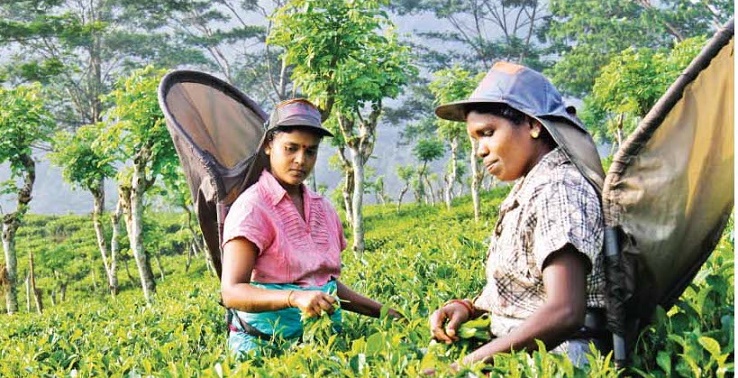
Going deeper into the history of the tea industry, explanations were given to him by the writer as to how the auctions were held privately and haphazardly by individual brokers in their own offices, with no formal uniform set of rules or regulations. By the 1890s the volume of tea produced had grown to a remarkable extent and the growers / manufacturers were dissatisfied with the loose arrangements under which their teas were being handled in Colombo, which had become the main port of the island; hence, their request to the Ceylon Chamber of Commerce to set up an institution to oversee this aspect, the CTTA was bestowed as the mantle of ‘Apex Body’ from its inception. I further intimated to him about the CTTA’s celebrations on its anniversary (only a day or two prior to the publication of the article) at the Cinnamon Grand Hotel in Colombo, where its 123rd Annual General Meeting, also followed by cocktails and dinner, attended by over 500 guests from all sectors of the industry.
Apex body
The planter being still dissatisfied with my answer delved further into the subject by maintaining that the CTTA could only be described as the “Apex body for overseeing the sale of tea produced by the growers.” Next he lamented on the levy of Rs 40,000 per head to participate in the event, which according to him had caused “a lot of heart burn of the CTTA members that will lead to ‘shutting out’ so many planters in the participation of the celebrations”. He also pointed an accusing finger at the Organizing Committee for ignoring the estate staff and workers, expressing how they were as important as the planters, towards the survival of the Tea Industry.
Another grievance appeared to be that the CTTA had not planned to commemorate this historic occasion as a ‘corporate’ occasion in the heart of the tea growing areas, instead in the metropolis and on the beaches around Colombo, where “tea will not even grow.” The blame was thrust upon the Organizers asserting it was a creation by those whose existence and prosperity depended on the tea industry.
Misconception
This misconception was referred to a very Senior Member of the Tea Trade who elucidated the matter in the following manner: “The stakeholders, whose own associations sought affiliation to the CTTA and were graciously granted the opportunity to serve on the CTTA committee, where deliberations and decisions on the entire industry take place, as well as the state institutions and agencies, acknowledge and recognize the CTTA as the apex body of the tea industry is sufficient validation of its position”.
‘The CTTA does not only oversee the sale of tea, but it also has numerous other functions which ensure the well being of the entire industry. Spanning over a 27-year period from the commencement of commercial cultivation of tea on a mere 19 acres up to the point of the formation of the CTTA and the inauguration of the formal public tea auction in Colombo, under an official set of rules and regulations in 1894 the industry developed without any direction or leadership. The first export consignment of tea comprised just 23 lbs and that too was to the London auction. The first private tea auction offered just five invoices of tea, of which only one was sold due to bids not meeting the expectations of the sellers. This was why the producers themselves requested that an institution should be set up to lead the industry as an apex body.
International tea conventions
“The CTTA with representation from all the stakeholders has held international tea conventions in 1966, (nationalisation of plantations accounting for the hiatus) 1992, 1999, 2003, 2007 and 2012, all of which were fully subscribed with overseas delegates and local participation from every sector of the industry. The Colombo International Tea Convention has become legendary and is held up as a model by other producing countries that have tried to emulate it, but have fallen far short. The 2017 convention is no different”.
Overseas delegates and local participants are clamouring to attend and, although a maximum limit was placed on numbers, the CTTA was compelled to extend it. There have even been suggestions that it should be moved to a venue that can accommodate larger numbers, like the BMICH. There are no facilities outside Colombo to hold an event of this magnitude and the Organizing Committee believes that it is ridiculous even to suggest that estate staff and workers, other than the planters, would dream of attending, even if given the opportunity to do so at no charge. There are social, cultural and language barriers still prevalent in Sri Lanka, in case Sri Lankan ‘protagonist’ is not aware of, that would make them feel embarrassingly uncomfortable in such circumstances.
In this day and age, Rs.40, 000 per head for four days of business sessions with convention material, complemented by meals and refreshment and social events with entertainment at venues, which necessarily have to be upmarket and conducted exclusively in the English language is not considered excessive. Overseas speakers and presenters, internationally renowned in their respective fields, had also to be brought in and accommodated for the duration of the convention. In fact, it costs much more but has been subsidised by sponsorships. For younger participants (below the age of 35 years), a concessionary rate of Rs 30,000 has been offered. Not only has large representation from RPCs registered to attend, but a great number of private factory owners and even small holders have also done so. A senior member commented that he had “not heard of anyone complaining other than this single individual. Furthermore, his lone voice is not going to change the CTTA’s stature globally, which it has maintained for the past 123 years.
Woeful planter
Unfortunately, this woeful planter does not appear to be aware of the other events planned for the Sesquicentennial. All the proceeds from the Grand Charity Auction will be used on projects for the benefit of the children of the plantation labour. The outreach awareness/educational programme that has been conducted from March will conclude at the end of this month. It has covered rural and plantation areas. All proceeds from the convention will go into the Colombo Tea Traders’ Charity Trust, the accumulated funds of which have been judiciously invested in projects mainly in the plantation areas.
Today the CTTA has over 200 Corporate Members, and every year a chairman is elected – and may be re-elected for a successive term or two. The association’s role has changed quite significantly over the years. In 1962 out of those attending the auction about 60 per cent were British and of other foreign nationalities. Later Prime Minister S. W.R. D. Bandaranaike followed by Prime Minister Dudley Senanayake looked into ‘Ceylonising‘ the industry. Therefore, it was in the 1960s that Sri Lankans gradually took over the management of the Tea Industry and CTTA.
There are two major divisions in the Ceylon Tea Industry. Sellers produce the tea and buyers export it. These two sectors were kept as separate entities with good intentions where the brokers coordinated between the two, at the auction. After the nationalisation of tea estates, fragmentation took place within quite a number of privately owned estates, which were handed over to the smallholders. This managed to create the smallholder section that did not have facilities or the capacity in comparison with the plantation companies to manufacture tea. This gave rise to private companies to set up factories, which would use the tealeaves grown by smallholders for manufacture forming the fifth sector of the industry.
Liberalized economy
As time progressed, President J.R. Jayewardene’s government liberalized the economy paving the way for the opportunity of entrepreneurship in the Industry. By that time the British had nearly all left, the very first generation of Sri Lankan managers were in there 40s. Some young and dynamic tea traders who did not wish to mark time before they could climb to the top of the ladder established their own exporting companies, which resulted in a proliferation of exporters expanding the number of growers and manufacturers of tea and the industry, became crowded with competition intensified.
tilakfernando@gmail.com
කොටි පරාජය කළ රාජපක්ෂලා සිංහල බෞද්ධකම නිසා බොදු බල සේනා කුමන්ත්රණයට පරාජය වූ හැටි…
July 8th, 2017සී. ඒ. චන්ද්රප්රේම
සිංහලයා දුර්වල කර මුස්ලිම් පාර්ශවය
ශක්තිමත් කළ බොදු බල උපාය
 මා ඉකුත් ජුනි 25 වැනිදා ඉරිදා දිවයිනේ “බොදුබල සේනාව ගැන අත්යවශ්ය සටහනක්” යන මැයෙන් ලියූ ලිපියට විශාල ප්රතිචාරයක් ලැබුණි. එම ලිපිය ලංකා සී නිවුස් වෙබ් අඩවිය විසින්ද දිවයින උපුටා දක්වමින් පළකර තිබූ අතර එහි පාඨකයෙක් “සශීමා” යන නම යටතේ පළකර තිබූ කමෙන්ටුවක් පහත දැක්වෙන පරිදි විය.
“මහින්ද ගෝඨා පවු අයියෝ බලාගෙන ගියාම පසුගිය ආණ්ඩුවේ බලය තිබිල තියෙන්නෙ චම්පික ගාවනේ. කොටි පරාජය කළ මහින්ද මහත්තයට චම්පිකට උඩින් යන්න බැරි වෙච්ච හැටි.”
උපහාසාත්මකව ලියා තිබුණද මේ කමෙන්ටුවේ අන්තර්ගතය සහතික ඇත්තය. කොටියා හමුවේ සිංහයන් වූ රාජපක්ෂවරුන් බොදුබල සේනාව යොදවා ජාතික හෙළ උරුමය කළ කුමන්ත්රණය හමුවේ පූස් පැටව් බවට පත්විය. බොදුබල සේනාවට එරෙහිව පියවර ගතහොත් මුළු භික්ෂු ප්රජාවම මහ පාරට බස්සන බවට චම්පික කළ තර්ජනය හමුවේ මහින්ද රාජපක්ෂ මහතා නිහඬ විය. බොදුබල සේනාවේ භික්ෂූන් වහන්සේලා මහ පාරේ ප්රචණ්ඩත්වයේ යෙදෙමින් ආණ්ඩුව අස්ථාවර කරන විට කොටි පරාජය කළ ගෝඨාභය රාජපක්ෂ මහතාවත් ඒ ගැන කිසිවක් කරන බවක් පෙනෙන්නට නොතිබුණි.
භික්ෂූන් වහන්සේලා යොදවා ජාතික හෙළ උරුමය කළ ඒ දුෂ්ට කුමන්ත්රණය හමුවේ රාජපක්ෂවරුන් අසරණ වූයේ ඔවුන්ගේ සිංහල බෞද්ධකම නිසාය. සිවුරටත් භික්ෂූන් වහන්සේලාටත් ඇති අසීමිත ගරුත්වය නිසාය. ජාතිකවාදී ව්යාපාරයට ඔවුන් තුළ වූ පිළිගැනීම නිසාය. 2012 දී බොදුබල සේනාව මුලින්ම වැඩ පටන්ගන්නා විට මේ රටේ තිබුණේ ඡේ. ආර්. ජයවර්ධන නැතිනම් ආර්. ප්රේමදාස වැනි එජාප නායකයකුගේ ආණ්ඩුවක් නම් ඒ සියලු සෙල්ලම් විනාඩි 15 න් අවසන්ය. ඥානසාර හිමි ඇතුළු භික්ෂූන් වහන්සේලා තත්පර ගණනක් ඇතුළත හිර කූඩුවේය. ඔවුන් සමග සිටි ගිහි පිරිස් බාගයක් පොලිසියෙන් ගුටි කා රෝහලේය. අනෙක් බාගය වැලිකඩය. එජාප කාලයේ විජාතික ආණ්ඩුවක් යටතේ භික්ෂූන් වහන්සේලා යොදවා ආණ්ඩුව අස්ථාවර කිරීමට ජාතික හෙළ උරුමය යෙදූ කුමන්ත්රණ සාර්ථක වන්නේ නැත. එවැනි කුමන්ත්රණ හරි ගියේ ජාතිකවාදී ආණ්ඩුවක් බලයේ සිටි නිසා පමණි.
2013 නොවැම්බර් 14 වැනිදා ඥානසාර හිමි ඇතුළු බොදුබල සේනාවේ පිරිසක් එජාපයේ සිරිකොත මූලස්ථානයට කඩා වැදුණු අවස්ථාවේදී ඒ භික්ෂූන් වහන්සේලාගේ සිවුරෙන් ඇද පහරදී සෙනග අතර හිරවූ ඥානසාර හිමිටද හොඳහැටි ගුටි ඇන මෙතන ලිවිය නොහැකි වෙනත් දේවල් ද කළ ආකාරය එතන සිටි පිරිස් පසුව තලු මරමින් මට කීවේය. එම සිද්ධියෙන් පසු එජාප පාක්ෂිකයන් “ගරුතර මහා සංඝරත්නයට පහර දුන්නා” යෑයි මතයක් රටේ අරගෙන යාමට බොදුබල සේනාව උත්සාහ ගත්තද එය කිසිවකුත් ගණන් ගත්තේ නැත. ගැටඹේ විහාරය වටේට කටු කම්බි ගැසීමත් සිරිකොත ආක්රමණය කිරීමට ආ භික්ෂූන් වහන්සේලාට පහර දීමත් එජාප ඡන්ද පදනමට එතරම් ප්රශ්නයක් වූයේ නැත. සිරිකොත මූලස්ථානයේ සිද්ධිය ගැන බොදුබල සේනාවේ අය අද වන තුරුත් කිසිවක් කතා නොකර සිටින්නේ ලැඡ්ජාවටය. ඉන්පසු කිසිදාක බොදුබල සේනාව සිරිකොත පැත්ත පළාතේ ගියේද නැත. 2013 දී බොදුබල සේනාවට ගුටි දුන් යූඑන්පිය ඒ සිද්ධියෙන් පසු ඡන්ද ජය ගැනීමට පටන්ගත් බවත් බො. බ. සේ ට පහර නොදුන් රාජපක්ෂවරුන් පරාජය වූ බවද සැලකිල්ලට ගත යුතුය.
මේ සියල්ලෙන්ම පෙනුණේ භික්ෂූන් වහන්සේලා යොදවා ප්රචණ්ඩ සිදුවීම් ඇතිකොට අස්ථාවර කළ හැක්කේ සිංහල බෞද්ධකමටත් කහ සිවුරටත් ගරු කරන ආණ්ඩුවක් පමණක් බවයි.
2012 දී බොදුබල සේනාවේ සෙල්ලම පටන්ගත් ගමන්ම චම්පික රණවක ඇමැතිකමිනුත් එක්සත් ජනතා නිදහස් සන්ධානයෙනුත් පලවා හැරියේ නම් ඒ සියලු සෙල්ලම් එකවර නවතිනු ඇත. 2007 දී පාර්ලිමේන්තුවේ හරි හමන් බහුතරයවත් නොතිබුණු අවස්ථාවක අනුර බණ්ඩාරනායක මංගල සමරවීර හා ශ්රීපති සූරියආරච්චි දෙවරක් නොසිතා ආණ්ඩුවෙන් ඉවත් කළ රාජපක්ෂවරුන්ට 2012 පාර්ලිමේන්තුවේ තුනෙන් දෙකේ බලයක් තිබියදීත් චම්පික රණවක හා අතුරලියේ රතන හිමි ආණ්ඩු පක්ෂයෙන් නෙරපා දැමීමට නොහැකි වූයේ ඇයි?
ඒ අන් කිසිවක් නිසා නොව රාජපක්ෂවරුන් ජාතිකවාදී ව්යාපාරයේම කොටස්කරුවන් වූ නිසාය. අනුර බණ්ඩාරනායකලා, මංගල සමරවීරලාට වඩා ජාතිකවාදී ව්යාපාරය රාජපක්ෂ ආණ්ඩුවේ ෙඓන්ද්රීය කොටසක් ලෙස ඔවුන් සැලකූ නිසාය. ඒ අතර වැදගත්ම කාරණය වූයේ අනුර බණ්ඩාරනායකලා, මංගල සමරවීරලා රාජපක්ෂ ආණ්ඩුවට විරුද්ධව එජාපය, දෙමළ ජාතික සන්ධානය හා මුස්ලිම් දේශපාලන පක්ෂ සමග කුමන්ත්රණය කළත් ජාතිකවාදී දේශපාලන පක්ෂයක් වන ජාතික හෙළ උරුමය එවැන්නක් කිසිදාක නොකරාවි යෑයි රාජපක්ෂවරුන් තුළ තිබූ අචල විශ්වාසය නිසාය.
බොදුබල සේනාවේ භික්ෂූන් ඉදිරියට දමාගෙන රට පුරා ප්රචණ්ඩ ක්රියා ඇති කරන කොට රාජපක්ෂවරුන් සිවුරට තිබූ ගරුත්වය නිසා හැම විටම බැලුවේ මේවාට යූඑන්පී ආකාරයට ප්රතිචාර දක්වන්නේ නැතුව භික්ෂූන් වහන්සේලාට කතාකොට “ශේප්” න්යායෙන් ප්රශ්න විසඳීමටයි. ඒ කාලයේදී මේ සිදුවුණ ක්රියාදාමය මා ඉතා හොඳින් නිරීක්ෂණය කෙරුවෙමි. කුමක් හෝ ප්රචණ්ඩකාරී ක්රියාවක් සිදුවූ විට රාජපක්ෂවරුන් ඒ මේ අත දුවා භික්ෂූන් වහන්සේලාට කතාකොට ප්රශ්නය “ශේප්” කරයි. බොදුබල සේනාවද උපක්රමශීලීව ඒ ශේප් න්යාය සාර්ථක වූ බවක් පෙන්වීමට කෙටි කලක් නිහඬව සිටී. ඉන්පසු නැවතත් කලබලයක් ඇතිකරනු ලැබේ. එහිදී නැවතත් රාජපක්ෂවරුන් ශේප් න්යාය ක්රියාත්මක කරයි. යළිත් ටික කලකට ප්රචණ්ඩ සිදුවීම් යට යයි. 2012 ත් 2014 ත් අතර රාජපක්ෂවරුන්ට එරෙහිව මුස්ලිම් හා ක්රිස්තියානි ප්රජාවත් පෙළගස්වනු ලැබුවේ ඒ ආකාරයට ගිය “වට” කීපයකිනි.
බොදුබල සේනාව හා ඥානසාර හිමි සමග ජාතික හෙළ උරුමයට කිසිදු සම්බන්ධයක් නැතැයි කියමින් චම්පික රණවක පැවැත්වූ මාධ්ය සාකච්ඡාවක කොටසක් රූපවාහිනී නාලිකා වල පසුගියදා විකාශනය විය. එහිදී චම්පික පවසා සිටියේ ඥානසාර හිමි මුලදී ජාතික හෙළ උරුමයේ සාමාජිකයෙකු වී සිටි අතර උන්වහන්සේ 2004 පාර්ලිමේන්තු මැතිවරණයේදී කොළඹ දිස්ත්රික්කයට ජාතික හෙළ උරුමයේ අපේක්ෂකයෙකු හැටියට ඡන්දය ඉල්ලා පරාජය වූ බවයි. එතනින් පසු උන් වහන්සේ ජාතික හෙළ උරුමයේ කටයුතු වලින් ඉවත් වූ බවත් 2005 ජනාධිපතිවරණයේදී ඥානසාර හිමි රනිල් වික්රමසිංහ මහතාට සහයෝගය දැක්වූ බවත් 2010 දී උන්වහන්සේ සරත් ෆොන්සේකා මහතාට සහයෝගය දැක්වූ බවත් 2015 දී ඥානසාර හිමි මහින්ද රාජපක්ෂ මහතාට සහයෝගය දැක්වූ බවත් ඒ සෑම අවස්ථාවකදීම උන් වහන්සේ සිටියේ ජාතික හෙළ උරුමය සමග නොව ඔවුන්ට විරුද්ධ පිලේ බවත්ය. චම්පිකගේ මේ විස්තර කිරීමෙන් අතිශයින්ම වැදගත් කරුණක් එළියට පනී. සෑම සිංහල බෞද්ධයකුම තමන්ගෙන්ම අසාගත යුතු ප්රශ්නය වන්නේ 2005 දීත් 2010 දීත් 2015 අගෝස්තු පාර්ලිමේන්තු මැතිවරණයේදීත් මහින්ද රාජපක්ෂ මහතාට විරුද්ධව වැඩකරපු ඥානසාර හිමි 2015 ජනාධිපතිවරණයේදී පමණක් මහින්ද රාජපක්ෂට සහයෝගය දැක්වීමට ඉදිරිපත් වූයේ මන්ද යන්නයි. මෙතන ක්රියාත්මක වූයේ “ගස කැපීමට ගස යටට යැමේ” උපක්රමය නොවේ දැයි සියලු දෙනාම කල්පනා කර බැලිය යුතුය.
2015 ජනවාරි 8 ජනාධිපතිවරණයේදී ඥානසාර හිමි මහින්ද රාජපක්ෂ මහතාට සහයෝගය දෙනවා යෑයි ප්රසිද්ධියේ කීවද සැබවින්ම සිදුවූයේ වෙනත් දෙයකි. ජාතික හෙළ උරුමයේ ප්රධාන ක්රියාකාරිකයකු වන අශෝක අබේගුණසේකර මහතා “යුග පෙරළිය” නමැති තමාගේ කෘතියේ පෙන්වා දී ඇති පරිදි ඥානසාර හිමි මහින්ද රාජපක්ෂ මහතාට සහයෝගය දෙන බව ප්රසිද්ධියේ කියමින් සිටි වකවානුවේම මහින්ද පරාජය කිරීම සඳහා චම්පිකව සිංහල බෞද්ධ අපේක්ෂකයෙකු හැටියට ඉදිරිපත් කොට ප්රතිවාදියකුට ජය ගැනීමට මග පෑදීමට ජාතික හෙළ උරුමය සාකච්ඡා කරමින් සිටි අවස්ථාවේදී ඔවුන්ගේ එම වැඩපිළිවෙළට පූර්ණ ලෙස සහයෝගය දැක්වීමට බොදුබල සේනාවද සූදානම් වී සිටි බවයි. 2014 ජුනි 22 වැනිදා ඒෂියන් මිරර් වෙබ් අඩවියේද බොදු බල සේනාව චම්පික රණවකව ජනාධිපති කළ යුතු බවත් සිංහල ජාතිය වෙනුවෙන් පෙනී සිටින්නේ චම්පික රණවක පමණක් බවත් කියමින් සමාජ ජාලා ව්යාපාරයක් ඒ වනවිටත් ආරම්භ කර තිබෙන බවට ද ප්රවෘත්තියක් පළ කළේය. ඉතින් මෙහිදී ඥානසාර හිමි 2015 ජනවාරියේදී මහින්ද රාජපක්ෂ මහතාට සහයෝගය පළකිරීමෙන් බලාපොරොත්තු වූයේ ඔහුව පරාජය කිරීම මිස දිනවීම නොවේය යන්න පැහැදිලිය. මුස්ලිම් හා ක්රිස්තියානි පිරිස් වලට හතර අතේ පහරදී එසේ පහරදුන් මැරයන් “අපි සිටින්නේ මහින්ද සමග යෑයි” කී විට මුස්ලිම් හා ක්රිස්තියානි ඡන්ද දායකයන් ඉබේටම නවතින්නේ අනෙක් පැත්තේය. ජාතික හෙළ උරුමය 2014 බොදුබල සේනාවට දුන් කොන්ත්රාත්තුව එයයි.
 2012-2014 කාල පරිච්ඡේදය තුළ බොදු බල සේනාව රාජපක්ෂ ආණ්ඩුව අස්ථාවර කෙරුවේ මුස්ලිම් හා ක්රිස්තියානි පිරිස්වලට පහරදී ඔවුන් රාජපක්ෂ ආණ්ඩුවට විරුද්ධව පෙළගැස්වීමෙනි. ඒ සඳහා බොදු බල සේනාව රාජපක්ෂ ආණ්ඩුවේ අනුග්රහය යටතේ වැඩ කරන බව පෙන්වීම අත්යාවශ්ය සාධකයක් විය. මේ සඳහා ඔවුන් විවිධ සූක්ෂම උපක්රම භාවිතා කළේය. රාජපක්ෂවරුන්ට සමීප සම්බන්ධකම් තිබෙන ජ්යෙෂ්ඨ භික්ෂූන් වහන්සේ නමක් වන කිරම විමලජෝති හිමියන් තම ව්යාපාරයට එක් කර ගෙන ගෝඨාභය රාජපක්ෂ මහතාට සෘජුව කතා කළ හැකි සංඝපිතෘවරයෙක්ද මේ ව්යාපාරයට සහභාගී කරවා ගන්නා ලදී. ඔවුන් මහා පාරේ ප්රචණ්ඩත්වයේ යෙදෙන විට නීතිය ක්රියාත්මක වීම ප්රමාද කිරීමට නැතිනම් අත්හිටුවා ගැනීමට එවන් මැදිහත්වීම් ද බෙහෙවින් උපකාරී විය. ජාතික හෙළ උරුමය තුළ උදය ගම්මන්පිල සාධකයද මෙහිදී වැදගත් විය. චම්පික කුමන්ත්රණකරුවෙකු වුවත් උදය අවංක ජාතිමාමක සිංහලයෙකු බව රාජපක්ෂවරුන් විශ්වාස කළේය.
උදය හා කිරම විමලජෝති හිsමියන්ට බොදුබල සේනාව සමඟ සම්බන්ධකම් තිබුණු නිසා ඒ හරහා මේ ප්රචණ්ඩකාරීන් “ෂේප්’ කරගෙන ‘බැලන්ස්’ කරගත හැකි බවට රාජපක්ෂවරුන්ගේ විශ්වාසයක් තිබුණේය. ඇත්තටම නිදාගෙන සිටින පුද්ගලයකු ඇහැරීමට හැකි වුවත් බොරුවට නිදාගෙන සිටින අයකු ඇහැර විය නොහැකිය යන කියමන සත්යයක් කරමින් බොදුබල සේනාව ශේප් කිරීම හෝ බැලන්ස් කිරීම සාර්ථක වූයේ නැත. අවුරුදු 2 ක් තිස්සේ මේ ප්රචණ්ඩත්වය බැලන්ස් කිරීමත් ශේප් කිරීමත් එහාට මෙහාට ගිය පසු සියල්ල සිදුවී හමාර විය. උදය ගම්මන්පිලද තමා මූලාරම්භයේ සිටම සිටි දේශපාලන පක්ෂය වූ ජාතික හෙළ උරුමය සමග අවසාන මොහොත දක්වා සිට හෙළ උරුමය යහපාලනයට යන විටද ඔවුන් සමග අකැමැත්තෙන් ගොස් බැරිම තැන පක්ෂය කඩාගෙන නැවතත් රාජපක්ෂවරුන් හා ජාතිකවාදී ව්යාපාරය වෙතට පැමිණියේය. ජාතික හෙළ උරුමය තුළ උදය ගම්මන්පිල සිටීමද බොදුබල සේනාව සම්බන්ධයෙන් රාජපක්ෂවරුන් ෂේප් න්යාය අනුගමනය කිරීමට ප්රධාන හේතුවක් විය.
අලුත්ගම සිද්ධිය වන විට අවශ්ය කාරණා ටික සියල්ලම ඉටුවී තිබුණි. ඊට පසුව ජාතික හෙළ උරුමය වඩා විවෘත ආකාරයට රාජපක්ෂවරුන් පරාජය කිරීමේ කුමන්ත්රණය දියත් කරනු ලැබීය. මේ අදියරේදී ඉදිරියට දමනු ලැබුවේ අතුරලියේ රතන හිමි ප්රමුඛ පිවිතුරු හෙටක් සංවිධානයයි. අවසාන මොහොත දක්වාම ජාතික හෙළ උරුමය රාජපක්ෂවරුන් සමග සිටිමින් බොදුබල සේනාවට පමණක් නොව පිවිතුරු හෙටක් වැනි වෙනත් සංවිධානවලටද ආවරණය සැපයීය. මුස්ලිම් හා ක්රිස්තියානි ඡන්ද අනෙක් පැත්තට යෑවීමෙන් පසු මෛත්රිපාල සිරිසේන පොදු අපේක්ෂකයා හැටියට එළියට ගැනීමටත් ජාතික හෙළ උරුමය කටයුතු කළ හැටි අශෝක අබේගුණසේකරගේ “යුග පෙරළිය” කෘතියේ සඳහන්ව ඇත. එජාප ඡන්ද දෙමළ ඡන්ද, මුස්ලිම් ඡන්ද හා ක්රිස්තියානි ඡන්ද යන සියල්ල පෙළ ගැස්වීමෙන් පසු සිංහල ඡන්ද ලබා ගැනීමට මාදුළුවාවේ සෝභිත හිමි මෛත්රිපාල සිරිසේන හා චම්පික රණවක එයට එකතු වීමෙන් යහපාලන මාර සේනාව සම්පූර්ණ විය.
මේ සියල්ලටම කේන්ද්රීය පුද්ගලයෙකු හැටියට ඥානසාර හිමිද සිටී. රාජපක්ෂවරුන්ගේ ජාතිකවාදී ආණ්ඩුව පරාජය කොට සුළු ජාතීන් හා විදේශීය බලවතුන්ගේ පදයට නටන ආණ්ඩුවක් ගෙන ඒමට හැකි වන්නේ ශ්රී ලංකාවේ බෞද්ධ භික්ෂූන් වහන්සේලාද ඒ ව්යාපෘතියට හවුල් කර ගැනීමෙන් බව විදේශීය බලවතුන් සෑහෙන කලකට පෙර අවබෝධ කරගෙන සිටි ආකාරය මම කලින් ලිපියේ විස්තර කෙරුවෙමි. මෙවැනි ව්යාපෘතියක් සඳහා ඥානසාර හිමි වැනි භික්ෂූන් වහන්සේලාද අත්යාවශ්ය සාධකයක් විය. උන් වහන්සේට එක මතයක් කියා දෙයක් නොමැති අතර අවශ්ය දේ ලැබෙනවානම් කොයි පැත්තත් එකය. 2002 එජාප ආණ්ඩු කාලයේ සටන් විරාම ගිවිසුම ඇතුළුව රනිල් වික්රමසිංහ මහතා ගත් පියවරයන් වලට එරෙහිව නැගී ආ බලවේගය වූයේ ජාතික හෙළ උරුමයයි. ඒ නිසා 2004 දී ජාතික හෙළ උරුමයෙන් ඡන්දය ඉල්ලූ අයෙක් 2005 දී රනිල් වික්රමසිංහ මහතාට සහයෝගය දෙන තත්ත්වයක සිටිය නොහැක. නමුත් ඥානසාර හිමිට ඒවා ප්රශ්න නොවීය. 2012 ඥානසාර හිමි ඇතුළු පිරිස නෝර්වේ රාජ්යයෙන් නැවත පැමිණි පසු උන් වහන්සේ සංහිඳියාව හා බලය බෙදීම වෙනුවෙන් රාජිත සේනාරත්න මහතා සමග එක්වී බණ්ඩාරනායක සම්මන්ත්රණ ශාලාවේ භික්ෂූන් වහන්සේලා 1000 කගේ සහභාගීත්වයෙන් සම්මන්ත්රණයක් සංවිධානය කිරීමට යොදාගෙන සිටි හැටි මම පසුගිය ලිපියේ පැහැදිලි කෙරුවෙමි. මේ වැඩපිළිවෙළ සැලසුම් කරමින් සිටි අවස්ථාවේදී රාජිත සේනාරත්න මහතාද මවිතයට පත් කරමින් ඥානසාර හිමි බලය බෙදීමේ හා සංහිඳියාවේ සම්මන්ත්රණය අතහැර හලාල් විරෝධී ව්යාපාරයට එක් විය. ඒ හෙළ උරුමයෙන් ලැබුණු කැඳවීමක් මත විය යුතුය.
2012 දී නෝර්වේ ගමනින් පසු දොස්තර රාජිත සේනාරත්න මහතා හා කුමාර රූපසිංහ මහතා සමග සංහිඳියා සම්මන්ත්රණ පැවැත්වීමට සූදානම් වී සිටි ඥානසාර හිමි 2006-2007 කාලයේදී ජාතික හෙළ උරුමයේ කීමට ඒ කුමාර රූපසිංහ හා ඒ රාජිත සේනාරත්න මහතා විසින්ම සංවිධානය කරන ලද යුද විරෝධී පෙරමුණේ රැස්වීම් කඩාකප්පල් කිරීමටද සහභාගි වූයේය.
ගිහියෙකු වන රාජිත සේනාරත්න මහතා මා දන්නා කාලයේ සිටම ඉන්නේ එකම ස්ථාවරයකය. නමුත් භික්ෂූන් වහන්සේ කෙනෙකු වන ඥානසාර හිමි අද එක තැනකය. හෙට තව තැනකය. විදෙස් චරපුරුෂ සේවාවන්ද තම වුවමනාවන් ඉටුකර ගැනීම සඳහා යොදා ගන්නේ ද එවැනි චරිතය.
අද මුළු සිංහල ජාතියම අනතුරට වැටී ඇත්තේ ඥානසාර හිමි වැනි භික්ෂූන් වහන්සේලාගේ ක්රියාකාරීත්වය නිසාය. සිංහලයාව ඒ සිදුවූ වින්නැහියෙන් බේරා ගැනීමට අද අස්ගිරි පාර්ශ්වයට හා ෙත්රෙනිකායික මහ නාහිමිවරුන්ට ප්රකාශ පිට ප්රකාශ නිකුත් කිරීමට සිදු වී ඇත. ඒ ප්රකාශ වුවත් මේ ආණ්ඩුව ගණන් ගන්නා බවක් පෙනෙන්නට නැත. බොදු බල සේනාව හා ඥානසාර හිමි දෙමළ හා මුස්ලිම් ආධිපත්යය ගැන කියන කතා ඇත්ත නොවේදැයි ඒවා අසා සිටින අත්දැකීම් නැති අය සිතනු ඇත. නමුත් මෙයද උපක්රමයේ කොටසකි. විදෙස් බලවතුන් යම්කිසි ජාතියක් විනාශ කිරීමට එවා ඇති චර පුරුෂයන් සැමවිටම පෙනී සිටින්නේ ජාතිය බේරා ගැනීමට ආ පිරිස් වශයෙනි. ඔවුන් කතා කරන්නේ ඇති ප්රශ්න ගැන මිස නැති ප්රශ්න ගැන නොවේ. නමුත් ඔවුන්ගේ වැඩවල අවසන් ප්රතිඵලය වන්නේ සතුරා ශක්තිමත් වීමත් ජාතිය මකබෑවීමත්ය.
මෙයට හොඳම උදාහරණය වන්නේ බොදුබල සේනාවයි. ඔවුන් මුස්ලිම් මිනිසුන් ගෙනයන ආගමික අන්තවාදී ආක්රමණය ගැන කතා කරන විට හැමවිටම හම්බයෝ, තම්බියෝ, මරක්කලයෝ, යනාදී වචන භාවිතා කරයි. පරුෂ වචනද සමග මෙවැනි වදන් කියන විට ඇතමුන් සිතන්නේ ඥානසාර හිමි සිංහලයන් වෙනුවෙන් කතා කරන බවයි. නමුත් ඔවුන් 2012 සිට කළ හැම දෙයකින්ම සිදු වූයේ සිංහලයා දුර්වල වීමත්, මුස්ලිම් පාර්ශවය ශක්තිමත් කිරීමත් පමණි. සද්දය හා පරුෂ වචන වලින් සිංහලයන් ඉදිරියෙන් සිටියත් බලය වැඩි වූයේ මුස්ලිම් පාර්ශ්වයටය. ජාතික හෙළ උරුමය හා බොදු බල සේනාව එක්ව කළ කුමන්ත්රණයෙන් ජාතිකවාදී ආණ්ඩුවක් පරාජය වී සිංහලයන්ගේ සතුරන් ශක්තිමත් වී ඇත. මෙයට පිළියම වන්නේ තවත් සද්දය දමා තවත් පරුෂ වචන කීම නොවේ.
මෙයට එකම පිළියම නැවතත් මේ රටේ ජාතිකවාදී ආණ්ඩුවක් ඇති කිරීම පමණි. ජනවාරි 8 කුමන්ත්රණකරුවන් බොදුබල සේනාව යළිත් මහපාරට බස්සවා සද්දය හා පරුෂ වචනවලින් සිංහල පිරිසක් එක් කරගෙන ඡන්ද බෙදා මේ විජාතික ආණ්ඩුවේ පැවැත්ම තහවුරු කිරීමට මාන බලමින් සිටී. 2015 පාර්ලිමේන්තු මැතිවරණයේදී බොදුබල සේනාව මහින්ද රාජපක්ෂ පාර්ශ්වයට විරුද්ධව ඡන්දය ඉල්ලුවේ ඒ තීරණාත්මක මොහොතේ ඡන්ද දාහක් හෝ කඩා යහපාලනය රැක ගැනීමට දායක වීමට නොවේද? ඒ දේ නැවතත් කිරීමට ඔවුන් මාන බලමින් සිටින මේ අවස්ථාවේදී සිංහලයා ඉතා බුද්ධිමත්ව කටයුතු නොකළොත් රටත් ජාතියත් බරපතල උවදුරකට ලක්වනු ඇත.
කොටින්ගෙන් බේරාගත් නැගෙනහිර පුදබිම් අන්තවාදී වගවළසුන්ගේ ආක්රමණයට හසු වෙයි උපන් බිමෙහිම අසරණ ජාතියක් ගැන නැගෙනහිරින් ඇසෙන කතාව
July 8th, 2017තරංග රත්නවීර උපුටා ගැන්ම දිවයින
ඡායාරූප නිමල් දයාරත්න
අන්තවාදී ආක්රමණය ප්රචණ්ඩ වී අරිසිමලේ පුදබිමේ මුඩුක්කු නැගෙයි…
ආණ්ඩුවට අවුරුදු දෙකක් පිරෙන ජනවාරි 08 ත් බුදුපිළිම කඩා දැමේ…
බොරලු කපන්න කියලා පුරාණ ගල් කණු,
සෙල් ලිපි, සඳකඩ පහන ඩෝසර් කරයි…
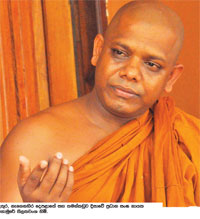
උතුර, නැගෙනහිර දෙපළාතේ සහ තමන්කඩුව දිසාවේ ප්රධාන සංඝ නායක
පනාමුරේ තිලකවංශ හිමි.
කතාව ඇසෙන විට අපට අපි ගැන දුක සිතිණි. ඒ වැඩි කාලයක් නොගොස් අපිට උරුම රටේ කල්ලතෝනි ලෙස ජීවත්වීමට සිදු වන බව හැඟෙන නිසාය. නැගෙනහිර පළාතට ගිය විට මන්දබුද්ධික නොවන ඕනෑම කෙනෙකුට එය හොඳින් වැටහේ. එහෙත් සර්ව ආගමික පිරුවටය පොරවාගත් බලධාරීන් ඒ බව තේරුම් නොගැනීම ජාතියේ කරුමයයි.
ඉඩම් කොල්ලය විඳ දරාගත හැකිය. එහෙත් අපේ උරුමය තලා පෙළා කුඩු පට්ටම් කර ඇති අයුරු දකින විට පපු කැවුතු පිච්චෙන්නේය. බෞද්ධ සිද්ධස්ථාන, වෙහෙර විහාර ගොඩනැඟිලි අන්ය ආගමික ආක්රමණිකයන් විසින් බලහත්කාරයෙන් අල්ලාගෙන සිටින අයුරු දකින විට ගත සිත කෝපයෙන් වෙව්ලන්නේය. එහෙත් උපන් බිමේ අපි අසරණය. උතුර, නැගෙනහිර දෙපළාතේ සහ තමන්කඩුව දිසාවේ ප්රධාන සංඝ නායක, කුච්චවේලි ශාසනාරක්ෂක බලමණ්ඩලයේ ප්රධාන ලේඛකාධිකාරි අරිසිමලේ ආරණ්ය සේනාසන නායක ස්වාමීන් වහන්සේ පනාමුරේ තිලකවංශ හිමියන් පවසන කරුණුවලින් ජාතියේ නිවට නියාලුභාවය අපට හොඳින් අවබෝධ විය. දැන් අප උන්වහන්සේගේ හඬ වචන කරන්නේ සංවේදී ඔබගේ දැනගැනීම පිණිසය. මෙතැන් සිට පෙළගැසෙන්නේ උන්වහන්සේගේ කතාවය.
අතීතයේ ඉඳලම බෞද්ධයන්ට විවිධ හිරිහැර කෙරුණා. ඒක අපේ රටට පමණක් සීමා වෙච්ච දෙයක් නෙමෙයි, ලෝකයේ විසිරුණු සියලු බෞද්ධයන්ට මේ කෙණහිලිකම් උරුමයි. සෑම අවස්ථාවකම වැඩි බහුතරය ඉන්න පරිසරයක සුළුතරය යට කරගෙන ඉන්න ප්රවණතාවය වැඩියි. ලංකාව සිංහලයන්ට උරුම රට වුණාට උතුර, නැගෙනහිර පළාත්වල සුළුතරය වෙලා තියෙන්නෙ සිංහල බෞද්ධ මිනිස්සු. එහෙම පරිසරයක අපට ජීවත් වෙන්න වෙලා තියෙන්නෙ අන්ය ආගමිකයන්ගේ කෙණෙහිලිකම් මැද. දැන් මම වැඩ වාසය කරන අරිසිමලේ අරණ්ය සේනාසනයට අයත් විශ්රාම ශාලාවක් ප්රදේශයේ මුස්ලිම් ජනතාව බලහත්කාරයෙන් අල්ලාගෙන ඉන්නවා. ඒ පූජා භූමියේ වැට මායිම් සකස් කරගන්න මැණුම් නියෝගයකුත් ලැබිලා තියෙනවා. එම භූමිය තුළ මහ දිසාපතිවරයාගේ නිසි අවසරය ඇතිව තමයි අපි එම ගොඩනැඟිල්ල ස්ථාපනය කළේ. ගොඩනැඟිල්ල ඉඳිකරන්න දායකත්වය ලබා දුන්නේ නුවර මහත්මයෙක්. පහුගිය අවුරුද්දෙ ඉඳලා මුස්ලිම් මිනිස්සු ඒ ගොඩනැඟිල්ල ආක්රමණය කරලා පදිංචි වෙලා ඉන්නවා. අදාළ සියලු ආයතනවලට මම ඒ බව දැනුම් දුන්නා. ඒත් ඒ ආක්රමණය සම්බන්ධයෙන් අදාළ කිසිදු ආයතනයක් ක්රියාත්මක වෙලා ඔවුන්ව පලවාහරින්න කටයුතු කළේ නෑ. තව මුස්ලිම් ජාතිකයෙක් ආරණ්ය සේනාසනයේ කුටි ගෙවලුත් අල්ලලා ඔප්පුවක් හදලා. පරීක්ෂණ කරගෙන යනකොට හොර ඔප්පුවක් කියලා තහවුරු වුණා. ඒත් කූඨ ලේඛන සකස් කළා කියලා නීතියක් ක්රියාත්මක වුණේ නෑ.
අරිසිමාලේ ආරණ්ය සේනාසනය මුහුද අයිනේ සුන්දර පරිසරයක පිහිටලා තියෙන පුදබිමක්. ඒ වගේම ඓතිහාසික වටිනාකමක් ඇති පූජනීය සිද්ධස්ථානයක්. තපස්සු භල්ලුක වෙළෙඳ දෙබෑයන් කේශ ධාතූන් වහන්සේලා රැගෙන ගොඩ බැස්සේ අරිසිමලේ වෙරළට. වෙළෙඳ දෙබෑයන් වෙරළට ගොඩ බැස්සට පස්සෙ සම්බුද්ධ වන්දනාව කරන්න හාල් තිබිලා නෑ. වෙරළට ගොඩ බට වෙළෙඳ දෙබෑයන් සම්බුද්ධ වන්දනාව කරන්න සහල් ලැබේවා කියලා ප්රාර්ථනාවක් කරලා තියෙනවා. පස්සෙ වෙරළේ තිබුණු වැලි කැට සහල් බවට පත් වෙලා. ඒ සහල් අරගෙන බත් පිසලා සම්බුද්ධ වන්දනාව කළා කියලා ජනප්රවාදයේ කියෑවෙන කතාව. අදටත් අරිසිමලේ වෙරළ පුරා විසිරිලා තියෙන්නෙ හාල් වැල්ලක්. ඒ අසිරිමත් වැල්ල ඉස්මත්තේ කඳු ගැටය මත තමයි ආරණ්ය සේනාසනය පිහිටලා තියෙන්නෙ. බණ, භාවනා කටයුතුවල යෙදෙන්න ශාන්ත පරිසරය. බුදුන් වහන්සේ බුද්ධත්වයට පත් වෙලා දවස් හතළිස් අටක් ගත වෙනකොට සම්බුද්ධත්වයෙන් පාරිශුද්ධත්වයට පත් වෙන්නෙ මේ අරිසිමලේ වෙරෙළ. අතීතයේ ඉඳලම ආරණ්යවාසී භික්ෂූන් වහන්සේලා මේ ස්ථානයේ වැඩ වාසය කරමින් බණ, භාවනා කටයුතුවල යෙදිලා තියෙනවා. නටබුන් බවට විසිරිලා තියෙන කුටි ගෙවල්, චෛත්යය, දාගැබ්, පෝය ගෙවල්, සඳකඩ පහණ, ගල් කණු විශාල පාදම කොටස් මතු වෙලා සනාථ වෙන්නෙ මේ ස්ථානයේ විශාල ආරාම සංකීර්ණයක් තිබුණු බවයි. ඒ නටබුන් අක්කර පන්සියකට වැඩි භූමි භාගයක විසිරිලා තියෙනවා.
1980 වර්ෂයේ හිටපු කර්මාන්ත අමාත්ය සිරිල් මැතිව් මහත්තයාගේ මගපෙන්වීම යටතේ උතුර, නැගෙනහිර බෞද්ධ නටබුන් සොයාගෙන, ඒ ස්ථාන ආරක්ෂාකරගැනීම සඳහා පිහිටුවාගත් රාජ්ය කර්මාන්ත බෞද්ධ සංගමය මගින් ගොඩනැගුණු ප්රධාන ආගමික සිද්ධස්ථානය අරිසිමලේ ආරණ්ය සේනාසනය. නින්දානේ කාශ්යප ස්වාමීන් වහන්සේ තමයි ආරිසිමලේ ආරණ්ය සේනාසනයේ ආරම්භක විහාරාධිපති හිමියන් බවට වුණේ. උන්වහන්සේට එම නායක පදවිය සන්නස් පත්රයකින් පිළිගන්වලා තිබුණා. මගෙත් ගුරු හාමුදුරුවො උන්වහන්සේ. 1980 අවුරුද්දේ රාජ්ය කර්මාන්ත බෞද්ධ සංගමය මගින් උතුර, නැගෙනහිර බෞද්ධ සිද්ධාස්ථාන සීයක් ප්රතිසංස්කරණය කරලා දකුණේ ස්වාමීන් වහන්සේලාට සන්නස් පත්ර මගින් භාරදුන්නා. එවැනි ආගමික පුනරුදයක් ඇති වෙනකොට තමයි 1983 අවුරුද්දේ එල්.ටී.ටී.ඊ. ත්රස්තවාදී කලබල පටන් ගත්තේ. මේ ප්රදේශවල හිටිය දෙමළ, මුස්ලිම් මිනිස්සු තොරතුරු සපයමින් එල්.ටී.ටී.ඊ.යට පක්ෂපාතීව වැඩ කරගෙන ගියා. ඒ අනුව මේ ප්රදේශ එල්.ටී.ටී.ඊ. ග්රහණයට නතු කරගන්න පහසු වුණා. මුහුදු මාර්ග ඔස්සේ එල්.ටී.ටී.ඊ. සාමාජිකයන් අරිසිමලේ ආරණ්ය සේනාසනයට ඇවිත් ‘සාදු මහත්තයා මෙතැන ඉන්න එපා. අපි නම් කරදරයක් කරන්නෙ නෑ. ඊළඟට එන ටීම් එක මොනව කරයිද කියලා අපිට කියන්න බෑ. ඒ නිසා දැම්ම මෙතැනින් පිටත් වෙන්න..’ කියලා නායක හාමුදුරුවන් අතට පතොරම් කිහිපයකුත් දීලා ගිහින් තිබුණා. ඒ වේලාවේම නායක හාමුදුරුවො ඒ බව හමුදාවට දැනුම් දීලා තිබුණා.
‘ඔය ටීම් එකම තමයි ඊළඟට එන්නෙත්. ඒ නිසා හාමුදුරුවනේ දැන්ම ඔතනින් ඉවත් වෙන්න…’ කියලා හමුදා නිලධාරීන් නායක හාමුදුරුවන්ට කියලා තිබුණා. ඒ අනුව නායක ස්වාමීන් වහන්සේ ඇතුළුව සෙසු හිමිවරු දකුණු පළාතට වැඩම කරලා තිබුණා. මේ ප්රදේශ එල්.ටී.ටි.ඊ.ය යටතට පත් වුණාට පස්සෙ මුහුද අයිනේ පිහිටි අරිසිමලේ ආරණ්ය සේනාසනය මුහුදු කොටි මධ්යස්ථානයක් ලෙස ක්රියාත්මක වෙලා තියෙනවා. සංඝයා වාස, බුදු පිළිම කඩා බිඳ දාලා විනාශ කරලා තිබුණා.
යුද ගැටුම් අහවරවීමත් එක්ක නැවත මේ ප්රදේශය ආරක්ෂක හමුදාව යටතට පත් වුණා. 2009 අවුරුද්දේ අවසාන භාගයේදී මම අරිසිමලේ ආරණ්ය සේනාසනයට වැඩම කළා. එතකොට එම ස්ථානයේ තිබුණේ නාවික හමුදා කඳවුරක්. මුලින්ම අපි නතර වෙලා හිටියේ ඛනිජ වැලි සංස්ථාවේ. මුලදි මේ ප්රදේශයට එනකොට අවට මුස්ලිම් මිනිස්සු අපි දිහා බැලුවේ හරි අමුතු විදිහට. පස්සෙ මම නාවික හමුදාපතිවරයා මුණගැහිලා ආරණ්ය සේනාසනයේ අයිතිය ලිතව ඉදිරිපත් කළාට පස්සෙ නාවික හමුදා කඳවුර පහළට අරගෙන සංඝයා වහන්සේලාට වැඩ ඉන්න පුළුවන් විදිහට පරිසරය නිදහස් කළා. ඊට පස්සෙ නාවික හමුදාවේ දරුවන්, ඛනිජ වැලි සංස්ථාවේ කිහිපදෙනෙක්ගේ උදව් උපකාර ඇතිව මැටියෙන් කුටියක් හදාගෙන මම මෙතැන වැඩ වාසය කරන්න පටන් ගත්තා. දවසටම දානය ලැබුණේ එක වේලයි. ඒකත් දුන්නේ නාවික හමුදා කඳවුරෙන්.
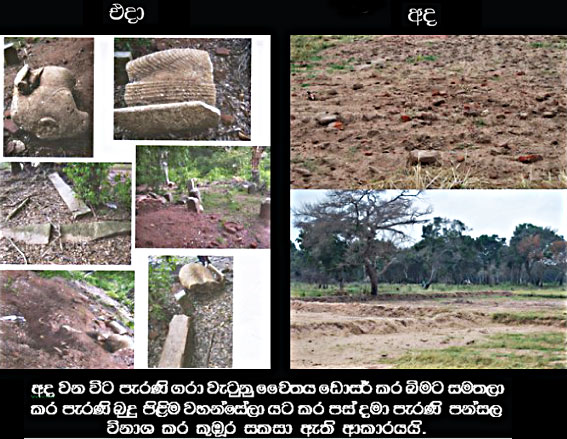
මම මේ ස්ථානයට ඇවිත් වැඩ වාසය කිරීමත් එක්ක අරණ්යවාසී භික්ෂූන් වහන්සේලා අතර අරිසිමලේ අරණ්ය සේනාසනය ප්රසිද්ධ වුණා. ආරණ්යවාසී භික්ෂූන් වහන්සේලා වරින්, වර මේ සෙනසුනට වැඩම කරන්න පටන් ගත්තා. ටිකෙන්, ටික දායක පිරිස වැඩි වෙලා මේ ස්ථානය දියුණු වෙන්න පටන් ගත්තා. ඒ එක්කම මුස්ලිම් මිනිස්සු ආරණ්ය සේනාසනයට අයත් භූමිය පුරාවිද්යා චෛත්ය පැත්තෙන් අල්ලගෙන ඉහළට එන්න පටන් ගත්තා. මම මේ ආරණ්ය සේනාසනයට වැඩම කරන්න ඉස්සර වෙලා ඉඳලා බොරළු කපන්න කියලා මේ භූමියේ අක්කර අටක විතර පුරාවිද්යා නටබුන් ප්රදේශයක ගල් කණු පෙරළලා, සෙල් ලිපි, සඳකඩ පහණ විනාශ කරලා තිබුණා. එතැනින් නතර වුණෙත් නෑ. සංඝයා වහන්සේලා වැඩ වාසය කරන කුටි ගෙවලුත් පෙරළගෙන යන තරමට අන්තවාදී ආක්රමණය ප්රචණ්ඩ වුණා. ආරණ්ය සේනාසන භූමියේ පුංචි, පුංචි පැල්පත් හදාගෙන මිනිස්සු පදිංචි වුණා. පස්සෙ මම බණ භාවනා කටයුතුවලින් මඳකට ඈත් වෙලා ඉඩම් මංකොල්ලය ගැන හොයා බැලුවා. ඛනිජ වැලි සංස්ථාවේ බෞද්ධ සංගමයේ දායක මහත්වරුත් ඒ කටයුතු සාර්ථක කරගන්න ගොඩක් උදව් උපකාර කළා.
හොයාගෙන යනකොට 1980 අවුරුද්දේ සිරිල් මහත්තයාගේ කාලේ සකස් කරපු ලිපි ගොනු ටිකක් මට ලැබුණා. ඒ ලිපි ගොනුවල අරිසිමලේ ආරණ්යය සේනාසනය ගැන වගේම මේ ප්රදේශයේ අනිකුත් වෙහෙර විහාර පිහිටලා තියෙන තැන්වල විස්තර සඳහන් වෙලා තිබුණා. පස්සෙ මම ආරක්ෂක අංශවල උදව් ඇතිව ඒ ස්ථාන ගැන සොයා බලන්න ගියා. අපි ඒ තැන්වලට ගිය විට අපිට දකින්න ලැබුණේ කුඩුපට්ටම් කර දාපු විශාල බුදුපිළිම. චෛත්යය හාරලා. බෝධීන් වහන්සේලා කපා දලා. ඒ ඉඩම්වල අන්ය ආගමිකයන් පදිංචි වෙලා. බණ භාවනා කරන්නත් භූමියක් තියෙන්න එපෑ… ඒ වගේම අපේ සිංහල අම්මලාගේ දරුවො ලේ වගුරමින් මේ භූමිය නිදහස් කර ගත්තේ අන්තවාදයක් ගොඩනගන්න නෙමෙයි… ඒ හැම දෙයක් ගැනම හිතලා අන්තවාදීන්ගෙන් බෞද්ධ උරුමය බේරාගැනීම උදෙසා මම පෙරමුණ ගත්තා. මුලින්ම අදාළ ආයතන දැනුවත් කරලා බෞද්ධ ස්ථාන ගැන ගවේෂණය කරන්න ලිත අවසරයක් ඉල්ලුවා. එම ආයතනවලින් ලිතව මට අවසරය දුන්නා. ඒ අනුව නාග ලෙන, බඹරගල, යාංඔය, ඈතානැගි කන්ද, මිහිඳු ලෙන වගේ බෞද්ධ වෙහෙර, විහාර තිබුණු ස්ථාන රැසක් හඳුනාගෙන නැවත ප්රතිසංස්කරණය කරලා සංඝයා වහන්සේලාට වැඩ ඉන්න පුළුවන් විදිහට පරිසරය සකස් කළා. ඒත් මේ වන විට ඒ ස්ථානවලට තියෙන ප්රධාන ගැටලුව ආරණ්ය සංචිත ඉඩම් අන්ය ආගමිකයන් වේගයෙන් ආක්රමණය කරමින් තිබෙන ඒකයි.
කෝකිලායි කලපුවෙන් වටවෙච්ච තෙන්නමරච්චි සංඛමලේ පුරාණ රජමහා විහාරස්ථානයේ කන්ද මුදුනේ පුරාවිද්යා චෛත්යය ආසන්නයේ පිහිටි බුදුහාමුදුරුවන්ගේ රුව සහිත ගල් කැටයම් මීටර් අටසියක් විතර දුරින් තියෙන කෝවිලක බිත්තිවලට තියලා බැඳලා. දෙමළ සන්ධානයේ නායකයන් රජයට බල කරනවා එතැන පන්සලක් හදන්න දෙන්න එපා කියලා. පුරාණ බෞද්ධ නටබුන් තියෙන එම ස්ථානයේ මේ මොහොත වෙනකොටත් කුටි සෙනසුනක් හදන්න ඉඩක් නෑ. ගියොත් දෙමළ අන්තවාදීන් පහරදෙනවා. පහුගිය කාලේ යාංඔය රජමහා විහාරයේ චෛත්යය සම්පූර්ණයෙන්ම ඩෝසර් කරලා විනාශ කරලා තිබුණා. ඒ විනාශය ගැන පුරාවිද්යා දෙපාර්තමේන්තුවට, පොලිසියට, මහ දිසාපතිවරුන්ට දැනුම් දුන්නා. ඒත් අපරාධය කරපු කිසිම කෙනෙකුට නීතියක් ක්රියාත්මක වුණේ නෑ. පහුගිය ජනවාරි 08 වැනිදා බුදුපිළිම හත, අටක් කඩා බිඳ දාලා තිබුණා. තවත් බුදුපිළිමවලට කළු තෙල් ගහලා තිබුණා. මේ අපරාධය ගැන හොයන්න හමුදාව, පොලිසිය දෙකම දැම්මා. ඒත් අපරාධ කරපු කිසිම කෙනෙක්ව තවම නීතිය ඉදිරියට ගෙනත් නෑ. ස්වාමීන් වහන්සේනමක් ගල්ලෙනක වවුල් බෙඩි ටිකක් සුද්ධ කළත් ඊළඟ දවසේම පුරාවිද්යා දෙපාර්තමේන්තුවෙන් නඩු දානවා. දැන් අලුත් නීති පනවලා මේ ප්රදේශවල පාරවල් අයින්වල බුදු කුටි හදන්න දෙන්නේ නෑ. අලුතින් පන්සල් හදන්න දෙන්නෙ නෑ. තියෙන බෞද්ධ සිද්ධස්ථාන ඉවත් කරගන්න කියනවා. බෞද්ධ සිද්ධාස්ථාන සංඝයා වහන්සේලාට පරිහරණය කරන්න ඉඩක් නෑ. හමුදා කඳවුරුවල බුදුපිළිම පාරට පේනවට තල් වැටවල් ගහලා වහලා. සමහර ආරණ්ය සේනාසනවල සංඝයා වහන්සේලාට දන් ගෙනයැම තහනම් කරලා. ඒක තමයි උතුර, නැගෙනහිර සංහිඳියාව. දකුණේ අපි කෝවිලකට, පල්ලියකට ගිහිල්ලා නිකමට අගෞරව කරනවද… සිංහල මිනිස්සු එහෙම කරන්නෙ නෑ. ඒත් මේ මිනිස්සු බලන්නෙ දවසින්, දවස බෞද්ධ වෙහෙර, විහාර බුදු පිළිම විනාශ කරන්න.
මුස්ලිම්, දෙමළ, සිංහල ඕනෑම ගම්මානයක බෞද්ධ නටබුqන් තියෙනවා නම් ඒවා බෞද්ධ ආගමට අයිති උරුමය. ඒවා අද ඊයේ දේවල් නෙමෙයි. රජ කාලේ ඉඳලා පැවත එන උරුමයන්. ඒත් දැන් අපේ රටේ බෞද්ධ උරුමය ආරක්ෂා කරන්න පණ ඇති නායකයෙක් නෑ. බෞද්ධ කටයුතු දෙපාර්තමේන්තුව මේ ගැටලු ගැන හොයා බලන්නෙ නෑ. ආණ්ඩුකාරවරයා මගෙන් අහනවා හාමුදුරුවනේ සිංහල බෞද්ධ මිනිස්සු නැති පළාතකට පන්සල් මොකදට කියලා. අපි සිංහල බෞද්ධයන් ගැන කතා කරනකොට අන්තවාදීන් කියනවා. බුදුපිළිමයක් හදන්න ගියොත් ආගම්වාදීන් කියනවා.
උතුර, නැගෙනහිර බෞද්ධ සිද්ධස්ථානවලට අයත් ඉඩම් නිරවුල් කරගන්න පහුගිය රජය කාලේ අට වතාවක් විතර මම උත්සාහ කළා. පොලිසියේ දෙතුන්සියක් දාගෙන අරිසිමාලේ ආරණ්යය සේනාසනයට අයත් රක්ෂිත භූමිය මැනුම් කටයුතු කරන්න පටන් ගත්තා. ඒ අවස්ථාවේත් තුන්හාරසීයක මුස්ලිම් සේනාවක් කැලේ කඩාගෙන ඇවිත් පොලිස් නිලධාරීන්ට පහර දුන්නා. මැනුම් කටයුතු නතර වුණා. වර්තමාන ආණ්ඩුව පත් වුණාට පස්සෙ මේ ප්රදේශවල බෞද්ධ පූජා භූමි සියල්ලක්ම වගේ සීග්රයෙන් අන්ය ආගමිකයන් ආක්රමණය කරගෙන යන්න පටන් ගත්තා. පහුගිය දවස්වල දේශපාලන බලපුළුවන්කාරම් යටතේ පූජා භූමි ඉඩම්, පුරාවිද්යා රක්ෂිත, වනසංරක්ෂණ රක්ෂිතවලට බලපත්ර හත්සියයක් හදලා තිබුණා. එක දිගට කෝවිල්, පල්ලි හැදෙනවා. පුරාවිද්යා නටබුන් ගොඩවල් ඩෝසර් කරලා හෝටල් හදනවා. ඒවට කිසිම බාධාවක් නෑ. බුදුපිළිමයක්, සෙනසුන් හදන්න ගියොත් නීතියෙන් ඉඩක් නෑ. නීතියෙන් සරණක් ලැබුණත් අන්තවාදීන් අකුල් හෙළනවා.
අපි මේ ප්රදේශවල නොහිටින්න මේ වෙනකොට බෞද්ධ සිද්ධස්ථාන කිසිවක් නෑ. අදටත් උතුර, නැගෙනහිර ප්රදේශවල කිසිම විහාරස්ථානයකට ඔප්පු තිරප්පු නෑ. උරුමය පෙන්වන්න තියෙන එකම සාක්ෂි ගල් කණු. නටබුන් කොටස් විතරයි. ඒවා පෙන්ගෙන ඉඳලා වැඩක් නෑ. වටෙන්ම අල්ලගෙන ඇවිත් අපිව පර්චස් ගානකට සීමා කරනවා. දැන් අපි වෙරදරන්නේ මේ පූජා භූමි ටික නිරවුල් කරගෙන, මැනුම් කටයුතු කරලා සිංහල බෞද්ධ පවුල් හත, අටක් පදිංචි කරවන්න. එහෙම කළොත් මේ සංඝයා වහන්සේලාට කැඳ ටිකක් හරි ලැබෙයි. බුදුපිළිමයක් ළඟට ඇවිත් මලක්, පහනක් පූජා කරයි. අපිට ලෙඩක් දුකක් හැදුණොත් ඇවිත් උපස්ථාන කරයි. එහෙම නොවෙන්න මේ හමුදා කඳවුරු ටික ඉවත් කරපු දවසකට අපිටත් මේවා අතහැරලා යන්න වෙනවා.
අතීත රජවරු නිර්මාණය කරපු ශාසනික දේවල් තමයි අද නටබුන් වෙලා ඉතිරි වෙලා තියෙන්නෙ. ඒත් බුදුරජාණන් වහන්සේගේ පාද ස්පර්ශය ලද නාගදීප පුද බිමේ බුදුපිළිමයක් හදන්න බැරි තරමට අපි නිවට ජාතියක් බවට පත් වෙලා. මේ තත්ත්වය ඉදිරියට ක්රියාත්මක වුණොත් අපිට බෞද්ධ උරුමය කෙසේ වෙතත් රටක් ඉතිරි වෙන්නෙත් නෑ. අපිට මේ පළාත්වල ඉන්නත් බැරිව යනවා. දැනටමත් මට මරණ තර්ජන තියෙනවා. සමහර ආරණ්යය සේනාසනවලට වැඩම කරන්නෙ පොලිස් ආරක්ෂාව යටතේ. පහුගිය කාලේ මම වැඩ වාසය කරන කුටිය පින්තූර ගන්න කිහිපදෙනෙක් විටින්, විට ආවා. වැඩි කාලයක් යන්න ඉස්සර වෙලා අතේ ගෙනියන බෑග් මල්ලට මොනවහරි දාලා හරි මාව අත්අඩංගුවට ගන්නවා. නැති නම් අපවත් කරනවා. ඒකට මම බය නෑ. ශාසනය ආරක්ෂා කරගැනීම උදෙසා වෙර වීරිය දරන අපිට සෑම මොහොතකම තුනුරුවන්ගේ සරණ තියෙනවා. අන්ය ආගමිකයන්ට හිරිහැර කරන්න, ඔවුන්ගේ ජීවිතවලට බාධා කරන්න අපට අවශ්ය නෑ. කාගෙවත් දේපළක් කොල්ලකන්න ඕනෑ නෑ. අපිට ඕන බුද්ධ ශාසනයේ නාමයෙන් අවිහිංසාවාදී ජාතියක් විදිහට බෞද්ධ උරුමය ආරක්ෂා කරගන්න විතරයි. බුද්ධ ශාසනය, ජාතිය ආරක්ෂා කරන්නේ යම් පාලකයෙක්ද ඒ පුද්ගලයාට අපි ආශිර්වාද කරනවා. ඒ වගේම සියලු සංඝයා වහන්සේලාගේ ආශිර්වාදය ලැබෙනවා. ඒ ඇරෙන්න ආරණ්යවාසී භික්ෂූන් වහන්සේ නමක් විදිහට අපි කිසිම නායකයෙක්, පක්ෂයක් පත් කරන්න ඡන්ද පාවිච්චි කරන්නෙ නෑ. අර පුද්ගලයා, මේ පුද්ගලයා හොඳයි කියලා සම්මත කරන්නෙ නෑ. ඒක අපේ ප්රතිපත්තියක්.
අද සිංහල බෞද්ධයන්ට නායකයෙක් නෑ. බුදුරජාණන් වහන්සේ ශාස්තෘවරයා විදිහට හිටියට මේ රටේ සංඝයා වහන්සේලාට නායකයෙක් නෑ. සංඝයා වහන්සේලා පක්ෂ පාටවලට, නිකායවලට බෙදිලා. පන්සල් අතර ප්රශ්න. බලමණ්ඩල අතර ප්රශ්න. අපේ මිනිස්සු දෙපැත්තට ඇදෙනවා. රට ජාතිය වෙනුවෙන් කතා කරන සංඝයා වහන්සේලා උපක්රමශීලීව අපවත් කරනවා. දෙමළ මුස්ලිම් මිනිස්සු රට ටිකෙන්, ටික අල්ලනවා. හරි පාලකයෙක් නොහිටින්න නැගෙනහිර පළාත මුස්ලිම් ජනතාව, උතුර දෙමළ ජනතාව අල්ල ගන්නවා. ඒත් දැන් අපිට වෙලා තියෙන්නෙ ඇටිකෙහහෙල් කෑව මුක්කුන්ද වගේ විරිත්ත, විරිත්ත ඉන්න..’ අරිසිමලේ නායක හාමුදුරුවන්ගේ දේශනය අවසානය. මේ උන්වහන්සේගේ කතාවෙන් අපට තේරුම් ගිය යථාර්ථයයි.
අවිහිංසාවාදී ජාතියක් ලෙස ඉතිහාසය පුරාවට බෞද්ධ ජනතාව ආගම වෙනුවෙන් අරගලවල පැටලී නැත. එහෙත් සිදුවෙමින් තිබෙන අන්ය ආගමික ආක්රමණය සමඟ බෞද්ධ ශාසනය ආරක්ෂා කරගැනීම උදෙසා විවිධ සංවිධාන බිහිවෙමින් තිබේ. තවදුරටත් ගෝත්රික අන්තවාදීන්ගේ ආක්රමණය ඉදිරියේ බලධාරීන් අඳ, ගොළු බිහිරන් සේ සිටී නම් බෞද්ධ ශාසනයේ ආරක්ෂාව සඳහා බලවේග, බලමුළු සංවිධානගත වීම නතර කළ නොහැකිය. අහිංසක අංගුලිමාල වූවා සේ පීඩාවට පත්වෙමින් සිටින බෞද්ධයන් ද අංගුලිමාලලා වීමට ඉඩ තිබේ. සිදු විය යුත්තේ පක්ෂ පාට, සංඝ බේද පසෙකට තබා ගිහි පැවිදි දෙපාර්ශවයම සිහිබුද්ධියෙන් මේ උද්ගතව ඇති ආගමික ගැටලුව විසඳීම සඳහා එක පොදියට එකතු වීම පමණි.
Ven. Gnanasara, Jesus Christ and JFK RESPONSE TO PROF GH PEIRIS
July 8th, 2017Dr. DAYAN JAYATILLEKA
July 7, 2017, 10:09 pm
In his lengthy presentation on Islamophobia and allegations thereof, entitled ‘A reappraisal of evidence and claims: Emerging Buddhist-Muslim Rivalry in Sri Lanka?’ (The Island, July 4th, 5th, 6th, 2017) Prof GH Peiris has chosen to conclude with a three paragraph reference to an idea I had advanced. I would have thought this gratuitous but it is dwarfed in that department by his range of references with relation to Ven. Gnanasara’s rhetoric, which include Jesus Christ, Mark Antony and JFK. I had recommended that instead of a flailing about at all forms of racism and extremism, and risking greater polarization and instability, the state authorities focus on the most dangerous issue, that of incitement to violence and prosecute Ven. Gnanasara on those grounds, given that there seems to be ample audio-visual evidence accumulated over time, on that score.
-ksn-4.jpg)
In an attempt to dismiss my view, Prof Peiris argues that the same charge may be levelled against Jesus Christ’s denunciation in the Temple, Mark Antony’s oration, John F Kennedy,et al.In effect, Prof. Peiris does not see a qualitative difference between the discourse of Jesus Christ and that of Ven. Gnanasara. Prof Pieris probably sees a congruency between Mein Kampf and the Communist Manifesto, not to mention Hitler’s torchlight Nuremburg speeches and Fidel’s address to the courts, “History Will Absolve Me!”
Prof Peiris’problem seems to be that of a classic “category error”: the inability to distinguish between an exhortation to resistance and rebellion against injustice, and a fascist or neo-fascist exhortation to violence against a community. In his spree of mixing apples, oranges, chalk and cheeses, I am thankful he did not suggest that the Sermon on the Mount could be considered in the same category as Herod’s injunction on the newborns!Certainly, Prof GH Peiris’ line of argumentation would sit well with those such as Zeid al Hussein, the UN High Commissioner for Human Rights, who place Mahinda Rajapaksa in broadly the same category as Velupillai Prabhakaran, and the Sri Lankan state’s war on the same plane as that of a separatist-fascist, terrorist militia!Is there ‘No Limit’ (so to say) to Prof Peiris’ridiculous exercise in moral equivalence?
Prof Peiris also assumes that the law will be unable, or will find it gravely problematic, to observe the distinction. If ever a government prosecutes the likes of Ven. Gnanasara on the grounds of incitement to violence, I trust that his lawyers will press into service Prof GH Peiris’ helpful references to Jesus Christ, Mark Antony and JFK in his defense. I wish them luck in that endeavor in logic, law, ethics and moral philosophy.
Prof Peiris concludes with a sideswipe about “duumvirates”, implying that my suggestion of a Mahinda-Gotabhaya ticket is doomed to fail and arguing instead for a Mahinda-led project,pure and simple. The problem there is not so much one of desirability but of possibility. The 19th amendment prevents Mahinda from contesting the Presidency and the Presidential election precedes (2019) the parliamentary one (2020).
The UNP-NGO solution, namely to abolish the executive Presidency,only transfers power to Prime Minister Wickremesinghe and the Chief Ministers, chiefly Wigneswaran, and is therefore far worse than the problem.
This leaves a “duumvirate” as the only option. It is incumbent to pick the best possible “duumvirate”, electorally and from the standpoint of the country’s main needs in the context of the current crisis. I have advocated Gotabhaya plus Mahinda.
As for Prof Pieris’ statement that “duumvirates” are almost always disasters or failures, I have only to point to Russia, which is hardly a failure (Putin-Medvedev), and to Cuba in its most glorious decades, which was a “duumvirate” of Fidel and Raul Castro, as Sandinista Nicaragua was of Daniel and Humberto Ortega.
Of that Kandy powwow
July 8th, 2017Editorial Courtesy The Island
July 7, 2017, 10:03 pm
The outcome of Thursday’s talks between Mahanayake Theras and President Maithripala Sirisena in Kandy on the former’s campaign against the government’s proposed constitutional reforms etc has been described as fruitful in some quarters. The President has, by rushing to Kandy, demonstrated his concern for the opinion of Buddhist monks. The powwow was cordial.
But, as for the new Constitution, we believe, the Nayake Theras have got a typical yanne-koheda-malle-pol—irrelevant—response. They have made their position very clear that there is no need for a new Constitution at all, but the President says he will make one that is acceptable to them! The prelates should explain whether they are agreeable to such an arrangement, having rejected the idea of a new constitution lock, stock and barrel.
Even if the protesting monks agree to consider the President’s offer, they won’t endorse a constitution sans the unitary status of the state, the foremost place given to Buddhism and other such key features they hold sacrosanct. The objectives of those, including the Tamil National Alliance (TNA) and a section of the international community, who pressure the government to introduce a new Constitution, run counter to the position of the Maha Sangha, especially where devolution is concerned. Never the twain shall meet, one may say. Drafting a constitution to the satisfaction of both these camps is well nigh impossible.
The 2015 Geneva resolution co-sponsored by the Sirisena-Wickremesinghe government is the mother of all constitutional issues troubling the yahapalana leaders at present. The question is why the government did not consult all stakeholders without plunging feet first into co-sponsoring that resolution.
Now that the government has undertaken to devolve more power and appoint a hybrid war crimes tribunal as demanded by the UNHRC at the behest of the US and its allies, there is no way it can renege on its pledge. The yahapalana regime cannot wish away its Geneva commitments and the attendant political issues. Human rights have sadly become an instrument in the hands of the western powers, which use them to make inroads into the sovereignty of the countries they want to reduce to puppets. So, desperate to keep China in check and promote their interests in this region, they are sure to use Sri Lanka’s Geneva commitments as a goad to make the yahapalana leaders more pliable.
Meanwhile, the TNA has urged the government to go ahead with the new Constitution and place it before the people at a referendum for their endorsement. Before that, a constitution will have to be drafted and the President has undertaken to ensure that it passes muster with the Maha Sangha before taking any action to promulgate it. There’s the rub! What is acceptable to Mahanayake Theras will be unacceptable to the proponents of federalism. Supposing a referendum is held by any chance on the new Constitution to be made, with or without the consent of Buddhist monks, are the TNA leaders ready to accept its outcome in case it turns out to be unfavourable to them and stop demanding federalism thereafter?
The government may have been able to wriggle out of a difficult political situation through the President’s meeting with the Nayake Theras on Thursday, but its problems are far from over where constitution making is concerned. It finds itself between a rock and a hard place. Co-Cabinet Spokesman Rajitha Senaratne has said the government will have to go ahead with its constitutional reform project in keeping with its promise to do so at the last two elections. Whether the government is so strong as to translate such rhetoric into action without heeding Buddhist monks’ shot across its bow remains to be seen.
Is there any government today?
July 8th, 2017By Lucien Rajakarunanayake Courtesy The Island
July 7, 2017, 10:05 pm
Anyone watching TV feels there is no Govt. in the country: President – News Item

Does one have to watch TV to feel this?
The President says the media reveals the opposite of what is really happening in the country. Development activities, people’s welfare, the peaceful situation in the country are all turned upside down to attract people’s attention, says the President.
Let’s begin with just one matter – the building to house the Ministry of Agriculture. The advance paid for it in 2016 was Rs 504 million. There was an estimated rent for it of Rs. 13.5 million, with an actual rent of Rs. 21 million, and a monthly service charge of Rs. 6.1 million. Damn it, all that is a lot of public money. But, the Ministry has not yet shifted there, because it is still not rendered suitable for occupation.
Just a little more – the Minister of Agriculture is Duminda Dissanayake, MP from the Anuradhapura District, not very far from the President’s own Polonnaruwa, and he is also the General Secretary of the SLFP, that is led by President Sirisena. Is it very difficult for the President to have a chat with this minister and at least get this building occupied?
Is any media – TV, radio, print or social – turning anything upside down when this is reported, yes, time and again, because it is taking such a long time to have an officially rented building occupied?
-DMP-s.jpg) What exactly is happening in the country that would give the people any idea there is a government in place? What are the development activities that are going ahead, pointing to any progress? Let’s not talk about that Hoaxwagen Project.
What exactly is happening in the country that would give the people any idea there is a government in place? What are the development activities that are going ahead, pointing to any progress? Let’s not talk about that Hoaxwagen Project.
Can we talk much about people’s welfare – when faced with the reality of people who were the victims of floods and landslides at different places, and the Army’s central armoury explosion at Salawa, not receiving their relief or compensation yet?
Do we really have a peaceful situation in the country? Yes, the war with separatist terrorism is over – nearly a decade ago. But, what about the increasing rate of crime in the country – the figures are really shocking, and they keep rising each day, while the Police are said to meditate every morning – possibly on the prevailing peace and not the control of crime? As crime keeps rising in this manner, can the people and the media, believe there is a government in place?
Anyone who thinks these are signs of governance must be joking, or else trying to take the people and country on a really long ride on political buffoonery.
The President is not only thinking of the media and upside down reporting on reality. He also has strong words to say about the Police, FCID and the Attorney General’s Department. At no less a place than at a Cabinet meeting, he has said they had not dealt with financial corruption under the Rajapaksa regime, for the past 18 months. But, the probes had been about those from the Rajapaksa days who had joined the government. What a shame … and the President says he can show these institutions how the thieves could be nabbed in three months if they are all brought under him!
That calls for a real WoW. Come on Mr. President, you are the Executive President, and all of these institutions you are so critical of are under you, managed by ministers appointed by you. Did you not realize this when that recent so-called reshuffle of the Cabinet took place? Why did you not take any of these institutions under you, and launch the fight against the Rajapaksa corruption and fraud? Was it more important for the government to give the control of lotteries boards to the Foreign Minister? We will have to keep guessing.
Of course, we know that you are heading a coalition, and things must be getting tougher to keep the coalition unity going – when fraud as well as corruption is spreading so fast within the ranks of government, both Green and Blue, and giving a big challenge to the corruption of the Rajapaksa days.
But now that you have mentioned the FCID and Police, it may be helpful to recall the hard words you had to say about the CID, FCID and the Bribery Commission, not so long ago, in October last year. That is what led to the resignation of the Director General of the Commission to inquire into Bribery or Corruption (CIABOC) – she was Dilrukshi Dias Wickramasinghe.
I’m sure you can’t forget the Presidential displeasure you expressed about how the former Defence Secretary, Gotabaya Rajapaksa, and former Navy Commanders were brought to Court, on a matter being probed by the CIABOC. You were strongly critical of the CID, FCID, and CIABOC working to political agendas.
So, Mr. President, why not take all these slow moving, and possibly pro-Rajapaksa institutions under you, and show how the thieves could be nabbed in three months – and also show that you are not working on any political agenda?
But, it is certainly not easy to do all that just now, even though you may like to. Corruption and fraud are spreading wider each day. You will have to catch your own guys (who made the leap from MR) and also seek to curb the steadily rising Green corruption. What will you do about the Central Bank and all the corruption that is revealed by your own Commission each day?
It is certainly no easy task. But, it is good to bear in mind that the people of this country, on their own reading of events, are beginning to believe that there is no proper government in place today – this has everything to do with the corruption of politics and government.
Watch out, Mr. President. We are fast moving towards the absence of government. That is the reality and not any upside down media reporting.
Sagala counters President’s tirade against police
July 8th, 2017by Shamindra Ferdinando Courtesy The Island
July 7, 2017, 10:23 pm
Law and Order and Southern Development Minister Sagala Ratnayake, MP, has stoutly defended the police in the wake of President Maithripala Sirisena’s onslaught against them at the last Cabinet meeting.
Addressing the media at the Temple Trees on Thursday (June 6), Minister Ratnayake emphasised that he had fulfilled his responsibilities 100 per cent and was satisfied with the performance of the institutions under him.
The UNPer said so in response to questions regarding President Maithripala Sirisena’s claim that the police had failed in their duty.
-hgw--FINAL-13.jpg)
Minister Ratnayake addressing the media at Temple Trees
Co-Cabinet Spokesman Dr. Rajitha Senaratne said he had asked the President to take over those institutions which had failed to haul up at least a single former SLFP heavyweight before courts for bribery and corruption.
The UNP and the SLFP shared defence and law and order portfolios with President Maithripala Sirisena taking defence and Ratnayake receiving law and order in addition to Southern Development.
Minister Ratnayake, who is also the Chief of Prime Minister Ranil Wickremesinghe’s staff, didn’t mince his words when he said that unsubstantiated allegations were being directed at law enforcement authorities.
Temple Trees called Thursday’s briefing to explain the objectives of a three-day SAARC (South Asian Association for Regional Cooperation) meeting in Colombo commencing from July 11.
Minister Ratnayake said that though he was confident that he had carried out his duties and functions properly in the present capacity, he was ready to accept any other portfolio.
Fielding more questions from journalists, Minister Ratnayake said he would call a separate briefing to explain the situation with permission from President Sirisena and Prime Minister Ranil Wickremesinghe.
Minister Ratnayake declared that he didn’t have anything to hide and was concerned about his self-respect. The institutions tasked with investigations and the follow-up action had been free to operate without political interference, he added. The government expected them to function independently and as the minister in charge of the portfolio he wouldn’t under any circumstances interfere in their work.
However, the civil society organisation that campaigned for Maithripala Sirisena and the UNP at January and August 2015 presidential and parliamentary polls, respectively, yesterday backed President Sirisena’s condemnation of the police. However, the grouping rejected President Sirisena’s assertion that he could achieve success within three months in case failed institutions were placed under him.
Gamini Viyangoda of Purawesi Balaya told The Island that the top UNP and SLFP leadership had caused irreparable damage to the yahapalana cause by not heeding their advice.
The National Movement for Just Society (NMJS) and Purawesi Balaya had repeatedly requested President Sirisena to strip Ratnayake and Justice Minister Wijeyadasa Rajapakse of their portfolios, Viyangoda said. Those ministers had interfered in investigations and in some instance went out of their way to protect those who had been in power before, he added. The civil society activist said President Sirisena and Prime Minister Wickremesinghe couldn’t absolve themselves of responsibility for the current sorry state of affairs. Responding to a query, Viyangoda said: “Ministers in charge of law and order as well as Justice are responsible for the inordinate delay in bringing high profile investigations to a successful conclusion. We have requested at least on six occasions to remove Ratnayake and Rajapakse this year.”
Viyangoda said civil society felt that President Sirisena shouldn’t take over those so-called failed institutions, including the Attorney General’s Department. He recalled that former President Mahinda Rajapaksa had brought the Attorney General’s department under the latter’s purview.
Viyangoda also pointed out what he called the absurdity of the government accommodating UNP National List MP and former Attorney General Tilak Marapana in the Cabinet in spite of his close relationship with the Avant Garde Maritime Services (AGMS) under a cloud. He added that yahapalana leaders should be ashamed of accommodating former foreign affairs minister Rohitha Bogollagama. “Having condemned waste and irregularities under the previous regime, the government has appointed Bogollagama the Governor of the Eastern Province,” he said.
The civil society member hailed the recent appointment of Lt. Gen. Mahesh Senanayake as the army commander, Kapila Waidyaratne, PC, and former Additional Solicitor General as the Defence Secretary and experienced civil servant Austin Fernando as the Secretary to the President. “Why on earth, did President accommodate Bogollagama, a person rejected by people at the last general election in August 2015?” Viyangoda said that those rejected by people shouldn’t be accommodated through National List in parliament or given key posts.
Attorney General instructed to look into Arjuna Aloysious’ phone call to witness
July 8th, 2017The Presidential Commission probing the Central Bank treasury bond scam today instructed the Attorney General to look into legal provisions in relation to Arjuna Aloysious of Perpetual Treasuries Ltd giving a phone call to one of the witnesses in the case.
In was recently revealed at the commission that the Pan Asia Bank had acted as an intermediate for Perpetual Treasuries Ltd and the Employees’ Provident Front (EPF) for bond transaction in the market.
Richard Benedict Dias, a deputy general manager at the bank, testifying before the commission today (7), stated that Mr Aloysious had called him via Whatsapp on June 30 asking him to visit his residence.
Buddhist diplomacy must be enshrined in Sri Lanka’s Foreign Policy whatever government is in power
July 7th, 2017Shenali D Waduge
In one part of the world military interventions are taking place. In another part of the world the soft power of Buddhism is being tapped and not just by the Asian giants but even the West is pivoting to Asia on the back of Buddhism. Notice Western military personnel suddenly taking to Buddhist meditation! In such a scenario when the golden eggs are in Sri Lanka’s basket, our leaders are adopting a conflicting and counter-productive anti-Buddhist foreign policy. The reason is clearly that the descendants of the lascoreens & sepoys are now at the helm and attempting to redirect policy which is not in cohesion with the historical foundation of the country. While the GOSL celebrated UN Vesak Day with pomp and pageantry, the foreign policy statement made has no mention of Buddhism & its soft power role given that it is part & parcel of the foreign policy of both China, India & even the West.
The 21st century belongs to Asia. China & Russia have clearly established themselves as superpowers and leaders of Asian nations. India too is vying for its stake. Former Indian Foreign Secretary Krishnan Srinivasan says Buddhism in Asia is one of our greatest assets, a definite element in our soft power.”
Sri Lanka cannot discount the importance of its geopolitical positioning. Sadly, Sri Lanka has had few leaders to take advantage of that positioning in particular taking advantage and improving Sri Lanka’s ports.
The strategic importance is such that the West’s economic policies are pivoting to Asia and rebalancing their strategies in the region. The symbolic gestures indicate the importance of Buddhism in that policy. Obama & Hillary were seen worshipping at Buddhist temples, even China and India are tapping Buddhist diplomacy to penetrate to countries of Asia – sponsoring conferences, financing Buddhist religious sites, displaying relics in countries. Diplomatic pragmatism must always take stock of the religious and cultural feelings to connect with countries and the key countries that India, China & West are enthusiastically renewing ties with are very proud Buddhist nations gripping desperately to hold on to their proud Buddhist heritage.
Friendships with countries are sustained by ancient links as noted every time world leaders look back and recall the treasured memories of how relations had nurtured and developed over centuries.
China never forgets to fondly draw reference to the long historical & cultural relations shared between Sri Lanka & China. Buddhism holds a special and significant place as Buddhism has been part & parcel of that link. For China reviving its ancient silk maritime route, Buddhism and Trade are synonymous.
What is important is that Buddhism spread WITHOUT a shred of violence or coercion. The tenets of compassion, right livelihood, and self-salvation is what the world is urgently in need of. It was that success that resulted in Buddhist globalization without harm to none not even sentient beings. This is what stupefies and alarms most who see Buddhism as a challenge.
At the other end it is a perfect means of truly advocating democracy in a political process that is not country-destructive. Buddhism affords people the ability to think beyond fixed ideas and that in turns helps transform self and societies irrespective of race, nationality or gender. Superficial cultures” do not have the muscle” or function as a vehicle to drive the objectives that Buddhism is able to achieve as a soft-power tool.
Asia rising to super power status will be a far peaceful and compassionate continent following the dogmas of Buddhism with the economic and developmental changes taking place. Ideals of Buddhism intersect with the political and economic contexts of many Asian nations & is embedded into their nationalistic” thinking. Elsewhere too it is generating a spiritual awakening especially among Europeans who have found solace away from living in a myth and following faith based on rules & regulations. Large numbers are now turning closer and closer to Buddhist philosophy.
It is easy for any nation to use hard power – military might is never without drawbacks, economics has its ups and downs but a far greater way is to use soft power and with majority of Asian nations spiritually aligned to Buddhism there is no other soft power that needs to be used.
If any country should champion Buddhism it is Sri Lanka with its unbroken record of continuity with the country’s culture and identity underlining that status quo. To use a soft power tool, it must have native ownership” and India nor China can claim to have given due place to Buddhism in their national policies unlike Sri Lanka where Buddhism is enshrined in its Constitution. However, the issue has been why Sri Lanka’s Governments have failed to make maximum use of it? The problem has been that the country’s foreign policy has been shifting to adjust and meet the religious affiliations of the subject Minister or the external powers that help bring governments to power. However, individuals cannot be allowed to determine a country’s foreign policy undermining the Buddhist identity of the country which is why the Maha Sangha must at a future date bring up this factor for discussion and ensure that Buddhism remains part of the country’s foreign policy and used as a soft power tool in view of its relevance to both the West and Asia.
Hard as it is to accept the West has nothing close to match the ancient cultural historical heritage of the rest of the world. It is possibly a key reason why the West is promoting new cultures that sets out to undermine and compromise those ancient cultures. Multiculturalism, shared values are just a handful of experiments now being ironed out forced through UN programs and international trade deals.
However, sovereign nations and leaders must have the pluck to say that while minorities have all of the individual freedoms and rights to follow their individual faiths, the status quo of Buddhism cannot be bargained or compromised at any cost and must be respected.
Sir Edwin Arnold, in his book The Light of Asia (1879), recorded that Buddhism has influenced millions for over 26 centuries and the spatial dimension of its dominions extended from Nepal and Ceylon over the whole Eastern Peninsula to China, Japan, Tibet, Central Asia, Siberia, and even Swedish Lapland.”
Shenali D Waduge
Patting the backs of pseudo-Buddhists & trapping them to abdicate place of Buddhism in Sri Lanka
July 7th, 2017Shenali D Waduge
In 1815 the Chieftans, angry with the King, without thinking beyond their noses conspired and handed the sovereignty of the nation to foreigners who assured them that the Chieftans would continue to secure their perks and privileges and clause 5 maintaining the state patronage to Buddhism would remain. Both promises were short lived but with power transferred and abdicated there was little that could be done to reclaim that power. This is the underlying message of abdicating power – once given up, it cannot be taken back. Both Chieftans and the island nation was now occupied by invitation. Fast forward two hundred years to 2015 we arrive at the same predicament. This time round the players have learnt a few tricks and have created assemblies of pseudo-Buddhists perched in strategic roles whose task is to help abdicate the sovereignty of the country and totally remove the special place given to Buddhism by all of the kings who ruled the country. What good are praises and pats if the ultimate goal is to devour the nation, expunge its history and enslave our people by privatizing all state resources to foreign hands.
The colonial rulers knew that the only way to break a scientifically proven religion/philosophy was to mentally break the affinity Buddhists had towards Buddhism. To do that they needed to introduce education curriculum that would degrade Buddhism, make people feel that those who followed Buddhism were not sophisticated, they were the poor, low caste etc… and numerous other labels. As a better alternative the missionary education was projected as creating a class of people accepted by society, English education was to be their key to the future, those who converted and passed out from the missionaries were regarded as the elite of society and destined to be the future leaders. They were projected as the ‘chosen people’ while others were the discards. This was the basic impression projected upto independence when the colonials had created a bunch of brown sahibs to transfer power to whom they knew would not transgress too far beyond the expectation or limits set. Those that did ended up meeting their ultimate fate – Congo’s Lumumba and Myanmar’s Aung San both assassinated for going out of line.
In such a scenario of calculated conniving to dislodge the place of Buddhism from all corners, it is a matter of disbelief that Buddhism has managed to maintain its supremacy for 200 years and the converts have not gone beyond 7% of the total population.
However, that status quo is now being legally attempted to be removed via a new constitution and the dangers at hand is that those drafting the new constitution and those now in government are either pseudo-Buddhists or non-Buddhists and the prelates that are supposed to be the guardians of Buddhism are in a cuckoo land totally oblivious to the geopolitics or the coup d’etat taking place.
To make the transfer more suave, these pseudo-Buddhists are given honorary titles, congratulated, given global awards, made honorary members at prestigious institutes, given scholarships – all areas that would meet their weaknesses, while others have their weaknesses satisfied in other ways which are later used as bribes if they show semblance of falling out of line. Once enticed – they are hooked line and sinker. So there is no going back. People of integrity will not get caught and those without will always be targeted and trapped. These are all age-old tactics that never fail.
Many of Sri Lanka’s leaders are Buddhist by birth but made to believe that they have to shrug off their Buddhist roots to take a secular line for vote seeking, while those born into Christian faith end up acting as Buddhists for same purpose of vote seeking. Eventually neither does any service other than lip service to Buddhist cause and hesitates to address challenges or incursions to Buddhism.
We have a PM who is the Asia-Pacific Vice President of the International Democratic Union which is a pro-Christian alliance of Western capitalist nations while also being the President of the Kelaniya temple Dayaka Sabha. Then we have a former President whose father was born into an Anglican family while her mother’s ancestry descends from Ratwatte Dissawa, Dissawa of Matale, a signatory on behalf of the Sinhalese to the Kandyan Convention of 1815. The former Presidents children are ashamed to be Sinhalese after just watching one soap opera by C4 while nothing gets said of LTTE’s 30 years of mayhem and murder upon unarmed civilians.
The euthanasia injection given to most of these pseudo-Buddhists is the mantra reconciliation and peaceful co-existence and the fear psychosis built around doing anything outside of that. Proposals are being shoved to them and without reading or understanding the consequences they simply sign on any dotted line as a result of the injection.
Let’s take another simple example. We have come to know from the daily newspaper that the Indian Government is to fund a training school at the Dalada Maligawa. What has the Indian Government got to do with the Dalada Maligawa- are there no other projects for them to sponsor? What exactly is this training to be on – Kandyan dancing, drums, ancient sculptures… let us not be naïve to comprehend that India is doing its utmost to engulf Sri Lanka into becoming another Indian state, India is now claiming that the Sinhalese are virtually Indian, all types of bogus theories are now being floated and paid for too. In such a scenario all arts and cultures that have evolved in Sri Lanka are now likely to be infested with the notion that these too are rooted to India and false history will soon be written by people paid to write any lies. Yes, we need funds but we need to be prudent about the real intentions of some of those prepared to give funds. This is what we lack and it is unfortunate that the enemy is easily entering all of our most sacred places because of our own naivety and lack of geopolitical knowledge. Plagued with the mental disposition that we have to please, this is going to soon land us in a load of trouble. We are allowing our enemies to plant the seeds to change our history as well. We will not see these changes taking place any time too soon but definitely the history of these arts and cultures will be earmarked for drastic historical changes. India is taking great pains to ceremonially project itself as being a protector of Buddhism, which it most certainly is not.
Essentially what needs to be reminded to all is that this country has a history, a very long history. The countries out to destroy that are created countries who have no proud history except plunder, murder and forceful acquisitions. They loathe countries that have history because they cannot match that history. So the best thing they can do is to wipe out that history, falsify that history or totally blemish the history with lies and distortions. Since they cannot do it openly they get a bunch of no-conscience, spineless, lacking in integrity locals to do their bidding and the success ratio is such that these locals even provide better suggestions to totally destroy and annihilate their nation and its people. Therefore the marriage of convenience is working quite well as we can see from the drastic changes taking place across the periphery of governance and administration in the country.
Well paid propaganda is out to remove the perahera elephants, non-Buddhists are drafting the constitution and determining to omit the historical place of Buddhism, law & order with bizarre penal code changes are taking place, labors laws are being changed to suit the corporate foreign take over… just look around and connect these changes and see where the changes are going to lead to. This is really nothing about politics or political parties. Essentially, politicians have paved the way for the chaos however those that have played a sinister role in the background are equally guilty, perhaps even more. At least we can identify the treacherous politicians but it is only after the damage has been done that we identify those in the media, the activists, officials and others who have betrayed the nation and the people.
Whether our people are crooks or good people, they are our people. We live in a world where there is no difference in public or private sector in terms of crooks, privatizing through the newly promoted public-private partnerships are all a means of handing our resources to foreign parties who will scoot off with the profits. What they take out will be far more than the local crooks keep inside the country! We need to balance much. There is no black and white today, there are only a handful of very honest people of integrity and that is the case globally as well.
We are facing very trying times, and people need to wake up to ground realities. They must never take things at face value. As citizens we need to ensure that we protect OUR country. Look around and see the catastrophes faced by other countries. We have gone through 30 years to know that it is in OUR hands to protect what has been given back to us with the blood of so many patriotic sons and daughters who sacrificed their lives.
We should not give OUR country into enemy hands.
Shenali D Waduge
The clash of two histories in one nation
July 7th, 2017
H. L. D. MahindapalaThe two critical streams of thought that flowed down the 20th century and bloodied the political landscape came from the North. These two streams swept aside all other Left-wing currents which were struggling to dominate the mainstream. Both streams of thought were identified and articulated by two Tamil leaders of the North. And both were Ponnambalams. The two Ponnambalams wrote two different histories. The politics of the 20th century turned out to be a bitter battle between these two histories.
In my previous articles I have discussed to some extent the role played by G. G. Ponnambalam, one of the two Ponnambalams who picked fascist racism as the most expedient political ploy to play in order to leap over the heads of other aspiring rivals. In Jaffna he could not hope to succeed with the humane alternatives of democratic liberalism, nationalism, or even Marxism, the three leading ideologies which captured the hearts and minds of the 20th century. His choice of racism was opportunistic. It determined the politics that came after him. After Ponnambalam came the deluge. His racism was decisive in shaping the bloody politics of Jaffna which ran all the way to Nandikadal. What is hardly known, however, is the alternative stream of thought that originated with the other Ponnambalam, Sir Ponnambalam Arunachalam. The contrast between the two is as different as day is from night.
Tragically, the Tamils followed the wrong Ponnambalam. It is the virulence of the anti-Sinhala-Buddhist rhetoric of G. G. Ponnambalam’s that gained ascendancy over the other competing history propounded by Sir. Ponnambalam. G. G. Ponnambalam’s racism snowballed, changing its shape and colour, as it rolled down from thirties and gathered momentum, leading eventually to the fateful Batakotte (Vadukoddai) declaration of war by the Tamil leadership in 1976. In the meantime, Sir. Ponnambalam Arunachalam’s narrative got silenced in the raucous racist ravings recycled relentlessly by the clones of G.G. Ponnambalam. To understand how these two streams originated and ran into each other violently in the 20th century and spilled over to the 21st century, where we live in, it is necessary first to examine Ceylon history” as defined by Sir. Ponnambalam.
On January 30, 1908 Ponnambalam Arunachalam, M.A., Cantab, Ceylon Civil Service, Barrister-at-Law, Lincoln’s Inn, took the floor in the Legislative Council Chamber, the highest political forum of the day, to deliver a lecture on the Sketches of Ceylon History. His Excellency the Governor Sir. Henry A. Blake, G.C.M.G presided over this session in the Legislature as usual. The lecture was more than a generalised overview of Ceylon history. In essence it was an exposition of the Sinhala-Buddhist culture which was expressed for the first time in English at the highest forum of the English-speaking elite in colonial times. The discoveries of pioneering archaeologists, mostly British, digging into the past had brought out the best of the classical Sinhala-Buddhist civilisation of the Anuradhapura and Polonnaruwa periods. There was nothing else to match their achievements in the history of other communities. And, mark you, it was also the time when the imperial sun of the British never set in any part of the globe. In the first decades of the 20th century the history of the Sinhala-Buddhist civilization was popular among the English-educated elite who were rediscovering the glories of ancient and medieval Sri Lanka that were buried under the jungle tide. Pioneering British archaeologists were surveying the land and documenting the new discoveries with a degree of professional pride. The translation of the Mahavamsa by George Turnour (1837) was a landmark event that opened up new vistas into a hidden past. John Still, the Assistant Archaeological Commission and the author of the literary work, Jungle Tide, also had published his index to the Mahavamsa by 1907. Based on the new historical findings Arunachalam told his elite audience: “..Perhaps no country in the world that has such a long continuous history and civilization.” The touch of pride with which he delivered his speech rings even today as his words echo in cold print, tracing the past filled with the majesty of the glorious achievements. Sir. Ponnambalam was aiming deliberately to pit the magnificent achievements recorded in Sinhala-Buddhist history against that of the British who were lording it over the natives. The latter day revisionists, rewriting history to fit into their political agenda, labelled any return to the past with the objective reverence that it deserves as the “Mahavamsa mentality”. One of the main aim of the revisionists was to denigrate the Mahavamsa and all the values that came with it. But in the resonant words of Sir. Ponnambalam there was no such cynical connotation. His speech, in fact, laid the foundations for the school of history that looked upon the past as a guide for the future. The anti-Sinhala-Buddhist revisionists attacked Anagarika Dharmapala for reviving the past history in all its splendour. But long before him Sir. Arunachalam had seen the glory of it all and he was proud to share the greatness of the achievements of those who made history. The classical grandeur of the past was recalled and articulated with intellectual vigour by Sir. Ponnambalam to put the record straight, particularly for the white nabobs who were strutting in the colonial corridors of power, with their noses up in the air, projecting an image of being superior to the natives. Though Sir. Ponnambalam was talking ostensibly about Ceylon history” he was actually delivering a political message to the British rulers. The underlying message said, in short, that the power and the glory of the ancient and medieval Sinhala-Buddhist civilization was testimony to the capacity of the Ceylonese” to govern on their own if the British could leave the island graciously, handing over power to those who made history and left behind our island (as) a fit dwelling-place for men…” (Mahavamsa, Chapter 1 : 43. translated by Wilhelm Geiger). The objective of history, as stated in the Mahavamsa, is to make the island a fit dwelling-place for men”. What other use is there in history if the makers of history cannot make this earth – the only place available for man in this vast universe — a fit dwelling-place for men”? It is this philosophy of history that makes Mahavamsa a humane and unique document. Mahavamsa did not purport to write recipes for unattainable utopias run by philosopher-kings at one end or the working class at the other. Mahanama Thera had no illusions of the state withering away under fallible human agencies or actions. Philosophers and workers in power can be as vicious, perverted and misguided as any other ruling class. Besides, the ideologically driven utopias invariably ended in frightful dystopias. The political objective in the Mahavamsa was unambiguous, simple and realistic. It was down-to-earth. It was to build a fit dwelling-place for men”. It was attainable and that is what the Sinhala-Buddhists did in their history. It was tolerant, open and a fit dwelling-place” for all those who came to make it their home and co-exist in peace. Creating a place in history that is a fit dwelling-place for men” is by far the most viable, attainable and desirable goal for humanity wandering in volatile history. The terminology of political theorists may vary, their analyses may come from different angles, and their utopian models to end the misery of history may be commendable, but the ultimate essence of all politics has been and will be to build a fit dwelling-place for men.” In its narrow and literal sense it may be interpreted as providing domestic facilities for day-to-day living. But in its broader philosophical sense it goes beyond that to the creation of a cohesive and congenial community of men who can pursue their moral and mutually beneficial ideals freely to their satisfaction. The most appropriate interpretation would be to read this as Mahanama Thera’s Buddhist ideal of the pursuit of life, liberty and happiness. It conforms to the primary aim of political philosophies which, in its basic essence, is to make the earth a fit dwelling-place for men”. The Mahavamsa was the first to articulate this noble and pragmatic objective in explicit terms. Along with this the Mahavamsa declared another profound political principle : kings are anointed mindful of the good of all”. (Ibid – Chapter IV : 6). The state must be for the good of all” and not to any particular sect, minority, majority or separatist group. These are fundamental principles which were embraced later by the West as the highest ideals of civilisation and parroted by our political WOGs (Westernised Oriental Gentlemen) who scoffed at the Mahavamsa. The second hand version that was recycled and exported by the West to the pin-heads in the Colombo University, for instance, was hailed as brilliant and insightful thinking whereas the original declarations of Mahanama Thera were dismissed as a product of a mentality that was deplorable. The failure is not that of Mahanama Thera. The failure is in the stupidity of peer-reviewed Ph.D(eviants), one-eyed theorists like H. L. Seneviratne, or other mytho-maniacs in academia who were reading their own minds filled with Ponnambalam’s rabid racism when they read the Mahavamsa without paying critical attention to the plain text that laid down some of the highest principles for those with eyes to see. Sir. Ponnambalam, no doubt, would have been inspired by the spirit and the values embedded in the Mahavamsa. Incidentally, it must be noted that his assessments were made at a time before the peninsularity of the mind”, particularly Tamil racism, had not gripped Jaffna politics and driven it astray. It is in this non-racist environment that he was able to deliver the other vital political message. He was emphatic in declaring that he was speaking on behalf of one nation. In his political vocabulary nationalism meant one nation derived essentially from the values of the Mahavamsa, particularly an island which was a fit dwelling-place for all men”. In fact, in speaking on the theme of Our Political Needs, one of his analytical masterpieces delivered to Ceylon National Congress on April 2, 1917, he summed up the political aspirations of the time as follows: “…..(W)e in Ceylon desire that our Government shall be a Ceylonese Government, that our rulers shall identify themselves entirely with the Ceylonese interests and, in the striking words of the Mahavamsa, ‘be one with the people’ . There were no vociferous calls for separatism” or even Tamil nationalism”. There were no calls for a disproportionate percentage of power. No divided sharing of power. Quoting the historic text he said that the goal was to be one with the people”. That was the message he gave the nation, picked from the Mahavamsa. Ever since Turnour translated the Mahavamsa it was held in high esteem by the distinguished elite of the nation, including the scholarly community of the British Raj who were the pioneers in resurrecting the buried past. Sir Ponnambalam’s speech in the Legislature was a defining moment : it defined the nation as it was structured in the past and as it ought to be structured in the future. He spoke as the representative of a united nation. Even when he spoke later on Our Political Need he spoke as a representative of one nation without dividing it into ethnic enclaves. It was the Sir Ponnambalam school of history that dominated the minds of the nation, from top to bottom at the time. He, in fact, became the symbol of national unity though, unfortunately, personal politics intervened and he parted company with the Ceylon National Congress — a grand multi-ethnic coalition — of which he was the president. Politically, the newly discovered treasures of the hidden past were grasped with passion and commitment by the rising elite who used the new knowledge as a tool against imperialist masters. National leaders began to invoke the nation’s history as political evidence of their capacity to rule better than the colonial masters. Going back to the past was just not a political move to prove that the Sri Lankans were equal to the English masters but their superior. It was also the most effective political argument of the time. It was S.W.R.D. Bandaranaike who came out of Oxford saying that to be the equal of the colonial masters you have to be their superior. Whether in the Chamber of the Legislature, or the Royal Asiatic Society, or any other platform references to the Sinhala-Buddhist civilization had all the political undertones of emphasizing the superiority of the Orientals over that of the ruling Occidentals. Sir Ponnambalam had earned the respect and admiration of his peers and the people as the leading light of the day guiding the nation not only to reclaim its lost past but also to create a future based on the cherished values of a history that shone in the eyes of those who knew their past. He was lifting the veil that hid the past for his contemporaries to appreciate its value. Urging the nation to explore the “rich treasures of history, ethnology, folklore, botany, geology, zoology (which) await the explorer in every part of the Island” Sir Ponnambalam said: “It would help also to recall to us and fix in our minds the great things done by our ancestors. Thus we may in time recover some of our lost originality and acquire that self-confidence which is indispensable to national progress and national success”. His speech was aimed at reclaiming the forgotten past for the glory of the present. Deploring the cultural cringe of the WOGs Sir Ponnambalam reminded the legislators : “At a time when the now great nations of the West were sunk in barbarism, or had not yet come into existence, Ceylon was the seat of ancient kingdom and religion, the nursery of art, and the center of Eastern commerce. Her stupendous religious edifices more than 2,000 years old and, in extent and architectural interest, second only to the structure of Egypt, and her vast irrigation works, attest the greatness and antiquity of her civilisation. Her rich products of nature and art, the beauty of her scenery, her fame as the home of a pure Buddhism, have made her from remote times the object of interest and admiration to contemporary nations. Merchants, sailors, and pilgrims have in diverse tongues left records of their visits, which confirm in a striking manner the ancient native chronicle which Ceylon in almost singular among Asiatic lands ……” The presiding Governor could not have missed the political message hidden in this evocation of a civilization that was equal to any other. It was, of course, a time when nationalism was expressed not in violent revolutions, or even in non-violent mass political movements, but in more subtle forms like reviving the memories of a monumental past that left its indelible legacy in the mind of a nation, waking up from nearly five centuries of colonialism. Sir. Ponnambalam was proud that “officers of a public department (had) formed themselves into a Society for the promotion of historic study and research. They used to read together and discuss the Mahawamsa, the ancient chronicle of Ceylon…..” He also remarked in this speech: “It is refreshing to read a Royal College boy protesting in the College Magazine against the exclusion of Ceylon history and geography from the curriculum of our leading schools”. Sir Ponnambalam’s lecture was a paean sung in praise of the Sinhala-Buddhist civilization. The tributes he paid to Dutugemunu and Sri Sangabo were effusive. When he came to the Tamil kingdom of Jaffna he spoke mainly of the military exploits of the Aryachakravartis. There were no tributes to the cultural achievements of the Tamils in his speech. Or even a reference to Yalpana Vaipava Malai — the first official history written by Mylvaganam Pulavar at the request of the Dutch Governor in……… Naturally, with his knowledge of Jaffna history and culture he had hardly anything to cite as great achievements of the Jaffna Tamils. His focus was on the richness of the Sinhala-Buddhist civilisation. He regarded the Mahavamsa as a treasure trove dazzling with historical insights that illuminated not only the past of Sri Lanka but also that of neighbouring India. He said: “…Mahanama, a literary artist, who lived a generation after Buddhagosa, wrote the Mahawamsa, which is really an epic poem of remarkable merit… Excavations by General Cunningham in the Topes (brick burial mounds) of Sanchi in Central India have furnished striking and unexpected confirmation of the Mahawamsa.” Ananda Coomaraswamy, the great aesthetic savant, too paid his tribute the Sinhala art in his magisterial monograph, Medieval Sinhala Art. What is also noticeable of this period is that history, art and culture of the Sinhala-Buddhist civilisation fired the imagination of the newly emerging elite of all communities. In the absence of mass politics the English-educated, propertied, semi-feudal, semi-capitalist class who were pitted against the British colonial masters, derived their power from the grandeur of the past with which they taunted their rulers. They were bonded together at the top by a common culture of their shared past. Though they had personal and political differences there were no irreconcilable ideological differences at the turn of the century. That came later, and, more markedly and venomously, in the thirties, after the other Ponnambalam. The unmistakeable feature of Sir. Ponnambalam’s speech is that he claimed the glory of the past as a common heritage of all Ceylonese, as they were known at the time. The latter-day revisionists who have re-written politicized history to denigrate Sinhala-Buddhist civilization cannot dismiss the informed, accurate and balanced judgements passed by Sir Ponnambalam as a product of the “Mahavamsa mentality.” In praising the Sinhala-Buddhist culture he did not feel that it was anti-Tamil or politically incorrect. On the contrary, referring to the veneration of King Elara’s tomb “by silencing the music, whatever procession they may be heading” he says: “Well, may the Sinhalese be proud of chivalry so rare and unprecedented”. He viewed Sri Lankan history as one unbroken continuity. It was not segmented into Sinhala, Tamil or Muslim, or Buddhist, Hindu, Islamic categories. It was a broad and humane approach in which he embraces all, with open arms, as “Ceylonese”. He singled out the Mahawamsa as a unique document that belongs to the whole nation. And he ended his lecture with a plea to return to “the great ideals cherished by our ancestors” and “make ourselves worthy of our inheritance.” He said:: “Over the garden gate of my old college (Christ’s) at Cambridge — the college of Milton and Darwin — stands the motto of the noble founders, the Lady Margaret Beaufort, mother of Henry VII. The motto is Souvent me souvient: “often it come to my mind”. “often I am reminded.” It is a perpetual reminder to successive generation of the member of her family and of her college, of her ancestors’ loyalty to duty, to king and country, and to high ideals. Well would it be for us Ceylonese if we too kept fresh in our hearts the great deeds done and great ideal cherished by our ancestors, and strove to make ourselves worthy of our inheritance.” This sign-posts how the two Ponnambalams diverged and took to two histories of one nation. Of course, Sir Ponnambalam was speaking with pride in the early days when the political energies were directed against the colonial masters. Besides, the Tamils were quite content with privileged position they held both in the Legislature and the Administration with British patronage. The North-South power struggle, based on racist lines, hadn’t surfaced then. In 1912 the Sinhalese had used their vote to elect Sir. Ponnambalam Ramanathan to the Legislative Council beating the other Sinhala candidate, Sir Marcus Fernando. And Sir Ponnambalam Arunachalam was the president Ceylon National Congress modelled on the Indian National Congress. The inter-ethnic leaders shared a bond of common interests on practically all the key issues. Even though the first split came over acquiring an extra seat in the Sinhala-dominated Western Province for the Tamils in North, in addition to what the Tamils had been given in the North, the mood of Jaffna was against communalism and tribal representation. In the twenties the English-educated Tamil youth played a key role in Jaffna fighting against casteism and communalism – the only two ideologies that came out of Jaffna which were also the two curses that spilled over from the peninsula and plagued the nation. The Tamil youth, imbued with Gandhism, were such a powerful force that not even G.G.Ponnambalam could get a toe-hold in the North in the twenties. He emerged into prominence in the thirties when the power of the Tamil youth had faded. The first and the second decades were calm days when the two communities were responding to each other with understanding and mutual respect. This, no doubt, was the period when the elite ruled at the top without any formidable interventions from the masses at the bottom. It was comparatively easy for the English-speaking elite from all communities to cohabit pleasantly at personal and political levels. It was also the time when the Tamils were holding the leadership at the very top. The two Ponnambalam brothers were the acknowledged leaders of the nation by all communities. In Sinhala-Muslim riots of 1915 the Sinhalese, who had elected Sir. Ponnambalam Ramanathan, looked up to him and he dutifully defended the Sinhalese. But the tsunamic change that came over from Jaffna and drowned the nation shattered the joys and peace of communal harmony. It came with the Machiavellian politics of G. G. Ponnambalam. His role deserves another chapter. The next chapter, sadly, will have to begin with him again. |
මොසාඩ්ගේ හාම්පුතා
July 7th, 2017විශේෂ ලියුම්කරු කීර්ති රත්නායක
දෙවන ලෝක යුද්ධයේ නිමාව සියලු රටවල ප්රමෝදයට හේතුවිය. නමුත් එය ලෝකයේ ප්රධාන අවිඅයුධ නිෂ්පාදකයන්ගේ සතුටට හේතු නොවින. ඔවුන් නව මංපෙත් වල සිය ආයෝජන දියත් කලේය. ඒ අතර ප්රධාන වූයේ 1950-70 අතර කාලයේ හරිත විප්ලවය නමින් ගෙන ආ ව්යයාපෘතියයි. හරිත විප්ලවය මේහෙයවූයේ මොන්සැන්ටෝ නම් බහුජාතික සමාගම විසිනි. මෙහිදී පාරම්පරික බීජ වෙනුවට නව දෙමුහුන් බීජ වර්ග හදුන්වා දීම සිදුවිය. එම වගාවන් නඩත්තු කිරීමට පොහොර සහ කෘෂිරසායන හදුන්වා දුන්නේය. අස්වැන්නේ කිලෝ ග්රෑම් ගණිතයට අනුව ගොවියාට යම් වාසියක් අත්ව තිබුනි .ඒ අනුව දෙමුහුන් බීජ , පොහොර සහ කෘෂිරසායන ගොවිබිම ආක්රමනය කලේය
80 දශකයට පැමිනෙන විට ඊනියා හරිත විප්ලවයේ නිරුවත මනාව දිස්වුනි. පරිසරයේ සමතුලිත බව බිද වැටුනි. පරිසරය සමග හැදී වැඩෙන පාරම්පරික බීජ වර්ග අතු ගෑවී තිබුනි. කෘමිනාෂක හේතුවෙන් ගොවිපරපුර ඇවිදින ඇටසැකිලි වන් රෝගී පිරිසක් විය. ණය බර ඉහවහ ගොස් තිබුනි. හරිත විප්ලවයෙන් ගොඩගියේ සමාගම් හා ඔවුන්ට අත් උදව දුන් නිලධාරීන් පමනි. රජයේ නිලධාරී පැලැන්තිය දැන හෝ නොදැන හරිත විප්ලවයට කඩේ ගියේය. බහුජාතික සමාගම් වල ශුක්ෂම අල්ලස් වලට ඔවුන් යටවී තිබුනි. විදෙස් සවාරි, පුහුනු වැඩසටහන්, මුදල් අල්ලස් වැනි විවිධ ස්වරූපයෙන් එය ක්රියාත්මක වුනි.
අද, ඊනියා හරිත විප්ලවය කෘෂි කර්මාන්තය හයිජැක් කොට හමාරය. එය අප සියලු දෙනා හමුවේ දක්නට ඇති සත්යකි. හරිත විප්ලවයේ මහ මොලකරු වූයේ මොන්සැන්ටො සමාගමයි. මොන්සැන්ටො සමාගමේ අයිතිකරුවන් වන්නේ කුප්රකට යුදෙව් රොත්ස්චයිල්ඩ් නිවසයි. ලොව ප්රධානතම අවි නිෂ්පාදන සාමාගම් වන ලොක්හීඩ්, ජෙනරල් ඩයිනමික්ස්, නොර්ත් රොප් අයත් වන්නේ මොවුන්ටය.ලොව ප්රධානතම මාධ්ය ජාල වන රොයිටර් ‘ටයිම්වෝනර්, වයාකොම්, වෝල්ට් ඩිස්නි, නිව්ස් කෝපරේෂන්, සීබීඑස් සහ එන්බීසීය ආයතන අයත් වන්නේ මොවුන්ටය. ලොව ජනප්රිය වෙළද සන්නාම බොහොමයක හිමිකම මොවුන් සතුය. තෙල් ඇතුලු ඛනිජ සම්පත් නිෂ්පාදනය/ගවේෂණය ඒකාධිකාරිය මොවුන් සතුය
මුදල් සංසරණය ආරම්භවීමත් සමගම එකී ක්රියාදාමය අධීක්ෂණය සදහා මහ බැංකුව නම් ආයතනයක් බිහිවිය.ලොව සෑම මහ බැංකුවකම නාස් ලනුව ඇමෙරිකාවේ ෆෙඩරල් රිසර්ව් ආයතනය සතුය. ෆෙඩරල් රිසර්ව් ඇමෙරිකාවේ මධ්යම රජය සතු දේපලක් නොවේ. මෙම ආයතනය ගොඩනැගී ඇත්තේ පෞද්ගලික බැංකු 9 ක එකතුවකිනි. එම වාණිජ බැංකු 9යේ අයිතිය රොත්ස්චයිල්ඩ් නිවස සතුවෙයි. එනම් නිවියොර්ක් ෆෙඩරල් රිස්ර්ව් බංකුව යනු රොත්ස්චයිල්ඩ් පවුලේ වත්කමකි. ලොව ඕනෑම පුද්ගලයෙකු දුක් මහන්සියෙන් උපයා ගන්නා මුදලින් යම් ප්රතිශතයක් ෆෙඩරල් රිසර්ව් වෙත ගලා යයි. ලොව ප්රග්ධනය පාලනය කරනුයේ රොත්ස්චයිල්ඩ් නිවස විසිනි.
මැතිවරන යනු ඇස්බැන්දුමකි , පාලකයන් තෝරනුයේ ඔවුන් විසිනි. ලොව යුද්ධය සහ සාමය තීරනය කරනුයේ මොවුන් විසිනි . 2000 වර්ශය වන විට ෆෙඩරල් රිසර්ව් බැංකුව යටතේ නියාමනය නොවූ බැංකු 7 ක් විය. එනම් කියුබාව, උතුරු කොරියාව, සිරියාව, ඉරානය, ලිබියාව, ඉරාකය, අෆ්ගනිස්ථානය රටවල බැංකුය. දැන් ඔබට මෙහි සැගවුනු සූත්රය දැකිය හැක . මිලිටරි ව්යාපෘති ක්රියාත්මක වන්නා වූ සමීකරණය සොයා ගත හැක. සී.අයි.ඒ , මොසාඩ් , මී 5, එෆ්.එස්.බි යනු මොවුන්ගේ අතකොලුය. ඔබාමලා, ට්රම්ප්ලා, සල්මන්ලා, බෙන්ජමින්ලා යනු කලින් කලට පැමිනෙන දාසයන් පමනි. දාසයන් වෙනස් වෙයි නමුත් හාම්පුතුන්ගේ න්යාය පත්ර වෙනස් නොවේ.
ශ්රීලංකාව ඊශ්රායෙලය සමග රාජතාන්ත්රික මට්ටමින් ගනුදෙනු පටන් ගන්නේ 1984 වසරේදී ජේ.ආර් ජනපති විසිනි . එය ඉන්දියාවේ දෝශ දර්ශනයට ලක් විය . එය වහා නවතා දමන ලෙසට ඉන්දීය රජයෙන් බලපෑම් එල්ල විනි. මුම්බායිහි ඊශ්රායෙල් ජාතිකයන් 5000 පමන වාසය කල හෙයින් ඔවුන්ගේ ආගමන විගමන කටයුතු සදහා කොන්සල් කාර්යාලයක් පිහිටා තිබුනි. ජේ.ආර් කලේ කොලඹ ඊස්ශ්රායෙල් කාර්යාලය වසනවා වෙනුවට හැකි නම් මුම්බායි කොන්සල් කාර්යාලය වසා පෙන්වන ලෙසට අභියෝග කිරීමය. ඊශ්රායෙල් චරපුරුෂ වික්ටර් ඔස්ට්රෝව්ස්කි විසින් ලියා ඇති “මූලාකර දැමීමේ මාර්ගයෙන්’ කෘතියෙන් හෙලි වන්නේ කඩිනම් මහවැලි සැලැස්ම මොසාඩ් නිලධාරියෙකු විසින් ලියූ බවය. මුස්ලිම් ජන ව්යාප්තියට ප්රතිරෝදක මිනිස් දම්වැලක් ගොඩ නැගීම එහි එක් අරමුනක් වූ බවද ඉන් පැහැදිලි වෙයි
ඉන්දියාව යනු පලස්තීනය මුලින්ම පිලිගත් රටවලින් එකකි. නේරුලා , ගාන්ධිලා සමග යසර් අර්පත් කිට්ටු සම්බන්ධතාවයක් පැවැත්වීය. පලස්තීනුවන්ට ඉන්දියාවේ පදිංචිය සදහා පැමිනෙන ලෙස වරෙක ඉන්දිරා ගන්ධි ආරාධනා කලාය. රජීව් ගාන්ධිගේ කාලයේදී යසර් අරපත් කිහිප වරක් ඉන්දියාවෙ සංචාරය කලේය. රජීව්ගේ බෝම්බය එල්ටී.ටී.ඊ නිෂ්පාදනයක් බව සැබෑය. නමුත් ගොඩ්මන් චන්ද්රස්වාමි නම් ඉන්දීය බලකනුවක් ඝාතනය පසු පස වූ බව ජේන් කොමිසම හමුවේ එලිදරව් විය. චන්ද්රස්වාමි මොසාඩ් ජාලයේ සාමාජිකයෙකු බව රහසක් නොවිනි.ගාන්ධී පවුල ඊශ්රායෙල් රාජතාන්ත්රික ගනුදෙනු වලට දොර වසා තිබුනි. රජිව්ගේ ඝාතනයෙන් පසු බලයට පැමිනි අගමැති රාඕ වහ වහා ඊශ්රායෙලය සමග තානාපති සම්බන්දතා ආරම්භ කලේය.
1990 ප්රේමදාස ජනපති වූ විගස කොලඹ ඊශ්රායෙල් කාර්යාලය වසා දැමුවේය. මොසාඩ් ගැන සෙවීමට කොමිසමක් පත්කලේය. මොසාඩ් සංවිධානය හරහා එල්ටීටීඊය සන්නද්ධ කිරීමට ප්රේමදාස ක්රියාකල බව ලලිත් ඇතුලත්මුදලි චෝදනා කලේය.ඒ සමගම ප්රේමදාසට එරෙහිව දෝශාභියෝගයක් පැමිනුනි. ලලිත් හෝ ප්රේමදාස කිසිවෙකුට වැඩි කලක් ජීවත්වීමට වරම් නොලැබිනි. ප්රේමදාසගෙන් පසු බලයට පැමිනි විජේතුංග, චන්ද්රිකා, රනිල්, මහින්ද ඇතුලු සියල්ලන් ඊශ්රායෙලය සමහ ගනුදෙනු කලේය .
අද ඉන්දියානු රෝ ඔත්තු සේවය මොසාඩ් සමග අත්වැල් බැදගෙන ඇත. බංගලිදේශයේ ධාකා අගනුවරට එල්ල වූ මරාගෙන මැරෙන ප්රහාරය රෝ-මොසාඩ් ෆෝල්ස් ෆෑල්ග් මෙහෙයුමක් බව ඔප්පු වී ඇත. එම මෙහෙයුමේ ඉලක්කය ශාකිර් නායක් බව පැහැදිලිය. ඉන්දියාව තුල පීස් ටී.වී තහනම් කර ඇත, ඉස්ලාමීය බැංකු තහනම් කර ඇත. වෙන එකක් තබා මක්කම් පල්ලියේ යූ ටියුබ් සජීවී විකාෂනය පවා තහනම් කර ඇත.
මොසාඩ් ලංකාව තුල ප්රභලව ක්රියාත්මකය. ඊශ්රායෙල් කොඩි රැගෙන පෙලපාලි යන නගරයක් ලංකාවේ ඇත. එය පිහිටා ඇත්තේ නැගෙනහිර පලාතේය. ඒ මඩකලපුව නගරයයි. මඩකලපුව සිට කාන්තන්කුඩියට ඇත්තේ විනාඩි 5ක පමන දුරකි.තිරුක්කොවිල් සිට කි.මී 10 දුරින් අලිකම් නම් ග්රාමය පිහිටියේය. එහි වාසය කලවුන් පැවත ආවේ අහිකුන්ටික ජන කොටසකිනි. මෑතකදී කිසියම් පිරිසක් ඔවුන්ට නිවාස ලබාදී තිබුනි. යම් පමනකට අධ්යාපනය ලැබූ 11 දෙනෙකු වැඩිදුර ඉගෙනීම සදහා විදේශ වලට යවා තිබුනි. ස්වයං රැකියා සදහා මිල මුදල් ලබා දී තිබුනි. මේ සියල්ල පසු පස සිටියේ ඊශ්රායෙල් පල්ලියකි.
2009 -2012 කාලය අතර තුර චම්පික රනවක කිහිප වරක් ඊශ්රායෙලයේ සංචාරය කර තිබුනි. ඔහු එහිදී ස්වදේශ ආරක්ෂක මෙහෙයුම් පිලිබද වැඩි අවධානයක් යොමු කර තිබුනි. 2013 මාර්තු මස 15 දින අල් ජිහාඩ්-අල්කයිඩා නොහොත් ඉස්ලාම් මූල්ධර්මවාදයේ ඉතිහාසය, වර්තමානය සහ අනාගතය කෘතිය එලි දැක්වීය. බොදු බල සේනාව නම් කෝච්චිය ධාවනය වූයේ චමිපික ලියු පොත් පින්චේ පීලි මතය.
පසුගිය සතියේ ඊශ්රායෙලයේ කරක් ගැසූ මෝදී යුදෙව්වන්ට එහි පදිංචියට පැමිනෙන ලෙස ආරාධනය කර තිබුනි. බලුකිස්ථානයේ ස්වයංතීරන අයිතිය පිලිගත්තේය. එය නේරු-ගාන්ධි ප්රතිපත්තිය උඩු යටිකුරු කිරීමකි. ශ්රීලංකාව තුල ඉන්දියානු-ඊශ්රායෙල් හවුල වෙනදාට වඩා සක්රීයව ඇත . ඔවුන්ගේ ඉලක්ක අතර ත්රීකුනාමලය සහ ඔලුවිල් වරාය ඉහලින්ම වෙයි. 21 වන සියවසේ ලෝකයේ ඉරණම තීරනය වන්නේ ඉන්දියානු සයුර මතය. එහි කේද්රස්ථානය ශ්රීලංකාවයි. චම්පික රනිල්, මහින්ද ,මෝදී යනු තරගකරුවන් නොව ඉත්තන්ය. ක්රීඩාව මෙහෙයවනුයේ යටකී වෙළද සිටුවරු විසිනි. අප රාමුව තුල සිටිය හොත් පින්තූරය දැකිය නොහැකි වනු ඇත.
විශේෂ ලියුම්කරු කීර්ති රත්නායක
YAHAPALANA AND THE ECONOMY Part 1
July 7th, 2017KAMALIKA PIERIS
Yahapalana said that when it took power in 2015, Sri Lanka was facing an extremely precarious economic situation. We have inherited a heavy national debt, said Yahapalana. The figures vary. Here is a selection. The country had a debt of SLR 9000 billion [60 billion USD] when Yahapalana took over, said President Sirisena. We are saddled with USD 1900 million in loans, said Prime Minister Ranil Wickremasinghe. That excludes the loans obtained by state institutions during the Rajapakse administration. Wickremasinghe said the national debt stood at Rs. 8503.2 billion as at December 31, 2015. Of that amount, Rs. 4,959.2 billion was local debt, while Rs. 3,544 billion was foreign debt. The debt had increased to Rs 9,387 billion in 2016 of which 57% was domestic and 43% foreign debt. Paying off foreign loans would hit a record $2.41 billion in 2017, up from $1.82 billion in 2016.
But Yahapalana was very hopeful. Yahapalana government stated that it was going to completely reform the economy of the country. Prime Minister Ranil Wickremasinghe said the main objective of government was to develop the economy and also ‘complement the economies of its regional neighbors’. A ‘balagathu Sri Lanka’ national economic plan, will be formulated, and a huge economic reorganization will take place, aimed at making Sri Lanka a high income country by 2030. Later, the date was changed to 2045. Once the country is developed, all can have a good house, vehicle, with the children provided with a sound local or foreign education and the people enjoying a good life, the Prime Minister said.
Here is the Yahapalana economic policy in a mouthful. ’We are repositioning Sri Lanka to maximize our relationships with both our historic and new trading partners to leverage our geo-strategic position and become a logistic and business hub in the Indian ocean. For this, Sri Lanka must build strong bilateral relations with the Bay of Bengal members of ASEAN and the countries of South Asia. We will integrate with the Asian markets and become a transshipment port for the Bay of Bengal trade.’ There will be a prioritized five year action oriented framework for trade development and competitiveness.
‘Sri Lanka is gradually moving from an inward-oriented and debt-ridden development model to a one with an outward-orientation using trade and investment as engines of growth and employment generation, continued Yahapalana . A suitable environment has been created today for everybody to lead a better life than they did in the past. The perilous economy we inherited has been brought under control, and today we are on the right course, with financial discipline and ensuring capital investment for tomorrow. We are freeing exchange controls and allowing easier trading. We are aiming to improve our revenue, with higher tax compliance, and a bigger base.” Our country,” said Ravi Karunanayake is taking a new path.”
Now here is the reality. Sri Lanka recorded an 8% growth from 2009-2011. Growth was y 4.8% in the third quarter of 2015. Growth was at 4.4% in 2016, the lowest in three years. The Sri Lanka Rupee has fallen steadily against the USD. Sri Lanka Rupee depreciated by 3.8% against the US dollar in 2016. It depreciated a further 1.2% between January and March 22. 2017. The Sri Lanka Rupee depreciated from Rs. 132 in 2005 to Rs. 153 in March 2017 . It is expected to slide more and settle at Rs 168 per USD towards end of 2017.
Foreign reserves decreased sharply after Yahapalana government took office. USD 324.3 million was withdrawn in 2016 and USD 309 million was withdrawn in January-February 2017. Official reserves were down to USD 5.5 billion at January 2017, compared to $ 6 billion at end of 2016. Foreigners who had invested in state treasury bills steadily withdrew their money after Yahapalana took over. Foreign holding of bonds declined in 2015 and 2016. Franklin Templeton funds amounting to USD 1,475 million were withdrawn over a period of 14 months, including USD 475 million during January and February 2017. Sri Lanka‘s Foreign Direct Investment also declined. It dropped to USD 300 million in 2016 from USD 658 million in 2015. Bloomberg a respected private data company in New York rated Sri Lanka as red or high risk for investments. Analysts say the outflow of financial investments was due to a lack of confidence in the Government’s economic policies.
Yahapalana‘s own loan taking has been heavily criticized. Yahapalana has borrowed heavily from domestic and international markets. The loans taken in 2015 were nearly double the borrowing limit mandated by Parliament, said the Auditor General. By September 2016 Yahapalana has borrowed USD 2.3 billion from India, USD 3.65 through sovereign bonds, USD 3.1 through Sri Lanka development bonds and USD 1.5 billion from IMF Bringing the total to an incredible 10.5 billion USD in just 18 months. In addition, the Government has in 2016, made arrangements for a consortium of five banks including HSBC, Citibank and Credit Suisse to take a syndicated loan of up to 3.5 billion USD. Certain clauses in the agreement, such as that the government can be asked to pay back the entire amount if certain events occur, have been criticized by the Auditor General. It was reported (without being contradicted), that the ‘Economic Council’ shot down an offer of $ 1.8 Billion, in an interest-free loan from Iran for oil refinery expansion. However, loans worth $ 650 million were raised via bi-lateral and multi-lateral donors including the World Bank (WB) and Asian Development Bank (ADB).
In January 2017 Cabinet approved a further USD 1500 million bond issue to meet its loan installments and interest payments for 2017. Due to this reckless borrowing, Moody, Fitch, Standard and Poor the three top international credit ratings, gave Sri Lanka a negative outlook in 2016. They also warned that if there was no improvement a further down grade may follow. Fitch gave a negative rating for Sri Lanka banks for 2017.
Yahapalana government has also borrowed locally. Cabinet approval was sought in February 2017 to raise Rs. 23 billion from the National Savings Bank and the People’s Bank to fund the second phase of the Central Expressway Project. The project has been awarded to a consortium of 16 local contractors and Rs 11.2 billion from the NSB and Rs. 12 billion from the People’s Bank would be required.
Yahapalana was looking for ways to make money since money was urgently needed to meet the debt crisis. We need US$ 11 billion Yahapalana said. The government had to repay Rs. 960,000 million in foreign loans in 2015. These were loans obtained during 2007, 2008 and 2009. During the four years thereafter, the total repayable foreign loans amounted to US $ 1,500 million. This was a staggering amount which would make us faint, said Prime Minister Ranil Wickremasinghe. (Daily News 8.5.17 p 1) The domestic debts will need to be paid in 2017 and 2018, said Yahapalana. In 2019, the country needs to start repaying the foreign debt.
Superintendent of the Central Bank Public Debt Department said ‘we need more than USD 2 billion in 2019 and a similar amount in 2020 to 2024 to pay up bonds. The Central Bank had, under the Rajapakse government, thought the economy would grow by the time these bonds reached maturity. They thought a hundred billion would not be a problem to manage. This officer also observed that there are techniques like ‘buy back facility’ which can be used to deal with such loans.
There was also the recurrent expenditure. Sri Lanka printed currency worth Rs.217 billion from January to March 2017.This was needed to pay public sector salaries and other state expenditure as government revenue was far below expenditure. Around 50 public institutions had been lined up for privatization in the 2017 Budget. The proceeds from of the sale of public properties was one of the main sources of revenue expected to be raised to cover the budget deficit in 2016, said Yahapalana. This includes Sri Lankan Airlines and the hotels owned by the government.
Yahapalana has also considered other avenues of getting money. Yahapalana government had informed state backs that it was going to take the valuables in bank lockers which had not been opened for several years. Locker owners were asked to quickly come and open their lockers. Yahapalana was also eyeing the Tea Cess. The tea industry strongly opposed this.. Tea Exporter’s Association said that Tea Fund had now reached Rs 6 to 7 billion. .We strongly believe that further accumulation of funds may prompt the Treasury to force the Tea Board to use the idling funds for recurrent expenditure or for other non-promotional activities”.
We have embraced the IMF said Yahapalana happily. Yahapalana government has entered into an agreement to obtain a loan of $ 1.5 billion with the International Monetary Fund (IMF) in June 2016. IMF has approved a three year Extended Fund Facility (EFF) of SDR 1.1billion (approximately USD1.5 billion). It would come in three tranches over a three year period. IMF has so far given two tranches of this loan to the value of SLR 239 million, approximately USD 325 million.
The Chinese government had offered USD1000 million at 2% so government did not need to take IMF loan of USSD 15,000 million at 6% said critics. Critics observed that the IMF money was ‘peanuts’ compared to Yahapalana expenses and dismissed it as ‘dribbles’. After the IMF money started coming in Moody gave Sri Lanka a negative outlook. Experts say this is the only known instance when even acceptance into an IMF programme has failed to bolster market confidence in a country.
IMF is the least transparent, most secretive, of the international financing agencies, say critics. IMF economic policies do not help countries. IMF applies a one size fits all formula, which does not take into account the unique needs of each economy Also, the free market policies adopted by the IMF do not work in the Third world.
IMF adds to the economic burden on the people. For example, instead of increasing the taxes which target the rich, such as income tax, corporate tax and capital gains tax, IMF goes for taxes affecting ordinary people, like the recent VAT increases. This impoverishes the middle and working class of the country and ‘kills’ savings. Loss making state owned enterprises are transformed to work like commercially focused private companies. Electricity, fuel and water are made to reflect market prices, disregarding how it might affect the people. This too affects the poor consumer.
All IMF loans are subject to conditions. These conditions invariably include higher taxes, reduction of government expenditure on welfare and subsidies, the sale of state-owned enterprises, preferably to foreign buyers, and foreign direct investment (FDI) where the land also goes to the investor. IMF also insists on several structural changes, such as increasing taxes, restricting public expenditure, reforming state-owned enterprises and liberalizing trade.
IMF’s Structural Adjustments programme of the 1977, In Sri Lanka, killed off Sri Lanka’s small and medium industries by the dozen, and pushed Sri Lanka into repeated and deeper financial crises. Before IMF, Sri Lanka’s foreign debt was only USD 750 million, mainly for project development. IMF advised Sri Lanka to over spend and then borrow more.
Yahapalana government has also agreed to the conditions given to it by IMF. Budget 2017 has cuts to spending on essential services and reforms to taxes, state services, land ownership and labor laws. Why has the IMF not advised the Government to seek debt rescheduling to ease unaffordable interest and loan amortization payments, especially of the USD 8 Billion debt to China, ask critics. One explanation is that the IMF is waiting for a worsening of Sri Lanka’s BOP crisis, by approving only a paltry commitment of funds, so that a second, larger bail-out, with even more troubling conditions, will become inevitable.
Usually, the IMF delegation discusses matters with ministry officials such as Deputy Secretary. It is only the head of the IMF who gets to meet the Minster. This time the IMF delegation was steered directly to the Minister of Finance. This left no space for the ministry officials to interact with the IMF delegation. The IMF delegation went 45 minutes late to meet the minister .This, said observers, and is most unusual for the IMF. It is a measure of disrespect to the Minister.
Yahapalana proudly stated that they were negotiating to get the GSP+ concession, which had been withdrawn in 2010 back for Sri Lanka . GSP” is the European Commission’s ‘Generalized Scheme of Tariff Preferences’. Yahapalana succeeded in June 2017. However, Sri Lanka will graduate out of the program when it reaches the status of an upper-middle income country.
GSP+ is the most unsuccessful trade preference programme ever launched by the European Union, said critics. The Sri Lankan garment industry did not fall when the GSP+ concession was removed in 2010. Instead, the industry continued to grow at around 6% to 7% annually. The Sri Lankan garment industry was doing well before GSP+ was obtained in 2005 and it continued to do well after 2010 when the GSP+ concession was withdrawn. So the question is why do we need this concession.
GSP+ is not an incentive given to the garment producers at the Sri Lankan end. It is a concession given to the importer at the European end so that the importer will not have to pay duty when importing garments from Sri Lanka. Therefore Sri Lankan garment factories may not get anything more than they are now getting per piece of clothing after GSP+ is restored.
It could be argued that it is not just the garment industry that benefits from GSP+ and that tea, coconut products, other items like fish, cut flowers, vegetables, fruits and ceramics can be exported duty free to the EU if GSP+ is restored. But how much can Sri Lanka export of these items? Can the garments industry cater to the increased demand, continued critics.
This GSP concession comes with conditions attached. These conditions have nothing to do with trade. The ‘Article 13’ of the EU Regulation No 978/2012 gives the European Commission the power to supervise the implementation of 27 issues inside the beneficiary nations.. These relate to human rights, environmental protection and labor standards. The ‘Report on assessment of the application for GSP+ by Sri Lanka’ put out by the European Commission on 11 January 2017 clearly indicates the conditionality of GSP+. Yahapalana’s human rights action plan for getting GSP includes prosecuting perpetrators of religious violence, review and consider the need to declare English as an official language under the constitution.
In contrast to other countries benefiting from GSP+, monitoring of Colombo’s implementation will be three track. This monitoring framework forms a vital part of the new GSP scheme. I want to underline one element which is slightly different in Sri Lanka’s case, than in other beneficiaries,” the EU representative said. The GSP+ monitoring will be reinforced by two additional controls. Firstly, a bilateral HR dialogue with Sri Lanka. This has already commenced. Secondly, the ‘UN track’ particularly what happens in UN HR Council. The EC has used the reports of the UN High Commissioner for HR, as reference, when evaluating Sri Lanka’s eligibility for the GSP+.
For Sri Lanka, the monitoring mechanism will operate at three levels. One, written questions, two, regular dialogues with the authorities, three, a well functioning Working Group on Democracy, Good governance and Human Rights will have a dialogue with Sri Lanka . We are now granting them GSP+ status but, it doesn’t mean we are fully satisfied with the situation. EU will continue to monitor the country’s future progress towards reforms and reconciliation. It is planning to commence its first monitoring mission in September, in order to include SL in the 2018 GSP+ implementation reports.
Former President Mahinda Rajapakse stated emphatically that the restoration of the GSP+ facility to Sri Lanka by the EU could cause permanent damage to the country. That was why his government allowed it to be withdrawn in 2010 without agreeing to their demands. Sri Lanka is just USD 200 away from the threshold of USD 4,035. After Sri Lanka reaches the USD 4,035 mark in a particular year, we will be under observation for a further two years and then given a grace period of about one year before being taken out of all EU-GSP schemes.. It would have been better if we had simply remained within the ‘general GSP’ scheme paying a concessionary duty until we cross the USD 4,035 mark. Then the transition to full import duty would have been easier.
Now, once we cross the USD 4,035 mark, we will have to make a sudden transition from enjoying zero duty status to paying the full import duty. Since we are very close to the USD 4,035 per capita threshold, we should prepare for a future without any GSP concessions from the EU, by building on the strengths we already have. The government should inform the people and the export industries that we are on the verge of losing not only the recently restored GSP+ but the ‘general GSP’ concession that we had since 2010 as well.
Rajapaksa also pointed out that even after losing the GSP concession, ‘our apparel exports to the USA continued to grow.’ Our export industries have certain marketable strengths such as the absence of child labor, adherence to high environmental standards and comparatively good working conditions for employees. Buyers can thus rely on getting an untainted product from Sri Lanka. Since we are very close to the USD 4,035 per capita threshold, we should prepare for a future without any GSP concessions from the EU, by building on the strengths we already have, concluded Rajapaksa.
Central Bank Governor Indrajit Coomaraswamy said the country is now in the midst of the most favorable set of economic circumstances it has encountered in 50-60 years. He said that Sri Lanka must now increase exports and foreign-direct investment and engage in broad macroeconomic adjustments. But the government, in his view, does not have the fiscal capacity to drive development processes at this time. The private sector will now have to take the reins of the economy.
Some who had campaigned for toppling the Rajapaksa administration were trying to defend economic policies of the new government. But others were critical. The government lacks imagination in economic strategy and the lack of a robust economic plan is evident, said economists. Harry Jayawardene said there are no long term economic policies polices now change frequently. There is considerable uncertainly in the economic policies of the government this year. They keep changing said Sanderatne. Razeen Sally said we have so far not seen any serious economic reforms. We need to implement unilateral liberalization in terms of tariffs; custom procures, shipping and so on. We do not see enough investment coming in it has become painfully obvious that the government is not able to manage the economy properly. They have mismanaged it. Dinesh Gunawardena said in March 2017 that the Yahapalana government had caused an unprecedented economic crisis and the situation was rapidly deteriorating. ( continued)
No one can change the destiny of the Tamil people
July 7th, 2017V.Anandasangaree Secretary General- TULF
This is an urgent invitation, coming from one who is one of the most senior Tamil politicians, of 84 years, still active in politics, to all the Sri Lankan Tamils living in Sri Lanka and elsewhere spread all over the world. The invitation is to know the truth, without being moved by sentiments and false reports. This is a desperate call to all young and old, students, teachers, undergraduates, professors, lecturers, doctors, engineers and above all every Tamil citizen. This need arose, due to the indifferent attitude many of us showed in the past to the ethnic problem, which after several years of non violent agitation, arms struggle etc, ended up with the death of several thousand innocent people men women and children, youths of both sex and destruction of billions worth of property. All of us must admit that leaving the responsibility in the hands of a small group of persons had been our serious mistake. When we woke up we saw so much of destruction had taken place in our midst.
The country and the people, more particularly the Tamil people, are still in a confused state. It is my duty as far as possible to pull out the country and the people from the present confusion that is prevailing in the country. It is very unfortunate, although over a period of time I had been trying hard to impress on the Tamil people as to why this confusion arose, most of them don’t seem to have understood the problem properly. The route cause for the confusion is due to the trust and confidence the people still have on the TNA and the Federal Party and their leaders without realizing the extensive damage that had been caused to the Tamil people that cannot be valued in terms of money.
To start with the TNA, the people are still made to believe that the TNA is the savior of the Tamil people. I have made it very clear that it was neither founded by the LTTE nor by Taraki as people had been made to believe. At the most appropriate time in Feb 2004 Taraki made it clear that:-
- The Tamil National Alliance has been made out to be more than what it actually is. If not for a variety of external pressures, it would have imploded at inception.
- It is a myth that it is managed by the Liberation Tigers.
- That some of the leading politicians have had no scruples in running with the hare and hunting with the hound and smartly exploiting the LTTE for their own political advantage.
- That some of them wouldn’t even care two hoots for the struggle and the aspirations of the Tamil people.
- He had also said that even the name TNA was imposed by the Tamil media when the TULF and the All Ceylon Tamil Congress preferred to call it the ‘alliance of Tamil political parties’.
- That the dominant image of the TNA as the political paw of the Tigers is deceptive.
- That several interest groups in the North East should be brought under one Tamil National Umbrella regardless of their deep divisions and regardless of their long association with the military and allegations of rights abuses.
- That when the matter was discussed with the Tamil United Liberation Front stalwart who strongly objected to the TELO and the EPRLF joining the proposed alliance claiming that the Tigers were completely opposed to the two groups.
- That it was Karikalan a senior Tiger leader in the East who had said that the LTTE had no objection at all to the TELO and the EPRLF joining the alliance but also very keen that the two groups and the PLOTE should be brought under the Tamil National umbrella as soon as possible. (This was at a time when PLOTE,EPRLF and TELO were officially working with the Sri Lanka army in intelligence and counter insurgency operations)
- That it was only at the eleventh hour that ACTC was persuaded to contest under the common ‘Rising Sun’
- That the Federal Party gave up its long established ‘HOUSE’ symbol when the ‘Rising Sun’ was adopted by the Tamil national unity that emerged at the Vaddukoddai Conference that year, subsuming the ACTC and the FP by the new political identity of the TULF.
- That is why one time ACTC stalwarts like M.Sivasithambaram and Anandasangaree continued their political carriers with the new political identity that they accepted with the forging of the TULF. Federal party leaders gave up their established political identity when the TULF was launched. Today the FP exists only on paper.
The above list is comprised of several extracts from an article of Taraki published on the 11th February, 2004. The contents of this article cannot be ignored. At the same time certain matters need some explanation. At that time in 2004 the people were made to believe that the TNA was a creation of the LTTE, that the LTTE had full control of the TNA and some other minor matters like some politicians making use of it for their personal benefits, that they were not much bothered for the struggle and aspirations of the Tamil people are matters that has shocked everybody. It is now very clear that under the name of the TNA the innocent people had been taken for a ride at heavy loss to them including loss of life. It is also clear that the TNA was formed by the TULF but named by the media although the TULF and the ACTC wanted it to be named as Alliance of Tamil Political Parties.
Although much effort had been taken for over two years by a group of Tamil organizations to bring all Tamil political parties under one umbrella, those who were in the forefront did not whisper even one word about the unity of all political parties. If only they had made it known that unity of all Tamil political parties was sought, I don’t think ultimately the struggle would have ended in the death of several thousand men women, children and total eradication of a freedom movement with several thousand brave youths and their leaders.
What vicious intension the so called TULF stalwart had in telling the Tamil groups that the Tigers will not accept the EPRLF and the TELO joining the alliance we don’t know, but it was not done with good intension. Perhaps they were trying to promote their own political party, the Federal party.
On the whole it is very clear that all arrangements had already been made for the TNA to contest under one symbol the ‘Rising Sun’, a common policy and one party. It is very clear that the Federal Party successfully sabotaged this move.
If the 2004 election had been contested as planed by the Tamil groups with full backing of the LTTE there is no doubt that a party common to all with a common policy and the symbol of the TULF the ‘Rising Sun’ would have contested the 2004 general election and would have won all the 22 seats in a democratic way, the war would have stopped and talks would have started with the government. Above all several thousands and thousands of lives would have been saved. Today the country would have become prosperous with all problems the ethnic problem in particular, also would have reached a solution or at-least talks would have commenced with the government with hopes of a fair settlement. The defeat in the war, large scale loss of lives, the eradication of the freedom movement, if compared with the activities of the TNA will clearly show that the TNA did not work in the interest of the Tamil people but only worked in the interest of some individuals. The activities of the Federal Party that functioned as a partner of the TNA, will be brought to light soon.
V.Anandasangaree Secretary General- TULF
Royal College 175th Anniversary: A forgotten incident
July 7th, 2017By Janaka Perera
As Sri Lanka’s Royal College celebrates the 175th anniversary of its
founding this year on a grand scale of pomp and pageantry that perhaps
no other school in the country can match, it is a moot question to ask
whether there are alternate voices from within or outside Royal
College, that have different views on how the grand old school should
celebrate its anniversaries and success with the virtually unlimited
resources it commands.
Parties on the streets may not be every student’s cup of tea in so far
as celebration of school anniversaries or use of school resources is
concerned, however plenty they may be. To be fair by Royal College it
has not been without dissident voices even within its student ranks,
who have grappled with moral conscience and spoken out in favour of
others less privileged than the ‘elite’ students attending some
Colombo based schools.
This is the story of one such incident. It happened in September 1967
when the construction of the Royal College Swimming Pool had
commenced. A young student of the school deeply concerned at the
growing disparity in facilities enjoyed by the Colombo based ‘elite’
schools and the vast majority of rural schools decided to take a stand
via a protest. He made an appeal in writing to his fellow students
calling on them to consider the plight of the less fortunate students
in rural schools and forego some of the benefits enjoyed by them
thereby upholding the principle that ‘Self sacrifice is more virtuous
than self gain’. It was immoral to be indulgent, he pointed out, when
most others all around were handicapped.
He called on the school authorities to halt the construction of the
swimming pool and re-allocate the funds for the provision of basic
needs of rural students. This was the first time JVP inspired-thinking
on youth led revolution was beginning to spread like wild fire on
University campuses and later in secondary schools.
His essay distributed in the form of a pamphlet was titled, ‘From the
students to the students of Royal College.’ Some of his classmates
convinced of the strength of his arguments assisted him in
distributing the pamphlet among fellow students.
The school authorities with the then Principal Bogoda Premaratne –
though aware of the incident – made no attempt to interfere. The
student in question was not called to account for his opinion though
it went against the grain of institutional thinking and made both the
teaching staff and students sit up and think on the moral dimension of
the plea. However another essay this student wrote subsequently
entitled ‘Whither Royal College: Proposals for Reform in School
Administration and Teaching’ caught the eye of the Principal
Premaratne and he read out excerpts of this essay in front of the
entire school assembly sometime in October 1967. The Principal
undertook to implement some of the progressive ideas contained in the
essay.
The problem with schools with roots in the British colonial period is
that students are unfortunately brainwashed to place the school ahead
of the country. They are indoctrinated to look inward rather than
outward. They will wrap the school flag around themselves more readily
than the national flag. They will sing the school song with a lusty
cheer and be found fishing for lyrics when singing the national
anthem. Our national cricketers provide a good illustration of this
example.
In the flux of school life at Royal College, the protest against the
construction of the school swimming pool and sharing resources with
rural students, went unheeded and was buried rapidly by the storm of
events. However it left one prophetic vision embedded in an implied
manner in the text – the coming uprising of rural youth dissatisfied
with their lot. True to form, four years later, in 1971, the JVP led
youth struck at the foundations of our state and society. The rest (to
use a hackneyed cliché) is history.
Reproduced below is the text of the essay:
‘From the students to the students of Royal College.’
We have to close our minds against truth and our hearts against
sympathy to endure to enjoy the privileges that an unfair educational
system has placed upon us. We know from news -paper reports the
geo-educational immorality of one part of the country being endowed
with all facilities needed for a complete educational course, while
another part of the country does not even get the basic facilities to
attain literal standard. We see with our own eyes the frustrations and
hardships the rural students put up with at neighboring institutions,
and we also hear with great sadness, the hard struggles most rural
institutions carry on for their day to day material existence. Thus
the present inequality and unrest in the educational system, we must
consider, as a tribute to the Britisher’s work in Ceylon and not a
reproach.
Never was a time when there was more need for hard thinking than in
the present hour. We must learn to look at our lives against the whole
background of human existence. We must not try to decorate a small
room while ignoring the conditions of the rest of the large house.
This is exactly what we have been doing right throughout in the past.
We have let ourselves to be influenced by the wind from the west – the
wind of impurity. We have lived in an atmosphere of a colonial
creation. We have let ourselves live contentedly in the traditional
fabric of ideas congealed into forms, thus forgetting the fact that in
the flux of life the past is not the present. Therefore it is no
wonder that we have got ourselves singularly isolated from the rest of
the country. Now is the time to regain our originality and rectify our
past mistakes.
Thus upholding the principle self sacrifice is more virtuous than
self gain”, let us persuade the authorities in a peaceful manner, to
take away some of the luxuries we have and donate it to the progress
of the country. We know very well that the swimming pool is one such
luxury. Therefore in a spirit of goodwill and self sacrifice, we who
have enjoyed most privileges denied to others, must make it our firm
duty to plead with the authorities to immediately halt the
construction of the swimming pool and release all the funds collected,
for the building up of some science laboratories in the rural
districts.
This should be the first of our positive contributions we would make
to the development of the country and to the elevation of the
educational standards of our rural compatriots. The swimming pool
could be completed at a later date when the educational system is much
more stable. Culturally also we must make every endeavor to rid this
fair land of ours of all those dirty decadent western customs which
has plagued the lives of some of our friends in the form of a
so-called Beat music”. Purity of personal life is the basis of sound
education”. This should be our guiding motto.
Progress in educational institutions we know is not marked by the
building up of swimming pools or by the victories gained at cricket
matches but by the positive attitudes the students adopt towards the
misery surrounding them, the general stringency of life, and the
tortured lives submerged in the shadows. We also must remember that as
long as we rely on our creative power, and hence trust and identity
our selves with all that in good and right, no power on earth would be
able to halt us progressing while on the other hand we would be able
to wipe out every obstacle and overcome every difficulty.
Thus, let us march forward with the nation.
Students of Royal College
September 19, 1967
P.S.
Why are we not having any contact with the rural students either in
sports or any other extracurricular activities?
Think for yourself. Then you will get the answer.
Courtesy: Asian Tribune
Confessions of an Economic Hit Man –Redemption in Confession
July 7th, 2017by Dr Ruwan M Jayatunge
To steal millions, you need a top team of armed robbers. But to steal billions, you need PhD’s with color charts and economic projections made of fairy dust and eye of newt
Confessions of an Economic Hit Man is a best seller written by John Perkins based on his undercover experiences. According to the book John Perkins him self was an Economic hit man. Who are these Economic hit men? Are they a special kind of breed? John Perkins gives a simple definition of Economic hit men thus. Economic hit men or (EHMs) are highly paid professionals who cheat countries around the globe out of trillions of dollars. Their tools included fraudulent financial reports, rigged elections, payoffs, extortion, sex, and murder. They play a game as old as empire, but one that has taken on new and terrifying dimensions during this time of globalization.

Although the author wanted to publish this book many years early he was suppressed publishing it by many forces. The World Trade Center attack in 2001 changed his views. Perkins was determined to publish his book. Eventually Perkins managed to publish his controversial book in 2004.
Perkins writes:
That is what we EHMs do best: we build a global empire. We are an elite group of men and women who utilize international financial organizations to foment conditions that make other nations subservient to the corporatocracy running our biggest corporations, our government, and our banks. Like our counterparts in the Mafia, EHMs provide favors. These take the form of loans to develop infrastructure —electric generating plants, highways, ports, airports, or industrial parks. A condition of such loans is that engineering and construction companies from our own country must build all these projects. In essence, most of the money never leaves the United States; it is simply transferred from banking offices in Washington to engineering offices in New York, Houston, or San Francisco.
With his poor knowledge in Geography John Perkins was recruited by the National Security Agency and he worked with the Peace Corps in South America in 1968. (Perkins was posted to Ecuador and he had thought Ecuador is an African country) In 1971 he joined the International consulting firm called Chas. His assignment was to convince the third World countries to accept massive loans for infrastructure projects. To fulfill this goal Perkins claims that he gave invalid data and exaggerated statistics to various governments. The end result was this money came back to the donors and the recipient countries trapped in heavy foreign debt. Thus these countries could not remain as sovereign independent states in the International politics.
He traveled to Indonesia, Panama, Ecuador, and Colombia, Saudi Arabia, Iran and other strategically important countries. Perkins recounts a wild story how multinational ‘aid’ organizations and corporations are following a dangerous path in their pursuit of oil and other resources. As an expert in Economy how he manipulated and distorted economic forecasts in order to achieve political objectives
In this book Perkins use the word corporatocracy which refers to the powerful group of people who run the world’s biggest corporations, the most powerful governments, and history’s first truly global empire. Perkins book gives a though provoking recollections of world events. He describes the accidental deaths of Ecuador’s President Jaime Roldos and Panama’s President Omar Torrijos are assassinations . This is what he says in the page 156.
Early in 1981, the Roldós administration formerly presented his new hydrocarbons law to the Ecuadorian Congress. If implemented, it would reform the country’s relationship to oil companies. By many standards, it was considered revolutionary and even radical. It certainly aimed to change the way business was conducted. Its influence would stretch far beyond Ecuador, into much of Latin America and throughout the world.’
The oil companies reacted predictably -they pulled out all the stops. Their public relations people went to work to vilify Jaime Roldós, and their lobbyists swept into Quito and Washington, briefcases full of threats and payoffs. They tried to paint the first democratically elected president of Ecuador in modern times as another Castro. But Roldós would not cave in to intimidation. He responded by denouncing the conspiracy between politics and oil – and religion. He openly accused the Summer Institute of Linguistics of colluding with the oil companies and then, in an extremely bold -perhaps reckless – move, he ordered SIL out of the country.
Only weeks after sending his legislative package to Congress and a couple of days after expelling the SIL missionaries, Roldós warned all foreign interests, including but not limited to oil companies, that unless they implemented plans that would help Ecuador’s people, they would be forced to leave his country. He delivered a major speech at the Atahualpa Olympic Stadium in Quito and then headed off to a small community in southern Ecuador.
He died there in a fiery helicopter crash, on May 24, 1981.
The world was shocked. Latin Americans were outraged. Newspapers throughout the hemisphere blazed, CIA Assassination!” In addition to the fact that Washington and the oil companies hated him, many circumstances appeared to support these allegations, and such suspicions were heightened as more facts became known. Nothing was ever proven, but eyewitnesses claimed that Roldós, forewarned about an attempt on his life, had taken precautions, including traveling in two helicopters. At the last moment, one of his security officers had convinced him to board the decoy copter. It had blown up.
Despite world reaction, the news hardly made the U.S. press.
Osvaldo Hurtado took over as Ecuador’s president. He reinstated the Summer Institute of Linguistics and their oil company sponsors. By the end of the year, he had launched an ambitious program to increase oil drilling by Texaco and other foreign companies in the Gulf of Guayaquil and the Amazon basin.
Omar Torrijos, in eulogizing Roldós, referred to him as brother.” He also confessed to having nightmares about his own assassination; he saw himself dropping from the sky in a gigantic fireball. It was prophetic.
Confessions of an Economic Hit Man emphasize how Globalization is used to cheat Poor Countries and building an empire primarily through economic manipulation while expand its empire” at the expense of Third World citizens. It was a description of Perkins s own profession. According to Perkins he was able to realize the repercussions of the anti American feelings especially in the Muslim World which he narrates in the page 41.
Vietnam is just a holding action,” one of the men interjected, like Holland was for the Nazis. A stepping-stone.”
The real target,” the woman continued, is the Muslim world?’
I could not let this go unanswered. Surely,” I protested, you can’t believe that the United States is anti-Islamic.”
Oh no?” she asked. Since when? You need to read one of your own historians – a Brit named Toynbee. Back in the fifties he predicted that the real war in the next century would not be between Communists and capitalists, but between Christians and Muslims.”
‘Arnold Toynbee said that?” I was stunned.
Yes. Read Civilization on Trial and The World and the West.”
But why should there be such animosity between Muslims and Christians?” I asked. Looks were exchanged around the table. They appeared to find it hard to believe that I could ask such a foolish question.
Because,” she said slowly, as though addressing someone slowwitted or hard of hearing, the West – especially its leader, the U.S. – is determined to take control of all the world, to become the greatest empire in history. It has already gotten very close to succeeding. The Soviet Union currently stands in its way, but the Soviets will not endure. Toynbee could see that. They have no religion, no faith, no substance behind their ideology. History demonstrates that faith – soul, a belief in higher powers – is essential. We Muslims have it. We have it more than anyone else in the world, even more than the Christians. So we wait. We grow strong.”
We will take our time,” one of the men chimed in, and then like a snake we will strike.”
What a horrible thought!” I could barely contain myself. What can we do to change this?”
The English major looked me directly in the eyes. Stop being so greedy,” she said, and so selfish. Realize that there is more to the world than your big houses and fancy stores. People are starving and you worry about oil for your cars. Babies are dying of thirst and you search the fashion magazines for the latest styles. Nations like ours are drowning in poverty, but your people don’t even hear our cries for help. You shut your ears to the voices of those who try to tell you these things. You label them radicals or Communists. You must open your hearts to the poor and downtrodden, instead of driving them further into poverty and servitude. There’s not much time left. If you don’t change, you’re doomed.”
Perkins conversation with Muslim students reminds me Michael Moors documentary Fahrenheit 911. Moor says that invasion of Iraq had a different motive and it could further escalate anti American emotions in the Middle East. Bin Laden who was created by America later had a dramatic 180 degree change declared that his organization will keep on attacking American civilians. Consequently EH s trade and industry actions would endanger the lives of innocent American civilians.
In 1965 Kwame Nkrumah wrote a commentary on the Neo-Colonialism which he called the Last Stage of imperialism. According to Kwame Nkrumah there are copious mechanisms of neo-colonialism and it operates not only in the economic field, but also in the political, religious, ideological and cultural spheres. After many decades Perkins echoes the words of Kwame Nkrumah. If it came from an outsider people could simply ignore it as pro Marxist propaganda or anti American slogans. But when the inside men reveal the shocking truth we tend to think twice. Is there a God Father who wants to help the developing nations genuinely? Whether the Foreign aid” is a trap rather than an altruistic means to alleviate poverty?
Not only the foreign aid sometimes foreign advice could become a damaging factor to the National Economy. The best example can be given from China. When Mao Tse-tung ruled China some forighen advisor told him that house sparrows eat a large number of grains per day and it is a severe wastage. He further adviced that the house sparrows should be eliminated. A Nation wide house sparrow hunt project was launched and millions of birds were killed. The final result came unexpectedly . Soon after the ecological disblance China suffered a series of pest attcks that was earlier controlled by the house sparrows under natural circumstances.
The contemporary World has turned in to a global village and no one can live in a sagrigated societies. In a global village people should share and live in harmoney. In his book, Globalization and Its Discontents, Joseph Stiglitz World Bank chief economist and winner of the Nobel Prize in economics writes:
Globalization, as it has been advocated, often seems to replace the old dictatorships of national elites with new dictatorships of international finance …. For millions of people globalization has not worked …. They have seen their jobs destroyed and their lives become more insecure.
Is this the final reality of the globalization?
Confessions of an Economic Hit Man shocked the United States as well as other countries. Perkins may have found redemption in confession. He became famous and also made extra money from his best seller. But he had already done the damage to many countries beyond repair.
Water Transport Project in “Troubled Water”
July 7th, 2017Dr Sarath Obeysekera
Much awaited canal transport project details are out recently.SLLRDC under Megapoils has issued a EOI ( Expression of Interest ) to call interested parties to bid. .Conditions stipulated in the EOI is prepared with the help of Dutch Assistance ( Grant) ,seems quite stringent .Prospective bidders should submit a 75 million Rupee bond ,which is never heard in EOI bid submission process .Then EOI stipulates that bidders should have experience in Water Transportation Projects . ( Ebert Silva cannot bid !)
The way whole project is structured so that after evaluation of the EOI submission five companies may be selected and RFP ( Request for Proposals) will be issued. Whole process will take almost 18 months from now before awarding a contract to a successful bidder .
Having experience in boat building ,I can assure you that it will take another year to build 10-20 ,passenger boats which can carry at least 25 passengers in each journey.That means another year added we will not see the boats in the horizon for next 21/2 years .By that time term of the government may be over ( unless JOC rocks the boat” and next government will sink” the project .
These engineers guiding the Megapolis minister have no clue how fast we need do implement such project due to publicity given .
There was a Pre EOI bid meeting in Waters Edge ( right place next to Diyatha Uyana) where the bidders were charged 2500 rupees ( never heard of it in EOI process –history )
At the meeting a very pertinent question was raised about the rights SLLRDC has under their ACT to run Canal Buses, and one person said it is approved by the Cabinet .SLLRDC wants to be a shareholder under PPP slogan ,but they should amend the act which will take 2 years minimum .There is no EIA ( environment impact assessment ) carried out and it will take another year .
Last pertinent question posed to the Dutch Consultant was about ferocious crocodiles surfing in the Parliament Lake and possible invasion in to Canal system no answer could be given.
After the EOI session all bidders went on a joy ride on navy boats along the Battaramulle –Wellawatte Canal and found two giant crocodlies sun bathing on the banks .( awaiting a prey?)
One participant also noted few flying fish along the canal and amazingly one jumped into the navy boat which was caught for later consumption by the Navy !
I as the ex chairman SLLRDC and CEO of a boat building outfit have many doubts that this project can ever be implemented by Megapolis ( like any other ) unless Honourable Minister throws out EOI ,and call to implement pilot project by Local Boat Builders .
They should simplify the project and call tenders to supply few suitable boats which are protected from Crocodiles ,and run a pilot project to see how it works .
We will be sailing into un know waters full of flying fish and Crocodiles which may be subjected for a Fauna /Flora lover to go to courts on fundamental rights and boats may have to be moored permanently as a breeding ground for Dengue Mosquitoes !
If judges can issue a restraining order on Muthurajawela on the ground of adverse environment impact ,under Yahaplanaya someone else living along canal banks will go to courts and ask for redress ( Engine noise of boats may also be sited as sound pollution ! nd they are unable to sleep !!)
Finally I would like to propose to implement a project to create a Crocodile Park” next to parliament lake so that opposition can feed the crocodiles with failed law makers after three years !)
Dr Sarath Obeysekera
The blessings of the Maha Sangha is a must for communal amity
July 6th, 2017V.Anandasangaree Secretary General-TULF
The Maha Sangha had been right through out agitating for a reasonable solution for the ethnic problem. The sudden change in the attitude of the four Mahanayakas is very surprising. What made the Mahanayakas to come to this decision all of a sudden, will have to be considered seriously. I hope they will soon reconsider their decision in accordance with the high principles of Buddhism.
I will only blame the Federal Party and not the TNA for the latest developments. As far as I am concerned the TNA has lost its credibility because most decisions are taken in the name of the Federal Party and implemented in the name of the TNA. This matter is such a serious one, that needs the involvement of the entire Tamil leadership and cannot be allowed to be handled by novices in politics, who by their thoughtless utterances had created a certain amount of suspicion in the minds of even the clergy and the moderates. Even leaders like Mr.R.Sampanthan had contributed to some extent for the present developments, by saying one thing in the morning and another the next day.
During the Presidential election of 2005, the UNP candidate Hon.Ranil Wickramasinghe offered Federalism as a solution to the ethnic problem and obtained 49.5 % of the votes while the SLFP candidate Hon.Mahinda Rajapakse polled about 50.5%, opposing the Federal solution. At that time I appealed to the newly elected President backed by the leftists, who under normal circumstances support a Federal solution, to consider the leftist votes as those of the supporters of a Federal solution. I also urged him to consider Federalism as a solution for the ethnic problem. If a few thousand voters had voted for the UNP, Federalism would have been accepted as a solution to the ethnic problem. The Sinhala people who came close to a Federal solution have now taken a right about turn, may be due to the thoughtless speeches and statements made by the MPs. The Federal Party in the TNA should take the blame for this change of mind, among the Sinhala people and perhaps the Maha Sangha too.
A sensitive issue should be dealt with utmost caution. Mr.R.Sampanthan is very well aware that the TNA has lost its credibility and the constituent partners of the TNA are not consulted for anything. Problems that should have been taken by the Tamil leadership cannot be dealt with by novices in politics.
In the interest of peace I strongly urge Mr.R.Sampanthan to organize a meeting for a delegation of members from various Tamil political parties, with the Maha Sangha to discuss this issue.
V.Anandasangaree
Secretary General-TULF
Anyone watching TV feels there is no Government in the country: President
July 6th, 2017Dr SARATH OBEYSEKERA
Finally HE has understood the status of affairs in the country .We have three TV channels owned by stooges of the previous regime going hell bent to topple the government .Whenever we watch not only TV news but listen to Radio we get the signal that almost all the news are about how miserable situation is .Yesterday one of the TV station was interviewing the North Western MP who met the as ambassador of Russia in Japan with the Ex Chief .He was also implicated in an ethanol affair ?Same MP once said the Eknaligoda is alive and he saw him somewhere aboard .He also thinks that that Ambassador cousin may be innocent .People may believe what he says .Then the interviewer was asking about his role the Deputy to Tourism Minister .He was praising the minister who was castigated by the same press for abusing a journalist on the subject of garbage .

(By the way I was doing my routing walk along Galle face and note the garbage heap infested with crows and dogs emanating a repugnant smell .I saw the tourism minister walking and approached him as I know him .and told him about the garbage heap .I also told him that last week HE was passing by walking in the area and yet the garbage is still there .He said Is that so?” Then I reminded him about how he was confronted by a journalist and he said During Gotabaya these garbage would not have been lying and also no journalist would dare to talk like that to a minister, and we get battered!! As a senior politician he is right .If a journalist provokes me I would have done the same thing.
Hopefully he will call new Army Commander and impose law and order
The President should appoint capable people to handle matters related to Media .Every government needs a Goebbels if necessary?
Why do these stations run these (un) Reality shows? Obviously to agitate the people who are somewhat disgruntled with the way state is handling important national issues
Press was giving publicity about prohibition imposed by court of law to dump garbage in Muthurajawela.Yes .I may agree but dumping is taking place in an area of 200 acres where SLLRDC has got the permission for CEA to fill with Sea sand .Defendants should have consulted each other and present proper facts to the judges .If the dumping is in Bopitiya I may agree as it is disturbing the neighbourhood but in 200 acre area allowed for filling may be used as an emergency measure.
New minister of Media should have people who know the subject and be interviewed or called as witnesses before the hearing. Judges would have been convinced that dumping may be allowed for a while until an everlasting solution is found
Then next press item shows how Prime Minister was critical about judges for giving the ruling actually he should have blamed Attorney General and CMC commissioner a they have not fought the case.
Various stations hold discussions with various politicians who have no clue how to propose solutions to the problems we are facing today.
The way these stations behave, people may think that MR is still in power???
Dr SARATH OBEYSEKERA
Report of the Buddha Sasana Presidential Commission -2002, Summary of Conclusions and Recommendations
July 6th, 2017Buddha Sasana (Chapter 1)
Posted on May 1st, 2012
Buddha Sasana (Chapter 1)
The Commission recommends the following definition to the term Buddha Sasana”.
12.1 Buddha Sasana is defined as the Buddha, the nine super-mundane (navalokuttara) Dhamma, the Sangha, the Buddhist temples (viharas) with their ancillary structures, forest hermitages (aranya senasana) and meditation centres, Bo trees, stupas, image houses, relic chambers, dhamma books and libraries, designated buildings for performance of vinaya acts by the sangha (uposathagara), fields, gardens and properties belonging to the Buddhist temples, Buddhist education, devalas, nuns and nunneries, the laity who had taken refuge in the Triple Gem, Buddhist literature, culture and civilisation, Buddhist festivals and processions (peraharas), Buddhist customs and traditions, Buddhist principles and values and all that are required for its perpetuity .
12.2 It shall be the responsibility of the State to protect and foster the Buddha Sasana in terms of Chapter II of the Constitution of the Democratic Socialist Republic of Sri Lanka. The Government, all institutions and the citizens are bound by the constitution of that country. Therefore, it is inferred by the Commission that the constitutional obligation accorded by the Constitution of Sri Lanka to give to Buddhism the foremost place and accordingly to protect and foster the Buddha Sasana devolves on the Government of Sri Lanka, all state institutions, other organisations, and all its citizens. (1.26)[1]
Buddha Sasana and the Government of Sri Lanka (Chapter 2)
12.3 In both written and oral representations made to the Commission it was mentioned that in spite of the constitutional protection accorded to Buddhism and the Buddha Sasana by the Constitution of the Republic of Sri Lanka, in reality, such protection was not received. In particular, it was mentioned repeatedly that the so-called protection was confined to the Constitution only, and no laws or regulations have been promulgated to make it justiciable. We too accept this position. (2.36)
12.4 We recommend that necessary legislation and regulations be promulgated to give meaning to the 1978 Constitution’s provision to protect and foster the Buddha Sasana in accordance with the interpretation given to the term Buddha Sasana” in Chapter 1 of the Commission’s Report. (2.37)
12.5 Considering the fact that the majority of the people of Sri Lanka have been Buddhists from time immemorial and the country’s identity is firmly established on Buddhist culture and values, we recommend that measures should be taken to arrest any attempt to change that status by improper means. (2.38)
Bhikkhus (Chapter 4)
12.6 Any Nikaya having under its jurisdiction a minimum of 100 temples should be provided all facilities by the State to maintain its secretariat. (4.7)
12.7 Instead of a Sanghadhikarana Bill, it is recommended that a bill to provide legal power to the katikavata of a Nikaya should be incorporated by an Act of Parliament. (4.12)
12.8 The draft Katikavata Act (that was submitted to the Commission) should be so amended to provide greater responsibility to the Commissioner of Buddhist Affairs, to implement the decisions taken by the Nikayaheadquarters and to enable the appointment of enforcement officers under the Commissioner (4.14)
12.9 The application for registering novices (samaneras) and higher ordained monks (upasampada bhikkhus) should be channelled via the respective Nikaya headquarters. The responsibility of certifying the accuracy of the data should devolve necessarily on the Venerable Mahanayaka Thera of such Nikaya. (4.17)
12.10 The application for the Bhikkhu Identity Card should be forwarded, along with the application mentioned above, through the Nikaya Headquarters. (4.18)
12.11 Donning a bhikkhu’s robe by any person having no legitimate right to do so should be made a grave offence and the penalty should be the same as for the fraudulent wearing of an official uniform. (4.23)
12.12 The present method of appointing a viharadhipati should be changed. A Nikaya Katikavata should be so amended to include necessary provisions for appointing a Viharadhipati. The decision taken in accordance with the provisions of a katikavata should not become a cause of action (causa agendi) in any court of law. (4.26)
12.13 Every temple should get registered with the Commissioner of Buddhist Affairs. The Buddha Sasana Fund should be utilised for providing the basic four requisites of monks and the maintenance of temples in difficult areas. (4.27)
12.14 Samanerayatana or Training Institutes for Novices should become the cornerstone of the proposed bhikkhu education structure. The certificate of training as a novice issued by a Samanerayatanaya should be made mandatory for Pirivena education. Pirivenas and Uttara Bhikkhu Niketanas should be established for higher education of bhikkhus who successfully complete training at a Samanerayatanaya. (4.48)
12.15 The practice of classifying pirivenas into Mulika Pirivena, Maha Pirivena, and Pirivena Vidyayathana should be discontinued and all the three types of pirivenas should be called pirivena . A bhikkhu should be able to sit the Pracina Prarambha, Pracina Madyama and Pracina Avasana Examinations from one and the same pirivena. (4.50)
12.16 Training in Bhikkhu observances and conduct (acara samacara), and development of correct attitudes should be compulsory in pirivena education. (4.52)
12.17 Uttara Bhikkhu Niketana should be established for those bhikkhus who do not enter the pirivena stream after the training at a samanerayatana. (4.53)
12.18 An institution to be called the Mahavihara Uttara Bhikkhu Niketana should be established for further training of those who have successfully completed the five-year course at a Uttara Bhikkhu Niketana and those who have successfully completed pracina prarambha and pracina madhyma examinations. (4.54)
12.19 Training at the Pirivena Teachers’ Training College should be made compulsory for all teachers in Pirivenas. (4.55)
12.20 Training in Meditation methodology should be made compulsory to all pupils at the Sariputta Education Institute. (4.56)
12.21 The Buddha Sravaka Bhikkhu University and Buddhist and Pali University should be merged. Admission should only be for bhikkhus, both national and foreign. (4.57)
12.22 A Committee of Maha Theras should be appointed by the Supreme Sangha Council to examine and decide on the establishment of new temples. (4.64)
12.23 The Commission recognises that bhikkhus should refrain from party politics and that they should maintain their independence to admonish any political party that comes into power. Accordingly the Commission recommends the following Code of Practices to be observed by all political parties restraining them from enticing bhikkhus to engage in party politics.
– Political parties should refrain from enrolling bhikkhus as members of their parties.
-Political parties should not involve bhikkhus in party political activities.
– Political parties should not give nominations to bhikkhus at pradeshiya sabha, provincial council, and parliamentary elections.
Furthermore, all Nikaya headquarters should request all political parties not to give nominations to bhikkhus at any election. (4.68)
12.24 The Commission received many complaints regarding the eight requisites (ata-pirikara), which are the most important of the requisites of a bhikkhu. The following recommendations are made after considering these representations.
— Of the eight requisites, the bowl, the single robe, the double robe, the bathing robe, the belt, and the razor should be of a usable quality. Hence, standards should be set for them.
– All robes should be prepared according to vinaya specifications.
– The bowl and the two robes of the eight requisites should be kept separately so that the purchaser could inspect these items.
– The eight requisites should be reasonably priced. The name of the maker and the standard registration number obtained from the Ministry of Buddha Sasana should be displayed.
– In every township a shop approved by the Ministry of Buddha Sasana should be established for the sale of eight requisites that have been made according to specifications. (4.70)
12.25 New appliances and goods as well as modern technological devices should be used, if at all, in a manner that will not transgress the rules of discipline and external deportment of one who has gone forth. Accordingly, it is suggested, that
– All upasampada and samanera bhikkhus should be donning robes that are only yellow and brown in colour and not of any other.
– Bhikkhus should not use umbrellas of different colours and sizes and should use only black, yellow, Burmese and the talipot umbrellas.
– Bhikkhus should not use cloth satchels that have been stitched out of dark cloth such as dark red, dark blue etc and should use only those that have been stitched out of yellow and brown cloth.
– Slippers of different designs and colours that are not in keeping with a bhikkhu’s demeanour should not be worn. Slippers with toes and heels closed as is the case of shoes should not be worn.
– ‚ Large handbags with heavy loads should not be carried when travelling.
– Cameras, video equipment, cellular telephones should not be used in public places and on public roads. If and when required these could be used appropriately and with decorum. (4.71)
12.26 At a time when the 250th year of the Siyam Maha Nikaya is being commemorated, the attention of all bhikkhus should be drawn to the practice of doing the round for alms (pindapata). Going on pindapata helped immensely the life of Venerable Pindapatika Asarana Sarana Welivita Saranankara Sangharaja Thera and his Buddha Sasana revivalist movement, The Commission recommends that the attention of all bhikkhus should be drawn towards re-commencing the practice of doing the round for alms. (4.75)
12.27 Bhikkhus should refrain from improper conduct and unsuitable avocations. If such a situation arises the Commission recommends that the Nikaya or Chapter to which the erring bhikkhu belongs should bring it to his notice. After admonition he should be placed on probation or Ayati saUvara. In case of a bhikkhu who do not accede to the advice or admonition so given, the Sangha Council of the Nikaya or the Chapter to which he belongs should conduct a disciplinary inquiry against such a bhikkhu and punish him suitably. (4.76)
Lands belonging to Buddhist Religious Places (Siddhasthana) and Temples (Viharas) (Chapter 5)
12.28 A Land Settlement Commission for settling lands belonging to Buddhist Religious Places should be set up to settle lands belonging to temples and devales and vest them accordingly. (5.31)
12.29 Article 24 of the Services Tenure Ordinance (Rajakari Seva Ordinance) No. 4 of 1870 should be amended to free service lands (praveni idam) from prescriptive ownership under the Prescriptive Rights Ordinance. (5.32)
12.30 The Rajakari Seva Ordinance No. 4 of 1870 should be so amended to enable payments to be made in lieu of rajakari in accordance with prevailing rates. (5.32)
12.31 Steps should be taken to survey the bandara land and rajakari pangu land and the boundaries should be demarcated. (5.33)
12.32 Because persons performing rajakari to Buddhist religious places are not entitled for the benefits under the Employees Provident Fund, membership of the Sri Lanka Social Security Board should be awarded in such a manner that they get some form of security when they become old. Any contributions should be made by the respective Siddhasthanaya. (5.35)
12.33 State land that are situated within the boundaries of the temple land (viharagam) used by persons performing rajakari to the Sacred Bo Tree should be reserved for the future benefit of their next of kin. (5.39)
12.34 The State should intervene in returning the temple and devale lands taken over under the Land Reforms Act. (5.40)
12.35 Suitable amendments should be brought to the Buddhist Temporalities Ordinance No. 19 of 1931 to enable a simple method, similar to provisions in the Waqf Ordinance No. 51 of 1956, to certify the right of ownership of land belonging to Buddhist religious places and devales. (5.43)
12.36 A separate division under a Commissioner should be created in the Department of Buddhist Affairs to look after matters pertaining to ecclesiastical property. (12.47)
12.37 An Advisory Board for development of ecclesiastical property should be named to advice the special division mentioned above. (12.47)
12.38 The leasing of land belonging to Buddhist religious places to non-Buddhist persons and organisations should be prohibited.
Buddhist Sacred Objects and Archaeological Monuments (Chapter 6)
12.39 It was revealed in evidence that the lands belonging to the Muhudu Mahaviharaya in Panamapattuva and the historic Buddhist sacred site in Kuragala, Balangoda had been encroached by the Muslim community. The lands belonging to these two religious places should be recovered and the two sites should be conserved in a manner that their sanctity is preserved. (6.16)
12.40 Existing archaeological, immigration and emigration, and import -export laws pertaining to the protection of Buddhist monuments should be systematised and enforced rigorously. Maximum punishment should be imposed without delay to those who vandalise archaeological objects. (6.19)
12.41 The government should give maximum attention to implement existing laws relating to export to foreign countries of archaeological and sacred objects such as ancient Buddha statues, leaves of ola manuscripts. (6.20)
12.42 Steps should be taken with the use of new technology to improve the security of those places where Buddhist archaeological objects of value are kept. (6.21)
12.43 The Treasury must ensure that adequate monetary provisions are made available to provide the needed security to Buddhist Sacred Objects and Archaeological Monuments. (6.22)
12.44 Government institutions should provide safety devices such as iron safes to safely keep the highly venerated and valuable sacred archaeological objects. (6.23)
12.45 The Commission recommends that the security of places where highly venerated objects of archaeological value are preserved should be made the joint responsibility of the Viharadhipati, a responsible officer of the Department of Archaeology and another responsible state official such as the District Secretary / Divisional Secretary. (6.24)
12.46 Arrangements should be made with the assistance of organisations like the UNESCO to bring back to the country the sacred and the archaeological objects that have been removed during colonial rule. (6.25)
12.47 Awareness programmes such as workshops should be organised for school-going children, elders, and community based organisations in order to provide a clear understanding and awareness of Buddhist archaeological monuments. (6.26)
12.48 For the protection of sacred and archaeological objects voluntary committees comprising of persons selected from the dayaka sabhas of the respective temples should be appointed. (6.27)
12.49 Sites that have been abandoned and where sacred and archaeological objects have been located should be identified and developed. In this respect measures should be taken to install bhikkhus after providing the basic amenities and settling people nearby for support of the bhikkhus. (6.28)
12.50 We recommend that the Antiquities Ordinance be so amended to require the registration of Sales outlets of artefacts. (6.29)
12.51 Important historical Buddhist sites that have been identified so far should be declared as sacred sites. (6.30)
12.52 Necessary steps should be taken by the State to maintain, develop and conserve important Buddhist sacred sites in Sri Lanka. (6.30)
12.53 A Master Plan to protect and conserve sacred sites should be formulated. A Sacred Sites Development Authority should be established for its implementation. (6.31)
12.54 The work on the Anuradhapura Sacred City that has got delayed should be completed expeditiously and Anuradhapura should be transformed soon to a sacred area that reflects the cultural attributes of the period. (6.32)
Dasasil Mathas (Chapter 7)
12.55 A Dasasil Matha Advisory Council, comprising of five dasasil mathas, should be established under the Supreme Sangha Council for their welfare and perpetuation. (7.12)
12.56 The existing code of conduct for silmathas should be updated and operationalised after obtaining the approval of the Supreme Sangha Council. (7.13)
12.57 Those under the age of 18 should not be admitted as dasasil mathas. (7.14)
12.58 When becoming a dasasil matha, the ten precepts should be received only from a upasampada bhikkhu or a dasasil matha who is over thirty years of age and has been a dasasil matha for a minimum of 10 years. They should register with the Department of Buddhist Affairs within three months of becoming a dasasil matha. The Department of Buddhist Affairs should design a suitable form for such registration. (7.15)
12.59 In addition to the National Identity Card, a special identity card, similar to the one issued to bhikkhus, should be issued to dasasil mathas under the signature of the Commissioner of Registration of Persons. (7.16)
12.60 The government and the general public should be encouraged to provide educational and supportive facilities to dasasil mathas in order to make them more useful to society. (7.17)
12.61 To improve the educational standard of the dasasil mathas educational institutions with residential facilities should be established throughout the country according to needs. The teaching of Pali, Sinhala and the Tripitaka Buddha Dhamma should be made compulsory in these institutions. Practical training should be given on subject areas like administration of nunneries, performing rites and practices, conducting dhamma discussions, and chanting of pirith. Subjects like family counselling, ministration to the sick, community service, pre-school education should be included in the curriculum as optionals. (7.18)
12.62 All dasasil matha upasikaramas (nunneries) should be registered with the Ministry of Buddha Sasana. (7.19)
12.63 The Ministry of Buddha Sasana should implement a programme of either funding directly and/or channelling private funding through the Ministry for the maintenance and development of registered upasikaramas. (7.20)
12.64 Each upasikaramaya should have a dayaka sabhava (committee of benefactors). The Viharadhipati of the nearest temple should be appointed the patron of the dayaka sabhava. (7.21)
12.65 If the dayaka sabhava so decides, the land on which the upasikaramaya is situated could be vested with the Dasasil Matha Trust of the Public Trustee Department for its continuity in the future. (7.22)
12.66 On the demise of the Chief Dasasil matha of an upasikaramaya the appointment of a dasasil matha to the vacant post should occur with the consent of the majority of all dasasil mathas resident in that upasikaramayaand of the dayaka sabha. Within one month the Department of Buddhist Affairs should be informed of the appointment. (7.23)
12.67 The ‘Jatika Silmatha Mandalaya’ (National Silmatha Council) that is in existence at present should be restructured to allow district and island-wide representation. (7.24)
Bringing Buddhist lay society to the path of righteousness (Chapter 8)
12.68 The temple should become a place that would draw lay persons. (8.3, 8.4)
12.69 The village-temple nexus should be strengthened. (8.5,8.6,and 8.8)
12.70 Every child should obtain his/her education in the religious environment of his/her religion at birth. The Commission considers this an inviolable principle and based on this the Commission makes the following recommendations in regard to pre-schools that are mushrooming daily.
— A national policy should be formulated in respect of child nurseries / pre-schools.
— Every child should be allowed to grow in his/her religious environment” should be the bedrock of such a policy.
— The object of pre-school education (in respect of Buddhist children) should be to provide the foundation either at home or the child nursery for the child’s growth as a righteous Buddhist child.
— A programme should be launched to provide pre-school training to children in the child’s own home environment, based on the UNICEF Home-based child development programme”, which should be given greater publicity.
— Whatever the religion of the party that runs a pre-school, there should be a Buddhist environment for Buddhist children in that pre-school for their personality development.
— Enabling provisions should be there for a Sasanarakshaka Mandalaya to oversee all the pre-schools that fall within the limits of that Sasanarakshaka Mandalaya.
— Wherever possible, child nurseries should be established for Buddhist children, in temple and upasikaramayaprecincts.
— Silmathas should be given a good training in pre-school education and their services should be obtained to run pre-schools. (8.9)
12.71 The religious environment in a school should be in accord with the religion of the majority of the students. (8.10)
12.72 With the aim of establishing a healthy society a programme should be launched in all schools, irrespective of religion, to promote in a practical way noble human qualities of generosity, loving-kindness, compassion, patience, altruistic joy (at others’ attainments), equanimity and also the social virtues contained in the five precepts. (8.11)
12.73 The Commission was informed that in teaching Buddha Dhamma in schools there were many shortcomings. The Commission recommends the under mentioned remedial measures to overcome them.
— As in the case of subjects like mathematics, science and English, specialised teachers should be appointed for the teaching of Buddha Dhamma. For this purpose a scheme should be evolved to get the services of bhikhus, silmathas, and those who have passed the Bauddha Dharmacarya examination. If there is a difficulty of increasing the teachers’ cadre, we recommend that suitable bhikkhus and silmathas from nearby temples and upasikaramas be appointed as external teachers on the payment of honoraria under an approved scheme. This will also help in strengthening the village-temple nexus.
— Similar to laboratories for practical science training, a special classroom for Buddha Dhamma should be assigned, wherever possible, for providing practical training in Buddhist religious observances, meditation etc.
— The Ministry of Education should send circular instructions to all school principals directing them to block in the timetable of a school the required periods for the teaching of Buddha Dhamma before the school interval.
— We suggest that in the higher classes an additional period, over and above the two periods per week set aside for religious education, be allocated for practical Dhamma training. By practical training is meant the implementation creatively of programmes that would instil in the minds of children such qualities like the four brahmaviharas (viz. loving kindness, compassion, altruistic joy, and equanimity) that could be used in personality development. (8.12)
12.74 We recommend that there should be a very close tie up between the teaching of the Buddha Dhamma in daily schools and the temple dhamma schools. We recommend that a common syllabus be developed for the teaching of Buddha Dhamma with emphasis on imparting knowledge in the daily schools and practical training on observances, duties, and the cultivation of virtues in the Dhamma schools. Textbooks should be prepared accordingly. (8.14)
12.75 We also recommend that the examination system for Dhamma schools should also be revised. It is sufficient that the Colombo Young Men’s Buddhist Association conduct only the Grade 9 examination. The Dhamma school final examination and the Dhamma Teachers’ examination should continue to be held by the Commissioner of Examination as at present. (8.15)
12.76 Subject to the recommendations at 12.74 and 12.75 above, the proposals of the Presidential Committee chaired by the Most Venerable Welimitiyave Kusaladhamma Nayaka Thera, the Parivenadhipati of the Vidyalankara Pirivena and the Chancellor of the Kelaniya University, for improvement of Dhamma schools should be implemented. (8.16)
12.77 The following recommendations are made to rectify the injustice that had happened to Buddhist children when assisted schools were taken over by government in 1962.
— In order to prevent any injustice to Buddhist children, schools that belonged to the Buddhists and are run at present, as government schools should be categorised separately and be not subjected to the two-mile rule when admitting Buddhist children.
— The assurance given by the government at the time of take over of these schools that the percentage of Buddhist children in a school at the time of take over will be maintained in the future should be made legally binding.
— If Buddhists come forward, they should be allowed to establish new Buddhist assisted schools for Buddhist children. (8.17)
12.78 The Government should recognise the causes for social decadence and should take timely action to avert them. We recommend the following special measures for establishing a righteous society.
— Before the enactment of new laws, the Government should re-establish the Rule of Law and re-build the confidence of the people by implementing existing laws expeditiously and impartially.
— The Government should establish good governance by eradicating the much heard of bribery and corruption in the administrative set up and by compelling politicians, as a matter of priority, to act in an exemplary manner, both by example and precept, for building confidence in the administrative machinery.
— The Government should save children and youth from cigarettes and alcohol, which are becoming more and more accessible, by increasing their prices and reducing availability. The operation against illicit liquor and narcotics should be implemented island wide with equal tempo without any political interference.
— The Government should prohibit the sale of alcohol and cigarettes within 500 metres of places of worship, schools, and public places where children gather. Steps should be taken to get rid of existing sales outlets that contravene this rule after giving one year’s notice. The distance rule should not be relaxed because of tourism.
— A long term plan for the development of an economy that do not promote trade in animals, flesh, harmful drugs that include tobacco and alcohol, weapons, and poisons, which are the five prohibited trades in a Buddhist economy.
— Sale of alcohol and tobacco in Sports clubs should be completely banned.
— There should be a total ban on the import and distribution of sex films, newspapers, magazines, videos, CDs etc. that rouse carnal desires. The existing laws relating to these should be strengthened and their implementation intensified.
— There should be checks on advertising of films.
— Strict control should be exercised on Western films, Hindi films, teledramas and advertisements that are shown over the electronic media and in hoarding, because they dramatise violence, sex and sexuality, and defiles motherhood, the family institution, care of parents and elders, and the moral principles contained in the five precepts.
— A code of ethics and a media policy for the electronic and the print media for safeguarding the culture and upbringing unique to this country should be developed as a matter of urgency and a Media Council with full powers of implementation should be established by law. (8.19)
12.79 A Buddhist Community Development division should be created in the Department of Buddhist Affairs for implementing the recommendations given above in respect of the Buddhist lay society. (8.20)
Conversion of Buddhists to other Religions (Chapter 9)
12.80 As a result of the systematic and subtle design for converting Buddhists to other religions Buddhists as a percentage of the total population has declined, whilst the percentages in respect of other religions have increased. (9.43 to 9.49)
12.81 Violence has erupted already in certain parts of the country due to conversions of Buddhists to other religions by unethical means. Hence, immediate measures should be taken for preventing any religious conflicts in the future. (9.50)
12.82 With 70% of the population Buddhists, all the qualifications are there to make Buddhism the State religion of Sri Lanka. (9.51)
12.83 A Law should be enacted to prohibit religious conversions using unethical and provocative methods, which also should be made an offence under the Penal code. (9.52)
12.84 An Inter-Religious Consultative Body with representations from all major religions should be constituted to resolve through discussion any issues that arise. (9.53)
12.85 Before a new missionary or fundamentalist organisation is registered prior approval of the Inter-Religious Consultative Body should be obtained. (9.54)
12.86 The members of the Inter-Religious Consultative Body should be appointed according to the population percentage of the respective religions. The approval of the Supreme Sangha Council should be obtained for the members appointed to represent Buddhists. (9.55)
12.87 All information in respect of religious places of worship, prayer centres, pre-schools, non-government organisations, and other special projects should be available with the Divisional Secretary of the area. The Divisional Secretary should have the authority to inquire into any matter regarding the institutions mentioned above. It should be made obligatory to provide any information required by the Sasanarakshaka Mandalaya. (9.54)
12.88 The Sasanarakshaka Mandalas should be given the power to inquire into complaints received regarding conversion of Buddhists to other religions. (9.55)
12.89 Before extending, constructing, or establishing new churches or prayer centres, their need has to be ascertained by the Divisional Secretary of the area at a public inquiry and the approval of the Inter-Religious Consultative Body obtained. (9.56)
12.90 Buildings that have been put up for purposes, which are not religious, should be estopped from been used as churches later. Since the conducting of mass prayer sessions in ordinary homes and public buildings has become a threat to peace, holding of such prayer sessions in ordinary homes and public buildings should be stopped. (9.56)
12.91 Laws pertaining to the issuance of visas to foreigners coming to Sri Lanka should be made stringent. Rules and regulations should be framed to make it compulsory for the Competent Authority to obtain the approval of the Ministry of Buddha Sasana before issuing visas to foreigners coming for missionary activities. (9.57-1)
12.92 The visas of those who engage in missionary work of converting people, after having come to Sri Lanka on the pretence of social service, should be withdrawn. (9.57-2)
12.93 At the time of issuing visas the purpose of visit should be mentioned clearly. An endorsement should be made in the passport to the effect Prohibited to engage in missionary work” in all cases except those referred to in paragraph 12.91. (9.57-3)
12.94 In the agreement that is signed between the BOI and foreign investors there should be specific clauses to prohibit their engaging in religious conversion activities in the pretence of social service and to have complete transparency in the investments and the activities undertaken as part of corporate social responsibility. (9.58)
12.95 The licenses of those organisations that had come to Sri Lanka in the pretence of doing social work and are engaging in converting Buddhists to their religions should be cancelled. (9.59)
12.96 At the time of registering foreigners and Non-Governmental Organisations arriving in Sri Lanka to do social service, an investigation should be conducted to ascertain whether the intended social services and their objectives are beneficial to the country or not. (9.60-1)
12.97 Foreign funds brought by these organisations to Sri Lanka should be remitted either through the Central Bank of Sri Lanka or an approved Bank and the utilisation of such funds should be under Government supervision. The annual reports and the financial reports of these organisations should be public documents. (9.60-2)
12.98 Along with the registration of religious or missionary organisations, a declaration should be obtained that besides caring for the religious life of their own adherents they will refrain from evangelical work of converting other religionists to their own religion. (9.61)
12.99 Buddhist organisations and affluent Buddhists should come forward to alleviate the living conditions of Buddhists, because the main reason for Buddhists in Sri Lanka getting converted to other religions is poverty. (9.63-1)
12.100 Arresting of Buddhists becoming non-Buddhists should be added to the aims and objectives of all Buddhist organisations, and the attempts at converting Buddhists to other religions at the village level should be thwarted. (9.63-2)
12.101 As soon as information is received of conversions of Buddhists to other religions, the Ministry of Buddha Sasana and the Sasanarakshaka Mandalaya of the area should be informed. (9.63-3)
12.102 Buddhist organisations that are now defunct should be made active, and all the Buddhist organisations should take the lead in a Buddhist revival. (9.63-4)
12.103 The weakening of the temple-village nexus is an additional reason for the current spate of conversions and hence the temple-village nexus should be strengthened. (9.62)
12.104 Every temple should become the focal point of a village. It should take the lead in organising pre-schools, dhamma schools, youth services centres, counselling services, information units, public libraries etc. The bhikkhus should minister to all needs of their devotees. (9.62- 1,2)
12.105 When devotees living within the village limits for supply of alms to a temple fall sick, the resident bhikkhus of that temple should visit them in hospital or homes, to the extent possible and bless for their speedy recovery by chanting pirith. (9.62 -3)
12.106 Very resourceful social service projects that could enliven the youth of either sex should be started under the leadership of the temple. The bhikkhus should look after the religious and devotional needs of their devotees. They should do the alms round as frequently as possible. They should win the confidence of the devotees. (9.62 – 4 & 5)
12.107 The Buddhist community should be alert. No sooner they get to know of any conversions of Buddhists they should immediately inform the chief monk of the temple, the Sanarakshaka Mandalaya and those Buddhist organisations that work against such activities. (9.64 -1)
12.108 The Buddhist public should be prompt in lodging a complaint with the Police regarding the following.
— Holding prayer meetings at Prayer Centres in a manner that disturbs the neighbourhood such as creating loud noises or other disturbances.
— Conducting healing campaigns that are a threat to public health.
— Visiting homes and attempting to teach Christianity by coercive means against one’s wish.
— Without your approval, teaching Christianity to your children, engaging them in prayer meetings and divine services, and coercing them to indulge in immoral behavioural practices among youth groups. (9.64 -3)
12.109 The Buddhist public should be alert to inform promptly the District Sasanrakshaka Mandalaya when they get to know of instances such as constructing prayer centres without the approval of the local government authority, use of school buildings or community centres as prayer centres, and constructing churches and mosques without the consent of the majority of the population. (9.64 -4)
12.110 It should be understood that it is the bounden duty of the government, the entire Buddhist population and the Buddhist organisations to protect the Buddha Sasana by curbing the power forces that are against Buddhism. (9.65)
Other Matters (Chapter 10)
Forest Hermitages
12.111 The Commission recommends that suitable action be taken to settle land title of Forest Hermitages where such titles are not yet settled, supply water and electricity where such amenities are not available, and provide necessary facilities for foreigners who have come to learn and practice meditation. (10.7)
12.112 State authorities should take action to settle boundary disputes of forest hermitages that have legal ownership to their land, stop squatters constructing homesteads in such land illegally, and stop the destruction of the serene atmosphere by the activities of illicit timber dealers. (10.8)
Improving quality of Buddhist programmes over the electronic media
12.113 A Media Training Centre should be established for the training of bhikkhus in proper use of media in delivering sermons etc. (10.10, 10.11 and 10.12)
12.114 A special training programme should be designed for media personnel producing Buddhist programmes at the Media Training Centre referred to above. (10.13)
12.115 The approval of a specially constituted Board appointed by the Ministry of Buddha Sasana should be obtained for scenes depicting a Buddhist monk in teledramas or other theatrical shows. (10.15)
12.116 We recommend that a National Media Policy should be drawn up as a matter of urgency to cover both the state and the private media network for safeguarding Sri Lanka’s identity and for preserving her unique social value system, which is based on and nurtured by Buddhist culture. (10.16)
The four Poya days
12.117 Full Moon days should be declared as religious Poya holidays and the poya days of atavaka (eighth day after the full moon day), amavaka (day of the new moon) and pura atavaka (eighth day after the new moon) as religious days. (10.17)
12.118 The Poya days should be utilised officially to re-establish and foster social values that are getting eroded daily. (10.19)
12.119 The Radio and television stations should play intermittently a thematic tune on other Poya days in order to remind the listeners/viewers that the day is a religious day. In programmes broadcast on Poya days special attention should be given to promoting values and observing good practices. (10.21)
12.120 Special programmes should be organised at temples on all four poya days and at 6.30 a.m. (6.00 a.m. earlier time) the pealing of the temple Bell should be done to remind the Buddhists of the Poya day. (10.22)
12.121 A Tripitaka Texts and Buddhist Publications Fund should be created for translating, printing and publishing Buddhist books. (10.23)
Including History and Sinhala Literature into the school curricula
12.122 History and sinhala literature should be included as subjects in the school curricula. (10.24 – 10.28)
Buddhist Societies, Associations and Buddhist Trusts
12.123 It is our view that Executive Boards or Committees, including the President, of Buddhist Societies, Associations and Buddhist Trusts, besides the constitutional accountability to its membership, have a responsibility by the entire Buddhist lay community because the Buddhist public in general have contributed towards increasing their assets. When disputes arise in the administration of Buddhist Societies, Associations and Buddhist Trusts a system should be devised (as detailed in paragraph 10.30) to settle such disputes. (10.30)
12.124 We also recommend that the necessary laws and regulations be enacted by Parliament to implement the recommendations at paragraph 10.30. (10.30)
12.125 There should be laws to control the installation of religious symbols on main roads, junctions and crossroads. (10.31)
12.126 Except on special occasions in respect of all religions, the use of amplifiers in a manner that disturbs the neighbourhood under normal circumstances should be stopped. (10.32)
Structural Changes (Chapter 11)
12.127 There is a need for a supreme body to take final decisions on matters pertaining to the Buddha Sasana and to give advice continually for the advancement of the Buddha Sasana. To meet these objectives, we recommend that a Supreme Sangha Council be established by an Act of Parliament. (11.2)
12.128 The Supreme Sangha Council should consist of 21 members. (11.3)
12.129 The functions of the Supreme Sangha Council should be as follows.
— Provide guidance and directions to Government on all matters relating to the foremost place given to Buddhism by the Constitution of Sri Lanka.
— Give directions on matters relating to the duty of the State to protect and foster the Buddha Sasana.
— Take policy decisions regarding Buddhist temples and monasteries, Bhikkhu education, development of temple land, and betterment of the Buddhist community and give necessary directions on questions that arise.
— Take policy decisions on general issues relating to the bhikkhu community that are outside the purview of the respective katikavat and give necessary directions on questions that arise.
— Give directions to protect the Buddha Sasana from dangers arising internally and externally.
— Take decisions on all matters connected and incidental to the perpetuity of the Buddha Sasana
12.130 There should be a separate office for the Supreme Sangha Council and the Secretary of the Ministry of Buddha Sasana should also be its Secretary. (11.5)
12.131 As the responsibility of implementing the decisions of the Supreme Sangha Council is that of the Ministry of Buddha Sasana, the high officials of the Ministry should be devout Buddhists. (11.6)
12.132 The post of Commissioner of Buddhist Affairs should be upgraded to that of Commissioner General of Buddhist Affairs. A senior member of the Sri Lanka Administrative Service should hold this post. He should have had wide experience in Buddhist affairs, be fully committed to the advancement of the Buddha Sasana and have gained the confidence of the Maha Sangha. (11.7)
12.133 For organising effectively the important tasks devolving on the Department concerning the Buddha Sasana, it is recommended that there be six posts of Commissioners of Buddhist Affairs to be in charge of the following six divisions. They are Buddhist Temples and Monasteries, Ecclesiastical Education, Ecclesiastical Property Development, Finance and Planning, Buddhist Community Development, Secretariat of the Supreme Sangha Council.
12.134 A new building with all facilities should be constructed to house all the departments and institutions that come under the Ministry of Buddha Sasana. (11.10)
[1] Refers to the chapter and paragraph number of the Main Report of the Buddha Sasana Presidential Commission
2 Responses to Report of the Buddha Sasana Presidential Commission -2002, Summary of Conclusions and Recommendations”
- lingamAndySays:
May 2nd, 2012 at 9:03 am edit
Ref:The Commission recommends the following definition to the term Buddha Sasana”.
seem to be good recommendations but who is going to implement !!!!
- Fran DiazSays:
May 3rd, 2012 at 6:30 am edit
The need of the hour is practical Buddhism.
In order to survive in todays world, almost all Buddhists find it difficult to keep to all of the Five Precepts e.g. Panathipatha vera mani sikka …” Daily life involves getting rid of insects (prolific in the tropics). Buddhists too consume some meat (mostly chicken) & fish and eggs. Also, Fishing, poultry framing for meat & eggs, keeping cows for milk are economic activities and ought to be open to Buddhists too.
Does the answer lie in not taking the vow (Precept) that one cannot keep ?
We think that taking the vows in Sinhala language will make it more meaningful and it will easier for a person to decide whether to take a particular vow or not.
I am aware that I am stepping into ‘turbulent waters’ here. I am writing in looking for answers with offence to none. We are at crossroads here in Lanka, with Buddhist precepts vs Development (with trappings of Progress). Let’s get together and decide on a practical way to Develop, keeping to the Buddhist Teachings as much as is possible in a practical way.
“He is just really a super man”
July 6th, 2017Upali Cooray
The caption of this piece was taken from a video clip of President Donald Trump’s (DT)return from a visit to Saudi Arabia. This axiom is very appropriate to DT because of his unrelenting stand on terrorism. Having returned from the trip,he called it a “monumental and epic trip”. Continuing , he further stated that “these incredibly rich nations cannot any longer continue to fund terrorism of any kind”.DT is being called an eccentric, specially by his own country men. He is also being called a “one time President”.As far as countries like Sri Lanka where terrorism persisted over 30 years is concerned, DT should have been considered as a redeemer, but unfortunately it is not to be, due to the hair-brained policies of the yahapalana government .
I do not consider DT as a perfect, flawless leader. He is nowhere near. My attempt is only confined to how to make use of his eccentricity to disentangle Sri Lanka from the human rights castigations by vested interests such as the Tamil Diaspora and some NGOs.
Since the victory over the LTTE in 2005, Sri Lanka has been labeled as country which had seriously violated human rights and is being dragged before the UNHCR up to now. We’ve got a government in 2015 which succumbed to the pressure being brought by the Tamil diaspora, the NGOs, the US and the European Union.
India having sponsored the Tigers for it’s own strategic interests kept pressuring and twisting our arm.
The excellent opportunity SL had was deliberately missed by this government by being a co-sponsor of a resolution adopted by the UNHCR which spells out an investigation and prosecution of those found guilty by a hybrid court. The yahapalana government is a servile follower of the west and justifies their policy by highlighting the benefits SL had already had such as lifting of sanctions by the EU. Ravinath Ariyasinghe our representative in Geneva had the back bone to talk against this resolution but he was shot down and asked to follow government policy. Mangala Samaraweera who was the then minister of foreign affairs was prepared to go to any level to satisfy the Diaspora lobby. The entry of DT has paralyzed the Diaspora and they are comrades in arms in the name of CBK & Mangala.
In a surprise move PM Ranil Wickramasinghe submitted a cabinet paper on the 20th of June to establish a ministerial central coordination and monitoring mechanism to implement UNHCR recommendations . Interestingly RW did not appoint Minister Mangala Samaraweera, the man who had done all the hard work re. UNHCR resolution over the last two and a half years.
The PM has proposed the following cabinet ministers under his chairmanship to the committee.They include Ravi Karunanayaka, Mahinda Samarasinghe,Sagala Ratnayake,Tikal Marapone, Ruwan Wijewardane and Harsha de Silva. Susil Premajayantha,s name was added to fill Mangala Samaraweera’s place.What is pertinent is; except Harsha De Silva all others are against implementing the recommendations of the UNHCR resolution.
In the meantime addressing the law society of London on the 26th of June Prince Ra-ad Secretary Genera of UNHCR retorted to a comment made by Theresa May the Prime Minister of UK to the effect
“restrict the freedom and movement of terrorist suspects when we have enough evidence to know they are a threat, but not evidence to prosecute them in full in court.” The recent dreadful attacks in UK has compelled countries in the west change their stance taken hitherto on human rights. Also prince Ra-ad mentioned retired General Sarath Weerasekara’s representation in Geneva against UNHCR as inapt.
Terrorism has come to the door- step of those major countries who turned a blind eye or gave sanctuary to terrorists who wrecked havoc in countries such as Sri Lanka.
One can see signs of government realizing the folly of getting intimidated by the UNHCR and the LTTE backers. The time is opportune for the government to get a resolution passed with US assistance exonerating this country from the so called war crimes.
Upali Cooray
BURHAN WANI-AN ICON OF LIBERTY
July 6th, 2017ALI SUKHANVER
Every year the Annual ISNA Convention brings together thousands of Muslims and people of other faiths from all over the world. This year the 55th Convention took place from June 30 to July 3, 2017 at the Donald E. Stephens Convention Center in Chicago, IL, USA. ISNA stands for Islamic Society of North America. The convention featured more than 200 speakers, sessions, round table discussions, bazaar with 550 booths, entertainment, banquets, carnival, and much more but the most remarkable thing of the convention was a speech delivered by President World Kashmir Awareness Forum Dr. Ghulam N. Mir. Through his speech Dr. Mir conveyed a very strong message to the world that that Indian occupation of Kashmir is by far the most consequential political blunder the Indian government has made. He said, Kashmir is a large, resourceful, cultured and multicultural nation. It needs no Indian interference. It fulfills all the parameters of a viable sovereign state as per United Nations charter. To deny that right of sovereignty to millions of people of Kashmir is a travesty of justice. It violates the letter and intent of the UN charter. By refusing to implement the UN Security Council resolutions, India violates its international obligation. These resolutions demand cessation of the military actions, demilitarization and allowing the people of Kashmir to decide their future through an unfettered referendum, or plebiscite under UN supervision.” In short the speech of Dr. Mir succeeded in drawing the attention of the international community towards the flaming issue of the Indian Occupied Kashmir, vigorously and vehemently. During the Convention Dr MA Dhar showed a short video about the atrocities being committed by the Indian Army on the Kashmiri population. After the video Dr. Dhar said in his address that the people in the Indian Occupied Kashmir have to face a lot of cruelties and atrocities at the hands of the Indian security forces every day. He stressed that it was time to mitigate the sufferings of the Kashmiri people, who had been pledged UN-sponsored plebiscite, which has been denied to them.
The time chosen for the Annual ISNA Convention also played a very important role in making Kashmir issue alive in the hearts of people as on 8th of July, the lovers of Kashmir are observing first death anniversary of Burhan Wani, commonly popular in Kashmir with the loving title of the Poster Boy. He was popular among the Kashmiris due to his activity on social media where he advocated against Indian rule in Kashmir. He was killed in a fake encounter with the Indian security forces on 8 July 2016. Burhan was the voice of the whole of Kashmiri youth. The Indian security forces portrayed him as a terrorist and a militant and announced a bounty of ten lakh on his arrest but in fact he was neither a terrorist nor a militant; he was a reaction against the cruelty of Indian security forces. His friends, his neighbours and the members of his family are a witness that he was never involved in any terrorist activity. It was his deep-rooted popularity that his funeral was attended by thousands of people and after his murder at the hands of security forces, Kashmir remained in a state of trouble and turmoil for more than six months. According to a report, after his death widespread protests erupted in the Kashmir valley and unrest prevailed there for nearly half a year. More than 90 people died and over 15,000 civilians and more than 4,000 security personnel were injured as a result of the public protest and agitation. Analysts describe the situation after his death as ‘the worst unrest in the region since the 2010 Kashmir unrest.’ The Indian government was so frightened of the situation that it had to impose curfew in the valley for 53 consecutive days. A very strong and intense protest is again expected on Burhan Wani’s first death anniversary on 8th July as the brave people of Kashmir have Wani alive in their hearts and minds. They would never let memories of Burhan Wani die as he had taught them how to live with heads up.
Polish Man killed by African migrants causes Riot in Poland
July 6th, 2017A Kebab Restaurant owned by Migrants is attacked by Poles in broad daylight.
UN, UNHRC and the Mass Media are silent on these incidents.
These incidents including huge demonstrations against immigrants from Muslim countries are worse than incidents reported locally.
But there is a deafening silence on the part of those who want to lynch the locals in Sri Lanka using the power of the UN and bogus Human Rights organisations like the Amnesty International and Human Rights Watch, with the full co – operations of certain sections of the Mass Media in Sri Lanka.
https://youtu.be/lAtXehS2PU8
අධ්යයන වැඩ මුළුව (සිංහල මාධ්ය) 2017.08.05 දින ජාතික පුස්තකාල හා ප්රලේඛන සේවා මණ්ඩලයේදී පෙ.ව.9.00 සිට ප.ව.1.00 දක්වා
July 6th, 2017ශ්රේෂ්ඨාධිකරණයේ- අභියාචනාධිකරණයේ සහ සිවිල් අභියාචනා මහාධිකරණයේ නඩු පැවරීම සම්බන්ධ අධ්යයන වැඩ මුළුව (සිංහල මාධ්ය) 2017.08.05 දින ජාතික පුස්තකාල හා ප්රලේඛන සේවා මණ්ඩලයේදී පෙ.ව.9.00 සිට ප.ව.1.00 දක්වා

How Peacefully Coexisting are Muslims?
July 6th, 2017Arjuna Senananayake….
I thought of raising this topic and ask everyone to answer some basic questions. Muslims and Non-Muslims can answer
* Why are Muslims suddenly wearing an attire that they never wore 30 years ago?
* Where does it say that women must be in black and men in white while children wear white and as adult women wear black?
* Which book insists that these women wear black silk – a colour and material that is totally clashing with the weather and looks ridiculous. Now it has become ‘fashionable’ with companies advertising all types of these ‘designer’ attire with sequins etc… going to a Muslim wedding is like attending an all black affair! what happened to the lovely salwars that these ladies wore? Ladies its time to stop torturing yourselves and get back to what you wore… we remember the good old days when the ladies wore sarees and covered their heads with it. The men certainly didn’t look unclean, unshaven and unhygienic as they do presently…. the elite Muslims don’t dress like this does that make them less Muslim?
* everywhere muslims are – it is their food habits, their preferences that must prevail. If muslims attend a function people cannot have pork, but it is alright to have beef, can someone explain this logic… and there are plenty of muslims who eat pork.
* lets come to the halal fiasco – it is obviously nothing but another business venture following kosher but then kosher people are fair – they produce their foods and they sell them in special outlets so it is not a bother to anyone. however we saw the fiasco with a small company set up sending muslims to all the companies to get their ingredients and see if any haram items are inside… what is puzzling is that these muslims eat pastries made out of lard and lard is made out of pigs fat.. so who are we really fooling? moreover i heard that after getting the ingredients muslims have started enterprises of their own… companies have been virtually threatened to get a stupid certificate for a price and muslims are using that money to fund all their muslim/islamic promotions… now can some muslim explain how peacefully coexisting is this. if muslims cannot live with non-muslims is it not logically for muslims to go and live among muslims in muslim majority countries. muslims cannot turn non-muslim countries into muslim countries!!! this is exactly what they are trying to do.
* next we come to the bigger headache of mosques and madrassas – these are also looking like a symbol of showcasing their power and they are setting up the mosques purposely near buddhist temples, churches or kovils and since it is mandatory for them to go to the mosque automatically their visits ar more and that gives them the cue to make more noise and bigger demands. they enjoy blocking traffic, they enjoy putting the loudspeakers as it is a means to show the whole world they are the boss – and challenge people ‘what can you do about it’ ‘try stopping us’… this is the body language you get every time you pass a mosque in full session. it is i believe the same in the east too. well it is so in the west now.
* muslim neighbours – this is another issue everyone i am sure is facing.. every lane a muslim comes you can be sure before the end of the year the number of muslims will increase by the month and slowly with time they would have acquired the whole road – by their dress, behaviour and attitude they end up chasing away non-muslims who simply do not like to see black kits and men in nighties… sometimes wonder whether this is being purposely done to slowly change demography. of course the elite muslims do none of this nonsense and blend perfectly with non-muslims and it is a pleasure to be in their company – they talk well, they dance, they are very nice people… but it is this uncouth lot that are disturbing the peace with all others.
* muslims cannot demand what they do not give – it is elementary logic. all muslims must realise that in muslim countries they do not offer any rights to non muslims and please do not come up with excuses – they don’t. even maldives is a horrid example. these maldvians come clubbing, drinking and prostituting themselves to SL but you cannot even carry a buddha statue to maldives. why should we accommodate them? they are now breeding everywhere. muslims are very cunning while their muslim countries are ONLY MUSLIM ONLY ISLAM… they ride on all the human rights nomenclatures and demand their exclusive space in non-muslim countries… if not can muslims come out and give examples to match what they currently enjoy in non-muslim countries and answer what they give non muslims… they cannot give a single example.
muslims must also realise that everywhere there is conflict it is involving muslims with arms – of course it is another matter who is training and funding them but the bottomline is they are taking up arms and killing muslims. muslims are killing more muslims than non-muslims are killing muslims… however hard it is to swallow that is the truth.
who is killing in iraq – it is muslims killing muslims
who is killing in afghanistan – it is muslims killing muslims – same in libya and now syria too.. of course the west is causing and creating the mischief but then why are muslims stupid enough to fall and follow.
also remember that every slogan is taking from the koran – why should a koran that is supposed to be clean and holy have references to killing and subjugating non-muslims… can muslims deny that there are quite a lot of violent phrases and demands and commands in islamic holy books. there is no such words in buddhism…
no non muslim country is prepared to turn their countries history to suit the whims of muslims and muslims must get that into their heads.
they cannot demand that countries change their histories just to accommodate muslims.
muslims cannot use breeding and human rights to gain stakes in a country and then start expanding their hold over these countries.
people have not forgotten that Islam has blood on its hands. how else did islam expand from where it started if not for the sword. people did not embrace islam because they loved the teachings – people were forced to embrace islam or be killed. unlike buddhism muslims cannot question their faith – they are blindly worshipping without being given any right to ask questions and seek answers… books says this is what it is and this is what you have to believe in.
do muslims realise these perceptions in peoples thinking about them.. perhaps they do but then they are always taught to go on the attack – anyone questions them – immediately attack them calling them names and ridiculing them and evade answering the question. i have seen this enough in the west and now in the east.. its a tactic they use.. and then because they are loaded with money they can easily buy over people and organisations and use that method to silence critics.
so how do we handle the situation – we must ensure the politicians do not fool us by striking deals – no muslim only anything. if muslims want only muslim things they can go and live in muslim majority countries and there are 50 of them in the world. they cannot be allowed to turn countries into only muslim only domains.
this is the message i want to convey to any readers and hopefully this will open some debate… of course i doubt muslims will debate they will have 1001 reasons to ridicule the messenger and evade the message.
Arjuna Senananayake….