It’s President’s baby!

October 25th, 2016

Editorial Courtesy  Island

The incumbent dispensation seems to be the political version of Golden Key. Those who, expecting higher returns on their investment, reposed their trust in Golden Key lost their deposits. The people who, fed up with the previous regime, voted the present administration in, hoping for good governance have also been taken for a ride. As for economic relief the current administration granted them initially it has been a case of swings and roundabouts for the people. What was given with one hand has been taken away with the other. Nay, they are in a worse predicament with the CoL going through the roof owing to tax increases and the tumble of the rupee.

Local government elections have been postponed indefinitely on some flimsy pretext. Perhaps, nothing hurts democracy more than depriving the people of an opportunity to exercise their franchise. The National Election Commission (NEC) has been rendered toothless. As one of its intrepid members has pointed out in a recent article published in this newspaper it is a misnomer to call the NEC ‘independent’.

The Commission to Investigate Allegations of Bribery or Corruption (CIABOC) has not yet been liberated from the clutches of politicians. It is made to steer clear of government big guns with complaints of corruption against them. Not even the Joint Opposition (JO), which, in spite of having many rogues within its ranks, claims to be the only counterweight to the ‘yahapalana’ juggernaut, has baulked at pressuring the CIABOC to reveal the names of the government members who have defied its summons.

The Financial Crimes Investigation Unit (FCID) and the CID are doing full-time political work. They remind us of Gestapo and Big Brother. The CID stands accused of tapping a senior High Court judge’s telephones. The khaki-clad bootlickers need to be told in no uncertain terms that they used those dirty tactics to protect the Rajapaksa government as well, but in vain. They spring into action at the behest of their new political masters, as they have been doing religiously for the last several decades, and go hell for leather to arrest Opposition politicians. Several persons have been hauled up before courts for spending public funds on sil redi to the tune of Rs. 600 mn. True, public funds must not be utilised to shower election bribes on voters. But, surprisingly, nobody has been arrested and remanded over the Central Bank bond scams which have cost the state coffers billions of rupees! The government made a mockery of its commitment to good governance the day it appointed a committee comprising some of its lawyers to investigate the bond scams and got the conclusion it wanted. COPE for Mahendran and FCID for Basil et al!

It was reported last evening that COPE Chairman Sunil Handunnetti had walked out of a stormy COPE session where UNP MPs were all out to dispute the content of his report on the bond scams. His consternation is understandable. He has got an overdose of ‘yahapalana’ his party promoted!

The Auditor General has drawn heavy flak from some government MPs for his department’s findings upon which the COPE Chairman’s report is based. Senior state officials must not be humiliated and intimidated in this despicable manner. What we are witnessing is the very antithesis of good governance!

The Rajapaksas abused their parliamentary majority to bulldoze their way through and their successors are doing just that in spite of having promised a radical change. The Rajapaksa government abused its majority in parliamentary committees, especially in the PSC which wrongfully impeached the then Chief Justice Dr. Shirani Bandaranayake. The UNP-led coalition is abusing its majority to cover up the bond scams and let the culprits go scot free. Many trade unions, professional outfits, academic associations etc threw their weight behind the present government at the last election, expecting it to restore democratic governance. Their silence is deafening to say the least.

Having secured the executive presidency by undertaking to usher in good governance, and enabled the UNP to form a government, President Sirisena is duty bound to have the corrupt deals of the government politicians and their backers such as the bond scams thoroughly probed. Let a special presidential commission be appointed to investigate them. He cannot shift the onus to anyone else. It is his baby!

The President has to put his foot down and protect the national interest without allowing himself to be reduced to a big fish in a small pond.

Beema Bamboo for Cleaner Air

October 25th, 2016

By Dr. Tilak S. Fernando

Nature is a mysterious phenomenon, not even scientists can explain it! Like the wind or the blowing that embraces one’s body it cannot be explained other than referring to it simply as ‘nature’! Nature itself is a cosmic theme, which goes beyond fathoms of religious, intellectual, scientific and human levels of understanding or proving: it simply exists and does wonders. One of the spectacles of nature is the emergent of millions of herbs and trees, apart from other phenomena, for the benefit of man and animals on this planet.

bamboo-plantation

India is regarded as a mine of spiritualisms. Indians recognise three particular plants or trees as holy. Hindus and Buddhists consider the Bo tree as sacred from the time Prince Gautama sat in deep meditation under a Bo tree prior to his enlightenment and became Buddha. Scientifically it is known to have anti-inflammatory and immuno modulatory properties. Second type of plant is the Tulsi or the Indian Holy Basil, which is treated as a venerated herb having medicinal properties. The third important tree is the Bamboo tree, which grows in two varieties, wild bamboo and Beema, the latter having a superior clone, which has been identified as an eco-friendly to generate biomass energy.

Energy Factor

Biomass is an organic material that comes from plants and animals. It is a renewable source of energy that is available 24 hours a day, 365 days a year. Although it is the best energy source it is ‘not cost effective’ to produce due to the difficulty in the supply of raw material.

Wood remains the largest biomass energy source today; examples include forest residues (such as dead trees, branches and tree stumps), wood chips. Besides wood, rice husk, crop stalk, straw, straw dust, coconut can feed stock of biomass gas. Burning biomass is only one way to release its energy. Biomass can be converted to other useable forms of energy like methane gas or transportation fuels like ethanol and biodiesel.

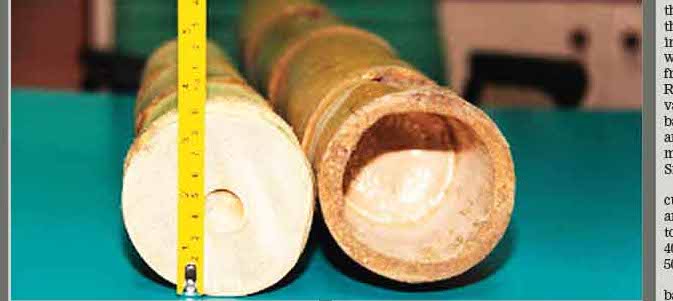
cross-section-of-beema-bamboo

Dr. N. Bharathi, who is on the Experts Committee for high tech horticulture formed by National Development Corporation in India, also a member of the State Bamboo Development Agency, Gujarat and a member in the Bamboo Technical Support Group (BTSG) under the State Steering Committee of Gujarat and Tamil Nadu has done extensive research and invented biomass energy out of Beema Bamboo to generate electricity. He is also a member of an Indian company Growmore Bio Tech Ltd, which has excelled in providing high quality Beema plants to farmers and Indian industries for the past 10 years, as well as exporting to several countries such as Japan, Australia, South Africa, Hawaii, Miami, Brazil, Malaysia, Singapore, Indonesia, Dubai, Kuwait, and Oman. The company maintains stringent quality standards coupled with the latest research findings in technology.

The laboratory of Growmore Bio Tech Ltd has an annual capacity to produce over 10 million tissue cultured plants depending on the plant species. The growing room at Growmore has infrastructure to grow 2 to 3 million plants at any given time. The lab has been accredited by the Australian Quarantine Inspection Service (AQIS) for exporting tissue culture plants from India. The company has over 160 trained technicians on its regular rolls, who have worked in achieving over 50,000 tissue-cultured plants every month individually.

Sustainable Green Energy (Pvt) Ltd

  1. Ramasubramanian, the Chairman and Managing Director of Sustainable Green Energy (Pvt) Ltd has direct connections with Dr. N. Bharathi and is attached to Growmore Bio Tech Ltd in India and works in partnership. Recently he set up a company in Sri Lanka (Sustainable Green Energy (Pvt) Ltd in Colombo 5 to generate biomass energy in Sri Lanka by growing more Beema bamboo trees to solve the long term energy problem in Sri Lanka as much as to convert the whole environment to being eco friendly.

The writer had the occasion to meet up with S. Ramasubramanian in Colombo recently, where he disclosed his future plans to establish Dendro power plants right across Sri Lanka covering areas such as Trincomalee, Moneragala, Anuradhapura, Kurunegala, and Hambantota Districts. The company wants to invest US$ 250 million on a power factory in a perimeter of 2,000 acres of land in the Vavuniya District. He noted with regret that some influential Sri Lankan third parties are making inroads to hinder the project and to grab the opportunity for themselves, however, Ramasubramanian has implicit faith, confidence and the approval of the Sri Lanka Government with the blessings of Minister of Agriculture Duminda Dissanayake and Deputy Minister of Irrigation Wasantha Senanayake.

Sustainable Green Energy (Pvt) Ltd had been owned previously by Sri Lankans, up to the year 2010. S. Ramasubramanian bought the company outright in 2011. In 2014 his company has been able to produce 5 – 10 mega watts of biomass energy, but the problem appears to be the shortage of raw material. With this in view, his company has already acquired 647 acres in the Vavuniya District with a target of acquiring 5,000 acres of more land close to Mannar to grow Beema bamboo! The company will import machinery and equipment such as generators, turbines and water pipes from Germany and France.

Operation

Ramasubramanian’s concept is wholesome and his thinking behind the project is genuine. During the first phase of the operation he intends to help the villagers in selected areas who lost their land during the LTTE war, which the government of the day is going to give back to the owners. Once the handing over process is complete, Sustainable Green Energy (Pvt) Ltd will educate the villagers on how to proceed with the bamboo cultivation.

The company will clear the jungles and prepare the lands enabling them to proceed with the cultivation; farmers are assured a guaranteed income of Rs 30,000 – Rs 35,000 per acre in 30 months. Additionally, villagers cum landowners will be able to grow vegetables by inter cropping between bamboo plants, as there will be a certain gap of space between two plants. The company has already identified 150 families in the area and clearing and preparing the land will be done at a cost of Rs.25, 000 per acre, to the company.

The company has a five-year plan to develop the local community with the assistance of the Ministry of Forests and Environment and intends to work with the fullest co-operation with the Government of Sri Lanka. Apart from generating biomass energy, Ramasubramanian plans to manufacture value added products such as clothing out of bamboo fibre yarn, fabrics, activated carbon and computer key boards and mousses and mobile phone covers which is bound to make Sri Lanka environment friendly.

According to Dr. N. Bharathi, bamboo cultivated under intensive care, 1,000 plants to an acre, the biomass yield will start from 30 tonnes per acre in three years, increasing to 40 tonnes in the next year and stabilises up to 50 from the fifth year.

What are the advantages in growing Beema bamboo? The bamboo tree emits oxygen over a twenty-four hour period, while absorbing 65 per cent of the carbon dioxide in the atmosphere. It increases the ground water level and is ideal for human health, which has been proven scientifically. For example, a person sitting under a bamboo bush gets the benefit of having plentiful oxygen, while the bamboo plant absorbs all the carbon dioxide around the area.

Global Warming

The word global warming has become quite a familiar term these days. It is taking place because man has been depleting natural resources and generating more and more carbon dioxide to a level that cannot be sustained. Human beings have not been able to do away with mortal comforts for his comfort, which generates enormous amounts of gases, which is the cause for today’s global warming.

Every human being needs 280 kg of oxygen every year, whereas one bamboo tree is able to produce more than 280 kg/per tree / per year. Apart from bamboo absorbing carbon dioxide and releasing oxygen, continuously, which is needed for living things, it is also one of the good solutions for making the factory ‘zero discharge’ of effluent water. Hence, bamboo is the ideal choice as a plant in everyone’s garden to mitigate the global warming in the fastest, simplest and cost effective way.

A family of four including a dog or a cat would essentially require 1,100 to 1,250 kg of oxygen every year for breathing, which is made available by organically growing 3 bamboo plants! Therefore, it is food for thought that people start growing this oxygenator Beema bamboo to save the future generation from pollution and affording them the opportunity of breathing clean air, rich in oxygen.

tilakfernando@gmail.com

An Objective View of Reincarnation

October 25th, 2016

Dr Ruwan M Jayatunge  

Reincarnation contains a most comforting explanation of reality by means of which Indian thought surmounts difficulties which baffle the thinkers of Europe.” 

– Albert Schweitzer 

Reincarnation is a popular belief among many people, and it is a fundamental basis for many religions. The general idea of reincarnation is the belief that when a person dies he is reborn again. Is there a life after death? The clinical evidence for reincarnation is subjective and arguable. Belief in reincarnation has ancient roots.

Pre Historic Concepts on Reincarnation 

Neanderthal traits appeared in Europe as early as 350,000 years ago. The first signs of religion are found in gravesites of Neanderthals in Eastern Europe. These gravesites were found to have very clean fossils, with flowers, dyes, and later, pottery placed around the body of the deceased. The Neanderthals had unusual funeral rituals, which can be interpreted, as they believed in some form of existence after life.

The Egyptians and Transmigration of the soul 

The Egyptians Pharos believed in transmigration of the soul. This means their immortal souls travel through the valley of Nile until it meets the next existence. They thought the soul transmigrate from body to body. The Pharos built mighty Pyramids to provide provisions and other necessities to their next extramundane voyage.

The Ancient Greek Philosophers on Reincarnation 

The Greek philosopher and mathematician Pythagoras taught that the soul was immortal and the soul goes through a series of rebirths. Plato too shared similar views as Pythagoras. Greek Platonism asserted the pre-existence of the soul in a celestial world and its fall into a human body due to sin. In order to be liberated from its bondage and return to a state of pure being, the soul needs to be purified through reincarnation. The Greek philosopher, Socrates declared, I am confident that there truly is such a thing as living again, that the living spring from the dead, and that the souls of the dead are in existence.” 

Reincarnation in the Upanishads 

In India, the concept of reincarnation is first recorded in the Upanishads. The Upanishads were the first writings to move the place of one’s second death” from the heavenly realm to this earthly world and to consider its proper solution to be the knowledge of the atman-Brahman identity.

Reincarnation in Hinduism 

Hinduism teaches that the soul goes on repeatedly being born and dying. At the time the Vedic hymns were written, the view on afterlife was that a human being continues to exist after death as a whole person.

Bhagavad Gita 

In the Bhagavad Gita, which is a part of the Mahabharata, reincarnation is clearly stated as a natural process of life that has to be followed by any mortal.

Reincarnation in Buddhism 

According to Buddhism, there is no permanent and unchanging soul. The Buddha taught a concept of rebirth that was distinct from other religions. The Buddha used the term Punarbhawa to explain reincarnation – an endless process that is connected with the Sansara Chakra. Buddhism denies the existence of a permanent soul that reincarnates from one life to the next. The Buddha responded that only karma is passing from one life to another. To explain this Buddha used the metaphor of the light of a candle, which is derived from another candle without having a substance of its own.

Buddhism edifies that what is reborn is not the person but that one moment gives rise to another and that that momentum continues, even after death. In the Milindapanho – a dialogue between the king Menandar and the Buddhist Monk Nagasena deeply analyze the concept of reincarnation.

Modern Research in Reincarnation 

In the last decade of the 18th century, many scholars in the Western World began to speculate on reincarnation. Father Leadbeater and Madam Helena Blavatsky of the Theosophical society saw reincarnation as a form of evolution and their writings and speeches made a profound impact on the Western World about life after death. Numerous universities in the West started gathering data on this subject. Comprehensive research on reincarnation started mainly after the World War 2. The Western researchers explained the reincarnation in terms of para-psychological phenomenon. Among the researchers, Dr Ian Stevenson was prominent.

Reincarnation and the western World 

Reincarnation has captured the imagination of a significant number of people in the West. A large number of Westerners are interested in reincarnation and a number of movies like The Reincarnation of Peter Proud” (Directed by J . Lee Thompson, starring Michael Sarrazin and Jenifer O’Neal ) , Heaven Can Wait (starring Warren Beatty & Julie Christie) , Birth( Nicole Kidman) ,Ghost (Patrick Swayze & Demi Moore ) and Darren Aronofsky’s movie The Fountain captured mass popularity. According to a survey done in the USA nearly 60% of Americans believe reincarnation is possible.

Case works of Dr. Ian Stevenson

Ian Stevenson was the former head of the Department of Psychiatry at the University of Virginia who devoted many years to the scientific documentation of past life memories of children from all over the world (Dr Stevenson investigated 16 cases from Sri Lanka) and had over 3000 cases. Ian Stevenson published his research article titled The Explanatory Value of the Idea of Reincarnation, which made a huge impact on the scientific community. His book Twenty Cases Suggestive of Reincarnation that was published in 1974 became a best seller. Dr. Ian Stevenson’s case works provide rigorous scientific reasoning to explain reincarnation. His methodology was unique and Stevenson evaluated the spontaneous narrations of the children who spoke of their previous lives, then interviews, often repeated, with the subject and with several or many other informants for both families. However, these methods led critics to question the credibility of his research technique. Some have criticized Ian Stevenson for being confirmation bias.

Skills & Past life 

Some children show enormous talent in language, memory and skills. These children could not acquire aptitude within their relatively short life years. There are many reports of Child prodigies and their cognitive talents. Mozart played a symphony at the age of seven, Carl Friedrich Gauss made his first inventive mathematical discoveries while still a teenager, John von Neumann was able to divide two 8-digit numbers in his head at the age of six, Alexander Pope was a child prodigy as a poet, the famous Indian mathematician Srinivasa Ramanujan mastered advanced trigonometry by the age of 12. Have these people had certain exposure before?

Déjà vu experiences 

The term Déjà vu experience was coined by Emile Boirac to explain the uncanny feeling of having already seen or experienced something that is being experienced for the first time. One could explain déjà vu experiences by claiming that they were memories of past lives. Experiential evidence show that certain people find familiar in unfamiliar places, proverbial in meeting unknown people for the first time in their lives and so forth. Medical experts argue Déjà vu experiences are evident in epilepsy.

Neurophysiologists point out that the déjà vu feeling is triggered by a neurochemical action in the brain that is not connected to any actual experience in the past.

Theories opposed to reincarnation (Selective thinking and False Memory Syndrome) 

Some disbelievers of reincarnation explain that claims of evidence for reincarnation originate from selective thinking – a process that one focuses on favorable evidence in order to justify a belief, ignoring unfavorable evidence and sometimes following the psychological phenomena of false memories. In false memory syndrome, person’s identity and relationships are affected by memories, which are factually incorrect but are strongly believed. False memory syndrome may account for the memory construction process, which leads people to remember living a past life.

Confabulation 

Confabulation is defined as the spontaneous production of false memories: either memories for events, which never occurred, or memories of actual events that are displaced in space or time. These memories may be elaborate and detailed. Confabulation is a form of memory disorder that may occur in patients who have sustained damage to both the basal forebrain and the frontal lobes, as after an aneurysm of the anterior communicating artery.

Hysteria reactions misinterpreted as Reincarnation 

Children suffering from dissociative disorders (hysteria) sometimes give vivid descriptions under hypnotic trances and these expressions are misinterpreted as the evidence of past lives by inexperienced hypnotherapists who have no clinical background. A typical case was analyzed by Professor Carlo Fonseka (Rebirth or Hysteria Island news paper 4th of January 2010) of a 14 year old girl with fainting attacks. Many reincarnation stories reported in countries like Sri Lanka and India have much to do with disassociation. In addition, some newspapers too fabricate and exaggerate stories in order to capture the attention of the readers who lack rational thinking. In the past few decades, some Sri Lankan newspapers reported reincarnations of the popular artist Rukmani Devi, film actor Vijaya Kumaratunge and President Ranasinghe Premadasa. These stories were found to be bogus and inflated.

Psychological trauma and a belief in reincarnation 

A number of modern researches identified a possible link between psychological trauma and a belief in reincarnation. Jonathan R. T Davidson from the Dept. of Psychiatry & Behavioral Sciences, Duke University Medical Center, Durham USA has extensively studied the beliefs in karma and reincarnation among survivors of violent trauma in the general US population. According to Davidson, personal experience of trauma may be associated with greater acceptance, as well as certain demographic and health-associated variables. The importance of holding belief in reincarnation, which may represent an important way of coping following violent trauma,

Carl Jung & Collective Unconscious

Certain psychologists openly argued that past life memories are merely a result of collective unconscious. According to them when exceptional numbers of children recall people and places which is not connected to their present life people believe these memories are linked to their past lives. These psychologists disagree with the reincarnation phenomena. To explain this they introduce Carl Jung’s famous expression collective unconscious.

Swiss psychologist and psychiatrist Carl Jung who founded analytic psychology coined the term collective unconscious. The collective unconscious represents a form of the unconscious common to mankind as a whole and originating in the inherited structure of the brain. It is distinct from the personal unconscious (explained by Sigmund Freud) which arises from the experience of the individual.

Jung saw the collective unconscious as being made up of so-called archetypes”. These archetypes being potentialities, or proclivities, that can find a channel of expression in the finding of a mate, religion, art, myth, and even in the eventual facing of death. Jung’s collective unconscious has been described as a storehouse of latent memory traces inherited from man’s ancestral past, a past that includes not only the racial history of man as a separate species but his pre-human or animal ancestry as well.

Following were the words of Carl Jung in which he elucidated his belief in life after death

My life often seemed to me like a story that has no beginning and no end. I had the feeling that I was an historical fragment, an excerpt for which the preceding and succeeding text was missing. I could well imagine that I might have lived in former centuries and there encountered questions I was not yet able to answer; that I had been born again because I had not fulfilled the task given to me.” 

Reincarnation and Edgar Cayce 

American mystic Edgar Cayce better known as the Sleeping Prophet promoted the theory of both reincarnation and karma. Cayce was deeply concerned about reincarnation. Cayce did over 16,000 readings during his lifetime. The exceptional book Many Mansions written by Gina Cerminara disclosed the patients who were treated by Edgar Cayce and their past lives. Cayce explained the symptomatology of these patients in a broad context of Karma. According to Edgar Cayce, the illnesses that his clients had were due to karmic repercussions.

Based on modern investigations of Edgar Cayce’s readings medical experts say that Cayce frequently connected illness to the mental and emotional states of the patients and he disregard the etiology of certain illnesses. His clients predominantly had cancer, multiple sclerosis, diabetes, arthritis, gallstones, kidney stones, hay fever, mental and psychological problems, digestive problems, epilepsy, hemorrhoids, ulcers, psoriasis etc and according to Cayce karmic repercussions had do with the symptoms. Cayce had stated that people suffer from epilepsy as a result of adultery that they had committed in their past lives. But modern neurophysiology explains the genesis of epilepsy that has organic courses in the brain.

The famous Sri Lankan case study of Gnanathilaka 

Well-known Sri Lankan reincarnation case study The reincarnation of Gnanathilaka” ( Navatha Upan Dariya) done by Dr H.S.S Nissanka along with Rev Piyadassi in early seventies became world famous. Gnanathilaka a young child articulated strange facts about a person named Thilakaratne believed to have lived in Aranayaka in the Central Province of Sri Lanka. She claimed that in her previous life she lived in Aranayaka and forced her parents to take her there. The local research team took the child to Aranayaka and she recognized her mother, sisters, brother, and teachers in the previous life.

Thilakaratne had seen the Queen Elizabeth when she first visited Sri Lanka in 1954. Gnanathilaka could vividly recall this incident. In her present life, she had never seen the ocean. When queried she could give specific details of the ocean and seashore.

Thilakaratne died as a teenager at the Arnayaka Government Hospital under strange circumstances. Dr. Abraham Kovoor of Minnesota Institute of Philosophy USA and the leader of the rationalist movement who openly denounced the supernatural and life after death claimed that the death certificate of Thilakaratne produced by the research team was not a genuine and the investigation was biased and non scientific. Although Dr. Abraham T Kovoor challenged the credibility of this local reincarnation research Dr Ian Stevenson accredited the reincarnation case of Gnanathilaka. (According to the information provided by Dr Darmasiri Herath , Gnanathilaka now a grown woman and working as an Aurvedic practitioner.)

The Search for Bridey Murphy 

The story of Bridey Murphy created a mass speculation in the West. Morey Bernstein’s bestselling book The Search for Bridey Murphy tells about hypnotic regression. Morey Bernstein a skillful hypnotist in Colorado, once hypnotized a housewife named Virginia Tighe. In the hypnotic session Bernstein probed Tighe’s memories back to childhood and then, as it seemed, to an earlier life. During the hypnotic regression Virginia Tighe stated that in her previous life she lived in Ireland and her name was Bridey Murphy. She mentioned the street in Ireland where Bridey Murphy believed to have lived, a name of a laundry near her previous residence, several names and other information.

A group of lawyers conducted an independent investigation on Bridey Murphy case. They found more than century old facts about a woman named Bridey Murphy in Ireland. It was revealed that Bridey Murphy was not a fictitious character. She truly lived in Ireland in the 19 th Century. Those who opposed Bridey Murphy case argued that Virginia Tighe came out with childhood memories during the hypnotic session. Also they pointed out that Virginia Tighe had an Irish nanny when she was small. Also they highlighted on the facts that the 19th century Irish poems which Virginia Tighe uttered during hypnosis could have learnt from her Irish nanny.

Past Life Therapy 

Past life therapy is based on the argument that some people carry in their subconscious mind memories of unpleasant events of their past lives and these subconscious memories adversely affect them in their present lives. By hypnosis they can be regressed beyond their birth to their previous lives. Past life therapists assure many ailments, all types’ phobias and even certain physical ailments can be cured by such hypnotic regression. Past life therapy has now become a standard western medical treatment for such ailments.

Dr. Brian Weiss and Past Life Therapy 

Dr. Brian Weiss was one of the first doctors to explore the past lives of his patients as a means of therapy. A graduate of Columbia University and Yale Medical School, Brian L. Weiss is the Chairman Emeritus of Psychiatry at the Mount Sinai Medical Center in Miami. His revolutionary book Many Lives Many Masters” opened an unexpected door into the astonishing realm of past-life regression. Dr. Brian Weiss gives an astonishing case study of Katharine who had past-life traumas that seemed to hold the key to her recurring nightmares and anxiety attacks.

Hypnotic regression and Reincarnation 

Hypnosis is an altered state of consciousness and heightened responsiveness to suggestions. It is a trance state characterized by extreme suggestibility, relaxation and heightened imagination. During regressive hypnotherapy, a person is guided into a deep state of relaxation and/or trance by way of hypnosis. In theory by entering this state, the conscious mind, which is responsible for processing information, can be by-passed. Thus, the sub-conscious mind can be accessed. Some hold the belief that the hypnotic regression as a proof for reincarnation. Those who oppose hypnotic regression declare that in a Hypnotic regression, repressed childhood memories come in to action it if wrongly interpreted as evidence of past life.

Dr. Raymond Moody & Near- Death Experience 

Dr. Raymond Moody is recognized as the father of NDE research. He has chronicled and studied many of these experiences in several books. Dr. Raymond Moody, in his innovative book Life After Life,” coined the term near- death experience.” Dr. Moody was the first person to document the core experience of an NDE.

A near-death experience (NDE) is the perception reported by a person who nearly died or who was clinically dead and revived. The experience often includes an out-of-body experience. The phenomenology of an NDE usually includes physiological, psychological and transcendental factors. Typically the experience follows a distinct progression, starting with the sensation of floating above one’s body and seeing the surrounding area, followed by the sensation of passing through a tunnel, meeting deceased relatives, and concluding with encountering a being of light (Morse, Conner & Tyler, 1985).

Dr. Raymond Moody‘s book Life After Life appeared in 1975. Dr. Ray Moody described an elderly woman’s account of her near-death experience so accurate that she even correctly reported the colors of the instruments used on her. What is especially impressive about this example is that she had been blind for over fifty years. In another account, from a proactive Dutch NDE study, a nurse removed the dentures of an unconscious heart attack victim, and was asked by him after his recovery to return them (van Lommel et.al, 2001).

On Death and Dying – Dr. Elizabeth Kubler-Ross 

Dr. Elizabeth Kubler-Ross was a Swiss-born psychiatrist who became a pioneer in the field of thanatology (the study of death and dying). Her first book On Death and Dying in 1969 made Kübler-Ross an internationally renowned author. On Death and Dying examines the attitudes of the dying and the factors that contribute to society’s anxiety over death. Dr. Elizabeth Kubler-Ross once stated that Death is simply a shedding of the physical body like the butterfly shedding its cocoon. It is a transition to a higher state of consciousness where you continue to perceive, to understand, to laugh, and to be able to grow”.

Dr. Elizabeth Kubler-Ross believed that death is a highly creative force. The highest spiritual values of life can originate from the thought and study of death. In the later part of her career she believed that death is not an end. Dr. Kubler-Ross implied there may be another dimension after death.

Conclusion 

Reincarnation is an unknown phenomenon that needs more research and investigation. The tools and technology that we use today may not be advanced enough to discover a natural phenomenon like reincarnation. For instance, 500 years ago people had no means to prove the existence of radioactivity in the environment. Time and human progression had solved many natural mysteries in the past. Perhaps the mystery of reincarnation will be resolved within another few decades with the advancement of science and technology. Until such time it remains an enigma and a debatable subject.

These were the words of Professor Carl Sagan of Cornell University about reincarnation and paranormal activities.

At the time of writing there are three claims in the ESP field which, in my opinion, deserve serious study: (1) that by thought alone humans can (barely) affect random number generators in computers; (2) that people under mild sensory deprivation can receive thoughts or images projected” at them; and (3) that young children sometimes report the details of a previous life, which upon checking turn out to be accurate and which they could not have known about in any way other than reincarnation.

As COPE is divided: ACF request President to Appoint a Presidential Commission on Treasury bond scam

October 25th, 2016

Press Statement by Anti-corruption Front

Anti-Corruption Front (ACF) calls for an independent presidential commission to investigate the two controversial treasury bond scams following reports that there is a possibility of two separate reports by the Committee on Public Enterprises (COPE).

AS there is an information on two separate reports (or two separate recommendations in a same report) is true, this will be an unprecedented event in Sri Lankan history. The public, for the most part, has always seen COPE as an ‘institution’ that can be relied upon to properly investigate instances of corruption in government institutions. If the members of the COPE divide along party lines and present different reports or if some members go against the general consensus and attempt to justify former Central Bank Governor Arjuna Mahendran, this is a serious concern because the treasury bond scam is not only an abstract ‘financial crime.’ The Treasury Bond scam and its fallout directly affects six million EPF beneficiaries and thus directly affects Sri Lanka’s social security net.

Usually COPE uses information, observations and recommendations given by Auditor General, about a government institution, to question officials from the relevant institutions. According to the constitution COPE is responsible for the initial reporting of the accountability of all state owned enterprises to tax payers and the Auditor General is entrusted to carry out an independent audit of all state owned enterprises and submit the reports to COPE. Before submitting these reports the Auditor General shares his reports with the relevant institutions and obtains their views on his report. Thus these institutions have the ability to submit their objections before a report is presented to COPE, which calls upon relevant officials and raise issues directly with tem based on the Auditor General’s reports.

Since the Auditor General is appointed by the Constitutional council, based on his ability to carry out such audits and his professionalism and independence, Auditor General’s report has never been questioned by COPE members.

However on 24 October (Monday) United National Party (UNP) members of the COPE questioned the Auditor General based on a party stance, making it obvious that the government is carrying out a systematic campaign to cover up the biggest financial irregularity which occurred under the current administration.

This is not what the people want or expected. I think it’s universally accepted, apart from a few UNPers, that there had been irregularities at the Treasury bond auctions in 2015 and 2016. People also know that former central bank governor, Arjuna Mahendran and the monetary board are responsible for what transpired. If the current COPE is divided along party lines and fails to do its job, I think we have to place our hopes on a presidential inquiry,” said Advisor for Anti-Corruption Front, Rajith Keerthi Tennakoon.

In the 2015 interim COPE report, which was never debated in Parliament because of the sudden dissolution, there are mentions of how the EPF, which has the ability to purchase bonds as a primary dealer, having purchased the bonds from other primary dealers has sustained significant losses. The leaked Central Bank investigation report on the bond issue also mentions the highly suspicious nature of this transaction and has stated that this has had an adverse effect on the EPF, and ultimately millions of hard working members of the private sector. However the impact on the EPF has not been properly calculated or considered by any investigative entity but many financial experts fear that that the long term losses will be colossal. These are allegations that have been leveled publicly and widely reported by the media and as relevant individuals have not denied these allegations we have to presume that media has reported this correctly.

ACF has always fought for the economic and social rights of Sri Lankans and given that the Treasury bond scam will have a serious impact on the social security net of millions of Sri Lankans, we urge the President and the government to resolve this matter in a satisfactory manner.

After considering all these facts the ACF once again requests the President to establish a fully powered presidential commission to investigate the bond issue.

කෝප් කමිටුවේ බෙදීම – බැඳුම්කර වංචාව සොයන්න ජනාධිපති කොමිෂන් සභාවක් පත් කරන්න –   දුෂණ විරෝධී පෙරමුණ ඉල්ලයි.

October 25th, 2016

කීර්ති තෙන්නකෝන් උපදේශක/දුෂණ විරෝධී පෙරමුණ 

කෝප් කමිටුව බැඳුම්කර වංචාව පිළිබද සකස් කළ වාර්තාව සම්බන්ධයෙන් දේශපාලන පක්ෂ ලෙස බෙදීමක් මතුව ඇති බැවින්, කරුණු විමර්ශනය සදහා විශේෂ ජනාධිපති කොමිෂන් සභාවක් පත් කරන ලෙස දුෂණ විරෝධී පෙරමුණ අද ජනාධිපතිවරයාගෙන් විවෘත ඉල්ලීමක් කළේය.

කෝප් කමිටුව විසින් එකිනෙකට පරස්පර නිර්දේශ සහිත වාර්තා දෙකක් හෝ එකම වාර්තාවක් දෙ ආකාර නිර්දේශ සහිතව ඉදිරිපත් කිරීමට සුදානම් කරමින් සිටී.  කෝප් කමිටුව රාජ්‍ය මුල්‍ය සම්බන්ධයෙන් විමර්ශන කිරීමේ විධිමත් ආයතනගත යාන්ත්‍රණය යි. බැඳුම්කර වංචාව සම්බන්ධයෙන් වන විමර්ශන සම්බන්ධයෙන් මේ වන විට කෝප් කමිටුව දේශපාලන පක්ෂ ලෙස බෙදී සිටී.  බැඳුම්කර වංචාව වත්මන් යහපාලන රජය යටතේ සිදුව ඇති දැවැන්තම වංචාව වනවා පමණක් නොව එය මෙරට මිලියන 6 කට වැඩි පිරිසක ගේ සමාජ ආරක්ෂණ ක්‍රමය වන සේවක අර්ථසාධක අරමුදල් හා සෘජුව බැදී තිබේ. 

දුෂිත ආයතනය වෙනුවට විගණකාධිපති ප්‍රශ්න කිරීම

යම් රාජ්‍ය ආයතනයක් සම්බන්ධයෙන් විගණකාධිපතිවරයා විසින් කෝප් කමිටුව වෙත ලබා දෙන නිරීක්ෂණ හා නිර්දේශවලට අදාළ රාජ්‍ය ආයතන විසින් ප්‍රතිචාර දැක්වීම පාර්ලිමේන්තුවේ කෝප් කමිටුවේ ව්‍යහාරික ක්‍රමවේදය යි.  කෝප් කමිටුව විසින් ඊයේ දිනය පුරා සිදු කොට ඇත්තේ අදාළ වාර්තාව සකස් කළ විගණකාධිපතිවරයා පක්ෂ දේශපාලන ප්‍රවේශයක සිට ප්‍රශ්න කිරීමය.  වත්මන් රජයේ යටතේ සිදු වූ දැවැන්තම මුල්‍ය වංචාව වසා ගැනීමට දැවැන්ත උත්සාහයක් මේ වන විට ක්‍රියාත්මක ය.  

‘‘මේ රටේ ජනතාව බලාපොරොත්තු වූ දෙය මෙය නොවේ.  එජාප හිතවතුන් කිහිප දෙනෙකු හැර අන් සියලුදෙනා 2015 හා 2016 බැදුම්කර නිකුතුවේ දැවැන්ත වංචාවක් සිදුව ඇති බව පිළිගනී.  සිදුවූ අක්‍රමිකතාවට හිටපු මහබැංකු අධිපතිවරයා සහ ශ්‍රී ලංකා මුල්‍ය මණ්ඩලය වගකිව යුතුය.  අද වන වට කෝප් කමිටුව පක්ෂ වශයෙන් බෙදී තම වගකීම ඉටු කළ නොහැති තත්වයකට පත්ව සිටී.  දැන් අපට ඇති එකම බලාපොරෝතුව ස්වාධීන ජනාධිපති කොමිෂන් සභාවක් මගින් විමර්ශන කටයුතු සිදු කිරීම‘‘ බව දුෂණ විරෝධී පෙරමුණේ උපදේශක කීර්ති තෙන්නකෝන් මහතා පවසයි.

2015 කෝප් කමිටුවේ අතුරු වාර්තාව විවාදයට ගැනීමට පෙර පාර්ලිමේන්තුව හදිසියේ විසුරුවා හැරීමට සිදු විය.  සෘජු මිලදී ගැනීම් වෙනුවට සේවක අර්ථසාධක අරමුදල් යොදාගනිමින් තැරැව්කරුවන් හරහා සිදු කළ මිලදී ගැනීම් මගින් මෙරට මිලියන 6 ක් වන කම්කරු ප්‍රජාවගේ මුදල් අයථා පරිහරණයක් සිදුව තිබේ.  මේ වන විට හෙළිදරව් වී ඇති මහ බැංකුව විසින්ම සකස් කරන ලද වාර්තාවක ද, සේවක අර්ථසාධක අරමුදලට සිදු වී ඇති පාඩුව පිළිබද සදහන් ය.  කෙටි කාලීනව පමණක් නොව දිගු කාලීනව ද මෙරට පෞද්ගලික අංශයේ සේවකයින්ට මෙමගින් ඇති විය හැකි බලපෑම විශාලය.

ශ්‍රී ලාංකිකයින්ගේ ආර්ථික හා සමාජීය අයිතිවාසිකම් වෙනුවෙන් පෙනී සිටන දුෂණ විරෝධී පෙරමුණ, මෙරට මිලියන 6 ක කම්කරු ප්‍රජාවගේ සමාජ ආරක්ෂන අරමුදල් ආරක්ෂා කිරීම සදහා සදහා භාණ්ඩාගාර බැඳුම්කර වංචාව සම්බන්ධයෙන් විමර්ශනය කිරීම සදහා පූර්ණ බලැති ජනාධිපති කොමිෂන් සභාවක් පත් කරන මෙන් දුෂණ විරෝධී පෙරමුණ ජනාධිපතිවරයාගෙන් විවෘත ඉල්ලීමක් කරයි.


කීර්ති තෙන්නකෝන්

උපදේශක/දුෂණ විරෝධී පෙරමුණ                                                                               2016 ඔක්තෝබර් 25 


‘තෝ හොරෙක්.. තෝ පල් හොරෙක්..’ උඹ කටවහගනින් උඹ තමයි ලොකුම හොරා.. – ලොකුම තැනක කතාවක් මෙහෙමයි..

October 25th, 2016

ලංකා සී නිවුස්

රටම මහින්දට යන තේමාව යටතේ කඩුවෙල පිවිතුරු හෙළ උරුමය සංවිධායක ශිරන්ත ජයලත් මහතා විසින් සංවිධානය කරන ලද ජන හමුවක් පාර්ලිමේන්තු මන්ත්‍රීවරුන් වන නීතිඥ උදය ගම්මන්පිල, ප්‍රසන්න රණතුංග සහ ජාතික නිදහස් පෙරමුණේ මාධ්‍ය ප්‍රකාශක මොහොමඩ් මුසාමිල් යන මහත්වරුන්ගේ ප්‍රධානත්වයෙන් රාජගිරිය කලපළුවාවේදී පැවැත්විනි.

මේ අවස්ථාව සඳහා පලාත් සභා මන්ත්‍රීවරුන් වන ජගත් පුෂ්පකුමාර, මේජර් ප්‍රදීප් උදුගොඩ යන මහත්වරුන්ද පිවිතුරු හෙළ උරුමයේ ජාතික සංවිධායක මධු මාධව අරවින්ද මහතා සහ ප්‍රවීන නිළි ඕෂධී හේවාමද්දුම මහත්මියද නාගරික මන්ත්‍රීවරුන් පිරිසක්ද සහභාගි විය.
පිවිතුරු හෙළ උරුමයේ ප්‍රධාන ලේකම් නීතිඥ උදය ගම්මන්පිල මහතා එහිදී මෙසේ අදහස් පල කලේය.

‘තෝ හොරෙක්.. තෝ පල් හොරෙක්..’ උඹ කටවහගනින් උඹ තමයි ලොකුම හොරා.. – ලොකුම තැනක කතාවක් මෙහෙමයි..

එදා බලය වෙනුවෙන් තරගෙට බොරු කී හැටි

මේ ආණ්ඩුව බලයට එන්න තිබ්බ ජනපතිවරණය හරියට සිංහල අළුත් අවුරුද්දේ හොදම පචයා තේරීමේ තරගය වගේ. ආණ්ඩුවේ උදවිය තරගෙට බොරු කිව්වේ. ජනාධිපතිතුමන් ඇමරිකාවේ බකිම්හැම් මාළිගාවෙන් ගෙනාපු රත්තරන් අශ්වයෝ ගැන කිව්වා. අපි කවුරුත් දැන උන්නේ එංගලන්තයේ බකිම් හැම් මාළිගාව ගැනයි. නමුත් සිරිසේන ජනපතිතුමන් නම් කිව්වේ රාජපක්ෂ පුතාලට ඇමරිකාවේ බකිම්හැම් මාළිගාවෙන් රත්තරන් අශ්වයෝ ගෙනා බවයි. බැරක් ඔබාමා ජනපතිතුමන් කට ඇරගෙන බලං හිටියා සිරිසේන ජනපතිතුමන් දිනන කන්. මොකද එතුමන් ඇමරිකාව පුරා දෙපාරක් රවුම් ගහල ජනපති උනාට ඇමරිකාවේ බකිම්හැම් මාලිගාව තියෙන තැන ඔබාමා ජනපතිතුමන් දන් නෑ. ඉතින් ඔබාමා ජනපතිතුමන් හිතුවා සිරිසේන දින්නොත්, රත්තරන් අශ්වයෝ ගෙනාපු තැන හොයාගත්තොත් ඇමරිකාවේ ජනපති වෙලත් මං නොදන්න බකිම්හැම් මාළිගාව මට බලාගන්න පුළුවන් වේවි කියලා. ඒ විතරක් නෙමෙයි ඒ කාලේ ලැම්බෝගිනි, ඩොල්ර් බිලියන 18 ක මහින්ද මහත්තයගේ ගිණුම් ගැන කිව්වා. රජ පවුලේ හෙළි කොප්ටර් ගැන කිව්වා. අද වෙනකොට මිත්‍රවරුණි මේ සියල්ලම පට්ට පල් බොරු වෙලා ඉවරයි.

එදා මෙගා ඩීල් ගැන කතා කරපු මෙගා පෝලිම් ඇමති පාච රණවක කියනවා මහින්ද රාජපක්ෂ ආණ්ඩුවේ මෙගා ඩීල් නිසා එදා කල සෑම ව්‍යාපෘතියකම 90% කොමිස් කියලා. ඒක ඇත්ත කියල හිතලා සිරිසේන මහත්තයා එයාගේ ප්‍රතිපත්ති ප්‍රකාශයේ ලියලා තියෙනවා මහින්ද රාජපක්ෂ ආණ්ඩුව වැය කල මුදලින්ම මම ඒ වගේ සය ගුණයක සංවර්ධනයක් කරනවා. 10% නම් ඇත්ත වියදම. 90% තියෙන්නේ කොමිස්නම් කොමිස් නතර කලොත් ඒ සල්ලි වලින්ම දහගුණයක් වැඩ කරන්න පුළුවන්. ඔන්න මේ ගොල්ලො දැන් වැඩේ පටන් අරන්. අපි උතුරු අධිවේගී මාර්ගය හදන්න පටන් අරන් තිබ්බා. 2014 මුල්ගල තියලා වැඩ පටන් ගත්තා. මේ ආණ්ඩුව බලයට ආවා විතරයි ව්‍යාපෘතිය නතර කළා. කොමිස් වැඩියි දුෂණය වැඩියි කියලා. ඔන්න ටෙන්ඩර් කැදවලා ලගදි ටෙන්ඩරය දීලා වැඩ පටන් ගත්තා. කඩවත මීරිගම කිමි. 37 යි. දැන් මොකක්ද වෙලා තියෙන්නේ. අපි දුන්නේ රුපියල් බිලියන 146ට. අපිට චෝදනා කලේ ඒකේ 90% ම කොමිස් කියලනේ.

එහෙනම් මේ ආණ්ඩුවෙන් කොමිස් අයින් කරලා මේක දෙන්න ඕනේ කීයටද? රුපියල් බිලියන 14.6 ට විතර. නමුත් මේ ආණ්ඩුව දීලා තියෙන්නේ කීයටද? රුපියල් බිලියන 158 යි. බිලියන 12ක්ම වැඩියි. මොකක්ද මේ කියන්නේ. එක්කෝ අපේ කාලේ 90% ක්ම කොමිස්නම් දැන් ඒක 99% වෙන්න ඕන. එහෙම නැත්නම් තමන් කිව්වේ පට්ට පල් බොරු කියලා මේ ආණ්ඩුවත් පිළි අරගෙන ඉවරයි. අද මෙගා ඩීල් ගැන කතා කරපු කට්ටියගෙ කටේ පිට්ටු. මෙගාඩීල් තියා සිගිති ඩීල් එකක් වත් ඔප්පු කරගන්න බැරුව තියෙනවා. අපිව ගෙනියනවා, උදේ ඉදන් රෑ වෙනකම් ප්‍රශ්න කරනවා, එළියට දානවා. අද වෙනකම් මේ ආණ්ඩුවට මහින්ද රාජපක්ෂ ආණ්ඩුවේ මෙගාඩීල් ගැන කියපු කතා ඔප්පු කරගන්න බැරිවෙලා.

හොරු පල්හොරු ගැටෙද්දී ජනපති නිහඩයි

අද ආණ්ඩුව ඇතුලේ අර්බුද? ජනපති අගමැති තුමන්ලා රූකඩ නැටවීමක ඉන්නේ. ජනපති එක්ක අගමැතිට ඩෝන් ගියාම මහාචාර්ය විජේසූරිය දම්මලා බන්නනවා ජනපතිතුමන්ට. ජනපතිතුමාත් නිකන් ඉන්නෑ. එතුමන් වහාම සටනට කැඳවනවා අසාද් සාලිව. සාලි ගිහින් බනිනවා අගමැතිතුමාට. විජේසුරිය මහත්තයා ජනාධිපති හොරා කියනවා. අසාද්සාලි මහත්තයා අගමැති හොරා කියනවා. රූපවාහිනියෙන් මේක දකින අපි මොක්කද හිතන්න ඕන. දෙන්නම හොරු කියන එක තමයි. මේ ගිය සතියේ ඇමති මණ්ඩලේ ඇමතිවරු දෙන්නෙක් ගහගන්න ගියා. රිෂාඩ් බදුර්දීන් ඇමතිතුමන් රාවුෆ් හකීම් ඇමතිතුමන්ට ඇගිල්ල දික්කරලා කිව්වා තෝ හොරෙක් කියලා. රවුෆ් හකීම් ඇමතිතුමන් ඇගිල්ල දික්කරලා රිෂාඩ්ට කියනවා තෝ පල් හොරෙක් කියලා. එකෙක් හොරෙක් අනික් එකා පල් හොරෙක්. මුලසුනේ ඉන්න ජනපතිතුමන් මොකද කරන්නේ. කට ඇරගෙන බලන් ඉන්නවා. ඒක නතර කරන්න ගියොත් මොකද වෙන්නේ. අර දෙන්නම එකතු වෙලා කියනවා උඹ කට වහගනින් උඹ තමයි ලොකුම හොරා. ඔස්ට්‍රේලියාවේ පරීක්ෂණ තියෙන්නේ අපිට නොවෙයි උඹටයි කියලා එතුමන්ට කියන්න ඉඩ තියෙනවා. ඒ නිසා ජනපතිතුමන් හික්මීයා වගේ ඇහෙන් නෑ වගේ බලාගෙන ඉන්නවා.

එජාපය හොරු සමග හෙළුවෙන්

ජේෂ්ඨ නීතිඥයෙක් වෙච්ච එස් එල් ගුණසේකර මැතිතුමන් දවසක් මාත් එක්ක කියනවා අනික් අය කන්නේ අතින්. ඒනිසා අත ඉඹලා බැළුවම ඉදුල් ගද එනවා. එමගින් හොරා කෑවා කියලා දැනගන්න පුළුවන්. නමුත් යූ ඇන් පී කාරයෝ කන්නේ හැදි ගෑරුප්පු වලින් . ඒකෙ ඉන්න අය හැදි ගෑරුප්පු පැත්තකින් තිබ්බට පස්සේ අත ඉඹලනම් හොරා කෑවා කියලං හොයා ගන්න බෑ කියලා. ඒ නිසා එජාපයේ උදවිය හිතාගෙන හිටියේ හැදි ගෑරුප්පු ක්‍රමයට ඉංග්‍රීසි ක්‍රමයට මේ රටම මේක හංගන්න දහසක් බොරු මහ බැංකු අධිපතිගේ බෑනා ඇලෝසියස්ගේ සමාගමේ ලාභය රුපියල් බිලියන 10ක්. තවත් විදිහකට කියනවනම් කෝටි 1000ක්. තමුන්නාසේලා ජීවිත කාලෙම හම්බකලත් කෝටියක් හොයාගන්න පුළුවන්ද? නමුත් ඒ ගොල්ලෝ කෝටියේ ඒවා 1000ක් එකම එක දවසක හම්බ කරනවා අගමැතිතුමන්ට පින්සිදු වෙන්න. මේකේ එයාගෙ ලාභය කෝටි 1000 ක් උනාට ආණ්ඩුවේ පාඩුව කෝටි 1000ක් නෙමෙයි. මේ ගනුදෙනුවේ ප්‍රතිථලයක් විදිහට ආණ්ඩුව ණයට ගන්න පොලී අනුපාතිකය 2.5 % වැඩි වෙලා තියෙනවා. ඒ නිසා ආණ්ඩුවට දැන් වැඩි පොළියට ණයට ගන්න වෙලා තියෙනවා. ඒ නිසාමේ ණය බර අද රටට දරන්න වෙලා තියෙනවා. මේ ආර්ථිකය කඩා වැටුනේ රාජපක්ෂ ආණ්ඩුව ණයට ගත්නිසා නොවෙයි. මහ බැංකු බැදුම්කර වංචාවෙන් ආණ්ඩුවේ ණය පොලිය ඉහල ගිය හින්දයි. අද ඒකත් අපේ ගිණුමට දාන්න හදනවා. ආණ්ඩුව ණය වලට ගෙවන පොළිය වැඩි වෙන කොට රටේම පොලිය වැඩි වෙනවා. ඒ නිසා තමයි අද ලීසින් වලට ගෙවන පොළිය වෙනදට වඩා වැඩි වෙලා තියෙන්නේ. ඒ නිසා තමයි නිවාස ණය සඳහා ගෙවන්න ඕන ගාන වැඩි වෙලා තියෙන්නේ.

ආණ්ඩුවේ ගිණුම් බලන විගණකාධිපති ඉතාම පැහැදිලිව ලිඛිතව දීලා තියෙනවා මහ බැංකු බැදුම්කර වංචාවෙන් රටට හානියක් පාඩුවක් උනාය කියලා. ලබන සතියේ අපේ පාර්ලිමේන්තුවේ කෝප් වාර්ථාව නිකුත් වෙන්න නියමිතයි. නමුත් මේ කෝප් කමිටුවේ ඉන්න කොළ පාට මහත්වරුනම් තාමත් හොරා රකින්න හදනවා. විගණකාධිපතිට තර්ජනය කරනවා කෝප් කමිටුව ඇතුලේ. තෝ අපිව කෑවා කියලා. ඒ නිදා අද එජාපය හොරු සමග හෙළුවෙන් කියන එක ලබන සතියේ කෝප් වාර්ථාව ආවහම රටම දැන ගන්නවා. අද හොරු අල්ලන්න ආපු අය කම්බ හොරු වෙලා විතරක් නෙමෙයි. මේ රට විනාශ කරලා ඉවරයි.

එදා මහින්ද රාජපක්ෂ මහත්තයාගේ කාලේ ඇමති පුතාලා මැරයෝ විදිහට හැසිරුණානම් අද කලබ් කුඩු කරන්නේ ජනපති පුත් දහම් සිරිසේනයි. ඒ විතරක් නෙවෙයි එදා වංචා දූෂණ චෝදනා ඇමතිවරුන්ට එල්ල උනානම් අද ඒක එල්ල වෙන්නේ ජනපතිටයි අගමැතිටයි. ඔස්ට්‍රේලියාවේ සමාගමකින් පගාව ගත්තා කියලා එරට පත්තර කියන්නේ අපේ රටේ ජනාධිපතිගෙ නම. ඒ වගේම කෝප් කමිටුව ඉසසරහට ඇවිල්ලා අර්ජුන් මහේන්ද්‍රන් මොකක්ද කිව්වේ. අනේ මට කරන්න දෙයක් නෑ. රටේ අගමැතිතුමන් කිව්ව දෙයයි කලේ කියලයි. ගිය පාර අර්පුන් මහේන්ද්‍රන් කෝප් කමිටුවේ කියපු කතාව පාර්ලිමේන්තුවට එළිවෙන එක වලක්වන්න පාර්ලිමේන්තුව විසුරුවා හැරියා හදිස්සියේම. දැන් දෙවනි වටයට ඇවිදින් ඒ වාර්ථාව හදලා ඉවරයි. වාර්ථාවේ ඒවා ලියන්න එපා කියලා යු ඇන්පී මන්ත්‍රීවරුන් රන්ඩු වෙනවා. හැබැයි වාර්ථා දෙකක්විදිහට ඉදිරි සති දෙක ඇතුලත මේක පාර්ලිමේන්තුවට ඒන්න නියමිතයි. එදා පුංචි හරි හොරකමක් මැරකමක් තිබුණානම් අද ඒක දහස් ගුණයකින් වැඩි වෙලා. නමුත් එදා තිබුණු සංවර්ධනයනම් අද නතර වෙලා. එදා තිබුණු ජාතික ආරක්ෂාව අද බිංදුවට වැටිලා.

තිස්ස කිව්වේ ඇත්තද?බොරුද?

දැන් තිස්ස අත්තනායක මන්ත්‍රීතුමන් ආයෙත් අත්අඩංගුවේ. 2015 ජනවාරි මාසේ තමයි එතුමන්ව මුලින්ම අත් අඩංගුවට ගත්තේ. මුසාමිල් මන්ත්‍රීතුමයි මායි කතා උනා තිස්ස අත්තනායක මැතිතුමන්ගේ දෙවෙනි වටය පටන් ගත්තා. අපිටත් යලිත් මැගසිං බන්ධනාගාරයේදී හමුවෙන්න වෙයි නේද කියලා. අපි ඒකට ලෑස්තියි. දෙවෙනි වටෙත් යන්න ලෑස්තියි. හැබැයි මහත්වරුනි අපි කියනවා තුන්වෙනි වටයේදි ඔය අපිව ඇතුලට දාන සැබෑ කම්බ හොරුන්ව ඇතුලට දාන්න අපි ආණ්ඩු බලය ලබාගන්නත් ලෑස්තියි. මේ ආණ්ඩුවේ දැන් දින නියමවෙලා ඉවරයි.

අද උතුර කොටිය අත්පත්කරගනිමින් ඉන්නවා. එදා තිස්ස අත්තනායක මහත්තයා ගෙනල්ලා පෙන්නුවා ගිවිසුමක්. ඒ ගිවිසුම බොරුවක් කියලයි එතුමන්ව ඇතුලට දැම්මේ. නමුත් අද ඒ ගිවිසුමේ කරුණු එකිනෙක සිදු වෙනවා. කොටි ත්‍රස්තයන්ට සමාව ලැබෙන් නැද්ද? රණවිරුවන් අත්අඩංගුවට ගන්නැද්ද? හමුදා කදවුරු එකිනෙක ඉවත් කරන්නැද්ද? පෙඩරල් ව්‍යවස්ථාව අද හැදෙන් නැද්ද? එතුමන් ගිවිසුමෙන් ඉදිරිපත් කරපු සියල්ල ඇත්ත වෙද්දි තමයි කූඨ ලේඛන හැදුවා කියලා අද තිස්ස අත්තනායක මැතිතුමන්ව ඇතුලට දාලා තියෙන්නේ.

මෙතුමට නගලා තියෙනවා තවත් චෝදනාවක්. ඒ තමයි තිස්ස අත්තනායක මැතිතුමා ජනතාව අතර ජනවාර්ගික සහ ආගමික වෛරයක් ඇතිකිරීමට උත්සහ කලා කියලා. හැබැයි එතුමගේ මේ ගිවිසුම පිළිබඳ කතාව අහලා කොතනකවත් ජනවාර්ගික හෝ ආගමික ගැටුමක් ඇතිවුණු බවට කිසිම තොරතුරක් නෑ. හැබැයි අපිට මතකයි උතුරු පළාත් මහා අමාත්‍ය විග්නේෂ්වරන් මහතා උතුරු පළාතේ පවත්වපු පිබිදෙව් දෙමලුනි කියන උද්ඝෝෂණයේ ප්‍රතිපලයක් විදිහට කිලිනොච්චියේ බුදු පිලිම කුඩු උනා. අසිරිමලේ පන්සලේ හාමුදුරුවන්ට තර්ජන එල්ල උනා. වවුනියාවේ කොක්කෙලිය ගම්මානයේ සිටිය රණවිරුවන් එලවන්න අන්තවාදීන් තර්ජනය කලා. කිලිනොච්චියේ සතොස ආයතනයේ වැඩ කරන සිංහල සේවකයන්ට පහර දුන්නා. එතකොට ජාතිවාදය වපුරලා තියෙන්නේ තිස්ස අත්තනායකද? විග්නේෂ්වරම්ද? අද තිස්ස අත්තනායක මහත්තයා ඇතුලේ . විග්නේශ්වරම් තවමත් ජාතිවාදය වපුරමින් එලියේ. ඒ නිසා තමයි කේරල ගංජා කාරයන්ට හයිය එන්නේ සිලාවතුරේදී නාවික හමුදාවේ රණවිරුවන්ව පැහැරගෙන ගිහින් අමානුෂිකව පහර දීලා තමුන්ගෙ තැන්වල බලහත්කාරයෙන් රදවාගෙන ඉන්න. අද චුන්නාගම් වලදී පොලීසියේ බුද්ධි අංශ නිළධාරීන්ටත් අමානුෂික ප්‍රහාර එල්ල වෙනවා.

එදා උතුර කොටියට. අද රටම කොටියට

2009 මැයි මාසේ අතරතුරේ වෙඩි හඬ නිහඩ කලාට පස්සේ 2015 ජනවාරි මාසේ මේ පරගැති නිවට ආණ්ඩුවට මේ රට බාරදෙන තුරු උතුරේ මෙවැනි සිදුවීම් වාර්ථා උනේ නෑ. දකුණේ සිංහල දෙමළ මුස්ලිම් සමගියෙන් ජීවත් වෙන විදිහටනම උතුරේත් සිංහල දෙමළ මුස්ලිම් අය සමගියෙන් හිටියා. අද ඒ සමගිය විනාශ කර තියෙනවා. පිරබාහරන් වෙර දැරුවේ උතුරු නැගෙනහිර දෙමළ ඊලම හදාගන්නයි. අද මේ රටේ සිදුවෙන සිදුවීම් දිහා බලද්දි මුළු රටටම කොටි අල්ලලා කියලා අපිට හිතෙනවා. එහෙම නැත්නම් රණවිරුවන් සිරගෙට ගනිමින් කොටියා එළියට එන්නේ කොහොමද? රණ විරුවන් ඇස් ඉස් මස් ලේ දන් දී දිනු බිම අකුල ගෙන හමුදා කඳවුරු ඉවත් කරන්නේ කොහොමද? රටටම කොටියට බාර දෙන ෆෙඩරල් කෙටුම්පත් හැදෙන්නේ කොහොමද?

අද අපේ රට දැවැන්ත අදුරක. එදා ලක්ෂ 62 ඡන්දය දෙන්න ඇති . එදා ඔවුන්ට වැරදුනා. ඒ ජනතාව අද තේරුම් අරගෙන තමන්ට වැරදුනා කියලා. නමුත් ඒ ජනතාවට ඡන්දය දෙන්න අවස්ථාවක් නෑ ජන මතය රටට කියන්නට. මේ ආණ්ඩුව කොච්චර බයද කියනවනම් සමුපකාර ඡන්දයත් කල් දාලා. ඡන්ද පරදින මේ ආණ්ඩුව ඡන්ද තියන් නෑ. අපි ට සිදු වෙනවා ඡන්දය ගන්න. ලබන වසරේ ජනමත විමසුමක්, උතුරු මැදට නැගෙන හිරට සබරගමුවට පලාත් සභා ඡන්දය තියන්න නියමිතයි. පුංචි ඡන්දයත් තියන්න නියමිතයි. මේ එක ඡන්දයක්වත් තියන් නෑ. ජනපති තුමන් කියනවා 2020 වෙනකන් ආණ්ඩුව හොල්ලන්න බැරිලු. නමුත් ආණ්ඩුක්‍රම ව්‍යවස්ථාවේ හැටියටනම් 2019 ඔක්තෝම්බර් 26 ට කලින් ජනපතිවරණය ප්‍රකාශයට පත්කරන්න ඕන. මේ ගොල්ලෝ ජනපතිවරණයත් කල් දමා ගන්නයි දැන් හදන්නේ.

ඒ නිසා අපි පාරට බැහැලා සටන් කරලා මේ ආණ්ඩුව ගෙදර යවලයි මහින්ද රාජපක්ෂ යුගය යලි උදාකරන්නට ඕනේ. මේ රටේ ජනතාවට වැරදුනා. ලී ක්වාන් යූ වගේ නායකයන්ගෙන් සිංගප්පූරුව වසර තිස් ගානක් එතුමන්ගෙන් වැඩ ගත්තා. මහතීර් මොහොමඩ් වැනි අගමැතිවරු මැලේසියාවේ බිහිවුනාම වසර තිස් ගානක් එතුමන්ගෙන් වැඩ ගත්තා. නමුත් මේ රටේ ජනතාව යුගයේ අසහාය නායකයා වසර දහස් ගණනකින් බිහුවූ නායකයා මහින්ද රාජපක්ෂ මැතිතුමන්ව වසර 10න් ගෙදර යැව්වා. වැරදුනු ජනතාව දැන් ඒ වැරැද්ද නිවැරදි කරගන්න ලෑස්තියි. නමුත් ඒකට අපිට ඡන්දයක් ඕනෑ. ආණ්ඩුව මේ ඡන්දය දෙන් නැතිනම් පාරට බැහැලා සටන් කරලා අපේ අත් පා ඇස් කන් පූජා කරලා ලේ විලක් මැදින් හරි ජනතාවගේ ඡන්ද අයිතිය යලි දිනාගෙන මහින්ද රාජපක්ෂ යුගය යලි මේරටට උදා කරනවා.

– අරවින්ද අතුකෝරල

‘පොලිස් නිලධාරීන් කපා කොටා දැම්මේ අපයි.. හැකි දෙයක් කරනු..’ – ‘ආවා ගෲප්’ කොචොක් කරයි.. අංක නැති යතුරු පැදිවලින් සැරිසරයි..

October 25th, 2016

ලංකා සී නිවුස්

පසුගියදා යාපනය චුන්නාකම්හිදී පොලිස් බුද්ධි අංශ නිලධාරීන් දෙදෙනෙකු කපා කොටා තුවාල කලේ තම සංවිධානය විසින් යයි උතුරේ ක‍්‍රියාත්මක වන ‘ආවා ගෲප්’ කණ්ඩායම විසින් යාපනය සහ ආසන්න නගරවල අත්පත‍්‍රිකා බෙදා ඇත.

පොළිසිය විසින් යාපනය සරසවි සිසුන් දෙදෙනෙකු ඝාතනය කිරීම නිසා මෙය සිදු කල බවද අදාල අත් පත‍්‍රිකාවන්හි දැක්වෙයි.

‘පොලිස් නිලධාරීන් කපා කොටා දැම්මේ අපයි.. හැකි දෙයක් කරනු..’ – ‘ආවා ගෲප්’ කොචොක් කරයි.. අංක නැති යතුරු පැදිවලින් සැරිසරයි..

මෙම අත් පති‍්‍රිකා උතුරේ යාපනය, කිලිනොච්චි, මරුදනාමඩම්, චුන්නාගම් ආදී ප‍්‍රදේශයන්හි බෙදා දී ඇත්තේ අංක තහඩු නැති යතුරු පැදිවලින් පැමිණි මුහුණු ආවරණය කරගත් පිරිසක් බවද පෙීලිසිය කියයි.

පොලිස් නිලධාරීාන් කපාකොටා දැමීමේ වගකීම බාර ගනිමින් ඔවුන් සදහන් කර ඇත්තේ සමාජය විනාශ කරන්නන්ට හා කාන්තා ප‍්‍රචණ්ඩත්වයන්ට එරෙහිව මෙම ක‍්‍රියා සිදුකරන බවයි.

45687

Need to rebrand SL conflict

October 25th, 2016

By Neville Ladduwahetty Courtesy The Island

Decades prior to May 2009, when the ‘armed conflict’ in Sri Lanka ended, the conflict had been branded as an ‘ethnic’ one. Subsequently, the Lessons Learnt and Reconciliation Commission in their report categorized it as a conflict between a state and a non-state actor. The Army in its report covering the period July 2006 to May 2009 branded the conflict as a Humanitarian Operation. The Darusman report and the report of the Office of the UN High Commissioner for Human Rights (OISL), branded the conflict as an ‘armed conflict’ as per Common Article 3 of the Geneva Convention since the LTTE had reached the threshold needed to qualify as a party to a Non-International Armed Conflict.

Despite the fact that the conflict is commonly referred to as an armed conflict, the defeat of the LTTE continues to be referred to as the defeat of a ruthless fascist terrorist outfit by some well informed and knowledgeable analysts and commentators. The question that needs to be addressed is: Which branding would enable Sri Lanka to honourably address the challenges from Geneva? Should it be categorized as a ‘separatist armed conflict’ governed by International Humanitarian Law, or as one defeating terrorism even though there is NO internationally accepted definition of terrorism?

IMPACT of PERSPECTIVES on ACCOUNTABILITY

The LTTE, like all terrorists, resorted to terrorism to instill fear and intimidate the public. Notwithstanding this reality, the Tamil community and in particular those in the diaspora, have succeeded in portraying the LTTE as ‘freedom fighters’ engaged in the task of establishing a separate state, as resolved in Vaddukodai in 1976. This has enabled the LTTE to gain the sympathy of the International Community, a.k.a the West, to the extent that the West sees them as victims and not as terrorists. This perspective has skewed the judgment of the West. The success with which the Tamil diaspora has played the “victim card” is evident from the remarks made last week by a Brooklyn Judge, while reducing the sentences by 10yr. of three persons convicted by the US for providing material support to a terrorist organization per UN Resolution 1373.

Federal Judge, Raymond Dearie is reported to have stated:

“I just believe in my heart of hearts that an injustice has been done and I can’t correct it…Now that we’ve become a little bit more sophisticated in our thinking about what is and is not terrorism, now that we know a lot more about the conflict in Sri Lanka and the horrors visited upon these people, perhaps there’s a way to provide a fair measure of justice to all without condemning these men to essentially a life behind bars” (Daily Mirror, October 14, 2016).

The foregoing reflects the mood in the West. That mood is that horrors were visited on the Tamil people. Altering the narratives propagated by the nearly million strong Tamil diaspora over decades is no easy task for any government, even if supported by expensive PR firms. Therefore, these efforts should be abandoned. Relief for having defeated a ruthless fascist terrorist outfit and contributing towards making the world safer, as commented by the UN Secretary General during his recent visit to Sri Lanka, is not going to change the mood in the West either. The only realistic and credible way out is through a legal approach that relies on the full provisions of International Humanitarian Law applicable to Non-International Armed Conflicts.

INTERNATIONAL PARAMETERS

The OISL report acknowledges that the international parameters that should guide accountability issues should be those relating to Non-International Armed Conflict, recognized as part of Customary Law.

Paragraphs 182 and 183 of the OISL report states:

182. “Article 3 common to the four Geneva Conventions relating to conflicts not of an international character is applicable to the situation in Sri Lanka, with all parties to the conflict being bound to respect the guarantees pertaining to the treatment of civilians and persons hors de combat contained therein. Common Article 3 binds all parties to the conflict to respect, as a minimum, that persons taking no direct part in hostilities as well as those placed hors de combat shall be treated humanely, without any adverse distinction”.

183. “In addition, the Government and armed groups that are parties to the conflict are bound alike by the relevant rules of customary international law applicable in non-international armed conflicts”

If the LTTE and the security forces are “bound alike”, to “respect the guarantees pertaining to the treatment of civilians” and to abide by the “relevant rules of customary international law”, why should the full focus on accountability be on the Government of Sri Lanka, with hardly any accountability being placed on the LTTE? One possible reason could be the failure of advisors to successive Sri Lankan governments to address issues of accountability based on the full scope of International Humanitarian Law. Unless these positions are re-visited there is little or no relief for those who gave their full measure of devotion, through life and limb, and the rest of the country through its treasure, to make the nation whole again.

Therefore, it is imperative that the conflict be rebranded as a “Separatist Armed Conflict”, in order to position Sri Lanka to take the stand that measures adopted were legitimate, given the unprecedented and extraordinary challenges presented by the LTTE when they took >350,000 civilians hostage as a “human shield”, and engaged nearly 6000 child soldiers to be combatants, in complete violation of customary international law. Furthermore, measures adopted by the Sri Lankan Government and its security forces were legitimate, because they were engaged in the task to “defend the national unity and territorial integrity of the state” in keeping with Article 3 of UN Additional Protocol II of 1977.

BUILD-UP TOWARDS the ARMED  CONFLICT

The strategy adopted by the LTTE was to commit acts of terrorism coupled with a propaganda campaign that the “war was unwinnable”. This campaign was carried out both nationally and internationally with a view to demoralizing the public and weakening the resolve of the political establishment into signing a Cease Fire Agreement. The campaign that the war was unwinnable became so convincing that the LTTE came to believe in its own invincibility: a fact evident from the scope of the Interim Self Governing Authority submitted by them. This mindset prompted the LTTE to equip itself to launch an all out campaign to militarily defeat the Sri Lankan State and establish the separate state of Tamil Eelam. Thus, issues relating to the conflict should be addressed from the stand point that it was a Separatist Armed Conflict rather than from the standpoint of defeating a ruthless fascist terrorist outfit.

The validation of the conflict as an ‘armed conflict’ by the OISL entitles Sri Lanka to deploy the full range of International Humanitarian Law developed over the years by the very agents who insist that Sri Lanka be held accountable for strategies adopted during the conflict. Such an approach would entitle Sri Lanka to exploit the full range of the provisions of International Humanitarian Law under provisions of Common Article 3 of the Geneva Convention and Additional Protocol II of 1977. This would give Sri Lanka the opportunity to meet challenges presented using customary rules set by the International Community, without having to plead our case before prejudiced arbitrators.

COUNTING CIVILIAN DEATHS

The principal charge against Sri Lanka is the number of civilian deaths. Given below are extracts from the OISL report that gives an idea of the background in which these deaths occurred:

Paragraph 86: “By the end of January 2009, the LTTE was severely diminished as a fighting force…and had to rely on new and ill-trained recruits to fill its ranks”.

Paragraph 87: “This period was marked by the … forced recruitment of adult and children by the LTTE and coercive measures to stop civilians leaving the conflict area”.

Paragraph 1267: “counting or estimating the exact number of civilian casualties during the different stages of the armed conflict is impossible …”.

This background together with the two principal rules governing International Humanitarian Law of DISTINCTION and PROPORTIONALITY should guide Sri Lanka to explain the circumstances with which issues of accountability should be addressed. The following is based on ICRC Customary law, Vol. 87, March 2005:

The Principles of Distinction

Rule 1: “The parties to the conflict must at all times distinguish between civilians and combatants. Attacks may only be directed against combatants. Attacks must not be directed against civilians”.

Rule 2: “Acts or threats of violence the primary purpose of which is to spread terror among the civilian population are prohibited”.

Rule 3: “All members of the armed forces of a party to the conflict are combatants, except medical and religious personnel”.

Rule 4: “The armed forces of a party to the conflict consist of all organized armed forces, groups and units which are under a command responsible to that party for the conduct of its subordinates”.

Rule 5: “Civilians are persons who are not members of the armed forces. The civilian population comprises all persons who are civilians”.

Rule 6: “Civilians are protected against attack, unless and for such time as they take a direct part in hostilities”.

Proportionality in Attack

Rule 14: “Launching an attack which may be expected to cause incidental loss of civilian life, injury to civilians, damage to civilian objects, or a combination thereof, which would be excessive in relation to the concrete and direct military advantage anticipated, is prohibited”.

There is irrefutable evidence in UN and other reports that as a policy the LTTE took measures to discard their distinguishing uniforms thereby obscuring distinction between them and civilians. There is also irrefutable evidence that civilians participated as combatants; some voluntarily and others under coercion. In addition, civilians also directly participated in support of the hostilities. Consequently, all of them lose the right of protection by being combatants one way or another. In such a background, it is humanly not possible to identify who is a combatant and who is not, whether during the armed conflict or afterwards, because it would be impossible to distinguish between combatants and bona fide noncombatants and if distinguishing a civilian from a combatant was impossible, it follows that it is also not possible to ascertain whether the military advantage gained by the planned attack was proportionate or not. Furthermore, it is also not possible to determine who among the dead was a civilian and who was a combatant. In view of the particularities of the circumstances that prevailed, in particular after >350,000 civilians were taken hostage, the principle of proportionality becomes inapplicable.

VIOLATION of PRINCIPLES of DISTINCTION and PROPORTIONALITY

Paragraph 184 of the OISL report states:

“International humanitarian law prohibits direct attacks on persons not taking direct part in hostilities …Obligations of parties to the conflict in the conduct of hostilities are governed by the principles of distinction, proportionality and precaution at all times”.

It must be granted that as a strategy, violating the principle of distinction was to the advantage of the LTTE. Therefore, it is natural to expect the LTTE to present themselves as civilians, conveying the impression that they were “not taking direct part in hostilities”. It must then follow that a strategy where combatants conceal themselves as civilians would result in the violation of principles of proportionality, because of the inability to distinguish between those who took direct part in hostilities and those who did not.

In addition to violating principles of distinction with consequences on principles on proportionality, other violations such as locating military hardware in the vicinity of civilians and hospitals also compromised the safety of civilians. All of these actions should be understood in the context that the LTTE was fully aware that their military capabilities were severely diminished; a condition that would naturally have forced them to resort to whatever diabolical means possible, to test the ultimate resolve of the Sri Lankan Government and the Defense Forces. Attempting to hold Sri Lanka accountable for meeting such extraordinary challenges through a judicial process is unjustifiable because the physical circumstances in which they happened cannot be recreated. Furthermore, attempting to continue with a judicial process would in the circumstances be based only on the subjectivity of the narrator. Therefore, in the name of Justice itself, the Geneva process should be abandoned.

The question to successive governments and security forces is why these legitimate arguments were not presented during any of the discourses in Geneva or in any other national or international forums. The approach that Sri Lanka should take is to present its case founded on principles of International Humanitarian Law, and call on Geneva to refute the legitimacy of the arguments. Unless such a bold initiative is adopted, the fate of the soldiers who defended the integrity of the State would be in jeopardy – an unacceptable situation for any sovereign nation.

CONCLUSION

Although Sri Lanka and many other nations saw the defeat of the LTTE as the defeat of a ruthless fascist terrorist outfit, the Tamil diaspora in the West has succeeded in convincing the International Community that members of the LTTE were freedom fighters. Such perceptions have even affected the Halls of Justice in the USA, judging from the remarks of a Federal Judge Raymond Dearie, who stated: “I just believe in my heart of hearts that an injustice has been done and I can’t correct it…Now that we’ve become a little bit more sophisticated in our thinking about what is and is not terrorism, now that we know a lot more about the conflict in Sri Lanka and the horrors visited upon these people, perhaps there’s a way to provide a fair measure of justice to all without condemning these men to essentially a life behind bars” (Daily Mirror, October 14, 2016). The result of this perception was to reduce a 25 year prison term by 10 years for providing material support to the LTTE.

Therefore, hoping to find relief on grounds that Sri Lanka made the world safe by defeating the world’s most ruthless outfit is futile. Instead, the approach should be to present the factual circumstances and the extraordinary challenges that the security forces had t o face because of the violation of nearly every tenet of International Humanitarian Law by the LTTE including complete disregard for principles of Distinction and Proportionality that are the very foundation of Armed Conflict. What happened in Sri Lanka was precipitated by the actions of the LTTE who as a party to the conflict violated every possible rule under the Rules of International Humanitarian Law, and for the security forces to overcome those challenges and restore the national unity and territorial integrity of the State as endorsed by Article 3 of Additional Protocol II of 1977. Attempts to hold judicial inquiries are unacceptable because if justice is to be served, it would require the recreation of the unprecedented circumstances that had existed before these actions are judged. Since these circumstances cannot be recreated, the Geneva process should be abandoned.

What is taking place in Sri Lanka is no different to what is happening in UK, where “Former soldiers have claimed that they have been hounded through courts on unfounded claims and there are growing calls for the Ihat (Iraq Historic Allegations Team) to be shut down” (British Guardian, quoted in Sunday Times, October 16, 2016). A Downing Street statement issued recently stated: “The Prime Minister spoke of her pride in the UK armed forces and praised the work they do to keep our nation safe. She said that every effort must be made to prevent any abuse of the legal system, and restated her determination to protect the armed forces against any instances of vexatious complaints” (Ibid).

Clearly, the entire approach of Geneva to Sri Lanka has been nothing but a collection of politically motivated “vexatious complaints” – more reason as to why the Geneva initiated accountability process should be abandoned.

According to Article 3 of the Additional Protocol II, nothing shall be invoked to affect a sovereign State from using “all legitimate means” to “defend the national unity and territorial integrity of that State”. The threshold for what is legitimate when it comes to defending the national unity and the territorial integrity of a State should be lower than what is legitimate when it comes to invading countries such as Iraq, Afghanistan or Libya. This difference is reflected in the immortal words of the Gettysburg address wherein President Abraham Lincoln “dedicated a portion of that field as a final resting place FOR THOSE WHO GAVE THEIR LIVES THAT THAT NATION MIGHT LIVE” (emphasis mine). Having dedicated a portion of the field as a final resting place ONLY to those gave their lives so that the nation might live, for a US State Dept. official to kneel and lay a wreath for those who attempted to dismember the nation of Sri Lanka, reflects confused perspectives.

Govt. in crisis – Dinesh Gunawardane

October 25th, 2016

 By Kelum Bandara Courtesy The Daily Mirror

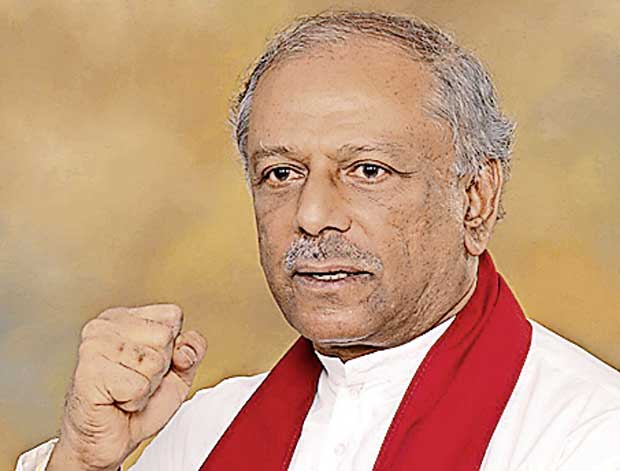
 By Joint Opposition’s Parliamentary Group Leader Dinesh Gunawardane, in an interview with Daily Mirror, says President Maithripala Sirisena has finally realised the veracity of allegations against the FCID, CID and the Bribery Commission. He says the government is in a serious crisis. Excerpts:
  • Not excited by emotional outbursts

  • The unitary state should not remain only in the name board

  • Western powers are interested in creating a Federal system

  • Country’s unitary status never to be compromised

Q  How do you see the unfolding political situation in the country in the aftermath of the President’s outburst?

For the last 12 months after the General Elections, people had fresh hopes as promised by the UNP-led government. The Joint Opposition, both during the 100-day program and after, held that the extra and special mechanisms created with the intention of political victimisation of the opposition should not be pursued against politicians, security forces personnel and others.
But, this continued unabated. According to the President’s clear statement, he has understood what we said. He has especially referred to the attitude towards the former Defence Secretary, the retired navy chiefs, army personnel and others. It seems that various groups, with vested interests were taking decisions. This is a serious statement for the President of the country to make against the backdrop of political problems within the government. It has been taken seriously both locally and internationally.

Q  Where will it end in your opinion?

There will be attempts to patch up. The UNP and the President’s group may try it out. They will try to cover up the issue because both sides want to govern. Yet, it is crystal clear that there is a crisis. If they are to run the government, there will be efforts to avoid open confrontations as much as possible. However, the problems remain unresolved. They cannot be resolved in that sense. You see now there is a committee appointed to look into the budget. The committee representing the UNP, the President’s group and the Finance Minister, is meeting. It means there are issues yet to be agreed upon by all. Unanimity is absent.

Q  How does the Joint Opposition respond to the situation?

We maintain what we have been agitating for. We have aired out our views over the last 18 months regarding the violation of democratic norms, practices and procedures, political victimisation of MPs and other opponents, government servants and others. We have held the correct position. We will now ask the President to put into action what he said. Otherwise, the President’s statement will sound hollow.

Q  Some people talk about the possibility of a change of government. How realistic is it?

This is not a one party government. It is also not a two-party government. There are differencesemerging as the problems increase in the country. There are issues confronting the armed forces that resurrected the country from the scourge of terrorism. We have issues on the economic front. Economic mismanagement is serious. As a result, the cost of living is going through the roof. Public hopes are shattered. Waste and corruption in the Central Bank bond issue have exposed the government. The government is unable to face people at the local government elections. All these add up to a situation that exerts immense political pressure on the government MPs and political groups.
New differences will emerge further. If it aggravates, the government will not be able to run with a majority. This is what people talk about.

Q  How ready is the Joint Opposition to give leadership to it?

The Joint Opposition is the leading force against this government. It is a known fact in Parliament. It is a fact known to the general public. It has emerged as the biggest political force to reckon with, challenging the UNP-led government. We, under the leadership of former President Mahinda Rajapaksa, will harness the situation. We are not getting excited for the sake of emotional outbursts. We know the crisis is much more severe underneath on all accounts be it social, economic or political.

Q  Apart from that, you participate in the deliberations of the Steering Committee assigned for evolution of constitutional proposals. How far have you progressed?

The Constitutional Assembly has met only once. The Steering Committee has been meeting. They deliberate by getting reports from various experts and advisors. The subcommittees, comprising MPs, were appointed. They have reported to the Steering Committee. On the key issues, the Joint Opposition has taken stands. We have submitted our proposals highlighting the areas that should not be compromised at any cost.
One is the unitary state. It should never be compromised. Then, we have stressed the importance of supremacy of Parliament and the need to change the Executive Presidency. The Provincial Councils can be considered without endangering the unitary state or the national security of the country. We have clearly taken positions that the north and the east should not be merged. It should not be allowed at any cost. A mixed system of electoral reforms should come. The local authorities should be given more powers. The Prime Minister should be elected by Parliament. There is a firm no to land alienation to foreigners. The Joint Opposition members and other members of the committee have big differences. That is the status quo.
As the Chairman of the Steering Committee, the Prime Minister, said a report would be submitted to Parliament. Finally, the House will have to decide on the report.
The Joint Opposition’s position is clear.

Q  How confident are you that a new Constitution will be a reality in Sri Lanka?

At the rate things are moving, how can a constitution be enacted against the wishes and will of the people?

Q  But, the government has a two-third majority in Parliament?

The government may be having a majority. They have to refer it to the people at a referendum. If they cannot get public approval at a referendum, the government will not be able to make it. We have a clear stand. We have taken uncompromised stands regarding certain matters. The government cannot ignore our position.

Q  Do you believe whether the government will devise means to avoid a referendum?

How can they do it? It cannot be done. The present Constitution clearly says any amendment to certain provisions of the Constitution need a referendum.
In the resolution adopted by the Constitutional Assembly, it clearly says the proposed constitution will be drafted based on the Steering Committee only if it is approved by two-thirds. Otherwise, the whole process ends there. It is spelt out in the resolution. Then, if they get two-thirds for the draft, it should be concluded, referred back again to Parliament. After that, it should be referred to the people at a referendum. That is there in the resolution. The government cannot violate the basic principles of the resolution and the Constitution.

“It seems that various groups, with vested interests were taking decisions. This is a serious statement for the President of the country to make against the backdrop of political problems within the government. “

Q  In the Steering Committee, how accommodative is the government in incorporating your proposals?

Of course, they listen to all. As a result, nothing is finalised. The government must be having its own plan. We know that. In addition to the local component in making this constitution, the western powers are also interested in creating a Federal system. The Joint Opposition has rejected such a system. A number of members of the government have also rejected it.

Q  Then, it is unlikely that the process will make its way through Parliament?

It should be unlikely. No MP wants the unitary status of the country to be compromised for the installment of a Federal System.

Q  But, there is a perception in the country that the government will do away with labels such as Unitary and Federal. In fact, one MP of your side charged that the government was trying to bring a constitution which is Unitary by name, but Federal in content. What are your views?

That is not so easy. That is the reason for us to take a stand. The unitary state should not remain only in the name board. It should be there with substance. Relevant safeguards should be there as in the present constitution. There is a famous judgment. It is not an easy thing to hoodwink masses on constitutional matters. If it is attempted, it will be exposed overnight. There is speculation thought that the government will try something.The Joint Opposition is clear that Article 9 related to the status accorded to Buddhism should not be touched. It applies cutting across the country including the North and the East. We condemn Northern Chief Minister C.V. Wigneswaran’s statement on the erection of Buddha statues. The government is not in a position to do what is not acceptable to the country.

Q  You were involved in working electoral reforms at one time. What is the latest stand at the Steering Committee?

There is general consensus on the electoral reforms. It is a mixed system to elect more from the First Past the Post System (FPP) and less from the National Proportional Representation System (PR).
Perhaps there might be another level proportional representation. All will appear in the report.
The positions regarding electoral reforms, the executive presidency, devolution and the nature of state should be agreed upon.

Q  Besides, you raised questions about those affected by the explosion of the armoury at the Salawa military camp. What is the latest situation there now?

Six months has already lapsed. The inquiry report has not yet been publicised. It is a major explosion. Secondly, some people have not been compensated to rebuild their homes and businesses. The situation has not been properly addressed. It is same with the Aranayake incident. These are the two main disasters-one natural disaster and the other a man-made disaster. In the latter, the Army is not responsible it is the government then. The government cannot bluff. The Army camp should be relocated.

Bond Scam; Full Text Of Interim Report Of COPE Inquiry

October 25th, 2016

Courtesy Colombo Telegraph

The 13-member Special Parliamentary Investigation Committee that probed the alleged insider trading and favoritism in the recent treasury bond issue has established Central Bank Governor Arjuna Mahendran’s direct intervention on behalf of his son-in-law Arjun Aloysius owned Perpetual Treasuries.We publish below the interim report prepared by the committee, the sudden decision to dissolve the parliament effectively stopped the report from being tabled in Parliament.


CPOE Report - Page - 01CPOE Report  bond scam- Page - 02CPOE Report  bond scam Scan - Page - 03CPOE Report  bond scam Scan - Page - 04CPOE Report  bond scam  - Page - 05CPOE Report  bond scam  Scan - Page - 06CPOE Report  bond scam Scan - Page - 07CPOE Report  bond scam   Scan - Page - 08CPOE Report  bond scam Scan - Page - 09CPOE Report  bond scam  Scan - Page - 10CPOE Report  bond scam Scan - Page - 11CPOE Report  bond scam Scan - Page - 12CPOE Report  bond scam  Scan - Page - 13CPOE Report  bond scam Scan - Page - 14CPOE Report  bond scam  Scan - Page - 15CPOE Report  bond scam Scan - Page - 16CPOE Report  bond scam  - Page - 17

CPOE Report  bond scam Scan - Page - 18


Scan - Page - 19 - Recommendations


Sri Lanka’s Northern Province Chief Minister Wigneswaran refuses to hoist LTTE flag

October 24th, 2016

When the Chief Minister came to know that in the meetings of the TCC, the Tiger flag is invariably hoisted and homage (Veera Vanakkam) is paid to the dead LTTE cadres (Maaveerars), he said he would not be able to speak at such a function as that would lead to problems back home in Sri Lanka.

An Australia-based lieutenant of his, who had been a bridge between the TCC and Wigneswaran, then got in touch with the organizers and asked them to cancel the flag hoisting ceremony. There upon, the Chief Minister attended the function and delivered an address.

In the 30 minute speech, Wigneswaran stressed the need for the Tamils to unite by shedding political differences and eschewing one upmanship. He appealed to the Tamils to shed arrogance and the practice of opposing anything that is suggested as an alternative to one’s way of thinking.

Clearly, Wigneswaran was asking the acolytes of the LTTE to shed its mindset, which ill fits present day conditions.

CV Wigneswaran

CV Wigneswaran

Wigneswaran called for a democratic struggle to secure the Tamils’ rights. He  stressed the importance of securing international support including the support of the Tamil Diaspora in this endeavor.

The Chief Minister listed the problems the Tamils are facing in Sri Lanka, mentioning the non-return of lands seized during the war; the building of Buddha Viharas with the help of the armed forces in places where there are no Buddhists; illegal fishing by persons from outside the province with the help of the armed forces; and the Central government’s practice of doing things in the province without consulting the Northern Provincial Council.

He referred to the charge that the Northern Province Administration is not doing its bit to develop the province and said that he wants the Diaspora to invest in the province in projects of use to the local people and that he has had discussions on this with the Prime Minister’s advisor, R.Paskaralingam.

The Chief Minister promised to help Diaspora investors and said that he has been wanting to launch a Chief Minister’s Fund to receive contributions for development from local and foreign donors, but the provincial Governor is standing in the way.

Refuting the charge that he and the Northern Provincial Council are not contributing to post-war reconciliation and are only opposing every step that is taken in this regard, Wigneswaran said that he had forwarded the Tamils‘ constitutional proposals to the Centre. He has suggested a federal system because the existing 13 th. Amendment of the constitution takes away with one hand what had been given by the other. At any rate, the 13 A does not reflect the spirit of the India-Sri Lanka Accord of 1987 on which it is based, he said.

Take action against Arjun Aloysius: COPE

October 24th, 2016

Courtesy The Daily Mirror

Members of the Parliamentary Committee on Public Enterprises (COPE) today held former Central Bank (CB) Governor Arjuna Mahendran’s son-in-law Arjun Aloysius and other directors of Perpetual Treasuries responsible for the controversial CB Bond Scam, UNP member of COPE and Deputy Minister Ajith P. Perera said.

The COPE recommended to arrest Aloysius and the other directors and take action in accordance with the penal code, he said

He said the committee had also held several other companies responsible for the scam.

These conclusions came after chaos in the COPE meeting during the past few days as a result of differences in opinion among the members.

When asked about what action would be taken about Arjuna Mahendran, he said more recommendations were yet to be made and any decision if any involving Mahendran would be taken during Thursday’s COPE meeting.

He said it would be only possible to present the COPE report to Parliament by Friday (October 28). (Yohan Perera and Kelum Bandara)

මට එක දිගටම හූ තිවුවා.. ගිනිසීරියා අත්තකුත් පෙන්නමින් ජනපති තවත් රහසක් හෙලි කරයි…

October 24th, 2016

ලංකා සී නිවුස්

1994 වසරේදී දිඹුලාගල නාහිමියන්ගේ ආදාහනෝත්සවයට පැමිණි තමන් සභාව අමතන්නට සැරසෙනවාත් සමගම එක දිගටම හූ තැබූ බව ජනාධිපති මෛත‍්‍රිපාල සිරිසේන මහතා පවසයි.

එදා සංවිධානාත්මකය හූ තැබූ අය පසුව නිසි කාරණා තේරුම් ගත් පසු පසු තැවෙන්න ඇතැයිද ජනාධිපතිවරයා කියා සිටියේ ඊයේ දිනයේ පැවති දිඹුලාගල සිරි සීලාලංකාරගම ජනතා අයිතියට පත් කිරීමේ උත්සවයට එක්වෙමිනි.

2019 වසරේදී මෙරටට විදුලි අර්බුදයක් බලපාන නිසා වැටහිරියා, ගිනිසිරියා ගස් සෑම ගොඩ ඉඩමකම වගා කරන ලෙසද ඉල්ලා සිටි ජනාධිපතිවරයා එම ශාක මගින් නව තාක්‍ෂණය ඔස්සේ විදුලිය උත්පාදනය කල හැකි යයිද සදහන් කලේය.

Justifiable demands of the Sinhalese from the treacherous, ungrateful Tamils of Sri Lanka. Tamil Terrorism

October 24th, 2016

IMRC Iriyagolle (A traumatised Sinhalese Buddhist)

Hon.James Barry MP,
House of Commons,
London
SW1A 0AA.

Dear Sir,

Ayubowan

I am writing this letter on behalf of the beleaguered, maligned, persecuted, betrayed and more importantly the murdered, tortured Sinhalese victims of the Tamil traitors of Sri Lanka.

Our demands in brief are as followers:

The Tamils cease to subjugate the Sinhalese the host Nation of Sinhale also known as Sri Lanka in any form.

The Tamils cease their demands to perpetuate their positive privileges bequeathed to them by the British, the caste system and successive Sri Lankan Governments.

The termination of the superior status and extra-ordinary priviledges enjoyed by the Sondakara Vellala  and Vellala Tamils of Sri Lanka bestowed upon them by the British and the Sri Lanka state.

Prior to admission to higher education the Tamils must sign a legal binding statement that they will not in anyway in any form at anytime betray the Sinhalese that have given them free education, social status (that their caste system denied them) and have tolerated their treachery attempting to usurp their traditional homeland and exterminate the Sinhalese by many means causing great misery and psychological trauma.  Having acquired qualifications and skills enjoying free education and free health services, the Tamils launched themselves to the Christian world to plan the demise of the Sinhalese(final solution)from whom they derived untold benefits.

Recognise and cease their treachery and perfidious approach to the compassionate and noble Sinhalese nation that nurtured them enabling them to reach their full potential.

Recognise that they lied, cheated, murdered and and ran around the globe seeking help from the Christian powers to deprive the Great Sinhalese Nation their traditional homeland Sinhale.

If the Tamils are not happy to live in the land of the Sinhalese they must return to their traditional Homeland Tamil Nadu in India.

Abolish all minority community parties of Sri Lanka that promote the advancement of minority communities only.   Cease to harvest benefits from the weak and treacherous Sinhalese politicians.

Unite with the Sinhalese to work towards establishing a civilised state in Sinhale.   Constructing monumental building does not create such a state.

JR Jayawardena the first president of Sri Lanka of Tamil Nadu origin and SWRD Bandaranayake also of Tamil Nadu origin their clans adopted the Christian faith for self advancement.   The Tamils of today having enjoyed the privileges bestowed on them by the naive Sinhalese followed in their footsteps to betray our great Sinhalese nation.

The British massacred millions of Sinhalese Buddhist over 150 years, today the Tamil traitors are following in their footsteps murdering the hapless Sinhalese ably assisted by the descendants of the above two clans.

The present Prime minister Ranil  Wickremasinghe and his party are supporters of the Tamils In their treacherous activities as evidence prove.

All the sacred land  Buddhist Holy places in the North and East of Sri Lanka must be restored to the Sinhalese

We the Sinhalese demand an apology, compensation, retribution from the Tamils and their collaborator

Buddhu Sarana

IMRC Iriyagolle (A traumatised Sinhalese Buddhist)

Is this the end for the International Criminal Court?

October 24th, 2016

The threatened departure of one of the founding fathers of the world’s first permanent war crimes court feels like Africa’s Brexit moment.

South Africa has formally begun the process of withdrawing from the International Criminal Court (ICC), notifying the UN of its decision.

The government concluded that membership of the ICC created a conflict with its role as a regional peace broker.

It looks like the news came as a surprise to the UN secretary general.

“We didn’t see this coming” said a source close to Ban Ki-moon. “The UN Secretary General was totally shocked”.

But perhaps the UN should have seen this coming.

ICC in Ivory Coast in 2013Image copyrightGETTY IMAGES

‘Hypocrisy’

Significant numbers of people across Africa appear to be tired of what they see as the court’s bias, with the vast majority of cases coming from this part of the world.

Earlier this year the African Union threw its weight behind a proposal to leave the ICC.

Then Burundi – itself the subject of a so-called preliminary examination by the ICC for alleged post-election violence in 2015 – fired its opening salvo.

It became the first state to announce it was leaving the court.

Media captionWhy South Africa is leaving the ICC

Luis Moreno Ocampo, the former ICC chief prosecutor, pinpoints the moment when attitudes changed:

“I remember South Africa as a champion, it was leading the continent under Mandela and Mbeki… under President Zuma, it’s different,” he told the BBC.

“Who will stand for the African victims when leaders conduct massive atrocities to stay in power? Who will prevent Burundi from slipping into genocide? We’re slipping backwards”.

He accused many leaders on this continent of “hypocrisy” – claiming that publicly they vilify the ICC to appease their African Union allies, while privately supporting its ideals.

‘I’m the judge’

Yet some of the most respected African legal minds are themselves uncomfortable with its inherent contradictions.

Not least the fact that the US refuses to become a member or be bound by its rules.

“Some of the world leaders are part of the judging but they’re not bound by it.

“It’s like saying: ‘I’ll be the judge but me and my children will not be bound by it.’ It creates a very unhealthy dynamic,” argues Thuli Madonsela, South Africa’s former anti-corruption chief.

Yet despite its shortcomings, like many others Ms Madonsela is sceptical about wholesale withdrawal.

“Better to have an imperfect court than none at all. It’s like saying because we don’t catch all the criminals we shouldn’t hold trials.”

Nevertheless there is widespread expectation that other countries may soon leave.

Kenya could be poised to throw in the towel, after a sustained campaign to paint the court as a “neo-colonialist” institution and the subsequent collapse of cases against President Kenyatta and his deputy William Ruto.


How Kenyatta led Africa’s opposition to the ICC: By Dickens Olewe, BBC News

Uhuru KenyattaImage copyrightAFP

The African onslaught against the ICC was started by Kenya’s President Uhuru Kenyatta in 2013 when he said the court was “race hunting” on behalf of its benefactors and being used as a tool to oppress Africans.

He was speaking at a special African Union summit called to discuss a mass withdrawal from the ICC.

Both Mr Kenyatta and his deputy William Ruto were charged by the ICC in connection with post-election violence in 2007-08 – charges that were later dropped.

Mr Kenyatta called the court a “farcical pantomime” which was no longer a home of justice.

He criticised the US and EU for arm-twisting African countries to submit to the court’s will.

“Africa is not a third-rate territory of second-class peoples. We are not a project, or experiment of outsiders,” he said.

He called for unity and a focus on “African solutions to African problems”.


Chad, DR Congo, Central African Republic and Ivory Coast could follow suit, emboldened by South Africa’s threatened departure.

But beyond the indignation of the human rights community, are global leaders queuing up to loudly condemn the move?

No. In a post 9/11 world it would seem that the fight against terrorism trumps justice.

Is it time for regional leaders to sort out affairs in their own back yard or assert their position in institutions like the ICC?

A Kenyan man demonstrates in the Kibera slums on January 17, 2008 in Nairobi, Kenya.Image copyrightGETTY IMAGES
Image captionThe ICC eventually dropped charges against Kenya’s president over post-election violence

Mr Ocampo argues that African leaders should use the “tools” of the court to develop a level playing field with the world’s superpowers by holding countries like the US to account.

One way they should do this, he argues, is by supporting the ICC’s preliminary examination into the alleged mistreatment of detainees by US and coalition forces in Afghanistan.

It may be an academic point but it requires unanimity of purpose among the very leaders who are the biggest critics of the court.

Despite the well rehearsed rebuttal that many of the cases heard by the ICC are referred by African states, the issue of bias has been a sustained part of the anti-ICC narrative.

“Preliminary examinations” now include alleged war crimes committed in Colombia, Afghanistan and by the UK in Iraq. But could it be too little too late?

Sabotaged cases

The protection of witnesses at the court has also exposed severe weaknesses.

Last week former Congolese rebel leader Jean-Pierre Bemba was found guilty of witness tampering.

Interfering with witnesses has sabotaged ICC cases.

The intimidation of prosecution witnesses in the cases of Kenya’s president and his deputy, led to their trial’s eventual collapse.

The court has no police force of its own to arrest indicted war criminals and only limited financial means of protecting witnesses who testify.

So many who may have had crucial evidence which may have helped convict powerful leaders have retracted their statements and sought sanctuary in silence.


The ICC and global justice

Gambian war crimes lawyer Fatou Bensouda takes the oath during a swearing-in ceremony as the International Criminal Court's new chief prosecutor in The Hague, on June 15, 2012.Image copyrightAFP
  • Came into force in 2002
  • Gambian lawyer Fatou Bensouda (pictured) is the ICC’s chief prosecutor
  • The Rome Statute that set it up has been ratified by 123 countries, but the US is a notable absence
  • It aims to prosecute and bring to justice those responsible for the worst crimes – genocide, crimes against humanity, and war crimes

What does the ICC do?


An alternative to the ICC, argue many African Union members, is to bolster Africa’s own institutions.

The conviction of Chad’s former leader Hissene Habre by a court in Senegal earlier this year is a clear indication that there is a hunger for justice.

But is there the political will to strengthen regional courts?

“I like the idea of regional courts but the problem is that there’s always regional politics to it,” says Ms Madonsela.

Many would agree there is no shortage of expertise and technical talent on the continent but promises to strengthen regional courts have moved at a glacial pace.

Former Chadian dictator Hissene Habre (C) is escorted by prison guards into the courtroom for the first proceedings of his trial by the Extraordinary African Chambers in Dakar on July 20, 2015.Image copyrightGETTY IMAGES
Image captionChad’s former leader Hissene Habre was sentenced to life in prison for crimes against humanity, in the first African Union-backed trial of a former ruler

The African Court on Human and People’s Rights was established under the auspices of the African Union in 2009 but it has found itself mired in bureaucracy, delivering just one major judgement in 2009.

Shadrack Gutto from South Africa’s Institute for African Renaissance Studies agrees it is time for reform but says the African Union should consider a system which works in parallel to the ICC – not scrap it altogether.

“We have a lot of corporate crimes being committed in Africa and yet they are not being dealt with by the International Criminal Court.

“We could set up a mechanism to deal with this. There are weaknesses at the ICC for sure but that does not mean we should allow ourselves to just simply move out.”

It is likely to take the conviction by the ICC of a leader who hails from outside the African continent, before that view gains currency among sceptics.

But is the court running out of time?

Or will it take another genocide, as Mr Ocampo suggests, to anchor justice firmly to the process of long-term global peace?

වී ගොවිතැන  ට  එරෙහිව

October 24th, 2016

ධර්මසිරි  සෙනෙවිරත්න

1931  වසරේ  ලංකාවේ  කෘෂි කාර්ම  අධ්‍යක්ෂකව  සිටි  ඩබ්ලිව්  යන්ග් මන් ගේ  පරිපාලන  වාර්තාවේ  උදෘතයක් ——‘’’ලංකාවේ ගොවිතැන්  ක්‍රම  වියදම්  අධිකය .පිටරටින්  හාල් ගෙනවිත් දීම  වඩා ලාභ දායකය .එහෙත්  ගොවියාගේ  ශ්‍රමය  යෙදවීමට  වෙනත්  විකල්පයක්  නැති  නිසා  සහල්  නිෂ්පාදනය  නතර  කිරීමට  මගක්  නැත .’’’’

ඉංග්‍රීසින්ට  අවශ්‍ය  වුයේ   ‘’’ බයින්  ඇන්ඩ්   සෙලින් ‘’’  ආර්ථිකයක්  මිස  රටේ  ජනතාවගේ  හා ජන ජීවිතයේ  දියුණුවක්  නොවේ ඔවුන්ට  හැමදේම  ‘’අලෙවියකි  ,වෙලන්දාමකි  ‘’ඉඩකඩම් වලින් එළවා දැමීමෙන්ද  වාරි පද්ධතිය  විනාශ කිරීමෙන් හා නොසලකා හැරීමෙන්ද  ලංකාවේ  වීවගාව  අධය්රමත්  කර පිටරට හාලට  සිංහලයා පුරුදුකර  එමගින් වෙළඳාමක් කරගන්නා අතර  කුලී කාරයන් බිහි කර ගැනීම  ඔවුන්ගේ  පරමාර්ථය විය .

 වරක්  කෘෂිකර්ම  අමතිවූ   ලලිත්  ඇතුලත්    මුදලි  ‘’විවරණ ‘’සඟරාවට  කර ඇති පහත  සඳහන් ප්‍රකාශය  උක්ත  යන්ග්මන්    නම්  පිටරටියාගේ  ප්‍රකාශය  හා සසඳා  බලන්න ‘’’අපේ  රටේ  සහල්  නිෂ්පාදනය  මිල  අධික  වැඩක් . පිටරටින්  ඊට වඩා   අඩු මිලට  සහල්  ගෙන්වා ගත  හැකිය .’’’’’

වෙනත් වගා සඳහා  කුඹුරු  යෙදවීමේ   තහනම  ලලිත්  ඇතුලත්  මුදලි  විසින්  ඉවත්  කළේය … ගොනා  හැරුනේ  පො ල් පැ ලය  කන්නටය.

                   මේ සියලු දේවල් වල  ප්‍රතිඵලය  කැටි කොට  දක්වන  පුවත් පත්  වාර්තාවක්   පහත  දැක්වේ  ‘’’’’ වත්තේගම  ප්‍රදේශයේ  කුඹුරුවල  වගාව  නවතා  ගඩොල් කැපීම  අරඹා ඇත . යටිරාවන  ,මීගම්මන  ,මඩවල ,,පිටියෙගෙදර , හා  වාවින්න  යන ප්‍රදේශවල  ගඩොල් පෝරණු  දැන් අරඹා ඇත්තේ  වී වගාවට  වැඩි මුදලක්  යන  නිසා  ඊට  වැඩි  ලාභයක් ගඩොල් කැපීමෙන්  ලබාගත හැකි හෙයිනි ‘’’’1990  මැය්  25 දිවයින  පුවත් පත  —

           දේශීය  වීවර්ග  ඉවත් කර  නව  වී  වර්ග   හඳුන්වාදී   කෘෂි රසායනික හා  රසායනික  පොහොර හඳුන්වාදී ඒවා  ව්‍යාප්ත කර ,ඉන් පසුව   පොහොර  සහනාධාර   ඉවත් කර  ගොවියා  අන්දමන්ද  කලේ  මේ  ටිකටය  .. බටහිර  අධ්ධ්යාපනය  මගින්  බිහි කල  කෘෂිකර්ම   විශේෂඥයෝ   ඉංග්‍රීසින්  වෙනුවෙන්  මේ  කාර්ය  භාරය  ඉටුකළහ  .  පෙරදිග  ධාන්‍යාගාරය    ඉල්ලන්කාවක්  විය

GOSL delisted LTTE fronts have not changed – sowing seeds of Disharmony again

October 23rd, 2016

Shenali D Waduge

 The Sri Lankan government by a extraordinary gazette in November 2015 delisted 8 organizations that had been listed in 2014 as LTTE fronts supplying material support to the LTTE under UNSC Resolution 1373. The reason for the delisting was given as in the spirit of reconciliation. The Foreign Minister’s response was that there was no tangible evidence to link these groups to LTTE & meant to only “build up the hysteria about the LTTE regrouping”. Alas, Reconciliation has reached stupendous heights. Now these delisted groups are launching books titled Proliferating Buddhist Structures in Tamil Homeland sowing the seeds of Disharmonyonce again steering a propaganda of lies from foreign climes where these members are all foreign citizens having forfeited their Sri Lankan citizenship.

1.      Global Tamil Forum (GTF),

2.    British Tamil Forum (BTF),

3.      National Council of Canadian Tamils (NCCT),

4.      Tamil Youth Organization (TYO),

5.      World Tamil Coordinating Committee (WTCC),

6.      Canadian Tamil Congress (CTC),

7.    Australian Tamil Congress (ATC), and

8.      Tamil National Council (TNC)

In April 2014 16 LTTE fronts and over 400 individuals were declared LTTE fronts incorporating UNSC Resolution 1373. No country where these organizations and most of these individuals are domiciled investigated them for LTTE links and providing material support. Therefore, the legal case filed to list them as LTTE fronts remain valid until investigations are held to claim the contrary. In such a scenario it is precarious that these very entities are canvassing and lobbying the UNHRC to release LTTE cadres, reduce military in the North & East, repeal the PTA, change country laws, stop Sinhala colonization which has now been elevated to stop Buddhisization. Look at their websites and the statements issued to realize where all these demands are going. Release LTTE cadres, give amnesty to LTTE cadres who have fled, remove all military presence in areas where LTTE prevailed – remove Sinhalese villagers – dilute country’s terror laws, weaken the country’s new constitution and separatism will become automatic.

They say a tiger never changes its stripes. Proven correct by the latest jaunt – a book launch by the British Tamil Forum in the UK on 24th October 2016, at the Attlee Suite, Portcullis House, Westminster, London SW1A 2LW. Entrance is free.

https://www.eventbrite.co.uk/e/proliferating-buddhist-structures-in-tamil-home-land-book-launch-event-tickets-28459476059?aff=erellivmlt

https://www.youtube.com/watch?v=-Y30QX8th_Q

http://www.lankaweb.com/news/items/2016/05/30/buddhism-in-ancient-jaffna/

Not stopping there another delisted LTTE front – Australian Tamil Congress also launched the same book on 23rd October 2016 at the Toowong Senior Citizens Hall, in Australia. Refugee Action Collective organizers of the event have inserted a footnote that the event is about Sri Lankan government has been using Buddhism as a political weapon against the Tamils” – Buddhism is the most non-violent religion/philosophy in the world. It is the only religion that treats all sentient beings including animals with humanity and compassion. Unlike the Abrahamic religions there is not one word in any of the Buddhist texts that speaks a word of violence, war or killing except in self-defence.

It is a pity that these delisted entities living in foreign countries, holding foreign passports are again upto mischief not allowing the citizens of the country they left to live in peace and take care of their affairs on their own. Even Britain and its citizens have issues, no country in the world does not have issues. Look at the issues coming out of America during elections. Is the solution to divide nations along ethnic and linguistic lines while at the same time preaching peaceful CO-EXISTENCE? The UN tried ethno-linguistic divisions with both Kosovo and South Sudan and both these experiments have proven miserable failures. Intervention & occupations have not solved anything too – Iraq, Libya, Afghanistan, Somalia, Haiti are all excellent examples. Unnecessarily civilians are getting killed, even US soldiers, British Troops and NATO soldiers are getting killed for illegal wars most of which have been based on lies.

Returning to the question of homeland – there is no such Tamil homeland in Sri Lanka. Tamils never evolved in Sri Lanka. Tamils evolved in British created India not Sri Lanka and Tamil Nadu State is where 72million of the worlds 76million live and where the initial self-determination for a Tamil homeland began. The same ethnic group cannot claim homeland in 2 different countries. http://www.lankaweb.com/news/items/2016/10/07/we-have-a-problem-can-the-same-ethnic-group-demand-homelandself-determination-in-2-different-countries/

There are enough of historical, archaeological, hydraulic evidence to showcase that Sinhalese had a civilization in the North since 5th century BC far before Tamils arrived from South India.  

·         Tamil homeland in Sri Lanka is nothing but a myth – http://www.lankaweb.com/news/items/2016/02/20/demolishing-the-tamil-homeland-myth  

·         Sri Lanka as an island nation was ruled by the Sinhale kings. The country was divided for administrative purposes only. Jaffna was a sub-kingdom under the Kotte King and thereafter the Kandy King proof of which is confirmed in the Temporal & Spiritual Conquest of Ceylon by Portuguese Father De Queyroz. http://www.sinhalanet.net/jaffna-was-a-kinglet-subject-to-the-kandyan-kingdom-military-expedition-under-mudaliar-attapattu-despatched-by-kandyan-king-senerath-to-defend-jaffna-tamils-from-portuguese-conquest-in-1619-is-furthe

·         The East was never part of any Tamil Kingdom and was always ruled by the Kandy Kings.

·         The report by late Cyril Mathew sent to UNESCO in 1983 gives an excellent account of ancient Buddhist monasteries, Buddhist temples and Buddhist architectures that had been prevalent for centuries and which were targets of vandalism by Tamils in both the North & East. Destruction of cultural property is a war crime. http://www.lankaweb.com/news/items/2016/04/26/unp-mp-cyril-mathew-report-to-unesco-proof-sinhalese-were-living-in-the-north-before-tamils/  

·         Tamils (Malabars) brought from South India. Tamils were known as Malabars and the use of Ceylon Tamils was only after 1911.

·         http://www.lankaweb.com/news/items/2016/02/08/wigneswaran-should-know-eelam-ceylon-tamil-ethnicity-is-only-105-years-old/ http://www.sinhalanet.net/east-is-also-ready-for-malabar-settlements-as-was-done-in-jaffna-british-viscount-torrington-writes-in-1848-ceylonsri-lanka

The well-funded campaigns of lies and myths cannot usurp historical facts which are collaborated by foreign historians and even memos and historical writings of all 3 colonial occupiers.

Book launches as the one by delisted LTTE fronts are purposely intended to confuse and fool both Western readers and gullible Sri Lankans who spare little time to read and understand the extent of Buddhist structures which remain even after consistent South Indian invasions and colonial occupiers attempted to wipe out the Buddhist history & Buddhist civilization that existed in the North and East and throughout Sri Lanka. Facts are stubborn to accept but myths and lies should never be entertained.

De-listed LTTE fronts stand exposed.

shenali23101602shenali23101601shenali23101603

Shenali D Waduge

§  http://www.lankaweb.com/news/items/2016/09/12/message-for-c-v-wigneswaran-from-sinhala-youth/

§  The original Jaffna – http://www.lankaweb.com/news/items/2016/09/07/the-kingdom-of-jaffna/

§  http://www.lankaweb.com/news/items/2016/07/02/sinhala-place-names-in-ancient-jaffna/

§  http://www.lankaweb.com/news/items/2016/06/29/hinduism-in-british-ceylon/

§  http://www.lankaweb.com/news/items/2016/06/19/sinhala-and-sinhaladvipa/

§  https://lrrp.wordpress.com/2006/02/01/tamilisation-and-sinhalisatation-by-kamalika-pieris/

Kandula – ‘the king of elephants’

October 23rd, 2016

By Rohana R. Wasala

(Following is the entertaining story of Kandula, the battle elephant of king Dutugemunu, pieced together from incidental details found in the classic historical epic poem The Mahavamsa of the 5th CE, which I consider a rich source humour, humanity and wisdom. This article recently appeared in the Sri Lankan daily The Island in two parts.)

Kandula was the celebrated war elephant of the great warrior king Dutugemunu whose reign was from 161 to 137 BCE. Eleven chapters of the Mahavamsa or the Great Chronicle (Chapters 22 to 32) deal with the story of king Dutugemunu: his birth, childhood, rebellious youth, preparation for war against Elara, the South Indian invader who was occupying Anuradhapura at the time, the ten great warriors who served him and Kandula , his battle elephant and royal mount, with whom he had the closest rapport. As delineated in the Mahavamsa, Kandula’s exploits in battle were such that he even outshone the ten great warriors who were in the service of his master the king. He is the most famous war elephant in Lanka’s history. Since 1961 the Sri Lanka Light Infantry Regiment has had a young elephant as its mascot, which is traditionally named Kandula.

The Mahavamsa, written in Pali verse in the 5th century CE, is a work of literature (an epic poem with Dutugemunu as the epic hero) as much as it is a book of history; neither aspect diminishes the excellence of the other. Mostly, it is fictionalized history, rather than historicized fiction as has sometimes been claimed in certain quarters. The history is that of Buddhism as it related to the island and of the Sinhalese from the Parinibbana (passing away) of the Buddha (543 BCE) to the end of king Mahasena’s rule (277-304 CE). According to the tradition recorded in the book, the arrival in the island of Prince Vijaya, the legendary founder of the Sinhalese race, from North India coincided with the Parinibbana of the Buddha. Incidentally, however, modern historians hold that king Pandukabhaya (474-367 BCE), the 6th in the Vijayan line, was the first truly indigenous (Sinhalese) monarch to rule at Anuradhapura exercising sovereignty over the whole of the island. The author of the Mahavamsa was the learned Buddhist monk Mahanama, uncle of king Dhatusena who ruled from 455 to 473 CE. The latter commissioned the historical treatise. The Mahavamsa records the succession of kings following Vijaya, the arrival from Dambadiva (India) of Buddhist missionaries headed by Thera Mahinda, son of Emperor Asoka, the establishment of Buddhism in the country under royal patronage, the services done by kings for promoting and protecting Buddhism, and the problems they faced, etc. In spite of liberal use of poetic license in embellishing the nuclear facts (something that is evident in the story of Kandula the elephant), the basic historical information recorded is supported by extant epigraphic evidence found throughout the island, and in other literary sources. Each of the 39 chapters of the Mahavamsa ends with the refrain: For the serene joy and emotion of the pious”. The book is effectively a Buddhist philosophical poem that deals with the history of the tri-aspectual unity that consists of the Sinhalese, Buddhism and the island.

At the beginning of his military struggle to drive away the Chola Elara, prince Gemunu declared that his struggle was not for the sake of the glory of kingship, but that his whole purpose was the advancement of the Buddhist dispensation. The young warrior thought of a strategy to win the loyalty and support of the people of the districts that he had to pass through during his march towards the main stronghold of king Elara at Anuradhapura. What he did was to have a group of Buddhist monks in the vanguard of his army, which needless to say, consisted of the four divisions of the ancient Sinhalese military forces: elephantry, cavalry, chariot borne, and infantry battalions.

Prince Gemunu was adept in riding both elephants and horses and using them in battle. Kandula being the close companion of the prince from birth enjoyed a privileged status before, during, and even after his master’s campaigns. In terms of the Mahavamsa narrative, Kandula was one of ‘the precious things’ that became available to king Kavantissa on the day of the prince’s birth ‘by the effect of his merit’. On that very day, there arrived (at the port) seven ships (launched) from various places and laden with many different jewels; and another ship ‘filled with gold and so forth’ had also arrived. Similarly, an elephant of the ‘chaddantha kula’ (six-tusked caste) brought its (new born) calf and left it in a jungle near the shore, where a fisherman named Kandula found it and directly informed the king about it. (The clairvoyant parent elephant must have been the father of the baby elephant, considering the importance of attesting the chaddantha ancestry of Kandula). The king ordered his men to go and bring the elephant calf to the palace. He named it Kandula because that was the name of the person who had found it. Though he was credited to be of the Chaddanta breed, he was actually two-tusked and created no problem for use in war. The king had his men bring to him the treasures from the ships, as well. These treasures including Kandula were, in effect, miraculous birthday presents for prince Gemunu.

As implied in the story, Kandula was the same age as the prince, and they grew up together. But Gemunu’s younger brother Tissa also liked Kandula. When prince Gemunu fled to Malayarata after quarrelling with his father over the latter’s reluctance to let him wage war against Elara, he left his elephant behind at Mahagama, the capital of the kingdom of Ruhunu. (Gamani/Gemunu came to be called Dutthagamani or Dutugemunu, ‘Gamani/Gemunu the Villainous’ because of this tiff with his father.) It was during his absence from Ruhuna that king Kavantissa died. Prince Tissa was also away at Dighavapi, where the deceased king had stationed him with soldiers and chariots ready for mobilization at any time. Dighavapi lay between the kingdom of his father and the part of the country occupied by Elara. The widowed queen took the king’s body to Tissamaharama, where prince Tissa arrived from Dighavapi. Having performed the funeral rites, Tissa went back to Dighavapi, taking with him his mother queen Viharadevi, and the elephant Kandula. Though Gamani/Gemunu, in his youthful impetuosity, had called his father a coward and earned his wrath, the latter had already been making all necessary preparations to fight the invader for he had been assured by an omen at the name-giving ceremony for the new born prince that he (who was later named Gamani) was destined to rule over the whole of the island kingdom after freeing it from foreign invaders and to make the doctrine of the Buddha shine forth in all its brilliance. King Kavantissa did not give in to the young prince’s reckless haste probably because he thought that an assault on the invader at that time was still premature.

Now, learning about king Kavantissa’s death, prince Gemunu returned to Mahagama and got himself consecrated king as was his right as the elder of the two princes. He then asked his brother to return to him their mother and the elephant Kandula. Though the request was repeated three times, Tissa turned it down. The dispute led to war between the two brothers, despite their having been made to swear solemnly in their childhood by their father not to make war on each other. In the confrontation that followed, Tissa seemed to have an advantage over his brother in riding to battle upon Kandula, while Gemunu had to fight on horseback. It was a mare named Dighathunika. Gemunu suffered a humiliating defeat, and many of his men were killed. He escaped on his horse, with Tissa in hot pursuit riding Kandula. But the king was not ready to give in to his brother. At Mahagama, he collected a large army and attacked his brother again. This time too, Gemunu was riding his mare Dighathunika, and Tissa the elephant Kandula. Gemunu on his mare circled his brother atop Kandula, looking for an unprotected place to attack, but found none (as presumably both Tissa and Kandula were covered with protective armour). So, Gemunu made Dighathunika leap over the elephant with him on her back, and launched a javelin over his brother (so as not to hurt him), which only grazed the skin of the elephant. Many men died on both sides. Kandula felt dishonoured and humiliated by a female jumping over his back, and was angry (He didn’t care if it was a horse or an elephant! What hurt him was that it was a female!). Obviously a male supremacist, he thought: A female has treated me with contempt because of the weakness of the rider”. Thus thinking, he rushed upon a tree in order to throw Tissa off his back. Tissa held on to a branch of the tree and Kandula went back to his true master, Gemunu, who then got on to his back and pursued the fleeing Tissa. The change of his mount, however, didn’t do him any good, because Tissa climbed down from the tree and made good his escape. He went and hid in a monastery. Had Gemunu ridden Dighathunika instead of Kandula, the result would have been different, though. This would have been further humiliation for Kandula.

After these two internecine battles between them, Gemunu and Tissa became reconciled through the intervention of the Sangha and their mother queen Viharadevi. Then they addressed themselves to the campaign against the Damilas. Gemunu, mounted upon the back of Kandula, led his army (consisting of troops under his ten great warriors), capturing a number of enemy outposts down along the Mahaveli river, on his march towards Anuradhapura. The Damilas who survived these battles escaped to a large fortress known as Vijithanagara. Clearly many battle elephants took part in this campaign besides Kandula. In fact, all the four divisions of the army contributed to these victorious operations, although the Mahavamsa author does not mention any extraordinary feats performed by Gemunu, Kandula, or the ten warriors at this stage.

The Sinhalese forces set up camp before the fortified Vijithanagara. Prior to launching his attack on the city’s fortifications, Gemunu wanted to make trial of the strength of one of his ten great warriors called Nandimitta. He caused Kandula to be let loose upon Nandimitta who was coming to him. But the undaunted Nandimitta seized the animal by his tusks and forced him onto his haunches. The elephant thus humiliated bore some ill will towards Nandimitta. But this was not going to be for long.

Kandula featured prominently in the operation that breached the defences at Vijithanagara after a four-month long siege, which was a decisive moment for the approaching victorious end to Dutugemunu’s campaign. In historical narratives including the Mahavamsa, Kandula is invested with human intelligence and human emotions. According to the Mahavamsa account, the fortress had five gates. Nandimitta, Suranimala, and Kandula assaulted the southern gate, while Velusumana the champion horseman led the attack on the eastern gate. Gothaimbara, Theraputta Abhaya, and Mahasona stormed the other three gates. Strangely, Kandula had been employed to batter down the gate without a rider, and without a protective covering. When he attacked the gate of iron with his tusks, the defenders upon the gate-tower hurled all kinds of weapons at him; but he didn’t budge. Then they poured molten pitch on his back. In excruciating pain, Kandula ran into a pool of water and dived there.

Gothaimbara chided him: Here is no sura-draught for thee, go forth to the destroying of the iron gate, destroy the gate. Then did the best of elephants proudly take heart, and trumpeting, he reared himself out of the water and stood defiantly on firm land”. Now, the elephant’s physician washed the pitch away and applied balm. They covered his back with a seven times folded buffalo hide, and fed him with the choicest fodder. Gemunu got onto his back, and stroked his temples, saying encouraging words: To thee I give, dear Kandula, the lordship over the whole island of Lanka”. He roared like thunder and attacked the gate. Nandimitta dashed aside with his mighty arm the huge chunks of masonry falling from the gate-tower just in time before they fell on Kandula’s back injuring him. Seeing this deed, the elephant put an end to the resentment he had been nursing against Nandimitta since the day the latter humiliated him by forcing him to sit on the ground. (Quotes in this paragraph, and phrases elsewhere marked off with inverted commas are from Geiger’s translation of the Mahavamsa.)

The heroes, however, did not want to be under obligation to the best of elephants” for breaching the wall for their entry into the enemy fort. It looked as if they wanted to keep Kandula in his place in spite of the royal patronage he enjoyed. When Kandula turned to Nandimitta wanting him to enter the fort through the breach he had made, the latter ignored Kandula’s cue, and made an opening in the wall with his arm and went in; similarly, Suranimala dashed forward and leapt over the wall into the city; Gothaimbara and Mahasona smashed the wall separately for themselves. Obviously, Kandula was a victim of peer rivalry.

After entering the city, Kandula and the other heroes, each by himself, wreaked havoc on the Damilas there. The weapons wielded by the human warriors, according to the Mahavamsa author, were as follows: the club that Theraputta used was thirty-eight inches thick and sixteen cubits long; Gothaimbara’s weapon was a coconut tree, while Mahasona’s was a palmyra tree; Suranimala (so called because he was a toddy guzzler, (his real name was Nimala or Nirmalaya – See Rajavaliya),   brandished a sword (we are not told how big) which had to match the dimensions of what were in his friends’ hands. Nandimitta, not to be outmatched in the choice of weapons, swung about the frame of a chariot, crushing the enemies with it. Only Kandula is depicted as wielding something more realistic and more plausible: his weapon was a chariot-wheel held in his trunk.

The duel between Gemunu and Elara, each mounted on his elephant, decided the final outcome of the war. It took place near the south gate (the gate that Kandula brought down). Elara hurled his spear at Gamani, but the latter evaded it adroitly; while making Kandula stab with his tusks Elara’s elephant (Mahapabbata or Mighty Mountain), Gamani attacked Elara with his spear. Both Elara and his elephant fell down, dead or mortally wounded. Thus, in the war waged to wrest their homeland from foreign Damila domination for the Sinhalese and for Buddhism, Dutugemunu shared the glory of his final victory over the Damila invader with Kandula, the noble beast which became his lifelong possession on the very day of his birth by the effect of his merit”, though the other heroes were still in the background making their own mighty contributions to the final victory. But Kandula’s war elephant role did not end here.

Dutugemunu treated the dead enemy with magnanimity. Elara himself, who had ruled over the Sinhalese of the occupied territory for forty-four years (205-161 BCE), was reputed as a righteous ruler, and his memory is honoured to this day by the Sinhalese. (Where else do racist chauvinists honour their enemy from a different race like that?)

After the fall of Vijithanagara, but before this encounter between Gamani and Elara, Dighajantu, Elara’s general, had advised the king to send for his (Elara’s) nephew Bhalluka in India to come with reinforcements for defending the capital, Anuradhapura. However, when Bhalluka landed at Mahatittha (Mahatota, Tamilized as Mantottam now)with 60,000 troops, it was already six days after the funeral of Elara. Dutugemunu, mounted upon Kandula, led his four-fold army consisting of foot soldiers and troops riding on elephants, horses, and chariots. Bhalluka went straight for the king, but Kandula slowly gave ground. Phussadeva, the master archer was with the king. The king asked Phussadeva why Kandula, who didn’t retreat in the previous twenty-eight battles, was doing this now. The archer answered: Victory lies behind us, o king; looking to the field of victory he will halt”. Kandula retreated until he reached the shrine of the guardian deity of the city, which was within the precincts of the Mahavihara, and stood firm. The Damila Bhalluka came there and mocked Dutugemunu. The latter covered his mouth with his sword and returned insult for insult. Bhalluka let fly an arrow at the king’s mouth. The arrow struck the sword blade and fell on the ground. Bhalluka, thinking that the king was struck in the mouth shouted for joy He’s struck in the mouth”. But Phussadeva, seated behind the king, shot an arrow straight into Bhalluka’s mouth. Phussadeva saw Bhalluka falling back with his feet towards the king, and he immediately let fly another arrow at the man’s knee making him fall with his head towards the king. With the defeat of Bhalluka, Dutugemunu’s military campaign against the invader for the unity of the state and for the protection of Buddhism came to an end.

And peace began to reign in the island. Kandula continued to receive the affection and the loving care of the king as his mangalahaththi (Elephant the Auspicious). Deeply remorseful for having caused the death of many human beings during his campaigns (which, though, he carried out, not for the joy of soreignty, but for the efflorescence of the doctrine of Buddhism) he engaged in meritorious work. The largest Buddhist edifice that he undertook to build was the Maha Stupa (the Ruwanmelisaya). The Mahavamsa says that the inauguration ceremony of the cetiya (the stupa) was attended even by foreign including Greek monks from Alisanda (Alexandria in Afghanistan).

Just as the moment of glory of Kandula’s military past was when he battered down the southern gate of the Vijithanagara fortress and when he later engaged Mahapabbata, Elara’s war elephant, during the duel between the two royal combatants that brought victory to his master, his most illustrious peacetime occasion of his life was when the king had him lead the procession in which sacred relics from the World of the Nagas were received for enshrining in the Maha Stupa. Following is how the Mahavamsa (Geiger translation) begins to describe the latter scene:

On the fifteenth uposatha-day in the evening, (the king) glad at heart, well versed in the duties of kings, arrayed in all his ornaments, surrounded on all sides by his dancing women and his warriors in complete armour, by a great body of troops, as well as by variously adorned elephants, horses and chariots, mounted his car of state that was drawn by four pure white Sindhu-horses and stood there, making the (sumptuously) adorned and beautiful elephant Kandula pace before him, holding a golden casket under the white parasol……”

The Mahavamsa doesn’t say if Kandula survived his master. But if he did, Tissa would have looked after him with the same love and affection as his brother.

(The main source for this article is the Mahavamsa – Geiger translation. But I have also drawn upon Professor Merlin Peris’s KANDULA – The Elephant at War (Godage International Publishers (Pvt) Ltd, Colombo. 2005)for some idea about how elephants were used in battle in ancient Sri Lanka. However, the perceptions and opinions expressed here are entirely mine.)

LATEST UN ATTACK ON ARTICLE 9 OF THE CONSTITUTION OF SRI LANKA WHICH GIVES BUDDHISM ITS RIGHTFUL PLACE AMONG RELIGIONS

October 23rd, 2016

By Sulochana Ramiah Mohan Courtesy:  Ceylon Today

The visiting Independent Expert on Minority Issues of the Human Rights Council Rita Izsak-Ndiaye noted that despite there being a semblance of peaceful coexistence between different religious groups, there are challenges in relation to minority religious groups who face difficulties in constructing certain new places of worship and accessing cemeteries.

Her statement came in specific reference to members of smaller Christian and Muslim denominations who face such challenges.
“Article 9 of the constitution is sometimes used to the detriment of other religions,” she noted. Construction of Buddhist temples, shrines and statues, at what is described as an alarming pace, in areas that were traditionally non-Buddhist, is being met with animosity.

She said she has been monitoring for several years, with concern, reports of attacks by Buddhist extremists especially between 2011 and 2014 notably by the Bodu Bala Sena (BBS) which incite violence and hatred against religious and other minorities while proclaiming the racial superiority of Sinhala Buddhists.

She said such aggressions ‘must not be allowed and tolerated. “It is of utmost importance that through effective prosecution of perpetrators those who incite or perpetrate hatred and violence are not allowed to succeed in deepening divisions between communities. In the course of public consultations on constitutional reforms, discussions about possible amendments to Article 9 featured prominently. Whether changes are made or otherwise, the protection and promotion of minority religious communities must be further safeguarded,” she added.

Rigged Elections Are An American Tradition — Paul Craig Roberts

October 23rd, 2016

Paul Craig Roberts

Do Americans have a memory? I sometimes wonder.

It is an obvious fact that the oligarchic One Percent have anointed Hillary, despite her myriad problems to be President of the US. There are reports that her staff are already moving into their White House offices. This much confidence before the vote does suggest that the skids have been greased.

The current cause celebre against Trump is his conditional statement that he might not accept the election results if they appear to have been rigged. The presstitutes immediately jumped on him for discrediting American democracy” and for breaking American tradition of accepting the people’s will.”

What nonsense! Stolen elections are the American tradition. Elections are stolen at every level—state, local, and federal. Chicago Mayor Richard J. Daley’s theft of the Chicago and, thereby, Illinois vote for John F. Kennedy is legendary. The Republican US Supreme Court’s theft of the 2000 presidential election from Al Gore by preventing the Florida vote recount is another legendary example. The discrepancies between exit polls and the vote count of the secretly programmed electronic voting machines that have no paper trails are also legendary.

So what’s the big deal about Trump’s suspicion of election rigging?

The black civil rights movement has fought vote rigging for decades. The rigging takes place in a number of ways. Blacks simply can’t get registered to vote. If they do get registered, there are few polling places in their districts. And so on. After decades of struggle it is impossible that there are any blacks who are not aware of how hard it can be for them to vote. Yet, I heard on the presstitute radio network, NPR, Hillary’s Uncle Toms saying how awful it was that Trump had cast aspersion on the credibility of American election results.

I also heard a NPR announcer suggest that Russia had not only hacked Hillary’s emails, but also had altered them in order to make incriminating documents out of harmless emails.

The presstitutes have gone all out to demonize both Trump and any mention of election rigging, because they know for a fact that the election will be stolen and that they will have the job of covering up the theft.

Don’t believe the polls that say Hillary won the Q&A sessions or the polls that say Hillary is ahead in the election. Pollsters work for political organizations. If pollsters produce unwelcome results, they don’t have any customers. The desired results are that Hillary wins.
The purpose of the rigged polls showing her to be ahead is to discourage Trump supporters from voting.

Don’t vote early. The purpose of early voting is to show the One Percent how the vote is shaping up. From this information, the oligarchs learn how to program the electronic machines in order to elect the candidate that they want.

Blackmail? ‘UNHRC resolution attempt to quash Russian-Syrian anti-terrorist op in Aleppo ‘

October 23rd, 2016


RT

Under threat of war crimes charges, the UNHRC resolution on Aleppo is attempting to make the humanitarian pause in the city permanent and ensure the offensive against terrorists there is not resumed, says former GOP senate foreign policy adviser Jim Jatras.

TrendsSyria unrest

The UN Human Rights Council has voted to launch a special inquiry into the situation in the besieged Syrian city. The resolution says atrocities have been committed by all sides in the conflict and may qualify as war crimes.

Meanwhile, the heads of Russia’s armed forces have confirmed that the ceasefire in Aleppo has been extended for another 24 hours, until Saturday evening.

RT: The State Department told us on Thursday that the US has no strategy to fight Al-Nusra. But then we heard from the same spokesman that the US is concerned that rebels are shelling humanitarian corridors. So, there is no strategy, yet deep concerns. How does that work?

Read more

UN Human Rights Council votes to open probe into Aleppo ‘war crimes’

Jim Jatras: I think what they are trying to do is simply reinforce the notion that East Aleppo is uniquely a humanitarian question – it is not a question of an anti-terrorist operation by the Syrian and Russian forces. And that anything that could be done to be heightening that humanitarian question and pinning the blame on Damascus and Moscow fits into that scenario.  I don’t think they take seriously that these are Al-Qaeda and their allies that they are essentially trying to protect. I think that is the essence of what happened at the UNHRC.

RT: The UN special envoy for Syria has praised the ‘humanitarian pause’ in Aleppo, adding that it’s also crucial to separate the opposition from the terrorists. Russia has been calling for this for many months now. Why is it still not happening?

JJ: Because they can’t do it. There are no moderates to separate from the terrorists. When the resolution was considered at the UNHRC, Russia offered an amendment to the resolution saying that this separation should occur. And of course, this was voted down by the same countries that passed the resolution in order to simply place the blame on Russia. I don’t think that there is a serious good will on the part of Washington, of London, the Saudis and the Qataris, who are also strongly behind the resolution.

“The double standard in this is obvious, it has been always obvious. What happened in Yemen and what is possible to happen in Mosul is the same thing. This is the usual tool that the West uses when it finds itself in a position where it cannot move forward. And it uses UN institutions for its inter

JJ: I don’t know. My concern would be that when you have the majority of countries, and remember, there is no veto in the Human Rights Council, that if you have a majority of countries that are able to pass this resolution, they also would be able to determine the composition of the so-called independent investigation, it will come back with results that are tailor-made to its sponsors.

The statements, views and opinions expressed in this column are solely those of the author and do not necessarily represent those of RT.ests,” Damascus-based journalist Ziad Haidar told RT.

RT: The ‘war crimes’ resolution on Aleppo comes during the extended humanitarian pause supported by Russia. Why do you think about the timing?

JJ: I think what they are trying to do is to take advantage of the fact that the Russians and the Syrians have voluntarily undertaken this pause. And they have problems with this because it does allow the terrorist forces there to regroup, to continue their shelling of West Aleppo, and so forth. But for their own reasons, and I think because they do care about the humanitarian concerns of the civilians in Aleppo, they have voluntarily agreed to this pause. What I think the resolution is attempting to do though, is to say we demand,” and the word is demand” in the resolution, you make this pause permanent under the threat of war crimes charges, if you resume the offensive against the terrorists.

Ex-military officer and political analyst Brad Cabana echoed the statement by Haidar, saying: “The [UN] resolution is clearly political. It’s clearly an attempt to use the United Nations for a political objective which really undermines the United Nations as an institution.”

RT: Do you expect the investigation that the resolution calls for will conclude anything soon or is it likely to get bogged down?


Brazil: The Billion Dollar Coup

October 23rd, 2016

By James Petras Information Clearing House

October 13, 2016 “Information Clearing House” – Brazilian President Dilma Rousseff was removed from office through a well-organized, carefully planned operation among the corrupt Brazilian political elite, closely linked to the stock-market, financial institutions and foreign energy companies. This ‘legislative coup d’état ’eliminated the democratically-elected ‘political intermediaries’ and installed a regime directly controlled by the CEOs of leading multi-nationals. The corporate composition of the post-coup regime insured there would be a radical restructuring of the Brazilian economy, with a massive shift from wage support, social spending and public ownership toward profits, a foreign capital take-over of strategic sectors and foreign-domestic elite dominance over the entire economy.

This paper will describe the socio-economic dynamics of the coup and its aftermath, as well as the strategy and program that Brazil’s new rulers will pursue. In the second half of the paper, we will discuss the Workers Party regimes’ policies (under Lulu and Rousseff) that prepared the political and economic ground-work for the right-wing seizure of power.

Socio-Economic Dynamics of the Coup

The overthrow of President Rousseff was organized and implemented by Brazil’s capitalist class for its benefit, even though it had the superficial appearance of a power grab by corrupt politicians.

Rousseff’s Vice-President, Michel Temer, acted as the front-man on behalf of the major investment banks: They set the agenda; he played his part.

Moreover, the principal beneficiaries of the economic giveaways under ‘President’ Temer, most notably the privatization of the energy sector, are clearly foreign capitalists. Once the coup makers lined up the votes among Brazil’s notoriously corrupt Congressmen to oust Rousseff, the multinational corporations emerged from the shadow of the stock market to take control over the levers of power.

In the run-up to the coup, when the so-called ‘impeachment’ was gaining momentum, the shares of the largely state-owned oil company sky-rocketed by 70%. In anticipation of the privatization and sell-off of assets, leading speculators and overseas investment houses seized the moment.

The ‘coup’ was no ‘secretive conspiracy’ – it was an overt, direct capitalist seizure of power. Once installed, it proceeded to dismantle the public sector economy and transfer the jewels of Brazil’s economy to foreign multi-nationals.

Master of Pillage

To ensure that the coup would not deviate from the course set by the capitalist coup-masters, Pedro Parente, ‘one of their own’ and the former head (CEO) of the giant agricultural trader, Bunge, was put in charge of the economy. With dizzying speed, Parente imposed the New Order onto the puppet Temer coup regime. He used a set of phony ‘technocratic’ euphemisms to explain the ongoing plunder of Petrobras, the state oil company.

Parente lowered Petrobras’ public investment sector by 25%, which he called ‘debt reduction’. The brutal programed sell-off of Petrobras’ most valuable assets was described as a ‘deleverage timetable’.

The unelected ‘Privatization Czar Parente’, in effect, ended the state’s role in the Brazilian economy by placing it under the exclusive dictates of private capitalist. The primary beneficiaries will prove to be foreign over national capital.

Parente has undermined the competitiveness of the national manufacturing sector and transport system with a hefty increase in domestic fuel prices. On the surface, he claimed the price increase would ‘raise profits for Petrobras’, obscuring the fact that the oil giant’s public assets had been given over to private capitalists. Meanwhile, Parente privatized the gas stations, ethanol production and distribution, as well as the billion-dollar fertilizer and petro chemical industry. Over $15 billion worth of Brazilian prime public assets were sold off to private, mostly foreign capital, in 2015-2016.

Parente’s onslaught deepened. The ‘grand prize’ was access to its rich off-shore oil fields. By the middle of 2016, a large-scale offshore oil license was sold to the Norwegian multi-national, Statoil, for a mere $2.5 billion.

With Parente in command, the ruling elite is on track to sell-off an additional $20 billion worth of Petrobras assets to foreign capital in 2017-18. The key goal has been to replace the state sector as lead operator in the deep water oil and gas fields.

The ongoing pillage of the Brazil’s huge state energy sector, is only the first course in an orgy of privatization: Infrastructure, transport, utilities and basic state-protected industries are on the chopping block. This private plunder of the state economic jewels accompanies a brutal slashing of public pensions, salaries and wages guarantees as well as public sector budgets for health and education and public workers. In order to reduce corporate taxes, increase profits and attract capital, the coup regime has ordered the cuts by fiat.

Conclusion: Challenges to Capitalist Power

The capitalist class seized state power through the corrupt political and judicial machinations of Brazil’s Vice President and Congressional cronies. The take-over was based on a series of alleged corruption scandals by the Workers Party. The fact that the entire Brazilian congress, most notably the capitalist operatives behind the coup, has been deeply immersed in the scandal over an alleged $15 billion looted from Petrobras, undermines their credibility. In fact, the ousted President Rousseff was cleared of all charges of corruption, while her successor faces ongoing investigations. This tragic comedy exposes that some members of the Workers Party are tiny amateurs in this orgy of capitalist plunder.

The current President Michel Temer is charged with receiving bribes from private contractors. If these investigations undermine his already dubious leadership, the capitalist coup-masters will be forced to call for early election. This will introduce considerable uncertainty about the viability of Privatization Czar Parente’s capitalist power grab.

The regime’s ‘slash and burn’ campaign against wages and pensions has heightened class conflicts within Brazil. The three major labor confederations are preparing for major strikes against a regime of questionable legitimacy.

The business coup has allowed the capitalist class to seize state power and decree its agenda. However it has yet to show it can directly impose its draconian polices aimed at reconcentrating wealth and income for the top five percent while repressing scores of millions of industrial workers, rural landless laborers and the urban poor.

In addition, while the rulers can offer the jewels of Brazil’s economy to foreign capital, the current low oil prices, ongoing corruption trials at the highest level of elite power and intensifying class conflicts will undermine their ability to implement their agenda. Indeed the prospect of escalating state repression and criminal gang violence may persuade foreign capitalists to skim off the top of Brazil’s most profitable assets and abandon the ensuing chaos.

Epilogue

After 13 years of Workers Party control of the Brazilian presidency, how did the coup-masters rise so quickly and decisively? The political leader of the coup was Vice President Michel Tener, who had been selected by the Workers Party (PT) leadership as part of their ‘coalition strategy’ of working with the most corrupt elements of the Brazilian capitalist class. The members of the Congressional majority, which voted to impeach President Rousseff, were in partnership with the PT, elected in joint election platforms. The economic decline and recession, which undermined public support for the PT government, was a result of its emphasis on the ‘boom and bust’ commodity strategy. The strategic role played by the private banking and business sector in the ‘legislative coup’ resulted from the PT’s decision to implement the privatizations started by the previous regime of President Cardoso, thus strengthening this parasitic class.

Above all, it was the PT’s new reliance on financing their political campaigns through the donation of contractors and the business elites, instead of combining electoral politics with class warfare and mass struggle that opened the Party to the everyday corrupt practices of the capitalist parties. It is a perverse justice that only the PT newcomers to political corruption would be caught and prosecuted!

In other words’ the PT continued to win elections by becoming a normal bourgeois party with its social welfare agenda reliant on an unstable capitalist growth cycle of commodity exports. The PT were profoundly mistaken when they saw their alliance with the capitalist class as something permanent rather than an ‘alliance of convenience’ where the business elite would tolerate them until it was in a position to overthrow them.

James Petras is a Bartle Professor (Emeritus) of Sociology at Binghamton University, New York.

COPE, Licchavis and King Kosala

October 23rd, 2016

Editorial Island


Parliamentary standards continue to fall and space for political dissent is rapidly shrinking in spite of last year’s regime change, whose architects promised a radical departure from the past. Members of the ruling coalition are already intoxicated with power; they think they are omniscient, and always lord it over others as evident from media reports on the proceedings of the Committee on Public Enterprises (COPE) on the Central Bank bond scams.

The knights in shining armour who vowed to slay the hydra-headed dragon of bribery and corruption and obtained a popular mandate for that purpose have now turned out to be buccaneers and defenders of rogues. They are flaying this newspaper for exposing their sordid operations. Nothing pleases us more than to get under the skin of the hypocrites in the garb of champions of good governance.

Thankfully, the COPE Chairman’s report has been completed at long last. It was endorsed by a majority of MPs present on Friday. But, it is doubtful whether this vital document will be allowed to be made public because it reveals malpractices and irregularities of serious nature in the bond auctions at issue and calls for action against the culprits as well as the recovery of losses from them, as we reported on Saturday. All signs are that the government will do its damnedest to prevent the damning report from being presented to Parliament and deprive it of its credibility. The onus is on the numerous self-appointed crusaders for good governance to crank up pressure on those they helped bring to power to release the report to the public forthwith.

The government and the Joint Opposition have locked horns over the constitutional provision granting the foremost place to Buddhism. Pooh-poohing allegations against them, the ruling party politicians insist that the status quo shall remain. Prime Minister Ranil Wickremesinghe has declared umpteen times that in addressing crucial issues in Parliament and elsewhere his government emulates the Licchavis, who in keeping with the Buddha’s advice, met, deliberated and dispersed peacefully.

Government MPs’ conduct at COPE proceedings has been antithetical to the Licchavi method of handling contentious issues. On witnessing the sorry state of affairs one may wonder whether what King Kosala once feared in his sixteen premonitory dreams which the Buddha interpreted has come to pass in this land, where Buddhism is said to have been preserved in its pristine form. All those dreams are of relevance to this country but we will make brief mention of only some of them.

In one of his dreams, King Kosala saw a group of men replacing strong draught-oxen with some young steers which could not pull heavy wagons. Interpreting the dream the Buddha said that in the distant future rulers would overlook the wise and shower high positions on ignoramuses, who would make a mess of the affairs of the state, without seeking assistance or counsel from their capable seniors. (What is happening in fields such as education and finance in this country may serve as an example.)

In another dream the king saw a long line of people coming from all directions and pouring water into a big pitcher which was already full to the brim without caring to fill many other empty vessels around it. The Buddha said a situation would one day arise, where selfish rulers reduced to penury owing to their own foolish actions, would fleece the people by making them toil harder and fill the state coffers at the expense of public wellbeing. (The unconscionable VAT increase even on health care and education is a case in point.)

King Kosala was also disturbed by a dream in which a crow was being escorted by swans and the Buddha’s interpretation thereof was that in the remote future there would emerge weak, cowardly rulers who fearing revolt, would promote footmen, barbers, bath attendants et al to high positions and the capable others would find themselves in the same predicament as the swans. (A case in point is academics and professionals having to do as mediocre politicians say.)

In the last dream, the king saw goats hunting panthers and devouring them. The Buddha said that in the future misfits would grab the positions of the prominent members of society and when the latter sought justice they would be ridiculed and frightened into submission. (The appointment of political rejects as Cabinet ministers and indignities the Auditor General and senior Central Bank officials suffered at the hands of some self-important COPE members may be considered an example.)

It is a pity that Speaker Karu Jayasuriya has not fulfilled his pledge to open COPE proceedings to the press. Else, the media would have been able to report extensively on the watchdog committee’s last few sessions characterised by fireworks with the ruling party MPs going berserk. At least now, the media should be given access to the proceedings of all parliamentary committees; the public has a right to know what goes on there because it is their sovereignty that conceited lawmakers exercise. After all, the present administration makes a public show of its commitment to right to information, doesn’t it?

Open Letter to UN Rapporteur on Minority Issues: Rights are for Individuals not Minority Ethnic Communities Only

October 22nd, 2016

Shenali D Waduge

 We challenge the UN Rapporteur Izsak Ndiaye to give a list of rights that legally & constitutionally are denied to the minorities in Sri Lanka which are legally & constitutionally given only to the Sinhalese majority. Name any instance where a law or judgement has been changed simply because the offender was from a minority? Officials cannot land in Sri Lanka make glaring accusations without evidence. We demand that your office make public what are the rights the minorities are legally and constitutionally denied which Sinhala majority only enjoys.

We would like to know how relations between communities can be fostered when priority status is given only to minorities when rights have to be equal by all in front of the law. If someone has committed murder he should be punished as per law irrespective of whether he belongs to the majority or minority. If the Rapporteur is proposing independent commission for minority issues – the same must be implemented for majority issues, because they too have issues that everyone has conveniently ignored. Those elected to Parliament are representatives of the citizens of the country. It is only those who are elected coming from ethno/religious political parties represent only their group. This is what should be stopped. The rest of what was covered during the 10 days was nothing but gobbledygook parroting what every envoy arriving to Sri Lanka are asked to say.

http://www.dailymirror.lk/article/UN-Rapporteur-recommends-independent-commission-for-minority-issues-117797.html 

No UN official or foreign envoy can get away with statements and proposals without basis and evidence to substantiate them. Name a country that has entertained demands to change their national anthem, national flag etc without answering the basic question – what is it that the minorities are denied. Name a country that has given status to the minorities in their countrys national flag as Sri Lanka has done (orange denotes Tamils/Green denotes Muslims) These two strips were not in the original version of the flag. Not even India where Tamils are a minority but with 72million Tamils do not have one Tamil word in the Indian anthem. What country has violated its constitution to sing the national anthem in Tamil. Was there any point in changing the national anthem when these Tamil parties are seeking separatism? We have even welcomed Maldivians who numbers have risen to 300,000 just because Maldivians is said to be drowning. Reciprocation by Maldives is that Sinhalese are not even allowed to take a Buddha statue to Maldives! 

The Sinhalese evolved in Sri Lanka. There is no country that has Sinhalese, the Sinhalese language or the Sinhalese traditions/cultures. Tamils find their origins to Tamil Nadu. Muslims arrived from Middle East. Christians& Catholics came following forced conversions of Sinhala Buddhists and Tamil Hindus 

There are 76million Tamils globally. There are 1.3billion Muslims globally. There are 2.2billion Christians globally. There are only 14.8million Sinhalese. Sinhalese built the nation evident from archaeological, hydraulic and historical data.  

In India a populace of 1.3billion Tamils in Tamil Nadu though numbering 72million are a minority. Tamil is not used in the National Anthem. Tamils are not denoted in the Indian National Flag. Sri Lanka’s Tamils number less than 2million while Muslims are less than 1.8million. 

No country has given to the Sinhala Buddhist minority in their countries as the minorities are currently enjoying in Sri Lanka. Everywhere that the Abrahamic religions are in the minority the strategy is to use UN and demand secular rights and minority rights so that they can bring dharmic religions on par and thereafter use the wealth of their religious institutions to take over these nations. Pongal was hijacked by Christians in 2004 in Singapore, Christian have even created photos of Jesus meditating like Buddha, Christian missionaries are accused of hijacking yoga, Bharatanatyam, Churches are accused of building Hindu-type ‘ashrams’ and referring to the Fathers are ‘swamiji’s all with long term intent to show that there is no difference in Christianity& Dharmic faiths with long term plan to eliminate these dharmic faiths. When dharmic faiths react these are immediately shot down as hate speech or acts by racists, religious intolerants, fascists etc  

Has the Rapporteur taken a tour of Sri Lanka. If so she should have seen the increasing religious structures by Christian/Evangelical, Islamic and Hindus all over the island while the Northern Chief Minister and some Islamic groups in the East are vandalizing Buddhist structures/statues (it’s a war crime to destroy historical artefacts) 

We hope the Rapporteur has a list of all minority leaders holding cabinet level positions in Government. Is she also aware that the PM’s financial advisor is a Tamil. The Governments Central Bank Governor is also a Tamil. The Constitutional Council has a Tamil – sister of the Governor. The Bar Association President is Tamil. The Chief Justice is a Tamil. The CEO of The Press Complaints Commission of Sri Lanka is a Tamil. Name countries that allow minorities such strategic positions?

Now let us ask the UN Rapporteur what she has found out to claim minorities do not have rights. 

§    Are Tamil pregnant mothers denied entry to State hospitals to deliver their baby because they are Tamil? NO

§    Are Tamil patients denied State doctors and nurse care because they are Tamil? NO

§    Are Tamils denied admission to State schools because they are Tamil? NO

§    Are Tamils given less marks because they are Tamil? NO

§    Are Tamils denied State scholarships because they are Tamil? NO

§    Are Tamils denied employment in State sector because they are Tamil? NO

§    Are Tamils not allowed to travel in public buses because they are Tamil? NO

§    Are Tamils given separate seats in public places because they are Tamil? NO

§    Are Tamils made to stand in separate queues because they are Tamil? NO

§    Are Tamils denied right of freedom to travel throughout the country? NO

§    Are Tamils denied right of residence because they are Tamil? NO  

§    Are Tamils denied right to worship because they are Tamil? NO

§    Are Tamils denied burial/crematorium rights because they are Tamil? NO

§    Will public or private entities refuse or deny to serve a Tamil because they are Tamil? NO

§    Will parcels, letters and postcards not be accepted or delivered because people are Tamil? NO

§    Are there separate areas for Tamils? NO (but Tamils & Muslims are creating minority ghetto areas – has the UN Rapporteur visited areas of Wellawatte, Mattakkuliya, Amparai, Kalmunai, Mawanella, Puttalam)

§    Have Tamils being terminated from service because they were Tamil? NO  

Nevertheless, there is also the need to look at the reciprocity.

§    While Tamils can live, buy property, indulge in business, educate their children throughout Sri Lanka even in the South of Sri Lanka where most Tamils now live and have lived, do Tamils and in particular Tamil politicians want Sinhalese to live in the North? NO. How fair is this behaviour from those demanding equal rights?

§    While Tamils buy property, build houses/flats etc are people aware that the majority of them sell or rent/lease only to Tamils? NO. How fair is this behaviour from those demanding equal rights?

§    While Tamils own businesses and the wholesale market is virtually run by the minorities in Sri Lanka as are most coated companies why are Sinhalese not allowed to run businesses in the North and everyone together shouts ‘colonization’. People seem to have forgotten that Sinhalese were living in the North evidence of which can be proved by the architectural/archaeological remains as well as the fact that all bakeries in the North were run by the Sinhalese. Today, in the commercial capital of Colombo the Sinhalese are a minority and the Tamils and Muslims make up the majority. This gives the minorities access to all the leaders with ease and thus able to get their ways through any other means! Go through areas of Kotahena, Wellawatte, Dehiwela to see and people will be surprised to see how the Maldivians have taken over entire parts of Dehiwela/Mt Lavinia too!

§    How many job adverts purposely omit Sinhalese by declaring that Tamil is a must (these are all NGO/INGO jobs/projects) discriminating Sinhalese from applying and getting the job.

We challenge the UN Rapporteur to give examples of countries where the majority is 7 out of 10 but has given 1% equal language status as Sri Lanka has? One language unites all – two languages doesn’t. Every country only the language of the majority is the official national language.

Do the Tamils living in Germany, France, Japan, demand that these countries introduce Tamil as a minority language? Are they not singing the national anthem in the language of these countries? One language and English unites people. Is the UN Rapporteur aware that even in the Madras High Court the language of the Court is not Tamil but Hindi!

Nobody can land in our country and accuse the majority without evidence and expect to hand over all powers to the minorities claiming it is a path towards reconciliation and to foster better relations. We need to first have those making the allegations put into the public domain the evidence of what the majority is being accused of.

In terms of listening to the TNA – we like to remind the UN Rapporteur that the EU Election Observer Head John Cushnahan in 2004 in his report confirmed that LTTE and TNA were one and the same. Recently the Canadian Federal Court upheld the investigation by the Canadian Immigration Bureau that LTTE and TNA were one and the same. When LTTE remains banned can we have an explanation as to why TNA demands which is basically LTTE demands should be given?

Either the Rapporteur has not done her homework or the UN is trying to hide the facts but these are the rights that the minorities in Sri Lanka enjoy, some of these are not even given in Western countries.

Tamils enjoy

§  Pongal national holiday in January

§  Mahasivarathri Day a public holiday in March

§  Deepavali Festival Day a public holiday in October

§  Tamils have held cabinet portfolios in government

§  There have been Tamil IGPs, Tamil Foreign Minister, Central Bank Governor, 3 Tamil Chief Justice, Judges, Ambassadors

Stamps issued for Tamils

§   Sir Ponnambalam Arunachalam 1977

§   Ponnambalam Ramanathan, lawyer, educator (1975)

§   Ananda Coomaraswamy (1971)

§   G G Ponnambalam in 1986 (founder of the first Tamil political party the All Ceylon Tamil Congress, pushed for 50-50 representation for Tamils & Sinhalese which were rejected by the British as a mockery of democracy given that Tamils were less than the Indian Tamils in Sri Lanka at the time of request)

§   Vipulananda Adigal

§   Jaffna Central College 1996

§   Swami Vivekananda, Indian Hindu monk (2013)

§   S Thondaman, Politician

§   Jeyraj Fernandopulle, assassinated by LTTE

§   Birth Centenary of Dr. Pandithamani Kanapathipillai (Tamil scholar) 1999

§   2nd World Hindu Conference 2003

What Muslims/Islam enjoy

§   Id-Ul-Fitr (Ramazan Festival Day a public holiday in July

§   Id-Ul-Alha (Hadji Festival Day) a public holiday in September

§   Holy Prophet’s Birthday – Milad-un-Nabi a public holiday in December

§   Muslims have held cabinet level posts including Justice Minister.

Stamps issued for Muslims

§   M.A, Azeez (Sri Lanka’s first Muslim civil servant) 1986

§   Centenary of Zahira College 1993

§   Abdul Cafoor in 1993

§   120th Birth Anniv of Abdul Cader (lawyer) in 1995

§   Translation of The Koran into Sinhala 1985

§   95th Birth Anniversary of Dr. Badiudin Mahmud (Islamic politician) 1999

§   All Ceylon Young Men’s Muslim Association conference 2000

§   A C S Hameed, former Minister 2002

What Christians/Catholics enjoy

The spread of Christianity/Catholicism began after the arrival of the Portuguese in 1505 and as a result of forcibly converting Sinhala Buddhists and Tamil Hindus to create a new group of Sinhala Christians/Catholics and Tamil Christians/Catholics loyal to the Church before loyalty to their native country (the enlightened have realized that country comes first)

§   Good Friday a public holiday in March

§   Christmas day a public holiday in December

Stamp issued for Christians/Catholics

§   Every year Christmas

§   150th Anniv of Talawila Church

§   Papal Visit and Beatification of Father Joseph Vaz 1995 (the person responsible for mass forced conversions of Tamils & Sinhalese and killing those that refused)

§   Anthony’s Shrine – Kochchikade 2010

§   Anniversary of St. Patricks College, Jaffna 2000

§   300th Anniv of De La Salle Brothers (Religious Order of the Brothers of the Christian Schools) 1981

§   Reverend Father Tissa Balasuriya, Roman Catholic priest and theologian (2013)

§   Pope John Paul II, leader of Catholic Church from 16 October 1978 – 2 April 2005 (1995)

§   Joseph Vaz, Indian Catholic missionary, Apostle of Sri Lanka” (1992)

§   300th Anniv of Arrival of Father Joseph Vaz in Kandy 1987

§   Centenary of St. Lawrence School 2001

§   Diocese of Kurunegala, Golden Jubilee

§   Centenary of St. Servatius’ College, Matara 1997

§   Centenary of the Freemansons Hall Colombo 2002

§   Holy Cross College, Kalutara, Centenary 2002

§   Uddupiddy American Mission College 2002

§   Kopay Christian College 150th Anniversary 2002

§   Holy Family Convent, Bambalapitiya – Centenary 2003

Isn’t it legally accepted that one cannot demand what one is not prepared to give?

Name a single Christian/Islamic country that has reciprocated by issuing a stamp in honor of the world’s greatest visionary/philosopher Buddha or any country other than Russia and Austria that has given official religious status to Buddhism?

Can anyone name a country that allows minorities to declare areas as belonging to them when they have no historical or indigenous roots to showcase except well-palmed propaganda? In the North Tamil politicians cry no Sinhalese while in the East the Muslims are putting up Arabic towns with Arabic names/culture which even the Muslims cannot read.

Name any country that allows laws like Thesavalamai to exist where purchase of land is denied to others and is an affront to equal justice. There should be ONLY one LAW for ALL – that is equality. It applies to Minorities and Majority alike. The UN has no business to be creating Minority Laws and Majority Law. The fundamental truth is that there should be only ONE LAW for ALL.

Let us move on to showcasing the divides among the minorities. Is the UN Rapporteur aware that of the caste divide among the Tamils so much so that the high castes do not donate blood because they do not want their blood to get mixed with low caste Tamils?  It was the soldiers donating blood to the hospitals in the North. It was the soldiers who were building homes for the IDPs. It was the soldiers building toilets for the IDPs. Some of these soldiers did not even have proper homes or even toilets. Does the Rapporteur also know that high caste Tamils will not allow low caste Tamils to even enter their homes! 

If minorities are discriminated  

§    Can you think of any sizeable population where industry and property are dominated by the minority communities as in Sri Lanka?

§    Colombo the commercial hub of Sri Lanka is populated by Tamils and Muslims leaving Sinhalese in the minority

§    The largest supermarket chain – Cargills is owned by the Page Family who are Jaffna Tamil Christians

§    The largest brewery – Carsons (brands Lion, Three Coins Beer) is owned by the Selvanathan family who are Tamils

§    The largest media network – MTV, Sirasa are owned by the Maharaja family who are Tamil

§    The largest hardware manufacturer – Slon, Kevilton are also owned by the Maharaja family who are Tamil

§    The largest construction conglomerate – St Anthony’s (Anton, Tokyo Cement) are owned by another Tamil family the Gnanam’s.

§    Tamils and Tamil speaking Muslims dominate gem/jewellery industry as well

§    Tamils and Tamil speaking Muslims dominate the wholesale trade too.

§    Tamils and Tamil speaking Muslims dominate the property ownership in Colombo as well

§    The rich list of minorities include the Captains, Kundanmals, Pestongees, Mahendrans and now Patels and Singhs are entering too.

§    Go around Colombo on a Friday noon time to gage the number of Muslim owned shops which would all be closed including the supermarkets owned by them.

§    When the LTTE prevailed the Hindus never celebrated or demanded to celebrate Vel… now virtually every month there is a kovil procession blocking the traffic systems across Colombo.

§    Has no one wondered how minorities can thrive if the majority did not buy from them when 7 out of 10 are Sinhalese? How can minority owned businesses succeed if the majority do not buy from them? If there was discrimination shouldn’t you now ask how minorities have come to dominate important areas of business and property throughout the country?

§    By this same logic why is no one asking why Tamils can buy property in South and live and why they should say Sinhalese cannot do the same in the North, when the constitution affords right of residence anywhere and right of movement.

There are many other examples to showcase the rights and privileges enjoyed by all the minorities in Sri Lanka but no one has stopped to ask what the majority grievances are – an independent commission on issues faced by the majority is the need of the hour not the reverse.

The UN Rapporteur and her office are kindly requested to not throw this into the dustbin but to answer the questions raised. Obtain the facts for yourselves. See the truth with an open mind. The links given below bring out plenty of other examples that will showcase that a lot of falsehoods are creating more problems than solutions.


Shenali D Waduge


රු. මිලියන 440 ක් රජයට පාඩු කර කොමිස් කෑ රාජිත ඉන් බේරීමට අල්ලස් කොමිසමට FCIDයට CIDයට නැගූ අවලාද සියල්ල බොරු..!

October 22nd, 2016

එජාප වෙබ් අඩවි හතර අතේ වනයි..

සම කැබිනට් ප්‍රකාශක ඇමති රාජිත සේනාරත්න මහා පරිමාන වංචා කරුවෙකු බවත්, එසේ මහා පරිමාණ වංචාවකින් ඉපැයූ මුදල් පසුගිය වසරේ පැවති මහ මැතිවරණයේදී තම පුත් චතුර සේනාරත්නගේ මැතිවරණ ව්‍යාපාරයේදී විශාල වශයෙන් වියදම් කර ඇතැයිද එජාප හිතවාදී ලංකා ඊ නිවුස් වෙබ් අඩවිය වාර්තාවක් පල කර ඇත.

සම්පූර්ණ පුවත මෙතනින්

(ලංකා ඊ නිව්ස් -20­­­­16.ඔක්.21, ප.ව‍‍‍‍‍‍‍‍.6.30) රාජිත සේනාරත්න අමාත්‍යවරයා පසුගිය කැබිනට් තීරණ දැනුම් දීමේ මාධ්‍ය සාකච්ඡාවේදී ප්‍රකාශ කරන ලද වංචා හා දුෂණ පිළිබඳව ජනාධිපතිවරයා සිදු කළ මතභේදාත්මක ප්‍රකාශයට අදාළ සියළු තොරතුරු අසත්‍ය ය. රාජිත සේනාරත්නගේ අරමුණ වී ඇත්තේ අල්ලස් කොමිසමේ, මුල්‍ය අපරාධ කොට්ඨාශයේ සහ අපරාධ පරීක්ෂණ දෙපාර්තමේන්තුවේ ප්‍රධානීන් ද අධිකරණ සේවා කොමිසමේ ලේකම්වරයා ද ඉවත් කර තමාට පාලනය කරගත හැකි හෙංචයියන් පිරිසක් පත්කර ගැනීම සහ එමගින් ඔහුට එල්ල වී ඇති වංචා සහ දුෂණ චෝදනා යටගසා ගැනීමය.

රාජිතගේ ප්‍රධාන චෝදනා සියල්ල අසත්‍ය වන්නේ මෙසේය.

01.    මහා පරිමාන වංචා හා දුෂණ පිළිබඳ විමර්ශන නොකර කුඩා ඒවා පමණක් සිදු කරන බව.

ආන්දෝලනාත්මක මහ බැංකු බැඳුම්කර ගණුදෙනුව පිළිබඳවද දැනට පරීක්ෂණ අරඹා ඉදිරියට ගෙනයමින් ඇත්තේ අල්ලස් කොමිසම මගිනි. මුදල් විශුද්ධිකරණය පිළිබඳව විමර්ශනය කිරීමට මුල්‍ය අපරාධ කොට්ඨාශයට පැමිණිල්ලක් ද යොමු කර ඇත.

වාහන අවභාවිතයක් පිළිබඳ විමර්ශන ඉතා සරලය. රජයේ ආයතනවල ලිපි ලේඛන පමණක් ඊට ප්‍රමාණවත්ය. එහෙත් බැඳුම්කර ගණුදෙනුවක් පිළිබඳ විමර්ශනය තාක්ෂණික දැනුම අවශ්‍ය සංකීර්ණ විමර්ශනයකි. දැනට මහ බැංකුව, මුදල් මණ්ඩලය, කෝප් කමිටුව වැනි ආයතන ද ඒ පිළිබඳ විමර්ශන සිදු කරන බැවින් එවැනි ගණුදෙනුවක් පිළිබඳ තාක්ෂණික කරුණු තහවුරු වනතුරු අපරාධ විමර්ශනය ප්‍රමාද වීම සාධාරණය.

තවත් විශාල ගණුදෙනුවක් නම් ඇවන්ගාඩ් විමර්ශනයයි. ඒ පිළිබඳ අල්ලස් කොමිසම විමර්ශන අවසන් කර නඩු පවරා ඇත. ජනාධිපති මෛත්‍රීපාල සිරිසේන මහතා උරණ වුයේ ද එම නඩුවට අදාළ සැකකරුවන් අධිකරණයට ගෙන යාම නිසාය.

02.    ඇවන්ගාඩ් සිද්ධියට අදාලව රස පරීක්ෂක දෙපාර්තමේන්තුව දුන්නා යැයි කියන වාර්තාවක් පිළිබඳ රාජිත සේනාරත්න පවසන කරුණුද අසත්‍යය. එම දෙපාර්තමේන්තුව එවැනි වාර්තාවක් සපයා නැතැයි දෙපාර්තමේන්තුවේ අභ්‍යන්තර ආරංචිමාර්ග සඳහන් කරයි. එම ගිනි අවිවල අංක ඉතා පැහැදිලිව පවතින බවත් එහි වූ එක් අකුරක් (චීන අකුරක් බව සැක කරයි.) පමණක් මකාදමා ඇති අතර එයට හේතුව එම ගිනි අවි සැපයු රට හෙළිවීම වැලැක්වීම විය හැකි බවට රස පරීක්ෂකගේ මතය වී තිබේ. බලුකිස්තානයේ රසපරීක්ෂක දෙපාර්තමේන්තුව මීට වඩා හොඳයි යනුවෙන් රාජිත සේනාරත්න මෙලෙස රාජ්‍ය දෙපාර්තමේන්තුවකට අපහාස කරන්නේ වෙබ් අඩවියක සඳහන් ඕපාදුප පදනම් කරගෙන බවට රස පරීක්ෂක දෙපාර්තමේන්තුවේ නිලධාරියෙකු පැවසීය. මේ පිළිබඳ නිල ප්‍රකාශයක් දෙපාර්තමේන්තුව විසින් ඉදිරියේදී ලබාදීමට නියමිත බවත් ආරංචි මාර්ග සඳහන් කරයි.

එමෙන්ම ඇවන්ගාඩ් ගණුදෙනුවේදී අපරාධ චෝදනා යටතේ නඩු පැවරිය නොහැකි බව හිටපු නීතිපති යුවන්ජන විසින් නිර්දේශ කොට ඇත. අපරාධ පරීක්ෂණ දෙපාර්තමේන්තුව මුදල් විශුද්ධිකරණය යටතේ වෙනමම විමර්ශනයක් මේ පිළිබඳව සිදු කරයි

Treasury bond scams COPE report holds Mahendran responsible

October 22nd, 2016

by Saman Indrajith Island

‘Good Governance’ MPs in last ditch-battle to defend their man
UNP to present alternative report disputing damning report
The Island draws fire for reporting committee proceedings

article_image

Parliamentary watchdog committee, COPE (Committee on Public Enterprises), yesterday approved its Chairman’s report holding former Central Bank governor Arjuna Mahendran responsible for Treasury bond scandals. The report recommends legal action against those involved in the scams and the recovery of losses from them, according to a senior COPE member.

The COPE met around 9.30 am in Parliament yesterday, following heated exchanges over the Mahendran issue the previous day, and the division continued resulting in UNP members of the committee saying that they would not agree with Chairman, JVP MP Sunil Handunnetti’s report. Of the 14 members of the COPE, who met yesterday, eight representing the UPFA and the JVP endorsed the Chairman’s report. They are Mahindananda Aluthgamage, Lakshman Seneviratne, Chandrasiri Gajadheera, Priyankara Jayaratne, Lasantha Alagiyawanne, Weerakumara Dissanayake, Bimal Ratnayake and Dr. Nalinda Jayatissa.

As they failed to secure majority to exonerate Mahendran of the treasury bond scam or change the report of investigation, the five UNP Members, Dr. Harsha de Silva, Ajith Perera, Sujeewa Serasinghe, Hector Appuhamy and Harshana Rajakaruna said that they would submit an alternative report of their own on the investigation, according to sources.

Sources said UNP Ministers Senasinghe and Perera openly faulted COPE Chairman and Auditor General at yester’s meeting in a threatening manner, demanding that they amend their findings. Minister Perera told the Committee that the Auditor General was neither the God nor the Buddha and others should not accept his word as the final. Perera became silent only when other members pointed out that it was unbecoming of an MP to threaten AG to change his report on the findings of an investigation conducted by his department. They said such action amounted to a punishable offence. Senasinghe wielding a photocopy of page one of The Island newspaper, which reported the proceedings of COPE on Thursday accused the COPE chairman of leaking the story to the media.Chairman Handunnetti vehemently denied the allegation.

The Chairman’s report concludes that there have been irregularities and malpractices of serious nature in the auctioning of treasury bonds from February 2015 to May 2016.

The irregularities and malpractices during the said period with Mahendran as the Governor of the Central Bank of Sri Lanka (CBSL) were proved beyond a reasonable doubt and it was revealed that they had caused the public and the international community to lose faith in the CBSL.

The COPE report recommends that severe punitive action be taken against those responsible for the bond scams. It also calls for the setting up of a committee or any other mechanism to monitor the progress of the implementation of the COPE recommendations and report it to Parliament.

Observing that Perpetual Treasuries company, owned by a relative of Mahendran has made massive profits during the period in question, the COPE report recommends that a special investigation be held into its financial gains. If that institution’s profit making resulted in any losses to the Central Bank, then the losses should be recovered from it, the report says.

The report also recommends the creation of a new mechanism to prevent occurrence of similar incidents in the future.

After eight members of the COPE had endorsed the report by placing their signatures thereon, the UNP MPs said that they would put out another report on the same issue.

The five UNP members, COPE Chairman, Auditor General and the COPE Secretarial staff stayed back after others had left the meeting around 1.30 pm, according to sources.

Sources said the COPE Chairman’s report on the bond scams would be presented to Parliament on Oct. 25 in spite of the UNP’s efforts to scuttle it. Finalising of the UNP report on Treasury bond scams had been postponed till Oct. 24, the senior COPE member said, adding that the UNP’s attempt to absolve Mahendran of what he did had failed at the end of 16-month long deliberations on the issue.

PRESIDENT ORDERS ONE BILLION GLIRICIDIA SAPLINGS TO BE PLANTED ON TREE PLANTING DAY.

October 22nd, 2016

Susantha Wijesingh

MR. PRESIDENT !  No malice intended, but what is sensational in the GLIRICIDIA PLANT ? What I know of the Gliricidia Plant, is that it is planted for Fences, and its leaves are given to the GOATS, as their food. Do we have so many  GOATS to feed ? The leaves could be used as fertilizer too.  Apparently, somebody misled you. I stand to be corrected. 
Many a time I have opined in this forum, that we should, for a start, plant atleast  a 5000 Bread Fruit—DEL  Trees, and a 5000 Jack Fruit—KOS trees, all over the Country, so that NO ONE will ever have to go hungry in Sri Lanka. With additional effort, the quantity to be planted could be doubled.  The Ministry of Agriculture, and the Department of Agriculture could participate in a BIG way to provide the saplings. Every Member of Parliament should throw their effort to this program, and harness all the Schools in the Country to join the effort too.
What is the greatest priority ?  PLANTS THAT  PROVIDE A SOURCE OF FOOD for the people of Sri Lanka, ?   or  Leaves for an intended  Goat Population ?  
I do hope that the President will use his wisdom and insight,  to change his mind,  in preference for plants that supply a source of food to the people of Sri Lanka. 
There is a Country , where their Staple Food is Bread Fruit, and they Export 40 count gunny bags internationally. I just cannot remember the name of the Country, now,  but will indicate it as my memory refreshes.

හෙළයෝ සහ සිව් හෙළය

October 22nd, 2016

විමල් පටබැඳිගේ – ‘ශාක්‍ය සිංහල’ පොතෙන් උපුටා ගත් කොටසකි.

සිංහල සංක‍්‍රමණය ඉන්දියාව ඔස්සේ සිදු වී ඇති නිසා සිංහලයන් ඉන්දියාවේ සිට පැමිණි බව උගතුන් අපට උගන්වා ඇත. එසේම පොතපතෙහි ලියා ඇත. මේ නිසා සිංහලයෝ ඉන්දියානු ජන කොටසක් වෙති‘යි යන අදහස අපගේ සිත් තුළට කාවැදී ඇත. සිංහල සහ අසිංහල උගතුන් සියලූ දෙනාම වාගේ ඒ අදහස තව තවත් තහවුරු වෙන ලෙසින් අද පවා ප‍්‍රකාශ කරන බව දැකිය හැකිය. සිංහලයෝ ඉන්දියානුවන් නො වෙති. කිසිම ආර්ය ජනවර්ගයක් ඉන්දියාවේ ජනිත වූයේ නැත. දකුණු රුසියාවේ ස්ටෙප් තැනිතලාවේ සිට පුරාණ පර්සියානු භූමිය ඔස්සේ පැමිණ, පාමීර් සහ හින්දුකුෂ් කඳු තරණය කොට ආර්ය ජනවර්ග සිය ගණනක් ඉන්දියාවට (දඹදිවට=භාරතයට* ඇතුල් වී මුල් අවස්ථාවේ සින්දුග`ග සහ ගංගාග`ග ආශ‍්‍රිත නිම්න භූමිවල ජනපද රාජ්‍යයන් ගොඩනගා ගෙන ආධිපත්‍යය පැතිර වූ බව සියලූ දෙනාම දන්නා ඓතිහාසික කරුණකි. එසේ පැමිණි ආර්ය ජනවර්ගයක් වූ සිංහලයෝ ද ඉහළ සින්දුගෙ`ග් පංජාබි ප‍්‍රදේශයේ තමන්ගේ රාජ්‍යයක් ගොඩනගාගෙන සිටියහ. දැනට වසර 3,200 කට පමණ පෙර ආර්යයන් අතර සිදු වූ බල අරගලයක් ලෙස සඳහන් වෙන ‘කුරුකෙත’ මහා සටනට ඒ සිංහල රාජ්‍යය ද මැදිහත් වී ඇත. ඊට පසු කාලයක පුරාණ පර්සියානු අධිරාජ්‍යයේ සයිරස් රජුගේ ආක‍්‍රමණයකට සහ පුරාණ ගී‍්‍රක් අධිරාජ්‍යයේ මහා ඇලෙක්සැන්ඩර් රජුගේ ආක‍්‍රමණයට ද ඒ සිංහල රාජ්‍යය මුහුණ දී ඇත. සින්දුග`ග මුහුදට වැටෙන ප‍්‍රදේශයට ආසන්න සිංහපුර (හිංගූර්* සිට පැමිණි ‘විජය’ගෙන් සිංහල ආධිපත්‍යය පිහිටු වීම සමග ව්‍ය.ව.පූර්ව 6 වෙනි සියවසේ සිට මගේ මවුබිම ‘සිංහලදීප’ නම ලබා සිංහල ඉතිහාසය ආරම්භ වුව ද ඊට සියවස් දෙක තුනකට පමණ පෙර සිට මගේ මවුබිම සමග පැවති සිංහල සම්බන්ධය අනුරාධපුර රාජ්‍යයේ මැද නුවර කරන ලද පුරාවිද්‍යා කැනීම් මගින් හෙළි කොට ඇත. සිංහලයන්ගේ අනන්‍යතාව සහතික කෙරෙන ජාතික සංඛේතය වෙන කඩුවක් අතින් ගත් සිංහයෙකු දක්වන ‘සිංහ ධජය’ පුරාණ පර්සියානු ජනවර්ගයක් ද භාවිත කොට ඇති බවට සාධක ඇත. අපේ රටේ වාර්තාගත සිංහල ඉතිහාසයට වඩා තවත් සියවස් දහයක පමණ ඈත කාලයකට සිංහල ඉතිහාසය ගමන් කෙරේ. සිංහලයෝ සිංහලයෝ ම වෙති. ඉන්දියානුවෝ නොවෙති.
————————————
මෙතැන් සිට දක්වා ඇත්තේ ‘ශාක්‍ය සිංහල’ පොතෙන් උපුටා ගත් කොටස කි.
සිංහලයන් පිළිබඳ සාකච්ඡුාව තුළ ම ‘හෙළ’ සහ ‘සිව් හෙළය’ ගැනද සිතන්නට යමක් සටහන් කිරීම සුදුසුය‘යි සිතමි.
සිංහලයන් නිසා දිවයින සිංහලදීප නම් වූ බව අපි දනිමු. දැනට වසර දෙ දහස් පන් සියයකට වැඩි කාලයකට පෙර සිට සිංහල සහ සිංහලදීප නාමය අඛණ්ඩව පවතියි. ව්‍යවහාර වර්ෂ 16 වෙනි සියවසේ ආරම්භයේ සිට අසිංහල, අබෞද්ධ බටහිර ජාතීන් තුනක් එනම් පුර්තුගීසි, ලන්දේසි සහ ඉංගිරිසි කතෝලික සහ කි‍්‍රස්තියානි ආක‍්‍රමණිකයෝ ඇමරිකානු මහාද්වීපය, අපි‍්‍රකානු මහාද්වීපය, ඔස්ටේ‍්‍රලියානු මහාද්වීපය සහ ආසියානු මහාද්වීපයේ බොහෝ ප‍්‍රදේශවල පැවති පෞරාණික ශ්‍රේෂ්ට සංස්කෘතීන් විනාශ කළ ලෙසින් සිංහලදීපේ සියවස් තුනහමාරක් පමණ කාලය තුළ සිංහල බෞද්ධ සංස්කෘතිය මුලිනුපුටා දමීම සඳහා කඩුව, තුවක්කුව, ආගම, අධ්‍යාපනය, වරදාන, නම්බුනාම, ප‍්‍රත්‍යලාභ භාවිත කරමින් විවිධ උපක‍්‍රම යෙ¥හ. සිංහල බෞද්ධ ජාතික ව්‍යාපාරය ඉන්ද්‍රඛීලයක් සේ සිටීම නිසා ඔවුන්ගේ උපක‍්‍රමික උත්සාහය සාර්ථක නොවීය. ඒ බව අපේ වර්තමාන පරපුරට පැහැදිලි දැනුමක් අතැ‘යි සිතීමට අපහසුය. තවමත් අසිංහල, අබෞද්ධ බටහිරයන් තමන්ගේ උත්සාහය සහ අරමුණ නවතා නැත. එහෙත් තවමත් ඔවුන් ඒ සඳහා අපේ රටේම සමහරුන් ඔවුන්ගේ බළල් අත් කරගෙන ඇත.
අපේ රට වැනි රටවල ධන සම්පත්, වස්තුව කොල්ල කමින් තමන්ගේ රටේ දේව මන්දිර නිර්මානය කළ අසිංහල අබෞද්ධ බටහිර ආක‍්‍රමණිකයෝ වසර දහස් ගණනක් පැවති සිංහලයන්ගේ
පාලන ක‍්‍රමය ඉවත දමා නොදුටු ඔටුන්නකට දණ්ඩනමස්කාර කිරීමට රටවැසියන් පුහුණු කළහ. ඉදිරියටත් ඔවුන්ගේ අධිකාරිත්වය තබා ගැනීමට හැකි වෙන පරිදි මගේ ජන්ම භූමියේ පාලන කටයුතු කිරීමේ හිමිකම නාම මාති‍්‍රකව බු.ව. 2491=ව්‍ය.ව. 1948 දී ආපසු භාර දෙමින් ඔවුන්ට රිසි, ගැලපෙන පාලන ව්‍යවස්ථා පද්ධතියක් ලියා දුන්හ. තමන්ගේ අධිකාරී බලය පවත්වා ගැනීම සඳහා, ජන්ම භූමි වාසීන්ට වග නො කියන, ඔවුන්ගේ ගති සිරිත් නො දන්නා, සිංහල සංස්කෘතිය කුමක් දැ‘යි නො දන්නා, එය අසංස්කෘතික මිනිසුන්ගේ සංස්කෘතියක් ලෙස නිගරු කළ, අවම වශයෙන් සිංහල භාෂාව හෝ නො දන්නා පරපුට්ටෙකු ‘‘අග‍්‍රාණ්ඩුකාරයා’’ නාම පුවරුවක් යොදා ඔහු නඩත්තු කිරීමේ වගකීම ජන්ම භූමි වාසීන්ට පැවරූහ. ඔවුහු සිංහලයන්ගේ පුරාණ ශිල්ප විද්‍යා ශාස්ත‍්‍ර ක‍්‍රම සහ පාලන ව්‍යවස්ථා පද්ධතිය ද නො සලකා හැරියහ. ටොප් හැට්, බෝ ටයි, ටේල් කෝට්, වෙලින්ටන් බූට් පැළඳ හිස් මුදුනේ සිට පා පතුල දක්වා පර සංස්කෘතියෙන් සැරසී, පර පාලනයේ ලොක්කන් කළ ලෙසින් ම ‘අශ්වය ගෝන් ටික් ටික්’ අනුසාරයෙන් ශරීිර අභ්‍යාස කළ, සිංහලයාට ඉහලින් සිටි, සිංහලයන් වෙනුවෙන් පෙනී සිටින බව පෙන්වන ‘‘ජන නායකයෝ’’ මේ සියල්ල හිස් මුදුනින් පිළිගත්හ. ඔවුහු සැතපුම් දස දහස් ගණනක් ඈත සිටි පරපුටු පාලකයෙකුට සහ පාලනයකට දණ්ඩනමස්කාර කළහ. තවමත් තුනට නැමෙති. (මේ සියවස් තුනහමාර සහ ඉන් පසු අඩ සියවසක පමණ කාලය තුළ සිංහල බෞද්ධ සංස්කෘතියේ අවපාතය වෙ`ඵම් කීපයක නිබන්දයකින් විවරණ කළ යුතු වෙයි.*
තමන්ට අවශ්‍ය ලෙස සිංහලයන් සහ සිංහල මනස සකස් කිරීමට සහ සිංහලයන් භේද භින්න කිරීමට සහ සිංහල දේශාභිමානය, එඩිය, ජවය අවතක්සේරුවට ලක් කිරීමට අසිංහල අබෞද්ධ බටහිරයන්ගේ අවශ්‍යතාවය සඳහා සකස් කළ අධ්‍යාපන පාඨමාලා සහ විභාග ක‍්‍රම අද දක්වාත් යම් යම් සංශෝධන සහිතව පවත්වා ගෙනයති. මේ අධ්‍යාපනය තුළින් බිහි කරන ලද සමහරු වරදාන ප‍්‍රත්‍යලාභ වෙනුවෙන් විවිධ මතවාද ඉදිරිපත් කරමින් අපේ ඉතිහාසය සහ සංස්කෘතිය තමන්ට අවශ්‍ය පරිදි හසුරුවමින් සිංහල ජාතිකත්වය දඬුකඳේ ගැසීමේ රාජකාරිය භාරගෙන ඇත. මේ රාජකාරියේ බෞද්ධ අබෞද්ධ සිංහල ස්තී‍්‍ර පුරුෂ දෙපක්‍ෂය පමණක් නොව සමහර පැවිදි පදවිය දරණ අයද යෙදී ඇත.
සිිංහලයෝ, සිංහලේ, තුන් සිංහලේ වෙනුවට ‘‘හෙළයෝ’’, ‘‘හෙළය’’, ‘‘සිව් හෙළය’’ ඉදිරියට ගෙන ඒමේ සංවිධානාත්මක ප‍්‍රවනතාවයක් ද මේ අතර දකින්නට ඇත. සිව් හෙළයක් පිළිබඳව කරුණු දක්වන සමහරුන් ඒ සිව් හෙළය යක්‍ෂ හෙළය, නාග හෙළය, දේව හෙළය සහ කුම්භණ්ඩ හෙළය යනුවෙන් නම් වශයෙන්් දක්වා ඇත. එපමණකින් නොනැවතී ඒ සිව් හෙළයේ බල ප‍්‍රදේශ දැක්වීමට දේශසීමා ලකුණු කොට ශී‍්‍ර ලංකා භූමි සිතියම පවා සකස් කොට ඇත. (එවැනි අදහස් නිර්මානය කරන අයගේ මස්තිස්කය වැඩ කරන්නේ ඒ ආකාරයෙන් විය හැකි ය.*
මගේ මවුබිමේ ඉතිහාසය හදාරන විට ‘‘තිසීහලේ’’, ‘‘තුන්සිංහලේ’’, ‘‘ති‍්‍රසිංහලේ’’ යනුවෙන් සඳහන් වෙන බව අපට දැකිය හැකි ය. එසේම සිංහල රජවරුන් ‘‘සිංහලින්දෝ’’, ‘‘තිසිංහලින්දො’’, ‘‘ති‍්‍රභුවන චක‍්‍රවර්ති’’ විරුදනාම භාවිත කොට ඇති බව ඓතිහාසික වාර්තා සහ අභිලේඛන තොරතුරු හෙළි කරයි. පාලි දාඨාවංසය72 සහ යාපාපටුනේ පිහිටුවන ලද පරාක‍්‍රමබාහු රජුගේ සෙල් ලිපිය මේ බව සනාථ කරයි. එහෙත් සිංහල රජ කෙනෙකු ‘‘සිව්සිංහලින්දෝ’’ යනුවෙන් විරුද නාමයක් භාවිත කළ බවට මෙතෙක් තොරතුරු ලැබී නැත.
සිංහලදීප වෙනුවට ‘‘හෙළදිව’’ යනුවෙන් හඳුන්වන සමහරෙක් සිංහලයන් හෙළයන්ගේ ඉතිහාසය වසං කොට ඇතැ‘යි ද හෙළයන්ට වෙනස් ලෙසින් සලකා ඇතැ‘යි ද යනුවෙන් ප‍්‍රකාශ කරති. සිංහල ජන වර්ගය ගැන සඳහන් කරන අවස්ථාවල අඩු වැඩි වශයෙන් ‘සිංහල’ වෙනුවට ‘හෙළ’ යන වචනය යොදා ගැනීම සාමාන්‍යයක් බවට පත් වී ඇත. රාවනා ‘‘හෙළ මහාධිරාජ’’, ‘‘හෙළ මහා සක්විති’’ යනුවෙන් සඳහන් කිරීමට කැමැති අය ‘‘රකුස්’’ ගෝති‍්‍රක රාවනා ‘‘හෙළ’’ වූයේ කෙසේ දැ‘යි දක්වන්නේ නැත.
‘‘සිංහල’’ එදිරිව ‘‘හෙළ’’ සටනට යොමු කරන ‘‘හෙළාභිමානයෙන්’’ පිරුණු පැවිදි ගිහි අය ‘සිංහල’ නො වෙන ‘හෙළ’ නමින් හැඳින් වෙන ජන කොටසක් ලෝකයේ වර්තමානයේ පවා ජීවත් වෙන බව අමතක කොට ඇත. නො එසේ නම් ඒ ගැන ඒ උගතුන්ට දැනීමක් නැත. ඒ ඈත රටෙක නොවේ. අතීතයේ සිට ඉතා ළඟ සම්බන්ධතා ඇති අපේ ආසන්න ම රටේ ය.
¥රාතීතයේ සිට ඉන්දියාවේ ‘‘භංගි’’ නමින් හඳුන්වනු ලබන විශාල ජන කණ්ඩායමක් වර්තමානයේ ද ඉන්දියාව පුරා ජීවත් වෙයි. ඉන්දියානු සමාජයේ හීන ජන්මීන් (මබඑදමජය්ඉකැ* ලෙස ලේඛනගත කොට ඇති ජන වර්ග රාශියකින් සංයුක්ත ‘‘භංගි’’ ජන වර්ගය තුළ උප කණ්ඩායම් රැුසකි. මේ ජන වර්ගය තුළ දස ලක්‍ෂ සංඛ්‍යාත ජන ගහණයකින් යුත් ‘‘හෙළ’’ නමින් හැඳින් වෙන
ජන වර්ගයක් ද නියෝජනය වෙයිි. එසේ ම ‘‘හෙළ’’ වර්ගය තුළ ‘භගාත්’, ‘නොර්චින්’ , ‘ශෛඛ්’ නම් තවත් උප කුල කීපයක් ද ඇතුළත් වෙයි.. මේ ජන කොටසට අයත් අය විශේෂයෙන් උතුරු ඉන්දියාවේ වර්තමාන උත්තර ප‍්‍රදේශ නමින් හැඳින්වෙන ප‍්‍රාන්තයේ වාසය කරති. වර්තමානයේ ඔවුහු ප‍්‍රධාන වශයෙන් වාරානසී (=බරණැස*, ඝෂීපූර් සහ මිර්ෂාපූර් දිස්ති‍්‍රක්ක තුළ වාසය කරති.
දකුණු ඉන්දියාවේ ද්‍රවිඩ සමාජයේ තුඩියන්, පල්ලන්, පරයන්, සක්කිලියන් වැනි හීන ජන්මීන්ට (කුලිකයන්ට* මෙන් වැසිකිලි ශුද්ධ කිරීම, පාරවල් අතුගෑම සහ මලමිනී ශුද්ධ කිරීම ඇතු`ඵ කසල ශෝධනය ඓතිහාසිකව ‘භංගි’ ජනයාට උරුම කොට ඇති පාරම්පරික ‘රැුකියාවන්’ ය. ඉන්දියානු රජය මගින් බාල්දි වැසිකිලි ඉදිකිරීම සහ මිනිසුන් ලවා අශූචි ඉවත් කිරීම තහනම් කිරීම නිසා අශූචි ඉවත් කිරීමේ ‘රැුකියාවෙන්‘ පමණක් දුරස් වී ඇත. කසල ශෝධනය උරුම වුව ද මොවුන්ගේ රැුකියා ස්වභාවය තරමක් වෙනස් වී ඇත. කෘෂි කාර්මික කම්කරු සහ ග‍්‍රාමීය අස්වනු කපන කුලී රැුකියාව වර්තමානයේ ඔවුන්ට උරුම වී ඇති ඉහළ රැුකියාව වෙයි. එය පරම්පරාවෙන් පරම්පරාවට උරුමව ඇත74 භාරතය ආර්යයන්ගේ ආධිපත්‍යය යටතට පත්වීමත් සමග ඔවුන් විසින් ‘‘දශ්‍යූස්’’ නමින් හඳුන්වනු ලැබූ භාරතයේ ආදිවාසීන් බ‍්‍රාහ්මණ සමාජය තුළ ‘චණ්ඩාල’ (මබඑදමජය්ඉකැ*, හීන ජන්මීන් තත්වයට පත් කළ බව ඓතිහාසික සිද්ධිය කි. එසේ ම බටහිර ආසියානු ප‍්‍රදේශයක සිට දකුණු ඉන්දියාවට සිදු වූ ද්‍රවිඩ සංක‍්‍රමණය හේතුවෙන් විශේෂයෙන් ගෝදාවරී නදියෙන් දකුණු ප‍්‍රදේශයේ ආදිවාසීන් කුල හීනයන් (මබඑදමජය්ඉකැි*, හීන ජන්මීන් බවට පත් කළ බව ද එවැනි ම ඓතිහාසික සිද්ධිය කි. ‘හරිජන’ නාමයෙන් වර්තමානයේ හඳුන්වනු ලබන මොවුන් ‘‘ද්‍රවිඩයන්ට පෙර සිටි ජනයා’’ (‘‘ආදි ද්‍රවිඩ’’* ලෙස විශේෂ කොට දැක්වීමෙන් ද මේ බව පෙනේ. (සමහරු ‘ආදි ද්‍රවිඩ’ යන්නට ‘මුල් ද්‍රවිඩයන්’ යන අර්ථ දැක්වීමට කැමති ය. ඒ තමිල්නාඩු නමින් හඳුන්වනු ලබන භූමියේ ආදිවාසීන් බව පෙන්වීමේ අරමුණ ඇතිව ය. මදුරාසි ප‍්‍රාන්තය නමින් පැවති ඒ භූමියට තමිල්නාඩු (දෙමළරට* නාමය භාවිතය ආරම්භ කළේ ව්‍යවහාර වර්ෂ 1965 වර්ෂයේ දී ඒ ප‍්‍රාන්තයේ දේශපාලන බලවතුන් වූ ද්‍රවිඩයන්ගේ යෝජනා සම්මතයෙනි.*
සිංහලදීපේ වසර දෙ දහස් පන්සියයකට වැඩි කාලයක් පුරා පැවත එන සිංහල ඉතිහාසය, සිංහල සංස්කෘතිය වෙනුවට එය ‘‘හෙළ’’ ඉතිහාසයක්, ‘‘හෙළ’’ සංස්කෘතියක් බව පෙන්වීමට විවිධ නිර්මාන ඉදිරිපත් කරන, ප‍්‍රචාරය කරන අය ඉන්දියාවේ වාසය කරන ‘හෙළ’ ජන වර්ගයේ ස්වභාවය ගැන සලකා බැලීම සුදුසු ය. මේ උගතුන්ගේ මනෝරාජික නිර්මාන සහ ප‍්‍රචාරක ව්‍යාපාරය නිසා ‘සිංහල’ වෙනුවට ‘හෙළ’ ආදේශ වුවහොත් ශී‍්‍ර ලංකාවේ ‘‘හෙළයන්’’ යනුවෙන් සිටින ජනයා ආර්ය ජන වර්ගයක් නොව ඉන්දියාවේ නිල වාර්තාවල පවා ඇතුළත් කොට ඇති, සමාජයේ අනේක විවිධ පීඩාවට ලක්ව සිටින, අතීතයේ ඇස ගැසීම කිරිදියෙන් නා පිරිසිදු විය යුතු කිල්ලක් ලෙස සලකනු ලැබූ චණ්ඩාලයන් ලෙස (මබඑදමජය්ඉකැි* සලකනු ලබන, ‘‘හීනජන්මීන්’’ ලෙස ලේඛනගත කොට ඇති ඉන්දියානු ‘‘හෙළ’’ ජන වාර්ගිකයන්ගේ නියෝජිතයන් බවට නිගමනයක් ඉදිරිපත් කිරීමට මතු යම් දිනෙක සිංහල විරෝධී, සිංහල බෞද්ධ සංස්කෘතික විරෝධී යම් කෙනෙකුට අවස්ථාව උදා කරන බව ද ඒ මගින් සිංහලයා සහ සිංහල ප්‍රෞඩත්වය සහ එඩිය දඬුකඳේ ගසනු ඇති බව ද සිහි තබා ගැනීම නුවණට හුරු ය.
ගැමුණු රජුට පෙර ‘සිහලදිව’ පැවති රජරට (උතුර* සිංහල රාජ්‍යය, මාගම (දකුණ* සිංහල රාජ්‍යය, කතරගම (නිරිතදිග* සිංහල රාජ්‍යය සහ කැළණිය (බටහිර* සිංහල රාජ්‍යය යන සිව් රාජ්‍යයන් ‘සිව්සිහල’ යනුවෙන් හැඳින්විය හැකි ය. මේ රාජ්‍ය හතර ම ශාක්‍ය පරපුරට ඥාති උරුමය පැවති සිංහල ශාක්‍ය රාජ්‍ය වෙයි. ‘‘සිව්සිහල’’ නමින් හැඳින්වීමට සිංහලදීපේ වෙනත් සිහල රජ්‍ය හතරක් ගැන සොයා ගැනීමට තොරතුරු නැත. ‘සිහල’ ‘හෙළ’ වීම ස්වාභාවික භාෂා ලක්‍ෂණයකි. කැළණි රාජ්‍යය සහ කතරගම රාජ්‍යය මාගම රාජ්‍යයේ කොටස් වීමෙන් ඒ රාජ්‍යයන් අභාවයට යාම නිසා මහවැලි ගඟ සහ කැළණි ගඟ සීමා කොට ඉන් උතුරු භූමිය පිහිටිරට (රජරට* සහ මහවැලි ගෙඟන් දකුණු භූමිය රුහුණුරට නම් වූ ඒකක දෙකක් බිහි විය. මධ්‍යතන යුගය වෙනතෙක් ‘මායාරට’ රාජ්‍යයක් ගැන සඳහන් නො වෙයි. පසු කලෙක රුහුණුරට, මායාරට සහ පිහිටිරට යනුවෙන් ප‍්‍රධාන ඒකක තුනක් බිහි වීමත් නිසා සිංහලදීප ‘තිසීහල’=‘තුන් සිංහලය’ වීය

ජනපති – දිල්රුක්ෂී කුඩු කළ දුෂණ විරෝධයේ ජිමික් දේශපාලනය

October 22nd, 2016

රජිත් කීර්ති තෙන්නකෝන් උපදේශක/දුෂණ විරෝධී පෙරමුණ

‘යහපාලන ආණ්ඩුවේ‘ පළමු මාස 21 ගෙවී ගියේ ‘ජිමික් පොලිටික්ස්‘ (මයාකාරී දේශපාලනයෙන්) මිස මහපොළොවේ යථාර්ථයන් හා හැපෙමින් නොවේ. ජනවාරි 8 ට නායකත්වය දුන් පිරිස පමණක් නොව මේ ආණ්ඩුවට ඡන්දය දුන් ලක්ෂ 62 ක් බලාගෙන සිටියේ ආණ්ඩුව දුන් පොරොන්දු ඉටු කරන තෙක් මිස ‘පමාවට හේතු‘ කියන්නට නොවේ. අන්ධ භක්තියෙන් පක්ෂ බදාගෙන සිටින සුළුතරයක් මිස බහුතරයක් ජනතාවට යහපාලනය කැමැත්තක් නැත. ඒ ඔවුන් ජනතාව මත තැබූ බලාපොරොත්තු ඉටු නොවීම නිසාය.

අල්ලස් දුෂණ සටනේ ‘චන්ඩි ශ්‍යාමා‘ දැන් නැවත නීතිපති දෙපාර්තමේන්තුවේ තම පුටුවට ගොස් ඇත. එය බොහෝ දෙනා බලාපොරොත්තු වූ දේ නොවේ. මෛත්‍රීපාල ජනාධිපතිවරයාගේ විවාදාත්මක කථාවේ කේන්ද්‍රය ස්වාධීන කොමිෂන් සභා යැයි බහුතරයක් කියන්නන් වාලේ කියවමින් සිටී. නමුත් සත්‍යය එය ද? නැත.

ජනාධිපතිවරයාගේ කථාවෙන් කේන්ද්‍රීය චරිතය අල්ලස් කොමිෂන් සභාවේ දිල්රුක්ෂි බව ජනගත වන්නට දින දෙකක් ගත විය. අල්ලස් දුෂණය ගැන ඇයට තිබූ ප්‍රවීනත්වයේ බිදක් ඇයට දේශපාලන යථාර්ථයන් සම්බන්ධයෙන් තිබුණේ නැත. ජනාධිපතිවරයා සද පෙන්වන විට ඇය ඇගිල්ල දුටු ඇය තම ‘ඉල්ලා අස්වීමේ ලිපිය යොමු කළාය. යහපාලනය පිළිබද රටේ බලපොරොත්තුව ජනාධිපතිවරයා වූවේ යම් ලෙසක ද, දිල්රුක්ෂි ‘අල්ලස දුෂණයට‘ එරෙහි සටනේ ප්‍රතිරූපය වූවේය.

ඇමතිවරුන්ට, අගැමැතිට, ජනාධිපතිවරයාට බැන බැන සිටි ජනතාව සිහිනයෙන් අවදිවී මේ වෙන්නේ මොකක්දැයි සොයන්නට පටන්ගත්තේ ඒ අනුවය. දුෂණයට එරෙහිව සටන පට්ටපල් බොරුවක් බව මේ වන විට ජනතාවට තේරූම් ගනිමින් සිටී. දුෂණ විරෝධයේ මුලින්ම සිටි අප මේ බව තේරුම් ගෙන තැන තැන කෑ ගසමින් සිටියෙමු. නමුත්, අගමැතිට, ජනපතිටත් වඩා මේ ආණ්ඩුව රකින්නට අවශ්‍ය යැයි කියන පිරිසක් ‘මහින්ද නැවත බලයට එන්වා‘ යැයි කියමින් සියල්ල වසා දමන්ට කටයුතු කරමින් සිටියේය.

ජනාධිපතිවරයාගේ කථාව සිදු නොකළ යුතු වැරදි උදාහරණ සහිත කෝපය පිට කර හැරීමකි. එය කිසි ලෙසකින් හෝ යුක්ති යුක්ත කළ නොහැකිය. සෑම ගැටුමකම අවසන් ප්‍රතිඑලය මානව වර්ගයාගේ ප්‍රගතියට හේතුව‘ කි. ජනාධිපතිවරයා ද, දිල්රුක්ෂි ඩයස් ද ඒ බව අපට ප්‍රත්‍යක්ෂ කොට ඇත.

මහපොළොවටම සමතලා වූ දුෂණය එරෙහි සටන 

දුෂණ විරෝධී පෙරමුණ උපදේශක ධූරය භාරගත් මා කළ පළමු කටයුත්ත අපගේ පැමිණිලි සම්බන්ධයෙන් වන ප්‍රගතිය සොයා බැලීමය. අධිපති ජනමාධ්‍ය මගින් දෑස් නිලංකාර කොට ගෙන සිටි මා මහපොළවට පැමිණියේ මේ ප්‍රගතිය ‘බිංදුවට‘ ආසන්නයේ කැරකෙන බව අවබෝධ වූ විටය. පොලිස් මුල්‍ය අපරාධ කොට්ඨාශය හැර අනෙක් ආයතන බහුතරයක් සිටියේ අහසේ පා වෙමිනි. අප ඔවුන් අවධිකරන්නට බොහෝ දේ තැන තැන කීවෙමු. වත්මන් ආණ්ඩුවට එරෙහිව දුෂණ චෝදනා එල්ල කරන්නට බිය වූ බහුතරයක් දුෂණ විරෝධී පෙරමුණ මතු කළ සත්‍ය එදා දුටුවේ නැත.

පොලිස් මුල්‍ය අපරාධ කොට්ඨාශය මේ වන විට ප්‍රබල නඩු 12 ක් පවරා ඇත. ඔවුන් එය සිදු කොට ඇත්තේ බලවත් දුෂකරතා මධ්‍ය යේය. අල්ලස් හා කප්පම් ගැනීම් පිළිබද විමර්ශන නිලධාරීන් ගණනාවකට චෝදනා එල්ල වී තිබේ. නීතිපති දෙපාර්තමේන්තුවේ වැදගත්ම දුෂණ වංචා ලිපි ගොනු 42 ක් ගොඩ ගැසී ඇත.

අද පවත්නා වංචා දුෂණ මර්ධනය කිරීමේ නීති වලින් ආවරණය කළ නොහැකි ක්ෂේත්‍රයන් හා සිද්ධි අවාරණය සදහා පිහිටුවූ මහා පරිමාණ දුෂණ විමර්ෂනය සදහා වන විශේෂ ජනාධිපති කොමිසන් සභාවේ කටයුතුවල ප්‍රගතියක් නොමැති තරම් ය. ඒ සදහා අවශ්‍ය වෘත්තීය හා තාක්ෂණික මග පෙන්වීම බිංදුවක් බවට පත් වෙමින් තිබේ.

අනෙක් අතට ලංකාවේ ඇති දුෂණ විමර්ශන නීති යල්පැන ගිය, යාවත්කාලීන නොවූ සුදු කරපටි අපරාධ මර්ධනයට ශක්තිමත් නොවූ දේ ය. ඒ බව දැන දැනම විශේෂ ජනාධිපති කොමිෂන් සභාව උත්සහ දරමින් සිටින්නේ ද අද පවත්නා නීතිය අනුව සැකකරුවන් උසාවි ගෙන යන්නටය. විශේෂ ජනාධිපති කොමිෂන් සභාවට හිටපු දේශපාලනඥයින්, ලේකම්වරුන්, නිලධාරීන් එති. ජනමාධ්‍යයට වොයිස් කට් දෙති. සිනාසෙමින් පිටත්ව යති. ලංකාවේ අල්ලස් හා දුෂණ වංචා චෝදනා එල්ල වී ඇති සුදු කරපටි අපරාධකරුවන් බහුතරය තමන්ගේ දේශපාලන අදහස් රට දැක්වීමේ වේදිකාව බවට එතැන පත් කොට ගෙන ඇත්තේය. ඔවුන් තමන්ට එරෙහිව ඇති අපරාධ ගැන හැර ලංකාවේ සිදු වන දේශපාලනයේ අන් සෑම දේ ගැන කියන්නට වේළාව වෙන් කර ගන්නේ එතැනිනි.

මේ විකාරය අවසන් වන්නේ කොතැනින්ද?

අපි ‘චන්ඩි ශ්‍යාමා‘ යැයි කියූ දිල්රුක්ෂි ඩයස් අල්ලස් දුෂණයට එරෙහි සටනේ සංකේතය වූවේය. නමුත්, අල්ලස් කොමිසම තුලින් බලාපොරොත්තු වූ බොහෝ දේ ඉටුවී ඇති ද? කිසි සේත්ම නැත. අල්ලස් දුෂණ කොමිෂන් සභාවේ අංක එකේ සේවා ලාභියා පැමිණිලි 225 ක් යොමු කර ඇති දුෂණ විරෝධී පෙරමුණයි. අපේ පැමිණිලි 3 කට හැර අන් කිසිවකට සාර්ථක ප්‍රගතියක් ලැබී නැත. කොමිසමේ ‘ටොප් ක්ලයන්ට‘ අතෘප්තිමත් නම් තෘප්තිමත් කවුද? මගේ අදහස නම් ජනාධිපති විශේෂ කොමිසමට, අල්ලස් කොමිසමට පැමිණි අති දැවැන්ත මුල්‍ය චෝදනා ලැබූ බහුතරයක් නම් අතිශයින්ම තෘප්තිමත්ය. ඒ අන් කිසිවක් නිසා නොව විමර්ශන සිදු වෙමින් පැවති ආකාරය අනුව ඔවුන්ගේ දේශපාලන න්‍යාය පත්‍රය ද, අනෙක් අතට චෝදනාවලින් පිරිසිදුවී නිදහස්වීමේ අවස්ථාව ද පෙනි පෙනි ඇති බැවිනි.

මහා පරිමාණ දුෂණ සම්බන්ධයෙන් ක්‍රියා නොකිරීම, විමර්ශන ක්‍රියාවලියේ දුබලතා ගැන තොරතුරු මේ වන විට එකින් එක එළියට පැමිණෙමින් තිබේ. දේශපාලන තොරාගැනීම් පිළිබද ෆවුසි, ප්‍රියංකර ජයරත්න, අලුත්ගමගේ උදාහරණ දැනටම සමාජගතවී ඇත. (මේ විමර්ශන පිළිබද පුද්ගලික මාගේ කිසිදු විරෝධයක් නොමැති අතර ඒවා සිදු කළ යුතු හා නඩු පැවරිය යුතු බවට තර්කයක් නැත. තර්කය ඇත්තේ ප්‍රමුඛත්වය තීරණය කිරීමේ ක්‍රමවේදය තුලය.)

විමර්ශන පිළිබද තොරතුරු තොග වශයෙන් එළියට පැමිණීම අපට විසදාගත නොහැකි වූ ප්‍රශ්ණයක් වූවේය. එවන් එක් උදාහරණයක් වූවේ ගාමිණී සෙනරත් ගේ රියදුරු දිසානායක ගේ සාක්ෂියේ සියලු කරුණු හෙළිදරව්වී ඔහු පැහැරගෙන ගොස් ත්‍රස්තවාදියෙකු කිරීමේ උත්සාහයයි. එදා උදුල් ප්‍රේමරත්න, උලපනේ සුමංගල හිමියන් මැදිහත් නොවන්නට මේ වන විට රියදුරු දිසානායක ජීවතුන් අතර නැත. දුෂණ විරෝධීන් හොරුන් රකින්නේ යැයි මතයක් සමාජගක කිරීමට ‘ජිමික් දේශපාලනය‘ උත්සහ දැරීය.

රියදුරු දිසානායක ගේ සිද්ධියේ දී පොලිස් පරීක්ෂණ සිදු කළ පොලිස් අධිකාරිවරයා ජාත්‍යන්තර මුදල් විසුද්ධිකරණය පිළිබද විදේස් පුහුණුව ලැබූ අයෙකි. ජනාධිපතිවරණ සමයේ සිදු වූ කොමිස් හා අල්ලස් ගැනීම් කිහිපයක විමර්ශන යට ගැසීමට ඔහු රුපියල් ලක්ෂ 25 ක අල්ලසක් ගෙන තිබුණි. පාර්ලිමේන්තු මන්ත්‍රී රංජන් රාමනායක මහතා මැදිහත්වී රියදුරු දිසානායක මහතා පොලිස් මුලස්ථානයට රැගෙන නොයන්නට ඔහු ත්‍රස්තවාදියෙකු ලෙස හිරබත් කන්නට ද ඉඩ තිබුණි.

දිල්රුක්ෂිගේ කාලයේ ලංකාවේ ලොකුම අල්ලස කියා කෝටි 12 ක රේගු වංචාවක් එළියට ආවේය. අදත් ඒකට අල්ලස් ගත්තා කියන රේගු නිලධාරීන්ට නඩුවක් නැත. රේගුව මෙරට අති දැවැන්ත විනිමය වංචාවක් නිරාවරණය කොට නඩු පවරා තිබුණි. අල්ලස් මෙහෙයුම කෝටි 12 ක මුදල් සමග සිදු වුණේ ඉන් පසුවය. නඩු පවරන්නේ නැත්තේ ඇයි ද කියා අප තවමත් හරියටම දන්නේ නැත. දිල්රුක්ෂි නොදැන සිටියාට අල්ලස් කොමිසමේ දෙවන පෙළ නිළධාරියෙකු ගේ දැවැත්ත පැටලැවිල්ලක් තිබේ. ඔහු ලිපි ගොනුවේ කොළ ගලවා ලංගම අමතර කොටස් ගෙන්වීමේ වංචාවේ මහා දුෂිතයින්ට පැන යන්නට සිදුරක් සෑදුවේය. අනාගතයේ දවසක ‘කොමිසම නිහඩයි‘ කියා චිත්‍රපටියක් හදන්නට කථා වස්තුවක් මේ කථාවේ ඇති බව පමණක් දැනට සෑහේ.

ජනවාරි 8 බලාපොරොත්තු වූ වෙනස මෙය ද?  කිසිසේත්ම නැත.

අල්ලස් හෝ දුෂණ විමර්ශන කොමිෂන් සභාව ඉතා මහන්සියෙන් බොහෝ දේ කළ බව ද නොකියා බැරිය. ඔවුන් ලංකාවට දුෂණ විරෝධී සංස්කෘතියක් හදුන්වාදෙන්නට උත්සහ කළේය. දරුවන්ට දුෂණයට එරෙහිවන්නට ඉගැන්වීය. උදේ 8 – 4 සේවා මුරය කිසිදු ප්‍රතිලාභයක් නොලබා රාත්‍රී 10 -12 දක්වා දිගු විය. ඔවුන් අල්ලසට එරෙහි සටන තම ජීවිතය කර ගෙන තිබුණි. නමුත්, ‘ක්‍රමයක් හෝ කාර්යාවලියක්‘ නොමැති දුෂණ විමර්ශන සිදු වූයේ දේශපාලන න්‍යාය පත්‍රයට වීම අහම්බයක් විය නොහැකිය.

දිල්රුක්ෂි වික්‍රමසිංහ මහත්මිය දේශපාලන න්‍යයා පත්‍රයට කොටසක් වූවේ යැයි මම කිසි විටෙක නොකියමි. ඇයගේ විමර්ශනය සදහා කිසිවෙකුත් බලපෑම් කළේ නම් ඇය මෙයට බොහෝ කලකට පෙර තනතුර අතහැර දමන බව අදත් මාගේ විශ්වාසය යි. ඇය මිල දී ගත නොහැකිය. අයට බලපෑම් කළ නොහැකිය.

එකේ කියන අතරම, මෙරටින් හොරකම් කර ඇති ධනස්කන්ධය රුපියල් ට්‍රිලියන 8 යැයි අනුමාන කරන්නේ නම්, එයින් තෝරු මෝරු කීයක් කොටු කර ගැන්නට හැකිවී ඇති ද යන්න මැදහත් සිතින් විමසිය යුතුය.

අනෙක් අතට, දිල්රුක්ෂි කොළඹ තානාපති ප්‍රජාවේත්, ජාත්‍යන්තරයේත් දිදුළන තරුව වී සිටියාය. ඒ සදහා අවශ්‍ය සියලු සුදුසුකම් ඇයට තිබුණි. පසුගිය ජූනි මාසයේ ජිනීවා මානව හිමිකම් කොමිෂන් සභාවේ දී මම ලංකාවේ මැතිවරණ හා දුෂණය ගැන කෙටි ඉදිරිපත් කිරීමක් සිදු කළෙමි. එහි සිටි බහුතරයක් එතෙක් සිතාගෙන සිටියේ ලංකවේ දුෂණයට එරෙහි සටන ජයගෙන ඇති බවයි. නමුත්, ‘ලංකාවේ දුෂණයට එරෙහි සටන බිමට සමතලාවෙමින් ඇතැයි‘ මා කියු විට පමණක් ඔවුහු ඒ ගැන නැවත නැවත විමසන්නට වූවේය. මේ තත්වය මා අත්විද ඇත්තේ ජාත්‍යන්තරයේ දී පමණක් නොවේ.

කොළඹ වරප්‍රසාදිත රාජ්‍ය නොවන සංවිධාන ජාලය තවමත් මේ කටුක සත්‍යය පිළිනොගන්නේය. ‘විනිවිදභාවය, ප්‍රතිඑල කේන්ද්‍රීය මැදිහත්වීම්, ක්‍රමය හා කාර්යාවලිය‘ තම දේවභාෂිත වදන් ලෙස සලකන කිසිවෙකුත් ලංකාවේ අල්ලස් හෝ දුෂණ විරෝධි සටනේ ප්‍රතිගති සමාලෝචනයක යෙදෙන්නට සිතුවේ නැත. ඔවුන් සැමවිටම සිතුවේ නඩු ප්‍රමාදය සාමාන්‍ය දෙයකි. සම්පත් හා මානව සම්පත් හිගය නිසා කිසිවක් සිදු නොවේ. සෙමින් නමුත් යහපත්ව සියල්ල සිදු වෙමින් ඇති බවකි. නැත. එය එසේ නොවේ. ‘ජිමික් මාධ්‍ය දේශපාලනයෙන් ඔබ්බට‘ අල්ලස් දුෂණ විරෝධී සටන පැමිණිය යුතු මොහොත උදාවී ඇත.

ජනාධිපතිවරයාගේ කථාව නොවන්නට මල්වානේ ඉඩමේ පළමු සැකකාරයා අත්අඩංගුවට පත් වන්නේ නැත. අද වන විට ඇති වී තිබෙන සමාජ කථිකාව ඇතිවන්නේ ද නැත. නමුත්, මුල්‍ය අපරාධකරුවන් සොද සොදා එළියට දමන මැෂිමක් බවට දුෂණ විරෝධය පත් වන්නට තිබුණි.

අනෙක් අතට, දුෂණය වත්මන් යහපාලන රජයට ද අදාළය. මහ බැංකු වංචාව, ගල් අගුරු වංචාව, මුදල් අමාත්‍යාංශයට එරෙහි එකක් පිට එකක් පැමිණි විමර්ශනය නොවන වංචා විමර්ශන ආයතන වලින් රටටක සෙතක් නැත. දුෂණ විරෝධී සටන එක් පක්ෂයකට, පවුලකට, විරුද්ධවාදීන්ට එරෙහි මෙවලමක් නොවිය යුතුය.

ඒ සියල්ලටම වඩා, සොද සෝදා එළියට දමන්නට හමුදා නිලධාරීන් අත්අඩංගුවට ගැනීමේ බියකරු බව අප අවබෝධ කොට ගත යුතුව ඇත. දේශපාලනිකව එය යහපාලන රජයට මාරාන්තික වන දේශපාලන බලවේගය බවට පත්වෙමින් තිබේ. යහපාලන ප්‍රේමීන්ගේ කෝපය අවුලවමින්, අපේක්ෂා භංගත්වය ඇති කරමින් එය ‘පරිවර්ථනීය සංහිදියාවක් සදහා වන‘ අපේක්ෂාවන් සුන්නද්ධූලි කරමින් තිබේ.

මේ සියල්ල එසේ වුවත්, ජනාධිපතිවරයාගේ කථාව වැරදි උදාහරණ සහිතව නොකළ යුතු ප්‍රකාශයක් බව ද නොකියා බැරිය. ඒ මත පදනම්ව ජනාධිපතිවරයා ද්‍රෝහියෙකු බවට පත් වන්නේද? ශූර ඉවසිලිසහගත දේශපාලනඥයෙකු වන මෛත්‍රීපාල මහතා කොට්ටම්බ ඇටයක් තලාගන්නට කුළු ගෙඩි පහර ගසන්නෙකු නොවන බව ද එලෙසම තේරුම් ගැනීම වැදගත්ය. ජනපතිවරයාගේ ප්‍රකාශයට කුළු ගෙඩි පහර ගසා ‘ජිමික් දේශපාලනය‘ පෝෂණය කිරීමට එහා මැදිහත්වීමක් සිවිල් සමාජයෙන් අද අවශ්‍යව ඇත. යහපාලනයේ හොරු ඇල්ලීම විකාරයක් බව ජනාධිපතිවරයා විනාඩි දෙකකින් රටටම අවබෝධ කොට දී ඇත.

රාජපක්ෂ පාලනයේ ඇවන්ගාඩ් වැනි වංචාවන්ට දැන්වත් ගිණි අවි පනත යටතේ නඩු පැවරිය යුතුය. රටට අදුරේ තබා නොරොච්චෝලේ පිහිටෙන් ඉඩම්, නිවාස, තට්ටු නිවාස මිල දී ගෙන ඇති විදුලිබල මණ්ඩලයේ මාෆියාව ගැන විමර්ශන සිදු විය යුතුය. මහබැංකු බැදුම්කර හොරුන් ඇල්ලිය යුතුය. එසේ නොවන්නේ නම්, දෙවියන්ගේ නාමයෙන් මේ යහපාලනය හා දුෂණ විරෝධය මෙරට ‘ජිමික් දේශපාලන‘ ශබ්ද කෝෂයෙන් දැන්වත් මකා දැමිය යුතුය.

රජිත් කීර්ති තෙන්නකෝන්

උපදේශක/දුෂණ විරෝධී පෙරමුණ


Agitate against the destructive policy of carrying fire in the one hand water in the other hand

October 22nd, 2016

RANJITH SOYSA

The President’s outburst against the politically motivated maneuverings of the CID, FCID and the Bribery Commission etc has opened a Pandora’s box  providing a constructive opportunity for the public to re-evaluate the operations of the said agencies and to re- establish the rule of law to avoid the process of political hunting of the individuals. The present operations as they are,have serious impact on the individuals who cannot defend themselves such as the personnel working in the defense and especially the intelligence services who have become mere prey to this Goebbelsian network. To add insult to injury some of the NGOs and a few members of the political parties have begun an irritable campaign in asserting for themselves the role of  the judge, the jury and the prosecutor simultaneously.

Of the familiar vengeful pattern of the conduct of manipulated persecutions is the well known story of the officers of intelligence services now serving jail terms for more than a year without them be brought before the courts
for a hearing, It is a very clear case of violation of basic human rights when the law enforcing authority is hell bent in leveling allegations for the disappearance of a so called journalist. The CID is said to be insisting that the officers in custody should confess that they received an order from a very senior administrator who is being pursued by the Government due to obvious reasons. In fact, a wife of an officer who is behind bars have publicly stated how invasive the investigations are conducted against her husband. Even the family members of other officers do confirm that often they receive messages from the investigators pressurizing them to help in obtaining confessions from the suspects relatives.

Another instance of the unwieldy arrogant nature of this questionable process is the attempt to hound the very senior personnel in the country’s intelligence wing which will cause irreparable damage to the internal security. The way the other countries such as the UK, the USA and India conduct and handle activities of their intelligence arms should receive the urgent attention of Sri Lanka’s Yahapalnaya Government and should try learning how Sri Lanka’s security should be upheld for the country’s  survival. The present Government seems to have forgotten the disastrous and far reaching bitter repercussions the defense machinery had to contend with the Millennium city exposure. When the terrorist fronts are awaiting to pounce on the country to destabilize it, Sri Lanka should secure the capability of its defense arms rather than attempting to purposely weakening the establishment.

It is indeed ironical to consider how the swindlers of the treasury bond scandal and the day light robbery at the Customs are treated with kid gloves while brazen but painstaking  attempts are made to  prove politically  motivated alleged wrongs. As the saying goes that every fox must pay his skin to the furrier, the chief of the Bribery offenses has resigned and according to some the reason behind her resignation was that she did not want to prosecute her friends!

The Sri Lankan people who suffered the atrocities of terrorism over 25 years and the civic leaders  should REGISTER their vehement protests and agitate to stop this political witch-hunt of one faction of the Government and restore the rule of law.

RANJITH SOYSA


Copyright © 2026 LankaWeb.com. All Rights Reserved. Powered by Wordpress