මම වෙඩි කන්න බලාගෙනයි පීත්ත පටිය කැපුවේ

September 26th, 2015

කඩවත හයිවේ එක ඇමැතිට කළින් විවෘත කළ සුමනා ‘දිවයින’ට කියයි

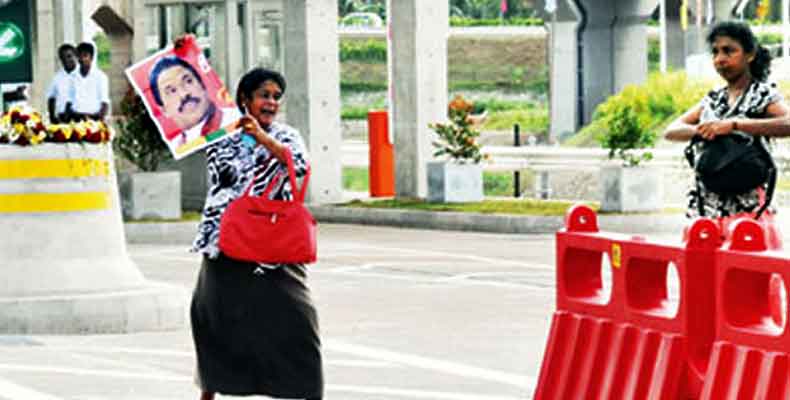
කඩුවෙල සිට කඩවත දක්‌වා අධිවේගය වැටුණේ අධිවේගයෙන් නම් නොවේ. ඉකුත් ජනපතිවරණයට පෙර මෙය විවෘත වනු ඇතැයි සිතුවද අවසානයේ එයින්ද මාස 9කට පසුය මාතර සිට කඩවතට එක හුස්‌මට යා හැකි මග විවර වන බව කියෑවුණේ. දිනය ඉකුත් 17 වැනිදාය. අධිවේගී මාර්ගයේ කඩවත – කඩුවෙල ‘දිගුව’ උත්සවාකාරයෙන් ජනතා අයිතියට පැවරෙන මොහොත උදාවිය. පීත්ත පටිය කැපීම පිණිස ප්‍රභූ පිරිස්‌ එදෙසට ළංවෙති. පීත්ත පටිය සහ ප්‍රභූන් අතර ඇත්තේ අඩි කිහිපයක පරතරයකි. පිරිසට දකුණු පසින් සැනෙන් ඉදිරියට දිව ආ කාන්තාවක්‌ කතුරකින් පීත්ත පටිය කපා දැමීය. සියල්ලෝ වික්‍ෂිප්තව වුණේ කුමක්‌දැයි සිතද්දි එතෙක්‌ සඟවාගෙන සිටි හිටපු ජනාධිපති මහින්ද රාජපක්‍ෂ මහතාගේ රුව සහිත පෝස්‌ටර එළියට ගෙන පෙන්වූ මේ කත සහ ඇය සමග සිටි තවත් කාන්තාවක්‌ හිටපු ජනපතිතුමා අගයමින් කෑගසන අතරේ නිදහස්‌ සන්ධානයේ සිය ජන්ද ලබා ජාතික ආණ්‌ඩුවකට එක්‌වූ එකී ප්‍රභූ පිරිස අතර සිටි ඇමැතිවරුන්ට බැණ වැදුණහ. පොලිසිය ඔවුන්ව එතැනින් ඉවත් කළෙන් කලබලය නිමාවිය. නමුත් පැමිණි ප්‍රභූන්ට කපන්නට වූයේ ‘රීකන්ඩිෂන්’ පීත්ත පටියකි. මෙරට ඉතිහාසයේ පළමු වරට සාමාන්‍ය ගැහැනියක විසින් ‘ගරිල්ලා ක්‍රමවේදයකින්’ මෙරට ප්‍රධාන මාර්ගයක්‌ විවෘත කරන ලදී.

highwayopening

මුළු රටකම අවධානය දිනාගත් එම ක්‍රියාව සිදුකළ කාන්තාව කව්ද? අපි ඇය සොයා කඩවත මහර-නුගේගොඩ ප්‍රදේශයට ගියෙමු. සාමාන්‍ය මධ්‍යම පංතියේ සංකේතයක්‌ වන්, බිම් මහලේ වැඩ තරමකට අවසන් කළ, උඩු මහලේ වැඩ අවසන් කිරීම ‘දින නියමක්‌ නොමැතිව කල්ගිය’ ආකාරයේ නිවසකි. නිවසේ උළුඅස්‌සෙන් හිස ඇතුළත යොමත්ම පෙනෙනුයේ උඩුමහලට නගින පියගැටපෙලේ අවසානයට මදක්‌ ඈතින් තැබූ මහින්ද රාජපක්‍ෂයන්ගේ රුව රැගත් අඩි පහ හයක්‌ උස ‘කටවුට්‌’ එකකි. නිවසේ සෑම අතම පාහේ මහින්ද රාජපක්‍ෂ හෝ ශ්‍රී ලංකා නිදහස්‌ සන්ධාන ලකුණු තිබුණි. වෙනකක්‌ තබා නිවසේ ඇති බිත්ති ඔරලෝසුවේද මහින්ද රාජපක්‍ෂ රූපය විය. අධිවේගයේ සිදුවීම අමුත්තක්‌ හෝ පුදුමයක්‌ නොවන බව මේ පළමු දැක්‌මෙන්ම අපට වැටහුණි. ඒ නිවස සහමුලින්ම මහින්දවාදී බලකොටුවක්‌ මෙනි. මෙවැනි තැනකින් එවැනි ප්‍රතිචාරයක්‌ බලාපොරොත්තු නොවුණා නම් එය පුදුමය.

අප යන විටද ඇය හා කථාකිරීමට පැමිණි කිහිප දෙනෙක්‌ එහි වූහ. සුමනා ජයසූරිය නම් ඇගේ මුහුණේ ඉරියව් තුළ තිබුණේද ජයග්‍රාහී බවකි. ඇගේ හඬද ජව සම්පන්න විය. ඇය අප සමග අදහස්‌ දැක්‌වූයේ තමන් ‘ජාතික යුතුකමක්‌’ ඉටුකළේය යන හැඟීමකිනි.

තමන්ට මෙවන් දෙයක්‌ කිරීමට හිතක්‌ පහළවූයේ කෙසේදැයි ඇය අපට කීවේ මෙසේය.

‘අපිට ජන්දෙ දෙන්න වයස සම්පූර්ණ වුණු දවසේ ඉඳලම අපි පක්‍ෂය වෙනුවෙන් වැඩ කරපු අය. අපිට අපේ ජනාධිපතිතුමා (ඇය හැම විටම ‘අපේ ජනාධිපතිතුමා’ යන වචනයෙන් හැඳින්වූයේ මහින්ද රාජපක්‍ෂ මහතාවය.) මේ රටට කරපු වැඩ ගැන ලොකු ගෞරවයක්‌ තිබුණා. ඇත්තටම අපේ ජනාධිපතිතුමා නේ මේ පාරත් හැදුවේ කියන හැඟීම මට තිබුණා. ඒත් මේ පාර විවෘත කරන්න දින දෙක තුනකට කලින් මට ඇහුණා අහවල්ලු තමයි විවෘත කිරීමට එන්නේ කියලා. අපේ රණවිරුන්ට අපහාස කරපු, පාරවල් කන්නද කියල අහපු අය, අපේ ජනාධිපතිතුමා බේරලා දුන්නු රටේ, එතුමා ඇතිකරපු සංවර්ධනයෙන් බැබලෙන්න එනවා කියලා හිතද්දි මට ලොකු තරහක්‌ ආවා. මම හිතුවා එහෙම කෙනෙක්‌ට ඒ අවස්‌ථාව දෙන්නේ නැතිව අපේ ජනාධිපතිතුමා වෙනුවෙන් මම ඒ දේ කරනවා කියලා. එහෙම හිතලා තමයි මගේ යාළුවා පුෂ්පාට කථා කළේ අපේ ජනාධිපතිතුමා වෙනුවෙන් අපි එතැන බෝඩ් එකක්‌ පෙන්නමු කියලා. පුෂ්පත් අපේ ජනාධිපතිතුමාට පුදුම ආදරය තියෙන කෙනෙක්‌. කව්රුහරි අපේ ජනාධිපතිතුමාට බැන්නත් එයා හරියට දුක්‌වෙන කෙනෙක්‌. නමුත් මම පීත්ත පටිය කපන්න හිතන් ඉන්නවා කියන කථාව එයාටවත් මම කිව්වේ නැහැ. අඩුම ගාණේ ගෙදර කෙනෙක්‌වත් දන්නේ නැහැ මම මෙහෙම දෙයක්‌ කරන්න යන වග ‘

ඇය මේ සඳහා සූදානම් වූ ආකාරයද මෙසේ පැවසුවාය.

‘මම සාරි වැඩ දමන චූටි කතුරක්‌ අරගෙන ඒකෙ රිබන් එකක්‌ ගැටහල සූදානම් කරගෙන හෑන්ඩ් බෑග් එකට දාගත්තා. ලොකු කතුරක්‌ ගත්තේ නැත්තේ හදිසියේවත් අපි එතැනට යද්දී චෙක්‌ කරලා ඒ වගේ කතුරක්‌ අහුවුණොත් හිතන්න පුළුවන් අපි කෙනකුට අනින්න ආවාවත්ද කියලා. ඇත්තටම කිසිකෙනෙකුට නියපිටකින්වත් එහෙම හානියක්‌ කරන ෙච්තනාවක්‌ අපිට තිබුණේ නැහැනේ. ඒ නිසා අනවශ්‍ය චෝදනාවක්‌ අහන්න මට වුවමනා වුණේ නැහැ’

මෙම විවෘත කිරීමේ උත්සවය සඳහා කිසිදු ආරාධනාවක්‌ ලබා නොසිටි ඔවුන් දෙදෙනා විශේෂ අමුත්තන් සමීපයටම යැමට අවස්‌ථාව සලසාගන්නේ කෙසේද? ගැහැනුන්ගේ නුවන හැඳි මිටේ යෑයි කීවේ කුමන මෝඩයෙක්‌දැයි හැඟුනේ ඒ ‘ක්‍රියාන්විතය’ ඇගේ වචනයෙන්ම මා ඇසූ විටය.

‘අපි එතැනට යනකොට දුර තියා පාර වහලා තිබුණේ. ආරාධනා තිබුණු අයට විතරයි එතැනින් ඇතුළට යන්න ලැබුණේ. අපි එතැන ඉඳලා අපේ ඇමැතිතුමාට කථා කළා (අපේ ඇමතිතුමා යනු එක්‌සත් ජනතා නිදහස්‌ සන්ධානයෙන් ජන්දය ඉල්ලා පසුව ජාතික ආණ්‌ඩුවට එකතු වූවෙකි) අපිට මෙතැනින් එහාට එන්න විදිහක්‌ නෑ කියලා මම ඇමැතිතුමාට කිව්වා. එතකොට ඇමැතිතුමා මට කිව්වා ඇවිත් වැඩක්‌ නැහැ සුමනා, මෙතන ලොකු උත්සවයක්‌ නැහැ. පීත්ත පටියක්‌ කපන එකක්‌ විතරයි තියෙන්නේ කියලා. එතකොට මට තේරුණා ඒ ක්‍රමයට ඇතුළට යන්න බැරිවෙනවා කියලා. පස්‌සේ අපි දෙන්නා කොහොමහරි එතැනට යනවා කියලා හිතාගෙන අධිවේගි පාරට සම්බන්ධවෙන පාරෙ පල්ලමෙන් ඒ පැත්තට ගියා. මඩ වළවල්වල බැහැලා, කාණු දිගේ ගිහින් පාරෙ මැදක්‌ දුරට යනකම් ගියා. ගිහින් අධිවේගෙ ප්‍රවේශ මාර්ගයට ගොඩවෙන්න නැග්ගා. පාර තියෙන්නේ සෑහෙන උසකින්. ඒ බෑවුමේ ගල් අතුරලා ඊට උඩින් කම්බි දැලක්‌ අතුරලා තිබුණා. අපි දෙන්නා මකුළුවෝ වගේ ඒකෙ බඩගාගෙන නැග්ගා. වෙලාවකට බෑවුමට රූටලා යනවා වගේ. ඒත් අපි අමාරුවෙන් උඩටම නැග්ගා. දැන් අපිට තියෙන්නේ පාරෙ අයිනෙ තියෙන යකඩ වැට පැනගන්න එක. අපි ඒක පනින්න බලනකොට ටී-ෂර්ට්‌ ඇඳගත්ත දෙන්නෙක්‌ එතැන ඉඳලා අපෙන් ඇහුවා මේ කොහෙන්ද පනින්නේ කියලා. අපි කිව්වා අපේ ගෙවල් ඒ පල්ලෙහා තියෙන්නේ. පාරට ඇවිත් උත්සවේ තියෙන තැනට එන්න ගියොත් ලොකු වටයක්‌. ඒක නිසයි මෙතැනින් නැගගත්තේ කියලා. කොහොමහරි අපි දෙන්නා වැටෙන් පැනලා පාර දිගේ කිසිම අමුත්තක්‌ නැතිව උත්සවය තිබෙන තැනට ගියා. පාර දිගේ අපි ආපු නිසා ඒ හැම කෙනෙකුටම හිතෙන්නේ අපිත් ආරාධනා ඇතිව ආපු අය කියලා. ඒ විතරක්‌ නෙමෙයි අපි කට්‌ටිය ඉන්න තැන කථා කළෙත් ඇමැතිවරයෙක්‌ගේ ආරාධනාවක්‌ පිට ආපු අය ගාණටයි. කව්රුවත් අපිව සැක කළේ නැහැ’

ඇය එතැනට ආ විගස පීත්ත පටිය කැපුවේ නැත. කල්යල් බලා සිට ඇය සිදුකළේ කුමක්‌ද?

‘මට ඕනැවුණේ මේ මැති ඇමැතිවරු ඔක්‌කොටම පේන්න මේක කපන්නයි. අපි ඇපවෙලා අරන් දුන්නු අපේ පාක්‍ෂිකයන්ගේ ජන්දෙ අරගෙන දැන් ජාතික ආණ්‌ඩුවලට හේත්තුවෙලා ඉන්න අපේ ඇමැතිතුමන්ලටත් මේ වෙලාවෙම කියන්න ඕනෙ දේ කියන්න මම හිතාගත්තා. ලොක්‌කො කට්‌ටිය පීත්ත පටියට ඔහොම මෙහෙම කියලා ළංවෙනකම් බලා ඉඳලා මම දූ…වලා ඇවිත් මගේ කතුරෙන් පීත්ත පටිය කැපුවා. කපලා මම කෑගහලා කිව්වා ‘ඔන්න අපේ ජනාධිපතිතුමා වෙනුවෙන් මම පාර විවෘත කළා. දැන් ඕන කෙනෙක්‌ යන්න’ කියලා. ඒ විතරක්‌ නෙමෙයි අපේ ජන්දවලින් ජාතික ආණ්‌ඩු හදපු ඇමැතිවරුන්ටත් බැන්නා. ටික වෙලාවක්‌ යනකං කට්‌ටියට හිතාගන්න බැරිව බලන් හිටියා මේ මොකද වෙන්නේ කියලා. අපි බෑග්වල හංගගෙන ගියපු අපේ ජනාධිපතිතුමාගේ පෝස්‌ටර් පෙන්නලා ‘අපේ ජනාධිපතිතුමාට ජයවේවා’ කියලා කෑගැහුවා. පස්‌සෙ පොලිසියෙන් අපිව අරගෙන ගියා. මම පුෂ්පා නංගිට කිව්වා ඔයා මොකුත් වැරැද්දක්‌ කළේ නැහැනේ ඔයා ගෙදර යන්න කියලා. ඒත් පුෂ්පා කිව්වා සුමන අක්‌කව තනිකරලා මම යන්නේ නැහැ කියලා’

ඇත්තටම ඇය ඒ දේ කළේ ඉනික්‌බිතිව ඇතිවිය හැකි ආන්තරාවන් ගැන කිසිවක්‌ නොසිතාද?

‘මට අවශ්‍ය වුණේ අපේ ජනාධිපතිතුමා වෙනුවෙන් ඒ දේ කරන්න විතරයි. මම හිතුවා මම ඉස්‌සරහට පැනලා පීත්ත පටිය කපද්දි අනිවාර්යයෙන්ම මට වෙඩි තියයි කියලා. මම එදා ගෙදරින් ගියේ ආපහු ගෙදර එන්න බලාගෙන නෙමෙයි. මම එදා ගෙදරින් එනකොට ගෙදර කව්රුවත් හිටියේ නැහැ. මම ගේ වහලා යතුර අරගෙන ආවේ නැහැ. යතුර එළියෙ තියලයි ගියේ. ඒ ගියේ සමහරවිට පණපිටින් හරි නැතිනම් ගොඩක්‌ කාලයකට හරි ගෙදර එන්න බැරිවෙයි කියලා හිතාගෙනයි’

පොලිසියට රැගෙන ගිය පසු හිටපු ජනාධිපතිතුමා මහින්ද රාජපක්‍ෂ මහතාගෙන් ඇයට දුරකථන ඇමතුමක්‌ ලැබෙන්නේ මෙසේය.

‘මෙහෙම දෙයක්‌ වෙලා තියෙනවා කියලා දැනගන්න ලැබුණු හැටියේ අපේ මහ ඇමැතිතුමා (බස්‌නාහිර පළාත් හිටපු මහ ඇමැති ප්‍රසන්න රණතුංග) කියලා තියෙනවා කවුරු වුණත් අපේ පාක්‍ෂිකයෙක්‌ නේ මේක කරන්න ඇත්තේ කව්ද කියලා හොයන්න කියලා. ඒ වෙලාවෙ පොලිසියට ඇවිත් හිටිය මම දන්න කෙනෙක්‌ තව කෙනෙකුට පණිවඩුය කියලා ඒ හරහා මහ ඇමැතිතුමාට දැනගන්න ලැබිලා තිබෙනවා මේ මමය කියලා. අනේ ඒ වෙලාවෙම මහ ඇමැතිතුමයි, සිසිර ජයකොඩි (පාර්ලිමේන්තු මන්ත්‍රී) තුමයි සහන් ප්‍රදීප් (පළාත් සභා මන්ත්‍රී) තුමයි ඔක්‌කොම පොලිසියට ආවා. ඒ අය රෑ එක වෙනකම් පොලිසියේ මිදුලේ හිටියා අපි හින්දා. ඔය අතරේ මහ ඇමැතිතුමා ආපු ගමන්ම වගේ අපේ ජනාධිපතිතුමාට කෝල් එකක්‌ අරගෙන මට දුන්නා. අපේ ජනාධිපතිතුමා මට ඒ වෙලාවේ කිව්වා ‘අනේ ඇයි අපි වෙනුවෙන් මේ වගේ කරදර ඇතිකරගන්නේ’ කියලා. ඒ වෙලාවෙ මම කිව්වා අපි ඔබතුමා වෙනුවෙන් හිර හතක යන්න වුණත් ලැහැස්‌තියි කියලා’

පොලිසියේ ගෙවුණු ඒ රැයේ ඇය බොහෝ ප්‍රශ්න කිරීම්වලට ලක්‌විය.

‘මම හිතපු, කරපු හැමදේම ඒ අයට කිව්වා. දැන් මහත්තයාලට මේ කිව්වා වගේ. අපිත් ඔය පාරවල් වෙනුවෙන් බදුවලින් සල්ලි දීලා තියෙනවා. එහෙමනම් ඇයි අපට බැරිද මහත්තයා එහෙම පාරක්‌ විවෘත කරන්න. මම මගෙන් ප්‍රශ්න කරපු පොලිසියේ ලොක්‌කන්ගෙන් ඒ ටික අහනකොට ඒ අයට කියන්න දෙයක්‌ තිබුණේ නැහැ’

මෙම සිදුවීමෙන් පසු තමන්ට නොසිතූ තරමේ සහයක්‌ ප්‍රතිචාරයක්‌ ලැබුණු බව සුමනා පවසන්නීය.

‘මම වෙනුවෙන් නීතිඥවරු 15 දෙනෙක්‌ එදා නොමිලේ පෙනී සිටියා. මට ඇප ලැබුණා. මීළඟ නඩු වාරයට තවත් නීතිඥවරු නොමිලේ පෙනී සිටිනවා කියලා මට පණිවුඩ එවලා තියෙනවා. මාව බලන්න ඈත දිහාවල්වල ඉඳන් කට්‌ටිය වාහන අරගෙන ආවා. මම එනකොට මගෙ ගමේ අය රතිඤ්ඤා දාලා මාව පිළිගත්තා. අපේ ජනාධිපතිතුමා කෝල් කරලා කිව්වා මාව බලන්න ළඟදීම අපේ ගෙදර එනවා කියලා…’

මම අවසානයේ කඩවෙනි ප්‍රශ්නය ඇසුවෙමි.

‘ඒ කියන්නේ මේ තරම් කල් අනිත් අයට ජන්ද ඉල්ලලා දෙන්න මහන්සිවුණු සුමන අක්‌කා ඊළඟ ජන්දෙදි තමන් වෙනුවෙන්ම ජන්දෙ ඉල්ලයිද….?

‘අපෝ කවදාවත් නැහැ මහත්තයා. මට දැනටමත් ඒ වගේ ආරාධනා තිබෙනවා. ඒත් මම එහෙම තැනකට එන්නේ නැහැ. මම එහෙම අරමුණු ඇතිව නෙමෙයි මේ දේ කළේ. අපේ පක්‍ෂයට, අපේ ජනාධිපතිතුමාට තිබුණු ආදරයටමයි. ඒත් මම එක තීරණයක්‌ අරගෙන තියෙනවා. දැන් ඉන්න නායක නායිකාවො පක්‍ෂයේ ඉන්නතුරාවට මම නම් ආයෙ අපේ පක්‍ෂය වෙනුවෙන් කතිරයක්‌ ගහන්නේ නෑ’ සුමනා අක්‌කාට වචනයෙන් පිටකරගත නොහැකි තවත් බොහෝ දේ ඇගේ දෙනෙත් අග දිළිසෙනු මම දුටුවෙමි.

ඉන්ද්‍රජිත් සුබසිංහ

UNHRC draft resolution: Govt. playing with fire

September 26th, 2015

Courtesy Island

The government should take great care with the American sponsored draft resolution that was tabled before the UNHRC on Thursday especially because they have decided to make it a consensus resolution. Dayan Jayatilleke recently said that his father Mervyn de Silva – a notable expert in international affairs – regarded consensus resolutions as a case where if an enemy wants to pass a resolution against you saying that you are a no-good scumbag, you tell the enemy, no don’t get it passed all on your own, I’ll join you so that we both can agree that I am a no-good scumbag! With the draft resolution that is on the table in Geneva at this moment, Mervyn’s description of a consensus resolution has gained a new validity.
article_image

When the USA put out their first draft resolution, our Ambassador to Geneva, Ravinatha Ariyasinha, said at an informal consultation last Monday that “emphasizing excessively on the criminal justice aspects, makes the resolution imbalanced. It would be more helpful to have a holistic approach when making recommendations in this resolution on promoting reconciliation in Sri Lanka.” Ariyasinha also decried the use of ‘intrusive language’ in the resolution. It is very clear that the government is looking for a ‘coup’ in Geneva which they can sell in Sri Lanka and gain some political mileage among the Sinhala people by claiming that it is because of this government that the country was taken off the hook in Geneva.

In fact at the informal consultation mentioned earlier, Ambassador Ariyasinha was very forthright on this issue, telling the delegates present that what he expects is “understanding, patience, assistance, encouragement, support, trust, goodwill and faith.” And further that at a time when a new Government is adopting a different path to that which was followed before January 8, “the expectation is, naturally, that there would be a similar change in tone, tenor, and even strategy on the part of the Council as well.” That is the diplomatic way of saying ‘get off our backs and give us some breathing space’!

This writer has on earlier occasions, posed the question as to what the government wants to do, to rule this country or set their own backsides on fire and run around in a blind panic until it’s time for the next election? If we go by Ariyasinha’s representations in Genva and the claims being made by members of the government here, the government wants to do the former and not the latter and they are looking for help from their foreign friends to avoid having to upset the apple cart. However even the amended draft of the resolution is not helping them to do that. Some of the operative paragraphs in the draft resolution need closer scrutiny.

Operative paragraph 1 of the draft resolution generally calls on the government to implement the recommendations of the recently released OHCHR report on Sri Lanka. Among the recommendations in that report is the setting up of a hybrid war crimes court with the participation of foreign judges and prosecutors, making the Sri Lankan Supreme Court subordinate to the Human Rights Committee in Geneva (Not to be confused with the Human Rights Council – the Human Rights Committee is a body set up under the International Covenant on Civil and Political Rights.) Some of the other recommendations are to purge through an administrative process of vetting, the armed forces of officers suspected to have violated human rights if there is no evidence to press charges against them in the hybrid war crimes court. Another recommendation in the OHCHR report is that Sri Lankans suspected of having violated human rights be prosecuted under universal jurisdiction by any UN member state that cares to do so. When a consensus resolution supported by Sri Lanka gives legitimacy to the recommendations made in such a report, the government too is bound by them.

Even though government politicians including Ranil Wickremesinghe and Mangala Samaraweera have been claiming that the draft resolution now tabled before the UNHRC has been watered down, nothing of the sort has really happened. Little wonder that Dayan Jayatilleke, himself a former Geneva hand, is calling the government names and suggesting that they are not friends of the West, but their slaves! There are other dangerous provisions in the resolution. The Sri Lankan government has put forward a plan to establish a range of judicial and non judicial mechanisms and all these are to have the freedom to obtain financial and material assistance from ‘international partners’ (meaning Western nations) and the OHCHR. What this means in effect is that one part of the criminal justice system in this country will be on the payroll of foreign powers.

Though the government claims that the UNHRC draft resolution has agreed to a domestic mechanism, that is not true. Operative paragraph 6 clearly calls for the participation of foreign judges and prosecutors in any judicial mechanism that the government is going to set up. This is the hybrid war crimes court without the name. The resolution also calls upon the government in operational paragraph 8 to institute ‘security sector reforms’ to remove from office any officer suspected of having violated human rights. This is the purging of the armed forces that was recommended in the OHCHR report as well. The draft resolution has also called for the review and repeal of the Public Security Ordinance and the Prevention of Terrorism Act, as did the OHCHR report before it.

Operational paragraph 18 requests the OHCHR to assess progress on the implementation of its own recommendations and to present an oral update to the UNHCR next year. When such an operational paragraph appears in a consensus resolution, it amounts to Sri Lanka being willingly being put under OHCHR supervision.

It will be wise for the government to ensure that they don’t agree to anything that would create needless political turbulence in Sri Lanka. Last week we drew attention to the fact that while the government was saying one thing in Sri Lanka about CEPA and the Hanuman bridge, the Indian press was reporting something totally different as being the position of the Sri Lankan government on those matters. We see much the same thing happening with regard to the UNHRC resolution.

UNP shortchanged

In addition to these incendiary missiles originating from the West and from across the Palk Straits, a potential volcano has been taking shape locally as well. The allocation of institutions to ministries by gazette notification last week has confirmed the marginalization of the UNP in the government. When the ministers were named it was obvious that the best portfolios had gone to President Maithripala Sirisena’s SLFP cronies and that the UNP had got only the crumbs. This point was confirmed when the institutions coming under the various ministries were gazetted last week. An analysis of the results of the last presidential election and parliamentary election taken together will reveal that of the 6.2 million votes that Maithripala Sirisena got in January, well over two thirds were solid UNP votes after discounting all the votes received by the TNA, the JVP, the SLMC, and the groups led by Rishard Baithiudeen, P.Digambaram and Mano Ganesan.

So if any ‘national government’ is being formed, it would stand to reason that the UNP should in numerical terms get at least a matching two thirds of the portfolios while everyone else should share the remaining one third among themselves. Qualitatively too, the UNP should have got the best ministries because they represent the larger body of voters in the yahapalana government and they have more people to look after not to mention the fact that they were out of power for nearly 20 years and have arrears to cover. But what we see in the present cabinet is a situation where the non-UNP ministers are in the majority with 24 members of the cabinet while the UNP has only 23 members.

It is only when the ministries and functions that the UNP has got is seen in juxtaposition with what the non-UNP ministers have got, that one notes how lopsided and unjust the distribution has been. We have tabulated for the convenience of readers, the ministries and institutions that the UNP has got in contrast to those held by non-UNP ministers. It should be borne in mind that UNP voters who were out in the cold for nearly 20 years, will not get much benefit from the ministries held by non-UNP ministers, because they have their own constituencies to cater to. On the UNP side, Ranil Wickremesinghe, Ravi Karunanayake, Kabir Hashim, Akila Viraj Kariyawasam, John Amaratunga, Tilak Marapone, Mangala Samaraweera, Lakshman Kiriella, P.Harrison, Wijedasa Rajapakshe, Malik Samarawickrema, Gayantha Karunatillake, Talatha Atukorale, Sajith Premadasa D.M.Swaminathan and even Chandrani Bandara have got passable ministries. The Ministry of Women’s and Children’s Affairs is hardly a top portfolio, but it would seem quite sufficient for a person like Chandrani Bandara. Likewise Tourism and Christian Affairs would seem adequate for John Amaratunga. On the UNP side, what is meant by getting a ‘good ministry’ means something just enough to maintain the self respect of the recipient.

Others on the UNP side were not as lucky as those mentioned above. The so called ‘primary industries ministry’ allocated to Daya Gamage seems more like a deliberate attempt to insult him. It has only the Department of Minor Export Crops under it. Gamage after all is the national organizer of the UNP and a man who kept the UNP financially afloat during a good part of its sojourn in the opposition. Sagala Ratnayake’s Southern Development Ministry which has only the Galle Heritage Foundation also looks like a deliberate insult. Why should Ratnayake have a ministry with no functions when Chandima Weerakkody of the SLFP has the petroleum ministry? With the Home Affairs and Public Administration ministry being split between Vajira Abeywardene and Ranjith Madduma Bandara, both have ended up with less than they deserve. On balance, it can be said that Madduma Bandara is the worst affected of the two. Though he has the public administration ministry, it’s kernel has been given to Vajira Abeywardene. As the president’s brother chairs the main institution coming under the Telecommunications and Digital Infrastructure Ministry, Harin Fernando too has not got a worthwhile portfolio.

In contrast to this, all the SLFP ministers have got good portfolios. There would be slight issue in the case of Navin Dissanayake who has been named the Minister of Plantation Industries but does not have any plantations under him. Instead he has a whole lot of research institutions and plantation crop development boards under him. But even he has no less than 15 institutions, which alone is sufficient to salvage his self respect. One person who has been grossly insulted and even politically undermined on the non-UNP side is Rauff Hakeem who has been named the Minister of City Planning and Water Supply and given two institutions including the Water Supply and Drainage Board. In contrast to him, Rishard Baithiudeen has been given 36 institutions under the more important Industries and Commerce Ministry. Yet the most important Muslim leader is Hakeem and not Baithiudeen. The latter got only 26,297 preference votes in the Vanni district.

To deny justice to a party representing millions of voters who had been out of power for nearly 20 years is not just unfair but downright dangerous because one never can predict how that pent up pressure and resentment will manifest itself.

The Most Educated Countries in the World

September 26th, 2015

Courtesy Organization for Co-operation and Development (OECD)

Russia is the most educated country in the world, according to the latest figures from the Organization for Economic Co-operation and Development (OECD), followed by Canada and then Japan.

The United States and United Kingdom do make it into the top ten, in fifth and seventh places respectively.
Overall spending on education in the UK has gone up and the country’s tertiary graduation rates have increased, according to 24/7 Wall St. journal that has released the list of world’s most educated countries. In addition, a growing interest from international students in the UK since 2000 has paid off in the ranking as the country is second only to the United States for the most preferred destination for international studies.
“The most educated populations tend to be in countries where spending on all levels of education is among the highest. The United States, for example, spent 7.3% of its gross domestic product (GDP) on education in 2010, the sixth highest among the countries,” the authors said.
The report suggests that most of the best educated countries tend to have higher levels of advanced skills, which account for low unemployment rates in those countries. Moreover, the best educated countries excel in literacy and maths proficiency exams (mainly Japan, Canada and Finland) and have lower unemployment levels.
“After the strong impact of the financial crisis, not surprisingly, unemployment rates increased at each level of education, but the increase has been smaller among higher-educated people. At higher levels of attainment, people are less exposed to unemployment and have better chances to keep participating actively in the economic system, for the benefit of both individuals and society,” OECD’s analyst, Gara Rojas González, was quoted as saying by the journal.
Top ten educated countries:
1) Russia
2) Canada
3) Japan
4) Israel
5) United States
6) Korea
7) UK
8) New Zealand
9) Finland
10) Australia
The list was prepared after analysing the data of OECD’s Education at a Glance 2013 report.
The ten most educated countries were chosen based on the highest proportion of adults holding a college degree and the total spending on education.

1) Russian Federation
> Pct. population with tertiary education: 53.5%
> Average annual growth rate (2000-2011): N/A
> Tertiary education spending per student: $7,424 (the lowest)

More than 53% of Russian adults between the ages of 25 and 64 had some form of higher education in 2012, more than in any other country reviewed by the OECD. The country has reached this exceptional level of attainment despite spending among the least on tertiary education. Russia’s tertiary education expenditure was just $7,424 per student in 2010, roughly half the OECD average of $13,957. Russia was also one of just a few countries where education spending declined between 2008 and 2012.

2) Canada
> Pct. population with tertiary education: 52.6%
> Average annual growth rate (2000-2011): 2.3% (8th lowest)
> Tertiary education spending per student: $23,225 (2nd highest)

More than half of Canadian adults had received tertiary qualification in 2012, the only country other than Russia where a majority of adults had some form of higher education. Canada’s education expenditure of $23,226 per student in 2011 trailed only the United States’ expenditure. Canadian students of all ages appear to be very well-educated. Secondary school students outperformed the majority of countries in mathematics on the PISA in 2012. And nearly 15% of adults in the country performed at the highest level of literacy proficiency, versus an OECD average of 12%.

3) Japan
> Pct. population with tertiary education: 46.6%
> Average annual growth rate (2000-2011): 2.8% (12th lowest)
> Tertiary education spending per student: $16,445 (10th highest)

Like the U.S., Korea, and the United Kingdom, private spending accounts for the vast majority of spending on tertiary education in Japan. While this can often lead to social inequalities, Schleicher explained that like most Asian countries, Japanese families are by and large willing to save money for their children’s educations. Strong education spending and participation in higher education does not necessarily translate to higher academic skills. In Japan, however, higher spending did lead to better learning outcomes, as more than 23% of adults performed at the highest level of literacy proficiency, nearly double the OECD average of 12%. Younger students also seem to be well-educated, as Japan reported exceptionally high Program for International Student Assessment (PISA) scores in mathematics in 2012.


The us-sri lanka joint resolution – DARK DAY COMING

September 26th, 2015

By DR DAYAN JAYATILLEKA Courtesy The  Nation

Sri Lanka has decided to co-sponsor a resolution on Sri Lanka in Geneva,” the Prime Minister said. –Daily FT, September 25, 2015 While the penumbra of the US resolution on Sri Lanka has softened, the core, the essence, remains. The Sri Lankan side has succeeded only in watering down the inessential, or to switch metaphors, in changing the décor. The crux of the matter remains unchanged. The core remains intact. The essence is unchanged. It is deeply inimical and insulting to Sri Lanka. There will be a Special Court with the Special Counsel and if this isn’t bad enough, this court will not be purely Sri Lankan in composition. The resolution says that a Sri Lankan mechanism” will need Commonwealth and foreign judges, defense lawyers, prosecutors and investigators.

The West that atom-bombed Hiroshima and Nagasaki, dumped Agent Orange on Vietnam and still refuses to pay compensation for deformed babies, used depleted uranium in the Iraq wars, wants Sri Lanka which did nothing remotely like this, to set up a criminal justice mechanism with foreign judges and lawyers and to sack any member of the armed forces found to be credibly suspect by an independent administrative process

The Operative paragraph 6 reads:
…affirms in this regard the importance of participation in a Sri Lankan judicial mechanism, including the Special Counsel’s office, of Commonwealth and other foreign judges, defense lawyers, and authorized prosecutors and investigators…”

This is not a Sri Lankan judicial mechanism”. This is the infamous hybrid. It is quasi-colonial because we have not seen a combination of Sri Lankan and foreign judges or lawyers since the days of British colonialism. That’s how far back this resolution takes us.  This is the model of the Planter Raj, with local kanganies.

The issue of a special court with an international component, with international participation, is what the TNA asked for, and it has got it, thanks to the US and more so, thanks to the Government of Sri Lanka.

The resolution also calls for the non-retention in the armed forces of anyone found credibly implicated” by an independent administrative procedure of the violation of human rights during the war. Please note that it is not anyone found guilty by a court of law, military or civilian, but by an ‘independent administrative process’.  Operative Para 8 shows that the US-GoSL resolution hopes to purge the Sri Lankan military –including its intelligence units. It reads:

…include ensuring that no scope exists for retention in or recruitment into the security forces of anyone credibly implicated through a fair administrative process in serious crimes involving human rights violations or abuses or violations of international humanitarian law including members of the security and intelligence units.”

The only problem I have in analyzing this resolution is that I cannot figure which is larger: the hypocrisy, the cowardice or the moral outrageousness. Is the hypocrisy of the West larger or smaller than the supine cowardice of the Sri Lankan Government? Are either of those factors smaller or larger than the ethical travesty and moral outrageousness of what we have signed up to?

The West that atom-bombed Hiroshima and Nagasaki, dumped Agent Orange on Vietnam and still refuses to pay compensation for deformed babies, used depleted uranium in the Iraq wars, wants Sri Lanka which did nothing remotely like this, to set up a criminal justice mechanism with foreign judges and lawyers and to sack any member of the armed forces found to be credibly suspect by an independent administrative process.

What the foreign component does is reject out of hand the potential of Sri Lanka even under this new government to regenerate our institutions and processes without an external presence and participation. The new Sri Lankan government has accepted this judgment—not on its predecessor, but on itself.

It is noteworthy that the US resolution does not trust the Sri Lankan state and government because the text clearly prescribes a monitoring role over the whole process for the UN High Commissioner for human rights who is mandated to report back to the Council as to whether his report has been implemented. What this means is that Sri Lanka has agreed to implement the draconian recommendations of the OHCHR report! If Sri Lanka had not agreed to do so, it couldn’t have subscribed to the resolution and agreed to do no less than co-sponsor it. So the Government of Sri Lanka has agreed to place the noose around our country’ neck.

Requests the Office of the High Commissioner… to present an oral update to the Human Rights Council at its thirty-second session, and a comprehensive report followed by discussion on the implementation of the present resolution at its thirty-fourth session” (Op. 18)

The cowardice of the Sri Lankan government isn’t contained mainly in the fact that it hasn’t pointed out the hypocrisy of the prescriptive West—as I used to in Geneva – but in the fact that it had other options.

As a new government, friendly with both the West and India, it could have explained that any special judicial procedure, most particularly one that has a pronounced foreign component would be a vote of no-confidence against a reformist Sri Lankan administration.

We could have used the Desmond de Silva-Maxwell Paranagama (second mandate) Report to give the Council members something to think about. It would have armed our friends in the Council with arguments and would have strengthened our hand at negotiations.  The government chose not to do so.

We could have used as a deterrent against the recommendation of foreign judges, the credible prospect that we, as a country with a new liberal-reformist government, could have mustered a sufficient number of votes in the council to defeat the US resolution or lose narrowly—either of which would have been a moral victory. Instead, we did none of these things. The reason is that the present government is not a friend of the West; it is a stooge, a mere lackey of the West. The new government of Sri Lanka does not negotiate with the West on essentials; only on the trimming. On the essentials, when the West says jump” the new government asks how high?”

The prescription of foreign judges and the purging of armed forces members, who have not been found guilty by a Sri Lankan court of law, show that the West is not a firm friend of Sri Lanka. Friends do not prescribe alien over-lordship on the institutions of other friends. Meanwhile the acceptance of the resolution by the Government shows that our government is not a friend of Sri Lanka.

The West and India have 80 million Tamils to think of – most of them voters. One can understand the electoral and social compulsions, as well as the knee-jerk colonial habit of tilting to the minorities and the older policy of every empire: divide and rule”.

What is reprehensible is that the Sri Lankan government, in its acceptance of the formula of special courts and foreign participation, and its co-sponsorship of the resolution saying such, shows that it shares the Empire’s view of its own country.

Malcolm X scoffed at the domestic slaves, the house niggers” who, when their slave owning masters were ill, felt the identification so deeply in their bones that they used to query we sick, Massa?”Malcolm X emphasized the we”, which indicated that the house nigger” was so pathetic as to identify more with the White master than with his or her fellow oppressed, working in the field, the field niggers”.

The present Government has the soul of a house nigger”.  Frantz Fanon had such elites and their supportive social strata right, when he wrote of Black Skin, White Masks”. The UNF government has internalized colonialism and its values. It represents what is called a compradorcapitalist class; a class that sees itself as an intermediary between the Western master and the locals; elite that is the enforcer of Western will and whim; a class that has no independent will or existence, still less a national vocation and an independent project. This is a bloated puppet regime that will be a pliant supplicant in relation to the West and India and a ruthless overseer towards the patriotic masses.

The third aspect is that of the ethical travesty and overturning of natural justice. It is one thing to try those who may have wittingly and willfully killed or tortured noncombatant civilians, such as those responsible for the Trinco 5 murders. Our laws, lawyers, judges and courts can do that job. What the resolution calls for is quite something else. Sri Lanka faced, fought and defeated a ruthless fascist-separatist enemy which practiced suicide bombing terrorism and the dismemberment of sleeping villagers including children. We didn’t set up special courts to try those whom we captured or surrendered. Still less did we try them before special Courts with Chinese, Russian, Pakistani and Cuban judges! We rehabilitated and released eleven thousand former Tiger combatants. The ones who are behind bars were those held responsible for especially ghastly crimes. Some are unsuccessful Black Tiger suicide terrorists. That’s how merciful we were.

Now we are asked to try and punish those who may have committed excesses against the enemy. We are asked to try those who saved us from terror and reunified our country, in Special Courts, with foreign judges. Those who gave weapons and equipment to the Tigers will decide the fate of those who fought them and gave political leadership to that fight. If this is not an utterly shameful overturning of the moral order, I do not know what is.
(Dr. Dayan Jayatilleka was Sri Lanka’s Ambassador/Permanent Representative to the UN in Geneva and a Vice-President of the UN Human Rights Council.)

Co-sponsorship means outright capitulation

September 26th, 2015

Courtesy Editorial The Nation 

‘It could have been worse’ is not a victory claim. It is but the whimper of someone who believes he got a consolation prize. President Maithripala Sirisena says ‘it could have been hundreds of thousands of times worse had Mahinda Rajapaksa won on January 8.’ He was referring to the US-sponsored resolution on Sri Lanka. This was a week ago.

He is correct. The final draft is not as odious as the one circulated a few days ago and even that one would appear to be less ‘serious’ that what one might have expected following UN Report on rights violations and other matters during the last stages of Sri Lanka’s struggle against terrorism.

The hurrahs, of course, have to wait until the measurement of the content against implications for sovereignty. Sure, in the 21st Century we can only speak of ‘degrees of sovereignty’, but then again there is a bottom line to everything. Take the people out of the equation of decision-making and it amounts to capitulation to the country that poses the greatest threat to world peace, the USA. There are no ‘degrees’ there.

The watered down version, so-called, raises several questions. First of all the fact of watering-down implies that these exercises are fraught with integrity deficits. The entire process was flawed and this has been well established. However, if one assumes that politics and outcome-preferences did not color report-writing then watering-down implies ‘deals’. In other words terms such as truth, justice, retribution and such are but sanitizers for what is essentially a game about control. It’s about interest and those who are willing to play along. Ask Noam Chomsky — he will tell you what US foreign policy is all about.

So what do we make of this watered-down resolution? First of all, in both preamble and operative articles that compromise the whole notion of a ‘domestic inquiry’. Sure, as Ranil Wickremesinghe says, judges have to be appointed by the President or the Constitutional Council, but let us not be fooled into believing that his role would be anything more than rubber-stamping US nominees from the Commonwealth and other countries. The resolution would have Sri Lanka pass retroactive legislation notwithstanding the fact that the US constitution specifically prohibits ex post facto legislation. The point will not be made, we can rest assured. We have, after all, a Foreign Minister who called the UN Report ‘fair and balanced’ and as such can never be sure which side he’s batting for!

Secondly, as Dayan Jayatilleka points out, ‘we are asked to try and punish those who saved us from terror and reunified our country in Special Court with foreign judges; those who gave weapons and equipment to the Tigers will decide the fate of those who fought them and gave political leadership to that fight.’

Thirdly, if what Dayan envisages does materialize a dangerous precedence is created that makes human shields a far more potent instrument for terrorist all over the world.

Fourthly, it will do nothing to concretize inter-communal harmony and national reconciliation. The Tamil National Alliance (TNA) is saluting this resolution. The TNA speaks of victims. The TNA doesn’t seem to understand that every citizen of this country was a victim and even those unborn at that time are victims; terrorists not only engaged in mass murder but also wrecked the country’s economy. The TNA, as mouthpiece and the legal voice of the LTTE, is listed in the perpetrators’ column, as are the 11,000 plus LTTE cadres released without trial in the previous regime’s ‘general amnesty’ in all but name.

Finally, and most worryingly, is the decision by the Government (if we go by US State Secretary John Kerry’s assertion) to co-sponsor the resolution. Co-sponsorship in effect amounts to an affirmation of the preamble and an undertaking to operationalize these.

The President is correct in saying that things could have been worse. The previous regime erred and it’s President Sirisena’s unfortunate lot to make the best out of a bad situation. He should learn, then, from the errors. Co-sponsorship would be an error because it promises what is patently impossible to deliver. In the end operationalizing has to happen within the framework that is made of the constitution, the Parliament and the sentiments of the people. The last of course can be ‘obtained’ by presumption, but not the first two.
So let the Resolution come. Let us not panic. Let us engage, by all means. But let us not agree to rule out meaningful engagement by the very fact of co-sponsorship.

UN Resolution on SL ‘Co-Sponsorship a trap’

September 26th, 2015

Courtesy  The Nation

Don’t repeat MR’s mistakes – Champika | ‘Hybrid’ in another name – Dayan J.

A decision to co-sponsor the US draft resolution on Sri Lanka at the United Nations Human Rights Council (UNHRC) sessions in Geneva could be seriously detrimental to the Government of Sri Lanka, Minister of Megapolis and Western Province Development Patali Champika Ranawaka told The Nation.

Ranawaka, who is also the General Secretary of the United National Front for Good Governance (UNFGG), further stated he had expressly warned Prime Minister Ranil Wickremesinghe against co-sponsoring any such resolution, as that would legally bind Sri Lanka to fulfill all its recommendations.

What we had advocated was for them to adopt whatever resolution they wanted while ensuring that we were free to act on those recommendations independently,” he said. Ranawaka added the previous administration of former President Mahinda Rajapaksa painted itself into a corner by making various promises that were not deliverable.

We cannot make the same mistake as ultimately, to implement such a resolution, it is the responsibility of the Sri Lankan Parliament to approve it. We have no idea what Parliament will approve,” Ranawaka said.

Minister Ranawaka added the government should not make commitments to the international community that it may not be able to fulfill.

He pointed out that the government would have to take into account the Constitution, Parliamentary approval and public sentiments before taking any decision on such a resolution.

However, Ranawaka did acknowledge that given the watered down nature of the resolution, the government was in a much better position than it ever was due to an opening having been created.

Meanwhile, writing to The Nation, former Sri Lankan Ambassador/Permanent Representative to the UN in Geneva, Dr. Dayan Jayatilleka stated while the US resolution on Sri Lanka appears to have softened from the earlier draft, the core, the essence, remains.”

He pointed to the wording on Operative Paragraph 6 which calls for the participation of Commonwealth and other foreign judges defense lawyers, and authorized prosecutors and investigators within a ‘Sri Lankan judicial mechanism.’

This is not a Sri Lankan judicial mechanism”. This is the infamous hybrid. It is quasi-colonial because we have not seen a combination of Sri Lankan and foreign judges or lawyers since the days of British colonialism. That’s how far back this resolution takes us,” he emphasized.

The veteran diplomat also noted that Operative Paragraph 8 calls for the non-retention in the armed forces of anyone found credibly implicated” by an independent administrative procedure of the violation of human rights during the war.

The prescription of foreign judges and the purging of armed forces members, who have not been found guilty by a Sri Lankan court of law, shows that the West is not a firm friend of Sri Lanka. Friends do not prescribe alien over-lordship on the institutions of other friends. Meanwhile the acceptance of the resolution by the Government shows that our government is not a friend of Sri Lanka,” Jayatilleka further states in his column to this newspaper.

මෙන්න යතාර්ථයක පුලුවන්නම් අවසානය දක්වා අහන්න – Sri AV Tv network | Facebook

September 26th, 2015


මෙන්න යතාර්ථයක පුලුවන්නම් අවසානය දක්වා අහන්නමෙන්න යතාර්ථයක පුලුවන්නම් අවසානය දක්වා අහන්නතවත් කෙනෙක්ට අසන්න සලස්වන්න එය මව්බිම වෙනුවෙන් කරන ලොකු සේවයක්….

Posted by Sri AV Tv network on Wednesday, September 23, 2015


Obsessions blur justice

September 26th, 2015

By Malinda Seneviratne  Courtesy The Nation

Each time there’s a gruesome crime, especially if the victim is a child who is both raped and murdered, the natural public outrage is accompanied by shrill calls for the implementation of the death penalty.  We saw all of this when a five year old girl was abducted, raped and murdered a few days ago.

The entire process throws some light on one of the key problems inherent in implementing the death penalty: error.  What if the father was dealt ‘mob justice’.  What if he were lynched, as some advocated because ‘the law is slow and prone to abuse’?  What if they lynched the grandfather or ‘the poor 17 year old boy’?  What would they do after someone else confesses? How would they bring the dead back to life?

The horror and outrage came with a barrage of accusations.  Parental neglect was mentioned.  The moral degradation of society as a whole was talked about.  As days passed without any arrests being made the police was charged with incompetence.  An impatient public and an equally impatient media began to speculate.  Then began the hanging.

First it was the child’s father.  He was not even allowed to attend her funeral; he was warned that mob justice might await him.  Then it was the child’s grandfather.  Then it was a 17-year old neighbor.  They were all hanged by both the media and by a punishment-hungry public.  That was not all, every person close to those who was thus ‘hanged’ were also hanged for the crime of association.  Even if no one pointed finger at them directly, they are scarred in ways that no innocent individual ought to be scarred.
But why?  Because the media wanted a gory story to sell?  True, to an extent.  Because there are thousands salivating to consume a gory story? Yes, that’s true too.  There’s are demand and supply factors in these things.    Among those who blame the media for ‘assassinating that poor, innocent 17-year old boy’ after someone else confessed to the crime, are many who were earlier calling for the boy’s blood and before that the blood of the victim’s father and that of her grandfather.  It is almost as if they are as blood-thirsty as the perpetrator clearly was.  And it is as though everyone believes that whoever is responsible in whatever degree, there’s one person who is innocent: him/herself.

The entire process throws some light on one of the key problems inherent in implementing the death penalty: error.  What if the father was dealt ‘mob justice’.  What if he were lynched, as some advocated because ‘the law is slow and prone to abuse’?  What if they lynched the grandfather or ‘the poor 17-year old boy’?  What would they do after someone else confesses? How would they bring the dead back to life?

One might argue that the judicial process will not condemn or hang an innocent person, but history shows otherwise.  There are of course other problems with the death penalty which should be discussed separately. The concern here is for the wrongly murdered.  Had mob justice prevailed, either the father, the grandfather or the 17 year old boy would be dead. The murderers cannot offer any kind of compensation for the victim of their error.
In this case, there was no ‘mob justice’ executed to the point where someone had to die.  However there were multiple assassinations.  Who is to blame for the additional suffering of the victim’s parents and close relatives courtesy the insane rush to ‘find a rapist and hang the scoundrel’?  Who is going to compensate and how for the irreparable damage to reputation and the pain of mind caused?  What do we do with those ‘corpses’?  Where do we begin the blame game and how do we end it?  Indeed, do we even want to end it?
A five-year old girl was raped and killed a few days ago in Kotadeniyawa.  Her name became known all over the country.  It is a tragedy that ought to have sparked a debate on the safety of our children.  We should be talking about what parents should do to protect their children, about safe environments and civil responsibility.  Instead we let the discussion degenerate into a shouting match about crime and punishment where everyone seemed to be possessed by an insane desire to play judge, jury and executioner.
This morning (Friday, as I write) the body of a 10-year old boy was found in Athurugiriya.  He had been hacked to death.  Who do we want to hang tomorrow, ladies and gentlemen?

A liar, liar, pants on fire! – Asipatha cuts

September 26th, 2015

Courtesy The Nation

Maybe that the likes of Ajith Perera can run away with the idea that the UNP is God’s gift to mankind, but do spare us the sanctimonious hectoring about how his party is going to course-correct Sri Lanka’s foreign policy.

Appearing in a recent talk show, Perera said his government has begun to address the issue of impunity, and the assaults on the independence of the judiciary, that prevented the UN from accepting internal judicial processes to hold Sri Lankan forces personnel to account for so-called ‘war crimes.’

What do you think is better? Is it Ajith Perera’s self-induced amnesia, or his simple idiocy? His government is the embodiment of impunity on a hitherto unknown scale, as its leaders have sought to kick 46 lakhs of people on their backsides and totally disregard their democratic rights.

We could come to that later, but all that can be said to him now is, nice try, Mr. Ignoramus. He probably does not know the meaning of the words self-righteous humbug, but he could look up the dictionary for the meaning.

He should be no doubt aware that his President and Prime Minister are jointly responsible for the most heinous daylight robbery of the democratic right of adult franchise of the Sri Lankan people since the grant of independence, and perhaps since even before that when the British supposedly ran a textbook democracy for their colonial outpost.

The extent of that impunity is such that the President was able to get rid of the sitting Chief Justice with the stroke of a pen. He was also able to get away with threatening the democratic opposition and steamrollering a 16 seat party over a 95 seat Alliance as the Opposition, treating the electors with overbearing, cynical contempt.

The impunity the President enjoys for introducing defeated candidates through the National List is such that he is able to make some of these brigands and shameless losers, senior Cabinet Ministers in his so-called ‘government.’

Perera refers to the Rathupaswela incident, as an example of impunity during the Rajapaksa administration, and he further refers to the murder of Lasantha Wickremetunge and the assaults on journalists such as Poddala Jayantha as further examples of the crass contempt for judicial process.

If that is so, Perera’s political ‘bosses’ are guilty tenfold of fostering a climate of impunity during their own time as key figures in previous administrations. Journalist Sivaram was abducted and murdered during Kumaratunga’s presidency. It would be absurd to even mention the degree of impunity that would have obtained when torture chambers such as Batalanda operated during the present Prime Minister’s previous incarnation in power as a born-again democrat.

It is absolutely, hilariously rich for garrulous humbugs such as Ajith Perera to talk about impunity during the rule of the Rajapaksas, when he is part of an illegal government, and when for all practical purposes the 50,000 vote majority ‘general election victory’ that he gloats over was stolen as a result of his shamelessly scheming president’s undemocratic skuduggery.

It was illegal tinkering accomplished with stunning, hitherto unseen levels of impunity.
Now, when we all know that it is not the so-called impunity enjoyed by Security forces personnel, and others during the Rajapaksa administration, nor the so-called war crimes of forces personnel under the same administration that made the UN system prefer the UNP government, the humbug of glib talkers such as Ajith Perera appears far more grating and abominable.

Yes, the movers and shakers in the UN system think that the Sri Lankan judiciary under the stewardship of the UNP can do a better job of trying war crimes, only because the UN system hates the Rajapaksa Administration, as the UN’s adjuncts are run by those powers that bear a grudge against the Rajapaksas for finishing off the Tamil Tigers.

Perera has the unmitigated gall to talk about impunity when it seems to be obvious that his bosses broke the till at the Central Bank and siphoned off billions — with what? With clear intent to pilfer, and absolute stunning and unprecedented impunity.

Moreover, this garrulous talking head knows that nobody in the UN system spoke a word about the commission of war crimes or about impunity or about human rights when the LTTE murdered hundreds of women and children in towns and cities in the South, in the most brutal and barbaric manner.

The people are too cowed to do anything about it now, but as in all politics, all damaging consequences would be felt much later. Ranil Wickremasinghe would know about actions of perfidy, and their much belated consequences. It was months, no years, after the ceasefire agreement was signed when he was Premier, that the Sri Lankan forces lost hundreds of security forces personnel who were working for military intelligence, due to the advantage of free movement that the LTTE used to good effect to accost and murder them, a result of the ceasefire agreement. The current consequences of Ajith Perera’s President’s assault on democracy would be such that Sri Lanka which boasted of a working democracy despite its limitations, is now a banana republic run by a cabal of petty tyrants. But the impunity and the absolute contempt for law that has been fostered would completely demolish democratic institutions and usher in chaos, or perhaps coups and other calamities in the future. The entire edifice has come down, and there is now no modicum of democratic rule – not even a thin carapace of it left in this country. But it seems that the ‘international community’ trusts the UNP more than the previous administration to administer justice. Some justice one might say — some trust!

Govt. is more wary of domestic implications

September 26th, 2015

Courtesy The Nation

The eventual outcome at the ongoing sessions of the United Nations Human Rights Council (UNHRC) in Geneva will be critical for Sri Lanka in terms of international implications and for its image as a progressive democracy but there is also likely to be a domestic political fallout as a result.

Colombo’s emissaries are currently engaged in frantic bouts of diplomacy in Geneva, hoping to dilute a United States sponsored resolution on alleged war crimes that was expected to be favorable to Sri Lanka but turned out to be quite contentious in the wake of pressure exerted by the European Union.

The latest reports suggest that Colombo has agreed to support a resolution where there will be a ‘Sri Lankan judicial mechanism that will include local, foreign and Commonwealth judges and lawyers’. In Colombo, Prime Minister Ranil Wickremesinghe said Sri Lanka will co-sponsor the resolution.

This is my NationThe impetus for the anti-Sri Lankan stance came from the High Commissioner for Human Rights, Zeid Al Hussain, who in his remarks to the UNHRC urged the setting up of a ‘hybrid’ inquiry incorporating international judges into alleged war crimes during the final stages of the Eelam war.

Colombo reacted strongly to this suggestion. Prime Minister Wickremesinghe told Parliament that the government would agree only to a domestic probe. However, whether there would be any international participants – and what the implications of that would be – is presently being discussed.

Already, the likes of Wimal Weerawansa of the Jathika Nidahas Peramuna and Dinesh Gunewardena of the Mahajana Eksath Peramuna have accused the government of ‘selling out’ to the Eelamist lobby by choosing to co-operate with the UNHRC and the United States resolution.

Former President Mahinda Rajapaksa added his voice to this earlier in the week when he called upon the government to reject the report submitted by the Office of the High Commissioner for Human Rights (OHCHR). That was the strategy the Rajapaksa government adopted when it was in office.

Judging from this initial reaction to the call for a ‘hybrid’ inquiry, it is clear that the issue has strong domestic political connotations, more so in the aftermath of a general election where the United Peoples’ Freedom Alliance took a beating after ten years in office under Rajapaksa.

Even during the general election campaign, Rajapaksa loyalists were not hesitant to pander to nationalist sentiments and this would be an opportunity to bash the United National Party led ‘national’ government that they would relish. The significance of this lies in its political value.

Any inquiry that would incorporate international prosecutors or judges would most likely need a constitutional amendment as current provisions in Sri Lanka’s Constitution does not provide for this. Any such amendment, in turn, would require a two thirds majority in the new Parliament.

While the so-called ‘national’ government has a two-thirds majority on paper, it is no secret that it also includes many persons who are Rajapaksa loyalists who have been pacified with ministerial or deputy ministerial position. Therefore, the government’s two-thirds majority is tenuous, at best.

If the matter comes to a vote in Parliament on an issue as emotive as protecting war heroes who risked their lives to destroy the Liberation Tigers of Tamil Eelam and end the Eelam war, there is every possibility that the government will not be able to muster the numbers for a two-thirds majority.

Also, any such move can provide the impetus for Rajapaksa to regroup with his close allies and stage yet another leadership bid, at least within the UPFA parliamentary group, if not within the UPFA itself. Any anti-western sentiment generated by an international inquiry will only help such a move.

That is one of the reasons why the Sirisena-Wickremesinghe government is seeking a domestic mechanism to probe any alleged human rights abuses during the last stages of the war. It is aware that it must please the local electorate first before it can placate the international community.

On the other hand, the Tamil National Alliance (TNA) has been relatively muted in its call for an international inquiry although some within the Alliance such as Northern Province Chief Minister C.V. Vigneswaran have been uncompromising in their call for such a probe. That too is with reason.

The leadership of the TNA feels that the Sirisena-Wickremesinghe government is the best option for the Tamil community to redress their grievances and extract generous concessions while at the same time resolving the vexed question of war time atrocities. They do not wish to forego that chance.

With Rajapaksa now being called to testify at a public inquiry into the use of a state television network for his election campaign, his loyalists will be keen to portray him as hero rather than villain. The emerging resolution in Geneva may provide them with the chance to do just that.

New US resolution a path breaking success: Mangala

September 26th, 2015

Courtesy The Daily Mirror

Foreign Affairs Minister Mangala Samaraweera yesterday said the fresh resolution on Sri Lanka sponsored by the US, which was tabled on Thursday, is a ‘path breaking success’ achieved at the 30th session of the UNHRC. In a media statement on the fresh UNHRC resolution on SL, Minister Samaraweera who is currently in New York attending the UN General Assembly, said it was a complete shift from the way in which Sri Lanka was perceived among the members of the international community.

He however said that presently, owing to the efforts of the new government led by President Maithripala Sirisena and Prime Minister Ranil Wickremesinghe since the beginning of the year, Sri Lanka had once again managed to shed its negative image and emerge as a responsible, confident and peaceful nation that respected universal values of freedom, equality and justice.

The Minister said the victory that Sri Lanka managed to achieve through the tabling of the new resolution, which Sri Lanka too had co-sponsored, was in line with the 100-day programme that reflected the desire of Sri Lankans to hold a credible investigation into alleged violations of human rights and guarantee non-recurrence.

He also said the international community had now recognised the professionalism and discipline of the Sri Lankan armed forces and added that this resolution was an endorsement by the international community of this view. Minister Samaraweera said that a credible accountability process would safeguard the reputation and honour of those in the military who conducted themselves with professionalism and an appropriate manner during the conflict period. –

See more at: http://www.dailymirror.lk/88899/new-us-resolution-a-path-breaking-success-mangala#sthash.6Bt44WYF.dpuf

Beware of Travelling Air Lanka – Booking changed due to Computer Glitch?? Flight UL503 on 05 August 2015 & ACTS OF SRI LANKAN AIR LINE STAFF

September 26th, 2015

RE: Computer Glitch.

This Computer Glitch occurred in the Sri Lankan Air line computer system may be the Worlds first computer Glitch ever occurred, as it affects only one individual customer. I live in Australia and most Air lines including Qantas, Virgin and other Air Lines close the entire Air Line ticketing system when a computer glitch of this nature occurred, as with my 30 years of computer knowledge a computer glitch never occurs to one individual customer in a Air Line ticketing system.

This is a cover up, and I advice you to take up this with the relevant authorities in UK and in Sri lanka to unearth this corrupt practice of the Air Line staff also you may take up this with IATA and complain to them.

Few years back my wife and daughter travelled in Business Class with Sri Lankan Air Lines and on their way back they were demoted to Economy and the two seat were given to some others by the Air Line Staff. But they failed to do their dirty deal as I telephoned the then Chairman of the Air line and complained to him. Sri lanka Air Line is Few years back my wife and daughter travelled in Business Class with Sri Lankan Air Lines and on their way back they were demoted to Economy and the two seat were given to some others by the Air Line Staff. But they failed to do their dirty deal as I telephoned the then Chairman of the Air line and complained to him. Sri lanka Air Line is now going loosing it’s reputation as one of the best  with these corrupt activities and very soon people will stop flying the Airline. I never use the Sri Lankan Airline after that incident.
Dr. Upasiri de Silva

All other Email Communications

From: milni@outlook.com
To: obasithanna@yahoo.com; shri.jayawardena@srilankan.com; inga.rodrigo@srilankan.com; yohan.pathirana@srilankan.com; troncy.nanayakkara@srilankan.com;

Subject: RE: UL503/05 August 2015 & ACTS OF SRI LANKAN AIR LINE STAFF
Date: Wed, 23 Sep 2015 01:28:47 +0100

Below is the Email we had from Inga Rodrigo [ Manager Customer Affairs (Customer Affairs) | SriLankan Airlines Ltd.  Mktg-Customer Affairs, Airline Centre, Bandaranaike International Airport, Katunayake, Sri Lanka.  Tel: +94197331315 | Mobile: +94710211315 | Fax: +94 19733 5145
E-Mail: inga.rodrigo@srilankan.com | Web: www.srilankan.com ]    in Sri Lankan on the 9/Sep/2015  : She was  saying  Computer GLITCH  and it  had issued a   ticket and system itself has  found a FREE EMD number  and generated ticket number.

Then  Shri Jayawardena (Mrs) – Customer Relations Executive [ SriLankan Airlines Ltd. 7th Floor,  1 Lampton Road,  Hounslow  TW3 1JB  United Kingdom ] –
on her email to us on the 1 Sep 2015   written  below  said  ” Please note our Refunds Department has informed me that only one EMD 603 8200360755 had been processed as a refund.

The other EMD 603 8200344284 had been utilised on 04August 2015 to issue ticket number 603 2107467210. ”

When we asked  her (Shri Jayawardana)  passenger’s  name  of this  tick number but  She refused to  name the passenger .

Ingo Rodrigo  saying  that Passengers ( Mother and the underage Child)  came to the Air port  12.05PM.  This is a white lie.

We have proof  that  they came at least  between  10 – 11 AM. We will  produce those evidence soon.

  1. They( Sri Lankan Staff)  should  get  their  CCTV  recodes and  check it. 

2 . They(Sri Lankan)  should Produce the  Computer records of this  “malfunctioned event” of there  computer system , including full error logs,  full system details , company  that  had developed  Sri Lankan System  with their  details.  

We   are still  waiting  to receive the  refund  of  the of the ticket  which was tried to ROB by  the Staff in Sri Lankan  Air Line !


=============================================================================================================
From: inga.rodrigo@srilankan.com
To: milni@outlook.com
CC: shri.jayawardena@srilankan.com; yohan.pathirana@srilankan.com; chanaka.olagama@srilankan.com; subodani.weerarathna@srilankan.com
Subject: FW: UL503/05 August 2015 & ACTS OF SRI LANKAN AIR LINE STAFF
Date: Wed, 9 Sep 2015 11:15:16 +0000

Our Ref: CMB/11906/07082015/1508793470

Dear Mr Gunasekara,

We write with reference to your mail below.

It has been established that one of the EMD’s issued to you as compensation for the denial of boarding while traveling from London to Colombo on UL504/16 July 2015 has been erroneously  made as used by the system due to a technical glitch. This has been now rectified and we have authorized our colleagues in London to proceed with the refund of the said EMD to your family member. Please accept our sincere apologies for any inconvenience caused due to this incident.

Our further investigations carried out confirm that your wife and child have reported to the Check in Counters approximately at 1205 by which time the counter has been already closed as informed to you in our previous response

However considering the possible inconvenience caused  to your family in the event of denial boarding, we have made arrangement to accept them for the flight even after the counter closure thus, we were compelled to provide them with the last two available seats which have been away from each other.

Mr Gunasekara, we hope you understand that we have no reason to keep your family on standby for Check in if they have reported to the flight  at 10.30 hours which was 2.30  hours prior to schedule time of departure. Further we would like to inform that no passengers have been kept on standby for this flight.

Nevertheless we are sorry for not meeting your family expectation on this occasion and  we value their patronage and hope that we may have the pleasure of being at their service once again on a future occasion.

Thank you.

Yours Sincerely,

Inga

Inga Rodrigo – MCA

Manager Customer Affairs (Customer Affairs) | SriLankan Airlines Ltd.
Mktg-Customer Affairs, Airline Centre, Bandaranaike International Airport, Katunayake, Sri Lanka.
Tel: +94197331315 | Mobile: +94710211315 | Fax: +94 19733 5145
E-Mail: inga.rodrigo@srilankan.com | Web: www.srilankan.com

Date: Tue, 22 Sep 2015 22:50:19 +0000
From: obasithanna@yahoo.com
To: milni@outlook.com; shri.jayawardena@srilankan.com; inga.rodrigo@srilankan.com; yohan.pathirana@srilankan.com; troncy.nanayakkara@srilankan.com; ps@presidentsoffice.lk; dimunge@hotmail.com; cs@presidentsoffice.lk; pmo@pmoffice.gov.lk
CC: upasiri@bigpond.com; secretariat@srilankaembassy.be; dambaraamila@gmail.com; subodani.weerarathna@srilankan.com; jayabimalanka@hotmail.co.uk; ranapriya007@gmail.com; daya.hewapathirane@gmail.com; skd140@hotmail.com; tilakfernando@gmail.com
Subject: Re: UL503/05 August 2015 & ACTS OF SRI LANKAN AIR LINE STAFF

Sri Lankan might still have the “Ata Pass” fools & Bxxxxxx, and they don’t care about the customer service or the future of the Air Line.

They only bend to dirty politicians.

They will deny all the mistake they do, that is how they’ve been treating  many  decent passengers.

Let us know if they admit any!

From: Milni Gunasekara <milni@outlook.com>
To:shri.jayawardena@srilankan.com
Sent: Wednesday, 2 September 2015, 0:13
Subject: RE: UL503/05 August 2015 & ACTS OF SRI LANKAN AIR LINE STAFF

Dear Mrs Jayawardena

RE: SRI LANKAN AIR LINE STAFF AND CUSTOMER SERVICE

Further to your email, I would like to urge you to request an inquiry to uncover this forged action by  informing the law enforcement authorities  in Sri Lanka as well as in the United Kingdom, as they have used the name of my spouse and the EMD number.

My spouse and daughter had two return tickets that was purchased from Expedia (as cooperate purchase), and there is no reason to  utilize  any of those EMD numbers.

It looks like that  a member/s of Sri Lankan Airline  staff  has  acted  to  complete this forged  transaction.  Although I had heard of Sri Lankan  staff’s  involvement in similar dodgy activities, I had never imagined that  my family would become a victim of  the rogue  Sri Lankan Staff.

Please can you send us the name and address of  the Ticket Purchaser  and the Sri Lankan Staff who did complete the utilization process and any other relevant information to initiate legal action.

In addition to the above Ticket issue, My Underage Child and the Spouse  had to go through  another Saga when they were at Sri Lankan Air Line counter in Colombo.

We have also requested you and the Sri Lankan airline staff in Sri Lanka to investigate separately,  why they  had separated underage daughter  from her mother on the way to London from Colombo, and why  they had  given  their  two confirmed  seats  to others ! and so on.

Explanation given by Sri Lankan  Staff  [ Subodani Weerarathna (Indika) Customer Affairs Supervisor ] in your email is not true. No one has  explained why they have separated the Child from the mother.

“According to our reports your  family had reported to Check in Counters around 1205 hours after the counter closure. Thus we were not able to accept them to the flight as our flight was already  finalized at 12noon.”

Above quoted explanation by Subodani Weerarathna is an absolute lie and they came to the Air Port around 10.30 AM. There are many witnesses including  some passengers that are available to prove that your staff was lying.  However, as soon as they (Spouse and the daughter) came in they have joined the queue .  

According to many who had flown with Sri Lankan Air Line,  this type of  menial  actions are very common. 

I did telephone and  try to get the answers from a  few male  Staff members and a  few  female Staff , of which one happend to be a Director Customers Services etc called Mr Olagama, who promised me that he would contact  me within 24-48 hours, but I did not hear from him at all.    Another one male staff  gave me  the Name (Shacini Fernando) who did  the dodgy act on the checking counter.  Among  the ones I spoke to on the record are :

Inga Rodrigo-Manager Customer Affairs   –   +94710211315   inga.rodrigo@srilankan.com

Yohan Pathirana – Manager Airport Service Delivery (Departure)  +94710210989 yohan.pathirana@srilankan.com

Troncy Nanayakkara – Airport Service Manager (Ramp)  +94710212430    Troncy.nanayakkara@srilankan.com

Mr Olagama – 0197 -332004 – So called Director  was in London as the Manger according to himself.

Maffhiya Anis   – Acting head of customer service

However, I would like to have a written explanation to the following actions  taken by the Sri Lankan Air Line Staff in Colombo:

1) Why did  your staff told  the underage child and the mother that they were on Stand-By ? and By Who?

2) Having  received the confirmation of allocation of two seats adjacent to each other on the 4th of August 2015, why did your staff cancel  that allocated seat ? and Who took that action  and under whose instruction ?

3) Why did your staff  keep an underage Child and the mother at the counter standing from 10.30am to 12.30 pm? and  By who !

4) Why did Sri Lankan Staff keep their baggage until the last minute? and we also found that two of the bags had got damaged  too.

For the benefit of all Sri Lankan passengers who do get treated in such a menial way by Sri Lankan Air Line staff, we are demanding you to issue a written apology  clearly stating each mistake you have done. We would also suggest  that  Sri Lankan Air Line Management  take necessary action to learn and implement a decent customer service structure  which  is clearly transparent to regular passengers.

We look forward to hearing from you with the  answers and solutions .

Yours Sincerely

D Gunasekara

CC: Expedia Group

Oneworld  Airline Alliance

From: shri.jayawardena@srilankan.com
To: dimunge@hotmail.com
Subject: FW: Gunasekara ** UL503/05 August 2015
Date: Tue, 1 Sep 2015 16:53:21 +0000

Our Ref: CMB/11906/07082015/1508793470                                      

WITHOUT PREJUDICE

Dear Mr Gunasekara

We write with reference to our conversation regarding the seat allocation for your spouse and daughter at Colombo Airport.

Herewith I am forwarding the email once again which had been sent to you on 07August 2015 by our Customer Affairs colleague in Colombo.

Please note our Refunds Department has informed me that only one EMD 603 8200360755 had been processed as a refund.

The other EMD 603 8200344284 had been utilised on 04August 2015 to issue ticket number 603 2107467210.

If you need any other information please do not hesitate to contact me.

Yours sincerely

Shri Jayawardena (Mrs)

Customer Relations Executive

SriLankan Airlines Ltd.

7th Floor,  1 Lampton Road,  Hounslow  TW3 1JB  United Kingdom

Tel: +44 ( 0 ) 208 5382000 | Fax: +44 ( 0 ) 208 572 0808

E-Mail: shrij@srilankan.com  | Web: www.srilankan.com


From: Indika Subodani Weerarathna
Sent: Friday, August 07, 2015 2:22 PM
To:dimunge@hotmail.com
Cc: Mifthiya Anis – CAM
Subject: UL503/05 August 2015

Our Ref: CMB/11906/07082015/1508793470

Dear Mr Gunasekara

We write with reference to your verbal complaint which was made on 06th August 2015 to our Customer Affairs Manager Mrs  M. Anis.

Firstly our apologies for any inconvenience faced by your daughter & spouse during their recent travel with us.

Our perusal in to your complaint reveals that our  flight, UL503/05 August  2015 was scheduled to depart from Colombo at 1300 hours. Generally the Check in Counters are closed 01 hour  prior to scheduled departure time. Accordingly our Check in Counters were closed at 12 noon for the said flight.

According to our reports your  family had reported to Check in Counters around 1205 hours after the counter closure. Thus we were not able to accept them to the flight as our flight was already  finalized at 12noon.

However our colleagues at Check in Counters had gone to extra mile and obtained permission to reopen Check in Counters to accept your family. We are sure that you will agree with us that we need to have a  reasonable time period to get clearance to accept passenger after flight finalized.

Further please note that generally we release pre reserve seats at the  last minute when passengers are not show up to the flight until flight finalize. Accordingly their pre-reserved seats also had been released as they had not turned up to  the flight until counter closed.

Consequently when our colleagues had been granted permission to accept your family only 02 seats were available in economy class cabin as it was almost  fully booked flight. Hence our colleagues were compelled to accept your family with said   seats.

However we are sorry if you are not happy with the manner of handling said scenario.

Further we thank you for taking your valuable time to write us and giving us an opportunity to explain and  we value their patronage and hope that we may have the pleasure of being at their service again on a future occasion.

Thank you.

Yours faithfully,

Subodani Weerarathna (Indika)

Customer Affairs Supervisor (Customer Affairs) | SriLankan Airlines Ltd.
Mktg-Customer Affairs, Airline Centre, Bandaranaike International Airport, Katunayake, Sri Lanka.
Tel: +94 19733 1398 | Mobile: +94 (Mobile) | Fax: +94 19733 5145 (Fax)
E-Mail: subodani.weerarathna@srilankan.com | Web: www.srilankan.com

Please acknowledge receipt of this mail
Book your next SriLankan Airlines flight from the convenience of your home or office at www.srilankan.com

An ANALYSIS of the OHCHR REPORT on SRI LANKA

September 25th, 2015

By Neville Ladduwahetty

In 2014 the UN Human Rights Council by resolution A/HRC/25/L.1/Rev.1 authorized the High Commissioner for Human Rights To undertake a comprehensive investigation into alleged serious violations and abuses of human rights and related crimes by both parties in Sri Lanka during the period covered by the Lessons Learnt and Reconciliation Commission, and to establish the facts and circumstances of such alleged violations and of the crimes perpetrated with a view to avoiding impunity and ensuring accountability…” (Clause 10b of Resolution).

In pursuance of this resolution, a Report titled OHCHR Investigation on Sri Lanka” was made public. The following analysis relates to this report.

The Methodology adopted carried out a desk review of existing material, including Government publications, international and Sri Lankan Non-Governmental Organization (NGO)/civil society reports, the report of the LLRC and other commissions, audio-visual material and satellite images, reports of the United Nations Special Procedures and treaty bodies” (para. 20).

Another key source of information” was the authorization by the High Commissioner to access archival material gathered by the SG’s Panel of Experts, access to which had been denied to the Sri Lankan Government and others for decades (para. 22).  Such conduct was unacceptable as the Agency was expected to be neutral.  Furthermore, using material denied to the affected parties was clearly unethical.  For these reasons, the conclusions and recommendations proposed in the Report are unacceptable as they bring into question the credibility of the UNHRC itself.

As stated before, the remit to the OHCHR was to undertake a comprehensive investigation”.  The OHCHR by its own admission carried out only a desk review” of material most of which had been gathered by others.  This clearly does not amount to a comprehensive investigation”.  Ironically, the report makes the charge that the LLRC was not established as an investigative commission” (para. 1217).  Since the OHCHR has failed to meet the mandate of the Human Rights Council, the report is unacceptable on this count.

Paragraph 182 states: Article 3 common to the four Geneva Conventions relating to conflicts not of an international character is applicable to the situation in Sri Lanka, with all parties to the conflict being bound to respect the guarantees pertaining to the treatment of civilians and persons hors de combat contained therein…”.  More particularly, since the conflict is acknowledged to be not of an international character”, the applicable law is Humanitarian Law and NOT Human Rights Law.  The guardian of Humanitarian Law is accepted as being the ICRC and NOT the UNHRC.  The UNHRC neither has the mandate from the General Assembly, nor does it have the capability or the competencies to deal with Humanitarian Law issues.  Thus, the OHCHR is NOT the Agency to comment on accountability issues arising from conduct relating to Non-international Armed Conflict where Humanitarian Law applies.  Thus, the report is unacceptable because the remit of the OHCHR is limited Human Rights/

ACCOUNTABILITY MECHANISM

CHAPTER V of the REPORT establishes the Legal framework” for judging accountability.  The report states that Sri Lanka is a State party to nine of the core human rights treaties (para. 172).   It also states that Sri Lanka is a party to four Geneva Conventions of 12 August 1949.  Notwithstanding these commitments it must be understood that although Sri Lanka may be a party to these instruments, the scope of its operations within Sri Lanka is subject to the extent to which the provisions of these instruments are incorporated into Domestic Law.  For instance, para. 1243 acknowledges that other international crimes, notably war crimes, crimes against humanity, and the crime of enforced disappearances, have yet to be defined under domestic law”.    However, some provisions of Humanitarian Law have come to be accepted as Customary Law by most nations.  Therefore, the accountability mechanism has to operate within the boundaries of Domestic law, Customary law, Treaty law and the Constitution of Sri Lanka.

The key recommendation of the OHCHR for an accountability mechanism in the form of hybrid special courts, integrating international judges, prosecutors, lawyers and investigators” (para. 1246) should therefore be viewed from this perspective.  The justification presented for this recommendation is that the OHCHR is of the opinion that domestic courts are not familiar with the international criminal jurisprudence that has evolved and may have no experience of dealing with complex criminal trials involving crimes under international law” (para. 1245).  However, whatever crimes that were committed has to be judged in relation to the corpus of Domestic Law (Article 13 Clause 6 of Sri Lanka’s Constitution in particular and related provisions), which international judges, prosecutors and lawyers are quite unfamiliar with and would need to be assisted by local lawyers.   Therefore, at the end of the day how productive would international legal participants be in the proposed accountability mechanism?

It is recognized that the accepted guardian of International Humanitarian Law is the ICRC.  The ICRC has developed a whole corpus of material that covers both Treaty laws and Customary laws relevant to Armed Conflict.  This material is available to the legal fraternity in Sri Lanka, and in fact has influenced and guided previous commissions.  It is surely a misguided belief and a misplaced notion that complexities of international criminal jurisprudence are beyond the competencies of legal professionals in Sri Lanka.  If in the event there is a need to engage expert opinion either national or international, as was done by the Paranagama Commission, it would not present a problem.  Therefore, considering the particularities of the situation it would be more appropriate that a Domestic body should evaluate all the existing evidence in the context of International Humanitarian Law rather than a Hybrid Panel to investigate issues relating to accountability.

EVALUATING INCIDENTS on the basis of HUMANITARIAN LAW   

The core issue is to evaluate the conduct of operations during the Armed Conflict in Sri Lanka within the legal framework of International Humanitarian Law.  In this regard the task at hand is to evaluate existing evidence of charges relating to No Fire Zones; supply of humanitarian aid; relevance of principles of distinction and proportionality in the Sri Lankan context; screening and deprivation of liberty; etc. etc. within the framework of Humanitarian Law and not Human Rights Law.

No Fire Zone

No Fire Zones (NFZ) as recognized Zones for the safety of civilians and others not taking a direct part in a conflict have a legal basis ONLY IF there is mutual agreement in writing between parties to the conflict (Rules 35 and 36 of Customary International Humanitarian Law – IHL).  In the case of Sri Lanka, not only was there was NO such agreement but this was compounded by the fact that the LTTE mingled among civilians with their military hardware and continued to engage the Army with the result that civilians were taken hostage to use them as a human shield.  The former is prohibited by Rule 96 of Customary IHL and the latter is prohibited by ICRC (Vol. 87, No. 857 March 2005).

Para. 1146 of the OISL report states: Many of the incidents examined occurred in the NFZs that were declared unilaterally by the government…Subsequent fighting in or around these Zones caused considerable civilian casualties, raising questions concerning the respective responsibilities for these civilian deaths and injuries, and damage to  civilian objects”’.

Distinction and Proportionality

It is within the context of Distinction and Proportionality that whatever violations that occurred should be evaluated, bearing in mind that the framework is International Humanitarian Law.  Furthermore, the context was such that principles of distinction and therefore proportionality did not apply because By the end of January 2009, the LTTE was severely diminished as a fighting force… and had to rely on new and ill-trained recruits to fill its ranks” (para 86)…and during this period there was forced recruitment of adult and children by the LTTE and coercive measures to stop civilians leaving the conflict area” (para. 87).  These recruits and even LTTE cadres were in civilian clothes making the principles of distinction and proportionality inapplicable, and compounding the principle of precaution. Para. 1267 states: Counting or estimating the exact number of civilian casualties during the different stages of the armed conflict is impossible”.

Impact of Hostilities on Civilians

The obligation to avoid locating military objectives within or near densely populated areas, to the extent feasible as well as taking all feasible measures to remove civilian persons and objects under the control of the party to the conflict from the vicinity of military objectives” (para.187) is prohibited by Rules 23-24 of Customary Law.  The fact that the LTTE regularly violated these provisions is an accepted fact.  ICRC Rules 23-24 state: International humanitarian law prohibits the location of military objectives near densely populated civilian areas”.

Screening and Deprivation of Liberty

Article 2 (2) of Additional Protocol II of 1977 states: At the end of the armed conflict, all persons who have been deprived of their liberty or whose liberty has been restricted for reasons related to such conflict, as well as those deprived of their liberty or whose liberty has been restricted after the conflict for the same reasons, shall enjoy the protection of Articles 5 and 6 until the end of such deprivation or restrictions of liberty”.  Since all the Displaced were related to the conflict, the Government was entitled to limit their liberties until issues relating to the conflict were resolved.

The International Tribunal for former Yugoslavia (1995) stated: International humanitarian law applies from the initiation of such armed conflict and extends beyond the cessation of hostilities until a general conclusion of peace is reached; or, in the case of internal conflicts, a peaceful settlement is reached.  Until that moment international humanitarian law continues to apply in the whole territory of the warring State or, in the case of internal conflicts, the whole territory under the control of a party, whether or not actual combat takes place there”.

The post-conflict displaced represented a clear security risk, and the Government had an obligation by the rest of the country to ensure that procedures adopted to separate former combatants from the rest were thorough for the sake of the security of the larger population.

Deprivation of Humanitarian Aid

In an Armed Conflict where International Humanitarian Law applies, parties to the conflict are expected to ensure that humanitarian aid is available ONLY to the population under their care.  If they do not have the resources to do so, they are expected to seek the assistance of Agencies who are in a position to furnish such humanitarian aid.  A further obligation is to permit access to Aid Agencies for the delivery of humanitarian aid.  Under no circumstances is a party to an internal conflict expected to furnish humanitarian aid to the population under the care of the other party or parties to the conflict. (ICRC sources).

Therefore, the Government of Sri Lanka was under no obligation to furnish humanitarian aid to the population under the care of the LTTE.  The only obligation the Government had to meet was to permit access for humanitarian aid Agencies to areas under the control of the LTTE.  Notwithstanding these obligations the Government went out of its way to work with aid Agencies to furnish humanitarian aid to the population in the care of the LTTE.  Thus, charges that estimates of the population needing aid were deliberately underestimated are baseless; perhaps being made due to misreading of obligations under rules of International Humanitarian Law.

The comments in the OHCHR Report in respect of issues cited above are based on Human Rights Law, while only acknowledging that certain incidents need to be evaluated from the perspective of International Humanitarian Law.  This is evident from para. 1115 which states: While the findings listed below are analysed primarily within the framework of international human rights law, it is important to note that in cases in which the incident is linked to the armed conflict, relevant rules of treaty and customary international humanitarian law apply” (Part 3, XVII. Principle findings of OHCHR Investigations on Sri Lanka).

CONCLUSION

The OHCHR Report on Sri Lanka is unacceptable for the following reasons:

  • The UNHRC Resolution specifically mandates the OHCHR to undertake a comprehensive investigation into alleged serious violations and abuses of human rights and related crimes”. The report acknowledges that what was undertaken was a desk review”, primarily of existing material.  Therefore it does not meet the threshold of a comprehensive investigation”.
  • The report acknowledges that Article 3 common to the four Geneva Conventions relating to conflicts not of an international character is applicable to the situation in Sri Lanka…”. e., the applicable law is International Humanitarian Law.  The General Assembly mandate granted to the UNHRC relates ONLY to International Human Rights Laws.  This is evidenced from the remit in the Resolution where it calls upon the OHCHR to investigate violations relating to human rights and related crimes”.  However, the OHCHR does NOT have the authority or the competencies to investigate violations relating to International Humanitarian Law.
  • In order to function within the remit of the OHCHR the report interprets violations within the framework of International Human Rights Law when the rightful framework to review all material should have been International Humanitarian Law. The ICRC is the guardian of International Humanitarian Law for investigating violations that fall within the ambit of an Armed Conflict.
  • Differences in the interpretation of any incident becomes a violation when interpreted from a Human Rights perspective, and a justifiable act when interpreted from a Humanitarian Law perspective during an Armed Conflict. These differences are addressed in a few examples cited.

Flawed interpretations have been the source for the conclusions reached and the recommendations made to the Government of Sri Lanka, the United Nations and Member States.  This makes the report unacceptable.  Therefore, the Government should request the OHCHR to handover all material in their possession for the Government to set up a multi-disciplinary body to evaluate the material and submit a report that addresses accountability within the context of an Armed Conflict, with recommendations to improve the Human Rights situation in Sri Lanka. Only a Domestic body is equipped to handle accountability issues within the context of Domestic Laws and Human Rights issues in the context of Domestic values.


Neville Ladduwahetty

September, 24, 2015.

70th Session of UNGA begins, President takes his son Daham to the United Nations General Assembly (UNGA) meeting

September 25th, 2015

Yahapalana News

The 70th Session of the United Nations General Assembly (UNGA) commenced today (Sep. 25) at the UN Headquarters in New York with President Sirisena and his son Daham attending the meeting on behalf of Sri Lanka sitting at the country’s podium with the other government officials.

sirisenaatun

The summit on Sustainable Development was begun with the key note address by the Pope Francis.In his speech., Pope Francis urged the United States not to turn its back on undocumented immigrants, to reject the victimization of religious and ethnic minorities, to overcome income inequality and to save the planet from climate change, citing Scripture and the nation’s founding ideals in a historic address to Congress Thursday. the pope decried the destruction of the environment through a “selfish and boundless thirst for power and material prosperity.”

The environment itself has rights, and mankind has no authority to abuse them, said Francis, who hopes to spur concrete commitments at the upcoming climate-change negotiations in Paris.

He demanded immediate access for the world’s poor to adequate food, water and housing, saying they have the right to lodging, labor and land.

Francis’ speech, delivered in his native Spanish, received repeated rounds of applause from an audience that included German Chancellor Angela Merkel, Bill and Melinda Gates, and Nobel peace laureate Malala Yousefzai, the young Pakistani activist shot and gravely wounded by the Taliban.

Stop humiliating our heroes

September 25th, 2015

S. Akurugoda

Former Secretary to the Ministry of Defence Mr Gotabhaya Rajapaksa, addressing the media, has expressed  his regret for finishing the war on terror when he came to the so-called Presidential Commission of Inquiry appointed to investigate serious acts of fraud, corruption and abuse of power, state resources, and privileges (PRECIFAC) few days ago, to give a statement over the Rakna Lanka armoury.
Today I feel sad to have finished the war. I have had to report to all these commissions just because I finished the war. None of these commissions would be there, if I had not finished the war,” he has said.

Mr Gotbhaya Rajapaksa,  rightly guiding the country’s security forces,  under the  political leadership of  Mahinda Rajapaksa managed to crush the decades long terrorist movement within three and a half years and removed the threat to lives of all the citizens including those of the ungrateful politicians ruling the country today and their supporters. As Mr. Rajapaksa has quite rightly revealed, he had to report to all these commissions as a result of ending the war.

Beside his great contribution to the ending menace of  terrorism, Mr Rajapaksa did a immense service  to develop major cities, within a very short time, remarkably the city of Colombo.

During the time of terrorist war the threat to life was the main concern of every citizen on daily basis irrespective of their ethnicity.  All those who failed to remove the menace of terrorism for nearly three decades  have united and grabbed the power, via political coups, are ruling the country today disregarding the   wishes of  a large section of the people who still pay their respect to  the real heroes for paving  the way to achieve the peace they are enjoying today.

The above statement of Mr Rajapaksa immediately remind us what late Angarika Dharmapala told the people of this country, merely because of the ungratefulness of the countrymen towards his great services to the country and Buddhism.

The British wrongfully alleged that Angarika Dharmapala instigated Buddhists to riot during the 1915 Singhala-Muslim riots and imprisoned  him for 6 years. It is alleged, it was a case where the British took revenge from Dharmapala who spoke harshly against the British rule in Sri Lanka. . Angarika Dharmapala never recovered from the mental agony he suffered as a result of the unlawful imprisonment.  He suffered because he did nothing wrong; it is alleged he was punished solely because of the British’s hatred towards him. .

It is interesting to note that , similar to what is happening today, there were some Singhala leaders, loyal to the British (‘Kalu Suddas’), worked against  Angarika Dharmapala even during those days. History is repeating. Although hundreds of similar incidences are  available throughout our history (including some during the most recent past), it is not the idea to reveal all those in this short letter. It is evident from what is exhibiting  since the end of last year,  how our foreign enemies are manipulating  the country’s  ‘Kalu Suddas’, the inherited  ‘Short Memory ‘of some Sinhalayas, and the greediness to power and wealth (by any means) of the majority of the  politicians to their advantage, even today.

The current acts of ‘Kalu Suddas’ and the power hungry politicians are not surprising at all and they will do their best within the next few months to achieve the goals of their masters suppressing the views of the rest of the countrymen towards their war heroes.

The Washington, Capital of USA, is full of war memorials including the wars they lost, such as Vietnam. Australia and New Zealand, too, celebrate their ANZAC day and provide enormous  respect to those who fought on behalf of the country, despite the motives of such battles.  It is time for our ‘Kalu Suddas’, at least to learn from their own masters, to pay due respect to those who fought to defend the territorial integrity of the country,  instead of humiliating them and paying way to send the heroes to gallows.

What the Ranil – Sirisena Government will not tell you! US draft resolution : a ‘system change’

September 25th, 2015

By Tamara Kunanayakam

 The resolution has been drafted craftily to make it marketable to public opinion in Sri Lanka and, thus, help Washington’s new-found ally, and also to ease the fears of developing countries in the Human Rights Council, who will otherwise object to a precedent that could endanger their own independence and sovereignty. The text is scattered with references to voluntary commitments made by the Government of Sri Lanka and to domestic initiatives. International involvement is presented as support to these domestic processes, not a substitute.  Sri Lanka’s eagerness to negotiate with Washington and to arrive at a consensus has not gone unnoticed. With its aggressive stand against China, its condescending attitude toward the Non-Aligned Movement, and open flirtation with the West, the Yahapalanaya Government has alienated those countries in the Human Rights Council that could have come to its rescue.Today, Sri Lanka stands alone. On one side, it faces a determined United States coercing it to join it in its confrontational logic with China, Russia, Iran …

A US-sponsored draft resolution against Sri Lanka is back on the Human Rights Council agenda, this time with a vengeance and despite the Ranil – Sirisena government’s conciliatory and obsequious pro-Washington, pro-Western stance!

There is no more Mahinda Rajapaksa to blame, no more pro-Beijing foreign policy, no more Non-Alignment, no more  ‘megaphone diplomacy’ or ‘megaphone diplomats’, no more corruption. History dawned in Sri Lanka only on 8 January, before that, there was only darkness, violence and obscurantism. Today, enlightened leaders have flooded the land with newness, goodness, transparency, and unity, along with privileged relations with a much-maligned West.

So, what went wrong? A generous response would be our new, enlightened leaders read all the signs wrong. An accurate response would be they have something to gain from subservience to Washington’s interests.

When post-election triumphalism and declarations by flying US diplomats, even before the formation of a new Government, brought glad tidings that Washington would now support Sri Lanka in the Human Rights Council, I drew attention to the fact that genuine ‘support’ in the UN Human Rights Council generally translates itself into ‘no resolution at all’. In a US-dominated world, ‘country-specific’ resolutions are a ‘soft power’ weapon to promote the strategic interests of its author, not anybody’s human rights.

Why is the US involved in Sri Lanka to the extent of dictating what should be done or not done? In May 2015, during his visit to Sri Lanka, the top US diplomat, Secretary of State John Kerry, made no bones about Sri Lanka’s strategic importance to Washington. He said,  Your country sits at the crossroads of Africa, South Asia, and East Asia. … The Indian Ocean is the world’s most important commercial highway… And with its strategic location near deep-water ports in India and Myanmar, Sri Lanka could serve as the fulcrum of a modern and dynamic Indo-Pacific region.” The US could play a leadership role in making this happen because we have a strong economy and an ability to be able to project.” It saw its role also as convenor, and partner.

The draft resolution – a system change

 A closer examination of the recommendations in the US sponsored draft resolution is revealing.

The draft resolution is all about system change, a complete overhaul of Sri Lanka’s political, legal, security and defence system to serve the global interests of the United States.  It is fully in line with the President Obama’s new National Security Strategy, launched in February 2015 and reflected soon after in the US Secretary of State’s May 2015 statement in Colombo. The State Secretary outlined a series of measures to be undertaken by the new Government – Constitutional reform, reform of the military, the judiciary, law enforcement, electoral processes, institutions such as the Parliament and Ministries, devolution of political power, and transfer of State responsibility for social matters to civil society, in particular.

In Geneva and Washington, the Sri Lankan Government is negotiating a consensus resolution. Given its ‘system change’ approach, even if the initial draft is ‘watered down’ and reduced from its present 26 operative paragraphs to just two, Washington will have achieved its objective. It must only retain the request to the Government to implement its own commitments and the equally wide-ranging recommendations of the Office of the High Commissioner for Human Rights (OHCHR), and retain also the request to OHCHR to assess progress in their implementation and report to the Human Rights Council in 2016 and 2017. The Government would have committed itself, country, and people, and Sri Lanka will have a place guaranteed on the Council’s agenda for the next two years, without need for another resolution during this period!

Given the panoply of measures recommended, I will focus only on the most important, due to their political implications for Sri Lanka’s independence and sovereignty.

The Judiciary

The resolution holds Sri Lanka to the commitment made by the Government to establish a parallel judicial mechanism, and calls on the Government to involve international investigators, prosecutors and judges in Sri Lanka’s justice processes.” The resolution also calls on all concerned to work together to determine the forms of international engagement with Sri Lanka’s processes” and support for them.

Despite claims to the contrary by the Government and certain Sri Lankan commentators, the mechanism envisaged is indeed a hybrid court, and the international involvement” is not the kind of international cooperation provided for under the UN Charter for the promotion and protection of human rights. Had that been the intention of the author, the language would have referred to the provision of expert advice or training for judges and lawyers to be requested by the Government.

Hybrid courts stand opposed to the human rights mechanisms envisaged by the UN Charter, unless when voluntarily agreed to. Instead of international assistance for local capacity building to enable domestic mechanisms to ensure the required protection, hybrid courts are a parallel system of justice composed of a mix of international and local staff, applying both international and national law, with foreign judges and domestic judges trying cases prosecuted and defended by teams of both local and foreign lawyers. They reflect a concrete application of the third pillar of R2P or the Responsibility to Protect”, about which I have written at length on other occasions. The third pillar, an ideological tool of Washington that is subject to much controversy, authorises external intervention” should the so-called international community” deem that the State is unable or unwilling to protect its own citizens.

Hybrid courts, with the enormous investments they require, are generally funded, managed and run by Western countries and cater to Western interests, as, for example, in Sierra Leone, Cambodia and Iraq. Human Rights Watch, an NGO closely linked to the US foreign policy elite and one of the most influential pro-interventionist lobby, is already campaigning that the proposed hybrid court for Sri Lanka contain a majority of international judges and an international chief prosecutor to best insulate the court from improper political and other interference.”

Today, hybrid courts like the ad hoc international tribunals before them and the principle of universal jurisdiction, have lost credibility, not only because of their selective application to developing countries, but also because they have undermined the domestic judicial system, wherever they have been established.

The Parliament

 The draft resolution contains recommendations that will seriously undermine the Parliament and its ability to hold the Government accountable to the people.

 The most significant recommendation in this respect is, once again, based on a commitment made by the Sri Lankan Government, through its Foreign Minister, to establish domestic mechanisms toward truth seeking, justice, reparation, and non-recurrence and to give them the freedom to obtain assistance, including financial, material and technical assistance, from international partners, including OHCHR.”

Now, on the Foreign Minister’s own admission, these mechanisms must still be evolved and designed through a wide process of consultations involving all stakeholders, including victims.” Given that the consultations haven’t even begun, it is of utmost concern that the Government did not see it fit to submit the matter first to the country’s own Parliament to which it is accountable before announcing it to an international body. Not only did it provide the required ammunition to Washington, but it also placed the institution in which popular sovereignty is vested before a fait accompli.

Everywhere in the world, relations between States are conducted through a Foreign Ministry, with the Minister accountable to Parliament. In this rather unique case, the envisaged justice mechanisms will be accountable only to their funders, the international partners, including OHCHR, referred to in the draft resolution!

Given the gravity of the proposal, it is pertinent to take a look at the international partners” that generally provide funding, staff, expertise and material support for such domestic mechanisms. Support for similar activities elsewhere, including those that are conducted by OHCHR, comes from the US, UK, and other rich Western countries. It must be recalled that the US Secretary of State, during his May 2015 visit to Sri Lanka, announced Washington’s preparedness to furnish whatever legal, whatever technical assistance, whatever help” it can to support Sri Lanka with regard to justice and accountability.

Will our domestic mechanisms become the Trojan Horses through which the West will interfere in our internal affairs?

Other recommendations that undermine Sri Lanka’s internal political processes relate to the devolution of political authority, land use and ownership, and the direct call to the people of Sri Lanka to work with OHCHR, relevant international organisations and experts, in order to determine appropriate forms of international support for and engagement with Sri Lanka’s processes.” Of a political character, these recommendations go beyond the mandate of the Human Rights Council and intrude also on matters that belong to the internal affairs of States.

Defence and national security

 The recommendations aimed at transforming Sri Lanka’s security and defence system pose a more immediate danger to the sovereignty, independence and territorial integrity of Sri Lanka, exposing the country to destabilisation from within and without and rendering it vulnerable to external aggression.

Among the most dangerous recommendations are demilitarisation of the North and East; wide-ranging security sector reforms, including employment in the security forces, security or intelligence units; the ending of military involvement in civilian activities; and the repeal and replacement of PTA with anti-terrorism legislation in line with contemporary international best practices.”

A question that comes immediately to mind is why the US is so eager to end Sri Lanka’s military involvement in civilian activities, given its own military’s engagement in, for instance, agriculture and education in rural areas in Afghanistan through the US Army Agribusiness Development Teams (ADT) or the Commander’s Emergency Response Program (CERP) that enables local commanders in Afghanistan to respond with a nonlethal weapon to urgent, small-scale, humanitarian relief and reconstruction projects and services that immediately assist the indigenous population.” Another obvious question is why Sri Lanka is expected to demilitarise two-thirds of its coastline, when the US and its Western allies are tightening control over their own borders?

The recommendations can be fully comprehended only when read in conjunction with President Obama’s ‘Pivot to Asia’ or ‘Rebalancing’ strategy to contain China, and the 2015 National Security Strategy, as applied to Sri Lanka in the May 2015 statement by the US Secretary of State. On the occasion of his visit, John Kerry, significantly, called on Sri Lanka to look beyond its borders”, that is, away from its own border to new theatres of conflict and confrontation as an ally of Washington, protecting vital sea lanes, and taking part in UN peacekeeping missions all over the world.”

With budgetary cuts and US involvement in other global adventures, ‘rebalancing’ against China requires allies who are ready to share the burden of securing the region. And, with a fully committed, pro-Washington regime at its helm, Sri Lanka would become the fulcrum of a modern and dynamic Indo-Pacific region,” that ‘pivotal point’ or ‘agent’ in a strategic region where the US provides leadership on maritime security; promotes the Indo-Pacific Economic Corridor to connect South Asia to Southeast Asia; ensures secure, sustainable and accessible energy sources; addresses threats to democracy; and enhances preparedness for natural disasters that will be more frequent and intense” due to climate change.

If national borders are no longer important and Sri Lanka’s military is transformed from a force protecting its independence, sovereignty and territorial integrity to one defending US global interests, then the recommendation to demilitarise the North and East takes on new meaning. With two-thirds of the country’s coastline exposed to external aggression or externally engineered threats to its territorial integrity, and the only regional allies able to play a counterbalancing role alienated, Sri Lanka will only have the US Seventh Fleet to turn to for its defence and security.

Despite the illusion that is being created that history began on 8 January and notwithstanding the short memories and opportunism of politicians vying for power, the fact is that country has lived through an almost 30-year war against separatism and the horrors of terrorist attacks supported, trained and funded, directly or indirectly, by external powers. Today, the US is host to the Transnational Government of Tamil Eelam, the government in exile of the envisaged separate state in the North and East.

The implications for internal democracy are equally foreboding. President Obama’s 2015 National Security Strategy sees the entire world as its ‘backyard.’ The threat to US interests can come from anywhere and justify US military intervention, unilaterally, if necessary.” The document views virtually any form of economic, social or environmental disruption as a strategic security issue that potentially justifies US military intervention. Threats or attacks” on allies”, for instance, is considered a top strategic risk. What will this mean for Sri Lanka and for Sri Lankans?  Will a social or political upheaval against the present regime be viewed as a threat” or an attack” on Washington’s ally?

Permanent OHCHR presence – a Trojan Horse?

 The resolution also allows for the establishment of a permanent Western presence in the form of an OHCHR field office in Sri Lanka, which will have the combined function of investigation, monitoring, and governance. The draft resolution does what former High Commissioner Louise Arbour was unable to do at the height of the war, when Western efforts focused on strengthening the LTTE. At the time, the then Government, quite rightly, rejected the proposal to set up a such a field presence.

Although there is no express provision in the draft resolution, it is one of the recommendations of OHCHR that the Government will be required to implement. The field Office will not only assist in obtaining the required material, financial and technical support for implementation of the numerous recommendations, but will also monitor, assess and verify the implementation of the resolution, going beyond its General Assembly mandate.

It is public knowledge that OHCHR field offices are fully funded by the rich Western countries, and that most of the staff are directly or indirectly linked to the donors. It is also public knowledge that the offices are frequently utilised for destabilisation purposes and to gain a foothold in countries where a direct Western presence proves politically difficult. Their credibility, independence and impartiality have come into question wherever they are or have been, including in our own region, until recently the Government of Nepal asked OHCHR to leave the country.

There is no doubt that, through the OHCHR field office, Washington and London will take over the entire process in Sri Lanka and, for all practical purposes, the office will become the Trojan Horse that will permit direct US intervention in Sri Lanka.

 The democratic choice

What does this ‘system change’ mean for Sri Lanka’s ability to defend itself against external aggression? What will it mean for the ability of its people to exercise their democratic rights? What will it ultimately mean for the country’s independence, sovereignty, and territorial integrity?

The unprecedented attack on Sri Lanka’s democratic institutions and on the means it has to defend itself against external threats or against destabilisation efforts has a single objective: to release the resources of the State, including its armed forces, to serve US global interests, while, at the same time, rendering the country dependent on Washington, and, therefore, subservient.

What are choices before the Government of Sri Lanka today?

The resolution has been drafted craftily to make it marketable to public opinion in Sri Lanka and, thus, help Washington’s newfound ally, and also to ease the fears of developing countries in the Human Rights Council, who will otherwise object to a precedent that could endanger their own independence and sovereignty. The text is scattered with references to voluntary commitments made by the Government of Sri Lanka and to domestic initiatives. International involvement is presented as support to these domestic processes, not a substitute.

Sri Lanka’s eagerness to negotiate with Washington and to arrive at a consensus has not gone unnoticed. With its aggressive stand against China, its condescending attitude toward the Non-Aligned Movement, and open flirtation with the West, the Yahapalanaya Government has alienated those countries in the Human Rights Council that could have come to its rescue.

Today, Sri Lanka stands alone. On one side, it faces a determined United States coercing it to join its camp in its confrontational logic with China, Russia, Iran and potentially, even India, in a region of utmost strategic importance to it. On the other side, Sri Lanka is eyed with deep suspicion and distrust by the developing countries, but also Russia, with which it, nevertheless, shares common interests.

One option facing the Government of Sri Lanka is consensus, another word for capitulation, given that it is negotiating from a position of utter weakness with the global superpower. The option is to oppose the resolution and return home with the dignity of one who has defended higher ideals. Consensus means that Sri Lanka has acquiesced with the conditions, with all their implications for country and people. Opposing the resolution will require that the Government backtracks, swallow a lot of pride, and returns to an ally of the Mahinda Rajapaksa regime, one of the members of the Human Rights Council with the authority to call for a vote.

Whatever decision the Ranil – Sirisena Government takes in Geneva, ultimately, the democratic choice will be one that the people of Sri Lanka will be called upon to take, sooner or later. For today, the vital question is, which political and social forces in the country are on the side of Sri Lanka’s national interest? Are they ready to stand up

President Maithriplala arrived in New York in Nepalese National Costume

September 25th, 2015

Yahapalanaya News

President Maithripala Sirisena arrived in New York on the morning of Thursday, September 24,to attend the 70th sessions of the United Nations General Assembly and was welcomed by a group which included Foreign Minister Mangala Samaraweera and the Sri Lankan Ambassadors in Washington D.C. and New York. Throughout the presidential election, Sirisena’s choice of attire made headlines and this time Looks like he had given up his signature vest of Modi’s kurta and opted out for Nepalese National costume.

Sirisenainnewyork4

Sirisenainnewyork2

President Sirisena and his delegation is set to take part in the opening ceremony of the 70th session of the United Nations General Assembly on Friday,September 25

Sirisenainnewyork3


ලංකාවේ පොළීසිය අබාධිතයෙකුට බිම දමාගෙන සලකන අපූරුව

September 25th, 2015

ආබාධිතයෙකුට බිමදමාගෙන පහරදෙන ශ්‍රී ලංකා පොළීසිය.


හිරු රූපවාහිනියේ බලය දේශපාලන වැඩසටහනේදී ප‍්‍රවීණ මාධ්‍යවේදී මොහාන් සමරනායක මහතා විසින් ඉදිරිපත් කරනු ලැබූ අදහස් දැක්වීම්

September 25th, 2015

‘ලිච්ඡවී’ විප්ලවය

September 25th, 2015

රිවිර සිකුරාදා පුවත්පත සදහා ධර්මන් වික්‍රමරත්න ලියන මුරගල තීරු ලිපිය – 122 

2015 සැප්තැම්බර් 26 සිකුරාදා(වචන 970)      

ලිච්ඡවී රාජ්‍යය හා සප්ත අපරිහානී ධර්ම දැන් නැවතත් කරලියට පැමිණ තිබේ. යහපාලනයට සමඟාමීව ලිච්ඡවී කියවීම නැවත ඇරඹී ඇත. ලිච්ඡවී කියවීම යහපාලනයට සමගාමීව ඇරඹීම හොඳ ක්‍රියාවක් වුවද එහෙත් වර්තමානයේ එය දේශපාලන වේදිකාව වර්ණවත් කරන තවත් එක් වචනයක් පමණි. ලිච්ඡවී රාජ්‍ය සහ ඉරණම පිළිබද ඇතිවන කතිකාවතදී සිදුවන වෙනස මාරය. ඇල්ලු සොරෙකු නැත. නඩු හමාරය. දැන් සියලෝම වැදගත් මහත්වරුය. එකට කති. බොති. ගයති. නටති. ඔළුව අලි නිසාද කඳ බුලතක් නිසාද සීනුව වලිගේ ගැටගසා ඇති නිසාද ඔටුන්න සුළු පටු එකක් විය නොහැක.

කාල්මාක්ස් කීවාක් මෙන් හැම දෙයක්ම වෙනස්වීම එයට පෙර බුදුන් වහන්සේ කියා ඇත. ඒ වෙනස් නොවන්නේ වෙනස්විම බවත් වෙනස්වීම අවසන් වන්නේ සියල්ල අවසන් වීමෙන් බවත්ය.

Dharman Wicremaretne02

පරාජය වේදනාකාරිය. එය කාටත් පොදුය. පරාජයේ වේදනාව වෙනුවට හිත ඇඳුම් කන්නේ රට බේරාගත් රණ විරුවන්ට දෝෂාරෝපණයට යටත් වීමට සිදුවීමය. ඉන්දු ලංකා ගිවිසු‍මට එරෙහිව පාරේ අරගල කල අය දෝහීන්ය. සාම තවලම දක්වමින් සුදු නෙළුමට පාර කැපූ අය වීරයින්ය. දෙමළ බෙදුම්වාදී ත්‍රස්තවාදීන්ට එරෙහිව සටනට නායකත්වය දුන් අය යුධ අපරාධවලට වැරදිකරුවෝ ලෙස නම් කලද පුදුම විය යුතු නැත. රෝස මලක් ගහගෙන ඉටිපන්දම් එලියේ සිටිමින් ඇග රත්කරගෙන යුද්ධය බයිට් එකට ගත්තේනම් කොච්චර සුන්දරදැයි ඇතැමුන් ඉදිරියේදී අසන්නටද බැරි නැත.

දැන් කියන්නේ ජාතිය විලාසිතාවක් බවය. ආගම එහි යට ඇදුමක් බවය. අනේ අනිච්චං කියන්නේ මේවාටය. දෙයියෝ දෙනකොට භූතයෝ රවනවාය. පෙරේතයෝ අඩනවායැයි කියමනක් ඇත. විපක්ෂයේ යුක්තියේ හඬ යටපත්කර යහපාලනයේ ඉදිරි පියවරක් ලෙස ලිච්ඡවී පාලනයක් ගෙන යනවායැයි කීවාට වැඩක් නැත. වර්තමානයේ ලිච්චවී රාජ සභාවේ නඩුත් හාමුදුරුවන්ගේය. බඩුත් හාමුදුරුවන්ගේය. ලිච්ඡවී විප්ලවය වන්මෑන් ෂෝ එකකි. සියල්ලම නිදොස්ය! නිවාරනය!! තීන්දුය!!!

Dharman Wicremaretne03

ඇවන්ගාඩ් දෙබරයට ගල් ගැසුවද කැළණි ගඟට බහු ජාතික සමාගමේ තෙල් කාන්දුව ගැන කිසිවෙකු කථා නැත. බලපත්‍රය තහනම් කලද ඒ නමට පමණි. කහටගස්ගිලිය නගරයේදී රථවාහන පොලිස් නිළධාරියෙක් දෙනෝදහක් ඉදිරිපිට ආබාධිතයෙකුට හොදටම තලනු ලබයි. රටපුරා ළමා සහ කාන්තා අපචාර හිස ඔසවනු ලබයි. මේවාට උත්තර දෙන්නේ වට්ටක්කා චින්තනයේ ෆැට් න්‍යායෙනි.

ප්‍රජාතන්ත්‍රය හෝ සදාචාරය ඇත්තේ නමට පමණි. ඒවා දැන් හිස් වචන සමූහයකි. එක්සත් ජනතා නිදහස් සන්ධානයේ පුරප්පාඩුවූ පළාත් සභා මන්ත්‍රීන් පත් කළේ තරු 7 අරුම පුදුම ප්‍රජාතන්ත්‍රවාදයකිනි. සන්ධානයේ එකමුතුව තුළ සිටින පිවිතුරු හෙළ උරුමයේ මධුමාධව අරවින්ද ඒ අනුව කැපී ගොස්ය. මනාප ඡන්ද 24,727ක් ගත් තේරිපත් නොවූ ලැයිස්තුවේ තෙවැනියා වූ මධුමාධව අරවින්ද වෙනුවට පත්කලේ 5වැනියා වූ මනාප ඡන්ද 21,605ක් ගත් ‍ජානක සූරියබණ්ඩාරගේය. කළුතර දිස්ත්‍රික්කයෙන් එජාපයෙන් තරඟකර පරාජයට පත්වූ අපේක්ෂකයා බස්නාහිර පළාත් සභාවට සන්ධානයෙන් පත්කල පළාත් ඇමතිවරයාය.

Dharman Wicremaretne05

එනකොට යනකොට එහෙමය. කරනකොට කියනකොට මෙහෙමය. ඒ අනුව අපරාධවලට දැන් තිත තබන මැජික් පොල්ල වන්නේ මරණ දඬුවමය. මරණ දඬුවම යනු තවදුරටත් ශිෂ්ඨ ලෝකයට උචිත දෙයක් ‍නොවේ. එබැවින් කිසිවෙකු මරණ දඬුවම ඉල්ලා අතීසාරයට අඹුඩ ගැසිය යුතු නොවේ. දැනටමත් මරණීය දණ්ඩනයට නියම වී සිටින අයගේ සංඛ්‍යාව 1,115කි. ඉන් 583ක් අභියාචනා ඉදිරිපත් කර ඇත. බන්ධනාගාර 31ක් තිබුණට එල්ලුම්ගසක් ඇත්තේ වැලිකඩ පමණි. මේ අනුව යම් හෙයකින් මරණ දඬුවම නීතිගත කලහොත් මහපාරේ ඇතිවන ටැෆික් මෙන් බෙල්ලේ තොන්ඩුව දැමීමටද ටැෆික් එකක් ඇතිවනු ඇත. ප්‍රථමයෙන් 1812 ජුනි 10වැනිදා මරණ දඬුවමට නියම වූයේ ඉංගිරියේ කළු අප්පෝය. අවසාන වරට 1976 ජුනි 23වැනිදා මරණ දඩුවමට ලක්කළේ ජේ.එම්. චන්ද්‍රදාස නොහොත් හොඳ පපුවාය. ජාතිවාදී කෝලාහලය පැවති 1915දී එයට වැරදිකරුවන් කරමින් මරාදැමූ 90න් බහුතරයක් වරදකරුවන් නොවූ බවද පසුව කියවිණි.

ජිනීවා මඟුලද අවමඟුලකි. ජීනීවා මානව හිමිකම් වාර්තාවේ හරස්කඩ ජාත්‍යන්තර ක්‍රමයේ සම්මතයන්ට එරෙහිව යන්නකි. එය මව්බිමට එරෙහිව සිදුවන්නට යන මහා ආක්‍රමශීලි අපරාධයකි. රටේ ස්වාධීනත්වයට සහ ස්වෛරීත්වයට එරෙහිවී යන්නකි. ශ්‍රී ලංකාවට සිදුවූ මෙම අසාධාරණය දැන් ඉඹලා පිළිගනිමින් පවතී. මෙයට එරෙහිව ජාත්‍යන්තර උසාවියකට ගොස් නඩු පැවරීමට පවා ආණ්ඩුවට හැකියාව ඇත. එහෙත් එය එසේ සිදුවීම උගහටය. මෙම වාර්තාව පිළිගතහොත් එහි නිර්දේශ ක්‍රියාත්මක කිරීමට සිදුවේ.

Dharman Wicremaretne06

කිතුල් ගහේ මුළින් එන්නේ කොට ගොබයකි. කොට ගොබය හෙවත් පොඩි අත්ත ආවාට පසු මුදුන් මුල එන බව ගැමියෝ දනිති. දෙමළ බෙදුම්වාදී ත්‍රස්තවාදීන් පරාජයකර රට බේරාගත් සෙන්පතියන් සියළුදෙනාට එරෙහිව නඩු පවරන සූත්‍රයද එහිම සඳහන් කර ඇත. විජාතික සංයුතියක් සහ සංඝටකයක් සහිත සම්මිශ්‍රිත විශේෂ උසාවි අවධානයට යොමුකිරීම පවා මහා ඛේදවාචකයෙකි. ජීනීවා මඟුල ඉදිරියේ ජනතාව සිටිය යුත්තේ කැත්තට පොල්ල මෙනි. අන්න නයා මෙන්න පොල්ල, මං සිල්ගත්තා වගේ යැයි කිසිවෙකු ඇඟ බේරාගෙන වැඩ කල යුතු නොවේ.

ඉන්දියාව විසින් 2003 සිට ශ්‍රී ලංකාව සමඟ අත්සන් කිරිමට උත්සාහා කරන සීපා ගිවිසුමද දැන් ‍තිබෙන්නේ ගෙදර එළි පත්තේය. එය එළි බස්සන්නේ කවදාදැයි දන්නේ ඒවාට එක්වූ අය පමණි. දෙරට අතර භාණ්ඩ සහ සේවා අළෙවිය, එක් රටකට අනෙක් රටින් ආයෝජකයන්ගේ පැමිණීම සහ දෙරට අතර පුද්ගලයන්ගේ නිදහස් සංක්‍රමණය වැනි සංකීර්ණ දෑ සීපා ගිවිසුමට ඇතුළත් බැවින් ඒ ගැන විපරමින් සිටිය යුතුය. යෝජිත සීපා ගිවිසුම පිළිබදව තරුණ පරපුර දැනුවත් විය යුතුය. මේවා 1987 ජුලි මස දහස් ගණනක් ඝාතනයට පත්කරමින් ලක්ෂ සංඛ්‍යාවකගේ විරෝධය නොතකා අත්සන් කල ඉන්දු ලංකා ගිවිසුම මෙන් කිසිදා අහෝසි කල නොහැකිය.

ජාතික එකමුතුව විසින් ඉදිරිපත් කරන ලද පස්වැදෑරුම් ජාතික ප්‍රතිඥාව ජාතිකවාදී දේශපාලන පක්ෂවලට පෙරමග ගමන් කරන නියමුවෙක් වැනිය. මොහොතින් මොහොත ඉදිරියට යන ෆෙඩරල් ක්‍රමය පරාජය කල හැක්කේ පස්වැදෑරුම් ජාතික ප්‍රතිඥාවේ අරමුණු පිළිබදව ජනතාව දැනුවත් කිරීමෙන් පමණි. බටහිර රටවල අසාමාන්‍ය හදිස්සිය සහ බලහත්කාරි පිළිවෙතින් පැහැදිලි වන්නේ රට බෙදීමේ න්‍යාය පත්‍රය නව ජවයකින් ඉදිරියට එන බවකි. නිහඬවීමෙන් එයට අනුගත වීමට හෝ යටත්වීමට සිදුවීම වැලකිය නොහැකිය.

විශේෂ යුධ අධිකරණය හමුවේ හමුදා නායකයින්ට අපරාධ චෝදනා ගොනුකලහොත් එය ලොව සිදුවූ බරපතල දේශපාලන පාවාදීම ලෙසට ඉතිහාස ගතවනු ඇත. නෝර්වේ රජය මැදිහත්වී 2002දී ඇතිකල සටන් විරාම ගිවිසුම මෙන් රාජ්‍ය තාන්ත්‍රික ක්‍රියාවලියක නාමයෙන් සිදුවන මෙම මැදිහත්වීම් අවසානයේ වෙනම රාජ්‍යයක් ප්‍රකාශයට පත්වීම දක්වා ගමන් කෙරෙනු ඇත. මෙම අවාසනාවන්ත තත්ත්වය වැලැක්විය යුතුය. දිනු ජයග්‍රහණයන් රැකගත යුතුය. ශ්‍රීමත් අනගාරික ධර්මපාල තුමාගේ සහ සියළු රණවිරුවන්ගේ නාමයෙන් ඒ සඳහා වඩාත් පුළුල් ජනබලවේගයක් ගොඩනැගීම කාලීන අවශ්‍යතාවයකි. එය 1985 ඇතිකල මව්බිම සුරකීමේ ව්‍යාපාරයට සමාන බහුජන සංවිධානයක් ලෙස පණ ගැන්විය යුතු වේ.  

බටහිරට යටත්ව සිය න්‍යාය පත්‍ර දිගහරින පිරිස්ද සිටිනවා නොවේ. ධර්මසිරි බණ්ඩාරනායකට අනුව එක්සත් ජාතින්ගේ නඩුව පැවැත්වීමට එරෙහිවන සංවිධාන තහනම් කල යුතුය. කලාත්මක ලෙසින් මෙසේ කියන විට බණ්ඩාරනායකලාටද ජනාධිපති ලේකම් කාර්යාලයේ  තල්ලුවෙන් පරාදීසය සොයා යා හැකිය. කලාවේ යහපත තකා බලි ඇරීම වුවද ඉදිරියේ කලාට කිසිවෙකු පුදුමවිය යුතු නැත.

 තේ දළු කිලෝ එකක මිල රුපියල් 58කි. රබර් කිලෝ එකක මිල රුපියල් 150කි. වී කිලෝව රුපියල් 50 කීවද රජරට ගොවීහු වී නියමකර තිබෙන සහතික මිලට විකුණා ගැනිමට නොහැකිව මහපාරේ අරගල කරති. කන බොන දේවල් ගිනි ගණන්ය. ඩොලරය නහුතෙටම නගී. වෛද්‍යවරු බිරිඳගේ දරු ප්‍රසූතියට පෙර බාර හාර වෙති. පඬුරු බදිති. මහාචාර්යවරු ලෙඩ රෝග දෙවියන් පිට පටවති. පීඨාධිපතිවරු චීන සෙන්සුන් මගින් වාසනාව ගෙනැතැයි ගෙදර තබා ගනිති. ඉංජිනේරුවෝ නිවස වටා ආරක්ෂක මුට්ටි වල දමති. මෙය මිත්‍යාව වපුරන රටකි. යහපාලනයට සමඟාමීව ඇරඹී ඇතැයි කියන ලිච්ඡවී විප්ලවයද මිත්‍යාවේ නව කියවීමක් පමණි.

ධර්මන් වික්‍රමරත්න 

ejournalists@gmail.com

Pablo Picasso’s Anti War Mural; the Tortured Guernica

September 25th, 2015

Dr Ruwan M Jayatunge  

Give tear out twist and kill I cross light and

Burn caress and lick embrace and look I ring

Full peals from the bells until they bleed

Frighten the pigeons and make them fly all

Around the dovecot until they fall to the

Ground already exhausted I will stop up all

Pablo Picasso

During the Spanish Civil War on the 26th of April 1937 the German Air Force (Luftwaffe) bombed a small town of Guernica in Spain killing hundreds of innocent people. Pablo Picasso who was one of the most influential artists of the twentieth century plagued by this horrific action expressed his disgust on a canvas which later became a masterpiece known as Guernica. The mural Guernica represents suffering people, animals, and buildings wrenched by Nazi bombing and later earned the title Tortured Guernica.

Pablo

According to an eye witness’s account which appeared in The New York Times on April 28, 1937 describes the heartbreaking events that occurred at the small Spanish town. The report follows thus.

At 2 a.m. to-day when I visited the town the whole of it was a horrible sight, flaming from end to end. The reflection of the flames could be seen in the clouds of smoke above the mountains from 10 miles away. Throughout the night houses were falling until the streets became long heaps of red impenetrable debris. Many of the civilian survivors took the long trek from Guernica to Bilbao in antique solid-wheeled Basque farm carts drawn by oxen. Carts piled high with such household possessions as could be saved from the conflagration clogged the roads all night. Other survivors were evacuated in Government lorries, but many were forced to remain round the burning town lying on mattresses or looking for lost relatives and children, while units of the fire brigades and the Basque motorized police under the personal direction of the Minister of the Interior, Señor Monzon, and his wife continued rescue work till dawn.

The indiscriminate killing of a large numbers of the Guernica civilians by the Luftwaffe Junkers aroused Pablo Picasso’s artistic conscious. Small Spanish town of Guernica was not a militarily significant target. But in front of an immense military power a sense of justice and value of human lives became trivial. Picasso who was a genius of shape molded his artistic ability to send a message to the evil dowers as well as to the future generations who would learn by Guernica tragedy. Pablo Picasso’s monumental painting The Tortured Guernica portrays an eternal anti war symbol.

Although Picasso was a well-known artist but least understood so as his mural Guernica which carries artistic expressions of an enigmatic gesture. It is a black and grey picture without text which silently spoke thousand words. The picture contains images of a light bulb, a bull’s head, a dying horse, a woman with outstretched arms, burning buildings, a warrior with a broken sword and an anguished mother with a dead child. Each image has a deep meaning and symbolizes the death, evil power, human despair and anguish.

The content of Guernica was widely discussed by the Artistic community as well as Psychologists. Although the precise significance of the imagery in Guernica remains ambiguous Guernica challenges the 20th century notions of warfare and portrays it as a brutal act of violence and urge for self-destruction.

Picasso seized the instinctive id impulses which comprise the unorganized part of the human personality structure that contains the basic drives. As the psychoanalytic notion the Id is the dark, inaccessible part of human personality or the savage part which becomes active in events like war. Sigmund Freud believed that the id represents biological instinctual impulses in men such as aggression (Thanotes or the Death instinct) and sexuality.

Thanotes or the Death instinct is the foremost subject of the mural Guernica.   Picasso’s Guernica painting narrates the rhythm of death and human suffering. It reflects the unexpected change from life to death. The image of bulb on the top represents the bombs fell from the German Junkers which brought the message of death. The symbolic painting of the horrors: the fallen hero and anguish mother with her dead son, agonized horse, and the dead with widely opened eyes recount an outsized story.  It is a form of indictment of man’s inhumanity to man.

The Tortured Guernica is a testament to Picasso’s genius. The Guernica’s concealed images of death are a prophetic vision of the modern warfare.  The painting   is an artistic metaphor for the human anguish under a deadly unleashed force the mankind ever saw. Pablo Picasso’s work “continues to function as a message to humankind describing how brutal is man’s primary instincts to destroy one another. Concurrently the Guernica urges human to renounce killing its own species.

Never seen before pics… beyond words.. Exodus from Libya -Results of American Regime Change

September 25th, 2015

One of the steamers leaving for Italy from Libya.

And everyone is taken in by the loving Europeans – those kind, loving, PC-socialists that are soon going to be overrun. 

The next step is a Muslim Europe and the do gooders just can’t see it !!!
All thanks to; long ago well planned US policy of protecting the “Oil” Dollar against Euro and destabilising growing EU economy plus regime change in countries where the leaders proposed moving away from Petro Dollar. This is the bargain Europeans are getting also thanks to some of their eminent leaders being poodles blindly following US policy and sacrificing their OWN national interest.
Just like after the 2nd world war, the Jews were taken from Germany and planted in Palestine by the brits & US – they are trying to do the same now forcing east European countries to take refugees. Why not US & Britain (other than a pathetic 24,000)?    

Libya001

Libya002

Libya003

Libya004

Resolution on Sri Lanka tabled at UN Human Rights Council

September 25th, 2015

Courtesy Adaderana

A resolution calling for a credible justice process” with Commonwealth and other foreign judges” in order to prosecute for mass atrocities committed during the final stages of the island’s armed conflict has been tabled at the UN Human Rights Council in Geneva.

The resolution, which has been negotiated since the draft was released last week, was tabled by the US, UK, Macedonia and Montenegro. Sri Lanka had dismissed the initial draft as ‘repetitive, judgemental and prescriptive’ and had called for several key elements of the resolution to be removed.

Following is the HRC 30th Session – Draft Resolution

Item 2:  Promoting reconciliation, accountability and human rights in Sri Lanka

The Human Rights Council,

Pp1
Reaffirming the purposes and principles of the Charter of the United Nations,

Pp2
Guided by the Universal Declaration of Human Rights, the International Covenants on Human Rights and other relevant instruments,

Pp3
Recalling also Human Rights Council resolutions 19/2 of 22 March 2012, 22/1 of 21 March 2013, and 25/1 of 27 March 2014 on promoting reconciliation and accountability in Sri Lanka,

Pp4
Reaffirming its commitment to the sovereignty, independence, unity and territorial integrity of Sri Lanka,

Pp5
Reaffirming that it is the responsibility of each State to ensure the full enjoyment of all human rights and fundamental freedoms of its entire population,

Pp6
Welcoming the historic free and fair democratic elections in January and August 2015and peaceful political transition in Sri Lanka,

Pp7
Taking note with interest of the passage and operationalization of the nineteenth amendment to the Constitution of Sri Lanka and its contributions to promoting democratic governance andindependent oversight of key institutions,including  the provision on promotion of national reconciliation and integration as among the Constitutional duties of the President of Sri Lanka,

Pp8
Welcoming thesteps taken by the Government of Sri Lanka since January 2015 to advance respect for human rights and to strengthen good governance and democratic institutions

Pp9
Welcoming the efforts of the Government of Sri Lanka to Investigate allegations of bribery,corruption, fraud, and abuses of power, and stressing the importance of such investigations and the prosecution of those responsible in ending impunity and promoting good governance,

Pp10
Welcoming as well, the steps taken to strengthen civilian administration in the former conflict-affected provinces of the North and East, and acknowledging the progress made by the Government of Sri Lanka in rebuilding infrastructure, demining and resettling internally displaced persons, and calling on the international community, including the United Nations, to assist the Government of Sri Lanka in furthering these efforts, especially in expediting the process of delivery of durable solutions for all internally displaced persons,

Pp11
Recognizing the improved environment for members of civil society and human rights defenders in Sri Lanka, while expressing concern at reports of ongoing violations and abuses of human rights and recognizing the expressed commitment of the Government of Sri Lanka to address issues including those involving sexual and gender-based violence and  torture, abductions, as well as intimidation of and threats against human rights defenders, and  members of civil society,

Pp12
Reaffirming that all Sri Lankans are entitled to the full enjoyment of their human rights regardless of religion, belief or ethnicity, in a peaceful and unified land,

Pp13
Reaffirming also that States must ensure that any measure taken to combat terrorism complies with their obligations under international law, in particular international human rights law, international refugee law and international humanitarian law, as applicable,

Pp14
Welcoming the government’s Declaration of Peace of 4 February 2015 and its acknowledgement of the loss of life and victims of violence of all ethnicities and religions,

Pp15
Emphasizing the importance of a comprehensive approach to dealing with the past incorporating the full range of judicial and non-judicial measures, including, inter alia, individual prosecutions, reparations, truth-seeking, institutional reform, vetting of public employees and officials, or an appropriately conceived combination thereof, in order to, inter alia, ensure accountability, serve justice, provide remedies to victims, promote healing and reconciliation, establish independent oversight of the security system, restore confidence in the institutions of the State and promote the rule of law in accordance with international human rights law, with a view to preventing the recurrence of violations and abuses,  and welcoming in this regard the Government’s expressed commitment to ensure dialogue and wide consultations with all stakeholders,

Pp16
Recognizing that mechanisms to redress past abuses and violationswork best when they are independent, impartial, and transparent; are led by individuals known for displaying the highest degree of professionalism, integrity, and impartiality; utilize consultative and participatory methods that include the views from all relevant stakeholders including, but not limited to, victims, women, youth, representatives from various religions, ethnicities, and geographic locations as well as marginalized groups; and designed and implemented based on expert advice from those with relevant international and domestic experience,

PP17
Recognising that a credible accountability process for those most responsible for violations and abuses will safeguard the reputation of those, including within the military, who conducted themselves in an appropriate manner with honor and professionalism.

Pp18
Recalling the responsibility of States to comply with their relevant obligations to prosecute those responsible for gross violations of human rights and serious violations of international humanitarian law constituting crimes under international law, with a view to ending impunity,

Pp19
Taking note of the review of High Security Zonesundertaken by the government andwelcomes the initial steps taken to return landto its rightful civilian owners and to help local populations to resume livelihoods andrestore normality to civilian life,

Pp20
Welcoming the Government of Sri Lanka’s commitments to the devolution of political authority,

Pp21
Requesting the Government of Sri Lanka to implement effectively the constructive recommendations made in the report of the Lessons Learnt and Reconciliation Commission,

Pp22
Welcoming also the 30 March – 3 April 2015 visit and observations of the Special Rapporteur on the promotion of truth, justice, reparation and guarantees of non-recurrence, and the planned visitof the Working Group on Enforced and Involuntary Disappearances in November,

Pp23
Recognizing that the Investigation into alleged serious violations and abuses of human rights and related crimes in Sri Lanka requested in Human Rights Council resolution 25/1 was necessitated by the absence of a credible national process of accountability,


1. Takes note with appreciation the oral update presented by the High Commissioner to the Human Rights Council at its twenty-seventh session, the report of the Office of the High Commissioner for Human Rightson promoting reconciliation and accountability in Sri Lanka and the report of itsInvestigation on Sri Lankarequested in Human Rights Council resolution 25/1 including its findings and conclusions, and encourages the Government of Sri Lanka to implement the recommendations contained therein when implementing measures for truth seeking, justice, reparations, and guarantees of non-recurrence;

2. Welcomes the positive engagement between the Government of Sri Lanka and the High Commissioner and his Office since January 2015 and encourages the continuation of such engagement in the promotion and protection of human rights and in exploring appropriate forms of international support to and participation in Sri Lankan processes  for seeking truth and justice,;

3. Supports the Government of Sri Lanka’s commitment to strengthen and safeguard the credibility of the processes of truth seeking, justice, reparations, and guarantees of non-recurrence by engaging in broad national consultations with the inclusion of victims and civil society, including non-governmental organizations, from all affected communities that will inform the design and implementation of these processes, drawing on international expertise, assistance and best practices;

4.Welcomes the Government of Sri Lanka’s commitment to undertaking a comprehensive approach to dealing with the past incorporating the full range of judicial and non-judicial measures; welcomes in this regard the proposal by the Government of Sri Lanka to establish a Commission for Truth, Justice, Reconciliation, and Non Recurrence, an Office of Missing Persons, and an Office for Reparations;; welcomes the Government’s willingness to give each mechanism the freedom to obtain assistance, both financial, material and technical from international partners including the OHCHR; and affirms that these commitments, if implemented fully and credibly, willhelp to advance accountability for serious crimes by all sides and help achieve reconciliation;

5. Recognizes the need for a process of accountability and reconciliation for violations and abuses committed by the Liberation Tigers of Tamil Eelam as highlighted in the OISL report;

6.Welcomes the government’s recognition that accountability is essential to uphold the rule of law and build confidence in the people of all communities of Sri Lanka in the justice system,takes note with appreciation of the Government of Sri Lanka’s proposal to establish a Judicial Mechanism with a Special Counseltoinvestigate allegations of violations and abuses of human rights and violations of international humanitarian law, as applicable; and affirms that a credible justice process should include independent judicial and prosecutorialinstitutions led by individuals known for integrity and impartiality;andfurther affirms in this regard the importance of participation in a Sri Lankan judicial mechanism, including the Special Counsel’s office, of Commonwealth and other foreign judges, defence lawyers, and authorized prosecutors and investigators;

7. Encourages the Government of Sri Lanka to reform its domestic law to ensure that it can effectively implement its own commitments, the recommendations made in the report of the Lessons Learnt and Reconciliation Commission, as well as the recommendations of the report by the Office of the High Commissioner for Human Rights requested in resolution 25/1, including by allowing for,in a manner consistent with its international obligations, the trial and punishment of those most responsible for the full range of crimes under the general principles of law recognized by the community of nations relevant to violations and abuses of human rights and violations of international humanitarian law, including during the period covered by the LLRC;

8. Encourages the Government of Sri Lanka to introduce effective security sector reforms as part of its transitional justice process that will help enhance the reputation and professionalism of the military and include ensuring  that no scope exists for retention in or recruitment into the security forces of anyone credibly implicated through a fair administrative process in serious crimes involving  human rights violations or abuses or violations of international humanitarian law includingmembers of the security and intelligence units; and increasing training and incentives focused on the promotion and protection of human rights of all Sri Lankans;

9. Welcomes the Government of Sri Lanka’s recent passage of an updated Witness and Victim Protection Law and its commitment to review the law, andencourages the Government of Sri Lanka to strengthen these essential protections by making specific accommodations to effectively protect witnesses and victims, investigators, prosecutors, and judges.

10. Welcomes the initial steps taken to return land and encourages the government to accelerate the return of land to its rightful civilian owners, , and to undertake further efforts to tackle the considerable work that lies ahead in the areas of land use and ownership, in particular theending of military involvement in civilian activities, the resumption of livelihoods and the restoration of normality to civilian life, and stresses the importance of thefull participation of local populations, including representatives of civil society and minorities, in these efforts,

11. Encourages the Government of Sri Lanka to investigate all alleged attacks by individuals and groups on journalists, human rights defenders, members of religious minority groups and other members of civil society, as well as places of worship, and to hold perpetrators of such attacks to account and to take steps to prevent such attacks in the future;

12. Welcomes the Government of Sri Lanka’s commitment to review the Public Security Ordinance Act and review and repeal the Prevention of Terrorism Act and replace it with anti-terrorism legislation in line with contemporary international best practices;

13. Welcomes the Government of Sri Lanka’s commitment to sign and ratify the International Convention for the Protection of All Persons from Enforced Disappearances without delay, to criminalize enforced disappearances and to begin issuing Certificates of Absence to the families of the missing as a temporary measure of relief;

14. Welcomes the Government of Sri Lanka’s commitment to release publicly previous Presidential Commission Reports

15. Encourages the Government of Sri Lanka to develop a comprehensive plan and mechanism for preserving all existing records and documentation relating to human rights violations and abuses and violations of international humanitarian law, whether held by public or private institutions;

16. Welcomes the government’s commitment to a political settlement by taking the necessary constitutional measures andencouragesthe Government of Sri Lanka’s efforts to fulfill its commitments on the devolution of political authority, which is integral to reconciliation and the full enjoyment of human rights by all members of its population; and encourages the Government of Sri Lanka to ensure that all Provincial Councils, are able to operate effectively, in accordance with the 13th amendment to the Constitution of Sri Lanka;

17. Welcomes the Government’s commitment to issue instructions clearly to all branches of the security forces that violations of international human rights law and international humanitarian law, including those involving torture, rape, and sexual violence, are prohibited and that those responsible will be investigated and punished, and encourages the government to address all reports of sexual and gender-based violence and torture;

18. Requests the Office of the High Commissioner to continue to assess progress on the implementation of OHCHR’s recommendations and other relevant processes related to reconciliation, accountability, and human rights; to present an oral update to the Human Rights Council at its thirty-second session, and a comprehensive report followed by discussion on the implementation of the present resolution at its thirty-fourth session;

19. Encourages the Government of Sri Lanka to continue to cooperate with special procedures mandate holders, including responding formally to outstanding requests;

20. Encourages the Office of the High Commissioner and relevant special procedures mandate holders to provide, in consultation with and with the concurrence of the Government of Sri Lanka, advice and technical assistance on implementing the abovementioned steps.

Conclusive Proof Mahinda Administration Was Far Less Corrupt Than Present Regime

September 24th, 2015

Dilrook Kannangara

Corruption allegations were big business during the 2015 January election. It was one of the biggest political slogans played by the UNP-Sirisena camp. However, now there is conclusive proof of their absurdity. Mahinda administration was far less corrupt than the present UNP-Sirisena regime. To quantify, the UNP-Sirisena regime is $7 billion-a-year more corrupt than Mahinda regime.

If Mahinda administration was corrupt as claimed, ending his governance would have saved money; billions according to some of his harshest critics. Where are the savings?

Nothing was saved which conclusively proves Mahinda was no worse in corruption than the UNP regime.

In fact, the situation worsened with the UNP-Sirisena regime. A breakdown of loans of the government explains this well.

By the time Mahinda left office, foreign debt stood at $31 billion and debt from domestic sources was $25 billion. By August 2015, foreign debt has risen by a net of $5 billion to $36 billion. Local debt has risen by $4 billion to $29 billion. In total, within just eight (8) months, total debt has risen by a staggering $9 billion. And what are the new development projects started by the current government to borrow so much? None. Where has this $9 billion gone?

The story doesn’t end there. By the time Mahinda left office, Sri Lanka had a balance of payment surplus of $1.9 billion. By August 2015, that too has been wasted to create a deficit of $0.8 billion. This is a total waste of $2.7 billion. Where is this $2.7 billion?

All in all, a total of $11.7 billion has been wasted by the UNP-Sirisena regime within just eight (8) months. And there have been no new development projects. What happened to this money?

Mahinda borrowed on average $4.5 billion a year since 2005 and corruption would have been significant. However, the UNP-Sirisena regime’s $11.7 billion so far is an excess of $7.2 billion over Mahinda’s average. UNP’s corruption levels are astronomical in comparison.

Corruption cannot be definitively measured. Instead people’s perception of corruption is measured. For instance Transparency International publishes annually the Corruption Perception Index. This fact may explain why people readily believed corruption allegations against Mahinda administration in the run up to the January 2015 election. A larger amount of borrowed funds (90% according to some government sources) were allocated to the north and east depriving 88% of the people who live outside the north and east. Most people saw the steady rise of borrowings, their repayment, resultant high inflation and cost of living burden but didn’t see proportionate returns in the areas they lived or worked. It naturally gave rise to a strong suspicion of corruption in mega scales. Opposition politicians cleverly exploited this suspicion.

If the investment in the north-east was only 10% of borrowed funds and had 90% gone to other areas where 88% of the people live, very few would have believed corruption allegations as they could see commensurate development in their own areas. People cannot be faulted for their assumptions driven by inequitable funds allocation. Although the 2010-2015 regime is guilty of inequitable development funds allocation, it certainly is not guilty of corruption in comparison to the UNP regime.

These numbers are based on Central Bank reports and public statements. It proves beyond all doubt, the Mahinda administration was far less corrupt than the present UNP regime. UNP administration is $7.2 billion more corrupt than the Mahinda administration. With no new development projects to back it up, the wastage of $7.2 billion more by the UNP regime must be questioned by the people. This may also explain why the IMF refused to lend the $4 billion requested by the UNP regime in March 2015.

Without fail, those politicians who promise most vigorously to fight corruption have always ended up most corrupt.

Dr. Gunadasa Amarasekera makes history : Sri Lankan takes UN to court 

September 24th, 2015

Shenali D Waduge

A plaintiff has made history by filing a prima facie case against the United Nations Organization. Dr. Gunadasa Amarasekera has filed a case in a domestic court in Sri Lanka against the illegalities being adopted by the United Nations Organization against his country. That a bold initiative has taken place requires the UN system & the International Community to now take a step back and take a look at the plaint and apply the terminologies the UN system enjoys quoting to member nations at itself. The case now requires the General Assembly to select a set of truly independent judges and jurors from outside of the UN system to evaluate the merit of the case being filed. Until such time the current resolution against Sri Lanka must be kept on hold forthwith and it is the duty of the current Sri Lankan Government to officially request that the Resolution (whether watered down or not) be delayed until a real set of international judges not linked to the UN or those party to the resolutions against Sri Lanka are selected by the General Assembly to decide whether the UN has acted illegally against Sri Lanka.

Dr. Gunadasa Amarasekera’s arguments

  1. The recommendation for an international investigation is based solely on the recommendation made by the UN High Commissioner for Human Rights in 3 reports filed by her in February 2013, September 2013 and February 2014.
  2. The primary and principal basis for the High Commissioner’s recommendation for an International investigation in her 3 reports takes ‘evidence’ in the Report of the UN Secretary General’s Panel of Experts released in 2011. Using the UNSG’s Panel of Expert report to recommend an investigation against Sri Lanka at the Human Rights Council is ex facie illegal.
    1. The Panel of Expert Report was commissioned by the UNSG for his PERSONAL USE. The report was not commissioned by the UN Members in consultation with Sri Lanka which becomes a violation of a UN Member’s rights (Article 1(3), 2(1) and 2(7) of the UN Charter) deeming the right of Sri Lanka to participate and provide input to the decisions of the UN when it is affecting Sri Lanka’s interests.
    2. The Panel of Expert Report was never placed officially in the General Assembly, in the Human Rights Council or any other UN body. This denied Sri Lanka the right to respond officially and directly to the report. Sri Lanka was given no right of response which is a basic right under Natural Justice.
  3. Thus using the Panel of Expert Report by the UN High Commissioner for Human Rights as the basis to authorize an investigation through resolution A/HRC/25/L.1/Rev.1 is illegal. The UNHRC was created by the UNGA by resolution 60/251 in April 2006
  4. The plaintiff also highlights that at the time the investigation against Sri Lanka was authorized the Government opposed the investigation and authorizing such was an imposition on the sovereignty of Sri Lanka.
  5. The Plaintiff makes clear that Sri Lanka’s constitution holds the sovereignty of the country in the people and that sovereignty is inalienable. In other words every citizen shares the sovereignty equally and an imposition on that sovereignty becomes an imposition upon the individual citizen.
  6. If the sovereignty of a country is the basis of all rights and privileges enjoyed by citizens as per Sri Lanka’s Constitution if that sovereignty is compromised it disrupts the environment where the Constitution functions.
  7. The Plaintiff goes on to state that the sovereignty of Sri Lanka is the basis for security, peace of mind, national security of every citizen and when that sovereignty is compromised it affects all the citizens.
  8. The Plaintiff has taken into account numerous special steps the GOSL had to take as a result of the resolutions and cites the example of the appointment of a team of international advisors comprising Sir Desmond de Silva, Sir Geoffrey Nice, Mr. Rodney Dickson and Prof David M Crane to assist the Commission of Inquiry into Missing Persons as having cost the State Rs.135million for 7 months. This is only one payment the State had to incur among many others to defend the nation paid out of public funds. The Plaintiff and the public have suffered loss of funds because of illegalities adopted by the UN.
  9. The Plaintiff cites that he has suffered dishonour and disgrace, disruption of sense of security, peace of mind and national security because of the impositions on Sri Lanka caused by the investigation and proposed resolutions against Sri Lanka.
  10. The Plaintiff also cites the inconvenience and mental harassment experienced by him for the losses to public funds of the country as a tax-paying citizen.
  11. The Plaintiff reminds that on 2 September 2015 he wrote a letter of demand to the Defendant giving two weeks for a response by an admission in writing that the investigation against Sri Lanka was illegal or an apology in writing for the inconvenience, mental harassment and financial loss caused by the investigation. Copies of the letter has been annexed to the case. Replies had not been received however.
  12. The Plaint has been valued at Rs.10million for purposes of stamp duty.
  13. The Plaintiff requests The District Court of Sri Lanka to
    1. Issue an order requiring the UNO to admit in writing that the investigation against Sri Lanka is illegal
    2. Issue an order requiring the UNO to apologize in writing for the disgrace and dishonour caused by the investigation against Sri Lanka.
    3. Grant costs
    4. Grant other such relief as deemed by His Honour.

This basically summarizes what Dr. Gunadasa Amarasekera has filed against the UNO.

Now it is time for the UNO to follow its own preaching. There is little point in the UNSG’s lawyers saying that they have gone through the legalities – that’s like asking the crooks’ mother if the son is a crook!

Let’s take the UN’s own phrases and terminologies because if a plaintiff is saying that the UN and its bodies have adopted illegal resolutions and investigations against Sri Lanka, international judges, prosecutors, lawyers and investigators selected by the UN is certainly not correct to deny the case.

If the UN sees fit to point fingers, the UN cannot object to having its own system investigated by completely outside judges and jurors. It is therefore now the onus of the UN General Assembly to seriously view the prima facie case against the UN by a very honourable, respected and senior citizen of Sri Lanka and have countries that have not been part of the resolutions against Sri Lanka to select judges/jurors to investigate if the UN has acted in violation of its Charter and whether illegalities have occurred against Sri Lanka.

If the UN has not done any illegality it has no reason to oppose being investigated by judges outside of the UN system and judges who have no links to the nations who have by way of drafting or voting against Sri Lanka shown that they have been party to the illegalities against a UN Member Nation.

Of course if illegalities have taken place, it would only require a call to throw the case to the dustbin but we sincerely hope that what the UN preaches it actually practices. The onus is also on the current Sri Lankan Government to use this case to defend the nation. The lawyers now coming forward to defend the Sri Lankan War Heroes must use and cite this case.

We look forward to the case being taken on the merit of its argument and for the domestic judges to show their legal prowess which would come under international attention and highlight how independent Sri Lanka’s judiciary is in the manner it takes up the case.

The nation owes much to Dr. Gunadasa Amarasekera for the magnanimous thought it taking on the mighty UN and challenging the legality of its actions in a domestic court.

Shenali D Waduge


මානව හිමිකම් වාර්තාවට එරෙහිව එක්සත් ජාතීන්ගේ ශ‍්‍රී ලංකා නිත්‍ය නියෝජිතට නඬු පවරයි

September 24th, 2015

ජාතික සංවිධාන එකමුතුවේ සභාපති මණ්ඩල සාමාජික ආචාර්ය ගුණදාස අමරසේකර

ජාතික සංවිධාන එකමුතුවේ සභාපති මණ්ඩල සාමාජික ආචාර්ය ගුණදාස අමරසේකර මහතා විසින් එක්සත් ජාතීන්ගේ සංවිධානයේ ශ‍්‍රී ලංකා නිත්‍ය නියෝජිත සුබිනේ නන්දි මහතාට විරුද්ධව කොළඹ දිස්ත‍්‍රික් උසාවියේදී අද දින නඬුවක් පවරන ලදි. එම පැමිණිල්ල මගින් ඔහු කියා සිටින්නේ එක්සත් ජාතීන්ගේ ප‍්‍රඥප්තිය සහ ජාත්‍යන්තර නීතියේ සාමාන්‍ය මූලධර්ම උල්ලංගණය කතරමින් හිටපු මානව හිමිකම් කොමසාරිස් නවනීදන් පිල්ලෙ මහත්මිය ක‍්‍රියාකොට ඇති බැවින් සහ එම නීතිවිරෝධී ක‍්‍රියා පටිපාටිය මත සිදුවූ විමර්ශනයක වාර්තාව වර්ථමාන කොමසාරිස්වරයා විසින් ඉදිරිපත් කිරීම නීත්‍යානුකූල නොවන බවය. එක්සත් ජාතීන්ගේ සංවිධානය නීතිමය පුද්ගලයෙකු ලෙස ඊට වගකිවයුතු වුවත් ශ‍්‍රී ලංකාවේ අධිකරණ බල ප‍්‍රදේශයට යටත් වන්නේ නිත්‍ය නියෝජිතයා බැවින් ඔහුට එරෙහිව නඬු පවරන බව ආචාර්ය ගුණදාස අමරසේකර මහතා කියා සිටියේය.

පැමිණිල්ලේ පිටපත පහතින්..

s1

s2

s3

s4

s5

s6

s7

s8

ඉංග්‍රීසි පිටපත පහතින්

01

02

03

04

05

06


Sri Lanka ‘Lichchavised’ by the ‘RCM’ Dictatorship 

September 24th, 2015

Rahul says,

Lichchavisation of Sri Lanka = Balkanization of Sri Lanka = Break up of the Nation of Sri Lanka= Creation of a Union of Federal States in Sri Lanka.

As John says, RW and Sambandan are speaking the same language; they are both for the break up of the Sri Lankan Nation and in its ruins creating several Federal States which together in a Union will be Sri Lanka. They are both agreed upon fragmenting the country to tiny pieces.

While RW speaks of a Lichchavi administration Sambandan talks of a Federation of four to five States.

It is to the dubious credit of Sambandan that he has been consistently vocal in his stance for the breakup of the country.

The same cannot be said of RW or, for that matter, of MS and CBK who remained conspicuously silent on the subject in the run up to both elections when regularly challenged to be transparent and to explain their stand on this issue.

RW, MS and CBK were openly accused of making a secret pact with Sambandan prior to the Presidential Election; the deal being Tamils would vote for MS and the quid pro quo being the break up of the Nation of Sri Lanka, the merger of the North and the East, the removal of the Army from the North and the East, the eviction of the military from strategic camps, the creation of a Tamil Federal State, the release of imprisoned hard core terrorist cadres, the creation of an armed Police in the North and the creation of a Court of Law in Sri Lanka, with International judges and prosecutors, to hang Sri Lankan war heroes who saved Sri Lanka from the terrorists.

As events unfold the pieces of the jigsaw keep falling into place confirming what was leaked out earlier by credible sources.

RW continues to be untruthful; he waffles when he attempts to couch his actions with words such as ‘Lichchavi’ administration, foreign to the country but not foreign to his advisors at the NED funded NGOs like the ‘Centre for Policy Alternatives’.

RW has now only, after the General Election, invited people to join him to establish a Lichchavi Administration.

In the meantime MS pontificates with his now familiar asinine logic that in the name of reconciliation he was compelled to close down strategically important military establishments, confine the military to barracks in the North and to release hard core terrorists from prison.

People query, is Arjuna Mahendran holding MS to ransom; what power does Mahendran the former international banker from HSBC wield over MS; why does MS fear Mahendran so much.

The creation of several Federal states within Sri Lanka was not on MS’s manifesto in the January Presidential Election which he barely won; MS scraped through with the votes of just 200 thousand voters in a highly flawed election where the voter turnout in the North and the East was phenomenally high and is being challenged in the Supreme Court and in the UN.

MS scraped through with the Tamil votes which Sambandan promised plus the disputed Tamil votes which are being challenged.

The Sinhala voters categorically said NO to MS and did not give MS a mandate whatsoever to break up the country

Some of the main features of a Lichchavi administration, an abhorrent Nepalese system, are the fragmentation of the Nation to a considerable number of autonomous identity based Federal States, the creation of ruling elites or war lords in those Federal States, the creation of internal armed units and militia like the STF in each of those States and devolving authority to the autonomous States to negotiate directly for finances and investment with external governments and agencies.

In Nepal the exercise of drawing up a Constitution incorporating such features was executed by elements of the US funded CPA in Sri Lanka through the auspices of the UN. Nepal has been fragmented into seven States.

The fragmentation has caused some of India’s and China’s borders to be exposed to some of Nepal’s newly created States which have shown increased vulnerability to US coercion, causing security concerns in both India and China.

The break up of a Unitary Whole to several autonomous units is advantageous to the US which is openly accused of meddling in Nepal’s internal affairs. It is a copy book example of dividing a country and then ruling it.

It is easier for the US to deal directly and independently with one or more of the Federal units of a country, having their own war lords with their own personal agendas, than dealing with an inviolate country; the process at the end of the day adversely affects not only the ‘Whole’ but the divided units too.

The US additionally has the option of playing one Federal unit against another and thereby manipulating the ‘Whole’ to succumb to US will; it is a game the US are very competent at, ‘Creating Conflict’.

As John has pointed out Hinduism is the religion of over 80% of the Nepalese people. But with the new Constitution, Hinduism has lost its prime position in the country; that was achieved by simply making the country a secular Nation.

The Evangelical churches with loads of NED/CIA funds and engaged in unethical conversions are openly preying on the impoverished Nepalese tribesmen, especially in those Nepalese States whose borders open to India and China.

In Sri Lanka what would the effect of Lichchavisation be? It is only to be expected that the country would be made a secular Nation and Buddhism would lose its rightful place as the State religion.

US funded Evangelical Churches like Colton Wickramaratne’s well oiled churches would have a free run to engage in unethical conversions and be a conduit for foreign funds.

It is again only to be expected that the five Federal States within Sri Lanka as Sambandan and RW envisage will be represented in the Constituent Assembly at the Centre. The five Federal States would have equal rights vis–a-vis each other in the Constituent Assembly.

The majority that the Sinhalese enjoy in the entire island would be downsized to being a majority in just one of the five Federal States.

In the Constituent Assembly at the centre, as John says, the Sinhala State is reduced to 1/5th of the Federation of Sri Lanka.

It is a slick move with Buddhism devalued and the Sinhala people turned from a 72% majority in the entire island to a 20% presence at National level.

In the context of RW’s and MS’s plans of fragmenting Sri Lanka, marginalising Buddhism and reducing the Sinhalese to a minority the Indian and Sri Lankan moves of building an overhead bridge, boring a tunnel connecting up Sri Lanka with India and making Palaly an International Airport have ominous foreboding.

With an International airport in Palaly, travel to Jaffna from abroad would be easier from Chennai than from Katunayake; this would isolate and distance Jaffna from Colombo while making Chennai closer to Jaffna’s heartbeat.

It would also mean that with Indian trained Jaffna Tamil airport staff, specially selected during Mody’s visit to the island, now manning the Palaly airport, there would be a stampede of  Indian Tamil ‘refugees’ large enough to sink the island and to flood the hill country that will have its own ethnic State, if RW and MS have their own way.

The Indian Tamil hill country State has physical control of all of the island’s waters with all rivers having their beginnings in those hills; the island’s economic life support, tea, is in that State . This is a heady combination that could affect the very viability of the other States in a Lichchavised Sri Lanka and provide India with a long handle.

The Wahhabi State in the East receiving funds from Saudi and Qatar could be the hub for ISIS terrorists to subvert the rest of the proposed States in the island and the Southern States of India.

In the context of the destabilisation and the break up of the country with the proposed Federation of States, it is pertinent to keep in mind the Google balloon hanging over the island; surprisingly neither MS nor the defence establishment of the country has raised any objections.

The balloon would give clear photo and audio coverage of the entire island 24/7.

The balloon links would be connected to the satellites so that sensitive information would be transmitted directly and immediately to Washington. Nothing would be private. When Sri Lanka has a cold Washington would be sneezing.

With such wherewithal Washington has the capability to activate drones, initiate and terminate events and to selectively shut down or keep open INTERNET connectivity.

Sri Lankans are being suckered into a situation. Are RW and MS attempting to breed a vile race of Sri Lankan quislings?

The Assassination of S.W.R.D. Bandaranaike An Anecdotal Reflection

September 24th, 2015

by Senaka Weeraratna

It was a Friday fifty six years ago to be exact on September 25, 1959 at around 10.30 a.m. in the morning when I was in the class room listening to Mr. H.P. Jayawardena’s English lesson in our final year at Royal Primary School, that my eye caught a movement in the corridor adjoining the class. When I looked sideways to my left I saw young Anura Bandaranaike being accompanied by his Ayah leaving the premises. In that relatively quiet moment my class mates too saw Anura being led away but none was able to second guess the reason.

It was during the lunch hour that we got the distressing news that Anura’s father Mr. S.W.R.D. Bandaranaike, then Prime Minister of Ceylon, had been shot. Amidst a variety of reports streaming in of the shooting it was not possible to give adequate attention to any class room instruction for the rest of the day. In that very class of Mr. H.P. Jayawardena we had a number of students who shot to national prominence in public life as adults. Ranil Wickremesinghe (Prime Minister), Dinesh Gunawardena (ex – Cabinet Minister), late C.R. de Silva (former Attorney – General), Dr. Ajita Wijesundere (leading Gynecologist), and Sarath Abeysundera (successful Sri Lankan entrepreneur in UK) were among them.

In 1959 Anura Bandaranaike was in Mr. T.William’s class, which also had Anura de Alwis (son of Duncan de Alwis, Private Secretary to the Prime Minister). Both were close friends.  It is said that when Anura had wanted to invite only his favourite friends to celebrate his birthday, his famous father had given him an important lesson saying ‘ if you are inviting any one to your birthday party, do not pick and choose. Invite the entire class’. To a politician alienating someone by not inviting was far more damaging than the benefits accruing from inviting a close friend.

Anura’s mother Mrs. Srima Bandaranaike used to visit Royal Primary School to inquire into Anura’s well being as a school boy, at a time when her husband was running the country. In 1957 S.W.R.D. Bandaranaike was the Chief Guest at the Royal Primary School Prize Giving held on February 15, 1957. Both S.W.R.D. and Mrs. Sirima Bandaranaike were present on that occasion. ‘ Gateway ‘ the Magazine of the Royal Primary School in its last issue ( in 1958) has faithfully published the Annual Report of A.F. de Saa Bandaranaike, then Headmaster of Royal Primary School, where he pays a glowing tribute to his name sake the visiting Chief Guest. A.F. de Saa Bandaranaike, retired as Headmaster in 1958 and with his retirement the highly informative Magazine ‘Gateway’  which he started and continued for 10 years, was discontinued by his successor for reasons that are not rationally fathomable.

Bandaranaike’s last appeal to the nation – show compassion to my assailant

The train of events commencing from the time of shooting to the rushing of the Prime Minister to the General Hospital at Borella is well known and constitutes public knowledge.  He was operated by a team of top doctors in an operation that lasted for more than five hours. The country held its breadth during that time. Dr. M. V. P. Peries, Dr. P. R. Anthonis , Dr. L. O. Silva and Dr. Noel Bartholomeusz were in that team.

Upon being admitted to the Merchants’ Ward after surgery, the Prime Minister issued a message to the nation from his hospital bed showing extreme generosity of spirit towards the man who had shot him. He described the assailant as a foolish man dressed in the robes of a monk” and then said ‘‘I appeal to all concerned to show compassion to this man and not to try and wreak vengeance on him’.

His condition took a turn for the worse in the early hours of the morning the next day. He passed away at around 8.00 a.m. on Saturday September 26. About 13 years ago I met Dr. P.R. Anthonis at a public Meeting held in Colombo and had an opportunity to talk to him at leisure. To my specific question Dr. Anthonis said that he was present when Mr. Bandaranaike died on the bed in Hospital. He i.e. Mr. Bandaranaike had asked for a bottle of Orange Barley which had been supplied to him. Mrs. Sirima Bandaranaike had also been present. After he drank a glass of Orange Barley, the body had turned ‘blue’ due to a clot in a blood vessal restricting the flow of oxygen to his brain. Soon afterwards Mr. Bandaranaike had died. Dr. Anthonis also gave another important clarification. He added that he was present in the Hospital until the remains of Mr. Bandaranaike were taken to his residence at Rosmead Place. He had not seen any Christian priests administering last rites in Hospital as falsely rumored. S.W.R.D. Bandaranaike died as a Buddhist, Dr. Anthonis told me.

Upon the announcement of the death over the Radio the country was plunged into mourning. The Radio played solemn music. A verdict of homicide was recorded by the City Coroner.  People started queuing in their hundreds to pay their last respects to the man who ushered in the ‘Common man’s era ‘through the political revolution of 1956 which he led.

Personal memoir

On a personal note I wish to mention here that I visited No. 65, Rosmead Place in the company of my father, mother and brother at around 7.30 p.m. on Saturday September 26. We did not join a queue. We were ushered into the main house. I saw the inside of the house full of black ebony furniture and the bullet holes in the glass panes. I met both Anura and one of his two sisters probably Chandrika and conveyed my condolences. My parents and brother did likewise. Anura recognized me but he was too dazed to engage me in a conversation. Mrs. Sirima Bandaranaike was inside a room naturally in a state of deep grief. I had occasion rather my father to speak very briefly to the driver of the Cadillac car who drove the injured Prime Minister to the Hospital. His name was Miskin. He was a Police Sergeant. Around the time we were paying our respects to the late Prime Minster at his residence, I remember seeing very clearly Mr. Sydney de Zoysa, then a senior DIG, slowly circling in measured steps the coffin with both his hands inserted in his trouser back pockets while hundreds of mourners were filing past the remains of the late leader in despair. The poignant scene at the Bandaranaike household which I visited and saw in the evening of September 26, 1959 in the capacity of a tender age school boy will always remain etched in my memory.

The story is not over yet. On Sunday September 27, 1959 morning at about 10.00 o clock I was travelling with my father and uncle in our car and near Cambridge Place we switched on the Car Radio and I heard the last few sentences of a sermon praising the late Prime Minister and the Radio Announcer thereafter saying that it was a talk delivered by Mapitigama Buddharakkhita Thero as a tribute to the late Prime Minister. On reaching our Shop at Maradana that morning I met Mr. Egerton C. Baptist, the well – known author of several Buddhist texts, for the first time. He had come to meet my uncle. His son Randolph Baptist was my classmate at school.

The next day Monday September 28, 1959 was the day that Mr. S.W.R.D. Bandaranaike was scheduled to leave the country for the United Nations to address the General Assembly. Instead his remains were taken carried on the shoulders of his Cabinet Ministers from his residence to the top of Rosmead Place where the Coffin was placed inside a Hearse and taken to the Parliament. I was an eye witness of this procession as I was seated on a wall adjoining a piece of land in Rosmead Place where my uncle was building a House whose first tenant was incidentally Dr. Mackie Ratwatte, Mrs. Bandaranaike’s brother.

In that procession of Cabinet Ministers carrying the coffin on their shoulders was Mrs. Wimala Wijewardena (then Minster of Health). I can still remember her clad in a white sari using one hand to keep up the Coffin while using the other hand to adjust her Sari Pota which was constantly dropping down. The role played by Mapitigama Buddharakkhita Thero in the conspiracy to assassinate the late Prime Minister is well documented. Mrs.  Wimala Wijewardena was an accused in the political assassination inquiry into the death of the late Prime Minister.

My class at Royal Primary School was taken by bus to pay our last respects to the late Prime Minister when the remains were kept on display in the Parliament. To us schoolboys the assassination of S.W.R.D. Bandaranaike was somewhat of a nerve racking event from many points of view. His son Anura was our class mate whose funeral also I attended a few years ago at Horagolla, together with several of my RC 1960 group friends.

Anura – an enigma

Anura ‘s life was shattered by the assassination of his father at such a young age. He never received the guidance of a father figure. He became reclusive in the first few months following his father’s death. He was always dressed in white and was no longer the bubbly boy. He had more security whenever he came to school intermittently. We all felt very sorry for him.

Anura was no ordinary boy. He had a deep voice. A commanding voice which I had not come across in any other school boy of his age. He had a liberal spirit and was very much inclined towards the West. In year 1961 when I was the class monitor in a class conducted by Mr. T.D.S.A. Dissanayake ( famous author and diplomat) there was a debate held after hours presided by the late Mr. Upali Attanayake (dramatist). The topic of the debate was Capitalism or Socialism. It was the time when President John F. Kennedy was the US President. Anura, Ranil  Wickremesinghe and Vijitha Kuruwita (later a well known Vet) spoke and defended Capitalism while W.S. de Silva, Chitta Ranjan de Silva ( Bulla )and myself spoke on the merits of socialism. The debate was well attended. We were not hesitant in adopting positions that we had faith in at that point in time.

I have shared these thoughts as they relate to several schoolboys, my class mates, who have later become national figures and whose life stories have become part of the national story.  I would like to end this anecdotal account by quoting Voltaire who said as follows:

Whoso writes the history of his own time must expect to be attacked for everything he has said, and for everything he has not said: but those little drawbacks should not discourage a man who loves truth and liberty, expects nothing, fears nothing, asks nothing, and limits his ambition to the cultivation of letters”

Senaka Weeraratna

Public Talk on World Animal Day ( October 4, 2015)

September 23rd, 2015

Press Release

Towards a Revolution in Compassion

A Public Talk on ‘The Importance of introducing Animal Protection Education into Schools in Sri Lanka’ on World Animal Day

If Sri Lanka is taken to task internationally on lack of statutory recognition of animal rights than on human rights as we see happening today at UNHRC in Geneva we will have nowhere to look. The lack of political will in Sri Lanka to extend effective legislative protection to defenseless animals is unsettling to all those who care for others.

If you teach someone to care and respect animals from a young age to prevent them from ill – treating and harming living beings, the chances are that they are less likely to hurt humans in their adult life, since many in our society start their journey in life by first hurting animals and then human beings and sometimes even engage in mass murder.

A country where once upon a time animals lived freely with man in peaceful co-existence in line with the invaluable advice given by  Arahant Mahinda to King Devanampiyatissa at Mihintale 2300 years ago Oh! Great King, the birds of the air and the beasts have an equal right to live and move about in any part of this land as thou. The land belongs to the peoples and all other beings and thou art only the guardian of it”,  today imports meat, slaughters animals in the most brutal manner, allows animal sacrifice despite the Buddha’s condemnation, encourages exports of fish and meat with hardly any concern for the country’s Buddhist image and religious traditions.

Children must be given every chance to learn and practice unconditional love and respect. Animals are great ambassadors. Animal welfare should be part of our landscape and school culture throughout the length and breadth of Sri Lanka.

Children are the country’s future. The introduction of animal welfare as a subject into school curriculum in primary and secondary schools in Sri Lanka will be an important step in preventing animal cruelty and will help teach both current and our incoming generations of children precious skills such as Metta (loving kindness) and Karuna (compassion) that will stop deliberate cruelty to innocent creatures.

How they are educated & trained in a wholesome manner will determine the health of the nation both in a moral and ethical sense.

The establishment of a compassionate society in Sri Lanka is an ideal worth pursuing as it sits well with our noble Buddhist civilizational goals of peaceful co- existence between man and animal. It is an ideal path contributing to avoidance of conflict because as the Nobel Prize winner Dr. Albert Schweitzer wisely said

‘ Until he extends his circle of compassion to include all living things, man will not himself find peace’

  Mr. Senaka Weeraratna, Attorney – at – Law and Chapter Leader of the Dharma Voices for Animals (Sri Lanka – Colombo) Chapter will deliver a talk on the topic ‘The Importance of introducing Animal Protection Education into Schools in Sri Lanka’ on World Animal Day, October 04, 2015 at 5.00 p.m. at the Dharmavijaya Foundation Auditorium, 380 / 7, Sarana Road, off Bauddhaloka Mawatha, Colombo 07.

A Question & Answer session will follow.

An essay competition on the topic ‘ Can Zoos justify their existence in the modern day?‘ for school children will also be launched on this occasion.

All are welcome.  

For any further information, please contact Ms. Lakmali Udugampola (DVA Co – ordinator) on 0772127486 / (E:lakmali.udugampola@gmail.com).

Dharma Voices for Animals (DVA)

UN War Crimes Report Soft Pedals LTTE’s Using Human Shield: G.L.Peiris

September 23rd, 2015

By P.K.Balachandran Courtesy The New Indian Express

COLOMBO: Former Sri Lankan Foreign Minister Prof.G.L.Peiris has said that the report of the UN High Commissioner of Human Rights on war crimes” in Lanka has soft pedaled the LTTE’s using civilians as a human shield, when it is a war crime under international humanitarian law.

He charged that the Lankan government has not forcefully presented to the UN Human Rights Council (UNHRC) the existing prohibitions against the use of civilians as shields in civil wars. The findings of the Maxwell Paranagama Commission on civilian deaths in Eelam War IV was also not conveyed, Peiris told Express.

The UN report pilloried the government forces which had rescued 300,000 Tamil civilians held hostage by the LTTE. But it let the LTTE, the hostage taker, off the hook.

The report does chide the LTTE for using human shields, but its final word is that the government cannot blame the LTTE for the loss of civilian lives.

The duty to respect international humanitarian law does not depend on the conduct of the opposing party, and is not conditioned on reciprocity,” the report  says.

Law On Human Shields

The Geneva Convention of 1949 described the use of human shields as cruel and barbaric”.  In his paper on the human shield, Michael N.Schmitt, Professor of International Law at the US Naval War College, says that violation of the human shield prohibition constitutes a war crime.

The Additional Protocols to the Geneva Convention say that warring parties   shall not direct the movement of the civilian population in order to attempt to shield military objectives from attacks or shield military operations. The presence or movement of the civilian population shall not be used to render certain points or areas immune to military operations, they say.

Art 58 of the Additional Protocol I, says that parties to a conflict are obliged to remove the civilian population and civilian objects under their control from the vicinity of military operations. It also prohibits locating military objectives within or near densely populated areas. The LTTE brazenly violated these provisions in the final phase of the war.


Copyright © 2026 LankaWeb.com. All Rights Reserved. Powered by Wordpress