THE OHCHR INVESTIGATION ON SRI LANKA:  A BRIEF ANALYSIS

September 29th, 2015

DHARSHAN WEERASEKERA

It’s been over a week since the report of the OHCHR investigation on Sri Lanka (OISL) was released to the public, but, to the best of my knowledge, not even a single evaluation of the report, in terms of whether the evidence in the report establishes to any reasonable degree of certainty that the Government in fact committed the various violations alleged, has appeared in any Sri Lankan newspaper, journal or magazine.

This is both unfortunate and surprising.  The Human Rights Council is set to consider a resolution against Sri Lanka on the 30th of September, based on the conclusions and recommendations of the OISL report, or using it as a backdrop.   Obviously, a rudimentary assessment of the substance of the report is needed before one can decide if further action on the report is justified.

In this article I shall briefly explain the purpose of the report, its structure, the charges, and provide a brief assessment of the evidence adduced in support of those charges.[1]  In my view, the report fails to make a reasonable case against the Government, because it engages among other things in the following two tactics, both of which are repugnant to the law, as well as to the rules of evidence:

One, it expects its readers to presume that the Government is guilty, and then consult the evidence in order to confirm the initial presumption; and two, it considers that citing example after example (i.e. counting the evidence) without weighing that evidence—i.e. without evaluating or assessing the evidence with respect to internal or external contradictions, exculpatory evidence, and so on—is sufficient to establish a case.

a) The purpose of the Report

The primary purpose of the report is to make a case for war crimes against the Government, which is to say, the chain of command leading all the way up to the President.  The report argues that there were so many violations of a recurrent pattern and modus operandi that it points to ‘system crimes.’

Paragraphs 5 and 6 of the introduction say, inter alia:

‘[The investigation report] has attempted to identify the patterns of persistent and large scale violations of human rights and humanitarian law that occurred….These patterns of conduct consisted of multiple incidents which occurred over time.  They required considerable resources, coordination, planning and organization, and were usually executed by a number of perpetrators within a hierarchical command structure.’

b) Structure of the Report

The structure of the report must be understood in the context of the aforesaid purpose.  The report consists of 3 Parts:  Part One gives the introduction, methodology, etc.; Part Two, which makes up the bulk of the report, lays out the charges and the evidence; and Part 3 summarizes the findings.  For the purposes of the present analysis, the important portion is Part Two, so, I’ll turn to that.

c) The Charges

Part Two of the report is divided into eleven chapters (Chapters VI – XVI) each of which discusses a particular category of violations.  Under each category, allegations against the Government, as well as the LTTE, are discussed.  I list below all eleven of the chapters plus their respective page numbers, so that the reader can gain an idea of the amount of space devoted to each category.

  1. Unlawful killings – pgs. 47-70
  2. Deprivation of liberty – pgs. 71-80
  3. Enforced disappearances – pgs. 81-108
  4. Torture and degrading treatment – pgs. 109-116
  5. Sexual and gender-based violence – pgs. 117-127
  6. Abduction of adults – pgs. 128-131
  7. Recruitment and use of children in hostilities – pgs. 132-144
  8. Impact of hostilities on civilians and civilian objects – pgs. 145-176
  9. Constraints on movement – pgs. 177-184
  10. Denial of humanitarian assistance – pgs. 185-201
  11. Deprival of liberty in IDP camps – Pgs. 202-218

Based on the amount of space devoted to each chapter, and also the fact that some of the chapters pertain primarily to the LTTE (for instance ‘recruitment and use of children in hostilities’) the chapters most relevant for a war crimes case against the Government, particularly with regard to purported violations of humanitarian law (i.e. the law that applies during the combat-phase of a conflict) are, ‘Unlawful killings,’ ‘Impact of hostilities on civilians and civilian objects,’ and ‘denial of humanitarian assistance.’

I’ll go through each of those chapters, discuss the evidence adduced to support the allegations under each chapter, and point out some of the problems I see with it.  I remind the reader that the OISL is trying to make a case against the Government, which means the following:  at a minimum, the OISL must provide evidence to satisfy a reasonable person that, one, the incidents in question happened in the manner alleged, and two, the government, in some way or another, is responsible for them.

d) The allegations, plus the evidence

Unlawful Killings

The chapter on ‘Unlawful Killings’ discusses a number of alleged incidents, of which the most pertinent for present purposes are:  the purported killing of Balasingham Nadesan, Puleedevan and Nadesan’s wife Vineetha; the purported killing of Colonel Ramesh; the purported killing of Balachandran Prabaran; and the purported killing of Isaipriya, the LTTE ‘news-presenter.’

I) Nadesan, Puleedevan and Vineetha

The allegation here is that, Nadesan, Puleedevan and Vineetha surrendered to the security forces after having been assured by the Government that they would be safe, but were shot dead after they surrendered.  The following is a summary of what the report says about the incident.

According to the testimony of a witness (testimony purportedly on file with OISL, but sealed for twenty years) on 18 May Nadesan spoke with Basil Rakapaksa and said he was willing to surrender along with a number of other cadres including Puleedevan. (Paragraph 296.)

Nadesan and Puleedevan were also in in communication with a number of international intermediaries, who in turn were in contact with senior Government officials, possibly including Basil Rajapaksa.  At some point, it was communicated to Nadesan and/or Pulledevan that if they wanted to surrender they were to proceed to a certain spot in the Forward Defence Lines with white flags held high.

OISL has the testimony of several witnesses who say they saw Nadesan, Vineetha, Puleedevan and a number of other cadres carrying a white flag and surrendering in the Vadduvakal area north of the bridge, and being surrounded by soldiers wearing SLA uniforms.  (Paragraph 301.)

OISL also has testimony of three different witnesses who independently state that they saw the dead bodies of Nadesan, Vineetha and Puleedevan on the south side of the bridge. (Paragraph 301.)

Further, OISL is in possession of high resolution photos that show the bodies of Nadesan, Vineetha and Puleedevan, and forensic analysis of those photos indicate they were shot when they had their hands tied behind their backs. (Paragraph 304.)

OISL then states:

‘Based on the forensic analysis of photographic as well as video material, witness testimony as well as open sources, OISL concludes that there are reasonable grounds to believe the LTTE senior political wing leaders Nadesan, Pulleedevan and Nadesan’s wife Vineetha were executed by the security forces sometime after 6.00 on 18th May.  However, further investigation is required to determine the full facts as to what happened and who was responsible for the killings.’ (Paragraph 304.)

I draw the reader’s attention to that last sentence.  To repeat, according to the OISL’s own admission, after reviewing all of their evidence, which included hundreds if not thousands of photos, hours of video footage, dozens of witness testimonies, and so on, they are not in a position to determine who was responsible for the killings.

(For instance, the soldiers in SLA uniforms the witnesses saw, even if we were to believe the witnesses, could have been LTTE cadres dressed in SLA uniforms, and it is a known fact that LTTE cadres sometimes donned SLA uniforms to confuse the security forces, and they could very well have shot Nadesan et al. when they found the latter were trying to escape, as indeed the LTTE had been doing to other escapees during the last phases of the conflict.  But, we need not engage in such conjectures.)

The point is that OISL admits they don’t know who was responsible for the killings, which means, by definition, they can’t tie those killings even to any individual SLA soldier, let alone the Government (i.e. the chain of command).  Let’s move to the next incident.

ii) Colonel Ramesh

The allegation here is that Ramesh surrendered to the army and was later killed by the troops.  What is the evidence for this?  OISL says that a number of witnesses have said they saw Ramesh and some of his relatives surrendering at a SLA sentry point south of Vadduvakal bridge, and then proceeding to the large holding area south of the bridge along with thousands of other civilians (Paragraph 306.)

At the holding area, Ramesh was identified by Tamil Military Intelligence Officers—i.e. former LTTE cadres turned informers.  Witnesses say they saw two such informers, who OISL has been able to identify, leading Ramesh away. (Paragraph 306.)   OISL also has video material showing Ramesh being interrogated by security forces, as well as images of his dead body.  (Paragraph 307.)

Based on the evidence above, can anyone say that the Government is somehow responsible for Ramesh’s death, i.e. that the chain of command, in some way or another, ordered that he be killed, or was even aware of it at the time.  I don’t think so, for the following reasons.

First, OISL does not say it has identified individuals from regular army units among the persons interrogating Ramesh, and in any event, the video material does not show Ramesh being shot, only his dead body.  So, it is impossible to identify the killer or killers.  If one cannot identify the killers, one cannot identify the person or persons who may have commanded the killers.

Second, the witnesses claim, and OISL accepts, that Ramesh was led away by ‘Tamil Military Intelligence Officers,’ which is to say, by ex-LTTE’ers turned informers.  So, there’s a plausible explanation as to how Ramesh could have met his death while in the custody of the security forces, but where the chain of command had nothing to do with it.

For instance, it is quite possible that the two informers who identified Ramesh had some personal grudge against him, or he knew something about them that they didn’t want their new employers (i.e. the army) to know, so they snuck him away after interrogating him and shot him dead.  Things like that happen in war, unfortunately.

Can one reasonably expect persons high in the chain of command, in the heat of battle, in the midst of having to interrogate hundreds if not thousands of suspects to glean whatever information they can to end the war as quickly as possible, and under the practical exigency of having to rely on informers to help identify suspects, to track every occasion where an informer has access to a suspect?  It is an impossible thing to expect.

iii)      Balachandran Prabakaran

The allegation here is that Balachandran Prabakaran was captured alive by the security forces and later killed.  What is the evidence for this?  OISL says it has in its possession photo and video material that show Bala sitting in a bunker, alive and in the custody of Sri Lanka troops, and also images of his dead body lying on the ground. (Paragraph 312.)

OISL also has a single witness.  OISL says:  ‘A witness stated he saw Balachandran Prabakaran alive and then he saw his body with bullet wounds; he did not see Balachandran Prbakaran being killed.’ (Paragraph 312.)

I draw the reader’s attention to the implications of that last sentence, to wit:  the only witness that OISL has in relation to this incident expressly states that he did not see Balachandran being killed.  That means, on this witness’ testimony, it is impossible to tie Bala’s killing to anybody, let alone the Government.

But, what about the photo and video material that purportedly shows Bala in a bunker, alive and in the custody of Sri Lanka troops?  In my view, even if Bala fell into the hands of Sri Lanka troops, the evidence cited by OISL still doesn’t establish to any degree of certainty that those troops deliberately killed him.

Everything depends on correctly identifying the bunker that Bala is seen in.  If it is a bunker of the Sri Lanka army, that is to say, a bunker secure behind Government lines, there’s no question the troops would be responsible if Bala died inside such a bunker.  But, OISL doesn’t say it has identified the bunker from the photos or the video material.  So, it could be the bunker where Bala was hiding during the last days of the war.

If the bunker seen in the photos and the videos is the bunker where Bala had been hiding, it means those photos and videos show Bala in the custody of SLA troops, if at all, a relatively short time after he fell into their hands, which in turn means those troops were either within, or in the vicinity of, the last LTTE stronghold, and it is possible that there were LTTE fighters, including suicide bombers, still lurking in the area.

So, it is plausible that, when the troops had Bala in their custody, there was a counter-attack by some LTTE fighters, and in the cross-fire Bala was hit.  In fact, OISL says Bala’s dead body has multiple gun shot wounds.  (I note that, multiple gun shot wounds are consistent with someone being hit while caught in the middle of a furious fire-fight, rather than being killed deliberately, where one expects a single execution-style shot.)

In any event, the point is that one will never know what really happened, because neither the photos nor the videos show Bala being shot, and the only witness OISL has says he didn’t see Bala being killed either.  Under the circumstances, how can anyone say that the Government is in some way or another responsible for Bala’s death?

iv) Isaipriya

The allegation here is that security forces captured Isaipriya and later killed her and desecrated her body.  What is the evidence for this?  OISL says witnesses saw Isaipriya being pulled out of the Nanthikandal Lagoon by security forces on 18 May. (Paragraph 314.)

OISL also says it has video footage consistent with the witness statements.  OISL says:

‘In the video sequence Isaipriya is wearing khaki/green trousers and a flesh colored bra.  The soldiers in the footage are handing her a white cloth to cover her upper body and generally behaving in a respectful manner.’  (Paragraph 315.)

OISL says that in another video, Isaipriya’s dead body is shown, with her clothes in disarray.  (Paragraph 316.)  OISL then says:

‘Based on the video footage and photographs along with the witness testimony, OISL has reasonable grounds to believe that security forces captured Isaipriya alive and then killed her, and desecrated her body.’  (Paragraph 316.)

If Isaipriya was captured alive by troops (as indeed the witness testimony plus the video footage indicate), and later she turned up dead, a reasonable inference can be drawn that she died in the custody of SLA troops and there’s no question that the particular troops in whose custody she was at the time she was killed can be held accountable for her death.

It would be a relatively easy thing to identify the troops who came in contact with Isaipriya, either from the video footage, or by reviewing army records to see what units were in the vicinity where she was reportedly captured, and then by interviewing relevant commanders to narrow down who may have actually pulled her out of the water.

The pertinent question for present purposes, however, is whether, even if Isaipriya was captured and killed by certain troops, this indicates a general pattern or style of conduct on the part of the army as a whole, that ties the offence to the chain of command and ultimately to the Government.

In my view, this second question can be answered in the negative, because of evidence cited by the OISL itself. The OISL says that the video sequence showing Isaipriya being captured also shows troops behaving respectfully towards her.  (OISL has absolutely no video footage that shows Isaipriya, while alive, being treated disrespectfully by troops.)

If the chain of command has endorsed a policy of wanton rape and murder of female captives, then how is it that the troops who fished Isaipriya out of the lagoon were behaving respectfully towards her, going to the extent of giving her a cloth to cover herself?  Those troops also came under the control of the aforesaid chain of command, which, presumably, endorsed a policy of rape and murder of captives.

One has to also balance the OISL’s evidence with other known facts, including published testimonials, where captured female LTTE cadres say they were treated kindly by SLA troops, and in fact, on a number of occasions troops had saved wounded female LTTE cadres on the brink of death by treating them on the battlefield itself, and transporting them to safety behind Government lines.

OISL could have consulted some of these testimonials, available in public sources, before coming to its conclusion on the likelihood of the chain of command endorsing a policy of wanton rape and murder of female captives.

So, all in all, in my view, all that the OISL’s evidence shows is that perhaps criminal charges are possible against the specific troops who may have killed Isaipriya while in their custody, but nothing about the Government being ultimately responsible for her death.

2)  The impact of hostilities on civilians and civilian objects

The chapter on ‘Impact of hostilities on civilians and civilian objects’ deals with two charges:  purported indiscriminate shelling of civilians, and purported shelling of hospitals.

It should be noted that the above two charges are two of the oldest charges leveled against the Government with respect to alleged violations of humanitarian law during the last phases of the war.  Those two charges, for instance, were first leveled by the Report of the Secretary General’s Panel of Experts on Accountability in Sri Lanka (POE), released in 2011.

It should be noted further that the charge relating to indiscriminate shelling of civilians was the main charge leveled by the POE against the Government, and it was in order to prove this charge that the claim of ’40,000 dead’ was put forward, since, in order to establish that indiscriminate killing of civilians took place, it is invariably necessary to establish that a large number of civilians died.

The problem with sustaining the charge related to indiscriminate shelling is that two domestic investigations—The LLRC, and the Paranagama Commission, the latter of which included international experts such as Sir Desmond De Silva and Professor David Crane, who had consulted for the U.N. in other war crimes investigations—determined that the Government did not engage in indiscriminate shelling of civilians, and, though civilians were in fact killed in the course of the fighting, it was collateral damage.

It is worthwhile digressing a moment and considering what the LLRC, as well as Sir Desmond De Silva and Professor David Crane, said on the aforesaid matter.  Here is what the LLRC said:

‘On consideration of all the facts and circumstances before it, the Commission concludes that the Security Forces had not deliberately targeted the civilians in the NFZ’s, although civilian casualties had in fact occurred in the course of cross-fire….It would also be reasonable to conclude that there appears to have been a bona fide expectation that an attack on LTTE gun-positions would make a relevant and proportional contribution to the object of the military attack involved.’[2]

Here, meanwhile, is the succinct conclusion of Sir Desmond and Professor David Crane:

‘As unfortunate as it is, the civilian casualties should be considered collateral damage and the ultimate responsibility for their loss would rest on the LTTE due to their grave breaches of IHL.’[3]

Of course, the OISL is not bound to accept the conclusions of the LLRC or persons such as Sir Desmond De Silva and Professor David Crane, but the OISL has a duty to be reasonable.  If OISL wants to say that the Government engaged in indiscriminate shelling of civilians, OISL must show compelling evidence that the principle of proportionality was violated, which is to say, show that a large number of civilians in fact died.

The only way to do the above is to establish with a reasonable degree of certainty the number of civilians that died.  Unfortunately, the OISL does not attempt to do this:  for instance, to the best of my knowledge, the OISL never uses the phrase ’40,000 dead,’ (perhaps for good reason, because such high figures are simply not supported by the facts, as the LLRC and the Paranagama Commission had discovered previously).

The point is this:  if OISL cannot show that a large number of civilians died during the last phase of the war, then the main plank of its argument that the Government engaged in indiscriminate shelling of civilians is gone, which means that, normally, OISL must either withdraw the charge, or at any rate desist from pursuing it any further.  But, OISL insists that the Government engaged in indiscriminate shelling.

How can it do this, without first establishing how many civilians were in fact killed?  It does it with reasoning such as the following.

The Government said it had a policy of ‘zero-civilian-casualties.’ (Paragraphs 733-744);  OISL has evidence to show that the Government had ‘Indirect-fire’ weapons such as artillery, mortars, MRBL’s and so on, capable of killing large numbers of people, and the Government in fact used those weapons to target the No-Fire-Zones during the last phase of the war. (Paragraphs 745-752.)

Civilians were killed in the No-Fire-Zones. (Paragraphs 873-887.) (The problem, however, is that OISL does not say how many civilians it thinks were killed inside the No-Fire-Zones, though that is precisely what is needed to settle the question as to whether the principle of proportionality was followed or not).

If the Government followed its ‘zero-civilian-casualties’ policy, there ought to have been zero civilian casualties, or at any rate far fewer casualties than there were.  Therefore, the Government engaged in indiscriminate killing of civilians because the Government used the aforesaid ‘Indirect-fire’ weapons to target the No-Fire-Zones, knowing it would kill civilians, and civilians were in fact killed within those Zones.

Obviously, the argument I have ascribed to the OISL in the three paragraphs above is preposterous, but, as far as I can see, it is the argument OISL is making (I urge the reader to check the relevant sections of the report just to be sure).

If the above is indeed the argument the OISL is making, then the problem with it is clear:  the point is not whether indirect fire killed civilians within the No-Fire-Zones, but whether the Government took all reasonable precautions, in the context and under the exigencies of combat, to minimize civilian casualties.  As far as I can see, OISL does not address this issue at all, which means that, the charge relating to indiscriminate shelling of civilians simply cannot stand.

Indeed, OISL itself seems to realize this.  In Paragraph 729, which comes at the very beginning of the chapter on Impact of hostilities on civilians and civilian objects,’ that is, before the evidence is presented, OISL says, inter alia:

‘These incidents [i.e. purported incidents of indiscriminate shelling of civilians and of hospitals] will be examined with reference to obligations incurring on parties to the conflict to comply with the principles of distinction and proportionality and to take necessary and feasible precautionary measures to prevent, or at least minimize harm to civilians and civilian objects.  It will, however, be for an independent court to further establish the facts and circumstances of possible violations and to identify responsibilities.’ (Paragraph 729)

I draw the reader’s attention to the last sentence in the passage above.  OISL is admitting that, despite the evidence it proposes to present in the course of the chapter, it will be for an independent court to further establish the facts and circumstances of possible violations and to identify responsibilities.

The obvious question that will occur to any reasonable person is, ‘If the OISL thinks it is up an independent court to establish the facts and circumstances of the purported acts of indiscriminate shelling, and to identify responsibilities, then what was the OISL’s job?’

In short, as matters stand, OISL doesn’t have a shred of evidence to continue leveling the charge of indiscriminate shelling of civilians and hospitals against the Government.

3)      Denial of humanitarian assistance

Here’s how the OISL frames the charge:

‘In September 2008, humanitarian actors were forced to leave Kilinochi, where most of them had a hub.  From then on, the delivery of humanitarian assistance not only became increasingly difficult, but the quantity and nature of the supplies authorized for delivery did not meet even the basic needs of the civilian population….International law prohibits the intentional starvation of the civilian population as a method of warfare by depriving them of objects indispensable for their survival, including by willfully impeding relief supplies.’ (Paragraphs 937 and 938.)

There are only two questions we need to answer:  one, did the Government try to intentionally starve the civilians in the conflict zone by completely denying them humanitarian assistance, including by impeding relief supplies?  And two, how much food and other material can be considered as the basic requirements for the civilians during the relevant period, and how much did the Government, if at all, transport?

The first of those questions can be answered in the negative purely by relying on information contained in the OISL report.  Here are just two of the relevant paragraphs.

Paragraph 969 says:

Alongside the [U.N] humanitarian convoys, the Government Agents arranged smaller convoys to transport food and non-food humanitarian assistance to the Vanni, which arrived without impediment.  For example, during the first week of October 2008, Government convoys transported 714 metric tons of food’

Paragraph 970, meanwhile says:

On 10 February 2009, the first ICRC ship resumed transport of humanitarian assistance to the Vanni….The primary purpose of these ships was to carry quantities of food and other supplies for the civilian population….All in all, ICRC evacuated more than 13,000 patients and care-givers by ship, with the last ship arriving on 9 May.’

So, according to the OISL’s own testimony, food and other supplies continued to be transported to the Vanni after the September-2008 closure of the Kilinochi humanitarian hub, which means, by definition, the Government cannot be accused of intentionally denying the civilians humanitarian assistance, including impeding relief supplies.

The only remaining question is, ‘How much food and other materials did the Government transport, if at all, and what was the basic amounts necessary to sustain the civilian population at that time?’  OISL answers these two questions in the following crucial passage:

‘After 16 January 2009, however, the amount of food allowed into the Vanni plummeted.  In March 2009, the United Nations Resident Coordinator’s Office indicated that at least 3,000 metric tons was needed per month for between 150,000 and 200,000 people.  Between 17 February 2009—when aid delivery was resumed by ship—and the last ship delivery on 9 May, authorized and delivered food shipments totaled only 2,442 MT for the whole period, according to the Ministry of Disaster Management and Human Rights.  A table prepared by the Ministry and detailing the shipments between February and May 2009 showed that most of the food was provided by WFP.’ (Paragraph 987.)

The problem with the above is that it clashes with the numbers given by the LLRC (Lessons Learnt and Reconciliation Commission).  The LLRC says that between January and May 2009 combined deliveries of food and other materials by the Government along with the ICRC totaled 534,227 metric tons.  (LLRC report, November 2011, Vol. 2, Annexes, Annex 4.12, page 101.)  The ICRC has never disputed those numbers.

So, what we have here is basically a dispute over the numbers.  The OISL says it was only 2,442 MT while the LLRC says it was 534,227 MT.  Who is right?  Obviously, even if a fraction of the quantity that the LLRC claims was transported to the Vanni during the relevant period, was actually transported, it would satisfy the 3,000 MT per month basic requirement set by the U.N itself, which in turn would lay to rest once and for all the charge regarding possible denial of humanitarian assistance.

So, the easiest thing for OISL to have done was to contact the ICRC and ask them directly how much food and other stuff they transported between January 2009 and May 2009.   Is there any sign that OISL did this?  No.  Instead, as indicated by the passage quoted earlier, OISL has relied on some sort of table or chart prepared by the Ministry of Disaster Management and Human Rights.

(I note that, even a cursory reading of the relevant passage shows that the quantities mentioned by the Ministry may be just the quantities of food provided by WFP that the Ministry helped transport up to the Vanni, and does not include the quantities sent by the Government and the ICRC.)

The point is this, since the exact quantity of food and medicine sent to the Vanni is so crucial to its case, and since OISL’s mandate was to conduct a comprehensive investigation, why didn’t OISL check with the ICRC.  The fact that they didn’t check means that the charge with respect to denial of humanitarian assistance cannot be sustained, until, that is, someone checks, and settles the matter once and for all.

So much, then, for the charges.  I have in this article only been able to scratch the surface, the tip of the iceberg as it were, of the problems with the OISL’s evidence, but let me summarize the findings thus far.

With respect to ‘Unlawful Killings,’ of the four cases that make up the thrust of the charge, only the purported killing of Isaipriya raises even a possibility of a prosecution, and that only of the specific troops who may have had her in their custody and later killed her. As for the other cases, either the OISL itself admits there’s insufficient evidence, or there are plausible explanations of the facts which militate against pursuing the charges.

To turn to the charge with respect to the possible indiscriminate shelling of civilians and/or hospitals, OISL admits it can’t identify responsibilities, which, as I have argued, is a concession that, as matters stand, OISL does not have a shred of evidence to justify leveling the charge against the Government.

Finally, with respect to the purported denial of humanitarian assistance, OISL has failed to make a rudimentary check—i.e. ask the ICRC for the exact quantities of food and other materials transported to the Vanni between January and May 2009—which would have settled the matter once and for all, and indeed, can still settle the matter if someone takes the trouble to make the necessary call to the ICRC.

This then is the report that was unveiled with great fanfare on the 16th of September, and which is now set to be the basis for another resolution against Sri Lanka at the Human Rights Council this coming 30th.

Dharshan Weerasekera is an Attorney-at-Law.  He is the author of two books:  The UN’s Relentless Pursuit of Sri Lanka (2013), and The UN’s Subversion of International Law:  The Sri Lanka Story (2015)

[1] The version of the report I analyze here is the advance copy, A/HRC/30/CRP.2, submitted to the Human Rights Council and also posted on the OHCHR website on 16th September 2015.

[2] Report of the Commission of Inquiry in Lessons Learnt and Reconciliation, November 2011, p. 328, para 9.6

[3] Opinion to the Commission from Professor David M. Crane and Sir Despond de Silva, QC, Paragraph 80, (What the International Experts say (3): ‘War crimes in Sri Lanka,’ www.island.lk, 18 March 2015)
What is Justice?

September 29th, 2015

Chandrasena Pandithage

What are some of the benefits that a country derives from being a member of United Nations Organization?

The answer is “What is the United Nations? The United Nations – also the UN is an international organization formed in 1945 to promote international peace, security and cooperation among member nations. The United Nations comprises of independent countries from all over the world.”

The United Nation Organization’s Human Right Commissioner presented the Human Right violation report against Sri  Lanka. We thought that the UN Human Right Commissioner’s intention is to cover up whole war time incidents and prepare human right violation report. Unfortunately the Human Right Commissioner and his team were not interested to go through whole war time activities. The war started on 17th of September 1972 and it ran up to the 18th May 2009. This presented human right violation report is a tail end report on that war. The invited three distinguished experts focused to investigate only for the period that start from year 2002 to year 2011.  We don’t treat the presented report as a Human Right violation report; It is a real  LTTE carders and leaders postmortem report.

This report cleared the way to understand the UN’s global policy very clearly.The report says “the special team was established by the former High Commissioner Navi Pillay.” At this point We have right to oppose on High Commissioner Navi Pillay’s involvement on this issue. Why do we oppose her role on here? Who is Navi Pillay? She used to say proudly ” I am Tamil”  The Tamil High Commissioner established a team to investigate on Tamil terrorists’ deaths. It was a funny trick and disclose the reality of established Human Right Commission’s intended duty.

We were the victims of terrorism; not the UN Human Right Commissioner or the invited three distinguished experts.The Victims feelings can not see anyone else in the world. We have very strong feelings against terrorism at the same way we do have great bond with our war heroes. Specially President Mahinda Rajapaksa is not a single person to our nation anymore. Nowadays he is the power of the nation and people are ready to stand with him under any circumstances. The established team, fully ignored the investigation on real war crimes and the whole war time activities.The United Nation organization, United State of America and European Union use to mention LTTE as a world leading giant ruthless terrorist organization. It was crushed within four years time and established peace in whole country under President Mahinda Rajapaksa’s leadership. Who got the benefit of peace?. Whole Sri Lankans get that benefit, including Tamils and Muslims. What’s really happened to Tamils were lived in northern pat of Sri Lanka. They were liberated and stopped the Gypsy type lives style.  The cyanide capsule were removed from their necks. The child soldiers were released and  give them an opportunity to start schooling and special attention were given to them. After thirty years, the electricity started to run to dark side of country. From our side we call them as human right protection not human right violations. During war time at least ten people lost their lives daily. Since 2009 May 18th we couldn’t here any single incident and if we calculate properly; we had five years period with peace and it saved more that 18,000 human lives.

The United Nations Organization was established to build up peaceful environment globally. Nowadays the terrorism is disturbing to achieve that goal. Instead of peaceful globe, we are having a burning countries and refugee crisis all over.Terrorism is one of the main reason for all these crisis. Defeating terrorism is not a Human right violation or war crime. War is a crime and the terrorism is also a crime. United Nations Organization must investigate the pattern of whole Sri Lankan war from beginning to end. Because this war is a very special war and contained a lot of universal truth with it.This war should have been investigated since 17th September to 18th May 2009 to get essence of war.

What was the specialty of 17th September 1972. That day was given an alarm of LTTE terrorism. A bomb was exploded in a carnival at Jaffna town and stopped the Tamils’ enjoyments at once. Tamils planted a bomb against Tamils. Why? What was the reason for that attack? Those are the very fist questions to be answered and  the Human Right Commissioner and his team should start their investigation from that point; At this point; Who did violate Tamils rights? Who did violate human rights? The answer is very clear.

Since then; well planed agendas worked inside the Tamil community and started to disable Tamil society, Peaceful Jaffna  town slowly turned in to ghost town. Bombs were exploded, Tamil political leaders were targeted to kill. Most of Tamil leaders and Tamils flowed in to majority Sinhalese area for protection. The protections were given by the Sinhalese society. Year 1975 July 27 Velupillai Prabhakaran reached to their first target and killed Jaffna Mayor Alfred Doraiappa using his own gun. The destruction of Tamil society were started by Velupillai Prabakan with unknown forces. Most important thing is  the unknown forces. Who were they? That is the question to be answered. We are asking that question from the Commissioner of Human Rights again and again; Who are they? They are the real Human Right violators on this issue. if you have real pain on human right violations here.
Find them and punish them.

The society needed the justice on Mayor Alfred Dureiappa’s assassination. That was the first chance, the government got to crush the babyish Tamil terrorism and it’s leaders, Anyhow the first human right violation appeared from the government side , the justice had been thrown away. The green light was given to the Tamil terrorism. After that the terrorist groups worked freely and start to carry on fund raising for their activities. Robberies were organized, Banks were broken, Monies were flown  to terrorists organizations.

Year 1977 a new government was established. and Tamil leaders and parties started to work as leading opposition. The unknown forces carried out their plans as usually. These forces, worked inside Sinhalese Community, and inside the government as well as  Tamil community. These days suddenly appeared a new Sinhalese extremist group, it’s operations was done by Minister Mr. Ciril  Mathew. From the other corner Minister  Mr. R. Premadasa, started verbal attacks on Indian leadership.

1.  Tamil terrorism

2.  Sinhalese extremism

3.  Anti- Indian groups

All those groups were controlled by one hidden force.

After completion of the ground preparation for Tamil terrorism; they didn’t get expected support from Tamil community. Most of the Tamils were inside the Sinhalese area and they had very strong bond with Sinhalese. The master plans were started to work, Year 1983 July; 13 Sinhalese soldiers were killed  by Tamil terrorist. That was the first attack on government forces. It was given shock to the  nation. Anti Tamil rumours were flown all over. The foreign agents who worked for the government  did not release the soldiers bodies to their parents. It was planed to bury all the bodied at Boralla cemetery. Hidden forces collected all the army soldiers relatives and friends at one place and use their anger to spark violence against Tamil community lived in Sinhalese areas.Hidden master plans work very well more than 5000 Tamils were killed. Girls were raped, Their properties were looted. Huge refugee crisis were appeared. Tamils were flown to the North- East and the hidden masters’ final target was succeeded. The Terrorist groups’ human resources problem were solved. Opened arms training camps northern part of Si Lanka and in India.

The United Nations Organization stood proudly; but they did not want say any single word against that human disaster in 1983. Now we are asking from United Nation Human Commissioner, Why did not you interfere on that human crisis?  That was the brutal attack ever faced by Tamils here.

Year 1983 July 25th 35 Tamil prisoners were attacked and killed inside the prison. Two days after that another  18 Tamil prisoners were attacked and killed. At that time United State of America, and it’s allies use to say ” We do not interfere, countries” internal affairs”. At the same way UN Human Right Commissioner did not say any single word on those brutal attacks. That was the history.

The recently presented UN High Commissioner’s report mentioned followings.

  1. Unlawful killings
  2. On the basis of the information obtained by OISL, there are reasonable grounds to believe the Sri Lankan security forces and paramilitary groups associated with them were implicated in unlawful killings carried out in a widespread manner against civilians and other protected persons. Tamil politicians, humanitarian workers and journalists were particularly targeted during certain periods, but ordinary civilians were also among the victims. There appears to have been discernible patterns of killings, for instance in the vicinity of security force checkpoints and military bases, and also of individuals while in custody of the security forces. If established before a court of law, these may amount, depending on the circumstances, to war crimes and/or crimes against humanity.
  3. OISL also gathered information that gives reasonable grounds to believe that the LTTE also unlawfully killed Tamil, Muslim and Sinhalese civilians perceived to hold sympathies contrary to the LTTE. The LTTE targeted rival Tamil political parties, suspected informers and dissenting Tamils including political figures, public officials and academics, as well as members of rival paramilitary groups. Civilians were among the many killed or injured by LTTE indiscriminate suicide bombings and claymore mine attacks. Depending on the circumstances, if confirmed by a court of law, these may amount to war crimes and or crimes against humanity.
  4. OISL also investigated allegations of extrajudicial executions of identified LTTE cadres and unidentified individuals on or around 18 May 2009, some of who were known to have surrendered to the Sri Lankan military. Although some facts remain to be established, based on witness testimony as well as photographic and video imagery, there appears to be sufficient information in several cases to indicate that they were killed after being taken into custody. Depending on the circumstances, if confirmed by a court of law, many of the cases described in the report may amount to war crimes and/ or crimes against humanity.

Under Unlawful killings  the Human Right Commissioner suppose to mention clear evidence on certain killings. According to this report he is also not sure about what he mention here. Unfortunately the above mentioned 1972-1983 killings are here with full evidence. The question is why they do not want to investigate those killings? Do they think those killings as lawful killings?

Chandrasena Pandithage

​Daham Sirisena justifies his trip to UN

September 29th, 2015

Courtesy The Daily Mirror

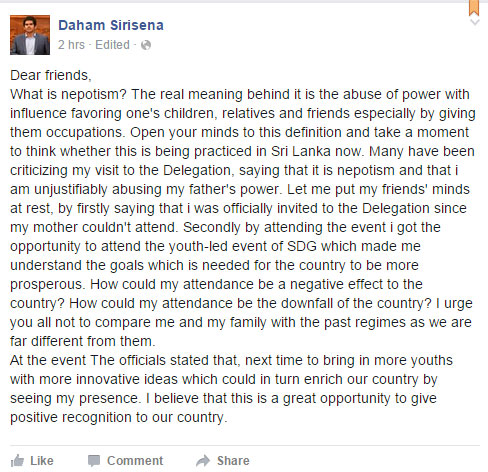
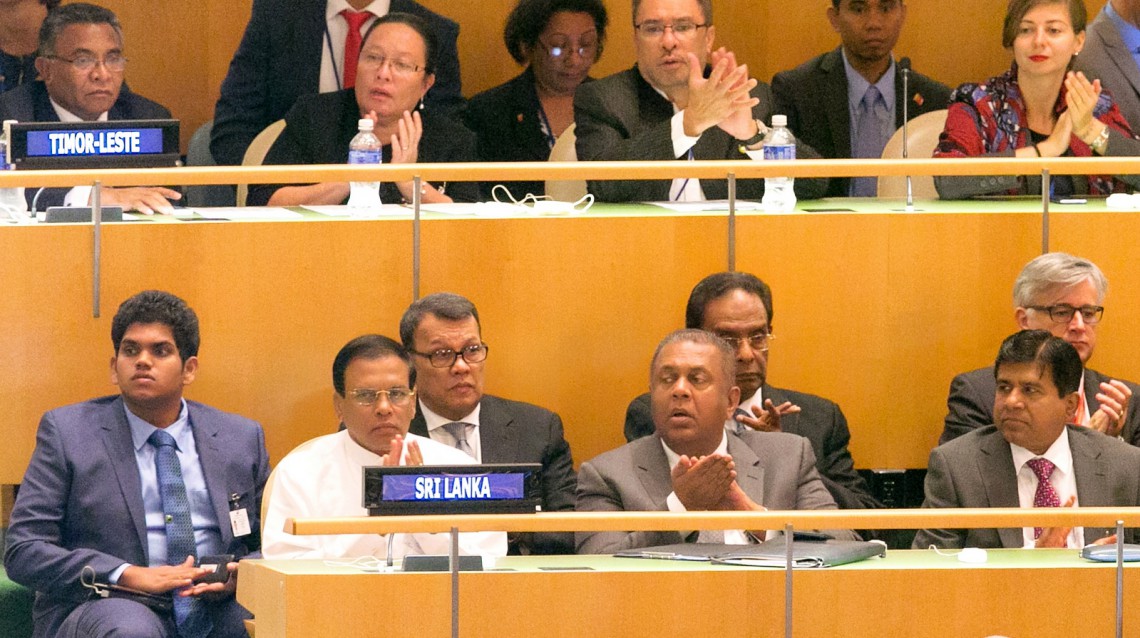
Daham Sirisena, the son of President Maithripala Sirisena, referring to his inclusion in the Sri Lanka delegation to UN, on Monday questioned, how could his attendance have a negative effect on the country?

Posting a facebook note, he stated, How could my attendance be a negative effect to the country? How could my attendance be the downfall of the country? I urge you all not to compare me and my family with the past regimes as we are far different from them.

” The facebook post Daham as a memeber of the Sri Lankan delegation to the UN

daham

sirisenaatun


– See more at: http://www.dailymirror.lk/89131/daham-sirisena-justifies-his-trip-to-un#sthash.f6eIBl9O.dpuf

මහින්ද මැතිඳුන් ඇමරිකන් යෝජනාවේ භයානක කම පැහැදිළි කරයි.

September 28th, 2015

උපුටා ගැන්ම  www.mahinda.info

mahinda-rajapaksa

එක්සත් ජාතීන්ගේ මානව හිමිකම් කවුන්සිලයේධී ශ‍්‍රී ලංකාව සම්බන්ධයෙන් ඉදිරිපත් කර ඇති අමෙරිකානු යෝජනාව සම්බන්ධයෙන් හිටපු ජනාධිපති මහින්ද රාජපක්‍ෂ මහතා අදහස් පල කරයි.

ඒ මහතා විසින් අදාල යෝජනාව ගැන නිකුත් කර ඇති නිවේදනය මෙසේය.


අනිත් අයටත් බලන්නට SHARE කරන්න.

Several areas of concern in resolution- Mahinda Rajapakse

September 28th, 2015

Courtesy The Daily Mirror

Stating that the sponsors of the draft resolution on Sri Lanka had failed to heed the request of the Sri Lankan Ambassador in Geneva not to place primary emphasis on the alleged war crimes issue and to change their approach, former president Mahinda Rajapaksa said yesterday that there were several areas of concern in the resolution.

Mr. Rajapaksa in a statement said, the first operational paragraph encourages the Government of Sri Lanka to implement the recommendations of the recently released OHCHR report on Sri Lanka. The most contentious recommendations in that report have been included as operational paragraphs in the UNHRC draft resolution as the following indicates:

“Operational Paragraph 4 welcomes the willingness of the government of Sri Lanka to allow the mechanisms set up ‘to deal with the past’, to obtain financial and material assistance from ‘international partners.’ This would amount to personnel in important judicial and non-judicial bodies in Sri Lanka being paid by foreign powers.

“Paragraph 6 ‘takes note with appreciation’ the government’s proposal to set up a judicial mechanism to investigate violations of human rights and humanitarian law, and ‘affirms’ the importance of the participation of foreign prosecutors, judges, investigators and lawyers in this process, and is contrary to the claim now being made by the government that any mechanism set up will be purely domestic.

” Drawing the attention to Paragraph 8, he said it encouraged the government to remove from office military officers suspected of having violated human rights through a vetting process (even if there is no evidence to prosecute them). This in reality amounts to a purge of the armed forces,” he said.

MR-State-1MR-State-2


– See more at: http://www.dailymirror.lk/88959/several-areas-of-concern-in-resolution-mr#sthash.6YFXtNO1.dpuf

Why I became a Buddhist

September 28th, 2015

by A.E. Buultjens, B.A. Cantab. ( A public talk delivered in Colombo in 1899 )

The text of a lecture delivered by the late Mr. A. E. Buultjens B.A. Cantab. On 25th March 1899 at the Buddhist Headquarters, Colombo, Sri Lanka

Why I, though born and educated as a Christian, gave up my belief in Christianity.

Why I became a Buddhist rather than a Muhammedan or a Hindu?

I was born of Christian parents, amidst Christian surroundings and influences and associations. At that time the Christians of Matara, about 400 in number were divided into denominations, Roman Catholic, Presbyterian or Dutch Reformed Church, Wesleyan and Church of England.

Hence at about the age of one year, I was reported to have been duly taken to the Church of England by an admiring circle of relations and their friends and there handed over to the tender mercies of the Rev. Abraham Dias – a gentleman who is Sinhalese by nationality though rejoicing under a Hebrew and Portuguese name.

I am told that at his hands I duly received the rite of Baptism, a sign of the cross on my infant forehead with water, and thus I was stamped with the hallmark or rather the watermark of a Christian. Tradition dose not say whether I objected to this treatment by infant struggles and kicks, but I am inclined to think I protested by setting up a continuous scream and howling.

Till the age of 14 I remember I was under the tuition chiefly of Mr. R. H. Leembruggen, now government Inspector of Schools and of the Rev. J. Stevenson -Lyle. I recall these influences of early life, because the impression of that tender age often follows us through our life. The child is often father of the man.

Now Mr. Leembruggen was not a churchgoer, and was reported, in the family conversations of the time, to be an avowed free thinker and agnostic. He did not, I must say, at any time talk to the boys against the Church. But his example has had a great effect upon my mind – for all his school boys held him in the greatest awe and veneration as a strict disciplinarian of my other tutor, “Father” Lyle as he generally was known, I can recall strict high Churchman or Ritualist, and during the 6 months I was boarding with him, he impressed upon my mind the extreme importance of minutely following the rubrics of the Book of Common Prayer, of fasting on Saints days, of dully attending “matins” and “evensong” daily in his private chapel.

He was so pleased with my proficiency that on Prize day he presented me with a Book of Common Prayer and an imitation of Christ. “Father” Lyle was a man of strong determination, but somewhat impetuous.

He lived a life of self-denial and self-sacrifice. He was suspected at that time as a Jesuit agent of the Pope of Rome. A great controversy was going on in the Diocesan Gazette between the High Church and Low Church parties.

My father was a staunch opponent of the lighted candles, wafers and other innovations of “Father” Lyle and the High Church party. The opposition used to meet in my father’s office for discussion and for indicating attacks upon the Ritualists in the Diocesan Gazette.

As a boy I used to listen in silence in a corner of the room to these discussions, and a spectacle of a Church divided against itself must have had a most edifying effect on my mind!

Shortly after Father Lyle seceded from his allegiance to the Bishop of Colombo and the Church of England, and “perverted” to the Church of Rome. With Father Lyle went Father Ogilvie and Father Duthy away from the Anglican to the Roman faith.

When I think today of the number of clergymen who helped to mould my mind, I am surprised that I am not occupying the pulpit of a church to defend the faith of the Church.

Rev. William Henley took me in hand in conjunction with Father Lyle. He was then fresh from England, and plain Mr. Henley, a schoolmaster. Of religion he taught me little, but I thank him for making me proficient in Latin Grammar and in the game of chess.

From the age 14 to 19 I was brought under the shadow, and influence of the Cathedral of St. Thomas’ College, during the regime of Rev. Warden F. E. Miller and Sub-Wardens Rev. T. F. Faulkner and Rev. H. Meyrick. During these 6 years besides being thought the subjects required for the Calcutta and Cambridge Local Examinations, we were carefully drilled in an intellectual knowledge of the Book of Common Prayer and the several books of the Bible, both in the Old and New Testaments, together with a critical acquaintance with the commentaries and the original Greek of Gospels.

I devoted myself to these studies and obtained so great a proficiency that the first year I topped the list in the examination for the whole upper school and obtained the much-coveted Bishop’s prize.

At this time, what with having been the first from St. Thomas’ to pass the Cambridge Local – both Junior and Senior – and having passed in the Calcutta entrance in the First Class – I became the prime favourite with Warden Miller. During all these 6 years, according to the rules of the college for Boarders, every boarder is obliged to attend College chapel morning and evening, every day.

I had already some 3 years previous to 1884 – a year important in my life – received the rite of confirmation, or the laying on of the Bishop of Colombo on my head, as a token of my being confirmed as a member of the Church of England. And right here let me say that I do not acquiesce in the compulsory baptism performed on me “by pastors and masters” when I was a legal “infant”. I denounce the practice and rebel against it as an infringement of the rights of the children.

I have started the foregoing by way of introduction, to explain the remote conditions and circumstances, which ultimately led to the position I took up later when I gave up my belief in Christianity. It was at St. Thomas’ College itself that I received the first hint, that I entertained the first passing doubt, about the truth of Christianity.

It was to a book found in the library of St. Thomas’ College that I attribute the first faint suspicion that what clergymen say, and the church teaches, is open to question. It was by reading this book that my faith in the creation and in a Creator received its first shock. The very foundation of the creed built on Faith was almost shattered by the sledgehammer arguments contained in the materialistic work I refer to – Dr. Buchner’s “Matter and Force”.

The book was ransacked from the mouldy and dusty shelves of the College library – and given to me by senior fellow student, Mr. J. R. Molligoda, now a distinguished and keen minded lawyer of Kegalle. We argued long and for several days upon the atheistic and deistic views of the universe.

I was a hot champion of Deism then, but my opponent was ever ready with calm retorts and replies. I was about 19 years old then, and from that time I was naturally opposed to authority and disposed to rebel against what people accept as gospel truth upon mere blind belief.

If I was at that time to analysed the state of my mind at the period under review – when I was between 19 and 21 years of age – I should say I still was a Christian, but gradually drifting away – or shall I call it, advancing from Christianity to Materialism.

In 1884 I won the University Scholarship of £ 150 a year tenable for 4 years open to the whole island and thus obtained a triumph for Warden Miller and St. Thomas’ College.

I left for England and entered St. John’s College, Cambridge University. While here, I met men of all shades of opinion, devout and staunch churchmen, Embryo clergymen sowing their wild oats while preparing for the Theological tripos to become full fledged Ministers of the Word of God, divinity students who were then being thought that the Bible was not an inspired book literally, but a historical account of the Israelites.

This was the advanced school of the Church, which changed its front to meet the onslaughts of Agnostics and Freethinkers. I met also a select number of Englishmen, who were avowed agnostics, and admirers of Huxley and Bradlaugh. The controversy of the former with Gladstone was then being waged in the columns of the exercised over the account of the creation in the Bible.

I had previously read up Physical Geography and Geology and obtained the mark of distinction in the former at the Senior Level. My mind was therefore prepared to accept the Nebular Theory of the formation of the world, and to give up forever the Christian theory of a 6 days’ creation. Of course, Christian commentators and apologists of the biblical narrative interpret “day” as a period of time, but this was merely forced upon them in these latter days, after geological scientists proved beyond doubt that the world assumed its present condition after millions of years of natural phenomena.

A study of the strata of the earth, its fossils, the action of the seas, and volcanoes and rivers in moulding and shaping the earth helps greatly in modifying, if not completely altering, a belief in the Genesis of the Bible. Having once become convinced that God did not, as related in the Bible, create the world, I gave up one by one the fond and cherished beliefs of my childhood. It was a serious question to me only those who have experience in their hearts the throes of agony, which must be endured, alone and in silence, when they are compelled upon sincere conviction to give up beliefs, which they have hugged to their bosoms, know the pain when it becomes necessary to wrench those beliefs away from heart and mind. One by one every cherished faith was destroyed. I began to argue to myself: if the world was created by a merciful and infinite Being of tender compassion, why did he create a hell and a Devil. God creates everything. Why did a good God create Evil? Why did he create Pain and Misery?

The hospitals are filled, throughout the world, with disease, with sickening forms of leprosy. Christians say it is a punishment to them. Nonsense! Why should infants be born, some blind, some deaf, others with one leg, or one arm, and others idiotic? Why are thousands slain by a just God by volcanoes, by bubonic plague, by famine? If God were all-powerful and all merciful, he could easily have made the world without a devil, a hell and pain. But I suppose an ignorant man might say that the devil was made for the special purpose of tempting Mohammedans, Hindus, Agnostics and Buddhists and hell was made to put them in.

I regret to say that there are some Christians so bigoted as to think so. They rely upon the passage in the New Testament, which condemns all disbelievers and heretics for eternal damnation in hell!

While on subject of the creator, I may say that I received yesterday a letter evidently written by a Christian, requesting me to refute certain arguments against Buddhism contained in 8 pamphlets written some in English and rest in Sinhala, which he sent me. I replied that I would not have time today to reply to anti-Buddhist tracts which I had not yet read but that I hope at a future opportunity to give a lecture on “A reply to attack on Buddhism by Christian pamphleteers.

Today I shall touch upon one point mentioned in one pamphlet issued by the Christian Literature Society. The anonymous pamphleteer of “Buddha and his Religion” says at page 23: The existence of a Creator may be shown in the following way: Whenever we see order and means intended to accomplish some end, we are certain that they must have originated by the action of an intelligent being, and construction that we infer that it must have had a maker, who knew what it was for and designed its use. The different parts could not have formed themselves and come together. If the watch could have been so wonderfully constructed that it would produce other watches, this would duly increase our idea of the wisdom of its maker. The world we live is far more wonderfully formed than any watch – Therefore it had a Creator!

I am familiar with this argument. It is known among Freethinkers as Paley’s Watch Argument of Design in nature. If a watchmaker makes bad watches, we call him a bad watchmaker. There is in this world on every side monstrosities, evil things, wild beasts, in the animal world, thorns and brambles in the vegetable world and poison, disease and insanity, misery and pain – A bad watch has a bad watchmaker, for no good person will create evil things.

Moreover the watchmaker makes his watch of wheels, hairspring, dial, hands and case; he puts together previously existing materials. He dose not act in the manner of a prestidigitator making the world out of nothing, for as the phrase goes ex nihilo nihil fit, out of nothing, nothing is made. Even supposing the possibility of a creation of the universe out of nothing, simply by an act of volition by an Omnipotent Being, it is a reasonable query to put: what was the creator doing before he made the sun and the moon and stars, birds if the air, and the fishes of the sea? He must have been existing in chaos doing nothing.

To proceed from this digression. Having given up my belief in a Personal Creator – an anthropomorphic God – I gave up prayer and belief in the Immaculate Conception of Christ – whom I regard as a divine and holy man. I refused to believe in the doctrine of vicarious sacrifice, which teaches that through the death of Christ we must receive pardon.

I also gave up belief in the doctrine of forgiveness of sins; for if there be no God, who will forgive sins? I would no longer believe in the abominable doctrine of eternal damnation in hell where shall be weeping and gnashing of teeth. Having thus given up intellectual assent to the teachings of Christianity, I considered whether I was to remain as many do, a nominal and outward Christian, or whether it was not more honourable not to act a lie? Was I to say that I was no longer a Christian, or was I to remain silent? I preferred to speak out. I was not alone in my agnostic views – several university men, Englishmen, especially those who were studying for the Moral Science and Natural Science Triposes, and some who were going in for the Law thought as I did.

I therefore determined to bring matters to a crisis, There was a rule in Cambridge that man should attend College Chapel at least five times a week. I gave up attending Chapel, and I was sent for by the Dean of the College. I believe his name was Dean Maitland – a liberal minded, tolerant and sympathetic man. I had an hour’s talk with him. The following is the purport of his conversation:

“Good morning”!

“Good morning Sir”.

“I hope you will be more regular at Chapel in future. Good morning!”

And with this he was going to dismiss me, as other men who cut Chapel were waiting to see the Dean. But I was determined to continue the interview.

“If you please Sir, I wish to talk with you about Chapel”.

“Yes, what is it. Sit down”.

I took a set.

“I don’t like to attend compulsory Chapel. It dose me no good”.

“Very well, I excuse you in future from doing so”.

Having obtained leave keep away from chapel, on the ground that compulsory attendance at a Christian worship did me no good, I was willing to terminate the interview.

Not so the good Dean, who next addressed me not as Dean, exercising disciplinary authority over a college student, but a minister of Christ’s church sympathetically endeavouring to guide back into the fold sheep which, in his view, was wondering astray.

“Now tell me if you have any further reasons why you do not wish to attend chapel”.

“I would gladly speak out my mind, if in my position at College I would not suffer thereby”.

“No I assure you that whatever you say will not go beyond me”.

“Then Sir, I do not wish to shock your mind with my infidel and agnostic views”.

“However much it may grieve me, it is my duty to hear your doubts, and try to set them at rest. In the course of a Clergymen’s life, he has to meet with men with varying opinions, and it is his duty to guide them aright to God”.

“I do not believe in everything written in the Bible, I do not believe in an eternal damnation in Hell and most of all I can not believe in a Creator”.

“You have been reading Huxley and Bradlaugh?”

“Yes Sir, and I no longer believe in the Inspirations of the Bible, nor the Immaculate Conception, nor in the vicarious atonement nor even in the Divinity of Christ”.

“I am grieved to hear this, Have you tried Prayer? God helps those who pray to him with faith and sincerity”.

“Yes, I have been earnestly praying, but for sometime since my belief in God is lost, reason mocks at my faith and says that prayer in a non existent Creator is useless”.

“Then I would ask you to consider the Christian family, what peace, what happiness is in the Christian Home! Have you not looked at it in the light?”

“Yes Sir, I can quite conceive that there is happiness in the Christian Home, where the moral teachings of Christ are followed. But I come from a Buddhist country, where Buddhist home would be just as happy, if the moral precepts of Buddha were observed. It would be same in a Hindu or Mohammedan Home, if the believers in those faiths followed the rules of their religion”.

The above was, as far as I remember the gist of our conversation. The kind Dean talked with me for nearly an hour and at the end gave me book by Dr. Wace to read over carefully and to come to him again. I read the book, but it was unsatisfactory, for it started with the assumption of an Omniscient Creative God – which was just the very difficulty I felt of conception. In returning the book I stated that it did not meet my case, and so that matter dropped.

Henceforth I was an avowed Agnostic. But this made no difference to me socially in England, and though I had some agnostic friends especially among the Moral Nature Science men, yet the theological men who, knew my infidel views, did not “cut” me, and some of my best friends are now clergymen of the Church of England.

An amusing incident followed when it got about that the Dean excused me from chapel in future. A man of another college went up to the Dean and asked leave to keep away from chapel, because he did not believe in God. Said the Dean: “I will give you 24 hours either to find your God, or to find another college”.

In common with a large number of Christians in Ceylon, I had been brought up in the belief that wickedness and crimes prevailed only, or especially, among the Buddhist or other “heathens”, but that in Christian England crime was comparatively absent.

This was an argument from the practical aspect to Christianity. I do not know whether this impression prevalent in Ceylon was created by Missionaries, but I saw practical effects of Christianity among Christians in Christian lands.

I need not dilate the extreme wealth side by side with the grovelling debasement, poverty and misery with the East end of London. The object lesson of nighly dgbaucheries of hopeless drunkenness in the gin places, of the homeless and starving thousands, of the piteous cries of government, and the public demonstrations of dissatisfied socialists, all this was a picture I shall never forget.

Thousands of men, women and children have been huddled together at night, homeless, roofless, making their beds on the bare, grass-less snow-covered ground, with non to help them.

Could such things be in Christian England? The Bible says, “Sell all that thou hast and give to the poor”. But amidst the squalor, misery and poverty of the Christian fellowmen, I saw the great body of the Christian Bishops and clergy complacently enjoying the luxuries of life.

Immense wealth was also spent upon grand churches, like the Westminster Abbey, and St. Paul’s, while there was no money to feed starving poor. I witnessed the public send off young, zealous and enthusiastic preachers of the Gospel to China, to Africa and to India, in the midst of the plaudits and prayers of righteous Christian assemblies convoked by the Missionary Societies.

It seemed to me that practical Christianity was a mockery, for with the export of missionaries and Bibles, there was a far larger export of bottles and bullets, the one to kill the mind, the other the body. And all this from a town where, more than in any other place in the world, thousands of Christian women nightly sold themselves in open street prostitution.

I remember one occasion, when one of our leading Ceylon’s lawyers, then on a visit to the modern Babylon, could scarcely believe his eyes when he first saw the stream of well dressed streetwalkers opposite the theatre at midnight. He wept to find that such things could be in Christian England.

The social evil is not confined to London alone, but is rampant and shows no signs of abatement in all larger Christian towns, notably at Liverpool, Paris, Berlin, Vienna and New Yolk. Universal love, friendliness, loving kindness, or however we choose to call it, is a firm ethical basis for human life beyond the confines of any religion, though

Just as a misunderstanding prevails in the East as to the vileness of man in ”heathen” lands alone, and his virtue in Christian countries of the west, so is there a misunderstanding in the West as to the trials and troubles of missionaries sent to the ”heathen”.

I had to frequently assure educated and intelligent people in English that it was not considered a delicacy here when a roast missionary was served at dinner!

There were people still who believed that Ceylon was a cannibal island, and that missionaries have hard time from tigers, elephants, crocodiles and snakes. Evidently these stories were circulated to magnify the self-sacrifice of missionaries and help to fill the coffers of the Gospel Societies.

I pass on now to the time of my return to Ceylon. I had not been to a church for two hears for devotional purposes. The University Sermons I occasionally listened to, when preachers of note came to Cambridge, and their discourses were eloquent and interesting, and being unaccompanied by ceremonial ritual were attended by men of all shades of Ceylonese. For two years I had not attended a church except some in Holland and the Notre Dame in Paris for architectural beauty. Therefore when a few Sundays had passed in Matara without my accompanying my brothers and sisters to church, my mother enquired the reason of ungodliness in thus keeping away from the House of God.

I replied that the whole world was the house of God, and not only a particular building with four walls and roof. I was then looked upon as peculiar and strange, and she judged that something was evidently wrong with my upper storey, a doctor should be sent for to cure me – not as a medical doctor – but a doctor of divinity.

Accordingly one morning, the Rev. F.D. Edirisinghe came to see me. After preliminaries the following conversation ensued:

”How is it that I did not see you in church after you arrival?”

”May I inquire whether church going is essential for salvation?”

”Yes, you take part in the services, in prayers and in hearing sermons”.

“I prefer to read sermons in stones and good in everything”.

”But your father and all your people have been going to church”.

”Yes, so have I at the rate of twice a day, every day for six years at St. Thomas’ College Cathedral. That would make a total, leaving off holidays of nearly 3600 church goings. Plus five times a week for one year at Cambridge, about 200. Grand Total 3800. If church going was sufficient I consider I have done my share to qualify for Heaven and I may be excused for the rest of my life”.

”But surely are you not a Christian?”

”Well, if you ask my opinion, I am not. Do you want me to believe in Noah’s Ark and Jonah in the Whale’s belly and several other fables?”

At this stage my mother, who was present at the interview, retired in disgust leaving the reverend gentleman and myself to a nice discussion, and so that interview terminated soon after.

It became noised about that an infidel was let loose on society at Matara, and I became a marked man-mod some said. Then some Buddhist friends met me, and enquired whether I would see a Bhikkhu on the subject of Buddhism. I consented and so in the company of Mohandiram De Saram Siriwardene and others I had a long talk with Bedigamd Ratnapala Unnanse at Weliweriya Pansala.

I learnt from him that Buddhism agreed with the agnostic view I held on the subjects of the Creator and creation, and that Buddhism does not want belief in Personal God. I learnt that the Christian doctrine of Soul was replaced by the doctrine of the Five Skandas, and that I need no longer believe in new souls being created by an omnipotent God for new-born infants, some of which ere to suffer eternal damnation in a hell created by the self-same God. I learnt from him the doctrine of karma, which, while contradicting the Christian theory of forgiveness of sins, satisfactorily explains the inequalities of life. The Doctrine of karma which, while contradicting the Christian theory of forgiveness of sins, satisfactorily explains the inequalities of life. The doctrine of karma, while doing away with the belief in the efficacy of prayer, teaches that man reaps the consequences of his own deeds, and must work out his own salvation.

In explaining what Christianity could not satisfactorily tell me, how the lunatic asylums are filled with the insane, how leper asylums and hospitals are filled with the diseased. Karma explained in a reasonable manner that every cause must have an effect, and that this great law rules in the moral world. I had several interviews with the monks and the more I learnt about Buddhism, the more did- I remain convinced of its truth. Why should we suffer at Adam’s sin?

Karma teaches we suffer for our own mistakes. Why should we get pardoned by Christ’s atonement? We must ourselves step by step, life after life, strive to reach the goal. Why should we believe in a soul manufacturer above, we are what we make ourselves to be.

How could a God, who is merciful and just, and who taught ”forgive your enemies” have created a Hell and Devil? We make ourselves god or devils, and we make for ourselves a hell upon earth.

Buddhism agreed with Science in that force and matter are eternal and indestructible and taught law and order without a God, and transformation without creation. Especially was I stuck with the truth of the simple but profound teachings of anicca, dukkha, anatta, change, suffering, and non-ego.

Christianity is faith religion, Agnosticism a negation, Buddhism goes beyond Agnosticism in the affirmation of the Law of Karma, of Reincarnation and of Nirvana. Christianity in the ages past disgraced the teachings of Christ by wars, especially the Crusades, and by the tortures of the Inquisition, the rack thumbscrew and the flames.

Agnosticism was unorganised and until recently did not carry out in its name a philanthropic programme. It is only within recent years that agnostics have become propagandists, and taken active steps for the sake of humanity.

Buddhism has on the whole been free from leading and encouraging a wholesome persecution, and in the light of past centuries we know its only weapon has been appeal to reason and argument. Moreover Christianity is fetishism and unphilosophic. Agnosticism is destructive of Christianity without being mainly constructive. But Buddhism is analytic and philosophical while being humanitarian and practical. Christianity merely teaches a form of morality, without touching the domain of mental science.

But Buddhism besides being a moral, is in its higher aspect essentially a mental and spiritual philosophy. I felt that Agnosticism -as a mere negation – was unsatisfactory not only on who moral plane as guide in life, but also on the mental plane in the explanation of the problems whence we come, whither are we going?

The reasons stated above explain why I became a Buddhist. It was because I was conscientiously convinces of the truth of Buddhism. I asked myself reverently in the silence on the heart whether I was to declare myself a Buddhist or not.

At the time, in 1888, Buddhists were looked down upon, even more than they are now, by the more enlightened, or rather more civilised, society people who were Christians. The Buddhists were numbered among the more ignorant and lower classes. I know that social ostracism would follow, as it did.

So one day in 1888, I went with the above named Buddhist gentleman and others to the temple on the full mood day, and publicly declared myself a Buddhist by reciting the Tisarana and the Panca Sila.

As long as I was a Freethinker, I had been tolerated in Christian Society which merely regarded me as an eccentric, but When in 1888 I became an avowed Buddhist, I was looked upon as worse than a lunatic. And this was not strange, for Christianity was respectability and Buddhism was the religion of the ”ignorant natives”.

Christian parents and Christian College had educated me to defend the Church, to learn its respective arguments against other sectarian schismatics. Hence my lapsing to Buddhism was a ”wretched fall”

God made man, it is said and gave him brains to think, and when he thinks and reasons and becomes a Buddhist, then God damns him for thinking with the brains he gave him. But it was when, at the end of 1889, I was offered and accepted the headmastership of the Colombo Buddhist School, that the vials of wrath were poured on my head by Christians, and particularly by Christian ministers of the Church of England.

I had braved the Church, and so every Christian door was shut, every slander was open for social ostracism. I was, in their eyes, a viper and a scorpion. The first arrow of malice was shot at me by the Rev. E. F. Miller, Warden of St. Thomas’ College, my old and respected tutor. The two letters from him that follow show his attitude towards me before and after I became publicly a Buddhist.

Letter A

St. Thomas’ College

Colombo

6th February 1888.


My dear Buultjens,

I am sorry I missed you this morning, We shall be glad to see you tomorrow afternoon at 4.30, if you care to come up to the gathering of Old Boys.

Yours affectionately,

Sgd. E. F. Miller


Letter B was in reply to a polite request enquiring for the reason who the Warden had removed my name from the panels of the Library of the College – as it was special distinction in secular school subjects that had justified the college ID putting up my name first in more than one panel.

Letter B

St Thomas’ College

Colombo

February 19, 1890.

My dear Buultjens,

It is, alas easy to answer your question. Your name has been removed from the panels of the Library, because you have apologised from the faith of Christ. The College was founded to maintain and spread the faith and you, having been baptised into that faith have now deserted to its enemies. Would you have me retain the name of a traitor among those whom the College delights to honour?

Yours sorrowfully,

Sgd. E. F. Miller

The characteristic Missionary- Christian act of the Warden in removing my name from the panels was approved by the Bishop of Colombo to whom I appealed. They thought to dishonour me, but they have only given public exhibition of Christian hatred and intolerance of which I hope they are proud.

In conclusion, I would like to mention a personal anecdote to illustrate how certain clegymen of the Church of England regard Buddhists. It was in connection with the Rev. Abraham Dias, the minister who baptised me in my infancy. I met him one day, after many years, at the Pettah Library, and wished him a good afternoon. He recognised me and the following dialogue ensued:

”How are you getting on?”

”Quite well Sir, thanks”.

”I hear you are at the Buddhist School”.

”Yes”.

”Are you a Buddhist?”

”Then you will go down straight to Hell”.

”My dear Sir, are you so very cock sure of Heaven?”

Exit the reverend gentleman, tottering with old age.

S.W.R.D. Bandaranaike – Why I became a Buddhist

September 28th, 2015

“The requests made to me to deliver and write articles on this subject have been numerous. I have been very reluctant to accede to these requests because a man’s religious convictions are surely one of those very personal matters that he shrinks from exposing and parading before the public gaze. However much a man’s life may be public, there are always certain hidden reserves of his mind and heart that he likes to keep to himself, which indeed it is right that he should keep to himself. But I suppose there are rare occasions when the veil may be rent from before the holy of holies, and it is in that spirit that I proceed to a dissection and analysis of the innermost workings of my mind and heart on this theme. I hope to conduct that operation in as dispassionate a manner as possible.

My parents being Christian, I was duly baptised into the Christian faith. I cannot recollect that my wishes were consulted in the matter; indeed, it is open to doubt whether at the tender age of a few weeks I would have been able to express an intelligent opinion, if I had been consulted. I went through the usual training of the average Christian child. But even at this early age I suffered from a peculiar disability. While acquiring for Christ a sort of personal affection as towards a kind elder brother to whom one could pour out one’s troubles, I never was able to attain a conception of God the Father. My prayers were all really addressed to Christ: God had no real meaning for me. This trouble, far from disappearing, increased with the growth of my mental powers, until, about the time I left school, I was in sore straits. I now realised that the foundation of Christ’s teaching was the love of and complete surrender of oneself to a personal God, and through the love of Him, the love of one’s fellow men. Now, I was able to love Christ as a man, but I was utterly unable to accept or surrender myself to this god. But could I believe in Christ, and not believe in his God? That was my dilemma. I even gave up going to church, as I felt that in the circumstances, it would be hypocritical to do so. However, at this time I was content merely to drift without actively meeting a solution of my difficulties: my mind was not yet sufficiently mature. Desultory reading at Oxford tended to confirm, rather than dissipate my doubts. I became convinced that the idea of God was really subjective and not objective: that man created God and not God man. Added to the usual arguments that are adduced in support of this view, I was powerfully influenced by the history of the growth of the theistic idea, as I conceived it.

The rationalist view that religion originated in a fear of the unknown is, no doubt, partially true, but it is not the whole truth. We have in my view, to go to life itself for the real reason. Now it is a scientifically provable fact that life is continually devising and adopting means of protecting and fostering itself — the sexual instinct, the protective colouring of animals, and many more examples will readily occur to the mind.

Now amongst all living things that in many ways have so much in common, it i significant that man alone possesses the religious idea. For man alone possesses a mind that apparently makes some sort of religion necessary for comfort, happiness and progress of the human race. He sees various phenomenon about him, which he cannot understand. Being gifted with imagination and a highly developed power of reasoning, he cannot rest satisfied unless he finds some kind of explanation for these things. Moreover, these phenomena, which he can neither cause, control, nor prevent, wield a great influence over his prosperity and happiness. He brings his thinking mind on the subject, and tries to devise some method to effect that control.

Lastly, as the natural tendency of man is perhaps well expressed by the saying ‘home homini lupus’ — if the great powers of the human mind are brought to bear, without any check, on one’s task of mutual destruction, humanity would soon disappear. Religion in some measure provides check. To sum up, human life has evolved the religious idea for its own protection and furtherance just as animals have evolved a protective colouring.

This does not mean that religious belief need necessarily be false, but that owing to the subjective element in it there is a probability that certain beliefs, at least, are false, and that we must each, individually, submit any particular belief to one’s test of such reasoning powers as we possess, before accepting it. It may, of course, be urged in favour of blind faith, even on the rationalist principle, that what is important is not so much that a thing is true but the belief that it is true. And doubtless this has enabled many religions to jog along fairly comfortably hitherto. I do not consider it necessary to pursue that argument further. Let us pause now, and see how the arguments mentioned above apply to the origin and development of the theistic idea.

Early man, seeing certain things happen about him — the sun shining, the rain falling, etc. — which might, in certain circumstances, be beneficial or the reverse to him, tried to discover a method of controlling them to his own advantage.

The method he found was magic. Later, as he grew in power and security, and began to realise his own superiority to the other living things around him, he probably argued in this way: “There are many things that I can do that animals, for instance, cannot do. I can build a substantial house to protect myself form the elements. I can fashion weapons, I can till and cultivate fields. But there are certain things that even I cannot do. I cannot make the sun to shine or the rain to fall. These things, therefore, must be done by some being superior to myself, and as man is the greatest living things I know, they must be done by beings like myself, but with superior powers.”

That, I should imagine, was the age of polytheism. Later, still, with the development of the village community and city state, the conception of an ordered State of the Gods arose. An example is Homeric theology, with the idea of a chief and chieftains of the community, the blacksmith and other artisans and so on. The final stage was the conception of a single omnipotent Being. But here too, it is significant, as Bernard Shaw points out in his Black Girl, that this being gradually develops, in the Bible itself, from a wrathful, jealous, tyrannical God to one who, in the gospels is all merciful and all loving.

The theists may, of course, urge that those various ideas are in due to a struggle on the part of man to discover the truth which gradually revealed itself till the final all-illuminating revelation. The first difficulty about this argument is this: what proof have we that our present conception is the truth, that it is any more true than its progenitor, Polytheism.

Secondly, the fact that mankind’s conception of God seems to have changed with his environment and state of culture and civilization is too remarkable to be a mere coincidence. For my part, I am overwhelmingly convinced, for the reasons mentioned, that man has created God for his own purposes.

When I reached this point in my thinking, three courses were open to me. I might, as some Christians do, have salved my conscience by twisting Christian doctrine to suit my conscience point of view, and continued nominally to call myself one. I was too honest with myself to do that. Another alternative was to declare myself rationalist. This I was unable to do for the following reason. Although I could not believe in a personal God, I did believe in some kind of continuance, a struggle, evolution towards a final goal. Just as higher bodily powers have evolved from lower ones thorough millions of years, there surely is a similar evolution of the spirit of life-essence, or whatever one likes to call it. The history of mankind itself, the painful and laborious struggle, forwards and upwards, out of the dark abyss towards the sun-lit heights above through aeons of time, leads me to this belief. All I can say is that I personally was convinced of this continuance. Thus, while disbelieving what is the foundation of the theistic religions, the existence of God, I believed in a vital ingredient of all religions, the fact of some continuance.

My third course was to find a religion that satisfied my needs. Buddhism alone has been able fully to do so. Its doctrine that there is no need for man to depend on the will of God, whose favour he had to seek and whose wrath he had to fear; that man must work out his salvation himself, appealed irresitibly to my own mentality. Similarly, the continuance and evolution contemplated in the Dhamma exactly coincided with my own views.

Although these are the most important, there are certain other reasons that attracted me to Buddhism. It will have been observed that although I could not love a God, I could love a man, and the Lord Buddha was just a man, like the rest of us. Indeed, he was very human; how touching is his reluctance to look upon his newborn son, once his great resolve was made, lest the infant might close his little fist about his heart-strings and pull him back.

Again, Gotama’s approach to his problem had a strong appeal for me. All the fine spirits throughout history have been conscious of the sorrow that lies forever at the heart of the world. If I may mention two names at random, Virgil was conscious of it, and so was Hans Christian Anderson who, by a strange irony, wrote stories for the delectation of children, for, as George Gissing says of him, beautifully, “Every page is touched with the tears of things, every line, melodious with sadness.”

Gotama realised the fundamental truth of the existence of this sorrow, and the ultimate goal as its removal. In expounding his doctrine for this purpose, He makes no extravagant claims on our faith, but wishes every teaching to be tested by the reasoning of each of us, before acceptance. It is only left for me to say that the Buddha Dhamma has emerged triumphant form the test of my reasoning.

I have now torn the veil from before the holy of holies of my mind. If those, who peer inside, see anything there of profit or help to themselves, I shall consider myself amply rewarded.”

http://www.geocities.ws/Area51/Starship/7077/Aloka/pers1.htm#swrd

Meeting With Sri Lankan President At UN General Assembly In New York

September 28th, 2015

Dr. Chula Rajapakse MNZM Spokeperson, United Sri Lanka Assn. Lower Hutt NZ

Rt Hon John Key,
Prime Minister of New Zealand,
NZ Parliament.

Dear Mr. Key,

I write as a member of the National party and as a representative of the Sri Lankan community in New Zealand , to convey some  information & sentiments, which we feel may be relevant to your upcoming meeting with HE Mr. Maitripala Sirisena, President of Sri Lanka,  at the UNGA in NY, as follows:

  1. Mr Sirisena had  his oaths administered following his election victory on January the 8th, by Supreme Court Judge  K.J. Sripavan from the Tamil Community , by passing the Chief Justice Mohan Pieris,  from the Sinhalese community.
  2. Shortly after, Justice Sripavan was made the Chief Justice of Sri Lanka, which he remains as of now.
  3. Within weeks of the swearing in of the new government in January, Mr Navad Cabral of the Sinhalese community was replaced by Mr. C. Mahendran from the Tamil Community.
  4. The leader of the Parliamentary Opposition now is also from the Tamil Community, Mr. R. Sampanthan.
  5. A leading minister in the present cabinet. Mr. D. M Swaminathan , Minister of Rehabilitation, Resttlement & Hindu Affairs, is also from the Tamil Community. He is a part of the current SL delegation to the UNGA.
  6. The new High Commissioner for Sri Lanka in Australia and New Zealand ,  Mr. S. Skandakumar is also from the Tamil Community, replacing Admiral Thisara Samarasinghe from the Sinhalese community.
  7. The Tamil Community with 35% forms the majority community in Colombo City, numbering slightly over the Sinhalese.
  8. The Tamil Community exerts the dominant influence in the commercial sector of Colombo. They run three of about 7  free to air Television channels in Sri Lanka.

All of the above are sighted as evidence that the Tamil Community numbering 12% is by no means a disadvantaged community and that the new administration of Mr. . Maitripala Sirisena, has made a special effort to give prominence to the Tamil community in keeping with it’s objective of achieving post war reconciliation between the the two communities   and in pursuance of the recommendations of the Lessons Learnt and Reconciliation Commission.

The Presidential Commission headed by retired high court judge Maxwell Paranagama,inquiring into Missing Persons” during the 3 decade long conflict and its immediate aftermath, supervised by three eminent persons drawn internationally, having inquired into over 19,000 complaints and having had sittings in many parts of the war ravaged Northern & Eastern province, have released there report to the President, though unfortunately not tabled either in SL Parliament or the OHCHR, as yet. However, the commissioner in a public media interview has revealed that the casualty numbers during the last phase of the war was around seven  thousand and not the 40,000 that was widely quoted following the UNSG’s panel of experts report a few years ago who claimed that there was credible evidence”, the sources of which remain concealed for twenty years,  that the casualty numbers could be around 40,000.

Many Sri Lankans view with concern the hybrid courts” with participation of  foreign judges, lawyers, defence attorneys  & investigators, as required by the latest resolution at UNHRC in Geneva, as a potential intrusion of the sovereignty of the country. New Zealand , with it’s new found responsibilities in the security council have an obligation to see that this is not the case.

Many Sri Lankans also view with concern that geopolitical interests of powerful nations  rather than interests in human rights may be the motivations to much of the UNHRC’s interest in SL’s alleged human rights violations during the end of the war, given that far greater violations as are alleged in relation to the US invasion of Iraq on non existent  WMD’s but  have attracted no interest from  UNHRC.

Many thanks for giving  due considerations to the above during your forthcoming deliberations.

Yours Sincerely,

Dr. Chula Rajapakse MNZM

Spokeperson, United Sri Lanka Assn.

Lower Hutt NZ


Bandaranaike Assassination– due to Banda – Chelva pact?

September 28th, 2015

Chanaka Bandarage

During the 1956 election campaign Bandaranaike promised to make Sinhala the only Official language.  But, after he came to power he was slow to implement the promise.

Staunch protests were initiated by nationalists including a fast to death demonstration by AP Jayasuriya MP, which was strongly supported by KMP Rajarathne MP and Wimala Wijeyawardena MP, who was also the then Health Minster.  Bandaranaike had no other alternative but to introduce legislation to legalise his ‘Sinhala Only’ policy. The Act was passed by a majority in the parliament in 1956.

But, Bandaranaike could not live with his nationalist policy for too long.  The pressure put on him by SJV Chelvanayakam (Federal Party Leader) was too much, Bandaranaike could no longer take it.  He signed the Bandaranike – Chelvanayakam pact (Banda – Chelva pact) in 1957. This gave equal status to both Sinhala and Tamil languages and covered a broad range of areas.  Effectively, what the two leaders consented was to have a federal administrative system in Sri Lanka.

This (Banda – Chelva pact) infuriated the Sinhala Buddhists.  There were mass protests in the country against the pact and Buddhist monks took the lead role in them.  Hundreds of Buddhist monks (about 200) camped outside of Bandaranike’s Rosmead Place residence.  Bandaranike had to erect a barbed wire fence to keep them away from entering his residence. Ven Mapitigama Buddharakkitha, the chief incumbent of the Kelaniya temple was the leading figure who marshaled the camping monks.  Bandaranaike went out of his house and met the monks; he promised to abrogate the Banda-Chelva pact.  He also confirmed this in writing and sent a hand written note to the monks through Wimala Wijeyawardena .  The monks dispersed.  This was also in 1957.

The Banda – Chelva pact seriously dented the excellent relationship that existed between Bandaranike and the Buddhist clergy (and aspects of the ‘pancha maha balawegaya’).  Mapitigama Buddharakkitha had spent hundreds and thousands of his own money to bring Bandaranike to power; but, by 1957 the two had become enemies (some say Buddharakkitha’s animosity towards Bandaranaike was not due to nationalist reasons, but personal – Bandaranaike refused to award a lucrative shipping contract to Buddharakkitha’s brother’s company; and Wimala Wijewardana’s son was also engaged in that business).

Mapitigama Buddharakkitha was an extremely influential monk of the time.  This can be illustrated from the following two incidents:

  • After he was sworn in as the Prime Minster, Bandaranike, rather than paying homage to the sacred tooth relic at the Kandy temple, went to worship the Kelaniya temple where Buddharakkitha was the chief incumbent.
  • Immediately after Bandaranaike’s death, the then incumbent Prime Minister, Dahanayaka, requested Buddharakkitha to give a sermon on national radio praising Bandaranaike, which Buddharakkitha did (Buddharakkitha was arrested a few days afterwards).

Buddharakkitha and Wimala Wijeyawardena  were close friends, it is also well known that both were ardent nationalists.  There were incidents to prove this; some are mentioned in this article.

The Buddhist clergy was angry with Bandaranike about the Banda – Chelva pact; and by 1959 the pact had very much resurfaced.  Despite his promise to the monks, Bandaranaike was very committed to implementing the pact.  He wanted to bring in legislation to legalise it (JR Jayawardane initiated a walk from Colombo to Kandy to protest against the pact which was thwarted by SD Bandaranike MP at Gampaha).   Bandaranike genuinely thought that the pact would bring a lasting settlement to the Sinhala – Tamil problems (in 1958, the first ever Sinhala – Tamil communal clashes occurred over the issue of ‘ශ්‍රී’ vehicle number plates).

Buddharakkitha and Wimala Wijeyawardena were accused in the Bandaranike murder trial.  The latter was acquitted during the course of the proceedings, but, Buddharakkitha was convicted and sentenced to death.  The death sentence was commuted to a life imprisonment by the 1965 Dudley Senanayake government.  Buddharakkitha died in the prison, at the age of 46.

The primary suspect of the murder trial was Ven Thalduwe Somarama (4th accused of the trial).  It was alleged that Buddharakkitha used Somarama to commit the murder.

Somarama was also a well-known nationalist.  He lived at a temple in Borella. He was an Ayurveda Physician and a lecturer at the Borella Ayurveda College.   He hailed from a paddy farming family in Mathara.  He became a monk when he was 14.  He was ordained at the age of 21 in Kandy.  After he was found guilty of the murder by the jury, he was hanged to death in 1962.  He was 47 then.

Immediately after shooting Bandaranaike, Somarama  repeatedly uttered the words  ‘country, race and religion’(‘රට, ජාතිය, ආගම’).  These are words of an extreme nationalist, not of a person with a different motive to kill.

Somarama, the strong nationalist, would have never got involved in the murder,  unless the killing in his eyes was definitely political.

Somarama’ s above words allow us to draw the inference that he killed Bandaranike due to Banda – Chelva pact.

Various other conspiracy theories have emerged in regards to the assassination such as it being a CIA plot, the involvement of one Ossie Corea etc.  They have proven to be bunkum.

It seems the real motive to kill Bandaranaike was the Banda-Chelva pact, but, no one can say this with absolute certainty. This is because the two murderers did not confess to the killing.  They pleaded not guilty to the offence of murder that they were charged with.

It is stated that Buddharakkitha privately attributed that his motive to kill Bandaranaike was his failure to aggressively pursue the Nationalist reforms”.

The then press did not give publicity to the nationalist statements made by Somarama and Buddharakkitha following the incident of shooting.  Today, they allow us to draw inferences in regards to their motive to kill.

The writer stresses that it was a despicable act to kill Bandaranaike in such a horrendous manner; the popularly elected Prime Minister.

US SECRETARY OF STATE JOHN KERRY CALLS ON PRESIDENT MAITHRIPALA SIRISENA

September 28th, 2015

Embassy of Sri Lanka Washington DC

United States Secretary of State John Kerry called on President Maithripala Sirisena in New York yesterday evening, 27 September.

President Sirisena recalled the historic visit of Secretary Kerry to Sri Lanka in May and expressed the view that following Parliamentary elections in August and the formation of a National Unity Government, the time has now come to follow up on several agreed initiatives to promote US-Sri Lanka relations.

Secretary Kerry congratulated President Sirisena for the success at the Parliamentary election on August 17th and expressed appreciation for the clear vision articulated by the President, Prime Minister and Government of Sri Lanka for transformative initiatives taken by the Government for the benefit of all communities in Sri Lanka.

siri&kerry

President Sirisena briefed Secretary Kerry and his delegation on efforts being taken by the Government in development of the country and in the reconciliation process and expressed appreciation for the support extended by the United States recently in the Human Rights Council in Geneva for the programme of action voluntarily undertaken by authorities in Sri Lanka to address issues of truth, justice and reconciliation.

Secretary Kerry responded that the United States was happy to join the others in the world in supporting Sri Lanka. Stating that the US will remain helpful in economic and social advancement spheres as well, Secretary Kerry stated that Sri Lanka resuming its traditional position in the international community is appreciated and is an example to the world.

Secretary Kerry was accompanied by US Permanent Representative to the UN Ambassador Samantha Power and senior officials of the US State Department and the White House. President Sirisena was accompanied by the Ministers of Foreign Affairs, Skills Development and Vocational Training, Justice and Buddha Sasana, Resettlement, Reconstruction and Hindu Religious Affairs, the Governors of the Northern and Eastern Provinces, Ambassador of Sri Lanka to the United States, Permanent Representative to the UN and officials of the Ministry of Foreign Affairs.

New York
28 September 2015

The Mental Health Issues of the Sri Lankan War Widows

September 28th, 2015

Dr Ruwan M Jayatunge  

If men were the principle casualties of the War, these widows represent its collateral damage –Ed Payne: Collateral Damage

One harsh reality of the war is that the every soldier killed in war leaves behind grieving relatives. It has been a reality since the Trojan War. The women who were left widows as a result of the Sri Lankan conflict are facing radically altered circumstances.

There are estimated thousands of War widows and war-affected family members from the Tri Forces who still experience grief reactions. Many widows are in young age group and with the death of their husbands; these women have become a psychologically and socially vulnerable group. Most of the women who underwent severe emotional pain still have not completely recovered. Many have become the victims of pathological grief. They are unable to work through their grief despite the passage of time. With the widowhood, they experience identity change, role adjustment and change in social status.

Loss of a spouse is one of the most serious threats to health, well-being, and productivity that most people encounter during their lives (Stroebe et al., 2001). Most of the widows undergo acute psychological stress such as bereavement. Bereavement remains uniquely personal for them and causes a broad range of reactions. Bereavement is the reaction to the loss of a close relationship. Bereavement is defined as a state of sadness or loneliness. Sometimes these reactions are prolonged and affect the women who have lost their husbands. They find it difficult to coping with loss. As indicated by Dowdney (2000) traumatic bereavement can lead to the development of post traumatic stress disorder and depression.

Many researches concur that the mental trauma of the war widows can last for long years. War-related widowhood combined with lone motherhood constitutes a significant factor for elevated psychopathology (Morina et al., 2012).Morina (2011) reported that a decade after the war in Kosovo some of the widowed survivors of war were found with prolonged grief, depression, and posttraumatic stress.  

The higher levels of stress and mental illness are prevailing among war widows. Widowhood was associated with elevated anxiety among those who were highly dependent on their spouses (Carr et al., 2000). The war widows carry extra burden than the average women in the Sri Lankan society. Apart from their traumatic experience, daily stressors such as poverty, family conflict, health problems, unemployment, social isolation and harassments exert a significant effect on their stress levels. Some widows take care not only of their own children but often of their extended family as well.

Widowhood is included as a stressful life experience and associated with stigma, victimization, vulnerability and major life disruption. Losing their husbands are at a higher risk of developing symptoms of chronic depression.  Depressive reactions are common among the Sri Lanka war widows. In 2005, 86 Sri Lankan war widows were clinically interviewed based on Beck’s depression scale and depression was diagnosed in 23. Ten war widows said that they had contemplated suicide after they lost their husbands (Jayatunge, 2013).

The war widows of the other conflictive areas in the globe are facing similar consequences. The conflict in Iraq had recorded high numbers of war widows. The Iraqi war has made widows of an estimated 740,000 women and left many others fatherless (Olga Ghazaryan, Oxfam’s regional director for the Middle East) After 1991, many Iraqi war widows became sole wage earners, often going hungry to feed their children; possibly 60% suffered from psychological problems, with physical manifestations such as weight loss and difficulty breast-feeding (Hoskins, 1997).

Death of a close family member is a highly stressful event. According to Homes and Rahie stress scale the loss of a family member carries the highest stress level. In the psychological context, a traumatic experience like sudden death of a relative can cause long lasting negative effects. In the conservative Asian societies, widows face social, economic and legal handicaps.

Widow as its name denotes associated with some form of socio-cultural stigma and humiliation. They are considered as bad omen in many Sri Lankan rural areas. They are marginalized by their own communities. These factors affect their self-esteem. In some events, the accusations were made by the in laws stating that the husband’s death occurred because of the unluckiness of the wife and they are partially answerable for the husband’s death.

They experience lack of social support and loss of their social possession in their own family circles. The war widows face a number of mental health problems. They have suffered bereavement as a result of the violent deaths of their husbands and these traumatic memories hound them for long years. They are often subjected to extreme forms of discrimination and physical, sexual, and mental abuse. Therefore, widowhood represents a form of “social death” for these women. Their plight and vulnerability lead to numerous psychological ailments.   Many of the widows carry the memories of their late husbands. They are emotionally troubled by the loss and grief.

Spousal bereavement often leads to Prolonged Grief Disorder (PGD).  Prolonged grief disorder (PGD) is a potentially disabling condition that affects approximately 10% of bereaved people. (Bryant et al., 2014). PGD to be distinct from depression and anxiety and to be predictive of reduced quality of life and mental health (Boelen  et al.,2007).  According to Horowitz (1997) core symptoms of complicated grief are intrusive-preoccupation, denial-avoidance, and failure-to-adapt—the last containing enduring feelings of loneliness or emptiness and difficulties with new intimacy.

In the overall view the large percentage of Sri Lankan War Widows are having following psychological features.

  • intrusive memories about their dead husbands
  • fear and uncertainty about the future
  • self pity
  • low self esteem
  • sleep disturbances
  • irritability
  • displacement of anger
  • emotional numbing
  • feelings of guilt for being happy
  • Psycho physiological reactions such as persistent headaches, backaches, without any medical basis and these symptoms do not respond to painkillers.

Many Sri Lankan widows have a tendency to experience and communicate psychological distress in the form of physical symptoms. Some have multiple unexplained somatic symptoms. Most often, the complaints involve chronic pain and problems with the digestive system, nervous system, and reproductive system. These young war widows who have suppressed their biological needs following the cultural pressure and family honor often- experience conversion (dissociative) reactions.

People who experience severe symptoms of separation distress also tend to suffer from certain symptoms of traumatic distress. Psychiatric comorbidity or the presence of multiple disorders is common following bereavement.

The violence of war does not end with the return to peace for those living closest to former combatants. Following is the experience of a war widow whose husband died in the operation Jayasikuru in 1997.

When I heard the death of my husband, my entire world collapsed. He was a Lance corporal in the Army and we were living in his house with his mother and two unmarried sisters. I still have a fragmented memory of the funeral. My mind preoccupied with the events of my husband’s funeral. I have the mental pictures of the coffin, his dead body, ceremonial uniform, and many more things. I often recall these miserable events.  

After several months, my mother in law and husband’s two sisters started passing negative comments. They blamed me for his death. They implied that I was unlucky and since I came to their house, the things changed negatively. Even the neighbors avoided me. 

I had to go to Panagoda the Army pay and pension branch to get my dead husbands’ pension. They said that he was a volunteer and it would take some time and gave me papers to fill up. I had no idea how to do the paper work. I asked my cousin brother to help me. The day I went to his house with the daughter to get the paper work done my mother in law came up with false accusations and blamed me for seeing men soon after the husband’s death. She humiliated me and demanded the full pension of my husband saying that I have no financial rights.   

I had no place to go and my parents died when I was small. My relative had no financial ability to look after me and my daughter. Therefore, I had no other option living with the husband’s relatives facing humiliations every day. When I received my husband’s pension, my mother in law took it. We were given only food. 

Every month I had to go to the Grama Niladari to confirm that I am still a widow and not remarried. When I went to get the document signed he used to pass inappropriate jocks and once tried to touch my hand. I scolded him and left the office. Ever since, he delayed signing my papers.   

I became depressed and when the daughter went to sleep, I cried alone. If not for her, I would have committed suicide ending this suffering.  Constantly I have fear feelings and uncertainty of future. My memory started fading and I could not concentrate. Gradually I have become a living dead………….

Mrs AT87 had been married only for seven months when her husband became MIA (missing in action). This is her story.  ……..When my husband went missing in action, I was 30 years old. We had been married for seven months. As a young widow, I had to face the challenges of life. I waited for him many years but he did not return. Every day was a painful anticipatory day for me. I went to many army camps, to the ICRC and even went to the North during the ceasefire era in search of my husband. There was no news about him. My relatives urged me to marry again but I refused. I still cannot believe that he is dead. I hope one day he would come back………

Mrs. HK34 faced severe hardships with the death of her husband who was a full corporal in the Army. She was driven out from the husband’s family accusing that she was unlucky. She was living in a small house with her four years old son. Her neighbor – a middle-aged man tried to help her with different motives in his mind. When his intentions were reveled Mrs. HK34 did not speak to him and avoided him. Then he started spreading malicious rumors about her in the village. The villagers especially the women humiliated her publicly. Some nights stones were thrown at her house. As Mrs. HK34 believed, her neighbor was behind all these mock incidents. When the troubles intensified, she decided to leave the village but she had no place to go.

Women are considered special groups who are uniquely vulnerable in the context of war exposures (Badri et al., 2013). Individuals, families and communities in Northern Sri Lanka have undergone three decades of war trauma, multiple displacements, and loss of family, kin, friends, homes, employment and other valued resources (Somasundaram & Sivayokan, 2013). The conflict in Sri Lanka has generated a large number of war widows in the North and East. Widows in the North and East province totaled 49 612 in March 2002, and female-headed households numbered 19787 in the five NEP districts in 2000. (Sri Lanka NEP, 2003). Many women are living in abject poverty and despair. The war situation has created a collective trauma in northern Sri Lanka (Somasundaram, 2007). 

Many women may in war be faced with the main responsibility for care giving in the family, with the destiny of their husbands unknown and new and unfamiliar duties placed on them. If the household is facing disaster, this may overload women’s capacity to cope; as preoccupation with the needs of the family may lead to that they are not able to consider their own needs, especially if they become widows (Kastrup, 2006).

The late Air Chief Marshall Harry Goonetilleke conducted a valuable psychosocial assisting project for the war widows of Sri Lanka under the Ranaviru Family Counselling Association. This project helped the war widows to reconstruct their lives and gain confidence. He believed that there should be a permanent rehabilitation policy for the war widows at the national-level. Until his death in 2008, Air Chief Marshall Harry Goonetilleke actively engaged in the rehabilitation work of the Sri Lankan war widows.

Mrs. KL342 was able to face her destiny with courage and determination after her husband’s premature death that occurred during the Eelam war.

 …………. When I heard the terrible news of my husband’s death in the war front, I was utterly devastated. For many months, I was in a denial stage and could not believe that he would never come back. Somehow, I had to gather strength for the sake of my two little children. I knew that being a widow in a deeply conservative society is not easy. But I had no alternative and with courage I faced the consequences. 

Ranaviru Family Counselling Association offered me strength and guidance. At the meetings, I saw women like me who were struggling to survive. I did learn new skills and started to work in an income-generating project. While working and attending my children’s work my emotional trauma reduced. But the deep sorrow was always with me. I had to be the sole breadwinner of the family; I had to be responsible for my children. I was determined to live a life with dignity. 

During the cease-fire in 2002, a group of war widows from the North visited us. Their husbands were LTTE carders who died in the battle. When I saw them, I had angry feelings. I thought for a while probably one of the husbands of these women had killed my husband. My heart stated beating rapidly. I saw they were looking at us. Simultaneously I thought they would be having the same feelings about us. That moment I realized that anger and hatred offer nothing but destruction. My anger dropped to the zero level.

We welcomed them- the women from the opposite side but who share the same grief as us. We all are victims of the war no matter of racial differences. After all our teats and suffering had no ethnic difference. We spoke with these women and exchanged ideas. Soon we became friends. We cried together for the memories of our dead husbands who left us so unexpectedly. At the end of the day, we parted like sisters. Some of these women still write to me and we are good friends……. 

Mrs. GF54 lost her sense of purpose in life when she underwent a pathological grief reaction following her husband’s death in 2001 during the Operation ‘Agni Kheela’. She was extremely focused on the loss and reminders of her husband, problems accepting the death, preoccupation with sorrow, inability to enjoy and moving on with life, trouble carrying out normal routines, withdrawing from social activities. She was treated with medication and EMDR, which gave optimum results. Today Mrs. GF54 is rationally facing her life. She is self employed and building a house for her and for the children.

Professor Rachel Tribe and Padmal De Silva (Senior Lecturer in Psychology at the Institute of Psychiatry, University of London) in their research paper – Psychological intervention with displaced widows in Sri Lanka highlight the importance of integrating coping strategies self-help principles changing perceptions, attitudes and stereotyped beliefs when improving mental health issues of the Sri Lankan women who widowed following extreme traumatic events. As they recommend the cultural and socio-political issues should be taken in to consideration.

The mental health interventions of the war widows should be followed with the specific cultural contexts and not contradicting religious believers of the victims. The war widows need strength-based psychosocial interventions. Welfare and rehabilitation of widows are essential with teaching coping strategies, facilitating education and job training for the socially shunned widows. The measures are needed to help women to transform their new skills into financial independence and sustainability and strengthen women’s existing skills and to introduce new skills in traditional and non-traditional fields.

There must be a permanent rehabilitation policy for the war widows at the national-level that helps widows to build a new life regain confidence and gently adjust to a new life. The children of these war widows should have a secure and dignified future as their fathers always expected. It is the duty of the Nation to repay their dues to these families who have become the invisible victims of the Eelam war.

References

Badri, A., Crutzen, R., Eltayeb, S., & Van den Borne, H.W. (2013). Promoting Darfuri women’s psychosocial health: developing a war-trauma counsellor training program tailored to the person. The EPMA Journal, 4, 10.

Boelen, P.A , Prigerson HG.(2007). The influence of symptoms of prolonged grief disorder, depression, and anxiety on quality of life among bereaved adults: a prospective study.Eur Arch Psychiatry Clin Neurosci.  ;257(8):444-52.

Bryant, R.A., Kenny, L. , Joscelyne, A. , Rawson, N. , Maccallum, F. , Cahill, C. , Hopwood, S. , Aderka, I.,  Nickerson, A . (2014). Treating prolonged grief disorder: a randomized clinical trial. JAMA Psychiatry.  1;71(12):1332-9.

Carr, D , House, J.S., Kessler, R.C., Nesse, R.M., Sonnega, J., Wortman, C.(2000).Marital quality and psychological adjustment to widowhood among older adults: a longitudinal analysis.J Gerontol B Psychol Sci Soc Sci. ;55(4):S197-207.

Dowdney. L.(2000). Childhood Bereavement.J Child Psychol Psychiatry. 41(7):819-30.

Horowitz, M..J., Siegel B., Holen A., Bonanno G.A., Milbrath C., Stinson C.H. Diagnostic criteria for complicated grief disorder. Am J Psychiatry. 1997;154:904–910

Hoskins, E. (1997) Public health and the Persian Gulf WarIn B. Levy and V. Sidel (eds.) War and Public Health. New York: Oxford University Press

Jayatunge, R. M. (2013). Shell Shock to Palali Syndrome. Sarasavi Publishers Colombo.

Kastrup, M.C. (2006).Mental health consequences of war: gender specific issues. World Psychiatry. 5(1):33-4.

Morina, N. (2011).Rumination and avoidance as predictors of prolonged grief, depression, and posttraumatic stress in female widowed survivors of war.J Nerv Ment Dis.  ;199(12):921-7.

Morina, N. , Emmelkamp, P.M.(2012).Mental health outcomes of widowed and married mothers after war.Br J Psychiatry.  ;200(2):158-9.

Somasundaram, D.(2007).Collective trauma in northern Sri Lanka: a qualitative psychosocial-ecological study.Int J Ment Health Syst.  4;1(1):5.

Somasundaram, D. , Sivayokan S.(2013).Rebuilding community resilience in a post-war context: developing insight and recommendations – a qualitative study in Northern Sri Lanka.Int J Ment Health Syst. 11;7(1):3.

Stroebe, M.,   Hansson,R.O.,   Stroebe,W.,    Schut, H. (2001).  Handbook of bereavement research: Consequences,coping, and care. Washington, DC: American Psychological Association.

Brutal atrocities against Dalits in Tamil Nadu a colossal failure of the Dravidian edifice

September 28th, 2015

By C Lakshmanan

Tamil Nadu has many distinctions in terms of development indicators, compared to other states. In contrast, intra state comparisons between rural and urban, land owning and landless, organized and unorganized workers and the Scheduled Caste, Scheduled Tribes and others section of the population, provide an altogether different picture.

These have been highlighted in recently released socio-economic survey data. Further, social change or transformation espoused by the state’s anti-Brahmin politics is yet to translate into reality to the benefit of the people at bottom of the socio-economic structure. Even the traditional caste rigidity hasn’t changed in any substantial and meaningful sense. Hence, one has to understand the qualitative difference between anti-Brahmin politics and anti-caste politics, which remains only at the level of rhetoric.

The manner in which Dalit aspirations are rumpled by the ruling class/caste in the state and the widespread prevalence of untouchability and violence against Dalits are a testimony to this fact.

The Dalits have gradually realized the betrayal of anti-Brahmin and Dravidian politics. As a result, they have begun to organise themselves, reconstruct their identity, assert their rights, alter caste customs and idioms and demand land and increased wages. They have begun claiming their independent identity outside the arena of anti-Brahmin politics.

In the process they haverejuvenated their collectivity on the basis of their cultural moorings. This has resulted in a heavy backlash from different agencies in every state apparatus, particularly as the Dalits become conscious of their objective conditions and assert their rights over public space and their personal liberty. A decade ago writer S Viswanathan made emphatic an observation, Numerous are the ways in which Dalits are tormented. They are murdered and maimed; women are raped; their children are abused and deprived of schooling; they are dispossessed of their property; their houses are torched; they are denied their legitimate rights; and their sources of livelihood are destroyed.”  One can cite several examples of caste oppression in social and cultural expressions of the Dalits. The oppression that Dalits experience today is caused by the intermediary caste groups – vanguard of casteism and reserve army of the Hindutva.

The equality and justice that the Dravidian movement fought for, and to a measure achieved, were limited to the Non-Brahmin dominant, intermediary castes. The response of the government of the time has been limited to the setting up of ‘judicial’ enquiry commissions to investigate causes for violence against Dalits and recommend measures to prevent such violence and create conducive atmosphere for peaceful co-existence of diverse social groups.

Notable are Justice Panikkar Commission, 1956, Muthukalthur violence; Justice Ganapthy Pillai Commission 1969, Keezhavenmani violence; Justice Sadasivam Commission 1978, Villupuram violence; Justice RamamoorthyCommision, 1981, Sangarangulam violence; Justice Bashkar Commission, 1989, Bodi violence; Justice Gomathi Nayagam Commission, 1996, Kodiyangulam violence; Justice M. Kamatchi Commission, 1997, Thuraiyur Police Firing (Tirunelveli); Justice Mohan Commission 1997, Riots against Dalits in southern districts; Justice Nainar Sundaram Commission, 1997, Riots against Dalits in southern districts; Justice Murugesan Commission, 1998, Gundupatti violence; Justice Mohan Commission, 1999, Tamiraparani Massacre; Justice Sampath Commission 2011 and Justice Venkatachalam Commission.  Apart from these commissions there are other Commissions as well to investigate the series of violence against Dalits that took place during 1989-91 in the Southern districts of Tamil Nadu.

These commissions were headed by mostly retired judges, who happen to be from dominant caste background, and had hardly any Dalits as a member or head of  a commission.  For each commission, the state spent average Rs 25 lakhs to Rs 1 crore for the investigation and sought recommendations for preventing atrocities and violence.

It is regretful to note that these commissions’ reports were not placed in the state Legislative Assembly, state administrative meetings or meetings of bureaucrats to translate it into implementation. It is to be noted that Tamil Nadu has highest number of commissions on Violence against Dalits. These Commissions have been appointed by DMK and AIADMK regime and it is evident that both political parties handle atrocities on Dalit in similar manner.

When compared to Tamil Nadu, states like Andhra Pradesh and Maharashtra have had very few commissions on Dalit atrocities, such as Justice Punnayya Commission and Justice Gundewar Commission respectively. For instance, Maharashtra had only one commission which recommended that Manohar Kadam, Officer in-charge, be held responsible for culpable homicide (of 10 Dalits in Ramabai Nagar, in 1997)”.

Those commissions identified the culprits for the violence and recommended action and also reconciliation programmes. And also those commissions’ reports and recommendations have been widely discussed in the Legislative Assembly as well as in the public forum, which resulted in policy formulations to prevent atrocities on marginalised. In contrast, Tamil Nadu had more than 15 commissions of enquiry on violence against Dalits, which hardly found and punished any one for the culpable homicides whether it is Villupuram case in 1980s, Tamiraparani of late 1990s and Paramakudi of 2010. Indeed it is painful to note that then chief minister of Tamil Nadu made a public statement that he cannot take any action against district police officer because he belongs to dominant caste of the state. It is interesting to hear state administrations concern about officers’ caste than their transgression (Death of River, documentary film, 1999). In Paramakudi police firing, in which more than six Dalits had been killed, the Sampath Commission (2010) appreciated the police officers for firing that prevented major caste violence. In 2013, speaking at the Madras Institute of Development Studies, Justice K. Chandru remarked, not just the enquiry commissions’ reports but even the orders delivered by the high court were not implemented in some cases by the governments”.

Further he observed that the Madras High Court had directed state government to ensure the participation of Dalits in pulling of the Kandadevi temple car and performing other rituals. Many Dalits were stopped and arrested before they could reach the temple. Then a small group of Dalits was taken to the spot and photographs taken as if to show that they were pulling the temple car. That’s how the then Tamil Nadu governments established that the court order was being implemented”. Activist Haragopal said in 2013 that most of the enquiry commission reports mostly ended up as unworkable as the state governments tried to circumvent the court orders through camouflage and deceit”.

Further he observed that whenever the oppressed class fought for rights, the protesters were termed as Naxals and in my three decades of closely studying social issues, I have seen several incidents of poor protesters being punished by not just the dominant caste people but even the state machinery”. Data on crimes against Dalits in Tamil Nadu show an increasing trend: The total number of cases for trial for crimes against Scheduled Castes by courts in Tamil Nadu was 3659 in 2011, 4039 in 2012 and 4630 in 2013.

Cases of atrocities on the Scheduled Castes registered under the Prevention of Atrocity (PoA) Act were 829 in 2005, 1064 in 2007 and 1194 in 2008. These figures are, however, a gross understatement. It is only under exceptional circumstances that a Dalit musters courage to complain against his caste-Hindu tormentors, says Anand Teltumbde. Further, as the National Commission for Scheduled Castes and Scheduled Tribes noted, atrocities against SCs and STs have increased in absolute numbers and have assumed newer forms, some of which perhaps the PoA Act is not currently equipped to address such as case of Honour” killing. Madurai based organisation,

Evidence is meticulously collecting data on these kinds of violence for public concern. Society ought to be judged fundamentally by the quality of social relations. Our colossal political vacuum understandably leaves much deeper socio-political issues of how citizens relate to each other in shared public spaces. Baseline ethical value of any democracy should be the absence of discrimination. Justice is about how we treat each other. One should take interest in taking moral and ethical positions about transforming social relationships.

As Pratap Bhanu Mehta argued, the texture of social relations between marginalized communities and others is deeply debilitating for marginalized groups in ways one cannot imagine. Therefore, the challenge of combating discrimination and violence against the marginalised is challenging. The state abdicates its responsibility for basic security of Dalits. It is not only indifferent to, but also appears most times actively protecting perpetrators of atrocities and tacitly promoting them.

Indeed, it is time to rethink to what extent the contemporary society is fed by casteist rituals and tradition and to what extent by modern institutions. In a society undergoing rapid change in social norms, how do we ensure that these evolving progressive norms are not truncated by regressive violence? This is not just a matter for law. On equally serious note, how do we explain the fact that politicians, judges and police officials are not doing anything to diminish the enormity of the crimes being committed.

The writer is an Assistant Professor at Madras Institute of Development Studies, Chennai. – See more at: http://www.thenewsminute.com/article/brutal-atrocities-against-dalits-tamil-nadu-colossal-failure-dravidian-edifice-32455#sthash.IJSiOyEx.dpuf

China Joining Russia In Syria While Germany Prepares to Leave NATO In Advance of World War III

September 28th, 2015

by  Courtesy http://www.thecommonsenseshow.com/

David Ochmanek, who, as Deputy Assistant Secretary of Defense for Strategy, stated on Monday that Russia’s future looked to be increasingly integrated with the West.” That statement is no longer true. In fact, not only is Russia a growing threat to United States security, a series of Pentagon war games has revealed that the United States cannot defeat a Putin led Russia, given the present set of circumstances.

Pentagon War Games Spells Bad News for the U.S. Military

The Pentagon, along with other Defense Department planners, have come to a frightening realization. The U.S. military routinely comes up on the losing end of any conflict with Russian troops, Foreign Policy (FP) reported Monday. Russian superiority is not limited to any one theater of action. America’s ineptitude spans the entire globe.

The present analysis is simultaneously following along  two track. One set of scenarios has focused in on what the U.S. could do as part of NATO, if Russia were to launch an offensive against an alliance member(s).  The other scenario examined what actions the U.S. could hypothetically take outside the NATO sphere of influence. Both plans scenarios focuses on Russian incursions into the Baltic States, as this is the most likely scenario.

In addition, planners are not focusing solely on traditional warfare but on so-called hybrid” tactics Moscow used to infiltrate and take Crimea in the Russian take over of the are.  Accompanying this scenario include the use unaffiliated operatives and forces, manufactured protests and, of course, elements of cyberwarfare, where the U.S. is woefully weak.

David Ochmanek, who, as Deputy Assistant Secretary of Defense for Strategy, ran that office at the time. Russia’s future looked to be increasingly integrated with the West.” After eight hours of playing war game, which followed a variety of  scenarios, The conclusion was that we are unable to defend the Baltics.” Game over, this is the end of NATO.

Let us not forget that Obama continues to gut the U.S. military with sequestration-related force cuts that will cut Army troops by 40,000, as well as reductions across the board at the Pentagon. In the aforementioned war games, the logistics become even more frightening. Since we have fewer and fewer troops to deploy as a preventative action, deploying US troops to the Baltic would take 30-60 days and Russia would have taken a lot of territory by that time. The end result conclusion of these war games is that the US cannot prevail against Russia.

Meanwhile Back In the Real World

The United States has already been checkmated in Syria. Russia has already gained a firm military foothold in the Middle East and as the reader will soon discover, China is sending some of its military in support of Russia’s effort in Syria as part of a newly forming BRICS coalition being put together to ostensibly destroy ISIS. The real purpose of these moves is designed to have China and Russia take over the Middle East. These events should not come as any surprise as China and Russia have openly announced their hostility toward the United States for the past three years.

China's President Hu

How serious are the Chinese and Russians at standing up to the imperialistic United States? Considering that both Chinese President Hu and Major General Zhang Zhaozhong have threatened the United States with nuclear war if they invade Iran, the prudent opinion says that this is the newest version of the Axis of Evil’s” line in the sand, and it has been clearly drawn. While many eyes are on Ukraine, the real prize and the key to the solvency of the BRICS is Iran and its willingness to accept gold for oil payments. Protecting Syria is the first line of defense, because all roads to invading Iran and ending the threat to the Petrodollar run through Syria. And America’s worst nightmare, a joint Middle Eastern military partnership between Russia and China, is about to become a reality.

Arab Media Outlet Reporting Chinese Troops On the Way to Syria

China-CV-16-Liaoning-aircraft-carrier

In a potentially stunning development, the Al-Masdar Al-‘Arabi, (AKA) The Arab Source, is reporting that a Chinese warship recently passed through the Suez Canal three days ago,  and is headed to Syria to assist the Russians military fight against ISIS. The news source refers to ISIS as US proxies trying to overthrow the al-Assad government”.

This news comes on the heels of the recent arrival of Russian military personnel which arrived at the Syrian port-city of Tartous. This is a potentially catastrophic development given the fact that the US admits to having Special Operations Forces on the ground in Syria as well and soon-to-be presence of the Chinese military to Syria provides more insight into their contingency. The foundational structure, which will comprise the elements of World War III are nearly in place. Syria will be the flash point for World War III, followed by a Russian invasion of the Baltic states. Some has suggested that the Russians are borrowing from a page in the US military strategy and they are beginning to build a coalition of forces in Syria. In other words,Russia will not be confronting ISIS alone. This is similar to the US plan of forming a coalition” of forces.

Germany, France and Italy’s Motivation to Leave NATO

Germany just threw its support of Putin putting boots on the ground in Syria to fight the CIA created ISIS. Germany is on the edge of leaving NATO. The United States has responded with shipping its most modern nuclear weapons to Germany last week. If NATO is on the rocks, and that almost certainly appears to be the case, the U.S. has a very narrow window from which to launch an attack upon Russia to counter its moves in Syria, its growing threat to the Baltic states and its newly forming partnership with Germany which serves to undermine NATO. This is clearly what the shipment of nuclear missiles to Germany, this week, and this increases the possibility that the war will be a case of happening sooner, not later.

The eventual defection of Germany, France and Italy is easy to foretell. This is a case of a picture, or in this case, an energy map, is worth a thousand words.

putin natural gas map

All Russia has to do is to turn off the natural gas shipments this winter and Europe will freeze and NATO will disappear.

To anyone possessing an IQ above room temperature, this map is the road map to the destruction of NATO. Key NATO allies are being held hostage by Putin through energy blackmail. If NATO was to survive, the time to have attacked Russia was last Spring, but I believe that this ship has sailed with Russia’s military buildup in Syria along with China’s support.

Conclusion

Can you imagine, you just opened your contacts list on your phone and all of friends and business associates are gone. This is what is happening to the United States.

The following scenario now seems likely. Russia and Chinese forces eventually confront American Special Operation forces in Syria. Russia and China gain a strong military foothold in the Middle East. The US scrambles to respond. However, Russia attacks Eastern Europe and focuses its might on the Baltic states. China takes advantage of the crisis and attacks Taiwan and simultaneously, North Korea sends a million men across the DMZ and occupies Seoul within 72 hours. Does the US respond with nuclear weapons. The Pentagon has undoubtedly run this war game and they are not about to tell us how bad the United States is going to lose.

Join Dave Hodges as he welcomes Steve Quayle this Sunday evening at 8pm EST.

මාධ්‍ය මගින් චරිත ඝාතනය කළ 17 හැවිරිදි සිසුවා ගැන මහින්ද මැතිඳුන්ගෙන් ප්‍රකාශයක්!

September 28th, 2015

උපුටා ගැන්ම  www.mahinda.info

සේයා දැරියව අමානුෂික ලෙස දූෂණය කිරීම ගැන සැක පිට 17 හැවිරිදි පාසල් සිසුවෙක්ව අත් අඩංගුවට ගැනුණි. පසුව ඒ සිසුවා නොව වෙනෙකෙකු අපරාධකරු බවට අනාවරණය විය. ඒ සම්බන්ධයෙන් මහින්ද රාජපක්ෂ මැතිතුමා අදහස් දැක්වූයේ මෙලෙසයි.

වත්මන් යහපාලන ආණ්ඩුව මගින් මහින්ද රාජපක්ෂ මහතාට එරෙහිව ගෙන යන්නේත් එවැනිම ක්‍රමවේදයකි. මාධ්‍ය යොදාගෙන හිතෙන හිතෙන බොරු බේගල් කියමින් මඩ ගසන අතර පසුව ඒවා ව්‍යාජ චෝදනා බව ඔප්පු වෙයි. එවිට මාධ්‍ය යොදාගෙන දඬුවම් ලබා දී අවසන්.

17 හැවිරිදි පාසල් සිසුවාව අත් අඩංගුවට ගැනීම ගැන, අදාල නියම අපරාධකරුව අත් අඩංගුවට ගැනීමට පෙර දසුන් වානගුරු නැමැති අප හිතවත් මහතෙක් සිය ෆේස්බුක් පිටුවේ පළ කර තිබූ ලිපියක් පහතින් ඔබ හා බෙදා ගන්නෙමු.

———————————-

සේයාගේ මරණයට ප්‍රථමයෙන් පියා ආපරාධකරුවා යැයි මාධ්‍ය විසින් ප්‍රචාරය කළේය. විශේෂයෙන් ***** එසැණ පුවත් , සහ **** FM වෙබ් අඩවි වලින් ප්‍රචාරය කළේ පියා මිට පෙරත් ළමා අපචාරයක් සම්බන්ධයෙන් වරද කරුවෙක්ව දඩුවම් ලැබුවෙක් යන්නය. අපද ඒ පිළිබද වැඩි විශ්වාසයක් තබා ගත්තේ රටේ වගකිවයුතු මාධ්‍ය ආයතන දෙකක් එම පුවත ප්‍රචාරණය කළ නිසාය. සේයාගේ පියාගේ පෙර වැරද්දක් තිබීම වෙනම කරුණකි, නමුත් සේයා නම් අහිංසක මල් කැකුළ තලා දැමීම ගැන පියාට චෝදනා එල්ලවීමෙන් පසු ඔහුගේ පෙර වැරැද්ද මුළු රටක්ම දැනගත්තේය.

දෙවනුව මාධ්‍ය වාර්තා කල පුවත වුවේ මවගේ අනියම් සම්බන්ධතාවක් පවතින බවත් එම අනියම් පෙම්වතා විසින් මෙම ඝාතනය සිදුකරන්නට ඇති බවත් තවත් වෙබ් අඩවි කිහිපයක් මගින්ම උලුප්පුවා පුවත් පළ කළේය. මිය ගිය සේයාට අමතරව තවත් දරුවන් දෙදෙනෙකුගේ මවක් වූ ඇයට ලංකාවේ මාධ්‍ය වල පිහිටෙන් දින කිහිපයකදී **වියක් යන විරුදාවලිය ලැබුණි.

තෙවනුව අසළ නිවසක අවූරුදු 17 ක පාසල් දරුවෙක් වෙත සැකය යොමු වීමත් සමග ඔහුව අත්අඩංගුවට ගෙන ඔහුගේ පරිගණකය ගෙන පරික්ෂා කිරීමේදී එහි නිල් චිත්‍රපට විශාල සංඛාවක් ඇති බවත්(එම නිසා ඔහු සේයාගේ මරණයට වගකිවයුතු බවත්) හැගෙන අයුරින් විශාල වශයෙන් මාධ්‍ය ප්‍රචාරයක් ලබාදීමට ලංකාවේ තුප්පහි මාධ්‍ය කටයුතු කළේය. එහළින් සදහන් කළ ***** එසැණ පුවත් , සහ ** FM වෙබ් අඩවිත් **** News ඇතුළු තවත් බොහෝ මාධ්‍ය නාලිකා, පුවත්පත් සහ වෙබ් අඩවි මගින් අදාළ දරුවාගේ නිල් චිත්‍රපට පුවත විශේෂ පුවත් ලෙස නිතර නිතර ප්‍රචාරණය කළේ මාධ්‍ය සදාචාරයේ ”අ” යන්නවත් නොදන්න තුප්පහි මාධ්‍ය ආයතන පරිදෙන්මය.

පරිගණකයේ නිල් චිත්‍රපට තිබු පමණින් ඔහු වරදකරුවෙක් වන්නේනම් ලංකාවේ තරුණයන්ගේ 98% ක්ම අත්අඩංගුවට ගෙන වෙනම දුපතක් මිලදීගෙන එහි සිර මැදිරි සාදා සිර කළ යුතුය. දැන් එම තරුණයාත් වැරදි නැත වෙනත් පුද්ගලයෙක් ගැන සැකයයි පොලිසිය සහ මාධ්‍ය වාර්තා කරයි. නිවැරදිම පුද්ගලයා කව්දැයි යන්න නිවැරදිව සොයාගන්නාතුරු සැකකරුවන් ගැන මාධ්‍ය වාර්තා ප්‍රසිද්ධ කිරීම නොකළ යුතුය යන්න පොලිසියට විසින් ස්වයන් පාලනයක් සහ සදාචාරයක් තිබිය යුතුය, නැතහොත් මාධ්‍ය වලට සදාචාරයක් තිබිය යුතුය අවාසනාවට ඒ දෙකටම එය නොමැතිවීම මුලිකම වැරැද්දයි.

සේයා අවාසනාවන්ත ලෙස මිය ගොසින් අවසන්ය, ඇයගේ ඝාතනයට වගකිවයුතු සැබෑ අපරාධකරුවන්ට උපරිම දඩුවම දිය යුතුය ඒ ගැන තර්කයක් නැත. නමුත් ලංකාවේ තුප්පහි මාධ්‍ය සහ එහෙ මෙහෙ අතගාමින් ඉන්න පොලිසිය විසින් හෙට මෙය ලියන මාත්, මෙය කියවන ඔබත් මෙම අපරාධයට හසුකර පුවතක් පළ කළහොත් එය ගැන පුදුම වීමට අවශ්‍ය නොවේ. ඒතරම් ලංකාවේ මාධ්‍ය හොදය. මිය ගිය සේයාගේ අනෙක් සහෝදරන් දෙදෙනාට සිය පියා බාල අපරාධකරුවෙක්, සිය මව **වියක් ලෙස ලංකාවේ මාධ්‍ය විරුදාවලිය ලබාදී තිබේ.

අවූරුදු 17ක තරුණයාගේ පරිගණකයේ නිල් චිත්‍රපටි කථාවෙන් හෙට ඔහුට මහමගට බැසීමට නොහැකි තත්වයක් උදා කොට තවත් සියදිවි නසා ගැනීමේ අවදානමක් නිර්මාණය කොට ඇත. එයටද ස්තුතිවන්ත විය යුත්තේ ලංකාවේ මාධ්‍යටයි.!!!

අනිත් අයටත් බලන්නට SHARE කරන්න.

Premier spells out domestic mechanism

September 28th, 2015

Courtesy The Daily News

  • We don’t want to make security personnel sacrificial lambs
  • Compassionate Council will comprise of clergymen
  • Missing Persons Office, Special Counsel’s Office, Truth Commission key areas of domestic mechanism
  • Most problems stem from MR’s 2009 agreement

Prime Minister Ranil Wickremesinghe yesterday spelt out the key features of the domestic mechanism to be implemented following the UNHRC resolution on September 30.

The Prime Minister said that Sri Lanka will co-sponsor the resolution along with the US, and Sri Lanka too will own this resolution.

He said the government did not want any divisions and hoped that all the members of the UNHRC would support it.

It will be a consensus resolution,” he added.

Further elaborating on the domestic process, he said three main offices will be set up namely the Missing Persons Office, Special Counsel’s office and the Truth Commission.

The Truth Commission will have another segment called ‘Compassionate Council’. Though it will be headed by a layman, a panel of clergymen – that will include Mahanayakes, Bishops of the Christian and Catholic churches, high priests from the Muslim and the Hindu clergy – would be drawn to form the Compassionate Council.”

Prime Minister Wickremesinghe said the Missing Persons Office would be a permanent one dealing with relevant complaints.

The Special Counsel’s office, according to the Prime Minister, will be Sri Lankan and it will decide on the investigations and the cases that should go directly to the judiciary or to the Truth Commission. He was optimistic that many cases will end up in the Truth Commission and the Compassionate Council.

Foreign prosecutors may join according to the situation that would arise from time to time. We have spoken to the US about the formation of the judicial mechanism and it is up to Sri Lanka to formulate new laws,” he added.

The Special Counsel may, from time to time, obtain the assistance of international lawyers for the smooth functioning of the office.

In Sri Lanka we have only a few capable officers to handle this kind of work. I have already spoken to the Bar Association of Sri Lanka on this matter,” the Prime Minister said.

Prime Minister Wickremesinghe emphasised the fact that the process of truth seeking should be short. We will have day to day sittings and only one appeal against orders. The Supreme Court will decide whether foreign defence counsel would be allowed. I told the Bar Association to formulate a mechanism for this too.”

President Mahinda Rajapaksa brought in foreign counsels to assist the Paranagama Commission. They sat along with the judges of the commission,” the Prime Minister said adding that new laws of will be formulated under article 13 (6) proviso 01 of the present constitution.

Raising the history of the Sri Lanka-UNHRC relationship, the Prime Minister said that everything stems from the 2009 agreement reached by the Sri Lankan government and the United Nations.

At that stage, we did not specify whether it would be an international mechanism or a domestic mechanism. But we presumed that it would be a domestic mechanism. However, we could not fulfill our obligations towards the international community. The recommendations of the LLRC had not been implemented. As a result there had been two more resolutions against Sri Lanka at the UNHRC.”

The election victory on January 08, he said, was a watershed in Sri Lanka’s political history and the government had been able to push the UNHRC report form March to September. If not for the election victory the country would have faced a multitude of problems, including economic sanctions,” the Prime Minister said.

Emphasising the need to have political stability, he said by September the government formulated a new set of proposals on accountability and reconciliation.

The Prime Minister said although former President Mahinda Rajapaksa and South African President Jacob Zuma had discussions nothing concrete came about to address the issues of reconciliation.

We have no intention of making military or other members of the security members sacrificial lambs. We have in fact saved the Rajapaksas from the electric chair,” he added.

Referring to the LTTE, the Prime Minister said the organisation completely liquidated” Tamil democratic leadership and the country has to give ample space to build them up and put forward their point of view. They may have their own views,” he said. The damage done to the Tamil community by the LTTE was far more greater than what they did to other communities.”

The Prime Minister also hinted that the Right to Information Act and the Audit Bill would be presented to Parliament shortly after Cabinet approval as part of building democratic institutions to strengthen democracy.

Minister Rajitha Senaratne said there has to be a discussion on the composition of the judiciary. The resolution specifically stresses the participation of foreign and commonwealth judges. Defining the term participation he said that the judges are likely to be observers of the process.

In the past, Politicians have ruined our prospects in resolving these matters due to their parochial political agendas. The media too is responsible for this situation,” the minister said. Senaratne also criticised Prof. G.L.Pieris and Dr. Dayan Jayatilleka and said that they should come to terms with their own admissions in the past.

– See more at: http://www.dailynews.lk/?q=local/premier-spells-out-domestic-mechanism#sthash.tDaX2IvD.dpuf

ලංකා අධිකරණ යාන්ත්‍රණයක බලය යටතේ ‘වගවීම‘ රටක් ලෙස ලැබූ ජයග්‍ර‍ණයකි. අවංක, අපක්ෂපාතී ස්වාධීන අධිකරණය සැමගේ බලාපොරොත්තුවයි.

September 28th, 2015

පුවත්පත් නිවේදනය කීර්ති තෙන්නකෝන් විධායක අධ්‍යක්ෂ/කැෆේ සංවිධානය

ජිනීවා මානව හිමිකම් කොමිසමේ ශ්‍රී ලංකාව සම්බන්ධයෙන් වන යෝජනාවේ 6 වන ක්‍රියාන්විත ඡේදය මගින් ශ්‍රී ලංකාවේ යුක්තිය පසිදලීමේ ක්‍රියාවලිය වඩාත් දේශීයකරණය වූ යාන්ත්‍රණයක් තුල සිදු කිරීමට අවස්ථාව සැලසීම පිළිබද කැෆේ සංවිධානය සහ ශ්‍රී ලංකා මානව හිමිකම් කේන්ද්‍ර‍ය සතුට පළ කරයි.  ශ්‍රී ලංකා අධිකරණ  යාන්ත්‍ර‍ණයක බලය යටතේ  ‘වගවීම‘ පිළිබද ක්‍රියාකාරකම් ගොනු කිරීම තුල අවස්ථාවාදී බලවේග වෙත ජිනීවා යෝජනාව තම දේශපාලන බල ව්‍යපෘතියට යොදා ගැනීමට ඇති හැකියාව අවම කොට ඇත.

‘අවංක සහ අපක්ෂපාතී පුද්ගලයින් විසින් මෙහෙයවනු ලබන අධිකරණ ක්‍රියාවලියක්‘ මෙරට නීතියේ ආධිපත්‍ය ක්‍රියාත්මක කිරීම බලාපොරොත්තු වන සෑම කණ්ඩායමක දීර්ඝ කාලීන ප්‍රාර්ථනය සහ සිහිනය විය.  වත්මන් රජයට දේශපාලනිකව අභියෝග කරන බොහෝ පාර්ශවයන් ද එකගවන සහ තර්ක කරන පොදු කරුණ නම් මෙරට අපරාධ විමර්ශනයට, චෝදනා ගොනු කිරීමට සහ අධිකරණ ක්‍රියාවලියට පසුගිය කාල සීමාව පුරාම විවිධ බලපෑම් එල්ල වී තිබු බවයි.  මුල්‍ය අපරාධ චෝදනා යටතේ පරීක්ෂණ සදහා දේශපාලනඥයින්, රාජ්‍ය නිලධාරීන් ද මේ කරුණ නැවත නැවත මතු කරනු ලබති.

අප විසින් නැවත නැවත පෙන්වා දී ඇත්තේ විදේශීය විනිසුරුවන්, නීතීඥයින්, පැමිණිල්ල මෙහෙයවන්නන් ගෙන් සමන්විත ‘විදේශීය ස්වරූපයක් සහිත‘ අධිකරණ යාන්ත්‍ර‍ණයක් තුල යුක්තිය පසිදලීමට වඩා වැදගත් වන්නේ ‘දේශීය යාන්ත්‍ර‍ණයක් තුල‘ එය සිදු කිරීමේ අවශ්‍යතාවය යි. එල්එල්ආර්සී කොමිෂන් සභාවේ සියලුම සැසිවාර නිරීක්ෂණය කළ අප සංවිධානය ආරම්භයේ දී දැරූ ස්ථාවරය මෙයයි.   අනෙක් අතට කල් ගත වී හෝ ද්‍ර‍විඩ ජාතික සන්ධානය, ශ්‍රී ලංකා මුස්ලිම් කොන්ග්‍ර‍ය වැනි දේශපාලන පක්ෂ පවා පැමිණ සිටීම සතුටට කරුණකි.

අනෙක් අතට මේ වන විට රට තුල ගොඩ නැගී ඇති ළමා අපරාධ, දුෂණ හා වංචා සම්බන්ධයෙන් ද විධිමත් විමර්ෂණ සිදු කිරීම, නඩු පැවරීම හා ‘අවංක හා අපක්ෂපාතී පුද්ගලයින් විසින් මෙහෙයවනු ලබන අධිකරණ ක්‍රියාවලියක්‘ ස්ථාපනය කිරීම වැදගත් වේ.  එවිට ළමා අපචාර, ඝාතන, මුල්‍ය අපරාධ ඇතුළු සියලු කේෂ්ත්‍ර‍න් සම්බන්ධයෙන් විනිවිද භාවයකින් යුතු අධිකරණ ක්‍රියාදාමයකට ඉඩ ප්‍ර‍ස්ථාව සැලසෙනු ඇත.

ශ්‍රී ලංකා අධිකරණ යාන්ත්‍ර‍ණයක බලය යටතේ විමර්ශණ සිදු කිරීම රජය ලැබූ ජයග්‍ර‍ණයක් වන්නේය.  එය සමස්ථ ශ්‍රී ලාංකිකයින් ලබන ජයග්‍ර‍ණයක් වන්නේ සැබෑ සත්‍ය ගවේශණයකටත්, වගවීමකටත් අවසානයේ සෑම ජාතියක් අතරම සංහිදියාව ඇති කිරීමට ත් එය සමත් වන්නේ නම් පමණී.  රජය, මෙරට සියලු දේශපාල පක්ෂ, සිවිල් සංවිධාන පමණක් නොව සෑම පුරවැසියෙකුම ඒ සදහා එක් කර ගැනීම අතිශයින් වැදගත්ය.


කීර්ති තෙන්නකෝන්

විධායක අධ්‍යක්ෂ/කැෆේ සංවිධානය

OHCHR report on Sri Lanka – Investigations coming under domestic courts are a victory for Sri Lanka An independent judiciary is everyone’s expectation

September 28th, 2015

Rajith Keerthi Tennakoon, Executive Director – CaFFE

Campaign for Free and Fair Elections (CaFFE) and Centre for Human Rights and Research (CHR) are extremely encouraged by the resolution on Sri Lanka presented to UNHRC, which allows a for more domesticated mechanism to investigate alleged human rights violations during the war through sections 06.

By allowing a mechanism led by the Sri Lankan judiciary to carry out the necessary activities, the ability of extremist elements to use this resolution for their political agenda was severely limited.

An ‘independent judicial and prosecutorial institutions led by individuals known for integrity and impartiality’ has been an aspiration of all Sri Lankans who yearn for the rule of law in Sri Lanka for many years. The establishment of the rule of law in the country is a principal agreed by all politicians in this country and many admit that there were many attempts to influence the judicial system, investigation and criminal investigation in recent times. Officials and politicians who now appear before the FCID also allege that they are targets of politically motivated attacks.

We have continuously reiterated the importance of a domestic mechanism instead of a process comprising mostly of foreign judges, lawyers and prosecutors, which would lead to suspicion and mistrust among the Sinhala community. This has been our stance since 2009 and that is why we covered all the sessions of the LLRC and supported the process throughout. On the other hand we are heartened to see political forces like the TNA and SLMC have also come to endorse this stance.

An independent judicial and prosecutorial institutions led by individuals known for integrity and impartiality is also vital in curbing the sexual harassment of children, corruption and financial crimes which has been plaguing Sri Lanka for years. If an independent judiciary carries out prosecutions against those responsible for sexual harassment of children, corruption and financial crimes in a transparent manner, the peoples trust in the judiciary will increase and the crime wave will diminish rapidly.

International community agreeing to a domestic investigation led by the Sri Lankan judiciary is a victory for Sri Lanka. This investigation will only become a real victory for the country only if it leads to a proper investigation, which will lead to a true reconciliation among all ethnicities. Considering the national importance of this endeavour, the government must assure the participation of all political parties, civil society organizations and all citizens in this process.


පාවෙන අවි ගබඩාව ගැන කරන මඩ චෝදනා වලට ගෝඨාභය මහතාගේ පිළිතුරු ((video))

September 27th, 2015

උපුටා ගැන්ම www.mahinda.info

රජයට අයත් රක්නා ලංකා ආයතනය හා සම්බන්ධවී සමුද්‍ර ආරක්ෂණය සිදුකර ශ්‍රී ලංකාවට ජාත්‍යන්තර කීර්තියක් අත් කර දුන් ඇවන්ගාඩ් සමාගමට එරෙහිව නඩු පැවරීමට තරම් හේතු නොමැති බව අධිකරණයෙන් තීන්දු කළේය. (සම්පූර්ණ විස්තරය මෙතනින්)

අධිකරණයේ තීන්දුව දිරවාගත නොහැකි වුණ යහපාලන ආණ්ඩුවේ සමහරුන් තම හිතවත් මාධ්‍ය හරහා සමුද්‍ර ආරක්ෂව ගැන මෙලෝ හසරක් නොදන්නා අය යොදාගෙන ඇවන්ගාඩ් සමාගම ගැන අසත්‍ය තොරතුරු ප්‍රචාරය කරයි. ඔවුන්ට පිළිතුරු ලෙසට ඇවන්ගාඩ් ගැන ගෝඨාභය රාජපක්ෂ මහතා කරන ලද පැහැදිළි කිරීමක් පහත සාකච්ඡාවේ දැක්වේ.

අනිත් අයටත් බලන්නට SHARE කරන්න.

ජිනීවා මර උගුලෙන් ගැලවෙන්නේ කෙසේද?- ආචාර්‍ය දයාන් ජයතිලක

September 27th, 2015

යුතුකම සංවාද කවය

ජිනීවා මර උගුල මහින්දගේ වරදක් නිසාද?

යුධ අපරාධ චෝදනා විභාගයට පරීක්ෂණ පැවැත්වෙන්නේ මහින්ද රාජපක්ෂ ජනාධිපතිවරයාගේ සමයේ ඔහු එක්සත් ජාතීන්ගේ මහ ලේකම් බැංකි මූන් ට වූ පොරොන්දුවක් ,සහ එවකට ජිනීවා ශ්‍රී ලංකා නිත්‍ය නියෝජිත දයාන් ජයතිලක මහතා විසින් ලබා දුන් පොරොන්දුවක් නිසා යැයි රජයේ පාර්ශවයෙන් මේ දිනවල බහුලව කියන කතාවකි. හිටපු අධිකරණ නියෝජ්‍ය අමාත්‍යවරයා යන යන තැනදී පසුගියදා මේ කතාව කියනු ඇසිණ. එමෙන්ම විදේශ අමාත්‍යවරයාද අගමැතිවරයාද මේ කතාව ,මෙලෙසම ප්‍රකාශ කරමින් සිටී.
ජිනීවා මර උගුලේ චෝදනාව එන අනාගතයේ දිනයක ඒ චොදනාව වෙනකෙකු පිට දමා තම අත් සෝදාගැනීමට ඒ හරහා හැකිවෙතැයි ඔවුන් සිතනවා වන්නට පුළුවන.
පසුගියදා සම්බුද්ධත්ව ජයන්ති මන්දිරයේ පැවති විද්වත් කතිකාවක් අමතමින් ආචාර්‍ය දයාන් ජයතිලක මහතා මෙය ප්‍රතික්ෂේප කරමින් ජිනීවා යෝජනාවේ භයානක කම ඉතා මැනෙවින් පැහැදිළි කළේය.මෙවැනි හයිබ්‍රිඩ් යාන්ත්‍රණ සුද්දා අප යටත් කරගෙන සිටි යටත්විජිත සමයේත් මෙරට ක්‍රියාත්මක වූ බව ඔහු එහිදී මතක් කර දුනි…
වසර තිහක් තිස්සේ මරණ බියෙන් වෙලාගත් රටක් ජාතියක් සිය ජීවිත පරිත්‍යාගයෙන් මුදාගත් රණවිරුවන් අපරාධකරුවන් කොට, ත්‍රස්තවාදය වැපිරුවන් ගේ අයිතිවාසිකම් රකින්නට ගෙන එන ඊනියා පරීක්ෂණය පිළිගන්න තරම් මේ පොළොවේ ජිවත්ව ඒ කටුක අත්දැකීම් අත්විඳි අපට නරුම වියහැකිදැයි දයාන් ජයතිලක මහතා එහිදී ජාතියෙන්ම ප්‍රශ්න කර සිටී.වීඩියෝව මෙතනින්>>

අපි ජිනීවා දිහා බලාගෙන සිටින විට අගමැති රනිල් ඉන්දියාවට ගිහින් කලේ කුමක්ද? ආසියානු සංවර්ධන බැංකුවෙන් $5.19ඹ් ලෝන් එකක් ගන්නේ හනුමා පාලම හදන්න නේද? ඊට පස්සේ අපිට වෙන්නේ මොකක්දැයි දයාන් ජයතිලක මහතා ප්‍රශ්න කරයි..
වීඩියෝව මෙතනින් >>

* ජිනීවා යෝජනා හරහා හමුදාවේ කොඳු නාරටිය බිඳදමන හැටි.
* හමුදාවේ මේජර් ජෙනරාල් ජගත් ජයසුරියගේ සිට කර්නල් රවිප්‍රිය දක්වා නම් 22 ක් වාර්තාවේ.
* ඇමරිකාව එක්ක මේ යෝජනාව අපිම ගෙනෙන්න යනකොට අපේ මිත්‍රයින්ටවත් අපිව ආරක්ෂා කරන්න බැරි තැනකට අද පත්වෙලා ඉවරයි.
* සම්පුර්ණ දේශීය අධිකරණයකින් සාපරාධි ලෙස හමුදාව දඩයම් නොකරන නිසා තමයි විදේශ නියෝජිතයෝ සහිත අධිකරණයක් ඕනේ වෙලා තියෙන්නේ.
* විජාතික යෝජනාවේ හරිමැද තියෙන්නේ මොකද්ද ? ආණ්ඩුවට කරගන්න බැරි ආයතන විදේශවලට පවරමු කියන එකද?
*ඇමරිකාව සම්මත කරන යෝජනාවේ ත්‍රිවිධ හමුදාව සම්බන්ධ අතිශය තීරණාත්මක යෝජනාව කුමක්ද ?
මේ කරුණු සියල්ල ඇතුලත්ව ඇමරිකාව සහ ශ්‍රිලංකාවේ සම අනුග්‍රහයෙන් ඉදිරිපත්වන යෝජනාව හේතුවෙන් ඇතිවන අතිශය අහිතකර ප්‍රතිවිපාක පිළිබඳව දයාන් ජයතිලක මහතා කරන විග්‍රහයට මෙතනින් සවන් දෙන්න.

යුතුකම සංවාද කවය
www.yuthukama.com ඔබේ මනාපය රට වෙනුවෙන් කැපවුනු යුතුකම සංවාද කවයේ ෆේස්බුක් පිටුවේ ලකුණු කරන්න.
(Like us on facebook)
https://www.facebook.com/yuthukama

Sri Lankan takes the UN to Court: Immunity Is Not Impunity for Illegalities by UN

September 27th, 2015

Shenali D Waduge

 If the Rule of Law implies that every citizen is subject to the law including law makers themselves, how is it that the UN has given itself immunity through the UN Charter and the Convention on Privileges and Immunities of the UN? If the Convention was meant to deny states from making false charges and spurious prosecutions against the UN why is there no provision to protect member states from being victim to false charges & spurious prosecutions by the UN? What is the legal status when an individual plaintiff files a case against the UN as has currently happened with Dr. Gunadasa Amarasekera taking on the UN for illegal resolutions and investigations? If the UN is the party being alleged of doing wrong who will judge the case put forward by Dr. Amarasekera. Leaving aside a blanket immunity what is more important is the merit of the legal arguments under which the case was filed.

https://www.lankaweb.com/news/items/2015/09/24/dr-gunadasa-amarasekera-makes-history-sri-lankan-takes-un-to-court/

 When the UN declares itself immune what does it say about victims’ right to a fair trial?

Just because international organizations and their officials are granted immunity in cases where they act with bias and commit illegalities what is the recourse that can be taken?

Right to a fair trial is a fundamental right and is part of due process though substantive due process accepts that no fundamental right is absolute.    

When the UN stands for justice how right is it to incorporate an immunity clause preventing member States from taking it to court? When can the grievances of victims be heard against international organizations connected to the UN and officials who are UN employees using their position to do illegal acts?

The UN : Background to Immunity

  • The UN was founded in 1945. In 1946 the Convention on the Privileges and Immunities of the UN set out specific privileges and immunities for the UN & its staff.
  • The Convention does not mention specific crimes and
  • In 1946 UN had only 300 staff and serves were diplomacy only. Today, the UN comprises over 44,000 staff carrying out multiple missions of varying nature.
  • Neither specific crimes nor exceptions to immunity are given in the Convention as the Convention was designed to ensure states would not use false charges or spurious prosecutions against UN staff (what happens when the US staff does the same to Member states?)
  • The Convention does give the UNSG to waive immunity (however what if the UNSG himself becomes the wrong doer as in the case of Sri Lanka?)
  • Thus how fair is it for the UN & Staff to be immune from any ‘legal process’ when they might be doing wrong knowingly?

    Clauses in the Convention:

The immunity of the United Nations is primarily governed by the United Nations Charter and the Convention on Privileges and Immunities of the United Nations (‘The Convention’). According to Article 105 paragraph 1 of the UN Charter: The Organization shall enjoy in the territory of each of its Members such privileges and immunities as are necessary for the fulfillment of its purposes.” Whereas the Immunities Convention further provides in its Article II, Section 2, that: The United Nations […] shall enjoy immunity from every form of legal process except insofar as in any particular case it has expressly waived its immunity”.

However ‘Experts on Mission’ has not been defined in the Convention and leaves scope for lawyers to explore legal prosecutions.

There are some legal questions unanswered

  1. Article II, Section 2 of the General Convention affords the UN absolute immunity. What about UN’s obligation to provide alternative modalities to settle individual third-party claims under Article VIII Section 29 of the same Convention which would be applicable to Dr. Gunadasa Amarasekera’s case?
  2. How can UN’s absolute immunity be reconciled with the UN’s role in promoting and ensuring respect for human rights including the individual’s right for access to justice? 
The domestic court which will soon take up the arguments of Dr. Amarasekera’s case we hope will not bow down to foreign pressure. It is the plaintiff’s right to hear his grievance and the arguments of the case must be given hearing in the court despite the UN giving itself blanket immunity. 

It is the publics right to know if as Dr. Amarasekera rightly says whether the UN & UNSG have committed illegalities knowing that they are immune from legal process. Even if the UN and officials are declared immune it is the merits of the arguments that matter and the onus is on the domestic judges to take up these arguments and give a legal judgement though the conclusion is known to all. Though the conclusion is known beforehand that should not deter the judges from telling the plaintiff that his arguments are correct but that no law in the world can do anything against the UN.

Anyone reading this would realize that we have created a monster out of the UN and from the manner it is now functioning it is all the more clear that the UN is being hijacked and used to advance the geopolitical agendas of bloc nations following neo-liberal policies.

Shenali D Waduge

ජාත්‍යන්තර අධිකරණයක් මෙයට පෙරත් ලංකාවේ තිබුණා. මෙන්න සිදුවුණ දේ…

September 27th, 2015

උපුටා ගැන්ම www.mahinda.info

ජාත්‍යන්තර විනිශ්චයකාරවරුන් සහ ජාත්‍යන්තර පරීක්ෂකයින් සහිත අධිකරන ක්‍රියාවලියකට වත්මන් රජය ඇමරිකා එක්සත් ජනපදය සමග එකඟ වූ බව වාර්තා වෙයි. මෙය ශ්‍රී ලංකාවට අලුත් දෙයක් නොවන අතර ශ්‍රී ලංකා ඉතිහාසයේත් මෙවැනි සිදුවීමක් වාර්තා වේ. ඒ කුමක්දැයි හිටපු තානාපති ආචාර්ය දයාන් ජයතිලක මහතා මෙලෙස පැහදිළි කරයි.

අනිත් අයටත් බලන්නට SHARE කරන්න.

SL co-sponsoring US resolution tragic: GL

September 27th, 2015

Courtesy The Daily Mirror 

Former Minister G.L. Peiris said yesterday it was tragic that Sri Lanka had co-sponsored the resolution tabled by the US at the UNHRC which termed that the security forces had committed war crimes during the war.

Prof. Peiris rejected claims by some people that the government had been able to mitigate the allegations in the UNHRC report after the January and August elections and other claims that the report would have been worse if former President Mahinda Rajapaksa was in office.

He claimed the report had clearly stated that the security forces had committed illegal killings, arbitrary detentions and arrests, committed rapes and there was ample evidence to prove that army had committed massacre. How can the government say that the report is not serious when it says that it could prove about massacre which is a grave crime in international law,” he said.

Prof. Peiris told a seminar organized on the impact of the UNHRC report that all these allegations had been levelled without any basis and that they had said that the witnesses would not be revealed.

We do not know about the witnesses as they are anonymous and on what basis they had given evidence. These grave allegations had been directed based on such evidence,” he said.

Prof. Peiris said the US resolution which was similar to that of the UNHRC report was partial, politicized and unreasonable and that it had said that the LTTE had never used Hospitals in the North for its military purposes.

This report is totally based on political agenda. How can a report released based on an incident happened in the past be lenient with the change of governments when the incident is the same,” he asked.

He said it was the responsibility of the government to safeguard the security forces.

Former ambassador and academic Dr. Dayan Jayathilaka said this was the first time where a hybrid court has been proposed on a democratic and sovereign country in the world whereas such courts had been proposed on failed countries in the past.

He said such hybrid mechanism was in place when Sri Lanka was a British colony and that what had been agreed upon today was the same as that. (Ajith Siriwardana)

– See more at: http://www.dailymirror.lk/88903/sl-co-sponsoring-us-resolution-tragic-gl#sthash.XpOI2rnO.dpuf

GL rejects Champika’s claim that MR brought in foreign experts

September 27th, 2015

Courtesy Island

Former Foreign Minister G.L. Peiris yesterday rejected as “totally false” a claim by Minister Patali Champika Ranawake that the former president brought in foreign experts (to investigate war related matters) long before Geneva.

“The government never brought foreign judges, prosecutors or investigators,” he said. “The mandate of Sir Desmond de Silva, QC, Geoffrey Nice, QC, and Prof. David Crane was to assist the Paranagama Commission with regard to international humanitarian and human rights law, customary international law and laws governing armed conflict.”

Explaining that they were brought to give advice based on their undoubted professional expertise, he said that it was open to the commission at all times to accept or reject their advice.

“They were only resource persons and were by no means judges having the right to decide matters on their own responsibility,” Pieris said. “It is a complete distortion to suggest any parallel between these two situations. The previous government would not have contemplated such a situation even for one moment.”

He said the resolution Sri Lanka was co-sponsoring in Geneva holds that there are reasonable ground for believing that Sri Lanka’s armed forces have committed some of the most serious offences known to international law such as widespread unlawful killing, systemic sexual and gender based violence, kidnapping, abduction and disappearances, recurring patterns of torture, calculated starvation of civilian population, denial of essential medical supplies and the recruitment of children to be deployed in war.

“This is the resolution we are co-sponsoring, Pieris said. “I can’t see how this is construed as a victory for Sri Lanka.”


බොරු එපා.. මෙන්න ඇත්ත.. ඇමරිකා-ලංකා හවුල් යෝජනාවෙන් රට මහ අනතුරක..

September 27th, 2015

lanka C news

බොරු එපා.. මෙන්න ඇත්ත.. ඇමරිකා-ලංකා හවුල් යෝජනාවෙන් රට මහ අනතුරක..ජිනීවා මානව හිමිකම් කොමිසම වෙත ඇමරිකා එක්සත් ජනපදය හා ශ්‍රි ලංකාව සම අනුග්‍රහය සහිතව ඉදිරිපත්වන යෝජනාව නිසා ඇතිවන අතිශය අහිතකර ප්‍රතිවිපාක ගැන ආචාර්ය දයාන් ජයතිලක මහතා කොලඹදී පැවති උත්සවයකදී විශේෂ දේශණයක් කලේය.

13,387 Viewers

The Scandal of Ambassador Zeid Why the new United Nations human rights advocate is the wrong man for the job.

September 27th, 2015

By Jacob Mchangama Jacob Mchangama is co-founder and director of the Freedom Rights Project. He tweets @jmchangama.Courtesy http://foreignpolicy.com/

On June 16, the 193 member states of the United Nations General Assembly unanimously approved Prince Zeid Raad Zeid al-Hussein of Jordan as the new High Commissioner for Human Rights, charged with spearheading the U.N.’s human rights activities.

The nomination of longtime career diplomat Ambassador Zeid (shown in the photo above at right) has been largely met with approval from major human rights organizations.

Zeid

The nomination of longtime career diplomat Ambassador Zeid (shown in the photo above at right) has been largely met with approval from major human rights organizations. Human Rights Watch’s executive director Kenneth Roth tweeted that Zeid had “a strong rights record.” Suzanne Nossel, former director of Amnesty International USA and current executive director of PEN America, also wrote a mostly positive piece on Ambassador Zeid in Foreign Policy.

These positive reactions are based on Ambassador Zeid’s role in advancing the International Criminal Court and seeking to hold U.N. peacekeeping personnel accountable for sexual violence. Diplomats from Western democracies also highlight Zeid’s Muslim and Arab background combined with his progressive credentials as crucial for bridging the gap between the U.N.’s Western states and Asian (particularly Islamic) countries.

But there are grounds for concern about how Ambassador Zeid will treat what is arguably the most consequential human right: the right to freedom of expression. Jordan’s voting record on the highly divisive attempt to force U.N. states to criminalize the “defamation of religion” leaves a huge question mark about how aggressively Ambassador Zeid will defend free speech in the sphere of religion, where this right is constantly under attack at both the national and international level.

From 1999-2010, member states of the Organization of Islamic Cooperation (OIC) successfully tabled resolutions on “combating defamation of religion” as part of their campaign to implement a global blasphemy ban under human rights law, in the Human Rights Council (known as the U.N. Commission on Human Rights until 2006) and the General Assembly. During both of Ambassador Zeid’s periods as Jordan’s ambassador to the U.N., Jordan voted in favor of these resolutions when they were introduced at the General Assembly. Both of the resolutions passed. The 2010 resolution commended “the recent steps taken by Member States to protect freedom of religion through the enactment or strengthening of domestic frameworks and legislation to prevent the vilification of religions and the negative stereotyping of religious groups” and urged the international community to follow suit.

Jordan’s voting record in the U.N. is consistent with the country’s domestic record on blasphemy.

Jordan’s voting record in the U.N. is consistent with the country’s domestic record on blasphemy. In 2006, two newspaper editors who reprinted cartoons of the Prophet Muhammad previously published by the Danish newspaper Jyllands-Posten were sentenced to two months of imprisonment. In 2011, Jordan initiated a trial in absentia against Danish cartoonist Kurt Westergaard, the creator of the offending cartoon, as well as 19 Danish journalists and editors who had published the cartoon in various news outlets. In 2009, Jordanian poet Eslam Samhan was sentenced to imprisonment and a fine for blasphemy after having included Quranic verses in his poetry. It was developments such as these that the 2010 resolution on defamation of religion hailed and sought to enact at the international level, turning human rights into a weapon against religious dissent and nonconformism rather than principles protecting the freedom of conscience and pluralism.

In 2011, the United States and the OIC brokered a compromise, Human Rights Council Resolution 16/18, that aims to protect individuals, rather than religions, from religious discrimination and intolerance, and to promote “open, constructive and respectful debate.” While this uneasy truce stopped the parade of anti-defamation resolutions, it did not end efforts by OIC members to prosecute those deemed to have insulted Islam. Only in 2013, the ministers of justice of the League of Arab States approved an extremely wide-ranging draft blasphemy law that not only aims at criminalizing allegedly blasphemous utterances (including miming!) but also envisaged extraterritorial jurisdiction, meaning that someone deemed to have blasphemed in the United States or Europe would be liable to prosecution in Arab League member states. OIC member states like Pakistan, Saudi Arabia, Iran, and Egypt continue to aggressively enforce blasphemy and religious insult laws, often targeting members of vulnerable religious minorities or free thinkers straying from state-sanctioned orthodoxy (most of whom are Muslims). According to the 2013 Freedom of Thought Report, different forms of “blasphemy” are still a crime in 55 countries (including several European ones, only some of which enforce them).

According to these laws, blasphemers can end up in prison in 39 of those countries; in six of them blasphemy qualifies as a capital offense.

According to these laws, blasphemers can end up in prison in 39 of those countries; in six of them blasphemy qualifies as a capital offense.

While it is hardly surprising that Jordan voted along with the OIC block on defamation of religion, it is fair to ask if Ambassador Zeid agreed with his government’s disdain for the freedom of expression or was simply toeing the line determined in Amman. Either way, the ability to stand firm on human rights principles in the face of overwhelming pressure is the quality most essential for a successful High Commissioner. Ambassador Zeid’s record on freedom of expression suggests either too great a willingness to compromise on human rights principles or a lack of civil courage, neither of which would recommend him for the job. To dispel these fears and pre-empt any OIC attempts to reintroduce the concept of defamation (or guises thereof), Ambassador Zeid should move swiftly to declare in no uncertain terms that freedom of expression includes the right to criticize religion even when offensive to religious feelings. That would be in line with the efforts of his predecessor, Navi Pillay, as well as the U.N.’s Human Rights Committee and the U.N. Special Rapporteurs on Freedom of Opinion and Expression and Freedom of Religion or Belief. Most importantly it would also be consistent with international human rights law. No other position should be acceptable for the U.N.’s High Commissioner for Human Rights.


Hameed Abdul Karim – A writer and activist par excellence

September 27th, 2015

Hilmy Ahamed – Vice President The Muslim Council of Sri Lanka

My friend and brother in Islam, Hameed Abdul Karim is no more. He died in Makkah, Saudi Arabia due to a heart attack after completing his Hajj on Saturday the 26th of September 2015.  A death immediately after Hajj is what most Muslims dream of, yet the loss of Hameed Abdul Karim is a great blow to Muslim Civil Society and a greater loss for quality journalism in Sri Lanka. Hameed was a warrior par-excellence, not with the sword, but with his golden pen. May Allah subhanahu wa ta’ala grant him Jannatul Firdous  hameed

Hameed Abdul Karim was an extremely talented, well-read and knowledgeable journalist/social worker who did not impose his thinking. He was an unassuming person who shied away from pomp and pageantry. His quiet diplomacy and record of service to humanity is exemplary. He has been one of the most vocal Muslim activists for social justice, not just for Muslims, but also to all who are disadvantaged. His activism is a shining example and is clear evidence that the pen is mightier than the sword. His defense of Muslims in Sri Lanka as well as the Palestinian cause globally has been monumental, yet his unwavering commitment for social justice for all was paramount. He found time to attend any event that espoused social justice and committed to write about those issues in well-articulated articles in the local and international press. He has been an active member of the Palestinian cause in Sri Lanka for many years and has written many articles on the struggle of the Palestinian people and their right to self-determination. He is one of the very few Sri Lankan journalists who travelled to Palestine and met Palestinian leaders Yasser Arafat and Abbas.

Hameed Abdul Karim was one of the founders of the Centre for Islamic studies (CIS) that brought quality Islamic education in multiple languages, not just for Muslims, but for non-Muslims too, who had interests in learning Islam.  The CIS Islamic library is one of the best for Muslims in Sri Lanka. He is an unsung hero, who would truly be missed by the thousands who have been part of the Centre for Islamic Studies. He was also an active founding member of Amal international school for boys in the 1980’s. Further, he was able to mobilize generous support from his Memon Community for a number of projects related to education and social justice. These are little knowing facts of the multi faceted life of Hameed Abdul Karim.

Hameed’s political commentary was ornamented with mature judgment. He had been a vociferous critic of the hate campaign that was targeted towards the minority communities in Sri Lanka. He also bravely opposed corruption, nepotism and misrule by successive governments. This led to most of his writing ending up in the dustbins of the state media, yet he used social media extensively for his activism. His postings on social media are always a good read. His Viber account says last online on 25/9/2015”.

Hameed’s loss would be felt by friends for generations to come. He fought his battles not for the lure of recognition or wealth, but because of his genuine belief in just causes. His parting words to me, on the eve of his departure to Jeddah for Hajj was, come hell or high-water, I am going for my Hajj”. He made this comment because of the concern friends had for his safety this Hajj because of the harsh weather that was being experienced in Makkah, which was claimed to be the cause for the collapse of the crane and death of hundreds. May Allah subhanahu wa ta’ala forgive all his sins and grant him Jennathul Firdous.

A Sri Lankan touring Normandy

September 26th, 2015

Garvin Karunaratne

Touring Normandy, I visited the Omaha Beach, the Juno Beach, the Gold Beach and Sword Beach where thousands of Allied Forces soldiers perished for the cause of peace in the World War II. It is estimated that at least 130,000 soldiers died for the cause of peace.

My mind travels back to the sacrifices that Sri Lankans too made for that cause. My father owned a Radio Shop at Bambalapitiya- Radio Works, the importer for Kapsch Radios. . One day, all of a sudden, one of the technicians that worked, Ben Samaranayake told us that he was off as a soldier to the Allied Front in Europe, and took leave of my father. He was a lad from Polgahawela. That was all I heard of him.

The Allied Invasion of  1944 was meant to defeat Hitler, who by then had  conquered almost all of Europe  and was bombing  England. The Allied Forces  comprising soldiers from the UK, Canada, the United State and many other countries commanded a total strength of 1.3  million.  The Germans under Herr Hitler had built up a fortress of fortifications on the shores of Normandy and were  about to invade England.  Under Prime Minister Winston Churchill the UK was put on a war footing. Air raids by Germany was a common occurance and Churchill commanded from an  undeground bunker in London.

Under Operation Overlord 130, 000 troops, half of them from the United States and the rest from the UK, Canada and other European and Commonwealth Counties were parachuted and dropped by boat. Thousands perished but the rest fought on breaking the backbone of Hitler’s Nazi Army. The rest is history.

Today, well wishers, relatives that lost their loved ones in battle visit the Beaches and gaze in veneration at the sands where their blood was shed. The Juno Beach has a museum depicting how the Armed Forces from Canada valiantly battled the Germans The names of all the soldiers that perished are etched for posterity. They are the heroes.

Sometime back in London on Remembrance Day the veterans of the War, donned their uniforms and paraded in marches in London. They were the heroes of the war. People gazed  at them in devotion and veneration.

Walk through the streets of London and  statues of great soldiers stand out at prominent sites. On Remembrance Day wreaths are placed by VVIP at solemn ceremonies.

Not so in Sri Lanka The Armed Forces that liberated Sri Lanka from the LTTE are now being hounded by the United Nations and its branch covering Human Rights. The UNHCR has put out a massive report stating that war crimes have been committed. What is sad is that he UNHCR has been totally blinkered. The UNHCR has ignored real transgressions of human rights in the World and has  singled  out Sri Lanka. For instance the UNHCR is silent about what is happening for the past few years in Palestine.  Netanyahu, the Prime Minister of Israel is  expanding the borders of Israel even at this very moment, pulling down the homes of innocent Palestinians, those who had lived for ccnturies, throwing their belongings onto the streets and within hours Israel bulldozers are in action, reducing the Palestinian homes to rubble and in the next days high rise apartments are built for Israeli settlers. The deeds claiming the land are the treasured possession of the  Palestinians who are now homeless.  But the UNHCR is blinkered and fail  to see the human atrocity that is happening there.

The UNHCR is also not aware of one significant fact about the manner in which the battle against the LTTE was fought.  Right throughout, the Sri Lankan Government looked after the civilians in the North and the East which were forcibly ruled by the LTTE. Every week hundreds of lorries  full of rice, currystuffs and medicines were dispatched in fleets of lorries. The lorries we driven to the border and handed over to the LTTE cadres that manned the border. The  fully laden lorries were accepted and it is a well known fact that the medicines and food was sold to the civilians. The LTTE never paid a cent  the Government of Sri Lanka. The food and medicines were given totally free. That was not all. At times for years cement, iron and building materials were sent totally free. Some of the lorries sent never returned. My own car  driver n the Agrarian Services, Lionel Gunatileka was  promoted as a lorry driver and he took a load of rice along with a full contingent of over twenty lorries.  None of  the Drivers ever returned. The LTTE confiscated the lorries. Lionel’s wife and children pine even today at what happened to their father. I feel sorry for having recruited him for otherwise he would  be a farmer in Mawaramandiya today.

The war against the LTTE was waged in a humanitarian manner, so far unknown in the annals of warfare. Normally  in warfare the enemy is not only fought in battle but he area occupied by the enemy is deprived of food to make the enemy surrender.  .Not so in Sri Lanka where provision was made for the well being of the people. All the  schools in LTTE held land were maintained, paid by the SriLankan  Government. But they were forced by the LTTE to teach what they wanted.  The officers paid by the Government carried out the orders of the LTTE on pain of death. Five. Government Agents- the Cmmissioners in charge of the Districts were murdered by the LTTE. Yet the  Sri Lankan  Government provide food, clothing and shelter to the people.

Further, it is a well known fact that in the last stages of the war, the LTTE as they retreated took with them by force, some 300,000 civilians whom they held as a human shield. They attacked the Sri Lankan forces hiding behind this civilian force  The Sri Lankan Armed Forces liberated this mass of 300,000 Tamil clivilians , provided them with food and lodging till their home areas were cleared from mines that the LTTE had laid. Thereafter the people were settled in their homes.  The task accomplished by the Sri Lankan Armed Forces was not only to liberate the Tamil civilians from the LTTE that ruled with the gun, taking over their sons and daughters as soldiers for their baby brigade that were brain washed and made to work  as suicicde cadres.  The Armed Forces also liberated  the people  of SriLanka from the endless attacks of the LTTE. The LTTE attacked the Central Bank killing over a hundred. They attacked the Temple of the Tooth. Even President Premadasa and the former Prime Minister of India Rajiv Gandhi was assassinated  by the LTTE. Not a day passed without the LTTE attaking  civlians in other parts of Sri Lanka which make anyone think that their plan was not to carve out a  kingdom in the North and the East, but to occupy the entireland.

It is nosensical to even think that the Sri Lankan Army killed wantonly. Th UN Report accuse the Sri Lankan Army of resorting  to torture. That was never the case. The Sri Lankan Armed Forces fought an essentially humanitarian battle caring for the people.

It is an accepted fact that any excesses done by army personnel are seriously dealt with. The murder of the Manamperi girl in the 1971 JVP Uprising was investigated and Captain Wijeysooriya and his accomplice a Seargent were incarcerated and both died in prison. The Sri Lankan Army has a strict procedure and Sri Lanka has able Judges who can inquire and punish any miscreant. Thus the UNHCR call for foreign interference in the form of international judges, lawyers and prosecutors in my opinion is not necessary.

The current UNHCR proposal which includes a Hybrid Court to consist of  foreign expertise is in my opinion an infringement on the sovereignty of Sri Lanka and should  not be accepted by Sri Lanka. If at all we are to agree or  provide consensus it would be illegal,  unless it is approved at a referendum before the people.

It is hoped that UNHCR will be fair and concentrate on the countries that really infringe on human rights and totally drop the resolution against Sri Lanka

Garvin Karunaratne

25 th September 2015

ජවිපෙ “හෘද සාක්‍ෂියට” එරෙහිව විජේවීර පවුලේ කැරැල්ල

September 26th, 2015

 ධර්මන් වික‍්‍රමරත්න

Dharman Wickremaretne26091

මාතර කෝට්ටේගොඩදී 1943 ජුලි 14වැනිදා උපන් පටබැදිගේ දොන් නන්දසිරි විජේවීර 1965 මැයි 14වැනිදා ඇරඹූ ජනතා විමුක්ති පෙරමුණේ(ජවිපෙ) නිර්මාතෘවරයාය. ඔහුගේ පියා කොමියුනිස්ට් ආධාරකරුවෙකු සහ සුළු ව්‍යාපාරිකයෙකු වූ දොන් නන්දසිරි විජේවිරය. පවුලේ සොයුරු සොහොයුරියන් තිදෙනෙකු සිටි අතර මව නැසිනෝනා වික්‍රම කළුතොටය. විජේවීරගේ නායකත්වයෙන් ශ්‍රී ලංකාවේ සුවිශේෂි තත්ත්වයට ගළපන ලද මාක්ස් ලෙනින්වාදයක් හදුන්වාදුන් ජවිපෙ රැඩිකල් ගැමි තරුණ පරපුරේ ආකර්ෂණීය පක්ෂය බවට පත්වූයේ කෙටි කලකිනි.
 Dharman Wickremaretne260902

ජවිපෙ නිර්මාතෘ රෝහණ විජේවීර

ජවිපෙ මෙහෙයවීමෙන් 1971 අප්‍රේල් 5වැනිදා රටපුරා පොලිස් ස්ථාන 92කට පහරදී 57ක් විනාශ කරමින් එක්දින ප්‍රහාරයකින් රාජ්‍ය බලය අල්ලා ගැනීමේ ප්‍රයත්නයක් දියත් කරන ලදී.  සමගි පෙරමුණ රජය මගින් ප්‍රකාශකල දත්ත අනුව එහිදී මරාදමන ලද කැරළිකරුවන් සංඛ්‍යාව 1,200කි. එහෙත් මරාදමන ලද කැරළිකරුවන් සංඛ්‍යාව 5,000කට ආසන්නය. අත්අඩංගුවට ගත් සංඛ්‍යාව 18,000කට පමණ වූ අතර ඉන් 4,200ක් පමණ පොදු දේශපාලන සමාව යටතේ භාරවූ අය වෙති. මෙම ප්‍රහාර වලදී පොලිස් නිලධාරින් 37ක් සහ හමුදා නිලධාරින් 26ක්  කැරළිකරුවන් අතින් ඝාතනයට ලක්විය. කැරළිකරුවන් විසින් ඝාතනයට පත්වූ සිවිල් වැසියන් සංඛ්‍යාව 41කි.ජවිපෙ නායක විජේවීර ඇතුළු 5 දෙනෙකුට ජීවිතාන්තය දක්වාද කැරළිකරුවන් සිය ගණනකට සිරදඬුවම්ද නියම විය. විජේවීර ඇතුළු ජවිපෙ සිරකරුවෝ 1977 නොවැම්බර් 2වැනිදා අපරාධ යුත්ති කොමිෂන් සභාව අහෝසිවීමත් සමඟ නිදහස්වී දේශපාලනයට පිවිසියේය.

Dharman Wickremaretne260903විජේවීර සමඟ චිත්‍රාංගනී 1980 මාර්තු 26 විවාහවූ අවස්ථාව(වමේ), විජේවීර ඝාතනයට පෙර 1989 නොවැම්බර් 12වැනිදා රාත්‍රී ඒකාබද්ධ අණදෙන මූලස්ථානයේදී ගන්නා ලද අවසාන ඡායාරූපය(දකුණේ).

ප්‍රථම ජනාධිපතිවරණයට 1982 ඔක්තෝබර් 21 වැනිදා ජවිපෙ වෙනුවෙන් තරඟ කල රෝහණ විජේවීර ඡන්ද 273,439ක් ලබාගනිමින් ශ්‍රී ලංකා‍වේ තෙවන දේශපාලන බලවේගය බවට පත්විය. ජවිපෙ 1983 ජුලි 30වැනිදා එජාප රජය මගින් තහනම් කල අතර ඉන් පසු භූගත දේශපාලනයට ජවිපෙ යොමුවිය. ජවිපෙ දෙවන කැරැල්ල 1986 ඇරඹූ අතර එය 1990 සැප්තැම්බර් මස අවසාන වන විට 41,813ක් ඝාතනයට ලක්වී තිබිණි. ආණ්ඩුවේ නිල සහ අතුරු සන්නද්ධ කණ්ඩායම් මගින් එහිදී 34,014ක්ද ජවිපෙ සාමාජිකයින් සහ හිතවතුන් 1222ක් ප්‍රා සංවිධානය මගින්ද 6,577ක් ජවිපෙ මගින්ද ඝාතනයට ලක්වී තිබිණි. එම කැරැල්ලේදී විජේවීර ඇතුළු ජවිපෙ දේශපාලන මණ්ඩල සභිකයින් 13 දෙනාගෙන් 12 දෙනෙකුද මධ්‍යම කාරක සභික 30 දෙනා අතරින් 24 දෙනෙකුද ඝාතනයට ලක්විය.

Dharman Wickremaretne260905

විජේවීරගේ මව නැසිනෝනා, බිරිඳ චිත්‍රාංගනී, දරුවන් සහ නිවසේ කටයුතුවලට සහාය දුන් ජවිපෙ සාමාජිකාවන් දෙදෙනාවූ චමිලා සෙව්වන්දි සහ හේමාචන්දි 1989 නොවැම්බර් 19 පස්වරු 5ට කොළඹ යුධ හමුදා මූලස්ථානයට බාරවූ අවස්ථාව

පක්ෂයේ නායක රෝහණ විජේවීර 1989 නොවැම්බර් 12 වැනිදා පස්වරු 2කට උලපනේදී අත්අඩංගුවට පත්විය. එහිදී විජේවීර බිරිඳගෙන් ඉල්ලා සිටියේ සිය දරුවන් සියළු දෙනාටම බෞද්ධාගමේ දිගටම ඉදීමට ඉඩදෙන ලෙසත් උප්පන්න සහතික නිවැරදි ලෙස සකසා උසස් අධ්‍යාපනය ලබාදෙන ලෙසත්ය. දරු පවුලට කිසිදු හිරිහැරයක් නොකරන මෙන් අත්අඩංගුවටගත් ක්ෂණික විහිදුම් බලකායේ අණදෙන නිළධාරියෙක්වූ මේජර් ගාමිණි හෙට්ටිආරච්චි ගෙන් විජේවීර ඉල්ලා සිටියේය. හමුදා කණ්ඩායම විජේවීරගේ බිරිඳ ඇතුළු පිරිසට එම ස්ථානයෙන් හැකි ඉක්මනින් පිටත්වන ලෙස කියමින් ඒ සදහා මුදලක්ද ලබාදී තිබිණි.  1989 නොවැම්බර් 13වැනිදා අළුයම 1.35ට රජයේ හමුදා මගින් බොරැල්ල ගොල්ෆ් පිටියේදී වෙඩිතබා ඝාතනය කරන ලදී. පසුව විජේවිරගේ දේහය එදියම අළුයම 3.13ට බො‍රැල්ල කනත්තේදී  ලෙජර් අංක 88268 යටතේ සටහන්කර ආදාහනය කරන ලදී.

Dharman Wickremaretne260906

ඉල්මහ විරු සමරුවකදී විජේවීරට උපහාර දක්වන පිරිසක්.

ඊට පසුව විජේවිරගේ වැන්දඹු බිරිඳවූ වන්නක්කවත්ත වඩුගේ ශ්‍රීමනී චිත්‍රාංගනී ප්‍රනාන්දු ඇතුළු දරුවන් 5 දෙනා 1989 නොවැම්බර් 19වැනිදා පස්වරු 5ට කොළඹ යුධ හමුදා මූලස්ථානයට ගොස් භාරවිය. විජේවීරගේ මව නැසිනෝනාද ගැබිණි මවක්වූ චිත්‍රාංගනී සමඟ හමුදාවට භාරවූ අතර 1989 නොවැම්බර් 21වැනිදා විජේවීරගේ නැඟණිය වූ චිත්‍රානී මහරගම පොලිසියට භාරවීමෙන් පසු පොලිස් මූලස්ථානය මගින් හමුදාපති හැමිල්ටන් වනසිංහට භාර දුන්නේය. ජනාධිපති රණසිංහ ප්‍රේමදාස හමුදාපතිවරයාට නියෝග කළේ විජේවීර දරු පවුලට අවශ්‍ය පහසුකම් සහ රැකවරණය රජය මගින් ලබාදෙන ලෙසය.

Dharman Wickremaretne260907

විජේවීරගේ දෙවන දියණිය සුපුන් චාගා ඇයගේ සැමියා තේජාන අබේධීර සමගින්. එම දෙපලගේ දරුවා සහ විජේවීරගේ එකම මුණුබුරාවන 2012 ජුලි උපන් නිසාඡා උමිත් මෙහි වේ.

ඒ අනුව විජේවීර‍‍ගේ දරුපවුල 1989 සිට 1992 දක්වා රැදී සිටියේ ගනේමුල්ල හමුදා කඳවුරේ නිල නිවසකය. පසුව ඔවු‍න්ගේ ඉල්ලීම පරිදි ත්‍රිකුණාමලයේ තිස්ස නාවික කඳවුරේ නිල නිවසක ජීවත්වූවේය. ඔවුහු වැලිසර ගැමුණු නාවික කඳවුරට 1999 යොමු කරන ලද්දේ ඔවුන්ගේම ඉල්ලීම් සළකා බලමිනි. නාවික හමුදාව මගින් එම නිවසින් 2015 ඔක්තෝබර් 1වැනිදා ඉවත්වන ලෙසට පෙබරවාරි මස ලිඛිතව දන්වනු ලැබූ අතර ඒ සමඟම වර්තමානයේ ඇතිවී ඇති කථාබහ ආන්දෝලාත්මකය.

ජවිපෙ යනු දේශපාලන පක්ෂයක් පමණක් නොව උප සංස්කෘතියකි. අවසාන විග්‍රහයේදී ඒ අනුව ජවිපෙට සිටින්නේ සිය සාමාජිකයින්, හිතවතුන්, ජනතාව සහ ප්‍රතිගාමීන්ය. සාමාජිකයන් යනු පක්ෂය වේ. හිතවතුන් යනු එක්තරා සීමාවක් තුළ විශ්වාසය තබාගතහැකි කොටසකි. ජනතාව කරුණු කාරණා අවබෝධකොටදී දිනාගත යුතු පිරිසකි. ප්‍රතිගාමීන් යනු කිසිදු ඇසුරක් නොපැවැත්විය යුතු තීරණාත්මක අවස්ථාවකදී ඉවත්කල යුතු පිරිසකි. ඕනෑම සිද්ධියක් අවසානයේදී ඉහත උප සංස්කෘතිය අනුව ජවිපෙ සමඟ බැදී පවතී.


Dharman Wickremaretne260904

විජේවීරගේ වැඩිමහල් දියණිය දසුන් ඊසාගේ තෙවන උපන්දිනය 1984 ජනවාරි 12 වැනිදා නුවරඑළිය පූඩලුඔය ඩන්සිනන් වතුයායේ සහකාර ‍වෛද්‍ය ජයතිලකගේ නිවසේදී පැවැත්වූ අවස්ථාව. විජේවීරගේ බිරිඳ චිත්‍රාංගනී, වෛද්‍ය ජයතිලකගේ බිරිඳ පද්මිණී සහ සිසිර රන්දෙණියද මෙයට එක්වූහ.


රෝහණ විජේවීර කීර්තිය උදෙසා සටන් නොකළේය. භෞතික සම්පත් උදෙසා හෝ අභිලාෂයන් උදෙසා සටන් නොකළේය. ජවිපෙ පවසන පරිදි ඔහු මුලසිටම නිවැරදි මිනිසෙක් විය. පළමු සටනේ සිට ජීවිතය දීමට සූදානම් විය. තවක් එක් සෙබලෙක් පමණක් ලෙස මියයාමට සූදානම්ව සිටියේය. විජේවීර ඝාතනය වනවිට ඔහු වයස අවුරුදු 46ක සයදරු පියෙකි. ඔහුගේ වැඩිමහල් දරුවාවූ දසුන් ඊසාට අවුරුදු 9කි. චේ ගවේරා තම අරමුණු උදෙසා කියුබාවෙන් නික්ම යන විට ඔහුගේ දරුවාට අවුරුදු 4කි. ඉන් තෙවසරකට පසු එනම් 1967 ඔක්තෝබර් චේ ගවේරා ඝාතනය වනවිට ඔහුට වයස  අවුරුදු 39කි. ඝාතනයට පෙර චේ සී.අයි.ඒ නියෝජිතයෙකු වූ ෆිලික්ස් රොද්රිගූස්ට, චේ කියා සිටියේ දරුවන් හොදින් බලාගෙන හොද අධ්‍යාපනයක් දෙන ලෙසට කටයුතු කරන මෙන් බිරිඳ අලෙයිඩා මාර්ච්ට දන්වන ලෙසය. මෙවැනිම ඉල්ලීමක් විජේවීරද කළේය. අලෙයිඩා මෙන් චිත්‍රාංගනීද හැකි පමණින් එය ඉටුකල බවක් පෙනේ.

මොරටුවේ විල්ලෝරවත්තේ පදිංචි චිත්‍රාංගනී විජේවීර සමඟ විවාහ වූයේ 1980 මාර්තු 26වැනිදාය. සොයිසා කාන්තා රෝහළේදී 1956 අප්‍රේල් 21 උපන් ඇය සිංහල ක්‍රිස්තියානි මෙතෝදිස්ත භක්තිකයෙකු වූවාය. මොරටු මහ විදුහලේ උප විදුහල්පති වශයෙන් කලක් සේවය කල වික්ටර් ප්‍රනාන්දු ඇයගේ පියා විය. කලක් විමලසිරිද මෙල් සහ ටිරෝන් ප්‍රනාන්දු සමඟ එක්ව දේශපාලනය කල  සයදරු පියෙකු වූ වික්ටර් 1975 සැප්තැම්බර් 9වැනිදා මියගිය අතර ඔහුගේ බිරිඳ චාලට්ය. මොරටුව වේල්ස් කුමර විදුහලෙන් අධ්‍යාපනය ලත් චිත්‍රාංගනී උසස් පෙළට 1976 පෙනී සිටියේ ජීව විද්‍යා අංශයෙනි. ගණකාධිකරණ විභාගයට ඉංග්‍රීසි මාධ්‍යයෙන් ඇය 1979දී පෙනී සිටියාය.

Dharman Wickremaretne260908


දැනට රැසියාවේ උසස් උධ්‍යාපනය ලබන විජේවීරගේ වැඩිමහල් පුතු උවිදු විදුර(දකුණේ) එරටදී

චිත්‍රාංගනීගේ එක් සොහොයුරෙකු වූයේ ලංකා ගරු සංගමයේ ප්‍රධාන ලේකම්වූ හේම නිහාල් ප්‍රනාන්දුය. ගුරු විද්‍යාලය හරහා 1969 ජවිපෙ සාමාජිකයෙකු වූ එච්. එන් 71 කැරැල්ලේදී අත්අඩංගුවට ගත් අතර පසුව 80 ජූලි වැඩ වර්ජනය දක්වා ජවිපෙ සමඟ අනුගතව සිටියේය. චිත්‍රාංගනීගේ තවත් සොහොයුරෙකු වූයේ කලින් කලට පුවත් මවන මතභේදයට තුඩුදුන් චරිතයක්වූ වෛද්‍ය සුභාෂ් චන්ද්‍රා ප්‍රනාන්දුය. කලක් ජවිපෙ ගම්පහ දිස්ත්‍රික් කාර්යාලය තිබුණේද චන්ද්‍රා ප්‍රනාන්දුගේ නිවසට යාබදවය.

විජේවීරගේ වැඩිමහල් දියණිය දසුන් ඊසා උපනනේ 1981 ජනවාරි 12වැනිදා ද සොයිසා කාන්තා රෝහලේදීය. දෙවන දියණිය සුපුන් ඡාගාද 1982 අප්‍රේල් 5වැනිදා උපත ලැබුවේ එම රෝහලේදීය. තෙවන දියණිය මායා විභූති 1984 ජුලි 24වැනිදා උපන්නේ බදුල්ල මහ රෝහලේදීය. සිව්වන දරුවා වූ අමා සසරි උපන්නේ 1987 ජනවාරි 20 වැනිදා හල්දුම්මුල්‍ලේ හාල්ඇටතැන්න රෝහලේදීය. පස්වැනියා වූ උවිදු විදුර පුත්‍රයෙකු වූ අතර 1988 මැයි 20 වැනිදා බදුල්ල නර්සින් හෝම්හීදි ඔහු උපන්නේය. හමුදාවට භාරවන විට තෙමසක ගැබිනි මවක් වූ චිත්‍රාංගනීගේ සයවන දරුවා වූ ප්‍රත්‍රයා සුපුල්ය. හමුදාවට 1989 නොවැම්බර් 19වැනිදා භාරවූ චිත්‍රාංගනී 1984 ජනවාරි 12 වැනිදා සිට භූගත දේශපාලනයක නිරතවී සිටි සිය සැමියාවු විජේවීර සමඟ සිය දරුවන්ද සමඟ එක්ව සිටියාය.

දෙවන කැරැල්ලේ පරාජයත් සමඟම ඇද වැටී තිබූ ජවිපෙ අළු දුහුළු ගසා නැගිටින්නේ 1991/93 කාලයේදීය. තංගල්ලේ පක්ෂ සම්මේලනය පැවැත්වීම සහ 1994 මහා මැතිවරණයට ජාතිය ගලවා ගැනීමේ පෙරමුණ යටතේ ශ්‍රී ලංකා ප්‍රගතිශීලි පෙරමුණ හරහා තරඟ කිරීමෙන් ජවිපෙට හම්බන්තොටින් එක් පාර්ලිමේන්තු ආසනයක් හිමිවිය. එහි මන්ත්‍රීවරයා වූ නිහාල් ගලප්පත්ති විජේවීරගේ දරු පවුල හමුවන්නට ත්‍රිකුණාමලයේ නාවික හමුදා නිල නිවසට යෑම සහ ඔවුන්ගේ අවශ්‍යතාවයන් සොයා බැලීම සඳහා ජවිපෙ මගින් නම් කෙරිණි. ගලප්පත්ති වරක් දෙවරක් ගියද  එම වාතාවරණය තේරුම් ගැනිමට නොහැකිවූ බැවින් විජේවීර පවුල සම්බන්ධයෙන් සොයා බැලීමේ  මැදිහත්වීමේ උත්සාහය සාර්ථක වූයේ නැත.  

ඒ අතරතුර විජේවීර පවුලේ ඉල්ලීම මත ඔවුහු 1999දී වැලිසර නාවික හමුදා කඳවුරේ නිල නිවසකට මාරු කෙරිණි. ජවිපෙ මගින් විජේවීර දරු පවුල සමඟ සෘජුවම සම්බන්ධ වන්නේ මෙහිදීය. ඒ සඳහා ජවිපෙන් නම් කෙරුණේ ප්‍රධාන ලේකම් ටිල්වීන් සිල්වා සහ කළු‍බෝවිල රෝහලේ වෛද්‍ය දිශාන්ත දසනායකය. ටිල්වින් 1986/89 වකවානුවේ කළුතර සුසිල් නමින් ජවිපෙ ක්‍රියාකාරි දේශපාලනයේ නිරතව සිටි අතර වෛද්‍ය දිශාන්ත, මාතර රාහුල විදුහලෙන් 1988 උසස් පෙල සමත්ව කොළඹ වෛද්‍ය පීඨයට 1991 ඇතුළත් වී 1998දී වෛද්‍යවරයෙකු වශයෙන් සේවයට එක්විය. වෛද්‍ය දිශාන්ත දශකයකට අධික කාලයක් මාසිකව වැලිසර ගොස්  පවුලේ අය හමුවූහ. දිශාන්ත පවුලේ අයට අවශ්‍ය අවස්ථාවලදී වෛද්‍ය ප්‍රතිකාර ලබාදීම, විජේවිර‍ගේ දරුවන්ට සාමාන්‍ය පෙළ සහ උසස් පෙළ පුහුණුව ලබාදිම නොකඩවා ස්වෙච්ඡාවෙන් සිදුකරන ලදී. එයට අමතරව හදිසි ප්‍රතිකාර අවශ්‍ය අවස්ථාවන්හිදී රාගම රෝහලේ වෛද්‍ය ධම්මික පතිරණද ස්වෙච්ඡාවෙන් මැදිහත් විය. චිත්‍රාංගනී ජවිපෙන් කල එම ඉල්ලීම් දෙකට හොද ප්‍රතිචාරයක් ලැබිණි. ඒ දරුවන්ට හොද අධ්‍යාපනය ලබාදීම සහ නිවසක් ලබාදිමය.

වරෙක චිත්‍රාංගනී විදේශ රටක රැකවරණය ලබාගැනීම සදහා ජනාධිපතිනි චන්ද්‍රිකා කුමාරතුංගටද ඉල්ලීමක් කලබව කියති. එහිදී ජනාධිපතිනිය පෙන්නුම් කල බව කියන්නේ වෙන රටක රැකවරණය ලබාදීමට ලාංකීය පුරවැසියෙක් වෙනුවෙන් ඉල්ලීමක් කිරීමට රාජ්‍ය නායකයා ලෙස තමාට නොහැකි වූවද වෙනත් මාර්ගයකින් ඒ සදහා කටයුතු කලහොත් එයට තම රජයේ අමනාපයක් නොවන බවය. ඉන් ගම්‍ය කරනු ඇත්තේ වෙන රටකට ගියපසු විජේවීර දරුපවුල දේශපාලන රැකවරණයක් පැතුවහොත් ශ්‍රී ලංකා රජය එයට එරෙහි ‍නොවන බවකි.

විජේවීරගේ බිරිඳ සහ දරුපවුල වෙත පදිංචියට නිවසක් ලබාදීමට ජවිපෙ මැදිහත්විය යුතු බවට වූ යෝජනාවක් මධ්‍යම කාරක සභාවෙන් සහ දේශපාලන මණ්ඩලයෙන් අනුමත කර තිබිණි. ඒ අනුව මාදිවෙල ලමාරක්ෂක අධිකාරිය පිටුපස පිහිටි සුගත් තිලකරත්නට අයත් දෙමහල් නිවස මුදල්ගෙවා ලබාගෙන පිරිනැමිමට තීරණය විය. එම නිවස කුලී නිවසක් ලෙසින් ජවිපෙ එවකට පරිහරණය කල අතර එහි අනුර දිසානායක මෙන්ම ටිල්වින් සිල්වාද කලක් නවාතැන් ගෙන සිටියහ. එම නිවස වටිනාකම අධික වූවද එය ලක්ෂ 100කට විකිණීමට හිමිකරු එකඟවූ අතර ඒ සදහා මුදල් කොටස් 2 බැගින් ලබාගැනිමටද ඔහු එකඟ විය. ලක්ෂ 10ක අත්තිකාරමක්ද මූලික වශයෙන් ගෙවා තිබිණි. චිත්‍රාංගනී එම නිවස බැලීමට ගෙනආ අතර ඇය විසින් තාප්පය උස්කර දෙන‍ ලෙස ඉල්ලීමක් කල අතර එයට කැමැත්ත පල කළේය. ජනාධිපතිවරණය 2010  පැවැත්වීමේදී ජවිපෙ සරත් ‍ෆොන්සේකාට සහාය දුන් බැවින් මෙම වකවානුවේ ජවිපෙද අතමිටද සරුව තිබූ යුගයක් කියති.

චිත්‍රාංගනී ජවිපෙ පවත්වන කිසිදු ඉල්මහා සැමරුමකට සහභාගි නොවීමද ජවිපෙ නොසතුටට හේතුවී තිබිණි. එහෙත් කිසිදු අවස්ථාවක ජවිපෙ මගින් විජේවීර පවුලේ සාමාජිකයින් දෙසට දේශපාලන පෙළඹවීමක් සිදුකලේ නැත. එම කාලය තුළ අධ්‍යාපනික කටයුතු සඳහා අවශ්‍ය පරිගණක වැනි උපකරණද ජවිපෙ මගින් ලබාදෙන ලදී. ජවිපෙ සහ චිත්‍රාංගනී පවුල අතර සියළු  සම්බන්ධතා බිඳ  වැටෙන්නේ එක් නිමේෂයකිනි. ඒ දෙවන දියණිය වන සුපුන් ඡාගාගේ විවාහ උත්සවයේදීය. ප්‍රේම සම්බන්ධයකින් පසු තේජාන අබේධීර සමඟ විවාහ වන සුපුන් ඡාගා විවෘත විශ්ව විද්‍යාලයේ උපාධිධාරිනියක් වන අතර වසරක් පමණ එහි සේවයද කළාය. එමෙන්ම ඇය නීති උපාධියද කලක් හැදෑරුවාය.

ගෝල්ෆේස් හෝටලයේ පැවති එම විවාහ උත්සවයට සුපුන් ඡාගා වෙනුවෙන් මාමලා සේ යුතුකම ඉටුකිරීමට සිටියේ සෝමවංශ අමරසිංහ සහ ටිල්වින් සිල්වාය. එයට පැමිණි සිටි පිරිස අතර වෛද්‍යවරුන්වූ අතුල සුමතිපාල, දිශාන්ත, ධම්මික පතිරණද විය. පෝරුවේ චාරිත්‍ර නිමවීමෙන් පසු එහි පැමිණියේ අමාත්‍ය විමල් වීරවංශ සහ වෛද්‍ය වසන්ත බණ්ඩාරය. විජේවීර පවුලේ සාමාජිකයින් ඔවුන්වද උණුසුම් අයුරින් පිළිගන්නා ලදී. ඒහා සමඟම චිත්‍රාංගනීට යමක් පැවසූ සෝමවංශ අමරසිංහ දිවා ආහාරයද නොගෙන ටිල්වින් සිල්වා සමඟ එම ස්ථානයෙන් නික්ම ගියේය. ඇයගේ විවාහ මංගල්ලය පැවැත්වූයේ ජවිපෙ පූර්ණ අනුග්‍රහයෙන් බවට කරන ප්‍රකාශය සාවද්‍යය. යම් අනුග්‍රහයක් ලැබුණද එය වැයවූ මුදලින් සියයට 10ටත් අඩුය. අමාත්‍ය විමල් වීරවංශද එයට වඩා අනුග්‍රහයක් ලබාදෙන්නට ඇත. මෙම සිද්ධියත් සමඟම ජවිපෙ සහ විජේවීර පවුල අතර සම්බන්ධය බිඳ වැටිණි.

විජේවීරගේ දෙවන සහ තෙවන දියණියන් වන සුපුන් සහ අමා අධ්‍යාපනය ලැබුවේ දේවි බාලිකා විදුහ‍ලේය. පුත්‍රයන්වු උවිදු සහ සුපුල් අධ්‍යාපනය ලැබුවේ ඩී.එස්.සේනානායක විදුහලේදීය. එම දරුවන් පාසැල්වලට ඇතුළත් කිරීම සදහා ජවිපෙ පාර්ලිමේන්තු මන්ත්‍රීවරුන්ගේ ඉල්ලීම අනුව මානුෂික හේතුන් මත මැදිහත්වුයේ මහින්ද රාජපක්ෂය. එමෙන්ම  නාවික හමුදාව මගින් මෙයට පෙරද දෙවරක් නිල නිවසින් ඉවත්වන ලෙසට දැනුම්දුන් අතර එම තීරණය අහෝසි කරන ලද්දේද ජනාධිපති රාජපක්ෂගේ මැදිහත්වීම මතය. වරක් චිත්‍රාංගනී ජනාධිපති රාජපක්ෂගෙන්ද නිවසක් ඉල්ලා සිටි අතර ඒ පිළිබදව ජනාධිපති ජවිපෙන් කල විමසීමකදී ඔවුන් දැනුම් දුන්නේ නිවසක් ලබාදීමට කටයුතු කරගෙන යන බවකි. ජනාධිපති මහින්ද රාජපක්ෂ ත්‍රිකුණාමලයේ සහ වැලිසර නාවික කඳවුරට ගොස් විජේවීර දරු පවුලේ සුවදුක්ද විමසා බැලූ බව වාර්තා වේ.

මෙම කාලයේ ජවිපෙ සහ පෙරටුගාමී සමාජවාදී පක්ෂයේ කේඩර්වරුන් අතර මතවාදීව පෙරටුගාමී පක්ෂය බිහිකිරීමට පෙර ගැටුණු වකවානුවකි. ජවිපෙ හිටපු මහලේකම් උපතිස්ස ගමනායකගේ බිරිඳ කරුණා ගමනායකට ජවිපෙ විසින් සිදුකරන කෙනෙහෙලිකම් චිත්‍රාංගනී විසින් පවසා තිබිණි. කරුණා ගමනායක මෙය ජවිපෙ ලන්ඩන් ශාඛාවට විරෝධතාවක් ලෙස ඉදිරිපත් කල අතර ලන්ඩන් ශාඛාව ඒ පිළිබදව සෝමවංශගෙන් කරුණු විමසන ලදී. සෝමවංශ පසුව චිත්‍රාංගනීට ඒ පිළිබදව දොස් පවරා ඇතැයි කියති. පසුව ජවිපෙ ප්‍රධාන ‍‍ලේකම්වරයා දේශපාලන මණ්ඩලයට වාර්තා කරන්නේ නිවසක් ලබාගැනීම කෙරෙහි විජේවීර බිරිඳ උනන්දුවක් නොදක්වන බවකි.

විජේවීර‍ගේ දූ දරුවන් පවතින දුෂ්කර තත්ත්වයන් යටතේ වුවද ඉගෙනීමට දක්ෂ විය. වැඩිමහල් දියණිය දසුන් ඊෂා ආයුර්වේද දෙපාර්තමේන්තුවේ තෙවසරක පාඨමාලාවක් හැදෑරීමෙන් පසු ආයුර්වේද වෛද්‍යවරයෙකු වූවද තවමත් රැකියා විරහිතය. පවුලෙන් වෙන්ව ජීවත්වන ඇය කලක් පන්නිපිටියේ මොරකැටියේ පදිංචිව සිටි අතර දැන් ගම්පහය. තාවකාලික ‍ආයුර්වේද වෛද්‍යවරියක් ලෙස පෞද්ගලික ස්ථානයන්හි සේවය කරයි. දෙවන දියණිය සුපුන්ද රැකියා විරහිත එක්දරු උපාධිධාරිනියකි. තෙවන දියණිය වන අමා කොළඹ සරසවියේ කලා උපාධිධාරිනියක වන අතර ඉන්දියාවේදී ජාත්‍යන්තර සම්බන්ධතා පිළිබදව පශ්චාද් උපාධියක්ද ලබා ගත්තාය. ඇය දේශපාලනය පිළිබදව නිරන්තර අවධානයෙන් පසුවන්නියකි. තවමත් රැකියාවක් නැත. මෙම අධ්‍යාපන කටයුතු සදහා විජේවීර හිතවතුන් විසින් දිරි ගැන්වීම් ලබාදී තිබිණි.

හතරවැන්නා වන උවිදු විදුර රුසියානු සරසවියක සමාජ විද්‍යා ඩිප්ලෝමාවක් හදාරයි. ඒ අවස්ථාව ඔහුම සොයාගත් අතර ඒ සඳහා යන මූලික වියදමක් වශයෙන් චිත්‍රාංගනී ජවිපෙන් රුපියල් ලක්ෂ 6ක් ඉල්ලා තිබිණි. ඉන් ලක්ෂ 3ක් ජවිපෙන් ලැබිණි. ඉතිරි රුපියල් ලක්ෂ 3 පක්ෂයේ හිටපු හිතවතුන් විසින් ලබාදී තිබිණි. පස්වන දරුවා වන මායා දියණිය සිය මව වන චිත්‍රාංගනී සමඟ රැකවරණය ලබයි. හයවැන්නා සහ දෙවන පුත්‍රයා වන සුපුල්ගේ මුහුණ රෝහණ විජේවීරට කිසිදිනෙක දැකගන්නට නොහැකි විය. ඒ විජේවීර ඝාතනය වන විට ඔහුගේ බිරිඳ එම දරු ප්‍රසූතිය සඳහා තෙමසක ගැබිනියක්ව සිටි බැවිනි. පවුලේ බඩපිස්සා වන සුපුල් අපොස සාමාන්‍ය පෙළ සමත්වූයේ ඒ 9ක් ඉහළින්ම ලබා ගැනීමෙනි. පවතින සමාජ වාතාවරණය යටතේ උසස් පෙළ හැදෑරීමට උනන්දුවක් නොදක්වන සුපුල් දැන් 26 හැවිරිදි වියේ පසුවූවද විරැකියාවෙන් සිටී.

වැඩිමහල් දරුවා වන දසුන් ඊසා වරක් සිය වැඩිමහල් සොහොයුරා වූ උවිදු සමඟ ගැටුම්ක්ද ඇතිකර ගත්තේය. මල්ලීට තුවාලවී රාගම රෝහලට ඇතුළත් කෙරිණි. අක්කා අත්අඩංගුවට ගෙන මැගසින් බන්ධනාගාරගත කෙරිණි. ජවිපෙ නායක සෝමවංශ සහ පාර්ලිමේන්තු මන්ත්‍රී සුනිල් හදුන්නෙත්ති ඇය බැලීමටද එහි පැමිණියේය. මානසික ප්‍රතිකාර සඳහා පරීක්ෂණයකට ඇය රෝහලට ඇතුළත් කෙරුණු අතර එහිදීද මන්ත්‍රී හදුන්නෙත්ති පැමිණ තිබිණි.

එහෙත් දෙපාර්ශයම උසාවියට ගෙනආදා ජවිපෙ කියූ පරිදි නීතිඥ සහායක් ලැබුණේ නැත. පෙරටුගාමී සමාජවාදී පක්ෂයේ නිතිඥයෙකු සහ ජාතික නිදහස් පෙරමුණේ නීතිඥ කපිල ගමගේගේ මැදිහත්වීමෙන් දෙපාර්ශවයටම නීති සහාය ලැබිණි. එම අවස්ථාවට චිත්‍රාංගනී පමණක් නොව කරුණා ගමනායක, චිත්‍රානි විජේවීර එදින උසාවියට පැමිණ තිබිණි. මෙහිදී මහේස්ත්‍රාත්වරයා ඉදිරියේ දසුන් ඊසාගේ භාරකාරත්වය විජේවීරගේ නැඟණිය වෙත පවරා ගැනීම නිසා ඇය නිදහස් විය. නිදහස් වූ ඇය එයට එකඟ නොවීම නිසා මහේස්ත්‍රාත්වරයා මගින් යළි මානසික වෛද්‍යවරයා වෙත බන්ධනාගාරය මගින් යොමුකරන ලදී. පසුව මානසික වෛද්‍ය විශේඥ නීල් ප්‍රනාන්දු අධිකරණයට නිර්දේශ කළේ පවු‍ලේ වෛද්‍යවරයාගේ අධීක්ෂණය  යටතේ ඇය තබන ලෙසය. න‍ඩු නිමිත්ත ඉන් නිමවිය.

විජේවීර පවුලේ පීඩනය අසාධාරණ නැත. විජේවීර පවුල වෙනුවෙන් විවිධ බාධක මැද ජවිපෙ, පෙරටුගාමී සමාජවාදි පක්ෂය සහ ජාතික නිදහස් පෙරමුණ විවිධ අවස්ථාවලදී මෙතෙක් කර ඇති විවිධ උදව් පදව් බැහැර කල හැකි නොවේ. එය 1986 සිට 1990 දක්වා ධවල භීෂණයට මුහුණ දුන් 60,000කට ආසන්න පිරිසකගේ පවුල්වල අය මුහුණ දෙන තවත් එක් කථාවක් පමණක් බවද සත්‍යයකි. එහෙත් විජේවීර සහ ජවිපෙ යනු දෙකක් නොව එකකි. කුමන මති මතාන්තර දැරුවද හෘද සාක්ෂියක් ඇති කිසිවෙකුට මින් ගැලවිය නොහැක. විජේවීරගේ දරු පවුලද ඝාතනයට ලක්වූ දහස් සංඛ්‍යාතික පිරිස් මෙන් සහනාධාර මතම නොයැපී තනිවම නැගී සිටීමට වෙර දැරිය යුතුය. ඒ සදහා උදව්වක් අවැසි බව සැබෑය. නිසි උගත්කමක් ඇති විජේවීරගේ දරුවනට සුදුසු රැකියා සොයාදීම වැනි කටයුතු වලින් එයට අත්වැල සැපයීම ජවිපෙ යුතුකමක් මෙන්ම වගකීමකි.

මාවෝ සේතුං කියා ඇති පරිදි වළක වැටීම මොළයට ලැබෙන ලාභයකි. එහෙත් වළක වැටීම මොළයට ලැබෙන ලාභයක් වන්නේ ප්‍රඥාවන්තයින්ට පමණි. අඥානයා ඉන් කිසිවක් ඉගෙන නොගනී. මේවා කාට කාටත් හොද පාඩම්ය. ජවිපෙ හෘද සාක්‍ෂියට එරෙහිව විජේවීර පවු‍ලේ කැරැල්ල රටට නිහඬව කියන්නේ එය වේ.

ධර්මන් වික්‍රමරත්න 

ejournalists@gmail.com

MR was a factor important for Maithripala’s own survival – DEW

September 26th, 2015

Courtesy Island

Communist Party leader D. E. W. Gunasekera was one of the veteran politicians arbitrarily left out of the UPFA national list by president Maithripala Sirisena in order to accommodate defeated candidates of the SLFP loyal to him. In this interview, Gunasekera speaks to C. A. Chandraprema on the situation prevailing within the SLFP and on matters arising from the report on Sri Lanka submitted to the UN Human Rights Council by the Office of the High Commissioner on Human Rights. Also discussed are the outstanding issues that have taken centre stage as far as Sri Lanka’s relations with India are concerned.

article_image

Q. After the new parliament met, we seem to be once again saddled with the strange situation that prevailed in the last eight months of the previous parliament, with one part of the SLFP sitting in the government and the other part in the government. This time it is even more complicated with some loyalists of the SLFP leader being elected on the UNP ticket. What do you make of all this?

A. This is due to the ‘original sin’ of Mahinda deciding to give the party leadership to Maithripala Sirisena. If he had not handed over the leadership of the party, a section would have gone with Maithripala but the majority would have remained with Mahinda. President Sirisena would have realised for his part that unless he took control of the SLFP he would become a prisoner in the government controlled by another party. When it came to the parliamentary elections, at first Maithripala refused to even give nominations to Mahinda. But I pointed out to the president that Mahinda is a factor that will be important even for Maithripala’s own survival and the survival of the SLFP. At that point he conceded and allowed Mahinda to contest. Even Rajitha Senaratne told me that he was personally against allowing Mahinda to contest but that I had a point in what I said. If Mahinda had not been allowed to contest the SLFP would have split.

Q. Your party was a prominent partner of the People’s Alliance that came into power in 1994. After that parliamentary election the PA had 105 seats and the UNP had 94. But the PA formed a government on its own. A similar thing happened in 2001 when the UNP got 109 seats, they formed the government. But now we hear a theory being propagated by the likes of the new SLFP general secretary that since the UPFA got 95 and the UNP 106, nobody has got a majority so the president has the right to form a government.

A. If Maithripala had not taken over the leadership of the party then things would have been completely different. He is also the leader of the SLFP. The president is the head of the government t and the head of the state. How can he function as the head of the government with the SLFP in the opposition? So things have been decided to his advantage.

Q. Do you think Maithripala Sirisena was serious when he said he is going to abolish the executive presidency?

A. He must be feeling that if he abolishes the executive presidency at this point in time he will be just a nominal president with no power so he must be wanting to retain his powers. It was Champika who put forward that line. When we were asking for the abolition of the executive presidency, Champika consistently spoke for the retention of it. It may be that Maithripala is taking cover under him.

Q. After this government came into power, a whole procession of foreign dignitaries like Narendra Modi, John Kerry and Nisha Biswal made high profile visits to this country. Even when it came to the report on Sri Lanka put out by the Office of the High Commissioner on Human Rights you found members of the government representing both the UNP and the SLFP falling over one another to accept it. Sri Lanka now seems to be working to an agenda set from outside.

A. I am not so concerned about the OHCHR report because we have been seeing documents like this since 2011. Finally what counts is the resolution (of the UN Human Rights Council) that will be put out. You have to judge the government on the position it will take on the resolution. Any inquiry will have to be domestic. Getting foreign judges and prosecutors involved, is not acceptable. I still have complete faith in the LLRC report. The war came to an end in the early hours of the 19th May 2009. We had the last cabinet meeting on the 13th. After the meeting, Mahinda asked me, Dinesh Gunawardene, Tissa Vitarana, Mahinda Samarasinghe and G. L. Peirs to stay behind. None of us were expecting the war to come to an end on the 19th. I was the acting foreign minister whenever Rohitha Bogollagama went overseas. The president was due to leave for Jordan. He told all of us that there was a lot of pressure to stop the war and that various powerful people were phoning from overseas and they all wanted an opportunity given for the leadership of the LTTE to escape. Mahinda wanted us to hold the fort until he came back from Jordan. The foreign powers all seemed to be aware that the war was coming to an end though we were not. Even the Indians were aware that things were coming to an end. On the matter of bringing the war to an end, Mahinda was stubborn. He didn’t care. We must not underestimate the passive support given to us by India or the role of the Americans in sharing intelligence. But there was a lot of pressure from those quarters to stop the war. In fact when the UN general secretary came to Sri Lanka after the end of the war and he was about to leave from the Katunayake airport all the Western Ambassadors were in the VVIP lounge waiting for him as were the foreign media. I went and sat down next to the UN Secretary General so that he will not be able to make any statements unfavourable to us.

Q. Just as the OHCHR investigation report was released, you found some members of the government trying to market it to the people saying that is not all bad, and that it could have been worse and that it had been watered down by the foreign powers out of consideration for the new government. There are various recommendations made in this report and I would to run through a few of those with you. There is the recommendation that the Human Rights Committee in Geneva which was set up under the provisions of the International Covenant on Civil and Political Rights be given the authority to hear appeals from Sri Lanka after all other recourse in this country has been exhausted. What do you think of that proposal?

A. We can’t permit anything of the sort. It’s thanks to the 1962 coup that we managed to start the ending of a similar link with the Privy Council. The Privy Council exonerated all the suspects in the 1962 coup case.

Q. The OHCHR report has recommended a hybrid war crimes court. In addition to that they want a vetting process to remove from office military and civilian officials who are believed to have been responsible for war crimes. This seems to be a two pronged exercise – if there is evidence against somebody you haul that officer before the war crimes court. If there is no evidence you kick him out anyway, saying that ‘there are reasonable grounds to believe’ that the individual concerned had committed war crimes.

A. We can’t allow anything like that to take place.

Q. There is another recommendation that all members of the UN consider prosecuting Sri Lankans suspected of committing war crimes under universal jurisdiction.

A. They are trying to globalise the judiciary also now not just the economy! We have sovereignty at present at least as far as the judicial systems are concerned.

Q. There is another interesting development in that our prime minister returns from a visit to India and swears that he did not discuss anything about CEPA. But the Indian newspapers are full of stories about the finalising of CEPA. Time tables are being mentioned and it is said that officials from both sides are due to meet in October.

A. These are areas where contradictions will fast develop between the UNP and the SLFP. We had reservations about CEPA from the very beginning. That is why it was shelved by the Chandrika Kumaratunga government. We have to take our national interest into account.

Q. Then there is this so called ‘Hanuman bridge’ between Sri Lanka and India that is being talked of. Once again, the government here is silent while the Indian press is full of talk about this bridge that India wants to build to Sri Lanka.

A. These are factors that will destabilise the political situation here. Arjuna Ranatunga came on the Pethikada programme on Sirasa and said that he is totally opposed to any such bridge because we have been islanders throughout and we should continue to be islanders in the future as well. I too don’t understand the need for this bridge. Such proposals will once again give rise to chauvinism, anti-Indianism, and all that. These are unnecessary problems.

ජවිපෙ අපේ ෆොටෝ පෙන්නලා මුදල් හොයලා… – චිත්‍රාංගනී විජේවීර

September 26th, 2015

ජනිත සෙනෙවිරත්න Courtesy Divaina

රෝහණ විජේවීර මහතාගේ දරු පවුල පත්ව සිටින අසීරුතාව සම්බන්ධයෙන් ‘දිවයින ඉරිදා සංග්‍රහය විසින් සිදු කළ අනාවරණයත් සමඟ ඒ සම්බන්ධයෙන් දැවැන්ත මතවාදයක්‌ රට තුළ මතුව තිබේ.

ඒ සමඟම මීට සම්බන්ධ විවිධ පාර්ශ්ව විසින් එකිනෙකට චෝදනා කරගන්න තත්ත්වයක්‌ ද ඇතිවී තිබේ. ඒ අතර ජනාධිපතිවරයා ද වහාම ක්‍රියාත්මකවී විජේවීර දරු පවුලට තවත් මාස හයක්‌ නාවික හමුදා නිවස්‌නයේ රැඳී සිටින්නට අවස්‌ථාව ලබාදෙන ලදී. ඒ අතරේ ජනතා විමුක්‌ති පෙරමුණට කිසිදු සම්බන්ධයක්‌ නැති පිරිස්‌ පවා විජේවීර දරු පවුලට නිවාසයක්‌ ලබාදීම සම්බන්ධයෙන් පියවර ගනිමින් සිටී. කෙසේ වෙතත් ඔවුන්ට තවමත් නිවසක්‌ ලැබී නොමැත. එබැවින් එම ප්‍රශ්නය තවමත් අවසන්ව නැත. එම ප්‍රශ්නයේ වර්තමාන තත්ත්වය සම්බන්ධයෙන් රෝහණ විජේවීර මහතාගේ බිරිඳ චිත්‍රාංගනී විජේවීර මහත්මියගෙන් අපි මේ සම්බන්ධව විමසුවෙමු.

මේ ඇයගේ කතාවයි….

මේ ප්‍රශ්න හින්දා අපි මේ වෙනකොට දැඩි පීඩනයකට ලක්‌වෙලා, අවුරුදු විසිහයක්‌ තිස්‌සේ අපි ගැන නොබලපු ජනතා විමුක්‌ති පෙරමුණට පත්තරවල අපේ ප්‍රශ්නය ගියාට පස්‌සේ දැන් සේරම මතක්‌ වෙලා,

දැනට මාස කීපයකට පෙර අපේ ගේ ඉල්ලලා ලිපියක්‌ ලැබුණු විට මම ටිල්වින් සිල්වාට කතා කළා, මම ඔහුට ප්‍රශ්නය කිව්වා, ඔයාට ගෙවල් දෙන්න අපට මුදල් නැහැ කියලා ඔහු කිව්වා. එතකොට මේ ගැන මම අනුර කුමාරට කතා කරන්න ටිල්වින් සිල්වාගෙන් අනුරගේ නොම්මරේ ඉල්ලුවහම ඔහු දුන්නේ නැහැ. ඊට පස්‌සේ මම නොම්මරේ හොය හොයා ඉන්නකොට ජවිපෙට සම්බන්ධ ඒත් දැනට ක්‍රියාකාරී දේශපාලනයේ නැති කෙනෙක්‌ මට අනුර කුමාරගේ නොම්මරය දුන්නා , මම ඒකට කතා කලත් අනුර කුමාර කතා කළේ නැහැ, ඒත් පස්‌සේ මගේ නොම්මරය කියලා නොදැන මට කතා කරලා කවුද කියලා ඇහුවා, මම විස්‌තරේ කිව්වා, ඊට පස්‌සේ එයා කිව්වා අපහු කතා කරන්නම් කියලා, ඒත් කවදාවත් අනුර කුමාර කතා කළේ නැහැ, මම එයාගේ නොම්මරේට දවසට කෝල් 20 – 30 දුන්නත් එකකටවත් කතා කළේ නැහැ, බැරිම තැන මම මගේ දරුවන්ගේ දුරකථනවලින් කෝල් ගත්තත් ඒවටවත් එයා පිළිතුරු දුන්නේ නැහැ .

පහුගිය කාලයේ ජනතා විමුක්‌ති පෙරමුණේ සමහරු අපිව බලන්න ඇවිත් මගේ දරුවෝ ටික වටකරගෙන ෆොටෝ අරගෙන ඒවා පිට රටවල ඉන්න අපේ සාමාජිකයන්ට පෙන්නලා, ලක්‌ෂ ගණන් මුදල් එකතු කරලා තිබුණා අපිට දෙන්න කියලා , ඒ මුදල් මොනවා වුණාද දන්නේ නැහැ, මේ ගැන මම දැනගත්තේ මේ ලිපි දැකලා මට පිට රටවල ඉන්න බොහෝ දෙනෙක්‌ මට කතා කළාට පස්‌සේ. ඒ සල්ලිවලට මොකද වුණේ කියල අද මම ප්‍රශ්න කරනවා, ජනතා විමුක්‌ති පෙරමුණේ සාමාජිකයෝ දහස්‌ ගණනක්‌ ඉන්නවා විවිධ රටවල දේශපාලනරැකවරණ ලැබුණු අය, ඒ අය තමයි මේ මුදල් එවලා තිබුණේ.

මගේ දරුවෝ හයදෙනාගෙන් එක්‌කෙනයි රට ඉන්නේ, අනිත් කාටවත් රැකියාවක්‌ නැහැ, මගේ දරුවෝ රටේ කොන් වෙනවා, පාසලේ කොන් වෙනවා, පාසලට ගියහම කියන්නේ හොරාගේ, මිනීමරුවාගේ දරුවෝ කියලා, සමහරු විජේවීරව ප්‍රභාකරන්ට සමාන කරලා දරුවනට දොස්‌ කියලා දරුවන්ට, මගේ දරුවෝ හොඳට ඉගෙන ගෙන තියෙනවා, සමහර දරුවන්ට පළමු පන්තියේ උපාධි සාමාර්ථ වගේම පශ්චාත් උපාධි පවා තියෙනවා, එත් රැකියාවක්‌ නැහැ, තාත්තා විජේවීර කියලා දැනගත්තහම කවුරුත් රස්‌සාවට ගන්න බයයි, ඒ ආයතනවල යූනියන් හදයි කියලා, සෝමවංශ කියලා තිබුණා මගේ දරුවෝ දෙන්නෙක්‌ ඉංජිනේරුවෝ කියලා, ඒක බොරුවක්‌, මගේ එක දරුවෙක්‌වත් ඉංජිනේරුවෝ නෙවෙයි, ඇත්තටම ඒ අය දන්නේ නැහැ අපේ දරුවන් ගැන.

විජේවීර ලියපු පොත්වල අයිතිය හරිනම් තියෙන්නේ මටනේ, ඒත් ජනතා විමුක්‌ති පෙරමුණ වසර ගණනක්‌ තිස්‌සේ ඒ පොත් අච්චු ගහලා විකුණනවා, ඒවා විකුණලා සම්පූර්ණ ආදායම ගන්නේ ජවිපෙ. මටවත් මගේ දරුවන්ටවත් සතයක්‌ ඒ සල්ලි වලින් දීලා නැහැ, මේක දේශපාලන කුහකකම, මම ඒ පොත්වල අයිතිය ඉල්ලලා නීතිමය පියවර ගන්නවා , උතුරේ තරුණයෝ ගැන ජනතා විමුක්‌ති පෙරමුණ කතා කරනවා, ඒත් තමන්ගේ පක්‌ෂයේ නිර්මාතෘවරයා රෝහණ විජේවීරගේ මරණය ගැන ඒ කාලයේ මැරුණු හැට දහසක්‌ තරුණයෝ ගැන ජනතා විමුක්‌ති පෙරමුණ තවම පරීක්‌ෂණයක්‌ ඉල්ලලා තියෙනවාද? ඒ කවුරු ගැනවත් තමන් ආපු ගමන් මග ගැනවත් අද ජනතා විමුක්‌ති පෙරමුණට මතක නැහැ. විජේවීර කරපු දේ ගැන හරි වැරැද්ද මම කතා කරන්නේ නැහැ, ඒත් කිසිම කෙනෙක්‌ව ඒ විදිහට මරන්න බැහැනේ, අඩුම තරමින් නඩු විභාගයක්‌ ඕනනේ, තවම මරණ පරීක්‌ෂණයක්‌වත් ඉල්ලලා නැහැ. තමන්ගේ පක්‌ෂයට, නායකයට, සාමාජිකයන්ට සාධාරණය ඉටුකරන්න බැරි අය කොහොමද රටට සාධාරණය ඉටු කරන්නේ,

2008 දී අපිට ගේ බාරදෙන්න කියලා ලියුමක්‌ ආවා, ඒ ගැන මම ජනතා විමුක්‌ති පෙරමුණට දැන්වුවා, එවිට ජනතා විමුක්‌ති පෙරමුණ කිව්වා පිටකෝට්‌ටේ ප්‍රදේශයෙන් ගෙයක්‌ දෙන බව. ඒත් ලැබුණේ නැහැ.

ඒ දවස්‌වල කරුණා ගමනායක, ඒ කියන්නේ උපතිස්‌ස ගමනායකගේ බිරිඳ ලන්ඩනයේ සිට මට නිතර කතාකර සුවදුක්‌ විමසනවා, ගෙයක්‌ ලැබුණද අහනවා, කරුණා ගමනායක ජවිපෙ ලන්ඩන් ශාඛාවට මට ගෙයක්‌ ලැබී නැති බව කියලා, ඒක ඒ අය ජනතා විමුක්‌ති පෙරමුණෙන් අහලා, ඊට පස්‌සේ සෝමවංශ මට කතාකරලා තර්ජනය කළා වැරදි කතා කියන්න එපා කියලා, ඊට පස්‌සේ ගේ දෙන එක නැවත්තුවා,

මට අන්තිමට කරන්න දෙයක්‌ නැතිකමට මම අරලියගහ මන්දිරයට ගිහින් එවකට ජනාධිපති මහින්ද රාජපක්‌ෂ ජනාධිපතිවරයා හමුවුණා, එවෙලේ ඔහු කොහේදෝ ගමනක්‌ යන්න එලියට බැහැලා හිටියේ, ඒත් එතන හිටපු අය මට ඔහු අසලට යන්න ඉඩදුන්නා, මම ගිහින් මගේ ප්‍රශ්නය ඔහුට කිව්වා, විනාඩි ගාණකට ඔහුව හමුවෙන්න ලැබුණේ, ඒත් ඔහු අපේ ප්‍රශ්නය ගැන හොයලා බලලා ,අපට යන්න තැනක්‌ නැතිබව දැනගෙන දිගටම අපිට ඉන්න දුන්නා ,

ජනතා විමුක්‌ති පෙරමුණ කාලයක්‌ අපේ පවුලට මාසිකව රුපියල් පන්දාහ ගානේ දුන්නා ,තව කාලයක්‌ මාසෙකට රුපියල් දසදහස ගානේ දුන්නා, අන්තිම කාලේ මාසෙකට රුපියල් පහළොස්‌ දාහගානේ දුන්නා, ඒක ගන්න අපේ දරුවෙක්‌ පක්‌ෂ කාර්යාලයට යන්න ඕන, කාර්යාලයට ගෙන්නලා හිඟන්නන්ට දෙනවා වගේ තමයි ඒ අයට සල්ලි දුන්නේ, හිඟන්නන්ට වගේ සොච්චම සොච්චම දීලා අපව නටවනවා, අපිව අල්ලේ නටවන්නයි ඒ අය හදන්නේ

දෙවැනි දුවගේ විවාහයට සල්ලි දුන්නා කියලා දැන් ජනතා විමුක්‌ති පෙරමුණ කියනවා ,දෙවැනි දුවගේ විවාහයට සල්ලි දුන්නේ අනුර කුමාරගේ මන්ත්‍රීත වැටුපෙන් නෙවෙයි, පිටරට ඉන්න ජනතා විමුක්‌ති පෙරමුණේ සාමාජිකයෝ ඒකට විශාල වශයෙන් සල්ලි එව්වා, ඒ එවපු සල්ලි වලින් සොච්චමක්‌ තමයි අපට දුන්නේ ,

ජනතා විමුක්‌ති පෙරමුණ මාධ්‍ය ඉදිරියට ඇවිත් ලස්‌සන වචන ටිකක්‌ නම් කියනවා, ඒත් ඒවගේ වැඩනම් ලස්‌සන නැහැ, අද අපි පත්වෙලා ඉන්න තත්ත්වයට ජනතා විමුක්‌ති පෙරමුණ වගේම විමල් වීරවංශ ඇතුළු ජාතික නිදහස්‌ පෙරමුණ වගේම පෙරටුගාමී පක්‌ෂයත් වග කියන්න ඕන, අපේ ප්‍රකාශන අපි සේරටම කිව්වත් මේ කව්රුත් බැලුවේ නැහැ .

මට අද වෙනකොට ජනතා විමුක්‌ති පෙරමුණ ගැන කිසිම විශ්වාසයක්‌ නැහැ. මම හිතනවා ජනාධිපති මෛත්‍රීපල සිරිසේන මහතා සහ අගමැති රනිල් වික්‌රකමසිංහ මහතා මේ සම්බන්ධයෙන් මැදිහත්වී සාධාරණයක්‌ ඉටු කරනු ඇතැයි මම බලාපොරොත්තු වෙනවා, හැමදාම හමුදා කඳවුරක ඉන්නත් බැහැ. දරුවන්ටත් සාධාරණයක්‌ ඉටු වෙන්න ඕන.

ජනතා විමුක්‌ති පෙරමුණෙන් අපට දැන් ගෙවල් ඕන නැහැ. කිසිම උදව්වක්‌ අපිට ඉදිරියට ජනතා විමුක්‌ති පෙරමුණෙන් අවශ්‍ය නැහැ, ජනාධිපතිවරයා මැදිහත්වෙලා මාස හයක්‌ දික්‌කරලා තිබෙනවා , ඒ දීර්ග කිරීමට ජනතා විමුක්‌ති පෙරමුණේ සම්බන්ධයක්‌ නැහැ, ඒක ජනාධිපතිවරයා නාවික හමුදාව සහ ආරක්‌ෂක මණ්‌ඩලය සමඟ සාකච්ඡා කරලා ගත් තීරණයක්‌, අපි ගැන බොරු කියන්න එපා කියලා මම ජනතා විමුක්‌ති පෙරමුණෙන් ඉල්ලනවා, මමවත්, මගේ දරුවන්වත් දැන් ජනතා විමුක්‌ති පෙරමුණේ දේශපාලනය හා සම්බන්ධ නැහැ, අපිව අවුරුදු 26 ක්‌ රැවට්‌ටුවා, විසිහත් වැනි අවුරුද්දෙත් රැවටෙන්න අපිට බැහැ , දැන් ජනතා විමුක්‌ති පෙරමුණ ලැඡ්ජාව වහගන්න විවිධ දේ කියනවා, ඒ සේරම බොරු, මම මේ ප්‍රශ්නය රජයත් සමඟ හැකි තරමින් සාකච්ඡා කර විසඳාගන්නවා,

ජනිත සෙනෙවිරත්න


Copyright © 2026 LankaWeb.com. All Rights Reserved. Powered by Wordpress