The U.S. International Development Finance Corporation (DFC) today announced it has committed more than half a billion dollars to support the development of a deepawater shipping container terminal in the Port of Colombo, Sri Lanka, that will provide critical infrastructure for the South Asian region.
The new terminal reflects DFC’s commitment to financing high-quality infrastructure that supports its partner’s development needs, invests in local communities, and is respectful of local financial conditions.”
The investment further demonstrates the United States’ enduring commitment to Sri Lanka’s economic growth and its regional economic integration, including with India, the US Embassy said in a statement.
DFC Chief Executive Officer (CEO) Scott Nathan traveled to Sri Lanka to launch $553 million in financing to Colombo West International Terminal Private Limited to support the development of the deepwater West Container Terminal located within the Port of Colombo. Foreign Minister Ali Sabry, Chief of Staff to the President and National Security Advisor (NSA) Sagala Ratnayaka and U.S. Ambassador to Sri Lanka Julie Chung joined CEO Nathan for the ceremonial launch of the new terminal.
DFC works to drive private-sector investments that advance development and economic growth while strengthening the strategic positions of our partners. That’s what we’re delivering with this infrastructure investment in the Port of Colombo,” said DFC CEO Scott Nathan.
Sri Lanka is one of the world’s key transit hubs, with half of all container ships transiting through its waters. DFC’s commitment of $553 million in private-sector loans for the West Container Terminal will expand its shipping capacity, creating greater prosperity for Sri Lanka – without adding to sovereign debt – while at the same time strengthening the position of our allies across the region.”
U.S. Ambassador to Sri Lanka Julie Chung said, The $553 million investment by DFC for the long-term development of the Port of Colombo’s West Container Terminal will facilitate private- sector-led growth in Sri Lanka and attract crucial foreign exchange inflows during its economic recovery. This financing is symbolic of the United States’ long-standing commitment to the development and well-being of the people of Sri Lanka. Sri Lanka regaining its economic footing will further our shared vision for a free and prosperous Indo-Pacific.”
This investment models how DFC operates, supporting projects that are strategic, economically sound, and led by the private sector. DFC is working with world-class sponsors John Keells Holdings and Adani Ports & Special Economic Zones Limited (APSEZ). These companies’ local experience and high-quality standards will help support local jobs and make this project a long-term, sustained success for the Indo-Pacific.
The Port of Colombo is the largest and busiest transshipment port in the Indian Ocean. It has been operating at more than 90 percent utilization since 2021, signaling its need for additional capacity. The new terminal will cater to growing economies in the Bay of Bengal, taking advantage of Sri Lanka’s prime position on major shipping routes and its proximity to these expanding markets.
As it is not clear whether this 12 hrs decision is meant for both the public sector and the private sector, I limit this discussion only to the public sector.
At present, keeping with universally accepted international labour laws in almost all countries the 8-hour working day rule has come to satay as the standard rule. It has been accepted both for public servants and factory workers. The same rule prevails in this country. At present it is said to be from 8.30 to 4.15 in government offices. Actually, it is only 7hrs and 45 minutes. Since it also includes a 1 hr lunch time, in reality the number of working hours in both sectors are even less and it actually comes down to 6 hr. and 45 working hours minutes.
However, it is interesting to find out whether all public servants really work for even that full time. My personal experience is no, not at all. If you take in to account things like late coming, which is the standard norm, (partly due to transport problems), gossiping, (this is the norm of the day as majority in offices are women, more than 75%), lack of proper supervision, Strick work norms and discipline due to poor management or frequent absence of staff officers from office. If they take 1 hour for lunch the real figure for working left for a public servant or a factory worker at present is actually 6hrs.45 mts. a day. However, although the law is that, in actual practice in the public sector it never happens. In the private sector it varies from place to place according to each employer.
Any attempt to increase this rule and increase it to 12 hrs will create more problems than solutions sought, leading even to political unrest and upheaval.
In the days gone by, the standard office hour system was 8 to 4 with 1 hour lunch interval. I do not know as to why the government has made it 8.30.-4.15 now. (may be making allowance for transport problems, which in any case that should not be a problem for one’s punctuality) Providing an efficient transport system is also the responsibility of the government. In practice nowadays this time schedule is never adhered to the letter. The circular is one thing. but the practice is different. It varies from office to office depending on the managerial ability of each head of that department. I have seen people coming in staggering from 8.30 to sometime even 10 without being questioned by the head of the branch. Most of them start leaving offices by 3 pm. It is the prevailing practice in almost all offices. The fact that majority are women, it goes on like this. Before one try meddle with existing system, I think it is more advisable to correct its short comings without running in to new problems.
If you look at how a government office works at present, it is something like this. As soon as they come, they run to the bathroom to get their hair style and facial outlook etc adjusted perhaps. After coming back to their seats, they usually exchange pleasantries and go on chatting with those seated in adjoining seats for some time, on subjects like what happened in the previous day at home and neighboring houses etc. Then take the office telephone (as they are free) or the hand phone and hang on for some time leisurely chitchatting unless the boss calls you. When these days formalities are over, comes the tea time. Thereafter, rather lazily pull one or to drawers and files pretending to get down to work. By the time they get ready to work comes the lunch time. It takes about another hour or so. By the time one gets ready to settle down after lunch comes the time to pick up the child from school, if you work in a town. There after each one starts to leave one by one and by about 3.45 or 4 Pm the whole office is empty. This is how the so-called public service is functioning today.
This pattern varies from place to place, depending on the administrative and managerial quality of the head of the institution. So, under this pathetic situation very often today actually no work at all is done in a public office. One cannot get anything done unless you know someone in any office. You never get a reply to a letter. In the olden days there was 3day rule. That is, you have to send a reply to any letter within 3 days. If unable to do so at least you have to send an interim reply. But today very often, with the exception of very rare case one does not get a reply at all. Although these people are called public servants, majority have ceased to be public servants at all. The name public servants suit them only to the extend they are being paid by the public. But everybody enjoys their privileges including their salaries, over time and leave etc even if they don’t do any work. Supervision and annual confidential reports to monitor and evaluate their work are things of the past.
The situation may be different in the private sector. Because there, you have discipline where as in public service it is only a thing of the past. No wonder public service has now adays become a zero productive entity and got itself converted to a self-service paid by the public. Norms like punctuality, efficiency were strictly followed during the colonial time. Those days everybody had to come to office before the red line is marked in the attendant register kept on the table of the Head of the branch. Late commers have to sign below the red line, drawn after the grace time. No one could leave the office before the office time is over, without the permission of the Head of the branch.
What was more was, those days there was a circular prescribing a minimum quantum of work for per day for a person, whereby everyone had to complete a given quantum of work per day and submit it to the head of the branch as he/she leaves office for the day. Any incomplete wok had to be done first, next morning before he/she starts the day’s work. I still remember how I implemented this system successfully as DRO Yatikinda, my first appointment in CAS, as I had learned it in my previous job as the Principal of Sangabodhi Mahaa Vidyaalaya, Morayaaya, Minipe.
Of cause, there was one who protested and handed over a long protest singed by all in the office. I summoned all to my room first, one by one, and asked them as to why they protest. They all said, one man had asked them to sing but they are not against it. Thereafter, I summoned the whole office including the Chief clerk. The leader who got all to signed the protest said Sir, you are trying to implement a rule that is not practiced in any office in the Badulla district. Then I asked the chief clerk whether that circular has been withdrawn by the government at any time. He said no. Thereafter I told them, even if it is not being implemented in the whole country it will come into effect from that day in my office. If there is anyone who cannot carry out my orders such person can go to another office where this rule in not implemented. From that day my office staff followed that rule and office work that had been dormant for 15 years, was updated within 2 weeks, as the GA who was invited by me to come and see the office told me.
This is how public administration has badly deteriorated since 1948, more particularly after 1956. It became still worse after political rights were given to public servants below a certain salary point to contest elections in 1978. This created a situation where the tail started to wag the dog, instead of the dog wagging the tail. Obviously, one cannot blame the supervisory staff for this deterioration. As the fault is with the system due to political interference in administration.
For example, today how can a District Secretary impose strict discipline over his subordinates, who enjoy political rights if he/she wins an election, he/she can come even come as his own boss as the Minister of Public administration. As a result, discipline in public service has deteriorated beyond recovery. With political rights being given to certain lower categories to contest elections the heads of department completely lost their supervisory and administrative control over their subordinates. Under this pathetic situation the proposed changes, if implemented, will make it even worse. With the result productivity in offices can become even zero.
I this country where rights always take precedent over duties the outcome of the proposed change could be even worse.
Therefore, these problems have to be carefully addressed before you introduce new things like increasing the working hours to 12 from the present 8 hrs. This is going to be utterly impracticable and the whole public service will end up in chaos and confusion with a tremendous increase in cost. Therefore, I suggest the government to first work out a system where all public servants to do some productive work for a minimum of 1 hr. a day within the conventional 8 hr framework?
Instead of pursuing with this new proposal, I strongly recommend the government to drop this idea for the following reasons.
This decision contravenes the accepted international labour laws. First workers will protest and there will be more strikes that will affect administration and production. It will affect production and the economy will fall from the prying pan to the hearth.
Sri Lanka Government adds a new problem in the international sphere with more complications losing the credibility and legitimacy of the government. Beside this it also violates the internationally accepted 8 hour per day and 48 hours a week rule.
One could argue, under the present economic situation, a 12-hour working day is proposed to increase production that could be a plus factor for quick economic recovery. But in a situation where people are finding it difficult to meet their daily needs and people are leaving the country to other countries for survival and where majority never think of the country, with daily increasing and unbearable cost of living and decreasing job opportunities, this might even increase emigration of the work force. As such it will end up as a negative factor in economic growth.
Generally, all men and women at least need 8 hours of sleep 8hrs recreation and 8hrs work rule is the generally accepted formula for a healthy society all over the world.
Therefore, in sum the decision to increase the number of hours of work from 8 to 12, I opine is illegal, illogical, unrealistic and impracticable and non-productive. It is a dead rope given by someone to create more problems and confusion, to make the government more unpopular and to bring down the government earlier than scheduled time. It is therefore a first-class political blunder if they do it at this moment of economic social and political instability and tension. It will only multiply the current problems and worsen the existing situation.
Instead why doesn’t the government take the following steps if it wants to increase productivity of the labour force and production in the country.
First, streamline public service and restore discipline among all government servants by reinstalling the line of authority free from political intervention.
Second, abolish the act no 58 of 1992 (Transfer of Powers to Divisions) and withdraw the PA circular 21 /92 and restore the Kachcheri system under the GAA, with full authority over the Divisional Secretaries Graama Sevakas and on all other government departments as it had been in 1970s.
Third, Abolish the 13 A and the Provincial councils forthwith thereby saving billions going down the drain.
Fourth, Increase the number of working days from day 5 to 6 days a week, making Saturday also a working day
Fifth, Reduce the number of public holidays to 12 being the average accepted the world over using the following formula given in Annex 1.
Sixth, Restore Strict discipline in public service Give promotions only on merit based on annual evaluation
Seventh, Restore the old Daily targets for all public servant as it was practiced during colonial time
Eighth, Stop all political appointments to public Service and limit cadre to a minimum after a scientific work load analysis
Ninth, withdraw political rights to contest elections limiting only the right to vote for public servants making it compulsory to resign if anyone wants to contest elections.
Tenth, restrict right of trade union action only to their professional rights and ban political agitations and ban resorting to sick leave without a medical certificate from a Government docter.
Eleventh, start a nationwide campaign Duty and country first Rights later” coupled with an action programme to inculcate patriotism in our people like what is found among the Japanese, Chinese, Indians, and Israelites, to increased output.
Twelfth, work out an incentives and reward system including monetary, promotional prospects and honorary awards for men and women who exceed the targets.
Dismal performance of Sri Lankan cricketers in Asia Cup 2023 and ICC CW 2023 can be attributed to many things. However, what is most intriguing is the bizarre circumstances they have put themselves in. Getting all out for 50 odd runs in both last encounters with India is a very strange fluke as the matches were played in two different countries. Getting out by most unusual circumstances is another. Dropping easy catches is yet another. It is reasonable to question if they are involved in spot-fixing.
Other aggravating circumstances include continuous economic slide of the country for the past 4 years which has made everyone poorer. Lucrative IPL contracts are not available to most cricketers in the team. Domestic and other international tournaments haven’t provided them enough for the luxurious lifestyle they lead. Given the ICC ODI ranking in September 2023 (before the World Cup) it was obvious Sri Lanka will not make it to the Semis. For most players this is their final World Cup. Under those circumstances it’s now or never for them to make a quick buck. It is only human to exploit any business opportunity to make money if they can avoid repercussions. Spot fixing is not uncommon in the Indian subcontinent. A number of Pakistani and Indian players were found to have done it and it is only reasonable to have a suspicion that Sri Lankan players are not too far. They are under similar economic difficulties and peer and societal pressure.
Spot-fixing is nearly impossible to prove as no party divulges it for their own protection. Therefore, it is a very safe way to circumnavigate the laws. Match fixing on the other hand is easier to prove and players avoid it.
The best long-term approach to avoid or reduce spot fixing is to improve the game so that players will believe in performance and resultant higher earnings, allow players to make money by any and all legitimate means, vet players based on performance and psychological assessment, assess players’ commitment to the team, provide counseling where needed and investigate suspected match fixing and spot fixing events.
Dheshamaanya Dr. Sudath Gunasekara Ex-Secretary to Prime Minister Sirimavo Bandaranayaka and President Mahanuwara Sinhala Baudhdha Jesta Purawesiyange Sanvidhanaya.
EELAM concept is a vicious colonial invention of the West to entice the Tamils in Sri Lanka to destroy the only Sinhala Buddhist nation on this planet, to realize their long term strategic and geopolitical goals in the Indo Pacific region.
The idea of EELAM in this country is a Western colonial invention, although that word was never mentioned in their earlier correspondence. Destroying the Sinhala nation and dividing Sri Lanka between Sinhalese and Tamils was the most important strategic intrigue of British colonial policy of divide and rule that was adopted by them from the time they ceded this country, to the United Kingdom in 1815. In this search
First, they discovered a captive word in the word Eelam and a cat’s paw in the Malabar community introduced to this country by them, to achieve these global objectives. This was also the time south India Tamils were dreaming of a land to establish their dream land of Eelam as they have no place Hindu dominated India. Suddenly the Tamils found another dream land Kumari Kandam a mythical continent to the south of India extending from Madagascar to Australia which also included Sri Lanka according to them, the land of the present-day Sinhalese, lost due to large scale oceanic submergence in geological times, as their mythological writings of yesterday have propagated.
Probably they must have developed this myth based on the Lemura concept (now discarded as a myth) and the Continental Drift Concept developed by Alfred Wegener’s 1915 publication, where he postulated that continents were drifting over time and the present 5 continents originally had been one called Pangea, billions of years ago. At one time it splitted and the Americas drifted west while Australia and India together with Sri Lanka drifted east and Antartica Southward, leaving Africa in the center. Kumari Kandam myth was developed on this. So, they selected Sri Lanka to re-create the lost mythical Tamil land called EELAM on this Island and started to write fairy tales digging in to Puraanas and Tamil mythological literature with the collaboration of the Western colonial powers, who are still day dreaming to dominate the world.
In this hunt the Western invaders found a place to locate their project. But none of these eelaamists admit that the word eelam was a word used by the South Indians to call Sinhale the land of the Sinahla people – from 543, which the South Indians pronounced it as Siihalam meaning the land of the Sinhala people. Prior to that this land was called Lanka in epics like Ramaayana, Mahabharatha and ancient Purana literature like Agni purana and Skandha purana. Lanka in that context was used to mean beautiful or resplendent. But in one Puraana it says that it is called Lanka as it is situated at the center of the world. (Bhuu Madhyaye ankiyathithi Lanka”. Mahavamsa, the Great Epic of the Sinhala nation and most ancient literary sources called it Lankadeepa, meaning the Island of Lanka. The fact that all these pre-historical, historical, Epigraphical, Archaeological and literary sources had called it either Lanka or Sinhale, has proved beyond all reasonable doubt that this Island had been called by either Lankaa or Sinhale throughout, both in historic and pre-historic times. Even all south Indian sources also had called it Sihalam (meaning the land of the Sinhala People) or Ilankai (a corrupted version of Lanka)
Second, they also found a suitable ally to use as the cat’s paw in this malignant operation. In view of the longstanding animosity between the South Indian Tamils and the Sri Lankan Sinhalese they found the correct ally, as they think, to setup against the Sinhalese to divide this country. So, first they flooded the Island with Malabar coolies in tens of thousands to be settled all over the country. At the same an army of nearly 1.2 million indentured Malabar slaves were also settled in the central hill country, on 1.3 million acres formally owned by the 2600-year-old Sinhala Buddhist civilization State, after ceding it to the United Kingdom by the Kandyan Convention in 1815. They did so by murdering all native Sinhala males over 18 years on orders of Brownrigg, that murderer English man, and making those spared by their guns, swords and those died of deprivation to run in to the eastern jungles after implementing their scorched land policies and taking over their lands by draconian laws. Thereafter they initiated action to create two independent adversary States, one Sinhala and the other, Tamil with the following long-term objectives as their dream.
First, to consolidate the invader’s immediate hold on the colony
Second, to take revenge from the Sinhala Buddhists of this country for the valiant resistance they displayed, never seen in any other country, in the 1803, 1817-1918 and 1848 rebellions and the humiliations they suffered at the hands of the brave Sinhala forces and the damages caused to their so-called invincible troops.
Third, to prevent this Island becoming the future geo-political, geo- strategic and geo-economic hub of the Indian ocean in the 21st century in view of its central geographical location right at the center of the Indian Ocean and around with enormous resources at a hub where all the 21st century aviation and marine routes meet and
Fourth, to enable them to use this divided Island, to meet their future dream true of commanding the Indo Pacific zone competitively, even without India, by having two adversary states within this Island, side by side , holding its land, strategic ports and Airports equally divided between them.
This concept was a joint invention of British Civil servants and American missionaries. At the same time Tamil extremists harboring millennia old animosity towards the Sinhalese, picked up this idea tacitly supported by the invader to work on it, hoping to fulfil a dream they had failed to achieve from the 2nd century BC of capturing this beautiful Island on this planet, which they have miserably failed for millennia in spite of nearly 20 invasions carried out by them over time. The Westerners at the same time realized the best bait to catch the Tamil fish was the Eelam. That is why they supported it and continue to do so even at present.
Tamil Eelam (which literarily means Tamil-Sinhala Land , which the Tamils don’t understand ) according to them is the name first, referring to the northern and Eastern provinces of Sri Lanka that the Tamil movement regards as the national land of the Tamil people(sadly forgetting that it is found in South India only) and later to be extended to cover the whole Island and thereafter to move across to South India and ending up after capturing the entire Indian Subcontinent as they have said long time ago. According to the name EELAM literally means Tamil Sri Lanka”, where as it does not, as it really means only Tamil-Sinhala Land) Their second step is to use it to refer to the whole island (the present Tamil name for it is Ilankai -as they write it. That also actually confirms that the name of this country is Lanaka. The Tamil lexicons (Nika’ndu), Thivaakaram, Pingkalam and Choodaama’ni, dating from c. 8th century CE, equate the word Eezham with Chingka’lam (the Sinhala country). Sri Lankan historian Karthigesu Indrapala in his thesis released in 1965 suggested that the people from whose named Eelam is derived were Sinhalese. The confusion and the struggle Tamils make here frequently using words like Lanka and Chingka ‘lam in this chess game clearly shows their desperate effort to prove an unwinnable game. Further if you read chapters 2 to 8 of Sinhalese of Ceylon and the Ariyan Theory by Samuel Livingston, you will find as to how may yarns, they have invented trying to impress the world that Sri Lanka had been a Tamil country. (the date deliberately not given. But I have found that it was published in Landon in1970)
All these are mere fanatic speculations only, not substantiated by historical or other evidence. Also connected with other speculations like Lemuria and Kumari kandam and Continental Drift Theory by Alfred Wegener 1915. These Tamil lunatics turn the sun and moon to prove something they can never do. Where is the Archaeological, epigraphical architectural, historical and literary evidence to prove these mad speculations. I invite those interested in finding a permanent answer to this riddle to read EELAM EXPOSED by L.K.N. Perera (LLB Cey) 2020.
The Cleghorn report (1799) the first attempt to divide Sri Lanka on Sinhala Tamil basis
The first recorded attempt on this proposed mythical Tamil state (although the name EELAM is not mentioned there) is found in the Cleghorn report (1799) submitted to the first Governor Fredric North (1798-1805).
I quote Cleghorn report.
Native Inhabitants’ Two different nations, from very ancient period, have divided between them the possessions of the Island. First the Singalese inhabiting the interior of the country, in its Southern and Western parts, from the river Wallouwe, to that of Chilow and secondly, the Malabars. Who possess the northern and eastern districts. These two nations differ entirely in their religion, language and manners. The former who are allowed to be the earlier settlers, drive their origin from Siam, professing the ancient religion of that country” No 1799. June 1. Hugh Cleghorn. Colonial Secretary.
It was this false quote, a blatant lie, the TULF quoted as a divine statement in their Vadukkodei Resolution May 14th 1976. Now you see how for long this vicious colonial intrigue was in action and also the history of British-Tamil colonial collaboration in this diabolical coup to divide this country had been in operation
Similarly, a Wesleyan Church Report called ‘Missionary conference of South India and Ceylon” in their report says. In Jan. 1819 the Missionaries met together again in Galle to hold their 5th annual conference. The most important resolution of this meeting was the division of Ceylon in to two districts, to be designated the Singhalese and Tamil districts.”
It is important to note here the timing of the date of ceding this country to the UK as Sinhale, by the Kandyan Convention (2nd March 1815), the dates of uprisings in1817.1818 Uva Wellassa native Sinhala Rebellion sand the date of the Royal Declaration no 1 issued by Brown Wrigg on Nov 21. 1818, unilaterally breaking the covenants of the 1815 Kandyan Convention and the timing of the above Missionary conference Jan. 1819, have taken place within a matter of 4 years. This coincidence clearly shows the vicious intension of the British to split this country right from the beginning of their taking over.
The Island of Sinhale-Ceylon as they called it, meaning the land of the Sinhalese was governed, rather misgoverned, by the British since then, up to 1948 by royal Proclamations and legislative enactments made under British Royalty to tighten their grip over the colony, completely ignoring and violating the Kandyan Convention of March 2nd 1815, which was an International Agreement entered upon, between two sovereign States in 1815, that is legally valid even today. as it had never been legally invalidated up to date.
The 1818 Nov. Proclamation was followed by the Colebrook Commission 1832.That recommended the division of the Island in to 5 provinces Namely, North, East, South, West and Central among many other landmarks such as the abolition of traditional Rajakariya system, the foundation on which the democratic social system in this country rested and the mechanism that mobilized the village level development all over the country, like irrigation, roads and overall development of the Sinhale Kingdom.
Probably they must have thought of assigning the North, East and the Central Province to Malabar Tamils in future under the name Eelam, leaving only the Western and the Southern Provinces for Sinhalese as Cleghorn, the rogue, conspired in 1799. Ever since the governance of this Island nation had been replete with tragic stories of oppression, repression, exploitation and discriminations against the Sinhalese while conferring special privileges to minorities. In 1852 after killing tens of thousands native Sinhalese they declared Roman Dutch law as the law of the land again openly and blatantly violating the provisions of the Kandyan Convention. Thus, although the native Sinhalese were deprived of the native legal system, Tamils in the Jaffna district were allowed to use their law Thesavalamei, a new law invented by the Dutch for Malabar Tamils coolies with 300-year history on this land brought by them to work on their tobacco plantations and even Muslims were given the privilege of enjoying the Muslim Law.
Isn’t it a historical tragedy that none of the native Sinhala leaders had insisted that all administrative division should confirm to the pattern that existed in 1815 and the name of the country and the administrative divisions together with place name should never be changed and no new divisions under new names that might endanger age old traditions and customs as agreed upon by the Kandyan Convention 1815. Probably they were powerless as the ruling hierarchy was fully controlled the agents of the Brtish government, and there were no Sinhala leaders left after the inhuman massacres carried out by the British in 1818 and 1848 freedom struggles till about the late 1860s when we saw the beginning of the birth of a new generation of the genre of Anagarika Dharmapala, the first among them and the re -immergence of Sinhala Buddhist nationalism.
As soon as the British conquered the maritime province in 1796, they made 300 kovils on ancient Buddhist archaeological Buddhist sites destroyed jointly by the Portuguese, the Dutch and the British successively in the Jaffa district. Again in 1833 when the Colebrook Commission divided the country in to 5 provinces, they attached Anuradhapura district to the Northern province to be administered by Jaffna and Polonnaruwa to the Eastern province to be administered by Trincomalee.
In addition, they put up Christiana schools mainly in Tamil dominated coastal areas making it 45 in the Jaffna district out of a total 105 for the whole country by 1845. These 105 were mainly located in coastal areas where there was a significant Tamil population, making the Sinhala dominated rest of the country comprising[S1] over 90 % of the area of the Island almost empty with the exception of Kandy town where there was a few as there was a converted Christian Sinhala and Tamil population in addition to the plantation sector dominated by British. There by the majority Sinhala population comprising almost 90 % of the total population were grossly discriminated and left neglected. Local education system centered around the Pirivena was completely neglected.
Thereby the British built up an English educated social group who catered to the needs of the colonial administration making the schools in Jaffna and Colombo, the factories that turned out the man power to run the system. Since education was not free only the rich in Jaffna, Colombo and towns could afford English education making the majority Sinhalese uneducated, poor and helpless. By and large this system prevailed until free education was introduce under the Kannangara reforms were introduced in 1945 that opened the doors to the majority Sinhala people
Meanwhile the British also built up an elite Tamil class, in Jaffna and few in Colombo mostly converted, like Ponnamabalans, Arunachalam, Coomaraswamis and Mahadevans some of whom were even married to English women. British also provided special privileges to Tamils making them Doctors, Lawyers engineers and Accountants to raise them above the Sinhalese. The Sinhala educated class in Colombo and the interior were also divided as Kandyans and Lowcountry and also caste wise setting each caste and group against the other making every possible trick to divide the Lankan Nation particularly the Sinhala Buddhistese and Tamil giving the impression that Tamils are intellectually superior to Sinhalese. The worse was the division of Sinhalese in to two antagonistic groups as Kandyan’s and Low country Sinhalese. This was how the British ruled the country paving the way for the Tamils to feal superior to Sinhalese and they are the people who are fit to rule Sri Lanka.
This was a well-conceived divide and rule policy adopted by the British all over the world that gave them high dividends and while the natives suffered. This was also the primary objective of introducing the Eelam concept to this country. Even at present they follow the same policy. For example, that is why all these countries like the UK Canda and USA support Tamil Diaspora in different way to destabilize and ruin this country. Although presently, they belong to many countries, the hard fact remains, that they all are decedents of the old Britain and other European countries like France Spain, Portugal and Poland and thus far birds of the same feather flocked together.
For all these colonial invaders in this country, their common enemy was the Sinhala Buddhists, as they fear the extinction of their religion and their Abrahamic civilization by 2050 and the emergence of Buddhism as the only surviving religion in the world as predicted in The Deep Range in 1957, a science fiction novel by the celebrated British writer Arthur C. Clarke.
Please remember! Sri Lankadeepa or Sinhale is the promised land of the Sinhala nation, thrice blessed by the Lord Buddha where the Sinhala nation will protect his doctrine for 5000 years to come as they value it more than their lives. If you want an Eelam, please go back to where it is, in South India, from where you have come under economic compulsion or you were brought or brought by your white masters to labour for them, under trying conditions for a penny, to make their coffers in London rich and for them to build empires where the sun never set, as they boast and left behind high and dry on someone else land as destitute, after sucking your blood nearly for 170 years and now they entice you to fight with us gleefully watching from London having created problems for us as well as you. As a labour force that had laboured for them to build their Empire either they should have returned to your former mother land with adequate compensation or taken you to their country as you were also British citizens at that time. Under these circumstances it is with the you have to fight for human rights. We have never asked you to come. It was they who herded you here. It is for them for whom you laboured and not for us. Therefore, it is their bounden duty to take you back either to their home or to your own homeland. As such we are not duty bound to look after you or give you, our land. This just like a tenant leaving behind his servants in our house when he leaves and asking the owner of the house to look after him/her or the servant so left behind demanding the owner of the house to keep the servant in his house and demanding the house owner to look after the rights of their servant.
On the other hand, if you want to enjoy the luxuries of this blessed Island of our, then accept it as our land, the motherland of the Sinhala nation for the last 2600years, who have found and developed its civilization and culture and protected it for the last 2600 years in war against your own ancestors who had invaded it unsuccessfully and attempted to conquer over20 times starting from the 2nd century BC up to savages destructions by Maga invasions in the 12th century, and again defended it for 500 years against the three brutal European invaders, the Portuguese, Dutch and the English from 1505 to date and protected that 2600 year old civilization and culture in spite of the fact even during that period your ancestor took the enemy’s side against us and our motherland. Therefore, we not duty bound to look after you interests and you have no right either to ask for it from us.
We, as a Sinhala Buddhist nation we are prepared to accommodate you provided you give up all your crazy divisive ambitions and integrate with native Sinhalese and resolve to live together in peace and tranquility as brothers and sisters of one great human, family until you breathe your last breath without day dreaming for a mythical Eelam on this land of the Sinhala race.
But there are few compulsory conditions you have to agree to be bound by.
1 You have to renounce all your attachments to India, mental economic cultural and political and you have to breath as Sri Lankans and not as Indians as you all do now
2. You have to learn the language of the country and get fully integrate with the culture of the land.
3. you have sign a legal agreement with the Government of the country that you will be faithful to this country only on usual conditions normally agreed upon when you become a citizen of any country
In the event you cannot abide by these conditions then there is no other alternative but to return to your former motherland
From 9 to 15 October, the International Monetary Fund and the World Bank held their annual joint meeting in Marrakech (Morocco). The last time that these two Bretton Woods institutions met on African soil was in 1973, when the IMF-World Bank meeting was held in Nairobi (Kenya). Kenya’s then President Jomo Kenyatta (1897–1978) urged those gathered to find ‘an early cure to the monetary sickness of inflation and instability that has afflicted the world’. Kenyatta, who became Kenya’s first president in 1964, noted that, ‘[o]ver the last fifteen years, many developing countries have been losing, every year, a significant proportion of their annual income through deterioration of their terms of trade’. Developing countries could not overcome the negative terms of trade in a situation where they sold raw materials or barely processed goods on the world market while being reliant on the import of expensive finished commodities and energy, even if they raised their volumes of export. ‘Recently’, Kenyatta added, ‘inflation in the industrial countries has led to further and important losses to the developing countries’.
‘The whole world is watching’, Kenyatta said. ‘This is not because many people understand the details of what you are discussing, but because the world looks to you to find urgent solutions to problems affecting their daily lives’. Kenyatta’s warnings went unheeded. Six decades after the meeting in Nairobi, the loss of national income to debt and inflation remains a serious problem for developing countries. But, in our time, the whole world is not watching. Most people do not even know that the IMF and World Bank met in Morocco, and few expect them to solve the world’s problems. That is because, across the globe, people know that these institutions are, in fact, the authors of pain and are simply not capable of solving the problems that they have created and exacerbated.
Ahead of the meeting in Morocco, Oxfam issued a statement that strongly criticised the IMF and World Bank for ‘returning to Africa for the first time in decades with the same old failed message: cut your spending, sack public service workers, and pay your debts despite the huge human costs’. Oxfam highlighted the economic crisis facing the Global South, pointing out that ‘more than half (57 percent) of the world’s poorest countries, home to 2.4 billion people, are having to cut public spending by a combined $229 billion over the next five years’. On top of this, they showed that ‘low- and low-middle income countries will be forced to pay nearly half a billion dollars every day in interest and debt repayments between now and 2029’. Though the IMF has said that it plans to create ‘social spending floors’ to prevent cuts in government spending on public services, Oxfam’s analysis of 27 IMF loan programmes found that ‘these floors are a smokescreen for more austerity: for every $1 the IMF encouraged governments to spend on public services, it has told them to cut six times more than that through austerity measures’. The fallacy of ‘social spending floors’ has also been demonstrated by Human Rights Watch in its recent report, Bandage on a Bullet Wound: IMF Social Spending Floors and the COVID-19 Pandemic.
At Tricontinental: Institute for Social Research, we continue to monitor the IMF’s impact on developing economies, including in our new dossier, How the International Monetary Fund Is Squeezing Pakistan (October 2023). Written and researched by Taimur Rahman and his colleagues at the Research and Publications Centre (Lahore, Pakistan), the dossier lays out the structural problems facing Pakistan’s economy, such as low productivity in its export-oriented industry and the high costs of imported luxury goods. Because of the lack of investment in industry, Pakistan’s labour productivity is low, and so its exports are priced out by other countries (as is the case with the textile industry in Bangladesh, China, and Vietnam). Meanwhile, the import of luxury goods would be far more devastating for the economy if not for the dollars earned by remittances from hard-working but ignored Pakistani workers, mainly in the Gulf states. Pakistan’s ballooning deficit, the dossier explains, is ‘driven by the fact that Pakistan is no longer competitive in the international market and has continued to import goods and services at a rate that it simply cannot afford’. Furthermore, ‘IMF-imposed conditions have further dried up the investment that Pakistan sorely needs to upgrade its infrastructure and accelerate industrialisation’. Not only does the IMF prevent investment for industrialisation, but it enforces cuts on public services (importantly, for health and education).
In July, the IMF approved a $3 billion stand-by agreement with Pakistan that it claimed would create ‘the space for social and development spending to help the people of Pakistan’. However, the IMF is simply feeding Pakistan the same tired neoliberal package, calling for ‘greater fiscal discipline, a market-determined exchange rate to absorb external pressures, and further progress on reforms related to the energy sector, climate resilience, and the business climate’ – all measures that will exacerbate the crisis. To ensure the permanency of these policies, the IMF spoke not only with the government of Caretaker Prime Minister Anwaar-ul-Haq Kakar, but also with former Prime Minister Imran Khan (who was removed from office in 2022 in a move that was encouraged by the United States due to his neutrality on the war in Ukraine). As if this were not enough, through its role facilitating the agreement, the US government pressured the Pakistani government to supply weapons to Ukraine in secret through the disreputable arms dealer Global Ordnance. This makes an already bad deal even worse.
Similar deals have been made with countries such as Argentina, Sri Lanka, and Zambia. In the case of Sri Lanka, for instance, the institution’s senior mission chief for the country, Peter Breuer, described the IMF agreement as a ‘brutal experiment’. The social consequences of this experiment will, of course, be borne by the Sri Lankan people, whose frustrations have been stifled by the police and military forces.
This dynamic was also on display in February in Suriname, where large numbers of people who took to the streets to protest against the IMF-imposed austerity regime were met with tear gas and rubber bullets. Since the start of the COVID-19 pandemic, Suriname has defaulted three times on its foreign debt, which is largely owed to wealthy bondholders in the West, and in December 2021 the government of President Chan Santokhi told the IMF that it would cut subsidies for energy. We zijn Moe (‘We Are Tired’), a movement against austerity, protested for years but could not move an agenda against the IMF-imposed starvation politics. ‘A hungry mob is an angry mob’, Maggie Schmeitz wrote of the protests.
These protests – from Suriname to Sri Lanka – are the latest cycle in a long history of IMF riots, such as those that began in Lima (Peru) in 1976 and sprung up in Jamaica, Bolivia, Indonesia, and Venezuela in the years that followed. When the IMF riots unfolded Indonesia in 1985, long-time CEO of the Bank of America Tom Clausen was presiding over the World Bank (1981–1986). In remarks that he made five years prior, Clausen encapsulated the attitude of the Bretton Woods institutions towards such popular uprisings, stating that ‘When people are desperate, you have revolutions. It’s in our own evident self-interest to see that they are not forced into that. You must keep the patient alive, because otherwise you can’t effect the cure’.
Clausen’s ‘cure’ – privatisation, commodification, and liberalisation – is no longer credible. Popular protests, such as those in Suriname, reflect the broad awareness of the failures of the neoliberal agenda. New agendas are needed that will build upon the following ideas, such as:
Cancelling odious debts, namely those taken by undemocratic governments and used against the well-being of the people.
Restructuring debt and forcing wealthy bondholders to share the burden of debts that cannot be fully repaid (without wreaking devastating and fatal social consequences) but from which they benefited for decades.
Investigating the failure of multinational corporations to pay their fair share of taxes to poorer nations and establishing laws that prevent forms of theft such as transfer mispricing.
Investigating the role of illicit tax havens in allowing elites in the poorer nations to ferret away the social wealth of their countries in these places and procedures to return that money for public usage.
Encouraging the poorer nations to take advantage of new lenders that are not committed to austerity-debt forms of lending, such as the Peoples Bank of China and the New Development Bank.
Developing industrial policies that are geared toward creating jobs, lessening the destruction of nature, and progressively adopting renewable energy sources.
Implementing progressive taxation (especially on profit) and a living wage in order to ensure fair income for workers as well as wealth distribution.
This list is not comprehensive. If you have other ideas for a credible ‘cure’, do write to me.
Cricket has today become virtually the national game of Sri Lanka. It is played in different forms of hard ball to soft ball games in the urban playgrounds and in the village fields. It is watched and enjoyed by spectators of all ages and means. The brilliant performance of our women’s team has enhanced the popularity and the glamour of the game. Cricket has been a unifying influence in our fractured communities. The game has brought both fame and funds to the country. Our international performance in the game gave the populace a solace in these hard times.
The Auditor General has in recent reports revealed grave irregularities in the conduct of the affairs of the SLBDC. The recent fiasco suffered by our team at the World Cup has made the public infuriated with the Cricket Administration i.e., the Sri Lanka Cricket Board (SLCB). The maladministration, alleged corruption and the impunity of the Board have outraged all cricket lovers and the general public. In this background the Minister of Sports urged by the public and acting under his powers in the Sports Law suspended the SLBDC and appointed an Interim Committee consisting of retired Judicial Officials and Arjuna Ranatunga as its Chairman. The response of the public at this well-meant action of the Minister has been commended and celebrated by cricket lovers as well as the public supporting clean management of Sport Bodies.
The action of the Minister of disbanding the SLBDC and his attempt to amend the Sports Law has today become a hot potato in the hands of the President. He appears to be peeved that the Minister did not consult him before appointing the Interim Committee. The Minister very rightly points out the Sports Law does not require him to consult the Cabinet or the President before using his powers under the Sports Law. The President in turn has appointed a Cabinet Sub Committee report on the issue. The Minister insists that he will give up his Ministry but not revoke his decision. Bravo Minister-hold a straight bat. Appointing a Cabinet subcommittee to report on an issue is acceptable although it is an act already done. (stare decisis). But on the draft bill on the Sports Law the cabinet paper has been referred to a non-cabinet VIP for report. This is unusual and a slight on the Minister and even the Cabinet.
On the disbanding of the SLBDC the Court of Appeal has issued a 14-day stay order preventing the operation of the interim Committee. The details of the complaint and the interim order are not yet known. But the three basic principles in granting an interim order are said to be- prima facie case; balance of convenience; and irreparable injury. The balance of convenience test weighs the benefits to the plaintiff and the public against the burden on the defendant.
The interim injunction could lead to irreparable repercussions unless the order has preventive instructions to safeguard the evidence which the Interim Committee was required to look into. The 14 days of return to office of the SLBDC to their haunts would be more than adequate to destroy and conceal vital evidence of their misdeeds. The Minister of Sports disclosed in Parliament on November 7, 2023, that in anticipation of the suspension SLBDC has written a large number of cheques to shift funds. The only way to prevent destruction of evidence the Minister could act as in the Soviet Aeroflot case to get the Attorney General to advance the case on interim order. The cricket loving public could keep a vigil in the vicinity of the SLBDC to discourage removal of files.
The President does not seem to feel the heat of the potato in his hands. It could become a political boomerang as bad as the CEB price hikes. President’s action is certainly not cricket!!
By Chaturanga Pradeep Samarawickrama Courtesy The Daily Mirror
COLOMBO (Daily Mirror) – There is a slight increase in the roaming of the highly poisonous fish species called ‘Gonmaha-Stone Fish’ in the sea areas these days with the changing of the monsoon, Parasitology Department Senior Lecturer Dr. Janaka Ruben said.
He told the media that even though the fish species are highly poisonous, they do not attack people or any living being in the sea. This fish is a reef fish.
However, it was reported that several people were admitted to the Karapitiya Teaching Hospital recently after they had accidentally touched or stepped on these fishes. The venom of this fish can cause serious injuries when touched or stepped on.
This most widespread stonefish is found on sandy or rubble areas of reef flats and shallow lagoons and in small pools during low tide, well camouflaged among the substrate and sometimes even covered with algae due to the slow movement of this aquatic animal.
Dr. Reuben says that this stonefish used to roam in the sea in many parts of Sri Lanka. This fish species can be found in many countries, such as Australia, Indonesia and India.
As usual, these fishes come close to the shore for breeding purposes, Dr. Reuben said.
He said this fish has little ability to swim, and it is very slow-moving. It swims but does not sting.
The doctor pointed out that the stone fish has several spines on its back, and the poison is ingested by stepping on these spines. It is also said that severe pain is caused by stepping on the fishs’ spines.
Therefore, the doctor informed the people to be cautious when bathing in the sea these days and request that they wear slippers while bathing.
If someone gets stung by this fish in the sea, they should immediately come out of the sea, take immediate measures, and go to the hospital for treatment, the doctor added.
Also, the doctor requested the public not to kill this fish and not to bathe in the sea or walk barefoot along the coast.
After working in Israel for a decade with families who considered her one of their own, she was murdered in Kibbutz Be’eri on October 7
Anula Ratnayaka (Facebook)
Anula Ratnayaka, 49, spent 10 years as a caregiver in Israel before she was murdered by Hamas terrorists in the October 7 assault on Kibbutz Be’eri.
The Sri Lanka Daily News reported that Anula was shot dead after managing to hide Ettie Morado, the Israeli woman she was taking care of.
The report stated that the elderly woman of the house who was rescued has said, ‘I am blind. Anula was my eyes. She hid me under the bed and went forward to see what was happening.’”
On October 28, Anula’s body was repatriated to Sri Lanka and was buried in the north Colombo suburb of Kelaniya, India Today reported.
In a Facebook post, Nimisha K Varghese wrote: We have been 5 years of friendship. You are my best friend who I can run to and talk to without an introduction… language or country was not a barrier… you have been my best friend since I came to Kibutz Be’eri… I will never forget you… thank you for everything, for loving me, For all the support and everything.”
In the Facebook post, Anula can be seen in photos hanging out with friends at a branch of the Golda” ice cream chain in Israel, and in what appears to be the very familiar surroundings of a kibbutz assembly hall.
The news site BNN Breaking wrote that Anula was a resident of the town of Eriyawetiya whose hopes for a better life were tragically cut short miles away from home on foreign soil.”
The article referred to Anula as an island daughter in the heart of the conflict.” It stated that Anula was not merely a statistic” in the bloodshed of an intractable conflict, but rather, she was a 49-year-old mother of two who worked tirelessly for a decade in Israel, far from the familiar landscapes of her hometown, Eriyawetiya.”
The article added, in the grand scheme of war, Ratnayake may represent a single life lost, but she also stands as a poignant emblem of the cost of conflict.”
On October 25, a memorial was held in Petach Tikva for Anula. Friends and loved ones — Israelis, Sri Lankans and others from points beyond — came to pay their respects.
In a Facebook post, Israeli Efrat Vaknin spoke of her love for Anula, who took care of her late mother-in-law Aliza before her death a few years ago. Efrat wrote that even after Aliza died they would drive down to Be’eri to visit Anula and Etti, the elderly woman she took care of. Efrat wrote that Anula is the one who set up the WhatsApp group Family” and that we were a family in every way.”
Efrat wrote of a woman who loved people and life and always put others before herself. She also wrote that she misses the messages from Anula on Fridays wishing her Shabbat Shalom” and the sweetness she spread to all who crossed her path.
We can’t send you pictures and videos of [Efrat’s child] Cleo, and you won’t send me pictures of your trips around the kibbutz and kibbutz events, and we won’t be able to drink your tea or the delicious cookies you made. We can’t hug you anymore… Anula, we miss you so much.”
Yael Gilboa, Aliza’s niece, also eulogized Anula as devoted and with a heart of gold, she also took care of the cats in the yard, and probably also birds and other creatures… We grieve with Anula’s family and friends and send them our condolences. She will not be forgotten.”
The speech last Friday by the Hezbollah Supremo, Hassan Nasrallah, arguably the most popular leader in the Arab street, has evoked mixed responses. The less familiar with the caverns of West Asian affairs expected the speech to be a precursor of greater fire power in support of Hamas to deter more Israeli barbarity being visited on the Palestinians in Gaza.
This view obscures the reality that more firepower will only aggravate the suffering of Gaza without promise of any alteration in the direction of events. It is the new direction that Nasrallah is interested in.
Nasrallah’s reputation is not built on his eloquence and rhetoric alone but on his credibility: he does what he says. He demanded an immediate ceasefire to end the unspeakable suffering of Palestinians. He talked of the constructive ambiguity” embedded in his statement. What could that be? He was clear that all options, which presumably includes full scale war, were on the table.
Delay in ceasefire augments the ranks of martyrs and lights prairie fires of revulsion against Israeli barbarity encouraged by the US wherever people watch television. In other words, the publicity war has been lost – and losses will mount unless Israel cuts its losses. What will follow a ceasefire? All denominations involved have their preferred scenarios for the Day of Judgement.
Moves on the regional chessboard by the US have been reactive, not innovative at all. At the September G20 summit in New Delhi, the US launched the idea of a New Delhi, Saudi Arabia, Israel, Europe corridor modelled quite unabashedly on China’s Belt and Road initiative.
The initiative to be credible required a Riyadh-Jerusalem rapprochement. This was problematic because a completely contradictory rapprochement between Riyadh and Tehran had already been put in place under Chinese auspices. Saudi strongman Mohammad bin Salman would have to be unbelievably fickle to unclasp Tehran’s hand and, like a trapeze artist, clasp Tel Aviv’s.
This is not what was happening in any case. MBS, as the Saudi Crown Prince is called, has evolved impressively in statecraft from his earlier brash days. He was not in the deal at the behest of the US for a blind date with the Israelis. He would have spelt out conditions for normalization. In spelling out conditions he would have taken into account Iran’s firm stand on Palestine. The October 7 startling attack by Hamas and Israel’s horrendous retaliation has clearly ensured the closure of the America’s Saudi-Israel file – for the near future atleast.
With the expiry of the initiative, the post October 7 scenario with global public opinion ablaze against the Israeli-US duet, groups other than Hamas who are harvesting wide sympathy are all associated with Iran, Hezbollah, and a web of Popular Mobilization Fronts like Hashd al Shaabi in Iraq and their look-alikes across Syria, Yemen, Lebanon. These militias had been knit together by the late Iranian Commander Qasim Suleimani. Such a menace had these militias become that western intelligence had to eliminate Suleimani by a drone attack outside Baghdad airport in January 2020. Suleimani was the author of the kind of military preparedness which Hamas demonstrated in its attack. The secrecy and the professionalism are all derived from Suleimani’s book.
Since the success of the Islamic revolution in 1979, the West has harboured an interest in playing up the Shia-Sunni divide for its own and Israel’s advantage. At one stage even thinkers like Henry Kissinger advanced the thesis that the Arab world was exhausted with the Palestinian issue. It was much more focused on the Shia-Sunni divide. Without much attention to detail, the media propounded the idea of a Shia arc” which encircled Israel – Iran, Lebanon (Hezbollah), Syria and, incongruously, Hamas which is anything but Shia.
Hamas is an extension of the Muslim Brotherhood. Mohammad Morsi of the Brothers was removed as Egypt’s Prime Minister by a coup in 2013 and General Abdel Fattah al-Sisi installed instead, after some wrangling between the State Department and the Pentagon. Morsi was removed for two reasons – Muslim Brotherhood’s continuity from Cairo to Gaza was a threat to Israel’s Security.” Also, the Saudis were having kittens with the rise of the Brothers in the most powerful Arab country.
Egypt is not exempt from the unprecedented anger in the Arab street, and basement, at the inhuman pounding of Gaza by Israel. Sisi, therefore, must be an extremely anxious man today.
It is understandable that in an atmosphere of mass anger, meeting President Biden would have been the kiss of death for Arab leaders. Normally Secretaries of State paved the way for Presidential meetings. In a strange reversal of roles, Biden having drawn a blank with his favoured Arabs, Anthony Blinken is hopping from one Muslim capital to another to retrieve an irretrievably lost glory.
What is the theme of Blinken’s frenetic activity? Iran, Hezbollah and, indeed, the Shia arc will be cajoled and threatened not to expand the conflict. Nasrallah was specific that all scenarios are possible if the pummeling of Gaza does not stop. Expansion of the conflict will also draw in powers from outside the region.
The backdrop to Blinken’s diplomacy is the unannounced reversal in Ukraine. US’s continued role in Ukraine is more an evidence, of its deep pockets than its capacity to deliver victory to a demoralized Zelensky.
It is commonly accepted that the US will now onwards be one among equals in a multipolar world with a proviso – it remains militarily the world’s most powerful country.
One consequence of US’s new condition may well be isolationism. This would depend on the turn competition with China takes. Israel’s greatest worry is US isolationism, its attention focused elsewhere. Israel is secure so long as it continues to be Imperialism’s outpost in West Asia.
Clearly, Blinken would like to bring together Sunni Arab states into a responsible role in Gaza. But can these moves be in harmony with the outraged public opinion in the Arab world?
How can the present public mood be kept in alignment with the continuation of, say, Sisi and Mahmoud Abbas, two individuals on whose heads redundancy looms.
One of the most magnificent buildings in Sri Lanka is the Nuwara Eliya Post Office, built by the British in 1894. It is a Tudor Style, 2 storied building with a clock spire. It’s reddish walls and the roof, along with the immaculately maintained large lawn adds much colour to the already grandiose Nuwara Eliya town.
This is considered the oldest functioning Post Office of Sri Lanka.
Sri Lanka Postal Department has maintained it well thus far.
The Nuwara Eliya Post Office is a big tourist attraction. It is one of the main Instagram hotspots in Sri Lanka, not 2nd to the Ella 9 arch bridge
It is stated that the Britishers include Sri Lanka as a travel destination because they want to view this splendid building.
One British traveler has commented on Social Media about the Post Office – ‘Buildings and park very English. Lovely feeling, of all is right with the world. Visited February 2020’.
Another Britisher wrote – ‘A slice of the United Kingdom is in this post office which contains the original parts of an old post office. It is one of the iconic sites of Nuwara Eliya’.
Tourists both international and local flock to this place not just to admire the marvel of the building, but also to view its interior. It is a busy, well run Post Office. Visitors get to see its colonial internal layout as well as the postal staff working. It is an exciting experience for them.
But, now the government wants to give away this building (on a long lease) to a private entrepreneur – to set up a hotel!
Who is this lucky person? We, the citizens have a right to know.
Did he win it through a formal tender process? We, citizens have a right to know.
The government states that the Post Office (that has existed for over 125 years) must be shut down and moved to a different location within 7 days of last Sunday 5/11/23!
Can such a busy post office be moved out from its location within such a short time? We, the citizens have a right to know.
It appears that Mr SB Dissanayake is very keen on the idea. He has a duty to provide us, the citizens, with full information about the business dealing.
This is a public property – a National Heritage; not a property of his own.
What will Sri Lanka gain from this? We, the citizens have a right to know.
How much will the government get to its coffers, and when? We, the citizens have a right to know.
Has not the government any other ways to raise few lakhs of rupees than selling the Nuwara Eliya Post Office? We, the citizens have a right to know.
We say Sri Lanka will be a big loser in tourism terms.
Furthermore, it will be the denial of another valuable public asset to future generations.
All citizens must rally round against the idea to ‘kill’ the Nuwara Eliya Post Office.
The public ask the government to maintain the status quo.
Again, this is not a property that should be handed to a private individual on a platter.
It is a property too much of importance and significance to the country.
This unwise decision will harm the touristic value of the property. As stated before, people not only want to see the outside of the building but also inside. They can freely do this only if the building remains as the Post Office.
Once the building is converted to a hotel (if that ever happens after the handover), its internal layout will be changed forever. Only very few – the rich, will have access to the building.
The government must reconsider its wrong decision.
The Postal Department has maintained this building for well over 125 years, it must be assigned the task to maintain if for further 125 years – in the best interests of the country.
I decided to patronize a cinema after several years to watch a movie. I am glad I did so because the film brought back happy memories of Muttiah Muralitharan, the spinning wizard and, in my opinion, the greatest cricketer Sri Lanka has produced.
The movie 800 is about the life and cricketing career of Muarli. It is aptly titled 800 in recognition of the number of wickets Murali claimed in test matches during his illustrious career, which spanned from 1992 to 2010. His tally of wickets in test cricket is a world record that, in all probability, might never be surpassed, just as much as Sir Donald Bradman’s test batting average of 99.96 runs per innings.
Initially, I was a bit worried about the movie’s length, which is 150 minutes, which I felt might be a bit long for my attention span. However, I honestly did not feel the time as I was engrossed with the riveting story of an individual who overcame many obstacles and prejudices during his cricketing career.
The first hurdle he had to overcome was that he was from a minority community and was being inducted into the game at a time when there was a raging civil conflict between the Sinhalese and Tamils. The movie, in the beginning, includes scenes of his father’s biscuit factory in Kandy being attacked by Sinhala goons, with Murali and his family and other Tamil workers having to run for their lives. Those scenes are poignant as they drive home the feeling of great fear and insecurity that the Tamil community have had to endure for several decades due to the unresolved ethnic issue in our country.
According to the movie, Murali initially, as a young boy, wanted to be a fast bowler, and it was on the advice of his coach, Sunil Fernando, that he decided to be a spin bowler. Thereafter, as an off-spin bowler, Murali made a name for himself playing for his school, St Anthony’s College in Kandy. He had captured over 100 wickets in successive years and was adjudged Observer Schoolboy Cricketer in 1991.
As a schoolboy cricketing prodigy, his selection to the national team was guaranteed and was more or less immediate. The movie focuses on the significant role played by the then-national captain, Arjuna Ranatunga, in Murali’s career. According to the film, Arjuna, when traveling, detours to watch Murali play in a school match. He is immediately impressed with what he sees and is confident that Murali will soon play for the national team. The strong leadership traits of Arjuna are brought to the fore in the movie. No doubt, the incisive cricketing brain of Arjuna made him realize that Murali would be his trump card and, therefore, needed to be nurtured and protected.
Murali’s first overseas tour was to England in 1991, where he hardly got an opportunity to play. The film shows Murali finding the cold weather in England soffeamewhat challenging, with theffea lack of playing opportunities making him feel downcast. He and another team member are responsible for washing the players’ clothes at the local coin-operated launderette, as the rates at the hotel were unaffordable to the team.
He is not pleased that his parents turn up at the Katunayake airport to welcome him back and admonish his mother, ” Why did you come? The parents of the other player have not come! The Wisden Almanack, reviewing the tour, wrote, Another off-spinner, Muttiah Muralitharan, failed to take a first-class wicket on tour, finding the pitches generally unsympathetic to his slow turn. However, at 19-years, he was very much a novice, with time to learn the skills of his trade- if he can get the opportunity in a side which seems more welcome for one-day internationals than for first-class cricket”.
Murali was to play his debut test match a few months after his return from England against Australia in Colombo. Although he took only three wickets, those knowledgeable knew that Sri Lanka had unearthed an exceptional talent in Murali. However, none in their wildest dreams would have envisaged him ending his career with a world record haul of 800 wickets.
The movie also focuses on the infamous scenes in Australia when Murali was called for throwing in 1995 and then again in 1998. After being initially called for throwing during the 1995 test match in Melbourne, Murali underwent bio-mechanical testing at the University of Western Australia and then in Hong Kong. The tests concluded that his action created an optical illusion”, and the International Cricket Council (ICC), the governing body, cleared Murali, who then was selected to play in the 50-over World Cup in 1996 hosted by India, Pakistan and Sri Lanka.
In a fairy tale final, Sri Lanka beat Australia to be crowned as the world champions. Murali was one of the players who ran to the centre to embrace Arjuna and Aravinda as, at last, the cricketing gods smiled at Murali and Sri Lanka as they did in 1998 when Murali appropriately scored the winning run after being once again called for throwing by an Australian umpire.
I do not intend to delve into the cricketing records of Murali as statisticians and various other writers have well documented them further than to say that his performances improved year after year, be it on the spin conducive wickets in Sri Lanka or elsewhere. He improved his repertoire of deliveries, including the doosra”, which was initially banned. Subsequently, he was cleared by the ICC, who changed the rules about the degree of flex a bowler was permitted. This they did after a detailed study of the bowling actions of several leading bowlers using the latest technology.
The biggest takeaway from the film was the reinforcement in my mind of how extraordinarily courageous and determined Murali was. The phrase where there’s a will, there’s a way” will find no better fit than in the illustrious career of Murali. Astonishingly, he was to perform at the highest level consistently despite the openly racist chants of a few spectators when playing overseas, the accusation of cheating by certain opposition players and also a few former players and the scathing articles by certain newspapers.
A lesson to many, and particularly to our politicians, was the willingness of Murali to undergo numerous tests on his bowling action to prove that his action was legal. In a TV documentary broadcast in 2004, Murali volunteered to prove further that his bent arm stays within permissible limits. Murali proceeded to bowl with a 35cm-long customized arm brace made up of heat-moulded plastic and containing steel rods. He delivered four variations – off-spin, flipper, doosra and the top-spin – with the brace on. He proved he could turn his off-break prodigiously and the doosra without straightening his arm encased in a brace.
Murali announced his intention to retire from test cricket before the commencement of the test series against India in 2010. In an unusual move, despite needing another seven wickets to achieve the milestone of 800 test wickets, he said he would only play in the first test of the series and retire after that. Several players and Board members urged him to play the entire series as taking seven wickets in a test match against Indian batsmen who were good players of spin bowling would be a tough proposition.
Murali was undaunted as he was, in some ways, not too obsessed with the statistics and maybe his inert confidence in his ability. It seems that it was his destiny to take the seven wickets despite rain interfering in the match and stubborn resistance by the tail-end batsmen. As was the case during the entirety of Murali’s glittering career, he had to work hard to reach the coveted 800th wicket. Nothing came easy for him.
I am unsure whether any formal research has been done on the impact of Murali and the Sri Lankan cricket team on the nation’s psyche. The collective feeling of despair that people are currently undergoing due to economic hardships is not dissimilar to what we felt in the 1990s and the first decade of the 21st century due to civil conflict that raged during that period. Undoubtedly, our cricketers’ performances during those difficult days gave us something to celebrate and hope for.
My late mother, in her late 60s, was a classic example of a cricket convert. She would get up early, finish her cooking and other household chores, and sit in front of the TV to watch the Sri Lanka team with strict instructions to my father not to disturb her! I do not doubt that she asserted her authority and freedom late in her life due to Murali and the boys!
I truly hope that cricket supporters and even those not interested in cricket will watch the film 800 as a tribute to our greatest cricketer and also to appreciate the virtues of hard work, determination and the will to succeed despite the many hurdles faced. It also reinforces the need for all communities in our much-maligned nation to work together, as the result is always much better than when we don’t.
Lastly, it is a tragedy that after his retirement, Murali is not involved in any meaningful capacity in the administration and development of Sri Lanka cricket. Recently, I watched a TV interview of his where he said, ” If I ran for parliament, I will no doubt win the seat, but if I am to contest the Sri Lanka Cricket Board elections, I am sure I might not even receive a single vote.”
Undoubtedly, it is an indictment of how manipulative the election process is to be elected to the Sri Lanka Board, how poorly it is governed and administered and no doubt a cause for the alarming decline in the standard of our cricket.
Ruwan M. Jayatunge (A medical Doctor/ Author and an Associate Professor)
Culture consists of traditions, values, customs, folklore, rituals, and artifacts that help to make meaning of the physical world and its transmitted primarily through language and everyday interactions. These cultural factors frequently play as trauma buffers and help the victims to come to terms with psychological suffering. The essential point about the concept of culture is that culture constructs our reality. It is the template that guides our perceptions (Marsella, 2010).
Psychological trauma is a very complex and damaging factor to the human psyche. It is a unique individual experience and the individual’s interpretation is mostly based on his subjective experience. Individual differences in posttraumatic response have been known to the mental health clinician for many decades. Numerous psychologists indicate the close association between trauma and cultural factors. Some argue that the impact of trauma and trauma recovery sometimes depends on cultural factors as well. Therefore, the victims of trauma should be treated in a culturally appropriate manner.
Batista & Wiese (2010) argue that trauma must be considered within a culture because it is the cultural context that shapes the life experiences including the ones that are considered traumatic. No culture is immune to the pain and suffering caused by catastrophic or life-threatening events, but there are important cultural differences in how these events are interpreted and dealt with. (Watters 2010)
The Interpretations of and reactions to trauma can vary by culture. Some psychologists view PTSD symptoms as a social construction more than a description of a medical fact. According to Ed Tick, the author of the groundbreaking book War and the Soul,” PTSD is a soul wound, and he has counted over eighty terms from languages around the world to describe what we now call PTSD. Clinical psychologist Roger Brooke (personal communication, 2012) says that what we call PTSD is the social construction of a universal human experience misguidedly constructed as a psychiatric issue.
For authors such as Shay, Tick, Hillman, Brooke, and others, the psychological wounds of war are in essence moral and spiritual wounds to that sustaining ground of human life people have traditionally called the soul. According to Tick, traditional warrior cultures understood traumatized combat veterans as initiates in need of further initiation so that they could be spiritually transformed into warrior elders and cultural guardians. They need the traditional healing themes of purification, making peace with the dead, restitution in the community, and honored status as veteran warriors.
According to Tick and Brooke, PTSD is only a chronic condition if it is iatrogenically (mis-)treated as only, or primarily, a psychiatric issue. According to Brooke, psychotherapy works best if it picks up those traditional themes in new and appropriate cultural ways, both in therapeutic conversations and in groups. The presence of civilians in such groups is sometimes resisted by veterans but is more helpful than they typically imagine it will be. The presence of civilians bridges the gap to the civilian world and is a process in which the civilian community shares the burden of the violence that has been done in its name. Another crucial aspect of healing is, for Brooke, that the veteran “owns” his experience in combat, and takes it up as a task to understand the lessons learned and to integrate these into the rest of his or her life.
The relationship between trauma and culture is an important one because traumatic experiences are part of the life cycle, universal in manifestation and occurrence, and typically demand a response from the culture in terms of healing, treatment, interventions, counseling, and medical care……… The concept of traumatic stress and the multidimensional nature of cultures requires a conceptual framework by which to address core issues that have direct relevance to understanding the nature of trauma as embedded within a culture and its assumptive systems of belief and patterns of behavioral regulation. ( The Lens of Culture -John P. Wilson).
Summerfield ( 1999) argues that when it comes to the issue of cultural differences and posttraumatic syndromes (e.g., PTSD) it cannot automatically be assumed that advances in Western psychotherapeutic techniques can be exported and applied to non-Western cultures.
Ruwan M. Jayatunge (A medical Doctor/ Author and an Associate Professor)
New Ambassador of Iran Alireza Delkhosh paid a courtesy call on Prime Minister Dinesh Gunawardena at the Temple Trees today (November 6). The Ambassador referring to the friendship and close sociocultural ties between the two countries since ancient times, assured that he would work for further expansion of economic and cultural relationship between Iran and Sri Lanka during his diplomatic tenure.
The Prime Minister said Iran has the opportunities now to invest in new sectors such as agriculture and industrial sectors in addition to energy sector. He also thanked Iran for the support and assistance provided to Sri Lanka for the development work as well as to help early recovery from current economic problems.
Secretary to the Prime Minister Anura Dissanayake and Chief of Economic & Consular Section of the Iran Embassy K Soheil were also present during the meeting.
The seldom-used law means cricketers coming to the crease to bat must be ready to face their first ball within a set time.
A Sri Lankan batter has become the first player in international cricket to be ‘timed out’ in a controversial moment in the World Cup.
Angelo Mathews was given out by the on-field umpires during his side’s clash with rivals Bangladesh in Delhi after he was not ready to face his first delivery within the required two minutes.
The 35-year-old all-rounder was standing at the crease, but to the side of his wicket, and appeared unhappy with the strap on his helmet.
Bangladesh captain Shakib Al Hasan appealed for his wicket, and Mathews was subsequently given his marching orders in a remarkable moment.
With Shakib choosing not to withdraw his appeal, a fuming Mathews was dismissed, chucking his helmet to the floor in rage after leaving the pitch.
Mathews appeared to tell Shakib that the delay only happened because of his helmet breaking, but the Bangladesh skipper would not change his mind.
The incident has sparked a debate about the seldom-used law – which has never previously been enforced in international cricket.
It has only been used seven times in first-class cricket – including in 2002 when a batter was ‘timed out’ because he was still on a flight from the West Indies when he was due out to the crease.
Image:Sri Lanka’s Angelo Mathews walks after losing his wicket
Sri Lanka’s Charith Asalanka said after his side’s innings that he felt Mathews’s dismissal was “not good for the spirit of cricket”.
World Cup commentator and former Pakistan captain, Waqar, Younis, said: “I didn’t enjoy what I saw – I always believe in the spirit of the game.
“Yes, within the laws of the game, he may be out, but I didn’t like it in terms of the spirit of the game. The appeal and whole drama, I thought it was a bit too much for my liking.”
Ramiz Raja, another World Cup commentator and former Pakistan captain, said: “To a certain degree, it is an onus on cricketers to learn the rules and understand the spirit of the rules.
“Most of us don’t, but the umpires were on top of the situation. It was a tough call to make.
“You’ve got back the law here and be more understanding of what you’re trying to do and what the law is.”
The Laws of Cricket – the rules of cricket worldwide – are maintained by the Marylebone Cricket Club (MCC) in London – the one-time governing body for the sport.
Under the laws, there are 11 ways to get out in cricket, the most common of which are: caught, bowled, given leg before wicket (lbw), run out or stumped.
However, there are six other – much more uncommon – ways for batters to be dismissed, including being “timed out”.
The others are: • Obstructing the field • Hit own wicket • Handling the ball • Retired out • Hitting the ball twice
The MCC Laws say a batter must be ready to face the first delivery within three minutes – though the playing conditions for this year’s Cricket World Cup stipulate that it is two minutes.
The JVP-plugged NPP is not the JVP that Rohana Wijeweera created. The rank & file of those that survived insurrections in 1972 and 1980s will no doubt agree. Many of these today feel disillusioned, having sacrificed their lives & even members of their family for a cause that has cheated them of the best years of their lives. The JVP is sans any common ideology. The JVP-NPP is caught between maintaining its rural base or becoming a front of a new bourgeoisie west-influenced liberal class. What is certain is that the invisible handlers of both JVP & NPP must be equally confused, though their task & mandate is to ensure they keep classes of people intrigued by politically playing mischief with the minds of the masses. Today, the JVP leader is the poster-boy in US, Australia & Europe to masses of JVPers who have also made these western states their home and are now enjoying western liberal lives.
JVP is no doubt a compromised political party. It has been artfully used to prop up every coalition government. Its servile nature was seen in the manner it played dutiful servant following the US-India led regime change in 2015. Noteworthy is that NPP was created in 2015 and functions as the liberal arm of the JVP. What happened to Maoist-Marxism, one wonders!. JVP stalwarts were virtually living inside Temple Trees during this period inspite of displaying a dossier of corruption files, which only sees the light of day when an election draws near.
It was a regime change that marginalized the Sinhala majority, vilified them internationally & unfairly presented the notion that they received exceptional treatment. This is echoed by the JVP leader himself & JVP must be challenged to present evidence of what the majority Sinhalese enjoy that are constitutionally & legally denied to the minorities. This unfair notion presented by politicians and parroted by their blind followers has dealt prejudicial circumstances to the majority Sinhalese.
Unfortunately, the majority of JVP supporters are born Sinhala Buddhists. Sadly, they are pawns used to destroy Sinhala Buddhists. This was done by indoctrinating them to take up arms & being slaughtered in 2 insurrections that indirectly aspired to kill promising & talented Sinhala Buddhists.
Next, the JVP was used to infiltrate university education indoctrinating lecturers and students and inducing an ideology that many cannot overcome. It is sad that the JVP supporters who are living in western climes, their children gaining western education & jobs, are happy to fill the JVP accounts with funds & watch JVP mercilessly rag rural youth who enter university & subject them to physical and mental torture in an agenda that serves to remove whatever cultural values that they were taught in their home. Have any of these JVP foreign supporters demanded JVP stop their ragging of university students, many who either took their lives rather than suffer shame or left university education altogether. JVP annually produces students who are angry with themselves, angry with their nation, angry with their people, seeking revenge making demands and unconcerned about delivering any duty to the nation or even their parents. JVP annually churns graduates who end up useless to themselves or the nation apart from a handful who are able to come out of the JVP-spun mental prison.
This is how JVP is used to destroy university education and youth in Sri Lanka. Not a whim of protest by JVP supporters living overseas & watching their own children gain quality education & climb up in life. Back home JVP-NPP are against any progress in education & enjoy putting students to the streets instead of studies.
The aragalaya brought to the open and exposed many players who are political pawns, easily lured via funds or awards – JVP themselves admitted to playing a key role in it, the open arm welcome of the JVP leader by protestors is evidence enough. The role of university students during the protest was also a clue. The manner the US envoy personally shook hands with every player involved was also a sign of who was patron.
The JVP-NPP leader is on a Western tour and has become the poster-boy of the liberals! What an anti-climax. Rohana Wijeweera must be livid in his grave. The thousands of dead JVPers must be equally distraught – did they die for this! One can imagine the status of the living JVPers still embracing that old ideology.
Naturally, when the US envoy makes a personal visit to the office of the JVP leader, it is an open endorsement that the US has thrown in the towel & lost faith in the 2 main political parties and is now toying with the idea of promoting the JVP for a leadership role. Let it be made clear that prior to this sudden change, the JVP was only a hired party used to do the ground campaigning for the party that the international community decided to support to power. This should explain why inspite of major political propaganda stunts and campaign spending JVP votes never reach beyond 3%. This is no accident, this is planned and JVP is funded to only cause mischief in politics and be relevant as an option, but never an option.
However, the situation appears to have changed as the plotters cannot visualize a winning ticket and probably have weighed the situation & decided to bring JVP-NPP leader to power now that bankrupt Sri Lanka is secured under IMF tutelage.
The envoys can wish, but it is left to the people’s wisdom to realize the dangers of this scenario and decide to negate the plan.
The general public needs to look at the US support for JVP vis a vis the manner US is functioning in Gaza. The tragic fate of the people in Palestine being used as pawns in an ugly political game is indeed tragic. We must look at the situation not from the lens of who is firing, who is holding hostages but who are suffering and the role played by US and their statements regarding this is unacceptable and must be condemned by all. Even the citizens of America are feeling shy and embarrassed at the manner their government is behaving. Is this the government that is backing the JVP-NPP to power? This alone should signal the calamity that Sri Lanka is likely to be subject to in such a scenario that a puppet leader, propped up by US comes to power because the US propagandists are funding his campaign to power.
These are thoughts that must enter the minds of all Sri Lankan citizens who are naturally angry with the political parties and their anger is being toyed to divert their attention to thinking JVP-NPP is an alternative. It is an alternative that is under complete control of a nation that is destroying the world. Do we need Sri Lanka to be nailed to that coffin too.
‘Before you study the economics, study the economists!’
e-Con e-News 29 October – 04 November 2023
*
We don’t produce, there are no vibrant entrepreneurs.
There is no risk-taking. What happens in privatization
is that SoEs go from one set of corrupt hands to another.
– Chandrasena Maliyadda (see ee Focus)
*
Now listen to the gnashing of teeth & caterwauling by US World-Bank-front-window mannequin Transparency International (TISL) Executive Director Nadi Perera, just returned from an opaque closed-door IMF-civil society do-do in Morocco:
*
‘No matter how much aid we receive, it will be squandered or misappropriated
if we do not tackle corruption head-on. It’s akin to pouring water into a leaky vessel.
While there’s much talk about revitalizing the economy, there’s an alarming lack
of focus on governance reforms & corruption prevention.
The masses, who took to the streets in large numbers last year,
demanded a ‘system change’ [to the IMF? – ee]
because they recognized that the country’s crisis was not solely economic
but rooted in weak governance & deep-seated corruption.’
*
This Perera thus informed a forum in Colombo last week, focusing on ‘The Civil Society Governance Diagnostic Report on Sri Lanka’ just as the USAID, World Bank & IMF heavyweights descended on Colombo & Indian industrialists arrived to debone the chicken (see ee Random Notes, & ee Economists, Civil society).
But wait. Where exactly had all that ‘aid’ been supposed to go? Was it meant to invest in industry? Was it meant to make the country economically stronger? No! The aid, both principal & high commissions to higher comissioners, remains a bribe to prevent industrialization, to pay for a system of patronage. (see ee Quotes, UNP Gravy Train)
*
‘We import half a trillion rupees of machinery every year.
Rs1.5trillion of fuel, vehicles & garment inputs every year.
That is Rs2trillion on such imports alone.
When the procurements were made in public sector institutions
for machinery, EU standards were made a requirement…
Although we have workers who could produce the same machinery,
they cannot sell their products to public sector institutions
because of these so-called green EU standards.’
(see ee 05 Dec 2020, A War Economy is Inevitable)
*
So where can such ‘aid’ funds then go when not into modern industry? Well? Where can it go when it cannot be productively invested: Into gambling & speculation & other rentier activity which amounts to legal theft anyway, making money off money, or money off land minus any intervening ‘improvement’ in the money (ie, investment in industry) or the land (ie, building modern plant & making equipment on it).
ee recently pointed to the US Biden Administration’s ‘metastasizing diversity, equity & inclusion bureaucracy‘ which provides ‘well-paid perches for members of the educated working class itself. The watchwords of this project are ‘fairness’ & ‘justice’: terms which do not describe a social ideal at all, but a state of affairs among individuals’. (see ee Economists, 7 Theses on US Politics)
So guess who gives a damn? Good old civil society, which an ee reader noted recently: ‘the most pliant political, legal, religious, artistic, philosophical cliques that dollars can buy, who can forcefully reforge the colonial economic base to consolidate it…?
And true to recipe: Nadi Perera was speaking at ‘The Civil Society Initiative on Anti-Corruption Reform for Economic Recovery’, led by TISL and a core group including Verité Research, Centre for Policy Alternatives (CPA), Sarvodaya Shramadana Movement, People’s Action for Free & Fair Elections (PAFFREL), and the National Peace Council (NPC). Professor Arjuna Parakrama, the researcher behind the Civil Society Governance Diagnostic Report, emphasizes these recommendations are important ‘not only from an economic perspective but also in ensuring justice & fairplay for the masses’!
But again, wait! Justice! Fairplay! What is the economic perspective? Everybody wishes to know to whom (Colombo’s Anglomaniacs?) & what (Colombo landlords) exactly all these NGO funds have gone, and what improvements they can point to?: The problem is these NGOs are the very embodiment of most modern corruption.
*
• ‘Just when more than ever we need a Karl Marx to reveal the inner workings of the capitalist system, or a Friedrich Engels to expose its ugly realities ‘on the ground’, what we are getting is an army of ‘post-Marxists’ one of whose principal functions is apparently to conceptualize away the problem of capitalism… The replacement of socialism by an indeterminate concept of democracy, or the dilution of diverse and different social relations into catch-all categories like ‘identity’ or ‘difference’, or loose conceptions of ‘civil society’, represent a surrender to capitalism and its ideological mystifications.’ – see ee Politics, The Uses & Abuses of ‘Civil Society’ (2016)
*
• Transparency This! – While whining about ‘corruption’, an ‘obscure international law’ known as ‘investor-state dispute settlements’ (ISDS) is being ‘weaponized’ by the fossil fuel & mining corporations, to sue governments for harming their interests. Recently, after Italy banned offshore oil drilling, an English oil company said it had been planning to drill and sued the government, winning about $200million.
So, we’re curious about the repeated news on this Singapore Convention on Mediation Bill, which is claimed as ‘a leap forward in international commercial dispute resolution’. The Enforcement of International Settlement Agreements Resulting from Mediation Bill was published in the gazette of 16 Oct 2023, which will be presented in Parliament soon and ‘hopefully receive the support of all political parties to enact a statute that will be of benefit to Sri Lanka’. But how?
*
‘They were not mere peddlers of handouts written by others
or what we in the profession called ‘sunshine stories’
(not about what has been done but what is going to be done
often on the never never) and hurrah boys of their ministers
ever-hungry for publicity, then as much as now.’
– Manik de Silva (see ee Media, MS de Silva)
*
The Island editor’s silvan saga about journalists of the so-called good-old-days locates corruption in ‘ministers.’ But surely as a recipient of the largesse of Unilever’s fair&lovely advertizing budget, he must be cognizant that both ministers & permanent bureaucrats are the agents of multinational banks & their corporations & the nation-states that watch their backsides. Why no mention of larger forces?
Recently, a smallholding cultivator told us they were finding it hard to purchase fertilizer, as prices have increased considerably. It turns out that certain Ministry of Agriculture officials affiliated to a certain ‘struggling’ political party had deliberately delayed placing orders for urea, mainly to mess up the government plans. And guess who paid them under that table for this service? The minister is said to have simply transferred them, with no disciplinary action, due to fear of the union, which has also been captured by this well-known multinational corporation (MNC) & its political instruments.
This ee therefore begins a series on India’s colonial labor law and how little it changed after independence. Interestingly, it also looks at the 19th century ‘nightwork’ laws for children & women! Further, we begin to further examine the role of huge MNCs like Unilever, who hide behind the ‘private sector’ fronts who push for destroying labor laws (see ee Random Notes & ee Focus)
*
• US NGO Advocata Institute, a whacko-economic churner-outer of surveys & reports of dubious scientific & statistical sampling has been re-anointed by its fraternal US-embassy business tickertape worm EconomyNext as‘the Colombo-based free market thinktank’. Fancy that!
The name change suggests: 1) They are a tank, which is true (but more like a cesspool of thoroughly vacuous economic theories!). 2) They think. No. They parrot. 3) That they are Colombo-based. Colombo must be the new Chicago! 4) And even after massive US Dollarization, claim to be ‘free!’ Free as Free Trade. Free as the Free Market can be, Free as the Free World (now meat-grinding Gaza). Free at last! No Doubt! Jaya-way-wah!
*
• ee continues to serialize Idirimagen Idiriyata, the Communist Party of Sri Lanka ‘s ‘Alternative Program’. The important ‘progressive’ features of modern machine manufacturing identified by Marx include: division of labour; socialisation of labour; mechanisation; increasing returns to scale; learning-by-doing; and overall, superior potential for cumulative productivity increases’.
Learning by doing interests ee very much, for it represents the accumulated practical knowledge of workers. This ee looks at the CPSL’s plan for technical and vocational education and training (TVET), the negative perceptions of TVET by society. Setting long-term plans for vocational education will be hard in this situation, yet there is no escape from this investment…. (see ee Focus)
United Nations Secretary-General Antonio Guterres again called for a ceasefire in fighting between Israel and Hamas during a Security Council meeting at United Nations headquarters on Tuesday, October 24. He said that It is important to also recognise the attacks by Hamas did not happen in a vacuum. The Palestinian people have been subjected to 56 years of suffocating occupation,” But the grievances of the Palestinian people cannot justify the appalling attacks by Hamas. And those appalling attacks cannot justify the collective punishment of the Palestinian people.”UNSG must be commended for that unequivocal statement on the events in Gaza and the background to it. He has demonstrated that he is no henchman of the US as the former holder of the esteemed post.
A few days back the UN General Assembly voted 120 for and only 14 against for a resolution calling for an immediate, durable and sustained humanitarian truce between Israeli forces and Hamas militants in Gaza.”
The Palestine dilemma has an ugly history and is a direct result of colonial power play. The machinations of Britain and France against the Arabs of Palestine commenced in 1916 with a deal secretly signed between Sykes and Picot (two British and French Diplomats and approved by the Russian Foreign Minister Sergey Sazonov. The Sykes-Picot agreement split up the Arab provinces of the Ottoman Empire after World War I.
Leon Trotsky called it The great powers’ plans to inherit the Ottoman Empire” and Lenin called the treaty the agreement of the colonial thieves”.
Britain, during its negotiations had taken up the responsibility of establishing a national home for the Jewish people” in Palestine. This was confirmed in a letter in November 1917 by the then British foreign secretary, Arthur Balfour, to Baron Walter Rothschild, a close friend of Zionist movement leader Chaim Weizmann.
The British commitment was endorsed in 1920. Herbert Samuel, a British Jewish Zionist, arrived in Palestine as Britain’s first high commissioner to the country. In that year, the British mandate of Palestine was formalised by the League of Nations in a special article in its legislations.
By the end of World War I the United Kingdom had agreed in the McMahon–Hussein Correspondence that it would honour Arab independence if the Arabs revolted against the Ottoman Turks, but in the end, the United Kingdom and France divided the area under the Sykes–Picot Agreement—an act of betrayal in the eyes of the Arabs.
The Sykes-Picot agreement was replaced by the San Remo agreement and the mandate policies that applied to the newly created Arab countries in Al Mashriq (Levant).
The 1922 Palestine Order in Council[24] established a Legislative Council, which was to consist of 23 members: 12 elected, 10 appointed, and the High Commissioner.[25] Of the 12 elected members, eight were to be Muslim Arabs, two Christian Arabs, and two Jews.[26] Arabs protested against the distribution of the seats, arguing that as they constituted 88% of the population, having only 43% of the seats was unfair.[26] Elections took place in February and March 1923, but due to an Arab boycott, the results were annulled and a 12-member Advisory Council was established.
The 1922 Palestine Order in Council[24] established a Legislative Council, which was to consist of 23 members: 12 elected, 10 appointed, and the High Commissioner.[25] Of the 12 elected members, eight were to be Muslim Arabs, two Christian Arabs, and two Jews.[26] Arabs protested against the distribution of the seats, arguing that as they constituted 88% of the population, having only 43% of the seats was unfair. Elections took place in February and March 1923, but due to an Arab boycott, the results were annulled and a 12-member Advisory Council was established.
In 1947 a UN Special Committee on Palestine recommended the creation of independent Arab and Jewish states, with Jerusalem to be placed under international administration.
A historian Eugene Rogan, in ‘The Arabs: A History’, commented on this arrangement as It is not hard to understand the Palestinian Arab position. By 1947 the Arabs of Palestine constituted a two-thirds majority with over 1.2 million people, compared to 600,000 Jews in Palestine. Many towns and cities with Palestinian Arab majorities, like Haifa, were allotted to the Jewish state. Jaffa, though nominally part of the Arab state, was an isolated enclave surrounded by the Jewish state. Moreover, Arabs owned 94 percent of the total land area of Palestine and some 80 percent of the arable farmland of the country. Based on these facts, Palestinian Arabs refused to confer on the United Nations the authority to split their country and give half away.”
in November 1947, the UN General Assembly, adopted a resolution recommending the adoption and implementation of the Plan of Partition with Economic Union as Resolution 181 (II),[67][68] while making some adjustments to the boundaries between the two states proposed by it. The division was to take effect on the date of British withdrawal.
The Jewish Agency, which was the Jewish state-in-formation, accepted the plan, and nearly all the Jews in Palestine rejoiced at the news.
The partition plan was rejected by Palestinian Arab leadership and by most of the Arab population.At a meeting in Cairo on November and December 1947, the Arab League then adopted a series of resolutions endorsing a military solution to the conflict.
Menachem Begin announced, “The partition of the Homeland is illegal. It will never be recognised. The signature by institutions and individuals of the partition agreement is invalid. It will not bind the Jewish people. Jerusalem was and will forever be our capital. Eretz Israel will be restored to the people of Israel. All of it. And for ever.”
At midnight on 14/15 May 1948, the Mandate for Palestine expired and on the same day the Jewish leadership, led by future Prime Minister, David Ben-Gurion, declared the establishment of a Jewish State in Eretz-Israel, to be known as the State of Israel and was immediately recognized by the US as the de facto authority.
Wikipedia on Palestine quotes some private correspondence of Israel leadership which discloses their true aspiration for a Jewish Nation.
A collection of private correspondence published by David Ben Gurion contained a letter written in 1937 which explained that he was in favour of partition because he did not envision a partial Jewish state as the end of the process. Ben Gurion wrote “What we want is not that the country be united and whole, but that the united and whole country be Jewish.” He explained that a first-class Jewish army would permit Zionists to settle in the rest of the country with or without the consent of the Arabs. Benny Morris said that both Chaim Weizmann and David Ben Gurion saw partition as a stepping stone to further expansion and the eventual takeover of the whole of Palestine. Former Israeli Foreign Minister and historian Schlomo Ben Ami writes that 1937 was the same year that the “Field Battalions” under Yitzhak Sadeh wrote the “Avner Plan”, which anticipated and laid the groundwork for what would become in 1948, Plan D. It envisioned going far beyond any boundaries contained in the existing partition proposals and planned the conquest of the Galilee, the West Bank, and Jerusalem.”
The discrimination of Palestine Arabs was legalized with the adoption of a Resolution presented to the UNGA by the British government (A/HRC/40/CRP.2 40) which was adopted with 33 votes in favour, 13 against (including Arab States) and 10 abstentions. The resolution was accepted by the Jewish community which received 57 per cent of the land and 84 per cent of the agricultural land while comprising 33 per cent of the population but rejected by the Palestinians.
The armistice agreement of 1949 between Israel and Arab Countries resulted in Israel seizing considerably more of Palestine than was envisaged by Resolution 181 – amounting to in total 78 per cent of Mandate Palestine. The remainder was subjected to military occupation. From April to August 1948, it is estimated that around 750,000 Palestinians fled or were expelled from their previous homes in today’s Israel. Although the Gaza Strip represented only a little more than a hundredth of the area of Mandate Palestine, it by 1949 provided the home for a quarter of Palestine’s Arab population.
Following the 1967 hostilities, in November 1974, the UN General Assembly went further, reaffirming an inalienable right” of return of Palestinians from both the 1947-1948 and 1967 hostilities in its resolution.Since then, this issue has remained one of the most contentious issues in negotiations to find a durable solution to the conflict between Israel and Palestine, despite United Nations bodies having repeatedly reiterated the right to repatriation or compensation for Palestinian refugees, in countless resolutions adopted annually. By way of example, in its most recent iteration, the General Assembly
overwhelmingly adopted a resolution on 7 December 2018 (with only Israel and the US voting against) in which it again:
Notes with regret that repatriation or compensation of the refugees, as provided for in paragraph 11 of General Assembly resolution 194 (III), has not yet been effected, and that, therefore, the situation of the Palestine refugees continues to be a matter of grave concern and the Palestine refugees continue to require assistance to meet basic health, education and living needs”.
Many Palestinian refugees believe that they would one day return to the village or town from which their parents or grandparents fled in 1948 and accordingly urge the implementation of General Assembly resolutions 194 and 3236.
Israel opposes their return, arguing that the influx of millions of Palestinians into the State of Israel would threaten the existence of Israel as a Jewish state, obliterating its basic identity as the homeland of the Jewish people and a refuge for persecuted Jews worldwide.”
For some in Israel, speaking of refugees returning”, even if peacefully, is deemed a near existential threat. In a 2001 article on the right to return posted on the website of the Israeli Ministry of Foreign Affairs, Dr. Ruth Lapidoth concludes that neither under the international conventions, nor under the major UN resolutions, nor under the relevant agreements between the parties, do the Palestinian refugees have a right to return to Israel…
If Israel were to allow all of them to return to her territory, this would be an act of suicide on her part, and no state can be expected to destroy itself.”
Despite the Security Council’s demands in resolutions 242 and 338, Israel continued occupying the West Bank, including East Jerusalem, and the Gaza Strip,and embarked on a policy of establishing Jewish settlements in these areas. According to UNSCO, these settlements are today considered the major stumbling block in the way of a peaceful resolution to the conflict. UNSCO Reaffirmed the inalienable right of the Palestinians to return to their homes and property from which they have been displaced and uprooted, and calls for their return”, https://unsco.unmissions.org/security-council-briefing-situation-middle-east- (A/HRC/40/CRP.2).
Among many Palestinians, violent responses to the occupation and forced exile
intensified in the 1970s and 1980s, largely under the auspices of the PLO and its long-standing (1969 to 2004) Chairman Yasser Arafat. From 1987 to 1993, a first Palestinian uprising against the occupation occurred, known as the First Intifada, or the intifada of stones.
This is also when Hamas (the Arabic acronym for Islamic Resistance Movement) was founded, with roots in the Muslim Brotherhood movement, to pursue an armed struggle against Israel with the aim of liberating historic Palestine, while also providing a wide range of social welfare programmes in the Gaza Strip and the West Bank.
This first uprising ceased when a series of secret peace negotiations between Israel and the PLO in Oslo resulted in adoption of the Oslo Accords in 1993. A Declaration of Principles was signed by Israeli Prime Minister Yitzhak Rabin and PLO Chairman Arafat at the White House which provided for the establishment of a Palestinian interim self-government authority for a period not exceeding five years, leading to a permanent settlement based on SC resolutions 242 and 338”. The Oslo Accords treat the West Bank and the Gaza Strip as a single territorial unit, as does the UN (called the occupied Palestinian territory (OPT) or Palestine). The PLO recognized Israel’s right to exist in peace and renounced the use of violence, while Israel recognized the PLO as the representative of the Palestinian people – to the dismay of both right-wing Israeli and militant Palestinian groups.
Most recent events in the 56 years of suffocating occupation,” is on record in the report A/HRC/40/CRP.2 18 March 2019 on the Human rights situation in Palestine and other occupied Arab territories and the detailed findings of the independent international Commission of inquiry on the protests in the Occupied Palestinian Territory.
The Commission found reasonable grounds to believe that during the weekly demonstrations, the Israeli Security Forces (ISF) killed and gravely injured civilians who were neither participating directly in hostilities nor posing an imminent threat to life. Among those shot were children, paramedics, journalists, and persons with disabilities. 183 people were shot dead and another 6,106 were wounded with live ammunition.
The demonstrations were organized by a ‘Higher National Committee,’ whose members came from all sectors of Palestinian society, including civil society, cultural and social organizations, students unions, women’s groups, eminent persons, members of clans and representatives of several political parties.
The Commission found, that the use of lethal force in response was rarely necessary or proportionate. For lethal force to be permissible, the victim must pose an imminent threat to life or limb. The ISF violated international human rights law in most instances the Commission investigated.
ISF conduct also violated international humanitarian law, which permits civilians to be targeted only when they ‘directly participate in hostilities.’ This purposefully high threshold was not met. The Commission found that the content and the application of the Israeli forces’ rules of engagement contributed to the unlawful approach. The rules permitted status-based targeting of the legs of individuals deemed to be key inciters/key rioters”, defined by conduct such as burning tyres, cutting or breaching the fence, or exhorting/leading the crowd. Under these rules, 4,903 persons were shot in the lower limbs – many while standing hundreds of meters away from the snipers, unarmed.
The Commission stated that unless undertaken lawfully in self-defense, intentionally killing a civilian not directly participating in hostilities is a war crime. Serious human rights violations were committed which may amount to crimes against humanity.
Hamas terrorism is a direct outcome of the state terrorism of Israel which has driven the Palestinians away from their homeland and are determined to prevent their return. Palestinians are frustrated and exasperated at the inability of the United Nations to implement the Resolution on Two Nations. They are desponded at the continuing support given to Israel by the United States. (It is noted that in spite of Netanyahu rejecting the US and international community appeal for at least a pause in the hostilities, US is extending financial and military aid to Israel. As Secretary Blinken stated the United Statet has Israel’s back”. US has always ignored the human rights abuses of Israel and even withdrew from the UNHRC citing the world body is biased against Israel. As US Ambassador to the United Nations Nikki Haley blasted UNHRC for a disproportionate focus and unending hostility toward Israel,” citing a series of resolutions highlighting alleged abuses by the Israeli government of Palestinians in Gaza and the West Bank. Hillary Clinton when she was US Secretary of State warned the UNHRC that it must abandon its bias against Israel, which undermines its work.
The liaison between Jews and US is described by Goldberg in his book on the Power of The Jews which is quoted in the Washington Post. He says The clout that Jewish Americans exercise in American politics is far incommensurate with their population. Their power derives primarily from an active interest in public affairs and a willingness to work hard for causes in which they believe. It derives also from their flair for understanding the electoral process, their gift for efficient organization, and, most of all, from their dedication to philanthropy, reinforced by supersensitive peer pressure among members of a group forced together by a discrimination still apparent in far too many sectors -Amer. Goldberg Washington Post”.
It is the despicable situation of the Palestinians which created Hamas and forced them to take to terrorism in the absence of peaceful means. The continuing discrimination and victimization of the Palestinians is described in the report of the (Human Rights Watch April 2021) which is summed up in the paragraph below.
Israeli authorities methodically privilege Jewish Israelis and discriminate against Palestinians. Laws, policies, and statements by leading Israeli officials make plain that the objective of maintaining Jewish Israeli control over demographics, political power, and land has long guided government policy. In pursuit of this goal, authorities have dispossessed, confined, forcibly separated, and subjugated Palestinians by virtue of their identity to varying degrees of intensity. In certain areas, as described in this report, these deprivations are so severe that they amount to the crimes against humanity of apartheid and persecution.”
Benjamin Netanyahu has not deviated from the sordid aspiration of Chaim Weizmann and David Ben Gurion who saw partition as a steppingstone to further expansion and the eventual takeover of the whole of Palestine. He not only lust after territory but is bent on the total annihilation of every Palestinian man, woman and child. Hamas has given him an excuse with a atrocious terrorist act against civilians. Netanyahu is confident that with US at his back he will not be liable to be charged for war crimes, genocide and crimes against humanity which he continues to commit with impunity. His evil strategy to get rid of Palestinians from Gaza appears to be to push them to the South and drive them into Egypt. Even a rabbit when cornered is known to fight back. Hamas in sheer desperation has opted to fight which is not yet over. The question is who will come to their aid and how this horrendous episode will end.
(This note is sourced mainly from several UNGA and UNHRC documents and a few media reports)
Top United Nations human rights official Craig Mokhiber resigned in protest of Israel’s “text-book case of genocide” in Gaza, warning that “key parts of the UN have surrendered to the power of the US”. Our related video “US blocks peace in Gaza, supporting Israel’s genocidal war on civilians”: • US blocks peace in Gaza, supporting I… || Geopolitical Economy Report ||
Hamas has killed at least 2 Sri Lankans so far. These were not collateral damage of war. Both these incidents involved Hamas deliberately targeting civilians and civilians only. They were in no way connected to the war and were not connected to warring parties either. Hamas must be condemned for their terrorism of killing innocent Sri Lankans.
It is shameful that none of the MPs and the president has condemned Hamas for terrorism against Sri Lankans. It shows that no one cares for Sri Lankans killed by Hamas. However, some of them are shedding crocodile tears for dead Palestinians! That is the height of hypocrisy of Sri Lankan politicians and shows they are irresponsible.
Sri Lankan government must condemn Hamas terrorism against Sri Lankans, designate Hamas as a terrorist group for killing Sri Lankans (not for anything else) and demand they stopped this heinous practice.
Muslim parliamentarians also have a responsibility to ask Organization of Islamic Countries to force upon Hamas to stop killing Sri Lankans.
These lowly acts of Hamas justify Israeli efforts to save humanity from such violence. It is costly but letting them off the hook is worse; they will keep killing unrelated innocents if allowed to live another day.
We all love cricket which gave us a place in the sun in the world of cricket and also brought us fame and money. We are saddened at the shocking performance of our team and angry with the cricket administration. For a county which was once a world cup winner and runner up in a few others what happened in India was ignoble and unworthy. I recollect we missed the finals against Australia and India by just two missed catches.
Cricket is a hard game where a batter gets only one chance. It calls for both physical and mental skills and alertness. In the last game our batters were probably mentally unnerved due to the massive score of the Indian team and perhaps with the memories of the Indian pace bowlers in their last encounter with them.
The results of the game would have been different if the two catches given by Kohli and Gill in the early stages of the game were taken.
We have to be happy with the bowling of Madushan who had a 5 for 80 result. He was termed the most valuable player of the match over the best of Indian players.
Cricinfo’s Most Valuable Players of the Match
PLAYER Team TI Runs I. Runs B. Impact Bowl I. Wkts Bo. Impact
Dilshan Madushanka
SL 136.35 5(6) 5 3.25 5/80 7.54 133.1
Shubman Gill
IND 111.71 92(92) 96.21 111.71 – – 0
Shreyas Iyer
IND 100.18 82(56) 86.72 100.18 – – 0
Virat Kohli
IND 95.68 88(94) 96.47 95.68 –
We missed the services of Hasaranga the best leggy we have.
Injury to players, particularly the pace bowlers is a major concern. They should concentrate more on accuracy and swing more than over strain to get speed. The Indian bowlers have succeeded in the ability to move the ball off the seam and using swing, including reverse swing, to move the ball both ways. Vass did the same and rarely had injuries. Two of the older generation players who are the best readers of the game are Aravinda and Murali. Cricket authorities should listen to them than to expensive foreign consultants.
We should not blame the players who must be devastated. They definitely have more potential. They must overcome the mental blocks. It is a wakeup call.
But the cricket administration cannot avoid the responsibility. They burdened the players with an IPL just before the World Cup. This resulted in injury to many players. The Cricket Board is more money minded. Same people form the Board in turn. Its Constitution is flawed and should be overhauled. This is the best time to clear the air with the ICC. No doubt the ICC is misinformed and influenced by the SLCB. We should canvas the Indian Cricket Board to deal with the ICC. They have the best clout with the ICC.
Finally, the Sports Law should be revamped to ensure that sports bodies play a fair game.
The Israeli-Hamas standoff strangely has many bedfellows suddenly entering the scene & we cannot but highlight the hypocrisies at play on how the UN/UNHRC & international community reacted to Sri Lanka’s efforts against terrorism and the reaction of these entities on the unfolding Gaza crisis.
Though the standoff is between Israel & Hamas, the US is taking a prominent role. No, the Israeli’s are not American and the crisis has nothing to do with the US either.
The statements by US Secretary of State Anthony Blinken are poignant
First, we all recognize the right and indeed the imperative states to defend themselves against terrorism. That’s why we must unequivocally condemn Hamas and its barbaric terrorist attack against Israel,”
(at UNHRC on Hamas attack on 7 October 2023 against Israel)
Go back to 2006-2009 in Sri Lanka when Sri Lanka launched the military offensive against the LTTE (equivalent to Hamas) US shied from referring to LTTE as terrorists”, US & Western Allies were not bothered about LTTE executions, or taking people hostage and the only outrage & revulsion shown was against the GoSL & its national army for attempting to free close to 300,000 civilians and eliminate a terrorist movement. In fact, after an initial resolution praising Sri Lanka, successive resolutions headed by US attempted to reprimand Sri Lanka for defeating a terrorist movement.
Blinken goes on to say UNHRC members states must affirm the right of any nation to defend itself and to prevent such from repeating itself & every member of the UN has a responsibility to denounce the member states that arm, fund & train Hamas or any other terrorist group that carries out such horrific acts”.
Interesting indeed – then why was US drafting resolutions forcing its Allies to vote against Sri Lanka, reprimanding Sri Lanka, even presenting notion that the national army committed war crimes in simply defending Sri Lanka’s right to defend itself… Do we also need to mention the nations that funded & trained LTTE – it’s an open secret!
Blinken goes on to say Hamas must cease using them as human shields”.
What did the US say when LTTE were using people as human shields and hostages? The US & Allies simply pointed fingers at the Sri Lankan army.
National Security Council spokesperson John Kirby echoed Blinken’s sentiments We have and will continue to talk to our Israeli counterparts about the importance of avoiding and minimizing civilian casualties and respecting innocent life and trying to prevent collateral damage as they go after legitimate Hamas targets,”
When Sri Lanka declared same, it was still regarded as war crimes!
Remember the much ado about the LTTE occupied Pudukudurippu hospital – fast forward to Gaza and the US National Security Council spokeswoman Adrienne Watsaon says the Gaza hospital airstrike was not by Israel but caused by an errant rocket or missile launch by Palestinian Islamic Jihad.
Former Israeli PM Lapid says This (Israel’s response) is going to be long and painful… we are going to attack Gaza because Hamas is in Gaza. We are going to do our best to avoid killing bystanders and collateral damage, but there will be (collateral damage) because this war is in a very densely populated area”
Interestingly, Biden, Blinken & West’s allies are all openly supporting Israel including the Western mainstream media.
Wiki cable by US Ambassador to Geneva Clint Williamson on July 15, 2009 after meeting with Jacque de Maio, ICRC Head of Operations for South Asia on 9 July 2009.
On the LTTE, de Maio said that it had tried to keep civilians in the middle of a permanent state of violence. It (LTTE) saw the civilian population as a ‘protective asset’ and kept its fighters embedded amongst them. De Maio said that the LTTE commanders, objective was to keep the distinction between civilian and military assets blurred. They would often respond positively when ICRC complained to the LTTE about stationing weapons at a hospital, for example. The LTTE would move the assets away, but as they were constantly shifting these assets, they might just show up in another unacceptable place shortly thereafter.”
While Americans are suffering severe economic hardships back home, US is funneling funds for wars in Ukraine & Israel, that have no benefit to the American ordinary people but secure lucrative gains for US elite.
We hope the UNHRC is sensible not to present any more resolutions against Sri Lanka & cease to interfere in the internal affairs of Sri Lanka, if UN/UNHRC does not have the guts to apply the same bullying tactics used against Sri Lanka, against Israel too.
The people of the world are now realizing the hypocrisies at play by the so-called international community who made such a fuss when Sri Lanka was eliminating terrorists, but keeping mum to the inhumane attacks on innocent civilians simply because a bunch of terrorists are keeping hostages. Sri Lanka’s armed forces sacrificed their soldiers in the last phase of the conflict to bring to safety close to 300,000 civilians (some of whom were even terrorists dressed in civilians). The ICRC is on record to say that the conflict could have ended sooner, if the armed forces intensified usage of heavy weapons, but considering the civilians that were kept by the LTTE, the armed forces took a longer time to eliminate the LTTE while bring Tamil civilians to safety.
We hope that the Tamil community, in watching what is unfolding in Gaza, finally appreciate the efforts the Sri Lanka armed forces took to end LTTE while saving close to 300,000 Tamils.
Kindly drop all false allegations of war crimes & genocide against Sri Lanka’s Armed Forces by the hypocritical international community partnering with the LTTE fronts to advance their insidious agendas.
Review By Desamanya Dr. Sudath Gunasekara Secretary Prime Minister Sirimavo Bandaaranayaka and President Mahanuwara Sinhla Bauddhdha Jesta Purawesiyange Sanvidhanaya. 4.11.2023.
EELAM Exposed by L.K.N. Perera is a Magnum opus on the Eelam myth, both in its content and analysis. In his own words it is basically an exposure of the nakedness of Tamil politicians who mislead the Tamil community for their own political survival” But to me it is much more as a source book on rare and valuable source of historical information culled out from the horse’s mouths, foreigners like Queiros, Baldaeus, Robert Percival and many a local sources like historians and archival material which professional” historians have miserably failed to expose to the world to substantiate his thesis. Although the writer is not a professional historian, I am convinced that he has done a great job as a patriot to expose the EELAM myth which no other person, historian or otherwise has done. Therefore, to me, it is a book that should be read by all, where ever they live, whoever they may be, who want to know about the genesis of this myth, its historical development, the destructions it has brought about to this country and its people, (including world leaders like Rajive Ghandi, the Indian Prime Minster and national leaders like R. Premadasa the President of Sri Lanka of Sri Lanka, Durei Appa Mayor of Jaffna and Amithalingam, Luxman Kdiargamar and General Kobbe kaduwa) and tens of thousands of innocent civilian men and women and children both Sinhala and Tamil, and destroyed invaluable national assets worth trillions.
The word EELAM according to Tamil perception is an imaginary Tamil empire covering a major part of the globe from East to West and North to South. According to the book Sinhalese and the Aryan Theory” Mohejodaro Harappa civilization also was a part of the ancient EELAM and in its widespread it is also like the dream land of the Muslim world Empire; the Muslims have in mind. This mythical EELAM never existed on this earth and that will also never come in to being on this planet. Therefore, in sum it is only a crazy day dream by some mentally imbalanced Tamil racial lunatics. EELAm according to south Indian Literature means the land of the Sinhalese. It is the Tamilized version of Siihalam, the historical homeland of the Sinhalese for 2600 years with a continuously recorded history, with no parallel in the whole world.
Not only the Sinhalese, the Bhoomiputras of this Island but also all peace-loving sons and daughters who love this resplendent Island of the Sinhala nation for 2600 years must unreservedly congratulate the author of this book, L.K.N. Perera the patriot and Attorney at Law and ex-Magistrate, for compiling these pains taking treaties EELAM exposed.”, As a brave Sinhala warrior he has done a great job which nor politician or a historian of the so-called post-Independence era has done. Even professional historians like Garrett Champness (G.C.) Mendis, S. G. Perera, Colvin R. De Silva and Prof K. M. De Silva, who have been adored as idols of history of this island’s Colonial and post-Colonial history should hide their heads in shame under six feet deep in sand like Australian Ostriches for their failure to expose the ethnocentric conspiracies hatched first by the colonial invaders such as the British and the American invaders like Governor North and his colonial Secretary Hue Cleghorn (1799) and Catholic missionaries like and the Roman Catholic Church (1813,1819, 1837 and 1849). This mission was followed by Malabar slaves and their descendants imported by the British, to work on their tobacco farms and roads like Ponnambalan Arunachalam and S.J. Chelvanayagam and their successors to distort the true history of this country and trying to build up a pseudo history to promote their communal dreams, while discarding our ancient Chronicles like Mahaavamsa, Deepavamasa and ignoring numerous other archaeological, epigraphical and literary sources highly hailed even by renowned Western Scholars like Wilhem Geiger, Turner, Parker, Tennat, Robert Knox, Robert Percival, Bandeaus, Fernando de Queros and Cave, a job beautifully done by the author.
This book is a must for all our literate politicians who can read, starting from the President down to the Village Committee member and Tamils living the world over to open their blind eyes to understand the imminent disaster that is going to befall this country and the Sinhala nation. For these reasons I opine, it belongs to the third category of books mentioned by Fransis Baken, that is a book that should be chewed and digested.” After that all Eelaamists should, renounce for good, their mad belief that the Tamil Eelam is the proposed independent state that many Tamils in Sri Lanka and the Eelam Tamil diaspora say that it was the ancient Tamil eelam presently occupied by the Sinhalese, that they aspire to re- create in the North and East of Sri Lanka, the existence of which the author of this book has disproved beyond all reasonable doubts.
They also should understand that the author of this book also has proved that all Tamils living in Sri Lanka has only 300 years of domicile here, thereby totally dismantling the Tamil claim of 3000 year of domicile in this country. Thereafter, if they wish to live and earn their living in any part of this land of the Sinhala people, they should also accept with no reservation that this is the land of the Sinhala Buddhist people for the past 2600 years and it was the Sinhalese who found the civilization and the culture on this land for which each and every grain of sand on every inch of this land is soaked and sanctified with their blood in battle against South Indian Tamils from 2nd century BC and three barbarous Western European invaders namely, the Portuguese, Dutch and British from 1505 up to date bear witness and no other man or woman of any other race has a right to claim it, as their homeland. If the Tamils need a home land they should go back to their own traditional Homeland in South India. Second, having accepted that, if they want to live here, they have to accept this country and no other as their home land and integrate with the natives without causing unnecessary problems to the sons of the soil. If they are not prepared to do so the only way to do is to go back to their motherlands from where ever they have come. This I believe is the message given by the author of this book for these vicious trouble makers.
Meanwhile, reading through the book I see lot of repetitions throughout the text. Therefore, I would like to earnestly request the author to attempt a new abridged edition, say about 200 pages that could easily include all what he had said without killing the spirit of this very important treaties that has revealed some extremely rare, irreputable and authentic historical facts on the true history of modern Lanka. If that could be done readers will find it very pleasant to read it and save their time as well.
This book I think should be read by all patriotic citizens of this country. No man, woman or student should miss it. It must be a treasure book that must adore the library of every University, Pirivena, every School and every Prajaa saalaava library in this country. I also commend it to all Sri Lankans to read, for them to know the true history of their motherland in the post 1505 period. It should also be read by the people of all other communities to know where they really stand. It could also serve as a hand book on the myth of EELAM in Sri Lanka to everybody.
Last but not least, once again I congratulate the author for dispelling the EELAM myth for good, never to raise its ugly head again on the soil of this land.
Bangladesh needs to learn from Sri Lanka’s experience about how to face an unprecedented economic crisis and recovery strategies to avoid similar circumstances and improve the well-being of citizens, said Debapriya Bhattacharya, a distinguished fellow at the Centre for Policy Dialogue (CPD).
Sri Lanka’s economy was crushed last year under its worst financial crisis in more than seven decades, with inflation skyrocketing and foreign exchange reserves falling to record lows, severely stunting its ability to import essential commodities, according to a Reuters article.
In May 2022, it even failed to make an interest payment on its foreign debt for the first time in its history. It had borrowed $200 million from Bangladesh under a currency swap agreement two years ago.
In September this year, Colombo paid $50 million to Bangladesh, the final instalment of the loan as its embattled economy is staging a recovery.
In the last six months, Sri Lanka has seen inflation drop to just 1.3 percent in September, its currency appreciate by about 12 percent, and foreign exchange reserves improve.
“To that end, the think tanks that we have gathered here have a special role to play to do the analytics and empirical analyses to help evidence-based policy-making and bring the private sector, media and young community along with it in order to create a constituency pressure to go forward,” said Bhattacharya.
He made the remarks while addressing a plenary session titled “Identifying New Opportunities and New Modalities for Fostering Regional Cooperation in South Asia” at the 14th South Asia Economic Summit, a two-day event, hosted by the CPD at the Sheraton Dhaka hotel.
He said despite the impasse, the time hasn’t come to write off the South Asian Association for Regional Cooperation (Saarc).
“It is still there and there are many modalities within the Saarc. We should exhaust its inner potential first. And let’s create political momentum within the Saarc.”
“However, we should not remain hostage to these structural issues. Rather, we should explore new opportunities, including other multilateral and plurilateral.”
“We need to think through how we can create regional platforms that are not hostage to structural impediments,” he said, calling for creating political momentum.
Shekhar Shah, vice-chairman of the Academic Advisory Council at the Indian School of Public Policy, questioned why the countries in South Asia can’t form a successful platform like the G20, an intergovernmental forum comprising 19 sovereign countries, the EU and the African Union.
Platforms such as the G20 allow leaders to meet periodically and to resolve problems, he said, adding that there should be a commitment from leaders not to part ways.
By Dilmini Hasintha Abeyrathne Courtesy The Diplomat
What three different countries can tell us about the global debt problem – and China’s role in both debt distress and debt relief.
The issue of global debt distress is a matter of great concern, not just for the affected developing nations but also for developed countries and international organizations. A recent United Nations Development Program report revealed that 54 developing economies are currently grappling with severe debt problems. Among these nations, Ghana, Zambia, and Sri Lanka have found themselves in dire financial straits. Sri Lanka’s government declared bankruptcy in April 2022, temporarily suspending external debt repayments until a consensual restructuring plan aligned with the International Monetary Fund’s economic adjustment program could be established. Ghana defaulted in December 2022, while Zambia faced financial difficulty in repaying loans back in June 2020.
Common Challenges in Ghana, Zambia, and Sri Lanka
The debt crises in Ghana, Sri Lanka, and Zambia share a common theme of policy mismanagement that has given rise to structural imbalances in their respective economies. While each of these countries faced unique challenges – Sri Lanka with excessive money printing and disruptive agricultural policies, Ghana with impractical election promises, and Zambia with allowances for specific employment and climate vulnerabilities – the underlying problems were not unique to these cases. These nations have grappled with inadequately structured tax systems, the middle-income trap, and the challenges of restructuring bilateral debt with China. The following table summarizes the reasons for debt crises in the three countries.
Source: International Monetary Fund (2023), Central Bank Annual Report (2022), External Resource Department of Sri Lanka (2023)
In Sri Lanka, policy lapses and economic mismanagement led to a multifaceted disaster. Ill-timed tax reductions, rushed attempts to adopt organic agriculture, depletion of official reserves while striving to maintain a flawless debt servicing record, delayed exchange rate adjustments, and a failure to listen to early warning signals contributed to an economic catastrophe. As foreign exchange reserves dwindled and economic growth rates declined, investor confidence plummeted.
Misappropriation of funds and impractical election promises in the form of tax cuts and subsidies in Ghana also speeded its economic downfall. The major tax reforms included the abolishment of VAT/NHIL on real estate, financial services, and import duties as well as tax reductions on the national electrification scheme levy, public lighting levy, and special petroleum tax rate.
In Zambia, while the situation was slightly different, fiscal imbalances also created additional debt pressures. Zambia reinstated allowances for selected employment-related benefits and faced economic shocks due to climate vulnerabilities, which placed increasing pressure on the domestic economy.
The three countries faced the same consequences: servicing external debt obligations in foreign currencies became increasingly difficult, forcing these nations to rely on private credit markets to obtain foreign exchange for debt servicing and essential imports. That ultimately compounded their debt problems, leading to sovereign defaults.ADVERTISEMENT
IMF Financial Assistance
All three countries consulted the International Monetary Fund (IMF) as a last resort to handle their debt crises, and the IMF showed willingness to offer support under certain conditions. Due to their lower-middle-income status, Ghana and Sri Lanka were treated differently from Zambia, a low-income country. Ghana and Sri Lanka had to agree to restructure their domestic debt before receiving financial assistance, while Zambia had the opportunity to ignore domestic debt restructuring.
Ghana received a $3 billion Extended Credit Facility (ECF), Sri Lanka a $3 billion Extended Fund Facility (EFF), and Zambia a $1.3 billion ECF. Zambia stood out as the only nation among the three to benefit from the Highly Indebted Poor Countries (HIPC) initiative, which enabled the restructuring of debts with senior creditors such as the World Bank and Asian Development Bank. This safeguarded Zambia’s development goals from being compromised by unsustainable debt and gave access to more robust forms of debt relief.
This stark difference marks the middle-income trap” as part of the ongoing global debt crisis. The debt-distressed countries requiring additional concessional financing are predominantly of middle-income status, highlighting the need for better mechanisms to address debt distress beyond the traditional measures.
The Role of China in Debt Restructuring Negotiations
China plays a pivotal role in the global conversation on the debt crisis, as shown in the three developing nations considered here. China accounted for around 17.6 percent of Zambia’s external debt. In Ghana, only 3 percent of external debt is owed to China; however, this debt is collateralized against natural resources such as cocoa, bauxite, and oil. China is Sri Lanka’s largest bilateral creditor, to whom Sri Lanka owes around 45 percent of its bilateral debt. Because China is such a major bilateral creditor and faces its own domestic debt pressures, this created additional challenges when restructuring debt as part of Sri Lanka’s IMF agreement.
Debt servicing payments comprise a significant source of China’s government revenue due to its status as a major global bilateral creditor through the Belt and Road Initiative. Hence, China is cautious not to set a precedent for generous and straightforward debt restructuring, as this may open the door to serial defaults on bilateral debts, further exacerbating economic pressures. Considering these issues, as a strategic creditor with less appetite for losses, China typically prefers lengthy extensions on debt repayments and resists any reductions in the outstanding principal.
This was the experience of Zambia. In its eventual deal with the Export-Import Bank (Exim) of China, both sides agreed to reduce the coupon on its $4 billion in recognized official claims to 1 percent for the remainder of Zambia’s IMF program. The agreement with China will see Zambia pay interest rates as low as 1 percent until 2037 and push out maturities on $6.3 billion in bilateral debt to 2043, representing an average extension of more than 12 years.
As for Sri Lanka, after President Ranil Wickremesinghe’s visit to China in mid-October, Sri Lanka confirmed that it has reached a deal with China, regarding $4.2 billion of debt. This is a positive sign for receipt of the second IMF tranche. State Minister for Finance Shehan Semasinghe said the agreement reached with the IMF and the staff-level agreement reached following the first review of Sri Lanka’s EFF arrangement will help settle arrears owed to multilateral creditors while expediting the debt restructuring process.ADVERTISEMENT
This may give reassurances to Ghana, which is yet to finalize a debt restructuring deal with China, as it aims for a flexible and cordial response from creditors with the support of the IMF. However, the difficulties faced by Ghana, Zambia, and Sri Lanka when restructuring their bilateral debt with China may ward off other potential defaults in the developing world.
Lessons Learned
Developing countries that default before initiating the debt restructuring process show relatively higher losses for investors. The experiences of Ghana, Zambia, and Sri Lanka suggest that reaching out to the IMF before a default is crucial to preventing rejection by potential lenders.
This situation should serve as a wake-up call for the World Bank, IMF, and other multilateral organizations to evolve mechanisms that address this unprecedented debt crisis and promote better initiatives for economic development. Without effective debt restructuring, relief, or forgiveness, middle-income debtor nations risk falling into a debt trap where economic policies focus solely on servicing unproductive debt repayments to creditors and propping up an unfair global financial system.
Many developing economies classified as middle-income countries are deprived of concessional financing opportunities and more generous debt relief mechanisms, such as the HIPC, provided by international organizations. This must signal to multilateral organizations that mechanisms must evolve to support debt-distressed middle-income countries, who currently dominate global debt distress. Multilateral organizations must support these economies individually to reduce their debt levels, rather than holding them back as a result of arbitrary income categorization and a one-size-fits-all” approach.
Prolonged debt restructuring processes due to delays from major creditors have increased debt burdens over time. Timely discussions are essential for safeguarding a debt-ridden nation’s financial stability and mitigating potential economic repercussions from prolonged debt restructuring. The challenges associated with IMF policies necessitate access to alternative sources of concessional finance to address the opportunity costs of debt. It is imperative to navigate these turbulent waters and ensure that nations are not held hostage by debt but rather empowered to build a brighter economic future.
The Parliamentary Sectoral Oversight Committee on National Security headed by Rear Admiral (Dr) Sarath Weerasekera has released an interesting report addressed to the State Defense Minister on the Rambukkana shooting that brings to question the HRCSL Commission of Expert report & the intrusive interference by the US envoy to Sri Lanka.
The Human Rights Commission of Sri Lanka released their report on the 19 April 2022 Rambukkana incident after it appointed a Commission of Experts to inquire on 5 May 2022. The COE report does not harp too much on the unruly behavior of protestors & the damage done to public property nor does the COE recommend action against those that harmed public property on 19th April 2022 in Rambukkana.
Rear Admiral Sarath Weerasekera’s report was highly critical of the US envoy’s interference in the internal affairs of Sri Lanka.
Unlike the HRCSL COE report, the Sectoral Oversight Committee report has enabled citizens to visualize the scenario that unfolded in Rambukkana on 19th April 2022.
From daylight a tense situation had been brewing, people were burning tyres on roads & near the railway tracks & even preventing non-participants from getting about their daily life or allowing children to attend school.
The COE report does not consider the outcome if the unruly & drunken mob had set fire to the 2 fuel tanks.
Berating the armed forces in an attempt to demoralize them was seen post-May 2009 with the international community calling Sri Lanka’s armed forces war criminals in a global attempt to demoralize them. The police became the target in 2022. The manner that foreign envoys, so-called human rights activists converged to accuse law enforcement teams was to make them fear carrying out their duties by showing them what would happen to them if they did so.
The US envoy took a leading role in this effort with human rights groups following the pied piper.
How fair was it to put the SSP & 3 constables in remand prison & having to pay legal fees with their personal funds?
The mental torture the police linked to the Rambukkana incident were treated has clearly established this objective. From actions of police, it is clear that the demoralization agenda has worked. The police & armed forces heads & GoSL seriously needs to address this as it is likely to become a national security threat where even the Government will end up facing the tune!
The COE does not mention that the protestors had stopped the 2 fuel bowsers & chased away the drivers. COE does mention that 21 police officers were injured though the scale of their injuries is not mentioned. Some are still in critical condition.
COE report says Observing the continuous hurling of stones, the law enforcement officers have then proceeded to shoot the unarmed protestors with live ammunition fire arms to disperse the civilians” (if so, many should have died!)
The COE report says
The police contended they observed an increased risk of violence at the protest site as there were people who were under the consumption of alcohol. lt was contended that they observed an imminent threat of fire to the two fuel bowsers, the fuel station and the train that was already blocked on the railway line by the protestors. Therefore, as the tear gas also did not deter the crowd satisfactorily, the police officer SSP Keerthirathne has ordered to shoot the protestors below the knees. The contention of SSP Keerthirathne was that the order to shoot arose as there was a reasonable apprehension in his mind of an imminent threat to the safety of the two fuel bowser which would cause severe damage to the people and the property.”
(The report itself presents the rational basis on which the order was given) Instead of reprimanding the police in a paper report, why doesn’t the COE propose what the police should have done to protect the fuel bowsers as well as themselves from stones by over 200 unruly protestors most of whom were drunk!
The COE does not mention that police had no control over price increases though the protestors were demanding that police sell fuel at the earlier price.
The COE does not mention that protestors were attempting to cut the pipeline of the fuel tanks & set fire to them.
The COE does not mention that the protestors had actually succeeded in breaking the lid of the petrol tank & drops of petrol was falling to the ground.
The COE does not cover the catastrophe that would have unfolded if the unruly mobs had actually set fire to 2 full fuel tanks. The collateral damage that the police took was insignificant to what would have happened if the 2 fuel tanks were actually blown up.
The COE ignores that had the protestors blown up the 2 fuel tanks, the SSP & police would have been held responsible for the damage that ensued too & legal action would have been taken against him.
Who expects the police to refer the law books instead of taking immediate action to prevent the cutting of the pipeline & lighting it?
The Parliamentary Sectoral Oversight Committee report shows that following the 19 April incident, the 9thMay inaction by police & armed forces may have indirectly impacted their inaction. This is a serious situation and the GoSL cannot neglect addressing this.
The COE does not pay much attention to the ONLY RAMBUKKANA DEATH that arose from a bullet that hit an advertisement plate & deflected, hitting the person who died from bullet wounds, shrapnel wounds proves this. If he had been directly shot dead, the bullet alone would have killed him.
So the HRCSL has to prove that the police actually shot dead the person that the US envoy & human rights activists are presenting as a civilian intentionally killed by the police.
If in fact, the deceased had died from a shot that had deflected from the advertisement board onto his body, the 3 constables & SSP Keerthiratne must be given a public apology and refunded their legal fees as well as compensated for the mental torture they suffered.
It is interesting how the HRCSL reacted to the Rambukkana death as against the death of 8 others following the 9 May incident as well as HRCSL reaction to the death of an elected member of Parliament brutally killed, his body dragged around the streets and kept on display. HRCSL cannot be selective in their reports or their statements.
Equally surprising is the behavior of the lawyers of the BASL who appeared with 107 lawyers on behalf of the deceased while the SSP & 3 constables had only 1 member from the AGs dept & 1 lawyer from the police. Does the BASL send over 100 lawyers to all cases? Why only Rambukkana? Why did these lawyers not appear for the family of the murdered MP or 8 others killed? This action certainly brings the actions of the BASL into public domain and questions their moral standing.
Why has the COE ignored Section 95 of the Criminal Procedure Code entitling an officer above rank of IP to use force to control an unlawful riot?
Why has the COE ignored Section 93 of the Penal Code that allows police to act against rioters even to shoot for the safety of people’s lives?
Why has the COE ignored Section 96 of the Penal Code that says action can be taken against anyone attempting to destroy property by fire, even shoot
Why has the COE ignored Section 97 of the Criminal Procedure Code that clearly states that no officer acting in accordance with Section 95 can be prosecuted or arrested without the permission of the AG? The SSP & constables had been arrested without the consent of the AG.
Why has the COE ignored A19 shooting orders of the Police Dept that contains the rules with which they can shoot.
If the SSP had followed the books & acted in accordance with the law to prevent a greater catastrophe that would have resulted in mass deaths & destruction to property of the 2 fuel tanks had been lit on fire, and if the Rambukkana death was not intentional & did not arise from direct shooting (instead from a bullet that reflected from an advertisement board), why does the SSP & 3 constables have to pay for their legal fees from personal funds & remanded for no reason?
The Sectoral Committee has rightly recommended that SSP Keerthiratne and the 3 police constables be given legal support from the Police Welfare Fund so that action will at lease reverse the adverse impact to the morale of the officers in the service (armed forces & police) as this will in the long run impact national security.
There are contradictions in the report of the Sectoral Committee & the COE – is there clear evidence that a police officer shooting the deceased?
Can the COE prove that the police officer shot the deceased as a result of the use of force irresponsibly?
Can the COE contradict the content of the Sectoral Committee report that the sole death was from a bullet that deflected from an advertisement board & hit him (which means that it was not an intentional death)
The COE in point 39 of its report also states bullet travelling through an intermediate target/object” …. The bullet had hit the interposed object (sign board)directly at a downward angle”– does this not mean that the deceased was not directly shot.
While the COE gives a list of persons injured they only mention 21 police injuries & neglects to mention the scale of the injuries suffered by the police from unruly drunk protestors.
The COE highlights the right of people to protest but no one has a right to disturb the peace or behave in an unruly manner to burn tyres on the middle of the road, pelt stones at law enforcement – these actions do not constitute rights!
Many Sri Lankans have short memories. If they feel some sense of victory, they completely forget the past and look for new solutions and heroes. This is exactly what has happened to Sri Lanka Cricket at the World Cup.
It was just two and half years ago, Sri :Lanka was demoted to the Associate Level as we fell short of qualifying for the top 8 teams. Sri Lanka had to find ways and means of qualifying for the Professional Level and compete with Emerging Nations such as Ireland, Netherlands, Nepal, Oman, Scotland. UAE, USA together with West Indies and Zimbabwe. After rigorous competition, Sri Lanka won the Championship, with Netherlands as runners up.
The tournament did not attract high level public attention, compared with the ODI World Cup. But we had a strong squad consisting: Dasun Shanaka, Kusal Mendis, Sahan Arachchige, Charith Asalanka, Dananjaya de Silva, Wanindu Hasaranga, Dushan Hemantha, Chammika Karunaratne, Dimuth Karunaratne, Pathum Nissanka, Mahesh Pathirana, Kasun Rajitha, Sadeera Samarawicrema and Mahesh Theekshana. The hardwork and commitment by these team members were short remembered when World Cup 23 got underway.
The Cricket Management has very cleverly undermined the contributions made the Qualifying Squad. So far the Cricket Management has dropped players and introduced new players. They started with dropping Chammika Karunaratne, Dananjaya De Silva, Matheesa Pathirana and introduced Angelow Mathews and Dushmantha Chameera and appointed Kusal Mendis as Skipper ahead of Dananjaya De Silva.
The match against India was a clear demonstration by the players of their dissatisfaction, anger and sense of insecurity. It was an amazing defeat for Sri Lanka hitting the lowest level of confidence.
Dasun Shanaka continued as Skipper, when the team was out of the mainframe. He was a Leader, Fighter and non-controversial. Cricketing fans are with Dasun.

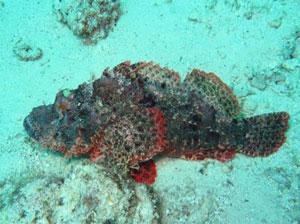 COLOMBO (Daily Mirror) – There is a slight increase in the roaming of the highly poisonous fish species called ‘Gonmaha-Stone Fish’ in the sea areas these days with the changing of the monsoon, Parasitology Department Senior Lecturer Dr. Janaka Ruben said.