Chinese research vessel Shi Yan 6 would arrive in Sri Lanka in late November, Foreign Minister Mohamed Ali Sabry said on Monday (09). The Foreign Ministry had granted approval for the arrival of the ship, he added.
The ship is expected to arrive in Sri Lanka on 25 November. Initially, they wanted to come in October. We asked them to come in November. They again asked if they could come in late October. We have maintained our position that they must come in late November. This is the situation, now.”
The Minister said that the Sri Lankan government had a lot on its hands now and that it needed to marshal all its resources to deal with the sensitive issues pertaining to the Chinese ship visit.
We held an international conference of environmental ministers last week. We will have an IORA meeting this week, and we have to accommodate representatives of 34 countries. President Ranil Wickremesinghe will go to China next week. Then a French delegation will be here. We have requested the Chinese to come thereafter,” the Foreign Minister said, adding that there was a lot of pressure from India and several other parties.
We can’t deny there is pressure from multiple sides. This is a complex matter, given geopolitics. There will be controversies within and outside Sri Lanka. We need to be ready to deal with these pressures. We need to have all the resources at our disposal.”
Minister Sabry said there is a struggle among major powers. Sri Lanka sits at a strategic location in the Indian Ocean.
We need to balance everything. This is not easy. We need to maintain good relations with everyone involved.”
China has been a friend of Sri Lanka, and relations with the middle kingdom are extremely important to Sri Lanka, Minister Sabry said.
We have not changed our stance. We have given them a date.”
India views the arrival of Chinese ships from a different angle, he said.
Prime Minister Sirimavo Bandaranaike before the the UN General Assembly, in 1964, said that the Indian Ocean and the skies above it would be declared a Zone of Peace. This is what we want. We won’t do anything that violates the peace in the Indian Ocean. We have tough choices, and we have to make the best decisions for the country.”
Minister Sabry said that as a sovereign nation, Sri Lanka could decide whether to allow a vessel to enter one of its ports, and discussions with the Chinese were based on that.
The Minister, however, refused to divulge whether Indian officials had directly reached out to him and expressed disapproval for allowing the Chinese research vessel to arrive.
We can’t reveal everything. China is a close friend. We have repeatedly said we will not discriminate against China for any reason. India is also important to us. They helped us greatly last year. The West is also important to us because 80 percent of our exports go there. I don’t make decisions on my own. We all talk and decide what the best course of action is.”
Minister Sabry also said that the Foreign Ministry has not in any way influenced academics from Ruhuna University to be involved with Shi Yan 6. Initially, it was reported that academics from Ruhuna University would board the ship. However, last week, Prof. Disna Ratnasekera of the China Sri Lanka Joint Centre for Education and Research (CSL-CER) of the University of Ruhuna told the media that they were not involved with the research carried out by the vessel.
We have not told the university anything. The decision was probably taken by the university,” he said
However, the National Aquatic Resources Research and Development Agency (NARA) Chairman Prof. Jayantha Wijeyaratne said NARA was involved in the research carried out by the ship and that geophysical and seismic survey vessel Shi Yan 6 would be in the possession of NARA and that those data will be considered property of the Sri Lankan government. Prof. Wijeyaratne said NARA would mainly focus on research related to the quality of water, not the seabed.
Minister Sabry added that Victoria Nuland, Acting United States Deputy Secretary of State, had not informed him that the US was disappointed that Sri Lanka had granted permission for the Chinese research vessel to come.
China, India, and the US have a big power rivalry going. There are a lot of suspicions. They worry that other countries are collecting information about them. We don’t want to get involved with any of this.”
The Catholic Church in Sri Lanka, in a fresh letter addressed to President Ranil Wickremesinghe has called for a local probe to clear certain shortcomings that are visible in the previous probes into the Easter Sunday bomb attacks.
The letter signed by several Bishops including Cardinal Malcolm Ranjith who are members of the National Catholic Committee for Justice to Easter Sunday Attack Victims appointed by the Catholic Bishops’ Conference has said previous investigations have neglected important issues. Investigations have not been carried out into the person whose IP address had been handed over to the CID by American FBI intelligence member, halting the questioning of IP Bandara who had been identified as Sonic Sonic, failure to identify Abu Hind, failure to carry out investigations to determine the connection which bomber Jamil had with intelligence units and the incident at the Galanigama exit where an explosives laded lorry had been allowed to pass have not been properly probed, the letter said.
“It is clear that the Directorate of Militarily Intelligence and the State Intelligence Service had close relationships with Zahran. There have been attempts to obstruct and sabotage these investigations,” the letter added.
The Committee also requested for a probe into what was alleged in the recent Channel 4 video. They said the probe should be monitored by independent foreign observers.
The letter has been signed by Cardinal Malcolm Ranjith, President of Sri Lanka Catholic Bishop’s Conference Bishop Harold Anthony Perera, Bishop of Chillaw Valance Mendis, Bishop of Galle Raymond Wickremesinghe, and Auxiliary Bishops J.D. Anthony Jayakody, Anton Ranjith and Maxwell Silva and several priests.
Meanwhile, Fr. Cyril Gamini Fernando told journalists that the President is yet to respond to the earlier letter by the Sri Lanka Catholic Bishops’ Conference. (Yohan Perera)
ONGC Videsh Limited (OVL) is keen to participate in oil and gas exploration opportunities in Sri Lanka and is waiting for the island nation to unveil its roadmap and policy on developing the upstream petroleum industry, the company said Wednesday.
OVL is the overseas investment arm of India’s state-owned Oil and Natural Gas Corporation. According to OVL managing director Rajarshi Gupta, a presence in oil and gas assets in Sri Lanka would gain from the synergies of the larger ONGC group, as the parent company has significant upstream assets and infrastructure in southern India.
Geologically, the island nation and its offshore areas are quite similar to parts of southern India, and the ONGC is experienced in operating in such zones. Sri Lanka’s geographical proximity to India is also seen as a major attraction for OVL.
Gupta added that OVL would be open to government-government negotiations, competitive bidding or any other route that the Sri Lankan government decides on to enable participation in the island country’s upstream petroleum sector.
Asked by when he expects Sri Lanka to open up oil and gas exploration to foreign participation, Gupta said that it would be contingent on the Sri Lankan government finalising its policy for the sector. (Indian Express)
Cites reduced contribution from low-cost hydro power generation which has led to higher-cost emergency power purchases as the main reason
upgrades CEB’s National Long-Term Rating and senior unsecured debenture rating to ‘BB+(lka)’
Upgrade follows the Sri Lankan sovereign’s recent Long-Term Local-Currency Issuer Default Rating upgrade
As of June 2023, CEB had Rs. 288bn in debt, with a negative free cash flow outlook in the medium term
CEB owes Rs.212bn as of August 2023, with govt. planning to take over significant portion of dues
Bill to unbundle CEB to be presented to parliament in October 2023
Fitch Ratings said yesterday the cash flow operations of the Ceylon Electricity Board (CEB) would not be sufficient to cover its interest obligations this year, despite a 150 percent tariff increase.
This is due to the reduced contribution from low-cost hydro power generation during the year, which compelled CEB to purchase emergency power at higher costs to meet the shortfall,” the rating agency said in a rating report.
At the same time, energy demand has risen with the gradual recovery of economic activity. CEB has requested an off-cycle tariff hike to cover its increased costs, but it is yet to be approved,” it added.
Fitch Ratings has upgraded CEB’s National Long-Term Rating and the rating on CEB’s senior unsecured debentures to ‘BB+(lka)’, from ‘B(lka)’ with a Stable Outlook.
The upgrade follows the 28 September 2023 upgrade of the Sri Lankan sovereign’s Long-Term Local-Currency Issuer Default Rating (IDR) to ‘CCC-’, from ‘Restricted Default (RD)’.
CEB’s ratings are equalised with that of its parent, the Sri Lankan sovereign, based on our assessment of a ‘Very Strong’ likelihood of state support under our Government-Related Entities (GRE) Rating Criteria,” Fitch Ratings said.
CEB is Sri Lanka’s monopoly electricity transmitter and distributor and accounts for around 75 percent of the country’s power generation. CEB had Rs.288 billion of debt as at end-June 2023, after the government took over almost Rs.200 billion of projects loans in 2022.
Fitch expects CEB to generate negative free cash flow in the mediumterm, despite the cost-reflective tariff mechanism, and to depend on the state for expansion and refinancing.
As of end-August 2023, CEB owed Rs.212 billion (June 2023: Rs.208 billion) to state-owned Ceylon Petroleum Corporation (CPC), IPPs and non-conventional renewable energy (NCRE) generators.
The government plans to take over 70 percent of the dues to CPC and the IPPs by end-2023 to ease the burden on CEB. Dues to NCREs stand at 10-11 months at present, and CEB plans to settle them gradually with operating cash flow.
CEB’s payables may rise in the short-term if the proposed off-cycle tariff hike is not approved,” Fitch noted.
The government plans to unbundle CEB’s generation, transmission and distribution assets across 14 companies established under the Companies Act, as part of Sri Lanka’s energy sector reforms.
Fitch said the bill proposing the restructuring will be presented to parliament in October 2023 for approval. We expect the unbundling to provide CEB with autonomy and flexibility, while improving its efficiency and competitiveness. However, it is too early to ascertain how the restructuring will affect CEB’s credit profile, as the plan’s details are still vague,” it added.
China has assured that it remains ready to work together with all relevant international financial institutions to jointly play a positive role in helping Sri Lanka ease its debt burden and achieve sustainable development.
Speaking during his regular press briefing on Tuesday (10), China’s Foreign Ministry Spokesman Wang Wenbin explained that as Sri Lanka’s friend and neighbor, China closely follows the difficulties and challenges faced by the island nation, adding that, We have been doing what we can to assist in its economic and social development”.
He said China’s relevant financial institutions have been in close touch with Sri Lanka on the debt issue involving China since last year, and that they have engaged in active bilateral consultations and provided a financing support document to Sri Lanka in a timely manner to help it obtain loans from the IMF.
Chinese financial institution has taken part in all the creditors’ meetings as an observer and maintained friendly communication with other creditors to share with them the progress of the debt treatment”, Wenbin said, when asked how China has aided Sri Lanka’s debt restructuring process.
Commenting on the progress made pertaining to bilateral debt treatment, Wenbin reminded that in late September, as the official creditor, the Export-Import Bank of China tentatively agreed with Sri Lanka on the debt treatment.
We are also glad to see that other creditors are having discussion with Sri Lanka as well over solutions to its debt issue”, he further commented.
Accordingly, he assured that they will support Chinese financial institutions in actively consulting with Sri Lanka.
We are ready to work with relevant countries and international financial institutions to jointly play a positive role in helping Sri Lanka navigate the situation, ease its debt burden and achieve sustainable development. We call on multilateral institutions and commercial creditors to take part in Sri Lanka’s debt restructuring based on fair burden-sharing”, he said in this regard.
Discussions between Sri Lanka and all its creditors are ongoing, though the International Monetary Fund has not been informed about any specific agreements, its mission chief for the country said on Wednesday.
We will need to assess the entire package of agreements in its totality to assess consistency with IMF debt targets,” Peter Breuer told Reuters on the sidelines of the World Bank IMF annual meetings in Marrakech.
Sri Lanka, mired in its worst economic crisis in 70 years, is in debt restructuring talks with a range of creditors, including China, its largest single creditor. Colombo suspended debt repayments in May 2022.
China’s Foreign Ministry said on Tuesday that the Export-Import Bank of China reached a preliminary deal on the disposal of China-related debts, but did not share further details.
Sri Lanka owed EXIM $4.1 billion, or 11% of the country’s foreign currency debt, as of the end of 2022.
Sri Lanka is also in talks with IMF over a $2.9 billion bailout. But in September the fund declined to release a second tranche of around $330 million after it failed to reach a staff-level agreement over concerns of a possible government revenue shortfall.
Other bilateral creditors of Sri Lanka including the Paris Club, Japan and India are expected to make an announcement on a deal during the IMF meetings a source with direct knowledge of the talks told Reuters.
Japan, India and France announced in April a common platform for talks among bilateral creditors to coordinate restructuring of Sri Lanka’s debt, a move they hope would serve as a model for solving the debt woes of middle-income economies.
As a middle-income country, Sri Lanka is not part of the G20 debt initiative known as the Common Framework, so talks with official creditors from China are conducted separately.
The rapid spread of an eye infection called ‘Conjunctivitis’ has been reported from several parts of the country, according to health officials.
The Ministry of Health, which informs the general public not to have undue fears of the matter, however, has outlined some necessary safety measures in a bid to minimize the infection.
It was further confirmed however, that the eye infection poses no health threat and is most likely to improve within a span of 3 to 4 days.
Conjunctivitis or the pink eye is a common eye disease which is currently seeing a spike within the country.
Doctors predict that the disease is often spread from one individual to the other by tears and related secretions of an infected person.
Accordingly, redness in one or both eyes, itchiness in the eyes, increased tear production, headaches, sensitivity to light and dry eyes are some common symptoms of the aforementioned eye disease, according to health officials.
As a result, the general public are urged to follow the necessary safety measures in a bid to reduce the risk of infecting the disease.
Speaking in this regard, Chief Medical Officer of the Colombo Municipal Council Dr. Ruwan Wijayamuni emphasized that spread of the disease can be minimized by following necessary safety measures such as washing hands often with soap and water, using hand sanitizers especially when using public transport and avoiding intimate contact with people. The doctor also advised the people to avoid touching the eyes in order to avoid risk of infection.
Moreover, Dr. Wijayamuni asserted that there is no serious health threat following the infection and that the condition will improve within a span of 3 to 4 days.
Meanwhile, Dr. Hiranya Abeysekara, the Paediatric Eye Surgeon at Lady Ridgeway Hospital for Children, mentioned that this eye disease is linked to the respiratory system of children, adding that symptoms will gradually reduce within a week.
However, in certain cases the disease is likely to affect the pupil of the eye, which can affect the vision of children. If so, we advise that you urgently meet an eye surgeon and receive necessary treatment if the condition lasts for more than 05 days”, the doctor noted.
In the meantime, warnings have been made that the risk of spreading the infection is greatly amplified due to the prevailing rainfall and wet weather.
Furthermore, several classes in Kotahena Central College have already been cancelled due to the spread of the disease among children.
However, Principal of the Kotahena Central College stated that based on the advices from officials of the regional educational services, it was decided to cancel the classes of grades 6,7 and 8 for four days since around 40 children in the school had reportedly been infected with the disease as of last Thursday.
Further, another 30 students were reported as of last Friday and 35 on Monday”, he added.
As such, the Ministry of Health has requested the general public to avoid sending their children to schools if the aforementioned symptoms are observed.
The Supreme Court issued an order today, mandating that all state universities in the country must provide a comprehensive report by November 10, 2023.
This report is expected to include details on any reported incidents of ragging that have occurred at these universities over the past three years.
Furthermore, the universities are required to outline the measures and actions they have taken to prevent and address ragging within their respective institutions.
This directive comes as part of ongoing efforts to eradicate the harmful practice of ragging from the country’s higher education institutions.
To fill a world with religion, or religions of the Abrahamic kind, is like littering the streets with loaded guns. Do not be surprised if they are used.
Richard Dawkins, ‘Science in the Soul’, Penguin, Random House, UK, 2017.
This is an expanded and updated version of an article that I wrote in 2020 under the above title, which nevertheless has remained unpublished to date for some reason, which has slipped my memory. My decision to publish it now was prompted, not by this grim reminder of Richard Dawkins’ bleak prophecy, the harrowing TV footages of the horrific atrocities committed in Israel on innocent unarmed civilians including children, men and women, old and young: cold blooded murder, rape and torture by Hamas members shouting God is Great and images of the eerie smokefilled skies over the Gaza Strip where ferocious retaliatory Israeli strikes are flattening human dwellings to the ground with countless innocents of all ages trapped and pulped within, but by the news of Indika Thotawatta’s arrest by the CID on the basis of complaints filed against him by a number of certain religious groups. However, this is absolutely without prejudice to ongoing legal proceedings concerning Thotawatta. It’s only that the well known phenomenon of global religious fundamentalism that he raises in a number of his YouTube video discussions reminded me of this forgotten article of mine that I think still has topical relevance.
The Sri Lanka based ‘News Centre’ YouTube channel reported that Astrologer Indika Thotawatte was arrested by the Computer Crimes Investigation Division of Sri Lanka Police on October 6, 2023 and was remanded till October 10 (another source said till 20), allegedly for making statements on a YouTube Channel that were deemed harmful to social and religious harmony in the country. He had arrived at the Criminal Investigation Department in com[pliance with summons delivered on him previously. The arrest was in response to complaints made against Thotawatta by some twelve (presumably, Muslim) groups. Just before he went in, he spoke to the media and explained why he had to report to the CID that day: They wanted to question him about a video that he had made about the Islamic religion. Then he touched on what he believes to be forms of harmful extremism associated with all the island’s major religions with equal passion: doctrinal and ethical shortcomings of Theravada Buddhism, Christianity/Catholicism, Hinduism, and Islam. He said: Remember that Article 14.1 of our country’s Constitution gives the follower of one religion the ‘sacred right’ to speak about or criticise another religion. This, Thotawatta asserted, was confirmed by Judge Aditya Patabendi when he released Natasha (Edirisuriya, accused of insulting Buddhist beliefs through her stand-up comedy gig) on bail. He also recalled how he supported Ali Sabry’s appointment (by president Gotabaya Rajapaksa) as Justice Minister when certain Buddhist monks opposed it. His fight, Thotawatta insisted, was for pursuing truth and the protection of the democratic right of free speech.
For Sri Lanka, it seems, it never rains, but it pours! Indika Thotawatta’s arrest and detention has made some stir particularly in the social media. For a considerable time now I have felt that Thotawatta was overdoing his outspokenness in his frank but relentless criticism of what he considers to be purblind religiosity and mindless extremism that, in his opinion, has lately begun afflicting all the major faiths in Sri Lanka, and that is impeding the forward march of the country in both political and economic terms; most of all, it will retard the intellectual growth of the young generation. I think that the assertion of the rule of law by the authorities in this instance is very welcome in these critical times. But it should not be forgotten that the Thotawatta case could be used as a convenient red herring by hardpressed politicians to divert public attention from more pressing problems. It is up to the law enforcement agencies to decide whether there is a serious issue to be resolved here or not. In the present context, we may be hopeful that the responsible civil authorities, religious leaders and people’s representatives in parliament will do the needful to nip it in the bud if the episode harbingers a potentially dangerous trend affecting the prevailing religious harmony in the country.
Thotawatta believes that he is fulfilling an essential obligation he owes to society by attacking the local manifestations of the global menace of religious fundamentalism (sometimes murderous) that is based on ideological fallacies. Good intentions alone are not enough. Ends and means must form a blameless continuity. Thotawatta’s simplistic approach threatens to be a disservice to the global anti fundamentalist cause as well as to his own personal one man crusade.
Diminutive Indika Thotawatta, described in many social and several mainstream electronic media, as a professional astrologer, has in addition made a name for himself as a self-taught free thinker, especially active in the field of religious ideologies. Indika has been in the limelight from around 2015, as far as I can remember. He should be around 35 years of age, if not younger, but looks may be deceptive. Though almost totally blind from birth, he displays remarkable intellectual powers, including a good retentive memory and an incisive analytical faculty. Over the years, he has become increasingly provocative as a passionate critic of dangerous religious fundamentalism, which, he believes, is fast undermining the hitherto prevalent peaceful religious coexistence and social harmony in multicultural Sri Lanka. He also attacks not only what he thinks are ‘weak points’ in each of the four main religious doctrines followed in the island and, sometimes, even questions the morality of religious masters, which obviously doesn’t go down well with devout followers of those religions.
What you are going to read from this point onwards is the updated version of my original essay composed in 2020.
Whatever religious faith we belong to, or whether or not we profess any such faith, we are all being threatened by a virulent kind of global religious fundamentalism that is undermining the very foundation of human civilization. The fount of this mindless religious extremism is America itself, the only superpower in the world today. Neuroscientist Dr Sam Harris’s slim volume, New York Times bestseller, Letter to a Christian Nation” (Bantam Press/Transworld Publishers, London, 2007) dealt with what he described as a moral and intellectual emergency” facing his nation (America) in the form of a potentially self-destructive and violent religious fanaticism resulting from blind faith in religious dogma. He was careful to tell us that though the book was addressed to Christians in the United States, it was intended for people of all faiths around the world. It presented a well argued case against all forms of doctrinaire religion. Evolutionary biologist Richard Dawkins, well-known for his active involvement in an educational moral crusade against irrational religious faith, wrote a persuasive foreword to the book, which he ended by urging readers to read it: ‘Whether it stirs you to defensive or offensive action, it will not leave you unchanged. Read it if it is the last thing you do…’. Though published sixteen years ago, it still remains relevant to the world (and is still available as a classic).
Harris identifies the respect we accord religious faith” as an impediment to any intellectually honest, rational discourse on morals, spirituality, and the problem of human suffering:
One of the greatest challenges facing civilization in the twenty-first century is for human beings to learn to speak about their deepest personal concerns – about ethics, spiritual experience, and the inevitability of human suffering – in ways that are not flagrantly irrational. We desperately need a public discourse that encourages critical thinking and intellectual honesty. Nothing stands in the way of this project more than the respect we accord religious faith.” (p.87)
We like to believe that all religions propagate the same message to humanity without contradiction: love your neighbour, avoid violence, don’t kill, don’t steal, practise sensual restraint, in short, live a moral life. But the truth is that strict adherence to the articles of faith found in one religion often alienates a person from fellow human beings who happen to profess a different religion. This estrangement can take a violent turn unless checked by what is known as religious tolerance. The problem is that tolerance could be incompatible with being faithful to one’s own religion if it insists on being fundamentalist” (in the sense in which the word was originally used in America around the beginning of the twentieth century). This once innocuous coinage shed its original harmless associations of scriptural authenticity, purity, etc at least some forty or fifty years ago (about the time of the Iranian Revolution of 1979 led by Ruhollah Khomeini, that overthrew the America-friendly Iranian monarchy) and has now acquired very negative connotations. Today ‘fundamentalism’ is a heavily loaded word in both religious and secular contexts. Any movement that is prone to violent ideologies and practices tends to be dubbed ‘fundamentalist’.
Yet religions are not usually accused of deliberately preaching violence even by the faithful of rival (i.e. other) religions. A discrete silence is always maintained on this point (as it has to be, because the same allegation can be levelled against any religion, in addition to the fact that respect for religious beliefs demands such silence). Sectarianism in the interpretation of the dogmas often divides people of the same faith against one another, and this leads to internecine conflicts. Examples would be redundant as this is an obvious fact often encountered in the Christian and Muslim worlds. Unprecedentedly, even the Sri Lankan Buddhist establishment is getting riven by non-traditional sectarian divisions based on new doctrinal interpretations of the accepted sacred texts, that are propagated by self-proclaimed Arhants, Buddha was born in Sri Lanka theorists, all religions preach the same message propagandists in yellow robes posing as Buddhist monks, and so on. One of the last mentioned category, one Somaloka Thera, was heard telling a congregation of Buddhists that Islam is the best religion in the world (showing his ignorance of the basic fact that Buddhism is not a deistic, but a Dharmic, religion) for which he drew a sharp response from Thotawatta.
Non-religionists like Sam Harris and Richard Dawkins, who genuinely care for the future of humanity, for the survival of human civilization, and for general human wellbeing, have begun to speak out before it is too late. Though they are still in a minority, they are a compelling presence in the media including cyberspace, and they are making an impact on the collective conscience of humanity. Their passionate call for the exercise of rational thought in matters of the deepest personal concern for us must be heeded before we blindly allow ourselves to be devoured by the monster of irrationality in the guise of the sacred in religious ideology and practice.
Sam Harris, an American born and bred in a Christian culture, argues that the central dogmas of its religion are nothing but meaningless fiction, finding evidence for his conclusions in core religious texts. As Richard Dawkins says in his foreword to the book, Sam Harris doesn’t mess about.” He is direct and blunt. He acknowledges his Christian reader as a serious believer, and puts himself on level ground with the latter at the beginning, and challenges them to prove him wrong if that is the case, but through rational debate. Obviously, this is not a face-to-face argument with the author. Christian (and other) believers are invited to take him on and try to survive his onslaught. Considering the gravity of the situation we are facing under the global hegemony of America whose government is being dominated by a narrow, virulent type of Christian orthodoxy as Harris explains, reading the book and taking follow-up action if necessary will not be a waste of time, to put it in the form of an understatement. It must be emphasised that this is not an attack on or a rejection of the truly valuable ethical content of the central Christian text, if the ethics is based on rational grounds.
We have an exemplar of Christian morality in Mother Teresa. Following is what Harris says about her:
Mother Theresa is a perfect example of the way in which a good person, moved to help others, can have her moral institutions deranged by religious faith. British American columnist and author the late Christopher Hitchens put it with characteristic bluntness:
[Mother Teresa] was not a friend of the poor. She was a friend of poverty. She said that suffering was a gift from God. She spent her life opposing the only known cure for poverty, which is the empowerment of women and the emancipation of them from a livestock version of compulsory reproduction.”
Harris agrees with the substance of what Hitchens is saying here. But he doesn’t deny that
Mother Teresa was a great force for compassion. Clearly, she was moved by the suffering of her fellow human beings, and she did much to awaken others to the reality of that suffering. The problem, however, was that her compassion was channelled within the rather steep walls of her religious dogmatism…”
Presumably, I need not remind the reader, Hitchens above is alluding to Mother Teresa’s absolute opposition to abortion, regarding which Harris writes:
……. Mother Teresa’s compassion was very badly calibrated if the killing of first-trimester foetuses disturbed her more than all the other suffering she witnessed on this earth. While abortion is an ugly reality, and we should all hope for breakthroughs in contraception that reduce the need for it, one can reasonably wonder whether most aborted fetuses suffer their destruction on any level. One cannot reasonably wonder this about the millions of men, women, and children who must endure the torments of war, famine, political torture, or mental illness. At this very moment, millions of sentient people are suffering unimaginable physical and mental afflictions, in circumstances where the compassion of God is nowhere to be seen, and the compassion of human beings is often hobbled by preposterous ideas about sin and salvation. If you are worried about human suffering, abortion should rank very low on your list of concerns.”
(pp. 35-36)
Incidentally, this quote about Mother Teresa is from an article by the aforementioned Christopher Hitchens in the magazine Vanity Fair in 2003. It is available on the internet. There are also many videos on YouTube that reveal the truth about ‘holy’ characters such as Mother Teresa and Sai Baba. No wonder it is said that religions come to the Internet to die. Of course, there are systems of spiritual belief such as Jainism and Buddhism that are not religions in the sense I am using the term here and are not prone to murderously violent fundamentalism, although they are also traditionally put under the category of religion.
Harris says that religion in fact is a biological phenomenon. It is a product of cognitive processes with deep roots in our evolutionary past. Religion probably served a useful purpose at a certain stage of our evolution by serving to create social cohesion among large groups of prehistoric humans. But it has outlived its usefulness in that sense. The normal belief among the religious is that there cannot be any morality without the existence of a law-giving God. And the believers of each particular religion are sure that no morality can exist outside their own faith. But this is a misconception as Dr Harris argues. (Here, I think, Harris is implicitly drawing on evolutionary biologist Richard Dawkins’ concept of the ‘meme’ (a neologism that the latter coined). Dawkins elaborated what he meant by meme in his classic The Selfish Gene (1976). A meme refers to a notion, belief, tune, behaviour, or practice, etc that gets culturally transmitted down generations in the brains of individuals in a particular society (Ref. Chapter 11/ Memes: The New Replicators/pp 189-201/The Selfish Gene/30th anniversary edition/Oxford University Press/New Delhi/2006). The God idea is such a meme. This knowledge was not available to our classic euro-centric anthropologists, colonial clones of native origin, who could not do better than mislead and alienate, through their poorly educated blind followers, the present generation of the Sinhalese Buddhist community about the immanent Buddhist values that define their unique cultural identity, heritage, and predict the trajectory of their future as a nation with a civilised past. This may be seen as a digression, but I think it is relevant in the current context. (Incidentally, Sam Harris does not explicitly refer to Richard Dawkins’ The Selfish Gene” as a source, but he mentions the latter’s The God Delusion”.)
There is no agreement about ethics among different religious communities, which does not make for harmonious existence. But the truth is that there are objective sources of moral order that do not require any divine law-giver. As morality is about problems of human happiness and suffering, there need only be better and worse ways to secure the first and eliminate the second. There are psychological laws that govern human wellbeing, and a knowledge of these, according to Harris, would provide an enduring basis for an objective morality. Though we have not arrived at anything like a final scientific understanding of human morality we are sure that killing and rape cannot be part of it; we also know that love, rather than hate, is one of the greatest sources of our own happiness, and that it involves a deep concern for the happiness and suffering of those we love. Our own quest for happiness, therefore, provides a rationale for altruism and self-denial. The important thing is that we need not believe anything on insufficient evidence to lead a moral life.
What socially concerned people like Sam Harris look forward to is a religion-less society with good morals. They acknowledge that their wish for a complete elimination of religion (religious belief based on assumptions about reality unsupported by evidence) is not likely to be fulfilled in the foreseeable future. But Sam Harris draws an analogy between religion and slavery in America in this regard. Slavery was so entrenched in that society that it was a waste of time, a dangerous waste of time, to talk with confidence about eradicating it in the year 1775; but it was completely abolished some eighty years later. Religion is probably moving towards such a fate already, despite wishful claims to the contrary that we hear. We today are more confident of this trend than Dr Harris was in 2007.
As we have seen, Sam Harris includes all religions in his criticism. He warns against the spread of a very militant form of Islam in Europe, which he finds as obnoxious as Christian fundamentalism. Addressing his compatriot Christians (and by implication, people of all faiths everywhere) he says in conclusion:
Non-believers like myself stand beside you, dumbstruck by the Muslim hordes who chant death to whole nations of the living. But we are dumb struck by you as well – by your denial of tangible reality, by the suffering you create in service to your religious myths, and by your attachment to an imaginary God. This letter has been an expression of that amazement – and perhaps a little hope.”
The establishment of a nonreligious ethical system, essentially through secular moral education, which will replace harmful, divisive, and primitive beliefs in meeting a person’s social and emotional needs will be the answer. With proper guidance and education provided by the enlightened in every community, with their differing cultures, it is possible to usher in such a society. That the ethical teachings of major religions (in a neutral sense) have much in common is a source of hope and consolation for all humanity. That is the only hope against religious fundamentalism that exists today. However, education will not be able to banish religion overnight. It is likely to take several generations of intellectually emancipated parents for humanity to put an end to irrational religious faith. The reason for this is that religious belief transmission down generations of human beings takes place usually through childhood indoctrination, which could cause even the greatest scientist alive to give up their science in favour of a false religion.
1. In fidelity to the mandate received from Christ, the Catholic Church strives to promote universal fraternity and respect for the dignity of every human being.
2. For this reason, in the course of history the Popes have condemned acts of violence, oppression, social injustice, and slavery, including those committed against indigenous peoples. There have also been numerous examples of bishops, priests, women, and men religious and lay faithful who gave their lives in defense of the dignity of those peoples.
3. At the same time, respect for the facts of history demands an acknowledgment of the human weakness and failings of Christ’s disciples in every generation. Many Christianshave committed evil acts against indigenous peoples for which recent Popes have asked forgiveness on numerous occasions.
4. In our own day, a renewed dialogue with indigenous peoples, especially with those who profess the Catholic Faith, has helped the Church to understand better their values and cultures. With their help, the Church has acquired a greater awareness of their sufferings, past and present, due to the expropriation of their lands, which they consider a sacred gift from God and their ancestors, as well as the policies of forced assimilation, promoted by the governmental authorities of the time, intended to eliminate their indigenous cultures. As Pope Francis has emphasized, their sufferings constitute a powerful summons to abandon the colonizing mentality and to walk with them side by side, in mutual respect and dialogue, recognizing the rights and cultural values of all individuals and peoples. In this regard, the Church is committed to accompany indigenous peoples and to foster efforts aimed at promoting reconciliation and healing.
5. It is in this context of listening to indigenous peoples that the Church has heard the importance of addressing the concept referred to as the doctrine of discovery.” The legal concept of discovery” was debated by colonial powers from the sixteenth century onward and found particular expression in the nineteenth-century jurisprudence of courts in several countries, according to which the discovery of lands by settlers granted an exclusive right to extinguish, either by purchase or conquest, the title to or possession of those lands by indigenous peoples. Certain scholars have argued that the basis of the aforementioned doctrine” is to be found in several papal documents, such as the Bulls Dum Diversas (1452), Romanus Pontifex (1455), and Inter Caetera (1493).
6. The doctrine of discovery” is not part of the teaching of the Catholic Church. Historical research clearly demonstrates that the papal documents in question, written in a specific historical period and linked to political questions, have never been considered expressions of the Catholic faith. At the same time, the Church acknowledges that these papal bulls did not adequately reflectthe equal dignity and rights of indigenous peoples. The Church is also aware that the contents of these documents were manipulated for political purposes by competing colonial powers in order to justify immoral acts against indigenous peoples that were carried out, at times, without opposition from ecclesiastical authorities. It is only just to recognize these errors, acknowledge the terrible effects of the assimilation policies and the pain experienced by indigenous peoples, and ask for pardon. Furthermore, Pope Francis has urged: Never again can the Christian community allow itself to be infected by the idea that one culture is superior to others, or that it is legitimate to employ ways of coercing others.”
7. In no uncertain terms, the Church’s magisterium upholds the respect due to every human being. The Catholic Church therefore repudiates those concepts that fail to recognize the inherent human rights of indigenous peoples, including what has become known as the legal and political doctrine of discovery”.
8. Numerous and repeated statements by the Church and the Popes uphold the rights of indigenous peoples. For example, in the 1537 Bull Sublimis Deus, Pope Paul III wrote,We define and declare [ … ] that [, .. ] the said Indians and all other people who may later be discovered by Christians, are by no means to be deprived of their liberty or the possession of their property, even though they be outside the Christian faith; and that they may and should, freely and legitimately, enjoy their liberty and possession of their property; nor should they be in any way enslaved; should the contrary happen, it shall be null and have no effect”.
9. More recently, the Church’s solidarity with indigenous peoples has given rise to the Holy See’s strong support for the principles contained in the United Nations Declaration on the Rights of Indigenous Peoples. The implementation of those principles would improve the living conditions and help protect the rights of indigenous peoples as well as facilitate their development in a way that respects their identity, language, and culture.
The Sri Lanka Red Cross Society (SLRCS) handed over a consignment of fifteen thousand (15,000) bottles of drinking water to State Minister of Defence Hon. Premitha Bandara Tennakoon today (Oct 10) at the Ministry of Disaster Management intended to be distributed among flood affected communities in the Galle and Matara districts.
The SLRCS had made the donation as flood affected communities in these areas were facing drinking water shortage due to floods contaminating wells and water drawing sources of the Water Supply Board.
SLRCS Senior Vice President Jagath Abeyasinghe said that the donation was made as an immediate relief measure to provide safe drinking water to the flood affected people.
The day to day lives of these communities have been severely affected as the floods have caused widespread damages to houses and property including agricultural land and caused disruption to educational and business activities in these areas.
State Minister Tennakoon had also requested the SLRCS to appeal to the International Committee of the Red Cross (ICRC) for support to assist the flood affected communities.
The SLRCS Executive Committee Member Dr. Amila Kankanamge, Additional Secretary Ministry of Disaster Management (Disaster Management Division) K.G. Darmathilake and a group of SLRCS officials were also present at the event.
Colombo, October 10: Sri Lanka’s Eastern Province is again becoming a contested region between ethnic groups. This time round it is more between the Tamils and Sinhalese, with the Muslims in the periphery. This is because of the change in the balance of power between the three communities after the end of the war in May 2009.
When the war was raging, the LTTE had dominance and the contestation was between the Tamils and the Muslims over land. After the defeat of the LTTE, the balance of power shifted in favour of the Sinhalese and the Sinhalese-dominated State apparatus. The contestation is again over land, more typically, the historical title to land.
ADVERTISEMENT
The Tamils consider the Eastern Province as their Homeland” with a hoary past marked by continuous settlement. They demand devolution of power in matters of land and law and order. The Sinhalese challenge these claims, also on historical grounds and desire to expand territorially to reclaim their lost” rights.
In the early years of independence, the Sinhalese had claimed land in the Eastern province through government-sponsored settlement schemes. But now, lands are being appropriated by the various government departments for development, archaeology and forest preservation. The Buddhist monks have jumped into the fray by claiming lands for temples on the ground that these lands once housed Buddhist temples.
The Archaeology department, strengthened by a Presidential Task Force and under the direction of the Buddha Sasana Ministry, is conducting excavations to discover ancient Buddhist temples. Buddhist monks are building temples to lay claim to lands.
The State, the Buddhist clergy and the Sinhalese majority see this as a legitimate endeavour also on the grounds that no community can mark off any area of the island as an exclusive communal preserve. They point out that there is no bar on Tamils’ buying land in Sinhalese-majority areas in the island. On the Tamils’ objection to the building of Buddhist temples in Tamil-majority areas, the Sinhalese point out that Hindu temples abound in Sinhalese-majority areas.
The Tamils on the other hand, see a sinister design in acquiring lands in the Tamil-majority areas. It is a move to change the ethnic distribution with the ultimate aim of making the Tamils a minority in the Eastern province, thereby knocking the bottom out of the Tamil case that the Eastern Province is their Homeland”.
Tamils never tire of pointing out how, over the years, their proportion in the Eastern districts have been waning and the Sinhalese proportions are waxing
Tamils also fear a comprehensive loss of power on the island as a whole. They ask for provincial autonomy because they cannot share power at the Centre meaningfully given their permanent minority status. It is pointed out that they will always be a small minority in parliament given Sri Lanka’s population distribution.
On the issue of the building of Buddhist temples in the Tamil-majority areas, the Tamils’ case is that the building activity is not motivated by piety but by an agenda to claim and seize the land around the new shrines with the help of government departments and the police.
The Tamils argue that there is no rationale for building Buddhist temples where there are hardly any Buddhists and point out that, in contrast, no Hindu temple is built where there are no Hindus.
Recently, The Hindu newspaper reported an issue in which Sinhalese Buddhists had built a stupa near the Aadi Aiyanar temple in Kurunthurmalai in Mullaitivu district with the help of the Department of Archaeology; and the Sri Lanka Army and Civil Security Force for the excavation and conservation.”
It is pointed out that the Sri Lankan archaeology is not communally neutral as the Department of Archaeology functions under the Ministry of Buddha Sasana. The Presidential Task Force on preserving archaeological evidence in the Eastern Province set up by President Gotabaya Rajapaksa had no non-Buddhists and was put under the Defence Ministry to boot.
The report in The Hindu said that in the three years since the Task Force panel was set up, at least 23 new Buddhist shrines had come up in Kuchchaveli in Trincomalee district, in villages where Sinhalese constituted roughly 1% of the population, as per official sources.
President Ranil Wickremesinghe forbade Buddhist monks from ordering or carrying out archaeological excavations and to leave that to the Archaeology Department. But as pointed out earlier, the Archaeology Department is under the Ministry of the Buddha Sasana.
According to Fr. Rajan Rohaan of the Church Commission for Peace and Justice, there have been increasing instances where Buddhist monks have entered either state land or lands given to religious institutions and intimidated the occupants, expelling them from their properties and erecting new boundaries.
According to Fr.Rohaan, historically, land in the Eastern Province has been allocated on ethnicity basis. Lands are identified as either Tamil, Muslim or Sinhalese and allotted accordingly.
Historicity
Historical evidence is used both by the Sinhalese and the Tamils to make contradictory claims to spaces. It is not known when the Tamils first settled in Sri Lanka, but reputed historians agree that South Indian invasions from the First century BC to the 13th century AD resulted in Tamil migration. By the 11th and 12th centuries, the upper half of the eastern province had a large Tamil community even as per the Kokila Sandesa as the Mukkara Hatana.
The Tamils consider the Saivite temples in the Eastern Province to be very ancient. For example, the Koneswaran temple in Trincomalee is dated variously between 1580 BC and 205 BC.
On the other hand, the Sinhalese claim that Trincomalee is actually the ancient Sinhalese port of Gokarna. According to one source, the the conversion of Gokarna to Tirukonamalai (Tricomalee) first appears in a Tamil inscription ascribed to the 10th or the 11th century A.D. The Buddhist Vihara at Gokarna called Sri Gokarna Vihara was built in the reign of King Mahasen (276-303 A.D).
However, many renowned scholars say that it will be inaccurate to claim that only Sinhalese could be Buddhists and that all Buddhist archaeological remains necessarily indicate a Sinhalese connection. Dr.Nirmala Chandrahasan recalls that during Pallava rule in South India (400-650 A.D) Buddhism flourished there. The Chinese monk scholar Huan Tsang, who visited Kancheepuram in the 7th century AD, states that most of its population was Buddhist, with about 100 monasteries and thousands of monks, including monks from Sri Lanka.
Kanchipuram was also the native city of Dharmapala, the Rector of the famed Nalanda Buddhist University. During the Chola period from the mid 9th century to the early 13th century in Tamil Nadu Buddhism prevalent there. The Mahavamsa mentions that in the 13th Century, King Parakramabahu of Dambedeniya got down monks and scriptures from the Chola (Tamil) country to revive Buddhism in Sri Lanka. Chief among these monks was Dhammakitti who wrote the continuation of the Mahavamsa from the time of King Srimevan up to his time.
Among the learned Tamil Buddhist monks who came to Sri Lanka were Ven. Bhuddhadatta, Ven. Buddhagosha and Ven. Dharmapala. They lived and wrote their works such as the Visudhimagga at the Mahavihara in Anuradhapura.
However, this syncretic past has been forgotten or has been deliberately ignored by the Sinhalese Buddhists as well as the Tamil Hindus. In the present political context, zealots from both the communities want to stress their ethnic and religious separateness rather than the common elements which bind them.
The objective is to make claims either to establish exclusivist ghettos or to establish ethnic cum religious hegemony.
Among the Sinhalese, the fear of Tamil consolidation in one area evokes fears of secession because the only place in the world that the Sinhalese are native to is the island of Sri Lanka. But for the Tamils, loss of their traditional lands and the dilution of their proportion there amount to denying them a place they can legitimately call their Homeland.
This conflict appears to be insolvable in the absence of an over-arching political and moral leadership that can bridge the two.
Japanese Parliamentary Vice-Minister of Foreign Affairs, Komura Masahiro stated that his country would continue to support Sri Lanka’s economic recovery process and congratulated the government for stabilizing the economy during a short span of time and making further progress.
He has also expressed confidence that structural reforms undertaken by the government would improve the conducive atmosphere for foreign investments.
During his discussion with Prime Minister Dinesh Gunawardena at the Temple Trees this morning (Oct 10), the Japanese Vice-Minister said that his visit to Sri Lanka to attend the Indian Ocean Rim Association (IORA) has given him an opportunity to interact with Sri Lankan leadership regarding bilateral cooperation. He assured fullest support to Sri Lanka at IORA, during its 2-year tenure as Chairman.
The Prime Minister, referring to the fact that Sri Lanka is situated at strategic juncture along the sea lanes of the Indian Ocean and an important partner in realizing a free and open Indo-Pacific policy, emphasized the importance of close cooperation between the two countries with common principles.
Expressing deep concern over escalation of conflict in Gaza Stripe, he said that the Covid-19 pandemic had resulted in global economic downturn and the world, especially the developing countries could not face another such disaster over a military conflict.
Furthermore, he urged the two sides involved in the conflict to cease violence immediately, the PM’s Office said in a statement.
The Prime Minister thanked the Japanese Vice-Minister for the support extended to Sri Lanka for the debt restructuring process and assured that Sri Lanka is committed to a transparent and comparable debt restructuring process.
Masahiro commended Sri Lanka’s efforts in implementing the policy making process in accordance with the agreement with the IMF, and expressed his hope that Sri Lanka will bring itself back on track for development as soon as possible.
The delegation included Japanese Ambassador, Mizukoshi Hideaki, Secretary to the Vice Minister, Nanao Eiichiro, Southwest Asian Affairs Director Tsutsumi Taro Division and Director Tokita Yuji.
Minister Roshan Ranasinghe, State Ministers Sisira Jayakody and Janaka Wakkumbura, MP Yadamini Gunawardena, Secretary to the Prime Minister, Anura Dissanayake and Vice Chancellor of Colombo University Prof. H D Karunaratne were also present at this meeting.
(Bloomberg) – China said one of its financial institutions has reached a preliminary agreement with Sri Lanka on resolving China-related debt, a potentially major step toward resolving the South Asian nation’s fiscal woes.
The deal involving Export-Import Bank of China was reached late last month, Chinese Foreign Ministry spokesman Wang Wenbin said Tuesday at a regular press briefing in Beijing. Wang didn’t give details on how the debt was resolved, and officials in Sri Lanka didn’t immediately respond to request for comment.
Chinese financial institutions have fully participated in creditors’ meetings as observers, maintain friendly communication with other creditors and have shared developments on debt disposal,” Wang said.
The deal puts Sri Lanka closer to completing its debt restructuring, as the nation boosts efforts to win agreements with other creditors such as Japan and India, as well as with holders of its foreign bonds. China accounts for about 52% of the bankrupt nation’s bilateral debt. Reaching a deal quickly will allow Sri Lanka to keep tapping funds from its $3 billion bailout program with the International Monetary Fund.
Sri Lankan dollar bonds due 2030 were steady at 45.8 cents on the dollar. The nation’s dollar bonds had returned more than 50% this year, according to a Bloomberg index.
Bloomberg News reported last month that some members on the committee of Sri Lanka’s official creditors were pushing to reach a deal to restructure the nation’s debt without China’s participation.
The members wanted the group of major creditors to sign a memorandum of understanding with Sri Lanka around the time of the IMF and World Bank meetings which are ongoing in Marrakesh, Morocco.
Separately, Sri Lanka may be able to draw the outlines of a deal with holders of its defaulted dollar bonds as early as this month, Bloomberg reported in September.
Sri Lanka in September agreed to restructure about $10 billion of local debt.
අරගලයේදීයෝජනාකලේදමෙවැණිජනසභාක්රමයකි. මේනිසාමෙමඅදහසක්රියාවටනැංවීමට JVP පෙනීසිටියයුතුය. බලයේසිටිආණ්ඩු, ගොඨාභයගේචන්දප්රකාශණයපමණක්නොවරනිල්ජනාධිපතිවිසින්දමේඅනුවයමින්ජනසභාකාර්යාලයක්පවාපිහිටුවාඇතත්එයජනතාවරවටනඇස්බැන්ඳුමක්පමණය. ඇත්තවශයෙන්මජනතාවබලගැන්වීමක්(empowerment of people at the village level) ඔවුන්ගේප්ලෑනටඅයත්නැත.
ග්ලෝබල්වෝමින් (global warming) ගැනකතාකරන්නටපෙරසිට E. F. Schumacher විසින්බුඩිස්ට්ඉකොනොමික්ස්, ඉස්මෝල්ඊස්බියුටිෆුල් (Small Is Beautiful, 1973) යනුවෙන්යෝජනාකලේදජනසභා/ගම්සභාවිසඳුමය. එයපසුකලෙකහියුමන්ස්කේල් (Human Scale, 1980/2017) යනුවෙන්කර්ක්පැට්රික්සේල්විසින්ඉදිරියටගෙනගොස්ඇත. වෙනකක්තබාමොන්ටෙස්කිවිසින්කියාසිටියේදආණ්ඩුබලය (governmental power) තුනකටබෙදාමධ්යමපාලකපන්තිසංවිධානයකටභාරදීමක්නොව, ආණ්ඩුබලයරටපුරාකුඩාඒකකරාශියකටවිසුරුවාහැරීමය. මෙමඅළුත්සොයාගැනීමමොන්ටෙස්කිඔළුවෙන්හිටගැනීමක්(Montesquieu standing on his head) ලෙසදේශපාලනවිද්යාඥයින්විසින්හඳුන්වාදීතිබේ.
Malaysia will support Sri Lanka’s application to join the Regional Comprehensive Economic Partnership. This was stated by Malaysian Minister of Foreign Affairs, Dato Seri Diraja Dr Zambry Abd Kadir who held discussions with Prime Minister Dinesh Gunawardena at the Temple Trees in Colombo today (October 9).
The Prime Minister stated that Sri Lanka’s entry into RCEP would bolster its economic connectivity within the broader South East Asian region and the Malaysian Minister assured fullest support to Sri Lanka and said, Sri Lanka belongs to our region.” The Prime Minister affirmed the government’s alignment with the future vision of ASEAN for the Indo-Pacific area, pledging full support for the advancement of this economic perspective.
The Prime Minister and the visiting Minister discussed bilateral relations with special emphasis on cooperation in regional groupings such as Indian Ocean Rim Association for enhancing trade and investment cooperation. Premier Gunawardena invited Malaysian entrepreneurs to enter into new areas of investments in Sri Lanka in in the growing hospitality industry, education and pharmaceuticals industry. Malaysia was amongst the top 6th investment partner of Sri Lanka in recent years.
The Prime Minister thanked the Government and people of Malaysia for the support given during last year’s economic crisis.
Referring to the high-level contacts, historical links, people-to-people contacts, and geographical proximity and the deepening bonds of friendship with Sri Lanka, Minister Zambry Abd Kadir said his government was looking forward to increase the economic and trade cooperation.
High-level Malaysian delegation included Under Secretary Generals Dato Syed Mohamed Bakri Syed Abdul Rahman and Ahmed Kamrizamil Reza and High Commissioner Badli Hisham Adam.
State Minister Suren Raghavan, MP Yadamini Gunawardena and Secretary to the Prime Minister Anura Dissanayake also participated in this meeting.
State Minister of Defence Hon. Premitha Bandara Tennakoon made an observation tour to the disaster-affected areas following the prevailing adverse weather conditions yesterday (Oct 8) in Matara district.
Necessary measures have already been taken by the government to assist the disaster-affected community and relief teams including military forces have been dispatched to respective areas for disaster relief duties.
Minister Tennakoon visited the Army food processing centres established to supply food for disaster-affected people in Malimbada and Matara areas and he assessed existing challenges. He also motivated troops who continuously labour in those centres. The troops have already taken necessary steps to supply meals and other needs of the distressed people.
The Minister convened a meeting at Matara District Secretariat with the participation of the Speaker of Parliament Hon. Mahinda Yapa Abeywardana, Hon. Nipuna Ranawaka MP, Matara District Secretary, heads of government institutions and senior military officers from the area to discuss further disaster relief measures.
Minister Tennakoon on the same day inspected the sandbag embankment erected by Sri Lanka Army troops in Athtudawa area to avert flooding. Hon. Mahinda Yapa Abeywardana, Matara District Secretary, heads of government institutions, the General Officer Commanding of 61 Infantry Division, Major General R.A.J.N. Ranasinghe, senior military officers and senior police officers from the area also joined the Minister for the inspection.
16 foreign dignitaries, including External Affairs Minister Jaishankar, expected to attend Council of Ministers meeting on October 11
Several Foreign Ministers, including those of India, Bangladesh, Mauritius, Iran, Malaysia and South Africa, will participate in the Indian Ocean Rim Association (IORA) Council of Minister’s meeting in Colombo on October 11, 2023, according to the Sri Lankan government, which is preparing to take over as Chair of the regional grouping this week.
The Council of Ministers meeting in Colombo will see the participation of 16 ministers, including the Foreign Ministers of Bangladesh, India, Iran, Mauritius, Malaysia and South Africa, as well as ministerial and senior-level participation from Australia, the Comoros, France, Indonesia, Kenya, Madagascar, Maldives, Mozambique, Oman, Seychelles, Singapore, Sri Lanka, Somalia, Tanzania, Thailand, the UAE, and Yemen (member countries) and from China, Egypt, Saudi Arabia, Germany, Italy, Japan, the Republic of Korea, Russia, Turkey, the UK and the US (dialogue partners), a statement from President Ranil Wickremesinghe’s office said.
Sri Lanka’s Foreign Minister Ali Sabry will chair the Council, the highest decision-making body of IORA, taking over from the Foreign Minister of Bangladesh, the current Chair, for the next two years. The Council will be preceded by the 25th meeting of the Committee of IORA Senior Officials on October 9 and 10.
Established in 1997 as an intergovernmental organisation of states on the rim of the Indian Ocean, the IORA has members from Africa, West Asia, South Asia, South-East Asia and the Oceania. The Association’s membership has expanded to 23 member states and 11 dialogue partners.
India to share maritime info on vessels of interest with stakeholders
The regional meet of countries on the rim of the Indian Ocean comes exactly a year after the China International Development Cooperation Agency (CIDCA), the country’s top development aid agency, convened the first ‘China-Indian Ocean Region Forum’ in the southwestern Chinese city of Kunming.
Explained | China’s moves in the Indian Ocean
Significantly, Sri Lanka — which is frequently confronted with competing strategic interests of India and China in the Indian Ocean Region — participated in the forum, along with others from the region, including Pakistan, Myanmar, Bangladesh, Nepal, and Afghanistan.
The IORA forum also coincides with reports with a possible visit of Chinese research vessel Shi Yan 6 to Sri Lanka. India and the US have reportedly raised the matter with Sri Lanka, while Foreign Minister Sabry in a recent interview said the government was yet to clear the Chinese vessel’s visit.
Meanwhile, on October 11, India and Sri Lanka will launch a long-pending ferry service connecting Nagapattinam in Tamil Nadu with Kankesanthurai in the Northern Province of Sri Lanka this week, as part of the countries’ decision to enhance connectivity.
‘Before you study the economics, study the economists!’
e-Con e-News 01-07 October 2023
Yet another Anglo-Amerikan settler-timebomb is exploded once more in West Asia, as the USA’s IMF & World Bank traveling-circus out of Washington, gathers on Monday for their annual diwan, this time in al-Mamlakah al-Maghribiyyah aka the Western Kingdom aka Morocco at a strategic mouth of the Mediterranean.
Morocco was the USA’s first diplomatic outpost, set up in 1786, to lubricate US smuggling of opium from Turkey to China (see ee Focus). Sri Lanka is now put on stage there to play the reluctant but contrite schoolboy (yes, bwoy!) before a pleasantly glowering principal wielding a NATO-cane in hand, who has signed onto the wrong guidance report card 16 times before.
Here Colombo’s Harvard-house-trained ‘bankers’ will stand, at a northwest African crossways where the war drum took Europe by surprise. These dollar economists gravely shake their heads at the unteachable slave. Bitter medicines they themselves don’t imbibe, they prescribe to others. Somewhere along the way to Seville and to Havana and then to Wall Street, the war drum began to play rock-n-roll for its supper. Hence, the IMF – is the only way – is their song.
Those who have brought Sri Lanka to this pass are running for cover, or posing pusillanimous. Not a squeak from the US stinktank Advocata & slimy Singapore Salleys. Oh, US Advocata did this week remind that their partner agency, the Canada-based Fraser Institute rates Sri Lanka’s ‘economic freedom below Burkina Faso, Haiti’ (as, the Colombo US embassy’s lipstick, EconomyNext headlined this ‘revelation’).
Why Burkina Faso? Why Haiti? Both are about to be invaded again by the whites. The US has placed Rwanda & Kenya to front the invasion of Haiti. Canada’s Foreign Minister says they are invading Haiti to prevent sexual and gender-based violence”! Advocata knows which side of freedom, their dollars are buttered on. Rwanda’s envoy in London however accidentally divulged: it’s a hypocritical hopelessness machine.
The US NGO Human Rights Watch, Great Worrier & Cold-Warrior, has made a video featuring Sri Lanka to tug at the heartstrings of the IMF in Marrakesh. Painting the Sri Lankan crow on a tripwire as the canary in a mine, the HRW’s underlookers say the IMF is not fair, is disequalizing. Lovely. They want the IMF castor oil to conform to the US’s Human Rights Watchmen, who can’t see the Guantanamo from all that Guantanamera in their ears and Guacamole in their deep throats. The East is indeed a career for these human rightists!
The US & India are trying to pull a Ukraine on Sri Lanka. Having been pushed into becoming a bloodiable Slavic pawn of NATO, a sizeable chunk (at least 28%) of Ukraine’s famed breadbasket is now owned by US agribusinesses (see last ee). Helping to manufacture the hopeless (renamed refugees), the salaries & pensions of conniving Ukrainian officials, civilian & military, are paid by the US. Is this the US plan for Sri Lanka? Certain ‘permanent’ Sri Lankan officials surely act as if only dollars pay their salaries.
Under the pretext of giving title to forest lands tilled by cultivators for generations, the IMF is grabbing forest reserves for multinational agribiz & mining corporations. 80 national assets, including the misled Bank of Ceylon & People’s Bank – long prevented from investment in rural industrialization – are also under the hammer of an ‘independent’ god wearing a fake blindfold. Here is the price to pay to be paid after all the prizegivings. (see ee Random Notes, Put on Hold)
The President at the same time seeks to capture a slice of the nationalist vote to extend the economic plans of his backers. But what plans do he & they have? The fire carelessly sparked, that even started to burn the future President’s home, will now consume the firemen & arsonists, amateur & professional. Some hope North Amerika’s prairie Midwest will beat us to the bonfire.
The President is looking at making a withdrawal from this particular vote bank for the next election, to build a firewall around the popular demand for true nidhahasa. It’s all public relations. He’s saying basic things that shouldn’t have to be even said. Who is the US or England or EU to judge debt or human rights or corruption? A real accounting of ‘debt or human rights or corruption’ would put those torquing Torquemadas in the dock of Mara.
*
‘The website encountered an unexpected error. Please try again later’
*
Black Agenda Report‘s web hosts are having technical difficulties.
We will post this week’s issue as soon as we can. Thank you for your support of BAR.
– Black Agenda Report (USA)
United States of Amnesia – This week finds the USA escalating censorship over their internet, even as they deplore any attempt by Sri Lanka to assert sovereignty over its land, air or cyberspace. A white Asia Internet Coalition, whose members include Apple, Amazon, Google, Meta, X, LinkedIn, etc, deplore the SL government’s ‘draconian’ Online Safety Bill. None of the usual NGO-dollared suspects (CPA, NMSJ, etc) criticizing the Bill, even mention the need for a media truly independent from such imperialist monopolies & agencies from AP to BBC to CNN to Reuters, etc.
Certain websites ee depends on for certain news have been blocked this week by the US. Black Agenda Report has been put down. Many rely on BAR for crucial news on Africans, Africa (especially East Africa) and the non-blanco Americas. One the last BAR articles we read, told former US President Barack Obama to please ‘shut up’. Obama was supposedly seeking donations recently to ‘help’ flood victims in Libya, a country he and his deplorable foreign secretary delighted in invading, openly murdering their leader. Obama, supposedly the real coherent in a doddering White House, is pushing the Presidential candidature of his George-Bush-hugging spouse Michele. Obama, let us recall, is the son of a white mother who was a CIA ‘economic anthropologist’ collecting names of nationalists to impale in the great genocide of 1965 in Indonesia. So Obama knows when & whom to shut up.
USA’s Twitter is blocking popular blog Indian Punchline’s author, former diplomat MK Bhadrakumar, from being streamed. India has also arrested NewsClick editors, after a redbaiting New York Times hit out at a Sri-Lankan -linked tech entrepreneur. We do not always agree with NewsClick editorial policy (like their link to Germany’s DW) but have depended on them for news on India’s workers & cultivators available nowhere else.
*
• Sri Lanka is being gamed, being played. Who is playing the game and who is gaming the play is easy to see. In New York, the US, English & French governments have ‘delayed’ a Hamilton Reserve Bank lawsuit against Sri Lanka. This ‘delay’ too is a source of speculatory profit, burgeoning Sri Lanka’s so-called debt, which is mostly interest payments anyway!
Need here to remind that the ancient Sinhala system of loans & debts was always based on ability to pay when possible. Compound interest was imposed by English & Christian-controlled colonial courts on behalf of Muslim merchants & landowners, which resulted in massive landlessness, and the assemblage of large fertile holdings in Eastern Province.
Media has focused on HRB’s ‘Chinese-American’ owner. A few weeks ago, Sunday Times or some such Anglo-marooned media, published an article by the Nikkei-owned London Financial Times, editing out the part that said HRB was founded by ‘prominent bankers & lawyers from London’, including chair SirTony Baldry (former aide to Margaret Thatcher). FT too did not mention that HRB CEO Prabhakar Kaza, an Anglo-Telegu town councillor outside London, was a former Chief Executive Officer of the State Bank of India, London (2002-5). Who is Nikkei anyway? As we remind, Japan remains a US-occupied colony.
This reminds of ee’s muse – SBD de Silva understood the endearing links between Sri Lanka’s & India’s oligarchy and English (& Yankee) colonial power. The alliance of merchants & moneylenders to multinationals & their banks. There were and are elements in Sri Lanka whose interests were and are very much hewn by hooves of imported steel from and to London. And speaking of steel…
*
• The much applauded and awarded ‘apparel industry’ in Sri Lanka ran out of needles in 2020. Three years later, they have yet no plan to make a needle or a pin in Sri Lanka!
‘Apparel manufacture being a strategic industry, filling this hiatus should have been a number one priority,’ figures Vinod Moonesinghe. His compelling glimpse – more than an undressing, of what ee likes to call the ‘garment’ fraud – offers what Moonesinghe calls a ‘vital asset’, dominated by 3 companies – Brandix, Hirdaramani & MAS.(see ee Focus)
Are they really Sri Lankan companies? – their principals belong to regional Indian merchant clans who have long been local agents of colonialism – or fronts for larger multinationals. And are they an ‘industry’ if they insistently refuse to make a pin? Indeed, others note:
‘Apparel exports cannot contribute to industrialisation unless there is a significant amount of localisation: local firms, local supply chains & linkages to other industries in the domestic economy. The apparel export sector may have been ‘the first manufacturing industry in most countries’, but ‘the stronger industrialising potential came from textile production & not apparel assembly’.(see ee Random notes)
Moonesinghe speaks of a ‘limited’ yet ‘fair degree’ of vertical integration, yet it’s unclear how much of the textiles & clothes, the tools & machinery that make up this ‘industry’, are sourced in Sri Lanka.
Further, the foreign firms they are linked to for supplies & markets have no interest in sourcing locally. Worse, their foreign principals actively sabotage the emergence of competitive local firms. Indeed the Big 3 arose on the graves of the local textile industry – they destroyed the Thulhiriya textile manufacturing complex, and turned it into warehouses for the Gujerati-owned MAS.
The destruction of national assets (called by capitalists when it suits them, as state-owned enterprises – SoEs – is the BBC an SoE?) and deindustrialization, is a tried-&-true science. A ‘Korean investor’ in the Thulhiriya Textile Mill vanished leaving a multi$bn loan unsettled for a local bank. The skilled workers were chased away by goons.
Modern industrial capitalism is not about collecting gold & gems but the means of making machines, and the accumulation of such means of production, physical & mental skills. This is the real test. The real capital accumulation.
*
• The capitalist media loves to wail, ‘The people (electorate, public, sheep, etc) have such short memories’. But it is not people but the capitalist media itself who promote amnesia. How long must we tag along, lemming-like, and steadfastly refuse to learn from the nearest & best examples of renaissance? – China. The so-called middle-class are not just children of 1977, they are spawn of 1815 intrigue & massacres and not just of 1818… For just as the sun & moon rise & fall, wax & wane:
*
‘Here begins our tale.
The empire, long divided, must unite;
Long united, must divide.
Thus it has ever been…’
– Romance of the Three Kingdoms (14thC Chinese classic)
*
‘China understands the lesson of history –
that hegemony preludes decline’
– A Global Community of Shared Future: China’s Proposals & Actions
The US, its European forebears, its settler cousins in Australia & Canada, & all their house-trained suddha scholars of kolor, in Colombo as in Delhi & London and New York, have been spreading lively & deadly paranoia around the world against China. And not only. Denying the existence of ‘colonialism’ & imperialism’ (to the extent of removing books from libraries, let alone preventing the teaching of such history! – & by the way this is their statist prerogative), they are yet quick to sling at their enemies such phrases – ‘Colonialist!’ ‘Imperialist’ ‘Despot’ – emptied of all content.
Indeed, the favored white mode of attack is to accuse others of their own transgressions. Projection, it is called. There’s no better example than Canada’s expertise on all genocides except their own, which they claim is a thing of the past. All one has to do is to speak to one un-salaried de-feathered ‘Indian’ in Canada, to have history clatter (& rise) about your feet.
On September 26, just before celebrating its 74th anniversary of liberation on October 1, China released a rather compelling 22,000 words, A Global Community of Shared Future: China’s Proposals & Actions. While the white West menaces & rages preparing for another round of mass cannibalism (aka world wars), threatening to drag Sri Lanka down with them, China is offering a recipe for a just, equal & peaceful world of many cultures & thoughts.
Sri Lanka’s Tamara Kunanayakam was in Beijing during their festivities to the autumnal moon, meditating on ‘Humanity in Crisis – Will Sri Lanka Accept the Challenge to Build a Maritime Community with a Shared Future?’ She begins by noting that Sri Lanka ‘has had to pay a heavy price for resisting pressures to become a camp-follower of an increasingly aggressive global hegemon (the US) in decline…’
Indeed, as Kunanayakam notes, the USA’s ‘Free & Open Indo-Pacific strategy is no different from the logic that propelled Western colonial expansion’. ee therefore offers a very short history of the US Pacific Fleet beginning with The Last of the Mohicans author Fenimore Cooper’s speculations on the first US ships to the ‘Chinese seas.’ Ships whose opium cargos would make the first millionaires in the US. And it is opium & the English wars to sell it, with the US demanding ‘equal opportunity’ to do so as well, that indeed quite literally awakens somnolent Asia to the machine reality of modernity (see ee Focus). Will Sri Lanka awake and open its eyes wider to its own history and the real world?
It appears that my previous article questioning the useful lifespan and the stability of Victoria Dam (designed by a company named Sir Alexander Gibb and Partners that has been sold or responsibility transferred to a US consultancy), has received world-wide attention. According to an article by one Maddie Burakoff titled ‘How are ancient Roman and Mayan Buildings still standing? Scientists are unlocking their secrets’ (AP) in Yahoo (on 3rd October, 2023), it would appear to be so. I have mentioned the problems associated with the use of concrete in my LinkedIn account also when some Indian engineers started talking big about their skyscrapers that are coming up in their cities. I am happy if I was able to bring these designers to rethink about their assumptions on various kinds of Portland Cements originally patented by the English mason long time ago, via this forum. Have we put a stop to skyscraper madness?. Time will tell.
Strength of existing concrete can be tested superficially using various techniques like Schmidt’s Hammer test, Frequency analysis etc. I have found in one case that the frequency analysis of driven concrete piles giving wrong results. Testing the bond between reinforcement steel and concrete is an important aspect which cannot be done for an existing building without destroying it, to my understanding.
The BoTree:
As for the following video by a researcher the power of Bo tree (Pipal or Ashwada tree which has been brought to India from Central Asia by Mohenjo Daro Harappan people) has been known long before Lord Buddha’s time. A reasonable account can be gleaned from the following video:
Since I am not a historian, I would not add any comment here on its reliability or otherwise. But we can use common sense to think about various aspects that he presents.
This is quite a long video. Those who are not much interested in world history may skip this.
Mohenjo Daro when translated means, mound of the dead, the narrator/author does not mention about this important fact.
So, protecting the dead bodies (and perhaps venerating them) inside big structures constructed using baked clay and lime mortar had been a practice, in Mohenjo Daro, too. That civilization has lasted about seven centuries while Anuradhapura kingdom of ours has lasted 1400 years with its very similar advance infrastructure (only in some localities). The 4000 year old Maduru Oya ancient structures, of the same period constructed, using bricks near the modern day dam constructed under Mahaweli Scheme is also an engineering marvel. The researchers can find out what materials have been used for its construction. Looking at the images in the video people of Mohenjo Daro have lived in large numbers in small brick walled buildings just like today’s city dwellers do. They selected clay with some quantity of iron compounds in them that becomes red when burnt due to alignment of electron spin (as per current quantum mechanics model). They may be emitting EM waves of infrared (in the region of 300 GHz to 400 THz.) together with reflected red light from the sun. Those waves may be riding on other harmful wave in the region of 200 MHz as demonstrated by the engineer in the video that was give in my article mentioned at the beginning. We have read in history books that quite often armies that lived in great cities are no match for tribal nomadic armies of half that number. This may have happened three times in that Indian region: first wave from Central Asia, then the so-called Aryan invasion, and the last, Turkic invasions.
I have watched a video by an ex-IPKF officer explaining how difficult they found it to defeat the Tiger guerrilla force as they lived in the jungles (and smelled like jungle, too). Perhaps that may be the reason our jungles are being cleared in a hurry. This means when you live in organized cities, your system (logics in the brain) becomes weak and unfit to give a fight. People using gut feeling like those in our border areas can do much better.
Fourier Transform and the Fast Fourier Transform (FFT):
I give below a video from Dr. Derek Muller who is running a video series called Veritasium (meaning element of truth) on science, education and anything else. He has a PhD in Physics. He explains beautifully how lots of things that we use toady are based on an algorithm (FFT) discovered 200 or so years ago and the credit for it really should go to someone else (Federick Gauss) not Fourier. We seem to have started using this most important algorithm about 150 years after its discovery. For those without a maths knowledge it is better to watch the video from the beginning to 7:50 and then from 18:52 to the end.
He explains clearly how an image is formatted using FFT, transmitted via network digitally and reassembled in our devices to give us a beautiful picture in colour. Sounds are the same from 20 Hz to 20 KHz which is human hearing range. Female voice has a fundamental frequency between 350 to 3 KHz and other waves or harmonics up to 17 KHz. Male voice has 100 Hz to 900 Hz for fundamental waves and harmonics up to 8 KHz. So, a person’s voice can be reproduced artificially by knowing his or her fundamental frequency and a few harmonics. This means that music can be synthesize using and Arduino Nano board or even an ATtiny chip which present day school children use. It would appear from the above that lower the fundamental frequency the more manly a person sounds.
Dr. Derek (an Australian) is a musician as well and think videos are a great way for education. I too find that even the comments given by viewers are important and sometimes give important insights into what the narrator or author does not say.
I give below a beautiful guitar play by a popular artist recorded more than ten years ago and a French version of the song also nicely sung by a popular singer. These come to us via FFT. Please enjoy!.
The Green Connection is lobbying members of the French and European Parliaments about TotalEnergies’ offshore oil and gas projects in South African oceans.
French NGO Bloom supported their visit to Paris and Brussels this month.
Bloom has urged 78 financial institutions to stop investing in TotalEnergies’ oil and gas projects in Africa.
Environmental group Green Connection is lobbying French MPs and members of the European Parliament to hold French corporation TotalEnergies to account for its “ocean grab” in South African waters.
Total Energies has applied for environmental approval for oil and gas exploration drilling in several areas offshore along the West Coast, Cape Agulhas, and Mossel Bay.
Environmental group Green Connection is lobbying French MPs and members of the European Parliament to hold French corporation TotalEnergies to account for its “ocean grab” in South African waters.
Total Energies has applied for environmental approval for oil and gas exploration drilling in several areas offshore along the West Coast, Cape Agulhas, and Mossel Bay.
During Tuesday’s briefing, Swann Bommier, Bloom’s advocacy and campaigns director, said that about 100 members of the European Parliament, French Parliament, and mayors had shown support for the campaign against TotalEnergies.
“It’s heartening to know we have that support in Europe,” said small-scale fisher Christian Adams who was part of the delegation. He said he had been “honoured” to speak to MPs about the impact the TotalEnergies projects would have on the livelihoods of fishers.
Bloom has contacted 78 key banks and asset managers, including JP Morgan, Black Rock,Barclays, and Goldman Sachs, urging them not to invest in TotalEnergies’ fossil fuel projects in Africa. Only four of these had committed to stop supporting the projects, Bommier said. The financial sector is “addicted to TotalEnergy’s profits,” he said. TotalEnergies reported a profit of about $20.5 billion for 2022.
TotalEnergies did not respond to GroundUp’s queries by the time of publication.
In a press statement last November responding to an open letter from the Green Connection and Bloom, CEO Patrick Pouyanné said that the exploration projects would supply gas to the South African domestic market as part of a contribution to the country’s move away from coal and use of gas as a transition fuel. Pouyanné noted that South Africa was still heavily reliant on coal for electricity generation and that access to energy was a major concern in the country.
He said TotalEnergies was also developing a portfolio of solar and wind renewable energy generation.
The Green Connection is taking the Presidency and the Department of Mineral Resources and Energy (DMRE) to court for not implementing Section 6 of the National Energy Act through the development of an Integrated Energy Plan.
Press conference Indonesia Focal Point for Corporate Accountability
As the Indonesian Civil Society Coalition Criticizes UN Ocean Conference 2022, the Indian Ocean Rim Association (IORA), meeting in Colombo October 12-14 must take note of the need to protect Indian Ocean Fisheries from Distant Water States plundering Indian Ocean resources and ban trawlers from non-Indian Ocean littoral States– to alleviate poverty and enable conservation, as well as, recovery of fish stock.
The Indonesia Focal Point for Corporate Accountability (IFP Coalition) reminds us that the Global Blue Economy Governance agenda, discussed at the UN Global Oceans Conference, encourages ocean grabbing and threatens the sustainability of the people’s lives, especially coastal communities and indigenous peoples.
The discussions of world ocean governance are dominated by the intervention of the multinational corporations’ interest to monopolise in the context of extracting marine resources as widely as possible. The commercialisation by transnational corporations also indicates that the state does not have a role in monitoring and taking action against this agenda. The IFP Coalition urges all state parties in the international field to immediately push for corporate liability on the commercialisation of the global blue economy agenda.
The UN Global Ocean Conference meeting from 27 June to 1 July 2022 in Lisbon, Portugal, carried the theme Scaling up ocean action based on science and innovation for implementing Goal 14”. However, can we expect the UN Oceanic Conference to address the issue equitably?
Progress From the Global Ocean Conference
Carsten Pedersen, Researcher at the Transnational Institute, explained that the political wheelhouse of the global marine economy is currently strongly controlled by 100 transnational companies (TNCs), which account for 60% of the accumulated capital in the ocean economy, of which 86% comes from offshore oil and gas companies and the shipping industry. Read more about this here.
The strong co-optation of multinational corporations in decision-making within the UN system has exacerbated the practice of ocean grabbing. They talked a lot about investing and financing in the blue economy. In one side event on the 30 by 30 agenda [Marine Protected Areas] donors, including philanthropic foundations and the Blue Action Fund [money from the French, German and Swedish governments] mobilised 1 billion US Dollars for advancing the conservation agenda. But this money will not go to the government nor to fisher organisations. A significant part of it, if not most, will go to the big international conservation organisations [e.g. WFF, Conservation International and The Nature Conservancy] and in some cases their budget to operate exceeds those of Ministries of Fisheries. Recent history has shown that the conservation agenda leads to expropriation of people dependent on the territories and resources for their livelihoods and in many cases led to violence with the worst examples including killing of fishers by park rangers. What we witness in Lisbon is a fanfare of philanthropic foundations, corporations, governments and international conservation organisations walking down a path of Blue-Washing” said Pedersen conveying the report from Lisbon.
The discussion process that took place in Lisbon was very disappointing. Jesu Rathinam, from the National Fishworkers Forum, India, explained that the discussion on marine governance in this forum has shifted from the issue of protecting traditional fishers and coastal communities to extracting the blue economy.
The issue of investment and financing of the blue economy dominates in order to pump up profits. Most of the companies from wind energy, solar energy, and even offshore oil and gas companies. In fact, the Declaration of Marine Protected Areas ignores where these companies can carry out oil and gas exploration activities in marine protected areas. Meanwhile, in marine protected areas, fisherfolks are not allowed to catch fish there,” said Rathinam.
Indonesia’s Blue Economy Strategy Doesn’t Side with Coastal Communities.
Parid Ridwanudin, National Executive Manager for Coastal and Marine Campaigns at WALHI, emphasised that marine governance in Indonesia is also structured to serve the interests of large-scale corporations. The agenda for Indonesia’s blue economy strategy presented by the Government of Indonesia at the UN Global Ocean Conference forum is far from protecting coastal communities. One of them is a policy under the blue economy umbrella that is very profitable for corporations, namely scalable fishing. This policy is a derivative of the Job Creation Law which will provide a red carpet for large-scale corporations to exploit marine and fishery resources.
In fact, when referring to the status of fish resource utilisation, the status is red and yellow. This means that Indonesia’s fish resources are fully exploited and over exploited. Policies pushed by the government should restore, not encourage exploitation. In this forum, the Indonesian government should evaluate Indonesia’s marine governance, which has prioritized corporate interests, but at the same time does not improve the welfare of coastal communities,” added Ridwanudin.
Assessing this area will be easily converted for the benefit of extractive projects such as mining and also converted for neo-extractive areas such as large-scale tourism projects. This has been clearly stated in Law no. 11 of 2020 concerning Job Creation, Presidential Regulation no. 109 of 2020 concerning the Third Amendment to Presidential Regulation Number 3 of 2016 concerning the Acceleration of the Implementation of National Strategic Projects, and Government Regulation No. 27 of 2021 concerning the Implementation of the Marine and Fisheries Sector.
This is a form of planned ocean grabbing carried out by the government. Ocean grabbing is the deprivation of control and access to marine and fishery resources which are the community’s rights, carried out through inappropriate governance processes and destroying the socio-ecological welfare of the community.
Susan Herawati, Secretary-General of KIARA, explained that the UN Global Ocean Conference meeting is one of the various meetings to invite developed countries to invest in Indonesia, especially in coastal, marine and small islands based on corporate interest.”
This can be seen from the regulations drawn up, such as the Regional Regulation (Perda) on the Zoning Plan for Coastal Areas and Small Islands (RZWP-3-K), which is a legal affirmative for the control of coastal, marine and small islands space for the benefit of capital and forms. Legal marginalisation of local communities through regulations. This is in line with the commitment of the Government of Indonesia to encourage Marine Protected Areas as well as the development of conservation areas, coastal and marine rehabilitation, development of SKPT on seven islands and reduction of waste. These five (5) commitments can be used as a cover for the expulsion of coastal and island communities from living spaces that have been managed for generations,” explained Herawati.
Rahmat Maulana Sidik, Executive Director of Indonesia for Global Justice (IGJ), said that what was discussed at the UN Global Ocean Conference meeting further strengthened corporate control on global and national marine resource control, and this was in line with the WTO’s failure to produce a decision on the elimination of fisheries subsidies, especially those given by advanced industrial countries, at the 13th WTO Ministerial Conference meeting in Geneva on 13-17 June.
This means that these two international meetings have legitimised marine ownership from public ownership to closed ownership. In fact, the main actors whose rights and sovereignty must be protected are small fishermen and traditional fishermen,” said Maulana.
For information, the Indonesia Focal Point Coalition for Binding Treaty and Corporate Accountability was formed in 2015 to implement the mandate of UNHRC Resolution 26/9 regarding the negotiation of binding international instruments to regulate transnational companies. This instrument is important to urge the mechanism for corporate legal accountability that commits various human rights violations and environmental damage, as well as to urge the responsibility of the State, both the host country and home country, which has given legitimacy to the business crimes of multinational corporations.
Members of the IFP (Indonesia Focal Point for Corporate Accountability) Coalition: WALHI, IGJ, KRuHA, IHCS, KIARA, FIAN Indonesia, Solidaritas Perempuan, KontraS, ELSAM, Lokataru, IILH-apintlaw
For more information contact: Parid Ridwanuddin, WALHI Coastal and Marine Campaign Manager, at parid.ridwanuddin@walhi.or.id
The camp for the National Cadet Corps, Cadet Eastern Band Championship – 2023 concluded at the National Cadet Corps Training Center in Rantembe recently (Oct 05).
Forty male cadet bands and eighteen female cadet bands from all over the island participated in this camp for the national championships.
For the year 2023, the Boys Oriental Band Championship was won by Bandaranaike College, Gampaha, and the runner-up was won by St. Sylvester College, Kandy.
The girls’ championship was won by Gampaha Ratnavali Balika Vidyalaya, while the runner-up was won by Maliyadewa Girls’ School, Kurunegala.
National Cadets Corps eastern band championship camp was continued for eight days and the passing out parade was also held on 05 October. The Director of National Cadet Corps Brigadier Sudantha Fonseka participated as the chief guest and a large number of senior officers of Defence Forces, Directors of Education, Principals and Teachers along with parents participated to witness this glamorous parade.
Arrangements have been made to conduct the Herman Luce, the National Championship camp for School Cadets platoons and De Soysa camp to be conducted on the 20th of this month at the National Cadet Corps Training Center, Rantambe and the passing out parade is scheduled to be held at the end of this camp on the 29th in a splendid manner.
· Cotton industry can get access to the world of fashion … – Ms. Azusa Kubota, UNDP Resident Representative
The Prime Minister Dinesh Gunawardena said that we need to enact new rules instead of relying on old regulations to get out of the prevailing crisis. He expressed this view while addressing the Sankathana Mandapaya held at Temple Trees on 2023.10.07 to mark the World Cotton Day.
Speaking on this occasion The Prime Minister stated that;
World Cotton Day is a special day declared by the United Nations. It is declared as a special day because it is useful for the people of the world. We dedicate ourselves to make this day meaningful for the cotton industry.
In every district all over the country, we encounter with thousands of acres of uncultivated lands belonging to the government. There is a possibility of using these lands for a useful purpose like cotton cultivation. We are ready to extend our support and commitment in this regard.
By expanding cotton cultivation through a continuous national program, the income of the rural people can be increased and foreign exchange of the country can be saved. I appreciate the attempts of the private sector for that. Farmers and entrepreneurs need confidence to engage in this kind of cultivation. It is necessary to cooperate with our universities and other research institutes to expand this industry.
An innovative system should be introduced to cultivate cotton in small gardens as an additional income. It has been almost a hundred years have elapsed since we started creating agriculture colonies with the belief that we have the ability to raise our heads through agriculture. In those colonies, there is the possibility of cultivating on every piece of land. People need to be directed to that. We are ready to have discussions on this matter with relevant institutions.
Imported weaving machinery was available in certain buildings . Some were gifted to our country. These resources should be given to universities or entrepreneurs to focus on achieving goals. We must undergo such a change if we want to recover from the crisis. It’s necessary to enact new rules instead of relying on old rules. Countries such as the United Kingdom, U.S.A, India, China, and Egypt are still engaged in cotton production.
We have to explain to the people about the production of seeds and the many benefits that can be achieved by seeds. By opening the doors of working generation of villages with universities, the children can be trained and those who leave the university will be benefited to the nation in the future. We also import pieces of gauze from abroad.
Life index has decreased. But the prices of goods are not cheap. Even if the farmers produce surplus, the price is determined by the purchasing power of the people. Farmers need a satisfactory purchase price. An agreement should be existed between the private sector and the government sector on the prices.
Ms. Azusa Kubota, Resident Representative of the United Nations Development Program, said;
Support of UNDP will be rendered to the government’s efforts to develop cotton industry of Sri Lanka with the active participation of the private sector and farmers. This industry with a history of more than 2500 years can be used to boost the economy of rural farming families. In addition to the production of cotton cloth, there is the possibility of starting various industries related to the cotton industry, which generates valuable products such as cotton oil and animal feed. Especially this is a gateway to the world of fashion from the cotton industry and I call it ‘Farm to Fashion’.
Perseverance of Prime Minister Dinesh Gunawardena’s to uplift the rural people including small farm owners and small and medium scale entrepreneurs, especially women is highly appreciated.
Speaking on this occasion Mr Buddika Marasinghe stated that
It is possible to start this cultivation on large scale as well as a home garden. Although it is a project that brings foreign exchange to the country which the government should be actively intervened, the support of the government is not sufficient. The government should implement a speedy program to encourage the private sector, the farmer as well as the young entrepreneur to expand this cultivation
At this function, Polonnaruwa Welikanda cotton farmers presented a casket containing cotton seeds and products to the Prime Minister.
Minister Douglas Devananda, State Ministers Sita Arambepola, Ashoka Priyantha, Vijitha Berugoda, Kader Mastan, MPs Jagath Samarawickrama, Yadamini Gunawardena, Secretaries to the Ministries, University Vice Chancellors, heads of government and non-government institutions, young entrepreneurs, farmers were present on this occasion
There was a risk of breaking the stone embankment which was built under the project ‘Nilwala’ in the Matara Atthudawa area to prevent floods in the city of Matara, due to the bad weather conditions affecting the island. Therefore a constant operation was launched with the participation of more than 100 soldiers from the 61st Brigade of the Sri Lanka Army yesterday (Oct 06) from last night until this morning, to fortify the embankment.
More than 2500 families are currently displaced in the Matara district in the areas of Malimbada, Akurassa, Kamburupitiya, Thihagoda, Atthuduwa, Matara Fort and Gal Bamma and the Sri Lanka Army, Navy and disaster relief teams are working to provide immediate assistance to them under the supervision of Army Commander.
The Sri Lanka Army has established four food processing centres at Malimbada, Akurassa, Thihagoda and Matara Fort to provide food and water to the displaced people, which has been the main challenge in the disaster relief process and Army WMZ armoured vehicles, Unicorn APCs and heavy vehicles are being used to distribute food and drink to people in flooded areas.
In the meantime, Sri Lanka Army medical teams have been prepared to provide necessary support to every regional secretariat with disaster risk in Galle, Matara and Kalutara districts and 2 army battalions of over 500 soldiers have been assigned to Matara and Galle districts.
Additional 58 Division and Gemunu watch have been prepared for disaster relief operations in Kalutara district and 3 WMZ vehicles and 6 motor boats belonging to the Sri Lanka Army have been prepared for deployment when necessary.
Also arrangements have been made to call the diving teams of the Sri Lanka Army Special Forces and Commandos for the operations at a short notice.
Residents along other rivers in the southern province including the rivers such as Kalu, Nilwala and Ging are informed to be aware of flash floods or flood situations.
Under the leadership of the 61st Brigade of the Sri Lanka Army, disaster relief operations will be launched in conjunction with the Regional Secretariat Divisions of the Southern Province and other responsible government agencies, and if necessary, the soldiers of the 58th Brigade have also been prepared for deployment. Also, naval troops and boats as well as air force troops have been prepared for deployment if necessary. His Excellency the President Ranil Wickramasinghe, the Presidential Adviser on National Security, Hon. Sagala Rathnayake, the State Minister of Defence the Hon. Pramitha Bandara Tennakoon, Secretary to the President Mr. Saman Ekanayake, Defence Secretary General Kamal Gunaratne along with the Chief of the Defence Staff General Shavendra Silva regularly render necessary instructions to the Army Commanders and the heads of the local government bodies. These relief planning activities are ongoing under their full supervision
New Delhi, October 4 (Reuters): India’s external intelligence service is a feared foe in its neighbourhood: Pakistan, Sri Lanka and Nepal have all accused it of political meddling and involvement with outlawed groups that have perpetrated acts of violence.
Now, Canadian Prime Minister Justin Trudeau’s allegation last month that Indian government agents were involved in the June killing of Sikh separatist leader Hardeep Singh Nijjar in a Vancouver suburb has thrust Delhi’s secretive Research and Analysis Wing (RAW) into the global spotlight.
India angrily denied the allegations and demanded that Canada — which expelled RAW’s station chief — furnish evidence. Ottawa said it shared proof with allies, but will not release it publicly.
Reuters spoke to four retired and two serving Indian security and intelligence officials familiar with RAW who said the agency was galvanised to play a more assertive international role after the 2008 Mumbai attacks that left 166 people dead. The officials spoke on condition of anonymity to discuss sensitive matters.
Four officials said that RAW expanded its reach in Western nations gradually after 2008. One current official cited India’s failure to secure the extradition of a US citizen convicted of involvement in the Mumbai attack as a key motivation for RAW to increase its sway in the West.
While in its immediate neighbourhood, RAW has advanced signal and technical intelligence capabilities, in the West the agency remains largely dependent on human intelligence for its operations, according to one serving and one former official.
RAW, like other arms of India’s national security apparatus, has been emboldened by Prime Minister Narendra Modi, who has bolstered India’s defence capabilities since his 2014 election and built a strongman image, five of the officials said.
Modi’s office did not respond to a request for comment for this story.
RAW Chief Ravi Sinha, the only serving official publicly affiliated with the agency, did not return messages seeking comment. Sinha reports to Modi’s office through the powerful National Security Advisor Ajit Doval, who also did not return a request for comment.
All six officials denied that RAW engages in targeted killings, noting that the agency has no mandate for such operations.
The fallout from the Vancouver incident has also raised concerns that RAW will come under greater global monitoring, Indian intelligence officials and analysts said.
The current developments have undoubtedly increased global curiosity about RAW,” said Dheeraj Paramesha Chaya, an expert on Indian intelligence at Britain’s Hull University. He said that greater Western scrutiny of RAW’s activities might also bring a closer understanding of Delhi’s security concerns.
The West has expanded military and intelligence cooperation with Delhi as tensions with China have grown, with Washington agreeing in 2020 to share sensitive mapping and satellite data with India.
In the short term, Canada’s assertion might make it harder for Western countries to trust RAW, one of the officials said.
Ottawa and Delhi have been in a diplomatic standoff since Trudeau made his allegations in public. India has suspended the issuance of new visas to Canadian citizens and demanded that Ottawa reduce its diplomatic presence.
Canada had unsuccessfully pushed allies such as the US to issue a joint statement condemning India, the Washington Post reported.
Expanding presence post-Mumbai
RAW has long been identified as an arch-rival by Pakistani security leaders. Most recently, Islamabad — without providing evidence — blamed RAW for a suicide blast near a mosque on Friday that killed over 50 people. An Indian Foreign Ministry spokesperson did not return a request for comment on the accusation.
The Indian government publicly blamed Islamabad for the 2008 Mumbai attacks — widely seen by policymakers in Delhi as RAW’s most recent major failure — which Delhi says were carried out by Pakistan-based militants.
Islamabad denied that its agents were involved.
The agency enhanced its intelligence gathering operations in the West, including North America, due to the role of US citizen David Headley, now serving a 35-year prison sentence in Chicago on charges that included scouting locations for the Mumbai attacks, one of the officials said.
American law enforcement was warned before the attack that Headley had terrorism ties, according to US media reports. Top Indian policymakers have publicly suggested that he was a US double agent,” and Delhi’s failure to secure his extradition frustrated RAW, the official said.
The United States, which gave India access to Headley, has denied he was a double agent. The American Embassy in Delhi did not return a request for comment.
RAW has had a small Western presence since its inception in the 1960s, when it inherited the London station of the Intelligence Bureau, a colonial-era agency that now focuses on domestic security, according to Chaya, the Hull professor.
The large Indian diaspora in countries like the United States, Canada, Britain and Australia is an asset, two officials said.
But the risk of Indian agents coming under surveillance in their host nations means they are used for political influence campaigns rather than security operations, they said.
The Canadian Broadcasting Corporation reported in 2020, citing government and intelligence sources, that the country’s security services were monitoring the possibility of India and China using their diaspora to influence candidates in that year’s federal election.
Our footprint is growing in parts of the world which were not important earlier,” a recently retired senior RAW official said, without providing specifics.
RAW has long been associated with direct action … including targeted killings and disappearances” in its immediate neighbourhood, said Adrian Levy, co-author of a book on South Asian spy agencies, adding that such actions were arranged via proxies, which gave India deniability.
Delhi has generally not seen a need for covert operations outside South Asia because it has friendly relations with many countries that enable it to secure aims such as extradition and getting access to people of interest, one official said.
The agency has been super careful” about its operations in the West, said Levy. While RAW has arranged the movement of cash, weapons and men to other locations from Europe, direct action was reserved for South Asia and Southeast Asia,” he said.
Political support
RAW operates from a drab office complex with no signage in central Delhi. Reuters was unable to determine specifics about the agency’s operations, such as its budget and its size.
It split off from the Intelligence Bureau in 1968 and was initially tasked with keeping a keen eye on China after Delhi’s humiliation in their brief 1962 war. RAW had close links to Israel’s Mossad and the CIA since its inception, according to a 2008 report by the US Council on Foreign Relations, a think tank that tracks Indian foreign and security policies.
One serving and one retired official told Reuters that RAW’s political masters in the Modi government demanded that it expand its presence, significance and capabilities.”
What they have done is to give confidence to the organisation,” one of the officials said.
Two serving and one retired RAW agents told Reuters that some previous governments did not offer sufficient resources and political support.
Under Modi, India’s national security community has become far more proactive, in terms of diplomacy (and) deal making but also direct action, analogue and digital,” said Levy, the intelligence writer.
But as Indian intelligence services have gained more capabilities and far greater reach, the legal framework they operate in has not kept pace with how modern democracies manage espionage operations, he said.
RAW was created under a government order with no formal parliamentary or constitutional backing and is exempt from legislative oversight, according to PRS, a research group that studies India’s federal and state legislatures.
This means there is less oversight and fewer legal hurdles … as real command and control is centralized” with the prime minister, Levy said.

 ඇමරිකා එක්සත් ජනපදයේ ස්ටැන්ෆර්ඩ් විශ්ව විද්යාලය සහ එල්සිවයර් ප්රකාශකයන් එක්ව කරන ලද නවතම ශ්රේණිගත කිරීම්වලට අනුව ශ්රී ලාංකික විද්යාඥයෝ 35 දෙනෙක් ලොව ප්රමුඛ පෙළේ විද්යාඥයන් 2% අතරට ඇතුලත්ව ඇත. වාර්ෂිකව මෙම ශ්රේණිගත කිරීම ඉදිරිපත් කරයි. මෙම වර්ෂය සඳහා එම ශ්රේණිගත කිරීම පසුගිය සතියේ එළිදැක්විණි.
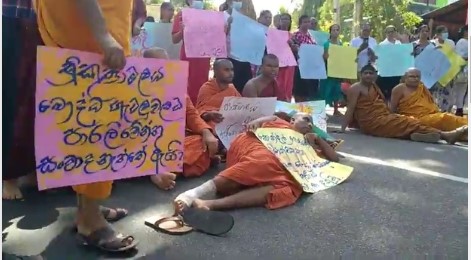
 Picture Courtecy Googel
 Picture Courtesy freepik