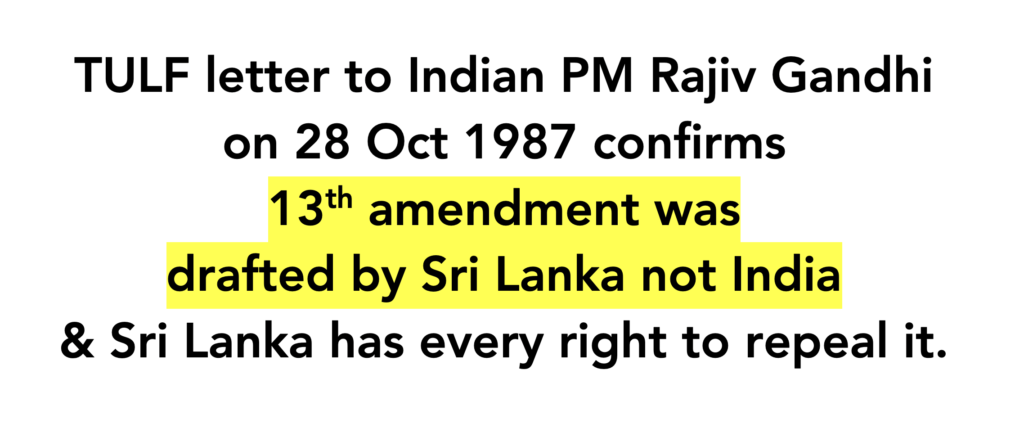
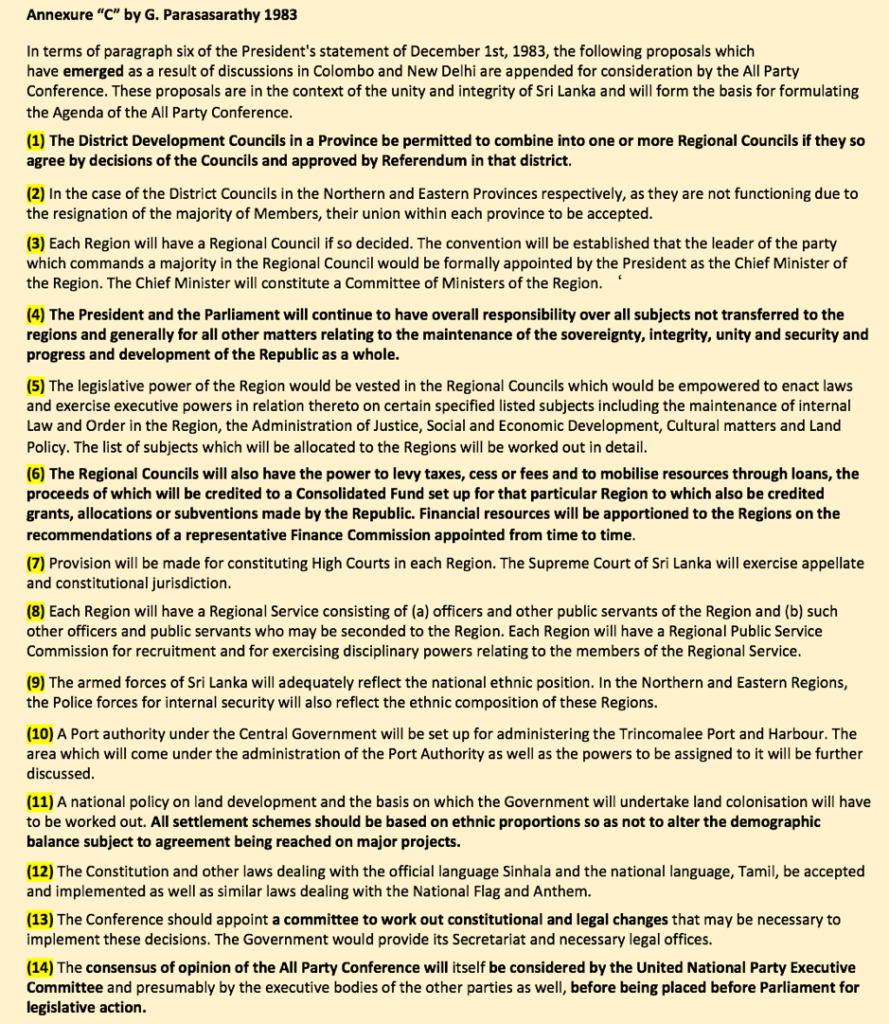
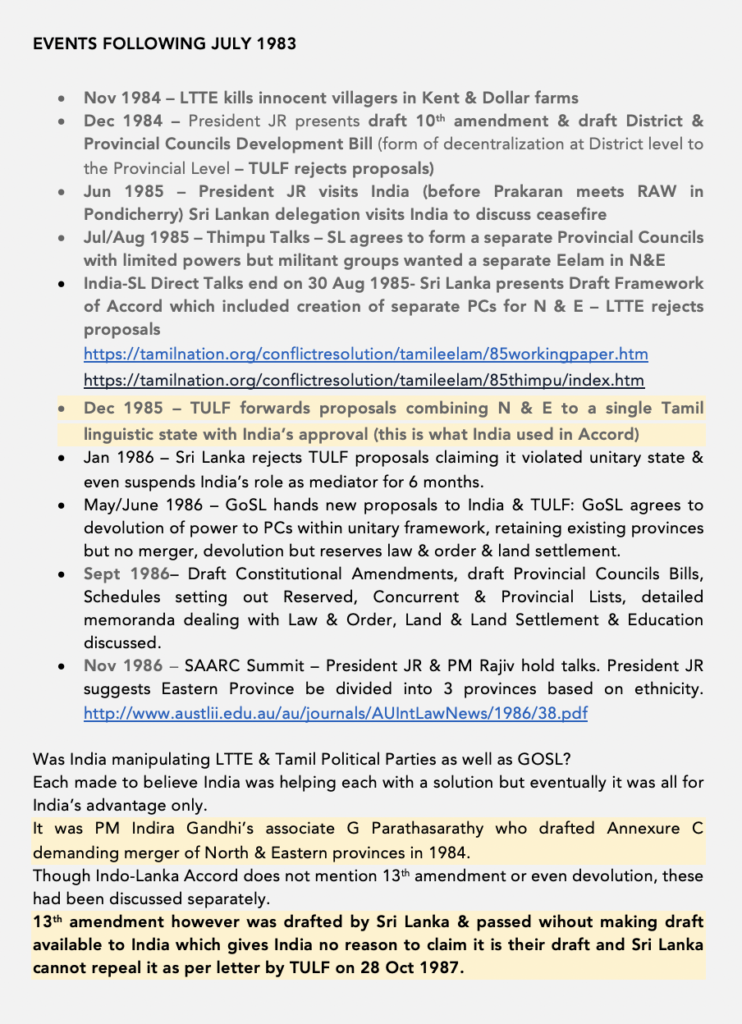
The Rajiv/JR Accord of 29th July 1987and its illegitimate Indian child, the 13th A are imminent disasters that should be abolished immediately at least now.

August 26th, 2023

Dr Sudath Gunasekara. Mahanuwara

The Rajiv/JR Accord of 29th July 1987and its illegitimate Indian child, the 13th A, and the resulting political mess are the threefold disasters that have already destabilized and destroyed political stability, good governance and the economy of this country beyond recovery for the past 36 years. Therefore, the crying need to abolished the Accord and the13th A immediately, at least now to rescue this country of the Sinhala nation.

The above two curses were imposed by force on Sri Lanka by India violating all international conventions agreed upon by civilized diplomatic norms. They constitute veritable disasters against the survival of the motherland and the Sinhala nation that had existed on this planet as an independent sovereign country as the land of the Sinhala people for the past 2600 years. Tamils have their own historical Homeland in South India, even running in to greater antiquity, and the Muslims have their homelands in many lands, including South India from where they migrated to this country from time to time. None of them, other than those who were there prior to 1815, have a continuous domicile history in this land for more than 2 hundred years.

The multi ethic, multi religious and multi lingual concept in this country is a recent invention first, by the British to pursue their divide and rule colonial policy and later, invented by local politicians who had no idea about the millennia old long and rich history of this country or any love for the motherland and who were wooing for minority votes only. Additionally, those westernized and disoriented men and women due to brainwashing by the western system of education who also did not know the true history of this country and pretending to be international scholars for the sake of getting few dollars for betraying the motherland for their survival are also responsible for these newly invented myths, that go against all accepted historical evidence. While condemning these self-fish treacherous outfits, I as a patriotic son of this country must categorically state that this will remain the land of the Sinhalese Buddhists as the sun and the moon shall rise, as it had been known throughout world history up to 1815 the year it was annexed to the British Empire by intrigue and treacherous conspiracy. It is very important to note here that Sri Lanka was never conquered by the British in war at any point of history like India and other Asian countries. That way our brave ancestors stand above all other nations, in the so-called British Empire where the sun never set as they boast. No other community either Tamil or Muslim who were only migratory birds in quest of wealth on their own or brought here as slaves by colonial invaders to labour for them on their newly stared ventures such as roads, tobacco farms in the North and newly opened plantation in the hill country has any right what so ever to claim a homeland on this soil that had been the land of the lions from the dawn of history.

Those who don’t agree with that view should leave this land and go back to their own original mother lands from where they came here for trade, employment and search of green pastures, or on as slave labour of the Dutch and British colonial invaders. All Tamils who claim a bogus motherland here should read the Mahavansa and Professor Karthugesus PhD thesis 1965 to find out as to where they really stand. Those who cannot understand history and who are not prepared to accept the historical truth and accept the stark fact that this land had been the undisputed mother land of the Sinha nation from the time the sun and the moon appeared over this planet, should forget about the myth of an artificial reconciliation, as there had been no trace of prior habitation of theirs here as separate nations. All Tamils and Muslims who were here on this Island prior to 1815 were also known as Sinhalese meaning the citizens of the country, Sinhale.  Therefore, all those who cannot concede to this historical fact should go back to their own mother land in South India and fight with India to get it freed from Indian hegemony first, without dying here to invent, a bogus Tamil motherland on somebody else’s mother land. Muslims also should follow suit if they cannot accept the above said truth, that this is the land of the Sinhala nation and therefore only a Sinhala man or a woman on this land can claim nationhood. Any other man or woman who wishes to be a citizen/countryman here should first accede to the above conditions before accepting as a citizen of this country.

No one should expect to get citizenship here through any other means like getting another country like India or any other country to pressurize us to do so, as we are also an independent and sovereign country as much as they are, irrespective of the small size of the country.  

Prior to 1815, throughout history, this country was known as Sinhale, meaning the land of the Sinhala people. When the British called it Ceylon that also simply meant the land of the Sinhala people. All the people of this country were known as Sinhalese before 1815. A citizen of this country may also call himself a Sri Lankan as this country had been known simultaneously by both names right through out. But no man or woman of any other ethnicity should be given permission to call himself/herself a Sinhala /Sri Lankan unless he/she pass a test in Sinhala conducted by the government and renounces fully and conclusively his/her allegiance to any other country on this earth and subscribes to an oath to that effect.

Having said that, first, I must point out that this Indian curse 13th A, first conceived by Rajiv Ghandi immediately after 1983 July incidents is 36 years old by now (1987-2023) was lying there in the book never fully implemented with the exception of amalgamating the N&E provinces 1988. Creating seven other PCC for the other 7 Provinces even though they were not there in the Rajiv/JR Accord of 29th July 1987 as a device of check and balance and also to consolidate his political ramshackle over the whole Island was an invention of JR. The N &E PC was constituted on 5th Dec 1988, dissolved in 1990 and demerged in 2009 as a result of a supreme court order.

The very concept of the 13th A was vehemently opposed by the Mavbima Surekiime Vyaapaaraya led by Ven Maduluwawe Sobhitha supported by SLFP and MEP, the only two patriotic political parties in the country at that time lead by Mrs. Sirimavo Bandaranayaka ending up with the deaths of a large number of poor patriotic citizens. Among those leaders who took part in that patriotic protest who are still alive, I think the ex-President Mahinda Rajapaksa and the present Prime minister Dinesh Gunawardhana will bear testimony to what I say here on the 1987 Pettah incident even though with the passage of time, both of them appear to have completely forgotten, probably for short term political expediencies. They know for what cause, they protested that day, may be just to satisfy Mrs B. and the emerging public opinion at that time.  But the people of this country are puzzled as to where their patriotism has gone now. People know why they are silent on this issue at present, but I don’t think they know where they will end up.

This is nothing but political expediencies of the present time, where we don’t have people of the caliber Ven Maduluwa Sobhita Thera and Mrs. Bandaranayaka.  I too can understand it, as it is the quality of despicable politics that is ingrained in this country by the British, that has ruined our motherland since 1948, the year the British colonial plunderers left the shores of this Island, after installing their own proxies in the seats of power, a set of westernized Kalusudda British in everything (except their place of birth) with their own system of Government implanted on their heads and thrust upon the Sinhala nation. They left behind the same old British system of legislative, executive and Judicial systems as colonial legacy to carry on the same system of government for the good of the British Empire until the Sun and the Moon shall exist.

The need for a new Constitution based on our civilization and history.

No government that came in to power ever since 1948 had thought about the need for a constitution that will restore the 2500-year-old heritage we lost to the colonial powers and to restore our identity as nation. The fathers and mothers of 1948 have miserably failed even to restore the name of the country, Sinhale, as it was documented in the Kandyan Convention in 1815 when it was ceded to Briton by mutually agreed Convention. As such formulating a constitution that meet the aspirations of a Free nation, as it happened in India was completely out of the question. Unfortunately, there were no Ambedkar and no Ghandhi here at that time. We had only D.S. Senananayaka and Oliver Gunatilaka and Wijewardhanas as king makers. This was the first blunder and betrayal our politicians did to this country in which we are still miserably entangled in, being unable to get out of that mess created by them.

Although an attempt was made to relieve the country from that colonial bondage in first in 1956 by SWRD backed by patriotic forces such as the Buddhist monks of Eksath Bhhikshu Peramuna led by the Vidyalankara Piriwena and again in 1972 by Mrs Bandaranayaka by declaring this country as an Independent Republic for the first time, again that was messed up by reactionary forces   led by JR in 1987 by undoing it with a new Constitution. Again he reversed history by declaring Feb 4th as the Independence Day, to commemorate an Independence we never got in 1948, at least covering the three basic pillars of legislative, executive and Judicial spheres.

 Is it not a big tragedy and a misery too for our brainless and unpatriotic politicians to follow the same JR prescription up to date even though the SLFP had come to power in 1994 and continues to rule” the country up to date, by Chandrika Bandaranayaka and Rajapaksas   more or less with the same mandate from the people, now of cause handed over to Ranil, the man who headed the opposition in 2019 Presidential election and in 2020 General elections. Thereby Rajapksas betrayed those 6.9 million voters by throwing the baby with the bathtub and transferred power undemocratically under mysterious circumstances, in a manner unheard and unseen in world history. It looks a classic political intrigue and an anti-Sinhala and anti-Buddhist coup orchestrated by international forces led by the US and India. So, as it is the whole country is in an utter mess. This brings us to the crying need for a new Constitution based on our own civilization and history that can restore first, good governance and law and order and recover the economy and then consolidate independence, freedom, sovereignty and territorial integrity of this Island nation. In other words, a constitution that can give what the people want

Coming back to 13th A

Coming back to 13th A we all know under what tragic circumstances and how JR got his 13th A passed in Parliament under emergency laws having obtained undated letters under duress signed by the members of his party as hostages imprisoned in a hotel until they were trailed to Parliament to vote.  It was imposed by force by India, having conducted an illegal military invasion of the Island few days before and from A to Z the whole process was illegal, unconstitutional, unethical and undemocratic, having violated all international conventions[S1]  and accepted ethical principles. It was also imposed on this country against the wishes of its people. This also marked an ugly landmark between the cordial relations between the two countries and a stepping stone for the future mono Tamil EELAM, (meaning the land of the Sinhalese) the separate State  within  the Land of the Sinhalese, for Tamils in the North and East comprising 1/3  of the area of the country and 2/3 of the coastal belt including the entire marine territory for a 2.5 of the total population of the country with the right for the Tamils to live in all other parts of this country again with a monopolistic right for the plantation Tamils  on the central hills and adjoining areas under Indian surveillance.

Isn’t it strange and ridiculous for the Indian Government to force Sri Lanka, the land of the Sinhalese to carve out 1/3 of this small country for about 2.5 immigrant South Indian Malabar Tamils while they have been denied their own traditional Homeland the birth place of Tamil nation in 1963 by the Government of India led by Jawaharlal Nehru declaring secessionism as an illegal act. Even in this country until 1911 all Tamils (except the Indian coolies in the plantations) were called Malabar Tamils. This is proved beyond any reasonable doubt when Thesavalamei introduced by the Dutch was defined as the law applicable to Malabar inhabitants of the peninsula of Jaffna).That also prove the fact that these Tamils are Indian and not natives of this country. These Tamils were classified as Ceylon Tamils, of course with ulterior motives, only in 1911 by Ponnambalam Arunachalam as the Director of census and Statistics.

What is more despicable was the 13th A also has completely destabilized and destroyed the well-established centuries old district administration system by creating the Provincial Councils under the 13th Amendment first, and transferring the powers of Government Agents to the Divisional Secretaries under Act no 58 of 1992 and abolishing the posts of GA by PA circular no 21 0f 1992. The GAA were redesignated as District Secretaries by President Premadasa. And denigrated  a once highly respected position to that of a secretary of a Maranaadhaara Samithiyain a village.

Already land powers in the north and East have been transferred from 1992. No need to transfer them under the 13th A.

With the implementation of Act 58 of 1992 and PA circular 21 /92 already land powers in the North and East have been transferred to the provinces together with the  North and Eastern Provinces from 1992.

It operates like this. Since the powers of the former GAA (now abolished under the above Act and the PA) transferred to the Divisional Secretaries, they are the sole authority within their divisions on the subject of land. Politicians in these areas are Tamils. The Governors are also Tamils. All other officers like Surveyors, Gramasevakas and office staff are also Tamils. The recipients of land also Tamils. It is a free for all operation provinces without talking about the 13th Amendment.

As such Unless the government withdraw Act 58 of 1992 and PA Circular 21/92 immediately, within one year all the land in these two provinces will be given to Tamils only. Then whether the 13th A is empowered or not the de-Sinhalization of these 2 provinces will be complete. In the process, now that the President has already directed to give all Mahaweli lands and even archaeological reserves and temple lands to Tamils and Muslims living in the areas contrary to current land alienation procedures it is only a matter of time to declare the EELAM. So, what Prabahakaran could not do for 30 years is done within 2 years thanks to these two foolish administrative acts issued by Premadasa. They have simultaneously achieved two things in a very short time. First, destroyed the district administration in this country and second given land powers to the NP and EP without implementing the 13th A.

Therefore, the urgent need to withdraw Act 58 0f 1992 and PA circular 21 of /92 to stop the evacuation of all Sinhalese from these two provinces and declaring the EELAm. A Superintendent of Survey working in the Eastern Province told me the other day that instruction has been received to give land permits to all lands occupied by Tamils and Muslims in the eastern province without limiting to 20 p for residential and 40 p for agricultural purposes as done in all other parts of the Island

Centralization under the Provincial system

Under the Provincial Council system, they boasted about decentralization of power under taking administration to the people. But actually, what they have done under the new system is more centralization of all business to the Province from the District thereby going back to the days of the British administration. For example, under the new system a man from Laggala who could get his job done at Matale Kachcheri before now has to come to the Provincial Council at Pallekele nearly 100 miles from his home town in Laggala.

Furthermore, the resulting increase in the number of politicians, institutions, offices and staff on the other hand by about 16 times due to duplication and new creations has sky rocketed public expenditure on the same scale if not more. In addition to the increase in resulting government expenditure due to these increases when one takes in to account the wastage, pilferage and extravagance associated with this new system, it is no wonder that the government has run bank corrupt. The village level administration also has completely broken down, with the introduction of this system. firstly, as Gramasevakas has to now work under two masters, the district secretariate and the Provincial Councils.

The GAA who happened to be the kingpins and commanding officers in his district when it comes to district administration under the previous system have now got reduced to a mere spectator looking like an outdated antique with no power and authority over the Divisional Secretaries and even the Grama Sevakas. The Government agents under the previous system[S2]  were public servants and senior professional SLAS officers who knew their job. But under the new system the Governors who command over the provinces and districts are either rejected politicians or relatives and friends of either the President or a Minister Except in very rare instances most of them know next to nothing, other than attending ceremonial functions. In their ignorance very often, they run riots and create very embarrassing situations A an excellent example is the recently appointed EP Governor Thondaman who started with performing a judicial function by prohibiting the construction of a Buddhist Temple on an archaeological site. This man is a estate Tamil of Indian origin from the hill country, who knew next to nothing about administration or governance.  Obviously, the President has appointed him as Governor EP to fulfil two objectives. Objective one is to canvas the plantation vote and objective 2 is to canvas the EP Tamil vote at the next presidential election. If the President was really interested in the development of the EP and he was sincerely concerned with the overall development of the EP he should have never removed the former Governor Anuradha Yahmpath, who was the best governor we ever had, in my opinion, in any province since the inception of the PCC in 1987    All of the have no experience in public service Most of them a This is one main reason who as to why crimes at the grassroot level have increased. 

During the British time the King was in England and the country was governed for him with one Governor stationed in Colombo assisted by three Secretaries stationed again in Colombo namely, the State Secretary, Finance Secretary and the Legal Secretary and 9 GAA in the 9 Provinces. They were assisted by few heads of Department like the Dept of Public work only and dirrigation. Today to do the same job we have an elected President, at the national level in Colombo with a Cabinet of about 20 with another set of 30 or more duplicator ministers called State Ministers as if the cabinet Ministers are not minsters of the State. There are about 1.6 million public servants headed by a band of about 200 Secretaries. In addition, we also have 9 political Governors at the provincial level messing up the work of all public servants including the District Secretaries as they are called now, enjoying all the privileges of Cabinet Ministers as the direct agents of the President attending purely to political agenda of the President. In reality, they are even more powerful than the Cabinet Minsters as they directly represent the President in the provinces. All of them are political appointments handpicked and made by the President purely on personal grounds. They are often his own men and women either his relations, friends or friends and relations of minsters or defeated candidate of the party in power, rejected by the people but accepted by the President.

The provincial Council system is an entirely a new appendage to the well-established traditional District Administration. Although the functions of the districts were transferred to the Divisional Secretaries who came under the purview and control of the PCC there was no reduction in the district cadre or institutions or facilities provided for the district system. All the GAA Additional GAA (of cause under different and denigrated designations), and departments etc continued to exist (even without functions) the fleet of vehicles and expenditure were never reduced. The PCC system is an entirely a new addition to the provincial level with an army of 9 Governors, 9 Chief Ministers and another 36 Provincial Ministers addition to the expenditure and confusion and MPP nearly 8000 provincial pc members,9 Chairmen with official bungalows, vehicles and separate staff with princely facilities and a large number of additional public officers is an unnecessary appendage costing billions annually for the last 35 years said to be exceeding 500 billion that have drained the nations coffers with a set of administrative duplications and overlapping and creating peracetic political institutions that have completely destroyed and destabilized the once perfect district administration.

The additional cost the government had to incur to maintain new institutions like provincial councils and institutions like Governors, chairmen of PC this system also needed new buildings decorated with red carpets and additional rented out at exorbitant cost.

All these appendages, with no return on the enormous cost incurred. were new additions without which the district administration could have run more efficiently at very much less cost with less waste and pilferage and of cause with much more efficiency. In addition to the extra expenditures, inter departmental conflicts arisen due to duplication and multiplicity of institutions to do the same job and the resulting mess up also has complicated and delayed delivery of service to the people and it has resulted in more centralization although it was meant for decentralization. What is more is Corruption and wastage of public funds also have skyrocketed taking the country to bankruptcy.

With the result the time-tested District Administration has got completely paralyzed and ineffective. As a result, administration and development and delivery of services to the people also have got completely paralyzed and almost came to a standstill.

 This situation has led to no governance, economic bankruptcy, social turmoil and public unrest. I think this is exactly what India wanted to happen to Sri Lanka. I suspect India would have carried out this intrigue to fish in trouble waters in achieving its ulterior objective of creating the 29 the State by empowering the Tamils in the north East and the hill country, their dream Malayanadu, right at the centre of this island as a landing pad to their 29th State. The way how the Indian Government, Modi and the IAS have manipulated and behaved in the recent past and they do even now in exploiting the weaknesses of self-centered and unpatriotic politicians, evince this intrigue.

As I see, we can never overcome this disaster until we find a patriotic Sinhala Buddhist leader who can rally round the whole nation to face the following challenges.

Set up a strong and stable patriotic Government and bring back political stability that was not there for a long time in this country.

Restore law and order bring back the rule of law and recover the shattered economy with an aggressive development and employment generation programs.

Make use of both the physical and human resources abundantly available in this country and the mighty Indian Ocean around this Island with its extremely strategic location right on the center of the great East -West oceanic and Air routes and make this Island nation the miracle of Asia in ten years.


The U.S. Has No Alternative to Adjusting to A Multipolar World

August 26th, 2023

By Medea Benjamin and Nicolas J. S. Davies*

Mapjawn was inspired to make this map after reading Worldmaking After Empire: The Rise and Fall of Self Determination by Adom Getachew. Source: Reddit – Photo: 2023

NEW YORK. 25 August 2023 (IDN) — In his 1987 book, The Rise and Fall of the Great Powers, historian Paul Kennedy reassured Americans that the decline the United States was facing after a century of international dominance was relative and not absolute, and is therefore perfectly natural; and that the only serious threat to the real interests of the United States can come from a failure to adjust sensibly to the newer world order.” 

Since Kennedy wrote those words, we have seen the end of the Cold War, the peaceful emergence of China as a leading world power, and the rise of a formidable Global South. But the United States has indeed failed to adjust sensibly to the newer world order,” using military force and coercion in flagrant violation of the UN Charter in a failed quest for longer lasting global hegemony. 

Kennedy observed that military power follows economic power. Rising economic powers develop military power to consolidate and protect their expanding economic interests. But once a great power’s economic prowess is waning, the use of military force to try to prolong its day in the sun leads only to unwinnable conflicts, as European colonial powers quickly learned after the Second World War, and as Americans are learning today.

While U.S. leaders have been losing wars and trying to cling to international power, a new multipolar world has been emerging. Despite the recent tragedy of Russia’s invasion of Ukraine and the agony of yet another endless war, the tectonic plates of history are shifting into new alignments that offer hope for the future of humanity. Here are several developments worth watching:

De-dollarizing global trade 

For decades, the U.S. dollar was the undisputed king of global currencies. But China, Russia, India, Brazil, Saudi Arabia and other nations are taking steps to conduct more trade in their own currencies, or in Chinese yuan. 

Illegal, unilateral U.S. sanctions against dozens of countries around the world have raised fears that holding large dollar reserves leaves countries vulnerable to U.S. financial coercion. Many countries have already been gradually diversifying their foreign currency reserves, from 70% globally held in dollars in 1999 to 65% in 2016 to only 58% by 2022. 

Since no other country has the benefit of the ecosystem” that has developed around the dollar over the past century, diversification is a slow process, but the war in Ukraine has helped speed the transition. On April 17, 2023, U.S. Treasury Secretary Janet Yellen warned that U.S. sanctions against Russia risk undermining the role of the dollar as the world’s global reserve currency. 

And in a Fox News interview, right-wing Republican Senator Marco Rubio lamented that, within five years, the United States may no longer be able to use the dollar to bully other countries because there will be so many countries transacting in currencies other than the dollar that we won’t have the ability to sanction them.” 

BRICS’s GDP leapfrogs G7’s 

When calculated based on Purchasing Power Parity, the GDP of the BRICS countries (Brazil, Russia, India, China and South Africa) is nowhigher than that of the G7 (United States, United Kingdom, Canada, France, Germany, Italy, Japan). The BRICS countries, which account for over 40% of total world population, generate 31.5% of the world’s economic output, compared with 30.7% for the G7, and BRICS’s growing share of global output is expected to further outpace the G7’s in coming years.

Through the Belt and Road Initiative, China has invested some of its huge foreign exchange surplus in a new transport infrastructure across Eurasia to more quickly import raw materials and export manufactured goods, and to build growing trade relations with many countries. 

Now the growth of the Global South will be boosted by the New Development Bank (NDB), also known as the BRICS Bank, under its new president Dilma Rousseff, the former president of Brazil.  

Rousseff helped to set up the BRICS Bank in 2015 as an alternative source of development funding, after the Western-led World Bank and IMF had trapped poor countries in recurring debt, austerity and privatization programs for decades. By contrast, the NDB is focused on eliminating poverty and building infrastructure to support a more inclusive, resilient and sustainable future for the planet.” The NDB is well-capitalized, with $100 billion to fund its projects, more than the World Bank’s current $82 billion portfolio. 

Movement towards strategic autonomy” for Europe 

On the surface, the Ukraine war has brought the United States and Europe geostrategically closer together than ever, but this may not be the case for long.After French President Macron’s recent visit to China, he told reporters on his plane that Europe should not let the United States drag it into war with China, that Europe is not a vassal” of the United States, and that it must assert its strategic autonomy” on the world stage. Cries of horror greeted Macron from both sides of the Atlantic when the interview was published.  

But European Council President Charles Michel, the former prime minister of Belgium, quickly came to Macron’s side, insisting that the European Union cannot blindly, systematically follow the position of the United States.” Michel confirmed in an interview that Macron’s views reflect a growing point of view among EU leaders, and that quite a few really think like Emmanuel Macron.”  

The rise of progressive governments in Latin America

This year marks the 200th anniversary of the Monroe Doctrine, which has served as a cover for U.S. domination of Latin America and the Caribbean. But nowadays, countries of the region are refusing to march in lockstep with U.S. demands. The entire region rejects the U.S. embargo on Cuba, and Biden’s exclusion of Cuba, Venezuela and Nicaragua from his 2022 Summit of the Americas persuaded many other leaders to stay away or only send junior officials, and largely doomed the gathering.  

With the spectacular victories and popularity of Andres Manuel Lopez Obrador in Mexico, Gustavo Petro in Colombia, and Ignacio Lula da Silva in Brazil, progressive governments now have tremendous clout. They are strengthening the regional body CELAC (the Community of Latin American and Caribbean States) as an alternative to the U.S.-dominated Organization of American States.  

To reduce reliance on the U.S. dollar, South America’s two largest economies, Argentina and Brazil, have announced plans to create a common currency that could later be adopted by other members of Mercosur — South America’s major trade bloc. While U.S. influence is waning, China’s is mushrooming, with trade increasing from $18 billion in 2002 to nearly $449 billion in 2021. China is now the top trading partner of Brazil, Chile, Peru and Uruguay, and Brazil has raised the possibility of a free-trade deal between China and Mercosur. 

Peace between Iran and Saudi Arabia  

One of the false premises of U.S. foreign policy is that regional rivalries in areas like the Middle East are set in stone, and the United States must therefore form alliances with so-called moderate” (pro-Western) forces against more radical” (independent) ones. This has served as a pretext for America to jump into bed with dictators like the Shah of Iran, Saudi Arabia’s Mohammed bin Salman and a succession of military governments in Egypt. 

Now China, with help from Iraq, has achieved what the United States never even tried. Instead of driving Iran and Saudi Arabia to poison the whole region with wars fueled by bigotry and ethnic hatred, as the United States did, China and Iraq brought them together to restore diplomatic relations in the interest of peace and prosperity. 

Healing this divide has raised hopes for lasting peace in several countries where the two rivals have been involved, including Yemen, Syria, Lebanon and as far away as West Africa. It also puts China on the map as a mediator on the world stage, with Chinese officials now offering to mediate between Ukraine and Russia, as well as between Israel and Palestine. 

Saudi Arabia and Syria have restored diplomatic relations, and the Saudi and Syrian foreign ministers have visited each others’ capitals for the first time since Saudi Arabia and its Western allies backed al-Qaeda-linked groups to try to overthrow President Assad in 2011.  

At a meeting in Jordan on May 1st, the foreign ministers of Jordan, Egypt, Iraq and Saudi Arabia agreed to help Syria restore its territorial integrity, and that Turkish and U.S. occupying forces must leave. Syria may also be invited to an Arab League summit on May 19th, for the first time since 2011. 

Chinese diplomacy to restore relations between Iran and Saudi Arabia is credited with opening the door to these other diplomatic moves in the Middle East and the Arab world. Saudi Arabia helped evacuate Iranians from Sudan and, despite their past support for the military rulers who are destroying Sudan, the Saudis are helping to mediate peace talks, along with the UN, the Arab League, the African Union and other countries. 

Multipolar diplomatic alternative to U.S. war-making

The proposal by President Lula of Brazil for a peace club” of nations to help negotiate peace in Ukraine is an example of the new diplomacy emerging in the multipolar world. There is clearly a geostrategic element to these moves, to show the world that other nations can actually bring peace and prosperity to countries and regions where the United States has brought only war, chaos and instability.

While the United States rattles its saber around Taiwan and portrays China as a threat to the world, China and its friends are trying to show that they can provide a different kind of leadership. As a Global South country that has lifted its own people out of poverty, China offers its experience and partnership to help others do the same, a very different approach from the paternalistic and coercive neocolonial model of U.S. and Western power that has kept so many countries trapped in poverty and debt for decades.    

This is the fruition of the multipolar world that China and others have been calling for. China is responding astutely to what the world needs most, which is peace, and demonstrating practically how it can help. This will surely win China many friends, and make it more difficult for U.S. politicians to sell their view of China as a threat. 

Now that the newer world order” that Paul Kennedy referred to is taking shape, economist Jeffrey Sachs has grave misgivings about the U.S. ability to adjust. As he recently warned, Unless U.S. foreign policy is changed to recognize the need for a multipolar world, it will lead to more wars, and possibly to World War III.” With countries across the globe building new networks of trade, development and diplomacy, independent of Washington and Wall Street, the United States may well have no choice but to finally adjust sensibly” to the new order. 

*Medea Benjamin and Nicolas J. S. Davies are the authors of War in Ukraine: Making Sense of a Senseless Conflict, published by OR Books in November 2022. Medea Benjamin is the cofounder of CODEPINK for Peace, and the author of several books, including Inside Iran: The Real History and Politics of the Islamic Republic of Iran.Nicolas J. S. Davies is an independent journalist, a researcher with CODEPINK and the author of Blood on Our Hands: The American Invasion and Destruction of Iraq. [IDN-InDepthNews]

Image: Mapjawn was inspired to make this map after reading Worldmaking After Empire: The Rise and Fall of Self Determination by Adom Getachew. Source: Reddit

IDN is the flagship agency of the Non-profit International Press Syndicate.

African Connection of Atom Bomb That Destroyed Hiroshima

August 26th, 2023

By Lisa Vives, Global Information Network

Meeting in the Oval Office between President Nixon and President Mobutu of Zaire, known as Democratic Republic of Congo (DRC) since 1997. The uranium used in making the bomb and subsequent atomic weapons were sourced from the DRC. Credit: Jack Kightlinger | Wikimedia Commons. – Photo: 2023

NEW YORK. 24 August 2023 (IDN) — This month marks the anniversary of the first use of an atomic bomb, developed in the U.S. and dropped on a Japanese city to deadly effect.

Little is known, however, of the African connection to this deadly weapon—namely the use of uranium in making the bomb and subsequent atomic weapons —all of the mineral sourced from the Democratic Republic of the Congo.

To develop the weapon, the U.S. started The Manhattan Project in 1939, stationed in Los Alamos, New Mexico, and headed by the American physicist, J. Robert Oppenheimer.

A large amount of uranium used in making the first atomic weaponry was sourced from the Shinkolobwe mine in the Katanga province of the DRC. First discovered in 1915 and under Belgian colonial rule, the mine was manned by Congolese laborers to produce uranium for the U.S.

These laborers worked under secret contracts and low wages for the United States national security. To prevent information from leaking, Shinkolobwe was erased from maps and the then Prime Minister of the United Kingdom, Winston Churchill, referred to the uranium as an ‘indispensable raw material for the project’.

Misinformation was also spread to make it appear that they were sourced from Canada, whose ores yielded 0.03 percent uranium while Congolese ores yielded 65 percent uranium.

The Shinkolobwe mine in the Katanga province of the Belgian Congo provided two-thirds of the Manhattan Project’s uranium from an extraordinarily rich pitchblende deposit averaging more than 2 percent uranium content.

The word Shinkolobwe fills me with grief and sorrow,” says Susan Williams, a historian at the UK Institute of Commonwealth Studies. It’s not a happy word, it’s one I associate with terrible grief and suffering.” 

Few people know what, or even where, Shinkolobwe is. But this small mine in the southern province of Katanga, in the Democratic Republic of the Congo (DRC), played a part in one of the most violent and devastating events in history.

This month, more than 7,500 miles away, bells tolled across Hiroshima, Japan, to mark 75 years since the atomic bomb fell on the city. Thousands of lanterns carrying messages of peace will be set afloat on the Motoyasu River. Three days later, similar commemorations were held in Nagasaki.

No such ceremony will take place in the DRC. Yet both nations are inextricably linked by the atomic bomb, the effects of which are still being felt to this day.

When we talk about the Hiroshima and Nagasaki bombing, we never talk about Shinkolobwe,” says Isaiah Mombilo, chair of the Congolese Civil Society of South Africa. Part of the Second World War has been forgotten and lost.”

Ultimately, the Congolese mine furnished nearly two-thirds of the uranium used for the bomb (nicknamed Little Boy”) dropped on Hiroshima, and it also contributed to the production of much of the plutonium used in the bomb (Fat Man”) dropped on Nagasaki three days later. [IDN-InDepthNews]

Photo: Meeting in the Oval Office between President Nixon and President Mobutu of Zaire, known as the Democratic Republic of Congo (DRC) since 1997. The uranium used in the bomb and subsequent atomic weapons were sourced from the DRC. Credit: Jack Kightlinger | Wikimedia Commons.

IDN is the flagship agency of the International Press Syndicate.

We believe in the free flow of information. Republish our articles for free, online or in print, under Creative Commons Attribution 4.0 International, except for republished articles with permission.

Crisis in Sri Lanka & the World: Colonial & Neoliberal Origins: Ecological & Collective Alternatives

August 26th, 2023

ISAS Events

The publication provides an in-depth analysis of Sri Lanka’s ongoing political and economic crisis, taking into account the island’s historical evolution, with an emphasis on external political and economic intervention. The book discusses the unequal economic and financial architecture of the global economy, which set the framework for the debt and socio-economic crisis in Sri Lanka and elsewhere. It also explores the emergence of the crisis in the context of the accelerating geopolitical conflict between China and the United States in the Indian Ocean. The book concludes with a consideration of the ethical dilemmas behind the debt and survival crisis in Sri Lanka and across the world. It points out a range of social movements and initiatives in Sri Lanka and the Global South which subscribe to collective and ecological alternatives, and a path of sustainability and social justice.

High Commissioner Moragoda pays farewell call on Indian Minister of Road Transport and Highways Nitin Gadkari

August 26th, 2023

Sri Lankan High Commission in India

High Commissioner of Sri Lanka to India Milinda Moragoda paid the farewell call on Minister of Road Transport and Highways of India Shri Nitin Gadkari in New Delhi.

At the outset, High Commissioner Moragoda thanked the Indian Road Transport and Highways Minster for the cooperation that the latter extended to him during his tenure in New Delhi.

He also apprised the Minister of the references to connectivity, particularly those that are on road connectivity, in the Indo-Lanka joint document Promoting Connectivity, Catalysing Prosperity: India-Sri Lanka Economic Partnership Vision”, which was issued following bilateral talks between the President of Sri Lanka and the Prime Minister of India in July. The High Commissioner and the Minister discussed ways and means through which the connectivity goals stipulated in the joint Vision document could be materialized.

The discussion also focussed on the cooperation in promoting alternatives to fossil fuels such as electricity and bio-fuels in the transport sector. These alternatives were seen as highly cost-effective and environment friendly, suitable to a country like Sri Lanka. The Minister spoke on the Indian experience in alternative fuels and expressed his willingness to share the relevant expertise with Sri Lanka.

High Commissioner Moragoda invited Minister Gadkari to visit Sri Lanka at a mutually convenient time, which the Minister accepted.

High Commissioner Moragoda also presented to Minister Gadkari a stone obtained from the stream flowing besides the Seetha Amman Temple in Seetha Eliya (Ashoka Vatika) in Sri Lanka, which is believed to be the site where Seetha was held captive according to the Ramayana.

Hailing from the State of Maharashtra, Shri Nitin Gadkari is the longest serving Minister for Road Transport and Highways of India currently running his tenure for over eight years since 2014. He also served as the President of the Bhartiya Janata Party (BJP) from 2009 to 2013. Previously, he has held the ministerial portfolios of Micro, Small & Medium Enterprises; Shipping; Water Resources, River Development & Ganga Rejuvenation; and Rural Development & Panchayati Raj. He has authored several books as well.

වැස්ස එනකොට කූඩැල්ලො නැගිටිනවා – පූජ්‍ය ඇල්ලේ ගුණවංශ හිමි දේශපාලකයන්ගේ සැබෑ ස්වරූපය අනාවරණය කරති

August 26th, 2023

 Lanka Lead News

ඉතිහාසයේ කවර කාලයක දී වත් නොතිබූ ලෙස ජාත්‍යන්තර බලවේග ඉතා සියුම් ලෙස මේ රටත්, ජාතියත්, ආගමත් වටා ගොනුවී අවසන්ව ඇති බව පූජ්‍ය ඇල්ලේ ගුණවංශ හිමියෝ පවසති.

රටක පුරාවස්තු එම රටේ එක් ජාතියකට පමණක් අයත් වස්තූන් නොවන බවත්, රටේ සියලුම ජාතීන්ට මෙම උරුමය අයත් බවත්, උතුරේ දෙමළ දේශපාලකයන් අතලොස්සක් එකතු වී දකුණේ සිංහල දේශපාලකයන් කරන ලෙසින්ම උතුරේ දෙමළ ජනතාව මුලා කරන බවත් උන්වහන්සේ පවසති.

එමෙන්ම කූඩැල්ලන් වැස්ස එනවිට නැගිටිනවා සේම, දේශපාලකයන්ට ද රට, ජාතිය, ආගම මතක් වන්නේ ඡන්දයක් කිට්ටුවට පැමිණෙන විට දී බවයි උන්වහන්සේ පවසන්නේ.

වීඩියෝව නරඹන්න…

පාස්කු ප්‍රහාරයේ වාසිය ගෝඨාභයට නම්, රණවිරුවන් යුද අපරාධකරුවන් ලෙස හැඳින්වීමේ වාසිය රනිල්ටද? – ගෝලීය ශ්‍රී ලාංකික සංසදයේ විධායක කමිටු ලේකම් යසස් ධර්මදාස හෙළිකරයි

August 26th, 2023

Lanka Lead News

යුද විරුවන් යුද අපරාධකරුවන් ය යන චෝදනාව තර්කයකින් තොරව පිළිගනු ලැබුවේ වත්මන් ජනාධිපති රනිල් වික්‍රමසිංහ මැතිතුමා අගමැති පදවිය හෙබ වූ 2015 කාලයේදී බවත්, රණවිරුවන්ට විරුද්ධව නගා ඇති යුද අපරාධ චෝදනා වලින් වාසිය අත්වී ඇත්තේ කාටදැයි සිතා ගැනීම මෙරට ජනතාවට බාර බවත් ගෝලීය ශ්‍රී ලාංකික සංසදයේ විධායක කමිටු ලේකම් යසස් ධර්මදාස මහතා පවසයි.

ගෝඨාභය රාජපක්ෂ ජනාධිපති තුමාට භයානක ලෙස වැරදුන ස්ථානයක් වන්නේ ස්වභාවික යුක්තිය ඉල්ලීමේ මාර්ගයෙන් බැහැරව යුද අපරාධ චෝදනා තිබියදීම යුද අපරාධ චෝදනා සඳහා ලබාදුන් ඳඬුවම් වලින් ගැලවීම සඳහා මධ්‍යස්ථ දෙමල ඩයස්පෝරාව ‘එන්ගේජ්’ කරගැනීම යන න්‍යාය පිලිගැනීම බවද ඒ මහතා පවසයි.

පෙරේදා(24) දිනයේ කොළඹ 7 නිදහස් මාවතේ පිහිටි පුස්තකාල සහ ප්‍රලේඛන සේවා ශ්‍රවනාගාරයේදී පැවති ‘ලෝකයේ අර්බූදය සහ අපේ අර්බූදය‘  නව ගෝලීය ප්‍රවනතා තුළ ශ්‍රී ලංකාවේ ඉරණම පිළිබඳ විද්වත් සාකච්ඡාවට එක් වෙමින් යසස් ධර්මදාස මහතා පැවැත් වූ සවිස්තරාත්මක කතාව පහළින්…

යුක්රේන යුද්ධය, BRICS ව්‍යාපෘතිය, චීන – රුසියා සහයෝගීතාවය, න්‍යෂ්ඨික යුද්ධයක අනතුර ඇතුළු නව ගෝලීය ප්‍රවනතාව තුළ ශ්‍රී ලංකාවේ ඉරණම පිළිබඳව විද්වත් කතිකාවෙහි පිළිගැනීම සහ අරමුණ පැහැදිලි කිරීම.

ලෝකයේ අර්බුදය අපේ අර්බුදයට බලපාන්නේ කෙසේද අප එය කළමණාකාරණය කරගත යුත්තේ කෙසේද යන කාරණය පිළිබඳව විද්වත් කතිකාවක් ඇතිකර ගැනීමේ ආරම්භයක් ලෙස තමයි අද දිනයේ මේ විද්වත් කතිකාවත පැවැත්වෙන්නේ. ඒ සඳහා පැමිණීමට නියමිත ආචාර්ය ගුණදාස අමරසේකර මැතිතුමා, පැමිණ සිටින කල්‍යානන්ද තිරාණගම මැතිතුමා, ස්පර් සංවිධානයේ නිහාල් ඩයස් මහතා, ස්පර් සංවිධානයේ දසරත් ජයසූරිය මහතා, හිටපු ප්‍රංශ තානාපතිතුමිය මහාචාර්ය හිරිඹුරේගම මහත්මිය, මහාචාර්ය මාලනී ඇඳගම මහත්මිය, කථිකයින්, ආරාධිත අමුත්තන් සහ දේශප්‍රේමී ඔබ සැම ඉතාමත් ගෞරවයෙන් යුක්තව පිළිගනු ලබනව.

ලෝක අර්බුදය ලෙස මෙහිදී අප විශේෂයෙන්ම සාකච්ඡා කරනු ලබන්නේ යුක්රේනයේ යුද්ධය නිසා ලෝකය තුල ඇතිව තිබෙන තත්ත්වය, BRICS ව්‍යාපෘතිය මගින් සිදුකළ හැකි බලපෑම, චීන – රුසියා සහයෝගීතාවය, ත්‍යෂ්ඨික යුද්ධයක අනතුර, ගෝලීය යළි සැකසීමේ ක්‍රියාදාමය සහ ඉහත සඳහන් කළ කාරණා හේතුවෙන් අප රටට සිදුව ඇති බලපෑම සහ රටට යහපතක් වෙන ආකාරයට මෙම ගෝලීය අර්බුදය කළමනාකරණය කරගන්නේ කෙසේද යන්න පිළිබඳවයි.

අද දිනයේදී ඒ සඳහා විෂයානු බද්ධ දැනුමැති විද්වත් මණ්ඩලයක් සමග කතිකාවතක් සිදුකිරීමට ඔබ සැමට අවස්ථාව ලැබීමට නියමිතයි.

යුක්රේන් යුද්ධය පිළිබඳව සැළකුවහොත් ඉන්දියාවට හැකිව තිබෙනව රුසියාවෙන් අඩු මිළට ඛනිජ තෙල් රැගෙන වැඩි මිළට අපට විකිණීමට. ඒ සඳහා ඉන්දියාවට ඔවුන් විසින් අපට ලබා දුන් ක්රෙඩිට් ලයින්” එක භාවිතා කළ හැකියි. ඒ අනුව අපේ තෙල් අර්බුදය ඉන්දියාවට මනරම් ව්‍යාපාරික අවස්ථාවක් නිර්මාණය කර දී තිබෙනවා.

BRICS ව්‍යාපෘතිය දැනටමත් රටවල් පනහක පමණ සංඛ්‍යාවකට ආකර්ෂණය වී ඇති බව පෙනෙන්න තිබුණද ඩොලරයට විරුද්ධ සටන ගල උඩ සටනකටත් වඩා තීව්ර දරුණු සටනක් බවට පත් වී තිබෙන බව පැහැදිලියි. ඉන්දියාව සහ චීනය ඩොලරයට විකල්පව වෙනත් මුදල් ඒකකයක් පිළිගැනීමට එකඟවීම සමහරවිට අද නොවේ හෙට” වැනි බාලගිරි දෝශයට ලක්වූ කටයුත්තක් බවට පත්වීමට තිබෙන ඉඩ කඩ ඉතා ඉහළයි.

දකුණු අප්‍රිකාවේ BRICS තානාපති අනිල් සූක්ලාල්- මම හිතනවා ඔහු ඉන්දියානු සම්භවයක් ඇත්තෙකු කියා- ඔහු කියනව BRICS ආයතනයට එවැනි ඩොලරයට අභියෝග කිරීමේ අදහසක් නැහැ කියල. ඒ වගේම ඔහු අවධාරණය කරනව යෝජිත ජොහැන්නස්බර්හ් සමුළුවෙදි ඩොලර් විමුක්ත කතිකාවතක් නැහැ කියල. ඒ අතරෙ වොරන් බුෆේ (Warren Buffett ) පවසා තියෙනව ඊළඟ වසර 50-60 තුල ඩොලරයට හිමි අධිපතිවාදීකම නැති නොවන බවත්, ඒ පිළිබඳව ඔහු ඕනෑම ඔට්ටුවක් ඇල්ලීමට සූදානම් බවත්.

මේ කාරණා පිළිබඳව අපේ විද්වතුන් මනාව පැහැදිළි කිරීමට නියමිත බැවින් මීට අමතරව යමක් මා ඒ පිළිබඳව පැවසීම අවශ්ය නොවේ කියා හිතනව.

නමුත්, ලෝක අර්බුදයට සමගාමීව අප රටක් ලෙස අර්බුදයට හසුවුනේ කෙසේද යන්න පිළිබඳව කෙටි අදහසක් ප්‍රකාශ කිරීමට කැමතියි. ඇත්ත වශයෙන්ම ඉහත සඳහන් කළ ගෝලීය අර්බුදය, විශේෂයෙන්ම යුක්රේන් යුද්ධය, ඇතිවීමට පෙරයි ශ්‍රී ලංකාව මුහුණ දෙන අර්බුධයට පාර කැපුනේ. එය රුසියාව සමග කෙසේ වෙතත් චීනය සමග පැවති ළබැඳියාව හේතුවෙන් හටගත්තක් ලෙසට සමහරුන්ට හැඳින්වීමටත් හැකියාව තිබෙනව.

ශ්‍රී ලංකාවේ වත්මන් අර්බුදය ප්රධාන වශයෙන් බැහැර නොකරන ලද චෝදනා දෙකක් මත ඇතිවුන බවයි මගේ හැඟීම. එනම්, රාජපක්ෂ වරුන්ට එල්ලවූ හොරා චෝදනාව, හා අපේ රණවිරුවන්ට එල්ලවූ යුද අපරාධකරුවන් යන චෝදනාව.

රාජපක්ෂවරුන්ට එල්ලවූ හොරා යන චෝදනාව නිසිලෙස බැහැර නොකරන ලද චෝදනාවක් ලෙස පවතිනව. චෝදනාවක් බැහැර නොකළේනම් එම චෝදනාව තහවුරු වීම සිදු වෙනව. බැහැර නොකරන ලද හොරා යන චෝදනාව හරියට හිසට ඉහලින් කෙස් ගසකින් එල්ලූ තියුණු අසිපතක් ලෙසට පවතිනව.

දෙවන චෝදනාව, එනම් අපේ යුද විරුවන් යුද අපරාධකරුවන් ය යන චෝදනාව. මේ චෝදනාව තර්කයකින් තොරව පිළිගනු ලැබුවේ වත්මන් ජනාධිපති රනිල් වික්‍රමසිංහ මැතිතුමා අගමැති පදවිය හෙබ වූ 2015 කාලයේදී.

පහුගිය කාලයේ අප දුටුව කාදිනල් තුමා පවා චෝදනාකරණව ගෝඨාභය තමයි පාස්කු ප්‍රහාරයේ වාසියේ උරුමකරු කියල. කාදිනල් තුමා ගෝඨාභයට එල්ල කරන චෝදනාවට අනුව ඔහු පාස්කු ප්‍රහාරයේ වාසියේ උරුමකරු” නම් කාදිනල් තුමාත් ගෝඨාභයගේ ජයග්‍රහණය වෙනුවෙන් දායක වුනා. මට මේ අවස්ථාවේදී මතු කිරීමට අවශ්‍ය වන්නේ අපේ රණවිරුවන් යුද අපරාධ කාරයින් ලෙස හංවඩු ගැසීමෙන් වාසිය අත්වී ඇත්තේ කාටද කියන ප්‍රශ්නයයි.

ගෝඨාභය මහතාට රණවිරුවන් යුද අපරාධ චෝදනාවලින් ගලවා ගැනීමේ අවසාන අවස්ථාව තිබුණේ 2021 ජනවාරි 11 වෙනිද. එදින ආරක්ෂක කමිටුවට ජාතික සංවිධාන නියෝජිතයින්ට පැමිණ කරුණු පැහැදිලි කිරීමට අවස්ථාව ලබාදුන්නා. එදින අපගේ දොස්තර වසන්ත බණ්ඩාර ප්‍රමුඛ නියෝජිතයින් පෙන්වා දුන්න යුද අපරාධ චෝදනා වලින් නිදොස් වීම අත්‍යවශ්‍ය බව හා ඒ සඳහා එළඹෙන ජිනීවා මානව හිමිකම් සමුළුවට යුද අපරාධ චෝදනාලාභීන් වෙනුවෙන් ස්වාභාවික යුක්තිය ඉල්ලා සිටින ලෙස.

නමුත්, ගෝඨාභය රාජපක්ෂ ජනාධිපති තුමාට භයානක ලෙස වැරදුන ස්ථානයක් තමයි අප පෙන්වා දුන් මාර්ගය වන ස්වභාවික යුක්තිය ඉල්ලීමේ මාර්ගයෙන් බැහැරව යුද අපරාධ චෝදනා තිබියදීම යුද අපරාධ චෝදනා සඳහා ලබාදුන් ඳඬුවම් වලින් ගැලවීම සඳහා මධ්‍යස්ථ දෙමල ඩයස්පෝරාව ‘එන්ගේජ්’ කරගැනීම යන න්‍යාය පිලිගැනීම.

මේ ‘එන්ගේජ්’ කරගැනීමේ න්‍යාය අවසානයේදී කැරකුනේ කොතැනටද? ඉන්දීය වාර්තාකරු සුබ්රමණියම් මහතා, විමල් වීරවංශ මහතා සහ සේන තෝරදෙණිය මහතා සඳහන් කර ඇති පරිදි ඇමරිකානු තානාපතිනිය විසින් රටේ ආරක්ෂාවට වගකිවයුතු ප්‍රභලයින් එතුමිය විසින් ‘එන්ගේජ්’ කර ඇති ආකාරයක් තමයි දක්නට ලැබෙන්නෙ.

එතුමියට හැකියාව ලැබුන මානව හිමිකම් කසය පෙන්වා සියලුම ආරක්ෂක අංශ මෙල්ල කිරීමට. නමුත්, අද වෙනවිට වත්මන් ජනාධිපති තුමාට හැකියාව ලැබී තිබෙනව සියලු අරගල කරුවන් මෙල්ල කිරීමට. එය දෙයාකාරයකින් සිදුවෙනබව පෙනෙන්න තියෙනව. එනම් බලය යොදමින් සහ බලය බෙදමින් යන ක්‍රම දෙකෙන්ම ඔහු එම කාර්ය කරනවා. බලය බෙදමින්” යන න්යායට එකඟ බැවින් බලය යොදමින් සිදුකරනු ලබන ක්‍රියා දැන් බාහිර ලෝකයට, නීතිඥ සංගම්වලට පෙනෙන්නෙ නැති බවක් තමයි පෙනෙනට තියෙන්නෙ. සමහරවිට යෝජනාවුණු ත්‍රස්ත විරෝධී පනත සම්මත උනානම් මේ කරන ප්‍රකාශයත් ත්‍රස්තවාදී ගනයට වැටීමට නියමිතව තිබුණා.

එසේනම්, අපේ රට අර්බුදයට ඇඳ දමා තිබෙන චෝදනාව වන අපේ රණවිරුවන්ට විරුද්ධව නගා ඇති යුද අපරාධ චෝදනා වලින් වාසිය අත්වී ඇත්තේ කාටද? ඒ පිළිබඳව හිතා ගැනීම ඔබට බාරයි.

රට ආරාජික කළ පළමු චෝදනාව වන රාජපක්ෂ හොරු යන චෝදනාවෙන් රටට විය හැකි හානිය දැන් සිදුවී තියෙනව.

නමුත්, රට අස්ථාවර කළ දෙවන චෝදනාව, එනම්, අපේ යුද විරුවන් යුද අපරාධකරුවන් ය යන චෝදනාව එසේ බැහැර කළ නොහැකියි. එම චෝදනාව නිශේධනය කළ යුතුමයි. එය කළ හැක්කේ කෙසේද කියා අප මීට පෙර අවස්ථාවල සඳහන් කර ඇති බැවින් ඒ පිළිබඳව වැඩිදුර ප්‍රකාශ කිරීම මේ ඊට අවස්ථාව නොවන බැවින්, මගේ පිළිගැනීමේ සහ අරමුණ පැහැදිලි කිරීමේ කතාව මින් අවසන් කරනව.

ස්තුතියි.

වීඩියෝව නරඹන්න…

අගමැතිවරයා හැර පොහොට්ටුවේ බහුතරය 13 ට පක්ෂයි – පා.ම. සරත් වීරසේකර

August 26th, 2023

 Lanka Lead News

පර්ලිමේන්තු මන්ත්‍රී සරත් වීරසේකර මහතා තම ආධාරකරුවන් සමග පැවැත් වූ සාකච්ඡාවක දී හෙළිදරව් කළ කරුණක් ඔහුගේ ආධාරකරුවකු විසින් අප වෙත එවා ඇත.

ඒ පිළිබඳව සරත් වීරසේකර මහතා‍ගේ මතය විමසීමකින් තොරව එය පළ කරනු ලබන්නේ එම කරුණ ජාතික වශයෙන් වැදගත් වන බැවිනි. ඊට අදාළව තම මතය ප්‍රකාශ කිරීමේ අයිතිය සරත් වීරසේකර මහතා සතු වේ.

ඔහුගේ හෙළිදරව්ව අනුව ආණ්ඩුවේ මෙහෙයුම් කමිටුවේ දී පාර්ලිමේන්තු මන්ත්‍රී සරත් වීරසේකර මහතා විසින් 13 බලාත්මක කිරීමට ආණ්ඩුවට ජනවරමක් නොමැති බව සඳහන් කළ විට පොහොට්ටුවේ ප්‍රබලයින් මරාගෙන මැරෙන ආකාරයට 13 ට පක්ෂව අදහස් දක්වා ඇති අතර, අගමැතිවරයා පමණක් සරත් වීරසේකර මහතාගේ තර්කය අනුමත කර ඇත.

එසේ 13 ට පක්ෂව මරාගෙන මැරෙන්නම සූදානම් පිරිසට නිමල් සිරිපාල, ලාන්සා, ප්‍රසන්න රණතුංග, ඩයනා ගමගේ, සුසිල් ප්‍රේමජයන්ත ආදී පුද්ගලයන් අයත් වන බව රටේ බහුතර ජනතාවගේ පහන් සංවේගය පිණිස වාර්තා කළ යුතුය.

අග්‍රාමාත්‍යවරයාගේ ප්‍රධානත්වයෙන් ‘ඒකීය රාජ්‍යය හා මාතෘභූමිය සුරකින අධිෂ්ඨාන පූජාව හා සත්‍යක්‍රියාව‘ අද කතරගම කිරිවෙහෙර චෛත්‍ය රාජයාණන් අභියසදී

August 26th, 2023

Lanka Lead News

අග්‍රාමාත්‍ය දිනේෂ් ගුණවර්ධන මහතා ප්‍රමුඛ මහජන එක්සත් පෙරමුණ මහජන නියෝජිතයන් හා පොදුජන සහභාගීත්වයෙන් සිදුකෙරෙන ‘ඒකීය රාජ්‍යය හා මාතෘභූමිය සුරකින අධිෂ්ඨාන පූජාව හා සත්‍යක්‍රියාව‘ අද (අගෝ. 26) ඓතිහාසික කතරගම කිරිවෙහෙර චෛත්‍ය රාජයාණන් අභියසදී ප.ව. 3.45 ට ආරම්භ විය.

මේ අවස්ථාවට ජාතික සංවිධාන එකමුතුව නියෝජනය කරමින් එහි කැඳවුම්කරු ආචාර්ය ගුණදාස අමරසේකර මහතා සහ ජ්‍යෙෂ්ඨ නීතිඥ කල්‍යානන්ද තිරාණගම මහතා ද සහභාගි විය.

5th round of Sri Lanka-Thailand bilateral political consultations next week

August 26th, 2023

Courtesy Adaderana

The 5th Round of Bilateral Political Consultations between Sri Lanka and Thailand will be held on 28 August 2023 at the Ministry of Foreign Affairs in Colombo, the Ministry of Foreign Affairs says.

The consultations will be co-chaired by Foreign Secretary Aruni Wijewardane and Permanent Secretary for Foreign Affairs of Thailand Sarun Charoensuwan.

The consultations are expected to assess the status of bilateral relations covering ongoing cooperation and areas of shared interest including politics, trade and investment, defense, culture and tourism.

The 4th Round of Bilateral Political Consultations between two countries were held on 28 February 2018 in Colombo.

‘Offshore Wind Roadmap for Sri Lanka’ launched

August 26th, 2023

Courtesy Adaderana

Offshore Wind Road Map for Sri Lanka was launched on Friday (Aug. 25), which provides a strategic analysis of the offshore wind development potential in the country, considering the opportunities and challenges under different offshore wind growth scenarios.

It is intended to provide evidence to support the Government of Sri Lanka in establishing policies, regulations, processes, and infrastructure to successfully deploy offshore wind.

The roadmap report was initiated by the World Bank Group under its Offshore Wind Development Program.

In a post on X (formerly known as Twitter), Power & Energy Minister Kanchana Wijesekera said the roadmap was launched with the financial and technical assistance of the World Bank, International Finance Corporation (IFC), Energy Sector Management Assistance Program (ESMAP) and PROBLUE –  World Bank’s blue economy program.

The lawmaker said utilizing Sri Lanka’s immense potential of offshore wind will be vital in achieving net zero targets, renewable energy targets and energy exports.

UK High Commissioner to Sri Lanka and members of the High Commission, Country Heads and representatives of the World Bank, IFC & officials of state institutes participated in the main event at the Power & Energy Ministry.

The World Bank, with regard to the rationale for offshore wind in Sri Lanka, says the island nation has good natural conditions for offshore wind and there is already private sector interest in developing projects.

Sri Lanka has an opportunity to use this domestic renewable energy resource as part of its transition to net-zero carbon and to help reduce the economic burden from fossil fuel imports.

The Sri Lankan government has set a goal to have 70% of its electricity generated by renewable energy sources by 2030, and achieve carbon neutrality in electricity generation by 2050.  A currently untapped resource for the country that can help achieve these goals is offshore wind.

Offshore Wind Roadmap for Sri Lanka by Adaderana Online on Scribdhttps://www.scribd.com/embeds/667297124/content?start_page=1&view_mode=scroll&access_key=key-5yuCN06Jws7gOTw3THZT

UK to provide grants for health support and fellowships to Sri Lanka

August 26th, 2023

Courtesy Adaderana

British Deputy High Commissioner Lisa Whanstall has called on Prime Minister Dinesh Gunawardena to discuss the commencement of the 2nd phase of UK aid programme to Sri Lanka.

Whanstall visited the prime minister at the Temple Trees in Colombo earlier this week, accompanied by a delegation from Fleming Fund of UK Department of Health and Social Care.

She said the healthcare grants programme, which was halted for the last couple of years due to Covid-19 pandemic, will be resumed in January 2024.

Under this grant assistance will be provided to support to generate, share and use antimicrobial resistance data to reduce drug resistance.

It will support public health surveillance to help improve patient health, inform national health policies and warn emerging threats.

The grant programme will be implemented with the assistance of the Ministry of Health, World Health Organization and other agencies. Under this programme training fellowships will be provided to health sector staff.

The Prime minister thanked the United Kingdom for selecting Sri Lanka as a recipient of this health care programme, which will be immensely useful to advance the health system in the country. He pointed out that Sri Lanka health service is based on the British system and there will not be any difficulty in implementing such health care programmes.

British Council’s Country Director Orlando Edwards presented a set of publications on English language training methods of the Council to the Prime Minister.

Prime Minister Gunawardena urged the Acting High Commission and the British Council to introduce English Language education to youths in rural areas.

Dr Jessica Wallis and Dr Neha Gulati of UK Fleming Fund, Andrew Price of British High Commission and Additional Secretary to the Prime Minister, Deepa Liyanage also took part in the discussion.

Progress of 6 large-scale renewable energy projects reviewed

August 26th, 2023

Courtesy Adaderana

Minister Kanchana Wijesekera says the progress of 6 large-scale renewable energy projects was reviewed with the developers and the officials of Ceylon Electricity Board (CEB), Sri Lanka Sustainable Energy Authority (SLSEA) and Power & Energy Ministry on Friday (Aug. 26).

These projects aim to achieve the government’s policy of 70% renewable energy targets by 2030.

Issues related to approvals from the government, land acquisition, construction of transmission lines, grid concurrence, power purchasing agreements, financing, and implementation timelines of the projects were thus taken up for discussion. 

Projects that were reviewed with the developers were:

1) 500 MW Wind project in Mannar & Pooneryn by Adani Green Energy – This project is planned to be completed by January 2025 with the construction of a 400Kv transmission line & necessary approvals and power purchasing agreements by end of september 2023. 

2) 700+ MW Ground Mount Solar with battery storage in Poonakary – 134MW will be directly connected and operate with battery storage. To commence work in March 2024 with necessary approvals for transmission lines. 

3) 150 MW Ground Mount Solar in Hambantota by a consortium of local developers – This will be built with transmission lines to be completed by December 2024. It can go up-to 300 MW with investment.

4) 100 MW Ground Mount Solar in Siyambalanduwa with Battery storage by the Consortium of Lakdhanavi Limited, Wind Force PLC and Blue Circle Pte. Ltd. to be completed by the end of 2025.

5) 100 MW Ground Mount Solar in Batticaloa by Solar Forge – This project is planned to be completed by 2025 with necessary construction of transmission line and approvals by October 2023. 

6) 130 MW Ground Mount Solar in Sampur by the Joint Venture of CEB & NTPC of India – This project is expected to be completed in 2 stages with construction of 2 transmission lines and the first phase of 50 MW by 2025 funded by AIIB, NTPC and CEB.

Central Bank issues order reducing interest rates on lending products

August 26th, 2023

Courtesy Hiru News

In a move aimed at promoting financial relief for borrowers, the Central Bank of Sri Lanka (CBSL) has issued an Order to reduce the interest rates on lending products offered by licensed commercial banks (LCBs) and licensed specialized banks (LSBs). The new rates will come into effect from August 25.

Under this directive, the CBSL has mandated a reduction in interest rates for various lending facilities, including pawning services, pre-arranged temporary overdrafts, credit card advances, and both new and existing lending products denominated in Sri Lanka Rupees (LKR).

The CBSL’s decision to lower interest rates on lending products was communicated through an official Order, which also highlighted the maximum permissible interest rates for LKR-denominated lending offerings.

Accordingly, the interest rates on pawning facilities, pre-arranged temporary overdrafts, credit card advances, and new and existing LKR-denominated lending products are also reduced adequately.

In recent efforts to address the issue of excessive interest rates on lending products, the Central Bank of Sri Lanka (CBSL) has taken proactive steps to ensure a fair and conducive borrowing environment for individuals and businesses. Despite prior policy interventions, certain financial institutions have maintained high interest rates on lending products, prompting the CBSL to intervene further.

To counter this challenge, the CBSL’s Monetary Board has issued a decisive Order regarding interest rates applicable to Sri Lanka Rupee (LKR)-denominated lending products offered by licensed banks. The directive mandates a reduction in interest rates across specific lending facilities. Starting from the upcoming billing cycle, pawning facilities are to be capped at 18% per annum, pre-arranged temporary overdrafts at 23% per annum, and credit card advances at 28% per annum.

The CBSL has further directed all licensed banks to implement a substantial reduction of at least 250 basis points in the annual nominal interest rates for all new and existing LKR-denominated lending products (excluding credit card facilities and other categories) by October 31, 2023. Additionally, these banks are expected to make an additional reduction of 100 basis points by December 31, 2023, compared to the interest rates prevailing as of July 31, 2023.

However, the CBSL has acknowledged that if any LKR-denominated lending products maintain an annual nominal interest rate of 13.5% or lower as of August 25 or thereafter, the mandatory reduction does not apply.

Moreover, in cases where the applicable annual nominal interest rate is 13.5% or less on the date of the Order or thereafter, licensed banks are prohibited from increasing interest rates for such lending products beyond the level maintained as of August 25.

උතුර සහ නැගෙනහිර බැඳීම-8

August 25th, 2023

විමල් පටබැඳිගේ – ශාස්ත‍්‍රවේදී, නීතිඥ, විශ‍්‍රාමික සොලිසිටර්

7 වෙනි කොටසෙන්

පුරවැසි අයිතිය සම්බන්ධ නීතිය වෙල්ලාල දේශපාලකයන් විසින් රටේ පුරවැසියන් බෙදා වෙන් කිරීමට ”දේශපාලන ආයුධයක්” ලෙස යොදාගනු ලැබීය. ඔවුන් ඒ ”දේශපාලන ආයුධය” උතුර, නැගෙනහිර පමණක් නොව දිවයිනේ විසිරී සිටින සියලූ දෙමළ ජනතාව බද්ධ කිරීමට භාවිත කිරීම නතර කොට නැත. බි‍්‍රතාන්‍යය සහ ඉන්දියාව විසින් සාරධර්ම ඉවත ලා ”සරණාගතයන්” බවට පත් කරනු ලැබූ ”ඉන්දියානු දෙමළ” ජනයා ”ශී‍්‍ර ලංකා පුරවැසියන්” බවට පත් වූයේ 1948 ලංකා පුරවැසි නීතිය මගිනි.

8 වෙනි කොටස

විසිවෙනි සියවසේ දෙවෙනි භාගයට පෙර, තමන්ගේ මවු භාෂාවෙන් කටයුතු කිරීමේ අයිතිය සඳහා වූ ”ස්වභාෂා අරගලය” ඉතා බලවත් විය. සිංහල, දෙමළ ”කොලනි ඒජන්තලා”, ”කළුසුද්දෝ” එරෙහි වූහ. ඉංගිරිසි කොලනි පාලනය ඉංගිරිසියෙන් විය. ඉංගිරිසි නොදත් කි‍්‍රස්තියානි නො වූ සාමාන්‍ය පුරවැසියන්ට රාජ්‍ය තන්ත‍්‍රයේ රැුකියා දොරටු විවර නොවීය. සිංහල දෙමළ වෙනසක් නැතිව අහිංසක ජනයාට විදුලි පුවතක් පවා තේරුම් කරවා ගැනීමට, බොහෝ විට ”පුද පඬුරු” ගෙන, ඉංගිරිසි උගත් අයෙකු සොයා ගොස් පින්සෙන්ඩු වීමට සිදු විය. 1956 රාජ්‍ය භාෂාව සම්මත කිරීමට පෙර සහ 1957 දෙමළ භාෂාව භාවිතය පිළිබඳ විධිවිධාන සහ 1956 සමාජ දුබලතා වැලැක්වීම සඳහා විධිවිධාන (ඡුරුඩැබඑසදබ දෙ ීදජස්ක ෘසි්ඉසකසඑසැි ්ජඑ* නීති සම්මත කිරීමට පෙර වෙල්ලාල නොවෙන දෙමළ අයෙකුට, ”හීනජන්මී” ලෙස හඳුන්වන ලද අයෙකුට, ”පිරිසිදු කරන්නා” ශ්‍රේණියෙන් ඉහළ රැුකියාවක නිරත වීමට දෙමළ ‘ඉහළ’ (වෙල්ලාල* සමාජය ඉඩ දුන්නේ නැත. 1956 සහ 1957 නීති මෙතෙක් විධිමත් ව කි‍්‍රයාත්මක නොවුව ද ඒ ප‍්‍රතිපාදන අනුව උතුරු සහ නැගෙනහිර සාමාන්‍ය දෙමළ ජනයාට තමන්ගේ මවු භාෂාවෙන් පාසල් අධ්‍යාපනය පමණක් නොව සරසවි අධ්‍යාපනය ලැබීමට සහ උසස් රැුකියා ලබාගැනීමට අවස්ථාව උදා විය. කෙසේ වෙතත්, දෙමළ සමාජය තුළ 1956 සමාජ දුබලතා වැලැක්වීම සඳහා විධිවිධාන නීතිය විධිමත් ව කි‍්‍රයාත්මක දැ’යි සැක සහිතය. ස්වභාෂා (මවු භාෂා* අරගලය සහ රාජ්‍ය භාෂා නීතිය නොවේ නම්, සිංහල සහ ලංකාවේ දෙමළ ජීවමාන ප‍්‍රායෝගික භාෂා, නිර්මාණාත්මක භාෂා ලෙස සංවර්ධනය වේ දැ’යි හෝ පිලිපීනයේ, අපි‍්‍රකානු මහද්වීපයේ ස්වභාෂාවලට හිමි වී ඇති ඉරණම සිංහල සහ ලංකාවේ දෙමළ භාෂා භාවිතයට උරුම නොවේ ය’යි සිතීමට නොහැකි ය. 

ඉංගිරිසියට තිබූ රාජ්‍ය භාෂා තත්වය අහිමි වීම ගැන දැඩි ලෙස විරුද්ධ වූයේ දිවයිනේ බර්ගර් ජන කොටස සහ ඉංගිරිසිය තමන්ගේ මවු භාෂාව ලෙස භාවිත කරන ලද ඉහළ පන්තියේ ධනවත් සිංහල සහ දෙමළ ”කොලනි ඒජන්තලා”/”කළුසුද්දන්” ය. ඔවුන් තමන්ගේ මවුබස ලෙස භාවිත කළේ සිංහල හෝ දෙමළ නොවේ. 1956 සමාජ දුබලතා වැලැක්වීම සඳහා විධිවිධාන (ඡුරුඩැබඑසදබ දෙ ීදජස්ක ෘසි්ඉසකසඑසැි ්ජඑ* නීතිය වෙල්ලාල ඉහළ පෙළන්තියේ උත්තරීතර බවට දැඩි ලෙස හරස් වුව ද එය වසං කොට මුල් තැන රැුක ගැනීමට ගත් අළුත් ආයුධය ”භාෂා අයිතිය” විය. ඉංගිරිසිය වෙනුවට ස්වභාෂා අයිතිය නීතියෙන් තහවුරු කිරීම සාමාන්‍ය සිංහල සහ දෙමළ ජනතාවට ආශීර්වාදයක් වුව ද, දෙමළ ලිවීමට සහ කියවීමට නොදත්තේය’යි කියන, චෙල්වනායගම් ඇතුළු ඉංගිරිසි උගත් වෙල්ලාල දෙමළ ඉහළ පෙළන්තිය, ”කොලනි ඒජන්තලා”/”කළුසුද්දන්” 1950 දසකයේ දෙවෙනි භාගයේ සිට වර්ගවාදී/ජාතිවාදී අරගලයට ”භාෂා අයිතිය” ආයුධයක් ලෙස භාවිත කරමින් ද්‍රවිඩ/දෙමළ සාමාන්‍ය ජනතාව භාෂාව මගින් බැඳ තබාගෙන උතුර සහ නැගෙනහිර දේශපාලන බැඳීම ශක්තිමත් කරනු ලැබීය. දෙමළ නොවෙන සමහරුන් ද මංමුලා වූවන් බවට පත් වී ඇත.

චෙල්වනායගම් දෙමළ වාර්ගික රාජ්‍යයක් සඳහා වර්ගවාදී පදනමෙන් ව්‍ය.ව. 1949 දී ආරම්භ කළ ”ඉලංකෛ තමිල් අරසු කච්චි” (ක්‍ඔීඡු* දේශපාලන පක්‍ෂය, යාපනේ පැවති මාක්ස්වාදී සහ සියලූ දේශපාලන ව්‍යාපාර මැඩ ගෙන ව්‍යාප්ත විය. යුරෝපීය, පුර්තුගීසි ආක‍්‍රමණිකයන්ගේ කාලයේ සිට දෙමළ සමාජය තුළ පැවති කතෝලික/කි‍්‍රස්තියානි සහ හින්දු භක්තික ගැටුම තමිලක්කම්/දෙමළ වර්ගවාදය සහ එල්.ටී.ටී.ඊ ත‍්‍රස්ත ව්‍යාපාරය තුළ යටපත් වුව ද මෙතෙක් සමනය වී නැත. අළු යට ගිනිපුපුරු මෙනි. දෙමළ වර්ගවාදයේ වත්මන් ”ගොපල්ලන්ගේ” කි‍්‍රයා කලාපය අනුව මතු දිනෙක හෝ සමනය වීම සැක සහිත ය. ඉංගිරිසි කොලනිවාදීන් විසින් දෙමළ කොලනි බවට පත් කරන ලද උතුරු සහ නැගෙනහිර පළාත් දෙක ව්‍ය.ව. 1950 වසරට පසු දේශපාලනික වශයෙන් බැඳුණු ප‍්‍රදේශයක් බවට පත් වූයේ යාපනේ, ප‍්‍රධාන වශයෙන් වෙල්ලාල කි‍්‍රස්තියානි දේශපාලකයන් ප‍්‍රමුඛ දෙමළ වර්ගවාදී/ජාතිවාදී ව්‍යාපාරය තුළිනි. 

1960 සහ 70 කාලයේ යුරෝපයේ, බටහිර රටවල පැතිරුණු තරුණ දේශපාලන පෙළගැසීම්, නැගිටීම් සහ ආසියා, අපි‍්‍රකා, දකුණු ඇමරිකා භූමි තුළ, විශේෂයෙන් ම වියට්නාම්, කොරියා, ලා ඕස්, කාම්බෝජ, කියුබා ආදී රටවල විමුක්තිය සඳහා පැවති දේශපාලන ව්‍යාපාරවලින් උත්තේජනය ලද ලංකාවේ තරුණ කොටස් සමාජ සහ ආර්ථික පීඩනයෙන් මිදීම සඳහා විවිධ දේශපාලන සංවිධාන පිහිටුවා ගනු ලැබීය. දෙමළ සහ සිංහල තරුණ දේශපාලන කණ්ඩායම් රැුසක් බිහි විය. සියලූ දෙමළ කණ්ඩායම් ”ඊළාම්” (සිංහල* විශේෂණය සහිත විය. සන්නද්ධ අරගලය මගින් දේශපාලන බලය ලබා ගැනීම අරමුණ විය. දේශපාලන දැක්ම සමාන වූ සමහර සිංහල සහ දෙමළ කණ්ඩායම් අතර යම් යම් සම්බන්ධතා ගොඩ නැගෙමින් තිබුණි. මේ තත්වය සහ වෙල්ලාල නොවෙන පුරවැසියෙකු පළමු වරට 1970 දසකයේ සෙනෙට් මන්තී‍්‍ර පදවියකට සහ රජයේ ඇමති තනතුරකට පත් කිරීම වෙල්ලාල ”උත්තරීතර” බවට හිතකර නොවීය.

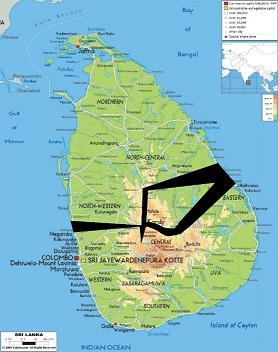
දෙමළ තරුණ කණ්ඩායම් අතරෙන් නොමග ගොස් ඝාතන මගින් ”දෙමළ නව කොටි” ඉදිරියෙන් විය. යම් සලිත වීමක් නිසා වෙල්ලාල ආධිපත්‍යය සහිත දෙමළ දේශපාලන පක්‍ෂ ”ද්‍රවිඩ එක්සත් පෙරමුණ” නමෙන් එකමුතු විය. ඒ අතර ”දෙමළ නව කොටි” වඩාත් සන්නද්ධ ව ”දෙමළ ඊළාම් විමුක්ති කොටි” (ඛඔඔෑ* බවට පත් විය. වෙල්ලාල නායකයන් ”ද්‍රවිඩ එක්සත් පෙරමුණ” ටික කලෙකින් ”ද්‍රවිඩ එක්සත් විමුක්ති පෙරමුණ” (ඔඹඛත්‍* ලෙස යළි නම් කොට ‘එල්.ටී.ටී.ඊ.’ සමග සමපාත වීමට පෙළගැසී ඇත. පෙරමුණ පිහිටුවීමෙන් පසු දෙමළ ජාතිවාදී දේශපාලන බැඳීම බලවත් විය. (වතුකර ප‍්‍රදේශය සම්බන්ධ යාපනේ වෙල්ලාල නායකයන්ගේ අදහසට එකඟ නොවූ ”ලංකා කම්කරු කොන්ග‍්‍රසය” ද්‍රවිඩ එක්සත් විමුක්ති පෙරමුණට සම්බන්ධ වූයේ නැත.* ටික කලෙකින් 1976 වසරේ වඩුක්කෝඬේ ප‍්‍රකාශය මගින් තමන්ගේ සටන ”ඊළාම්” සඳහා බව සහ සිතිියමකින් ”ඊළාම් භූමිය” ද ලකුණු කොට, එල්.ටී.ටී.ඊ. සංවිධානය ”අපේ ළමයි” යනුවෙන් තමන්ගේ සන්නද්ධ අංශය බව ප‍්‍රකාශ කරමින් තමන්ගේ අරමුණ ඉටු කරගැනීම සඳහා සහ අහිමි වෙමින් තිබූ වෙල්ලාල ආධිපත්‍යය රැුක ගැනීමට උත්සාහ දරා ඇත. ”දෙමළ ඊළාම් විමුක්ති කොටි” සන්නද්ධ බලය සකී‍්‍රය ව පැවති කාලය තුළ එය සාර්ථක නො වීය. එල්.ටී.ටී.ඊ. නියෝග වලට සහ කි‍්‍රයාමාර්ගයට අවනත වීමට සිදු විය. 

දෙමළ රාජ්‍යයක් සඳහා වූ වාර්ගික සන්නද්ධ බලය, රාජ්‍ය හමුදා විසින් අහෝසි කරන ලද 2009 වසර වෙන තෙක් සියලූ දෙමළ දේශපාලන පක්‍ෂ සහ සංවිධාන මෙහෙයවනු ලැබුවේ ”දෙමළ ඊළාම් විමුක්ති කොටි” සන්නද්ධ බලය මගිනි. ඔවුන් විසින් දෙමළ එක්සත් විමුක්ති පෙරමුණ, ඊළාම් සංවිධාන ඇතුළු සියලූ දෙමළ දේශපාලන පක්‍ෂ සහ සංවිධාන සහ උතුරු පළාතේ දෙමළ ජනතාව 2005 ජනපතිවරණයේ දී නිශ්කී‍්‍රය කරනු ලැබීය. ඔවුන්ට එරෙහි වූ දෙමළ දේශපාලන නායකයන් සදහට ම නිහඬ කළහ. ඇතැම් ඊළාම් සංවිධාන සංහාරයට ලක් කළහ. ප‍්‍රධාන වශයෙන් ම භීෂණය මගින් යටපත් ව තිබූ දෙමළ කුලවාදය ව්‍ය.ව. 2009 වසරෙන් පසු නැවත කි‍්‍රයාත්මක ව ඇති බව සහ කි‍්‍රස්තියානිකරණය වේගයෙන් සකී‍්‍රය වී ඇති බව ප‍්‍රශාන්ත් කුගනාතන්, එම්. මාදවන් ආදී විද්වතුන් පැහැදිලි කොට ඇත.66 යළිත් වෙල්ලාලයන් දෙමළ සමාජයේ සහ දේශපාලන කී‍්‍රඩා පිටියේ සියලූ මූලික ස්ථානවල බලවතුන් වී ඇත. 

දෙමළ ජනයා ඇතුළු ලක්වැසි සියලූ දෙනාට සාමය සහ සැනසුම උදා කරමින් 2009 වසරේ ”දෙමළ ඊළාම් විමුක්ති කොටි” ත‍්‍රස්තවාදය මැඩලනු ලැබීය. වර්ගවාදී දෙමළ වෙල්ලාල පක්‍ෂ සහ ඊළාම් කණ්ඩායම් එක් වී නව පෙරමුණකින් ඉදිරියට පැමිණ ඇත. ”දෙමළ ජාතික සංධානය” (ඔ්පසක භ්එසදබ්ක ්කකස්බජැුඔභ්* උතුරු සහ නැගෙනහිර පළාත් වාර්ගික භූමියක් කරගැනීමට මේ දක්වාත් පවතින පුරාණ සංස්කෘතිය සහ ශිෂ්ටාචාරය ඝාතනය, සංහාරය කිරීමේ නිරත වී ඇත. ඇතැම් හින්දු නොවෙන ටී.එන්.ඒ. ප‍්‍රධානීන් පුරාණ සිංහල බෞද්ධ වෙහෙර විහාර, පුරාවිද්‍ය ස්ථාන විනාශ කිරීමේ නිරත වෙන්නේ හින්දු ආගමික උන්නතිය සඳහා දැ’යි පැහැදිලි නැත. වර්ගවාදය ජනිත කළ අයගේ දරුමුණුපුරු පරම්පරාව වර්ගවාදී/ජාතිවාදී උග‍්‍ර අන්තගාමීන් වූ ”නාසිවාදී” වී ඇත. ජාතිවාද විරෝධී සමහර දෙමළ ජනයා ඔභ් ”දෙමළ නාසි සංධානය” ලෙස හඳුන්වනු ලබයි. 

ලෝකයේ බිහිසුණු ම වර්ගවාදියා, ජාතිවාදියා වූ හිට්ලර් යුදෙව් ජනයා සහ ඔවුන්ගේ වසර දහස් ගණනක් පුරාණ ආගම, සංස්කෘතිය සමූල ඝාතනය කළ, සංහාරය කළ ”මහා නාසි වාදියා” විය. ඔහුගේ අනුගාමිකයෝ, සහායකයෝ ද ම්ලේච්ඡු ”නාසිවාදියෝ” වූහ. වර්තමාන දේශපාලනයේ නිරත උග‍්‍ර වර්ගවාදී, ජාතිවාදී වෙල්ලාල නායකයන්, ඓතිහාසික යුගය ආරම්භයේ සිට වසර දෙදහස් පන්සියයකට වැඩි ඓතිහාසික, ආර්ථික සහ සංස්කෘතික උරුම සහිත සිංහල ජාතික ජනයාට සහ ඔවුන්ගේ ආගමට, බෞද්ධ සංස්කෘතියට එරෙහි ”ජන ඝාතක”, ”සංස්කෘතික ඝාතක” සහ ”මානව ශිෂ්ටාචාර විරෝධී” කි‍්‍රයා මගින් ම්ලේච්ඡු නාසිවාදීන් බවට පත් වී ඇත. ඔවුන්ගේ අනුගාමිකයෝ සහ සහායකයෝ ද නාසිවාදීයෝ ම ය. උතුරු සහ නැගෙනහිර පළාත්වල කි‍්‍රයාත්මක සියලූ දෙමළ දේශපාලන පක්‍ෂ, සංවිධාන මෙහෙයවන උග‍්‍ර වර්ගවාදී, ජාතිවාදී වෙල්ලාල නායකයන් සහ ඔවුන්ගේ අනුගාමිකයන් සහ සහායකයන් සියල්ලන් ම ම්ලේච්ඡු ”නාසිවාදියෝ” නාමය ලැබීම නම්බු නාමයක් ලෙස සලකනවා දැ’යි නො දනිමි.

ඓතිහාසික, ආර්ථික සහ සංස්කෘතික උරුම සහිත සිංහල ජාතික ජනයාට සහ ඔවුන්ගේ ආගමට, බෞද්ධ සංස්කෘතියට එරෙහි ”ජන ඝාතක”, ”සංස්කෘතික ඝාතක” සහ ”මානව ශිෂ්ටාචාර විරෝධී” කි‍්‍රයා මගින් ම්ලේච්ඡු නාසිවාදීන් බවට පත් වී ඇත. ඔවුන්ගේ අනුගාමිකයෝ සහ සහායකයෝ ද නාසිවාදීයෝ ම ය. උතුරු සහ නැගෙනහිර පළාත්වල කි‍්‍රයාත්මක සියලූ දෙමළ දේශපාලන පක්‍ෂ, සංවිධාන මෙහෙයවන උග‍්‍ර වර්ගවාදී, ජාතිවාදී වෙල්ලාල නායකයන් සහ ඔවුන්ගේ අනුගාමිකයන් සහ සහායකයන් සියල්ලන් ම ම්ලේච්ඡු ”නාසිවාදය” තමන්ගේ දේශපාලන න්‍යාය, ප‍්‍රතිපත්තිය සහ කි‍්‍රයාමාර්ගය ලෙස සලකන බව පෙන්නුම් කරයි.

උතුරු නැගෙනහිර දේශපාලන දැඩි බැඳීම ආරම්භ වූයේ චෙල්වනායගම්ගේ දෙමළ රාජ්‍යයක් සඳහා වූ දෙමළ වර්ගවාදී සටන් පාඨ තුළිනි. (තමිලක්කම් ව්‍යාපාරය, පනහට පනහ ව්‍යාපාරය/සමස්ත ලංකා දෙමළ සංගමය සහ දෙමළ රාජ්‍යය පක්‍ෂය යන දේශපාලන ව්‍යාපාර බිහි කළ, ඒවායේ ප‍්‍රධාන විධායක අධ්‍යක්‍ෂලා වූ වෙල්ලාල දෙමළ ප‍්‍රධානීන් තිදෙනා ම ඉංගිරිසීන් විසින් නිර්මාණය කරන ලද බැරිස්ටස්ලා (ඊ්රරසිඑදරි* වූහ. තේසවලාමෙයි නීතිය අනුව ඒ ”දෙමළ රාජ්‍යයේ” පාලකයන් වීමේ අයිතිය සහ වරප‍්‍රසාදය වෙල්ලාලයන්ට පමණක් හිමි බව ඔවුන් දැනුවත් ව සිටි බව නිසැක ය. ඔවුන් කොළඹ ඉතා සුඛොපභෝගී ජීවිත ගත කළ, ඉංගිරිසි කොලනිවාදීන් නිර්මාණය කරන ලද, ඔවුන් ඉතා කුළුපගව ඇසුරු කළ, දේශපාලන අද්වකාත්ලා වූහ. ”දෙමළ කොලනි ඒජන්තලා” (ඔ්පසක ක්‍දකදබස්ක ්ටැබඑි* වූහ. ”දෙමළ කළුසුද්දෝ” වූහ.* ( ඉන් වසර දසක කීපයකට පෙර, වෙල්ලාල කුල නො වෙන මලබාර් ද්‍රවිඩ/දෙමළ ජනයාට හිමි වහල් සමාජය බව තහවුරු කිරීමට පොන්නම්බලම් රාමනාදන් ඉංගිරිසි කොලනි පාලකයන් 1806 නීති ගත කළ තේසවලමෙයි නීතිය මගින් වෙල්ලාලයන්ට හිමි කරන ලද අයිතිවාසිකම් සහ වරප‍්‍රසාද පිළිබඳව කරුණු දක්වමින් පි‍්‍රවිකවුන්සිලයේ පිහිට පතා ඇත.(* බි‍්‍රතාන්‍ය කොලනි පුරවැසියන්ට හිමි වූ අවසාන අභියාචනා අධිකරණය-1972 ජනරජ ව්‍යවස්ථාවෙන් අහෝසි කරනු ලැබීය.*

ශී‍්‍ර ලංකාවේ වාර්ගික ජාතිවාදී නාසිවාදීන්ට ආරම්භයේ සිට රැුකවරණය, පුහුණුව, ආයුධ, මුදල්, උපදෙස් ආදිය සපයමින් සියලූ ආකාරයෙන් සහායකයන් වෙන ඉන්දියාව, ඇමරිකාව, කැනඩාව, බි‍්‍රතාන්‍යය, නෝර්වේ ඇතුළු යුරෝපීය බටහිර රටවල බලධාරීන්ගේ සහ හිටපු මහ ලේකම් බැන්කි මූන් වැනි එ.ජා.සං. යේ සිටි සහ සිටින නිලධාරීන්ගේ හෘද සාක්‍ෂිය ”නාසිවාදී” නාමය ගැන යළි යළිත් සිතිය යුතුව ඇත.

…. අවසාන කොටසට

India’s Tryst with Destiny

August 25th, 2023

Senaka Weeraratna

When the Indian Rocket ‘ Chandrahayan’ 3 landed on the Moon on August 23, 2023, it created a stunning moment that comes but rarely in history, when an age of dreaming ends and a new one begins.  The moon landing has shaken not only the soul of a single nation but that of almost all nations.  It will alter the way the people of India look at themselves as well as the way others look at the people of India, especially the Indian Scientists who made it happen.  In other words, this is an ‘epoch-making’ triumph. So far and wide would the reverberations of India’s fine achievement in the space race spread globally that we are still unable to comprehend all the fruit it will put forth. Undoubtedly, this is one of the proudest achievements of the Indian Civilization which is the mother civilization of Asia. 

The eminent Indian Scientists responsible are the new Einsteins, new Oppenheimers, and new Carl Sagans. Make no mistake. India no longer needs the validation of the West. It has come of age in a manner, form, and language that the West best understands – Victory in the Space Race.   

Nehru’s epic speech – ‘ Tryst with Destiny’

This is also a moment that reminds one of Indian Prime Minister Jawaharlal Nehru’s memorable ‘Tryst with Destiny’ inaugural address made on the eve of Indian Independence i.e., August 14, 1947.  Now ranked as one of the greatest speeches of the 20th century, here are some excerpts from his speech:

A moment comes, which comes but rarely in history, when we step out from the old to the new, when an age ends, and when the soul of a nation, long suppressed, finds utterance. It is fitting that at this solemn moment, we take the pledge of dedication to the service of India and her people and to the still larger cause of humanity. At the dawn of history, India started on her unending quest, and trackless centuries are filled with her striving and the grandeur of her successes and failures. Through good and ill fortune alike, she has never lost sight of that quest, forgotten the ideals which gave her strength”.

Landing on the moon is a moment of pure joy to celebrate.  

Not to celebrate a rapacious conquest of land and other people, spilling blood.

But a bloodless conquest of Space.

India has done what was unthinkable in India since the dawn of its birth.

To land on the moon.

India is now on the moon.

India’s lovers and well-wishers are all over the moon.

Ecstatic and delighted.

Metaphorically speaking, Lord Ganesha – God of Wisdom has done his work.  His blessings for a wise and enlightened India are on full display. The doctrine of ‘Manifest Destiny’ long touted as the cruel rationale and justification for the oppression of the dark races in the colonial era is being disapproved and demolished.

Every nonwhite i.e., black, brown and coloured man (and woman) who was for over a millennium despised and downgraded for not being on par with the White Man due to perceived inferiority can gain moral strength from India’s spectacular success.

Who can forget Lord Macaulay’s “Minute Upon Indian Education” He said unapologetically I have never found one among them who could deny that a single shelf of a good European library was worth the whole native literature of India and Arabia.”

Lord Macaulay produced in 1835 his famous Memorandum on (Indian) Education which was scathing on the inferiority (as he saw it) of native (particularly Hindu) culture and learning. He argued that Western learning was superior, and currently could only be taught through the medium of English. There was therefore a need to produce—by English-language higher education—”a class of persons, Indian in blood and colour, but English in taste, in opinions, in morals and in intellect” who could in their turn develop the tools to transmit Western learning in the vernacular languages of India. Among Macaulay’s recommendations were the immediate stopping of the printing by the East India Company of Arabic and Sanskrit books and that the company should not continue to support traditional education beyond “the Sanskrit College at Benares and the Mahometan College at Delhi” (which he considered adequate to maintain traditional learning)”.

The entire non-white world should be grateful to India for achieving what seemed impossible or unattainable, and for restoring a rare sense of pride for the entirety of the non-white races.

Day of Resonance

August 23, 2023, resonates with another momentous day of groundbreaking significance at the beginning of the last century.  

It was the day that Japan defeated Russia in 1905. Battle of Tsushima, (May 27–29, 1905), was the naval engagement of the Russo-Japanese War, which led to the final, crushing defeat of the Russian navy in that conflict at the height of Western Colonialism.

It prompted a young Oxford lecturer, Alfred Zimmern, to put aside his lesson on Greek history to announce to his class that the most historical event which has happened, or is likely to happen, in our lifetime has happened; the victory of a non-white people over a white people.”

Japan’s spectacular military victories at the beginning of the 20th century and their impact on Asian intellectuals are well documented in Pankaj Mishra’s book titled, From the Ruins of Empire: The Revolt Against the West and the Remaking of Asia.”


This work is a survey of Asian intellectuals in the late 19th and early 20th centuries and their role in pan-Asian, pan-Islamic, and anti-colonial movements. The book begins with an electrifying moment in Asia’s struggle for liberation from Western domination: the spectacular Japanese naval victory over Russia at the Battle of Tsushima in May 1905, which stunned Asians and Africans living at the time under the yoke of colonialism.

This victory of the small but resurgent Japanese navy over the imperial might of what was then accepted as a major European power fired the imagination of an entire generation of Asian leaders.

Jawaharlal Nehru, Mohandas Gandhi, Sun Yat-Sen, Mao Zedong, the young Kemal Ataturk, and nationalists in Egypt, Vietnam, and many other countries welcomed Japan’s decisive triumph in the Russo-Japanese War with euphoric zeal. In Indian cities, people distributed sweets in celebration of the Japanese Military victory. And they all drew the same lesson from Japan’s victory,” Pankaj Mishra writes. White men, conquerors of the world, were no longer invincible.”

Even Lord Curzon, Viceroy of India, noted that the reverberations of that victory have gone like a thunderclap through the whispering galleries of the East.” The world wars that followed further shrunk Europe of much of what remained of its moral and political authority in Asian eyes.

In the long view, however,” Mishra concludes, it is the battle of Tsushima that seems to have struck the opening chords of the recessional of the West.”

Japan’s defeat of Russia in 1905 was uplifting news for Asians. For the first time since the Middle Ages, a non-European country had vanquished a European power in a major war. And Japan’s victory gave way to a hundred-and-one fantasy – of national freedom, racial dignity, or simple vengefulness – in the minds of those who had bitterly endured European occupation of their lands.

Narendra Modi – transformed India like a great Chakravarti King

India will no longer be the country that its rivals would take for granted with contempt for both its leaders and people, but a new India conscious of its place in the world and obligations to both humanity and all other living beings. India’s Constitutional provision that it shall be the duty of every citizen of India to protect and improve the natural environment including forests, lakes, rivers and wildlife and to have compassion for living creatures” (Article 51 A (g)) will gain a new lease of life. This is the vision that India’s great son, Gautam Buddha, had for Bharat and its greatest Chakravarti Emperor Asoka dutifully strove to establish in the form of a compassionate society.

India’s moral voice can be expected to echo in the far-flung corners of the world in a manner that the Buddha, Mahavira, Asoka, Nagarjuna, Swami Ramakrishna, Swami Vivekananda, and Mahatma Gandhi and the like resounded to the serene joy and delight of humankind. Narendra Modi as India’s Prime Minister for the last 9 years, since 2014, has transformed India like a great Chakravarti King and raised the bar with vision.   This must be acknowledged.

When India’s time to lead the world comes, in the eloquent words of the celebrated French Writer Victor Hugo ‘no army will be able to stop’.

We the people of Sri Lanka must be chivalrous in our appreciation, especially of the world-shaking deeds of our immediate neighbour India.

We must gratefully acknowledge that it was India more than any other country that first introduced the value system for the moral and ethical foundations of Asia, through the spread of the influence of Buddhism and Hinduism.

We wish India well.

Senaka Weeraratna

Deliberate attempts to provoke jumbos & create chaos? Video…

August 25th, 2023

by Unni K Warrier Courtesy onmanorama

Thrissur: There has been a spurt in the number of captive elephants running amok during temple festi…

Read more at:

Deliberate attempts to provoke jumbos & create chaos in Kerala? Video (onmanorama.com)

Neutral foreign policy in practice

August 25th, 2023

by Neville Ladduwahetty  Courtesy The Island

President Ranil Wickremesinghe has repeatedly declared that Sri Lanka’s foreign policy is neutral. However, he and his government, meaning the Foreign Ministry in particular, has not elaborated on how a policy of neutrality works in practice. Notwithstanding this lacuna, the policy of neutrality as the foreign policy was first adopted by former President Gotabaya Rajapaksa during his acceptance speech, perhaps, influenced by the six foreign policy options presented in an article titled Independence: Its meaning and a direction for the future” (Neville Ladduwahetty, The Island, 14 Feb., 2019). Despite the fact that the policy of neutrality has been accepted by two Presidents and the current Prime Minister Dinesh Gunawardena, on grounds that it legitimately permits Sri Lanka to be free from getting entangled in major power rivalries, members of this government still publicly announce their preference for a Non-Aligned foreign policy.

LACK of CONSISTENCY

The lack of consistency has manifested itself in several instances. For instance, despite the Policy of Neutrality, an assurance given by the President to India’s Prime Minister was that Sri Lanka would factor in the security concerns of India in the implementation of the Policy of Neutrality. In the background of such assurances India did not hesitate to raise objections when a Chinese Research Ship, with surveillance capabilities, sought permission to dock at a Sri Lankan Port. However, because India could not present sufficiently valid grounds for its objections, Sri Lanka stood by its decision to permit the Chinese ship to enter Sri Lankan waters; thus living by its commitment to the Policy of Neutrality.

It is reported that the Chinese Embassy is again seeking permission for Shi Yan 6 to enter Sri Lanka’s Exclusive Economic Zone from October to November 2023. It is reported that Sri Lanka is considering this request. The practice of considering such requests on a case by case basis should stop. After the previous experience, the Defence Ministry, together with the Foreign Ministry, should have developed a Standard Operating Procedure in keeping with the Policy of Neutrality to handle requests relating to scientific studies or any other capabilities that could be a threat to the inviolability of Sri Lanka’s territory as a declared Neutral State and circulated it among the Foreign Missions. Such an exercise would convey how the Policy of Neutrality operates in practice.

On the other hand, Sri Lanka failed to live by its Policy of Neutrality when it conceded to the objections raised by India for the construction of a Solar Power Plant on the Island of Delft on grounds that it was a threat to the security of India without any elaboration, despite it being a contract offered by the Asian Development Bank after calling for international tenders. Sri Lanka did not question the grounds for the objections. Instead, it caved in without question, thus compromising its Policy of Neutrality.

The most recent manifestation of the lack of consistency was when the President signed 5 MOUs with India, all of which was to advance connectivity with Sri Lanka to the point of integration with India. The Policy of Neutrality flies in the face of such undiluted integration with one country at the expense of its relations with other countries, thus making a mockery of the credibility of Sri Lanka, its leaders and the dignity of its Peoples.

The perception that the current economic crisis justifies Sri Lanka accepting grants and lines of credit from India or from any other country should be seen as an opportunity by any country to exploit Sri Lanka’s current economic weakness to further its own interests by controlling the destiny of Sri Lanka. This after all, is not looking at a gift horse in the mouth. It is nothing but a Trojan horse that demonstrates how unadulterated realpolitik works. The reality is that India took the initiative to lend a hand to Sri Lanka during its hour of need in order to prevent any other State from lending a hand to Sri Lanka that is in its own backyard.

PRINCIPLES and DUTIES of a

NEUTRAL STATE

Based on an ICRC Publication on Neutrality, June 2022.

The Introduction of this publication states: The sources of the international law of neutrality are customary international law and, for certain questions, international treaties, in particular the Paris Declaration of 1856, the 1907 Hague Convention No. V respecting the Rights and Duties of Neutral Powers and Persons in Case of War on Land, the 1907 Hague Convention No. XIII concerning the Rights and Duties of Neutral Powers in Naval War, the four 1949 Geneva Conventions and Additional Protocol I of 1977.

­”1. PRINCIPLES AND DEFINITIONS

THE PRINCIPLE OF INVIOLABILITY

The territory of a neutral State is inviolable. It is prohibited to commit any act of hostility whatsoever on such territory. Neutrality describes the formal position taken by a State which is not participating in an armed conflict or which does not want to become involved. This status entails specific rights and duties. On the one hand, the neutral State has the right to stand apart from and not be adversely affected by the conflict. On the other hand, it has a duty of non-participation and impartiality.

Neutral space comprises the national territory of the neutral State, its territorial waters and its national air space. Neutral persons are nationals of neutral States. They lose their neutral status if they commit hostile acts against a belligerent. Individuals may join the armed forces of a belligerent party, but then they also lose their neutral status. They still have all the guarantees of protection that a member of those forces would enjoy, and therefore are entitled to POW status if they are subsequently captured. If, however, they can be defined as mercenaries, whom we covered in an earlier lesson, they do not have the right to be considered as combatants or POWs.

As long as their home State maintains normal diplomatic relations with the belligerent State they are living in or visiting, neutral persons are to be treated in the same way as they would be in peacetime. They remain under diplomatic protection. If there are no such diplomatic relations, neutral persons are entitled to be treated as protected persons under the Fourth Geneva Convention. It makes no difference to their status if they are civilians or members of the armed forces of the neutral State to which they belong”.

3. THE DUTIES OF NEUTRAL STATES (Ibid)

Policy and instructions – the neutral State must also take measures to ensure and enforce the protection of its neutrality in the neutral space for which it is responsible in relation to the belligerent parties and, in particular, their armed forces. To obtain neutral status, the State does not have to make a formal declaration, nor do other States or parties formally have to recognize such status. A formal declaration will only have the effect of making Neutral status better known.

The armed forces of the neutral State also require clear instructions on how they are to operate in relation to the defence of their territory and in dealing with incursions. For isolated and accidental violations of neutral space, the instructions might include the need to issue warnings or give a demonstration of force. For increasingly numerous and serious violations, a general warning might be called for and the use of force stepped up.

Particular obligations – the neutral State must ensure respect for its neutrality, if necessary, using force to repel any violation of its territory. Violations include failure to respect the prohibitions placed on belligerent parties with regard to certain activities in neutral territory, described above. The fact that a neutral State uses force to repel attempts to violate its neutrality cannot be regarded as a hostile act. If the neutral State defends its neutrality, it must however respect the limits which international law imposes on the use of force. The neutral State must treat the opposing belligerent States impartially.

This obligation does not mean that a State is bound to treat the belligerents in exactly the same way. It entails a prohibition on discrimination.

It forbids only differential treatment of the belligerents which in view of the specific problem of armed conflict is not justified. Therefore, a neutral State is not obliged to eliminate differences in commercial relations between itself and each of the parties to the conflict at the time of the outbreak of the armed conflict. It is entitled to continue existing commercial relations. A change in these commercial relationships could, however, constitute taking sides inconsistent with the status of neutrality.

A neutral state must never assist a party to the armed conflict, in particular it must not supply warships, ammunition or other war materials directly or indirectly to a belligerent power, but otherwise its trade with the belligerent States remains unaffected”.

The material presented above embodies internationally recognized practices that should be adopted by a neutral state.

Therefore, as a neutral state it is appropriate that issues relating to the armed conflict that ceased in May 2009 are also addressed under provisions of international humanitarian law applicable to non-international armed conflict as codified in additional protocol ii of 1977.

THE ROLE of DOMESTIC POLICY in

FOREIGN POLICY

The general understanding is that the focus of Foreign Policy is how a State maintains friendly relations and cooperation with other States in the pursuit of its national interests. However, the fact that origins of national interests are influenced and often driven by domestic interests is not given the attention it deserves. For instance, a key national interest is food security. Therefore, the domestic policy should be how to implement agricultural policies that ensure food security in a manner that assures access to food at affordable prices.

However, food security is possible only if there is sufficient water. This is where irrigation becomes a vital component in a domestic policy of food security. These issues were presented in the article referred to earlier that advocated Neutrality as the appropriate Foreign Policy for Sri Lanka in the context of geopolitical rivalries titled Independence: Its meaning and a direction for the future”. The relevant section with appropriate updates from this article is presented below:

Since Sri Lanka possesses skills, technical knowhow and materials locally, except for a small component of imported items to design and build infrastructure projects relating to water supply, highways and high-rise structures, and the only shortcoming is finance, the government should facilitate financing arrangements through local banks, through Treasury Bills or through specific taxes instead of taking bilateral loans from any of the major powers blocks. If Sri Lanka is compelled to take loans to implement infrastructure projects to further its economy, at least Sri Lanka should insist whenever possible that the design and construction of such projects should, as a policy, be undertaken by Sri Lanka. However, there are projects beyond the capability of local talent in fields such as power generation and value addition of raw materials that are currently being exported. One way of attracting Foreign Direct Investment is for the government to encourage and facilitate the emerging class of astute entrepreneurs to engage with the private sector in countries that have the know-how to implement those projects that are beyond the capabilities of local talent”.

In the meantime, the government should focus on food security by giving every possible incentive locally, not only because tried and tested skills and knowhow are available locally through centuries of experience but also because it is the fastest and most effective way to improve the livelihood and wellbeing of the bulk of the nation. Such traditional agricultural practices should be coupled with up to date technologies relating to transport, packaging and processing of agricultural products together with marketing the end products for local consumption as well as export’.

Since water is the most vital input for agriculture the government should undertake a programme to restore the ancient tanks that dot the landscape of Sri Lanka as part of food security, because the consequence of climate change is the certainty that it is not possible to predict when and where it would rain. As a key feature of such a programme, the upper elevations that form the catchment area of the major rivers in Sri Lanka should be declared a natural reserve under the control of the central government and reforested to harvest precipitation from either of the monsoons”.

A development strategy that should run parallel with food security should be the development of a whole range of organic agricultural products including spices outside the range related to food security e.g. horticulture, flowers, ornamental plants and foliage along with spices and herbal medicinal plants not only for local consumption but also specifically targeted for export. A few pioneering entrepreneurs have already embarked on this field of activity but it is only a serious and concerted thrust undertaken by the government as an integral part of a National Economic Policy to develop agriculture and agriculture-based products that could take this field of economic activity far beyond what it is today. Each of the 24 Districts should be declared the epicenter of such agricultural endeavours based on targets set by the Center. Such a strategy would contribute directly to the human development of a hitherto neglected section of the rural population with the minimum of external input”.

It is evident from the foregoing that a whole range of Economic Policies could emerge based on the Domestic Policies adopted. These Domestic Policies would contribute immeasurably to Sri Lanka being free of the dependence on imported agricultural products. For instance, the declaration by the Minister of Agriculture that Sri Lanka imports nearly 2 Billion Dollars of fruits and vegetables is a shameful admission of a failed and flawed Domestic Policies. In such a background to talk about competitive export oriented Economic Policies is to reverse priorities.

An issue that is of vital importance to a State that practices Neutrality as its stated Foreign Policy is that it cannot afford to entertain unsolicited infrastructure projects such as the Light Rail Project from Japan and the offshore Nuclear Power Plants from Russia. Since the actions of a Neutral State must be neutral and therefore act free of any preferences or biases in the implementation of its Economic Policies or any commercial activities, its engagement with other States should be transparent and open. Furthermore, the initiative to implement such projects should be formulated by the Neutral State as part of its Domestic Policy.

CONCLUSION

Now that the President and Prime Minister of Sri Lanka have declared that Sri Lanka’s foreign policy is neutral, the material presented herein gives the internationally accepted norms by which a Neutral State should conduct its Foreign Relations and in turn how other States should respect its Policy of Neutrality. One vital aspect of such a norm is the respect of other States for the inviolability of the territory of the Neutral State and its integrity.

The Policy of Neutrality is the best defence Sri Lanka has to deter global powers from attempting to get control of Sri Lanka because of its strategic location on grounds internationally recognized norms of conduct applicable to a Neutral State. The extent to which Sri Lanka succeeds in retaining its Freedoms and Independence amidst such challenges depends on how Sri Lanka conducts its Foreign Relations as a Neutral State.

The most recent concern to the Policy of Neutrality is the request by the Chinese Research Ship to enter Sri Lankan waters to carry out research studies in collaboration with National Aquatic Resources Research and Development Agency (NARA); a practice they have been engaged in since 2017 after signing an MOU. The MOU has lapsed and is due for renewal. The recommendation is that if such concerns are to avoided the Defence Ministry together with the Foreign Ministry should develop a Standard Operating Procedure relating to the entry of any sea going vessel to enter Sri Lankan waters and circulate it among the Foreign Missions so that they are forewarned about the internationally recognized rights of a Neutral State.

The other aspect addressed is the symbiotic relationship that exists between Domestic Policies and Foreign Policies. In this regard the recommendation advocated is to seriously and strenuously focus on developing internal strengths particularly in the fields of agriculture to ensure food security and in the field of horticulture for export. In short, the Domestic Policies should focus on reducing imports in all fields that Sri Lanka can free itself of external dependence. The fact that Sri Lanka imports fruits and vegetables is a shame that Sri Lanka can do without.

As a Neutral State, Sri Lanka should conduct its Foreign Relations in a manner that underscores its core civilizational value of self-reliance to meet future challenges.

Basil R should change course if we are to come out of this foreign reserve crunch

August 25th, 2023

Dr Sarath Obeysekera

Since 2015 Export Development Board has been trying to implement National Export Strategy ( NES) with few salient features which can enhance our foreign currency reserves

A few of them are Development of Boat Building for Export coupled with Nautical Tourism in addition to Development of Spice Trade,Digital Technology  Transformation, development of  Wellness Tourism.

Nautical  tourism coupled with wellness tourism can be a winner for the country during this COVID pandemic where foreign tourists can be enticed or travel to Sri Lanka to spend their time to spend their holiday And also to recuperate after a Corona infection 

Many medium-sized cruisers are laid up in many parts of the world  and Sri Lanka can hire them at a reasonable fee and deploy them from Port City Hambantota, Galle, and Trincomalee 

Various hotels nearby those harbors can provide staff and food to these cruisers  with few private hospitals providing v medical facilities

Proposals were submitted to the task force but no attention was paid by the tourism authority 

Sailing from one port to another by sea could avoid tourists contacting locals to prevent the spread of COVID.

LankaWeb – Basil R should change course if we are to come out of this foreign reserve crunch

Gammanpila stresses need for SL to join BRICS, writes to President

August 25th, 2023

Courtesy The Daily Mirror

Pivithuru Hela Urumaya(PHU) leader MP Udaya Gammanpila requested President Ranil Wickremesinghe in writing to take steps for Sri Lanka to become a member of BRICS, an organized named after its original five members- Brazil, Russia, China and South Africa.

Gammanpila, in an open letter to the president, said global economic and political trends change fast, and the world power is shifting towards Asia. 

He said it is high time for Sri Lanka to review its foreign policy in the latest context and reset it accordingly.
At the latest summit of BRICS in Johannesburg, South Africa, another six countries – Saudi Arabia, Iran, Ethiopia, United Arab Emirates, Egypt and Argentina secured full membership. A number of other countries have sought to join it. 
The countries in BRICS account for 27 percent of the global GDP. As an initiative of BRICS, a lending agency called ‘New Development Bank’ has been set up with an initial capital of US $ 50 billion as an alternative to the International Monetary Fund (IMF) and the World Bank. 
 
Gammanpila said the US dollar, as an international currency, dominated the global market with the backing of the G7 countries including the United States. He said BRICS is now exploring a common approach for international transactions, independent of the US dollar. (Kelum Bandara)

Intelligence services reveal Catholic behind Kurundi unrest: Minister

August 25th, 2023

Courtesy The Daily Mirror

Local intelligence services have identified a Catholic was behind the unrest situation that has been created in Kurundi, State Minister of Defense Premitha Bandara Tennakoon said yesterday.

He told parliament that international intelligence services had not issued any warnings to the government on possible racial and religious unrest in the country as reported by certain media and social media.

The Minister said local intelligence services have identified that certain groups were trying to create racial and religious unrest in certain places in the country with political provocation and that the government, security forces and intelligence services have paid special attention to the developments.

He said intelligence services have identified that a catholic residing in Mullaitivu has paid special interest to the Kurundi incident and trying to create issues there.

Opposition Leader Sajith Premadasa earlier in the day called on the government to brief all political parties and all other factions concerned regarding the recent reports in local and international media saying that possible religious and racial class as revealed by intelligence units.

He told Parliament that local and international media had reported quoting intelligence units that there is a possibility of class between religious and racial groups which could lead to explosions and unrest in the country.

The Opposition Leader said it was a serious matter which affects national security and urged the government to brief all political parties and all other factions concerned on the authenticity of the media reports.

He said the government should pay special attention to the turmoil that occurred in the country after the Easter Sunday attacks and take steps to prevent a similar situation again.(Ajith Siriwardana and Yohan Perera)

Saffron Curtain: How Buddhism Was Weaponized During the Cold War

August 24th, 2023

Amar Diwakar

March 23, 2018

The U.S. tried to foment an anti-communist Buddhist bloc in Southeast Asia—with deadly consequences for the region’s politics today.

Tang Chhin SothyAFP/Getty

Of the world’s major faiths, Buddhism is often characterized as being a religion of peace, tolerance, and compassion. The Western encounter with Buddhism has largely been distilled through yoga, the beatniks, Hollywood, and Dalai Lama quotes shared on Facebook. But even a cursory glance at the news that emanates from the Buddhist world reveals a more sanguinary state of affairs.

In Myanmar, ultra-nationalist monks have fueled a genocidal crusade against the country’s Rohingya Muslim population. In Thailand, the government has responded to a long-running Malay Muslim insurgency in its southern provinces by fostering a Buddhist militarism, encouraging monks in local temples to ally with the armed forces. And in Sri Lanka, the Buddhist-majority Sinhalese were engaged in a bitter civil war against the Hindu-minority Tamils for decades. More recently, Buddhist nationalists there have stoked anti-Muslim riots.

COLD WAR MONKS: BUDDHISM AND AMERICA’S SECRET STRATEGY IN SOUTHEAST ASIA by Eugene Ford

Yale University Press, 392 pp., $40.00

Still, Buddhism continues to have an alien aura, as if it were an entirely otherworldly religion with a gnostic distaste for the worldly order,” as the scholar Ian Harris has written. There is a tendency to frame the rise of Buddhist nationalism as an anomalous phenomenon. In fact, as the historian Eugene Ford shows in his book Cold War Monks: Buddhism and America’s Secret Strategy in Southeast Asia, the Buddhist world was a laboratory of competing visions and ideologies in the Cold War—an experiment that helped politicize Buddhism into the often violent, reactionary force we see in Southeast Asia today.

Buddhism and statecraft have long been joined at the hip. The religion supplied the symbols of kingship in courts, capitals, and urban centers from Burma (now Myanmar) to Siam (Thailand) to Laos, as monastic orders and ruling elites forged intimate ties. Following the seventeenth century, European imperialism disrupted the symbiosis of religion and state in places where colonial regimes were installed. By the early half of the twentieth century, anti-colonial movements saw monks participate in dissent, laying the foundations for the clergy to enter secular affairs.

The exception was Thailand, the only country in the region to avoid formal colonization. It was a distinction that shaped its nationalist narrative, which glorified the monarchy while sheltering its monks from the activism of their counterparts in neighboring countries. However, during World War II, imperial Japan’s occupation of Bangkok offered a harbinger of the outside pressures that would be released upon Buddhism in the postwar era. Tsusho Byoto, an obscure Japanese scholar-monk, advocated a militarized conception of Zen in an attempt to recruit the guarded Thai monastic order to the fascist cause. While he ultimately failed, Byoto’s vision of an internationalized Thai monkhood would in many ways prove prophetic,” Ford writes.


The immediate postwar aftermath saw revolutionary nationalist movements proliferate from Indonesia to Vietnam, guided by an anti-colonial ethos informed by Marxism. Colonial powers waged costly and ultimately doomed counterrevolutionary wars to reestablish control, which then dovetailed with the U.S.’s anti-communist efforts as Europe withdrew from the scene.

A military-strategic alliance with the U.S. became the central pillar of Thailand’s foreign relations after 1947, drawing the rest of Southeast Asia into a turbulent geopolitical orbit. The partnership early on faced two challenges: Thailand had to keep up the appearance that the conservative monkhood was segregated from the political realm, while adherence to the First Amendment prevented any direct U.S. involvement in Thailand’s religious affairs. All this did was compel Washington to operate clandestinely, as it began to shape a pliable Buddhist bloc that would act as its proxy.

The gravitational forces of the Cold War would cause the Buddhist clergy to become more politicized and more internationalized than ever before. In 1953, during the Eisenhower administration, Vice President Richard Nixon undertook a formative trip across Asia. In Vietnam, Nixon visited the front lines of the Indochina Wars to witness a French offensive against Viet Minh insurgents. He was frustrated by France’s patronizing attitude toward its Vietnamese allies, and disturbed by a failure to establish a legitimate cause to counter the stirring appeal of their anti-colonial adversaries.

The defeat of the French at Dien Bien Phu in 1954 then made it clear that military action itself was insufficient to combat communism in the region. Hearts and minds—or, pagodas and temples—were going to be just as essential. Religion, Ford says, was a lever the United States could use to wield influence of a nonmilitary or psychological nature, not least by emphasizing to local populations the supposed communist threat to their religious institutions.”

Coinciding with Washington’s strategy at the time was the emergence of a pan-Buddhist consciousness. Advancements in communication and transportation had accelerated religious and cultural exchange and deepened interconnectivity within the milieu of Theravada Buddhism, the predominant strain of Buddhism in Southeast Asia. The 2,500th anniversary of the Buddha’s death inspired the launch of the first international Buddhist organization in 1950: the World Fellowship of Buddhists. Coupled with the 1954 staging of the Great Buddhist Synod in Burma, there were signs that the consolidation of a Buddhist bloc was ripe for engagement.

The earliest of U.S. efforts began in Burma between 1951 and 1952. Burma’s Prime Minister U Nu had been battling a domestic communist insurgency since 1948 and looked to incorporate Burmese Buddhism” into an anti-communist program. This was well received by Washington, as conveyed by a 1951 State Department memo to its embassy in Rangoon. The memo highlighted the rules of engagement as it applied to U.S. funding of religious activities, which had to be undertaken through private channels to obscure any official links.

The CIA deepened such activity across the region. As early as 1948, it harvested intelligence on Bangkok’s Vietnamese monasteries to monitor for potential communist links. At the invitation of the U Nu government, the Committee for a Free Asia—which was renamed the Asia Foundation in 1954—became active in Burma in 1952, bankrolled by the CIA through the National Committee for a Free Europe. (Much of Ford’s archival sources come from the Asia Foundation.) The Asia Foundation had extensive behind-the-scenes involvement in the Great Buddhist Synod. By 1962, Ford notes, it had contributed over $300,000 in the form of original printing equipment and technical advice to make Burma’s Buddha Sasana Press the world’s largest and best equipped Buddhist publishing house.”

The Asia Foundation would then expand its operations into neighboring Thailand, Cambodia, and Laos. Harnessing the foundation’s platform and networks in the region, Washington provided grants to Buddhist educational and civic groups, and distributed anti-communist propaganda. It also made sure to send (unofficial) delegations to Buddhist conferences while sponsoring trips for senior members of the Buddhist community to the U.S.

By 1957, White House policy-makers had produced a general policy framework geared towards the manipulation of Buddhist institutions and monks. The draft was circulated within U.S. embassies across Southeast Asia, and even a special Buddhist Committee” was formed in the State Department to assist its implementation. By emphasizing community activism, Ford writes that the Asia Foundation’s aim had been to preserve the monkhood’s traditional abstention from politics by providing alternative forms of civic engagement.” Much like Byoto, the Asia Foundation resembled a foreign agent determined on restructuring Thailand’s cloistered Buddhist institutions.


As turmoil enveloped Southeast Asia, however, the strategy began to unravel, as forces that were activated failed to align as intended.

A coup d’état deposed Burma’s U Nu in 1962, and the military junta engaged in a protracted campaign against a local communist insurgency. The repression of Buddhists under the U.S.-supported Catholic leader Ngo Dinh Diem in Vietnam during the Buddhist Crisis,” and the self-immolation of the monk Quang Duc in 1963, hastened a political crisis that culminated in a military coup, Diem’s assassination, and the further spiraling of South Vietnam into chaos. In 1967, the Asia Foundation’s CIA patronage was exposed in the antiwar journal Ramparts. Eventually, despite U.S. military aid and religious sponsorship, communists took power in Laos and Cambodia in 1975. That same year, Saigon fell to the Viet Cong.

With the specter of communism at its doorstep, the Thai conservative establishment curbed the postwar experiment of civilian democratic rule in its quest for stability. It achieved this by soliciting the services of a notorious right-wing monk named Kittivudho, who to Ford represented both the activation and the internationalization of Thai Buddhist conservatism.” By incentivizing the assassination of leftists with accumulation of religious merit, Kittivudho fused Buddhist doctrine with a virulent anti-communism. He lent institutional support to right-wing paramilitary organizations and vigilante groups, as the Thai government (with implicit support from Washington) carried out a brutal crackdown on students, labor activists, and farmers.

Cold War Monks alerts readers to the ways in which the volatile currents of the Cold War swept up Southeast Asian Buddhism. What was an ultimately unsuccessful effort to draw the monkhood out of its political quietism swiftly mutated into an anti-progressive force, and continued to endure as a dark cloud over the region’s politics in subsequent decades.

This bloody legacy echoes in the present. It can be detected in the violent response of Thai monks to the Malay Muslim insurgency in the south, a campaign that has many similarities with Myanmar’s clerical-led anti-Muslim 969 movement. Under the pressures exerted by globalization, Buddhism continues to provide a source of legitimacy for nation-states across the region. Its followers are susceptible to battle cries to preserve the faith under the banner of a muscular Buddhist nationalism.

The termination of the Cold War did not erase the imprint of a more bellicose Buddhism. Only instead of a godless communism, now it is a transnational militant Islam that is envisioned as a threat to Buddhist identity and tradition. This ideological shift just so happens to coincide with the U.S.’s war on terror,” which has been operationalized to justify the bloody reprisals in Thailand and the pogroms in Myanmar. And the monks are front and center of it all.

Amar Diwakar @indignant_sepoy

Amar Diwakar is an independent writer and researcher. He has written for Al Jazeera English, The Boston Globe, In These Times, and other publications. He blogs at Splintered Eye.

උතුර සහ නැගෙනහිර බැඳීම-7

August 24th, 2023

විමල් පටබැඳිගේ – ශාස්ත‍්‍රවේදී, නීතිඥ, විශ‍්‍රාමික සොලිසිටර්

6 වෙනි කොටසෙන්

…. ”යාපනේ තරුණ කොන්ග‍්‍රසය” ලෙස නම් කරන ලද යාපනේ ශිෂ්‍ය සංගමය63 උතුරු පළාත සහ නැගෙනහිර පළාත අතර යම් දේශපාලන සම්බන්ධයකට මග සැලසී ය. (වර්තමානයේ හෝ යාපනේ කතෝලික/කි‍්‍රස්තියානි සංවිධානය ඉන්දියාවේ දෙමළ කතෝලික/කි‍්‍රස්තියානි සංවිධානයේ මෙහෙය වීමෙන් මිදී ඇති බවක් නොපෙනේ.* වාර්ගික නියෝජනය වෙනුවට 1929 ඩොනමෝර් ප‍්‍රතිසංස්කරණ හඳුන්වා දුන් නියෝජිත නියෝජනය පිළිබඳව දුරදිග නො බලා ගත් තීරණ සමග යාපනේ තරුණ කොන්ග‍්‍රසය යාපනේ අනෙක් වෙල්ලාල වාර්ගික දේශපාලන ව්‍යාපාර තුළ වියැකී ගියේ ය.

7 වෙනි කොටස

”බි‍්‍රටිෂ් රාජ්” මෙන් පාලන බලවතුන් වීමේ අරමුණ සඳහා කොළඹින් ද දෙමළ වාර්ගික නියෝජනයක් දෙන ලෙස ඉංගිරිසි කොලනි පාලකයන්ට කළ ඉල්ලීම අසාර්ථක වීමෙන් පසු රාමනාදන් ආරම්භ කළ ”තමිලක්කම්” ව්‍යාපාරය සහ ජී. ජී. පොන්නම්බලම්ගේ 50 ට 50 ව්‍යාපාරය සාමාන්‍ය දෙමළ ජනයා වෙනුවෙන් නොව ලංකාවේ දෙමළ ”බි‍්‍රටිෂ් රාජ්” පාලකයන් වීමේ යාපනේ වෙල්ලාලයන්ගේ ”අභිලාශය” වෙනුවෙන් වූ වාර්ගික කුලවාදී ව්‍යාපාර විය. ඉංගිරිසි කොලනිවාදීන් සමග සබඳතා පැවති, උගතුන් වූ ඔවුන්ගේ බසට, එදිනෙදා භාවිතයට ප‍්‍රමාණවත් ලෙස දෙමළ භාෂාව පමණක් දැන සිටි යාපනේ සාමාන්‍ය දෙමළ ජනයා නැඹුරු වීම ස්වාභාවිකය. වෙල්ලාලයන්ට දෙමළ සෙසු කුලවල ජනයා වහලූන් ලෙස තබා ගැනීමට වහල් හිමි තත්වය දෙමින් බලය දෙන ලද තේසවලමෙයි නීතිය ද හේතු විය.(* ජී. ජී. පොන්නම්බලම් 1939 වසරේ නාවලපිටියේ දී ප‍්‍රචාරක රැුස්වීමේ කළ දෙමළ වර්ගවාදී කථාව මගින් දිවයිනේ වර්ගවාදී දේශපාලන ඉතිහාසයේ පළමු සිංහල දෙමළ ගැටුමක් අවුලූවා රට ම ගිනි තැබීමට මුල් වූ බව වාර්තා වී ඇත. (චෙල්වනායගම්ගේ මෙහෙයවීම නිසා සිදු වූ 1958 ගැටුමට වසර දහනවයකට පෙර ය.* 

පොන්නම්බලම් රාමනාදන්, ජී.ජී. පොන්නම්බලම් ආදී දෙමළ වෙල්ලාල ප‍්‍රධානීන් ඡුන්ද අයිතිය පුළුල් නොකරන ලෙස සහ ඡුන්ද බලය දෙන්නේ නම් ‘වෙල්ලාල’ කුලයේ පිරිමින්ට පමණක්, එනම් වෙල්ලාල වුව ද කාන්තාවන්ට සහ වෙල්ලාල නොවෙන (දෙමළ පහත් කුල* ජනයාට ඡුන්ද බලය නොදෙන ලෙසත්, මුස්ලිම් ප‍්‍රධානීන් කාන්තාවන්ට ඡුන්ද බලය නොදෙන ලෙසත් ඉල්ලා සිටිය දී සහ සමහර සිංහල ප‍්‍රධානීන් ”වඳුරන්ට දැලිපිහි දීම වැනි” යයි අකැමැත්ත දක්වද්දී ඩොනමෝර් කොමිසමේ නිර්දේශ අනුව සියලූ වැඩිහිටි පුරවැසියන්ට ඡුන්ද බලය දෙමින් විසිවෙනි සියවසේ තෙවෙනි දසකයේ වාර්ගික නියෝජනය වෙනුවට නියෝජිත නියෝජන ක‍්‍රමය ආදේශ කිරීම තුළින් ද්‍රවිඩ වෙල්ලාලයන් අතර පැවති බල තරඟය උත්සන්න කිරීම සිදු විය. ”බි‍්‍රටිෂ් රාජ්” මෙන් පෙනී සිිටීම සඳහා පැළඳ සිටි ”රෙදි ඔටුන්න” (විශේෂ තලප්පාව* දැරීම නියෝජිත නියෝජන ක‍්‍රමය තුළ ගිලිහෙන්නට විය. 

මන්ත‍්‍රණ සභාව තුළ සිංහල සහ දෙමළ 50 ට 50 නියෝජිත නියෝජනය සඳහා ඉල්ලීම් කළ ජී. ජී. පොන්නම්බලම්ගේ සමස්ථ ලංකා දෙමළ සංගමය (්කක ක්‍ැහකදබ ඔ්පසක ක්‍දබටරුිිු්ක්‍ඔක්‍* ලංකාවේ පළමු වාර්ගික දේශපාලන පක්‍ෂය විය. එය ලංකාවට ඩොමීනියන් තත්වයට (1948 අර්ධ නිදහසට* පෙර වර්ගවාදය/ජාතිවාදය බලගැන්වීමක් විය. (ඔහුගේ මුණුපුරු පරම්පරාව ද වර්ගවාදයේ අන්තයේ ”නව නාසිවාදීන්” වී ඇත.* මින් පෙර රටේ පාලන බලතල ලබාගැනීම සඳහා වූ සංවිධාන මිස වාර්ගික දේශපාලන පක්‍ෂ තිබුණේ නැත. 

මැලේසියාවේ ”භූමිපුත‍්‍ර ව්‍යාපාරය” ස්වදේශික පදනම මත විය. එරට අත්හැර පැමිණ ලංකා දෙමළ සංගමයේ දේශපාලනය තුළ කලක් නිරතව සිටි (මැලේසියානු බි‍්‍රතාන්‍ය කොලනි පුරවැසි* එස්. ජේ. වී. චෙල්වනායගම් 1949 දී ”ලංකා දෙමළ රාජ්‍ය පක්‍ෂය” (ඉලංකෛ තමිල් අරසු කච්චි ු ක්‍ැහකදබ ඔ්පසක ීඒඑැ ඡු්රඑහුක්‍ඔීඡු* දිවයින තුළ දෙමළ රාජ්‍යයක් බිහි කිරීමේ අරමුණ ඇතිව ආරම්භ කළේය. ව්‍ය.ව. 13 වෙනි සියවසේ පවා නොතිබුණු, විශේෂයෙන් ම 1449 වසරෙන් පසු, 1795 වසරේ ඉංගිරිසි කොලනිවාදී ආක‍්‍රමණිකයන් යාපනේ අර්ධද්වීපය අල්ලා ගනු ලැබූ කාලයේ හෝ නොතිබුණු ”දෙමළ රාජ්‍යයක්” නිරිමාණය කිරීමේ ඉලක්කය වූ වාර්ගික උද්යෝග පාඨයෙන් යාපනේ සෙසු වෙල්ලාල ප‍්‍රධානීන් අභිබවා ගියේය. (ඉලංකෛ තමිල් අරසු කච්චි නමින් දෙමළ ජනයාට ඇමතූ අතර අනෙක් ජනයා සහ ලෝකය හමුවේ ”ෆෙඩරල් පක්‍ෂය” නමින් පෙනී සිටියේය. එය දකුණු ඉන්දියාවේ දෙමළ රාජ්‍යයක් සඳහා වූ සංවිධානය ජස්ටිස් පාටි නමින් හැඳින්වීම වැනි ය.* සමහරෙකු විසින් ”යාපනේ ගාන්ධි”, යනුවෙන් සහ තවත් කෙනෙකු විසින් ”දෙමළ ජනතාවගේ මෝසෙස්” (ලක්‍ෂ්මන් වික‍්‍රමසිංහ බිෂොප්, වත්මන් ජනපතිගේ පියාගේ සහෝදරයා* ආදී විශේෂණවලින් වර්ණ ගන්වනු ලැබූ චෙල්වනායගම් මෙහෙය වූ දෙමළ වර්ගවාදී/ජාතිවාදී ව්‍යාපාරය තුළ දෙමළ වෙල්ලාල කුලවාදී දේශපාලනය රැුකවරණ ලැබීය. ”යාපනේ ගාන්ධි” මගින් දෙමළ හින්¥ භක්තිකයන් සහ ”දෙමළ ජනතාවගේ මෝසෙස්” මගින් දෙමළ කි‍්‍රස්තියානි භක්තිකයන් දෙමළ වර්ගවාදය/ජාතිවාදය තුළ ගොනු කිරීම දැඩි විය. 

උතුරු නැගෙනහිර දේශපාලන දැඩි බැඳීම ආරම්භ වූයේ චෙල්වනායගම්ගේ දෙමළ රාජ්‍යයක් සඳහා වූ දෙමළ වර්ගවාදී සටන් පාඨ තුළිනි. (තමිලක්කම් ව්‍යාපාරය, පනහට පනහ ව්‍යාපාරය/සමස්ත ලංකා දෙමළ සංගමය සහ දෙමළ රාජ්‍යය පක්‍ෂය යන දේශපාලන ව්‍යාපාර බිහි කළ, ඒවායේ ප‍්‍රධාන විධායක අධ්‍යක්‍ෂලා වූ වෙල්ලාල දෙමළ ප‍්‍රධානීන් තිදෙනා ම ඉංගිරිසීන් විසින් නිර්මාණය කරන ලද බැරිස්ටස්ලා (ඊ්රරසිඑදරි* වූහ. තේසවලාමෙයි නීතිය අනුව ඒ ”දෙමළ රාජ්‍යයේ” පාලකයන් වීමේ අයිතිය සහ වරප‍්‍රසාදය වෙල්ලාලයන්ට පමණක් හිමි බව ඔවුන් දෙමළ ජනතාවට පමණක් නොව සමස්ථ ලෝකයට ම රහසක් කොට ඇත. ඔවුන් කොළඹ ඉතා සුඛොපභෝගී ජීවිත ගත කළ, ඉංගිරිසි කොලනිවාදීන් නිර්මාණය කරන ලද, ඔවුන් ඉතා කුළුපගව ඇසුරු කළ, දේශපාලන අද්වකාත්ලා වූහ. ”දෙමළ කොලනි ඒජන්තලා” (ඔ්පසක ක්‍දකදබස්ක ්ටැබඑි* වූහ. ”දෙමළ කළුසුද්දෝ” වූහ.* (ඉන් වසර දසක කීපයකට පෙර, වෙල්ලාල කුල නො වෙන මලබාර් ද්‍රවිඩ/දෙමළ ජනයාට හිමි වහල් සමාජය බව තහවුරු කිරීමට පොන්නම්බලම් රාමනාදන් ඉංගිරිසි කොලනි පාලකයන් 1806 නීති ගත කළ තේසවලමෙයි නීතිය මගින් වෙල්ලාලයන්ට හිමි කරන ලද අයිතිවාසිකම් සහ වරප‍්‍රසාද පිළිබඳව කරුණු දක්වමින් පි‍්‍රවිකවුන්සිලයේ පිහිට පතා ඇත.(* බි‍්‍රතාන්‍ය කොලනි පුරවැසියන්ට හිමි වූ අවසාන අභියාචනා අධිකරණය-1972 ජනරජ ව්‍යවස්ථාවෙන් අහෝසි කරනු ලැබීය.*

ඉන්දියාව සහ ලංකාව ඇතුළු ලෝකයේ බි‍්‍රතාන්‍ය කොලනිවල වාසය කළ, කරවන ලද ද්‍රවිඩ/ දෙමළ ජනයා 18 වෙනි සියවස අවසාන කාලයේ සිට ”ඉන්දීය මූලය සහිත බි‍්‍රතාන්‍ය පුරවැසියෝ” වූහ. ලංකාවේ පදිංචි කරවන ලද/පදිංචි වූ මලබාර් ද්‍රවිඩ/දෙමළ ජනයා ”ලංකා පුරවැසි” බවට පත් කරනු ලැබුවේ ඉංගිරිසි කොලනිවාදීන් 1948 දී ”ලංකා කොලනියේ” වගකීම් අත්හල පසු ය.

1948 වසරේ බි‍්‍රතාන්‍ය කොලනිවාදීන් රට සහ පුරවැසියන් පිළිබඳ වගකීම සහ වගවීම අත්හැරීම සහ ඉන් මිදීම සමග, ඔවුන් විසින් ගෙන්වීමෙන් සහ පැමිණීමෙන් දිවයිනේ නේවාසික වූ ඉන්දිීය (මුස්ලිම් භක්තිකයන් ද ඇතුළු* ජනයාගේ ”බි‍්‍රතාන්‍ය කොලනි පුරවැසි” භාවය අහෝසි විය. ඉන්දියාව ඔවුන් ඉන්දීය පුරවැසියන් ලෙස සැලකුවේ නැත. ඉංගිරිසි පාලකයෝ වසර සියයක පමණ කාලයක් වහල් සේවාවේ යොදාගත් ”ඉන්දියානු දෙමළ” ජනතාව අනාථ කළහ. මේ ගැටළුව විසඳාගැනීමට කොලනි පාලනයෙන් මිදුණු සෑම රටකට ම වාගේ සිදු විය. කෙන්යා, ඝානා, උගන්ඩා ආදි අපි‍්‍රකානු රටවලින් ”වහාම පිටවීමේ නියෝගය” අනුව ඉන්දිියානු විශාල පිරිසක් භාර ගැනීමට බි‍්‍රතාන්‍ය පාලකයන්ට සිදු විය. 1948 දී ලංකාවේ එවැන්නක් නොවීය. සකලවිධ ”කළුසුද්දන්” දණ නමා ආචාර කොට ඇත. ඉංගිරිසි කොලනි පාලකයෝ ඔවුන් ”කූලීන්” ලෙසම සලකා අත්හළහ. වෙල්ලාලයන් ”පරෙයි” ආදී ‘කුල’ ජනයා ‘හීනජන්මී’ (මබඑදමජය්ඉකැි* ‘හන’ (ලේබලය* තබා බැහැර කළ අතර ඉංගිරිසි කොලනි පාලකයන් තම භාෂාවට ”පරයා” (ච්රස්ය* එක් කොට තමන් අකැමැති රටවලට සහ පුද්ගලයන්ට ඒ ”හන” තබමින් ඇත.

ඉංගිරිසි කොලනි පාලකයන් වගකීම් අත්හල විට මේ නේවාසිකයෝ තවදුරටත් ”බි‍්‍රතාන්‍ය කොලනි පුරවැසියෝ” නො වූහ. කිසි ම රටක පුරවැසියෝ නො වූහ. සෙසු රාජ්‍යවලට මෙන් ම ලංකා රාජ්‍යයට ද පුරවැසි අයිතිය තීරණය කිරීමට සිදු විය. ඉංගිරිසීන් විසින් සහ ඉන්දීය පාලකයන් විසින් නො සලකා හරින ලද, ”ඉන්දියානු දෙමළ” ජනයාගෙන්, පියා ලංකාවේ උපන්, 145,000 පිරිසක් 1948 පුරවැසි නීතියෙන් (ඔයැ ක්‍ැහකදබ ක්‍සඑස‘ැබියසච ්ජඑ දෙ 1948* පුරවැසි අයිතිය ලැබීය. වෙල්ලාලයන් ප‍්‍රමුඛ ”ලංකා දෙමළ” සංඥා නාමයෙන් වෙන් ව සිටි පිරිසට ද ලංකා පුරවැසි භාවය නීත්‍යනුකූලව හිමි වූයේ 1948 පුරවැසි නීතිය අනුව ය. සමස්ථ ලංකා දෙමළ සංගමයේ (්ක්‍ඔක්‍* නායක ආණ්ඩුවේ ඇමති තනතුරක් දැරූ ජී.ජී. පොන්නම්බලම් පනතට පක්‍ෂ විය. ඉන්දියාව තමන්ගේ රටේ උපන් දෙමළ ජනයා නො සලකාහැරි අතර ඉංගිරිසීන් තමන්ගේ ලාභය වෙනුවෙන් ”කූලීන්” (වහලූන්* ලෙස ආනයනය කරන ලද දෙමළ ජනයාගේ වගකීම භාරගැනීමට සදාචාර සම්පන්න වූයේ නැත. පසුව සිරිමා ශාස්තී‍්‍ර ගිවිසුම මගින් ගැටළුව නිරාකරණය කරගැනීමට හැකි වුව ද වෙල්ලාල දේශපාලන නායකයන් කළ බාධක අපමණ ය. (ඉන්දියාවට යාමට නියමිත ව/සූදානම් ව සිටි ලක්‍ෂ පහක පමණ පිරිසක් වසර කීපයකට පසු දේශපාලන ලන්සුවක් බවට පත් වී පුරවැසි බවට පත් විය.* පුරවැසි අයිතිය සම්බන්ධ නීතිය වෙල්ලාල දේශපාලකයන් විසින් රටේ පුරවැසියන් බෙදා වෙන් කිරීමට ”දේශපාලන ආයුධයක්” ලෙස යොදාගනු ලැබීය. ඔවුන් ඒ ”දේශපාලන ආයුධය” උතුර, නැගෙනහිර පමණක් නොව දිවයිනේ විසිරී සිටින සියලූ දෙමළ ජනතාව බද්ධ කිරීමට භාවිත කිරීම නතර කොට නැත. බි‍්‍රතාන්‍යය සහ ඉන්දියාව විසින් සාරධර්ම ඉවත ලා ”සරණාගතයන්” බවට පත් කරනු ලැබූ ”ඉන්දියානු දෙමළ” ජනයා ”ශී‍්‍ර ලංකා පුරවැසියන්” බවට පත් වූයේ 1948 ලංකා පුරවැසි නීතිය මගිනි.

….. 8 වෙනි කොටසට

The 1953 Hartal; A personal Experience: Garvin and Gunasena Galappatty on a BSA 250

August 24th, 2023

Garvin Karunaratne

Many recent Papers detailing details of the August 12, 1953 Hartal in nostaglia took me to my days at Arunachalam Hall at Peradeniya.

It was the 11 th of August 1953 and we students had planned for a major a protest in Kandy on the next day. The Vice Chancellor had decided that no student was to be given any permission to leave.

Suddenly my Hall mate Gunasena Galappatty received a telegram from his home in Nakalagamuwa. It stated that his mother was seriously ill and wanted him to come at once. Gunasena wanted to go but there was no method as every mode of transport would not be functioning .

A bright idea struck us and Gunasena decided to get a mo bike from a friend. One colleague had a mo bike -BSA 250 at Peradeniya and I happened to be the rider who often was called upon when he could not accommodate any urgent request from a friendly student.

The mo bike was available but the fact that no student could be granted leave was the problem. Gunasena in tears and I went to Dr. GVS de Silva, Lecturer in Econ our sub warden and explained that we had to go to see his mother. GVS listened patiently and said. I cannot give you permission, but You can go. Be safe.”

We took off at around two o clock that day. By four we dropped in at my home at Mahasen Mawata, Nugegoda and was greeted by my parents. We were there for a cup of tea. We explained our mission and got going in around fifteen minutes. Off to Galle we reached around six and saw many poilce movements, vans full of them but continued. In around ten miles it was very difficult to ride on the roads as there were Z metal pieces strewn on all roads and we had to ride very slow dodging all the Z pieces to avoid a tyre burst. We reached Nakulugamuva by mid night. Gunasena barged in to his home to find his mother in good health speaking in glee to see his son. I knew you would be upto some samasamaja tricks and this was my method of keeping you safe.” Gunasena took it all with a smile. We had a hastily prepared dinner and got off to sleep.

The next morning we were on the road, back to the campus at Peradeniya. We could go only upto Matara when we found the road to Galle blocked- unpassable, blocked with trees. We did not know the roads and discussing with people we were told that there was a road to Ratnapura via Deniyaya and there was a road to Kegalla from Ratnapura via Avissawella. We lingered to see whether we could try to go to Galle but the road blocks were well held.

We decided to try to go via Ratnapura and sped to Akuressa, to Deniyaya, through Hayes and by afternoon we were going over the Hayes hair pin bends to Rakwana and finally reached Ratnapura. Then we proceeded to Eheliyagoda when we found that it was not possible to go any further to Avissawella. Speaking to people we were told that there was a way to proceed to Kegalla via inland roads and we sped on. We could not proceed far when the roads were blocked with cut trees. We alighted and moved the trees and moved on with some difficulty. As we moved the trees people came forth and inquired who we were and we said we were from the University at Peradeniya. That changed the mood and we were greeted and they moved the trees and we were allowed to pass. We all sang Sadukeen Pelena Un Den Itin Nagitiyaw.

We could hardly move a mile when we found the road blocked again and we entered singing Sa Dulin Pelena Un Dan Itin Nigitiyaw and found that we were greeted and the people came in droves to move the trees. Thereafter till we reached Dehiovita and finally Karawanell, we were stopped at around twenty five or more road blocks and as we approached them we sang the song and were allowed to pass after we helped the people to move the trees. It was a long tedious process and we found the roads blocked again and again till we reached Kegalla. It was a genuine peoples’ uprising and we were in the thick of it.

It was near mid night and found the roads to Kandy closed at Kegalla. No one was allowed to proceed. The police who stopped us inquired who were were and when we said we were from the University at Peradeniya looked at us with scorn and wanted us to wait. They communicated to others and we were told to wait. In a flash it came to our mind that Dasa, a very senior student in our first year was now a Civil Service cadet and working at the Kegalla katcheri . He was probably the Assistant Government Agent of the District. That was DMDP Dassanayake known to both of us. We inquired from the policemen who had detained us and inquired for his residence. We said that we will be staying at his place. Suddenly the mood of the policemen changed and we were told the way and we took off.

We knocked on his door and were made welcome.

The next morn we took off to Peradeniya and found the campus stirred. The earlier evening the police had confronted the students at Kandy and had followed the students to Peradeniya with minor confrontations. The student body had been pushed back to Jayatileka Hall when the students were baton charged. The students had rushed into the Hall and somehow many concrete blocks had been broken, I do not know how that had happened that quickly but the concrete blocks were hurled at the police and many constables were injured. In the melee the police had gone into the J Hall and had arrested a few students who were playing table tennis. These included our friend Bassa and also a son of a Judge, who were charged in the Courts. I can remember visiting Basnayake’s parents at Polgahawela, again on the motorbike. in connection with the Court Case against the innocent students.

Garvin Karunaratne

24/8/2023

Debt and the Crisis of Survival in Sri Lanka and the World

August 24th, 2023

Asoka Bandarage

[This article is derived from the author’s new book: Asoka Bandarage, CRISIS IN SRI LANKA AND THE WORLD: COLONIAL AND NEOLIBERAL ORIGINS: ECOLOGICAL AND COLLECTIVE ALTERNATIVES (Berlin: De Gruyter,2023) https://www.degruyter.com/document/isbn/9783111203454/html?lang=en]

Sri Lanka has been faced with an unprecedented political and economic crisis since the beginning of 2022. The dominant narrative attributes the crisis to the confluence of the COVID-19 pandemic, the Ukraine conflict, China’s ‘debt trap diplomacy’ and – most importantly – the corruption and mismanagement of the ruling Rajapaksa family. Western mainstream media celebrated the so-called aragalaya (struggle, in Sinhala) protest movement that led to the ouster of the Rajapaksas and upholds the IMF bail-out as the only solution to the dire economic situation.

The aragalaya protests emerged from genuine economic grievances, but failed to develop an analysis beyond the ‘Gota, Go Home’ demand for Gotabaya Rajapaksa to resign. Influenced by local and external interests with their own agendas, the protestors exhibited little-to-no awareness or critique of the global political economy and the financial system at the root of the country’s crisis.

In 2022, the United Nations Conference on Trade and Development (UNCTAD) reported that 60 percent of low-income countries and 30 percent of emerging market economies are ‘in or near debt distress.’ While the details differ from country to country, the historical patterns of subordination that have given rise to global crises are the same. The Sri Lankan crisis is an illustrative example of convergent global debt, food, fuel and energy crises facing much of the world. It is corporate media bias and narrative control that deflects from this analysis.

The island’s severe debt and economic crisis must be seen in a broader global context as the culmination of several centuries of colonial and neo-colonial developments, and the disastrous and inevitably self-destructive capitalist paradigm of endless growth and profit. Debt is not a straightforward number but a social relation embedded in unequal power relations, discourses and moralities…and…institutionalized power.”.

Colonialism and Neocolonialism

The development of export agriculture and the import of food and other essentials under British colonialism turned Sri Lanka into a dependent ‘peripheral’ unit of the global capitalist economy. Adopting ideologies of modernization and development and theories of comparative advantage, the capitalist imperative integrated self-sustaining indigenous, peasant, and regional economies into the growing global economy, through the appropriation of land, natural resources, and labor for export production.

Monocultural agriculture, mining, and other export-based production disturbed traditional patterns of crop rotation and small-scale subsistence production that were more harmonious with the regional ecosystems and cycles of nature. Plantation development contributed to deforestation, loss of biodiversity and animal habitats. While a small local elite prospered through their collaboration with colonialism, most people became poor, indebted, and dependent on the vagaries of the global market for their sustenance.

Although colonized countries including Sri Lanka gained political independence following World War II, unequal exchange continued under neo-colonialism. Terms of trade disadvantaged the ‘Third World’ with their labor, resources and exports grossly undervalued and imports overvalued. The dynamic is better understood as poorer countries being over-exploited rather than under-developed. Rising populations combined with corruption and inefficiency of local governments gave rise to endemic foreign exchange shortages and economic crises in Sri Lanka and many other countries.

The debt relief and aid given by the IMF, the World Bank and bilateral institutions from the Global North have been mere band-aids to keep the ex-colonial countries tethered to the global financial and economic structures. Post-independent Sri Lanka went to the IMF 16 times before the current 2023 bail-out which seeks to further perpetuate the county’s cycle of debt dependence.

The transfer of financial and resource wealth from poor countries in the global South to the rich countries in the North is not a new phenomenon. It has been an enduring feature throughout centuries of both classical and neo-colonialism. Between 1980 and 2017, developing countries paid out over $4.2 trillion solely in interest payments, dwarfing the financial aid they received from the developed countries during that period.

Currently, international financial institutions – notably the IMF and the World Bank – remain outside political and legal control without even ‘elementary accountability’. As critics from the Global South point out, The overwhelming power of financial institutions makes a mockery of any serious effort for democratization and addressing the deteriorating socioeconomic living conditions of the people in Sri Lanka and elsewhere in the Global South.”

Financialization and Debt

Corporate and financial deregulation which accompanied the rise of neoliberalism starting in the 1970s has given rise to financialization, and the increasing importance of finance capital. As more and more aspects of social and planetary life are commoditized and subjected to digitalization and financial speculation, the real value of nature and human activity are further lost. As a 2022 United Nations Report points out; food prices are soaring today not due to a problem with supply and demand but due to price speculation in highly financialized commodity markets.

A handful of the largest asset management companies, notably BlackRock (currently worth USD $ 10 trillion) control very large shares in companies operating in practically all the major sectors of the global economy: banking, technology, media, defense, energy, pharmaceuticals, food, agribusiness including seeds, and agrochemicals.

Financial liberalization advanced when interest rates dropped in the richer countries after the global 2008 financial crisis. Developing countries were encouraged to borrow from private international capital markets through International Sovereign Bonds (ISBs) which come with high interest rates and short maturation periods. Although details are not available to the public, BlackRock is reportedly the biggest ISB creditor of Sri Lanka. Most of Sri Lanka’s foreign debt is ISBs, with over 80% of Sri Lanka’s debt owed to western creditors, and not – as projected in the mainstream narrative – to China.

IMF debt financing requires countries to meet its familiar structural adjustment conditions: privatization of state-owned enterprises (SOEs), cutbacks of social safety nets and labor rights, increased export production, decreased import substitution and alignment of local economic policy with US and other Western interests. These are the same aims as classical colonialism, they are just better hidden in the more complex modern system and language of global finance, diplomacy and aid.

A vast array of policies exacting these aims are well under way in Sri Lanka, including the sale of state-owned energy, telecommunications and transportation enterprises to foreign owners, with grave implications for Sri Lanka’s economic independence, sovereignty, national security and the wellbeing of her people and the environment.

The IMF approach does not address long-term needs for bioregionalism, sustainable development, local autonomy and welfare. A small vulnerable country such as Sri Lanka cannot change the trajectory of global capitalist development on its own. Regional and global solidarity and social movements are necessary to challenge the deranged global financial and economic system that is at the root of the current crisis.

Global South Resistance

Since the 1970s, major collaborative projects have been initiated by developing countries and the UNCTAD to develop a multilateral legal framework for sovereign debt restructuring. Yet they are futile in the face of the powerful opposition of creditors and the protection given to them by wealthy countries and their multilateral institutions, and the UN has failed to uphold commitment and implement a debt restructuring mechanism.

Sri Lanka was a global leader in efforts to create a New International Economic Order, the Non-Aligned Movement and the Indian Ocean as a Zone of Peace in the 1960s and 70s. In the early years of their political independence, countries throughout Asia, Africa and Latin America sought to forge their own paths of economic and political development, independent of both capitalism and communism and the Cold War. These included African socialist projects such as Tanzania’s Ujamma, import substitution programs in Latin America and left-wing nationalism and decolonization efforts in Sri Lanka and many other countries.

Almost without exception, these nationalist efforts failed, not only due to internal corruption and mismanagement but also due to persistent external pressure and intervention. Massive efforts have been taken by the Global North to stop the Global South from moving out of the established world order. A case in point is the nationalization of oil companies owned by western countries in Sri Lanka in 1961 and the backlash against the left-nationalist Sri Lankan government which dared to take such a bold move. The western response included the 1962 Hickenlooper Amendment passed in the U.S. Senate stopping foreign aid to Sri Lanka and to any country expropriating American property without compensation.” As a result, Sri Lanka lost its credit worthiness, the domestic economic situation worsened, and the left-nationalist government lost the 1965 elections (with some covert US election support). Observing those developments, political economist Richard Stuart Olsen wrote: …the coerciveness of economic sanctions against a dependent, vulnerable country resides in the fact that an economic downturn can be induced and intensified from the outside, with the resulting development of politically explosive ‘relative deprivation’…”

These observations resonate with Sri Lanka’s current repetition of the same vicious cycle: an externally dependent export-import economy; worsening terms of trade; foreign exchange shortage; policy mismanagement; external political pressure; debt crisis; shortages of food, fuel and other essentials; mass suffering; and political turmoil.  

Geopolitical Rivalry  

Sri Lanka’s present economic crisis – the worst since the country’s political independence from the British – must be seen in the context of the accelerating neocolonial geopolitical conflict between China and the USA in the Indian Ocean. Many other countries across the world are also caught in the neocolonial superpower competition to control their natural resources and strategic locations.

There is much speculation as to whether the debt default on April 12, 2022 and political destabilization in Sri Lanka were ‘staged’ or intentionally precipitated to further the US’s ‘Pivot to Asia’ policy, the Indo-Pacific Strategy and the Quadrilateral Alliance (USA, India, Australia and Japan) in its competition to confront China’s $1 trillion Belt and Road Initiative and counter China’s presence in Sri Lanka.

It is widely recognized in Sri Lanka that ‘The policy of neutrality is the best defence Sri Lanka has to deter global powers from attempting to get control of Sri Lanka because of its strategic location.’ Although President Gotabaya Rajapaksa claimed to pursue a ‘neutral’ foreign policy, the Rajapaksas were seen as closer to China than the west. After Prime Minister Mahinda Rajapaksa and President Gotabaya Rajapaksa were forced to resign, Ranil Wickramasinghe – a politician who was resoundingly rejected in the previous elections by the electorate but is a close ally of the west – was appointed as President in an undemocratic transition of power.

To what extent were Sri Lanka and her people victims of an externally manipulated ‘shock doctrine’ and a regime change operation, sold to the world as internal disintegration caused by local corruption and incapability? While it is not possible to provide definitive answers to these issues, it is necessary to consider the available credible evidence and the geopolitics of debt and economic crises in Sri Lanka and the world at large.

Paradigm Shift

As the locus of global power shifts from the west and a multipolar world arises, new multilateral partnerships are emerging for development financing, such as the New Development Bank (NDB) – formerly referred to as the BRICS (Brazil, Russia, India, China and South Africa) Development Bank – as alternatives to the Bretton Woods and other western dominated institutions. However, given controversial projects, such as China’s Port City and India’s Adani Company investments in Sri Lanka as well as their projects elsewhere, it is necessary to ask if the BRICS represent a genuine alternative to the prevailing political-economic model based on domination, profit and power?

Dominant political power in our era is about propaganda, control of narratives and exploiting ignorance and fear. In the face of worsening environmental and social collapse across the world, there is a practical need for a fundamental questioning of the values, assumptions and misrepresentations of the dominant neoliberal model and its manifestations in Sri Lanka and the world.

At the root of the crisis, we face is a disconnect between the exponential growth of the profit-driven economy and a lack of development in human consciousness, i.e., in morality, empathy, and wisdom. Ultimately, dualism, domination and the unregulated market paradigm need to be questioned to find a balanced path of human development, based on interdependence, partnership and ecological consciousness. Such a path of development would uphold the ethical principles necessary for long-term survival: rational use of natural resources, appropriate use of technology, balanced consumption, equitable distribution of wealth, and livelihoods for all.

Grant Cardone Asks: How Do Politicians Become Millionaires Making $100,000 Per Year? Economist Identifies ‘Suspicious Personal Profit Pattern’

August 24th, 2023

Jeannine Mancini Courtesy Finance Yahoo.com

Grant Cardone, a renowned sales trainer, speaker and entrepreneur with an estimated net worth of $600 million, recently took to X, formerly Twitter, to raise a thought-provoking question: “Can someone explain to me how public servants (politicians) are becoming multimillionaires on $100,000 salaries?”

While the message did not specify which public servants he was referring to, it is presumed that Cardone’s remarks were primarily aimed at members of the U.S. Congress.

See more on startup investing from Benzinga:

A 2020 Open Secrets report revealed that more than half of the 535 members of Congress are millionaires, implying a substantial contrast between their financial status and the average American. The $100,000 salary Cardone mentioned remains unclear. According to a 2022 Congressional Institute report, the average annual salary for a rank-and-file member of Congress stands at $174,000, a figure consistent with recent estimates provided by The Washington Post.

The speaker of the House earns $223,500 annually, while the Senate president pro tempore and the majority and minority leaders each earn $193,400.

Though the salaries are substantial, they do not guarantee millionaire status. They provide a solid foundation upon which to build additional income streams during congressional service.

Congress members are not restricted from earning income outside their official roles, but there are regulations to ensure transparency and prevent conflicts of interest. The regulations limit additional income to no more than 15% of the Level II of the Executive Schedule, a system used to determine the pay scale of political appointees in the executive branch. Members are also required to disclose the sources of both earned and passive income, including stock dividends.

Grant Cardone Asks: How Do Politicians Become Millionaires Making $100,000 Per Year? Economist Identifies ‘Suspicious Personal Profit Pattern’ (yahoo.com)

Mahinda Failed to Emulate Modi Magic

August 24th, 2023

Dilrook Kannangara

Modi is a remarkable political success story in the world’s largest democracy. He has not only protected his vulnerable vote base from the threats of terrorism, separatism, poverty, external threats and demographic challenges, India has made unprecedented and even unbelievable progress under Modi’s leadership. His strategic thinking and visionary skills have turned him into a celebrity. Indians around the world pay good money just to see him and hear him out. Global leaders from the Global South to the Global North and from the West to the East reach out to Modi. He is the most sought-after political leader in the world.

However, Modi was not without controversy. India’s minorities have accused him of war crimes, human rights abuses, racism, extremism and violence. Even the West accused him for all these even before he became the PM and after he assumed the top post the West opted to tone down these allegations temporarily. Well, you cannot make everyone happy, unless you are an ice cream charity. Overall Modi is the most successful Indian leader ever and the most effective.

Both Modi and Mahinda are polarizing political figures. Both have been accused of war crimes and human rights abuses by the West and some internal elements too. Both used nationalism to propel their political forces. But the legacy of them differs vastly. More importantly the fate of their respective nations which were influenced by them in no small measure are poles apart. India progresses rapidly but Sri Lanka collapses in every aspect. Modi is gaining popularity by the year while Mahinda and his associates are losing popularity and even basic respect every passing year.

What failed Mahinda where Modi succeeded?

Modi Magic #1 – You Cannot Make Everyone Happy

Modi understood that you cannot make everyone happy. Trying to make everyone happy only bankrupts you or the nation as it is costly to attempt and gives no economic or political returns. Having understood it, Modi segmented, targeted and positioned his national agenda accordingly. His target was the Indian Hindu majority. Others could join the bandwagon if they pleased but Modi would not change a thing to accommodate them.

Mahinda disastrously failed in this regard. He tried his very best to appease everyone. His supporters included a wide range of people across all ethnic, religious, political and even military-terrorism divides. It is the popular view but it has no traction in the political and economic fields. Mahinda thought he could balance competing political, ethnic and economic issues, the north and the south, through a contradictory but loyal approach. His brother Gotabaya will be the one for the south and his other brother Basil will be for the north, so to speak. The north would be won by showering it with economic benefits (over 85% of borrowed funds from 2009 to 2013 were spent in the north) while the south (not the geographic south but the rest outside the north and east of the island) was to be won by selling his war victory.

The north rejected Mahinda and his policies in total and considered anyone who opposed Mahinda to be a friend. The south followed. For completely different reasons. By 2022 Rajapaksas had to hide in navy camps, navy ships, foreign countries and give the reigns to their enemy just to stay safe from the people. No one came to their rescue, not the people and not the military. This is the outcome of trying to appease everyone – no one will be appeased.

Modi Magic #2 – Make Alliances That Tangibly Benefit the Nation

Under Modi, India followed a highly productive, opportunistic foreign policy. Certainly not a non-aligned policy. He didn’t hesitate to team up with anyone that benefitted India. He was not driven by emotion, philosophy and other nonsense. As a result, India gained from the East and the West, Russia and USA, China and Japan, Arabic nations as well as from Israel, from Iran as well as from Saudi Arabia. He didn’t drag India into controversy just to make himself happy.

Sadly, Mahinda totally failed in this regard. He openly forged close ties with Hugo Chaves, Ahmadinejad, Kaddafi, Palestinian Liberation groups, etc. that had no benefit whatsoever for Sri Lanka. Not only they were economically and politically useless, the relationship Sri Lanka had with them dragged the island nation into needless global disputes. Rajapaksas eventually suffered a similar fate as them.

Modi Magic #3 – Decisiveness

The biggest contrast between Modi and Mahinda is decisiveness. Although Mahinda was decisive about the war, that’s all. Modi on the other hand, is decisive on all matters. Blaming the weak and small size of Sri Lanka is misplaced. Although India is much larger and much more powerful than Sri Lanka India’s challenges and adversaries are also many times more powerful than Sri Lanka. This includes both internal and external forces against India and Modi.

A big part of Mahinda’s indecisiveness boils down to family concerns. His extended family interests always became a massive burden on him. Looking after all their interests and the national interest is simply not possible. Modi on the other hand has no such baggage.

Modi Magic #4 – Wisdom

PM Modi has the ability to see through beneficial political alliances and ruinous ones. Mahinda does not. Modi refrained from making ruinous alliances no matter how tempting they looked. He and his party would rather run alone and suffer election loss than team up with shady political parties with ethnic tribalism. Sadly, Mahinda did not have the wisdom to separate the two. He teamed up with SLMC, TMVP, EPDP, WPF, etc. that are tribal political parties that do not sit comfortably with Mahinda’s constituency. These alliances did more bad than good. They were quick to change allegiance as it benefitted them.

Modi Magic #5 – Consistency

PM Modi is the same person who was once the Chief Minister of Gujarat. Although his views expanded to national and international levels, he remained close to his roots. This is the main attraction of Modi. Mahinda failed to do so. He and his family members drifted more towards the global West. His sons too drifted towards ‘Colombians’ – the island’s west. This move made them unhinged from their roots and essentially uprooted them. When they were under physical attack no one came to their rescue as they had uprooted themselves from their bases.

Conclusion

One may argue that Modi is a divisive figure whereas Sri Lanka needs a unifying figure. India needs and gained a unifying figure more than Sri Lanka whereas Sri Lanka failed! You cannot unify everyone. Unifying with elements that are burdens for the national interest does no good. India has a clear policy (inclusive or otherwise it is a clear and useable policy) whereas Sri Lanka ended up with a cesspool of policy confusion that pulls it in three different directions. This is the difference between success and failure, nationally and politically. Modi won where Mahinda failed. India won where Sri Lanka failed.

RUTHLESS DESECRATION OF AHMADIYYA MOSQUES REACHES GRIM MILESTONE OF 14 MOSQUES VANDALISED THIS YEAR AS POLICE IN PAKISTAN COMPLICIT IN HATE-FUELLED ATTACKS.

August 24th, 2023

by A. Abdul Aziz

U.K. based International Human Rights Committee (IHRC) has reported that a wave of bigotry against Ahmadis has intensified since the start of 2023. 

 Wave of attacks on Ahmadiyya Muslim Mosques has taken place in the first week of August 2023, as the situation is becoming worst day by day for the already marginalized Ahmadis in Pakistan. 

The assailants desecrated the minarets of the Ahmadiyya Muslim Mosque in Chak 168 Murad, Bahawalnagar.  On August 8, in EB 373, Thana Sheikh Faazal, Tehsil Burewala, Distt Vihari, the police broke the minaret of the 53-year-old Mosque

This marks the 14th such attack on an Ahmadiyya Muslim Mosque since the start of the year with attacks taking place in Sindh and Punjab. 

The police and government institutions are all acting as a party against the Ahmadis and instead of providing safeguards to Ahmadi places of worship, they are themselves caring out the vandalism of these holy sites, at the behest of extremist and bigoted religious clerics. 

It is extremely shocking that in Pakistan, there has been such a sharp increase in attacks against people of the Ahmadiyya community and also incidents of damage to their property, especially Ahmadiyya Muslim Mosques and graveyards. 

The places of worship of the Ahmadiyya Muslim Community are under constant attack by miscreants, put to mischief by their extremist clerics, who have no fear of the law as they are confident no action will be taken against them. 

In the line of atrocities, on 5th Aug 2023, the arch of the Ahmadiyya place of worship was broken with hammers at noon in Mali Para area of Sanghar city. Sad scenes of this event quickly started circulating on social media.

None of the accused in any of the incidents have been brought to justice which gives rise to more atrocities to be committed which will again go unpunished.  Authorities continue to stand by and even be complicit in atrocities committed by radical clerics in Pakistan.

In Pakistan, there has been a sharp increase in attacks against people of the Ahmadiyya community and also incidents of damage to their property, especially Ahmadiyya Muslim Mosques and graveyards. 

Human rights groups have repeatedly expressed their deep concern over the lack of attention to the serious human rights violations perpetrated against the Ahmadiyya community and called on the international community to step up efforts in bringing an end to the ongoing persecution of Ahmadis. 

It is repeatedly urged the international community to pressure the Government of Pakistan to honor its responsibility to provide protection to all its citizens, ensure freedom of religious practice to Ahmadis, and bring perpetrators of such vicious attacks to justice.

එක්සත් රාජධානියේ සෞඛ්‍ය ආරක්ෂණ සහ ශිෂ්‍යත්ව ප්‍රදාන වැඩසටහන 2024 දී නැවත ඇරඹීමට පියවර.

August 24th, 2023

අග්‍රාමාත්‍ය මාධ්‍ය අංශය

 ශ්‍රී ලංකාවට එක්සත් රාජධානියේ ආධාර වැඩසටහනේ 2 වැනි අදියර ශ්‍රී ලංකාවේ ආරම්භ කිරීම පිළිබඳව  බ්‍රිතාන්‍ය වැඩබලන මහ කොමසාරිස් Lisa Whanstall මහත්මිය, බ්‍රිතාන්‍ය සෞඛ්‍ය හා සමාජ ආරක්ෂණ දෙපාර්තමේන්තුවේ ෆ්ලෙමින්( Fleming) අරමුදලේ නියෝජිත පිරිසක් සහ අග්‍රාමාත්‍ය දිනේෂ්  ගුණවර්ධන මහතා  අතර සාකච්ඡාවක් 2023.08.23 දින කොළඹ, අරලියගහ මන්දිරයේදී පැවැත්විණි.

කොවිඩ් වසංගතය හේතුවෙන් පසුගිය වසර කිහිපය තුළ නතර කර තිබූ සෞඛ්‍ය ආරක්ෂණ ප්‍රදාන වැඩසටහන 2024 ජනවාරි මාසයේ දී නැවත ආරම්භ කරන බව බ්‍රිතාන්‍ය වැඩබලන මහ කොමසාරිස් වරිය මෙහිදී  පැවසුවාය. එය රෝගියාගේ සෞඛ්‍යය වැඩිදියුණු කිරීමට, ජාතික සෞඛ්‍ය ප්‍රතිපත්ති දැනුම් දීමට සහ නැගී එන තර්ජනවලට අනතුරු ඇඟවීමට මහජන සෞඛ්‍ය නිරීක්ෂණ සඳහා සහාය වනු ඇත.

සෞඛ්‍ය අමාත්‍යාංශය, ලෝක සෞඛ්‍ය සංවිධානය සහ අනෙකුත් ආයතනවල සහාය ඇතිව ප්‍රදාන වැඩසටහන ක්‍රියාත්මක කෙරෙයි. මෙම වැඩසටහන යටතේ සෞඛ්‍ය අංශ කාර්ය මණ්ඩලය සඳහා පුහුණු ශිෂ්‍යත්ව ලබා දෙනු ඇත.

රටේ සෞඛ්‍ය පද්ධතියේ ප්‍රගමනයට ඉමහත් ප්‍රයෝජනවත් වන මෙම සෞඛ්‍ය සේවා වැඩසටහනේ ප්‍රතිලාභියා ලෙස ශ්‍රී ලංකාව තෝරා ගැනීම පිළිබඳව අග්‍රාමාත්‍යවරයා මෙහිදී එක්සත් රාජධානියට ස්තූතිය පළ කළේය. ශ්‍රී ලංකා සෞඛ්‍ය සේවාව බ්‍රිතාන්‍ය ක්‍රමය මත ක්‍රියාත්මක වන බවත් එවැනි සෞඛ්‍ය සේවා වැඩසටහන් ක්‍රියාත්මක කිරීමේදී කිසිදු දුෂ්කරතාවයක් ඇති නොවන බවත් ඔහු පෙන්වා දුන්නේය.

බ්‍රිතාන්‍ය කවුන්සිලයේ මෙරට නේවාසික අධ්‍යක්ෂ ඔර්ලන්ඩෝ එඩ්වර්ඩ් මහතා විසින් කවුන්සිලයේ ඉංග්‍රීසි භාෂා පුහුණු ක්‍රම පිළිබඳ ප්‍රකාශන මාලාවක් අග්‍රාමාත්‍යවරයා වෙත පිළිගැන්වීය.

ග්‍රාමීය ප්‍රදේශවල තරුණ තරුණියන්ට ඉංග්‍රීසි භාෂා අධ්‍යාපනය හඳුන්වා දෙන ලෙස අග්‍රාමාත්‍යවරයා වැඩබලන මහ කොමසාරිස් කාර්යාලයෙන් සහ බ්‍රිතාන්‍ය කවුන්සිලයෙන් ඉල්ලා සිටියේය.

එක්සත් රාජධානියේ ෆ්ලෙමින් අරමුදලේ ආචාර්ය ජෙසිකා වොලිස් සහ වෛද්‍ය නේහා ගුලාටි, බ්‍රිතාන්‍ය මහ කොමසාරිස් කාර්යාලයේ ප්‍රධාන නිළධාරී ඇන්ඩෘ ප්‍රයිස් සහ අග්‍රාමාත්‍ය අතිරේක ලේකම් දීපා ලියනගේ මෙම සාකච්ඡාවට සහභාගි වූහ.

අග්‍රාමාත්‍ය මාධ්‍ය අංශය

ප්‍රංශ – ඇල්ජීරියානු ලේඛක ඇල්බෙයා කැමූ

August 24th, 2023

වෛද්‍ය රුවන් එම් ජයතුංග 

ප්‍රංශ  – ඇල්ජීරියානු ලේඛක ඇල්බෙයා කැමූ   උපත ලැබුවේ 1913 නොවැම්බර් 7 වන දින ප්‍රංශ ඇල්ජීරියාවේ මොන්ඩෝවි (වර්තමාන ඩ්‍රියාන්) හිදීය. ඔහුගේ දෙමව්පියන් යටත් විජිතවල වඩා හොඳ ජීවිතයක් අපේක්‍ෂා කල ප්‍රංශ සංක්‍රමණිකයන් වූහ. ඔහුගේ පියා දුප්පත් ප්‍රංශ කෘෂිකාර්මික කම්කරුවෙකු වූ අතර 914 දී පළමුවන ලෝක සංග්‍රාමයේදී මිය ගියේය. කැමූ අර්ධ වශයෙන් බිහිරි වූ සිය මව සහ වැඩිමහල් සොහොයුරා වන ලුසීන් සමඟ ඇල්ජියර්ස්  හි බෙල්කෝට් කොටසේ  ජීවත් විය.  කුඩා කාලයේ සිට දිලිඳු කම ඔහු අත් වින්දේය. තම පවුල  සියලු මිනිස් දුක්ඛිත තත්වය හා අවාසනාව නියෝජනය කල බව පසු කාලයක ඔහු පැවසීය. ඔහුගේ ළමා කාලයේ දුගී භාවය  ඔහුගේ ලිවීමට, දේශපාලනයට හා බොහෝ ආකාර වලින් ඔහුගේ ආකල්ප වලට  බලපෑවේය   1918 දී කැමූ ප්‍රාථමික පාසලට ඇතුළත් වූ අතර 1923 දී ඇල්ජියර්ස් ලයිසියම් පාසල සඳහා ශිෂ්‍යත්වයක් දිනා ගත්තේය. දරිද්‍රතාවයෙන් මිදීමේ  පියවරක් ලෙස කැමූ ඇල්ජියර්ස් විශ්ව විද්‍යාලට ඇතුළත් විය. ඔහු ඇල්ජියර්ස් විශ්ව විද්‍යාලයේ දර්ශනය හැදෑරීය. 

කැමූ දර්ශනවාදයට යොමු වූයේ ඔහුගේ දර්ශන ගුරුවරයා වූ ජීන් ග්‍රෙනියර්ගේ බලපෑමෙනි. ඔහු ග්‍රීක දාර්ශනිකයන් සහ ෆ්‍රෙඩ්‍රික් නීට්‍ෂේ ගේ කෘති කියවීය. කැමූ,  ස්ටෙන්ඩල්, හර්මන් මෙල්විල්, ෆියෝඩර් දොස්තයෙව්ස්කි සහ ෆ්‍රාන්ස් කෆ්කා වැනි ලේඛකයන් ගේ කෘති අධ්‍යනය කලේය. කැමූ  ඔහුගේ දර්ශනය බොහෝමයක් පැවැත්මේ ප්‍රශ්න වටා යොමු කළේය. සොබාදහමේ විකාර රූපී සහ නිරපේක්‍ෂ උදාසීනත්වය ඔහු වටහා ගත්තේය.

ඇල්බෙයා කැමූ ඇල්ජීරියාවේ දෙවන පරම්පරාවේ ප්‍රංශ ජාතිකයෙකි.  ඔහු වයස අවුරුදු විසිපහේදී ප්‍රංශයට පැමිණියේය. කැමූ ප්‍රංශ සාහිත්‍යයේ දැවැන්තයෙකු ලෙස සලකනු ලැබුවද ඔහුගේ ජීවිතය හා කලාව වඩාත් හැඩගස්වා ඇත්තේ ඔහුගේ උතුරු අප්‍රිකානු උපන් ස්ථානයයි.  කැමූ ප්‍රබල දාර්ශනික නැඹුරුවක් ඇති නවකතාකරුවෙකි. එහෙත් ඔහු තමන් දාර්ශනිකයෙකු ලෙස හඳුන්වනවාට එරෙහි විය. කැමූ ගේ නවකතාවල ප්‍රධාන තේමාව වන්නේ මිනිස් ජීවිතය වෛෂයිකව  (objectively) කථා කිරීම අර්ථ විරහිත ය යන අදහසයි.  කැමූගේ  සමස්ත දර්ශනය පදනම් වී ඇත්තේ  absurdism (විකාරරූපී / නිරර්ථක ) අදහස මතය.  මෙහිදී absurdism යනු අවුල් සහගත හා අතාර්කික විශ්වයක කිසිවක් සොයා ගැනීමට මිනිසාට ඇති නොහැකියාවයි. ඔහු තර්ක කරන්නේ ජීවිතයේ අරුත පිළිබඳ ප්‍රශ්නයට සෑහීමකට පත්විය හැකි පිළිතුරක් සොයාගත නොහැකි බවත්, විශ්වය මත අර්ථයක් පැටවීමට දරන ඕනෑම උත්සාහයක් ව්‍යසනයකින් අවසන් වන බවත් ය. 

ඔහු මානව නිදහස අගය කලේය. නිදහස” යන්නෙන් ඔහු අදහස් කරන්නේ ආගමික භක්තිය හෝ වෙනත් අයගේ සදාචාර සංග්‍රහයන් මගින් සිරගත නොවීමයි. කැමූගේ දර්ශනය  පශ්චාත්-ආගමික ලෝකයේ ගැටළු සහ අන්තරායන් ගවේෂණය කිරීමේ උත්සාහයකි .කැමූ සංවිධානාත්මක ආගම් ආගම් ප්‍රතික්ශේප කලේය. කැමූ ආගම ප්‍රතික්ෂේප කිරීමට වැදගත් හේතුවක් වන්නේ එය යථාර්ථයේ විකාර ස්වභාවයට ව්‍යාජ විසඳුම් ලබා දීම සඳහා භාවිතා කිරීමයි. කැමූගේ ස්ථාවරය වන්නේ බලාපොරොත්තුවට හේතුවක් නොමැති නමුත් එය බලාපොරොත්තු සුන්වීමට හේතුවක් නොවන බවයි. 

කැමූ සිය සුප්‍රසිද්ධ සාහිත්‍ය රචනාව වන The Myth of Sisyphus (සිසිෆස්ගේ මිථ්‍යාව)  (1942) මගින් ඔහුගේ absurdism පිළිබඳ න්‍යාය වඩාත් සෘජුවම පැහැදිලි කරයි. කැමූ  තර්ක කරන්නේ, පැවැත්මේ තේරුම කුමක්ද?” යන ප්‍රශ්නය ඇසීමෙන් මිනිසුන්ට ගැලවිය නොහැකි බවයි. සිසිෆස් මෙන්, මිනිසුන්ට ජීවිතයේ අරුත ගැන දිගින් දිගටම විමසීමට නොහැක. මිනිසා අනිවාර්‍යෙන් මිය යා යුතු අතර මේ ජීවිතයෙන් ඔබ්බට කිසිවක් නැත. සිසිෆස් මිනිස් සංහතියේ සංකේතයක් බවට පත්වන අතර, ඔහුගේ නිරන්තර උත්සාහය තුළ, යම් දුක්ඛිත ජයග්‍රහණයක් ලබා ගනී. සිසිපස් නිරන්තරයෙන් හා සාර්ථකත්වයේ බලාපොරොත්තුවකින් තොරව අරගල කළ යුතුය. 

 මෙම කෘතිය සඳහා සෙරෙන් කීර්කගාඩ්, ආතර් ෂොපෙන්හෝවර් සහ ෆ්‍රෙඩ්‍රික් නීට්‍ෂේ වැනි දාර්ශනිකයින්ගේ ආභාෂය ඔහුට ලැබුණි. ජීවිතය විකාර සහගත බවත්, එය කිසි විටෙකත් අර්ථයක් නැති බවත් ඔබ සිතන්නේ නම්, ජීවත්වීමේ තේරුම කුමක්ද? කැමූ  The Myth of Sisyphus හි අසන ප්‍රශ්නය මෙයයි කැමූ ට අනුව ජීවිතයට අර්ථයක් නැති අතර අර්ථයේ ප්‍රභවයක් විය හැකි කිසිවක් නොපවතියි. ඔහු පවසන්නේ, ඇත්තේ බරපතල දාර්ශනික ගැටළුවක් පමණක් වන අතර එය සියදිවි නසා ගැනීමකි. නීට්‍ෂේගේ ප්‍රවේශය මෙන්  කැමූද සිතුවේ ජීවිතය අභ්‍යන්තර අර්ථයකින් තොර බවය. මිනිසුන් තම ජීවිත ගත කරන්නේ මරණයේ නිශ්චිතභාවය නොදැන සිටි ආකාරයට බව ඔහු කියයි. පොදු රොමෑන්ටිකවාදයෙන් ඉවත් වූ පසු, ලෝකය අමුතු හා අමානුෂික ස්ථානයකි. තාර්කිකත්වය සහ විද්‍යාවට ලෝකය පැහැදිලි කළ නොහැක. ඔවුන්ගේ කථා අවසානයේ අර්ථ විරහිත වියුක්ත කිරීම්, රූපක වලින් අවසන් වේ. නූතන විද්‍යාව දන්නේ චලිතයේ පදාර්ථය පමණි. මිනිසා ජීවත් විය යුත්තේ කෙසේද? යන්න බලතල මත හෝ සාධාරණීකරණය මත පදනම් වේ. 

කැමූ, දෙවිවරුන්ට විරුද්ධව මරණයට දම්වැල් දැමූ සිසිෆස්ගේ පුරාවෘත්තය ගෙනහැර දක්වයි.  සිසිෆස් ග්‍රීක පුරාවෘත්තවල එන චරිතයකි. ග්‍රීක රජෙකු වූ සිසිපස් දෙවිවරුන් විසින් හෙළා දකින ලදී. ඔහුගේ අවසාන ඉරණම වූයේ කන්දක් උඩට පර්වතයක් තල්ලු කිරීමයි. කන්ද උඩට පර්වතය ගෙන ගියද එය ආපසු රෝල්වී පහළට පෙරලෙයි. සිසිෆස් යළිත් පහලට ගොස් පර්වතය කර තබාගෙන කන්ද නගියි. යළිත් වරක් එය පහළට පෙරලෙයි. එහි අවසානයක් නැත. සංසිද්ධිය දිගින් දිගටම සිදු වෙයි. හෝමර් ඔඩෙසි හි  සිසිෆස් පිළිබඳව මෙසේ ලියයි. ” අත් දෙකෙන් විශාල පර්වතයක් සමඟ පොරබදමින් සිටි සිසිපස්ගේ වධහිංසාව මම දුටුවෙමි. දෑත් වලින් ග්‍රහනය කර ගනිමින්    ඔහු විශාල ගල ඉහළට තල්ලු කළේය. නමුත් සෑම අවස්ථාවකදීම ඔහු එය පෙරළී  යළිත් තැනිතලාව දෙසට   ගියේය. ඒ නිසා ඔහුට තවත් වරක් ගල ඉහළට තල්ලු කිරීමට සිදු වූ අතර  ඔහුගේ අත් පා වලින් දහඩිය ගැළුවේය.  දූවිලි ඔහුගේ හිසට ඉහළින් ඉහළට නැගුනි”   

එක් අතකින් සිසිෆස්ගේ කතාව පැවැත්මවාදී ය. මන්දයත් පැවැත්මේ ප්‍රධාන චරිතයක් වූ එය ජීවිතය පිළිබඳ ඔහුගේ දෘෂ්ටිය නිරූපණය කරයි.  කැමූ සිසිෆස්ව දකින්නේ ජීවිතය උපරිමයෙන් ජීවත්වන, මරණයට වෛර කරන, අර්ථ විරහිත කර්තව්‍යයකට හෙළා දකින විකාරරූපී වීරයා ලෙසය. සිසිෆස්  විකාරරූපී හා නිරර්ථක  තත්ත්වයන් හමුවේ ජීවත් වීමට තෝරා ගන්නා බැවින් එක්තරා ආකාරයක වීරයෙකි. කැමූ පෙන්නුම් කරන්නේ සිසිෆස්  සතුටින් සිටින බවයි.  කැමූ අවධාරනය කරන්නේ අප විකාරරූපී හා නිරර්ථක ලෝකය හමුවේ නොනැසී පැවතිය යුතු අතර ව්‍යාජ බලාපොරොත්තුවකට යටත් නොවිය යුතු බවයි.

කැමූ absurdism  අර්ථ දක්වන්නේ මිනිසාගේ තර්කනය, අර්ථය සහ පිළිවෙල සඳහා ඇති ආශාව සහ මෙම ආශාව තෘප්තිමත් කිරීමට ලෝකයට ඇති නොහැකියාව අතර ගැටුම ලෙස ය. විකාරරූපී හා නිරර්ථක බව යනු සතුටින් පිරි ලෝකයක් සඳහා මිනිසාගේ ආශාව, ඔහුට තාර්කිකව තේරුම් ගත හැකි ලෝකයක් සහ සැබෑ ලෝකය අතර ඇති පරතරයයි. ‘ Absurdism ’ යනු අභිලාෂයන් සහ යථාර්ථය අතර විශාල හාස්‍යජනක පරතරයකි. අපගේ ජීවිත සඳහා අප ආයෝජනය කරන අර්ථය හා සැලසුම් අතර ඇති පරතරය සහ අතාර්කික විශ්වයේ  උදාසීනත්වය නිසා ජීවිතයම විකාරරූපී හා නිරර්ථක බව ඔහු කියා සිටි අතර ඔහුගේ අදහස මෙම කෘතියෙන් ගවේෂණය කළේය.ව්‍යාකූලත්වය හැර අන් කිසිවක් ඉදිරිපත් නොකරන ලෝකයේ  ජීවිතය විකාර සහගත වන අතර මරණය එය අර්ථ විරහිත කරයි. 

ජීවිතයට සහ සියලු පැවැත්මට අවසාන අරුතක් සොයා ගැනීමට මිනිසාට සහජ ආශාවක් තිබෙන බව කැමූ පවසයි. Absurdism  යනු ජීවිතයේ අවසාන අරුත පිළිබඳ ප්‍රශ්නයට පිළිතුරක් සෙවීමේ මානව ආශාව සහ එවැනි ආශාවක් ඉටු කිරීම සඳහා වන සියලු උත්සාහයන් ව්‍යර්ථ කරන විශ්වයක්  තුළ පවතින බොහෝ පුද්ගලයින් කෙරෙහි සීතල හා උදාසීනත්වය අතර ගැටුමයි. Absurdism  යනු ප්‍රතිසන්ධානය කළ නොහැකි පරස්පර විරෝධයක් වන අතර, මෙම ප්‍රතිවිරෝධය සමථයකට පත් කිරීමේ ඕනෑම උත්සාහයක් හුදෙක් එයින් ගැලවීමට ගත් උත්සාහයකි. Absurdism  යනු විශ්වයේ හෝ මනුෂ්‍යයාගේ තනි වස්තුවක් ලෙස නොව මූලික වශයෙන් සම්බන්ධතාවයකි: එය අවසාන අර්ථය සොයන ජීවියෙකු අතර සිදුවන සම්බන්ධතාවයක් වන අතර නිශ්චිත පිළිතුරක් ලබා ගැනීමේදී සැමවිටම කලකිරීමට පත් වනු ඇත. කිසියම් නිශ්චිත අවසාන අර්ථයක් සෙවීම සඳහා මිනිසා නිරන්තරයෙන් උත්සාහ කරන්නේ විකාරරූපී හා නිරර්ථක බවින් පිටවීමට ය.   

දෙවන ලෝක සංග්‍රාමය ආරම්භයේ දී කැමූස් මෙම The Myth of Sisyphus කෘතිය ලිවීය. එය පැවැත්මේ චින්තනයේ තීරණාත්මක නිරූපණයකි. කැමූ අපේක්‍ෂා භංගත්වයෙන් මිදීමට මාර්ගයක් ඉදිරිපත් කරයි, පුද්ගලික පැවැත්මේ වටිනාකම හවුරු කරයි. ජීවත්වීමේ හැකියාව ගෞරවාන්විතව සහ අව්‍යාජභාවයෙන් යුතුව භාවිතා කල යුතු බව ඔහු අවධාරණය කරයි. 

1942 වසරේදී ඔහු   “The Stranger”  නවකතාව ප්‍රකාශයට පත් කලේය. ( මෙම නවකතාව පිටස්තරයා නමින් මහාචාර්‍ය සෝමරත්න බාලසූරිය විසින් සිංහල බසට පරිවර්තනය කොට ඇත).  මිනිස් ක්‍රියාවන් හා තීරණ වල අතාර්කිකත්වය කැමූ පෙන්වා දෙයි. මිනිස් ක්‍රියාවන්, තීරණ, ජීවිතය සහ සබඳතාවල මෙම අතාර්කිකත්වය පෙන්වීමට ඔහු මර්සෝ ගේ චරිතය ඉදිරිපත් කරයි. නවකතාවේ ප්‍රධාන චරිතය  මර්සෝ   හුදෙකලා, වෙන්වූ සහ හැඟීම් විරහිත අයෙකි.   ඔහු සිදුවීම් හෝ ඒවායේ ප්‍රතිවිපාක ගැන වැඩි යමක් සිතන්නේ නැත, එසේම ඔහු සබඳතා හෝ චිත්තවේගීය කාලවලදී වැඩි හැඟීමක් ප්‍රකාශ නොකරයි. මර්සෝ  කිසිවක් නැති තැනක අර්ථයක් ඇති ලෙස හැසිරීම ප්‍රතික්‍ෂේප කරයි.  ඔහු ජීවිතයේ සිදුවීම් ගැන අනියම් හා උදාසීන බවක් පෙන්වයි.  මර්සෝ  යනු සමාජයේ නෙරපා හැරීමකි.

මර්සෝ සත්‍යවාදී පුද්ගලයෙකි. ඔහුගේ උදාසීනත්වය හේතුවෙන් ඔහු සමාජයෙන් දුරස් වී සිටී. ඔහු තම මවගේ මරණය ගැන දක්වන උදාසීනත්වය විවේචනයට ලක් වෙයි. අවමංගල්‍ය උත්සවයේදී මර්සෝ කිසි විටෙකත් තම මව ගැන වැලපුණේ නැත. ඔහු ජීවිතය පුරා නින්දෙන් ඇවිද යන මිනිසෙකි.  ඔහුට ජීවිතයේ කිසිදු අර්ථයක් නොමැති නිසා ඔහු හැඟීම් පෙන්වන්නේ නැත. තම මව අර්ථ විරහිත විශ්වයක් වැලඳගෙන සිටි බව මර්සෝ සිතයි. හදිසි කෝපය නිසා මර්සෝ අරාබි ජාතිකයෙකු මරා දමයි. මිනී මැරුම නිසා නඩු විභාගයට මුහුණ දෙන  මර්සෝ සැබවින්ම වැලඳ ගන්නේ මිනිස් පැවැත්මට වඩා විශාල අර්ථයක් නැත යන අදහසයි. ඔහු අනාගතය පිළිබඳ සියලු බලාපොරොත්තු අතහැර ලෝකයේ මෘදු උදාසීනත්වය” පිළිගනී. ඔහුගේ පැවැත්මේ විශ්වාසයන් සමාජයට තේරෙන්නේ නැත. ඔහුට ජීවිතයට අර්ථයක් නැත, සහ ඔහුගේ එකම නිශ්චිතභාවය සහ සහතිකය මරණයයි. ඔහුට මරණ දඞුවම  නියම වූ පසුව   දේවගැතිවරයා මරණින් මතු ජීවිතය පිළිබඳව මර්සෝ  වෙත ගොස් දේශන පවත්වයි. මට ඉතිරිව ඇත්තේ තව ටික වේලාවකි. එය දෙවියන් වහන්සේ වෙනුවෙන්  නාස්ති කිරීමට මට අවශ්‍ය  නැත” යනුවෙන් මර්සෝ දේවගැතිවරයාට පවසයි.  ඔහුගේ මරණ මරණ දඞුවම ද ජීවිතයේ විකාරරූපී බව සංකේතවත් කරයි.

මිනිස් ජීවිතය, මානව සම්බන්ධතා සහ පෘථිවියේ ජීවයේ අර්ථ විරහිතභාවය මෙම නවකතාවේ ප්‍රධාන තේමාවකි. මර්සෝ අතින් අරාබි ජාතිකයා මරුමුවට පත් වීම යටත් විජිතකරණය කරන ලද ප්‍රංශ ජාතිකයන් විසින් ඇල්ජීරියානු මුස්ලිම්වරුන්ට සැලකීමේ රූපකයක් ලෙස සමහර විචාරකයන් සලකති. මෙම නවකතාව නාසි විරෝධී කවයන් තුළ සහ ජීන්-පෝල් සාත්‍රේගේ ” ගුරුකුලය තුල අතිශයින් ජනප්‍රිය වූ අතර 20 වන සියවසේ සාහිත්‍යයේ සම්භාව්‍යයක් ලෙස සැලකේ. ලෝකය අර්ථ විරහිත, විකාරරූපී  සහ උදාසීන බව තම කෘතිය හරහා කැමූ  පෙන්වා දුන්නේය. 

ඇල්බෙයා කැමූ  විසින් 1947 දී ප්‍රකාශයට පත් කරන ලද නවකතාව වන The Plague (මහාමාරිය)  ප්‍රංශ ඇල්ජීරියානු නගරයක් වන ඇල්ජීරියානු වෙරළබඩ නගරයක් වන ඕරාන් පුරා පැතිරෙන බුබොනික් වසංගතයක් පිළිබඳ නාඳුනන කථිකයෙකුගේ දෘෂ්ටි කෝණයෙන් කියන කතාවකි. මහාමාරිය ෆැසිස්ට්වාදයේ උපමානයක් ලෙස කියවා ඇත.  උදාසීන විශ්වයක් හමුවේ අහඹු නපුරට සහ මානව සහයෝගීතාවයට කැමූ දක්වන ප්‍රතිචාර නවකතාවෙන් පෙන්වා දෙයි.  

මුලදී, පැතිරෙන වසංගතය සම්බන්ධයෙන් ඕරාන්හි වැසියන් විසින් අවිධිමත් හා තරමක් සමච්චල් කිරීමේ ප්‍රතිචාරයක් දක්වති. ඕරාන්හි ජනයා මුලදී වසංගත ගැන අවිශ්වාස කළහ”,ජනතාවට අනතුරු ඇඟවීමට හෝ ඒ පිළිබඳව විශාල ගනුදෙනුවක් කිරීමට පාලකයන්ට අවශ්‍ය නැත. බුබොනික් වසංගතය ඕරානයට වැදුණද වෛද්‍ය බලධාරීන්ගේ උපදෙස් ගැනීම පාලකයෝ  ප්‍රතික්‍ෂේප කරති.  නගරයට කඩා වැදුණු වසංගතය මධ්‍යතන යුගයේ යුරෝපය අතුගා දැමූ බුබොනික් වසංගතය හෝ කළු මරණය බව ඉක්මනින් පැහැදිලි වේ.  වසංගතය පාළනයකින් තොරව පැතිරේ. අවසානයේදී පාළකයෝ වසංගතයක් ප්‍රකාශ කරති.  මිනිසුන් කලබල වීමට පටන් ගනී. නගරය අගුලු දමා ඇත. ආහාර සහ අනෙකුත් සැපයුම් අඩු මට්ටමක පවතී. සිල්ලර වෙළඳසැල් වලින් පිටත මිනිසුන් දිගු පෝලිම් වලට එක් වෙති.  රෝහල් ධාරිතාවයෙන් පිරී ඇති බැවින් තාවකාලික රෝහල් නිර්මාණය වන්නේ කූඩාරම් සහ හිස් ක්‍රීඩාංගණ වලිනි. ප්‍රමාණවත් වෛද්‍ය සේවකයින් නොමැත. වෛද්‍යවරුන් වෙහෙසට පත්ව සිටින අතර ස්වේච්ඡා සේවකයන් අවශ්‍ යකෙරේ. සෑම සතියකම මරණ සංඛ්‍යාව විශාල ලෙස වර්ධනය වේ.  ඕරාන්හි  පූජනීය ස්ථාන හිස්ව යයි. ප්‍රාදේශීය පූජක පැනෙලූක්ස් පියතුමා නගර වැසියන්ට පවසන්නේ වසංගතය පැමිණියේ මිනිසා ගේ පාපයන් නිසා බවය. වසංගත බියෙන් අවමංගල්‍ය කටයුතු තහනම් කර ඇත. අවමංගල්‍ය කටයුතු නතර වන අතර ආදාහන ආරම්භ වේ.

වසංගතයෙන් මිනිස් අභිලාෂයන් හා සතුට අඩපණ වේ.  මෙම රෝගය පුරවැසියාගෙන් පුරවැසියා දක්වා සම්ප්‍රේෂණය වන අතර සෑම වීථියකම භීතිය පැතිරෙයි. සෑම පුද්ගලයෙකුම මාරාන්තික රෝගයට තමන්ගේම ආකාරයෙන් ප්‍රතිචාර දක්වයි: සමහරු ඉරණම හමුවේ පරාජය භාර ගනිති.  සමහරු ඉරණමට දොස් පවරති. සමහරු සියදිවි නසා ගැනීමට හෝ රහසිගතව නගරයෙන් පිටවීමට උත්සාහ කරති.  වසංගතය නිසා නගර දොරටු වසා දමා නිරෝධායන පැනවීමෙන්  නගර වැසියන් එකිනෙකාගෙන් හා බාහිර ලෝකයෙන් කපා දමනු ලැබේ. තත්වය නරක අතට හැරෙන අතර පලා යාමට උත්සාහ කරන පුද්ගලයින්ට බලධාරීන් වෙඩි තබයි. ප්‍රචණ්ඩත්වය සහ කොල්ලය පාලනය කිරීම සඳහා ඔවුන් යුද නීතිය ප්‍රකාශ කරයි. 

වසංගතය අපේ නගරයට මුලින්ම ගෙන ආවේ පිටුවහල් කිරීමට” කියා කථකයා සඳහන් කරයි. මාස කිහිපයක් ගත වූ පසු, ඕරාන් පුරවැසියන්ගෙන් බොහෝ දෙනෙකුට පෞද්ගලික දුක් වේදනා පිළිබඳ ආත්මාර්ථකාමී ඇල්ම නැති වී යයි. වසංගතය සාමූහික ව්‍යසනයක් ලෙස ඔවුන් පිළිගැනීමට පැමිණේ. ඔවුන් තම සමාජ වගකීමට මුහුන දී වසංගත විරෝධී ප්‍රයත්නයට එක් වෙති. අවසානයේදී මහාමාරිය  නිම වෙයි. එහෙත් මිනිසුන් තවමත් අන්තරායෙන් මිදී නැත. ඒ මන්ද යත් යළිත් වරක් මහාමාරිය වසංගතයට හිස එසවීමේ හැකියාව තිබේ.  කැමූ  සඳහන් කළ පරිදි, අප සෑම කෙනෙකුම තුළ වසංගතය ඇත;  මිහිපිට කිසිවෙකු එයින් නිදහස් නොවේ. ”වසංගතය යනු මිනිසුන් විඳින දුක් වේදනා පිළිබඳ ඔහුගේ වංශකථාවයි.

කැමූ  විශ්වාස කළේ අප විකාරරූපී / නිරර්ථක ලෝකයට එරෙහිව කැරලි ගැසිය යුතු බවයි. එය කල යුත්තේ බියගුලු සියදිවි නසාගැනීමෙන් හෝ ආගමික ඇදහිල්ලට පළා යාමෙන් නොව, අපගේ ජීවිත පිළිබඳ වගකීම භාර ගැනීමෙන්, අප අවට ඇති යහපත්කම හා අලංකාරය භුක්ති විඳීමෙන් සහ වෛෂයිකව අර්ථ විරහිත ලෝකයක අපේම අර්ථයක් නිර්මාණය කිරීමෙනි. මහාමාරිය නවකතාවේ වෛද්‍ය බර්නාඩ් රියූක්ස් කරන්නේ එයයි. කැමූගේ ආගන්තුකයා සහ මහාමාරිය එකම සංකල්පය නිරූපණය කරයි. විකාර රූපී  මිනිසා සහ විකාර රූපී ලෝකයක් පිළිබඳ විස්තරයක් ඔහු ඉදිරිපත් කරයි. වසංගතය ද එක්තරා ආකාරයක විකාරයකි. කැමූට  අනුව මිනිසෙකු ජීවත්වීමට පටන් ගන්නේ තම මරණය කල්තියාම තමාටම ප්‍රකාශ කර එහි ප්‍රතිවිපාක වටහා ගත් විට පමණි.  

දෙවන ලෝක සංග්‍රාමයේදී 1940 දී නාසීන් පැරිසිය යටත් කර ගැනීම කැමූ දුටුවේය. ඔහු The Plague  නවකතාව ලියන අතරතුර, ප්‍රංශ ප්‍රතිරෝධයේ නාසි විරෝධී භූගත සඟරාව වන කොම්බට් හි ප්‍රධාන කර්තෘවරයා විය. කැමූගේ ” මහාමාරිය “පශ්චාත් යුධ සමයේ ශ්‍රේෂ්ඨතම යුරෝපීය නවකතාව ලෙස  විස්තර කෙරිණි. කැමූ ඔහුගේ මහාමාරිය නවකතාව වෙනුවෙන් 1957 දී සාහිත්‍ය සඳහා නොබෙල් ත්‍යාගය දිනාගත්තේය. ඔහු නොබෙල් සම්මානය ලැබූ දෙවන ලාබාලතමයා කැමූ විය.     

කැමූ නාට්‍ය රචකයෙකුද විය. කැලිගියුලා  යනු  කැමූ විසින් රචිත නාට්‍යයකි.  මෙම නාට්‍යය රෝමානු අධිරාජ්‍යයෙකු වූ කැලිගියුලා ගේ ඓතිහාසික චරිතය වටා ගෙතී තිබේ. කැලිගියුලා  මිනීමැරීම සහ සියලු සාරධර්ම ක්‍රමානුකූලව විකෘති කිරීම සිදු කරයි. ඔහු තමා අවට ලෝකය අවතැන් කරයි.  ඔහු මිත්‍රත්වය හා ආදරය ප්‍රතික්ෂේප කරයි. අවසානයේ ඔහු සොයා ගන්නා නිදහස යහපත් නොවේ.  කැලිගියුලා   මිය යාමට එකඟ වන්නේ කිසිවෙකුට තනිවම බේරා ගත නොහැකි බවත්, අනෙක් මිනිසුන්ට විරුද්ධව නිදහස් විය නොහැකි බවත් තේරුම් ගැනීම නිසාය. මෙම නාට්‍යය බුද්ධියේ ඛේදවාචකයක්” වන්නේ අධිරාජ්‍යයාට තමාට විනාශ කිරීමේ අයිතිය ලබා නොදී අන් අයට ජීවත්වීමේ අයිතිය ප්‍රතික්‍ෂේප කළ නොහැකි බව වටහා ගැනීමට අපොහොසත් වන බැවින් බව කැමූ ප්‍රකාශ කලේය. කැමූ,  කැලිගියුලා හි ‘විකාර රූපී  ‘ යන පැවැත්මේ සංකල්පයේ සමහර අංග හෙළි කරන්නේ අධිරාජ්‍යයෙකු නිදහස සෙවීමේදී  බලසම්පන්න හා මංමුලා සහගත ලෙස නිරූපණය කිරීමෙනි.    

The Possessed  යනු 1959 දී කැමූ විසින් රචිත කොටස් තුනකින් යුත් නාට්‍යයකි.  මෙය ෆියෝඩර් දොස්තයෙව්ස්කිගේ 1872 නවකතාව වන ද පොසෙස්ඩ් නම් නාට්‍යයේ අනුවර්තනයකි. කැමූ  Nihilism  හෙවත් හෙවත් ශුන්‍යවාදය හෙළා දුටු අතර දොස්තයෙව්ස්කිගේ කෘතිය ශුන්‍යවාදයේ විනාශකාරී බලපෑම් පිළිබඳ අනාවැකියක් ලෙස සැලකීය.  දෙවියෙකු නොමැති නම් ජීවිතය අර්ථ විරහිත බව ෆියෝඩර් දොස්තයෙව්ස්කි පැවසීය. නොපෙනෙන දෙවියෙකු කෙරෙහි රුසියානු නවකතාකරුවාගේ ඇදහිල්ල සමඟ ඔහුට එකඟ විය නොහැකි වූ අතර, කැමූට හැඟුනේ දොස්තයෙව්ස්කි උදාසීන විශ්වයක මිනිසාගේ පැවැත්මේ ඛේදවාචකය ඒත්තු ගැන්වූ බවය. කැමූ පසුව පැවසූ පරිදි, 19 වන සියවසේ සැබෑ අනාගතවක්තෘවරයා වූයේ කාල් මාක්ස් නොව දොස්තයෙව්ස්කි ය. ඔහුගේ Cross Purpose නාට්‍යය මිනිසාගේ විකාර රූපී නිරර්ථකයන්ට එකඟ වීම සහ ප්‍රතික්‍ෂේප කිරීම අතර ආතතිය පිලිබඳවය. තම අනන්‍යතාවය හෙළි නොකර තම මව සහ සහෝදරිය වෙත එන මිනිසෙකුගේ ඛේදවාචකය කැමූ  නාටකාකාර ලෙස විග්‍රහ කරයි. කැමූ සිය ප්‍රධාන නාට්‍යමය සාර්ථකත්වය ලබාගත්තේ විලියම් ෆෝක්නර්ගේ   සහ ෆියෝඩර් දොස්තයෙව්ස්කිගේ ‘  නවකතා වල වේදිකා අනුවර්තනයන් සමඟය. 

1954 දී ඇල්ජීරියානු නිදහස් යුද්ධය ආරම්භ වූ විට එය කැමූට සදාචාරාත්මක උභතෝකෝටිකයක් ඉදිරිපත් කළේය.  ප්‍රංශ යටත් විජිත අගතිය කෙරෙහි ඔහු තුළ ඇති වූ අප්‍රසාදය සහ අරාබිවරුන් කෙරෙහි ඔහු දැක්වූ අනුකම්පාව නොතකා, කැමූ සිය ජීවිතයේ අවසානය දක්වාම විශ්වාස කළේ ඇල්ජීරියාව ප්‍රංශයේ කොටසක් විය යුතු බවයි. ඔහු ත්‍රස්තවාදය ප්‍රතික්ශේප කලේය.  දෘෂ්ටිවාදයක් සඳහා. ඝාතන කිරීම ඔහු අනුමත කලේ නැත.

ඕනෑම ආකාරයක හිංසනයකට, අයුක්තියකට හෝ මිනිස් තත්වයට අගෞරව කරන ඕනෑම දෙයකට එරෙහිව කැරලි ගැසීම සම්බන්ධයෙන් කැමූස් ප්‍රසිද්ධ විය. කැමූ  ගේ කාර්යයන් බොහෝ විට යුක්තිය, නිදහස සහ කැරැල්ල යන තේමාවන් මත ස්පර්ශ විය. හිරෝෂිමා ,නගසාකි න්‍යෂ්ටික බෝම්බ ප්‍රහාර වලට ඔහු විරෝධතාව දැක්වීය. කැමූ  1956  හංගේරියානු නැගිටීම වෙනුවෙන්  ප්‍රසිද්ධියේ පෙනී සිටි අතර සෝවියට් ක්‍රියාවන් දැඩි ලෙස විවේචනය කළේය.  කැමූ  පැහැදිලි දෘෂ්ටි කෝණයකින් මිනිස් හෘදය සාක්ෂියේ ගැටලු ආලෝකමත් කලේය. 

ඇල්බෙයා කැමූ 1960 ජනවාරි 4 වන දින මෝටර් රථ අනතුරකින් මිය ගියේය. කැමූස්ගේ දේහය තැන්පත් කරනු ලැබුවේ ඔහු ජීවත් වූ ප්‍රංශයේ වෝක්ලූස් හි ලූර්මරින් සුසාන භූමියේ ය. ඇල්බෙයා කැමූ යනු අද ලෝකයේ ඇගයීමට ලක් වූ යුරෝපීය ලේඛකයන්ගෙන් කෙනෙකි.  ප්‍රචණ්ඩත්වය, මිනිස් ජීවිතයේ විකාර රූපී බව සහ නූතන පුද්ගලයාගේ සදාචාරාත්මක උදාසීනත්වය ඔහුගේ කෘති වලින් හෙළි වෙයි. කැමූ විසිවන සියවසේ කැපී පෙනෙන චරිතයක් ලෙස යළිත් මතුවෙමින් තිබේ.

Works Cited

Camus, A. (1960) The Myth of Sisyphus and Other Essays. (J. O’Brien, Trans.). New York: Vintage.

Foley, J.( 2008). Albert Camus: From the Absurd to Revolt, Montreal: McGill-Queen’s University Press.

Todd, O.(1997). Albert Camus: A Life. New York: Alfred A. Knopf.  


Copyright © 2026 LankaWeb.com. All Rights Reserved. Powered by Wordpress