Colombo inflation dips further to 4% in August

August 31st, 2023

Courtesy AdaDerana

Sri Lanka’s Department of Census and Statistics says that headline inflation based on the Colombo Consumer Price Index (CCPI) has further reduced to 4% in August, compared to 6.3% in July 2023. 

According to its latest report, Colombo’s food Inflation has decreased to -4.8% in August, from -1.4% in July 2023.

The CCPI for all items for the month of August 2023 was 190.1 and it records a decrease of 0.1 in index points. Meanwhile the overall rate of inflation as measured by CCPI on Y-on-Y basis is 4.0% in August 2023. 

The CCPI for all items for the month of August 2023 was 190.1 and it records a decrease of 0.1 index points that is 0.02 percentage change compared to the month of July 2023 on an expenditure value basis for which the index was 190.2. This represents a decrease of expenditure value by Rs 39.08 in the Market Basket”. 

The month-on-month change was contributed by decrease in Food items by 0.41% and increase in Non Food items by 0.39%.

The overall rate of inflation as measured by the CCPI on Y-on-Y basis is 4.0% in August 2023 and Y-on-Y inflation calculated for the month of July 2023 was 6.396. 

The Y-on-Y inflation of Food Group decreased to 4.8% in August 2023 from -1.4% in July 2023 and the Y-on-Y inflation of Non Food Group decreased to 8.7% in August 2023 from 10.5% in July 2023.

Sri Lanka sees sharp increase in workers’ remittances in July 2023

August 31st, 2023

Courtesy AdaDerana

Sri Lanka saw a notable increase in workers’ remittances and a boost in tourist arrivals in July 2023, the Central Bank of Sri Lanka (CBSL) says.

In its latest report on the external sector performance, the CBSL said the workers’ remittances recorded in July 2023 climbed to USD 541 million from USD 279 million in the corresponding month in 2022.

Meanwhile, tourist arrivals amounted to 143,039 as opposed to the figure recorded in June 2023, which stood at 100,388.

The cumulative tourist arrivals during January-July 2023 reached 767,913, compared to 458,670 arrivals recorded during the corresponding period in 2022.

Earnings from tourism in July 2023 were estimated at USD 219 million, in comparison to USD 123 million in June 2023 and USD 85 million in the corresponding month in the previous year.

Consequently, earnings from tourism during January-July 2023 amounted to USD 1,094 million, compared to USD 765 million in the corresponding period in 2022. India, Russia, the United Kingdom, Germany, and France were the main source countries for tourist arrivals during this period.

The report also said the merchandise trade deficit widened in July 2023 due to the combined impact of relatively low export earnings and high import expenditure, compared to July 2022. The deficit in the merchandise trade account increased in July 2023 to USD 367 million from USD 122 million in July 2022.

However, the cumulative trade deficit during January-July 2023 remained significantly low at USD 2,657 million, compared to the corresponding period in 2022 which stood at USD 3,628 million.

Petition seeks appointment of special committee to look into substandard drug imports

August 31st, 2023

Courtesy AdaDerana

A fundamental rights (FR) petition was filed before the Supreme Court today (Aug. 31) seeking the appointment of a five-member committee of specialist doctors led by the Director-General of Health Services (DGHS) to conduct a transparent probe into the deaths of patients and complications caused by ‘substandard’ drugs imported to Sri Lanka.

Main opposition Samagi Jana Balawegaya (SJB) MPs Kavinda Jayawardhana and Harshana Rajakaruna put forward the petition, naming Health Minister Keheliya Rambukwella, DGHS Dr. Asela Gunawardena, National Medicines Regulatory Authority (NMRA) and its chairman Prof. S.D. Jayaratne and several others as its respondents.

Noting that the NMRA is responsible for registration, cancellation of registration, granting permission for manufacture, ensuring the quality, stipulating the prices and granting permission for storage of medicinal drugs used in the country, the petitioners pointed out that the use of two imported anesthetic drugs and an eye drop resulted in complications and even the deaths of some patients.

Although the use of these drugs was suspended, a comprehensive investigation into these incidents is yet to be conducted, the petitioners emphasized.

The SJB MPs, in their petition, further said that reports are rife that the proper procedure has not been followed when importing these drugs into the country.

The petitioners also sought a Supreme Court order ruling that the complications and the deaths of patients caused by these imported ‘substandard’ drugs are a violation of fundamental rights.

They also requested the Supreme Court to appoint a committee of specialist doctors headed by the DGHS to probe the matter impartially.

TAMIL COLONIZATION   OF SINHALA LANDS Part 1

August 30th, 2023

KAMALIKA PIERIS

The North and East of Sri Lanka was Sinhala and Buddhist   till the British took power in 1815. The North and East of Sri Lanka was never the area of historical habitation of the Tamil speaking peoples”.  The North and East of Sri Lanka never was the homeland” of the Tamil people”.

The North and East of Sri Lanka was a part of the Sinhala kingdom from Anuradhapura period to Udarata period. The North and East was a part of the Rajarata of the Anuradhapura kingdom. The Raja rata was divided into uttara passa (north) dakkhina, (south) pacina, (east) and pajjima (west). Uttara passa consisted of today’s Vavuniya, Mullaitivu, Kilinochchi, Mannar, and Jaffna. The pacina passa consisted of the east, probably ending somewhere between Trincomalee and Batticaloa. That is my guess .Each quarter was ruled by an officer appointed by king.  

 Jaffna was an island named Nagadipa. In Vasabha’s time ((67-111 AD) Jaffna was ruled by Vasabha’s minister Isigiri. Nelugala inscription indicated that a minister, also named, Isigiri administered the north under Bhatiya Tissa II   (143-167) and Kanitta Tissa (167-186).  Inscription of Kassapa IV ((898-914) at Kadurugoda said Kassapa was the ruler of the south as well as the north. Jaffna was joined to the mainland during British rule.

Rajarata had important ports on the east and the west. There were many ports in the east to choose from and the west had the double moated port of Mantota. Dennis. N. Fernando said that ports on the north western coast, particularly Mantota, would have been used to unload goods which were then transferred through Anuradhapura to the ports at Jambukola and Seruwila in the east. It is possible that Anuradhapura became a capital due to its central position between the dominant ports on the north western and north eastern seaboard, he said. 

 Dennis N Fernando, a surveyor by profession, stated that in his view, Jambukola patuna was not in the north, it was on the east. He suggests a location close to Tiriyaya and Kuchchaveli.  Sanghamitta would have arrived at a harbor in the east he said. She woud not have disembarked at Jaffna and trudged all the way to Anuradhapura.

 Anuradhapura is only 60 miles from Jambukola (also known at Palavakki in ancient times) which is five days travel time, walking both morning and   evening.  Jaffna peninsula on the other hand is nearly 200 kms away from Anuradhapura. The journey would have taken three times longer and would have included crossing the lagoon and walking through uninhabited terrain as well.

The north and east continued to remain under the Sinhala king after the Polonnaruwa period. The capital city moved from place to place and finally came to roost at Kotte. Kokila Sandesaya (15th century) gives a route from Kotte to Jaffna via   Mannar.   Mannar was a part of the Sitawaka kingdom.  During the time of Rajasinha I, (1581-93) Manamperi Mohottala administered Mannar.  

The Sinhala kingdom then moved to the central hills. Baldeus (1632-72) writing during the Dutch occupation, gave a list of places under the Udarata king. It included Trincomalee, Mannar, Batticaloa, and Jaffna.   

Another way of showing that the North was ruled by the Sinhala king was by comparing the language and script in northern inscription and those elsewhere. Ven. Ellawela Medhananda found that the language and script were the same in the Mailagastota,    Kallampattuva and Tunukai inscriptions.  Mailagastota was in the   south, Kallampattuva in the east and Tunukai in the north. 

 Medhananda said that inscriptions of Kassapa IV were found in south, east and northwest of the island. The script and language was the same.   He found 2 inscriptions dated to 2 century AD at Kandakudichchi Aru ruins (Eastern province). The script and language resembled inscriptions at Ritigala, Vessagiriya, and Mihintale.  

The Sinhala Buddhist environment of the North and East was recognized by researchers of the British period. Horsburgh declared in 1916 that there is ample evidence carved in stone all over the Mannar and Mullaitivu Districts to show that the Sinhalese occupied the Northern portion of the mainland, which is now Tamil country.

S.0. Canagaretnam stated in 1921 that at one time Batticaloa district had flourishing and populous Sinhala villages as evidenced by the ruins and remains dotted about there. Batticaloa district had very old stone inscriptions. One was the Nuwaragala inscription dated 4 BC found in Bintenne.

The north and east became Tamil and Hindu, after the Dutch arrived in   Sri Lanka in the 17th century.  The history of the present day Tamils does not go beyond 1650, observed Nalin de Silva.  Tamil labourers were brought in by the Dutch to      work on their tobacco plantations. The Dutch had also taken Tamil agricultural labourers to Natal in South Africa.

The present day Tamils in the north are descendants of the low caste, landless, agriculture laborers who were brought in by the Dutch to work on the tobacco plantations in the north. The Dutch wished to expand their tobacco cultivation, said historian Bandu de Silva. The immigrant Tamils were Sudra, the lowest of the four caste groups.

In the eighteenth century, there was an active tobacco trade between Jaffna and Kerala. The tobacco which thrived in Jaffna was in great demand in Travancore.  Tobacco was paid for in gold by the ruler of Travancore who held the monopoly. The Tamils used the ‘Jaffna gold ‘brought in from Travancore tobacco market to entrench themselves in Jaffna said Bandu.

However, according to Bandu de Silva, there has also been another migration of Tamils into the north. He said The Dutch encouraged through the sale of vacant and other lands the immigration of large number of Tamils from south India.  The original owners became a landless class of serfs under these Tamils who become the new landowning class.They also introduced their own landholding system which the Dutch codified as Thesaawalami later on. (Bandu de Silva.   Tobacco gold that made Jaffna assertive. Island Sat Mag. 1.4.2006 p 1)

These Tamil arrivals were initially considered foreigners. Robert Knox met them when he was escaping to England via Mannar in 1679 and   spoke of them as the Malabars, who came from another country.’ R.Percival in his book ‘Account of the island of Ceylon” (1803) spoke of the Tamils in the Jaffna peninsula as foreigners”.

Tamil historians said that the Tamils were in the north and east from the beginning of time. They also say that there was a Kingdom of Jaffna in the 15th century .That is not so.There never was a Kingdom of Jaffna. There is no evidence of such a kingdom, such as inscriptions, monuments and historical references.

Instead, when the Pandya rulers of Tamilnadu, left Sri Lanka in 1323 after the last Pandya invasion, they left a military outpost in Jaffna, with an officer known as Ariyachakravarti in charge. Ariyachakravarti managed to annexe some of the adjoining lands and made periodic incursions into Sinhala territory. He was always defeated and sent back to Jaffna.

This Pandya outpost was taken over by the Vijayanagara kingdom of Karnataka in the 14th century as a part of Vijayanagara’s annexation of   the Tamil kingdom in south India. So there could not have been any Kingdom of Jaffna. After that, the Jaffna peninsula went under the Portuguese, (1591) Dutch (1658)   British (1795) and back to government of Ceylon in 1948. (Continued)

IS US ENVOY MEDDLING IN DOMETICTIC ISSUES

August 30th, 2023

RANJITH SOYSA

With reference to the reports published in many news sources  and Sunday Island, The US ambassador had met a senior Army Officer and discussed “the need to build trust with the minorities to ensure lasting peace”. US ambassador’s blatant interference in domestic issues and her audacity to convey her proposal how to ensure lasting peace is an attempt to twist a person around one’s small finger. The proper forum for US Ambassador is to express her wishes should be with the President or the Prime Minister who executes policy for the country. Army Officers and other senior officials are there to conduct the policy decisions of the Government and should never be told by foreign personnel how to run the security establishment. US Ambassador who encouraging the Aragalya participants to resort to violence and rise against the establishment is now seen extending her hand to selected  minority groups discussing their issues. The President and the PM should make note of the overtures made by her as she can motivate the extreme factions among the minorities to cause another Aragalya

The Vienna Convention on diplomatic relations, article 41 says.

Article 41 1. Without prejudice to their privileges and immunities, it is the duty of all persons enjoying such privileges and immunities to respect the laws and regulations of the receiving State. They also have a duty not to interfere in the internal affairs of that State. 2.All official business with the receiving State entrusted to the mission by the sending State shall be conducted with or through the Ministry for Foreign Affairs of the receiving State or such other ministry as may be agreed. 3.The premises of the mission must not be used in any manner incompatible with the functions of the mission as laid down in the present Convention ….

The US Ambassador’s discussion with the senior army officer and with the minority groups or Aragalaya representatives vitiate the article 41 .1 of the Vienna Convention as she MUST conduct her activities preferably with the Ministry of Foreign Affairs or such other Ministry.

Let me also draw the attention of the Ambassador to the marginalized minorities in the USA who were revolting against the US Govt’s policies as we can remember the activities of Black Lives Matter and recent demonstrations staged to commemorate 60th anniversary of late Martin Luther King. The horrible treatment of the Latin American migrants held in Florida too is another sore factor. As they say, Charity begins at home. So, Dear Ambassador, try to devise methods to help the minorities in the USA before shedding crocodile tears for Sri Lanka.

RANJITH SOYSA

Watch the presentation on PTSD and Combat trauma in the 30-year war in Sri Lanka

August 30th, 2023

by Professor Daya Somasundaram and Dr. Ruwan M Jayatunge 

https://drive.google.com/file/d/1wC8a6cHRHuW-uRfoE6ZJ1uSwv5RxiJEZ/view?ts=64eb310e&pli=1

නැගෙනහිර සිංහල, දෙමළ ජනතාවගේ ඉඩම් කොල්ලකරුවන්ගේ ග්‍රහණයේ…පොතුවිල් ප්‍රාදේශීය ලේකම් කාර්යාලයත් ඉඩම් කොල්ලයට හවුල්වෙලා

August 30th, 2023

 Lanka Lead News

පොතුවිල් ප්‍රාදේශීය ලේකම් කාර්යාලය විසින් මුදල් වලට තමන්ගේ ඉඩම් අනීතික ලෙස වෙනත් පාර්ශව වලට පවරාදෙන බව පවසමින් පොතුවිල් කනගර් ප්‍රදේශයේ  සිංහල, දෙමළ ජනතාව උද්ඝෝෂණයක නිරත විය.

එම ජනතාව පවසන්නේ 1980 ගණන් වල සිට තමන් මෙම ඉඩම්වල පදිංචි වී සිටි බවත්, යුද්ධයෙන් අවතැන්වී අනාත කඳවුරුවල සිටිය දී නැවත මෙම ප්‍රදේශයේ පදිංචි කළ බවත්, ප්‍රාදේශීය ලේකම් කාර්යාලයට පැමිණි බොහෝ නිලධාරීන් තමන්ට මෙම ස්ථානයේ ජීවත් වීමට ඉඩ නොදෙන බවත්ය.

මෙම මහා ඉඩම් මංකොල්ලය පිටුපස ඉඩම් විකුණන කොන්ත්‍රාත්කරුවන් පිරිසක් ද සිටින බවත්, අදාළ නිලධාරීන් මුදල්වලට ඔවුන් සමග එක්වී කටයුතු කරන බවත් ජනතාව පවසති.

Anil Moonesinghe saw the need for a national transport policy…- Prime Minister

August 30th, 2023

Prime Minister’s Media Division

Prime Minister Dinesh Gunawardena said the need for a national transport policy was always emphasized by Anil Moonesinghe. He said this at the book launch of “The Golden Mark of Honest Politics, Philanthropist Anil Moonesinghe” written by Mahinda Ariyawansa held at the Matugama Pradeshiya Sabha Auditorium on August 27.

Speaking on the occasion the Prime Minister stated that;

Anil Moonesinghe saw the need for a national transport policy integrated with railways, buses, passengers and services related to transportation. He stood for it as the Chairman of Ceylon Transport Board (CTB) and as the Minister of Transport.

There was a time when CTB was no longer a government agency. At that time Mr. Anil Moonesinghe was abroad serving as an ambassador. As the Minister of Transport, I requested him to return Sri Lanka for a week to discuss the ensuing steps on the transport sector. At that time, he assisted in preparing the second draft of the CTB Act, which was presenting to the parliament and passed.

Why was there a need for such a second Act for the CTB? If the economy collapses completely, the country and the people will not be able to endure it. When transportation is disrupted, the entire economy is influenced with its impact. In those days, people brought their harvest to the market through CTB. This bus service never stopped even at night.

Anil Moonesinghe tried several times to manufacture vehicles in this country. Even though the vehicles were manufactured and displayed, that procedure was later stopped. Mr. Anil Moonesinghe pointed out the need to choose a goal that the country needs and take serious economic decisions for it.

Most capable individuals are sent diplomatic postings to perform a unique role on behalf of the country. Anil Moonasinghe was appointed as Deputy Speaker without making him a minister. When it was done, I expressed my protest to Mrs. Sirimavo Bandaranaike.

We should have the ability to identify the good things that make a nation great and the bad things that destroy a nation. Anil Moonesinghe was a person who was capable of contributing to the greatness of the country. He was a politician of the left camp who represented the lineage of Anagarika Dharmapala the National Hero. He was an unforgettable politician who always protected the rights of the people and fulfilled his duty.

Professor Induragare Dhammarathana Thera said;

Children need to have contemporary characters to choose as role models for future. The biographies are essential for disciplinary based education. A child who goes to sleep after reading and listening  to a biography of an ideal character, wakes up in  the next day as an ideal child.

Any country should have a dream to move forward. A country will move forward if it dreams of tomorrow. Anil Moonesinghe is someone who has seen such dreams of tomorrow.

State Minister Mr. Piyal Nishantha said;

If history and the present match together, Anil Moonasinghe was a unique political figure that the country has lost. An honest and humble political figure who developed the transport sector as a renowned transport minister of the country.

Member of Parliament Vasudeva Nanayakkara;

Anil Moonesinghe was an intelligent figure in the same social movement that started under the leadership of Philip Gunawardena. A politician with such a conscience, as an anti-imperialist national movement in this country, he managed to address the people by using sensitive words to touch people’s hearts in a better way.

Member of Parliament Mr. Kumara Welgama;

Anil Moonasinghe was a very calm person who could face anything. He fought with aristocrats. Contemporary young politicians can take him as an example.

Member of Parliament, Dr. Tissa Witharana;

Anil Moonesinghe was a giant in the left-wing political movement. An exemplary character who shined positions without being shining in positions.

The General Secretary of the Communist Party of Sri Lanka, Mr. D E W Gunasekara;

He used to enter the parliament early in the morning and leaves the parliament only at the end of the session. Today, at a time of crisis in national leadership, the character of Anil Moonesinghe is highlighted.

State Minister  Anupama Pascual, MP Yadamini Gunawardena, Deputy Secretary of the People’s United Front, MP Channa Jayasumana, public representatives, Anil Moonesinghe’s son Vinod Moonesinghe and family members and the public attended the event.

Prime Minister’s Media Division

නෙදර්ලන්ත අමාත්‍ය ගුනේ උස්ලු (Gunay Uslu) මහත්මිය අග්‍රාමාත්‍ය දිනේෂ් ගුණවර්ධන මහතා හමුවෙයි

August 30th, 2023

අග්‍රාමාත්‍ය මාධ්‍ය අංශය

ශ්‍රී ලංකාව සහ නෙදර්ලන්තය අතර හවුල් අතීතයක් ඇති බවත්, කෞතුකාගාර එකතු කළමණාකරණයපර්යේෂණ දැනුම හා විශේෂඥ දැනුම හුවමාරු කර ගැනීම යන ක්ෂේත්‍රවල සමීප සහයෝගීතාවයෙන් පොදු අනාගතයක් ගොඩනගා ගැනීමට එය ඉවහල් වනු ඇති බවත් නෙදර්ලන්ත සංස්කෘතික හා මාධ්‍ය අමාත්‍ය ගුනේ උස්ලු (Gunay Uslu ) පැවසීය.

ඇය මේ බව පැවසුවේ අද (2023.08.29) අරලියගහ මන්දිරයේදී අග්‍රාමාත්‍ය දිනේෂ් ගුණවර්ධන මහතා හමුවූ අවස්ථාවේදීය.

නෙදර්ලන්ත අමාත්‍ය ගුනේ උස්ලු සහ සංස්කෘතික අමාත්‍ය විදුර වික්‍රමනායක 2023.08.28 දින ශතවර්ෂ දෙකහමාරකට පෙර ලන්දේසි පාලන සමයේදී ශ්‍රී ලංකාවෙන් ලබාගත් වටිනා කෞතුක වස්තු හුවමාරු කිරීම සඳහා පුරාවස්තු හුවමාරු ගිවිසුමකට අත්සන් කරන   ලදී. නිදහස් සටන්කාමී ලෙව්කේ දිසාවේගේ සුප්‍රසිද්ධ කාලතුවක්කුවරන් කස්තාන දෙකක් (උත්සාහක කඩුව)සිංහල පිහිරිදී කස්තාන් සහ තුවක්කු දෙකක් මෙලෙස හුවමාරු කෙරෙන වස්තූන් අතර වේ.

කෞතුක වස්තු හුවමාරු කිරීම සම්බන්ධයෙන් අග්‍රාමාත්‍යවරයා අමාත්‍ය ගුනේ උස්ලු මහත්මියට ස්තූතිය පළ කළ අතර  ලන්දේසි ගෘහ නිර්මාණ ශිල්පයඇළ මාර්ග පද්ධතියබලකොටු සහ අනෙකුත් ස්මාරක පිළිබඳ පර්යේෂණ සඳහා දෙරට සහයෝගීතාවයෙන් කටයුතු කළ යුතු බව පැවසීය.

ලෙව්කේ දිසාවට අයත්ව තිබූ කාලතුවක්කුව ගැන සඳහන් කළ අග්‍රාමාත්‍යවරයා මෙම වටිනා නිධානය ශ්‍රී ලංකාවට යළි හිමිවීම පිළිබඳව සතුටට පත්වන බවත් ලෙව්කේ තම උපන් ගම වන සීතාවකට ආසන්න ස්ථානයක් බවත් මුළු රටම වීර ලෙව්කේ දිසාවට  ජාතික ගෞරවය පුද කරන බවත් නෙදර්ලන්ත නියෝජිත පිරිසට ප්‍රකාශ කළේය.

ජාතික කෞතුකාගාරයේ අලුතින් ප්‍රතිසංස්කරණය කරන ලද කුටියක කෞතුක වස්තු සංරක්ෂණය කිරීම සඳහා සංස්කෘතික අමාත්‍යාංශය සහ ජාතික කෞතුකාගාර දෙපාර්තමේන්තුව විසින් සිදු කරනු ලබන කාර්යයට පහසුකම් සැලසීමට නෙදර්ලන්තයෙන් මූල්‍ය  ප්‍රදානයක් ලබා දෙන බව අමාත්‍ය ගුනේ උස්ලු සඳහන් කළාය. ඇය 1751 දී බල්ටස් ජාක්වාස් වැන් ලියර් (Baltus Jaquaez Van Lier) විසින් අඳින ලද පැරණි ලංකා සිතියමක් අග්‍රාමාත්‍යවරයාට  ඉදිරිපත් කළාය.

නෙදර්ලන්ත තානාපති Bonnie Horbach, නෙදර්ලන්තයේ සංස්කෘතික හා මාධ්‍ය අධ්‍යක්ෂ ජනරාල් Barbera Wolfensberger, Dutch Colonial Collections කමිටු සභාපති Lilian Gonçalves-Ho Kang You සහ කමිටු සාමාජික ආචාර්ය Alicia Schrikker, පාර්ලිමේන්තු මන්ත්‍රී යදාමිණී ගුණවර්ධන, අග්‍රාමාත්‍ය ලේකම් අනුර දිසානායක මෙම අවස්ථාවට එක්ව සිටියහ. 

ASIA: The mind of Junious (A Parable)

August 30th, 2023

An Article by the Asian Human Rights Commission

This story is about Junious. Please do not think that I made a mistake in naming the hero and misspelling Junious for genius. I quite understand some people’s misunderstanding of that sort because an impression has been created and kept for a long time that Junious was in fact the genius. That is far from the truth. A Junious is rightly called Junious, as you will see when you read this story.

The Junious was a practical “trickster”. And, being a successful trickster far beyond what the people of that trade has achieved, he even created the impression of being a great statesman, a great politician and you can add whatever other titles to his acclaimed greatness.

A “Junious” belongs to a generation of people who came by big fortune, which they could have never expected or even in the latter time, grasp. They were overwhelmed by the enormous fortunes that fell on them. That such people will lose their minds in such a process, is quite normal. They should not be blamed for imagining themselves to be what they never were and never could be. 

A good parable about how fortunate they were could be explained from an example from a different place. That place is known as Cambodia. From about 1975 – 1978, a big fortune fell on a man who was mostly unknown and could never have achieved anything worthwhile due to some political leaders in the United States taking to their heads to bomb Cambodia, and to bomb most mercilessly. To put it shortly, hundreds and thousands of people who were killed due to these bombings also produced another vast population, which fled their villages and rushed to the only place which could be called a City in their country, called Phnom Penh. All of a sudden, the whole City became filled with a far far bigger population than it could ever accommodate, and the result of such a situation is unrest of all sorts. 

This brought a great fortune to a group of people who were in the jungles, living miserable lives and even afraid of some big massacre, which may all destroy them, like millions of people were destroyed just few years earlier in Indonesia when due to a great misconception that Indonesia may become Communist and add to the strength of Communism in the region. The American establishment, with the help of the some military leaders who were looking for some big fortune to come their way, massacred millions of people who had any sort of connection to the Indonesian Communist Party. The people who went underground in Cambodia were expecting a similar catastrophe to fall on them, and that was one of the reasons why they have left their cities where they were earlier working as social democrats and are now working as militant guerrillas in the forest. 

But, when an old upsurge of people was taking place in the Capital of their City, they saw that the fortune was beckoning them. They walked to their Capital from their hiding places and as they expected, they were received with overwhelming enthusiasm by the people who were wholly desperate and were looking for some form of hope. They thought that this significant group of guerrillas emerging from the jungles to be much more mightier than they ever were and embraced them with great enthusiasm.

Suddenly, a ruling “elite” was formed just overnight. They had the control or their hope for the entire country. And, they did what many who go crazy would do and try to realise the wildest dreams they had about achieving what they thought was a new world of new Cambodian people, without the intelligentsia who would tell them what to do and without any King to give them orders. So, there began to be unleashed the fortune of this small group of people which brought about the greatest misfortune that is ever known, in the history, not only of their country, but also one of the greatest misfortunes, that a humanity has experienced in the world. 

Three years went by this way, and during that time, over one seventh of the population of Cambodia vanished, which meant that they were killed due to starvation and other physical misfortunes, as well as political misfortunes of being suspected and killed as possible spies or traitors. 

In order to make the story short, we may tell the next stage when the whole country collapsed under the weight of such a huge misfortune. And when with the invasion led by foreign powers with the people from Cambodia itself who had fled for security to the neighbouring country, the Pol Pot Regime fell and whoever that remained of that regime fled into the jungle. And people, for their part, not realising that the worst nightmare of their lives is over, and still fearing for their lives, fled as refuges to neighbouring countries such as Thailand. Whatever and whoever, that remained out of the more educated classes, also fled to other countries which welcomed them, like for example, the United States and also many countries in Europe. 

As for the main cities of Cambodia, they remained completely abandoned and as one well known journalist described, “Cambodian cities look like places which had been hit by a nuclear bomb.”  Everything had come to a standstill. If a car was left somewhere in 1975, it was there at the same place even by the early 1980s. That was the situation of all buildings, including all houses in these cities of Cambodia, particularly to the only really worthwhile place to be called a livable place, Phnom Penh.

People who have fled their villages and whatever place they stayed, and also had lost many of their family members, still did not have the will to return.  However, as it always happens, few adventurous ones migrated slowly to the city, and found the empty houses and empty spaces everywhere. Some of them just stayed for a short rest, but then they found that there was nobody to object to their presence and gradually they realised that these houses had no occupants, and that therefore, they could occupy them. So they began a period of slow migration, from refugee centres to the country, which had no organised way of life, but had empty spaces where they could settle and remain undisturbed. 

This part of the Cambodian story is merely told in order to illustrate how great misfortunes bring about sub-fortunes for some people at certain times. 

That was the situation of a small group of people that began to emerge from out of the depth of the miseries,which was a part of the Sri Lankan way of life (we call it the “Sri Lankan way” only in terms of present day references). Out of the colonial takeover of Cambodia, gradually there emerges a small number of people who having leant to be providing services to the new colonial power, were able to get certain advantages which were far beyond what the rest of the population could aspire for. They became landlords of large lands and there emerges a few families which would dominate whole areas. The only significant people of a particular area will be the particular dominant family, while the rest were nobodies and knew that they were nobodies.

The colonial power that came, did not stay for a very long time. They stayed only for about 130 years or so, and by the latter part, they had begun to realise that they have to leave. That provided the fortunes for those small groups of families, which had built the links with the colonial power. However, the fortunes were far bigger than what they expected, if they had any expectations at all thatcould be achieved within a short time. The colonial power was not merely giving them properties and other benefits. They were in fact giving the whole country to the charge of “these people.” Political power itself was given to them. They became Jupiter, Apollo and Zeus, just overnight. And this sense of enormous wonder of a big fortune that has fallen on them, that conditioned the mind, soul and all expectations of this small group of people.

In short, they went mad.  They went mad with the kind of fortunes that they had begin to enjoy and to collect fortunes for their families.

The mind and the soul of Junious was formed within the framework of those fortunes that came from their colonial patrons, who could not keep these fortunes for themselves, any more. Essentially, from the very beginning, it carried the elements of madness.

It is natural for mad people to make a mess of things. That is what the country has been experiencing all this time. The fall of the economy and everything else is merely the result of such madness, that for all purposes seems incurable.

What is Analog Forestry ?

August 30th, 2023

Sasanka De Silva Pannipitiya.

Analog forestry is a sustainable land management approach that draws inspiration from natural forests to design and manage diverse and productive ecosystems.

The concept was developed by the Mesoamerican Forests in Peril project (known by its Spanish acronym, MAAP) in the 1980s.

Analog forestry seeks to mimic the structure, composition, and function of natural forests, taking into consideration the specific ecological conditions of a given area, while also integrating local social and economic needs.

The main goals of analog forestry include:

Biodiversity Conservation:

Analog forestry aims to create diverse ecosystems that support a wide variety of plant and animal species.

By emulating the complexity of natural forests, these systems can provide habitat for numerous species and help conserve biodiversity.

Ecosystem Restoration:

Analog forestry is often used to restore degraded lands, such as abandoned agricultural fields or logged areas. By establishing self-sustaining ecosystems that closely resemble natural forests, analog forestry can aid in soil restoration, water retention, and other ecological functions.

Sustainable Livelihoods:

The approach also considers the needs of local communities.

By promoting the cultivation of a diverse array of native plants and potentially incorporating food crops, analog forestry can provide a sustainable source of income and nutrition for local people.

Climate Change Mitigation:

The Analog forestry can contribute to climate change mitigation by sequestering carbon dioxide through the growth of trees and vegetation.

Well-designed analog forestry systems can act as carbon sinks, helping to offset greenhouse gas emissions.

Analog forestry involves careful planning and management, including selecting appropriate trees and plant species, considering their interactions, and mimicking the natural succession and ecological processes found in natural forests.

It can be adapted to different climatic and soil conditions, making it applicable in a variety of regions around the world.

Overall, analog forestry offers an integrative approach to land management that strives to balance ecological, social, and economic considerations while promoting sustainability and resilience.

Analog forestry has been successfully implemented in various countries around the world, particularly in regions where there is a need for ecological restoration, biodiversity conservation, and sustainable livelihoods.

Some of the countries where analog forestry practices have been adopted and achieved positive results include:

Costa Rica:

Analog forestry originated in Mesoamerica, and Costa Rica has been a pioneer in implementing and promoting this approach.

Various projects and organizations in Costa Rica have successfully utilized analog forestry principles to restore degraded lands, conserve biodiversity, and support local communities.

Sri Lanka:

Analog forestry has gained traction in Sri Lanka as a way to restore deforested and degraded areas.

It has been used to establish productive and biodiverse agroforestry systems that contribute to local livelihoods and ecosystem health.

India:

In India, analog forestry has been employed to restore degraded landscapes and provide sustainable livelihood opportunities for local communities.

Projects have been undertaken in different states to demonstrate the effectiveness of this approach.

Dominican Republic:

Analog forestry has been applied in the Dominican Republic to restore degraded lands, improve water management, and provide habitat for wildlife and has contributed to local communities’ resilience and livelihoods.

Ecuador:

The method has been used in Ecuador to restore abandoned farmlands and degraded areas in the Andes and Amazon regions and has helped to rehabilitate soil, increase biodiversity, and provide alternative income sources for local people.

Jamaica:

It has been adopted in Jamaica as a method to combat deforestation, enhance ecosystem services, and improve land use practices and is highly successful in promoting sustainable land management in smallholder farming systems.

Ghana:

Once more, it has been employed in Ghana to restore degraded forests and provide opportunities for sustainable livelihoods for local communities and used to address issues related to deforestation and land degradation.

Honduras:

The Analog forestry practices have been integrated into reforestation and restoration efforts in Honduras, contributing to ecological rehabilitation and community development.

These are just a few examples of countries where analog forestry has been used successfully.

The approach’s adaptability to different ecological and socio-economic contexts makes it applicable in various parts of the world, where it can contribute to the restoration of ecosystems, conservation of biodiversity, and improvement of local livelihoods.

While analog forestry is primarily focused on land-based ecosystems and mimicking natural forest systems, there are similar approaches and concepts that have been developed to improve and restore marine and aquatic ecosystems.

These approaches are designed to emulate natural processes and promote the health and biodiversity of marine life.

Some of these concepts include:

Marine Permaculture:

Marine permaculture involves the cultivation of underwater ecosystems in a way that mimics the principles of land-based permaculture.

This approach aims to restore and enhance marine habitats by creating artificial structures that provide substrates for marine life to attach and grow, which can in turn support larger marine ecosystems.

Artificial Reefs:

Artificial reefs are human-made structures placed in the ocean to provide habitat and substrate for marine organisms.

These structures can be created from a variety of materials, such as concrete, steel, or even sunken ships. They serve as gathering points for various marine species, helping to boost local biodiversity and potentially support fisheries.

Seagrass Restoration:

Seagrass meadows are important marine ecosystems that provide habitat for various marine species, contribute to nutrient cycling, and help stabilize coastlines.

Restoration efforts involve planting seagrass seeds or transplanting seagrass plants to areas where they have been depleted due to human activities.

Coral Reef Restoration:

Coral reefs are highly diverse marine ecosystems that are under threat from factors like coral bleaching and pollution.

Restoration efforts involve techniques such as coral gardening, where fragments of healthy coral are grown and then transplanted onto degraded reefs to help them recover.

Aquaculture and Mariculture:

While not exactly analogous to analog forestry, aquaculture and mariculture involve the cultivation of aquatic organisms for food, conservation, or research purposes.

These practices aim to mimic natural ecosystems while also providing sustainable sources of seafood and supporting local economies.

Mimicking Marine Protected Areas (MPAs):

Marine Protected Areas are designated areas in the ocean where human activity is restricted to protect marine ecosystems and species.

By emulating the protection and management strategies used in Marine Protected Areas, conservation efforts can help restore and improve marine life. 

Restorative Aquatic Farming:

This approach combines aquaculture with habitat restoration.

It involves farming aquatic organisms in ways that mimic natural ecological processes, creating conditions that support both commercial production and the recovery of native species and ecosystems.

While these approaches are not identical to analog forestry, they share the common principle of emulating natural processes and structures to restore and improve ecosystems.

Each approach is tailored to the specific characteristics of marine environments and aims to promote the health and biodiversity of marine life in different ways.

Sasanka De Silva

Pannipitiya.

International Education Center

August 30th, 2023

Sugath kulatunga.

A few days back the media reported that the Australian High Commissioner to Sri Lanka Paul Stephens revealed that the Australian government has put forward a new proposal to establish Sri Lanka as a key international education center. He had stated that by launching of Sri Lanka as an international educational center, the country will be able to attract a large number of foreign students from many neighbouring countries including India, Maldives, Indonesia, Nepal and Bangladesh. We are not aware the role of Australia will play in this project. However, Sri Lanka is grateful to Australia for taking an initiative in this most welcome venture. The authorities here should feel ashamed for not initiating such a project for so many years in the past at least for the benefit of Sri Lankan students going abroad for education.
The dire need for international universities to be invited to the country had been keenly felt and discussed by policy makers for so many decades. It was December last year when this sensitive subject was discussed in Parliament that State Minister of Higher Education Dr.Raghavan said that nearly 11,000 Sri Lankan students go to foreign universities for studies every year. President Wickremasinghe claimed that US$ 3 billion goes out of Sri Lanka annually to other countries because Sri Lankan students go abroad for higher education. 
A leading entrepreneur Dhammika Perera estimated that at a given time there are over 100,000 of our students in foreign universities following higher studies. The President said that by setting up foreign university branches in Sri Lanka, the country could earn US$ 10 billion in foreign exchange annually by attracting international students. This would be in addition to saving valuable foreign exchange going out. Most opposition members hailed the Government’s plans to set up branches of foreign universities in Sri Lanka.
There seems to be two distinct issues under discussion which should receive different focus. The immediate problem is saving the funds remitted out of the country on higher studies abroad by Sri Lankan children. This involves not only the foreign exchange issue but also social issues. Some of these children are unlikely to return and serve the country. In Sri Lanka where families are closely knit separating a child from the family can create psychological problems for both parents and the children. Sending a child abroad for higher studies would cost the family a colossal cost which they can hardly bear. But the traditional high value given to education and the expected benefits drive the parents to make intolerable sacrifices. Neither the state minister nor the President gave any indication of the fields of higher studies that these children go abroad for. A reasonable guess is that the majority seek medical studies. The solution to that is to encourage private medical colleges. There should be some rethinking of the healthcare staffing. It has been suggested that the previous Assistant Medical Officers service be restored. The new cadre could be staffed with a Diploma level task related training given to graduates from the biology stream. A detailed article with links to relevant research appears on the website of LBN -at https://www.lankaweb.com/…/02/revamp-the-health-service/
The other issue of making Sri Lanka an education hub is a more ambitious but pragmatic proposal. Sri Lanka enjoys a number of competitive advantages such as a strategic location for travel, acceptable socio-cultural background, a conducive climate and ease of communication. The major advantage is that we should be able to compete on cost. The fact that while the per capita GDP is about 3500 USD its PPP value on an average has been around 8400 USD indicates that the Dollar goes a long way in Sri Lanka, and it is advantageous for foreign students to study in Sri Lanka.
Previous attempts to establish a private medical university in Colombo North was aborted due to political pressure. The opposition to the Nevil Fernando Teaching Hospital established in collaboration with Russia Friendship Teaching Hospital of Moscow Medical institution was from both the medical profession and bankrupt political parties.
Whatever the cost of foreign education estimated by the President is somewhat exaggerated (it cannot be as high as 20% of our export earnings),  the cost funds taken out of the country for education has been enormous. The sad situation is that this and allied cost advantages of establishing international universities in the country did not drive the Sri Lanka governments to make a positive decision on this crucial issue.
The pathetic excuse has been the opposition from extremist parties that it is a commercialization of Free Education. The truth is that politicians did not care as their children had access to foreign education.
Our policy makers should hide their faces in shame (if they have any sense of shame) that a foreign country had to initiate this laudable proposal.

It is hoped that our authorities have the cojones to implement it. 

Sugath kulatunga.

Pathfinder Foundation participates at the ‘The Eighth RIIO International Conference on Common Development of China and Indian Ocean region’

August 30th, 2023

Press Release 2023.08.30 Pathfinder Foundation

The Eighth Research Institute for Indian Ocean (RIIO) International Conference, which focused on the Challenges and Prospectus for Blue Economy Cooperation in the Indian Ocean, was held in Kunming, China.  The event held from the perspective of security and development was attended by policymakers and academia representing think tanks in South Asia and Southeast Asia, including Bangladesh, India, Indonesia, Maldives, Malaysia, Myanmar, Pakistan, Singapore, Sri Lanka, Thailand etc.  

The discussions were held under four main themes, namely Strategic Competition and Cooperation among Great Powers in the IOR, Geopolitical Changes and Challenges for Maritime Security in the IOR, Cooperative Mechanism and Building Blue Economy Partnership in the IOR, and the Problems, Challenges, and Prospects for Cooperation in the IOR.

The deliberations on the above themes are important to Sri Lanka to enable the country to exploit numerous blue economic development opportunities. In particular, building blue economic partnerships within the region will be a key subject area of discussion, as Sri Lanka assumes Chairmanship of the Indian Ocean Rim Association (IORA) in the latter half of this year and develops a deeper understanding of geopolitical sensitivities in developing national policies for the country.  

During the discussion on ‘Strategic Competition and Cooperation among Great Powers in the IOR’, Bernard Goonetilleke, Chairman Pathfinder Foundation, addressed the conference on the topic of ‘Indian Ocean power rivalry and the dilemma of small states’.  In his presentation, he focused on” the resurgence of great power rivalry in the 21st century and the plight of the small states, which are forced to take sides or face consequences.

A significant highlight of the event was signing several Memorandums of Understanding (MOUs) by participating think tanks to establish a network for cooperation and undertake independent research work.  During the MOU signing ceremony, Pathfinder renewed its bilateral MOU with RIIO and signed a Letter of Intent to enter into the MOU to establish a network of think tanks.

Bernard Goonetilleke, Chairman, and Dr. Dayaratna Silva, Executive Director of Pathfinder Foundation, participated at the Eighth RIIO International Conference on Common Development of China and Indian Ocean region’.

Picture 1  (Left to Right)  Khalid Rahman, Chairman, Institute of Policy Studies, Islamabad, Pakistan Bernard Goonetilleke, Chairman, Pathfinder Foundation  and Fu Xiaoqiang, Vice President of China Institutes of Contemporary International Relations

2. Bernard Goonetilleke, Chairman of Pathfinder Foundation, addressed the conference on the topic of ‘Indian Ocean power rivalry and the dilemma of small states’.

3. Paricepent of the Eighth Research Institute of Indian Ocean, which focused on the Challenges and Prospectus for Blue Economy Cooperation

4 (Left to Right) Fahmida Khatun, Executive Director of Centre for Policy Dialogue, Bangladesh, Khalid Rahman, Chairman, Institute of Policy Studies, Islamabad, Pakistan, Zhu Cuiping, Director, Research Institute for Indian Ocean Economies. Srikanth Kondapalli, Dean, School of International Studies, Jawaharlal Nehru University  U Zaw Oo, Executive Director of Center for Economic and Social Development,  Dr. Dayaratna Silva, Executive Director, Pathfinder Foundation  

5 . Zhu Cuiping, Director, of the Research Institute for Indian Ocean Economies, and Dr. Dayaratna Silva, Executive Director, of Pathfinder Foundation,  establish a network for cooperation and undertake independent research work.

What is a Binary Option Contract ?

August 30th, 2023

Sasanka De Silva Pannipitiya

binary option contract is a type of financial derivative that offers two possible outcomes: a fixed payout or nothing at all.

It is called a “binary” option because there are only two possible outcomes.

Traders or investors speculate on whether an underlying asset’s price will be above or below a predetermined strike price at a specific expiration time.

Here’s how it works:

Outcome Number One

In the Money:

If the trader’s prediction about the price movement of the underlying asset is correct at the time of expiration, they receive a fixed payout.

This payout is predetermined when the binary option contract is created.

Outcome Number Two

Out of the Money:

If the trader’s prediction is incorrect at the time of expiration, they receive nothing.

They lose the initial investment made to purchase the binary option.

The classification of binary options as either an investment or gambling is a topic of debate and often depends on local regulations, the trader’s approach, and the specific context.

Investment Perspective:

Some proponents argue that binary options can be seen as a form of investment because they involve analyzing market trends, making predictions, and managing risk.

Traders who use research, analysis, and well-thought-out strategies might consider themselves as investors, seeking to profit from their expertise.

Gambling Perspective:

On the other hand, binary options have been criticized for their similarities to gambling.

The outcome is based on chance, as the price of the underlying asset can be influenced by various unpredictable factors.

Additionally, the fixed payout structure resembles a bet more than a traditional investment.

In some cases, binary options have been associated with unregulated or fraudulent schemes, which further blurs the line between investment and gambling.

Regulators in various jurisdictions have taken different stances on how to classify binary options.

Some countries consider them as legitimate financial instruments, subjecting them to financial regulations.

Others view them as a form of gambling and have restricted or prohibited their trading due to concerns about consumer protection and fraud.

It’s important for individuals interested in binary options to understand the risks involved and to be aware of the regulatory environment in their country.

If you’re considering trading binary options, it’s advisable to do thorough research, understand the potential outcomes and risks, and only use reputable and regulated platforms.

Submitted by,

Sasanka De Silva

Pannipitiya.

‘ගෝටා ගෝ හෝම්’ රාජපක්‍ෂ පවුලේ කැරැල්ලක්..

August 30th, 2023

lanka C news

හිටපු ජනාධිපති ගෝඨාභය රාජපක්ෂ මහතා ජනාධිපති ධුරයෙන් ඉවත් කරවීම සඳහා ‘ගෝඨා හෝම් අරගලය’ ආරම්භ කරන ලද්දේ රාජපක්ෂ පවුල තුලින්ම බව ජාතික සංවිධාන එකමුතුවේ ලේකම් වෛද්‍ය වසන්ත බණ්ඩාර මහතා සඳහන් කරයි.

හිටපු ඇමති බැසිල් රාජපක්ෂ මහතාද ඒ සඳහා තීරණාත්මක කාර්යභාරයක් ඉටු කරන ලද බවද ඔහු පෙන්වා

ඔහු මේ බව සඳහන් කරන්නේ අන්තර්ජාල නාලිකාවක සාකච්ඡාවකට එක්වෙමිනි.

මෙරට මීළඟ අරගලය පන්ති සටනක් ලෙස ආහාර අර්බුදය සමග ඇතිවන බවද හෙතෙම පවසයි.

එහිදී දරුවන්ට ආහාර දීගත නොහැකිව සැබෑවටම පීඩාවට පත්වුණු මිනිස්සු එම අරගලය සඳහා එක්වනු ඇති බවද හෙතෙම සඳහන් කළේය.

පාර්ලිමේන්තුවේ පක්ෂ විපක්ෂ සියළු දෙනාම ඇමෙරිකානු තානාපතිගේ පදයට නටන බව ද ඔහු චෝදනා කරයි.

හිටපු හමුදාපති සරත් ෆොන්සේකා මහතාද මේ පිටුපස සිටින බවත් ඔහුට යුද අපරාධ චෝදනා නැත්තේ ඔහු ඇමරිකානු රූකඩයක් නිසා බවත් ඒ මහතා එහිදී කියා සිටියි.

Mahanayakas want continued probes into ‘religious insults’

August 30th, 2023

BY Sahan Tennekoon and Buddhika Samaraweera Courtesy The Morning

Mahanayakas want continued probes into ‘religious insults’

The Asgiri Chapter of the Siam Sect wants the relevant authorities to continue the ongoing investigations into the alleged defamatory actions against Buddhism and the Buddha Sasana by various parties, despite those parties making apologies after the incidents.

Speaking to The Daily Morning yesterday (30), the Asgiri Temple Supreme Sangha Council Secretary Ven. Dr. Medagama Dhammananda Thera said that it is not sufficient to make apologies to the Mahanayakas (Chief Prelates) but that justice must be done for those incidents with no interruptions.

When he was queried about the recent incident where the parents of pastor Jerome Fernando apologised for the controversial remarks made by their son, Dhammananda Thera said that the particular incident was only one of a series of similar events, and that therefore, the law enforcement authorities have to continue the ongoing investigations into all of these. However, he said that they were ready to – according to Buddhist principles – forgive those who made such statements, yet that action must be taken according to the country’s law, and that no one who makes remarks violating the constitution must be forgiven by the law. Recently, the parents of Fernando called on Ven. Omalpe Sobhitha Thera at the headquarters of the Ramanna Sect and made apologies on behalf of their son.

Fernando landed himself in hot water in May 2023, after a video of him making certain allegedly derogatory” statements on religious figures during one of his sermons was widely circulated on social media, stirring controversy in the country.

Later, the Criminal Investigations Department (CID) initiated an investigation into the matter on the directives of President Ranil Wickremesinghe. On 16 May, the Colombo Fort Magistrate’s Court issued an overseas travel ban on the pastor, who had left the island for Singapore two days prior. During the probe, the CID uncovered transaction records to the tune of Rs. 12.2 billion upon examining 11 bank accounts held by Fernando.

Drought deals second blow as Sri Lanka struggles back from crisis

August 30th, 2023

BY UDITHA JAYASINGHE Courtesy Japan Times

ANAMADUWA, SRI LANKA – 

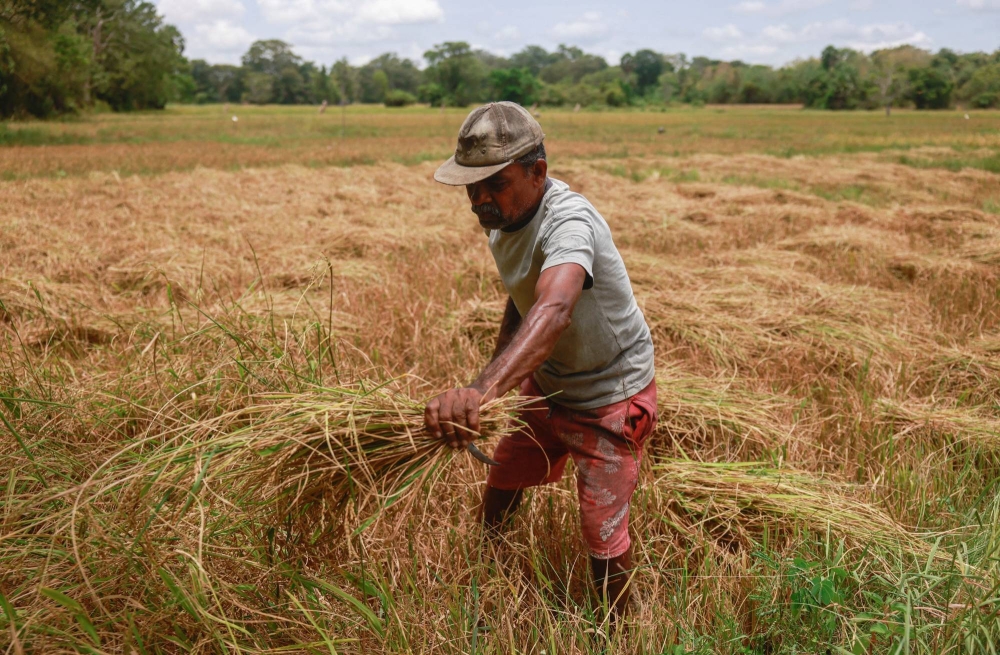
H.J.M Seneviratne, 63, slices through yellowed paddy stems dried out by a drought that has destroyed over 95% of his crop and is threatening crisis-hit Sri Lanka’s summer rice harvest.

The island’s economy was crushed last year by its worst financial crisis in over seven decades, caused by a severe shortage of foreign exchange reserves that triggered widespread unrest and ousted its former president.

Helped by a $2.9 billion bailout from the International Monetary Fund (IMF) Sri Lanka has slowly stabilized its economy since March, rebuilding its decimated reserves, moderating inflation and strengthening its currency.

But even before the country’s agriculture sector could recover from sky-rocketing prices of inputs from fertilizer to power, the rains failed.

“I’ve been a farmer for forty years but I’ve never experienced a harder time than this,” Seneviratne said, standing in the middle of a dusty field near Anamaduwa, a town in north western Sri Lanka, clutching a fistful of straw-like paddy stems with hollow rice kernels.

“We haven’t had enough rain since May. The harvest is so bad we don’t even have seed paddy for the next season.”

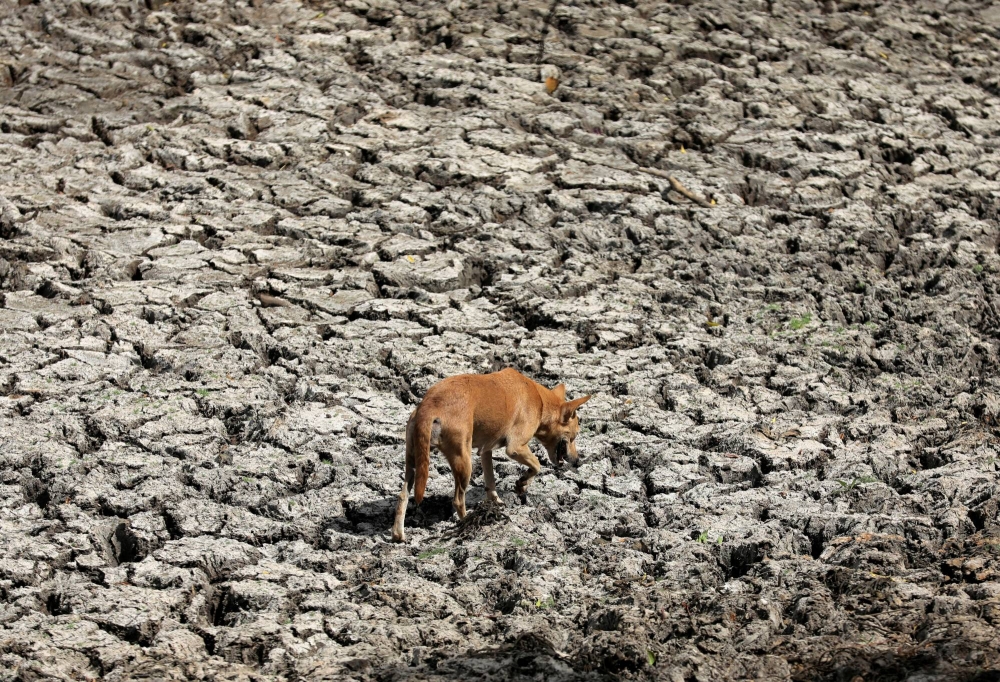
A dog walks on the dried up bed of a lake near a paddy field in Anamaduwa, Sri Lanka.

A dog walks on the dried up bed of a lake near a paddy field in Anamaduwa, Sri Lanka. | REUTERS

The southwest monsoon farmers rely on for the yala or summer harvest was scant this year because of the El Nino weather pattern, and the weather department estimates there will be no rains until October.

Typically, Seneviratne’s 1.6 hectares yield about 4.5 to 6 tons of paddy for the summer harvest but this time he predicts he will get only about 150 kilogram. All but one of eight water tanks — large ponds in which rainwater is collected for irrigation — in the area have dried out, destroying about 80 hectares of paddy.

The paddy loss could be as much as 30,350 hectares, according to Agriculture Minister Mahinda Amaraweera, while other experts say full losses could be even higher as estimates are yet to be completed. Sri Lanka planted 526,000 hectares for the summer harvest, according to the Agriculture Ministry.

“We have lost at least 80,000 metric tons of paddy as per the latest data and it could be more,” said Buddhi Marambe, a professor of crop science at Sri Lanka’s Peradeniya University. Last year, when the crop was decimated by a lack of fertilizer because of the economic crisis, the season produced 1.5 million tons of paddy.

The drought could reverse a recent trend of falling food prices, which dipped an annual 2.5% in July after rising 94% year-on-year last September.

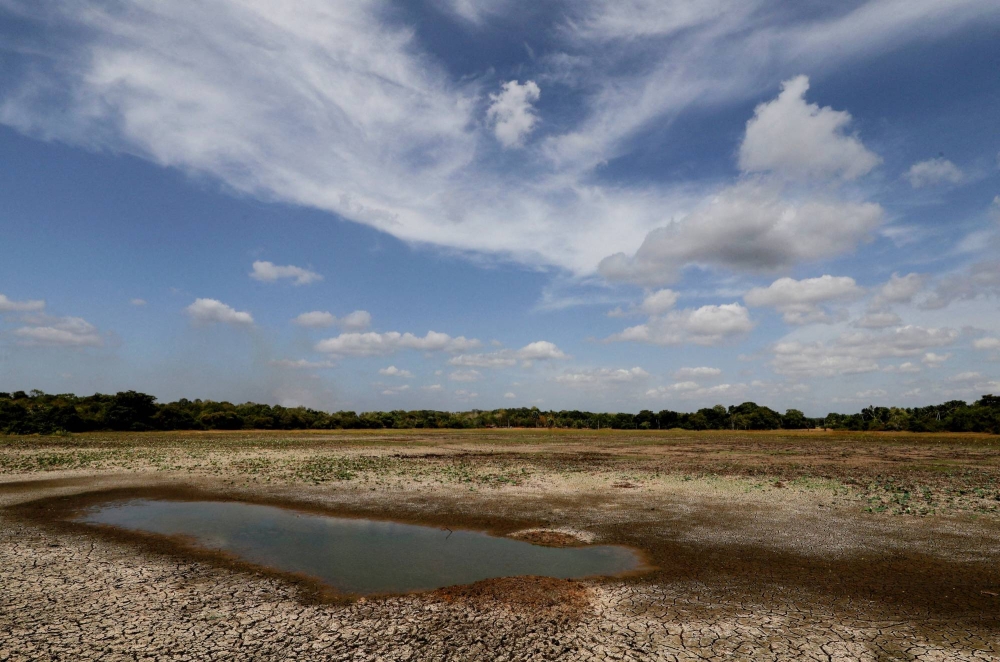
A dried-up lake, used for collecting water for farming, amid drought in Anamaduwa, Sri Lanka

A dried-up lake, used for collecting water for farming, amid drought in Anamaduwa, Sri Lanka | REUTERS

Sri Lanka’s central bank warned last week that the dry weather coupled with higher global oil and commodity prices could also “weigh on expected growth in the near term,” as the island struggles to limit economic contraction to 2% this year after shrinking 7.8% in 2022.

Sri Lanka’s northern neighbor India is also expected to have the driest August in more than a century, prompting it to restrict exports of certain categories of rice. Sri Lanka has previously imported rice from India to bridge production shortfalls.

Sri Lanka has so far ruled out rice imports this year, a statement from the president’s office said, as regions that have escaped the drought have produced higher yields.

Rice prices have remained largely unchanged at retail, edging up about 10 Sri Lankan rupees (about 3 U.S. cents) to 220 rupees per kg from last month. So far, rice stocks have staved off any impact but prices could tick up in coming months with a scant harvest.

Experts say they are worried that if Sri Lanka doesn’t receive the rains it needs next March because of the continuing El Nino, the country will be left with such limited reserve stocks it will have to resort to large-scale, expensive imports.

H.J.M Seneviratne, 63, cuts yellow paddy stems that dried out following a drought, at his paddy field in Anamaduwa, Sri Lanka.

H.J.M Seneviratne, 63, cuts yellow paddy stems that dried out following a drought, at his paddy field in Anamaduwa, Sri Lanka. | REUTERS

El Nino, a warming of water surface temperatures in the eastern and central Pacific Ocean, is linked to extreme weather conditions from tropical cyclones and heavy rainfall to severe droughts.

During the last El Nino in 2016-17, Sri Lanka suffered its worst drought in 40 years and rice output fell by nearly 50% year-on-year to 2.4 million metric tons over both its harvests.

Rice is the staple food of the country’s 22 million people and its biggest crop. According to government data, 2 million people in the country are rice farmers out of 8.1 million people engaged in fishing and agriculture in the largely rural economy.

To limit the El Nino impact, Marambe says farmers will have to plant early during the maha paddy season that starts in October, as rains next March and mid-year are uncertain.

“If rains fail in March it will impact our main paddy season and we could have a very, very dry second season as well in the middle of 2024.”

The drought has also wiped out the small chile, peanut and banana plants Seneviratne’s wife, W.M. Makamma, 62, grows to feed her family.

“Before the crisis we used to cook for all three meals but now it’s only two,” she said. “We’ve stopped buying eggs, chicken or fresh fish. Lunch is a cup of black tea.

“I feel like we have fallen completely and its very hard to get back up.”

Crisis-stricken Sri Lanka could use 56GW of offshore wind potential to boost economic recovery

August 30th, 2023

Courtesy RechargeNews

Sri Lanka has the potential for 56GW of offshore wind, according to a new World Bank report, which says the crisis-stricken country could use this natural advantage to rebuild its economy.

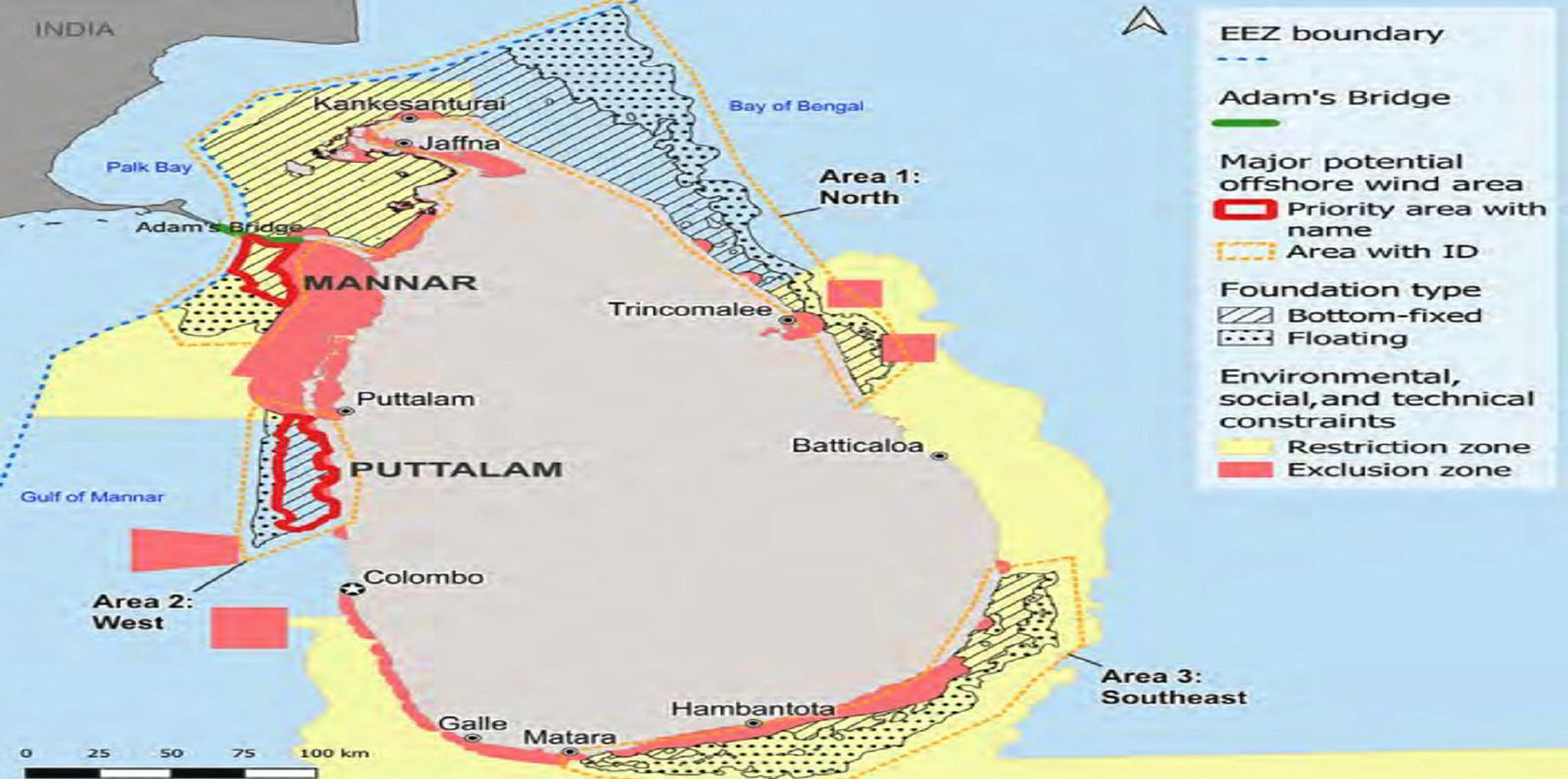
The report, issued last week, found that Sri Lanka has the capacity for 27GW of fixed offshore wind in shallow waters, defined as less than 50 meters, and for 29GW of floating offshore wind in deeper waters.

There are three broad areas suitable for offshore wind development, but the western and southern coasts have the most energetic wind speeds and suitable technical conditions,” it said.

The report excluded areas with the highest environmental or social sensitivities” from consideration to avoid unacceptable adverse impacts”.

A World Bank map shows areas of potential for offshore wind in Sri Lanka Photo: World Bank

The report stated that Sri Lanka’s complete reliance on imported hydrocarbon fuels places a large risk on the security of supply and affordability of the majority of the country’s electricity generation”.

That risk materialised in catastrophic fashion last year when Sri Lanka was plunged into its worst economic crisis since its independence in 1948.

The country had been running a trade deficit for years and as such ran short of foreign currency reserves. This meant that the country could no longer buy hydrocarbon fuels from abroad, leading to crippling and prolonged power cuts, while there were also shortages of other basic commodities.

This energy crisis culminated in massive protests and the ransacking of the presidential palace in July last year, forcing ex-President Gotabaya Rajapaksa to flee to Singapore on a private jet, before resigning.

Crisis-hit Sri Lanka eyes offshore wind to boost energy security: ministerRead more

Following bailouts from the World Bank and International Monetary Fund, the country is said to be making a gradual recovery, although it is still laden with debt, including $7bn of loans from China.

Transitioning to renewable energy and thereby reducing fuel imports is expected to be an important action in the country’s recovery,” said the World Bank report.

The World Bank report argued that Sri Lanka’s offshore wind resources offer an abundant domestic supply of energy and could help improve the country’s energy security.”

The report even suggested Sri Lanka could aspire to selling energy to India, with an electrical interconnector between the neighbours potentially benefitting both countries.

It stated: With the addition of large-scale offshore wind, Sri Lanka could become an energy exporter.”

Sri Lanka energy minister Kanchana Wijesekera had already said in May that the country was eyeing offshore wind as a key plank of its renewable energy targets.

Religious leaders-led committees to address religious matters in North & East

August 30th, 2023

Courtesy AdaDerana

During his visit to Kandy, President Ranil Wickremesinghe has emphasized the government’s resolute dedication to protecting religious shrines and historical sites.

According to the President’s Media Division (PMD), the Head of State has announced the establishment of committees, headed by religious leaders from their respective provinces, aimed at addressing religious matters in the North and East.

On Tuesday (Aug. 29), Wickremesinghe visited Kandy and called on the chief prelates of the Malwatta and Asgiriya chapters. 

He first visited the Malwatta Maha Viharaya to meet with Most Ven. Sri Sumangala Mahanayake Thera, engaging in a brief yet impactful conversation. He also paid a visit to the Anunayaka of the Malwatta Chapter, Most Ven. Dimbulkumbure Sri Vimaladhamma Thera, engaging in a concise and meaningful discussion.

Subsequently, Wickremesinghe proceeded to the Asgiriya Maha Viharaya, where he received blessings from the Asgiriya Maha Nayake Most Ven. Warakagoda Sri Gnanarathana Thera.

මරණයෙන් පසු ජීවිතයක් ඇති බව අමෙරිකානු විශේෂඥ වෛද්‍යවරයෙකු හෙළිකරයි – රෝගීන්ගේ මරණාසන්න අත්දැකීම් ගැනත් අනාවරණයක්

August 30th, 2023

Lanka Lead News

මරණයෙන් පසු ජීවයක් ඇති බවත් ඒ පිළිබඳව කිසිඳු සැකයක් නොමැති බවත් රෝගීන්ගේ මරණාසන්න අත්දැකීම් 5000 ක් පමණ අධ්‍යනය කළ ඇමෙරිකා එක්සත් ජනපදයේ කෙන්ටකි ප්‍රාන්තයේ පිළිකා රෝග විශේෂඥ වෛද්‍යවරයෙකු වන ජෙෆ්රි ලෝන්ග් මහතා පවසා තිබේ.

ජෙෆ්රි ලෝන්ග් මහතා පිළිකා රෝග විශේෂඥ වෛද්‍යවරයෙකු මෙන්ම මරණාසන්න අත්දැකීම් පිළිබඳ පර්යේෂණ පදනමේ නිර්මාතෘවරයාද වන අතර, තමාගේ වෘත්තීය ජීවිතය තුළ සිදුකල අධ්‍යනයන්ගෙන් හමුවූ සාක්ෂි විමසා බැලූ විට මරණින් මතු ජීවිතයක් තිබෙන බවට තමන්ට සැකයක් නැති බවත් වෛද්‍ය ජෙෆ්රි ලෝන්ග් මහතා ප්‍රකාශ කර ඇත.

තමන් අධ්‍යනය කළ රෝගීන්, එම මරණාසන්න අත්දැකීම ලද මොහොතේ මනෝකාය සිරුරෙන් වෙන්වී ඉහළ සැරිසැරූ බවත් අනතුරුව මනෝකාය වෙනත් ලෝකයකට ඇතුළු වී උමං මාර්ගයක් දිගේ ගමන් කළ බවත් එම උමං මාර්ගය අවසානයේ දීප්තිමත් එළියක් තිබූ බවත් ප්‍රකාශ කළ බව වෛද්‍ය ජෙෆ්රි ලෝන්ග් මහතා පවසා තිබේ.

WHAT WERE THE REASONS TO INCREASE CRIMES DURING THE PAST DECADE?

August 28th, 2023

BY EDWARD THEOPHILUS

According to news reports, crimes in SRI LANKA have increased during the past decade, despite legal rules and religious practices committing crimes is a passion in society, and why people commit crimes is a vital dilemma that need to critically evaluate, comparatively current crime figures and trend have increased compared to previous decades. We are living in a decade committing more crimes, this nature is not only in Sri Lanka but also in other countries have reported that increased crimes and such situation may associate with modernization and changes of attitudes of the young generation.

What are contributed factors to increase crimes in Sri Lanka, which is called an Island of devotional practice?  Sri Lanka promotes crimes because attitudes of people highly concern with desires and, in this background, application of law and order have failed to deal with the increasing trend of crimes. According to daily reports in media, it is easy to decide that committing crimes is a part of a life of many people who are in all age groups and have associated with committing crimes to gain advantages and show the prosperity to others. Is it a demonstration effect? The operation of religions has failed to eliminate desires from the mind of people and many people are showing highly religious, but they commit crimes while showing a highly religious behaviour.   

Legally, an unlawful behaviour (Actus Reus) considers as committing crimes and such behaviour incurs with a malice purpose (Mens Rea) is treated as a crime and it should be dealt by the court. A regrettable situation in Sri Lanka is criminal aspects have not been updated in law books. It is the theoretical aspect of dealing with crimes despite traditional interpretation as promoting good behaviour. In the modern era, many people turn to commit crime to gain individual benefits in a variety of ways. In many times, the purpose of committing crime has been to gain various advantages for the individuals and families. The development of positive attitudes against committing crimes needs in society. The vital nature is many crimes may not detect as they committed as they are not visible to naked eye and many attempt to disguise them as long as possible have been successful, but the truth is one day they may be revealed but many crimes have not detected for ever. Vicious nature in Sri Lanka is many clergy in various religions associate with crimes. While they are preaching to make crimeless society, they also engage in committing crimes.   

Modernization has promoted grandeur of crimes to make money disregarding consequences is the negative aspect of crimes, and the law and religions have failed to eradicate crimes. Modernization promotes a consumer society that demands more money for living and other purposes of life. When people failed to make money for such an enjoyable life, they commit crime to achieve it.  What should do to change this environment? No doubt that religions and laws need to work together and people should be educated about the consequences of crimes to the society and no point taking consequences after death as many people’s doubts life after death. In the past, they were educating in society, even with such education, criminal motives of people have not been eliminated by educating and it is seen that criminal activities in society have been a profession among various   practitioners.    

Are the people of the law enforcement authority indirectly support criminals, is a vital question that should be asked, and it also seems that the government should encourage public to complain about the behaviour of personnel in the law enforcement authority.  

It could assume that certain people in all ethnic and religious communities are associated with committing crimes and models in overseas concerned to control crimes using strategies for quick punishing and education about law and order.

A vital nature of Sri Lanka shows that many religious clergies associate with committing crimes of original nature and selfish motives for money, which could use for criminal purposes and gain unreasonable benefits despite the teaching of religions and laws. This situation on common in many countries, but the problem in Sri Lanka is while preaching religions and advising good behaviour many people commit crimes.

Committing crimes associate with psychological behaviour of humans, since the beginning of humans on this planet committing crimes were, many countries have controlled committing of crimes using appropriate strategy to countries and the most successful strategy is rehabilitation of criminals using culturally and religiously appropriate ways and when criminals gain competencies on standard behaviour in society they release and monitor their behaviour and remedial management should be done as required.

My feeling is about 2% of population naturally gains motives to commit crimes, this situation happens despite religious teaching and law and order in a country, modern society needs developing controlling strategies providing a good way for living without committing crimes.             

උතුර සහ නැගෙනහිර බැඳීම- අවසාන කොටස

August 28th, 2023

විමල් පටබැඳිගේ – ශාස්ත‍්‍රවේදී, නීතිඥ, විශ‍්‍රාමික සොලිසිටර්

8 වෙනි කොටසෙන්

….. ශී‍්‍ර ලංකාවේ වාර්ගික ජාතිවාදී නාසිවාදීන්ට ආරම්භයේ සිට රැුකවරණය, පුහුණුව, ආයුධ, මුදල්, උපදෙස් ආදිය සපයමින් සියලූ ආකාරයෙන් සහායකයන් වෙන ඉන්දියාව, ඇමරිකාව, කැනඩාව, බි‍්‍රතාන්‍යය, නෝර්වේ ඇතුළු යුරෝපීය බටහිර රටවල බලධාරීන්ගේ සහ හිටපු මහ ලේකම් බැන්කි මූන් වැනි එ.ජා.සං. යේ සිටි සහ සිටින නිලධාරීන්ගේ හෘද සාක්‍ෂිය ”නාසිවාදී” නාමය ගැන යළි යළිත් සිතිය යුතුව ඇත.

අවසාන කොටස

විදේශීයයන්ගේ සහ ”දෙමළ රාජ්‍යයක්” සඳහා වූ ද්‍රවිඩ පෙරමුණේ ආශීර්වාදය සහ අතහිත ලබමින් වර්ධනය වූ, ආයුධ සන්නද්ධ ත‍්‍රස්තවාදී භීෂණය මගින් උතුර සහ නැගෙනහිර පළාත් දෙක දැඩි ලෙස බද්ධ කොට තිබුණි. ව්‍ය.ව. 2009 වසරේ එල්.ටී.ටී.ඊ. ත‍්‍රස්තවාදය පරාජය කරන තෙක් වසර තිහකට ආසන්න කාලයක් පැවතුණි. එසේ වුව ද, යාපනේ දෙමළ සහ මඩකලපුව දිස්ති‍්‍රක්කයේ දෙමළ ජනයා අතර සමාජමය අසමාන කමක් සහ විරසකයක් ආරම්භයේ සිට ම තවමත් ඔවුන් විසින් ම පවත්වා ගෙනයනු ලබයි. යුරෝපීය ආක‍්‍රමණිකයන් විසින් ගෙනෙන ලද සියලූ මලබාර් ද්‍රවිඩ /දෙමළ ජනයාගේ මවුබිම ඉන්දියාව වුව ද, වතු වගාව හා සම්බන්ධ, ව්‍ය.ව. 1901 දී ”ඉන්දියානු දෙමළ” යනුවෙන් නම් කරන ලද දෙමළ ජනයා සහ ”ලංකා දෙමළ” යනුවෙන් තමන් ම හඳුන්වා ගත් යාපනේ දෙමළ ජනයා, අතර ද එ වැනි ම වෙනස් ලෙස සැලකීමක් පවත්වනු ලබයි. පාර්ලිමේන්තු ප‍්‍රජාතන්ත‍්‍රවාදය ලැබී වසර හැත්තෑවකට වැඩි කාලයක් ගත වුව ද මේ පළාත් දෙකේ සාමාන්‍ය දෙමළ ජනතාව තවමත් දෙමළ වෙල්ලාල කුලාධිපත්‍යය යටතේ ය. වහල් සමාජ ලක්‍ෂණ සහිත වැඩවසම් සමාජ ක‍්‍රමයෙන් මිරිකෙමින් ඇත. 1801 විප්ලවයෙන් ප‍්‍රංශ අධිරාජ්‍යයෙන් නිදහස් වූ හයිටි රාජ්‍යය වහල් සේවාව සහ වහල් වෙළ\ම තහනම් කිරීම ලෝකයේ වහල් වෙළ\මට එල්ල කළ පළමු වෙඩි මුරය විය. ලෝකයේ ප‍්‍රධාන ම වහල් වෙළෙඳුන් දෙදෙනෙකු වූ ප‍්‍රංශයට සහ බි‍්‍රතාන්‍යයට වහල් වෙළ\ම නතර කිරීමට සිදු විය. 1844 දී වහල් සේවාව ලෝකය පුරා තහනම් කරනු ලැබුව ද, අහෝසි කළ ද, තවමත් බලාත්මක ව පවත්වා ගෙනයනු ලබන තේසවලාමෙයි මගින් නීතිගත කරන ලද ”කුලවාදය” සහ ”වහල්” භාවය, වහල් සේවාව දෙමළ සමාජය තුළ ප‍්‍රායෝගිකව අහෝසි නො වී, වෙනස් නො වී ඇත. සමහරු බාහිර සමාජය ඉදිරියේ තේසවලාමෙයි නීතිය දෙමළ විවාහ, දික්කසාද සහ දෑවැදි හිමිකම් පිළිබඳ විධිවිධාන වලට ලඝු කරමින් සිටින බව ද දක්නට ඇත. 

1978 ව්‍යවස්ථා නීතියට අනුකූල ව, දෙමළ වර්ගවාදය පදනමෙන් සහ ආගමික පදනමෙන් ප‍්‍රධාන දේශපාලන ප‍්‍රවාහයෙන් වියුක්ත වූ දේශපාලන පක්‍ෂ, සංවිධාන රැුසක්, ලන්සු තබමින්, රටේ දේශපාලනය, ආර්ථිකය සහ සමාජය අස්ථාවර බවට පත් කොට ඇත.

ව්‍ය.ව. 20 වෙනි සියවසේ අවසාන කාර්තුවේ සිට නැගෙනහිර පළාතේ, දෙමළ මවු බස වූ මුහමදික (මුස්ලිම්* භක්තිකයන් ද අප‍්‍රකාශිත ”අභිලාශ” වෙනුවෙන් දේශපාලන සංවිධාන කීපයක් සහ ආගමික කඳවුරු නම්වලින් සංවිධාන කීිපයක් ද හදාගෙන ඇතත් ඔවුන් ආගමික වශයෙන් එකට බඳිමින් සහ බැඳෙමින් ඇත. ඔවුන්ගේ අවසන් අරමුණ මුස්ලිම් රාජ්‍ය පාලනයකි. දෙමළ වර්ගවාදී දේශපාලකයන් ”දෙමළ කථා කරන ජනයා” ලේබලය මගින් මුස්ලිම් භක්තිකයන් තමන්ගේ ජාතිවාදී දේශපාලනයට යොදා ගැනීමට කරන උපක‍්‍රමයෙන් අන්තවාදී මුස්ලිම් භක්තිකයන්ගේ අරමුණ වෙනස් කළ හැකිය’යි සිතීම උගහට ය.

13 වෙනි සියවසේ සිට උතුර හා නැගෙනහිර දේශපාලන ප‍්‍රශ්ණ සමග බැඳීමක් පැවතීමට ස්ථිර දෙමළ පදිංචියක් හෝ දෙමළ දේශපාලනයක් නො වීය. යම් වාර්ගික බැඳීමක් ඇති වූයේ නම් එය සිදු වූයේ ව්‍ය.ව. 19 වෙනි සියවසේ දෙවෙනි භාගයේ සිට නැගෙනහිර පළාත දෙමළ කොලනියක් කිරීමෙන් කලකට පසුව ය. (එය වෙනම සාකච්ඡුා කළ යුතුව ඇත.* නැගෙනහිර පළාත 1824 සිට 1867 දක්වා යාපනේ ආණ්ඩුවේ ඒජන්තගේ අධිකාරිත්වයට යටතේ පාලනය කිරීමෙන් පරිපාලනමය ඒකාබද්ධතාවයක් ඇති විය. එසේ ම, යාපනේ ද්‍රවිඩයන් විසින් විසිවෙනි සියවසේ පවා ”උතුරේ රජ්ජුරුවෝ”, ”යාපනේ රජ්ජුරුවෝ”, ”ඩයික් රජ” යනුවෙන්  බුහුමන් කරනු ලබන ඔහුගේ පාලනය, අධීක්‍ෂණය යටතේ පැවති යාපනේ, කිලිනොච්චි, මුලතිව්, වව්නියා, මන්නාරම, පුත්තලම සහ නැගෙනහිර පළාත ඊළාම් භූමිය ලෙස සකස් කරගෙන ඇත. එය ඊළාම් සිතියම පැහැදිලි ව පෙන්නුම් කරයි.

වර්ගවාදීන් නිර්මාණය කරන ලද ”දෙමළ නිජබිම” තුළ මේ මනෝරාජ්‍යය පිහිටි ලෙස දක්වා ඇත. නැගෙනහිර පළාත එහි ප‍්‍රධාන ම සහ වැදගත් ම කොටස වෙයි. රටක් නැතිව සිටි යුදෙව් භක්තිකයන් නැගෙනහිර පළාතේ පදිංචි කොට යුදෙව් භූමිය (ඊශ‍්‍රායලය* නිර්මාණය කිරීමට බි‍්‍රතාන්‍ය කොලනි පාලකයන්ගේ යෝජනාව කි‍්‍රයාත්මක කිරීමට හැකි වී නම්, දෙමළ වර්ගවාදීන්ට 20 වෙනි සියවසේ අවසාන කාලයේ නැගෙනහිර පළාත ඇතුළත් කොට දෙමළ නිජබිම නිර්මාණය කිරීමට ඉඩ ලැබෙනු ඇතැ’යි සීතීම පවා උගහට ය. (දෙමළ නිජබිම සහ නැගෙනහිර පළාතේ උරුමයක් ගැන කථා කරන දෙමළ හෝ මුස්ලිම් කිසිවෙකු එය රැුකගැනීම සඳහා මේ යෝජනාවට එරෙහි වී නැත. විරුද්ධ වූයේ මාතෘභූමි වාසී සිංහලයන් පමණකි. සිංහල විරෝධය සාර්ථක විය.* 

උතුරු පළාතේ මෙන් ම නැගෙනහිර පළාතේ ද දෙමළ කථා කරන හින්දු, කතෝලික/ කි‍්‍රස්තියානි සහ ඉස්ලාම් ලබ්දික ජන කොටස් ද වාර්ගික සහ ආගමික භේදවාදී දේශපාලනයේ කි‍්‍රයාකාරීව නිරත වී සිටිති. එහෙත් ජාතිවාදී පදනමින් සිංහල ජනතා දේශපාලනය බැඳී නැත. උතුරු පළාතේ දේශපාලනය නිරන්තරයෙන් තමිල්නාඩුවේ සහ දිල්ලියේ උපදෙස් සහ පිහිට පතන අතර නැගෙනහිර පළාතේ ඉස්ලාම් භක්තිකයන් සවුදි අරාබිය ඇතුළු මුස්ලිම් රාජ්‍ය කීපයක මෙහෙයවීම් සහ බරපැන ලබන බව ප‍්‍රසිද්ධ රහසකි. ඉංගිරිසි/බි‍්‍රතාන්‍ය, ඇමරිකා, කැනඩා,  ඕස්ටේ‍්‍රලියා, නවසීලන්ත සහ යුරෝපා කොලනිවාදීන්ගේ අතහිත සහ ආශීර්වාදය විවිධ මට්ටමෙන් මේ දෙපිරිසට ම ලැබෙයි. දෙමළ වෙල්ලාලයන් ”දෙමළ වාර්ගික” පාලනයක් ඉලක්ක කොට ඇති අතර අන්තවාදී ඉස්ලාම් භක්තිකයන් ”ශරියා” පදනම මත ගොඩනගන ”අරාබි සුල්තානයක්” ඉලක්ක කොට ඇත. (මුස්ලිම් භක්තිකයන්ගේ ඉලක්කය ආගමික රාජ්‍යයකි. ”මුස්ලිම්” ජාතියක් නොවේ. ආගමික ජන කොටසකි.* කෙසේ වෙතත් ”දෙමළ ඊලාම් රාජ්‍යයක්” (වෙන් වූ දෙමළ රාජ්‍යයක්* හෝ ”අරාබි සුල්තානයක්” බිහිවීම/බිහි කිරීම මහා ව්‍යසනයක ආරම්භය වෙනු ඇත. 

ව්‍ය.ව. 13 වෙනි සියවසේ සිට උතුරු පළාත සහ නැගෙනහිර පළාත දේශපාලනික වශයෙන් ඒකාබද්ධ වී පැවති බවට ඉදිරිපත් කොට ඇති අදහස ”ලංකා දෙමළ රාජ්‍යය”, ”ඊලාම් දෙමළ රාජ්‍යය” මනෝමය එකක් නො වෙන බව දැක්වීම සඳහා අවශ්‍ය පසුබිම සකස් කිරීම වෙනුවෙන් වූ වර්ගවාදී මත ප‍්‍රකාශය කි. 20 වෙනි සියවසේ මුල් කාලයේ ආරම්භ කොට පතුරුවමින් පවත්වාගෙන එන ද්‍රවිඩ/දෙමළ වාර්ගික ජාතිවාදී පදනම මත 1950 දසකයේ සිට උතුරු පළාතේ සහ නැගෙනහිර පළාතේ පවතින දෙමළ දේශපාලන එකමුතු වීම ව්‍ය.ව. 13 වෙනි සියවසට ආදේශ කිරීමකි. යාපන අර්ධද්වීපය සහ නැගෙනහිර පළාත අතර වර්ග සැතපුම් දහසකට නො අඩු භූමි ප‍්‍රදේශයේ, පුරාණ කුරුඳුගමුරට දිසාවනියට අයත් වූ ප‍්‍රදේශයේ (මුලතිව් දිස්ති‍්‍රක්කයේ* ඓතිහාසික, පුරාවිද්‍යා සහ සංස්කෘතික සාධකවලට අමතරව භූගෝලීය සාධක ද ඒ වාර්ගික අදහස ප‍්‍රතික්‍ෂේප කරයි. එමෙන් ම එය මනෝමය මත ප‍්‍රකාශය කි. හිතළුව කි.

නැගෙනහිර පළාතේ දෙමළ වර්ගවාදී රාජ්‍යයක් සඳහා වෙල්ලාල ප‍්‍රධානීන් මෙහෙයවන දේශපාලන සංවිධාන සහ මුස්ලිම් රාජ්‍යයක් සඳහා දෙමළ මුස්ලිම් ශරියා ආගමික අන්තවාදීන් අතර පවතින අප‍්‍රකාශිත සටන විවෘත සටනක් වුවහොත් එය සියලූ පුරවැසියන්ට දැඩි වේදනාකාරී වෙනු ඇත. කෙසේ වෙතත්, 2006 ශ්‍රේෂඨාධිකරණය නැගෙනහිර පළාත උතුරු පළාතෙන් වෙන් වූ පළාතක් බව තහවුරු කිරීම, නැගෙනහිර පළාතේ පවතින ආගමික අන්තවාදී ප‍්‍රවණතාවය සහ ඔලූවිල් ප‍්‍රකාශය දැනට ම ශී‍්‍ර ලංකාවේ ”දෙමළ නිජබිම” මිථ්‍යා නිර්මාණය බිඳ හෙළා ඇත. 

මවුබස සහ ඉතිහාසය නො දැනීම, අමතක කිරීම, ගැරහීම සහ තමන්ගේ මවුපියන් සහ මුතුන්මිත්තන් කවුරුන් දැ’යි නො දැනීම, නො සලකා හැරීම සහ හෙළාදැකීම අතර වෙනසක් නැත. ඉතිහාසය අධ්‍යාපන විෂය මාලාවෙන් කපා හැරීම 1965 වසරේ ආරම්භය විය. ලංකා ඉතිහාසය, ඉන්දියානු ඉතිහාසය සහ යුරෝපා ඉතිහාසය යනුවෙන් පුළුල් විෂය තුනක් ලෙස එතෙක් හැදෑරූ සිසුන්ට එතැන් සිට ලංකා ඉතිහාසය සහ ඉන්දියානු ඉතිහාසය හෝ ලංකා ඉතිහාසය සහ යුරෝපා ඉතිහාසය යනුවෙන් එක විෂයයක් විය. 1970 වසරෙන් පසු ඉතිහාසය ”සමාජ අධ්‍යයනය” තුළ අච්චාරුවක් බවට පත් කරනු ලැබීය. ඉතිහාසයෙන් සහ සාහිත්‍යයෙන් කන්න පුළුවන් දැ’යි ඇසූ පාලකයන් සිටි රටේ ඉතිහාසය ”රට කෑමට” යොදාගෙන ඇති සැටි නැගෙනහිර පළාතේ ගැටළුව එළිදරවු කරයි.

ව්‍ය.ව. 16 වෙනි සියවසේ මුල් කාලයේ යාපාපටුනේ සම්පූර්ණ ජනගහණය 120,000 ක් පමණ විය. එයින් 66% ක් සිංහල බෞද්ධයෝ වූහ. 15% ක් ද්‍රවිඩ/දෙමළ ජනයා විය. සෙස්සෝ මුස්ලිම් භක්තිකයෝ වූහ. 

ඓතිහාසික සහ පුරාවිද්‍යා සාධක සනාථ කරන පුරාණ සංස්කෘතියක උරුම කරුවන් වෙන, අනාදිමත් කාලයක සිට 19 වෙනි/20 වෙනි සියවසේ පවා යාපාපටුනේ (යාපන දිස්ති‍්‍රක්කයේ* සහ වන්නි ප‍්‍රදේශයේ පදිංචිව සිටි මාතෘභූමි වාසී දසදහස් සංඛ්‍යාත සිංහල බෞද්ධ වැසියන්ට කුමක් වී ද? ඝාතනය කරනු ලැබී ද? ඔවුන් නෙරපා හරිනු ලැබී ද? මෙය ජාතිවාදී ප‍්‍රශ්ණයක් ලෙස නො සැලකිය යුතු ය. එසේ කරනු ලැබී නම් මේ ප‍්‍රදේශවල සිංහල බෞද්ධ සංහාරයට ඉංගිරිසි (බි‍්‍රතාන්‍ය* කොලනිවාදීන් වගකිව යුතු වෙයි. නො එසේ නම්, ඔවුන් දෙමළකරණය කරනු ලැබී ද? එසේ නම්, ඒ ආකාර වූ සිංහල බෞද්ධ සංහාරයට ඉංගිරිසි (බි‍්‍රතාන්‍ය* කොලනිවාදීන් වගකිව යුතුය. නැගෙනහිර පළාතේ කරනු ලැබූ ලෙසින් ඔවුන් දෙමළකරණය කරනු ලැබී නම් උතුරු පළාතේ වත්මන් දෙමළ ජනයාගෙන් විශාල සංඛ්‍යාවක් දෙමළකරණය කරනු ලැබූ සිංහල බෞද්ධයන්ගෙන් පැවතෙන්නෝ ය. දෙමළ බෞද්ධයන් වී ඇති බහුතරය ඔවුන් විය හැකි බව නිසැකය. දෙමළකරණය කරනු ලැබූ සිංහල බෞද්ධයන් දෙමළ වෙල්ලාලයන් විසින් සමාජයෙන් බැහැර කළ අයගේ තත්වයට පත් කරනු ලැබ ඇත. විසිවෙනි සියවසේ දෙවෙනි භාගයේ සිට කරනු ලබන සිංහල බෞද්ධ සංහාරයට හින්දු, කතෝලික/කි‍්‍රස්තියානි දෙමළ ජාතිවාදීන් (නව නාසිවාදීන්* වගකිව යුතු වෙයි. 

 කාලයක සිට දෙමළ ජාතිවාදීන් සහ දේශීය සහ විදේශීය සිංහල බෞද්ධ විරෝධීන්, ශී‍්‍ර ලංකා විරෝධීන් විසින් ”සිංහල ජාතිවාදීන්”, ”සිංහල බෞද්ධ ජාතිවාදීන්” යනුවෙන් ගර්හාවට ලක් කරමින් සිංහල බෞද්ධයන් මානසිකව සිරකරුවන් බවට පත් කරනු ලැබෙයි. ආගමික නායකයන්, ඉහළ ම නායකයන් ඇතුළු දේශපාලකයන්, බෞද්ධ නායකයන්, උගතුන් සිරකරුවන් බවට පත් ව ඇත. රටේ සහ සියලූ රටවැසියන්ගේ එකමුතුකම, සාමය, සෞභාග්‍යය, නිදහස අගයන, පතන ආගමික නායකයන්, විදිවතුන් ඇතුළු පාලක පාලිත සියලූ දෙනා මේ ”මානසික සිපිරිගෙය” විවර කොට තව දුරටත් පමා නො වී පෙරමුණ ගත යුතුව ඇත. 

වර්ගවාදීන්ගේ, ආගම්වාදීන්ගේ සහ ඔවුන්ට සියළු ආකාරයෙන් අනුග‍්‍රහ කරන, සඟවාගත් න්‍යායපත‍්‍ර සහිත දේශීය, විදේශීය, ජාතික සහ විජාතික සියල්ලන්ගේ අභිලාශය වාර්ගික සහ/හෝ ආගමික රාජ්‍යය(ක්* බිහි වෙනු දැකීම වුවත් ශී‍්‍ර ලාංකික පුරවැසියන්ගේ අභිලාශය සියල්ලන් ම එක් වී සහෝදරත්වයෙන් වාසය කරන ඒකීය ස්වෛරී රාජ්‍යය කි. ශී‍්‍ර ලාංකික සියලූ පුරවැසියන්ගේ අභිලාශය සම්බන්ධ තමන්ගේ වගකීම සහ වගවීම පිලිබඳව සිහිඑළවා කටයුතු කිරීම සියලූ ම වර්ගවාදී සහ ආගම්වාදී උගතුන් සහ න්‍යායවාදීන් සහ පාර්ලිමේන්තුව නියෝජනය කරන සහ නො කරන සිංහල, අසිංහල, බෞද්ධ සහ අබෞද්ධ සියලූ දෙශපාලකයන්, දේශපාලන පක්‍ෂ, කණ්ඩායම්, රාජ්‍ය සහ පරපුටු රාජ්‍ය නො වෙන සංවිධාන, සමාජ සහ මුද්‍රිත සහ දෘශ්‍ය මාධ්‍ය වෙත පැවරී ඇති අනුල්ලංගනීය වගකීමක් බව අමතක නො කළ යුතුව ඇත. සියලූ දේශපාලන පක්‍ෂ සහ සංවිධාන තම තමන්ගේ ”දේශපාලන ව්‍යාධි” වලට සහ ”සිවිල්” ලේබලයෙන් පෙනී සිටින සකල විධ සංවිධාන භේදකාරී රෝග පතුරුවන ”මානසික වෛරස්” පැතිරවීමට තිත තැබිය යුතුව ඇත. මේ උත්තරීතර වගකීම අමතක කොට, නො සලකා කටයුතු කරන කිසිම අයෙකුට ”දේශද්‍රෝහී”, ”ජනතා ද්‍රෝහී” හැඳින්වීමෙන් මිදීමට නො හැකි වෙනු ඇත.
ශී‍්‍ර ලංකාව ජනතා පරමාධිපත්‍යය නියෝජනය කිරීම සඳහා, සිංහල ජනයා දෙමළ සහ මුස්ලිම් අපේක්‍ෂකයන්ට, දෙමළ ජනයා සිංහල සහ මුස්ලිම් අපෙක්‍ෂකයන්ට සහ මුස්ලිම් භක්තිකයන් සිංහල සහ දෙමළ අපේක්‍ෂකයන්ට තම කැමැත්ත දී පාර්ලිමේන්තුවට තෝරා පත් කළ සුන්දර අතීතයක් සහිත රටකි. වර්ගවාදී සහ ආගම්වාදී මනෝ ව්‍යාධියෙන් පෙළෙන රෝගීන් එය විනාශ කොට ඇත.

සමස්ථයක් ලෙස මුළු රටේම සහ සියලූ පුරවැසියන්ගේ පූර්ණ ආරක්‍ෂාව, සංවර්ධනය, සහජීවනය සහ සහෝදරත්වය වෙනුවෙන් කැපවෙන, අරමුණු සහිත දේශපාලන පක්‍ෂ, සංධාන සහ පෙරමුණු පමණක් මැතිවරණ සඳහා ලියාපදිංචි කිරීම සහ එක් ජනවර්ගයක්, ආගමක් පමණක් අරමුණු කොට ඒ වෙනුවෙන් පෙනී සිටින, නියෝජනය කරන, නම් සහිත දේශපාලන පක්‍ෂ, සංධාන, පෙරමුණු ප‍්‍රතික්‍ෂේප කිරීම නීති ගත කළ යුතුව ඇත. ජනතා පරමාධිපත්‍යය වාර්ගික ආධිපත්‍යයක් බවට ලඝු නොකළ යුතුව ඇත. ප‍්‍රජාතන්ත‍්‍රවාදයේ මුර භටයෝ අවි අමෝරනු ඇත.

1978 ව්‍යවස්ථාව අනුව, පරමාධිපත්‍යය නියෝජනයට නුසුදුසු නිසා ජනතාව ප‍්‍රතික්‍ෂේප කළ සහ එක ඡුන්දයක් හෝ නොලැබූ, ජනතා පරමාධිපත්‍ය නියෝජිතත්වය නොලැබූ 29 දෙනෙකුගෙන් යුත් පාර්ලිමේන්තුව සහ ඒ තුළ ඔවුන් විසින් තෝරා ගත්, ජනතාව විසින් ප‍්‍රතික්‍ෂේප කරනු ලැබූ අයෙකු ජනතා පරමාධිපත්‍යය කි‍්‍රයාත්මක කිරීමේ ප‍්‍රධාන විධායකය වීම ප‍්‍රජාතන්ත‍්‍රවාදයේ සරදමකි. ජනතාවට කරන සමච්චලයකි. නතර කළ යුතු සරදමකි, සමච්චලයකි.

අද ලෝක දේශපාලනය තුළ, තමන් ලඟවත් නැති ප‍්‍රජාතන්ත‍්‍රවායේ උරුමයට හිමිකම් කියන අයගේ භාවිතය අනුව ප‍්‍රජාතන්ත‍්‍රවාදය දේශපාලන කඩතුරාවකි. අභිමතය අනුව අපනයනය කරන වෙළඳ භාණ්ඩයකි. දෙවෙනි ලෝක යුද්ධයෙන් පසු, තාක්‍ෂණික යුගයේ නව අධිරාජ්‍යවාදී, කොලනිවාදී දඬුකඳකි. ආයුධයකි.

1962 – Letter from N. Q. Dias (Permanent Secretary, Ministry of Defence and External Affairs) to S. J. V. Chelvanayakam MP

August 28th, 2023

BY  SHENALI WADUGE · 28TH AUGUST 2023

One of Sri Lanka’s greatest strategist is N Q Dias the Permanent Secretary of Defense & External Affairs

He renamed Operation Monty” set up in 1952 into a Task Force Anti- Illicit Immigration in 1963 to stop illegal immigration of Indian Tamils.

TFAII is headquartered in Palaly with units deployed from Mollikulam to Kokilai.

Army camps were set up in Silavathurai, Thalladi, Talaimannar, Pooneryn, Velvittiturai, Madagala, Thondamannar, Mullaitivu & Kokilai. 

Smaller detachments with 5-10 soldiers were also set up. TFAII functioned from 1963 to 1981.

NQ had arranged for special phone link from the TFAII to Neville Jayaweera GA Jaffna, direct as he thought that the normal telephone lines were being tapped at the Jaffna end.

Tamil Separatist Movement under Chelvanayagam, complained on 22 July 1962 that a  fishing boat had been stopped by the navy at Kayts  and atrocities committed.  Fishermen had been  ill treated,  fishing nets damaged, banians torn.

The following is NQ’s reply on 22.8.1962. He said the  navy   had  checked the boat  for possible illegal activity. The fishermen were not ill treated, no banians were torn. The fishing nets were intact on board.   The crew  made no allegations of atrocities,  assault or tearing banians in their complaint to the authorities later on, either.  

Special Referenda at national intermediate level.

August 28th, 2023

Sugath Kulatunga

In our democracy the people can use the power of franchise in selecting a government only once in 5 years unless the Parliament is dissolved earlier. In between elections the voice of the people is muted. This makes people to resort to enraged demonstrations and Aragalayas. The government also takes decisions on conjecture. A typical guesstimate decision was the overnight ban on chemical fertilizer.  It was done with good intentions on the advice of a small coterie of pseudo experts, not anticipating an adverse response from the farmers. What the country needs is a mechanism to consult the people and for the people to show their response at an intermediate level between the Parliament and the grassroot constituency, where the people themselves can make it operative.

As provided by Article 4.e-the Sovereignty of the People shall be exercised and enjoyed at every Referendum by every citizen who has attained the age of eighteen years.

The Directive Principles of State Policy given at Article 27. (4) calls for the State to strengthen and broaden the democratic structure of government and the democratic rights of the People by decentralizing the administration and by affording all possible opportunities to the People to participate at every level in national life and in government.

By Article 86, The President may, by law, submit to the People by Referendum any matter which in the opinion of the President is of national importance and subsection (2) enables the Parliament by law to provide for a register of electors to be used at a Referendum.

Thus, it is clear that the Parliament can create a register other than the National Register of Electors of the Commissioner of elections to conduct a special Referendum. Such a limited Referendum was envisaged for the merging of the Northern and Eastern Provinces.

A national Referendum is costly and time consuming and is a burden on the economy. Sri Lanka already has a democratically elected wide base that can be used for special referenda. The Pradeshiya Sabha and Local Government bodies in the country will have a revised representative membership of around 5000 members. This grassroot group mirrors the will of the people and can be utilized as the constituency for special referenda.

It is for the constitutional lawyers to consider these facts and institutionalize a national intermediate level to gauge the will of the people. It would be constructive to provide for the Parliament to invoke a special referendum with the approval of a two thirds majority. It would also be democratic to solicit a referendum by a fifty percent or more of the majority of members of these grass root bodies. Such a referendum should be binding while others could be only advisory.

තිස් වසරක යුද්ධය සහ පශ්චාත් යුද කම්පනයට ලක්වූ ශ්‍රී ලංකාව පිලිබඳව දේශනය

August 28th, 2023

Dr Ruwan M Jayatunge M.D.

ඊලාම් යුද්ධයේ දුර්විපාක සමාජය හඳුනාගන්නා කාලය තෙක් මනෝ විද්‍යාත්මක රෝගාබාධයක් වූ පශ්චාත් ව්‍යසන ක්ලමථ අක්‍රමතාවය (Post-traumatic stress disorder -PTSD)  ශ්‍රී ලාංකාවට ආගන්තුක රෝග තත්වයක් විය. වියට්නාම් යුද්ධයෙන් පසුව ඇමරිකානු සමාජය වියට්නාම් සින්ඩ්‍රෝමය හඳුනාගත්තාක් සේ ඊලාම් යුද්ධයෙන් පසුව ශ්‍රී ලාංකික සමාජය පලාලි සින්ඩ්‍රෝමය හෙවත් සංග්‍රාමික පශ්චාත් ව්‍යසන ක්ලමථ අක්‍රමතාවය හඳුනා ගන්නා ලදි.  එහෙත් මෙම ආබාධය හඳුනාගන්නා විට එකී ආබාධය විසින් සමාජය තුල පුද්ගල මෙන්ම පොදු සංකූලතාවන් ඇති කොට තිබුනි. තිස් වසරක ඊලාම් යුද්ධය විසින් සාමූහික ව්‍යසනයක් (Collective Trauma ) ඇති කරන ලදි.  යුද ආතතිය නිසා බොහෝ සොල්දාදුවෝ පශ්චාත් ව්‍යසන ක්ලමථ අක්‍රමතාවට ලක් වූහ. යාපනය විශ්වවිද්යාලයේ මනෝ විද්යා අංශයේ මහාචාර්ය දයා සෝමසුන්දරම් විසින් උතුරේ ගැටුම්වලට මැදිවූ මිනිසුන්ගේ ජීවිතය  යුද ගැටුමේ පීඩනය මිනිසුන්ට දැනුනු ආකාරය , මිනිසුන් විසින් අත්දුටු සාමුහික වියසනය ගැන ලියා ඇත. මෙම දේශනය තිස් වසරක යුද්ධය සහ පශ්චාත් යුද කම්පනයට ලක්වූ ශ්‍රී ලංකාව පිලිබඳව කතා කරයි.    

දේශනයට සවන් දීමට ලින්කුව ; https://transyl2014.blogspot.com/2023/08/blog-post_28.html

Head of Ahmadiyya Muslim Community Arrives in Germany

August 28th, 2023

A.   Abdul Aziz – Press Secretary –Ahmadiyya Muslim Jama’at – Sri Lanka.

Hazrat Mirza Masroor Ahmad travels to attend the Annual Convention of the Ahmadiyya Muslim Community in Germany after four years

The World Head of the Ahmadiyya Muslim Community, the Fifth Khalifa (Caliph), His Holiness, Hazrat Mirza Masroor Ahmad arrived safely in Germany on 27th August 2023 where he was greeted by more than 3,800 Ahmadi Muslim men, women and children.

After four long awaited years, Germany’s Ahmadi Muslims had the honour to welcome their beloved Imam who arrived at the Baitus Sabuh Mosque in Frankfurt late evening.  Following arrival, His Holiness led the Maghreb (after sunset) and Isha (night time) prayers at the Mosque.

His Holiness has travelled on the occasion of the centenary of the establishment of the Ahmadiyya Muslim Community in Germany to grace the Jalsa Salana [Annual Convention] of the Ahmadiyya Muslim Community which is to take place this year in Stuttgart.

His Holiness will deliver the weekly Friday Sermon at the Jalsa Salana and deliver three further addresses during the three-day event (1-3 September) which will be broadcast live on the Ahmadiyya Muslim Community’s satellite TV channel, MTA International.

One of the addresses during the Convention (Jalsa Salana) will be for guests from outside the Ahmadiyya Muslim Community including non-Muslims, as His Holiness continues to tirelessly strive to draw people’s attention towards the dire need for peace in the world.

His Holiness will also inaugurate several new mosques during his visit to Germany, as well as personally meeting with thousands of Ahmadi Muslims.

Source: Press Ahmadiyya

ඉදිරි අයවැයට පෙර සමෘද්ධි නිලධාරින්ගේ පරිපාලන ගැටළු විසදන්න…-අග්‍රාමාත්‍ය දිනේෂ් ගුණවර්ධන මහතා

August 28th, 2023

අග්‍රාමාත්‍ය මාධ්‍ය අංශය  

අග්‍රාමාත්‍යවරයා මේ බව පැවසුවේ සමෘද්ධි නිලධාරීන්ගේ මෙතෙක් නොවිසදුනු ගැටළු සම්බන්ධයෙන් 2023.08.28 දින අරලියගහ මන්දිරයේ පැවැති සාකච්ඡාවකට එක් වෙමිණි.

සමෘද්ධි දෙපාර්තමේන්තුවට අන්තර්ග්‍රහණය කිරීමේදී 44 ඉ(11) වගන්තිය යටතේ මනාපය පලකළ නිලධාරින් රජයට ගෙවිය යුතු සියයට 60 අර්ථ සාධක අරමුදලේ දායකත්වය ගෙවීමේදී අමතර සියයට 4 පොළයක් අයකිරීමට ඇති තීරණය අසාධාරණ බවද වෘත්තීය සමිති සදහන් කලේය. සමෘද්ධි සංවර්ධන දෙපාර්තමේන්තුවේ තණතුරු හා සේවක සංඛ්‍යාව අනුමත කරවා ගැනීම, සමෘද්ධි නිලධාරින් එම්. එන් 02 වැටුප් තලයේ පිහිටුවීම, උසස්වීමේ ක්‍රමවේදයක් සැකසීම, සමෘද්ධි නියාමක සේවා කාලය සමෘද්ධි සංවර්ධන සේවා කාලයට එක් කිරීම, වැන්දඹු අනත්දරු අරමුදල් සඳහා හිඟවාරික ගෙවීමේදී සමෘද්ධි සංවර්ධන නිලධාරීන්ට වැල්පොලිය සහිත සියයට 4ක අධිභාරයක් ගෙවීම ආදී ගැටළු මෙහිදී අවධානයට යොමු විය.

මෙම ගැටළු විසදීමට බාධා වී ඇති අණපනත්, චක්‍ර ලේඛණ සම්බන්ධයෙන් නිලධාරීන් කරුණු පැහැදිලි කළේය.

ඉදිරි අයවැයට පෙර සමෘද්ධි නිලධාරීන්ගේ පරිපාලන ගැටළු විසදීමට අවශ්‍ය පියවර ගන්නා ලෙස නිලධාරින්ට උපදෙස් දුන් අග්‍රාමාත්‍යවරයා අවධාරණය කළේ රට අර්බුදයකට මුහුණ දී සිටින මේ මොහොතේ නිහතමානීව මෙකී ගැටළු විසදා ගැනීමට සියලු දෙනාගේ කැපවීම අවශ්‍ය බවයි.

සමෘද්ධි නිලධාරින්, සමෘද්ධි දෙපාර්තමේන්තුවට අන්තර්ග්‍රහණය කළ ආකාරයටම වෙනත් අධිකාරීන් දෙපාර්තමේන්තු බවට අන්තර්ග්‍රහණය කිරීම් සිදුව ඇති හෙයින් එවැනි අවස්ථාවන් පූර්වාදර්ශ ගනිමින් මෙම ගැටළු කඩිනමින් විසදීමට පියවර ගන්නා ලෙස මෙහිදි අග්‍රාමාත්‍ය ලේකම් අනුර දිසානායක මහතාද සඳහන් කළේය.  රජයේ සේවකයින්ගේ ගැටළු නොවිසදීම කාර්ය සාධනය පසුබැසීමට හේතුවක් බවද ඒ මහතා පෙන්වා දුන්නේය.

මෙම අවස්ථාවට පාර්ලිමේන්තු මන්ත්‍රී ජගත් කුමාර, රාජ්‍ය පරිපාලන අමාත්‍යංශ ලේකම් කේ. ඩි. එන් රංජිත් අශෝක, කාන්තා ළමා කටයුතු හා සමාජ සවිබල ගැන්වීම් අමාත්‍යංශ ලේකම් යමුනා පෙරේරා, සමෘද්ධි සංවර්ධන දෙපාර්තමේන්තුවේ අධ්‍යක්ෂ ජනරාල් ආර්. බී. පී. තිලකසිරි, විශ්‍රාම වැටුප් අධ්‍යක්ෂ ජනරාල් ඒ. ජගත් ඩී. ඩයස් ඇතුළු නිලධාරීන් හා සමස්ත ලංකා සමෘද්ධි සංවර්ධන හා කෘෂිකර්ම පර්යේෂණ නිෂ්පාදන සහකාර නිලධාරි සංගමයේ නියෝජිතයින් සහභාගි වූහ.


Indian NDC delegation meets SL State Minister of Defence

August 28th, 2023

MOD  Media Centre

An Indian National Defence College (NDC) delegation led by Rear Admiral Sanjay Sachdeva called on State Minister of Defence Hon. Premitha Bandara Tennakoon at his office in Colombo, today (Aug 28).

The delegation of senior foreign military officers who arrived at the Island as part of their tour on strategic neighbourhood studies was warmly received by the State Minister and had a cordial discussion with them.

Representing the delegation, Brig. Rajat Kumar and Col. Ushakov Rusian Leonidovich were also present at the meeting.

At the culmination of the discussion, the Minister Tennakoon conveyed his best wishes to the visiting delegation for successful future endeavours.

Assistant Defence Advisor to the Indian High Commision Lt. Col. Puneet Sushil was also present at the event.

Exposing the bias of Human Rights Commission of Sri Lanka not taking up the killing of MP Amarakeerthi Athukorala?

August 27th, 2023

Shenali D Waduge

We expect entities that claim they are independent” and impartial” to uphold what they claim to be. Yet, the proof is in the pudding and the HRCSL press releases are a good way to question why the HRCSL chooses not to take action or at least make a statement on the cold blooded murder of an elected member of Parliament. On 27th June 2023 riots hit France and protestors attacked the home of the Mayor of L’Hay-Les-Roses injuring his wife & child. The response by the French Senate President Gerard Larcher was to attack the life of an elected representative and that of his family is to attack the nation”. MP Amarakeerthi Athukorala was also an elected representative. He was not attacked. He was cold-bloodedly murdered. While the French regarded the attack on a Mayor as an ‘attack to the Nation”, the HRCSL has not even seen fit to mention his name in any of their press releases or investigate his murder. This is not a sign of an impartial & independent entity.

Press releases by HRCSL taken from their website https://www.hrcsl.lk/news/articles/

  • 8 January 2022 – HRCSL writes to Police about PTA Detainees
  • 8-10 January 2022 – Briefing to the Diplomats of HRCSL new roadmap
  • 6 March 2022 – The inauguration of a District Office of HRCSL in the Nuwara Eliya District
  • 14 March 2022 – HRCSL calls application for Internships (Nuwara Eliya District Office)
  • 23 March 2022 – Janatha Estate Development Boad Undertakes to Pay All Arrears of EPF/ ETF/ Gratuity to 12000 estate workers of JEDB, Sri Lanka State Plantation Corp, Elkaduwa Plantations.
  • 29 March 2022 – HRCSL commemorates International Women’s Day
  • 18 April 2022 – HRCSL Sinhala Press release on Sugar scam & implementing recommendations by Auditor General
  • 20 April 2022 – HRCL Sinhala Press release calling upon the GoSL to address essential needs of the people
  • MAY 2022 – The HRCSL has not included any press release for MAY inspite of 9 May killing of MP Amarakeerthi Athukorala. Did HRCSL officials even visit the site where the MP was killed & dead body dragged around?
  • 1 June 2022 – HRCSL hand over recommendations to President Gotabaya on proposed HRCSL Act
  • 26 June 2022 – Chairperson HRCSL Justice (Rtd) Rohini Marasinghe issues message on International Day in Support of Victims of Torture (just days earlier MP Athukorale was tortured to death)
  • 27 June 2022 – HRCSL starts independent inquiry on police shooting incident in Rambukkana on 19 April 2022 resulting in one death. HRCSL officials visited site. Panel appointed – Former Retired High Court Judge K.H Sumathipala, Former Retired High Court Judge. Sudath N. Gopallawa, Former Retired Government Analyst Dr. W.D.S Gunathilake, Senior Attorney–At–Law Mr. Prasantha Lal De Alwis PC, Senior Attorney–At–Law Mr. Amal Randeniya, Consultant Judicial Medical Officer Dr. Channa Perera, Engineer  Mr. S. Suriyaarachchi(University of Moratuwa), and Technical Officer Mr. A.M.S Nilan(University of Moratuwa).
  • 27 June 2022 – HRCSL starts independent inquiry on alleged violations of rule of law on 9th & 10thMay 2022. As per the HRCSL press release group of people attacked two peaceful protests in front of Temple Trees & Galle Face” – later violence spread all over the country & properties of politicians & others were targeted & set on fire. The same day a group of prisoners were assaulted by an unidentified group. HRCSL appoints Special Rapporteur to investigate & report to the HRCSL as to whether the law enforcement authorities provide adequate protection to the people, the damaged houses ( it was the protestors that set fire to the houses) There is no mention of the killing of MP Amarakeerthi Athukorala.
  • 27 June 2022 – HRCSL prepare guidelines for Police & Armed Forces for crowd control (do these guidelines conflict with the internal SOPs within the Police & Armed Forces? – is this why they did not take action?) HRCSL appointed panel of experts
  • Palitha Fernando – PC , former Attorney General
  • K. Illangakoon – former Inspector General of Police
  • Professor Wasantha Seneviratne, Chair Professor – Department of Public & International Law, University of Colombo
  • Madawa Tennakoon, Deputy Solicitor General
  • Ramani Muttetuwegama, Attorney-at-Law
  • Chandrika Karunarathne, Attorney-at-Law
  • Nihal Chandrasiri, Actg. Director – Monitoring & Evaluation, HRCSL
  • Kapilan Villavarajan, Legal Officer, HRCSL
  • 30 June 2022 – HRCSL has appointed a Committee of Investigators to the unlawful incident of ‘severe magnitude’ on 9th & 10th May 2022. The inquiry was conducted by Mr. Sanjeewa Weerawickrama, Attorney -at- Law, Miss. lmasha Senadeera, Attorney-at-Law and Dr. Dilshani Bogollagama. No prisoners had been used in the attacks on 9th May 2022.
  • 5 July 2022 – HRCSL invites Secretary of Defense, Gen. Kamal Gunaratne to discuss incident of assault by an army officer on a civilian at a fuel station in Kurunegala.
  • 8 July 2022 – HRCSL issues recommendations on police shooting incident in Rambukkana on 19thApril 2022 after interim report by committee of experts.(It is Aug 2023 – over a year but the HRCSL has not issued any recommendations on the gruesome & cold blooded murder of an elected Member of Parliament on 9 May 2022)
  • 11 July 2022 – HRCSL commenced investigation & inquiry into assault on News First Journalist of MTV on 9th July 2022. HRCSL officials even visited the journalist in hospital.
  • 15 July 2022 – HRCSL issues press release calling all those ‘who have been agitating so far to fall in line with the constitutional process and maintain law & order”.

https://www.hrcsl.lk/wp-content/uploads/2022/07/HRCSL-Press-Notice-15.-07-.2022-1.pdf

  • 22 July 2022 – HRCSL issue press release condemning the brutal & despicable attack on the peaceful protestors at Galle Face vicinity by the Military” (unfortunately, no such press release was issued by the HRCSL when an elected member of parliament was brutally killed in a despicable attack)
  • 22 July 2022 – HRCSL issue press release on the declaration of emergency calling to withdraw the inappropriate declaration of emergency immediately”
  • 26 July 2022 – HRCSL issue press release on whether law enforcement authorities provided adequate protection to uphold rule of law to protect the fundamental rights of the people on 9 May 2022 (what about the fundamental right of MP Amarakeerthi Athukorala who was killed by so called peaceful protestors”)
  • 2 August 2022 – HRCSL issue press release on assault on News First Journalist of SIRASA news channel on 9 July 2022 (no such press release is issued by HRCSL on MP Amarakeerthi Athukorala who was killed on 9 May 2022)
  • 23 August 2022 – HRCSL writes to the Police Commission expressing deep concern” on the Prevention of Terrorism Act by the Police.
  • 23 August 2022 – HRCSL statement on 9th & 10th May 2022 incidents.

There was a window of hope that the HRCSL would not be as biased as it is oft accused of but that came to naught with the press release on 23 August 2022 following the appointment of a Special Rapporteur on the incidents that took place on 9th & 10th May 2022 to answer the question if law enforcement authorities took adequate measures to uphold rule of law & protect fundamental rights of the peaceful protestors” protesting opposite Temple Trees & Galle Face Green. The Inquiry team had called various levels within the police, senior officers of state intelligence & looked at CCTV footage & documentary evidence. The report claims that the reason for the clash was the failure of officers on the ground to take decisions & why no steel barriers were placed to prevent access along Galle Road to Presidential Secretariat. The Committee also advised to examine telephone conversations between IGP and subordinates and IGP & Secretary Defense from 1150 to 1p.m. on 9th May 2022. HRCSL recommended that the President appoint a committee to identify perpetrators” within law enforcement who breached the law & adequately compensate the victims who suffered injured. HRCSL also recommended to the President to direct the said committee to investigate the entire system of law enforcement and identify the responsibility & take necessary measures to deal with such officers punitively.

https://www.hrcsl.lk/wp-content/uploads/2022/09/HRCSL-Recommendation-on-9th-May-Incident.pdf

The entire focus is only on the welfare of protestors – not a line has been written on the manner an elected member of Parliament was brutally killed by protestors. Not a line in any of the press releases covered the colossal damage done by peaceful protestors to State property that included theft, damage, destruction and misuse/abuse.

Entities must press the HRCSL to give justice to the family of the slain MP just as HRCSL calls for punitive action against law enforcement officers for not doing their duty.

The HRCSL must realize that people are watching. Any entity claiming to be impartial and unbiased must prove so not only in words but in action as well.

Shenali D Wadugehttps://www.shenaliwaduge.com/the-cost-of-peoples-riots-role-of-social-media-in-sri-lanka-france-double-standards-in-commentary/

N.Q. DIAS AND TAMIL SEPARATISM

August 27th, 2023

KAMALIKA PIERIS

Neil Quintus Dias   commonly known as N.Q. Dias, was  a member of the Ceylon Civil Service, recruited in 1936. N.Q. Dias  was known for planning and executing many of the nationalist policies of the  1956 government . NQ was the Permanent Secretary of Defence and Foreign Affairs from 1961 to 1965,  also serving as the de facto Chief Adviser to Prime Minister Sirimavo Bandaranaike.

 NQ on right .

NQ was not only Permanent Secretary Defence and External affairs,  but also a powerful public servant with much influence over Mrs. Bandaranaike  and therefore feared and respected even by Cabinet ministers, said  Neville  Jayaweera.  NQ Dias was always soft and gentle in tone, but that silken exterior concealed a core of steel and resolve, added Jayaweera. Neville Jayaweera was Government Agent of Jaffna (1963-1966)  during this time. 

 I wish to set on record  three components of Dias remarkable strategic thinking,  which qualifies NQ as Sri Lanka greatest strategic thinker of modern times, said Jayaweera.

 In an interview with me, in 1963 probably,  NQ firstly wanted to set up a chain of military enclaves in the north, this had another strategic aim, apart from throttling an armed uprising of the Tamils. That was to preempt another coup such as the 1962 one.  He wanted to disperse the army, from Echelon and Panagoda so that they could not get together to stage a coup.

 Second was a plan to strengthen relations with Beijing as a countervailing power to India and neutralize the latter influence in Sri Lanka affairs.  He was hoping to arrange for Sirimavo to visit China soon.

Thirdly was the plan to clean out the military top command as far as possible of elements he considered incapable of patriotism , principally the Roman Catholic and to raise new infantry regiments which would owe their allegiance to Sirimavo. The Sinha regiment was the first of these.

In his capacity of Secretary for Defense NQ was perfectly entitled to consider all this and to plan well ahead for the suppression of any anticipated armed rebellion and intervention from India. Sri Lanka is much in his debt, concluded Jayaweera.(Sunday Island .19.10.2008 p 14 )

NQ was of the view that within two decades of the 1960s the Tamils would take to arms.  NQ’s anticipation of a future armed Tamil uprising and of India interference on  the side of  Tamil Separatist Movement  has not been given sufficient publicity, said Jayaweera. 

NQ  had  told Jayaweera, in 1963,  that the Tamil protest would develop into an armed rebellion and that the government must prepare from now to meet that. He was also of the view that the Tamil professionals, lawyers and doctors,  will soon lose control of the Tamil cause and that a new generation of militant youth will take over. Jayaweera as GA, Jaffna,  was  to help NQ develop counter measures for the anticipated uprising.

NQ also predicted that India would someday in the not so distant future support a Tamil uprising in Sri Lanka and Tamilnadu will be the source of illicit arms for the rebellion. Therefore a complete new naval strategy for Sri Lanka was needed.

NQ  wanted  a chain of military camps to encircle the Northern Province all the way form Arippu, Marichcikatti, Pallai and Thalvapadu in the Mannar distinct, through Pooneryn, Karainagar, Palaly, Point Pedro, Thirukovil and Elephant Pass in the Jaffna district, on to Mullativu, Vavuniya  and Trincomalee in the east.   Within one year of  my arriving in Jaffna the military camps were started. By 1966 all  the camps had been set up, said Jayaweera.

 It should be noted however, that NQ  had  offered these suggestions  to the government  two years earlier .in January 1961,    ITAK  had  launched a Satyagraha  in in Jaffna against Sinhala Only, led by S. J. V. Chelvanayagam . The protests soon spread to other parts of the Northern and Eastern Provinces.

In April 1961, Prime Minister Sirimavo Bandaranaike declared a state of emergency in the Northern Province and ordered the army to squash the Satyagraha. NQ used this to propose an increase of armed forces deployed to the northern and eastern province. He called for the formation of military bases in Arippu, Maricchikatti, Pallai, Thalvapadu,  Pooneryn, Karainagar, Palaly, Point Pedro, Elephant Pass, Mullaitivu and Trincomalee to counter possible rise of Tamil separatism.

  We now return to Neville Jayaweera’s recollections of 1963. There were already two military camps of platoon strength in Pallai in Mannar and in Palaly in Jaffna in the 1960s recalled  Jayaweera, and a rudimentary naval presence in Karainagar. NQ wanted to upgrade them. This operation was done under disguise.

 To avoid massive protests from Tamils over any attempt to establish  permanent military camps there, NQ   said that the camps were there to combat  illicit immigration and smuggling.  NQ had already obtained  publicity in the press against smuggling, saying it made Sri Lanka annually lose much income.

There was already an operation known as “Operations Monty”  set up in 1952 to stop illegal immigration of Indian Tamils. NQ  converted this to Task Force Anti Illicit Immigration (TFAII).. Operations Monty was formally renamed as Task Force Anti Illicit Immigration in 1963. It was a permanent formation in support of  the navy  coastal patrols and police operations.

TFAII had its headquarters at Palaly and had units deployed from Mollikulam  to Kokilai. Army camps were set up in Silavathurai, Thalladi, Talaimannar, Pooneryn, Valvettiturai, Madagala, Thondamannar, Mullaitivu and Kokilai. In addition there were  several smaller detachments of 5-10 soldiers each  in selected locations.TFAII  functioned from 1963 to 1981. In 1981 it was terminated with the onset of the Eelam war.

NQ had arranged for special phone link from the TFAII to Jayaweera direct as he thought that the normal telephone lines were being tapped at the Jaffna end.  

Tamil Separatist Movement under Chelvanayagam, saw all this and objected. Chelva had complained on 22 July 1962 that a  fishing boat had been stopped by the navy at Kayts  and atrocities committed.  Fishermen had been  ill treated,  fishing nets damaged, banians torn.

 NQ   replied  on 22.8.1962. He said the  navy   had  checked the boat  for possible illegal activity. The fishermen were not ill treated, no banians were torn. The fishing nets were intact on board.   The crew  made no allegations of atrocities,  assault or tearing banians in their complaint to the authorities later on, either. It should be noted  that  navy is engaged in anti illicit immigration and  anti smuggling in the northern coast. This letter is held in the Chelvanayagam archives in Toronto, Canada. https://collections.digital.utsc.utoronto.ca/islandora/object/tamil%3A10300#page/1/mode/1up

NQ ridiculed the policy of building a navy comprised of mine sweepers and frigates such as Vijaya and Gajabahu.   They were of no use for checking gun running in the Palk Strait.  NQ  had wanted Vijaya and Gajabahu scrapped and replaced with small fast gun boats.  NQ had asked whether the Gal Oya Board could turn out boats that the navy could  use for anti smuggling work.  

NQ had asked US ambassador for PT boats.  The Patrol Torpedo boatwas a motor torpedo boat used by the United States Navy in World War II. It was small, fast, and inexpensive to build, valued for its maneuverability and speed. The US  ambassador had said that Sri Lanka did not have the technical skills nor the infrastructure to service PT boats.

NQ ridiculed the jet fighters and said that what Sri Lanka needed was a squadron of propeller driven ground support fighters for helping infantry on the ground and for interdicting gun running across the Palk Strait. He talked of buying a squadron of fighter bombers called Sky Raider which were then in use by the US in Viet Nam.

Jayaweera recalled that NQ wanted Jayaweera to force   ‘confrontations’  in Jaffna upon the Tamils at every turn and establish the government’s absolute ascendency over them at every crisis.  Instead of forcing a crisis on Tamil leaders I talked around every impending crisis and aborted them and did not establish the government absolute ascendancy over them, said Jayaweera.

NQ did not trust the Roman Catholic officer corp of the armed service. He flushed them out progressively and  put officers from Buddhist schools in key positions.  NQ took steps to change the composition of the army to match the demographically ratios of the population, increasing the number of Sinhala Buddhist officers in the armed forces, said Jayaweera.

 NQ also said that Sri Lanka foreign policy had to be upgraded. Sri Lanka  had no coherent foreign policy and was too dependent on the west and trusted the good will of India which he said was a huge mistake. NQ believed that Indian had sinister designs on Sri Lanka, if not to take it over complete at least to keep her permanently disabled and depend on India said Jayaweera. ( Jayaweera. Jaffna exorcising the past and holding the vision)

 Sri Lanka should veer away and forge new links, said NQ. He was planning to open up closer relations with China .Dias had foreseen the need to seek out China as a countervailing power against India. He sent Mrs. B on a goodwill mission to China in 1964, observed Jayaweera.  (Concluded)


Copyright © 2026 LankaWeb.com. All Rights Reserved. Powered by Wordpress