Prime Minister Shehbaz Sharif on Monday expressed his gratitude to Sri Lanka for supporting and helping Pakistan in reaching an agreement with the International Monetary Fund.
During a telephonic conversation with Sri Lankan President Ranil Wickremesinghe, PM Shehbaz acknowledged the role played by Sri Lanka as a friend and well-wisher of Pakistan.
The PM said both Islamabad and Colombo are close and reliable friends and commended the island nation’s role in regional peace and prosperity.
PM Shehbaz also expressed confidence that the two nations will soon come out of the vortex of current economic difficulties.
Reciprocating the PM’s sentiments of goodwill, the Sri Lankan president said Pakistan is a close friend and helping friends is friendship.
Wickremesinghe appreciated Shehbaz’s efforts in steering the country out of a difficult situation and felicitated him on reaching an agreement with the IMF.
On the occasion of PM Shehbaz’s meeting with Managing Director IMF Kristalina Georgieva, the Sri Lankan President stressed that the IMF should help Pakistan.
The Sri Lankan president had informed the MD IMF about the problems faced by his country due to default and stressed that Pakistan should be saved from this situation.
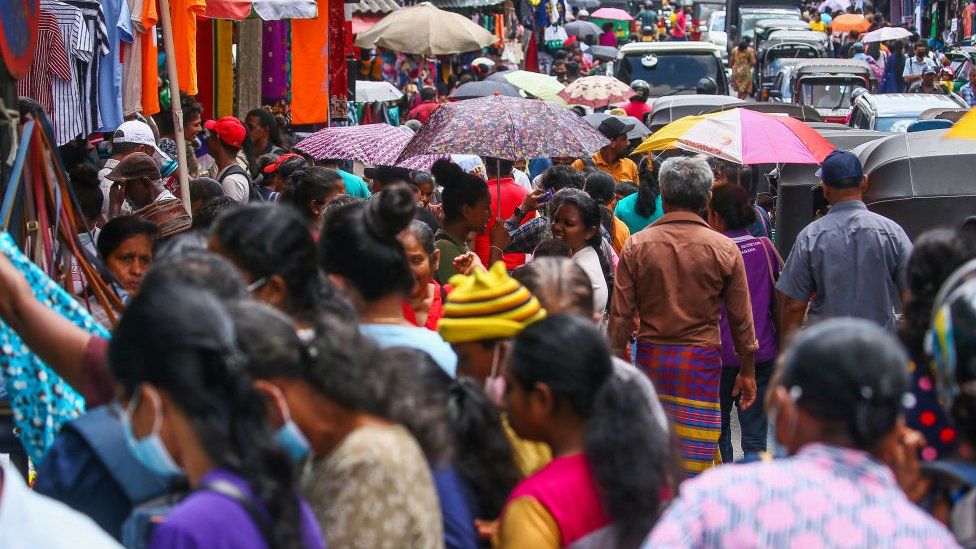
Image caption,Colombo’s public spaces, restaurants and shops are bustling with locals and tourists
By Archana Shukla
BBC News, Colombo
At first glance, life in Sri Lanka’s financial capital Colombo looks deceptively normal.
Roads are packed with traffic, public spaces and restaurants are full of both locals and tourists, while shops are bustling.
It is hard to imagine that just a year ago, this was a country struggling with massive shortages after it ran out of foreign currency.
With no money to buy fuel, roads were empty with even public transport at a standstill. Sri Lanka had to go back to pandemic-era measures such as online classes and working from home. But even this was not practical because of power cuts – some of which went on for up to 13 hours a day.
Food, medicine and other essentials were also in short supply, exacerbating the crisis. People had to stand in such long queues in the brutal heat, that at least 16 people – mainly the elderly – died.
But now, just a year later, food, fuel and medicine are available again, offices, schools and factories are all open, and public transport is back up and running.
Restaurants, especially high-end ones, are bustling.
“Last year this time I was on the verge of selling my restaurant. We had to close for a few days as the shortage of fuel meant no customers were coming. But now footfall has gone up nearly 70%,” said Chathura Ekanayake who runs a fine dining restaurant in Colombo.
The country’s main source of foreign currencies – tourism – is also witnessing a revival. The industry has recorded a 30% jump in revenue from the previous year.
“The recovery has been magical for us. Last year we didn’t even know if the country would survive”, said Hiran Cooray, CEO of Jetwings Symphony, a leading travel and hospitality player in Sri Lanka.
Despite these good news stories, Sri Lanka’s economy is still in a precarious place.
The country still has more than $80bn (£61.1bn) of debt – both foreign and domestic. In the worst of the crisis last year, the country defaulted on its foreign debt for the first time in its history.
Ranil Wickremesinghe who took charge as President after widespread protests saw then-ruler Gotabaya Rajapaksa resign, has managed to secure a lifeline of $2.9bn from the International Monetary Fund (IMF).
This has been crucial to opening other funding channels and easing shortages, but the money came with strict economic and governance policy reforms. The country is now seeking to restructure terms of its debt payments with both foreign and domestic lenders, as mandated by the IMF.
The main focus has been on restructuring its $36bn of foreign debt. This includes more than $7bn of loans from China, Sri Lanka’s largest bilateral creditor.
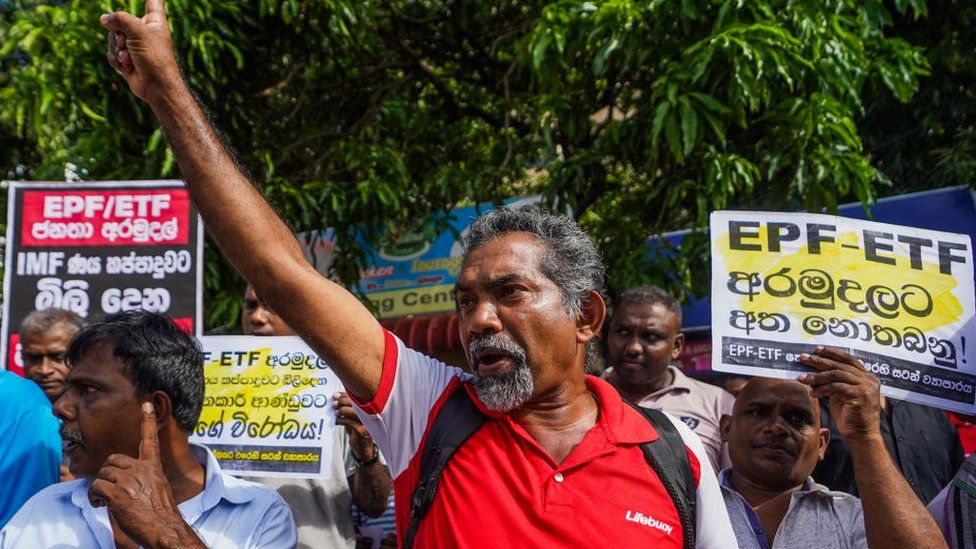
However, it is the restructuring of domestic debt that is likely to have a much bigger impact on the Sri Lankan people. Domestic borrowing accounts for around 50% of the country’s total debt. Sri Lanka’s cabinet recently approved a domestic debt restructuring proposal, but it has drawn massive criticism as it aims to cut workers’ pensions, while banks will not be affected. There have been protests against the proposals in Colombo.
It highlights that while life may seem to have returned to normal, in reality people are still struggling.
Image caption,Protesters tell the government not to touch pension funds
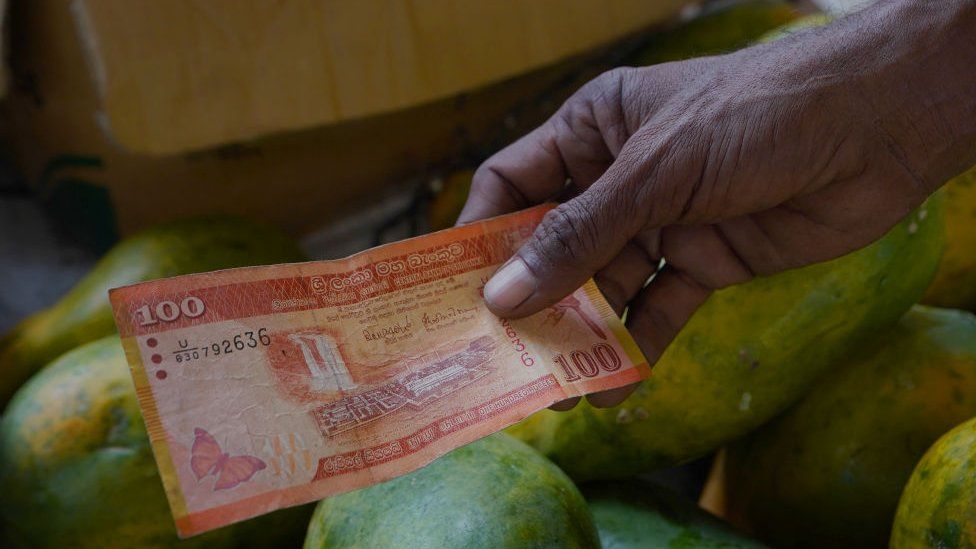
Essentials are available, but unaffordable for many. Things are more expensive than ever before. Almost half of all Sri Lankan families spend about 70% of their household income on food alone. And prices of food, clothing and housing are continuing to rise.
To add to the burden, income tax has been hiked to as much as 36% and subsidies on everything from food to household bills have been removed.
One area where this has had a huge impact is electricity bills, which have soared by 65% after the subsidy was removed.
“Many families from the middle class have now slipped below the poverty line,” said Malathy Knight, a senior economist with private think tank Verite Research.
And according to the World Bank, this is likely to continue for a while.
“Poverty is projected to remain above 25% in the next few years due to the multiple risks to households’ livelihoods,” it said in a report. The organisation has extended a $700m loan to Sri Lanka for budgetary support, including $200m for the poor and vulnerable.
This is a dramatic fall for a country that was long held up as an economic success story and had one of the highest average incomes in South Asia. The quality of its infrastructure, its free public health and education systems and its high levels of social development have all been held in high regard.
So how did things get so bad?
The government blamed the crisis on the Covid pandemic, which badly affected tourism. However, although the pandemic was a factor, disastrous economic policies were more to blame. Populist moves like big tax cuts in 2019 cost the government $1.4bn in annual revenues. And a move to ban imports of chemical fertilisers in 2021 caused a domestic food shortage.
In order to cut expenses further the government has proposed privatising state-owned enterprises like Sri Lankan Airlines, Sri Lankan Insurance Corporation and Sri Lanka Telecom. This has triggered a fresh wave of protests – this time by trade unions.
“The government should not put the burden of the reforms on the salaried class and middle class who are already affected by the economic crisis,” said Anupa Nandula, the Vice President of the Ceylon Bank Employees Union.
Mr Nandula and his union participated in a recent demonstration against the proposal to privatise the Sri Lankan Insurance Corporation. He believes privatisation will lead to massive job losses and further burden the working class.
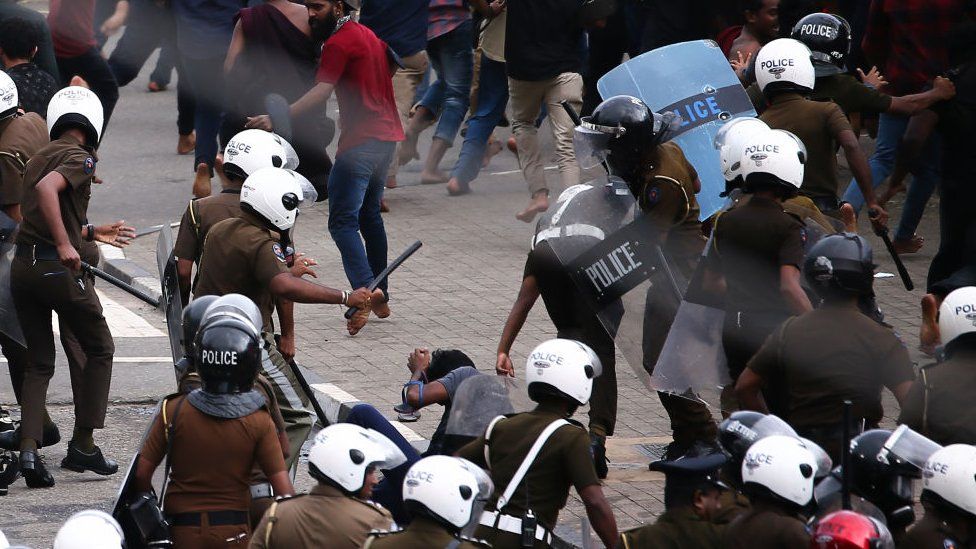
Ever since last year’s demonstrations were violently broken up, Sri Lankan authorities have been using force – such as tear gas, water cannon and even beating protesters. But experts warn that this is not a tactic that can work.
Rather than using force, the government needs to be transparent and explain that reshaping the economy will be tough, says Bhavani Fonseka, a constitutional lawyer working with Centre for Policy Alternatives.
“I think people since the crisis has happened have gotten used to a harder lifestyle. But in the absence of information coming, in the absence of answers being given, there is growing uncertainty and fear that we will go back to a crisis point.”
This fascinatingpost by Graham Shaw draws attention to the little known role that Sri Lanka (then Ceylon) played in the Indian National Movement by becoming a critical entry-point for nationalists and revolutionary literatures that would otherwise have found it impossible to enter India. A perfectly timed post as both countries mark the 75th anniversary of their independence from British colonial rule.
A little-known link between Sri Lanka (then Ceylon) and the Indian freedom struggle was its role in combating the elaborate censorship measures put in place by the British in India to keep the territories it controlled ‘sanitised’, and especially Communism-free. During the 1920s, the island proved a convenient ‘back-door’ for smuggling both ‘seditious’ literature and ‘dangerous’ persons into British India.
Two prominent figures in the Indian freedom struggle, the Bengali nationalist Manabendranath Roy (better known as M. N. Roy) and the crusading British journalist (and editor of The Bombay Chronicle) Benjamin Guy Horniman, both successfully exploited the Ceylonese ‘back-door’. Their stratagems are revealed in the British Library’s archive of ‘Indian Political Intelligence’ (IPI), a shadowy unit within the India Office in London charged with monitoring the activities of Indian nationalists and their sympathisers in Britain and continental Europe, working closely with the Intelligence Bureau in the Home Department of the British Government of India in New Delhi.
Roy, founder of the original Communist Party of India at Tashkent in 1920 and a leading figure in the Comintern, was relentlessly pursued across western Europe by IPI agents desperate to disrupt the production and circulation of his newspaper The Vanguard, first issued on 15 May 1922. In November that year, IPI reported that Roy had contacted Paul-Vaillant-Coutourier, a founding member of the French Communist Party, for assistance in smuggling copies of the newspaper and other nationalist literature from the port of Marseilles to the French enclave of Pondicherry (now Puduchery) on India’s Coromandel coast. Coutourier admitted that the French Communist Party had yet to establish lines of communication with reliable ‘comrades’ in Pondicherry, and therefore suggested that Roy make arrangements with Simon Sabiani, the ruthless Corsican Communist boss of Marseille’s Fourth Canton, a working-class area near the docks. Roy’s first thought had been to enlist Indian sailors (lascars) as couriers, but Coutourier informed him that very few ever visited Marseille; that the ships they served on usually only remained in port for a single night; and that they rarely left the docks to visit the city.
In the summer of 1923 Roy himself travelled to Marseille on a Mexican passport under the alias Roberto Allen to negotiate with Sabiani. He authorised Sabiani to spend up to 1,000 French francs a month to pay for the services of Italian Communists in smuggling literature aboard ships. The plan was to send one half of each consignment of The Vanguard in the weekly P&O mail-boats despite the risk, however small, that they might be seized by Customs on reaching British India. The other half of each consignment would be sent on the fortnightly French mail-boats owned by the well-known company Messageries Maritimes. Sabiani knew some of the crew aboard the French ships who were sympathetic to the Communist cause, but the chief advantage was that they sailed directly to Colombo or Rangoon (now Yangon) without calling at any British Indian port.
In September 1923 IPI reported that as many as 1,200 copies of The Vanguard were being sent via Messageries Maritimes vessels every two weeks. At Colombo, the mails bound for French India were unloaded without being inspected and reshipped to Pondicherry where, unlike at ports in British India, there was no legal provision for incoming mails to be subjected to examination by police or postal officers. Even if they suspected parcels might contain copies of The Vanguard, the French port officials had no powers to seize and destroy them. From Pondicherry, Roy’s newspaper and other Communist literature could easily be smuggled into British India on foot or on bicycle — Roy’s contact there, Ram Charan Lal Sharma, announced proudly that he had recently purchased two for that express purpose! Even though Ceylon was a British colony, there had been no cooperation between its colonial administration and that of India to control this mail route. The Colombo ‘back-door’ had not been closed — to Communist literature at least.
The repressive Rowlatt Act (passed by the Imperial Legislative Council of India in February 1919) unleashed a wave of protests led by Mahatma Gandhi. When rioting broke out in Bombay (now Mumbai) on 11 April, Governor Sir George Ambrose Lloyd declared that The Bombay Chronicle’s publication of Gandhi’s passive resistance manifesto had been a prime cause. Lloyd was determined to be rid of Horniman, its passionately pro-nationalist editor. Rather than put him on trial, Lloyd chose to deport him on 26 April under Defence of India (Consolidation) Rules of 1915, modelled on the British 1914 Defence of the Realm Act (DORA) sanctioning extra national security measures in wartime.
Back in Britain, Horniman campaigned vigorously for Indian independence, but was also determined to return to India. In December 1919, October 1920 and July 1921 he applied for a passport to India but each time was refused on advice from the Governor of Bombay Presidency. With the Indian DORA due to lapse at the end of August 1921, the British Indian Government passed the Passport (Entry into India) Act in 1920 under which anyone not possessing a passport valid for India could be denied entry. But issuing a passport for India to a British subject was the responsibility of the Passport Office (then part of the Foreign Office in London), not the India Office.
Horniman again applied in September 1921, May 1922, September 1923 and January 1924, and was still refused a passport for India after special intervention from the India Office, labelling him ‘a dangerous anti-Government agitator’. Campaigns mounted in support of Horniman’s return to India both in Britain and India itself met with no success. In March 1924 his case was raised in the House of Commons as a constitutional issue: that the indefinite penalisation of a British subject without trial or legal process was a grave infringement of personal liberty. Given Horniman’s profession, the ban was also seen as an attack on press freedom. Even the Secretary of State for India Lord Sidney Haldane Oliver felt there were insufficient grounds for a satisfactory defence of the ban in Parliament, but Viceroy Rufus Isaacs, 1st Marquess of Reading, insisted that the view of the local representative government (the Bombay Legislative Council) must be the paramount consideration.
After six years of refusals, the exasperated Horniman changed tack. On 13 October 1925 he successfully applied on health grounds for a passport to travel to France. In Paris he learnt that his passport was valid for entry to all French possessions (including Pondicherry). To his surprise, the British Consulate in Paris informed him that no special endorsement was needed to visit Ceylon, or any other part of the British Empire — except India.
On 19 December, Horniman left Marseille for Colombo on the S.S. d’Artagnan belonging to Messageries Maritimes. While on board, Horniman was informed there were no ships sailing from Colombo to Pondicherry; he would have to travel there by train. At Colombo, the police at first refused him disembarkation but when he challenged the decision he was reluctantly allowed to land. Fearing possible arrest, he immediately took the train north to Talaimannar. From there he boarded the ferry across to Dhanushkodi at the tip of the Indian peninsula extending out to Adam’s Bridge (now Rama’s Bridge/Rama Setu). As at Colombo, on the Indian side police initially denied him right of disembarkation and informed him that he would have to take the ferry back to Colombo. With a strong police guard on board there was no chance of escaping. But after consultation with senior officials the police had no choice but to let him land.
Horniman was home free in British India. His initial plan to enter via French India had proved unnecessary because of a loophole in the 1920 Passport (Entry into India) Act. That legislation only sanctioned the removal of persons without a valid passport who had entered India overland via Chaman in Baluchistan or the Khyber Pass, or directly by sea but not via a port in Ceylon, an exemption included to meet the needs of Indian estate labourers travelling regularly between India and Ceylon at the time.
The news of Horniman’s return to British India caused consternation in the India Office. There was nothing that could be done: he could not be prosecuted under the 1920 Indian Passport Act as it stood, and it could not be amended retrospectively to apply in his case. While a blame game played out between government departments in Britain, India and Ceylon, Horniman was back at the heart of Bombay journalism — thanks to the ‘back-door’ provided by Ceylon.
*
NOTE: Geographical names have been rendered in their historic spellings of the period; modern names have been indicated at the first instance.
The views expressed here are those of the author and do not represent the views of the ‘South Asia @ LSE’ blog, the LSE South Asia Centre or the London School of Economics and Political Science. Please click here for our Comments Policy.
This blogpost may not be reposted by anyone without prior written consent of LSE South Asia Centre; please e-mail southasia@lse.ac.uk for permission.
U.S. Treasury Secretary Janet Yellen said on Sunday she was eager” to work with China on areas of mutual interest, including debt restructurings for poorer countries, and that multilateral development banks needed reforms before capital increases could be considered.
At a press conference before a meeting of Group of 20 finance ministers and central bankers in India, Yellen said her visit to Beijing last week helped put the U.S.-China relationship on surer footing” and that the world’s two biggest economies had an obligation to the world to cooperate on areas of mutual concern”.
There is much more work to do. But I believe this trip was an important start,” Yellen said. I am eager to build on the groundwork that we laid in Beijing to mobilise further action.”
Concerns remain about China’s unfair trade practices, which prompted Washington to impose tariffs on Beijing. They really have not been addressed,” she said.
U.S. corporations want to see an environment where they could invest and thrive in China”, Yellen said.
Washington will continue to cut off Russia’s access to military equipment and technologies that Moscow needs in the invasion of Ukraine, Yellen said.
One of our core goals this year is to combat Russia’s efforts to evade our sanctions. Our coalition is building on the actions we’ve taken in recent months to crack down on these efforts,” she added.
India, which chairs the G20 this year, has sought a largely neutral stance on the war, generally declining to blame Russia for the invasion Moscow launched in February last year, urging a diplomatic solution and sharply boosting its purchases of Russian oil even as Western nations seek to squeeze Moscow.
Yellen said she would continue to push hard at the G20 meeting, in Gandhinagar in the northwestern Indian state of Gujarat, for full and timely participation of all bilateral official creditors on pending debt restructurings”.
She said she discussed Zambia’s restructuring with her Chinese counterparts and, although it took too long to negotiate, differences were overcome.
We should apply the common principles we agreed to in Zambia’s case in other cases – rather than starting at zero every time. And we must go faster,” Yellen said, adding she hoped debt treatments for Sri Lanka and Ghana could be finalised quickly so the International Monetary Fund (IMF) could move forward with initial loan programme reviews this fall.
She said a debt restructuring user guide” was needed for borrowing countries and other stakeholders to provide clarity about the process.
Yellen said the IMF’s Poverty Reduction and Growth trust, which provides zero-interest loans to the world’s poorest countries, needed to be put on sounder financial footing. The U.S. Treasury is ready to assist the IMF to consider options for this, including using internal fund resources, she said.
‘BETTER BANKS’ Yellen also laid out a number of next steps for the evolution of the World Bank and other multilateral development banks, but said that any exploration of capital increases for the institutions can only be considered after implementing reforms aimed at expanding their role beyond poverty reduction to tackle global challenges such as climate change and pandemics.
We should build better banks, not just bigger banks,” Yellen said.
She repeated her estimate that multilateral development banks could collectively boost lending by $200 billion over a decade from internal resources through balance sheet reforms now being implemented or considered. They could boost this further by implementing recommendations from last year’s G20 Capital Adequacy Framework report, she said.
Among other World Bank reform steps, Yellen said she was pushing for a new set of principles that would allow the targeted use” of the bank’s concessional financing for global challenges, including climate change and measures to boost such resources.
She said she would like the World Bank to explore options for lending to sub-sovereign and supra-sovereign borrowers like the COVAX vaccine initiative.
Yellen said the United States was committed to implementing a global corporate minimum tax deal reached in 2021 despite the lack of action by the U.S. Congress to do so. She said negotiations on technical details of the deal’s Pillar 1 – reallocation of taxing rights on large multinationals including big technology firms – were very close” to completion.
The Inland Revenue Department (IRD) says that it has collected a total tax revenue of Rs. 696,946 million for the first half of this year.
In comparison, the revenue collected from the income tax during the first half of 2022 amounted to a total of Rs. 361,832 million, according to the department.
Accordingly, the collected Tax Revenue of the first half of this year shows a positive growth of 93% compared to last year, the Commission General of the IRD said in a statement.
He also mentioned that the factors such as decisive changes of the tax policy, the gradual recovery of the economic situation of the country and the efficiency of the efforts of the IRD are the reasons for this positive growth.
I am especially grateful to the honorable taxpayers for their cooperation to uplift the economic strength of the country and the officers of public and private institutions who supported this in various ways for this success”, the department’s CG added.
‘Before you study the economics, study the economists!’
*
‘The US decided to undertake… an influencecampaign
behind the scenes, providing favors…through grants,
training grants & money for individuals involved
in participating to get them to flip their decision…
Stakeholders from China have left that project
and have struck out on their own to try to construct
what has been seemingly seen as competing cables
at the same time along similar routes…
A key pressure point in this process is:
Who is going to actually manufacture & lay the cable across the ocean?
Not necessarily who’s going to own the cable or where the cable is going to land.’
(see ee Random Notes)
NATO-media outlet Thomson-Reuters dates this cable drama as unfolding rapidly under cover of the covid roller-coaster of the last few years. ee gathers together here some English media bric-a-brac, which chose not to directly report on such underwater soundings at the time. We start with a grab of random historical references (especially about the ongoing attempt to monopolize the Indian Ocean), then to recent news about the financing & construction of telegraph & submarine cables. These sources could not or simply do not wish to flash some oxygen (to mix a metaphor) into the do-doings of those professing a ‘free & open Indo-Pacific’.
The story intrigues. Encapsulated within it is the perfidy of SLTelecom, whose privatization is hailed as a success story – the hijacking of a public service done just as the move from landlines to mobile phones was being effected. Now it is being handed over to the World Bank!
SLTelecom long refused to invest its vast profits in producing any equipment, much of which is imported via Japan. Japan’s claim that Colombo Dockyard is Sri Lankan, to then demand government contracts, is also here examined. Colombo Dockyard apparently ‘built’ (actually, assembled!) a ship for Japan to lay submarine cables. The local English media views industry as only children’s building-block games! The ‘cable’ business has however always been linked to European imperialism and economic exploitation. ee has recalled the English sabotage of the boat-building industry. ee now records here again the supine and backward nature of Sri Lanka’s grandly elocuted ‘IT industry’ – which does not make a screw! (see ee Focus, Fake Dockyards)
here we whirl between rivers named red & yellow
a himalayan dance of fire pivots on our head
as about us waves from west & east are roiled
to dash on the rocks. o how they froth!
time streams fast at the edges of the planet
as the receding tides of the beach
try drag us into the wider ocean
Last ee reported, the US ‘compensated’ & warned Sri Lanka Telecom and other country providers not to work with China’s subsea project. Yet China produces and supplies the most modern and efficient internet submarine cabling. This production & supply is the main issue, not the English media-blasted charges about using the cables to spy on other countries. The ‘English-built’ Kandy Road still links plantation, fort and port. This very internet to which we are bound – hand, eye, ear & mind – is set up after all by the US military to primarily connect its researchers & suppliers – DARPANET, etc. Sigh. The US is always projecting its own grimy practices onto others.
The US threats & bribes directed at forcing countries to submit to the US’ monopoly over subsea cable routes, did not rate attention by free traders (who whinge about rule of law & laissez-faire) and the protectionists (who oppose encroachments on our sovereignty) – all radio silent.
*
This submarine cable hullabaloo arrived midst all manner of ‘digital’ news: The Washington-based World Bank’s International Finance Corporation has been ‘selected’ to ‘help’ sell off Sri Lanka Telecom, SriLankan Airlines, etc. The World Bank & their IFC already have their fingers deep in the orifices of the country’s banks, openly manipulating the ‘rigged’ stock market, etc.
• US financial ratings agency Fitch has fallen in love with us again. Fitch is ‘positive’ (not like an AIDS test but), about the government ‘unbundling CEB’s generation, transmission & distribution process by transferring CEB’s resources to 14 companies established under the Companies Act as part of the country’s energy sector reforms.’ Let there be light?
• The cabinet has also cleared an Indian-financed digital identity for every citizen, in addition to a national identity card – India promises 300million Indian rupees to this Sri Lanka Unique Digital Identity (SL-UDI) project.
• The IMF has threatened Sri Lanka to desist from taxing telecom providers. Digital multinationals should be paying at least a $100mn annually. A set of media-made-eminent economists – Stiglitz, Ghosh, Piketty – belonging to an NGO funded by the German & Norwegian state has kindly objected, on our behalf. The IMF has denied this. Very kind indeed! Yet the roots of our discontent lie deeper and relate to the prevention & sabotage of industrial production.
*
‘Of all countries in South & Southeast Asia,
Ceylon has the most unstable economy.
The present crisis in the country exhibits many features born of this instability
…different in character from the earlier economic crises…
The present crisis arises from a deeper cause…
The present crisis is much more serious & much less temporary than earlier ones.
It is not a passing disturbance capable of adjustment. It is not possible to meet it
with relief schemes or other ad hoc remedies. In fact, it is fundamentally different.
It is of the greatest importance to understand this new fact about the crisis.
It is not caused by prices or demand for our gods, but by lack of produced wealth.
The question we have to ask is this:
Why is production remaining static?
Why do we not produce more?‘
– The Way Ahead (Idiri Maga), Introduction, SA Wickremasinghe, 1955
ee was curious about the Communist Party of Sri Lanka’s role in proposing the Mahaveli’s revitalization back in the 1950s. Some readers have been led to believe the Mahaveli project was of colonial or UNP origin. ee is curious about the link between DJ Wimalasurendra’s exertions to formulate an energy policy and his influence on later CP thought. This ee excerpts references to the Mahaveli’s power in Wickremasinghe’s Idiri Maga classic (see, ee Focus).
*
‘Sri Lanka must ensure adequate nutrition
for pregnant, breastfeeding women: Amnesty International’
(see ee Sovereignty)
*
‘A child needs 2 packets of powdered milk per week’ – Daily Mirror
(ee Agriculture)
So! The media is bullish – that’s stockmarket-speak for ‘optimistic’. Hard-to-please Fitch is optimistic about the Domestic Debt Restructuring (DDR) renamed DDO – removing ‘restructuring’ and adding ‘optimization’. Brilliant PR stuff, huh? And happier still is Fitch that the Ceylon Electricity Board (CEB) is being ‘unbundled’ to private companies. And duly the stock market doth sing hallelujah in falsetto to the IMF’s dictat. And now, Amnesty International is giving Sri Lanka advice on breastfeeding! Maybe because the Minister of Agriculture is being breastfed by the World Bank and USAID’s soya lobby. The Ministry of Education is similarly learning tuition lessons after hours. The WB sets their menu… um, curriculum. The UN World Food Program (WFP) has taken over the Ministry of Health’s dentures chattering about diet and malnutrition. No caveats against imported gluten, Unilever’s carcinogenic Astra Margarine or New Zealand’s powdered milk, banned in their own countries.
While the government sets about their ‘labor reform’, the UN International Labor Organisation (ILO) is promoting youthful ‘disruptors’ with the Ceylon Chamberof Commerce & the US government. The ILO is even teaching us to grind chilies! Those who daily deemed Gota a despot, now admire the suave callisthenics of Batalanda Wicka. US media outlet EconomyNexthas an earnest Englishman recounting India’s independence struggle – full of the old orientalisms and the hookah fragrances of idealism. Maybe, the local brownies need to be reminded about the yards of indigenous airs they wrap themselves in.
Amnesty Inc’s latest concerns are timely. Dr Priyani Soysa, once hounded by Swiss Nestlé for exposing their attempt to ‘substitute’ mother’s milk, passed away a few months ago – with several obituaries but none recalling her monumental MNC (multinational corporation) battle (ee calls Soysa, Dr, cos she was a real doctor, albeit with the most human afflictions). Amnesty Inc was quiet then about such MNC moves. They’re even more quiet now despite the ruckus. Nestlé meanwhile, after posting record profits, has opted to go ‘private’, delisting from the stock market. Shareholders, some feel milked. Others creamed.
Since we cannot trust the English media to divulge the truth, we have to divine astrological signs to sense changes in the world. The Indian Foreign Secretary dropped by to meet the President. Then came Bollywood superstar Rajinikanth, plus the good news that ‘top stars’ are attending the Mrs India Inc Season 4 in Colombo! Does this stellar fog in this latitude of the Bay of Bengal augur greater turbulence? – to use a meteorological metaphor – as we approach the 2023rd twenties of July. Refer here to the annual markings to recall what some call ‘Black July’ – yet we always see these & other such Julys (Julies?) as white: July 1980, July 1983, July 1987, July 2022. Why White Julys? Because we have always seen the old ‘hidden hand’ – an euphemism quite popular in the 1980s, when such horrors unfolded – to manifest the agenda of genuflection, evident in full array.
News arrived this week that the US & Canada – another infamous Core Group – sponsors those gangs in Haiti, to pave the way for invasion (see ee Sovereignty, Caricom Caves). Such news shows why we have to go near full astrological, cos we do not have all the information, and only can read signs that barely manifest, at least openly, in the media. About Julys then and now and thenceforth. And as usual, with time, we get to see subtleties, nuances, facets and other vertebral narratives that put these apocryphal events in their time and place.
*
‘Without economic freedoms to import something,
or transfer a legally earned rupee,
grand plans to develop the country will come to nothing’
– ee Economists, US EconomyNext’s Bellwether
• US state-owned media in Sri Lanka, EconomyNext constantly harangues about ‘free trade’, and liberalizing imports & exports. This made ee recall the integral English & US ‘free trade’ in slaves & opium. After all, ee was busy catching up on news about China beginning to provide their own internet submarine cabling to Asia & Africa, which would be more advanced and built faster. The whites wish China will pack up and go home 15thC Ming-dynasty style, and leave the ocean open to the savagery & underdevelopment that the Portuguese & Spanish unleashed on these seas beginning about the 16thC.
ee’s tale this week begins to look at the origins of European transgressions in the Oceans, named Indian and the Pacific. From the Atlantic Triangle Trade of chattel slavery – the largest commerce of the 16-19th century – to the largest triangle business in the 19th century: the English opium trade in the Indian Ocean, which brought us modernity by gunboat.
The triangle of financing English manufactures, Indian opium and Chinese tea, give us background into the banking practices of Standard Chartered & HSBC. Here then are the origins of ‘accounting’ games played by ‘exporters’ of all kinds to bleed Sri Lanka – goods mostly ‘assembled’ via inflated imports.
This week reinforced again the unreliability of economists. The Sunday Times’ Nimal Sanderatne admitted that contrary to the President & the Central Bank governor’s promises,the ‘EPF & ETF would suffer losses & retirement benefits of private sector employees would be eroded’. Sanderatne attempts Churchillian charlatanry calling such promises – ‘factual inexactitude’ (seeee Economists).
For such ‘inexactitudes’, we may have to thank the ‘communication strategy’ of London Ceylon Tobacco Co’s Suresh Shah, who is the government pointman in charge of selling off government resources.
Meanwhile, over 100 academics have objected to the government undermining labor laws. Interestingly, they note the obsession with an ‘export-oriented economy’. Yet they notably avoid mentioning the IMF (see ee Focus). They observe: ‘The economy of the plantations is on the cusp of change and the Malaiyaha worker is staring into a future of fragmentation…’ Why use the ‘passive voice’? Why not tell who is making the ‘change’. Don’t they know? They may have forgotten the great English expertise in human resources bestowed upon this country’s plantocracy:
*
‘During the whole of the 18thC, English slave traders
furnished the sugar planters of France & Spain with half a million Negroes…
England was not only the foremost slave trading country in the world;
she had become… the ‘honourable slave carriers’ of her rivals…
By 1795 Liverpool alone had five-eighths of the English slave trade and
three-sevenths of the whole European slave trade…’
– Eric Williams, Capitalism & Slavery
1795 rings bells for us. English multinational Unilever now dominates Sri Lanka’s economy, economically and culturally, and holds our home market hostage. Unilever is directly traced to the Company of Royal Adventurers Trading to Africa (later Royal African Company, now Unilever). The RAC shipped more African slaves to the Americas during the Atlantic slave trade than any other company. Unilever’s founder, chief patron to English Queen Victoria’s Belgian cousin Leopold obtained control over palm oil production in the Congo & West Africa…
Incorporated in 1663 for a period of 1,000 years, 64 years after the East India Co (EIC) was set up, the RAC was founded by the beheaded Charles I’s orphans – Charles II and his brother, the Duke of York. We now have one head hunter who is called Charles III. And the RAC’s offshoots still cripple us…
In 1698 the Royal African Company lost its monopoly in slaving, and the right of a free trade in slaves was recognized as a fundamental & natural right of Englishmen. 90 years later, England’s Privy Council Committee in 1788 paid special attention to the fact that, of the annual English export of slaves from Africa, two-thirds were disposed of to foreigners.
The East India Co too would in the 19thC lose its monopoly. Out of this arose the private merchants who then reassembled as Unilever in the 20thC. Unilever today outsources its production to 3rd-parties who appear ‘independent’ and thus defy the country’s labor laws. They control media through advertising. Our academics have to use euphemisms, yet our politicians and media openly ensure Unilever’s will will be done.
The Ambassador of Türkiye to Sri Lanka says the elements of FETÖ (Fethullahist Terrorist Organization) – the group behind the foiled 2016 coup bid – have been eliminated from Sri Lanka after successful joint efforts by the two nations against terrorism.
Addressing the Democracy and National Unity Day Commemoration Ceremony in Colombo on Saturday (July 15), Ambassador Demet Şekercioğlu said Türkiye continues to engage with the Sri Lankan authorities with enhanced intelligence sharing to build a strong, vigilant and comprehensive response to terrorism.
On July 15, 2016, the government of Türkiye President Recep Tayyip Erdoğan defeated an attempted coup d’état by FETÖ members, which claimed the lives of 251 citizens and left thousands of others injured. The day is commemorated as the Democracy and National Unity Day in Türkiye.
The ambassador said the tragic events that unfolded on July 15t were not merely acts of terror;, but a blatant affront to the founding principles that define the Republic of Türkiye and its people – the principles of democracy, freedom, and the rule of law.
She said the malicious acts witnessed on July 15, 2016 were not results of an overnight attempt., but the climax of many years of meticulous planning and covert operations by the FETÖ led by Fetullah Gülen.
Şekercioğlu highlighted that Türkiye’s fight against FETO has been unwavering, and combating these elements of terror has been one of its top priorities both within and outside of the country.
Meanwhile, Türkiye Foreign Minister has thanked the country’s Asian partners for their support in the fight against FETO.
Addressing a news conference at the ASEAN-Türkiye Sectoral Dialogue Partnership Trilateral Meeting held in Jakarta, Indonesia, Minister Hakan Fidan recognized and appreciated the cooperation of Türkiye’s friends from the Asian region in the fight against FETO.
The sentience of animals like crabs, lobsters & prawns (decapod crustaceans), calls for their legal protection.
The welfare of decapod crustaceans remains largely unprotected, and they are truly voiceless. Their suffering at the humans is a blot on our moral conscience.
There is compelling scientific evidence that they are sentient and therefore can experience pain, and in light of the extreme practices they are subjected to, the animal welfare movement of Sri Lanka must take up their cause.
There must be a legal requirement for food processors, supermarkets, and restaurants to consider their welfare during storage, handling, or killing. Invertebrates are also animals as defined in the Animal Welfare Bill. There must be Regulations and Codes of Practice in the new draft Animal Welfare Act to cover crustaceans such as Shrimp, Crab, and Lobster.
These animals i.e., crabs and lobsters are frequently killed by breaking off the legs, head, or tail, and then being boiled alive. It has been estimated that an edible crab boiled alive may remain conscious for at least three minutes.
In restaurants that specialize in Crab and Lobster culinary, they can be often seen crammed together in brightly lit tanks with no consideration for their welfare and they are killed in the most inhumane and barbaric manner.
Even high-profile people who have enough money to live in great comfort and ought to behave like national role models showing love and compassion for sentient beings, have unfortunately taken to this unpitying trade and thereby have brought shame on themselves and their respected sports and alma mater (school).
Amendment to Animal Welfare (Sentience) Bill following LSE report on decapod and cephalopod sentience
Crabs, octopus and lobsters to be recognised as sentient beings in government policy decision making
Decapod crustaceans and cephalopod molluscs will be recognised under the scope of the Animal Welfare (Sentience) Bill
Amendment to Bill follows London School of Economics and Political Science (LSE) scientific research findings on decapod and cephalopod sentience
Existing industry practices will not be affected and there will be no direct impact on shellfish catching or in restaurant kitchens
The scope of the Animal Welfare (Sentience) Bill has today been extended to recognise lobsters, octopus and crabs and all other decapod crustaceans and cephalopod molluscs as sentient beings.
The move follows the findings of a government-commissioned independent review by the London School of Economics and Political Science (LSE) which concluded there is strong scientific evidence decapod crustaceans and cephalopod molluscs are sentient.
The Animal Welfare (Sentience) Bill already recognises all animals with a backbone (vertebrates) as sentient beings. However, unlike some other invertebrates (animals without a backbone ), decapod crustaceans and cephalopods have complex central nervous systems, one of the key hallmarks of sentience.
Today’s announcement will not affect any existing legislation or industry practices such as fishing. There will be no direct impact on the shellfish catching or restaurant industry. Instead, it is designed to ensure animal welfare is well considered in future decision-making.
Animal Welfare Minister Lord Zac Goldsmith said:
The UK has always led the way on animal welfare and our Action Plan for Animal Welfare goes even further by setting out our plans to bring in some of the strongest protections in the world for pets, livestock and wild animals.
The Animal Welfare Sentience Bill provides a crucial assurance that animal wellbeing is rightly considered when developing new laws. The science is now clear that decapods and cephalopods can feel pain and therefore it is only right they are covered by this vital piece of legislation.
The Bill, when it becomes law, will establish an Animal Sentience Committee made up of experts from within the field. They will be able to issue reports on how well government decisions have taken account of the welfare of sentient animals with Ministers needing to respond to Parliament.
Ministry to consult President’s Secretariat on composition
Pipeline can link Nagapattinam refinery to SL storage
The Government will appoint a committee to evaluate the proposal submitted by the Indian Oil Corporation (IOC) for an oil distribution pipeline connecting Nagapattinam, Tamil Nadu to Trincomalee and Colombo, the Ministry of Power and Energy said yesterday (15).
The proposal comes days before President Ranil Wickremesinghe is to visit New Delhi on the invitation of Indian Premier Narendra Modi.
According to the Ministry of Power and Energy Secretary M.P.D.U.K. Mapa Pathirana, the committee will be appointed soon.
We have only received this recently and a committee will be appointed soon to evaluate it. We will need expert help to analyse this proposal,” Pathirana said.
A senior Government official close to the subject said that the composition of the committee would likely be decided following a discussion between the Ministry of Power and Energy and the President’s Secretariat.
According to him, the IOC is keen to establish a pipeline to Sri Lanka which will link domestic storage potential to the new nine million metric tonnes per annum (MMTPA) refinery at Nagapattinam, established through a joint venture by Chennai Petroleum Corporation Ltd. (CPCL) and IOC.
The senior official opined that the pipeline may be a more economical option for the IOC to establish than constructing a new refinery in Trincomalee Bay. IOC already manages several long-distance oil pipelines in India.
Last week, Minister of Power and Energy Kanchana Wijesekera took to Twitter to announce that the IOC proposal had been discussed.
A proposal by IOC for an oil distribution pipeline connecting Nagapattinam, Trincomalee, and Colombo was discussed yesterday. I requested them to look at a two-way oil and gas pipeline taking into consideration the Government’s development plan for Trinco Tank Farm and energy hub, future developments of refineries, oil and gas exploration, pipeline connections to domestic LPG terminals that will target regional oil and gas export markets while enabling energy requirements of both countries. Project feasibility, technical requirements will be assessed before finalisation of the project scope for approval. Officials of Indian High Commision, Ministry of Power and Energy, CPC, CPSTL, PDASL, IOC and LIOC participated,” Wijesekera tweeted.
Earlier, State-owned Ceylon Petroleum Corporation (CPC) and Lanka Indian Oil Company (LIOC), a subsidiary of IOC, signed an agreement to jointly develop the 1930s-era Trincomalee Oil Tank Farm which had been neglected over the decades.
The move drew criticism from some Opposition parties and trade unions which objected to ‘national assets’ being sold off to foreign companies. However, according to the CPC, LIOC has pledged close to $ 180 million to rehabilitate the oil tank farm and bring it back into operation.
Attempts to contact the LIOC regarding the IOC proposal failed.
Until recently, there had been a significant absence in research on Sri Lanka’s fireflies; previous work was by British scientists a couple hundred years ago, but now a new surge in research has led to new findings in the pipeline for publication.
Recent research has led to the rediscovery of Luciola nicolleri, a firefly not seen since its description 100 years ago, and Curtos costipennis, a new discovery in Sri Lanka.
Glowworms are the larval stage of fireflies, and folklore has it that once stung by them, treatment would require mud from the depths of the ocean and stars from the sky, indicating a difficult cure — shot down by experts as myth, confirming fireflies do not harm human life.
A beautiful and common sight just a decade ago, fireflies are fast disappearing from urban landscapes due to loss of habitat, increasing temperatures and pollution levels, affecting their reproduction signals in the form of bioluminescent lights.
COLOMBO — Fireflies, with their bioluminescent rears, are fascinating species that appeal to people’s imaginations, especially those of children. In Sri Lanka, the first systematic study of fireflies was carried out by British naturalists in the 18th century, but afterward, there was a loss of interest in studying these fascinating creatures.
Shedding new light on Sri Lanka’s firefly fauna, researchers and at least one enthusiastic amateur continue to study them today, resulting in several discoveries. Sri Lanka is home to 16 firefly species, while Abscondita perplexa and Asymmetricata humeralis are more common and show a countrywide distribution. In 2022, research on A. humeralis conducted by Dammika Wijekoon and Hemantha Wegiriya of the University of Ruhuna showed that male A. humeralis can look different in color and pattern, highlighting that there can be more secrets in the world of fireflies to be investigated.
Wijekoon and Wegiriya initiated their study on fireflies in 2009 and have already made several significant discoveries. In 2010, the researchers recorded Curtos costipennis for the first time in Sri Lanka, making it the first firefly member of the genus Curtos found in Sri Lanka.
Their study in 2022 re-recorded Luciola nicolleri after a lapse of 100 years. The species was first described in 1922. L. nicolleri has not been recorded since its discovery, a highly significant finding as it was considered possibly extinct.
The studies further showed that fireflies prefer terrestrial grassland habitats and Uva province, where 11 species out of the 16 are found, has a role to play in their conservation. Both Sabaragamuwa and Southern provinces, too, have a rich firefly diversity, according to this study.
Fireflies are soft-bodied, light-emitting insects classified under the family Lampyridae. There are about 2,000 firefly species in the world and most of them can emit light through a chemical process using an enzyme produced in their body.
Each species has different intensities and patterns of light, and this phenomenon usually happens in twilight as a mechanism that is used by female fireflies to attract a partner, said Wijekoon, one of the co-authors of the study.
The enzyme involved in light production is called luciferases and when this reacts to oxygen, it begins to flash. Scientists also believe that fireflies can control the frequency and intensity of flashing by controlling the oxygen levels to the light-producing organs.
Sri Lankans know another species that emits light, but they are not flying and have a worm-like appearance: glowworms. People often consider glowworms to be distinct, not knowing that it is the larval stage of the firefly, Wijekoon told Mongabay.
Glowworms mainly feed on small snails and slugs, first injecting venom to immobilize the prey. This habit has given the creature a scary reputation, where folklore has it that if stung by a glowworm, treatment would require mud from the oceans and stars from the sky, indicating the difficulties in treatment. Glowworms also have a neurotoxin venom similar to that of some snakes, but their mouths are very small, and the venom released is negligible.
A glowworm feeds on a snail. Image courtesy of Dhammika Wijekoon.
Shashi Prabath, a teacher at Vidyaloka Science Institute, is fascinated by the study of fireflies. He continues to study them and is trying his best to rear them. To pursue the factual status of the local myth, Prabath even wanted to be bitten by a glowworm.
I tried to get bitten by one of them, but the glowworm didn’t bother initially, However, after I applied slime on my finger, I did get bitten. But it was like an ant’s bite and only a little pain, which reduced after a few hours,” Prabath added.
Prabath also tries to rear fireflies from the stages of eggs and has successfully managed to raise them. He is currently working on a research paper.
A field guide that can be used to identify firefly species with a description of their behavior could be the first step in popularizing firefly studies among the public interested in this charismatic insect, he said. Taking the first step, Wijekoon published the book Fireflies of Sri Lanka,” which is the first-ever comprehensive book on the taxonomy and ecology of fireflies in Sri Lanka, addressing the long-felt need and research gap in firefly literature in the country.
The book contains species names, information on males and females, identification characters, ecological remarks, active time periods, distributions and larval and egg characteristics wherever available. This book offers the first-ever detailed description of the systematics and ecology of Sri Lankan fireflies.
A female Lamprigera tenebrosa firefly. Image courtesy of Dhammika Wijekoon.
Firefly tourism is also popular in many other regions. For example, Research on nature tourism shows increased interest among nature-based tourists in firefly tourism. Sri Lanka has the potential to look at such tourism possibilities as some of the pristine sites still harbor a healthy population of fireflies,” Wijekoon said.
Nighttime river safaris could be an ideal way of observing fireflies without disturbing the natural vegetation, experts say. Some countries like the U.S. have species that have synchronized lighting, which provides a spectacular scene. Much is still unknown about Sri Lanka’s firefly fauna, Wijekoon said.
Decades ago, fireflies were a common sight that brought much joy to children, adding magic to the twilight hours — but this has become a thing of the past in many areas, especially in urban gardens. Not only the loss of suitable vegetation, but light pollution, too, is a major contributor to the decrease in firefly populations, said Wijekoon.
When there are too many outdoor lights, fireflies fail to communicate with each other, and firefly reproduction cycles take a hit. In addition, the fireflies need moisture, but the soil is getting increasingly dry. Pesticide use is another factor that contributes to the decline of fireflies.
Wijekoon is also a member of the IUCN Species Survival Commission Firefly Specialist Group and said it is important to focus on conservation of these charismatic insects. To highlight the need for action, the first weekend of July is declared World Firefly Day by the International Firefly Network.
Citations:
De Silva, D. R., Wijekoon, D., Sandun Nalaka Bandara, K. V., & Wegiriya, H. (2022, June). Re-record of Luciola nicolleri (Coleoptera: Lampyridae: Luciolinae) from Sri Lanka. Paper presented at International Firefly Symposium, Parque Biologico de Gaia, Portugal.
Wijekoon, D., & Wegiriya, H. (2022). Fireflies of Sri Lanka. Malabe, Sri Lanka: Sarasavi Publishers (Pvt) Ltd.
Lewis, S. M., Thancharoen, A., Wong, C. H., López‐Palafox, T., Santos, P. V., Wu, C., … Reed, J. M. (2021). Firefly tourism: Advancing a global phenomenon toward a brighter future. Conservation Science and Practice, 3(5). doi:10.1111/csp2.391
Sri Lankan President Ranil Wickremesinghe, also the Sri Lanka’s finance minister, made this remark while addressing the Indian CEO Forum this week.
Sri Lanka would want to see the Indian Rupee used as much as the US dollar, President Ranil Wickremesinghe has said, days ahead of his first official visit to New Delhi.
President Wickremesinghe, also the Sri Lanka’s finance minister, made this remark while addressing the Indian CEO Forum this week.
“Just as East Asia, including countries like Japan, Korea and China, witnessed significant growth 75 years ago, it is now India’s turn, along with the Indian Ocean region,” President Wickremesinghe said.
President Wickremesinghe is expected to visit New Delhi next week, his first since becoming president a year ago amidst unprecedented economic and political turmoil in the island nation.
President Wickremesinghe’s comments were in response to the chair of the Forum, TS Prakash, who in his address had called for the enhanced use of the Indian rupee in the Sri Lankan economy.
“It makes no difference to us if India (the Indian rupee) becomes a common currency. We will have to figure out how to go about it. We must become more open to the outside world”, President Wickremesinghe said.
“The world is evolving and India is undergoing rapid development, particularly under Prime Minister Modi’s leadership”, he added.
He also said that Sri Lanka benefits from its proximity to India, coupled with a rich history, cultural heritage and longstanding trading relationships spanning 2,500 years, The Daily Mirror newspaper quoted him as saying.
President Wickremesinghe has steered the island nation out of the economic crisis and said the economy is recovering despite its slowness.
“Once we complete debt restructuring our focus will shift towards a comprehensive growth agenda. This entails a massive overhaul of our economy, legal framework and systems aligning our path with that of India,” he said.
The 74-year-old Sri Lankan politician was elected through parliament to fill in the rest of the term of the ousted president Gotabaya Rajapaksa.
Sri Lanka-India relationship history points to that it was unusual that Ranil Wickremesinghe’s tour to Delhi had taken a year to happen, analysts noted.
India had thrown a lifeline to the last days of the Rajapaksa presidency with an economic assistance package that amounted to 4 billion dollars.
Sri Lanka used the Indian credit lines to import essentials and fuel as the country was gripped in forex shortages which triggered massive street protests.
Meanwhile, the High Commissioner of India in Sri Lanka Gopal Bagle who was at the July 13 event, said that the Indian government and the Indian business community have helped the island nation in recuperating from the last year’s financial crisis.
“Even during the initial crisis, Indian businessmen began doing business in Sri Lanka to demonstrate to the rest of the world that the country’s financial status is stable,” Mr Bagle was quoted as saying by the Sri Lankan media.
The All Share Price Index (ASPI) of the Colombo Stock Exchange (CSE) crossed the 10,500-point mark at the end of trading today (14 July).
Accordingly, the ASPI gained 103.50 points today, closing at 10,595.02 points.
Meanwhile, the day’s turnover was recorded at Rs. 2.70 billion, while the S&P SL20 went up by 60.88 points to close at 3,119.20, marking an increase of 1.99%
Reports have revealed that the lighting system of the ‘Golden Gate Kalyani’ bridge which was declared open in 2021 is no longer in operation, as several electric cables have been hampered with and stolen.
Speaking in this regard at a press briefing in Colombo today (14 July), the Director General of the Road Development Authority (RDA) explained that a loss of nearly Rs. 270 million has been incurred as a result.
He further raised concerns about several such robberies that have also taken place on the Katunayake, Central and Southern highways, and thereby urged the public to inform the police of any such thefts, via the hotline 1969.
The ‘Golden Gate Kalyani’ bridge was vested with the public on 21 November 2021, at a cost of Rs. 50 billion
President Ranil Wickremesinghe has instructed the Ministry of Health to expedite the approval process for drugs endorsed by the Food and Drugs Administration (FDA).
The Head of State issued these directives in response to the drug shortage caused by existing procedures, the President’s Media Division (PMD) reported.
Accordingly, the Health Ministry was ordered to expedite the approval process for drugs endorsed by the FDA (U.S. Food and Drug Administration), and were also asked to look into the possibility of directly ordering FDA- and UK-approved drugs, without going through the existing NMRA process.
Meanwhile, the Ministry was also asked to propose amendments to the NMRA Act which would enable swift action to be taken in the event any obstacles arise pertaining to the importing of medication.
Earlier today (14 July), President Wickremesinghe instructed the Ministry to extend the retirement age of doctors to 63, until the end of 2024.
He also noted that the Ministry must ensure that there is no delay in people receiving medicinal drugs and, emphasising that it is required for all available medicinal drugs in the country.
He stressed that all Health Ministry-run websites must indicate the total amount of medicinal drugs available as well as the amount available in each hospital, adding that the networking system will enable the exchange of medicinal drugs between hospitals.
All human progress has depended on ‘new questions’ rather than on ‘new answers’ to the old questions.” Alfred North Whitehead — Science and the Modern World, 1925
Sinhala [language]’s survival as a clearly Indo-Aryan language can be considered a minor miracle of linguistic and cultural history” –James W. Gair, Studies in South Asian Linguistics: Sinhala and other South Asian languages, 1998, Chapter 14: How Dravidanized was Sinhala phonology? Pages 185-199).
In his opinion page letter (Island, 1/14/08), the American-living anthropology professor H. L. Seneviratne (HLS) stated that (1) Sinhalese are a variety” of Tamils and (2) that Sinhala language is Tamil, in its grammatical and syntactic structure, with a 20% Tamil vocabulary. On opinion number 2, no one denies Tamil influence on the Sinhala language. The traditional question has been the extent of this influence.”
JA suggests an out-of-the-box thinking on Sinhala and questions the west-worshipping thinking of English-educated professors. Encouraged by new discoveries by Talageri, and his own ‘field work’ JA proposes a new theory. In his book Talageri suggests that Indo-European languages went from India to Asia Minor. Then he stumbled on to the word vatura in Sinhala and the other unusual words such as oluva (head), bella (neck), kakula (leg) and kalava (thigh). These words are not found in Sanskrit, Pali, Tamil or any other language. So, JA asks, is it not possible that a Sinhala language went north and west from ancient Sri Lanka? After all the Yavanas mentioned in the Mahavamsa are present-day Iranians. He disagrees with TGP’s suggestion in 1932 that Sinhala had more affinity with the Semitic and Phoenician script. He says Semitic and Phoenician scripts which write from right to left does not have all the sounds that the Sinhala and Brahmi scripts commonly shared.
Malayalam is a new language, and the remarkable similarity between Sinhala and Malayalam letters makes one wonder if Sinhala letters influenced Malayalam letters. The reason for this is the possibility that Sinhala could be even older than Sanskrit or Pali. The Sinhala words vatura (water) and hakuru (jaggery) are found in Germanic languages and not in Indo-Aryan languages. Why?
Although money plays a key role in our lives, the workings of our monetary system are a mystery to most of us. ‘The Waterworks of Money’ by cartographer Carlijn Kingma is an attempt to demystify the world of big finance. It visualizes the flow of money through our society, its hidden power made manifest. If you see money as water, our monetary system is the irrigation system that waters the economy. The better the flow, the more prosperous society will be. Just as water makes crops thrive, so money sets the economy in motion. Or at least that’s the idea. In reality, inequality is growing in many countries and people are dealing with a ‘cost of living crisis’. Meanwhile, the progress with making our economies sustainable is stalling, and financial instability remains an ongoing threat. These problems cannot be seen in isolation from the architecture of our money system. If we truly want to tackle them, we will have to address the design flaws of our current money system. For more info check: https://www.waterworksofmoney.com or https://www.carlijnkingma.com For the Dutch version of the animation check: https://www.ftm.nl/waterwerk Current exhibitions: ‘The Future of Money’ at Kunstmuseum Den Haag, 14 April, 2023 – 8 September 2023. ‘Plumbing The System’ at the Dutch Pavilion of the Venice Biennale, 20 May 2023 – 26 November 2023 The second animation video of this series will be released in September 2023. The Waterworks of Money is a collaboration of cartographer Carlijn Kingma, investigative financial journalist Thomas Bollen, and professor New Finance Martijn van der Linden. Kingma spent 2300 drawing hours, based on in-depth research and interviews with more than 100 experts –ranging from central bank governors and board members of pension funds and banks to politicians and monetary activists. The structure of our monetary system is not a natural phenomenon. We can choose to change its architecture. Designing the money system– and the laws and institutions that govern it–is ultimately a democratic task, and not a commercial or technocratic one. In practice, however, there is a major obstacle impeding the democratic process: financial illiteracy. By making finance and money needlessly complex, economists, bankers and tax specialists have turned most of us into ‘financial illiterates’. Everyone who doesn’t speak their financial jargon is excluded from the democratic debate on how our monetary system should work. The Waterworks of Money bypasses the financial jargon. It is an attempt to boost systemic financial literacy. Only if ordinary citizens develop their own vocabulary to participate in the debate about their financial future, can they tell their politicians which kind of ‘financial irrigation system’ they want. Authors: Carlijn Kingma, Thomas Bollen, Martijn Jeroen van der Linden Animation: Tiepes, Christian Schinkel, Cathleen van den Akker Narrator: Loveday Smith Translation: Erica Moore Voice recording: Huub Krom Music and sound: Rob Peters Photography: Studio OPPA
A large group of Chinese entrepreneurs called on Prime minister Dinesh Gunawardena at the Temple Trees today (July 13) to discuss possible investments in many spheres.
The Prime Minister said there is vast potential for investments in many fields including tourism and hospitality industry, gem and jewellery, agriculture, medicine, food processing, renewable energy and entertainment industry.
Chairman of Daguowen Culture Co., Ltd., Zhang Qihua said he is dealing with international cultural exchange, global sustainable development promotion and Sri Lanka has potential to attract more than million tourists from China. He said he would work closely with Chandra Wickremasinghe, Chairman of Connaissance De Ceylon to jointly promote Chinese tourists to Sri Lanka.
Ms. Jin Mei Yang – Chairwoman of Zhejiang Outstanding Women’s Chamber of Commerce expressed willingness to assist women empowerment programmes in Sri Lanka.
Ms. Xie Yueyu – Chairwoman of Wuxin Group,a medical research group working on collaboration between human liver cells and gemstones for human health said she was interested in setting up a branch in Sri Lanka to assist cancer cure.
The delegation included Ms. Zhang Xiaomei – General Manager of Lanzhou General Machine Manufacturing Co., Ltd. , Mr. Li Zhengguo, Chairman of Shandong Jujinlong Group (Hydrogen energy industrial park for new energy technology), Mr. Zhou Wenlong – Chairman of Shenzhen Zhongdian Core Technology Co., Ltd., Ms. Li Min – Executive Assistant at Shenzhen Zhongdian Core Technology Co., Ltd., Ms. Guo Tingting – Chairman of Anthony Walter Piano and Executive President of Wuxin Public Welfare Foundation (International artistic and cultural cooperation) and Ms. Xiao Ling – General Manager of Wuxin Group (Public emergency Chinese medicine assistance and collaboration with Chinese hospitals).
Bar association’ should be shamed for their one-sided stance with regard to the ongoing debate about the speech done by MP Sarath Weerasekara in the Parliament on 7th July 2023. It is very clear that BA stands for what and aligned with whom. Sure it is not the general opinion of all the members but of a few with vested interests. Below reply given by MP Sarath Weerasekara is self-explanatory…
The President,
Bar Association of Sri Lanka,
Colombo.
Dear Sir,
This refers to your press release appeared in The Island on 12th July 23.
I totally reject your allegation that my statement in Parliament was a brazen attack on the judiciary. You are invited to listen carefully to my parliamentary speech on 7th July 2023.
I consider this press release was to show your solidarity with the lawyers in Mulative without probing into the relevant incident that occurred at Kurundi Buddhist Temple Complex.
Every citizen in the country is fully aware that judiciary should be allowed to operate independently, free of external pressures etc. which, the Bar Association doesn’t have to emphasize.
I must remind the BA that once the TNA legislative M A Sumanthiran , in parliament, accused the Supreme Court , the highest judiciary, of swinging like a pendulum. During the debate on 22 A, to the constitution, he said if the Supreme Court can’t read and understand their own determination, ask them ” to go home “!. Why didn’t BA issue a statement condemning that? Was it not a brazen attack on judiciary? Is the BA afraid of Sumanthiran?
I would like to remind the Bar Association the report submitted by the special rapporteur Monica Pinto on “Sri lankan judiciary” to the UNHRC. A few of the allegations she has leveled against our judiciary were as under.
a. Judges are reportedly often offered government or other political offices after retirement. This practice raises concern regarding possible conflict of interest and casts doubts on the independence and impartiality of the judges who may be hoping to obtain such positions.
b. Overall, judicial independence seems to have been gradually eroded over the years.
c. Bar Association during certain periods strongly divided along political lines. The politicization of the association is a source of great concern.
d. Judges frequently push defendants to plead guilty. When defendants plead guilty judges can expedite their cases and improve their statistics.
e. In general the Admin of justice should be more transparent, decentralised and democratic.
We haven’t seen the BA , who is supposed to safeguard the independence and dignity of our judiciary, making any statement against such a derogatory report.
However I must mention that I volunteered and attended the UNHRC session on 18 th June 2017 and declared that Monica’ s report was a derogatory and contemptuous towards our judiciary with a proud history of 200 hundred years.
Also I questioned the ability and qualifications of Pinto to read, study and analyse and asked her how she came to a conclusion that SL judges were incompetent, incapable, poorly selected, corrupt, cowardly and partial within just 8 days of visit to the country.
I said it was a preconceived and predetermined observation of Pinto and invited all to go through the achievements of the judges who work for the judiciary in foreign countries.
This was how I safeguarded the pride of our judiciary at international level when the BA was keeping quiet together with the lawyers of Mulative who are now protesting against me.
I as a parliamentarian is fully aware how to conduct myself in parliament. I request BA to visit North and observe the manner in which our Buddhist ruins are being plundered and destroyed by ruffians and how the Chaithyas are raised to the ground and conducting poojas by placing Shiva Lungas on top of it.
The archeological officers are threatened with death and cases filed with the help of Mulative lawyers to deliberately delay renovations and then destroy what has been already preserved.
If the BA is concerned about upholding the rule of law , she must pay serious attention to that aspect which might lead to communal conflict in future.
We all respect our judiciary. But the lawyers also have a moral obligation by the country to think twice before appearing for goons who destroy our heritage.
Rear Admiral ( Dr ) Sarath Weerasekera VSV RWP USP
Colombo, July 12: Historically, Sri Lankans have tended, whatever their faith, to tolerate other faiths. Indeed, to some extent every religion on the island has been influenced by the others.
This mystical assimilation is reinforced by the existence of a syncretic system of folk belief underlying the major religions, incorporating a gamut of myths and legends drawn from a variety of sources. The existence of such a broad system of folk belief goes beyond the shores of this island and may be found in different forms throughout South Asia.
ADVERTISEMENT
That tendency extends to followers of the Abrahamic religions. For example, the traditional Islam of Maldives incorporates non-Islamic beliefs in Djinns and Divs corresponding to the deities and demons of the Sinhalese. Reverend Father Tissa Balasuriya, in his Mary and Human Liberation, gave voice to some of the pressures of religious syncretism on Roman Catholicism.
Other schools of thinking are also in crisis as the world is far from experiencing continuing progress; Western civilization is in a moral crisis and searching for values on which to rebuild itself. Marxist socialism too has failed to solve the problems concerning the ultimate meaning of life even when it has contributed towards a more just social order. It is within this situation that the Churches are coming together in searching their identity as disciples of Jesus and in a more open dialogue with the world religions, which till recently they considered as pagan.”
The presence of churches on the sacred sites of folk deities has imbued some of the Christian saints with the characteristics of their co-located deities, leading to their almost universal appeal. For example, the Sri Lankan belief in St Anthony of Padua, whose church reputedly lies on the site of a Shrine to the deity Suniyam, has led to pilgrimages to his cult centre in Padua by non-Christian Sri Lankans domiciled in Europe.
Similarly, one finds mosques dedicated to various Muslim saints in the holy places of the Sri Lankan folk belief system: at Adam’s Peak or Sri Pada(the mountain holy to Buddhists, Christians, Hindus and Muslims) and at Kataragama.
The Mosque at Kataragama contains the Shrine of Hazarat Al-Khizr (Al-Khidr), the Green One.” This in itself is significant. Al-Khidr has been syncretized with various Zoroastrian, Judaic, and Christian figures, including Elijah and St George. Al-Khidr, the Servant of God”, is an angel, prophet, or protector (wali) who accompanies Musa (Moses) and teaches him through a series of apparently unjust actions.
In his fervent quest for God, according to Sri Lankan Sufi belief, Al-Khiḍr embarked on an extensive journey, yearning for divine guidance, and met the Archangel Jibril (Gabriel), disguised as a wise human sage. Jibril imparted profound teachings to Al-Khiḍr through seemingly unjust actions, as the Quran says Al-Khidr did to Musa.
The role of Al-Khidr as a protector is significant. The Kataragama God in the folk belief system is also a protector. In modern times, no sooner do they buy or lease a motor vehicle, the owners drive down to Kataragama to obtain the god’s protection for it. For weeks afterwards, one may see the red plastic garland symbolic of the god festooned over the dashboard (generally hanging from the rearview mirror).
However, the god of Kataragama may have begun as a river god (note that Al-Khidr is identified as finding the water of life”). The Vannialaëtto refer to him as Oya Veddha, the River Hunter”, the river in question being the Menik Ganga, which flows past the Shrine. Even today, pilgrims wash off their physical and spiritual dirt in the river. The water-cutting” ceremony played an important role in the ritual and may have had far greater religious significance in the past.
The late mediaeval chronicle the Rajavaliya says that King Gajaba I (Gajabahuka Gamini) invaded the Chola country to rescue 12,000 Sri Lankans taken as captive by the Chola king, his path thither being opened by the giant Nila, who parted the waters of the Palk Strait with his massive mace: echoes of near-eastern legend, including that of Musa, who parted the Red Sea.
The river god may have been assimilated to Kande Yaka (mountain spirit”) the god of nearby Wedihitikanda or mount of the elders” – the elders” in this case referring to the Vannialëtto. The Vannialaëtto claim to have begun the tradition of the pada yatra, or foot pilgrimage through the eastern jungles to Kataragama, which persists to this day.
The earliest mention of Kataragama in written records comes from the 5th Century Buddhist ecclesiastical chronicle, the Mahavamsa, which says that the nobles of Kajaragama” came to Anuradhapura to witness the planting of the sacred Bodhi Tree by King Devanampiya Tissa in the 3rd century BCE.
This suggests Kataragama may have been an important spot from the earliest times. Its etymology is unclear: gama comes from the Prakrit gāma or village”, but the origin of Katara is not certain. Several derivations have been put forward, including katara or desert”, Kartikeiya for the Hindu god of war, and Tamil Kathir, ray of light.” None of these sounds plausible, any more than the Muslim derivation from Khidr-gama”, the village of Al-Khidr. Kajara in Ayurveda means the Strychnine plant (Strychnos nux-vomica) or Goda Kaduru, so Katara might stem from this plant name.
The locality of Kataragama by no means comprised a desert or jungle in ancient times. Until the British created the Yala game park, taking over thousands of hectares of paddy lands, farms covered this area. The Shrine must have been located in the midst of bustling economic activity. The reference in the Mahavamsa, which adds that one of the Bodhi saplings was planted here, indicates that it was a place of some importance.
The Buddhist ecclesiastical chronicle the Culavamsa notes that it several times acted as the capital of the province of Rohana. It occupied a strategic position on the road to Guttasala (modern Buttala) from Tissamaharama and the coast, being just 25 kilometres from Kirinda, where the Kirindi Oya river fell into the sea. Equally importantly, it lay at the same distance from the salterns.
Naturally, the god of this economic centre absorbed the attributes of the deities of the elites in the surrounding areas and of foreign merchants and pilgrims. Kande (of the mountain”) segues into Skanda, the Vedic god of war.
This association may have been reinforced by the similarity with Sikander” (the Macedonian invader Alexander), whose legendary prowess in warfare influenced folklore from the Caucasus to Bengal. As Iskander-zul-Qarnain (two-horned Alexander”), Muslims considered him the cousin of Al-Khidr.
The identification of Kataragama with the god of war is helped by his later assimilation of the deified King Mahasena, whose very name means great army.” Tradition has King Dutthagamini Abhaya (Dutugemunu) making a pledge to the god before setting out on his military campaign against the Chola king Elara.
According to Hindu mythology, before becoming the god of war, Skanda married Devasena, the daughter of Indra. However, the Kataragama god was married to a Vedda chieftain’s daughter, Devani. This contradiction worked itself out uniquely, by the deity taking two wives. The god is said to move between their two dwellings.
According to a celebrated myth, the god’s courtship of Devani had an unintended consequence. She had withstood his blandishments, so his brother Ganapati turned himself into an elephant to frighten her, allowing Skanda to pose as her savior and win her heart. However, his incompetence led to the more cerebral Ganapati being stuck with an elephant’s head.
Skanda, as the god of war, came to occupy a place among the gods of the four warrants, alongside Natha, Vishnu and Pattini. According to Gananath Obeysekere, the defeat of the Kandyan Kingdom in the war” of 1815 (more like a transaction than a war) and in the bloodily suppressed Uva rebellion of 1817-18, led to a decline in the Skanda cult.
The number of devotees making the pada yatra diminished to a trickle. Then a strange phenomenon occurred. The ranks of pilgrims expanded, with thousands of South Indian immigrant workers coming to worship Murugan, identified with Skanda or Kartikeya.
Whereas the cult of Natha, formerly the god of state, continued to decline – the god falling to the status of deity of the abandoned (anatha) – that of Kataragama developed to the pre-eminent position in Sri Lanka. When one enters the boundaries of his domain, one arrives in god’s country.”
Sri Lankan Tamil Hindus had worshipped at Kataragama for centuries. However, the recent Indian immigrants brought with them new practices and rituals, in particular rituals of self-torture, such as face-piercing and hanging by hooks, which seem to provide the staple for foreign documentaries on Kataragama.
Said to be the offspring of Siva and Parvati, his nativity is bound with the myth of the demise of Bathmasura” (rice miser”), the Asura Bhasma whom Vishnu, in the form of a woman, vanquished. Before he could shape-change back, Isvara (cognomen of Siva) had sex with him, producing seven offspring, who became the god Aiyanayaka (Aiyanar) and the six-headed Skanda, his name deriving from his mound of heads” (his kanda). A mythic mishmash indeed.
The history of Kataragama and of its resident cult underlies its modern position and mythology. The complex and often contradictory body of myths surrounding worship of the Kataragama god is a creature of the syncretism which has formed the contemporary cult. Perhaps this syncretism could provide the basis for resolving the ethnic differences and attitudes which bedevil Sri Lanka today.
Islamabad, July 12: The three-day Gandhara Symposium 2023, titled Cultural Diplomacy: Reviving Gandhara Civilization and Buddhist Heritage in Pakistan”, commenced in Islamabad today.
The Symposium has been organized by PM Task Force on Gandhara Tourism; the Institute of Strategic Studies Islamabad (ISS); and the Directorate of Archaeology and Museums, Government of Khyber Pakhtunkhwa.
The Inaugural Session was addressed by the President of Pakistan, Dr. Arif Alvi, as Chief Guest. Dr. Ramesh Kumar Vankwani, Minister of State/Chairman of the Prime Minister’s Task Force on Gandhara Tourism, was the Guest of Honor.
ADVERTISEMENT
The Director General ISS Amb. Sohail Mahmood, in his welcome address, stated that Pakistan has a millennia-old, multi-layered cultural heritage, of which Gandhara is a very important dimension.
He stated that the Symposium’s objective is to put the spotlight on the Gandhara civilization and raise global awareness about the Buddhist heritage in Pakistan.
The government and people of Pakistan are proud of the fact that this rich legacy has been well preserved. He expressed the hope that Panel Discussions, Round Table, and site visits during the Symposium would help delineate a pathway to advance the desired goals, including the promotion of faith tourism.
In his address, President Dr. Alvi lauded the initiative and reminded the audience that the Gandhara Civilization held immense importance for the Pakistani nation, representing a powerful dimension of its rich cultural heritage. The President emphasized that in today’s world, where hatred is on the rise and increasing polarization is fuelling conflicts, it is time to rediscover the role of cultural diplomacy to promote dialogue among civilizations.
He stressed that cultural diplomacy holds enormous potential to strengthen global ties. The journey to revive the glorious Gandhara civilization and Buddhist heritage in Pakistan is thus vital in this regard. The President added that Gandhara was a great centre of learning that attracted intellectual discourse, and its cosmopolitan nature and cultural fusion fostered an environment of tolerance and harmony.
He underscored that leading humankind towards peace and harmony is the biggest challenge today. To address this, the President stressed that the message of peace from religion is the most important one that the world needs today.
The movement to end violence in the world is perhaps the most important and urgent need, he added.
The Chairman of PM’s Task Force Dr. Ramesh Vankwani stressed that the promotion of Pakistan’s Gandhara heritage is a ‘dream’ for him.It necessitated the assistance of all relevant Departments and institutions. The symposium symbolized a commitment to the protection and promotion of Pakistan’s rich Buddhist heritage.
He stated that the soft power of cultures needs to be capitalized on. In this regard, collaboration within the country among all stakeholders as well as cooperation from other countries is vital.
Gandhara tourism, he added, has the potential to draw 500,000 people to Pakistan which can bring about 1.5 billion USD in revenue in its first year. He also shared his ideas about the promotion of faith tourism in Pakistan as part of efforts towards building a more prosperous Pakistan.
Session I of the Gandhara Symposium was on the theme ‘Pathways to Peace: Exploring Pakistan’s Rich Buddhist Legacy.’ The speakers included religious scholars and faith leaders from Malaysia, Thailand, South Korea, Nepal, Sri Lanka and China.
The speakers highlighted that Gandhara has been a major centre for Buddhist learning and education and recommended preserving the Buddhist Gandhara heritage in Pakistan as well as continued efforts for its projection as part of world heritage.
Session II discussed ‘Gandhara Civilization: Celebrating Pakistan’s Buddhist Heritage.’ The presenters comprised experts, faith leaders and religious scholars who emphasized that Buddhist Gandhara heritage is paramount to Pakistan. Pakistan is blessed with rich culture and is a hub of civilizations. The Punjab and Sindh provinces have landmark historical sites with excellent archaeological research and spiritual tourism opportunities.
Pakistan’s Buddhist legacy offers a pathway to peace, harmony and tranquillity. The best way to preserve cultural heritage is to share it with the world and allow them to be part of this world. The panellists suggested that the Buddhist Heritage has economic potential and educational attraction. They recommended promoting Gandhara heritage to the world and creating economic opportunities for Pakistan.
The speakers stressed that Pakistanis must try to dispel misconceptions about Pakistan in the context of the security situation and build trust among Buddhist people so that they can come to Pakistan from around the world.
Session III delved into ways of ‘Promoting Tourism: Creating an Enabling Environment.’ Experts from Pakistan’s tourism industry and think tanks were invited as speakers. The panellists agreed that efforts need to be put in place to develop the tourist industry of Pakistan on a sounder basis that also helps present a positive image of the country.
They suggested that special attention should be given to various tourism-related matters such as visa regimes, film and media, hospitality, culinary offers, museums, tours and tourist centers to promote the potential of Gandhara tourism in Pakistan.
Lastly, a panel of religious experts, academics, curators, faith leaders and other stakeholders gathered for a Round Table on ‘Gandhara Civilization: Opportunities and Challenges.’ The points stressed during the Round Table included: Pakistan is a safe place for tourism, and the Symposium conveys the requisite message aptly.
Pakistan is going to start Gandhara Tourism, and it is ready to collaborate with other countries to enhance B2B and P2P exchanges. The Round Table concluded that the lack of security structure, deficits in awareness and marketing, needed funds for preservation and restoration, unsupervised hotels, underdeveloped roads, tourist safety, and lack of modern tourism infrastructure are a few of the challenges.
It was felt that the holding of the Gandhara Symposium 2023 had made a beginning towards raising global awareness about Gandhara.