IMF deputy urges SL to keep up momentum on economic reforms

June 2nd, 2023

Courtesy The Daily Mirror

Sri Lanka is showing a “strong commitment” to implementing economic reforms but must continue this momentum amid a challenging economic environment, International Monetary Fund Deputy Managing Director Kenji Okamura said on Thursday.

In a statement at the conclusion of his visit to Columbo, Okamura said continued open dialogue with Sri Lanka’s creditors would help reach restructuring agreements that would restore debt sustainability in line with IMF targets for its $3 billion, 40-month loan to the struggling island country. (Reuters)

Full Statement 

Colombo, Sri Lanka: Mr. Kenji Okamura, Deputy Managing Director of the International Monetary Fund (IMF), issued the following statement today in Colombo at the conclusion of his visit to Sri Lanka, which followed the approval on March 20, 2023, by the IMF Executive Board of 48-Month arrangements of about US$ 3 billion under the Extended Fund Facility (EFF) with Sri Lanka:

I wish to thank President and Minister of Finance Wickremesinghe, Governor Weerasinghe, Speaker Abeywardhana, Minister of Foreign Affairs Sabry, Minister of Justice Rajapakshe, State Minister of Finance Semasinghe, State Minister of Investment Promotion Amunugama, Secretary to the Treasury Siriwardana, and senior government officials for their hospitality, and parliamentarians and representatives of the private sector for their engagement. I very much appreciated the constructive discussions I had during my visit, which allowed me to deepen my understanding of the challenges Sri Lanka is facing and to reiterate the IMF’s commitment to support Sri Lanka’s efforts to surmount these challenges.

I welcomed the authorities’ strong commitment to implement their ambitious economic program which is supported by the IMF. The economic reform program aims to achieve macroeconomic stabilization, restore debt sustainability, safeguard financial stability, strengthen governance, and protect the vulnerable. Sri Lanka’s economy is showing tentative signs of improvement, in part due to the implementation of critical policy actions. But the economic recovery remains challenging. Now, more than ever, it is essential to continue the reform momentum under strong ownership by both the authorities and the Sri Lankan people.

The current economic crisis has its genesis in policy missteps aggravated by external shocks. We discussed the importance of fiscal measures, in particular revenue measures, for a return to macroeconomic stability. I was encouraged by the authorities’ commitment to negotiate a debt strategy in a timely and transparent manner. Continued open dialogue with the creditors will help to reach restructuring agreements to restore debt sustainability in line with the program targets. Undoubtably, safeguarding the stability of the financial sector is of utmost importance in this process.

I had the privilege to visit the Parliament building, an architectural marvel, designed by Sri Lanka’s very own renowned architect. While meeting with the Parliamentarians, we discussed the importance of strengthening governance, which is a central pillar of the program. The hard-won gains of Sri Lankan people who have relentlessly supported the reform effort can only be safeguarded by good governance.

During my visit to the dock yard, port terminal, and the port city, I was impressed to see continued economic activity which is a testament to the resiliency of the Sri Lankan economy. I underscored the importance of decisive implementation of structural reforms which can attract investment and boost growth.

As Sri Lanka navigates its way through the economic crisis, it remains imperative to protect the poor and the most vulnerable that have been disproportionately affected by the crisis. I was heartened to see that the authorities’ have stepped up efforts to increase public spending on social safety nets while improving targeting and coverage for those who need it.

Lastly, I very much appreciate the excellent, long-standing relations between Sri Lanka and the IMF, and look forward to our continued partnership through the EFF-supported economic program. I will leave Colombo with fond memories of the country and its welcoming people.”

Heads will roll unless state institutions perform; President warns

June 2nd, 2023

Courtesy The Daily Mirror

President Ranil Wickremesinghe, in his televised address to the nation, asserted that his government would not hesitate to replace the heads of the state institutions such as the Ceylon Electricity Board, the Ceylon Petroleum Corporation and SriLankan Airlines unless they improved their performance in conformity with the restructuring plan for public enterprises.

The president envisioned a four-pillar programme to revive the economy, said there are currently 430 public enterprises operating in 33 sectors of the economy. He said these enterprises employ six per cent of the Sri Lankan population but many of these enterprises had garnered monopolistic positions in the market, hindering private investment.

Price fixing, inefficient management, and poor entrepreneurship have weakened public finances, turning these institutions into national burdens that are dependent on the taxpayer. We have already initiated the preparation of a restructuring plan for public enterprises. Additionally, we expect the chief officers of these enterprises to be committed to improving their performances. If they fail to meet the annual targets assigned to them, we will not hesitate to replace them with more suitable candidates,” he said.

In an obvious reference to elements attempting at rabble-rousing, the president vowed not to allow anyone to drag ‘motherland’ back to where it was a year ago.

https://youtu.be/rYX55pE0PlQ

Today, some individuals seem to have forgotten the hardships endured by Sri Lankans during that time. Our economy contracted by 8.7%, our foreign exchange reserves hit rock bottom, and we experienced one of the highest inflation rates in the world. Foreign loans went unpaid, pushing the country into bankruptcy. Food Businesses collapsed, leading to job losses and income sources drying up. Hospitals faced shortages of medication, schools had to close, and power cuts lasting 10-12 hours became commonplace. The country was in disarray, with people struggling to survive,” he said.

He said the country’s development had been based on four primary pillars: fiscal and financial reforms, investment drive, social protection and governance, and state-owned enterprises transformation.

The President expressed his satisfaction that the country is beginning to experience relief from economic pressures.

Taking a swipe at groups involved in traditional politics, he said these elements were involved in attempts to hinder economic revival.

They are spreading false information about our reform agenda and intentionally misleading the public with claims that we are selling off the country. Throughout history, these groups have continuously resorted to fear-mongering tactics, falsely asserting that our actions are driven by a desire to sell out our nation. They have deceived many Sri Lankans in the 1950s, 1960s, 1970s, and even the 1980s, instilling an irrational fear of the country being sold away. From then until now, these groups have disrupted real progress for economic reform by perpetuating this slogan of selling the country”, he said. (Kelum Bandara)

Punish those who are responsible for causing inconvenience to the monk –President’s Secretary

June 2nd, 2023

Courtesy The Daily Mirror

President’s Secretary Saman Ekanayake had informed the Secretary Ports and Aviation Ministry to hold an inquiry and punish those who are responsible for keeping Venerable Ajan Brahim Thera for 12 hours.

Ekanayake said he had taken this decision following the advice of President Ranil Wickremesinghe. The President had wanted action taken against those who are responsible for the drama. The President’s secretary said he express his regrets over the incident.(Yohan Perera)

Central Bank shifts gears to growth with surprise policy rate cut

June 2nd, 2023

Courtesy The Daily Mirror

  • 250bps rate cut clearly reflects CB’s desire to reboot economic growth
  • Today is the start of the policy easing cycle” – CB Governor Dr. Weerasinghe
  • Expects market interest rates to come down with policy rate cut
  • Confident inflation reaching single digit levels by July end 
Dr. Nandalal Weerasinghe

The Central Bank yesterday delivered a surprise policy rate cut, bringing nearly two years long tightening cycle to a close and left open the door for further rate cuts in the next few months among other measures to ease remaining restrictions on imports to reverse the prolonged economic contraction. 

The Monetary Board decided to cut both Standing Lending Facility Rate (SLFR) and Standing Deposit Facility Rate (SDFR) by an outsize 250 basis points at its meeting held on Wednesday as the members assessed that the policy support by way of lower interest rates is necessary to restart credit flows into the real economy, which has been in contraction since June last year.

Today is the start of the policy easing cycle,” Central Bank Governor Dr. Nandalal Weerasinghe told reporters in Colombo yesterday. 

The Central Bank now appears to be leaning more towards rebooting growth while keeping a closer tab on the hard won economic stability, which until yestersay was given priority when making policy decisions.  

We hope that banks will transmit and bring down, specially the lending rates to businesses,” Weerasinghe said calling for faster pass through of the policy action via banks to help realise Central Bank’s expectations for the economy.

Although the Central Bank had earlier projected 2.0 percent contraction in the economy in 2023, it now expects the growth to land somewhere close to zero level by the end of the year supported by the growth expected in the back half of the year, potentially fully offsetting the contraction projected for the first half. 

Although the financial conditions have been slowly easing from the beginning of the year as seen from the slight downward adjustments in government securities yields and market interest rates thus far, the Monetary Board had assessed that further easing in credit and financial conditions could not happen without policy intervention. 

The faster than expected deceleration in consumer prices in April and May provide more wiggle room for the members of the rate setting committee to bring forward a rate cut which may have been penciled in for later in the year. 

In fact the magnitude of the rate cut made it further clear that the Central Bank wants to prioritise growth going into the second half of the year. 

Yesterday’s action also marked the end to one of the longest tightening cycles and the first which caused a historic 7.8 percent contraction in the economy. 

After the country ran out of its thin foreign currency reserves, the Monetary Board signed off an unprecedented 700 basis points hike in April last year to arrest runaway prices.

Colombo inflation fell to 25.2 percent in May after easing to 35.3 percent through April from nearly twice as the levels seen just six months ago. 

In fact the Central Bank expects inflation to return to single digit levels as early as July due to the substantially higher base effects of last year, which are still at play through at least August, and the prices to be maintained at the desired mid-single digit levels thereafter. 

The Board assessed both upside and downside risks to inflation projections in the near to medium term and viewed that risks to the inflation projections, on balance, are tilted to the downside in the medium term,” the statement by the Monetary Board said. 

Faster deceleration of inflation and lower probability of excessive demand pressures during the economic rebound phase creates space for a gradual policy relaxation in the period ahead,” it added. 

However, the Central Bank admitted that the recent easing in official inflation indices is yet to be reflected in household grocery bills and their overall cost of living. 

Dr. Weerasinghe also said there was always a time lag before the impact of the appreciation in the rupee is reflected in the prices of imported goods. 

He further pointed out to the seasonality in locally produced commodities such as vegetables for their current astronomical prices.

POLITICS IN SRI LANKA Part 4Ha

June 1st, 2023

KAMALIKA PIERIS

Premadasa made political changes which were not for the   good of the country. A political party had to get a minimum number of votes to be eligible for representation in Parliament. Premadasa reduced this cut off point from for  12.5% to 5 %.This law was introduced in 1988 by then President the late R. Premadasa to appease Sri Lanka Muslim Congress (SLMC) leader M.H.M. Ashraff, said critics. This permitted the entry of small ethnic parties into Parliament.

Sarath Amunugama called it the unleashing of a Pandora’s Box of small ethnic parties which could bargain for ministerial position, ambassadorships and state corporation jobs in exchange for support in Parliament. These transaction or deals have become a regular feature of Sri Lanka politics and have added to the corruption which is now endemic in Sri Lanka politics.  

Premadasa also made changes in   public administration. Premadasa replaced the Village Council with Pradeshiya sabhas, holding much wider powers.  In 1992, Premadasa promoted all Agricultural Overseers to Grama Niladharis, resulting in a loss of valuable extension services in the Department of Agriculture. Agricultural Overseers were trained in extension and they cannot be replaced.

Premadasa upgraded the Assistant Government Agent offices to Divisional Secretariats, and increased these secretariats to almost 150. The Divisional Secretariat functioned under the Divisional Secretary. Premadasa appointed senior Class I SLAS officers to these posts and for this he increased the cadre of Class I officers.  The Divisional Secretary (the old AGA) was not under the Chief Minister.

 Most of the functions carried out by the GA or Kachcheri were decentralized to the Divisional Secretariat.  These included land matters, registration of motors, birth certificates. The District Secretariat or Kachcheri became virtually powerless. Even funds went directly to the Divisional Secretariat. 

While the results of the 1989 General Elections were being announced,  Premadasa came into his Secretary’s office  and told the top officials there, We will now appoint the Cabinet” ,said Chandra Wickramasinghe who  functioned as Additional Secretary to the President. President Premadasa made the selections of individual ministers for the new cabinet, exactly as he wanted. The entire Cabinet was selected by President Premadasa.

 After selecting the Ministers to head the new Cabinet portfolios, the President directed them to immediately assign subjects and functions to the newly created Ministries. This was no easy task. Subjects and functions assigned to a particular Ministry, had to be determined, and made into a perfectly integrated whole. We had to constantly consult the President whenever certain doubts arose in making these allocations. We had to literally work round the clock for two full days to make sure that there was no overlap with Ministries that held related subjects.This would have been a very welcome pruning of Ministry activities and should have received praise at the time.

 Premadasa had top officials as Secretary, they were R Paskaralingam, Bradman Weerakoon and KHJ Wijedasa. Premadasa  also had the ability to spot  promising officers. Premadasa had plucked out Sarath Amunugama  at a comparably young age  to head the Department of information.

During Premadasa’s tenure in office as President, the Presidential Secretariat became the hub of administrative governance.   The  Secretary to the President and the four Additional Secretaries to the President had to work at a cracking pace to keep up to the near impossible deadlines given by the President and the exacting efficiency levels expected by him. They often worked till the early hours of the morning. Premadasa had arranged for dinner to be supplied by Galadari Hotel, next door.

 It was easy to work at the Presidential Secretariat as all the Secretaries to Ministries and other high level officials were only too eager to co-operate with us in getting things attended to expeditiously, said Chandra.Critics would probably reply that this was because public officers were scared of Premadasa.

 Each Additional Secretary had to oversee six Cabinet Ministries. No Minister could submit a Cabinet paper on any important project without first obtaining clearance from the President. Each Additional Secretary had to study the Cabinet papers relating to the Ministries he was overseeing and submit them with appropriate recommendations to the President via Secretary/President. This meant that the entire system of governance was highly centralized, with all important policy matters having to be first cleared by President Premadasa before they could be submitted to Cabinet.Additional Secretaries had to take turns to attend the weekly Cabinet Meetings and brief the President on the concerned Cabinet papers.

 Premadasa created an imposing new Prime Minister office at Srimathipaya in Colombo 7. This  mansion had been given to the Ministry of Education.  Premadasa converted this to an efficient and impressive secretariat, said Bradman. This is still in use as the Prime Minister’s office.

 Premadasa   also had a private office at Sucharita. The Sucharita  office had a satellite dish for CNN and there was a 24 hour world TV service coming in. Premadasa was well ahead in news, said Bradman. 

At Sucharita and elsewhere a sense of order and discipline is very marked, said Bradman. He was a   stickler for discipline. All officers had to be properly clad, saris for women. All wore identity cards and had name boards on their desks.All except the big guns had to punch the clock on arrival and departure. All letters had to be replied within three days.   His daily mail was enormous. It was methodically handled by a small army of clerical officers.   

Premadasa was an early riser. He got up at  4.am and went to sleep at around 10.30 pm, with a power nap in the afternoon.He met his officials sharp at 7 am. His day began by reading all the newspapers. Premadasa paid attention to vernacular press which differed from English press.  Tamil new papers were  translated and ready in the morning. 

In the newspapers, he looked particularly for criticism of his ministries and departments. . He also looked at Letters to the editor. He took note of news items that highlighted various shortcomings in villages, such as dilapidated roads and called ministers and officials demanding prompt remedial action.And officials learned to be ready to answer his questions when his call came early in the morning.  He would follow through a few days later and sometimes even visit the village in question to see the progress.

 It was normal for him to ring officials at 5 am.  Officials and  MPs l received these early morning calls even if the problems were a pothole in a minor road, lack of dressing in a peripheral hospital, the  hole in the roof of a rural school.

Premadasa was a quick reader and could go through a file very fast, absorb the issue, and Issue a crisp short order in his clear handwriting,said Bradman Weerakoon. He would detect flaws in letters prepared for his signature.  KHJ Wijedasa said that Premadasa would not look at anything which had not been  initialled by Wijedasa.

Premadasa  tried to establish total control over  the entire shebang, ( everything relating to a project). He cracked the whip.  For Jana Saviya there was an organization that extended through the 195 electorates. His personal involvement was immense, he personally looked at every aspect of the project from the concept, to researching low cost supplies, fundraising for Sevana and monitoring the progress on targets at the Op Room in the Department of Housing, said Bradman. 

President Premadasa    never took” no” for an answer   and  expected government servants as well as the private sector to have a can do” attitude.    A senior civil servant refused to provide funds for  Janasaviya. He had said he cannot accommodate such a largesum in the Budget. Premadasa replaced him with a more complaint Secretary who ordered, Find the funds, this is a big man’s requirement.”

Premadasa wanted the assignments given to Ministers and Officers done in double quick time. The expenditure aspect did not bother him over much  ,  as long as the work was completed to his satisfaction.  Khettarama Stadium  needed a high voltage underground cable extending  a few miles from Maradana. Premadasa said CEB must bear the cost and recover it by provide electricity to others on the way.

Neil Perera said he was  the  AGM of the CEB, when a Gam Udawa was planned for Hanguranketa. He gave the cost of the electricity for the event, and Premadasa noted that it was more than for the earlier Gam Udawa at Embilipitiya. He had glared and said, ‘I will not pay you anymore than for the last Gam Udawa’.  Neil had tried to point out that  for this Udawa they needed to construct a fairly long high voltage line and a transformer substation and it was not possible to reduce the cost. Later the cost had been reduced by lowering the  power  which meant dimmer lights for the show.

Premadasa rewarded those who supported him. When Gam Udawa started we received a request for a generator to provide electricity at the Gam Udawa grounds, said GAD Srimal. The CEB being a commercial operation, we said that at least the cost must be met. This was not to the liking of the President and his staff.  They contacted the Workshop Engineer of the CEB and got the generators without approval.

When I visited the Gam Udawa site at Buttala, I saw the generators being operated by CEB employees, continued  Srimal. On my return  I made discrete inquires and came to know  that the Prime Minister’s officers had contacted the Workshop Engineer and had unofficially obtained these generators. The department had decided that it was best to keep silent.The Workshop Engineer was later appointed Chairman of CEB .

President Premadasa was certainly not an easy person to satisfy. He was very exacting and punctilious in ensuring that even the minutest detail met his exacting standards, said Chandra Wickramasinghe. He was a hard taskmaster ,but gave credit  to his staff who implemented his order without question, said Sarath Amunugama .

Officials who worked for him were all the time on tenterhooks trying desperately to work out practical solutions to problems which prima facie, seemed impossible to be solved. What facilitated matters in seeking solutions to such virtually intractable problems was the fact that all concerned officials in Ministries, Departments, State Corporations and Public Authorities at the time, were only too eager to chip in and help.

 Officers managed to complete the  work Premadasa  wanted done in whatever manner possible to avoid unpleasant repercussions..”President Premadasa could  be very nasty to officials. I know of instances where he castigated certain Heads of Dept. at conferences so devastatingly that some fell ill and left the institutions concerned, on their own, said Chandra Wickramasinghe.

Tilak Fernando speaking of his elder brother M. R. Fernando said that MR, due to extensive pressure from . Premadasa, who was then the Minister of Highways,  had to resign from the Director of Highways position prematurely. He then sought an appointment with the Hong Kong Government as a Highways Consultant.

One month before he was assassinated   Premadasa sent for Chandra Wickramasinghe. There are two MPs who are fighting to get an unused paddy store. One of the MP’s wishes to use the store to rehabilitate 32 ex-JVP cadres while the other is keen on converting the store into a vocational training centre to train the youth in the area in vocational skills. This has become a big headache to me, settle the matter.

Chandra decided that the vocational training centre was the correct idea for the store,  but  what  about the JVP. This is what Chandra did. I phoned the Secretary/Ministry of Mahaweli Development and enquired whether land with a perennial water course was available in one of the border areas in Mahaweli H Division. He promptly said No, but  when he was told that  President Premadasa wanted to settle  JVP cadres in a suitable border area he rang back within 15 minutes to say that there was a suitable land available with a perennial stream running through it.

 The normal allotment was two and a half acres  of land. Chandra asked for five acres for each JVPer, to which the Mahaweli Secretary reluctantly agreed,  thinking  that Premadasa wanted this. He also agreed to increase the  money for building a house which was normally Rs 5000 to Rs 20,000, thinking once again that these were President Premadasa’s instructions.  This meant that  these JVPers would  get much better facilities than what the normal Mahaweli settlers were entitled to.

The blocking plan of the land showing the stream and a report on the extent to be allocated and the amount of money that would be given to build a house, was sent quickly,  via fax. The MP concerned meekly accepted the plan thinking it was Premadasa’s wish. The President however examined my report very carefully, going into all the relevant details including the availability of water,   concluded Chandra.(island     3.10.21 p 9 )

In 1980 When Premadasa was Prime Minister  he used to visit  the small Colombo Central Government Hospital at Maligawatte. Premadasa was a frequent visitor to the hospital .The hospital was informed in advance  that he was coming and the staff washed, mopped and cleaned the hospital and cut the grass around the buildings.

  On one occasion Prime Minister Premadasa wanted to know why expectant mothers were bypassing this hospital  when it came to deliveries and was told that there was no resident doctor, the PM had ordered the immediate construction of quarters so that the doctor would be on site day and night.On his next visit to the hospital, the first question   asked whether the doctor was occupying the quarters.

He saw that the garden had a  withered patch and was told that was where the ambulance was  parked.  Prime Minister   instructed his building officials to construct  a garage, and wanted to know where and when it would be done.Follow-up was crucial for the PM who had to be informed in a few days whether the matter had been attended to or not, by a team which would come later to video the action or non-action.

Premadasa  next visited the OPD where he saw some small patches on the wall .This was the room where usually the staff would give treats to each other on special occasions such as birthdays, and crepe would be hung as bunting during these festivities. The crepe was affixed to the wall with gum and even though the walls had been cleaned, the PM spotted a few small patches.Demmama sudda karanna,” he had said, reiterating that it should never be done again, as it was an eye sore and also damaged the walls. Social events are  part of the informal system  within an institution and are permitted and encouraged.

Looking up at the two-storey building from outside, Mr. Premadasa had also spotted a tiny plant which had taken root on the roof. Pointing out that it will gradually destroy the whole building, causing cracks et al, he had instructed his staff to get it out and treat that section so that no other invasive plants would grow there

Premadasa also said that while he was on the way along Jayantha Weerasekera Mawatha, he had noticed that a sign board was ade and alevela thiyanawa. Seeing a poorly put up board with instructions on how to get to the ward, the PM told his officials to change all the boards in the hospital. Premadasa’s comments on signage were  spot on. Signage in this country is very poor.(Sunday Times 24.6.18 Plus) ( CONTINUED)

POLITICS IN SRI LANKA Part 4Hb

June 1st, 2023

KAMALIKA PIERIS

Premadasa was probably the most calculating politician Sri Lanka has ever had.Premadasa was politicking day and night, said Sarath Amunugama.His voice rang with authority and power, commanding compliance, said Evans Cooray.

Premadasa had an unparalleled knowledge of the Colombo’s electoral mathematics, said Sarath.  He created a support base which included the poor of all major castes. He had several venues   where he met the public. He also created a coterie of loyalists.  His chief supporter was Sirisena Cooray who was an early supporter of Premadasa.

Premadasa read through old copies of Hansard looking for what the Opposition had said in the past and he then quoted those contradictory statements back to them. He employed others to read past copies and provide the necessary information.Opponents were therefore unwilling to disturb him in Parliament.

Premadasa was a superb speaker. Listeners were mesmerized by his superb oratory which spoke up for the underprivileged and dispossessed. Hs speeches had an authenticity which couldn’t be matched by the westernized politicians, said Sarath Amunugama.

Richness of his vocabulary, modulations of tone, and cadence of his words made him an attraction with the masses, observed Bradman Weerakoon.He would sometimes speak for over an hour but every word had a purpose. Having covered many of his meetings for the Daily News, I recall that there was something new to write every day, said Pramod de Silva. He always peppered his speeches with a joke or anecdote that sent ripples of laughter among the audience. His speeches were thus never boring or uninteresting concluded Pramod.

Premadasa looked into    everything which affected his image. Premadasa addressed the 35th session of the United Nations General Assembly in New York in 1987. It was his first appearance there and his preparations were thorough and exacting, said Bradman Weerakoon  He made sure that he got an optimum slot.  He even tested the rostrum for height. Speech writers were preparing his speech two months ahead.

Premadasa knew that the media was important. One admirer who referred to Premadasa as a ‘great man’   and the ‘late great man ‘said that Premadasa took a personal interest in helping journalists who sought his help. He provided them apartments in urban housing schemes.  He had gone out of his way to offer a flat to a newspaper cartoonist who had been caricaturing him. He attended funerals of journalists or family member of journalists.

Sarath Amunugama had managed to obtain a consignment of newsprint from Lake House when Davasa had run out of its own stock of papers, and this got good publicity, Premadasa had phoned Sarath and asked whether his name could also be mentioned so that any future editorial would mention his assistance as well.  

Here are some facts that are not so well known about Premadasa. Premadasa owned a coconut estate at Ambanpola at Yapahuwa. Premadasa visited Yala and Kumana often to relax. On many occasion he had himself driven the jeep through elephant infested areas. He spent several hours on tree tops to photograph elephants and leopards. His photos are on display at Sucharita.  

Premadasa wrote lucidly and facilely in Sinhala. His Sinhala handwriting was beautiful, said Bradman.   Premadasa was also a good cartoonist.  A cartoon drawn by him of the cartoonist Ranga is found in Evans Cooray’s book In the shadow of a peoples president” facing p 195.

Premadasa was never diffident before highly educated persons, said Bradman.He was an excellent conversationalist, with a fund of anecdotes well related. He could remember names and called anyone he met once by his/her name at any subsequent meeting. Premadasa was a teetotaler. (Continued)

After Two Centuries of Indulging in Hate Speech Anti-Sinhala and Anti-Buddhist Elements Have to Adjust to ICCPR World Order

June 1st, 2023

Dilrook Kannangara

What changed?” demands anti-Sinhala and anti-Buddhist elements in Sri Lanka when the ICCPR Act is implemented. They have been used to a life of hate speech against Sinhala and Buddhist interests for the past 200 years. Instead of changing to the new world norm of human rights, they blame the Act and live in the tribal era!

Sri Lanka acceded to the ICCPR (International Covenant on Civil and Political Rights) on June 11, 1980. However, Sri Lanka did not change the local law to reflect this until 2007. In 2007, the International Covenant on Civil and Political Rights (ICCPR) Act, No. 56 of 2007 was passed in Sri Lankan parliament and became law. However, its implementation was delayed over various, mainly political, reasons.

Thankfully, the Act seems to be in some shape of implementation today.

Blaming the law of the nation, politicians, etc. for the Act is insane. It is a worldwide covenant which is ratified by all civilized nations and communities. The UN ICCPR Covenant can be found in this link.

International Covenant on Civil and Political Rights

International Covenant on Civil and Political Rights Entry into force: 23 March 1976, in accordance with Article 49 Preamble The States Parties to the present Covena…

Human rights activists cannot run with the hare and hunt with the hounds. If they want human rights in Sri Lanka, they must accept that all humans are entitled to human rights, not just the minorities. There is some getting adjusted to for those who indulged in hate speech against the majority for the past two centuries. This painful adjusting time is what transitions now.

Implementing human rights via the ICCPR Act does not violate anyone’s human rights. It only limits racist, bigoted, tribal and sectarian conduct of elements that they have taken for granted. The Act and the UN Covenant are aimed at the extinction of hate speech and human rights abuses by all, not just the government and armed groups. There is no Apartheid version of human rights. If one gets it, others get it too.

If the pen is mightier than the sword, then the pen must also conduct itself in a respectful and law-abiding manner. The laws are for the pen as well as the sword.

If anyone has a problem with the ICCPR Act they must take it with the entire civilized world, not against the courts, CID, police, parliament or with the Sri Lankan law. It is a global force against them.

අග්‍රාමාත්‍යවරයා එක්සත්ජාතීන්ගේ වෙසක්දින උළෙල අමතයි.

June 1st, 2023

අග්‍රාමාත්‍ය මාධ්‍ය අංශය

(2023.06.01) තායිලන්තය.

එහිදී අදහස් දැක් වූ අග්‍රාමාත්‍යවරයා-

වෙසක් පුන් පොහෝ දිනය නිමිත්තෙන් එක්සත් ජාතීන්ගේ වෙසක් දිනය තායිලන්තයේ සංවිධානය කිරීම පිළිබඳව මහා චූලලෝන්ග්කෝර්න් රාජවිද්‍යාල විශ්ව විද්‍යාලය, වෙත මාගේ සුභ පැතුම් පිරිනමන්නේ ඉතාමත් ගෞරවයෙනි. බෞද්ධ වර්ෂයෙන් 2567 වූ (ව්‍යවහාර වසරෙන් 2023) වෙසක් පුර පසළොස්වක පොහොය දිනය, මේ වසරේ මෙම සම්මේලනයට සහභාගී වෙමින්   සැමරීමට ලැබීම වැදගත් සන්ධිස්ථානයක්.

මෙම දේශනය පැවැත්විම මට ආරාධනා කිරීම ගැන අතිපූජ්‍ය මහා සංඝරත්නය, ජාත්‍යන්තර වෙසක් දින සභාව, ජාත්‍යන්තර බෞද්ධ විශ්වවිද්‍යාල සංගමය, අයුත්‍යා හි මහා චූලලෝන්ග්කෝර්න් රාජවිද්‍යාල විශ්වවිද්‍යාලය (MCU), බැංකොක්හි එක්සත් ජාතීන්ගේ ESCAP මධ්‍යස්ථානය සහ එක්සත් ජාතීන්ගේ වෙසක් දින සංවිධායකයින් වෙත මාගේ අවංක ප්‍රණාමය හිමි වියවුතුය.

ලොව පහළ වූ ශ්‍රේෂ්ඨතම ආගමික ගුරුවරයා  වන සිද්ධාර්ථ ගෞතම කුමරු උපත ලැබුවේ වෙසක් පොහොය දිනකයි. සුඛෝපබෝගී පවුලක හැදී වැඩුණත්, ඔහු මනුෂ්‍යත්වයේ දුක පැහැදිලිව අවබෝධ කර ගත් අතරම, වසර ගණනාවක දුක්ඛිත අරගලයකින් පසුව, කිසිවකුගේ උදවුවක් මගපෙන්වීමක් නොමැතිව ස්වකීය උත්සාහයෙන් හා ප්‍රඥාවෙන් සියලු ක්ලේශයන් තුරන් කර, ඔහුගේම දැනුම මත වේදනාව සැබෑ ලෙස අවබෝධ කර ගත්තා. වෙසක් පුර පසළොස්වක පොහොය දින  උතුම් සම්මා සම්බුද්ධත්වයට පත් වුණා.  එතුමා “බුදුන්” ලෙස මෙලොවට ඉපදුනේ නැහැ, නමුත්  ස්වෝත්සාහායෙන් “බුද්ධ” බවට පත්වුණා.

බුදුන් වහන්සේ වසර හතළිස් පහක් මුළුල්ලේ මනුෂ්‍යයන් ඇතුළු සියලු සත්වයන්ගේ යහපත පිණිස දේශනා කොට වැඩ සිටි සේක. උන් වහන්සේගේ ගෝලයන්ට ඔවුන්ගේ “එකම ගුරුවරයා” ලෙස ධර්මය සහ විනය උගන්වා වදාළ සේක. සමස්ත පරිසර පද්ධතිය සාමූහිකව ආරක්ෂා කරන සහ ඊට සේවය කරන අන්‍යයන්ගේ සහපත සඳහා මධ්‍යම පටිපදාව, මධ්‍යස්ථ හෝ මධ්‍යම මාර්ගය සහ පරට්ඨම් පටි-පජ්ජත තුළ මානව ක්‍රියාකාරකම් ඒකාබද්ධ කිරීමේ වැදගත්කම උන්වහන්සේගේ ඉගැන්වීම තුළින් අවධාරණය කරනවා.

අපි මේ වසරේ තායිලන්තයේ රැස්ව සිටින නිසා,   එක්සත් ජාතීන්ගේ වෙසක් දිනය’ 20 වන සංවත්සරය සහ එහි 18 වන අවස්ථාව සමරනවා. වර්තමාන ලෝක ජනගහනයෙන් පහෙන් එකකට වැඩි පිරිසක් බුදුන් වහන්සේ තම උත්තරීතර ගුරුවරයා ලෙස සලකන බැවින් බුද්ධත්වයට පත් වූ උන්වහන්සේගේ ඉගැන්වීම් පෝෂණය කිරීම සහ ප්‍රචාරණය කිරීම සඳහා ලොව පුරා බෞද්ධයන් එක්රැස් වූ මෙම සම්මේලනය අපගේ ගමනේ වැදගත් සන්ධිස්ථානයක් සනිටුහන් කරනවා.

ජාත්‍යන්තර රාජ්‍ය තාන්ත්‍රිකයෙකු, අති විශිෂ්ඨ ශ්‍රී ලංකා පුත්‍රයෙකු වන  දිවංගත ගරු. ලක්ෂ්මන් කදිරගාමර් විසින් මහා සංඝරත්නය සහ ලොව පුරා සිටින බුද්ධ අනුගාමිකයින් වෙනුවෙන් ඉදිරිපත් කරන ලද යෝජනාවක් නිසා අද අපි ලොව පුරා බෞද්ධයන් වෙනුවෙන් මෙම උතුම් දිනය සමරන බව මොහොතකට සිහිපත් කළ යුතුයි. දිවංගත තායිලන්තයේ රජු වන අති උතුම් භූමි-බෝල් අතුල්-යාදේජ් විසින් ඒ සඳහා අඛණ්ඩව ලබා දුන් අතිමහත් ආශිර්වාදය ද මේ මොහොතේ සිහිපත් කරනවා.

බුද්ධ ශාසනය පිහිටුවීමට සහ ප්‍රබෝධමත් කිරීමට අප බුදුරදුන්ගේ ඉගැන්වීම් නැවත නැවතත් හුවමාරු කරගත් නිසා තායිලන්තය සහ ශ්‍රී ලංකාව අතර සබඳතා ශතවර්ෂ ගණනාවකට එහා අතීතයකට දිව යනවා. ශ්‍රී ලංකාවේ සංඝ ශාසනය පුනර්ජීවනය කිරීම සම්බන්ධයෙන් සියම් දේශයේ සිට පැමිණි අතිපූජ්‍ය උපාලි නාහිමිපාණන් වහන්සේට ශ්‍රී ලංකාව සැමවිටම කෘතඥ වෙනවා.

තායිලන්තයේ අතිපූජ්‍ය උපාලි මහා නාහිමිපාණන් වහන්සේ සහ ශ්‍රී ලංකාවේ අතිපූජ්‍ය සරණංකර සංඝරාජ හිමිපාණන් වහන්සේලා  ශ්‍රී ලංකාවේ සංඝ ශාසනය පුනර්ජීවනය කර, සියම් සංඝ නිකාය ස්ථාපිත කළා. ශ්‍රී ලංකාව මේ වසරේ එම ප්‍රයත්නයන්ගේ 270 වැනි සංවත්සරය සමරනවා.

අතිපූජ්‍ය සඟරාජ මහා ස්වාමින් වහන්සේ ගේ දූරදර්ශී මග පෙන්වීම හා ආශිර්වාදය නොවන්නට මේ මහෝත්සවයේ රැස්වීමත් අප මෙතෙක් පැමිණි ගමනත් සාර්ථක නොවන්නට ඉඩ තිබුණා.   ජනාධිපති රනිල් වික්‍රමසිංහ මැතිතුමා, රජය සහ ශ්‍රී ලංකාවාසී ජනතාව වෙනුවෙන්, ශ්‍රී ලංකාවේ අග්‍රාමාත්‍යවරයා වශයෙන්, තායිලන්තයේ සංඝරාජ අති ගෞරවනීය සොම්දෙත් ප්‍රා-ආරිය-වංශ-ගථායන ස්වාමීන් වහන්සේට නිදුක් නිරෝගී, චිර ජීවනය ප්‍රාර්ථනා කරනවා.

මෙම වාර්ෂික රැස්වීමේ සාර්ථකත්වයට ප්‍රධාන වශයෙන් හේතු වී ඇත්තේ තායිලන්තයේ මහා වජිර-ලෝන්ග්-කෝන් රජුගේ දූරදර්ශී අනුග්‍රහයයි. උන්වහන්සේ 1993 වසරේ කොළඹ, නුවර සහ ගාල්ලට වැඩම කළ බව අපට මතකයි. මීට වසර 30කට පෙර එවකට ඔටුන්න හිමි කුමරු, 1897 සිට උන්වහන්සේගේ පවුලේ රාජකීය මුතුන් මිත්තන් පැවිදි වී භික්ෂුත්වයේ වාසය කළ, කොළඹ දීප දුප්තමාරාම විහාරස්ථානයට වැඩම කිරීම ශ්‍රී ලංකාවාසී මහා සංඝරත්නයටද විශේෂ අවස්ථාවක්.

මහනුවරදී ශ්‍රී දළදා මාලිගාවට ගොස් අති උතුම් දන්ත ධාතූන් වහන්සේ වැඳපුදා ගැනීමට මහරජතුමාට හැකිවුණා. ශ්‍රී ලංකාවේ අග්‍රාමාත්‍යවරයා වශයෙන්, මම ශ්‍රී ලංකා ජනාධිපතිවරයාගේ සුභාශිංසන එතුමන් වෙත පිරිනමනවා.

 බෞද්ධ ප්‍රඥාවෙන් ගෝලීය අර්බුදයට සාර්ථකව මුහුණ දිය හැක්කේ කෙසේදයන්න ගැඹුරින් අවබෝධ කර ගැනීමටත්, එමඟින් නව ඉදිරි ගමනක් සඳහා නැවුම් පිළියම් ගෙන ඒමටත් එක්සත් ජාතීන්ගේ අවංක උනන්දුව සඳහා එක්සත් ජාතීන්ගේ වෙසක් දිනය දීප්තිමත් ආදර්ශයක් සපයා තිබීම සතුටට කරුණක්. අද ලොව පුරා සිටින සිහිබුද්ධියෙන් යුතු පුරවැසියන් “තිරසාර සංවර්ධනය”, “සමාජ වෙනසක් ඇති කිරීම”, “ගෝලීය උණුසුම”, “පාරිසරික ආරක්ෂාව”, “සෞඛ්‍ය සම්පන්න ජීවිතයක්”, “සාමය ගොඩනැගීම”, “පශ්චාත් ගැටුම් ප්‍රතිසාධනය” සහ ඒ හා සමාන ගැටලු සඳහා බෞද්ධ ප්‍රතිචාර පිළබඳ ප්‍රබුද්ධ සාකච්ජාවල යෙදෙන බව මෙහි රැස්ව සිටින අප සැමට වැටහෙනවා.

සත්තකින්ම මේ නිමක් නැති චක්‍රය හෙවත් සංසාරය තරම් විශාල අර්බුදයක් තවත් නැහැ. මෙය, ප්‍රබුද්ධයන් විසින් හේතුව සහ ඵලයලෙස සිහිකල්පනාවෙන් යුතුව විවේචනාත්මකව විශ්ලේෂණය කළ අතර, වස්තූන්වල සත්‍ය ස්වභාවය සැබෑ ලෙසම අවබෝධ කරගත්තා. එවිට “මැද මාවත”, එකම මධ්‍යස්ථ ප්‍රායෝගික ඉදිරි මාර්ගය ලෙසත්, විරාමයක් හෝ අවසානයක් කරා ළඟා වන තෙක් තමාටම අනන්‍ය වූ මාවතක “සිහියෙන් යුතුව ගමන් කිරීමේ” අවශ්‍යතාවයත් අවබෝධ කරගත්තා.

බෞද්ධයන් වශයෙන් අපට අනෙක් සෑම අර්බුදයක්ම නැවුම් මනසකින් යුතුව විමසා බැලීමට නිරාකරණය කිරීමට සහ කළමනාකරණය කිරීමට එළැඹෙන නව අභියෝගයක් පමණයි. ප්‍රබුද්ධයා විසින් පරිසරය – මිනිසා, සතුන් සහ ශාක රැකබලා ගැනීම සඳහා ගැඹුරු කල්පනාකාරී පිළිවෙත් ස්ථාපිත කොට ජීවිත කාලය පුරාම එය පුහුණු කිරීම ආරම්භ කළා. ලද දෙයින් සතුටු විමේවැදගත්කම, මානව අභිවාද්ධිය සඳහා කාලය සහ සම්පත් වගකීමෙන් හා අල්පේච්ඡව භාවිතා කිරීම හුරු කරවන බෞද්ධ ඉගැන්වීම් තුළ පමණක් අවධාරණය කරනවා.

බුදුන්වහන්සේ  නිරෝගීකම උතුම්ම ධනයයියන ප්‍රඥාවන්ත වදන් මීට වසර 2600කට පෙර ලොවට උගන්වා වදාළේ. “මිනිසාගේ වගකීම් සහගත අභිවෘද්ධිය” සහ “සමාජයේ තිරසරභාවය” සඳහා මැද (මධ්‍යස්ථ) මාවත හඳුන්වා දුන් සිද්ධාර්ථ ගෞතම බුදුන් වහන්සේ එවකට ස්ථාපිත සමාජ ව්‍යුහයට අභියෝග කරමින් මානව වර්ගයාගේ ඉතිහාසයේ විශාලතම විප්ලවය ආරම්භ කරනු ලැබූවා.  

අද, අප හමුවන්නේ ලෝකයේ සෑම අස්සක් මුල්ලක් නෑරම, ධනවත් අයගේ සිට දුප්පතුන් දක්වා වූ සෑම තරාතිරමකම මිනිසුන්ගේ ජීවිත මිලියන ගණනින් අහිමි වූ පෙර නොවූ විරූ ආකාරයේ ගෝලීය වසංගතයකින් පසුවයි. රැස්කරගත් දෙයින්( ද්‍රව්‍යමය) පමණක් තවදුරටත් පැවැත්මක් නැති බවත්, මෙතරම් විශාල අර්බුදයක් ජය ගැනීම එකිනෙකාට සේවය කිරීමේ සාමූහික ප්‍රයත්නය තුළින් පමණක් සිදුකළ හැකිබවත් අවබෝධ කර ගැනීමට එය ලෝක ප්‍රජාවගේ මනස විවෘත කිරිමට සමත් වුණා. 

වසංගතයෙන් පසු ලොව පුරා ආර්ථික ක්‍රියාකාරකම්වල දැවැන්ත මන්දගාමීත්වයක් දක්නට ලැබිමත් සමග ගෝලීය ආර්ථික අර්බුදයක් ඇති වුණා. මිනිසුන් දරිද්‍රතා රේඛාවෙන් තවත් පහළට තල්ලු වුණා. ළමයින්, වැඩිහිටියන්, කාන්තාවන් සහ සමාජයේ අනෙකුත් අවදානමට ලක්විය හැකි කොටස්වලින් සමන්විත පවුල් මෙයට ඇතුළත් වෙනවා. මෙමගින් ලොව පුරා අත්‍යාවශ්‍ය ද්‍රව්‍ය හිඟය වැඩි වුණා. රජයට, පෞද්ගලික අංශයට හෝ කිසිම ආයතනයකට මේ සඳහා සාධාරණ විසඳුමක් සොයා ගැනීමට නොහැකි වුණා.

අනෙක් අතට, එක්සත් ජනපද ජනාධිපති ජෝ බයිඩෙන් පැහැදිලිවම හෙලිදරව් කළ පරිදි, එම කාලය තුළම, ගෝලීය භාණ්ඩ ප්‍රවාහන නැව් 1000% කට වඩා අසාධාරණ ලාභ උපයමින් සිටි අතර ආහාර, ඖෂධ, සහ ලොව පුරා ප්‍රධාන අපනයන වැනි අත්‍යාවශ්‍ය ද්‍රව්‍ය හිඟ විමත් බෙදා හැරීම් තවදුරටත් අවහිර වීමත් සිදු වුණා. මේ තත්වය සමනය කිරීම සඳහා, ජනාධිපති බයිඩෙන් බදු ප්‍රතිකර්මයක් හඳුන්වා දුන්නා. එමගින් මැද මාවතකට ළඟා වී දුක්විඳින අයගේ කනස්සල්ල අඩු කිරීමට සහ සදාචාර විරෝධී සුපිරි වාසි ලබන පුද්ගලයින් මධ්‍යස්ථ මට්ටමකට පත්කිරීමට අපේක්‍ෂා කෙරුණා.

ශ්‍රී ලංකාව පසුගිය මාස 10 තුළ දශක ගනනාවක් තිස්සේ පැවති ආන්තික ආර්ථික ප්‍රතිපත්ති අත්හැර දමා මැද මාවත අනුගමනය කර තිබෙනවා. මෙය ශ්‍රී ලංකාවට විශාල ඔරොත්තු දීමේ හැකියාවක් ඇතිකිරීමට සහ මැද මාවතේ ඉදිරියට යාමට ගෝලීය විශ්වාසය නැවත ලබා ගැනීමට ඉමහත් ලෙස උපකාරී වී තිබෙනවා.

ගෞතම බුදුපියාණන් වහන්සේ අංගුත්තර නිකායේ අනන සූත්‍රයේ දී ණයගැති බව ගැන වදාළා. අනන යන වචනයේ තේරුම ණය නොමැති බව යන්නයි. පුද්ගලයෙකුට හෝ ජාතියකට  ණය බරින් තොරව ජීවත් විය හැකි නම්, එම පුද්ගලයාට හෝ රටට සතර ආකාරයක සැපයක් ලබා ගත හැකියි. අත්ත සුඛය-ධාර්මික මාර්ගයෙන් ධනය හිමිකර ගැනීමේ සතුට, භෝග සුඛය-උපයාගත් ධනය නිසි ලෙස පරිහරණය කිරීමේ සතුට, අනන සුඛය- ණයෙන් නිදහස් වීමේ සතුට, අනවජ්ජ සුඛය-නිදොස් ජීවිතයක් ගත කිරීමේ සතුට එම සතර ආකාර සැපයයි. එය ප්‍රීතිමත් රාජ්‍යයක උච්චතම අවස්ථාවයි.

එබැවින්, මනුෂ්‍ය වර්ගයා විසින් කිසිදා නොඇසූ-නොදුටු-නොසිතූ, පෙර නොවූ විරූ කොවිඩ් වසංගතයේ ප්‍රතිඵලයක් ලෙස ජාතීන් මත ගොඩගැසී ඇති සියලුම ණය සහ ගෙවා නිමකළ නොහැකි මූල්‍ය බැඳීම් සඳහා විශ්වීය සමාකාලයක් හෝ ඒ හා සමාන පිළියමක් ලබාදෙන ලෙස මෙම උත්තරීතර සභාව ඒකමතිකව ඉල්ලා සිටිනවා. මෙය මූලික වශයෙන් ලොව පුරා කනස්සල්ලට පත් මනස් මිලියන ගණනකට ලබා දිය හැකි වඩාත්ම සදාචාරාත්මක සහනය වන්නට පුළුවන්.

නූතන අර්බුදය ආරම්භ වන්නේ දිනෙන් දින වර්ධනය වන මිනිස් ජනගහනයෙන්. අද ලෝකයේ බිලියන 8 කට වඩා වැඩි පිරිසක් සිටිනවා. ජීවිතය පවත්වාගෙන යාම සඳහා අත්‍යවශ්‍ය අවශ්‍යතා සපුරාලීම සඳහා ජලය, ඉඩම් සහ ආහාර හිඟය සමග අඛණ්ඩව පොරබදන්නට මෙම ජනතාවට සිදුවෙනවා. මෙසේ පොරබදන්නට සිදුවන්නේ ගෝලීය වසංගත, ස්වාභාවික විපත්, මූල්‍ය බිඳවැටීම් සහ විනාශකාරී යුද්ධ ද මධ්‍යයේ යි.

බිලියන 1.4කට අධික ජනතාවක් සිටින චීනය මේ වසරේ ආරම්භය වනතුරු ලෝකයේ වඩාත්ම ජනාකීර්ණ රාජ්‍යය වූ අතර, පරිම ග්‍රාමීය දරිද්‍රතාවයෙන්මිලියන සිය ගණනක ජනතාවක්නඟා සිටුවීම සඳහා විශේෂයෙන් ඉලක්ක කරගත් දිළිඳුකම පිටුදැකීමේ වැඩසටහනක් ක්‍රියාත්මක කිරීමට ඔවුන්ට සිදු වුණා. ඔවුන්ගේ සාර්ථකත්වය මානව වර්ගයාගේ ඉතිහාසයේ නැවුම් මනසකින් ගැටළු විසඳීම සඳහා වලංගු උදාහරණයක් වන අතර දිළිඳුකම පිටුදැකීමට වැදගත් පිළියමකි.

ග්‍රාමීය කෘෂිකාර්මික නිෂ්පාදනය ආහාර නිෂ්පාදනයේ කොඳු නාරටිය ලෙස හඳුනා ගත් ඉන්දියාවේ බලධාරීහු ග්‍රාමීය ගොවීන් මිලියන 80 කට අග්‍රාමාත්‍ය කාර්යාලය හරහා සෘජුවම ඇමරිකානු ඩොලර් බිලියන 2 කට ආසන්න මුදල් ප්‍රමාණයක් විද්‍යුත් වශයෙන් ගෙවන ලද අතර, නැවතත්, නැවුම් මනසකින් යුතුව කටයුතු කිරීම ප්‍රකට කර ඇත.

ඉතා මෑතක දී ස්පාඤ්ඤයට කාර්යය බහුල සතියේ දිනක විදුලි ඉල්ලුමෙන් සියයට 100 ක් ජල, සූර්ය සහ සුළං යන පුනර්ජනනීය බලශක්ති ප්‍රභවයන් හරහා අඛණ්ඩව බලශක්තිය ලබා ගැනීමට හැකි වුණා. එමගින් පරිසරය මෙන්ම මහජන ඉල්ලුම ගැන සැලකිලිමත් වෙමින් හෙට ලොව පුරා අත්‍යවශ්‍ය බලශක්ති සූත්‍රවල තිබිය යුතු දේ සලකුණු කරන අතර නැවත වරක්, නැවුම් මනසක් සමඟ කටයුතු කිරීමේ වැදගත්කම අවධාරණය කරනවා.

ඒ හා සමානව, තායිලන්තයේ ප්‍රමාණවත් ආර්ථික ප්‍රතිපත්තිය බුදුදහම සහ තිරසර සංවර්ධනය අතර සම්බන්ධයක් සපයන හොඳ උදාහරණයක්. මෙය රාජ්‍ය, පෞද්ගලික සහ පුරවැසි සංවිධාන දක්වා ව්‍යාප්ත වී ඇති ආර්ථිකය, සමාජය සහ පරිසරය සමඟ අන්තර් සම්බන්ධතා පිළිබඳ බෞද්ධ ලෝකයේ දැක්ම මත පදනම් වූ ප්‍රමාණවත් ආර්ථික දර්ශනය පදනම් වූ සුවිශේෂී තිරසර රාමුවක්.

එබැවින්, මෙම මූලික වශයෙන් අත්‍යවශ්‍යම අර්බුදයට නැවුම් මනසකින් මුහුණ දිය යුතු ආකාරය පැහැදිලිවම ආසියාව ලෝකයට පෙන්වා දෙනවා. “මේ සියවස ආසියාවේ සියවස” බව බොහෝ අවස්ථාවල බොහෝ සංසදවල පවසා තිබෙනවා. ලෝකයේ අනාගතය සඳහා අත්‍යවශ්‍යයෙන්ම ඓතිහාසික ප්‍රඥාව සහ භාවිතයන් සොයා ගත යුතු ස්ථානය ආසියාවයි. තවද ASEAN යනු ආසියාවේ අවියෝජනීය කොටසකි. ASEAN යනු බෞද්ධ ප්‍රඥාව සඳහා මනස් දොරටුවයි සහ ගෝලීය ආහාර නිෂ්පාදනයේ තිරසාර කෘෂිකාර්මික පිළිවෙතයි.

ථෙරවාද සම්ප්‍රදාය ප්‍රඥාවෙන් පසු ලෝකයේ  දෙවන වඩාත්ම වටිනා බෞද්ධ සම්ප්‍රදායයි. ථෙරවාදී රටවලට සේවය කිරීමටත් ලෝකයේ බොහෝ අර්බුධ සුවපත් කිරීමටත් අවශ්‍ය මූලික සහජීවනය විපස්සනා භාවනාව තුළින් සිහිය පිහිටුවා ගැනීමයි. මෙම උත්සාහය සඳහා ශ්‍රී ලංකාව, තායිලන්තය, මියන්මාරය, වියට්නාමය, කාම්බෝජය සහ ලාඕසය යන ථෙරවාදී ජාතීන් අතර පුළුල් සංස්ථාවක් අත්‍යවශ්‍ය වේ. අපගේ ජාතීන් අතර වඩාත් නිදහස් සංචලනය සහ අන්තර්ක්‍රියා තවදුරටත් ශක්තිමත් කළ යුතුය.

අනෙක් වැදගත්ම දෙය නම්, අනාගතය, තරුණ තරුණියන් මානුෂිකඅංශය කෙරෙහි අවධානය යොමු කර නවීන ශිෂ්ටාචාරයක් තුළ සිහිකල්පනාව ඇතිව අධ්‍යාපනයෙන් පෝෂණය වන ලොව පුරා දහම් පාසල් පද්ධතිය වැඩිදියුණු කිරීමයි.

මෙම පියවර ඉදිරියට ගැනීමට ශ්‍රී ලංකාව කැමැත්තෙන් සිටින බව රජය වෙනුවෙන් සහ ශ්‍රී ලංකාවේ අග්‍රාමාත්‍යවරයා ලෙස මෙම උත්තරීතර සභාවට දන්වා සිටින අතර  2025 න් පසුව එක්සත් ජාතීන්ගේ වෙසක් දිනය ශ්‍රී ලංකාවේ පැවැත්වීමට ඔබ සැමගේ ආශිර්වාදය ප්‍රාර්ථනා කරනවා. මෙම සමුළුව ශ්‍රී ලංකාවට සහ එහි ජනතාවට විශාල ශක්තියක් සහ ආශිර්වාදයක් වනු ඇත.

අවසාන වශයෙන්, මේ අපි පසු කරන්නේ තොරතුරු යුගය බව අපි මතක තබා ගනිමු, නැතහොත් එය වැරදි තොරතුරු යුගය ලෙස හඳුන්වන්නෙමු. තොරතුරු ප්‍රබල බැවින්, එය යහපත සඳහා සේම අයහපත සඳහා ද භාවිත කළ හැකියි. වැරදි තොරතුරු වෙන කවරදාකටත් වඩා අනතුරක් ගෙන දිය හැකියි. බෞද්ධ ලෝකය මේ පිළිබඳව අවධානයෙන් සිටිය යුතු අතර, කීර්තිමත් බෞද්ධ පඬිවරයකු වූ දිවංගත ආචාර්ය ආනන්ද ගුරුගේ මහතාගෙන් උපුටා දැක්වීමට කැමතියි. විසිහය (26) සියවසේ බෞද්ධ ඉතිහාසය තුළ, බුදුදහම  හෝ බෞද්ධ සම්ප්‍රදායේ නැගීම හේතුවෙන් කිසිදු  යුද්ධ, ආක්‍රමණ, බලහත්කාරකමක් හෝ බලය යෙදවීමක් සිදු නොවීය.  සම්ප්‍රදායිකව බෞද්ධ රටවල මෑත කාලීන සහ වර්තමාන ගැටුම් කිසිඳු ආකාරයකින් බුද්ධාගම සමඟ සම්බන්ධ වී නැතත්, ඇතැම්  ඒවා වැරදි ලෙස නිරූපණයකරන ලද මාධ්‍ය සන්දර්ශන වේ.

ඊට පටහැනිව, බෞද්ධ ප්‍රජාව, අගතියට සහ ප්‍රචණ්ඩත්වයට ගොදුරු වූවන්ට පරාර්ථකාමී ආධාර සඳහා ආදර්ශවත් උදාහරණයකි. මෙය බුද්ධ ශික්ෂාපදයේ සහ පිළිවෙතේ බලපෑමයි.”

බෞද්ධයන් ඓතිහාසිකව සහ ලොව පුරා ප්‍රමුඛතම මූලධර්මයක් ලෙස අහිංසාවවෙනුවෙන් පෙනී සිටින  බව සැමවිටම අවධාරණය කිරීමට මතක තබා ගන්න.

අවසාන වශයෙන්, මෙම සමුළුව සංවිධානය කිරීම සහ මෙහෙයවීම සඳහා විශිෂ්ට සාර්ථකත්වයක් අත්කර ගැනීම සඳහා අඛණ්ඩව නොපසුබට උත්සාහය සහ කැපවීම වෙනුවෙන් වෙසක් දින ජාත්‍යන්තර කවුන්සිලයේ සභාපති අතිපූජ්‍ය මහාචාර්ය ෆ්‍රා බ්‍රහ්ම-පණ්ඩිත් වෙත මාගේ අවංක කෘතවේදීත්වය ප්‍රකාශ කිරීමට  කැමැත්තෙමි.

වෙසක් දින ජාත්‍යන්තර කවුන්සිලයේ සභාපති, ජාත්‍යන්තර බෞද්ධ විශ්වවිද්‍යාල සංගමයේ සභාපති සහ තායිලන්තයේ උත්තරීතර සංඝ සභාවේ සාමාජික, අතිපූජ්‍ය මහාචාර්ය ෆ්‍රා බ්‍රහ්මපණ්ඩිත්, මහා චූලලෝන්ග්කෝර්න්  රාජවිද්‍යාල විශ්වවිද්‍යාලයේ ප්‍රධානී අතිපූජ්‍ය මහාචාර්ය ෆ්‍රා දම් වජ්‍ර පණ්ඩිත්, සියම් නිකායේ අස්ගිරි පාර්ශ්වයේ මහානායක අතිපූජ්‍ය වරකාගොඩ ඤාණරතන මහ නාහිමි අතුළු  අතිපූජ්‍ය සංඝරාජ ස්වාමීන් වහන්සේලා සහ ගෞරවනීය මහා සංඝරත්නය, එක්සත් ජාතීන්ගේ නියෝජ්‍ය මහලේකම් සහ ආසියානු ශාන්තිකර කළාපයේ ආර්ථක, සාමාජීය සහයෝගීතා සංවිධානයේ (ESCAP) විධායක ලේකම්  Armida Salsiah Alisjahbana, සහ අනෙකුත් එක්සත් ජාතීන්ගේ නිලධාරීන් මෙම අවස්ථාවට එක්වූහ.

අග්‍රාමාත්‍ය මාධ්‍ය අංශය

Qatar-Bangladesh LNG deal: What’s  the message for the energy hit world during the global energy crisis?

June 1st, 2023

Erina Haque

Qatar-Bangladesh long-term deal on LNG imports: A ray of hope in times of crisis? Bangladesh has signed a long-term agreement to import liquefied natural gas (LNG) from Qatar at the rate of 1.8 million metric tons (MMT) per annum for 15 years. The agreement was signed on Thursday (June 1). According to the agreement, Bangladesh will receive an additional 1.8 MMT of LNG annually, starting in 2026. The long-term LNG sales and purchase agreement (SPA) was signed between Bangladesh Oil, Gas and Minerals Corporation (Petrobangla) and Qatar Energy’s LNG trading arm at Qatar Energy’s headquarters in Doha.

This is a very important news for Bangladesh. Many countries around the world are struggling with power generation capacity shortages. The world has been plunged into a chronic energy crisis due to the Ukraine war and subsequent Western sanctions on Russia. Rising oil and gas prices and disruptions in supply chains have had major repercussions for emerging economies in the developing world, including all oil and gas importing countries. As the fastest growing country in the world, Bangladesh is heavily dependent on gas and oil for stable energy supply in the country. The crisis in the power and energy sector is becoming evident. The crisis started last year. At times the situation is improving but it is getting worse. Dues of Bangladeshi companies to foreign companies supplying energy products are increasing day by day. This long-term agreement is showing a light of hope when Bangladesh is struggling with the energy crisis along with the rest of the world. When Bangladesh is suffering from energy crisis, the light of hope has been lit at that very moment. Through the increased production of electricity, Bangladesh has achieved great economic progress in the past decade by enriching the country’s industrial sector. However, the Covid-19 global pandemic and the ongoing Ukraine war and its associated syndromes have significantly disrupted gas and oil supplies, which are crucial for power generation in Bangladesh. About 60 percent of the country’s power plants are powered by gas. According to the Power Development Board of Bangladesh, at least 24 of the country’s 152 power plants currently face gas supply shortages. Gas supply to power plants has fallen to 900mmcf against demand of around 1,600mmcf. In addition to high prices and gas supply disruptions, the world is witnessing high inflation rates and increasing devaluation of local currencies in many countries against the US dollar. This has created a multidimensional economic crisis in the world that has plagued both developed and developing countries. From the US to Turkey, Germany to Sri Lanka, each country is adjusting to the changing context of food and energy production and supply. Countries like Australia, Indonesia, South Africa and Pakistan have already resorted to load shedding.
This support from Qatar will help strengthen our fast growing economy. The world is facing an energy crisis in this unstable situation of war between Russia and Ukraine. We hope to overcome the upcoming challenges by meeting the energy demand.
Prime Minister Sheikh Hasina met Qatari Prime Minister Mohammad Bin Abdul Rahman Bin Jassim Al Thani during the Qatar Economic Forum, where they discussed strengthening bilateral relations and increasing energy cooperation between the two countries.

In a bilateral meeting at the Qatar Economic Forum held in Doha, Qatar, Prime Minister of Bangladesh Sheikh Hasina expressed the desire for closer energy cooperation between the two countries. Qatari Prime Minister Thani assured Bangladesh of Qatar’s commitment to further strengthen their friendly relations and emphasized their status as true friends. Prime Minister Sheikh Hasina appreciated Qatar’s assistance in providing stability to Bangladesh and requested its continued assistance in the energy sector. In response, Prime Minister Al Thani assured that Qatar would fully assist Bangladesh in meeting its energy needs.

During their meeting at Raffles Towers in Doha, Prime Minister Al Thani expressed Qatar’s keen interest in strengthening friendly relations with Bangladesh. He called Bangladesh a true friend and praised Prime Minister Sheikh Hasina for bringing stability to the country. In response, Prime Minister Sheikh Hasina expressed her desire for Bangladesh’s energy cooperation, and the Emir of Qatar assured Bangladesh of all facilities to supply larger LNG from his country to meet the country’s energy needs. This is a very important news for Bangladesh. On March 23, 2023, Emir Sheikh Tamim bin Hamad Al Thani told Prime Minister Sheikh Hasina in a meeting at Amiri Diwan in Doha, I promise you that I will give you all kinds of facilities as Emir because Bangladesh is a friendly country.

Emphasizing the importance of Qatar’s assistance in meeting Bangladesh’s growing energy needs, Prime Minister Sheikh Hasina said, “We want you (Qatar) to help us with energy. In response, Prime Minister Al Thani assured Bangladesh of Qatar’s commitment of all possible assistance.

It is indeed another milestone in the strong bilateral relations between the two friendly countries with long standin bilateral ties based on mutual respect, values, common religious foundations, culture and traditions.

Emphasizing the importance of Qatar’s assistance in meeting Bangladesh’s growing energy needs, Prime Minister Sheikh Hasina said, “We want you (Qatar) to help us with energy. In response, Prime Minister Al Thani assured Bangladesh of Qatar’s commitment of all possible assistance.

This is indeed another milestone in the strong bilateral relations between the two friendly countries, which have long-standing bilateral ties based on mutual respect, values, common religious foundations, culture and traditions. With the growth of Bangladesh’s economy and increase in per capita income, the demand for energy is also increasing rapidly. Current power generation capacity stands at 25 thousand 284 MW.

The government has set a target of 40,000 MW by 2030 and 60,000 MW by 2041. Electricity coverage has reached 100 percent across the country. Bangladesh has emerged as one of the fastest growing economies globally. As a relatively clean energy source, LNG is a priority to meet growing energy demand. LNG imports will help fill the national gas grid network set up across the country.

Bangladesh will receive more than 3.5 million tons of LNG from Qatar every year. This supply reinforces our continued commitment to ensuring energy security for valued customers like Bangladesh and providing them with the reliable energy they need for socio-economic development and prosperity.”

  With this new SPA, Qatar Energy reaffirms its position as the LNG supplier of choice for its partners in the South Asian LNG market. Qatar currently supplies more than 3.5 million tons of LNG to Bangladesh annually.

Bangladesh already has a 15-year LNG SPA agreement with Qatar for the supply of 1.8-2.5 MTPA of LNG which was signed on September 25, 2017. From the start of delivery on September 9, 2018 to May 31, 2022, Petrobangla has successfully received 11.746 million metric tons of LNG through 191 LNG cargoes.

In 2017, Bangladesh signed a 15-year agreement to buy fuel from Qatar. That agreement was far-reaching and wise. According to a 15-year deal signed in 2017, Bangladesh now imports about 40 containers of fuel, which translates to 1.8-2.5 MTA. But now Bangladesh wants larger supply of LNG from Qatar.

Bangladesh and Qatar have ongoing cooperation on various bilateral issues, including labor migration (8 million Bangladeshi workers and US 1.3 billion in remittances), energy cooperation (15-year G-to-G NLG agreement), and continued support for the Rohingya. It continues to purchase liquefied natural gas from Qatar and Oman under long-term contracts and imports about four million tonnes of liquefied gas annually.

The agreement with Qatar will expire in 2032 and with Oman in 2029. Qatar is one of the top energy producing countries. Bangladesh has already signed a 15-year G-to-G LNG agreement with Qatar. However, due to the Ukraine crisis, Western sanctions on Russia and the subsequent increase in fuel prices, there is an energy crisis in Bangladesh. Bangladesh is currently struggling to meet the growing demand for natural gas due to declining production of natural gas from local gas fields and high prices of LNG in the international market.

Qatar is an oil-rich country in the Middle East. The country is largely dependent on foreign labor to support its economy: 89.5 percent of Qatar’s residents are foreign nationals. In contrast, Bangladesh is one of the world’s largest labor exporters. About 400,000 Bangladeshi expatriates work there, which is 12.5 percent of Qatar’s total population. The oil-rich country is undoubtedly an important country for expatriates and migrant workers in Bangladesh.

In June 2017, Bangladesh signed an agreement with Qatari company Rasgas to receive 2.5 million tons of LNG annually for the next 15 years. It is important to note that the remittance flow from Qatar has touched US 1 billion in the last five years. As Bangladesh is suffering from energy crisis, Qatar will stand by Bangladesh to meet its growing energy needs.

Bangladesh and Qatar have recently strengthened their bilateral relations. Qatari businessmen and officials have already shown interest in investing in Bangladesh’s energy sector, LPG storage terminals, power and infrastructure sectors. Bangladesh has already pursued Qatar for urgent LNG and extended loans for supplies at relatively low prices. Long-term contract of LNG will help Bangladesh in energy security by providing emergency supply.

Erina Haque is a researcher, journalist, columnist, and author

Exploring the untapped clay industry

June 1st, 2023

By Shailendree Wickrama Adittiya Courtesy The Morning

  • Saterra Pottery Founder Bhagya Senanayake on the industry’s potential and barriers to development

Clay is a material many of us are familiar with, whether we come across it in the form of cookware, as a medium of art, or in construction. However, the industry remains largely untapped, with its potential going unnoticed and uses being limited for years. Shedding light on this was Bhagya Senanayake, who is not only involved in Salruk, her family’s terracotta business established three decades ago, but is also adding a modern touch to this age-old industry.

In conversation with The Daily Morning Brunch, Senanayake spoke about the brands, the need to develop the industry and what makes it stagnate.

Tell us a bit about yourself and the work you do.

Coming from a family background that has been in the terracotta industry since 1992, most of my life was spent around clay, pottery, designs, and everything eco-conscious. I’d consider myself as a marketer before I stepped into entrepreneurship, as I spent almost three and a half years in the corporate world and made a conscious decision to join my family business full-time, trying to put all the theoretical knowledge acquired from my bachelor’s degree and master of business administration (MBA).

However, it is only when you get to the functional level that you realise that what’s in the books is not there in the real world, which is why entrepreneurship came in handy for me as I decided to play the 360-degree role overlooking all functions in the business. My family business, which goes under the brand name Salruk, is one of the pioneers and oldest terracotta brands in the country that has been mostly exporting its products for the past three decades. We manufacture a wider portfolio of products, mainly an indoor and outdoor range of pots. So, following in the footsteps of my father, whose brainchild is Salruk, I decided to venture into a business of the same industry under a different brand name that goes as Saterra Pottery and with different offerings. This in fact commenced as a partial requirement for my MBA final year project.

Where does your interest and skill in terracotta clay come from? How has your family influenced your decision to move into this field?

A three-decades old family business has been my main point of interest that dragged me towards this beautiful field of clay industry. As a child, when I went with my father for business-related meetings and visits, I witnessed what an untapped field clay industry was, though it has been existing since historic days. This industry has been stagnant for many years due to diverse reasons.

On one side, local pottery artisans who are really skilled are unwilling to shift from traditional manufacturing to modern methods. They are also not very knowledgeable on the quality needs of the market. Similarly, government authorities established to uplift these artisans are not doing their best in motivating them to innovate and manufacture quality clay products. Due to all these reasons, the clay industry in Sri Lanka has always remained at the same place since the good old days.

Being a person that is really passionate about this craft, seeing it falling apart is traumatic. If our neighbouring country India could produce some great brands in clay such as Mitticool, why not Sri Lanka was the simple question that I sought answers for. Our local artisans are highly dependent on the support of the Government but I strongly believe development of a business begins when it is independent enough to do things on its own. We should not always wait till the Government gives us everything. So with the support of my family business, I wanted to create a sustainable brand for the Sri Lankan terracotta industry.

Tell us a bit about terracotta clay, what it’s like working with it, and how it differs from other clays?

There are different types of clay we could find from this earth’s surface. A few well-known clays are porcelain (bone china), ball clay, stoneware, and earthenware. Terracotta fits into the latter which is the earthenware category. In other words, terracotta means baked clay, and is one of the oldest clays used by potters as it is porous in nature with high plasticity (flexibility).

Its colour tones are mostly brown or orange as they are fired at a maximum temperature of 1000 degrees Celsius, whereas a porcelain ware could go to 1200 degrees or more. Working with terracotta is similar to a meditation as it is soft in texture; even after being fired, terracotta products are soft compared to ceramics due to its high plasticity nature.

Your newest venture is Saterra Pottery. Tell us a bit about it.

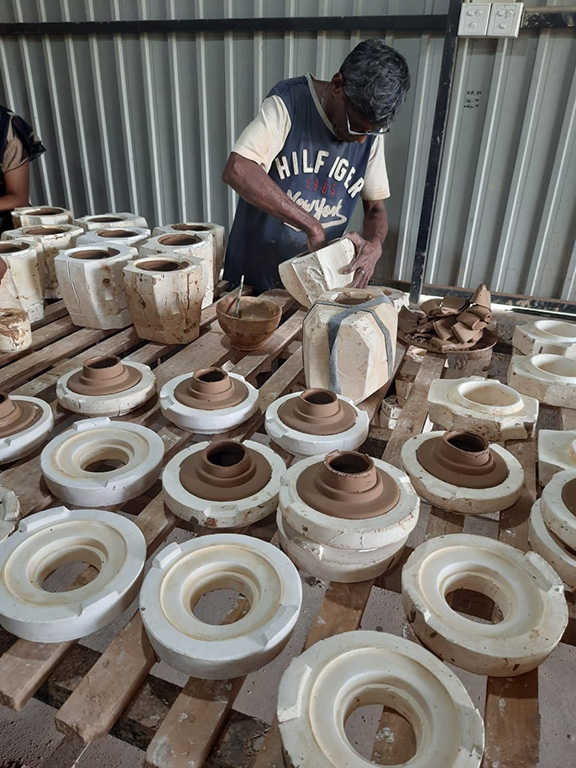
At Saterra, we manufacture a range of clay products that are mostly lifestyle related. As the entire world is rapidly shifting towards eco-consumerism, we are innovating newer homeware designs for eco-conscious customers to replace their non-degradable and non-recyclable utensils for a recyclable material. So, we manufacture products such as clay mugs, pitchers, dispensers, filters, plates, serving dishes and many ornamental artefacts. We source all materials from local vendors and adapt modern manufacturing methods instead of the traditional wheel throwing method to retain the consistency in quality of the product.

What does the Saterra Pottery team look like?

The team comprises eight members out of which five are in production and the rest in other functions. We are a small team as we are a start-up with less than a year in operation. Most of our team members are all-rounders, as they are involved with production, finishing, packaging, quality inspection, selling, and administration. But most importantly the production team comprises an expectant mother, a widower and a retired artisan. One of the main purposes of our business is to provide employment for socially marginalised groups in society. Though the productivity we require is hardly achieved through them, the satisfaction of providing them employment makes the business sustainable and the knowledge and experience these artisans have of working with clay cannot be acquired from anywhere else.

Saterra adds a modern twist to an age-old craft. How do you do this?

As I have mentioned, clay has been a craft practised since historic times even in Sri Lanka, where findings have proved that people have used clay to make vessels used for cooking and serving food and drinks. If you have had a chance to visit the Archaeological Museum in Sigiriya, you would have seen the fascinating clay vessels used by communities those days. So, Saterra intends to modernise these designs, making them more user friendly, rich in functionality and pleasing in aesthetics, so that the modern customers can consume an environmentally-friendly product suitable within the modern context.

What role does innovation and creativity play in your venture?

Innovation and creativity are the heart of this business as we are constantly looking at avenues to introduce something new to our customers, something that they hardly expected could be replicated in clay. The world demands for innovative products irrespective of the material used, so Saterra caters to this gap.

How do you come up with new products and designs?

New product inspiration often comes out with an unplanned brainstorming session with my family and closest friends who constantly support Saterra. Our part-time interior designer, who is also my brother, is the individual who adds the technical aspect to our new product ideas and fine tunes them to make them a fitting actionable design.

What challenges are unique to your field and how do you overcome them?

Challenges are plenty; as for any business, it would be with the current recessionary climate in the country. As a cottage industry that is less valued keeping the costs of production at lowest levels possible is one of the greatest hindrances. Though we do not depend on many imported materials, the cost of operating the supply chain itself has multiplied ever since the economic downturn. We do not feel it is ethical to pass the entire cost increases to our customers. Therefore, we look at avenues to add value to our products constantly and minimise our costs without compromising on the quality aspect.

The challenge of attracting young talent to this industry has been severe. When we look at the business with a long-term view, it is necessary that we plan ahead for an upcoming workforce crisis as employing skilled artisans is essential. However, as the industry has not been adequately attractive in terms of the monetary aspects for the youngsters to enter, the ability to find young artisans is challenging. Nevertheless, we are working on methods to maintain the balance between handmade and automation aspects.

Do you have anything new and exciting planned for Saterra this year? What can you tell us about these plans?

We do have a line of products waiting to get launched this year and we also have become successful in acquiring a couple of export orders that will soon start phasing out in the upcoming months. Moreover, we are looking at adding experiential angle to our business by hosting events for the interested pottery enthusiasts.

President unveils govt’s roadmap for socio-economic reforms and accelerated development

June 1st, 2023

Courtesy Adaderana

Sri Lanka’s economy is gradually recovering from the crisis thanks to the correct policies including the collective efforts of the people, President Ranil Wickremesinghe said, delivering a special statement on the government’s efforts over the past nine months to revive Sri Lanka’s economy.

The President’s Media Division (PMD) says the objective of this address is to provide the public with a comprehensive understanding of Sri Lanka’s national transformation roadmap and to present the proposed strategies for accomplishing the envisioned objectives.

In his speech, the Head of State lengthily outlined the forthcoming stages of the country’s social, economic, and political reform agenda which he said would be based on four key pillars: (1) Fiscal and Financial Reforms, (2) Investment Drive, (3) Social Protection and Governance, and (4) Transformation of State-Owned Enterprises (SOEs).

To bring about fiscal and financial reforms, the government aims to implement necessary reforms that will ensure long-term sustainability of public debt and the stability of the economy, he said adding that, the government ultimately wants to rebuild confidence in the Sri Lankan market.

In the pursuit of economic stability, Wickremesinghe said the government has implemented various cost reduction and containment measures since May 2022. He noted that the government is taking further steps to minimize unnecessary expenses, by halting unnecessary expenditure, streamlining state activities to reduce costs, designing cost-effective state operations, and leveraging automation and digitalization to reduce costs while delivering quality services.

As investments play a crucial role in boosting a country’s economy, Wickremesinghe said the government recognizes the significance of collaboration between the public and private sectors. Our goal is to transform Sri Lanka into an export-oriented economy that is globally recognized, following the successful models of countries like South Korea and Singapore.”

Further, the government aims to prioritize modern and sustainable efforts such as renewable energy, green hydrogen, and digitization, the president continued.

He went on to reveal plans to make a special invitation to the private sector to submit their own business proposals that align with the government’s vision of modernization and sustainability, promising to ensure transparency and openness by publicizing this call for proposals through mass media in a formal manner.

Wickremesinghe, speaking on the importance of fostering an environment conducive for investment, highlighted the need to reform Sri Lanka’s trade practices, which have been structured under strict protectionist policies. It is time to remove these barriers that have discouraged investors and to promote a more open and welcoming approach.”

Speaking on social protection and governance, the president promised to address social safety net concerns by engaging various government ministries, departments, agencies, civil society representatives, and subject matter experts in the integration process of social security measures.

Wickremesinghe added that a special task force would be formed to combat corruption across all sectors, including regulation, procurement, and political corruption. We are committed to implementing anti-corruption practices through a government mechanism that emphasizes accountability via modern techniques such as digitization.”

With regards to transformation of SOEs, Wickremesinghe said the government has already initiated the preparation of a restructuring plan for public enterprises. Entities like the Ceylon Petroleum Corporation, Ceylon Electricity Board, and SriLankan Airlines have incurred significant operating losses, equivalent to 1.6% of the country’s GDP in 2021.”

Stressing that it is unjust to burden the citizens with this debt, Wickremesinghe said necessary reforms must be undertaken urgently in the SOEs to ensure the turnaround and success of these enterprises.

Speaking further, he said Sri Lanka is ready to embark on a journey of growth and prosperity, as the country’s weakened economy is now returning towards stability. 

Slamming ‘fear-mongering tactics’ of certain groups spreading false information about the government’s reform agenda to mislead the public, the president said it is important to stay committed to economic reforms.

He reiterated his commitment to prevent any regression of the country to its previous state, emphasizing his determination to transform Sri Lanka into a fully developed nation by 2048.

Outlining the government’s efforts to revive the country’s economy, he noted that the economic reforms would decrease cost of living, improve standards of living, provide relief for the poor, create a culture of transparency and generate new opportunities for businesses to grow and thrive.

The implementation of our economic reforms serves only to achieve sustainable development and prosperity for our country. Through these reforms, we will accelerate Sri Lanka’s modernization, expand our market, and encourage greater contributions from the international community toward our development.”

He applauded the resilience of all Sri Lankans who navigated through challenging times, driven by their love for the country and stated that by persisting a little longer on this trajectory, an economically stable future could be achieved devoid of hardships.

Acknowledging that the journey ahead is not easy and that numerous challenges are anticipated, the president said he is determined to overcome these obstacles. Our government is committed to always acting in the best interest of our country.”

පොලිසිය මංජු නිශ්ශංක පසුපස.. මුල්‍ය විශුද්ධිකරණ චෝදනා…

June 1st, 2023

උපුටා ගැන්ම ලංකා සී නිව්ස්

ගෝලීය ශ්‍රී ලංකා කොංග්‍රසය නායක මංජු නිශ්ශංක නමැත්තා සම්බන්ධයෙන් නීති විරෝධී වත්කම් හා දේපොල විමර්ශන කොට්ඨාසය විසින් පරීක්ෂණ ආරම්භ කර ඇත.

මුල්‍ය විශුද්ධිකරණ පනත යටතේ මෙම පුද්ගලයා විසින් වරදක් කර ඇතිදැයි අනාවරණය කරගැනීමට ඉන් බලාපොරොත්තු වන බව පොලිසිය කියයි.

කොළඹ පැවති මාධ්‍ය හමුවකදී පොලිස් මාධ්‍ය ප්‍රකාශක ජ්‍යෙෂ්ඨ පොලිස් අධිකාරී නිහාල් තල්දුව මහතා මේ බව සඳහන් කලේය.

මංජු නිශ්ශංකට එරෙහිව පොලිස් මූලස්ථානයට ලැබී ඇති පැමිණිලි සම්බන්ධයෙන් කළ විමසීමකට ප්‍රතිචාර දක්වමින් ඒ මහතා මේ බව කියා සිටියේය.

Interlocutory application filed against Pastor Jerome’s petition

June 1st, 2023

Courtesy Adaderana

An interlocutory application has been filed before the Supreme Court seeking to dismiss the Fundamental Rights (FR) petition filed by Pastor Jerome Fernando without taking it up for hearing.

Pastor Jerome Fernando had filed the relevant FR petition requesting an order to be issued preventing his arrest.

Accordingly, the interlocutory application was filed by a group including Ven. Elle Gunawansa Thero, against Jerome Fernando’s fundamental rights petition.

The petitioning party claims that Pastor Fernando, who has also been charged over several controversial statements against several religions including Buddhism, had recently filed a petition seeking an order to be issued preventing the Criminal Investigation Department (CID) from arresting him. 

The petitioners allege that the defendant has filed this petition in a backdrop where the Attorney General has pledged before the Supreme Court that an investigation would be carried out into the matter.

OUTCOME-BASED EDUCATION THAT ESSENTIAL IN SRI LANKA

May 31st, 2023

BY EDWARD THEOPHILUS

Many expressed displease about education reforms in Sri Lanka and it could assume that academics appointed to perform the role of reforming education failed to do the task as required by the country, and the development of policies for education reforms have stagnated because the appointed experts are lacking the understanding of reforms that are required by Sri Lanka. Education in the modern era is based on achieving outcomes by students and Western countries spend a large sum of funds to train students for achieving outcomes of lessons with value education. Outcome-Based Education is an essential reform that should be introduced to Sri Lanka, and the OBE would radically improve the quality of education.

Education is leading to the achievement of outcomes, which are designed as theory and practices. It is not a style of education that existed in Sri Lanka in the past. The traditional style of studies that focused on committing to memory. The best example is training for reading nine sutras from the sutra in the Buddhism, and such learning was called learn by heart. The memory-based education was given to Buddhist monks, and some selected laity to perform religious functions.  In this process, needs the achievement of outcomes, but the Outcome Based Education is broader than learning by heart. OBE focuses on the achievement of theory and practice related to lessons.   

Syllabus documents provide the outcome should be achieved by students with the criteria to assess students and it might be at different levels. School teachers in Sri Lanka have not trained to do this role and parents were not educated about the OBE that is demanded by an education system internationally. Many Ph.D. holding education reformists have not studied in the OBE method, so they have not studied about the OBE, and they attempt to reform education in the way they studied in the primary and secondary schools. When OBE education in schools, kids don’t need to attend tuition or after-hours private classes, the role and responsibility of school teacher providing education until students achieve outcomes.  In this education methods weak students are given a second chance to achieve outcome or make holistic approach.

As I saw in the school system in Sri Lanka, tuition teachers dislike OBE, one thing they were not trained under the OBE system and the other thing is when the OBE system is applying in schools, tuition teachers will lose their jobs and they cannot play with students after school time.   

The achievement of outcomes by students reflects the competency of kids that supports them in finding work or engage in further education and training. Parents who have not understood these methods force kids to study and memorizing points in mind destroying the creative skills of kids. I observed in many teledramas in Sri Lanka, parents were forcing children to promote memories and study.

If the president of Sri Lanka wants successfully implement education reforms, he should not ignore the OBE method and providing certificate one and two on TVET with the general education. This way education is provided in developed countries such as Australia, Canada, USA and many others.       

What Happens to drugs seized?

May 31st, 2023

By Dr Tilak S. Fernando

The Central Postal Exchange Division officers of Sri Lanka seized parcels addressed to Borelesgamuwa, Wellawatte, Minuwangoda and Thalamgama areas sent from the United States and Canada. A person came to collect the packages. When the customs officials inspected them in front of the person who came to collect the parcels in the presence of the Police Narcotics Bureau on May 16, these parcels contained Kush”, and the person was handed over to the police for further investigation. ‘Kush’ is a new drug in Sri Lanka, as Ice” is quite dangerous and is the ‘popular’ drug that speedily spreads among schoolchildren and adults.

On another occasion, a man and a woman were arrested with 1.65 kgs of Kerala Ganja” in their possession. According to the Police, the 33-year-old woman was a resident of Magazine Road, Borella, Colombo 8, and the 41-year-old was a resident of the Division of the ‘T Wattha’ area. The raid had been conducted on a tip-off to the Officer in charge of the Colombo South Narcotics Division. Information about the drugs was received from a female.  The suspects were arrested from the Borella from the ‘T Wattha’ area, and the 1.65 kg of ‘Kerala Ganja’ were seized from the man’s house.

The investigation further into the drugs stated that the drugs (seized) belonged to a different group of people engaged in large-scale trafficking of Kerala Ganja. The man and woman had been involved in trafficking ‘ICE’ before and were released on bail. This time they were involved with Kerala Ganja. The drugs were wrapped in individual 500 kg packs.

Minister Tiran Alles

The Minister addressed the media and revealed that, according to intelligence reports, there was a threat to his life. The eradication of the Minister’s life came from the underworld. Everyone should support Minister Tiran Alles by removing political bias because drug abuse has been outrageous, and murders occur for the slightest reasons. It is reported that, on average, five killings were happening in this country, primarily related to drugs.

If the Minister wants to end drug offences, he must first find out the connection between big fish or Drug Lords, who dabble for money and do not care a damn about human life! The ex-President Maithripala Sirisena was seen on television, with men in Khaki uniforms, placing stocks of drugs into the fire. These days we are unable to see such things on TV.

Critics say the Police produce samples to court, and only God knows what happens to the rest! If the critic’s theories are accurate, some rotten eggs in the police force circulate these excess drugs back to the drug loads and peddlers. It shows the fate of what is happening in the present climate! Do they recycle them back to drug peddlers and drug Lords? If so, it is disgusting as the younger generation is in peril.

Murders Galore.

Presently, the majority of murders are carried out by motorcyclists wearing helmets. The police are typically responsible for maintaining public order and safety. The police must uphold the law and prevent, detect, and investigate criminal activities. Critics version it is not a healthy sign and ask if there is any truth behind such an accusation. There is imminent danger to the younger danger to the younger generation in the future.

Opponents say that some politicians are involved in drug operations. If this is accurate, drug-busting operations should go simultaneously, as the rotten eggs in the Police Force should be recognised and sacked as the whole of the Police force’s name would be tarnished.

The police may face severe odds in fighting to encounter dangerous criminals. Unlike in the past, committing murder has no fear of the police anymore, and freely available sophisticated guns and pistols are added to increasing crimes.

The widespread killings are committed by motorcyclists wearing full-faced helmets to evade identification and not to be easily recognisable by CCTV cameras. At the same time, the police force should not enter into politics similar to international influences. At present, some politicisation infests the police force. In this connection, Minister Tiran Alles has already confirmed what he means by removing some of the Police Officers (OICs) appointed by political influence. Similarly, the writer agrees with Public Security Minister Tiran Alles to fight against drug peddlers, gangs and criminals.

tilakfernando@gmail.com.

Sri Lanka renews ties with Thailand.

May 31st, 2023

Prime Minister’s Media Division

Prime Minister Dinesh Gunawardena held extensive discussions with Prime Minister of Thailand Gen Prayut Chan-o-cha on bilateral relations.

The meeting took place at the Government House in Bangkok during the three-day visit of Prime Minister Gunawardena to Thailand. The visit was to attend the United Nationas Vesak Day celebrations and to discuss strengthening of bilateral relations between the two countries and to strengthen trade and investment and religious ties.

Sri Lanka and Thailand have a strong cultural and religious bond because of their shared Buddhist heritage. The Siam Nikaya, which originated in Thailand, is one of the most revered monastic orders in Sri Lanka.

Sri Lanka is Thailand’s fourth-largest trade partner in South Asia, behind India, Bangladesh and Pakistan. Sri Lanka’s main exports to Thailand include gems, jewellery, tea, spices, fibre and metal products. Thailand, meanwhile, exports used cars, sugar, textiles, dry fish, cement, chemical products and car and automotive parts to Sri Lanka.

Thai Prime Minister Prayuth Chan-o-cha, suggested that the countries could encourage co-operation by leveraging their different comparative advantages. He said Colombo Port City is a great opportunity for all the countries in Asia and many Thai entrepreneurs will invest in Port City

He opined that Thailand is well placed to polish and cut gemstones from Sri Lanka, as well as market them. This division of labour would also help to reduce direct competition on the global market for both countries.

Sri Lanka and Thailand belong to the Bengal Initiative for Multi-Sectoral Technical and Economic Co-operation (BIMSTEC), a body that promotes free trade among its members.

Prime Minister Gunawardena briefed the Thai prime Minister about the plans implemented by the government to overcome the economic crisis and to revive economic activities. He also stressed the government plans to have close economic cooperation with ASEAN member countries.

Thai Foreign Minister Don Prmudwinai recalled his meetings with the Prime minister Gunawardena and assured Sri Lanka fullest support at international fora.

Minister Vidura Wickremanayake, Minister of State of State Vijitha  Berugoda, MP Yadamini Gunawardena and Sri Lanka Ambassador Chamnida Kolonne, economic  Advisor T Rusiripala and Advisor Sugeeswara Senadhira also took part in the discussions.

Prime Minister’s Media Division

High Commissioner Moragoda undertakes a visit to Akshaya Patra Foundation in Bengaluru to study their renowned mid-day meal programme

May 31st, 2023

Media Release Sri Lankan High Commission in India

Sri Lanka’s High Commissioner to India, Milinda Moragoda recently undertook a visit to the Headquarters of the Akshaya Patra Foundation in Bengaluru, Karnataka to study their renowned mid-day meal programme for school children.

Established in 2000 as a non-profit trust of International Society for Krishna Consciousness (ISKCON), Akshaya Patra is one of the world’s largest not-for-profit run school feeding programmes, serving wholesome food every school day to over 2.3 million children from 22,367 schools across 15 states and 2 union territories of India.

At present, the Foundation operates 67 large-scale kitchens in these states and union territories, which has been made possible by successful Public-Private Partnerships (PPP) with the Government of India, various state governments and generous supporters.

The organisation is the largest implementing partner of the Indian Government’s Mid-Day Meal Scheme or the Pradhan Mantri Poshan Shakti Nirman (PM-POSHAN) designed to better the nutritional standing of school-age children nationwide.

The Foundation is continuously leveraging technology to multiply its reach and their state-of-the-art kitchens have become a subject of study and attracted visitors from around the world.

During his visit to the Akshaya Patra Foundation’s Headquarters in Bengaluru, High Commissioner Moragoda met with the President of ISKCON Bengaluru & Foundation’s Chairman Sri Madhu Pandit Dasa and Sri Chanchalapathi Dasa, Vice Chairman of the Foundation. Their discussions centred around the possibilities of replicating a similar mid-day meal programme in Sri Lanka.

The Foundation is continuously leveraging technology to multiply its reach and their state-of-the-art kitchens have become a subject of study and attracted visitors from around the world.

During his visit to the Akshaya Patra Foundation’s Headquarters in Bengaluru, High Commissioner Moragoda met with the President of ISKCON Bengaluru & Foundation’s Chairman Sri Madhu Pandit Dasa and Sri Chanchalapathi Dasa, Vice Chairman of the Foundation. Their discussions centred around the possibilities of replicating a similar mid-day meal programme in Sri Lanka.

ආගම, සංස්කෘතිය විනාශ කළාම ඉතිරි වන්නේ වහලුන් පමණයි.. මෝඩාභිවාදකයන් කරන්නේ එයයි.

May 31st, 2023

උපුටා ගැන්ම ලංකා සී නිව්ස්

රටක් ආගමික හා සංස්කෘතිකව විනාශ කළාම ඒ රටට ඉදිරි වන්නේ වහලුන් පිරිසක් යැයි බුද්ධ ශාසන ආගමික කටයුතු හා සංස්කෘතික කටයුතු ඇමති විදුර වික්‍රමනායක මහතා සඳහන් කරයි.

ඇතැමුන් ආගමට සංස්කෘතියට පහර දෙන්නේ ඒ නිසා බවද ඔහු මෝඩිභිවාදනයෙන් උන්මාද වූ තරුණ පිරිස් විසින් එම තත්ත්වයට සමාජය පත්කරමින් ඇතැයි කියා සිටියේය.

කිසිම ආගමකට ගරහන්නට කිසිවෙකුට අයිතියක් නැති බවත් රජයක් ලෙස එවන් කටයුතුවලට ඉඩ නොතබන බවත් හෙතෙම පැවසීය.

බෞද්ධයාට බෞද්ධාගමට එරෙහිව ක්‍රියාත්මක වන බලවේග සියලු දෙනා එක්ව පරාජය කළ යුතු බවත් ඒ සඳහා බෞද්ධ මහා සම්මේලනය වැනි සංවිධාන නායකත්වය ගත යුතු බවත් හෙතෙම තවදුරටත් කියා සිටියේය.

ඒ මහතා මේ බව කියා සිටියේ සමස්ත ලංකා බෞද්ධ මහා සම්මේලනය විසින් කොළඹ දී පවත්වන ලද උත්සව සභාවක් අමතමිනි.

බලංගොඩ කස්සප හිමියන් සැගවේ..

May 31st, 2023

උපුටා ගැන්ම ලංකා සී නිව්ස්

තමන් වහන්සේට ජීවිත තර්ජන ඇති බැවින් මේ වන විට සැඟවී සිටින බව පූජ්‍ය බලංගොඩ කාශ්‍යප හිමියන් සඳහන් කරති.

මෝඩාභිමානී”ප්‍රසංගය සහ මේ දිනවල බෞද්ධ ආගම සම්බන්ධ කොටගෙන ඇති වී තිබෙන සිදුවීම් පිළිබඳව කතා කිරීම හේතුවෙන් තමන් වහන්සේට ජීවිත තර්ජන සිදු වෙමින් පවතින බව උන්වහන්සේ පවසති .

එමෙන්ම මංජු නිශ්ශංක නැමැති පුද්ගලයාට එල්.ටී.ටී.ඊ ඩයස්පෝරාවේන් මුදල් ලැබෙන බවත් එල්.ටී.ටී.ඊ අවශ්‍යතාවයට අනුව එම මුදල් යොදා ගනිමින් මංජු නිශ්ශංක කටයුතු කරන බවට බලංගොඩ කාශ්‍යප හිමියන් චෝදනා කරති

අත්අඩංගුවට ගත් රාජාංගනේ හිමියන් වෙනුවෙන් තමන් වහන්සේ පෙනී සිටින බව පෙන්වා දෙන බලන්ගොඩ කාශ්‍යප හිමියන් සඳහන් කරන්නේ රාජාංගනය හිමියන් දකින විට තමන් වහන්සේට කුඩාපොල හිමියන්’ මතක් වෙන බවය.

උන් වහන්සේ මෙම අදහස් පල කරන්නේ අන්තර්ජාල නාලිකාවක සාකච්චාවකට එක්වෙමිනි.

CID arrests SL Vlog’s Bruno Divakara

May 31st, 2023

Courtesy Adaderana

Bruno Divakara, the owner of the YouTube channel ‘SL-Vlogs’, has been arrested by the Criminal Investigation Department (CID), a short while ago. 

He was arrested by the CID after being questioned for over eight hours regarding the recent controversial comments by stand-up comedian Nathasha Edirisooriya, who was also arrested recently, Police Spokesman SSP Nihal Thalduwa said. 

Mr. Divakara was likely brought in for questioning as the video of concern, that soon went viral across social media websites, was initially published on the ‘SL Vlog’ Youtube channel. 

The comedienne was arrested by the CID on 28 May after she found herself in hot water over certain remarks she had made, allegedly insulting Buddhism, Christianity and Islam during her segment at a stand-up comedy show recent hosted at a leading school in Colombo.

Govt refutes accusations over funding for Poson Programme

May 31st, 2023

Courtesy Adaderana

The Government has refuted recent allegations made pertaining to the lack of funding towards the Anuradhapura Poson Programme, stating that Rs. 28.8 million has already been granted for this purpose.

Accordingly, two Ministries and one Department have, thus far, contributed a sum of Rs. 28.8 million for the Anuradhapura Poson Programme this year, the President’s Media Division (PMD) reported.

They further noted the allocation made by the Ministry of Buddhasasana, Religious and Cultural Affairs for the Poson Mihintale Perahera this year was the highest since 2019.

Attached below is the full statement released by the PMD:
Accusations have been made by various parties claiming that the Government will not contribute to the state Poson festival in 2023, particularly the Poson programs cantered around the Mihintale sacred site.

This information was gathered through multiple sources, including the Ministry of Buddhasasana, Religious and Cultural Affairs; Ministry of Public Administration, Home Affairs, Provincial Councils, and Local Government; Ministry of Defence, Sri Lanka Police, Anuradhapura District Secretariat, Ministry of Water Supply and Estate Infrastructure Development and Associated Newspapers Ceylon Limited.

In 1963, the Lake House Company initiated the ‘Lakehouse Mihintale Aloka Pooja’ under the guidance of Mr. Ranjith Wijewardene, aiming to serve religious and social purposes. Over the past 59 years, financial assistance has been provided for various activities such as Aloka Pooja, Sati Piritha, Perahara, and Chaitya painting.

During the Covid-19 period in 2020/2021 and in 2022, financial assistance was extended with amounts of Rs. 4.6 million, Rs. 2.3 million, and Rs.2.9 million, respectively. However, the Lake House Company has been continuously incurring financial losses since 2018, with a loss of Rs. 192 million in 2022.

Consequently, the management has notified the Mihintale Poson Committee that they cannot sponsor the programs this year due to these dire circumstances.

Venerable Valahangunawewe Dhammarathana Thera, the incumbent monk of Mihintale Rajamaha Viharaya, forwarded an estimate of Rs.17 million to the Secretary of the Ministry of Buddha Sasana, Religious and Cultural Affairs, specifically for the Mihintale Poson Perahara.

However, the Ministry Secretary, Mr. Somaratne Widanapathirana, responded that allocating such a large sum of money is not possible within the financial regulations imposed by Parliament. Instead, the Ministry of Buddhasasana, Religious and Cultural Affairs have approved a sum of Rs. 3.1 million from its budget head allocations for the 2023 National Poson Festival.

Also, the Secretary presented a report of the expenses incurred by the Ministry for the Poson Mihindu Perahara held at the Mihintale Rajamaha Viharaya from 2019 to 2023. Accordingly, for the year 2019 a sum of Rs. 4,810,000, for the year 2020 Rs. 380,000, for the year 2021 Rs.940,000, for the year 2022 Rs. 2,150,000 had been granted by the Ministry for the Poson Mihindu Maha Perahara at the Mihintale Rajamaha Viharaya.

Further, the Secretary also mentioned that there is a Cabinet decision to reduce the approved budget heads by 6% for all Ministries, but this reduction does not apply to the Poson program.

Secretary of the Public Administration Ministry K.D.N. Ranjith Asoka also said that an additional Rs.10 million has also been disbursed to the District Secretariats under the approval of the Anuradhapura District Secretary.

The National Water Supply and Drainage Board have agreed to supply 30,000 cubic meters of water for the drinking water and sanitary needs during the National Poson Festival. This includes the installation of pumps, extension of water pipes for Dansal areas, installation of 400 water taps around the Anuradhapura Sacred City, Mihintale, and Tanthirimale shrines, water supply by water bowsers, and extension of water pipes for temporary toilet systems constructed by Municipal and Local Councils.

The Water Supply and Drainage Board Chairman, Mr. Nishantha Ranatunga, stated that the cost of these water-related services, including the installation of water tanks and tap systems at gathering places and providing water to the tanks along the Perahara route for the elephants, amounts to Rs. 15.7 million (excluding VAT), which will be covered corporately.

The Ministry of Defence has deployed troops from the Armed Forces and the Civil Service Department (CSD) to construct the Anuradhapura Poson Zone, encompassing Mihintale, Thanthirimale, and Sanda Hiru Seya. For the proposed Mihintale Perahara on June 2nd, 384 soldiers and officers will be deployed.

Also, from 18th April to 31st May 2023, 146 Army soldiers and 30 Air Force personel have been deployed for various activities at the Mihintale Shrine.

The Ministry of Defence confirms that from May 22nd to 28th, 410 soldiers of the Army and 525 soldiers of the CSD have been deployed for the development of the Mihintale Sacred site and other tasks of the Poson program.

During the Poson Committee meeting held on May 24, 2023, at the Mihintale Raja Maha Viharaya and on May 25, 2023, at the District Secretariat office, Mr. J.M.J.K. Jayasundara, the Anuradhapura District Secretary, highlighted that several tasks were agreed upon with the involvement of District and Local Government institutions.

As part of these arrangements, the offering of afternoon alms to the 60,000 worshippers observing ‘Sil’ at the Uda Maluwa and Mihintale Shrine sites will be carried out with contributions from all the Divisional Secretariat Offices in the Anuradhapura District.

Furthermore, the Bank of Ceylon will provide the evening ‘Gilan Pasa’ for devotees who observe ‘Sil’ during the festival.

The Anuradhapura Municipal Council has already commenced the construction of 350 temporary toilets and the Mihintale Pradeshiya Sabha will establish 80 temporary toilets around the Mihintale sacred site for the sanitary convenience of the visiting pilgrims.

Apart from this, the Department of Archaeology and the Central Nuwaragam Palatha Pradeshiya Sabha are working to provide sanitation services. With the intervention of the Regional Director of Health Services and the Director of the Anuradhapura Teaching Hospital, all Government hospitals will be operational 24 hours a day and the Old City Hospital will also be operational round the clock to provide emergency treatment.

150 officers of the Sri Lanka Police, 15 officers of the Sri Lanka Navy and 40 officers of the Civil Service Department and 140 officers representing voluntary organizations will be engaged in life-saving services during the Poson week to address emergencies.
In addition, with the intervention of the Sri Lanka Police, a patrol program and lifeboats have been deployed covering 26 lakes in the vicinity of Anuradhapura with five police officers at each location.

A special security committee consisting of Senior Deputy Inspector General of Police in the North Central Province, Deputy Inspector General of Police in Anuradhapura, Senior Superintendent of Police in Anuradhapura and Officer-in-Charge of the Mihintale Police Station have been appointed on the advice of the Inspector General of Police for the safety of the pilgrims and the implementation of the traffic plan.

The Sri Lanka Railway Department has also provided special transport facilities during the Poson week. Accordingly, 10 additional trains have been deployed and steps have also been taken to increase train commutes, the General Manager of Railways stated.

Meanwhile, the Anuradhapura District Secretary says that the Sri Lanka Transport Board and the Road Passenger Transport Authority will jointly operate a special bus service.

Thus, it appears that Rs. 28.8 million (288 lakh rupees) has been allocated for Mihintale Poson programs solely by two Government Ministries and one Department.

Apart from that, steps have already been taken by the District Secretariat, Divisional Secretariats, Municipal Councils and Pradeshiya Sabha to provide financial allocations for many other tasks and to provide the labour contribution of the Armed Forces.

In light of the foregoing, it is confirmed that the claims made by various parties alleging that the Government will not contribute to the State Poson Festival and other Poson activities cantered around the Mihintale sacred site are false and baseless.

Gazette issued bringing several state institutions under Finance Ministry

May 31st, 2023

Courtesy Adaderana

A gazette notification has been issued bringing several state-owned institutions including the Colombo Lotus Tower Management Company, Sri Lanka Cement Corporation, State Engineering Corporation, Sri Lanka Telecom and its subsidiaries and allied institutions under the purview of the Ministry of Finance, Economic Stabilisation and National Policies.

The gazette has been issued by President and Finance Minister Ranil Wickremesinghe with the powers vested in him under paragraph (1) of Article 44 of the Constitution of Sri Lanka, with effect from May 30, 2023.

Accordingly, the following state institutions have been brought under the purview Minister of Finance, Economic Stabilization and National Policies:

1. Sri Lanka Telecom and its Subsidiaries and Allied Institutions 

2. Colombo Lotus Tower Management Company (Pvt.) Limited 

3. North Sea Ltd. 

4. Sri Lanka Thriposha Co. Ltd. 

5. Galoya Plantation (Pvt.) Company 

6. National Salt Limited

7. Sri Lanka Cement Corporation 

8. Paranthan Chemicals Ltd

9. BCC (Pvt.) Limited 

10. State Engineering Corporation 

11. Mahinda Rajapaksa National Tele Cinema Park 

12. Lanka General Trading Company Ltd.

Please, take charge of the Poson celebrations: A respectful proposal to the Mahanayake Theras

May 30th, 2023

Rohana R. Wasala Courtesy The Island

The following is a public proposal respectfully offered, for what it is worth, by a senior Sri Lankan to the Most Venerable Mahanayake Theras of all Nikayas on behalf of all Sri Lankans of like mind: 

I believe that the Mahanayake Theras have been alive to the events of the past few weeks that bear upon the survival of the 2270 year old Buddha Sasana in our country. The facts are obvious for all to see; so they need no explicit elaboration. The threats to the Buddha Sasana are both external and internal. 

The Buddhist religious establishment is being  internally undermined by conscienceless Sinhala politicians who champion legitimate Buddhist causes only to grab power by deceiving the majority Sinhala Buddhist voters with attractive promises, which they have no intention of fulfilling for reasons best known to themselves; they are assisted by a set of politician monks (as supporters or opponents) who use the yellow robe as a means of gaining some stature in the public eye; disrobe them, they will never regain the semblance of imagined political relevance that they have. Such political monks are only a handful among the over forty thousand strong Maha Sangha. The  vast majority of the Maha Sangha serve the Sasana by fulfilling their ministerial obligations with great sanctity. But it looks like they don’t have the opportunity to form themselves into a single coherent body under a single leader. Meanwhile, there is a new breed of maverick monks who offer their own arbitrary interpretations of the Buddha dhamma and create divisions even within the nikayas, endangering the unity that still exists among the lay Buddhists, who do not observe nikaya distinctions when interacting with monks, as far as I know. Also, a couple of smart fakes are virtually usurping Your Reverends’ historic role. They are probably doing the greatest harm to the Sasana.

The external threats come from agents of the global hegemonic powers, who exploit the handful of still lingering separatist ghosts and  the few religious extremists that haunt the body politic, to pursue their separate geostrategic agendas in our region. Those foreign powers are each acting in their own respective national interest. The Mahanayakes or the Buddhist public cannot say or do anything about that, except when their activities affect the Buddha Sasana. It is entirely the responsibility of our politicians to handle the problems that arise from superpower interventions or interferences that threaten our national interests. But the Mahanayakes can do something about the internal challenges outlined above, using the greatest asset we have. The greatest asset I mean here comprises the calm and composed general public, disciplined by the dominant culture of this country who believe in democracy, who grin and bear the severe economic hardships that they are currently experiencing with characteristic fortitude. They still remain united and hopeful despite the diversity of political opinions and affiliations among them. However, it should not be forgotten that Sinhalese Buddhists have completely lost  faith in their parliamentary representatives who fight among themselves for power, wealth and personal glory, having conveniently forgotten their inescapable obligation to provide solutions to issues concerning the Buddha Sasana, which best accommodates the demands of a modern secular democracy like ours. 

 Only the Mahanayake Theras can save the Buddha Sasana from valueless opportunistic politicians and the few errant monks who are at present doing great harm, having strayed into politics. The Poson Poya provides an excellent opportunity for the Mahanayake Theras to assert control over the whole of the Order/Maha Sangha, at least symbolically, to begin with. Please, take the first step towards that end by taking charge of all Poson celebrations held across the country this year, with one of the Mahanayake Theras appointed through common consensus as the single leader of a united Maha Sangha, free from Nikaya divisions that are based on caste distinctions which the Buddha unequivocally rejected as in the Vasettha and Vasala Suttas. Considering Poson, the historic Mihintale Raja Maha Viharaya is of national importance. We need not dwell on that subject now, because it is too well known. Venerable Sirs, please intervene to put an end to the unseemly dispute between the Mihintale Nayake Thera and the power and energy minister over the disconnection of its electricity supply to the Raja Maha Viharaya due to an accumulation of unpaid overdues as soon as possible. Please also help resolve the issue involving the impending coincidence of the annual Poson programme at Anuradhapura and a previously scheduled public examination arranged to be held in adjacent venues. 

Peace, Harmony, and Happiness to our Beloved Motherland!

I leave this humble public proposal subject to rational disagreement, wide discussion, or reasoned rejection, as the case may be. I hope I am not being presumptuous in addressing the Most Venerable Mahanayake Theras thus. 

  • Rohana R. Wasala

Part 7: Summary—Leadership Needed For Socio-Economic Success in Sri Lanka – A candid study and an action plan Economic and social development for Sri Lanka

May 30th, 2023

by Professor Sunil J.  Wimalawansa

Types of leadership Sri Lanka needs?

To advance the country, Sri Lanka needs a new generation of younger, educated, patriotic and self-sacrificing, honest, and intellectually mature people in leadership positions who understand the economy and how the country could develop sustainably.  An energetic, open-minded, honest, broadly educated, younger generation must replace the currently ailing politicians at each level of central and peripheral governments. Dedicated leaders must possess a long-term vision and are collectively willing to take firm decisions, work hard to overcome barriers and improve Sri Lanka for future generations.

 In addition to eradicating terrorism, the new leadership should replace ancient and outdated laws, take bold steps, and enact legislation to reverse the damage done via the adverse decisions made by the successive governments in Sri Lanka.  The latter is mainly derived from the influence of NGOs and foreign powers.  These measures must ensure the unitary status of Sri Lanka, the recreation of a righteous society—with the right ideas, speech, and effort (livelihoods), and the re-introduction of patriotism—genuine Sri Lankan history, Sri Lanka’s first attitude and valuing of local products.  Recently, the history of Sri Lanka was een intentionally fabricated by unscrupulous religious groups according to the instruction of whims and fantasies of foreign influentials: this must be stopped.

Real Sri Lankan history must be reintroduced and protected, and the artificial history that crept into the school curriculum over the past three decades must be eliminated.  In parallel, the reintroduction of patriotism and value systems needs to be added to the school curriculum, starting from primary school— Law and order must be restored and strictly maintained throughout the country.  Without these fundamental requisites, there is no hope for progress or success for Sri Lanka—it to continue as a developing country for generations to come.  

Effects of globalization and world trade on Sri Lanka

As per the World Trade Organization, domestic price support and subsidized production can squeeze out imports and may encourage the dumping of low-priced worthless stuff in developing countries.  According to the Uruguay Round agreement on agriculture under the World Trade Organization, new rules and commitments apply to market access (for agriculture products will be based on tariffs), domestic support, and export subsidies.  Before the Uruguay Round, quotas and other non-tariff measures restricted some agricultural imports.  The agreement does allow some domestic agricultural subsidies. 

 On the other hand, heavily subsidized agriculture in industrialized countries, like the USA, the European Union, and China, distorts world agricultural trade and adversely affects the selling of products from developing countries—blatantly unfair competition.  High subsidies and favourable tariffs in industrialized countries effectively and unfairly protect their domestic product prices and export markets from imports from the USA, China, and Europe.  For instance, cotton imports from the US to India have substantially increased due to US cotton subsidies, as the export of wheat/corn from Russia and Ukraine to the rest of the world.  The dumping of US cotton has virtually destroyed the Indian cotton plantation and corn industries in other smaller countries.  Other well-established self-protective practices exist in the US and the European Economic Community for protecting their farmers.  Navigating those needs skills and persuasion.

Within a long-term national economic development plan, it is essential not to alienate or neglect the countryside and two-thirds of over 25,000 struggling villages in Sri Lanka with their traditional culture and economic bases.  For example, the agricultural base and the tank-based irrigation systems for agriculture in Sri Lanka have existed for thousands of years: these must be reviewed and nurtured with some modernisation to improve productivity. 

Once the government subsidies and unprioritised projects are discontinued, those funds should be used for earmark investments to revamp ancient tanks and irrigation systems, so crops like paddy can be grown in both Yala and Maha seasons.  Preferably crop rotation with a third crop would make the arable land productive throughout the year, generating year-round income for farmers.  The following are key points that would lead to a prosperous Sri Lanka:

  • Eradication of terrorism and directing the savings to infrastructure development, education, and agriculture.  Poverty alleviation is crucial to achieving peace and law and order in the country.  When law and order are established, uncertainties, violence, and terrorism gradually wither away—a key to building sustainable peace.  Therefore, curbing terrorism, alleviating poverty, and bringing all religious, ethnic, and social sectors together as Sri Lankans” are the three crucial steps needed to achieve and maintain peace, prosperity, and economic growth in Sri Lanka. 
  • Skills training and creating job opportunities: Minimize adverse effects of globalization by educating, re-training, and empowering citizens, beginning in schools and universities.  Removing fallacies and unnecessary and distractive subjects from the curricula and replace with skills essential for the future is necessary to strengthen social measures and prepare for future development needs, including expansion of skills training and meaningful employment beyond the Samurdhi programs.  Enhancing small-scale (cottage) industries throughout the country, especially in rural areas.  The latter would minimize unnecessary migration of youth to cities and resist the penetration of negative frontiers and culture of globalization while enhancing employment and capturing the benefits of new technology for development.
  • Healthcare: Pause building larger hospital complexes and specialised centres (white elephants) like renal hospitals mistakenly—these are not what the country needs now.  Sri Lanka must divert the money to village-based health centres across the rural regions.  This would allow villagers to obtain preventative and curative care locally rather than spending the entire day travelling to city hospitals.  This public health-based approach provides the necessary infrastructure and trained workforce, markedly improves preventative healthcare and maternal and child health, eradicates infectious diseases and vector-borne diseases like Dengue, and reduces morbidities and mortalities.  It will reduce absenteeism and increase productivity.
  • Curricula and the education system: Out-of-date education system in Sri Lanka needs modernization urgently. While fiddling and maintaining the status quo is easy for entrenched bureaucrats, it does not justify what the country expects from next-generation of youth—honest and ethical businesspeople, transparent leaders, focused entrepreneurs, and unselfish politicians.  The current education system does not address any of these.  Thus, it is crucial to modernise the outdated education system and curricula in schools and universities in Sri Lanka. These are grossly outdated and do not provide the necessary learning, training, and examination systems our children deserve to make them great citizens and fulfil the county’s future needs.  It must be renewed to align with the changing country’s needs, global requirements, and future needs of Sri Lanka. 
  • Decentralization of economic activities: Sri Lanka should consider shifting its economic bases from main cities like Colombo to other districts.  For example, with the expansions of the Asian markets, it is logical to expand the Trincomalee harbour, which is one of the deepest and the best natural harbours in the world—converting it into a central shipping hub in Southeast Asia is warranted.  In conjunction with the nearby massive petroleum storage facility, it can easily accommodate any size ship and manoeuvre and provide direct access to Asian Tiger markets—Chinese, Japanese, South Korean, and Malaysian markets.
  • Focus on Ascian markets: Within three decades, the mentioned four markets, together with India, will be the leading markets in the world.  With the inevitable gradual decline of the formerly lucrative North American and European markets, Sri Lanka and the neighbouring South Asian Association for Regional Cooperation (SAARC) countries must focus on Asian trade.  In the interim, India is trying to dig an unsustainable deep canal (between Mandapam, Rameswaram and Talaimannar ports) in shallow waters—Sethu Samudram, disguised as for commercial shipping.  However, the primary goal of this project is for military purposes of the Indian navy—to prevent the detection of submarine traffic.  However, it will be a futile project, as there is no way to keep the patency of such a shallow canal on the seabed without getting covered with sand.  Nevertheless, in the unlikely event, India is successful in this project, it would benefit the expansion of the Trincomalee harbour with a significantly shorter route to Europe and the Middle Eastern region for commercial shipping.
  • Control of unscrupulous I-NGO activities: Sri Lanka must prevent inappropriate foreign countries and I-NGO influence in Sri Lankan affairs, domestic politics, and religious interferences.  Therefore, it must prioritise this for national security interests and to protect sovereignty.  Besides, these are essential for political stability, prosperity, and preventing another terrorist war. 
  • Restrict foreign company-based economic development to certain controlled areas: Such as the proposed new Sri Lanka Development Zones, as seen in the Shanghai model, such developments should be restricted to regions that can be regularly monitored.  This would enable Sri Lanka to close observer its activities while enjoying economic and commercial successes and minimizing the negative consequences of globalization spreading to the countryside and villages.
  • New larger projects: Open trade is supposed to improve Sri Lanka’s economy.  Nevertheless, globalization policies should not be rushed to implement without studying in-depth their long-term impacts.  There will be natural adjustments, significant displacements, geological and environmental effects, and harmful societal impacts.  These must be investigated, and appropriate firm action to mitigate harm, even before these projects commence. 
  • Attention to neglected sectors and rural regions: Neglected sectors, such as environment, education and skills training, infrastructure, preventive healthcare, proper coordinated transportation, shipping, and fisheries industries, must be attended to improve efficiencies with modernisation while curtailing unnecessary costs (including the elimination of non-value-added items, bribery, and corruption).  It is necessary to harmonize society leading to political stability and social and economic development.  Regarding the environment, the government must take firm steps to preserve protected nature reserves, forestry, and lakes, minimize pollution and toxic waste dumping, mandate local governments for regular garbage collections, prevent mosquito-borne diseases like Dengue, and use domestic waste products for compost and biogas development instead of landfill and incineration. 

SUMMARY

It is essential that the Sri Lankan government embraces meaningful and effective regional partnerships and alliances with emerging new regional economies (SAARC) and learn and adopt development strategies from the economic models of other emerging economies such as China and India.  It also adapted from the Singaporean model, like Sri Lanka’s, Colombo-Plan model implemented by Lee Kuan Yu in Singapore.  As a patriotic leader, he had the wisdom and insight and had no regret in borrowing the Colombo Plan from the Sri Lankan government to develop his country.  It is time to dump corruption, nepotism and other prevailing irregularities and prioritise all appointments to meritocracy, honesty, and the ability to do the job.  In parallel, it must eliminate unnecessary and unfair regulations and influences by foreign NGOs and countries and focus on its economic development.

A vision for economic success and social development of developing countries like Sri Lanka should incorporate sensible, practical, and cost-effective approaches.  To attract FDIC investment in Sri Lanka needs to incentivize potential investors, eliminate corruption, optimize the use of natural resources, upgrade the infrastructure, and cut the red tape.  It has comparatively low-cost skilled labour, a favourable climate, predictable rain pattern, and salubrious beaches all around the Island.  It also has an educated and trainable population who could benefit from experienced and motivated expatriates to gain expertise in technology and technology transfer, advice, and new ideas for developing and progressing in most fields.  These resources can assist in developing recognizable brand names and high-quality finished products for export, capable of competing with goods from China, Taiwan, and South Korea.  Unfortunately, it does not have a stable, trustworthy, and transparent government.

In the long term, Sri Lanka must eliminate loan traps set by IMF, World Bank, and countries like China.  Taking additional loans when the government struggles to service the current loans is suicidal.  Reduce and eventually remove subsidies and utilize those funds for proper development projects that provide high returns to the country.  It must adopt long-term, viable, sustainable national policies to develop the country while protecting sovereignty and unitary status.  This should begin with eradicating terrorism and maintaining security, law, and order.

The country must identify unique resources and invest in cost-efficient alternative energy sources to eliminate dependence on imported fossil fuels (oil and coal).  Environmental protection, use of least polluting and renewable sources for power generation (e.g., hydroelectric, capturing sea-wave energy), stopping dumping waste and polluting the environment, preservation of flora and fauna, protect national and natural reserves and conservation of forests.  These developments should preserve and strengthen the unique culture and heritage in Sri Lanka and the values of Sri Lankans for generations to come.  These can be achieved via well-planned urban and semi-urban development to support rural industries and provide long-term sustainable employment, growth, and prosperity.

Sri Lanka’s internal economy was and will be agriculture-based for the foreseeable future.  Therefore, it is vital to nurture farmers and the needs of their families.  In parallel, most employment in developing countries is provided by small businesses, not larger manufacturing factories, and should not be by the government.  The government must facilitate them by identifying and promoting the selling and exporting of their products.  The country needs to focus on new innovative ways to achieve economic and social growth without destroying the culture and environment and over-exploiting natural resources.  Maintaining a market–driven economic approach would facilitate international trade, which does not compete or scavenge local produce, cultural heritage, multi-cultural and religious values, and personal freedom (of individuals and the press).

To achieve vigorous economic and social development, the Sri Lankan government must reverse ongoing negative constraints that increased over the past three decades, created by politicians, conflicted unscrupulous I-NGOs and businesspersons.  Despite these difficulties, an appropriately planned and focused program can achieve the desired goals and prosperity for the country.  Politicians must set aside petty party politics for all national issues: economy, education, agriculture, law and order, national policies, long-term development projects, social development, etc.  The commitment, support, and courage of the politicians, the business community, and the entire nation are needed to achieve this goal leading to the country’s prosperity.  We need to put the country first, not politics.

Regardless of the political ideologies and desire for power, fair, innovative, and clean governance is in everybody’s interest.  A nation that does not look for novel and innovative ways to grow will not progress and will be stuck as a developing country forever.  Policies and laws of the county must be updated and forward-looking and not get stuck in the past.  Boasting and living the past by politicians and bureaucrats would not provide a better future for Sri Lankans. Achieving prosperity depends on honesty, transparency, solid leadership, collective political will, strategic long-range vision, planning, and implementation.  Irrespective of their petty ethnic and party politic differences, the nation must be united as Sri Lankans to develop the country for future generations.  Together, as SRI LANKANS, we can achieve these goals.

China will always stand for Sri Lanka’s sovereignty and socioeconomic development – Chinese Vice Minister of Foreign Affairs

May 30th, 2023

Prime Minister’s Media Division

Chinese Vice Minister of Foreign Affairs, Sun Weidong said Sri Lanka is a longtime friend of China and his country will always stand by Sri Lanka’s sovereignty as well as for political independence and socioeconomic development.

He stated this when he called on Prime Minister Dinesh Gunawardena at the Temple Trees today (May 30). The Vice Minister assured that China will increase investments in several areas such as agriculture, trade and commerce, ports and infrastructure development in Sri Lanka. He also said China will continue to provide economic assistance as well as support Sri Lanka’s debt-restructuring programme.

The Prime Minister expressed gratitude for the Government of China for the help given at natural calamities such as Tsunami and the Covid pandemic as well as for the efforts to overcome current economic crisis.

He made a special mention about the humanitarian assistance and medical aid to Sri Lanka by way of providing shipments of Sinopharm vaccine, medical masks, COVID-19 test kits and other health equipment to battle the pandemic, further strengthening the solidarity between the two countries.

The Prime Minister, referring to the recent visit of the Governor of the Yunnan Province, expressed confidence that the fruitful discussions held during the visit would enhance cooperation in the agriculture sector. He said China could invest in the agriculture projects in the area to be irrigated under the Malwathu Oya project and vegetable and fruit products could be exported to China.

The Chinese Vice Minister expressed deep appreciation to Sri Lanka’s adherence to One China Policy despite pressures from many quarters.

Prime Minister Gunawardena said Sri Lanka has enjoyed excellent friendly relations with China for many centuries, throughout which Buddhist relations have been continuing.

Vice Minister Sun Weidong said China has taken steps to establish a strong cooperation with Sri Lankan Buddhist Associations to further religious ties.

Minister Sun Weidong has donated 10,000 sets of school bags and  supplies stationary, picture books, oil colour boxes, pencils and pen boxes, sharpeners and erasers, colour oil painting, rulers, water bottles, insulated lunch Boxes and fabric of white plain shirt and skirt 33,000 meters, fabric of blue twill pants 10,000 meters for distribution in schools.

Environment Minister Ahamed Naseer, Deputy Speaker Ajith Rajapakse, MP Yadamini Gunawardena and Chinese Ambassador Chinese Ambassador to Sri Lanka Qi Shenhong and senior officials of Chinese Foreign Ministry were present on this occasion.

Satanic Verses – Jihad Cartoons & Freedom of Expression for Comedian Nathasha in Sri Lanka

May 30th, 2023

Shenali D Waduge

Those currently wailing over freedom of expression and attempting to portray an image that people were over-reacting, have conveniently forgotten the Dutch newspaper cartoons that resulted in a religious jihad for disrespecting Prophet Mohammed. The cartoons resulted in calls for death, led to riots & arson. All that Sri Lanka’s Sinhala Buddhist majority seeks is relevant authorities to take legal action & prevent similar mockery. Comedy & comedians in Sri Lanka should not feel they have to sustain themselves by only tarnishing the Buddha!

Let’s first return to the cartoons which came after a series of terror attacks in London & Madrid, riots in France by African Muslim immigrants & the murder of Theo van Gogh in Netherlands for criticiising Muslim mistreatment of women. It was a time that saw fatwas against Salman Rushdie and threats against artists, editors & publishers – anyone making caricatures of Islam’s founder. This was in Europe, an epicenter of freedom of expression (so you can be pretty sure that Comedy Central will steer clear of this topic).

A series of 12 cartoons were published in a Danish paper (Jyllands-Posten) in September 2005.  

The Danish government chose to ignore complaints by Muslims who took their grievance to the Muslim-majority countries who exerted diplomatic pressure on Denmark. Mass protests over Danish cartoons erupted across Europe. In London – more than 500 people marched to the Danish embassy calling Muslims to massacre” those who insult Islam.

Pakistan even passed a resolution criticizing the Danish newspaper. Turkish President Erdogan declared Caricatures of prophet Muhammad are an attack against our spiritual values. There should be a limit of freedom of press.” UK’s Foreign Secretary agreed that press freedom was obligated not to be gratuitously inflammatory”. UK did not publish the cartoons but Germany did & so did New Zealand. US described the cartoons as offensive to the beliefs of Muslims” (incidentally Nathasha is working for the US)

Is the unwritten freedom” meant that ridiculing Buddha is not offensive but ridiculing Islam, is?

The protests escalated into violence resulting in more than 200 reported deaths, attacks on Danish & European diplomatic missions, attacks on churches & Christians.

Then in 2015, Charlie Hebdo’s Paris offices were attacked killing 12 persons to take revenge on cartoons of Prophet Mohammed. A 27 year old police officer was also killed alongside 4 Jewish men.

https://www.timesofisrael.com/al-qaeda-leader-calls-for-jihad-against-the-us-and-israel-over-anti-islam-film/

In 2012 a film titled Innocence of Muslims” resulted in Al Qaeda urging Muslims to wage a holy war against US & Israel claiming the film insulted Islam’s Prophet. The US embassy in Cairo was breached while the US embassy in Benghazi was stormed. Al Qaeda accused US of allowing the films production under pretext of freedom of expression.

How many remember the name Salman Rushdie?

In 1989, his novel Satanic Verses was declared blasphemous & a fatwa was issued ordering the execution of Rushdie. He ended up living in exile away from public domain. In August 2022, Rushdie was stabbed before he was about to deliver a lecture in New York. Rushdie lost sight in one eye and the use of one hand.

Then, there is Bengali writer Taslima Nazreen. She has been living in exile since 1994 after the publication of her book Lajja”.

What did the protests by Muslims in US, UK and parts of Europe convey & eventually result in? Would the Western world dare mock the reactions of the Muslims as they do in Sri Lanka? Is it because the West are scared of Muslim reaction but are not about Sri Lanka? What hypocrisies?

What makes the above to be considered as violating free expression, intolerant & insensitive but makes Nathasha & the Comedy Central hate jokes not? 

The Muslims reacted thus. But did the Sinhala Buddhists react similarly? All that they demanded was legal action against the pattern of well-funded, well-scripted anti-Sinhala Buddhist agenda taking place at regular intervals. These were not spontaneous ‘freedom of expressions’. These were funded & paid for.

Why didn’t US react when an art gallery photo of a crucifix in a jar of urine (Piss Christ” photograph by Andres Serrano) & a portrait of the Virgin Mary made in elephant dung? In fact the US funded National Endowment even gave an award paid by US taxpayers.

Who decides who should react & how they should react? Who decides the type of action & against whom? Who decides how the reaction is to be? One man’s trash becomes another man’s work of ‘art’ just like terrorists are freedom fighters to some.

The problem arises as a result of giving a wrong notion of freedom” & when those that give the wrong notion come to defend those who violate that freedom primarily because they actually funded the violation.

While freedoms & rights are not exclusive, opinions are not equal either. Thus, how one would value an opinion also differs. In this context where does blasphemy fit in? Those that dictate how a free society should function, decides what is blasphemy and what is not, what people can tolerate and what people cant. It is these invisible controllers” who dictate how we should act or react and they have a well-trained media entity prepared to drill people’s psychology towards their goals. They expect blasphemy to be accepted while burning of the American flag is enough to sanction or even bomb a country to the cave age. Such is the hypocrisy in the manner freedoms” are practiced.

Freedoms & rights must also consider moral limits & sensitivity”. Those who have no morals will not understand its importance. Those hired to be insensitive will not care about morals. Their function is to stir emotional reactions and they are backed by people who are hired to defend those who stir people’s emotions. It’s a dirty business.

Were the cartoons of Mohammed intended to stir Muslim sentiment? Did they have to take up caricature of a different faith to express their creativity”? Could they not find other themes to draw their cartoons? These are the same questions being put to this comedy central gang who have been recruited with the sole intent of drafting scripts that are mocking Buddhists? There is nothing creative? A bunch of people are hired, paid, spend time drafting the script, memorize it, practice it & present it to an audience who are equally anti-Buddhist and thus the clapping & guffawing at every word coming out of the comedian. There are plenty of world famous standup comedians, the manner they entertain the audience is something these fools in paradise should take time to study.

Shenali D Waduge

තාක්ෂණික විප්ලව සිදුවෙන සමයේත් පිස්සු කෙලින නිරාගමිකයෝ

May 30th, 2023

චන්ද්‍රසේන පණ්ඩිතගේ විසිනි 

ආගමික දර්ශනයන් මිනිස් මනසට ගලා ඒමට පෙර මෙලොව විසු සියලුම මිනිස්සු නිරාගමිකයෝය. ඒ යුගය මීට වසර මිලියන ගණනකට පෙර ලොව පැවතී තත්වයයි.

සියලුම සතුන් හා මිනිසා පරිනාමය වීම ආරම්භ වී නොදියුණු වානරයාගේ සිට මිනිසාට පෙර මානවකයා දක්වා පරිනාම ක්‍රියාවලියට වසර මිලියන 80ක පමණ කාලයක් ඉක්මවා මෙලොවට බිහිවූ පලමු මිනිස් පරපුරද අනිවාර්යෙන්ම නිරාගමිකයින් වන අතර මිනිසත් භාවයේ, වසර මිලියන ගණනක් ගතකල, මිනිසා ආගමික දර්ශනයන්, දේශපාලනික දර්ශනයන්, ජෝතිෂ්‍ය, යන  විෂයන් තම පරිනත මනසින් අවබෝධ කරගත් අතර, ඔවුන් ආගමිකයින්, හෝ දාර්ශනිකයින් වශයෙන් හදුන්වයි.

 ගලාගෙන යන ගඟක් සේ නිර්මාණයවී ගලා යන සත්ව පරිනාමය අඛණ්ඩව සිදුවෙන අතර මේ ගඟේ  මිනිස් අවධිය, කොටස් දෙකකින් සමන්විතය. ඒ  වානර පරම්පරාවට ආසන්න මිනිස්සු හා මේ මිනිස් ගඟ මුහුදට වැටීමට ආසන්න කොටසේ සිටින මිනිස්සු යන දෙකොට්ඨාශයන්ය. මේ කණ්ඩායම් දෙක කතා කරන්නේ, ඔවුන් පරිනාමියව මිනිස් පරපුරේ සිටින ස්ථානය අනුව බැවින්, මුහුදට ආසන්න කොටසේ සිටින මිනිසුන් කියන දෙය පරිපුර්ණ බව දැනගත යුතුය. නිරාගමිකයා ආසන්නව සිටින්නේ නොදියණු මානවකයාගේ අවධියට බැවින්  නිරාගමිකයින් කියන දෙය දෙස බලා සිටීම හැර ඔවුන්ට තේරුම් කිරීම හෝ පහදා දීමට වෙර දැරීම නොකළ යුතුය.

මේ නදියේ, මානවකයාට ආසන්නව සිටින මිනිසුන්ට  ආගමික දර්ශනයන්, දේශපාලන දර්ශයන් හෝ විද්‍යාත්මක දර්ශනයන්ද තවම අවබෝධ කරගත හැකි මානසික මට්ටමකට ඔවුන් ලඟාවි නැත. එබැවින් ඔවුන් තවමත් නිරාගමිකයින් ලෙස කටයුතු කරන අතර, ඔවුන්ට පුහුණු කලහැක්කේ යාන්ත්‍රිකව කටයුතු කිරීමය. ඒ අනුව ඔවුන් කිස්දාක නිර්මාණශීලි පුද්ගලයින් නොවන අතර, ඔවුන්ට කල හැක්කේ,, අන්‍යන් අනුකරණය කරන්නන් ලෙස හා අනුගමනය කරන්නන් ලෙසත්, කටයුතු කිරීම පමණි.

රිලවා ලෝකයට බිහිවී අවුරුදු මිලියන 15කට පසු වඳුරෙක් ලොවට බිහිවූවා සේම මේ මිනිස් අවධියටත් කෙළවරක් තිබිය යුතුය. අපි සත්‍ය ලෙසම මිනිසා මේ පොලවට බිහිවී කොතෙක් කල් දැයි නොදන්නෙමු. නමුත් මිනිසා බිහිවී අවුරුදු  මිලියන 16කට ආසන්න වනවිට මේ මිනිසාට අනුබද්ධව නව සතෙක් බිහිවිය යුතුය. ඔහු මිනිසාට වඩා ඉතා උසස් බුද්ධියකින් යුතු සතෙක් විය යුතුය. එදාටත් අද මෙන්ම නිරාගමිකයන් ලෙස හදුන්වාගත්   කණ්ඩායමක් සිටිනු ඇත. ලෝක ධර්මතාවය එයයි.

An expression of  a suffering Sri Lankan

May 30th, 2023

Lankaweb Poetry Corner by Sunil Kumar

In the shadows of my weary soul,

 A haunting presence takes its toll.

A weight upon my fragile heart,

 As sadness weaves its sublime art.

Like an Autumn’s fading light,

emotions dimmed and veiled from sight.

 A somber melody softly plays,

as tears now dance in silent haze.

A tempest brews within my core,

unveiling scars of pain once more.

The echoes of a broken dream,

 reside within this saddened stream.

Each tear that falls upon my cheek,

 a language only sadness speaks.

Through desolate nights, I search for light, but darkness reigns with all its might.

Yet in the depths of sorrow’s hold,

a glimmer of hope begins to unfold.

 For in the tapestry of my despair,

 I find the strength to still repair.

Sadness, though a heavy weight,

 can guide me to a brighter fate.

For through its veil, I learn to grow,

to cherish joys that freely flow.

So let this sadness be my guide,

to depths of self I cannot hide.

navigating seas of pain,

 I’ll find solace and peace again.

For in the ebb and flow of tears,

 lie  seeds of growth for future years.

With courage as my steadfast guide,

 I’ll rise above sadness, side by side.

And though the darkness may hold sway,

 I’ll find the strength to face each day.

For within  depths of my own soul,

I’ll overcome, once more be whole.

රට වනසන අලුත්ම කුමන්ත්‍රණයක් ගැන හෙළිදරව්වක්

May 30th, 2023

උපුටාගැණීම අද දෙරණ

මුදලට යටවූ ශ්‍රී ලාංකිකයින් පිරිසක් හරහා සංවිධානාත්මක කණ්ඩායමක් විසින් රට තුළ නැවතත් ගැටුම් ඇතිකිරීමට උත්සාහ ගන්නා බව අධිකරණ අමාත්‍ය ආචාර්ය විජයදාස රාජපක්ෂ මහතා පවසයි.

අද පැවති මාධ්‍ය හමුවකට එක්වෙමින් අමාත්‍යවරයා මෙම අදහස් පළකළේය.

එහිදී වැඩිදුරටත් අදහස් දැක්වූ අධිකරණ අමාත්‍ය ආචාර්ය විජයදාස රාජපක්ෂ මහතා,

“ආගමික අන්තවාදය පැතිරවීම පිළිබඳව පහුගිය කාලයේ ක්‍රිකට් මණ්ඩලය සම්බන්ධව කරපු වාර්තාවලිනුත් අපිට කරුණු තහවුරු වෙලා තියෙනවා. තවත් සමහර අය තමන්ගේ ඒ ආගමික මතවාද වෙනුවෙන් අනිකුත් ආගම්වලට අගෞරව කරමින් ඒවා විනාශ කිරීම සඳහා කටයුතු කරමින් ඉන්නවා. මේ සම්බන්ධයෙන් විදේශීය බලපෑම් විදේශීය වියදම් කිරීම් ඇති කියලා අපි විශ්වාස කරනවා. ඒ වෙනුවෙන් කටයුතු කරන්න මුදලට යටවෙච්ච ශ්‍රී ලාංකිකයෝ කණ්ඩායමක් සිටින බවත් අපි දන්නවා.”

මාධ්‍යවේදියා – දැන් මේ සිද්ධි ජාලයම එක දිගට එන්නේ. යම් කිසි දේශපාලන පක්ෂයක් හෝ දේශපාලනයට සම්බන්ධ පුද්ගලයෙක් බලයට ගේන්න ප්‍රයත්නයක් දරනවා කියලා සමාජයේ මතයක් තියෙනවා?

“ඒක ගැන මට නිශ්චිතව උත්තරයක් දෙන්න බෑ. නමුත් දැනගන්න තියෙන විදියට මේ සංවිධානාත්මකව කලක් තිස්සේ ක්‍රියාත්මක වෙමින් ආපු දෙයක් බවට තොරතුරු තියෙනවා. එතකොට ඒ ඒ කණ්ඩායම්වලට දැනට යම් යම් තොරතුරු තියෙනවා විදේශ සංවිධානවලින් විශාල වශයෙන් මුදල් ලැබිලා කියලා තොරතුරු ලැබිලා තියෙනවා. අපේ සමහර  භික්ෂුන් වහන්සේලාටත් මුදල් ගෙවලා බුදු දහම අපකීර්තියට පත්කරන්න කටයුතු කරන්න වියදම් කරලා කියලා තොරතුරු ලැබිලා තියෙනවා.”

“මේ රට විනාශ කිරීමට පහසුම ක්‍රමය තමයි බෞද්ධ ආගමට අපහාස කරලා භික්ෂූන් වහන්සේලාගේ ගෞරවය නැතිකරලා මේ රට අස්ථාවර කිරීම, ඒ සංස්කෘතික විනාශය සිදුකිරීම. ඒ කුමන්ත්‍රණයේ කොටස්කරුවන් තමයි ඔය ඊයේ පෙරේදා විවිධ අදහස් පළ කරමින් රටතුළ නැවතත් ගැටුම් ඇති කරන්න උත්සාහ කරන්නේ.”

නතාෂා USAID සේවිකාවක්.. ‘සුද්ධෝදනගෙ කොලුවා’ ඇමරිකා තිර රචනයක්.-ජාතික නිදහස් පෙරමුණේ නායක, පාර්ලිමේන්තු මන්ත්‍රී විමල් වීරවංශ මහතා

May 30th, 2023

ජාතික නිදහස් පෙරමුණ

බුදුදහමට ගරහන ලද නටාෂා” නමැති තැනැත්තිය ඇමරිකා එක්සත් ජනපද රාජ්‍ය දෙපාර්තමේන්තුවේ ව්‍යාපෘතියක මෙන්ම USAID ආයතනයේ ද සේවයේ නියුතුව සිටි අයකු බවත් ඇය බුදුදහමට ගැරහීමට සැලසුම්සහගතව ගොඩනගා, වේදිකාගත කළ අයකු බවත් මේ දියත් වන බුදුදහමට ගැරහීමේ මෙහෙයුම අහිංසක එකක් නොවන බවත් උත්තර ලංකා සභාගයේ සභාපති, ජාතික නිදහස් පෙරමුණේ නායක, පාර්ලිමේන්තු මන්ත්‍රී විමල් වීරවංශ මහතා පෙන්වා දෙයි.

ඊයේ(29) සවස බොරැල්ලේ පිහිටි ශ්‍රී ලංකාවේ කොමියුනිස්ට් පක්ෂ ප්‍රධාන කාර්යාලයේදී පැවති උත්තර ලංකා සභාගයේ පක්ෂ නායක හමුවෙන් අනතුරුව මාධ්‍යවේදීන් නැඟූ ප්‍රශ්නවලට පිළිතුරු දෙමින් ඒ මහතා මෙසේ පෙන්වා දුන්නේය.

මාධ්‍යවේදීන් නැගූ ප්‍රශ්නවලට විමල් වීරවංශ මහතා ලබා දුන් පිළිතුරු පහත පරිදිය.

ප්‍රශ්නය: අද කවරාකාරයේ සාකච්ඡාවක් ද සිදු වූයේ?

පිළිතුර: අපි තීරණය කළා උත්තර ලංකා සභාගය විදිහට දීපව්‍යාප්ත රැස්වීම් මාලාවක් පැවැත්වීමට. එම රැස්වීම් මාලාව ජුනි 11 වැනිදා පානදුරෙන් ඇරඹීමට නියමිතයි. මේ ජාත්‍යන්තර මූල්‍ය අරමුදල සමග සිදු වූ සහවාසයෙන්” රටේ ආර්ථිකය ගොඩ යයි ද, නැතිනම් තව තවත් වලපල්ලට යයි ද, යන සාකච්ඡාව තමයි අපි එහිදී සිදු කිරීමට බලාපොරොත්තු වෙන්නේ

ප්‍රශ්නය: දැන් ආණ්ඩුව ජනාධිපතිවරණයකට සූදානම් වන බව කියැවෙනවා. මේ ගැන ඔබේ අදහස කුමක්ද?

පිළිතුර: දැන් ජනාධිපතිවරණයක් නියමිත කාලයකට පෙර පැවැත්වීමට නම් ආණ්ඩුක්‍රම ව්‍යවස්ථා සංශෝධනයක් අවශ්‍යයි. එවැන්නක් අවශ්‍ය වන්නේ අනුප්‍රාප්තික ජනාධිපතිවරයකුට තමාට පෙර සිටි ජනාධිපතිවරයාගේ සම්පූර්ණ බලය නොලැබෙන නිසයි. ඒ නිසා වත්මන් ජනාධිපතිවරයාට නියමිත කාලයට පෙර ජනාධිපතිවරණයකට යාමට අවශ්‍ය නම් ඔහු විසින් පාර්ලිමේන්තුවට අදාළ ආණ්ඩුක්‍රම ව්‍යවස්ථා සංශෝධනය ඉදිරිපත් කළ යුතුව තිබෙනවා.

ප්‍රශ්නය: IMF විස්තීරණ ණය පහසුකම ලබාගැනීමේ විවාදයේදී සජබය ඡන්දය ලබාදීමෙන් වැළකී සිටියා. එය ඊට වක්‍රාකාරව සහයෝගය ලබා දීමක් නොවෙයි ද?

සජබය පමණක් නොවෙයි, ජනතා විමුක්ති පෙරමුණේ සුනිල් හඳුන්නෙත්තිලා කිව්වෙත් IMF එකට යන්න” කියලානෙ. ඉතින් ආණ්ඩුව එහෙම IMF එකට ගිහින් කර තියාගෙන ආපු වට්ටෝරුව අනුව කරන දහදුරා බලු වැඩ ටික” මේ අය අනුමත කරන්න ඕනේනෙ. එක්කෝ නිහඬව සිටීමෙන්, එහෙම නැතිනම් පක්ෂ වීමෙන් විපක්ෂය කරන්නේ IMF වට්ටෝරුව අනුමත කිරීම මිස වෙන කිසිවක් නොවෙයි.

ප්‍රශ්නය: ආණ්ඩුව දැන් IMF ගිහින් ඇවිත් ජනතාවට සහන දෙන බවක් පෙනෙනවා නේද?

පිළිතුර: වැටුණු ආර්ථිකය ගොඩගැනීමේ උපායමාර්ගික සැලැස්මක් ආණ්ඩුව අතේ නැහැ. ඒ වෙනුවට මේ අය කරන්නේ කලින් කළා වගේ ණයට අරන්, සහන දිදී, එදාවේල පිරිමහ ගන්නා තම ආර්ථික මොඩලය ඉදිරියට ගෙන යාමයි. මේකෙන් වෙන්නේ භයානක අවදානමක් නිර්මාණය කරගැනීම. ඉදිරියේදී මේ පවතින තත්ත්වයට වඩා භයානක තත්ත්වයකට රට ඇද වැටෙනවා.

ප්‍රශ්නය: පොසොන් උත්සවයට රාජ්‍ය අනුග්‍රහය නොදැක්වීමත් IMF උවමනාවට වන දෙයක් ද?

පිළිතුර: ඒක ආණ්ඩුවෙන් ඇසිය යුතු ප්‍රශ්නයක්. නමුත් පොසොන් උත්සවය රාජ්‍ය උත්සවයක් නම් රජයක් හැටියට එයට රාජ්‍ය අනුග්‍රහය ලබා දිය යුතුයි. මේ රට ථේරවාදී බුදුදහම මත පදනම් වූ රටක්. එවැනි රටක රජයක්, පොසොන් උත්සවය සඳහා රාජ්‍ය අනුග්‍රහය ලබා දෙන්නේ නැහැ, කියන්නේ බරපතළ, කනගාටුදායක තත්ත්වයක්. IMF එක කිව්වත් නැතත් ආණ්ඩුව කරන්නේ ඉතාමත් පිළිකුල්සහගත ක්‍රියාවක්.

ප්‍රශ්නය: බුදුදහමට අපහාස කිරීමේ කටයුත්ත පිටිපස්සේ ඉන්නේ ආණ්ඩුව ද? ජාත්‍යන්තර බලවේග ද?

පිළිතුර: අර නටාෂා කියන තැනැත්තිය ගැන ඔබ සොයලා බලන්නකො. ඇය ඇමරිකා එක්සත් ජනපද රාජ්‍ය දෙපාර්තමේන්තුවේ ව්‍යාපෘතියක සේවය කළ තැනැත්තියක්. ඊට අමතරව USAID ආයතනයේ සේවය කළ අයෙක්. එහෙම චරිත තමයි සුද්ධෝදනගෙ කොලුවා” කියමින් බුදුදහමට ගරහන්නේ. මේ අය නිකම් එන්නේ නැහැ. ඔවුන් සැලසුම්සහගතව, ගොඩනඟලා, වේදිකාගත කරලයි තිබෙන්නේ. මේක අහිංසක මෙහෙයුමක් නොවෙයි”

(අනුරුද්ධ බණ්ඩාර රණවාරණ)
මාධ්‍ය ලේකම්,
ජාතික නිදහස් පෙරමුණ


Copyright © 2026 LankaWeb.com. All Rights Reserved. Powered by Wordpress