3 Britishers debunk Tamil Homeland myth

December 4th, 2022

Shenali D Waduge

In 1992 a paper was presented by a Working Group of the International Federation of Tamils in London. This paper cites a quote from the British Colonial Secretary in June 1799 to the UK Government while Robert Brownrigg the Governor of Ceylon refered to Tamil as Malabar Language. Clearly both ethnicity & language of Tamils were identified as Malabars who belonged to South India.

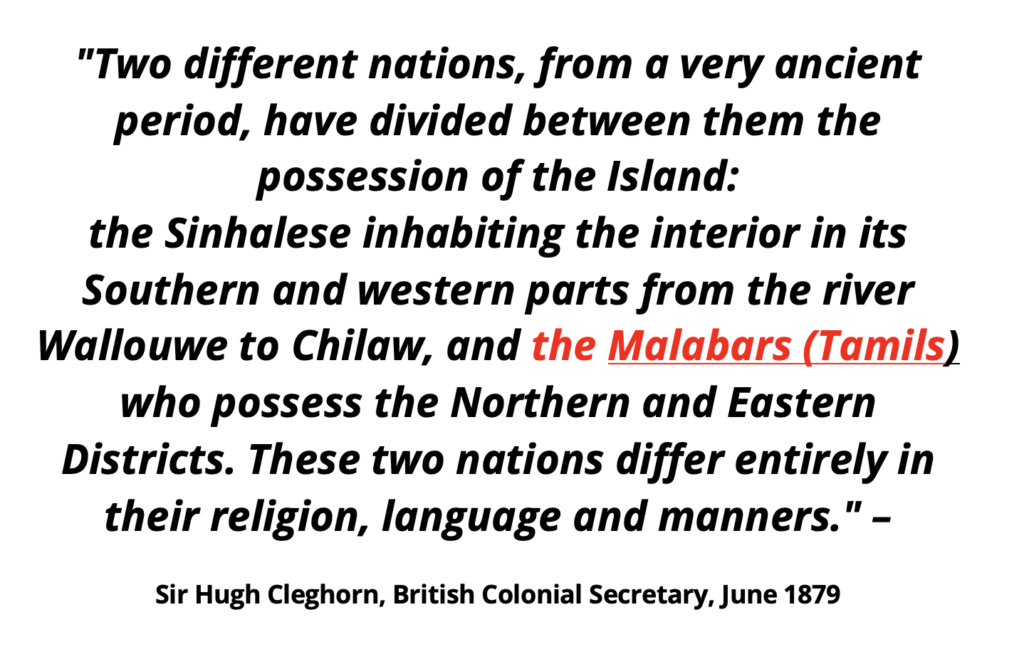
1. HUGH CLEGHORN – BRITISH COLONAIL SECRETARY

When the Portuguese arrived in then Ceylon there was no Tamil independent nation, therefore for close to 500 years the so-called Tamil kingdom had no independent Tamil nation. Plucking bits & pieces from history & demanding a separate state is ludicrous and will only create ugly precedents for others to make similar silly claims. Those professing to divide Sri Lanka must wake up to reality. Countries can no longer live in isolation where people of one ethnic group is segregated to move with only their ethnic group & speak only their language. The handful that actually want to do so should go & start set up a village as a model & see if they can survive a week without interaction with any other race, any other language, any other culture etc.

The usage of the term MALABAR has not been given due attention.

  • Who are the MALABARS?
  • Where do MALABARS come from/originate?
  • What is the MALABAR LANGUAGE (Tamil)

This answers and negates the self-determination quest.

MALABARS do not find their origins in Sri Lanka

MALABARS are by ethnicity & language from South India.

South Indian Malabars cannot claim self-determination in Sri Lanka. They should do so in South India.

We have not paid enough attention to this key word – MALABAR as this was the term used for Tamils” by all 3 colonial invaders and they used MALABAR to refer to Tamils that came from South India. Nowhere was there any reference to CeyloN Tamils, as this term was coined in 1911 only. Prior to 1911, no such people called Ceylon Tamils existed.

Tamils seeking self-determination & separation have previously used the quote by Hugh Cleghorn however, it is being ignored now primarily because people have been smart enough to ask WHO ARE THE MALABARS”

2. CHIEF JUSTICE SIR ALEXANDER JOHNSTONE

Tamils also used quote by Chief Justice Sir Alexander Johnstone in July 1827 to the Royal Asiatic Society of UK & Ireland

Chief Justice Sir Alexander Johnstone says that the people who were inhabiting North & East of Ceylon

  • Spoke the same language
  • Used the same written character
  • Had the same origins
  • Had the same religion
  • Had the same castes,
  • Had the same laws
  • Had the same manners as that of the people who at the same period inhabited the southern peninsula of India.

What more is there to say.

Tamilnation.org proudly claims that the Cleghorn Minute of 1799 and the Arrow Smith Map of 1802 are official proof that the Island of Ceylon consisted of two separate countries”

How can this be – when both refer to MALABARS and both confirm MALABARS are from India!

It is important to note that the island was ceded to the British via the Kandyan Convention of 1815.The Kandyan Convention was signed between the British & the Sinhale nation represented by the Kandyan Chieftans. Did the British sign a separate convention with the Tamils? No, was there a separate Tamil kingdom during this period? No.

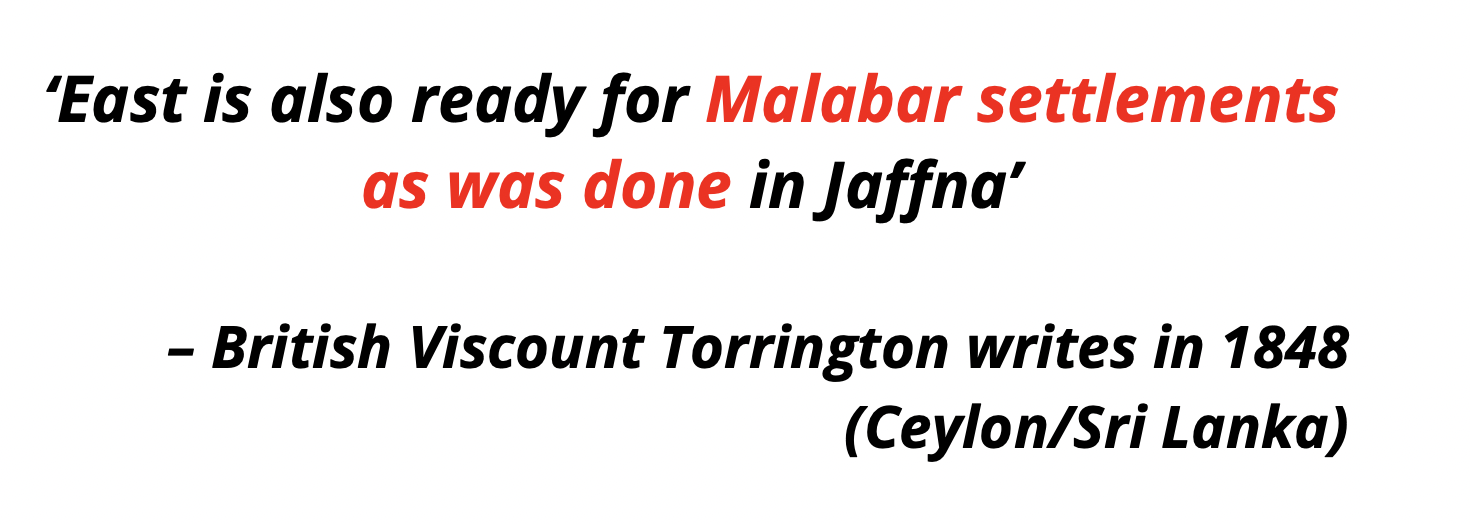
3. BRITISH VISCOUNT TORRINGTON – MALABAR COLONIZATION OF SRI LANKA

Viscount Torrington arrived in Colombo in May 1847 he increased taxes resulting in mass protests. To quell the protests he brought Malabar troops from Madras. He was known as the British hyena resulting in being recalled from Ceylon. None of these Malabar troops returned to India.

The 1818 rebellion was also quelled using Malabar Tamils brought in from India. They too didn’t return to India either.

This proves colonial British were transporting MALABAR (TAMILS) from Indian coast to Sri Lanka & settling them with explicit intent to change the demography of Sri Lanka.

This is MALABAR COLONIZATION of Sri Lanka.

This also shows that Malabars initially imported from India to Jaffna were to be sent to East to colonize the East.

SETTLEMENTS” indicate the British were not bringing one or two Indians but entire villages to create artificial Malabar inhabitatnts”.

The colonial British COLONIZED THE NORTH & EAST with MALABAR (Tamils) these are the descendants now claiming a bogus homeland”.

Does the TNA ever claim an exact period of independent rule? How can they claim so, if Sinhalese had been living in the North before them? Can the TNA list names of Tamil rulers who are not Indian?

This is indicated by Mudaliyar C Rasanayagam (a Tamil) who in his book Ancient Jaffna in 1926 says Jaffna was occupied by the Sinhalese earlier than by the Tamils is seen not only in the place names of Jaffna but also in somehabits & customs of the people”

He also admits that the population of Jaffna from the earliest times was one of Sinhala speaking people. This changed as a result of South Indian invasions.

Dr. Karthiegesu Indrapala in his doctoral thesis writes that Tamil settlements existed only after the 13thcentury.

Prof. K M de Silva in his book Myth of the Tamil Homelands” says even between 10th & 15th century AD Sinhales settlements were strong in the North – In the early days when Buddhism flourished in North Ceylon, the outlaying islands off the coast of Jaffna contained important monasteries and viharas”.

WHen the Western colonial invaders arrived with the Portuguese in 1505, historian Father Queroyz in his book The Conquest of Ceylon” wrote

On the arrival of the Portuguese that Jaffna was one of the fifteen sub-kingdoms under the King of Kotte  who was therefore, known as the Emperor of Ceylon”.

When Portuguese attacked Jaffna, the Sinhala King sent his troops headed by Mudaliyar Atapattu because Jaffna was part of the Kandyan Kingdom  Queroyz states that Jaffnapatana

remained under the Portugezen sway for upwards of 40 years, wrested from the Emperor by Philippo d’Olivero when he defeated the Cingalezen forces near Achiavelli (Achuvely) by the great pagoda”.

If when the Portuguese arrived, there was no separate independent Tamil kingdom, how can the Tamil separarists make self-determination claims!

That Buddhist temples, monasteries and ancient remains existed in the North even as far back as the 2ndcentury BC is revealed in the report to UNESCO by UNP MP Cyril Mathew.

What happened to the Sinhalese Buddhists living in North Sri Lanka?

Numerous invasions from India after 13th century led to Aryachakravarti rule forcing Sinhalese to move southwards for safety.

All 3 colonial invaders imported Malabars from South India & colonized them in Sri Lanka. Malabars Tamils were the only Tamils who were living in Sri Lanka, it was only in 1911 that a group called Ceylon Tamils emerged.

The Thesavalamai law too is applicable not to Ceylon Tamils but only to Malabar Indian Tamils. It is only applicable to the Malabar inhabitants of Jaffna, & not applicable to Tamils in Trinco, Batticoloa, Estate Tamils or non-Jaffna Tamils. This law is not a customary of Tamils but of Indian Tamils.

The 3 colonial rulers colonized Sri Lanka using Malabar Tamils by enacting wasteland laws making Kandyan peasants landless. If at all anyone should be asking land back, it is the Kandyan peasants who lost their lands as a result of invader illegal laws.

Malabar colonization by the 3 western invaders resulted in close to 1million Indian non-citizens imported to Sri Lanka. These Indians were residing on Temporary Resident Permits. They were regarded separate to the Ceylon Tamils term coined in 1911. How this was separated using what criteria has never been properly explored.

The Ceylon Citizenship Act of 1948 allowed Indians who were born in Ceylon to citizenship & 145,000 Indian Tamils gained citizenship which G G Ponnambalam supported. In 1964 and 1974 more Indians were given citizenship in Sri Lanka. These citizens” were Malabars that the British, Dutch & Portuguese had imported.

The 1976 Vaddokoddai Resolution of TULF is a lie because there was no separate Tamil kingdom in North Sri Lanka & East was never part of any Tamil kingdom ever. If Tamils are going back in time plucking numerous phases to claim a Tamil kingdom existed & to demand self-determination, then the Sinhalese have more right to claim self-determination in the very areas that the Tamils seek as their kings ruled these areas and there is enough evidence to prove so.

That the East was part of the Kandyan Kingdom is proved when on 14 May 1638 King Rajasinghe II, King of Kandy travelled to Batticoloa to sign a treaty with Adam Westerwold of the Dutch Navy sealing alliance between Dutch & the Sinhalese against the Portuguese (Kandyan Treaty of 1638) This treaty was signed 18 years after Sankili was deposed by the Portuguese.

In 1833 the Colebrooke & Cameroon reforms divided Ceylon into 5 provinces – Nuwara Kalaviya (Present North Central Province) was annexed to Northern Province while Thamankaduwa (Polonnaruwa) was annexed to Eastern Province. The British demarcation of provinces were not based on historical habitats, ethnicities or language but for administrative needs & revenue making only.  So these British-created demarcations cannot be used for ethno-religious-language division of Sri Lanka.

The Tamil separatists have been lavishly using the Hugh Cleghorn minute as a basis to claim a Tamil Homeland. However, this famous minute refers to MALABARS & MALABARS are descendants from India & do not have origins in Sri Lanka to claim a homeland. Boatloads of MALABARS were brought to Ceylon as written by Captain Robert Percival in his book An Account of the Island of Ceylon (1805)

the inhabitants of Jaffna consists of a collection of various races…these different tribes of foreign settlers greatly exceeded the number of the native Ceylonese in the district of Jaffna”

(page 71-72)

It is time people start questioning how MALABARS can demand self-determination in Sri Lanka or claim original habitats” as MALABARS were transported from South India by the colonials and settled in North & East of Sri Lanka. The task is to first separate MALABARS from the 1911 coined Ceylon Tamils because if they emerged from MALABARS, then they have no right to any separate homeland in Sri Lanka.

Enough of these Goebbells claims for separate homeland – prove those demanding separate homeland are not descendants of MALABARS first.

Shenali D Waduge

වයධම්මා සංඛාරා අප්පමාදේන සම්පාදේථ – පිරිනිවන් මඤ්චකයෙහි කල දේශනාව

December 4th, 2022

තිස්ස ගුණතිලක 

පන්සාළිස් වසක් සත්වයා සසර සයුරින් ඵතර කරවීමට (උපන්දා සිට මේ මොහොත දක්වා ඵකතු කල ක්ලේෂයන් දුරැකොට දුකින් මිදීම) උත්සාහයක යෙදුන තතාගතයින් වහන්සේ පිරිනිවන් මඤ්චකයෙහි තමන් වහන්සේ සියළු ලෝක සත්වයාට මින්මතු දේශනයක් නොකරන බවත් ඵ්නිසා මෙම අවසන් දේශනාවේ තමන් වහන්සේ කල සියළුම දේශනාවල ක්ෂාරය අඩංගුවිය විය යුතුබවත් දැන සත්වයා දුකින් මිදීමට කලයුතුම දේ පිරිනිවන් මඤ්චක දේශනාවට ඇතුලත් කලේය. 

ප්‍රමාදය සියල්ලම වසයි ඵනිසා ප්‍රමාදය ඉවත්කර වහවහා අප්‍රමාදය මතුකර/සකස්කර ගැනීමට (සම්පාදේථ) යුහුසුළු වන්න. 

මෙයයි බුද්ධ වචනය. සිතුවිල්ලේ (අරමුනේ) ඇතිවන ස්කන්ධයේ උදය-වය දැකීමට – නාම රෑප පරිච්ඡේදය දැකීමට,  ‘සිහියේ’ හා සිතුවිල්ලේ වේගයන් ගැලපිය යුතුය. ඵනම් ‘සිහියේ’ වේගය අඩාල කරන කාරක දුරැකල යුතුය. සිහියේ සිට සිතුවිල්ල දැකීම යනු මෙම සංසිද්ධියයි.

වයධම්මා සංඛාරා – සංඛාරයේ (නාමයේ) වය ධර්මතාවය දැකීමට

අප්පමාදේන සම්පාදේථ – අප්‍රමාදය සම්පාදනය කරගනිව්

මෙම ගාථාව නැතහොත් අවවාදයේ ඇති ගැඹුර මෙතෙක් ලොවට හෙලිවී නැති බවයි මාගේ හැගීම. ඒ දේශකයන්ට එහි අරැත වටහා ගැනීමට නොහැකිවී ඇති බැවිනි. සමස්ත බුද්ධ දේශනයේම ගැඹුර නොතේරෙන අයෙකුට මෙම පිරිනිවන් මඤ්චක දේශනාව ගලපාගත නොහැක.

‘සිහිය’ යනු භෞතික තත්වයක් ලෙස අප හඳුනාගතිමු. එය ‘සිතින්’ වෙනස්ව පවතින්නක් බවද, පෙර මතකය හා සම්බන්ධව පවතින බවද දැන් අපි දනිමු. ක්ලේෂයන් (ආස්‍රවද ඇතුළුව) හා ඥාණ හටගන්නේ සිහිය තුලම බව අප පසුගිය ලිපිවල සාකච්ඡා කල බව ඹබට මතක ඇත.

‘සතිය’ යනු සිහිය තුල හිඳ සිත දැකීමයි. නැතහොත් සිතට සිහිය පැවැත්වීමයි/පිහිටුවීමයි. යෝනිසෝමනසිකාරය යනුද මෙම ක්‍රියාවලියමයි. විපස්සනාවෙන් කරන්නේද එන එන සිතට (අරමුනට) සිහිය පැවැත්වීමයි. සතිය පිහිට විය යුතු වන්නේ සිතේ (අරමුනේ) මුලම ඇතිවන ස්කන්ධ ක්‍රියාවලියේ උදය (ඇතිවීම) වය (නැතිවීම) දැකීමටයි. ස්කන්ධ ක්‍රියාවලිය (රෑප, වේදනා, සංඥා, සංකාර, විඤ්ඤාණ) ඇතිවන තැන රූපත් නැතිවන තැනිවන තැන අරූපත් (නාමත්) හටගනි. තතාගත දේශනාව නම් ‘මහනෙනි, සෝවාන් වීමටත්, සකරදාගාමි වීමටත්, අනාගාමි වීමටත්, අර්හත් වීමටත් කල යුත්තේ ස්කන්ධයේ උදය-වය දැකීම පමනමයි – දස්සනේන පහාතබ්බා’

දැන් සිහියේ සිට සිත (අරමුන) දකින ක්‍රියාවලිය සලකා බලමු. සිහිය හා සිත වේගයන් දෙකක පවතී. වේගය යනු ‘ඇතිවන නැතිවන විපරිනාමවන’ වේගයයි. සිතේ ඇතිවන නැතිවන වේගය ක්ෂණයක් වන අතර එම වේගය කෙතරම්ද යත් බුදුන් වහන්සේ එයට සමකල හැකි වේගයක් සම්මත ලෝකයෙන් උදාහරන කොට දැක්වීමට තමන් වහන්සේට අපහසුයයි පැවසූ බව බුද්ධ දේශනාවේ සඳහන් වෙයි. එනම් සිතේ (අරමුනේ) වේගය ආලෝකයේ වේගයටත් අධික වන බව දත යුතුය.

භෞතික තත්වයක පවතින සිහියේ පැහැදිලි වේගය (apparent/ostensible speed) අරමුනේ වේගයට වඩා ඉතා අඩු එකකි. මේ හේතුවෙන් එනම් වේගයන්ගේ වෙනස නිසා (incomparability) සිහියේ සිට සිත දැකීම අපහසුය.

ස්වාභාවයෙන්ම සත්වයාගේ සිහියේ (ඇතිවන නැතිවන) වේගය (inherent speed) සිත දැකීමට හැකි ඉහල අගයක පවතින අතර එය වැසී පවති. සිත දැකීමට නම් සැඟවී පවතින මෙම වේගය මතුකර ගත යුතුව ඇත. සිහියේ පවතින මෙම ඉහල වේගය සත්වයා තුල විශේෂයෙන් මිනිසාතුල පවතින ‘බුද්ධ ස්වාභාවය’ යි.

බුදුන් වහන්සේ පිරිනිවන් මංඥ්කයේ කල දේශනාවේ සඳහන් වන්නේ මෙම වේගයන්ගේ වෙනසයි. ‘අප්‍රමාදය සම්පාදනය කරගනිව්’ යනුවෙන් කල අවවාදය තුල ගැබ්ව ඇත්තේ සත්වයා තුල ස්වාභාවිකම පවතින බුද්ධ ස්වාභාවය එනම් සිහියේ පවතින (inherent) වේගය මතුකර ගැනීමට යුහුසුලු වෙයව් යන පනිවිඩයයි.

සත්වයා තුල නිරතුරැවම පවතින බුද්ධ ස්වාභාවය ‘පංච නීවරණ’ වලින් වැසීපවතින අතර නීවරණ ප්‍රහානය කිරීමෙන් සිත දැකීමට අවශ්‍ය සිහියේ වේගය මතුකර ගත හැකිය. පට්ච්චසමුප්පාදයේ ධම්මානුපස්සනාවේ ‘නීවරණපබ්බං’ හි තතාගතයන් වහන්සේ මෙම ධර්මතාවය සැකවින් විස්තර කර ඇත.

පංච නීවරණ නැමති ‘පොරොප්ප’ යෙන් (clog/impediment) වැසී පවතින සත්වයාගේ සිහිය තුල ස්වාභාවිකවම පවතින බුද්ධ ගුණය නැතහොත් වැසී පවතින වේගය මතුකර ගැනීමට අවශ්‍ය මාර්ගය ධම්මානුපස්සනාවේ අවසාන භාගයේ ඇති   ‘බොජ්ඣඞ්ගපබ්බං’ හි තතාගතයන් වහන්සේ මනා ලෙස දේශනා කර ඇත.

ඹබ විසින් කලයුතු වන්නේ සප්ත බොජ්ඣඞ්ගය වැඩීමෙන් පංච නීවරණ නැමති පොරොප්පය ගලවා ඔබ තුල ස්වාභාවිකවම පවතින බුද්ධ ස්වාභාවය (සිත දකින වේගය) මතුකර ගෙන ස්කන්ධයේ උදය-වය දැක සෝතාපන්නයට (නිවන්මගට) පිවිසීමයි.

මා උත්සාහ කලේ මෙතෙක් කලක් වැසී පැවතුන බුද්ධ පණිවිඩයේ සත්‍ය ඥාණය විවරකර දී ඔබට පරතෝඝෝශය හා ධම්මවිචය ඇති කිරීමටයි.

ඹබට සුභ පැතුම් 

තිස්ස ගුණතිලක 

2022 දෙසැම්බර් මස 05 වනදා

Re: Nepotism ‘Machang Diplomats’ at Sri Lanka’s Foreign Missions

December 4th, 2022

Asoka Weerasinghe (Mr.) Kings Grove Crescent . Gloucester . Ontario  . K1J 6G1 . Canada

1 December 2022
Rt. Hon. Ranil Wickremesinghe
President of Sri Lanka
Presidential Secretariat
Galle Face Center Road
Colombo 1
Sri Lanka

Dear Rt.Hon. President Ranil Wickremesinghe:

              Re: Nepotism ‘Machang Diplomats’ at Sri Lanka’s Foreign Missions

You have surprised and disappointed me one more time.  I have just taken off my trusted cap-of-diplomacy to deal with the present concern of mine, with a raw non-diplomatic fashion, as facts need not be glazed with window-dressing niceties, even for a President of a sovereign country.

You, having the honour to wear the distinguished crown of the Grandfather of Sri

Lanka’s Mother Institution of Democratic Governance, the Parliament, having been a MP, a Minister, a Prime Minister and a President for 45 years, you have failed miserably again, to clean up the Acts of  Nepotism.  Appointing the sons and daughters, brothers and sisters and the relations of present and past MPs in the government and friends and your ‘Machang-buddies’  to work in Sri Lanka’s High Commissions and Embassies abroad,  which to some  Foreign Ministry diplomats are sanctimonious enclaves and with the Tin-Gods and -Goddesses attitudes that we do not want any outsider” among us.  

I was one who got caught in that vise when  MP, C.V. Gunaratna questioned my appointment as the Deputy in Ottawa’s High Commission, which ended up as – let’s screw Asoka Weerasinghe.  Don’t let him show his competence as a Communications Officer.  Let’s make it difficult for him to show his Made in Canada competence.

This cunning, ignominious, Machang, than hurry naythe.  Dhuwa than Diplomat nay! culture” of Acts of nepotism, should be Stopped immediately for the good of Sri Lanka..  Stop making the Foreign Ministry The Hora Dhansala-Hut of  Short-cut for Refugees and  illegal-Immigrants.

*****I just noted (14 October) that the Minister of Justice, Dr. Wijedasa Rajapaksa had said We will have to confess unwillingly that our foreign service is very weak, instead of experts who should be there in places like High Commissioners and Diplomats, most of them have been appointed due to their political affiliations or their relationships of their political party or leader.  We will have to get rid of that system. We are struggling to do that.”

You can say that again, Minister of Justice.  No doubt you have sipped a strong cup of black coffee to wake you up to reality.  You can say that again Minister!

.

I hasten to point out that I was an ‘outsider’ of this box of the Government’s

Diplomacy, when I was appointed as the Deputy of the High Commission in Ottawa, Canada, in June 1989 on a contract for 5-years by President Premadasa, to take care of the Mission’s Communications portfolio. It needed  help with major surgery to bring it up to par with  International Communications  proficiency, as it was  pathetic.  And you knew it, President Wickremesinghe.  Ask Raj Rasalingham in Ottawa, your friend, he will elaborate more.

Why did President Premadasa  want me to help him, you might wonder?

Because by the summer of 1989, I was a middle Manager of Communications in Canada’s Federal Government for 20 years and enjoying some success and working as a Head of 20 research scientists interpreting the natural and human sciences to the public through popular exhibits at Canada’s National Museum of Natural Sciences and the National Museum of Man, at the Victoria Memorial Museum in the capital of Canada, Ottawa.

______________________________________________

CALLING LANKACOM OTTAWA

DATE: 25-05-89

NO:62

FOR WEERATUNGA       FROM TILAKARATNA

MR. ASOKA WEERASINGHE IS APPOINTED AS DY. HIGH COMMISSIONER IN YOUR MISSION WITH EFFECT FROM 1ST JUNE 1989.  THE LETTER OF APPOINTMENT WILL BE DESPATCHED TO YOU BY BAG.

IN THE MEANTIME GRATEFUL CONTACT HIM AND INFORM OF THE APPOINTMENT.

(ENDS)

21139 FORSEC CE

_______________________________________________________________________

You knew it, Mr. President.  My appointment was questioned by Minister

C.V. Gunaratna in parliament, having been sneaked to him by a member

of the sanctimonious  Diplomats’ enclave, the Ministry of Foreign Affairs..  But I never was a relation of President Premadasa, nor had  I met him, nor spoken to him.  I will tell that story to you later, in this letter to you, so that you know.  It needs elaboration and my creation of Models-of-Excellence in Communications, which never was part of the High Commission in Ottawa since it was established in 1958.  It was…Pathetic!  It was abominable!

President Wickremesinghe, here’s what the problem is in sending nepotism-employees with little or no experience of handling the barrage of Tamil propaganda  which has been aggressive, potent that crippled many areas of activities at the Ottawa High Commission. They were made lame ducks!

And, of course, in Ottawa,  some diplomats rode on my back and other handful of patriotic activists, claiming that what we had done to defend  Sri Lanka’s good name publicly, that it were they, at the High Commission,  who had accomplished it, thus picking up ‘Brownie Points’, to establish their survival as diplomats at Ottawa’s High Commission.

Oh…we worked very hard to get that Editorial in!” the High Commission officers would claim, and I had to correct several times to expatriates who thought that it were really done by the High Commision’ diplomats, when in fact I did or other expatriate activists like Ira de Silva, Mahinda Gunasekera, Asoka Yapa, Daya Hettiarachchi, Malkanthi Perera and a handful of others who did it.

My experience in this context goes back to, since  24 July 1983, when in the mix of nepotism-employees”  at the High Commission you all sent to Ottawa were, Village idiots” and Thieves’.  Almost all being given the short-cut to stay back as refugees or ‘jump-the-queue immigrants.,”  In that process, the Government gifted these appointees special privileges like paid for hours for  which they did not work, as they were using those working hours, to meet with their Immigration lawyers to figure out how to stay back.  No one in the Mission ever had the gumption to question these irregularities which cost the Sri Lankan taxpayers gunny bags full of money.

Minister Counsellor,  Francis Jayagoda together with me (an expatriate), did our juggling acts to see that the thieving Sri Lankan diplomat would not be identified in the Ottawa Citizen subjecting Sri Lanka to a horrendous embarrassment.  We managed to win the day with much difficulty to hush up the news.   The Thieves were a husband and wife team, the husband being the Third Secretary at the Mission, who was sent to find medical treatment for their ailing daughter by the then Minister of Foreign Affairs, Dr. Herath,   They were caught stealing – the husband some shirts, and the wife some costume jewellery at Sears, a mega-box Department Store at St. Laurent Shopping Center in Ottawa.

Here’s what the recent print media, newspaper, in Colombo told us:

New appointments to foreign service by the Government.

Tourism Minister Prasanna Ranatunga’s daughter, consulate in Sydney.

Namal Rajapaksa’s Ex girlfriend to Melbourne 

Trade Minister Bandula Gunawardena’s  daughter to New York as 3rd Secretary 

State Minister Duminda Dissanayaka’s brother 3rd Secretary to Paris.

Tissa Attanayaka’s daughter to Canberra.

Shiranthi Rajapaksa’s brother as Ambassador to Seychelles .

Daughter of the President’s media Secretary as 3rd Secretary to Vienna.

Nephew of former Navy Chief as 3rd Secretary to Singapore.”

Mr. President Wickremesinghe, Your Foreign Ministry’s disingenuous and corrupt Parliamentarian’s son, daughter, brother, sister, brother-in-law, sister-in-law, uncle and aunty Intransigent  Foreign Employment Dansala Huts, have to be closed immediately.  No If’s and  But’s.

This was a comment I read  in the print media, Mr.President:

Boot licking Sri Lankan slaves must rise and change this corrupt system. 

Don’t wait for someone else to do it for you, while you just sit and watch. Rise up against the traitors who fill these slots with jokers. Make them accountable to you and  bring in a meritocracy”.

Ummm!

 My first day at work at the Sri Lanka High Commission at 85 Range Road, Suite 104, Ottawa (June 1989).

 I was taken to my office which was next to the High Commissioner’s Office on the first floor of the High rise on Range road by the Chief Clerk, Karunaratna.

The room was clean, empty and sterile. I looked around and did not a see a type-

writer.  There was a metal filing cabinet, a couch, coffee table and two chairs.

I had a six-foot work table and a swivel chair.

Do you have a typewriter for me.”  I asked.

No, no Mr. Weerasinghe,  you don’t need to type as we have a stenographer to type your work and the High Commissioner’s.”

I have no intention to insult the stenographer, but the typewriter is 

my workhorse.  I will do my own typing. Will you please find me one.”

On the second day at work, there was a brand new Brother electric 

typewriter on my desk, with about 250  High Commission letter headed 

typing paper. And an equal number of long envelopes with the Mission’s

address stamped on the left top corner.

By then I was in business as President Premadasa had expected of me.

President Wickremesinghe, you may wonder whether this was all a dishonest show of pretense by me.  Saying that my ‘workhorse’ is the typewriter.. Here were my results and you may want to be Judge and Jury of my performance.

My Communications portfolio required me to handle all correspondence on Human Rights ‘complaints of alleged violations by the Government of Sri Lanka against the Tamils and their brethren ‘Tigers’.

My discipline in responding to correspondence, made me respond to every letter within three days of receiving it.    And these were the results. Here are the numbers:

235 letters (in 1989);  649 (in 1990);  1223 (in 1991); 872 (in 1992); 426 (in 1993) and 257 (in 1994).  My employment at the Sri Lanka High Commision in Ottawa (Canada) was terminated in June 1994.

All these letters were typed by me.  If there was a difficult response, I sought help from Mr. Bradman Weerakoon and not from your Diplomats at the Foreign Ministry who were hell-bent to sabotage my work for having taken one of their jobs, thus depriving their children of being schooled in Canada and some kept back after their tour of duty, as  refugees or potential immigrants.

I telex  the letter that I needed some guidance to respond to Mr. Bradman

Weerakoon, and there  was a response from him the following morning on my desk.  He was extremely generous with his time to guide me.

My question to you is President Ranil Wickremesinghe, and I want you to be honest.  Will any of your Sons, Daughters, Brothers and Sisters Machang Brigade of diplomats perform as good as I did or better than what I did in Communications at the Sri Lanka High Commission in Ottawa.”

Here’s the  ‘stupid-cussed’Sabotage history that your Diplomats in the Foreign Ministry who tried to cripple my performance in Communications at the High Commission in Ottawa (1989-94)

Case 1. Let’s screw Asoka- to show he is a failure! After President Premadasa invited me to be his Deputy at the Ottawa Mission, Bernard Tilakaratna, Secretary Foreign Affairs refused to provide me with  Business cards which I thought was a valid requirement to perform my duties.,

My response was ‘ Bernard, you are not joking are you? I am certainly not going to pay out of my pocket to get the calling cards to work for the Government of Sri Lanka.  No damn way!  Let’s get President Pemadasa involved in your decision of stupidity.”  With that comment of mine, I was provided with the Business cards without an intervention by President Premadasa; 

Case 2:  Let’s screw Asoka – to show he is a failure!  I wrote to the Ottawa-Carleton School Board, advising  them that I, the Communications Officer of the  Sri Lankan High Commission, is available to deliver a Show and Tell  Class  to Primary and Middle schoolers about Sri Lanka.   There will be Sri Lankan artifacts like gems, and masks,  And videos of the Pinnawala Elephant orphanage, Sri Lankan dancers and scenes,.et cetera,  All what I wanted the school to provide me was a Globe and a VHS Cassette player with a monitor.  The Sri Lankan artifacts and VHS cassettes were from my personal library as the Mission had  sweet buggerallto promote Sri Lanka.  It was embarrassing.

 I had Principal’s of 13 schools in the National Capital Region of Ottawa inviting me to take over a Class in the presence of the Classroom teacher and deliver the Show and Tell talk on Sri Lanka.

Here is a ‘dosey’ Mr. President.  I requested the Foreign Ministry to provide me with 13 large Sri Lankan flags that I could explain the graphic on it, especially the significance of the green and orange stripes dedicated to the Tamil and Muslim, minority communities,  and present it to the Principal of the school to use it on their Commonwealth Day celebrations.  Let’s Screw Asoka” went into full gear and my request was ignored.

I asked my sister Sybil Weerasinghe, a Musaeus College teacher, to do me the favour.  To go to Laksala and buy me 13 large Sri Lanka National flags, parcel them neatly,  address them to me at the Ottawa High Commission with the words URGENT DELIVERY. Take it to the Foreign Ministry to be delivered to me in the Diplomatic Bag.  And if they were reluctant,  to take a Tuk-Tuk with the parcel to the President’s Secretariat and hand it to the receptionist with my personal letter to President Premadasa, to facilitate the delivery of the flags to me as I needed them Urgently.

The Foreign Ministry had obliged and there was no need to ask President Premadasa to  intervene,

Case 2.1Let’s screw Asoka – to show that he is a failure!

Of the 13 schools, two school groups arrived in school buses to the High Commission.  Each group had 30 students plus two teachers.  They were accommodated in our new large Library that I had created, which was furnished by me with a small dining table and four chairs, an area carpet and two tall cloth palm trees. I bought them from Smiley’s on McArthur Road (with my money) and had them delivered on a Saturday morning. I had keys to the building.   The two ebony elephant bookends of mine disappeared three days later.  I had a good suspicion who stole them.  It was an in-house thieving job.

The students sat on the floor, the teachers on chairs and I delivered my talk on Sri Lanka with my poetry, synched with the 35mm slides of Sri Lanka in a

Kodak carousel projected (my property). on to a white screen.

Since I was not given an expense allowance”, I asked HC WalterR to provide me with 35 doughnuts and three large bottles of orange juice, 35 disposable cups and 35 paper serviettes.  He not only accommodated my request but also got his domestic Podi to help me host the event.  It was a huge success.  The student who Thanked” me did it in poetic rhyme. That was beautiful.  

Asoka Weerasinghe, the Communication Officer, whose appointment was questioned in parliament by C.V. Gunaratna, certainly didn’t fail President Premadasa with this exercise of promoting Sri Lanka.   I wish and I wish, and I wish that CVG and the Foreign Affairs Diplomat who sneaked my appointment to the Minister, sat on the floor with the students and took in my presentation. It would have been a lesson for them in Communications.

My question to you Mr. President is, are you confident that your Machang Gang, diplomat brigade” was capable of doing what I did as a Communications Officer? You convince me as I would say No bloody way!”.

Case 3:  Let’s screw Asoka: President Wickremesinghe,  here’s how your Ottawa High Commission operated then.

Since there was no space for a library since 1958, I needed a space so that we could meet visitors and have meetings.

I got permission from HC Walter Rupesinghe to clear a room which was chock-a-block full of  old newspapers going back to about five-years and bundles and bundles of pink passport application forms which went back to a good 15-years.’ All these were stacked from the floor to the ceiling.

I phoned the Director of Immigration in Colombo and asked how far back should the passport application forms be kept?.  Keep the forms up to three years and you should shred the rest,” he said.

High Commissioner Walter R assigned his domestic Podi to help me empty the room. K.B. Fernando, a Senior Diplomat, the First Secretary had come into the room to find out what was going on.  There was a  large 4’x 4’ carton box at a corner of the room collecting dust.  When I asked Podi to get rid of it too, K.B. butted in and told me, No you can’t get rid of it like that Asoka. According to the FR we should take an inventory of its contents that had been sent from Colombo.”

OK, K.B., you may take off your coat,  roll up your shirt sleeves and get on making a note of its contents.”

Chick! I am not going to do it” he remarked.

Podi, how long has that box been there?   He looked at the  box, turned it around and said, Avurudhu  ekkolahak (11 years) Asoka Mahaththaya”

Did you hear that K.B?  So you Diplomats  had come over from the Foreign Ministry and  have played three rounds of  3-year-Musical chairs, and couldn’t care two copper-coated cents to take an inventory in

11-years.  And so you act like a Tin-God and expect me to do it for you guys who was hired to take care of the Communications portfolio.  You must be bloody-joking K.B.”

Podi, oya pettiya arinney nathuwa visikaranda,.”  And thats what happened

President Wickremesinghe.Take note.  K.B. Fernando was a senior Diplomat from Your Foreign Office.

Case 4: Let’s screw Asoka, exercise went on unabated during my five year

employment at the Ottawa High Commission.

After coming to a Gentleman’s Agreement with President Premadasa, the Foreign Ministry decided not to pay me the rental allowance as well as an entertainment allowance bringing down my salary that I was getting as an IS6

Canadian Communications Officer by $2,200, a  month.

Well, President Wickremesinghe, let me be blunt and raw as it could be.  You cannot govern your sovereign island with ‘Machang-nepotism appointees  to diplomatic postings, and the cussed pettiness which not only harmed my progress in Communications to deliver what was expected of me by President Premadasa, but insulted the Sri Lankan Government as well as my  well recognized dedicated and disciplined  professionalism.  Pox on you Foreign Ministry diplomats I said under my breath who tried to sabotage my work.  I didn’t take it kindly and by then the War against them was on….!

4.1 Here’s what happened: When I was appointed to the Mission, I brought with me the use of my complete political library, my  published and unpublished political writings, and Sri Lankan Museum quality artifacts to promote Sri Lanka which the Sri Lanka High Commission  had sweet-nothing. I was a Sri Lanka Heritage buff and a ‘hand-picking’ collector of  Museum-quality artifacts since 1970.

Two of my cultural Ceylon/Sri Lanka artifact collections were acquired by the

Canadian National Museum of Civilization, and another (facsimiles of Heritage flags were acquired) by the University of British Columbia’s Anthropology Museum in Vancouver.  All researched and written by me for use in public exhibitions.

4.2  When the Canadian Intelligence Corp that I had worked with since August 1983 wanted to have regular breakfast meetings with me, I said‘ Sorry, gentlemen, this proposal is not going to work out for me. Although I was promised by the Sri Lanka Government, I am not on an entertainment allowance, thus cannot pick up my breakfast meeting tabs.  It’s hopeless!”

Don’t worry Asoka, we will take care of your breakfast bills. So this Director of Communications for the Sri Lanka High Commission in Ottawa, who Minister C.V. Gunaratna, questioned in parliament, bummed-begged almost 50 breakfasts  from the Canadian Intelligence Corp.  Sad, and the cussed-pettiness of the Foreign Ministry to let that happen stank to the high heavens. That was tough Mr. President.  That was sick.    But I did what I had to do for my employer, President Premadasa, as expected of me to the best of my ability.   You bet I did,  President Ranil Wickremesinghe, even though I was told by a very senior Diplomat Asoka it’s a pity that you are the most misunderstood expatriate at the Foreign Ministry.  I know why.  Because you not only get things done, but you are also a straight talker and we cannot handle it”.   What childish stupidity!

4.3 One day, Dr. Sharma  (not sure of his Title),  of the Indian High Commission, invited me for lunch at the Chateau Laurier’s Canadian Grill, a sumptuous restaurant.

I wished that C.V.Gunaratna, MP,  and the Foreign Affairs whistleblower diplomat

who questioned my appointment in parliament were two flies on the wall listening to our conversation.

While having lunch Dr. Sharma said: Asoka every time we open the Ottawa Citizen there is a letter from you on behalf of the High Commissioner defending Sri Lanka.  They have been very impressive and to the point.  How do you do it? What is your Mantra?  We find it difficult to get even

one letter in.”

So I walked Dr. Sharma with my disciplined writing to the Editor of letters, of the Ottawa Citizen and got them pick-up ink in two to three days.

I told him that I would send my response no later than 36-hours after Sri Lanka’s news item appeared in the newspaper. . Not three, four or five days later.

Target your context of the response within the first two paragraphs.   And make it succinct and short.

If your letter does not pick up ink in seven days, call the Letters Editor and demand your right-of-reply.   Don’t let the Editor wiggle out of it.  Be firm..

But what was disappointing was my inability to reciprocate that lunch in return to Dr. Sharma, because of the petty cussedness for not providing me with an entertainment allowance as was promised.

Mr. President, I had 56 letters  out of a possible 64, published in the newspapers from the east  coast (Evening Telegram, St. John’s, Newfoundland) to the  west coast of Canada (Surrey/Delta Leader, British Columbia) during my 5-years with the Ottawa High Commission.

Mr. President, what was interesting was when the Senior Diplomat, K.B. Fernando, the First Secretary came to me and said, Asoka, there is no need for you to respond to every news item that appears in The Ottawa Citizen”.

about Sri Lanka.”

What is the problem , K.B?”

There is no need to have a dialogue with the Tamil separatists”.

Ha! What Bull is that K.B!  A dialogue is exactly what I want.  An opening of another  window for me to destroy their propaganda base trying to destroy Sri Lanka and the governance of the incumbent government.  

K.B.  I know the Subject,  I was taught to write a sentence, with six words in Grade 2 at Nalanda, like ‘The cat ran after the mouse”

You are lying to me KB. What bothers you guys at the Foreign Ministry is that you cannot show me seven letters that appeared in the Ottawa Citizen during any one High Commissioner’s incumbency.  Don’t be foolish, K.B!  I am no wimp and I am aggressive.  You have found that out by now, haven’t you?”

Mr. President Ranil Wickremesinghe, take my word.  You filling the empty chairs 

at the High Commission office in Ottawa with your  ‘Machang’s son and daughter gang of nepotism-diplomats’  won’t be a help for yours or my Mother Lanka. STOP this stupidity now, and not in a month or two or in a year’s time.   Yours and My Mother Lanka deserves better!

Case 5: Let’s screw Asoka campaign: Don’t let him show his competence 

in Communications”

Between 1989 and 1994, the Sri Lanka High Commission was the only Foreign Mission that used the ‘Host Country’ Community TV Channel  (Ottawa McLean Hunter Cable TV 22) to promote their country,

I, as the Director of Communications at the High Commission in Ottawa, Story boarded, Scripted, voice recorded,  worked with the Producer (Shahid Khan)  of McLean-Hunter CableTV and edited Nine (9)  half-hour Shows.  Songs of Sri Lanka.

All items and props used in the nine TV shows were from my private collection as Sri Lanka’s High Commission in Ottawa was shockingly empty for such an audio-visual exercise.  It was pathetic , providing the Machang diplomats” abroad, a three-year sabbatical paid  musical chair” holidays, in a way.

In the Songs of Sri Lanka I highlighted the following to promote Sri Lanka’s rich cultural heritage –

Dancing The Tea Pluckers Dance; Gajaga Vannama; Harvest Dance; Kavi Maduwa; Sinhala & Tamil  New Year celebrations; Kataragama;, Tea, Gems and Jewellery;  Kolam and Sanni Masks and ceremonies; Puppetry; Elephants  and its influence in Folk Art; Bharatha Natyam, Wesak; Interview with Air Commodore Leonard Birchall;  My poetry on Sri Lanka reading to school children accompanied by images on 35mm slides.

Mr. Prime Minister Wickremesinghe, all I can say to Minister C.V, Gunaratna and the Foreign Affairs Diplomat who complained about my appointment to the Ottawa High Commission  and questioned it in parliament, is …”Boo!” to both of You and you can now eat your hearts out…you fools!”

Case 5.1:   There were two spin-offs from our Songs of Sri Lanka TV shows.

Mr. Mukundan (not sure of his title) from the High Commission of Malaysia called

inviting me for lunch at Haveli, an Indian Restaurant in Center Town.

During lunch he  tells me, Asoka, I have enjoyed your Songs of Sri Lanka

Television shows, very much.  I’d love to do such a show to highlight Malaysia too.  Tell me, what is involved in producing such a Television Show?”

So I walked Mukundan through the production process – from story-boarding -scripting -marrying images to music, to the script – voice recording in the

Studio and finally editing in the studio.  I got help from the Producer Shahid  Khan at MacLean-Hunter Cable TV, who I can introduce to you.”

After listening to me attentively, his response was – O my God, I am not capable of producing such a Show.  I am not talented like you., Nor do I have the material to produce such a Show.”

Come on Mukundan, you can do it.  I will sit with you for the first production.  Shahid is a great guy.  A helpful producer.  I will introduce him to you.”

Mukundan truly felt that he was not capable of producing such a show and it did not happen.

But it was unfortunate that I was not able to reciprocate his courtesy lunch  as I was not provided with the  Entertainment allowance which was promised. So that’s how the Sri Lanka’s Foreign Affairs  cookie crumbled.

 Mr. President,  it was an ugly, petty response for a guy who gave up a good permanent  20-year career in the Canadian Public Service, to help President Premadasa and  Yours and My Mother Lanka.   Bloody shame, isn’t it?

Case, 5.2:  Sue Evans from the Spouses Parliamentary Association phoned me to find whether the Sri Lanka Mission would like to participate in producing a  video on Sri Lanka for their literacy project with the Frontier College to inform students across Canada about Sri Lanka. 

I agreed and proposed that they should video record my Ottawa Montessori School Show and Tell presentation  of my poetry and slide show on Sri Lanka, Thirty students came to our  High Commission Library on Range Road for the presentation.

The parliamentary video cameras were present to record the presentation.   And the letter received from Sue Evans was the result.  

Let me point out Mr.President  such an event had never happened at the High Commission before.  Done by the expatriate appointed to the Mission questioned  by MP C.V Gunaratne in parliament, prompted by some Diplomat at the Foreign Ministry.  It is all in the Hansard..  Perhaps he thought that this expatriate Communications Officer, Asoka Weerasinghe was a Do- do.  Perhaps, a member of President Premadasa’s Machang Gang of neophyte Diplomats”. Another ‘Village idiot’ that you all send among the mix of your nepotism Machang gang of Son and Daughter Diplomats’.  

So I proved the Foreign Ministry wrong again.

__________________________________________________

parliamentary spouses association    613-9962650/613-995-9917

                                                                                        June 1, 1993

Dear Mr. Weerasinghe,

     What a delight it was to be at your presentation on Sri Lanka!

I can hardly wait to see the video tape… we expect it next week.

     Thank you so much for your enthusiasm for the literacy project’

And for your willingness to become personally involved.  It was a 

pleasure to meet you and joining the children in learning about your

country,’

     I have always loved poetry – but do not possess the skill to write it.  After listening to your poems and those of your wife, I was struck by the intimate

details conveyed by just a few words of a poem…

     On behalf of all our members I want to thank you for supporting this

Project.

                                                                                 Sincerely,

                                                                                 Sue Evans”

_____________________________________________________________

Case 6:  Let’s screw Asoka campaign: Don’t let him show his competence in Communication skills.

Mr President Ranil Wickremesinghe, so the Foreign Ministry tried hard to hold me back.  After all, I was an outsider who took one of their jobs, thus depriving one of them to educate his or her children in Canada and try to keep them back as immigrants. This mantra has happened umpteen times.

Here’s what I did to establish a Model of Excellence in creating a temporary Institution

of Research to help the academics and the media personnel with truth- material for their special papers and post-secondary/graduate theses on Sri Lanka’s Eelam War,  I said temporary as the Institution would last only while my contract lasts, as the research material came from my private political library (at home), and from my Published and unpublished  political writings. 

 Up to today, since August 1983, there have been over 2000 letters under my authorship, sent out to Editors of newspapers, political journals, Sri Lanka watchers of Human Rights, and soft on Tamil separatist cause Canadian politicians  Just over 500 have picked up ink under my name, Asoka Weerasinghe.

There was no snowball chance in hell for this area of excellence in communications to be carried forward after I left.  And that is exactly what has happened.

Mr. President Ranil Wickremesinghe, here is how this temporary Research Institute worked.

6.1  Two High School students from British Columbia who had been assigned to

represent Sri Lanka at the National Student’s Commonwealth Forum meeting

in Ottawa met with High Commissioner Walter Rupesinghe with their Teacher-coach in the summer of 1991.  

After gathering information,WalterR passed them  over to me to provide them with Sri Lankan Information ‘Tourist’ brochures.  During the conversation I asked the Coach whether he would like me to coach his students.  They accepted my suggestion with glee.

The Result :They took home to British Columbia the Best Country Presentation trophy- on Sri Lanka.

As a Thank You” they took me out to dinner at the Chateau Laurier. And the trophy stood proudly at the center of the dining table during the dinner.

 6.2  A Graduate Student (G.D.),  a Britisher, from The Norman Paterson School of International Affairs at Carleton University, Ottawa, was meeting with High Commissioner Walter Rupesinghe discussing the possibility of her adopting  Sri Lanka for her country specific Thesis.  After their discussion  WalterR passed her on to me to continue the discussion further and to provide Sri Lankan tourist brochures. 

During the discussion I told her that if she decides to adopt Sri Lanka for her country specific Thesis that I will provide her with my research and writing manuscripts to help her.

All what you have to do is to provide me the Abstracts of every chapter and 

I will feed you with research materials.”   She was extremely happy with this development.  That was exactly what happened.  Eighty percent of the material that she used for each Chapter were from what I had provided her from my personal private library.  The High Commission had sweet-nothing, as such, to help her.

She played to HC Walter Rupesinghe a reel to reel tape recording of her Seminar in which she began by saying’  Good evening to you all…and thank you for being present to hear me speak.    I am Walter Rupesinghe, the High Commissioner for Sri Lanka in Canada.  And this evening I will speak to you truthfully…………..”

High Commissioner  Walter Rupesinghe was surprised and extremely happy with the presentation and he thanked the graduate student profusely.  He asked Asoka, how did you manage to do it?”   G.D. got an A++ for the seminar which was marked by two retired Canadian diplomats who were in attendance at the Seminar.

6.3   My private personal political library was used to help with research material and my published essays and critical writings to B.A. M.A., Ph.D students  and Political Science Professors, at the following academic institutions:

Carleton University (Ottawa); Ottawa University (Ottawa); McMaster University (Hamilton); Brock University (St. Catherines); Brad College (New York, US);  University of Windsor (Windsor, Ontario); McGill University (Montreal); Concordia University (Montreal); Simon Fraser University (Burnaby, B.C.); University of Victoria  (Victoria, B.C.); University of British Columbia (Vancouver); University of Waterloo (Kitchner); and University of Manitoba (Winnipeg).

So, here is the Communications Director of the Ottawa High Commission whose appointment was questioned in parliament by Minister C.V. Gunaratna, and also  was reneged on the Gentleman’s Agreement to provide an ‘Entertainment Allowance’ that deprived me the diplomatic courtesy to reciprocate courtesies

to my equivalent Diplomat hosts.  That was petty…that was stupid…that was asinine!

In my case as an outsider, pettiness, cussedness and stupidity” by the Foreign Ministry ruled the day.  And as you noticed Mr. President, I didn’t fail my employer President Premadasa, nor my Mother Lanka  that I decided to serve for 5-years on a contract leaving a 20-year career in Communications in Canada’s Federal  Government.

The only time that I picked up the restaurant dinner tabs were when I met my

Parliamentary Mentor,  who enjoyed rice and curry dinners at Indian Restaurants.

And there were times when I cooked him a curry dinner and invited him  home.

I always invited another  two Sinhalese-Canadian couples to join us.

He was Art Hanger, a Conservative Party MP for Calgary Northeast (October 25, 1987 -October 14, 2008). As a mentor, I enjoyed and respected his views and guidance

immensely.  He was who told me when I asked him to present our petition in Parliament against the Canadian Tamil Tigers and  the support they were receiving from his Conservatives,

His response was I will be honoured to do that for you, Asoka!”

Case 7. Let’s screw Asoka  campaign: Don’t let him show his competence in Communications.

 One  mid-morning, High Commissioner Walter  Rupesinghe came to me with two letters.

He gave them to me and said,”Asoka, please see what you could do to solve these problems for me.”

The letters were from lawyers.  Their clients were Tamil pensioners. One, a male in Toronto, and the other a female in Halifax, Nova Scotia.  Both letters were demanding that we pay the  pensioners their three months  pension arrears immediately.

This was embarrassing and I was angry as the Chief Clerk, a diplomat, who was looking after the pension files used to come to office almost every weekday after dinner, to work over-time and claim payment for his extra hours at work..  There were only 137 pension files and they were all in arrears of three months.

Mr. President Wickremesinghe, this was not acceptable for me, and I happened to be a staffer outside the box of your Foreign Affairs of diplomats.  And these are the Diplomats who had the gall and temerity to question my appointment to the  Ottawa High Commission in parliament through Minister C.V. Gunaratna.  Shish! What a tardy, We are the Tin-Gods and- Goddesses  at the Foreign Ministry Temple, and You are the intruding dirty rascal, Asoka!

What C.V. Gunaratna and Bernard Thilakaratne, Secretary to the Foreign Ministry was not aware was that I, Asoka Weerasinghe, will not tolerate such deliberate efforts to question my integrity as a Professional” without finding out

Who- the-hell-I-was in the field of Communications in Canada’s Federal Government.  That was a No!…No!!.

This Tamil lady was getting a pension of $94 a month and a Grandmother, and Christmas was approaching fast. I couldn’t forgive ourselves for letting the lawyer claw money for his letter from her meagre pension. I refused to destroy the freedom of this old Grandmother and her pride and dignity as a pensioner. I did not wish to see her buying a $7 box of chocolates when she really wanted to buy a $15 box of chocolates for her granddaughter, wrapped and placed under the Christmas tree.  I resented that the Government of Sri Lanka took away the precious dignity, pride and freedom of a Sri Lankan Grandmother,  and it didn’t matter to me whether she was a Tamil, Sinhalese, Burgher, a Malay or whatever.   To me She was a proud ‘loving’ Grandmother of a loving granddaughter.  And that said it all about my compassion in public relations as a Canadian-trained Communications Officer. 

So I phoned the lawyer in Halifax  and explained the difficulties we had, with the lack of staff, and that I am now being given the responsibility to look after the pension files.  That I will see her pension arrears cheque be sent within the next five working days and he will get a copy of the cheque as proof that it is on its way.

 And I pleaded that he not send her an invoice for payment  for his letter, and claw that fund from her small pension.  But if  he really thought he should be paid, to send me the invoice and that I will pay it out of my pocket to restore the pride, dignity and freedom of this Grandmother.   To please do me that favour, and that I will be eternally grateful to him.

Yes, the lawyer had a heart and he obliged and made it a pro bono Christmas gift to the Tamil grandmother. While the  Tamil Grandmother was happy with the final outcome of this exercise, there was one person who wasn’t happy.  It was the Sinhalese-Diplomat Chief Clerk who turned grumpy for having lost his ‘cash cow’, the 137 pension files.

which he worked on in the evenings after dinner and claimed an overtime wage.

I was  assisted by young Thrishula Karunaratna,  and we cleared the arrears within two months.

From then on, Mr. President,  this guy, Asoka Weerasinghe, the Director of Communications whose appointment was questioned in parliament was also responsible for the Mission’s Trade and Commerce portfolio for 14 months, and the 137 Pension files until the end of his term of duty.

Case 8. Let’s screw Asoka campaign: Don’t let him show his competence in Communications.

President Ranil Wickremesinghe, when Minister Ranjan Wijeratne was visiting Ottawa, he made a request to HC Walter Rupesinghe whether he could collect some funds from the expatriate community for his Ministry’s Defence Fund.

 Knowing that the exercise would be difficult as the expatriates, including myself, had difficulty to donate funds to any Ministerial cause, not knowing where the money would end up, as the Sri Lankan parliamentarians unfortunately had collected a reputation of being rogues,thieves, 20% pick-pockets and con-artists.  As you know Mr. President as the saying goes, there won’t be any smoke without a fire.

A meeting was organized in Toronto, and I was sent to speak to the expatriate community for three hours, and  I came back with $4,500 in cash and cheques for the Defence Fund,

8.1  Mr. President Wickremesinghe, I found that the discipline of ‘Time Management’ generally among your diplomats was appalling. A spin-off of their mindset of believing they are ‘Tin Gods and -Goddesses’ and they control power over the expatriates.

 Here is an incident that made my eyes cartwheel with anger spitting dragon breath at your senior diplomat, First Secretary K.B. Fernando who was responsible for Immigration and passports.

A few months later after my Defence Fund raising visit to Toronto, I got a call from

Mr Uyanwatta (not real name).  He said Mr Weerasinghe, I am not sure whether you could put a face to my name.  I was one who wrote a cheque for $100 for the Defence Fund”

My apologies, I don’t think I really can.   Is there anything that I can do for you?”

Yes, Mr. Weerasinghe.  I have got an emergency back at home in Sri Lanka, and I want to return ‘home’ as soon as possible.  My passport has expired and I don’t want to send it by Post in case it gets lost.  If I come over, will you be able to renew it for me over the counter, so to speak.”

I don’t do passports, it’s the First Secretary, Mr. K.B. Fernando.  If you hold on for a few minutes, I will find him and ask whether your request is doable.”

I found K.B. in his office and related the request.  No problem Asoka.  Ask him to come tomorrow and see me at 9 in the  morning with all the papers handy.”  This was a

Monday late morning.

Seeing  a lot of passports on the table I told him: K.B., I see you have quite a number of passports to deal with, why don’t I ask him to see you on Friday at 9?

That will be just fine, Asoka.”  So I asked Mr.Uyanwatta to see K.B .Fernando on Friday at. 9 in the morning with the passport and relevant forms.

Friday arrived and the receptionist called me around 11 in the morning saying that one

Mr.Uyanwatta would like to see me.  Tell  him that I will be down in three minutes.”

I thought he wanted to thank me for facilitating that favour.

How did it go Mr. Uyanwatta?”

Not good Mr. Weerasinghe.”

I drove from Toronto at 3:30 in the morning for the interview at 9.  Mr. Fernando only turned up at 11.  After looking at the passport and forms, he told me that he could only renew it in two weeks,”

I am sorry that you are disappointed, Go and sit down.  Give me the passport. And don’t go away until I see you.”

I was livid by this time.  I went in search of K.B.  Unfortunately for both of us he

was addressing the immigration clerks in the Open-plan office.  I interrupted him and told him.

K.B., refusing to renew Uyanwatta’s passport for two weeks is not acceptable.  You promised it would be done over the counter.  Stop acting like a Tin-God,  You make me look like a liar and a Sri Lankan Village-Idiot.  That is not going to happen.  Here is the passport.  I want it renewed right now.”

He flustered, took the passport and hurried out of the office.  Obviously he went to High Commissioner Walter Rupesinghe.  Walter called me in.  I went in.  He might have felt the heat of my anger spitting dragon breath  all over the senior Diplomat K.B. Fernando.

I related the story to WalterR.  I said, Walter, this is the worst act of Public relations

displayed by a Sri Lankan diplomat  exposing the power of the Foreign Ministry.  That will not phase me out.  Walter, I want this passport renewed right now.  

K.B. will take off in a year to return home, but I will have to live in this community for the rest of my Canadian-life. And you bet Walter, I will not leave this office until I get this passport renewed and I hand it over to Uyanwatta and see him on his way to Toronto.  He has been awake since 3:30 this morning driving for his interview with K.B. at  9 in the morning, which happened only at 11.  Now he has to drive another  5 hours to reach home without his renewed passport in hand.   I damn well want it done, Walter, right now.*

Walter saw my anger and he felt  the heat.  He stretched his hand over the table and told me

Give it to me, Asoka.  I will do it for you.”

The passport was renewed in 45 minutes which K.B. Fernando, the senior Diplomat from the  Foreign Ministry, wanted two weeks to do so.

Damn it, Mr. President. Ranil Wickremesinghe, this was sabotage  to undermine my work, who happened to be an outsider from the box of Sri Lankan diplomats. I was not prepared to change gears to adapt ways that your Foreign Ministry senior Diplomats worked. No Way Jose.   My discipline was, if you promise,  then you perform to meet that public relations commitment, especially having dragged this client from Toronto, 450 km away.  My discipline is when I give an appointment for a meeting at 9:00 in the morning, I don’t appear at 11 in the morning and not even apologize for that untidy insult..

Case 9. Mr. President Ranil Wickremesinghe, let me make this the final  ‘Case’ history out of my extensive catalogue of what I encountered in my 5 years working at the High Commission in Ottawa.  You can study my honest accounts  to glean how the Mission worked with a galaxy of diplomats among them were a few Village idiots” of the  Machang nepotism appointments”  And, of course, a guy like me, who was recruited by President Premadasa.  Let me hasten to add that I was no relation to him, not even remotely. Nor had I spoken to him before nor had I met him.

I had left the Mission by now and its Intelligence Officer phoned me and asked for a favour,. 

Mr. Weerasinghe, can I have a copy of every letter you sent out on the Eelam issue in Sri Lanka?”

What is that for?” I asked.

I want to send them to my Boss, back home” was the answer.

Sorry.  I won’t.  Do you know why?  So you want to ride on my back to get Brownie

Points for your survival.  You want to tell your Boss, I gave all the information  to

Mr. Weerasinghe, and told him what and how to write and also edited the letter before it was sent out.   Right?   I don’t want to be part of that lie.”

Then, if so, can you please give me a hand to write the Intelligence Report?”

That shouldn’t be a problem.  Only if the Report’s cover says that we co-authored the Report,  and my Name will be on the cover with yours.”

Certainly.  It will be fine with me and I will send you a copy of the final Report which will be sent to my Boss.”

 Mr. President Wickremesinghe, one morning a copy of the Final Intelligence Report was brought to me at home by the Mission’s chauffeur, and it looked impressive.  It was 129 pages long.  As agreed, the Cover announced both our names as co-authors. I liked that honesty,

Take note Mr. President, I did not charge the Mission the consulting fee. My fee was $1000 a day.

Around 10:30 in the morning I got a phone call from the Mission’s Minister Counsellor.

He tells me, Asoka, a funny thing happened at the Mission this morning!”

What?” I asked.

I know you were promised by our Intelligence Man that the Final Report would carry Your name as the co-author.  What went out in the Diplomatic bag was the Intelligence Report with a new cover, without your name.  I thought I should inform you what had transpired.  I know you contributed for the major part  of Intelligence for that Report.”

Thanks Pathi..Man-O-Man, I am livid. I am fit to be tied.  So you guys have done it again, riding  on my back to pick up Brownie Points for your survival;.  It’s too bad!

*****So, Mr. President Ranil Wickremesinghe, you have got a glimpse of  how the Foreign Ministry Diplomats  try their utmost to see that a new recruit from  outside their  Diplomat cabal does not perform well to tell President Premadasa ….  See you appointed this guy, Asoka Weerasinghe, as the Deputy High Commissioner and he has produced nothing and he is an abject failure.”

Mr. President Wickremsinghe, I am horribly disappointed that I missed the chance to challenge C.V. Gunaratne  when he said according to the news item in The Island of 11 October 1989, p.3, FOREIGN OFFICE OFFICERS FRUSTRATED – C.V. Gooneratne- There are experienced officers in the Foreign Ministry…The officers are frustrated.”

Really, C.V.!  You can say that again.  If you really think there are, here is my REPORT CARD on Communications for the Sri Lanka High Commission in Ottawa.,  If you produce one of your Diplomats who has done as good as what I have done or better…not two or three, just one,  I will give back every cent that the Sri Lanka Government paid me in wages in a cheque that you can personally hand  it over  to the Treasury.  And if you can’t, it is only fair that you work out a way to get my promised rent of $2000 a month for the five years, which was the money that I was expecting to pay my mortgage with.   I almost went bankrupt.  Not good and I am livid.  The worst employer that I ever worked for.

President Ranil Wickremesinghe, I wish, and I wish..and I wished. I had the opportunity to tell Minister C.V. Gunaratne, I know you questioned my appointment to the High Commission in Ottawa in parliament, here is my Report Card of what I achieved during my tenure of five years looking after the Communications portfolio. Just don’t read it, memorize it as it’s worth it for not to be so stupid again.”

__________________________________

ASOKA WEERASINGHE’S PERFORMANCE HIGHLIGHTS OF COMMUNICATIONS & CULTURAL ACTIVITIES FOR THE SRI LANKA HIGH COMMISSION, CANADA :  JUNE 1989 – MAY 1994

*** Had Letters to the Editors  published defending the incumbent Government policies.

*******56 letters in – The Ottawa Citizen (Ottawa); The Globe & Mail (Toronto);  The Toronto Star (Toronto); The Toronto Sun (Toronto); Surrey/North Delta Leader (B.C.);  The Whig-Standard (Kingston,Ontario); Sri Lanka Abroad (Toronto);’

Star India Journal (Toronto); India Journal, (Los Angeles, US); The Island (Sri Lanka)

*** Letters responding to Amnesty International Lobbyists, (They were all

personal letters, and not form letters, and all typed by me).

235  letters (1989); 649 (1990); 1223 (1991); 872 (1992); 426 (1993); 257 (1994)

*** Produced  Half-hour Community Television Shows, Scripted , recorded and edited nine (9) Songs of Sri Lanka for Maclean-Hunter CableTV, Ottawa.

In them I highlighted, the Tea Pluckers Dance, Gajaga Vannama, Harvest Dance,

Kavi-maduwa, Sinhala & Tamil New Year, Kataragama, Tea, Gems & Jewellery, Kolam and Sanni Masks and ceremonies, Puppetry, Elephants and its influence on Folk

Art, Bharatha Natyam, Wesak, Interview with Air Commodore Leonard Birchall,

My Poetry on Sri Lanka reading synchronized with  35mm slides of Sri Lanka to School Children, etc.  All the music and artifacts were from my personal library  (C.V. The High Commission had sweet buggerall to achieve this model of excellence in Communications.)

***** Exhibition participation. Let’s get this right President Ranil Wickremesinghe

When  President Premadasa wanted me to give him a hand, he nor the Foreign Ministry

Diplomats did not realize that Sri Lanka won a cultural lottery by hiring me when I brought with me not only the working knowledge in Communications but also the use of the wealth of my  private ‘hand-picked-Museum-quality’ collection of Sri Lanka’s cultural artifacts, and the use of my political library.   The artifacts collection began in 1970.

So I was able to participate at cultural exhibitions handsomely when requested through the Mission.  The High Commission was an embarrassment as it had sweet-nothing for

this communications exercise.

I know I may have blindsided the foolish MP,  C.V. Guneratne for challenging in parliament my appointment to the High Commission  in Canada.

These are where I participated on behalf of Sri Lanka, as the Director of Communications

at the Sri Lankan High Commission using my personal private collections.

  1. The Art of Healing: Ritual Healing masks of Sri Lanka (Canadian Museum of Civilization);
  2. Festival of masks: Sri Lankan ritual masks (Museum of Quebec); 
  3. Sri Lankan-Canadian writers (Edmonton, Alberta);
  4. Focus on Sri Lanka (Algonquin College, Ottawa);
  5. Sri Lankan Heritage Flags, puppets and masks (National Arts Center, Ottawa);
  6. Kolam Masks (National Gallery,Ottawa)
  7. Heritage  Flags of Sri Lanka (Halifax, Nova Scotia).

***** ToPromote Sri Lanka I presented the following Public Talks:

  1.  Sri Lankan Healing Masks:The Delicious Nightmares” (Canadian Museum of Civilization);
  2.  Claim for a Separate State in Sri Lanka: the Eastern Province whose Home Land?”  (SLUNA, Toronto). (Note: This talk was released to the Editor of The

Ottawa Citizen which was adapted as an Editorial.  The Sri Lankan High Commission’s Minister Counsellor claimed that he worked very hard to get this Editorial published,  He got caught with his lie as I debunked this ‘Village idiot’s assertion publicly as three of its sentences were lifted from my Talk.  What a Brownie point seeking liar riding on my back.);

  1.  Buddhist spirituality in Meditation” (Sai Baba’s 20th Anniversary, celebrations in Ottawa);
  2. Sri Lankan Masking ceremonies”, Newfoundland.

***** Talks in Schools  I presented 13 Talks on Sri Lanka with Artifacts, slides and 

           video presentation to  Middle  school children in the National Capital Region,

           sometimes through my poetry on Sri Lanka.  ( Note: All artifacts, slides and 

           videos were from my private collection, as the  Sri Lankan High Commission had 

           sweet buggerall.)

***** University Special papers :  Was subject advisor to two students – one on the

           Anthropological significance of Sri Lankan masking ceremonies.  The other

           on Sri Lanka Aid & Development in today’s political environment;

***** Provided research material and my published essays and critical writing

          from my Personal library for undergraduate and graduate students at the 

           following Academic  Institutions, which no one at the Sri Lanka High  

           Commission in Ottawa had done this before. (See 6.3).

          So I created a temporary Research Institution for the High Commission

           at home.  Temporary” because it would last as long as I was employed during 

           my Contract, and my personal library would not be available for the High 

           Commission’s use after I left my employment.

  Mr. President Ranil Wickremesinghe, the news item ‘Foreign Office officers frustrated , C.V. Gunaratne, in the Island of 11 October 1989, page 3, reported what Acting Foreign Affairs Minister and State Minister for Defence, John Amaratunga said in parliament, In fact Mr. Weerasinghe gave up a very lucrative job and offered to handle publicity work at the Embassy…..He should be thanked for that,”

You know what Mr. President, He should be thanked for that” came in the form of,

when I went to the Mission to read the news papers, the clerk Zakaria informed me,

Sorry, Mr. Weerasinghe, we have been ordered by the High Commissioner (Bull Weeratunga) not to open the Library for you to read the papers.”

You know why Mr. President?  The High Commissioner and Staff couldn’t hack it that, I,

Asoka Weerasinghe, appeared on the 6 0’clock  evening TV newscast often, and not the High Commissioner. And several letters that appeared in the Ottawa Citizen were under my name, Asoka Weerasinghe, and not that of the High Commissioner.  I say tough tiddy.  If your Diplomats at the High Commission couldn’t defend the good name of Yours and My Mother Lanka, I did it, for the love of my Mother Lanka who nourished me for the first 19-years of my life.  I had no difficulty standing tall for her against the barrage of Tamil separatists, 50% of the Sinhalese community in Ottawa who shot poison darts at me during their weekend  rice and curry dinner gatherings, and now the  Sri Lanka High Commissioners.  So it was a three-prong attack on me for standing tall for my Mother Lanka’s honour.

That is the very reason at a Sri Lankan gathering to celebrate Sri Lanka’s Independence, when the Mayor of Ottawa Jim Durrell and his wife Sandy, asked the President of CIDA a question on SriLanka, she pointed her finger at me and asked the Mayor Durrell, go and ask Asoka, he is the unofficial High Commissioner of Sri Lanka in Canada.”  Mr. President Wickremesinghe, when there was incompetence at the High Commission in Ottawa, that was how the cookie crumbled.  At least I was present to fill that Official

gap providing the information what the Ottawa’s Mayor Jim Durrell was seeking.

***** The National Student’s Commonwealth Forum;  Coaching the students

Representing Sri Lanka (1990, 91, 92, 94),  The Sri Lanka represented by th High School Students of British Columbia returned home with the Trophy for the Best Country Presentation -Sri Lanka;

***** Sri Lankan artifacts at the Canadian National Museums.  Was advisor on

Cataloguing Sri Lankan artifacts at the Canadian National Museum of Civilization;,

Ottawa. They had a fair collection;

*****  Author of 223 Press Releases, approved by High Commissioners Walter

Rupesinghe and Walter Fernando, since none were coming from the Foreign Ministry in Colombo;.

******* Sri Lanka News as Letters to the Editor in leading newspapers across Canada,( June 1989- May 1994)  56 out of a possible 64;

******* Authored and produced  Information Kits to be presented by the High Commissioners Walter Rupesinghe and Walter Fernando to all Sri Lanka watchers,  politicians, Human Rights Groups,  and whoever.  They were all well received, especially by the Canadian parliamentarians.  One Cabinet Minister told  HC Walter Rupesinghe,

Good, now I got some substance to confront these buggers (FACT), intelligently, when they keep sending me  an information sheet  a day, to state their case for a separate State Eelam.”  He asked his Secretary to bring the  FACT folder to show us what he had to deal with.  It was a thick file with about 200 sheets of printed paper

with a FACT letterhead,

President Ranil Wickremesinghe, since absolutely nothing was coming out from the Foreign Ministry nor from the Information Department, I asked High Commissioners 

Walter Rupesinghe and Walter Fernando  to find me $600, so that I could produce information kits for our use.   So 100 kits for each title  costing $600 were authored (working at home during the weekends) and printed by Glen Cheriton  (Commoners Publishing, the publisher of my poetry collections) and were professionally done.  They were

Sri Lanka : Human Rights (July 1991)

Sri Lanka: A Mosaic at a Glance (January 1992), and

Sri Lanka: A Hidden Secret- Quick Facts (January 1994)

It had to be a hands-on job that I had to be satisfied with.  The 100 silver coloured kit pocket folders were bought at Grand & Toy.  The green ribbon to tie each with was  bought at the Bouclair Fabric Store.  And I put them together with  a lot of

Professional artistic finesse and love.

After I left the Mission, the person who took credit for my hard work, was a nepotistic  Village idiot” who had kept copying and sending them around saying that it was hard work to produce them.

Note:  President Wickremesinghe, the volume of letter writing, information kits etc.,

was only possible since I was able to use the keyboard of a typewriter, rather than

having a second person to take notes of my dictation and then produce on a

 typewriter.

That was a  PLUS  that helped me to establish several modules of Excellence in 

Communications at the  Sri Lanka High Commission in Ottawa which was  pathetic when I took over in June 1989. 

***************  I was returning to the office after lunch  one February afternoon.   High Commissioner  Walter Rupesinghe called me in and asked me to sit down.  He very appreciatively talked about our partnership, working together with no hiccups at all during the past three years. 

I know, we didn’t treat you well, but this is the most that I can do for you”,  and handed me a sheet of paper and said..”I hope this would compensate you a little bit.”

The 8 1/2”x 11” paper had a  Sri Lanka crest at the top center of the sheet and the words High Commissioner for Sri Lanka, Ottawa, Canada.

The typed words on it said  ________________________________________________

                                                                                                         5th February 1993

     Mr. Asoka Weerasinghe functioned as my Media and Communications

Director during my term of service in the High Commission.

     Asoka’s passionate love for Sri Lanka and his superb understanding of

our political, economic  and social problems, made him admirably suited to promote the image of the country and to counter the adverse publicity

generated by elements hostile to our democratic way of life and the unitary

state.   Asoka carried out these arduous and challenging duties with exemplary enthusiasm and finesse.  He is indeed an asset to the Mission.

    Asoka is an artist, poet and a person of several other intellectual pursuits.  The amalgam of all these attributes, not often found in one person,  made him a Media and Communications Director par excellence.

       I wish him well in all his future endeavours.

                                                                 (signed) W Rupesinghe

                                                                               Walter Rupesinghe

                                                                                High Commissioner

__________________________________________________________________

        ******Mr. President Ranil Wickremesinghe, the above letter from High Commissioner Walter Rupesinghe, concludes my professional relationship, my

first experience having a Sinhalese  ‘Boss’ in my life.  All my working experience had been in the UK and Canada, 

During these three years I met President Premadasa twice in his Secretariat to discuss my progress helping him. I reported two Ministries and the third being the Foreign Ministry, and the Librarian of the Geology Department at Peradeniya University, 

Minister A.J. Ranasinghe who facilitated the meetings and High Commissioner Walter Rupesinghe were appalled that I wanted to report  Ministries to the President, and I took my working files with me. No..No..Asoka this has never been done before.”  

President Premadasa should hear what I have to say, after all I gave up a 20-year Canadian Federal Government career in Communications, to help him when he asked.”

I asked him to light a stick of dynamite under the chair of one Manager to get him

moving on my request.  He was visibly angry to hear of my complaints, and had Mr. Bradman Weerakoon to look into them and report back to him the following day.

I received three letters of apology from the Heads of Ministries before I left Colombo for Ottawa, and there were three letters waiting for me on my desk  in Ottawa on my return, with apologies.   

******* I  had one  more year left on my Contract and worked with High Commissioner Walter Fernando, my second Sri Lankan ‘Boss’. An excellent Diplomat- administrator.  Another appointment by President Premadasa, a   visionary who coined excellent working partnerships.  We worked together extremely well with no hiccups.     In a letter dated 25 November 1996, he said: 

Dear Asoka:

         We wish to thank you both for coming to the Airport and seeing us off.  We appreciate very much your friendship and cooperation extended to us during our stay in Ottawa, and especially, you were an able Lieutenant in the High Commission and I had no fear when I requested you to do something because I was confident of positive results.  Really you are a man of action.  I know you are an advocate and a canvasser for Sri Lanka and  your contributions in many spheres are appreciated……”

 With warm regards

 Sgd. Walter & Chalini.”

       *****Mr.President Ranil Wickremesinghe I hope and I wish that this letter of mine be of help to produce a Working Manual for Communications at the Sri Lanka High Commission in Ottawa with benchmarks to create Modules of  Excellence.You got a base to work with.   It will certainly help when you all send Machang Diplomats with little or no experience in Communications and  some happen to be village idiots” with no class of diplomatic sophistication and diplomatic courtesies, nor time and records management skills, and office-etiquette like the diplomat who was High Commissioner Ananda Goonasekara’s assistant.  Who went around town telling that I had stolen the masks from the High Commission, when he should have had the sophistication to phone me and ask Mr. Weerasinghe, I understand you always used Sri Lankan masks to decorate  the venues of official events,  Do you know where they are?” 

My response would have been, Yes I do.   Some are hanging on the walls in my home and others are in storage in my basement.  They were all my property as the Mission had sweet buggerall to showcase our culture. I will certainly let you borrow them only if you promise me that you will handle and take care of them, as they are very valuable pieces that I hand picked on my visits to Sri Lanka since 1970.”  

 That didn’t happen, nor a response from HC Ananda Goonasekara for my letter of 14 February 1997, with copies of my Bills-of-purchase  of Sanni and Kolam masks going back to 1970,  from Laksala; Lakpahana;  Lakmini Sevana, Ganetenna, Hingula; Sriya & Daya Curio Shop, 493 Peradeniya Road, KandyKandyan Art Association, Sangarajah Mawatha, Kandy and, more knowing he had a Sri Lankan community member who was damn mad with them.  That is how the cookie crumbled, President,  when you send Machang diplomats’ some who are really ‘village idiots’,lacking the sophistication  of class Diplomats.   This guy was lucky that I did not get hold of him by his collar and shake him with anger, until his bones rattled  and fell onto the ground on a heap of broken bones. He was lucky!  

President Wickremesinghe these are the There are experienced officers in the Foreign Ministry—the Officers are frustrated (The Island, 11 October 1989) said by Minister C.V. Gunaratna, when he questioned my appointment in Parliament.   All I can say is…”Sweet Mother of Jesus, please help my Mother Lanka.  She needs help, and very badly, with foolish MP’s like (the late) C.V. Gunaratna around.”

I only wished that High Commissioner Ananda Goonasekera had made an effort to reclaim the Sri Lankan masks his ‘village idiot’ assistant made him believe that I stole them.  I wish he did President, as I would have shown what Sri Lankan-Canadian fireworks looked like on an indigo night sky over the roof of his official residence at 28 Range Road.  You bet, I would have.  I don’t take such idiocy kindly, which tries to challenge to harm my professionalism and honesty.

Mr. President Ranil Wickremesinghe, I only wish You, the Minister of Foreign Affairs and the Minister of Justice, good luck as you all will need  Good Luck in oodles to get the best out of whoever is appointed, including members of the ‘Machang Diplomats Brigade;  to take care of the Communications portfolio at Ottawa’s High Commission.

 But please don’t send wimps who are scared and cautious of Tamil Snow Tigers as they are still around in the thousands in the Greater Toronto Area; who would take half -a-day to draft a response  to a newspaper, news item on Sri Lanka, when I, the ‘outsider’, knew the subject matter and composed a response in 40-minute on my typewriter, and sent off after the approval by the High Commissioner within 36 hours of the news item appearing in the newspaper and saw it pick up ink in two days.  

…..Minister C.V. Gunaratna, missed poorly on a reality check, which would have told him that, when his  Foreign Ministry Diplomats kept changing their assigned ‘musical chairs’ every three years at the Ottawa Mission, this outsider, Asoka Weerasinghe,  kept on working on this Sri Lanka file as a volunteer from the Canadian trenches which was under much stress and strain in Tamil separatist supporting-Canada, for  almost 5-hours a day,every week including the weekends, since 27 July 1983  And along the way gaining the trust of Canadian media personnel, and that of the  Security personnel, and some Canadian parliamentarians.   That made a helluva difference,

******* Before I conclude, it would be a remiss on my part, as one senior Sri Lanka Diplomat from the Foreign Ministry divulged that It is a pity Asoka, that you are the most misunderstood expatriate at the Foreign Ministry.  I know why, because you are a straight talker and you perform well, and we have difficulty with all that,” that I divulge most sincerely and honestly of three of your diplomats who commanded my respect absolutely.  They were High Commissioners Rodney Vandergert, Chitranganee Wagiswara and Bandula Jayasekera the Counsellor General in Toronto.  I take my hat off to all three of them.  Two are not with us today. May they rest in Peace.

And, of course, three High Commissioners of Christian faith, showed their intellectual smarts that during our Wesak celebrations in Ottawa, they as Chief guests delivered three amazing mini-lay Buddhist sermons.  Sri Lanka should be proud of them. One was an in-house Diplomat, Rodney Vandergert.  And the other two were  outsiders and were excellent Diplomats.  They were Ernest Corea and Walter Rupesinghe .

Another Diplomat who should take a bow for her engagements with the Buddhist community.  The very venerable Bhante Brahmanagama Muditha, the Chief incumbent of the Hilda Jayewardenaramaya in Ottawa told me, Asoka Mahaththaya, no one will ever believe that Chitranganee Nona is a Christian.  Her sense of devotion and Respect in white for the Buddhists at the temple were exemplary.  If Diplomat Chitranganee Wagiswara reads this comment,  Lady please take a bow. You are special as a diplomat.

Mr. President Ranil Wickremesinghe, I hope this essay of what I experienced of  how the Ottawa High Commission functioned between June 1989 to June 1994, gives you  enough reasons to correct what was wrong and lacking to make it a fibrant Sri Lankan  Foreign Mission in Ottawa.

The ball is  in your Court and  it is up to you to make it a Class Act and hit it back with  vigor and business like  over the net to change the shape of the Ball.  Or let your racket of Governance miss the ball and keep it going hobbling to disaster, embarrassment and going nowhere.  Perhaps, it has already met the marks of Modules of Excellence as in Communications, where I was involved promoting Sri Lanka

Make it a start, Mr. President by dismantling the Hora  Nepotism Dhansala Huts  of ‘Machang’ Diplomats, immediately.

Sincerely

Asoka Weerasinghe (Mr.)

cc. Hon.Ali Sabry, PC, MP, Minister of Foreign Affairs

Hon. Dr. Wijeyadasa Rajapakshe, PC, Minister of Justice

Social Stratification in Jaffna: A Survey of Recent Research on Caste

December 4th, 2022

Prashanth Kuganathan courtesy thuppahis.com

A SYNOPSIS: Since 1983, war has dominated the perception of Sri Lanka. This has affected scholarship on the country, such that the subjects of an overwhelming number of research proposals and publications have been on the war and the prospects and prescriptions for peace. This survey paper is an attempt to locate the system of caste in transition in the Jaffna Peninsula by reviewing recent literature written after the commencement of the war. While detailed ethnographies of caste in Jaffna may have temporarily come to a halt, caste practices have not and remain a salient part of everyday life among the Tamils in Sri Lanka. As the war ended in 2009, it is therefore important that social scientists on Sri Lanka revisit the topic of caste, that is an integral part of not just Tamil culture or society, but being Tamil itself. As the study of caste is dominated by research in India, a microanalysis of Jaffna and Sri Lanka, particularly the nuances of this system in transition due to war and militancy, could contribute to the macro-study of caste at a sub-continental perspective.

Introduction

Two thousand and nine was a watershed year in Sri Lankan history. In May of that year, the Sri Lankan Armed Forces, under the command of President Mahinda Rajapaksa, successfully annihilated the Liberation Tigers of Tamil Eelam (LTTE) – simultaneously killing its leader, Velupillai Prabhakaran (1954–2009). Prabhakaran had spearheaded a rebel movement for an independent Tamil homeland in the northern and eastern parts of the island against the Sri Lankan state for over a quarter of a century. During this time period, Sri Lanka and war essentially became synonymous, with war dominating both the internal and external conceptions and perceptions of the country.

A core structure in transition has been that of caste boundaries and identity. Over 25years of war and militancy have altered systems of kinship and social formation, as well as transformed conceptions of nationalism and shifted allegiances in Sri Lanka, particularly in the conflict-affected north and east. The mechanisms of war and militancy have been able to alter, even for a short period of time, who one may marry, who they associate with, how they choose to identify, and how they may subdue the innately inherent element of caste.

This survey paper is an attempt to locate the system of caste in a post-war environment in the Jaffna Peninsula, known to be the most caste conscious and conservative region in the country (Pfaffenberger 1994, p. 162). As this journal is concerned primarily with recent literature, this article will only discuss caste research concerning Jaffna published after the commencement of the war. However, in order for non-specialized readers to grasp a complete historical understanding of caste in Jaffna, it is important for them to also look at Arasaratnam 1981, Banks 1971(1960), Casie Chitty 2004(1934), David 1972, Pfaffenberger 1981, Pfaffenberger 1982, Raghavan 1971, and Skjønsberg 1982.

The politics of naming the oppressed and a brief description of some castes in Jaffna

It is important to mention that in Sri Lanka, there is no unanimous consensus on the name or term by which to collectively refer to the various castes formerly known as untouchable, a term of condescendence, that cuts right to the core of one’s dignity. Various works have used a variety of terms over a period of over 50years. Michael Banks (1971[1960]) uses Untouchable” (with a capital letter U”). Kenneth David (1972) uses the Tamil term korenja cati,” which literally translates to low caste (p. 66) or diminutive caste, a term just as condescending as untouchable. While Bryan Pfaffenberger (1981; 1982; 1994) also uses Untouchable,” he uses the term Minority Tamil” as well. The term Minority Tamil” expresses the fact that Tamils from castes considered untouchable constituted the minority in Sri Lankan Tamil society. As this term predates Sri Lanka’s contemporary ethnic and political strife, the term Minority Tamil” today may easily be conflated for Tamils in general, including those considered upper caste, who occupy a subaltern status vis-à-vis the Sinhalese majority of whom some perpetuated anti-Tamil violence, sometimes condoned and at other times coordinated by the Sri Lankan post-colonial state and its anti-Tamil policies.

Raghavan (1971) uses the at.imai/kut.imaidichotomy to divide Jaffna Tamil society (pp. 166–167). These terms, however, do not refer collectively to castes that have previously faced untouchability. At.imai and kut.imai refer to two categories of collective caste groups employed by the Vell..ā.larcaste, the largest and most dominant caste group in the peninsula, comprising over 50 percent of the total population (Banks 1960, p. 67). The Vell..ā.lars are landowning agriculturalists by traditional caste occupation. Raghavan (1971) describes the at.imai, who are also known as kut.imakkal, as castes attached” to the Vell..ā.lar, as they were their former slaves (p. 167). The at.imai are comprised of the Kōviyar (domestic servants specifically to the Vell..ā.lar), the Nal.avar (toddy tappers and tree climbers), and the Pall..ar (agricultural laborers) castes. The kut.imai, on the other hand, were not private slaves to any family and served society in general. The kut.imai are comprised of the artisan Goldsmith, Blacksmith, Brazier, stone-mason, the Ampatt..ar (barbers), the Van.n.ār (dhobis), and the Par-aiyar (funeral drummers) castes. Only the Ampatt..ar, the Nal.avar, the Pall..ar, and the Par-aiyar castes were formerly considered untouchable in Sri Lankan Tamil society (Silva et al. 2009, p. 56). As they are split between both the at.imai and kut.imai groups, both of these terms do not specifically imply untouchability. The at.imai category may undergo some sense of subjugation, but this is definitely minimal in comparison to the kut.imai category, particularly with the artisan castes, which are considered intermediary in status and not low.

Pañcamar is a term used to collectively refer to the five castes of Van.n.ār, Ampatt..ar, Nal.avar, Pall..ar, and Par-aiyar. While it may not be widely used as a term of self-identification, Jeyarajah (2001) uses it in his writing and self-identifies as Pañcamar (personal communication, November 14, 2011). I use this term in this paper, as it has been used in Sri Lankan scholarship on caste (Jeyarajah, 2001; Silva et al. 2009); it has a sense of locality and is considered an inoffensive and somewhat neutral word to refer to the five castes formerly considered low” in Jaffna society. Otukkappatt..avarka.l” or otukkappatt..a camukam,” both of which loosely translate to those who have been set apart,”has been used in Jaffna by anti-caste activists in the past and the present to refer to these groups. These terms, however, were used by members of the Eelam People’s Revolutionary Liberation Front (EPRLF); as they were a paramilitary group, some feel otukkappatt..avarka or otukkappatt..a camukam to have political connotation or implication. In this paper, therefore in addition to the use of Pañcamar, I also adopt the term depressed castes,” which Silva et al. 2009 use, and

oppressed castes,” both of which are similar to otukkappatt..avarkal..

Today in India, Ambedkar’s term Dalit has become the approved and accepted appellation, most importantly, by the members of these traditionally marginalized and oppressed groups themselves, as well as the normative term of reference used by national and international scholars. The Puducherry based activist and politician Ravikumar (2002) uses the term Dalit” when referring to these groups in Sri Lanka, which may be somewhat problematic as it is appropriative, since most of these groups do not use it as a label of self-identification. This new name is rarely used in Sri Lanka (Silva et al. 2009, p. v); however, in a recent field visit to Jaffna in the summer of 2013, I noticed its usage was on the rise, particularly by certain political elements that were mobilizing. The term Dalit then becomes an important term, perhaps not locally, but in forging certain sub-continental political alliances with other entities across the Palk Strait, who have undergone similar experiences of oppression and are better organized. It also facilitates for comparative academic study and discourse – so while I am careful to limit my use of the word Dalit, I do not necessarily shy away from it in the pages that follow.

The colonial period

While the system of caste is derived from ancient Hindu texts such as the Purus.asūktaand thus sanctioned by religion, caste as it is perceived today has undergone evolutionary changes over time, just as the progress of the term Dalit itself. It is important to comprehend the nuanced influence the colonial period in particular has had on the perceptions and lived realities of contemporary caste manifestation. In his article Caste as a social category and identity in colonial Lanka,” John Rogers (2004) mentions that caste was viewed by colonial administrators as prejudices of the people,” which led to the argument for its official nonrecognition and eventual policy of repudiation (p. 63). He goes on to explain that this policy countered that of the administrators in neighboring India, where caste was not only used for enumeration purposes but also exacerbated by the regime (p. 64). Historical anthropologists such as Bernard Cohn, Susan Bayly, and Nicholas Dirks have argued that processes undertaken by colonial officials in regard to the collection of caste-specific data and ranking have in fact idealized and solidified the conception of caste as it is known today in India (Bayly 1999, p. 4; Cohn 1990[1987], p. 248; Dirks 2001, pp. 8–9). Rogers (2004), however, highlights the fact that from the time of the inception of the modern census in Ceylon in 1871, no census has collected caste specific data (p. 72). In contrast, India has been able to harness this widely available data and apply it to constructive policies, such as reservations for Scheduled Castes and Scheduled Tribes. While the constitution of Sri Lanka outlaws caste-based discrimination (Silva et al. 2009, p. 15), no progressive caste based legislation has been implemented to directly uplift or empower depressed castes.

In a similar train of thought, B. E. S. J. Bastiampillai (1988) has argued in his article, Caste in Northern Sri Lanka and British Colonial Administrative Practice in the Mid 19th Century: Compromise and Expediency,” that the British played a crucial role in eliminating caste as an official category of inhabitant classification from 1845 (p. 50). Paradoxically, it was during this colonial period that the dominant caste was even strengthened and made use of by the British colonial power” (p. 48), which points to Vell..ā.lar domination in intra-Tamil community affairs, and Tamil domination in inter-ethnic affairs – largely due to colonial policies of divide and rule. Interesting are his observations in regard to caste and Christianity. While overt caste distinctions were eliminated through the colonial government, the Sri Lanka National Archives find that the Government Agent did not intervene in the late 1850s when two caste groups of Roman Catholics argued over the burial of their dead, stating no wish on the part of the government to interfere with native customs…” (Bastiampillai 1988, p. 51). The church also seemed to exercise minimal protest over discrimination against students from oppressed backgrounds by those considered upper caste, possibly due to the repercussions missionaries would face had they upset or alienated the dominant Vell..ā.lar community. Bastiampillai (1988) writes of a pupil of the Van.n.ār caste who had to be withdrawn from a Wesleyan Methodist school due to opposition of his enrollment by those considered upper caste (p. 53). Similarly, he also writes of students considered upper caste who dropped out of a Wesleyan school when a student from the Nal.avar caste was admitted. Despite the introduction of western notions of egalitarianism through the high level of education prevalent in the peninsula, adherence to caste distinction was rigidly upheld (p. 51). While it was the belief of the state that universal, free education would extirpate caste inequality (Silva et al. 2009, p. 15), Bastiampillai (1988) argues that neither education nor conversion to Christianity could eradicate caste prejudice among Tamils (p. 58).

A subaltern perspective on how Pañcamars were treated by Vellālars and Christian missionaries has come from Benjamin Jeyarajah, a pastor with the Church of the American Ceylon Mission (CACM) in Jaffna. Jeyarajah (2001) argues that the Church, specifically the American Missionaries, not only adopted caste practices but propelled them into continuity by perpetuating favoritism of the Vell..ā.lar (p. 20). While he acknowledges that education did not reach oppressed caste communities until the entrance of the Christian missionaries (p. 12), he argues that the American Missionaries primarily educated people considered upper caste (p. 30). Furthermore, he claims that children from oppressed caste communities were still subject to humiliation and indignity, some having to sit shirtless at the back of classrooms (p. 12). His theological argument is that throughout history, the church has never stood in solidarity with these marginalized people for their development including their spiritual growth” (p. 2) and that the Church needs to follow the gospel that itself preaches (p. 41) and not sanction caste distinction, particularly caste discrimination in the church. The element of caste was inherently woven into the fabric of Tamil culture that even Christian missionaries could not extract it from their converts.

One cannot, however, blame the missionaries entirely for an element that is inherent in Tamil culture. The Pañcamars may have overestimated the powers of missionaries. It is important to point out that the hierarchy of the Church of South India (CSI) to which the Jaffna Diocese belongs to, was, and continues to be Vell..ā.lar dominated. It was somewhat inevitable for the missionaries to favor the Vell..ā.lars dominated the political and social realms of Jaffna life, alienating them could indeed have threatened the stability of missionary activity. It is no surprise the Vell..ā.lars would definitely have numerically dominated the schools due to their proportion of population in Jaffna and their influence in society. However, despite Jeyarajah’s argument that students primarily considered upper caste went to these Christian schools, many Pañcamars, including Jeyarajah himself, patronized these institutions in Jaffna following the 19th century and are also the products of a western missionary education.

Temple Entry

The 1960s saw some change in regard to caste discriminatory policy, particularly in the Hindu religious arena, where caste originally stemmed from and was practiced most conservatively. In his article The political construction of defensive nationalism: The 1968 temple entry crisis in Sri Lanka,” Pfaffenberger (1994) argues that the caste agitations and riots at Maviddapuram, one of Jaffna’s most sacred shrines, were not only a victory in regard to caste discrimination but also a stepping-stone on the path to the creation of a decidedly modern Sri Lankan Tamil identity” (p. 162). He gives the reader a brief overview of some discriminatory restrictions imposed upon oppressed castes by the Vell..ā.lars:

In Jaffna in the 1940s and 1950s, for instance, Minority Tamils were forbidden to enter or live near temples; to draw water from the wells of high caste families; to enter laundries, barber shops, cafes, or taxis; to keep women in seclusion and protect them by enacting domestic rituals; to wear shoes; to sit on bus seats; to register their names properly so that social benefits could be obtained; to attend school; to cover the upper part of the body; to wear gold earrings; if a male, to cut one’s hair; to use umbrellas; to own a bicycle or car; to cremate the dead; or to convert to Christianity or Buddhism. To enforce these sumptuary restrictions extra legally, Vellalars have been ready to field gangs of thugs to punish upwardly mobile Pallars or Nalavars. Such gangs pollute Untouchable wells with dead dogs, fecal matter, or garbage; burn down Untouchable fences or houses; physically assault and beat Minority Tamils; and sometimes kill them. Preceding the Maviddapuram crisis were several altercations in which Minority Tamils had died (p. 148).

Pfaffenberger (1994) states that the 1968 Vell..ā.lar violence against oppressed caste groups that were engaged in Gandhian satyāgraha or peaceful protests proved and exposed Jaffna to be the most caste-conscious and conservative region of the island country” (p. 143). This fact would be used by Sinhala politicians and parties (pp. 159–162) to undermine Vell..ā.lar dominated attempts at Tamil nationhood (Pfaffenberger 1981). The protest at Maviddapuram proved that something similar to Dalit mass mobilization in India was indeed possible in Jaffna and could have influence on the public and policy. After the protests ended, temple doors all over the peninsula were gradually opened to oppressed castes, with the Government Agent promising to intervene on behalf of them to put more teeth into the Prevention of Social Disabilities Act” (Pfaffenberger 1994, p. 162). Pfaffenberger (1994) found, however, that temple entry to depressed castes still sparked scuffles in the 1970s, with a caste riot in 1973 being a major example (p. 162). He concludes by pointing out that it was militant groups such as the LTTE that have been committed to the abolition of caste, which had been given overwhelming support from all cross-sections of Jaffna society. But the unity that has been achieved is founded in terror and wedded to an antidemocratic ethos…,” he comments (p. 164).

Militancy

Likewise, Dagmar Hellmann-Rajanayagam (1993) also looks at the LTTE in her article The Jaffna Social System: Continuity and Change under Conditions of War,” focusing on the evolving influential role of the Karaiyār (fishermen) caste during the period of war, and how they modified the notion that the Vell..ā.lar caste constituted the ideal Tamil (pp. 251–270). While she argues the military prowess and anti-caste social policy of the LTTE played the key role, she also points to pre-war facts of Karaiyār contestation of Vell..ā.lar hegemony, such as early conversions to Catholicism to evade caste obligations (p. 268) and a significant number of Karaiyārs taking advantage of education (p. 270), similar to the Vell..ā.lars. As the Karaiyārs often claim a ksatriya (ruler) lineage (David 1972, p. 261), it is pertinent that Hellmann-Rajanayagam (1993) recounts their history in taking the lead in the revolt against foreign occupation (p. 267) and points out their contemporary battle against the state as warriors, protectors, but also to some extent, rulers of the people,” culminating in a possible Kshatriyaization” of their caste (p. 278). She argues that this goes against the slowly, slowly become Vellalar” proverb,since non-Vell..ā.lar castes nowadays demand respect and equality in their own right” (p. 281). This aphorism, however, may never have applied to the Karaiyār to begin with, as David (1972) has shown that the Karaiyār have a long history in contesting Vell..ā.lar hegemony and asserting their distinctiveness. Hellmann-Rajanayagam (1993) also points out that allegiance to antiquated caste solidarity has shifted to a contemporary one based on ethnicity (p. 280); while caste hierarchies still exist, these hierarchies fade into the background as distinctions with the ethnic other are increasingly and boldly contrasted at the forefront. This is what Kalinga Tudor Silva (2000[1999]) argues in his article Caste, Ethnicity and Problems of National Identity in Sri Lanka,” when he says the primary identity of individuals in Sri Lanka has shifted from caste to ethnicity (p. 201) largely due to militant movements like the LTTE and the Sinhala-Buddhist Janatha Vimukti Peramuna (JVP), which both fostered ideologies of ethno-nationalism while simultaneously trying to eliminate hierarchies of caste and class.

In contrast, Indian Dalit rights activist and politician Ravikumar (2002) in his provocative article, Caste of the Tiger,” has argued that Dalit rights have taken a back seat at the expense of Tamil nationhood and that any assertive writing for the rights of Pañcamars was seen as traitorous to the Tamil cause, despite the number of LTTE cadres from depressed caste backgrounds. Ravikumar has given the reader a historical narrative of how Vell..ā.lar-dominated parliamentary politics failed to address the plight of the Pañcamars, if not going directly against their interests, and has also highlighted some discriminatory restrictions and atrocities committed against them. He adduces the particularly disturbing words of celebrated Jaffna Śaiva Hindu tradition reformer Arumuga Navalar (1822–1879),who stated that the Par-ai[yar], the woman, and the Pañcamar were all born to be beaten” (para. 5). Ravikumar clearly conveys the normative casteist undertone inherent in the nature of Sri Lankan Tamil culture. As this was written during a time of ceasefire between the LTTE and the Sri Lankan government, Ravikumar argued that the LTTE must clearly articulate a policy that guarantees and safeguards the rights of Pañcamar citizens.

Sinhalese connections and recent Jaffna case studies

  1. M. M. Mahroof (2000), however, has made the argument in his paper, A Conspectus of Tamil Caste Systems in Sri Lanka: Away from a Parataxis,” that militancy and exteriorisation” of depressed castes, such as migration, may soften caste deprivations,” causing the Vell..ā.lars to rethink their rank in relation to other castes (p. 56). Mahroof gives the reader a general summary of the features of the Tamil caste systems on the island and an explanation as to how the Vell..ā.lars were able to become the most dominant and powerful, by patronizing the educational institutions founded by American and British missionaries and mastering English, which created a dichotomy between elite and common (pp. 47–48). He points out that the 1956 Social Disabilities Act would have been more effective if it had been coupled with a system of reservations or quotas for depressed castes in educational institutions and government employment (p. 55), as they have in India. As Mahroof is a researcher of caste in Sinhala society, he makes useful comparisons between the Tamil and Sinhala systems (p. 43), namely
  • The Tamil systems are based on notions of pollution, whereas the Sinhala systems are not.
  • The Tamil systems are a part of or supplemental to Hinduism, whereas the Sinhala systems are not related to Buddhism, which is theologically free of caste.
  • Non-Govicastes in the Sinhala systems are often wealthy with power; non-.ā.lar castes in the Tamil systems too often are not.
  • The Govi negation of non-Govi is silent and subtle, whereas the .ā.lar negation of non-Vell..ā.lar is often overt and can be offensive.

Also looking at other Sri Lankan caste systems in addition to Jaffna, Editors Kalinga Tudor Silva, P. P. Sivapragasam, and Paramsothy Thanges (2009) in Casteless or Caste-blind? Dynamics of Concealed Caste Discrimination, Social Exclusion and Protest in Sri Lanka have attempted to situate caste in its present context in various Sinhalese and Tamil communities, including a study on caste discrimination in war-affected Jaffna society and a field study on camps for internally displaced persons (IDPs). Given the security restrictions and inaccessibility of camps to researchers, this paper has introduced some rare and usually unobtainable data, such as the caste composition of camp inhabitants. While this paper focused specifically on Mallakam in 2007, the conclusions and reasoning drawn by the researchers give us an indication of camp composition and similar social situations of IDPs held in more recent facilities established by the state at the end of the war in 2009. Thanges and Silva found that a disproportionate number of IDPs came from the Nal.avar, Pall..ā.lar, and Pa-raiyar castes (p. 70), due to the fact that many of them had no homes to return to (p. 65). Because many of these castes were bound in nature to the Vell..ā.lars (David 1972), they had no capacity or resources to purchase their own land. Many bounded subordinates depended on their superordinates for their livelihoods, which they may have lost with the vast exodus of Vell..ā.lars from the peninsula. M. Siddartan has found that over one million people have left the Northern Province since the 1980s, with a disproportionate number of them being Vell..ā.lars who have taken advantage of extended social networks in Colombo and abroad (Silva et al. 2009, p. 64). Silva et al. (2009) point out that the Vell..ā.lars who have remained in the peninsula are usually able to afford to stay outside the camps and avoid the stigma of camp habitation (p. 71). Camp inmates from oppressed castes have difficulty worshipping in local temples (pp. 72–73) and obtaining drinking water from wells (pp. 73–74). They also mentioned the issues oppressed castes face in regard to purchasing land, due to objections from potential neighbors (p. 71). Prior to the war, there was a strict code among kinsmen, especially the Vell..ā.lars, in regard to land control, where one would only sell one’s land to another of the same caste (p. 74). If a person from a caste considered inferior were somehow able to secure property in a supposedly upper caste hamlet, they would most likely have to make an offer above the market price (p. 75). While this structure was somewhat altered during wartime, due to both militant anti-caste policy and the desperation of emigrating owners to sell and liquidate, it was still largely prevalent and a hindrance to many Pañcamars who remained in Jaffna.

One can see that even as displaced Tamils during a time of ethnic conflict, depressed caste persons received little sympathy from other Tamils belonging to privileged castes. This was not always the case. Silva et al. (2009) argue that the LTTE placed a ban on caste discrimination and even caste discourse in Tamil society (pp. 55–56) in areas they controlled. This merely imposed a veil of silence on the topic. Silva et al. have pointed out, however, that if peace were ever to return, caste would most likely reappear on the political and social agendas of various political actors (p. 52). Ultimately, the studies of Silva et al. have unraveled what the larger parts of Sri Lankan society have intrinsically chosen not to see, acknowledge, or discuss: the incontrovertible practice of caste, ultimately leading to a counterculture of denial that it even exists. Indeed, on the ground and in the field, one will find a highly prevalent discourse of denial from most people, regardless of ethnic group or region, that there is caste-based oppression in Sri Lanka. The mere discussion of caste is taboo. Particularly disturbing are the institutional efforts that go into caste censorship; Silva et al. report that the University of Jaffna, for example, discourages any research on caste (p. 20).

Some foreign scholars, however, have pursued caste-based research. Delon Madavan (2011) spent the summer in 2005 during the ceasefire studying social relations in Jaffna, focusing specifically on religion and caste. His study was particularly focused within the city limits of Jaffna Municipal Council where he interviewed 45 residents about their opinions on caste, love, and marriage. Madavan argues that the LTTE’s policy on abolishing caste significantly transformed Jaffna society due to the fear it inspired [in] people,” finding that many Vell..ā.lars viewed the LTTE and this policy as an attempt to weaken their dominant caste position in Jaffna society (p. 3). Even though the LTTE lost its control over Jaffna in 1995, Madavan shows that the after effects of their policy continued 10 years later when he did

Figure 1 Perception by inhabitants of castes localization in Jaffna Municipal Council.

his field research in 2005. He finds that overt acts of caste discrimination present in the 1980s were no longer prevalent (p. 3; p. 18). From the depressed castes, Madavan argues in particular that many members of the Nal.avar caste have successfully elevated their class status by converting to Christianity, giving up their traditional occupations, and taking advantage of educational opportunities (p. 11). He also finds that they received a significant amount of financial remittances from kin, as did the Vell..ā.lars (p. 19). The Pall..ar and Par-aiyar castes, on the other hand, did not have the same success as the Nal.avar in mobilizing (p. 11; p. 19). The success of a caste elevating its status included the purchase of land in traditional Vell..ā.lar dominated areas – a process he calls desegregation – much to the opposition of Vell..ā.lars (p. 20). The most valuable contribution Madavan makes is a map he constructs, locating the major composition of each caste group living within each of Jaffna Municipal Council’s 23 districts (p. 9), which he constructed himself with the input of 15 of his interviewees (Figure 1). The primary maintenance of caste practice is through endogamy, with inter-caste couples having to leave conservative Jaffna if they wish to marry and not be ostracized by their communities (p. 19). His prediction is that caste will slowly dissipate, especially due to the changing notions of the younger generation. Further research and time, more importantly, will be able to tell if his hypothesis will prove true.

Conclusion

This brief survey of the available research on caste in Jaffna since the commencement of the war has shown (that)

  • War, militancy, and migration have had a direct influence on how caste has been practiced in Jaffna. Almost all the literature reviewed expressed .ā.lar domination prior to militancy. As Hellmann-Rajanayagam (1993) has indicated, the LTTE and their Karaiyār leadership broke this domination, silencing and veiling caste difference in order to strengthen Tamil nationalism. This created what Madavan (2011) calls desegregation in regard to residential areas in Jaffna. However, Silva et al. (2009) found that acts of caste discrimination were perpetuated in spaces such as IDP camps during the war and possibly after.
  • While caste is practiced at some level or another in Sri Lanka, including within Sinhalese communities, it is still most strongly emphasized in Tamil communities. Mahroof (2000) gives us an inter-ethnic perspective, providing a brief comparison between Sinhalese and Tamil caste systems, while Hellmann-Rajanayagam (1993), Pfaffenberger (1994), and Ravikumar (2002) give us the often silenced intra-community perspective of the contestation of caste within Tamil nationalism. Arasaratnam (1981) and Jeyarajah (2001) also clearly show that caste affects Tamil Christians and not just Hindus.
  • The evolution of caste from the colonial period in Sri Lanka. Arasaratnam (1981) and Rogers (2004) articulate the divergence in colonial policy between India and Ceylon; India used caste as an official category of recognition, while Ceylon chose not to do so. In addition to Hellmann-Rajanayagam (1993) and Silva (2000[1999]) arguing that the ethnic conflict has solidified identity in Sri Lanka along ethnic as opposed to caste lines, Arasaratnam and Rogers give us another reason as to why there is less intervention by the Sri Lankan state in local caste issues, particularly those of discrimination.

The recent research that was reviewed does not provide an update to the prewar studies on caste in Jaffna (Banks 1971[1960]; David 1972; Pfaffenberger 1982). These prior ethnographies provide descriptions of castes, their traditional occupations, kinship systems, their particular rituals, and their relations with other castes in great detail. Moreover, they describe the social structure of Jaffna as being one overly based on purity and pollution. The people of the Jaffna Peninsula, primarily but not limited to the dominant Vell..ā.lar caste, live their daily lives through the lens of what they perceive to be clean and unclean; the rituals they perform – both on a daily and occasional basis – and their relations with other castes, exist to remove various pollutants (tut.akku). None of the recent research looks at these practices in detail due to the overshadowing of war and living under military or militant rule. However, pertinent research questions that were deferred due to the onset of the civil war in the 1980s still yearn to be answered today. More importantly, several new questions have arisen with the defeat of the LTTE and the end of the war in Sri Lanka that demand scholarly attention. For instance, more research is necessary for understanding

  • Power structure in Jaffna. With the migration of many .ā.lar elite and the social mobility various caste groups have undergone during war and militancy, it is important to determine if Vell..ā.lar domination is still in existence in Jaffna or if there are any new dominant caste groups. An updated listing and ranking of caste groups, as provided in David 1972, can provide an indication of caste mobility and current social structure. It is also essential to numerically or proportionately assess traditional caste occupation vis-à-vis caste group to analyze whether there was mobility within each particular classification.
  • The effects external militarized entities have on the traditional local system, as the Northern Province is heavily stationed and patrolled primarily by ethnic Sinhalese armed forces and police officers during this postwar period.
  • The current state of hierarchically traditional systems of kinship, ritual practice, and inter-caste interaction for each caste group, which were central to the ethnographies that were written prior to the war.
  • If caste practice and discrimination are actually on the rise. With the end of the war, Silva et al. (2009) predict caste will resurface on the political and social agendas of various actors, which Hellmann-Rajanayagam (1993) shows were veiled and silenced during the reign of the LTTE. However, war and militancy eradicated most of the horrendous and humiliating overt and open acts of caste discrimination, some of which Pfaffenberger (1994) described. There are several nuances that deserve further attention, which one can examine far more easily than before, now that the war is over and Jaffna is more easily accessible. It is thus important to analyze social structure, power, and domination in Jaffna with the absence of the LTTE, to see if old attitudes and sentiments are resurrected.

Acknowledgement

  1. Valentine Daniel, Rachel Fell McDermott, Amarnath Amarasingam, Francesca Bremner, and Joel Lee read various drafts of this paper and provided necessary modifications. Darshan Ambalavanar, Mark Balmforth, Victor D’Avella, Victoria Gross, Kaori Hatsumi, Dagmar Hellmann-Rajanayagam, Benjamin Jeyarajah, Delon Madavan, John Rogers, and Sharika Thiranagama pointed me in the right direction at one point in time or another and/or provided me with versions of their own work for me to read and use.

Short Biography

Prashanth Kuganathan is a doctoral student in Applied Anthropology at Teachers College, Columbia University. He received his MA in South Asian studies from the Graduate School of Arts and Sciences, Columbia University in 2012. This article has been modified for publication from the literature review chapter of his unpublished MA thesis entitled Borders/ Barriers/Boundaries: The Resurrection of Caste Practices in Postwar Jaffna, written under the supervision of Professors E. Valentine Daniel and Rachel Fell McDermott.

NOTES

* Correspondence address: Prashanth Kuganathan, Doctoral Student in Applied Anthropology, Teachers College, Columbia University, Box 211, 525 W 120th St, New York NY 10027-6696, USA. E-mail: pdk2108@columbia.edu

1

Both At.imai and Kut.imai loosely translate to slave or servant. They are, however, viewed as two different categories of servitude varying in degree of ownership or control by the dominant caste. In South India, the kut.imai are known as the right side castes, and the at.imai are known as the left side castes (Pfaffenberger 1982, p. 38).

Vellā.lar is spelled in more than one way in academic sources, such as Vellala” or Vellalar.”

..

3

Otukkappatt..avar is the singular for otukkappatt..avarkal..

  • A hymn in the Rigveda that explains the creation of humanity. When a makes the ultimate self-sacrifice, the four hierarchical varn. as or cosmogonic human social types” emerge from his body: brāhman. a (priest) from his mouth, ks.atriya (ruler) from his arms, vaiśya (commoner) from his thighs, and śūdra (servant) from his feet (Marriott 2002, pp.1–3). While caste is often conflated with varn. a, the lived reality of caste endogamy is actually practiced through jāti, which Marriott (2002) describes as one of the many thousands of marriage networks among South Asian families” (p. 1).
  • Jeyarajah’s Master of Theology thesis was written in Tamil and completed in May 2001 at the Tamil Nadu Theological Seminary. I used a concise English version of his thesis entitled, History of Sri Lankan ‘Panchamar’ in

Relation to C.S.I. Jaffna Diocese During the Period 1973–1998.”

  • There is a South Indian Tamil proverb that expresses the fusion of the .ā.lar caste. It has a connotation that the castes fusing to become Vell..ā.lar were inferior, as if to imply the Vell..ā.lar caste was the aspired ideal. Arasaratnam (1981) translates this as Kallas, Maravas and Akampadiyas gradually come to be Vellalars” (p. 385). In the original Tamil transliterated into English, the proverb is Kallar, Maravar, Kan-atākampat.iyar mella mella vantu Vell..ā.lar āvār.” The words mella mella” literally translate to slowly slowly.” 7

For a detailed study on Navalar and his reform movement, see D. N. Ambalavanar (2006). Arumuga Navalar and the construction of a Caiva public in colonial Jaffna. Ph.D. dissertation, Harvard Divinity School, Harvard University.

8

The Govigama, which may be spelled in a variety of ways including Goyigama or Goigama, and sometimes known simply as Govi, is the dominant Sinhalese caste in Sri Lanka. Also a caste of agrarian landlords, the Govigama caste is often viewed as the Sinhala parallel to Tamil Vell..ā.lar caste. Similar to the Vell..ā.lars in the north, the Govigamas in the south also dominated educational institutions and government jobs.

This article appeared in Sociology Compass vol 8/1 (2014): 78–88, 10.1111/soc4.12101 … while the author was attached to Teachers’ College, Columbia Univeristy

REFERENCES

Ambalavanar, D. N. 2006. Arumuga Navalar and the Construction of a Caiva Public in Colonial Jaffna. Ph.D. dissertation, Harvard Divinity School, Harvard University.

Arasaratnam, S. 1981. Social History of a Dominant Caste Society: The Vellalar of North Ceylon (Sri Lanka) in the 18th Century. The Indian Economic and Social History Review 18(3): 377.

Banks, M. 1971[1960]. Caste in Jaffna. p. 61 in Aspects of Caste in South India, Ceylon, and North-West Pakistan, edited by E. R. Leach. Cambridge, New York: Cambridge University Press.

Bastiampillai, B. E. S. J. 1988. Caste in Northern Sri Lanka and British Colonial Administrative Practice in the mid 19th Century: Compromise and Expediency. Sri Lanka J.S.S. 11(1 & 2): 47.

Bayly, S. 1999. Caste, Society and Politics in India from the Eighteenth Century to the Modern age. New York: Cambridge University Press.

Casie Chitty, S. 2004[1934]. Castes, Customs, Manners and Literature of the Tamils. New Delhi: Asian Educational Services.

  1. in Casteless or Caste-Blind?: Dynamics of Concealed Caste Discrimination, Social Exclusion, and Protest in Sri Lanka, edited by K. T. Silva, P. P. Sivapragasam, P. Thanges. Copenhagen: International Dalit Solidarity Network.

Cohn, B. S. 1990[1987]. An Anthropologist Among the Historians and Other Essays (2nd impression with corrections. ed.). Delhi: Oxford University Press.

Daniel, E. Valentine. 1984. Fluid Signs: Being a Person the Tamil Way. Berkeley: University of California Press.

David, K. A. 1972. The Bound and the Nonbound: Variations in Social and Cultural Structure in Rural Jaffna, Ceylon. Ph.D. dissertation, The University of Chicago.

Dirks, N. B. 2001. Castes of Mind: Colonialism and the Making of Modern India. Princeton, N.J.: Princeton University Press. Hellmann-Rajanayagam, D. 1993. Jaffna Social System: Continuity and Change Under Conditions of War.

Internationales Asienforum 24(3–4): 251.

Jeyarajah, B. 2001. History of Sri Lankan Panchamar” in Relation to C.S.I. Jaffna Diocese During the Period 1973–1998. Master of Theology Thesis, Tamilnadu Theological Seminary.

Madavan, D. 2011. Socio-Religious Desegregation in an Immediate Postwar Town Jaffna, Sri Lanka. Carnets De Recherches (2). http://www.carnetsdegeographes.org/carnets_recherches/rech_02_04_Madavan_eng.php (Last Accessed 31 July 2013).

Mahroof, M. M. M. 2000. A Conspectus of Tamil Caste Systems in Sri Lanka: Away from a Parataxis. Social Scientist 28(11/12): 40–59.

Marriott, M. 2002. Varna and Jati. Unpublished manuscript.

Pfaffenberger, B. 1981. The Cultural Dimension of Tamil Separatism in Sri Lanka. Asian Survey 21(11): 1145–1157.

Pfaffenberger, B. 1982. Caste in Tamil Culture: The Religious Foundations of Sudra Domination in Tamil Sri Lanka. Syracuse, N.Y.: Maxwell School of Citizenship and Public Affairs, Syracuse University.

Pfaffenberger, B. 1994. The Political Construction of Defensive Nationalism: The 1968 Temple Entry Crisis in Sri Lanka. p. 143 in The Sri Lankan Tamils: Ethnicity and Identity, edited by Chelvadurai Manogaran and Bryan Pfaffenberger Boulder: Westview Press.

Raghavan, M. D. 1971. Tamil Culture in Ceylon; a General Introduction. Colombo: Kalai Nilayam.

Ravikumar. 2002. Caste of the Tiger: Eelam and the Dalit Question. http://www.ambedkar.org/News/News080802. htm (Last Accessed 31 July 2013).

Rogers, J. 2004. Caste as a Social Category and Identity in Colonial Lanka. The Indian Economic and Social History Review 41(1): 51–77.

Silva, K. T. 2000[1999]. Caste, Ethnicity and Problems of National Identity in Sri Lanka. p. 201 in Nation and National Identity in South Asia. edited by S. L. Sharma and T. K. Oommen. New Delhi: Orient Longman. Skjønsberg, E. 1982. A Special Caste?: Tamil Women of Sri Lanka. London: Zed Press.

මැද පෙරදිග මධ්‍යම ආසියානු හා දකුණු ආසියාවේ රටවල් එකොලහක රාජ්‍ය තාන්ත්‍රිකයන් සමග වෙළ`ද, ආයෝජන හා සංචාරක සහයෝගීතාවයක් 

December 4th, 2022

ඉන්දීයාවේ ශ්‍රී ලංකා මහ කොමසාරිස් කාය්‍යාලය

ශ්‍රී ලංකාව නියෝජනය කරමින් නවදිල්ලියේ නේවාසිකව සිටින මැද පෙරදිග මධ්‍යම ආසියානු හා දකුණු ආසියාවේ රටවල් එකොලහක තානාපතිවරු හා මහ කොමසාරිස්වරු කණ්ඩායමක් පසුගිය දා ඉන්දීයාවේ ශ්‍රී ලංකා මහ කොමසාරිස් මිලින්ද මොරගොඩ මහතා මුණ ගැසිණ. අසර්බයිජාන්, බහරේන්, කාම්බෝජියා, කසකස්තාන්, උතුරු කොරියාව, මොන්ගෝලියාව, සිරියා, තජිකිස්තාන්, ලෙබනන්, කිරිගිස්තාන් හා ෆිජි යන රටවල රාජ්‍ය තාන්ත්‍රික නිලධාරීහු මෙම අවස්ථාවට සහභාගී වු අතර ශී්‍ර ලංකාව නියෝජනය කරමින් ඉන්දියාවේ සිට කටයුතු කරන රටවල් අනූහතරක් අතරින් කොටසකි. 

මෙම රටවල් අතර සබ`දතා තරකරන අතර වෙළ`ද, ආයෝජන සහ සංචාරක අංශ කෙරෙහි පුලූල් අවධානයක් යොමු කිරීම හමුවීමේ අරමුණ විය. මෙයට කලින් ද ආසියා, යුරෝපා, ලතින් ඇමරිකානු සහ අප්‍රිකානු රටවල නියෝජිතයන් සමග සාකච්ඡා කළ අතර ශ්‍රී ලංකාවේ වත්මන් ආර්ථීක හා දේශපාලන තත්ත්වය ගැන ද මෙහි දී පැහැදිලි කෙරිණ. අසීරු අවස්ථාවේ දී ශ්‍රී ලංකාව වෙනුවෙන්  ක්‍රියාකළ අන්දම ගැන ද මහ කොමසාරිස් මහතා කෘතවේදී විය. ද්වී පාර්ශවික වෙළ`ද අවස්ථා නැංවීමට ඇති හැකියාව ගැන සාකච්ඡා කළ ධීවර කටයුතු හා රටවල් අතර ජනතාව අතර සහයෝගීතාව තර කරන කි්‍රයාමාර්ග ගැන දමෙහි දී යෝජනා ඉදිරිපත් කෙරිණ. 

ලබන වසරේ පෙබරවාරි මාසයට යෙදෙන ශ්‍රී ලංකාවේ හැත්තෑ පස් වැනි නිදහස් උළෙලට විදේශ දූත පිරිස් සහභාගීවීම සම්බන්ධයෙන් ද මහ කොමසාරිස් මිලින්ද මොරගොඩ මහතා රාජ්‍ය තාන්ත්‍රික නිලධාරීන් දැනුම්වත් කරන ලදී. අලූතින් පත්කර ඇති මහ කොමසාරිස් හා තානාපතිවරුන්ගේ අක්ත  පත්‍ර ජනාධිපති තුමන් වෙත නිල වශයෙන් භාර දීමේ කටයුතු ගැන ද මෙහි දී අවධානය යොමු කෙරිණ.

Sri Lanka’s submarine cable legislation inordinately delayed

December 4th, 2022

By Asiri Fernando The Sunday Morning

Colombo, December 4 ():  Sri Lanka’s digital communications umbilical to the world remains vulnerable as the Government continues to drag its feet on enacting legislation on the protection of undersea data cables.

Today, Sri Lanka’s connectivity, trade, and digital economy as an island nation are largely dependent on seven undersea fibre-optic data cables which remain under-protected by local legislation.

This gap in legislation leaves Sri Lanka’s national security and economic recovery in a vulnerable state, with a part of the critical digital infrastructure of the country lacking a legal framework.

The move comes amidst the Government’s stated desire to improve digitalization of the public service, Sri Lanka’s digital economy, and the ease of doing business in Sri Lanka.

Such legislation, had it been introduced, would have placed Sri Lanka as the regional leader in submarine cable protection – especially in tandem with the Personal Data Protection Act which was recently adopted – enabling the island nation, which is seeking to improve its ‘hub’ status, to attract tech investments.

Slow Grind of Bureaucracy

The Sunday Morning reliably learns that the draft of the National Submarine Cables Protection and Resilience Framework (NSCPRF) – a pursuit which began under the Yahapalanaya Government’s tenure in 2018, was completed in 2020, and was earmarked to be submitted to the Cabinet for approval earlier this year – has once again been shifted to another branch of the Government without being submitted for approval.

It is understood that the draft legislation was planned to be introduced as an amendment to the Telecommunications Act with the Telecommunications Regulatory Commission of Sri Lanka (TRCSL) to act as a regulator on the subject.

The Sunday Morning understands that President Gotabaya Rajapaksa had written to the Attorney General’s (AG’s) Department in July 2021 to take necessary action to fast-track the legislative process required, preceding the Budget-making process which commenced in Parliament in November 2021.

According to sources, the Ministry of Foreign Affairs (MFA) has written to the AG’s office this year offering assistance to fast-track the process.

The draft legislation of the framework (NSCPRF) was prepared by the MFA in consultation with the AG’s Department, TRCSL, Ministry of Science and Technology, and the Ministry of Defense over the last three years. The process had been handled by the MFA’s Directorate on Oceans Affairs, Environment, and Climate Change.

However, according to the MFA, President Ranil Wickremesinghe had given instructions for the NSCPRF to be brought under the purview of the Ministry of Science and Technology with the Presidential Secretariat designated as the focal point for the subject following a briefing by the MFA regarding framework last month.

However, neither the Presidential Secretariat nor the Ministry of Science and Technology responded to inquiries regarding the status of the legislation and when it would be introduced.

When The Sunday Morning contacted Minister of Foreign Affairs Ali Sabry regarding the NSCPRF, he confirmed that the legislation had been brought under the preview of the Presidential Secretariat but would not comment on a timeline for its rollout.

It now directly comes under the preview of the Presidential Secretariat; the Foreign Ministry is helping them in consultation with the Attorney General,” Minister Sabry said.

A highly-placed Government official who is close to the subject told The Sunday Morning that the Government is now keen on a single stand-alone legislation on submarine cables in place of an amendment to the Telecommunications Act, which was planned as the method of introducing the draft framework.

However, with such a move, and the lack of clarity from the Government, the introduction of such vital legislation remains uncertain.

History

When the development of the framework began, it was supported by the United Nations Office on Drugs and Crime (UNODC), International Cable Protection Committee (ICPC), and the Government of Japan. As a signatory to the UN Convention on the Law of the Sea (UNCLOS), Sri Lanka needs to take action to protect fibre-optic submarine cables as a treaty obligation, a need the United Nations General Assembly Resolution A/RES/73/124, dated 31 December 2018 had highlighted.

Addressing a workshop on developing the framework and building national resilience in September 2020, the then Foreign Secretary Adm. (Retd) Jayanath Colombage stated: Submarine cables are crucial for emerging economies, particularly for countries like Sri Lanka, which are more reliant on ocean-based international trade. On the other hand, with the onset of the Covid-19 pandemic, the importance of digital connectivity increased multifold with growing dependency on the internet in life.”

Any interruption or destruction to the submarine cable network could cause significant chaos and loss of economic stability, public health, and safety, as well as the national security of the country. Submarine cables are also prone to damage by nature, human negligence, or accident and to deliberate damage by criminal or terrorist groups. Therefore, the safety and security of the undersea cables are of utmost importance in order to ensure their protection and continued connectivity.”

Sources at the MFA blamed a lackadaisical approach and weak subject matter knowledge on the part of  senior bureaucrats for the slow process of the framework.  

2004 disruption

Sri Lanka is no stranger to the dangers posed to the submarine data cables which link the island to the world.

In 2004, Sri Lanka suffered its first major internet and international communications outage which lasted a few days when the Indian flagged merchant vessel State of Nagaland dragged its anchor over the SEA-ME-WE3 data cable that supplied linkages to the SLT.

The incident occurred in a coastal sea area which has restrictions put in place to stop ships from deploying the anchor. SLT later took the vessel owners to court seeking US$ 5 million as compensation for damages. The cost to the economy from the outage has not been calculated.

Business, security, and connectivity

According to the former TRCSL Chairman Oshada Senanayake, the NSCPRF is a vital piece of legislation that Sri Lanka needs to bring into effect quickly in order to build investor confidence, improve resilience in the face of trans-national disruptions, and help the growth of the digital economy.

He told The Sunday Morning that after an exhaustive consultation process, the NSCPRF had been drafted and was waiting to be presented to the Cabinet earlier this year.

It is difficult to comprehend why this is facing delays. We had close consultations with the AG’s Department on the UNCLOS charter as well. The reason we drafted this legislation is because Sri Lanka does not have legislation that can have punitive measures if there is an intentional man-made damage to them or by a natural disaster. If a ship drops its anchor over them, right now we don’t have a way to charge them.”

Now, since we as a country are going through the digital transformation process, imagine the situation of a drop in internet connectivity for a day. Just compare how we struggle with eight hours of power outage now. Imagine a data blackout or lack of banking connectivity; it will have serious repercussions on the economy and society,” Senanayake said.

He added that such vulnerabilities would have an impact on the credibility of the country and its national security.

Senanayake said that the NSCPRF was a foundational element of Sri Lanka’s digital future and digital economy and that, along with the Personal Data Protection Act of 2022, the proposed framework would have given confidence to tech companies to view Sri Lanka as a preferable location in Asia for investment or relocation of their offices.

Globally, submarine cables carry 95% of the world’s total communications, while satellites are only able to handle 7% of global data traffic.

Many key submarine cables that link Europe with the Indian subcontinent, Southeast Asia, Australia, the Pacific Islands, and Africa lie on the seabed of Sri Lanka’s Exclusive Economic Zone (EEZ). The highest density of submarine cables in the Indian Ocean falls in Sri Lanka’s EEZ or travels around the island.

There are three main challenges to uninterrupted submarine cable operations – natural disasters, accidental human-induced damage, and deliberate interference and sabotage.

Sri Lanka is connected to the world through the following seven submarine data cables: The Bay of Bengal Gateway (BBG), South-East Asia-Middle East-Western Europe 3 (SMW3) submarine cable, South-East Asia-Middle East-Western Europe 4 (SMW4) submarine cable, South-East Asia-Middle East-Western Europe 5 (SMW5) submarine cable, Bharat Lanka Cable System (BLCS), FLAG Alcatel-Lucent Optical Network (FALCON) submarine cable system, and Dhiraagu and Sri Lanka Telecom Cable System (DSCS).

According to the Department of Census and Statistics, Sri Lanka had an internet penetration of 52% as of 2020, with nearly 77% of internet users using smart mobile phones to access the world wide web. Global and local use of the digital world of the internet increased significantly following the physical and travel restrictions brought on by the Covid-19 pandemic.

නිවාස ඇමැතිධුරය සජිත් දැරූ කාලයේ වංචා දූෂණ වාර්තා 2ක් පාර්ලිමේන්තුවට

December 4th, 2022

Lanka Lead News

විපක්ෂ නායක සජිත් ප්‍රේමදාස මහතා නිවාස අමාත්‍යධූරය දරන අවධියේදී එම අමාත්‍යංශයේ සිදුව ඇතැයි කියනු ලබන වංචා හා දූෂණ සම්බන්ධව විගණන වාර්තා 2ක් පාර්ලිමේන්තුවේදී සභාගත කර ඇතැයි වාර්තා වේ.

විපක්ෂ නායකවරයා නිවාස අමාත්‍යධූරය දැරූ 2017 වසරේ සිට 2019 වසර දක්වා කාලයේදී හම්බන්තොට දිස්ත්‍රික්කයේ වීරකැටිය කලාප කාර්යාලය මගින් නිවාස ණය හා ආධාර නිකුත් කිරීම, හිස් ඉඩම් බැහැර කිරීමේදී සිදුකර ඇති වැරදි හා අක්‍රමිකතා සම්බන්ධ වාර්තාව මෙහි එක් වාර්තාවක් ලෙස දැක්වේ.

අනෙක් වාර්තාව වන්නේ 2016 වසරේ සිට 2019 වසර දක්වා කාලය තුළ නිවාස ගම්මාන වෙනුවෙන් මුද්‍රණය කළ පෝස්ටර්, ආරාධනා පත්‍ර සහ සමරු කලාප සම්බන්ධ පරීක්ෂණ වාර්තාවයි.

මෙම වාර්තා දෙකම නාගරික සංවර්ධන හා නිවාස අමාත්‍ය ප්‍රසන්න රණතුංග මහතා විසින් ඊයේ (03) පාර්ලිමේන්තුවේදී සභාගත කළ බව සදහන් ය.

IMF Bribes Central Bank & Media: US & India Set to Split Sri Lanka

December 4th, 2022

e-Con e-News

• India’s Research & Analysis Wing (RAW) ‘spy chief’ Samant Kumar Goel slunk into Colombo to further grab strategic sectors (fuel, ports, etc) and regions (Trincomalee, Mannar, Hill Country, etc) to divide the country. His arrival accounts for the rather muted LTTE Maaveerar Naal or Great Heroes Day on 27 November (see Random Notes).

  India-allied MPs and media then raised greater clamour blaming China for the delay in the IMF’s gifts. Their IMF demand amounts to continuing the colonial import-export plantation economy. Warlord-backed Trinitian TNA MP Shanakiyan Rasamanickam is reported as calling for ‘Go Home China’ demonstrations, just like US-funded NGOs are now doing in Thailand, Malaysia, etc. (see ee Focus, Are China and Russia Imperialist?)

• The US government also summoned Foreign Minister Ali Sabry to Washington for a 3-day visit on November 30, just after ‘dual citizen’ Basil Rajapakse returned from the USA. Sabry met with US Secretary of State Anthony Blinken, also meeting US Senate Foreign Relations Committee members (see ee Sovereignty, Minister Sabry meets).

  ‘The US has been one of the prime movers of the resolution against Sri Lanka at the UN Human Rights Council in Geneva. In this backdrop, diplomatic sources say Washington would try to persuade Sri Lanka to heed the provisions of the resolution. Moreover, a UNHRC Secretariat is now probing allegations against political leaders in SL for alleged human rights violations and ‘economic crimes’.’

• US-state news outlet EconomyNext reports, ‘India sends RAW chief after lending $500mn loan’. The media downplayed the Indian government’s ‘commercial interactions’, their economic and political demands, and instead barked out the usual anti-China rhetoric. RAW’s ‘Goel comes amid indirect efforts by Wickremesinghe to meet Indian PM Narendra Modi since last month, sources said… Officials at Sri Lanka’s Foreign Ministry said they did not facilitate RAW chief’s visit…, while the cabinet spokesman swore: ’I swear that I don’t know such an intelligence chief met the president or any other government official.’

  The RAW chief also met finance minister & strategist of the SLPP Basil Rajapaksa… I think the message is related to the upcoming election’… Former president Mahinda Rajapaksa himself in 2015 said it was India and RAW who defeated him. So the RAW chief’s visit could be something more than what we hear. How can India order a sovereign nation on how and whom to deal with?’

   ‘China has also started funding underprivileged universality students in Jaffna and Eastern Universities. This has also drawn Indian concerns, university sources have told EconomyNext. Jaffna University Students’ Union last week said they are opposed to a move by the government to sign a memorandum of understanding with a Chinese agricultural university.’ (ee Sovereignty, RAW chief Samant Kumar Goel)

• Former IMF & current CIA operator Anwar Ibrahim has been narrowly ‘elected’ PM of Malaysia. This recalls 2015 Sri Lanka’s rigged Yahapalana election. The US chose Ibrahim as Chairman of the Development Committee of World Bank & International Monetary Fund (IMF) in 1998. He has been working with the US National Endowment for Democracy (NED) ever since. The US government through the NED has massively poured millions of dollars to Ibrahim’s ‘opposition party, a street front he has helped lead, and media networks promoting him across Malaysia’s information space’ (see ee Sovereignty, Malaysia’s New Prime Minister).

• ‘Politicians are known for smug moralising and fervent religiosity’, editorializes the Island. But surely, there is no sickening sanctimony more than the ’Fair and Lovely’ moneyed media, especially the English media. Politicians are an easy target, but this week more evidence arrived of the collusion between this even-more unaccountable and unelected media and those officials who work against the country’s interests.

Full Report

https://eesrilanka.wordpress.com/2022/12/04/imf-bribes-central-bank-media-us-india-set-to-split-sri-lanka/

98 Acres Resort & Spa named as most Luxurious Mountain Resort in Asia

December 4th, 2022

Courtesy The Daily Mirror

98 Acres Resort & Spa, a subsidiary of U.H.E. Group, was recently awarded as the Number 1 Luxury Mountain Resort in Asia, at the recently held 16th World Luxury Hotel Awards (2022) in Antalya, Turkey. 

The prestigious awards recognised 98 Acres Resort & Spa – placing it on a par with some of the world’s most sought-after, luxury hotels and resorts, known for exclusive service and offering and impeccable quality.


The recent recognition shines a spotlight on Sri Lanka and the luxury offering that is available to both local and foreign travellers. The luxury resort and spa, located in Ella, continues to pique the interest of international travellers, with the aspirational property continuing to garner praise across the globe. 
Playing a vital role in promoting and expanding not only Ella’s tourism prowess but also Sri Lanka’s, the innovative approach to luxury and experiential travel has made Ella – a noteworthy and aspirational holiday region, that many believe will soon rival Bali as a luxury leisure destination.


U.H.E. Group Group Director Marketing Eranda Aberathna stated, We are honoured and humbled to be awarded as the number one Luxury Mountain Resort in Asia. When 98 Acres was established in 2012, we had a vision for not only the brand and offering but also one that truly made a worthwhile impact on Sri Lanka’s travel and tourism industry. It is the shared vision for the company, from management through to operations and across the 98 Acres family that has made this award possible. This award is dedicated to the entire 98 Acres family and we look forward to pushing the boundaries of what Sri Lanka’s hospitality industry has to offer its global clientele.”

Established in 2006, the World Luxury Hotel Awards is the pinnacle of achievement in the luxury hotel industry, offering international recognition as voted by guests, travellers and industry players. Over 300,000 international travellers vote each year, during a four-week period to select the winners. 

ජනපතිගේ අපේක්ෂාව “නිදහස ඔප්නංවන ව්‍යවස්ථාදායක රජයක් බිහිකරනවා… 

December 4th, 2022

උපුටාගැණීම අද දෙරණ

Rumors about tax on remittances of migrant workers are false : CBSL

December 4th, 2022

Courtesy Hiru News

Rumours in circulation that remittances of expatriates will be taxed or forcibly converted into Sri Lankan rupees, are completely false. Overseas remittances can be kept in expatriates’ bank accounts in foreign currency and be converted into Sri Lankan rupees at the expatriates’ discretion.

ආර්ථිකය කඩාවැටීම ගැන ජනපතිගෙන් චෝදනා (වීඩියෝ)

December 4th, 2022

උපුටා ගැන්ම  හිරු පුවත්

ආර්ථිකයේ කඩාවැටීම පිළිබඳ වගකිව යුතු පාර්ශව පාර්ලිමේන්තුව දැනුවත් නොකළ බව ජනාධිපති රනිල් වික්‍රමසිංහ පවසනවා.

මහ බැංකුවේ එවකට සිටි නිලධාරීන් ද එම අනතුරු ඇඟවීම සිදු නොකළ බවයි ප්‍රතිපත්ති සම්පාදන ක්‍රියාවලියට තරුණ ප්‍රජාවේ දායකත්වය ලබාගැනීම පිළිබඳ පැවති වැඩසටහනකට එක්වෙමින් ජනාධිපතිවරයා වැඩිදුරටත් සඳහන් කළේ.

මෙම වැඩසටහනේදී තරුණ තරුණියන් යොමුකළ ගැටළුවලට ද ජනාධිපතිවරයා පිළිතුරු ලබාදුන්නා.

Production oriented employment creation- poverty alleviation– What our budget lacks.

December 3rd, 2022

By Garvin Karunaratne, former GA Matara

This is what all budgets since 1978 lack. It is production oriented- to make everything that we imported, saving the foreign exchange the country has been spending to import and also in that process finding incomes for the people engaged in that pursuit- that is what is required to remedy the economic meltdown our Motherland is facing today.

It is easily done- with local currency, foreign funds are required only to get down some small-scale machinery to make something that we imported eg paper, and in that case, the output in production can easily offset the foreign exchange used by way of the production within say six months or a year.

We did it earlier. The Divisional Secretary at Kotmale made paper out of waste paper that he got collected from the government offices in Nuwara Eliya District. Today the largest export programme in Colombo one can see is lorries collecting used paper and cardboard- some 7000 tons per month, exported to India, and Indonesia- all to get a few cents and we pay in dollars to import reams of paper from the same countries. That has been done since 1978- for forty long years, we have been foolishly doing that task. Surely we need to have the heads of our leaders- and the chief lieutenants in charge examined.

Once in the Seventies, we had the Divisional Development Councils Programme, headed by the Professor of Economics of the University of Peradeniya, Professor HadeS Gunasekara and he got many small farm projects and small industrial units going all over the island. They were engaged in producing vegetables and small-scale items like mammoties and spades. Was not that a great achievement? Perhaps Professor Gunaruwan of the University of Colombo a professor of economics and also an all-rounder can take the place of Professor HAdeS Gunasekera, who is sadly not among us today. 

Then we also did something more. A Mechanized Cooperative Boatyard was established at Matara within two months and every year some forty seaworthy boats were made and put out to sea- employment and incomes for fisherfolk and fish for consumption. That industry was stopped in 1978 and we now buy fish from Chile on the other side of the world. Again we need to have our heads examined for this folly. 

Take Coop Crayon, at Morawaka done by a son of Sri Lanka- a member of parliament- Sumanapala Dahanayake, the MP for Deniyaya in his role as the President of the Morawaka Coop Union. It was an industry established in two weeks working on a 24-hour basis and within a year the crayons were sold islandwide. That is a good role model for our politicians of today. The art of making crayons was found after a myriad of experiments locked up in the Science lab of Rahula College Matara, accomplished by my Planning Officer Vetus Fernando a chemistry grad of Colombo University, helped by the science teachers at Rahula.- it took three months of hard effort but we did produce crayons of high quality easily equal to the Crayola of today- made in the USA and sold worldwide. That was done under my direction- the most enthusiastic task I did in my eighteen years of service in the Administrative Service.

It is a certainly workable task to get production going. When our present economic meltdown commenced in March 2022 I made these suggestions. If only these suggestions were then acted on in March 2022 by now- in nine months there would be small industrial units making paper, crayons, and ladders- we imported 90% of our ladders in 2020.

Well to be frank if we cannot make ladders which is a simple task, making crayons etc. is far fetched idea. But we did produce crayons in three and a half months – to be exact, because it took three months of effort in the Rahula School lab and two weeks to make crayons to fill two large rooms and in the third week- that is in three months and three weeks the crayons were sold, opened by no less a person than the Minister for Industries TB Subasinghe. It was sold islandwide within a year. Try to find an equal to this anywhere in the world. Having travelled worldwide and worked in four countries for forty-nine years after my eighteen years in the Sri Lanka Administrative Service, my guess is that you can never beat this record.   That is the speed at which our science grads, administrative officers, science teachers and members of parliament once worked. 

We yet have the ability to bell the cat again. 

Let me hope that this message gets to our leaders. 

Garvin Karunaratne, former GA Matara

TO MY MIND…. Part 2

December 3rd, 2022

KAMALIKA PIERIS

To my mind, said one writer, the most important question to be resolved is whether this Country is to be regarded as a Sinhala Buddhist State where all the other ethnic, religious groups are treated as guests, or as a multi- ethnic- multi-religious, secular country where all citizens have equal rights.

The above statement contains the following key words ‘Sinhala, ‘Buddhist’, ‘state’, ‘secular’  ‘ethnic’,’ religion’ ‘multi- ethnic/multi-religious’ ‘citizens’ and  ‘rights’ . The first essay looked at the words ‘Sinhala ‘and Buddhism. ‘This essay looks at the words ‘State’ and ‘Secular’.

SINHALA STATE

Sri Lanka became a sovereign state very early on, probably before king Devanampiyatissa (250-210 BC). Devanampiyatissa was able to initiate a dialogue with king Dharmasoka of India. Dharmasoka reciprocated by sending him coronation robes. This shows that the Sri Lanka monarchy was well established by then. King Dharmasoka would not have sent coronation robes to a kinglet or kingling.

 Coningham, (2017) excavating in the ramparts at Anuradhapura, said he   had found evidence of urbanization dating to long before Asoka” of 3rd century BC. The earliest levels of the site (c. 800 BC) showed an extensive intra-island network of trade and exchange, he said.

Devanampiyatissa’s brother, left Anuradhapura and set up his own kingdom in Ruhuna. Kavantissa and Dutugemunu are descended from him. There was also the Kajaragama rulers. They too were connected to Anuradhapura. They had been invited for Devanampiyatissa’s coronation. Dutugemunu (161-137 BC) consolidated the Sinhala kingdom. He brought Ruhuna and Kajaragama kingdoms, and any other kingdoms that were there, under Anuradhapura and ruled from Anuradhapura.  

There followed a long list of Sinhala kings starting approximately 250 BC and ending in 1815 (with some gaps). This is a rare instance of royal continuity and one that Sri Lanka can be justly proud of.

The continuity of the monarchy was secured by creating a double line of succession to the throne. The king’s sons or the king’s brothers   could inherit the throne. It was usually the eldest

brother or eldest son. There were also the ‘brother kings’, where several brothers held power together. However, some heirs refused to take the throne and handed over to the next in line.

When dynasties died out, they were quickly replaced by new ones. Rival kingdoms did appear, occasionally, but the rival rulers were high up in the line of succession and they eventually succeeded to the throne. The kings were not permitted to rule arbitrarily, they had to rule according to tradition (pera sirit). The king was advised by a Kings Council.

It has been stated that the island was united only under  four  kings,  They were Dutugemunu,( Anuradhapura ) Parakrama bahu1, ( Polonnaruwa )Parakrama Bahu VI  (Kotte), I have forgotten the name of the fourth. We are not told how they united the country or how united the country was.

It would not have been possible for a country to get unified, then fragmented, then unified, then fragmented four times, with such huge time intervals in between, unless there was some sort of central government in existence throughout,    with local government running alongside. The ‘unifying ‘kings would then have simply tapped into this administration,   and ‘unified’ the country. They had ascended by succession, so this was readily available to them.

The Sinhala state was a strong, all island monarchical state, which flourished in the ancient and medieval periods, successfully resisting all foreign invasions. Popular writings speak of the fall” of the Anuradhapura kingdom, ‘fall’ of the Polonnaruwa kingdom and so on. That is incorrect. The Sinhala state did not fall”, it relocated. The populationprobably moved   with each change of capital, leaving a segment behind.

The first capital of the Sinhala state was Anuradhapura. Anuradhapura was the capital city from Devanampiyatissa (250-210 BC) to Mahinda V (982-1029).This is a period of 1400 years. Not many capitals can show such a long period of dominance. The capital then moved to Polonnaruwa, thereafter Dambadeniya, Yapahuwa, Kurunegala, Gampola and Kotte. The move downwards from Anuradhapura to Kotte was because the international trade routes had changed direction and ships were now sailing past, below the island.

The Sinhala capital moved upwards to Udarata during the occupation by Portuguese and Dutch. Udarata was protected by hills which were difficult to access. If not for the Portuguese and the Dutch the capital would not have moved to such an inaccessible location, it would, I think, have moved further southwards from Kotte to a permanent location in the ‘deep south’.

The Sinhala state   functioned strongly during the Portuguese and Dutch occupations too. The Udarata kingdom was huge, far greater than the area occupied by the Portuguese and the Dutch. So was the Sitawaka kingdom which was the interim kingdom before Udarata. 

Trincomalee and Batticaloa in the east and Kalpitiya in the west were under Udarata. The Udarata kingdom was bounded by Jaffna in the north and by Matara in the south. The  southern border was a porous one, and there was much secret traffic in and out of Udarata.

The Portuguese and Dutch possessions were confined to a limited number of korales in the south west. The Dutch possessions were less than the Portuguese possessions since Rajasinha II grabbed some of it while the Portuguese and Dutch were fighting. This further expanded the Udarata kingdom and reduced the foreign holding.

Historians trained in European history, with no knowledge of Asian history, let alone ancient Sri Lanka history, argue that the modern state came into existence only after the Westphalia agreement of 1648. Westphalia was a landmark treaty for Europe, not Asia.  Asian states had a different history. They were sovereign states long before Europe went Westphalian.

The ancient Sinhala state possessed all four characteristics of a modern sovereign state: a defined territory, a settled population, a central government and the capacity to enter into relations with other states. (Montevideo).

Ancient Sri Lanka had a defined territory, the island. It had a settled population. There was always a central   government with a capital city. There were plenty of relations with other states. Devanampiyatissa made contact with Dharmasoka, head of the Maurya Empire in India. There is evidence that every Chinese dynasty, with the exception of one, I believe, had diplomatic relations with Sri Lanka .The coins of one dynasty have not been found in Sri Lanka.

There were trade ties with Burma and Iran. A Sinhala princess was sent to Cambodia for marriage in the time of Parakrama bahu I. During Portuguese rule, Aceh, a kingdom in Indonesia, sent a mission asking for a Sinhala princess in marriage. Udarata said it could provide a bride.

Sri Lanka was a sovereign state till 1815, then it went under British rule till 1948 and regained its independence in 1948.This means that in its long history, Sri Lanka has lost its independence only for 150 years.

 The country that became independent   in 1948 was not a brand new nation, as historians trained in the west  seem to think. It was  Sinhaladvipa once again, with  the same  sovereign borders,  a settled population which  included descendants of the former Sinhala state as well as new  immigrants,  a central government  , international standing   as before and   a historical memory which went way back to Dutugemunu. The form of government however, was new, Parliament instead of king.

SECULAR STATE.

The non-Buddhists in Sri Lanka  have a deep animosity to Buddhism . There  is much jealousy and resentment among them regarding the special place given to Buddhism in the Constitution. They wish to remove this provision and  use the argument of a  secular state to do so.

A secular state is  a state which is officially neutral in matters of  religion.  A country whose government is devoted to secularism even if its people favor one religion over another can be considered a secular country. So can a country in which both the government and the people accept all forms of belief and non-belief equally, said analysts.

But  absence of an established state religion does not mean that a state is completely secular. Some states that describe themselves as secular have laws that benefit one religion, they added.

The Sri Lanka Constitution did not  make Buddhism  the state religion. In 2004, when Jathika Hela Urumaya proposed a constitutional amendment  to make Buddhism the state religion, Supreme Court rejected it.

But Article 9 of Chapter 2,  states “The Democratic Socialist Republic of Sri Lanka shall give to Buddhism the foremost place, and accordingly, it shall be the duty of the State to protect and foster the Buddha Sasana.” 

This clause was  not based on any desire to prop up Buddhism where  other religions were   jostling for position. The clause reflects the  historical position of Buddhism. In ancient  Sri Lanka  Buddhism  had the status of an official religion  and  had greatly benefited from royal support. Thanks to this, Sri Lanka became known  for its high standard of Buddhism .Buddhists want this historic role to be recognized in the Constitution and  also  for the state to start once again to  patronize Buddhism .

Sri Lanka is not the only Buddhist country that recognizes Buddhism .Thailand  openly supports Buddhism . Section 9 of the Thai constitution (2007) states, “The King is a Buddhist and Upholder of religions”, section 79 says The State shall patronize and protect Buddhism as the religion observed by most Thais for a long period of time. In Thailand too, there have been calls by Buddhists to make Buddhism  the country’s state religion, but the government has turned down these requests.

The Constitution of India, declares India to be a secular state with no state religion but  India pays special attention to Hinduism. Article 48 of Indian constitution, prohibits the slaughter of cows . Pakistan is more direct.  The name of the country is Islamic Republic of Pakistan.

There are at least two western countries which are definitely not  secular. Britain   has a state religion, the Church of England and the king of England is head of the Church. The Swiss Constitution  begins ‘ in the name of the Almighty God’ and 24 of the 26 cantons support  the Catholic Church or the Swiss Reformed Church,  started by Switzerland’s own Zwingli. Religion is accommodated in other ways too. The   President of USA   took his oaths, placing his hand on the Bible.

 The Anuradhapura kingdom, I am told by indignant local historians, has been described as a theocratic state, by a foreign researcher. From the little I managed to read on the issue,  the author simply means an organic system in which local monastic centers played the role of towns acting as foci of economic, political and spiritual power”. He appears to know very little about the monastic system in Rajarata. The use of the word ‘theocratic’ is unfortunate.

 The word theocracy originates from the Greek word meaning “the rule of God”.  A theocratic state is one  which believes in one God and  is ruled by its religious leaders.  Iran is the best known example today.

It is difficult to see any  Buddhist  country turning theocratic. Buddhism is concerned with control of the individual mind, not in controlling the  collective mind. The Buddhist philosophy  is bent on  showing you how to get out of this world, not how to run it. Further,  Buddhism   does not believe in an almighty God and   it does not  feature a religious leader who  issues mandatory orders.(Continued)

Jiang Zemin.

December 3rd, 2022

Sugath Kulatunga

In early 1980 the GCEC was getting many visitors to learn about the experience of the new investment promotion zone. One of those visitors was a Chinese official who at that time was vice-chairman and concurrently secretary-general of the State Administration Commission on Import and Export Affairs and the State Administration Commission on Foreign Investment. At that time the GCEC had so many visitors, the Chinese official was not given any special treatment. After the usual official briefings, the visitor was passed on to the then Export Promotion Secretariat (EPS), which happened to be the nucleus of the GCEC until they were fully staffed. EPS was willing to accommodate any foreign official in a relevant field and learn from them. I happen to be the Director General of the then EPS and saw the potential benefit of a closer dialogue with the Chinese official. He was also interested in visiting Kandy and the Dalada Maligawa which I readily arranged.

As he was a very senior official I myself accompanied him to Kandy and back. We had a long and friendly discussion. He was interested in the history, the economy and development programs of the country. We talked freely about many topics on China including the long march, the Cultural Revolution and the contemporary development strategies in China. He mentioned about run of the river hydroelectricity projects which was new to me. (Still not exploited in Sri Lanka) Although he asked many probing questions ,he was well briefed on the comparative advantages of Sri Lanka. I of course gave him a few reasons why we have been slow in economic development. Almost at the end of the journey he thanked me and said, “You have a literate society, a strategic location, a rich ocean around you, well established administration and many other advantages which many countries do not have. He paused for a few seconds and more or less shouted at me the words ‘What then is your problem’?.

Very much later it was revealed that China had learned much from our experience in free trade zones when they went for a massive exercise in establishing free trade zones in which this Chinese official had played a key role. He was Jiang Zemin president of China from 1989 to 2003‚ he took the helm of the world’s largest country in the wake of the Tiananmen Square student uprising. (When he came to power, China was a virtual pariah state. By the time he had handed the presidency over to Hu Jintao, it had become the fastest-growing economy in the world) BBC.

I am happy that I had a rare privilege of sharing the company of a future President of China for almost one whole day. I feel sad about his demise.

SLT-Mobitel සබුද්ධි ක්‍රීඩා සාහිත්‍ය සම්මාන උළෙලේ ජිවිතයේ දී එක්වරක් පමණක් පිරිනැමෙන ක්‍රීඩා සාහිත්‍ය රන් සම්මානය විමලසේන පෙරේරාට… වසරේ ක්‍රීඩා රන් සම්මානය යුපුන් අබේකෝන්ට. වසරේ ශාස්ත්‍රීය ක්‍රීඩා කෘතිය මළල ක්‍රීඩාවේ වසර සියය.

December 3rd, 2022

එස්. එල්. ටී. මොබිටෙල් සබුද්ධි සම්මාන උළෙල

මෙරට පැවැත්වෙන එකම ක්‍රීඩා සාහිත්‍ය සම්මාන උළෙල වන SLT-Mobitel සබුද්ධි ක්‍රීඩා සාහිත්‍ය සම්මාන උළෙලේදී යෝගානන්ද විජේසුන්දර අනුස්මරණ  සබුද්ධි ක්‍රීඩා සාහිත්‍ය රන් සම්මානය ආර්. ඒ. විමලසේන පෙරේරා මහතාට පිරිනැමිණ. ඒ ක්‍රීඩා සාහිත්‍යයේ ප්‍රවර්ධනයට ලබා දුන් ක්‍රීඩාමය පෞරුෂ දායකත්වය වෙනුවෙනි. සම්මාන උළෙල දෙසැම්බර් (02) වැනිදා ක්‍රීඩා අමාත්‍යාංශ ඩන්කන් වයිට් අනුස්මරණ ශාලාවේදී ක්‍රීඩා හා යෞවන කටයුතු රාජ්‍ය අමාත්‍ය රෝහණ දිසානායක මහතාගේ ප්‍රධානත්වයෙන් පැවැත් විණ.

මෙවර සබුද්ධි සම්මාන උළෙලේ දී යෝගානන්ද විජේසුන්දර අනුස්මරණ  සබුද්ධි ක්‍රීඩා සාහිත්‍ය රන් සම්මානය හිමි කරගත්  ආර්. ඒ. විමලසේන පෙරේරා මහතා ආසියානු ක්‍රීඩා (1966 – තායිලන්ත), පොදු රාජ්‍ය මණ්ඩලීය ක්‍රීඩා (1966 ජැමෙයිකා) සහ ඔලිම්පික් ක්‍රීඩා (1968 මැක්සිකෝ) යන ජාත්‍යන්තර ක්‍රීඩා උළෙල ත්‍රිත්ත්වය  මැරතන් ඉසව්වෙන් ශ්‍රී ලංකාව නියෝජනය කළ  ප්‍රවීණ ක්‍රීඩකයෙකි. මැරතන් ජාතික ශූරතාව හතර වතාවක් (1966, 1967, 1668 සහ 1969), මීටර් දස දහස ජාතික ශූරතාව හතර වතාවක් (1966, 1968, 1972, 1973) ජයග්‍රහණය කළ  ඔහු යුධ හමුදා අන්තර් ඒකක මාර්ග ධාවන තරගාවලිය ද සිව්වතාවක්  ජයග්‍රහණය කළේය. මැරතන් ජාතික ශූරතාවේ ශ්‍රී ලංකා වාර්තාව ඔහු සතුව වසර 25ක් පැවතිණ. ක්‍රීඩාවේ ඔහු දැක්වූ එම විශිෂ්ට පෞර්ෂය විසින් ක්‍රීඩා සාහිත්‍යයේ ප්‍රගමනයට දැක්වූ උත්තේජනය සැලකිල්ලට ගනිමින් ජීවිතයේ දී එක් වරක් පමණක් පිරිනැමෙන යෝගානන්ද විජේසුන්දර අනුස්මරණ ක්‍රීඩා සාහිත්‍ය රන් සම්මානය මෙවර ඔහුට පිරිනැමිණ. සම්මාන උළෙලේ දී වසරේ ක්‍රීඩා සාහිත්‍ය ප්‍රවර්ධනය උදෙසා පෞරුෂමය දායකත්වය වෙනුවෙන් පිරිනැමෙන සබුද්ධි ක්‍රීඩා රන් සම්මානය පිරිනැමුණේ ආසියාවේ වේගත්ම මිනිසා වූ යුපුන් අබේකෝන් වෙතයි. වසරේ ක්‍රීඩා සාහිත්‍යවේදියා සම්මානය සඳහා පිරිනැමෙන බන්දුල වර්ණපුර අනුස්මරණ සම්මාන මාධ්‍යවේදී ඉන්ද්‍රජිත් සුබසිංහ (සිංහල), නෙවිල් වික්ටර් ඇන්තනි (දෙමළ), අලාම් ඔස්මාන් (ඉංග්‍රීසි) වෙත හිමි විය. වසරේ විවිධ විෂයික කෘතිය උදෙසා පිරිනැමෙන එල්. එන්. ස්පෝර්ට්ස් සම්මානය අසෝක ගුණතිලක පරිවර්තනය කළ රොෂාන් මහානාම – වේදනාත්මක සමුගැනීමෙන් තීරක ලෙස යළි පිටියට කෘතියට පිරිනැමිණ. වසරේ ශාස්ත්‍රීය ක්‍රීඩා කෘතිය සමන් කුමාර ගුණවර්ධන රචනා කළ ශ්‍රී ලංකා මළල ක්‍රීඩාවේ වසර සියය කෘතිය යි. වසරේ පර්යේෂණ නිබන්ධන සම්මානය කැලණිය විශ්ව විද්‍යාලයේ – ක්‍රීඩා විද්‍යා සහ ශාරීරික අධ්‍යාපන අධ්‍යනාංශයේ අංශාධිපති අනෝමා රත්නායක මහත්මියගේ  ‘Impact of Covid-19 outbreak on stress and depression among Indian football players’ නිබන්ධනයට හිමි විය. වසරේ ප්‍රාදේශීය ක්‍රීඩා වාර්තාකරු සම්මානය හිමි වූයේ කොළඹ ප්‍රාදේශීය වාර්තාකරු වසන්ත නිරෝෂන් වෙතයි. වසරේ ඡායාරූප ශිල්පියා සම්මානය කැලුම් චාමර වෙත පිරි නැමිණ.  මාධ්‍ය, ග්‍රන්ථ, ප්‍රකාශන, පෞරුෂ සහ ප්‍රවර්ධන යන තේමා පහ යටතේ පැවැති සම්මාන උළෙලේදී සම්මාන සහ කුසලතා සහතික පිරිනැමූ අතර පිරිනැමූ වසරේ සෙසු සම්මාන මෙසේය.

වසරේ නව මාධ්‍ය – ද පපරේ
වසරේ ගුවන්විදුලිය – ලක්හඬ
වසරේ රූපවාහිනිය – හිරු
වසරේ දිනපතා පුවත්පත – දිනමිණ
වසරේ සති අන්ත පුවත්පත – අරුණ

එස්. එල්. ටී. මොබිටෙල් සබුද්ධි සම්මාන උළෙල මෙවර පැවැත් වුණේ තුන්වැනි වරට යි. ද චාන්ස් ස්පෝර්ට්ස් රන් අනුග්‍රහයෙන් එක්වන සම්මාන උළෙලේ නිල සහයෝගිතාව ක්‍රීඩා අමාත්‍යාංශය සහ ක්‍රීඩා සංවර්ධන දෙපාර්තමේන්තුවෙනි. සම්මාන උළෙලේ බුද්ධි මණ්ඩලය ක්‍රීඩා වෛද්‍යාතනයේ අධ්‍යක්ෂ ජනරාල් වෛද්‍ය ලාල් ඒකනායක (සභාපති), අධ්‍යාපන අමාත්‍යාංශයේ හිටපු නියෝජ්‍ය අධ්‍යක්ෂ ජනරාල් ක්‍රීඩා සුනිල් ජයවීර, ප්‍රවෘත්ති දෙපාර්තමේන්තුවේ සහකාර අධ්‍යක්ෂ ආචාර්ය හර්ෂ බී. අබේකෝන්, කැලණිය විශ්ව විද්‍යාලයේ පුස්තකාල සහ විඥාපන අධ්‍යයනාංශයේ ආචාර්ය නාමලී සුරවීර, කොළඹ විශ්ව විද්‍යාලයේ ජනමාධ්‍ය ඒකකයේ කථිකාචාර්ය ෆාතිමා ශානාස් යන මහත්ම මහත්මීන්ගෙන් සමන්විත විය. සම්මාන උළෙලට ක්‍රීඩා අමාත්‍යාංශයේ ලේකම් විශේෂඥ වෛද්‍ය අමල් හර්ෂ ද සිල්වා, ක්‍රීඩා අධ්‍යක්ෂ ජනරාල් නීතිඥ අමල් එදිරිසූරිය, ජාතික ක්‍රීඩා සභාවේ හිටපු සභාපති, ශ්‍රී ලංකා ටෙලිකොම් සමූහයේ සභාපති රොහාන් ප්‍රනාන්දු, ද චාන්ස්  ස්පෝර්ට්ස් ආයතනයේ කළමනාකරණ අධ්‍යක්ෂ ලසන්ත අමරසිංහ, සබුද්ධි සභාපති තමීර මංජු, සබුද්ධි විධායක අධ්‍යක්ෂ සිරිනාම රාජපක්ෂ,  යන මහත්වරුන් ඇතුළුව සම්භාවනීය අමුත්තෝ රැසක් එක්ව සිටියහ.

සිංහල – දෙමළ භාෂාවෙන් නීති අධ්‍යාපනය වැළැක් වූ  සංස්ථාගත නීති අධ්‍යාපන සභාවේ සාමාජිකයන් කවුද යන්න දැන ගැනීමත්, පාර්ලිමේන්තුවට කැදවා ප්‍රශ්න කිරීමත්, අධිකරණයේ නඩු පැවරීමත්  නීතියේ පාලනය, යහපාලනය, ප්‍රජාතන්ත්‍රවාදය ශක්තිමත් කරයි.

December 3rd, 2022

නීතියේ සිංහල නුගමුල “ෆීනික්ස් නීති සංග්‍රහය” වෛද්‍ය තිලක පද්මා සුබසිංහ අනුස්මරණ නීති අධ්‍යාපන වැඩසටහන

නීතිය යනු පාර්ලිමේන්තුව පනවන නීති සහ ඒ අසුරෙන් අධිකරණය ලබා දෙන අර්ථ නිරූපණවල එකතුවකි. ප්‍රධාන නීති මූලාශ්‍ර 2කි, ඒ පාර්ලිමේන්තු පනවන පනත් සහ ඉහළ අධිකරණ තීරණ ය.

අංගුලිමාල සිවුර දරාගෙන බුදු හාමුදුරුවන්ට කරදර කළා කියා ජනාධිපතිවරයා ප්‍රකාශ කළද එය වැරදි බව ජනතාව දනී. ජනාධිපතිවරයාගේ එකී වැරදි ප්‍රකාශය ජනතාව නිවැරදිව දකී.

ශ්‍රී ලංකාවේ ආණ්ඩුක්‍රම ව්‍යවස්ථාවේ බලවත්ම කුළුණ එහි 9 වන ව්‍යවස්ථාවයි.

එහි ඇති ව්‍යවස්ථා 172 අතරින් වඩා බලවත්ම ව්‍යවස්ථාව එයයි.

1815 උඩරට ගිවිසුමේ 5වන වගන්තිය දක්වා එහි සම්බන්ධය තිබුණද එහි ඉතිහාසය ඊට ඈත අතීතයට යයි.

වර්තමානයේ සමාජ කතිකාව ඇත්තේ එකී 9 වන ව්‍යවස්ථාව අනතුරේද යන්නයි. වෙනම රටකට පාර කැපේද යන්නයි. එය නිවැරදිව දැකීමට ඇති බාධාව සංස්ථාගත නීති අධ්‍යාපන සභාවේ සිංහල සහ දෙමළ භාෂා විරෝධී ක්‍රියා කළාපයයි.

මේ සඳහා අවධානය යොමු කිරීමේදී සහ පිළිතුරු සෙවීමේදී අධිකරණ ඇමතිගේ සහායෙන් අගවිනිසුරු සාමාජිකත්වය දරන, “සංස්ථාගත නීති අධ්‍යාපන සභාව” ද්වේශයෙන්, ව්‍යවස්ථාපිත යුතුකම ඉටු නොකරමින්, වෙනම රටකට පාර කපමින්, ආණ්ඩුක්‍රම ව්‍යවස්ථාව රකින බවට වන ප්‍රතිඥාව කඩ කරමින් සිංහල සහ දෙමළ භාෂාවෙන් නීති අධ්‍යාපනය ලබා දීම වැළැක්වීම ප්‍රශ්න කිරීමෙන් ආරම්භ කිරීමට සිඳුවේ.

නීතියේ පාලනය, යහපාලනය, ප්‍රජාතන්ත්‍රවාදය ශක්තිමත් කිරීමට සංවාදය, සාකච්ඡාව අවශ්‍යමය.

අධිකරණ භාෂාවෙන් එනම් සිංහල – දෙමළ භාෂාවෙන් නීති අධ්‍යාපනය ලබා දීම වැළැක්වූ  2020.12.30 අංක 2208/13 අතිවිශෙෂ ගැසට් පත්‍රයට සහාය දුන් සංස්ථාගත නීති අධ්‍යාපන සභාවේ සාමාජිකයන් 14 දෙනාගේ නම් ප්‍රසිද්ධ කිරීමෙන් එකී සාකච්ඡාව ආරම්භ කළ හැකිය.

එමෙන්ම අධිකරණ භාෂාවෙන් නීති අධ්‍යාපනය ලබා දීම වැළැක් වූ අවස්ථාවේ සංස්ථාගත නීති අධ්‍යාපන සභාවේ සිටි සාමාජිකයන් 14 දෙනා
පාර්ලිමේන්තුවට කැදවා සිංහල – දෙමළ භාෂාවෙන් එනම් අධිකරණ භාෂාවෙන් නීති අධ්‍යාපනය ලබා දීම වැළැක්වීම ගැන ප්‍රශ්න කළ යුතුය.

එමෙන්ම මහේස්ත්‍රාත් අධිකරණයේ සහ දිසා අධිකරණයේ නඩු පවරා ඒ සම්බන්ධයෙන් අධිකරණයේ සාකච්ඡා කිරීමද කළ හැකිය.

නීතියේ සිංහල නුගමුල
“ෆීනික්ස් නීති සංග්‍රහය”
වෛද්‍ය තිලක පද්මා සුබසිංහ අනුස්මරණ නීති අධ්‍යාපන වැඩසටහන,

සාරිය පටලවාගත් දෙමුහුන් මිනිසා | A hybrid man tangled in saree

December 3rd, 2022

Ceylon Diary – SBPC Official Channel

යුධ ස්වෙච්චා හමුදාවේ හිටපු ලුතිනන් කර්නල් විජේසුන්දර මුදලිගේ අශෝක මහතා සමග සාකච්චාව මෙහයවිම දෙශාභිමානී සුර්ය වංශ රත්න විභූෂණ පාලිත ආරියරත්න විසින්. නිවැරදි දේ අගය කරන්නත් වැරදි දේ හෙළිදරවු කර නිර්භයව එයට පහර දෙන්නත් හෘදය සා‍ක්ෂියක් මාධ්‍යවේදියෙකුට තියෙන්න ඕනෑ බව සිංහලේ දිනපොත විශ්වාසයයි ! පර්යේෂණාත්මක පුවත් පත් කලාව ! මෙහයවීම දේශාභිමානී සුර්ය වංශ රත්න විභූෂණ පාලිත ආරියරත්න විසින්…

Indian High Commission releases Volume II of the Jataka Tales audio book

December 3rd, 2022

Courtesy NewsIn.Asia

Colombo, December 3 (newsin.asia): Commemorating the arrival of Most Venerable Sanghamitta Theri in Sri Lanka from India, the second volume of the Jataka Tales Audio Book in Sinhala was released at the Swami Vivekananda Cultural Centre (SVCC), the cultural arm of the High Commission of India on December 2.

The Audio Book contains 50 Jataka Tales, selected from Jatakattakatha under the theme of ‘Good Advice’ and is dedicated to the people of Sri Lanka, particularly the visually impaired.

The first volume was released at the sacred Ruwanweli Maha Seya premises in Anuradhapura on the auspicious Poson Poya on June 14, 2022, to mark the 75th anniversary of India-Sri Lanka diplomatic relations.

ADVERTISEMENT

The Most Venerable Mahasangha, the High Commissioner of India Gopal Baglay, the State Minister of Pirivena Education Vijitha Berugoda, Deputy High Commissioner Vinod K. Jacob, and several senior functionaries and representatives from various organizations including the Ceylon School for the Deaf and Blind, Ratmalana, and the Centre for Contemporary Indian Studies (CCIS), University of Colombo, took part in the event.

The Jataka Tales Audio Book” project is a collaboration between SVCC and CCIS, University of Colombo, supervised by the Most Ven. Rambukana Siddhartha Thero, several experts such as Prof. Upul Ranjith Hewawitanagamage, Chair Senior Professor of Hindi Studies, University of Kelaniya, Dr W. A. Abeysinha and Ms Wathsala Samarakoon, a popular TV and Radio presenter contributed towards the initiative.

High Commissioner Gopal Baglay interacted with the winners of the International quiz competition on Buddhism and Buddhist Heritage who returned after a successful and enriching 5-day multi-city tour of key Buddhist sites of India.

The winners thanked the Government and people of India for the care and affection they received during their trip to India.  Organized by the High Commission in collaboration with the State Ministry of Pirivena Education, the quiz competition had witnessed the participation of about 6000 Pirivena students.

Speaking on the occasion, the High Commissioner described the Audio Book as a Dhamma daana from the people of India to the people of Sri Lanka. He also underlined that the Jataka Tales represent more than two millennia-old close cultural ties between India and many countries, of which Sri Lanka has a very special place as one of the first countries to receive the gift of Buddhism from India. State Minister Vijitha Berugoda thanked the Government of India for supporting the Pirivenas and Dhamma education in Sri Lanka.

Buddhism has been a key pillar binding the people of India and Sri Lanka. The government of India has committed a USD 15 million grant for promotion of Buddhist ties between the two countries.

The inaugural international flight to the sacred city of Kushinagar from Sri Lanka on the auspicious ‘Wap Poya’ day in October 2021; a multi-city exposition of the sacred Kapilvastu Buddha relics from the Rajaguru Sri Subhuthi Maha Vihara of Waskaduwa, in India in October 2021 are among the notable milestones that underscore the abiding Buddhist linkages between the two neighbors in the recent past

අරගල කරපු කුඩ්ඩොයි, ගණිකාවොයි කූඩාරම් අස්සට වෙලා කරපු දේ මෙන්න…

December 3rd, 2022

උපුටා ගැන්ම ලංකා සී නිව්ස්

‘අරගල කරපු කුඩ්ඩොයි, ගණිකාවොයි කූඩාරම් අස්සට වෙලා කරපු දේවල් දැන් එළිවෙනවා. ලක්ෂ 220ක් නියෝජනය කරන පාර්ලිමේන්තුවෙ ඉන්න අයයි මේ අර්බුදයට විසඳුම් හොයන්න ඕන. කුඩ්ඩෝ කියන දේවල් කරන්න ගියොත් රට ගොඩගන්න බෑ’  නගාරික සංවර්ධන හා නිවාස අමාත්‍ය ප්‍රසන්න රණතුංග මහතා පාර්ලිමේන්තුවේදී පැවසීය.

පවතින ආර්ථික අර්බුදය හමුවේ ඒ සඳහා විවිධ බාධා එල්ලවුවද නවීන තාක්ෂණය භාවිතා කරමින් නාගරික සංවර්ධන හා නිවාස කේෂ්ත්‍රය වැඩිදියුණු කිරීමට සූදානම් බවද අමාත්‍යවරයා සඳහන් කළේය.

අළුත් දේශපාලන සංස්කෘතියක් තුළ අළුත් රටක් හදන්න නම් අළුත් අදහස්වලින් පෝෂණය විය යුතු බවද හෙතෙම කීය

අමාත්‍ය ප්‍රසන්න රණතුංග මහතා මේ බව සඳහන් කළේ නාගරික සංවර්ධන හා නිවාස අමාත්‍යංශයේ වැය ශීර්ෂය පිළිබඳ කතාව ආරම්භ කරමිනි. එහිදී අමාත්‍යවරයා මෙසේද පැවසීය.

අද අපි සාකච්ඡාවට ගන්නේ නාගරික සංවර්ධන හා නිවාස අමාත්‍යාංශයේ වැය ශීර්ෂ වන 123, 291, 309 සිට 311 දක්වා වන වැය ශීර්ෂ පිළිබඳවයි. මෙම වැය ශීර්ෂ පිළිබඳ අදහස් දක්වන පක්ෂ විපක්ෂ සියලුම දෙනාම විෂයභාර අමාත්‍යවරයා විදිහට මා ඉල්ලා සිටිනවා රටේ පවතින ආර්ථික අර්බුදය අවබෝධ කර ගෙන රටේ පුරවැසියා වෙනුවෙන් ඵලදායි හා ප්‍රයෝජනවත් යෝජනා හා අදහස් ඉදිරිපත් කරයි කියලා.

ඊට අමතරව මෙම අමාත්‍යාංශය සම්බන්ධව චෝදනා හෝ නිවැරදි විය යුතු කරුණු තිබෙනවා නම් ඒවා සාධනීයව ඉදිරිපත් කරන ලෙස ඉල්ලා සිටිනවා. පසුගිය දවස් කීපයේ අයවැය විවාදයට ඇහුම්කන් දුන්නාම අපේ ගරු මැති ඇමතිතුමන්ලගේ කථාවලින් පැහැදිලි වු‍ණේ ඔවුන් මෙවරත් බලාපොරොත්තු වෙලා තියෙන්නේ සාම්ප්‍රදායික සුබසාධක අයවැයක් කියලයි. මේක එහෙම සාම්ප්‍රදායික සුබසාධක අයවැයක් ඉදිරිපත් කරන්න පුළුවන් වෙලාවක් නෙමෙයි. මම විශ්වාස කරනවා මේ වෙලාවේ රටට ඉදිරිපත් කරන්න පුළුවන් හොඳම අයවැයක් ඉදිරිපත් වෙලා තියෙනවා කියලා.

පවතින තත්ත්වය තුළත් මෙවර අයවැයෙන් රුපියල් මිලියන 48,491ක මුදලක් මේ අමාත්‍යාංශය සඳහා වෙන් වී තිබෙනවා. එහි පුනරාවර්තන වියදම් ලෙස වෙන් කර ඇති මුදල රුපියල් මිලියන 2,744ක්.  අපි සමස්ථ මුදලෙන් රුපියල් මිලියන 43,740 ක් සංවර්ධන කටයුතු සඳහා වෙන් කර තිබෙනවා. නාගරික සංවර්ධන වැඩසටහන් සඳහා රුපියල් මිලියන 20,433ක්, නිවාස සංවර්ධන වැඩසටහන් සඳහා රුපියල් මිලියන 16,057ක් මෙන්ම කසළ කළමණාකරණය හා පරිසර ආරක්ෂණ වැඩසටහන් සඳහා රුපියල් මිලියන 7,250ක් වෙන් කර තිබෙනවා. මෙම අමාත්‍යාංශය යටතේ ඇති දෙපාර්තමේන්තු 4 සඳහා රුපියල් මිලියන් 2007ක් වෙන් කර තිබෙනවා.

කොවිඩ් වසංගතයත් එක්ක රට මුහුණ දුන් ආර්ථික අර්බුදය නිසා  රටේ බොහෝ සංවර්ධන ව්‍යාපෘති අඩාල වුණා.  ආනයනය පාලනය කරන්න සිද්ධ වෙච්ච නිසා වෙළඳපොලේ ඇති වු භාණ්ඩ හිඟයත්, අමුද්‍රව්‍ය මිල ඉහළ යාමත් මේ තත්ත්වයට හේතු වු බව අපි පිළිගන්න ඕනේ.  මම මේ අමාත්‍යාංශය භාරගත්තේ එවැනි පසුබිමක් තුළ.

මේ විෂය මට අළුත් විෂයයක් නොවේ.  මම බස්නාහිර පළාත් සභාවේ  මේ  විෂයට සම්බන්ධ ඇමති ධූරයක් දරලා තියෙනවා. ඒ බස්නාහිර පළාතේ නිවාස නාගරික සැළසුම් ඇමති ධුරයයි. ලංකාවේ ආර්ථික වශයෙන් වැදගත්ම පළාතේ ප්‍රධාන අමාත්‍යවරයා ලෙස කටයුතු කළ මට ඔබ සියළු දෙනාගේම සහයෝගය ඇතිව මේ අමාත්‍යාංශය නිවැරදි දිසාවට මෙහෙයවන්න පුළුවන් වෙයි කියලා විශ්වාසයක් තියෙනවා.

මේ අමාත්‍යාංශය යටතේ ආයතන 21ක් තියෙනවා. මේ ආයතන 21ම රටේ සංවර්ධනයට සෘජුව දායක වන ආයතන. මේ ආයතන පසුගිය කාලයේ යම් කඩා වැටීමකට ලක්ව තියෙනවා.  ජනාධිපතිතුමා මේ අමාත්‍යාංශයට වැඩ කරන්න පුළුවන් රාජ්‍ය අමාත්‍යවරුන් දෙදෙනෙකු පත් කළා. අමාත්‍යාංශය යටතේ තිබෙන ආයතන 21 න්

  1. නාගරික සංවර්ධන අධිකාරිය,
  2. ඉඩම් ගොඩකිරීමේ හා සංවර්ධනය කිරීමේ සංස්ථාව,
  3. ජාතික භෞතික සැලසුම් දෙපාර්තුමේන්තුව
  4. ගොඩනැගිලි ද්‍රව්‍ය සංස්ථාව

යන ආයතන හැරුණාම අනිත් සියලුම ආයතනවල වගකීම මම රාජ්‍ය අමාත්‍යවරුන්ට පවරා තිබෙනවා. ඒ ගැසට් මගින් ප්‍රකාශයට පත් කරන්න කටයුතු කළා. ඒ ආයතන නිළ වශයෙන් ඔවුන්ට පැවරුණත් කැබිනට් අමාත්‍යාංශය යටතේ තිබෙන ආයතනවල වගකීමත් ඔවුන්ට තිබෙන බව මා දැනුම් දී තිබෙනවා. මොකද අපි රට හදන්න ඕනේ එකමුතුවෙලයි. මම වැඩ බදාගෙන කරන කෙනෙක් නෙමෙයි.  බෙදාගෙන කරන කෙනෙක්.

සමහර ආයතනවල සේවකයන්ගෙ පඩි ගෙවාගන්න බැරි තත්ත්වයක් ඇති වෙලා තිබෙනවා. ඒ ආයතනවල සේවකයන්ගේ රැකියා සුරක්ෂිත කරගෙන ආයතන ලාභ ලබන තත්ත්වයට පත්කර ගන්න අපි උපදෙස් දී තිබෙනවා.

කැබිනට් ඇමතිවරයා විදිහට මගෙත්, රාජ්‍ය අමාත්‍යවරුන්ගෙත් අමාත්‍යාංශ ලේකම්තුමා ඇතුළු සියලු ආයතන ප්‍රධානීන්ගේත්, අපේ අමාත්‍යාංශය යටතේ ඉන්න ඉහළ සිට පහළ දක්වා සියලුම දෙනාගේත් අපේක්ෂාව වෙලා තියෙන්නේ පවතින තත්ත්වය තුළ මේ නාගරික සංවර්ධන හා නිවාස ක්ෂේත්‍රය ගොඩගන්න එක. ඒ වගේම ක්ෂේත්‍රයේ නිරත වෙලා ඉන්න කම්කරුවාගේ සිට ඉහළම ආයෝජකයා දක්වා රැක ගැනීම. ඒ සඳහා ප්‍රතිපත්තිමය තීන්දු තීරණ ගැනීම සහ ඒවා ක්‍රියාත්මක කිරීම.

මම නාගරික සංවර්ධන හා නිවාස අමාත්‍යාංශය භාරගත්තාට පස්සේ මුලින්ම කළේ අපිට මුහුණ දෙන්න තිබුණ අභියෝග හඳුනා ගැනීම. ඒ අභියෝග හඳුනා ගෙන ඒවාට විසඳුම් ලබා දෙන්න පුළුවන් විවිධ පාර්ශ්ව එක්ක සාකච්ඡා කළා. සාකච්ඡා කරලා ඒවාට අදාළ විසඳුම් ක්‍රියාත්මක කළා. ඒ වැඩපිළිවෙල අතරතුර ආර්ථික අර්බුදය නිසා අතරමග නතර වෙලා තිබෙන ණය, ආධාර ලබාදීම්,  නිවාස ව්‍යාපෘති, නාගරික සංවර්ධන යෝජනා නැවත ආරම්භ කිරීමේ ක්‍රමවේදයක් සකස් කළා. ඒ සඳහා කෙටිකාලීන, මධ්‍ය කාලීන හා දීර්ඝ කාලීන වැඩපිළිවෙලක් අපි හඳුනා ගත්තා.

අපිට මුලින්ම තිබුණ අභියෝගය තමයි පශ්චාත් කොවිඩ් වසංගත තත්ත්වය සහ ආර්ථික අර්බුදය හේතුවෙන් කඩා වැටී තිබු ඉදිකිරීම් ක්ෂේත්‍රය රැක ගැනීම.  මේ ක්ෂේත්‍රයේ සෘජු හා වක්‍ර රැකියාවල ලක්ෂ 10කට ආසන්න පිරිසක් නිරත වෙලා ඉන්නවා. ආනයන සීමා කිරීම්, සැපයුම් ප්‍රවාහන ප්‍රමාදය, බැංකු පහසුකම් සීමා කිරීම, රුපියල අවප්‍රමාණය වීම, ඉන්ධන මිල,  ඉදිකිරිම් ද්‍රව්‍ය හිඟ වීම වගේ කාරණා මේ ක්ෂේත්‍රය කඩා වැටීමට හේතු වුණා.

මේ තත්ත්වය හඳුනාගත් අපි අමාත්‍යාංශයක් විදිහට ඉදිකිරීම් ක්ෂේත්‍රය රැකගැනීම සඳහා විශේෂ පියවර කීපයක් ගත්තා. අපේ පළමු පියවර වුණේ ඉදිකිරිම් කර්මාන්තයේ පැවැත්ම උදෙසා සහනදායි ක්‍රියාමාර්ගයක් ගැනීමට ජනාධිපතිතුමා සමඟ සාකච්ඡා කිරීමයි.  එහි ප්‍රතිඵලයක් විධියට ගරු ජනාධිපතිතුමා විසින් කැබිනට් පත්‍රිකාවක් ඉදිරිපත් කළා. එම කැබිනට් පත්‍රිකාව මම සභාගත කරනවා.

මේ අනුව 2020 මාර්තු සිට 2022 දෙසැම්බර් අවසානය දක්වා ඉදිකිරීම් ක්ෂේත්‍රයේ නියුතු වූවන්ට සහන සැලසෙනවා. මෙම සහන ලබන වසරේ (2023) දෙසැම්බර් දක්වා දීර්ඝ කිරීමට  අපි කටයුතු කර ගෙන යනවා.  ඒ සඳහා කැබිනට් මණ්ඩලයට අමාත්‍ය මණ්ඩල සටහනක් ඉදිරියේදී ඉදිරිපත් කිරීමට මම බලාපොරොත්තු වෙනවා.

නාගරික සංවර්ධන සහ නිවාස අමාත්‍යාංශය යටතේ සිදු කෙරුණු ඉදිකිරීම් සඳහා ගෙවීම් ප්‍රමාද වී තිබෙන මුදල රුපියල් බිලියන 12කට ආසන්නයි. මහා මාර්ග ඉදිකිරීම් කොන්ත්‍රාත්කරුවන්ටත් මේ හා සමාන මුදලක් ගෙවන්න තියෙනවා.

අපේ නිවාස අමාත්‍යාංශය යටතේ ගෙවන්න තිබෙන මෙම මුදල මේ වන විට ක්‍රමානුකූලව,  කඩින් කඩ ගෙවමින් තියෙනවා.  අපි විශ්වාස කරනවා ලබන වසරේ මුල් කාර්තුව අවසන් වන විට මේ ගෙවීම් කටයුතු අවසන් කරන්න අපට පුළුවන් වෙයි කියලා.

අපේ අමාත්‍යාංශය යටතේ තිබෙන සීඩා ආයතනය (ඉදිකිරීම් කර්මාන්ත සංවර්ධන අධිකාරිය) ඉදිකිරීම් ක්ෂේත්‍රයේ උන්නතිය වෙනුවෙන් පියවර රැසක් ගෙන තිබෙනවා.  ඇත්තටම කිව්වොත් මේ ආයතනයෙන් නිසි ප්‍රයෝජනයක් අපි මෙතෙක් අරගෙන නෑ.  උදාහරණයක් විධියට ඉදිකිරීම් ක්ෂේත්‍රයේ නිරත පහළම කම්කරුවාගේ සිට ඉහළම පුද්ගලයා දක්වා වෘත්තීය පිළිගැනීමක් (Recognition) ඇති කිරීමට කටයුතු කර තිබුණේ නෑ.  එවැනි පිළිගැනීමක් ඇති කිරීමට නම් එම වෘත්තීය ප්‍රමිතිගත කිරීම කළයුතුයි. එම කාර්යය පැවරෙන්නේ මෙම ආයතනයටයි.

ඒ අනුව දැනට පවතින ඉදිකිරීම් කර්මාන්ත සංවර්ධන පනත බලගන්වා මෙතෙක් කලක් ප්‍රමාද වී තිබු ඉදිකිරීම් ශිල්පීන් සහ නිපුණ ඉදිකිරීම් ශිල්පීන් වර්ග කිරීම මීට සති දෙකකට පෙර අපි ආරම්භ කළා.  ඒ අනුව ඉදිකිරීම් ශිල්පීන්ට වෘත්තීය හැඳුනුම්පතක් නිකුත් කිරීම දැන් සිදු වෙනවා.  මේ නිසා ඔවුන්ගේ රැකියා සුරක්ෂිතභාවයද ඇති වී තිබෙනවා.  මේ වැඩපිළිවෙල ඉදිරි වසර තුළ දිවයිනේ සියළුම දිස්ත්‍රික්ක ආවරණය වන පරිදි සිදු කිරීමට අපි බලාපොරොත්තු වෙනවා.

පත්කළ මන්ත්‍රී තිස්ස අත්තනායක (ස.ජ.බ) – පසුගිය කාලයේදී ඉදිකිරීම් කේෂ්ත්‍රයට අදාළ ආයතන ගණනාවක් විපක්ෂනායකතුමා සමඟ කතා කළා. ඔවුන්ට රුපියල් බිලියන 200ක් විතර ලැබෙන්න තියෙනවා. ඒ වගේම විදේශගතව තමන්ගේ වෘත්තිය කරගෙන යන අයට අවශ්‍ය සහතික ලබාගැනීම ගැන ඔවුන් බරපතළ ප්‍රශ්නයකට මුහුණ දී සිටිනවා. එමෙන්ම විදේශගත වන්න වීසා පහසුකම් ලබාගැනීම හා විදේශ අමාත්‍යංශයේ මඟපෙන්වීම අඩුපාඩු ගැන කතා කළා. ඒ ගැන අවධානය යොමුකරන්න කියල ඔබගෙන් ඉල්ලනවා.

ආණ්ඩු පක්ෂයේ ප්‍රධාන සංවිධායක, අමාත්‍ය ප්‍රසන්න රණතුංග මහතා (ශ්‍රී.පො.පෙ) – ඔබ කතා කරන්නේ සියලුම ඉදිකිරීම් ශිල්පීන් ගැනයි. මම කතා කරන්නේ මගේ අමාත්‍යංශයේ ඉදිකිරීම් ශිල්පීන් ගැනයි. ඒ අයගේ ගෙවීම් ලබන අවුරුද්දෙ ගෙවන්න අපි කටයුතු සූදානම් කර තිබෙනවා. අපිත් යෝජනා කරන්නෙ විදේශ රටවල ඉදිකිරීම් කේෂ්ත්‍රයට අදාලව ඉල්ලීම් කරන්න කියලයි. ඒ සඳහා තනාපති කාර්යාල සඳහා මඟපෙන්වීම අපි කරනවා. දැනටමත් ඩුබායි රාජ්‍ය සමඟ සාකච්ඡා කරනවා. අපි සියලුම දෙනාට මේ සඳහා මැදිහත් වෙන්න වගකීමක් තිබෙනවා.

අද රට මුහුණපා තිබෙන ආර්ථික අර්බුදයේ මූලික ප්‍රශ්නය තමයි ඩොලර් නැතිකම. අපේ අමාත්‍යාංශය ඩොලර් උපයන අමාත්‍යාංශයක් නෙමෙයි. නමුත් පවතින තත්ත්වය තුළ අමාත්‍යාංශයක් විදිහට අපිට කරන්න පුළුවන් මොනවද කියලා අපි අළුතින් හිතුවා.

නාගරික සංවර්ධන අධිකාරිය මධ්‍යම පාන්තික නිවාස ව්‍යාපෘති   12ක් මේ වන විට ක්‍රියාත්මක කර තියෙනවා. ඒ යටතේ දැනට නිවාස ඒකක 3,667ක් ඉදිවෙමින් පවතිනවා. ඒ අනුව අපි විදෙස්ගත ශ්‍රී ලාංකිකයන්ට සහ විදේශවල සේවය කරන අපේ අයට ඩොලර්වලට නිවාස අලෙවි කරන ව්‍යාපෘතියක් හඳුන්වා දුන්නා. අපි ද්විත්ව පුරවැසිභාවය හා ස්ථිර වීසා මත විදේශයන්හි ජීවත් වන ශ්‍රී ලාංකිකයන්ටත් මේ නිවාස මිල දී ගැනීමේ අවස්ථාව ලබාදෙන්න කටයුතු කළා. ඩොලර්වලින් මේ නිවාස මිල දී ගන්නවා නම් අපි 10%ක වට්ටමක් දෙන්න කටයුතු කරනවා. මේ වෙනුවෙන් අපි ඩොලර් ගිණුමක් පිහිටුවන්න කටයුතු කළා.

අපි පසුගිය මාස දෙක තුළ ඩොලර්වලට නිවාස 06 ක් විකුණා තිබෙනවා. ඒ අනුව ඇමෙරිකානු ඩොලර්  276,650ක මුදලක් මේ වන විට උපයා තිබෙනවා. මේ අලෙවි කෙරුණු සියලුම නිවාස වියත්පුර නිවාස ව්‍යාපෘතියේ ඒවා.  ඩුබායි, ඇමෙරිකානු එක්සත් ජනපදය, කැනඩාව, කටාර් වගේ රටවල්වල සේවය කරන සහ වැඩකරන ශ්‍රී ලාංකිකයන් තමයි මේවා මිල දී ගත්තේ. තවත් විදෙස්ගත ශ්‍රී ලාංකිකයන් 10 දෙනෙක් මේ නිවාස මිල දී ගන්න අයදුම් කරලා තියෙනවා. ඒ ක්‍රියාවලිය මේ වන විට ක්‍රියාත්මකයි. මේ මාසය අවසන් වෙන්න කලින් අපි ඒ අලෙවි කටයුත්ත අවසන් කරනවා. එම නිවාස 10 යේ වටිනාකම ඇමෙරිකානු ඩොලර් 352,800 ක්.

ලබන වසරේ අපේ ඉලක්කය තමයි ඩොලර් නිවාස ව්‍යාපෘතිය” මගින් ඇමෙරිකානු ඩොලර් මිලියන 02ක ඉලක්කයක් සපුරා ගැනීම. විදේශීය පුරවැසියන්ට ද මේ නිවාස මිල දී ගැනීමේ අවස්ථාව ලබාදෙන්න අපි තීරණය කළා. ඒ සඳහා ශ්‍රී ලංකා මහා බැංකුවේ නිර්දේශය මත විවෘත කරන අභ්‍යන්තර ආයෝජන ගිණුමක් (Inward Investment Account) විවෘත කිරීමට අපි පියවර ගන්නවා.

සංචාරක ව්‍යාපාරය තමයි මේ රටට ඩොලර් ගෙනෙන ප්‍රධාන ක්ෂේත්‍රයක් වෙන්නේ. මා සංචාරක ඇමතිවරයා ලෙස කටයුතු කරන කොට රට පුරා ආකර්ෂණීය සංචාරක ස්ථාන 5000කට වැඩි සංඛ්‍යාවක් අලුතින් හඳුනා ගත්තා. ඒවා සමාජ මාධ්‍ය ඔස්සේ සංචාරකයන් අතර ප්‍රචලිත කිරීම සඳහා අවශ්‍ය කටයුතු කළා.

නාගරික සංවර්ධන හා නිවාස අමාත්‍යාංශයට තමයි වෙරළ සංරක්ෂණ දෙපාර්තුමේන්තුව තිබෙන්නේ. දිවයින වටා තිබෙන වෙරළ තීරයේ නව සංචාරක ආකර්ෂණීය ස්ථාන 24ක් අපි අළුතින් හඳුනාගෙන තිබෙනවා. ගඟේ වාඩිය, පුත්තලම කළපු දූපත්, වයික්කාල, සීතගල්ල මේ සංචාරක ආකර්ෂණිය ස්ථානවලින් කිපයක්. සංචාරක අමාත්‍යංශය හා එක්ව අපි ඉදිරියේ දි මෙම සංචාරක ස්ථාන පිළිබඳව සංචාරකයන් අතර පුළුල් ප්‍රචාරයක් ලබාදීම සඳහා වැඩපිළිවෙලක් සකස් කරනවා.

අපේ රටට අයත් දූපත් 113 ක් තිබෙනවා. උතුරු නැගෙනහිර ප්‍රදේශවල විතරක් දූපත් 76ක් පිහිටා තිබෙනවා. මේ දූපත්වල විවිධ ජනකොටස් ජීවත් වෙනවා. ඔවුන්ටම ආවේණික උපසංස්කෘතින් ඒ අයට තියෙනවා. මේ දූපත් සංවර්ධනය කිරීම සඳහා දූපත් සංවර්ධන අධිකාරිය නමින් නව ආයතනයක් පිහිටුවීමට කැබිනට් පත්‍රිකාවක් මම ඉදිරිපත් කළා. ඒ කැබිනට් පත්‍රිකාව පිළිබඳව ගරු ඇමතිතුමන්ලා විවිධ නිරික්ෂණයක් ඉදිරිපත් කර තිබෙනවා. අපේ අපේක්ෂාව වුණේ මේ දූපත් සංවර්ධනය කරලා සංචාරක ආකර්ෂණය ඉහළ නංවාලීමේ ව්‍යාපෘති ක්‍රියාත්මක කරලා රටට ඩොලර් උපයා ගැනීමේ වැඩපිළිවෙලක් හදන්න. කැබිනට් මණ්ඩලයේ නිර්දේශ අනුව අපි ඒ සඳහා ඉදිරියේ දී අවශ්‍ය පියවර ගන්නවා.

ඔබට මුලින් කිව්වා අපි රටට ඩොලර් ගේන්න වැඩපිළිවෙලක් සකස් කළා කියලා. නාගරික සංවර්ධන අධිකාරිය විදිහට අපි ඒ වෙනුවෙන් තවත් විශේෂ පියවරක් ගත්තා.

නාගරික සංවර්ධන අධිකාරිය මහනගර සභා 24ක්, නගර සභා 41ක්, ප්‍රාදේශිය සභා 208ක්,  නාගරික සංවර්ධන ප්‍රදේශ ලෙස ප්‍රකාශයට පත්කරලා තියෙනවා. මේ ප්‍රදේශවල සියලුම සංවර්ධන කටයුතු සඳහා අවසර දිමේ බලය තිබෙන්නේ නාගරික සංවර්ධන අධිකාරියට. සාමාන්‍යයෙන් මේ ක්‍රියාවලිය සඳහා මධ්‍යම පරිසර අධිකාරිය, ජල සම්පාදන මණ්ඩලය වැනි ආයතන 26 ක් සම්බන්ධ වෙනවා. මෙවැනි සංවර්ධන බලපත්‍රයක් අනුමත කරන්න මීට කලින් වසරක පමණ කාලයක් ගියා. මේ නිසා ශ්‍රී ලංකාවේ ආයෝජනය කිරීමට බලාපොරොත්තු වුණ ආයෝජකයන් අධ්‍යෛර්යමත් වුණා. ඒ වගේම සංවර්ධන ව්‍යාපෘති ක්‍රියාත්මක කිරිමේ දි අනවශ්‍යය ප්‍රමාදයන් ඇතිවුණා.

මේ තත්ත්වය සැලකිල්ලට ගෙන සංවර්ධන බලපත්‍ර කඩිනමින් ලබාදීමේ වැඩසටහනක් අපි ආරම්භ කළා. අපි එය නම් කළේ One Stop Unit ලෙසයි. මෙම ඒකකය අදියර 03ක් යටතේ ක්‍රියාත්මක වෙනවා. පළමු අදියර යටතේ කොළඹ දිස්ත්‍රික්කය තුළත්, දෙවන අදියර යටතේ කොළඹ මහා නගර සභා සීමාව තුළත්, නාගරික සංවර්ධන අධිකාරියේ සියලුම දිස්ත්‍රික් කාර්යාල සහ සියළුම පළාත් පාලන ආයතන ආවරණය වන පරිදිත් ක්‍රියාත්මක කරන්න අපි අපේක්ෂා කරනවා.

වසර ගණනාවක් තිස්සේ ප්‍රමාද වෙචච් වැඩක් තමයි අපි මේ කරන්නේ. අපි කරන දේ හරියට කරන්න ඕනේ. සංවර්ධන ව්‍යාපෘති සඳහා අනුමැතිය ලබා ගැනීමට මීට පෙර වසරකට වැඩි කාලයක් ගතවු බව මා ඔබට කිව්වා.  නව ව්‍යාපෘතිය ක්‍රියාත්මක වීමත් සමඟ එය දින 10ත් 21ත් අතර කාලයක් දක්වා අඩු වෙනවා. ඒක ආයෝජකයන්ට විශාල සහනයක් වගේම අපේ රටේ ආයෝජනය කරන්න බලාපොරොත්තුවෙන් ඉන්න අයට දිරි ගැන්වීමක්.

මේ ව්‍යාපෘතියට සමගාමීව නාගරික සංවර්ධන අධිකාරියේ ඉඩම් බැංකුවක් සකස් කිරිමට අපි කටයුතු කරගෙන යනවා. නාගරික සංවර්ධන අධිකාරියට අයත් දිවයිනේ ප්‍රධාන නගර තුළ දැනට උපරිම භාවිතයට යොදාගෙන නොමැති ඉහළ වෙළඳපොළ වටිනාකමක් තියෙන ඉඩම් සහ ගොඩනැගිලි අක්කර 1008 ක් පමණ තියෙනවා. ජාතික සැලැස්මකට අනුව රාජ්‍ය හා පුද්ගලික අංශයේ හවුල්කාරිත්වයෙන් එම ඉඩම් සංවර්ධනය කිරිමට අපි බලාපොරොත්තු වෙනවා.

නාගරික සංවර්ධන අධිකාරිය යටතේ පසුගිය කාලයේ විවිධ ව්‍යාපෘති ක්‍රියාත්මක වුණා.  කොවිඩ් වසංගතයත් ආර්ථික අර්බුදයත් නිසා ඇතැම් ව්‍යාපෘති තාවකාලිකව අත්හිටුවන්න අපට සිදුවෙලා තිබෙනවා.  නාගරික සංවර්ධන අධිකාරියට තමයි නගර සංවර්ධනය පැවරී තිබෙන්නේ.  ප්‍රතිපාදන ගැටළු නිසා අපට මේ සමහර නගර සංවර්ධන කටයුතු ක්‍රියාත්මක කරන්න බැරි වුණා.  නමුත් සැළසුම් සකස් කිරීම අපි නතර කළේ නෑ.  නාගරික ප්‍රදේශ 272කින් 70කම සැළසුම් මේ වන විට සකස් කර අවසන්.  ලබන වසර තුල නාගරික බලප්‍රදේශ 272ම  නගර සැළසුම් සකස් කර ඒවා ගැසට් මගින් ප්‍රකාශයට පත් කර අවසන් කරන්න අපි බලාපොරොත්තු වෙනවා.  ඒ හැම සංවර්ධන කටයුත්තක්ම සිදුවන්නේ පළාත් පාලන ආයතන හා ප්‍රාදේශීය ලේකම් කාර්යාල සම්බන්ධ කරගෙනයි.

ශ්‍රී ලංකාවේ සියලුම ප්‍රදේශ ආවරණය වන පරිදි කුඩා හා මධ්‍යම ප්‍රමාණයේ නාගරික මධ්‍යස්ථාන 117ක් තෝරා ගෙන ඒවායේ මුලික මහජන අවශ්‍යතා සංවර්ධනය කිරීම සඳහා සියක් නගර වැඩසටහන අපි ක්‍රියාත්මක කළා.   හඳුනාගත් නගර 117න් නගර 116ක ව්‍යාපෘති ආරම්භ කර තිබෙනවා. ඉන් නගර 110 ක වැඩ අවසන්.  මේ ව්‍යාපෘතිය පිළිබඳ විවිධ ගැටළු තිබෙන්න පුළුවන්.  ඒ ගැටළු තිබෙන ප්‍රදේශ අපි හඳුනා ගෙන ඒවා නිවැරදි කිරීමටත් ඉදිරියේදී කටයුතු කරනවා.

මම හැම තිස්සෙම කියන්නෙ අලුත් ව්‍යාපෘති ආරම්භ කරන්න එපා. පරණ ඒවයේ මුදල් ගෙවන්න කටයුතු කරන්න කියලයි. මම පහුගිය දවස්වල මන්නාරම ගියා. බාගෙට හදපු ගොඩනැඟිලි විශාල ප්‍රමාණයක් තියෙනවා. ඒවයේ අනෙකුත් අදියරවලට මුදල් ගෙවන්න බෑ. ඒ නිසා අවසන් ගෙවීම් කරන්න තියෙන නිවාස කොපමණද කියල සංඛ්‍යා‍‍ ලේකනයක් දෙන්න කියල ජනාධිපතිතුමාත් උපදෙස් දී තිබුණා. රජයේ ප්‍රතිපාද කියන්නෙ ජනතාවගේ මුදල්. මේවා නාස්ති වෙන්න දෙන්න බෑ. අපි අලුත් සංඛල්ප හදල මම පොර වෙන්න යන්නෙ නෑ. ඉතිහාසයේ හිටපු ඇමතිවරු කරපු දේවල් ඒ නමින්ම යන්න ඕන. ප්‍රතිපාදනවලට අනුව අලුත් දේවල් කරන්න ඕන කියල මම හැමදාම කියනවා.

ඒ වගේම පවතින ආර්ථික අර්බුදය නිසා තාවකාලිකව නතර වි ඇති නාගරික සංවර්ධන අධිකාරියේ සංවර්ධන ව්‍යාපෘති ලබන වසර මුල වන විට යළි ආරම්භ කිරීමට හැකි වනු ඇතැයි අපි විශ්වාස කරනවා.  රටේ පවතින මූල්‍ය අර්බුදය යථා තත්ත්වයට පත් වන තුරු පොදු පහසුකම් සංවර්ධන ව්‍යාපෘති ක්‍රියාත්මක කිරිම සඳහා මහා භාණ්ඩාගාර අරමුදල් භාවිතා කිරීමට අපි බලාපොරොත්තුවන්නේ නෑ.  ඒ සඳහා ස්වයං මූල්‍ය ක්‍රමවේදය (Self Financing) භාවිතා කිරීමට අපි බලාපොරොත්තු වෙනවා. පෞද්ගලික අංශයද ඒ වෙනුවෙන් දිරිමත් කිරීමට අපි අපේක්ෂා කරනවා.

රටේ ජනතාව වෙනුවෙන් නිවාස ඉදිකිරිම හා ඒ සඳහා සහාය දිම, පහසුකම් සැපයීම අපේ අමාත්‍යාංශයේ වගකීමක්. හැම ආණ්ඩුවක්ම මේ නිවාස ගැටළු විසඳන්න විවිධ පොරොන්දු දුන්නා. ඒ සඳහා විවිධ සංකල්ප ඉදිරිපත් කළා. ගම් උදාව, ජන සෙවණ වගේ නම් වලින් ඒවා හැඳින්වුවා. නිවාස විෂය පැවරෙන විවිධ ඇමතිවරු තම තමන්ගේ සංකල්ප ක්‍රියාත්මක කරන්න ණය ආධාර වැඩසටහන් අළුතින් හඳුන්වා දුන්නා.

කොවිඩ් වසංගතයත් ආර්ථික අර්බුදයත් නිසා අපි පහුගිය කාලයේ ආරම්භ කරපු මේවගේ ව්‍යාපෘති ගණනාවක් අතරමග නතර කරන්න සිද්ධ වුණා. ලබන ජනවාරි මාසයේ සිට මේ නතර වුණු නිවාස ව්‍යාපෘති ණය සහ ආධාර වැඩසටහන් අපි යළි ආරම්භ කරනවා.

ඒ වගේම එම ව්‍යාපෘති ණය ආධාර වැඩසටහන් අවසන් වෙනතුරු මම නව නිවාස ණය ආධාර හෝ නිවාස ව්‍යාපෘති ආරම්භ කරන්නේ නෑ. තියෙන ව්‍යාපෘති අවසන් කරලා මිසක් අලුතින් වැඩසටහන් හඳුන්වා දෙන්න මගේ සුදානමක් නෑ.

කවුරු ආරම්භ කළත් අපි හොඳ දේ ඉදිරියට ගෙනි යන්න ඕනෑ. දැනට ක්‍රියාත්මක ණය ආධාර සහ ව්‍යාපෘති අවසන් කළාට පස්සේ අපි මේ පිළිබදව නැවත සමාලෝචනයක් කරනවා.  එහෙම සමාලෝචනයක් කරලා පසුගිය කාලයේ මේ විෂයය භාරව සිටි මැති ඇමතිවරුන් ක්‍රියාත්මක කළ හොඳ වැඩසටහන් ඉදිරියට ගෙනි යන්න මම බලාපොරොත්තු වෙනවා.

නාගරික සංවර්ධන හා නිවාස ක්ෂේත්‍රය කොවිඩ් වසංගත තත්ත්වය හා ආර්ථික අර්බුදය ඇතිවීමට පෙර තිබු තත්ත්වයටත් වඩා ඉහළ තලයකට ගෙන ඒම තමයි අපේ ඉලක්කය. පවතින ආර්ථික අර්බුදය හමුවේ අපිට ඒ සඳහා විවිධ බාධාවන් තිබෙනවා. අළුත් දේශපාලන සංස්කෘතියක් තුළ අළුත් රටක් හදන්න අපි අළුත් අදහස්වලින් පෝෂණය වෙන්න ඕනේ. නවීන තාක්ෂණය උපයෝගි කරගන්න ඕනේ. අපි නිවාස හා නාගරික සංවර්ධන ක්ෂේත්‍රයට අළුත් අදහස් හා නවීන තාක්ෂණය භාවිතා කරමින් ඉන්නවා.

අපි රට ගොඩනගන්න හදන කොට සමහර අයට ඕන කරලා තියෙනවා අපේ කකුලෙන් අදින්න. කොවිඩ් වසංගතය ආර්ථික අර්බුදය වගේම අරගලය නිසත් අපේ රට ආපස්සට ගියා. අදත් සමහරු උත්සාහ කරනවා නැවත රට තුළ අරගලයේ නාමයෙන් ප්‍රචණ්ඩ ක්‍රියා සිදු කරන්න. යාන්තම් රට යථා තත්ත්වයට පත්වෙමින් තියෙන කොට ආපහු රට තුළ ගිනි අවුලන්න සමහරු උත්සාහ කරනවා. ගෙවල් ගිණි තියලා, කාර්යාල විනාශ කරලා කොහොමද රටක් ගොඩනගන්නේ.  සමහර මන්ත්‍රීවරු මේ විවාදවලදීත් අරගලය සාධාරණීකරනය කරනවා. අපි සාමකාමී අරගලවලට විරුද්ධ නෑ. නමුත් ප්‍රජාතන්ත්‍රවාදීව බලයට එන්න බැරි පක්ෂ අරගලය පාවිච්චි කරල රට විනාශ කරනවානම් අපිට ඒකට එකඟ වෙන්න බෑ. අපි කල්පනා කරන්න ඕන රට ගොඩ ගන්න විදියයි.

රනිල් රාජපක්ෂ ආණ්ඩුවක් කියලා විපක්ෂයේ මන්ත්‍රවරුන් චෝදනා කරනවා.  හැටනවලක්ෂයක් ඡන්දය දුන් රාජපක්ෂ වාදීන් තමයි අද රනිල් වික්‍රමසිංහට සහයෝගය දක්වන්නේ. ඒ රනිල් වික්‍රමසිංහ හින්දා නොවෙයි. ව්‍යවස්ථානුකුලව හා ප්‍රජාතන්ත්‍රවාදීව පත්වු රටේ ජනාධිපතිවරයා නිසා. එදා ගොඨාභය රාජපක්ෂ ජනාධිපතිවරයා වගකීම් භාර ගන්න කියලා හැම දේශපාලන නායකයෙකුටම ආරාධනා කළ වේලාවේ සජිත් ප්‍රේමදාස මහතා ඉදිරිපත් වුණා නම් මේ ආණ්ඩුව සජිත් රාජපක්ෂ ආණ්ඩුවක් කියයි.

අනුර කුමාර දිසානායක මහතා ඉදිරිපත් වුණා නම් අනුර රාජපක්ෂ ආණ්ඩුවක් කියයි. මම අහන්න කැමතියි බැරි වෙලාවත් අපේ ඩලස් අමාත්‍යතුමා ජනාධිපති  වුණා නම් ඒක ඩලස් ප්‍රේමදාස ආණ්ඩුවක් ද කියලා? අපි ජනමතයක් එක්ක ආපු කණ්ඩායමක්. පක්ෂනායකත්වය ඉවත්වුණාම තනතුරු නොගන්න අපි තීරණය කළා. ඒ නිසා තමයි විපක්ෂයට ඇවිල්ලා මේක බාරගන්න කිව්වා.

ඒ නිසා මම කියනවා කරුණාකරලා දැන්වත් මේ දේශපාලන කුහකත්වය අත්හරින්න කියලා. මම ප්‍රායෝගිකව හිතන කෙනෙක්. අද සමහරු කන්නේ එළවළු දෙකක් එක්ක. අපි මේක තේරුම් ගන්න පොළොවෙ පයගහල ජීවත්වෙන්න ඕන. දැන් අරගල කරපු කුඩ්ඩොයි, ගණිකාවොයි කූඩාරම් අස්සට වෙලා කරපු දේවල් දැන් එළිවෙනවා. ලක්ෂ 220ක් නියෝජනය කරන පාර්ලිමේන්තුවෙ ඉන්න අයයි මේ අර්බුදයට විසඳුම් හොයන්න ඕන. කුඩ්ඩෝ කියන දේවල් කරන්න ගියොත් රට ගොඩගන්න බෑ. අපි ගම්මට්ටමෙන් මිනිස්සු එක්ක ඉන්න නිසා ඒ අය සැලසුම් සහගතව ගෙවල් ගිනි තිව්වා. මේ අර්බුදයෙන් රට ගොඩගන්න අපි සියලුම දෙනා එකතු විය යුතුයි.

රටේ තිබෙන ආර්ථික අර්බුදය නිසා ජනතාව දැන් හොඳටම පීඩාවට පත්වෙලා ඉන්නේ.   ඒක නතර කිරීමේ වගකිම තියෙන්නෙත් අපිටමයි. ඒ නිසා අපි හැමෝම පක්ෂ පාට බේදයෙන් තොරව එකතුවෙලා වැඩ කරන්න ඕනේ. අපේ අමාත්‍යාංශයට අදාළව පක්ෂ විපක්ෂව ඕනෑම කෙනෙක් ඉදිරිපත් කරන සාධනීය යෝජනා ක්‍රියාත්මක කරන්න මම ඉතා කැමැත්තෙන් සිටින බව අවධාරණය කරනවා.

– ප්‍රදීප් අනුර කුමාර

Paris Club for 10-year moratorium on Colombo debt, global north and south to take haircut

December 3rd, 2022

Courtesy  Hindustan Times

With Sri Lanka still to initiate a dialogue with the Xi Jinping regime, chances of the IMF executive board approving an extended fund facility of USD 2.9 billion to deeply indebted island nation this month are virtually non-existent. The question is who will give the bridge funding till the IMF meeting in March 2023.

New Delhi: Putting equal onus on rich global north and developing global south, the Paris Club creditor nations are proposing a 10-year moratorium on Sri Lankan debt and another 15 years of debt restructuring as a formula to resolve the current financial crisis in the Island nation.

While the Paris Club is still to formally reach out to India and China, two of Sri Lanka’s biggest creditors with Beijing holding near 50 per of external debt, Colombo on its part is still to initiate a formal dialogue with the Xi Jinping regime and the chances of getting extended fund facility of USD 2.9 billion approved from IMF executive board this month range from very low to non-existent. This means that Sri Lanka will have to wait for the March IMF meeting of the IMF before any aid is extended by the Bretton Woods institution.

While Sri Lanka owes some USD 800 million in structured debt to India, the Modi government has provided emergency aid to the tune of USD four billion to the Island nation to tide over its economic crisis. China, Chinese Exim, and China Development Bank hold billions of US dollar debt with Sri Lanka with the total external debt of the Island nation touching nearly USD 40 billion.

The Sri Lanka government public debt has gone up from 115.3 per of the GDP in end-2021 to 143.7 per cent of the GDP in end June 2022. During 2022, the debt has increased further due to foreign exchange depreciation, deep recession and fiscal deficit with no signs of early revival.

Due to the misgovernance of Rajapaksa and reckless undertaking of white elephant projects on high-interest loans from China’s Exim and Development bank, Sri Lanka is not only economically but politically fragile as the local politicians are largely discredited and radical left making in-roads into the polity due to perceived corruption of the past regime.

Fact is that for Sri Lanka to revive, creditors will have to take a huge hair cut with Paris Club clearly hinting that global south should also take the same cut as global north notwithstanding the inequitable distribution of wealth. In the meantime, as Colombo is still to get its act together and initiate a dialogue and debt reconciliation with China, it will need bridge funding to sustain the next three month before the IMF executive board meeting in March 2023. Clearly, things will get much worse for Sri Lanka before they get any better—both economically and politically.

SJB MPs most undisciplined group in parliament: Speaker

December 3rd, 2022

Courtesy The Daily Mirror

Time management and discipline of MPs were questioned today by Speaker Mahinda Yapa Abeywardene saying that Samagi Jana Balawegaya (SJB) MPs are the most undisciplined lot in the House.

Some SJB MPs rise and speak by force. This group of MPs are the most undisciplined group in the House,” the Speaker said.

It is the chair who should maintain discipline of the House,” Chief Opposition Whip Lakshman Kiriella said.

You allow MPs to speak if they want to raise an issue. However it is the duty of the Chair to maintain discipline. The cross talk began when Chief Government Whip Prasanna Ranatunga said that the opposition was wasting time during the morning by raising various questions.

The opposition wastes time raising questions during mornings so that they can get their cuts telecast in TV news. This has caused problems as speaking time of MPs is lost. Even the speaking time of ruling party members are curtailed. Also we had to extend the closing time as a result of this issue,” Ranatunga said. (Yohan Perera and Ajith Siriwardana)

Nutritients for children suffering from malnutrition soon: Ministry

December 3rd, 2022

Courtesy The Daily Mirror

A program to provide packs containing nutrients for children suffering from malnutrition is to be starte soon by the health ministry, Ministry Secretary Janaka Sri Chandraguptha said.

He said a special program is to be drawn to put in place to provide ‘Thriposha’ for them.

A recent survey conducted by the Ministry identified between 20,000 and 30,000 children suffering from malnutrition across the country.

About Rs. 500 million have been allocated to provide nutrients for those children. (Chaturanga Pradeep Samarawickrama)

“Ukussa” uncovers testicle trafficking at private hospital involved in kidney racket

December 3rd, 2022

Courtesy Adaderana

A testicle trafficking racket has been uncovered at the private hospital in Borella where Ada Derana’s Ukussa” recently exposed a kidney trading racket was being carried out.

Further investigations into this incident uncovered the said testicle trafficking business that was also being operated at the hospital.

The illegal operation is believed to be run by a broker by the alias of Bhai” who initially convinced people, faced with various difficulties, to sell their kidneys and later offered higher sums of money in return for their testicles.

An individual who was promised Rs. 7,000,000 for his testicles spoke to Ada Derana’s Ukussa” about the scam, revealing exclusive details.

He had agreed to sell his testicles as he had several loans to pay off and wanted to buy a house, however, later refused to go through with the sale after finding out that those who had previously sold their kidneys did not receive the money they were promised.

The individual’s brother had sold his kidney for Rs. 3,200,000 to the broker named Bhai” however had received only Rs.2,200,000, he said.

Ada Derana’s Ukussa” remains on high alert till strict legal action is enforced against the illegal trafficking of human organs currently taking place within this private hospital.

Meanwhile, the Colombo Crimes Division (CCD) has initiated investigations into the said private hospital and a police officer involved in organs trafficking syndicate.

IMF Led Privatization, Land and Resource Grab in Sri Lanka

December 2nd, 2022

Prof. Asoka Bandarage Courtesy Asia Times 

On September 1, 2022, debt-trapped Sri Lanka reached a preliminary agreement with the International Monetary Fund (IMF) for a 48-month Extended Fund Facility of $2.9 billion, which hardly covers the country’s outstanding debt, nor its immediate survival needs. Nevertheless, IMF structural adjustment requires the country to meet its familiar debt restructuring conditions: privatization of state-owned enterprises, cutbacks of social safety nets and alignment of local economic policy with US and other Western interests. There are already signs that these policies would be detrimental to the well-being of ordinary Sri Lankans and the sovereignty of the country and will inevitably lead to more wealth disparity and repeat debt crises.

The most important source for generating state revenue identified in the 2023 Sri Lanka budget is the privatization of SOEs (State Owned Enterprises), a primary strategy of IMF structural adjustment and neoliberal economics. The 2023 Sri Lankan budget states:

The government is currently maintaining 420 State-owned enterprises. 52 of these generate over Rs. 86 Billion in losses… A Unit has now been established at the Ministry of Finance with the specific task of restructuring SOEs. Initially, measures will be taken to restructure Sri Lankan Airlines, Sri Lanka Telecom, Colombo Hilton, Waters Edge, and Sri Lanka Insurance Corporation (SLIC) along with its subsidiaries, the proceeds of which will be used to strengthen foreign exchange reserves of the country, and strengthening the Rupee.” 

The left-wing and nationalist Bandaranaike governments established many SOEs between the mid-1950s and the mid-1970s, many of them import substitution industries to replace foreign imports with domestic production. Many SOEs were privatized after the introduction of the Open Economy in 1977, and privatization (or commercialization) has continued steadily since then, with successive governments selling SOEs outright or turning them into Public Private Partnerships (PPP).

There are 55 strategic SOEs, 287 SOEs with commercial interests and 185 SOEs with non-commercial interests in Sri Lanka. The 55 strategically important SOEs are estimated to employ around 1.9 percent of the country’s labor force. The total state sector workforce is estimated to be about 1.4 million people, which accounts for over one in six of the country’s total workforce. Many Sri Lankans prefer to work for the government sector given job security, retirement and other benefits. There are concerns that …privatization can result in lower salaries and benefits as well as retrenchment and high employee turnover,” and that privatizing SOEs that enjoy monopolies can result in corporations making decisions based on profits rather than on public benefit.”

Unlike the private sector, many of the SOEs in Sri Lanka have powerful trade unions, with workers at different skill and professional levels, which have fought for workers’ rights and the country’s sovereignty for decades. Privatization is likely to lead to the elimination of many trade unions, strikes and other forms of labor resistance. In October 2022, Ceylon Petroleum Corporation (CPC) workers held a protest strike against the proposed privatization of the CPC. Similarly, 1200 union workers of the Government Press plant – also targeted for privatization and cutbacks in wages, work conditions and jobs – went on strike in November 2022.

The CPC, a vital enterprise in the island’s oil supply and energy security, has been targeted for privatization under the IMF restructuring program. Lanka India Oil Company (LIOC), China’s Sinopec, Petroleum Development Oman and Shell have expressed interest in this deal. It is important to note that, in the name of privatization, the CPC is being handed over to state owned enterprises of powerful foreign countries. The parent company of LIOC is the Indian Oil Corporation Limited (IOC) which is owned by the Ministry of Petroleum and Natural Gas of India. Similarly, Sinopec Group is the world’s largest oil refining, gas and petrochemical conglomerate and is wholly owned by the Chinese state; and Petroleum Development Oman is owned by the Government of Oman, Royal Dutch Shell, Total Energies and Partex.

Parasites and Vultures of Privatization

Sri Lanka must take lessons from privatization episodes in other parts of the world. According to a 2016 study, ‘The Privatising Industry in Europe’ by the Transnational Institute in Amsterdam, privatization in Europe has failed to produce the expected revenue as only profitable firms are being sold and consistently at undervalued prices.” The study notes that privatized firms are no more efficient than state-owned firms and that, under the rubric of privatization, many European energy companies in Portugal, Greece and Italy, have been sold off to state-owned corporations from China. The Study also states that privatization in Europe has encouraged a growth in corruption, with frequent cases of nepotism and conflicts of interest” in Greece, Italy, Spain, Portugal and the UK.

We must also be vigilant for conflicts of interest in such large deals involving public money and wellbeing. For example, the financial and legal advisory firms Clifford Chance and Lazard have been hired by the Sri Lankan government to assist with IMF debt restructuring. The Transnational Institute Study lists Clifford Chance as part of a small group of privatization advisory law firms, with annual revenues of more than a billion Euros, reaping huge profits from the new wave of crisis-prompted privatisations.”

Lazard is reputed to be both the number one sovereign advisory firm” and the world’s largest privatization advisory player.” Lazard’s operational global headquarters are in New York City, but the company is officially incorporated in Bermuda – always a warning sign when it comes to (lack of) financial ethics. In previous government advisory contracts, Lazard has taken advantage of its prominent position by involving itself not only its advisory services branch, but also its asset management branch. According to the Study, Upon the Initial Public Offering (IPO) of important state companies, Lazard has on a number of occasions undervalued the price of a company, which has allowed its asset management branch to buy up the stock at low prices which have then been sold for considerable profit when stock prices soared.”

The practice of both advising on processes of privatization and then profiting from that advice, raises ethical questions about Lazard. Questions are also raised about the entire global financial industry responsible for creating debt crises in the first place, and then finding devious ways to benefit from them, at the expense of debt-trapped countries.

Despite such serious concerns over privatization, there is now an enormous push by local and international actors that the solution to Sri Lanka’s debt and economic crises is to privatize the remaining SOEs, and no doubt a select few profit greatly in the process.

A key local player in this is the Sri Lankan NGO, the Advocata Institute in Colombo, which is associated with the Mont Pelerin Society and the Atlas Network and their neoliberal agenda. Advocata is spearheading a major campaign to convince the public that privatization of SOEs is the path to ‘reset Sri Lanka’ for solvency and prosperity. The ‘Great Sri Lanka Fire Sale’ of state owned enterprises and strategic assets is now on, with huge returns expected for colluding local and global financial and corporate elites and pauperization for ordinary people.

Land Privatization

One key state-owned resource at risk is land, such that commoditizing state-owned land is a major aspect of privatization in Sri Lanka. Not only the land, but water – indispensable for survival of life on Earth – is threatened by privatization and commoditization in Sri Lanka and around the world.

This is not new; privatizing and commoditizing state land for export production has been going on in Sri Lanka since the British colonial era. Although the more recent neoimperial US Millennium Corporation Compact agenda, initiated under George W. Bush in 2002, has not been officially signed by Sri Lanka, contemporary Sri Lankan governments have been advancing its agenda of privatizing state land to prioritize export production over local food production, despite rising prices of imported food and the food crisis facing the country.

Two very important proposals in this regard have been slipped into the 2023 budget proposals without public discussion. Firstly, Clause 12.1 on ‘Lands for Agricultural Exports’ states:

 A vast amount of land belonging to Janatha Estate Development Board [EDB), Sri Lanka State Plantation Corporation (SPC), and Land Reform Commission (LRC) remains without being cultivated or productively utilized for a long time, ….. Accordingly, a programme will be devised to allow investors to productively utilize them in a manner to increase both the production and exports. Hence, it is expected that large parcels of unutilized/unproductively used lands will be leased out on long-term basis to grow exportable crops…”

Secondly, Clause 13.1 of the 2023 Budget on ‘Disposal of Government Lands’ states:

…activities related to the disposal of government lands are carried out by District Secretaries/Government Agents through Divisional Secretaries/ Additional Government Agents…, , such duties were also allocated to Sri Lanka Mahaweli Authority and Land Reform Commission which were established for special requirements at a later stage…there are occurrences of discrimination and malpractice as …activities related to disposal of lands … Therefore…, a programme will be prepared during the next year to enable preliminary activities in relation to disposal of all government lands including the disposal of lands under the above two institutes only by the Divisional Secretaries.”

Nationalist members of Parliament and the Federation of National Organizations have criticized the move to place state land under Divisional Secretaries as a ploy for land grabbing, and that the move to deliberately privatize state land may have ‘irrevocable consequences.’ While recognizing the need to reform the existing Land Reform Commission, they point out that solely empowering Divisional Secretaries would encourage partisan land distribution. The 2023 Budget seems to put the MCC Compact into effect although activists challenging the Compact have warned of a neocolonial agenda for a massive modern-day land grab, displacement and peasant pauperization.

There is great concern over the legitimacy of crucial land and other privatization decisions taken by President Wickremesinghe as neither he nor his United National (UNP) Party have a mandate to do so from the people. The land, the ports and the state enterprises do not belong to politicians but to the people and to future generations of Sri Lankans.

Clearly, there needs to be careful deliberation of alternatives before the IMF dictated ‘Great Sri Lanka Fire Sale’ is allowed to proceed.

ASOKA BANDARAGE

Asoka Bandarage PhD has taught at Brandeis, Mount Holyoke, Georgetown and other universities. She is currently distinguished (adjunct) professor at the California Institute of Integral Studies. She is the author of Sustainability and Well-Being: The Middle Path to Environment, Society and the Economy and many other books and publications. She serves on the advisory boards of the Interfaith Moral Action on Climate, Critical Asian Studies and the International Buddhist Association of America. 

Revamp the Health Service

December 2nd, 2022

Vichara

The health of the nation is in the hands of the medical profession. The President claimed in Parliament that the government spends Rs 6 million to produce a graduate MBBS physician. What is unfortunate is that around 500 doctors leave the health service to go abroad. The GMOA claims that in the first 8 months of this year 477 doctors left for foreign jobs. In fact, we are producing doctors for developing countries. It is impossible to stop this brain drain. More rats will leave the sinking ship. It will be fair to demand the personnel who abandon the country after receiving free education reimburse the cost of the education they received. Of course, that would not cover the opportunity cost of depriving another student of the training. To ensure that this condition is complied with, every internee should be called upon to enter into a legal agreement to consider that amount as an interest-bearing loan. The reimbursement will be less than 20 thousand dollars.

The cost of producing MBBS-qualified doctors is expensive and holding them to their post in the country is a perennial problem. This cannot be resolved by increasing the intake of students and providing more medical faculties. In the past, we had a cadre of medical practitioners named Assistant Medical Practitioners AMP (apothecaries). They provided a useful medical service in village dispensaries. But around 2015 on the objection of the GMOA that it compromises the the Standards of Medical Profession in Sri Lanka. Their main complaint was that the entry qualification to the AMP service was low, and they have not received proper training. It is proposed that this service is revived under any appropriate designation and given a Diploma level training. Following are a few observations published in research documents on the subject.

The history of Assistant Medical Officers (AMOs) in Sri Lanka can be traced back to the 1860s. Their training from the beginning followed an allopathic, ‘evidence-based’ model. AMOs have played a key role in rural and peripheral health care, through staffing of government central dispensaries ….Task shifting is a well-recognized cost-effective model for providing healthcare worldwide and is used in many lower-income countries as a means to expand access of care in critically underserved areas.” But in Sri Lanka, the AMO training programs were suspended in 1995 without research into their contribution, particularly in rural areas. One argument was that there was no longer a physician shortage in Sri Lanka so AMOs were no longer needed. https://www.researchgate.net/publication/236673824_The_assistant_medical_officer_in_Sri_Lanka_Mid-level_health_worker_in_decline

Different countries have begun to look to medical task-shifting as one way to address physician workforce shortages. Since the 1960s, the United States (US) has deployed over 80,000 Physician Assistants (PAs) .PAs have been characterized as …a new healthcare professional who, while not a doctor, works to the medical model, with the attitudes, skills and knowledge base to deliver holistic care and treatment…under defined levels of supervision.” https://www.researchgate.net/publication /235729641_The_physician_assistant_Shifting_the_Paradigm_of_European_medical_practice

When AMOs training course in Sri Lanka was discontinued in 1995, it was argued that the quality of care provided by the AMOs is substandard relative to that of physicians. The success, rapid expansion and integration of physician assistant programs into the US healthcare system have recently spurred other countries to introduce similar programs. The history of Assistant Medical Officers (AMOs) in Sri Lanka can be traced back to the 1860s. Their training from the beginning followed an allopathic, ‘evidence-based’ model. AMOs have played a key role in rural and peripheral health care, through staffing of government central dispensaries and maternity homes. Sri Lanka’s moved in the opposite direction, phasing out the AMO profession, without any research into their contribution to primary health outcomes.” https://www.researchgate.net/publication/236673824_The_assistant_medical_officer_in_Sri_Lanka_Mid-level_health_worker_in_decline

What is important is to identify precisely the job description of primary health care. First premise is that preventive care should take precedence. A layman’s opinion is that an MBBS qualification is not essential for this.

WHO and UNICEF defines Primary Health care as a whole-of-society approach to health that aims at ensuring the highest possible level of health and well-being and their equitable distribution by focusing on people’s needs and as early as possible along the continuum from health promotion and disease prevention to treatment, rehabilitation and palliative care, and as close as feasible to people’s everyday environment.”

WHO defines the primary health workforce, as those engaged in addressing the social determinants of health and are engaged in the provision of diagnostics and treatment with referral to specialized services when needed. In many jurisdictions, these occupational groups perform a gatekeeper role to the health system. This is precisely the task of the AMO.

As far as treatment is concerned it is sad to say that most present doctors have lost the art of diagnosis. How can consultants in private hospitals make a proper diagnosis when they spend less than 5 minutes on a patient? Today most doctors depend on laboratory reports and antibiotics which could be used by AMOs as well without charging an exorbitant consultancy fee. What we need is more laboratories and laboratory staff.

We now have enough jobless biology stream graduates who can be given relevant, a Diploma level functional training and assign to field jobs as AMOs.

They will be less inclined to look for greener pastures abroad. This measure will also allow more space for MBBS-qualified physicians to train in specializations.

Vichara

“ප්‍රභාගේ උපතේ සිට මරණය දක්වා විශේෂ අනාවරණයක්” – ප්‍රභාගේ පවුල ලඟින්ම ඇසුරු කළ වෛද්‍යවරයෙක් හෙළිකරයි

December 2nd, 2022

Dr Ruwan M Jayatunge M.D.

The speech in the Japanese Parliament (Diet)  that won Japan’s abstention on the Resolution against Sri Lanka at UNHRC

December 2nd, 2022

Mr. Senaka Weeraratna: 

The resolution at the United Nations Human Rights Council (UNHRC) titled ‘Promoting reconciliation, accountability and human rights in Sri Lanka’ (A/HR/51/5/L1/Rev1) was adopted on October 06, 2022, without Sri Lanka’s prior consent or consultation. The number of votes against the Resolution (7) and the number of absentations (20) totaling 27 votes exceeded the number that voted in favour ( 20) of the Resolution.  It was interpreted as a moral victory for Sri Lanka as the proponents of the Resolution failed to gain a clear majority for the adoption of the Resolution. 

Japan which usually votes together with the Western block surprisingly abstained and joined India, Indonesia, Qatar, Malaysia, and the United Arab Emirates from voting for the Resolution.

It is now widely believed that Japan’s deliberate abstention from voting against Sri Lanka was secured by a historic speech delivered on the premises of the Japanese Parliament (Diet) on November 14, 2018, by Mr. Senaka Weeraratna, Attorney-at-Law upon the invitation of The Society for the Dissemination of Historical Fact headed by Mr. H. Moteki, a reputed Historian and writer in Japan.  Mr. Weeraratna thanked Japan for making huge blood sacrifices in its heroic efforts to free Asia from the stranglehold of Western colonial domination. Though Japan lost the war its popular catch cry ‘ Asia for Asians’ won the hearts of people all over Asia who took up arms against the foreign occupation of vast swathes of Asian territory.  The liberation of Asia is the outcome of the Second World War and Japan’s prominent role as a major belligerent. 

The speech of Mr. Senaka Weeraratna: 

YouTube link

These two photos were taken on the occasion of a Symposium held at the Japanese Diet (Parliament) on November 14, 2018.  Mr. Senaka Weeraratna, Attorney–at–law, delivered the keynote address on this occasion on the topic titled ‘ Japan’s attack on Pearl Harbour ignited the liberation of Asia from Western Domination – Time for Asia to express gratitude to Japan’.  


The Symposium was organized by the Society for the Dissemination of Historical Fact.

………………………….

Japan’s role in Asia’s liberation

By Senaka Weeraratna,

Categories: Greater East Asian Conference ,Greater East Asian War (Pacific War) ,Japanese History (Culture) ,World War II

On November 14, 2018, a meeting was held to commemorate the 100th Anniversary of Japan’s Proposal for the Elimination of Racial Discrimination, sponsored by the Society for the Dissemination of Historical Fact. More accurately, the Japanese government made this proposal at the Paris Peace Conference, in a committee that would eventually draft the Covenant of the League of Nations, on February 13, 1919. In any event, we are commemorating this monumental event in a number of ways, domestically and internationally, and this meeting was one of them.

   Three speakers made presentations at this meeting: Mr. Senaka Weeraratna, Attorney at Law, from Sri Lanka, Mr. Kase Hideaki, Foreign Affairs commentator and President of the Society, and Dr. Yamashita Eiji, Professor Emeritus, Osaka City University.

   Mr. Senaka Weeraratna was the keynote speaker at this meeting. He is not only a practicing attorney but also acquired a Master of Arts in Buddhist Studies. He is actively involved in Buddhist-related activities–recently, he participated in an International Buddhist Conference held at Narita (Japan). 

  Mr. Weeraratna stated:

I am here today not only to share my thoughts on what needs to be done to rectify a blatant historical injustice done to the leaders and people of Japan in the aftermath of the Second World War, through manipulation of the media and the writing of history, but also to fulfill a long overdue duty, as a Buddhist Sinhalese from Sri Lanka, as a representative of South Asia and a fellow Asian, to thank Japan for setting in motion a phenomenal process that brought about the liberation of Asia from Western colonial domination.” 

   His entire speech is here:

 URL: http://www.sdh-fact.com/essay-article/1275/

PDF: http://www.sdh-fact.com/CL/Senakas-Speech.pdf

Mr. Senaka Weeraratna, Attorney – at – law, delivered the keynote address at a Symposium held on the premises of the Japanese Parliament (Conference Room No. 101 of the Diet) on 14th November 2018 on the topic titled ‘ Japan’s attack on Pearl Harbour ignited the liberation of Asia from Western Domination – Time for Asia to express gratitude to Japan’. The Symposium was organized by the Society for the Dissemination of Historical Fact.

Mr. Weeraratna was the first Sri Lankan and first Asian to thank Japan on the premises of Japan’s Parliament for making huge blood sacrifices of Japanese soldiers and thereby paving the way for the liberation of Europe’s Asian colonies including British-occupied Ceylon.

The crux of his argument was as follows:
The time has come to challenge the hype that Sri Lanka won independence from Britain in 1948 exclusively by our own local efforts through an exchange of correspondence and political negotiations without any supportive foreign factor. This British-centric – friendly narrative is increasingly unsustainable in the light of new evidence”.
This article is based on Mr. Weeraratna’s aforesaid paper)

http://www.sdh-fact.com/essay-article/1474/

Following Mr. Senaka Weeraratna, Attorney at law from Sri Lanka, Mr. Kase Hideaki made a speech titled The Greater East Asian War: How Japan Changed the World.”

   He said that Between the last days of the Shogunate and the dawning of the Meiji era we Japanese had two immense dreams. One was the revision of insulting, unequal treaties that had been forced upon us by the imperialist powers of the West. The other dream was achieving racial equality throughout the world. Many members of Japan’s warrior class traveled to the West on observation missions between the end of the Edo Shogunate and the beginning of the Meiji era. During their ocean voyages, the Japanese travelers saw how their fellow Asians were abused by their white bosses, treated like beasts of burden, like slaves.

   With strenuous efforts, Japan realized those two dreams.

   A symbolic example of this took place this year. Prince Harry took an African-American woman as his bride. An ideal world had materialized, thanks to Japan’s strength. Throughout human history, which revolution stands out the most? The French revolution? The Russian revolution? The Industrial Revolution? The IT revolution? None of these. The greatest revolution in human history was the achievement of racial equality in the world.

   His entire speech is here:

 URL: http://www.sdh-fact.com/essay-article/1287/

PDF: http://www.sdh-fact.com/CL/Kase-Speech.pd

スリランカ人弁護士のセナカ氏 東京裁判に対する考察 人種差別撤廃提案100周年記念講演

チャンネル写楽TV

15.7K subscribers

SUBSCRIBE

セナカ・ウィーララトゥナ プロフィール著者セナカ・ウィーララトゥナ氏は弁護士。コロンボの王立初等学校と王立大学で初期の教育を受けた。氏はコロンボ大学法学部で法律学の学位を取ったが、在学中の一九七〇年代早期に学生運動のリーダーとして頭角を表した。学生組合の選挙に次々と勝利を得て、まず書記長になり、翌年には法学部学生組合の会長に選ばれた。さらに一九七二年には、全学部の学生組合の会長たちの互選によって、コロンボ大学学生協議会の副会長に就任した。弁護士資格を得たのち、氏はオーストラリアへ行って、モナシュ大学の大学院で法律学修士号(LIM)を目指して研鑽を積んだ。氏はスリランカで始めて外国投資に関する法律論文を書いたという栄誉を担っているが、これは、モナシュ大学の修士論文として発表したものである。この論文は書籍となって刊行されている。氏はさらに、ケラニア大学で、仏教学のディプロマおよび仏教学のマスター・オブ・アーツを受けた。そして、弁護士としてビクトリア州およびノーザンテリトリーの最高裁に入った。氏はオーストリアでさまざまの職に任ぜられた。同国では、法律学講師、Legal Officer、またメルボルンの高名な法律事務所で弁護士を経験した。スリランカへ帰国するとすぐに、氏は、スリランカの法律委員会で、動物保護法制定のための名誉法律顧問を務めた(2000~2006)。そして、法律委員会で、動物保護法案を起草するに当たって、重要な役割を演じた。さらに、スリランカの政府の平和事務局の代理事務局長に任命され、その一方で、電気通信規制委員会(TRCSL)の顧問を務めた。氏はまた、騒音問題訴訟の中心的訴訟当事者となり、2007年には、環境を守るために公共の施設で増音器の使用を厳しく禁止する最高裁の輝かしい判断を引き出した。氏の最も傑出した業績は、クリケットの審判の基本的なルールに革命的な変化をもたらしたことだった。氏は、世界の影響力ある新聞や国際的クリケット雑誌に一連の寄稿をして、常々持論であった Player Referral の概念を導入するように訴えた。これが世界的な反響を呼び、ついに氏の提唱は国際クリケット界で、審判規定の重要ポイントとして認められ使用されることになった。氏はドイツ仏教協会の名誉書会長兼管財人であり、また、「the Dharma Voices for Animals」のコロンボ支部長を務めている。世界の仏教の世界普及、動物の権利、植民地主義などを始めとして、様々な問題について、新聞や雑誌に定期的に寄稿している。 日本再生のために、保守の動画セミナーを拡めます!チャンネル写楽TVです!チャンネル登録お願いします! http://urx.mobi/J07i 羽生結弦選手のように日本を代表し、世界で活躍できるように、自虐史観を捨て去り、日本人としての誇りを取り戻したいですね!

YouTube link


Japan’s attack on Pearl Harbour ignited the liberation of Asia from Western domination – Time to express Asia’s Gratitude to Japan

by

Senaka Weeraratna
Attorney at Law (Sri Lanka)

https://www.sdh-fact.com/essay-article/1275/

Good Afternoon. Ladies and Gentlemen. Thank you for inviting me to speak to you today. The title of my presentation is ‘Japan’s attack on Pearl Harbour ignited the liberation of Asia from Western domination – Time to Express Asia`s Gratitude to Japan`. This is a very important topic not only for the people of Japan but also for people of Asia and beyond.

I am indeed honoured and privileged to be among such a distinguished audience in the Japanese Diet. I am grateful to the Society for the Dissemination of Historical Fact for providing me with this precious opportunity and in particular Mr. Hideaki Kase (President), Mr. Hiromichi Moteki, Mr. Hiroyuki Fujita, and Mr. Yukio Tanimoto, with all of whom I have been having informative and cordial correspondence on matters relating to accurate dispersal of news and views particularly relating to the Japanese involvement in the Greater East Asian War.

The Society for the Dissemination of Historical Fact is doing something marvelous and timely. To correct distortions in historical narratives which are usually biased, eurocentric, and prejudiced against Japan. Ever since the end of the war, Japan has been the victim of malicious propaganda that is directed against Japan, demonizing Japan and its people as the guilty party or the wrongdoers, who deserve to be punished and shamed. This has to be challenged and countered in the interest of ensuring truth and establishing historical fact. The existence of the Society for the Dissemination of Historical Fact is therefore warranted and its work eminently justifiable.

Mr. Hideaki Kase’s book ‘The Greater East Asian War: How Japan Changed the World and British Journalist Henry Scott Stokes’s book ‘ Fallacies in the Allied Nations’ Historical Perception as observed by a British Journalist’ serve as excellent resource material for obtaining an insight into the true causes that forced Japan to enter the war.

I am here today not only to share thoughts on what needs to be done to rectify a blatant historical injustice done to the leaders and people of Japan in the aftermath of the second world war through manipulation of the media and history writing but also to fulfill a long overdue duty as a Buddhist Sinhalese from Sri Lanka, as a representative of South Asia and a fellow Asian, to thank Japan for setting in motion a phenomenal process that brought about the liberation of Asia from western colonial domination.

This year on December 8th, 2018 the 77th anniversary of the Japanese bombing raid on Pearl Harbour will be commemorated. Special ceremonies will be held to remember the loss of loved ones, friends, and relatives. We share their grief.

On December 8, 1941, Pearl Harbour was attacked by 353 Japanese fighter planes, bombers, and torpedo planes in two waves, launched from six aircraft carriers. All eight U.S. Navy battleships were damaged, with four sunk. The Japanese also sank or damaged three cruisers, three destroyers, an anti-aircraft training ship, and one minelayer. 188 U.S. aircraft were destroyed; 2,403 Americans were killed and 1,178 others were wounded. Japanese losses were light: 29 aircraft and five midget submarines were lost, and 64 servicemen were killed.

The purpose of my presentation today is not to embark on an inquiry to determine who was at fault and who was not. This is a complex issue with enough evidence readily available today to show that Japan was not the aggressor nation but was pushed under unavoidable circumstances to enter the war. Japan had no other option left to secure oil to sustain its existence as a nation, after the USA regardless of probable consequences deliberately ceased oil exports to Japan in July 1941.

What is intended here is to examine the effects of the Japanese attack on Pearl Harbour and other western colonial possessions in Asia, on the psychology and morale of the people of Asia then mostly under western colonial domination, and ask whether Japan’s anti-colonial leadership and battle success in the early phase of the War helped Asia’s freedom fighters to step up their campaign for liberation from foreign occupation and achieve independence.

In the early part of the 20th century, it is undisputed that Japan was the only major country in the world that stood out openly for the liberation of Asia from western colonialism and had the capacity and resources to take on the challenge. ‘Asia for Asians’ became a battle cry of the Japanese. No other Asian country including China and India took up such a Pan–Asian slogan or was placed in a such militarily strong position.

On the day of the attack on Pearl Harbour i.e. December 8, 1941, an Imperial Rescript described Japan’s war aims: to ensure Japan’s integrity and to remove European colonialism from and bring stability to East and Southeast Asia.
On December 08, 1941, Japanese Prime Minister Hideki Tojo read out Japanese Emperor Hirohito’s proclamation of war to the Empire, excerpts of which are as follows:

It has been unavoidable and far from Our wishes that Our Empire has been brought to cross swords with America and Britain.

Eager for the realization of their inordinate ambitions to dominate the Orient, both America and Britain, …. have aggravated the disturbances in East Asia. Moreover, these two powers, inducing other countries to follow suit, increased military preparations on all sides of Our Empire to challenge us. They have obstructed by every means our peaceful commerce and finally resorted to direct severance of economic relations, menacing gravely the existence of Our Empire.

Patiently have we waited and long have we endured in the hope that Our Government might retrieve the situation in peace.
But our adversaries, showing not the least spirit of conciliation, have unduly delayed a settlement, and in the meantime, they have intensified the economic and political pressure to compel thereby Our Empire to submission.
This turn of affairs would, if left unchecked, not only nullify Our Empire’s efforts of many years for the sake of the stabilization of East Asia but also endanger the very existence of our nation.
The situation being such as it is Our Empire for its existence and self-defense has no other recourse but to appeal to arms and to crush every obstacle in its path.”

President Roosevelt called the attack on Pearl Harbour a day of infamy.

Prime Minister Winston Churchill declared that the Japanese attack on Pearl Harbor was a staggering blow” and our prestige suffered with the loss of Hong Kong”. In early 1942, Churchill reassured the House of Commons amidst widespread, mass resistance to colonialism in India, that the Atlantic Charter’s provisions were not applicable to [the] Coloured Races in [the] colonial empire, and that [the phrase] ‘restoration of sovereignty, self-government, and national life’…[was] applicable only to the States and the Nations of Europe’.

Japan’s war policy intended a total break from Western dependence, including a rejection of bankrupt Western cultural traditions, which had been slavishly adopted since the Meiji restoration, and a return to an Asian consciousness (as opposed to Western) and civilizational values as a source for national greatness. Critical to the nation’s survival in the midst of unbridled Westernization was political and cultural regeneration and pan-Asian solidarity under Japanese leadership which was articulated as a new Order for Asia in resistance to Western imperialism.

Matsuoka Yosuke, Japanese Foreign Minister, proclaimed the Greater East Asia Co-Prosperity Sphere” in August 1940. The idea of decolonization under Japanese leadership resonated with Asians widely because, in the words of former U.S. President Herbert Hoover in 1942, universally, the white man is hated by the Chinese, Malayan, Indian and Japanese alike,” due to his heartless and spiteful conduct as a colonial master over a few hundred years.

Japan’s military success in the Battle of Tsushima in 1905 fired the dreams of Asians and Africans for freedom.

Kaiser Wilhelm II of Germany appealed to Europe to rise above its parochial disputes to defend your holiest possession,” Christianity and European civilization, against the rising threat of the Yellow Peril”.

Within a decade of the German Kaiser’s raising of the alarm of the danger of the yellow peril,” Japan defeated Russia in 1905.

It prompted a young Oxford lecturer, Alfred Zimmern, to put aside his lesson on Greek history to announce to his class the most historical event which has happened, or is likely to happen, in our lifetime has happened; the victory of a non-white people over a white people.”

Japan’s spectacular military victories at the beginning of the 20th century and their impact on Asian intellectuals are well documented in Pankaj Mishra’s book titled, From the Ruins of Empire: The Revolt Against the West and the Remaking of Asia.”
This work is a survey of Asian intellectuals in the late 19th and early 20th centuries and their role in pan-Asian, pan-Islamic, and anti-colonial movements. The book begins with an electrifying moment in Asia’s struggle for liberation from Western domination: the spectacular Japanese naval victory over Russia at the Battle of Tsushima in May 1905, which stunned Asians and Africans living at the time under the yoke of colonialism.

This victory of the small but resurgent Japanese navy over the imperial might of what was then accepted as a major European power fired the imagination of an entire generation of Asian leaders.

Jawarharlal Nehru, Mohandas Gandhi, Sun Yat-Sen, Mao Zedong, the young Kemal Ataturk, and nationalists in Egypt, Vietnam, and many other countries welcomed Japan’s decisive triumph in the Russo-Japanese War with euphoric zeal. And they all drew the same lesson from Japan’s victory,” Pankaj Mishra writes. White men, conquerors of the world, were no longer invincible.”

Even Lord Curzon, Viceroy of India, noted that the reverberations of that victory have gone like a thunderclap through the whispering galleries of the East.” The world wars that followed further shrunk Europe of much of what remained of its moral and political authority in Asian eyes. In the long view, however,” Mishra concludes, it is the battle of Tsushima that seems to have struck the opening chords of the recessional of the West.”

Japan’s defeat of Russia in 1905 was uplifting news for Asians. For the first time since the middle ages, a non-European country had vanquished a European power in a major war. And Japan’s victory gave way to a hundred-and-one fantasy – of national freedom, racial dignity, or simple vengefulness – in the minds of those who had bitterly endured European occupation of their lands.

Mahatma Gandhi then made an astute far-reaching forecast. He remarked that so far and wide have the roots of Japanese victory spread that we cannot now visualize all the fruit it will put forth.”

Japan’s proposal for equality of races at the League of Nations
Japan had championed the cause of peoples under European colonial rule at the Treaty of Paris (1918–19) and the formation of the League of Nations. Japan proposed an amendment to the League’s covenant that would ensure equal and just treatment in every respect, making no distinction, either in law or in fact, on account of their race or nationality.” To their great shame, the western colonial powers rejected the notion of equality between human beings, fearing that it would become a challenge to white supremacy and the Colonial Order which suppressed non–white people. However, Japan by this proposal for recognition of the equality of all, gained the esteem of Asians and Africans as the logical leader of all coloured peoples.”

In respect to the Second World War, Jawaharlal Nehru observed;
it became ever clearer that the western democracies were fighting not for a change but for a perpetuation of the old order, ” and both the Allied and Axis powers shared a common war interest, the preservation of white supremacy and the colonial status quo. Both sides, he noted, embraced legacies of empire and racial discrimination,” and in affirmation after the war, the old imperialisms still functioned….”

Japan’s stunning military victories in 1941 – 1942
Thirty-six years after its victory in the Battle of Tsushima, Japan struck the greatest decisive blow ever by any non–white country or non–white people to European power in Asia with the attack on Pearl Harbour. In about 90 days, beginning on December 8, 1941, Japan overran the possessions of Britain, the US, and the Netherlands in the east and south-east Asia, taking the Philippines, Singapore, Malaya, Hong Kong, the Dutch East Indies, much of Siam and French Indochina, and Burma with bewildering swiftness to stand poised at the borders of India by early 1942. All over Asia, subject people cheered the Japanese advance into countries forcibly held and occupied by western colonial powers.

Days before Singapore fell to the Japanese in early 1942, the Dutch Prime Minister-in-Exile, Pieter Gerbrandy, had conveyed his fears and anxieties to Churchill and other Allied leaders in the following words Japanese injuries and insults to the White population … would irreparably damage white prestige unless severely punished within a short time”.

Mahathir Mohamad, Malaysia’s former Prime Minister, has said most Asians felt inferior to the European colonizers and rarely did we even consider independence a viable option.” The colonies, he explained, were structured to serve the European demand for raw materials and natural resources,” and were thus dependencies. But Japan’s expulsion of the British changed our view of the world,” showing that an Asian race, the Japanese” could defeat whites, and with that reality dawned a new awakening amongst us that if we wanted to, we could be like the Japanese. We did have the ability to govern our own country and compete with the Europeans on an equal footing.” So despite the suffering under Japanese wartime occupation and the tremendous disappointment” over the return of the British after the war, Mohamad wrote, the shackles of mental servitude” had been broken.

Similarly, Singapore’s Lee Kuan Yew testified that Japan’s defeat of the British completely changed our world”.

General Tomoyuki Yamashita – Tiger of Malaya
The brilliant military campaign of General Tomoyuki Yamashita in the Malay Peninsula in early 1942 is described in great detail and displayed with graphics in the Yushukan Museum which is found next to the Yasukuni Jinja (Shrine) in Tokyo.

The Japanese conquest of Malaya and Singapore (considered impregnable by the British colonial rulers) in a mere 70 days under the leadership of General Yamashita and the sinking of the British warships Prince of Wales (Pride of the British Royal Navy) and Repulse by Japanese carrier-borne torpedo aircraft led to the British Prime Minister Winston Churchill calling the humiliating fall of Singapore to Japan as the worst disaster” and largest capitulation” in British military history. It was one of the biggest blows to Western prestige in Asia as it was coupled with the surrender of 130, 000 British Empire troops to General Yamashita’s Japanese army of 30,000 troops. This was the death blow to European colonialism and it was never able to recover its supremacy in Asia thereafter.

Expressions of praise and gratitude to Japan
The Japanese with their stunning military victories over a common foe had made Asian people proud and stand erect with their heads held high.

Britain was colonizing, and enslaving Asian people before WW2. They ruled the Indian people for 180 years. It was Japan that got rid of the British from most of Asia and later all those countries gained independence.”

Japan lost WW2 but as the consequence of Japan’s entry to war all S E Asian countries and India achieved their long hoped-for independence from the Western colonial powers within 15 years after the end of the War.”

British historian Arnold Toynbee said: Japan put an end to West’s colonialism in Asia once and for all.”

Toynbee added In World War II, Japanese people left a great history. Not for their own country but for countries that achieved benefits from the War. Those countries were ones that were included in the Greater East Asia Co-Prosperity Sphere, a short-lived ideal that Japan held out. The biggest achievement the Japanese people left in history is that they succeeded in displaying the fact that Westerners who dominated the world were not Undefeatable Gods.”

Former Thai Prime Minister Kukrit Pramoj Expressed his Admiration for Japan
The former Prime Minister of Thailand, Kukrit Pramoj, who was Chief Editor of the newspaper ‘Siam Rath’ at the time and who took office as Prime Minister in 1973, stated:

It was thanks to Japan that all nations of Asia gained independence. For Mother Japan, it was a difficult birth that resulted in much suffering, yet her children are growing up quickly to be healthy and strong.

Who was it that enabled the citizens of the nations of Southeast Asia to gain equal status alongside the United States and Britain today? It is because Japan, who acted like a mother to us all, carried out acts of benevolence towards us and performed feats of self-sacrifice. December 8th (1941) is the day when Mother Japan – who taught us this important lesson – laid her life on the line for us, after making a momentous decision and risking her own well-being for our sake.

Furthermore, August 15th (1945) is the day when our beloved and revered mother was frail and ailing. Neither of these two days should ever be forgotten.”

Long accustomed to servility in colonial countries, western powers grossly underestimated the post-war nationalism that the Japanese had both wittingly and unwittingly unleashed. They had also severely miscalculated their own staying power among foreign subject people innately hostile to them. Despite futile counter-insurgency operations and full-scale wars, especially in Indochina, the spread of de – colonization was swift and extraordinary.

Burma, which hardly had a full-blown nationalist movement before 1935, became free in 1948. The Dutch in Indonesia resisted with a rear-guard defense and US and British assistance but Indonesian nationalists led by Sukarno finally overpowered them and pushed them out in 1953. Postwar chaos forced Malaya, Singapore and Vietnam into long periods of insurgencies and wars, but an ultimate European retreat was never in doubt.

Japan’s unsung role in India’s independence struggle
British governance in India — three centuries of exorbitant taxation, unfair trade practices, rampant free-marketeering, and deliberate starvation had led to the deaths of millions of Indians in preventable famines. Japan played a critical (largely unsung) role in India’s struggle for independence by supporting Netaji Subhas Chandra Bose and assisting him to form the Indian National Army (INA).
It is argued with vehemence by informed observers that without Bose’s INA, India might never have achieved independence.

This is because, although the INA failed militarily in the Battles at Kohima and Imphal along the India–Burma border in 1944 as part of the Japanese attempted entry to India, its troops (INA) got another opportunity to challenge the British Colonial Government in a Delhi courtroom in 1945. Three INA Officers were put on trial for treason at Red Fort. This move backfired on the British. The accused a Muslim, Sikh and Hindu justified their roles as liberators of a colonized nation and won the sympathy of the Indian public.

This led to support for the defendants spreading throughout the nation — including among Indians serving in the British Indian Army. These newly radicalized troops staged strikes and mutinies across the subcontinent in 1946 against the British occupation. With its once-solid military foundation shaken to the core — and facing widespread, huge demonstrations and possible mutinies by the three forces, Army, Navy and Air Force, on a scale bigger than the Indian Mutiny in 1857 — the British authorities decided that it was time to pack up and leave. On August 15, 1947, they granted India its independence.

An unwise partition of the Indian subcontinent, which placed two new nation-states in endless conflict, marked Britain’s humiliating departure from India in 1947.
Europe,” Jean-Paul Sartre claimed in his preface to Franz Fanon’s Wretched of the Earth, seemed to be springing leaks everywhere.” In the past we made history,” Sartre asserted, and now it is being made of us.”

The retreat of the West from its colonies in the East may well be said to be the singular most important event of the 20th century.

My presentation is also intended to make a plea to right a great wrong done to Japan. In other words, to call on Asian countries to shun looking at Japan as an aggressor with criminal intent to plunder and loot other Asian countries a line pushed by massive western propaganda but to look at Japan as the real spark that ignited the fight all over Asia for independence from western domination. The time has come for fellow Asians who have benefited from Japan’s massive war effort and the blood sacrifices of Japanese soldiers to concede due acknowledgment to Japan.
To single out Japan for war crimes selectively while avoiding any mention of the crimes committed by western countries in third-world countries including calling for reparations which both Germany and Japan have paid is anything but a travesty of justice.

What is surprising and morally repugnant today is the unrepentant nostalgia for western hegemony that has not only gripped many prominent Anglo-American leaders and opinion-makers but also several servile Asian politicians, NGOs, and columnists writing as cheerleaders of neo-colonialism, who strive to see Asia through the narrow-angle of protecting western colonial interests, leaving unexamined the historical memory and the collective experiences of Asian peoples during the dark period of western colonial rule.

Colonialism and foreign occupation constitute crimes against humanity. They represent some of the most serious violations of the national sovereignty of states and breaches of international law, and in almost all colonial territories in Asia, Africa, and North and South America horrendous crimes against humanity have been committed by the occupying colonial powers. The perpetrators have yet to be held accountable and brought to book under international law for these genocidal crimes.

De-colonize Asian minds and show gratitude to Japan.
The challenge before fellow Asians is to de-colonize our minds and look at Japan’s conduct before and during the Second World War afresh. Though Japan eventually lost the war its military effort was not in vain. It substantially weakened and demoralized the western countries then in occupation of large tracts of Asia, such as Britain, France, Netherlands, Portugal, and the US, that they were forced to quit Asia in next to no time.

Tragically today the legacy of Japan’s heroic contributions and sacrifices as the first Asian country that stood up and fought to drive out European colonialism from Asia in the 20th century is seldom acknowledged, rarely celebrated, and hardly observed as a form of thanksgiving.

It is never too late to show Asia’s gratitude to Japan and rewrite the historical narrative.

Sri Lanka’s Independence – a direct outcome of Japan’s entry to the Second World War which sealed the fate of European Colonialism in Asia

Now let me talk about Sri Lanka’s Independence.

Sri Lanka together with several other Asian countries owes much in winning their freedom, to Japan’s entry into the Second World War and the resulting chain of events that sealed the fate of European colonialism in Asia.

Jawaharlal Nehru, the Indian Prime Minister (1947 – 1964) when asked in the 1930s to name a likely date that India would win independence from Britain, replied by saying it would probably be in the late 1970s i.e. long after their time.

According to Major–General Mohan Singh of the Indian National Army (INA) The British had not given even an empty promise to grant us complete freedom after the war” ( The Reader’s Digest Illustrated History of World War II).

The fact that India gained freedom in 1947 much earlier than the date that Nehru thought was possible, followed by Burma and Ceylon in 1948, was largely due to the interplay of both external and internal factors.

Today, there is a great turnaround in Historiography with respect to the role of Japan in the Second World War. Japan no longer has a pariah status or is subject to isolation because of its conduct in the war. In fact, except in a couple of Far Eastern nations, Japan is increasingly gaining acceptance and recognition in much of Asia for being the catalyst in igniting the relatively dormant Asian Independence movements.

Nehru himself refused to take part in the San Francisco Peace Treaty Conference held in 1951 on several specified grounds and declared that Japan has done no wrong to India for India to seek an apology and reparations from Japan. India’s sympathies beginning with Subash Chandra Bose and Judge Radhabinod Pal ( the only dissenting Judge in the Tokyo War Crimes Trial) have always been with Japan. J.R. Jayewardene from Ceylon made a resounding plea for Japan citing the Buddha’s insightful words that ‘Hatred does not cease by hatred, but only by love; this is the eternal law.”

Asia’s leaders and Historians now see a direct and incontrovertible connection between Japan’s attack on Pearl Harbour and Western Colonial bases in Asia, and the subsequent success of the independence movements which drew inspiration from Japan’s courage to take on the West and liberate Asian colonies. Japan more than any other Asian country was responsible for sealing the fate of European colonialism in the Orient.

Historiography and the narrative of who won Independence for India in 1947 are also rapidly changing with an increasing number of writers prepared to give credit to Netaji Subash Chandra Bose, the Indian National Army, and Japan for the eventual liberation of India while conceding to Mahatma Gandhi and his followers’ due respect for their noble and sustained efforts in seeking freedom from British colonial rule.

New Book – ‘ Bose: An Indian Samurai’
In a new Book ‘ Bose: An Indian Samurai’ military historian General GD Bakshi, claims that the former British Prime Minister Clement Atlee had said that the role played by Netaji’s Indian National Army was paramount in India being granted Independence, while the non-violent movement led by Gandhi was dismissed as having had minimal effect.

In the book, Bakshi cites a conversation between the then British PM Attlee and then Governor of West Bengal Justice PB Chakraborty in 1956 when Attlee – the leader of the Labour Party and the British premier who had signed the decision to grant Independence to India in 1947 – had come to India and stayed in Kolkata as Chakraborty’s guest.

Chakraborty, who was then the Chief Justice of the Calcutta High Court and was serving as the acting Governor of West Bengal, is quoted as saying: When I was acting governor, Lord Attlee, who had given us Independence by withdrawing British rule from India, spent two days in the governor’s palace at Calcutta during his tour of India. At that time I had a prolonged discussion with him regarding the real factors that had led the British to quit India.”

My direct question to Attlee was that since Gandhi’s Quit India Movement had tapered off quite some time ago and in 1947 no such new compelling situation had arisen that would necessitate a hasty British departure, why did they have to leave?”

In his reply, Attlee cited several reasons, the main among them being the erosion of loyalty to the British crown among the Indian Army and Navy personnel as a result of the military activities of Netaji,” Chakraborty said.

Toward the end of our discussion, I asked Attlee what was the extent of Gandhi’s influence upon the British decision to leave India. Hearing this question, Attlee’s lips became twisted in a sarcastic smile as he slowly chewed out the word, ‘m-i-n-i-m-a-l’,” Chakraborty added.

Fear of another Indian Mutiny
Though Japan lost in 1945, the legacy of Subhas Chandra Bose endured stirring the Indian masses and soldiers of the British Indian Army and ratings of the Royal Indian Navy to mutiny following the trial of the INA Officers at the Red Fort. It was the fear of such a Mutiny on a scale bigger than the Indian Mutiny in 1857, that convinced the British that it was time to quit India and Burma and Ceylon within a few months.

No colonial country withdraws voluntarily from its colonies unless there are insurmountable ‘ push ‘ factors or except under compelling circumstances. The best illustration of this proposition is the shameful return of the Dutch and the French to regain their colonies in Asia after the end of the second world war. Japanese occupation during World War II had ended Dutch rule, and the Japanese encouraged the previously suppressed Indonesian independence movement.

Despite their opposition to the tyranny of Nazi rule of France and Netherlands (1940 -1944), and delight in being liberated by the Allies, these two colonial powers were not prepared to share the freedom they gained in Europe with the subject people in Asia ( and Africa). They were not welcomed when they returned. Indonesians under Sukarno with the help of Japanese volunteers that remained in Indonesia after the defeat of Japan, defeated the Dutch in a series of military battles to finally gain independence in 1949. Likewise, the Viet Minh under Ho Chi Minh performed admirably to wrest control from the

French by defeating them at Dien Bien Phu in 1954 and finally resulting in their withdrawal from all colonies of French Indo – China under the Geneva Accords of 1954.

External factors
Mainstream writings on the Independence movement in British-occupied Ceylon have so far failed to account for the external factors that contributed to the advancement of the date of independence.

A study of the colonial history of Ceylon shows clearly that local Kings have sought external help to end foreign occupation of parts of Ceylon. Several Kings of Kandy had contacts with the Dutch finally leading to the Treaty of 1638 signed in Kandy where the Dutch undertook to assist the Kandyan Kingdom under King Rajasinghe the Second to expel the Portuguese which was successfully achieved in 1658.

Likewise, the Kings of Kandy solicited the assistance of the British Empire towards the end of the 18th century to end the Dutch occupation of Ceylon. This was achieved in 1796.

It is necessary to show that external factors again contributed substantially to ending the British occupation of Ceylon finally leading to independence in 1948.

To remain oblivious to these external factors and extend credit exclusively to the locals on the ground that they were ‘Freedom Fighters’ is an exercise in fantasy. There were no authentic freedom fighters in Ceylon after 1848. The last shot for freedom from colonial rule was fired in Matale in 1848 during the second war of independence (also called the Matale Rebellion).

The succeeding generations yearning for freedom produced marvelous orators, letter writers, pen pushers, and even collaborators who preferred British colonial rule to continue rather than handing over the country to the locals. Several were quite happy to accept knighthoods and other perks, and co-exist with the colonial administration. There was no fight in them compared to what we have seen in warriors such as Keppetipola Disawe, Gongalegoda Banda, Puran Appu, or even earlier in Kings such as Sitavaka Rajasinghe, Mayadunne, Veediya Bandara ( son in law of Buvanekabahu the 7th), Wimaladharmasuriya I, Senerath, and Rajasinghe the Second, among others.

Local leaders pursued ‘ Constitutional Reform’ and not total independence through armed resistance e.g. Indonesia, or even large-scale civil disobedience movements e.g. India. They were far removed from the type of fight and determination we have seen in other Asian nationalist leaders who fought against Western domination of Asia such as Hideki Tojo ( Japan), Subhas Chandra Bose (India), Mao Tse Tung (China), Ho Chi Minh ( Vietnam), Sukarno ( Indonesia), and Aung San ( Burma). These Asian freedom fighters and patriots preferred to use the only language that the West really understood and respected i.e. force of arms.

Except for Angarika Dharmapala, the world`s first Global Buddhist missionary, the freedom movement in Ceylon never produced a single leader of repute who enjoyed widespread support and admiration overseas for speaking out and engaging in battle for the liberation of Asia.

Historiography – a neglected field in Sri Lanka
Ceylon was very fortunate in gaining independence in 1948 despite not having fought in the real sense of the word to rid the country of foreign occupation. It is soldiers from other Asian countries e.g. Japan, who primarily made blood sacrifices to fight western domination of Asia during the Second World War. We were beneficiaries of these sacrifices and battles. We have to acknowledge this support from fellow Asians at some point in time.

Historiography in Sri Lanka is lagging behind the rest of the world. It is a relatively neglected field. With respect to the narrative relating to the Second World War, our Historians have been merely echoing western perspectives and self–serving interpretations instead of carving out a separate original and independent path of research and writing.

It is time that we learn to look at historical events not from the angle of the colonizer but from the angle of those who have resisted foreign occupation both within and outside Sri Lanka.

Perspectives on the Tokyo Trials
Finally, as a lawyer, I would like to end this speech by sharing some of my perspectives, on the International Military Tribunal for the Far East ( Tokyo Trials):

Japan was not prepared to accept the freezing of the World Order based on colonialism and making it the Status Quo that could not be challenged or changed except at the risk of being branded as committing crimes against peace. Japan led the world in rejecting the western theory of Manifest Destiny which held that the United States was destined—by God—to expand its dominion and spread democracy and capitalism across the entire North American continent and thereafter the Asia – Pacific.

Japanese leaders have unfortunately paid the supreme penalty for their defiance of the West. They were brought before Tribunals which in the words of their own American judges were nothing but ‘ high grade lynch mobs’. In a sense, these Tribunals were nothing but ‘ Kangaroo Courts’.

A survey of Courts set up by colonial authorities all over the world in European colonies to try freedom fighters, whether they be black, brown, yellow, or even white, shows a remarkable consistency in the manipulation of justice to serve the political ends of colonial rulers. 

Victor’s Justice was what was served to those who had fought for the freedom of their people and were unfortunate to be defeated and then be brought before courts accused of committing crimes against peace, humanity and war crimes. 

The International Military Tribunal for the Far East (also known as the Tokyo Trials) was a larger and more sophisticated manifestation of Kangaroo Court-type trials held in European colonies during the last 500 years. 

In Sri Lanka, the rebels who fought in freedom struggles in 1818 and 1848 were executed and the entire communities in rebel-controlled territories were subject to vicious reprisals e.g. Uva- Wellassa (1818) and Matale (1848) that were not very different from what happened to the innocent civilians in Lidice in Nazi-occupied Czechoslovakia in 1942. 

The Nuremberg Trials for major Nazi War Criminals (1946) and the Tokyo Trials for Japanese wartime leaders were not conducted on the same footing though there were some similarities with respect to the procedure adopted.

There were critical differences in the alleged war crimes. Racial prejudice against the accused of the Tokyo Trials stood out prominently. This was not surprising as the Japanese proposal for Racial Equality was rejected by several western countries in the League of Nations in 1919.  

The Jewish Holocaust was the highlight of war crimes in the European theater of war. It had no parallel in the history of any country though antisemitism has religious roots. There were no such similar crimes in the Greater East Asian war.

The Judges in the Nuremberg Trials were all Europeans. The majority of Judges in the Tokyo Trials were European though the theater of war was exclusively Asian. 

In excluding Asians from the panel of Judges bar three out of the eleven judges the authorities displayed a crass colonial attitude of contempt and insensitivity to Asian claims for equality and like treatment. 

Only one Judge had the spine and moral backbone to challenge the legitimacy of the Trial. He was the legal luminary of Justice Radhabinod Pal (India). In his 1, 235-page landmark dissent he condemned the trial as unjust and unreasonable, contributing nothing to lasting peace. He saw the exclusion of western colonialism and US use of nuclear (Atom Bomb) weapons, on Hiroshima and Nagasaki from the list of war crimes and the sidelining of Japanese judges (of the vanquished nation) from the bench of the IMTFE, as signifying the failure of the Tribunal to provide anything other than the opportunity for the victors to retaliate ”

Justice Pal referred to the US dropping Atomic Bombs on Japanese cities and innocent Japanese civilians as the worst atrocities of the war comparable to Nazi crimes.

Weren’t Western countries morally guilty as well in practicing colonialism? If the acts of aggression of Western countries were not indictable as war crimes why should only Japan be singled out for war crimes, this was Justice Pal’s line of thinking.

In every aspect of the Tokyo Trials, there was unfairness and perversion of justice to achieve both political and unlawful objectives. Basically, the trials were one-sided and lacked even the trappings of Justice.

The conviction of the Japanese leaders was based on grounds that were not criminal at the time of the commission of such conduct. Retroactive trials are bad in law and unsustainable in societies that respect the Rule of War.  

In applying the method of selectivity and singling out the Japanese and in turn excluding the victors i.e. British (India), Dutch (Indonesia), French (Vietnam), Russia (Poland), and America (Philippines) from any form of investigation for war crimes in their colonies the controllers of the Trials showed extreme bias and prejudice, and lack of impartiality. 

Japan is a part of the proud Asian civilization. Asia’s liberation after centuries of evil colonialism of the West was largely due to Japan’s daring effort to rid Asia of Western dominance. 

Should Asia not be grateful to Japan for having come to our rescue when we were down and out? 

How shall we repay our debt to Japan for contributing to our liberation from the stranglehold of western colonialism? 

We must try to wipe out the ignominy of the Japanese being judged and convicted as war criminals and wrongdoers in show trials that did not have even the slightest attribute or pretense of fairness and impartiality.

Enlightened leaders of Asia drawn from various professional and academic backgrounds must convene a Tribunal of Judges (like the Kuala Lumpur War Crimes Tribunal which works like a court of conscience rather than as a UN-Backed body that has powers to enforce its determinations) to re-examine the verdicts of these so-called ‘Tokyo Trials’ and set aside the flawed judgments as unacceptable as they constitute a travesty of justice.

‘Asia for Asians’ is not a slogan of the past. It has power and relevance in this ‘ Asian Century. It is Asia’s turn to ensure Justice for its fellow Asians. There is no greater feat of Justice in Asia than to have a Re – Trial for the wrongfully convicted Japanese leaders by the International Military Tribunal for the Far East. Even the dead are entitled to be exonerated from false charges and wrongful convictions.

Former Tokyo Governor Shintaro Ishihara made the following observation in 1995 Many Westerners act as if Human Rights are their moral ace in the hole, until their abysmal record in Asia is cited, and their position collapses like a pack of cards. Pointing out their hypocrisy does not deter the Americans, however. They blunder on badgering Asian Governments …. ”

” Heramba Lal Gupta, one of the leaders of the Indian Independence Movement, gave the following speech in 1946: I think that the International Military Tribunal for the Far East will surely be re-evaluated by the nations of Asia by the time we enter the twenty-first century, and then, a second Tokyo Trial will be held where Asia and all the world will regain its good sense and will judge all deeds in a fair, equal, and truthful manner. At that time, all the war heroes of the United States and of the great powers of Europe, who have been committing acts of aggression against Asia for many years, will receive stern punishments. Conversely, the Japanese who were accused of serious crimes by the IMTFE, especially the seven killed as Class A war criminals, will be rehabilitated, and the day may come when they shall be worshipped like gods as the saviors of Asia. That is what should rightfully happen.” 

When both Germany and Japan stood condemned like outlaws or pariahs of the international community by the victorious Allies at the end of the Second World War, seeking huge amounts of reparations and heavy punishments for their leaders, political and military, as war criminals, the leaders and people of Ceylon / Sri Lanka adopted an entirely different approach to both these countries. It was an approach based on the Buddha´s teachings.
The words of Ceylon´s delegate Finance Minister J.R. Jayawardene ( who later became President of Sri Lanka in 1978) in defense of a free Japan at the San Francisco Peace Conference on September 06, 1951, are worthy of reproduction here. He said:
We in Ceylon were fortunate that we were not invaded, but the damage caused by air raids, by the stationing of enormous armies under the South-East Asia Command, and by the slaughter-tapping of one of our main commodities, rubber, when we were the only producer of natural rubber for the Allies, entitles us to ask that the damage so caused should be repaired. We do not intend to do so for we believe in the words of the Great Teacher the Buddha whose message has ennobled the lives of countless millions in Asia that hatred ceases not by hatred but by love.
It is the message of the Buddha, the Founder of Buddhism which spread a wave of humanism through South Asia, Burma, Laos, Cambodia, Siam, Indonesia, and Ceylon and also northwards through the Himalayas into Tibet, China, and finally Japan, which bound us together for hundreds of years with a common culture and heritage.
This common culture still exists, as I found on my visit to Japan last week on my way to attend this Conference; and from the leaders of Japan, Ministers of State as well as private citizens and from their priests in the temples, I gathered the impression that the common people of Japan are still influenced by the shadow of that Great Teacher of peace, and wish to follow it. We must give them that opportunity.”
Mr. Kase`s father Kase Toshikaz participated in the surrender ceremony accompanying plenipotentiary Shigemitsu Mamoru. He was standing right beside Foreign Minister Shigemitsu on USS Missouri as he held back his tears and signed the Instrument of Surrender at the table placed directly in front of General MacArthur.
When Hideaki Kase was in middle school, he asked his father what was going through his mind while he was on board the USS Missouri. His father`s reply was as follows:
Although Japan had been defeated in battle, we had liberated the people of Asia from hundreds of years of oppression and enslavement. As I stood on the deck of the USS Missouri, I knew in my heart with pride that Japan had actually won the war, insofar as we had led Asia into a great new era of history. Shigemitsu felt the same way.”
Mr. Kase says: As I grew up, I felt the same pride and sorrow that my father did the day that he stood on the deck of the USS Missouri. These feelings have still not left me. The impact of Asia’s liberation, which Japan had won at such a high price, was soon felt on the African continent as well. The peoples of Africa, who had been oppressed by Western powers, achieved their independence, one after another. Japan played a monumental role in human history. Today’s world of racial equality was forged through battles fought by Japan.”
I wish to end this presentation by reminding the people of Asia as fellow Asian that the time has now come for Asia to express its gratitude to Japan.
Thank you, Japan.
Senaka Weeraratna

https://www.sdh-fact.com/essay-article/1275/

………………………………………

Senaka 

This is a brilliant, eye-opening speech.

This viewpoint of the Greater East Asia War should be included in our history books since we have been fed with one-sided Western propaganda all these seven decades.

As a person who has been interested in this subject since my school days, I greatly appreciate the fact that you were able to make this great speech in Japan representing  Sri Lanka.

Janaka Perera 

බුදුන්වහන්සේ ලොවට දෙසු ප්‍රථම දහමේ ඉතිරිය

December 2nd, 2022

තිස්ස ගුණතිලක 

ධම්මචක්කප්පවත්තන සූත්‍රයේ පලමු ගාථාව 2022 නොවැම්බර් 28 වනදා ලිපියෙන් අපි සාකච්ඡා කලෙමු. එහි අඩංගුවන දෙවන ගාථාවේ අදහස පැහැදිලි කරගැනීමට අපි අද උත්සාහ කරමු. ඇත්තෙන්ම බුදු දහමේ එන විශේෂිත අවස්තාවක් තතාගතයන් වහන්සේ මෙහිදී අපට හඳුන්වා දෙයි.

“එතෙ ඛො, භික්ඛවෙ, උභො අන්තෙ අනුපගම්ම මජ්ඣිමා පටිපදා තථාගතෙන අභිසම්බුද්ධා චක්ඛුකරණී ඤාණකරණී උපසමාය අභිඤ්ඤාය සම්බොධාය නිබ්බානාය සංවත්තති’’

එතෙ ඛො තථාගතෙන අභිසම්බුද්ධා – තථාගතයන් අවබෝධ කල මග වන

අන්තෙ අනුපගම්ම – අන්තවලට නොපැමින (මිදී)

උභෝ මජ්ඣිමා පටිපදා – යහපත පිනිසම පවතින මධ්‍යම පටිපදාව නම්

චක්ඛුකරණී ඤාණකරණී  – දැකීමෙන්  අවබෝධයෙන්  (රූපාවචර හා අරූපාවචර – නාම රූප ලෝක වෙන්කර දැකීමෙන් – දස්සනේන)

උපසමාය අභිඤ්ඤාය –  කෙලෙසුන් සන්සිඳවීම පිණිස උපදනා සිහිය මනාසේ දැනගෙන  

සම්බොධාය නිබ්බානාය සංවත්තති – නිර්වාණ අවබෝධයට පමුණුවයි.

යනු මෙහි සම්පූර්ණ තේරුමයි.

සක්කාය දෘශ්ඨිය හා සීලබ්බතය (කාමසුඛල්ලික හා අත්තකිලමත්ත) යන අන්තදෙකින් මිදී මධ්‍යම ප්‍රතිපදාව තුල ලබන අවබෝධයෙන් ‘විචිකිච්චාව’ද (දැනුම අවබෝධයට පරිවර්තනය වනවිට ‘සැකය’ නැතහොත් ‘විචිකිච්චාව’ සම්පූර්ණයෙන් පහව යයි) සංසිඳි ලබන සොතාපන්නය ඇතුඑ ආර්ය මාර්ගය තතාගතයන් වහන්සේගේ පලමු වචනය තුල වෙයි.

තතාගතයන් වහන්සේ තම පලමු වදනින්ම සිතින් (චේතෝ) වෙන්ව පිහිටන ‘සතිය’ – සිහිය හදුන්වා දෙයි, උපසමානුස්සතිය යනු ක්ලේශයන් සංසිඳුවීම පිනිස උපදිනා සිහියයි. සිහිය යනු ක්ලේශ හා සංයෝජන (ආශ්‍රව) මෙන්ම ඥාණද උපදින ස්ථානයයි. මෙය සිතින් වෙනස් ස්ථානයකි. රූප හා අරූප වෙන්වන විට (පරිච්ජේදය වනවිට) ආශ්‍රව ක්ෂයවීමෙන් ‘සිහියේ’ ඇතිවන හිඩැස තුල ඥාණ හටගනි. පුබ්බේ නිවාසානුස්සති ඥාණය – ස්ඛන්ධයේ ඇතිවීම, චුතූපපාත ඤාණය – ස්ඛන්ධයේ නැතිවීම ආදිවූ  ත්‍රිවිද්‍යා ඥාණ හටගන්නේ මෙම ‘සිහිය’ තුලයි. ක්ලේශයන් අඩුවන විට එම තත්වය වටහාගන්නා නුවණ (ඥාණය) හෙවත් ත්‍රිවිද්‍යාවේ තුන්වැනි ‘ආසවක්ඛය ඥානය’ද හටගන්නේ මෙම සිහිය තුලමයි.

අරමුණේ (සිතේ) ක්‍රියාවලිය දකින්නේ සිහියයි. සිහිය ශරීරය තුල භෞතිකව පවතියි. සිහිය තුල පෙර මතකය, ක්ලේශ+සංයෝජන (ආස්‍රව) හා ඤාණ (නුවණ) අඩංගු වෙයි. රිය අනතුරකදී මොලයේ යම් ප්‍රදේශයක් හානිවූ තැනැත්තෙකුගේ පෙර මතකය ගිලිහෙන්නේ මේ නිසාවෙනි. පෙර මතකය නැති නම් සංකාර ඇති නොවෙයි. එවැන්නෙකුට භාහිර රෑප වල ප්‍රතිබිම්බය ප්‍රසාද වුවත් එය විතක්ක විචාර වීමට අවශ්‍ය පෙර මතකය සොයා ගත නොහැකි වෙයි. 

සිහිය හා නුවණ (ඥාණ) නැති තැන කිසිවෙක් නිවන් නොදකින බව බුදුන් වහන්සේ පෙන්වා දෙන්නේ මෙම සංසිද්ධියයි.

මා මෙතෙක් ඹබට පැහැදිලි කිරීමට උත්සාහ කලේ චතුරාර්ය සත්‍යය දැකිය යුතු තුන් අකාරයේ (තිපරිවට්ටයේ) පලමුවන අවස්තාව වන ‘සත්‍ය ඥාණය’යි. එනම් චතුරාර්ය සත්‍ය තුල අඩංගුවන මහා සත්‍ය පිලිබද දැනීමයි (ඉගැනීමයි). තිපරිවට්ටයේ දෙවන අවස්තාව වන ‘කෘත්‍ය ඥාණය” හිදී එය අවබෝධ කලයුතු ආකාරයත් ‘කෘත ඥාණ’ තත්වයේදී අවබෝධය සම්පූණ කල බවත් ප්‍රත්‍යක්ෂ වෙයි. තිපරිවට්ටය තුලින් චතුරාර්ය සත්‍යය පිලිවෙලින් පෙලගස්සවා ගතයුතු ආකාරය තතාගතයන් වහන්සේ අපට කියාදෙයි. එනම් කෘත්‍ය ඥාණය ඇතිවීමට සත්‍ය ඥාණය සම්පූර්ණ කල යුතුය. සතර සතිපට්ඨානය වැඩීමේ ක්‍රමවේදය මෙයයි. සත්‍ය ඥාණය එනම් තතාගත දහම් පනිවිඩය ගැන සම්පූර්ණ දැනුමක් නැති අයකු සතර සතිපට්ඨානය වැඩීමෙන් පලක් නොවේ. පලමුව දැනුම දෙවනුව අවබෝධය.

සුභ පැතුම් 

තිස්ස ගුණතිලක 

2022 දෙසැම්බර් මස 03 වනදා

Global Tamil Eelam Project: where are the toilets?

December 2nd, 2022

C. Wijeyawickrema

පෙඩරල්-ඊලම් දෙමල දේශපාලන පක්ෂවල නායකයින්ට අරූන් සිද්ධාර්ථන් විසින් යාපනයේ සිට කරණ යෝජනාව නම් එහි වසන පීඩිත ජනයාට  ඊලම ලබාදීමට පෙර පිටරටින් ලැබෙන ඊලම් ඩොලර් යොදවා එක දෙමල පවුලකට එක වැසිකිලිය බැගින් සාදා දෙන ලෙසටය.

Where Tamils live (Source map: Tamilnation.org website 1/25/2010) 

මේ වනවිට ශීඝ්‍රයෙන් පිරිහෙමින් යන ජන අප්‍රසාදය ඉදිරියේ යන්තමින් හෝ ජාම්බේරා ගැනීමට ක්‍රමයක් ඔවුන්ගේ පොදු සතුරාවන අරුන් විසින් සුමන්තිරන්-විග්නේශ්-පොන්නම්බලම් කල්ලියට මෙසේ පෙන්වාදී ඇත. මේ සමඟ ඇති යූටියුබ් ලින්ක් එකෙන් අරුන් දෙමළ දේශපාලකයින්ට කරණ  අභියෝගය විෂ්මිත ජනකය. එපමණක් නොව ඔහු අන්ද මන්දව හැසිරෙන දකුණේ සිංහල පක්ෂ නායකයන්ටද සරදම් කරයි. DBSJ අරුන්ගේ චේගුවේරා වැනි යාපන භූමිකාව ගැන නිහඬය.

යාපනයේ මහවිරු දිනය සැමරන්න සල්ලි දුන්නෙ LTTE එකෙන්ද? | Arun Siddharth – YouTube

එරික් සොල්හයිම් ගේ කොළඹට නැවත ආගමනයත් සමඟ ලංකාවේ ඊලම් බට්ටන් යලි හිසඔසවමින් සිටින්නේ අළුත් සින්දු ගයමින්ය. ඩොලර් බිලියන් 52 කේ උතුරු-නැඟෙනහිර රියල් එස්ටේට් අල්ලසට අමතරව නොයෙක් ඊලම් බට්ටන් නොයෙක් ආකාරයේ ශාන්ත දාන්ත තීන්ත කූඩු ලෙස හැසිරෙමින් සිටී. රාසමානික්කම් කොල්ලා දියවන්නා හෝටලයේ සිට යුද හමුදා භටයින්ට සිදුවන අසාධාරණ කම් වෙනුවෙන් පෙනීසීටීමට තරම් අන්ධවී සිටී.  හැමපැත්තෙන්ම ක්‍රිස්තියානි නිර්මලා චන්ද්‍රහසන් දෙමල නිජබිමේ, දෙමල බෞද්ධ නටබුන් ගැන නටයි. ඇගේ පියා නාගනාන්දන් හෝ මාමන්ඩි චෙල්වනායගම් මේ නටබුන් දකුණු ඉන්දියානු පල්ලි හරහාවත් දැක තිබුනේ නැත. මින් හීතලම ඊලම් හොරා වන කැනඩාවේ සිට ලියන ඩී.බී.ඇස් ජෙයරාජ් (DBSJ), සුප්‍රීම් කෝට් නඩු තීන්දුවක් යලිත් වරක් වර්ණනා කරයි. මේ හැම ඊලම් බට්ටෙක්ම ක්‍රිස්තියානි ලබ්දිකයින්ය.

13 සංශෝධනය, පෙඩරල් රට කැඩීමේ ව්‍යාපාරය හා සිංහල බෞද්ධයයි කියාගන්නා දේශපාලකයින්ගේ නිවට, ආත්මාර්ථකාමී හා මුග්ධ ක්‍රියාකලාපය ගැන අවුරුදු 20 ක් පමණ සිට ලියා හෙම්බත්ව සිටින මට මෙසේ නැවත පරණ කතා මතක් කර දීමට සිතුනේ 2009 මැයි 18 අවසානවූවායයි අප සිතූ ඊලම් උවදුර, 2023 දී මළවුන්ගෙන් නැගිටීමට හොඳටම ඉඩ ඇතිබව පෙනෙන නිසාය. ලංකාව පලස්තීනයක් නොවීමට වග බලා ගැනීම සිංහල ජනයාගේ වගකීමය.

පෙඩරල් යනු සාමයේ මුල නොව සිංහල ජාතියේ විපතේ ආරම්භය බව ඊලම් බට්ටන් හොඳින්ම දනී. DBSJ තරුණකාලයේ සිටම පෙඩරල් පක්ෂයේ ක්‍රියාකාරී සාමාජිකයෙක්ව සිට දැන් ඊලම්වාදියෙක් නොවේ යයි බණ කියන ඊලම් හීතල හොරෙක් බව ඔහුගේ අළුත්ම ලිපියෙන් පෙනේ (Federalism is not separatism: Landmark ruling by Supreme Court |  DailyFT, 11/30/22).

ඔහු විසින් උපුටා දක්වන සුප්‍රීම් උසාවි තීන්දුව පදනම්ව ඇත්තේ ඉතාමත් දුර්වල, අතාර්කික පදනමක බව වටහා ගැනීමට යමෙකුට නීතීය ගැන විශාල දැණුමක් අවශ්‍ය නැත. සමහරවිට බෞද්ධද නොවන බොහෝ නඩුකාරයින් නඩු තේරුම්කර ගන්නේ ඔවුන්ට පුරුදු කණ්ණාඩිම දමා ගෙන මිස යථාර්ථය නොදැන බව මීට පෙරත් DBSJ විසින් මේ නඩුව වර්ණනාකල අවස්ථාවේදී මා විසින් පෙන්වා දෙන ලදී. 1832 දී සුද්දා විසින් නිලවශයෙන් දියත්කල බෙදා පාලනයකිරීමේ උපක්‍රමය යටතේ 1923 වනවිට දෙමළ රටක් යන මතය අරුණාචලම් පොන්නම්බලම් විසින් ක්‍රියාවට නංවන ලදී. 1949 දී දෙමළ රාජ්‍ය පක්ෂය බිහිවිය. 1976 දී වඩුකෝඩ්ඩෙයි ප්‍රකාශය අනුව යමින් TNA කාරයින් සිය පක්ෂ ව්‍යවස්ථාව ඊළම් කලේය. මේ ගැන ඔවුන් දුන් දිවුරුම් පෙත්සම පිළිගෙන නඩුකාරයින් තුන්දෙනෙක් ක්‍රියාකිරීම පොතට අනුව ඇඟබේරා ගැනීමකි. වෙනම රටක් ඉල්ලන දෙමළ පක්ෂ තිබියදීත්, ආපසු ගත නොහැකි බලය බෙදීමක් අවශ්‍යයයි සුමන්තිරන්ලා කියද්දීත් නඩුකාරයින් අන්ධයින් සේ සේ හැසිරී ඇත.

2017 දී ඔහුට යැවූ එම ලිපිය මෙහි පහතින් කොපිකර ඇත. එම අවස්ථාවේදී DBSJ මට ඊමේල් මඟින් දැන්වූයේ මගේ අදහසේ යම් සත්‍යයක් ඇති බවය. එහෙත් ඒ ගැන වැඩිදුරට කතා කිරීමට ඔහු සූදානම් වුයේ නැත. මේ ලිපිය ඔහුටද ඊමේල් කර යවන්නේ නැවතත් ඔහුට කරණ අභියෝගයක් වශයෙනි.

==================

DBS Jeyaraj’s third idea
Posted on February 28th, 2019

(Posted first on February 13, 2014)

 C. Wijeyawickrema

(A respected journalist, DBS Jeyaraj, operating from Canada, makes suggestions from time to time on how to solve the ‘Tamil issue’ in Sri Lanka. Jeyaraj presents himself as a Tamil Moderate. If you just take R Premadasa’s (and now Ranil W’s) servant cum master Paskaralingam as a test case, no sane person could believe that there are Tamil moderate souls in Sri Lanka, meaning Tamils who will refuse a Tamil state with a UNO flag, if it is possible within their lifetime. Jeyaraj revolves around the ‘F’ solution, just like Anandasangaree’s ‘Indian F” solution in the past. But, is he willing to come out of the Tamil homeland in east myth of SJV Chevanayagam? During Mrs. Chandrika’s package deal days, Neelan Thiruchelvam, a symbol of Tamil Moderatism, did not want to accept the Pondicheri model (other ethnic enclaves within) as a compromise to mono-ethnic Tamil N-E region. He did not want a moth-eaten like Tamil homeland.

Jeyarj’s latest proposal (February 25, 2019, Daily Mirror), this time promoting a Supreme Court three-judge decision dated August 4, 2017, on a thesis that federalism is not separatism,” needs a critical analysis, because the judges’ illogical thesis was based on their lack of knowledge in history and geography of the island and their poor understanding of local and world politics and geopolitics.

Before that, readers need to be aware of a previous attempt made by Jeyaraj and a reply sent to him requesting him (dbsjeyaraj@yahoo.com) to print it on his website so that his readers get an opportunity to see the other side of the story. If Jeyaraj is sincere in his quest for a peaceful Sri Lanka unbroken, I cannot understand why he is afraid of a dialogue. Fortunately, that reply was printed on Lankaweb on February 13, 2014).

=======================

Mr. DBS Jeyaraj under the title, Sixty-six Years of Independent Sri Lanka and the Tamil State of Mind,” (6 February 2014) on his own website, an essay that he says was, an updated version of the DBS Jeyaraj Column article that appeared in the Daily Mirror of February 2nd, 2013, appeals moderate Sinhala and Tamil people to find a third way to live amicably in the island of Sri Lanka. DBSJ says there are three schools of thought clashing; hegemonism, secessionism and pluralism… the Sinhala hardliners want Sinhala-Buddhist domination. They see this country as theirs alone. Others are excluded or reduced to subservient status in this ‘Chinthana.’….the Tamil hardliners want a separate state for the north-east known as Tamil Eelam. Just as Sinhala hawks say Sri Lanka is for the Sinhalese, these Tamil hawks say Tamil Eelam is for the Tamils…” A state for the dominant ethnicity within, excludes, other ethnicities living within these real or imaginary borders. Both these ideas have brought about disunity, violence, and destruction. The nation bled profusely, and the country diminished drastically.

The third idea is that of establishing an egalitarian and plural society where all children of this country can live together in amity and fraternity. It incorporates a vision where no one will claim superior rights on the basis of belonging to the majority race/religion or claim exclusive rights to their historic habitat…..power will not be confined to Colombo but shared with the periphery. All people regardless of race, religion, caste or creed will have their say and a role to play…”

Tamil Obama

Lakshman Kadiragamar’s and Jeyaraj Fernando Pullai’s funerals showed that a Tamil Obama in Sri Lanka is not an impossible idea. Both were given Buddhist funeral rites by monks came from all over the island even though they both were Christians by birth. Take Arun Tambimuttu’s case. What Sinhala Buddhist voter will not vote for him as he is not telling anything different from what the Bodu Bala Sena has been telling for the past two years? Except for a few adjustments needed, DBSJ is advocating a position that I have been writing for the past 15 years or so. Sri Lanka has a third way, if it can get rid of the two political camps under SLFP and UNP. These two parties destroyed Sri Lanka, so said the monks Ven. Walpola Rahula and Ven. Balangoda Anandamaitreeya. The third way is based on reasonableness which is also the Buddhist way.  This must be the way that two Indian ex-presidents meant when they said that solutions to world’s problems could be found from Buddhism.”

The Tamil state of mind that DBSJ presented was based on facts he considered true and relevant. There are other facts that one can list which would modify what DBSJ used to interpret his side of the story of Sinhala-Tamil drama. Suffice it to say that the black-white ruling class in Sri Lanka converted a Buddhist-Christian clash into a Sinhala-Tamil clash so that the black-whites could thrive while the country goes down. Local black-whites are supported by global black-whites who use R2P, HR, pluralism and Interfaith as tools of exploitation. Living in peace with minority communities should not make a majority a minority, and if pluralism means that, then pluralism will not work. As the army commander Sarath Fonseka once clarified, Sri Lanka is the country of the Sinhala Buddhists. Minorities could live with equal rights and equal opportunities, but they cannot make unreasonable demands.” This is a good Buddhist approach.

For example, a pluralism pioneer France is however, not ready to deny that France is the country of the French, just like Norway is not ready to deny that Norway is the homeland of the Norwegians. Pluralism should mean a majority allowing a minority to live with equal rights and equal opportunities like the majority and no discrimination based on religion or language. But this had to be governed by the doctrine of reasonableness. A Muslim woman should not expect a right to cover her face with only two hole and walk in public street in a crime-filled, bomb-carrying country because that is not reasonable. Same way a national anthem or a national flag is a symbol that cannot be dismembered with translations. The Indian national anthem cannot be sung in Tamil or Telegu. Then it is not a national anthem. The Indian national flag has a Buddhist symbol and not a cross or a crescent moon. Hindus, Muslims, and Christians cannot modify it.

Sri Lanka’s two problems

Sri Lanka has two problems created by the black-white politicians of green, red and blue colors. One is mismanagement of the economy, or their inability to change the colonial economic system. In 1948 there was a majority and a minority. That was Sinhala and Tamil-speaking majority and an English-speaking minority. Then there was a rich Colombo crowd and the poor villagers. The 1962 coup represented the minority. 1971 JVP insurrection represented the majority. Rather than learning lessons from these, the politicians who came to power tried to keep in power by dismembering constitutions at first, and changing constitutions, and changing parliamentary to executive presidency thinking that they outsmarted the opponents. Today the country is in a big mess, because these changes gave rise to an evil triangle, the politician, officer and the NGO.

The other is the ethnic problem. There are two aspects to this. First is the fear of Sinhala people that Tamil Nad will grab Sri Lanka. Statement by SJV Chelvanayagam, GG Ponnambalam created this fear which during Dudley Senanayaka’s time came as DMK threat in immigration and Indian Tamil areas in upcountry. 1976 Vaddukoddai resolution and the behavior of the leader of the opposition Amirthalingam added more fear and then came Prabhakaran. Today the fear is even worse with western white countries trying to break the country into two. Then we have the second aspect, Tamil political leaders looking for recognition for them, and in that process creating a thing called; Tamils have aspirations. Tamil politicians living in Colombo talk about it. Whatever its origin, one has to accept that they need a reasonable geographical area for them to promote these aspirations. When Ven. Maduluwave Sobhitha asked Kumar Ponnambalam to name any item that the Sinhalese have but Tamils do not, he thought for a while and said, Tamils have aspirations.” Tamils have a source region just 22 miles of shallow sea away. The only real estate for the 16 million Sinhala people in a 6 billion world is this tiny island.

The reasonable solution to this ethnic problem is to remove Sinhala fear and to allow fairly reasonable geographical areas for the Tamils to engage in their aspirations. One immediate requirement is that Sinhala and Tamil should be taught to school children from grade three. If a solution to these two needs could also handle the first problem of mismanagement so much the better. If the solution also takes care of the ecological problems and global warming related environmental threats, then it will be perfect. If it could be in agreement with Buddhist and Hindu principles people will be happy.

I presented such a solution for consideration by LLRC and when I read between the lines of LLRC report I see it written there. The problem was that Lalith Weeratunga who was asked to examine it did not see it in the LLRC report or in the documents forwarded to him by me directly and indirectly. Instead, a Divi Neguma thing came, and Geneva March 2014 is a direct result of this bad behavior of the top government officer. If Sri Lanka is to remain as one country, if Sri Lanka wants to come out of mismanagement and does not want to get labeled as a corrupt, crime-ridden land, I think it had to follow a solution like what I have suggested.

Here is the solution in brief:

1.Demarcate GSN units in Sri Lanka as lowest level ecological units.

Rpremdasa increased them from 4,000 to 14,000, God only knows why. But following the trinity of village-water tank-temple in ancient Sri Lanka, an ecology/hydrology-based GSN unit is an innocent/pragmatic gift that rulers can grant to people. Engineer D.L.O Mendis recently documented that these kinds of eco villages were part of both Jaffna and dry zone farming communities.

2.Empower a ten-member committee elected on non-political party basis to run the basic daily affairs of the unit (if one unit is too small due to geographical reasons then combine them as needed. This should not surprise anybody as under the Gami Diriya program this method of empowerment has been in practice, yes despite the anger and jealousy of local and national politician crooks.

3.Because Sri Lanka has 103 river basins, use these GSN units to create Seven River Basin Regions for Sri Lanka.  See the map attached. This map has seven units so that Jaffna region gets one large basin area for them to feel that there is territory for aspirations to grow.

This division gives a sea face to each region, all of equal size and most importantly, because it is language-blind, western white countries or Tamil Nadu or Prabhakaran remnants in New York or London cannot talk of a homeland based on the eastern province. That takes away the fear of Sinhala people.

At GSN level there will be so many Tamil units, Muslim units and mixed units who can also think of aspirations at that level. The beauty is that no one unit can become a threat to another unit. They will learn to respect others because, if one unit acts selfishly then the other units will also act selfishly, and both will be in trouble.

4.When one looks at problems of living that people are facing today, they are not big complex problems.  How to dispose garbage, how to control Dengue, water supply, water pollution, basic health and basic education, how to get a birth certificate, how to prevent GSN asking bribes or school principal asking sex bribe; these can be easily and effectively handled at the local level. This way 70% of peoples’ basic issues can be transferred to local units, which is what people want, empowerment, not devolution of powers to provincial politicians.  13A method has proven to be a disaster with sex and now beauty has become the hot selling item for council candidacy.

5.Because the basic unit is an ecological/hydrological unit they can be combined to represent an electorate or district-size units before becoming one of the Seven River Basins. Thus, this horizontal division can go upward administratively with representatives sitting at a separate national body.

6.What should be done at the national/central government level to allow minority participation, if more is needed than what is proposed by item 5, such as a new constitution for the country, this GSN system can remain intact, without political interferences.

I hope DBSJ prints this essay on his website.

Seven River Basins

1.    Yalpanam
2.    Raja Rata
3.    Dambadeni
4.    Mahaveli
5.    Deegavaapi
6.    Kelani
7.    Ruhunu
(Compare this map with the nine-province
map which cuts all major rivers into artificial
pieces).

Cwije77@outlook.com


Copyright © 2026 LankaWeb.com. All Rights Reserved. Powered by Wordpress