ආර්ය අෂ්ටාංගික මාර්ගය තුලින් ලොවට දායාදකල නාම රූප පරිච්ඡේදය

November 30th, 2022

තිස්ස ගුණතිලක 

කාමසුඛල්ලිකානුයෝගයත් (සක්කාය දිට්ටිය) අත්තකිලමථානුයෝගයත් (සීලබ්බතයක්වූ සීලයත්) තතාගතයන් වහන්සේ ප්‍රකික්ෂේප කල අතර දුකින් මිදෙන මාර්ගය ලෙස හදුන්වා දුන්නේ මධ්‍යම ප්‍රතිපදාව වන ‘නාම රූප පරිච්ඡේදය’යි නැතහොන් ආර්ය අෂ්ටාංගික මාර්ගයෙන් ප්‍රකටවන ‘නාමයෙන් මිදීමයි’

අදටත් සමහර දේශකයන් තමන් පැටලී ඇති ධර්මය අනුන්ටද පැටලවීමේ අපේක්‍ෂාවෙන් තතාගතයන් වහන්සේ දේශනාකල සරල සුන්දර දහම විවිධ දෘශ්ඨීන් වල එල්බ දේශනාකරයි. ඹවුන් ආර්ය අෂ්ටාංගික මාර්ගය ලෞකික ලෝකෝත්තර වශයෙන් දෙකොටසකට බෙදා තම තමුන්ගේ දෘශ්ඨි කෝණයන්ගෙන් විග්‍රහකරයි. ‘ඒකායන මග්ගෝ’ වූ මධ්‍යම ප්‍රතිපදාවේ ගැබ්වී ඇත්තේ නාම රූප පරිච්ඡේදය නැතහොත් ‘නාමය වෙන් කොට දකිනා ආකාරය’ මිස වෙනත් දහමක් නොවේ.

අම්මා හෝ දරුවා ලෙස සිතේ මායාවක් සේ ඇතිවන්නේ භාහිරයේ රූප හැඩතලයක්වූ (දෙයක්/යමෙක් නොවූ නැතහොත් ආත්මීය නොවූ) ජීවීන් දෙදෙනෙක් සම්මුතියෙන් පනවාගක් (ප්‍රඥාප්ති) නාමයක් සමග ගැටගැසීමෙන් දෙයක්/යමෙක් බවට පරිවර්තනකර (උපාදාන පච්චයා භව) එය ‘මගේ’ කරගැනීමයි (භව පච්චයා ජාති). භාහිර රූප හැඩතලයක් පමනක්මවූ රූපය මගේ අම්මා මගේ දරුවා ලෙස ගෙන නැති දෙයක් ඇතිදෙයක් බවට පරිවර්තනය කරගනී. යමක් ඇත්නම් එය නැතිවන තැන ඇතිවන්නේ දුකකි. (ජාති පච්චයා දුක්ඛ දෝමනස්ස).

භාහිරයේ හැඩතලයක් පමනක්වූ රූපයක් දෙයක්/යමක්/යමෙක් බවට පරිවර්තනය වන්නේ නාමය (අරූපය) හා එක්වී ආස්වාදයක්/දුකක් ලබාදෙන කාමාවචර ලෝකය නිර්මාණය වනවිටය. කාමාවචර ලෝකය ඇති නොවීමටනම් රූපය හා අරූපය වෙන් වෙන්ව දැකිය යුතුවේ. ‘මහනෙනි, කල යුත්තේ ස්ඛන්ධයේ උදය-වය දැකීම පමනමය’ යන බුද්ධ වචනය මෙයයි. ස්ඛන්ධයේ උදය (ඇතිවන තැන) රූපයත්, වය (නැතිවන තැන) නාමයත් (සංකාර හා විඤ්ඤාණ) පවති. 

තතාගතයන් වහන්සේ බොධිමුලයේදි බුදුවී කල අනේක ජාති සංසාරං ආදීවූ උදාන වාක්‍යයේ ස‍‍දහන්වන්නේ ‘අවිද්‍යා අන්ධකාරයේ තන්හාව නැමති වඩුවා ස්ඛන්ධය නම්වූ ගෙය සාදනවා තමන් වහන්සේ දුටු (දර්ශනයවූ) නිසා, තා මින්පසු ගෙවල් නොසාදන්නේය’. ‘දස්සනෙන පහාතබ්බා’ – දර්ශනයෙන් ප්‍රහානය වන්නේය යනු මෙම දහමයි. 

රූපය හා නාමය වෙන් වෙන්ව දර්ශනය වූ කල ඒ දෙකෙහි එක්වීමක් සිදු නොවේ. එනම් මින්පසු ගෙවල් (කාම ලෝක) නොසාදයි. මින්මතු ක්ලේශයන් ඇතිවීමට භූමියක් නැත.

ආර්ය අෂ්ටාංගික මාර්ගය තුල ප්‍රකටවන ‘රූපය වෙනම දකින’ නාම රූප පරිච්ජේදය පැහැදිලි කරගත යුතු කාලයයි මේ.

ප්‍රථමයෙන්ම සියළුම දෘශ්ඨිවලින් (කර්ම පල දෘශ්ඨිය විශේෂයි) ඉවත්වූ තැන ඇතිවන්නේ ‘සම්මා දිට්ටිය’යි. සුනීත සෝපාක විශාකාව වැනි සත් හැවිරිදි දරුවන් තතාගත වචනය ශ්‍රවනයවූ සැනින් මාර්ග පල ලැබුවේ ඹවුන් ලදරු සමයේ විශේෂයෙන් කර්ම පල දෘශ්ඨියේ නොසිටි බැවිනි. සමහර දේශකයින් ඉහත සඳහන් දරුවන් පාරමිතා පුරා සිටි නිසා මාර්ග පල ලැබුවේ යයි නොදන්නා දහමක් දේශනා කරයි. පාරමිතා සංකල්පයක් තතාගත දේශනාව තුල හමු නොවේ.

දෙවනුව ‘සංකල්ප, වාචා, කම්මන්ත’ වල ඇත්තේ සංකාර එනම් නාම (අරූපාවචර) ලෝකය බව දත යුතුය. සංකල්පය මනෝ සංකාරය බවත්, වචා යනු වචී සංකාරය බවත්, කම්මන්ත යනු කාය සංකාරය බවත් දත හැකිනම් ඹබ නාමය රූපයෙන් වෙන්ව දැකීමට අවශ්‍ය නිර්නායක සකසාගනි. 

මෙතෙක්කල් දේශකයන් අපමත පැටවූ ‘යහපත් සංකල්පය, යහපත් වචනය, යහපත් කර්මාන්තය’ ආදිවූ දේ සද්ධර්මය තුල නැත. යහපත් වුවත් අයහපත් වුවත් වචනය සංකාරයකි, නාමරූපයකි. බොරු කීවත් නොකීවත් වචනය වචනයමයි. වචනය (නාමය) රූපය සමග එකතුවී කාම ලෝකය සාදයි. එහි ඇති යහපතක් නැත. යහපත් කර්මාන්තය යනු ‘හොරට කිරීමෙන් වැලකිම යයි’ අපට කියාදෙයි. කම්මන්තය යනු කාය සංකාරයයි. එය නාම ලෝකය නිර්මාණය කර කාම ලෝකයට දොර විවර කරයි. එහි ඇති යහපතක් නැත. මනෝ සංකාරයක්වූ ‘සංකල්පය’ ද මෙයට නොදෙවැනිය. එයද කාමලෝකයේ දොරටුවයි.

සතිය (සිහියේ සිට සිත දැකිම) පිහිටුවා ගැනීමේ නිර්නායකයක් ලෙස සියළුම සිලබ්බත (සිලය) ඇතුළු ආජීවක (තපස් ආදී) ප්‍රතිපදාවන්ගෙන් මිදුනු තැන සම්මා ආජීවයද, තමන් තුල ඇති වීර්ය භාවනාව වැනි නිෂ්පල ක්‍රියාවන් දෙසට යොමු නොකොට මහත්වූ පල සහිත සතර ඉරියව්වෙන්ම වැඩිය හැකි විදර්ශනාවට (විපස්සනාවට) යොමුකිරීම සම්මා වායාම ලෙසද ගත යුතුය.

ඉහත සියල්ලම සම්පූර්ණ කල පසු සතිය (සිහියේ සිට සිත දැකීම) පිහිටුවා ගතයුතු වෙයි. මෙහිදී වෙනත් කරැනු දෙස නොව ස්ඛන්ධයේ ඇතිවීම හා නැතිවීම (රූප හා නාම ඇතිවන නැතිවන ස්ථාන) පමනක්ම දැකීම සම්මා සතියයි.

එමගින් ඇතිවන චිත්ත සුවය සම්මා සමාධියයි.

සුභ පැතුම් 

තිස්ස ගුණතිලක 

2022 දෙසැම්බර් මස 01 වනදා

tgunite@tpg.com.au

Vladimir Putin’s Vision of a Multipolar World -An end to US hegemony?

November 30th, 2022

  Courtesy The Unz Review

In history books as well as in politics every story is shaped by where one chooses to begin the tale. The current fighting in Ukraine, which many observers believe to already be what might be considered the opening phase of World War 3, is just such a development. Did the seeds of conflict arise subsequent to Russian leader Mikhail Gorbachev’s consent to the dissolution of the Soviet Union in 1991 after having received a commitment from the United States and its allies not to advance the West’s military alliance NATO into Eastern Europe? That was a pledge that was quickly ignored by President Bill Clinton, who intervened militarily in the former Yugoslavia before adding new NATO members from amidst the ruins of the Warsaw Pact.

Since that time NATO has continued its expansion at the expense of Russian national security interests. Ukraine, as one of the largest of the former Soviet republics, soon became the focal point for potential conflict. The US interfered openly in Ukrainian politics, featuring frequent visits by relentlessly hawkish Senator John McCain and State Department monster Victoria Nuland as well as the investment of a reported $5 billion to destabilize the situation, bringing about regime change to remove the pro-Russian government of Viktor Yanukovich and replace it with a regime friendly to America and its European allies. When this occurred it inevitably led to a proposed invitation to Ukraine to join NATO, a move which Moscow repeatedly warned would constitute an existential threat to Russia itself.

Finally, Moscow tried assiduously to negotiate a solution to the developing Ukraine crisis in 2020-2021 but the US and its allies were not interested, allowing the corrupt Ukrainian government of Volodymyr Zelensky to refuse any accommodation. So Russia itself has perceived that it has been misled or even lied to repeatedly by the US and its allies. It has been particularly vexed by the looting of its natural resources by mostly Western oligarchs operating under protection afforded by the feckless President Boris Yeltsin between 1991 and 1999, a puppet installed and sustained through US and European interference in the Russian elections. Just when Russia was on its knees, perhaps intentionally, there arrived on the scene in 1999 former KGB officer Vladimir Putin who, as Prime Minister and later president, proceeded to clean house. Ever since that time, Putin has very carefully explained himself and what he has been doing, making clear that he is no enemy of the West but rather a partner in a relationship that respects the interests and cultures of all players in a global economy that maximizes freedom and individuality.

Given the danger of dramatic escalation of the current situation in Ukraine, with talk coming from both sides about the conditions for the use of nuclear weapons, an October 27th speech made by President Vladimir Putin at the 19th meeting of the Valdai International Discussion Club, held near Moscow, should be required reading for the Joe Bidens and Jens Stoltenbergs of this world. The theme of the meeting was A Post-Hegemonic World: Justice and Security for Everyone. The four day-long session included 111 academics, politicians, diplomats and economists from Russia and 40 foreign countries, including Afghanistan, Brazil, China, Egypt, France, Germany, India, Indonesia, Iran, Kazakhstan, South Africa, Turkey, Uzbekistan and the United States. In his speech, Putin laid out his vision of a multipolar world in which there is no concept of a politically hegemonic rules based world order” which substitutes rules for international law.” And, he observed, the rules have themselves been regularly dictated by one country or group of countries. Putin instead urged a transition into a willingness to accept that all countries have interests and rights that should be respected.

Interestingly enough, Putin, since assuming leadership of his country, has been unwavering in his demand that all countries in the world be granted respect, by which he means that local interests and cultures must be considered legitimate and worthy of acceptance by all as long as they permit individual freedom and are similarly respectful of the interests and national traits of others.

A relaxed and jocular Putin spoke for over an hour in his opening remarks and then fielded questions for another two and a half hours from the audience. In response to a question, he assessed the sanity of White House advisers who would spoil relations with China at the same time they are supplying billions-worth of weapons to Ukraine in a fight against Russia… Frankly, I do not know why they are doing this…Are they sane? It seems that this runs completely counter to common sense and logic… This is simply crazy!”

The Russian president emphasized several points which elaborated his views. First, he observed that US/Western hegemony denies the sovereignty of countries and peoples, their identity and uniqueness, and disregards any interests of other states… [The] rules-based world order” only empowers those making the rules.” Everyone else must obey or face the consequences.

Putin also decried the West’s tendency to make rules and then ignore them when circumstances change. He noted how economic sanctions and cancel culture” are being used cynically to weaken local economies while also demeaning the cultures and national traits of foreign adversaries. He observed, for example, how Russian writers and composers are being banned purely to send a political message and punish Moscow for its foreign policy.

Putin explained that Russia is an independent, original civilization” which has never considered itself an enemy of the West.” Moscow simply defends its right to exist and develop freely. At the same time, we ourselves are not seeking to become some kind of new hegemon.” He then provided his analysis of what it developing, saying that the world is confronting a global storm which no one can ignore. We are standing at a historic milestone, ahead of what is probably the most dangerous, unpredictable and at the same time important decade since the end of World War II. The West is not able to single-handedly manage humanity, but is desperately trying to do it, and most of the peoples of the world no longer want to put up with it.” We can decide either to continue to accumulate a burden of problems that will inevitably crush us all, or to try together to find solutions, albeit imperfect, but working, capable of making our world safer and more stable.”

So, Vladimir Putin is issuing a call to arms for a transition to a multipolar world, which will inevitably change the playing field both in international relations and in the global economy. No longer will the United States and its allies be able to claim rule of law” when using coercive force to punish competitors. The drift away from using dollars as the world’s reserve currency, mostly for energy transactions, is already taking place as major trading partners like India, China and NATO member Turkey have ignored restrictions while continuing to buy up Russian energy exports, negating to a certain extent the sanctions put in place by Washington and Europe. The death of dollars as the reserve currency will make it more difficult for the US Treasury to print money without any backing as many nations will no longer be willing to accept what will be increasingly seen as a fiat currency produced by a government that is actually drowning in debt.

Putin might, of course, be proven wrong and the current global system might well be able to limp along for the foreseeable future. But if he is right, those developments transitioning into a multipolar world would mean a de facto decline and fall of the United States as the world hegemon while anything even remotely like a dollar collapse would have catastrophic effect on the US import driven economy as well as on ordinary Americans. Some kind of partial default on US Treasury debt is not unimaginable. And Putin might well be right in his prediction that the change is coming and there is nothing that the United States and its friends can do to stop it.

In any event, the political and economic adjustments that are certainly coming in one way or another will certainly play out as the Ukraine conflict continues to simmer. The tragedy is that what is developing is self-inflicted, completely avoidable and unresponsive to any actual United States interest, but that is another story. If Ukraine turns to open warfare with more direct US involvement and economic dislocation, international pressure to dismantle the post-World War 2 status quo will inevitably increase. No matter how it develops, what is occurring right now will force the perennially tone-deaf politicians in and around the White House to begin to rethink America’s place in the world and its options as a major power. No one can predict how that will go and the process will make compelling theater as America’s two major political parties take up positions to make the case that the other party is solely at fault. It is impossible to foresee how far that bloodletting will go.

Philip M. Giraldi, Ph.D., is Executive Director of the Council for the National Interest, a 501(c)3 tax deductible educational foundation (Federal ID Number #52-1739023) that seeks a more interests-based U.S. foreign policy in the Middle East. Website is councilforthenationalinterest.org, address is P.O. Box 2157, Purcellville VA 20134 and its email is inform@cnionline.org.

Full Report

Vladimir Putin’s Vision of a Multipolar World, by Philip Giraldi – The Unz Review

HOMOEOPATHY Series 1

November 30th, 2022

By Dr. Tilak S Fernando

In response article in my blog ’tilaksblog.com’ when Covid-19 implications were at their Peak, the writer received a detailed description of homoeopathy from Dhiru Nathwani at rogers.com, which opened the eyes of those who are sceptical about Homoeopathy.

Dr Samuel Hahnemann (1755-1843 A.D.), a German physician, chemist and linguist, gave up his practice of medicine, being disgusted with the medical treatments of his day. He then earned his living by translating medical textbooks. While solving a book written by William Cullen (a physician of great repute in his time), Hahnemann came across a statement explaining why cinchona (quinine) tree bark powder was effective in treating intermittent fever prevalent in swampy areas.

He disagreed with the explanation given for pyrexia (fever) and experimented with himself by taking the powder. He found out that all symptoms except pyrexia could heal Malaria. Even though he was healthy, he tested various medicines of homoeopathy on himself, his family members, medical friends, and students. In an article he wrote in 1796 on drug tests (proofs) on healthy persons and based his treatments on the “Similia Similibus” principle (let similar things take care of similar things). In 1810, he used the word HOMOEOPATHY for the first time and revised his “Organon” (tool) in six editions.

The word HOMOEOPATHY is made up of two Greek words, “homois” (similar) and “pathos“, meaning suffering. It’s a substance that cures a condition in a sick person. Modern spelling HOMEOPATHY is also known as HOMEOTHERAPEUTICS. Many people confuse diagnostic tools with “modern medicine”! One must remember that the diagnostic tools we know today did not exist in Hahnemann’s time. So, getting the diagnosis of the medical problem by undergoing tests and investigations wherever was impossible.

Tens of millions of people around the world depend on homoeopathy currently. It is entirely different from allopathy. The significant difference is the mechanism of homoeopathic medicines is wholly opposed to the principle of allopathic (conventional) medicine. i.e., Homeopathy works on patient-specific, whereas allopathy is based on disease-specific (Ref. “A. Doctor’s Guide to helping yourself “by Dr James H. Stephenson – ISBN 0-13-2-216853-7).

What homoeopathy does is treat the body’s innate ability to heal itself. Homoeopathy does not treat any disease as in conventional medicine but a person’s healing mechanism, producing symptoms in a patient. Critics see this decisive difference or deliberately being aware of it obstructs the public and preventing Homeopathic treatment, which has long-lasting effects with no side effects and is more or less cheap. Those familiar with allopathic medicine and treatment are either ignorant or fearful and become denied a less expensive treatment minus any side effects.

Based on Symptoms

Akin to other branches of medicine, homoeopathy too has its limitations. In homoeopathy, symptoms become first and the name of the disease second. To be familiar with such restrictions, one needs to read chapter three in Dr Hamish Boyed’s introduction to homoeopathic medicine (ISBN 0-87983-324-6), where names of diseases are categorised.

The most substantial proof of homoeopathy’s effectiveness is seen in the results with your own eyes. There is no higher standard of evidence! Homoeopathy’s principles are listed in the founder book of ‘Organon of Medicine by Samuel Hahnemann, who grew up in Germany and received his medical degree in Erlangen in Nuremberg in 1779 and died a millionaire in Paris in 1843. Long after his death, his 6th edition became known. Accordingly, centesimal and decimals potencies have remained to this day. One is advised to ignore paragraphs dealing with L.M. potencies.

In the Making.

 Homoeopathy medicines are produced by a unique two-step serial dilution and succession (Applying mechanical shocks). In this process, one is advised to search on ‘google’ for “Q.E.D. on homoeopathy where one can watch the fantastic BBC TV documentary on the internet (One is advised again to avoid mutilated versions but refers to the potency chart on page one).

Chapter III of ‘Medicine of the New Man, and chapter 7 of “The Science of Homoeopathy by George Vithoulkas, award winner of the ‘Alternative Noble Prize in 1996’ explain (1) reasons and (11) provide details of the two-step process for making potentised medicines.

Homoeopathic medicines work on a healing mechanism (the body’s chief operating system, also in animals, plants and other living things). They are not like allopathic chemical drugs, which work by chemical action on the “contrary” principle.

With the two-step process, Hahnemann (1) almost eliminated the problem of aggravation (worsening) of symptoms in patients;  (2) removed the toxicity of medicines made from toxic substances; (3) almost eliminated the problem of side effects of medicines; (4) increased (and released) the power of natural medicines, including inactive substances; (5) made potentised medicines work faster.

Homoeopathic medicines are different; they do not work by chemical a homoeopathy ction. The two-step dilution process is frequently targeted by critics/sceptics to attack homoeopathy. They send homoeopathic medicines for chemical analysis. It is akin to sending C.D.s/DVDs for chemical analysis to see if they are recorded! Dhiru Nathwani at rogers.com says.

 U.S.A.

In the United States, Homoeopathy Pharmacopeia (HPUS) received official recognition from the Federal Food, Drug and Cosmetic Act in Congress in 1938. Akin to gravity, homoeopathy is timeless and never becomes obsolete because it is based on “scientific” principles which are (i) universal, (ii) never-changing and (iii) verifiable by experiments. These are the three attributes of any guide in science.

Research in homoeopathy is a relatively new area. R.C.T.s (Randomized controlled trials) are complex because homoeopathic treatments are patient-specific (individualised), but an impressive amount of research continues. The following databases of clinical trials in Homoeopathy are found in “PubMed/Elsevier/journal Homoeopathy (B), “Homoeopathy Research Evidence Base: References” (C) Compendium of Homeopathic Research submitted by AFHC (Adolescent Friendly Health Corners in selected Government Health Facilities in Bangladesh: An Early Qualitative Assessment to F.D.A. (D) International Journal of High Dilution Research. Also, one could research on websites of the American Institute of H Homoeopathy (U.S.), Homeopathy Research Institute H.R.I. (in the U.K.), Faculty of Homeopathy (in the U.K.), and National Center for Homeopathy (in the U.S.), also in the H homoeopathy – trials, research, and potency chart.

Testing

Testing is called “proving”–  i.e. a drug trial on healthy persons. A medicinal substance is accepted into homoeopathy only after it has undergone such testing. Active ingredient/chemical compound is not extracted from the tested therapeutic substance. Hefty daily dose(s) are repeatedly given over some time UNTIL each prover starts producing symptoms. Critics distort this fact to attack homoeopathy– they never take the hefty daily dose(s) UNTIL symptoms appear.

On the other hand, conventional chemical drugs are tested on sick persons suffering from a named disease. Randomised controlled trials on ill persons is a faulty unscientific procedure for testing new chemical medicines, says an Analysis by Harris L. Coulter, PhD.  (Chapter VIII in “The Controlled Clinical Trial).

 In homoeopathy, symptoms produced in healthy persons are recorded in books called “materia medica. Clarke’s ‘Dictionary of Practical Materia Medica” (3 volumes) is one such book. One may refer to (Boericke’s “Materia Medica with Repertory). Under each symptom, various medicines are listed and graded in bold, italics, and ordinary print. Bold letters indicate the medicine produced that a symptom in all or almost all provers, italics in a few and ordinary means rarely. Because different symptoms are produced in healthy persons by medicine in proving, the same medicine can have multiple uses, like Swiss Army knives. Such medicines are called “polycrest”. There are about 100 such polycrest medicines.   

The moral behind all this is that if you read any book on homoeopathy in different kinds of fonts, you find that it is what the author means.

tilakfernndo@gmail.com

Government should walk the talk

November 30th, 2022

Dr Sarath Obeysekera

The article below promoted me to write this 

An investor who wanted to build a marina and a yacht boat building and repair yard near a harbour had to face the following difficulties 

Get Local authority approval for blocking out a plan of the land

Submit seeking preliminary approval request to UDA  who gives approval with conditions

Getting  No Objection from 

Port Authority

Fisheries Ministry 

CCD 

CEA 

Local traffic Authority

MEPA

Ministry of Industries 

Tourism Ministry 

NBRO

SLLRDC if any landfilling I’d envisaged 

Of course, all these are subject to you meeting the MP who may ask for a contribution for his political needs!

All above is subject to your willingness to pay incentives to some state officers too

There is also a rule that no buildings can be built near the coast which is higher than a coconut tree along the coast as per a rule imposed by one Prime Minister. 

The reason is that coastline green beauty can be blocked by high rises !!

Those days investors ended up going to CECM chaired by the Prime Minister at that time 

Finally 

You go to Vietnam or Dubai and your approval is granted within a day of two

Unless we set up a system to expedite  approvals from bureaucratic state organisations and politicians nothing will move in this country    

https://www.ft.lk/news/Madhura-stresses-SL-must-be-business-and-investment-friendly/56-742509

Madhura stresses SL must be business and investment friendly 

Wednesday, 30 November 2022 00:00 –      – 6 

Sri Lanka ruling party Parliamentarian Madhura Withanage said the world should be shown that Sri Lanka is a suitable country for investments.

Madhura Withanage


MP Madhura Withanage made this observation recently at the very first Select Committee meeting of Parliament to study the practical problems and difficulties that have arisen in relation to enhancing the rank in the Ease of Doing Business Index in Sri Lanka and make its proposals and recommendations held.

The Chairman pointed out that in order to overcome the current economic crisis in this country, it is necessary to get foreign exchange and for that, investments and businesses in this country should be promoted. 

Therefore, he pointed out that the world must see that the country is a suitable country for investments and necessary campaigns to promote the said should be encouraged. He further said that in the future, the media will inform the people about the necessary methods for presenting these proposals.

The need to establish one institution to obtain necessary approvals for investors coming to invest in this country was also discussed at the committee meeting held. The committee was also of the opinion that measures will be made to facilitate the said to be done in one place so that such approvals need to be obtained by going to several places can be minimised.

Furthermore, it was said that there was a discussion at the Presidential Secretariat regarding providing all necessary assistance to the investors. It was also said that discussions were held to create a place at the Presidential Secretariat. The members of the committee pointed out that several necessary projects should be identified according to a list of priorities and developed in these areas as soon as possible.

Accordingly, MP Withanage mentioned that after conducting necessary research and studying how foreign countries have been operating in this matter, the activities of the committee will be executed in the future.

Minister Naseer Ahmed, MPs Anura Priyadharshana Yapa, Mohomad Muzammil, Chaminda Wijesiri, Waruna Liyanage, Sanjeeva Edirimanna, Nalaka Bandara Kottegoda, Kokila Gunawardena and Lalith Varna Kumara were present at the Committee meeting held.

Dr Sarath Obeysekera 

Regards

Dr Sarath Obeysekera

Are ‘clients’ of irrigation projects (farmers) dying of diseases caused by agrochemicals?

November 30th, 2022

By Chandre Dharmawardana Courtesy The Island

Engineer Madinda Panapitiya (MP), writing about Using existing resources for agri-food sector in Mahaweli areas” in The Island (30-11-2022) makes a number of claims and suggestions.

1.    One such claim is that the main clients of irrigation projects (farmers)” are dying of diseases caused by indiscriminate use of agro-chemicals”?

This is an unsubstantiated claim propagated from at least 2011, as seen from a discussion in the Kalaya website of Dr. Nalin de Silva where he claims precedence to Ven. Ratana in fear-mongering, stating that Sri Lanka’s food is poisoned by arsenic and other toxins introduced by agrochemicals”. This theme was pushed forward by Dr. Jayasumana, the Natha-Deviyo Clairvoyant Ms. Senanayake, Dr. Sanath Gunatilleke, Dr. Anurddha Padeniya, Dr. Ranil Senanayake and others, various NGOs, as well as Champika Ranawaka, Chamal Rajapaksa and other politicians who launched a program to create a so-called Toxin-Free nation”, i.e., free of agrochemicals, while ignoring the more important toxin. Many news agencies joined the fear-mongering. The toxins emitted by traffic that burns fossil fuel,  submicron dust, or the vast mounds of urban garbage that emit toxic leachate, toxic fumes,  generate pathogens and spontaneously explode spewing poison into the ecosystem were ignored.

The final banning of all agrochemicals was done by President Gotabhaya Rajapaksa. Agricultural outputs quickly dropped by 40%. When he fled the country due to Aragalaya riots in July 2022, 7 out of 10 families had cut down on food, and 1.7 million Lankan children risked dying from malnutrition – 17% of them from deadly chronic wasting.

That farmers in the Mahaweli area (or anywhere else in the country) are dying of diseases caused by agrochemicals has been discussed and debunked many times in The Island newspaper, as well as in an excellent U-tube emission by the renowned naturalist Rohan Pethiyagoda. I invite Eng. MP to go through Rohan Pethiyagoda’s U-Tube at https://onedrive.live.com/?authkey=%21AJp%2DCX5bpWS4LUo&cid=B41356F321656C67&id=B41356F321656C67%2192406&parId=B41356F321656C67%2192398&o=OneUp so that further misleading statements are not made.

However, if Eng. MP has field data or information that are not well known to substantiate that farmers are dying of diseases connected with agrochemicals, then he should publicise that information.

In fact, the rampant chronic kidney disease of unknown etiology (CKDu) that affect various settlements in the dry zone (e.g., in the Mahaweli C program) are a result of NOT providing clean drinking water to settlers. Those who settled in higher ground away from irrigation water sources dug their own household wells and consumed the well water without knowing that it was rich in fluoride and other electrolytes that cause kidney diseases (see https://arxiv.org/abs/1704.07906 ). So, the blame must transfer to the planners, engineers and politicians who settled farmers in these newly opened areas (in the 1970s) that had not been previously used, even in ancient times.

So, in using existing resources for agri-food sector in Mahaweli areas”, a priority concern should be to provide clean drinking water to the farmers, before trying to set up farm factories to get work from people facing CKDu epidemic.

 2.   Eng. MP says that in this approach, the main purpose of managing irrigation systems is to deliver water to the farm gate at the right time in the right quantity.

That can only be done if there is enough water for the needs of agriculture and power generation. That currently Sri Lanka is not producing enough electricity to even meet its daily needs cannot be a secret to anyone. So any such plan must be integrated with the total management of the hydro-power supply in the context of the CEB national energy plan. Saving enough water and optimising irrigation needs and power needs constitute a major hurdle that will become worse with global warming. One possible inexpensive scheme, which involves saving of water in reservoirs now wasted by evaporation was discussed by me in an article in The Island (12- August-2021 https://island.lk/partitioning-water-between-agriculture-and-hydro-power-to-maximise-sri-lankas-clean-energy-output/). Until such schemes are set up to meet the demand, managers of the irrigation system will not be able to provide water at the right time in the right quantity.

3.   Eng. MP further clarifies that farmers should be treated as clients and not the servants at the mercy of receiving water, according to rigid schedules decided by irrigation management staff”.

Clients of a utility are people who PAY for the product or service supplied to them. Does Eng. MP propose that eventually the farmers should pay for their water? While this may make sense in a strict market economy, the Mahaweli project, or other infra-structure projects (e.g., roads are not toll roads) in Sri Lanka have NOT been planned that way. Tax payer’s money as well as foreign aid from Colonial Powers who perhaps recognised their role in impoverishing these lands financed the Mahaweli Project. Hence any attempt to charge money from farmers must be purely on a nominal basis, if at all. Farmers should NOT be treated as clients, but as partners in the management process.

4.  Eng. MP also mentions food production factories”, without explaining what they are. He says that there is a need to minimise the damages caused to the ecosystems where these food production factories are located. Therefore, he says that the management objectives should also be focused on producing multiple types of organically grown crops, profitably without polluting the soil and groundwater aquifers.

Many studies of the soil and water in the dry zone have shown that the levels of agrochemical residues are utterly negligible and far below the danger thresholds specified by the WHO.

Eng. MP supports organic farming”, without examining the damage to the ecosystem that is inherent in organic farming. Organic methods yield much lower harvests, and hence farmers open up more land to survive, encroaching on the ecosystem.  Control of weeds using water (as in traditional paddy farming) increases the demand for water while manual weeding and tilling (instead of modern no-till farming), all lead to greater erosion.  Furthermore, factory processed organic foods is unsupported by organic markets.

Organic farmers resort to composting which produces large amounts of green house gases. Composting work inefficiently because every compost pit has significant anaerobic regions that produce unacceptable GHGs. As a typical example, research on pig-manure/straw composting shows that methane emissions can be as large as 64%. The obvious solution of ventilating the composter cools the compost bed, reducing the amount of good thermophile bacteria, while enhancing pathogens. More importantly, improving ventilation increases the output of nitrous oxide which is 300 times worse than CO2.

Prevention of formation of such parasite GHGs in composting is difficult even for experienced microbiologists because of variations in the composition of input organic waste, humidity and other factors. Hence more organic farming (now producing less than two % of the world’s food needs), more composting etc., have the potential to catastrophically increase GHG emissions.

5.   The food factories” that Eng. MP envisages will surely need electricity for their operation as well as for refrigeration, etc. How much power is envisaged? Given the current economic crisis, many people who propose blue prints for progress talk of rapid industrialisation”, introducing value-added transformations to Lanka’s agricultural and mineral exports and so forth.

 But these are all pipe dreams, as such schemes have two pre-requisites that many planners forget (i) industries need power, (ii) industries need trained technical people, managers, as well as efficient means of disposing their waste products and garbage. All three are currently absent in Sri Lanka, and no effective plans for correcting these short comings are discussed in these blue prints.

In the 1970s, during my time as President of the Vidyodaya University and Professor of Chemistry, I was part of the team that initiated food science, polymer science, and environmental science course units and diplomas. But most of our food science graduates have left the country and work in the USA, Europe, and Australia.  The present day universities, underfunded and firmly in the grip of the JVP and other political parties, are no longer the leaders of scientific education.

So, while there is much to ponder in Eng. MP’s write up, his misleading statements in regard to organic farming, or the etiology of diseases in the dry zone, as well as his neglect of Sri Lanka’s short fall in power production that cripples any development plans, are serious lacunae that he needs to address.

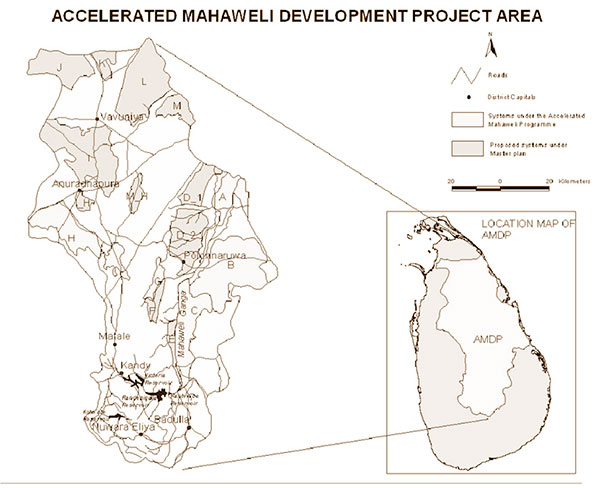
Use existing resources for agri-food sector in Mahaweli areas

November 30th, 2022

By MAHINDA PANAPITIYA Irrigation Engineer who has worked for Mahaweli Project since 80s Courtesy The Island

As originally planned, the present phase of the Mahaweli Project should be focused on social and economic development of the families settled in Mahaweli areas. It could be done by promoting food production in a sustainable way, to gain the return on investment of capital cost incurred on the infrastructure constructed for delivering water to fertile lands in the dry zone. The potential available in lands under Mahaweli Project, which cover about 1/3 of farming areas of the Dry Zone, could easily help the country to become self-sufficient in healthy foods, deviating from monotonous rice cultivation, provided it is managed with a right vision.

Concept

According to the concept explained below, there is a need to change the present management approach to a role focusing food production using limited water resources in the Dry Zone. For example, the term Block Manager” in the Mahaweli Management System was used during the construction phase in the 70s, because areas were blocked for the purpose of managing construction and settlement activities. There are five such blocks, each of about 3,000 Hectares, under Kalawewa Reservoir. Now the project is in the production phase. Therefore, the Block Managers appointed earlier should now be named as Regional Production Managers, because the very word BLOCK implies negative at the production phase.

The role of a Production Manager replacing Block Manage is a completely different discipline from what was adapted during the construction phase. In the current production phase, Irrigation projects should be perceived as a Food Producing Factory” – where water is the main raw material. A Production Manager’s focus should be to maximize food production, deviating from Rice Only Mode, to cater the market needs earning profits for farmers who are the owners of the factory”. Canal systems within the project area are just Belts” conveying raw materials (water) in a Typical Factory. Farm labor, fertilisers etc. are other inputs.

Required Management Shift

In order to implement the above management concept, there is a need for a paradigm shift at national level in managing large scale irrigation projects. In the new management paradigm, the farmers would be treated as clients, not the servants at the mercy of receiving water, according to rigid schedules decided by irrigation management staff. In this approach, the main purpose of managing irrigation systems is to deliver water to the farm gate at the right time in the right quantity.

It is also very pathetic to observe that main clients of irrigation projects (farmers) are now dying of various diseases caused by indiscriminate use of agro-chemicals. Therefore, there is a need to minimize the damages caused to the ecosystems where these food production factories are located. Therefore, the management objectives should also be focused on producing multiple types of organically grown crops, profitably without polluting the soil and groundwater aquifers.

Proposed Strategy

Existing Engineering staff should either be trained or new recruitments having Production Engineering background, should be made. Water should be perceived as the most limited input, which needs to be managed profitably with the farming community – jointly. Each Production Manager could be allocated a Fixed Volume of water annually, and their performance could be measured in terms of Rupees earned for the country per Unit Volume of water, while economically upgrading a healthy lifestyle of farmers. Staff of agencies such as Central Engineering Consultancy Burro (CECB), established in 80s at construction phase of the Mahaweli Project, can be trained to play the role of Production Engineering. CECB could be renamed as Central Food Production Burro (CFPB).

In addition to the government salary, the staff should also be compensated in the form of incentives, calculated in proportion to income generated by them from their management areas. It should be a Win-Win situation for both farmers as well as officers responsible for managing the food production factory. In other countries, the term used to measure their performance is $ earned per gallon of water to the country, without damaging the ecosystem. Another advantage of this approach is that the young generation of the farmers automatically get attracted to commercial agriculture because of high income generation.

Recent Efforts

We were able to introduce some of the concepts explained in this note during 2000 to 2004, under a program called Mahaweli Restructuring and Rehabilitation Project (MRRP) funded by the World Bank. It was done by operating the Distributary canals feeding each block as elongated Village Tanks. Recently we tried to modernize the same concept at Pilot Scale in System B, by independently arranging funds from ICTA. In that project, called Easy Water, we introduced an SMS communication system to the farmers, so that they can order water from the Maduru Oya Main Reservoir by sending a SMS, when they need rather; than depend on time tables decided by authorities as normally practiced.

Conclusion

The World Bank also recognised the above concept in 2003, as the best water management approach suitable for South Asian countries. Due to the lack of vision of existing managers in the irrigation sector focusing on food production, the above approach has not yet reaped the full benefits. What we need in Sri Lanka, is a political leadership to create challenges for irrigation officials to play a role of educated profit-oriented farmers, deviating them from Rice only mode, by promoting concepts similar to above. Also note that while I worked for a project in Azerbaijan funded by the International Fund for Agriculture Development, I was able to introduce the same concept and they are now using it successfully. I do not see any reason why we could not practice here.

SLPP dissidents ask govt. to bring back USD 35 bn ‘parked’ overseas-underscore need to amend Exchange Control Act

November 30th, 2022

By Shamindra Ferdinando Courtesy The Island

MP Gevindu Cumaratunga, who represents the SLPP dissidents, yesterday (27) alleged that the incumbent government was yet to bring enough pressure to bear on those who had parked as much as USD 36 billion overseas to bring the money back.Cumaratunga said the government’s failure to amend the Exchange Control Act No 12 of 2017 should be examined against the backdrop of President Ranil Wickremesinghe’s Budget proposal to draw more loans in 2023.

The leader of the civil society group Yuthukama, Cumaratunga, who represents the Uththara Lanka Sabhagaya, one of the breakaway factions of the ruling SLPP, said that two of his colleagues, Vasudeva Nanayakkara and Wimal Weerawansa, had, during the ongoing Budget debate, had raised the issue of forex stashed away overseas.

Cumaratunga said that he couldn’t comprehend why the government delayed making it mandatory for exporters to bring back much required foreign exchange.Responding to The Island queries, lawmaker Cumaratunga emphasised that though the vote on the Second Reading of the Budget was approved on Nov. 22, with a majority of 37 votes, it failed to address even the basic issues. Cumaratunga was among 84 MPs who voted against the Budget whereas it received the backing of 121 lawmakers.

The other Yuthukama MP in Parliament Anupa Pasqual, now a State Minister, voted for the Budget.The parliament couldn’t absolve itself of the responsibility for taking immediate measures to amend the Exchange Control Act No 12 of 2017, the MP said, pointing out in terms of Article 148 that dealt with public finance this issue should have been addressed long ago.

Cumaratunga was not an MP at the time the Yahapalana administration introduced that controversial legislation.The first-time entrant to Parliament said that the government was on its knees before the International Monetary Fund (IMF) for USD 2.9 bn spread over a period of four years, whereas exporters deliberately denied the country more than 10 times that amount in much needed forex.

Addressing the Parliament during the debate on the Budget, lawmaker Cumaratunga questioned the role played by the then Finance Minister Ravi Karunanayake in introducing the questionable piece of legislation.  Cumaratunga slammed Foreign Minister Ali Sabry, PC, who previously held the Finance portfolio for ignoring the contentious issue of massive amount of money ‘parked’ overseas by exporters.

Declaring that Sabry hadn’t been involved with the then Joint Opposition following the 2015 change of government, lawmaker Cumaratunga questioned the circumstances under which the prominent President’s Counsel entered politics. The activist asked whether it was fair to accommodate Sabry on the SLPP National List in return for his role as leading lawyer for Gotabaya Rajapaksa, and his current role.

During two speeches in Parliament, MP Cumaratunga dealt with several contentious issues, including an alleged move to deprive farmers of their land. The outspoken MP warned the government of dire consequences of a decision regarding state land that was to be taken soon, while appealing for Premier Dinesh Gunawardena’s intervention.

Referring to a steep increase in the allocation made to the President at the 2023 Budget, MP Cumaratunga said that the President received Rs 2,467 bn last year, Rs 3,044 bn this year and a staggering Rs 7,888 bn next year.

Appreciating a significant drop in the allocation made for the Premier, MP Cumaratunga said that the ministerial staff received Rs 132 bn last year, Rs 217 bn this year and Rs 263 bn next year. Such allocations should be studied taking into consideration the state of the national economy, lawmaker Cumaratunga said, alleging that the Budget didn’t reflect the actual situation.

The MP said that having received the executive presidency, through a vote in Parliament on July 20, to complete the remainder of Gotabaya Rajapaksa’s five-year term, the UNP leader was pursuing an agenda contrary to what he preached as Premier (May 12-July 13, 2022).

Referring to statements made by Wickremesinghe during that period pertaining to the then proposed 21st Amendment to the Constitution, MP Cumaratunga questioned the rationale in the President holding onto the Finance portfolio. The MP said as Premier Wickremesinghe continuously expressed the view that the President shouldn’t hold any Cabinet portfolio. The MP said that they were of the view that the President should hold the Defence portfolio. Having vowed to strengthen Parliament, President Wickremesinghe could justify his role as the Finance Minister. The President holds several other ministerial portfolios for want of an agreement with the SLPP pertaining to sharing of portfolios.

Referring to the Budget declaration that the government intended to procure Rs 1,000 bn in loans and settle loans amounting to Rs 440 bn, MP Cumaratunga said that the bottom line is the increase in debt. Aren’t we getting further embroiled in a debt trap?” he asked.

MP Cumaratunga strongly criticized the government for planning to open Mahaweli lands to outsiders. The declaration that profit-making Sri Lanka Telecom and Sri Lanka Insurance would be privatized, on the pretext of restructuring, came under fire by the MP, who also expressed serious concerns over the proposed privatization of Hilton as well as profit-making sections of SriLankan Airlines.

Sri Lanka will get finances once IMF program is in place – Dr. Indrajit Coomaraswamy (English)

November 30th, 2022

Courtesy Adaderana

‘We need to continue moving in this direction’ – CBSL Governor

November 30th, 2022

Courtesy Adaderana

The stabilisation and recovery of the country’s economy is currently the Central Bank of Sri Lanka’s (CBSL) key objective, CBSL Governor Dr. Nandalal Weerasinghe said. 

Speaking at the International Conference on the Roadmap for Economic Recovery of Sri Lanka held in Colombo today (Nov 30), he attributed the ongoing economic crisis to an imbalance in macroeconomics such as large fiscal deficits and debt standstills.

Acknowledging the hike in inflation rates, Weerasinghe stated that although they rose to 70% last month, inflation rates are currently on a downward trend, thus preventing the hyperinflation Sri Lanka was heading towards.

The Central Bank Governor explained that due to the Government’s expanding budget deficits, the need to borrow funds both internally and later externally, when Sri Lanka’s access to global financing was lost, was created, thereby acting as the root cause of the country’s economic crisis.

He, however, assured that the necessary measures are being taken to recover the economy and stabilize the country’s external fiscal reserves, allowing for the importation of at least essential goods such as fuel and gas, so that people will no longer have to remain in lengthy queues.

In the stabilization process, CBSL’s first priority is to tighten the monetary policy in terms of increasing interest rates, the central bank chief explained, adding that this is how the situation has been managed thus far; by curtailing the demand for certain commodities, thus slowing down the economy.

Moreover, Dr. Weerasinghe added that the CBSL also aims to maintain price stability and a steady inflation rate, which was maintained at single digit figures such as 5% prior to this crisis.

Speaking about the 2023 Budget which is currently being debated at the Committee Stage in Parliament, the CBSL Governor was confident that the Bill would act as a supportive fiscal policy which would help curtail the Government’s deficit to a more sustainable level.

Further, with regards to the staff-level agreement Sri Lanka has reached with the International Monetary Fund (IMF), Dr. Weerasinghe stated that the next step in this regard is to obtain financing assurances from our bilateral creditors such as China, Japan and India.

He emphasized that this is a crucial stage, as it is only after obtaining these financing assurances will the IMF approve the policy package.

The CBSL Governor assured, however, that the difficult steps have already been taken, and that they have already begun easing the crisis.

We need to continue moving in this direction”, he said, claiming that a mistake often seen in the past is that once the policy package or necessary relief is received, policy makers reverse certain policies or stray away from their decisions.

This is what led us to this situation as well”, he said in this regard.

Weerasinghe sounded hopeful, however, claiming that in the face of one of the worst economic crises Sri Lanka has ever seen, both policy makers and the people have realized the need for clearer, tighter policies.

President Ranil says outcome of COP27 summit is discouraging

November 30th, 2022

Courtesy Adaderana

President Ranil Wickremesinghe says the agreements reached at COP27 have once again failed to place the nations of the world on a complementary and progressive course of redress.

In a statement issued on Tuesday (Nov 29), the Head of State attributed the biggest obstacle to success to politicisation and stagnation. The outcome of the Summit is discouraging.”

President Wickremesinghe, who participated in the COP 27 United Nations Climate Change Conference in Sharm el-Sheikh, Egypt earlier this month, was critical of the countries that were historically accountable for the greatest damage and are capable of meaningful contributions but have stymied the furtherance of climate action.


Following is the statement issued by President Ranil Wickremesinghe.

For 27 years, world leaders have been meeting under the COP framework to confront the greatest threat to the future of humanity – climate change. Yet, we are no closer to the implementation of a universal and collaborative plan of climate action as mandated by the COP process.

Once again, the agreements reached at COP27 failed to place the nations of the world on a complementary and progressive course of redress. Regrettably, the biggest obstacle to success has been politicisation and stagnation. The outcome of the Summit is discouraging.

The absence of leadership by those countries who were historically accountable for the greatest damage and who are capable of meaningful contributions has stymied the furtherance of climate action. The nations of the global South are left to fight their corner with the Loss and Damage Fund, only a partial breakthrough, and achieved largely as a result of the unified stand and increased pressure of the G77 nations in the past years.

While the Loss and Damages Fund is a step in the right direction, there is a critical omission in the identification of the nations that will be responsible for making the requisite financial contributions. Neither does the reference to the establishment of the Fund include any provisions on liabilities nor compensations. Consequently, the G77 countries will need to continue the campaign to have these shortfalls addressed so as to ensure that the Loss and Damages Fund is operating at its full potential.

Moreover, this fund is retrospective – it will only provide compensation for damages that have occurred. It does not address the root causes of climate change. It is imperative therefore to arrest the destruction that is ongoing through a concentrated effort to achieve the goal of US 100 billion in financial aid for prospective and preventative action.

The world is progressing at a rate faster than previously predicted, and therefore, efforts to mitigate climate change cannot remain stagnant. Last year the world was unanimous in its decision that global temperatures should not experience a rise of over 1.5 degrees Celsius. A plan of action to this effect was agreed upon.

However, while its original target has been retained, the manner in which this goal is to be achieved has been compromised following the decisions at COP 27.

Furthermore, there is no firm commitment on the phasing out of fossil fuels, nor new targets on emissions.

These agreements are a simple bandage for a gunshot wound. Climate change is as much a threat to the modern world as is terrorism. If world leaders do not engage with this sincerely, they will be guilty of sitting on the side-lines sprouting rhetoric as the global climate worsens and habitations collapse.

COP28 in the UAE must not be yet another starting point, but rather a stocktake of the implementation of past decisions. It must be a seal of approval for a year of work towards strengthening the global response to climate change – beginning with a crucial emphasis on the energy sector.

For the Conference of Parties to be relevant, sustainable progress must be made at COP28. Otherwise, it is best to dismantle COP. The charade need not continue.”

District Development Committees will NOT replace Provincial Councils

November 30th, 2022

Courtesy Hiru News

Media reports claiming the President is planning to establish District Development Committees instead of Provincial Councils are false.

Recent media reports attributing a quote to the President stating that the Provincial Councils will be replaced with the District Development Committees is incorrect. President Ranil Wickremesinghe’s response in Parliament yesterday (29) has been reported by several media in such a way that the meaning is distorted.

During the ongoing Parliamentary budget debate responding to a statement by MP Maithripala Sirisena the President stated that the District Development Committees (DDCs) will be established within the Provincial Councils. The DDCs will provide a platform for coordination between the Government, the Provincial Councils and the Local Governments for all executive decisions. This will ensure the process is not duplicated and will reduce financial wastage.

Apart from that, the president has not made any statement about the dissolution of provincial councils.

Police Ordinance

November 29th, 2022

Sugath Kulatunga

There is plenty of discourse on updating and modernizing our bullock cart age systems of administration. The laws of the land are one area that has received attention recently and the previous Minister of Justice did revise a few of the antique provisions in some of the statutes. Unfortunately, the law governing the Police which had been enacted as the Police Ordinance in 1865 still stays in the days of carts and tom-toms in spite of 29 amendments as an Ordinance and 7 times as an Act. One is confused about whether it is still an Ordinance or now an Act of Parliament.  

A few archaic provisions are as follows.

In the past businesses had to pay for the services of the Police. Article 8 of the Ordinance gives examples of such large works liable to pay to include any railway, tramway, manufactory, any plumb ago mining or other commercial business or concern in which a considerable number of artisans, operatives, workmen, coolies, or persons are employed.”

 Article 31 indicates a tax for the creation of a fund for the purposes of meeting the expenses of the police payable by each town.

What is ridiculous is the minimum amount rate to be paid which is given in Article 33 as one rupee which may be reduced in certain places to fifty cents.

 There are 21 Articles related to this anachronistic tax.

 Some of the offenses under Article 63 and the fine of Rs 50 are ridiculous. If Rs 50 is not paid the offender will be given 3 months imprisonment. Some of the offenses are Slaughtering cattle on the streets and riding cattle carelessly.  

The powers of the Police are not well defined to cover current needs. The duties of community police and environmental police are not indicated. Police work on drug control and crowd control are not covered.

It is a sad state that in a service in which there are many legal experts that this important piece of legislation is not updated. It should really be revamped. Sugath Kulatunga

අධිකරණ භාෂාවෙන් නීතිය ඉගෙනීමේ අයිතිය අහිමි කරවීම සහ වෙනම රටකට දිරි දීම පාලනයට ඇති නෛතික විසඳුම

November 29th, 2022

Aruna Unawatuna

අධිකරණ භාෂාවෙන් නීතිය ඉගෙනීමේ අයිතිය අහිමි කරවීම සහ වෙනම රටකට දිරි දීම පාලනයට ඇති නෛතික විසඳුම් ආණ්ඩුක්‍රම ව්‍යවස්ථාවෙන් සහ වෙනත් නීති වලින් දැන ගනිමු… 2022 දෙසැම්බර් 15 සවස 2.30 – කොළඹ මහජන පුස්තකාල සම්මන්ත්‍රණ ශාලාවේදී… ආසන සීමිතයි. ආසනයක් කලින් වෙන්කර ගන්න.

Be Proud of Sinhala Language..සිංහල භාෂාව ගැන ආඩම්බර වෙන්න

November 29th, 2022

Copied.(උපුටා ගැනිමකි.මුල් අයිතියට ස්තුතියි)

*සිංහල භාෂාව සිංහලේ නම් රටේ, දිවයිනේ උරුමක්කාරයින් වන සිංහලුන්ගේ භාෂාවයි.
එම භාෂාව ඉතාම විචිත්‍ර වූත්, අහන්න ප්‍රියවූත් භාෂාවකි .*

*How fortunate I am to be Sinhala.??*


ලෝකේ තියෙනවා අකුරු සහිත හා රහිත කියලා භාෂාවන් 2ක්.

There are two Languages in the world…One is a Language with Letters and the
other is a Language without Letters,

ජර්මන් භාෂාවට , ප්‍රංශ භාෂාවට අකුරු නෑ.

German and FrenchLanguages-doesn’t have letters,


ඔයාලා පිලිගන්නවද ඉංග්‍රීසි භාෂාවටත් අකුරු නෑ කියලා.ඔව් ඒක තමයි ඇත්ත.

Will you believe that even English doesn’t have Letters ? Yes that’s the
TRUTH !

ඉංග්‍රීසි , ජර්මන් හා ප්‍රංශ අය භාවිතා කරන්නේ රෝමන් අකුරු.හැබැයි රෝමන්
කියලා භාෂාවක් නෑ.

English, German and French use Roman Letters. But there’s no Language
called ‘Roman’. !


සංස්කෘත කියලා භාෂාවක් තියෙනවා හැබැයි අකුරු නෑ.සංස්කෘත භාෂාව ලියන්නේ දේවනාගර
කියන අකුරු වලින්.

There’s a Language called ’Sanskrit’. But No Letters. Sanskrit
is written by using a set of letters called Devanagari.

හින්දි කියලා භාෂාවක් තියෙනවා, ගුජරාටි කියලා භාෂාවක් තියෙනවා , මරාටි කියලා
භාෂාවක් තියෙනවා හැබැයි මේ එකකටවත් අකුරු නෑ.ඒ අය ඔක්කොම ලියන්නේ දේවනාගර
අකුරු වලින්.හැබැයි දේවනාගර කියලා භාෂාවක් නෑ.

There are Languages called ‘Hindi’, ‘Marati’, Gujarati, but these Languages
too, doesn’t have Letters.
All these Languages are written by set of words
called Devanagari, strangely theres no Language called Devanagari…!

#සිංහල කියලා භාෂාවක් තියෙනවා, #සිංහල කියලා අකුරු ජාතියක් තියෙනවා ,සිංහල
කියන අකුරු ජාතියෙන් සිංහල කියන භාෂාව ලියනවා.එහෙම එකක් ලෝකේ වෙන කොහෙවත්ම
නෑ.සිංහල අකුරු බාවිතා වෙන ලොව එකම භෂාවත් සිංහල විතරමයි.


There’s a Language called Sinhala.., Theres Letters in Sinhala Language…,
Sinhala Language is written using Sinhala Letters,
This is unparalleled…, It doesn’t & has not, happened anywhere else in the
world
ONLY Language in the world using Sinhala Letters in Sinhala Language is the
Land called ’Sinhale’,


අකුරෙන් ලියන දේ කටින් කියන්නත් පුලුවන් වගේම,

‘What is written could be read, and

කටින් කියන දේ ඒ විදියටම අකුරෙන් ලියන්නත් පුලුවන්

what is read could be written’

ලෝකේ එකම එක භාෂාවයි තියෙන්නේ

there is only one Language in the world…!

ඒ තමා සිංහල භාෂාව


That is Sinhala Language,

ඒ වගේම ” ඈ ” අක්ෂරය තියෙන ලෝකෙ එකම භාෂාවත් සිංහල.


Similarly it is the only Language that has letter ” ඈ “


සරලවම #සිංහල කියන්නේ යථාවාදී තතාකාරී භාෂාවක්.


Pardon me : Unable to find English word or Phrase for
above valuable Sinhala Phrase..

I invite you to write an English Translation for this Phrase.


Copied.(උපුටා ගැනිමකි.මුල් අයිතියට ස්තුතියි)

Debt-for-Nature Swap after IMF Extended Fund Facility?

November 29th, 2022

By Asiri Fernando The Sunday Morning

Colombo, November 27 (The Sunday Morning): The Sri Lankan Government is planning to explore alternative funding means such as the announced $ 1 billion ‘Debt-for-Nature Swap’ (DNS) programme in late 2023, following the approval of the anticipated $ 2.9 billion Extended Fund Facility, The Sunday Morning learns.

It is understood that the Government is keen to pursue the DNS programme after Sri Lanka’s debt has been restructured and made sustainable following negotiations with creditors.

Presidential Advisor on Climate Change Ruwan Wijewardene confirmed to The Sunday Morning that the Government was of the belief that DNS should be explored following the IMF programme and debt restructuring.

Meanwhile, according to the Ministry of Environment, the Government is slowly progressing with drafting a framework for the DNS programme with the Treasury taking the lead, aided by stakeholder consultations.

The development of the framework for a possible DNS programme comes in the wake of Sri Lanka’s commitments to global climate change and related issues at the recent United Nations Climate Change Conference (COP27) which was held in Egypt.

Sri Lanka, which declared bankruptcy earlier this year and holds over $ 50 billion in external debt, is struggling to find funding, with many lenders not forthcoming due to the economic crisis the country is facing and the ongoing debt restructuring programme.

As such, along with an ambitious reform and restructuring agenda, the Sri Lankan Government has indicated its keenness to explore alternative forms of funding and investment to help stabilise the economy and move towards recovery.

 What is Debt-for-Nature Swap?

According to former Director of Development Economics of the World Bank (WB) and Professor of the Practice of International Development at Georgetown University, Prof. Shanta Devarajan, a Debt-for-Nature Swap (DNS) is a transaction whereby a debtor country has part of its debt burden reduced in exchange for the country investing in protecting its environment.

In the case of commercial debt, the transaction involves a third party, usually an NGO such as the Nature Conservancy, which buys the country’s bonds at a reduced price and then ensures that the country undertakes the environmental investment. In the case of official debt, the government of the creditor country typically undertakes the transaction directly. These have been used by several countries, most recently Belize,” Prof. Devarajan told The Sunday Morning.

DNS programmes began in the 1980s, with Ecuador being the first country to try out the concept. A number of countries – such as the Philippines, Bolivia, and Uganda – have also used DNS in the past to manage debt and improve their environmental protection and resilience in the process.

According to Prof. Devarajan, while there would be interest from international financial institutions and conservation groups for such a programme, he pointed out that such a programme may not be best initiated in the present economic environment that Sri Lanka finds itself in.

When asked if a DNS programme would help Sri Lanka at present, Prof. Devarajan opined that while in principle such a programme could benefit Sri Lanka, it may not be what is needed on a priority basis.

In principle, such a programme can help a country like Sri Lanka, which has a high and unsustainable debt and a lot of environmental resources that the world is interested in preserving. In practice, the programme may not be the best thing for Sri Lanka at this time. The reason is that Sri Lanka needs debt relief in order to buy imports (fuel, food, medicines) and that is what the money saved should be used for. With a DNS, Sri Lanka would have to spend the money saved on environmental conservation which, although important, is not the highest priority at the moment when people are starving, and the economy is declining,” Prof. Devarajan explained.

Government’s thinking

Sri Lanka as a debtor, its creditors, and the globe can benefit from a well-planned DNS programme, Ministry of Environment Secretary Dr. Anil Jasinghe told The Sunday Morning.

According to him, both the lender and debtor have to agree to take part in a DNS programme.

There has to be a willingness from the lender to reduce some debt in exchange for some of the debt in place of some conservation work. That could be conservation of a forest, a reef, or a renewable energy programme,” Dr Jasinghe said, adding that a DNS programme could also include carbon credits in the future.

According to Dr. Jasinghe, the framework for the DNS is now being drafted by the Treasury, with the Environment Ministry’s assistance. As the framework is drafted, the Government will have to conduct nature capital assessments of Sri Lanka’s land and marine eco-space.

This will take some time; the Government’s focus at present is on getting the IMF programme approved. Whatever we do about the DNS, we will do it with the concurrence of the IMF, ” Dr. Jasinghe said.

Responding to a question, he said that innovative financial tools such as ‘green bonds’ and ‘blue bonds’ could only come after a framework was put in place and national debt was made sustainable. It is hard to imagine a bankrupt nation being able to issue bonds,” he said.

According to Dr. Jasinghe, the $ 1 billion amount reported in relation to the proposed DNS programme is what is envisaged for the framework that is being drafted.

President’s Advisor on Climate Change Ruwan Wijewardene told The Sunday Morning that although the Government would work in parallel with the IMF programme to develop a framework for DNS, it would only be implemented after Sri Lanka’s debt had been restructured and the four year-long EFF agreements had commenced.

We will look into all the renewable energy projects that can be taken up with a DNS framework once the debt restructuring is done. After that, we can explore other alternatives like blue bonds and green bonds, which was a topic that was discussed extensively at COP27. Many agencies have spoken to us about the DNS,” Wijewardene said.

According to him, the Government plans to analyse possible projects to be included in the DNS framework next year, including those in food security, agriculture, forestry, conservation, and renewable energy. 

We can start listing the projects. I think by the end of next year our debt will be restructured, and hopefully sustainable. The IMF also suggested that we wait till the assistance programme goes through for us to begin the DNS. Even the United Nations has discussed DNS with us and there are other parties who are also interested, including international banks,” Wijewardene explained.

When is the right time?

When asked if Sri Lanka could pursue alternative funding measures such as DNS before an IMF agreement was reached and debt restructured, Prof. Deverajan said Sri Lanka should not pursue such alternative financing before the IMF agreement because the IMF agreement would permit Sri Lanka to spend both the IMF’s loan and the money saved from debt reduction on essential imports to revive the economy and get essential imports to the people.

There is an additional risk in that Sri Lanka is currently in discussions with both official and commercial creditors about debt restructuring. If Sri Lanka discusses a DNS with the same creditors, that may disrupt the current negotiations and delay the reaching of an agreement,” he added.

Belize DNS

According to the IMF, the Government of Belize signed a debt-for-nature swap with The Nature Conservancy (TNC), an environmental organisation, which reduced the country’s external debt by a striking 10% of GDP.

Under the agreement, a TNC subsidiary lent funds to Belize to buy back a $ 553 million ‘superbond’ – the Government’s entire stock of external commercial debt, equivalent to 30% of GDP – at a discounted price of 55 cents per dollar. It financed this by issuing $ 364 million in ‘blue bonds’ in a sale arranged and underwritten by Credit Suisse, a bank. The US Government’s development bank, the International Development Finance Corporation (IDFC), provided insurance. This allowed the loan to have a low-interest rate, a 10-year grace period during which no principal is paid, and a long maturity of 19 years. In return, Belize agreed to spend about $ 4 million a year on marine conservation until 2041. It will double its marine-protection parks – spanning coral reefs, mangroves, and the seagrasses where fish spawn – from 15.9% of its oceans to 30% by 2026. An endowment fund of $ 23.5 million will finance conservation after 2040,” the IMF Country Focus of May 2022 said.

How the economic crisis has hurt the Hill Tamils

November 29th, 2022

The Hindu 

Meera Srinivasan in Sri Lanka and Kanishkaa Balachandran in Bengaluru have put together a video report for The Hindu on the plight of the Malayaha Tamils or Hill Country Tamils who work on the tea plantations of Central Sri Lanka.

As the poorest community in Sri Lanka, these workers of Indian origin have had to put up with harsh deprivations during the COVID-19 pandemic and the economic crisis that followed.

Bright prospects for Nepal-Sri Lanka tourism

November 29th, 2022

Courtesy NewsIn.Asia

Kathmandu, November 28 (The Rising Nepal): As the economic situation of Sri Lanka is gradually coming back to normal, Nepal may receive more travelers from that country in the days ahead.

It has become easier for these two South Asian nations to promote bilateral tourism and trade thanks to the operation of direct scheduled flights between Colombo and Kathmandu by Sri Lankan Airlines.

Currently, the national carrier of Sri Lanka is operating five flights a week to Kathmandu. The airline is planning to start daily flights soon with demand growing steadily. It takes 3 hours and 20 minutes for a flight to arrive in Kathmandu from Colombo.

Since the seat occupancy is quite encouraging, we are in the process of increasing flight frequencies,” said Deepak Mainali, Sales Manager of Zenith Travels (P) Limited that is the general sales agent (GSA) of Sri Lankan Airlines for Nepal.

Nepalis traveling to and from long-haul destinations like Australia, Japan, South Korea, and the Maldives are using this airline. A lot of Nepali travelers are interested in experiencing Sri Lanka. With a variety of tourism products ranging from wildlife, sea beaches, and historical places to cultural heritage sites, Sri Lanka is an affordable destination for Nepali visitors,” said Mainali.

He further said that many Sri Lankans have been keen to visit Nepal to explore the exotic mountains, green valleys and other attractions. Lumbini and other Buddhist pilgrimage sites in Nepal are what attract them more. In 2018, Nepal welcomed a total of 69,640 Sri Lankan tourists.

In the absence of direct air connectivity between Nepal and Sri Lanka, Sri Lankans in the past used to visit Lumbini via India. But with the availability of direct flights, they now come to Kathmandu. He said that Nepal is also a reasonable destination for potential Sri Lankan tourists. 

Branded as ‘The Pearl of the Orient’, Sri Lanka hosts a large number of international tourists each year. In 2018, the island nation received some 2.52 million foreign travelers.  The country is now moving forward with its economy recovering gradually.

As travel advisories have been lifted, Sri Lanka’s tourism is now on a revival path. Many tourists have started coming back to experience the wonders the nation has to offer,” he said. In September this year, Sri Lanka lured a total of 29,802 international tourists while the number increased to 42,026 in October.

Meanwhile, as its effort to help revive Sri Lanka’s tourism industry, Sri Lankan Airlines organized ‘Pearl of the Orient’ event in Sigiriya, a popular tourist destination, from November 16-21 this year. According to the airline, as many as 177 participants from its 68 stations from across the world attended that global sales conference.

The event was fruitful as the participants had an opportunity to take stock of the situation of Sri Lanka by visiting different tourist destinations there. We found everything normal there,” he said.    

The participants also had interactions with the airline’s management and their counterparts from global network.

ඊළඟ බිල්ල රනිල් ද?

November 29th, 2022

උපුටා ගැන්ම  අරුණ පුවත්

පොතේ හැටියට ජනපතිවරයා පාර්ලිමේන්තුවට පැමිණිය යුත්තේ සය මසකට වරකි. එනමුත් ජනපති රනිල් වික්‍රමසිංහ ගිය සතියේ දින තුනක් පාර්ලිමේන්තුවට ආවේය. මේ දිනවල පැවැත්වෙන අයවැය විවාදයට ඉතා සක්‍රියව එක්ව සිටින ජනපති රනිල් වික්‍රමසිංහ රටේ ආන්දෝලනයට ලක්වන කතා කිහිපයක් කළේය. පළමු දිනයේ ජනාධිපතිවරයා පාර්ලිමේන්තුවට පැමිණෙන විට අදහස් දක්වමින් සිටියේ ජාතික ජන බලවේගයේ පාර්ලිමේන්තු මන්ත්‍රි අනුර දිසානායකය. ඔහු ජනාධිපතිවරයා විවේචනය කරමින් සිටි අයුරු රූපවාහිනියෙන් දුටු ජනාධිපතිවරයා සභා ගැබට පැමිණියේය. මන්ත්‍රිවරයා කතාව ඉවර කළේ බුදු දහමේ සමානාත්මතාව ගැන කියමිනි. එම ප්‍රශ්නවලට ජනාධිපතිවරයාද පිළිතුරු දුන්නේ බුදු දහමෙනි. බුද්ධ දර්ශනයේ මූලික හරය චතුරාර්ය සත්‍ය බව ඔහු කී‍වේය.

ජනපති බණ කියයි

සිය කතාව නිම කර පිටතට පැමිණි ජනාධිපතිවරයාගෙන් මන්ත්‍රිවරු චතුරාර්ය සත්‍ය ගැන විමසූහ. සමානාත්මතාවය ගැන බුදු දහමේ කියවෙන්නේ සතර සංග්‍රහ වස්තූන්වලදීය. හැබැයි දුක, දුකට ​හේතුව, දුක නැති කර ගැනීමේ මාර්ග ගැන ජනාධිපතිවරයා දේශනා කළේය.

පොහොට්ටුවෙන් විසිල්

ජනාධිපතිවරයා දෙවන දින පාර්ලිමේන්තුවට පැමිණියේ ජනාධිපති කාර්යාල වැය ශීර්ෂය ගැන කතා කරන්නටය. අරගලය ගැනත්, ප්‍රචණ්ඩත්වය ගැනත් කතා කළ ජනාධිපතිවරයා රටේ ඒකාධිපති පාලනයක් ක්‍රියාත්මක නොවන බවද කීවේය. ඒ වියට්නාමයේ ඩීන් ඩියෑම් ගැනද සිහිපත් කරමිනි. එදින පාර්ලිමේන්තුවේ ජනාධිපතිවරයා කළ කතාව ගැන ශ්‍රී ලංකා පොදුජන පෙරමුණේ මන්ත්‍රිවරු ප්‍රසාදය පළ කළ ද විපක්ෂය විවේචනය කළහ. ජනාධිපති නිල කාමරයේ ජනාධිපතිවරයා රැඳී සිටින විට මන්ත්‍රිවරු විමසා සිටියේ ඩීන් ඩියෑම් ගැනය. ඔහු පිළිබඳ තොරතුරු මන්ත්‍රිවරු නොදන්නා බව ජනාධිපතිවරයාට පැහැදිලි වූයේය. ‘‘දකුණු වියට්නාමයේ එදා හිටපු රජතුමා අයින් කරලා බලය ගන්න ඇමරිකා ප්‍රංශ හමුදාවල සහායත් අරගෙන බලයට ආපු කෙනෙක් තමයි ඩීන් ඩියෑම් කියන්නේ. 1950 තමයි එයා බලයට ආවේ. හැබැයි එයා හිටපු කාදිනල් කෙනෙක් එක්ක එකතු වෙලා බෞද්​ධයෝ විශාල සංඛ්‍යාවක් ඝාතනය කළා’‘ ජනාධිපතිවරයා සඳහන් කළේය.

කෙසේ වෙතත් ජනාධිපතිවරයා තුන්වන දිනයේද මාධ්‍ය නාළිකාවක් පවා විවේචනයට ලක් කරමින් අදහස් දැක්වූයේය. ඊට හේතුව වන්නේ ජනාධිපතිවරයාට විරුද්ධව විපක්ෂයේ දේශපාලන පක්ෂ ගෙනවිත් අදහස් පළ කිරීමේ වැඩසටහනක් පළ කිරීමය. තවද ආණ්ඩුවේ ඉදිරිය සම්බන්ධයෙන්ද ආරක්ෂක අංශ වාර්තාවක් ජනාධිපතිවරයාට ලැබීමට මෙලෙස වේගවත් කතා දෙකක් පැවැත්වීමට හේතු වූ බව මන්ත්‍රිවරු පාර්ලිමේන්තුවේදී කතා බහ කළහ.

ගෝඨයි – මෛත්‍රියි එක බෝට්ටුවේ

කෙසේ වෙතත් හිටපු ජනාධිපති ගෝඨාභය රාජපක්ෂට වුණු දෙය මටත් වූ බව හිටපු ජනාධිපති මෛත්‍රිපාල සිරිසේන පාර්ලිමේන්තුවේදී කීවේය. ‘‘එතුමාටත් නිවැරදි තොරතුරු දුන්නේ නැහැ. මටත් පාස්කු ප්‍රහාරය පිළිබඳ තොරතුරු නිවැරදිව දුන්නේ නැහැ‘’ හිටපු ජනාධිපතිවරයා කීවේය. ඒ දෙය ජනාධිපති රනිල් වික්‍රමසිංහට වීමට ඉඩ නොදීමට හිටපු ජනාධිපති ගෝඨාභය රාජපක්ෂ තීන්දු කළේය. ඒ අනුව හිටපු ජනාධිපතිවරයා ජනාධිපති රනිල් වික්‍රමසිංහට දුරකථන ඇමතුමක් ලබා දෙමින් මේ ගැන කතා කළේය.

ගෝඨාගෙන් ජනපතිට ඇමතුමක්

‘‘මට වෙච්ච දේ ඔයා කර ගන්න එපා. මම විශ්වාස කරපු නිලධාරීන් දෙදෙනෙක් තමයි ආරක්ෂක ලේකම් හා යුද හමුදාපති තනතුරුවලට පත් කළේ. අරගලයේදී වගේම ඊට පෙරත් මම ප්‍රජාතන්ත්‍රවාදීව කටයුතු කළා. නමුත් මේ සිද්ධි දාමය තුළදී බුද්ධි අංශ තොරතුරු හරියට ලැබුණේ නැහැ. ‘‘මිරිහානේ ගෙදරට ගහනකොට කීවේ එකසිය පනහක් විතර එයි කියලයි. ජනාධිපති මන්දිරය වට කරපු දවසේ විසිපන්දහසක් එන්නේ නැහැ කියලා කීවා. නමුත් මන්දිරයට එන කොටම මම ඉවත් වුණා. මම අත්දැකීමෙන් කියන්නෙ. වර්තමානයේ හමුදාව රට බේරා ගන්න ඉදිරිපත් නොවන තත්ත්වයක් නිර්මාණය වෙලා. අරගලයක් ආ​වොත් අමාරු වෙයි.‘’ හිටපු ජනාධිපතිවරයා තමන් ලැබූ අත්දැකීම්ද පාදක කර ගනිමින් පැවසුවේය.

‘‘භීෂණ කාලයේ උතුරේ රාජකාරි කළ සෙබළුන් දකුණට ගෙනත් දාලා තිබුණ. ජනතා විමුක්ති පෙරමුණ ළඟ ගිනි අවි තිබුණා. නමුත් ජානක පෙරේරා ඩෙන්සිල් කොබ්බෑකඩුව, විජය විමලරත්න වගේ හමුදා නායකයන් කඳවුරෙන් කඳවුරට ගොස් ප්‍රජාතන්ත්‍රවාදීව රාජ්‍ය බේරා ගන්නා හැටි දැනුවත් කළා. මම හිටියේ මාතලේ කඳවු​රේ. ඒ වගේ කැම්පේන් දැන් නැහැ. දැන් එවැනි ධෛර්යයක් දෙන්න කවුරුත් නැහැ. සැලකිලිමත් වෙන්න. ඊළඟ බිල්ල ඔයා වෙන්න පුළුවන්’’ හිටපු ජනාධිපතිවරයා වැඩිදුරටත් පැවසුවේ පවතින අවදානම ගැන කතා කරමිනි.

රනිල්ගෙන් කිරි

ඒ ගැනද අවධානය යොමු කරමින් ජනාධිපතිවරයා පාර්ලිමේන්තුවේදී කතා බහ කළා විය හැකිය. තමන් හිට්ලර් වන බව කියූ ජනාධිපතිවරයා පාර්ලිමේන්තුව නැරඹීමට පැමිණෙන පාසල් සිසුන්ට කිරි වීදුරුවක් දීමට තීරණය කර ඇත. ඒ සඳහා අවශ්‍ය ප්‍රතිපාදන සකසා ගැනීම ගැටලුවක් බව පාර්ලිමේන්තු නිලධාරීහු ජනාධිපතිවරයාට දැනුම් දුන්හ. ‘‘ජනාධිපතිපති අරමුදලෙන් ගන්න පුළුවන්ද බලන්න’’ ජනාධිපතිවරයා ලේකම් සමන් ඒකනායකට කීවේය.

චමින්ද – ලන්සා වලිය

සමගි ජන බලවේගයේ චමින්ද විජේසිරි මන්ත්‍රිවරයා හා නිමල් ලන්සා මන්ත්‍රිවරයා අතර ඇති වූ ගැටලුවෙන්ද පාර්ලිමේන්තුව උණුසුම් විය. පළාත් පාලන මැතිවරණය සම්බන්ධයෙන් නිමල් ලන්සා මන්ත්‍රිවරයා කතා කරමින් සිටියදී චමින්ද විජේසිරි මන්ත්‍රිවරයා දැඩි ආවේගයෙන් යුතුව පිළිතුරු දී ඉදිරියට පැමිණියේ නිමල් ලන්සා මන්ත්‍රිවරයාට පහර දීමටය. තම අසුනේ අසුන් ගන්නා ලෙස කථානායකවරයා කිහිප වරක්ම චමින්ද විජේසිරි මන්ත්‍රිවරයාට පැවසුවද ඔහු එයට අවනත නොවී තව තවත් ඉදිරියට ආවේය. ‘‘මට ඕන තැනක ඉඳගෙන මම කතා කරනවා’’ චමින්ද විජේසිරි මන්ත්‍රිවරයා කීවේය. මන්ත්‍රිවරයාගේ ආවේගශීලී හැසිරීම නිසා ඔහු සභාවෙන් පිට කිරීමට කථානායකවරයා පියවර ගත්තේය.

මේ අතරවාරයේදී ඇමැති ප්‍රසන්න රණතුංගද නැගිට විපක්ෂයේ දොරටුව දෙසට ගියත් ඇමැතිවරයාගේ ගමන මන්ත්‍රිවරු නතර කළහ. ‘‘මට චමින්ද මන්ත්‍රිතුමා හම්බවෙන්න යන්න දෙන්න.

ඇමැතිවරයා ඉල්ලා සිටියත් ඔහුගේ ගමනට බාධා එල්ල විය. අයවැයෙන් ජනපතිවරයා යෝජනා කළ රාජ්‍ය ආයනත ප්‍රතිව්‍යුහගත කිරීම පිළිබඳ සමගිජන බලවේගය එල්ල ක​ළේ විරෝධයකි. ඒ පිළිබඳ ජනපතිවරයා රණසිංහ ප්‍රේමදාස විකුණා දැමූ ලාබ ලබන රාජ්‍ය ආයතන ගණනාවක ලැයිස්තුවක්ද පාර්ලිමේන්තුවේදී සභාගත කළේය. ඒ පිළිබඳව ඇමැති සුසිල් ප්‍රේමජයන්ත ජනාධිපතිවරයාට කියා සිටියේ ‘‘එදා ප්‍රේමදාස ජනාධිපතිතුමාව බේරා ගත්තද මෙදා අතහැරියා නේද ’’යනුවෙනි. ‘‘මම හැමදාම පෙනී සිටියේ සත්‍ය වෙනුවෙන්’’ ජනාධිපතිවරයා කීවේය.

සජිත් නිදොස්

සංස්කෘතික අරමුදල සම්බන්ධවද අභූත චෝදනා එල්ල කරමින් විපක්ෂ නායකවරයාට චෝදනා එල්ල කිරීම පිළිබඳව සමගි ජන බලවේගයේ අවධානය යොමු වී තිබිණි. විශේෂයෙන් පාර්ලිමේන්තු වරප්‍රසාදවලට මුවාවෙමින් ඇතැම් මන්ත්‍රිවරු විසින් කරන ප්‍රකාශ පිළිබඳව විසඳා ගැනීමට විපක්ෂ නායකරවයා සිතුවේය. ඒ කෝප් කමිටුව හමුවේය. කෝප් කමිටුවේදී අනාවරණය වූයේ සජිත් ප්‍රේමදාස සංස්කෘතික කටයුතු ඇමැතිවරයා ලෙස දූෂණ හෝ මූල්‍ය අවභාවිතයක් නොකර ඇති බවයි. කෝප් කමිටුවේදී ආණ්ඩුවේ මන්ත්‍රිවරු මෙතන වරදක් සිදු වෙලා තියෙන බව ඔප්පුකරන්න හැදුවා. නමුත් බොරුවට ඉඩ ලැබුණේ නැහැ. විපක්ෂ නායකවරයා කියා සිටියේය.

ජාත්‍යන්තර මූල්‍ය අරමුදලෙන් සහනයක් ලැබෙනු ඇතැයි ජනතාව අපේක්ෂාවෙන් සිටින්නේ පවතින ආර්ථික පීඩනය නිසාය. එම අරමුදලේ ණය ප්‍රතිව්‍යුහගත කිරීමට ජනාධිපතිවරයා උත්සාහ කළත් එය මේ වන තුරු පවතින්නේද සාකච්ඡා මට්ටමේය. චීනය ණය ප්‍රතිව්‍යුහගත කිරීම සඳහා කැමැත්ත ගැනීමට ජනාධිපතිවරයා මේ වනවිට වැඩි අවධානය යොමු කර ඇත.

ඒ සඳහා රාජපක්ෂවරුන්ගේ සහායද ගැනීමට ජනාධිපතිවරයා උත්සාහ කළේය. හිටපු ජනාධිපති ගෝඨාභය රාජපක්ෂ සමග ජනාධිපතිවරයා සාකච්ඡා කළේ සිය උත්සාහය ජය ගැනීම සඳහාය. ‘‘චීන ජනපතිතුමාට කතා කරලා කැමැත්ත ගමුද’’ ජනාධිපතිවරයා යෝජනා කළේය. ‘‘මම ඉන්න කාලෙත් උත්සාහ කළා. නමුත් හරි ගියේ නැහැ.’’ හිටපු ජනාධිපතිවරයා අතීත සිදුවීමක්ද මතක් කරමින් කීවේය.

ගෝඨා රහසක් හෙළි කරයි

‘‘මම ජනාධිපති කාලේ එක දවසක් චීන තානාපතිවරයා මම හම්බවෙන්න එනවා කීවා. මම හිතුවේ ණය ගෙවන්න සල්ලි දෙන්න කියල. ඇවිල්ල ඇහුවෙ ඉන්දියාවට දීලා තියෙන්නෙ මොනවද කියලා. දෙන්න යන්නෙ මොනවද කියලා. මම ඇහුවා ඇයි එහෙම අහන්නෙ කියලා. තානාපතිතුමා කීවා මට දැන්ගන්න ඕන ඒක විතරයි කියලා. චීනය අපෙත් එක්ක හොඳින් නෙවෙයි ඉන්නෙ. ඒක නිසා ඉන්දියාව දෙස බලන්න’’ හිටපු ජනාධිපතිවරයා යෝජනා කළේය. එහෙත් ජනාධිපතිවරයාගේ අවධානය යොමු වී ඇත්තේ ණය ප්‍රතිව්‍යූහගත කිරීමට චීනයේ කැමැත්ත ලබාගත යුතු බවයි.

පාර්ලිමේන්තුවට ඉදිරිපත් කර ඇති අයවැය පිළිබඳ විවාදයේදී මන්ත්‍රි භෝජනාගාරයේදීද ඉතා රසවත් සිදුවීම් වන්නේය. පාර්ලිමේන්තු මන්ත්‍රි දිලිප් වෙදආරච්චි ධීවරයන්ට තිබෙන ගැටලු ගැන කතා කර සභා ගැබේ උපවාසයක්ද ආරම්භ කළේය. සභා ගැබේ බිම වාඩි වී සිටි මන්ත්‍රිවරයා ආසනය වෙත රැගෙන ගියේද සහෝදර මන්ත්‍රිවරු විසිනි. ‘‘මට මේක කවුරුත් කරන්න කීවේ නැහැ. මම හිතලා කළේ විරෝධය දක්වන්න කළු ඇඳුමක්ද ඇඳගෙන ආවේ. මන්ත්‍රිවරයා භෝජනාගාරයේදී මන්ත්‍රිවරුන්ට කීය. එම ස්ථානයේ සිටි නාමල් රාජපක්ෂ මන්ත්‍රිවරයා පැවසුවේ ‘‘ගෝඨාභය ජනාධිපතිතුමාගේ කාලයේ තමයි ධීවරයන්ට හොඳම කාලය උදා වුණේ’’ යනුවෙනි. ඒ සිය පියාද ධීවර ඇමතිවරයා ලෙස කටයුතු කළ කාලය අමතක කරමින් ඔහු මේ බව පැවසුවේය. ‘‘මම ඒක පිළිගන්නවා’’ දිලිප් වෙදආරච්චි මන්ත්‍රිවරයා කී‍වේය. එහෙත් සැමන්, මාළු වර්ග පිටරටින් ගෙන එන එක නතර කළ යුතු බව මන්ත්‍රිවරයා යෝජනා කළේය.

චණ්ඩිගෙනුත් චණ්ඩියා

එහෙම කියන්න එපා. ඔයත් ගෙනාවානේ’’ නාමල් රාජපක්ෂ මන්ත්‍රිවරයා ප්‍රකාශ කළේය. මෙලෙස මන්ත්‍රිවරුන් දෙදෙනා තර්ක කළත් ඔවුන් දෙදෙනාම ඥාතීහු වෙති. මෙම ස්ථානයට හිටපු ජනාධිපති මහින්ද රාජපක්ෂද පැමිණියේය. ‘‘අපේ පැත්තේ ඉන්න චණ්ඩියා සනත් නිශාන්ත. විපක්ෂයේ චණ්ඩියා දිලිප්’‘ සාගර කාරියවසම් මන්ත්‍රිවරයා විහිළුවට මෙන් කීවේය. ‘‘අනේ එයාගේ චණ්ඩිකම්’‘ හිටපු ජනාධිපතිවරයා කීවේ තමන් හම්බන්තොට කළ චණ්ඩිකම්ද සිහිපත් කරමිනි.

ජනාධිපති රනිල් වික්‍රමසිංහ මෙම සතිය ආරම්භයේ සිටියේ උතුරු පළාතේ සංචාරයකය. පළමුවෙන් වවුනියාවට පැමිණි ජනාධිපතිවරයා දිස්ත්‍රික් ලේකම් කාර්යාලයේදී ජනතා ප්‍රශ්න පිළිබඳ සාකච්ඡාවක් පැවත්වීය. ‘‘ඉඩම් වගා කරන්න දෙනවා කීවත් වන සංරක්ෂණ නිලධාරීන් ඒවා දෙන්නේ නැහැ. ගැසට් එකේ තියෙන විදිහට වැඩ කරන්න යනවා’’ ඇමැති ඩග්ලස් දේවානන්දා, රිෂාඩ් බදියුර්දීන් හා චාල්ස් නිමලනාදන් යන මන්ත්‍රිවරු චෝදනා කළහ. ජනාධිපතිවරයා ඇසුවේ 2011 නිකුත් කළ ගැසට් එකටද කටයුතු කරන්නේ යනුවෙනි. ‘‘ඔව්’‘ වන නිලධාරීන්ගේ පිළිතුර වූහ. ‘‘එහෙම බැහැ. 1983 යුද්ධයේ ආරම්භයේදී නිකුත් කළ ගැසට් එකත් ඇති. ඒක ගන්න.’’ ජනාධිපතිවරයා කීවේය.

උතුරේද පවතින පක්ෂ දේශපාලන ගැටුම් පසෙකලා වවුනියාවේ ස්ථාපිත කළ ජනාධිපති උප කාර්යාලය විවෘත කිරීමේ අවස්ථාවටදෙමළ ජාතික සන්ධානයේ මන්ත්‍රිවරුන් වන එම්. සුමන්තිරන් හා සෙල්වන් අඩෙක්කලනාදන් ද පැමිණ සිටියේය. උත්සවයේ කතා වෙන් වී තිබුණේ ජනාධිපතිවරයාට පමණි. එහෙත් නිවේදකයාව තමන් ළඟට කැඳවූ ජනාධිපතිවරයා ‘‘සුමන්තිරන් මන්ත්‍රිතුමාටයි, සෙල්වන් මන්ත්‍රිතුමාටයි කතා දෙන්න’‘ යැයි පැවසුවේය. ඒ අනුව ඔවුන් දෙදෙනාද ජනාධිපතිවරයාගේ වැඩපිළිවෙළ අගය කරමින් කතා කළහ.

වවුනියාවේදී තවත් රැස්වීමක් පැවැත්වූයේ වැලිඔය ඉඩම් ගැටලු නිරාකරණය කිරීමටය. වැලිඔය ප්‍රාදේශීය සභාවේ මන්ත්‍රිවරු ඉඩම් මහවැලියට ඕන විදිහට බෙදනවා’‘ යනුවෙන් මෙහිදී චෝදනා කළේය. ‘‘මහවැලියට ඕන විදිහට ඉඩම් බෙදන්න බැහැ. මමයි රවි ජයවර්ධනයි තමයි 1985 වසරේදී වැලිඔයට ආවේ. වැලිඔය ගැන මට කියලා දෙන්න එපා. සිංහල මිනිස්සුන්ට අසාධාරණයක් වෙනවා නම් ඒ ගැන සොයා බලන්නම්’’ ජනාධිපතිවරයා පොරොන්දු විය.

ශ්‍රීලනිප ජ්‍යෙෂ්ඨයෝ දොට්ට

ශ්‍රී ලංකා නිදහස් පක්ෂයේ මධ්‍යම කාරක සභාව පක්ෂ සභාපති මෛත්‍රිපාල සිරිසේන මන්ත්‍රිවරයාගේ ප්‍රධානත්වයෙන් පක්ෂ මූලස්ථානයේදී පැවැත්විණි. පක්ෂයේ ජාතික සංවිධායක දුමින්ද දිසානායක මන්ත්‍රිවරයාද ඊට එක්ව සිටියේය. නිමල් සිරිපාලද සිල්වා හා මහින්ද අමරවීර පක්ෂයේ ජ්‍යෙෂ්ඨ උප සභාපති ධුරවලින් ඉවත් කිරීමෙන් පුරප්පාඩු තනතුරුවලට ශාන් විජේලාල්ද සිල්වා, ෆයිසර් මුස්තාපා හා අංගජන් රාමනාදන් පත් කිරීමටද යෝජනා විය. පක්ෂයේ උප සභාපතිවරුන් ලෙස තිස්ස කරල්ලියද්ද සහ සරත් ඒකනායක පත් වූහ. භාණ්ඩාගාරික ධුරයට දුෂ්මන්ත මිත්‍රපාල මන්ත්‍රිවරයා පත්විය. මන්ත්‍රිවරයා අසල සිටි තවත් මධ්‍යම කාරක සභිකයන් කියා සිටියේ ‘‘පක්ෂය වෙනුවෙන් ක්‍රෙඩිට් කාඩ් එකක් තියෙනවා. ඒක ඉල්ල ගන්න’’ යනුවෙනි.

රැස්වීම පවත්වාගෙන යන විට හිටපු ජනාධිපති මෛත්‍රිපාල සිරිසේන යොජනා දෙකක් ඉදිරිපත් කළේය. එක්සත් ජනතා නිදහස් සන්ධානයේ මහ ලේකම් ලෙස තිලංග සුමතිපාල​ත් පොදුජන එක්සත් පෙරමුණේ මහලේකම් ලෙස ශාන් විජයලාල්ද සිල්වා මන්ත්‍රිවරයාත් පත් කරන බව හිටපු ජනාධිපතිවරයා කීවේය. ඒ ඉදිරි මැතිවරණවලදී සන්ධානගත වීමට අව ශ්‍ය වටපිටාව සැකසීම සඳහා බව ඔහු පෙන්වා දුන්නේය.

පක්ෂයේ අනුශාසක හිටපු ජනාධිපති චන්ද්‍රිකා බණ්ඩාරනායක ඇතුළු ආණ්ඩුවේ ඇමැති ධුර ගත් මන්ත්‍රිවරු නව දෙනාගේ පක්ෂ සාමාජිකත්වය තහනම් කිරීමටද මෙහිදී යෝජනා විය. ඊට දුමින්ද දිසානායක මන්ත්‍රිවරයා විරුද්ධ වුවත් බහුතර කැමැත්ත මත එම තීන්දුව ගත්තේය. අයවැයේදී පක්ෂය කළ යුත්තේ කුමක්ද යන්න පිළිබඳව කතා කරන විට දුමින්ද දිසානායක මන්ත්‍රිවරයා රැස්වීමෙන් පිටව ගියේය. එහෙත් ඔහු අයවැයට පක්ෂව ඡන්දය දුන්නේය.

සිරිකොතේ කාමර ප්‍රශ්නයක්

එක්සත් ජාතික පක්ෂ මූලස්ථානය වන සිරිකොතෙහි කාමර ප්‍රශ්නයක්ද මෙම සතියේ ඇති විය. මෙහි එක් කාමරයක් පක්ෂයේ තරුණ සංවිධානයේ කටයුතු සඳහා වෙන් කර තිබිණි. එම කාමරය තමන්ට අවශ්‍ය බව ප්‍රකාශ කරමින් ජනාධිපතිවරයාගේ කාර්ය මණ්ඩලයේ සිටින අධ්‍යක්ෂ ජනරාල්වරයකු ගෝරනාඩු කළේය. මෙම කාමර ප්‍රශ්නය ගැටුමක් බවට පත්ව නොදී බේරා ගැනීමට සිරිකොත කාර්ය මණ්ඩලය කටයුතු කළේය. එලෙස කාමර අවශ්‍ය නම් ජාතික සේවක සංගම් මූලස්ථානයේ කාමර ගන්නා ලෙසද පක්ෂ මූලස්ථානයෙන් දැනුම් දී තිබේ.

උදයජීව

මහ බැංකු ලොක්කන් අර්බුදය උත්සන්න කළ හැටි

November 29th, 2022

වෛද්‍ය වසන්ත බණ්ඩාර Lanka Lead News

මහ බැංකුවේ හිටපු සහ නව ප‍්‍රධානීන් මෙන්ම ඔවුන්ට එරෙහිව නඩු පවරන විශ්වවිද්‍යාල ආචාර්යවරුන් ද එකම කරුණක් පිළිබදව විවිධ පරස්පර මත පලකරති. ඔවුන්ගේ ප‍්‍රකාශවල සම්ප‍්‍රයුක්තය වන්නේ නව මහ බැංකු අධිපතිවරයාට පෙර ධුරය දැරූ අධිපතිවරයා විසින් රුපියල අවප‍්‍රමාණය වීමට ඉඩ නොදී පවත්වා ගැනීම නිසා සහ ඒ සඳහා ඩොලර් සංචිත වෙළෙදපොළට නිකුත් කිරීම නිසා ඩොලර් සංචිත සිඳී ගිය බවය. එසේනම් එහි ප‍්‍රතිවිරුද්ධ මතය වන්නේ එසේ නොකළා නම් විදේශ විනිමය අර්බුදයක් ඇති වන්නේ නැත. වෙනත් වචනවලින් කියන්නේ නම් රුපියල් පා කිරීමේ තීන්දුව ගනු ලැබූ මාර්තු 7 වැනිදාට මාස තුනකට පෙර එසේ කළා නම් අර්බුදයක් ඇති නොවන බවය.

එම මූලධර්මය මත පිහිටා අදාල තීන්දුවට එරෙහි වූ බවට මූල්‍ය මණ්ඩලයේ පත්කළ සාමාජිකයන් දෙදෙනකු චෝදනාවෙන් නිදහස් කර එක් අයෙකු පමණක්ව ගඋත්තරකරු කරමින් ඉහත සඳහන් කළ ආකාරයට නඩු පැවරීමක් සිදු විය. නමුත් අධිකරණය විසින් ඔවුන් දෙදෙනා ද වගඋත්තරකරුවන් කළ යුතු බවට නියෝග කරනු ලැබීය.

ඊට අමතරව එසේ නඩු පැවරූ පුද්ගලයින් අධිකරණයද නොමඟ යැවීමට උත්සාහ කරන බවක් ද දැක ගත හැක. රුපියල් අවප‍්‍රමාණය කිරීමට ඉඩ නොදීම නිසා අර්බුදය ඇති වූ බවට ඔවුන් විසින් චෝදනා එල්ල කළ ද රුපියල සම්පූර්ණයෙන්ම නිදහස් කිරීම හෙවත් පා කිරීම නිසා අර්බුදය උත්සන්න වූ බව සැඟවීමට උත්සාහ කරන බව පැහැදිලිව පෙනේ.

ඊට අමතරව එසේ පා කිරීම සඳහා ගනු ලැබූ තීන්දුව සියලූ‍ තොරතුරු සැලකිල්ලට ගනිමින් සාක්ෂි සහිතව සහ තර්කානුකූලව ගනු ලැබූවක් නොවන බවට පැහැදිලි සාක්ෂි තිබියදී ඒ බව සැඟවීමට ඔවුන් උත්සාහ කර ඇත. වගඋත්තරකරුවන්ගේ දියුරුම් ප‍්‍රකාශ අනුව ඒ බව තහවුරු වේ. මූල්‍ය මණ්ඩලයේ සාමාජිකයන් 5 දෙනාම සහභාගී වූ
2022 මාර්තු 3 දින රැස්වූ මූල්‍ය මණ්ඩල රැස්වීමේ දී තීන්දු කර ඇත්තේ කළු වෙළෙදපොළ පාලනය කිරීමෙන් තොරව රුපියල සම්පූර්ණයෙන්ම පාලනයෙන් නිදහස් කිරීම හෙවත් පා කිරීම ඉතා අනතුරුදායක තීන්දුවක් බව ය.

ඒ අනුව පළමුව රුපියල් 10 කින් අවප‍්‍රමාණය කර වෙළෙදපොළ තත්වය නිරීක්ෂණය කරමින් ඉදිරි පියවර ගත යුතු බවට එම රැස්වීමේදී තීන්දු කර ඇත. නමුත් හදිසියේම පැය 4ක දැනුම්දීම මත මාර්තු 7 දින මූල්‍ය මණ්ඩලය නැවත කැඳවා ඇත. ඉන් පසුව සාමාජිකයන් තුන් දෙනෙකු පමණක් සහභාගි වූ රැස්වීමක දී 3වැනිදා ගනු ලැබූ තීන්දුවට සම්පූර්ණයෙන්ම ප‍්‍රතිවිරුද්ධ තීන්දුවක් ගෙන රුපියල නිදහස් කිරීම හෙවත් පා කිරීමට තීන්දුවක් ගෙන ඇත. නමුත් එසේ පළමුව ගත් තීන්දුව වෙනස් කිරීම සඳහා කිසිදු තර්කානුකූල සාක්ෂියක් ඉදිරිපත් වී නැත. එනම් යම් විද්වත් කමිටුවක නිර්දේශ හෝ වෙළෙදපොළ තත්ත්වයන් පිළිබඳ පුරෝකතන සහිත තාක්ෂණික වාර්තාවක් හෝ ඉදිරිපත් වී නැත. පාර්ලිමේන්තුවේ දී ‘‘කෝප්’’ කමිටුව විසින් ප‍්‍රශ්න කිරීමේදී ද එවැනි කිසිවක් ඉදිරිපත් කර නැත. අදාල මූල්‍ය මණ්ඩල රැස්වීමට සහභාගි වී ඇත්තේ එවකට මහ බැංකු අධිපති අජිත් නිවාඞ් කබ්රාල් මහතා, ආචාර්ය රාණි ජයමහ සහ ජනාධිපති නීතිඥ සංජීව ජයවර්ධන යන මහත් මහත්මින් තිදෙනා පමණි. ඉන් පසුව සමාජ මාධ්‍ය මගින් හෙළිදරව් වූ තොරතුරු අනුව අදාළ හදිසි රැස්වීම් සඳහා මහ බැංකු අධිපතිවරයා කැඳවා ඇත්තේ ඔහු එංගලන්තය බලා ගුවන් ගතව සිටියදී කටාර් ගුවන්තොටුපොළෙන් හරවා ආපසු කැඳවීම මගිනි.

ඒ අනුව එම තීන්දු යම් බාහිර පාර්ශ්වයක බලපෑම මත ගනු ලැබූ බවට එල්ල වන චෝදනා යම් පමණකට සාධාරණීකරණය වේ. එවැනි බලපෑමක් කිරීමේ උවමනා සහ උනන්දුව සහිත පාර්ශව පිළිබඳව අධ්‍යනය කිරීමේදී යම් කෙටි ලැයිස්තුවක් සකස් කළ හැක. එහි ඉහළින්ම සිටිය හැක්කේ ආණ්ඩුව අභ්‍යන්තරයේ සිටිමින් ආණ්ඩු පෙරළියකට පාර කැපීමේ උවමනාව සහිත ආර්ථික ඝාතක දේශපාලන නායකයින් සහ මහ බැංකුවේ, මහ භාණ්ඩාගාරයේ හෝ ජනාධිපති කාර්යාලයේ නිලධාරීන්ය.

දෙවනුව එම ලැයිස්තුවට අයත් විය හැක්කේ ඉන්දියානු ඔත්තු සේවාවන් ය. ශ‍්‍රී ලංකාවේ ආර්ථිකය වට්ටවා රාජ්‍යය අසරණ කිරීමෙන් පසුව ඉන්දියාවේ ආර්ථිකය සමග ඒකාබද්ධ වීම හැර වෙනත් විකල්පයක් නොමැති බව තහවුරු කිරීමේ උවමනාවක් ඔවුන්ට තිබේ. ඒ බව ඉන්දියානු විදේශ ප‍්‍රතිපත්තිය ගැඹුරින් හදාරන දේශපාලන විචාරකයෝ ඉතා හොඳින් දනිති. එය 1932දී සර්ධාර් පනික්කාර් විද්වතා විසින් ඉදිරිපත් කළ මහාභාරත න්‍යායේ ම දිගුවකි. එනම් ඉන්දියාවේ අසල්වැසි කුඩා රාජ්‍යයන් සියල්ල ආර්ථික වශයෙන් ඒකාබද්ධ කිරීම මගින් අර්ධ යටත් විජිත බවට පත් කිරීමය. ඒ සඳහා වත්මන් ආපදා තත්ත්වය කදිම අවස්ථාවක් බව ආපදා අධිරාජ්‍යවාදී න්‍යාය අනුව පැහැදිලි වේ.

පසුගිය දිනවල ඉන්දියාවේ ශ‍්‍රී ලංකා තානාපති මිලින්ද මොරගොඩ මහතා සඳහන් කළේ පවතින තත්ත්වය තුළ ශ‍්‍රී ලංකාවට ඉන්දියාවේ ආර්ථිකය සමග ඒකාබද්ධ වීම හැර වෙනත් විකල්පයක් නැති බවය. අර්ධ යටත්විජිත බිහි කරනු ලබන්නේ වෙළෙදපොළ ආයෝජන, ආර්ථික සහ ආරක්ෂක ගිවිසුම් මගිනි. දැනටමත් ශ‍්‍රී ලංකාව
නිදහස් වෙළෙඳ ගිවිසුමක් සහ ආරක්ෂක ගිවිසුම් ත‍්‍රිත්වයක් අත්සන් කර ඇත. ආයෝජනද අතුලත් විස්තීරණ ගිවිසුමක් වන එට්කා ගිවිසුම අත්සන් කිරීම සඳහා බලපෑම් එල්ල වන බව සහ ආණ්ඩුව ඊට කැමැත්තෙන් යටත් වන ලක්ෂණ පෙන්නුම් කරන බව රහසක් නොවේ.

ආර්ථික ඒකාබද්ධකරණයේදී මහබැංකු දෙක අතර ඉන්දියානු රුපියල ශ‍්‍රී ලංකාවේ භාවිතා කිරීම සඳහා එකගතා ගිවිසුම් මෙන්ම රේගු ඒකාබද්ධ කිරීම සහ බදු ප‍්‍රතිපත්ති එකාබද්ද කිරීම සඳහා ගිවිසුම් අත්සන් කළ යුතු වේ. කෙසේ වෙතත් එසේ ශ‍්‍රී ලංකාව දණ ගැස්සවීමේ උවමනාව සහිත බලවේග අතර ලෝකයම ‘‘ජෑම්’’ කර ‘‘රීසෙට්’’ කළ යුතු බව කියන ලෝක ආර්ථික සංසදයේ නියෝජිතයින් මෙන්ම එම ක‍්‍රියාවලියේම මූලික පියවරක් වන ජාත්‍යන්තර මූල්‍ය අරමුදල හමුවේ යටත් කිරීමේ උවමනාව සහිත ඒජන්තයින් සිටිය හැක.

ලෝකයේ බොහෝ රටවල මහබැංකු ක‍්‍රියාකරන්නේ ජාත්‍යන්තර මූල්‍ය අරමුදලේ ඒජන්සි ආයතන ලෙස බවට ප‍්‍රසිද්ධ කියමනක් ද ඇත. ප‍්‍රායෝගිකව රුපියල් පා කිරීම මගින් කළු වෙළෙදපොළට වැඩි වාසියක් අත් වන බව ද රහසක් නොවේ. ඒ නිසා හවාලේ සහ උන්ඩියල් කරුවන්ට සහ ඔවුන්ගේ පඩි ලයිස්තුවේ සිටින නිලධාරීන්ට ද එම වුවමනාව තිබෙන බව පිළිගත හැක.

ඩොලර් සංචිත බින්දුවට සිදී ගොස් ඇති තත්ත්වයක් තුළ ක‍්‍රමයෙන් අවප‍්‍රමාණය කිරීමේ ප‍්‍රතිඵල හැදෑරීමකින් තොරව සහ කළු වෙළෙදපොළ පාලනය කිරීමට කිසිදු ක‍්‍රියාමාර්ගයක් ගැනීමෙන් තොරව මුදල් ඒකකයේ අගය සම්පූර්ණයෙන්ම වෙළෙඳපළ විසින් තීරණය කිරීමට ඉඩ දුන් රටක් ලෝකයේ සොයාගත නොහැක. මෙම ක‍්‍රියාමාර්ග ගැනීමට පෙර 2018 දී සම්මත කළ කළු වෙළෙඳපළ දිරිමත් කෙරෙන විදේශ විනිමය පනත සංශෝධනය කිරීමෙන් තොරව විනිමය අර්බුදයට විසඳුම් සෙවිය නොහැකි බවට කිසිදු විද්වතෙකු හෝ මහ බැංකු නිලධාරියෙකු අදහස් දක්වන්නේ නැත. එය පුදුම සහගත තත්වයකි.

රුපියල අවප‍්‍රමාණය කිරීම නිසා සහ මුදල් අච්චු ගැසීම නිසා ඉහළ යන උද්ධමනය පාලනය කිරීම සඳහා ඇති එකම විසදුම ප‍්‍රතිපත්ති පොලී අනුපාත වැඩිකිරීම බව පවසති. එම තීන්දුව මගින් දැන් දේශීය කර්මාන්ත පද්ධතිය බරපතළ අර්බුදයට ලක් වී ඇති අතර එම තත්වය පෙරළා විනිමය අර්බුදය උග‍්‍ර කිරීමට ද හේතුවක් බව ඉතා පැහැදිලිය.

ඒ ආකාරයට කළු වෙළෙඳපළ දිරිමත් කෙරෙන විදේශ විනිමය පනත සංශෝධනය කිරීමෙන් තොරව සහ සංචිත සිදී ගොස් ඇති අවස්ථාවක රුපියල පා කිරීම යනු දැනුම්වත්ව සිදුකල ආර්ථික ඝාතක කුමන්ත‍්‍රණයක් බව ඉතිහාසය විසින් ඔප්පු කරන බවට කිසිදු සැකයක් නැත. ඊට පෙර දීර්ඝකාලීනව භාණ්ඩාගාරය තුළ සහ පසුව ජනාධිපති කාර්යාලය තුළ ක‍්‍රියාත්මක වූ ශ‍්‍රී ලංකාවේ ප‍්‍රමුඛතම ආර්ථික ඝාතක නිලධාරියෙකු විසින් ගෝඨාභය රාජපක්ෂ ජනාධිපතිවරයාට ගිල්ල වූ ආර්ථික ඝාතක ලණුවක් නිසා රජය ට රුපියල් බිලියන 600කට අධික බදු ආදායමක් අහිමි විය. ඒ සියලූ තත්වයන් ආර්ථික අර්බුදය උත්සන්න කිරීමට හේතු වූ බව ඉතා පැහැදිලිය.

නමුත් විදේශ විනිමය අර්බුදයට කෙටි කාලීනව විශාල දායකත්වයක් ලබාදුන් මහ බැංකුව මගින් සිදුකළ මහා වංචාව හෙළිදරව් කිරීමට කිසිවකු ඉදිරිපත් වූයේ නැත.
බැංකුවේ ලොක්කන් එවැන්නක් සිදු නොවූ බව පෙන්වීමට බලවත් උත්සාහයක් ගන්නා බවද දැකගත හැක. එම වංචාව මගින් කොල්ල කන ලද මහජන මුදල් ප‍්‍රමාණය කුප‍්‍රකට බැඳුම්කර වංචාවට වඩා වැඩි බව මහජනයා දන්නේ නැත. ජනාධිපති ගෝඨාභය රාජපක්ෂ මහතාට මූලික වශයෙන් මුහුණ දීමට සිදු වූ විදේශ විනිමය අර්බුදයට ප‍්‍රධාන වශයෙන් හේතු වූයේ එම වංචාව බව එතුමාට උපදෙස් දුන් ආර්ථික ඝාතකයන් හෙළිදරව් කර නැත. ඊට හේතුව එම වංචාව සිදු වන අවස්ථාවේ දී මහ බැංකු අධිපති ලෙස ක‍්‍රියා කළ පුද්ගලයා ගෝඨාභය රාජපක්ෂ ජනාධිපතිවරයා ගේ උපදේශකයකු බවට පත් වීම විය හැක. එම පුද්ගලයා මහබැංකු අධිපතිව සිටියදී සහ වර්තමාන මහ බැංකු අධිපතිවරයා නියෝජ්‍ය අධිපතිවරයෙකු සිටිය දී නිකුත් කරන ලද ජාත්‍යන්තර ස්වෛරී බැඳුම්කර ප‍්‍රමාණය බිලියන 10කි. 2015 සිට 2019 දක්වා නිකුත් කරන ලද සමස්ත ජාත්‍යන්තර ස්වෛරී බැඳුම්කර ප‍්‍රමාණය ඩොලර් බිලියන 12 කි. එම බැඳුම්කර 5.7% සිට 7.8% දක්වා ඉතා ඉහළ පොලියකට නිකුත් කළ ද එම පොලී අනුපාත තීරණය කිරීමේදී විනිවිද භාවයකින් කටයුතු කර නැති බව මහ බැංකුවේ හිටපු නිලධාරීන් විසින්ම හෙළිදරව් කර ඇත. ඒ පිළිබඳව එවකට විගණකාධිපතිවරයා විසින් කිසිදු විගණනයක් සිදු නොකිරීම ද විශේෂ තත්වයකි.

එසේ ඉහළ පොලියට බැඳුම්කර නිකුත්කිරීම මගින් අවම වශයෙන් 1%ක කොමිස් මුදලක් ලබාගත හැකි බව ක්ෂ්ත‍්‍රයේ විද්වතුන් පවසති. එම වංචාව බැඳුම්කර වංචාවට වඩා බරපතළ බවට චෝදනා එල්ල වන්නේ ඒ නිසාය. එම ජාත්‍යන්තර ස්වෛරී බැඳුම්කර යොදාගනිමින් කිසිදු සංවර්ධන ව්‍යාපෘතියක් ක‍්‍රියාත්මක කර නැති අතර සමස්ත විදේශ විනිමය ප‍්‍රමාණය යොදාගෙන ඇත්තේ එදිනෙදා වියදම් පියවීම හෙවත් ගෙවුම් ශේෂ හිඟය පියවීම සඳහා ය. එසේ නිකුත් කළ ජාත්‍යන්තර බැඳුම්කර ප‍්‍රමාණය සමස්ත වාණිජ ණය ප‍්‍රමාණයෙන් 80% කි.

ඒ අනුව දැන් අර්බුදය විසඳීම හෙවත් ලෙඬේ සුවපත් කිරීම සඳහා කැඳවා ඇත්තේ අර්බුදය නිර්මාණය කිරීමට දායක වූ බලවතුන් බව සැඟවීමට නොහැක. එනම් ලෙඩා භාරදී ඇත්තේ ලෙඬේ උත්සන්න කළ වෙදුන්ට ම බව ඉතා පැහැදිලිය. ඒ ආකාරයට කෙටි කාලීනව එනම් වසර 5 කට අඩු කාලයකදී ආපසු ගෙවිය යුතු ජාත්‍යන්තර ස්වෛරී බැඳුම්කර නිකුත් කිරීමේදී ඒවා ආපසු ගෙවීමේ විභවයක් නොමැති බව එවකට අගමැති අද ජනාධිපති සහ එවකට මහ බැංකු අධිපති පසුව ජනාධිපති ගෝඨාභය රාජපක්ෂ මහතාගේ උපදේශක මෙන්ම එවකට නියෝජ්‍ය මහ බැංකු අධිපති, අද මහ බැංකු අධිපති නොදැන සිටියා යැයි පිළිගත හැකිද? ඔවුන් සාමාන්‍ය පෙළ අංක ගණිතය සමත් වූවන් යැයි පිළිගන්නේ නම් එසේ පිළිගත නොහැක.

ඒ ආකාරයට කෙටිකාලීනව අර්බුදය නිර්මාණය කළ පිරිස් තමා දායක වූ ආර්ථික ඝාතක ක‍්‍රියාවලිය සැඟවීමට උත්සාහ කරන අතර වැරදි තොරතුරු ඉදිරිපත් කිරීම මගින් තවදුරටත් මහජනයා නොමඟ යැවීමට සමත් වී ඇත. ඔවුන්ගේ පට්ටපල් බොරු වලට අනුව ගෝඨාභය රාජපක්ෂ පාලනය තුළ විදේශ විනිමය අර්බුදය උත්සන්න වන්නේ රුපියල අවප‍්‍රමාණය වීමට ඉඩ නොදී අල්ලා ගෙන සිටීම සඳහා වෙළෙඳපළට ඩොලර් නිකුත් කිරීම නිසාය. නමුත් මහ බැංකු වාර්තා වලට අනුව සත්‍යය ඊට හාත්පසින් ම වෙනස් වේ. ඉහත සඳහන් කළ ජාත්‍යන්තර ස්වෛරී බැඳුම්කර හෙවත් වාණිජ ණය වල පොලිය ගෙවීම සඳහා 2020 ජනවාරි සිට 2002 මාර්තු දක්වා වැය කළ විදේශ සංචිත ප‍්‍රමාණය ඩොලර් බිලියන 2.1 කි. නමුත් රුපියලේ අගය ඩොලරයට එ‍රෙහිව 203 මට්ටමේ පවත්වාගෙන යාම සඳහා වැය කර ඇත්තේ ඩොලර් බිලියන 0.6 කි. ඒ අනුව සත්‍ය තත්ත්වය මහජනයාට වසන් කිරීම සඳහා ගොතන ලද බොරු සහ පට්ට බොරු මහ බැංකු වාර්තා මගින් හෙළිදරව් වේ.

ඒ අනුව අධිකරණය හමුවට පැමිණිලි කළ පිරිස් මෙම මහා පින්තූරය මහජනයා විසින් වටහා ගැනීම වැළැක්වීම සඳහා කටයුතු කරනවාද යන සැකය මතුවේ. එසේ වුවත් වගඋත්තරකරුවන් විසින් ඉදිරිපත් කර ඇති දිවුරුම් ප‍්‍රකාශ අනුව අධිකරණයේ දී සත්‍යය එළිදරව් වනු ඇති බවට විශ්වාස කළ හැක.

කෙසේ වෙතත් මහබැංකු ලොක්කන් සහ ඔවුන්ගේ අනුගාමිකයන් විසින් මහජනයාට වසන් කරන තොරතුරු හෝ ඔවුන් විසින් ඉදිරිපත් කරන බොරු සහ පට්ට බොරු තර්ක වලින් ඔබ්බට අර්බුදයට මුල් වූ සාදක හේතු වන බව ඉතා පැහැදිලිය. ඊට අමතරව කෙටි කාලීනව ඔවුන් විසින් අර්බුදය උත්සන්න කළ ද අර්බුදය නිර්මාණය කරනු ලබන්නේ ඔවුන් විසින් නොවේ.

බංග්ලාදේශය සතුව ඩොලර් බිලියන 50ක සංචිත තිබියදී අප රටේ ඩොලර් බිලියන 0.2 ක් සඳහා එරටින් හුවමාරුවක් ලබා ගැනීමට සිදුවන්නේ කුමක් නිසා ද? ඊට හේතුව දීර්ඝ කාලීනව එනම් මූලික වශයෙන් 1977 සිට අප විසින් නඩත්තු කළ ආර්ථික මොඩලය බව ජාතියක් ලෙස අප වටහා නොගනී නම් ඊට විසඳුම් සෙවීම දුෂ්කර ව්‍යායාමයක් වනු ඇත. දීර්ඝ කාලීනව රටේ වෙළෙඳ හිගය වර්ධනය වූයේ එම මොඩලය තුළ ආනයන දිරිමත් කරමින් දේශීය නිෂ්පාදන පද්ධතිය කඩා වැටීමට සැලැස්වීම නිසාය. ඒ පිළිබඳ අවබෝධය රික්තකයක් තුළ ඇති වන දෙයක් නොවේ. අර්බුදයේ මූල හේතුව වටහා ගැනීම වැලැක්වීම එනම් ආර්ථික මොඩලයේ අවුල මහජනයා විසින් වටහා ගැනීම වැලැක්වීම සඳහා විවිධ පාර්ශව විසින් තර්ක ඉදිරිපත් කරන ආකාරය දැක ගත හැක. ඊට අමතරව ජාත්‍යන්තර මූල්‍ය අරමුදලේ උපදේශකයින් ලෙස කටයුතු කර ඇති මහ බැංකු අධිපතිවරයා සහ භාණ්ඩාගාර ලේකම්වරයා සියළු ප‍්‍රශ්නවලට විසඳුම මූල්‍ය අරමුදලේ කොන්දේසි ඉටු කිරීම බව මහජනයාට ඒත්තු ගන්වති. එනම් පවතින මොඩලය තවදුරටත් පවත්වාගෙන යා යුතු බවට ඔවුහු තර්ක ඉදිරිපත් කරති. නමුත් ලබන වසරේදී ඩොලර් බිලියන 4.5ක ණය වාරික සහ පොලිය ගෙවීමට තිබියදී වසර 4කදී කොටස් වශයෙන් ලැබෙන ඩොලර් බිලියන 2.9කින් අර්බුදය විසදීමට කතාකිරීම මගින් දැනුම්වත් පිරිස් අතර ඔවුන් විහිළුකාරයින් බවට පත්වී ඇත.

ඊට අමතරව පසුගිය අපේ‍්‍රල් මාසයේදී ඔවුන් විසින් රට බංකොලොත්වී ඇති බවට සහ ණය ආපසු ගෙවීමට නොහැකි බවට ඒකපාර්ශවීයව ප‍්‍රකාශයක් සිදුකිරීම මගින් අර්බුදය තවදුරටත් උග‍්‍ර වී ඇත. එම ප‍්‍රකාශයෙන් පසුව චීනයේ එක්සිං බැංකුවට ගෙවිය යුතු වූ ඩොලර් මිලියන 78ක පොලී වාරික නොගෙවීම සහ ඇමෙරිකාවේ හැමිල්ටන් රිසෙව් බැංකුවට ගෙවිය යුතු ණය නොගෙවීම පිළිබඳ නඩු පැවරීම නිසා සමස්ත ණය ප‍්‍රතිව්‍යුහගත කිරීම සහ නව ණය ලබාගැනීම දුෂ්කර වී ඇත.

ඉහත සඳහන් කළ ආකාරයට යම් පාර්ශවවලට අනුව වත්මන් අර්බුදය ආරම්භ වන්නේ නිදහසෙන් පසුවය. ඊට අනුව එක පැත්තකින් නිදහසට පෙර යටත් විජිතයක් ලෙස අප දියුණු ආර්ථික මොඩලයක කොටස්කරුවන්ය. අනෙක් පැත්තෙන් ගත් විට නිදහසින් පසුව අප ජාතියක් ලෙස ජාතික රාජ්‍යයක් නිර්මාණය කිරීම සඳහා ගනු ලැබූ උපායමාර්ගික ක‍්‍රියාමාර්ග ඒ මඟින් අවතක්සේරු වේ. තවත් පාර්ශවලට අනුව අර්බුද නිර්මාණය වන්නේ රාජපක්ෂලාගේ හොරකම් නිසාය. එම න්‍යායට අනුව ජාත්‍යන්තර සංවිධාන වල සහය ලබා ගනිමින් එසේ හොරකම් කළ මුදල් ආපසු ලබා ගන්නේ නම් ආර්ථික අර්බුදය ජය ගත හැක. එසේ හොරකම දිරිමත් කෙරෙන්නේ විදේශ ණය මත යැපෙමින් ප‍්‍රමුඛතා පටලවාගත් නාගරික ඉදිකිරිම් මගින් ආර්ථික වර්ධනවේගය පෙන්වන ආර්ථික මොඩලය නිසාය. නමුත් න්‍යායාචාර්යවරු සිතාමතා හෝ නොදැනුවත්ව හොරකම් දිරිමත් කෙරෙන ආර්ථික මොඩලයේ දුර්වලතාවය අවතක්සේරු කරති. ඒ සියල්ල මගින් සිදුවන්නේ ආර්ථික අර්බුදය සහ ඒ තුළින් පැනනැගුනු දේශපාලන අර්බුදය ජය ගැනීම සඳහා ආර්ථික මොඩලය වෙනස් කළ යුතුය යන මූලික න්‍යායාත්මක ප‍්‍රවේශය අවතක්සේරු වීම ය. රම ක‍්‍රියාවලිය තුළ අර්බුදය නිර්මාණය කළ පිරිස්වලට එනම් ලෙඬේ උත්සන්න කළ වෙදුන්ට ලෙඩා බාරදීම නිසා ජාතියක් ලෙස අප සමස්ථය පටලවාගෙන ඇති බව පිළිගැනීමට සිදුවේ.

වෛද්‍ය වසන්ත බණ්ඩාර
ලේකම්
දේශහිතෛෂී ජාතික ව්‍යාපාරය

Travel Sri Lanka For Stunning Natural, Historic & Cultural Sites

November 29th, 2022

By Judith Baker Courtesy This is local London

Judith Baker journeys to Sri Lanka to discover the island nation’s hidden gems…

Sri Lanka is firmly back on the tourist radar and anyone visiting in 2023 will encounter not only the country’s amazing cultural and historic sites, beaches and wildlife but also a wealth of fabulous new hotels, previously unexplored hiking trails and eco experiences.

Read More: nhow London: ‘I Stayed At One Of London’s Wackiest Hotels & Left Surprised’
Colombo

In Sri Lanka’s bustling energetic capital, life is getting back to normal after a wave of disruption and the tourists are trickling back. 

There is no indication of shortages or queues for fuel that were highlighted in the media.

On the contrary, fashionable shops and spas such as Aroma Bliss are full of indulgent products, and smart coffee shops and bars are packed with visitors and locals alike.

This Is Local London: Pekoe Trail, Sri LankaPekoe Trail, Sri Lanka (Image: Supplied, Judith Baker)

Certainly, there is no shortage of high spirits as Drunken Lankan (also known as Ash Holi, a Sri Lankan mixologist who has honed his skills in Shoreditch and who now makes cocktails with a twist) gets to grips with a Pineapple Express. 

He is shaking his stuff in the fashionable Park Mews quarter of the city, introducing a group of visitors to cocktails which only use local spirits. 

I toast the country’s newfound optimism and head off to explore the city’s less visited corners in a Forgotten Colombo retro jeep which takes me on a whistle-stop tour spotting old colonial buildings, lighthouses and temples culminating in delicious street food in food street Aluthkade.

Stay

Colombo has a number of stately grand hotels including the lovely Galle Face Hotel, but there are new boutique hotels such as Zylan Luxury Villa with lovely airy rooms and a rooftop bar and pool. Just a short hop from the city centre in an elegant residential area it oozes calm and tranquillity.

This Is Local London: Galle Fort, Sri LankaGalle Fort, Sri Lanka (Image: Galle Forte)

Galle

Galle UNESCO site Galle Fort with its cobbled walkways was built first in 1588 by the Portuguese, and then extensively fortified by the Dutch during the 17th century.

As well as its archaeological sites it is as home to some exclusive shops, galleries and bars. 

I explored the fort using a new audio App, My Balamu, which tells interesting stories behind the atmospheric site at various stops along the route.

Stay

Newly opened Tabula Rasa Resort is a short drive from the beach at Galle. It has 24 rooms, some of them individual bungalows in a village like setting. There are monkeys and wild peacocks. My room had its own plunge pool with views over lush countryside down to the sea and there is a Sky Bar terrace for sundowners and to see the stars.

Kandy

Next year will see the opening of the 185 mile Pekoe Trail, and the first of 22 stages is already complete.

Pekoe’s official trailhead is at Kandy but there are many entry and exit points across dramatic countryside, villages and towns.

We pass through trails originally used to transport tea while spotting beautiful birds, wildlife and people working in the paddy fields.

This Is Local London: Villa Kumbak, Kalundewa RetreatVilla Kumbak, Kalundewa Retreat (Image: Kalundewa Retreat)

Dambulla

The next day I am waking up in what feels like a magical forest to the sounds of nature – a flowing lake, rustling trees and birds chirping amid a paddy field.

I am staying in the heart of Sri Lanka’s cultural triangle at Kalundewa Retreat, a 100 acre paradise.

It is a unique place to stay with distinctive rooms named after the trees in the property such as Ehela, Nika, Damunu, Bakmee & Kumbuk, each with floor to ceiling glass walls designed by renowned Sri Lankan architect Geoffrey Bawa.

This Is Local London: Kalundewa RetreatKalundewa Retreat (Image: Kalundewa Retreat)

I am told that celebrities including Tiny Tempa have stayed here for the peace and isolation of the setting, but for me the real stars are a family of monkeys which parade in front of my room and a water monitor that fixes me with his dinosaur stare as he makes his way across the lake to my window.

Dinner is served beneath the stars in the sustainable resort’s Tree House restaurant with the breeze floating through and the sounds of cicadas, monkeys and frogs make the soundtrack for the evening.

For more information visit secretsofceylon.co.uk or SriLanka.travel

Read More:

Sommerro House: ‘Like walking into the film set for a period Agatha Christie movie’

The Lodge: Richard Branson’s Luxurious Alpine Bolthole

Escape London: Go Leaf Peeping & Northern Lights Gazing in Finnish Lapland

Cabinet, Parliament should question CB over economy: Bandula

November 29th, 2022

Courtesy The Daily Mirror

Both Cabinet and Parliament should question Central Bank officials about the recent decisions they have made with regards to the economy, Minister Bandula Gunawardena told Parliament yesterday.

We will be able to question the decisions which Central Bank officials have made during the recent past if they are summoned to Parliament and the cabinet,” the Minister said.

It was the Central Bank which made decisions on issuing bonds, on exchange rates and interest rates. However, the MPs of this House had to pay the price by having their houses attacked,” he said.

Finances seem to be controlled by the Central Bank though powers are vested with the legislature as per the constitution,” he added.

Importation of essential goods has become an uphill task after the decision made to declare that Sri Lanka is in a default status. Foreign banks no longer accept letters of credit granted by local banks after the declaration of default status,” he said.

The Minister also questioned the high interest rates which are around 30 percent currently. (Yohan Perera and Ajith Siriwardana)


China welcomes SL foreign minister’s remarks on ‘Chinese debt trap’

November 29th, 2022

Courtesy The Daily Mirror

China welcomes Sri Lankan Foreign Minister Mohamed Ali Sabry’s rebuttal of the narrative of the so-called Chinese “debt trap” in Sri Lanka, Foreign Ministry Spokesperson Zhao Lijian said here on Monday.

Sabry has said that when Sri Lanka went to China in search of funds, China was respectful and never forced Sri Lanka to take money. China also provided Sri Lanka with some financial facilities and credit line, as well as some humanitarian assistance, Sabry said, adding that the “debt trap” is a Western phrase.

Zhao said this is a strong rebuttal to the narrative about so-called Chinese “debt trap” in Sri Lanka.

The spokesperson reiterated that China’s assistance to Sri Lanka never comes with any political strings attached, and China never seeks any selfish political gains from its investment and financing in Sri Lanka.

“China fully relates to the difficulties and challenges faced by Sri Lanka and supports relevant financial institutions in discussing with Sri Lanka and properly resolving them. We have all along provided support to Sri Lanka’s socioeconomic development as long as our ability permits,” he said.

This year marks the 65th anniversary of China-Sri Lanka diplomatic relations, and the 70th anniversary of the Rubber-Rice Pact, Zhao said, noting that it is of great significance in building on past achievements and working for fresh progress.

China will work with Sri Lanka to carry forward the traditional friendship, cement strategic mutual trust, deepen and expand practical cooperation, and consolidate and expand the China-Sri Lanka strategic cooperative partnership to better deliver benefits to the two countries and the two peoples, he stressed.(Xinhua) 

Ready to reintroduce district development councils: President

November 29th, 2022

Courtesy The Daily Mirror

President Ranil Wickremesinghe today said he is ready to reintroduce District Development Councils in place of Provincial Councils.

President said this in Parliament when Former President Maithripala Sirisena proposed setting up of District Council.

Former President I listened to your comments on District Development Councils and I am ready to do it,” the President said.

This is good and we in SLFP will fully support it,” MP Sirisena responded.

President raises concerns about Buddhist monks leaving universities as “laymen”

November 29th, 2022

Courtesy Adaderana

President Ranil Wickremesinghe has questioned the actions of monks in the recent past, accusing several of them who enter universities do so as monks, however, leave as laymen.

They cannot use the robes they are in as a shield to behave in an unruly manner,” the President said while speaking in Parliament this morning (Nov 29).

He further added that during their years in local universities, monks get too involved in societal issues and concerns, thus leading them astray.

President Wickremesinghe suggested that monks who enter universities be awarded their degrees in the relevant field, with no option of transferring or changing, adding that such requests need to be handled by their respective Chief Priests.

He made these remarks while speaking on the necessity of enacting a Bill to register a discourse that empowers the Maha Sangha to protect Sangha discipline.

The Head of State said the relevant Bill would be presented to the parliament after receiving the approval from its legislative services department.

Acknowledging that many issues prevail in Buddha Sasana, President Wickremesinghe noted that it is problematic when Maha Sangha does not act pursuant to Dhamma.

IRD’s RAMIS system installed using over Rs. 10 billion not functioning properly, COPA hears

November 29th, 2022

Courtesy Adaderana

The Committee on Public Accounts COPA revealed that the total arrears of taxes, penalties and interest in due to the Inland Revenue Department as at June 30th, 2022 is Rs. 773 billion.

It was disclosed that an amount of Rs. 201 billion has been identified as income that can be collected without any legal concern and that Rs. 572 billion has been identified as income that has been suspended due to certain reasons.

It was also pointed out by the Auditor General that this amount has been identified as the total arrears of tax to be collected under both the RAMIS and Legacy systems.

In addition, there was a long discussion about the failure to collect Rs. 201 billion which is available as revenue from this tax arrears.

Accordingly, the present officials pointed out that recovery of this money in instalment basis has already started.

The chairman to the committee, MP Kabir Hashim recommended that a report be given to COPA containing information on how to collect the tax arrears identified as chargeable income in parts or with dates.

This was disclosed when the Inland Revenue Department was summoned before COPA on Monday (Nov. 28) under the chairmanship of MP Hashim to review the progress of implementing recommendations given by COPA held on March 24, 2021 and look into whether the Inland Revenue Department is capable of achieving the tax revenue proposed in the 2023 Budget.

COPA chairman pointed out that the government has expected Rs. 1,852 billion as estimated tax revenue in the year 2022 and plans to increase it to Rs. 3,130 billion in the 2023 budget. Therefore, questions were raised as to whether the Inland Revenue Department can get a 69% increase in the 2023 budget despite the huge tax arrears already in existence.

He further pointed out that if this expected tax revenue is not achieved, there will be a big budget gap and all the desired goals as a country will fail.

The COPA chairman also pointed out that the Revenue Administration Management Information System (RAMIS) has been identified as a key factor for the recovery of this tax money.

Furthermore, the Auditor General pointed out that despite spending an amount exceeding Rs. 10 billion to prepare this RAMIS system, it is not functioning at a proper level. The Auditor General also mentioned that although this has been pointed out in the COPA Committee on several occasions before, no formal steps have been taken in this regard.

The Auditor General also revealed that the Inland Revenue Department did not provide him with information about the agreement and payments related to the RAMIS system.

The Inland Revenue Department has told the Auditor General that it is not possible for him to provide the information according to the agreement and that it is unconstitutional.

Accordingly, since there are problems in many aspects of the RAMIS system, including the procurement procedure, the COPA recommended to give a report within a month with dates on making this system operational in a manner suitable for the country.

Therefore, as there are problems in many aspects of the RAMIS system, including the procurement, COPA recommended a report to be given within a month with dates on the implementation of this system in a manner suitable for the country. The COPA chairman also mentioned that if the report is insufficient, they will conduct an audit of the transaction.

Furthermore, as of June 30, 2022, it was also revealed that there were 4,831 return checks worth Rs. 2.4 billion. It was also revealed that 3,817 out of these returned cheques are worth Rs. 1,429,356,750 and are more than 3 years old.

The committee questioned the lack of legal action in this regard and the officers present stated that their department does not have the authority to take legal action.

The COPA chairman pointed out that this is a criminal offense and that the necessary legal proceedings in this regard should be implemented soon.

He recommended that a report be given to the COPA within a month regarding the legal action taken in this regard after consultation with the Attorney General’s Department.

මැති සබේ පරාභව සූත්‍රය දෙසපු රනිල් – කතා හදන උන් සේරම බෝසත් ද? 

November 29th, 2022
 

President Ranil Wickremesinghe prepared to re-introduce District Development Councils

November 29th, 2022

Courtesy Hiru News

President Ranil Wickremesinghe has announced that he is prepared to re-introduce District Development Councils.

President Wickremesinghe speaking in Parliament made the announcement in response to a request made by former President Maithripala Sirisena.

Former President Sirisena said District Development Councils could play a better role in working with the rural population of the country.

Merchandise exports earnings exceed USD 11 billion in 10 months

November 29th, 2022

Courtesy Hiru News

Earnings from merchandise exports have exceeded $11 bn from January to October 2022, indicating a growth of 9.33% in comparison to the same period in 2021: Export Development Board.

This is a growth of 9.33% in comparison to the same period in 2021. The earnings from merchandise exports in the first ten months of last year were recorded as USD 10 million, according to the EDB.

However, earnings from the merchandise exports saw a decrease by 8.18% year-on-year to USD 1,094.8 million in October 2022, caused mainly due to the drop in export earnings from apparel & textiles, tea, rubber-based products, coconut-based products, spices & essential oils and fisheries sector.

Further the impact of the global crisis also affected the deceased in export earnings of major products, the EDB said further in a press release on Sri Lanka’s export performance for the month of October 2022.As per data released by Sri Lanka Customs, the earnings from merchandise exports have exceeded USD 11 billion from January to October 2022, the Export Development Board (EDB) says.

THE DEBT RESTRUCTURING CONTROVERSY IN SRI LANKA

November 28th, 2022

BY EDWARD THEOPHILUS

The information on the debt restructuring of Sri Lanka shows that it has become a serious controversy among many people, despite this situation ordinary people in the country have no idea about the controversy. Some information publishes in the media and much of them have limited to policymakers. As the process of restructuring involved diverse organizations which provided debt facilities to the country with different objectives and some organisations have been involved with the process with strange conditions which cannot disclose to the public and insist on various conditions that may not be justifiable and understandable to people the impact of a restructuring process.

Many debts related to development activities and some items allowed politicians and bureaucrats to gain direct and indirect financial advantages, which were part of loans and ultimately become liabilities of the country.   The controversial factor relating to the process is how was used the proceeds of debt and what kind of credit monitoring process was applied by the credit providers. Were there unacceptable commission deals involved with the process of granting credits and what were such covenants used in the original process may be the question to people of the country? For example, under the credit condition, there may have been a requirement to purchase items of which prices may have been higher than the prices of the open market and in such a situation Sri Lanka would have suffered more than the use of credits.

If credit providers strictly monitored the use of funds it would not be subject to default and monitoring the related reinvestments productivity of credits would have resulted in the economy. Many credits were granted to Sri Lanka ignoring the benefits of the country as a support to the producers of the credit-providing country. When talking on this side it reminds us of the international talking points in the late 1960s that credit to developing countries was in fact, support to people in credit providers than supporting poor people in developing countries.    

The other significant point that needs to be considered is whether the proceeds of loans have gone to pockets of individuals and if it happened how that process workout by lenders and how to recover such corrupt funds. Did there any politicians or government officers involve with such corrupt practices and if so how to recover such corrupt funds from individuals who were associated with corrupt practices? Lenders also had objectives that were related to their business activities.

The purpose of the restructuring process should be for Sri Lanka to help with repayments of credits and the elimination of particular corruption that incurred against Sri Lanka,  but people have no idea about them.

Debt restructuring has been in trading banks in Sri Lanka since the late 1970s for past due customers and restructuring was a remedial management strategy. Debt payments were not a grave issue in the banking system before 1970 because banks were extra-careful in granting credits at that time, corrupt practices of bank management were limited and managers were scared to associate with corrupt practices that motivated borrowers to default repayments. Strong criticism against credit assessment came when the malpractices of bank managers when they ignored many points from the borrower’s side and approved credits were a part of the bank-customer relationship.  There were stories that no proper methods were used by bank managers in the credit assessment process and structuring the credits with essential covenants and granted credits. If the bank manager was given a 10% commission by the borrower at that time loan was given without covenants. These facts were known to top management, which also accepted either bribery or hampers from customers.

The restructuring of cultivation loans of farmers wanted field evidence. Trading banks had an arrangement with the Central Bank for credit guarantee and refinancing. In 1972, the central bank provided strong support to trading banks to encourage financing for development purposes and a refinancing system in which the Central Bank provided funds as loans to trading banks to maintain liquidity and reserve requirements. Later, such support was withdrawn by the Central Bank and the restructuring of credit conditions became a strategy in credit monitoring and remedial management. These management strategies were not successful due to two reasons one was bank officers were dishonest and allowed borrowers to use funds whatever the purpose disregarding the purpose of original credit.   

In 1983, the experience of destruction caused to increase in heavy defaults which incurred the result in setting fire to firms, and bank managers who were wearing clean suits became crooks to the banks as well as customers by cheating in credit quality assessment and credits were granted taking 10% with commissions, which had to transfer to past-due section. This situation led to restricting debts. The world bank and international development association assisted trading banks in restructuring debts and this process was also used to gain advantages by certain bank executives. IDA consultants introduced a five pillars credit quality assessment which included credit restructuring too.

The restructuring process involved various conditions such as issuing new shares to increase capital volume, appointing bank officers to the defaulted company board and many others. The credit restructuring that subjects to government debt restructuring with other countries and international institutions may complicate with different covenants that would be discordant to the country.     

Although it was believed the restructuring of private debt should be restructured by the government, the present situation in Sri Lanka shows that the proposed restructuring should be applied to all debts in the government and private sector.

Strict conditions need to apply for the restructuring and it needs to disclose conditions and why such conditions insisted be explained to the public. There is no justice if the public will be suffered in the new conditions because they never got any benefits from the original credits.

Queen Victoria Statue

November 28th, 2022

Chanaka Bandarage

A giant statue of Queen Victoria is currently on display at Ananda Coomaraswamy Mawatha, Colombo 7, next to Kalabhawana. It is bigger than her life size.

It is a magnificent creation.

This statue was constructed in England to commemorate Queen Victoria’s Diamond Jubilee and sent to Sri Lanka (then Ceylon) for public display. It was in the year 1897. The writer believes that a number of similar statutes were constructed and sent to various British colonies to commemorate the ‘great occasion’.

Queen Victoria was the Queen of England for the major part of the 19th century.  She reined the UK for 63 plus years. Her rein is considered a period of great industrial, cultural, political, scientific and military revival in the UK. She adopted the title of Empress of India in 1876. She was also the Queen of Ceylon.

Originally, this statue was on prominent display on a public road closer to Victoria Park (now Vihara Maha Devi Park). The then Governor was Joseph West Ridgeway (the Lady Ridgeway Hospital – Sri Lanka’s largest pediatric hospital (once largest in South Asia), is named after his distinguished wife).

Sirima Bandaranaike’s first government (1960 -1965) removed this statue from public display and kept it in the backyard of the Colombo museum.  It was not made available for public viewing.

That government (correctly) renamed Colombo’s Victoria Park as Vihara Maha Devi Park.

But, in 2012, the then government brought back this statue into prominence by installing it in Ananda Coomaraswamy Mawatha, near the SLTA courts. This was done to coincide with CHOGM (during that summit the then British PM Cameron came here and played many antics).

Unlike some of her predecessors, Queen Victoria did not sanction the killing of innocent Sri Lankans ruthlessly.  Prior to her regime, there were bitter wars between the British Army and Sri Wickrama Rajasinghe. They were extremely violent and the British lost on every occasion. Eg. The battles of  Senkadagala, Hanwella and Balana.  Then, the gruesome rebellion in 1818 where innocent people of Wellassa (women and children included) were subjected to most horrific and inhumane treatment by the British. 

During Queen Victoria’s rein, there were instances of bloody battles between the British and the locals. The British were very harsh towards those who worked against them. Noteworthy was the 1848 rebellion where Puran Appu, Gongalegoda Banda etc were brutally treated by the British (the former was executed and the latter was deported to Malacca – now Malaysia).

However mostly, during Queen Victoria’s period, Sri Lanka was peaceful and enjoyed much economic progress.

But, the relevance of displaying Queen Victoria’s statue in the centre of Colombo today needs to be re-assessed. Queen Victoria became the Queen of this country as a result of the British conquering this land. She was never elected nor selected to power by the people of this country.  It was a forcible occupation of the country by the British.

A statue of an ex state leader is installed to confirm the important contribution that she/he had made to that state. It should be the will of the people that such a statue is required and that it must be publicly and prominently  displayed. This statue does not satisfy that criteria.

The people of contemporary Sri Lanka do not know anything about Queen Victoria. The very few who know about her do not consider her as a hero or a special friend of Sri Lanka.  There is no overwhelming support in the country that her statue must be publicly displayed.

Though as stated before Queen Victoria was overall a good Queen of England, but there is no reason for us to publicly display her statue here today.  We are no longer a colony of the British. That statue should be removed from its present location and re-installed in the Colombo museum premises.

Unlike in the Sirima Bandaranaike days the statue should not be stored and hidden. It should be on public display within the Museum land – outside of the main building. People should be able to marvel this magnificent creation.  It is certainly a piece of very fine art. Our people will be delighted to view it – located not on the side of a prominent Colombo road, but within the Colombo museum premises.


Copyright © 2026 LankaWeb.com. All Rights Reserved. Powered by Wordpress