The use of KHUSHI Abortion Pill Kit in Sri Lanka has risen above an average of over ten thousand units, commencing from the first quarter of June 2022 to October 2022.
The 2015 Presidential election manifesto, of President Mahinda Rajapaksa, offered a complete economic and development restructuring package, from the Mahinda Chinthanaya”; which went under sabotage, and was aborted by elements which projected elsewise.
In 2020, the people gave a clear mandate of 6.9 Million votes to Mr. Gotabaya Rajapaksa, to restore the lost, which too, came under severe attack from capitalist movements, which led to the current unrealistic price hikes, and impossible living conditions, which have forced, mothers to abort their unborn.
If this situation continues, The Buddhagosha Sinhala Race, which was born of Kuweni”, will get abrogated by abortions.”
Tucker Carlson thinks he knows. Here’s what he said:
… Democrats in Washington have told you it’s your patriotic duty to hate Vladimir Putin. It’s not a suggestion. It’s a mandate. Anything less than hatred for Putin is treason.
Many Americans have obeyed this directive. They now dutifully hate Vladimir Putin. Maybe you’re one of them. Hating Putin has become the central purpose of America’s foreign policy. It’s the main thing that we talk about. Entire cable channels are now devoted to it. Very soon, that hatred of Vladimir Putin could bring the United States into a conflict in Eastern Europe.
Before that happens, it might be worth asking yourself: What is this really about? Why do I hate Putin so much? Has Putin ever called me a racist? Has he threatened to get me fired for disagreeing with him? Has he shipped every middle-class job in my town to Russia? Did he manufacture a worldwide pandemic that wrecked my business and kept me indoors for two years? Is he teaching my children to embrace racial discrimination? Is he making fentanyl?” (Tucker Carlson,”Americans have been trained to hate Putin, and will suffer because of it, Fox News)
Is Carlson right, do Americans hate Putin because the media and the political class in Washington have told them to do so?
Yes and no. Yes, the media and the politicians have played a big role in the demonization of Putin. But, no, they’re not the main drivers of this smear campaign. That designation belongs to the plutocrats behind-the-scenes who use the media to attack Putin in order to promote their own globalist agenda. That’s what’s really going on; the news is being shaped to advance the interests of elites.
Singer Yohani, whose viral hit Manike Mage Hithe was used in the recent film Thank God speaks up on the recreation debate.
Yohani’s viral song Manike Mage Hithe was used in the film Thank G
Yohani shot to instant fame with Manike Mage Hithe, a Sri Lankan song, which currently holds more than 200 million views on YouTube. And even if we don’t gauge it’s success by solely the views, the song found itself being rehashed for a Bollywood film, Thank God recently too. It was filmed on actors Sidharth Malhotra and Nora Fatehi.
Ask what’s her take on recreations and rehashes and if she okay with them and she agrees. It is acceptable. I have nothing against remakes. My song has been remade. I think they are a good way of making the younger generation to also listen to older songs. Otherwise they wouldn’t even know that the song exists. It might not be everyone’s experience, it is subjective. But I don’t have a problem with this, also they retained me in the remake,” smiles the 29-year-old, who has shifted to Mumbai for a full-fledged music career, Look where my song has got me. I have the chance to connect with a new base of listeners, and I am also working on more Hindi songs.”
The overnight fame she gained after Manike… has been phenomenal. Her life changed completely. She admits it has been a memorable journey till now. It has been a very long one in such a short time. I am so grateful that from just being a home cover, to the song now being in a Bollywood film… the fact that I have changed cities speaks for itself, how far the song has come,” exclaims Yohani.
And she says that the Hindi industry has been very welcoming, especially since she moved to Mumbai. I don’t miss home that much because people here are really nice. The traffic is a bit of a problem in Mumbai though, but the food is amazing. I love it,” she adds
Former Prime Minister Rajiv Gandhi signed the Indo-Sri Lanka Accord with Sri Lankan President Junius Richard Jayawardene in 1987. Under the pact, the Indian military was deployed as the Indian Peace Keeping Force (IPKF) to Sri Lanka. Soon after the deployment, the circumstances changed and IPKF was engaged in combat by the Tamil armed group LTTE.
In 1987, the Indian security and intelligence apparatus is believed to have assured Prime Minister Rajiv Gandhi that Tamil armed groups in Sri Lanka would surrender to the Indian military within 72 hours.
In 1991, the Indian Peace Keeping Force (IPKF) sent to Sri Lanka was back in barracks in India with over 8,000 casualties, Sri Lankan Tamil leader Vellupillai Prabhakaran was stronger than ever, and India was mourning the assassination of Rajiv Gandhi, who was killed in a suicide bombing carried out by Prabhakaran’s Liberation Tigers of Tamil Eelam (LTTE).
The IPKF’s deployment to Sri Lanka remains the only occasion when the Indian military was deployed overseas on a long-term basis. Otherwise, Indian personnel have only deployed overseas as part of the United Nations (UN) peacekeeping missions or have operated for short durations, such as in wars with Pakistan and in the limited 1988 operation in Maldives to foil a coup against President Maumoon Abdul Gayoom.
The IPKF was sent to Sri Lanka under the India-Sri Lanka Accord signed by Rajiv and Sri Lankan President Junius Richard Jayawardene in 1987. Contrary to popular perception, the IPKF’s deployment was not the purpose of the Accord but an outcome of it, and that too, at the request of Jayawardene.
Broadly, the Accord was aimed at cessation of hostilities in Tamil-populated Northern Sri Lanka by ensuring surrender of armed groups and holding elections in the region. India was to extend all help in the process, including military assistance if requested.
In the event that the Government of Sri Lanka requests the Government of India to afford military assistance to implement these proposals [in the Accord] the Government of India will cooperate by giving to the Government of Sri Lanka such military assistance as and when requested,” said paragraph 2.16(c) of the Indo-Sri Lankan Accord.
The Rajiv-Jayawardene pact was signed on July 29, 1987, and Indian contingents began landing in Sri Lanka within days. Upon landing in Sri Lanka, the LTTE representatives came to meet Indian Army personnel and a rapport soon began to develop between the two sides. The two sides were not yet at war. That would change within months.
Origin of the LTTE movement in Sri Lanka
While the LTTE emerged as the main Tamil armed group in Sri Lanka, it was neither the only one to take up arms nor was it the first to start a movement for Tamilians in the island nation.
The LTTE was founded on May 5, 1976, but Tamils had begun to mobilise socially and politically in early 1970s. There were also other groups, all of which were eclipsed by Prabhakaran’s LTTE. Some of these were Tamil Eelam Liberation Organisation (TELO), People’s Liberation Organisation of Tamil Eelam (PLOTE), and Eelam People’s Revolutionary Liberation Front (EPRLF).
The Tamil movement, which later came to be helmed by LTTE, thus began as a civil unrest and transitioned into an insurgency. The LTTE turned it into a terrorist movement, becoming an example for terrorists across the world.
The Tamil movement, starting with civil unrest, gradually escalated to open confrontation with the civil administration. The Sri Lanka response to this was to seek a military solution by launching military operation designated War of Liberation against the militant Tamil groups. The Tamil parties upped their demand to independence (Tamil Eelam) and a separate Tamil state,” notes Lieutenant General (Retired) Amarjeet Singh Kalkat in an article, who served as the overall IPKF commander in Sri Lanka.
The main reason for the Tamil unrest was the majoritarian policies of the Sri Lankan state. The Sinahalese people are in the majority in Sri Lanka and Tamils are in the majority. The Sri Lankan government made Sinhala the official language and later passed laws that curtailed educational opportunities for minority Tamils.
The genesis of the LTTE can be attributed to discriminatory state policies and oppression of the minority Sri Lankan Tamils at the hands of the majority Sinhalese, which often included island-wide ethnic riots…The conflict escalated when, in 1971, the policy of standardisation was introduced by the government to curtail the enrolment of Tamil students in certain universities across the nation,” writes Anirudhya Mitra in his book Ninety Days: The True Story of the Hunt for Rajiv Gandhi’s Assassins.
The Tamil cause, helmed by the LTTE, received support from the Tamil diaspora the world over, including in the South Indian state of Tamil Nadu, where many Sri Lankan Tamilians were arriving to escape the strife-torn homeland. The inflow of refugees, rising sympathy in Tamil Nadu for Sri Lankan Tamils, and the threat of instability of Sri Lanka spilling over into India and the wider South Asia region meant that New Delhi could not sit idle, says Sanjay K Bhardwaj, Professor, Centre for South Asian Studies, Jawaharlal Nehru University.
Why did Rajiv Gandhi send military to Sri Lanka?
Contrary to popular perception, the Indian military was sent to Sri Lanka at the request of Sri Lankan President Jayawardene. While military deployment overseas might appear to be an aberration of longstanding Indian policy of non-interference, Bhardwaj of JNU’s Centre for South Asian Studies tells Outlook it was not the case.
Bhardwaj says there were many factors behind Rajiv’s decision to get involved in Sri Lanka. These factors, says Bhardwaj, were borne out of concerns for India and South Asia at large.
The Nehruvian policy of peaceful co-existence, cooperation, and Asian brotherhood evolved into a pragmatist policy by 1971, which can be called Indira Doctrine. This pragmatism regarding China had already set in after the 1962 India-China War but it properly came into being in 1971 when India fought Pakistan over the liberation of Bangladesh,” says Bhardwaj.
India helped the Bangladeshis fighting the Pakistani regime in Bangladesh, then called East Pakistan, when Pakistani oppression was driving a large number of refugees into India and was creating a humanitarian disaster in the region. The Indian external intelligence agency Research and Analysis Wing (RAW) trained the Bangladeshi rebels against the Pakistani regime and, eventually, India fought an overt, full-fledged war that led to the creation of Bangladesh.
When a similar ethnic crises emerged in Sri Lanka, which found resonance in Tamil Nadu, it was expected that Rajiv would act as there was already a precedent for such an involvement.
In 1971, a policy of reciprocity came into being. Under the policy, India would not intervene in other countries and would expect that others too would not intervene in India. It was also expected that no neighbour would bring extra-regional powers in regional or internal disputes which might compromise the regional security scenario,” says Bhardwaj, adding that New Delhi had been asking Sri Lanka to address Tamil community’s concerns and solve its internal crises long before 1987.
As foreign powers began to get involved in Sri Lanka and as the crises began threatening to spill over into India, New Delhi could no longer sit in isolation. Initially, for several years, RAW helped LTTE and other rebels in Sri Lanka. When conditions escalated to the extent that covert activities could no longer fulfil Indian interests, New Delhi went overt.
The Pakistani spy agency ISI was active in Sri Lanka. It’s not clearly known whether ISI was on the side of the Sri Lankan government or the LTTE, but it was definitely against Indian interests. It was disrupting attempts at peace in Sri Lanka and was working to destabilise India,” says Bhardwaj to Outlook.
Besides Pakistan, the United States and Israel were also involved in Sri Lanka and New Delhi at the time was not entirely trustful of the two sides.
Therefore, says Bhardwaj, to prevent foreign powers, particularly Pakistan, from setting up a base in Sri Lanka and to prevent the spilling over of Sri Lankan crises into India and the wider South Asian region, New Delhi had to act. Therefore, Rajiv sent the IPKF to Sri Lanka.
The botched IPKF mission
While laden with noble intentions, the IPKF mission was full of troubles. The foremost was that there was no clarity to Indian military commanders on the ground about their mandate. They were thrown into a conflict without any thought-out planning.
Apart from a vague brief that we were in Sri Lanka to enforce ‘peace’ between the Sri Lankan Army and the LTTE, we actually had not been briefed as to what the role of the IPKF was supposed to be…Information, especially pertaining to our role in Sri Lanka, remained sketchy and nebulous,” writes former Indian Army chief General (Retired) VK Singh in his autobiography Courage and Conviction. Singh served in Sri Lanka as a company commander.
Singh further notes that, for four months, the ground commanders of the Indian Army did not have updated maps of the region they were operating in. The maps available to them, writes Singh, were from the 1930s when Sri Lanka was under colonial rule.
In hindsight, it can be concluded that Rajiv deployed the Indian military to Sri Lanka without considering all aspects. The main flaw in the well-intended plan was that it relied on everything going according to the plan. There was no exit plan and no bipartisan guarantee over the implementation of the Indo-Sri Lankan Accord by Sri Lankan leadership.
In securing the Accord, the Ministry of External Affairs overlooked the first principle of Intervention. In civil unrests, most conflicts have a political dynamic and ultimately require a political resolution. It is only the government of a country that can give political dispensation to its citizens, not an outside power,” notes Lt. Gen. Kalkat, the overall IPKF commander, in an article for India Foundation.
Bhardwaj of JNU’s Centre for South Asian Studies says, It is definitely the case that not all aspects were considered while signing and executing the Accord, but the intention was not bad.”
Indian forces in Sri Lanka suffered massively and several operations went astray. JN Dixit, who was the Ambassador of India to Sri Lanka when Indo-Sri Lanka Accord was signed, said they were told that Tamil armed groups were boys” of Indian intelligence agencies and could never rebel against them. The LTTE began an offensive against IPKF within months of deployment.
Intelligence agencies did not analyse it from that point of view at all. They said these are boys who were trained by us from 1977 or whatever…They did not look at it from that angle at all. They said these are our boys, we know them very well, they owe so much to us, so once they say yes, they will not fight us, they won’t. That was their judgment,” said Dixit in an interview with Rediff News in 2000.
The IPKF mission cast a long shadow on Indian strategic thinking, with the debacle cementing the Indian belief to not get militarily involved overseas.
Unfortunately, the Sri Lankan operation ended in disaster and, with the IPKF pulling out without achieving its objectives, it became the most powerful argument against future Indian military involvement overseas. The ghost of Operation Pawan hung over the proposals for similar Indian missions in Iraq and Afghanistan and, recently, against ISIS,” writes former Indian Army officer and journalist Sushant Singh in his book Mission Overseas: Daring Operations by the Indian Military.
LTTE playing both sides, cost paid by India
The IPKF and the broader Indian stabilising mission was not just opposed by the LTTE but also by the political classes of India and Sri Lanka.
Following the signing of the peace pact between Rajiv Gandhi and Junius Richard Jayawardene, both the countries had a change of guard. Rajiv was succeeded by VP Singh and Jayawardene was succeeded by Ranasinghe Premadasa. Both were opposed to the Indian presence in Sri Lanka. Premadasa cut a deal with LTTE as both sides planned to benefit with the Indian departure from the island, according to IPKF commander Lt. Gen. Kalkat.
President Premadasa thought that after the IPKF left, his Army could then take on a considerably weakened LTTE as a result of IPKF operations, while Prabhakarn was sanguine that he could defeat the Sri Lankan military if the IPKF was not around,” writes Kalkat in an article.
He also writes that Premadasa also supplied arms and ammunition to LTTE to aid their war against the IPKF.
Ironically, the LTTE assassinated Premadasa in a suicide bombing in 1993 — similar to the one that killed Rajiv in 1991.
When IPKF returned to India, Rajiv was not the prime minister. The election campaigning was on and he was also on the campaign trail. It was widely believed at the time that Rajiv would emerge victorious in the elections. One line of thinking says LTTE assassinated Rajiv because it feared he might send the military to Sri Lanka again upon reelection.
While the IPKF suffered losses in Sri Lanka and the mission could not be termed a success, the LTTE too suffered some significant losses and this line of thinking says LTTE did not want to risk repeating such losses with a second round of Indian military deployment.
For the extremist organisation [LTTE] struggling for Tamil Eelam, this meant a possible re-induction of the IPKF in Sri Lanka and a certain crackdown on the elaborate LTTE network established in Tamil Nadu…The LTTE had made up its mind to prevent Rajiv Gandhi from regaining power even if it required the ultimate deterrent — his assassination,” reported Mitra in 1991, the author of Ninety Days.
Bhardwaj of JNU’s Centre for South Asian Studies does not agree with this line of thinking.
There was not a possibility of IPKF’s return to Sri Lanka. The assassination of Rajiv Gandhi was more of a retribution by LTTE and Prabhakaran for his involvement in Sri Lanka,” says Bhardwaj.
Former Central Bank governor Ajith Nivard Cabraal in his recently released publication on the current economic meltdown ‘Amidst Economic Hit Men’ says that if anyone is to blame for the current predicament, it is not only him but the previous administration, previous cabinet, finance minister and the monetary Board of the Central Bank as all the fiscal and economic decisions were taken collectively and not by a single person.
The decision to default debt payment, keep the rupee steady, increase or cut tax and obtaining bilateral and multi-lateral loans and issuance of ISB were taken following the approval of the cabinet, the monetary Board and the finance minister.
None of these decisions have been taken by me single-handedly or arbitrarily. All of them were collective decisions,” he stressed.
Mr. Cabraal says that the announcement that ‘Sri Lanka is bankrupt” with the temporary suspension of payments of all external debts’ on April 12 was the biggest betrayal of Sri Lanka after independence. President Ranil Wickremesinghe also on several occasions has said ‘Sri Lanka is bankrupt’ as financial crisis was ravaging the country’.
He claims that many enemy agents had worked on this conspiracy and their intention was to somehow bankrupt Sri Lanka and make the country kneel before the international community. He explains that these foreign forces and their local puppets tried their utmost to cause this bankruptcy through him when he was Governor, but because he did not fall for that trap, they have made him an accused” for the offence” of not bankrupting the nation. He says that he is therefore setting out hitherto unrevealed information about the economic assassination” of Sri Lanka, and identify the real economic hit-men who carried out this mission.
Cabraal states that Sri Lanka’s debt challenges were aggravated by the forex borrowing in five years – 2015 to 2019, whereby the forex debt ballooned by a massive 65% from US$ 23.4 billion to US$ 38.7 billion. During that period, he refers to the net borrowing of US$ 10 billion in International Sovereign Bonds (ISBs) at interest rates over 7.0%. He also says the Government had borrowed another US$ 2.0 billion as term loans” and got US$ 1.1 billion from selling the Hambantota Port. He then says the Forex Reserve by end-2014 was US$ 8.2 billion and asserts that the Forex Reserve should have been US$ 32.7 billion with the inflows, instead of US$ 7.6 billion by end 2019, had the Forex Reserve been better managed. He contends there would have been no crisis if such a reserve was available at the beginning of 2020.
Mr. Cabraal explains that the ISB settlement of US$ 500 million on January 18, 2022 was a Parliament-approved and budgeted debt repayment for 2022, and such payment could not have been stopped by him, even if he wanted to. He then asks as to whether those who claimed that Sri Lanka should not pay the forex debt, including the ISB of US$ 500 million, would now take responsibility for the repercussions that followed the debt default. He specifically asks whether they would be comfortable if Sri Lankan banks and investors who hold 16% of the ISBs of US$ 13,000 million lose a part of their money which would lead to the serious destabilization of the entire Sri Lankan banking system.
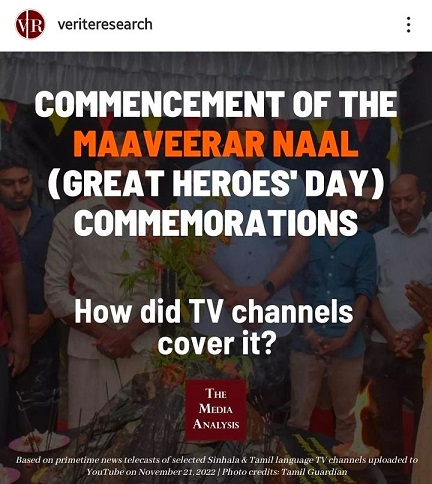
US Congress funded NED-the 2nd CIA of America’s Sri Lanka sponsored Verite Research asks how Sri Lanka’s media covered LTTE’s Maaveerar Naal commemorations. Interesting that US-NED & Verite are bothered to know how terrorists are commemorated. Do they cover commemorations of Al Qaeda & associates? This leads us to ask, who is commemorating whom post-LTTE defeat.
What is this Maaveerar Naal & who is it for?
Maaveerar Naal is an LTTE event that commemorates its dead.
Wigneswaran says Tamil people have a right to commemorate Maaveerar Naal. He is technically incorrect. However, only pro-LTTE Tamils commemorate it, not all Tamils. So we next have to ask how many Tamils commemorate LTTE dead & how many Tamils don’t. Who can answer!
Let’s get some facts on Maaveerar Naal straightened out first:
It’s an LTTE event because:
Maaveerar Naal means Great Heroes Day – the Great Heroes of LTTE not anyone else.
It commenced on 27 November 1989 by LTTE
It was created to commemorate LTTE dead (not dead Tamils)
Mahaveerar Naal or Great Heroes Week commences on 21 November & ends on 27 November – Prabakaran’s birthday is on the 26th
The civilian” participants of the Mahaveerar Naal ceremonies are family members of dead LTTE who are called Maaveerar Kudumbangal (Great Hero Families)
The civilians” taking part in overseas commemorations of Mahaveerar Naal are also family members of dead LTTE or supporters of LTTE. Non-LTTE Tamil civilians or non-LTTE other Tamil Groups or their families do not attend these events and neither are they invited.
Non-LTTE Tamil civilians whose sons & daughters were in other Tamil militant groups & were killed by LTTE are forbidden to publicly mourn their dead
Maaveerar Naal ceremonies are in LTTE colors of red & yellow, LTTE flag is hoisted, eelam map is displayed, red & yellow garlands are placed first for Shankar the 1st great LTTE hero (this is what happens annually in state-run Jaffna university where academics don’t feel shy to mourn terrorists)
Hype over Mahaveerar Naal war widows” are spouses of dead LTTE terrorists. This term should not be allowed to be used as LTTE is a non-state actor & legally not entitled to use terms political prisoners nor POWs while term war widow only applies to wives of soldiers of a national army not terrorist movements.
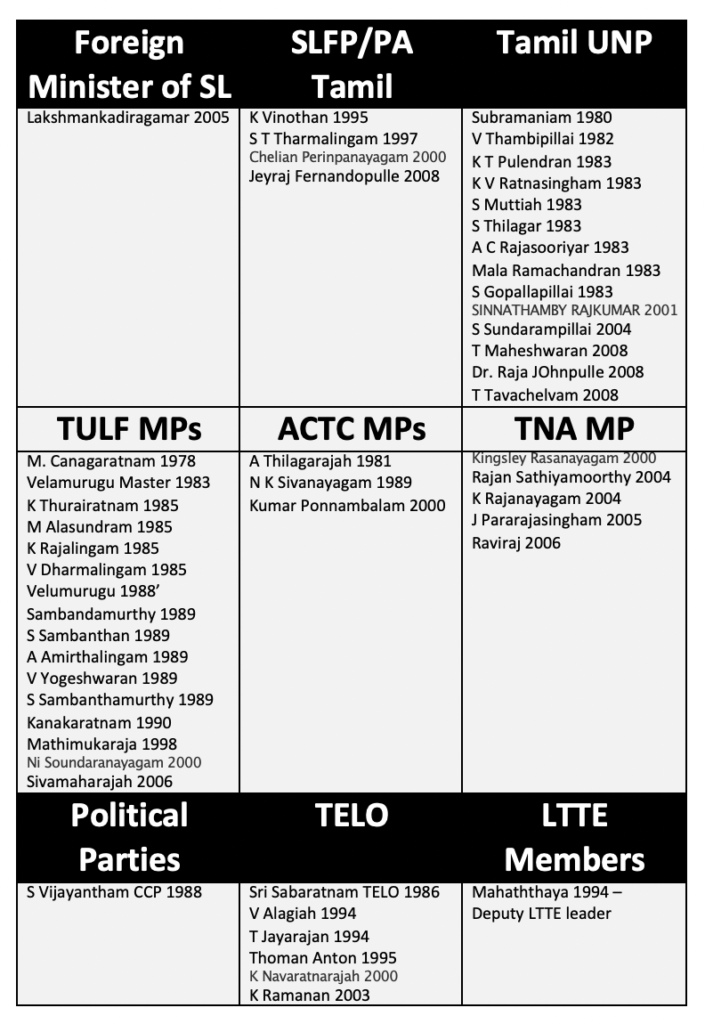
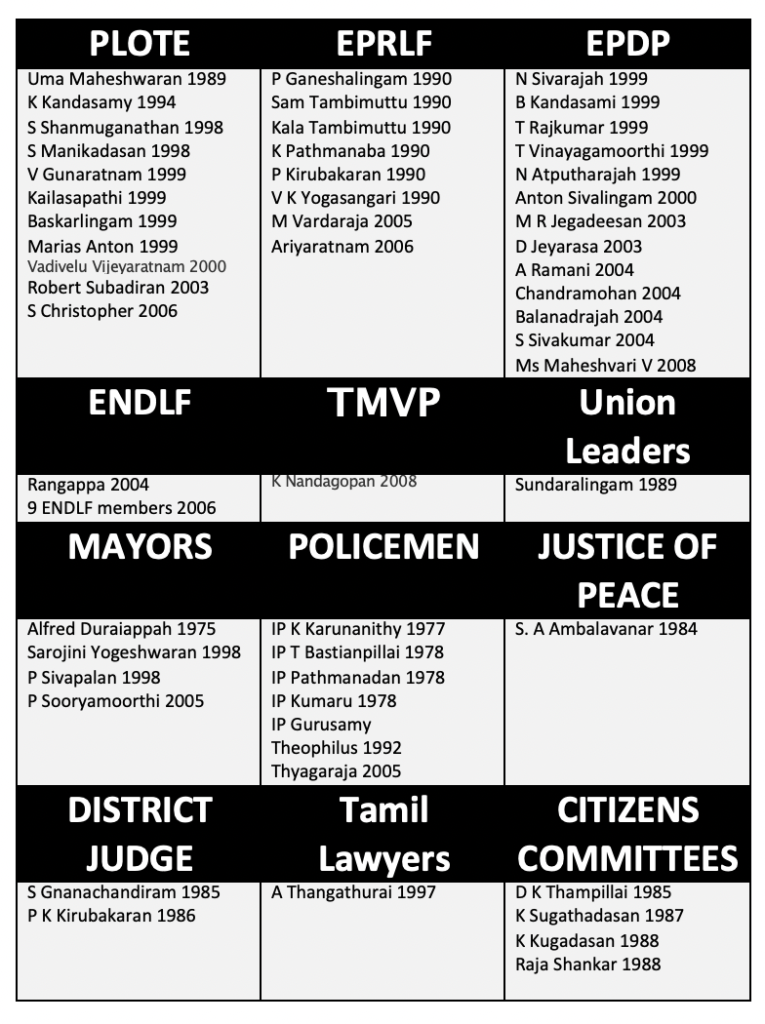
Maaveerar Naal does not commemorate Alfred Duraiaappah (Mayor of Jaffna killed by Prabakaran in 1975)
Mahaveerar Naal does not commemorate A Amirthalingam (TULF leader gunned down by LTTE in his own home in 1989)
Mahaveerar Naal does not commemorate Sarojini Yogeswaran (Mayor of Jaffna – LTTE also killed her husband)
Mahaveerar Naal does not commemorate Sam & Kala Thambimuttu
And LTTE does not commemorate Lakshman Kadiragamar gunned down in his own home.
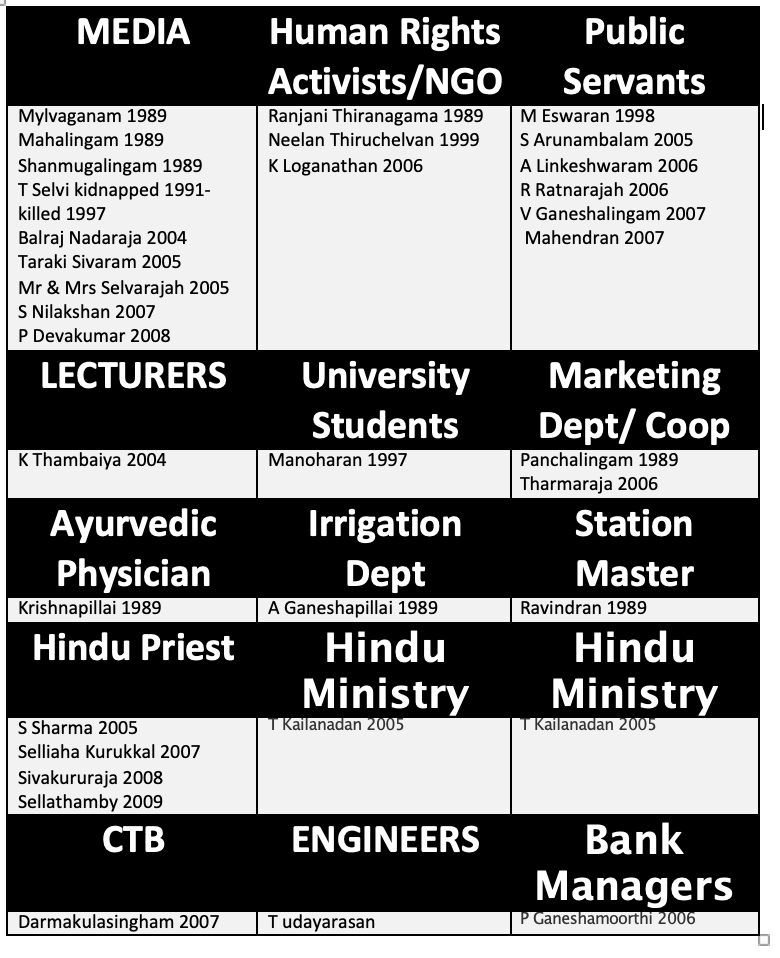
Mahaveerar Naal does not commemorate a single Tamil civilian nor any Tamil politician, academic, public servant, or even child killed by LTTE
Mahaveerar Naal does not even commemorate any of the other Tamil militant members who either died in battle or were killed by LTTE & their families are forbidden from commemorating them or holding commemorations similar to LTTE’s Mahaveerar Naal. Thus, these dead Tamil militant group members & leaders cannot be commemorated because they are not LTTE. If in doubt just ask families of PLOTE, EPRLF, EROS, TELO & other Tamil groups.
Every TNA MP, Foreign MP or anyone else attending Mahaveerar Naal commemorations are simply attending a LTTE event to remember dead LTTE – it is their choice to want to mourn terrorist dead but it questions why they are only mourning LTTE terrorist dead. Do you see them attending any mourning for Tamils killed by LTTE? Or meeting families of Tamils slain by LTTE? Even Navi Pillay the former UNHRC Head chose to only meet LTTE representatives and not people killed by LTTE.
LTTE cemeteries were part of the Maaverrar Naal commemorations allocating a tomb for every LTTE dead (noteworthy is that this was an Abrahamic practice & not Hindu)
Questions to ask
Mahaveerar Naal is a LTTE commemoration event to mourn dead LTTE by LTTE organizers, LTTE supporters & families of dead LTTE.
Why can’t families of Tamils killed by LTTE mourn their dead annually?
Why don’t foreign MPs wish to attend these functions?
Why doesn’t UN/UNHRC speak a word on Tamils killed by LTTE?
Why are members of the TNA & other Tamil political parties silent on Tamils
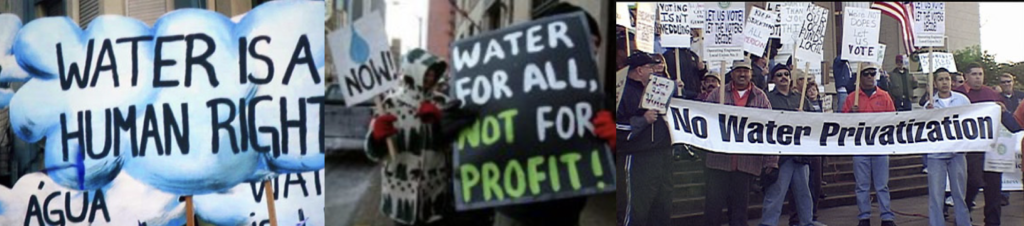
It is predicted that by 2025, over 5billion of the worlds population will not be able to access fresh drinking water. The population has hit 8billion already. 2025 is just 3 years away. Water is the oil of the future. Governments must realize that the flurry to privatize water” is nothing but a devious means for multinational private companies to grab ownership of the water & place a price for its distribution. It has nothing to do with better management of water. Rather the water is going to be managed at a price that people will not be able to afford. Therefore, governments & policy makers must be cautious about what they privatize and ensure utilities remain under national ownership.
It is true that governments have failed to protect existing national supply chains, distributions, growth & production and have been easily swayed to hand over state assets & resources to the private sector instead of enforcing the public sector to better manage these resources. Is there a catch to this, is this hand over having some corrupt inclinations attached? Is this not why politicians are alleged to be corrupt” – politicians end up being corrupt, because the system makes them corrupt. Politicians become corrupt when the other parties” for their gains and profits do deals that are defined as corrupt. Their role hardly gets scrutinized & all blame falls on the politicians. It does take two to tango.
Politicians of nation-state systems need to act responsibly. If as predicted by World Bank, the water resources are dwindling, a Government has a duty to ensure water is managed & shared equitably amongst all citizens. It cannot be decided by price and who can afford, who cannot & to deny all those who cannot. This will lead to major fundamental human right violations. Thus, the water security of a nation is beholden on the decisions of politicians and they cannot sacrifice the needs of the people for corporate boardroom deals advantageous to them.
Every drop of water in the hands of the private sector implies disappearance of sustainable solutions to global water crisis. In reality, the world will land in a water crisis if water falls into private ownership. This is the reality that the governments of the world & Sri Lanka’s government has to understand.
If water is scare, a government will try to somehow ensure all the populace get water. The same will not happen if water falls into private hands. Everything will be pegged at a price and only those able to afford will be privy to water. What happens to the rest is of no concern to the private sector. What happens to the rest becomes a government problem, to which the government has no solution because it has forfeited a resource that should have been kept under its wing.
All of the utilities that have fallen into private hands have resorted to rate hikes justifying better service but in reality aligned to their goals to make profits for their shareholders. A few corporate responsibility” programs here and there camouflages their ulterior motives.
Utilities under private ownership becomes a marketable commodity. Every new service comes at a price. Non-payment results in no empathy but immediate cut of one’s supply until payment is made & that too with a fine.
Do we want water to become a marketable commodity or should it remain a basic human right/need? Water is a natural resource, gifted freely by planet earth. No one has a right to own it & place a price on it. Governments are custodian of a nations resources and assets to equitably distribute and share these resources, not to dish them out to private parties.
People cannot live without water – it is not even an option. Water is not a luxury item that people can learn to live without – people need water, it is an essential item. Essential items should always remain under national interest.
Corporate agendas are always driven and motivated by profits. Profits take priority to doing any good to the public. Privatization has always resulted in compromising environmental standards. What suits them is what matters over what suits the environment. Environment ends up having adjust itself to corporate ventures.
In the US, the multinational water companies, lobby US Congress as well as Environmental agencies to ensure they do not make policy decisions impacting their service. These lobbies happen all over the world but are done discretely and secretly. But these end up deciding government outcomes and blames fall on politicians though the tactics of lobbyists are often swept under the carpet.
The government is responsible for the welfare of the citizens of a nation. Private companies are not responsible for the welfare of the citizens of a nation – private companies are accountable to their shareholders, not even for their consumers.
Companies that realize the threat of water becoming scarce, are clamouring to own it, for it will serve dual purpose – they will have ownership of a dwindling resource while also being able to make major profits by putting price tags on its distribution.
Governments that have been shortsighted and fallen prey have given up water resources to private companies for 20-30 years – giving monopoly of water supply to companies. Companies are not bothered if people protest demanding water or protest that the price of water is unaffordable. Unauthorized parties cannot enter a private premise and all protestors who attempt to do so will be handled legally & end up behind bars. Companies will not be bothered that people do not have water or cannot afford water. This is what people who are promoting privatization need to understand.
Look at the nature of how water deals from government to corporate hands are taking place. Are these transparent, are the private parties accountable. Why should they be secretly lobbying ministers? Why is the bidding process often kept hidden from public scrutiny? Why are contracts worked out behind closed doors? Why are details of the contract kept secret from public since they are directly affected by the conditions being written out in the contract? Why is no one highlighting these forms of bribery”.
It is natural that when majority of communication, Media & PR channels rest in private control and think tanks and NGOs are all private owned the frenzy to privatize is promoted. These entities are masters at playing with people’s emotions to get their way. They ensure empirical evidence and data are shunned for people to see whether privatization should be an option. They build up some form of fairytale scenario that privatization is the only option while presenting government sector as corrupt and unproductive.
The reality is that privatization reduces local control and public rights. There are areas that privatization can thrive where people who can afford will get the service they want – the people who visit supermarkets get a service for a price, but can all citizens shop at supermarkets if wayside shopping or village markets were stopped & people were told only to shop at supermarkets?
If water is privatized, there is no assurance that the private entity be it domestic, foreign or multinational will work in the interest of the community. Their priority will be to their bottom line and profits to their shareholders. They are not accountable to the citizens.
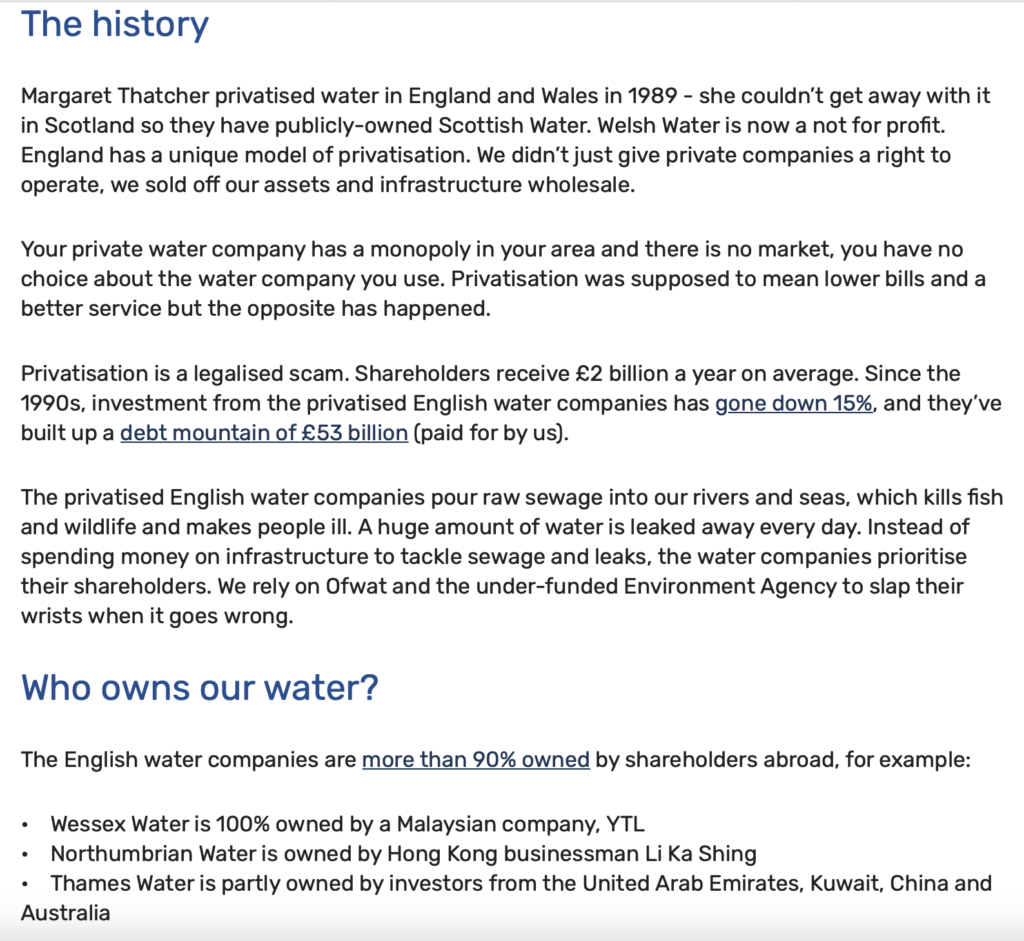
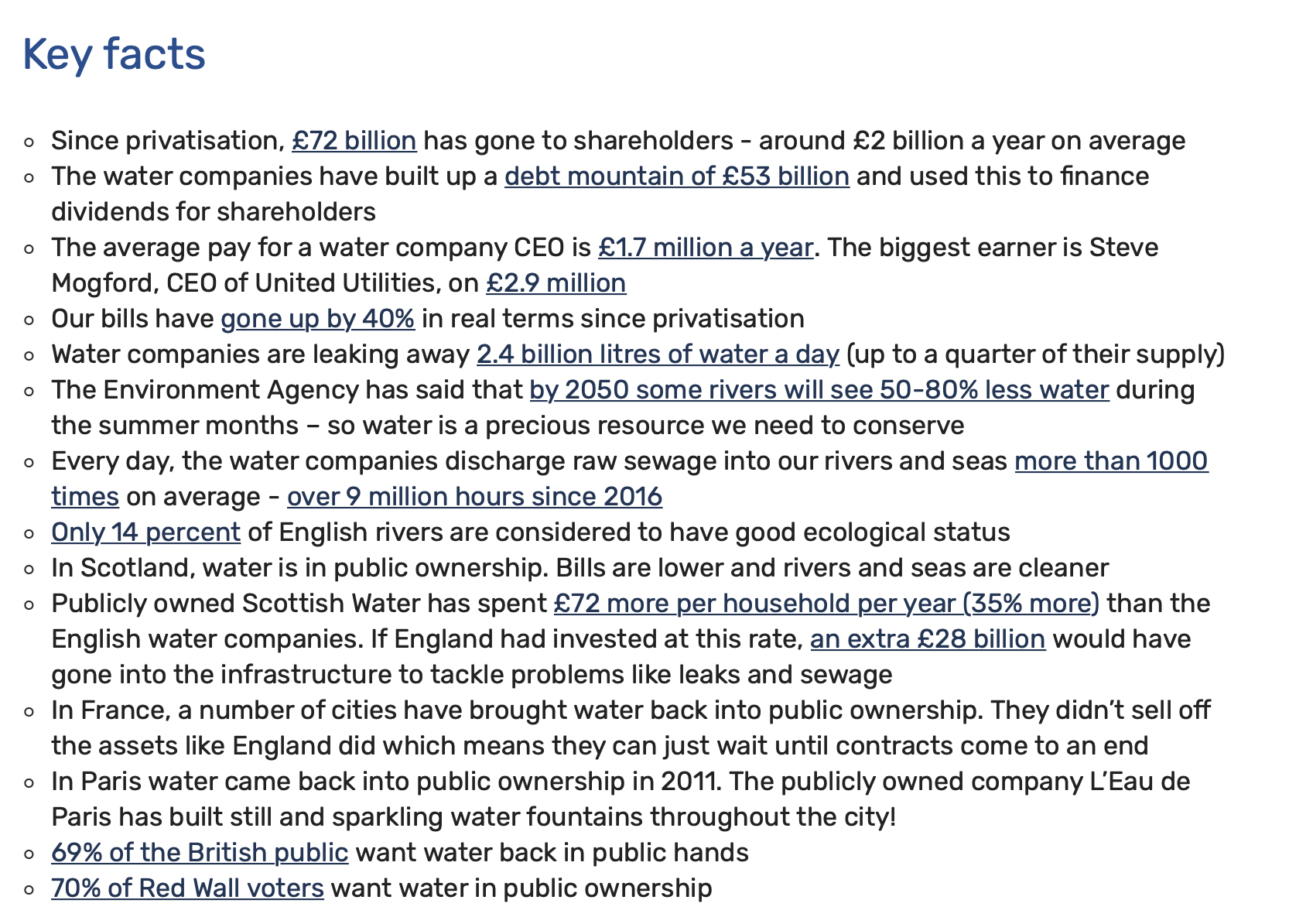
In the UK, the people are demanding that the government take back what they had privatized. When a government privatized a state resource/asset buying it back is not easy & it is costly. Withdrawing from the agreement will be deemed a breach of contract & costly.
Governments must realize that they are up against international systems and lobbies that are out to secure the worlds’ dwindling reserves. There are international entities that protect multinational companies with lethal legal teams. Even monetary agencies like World Bank & IMF have conditions that demand water privatization for loans to nations. These international entities demand cash payments on behalf of the corporates if governments takes back water systems under public control. So international agencies are on the side of the corporates & not governments.
Another false notion being circulating by vested parties is that privatizing water shifts the financial burden from public to the private sector, implying that the taxpayers money is saved because costs of repairing, upgrading, maintenance and infrastructure etc will fall on the private owner. The reality is the opposite.
Every cost the private sector bears in providing water to the consumers will add all these costs into the monthly bill. Tax-free public financing translated into lower-cost projects whereas taxable private financing leads to higher interest rates.
With 8billion people, the question of employment also surfaces especially in the age of digitalization. When a state resource falls into private hands the immediate outcome is massive layoffs – as companies wish to minimize costs & increase profits. What 3 persons have done will be given to 1 person to do with a marginal increase.
Today multinational corporations are taking governments to court & even winning cases. The mistakes of politicians and attempts to reverse them ends up a costly affair for the taxpayers. Which is why governments should not fall prey to media hype to privatize and look at the data & statistics and see how best utilizes can be managed as a public sector intiative rather than a private one.
World Bank & IMF privatization schemes do not provide relief to poverty-stricken developing nations. In reality they help reduce access to water for the poor by their conditions to privatize utilities. These structural adjustment programs force governments to privatize resources of the state in lieu for loans which have to be paid back in dollar interests. The World Bank & IMF when placing conditions on already vulnerable and impoverished nations are not doing any good to the people by these actions. Refusing their conditions would mean a default on their debts so in reality World Bank & IMF are lobbies of the private sector placing conditions on governments to privatize if they wish to obtain loans.
The ultimate aim of these conditions is to export water. Corporations are helped to grab ownership of water, they determine the price, they don’t care who can afford or who cannot, their next move would be to venture into bulk water export – transporting to water-scarce countries at a price.
In 1943 when famine swept across India, the middle classes were oblivious to the sufferings of the poor. This is an important lesson even in the 21st century & questions how far the citizens are aware of each other’s problems! A famine is not only after a supply running out but it also implies prices rising beyond the reach of the neediest. India’s current water crisis is not due to shortage but misallocation & mispricing. These are lessons for Sri Lanka. Chennai imports water while India is the world’s biggest exporter of water. Did this make any sense?
How can a country lack water but export water?
The manner the environment is being drilled to build condominiums, massive structures, the manner the soil is being extracted and replaced with concrete can and will have disastrous consequences. Water is being extracted from its natural sources inhumanely and these will create ecological imbalance & destruction. Mother Nature is unforgiving and ruthless as we have seen in all of the natural disasters that have crossed our way. Over-extraction for profit is causing immeasurable ecological, environmental & socio-economic damage. Humans & their greed can and should never forget, once these natural and free resources are polluted or unfairly extracted it is almost impossible to restore or return them to their former natural self.
I write with respect to Dr. Obesekera’s article that appeared a couple of days ago in this forum. He, perhaps presented a novel concept for capturing free solar energy by the fisher folk. This seems to be practical. However storing sufficient energy is the problem as the technology to convert that energy by way of liquid hydrogen may be too complicated. Batteries to store energy may not be affordable to fishermen.
However there can be other forms of energy that humanity not yet thought about. The link below gives a glimpse to one of those:
It appears that a sufficiently small drone can remain in air with remote control indefinitely with dangers that it entails!.
And the ocean itself may be a huge battery giving static electricity to water molecules or water vapour that hang in the sky. These are transported and come down to earth when it is discharged from cloud to cloud and back to earth finally sometimes with devastating consequences.
What better place to harvest it than in Sri Lanka where humidity is so high (and everybody complains about it). Perhaps it is the differential in the voltage that drives the currents from place to place in the ocean and not tides. It seems these currents were so predictable and seasonal that ancient seafarers of this country had used them for navigation according to one of Prof. Raj Somadeva’s videos.
Whatever it is the humanity should end the burning of fossil fuels and its use for world domination by various powers.
PS:
The drone DJI seems to be the industry standard these days and it can be seen that 11k static voltage that the guy ‘J’ doing this experiment gets is really hearting him even though he may not be well grounded. Average human body is about 1.5 meters tall and our bodies may be collecting enough charges to give us 150 volts. May be in some regions it is more and give the inhabitants stresses and cause fatigue. So, perhaps the release of these stress periodically by way of grounding during the day is a sensible act. Also, I believe J and his guru is wrong in assuming that the air is ionizes to such an extent without moisture being present in the vicinity. We all in our country know that there can be no lightening without clouds (or wehi nethi hena nometha). No wonder the Germans failed in their attempts in the 1920s. Bay of Bengal region (bengala bokka) including Sri Lanka and the tip of South India having special attributes of low gravity and ample rain may be the best for these experiments.
Please note I may be wrong here. Perhaps someone can illuminate us more by way of an addendum.
On 18 May 2022, the Canadian House of Commons adopted without opposition a motion introduced by Rep. Gary Anandasangaree recognising 18 May of each year as Tamil Genocide Remembrance Day” (www.parliament.ca). This follows a Bill adopted by the Ontario legislature in May 2021 calling for the week following May 18th of each year to be celebrated as Tamil Genocide education week.” However, the Ontario legislature is a provincial body and its actions do not carry the same weight as a national legislature.
The fact that purported ‘Tamil genocide’ in Sri Lanka has been recognised by the Canadian national legislature carries international implications. Most critics of the motion dismiss it as an attempt by the Canadian lawmakers to pander to a vocal minority. However, recognition by the national legislature of a foreign county that genocide is taking place in Sri Lanka has very serious consequences to this country. Unfortunately, there has been little or no discussion on this issue in local newspapers or academic journals and it is in the public interest to begin one.
In this article, I shall briefly discuss, i) the lack of evidence for Tamil genocide, ii) the gravity of what the Canadian legislature has done , iii) the illegality of the act, iv) address two objections and draw the relevant conclusions
The lack of evidence for Tamil genocide
I have discussed at some length the lack of evidence for Tamil genocide in Sri Lanka in an article titled, Ontario’s Bill 104: Tamil Genocide Education or Mis-education Week?”(The Island, 9 December 2021) and refer the reader to that for more details. However, here I shall focus on a report titled, Canada’s Inadequate Response to Terrorism: The Need for Policy Reform” (2006) by Martin Collacott, a former Canadian High Commissioner to Sri Lanka and also eminent academic. I wish to draw certain inferences from some of Collacot’s observations.
He says: According to the records of the consular section of the Sri Lankan High Commission in Ottawa, more than 8,600 Sri Lankans with refugee claims pending in Canada applied for travel documents to visit Sri Lanka in a single year.” (Martin Collacot, Canada’s Inadequate Response to Terrorism: The Need for Policy Reform,” Fraser Institute Digital Publication, February 2006, p. 34)
He continues: In comparison with Canada, other countries have accepted relatively few refugee claims from Sri Lankan Tamils as they do not consider them to have been persecuted. In 2003, Canada accepted 1,749 Sri Lankan claimants (UNHCR, 2003, table 8) while the rest of the world combined gave refugee status to only 1,160. Canada’s acceptance rate was 76.3 percent, while the average for other countries was 15.8 percent.” (p. 34)
It would be absurd to suppose that people would visit Sri Lanka if they or their relatives are being subjected to genocide here, or at any rate, it casts doubt as to whether such a thing is happening. Meanwhile, the drastic difference in the number of refugee applications of Sri Lankans being accepted in Canada as opposed to other countries, if true, indicates that there is a difference of opinion on the issue of persecution. It should prompt a reasonable person to review and reassess his or her views as to whether Tamil genocide is taking place here.
The point is that information such as that provided by Collacot is readily available in the public domain and it is reasonable to suppose that Canadian lawmakers are familiar with at least some of it. However, there is no evidence that such information has registered with Canadian legislators because there was not a single voice raised in opposition to the impugned motion. In these circumstances, the inference is irresistible that the Canadian House of Commons has adopted the motion with scant regard to the truth or falsity of the allegation of Tamil genocide.
The gravity of the act
The impugned motion is not just a local or domestic concern of Canadians but is pregnant with consequences for Sri Lankans, because of the following reasons. Genocide is the intentional destruction or attempt at destruction of an entire people. Among other things, it is one of the conditions that would permit an ethnic group within a particular country to invoke the right to external self-determination (i.e. secession) under international law.
For instance, in the seminal Canadian case Reference re Secession of Quebec [1998] 2 SCR 217, widely cited in other countries, the Supreme Court of Canada identifies three conditions that would warrant an ethnic/religious/linguistic group within a country to invoke the right to external self-determination: colonialism, alien subjugation or domination and denial of meaningful access to government to pursue one’s political social and cultural development. (Reference, para 138)
Genocide could be brought under the second or third categories. The Canadian House of Commons represents the entire people of Canada, not different interest groups. So, such a body has now placed on record that conditions exist in Sri Lanka for the Tamils to arguably invoke a right to self-determination under international law. It sets a precedent for other countries to also adopt motions or even resolutions unilaterally alleging Tamil genocide in Sri Lanka with scant regard for the truth.
If a significant number of other countries endorse an invocation of the right to self-determination by an ethnic minority in Sri Lanka, this country will eventually have to capitulate to the demand for a separate State. Sri Lanka is a relatively poor country heavily dependent on foreign aid. It cannot afford to alienate the international community, especially its main donors. Therefore, the impugned motion potentially sets the stage for interested parties to advance their ambitions of creating a separate State within Sri Lanka, with the collusion or connivance of other countries.
The illegality of the act
The UN Charter is the basis of international law. Article 2(4) enshrines one of the principles of the UN It states: All Members shall refrain in their international relations from the threat or use of force against the territorial integrity or political independence of any State, or in any other manner inconsistent with the Purposes of the United Nations.”
The above provision has two parts: a) refraining from the threat or use of force against other States and b) acting in any other manner inconsistent with the purposes of the U.N. I wish to focus on the second limb. Articles 1(1) – (1 (4) of the Charter set out the purposes of the U.N. Article 1(2) states: To develop friendly relations among nations based on respect for the principle of equal rights and self-determination of peoples, and to take appropriate measures to strengthen universal peace.”
The standard interpretation of the above is that the UN cannot intervene unduly in the internal affairs of nations. More importantly, on the concept of ‘self-determination,’ to the best of my knowledge the international Court of Justice (ICJ) has never yet extended the said concept to cover a right to secession. The court has only held that the concept applies in colonial contexts, non-self-governing territories and that it cannot be used in order to undermine existing state boundaries (See Western Sahara, Advisory Opinion, 1975; Namibia, Advisory Opinion, 1976; and Frontier Dispute case, 1986, ICJ Reports 554, respectively.)
There is a profound difficulty in interpreting the ‘right to self-determination’ to include a right to secession, namely, it could lead to a veritable explosion of demands for statehood by various ethnic minorities. The U.N. is well aware of this problem. A panel of U.N. legal experts point out, If every ethnic, religious or linguistic group claimed statehood, there would be no limit to fragmentation, and peace and security and well-being for all would become even more difficult to achieve.” (An agenda for Peace,’ UN doc. A/47/277)
In sum, the UN is not permitted to promote the secessionist ambitions of ethnic minorities. The impugned motion does just that, or at any rate sets a precedent that has the potential to lead to an international endorsement of a right to self-determination of a particular ethnic minority in Sri Lanka. It is inconsistent with the letter as well as spirit of Article 1(2) and hence illegal under international law.
Objections
A critic might object that i) the national legislature is not the government of a country and it is only the government that would come under the purview of international law and ii) the impugned act can be justified under the Responsibility to Protect (R2P) doctrine.
In regard to the first, to the best of my knowledge the Canadian government has not dissociated itself from the act of the legislature or issued a single statement critical of the said act. The well-known legal maxim states, He who is silent appears to consent (Qui tacit consentire videtur)”. Accordingly, one must presume that the Government is either complicit in the act or tacitly approves of it.
In regard to R2P, the doctrine contends that members of the international community have an obligation to intervene in the internal affairs of nations regardless of the U.N. Charter’s customary prohibitions against such action, if there are horrendous abuses taking place in a country and the citizens of such country have no other means of protecting themselves.
However, a prerequisite for the application of R2P is that the abuses in question must first be reported to the Security Council. No such thing as happened in the instant case. In fact, the Canadian legislature has failed to submit their allegations to any international forum whatsoever and give Sri Lanka a chance to respond. It should be noted that, Natural Justice, which includes the injunction, Hear the other side!” is an overriding principle (jus cogens) of international law. In these circumstances, R2P cannot justify the impugned motion.
Conclusion
The national legislature of a country should not get a free pass to flout international law at will. If the national legislatures of other countries also start adopting motions alleging ‘Tamil genocide’ with scant regard to the facts, it would pose a danger not just to Sri Lanka but to all countries facing the threat of separatism. It is in the interest of Sri Lankans as well as all friends of international law to vigorously challenge this act and prevent it from setting a precedent.
The government has decided to enforce the law against the air passengers who smuggle in gold into Sri Lanka, State Minister of Finance Ranjith Siyambalapitiya says.
Accordingly, air passengers will be banned from wearing gold jewellery valued more than 22 carats without the approval of the Controller General of Imports & Exports, the lawmaker said further.
Meanwhile, Customs officials have been instructed to use special techniques to ascertain the condition and quantities of gold items.
The gazette notification pertaining to this decision will be issued in the coming week, the state minister added.
He noted that migrant workers returning to the country or normal air passengers would not be affected by this move.
Misusing the relaxed restrictions on the quality or amount of gold jewellery that an air passenger is allowed to wear, the smugglers illegally bring in at least 50kg of gold per day, State Minister Siyambalapitiya explained.
Information revealed that some smugglers travel overseas daily and bring 24-carat gold ornaments with them.
According to the lawmaker, it is estimated that Sri Lanka incurs a loss of USD 30 million of foreign exchange per month.
The decision was taken after studying a report handed over by the Customs Director General to Finance State Minister Ranjith Siyambalapitiya recently.
The 81st Madras-Colombo Rowing Regatta came was held today (November 26) at the Colombo Rowing Club.
Considered to be the oldest boat race in the world between two cities in different countries, the event was inaugurated way back in 1898.
The Madras Boat Club and the Colombo Rowing Club take turns in hosting the regatta every year.
This year’s regatta, which resumed after a three-year hiatus due to the outbreak of the Covid-19 pandemic, was graced by High Commissioner of India Gopal Baglay, supported by the Indian CEO Forum.
The Men’s fours event in Madras-Colombo is the second oldest inter-club Boat Race in the world after the Oxford-Cambridge Boat race.
Events are held for both men and women over a distance of 1,000 meters, with separate overall trophies for both.
Winners of the Men’s overall receive the Deepam Trophy, while the Adyar Trophy” is awarded to the women.
This year, the Madras Boat Club secured the Adyar trophy while Colombo Rowing Club men lifted the Deepam trophy.
The political parties representing the Tamil community in the northern and eastern parts of the island have agreed on three preliminary steps to resolve the issues faced by the Tamil community.
The meeting took place at the official residence of MP R. Sampanthan.
During the discussion, the focus fell on several issues of the Tamil community and a final agreement was reached to propose three preliminary steps to President Ranil Wickremesinghe in order to resolve them.
Speaking to the media in this regard, MP M.A. Sumanthiran said the first step is to return all seized plots of land to respective owners and to halt land grabs.
Second proposal is to enforce existing constitutional and other legal provisions with regard to power sharing and conducting the provincial council elections without delay, according to him.
Thirdly, there should be power devolution on federal basis in the areas of habitation of Tamil speaking people, he added.
On 21st November 2022 a handful of teachers & principals arrived wearing casual clothing instead of sarees. Ceylon Teachers Union (representing over 50,000 teachers) VP Rasika Handapangoda claims there have been social media campaigns encouraging teachers to replace the saree. This is a clue as to the mischief at play and provides answers to many doubts. Teachers have been wearing the saree/osariya since 1930s – why should it suddenly become a problem in 2022? Breakdown of discipline is dangerous to a country & has detrimental consequences – what if doctors or nurses decide their attire is uncomfortable, what if the police or armed forces claim the same? Is a country to put up with such antics? No country will – why should Sri Lanka. There are 4.1million students in over 10,000 schools with close to 250,000 teachers of whom 73% are females.
The Education Minister Susil Premajayantha categorically stated that the dress code of female teachers would not be revised. If teachers have chosen to defy such orders, then the Minister has to take action. This is setting a bad example and inaction means, teachers may resort to even changing teaching curricular and this will impact the future generations of youth.
Government schools follow a system – teachers wear sarees and school children wear white uniforms. That has been the dress code for decades. No teachers complained of the saree being an uncomfortable” attire – so why suddenly now? Is this a new movement to shed the cultural attachment to the traditional dress? Did teachers start travelling by bus only recently? How many people travel in the bus wearing sarees – even corporate sector employees!
Dress code is nothing that is up for debate. We should not be bothered about what camp wants saree or what camp doesn’t. What matters is that there is something called discipline – which is applicable not only to children but to the teachers & principals as well. If the adults are not disciplined how can they discipline the children?
The lame excuse is to always plug how teachers in other countries dress. The day we have everything that is found in other countries, then we can compare our country with that country, just nitpicking one or two things and trying to plug into Sri Lanka’s context is wrong. Besides, there is a culture and tradition that is associated with Sri Lanka. This is what draws tourists and becomes a major component of our foreign reserves. Sri Lanka has an identity which must be protected. The saree was always considered a symbol of nationalism. Obviously these new trends and campaigns are aimed at removing the cultural identify of Sri Lanka & to denationalize Sri Lanka. Remember how the residential schools in Canada denationalized the indigenous of their cultures and traditions, forcing them to dress in western attire! Soon the national anthem may be not fashionable enough & a campaign may emerge to sing God Save the King or the Star Spangled Banner.
Why do some western diplomats go an extra mile to wear saree as a gesture of goodwill? Why do tourists wish to marry in Sri Lanka wearing the traditional saree?
Why do our female diplomats wear the saree proudly as they represent Sri Lanka?
Why are our traditional weddings in saree/osariya?
While we market our culture for tourism, there are some trying to push Sri Lanka to denounce their cultural heritage. What is the sinister plan behind this?
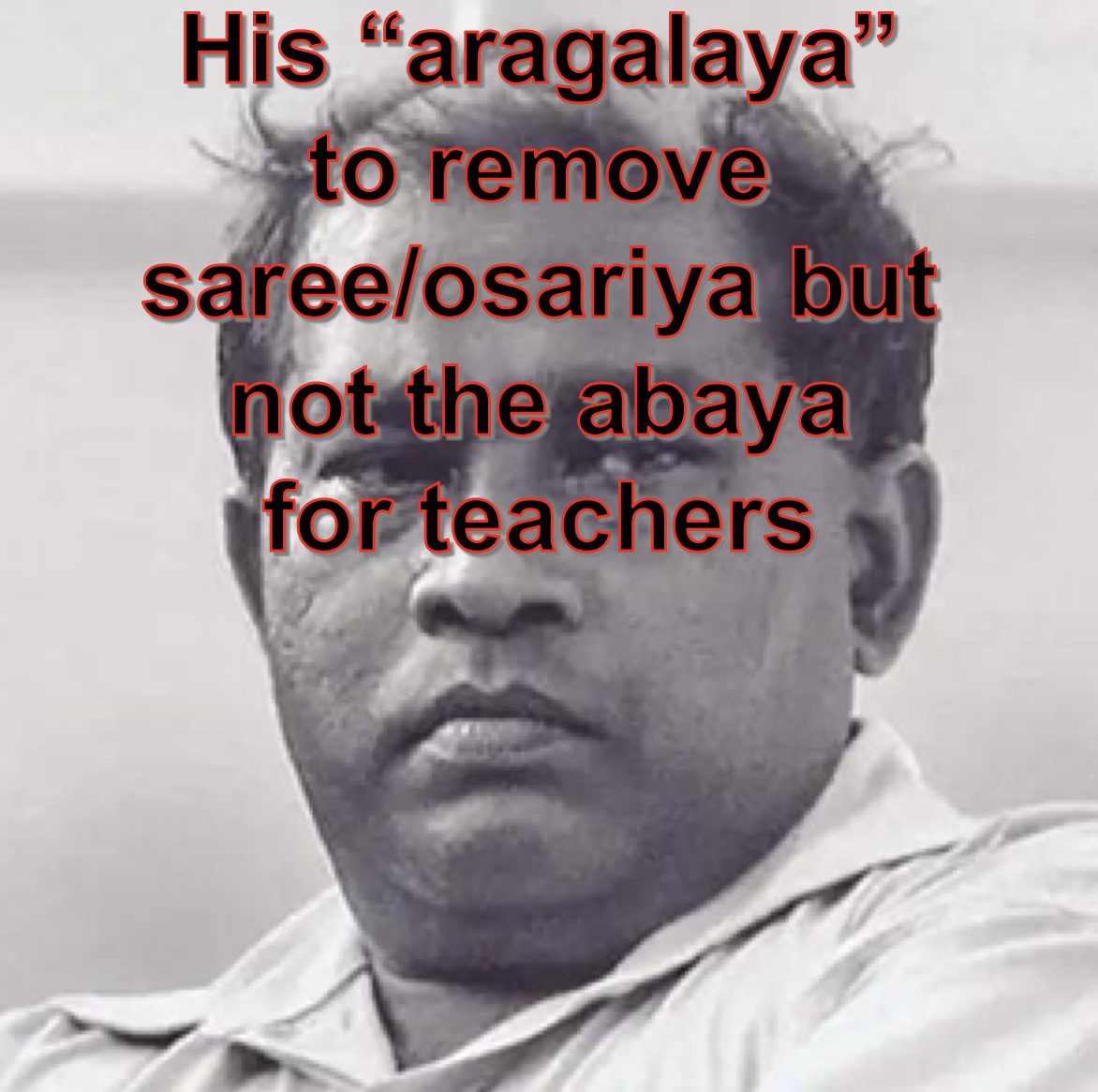
While Joseph Stalin the male is concerned about teachers removing the saree, he is mum about Muslim teachers removing their abaya. While foreign funded campaigns have got non-Muslim teachers to play truant, we don’t see Muslim teachers removing their abaya. This is discipline and respect. Discipline means we follow the rules, whether we individually like them or not. Discipline is applicably not to an individual alone but collectively, that is why we are bound to respect the rules. Many of these arguments are being supported by biased surveys that have questions framed to denounce sarees & replace with western attire. Who are in a hurry to remove cultural identity of Sri Lanka & replace with western attire/identity?
Sri Lanka’s education system provides for 13 years of compulsory education. Primary education lasts 5 years, Secondary education lasts 6 years and advanced level 2 years. Schools start at 0730 and ends at 0130 where unlike public servants, teachers too dart off home and teachers unlike rest of the public service remain at home throughout the school holidays. The manner the saree/osariya is to be worn by teachers should be clearly defined too. It is unfortunate that teachers have to be taught how teachers should wear the saree when teachers are expected to teach right from wrong.
Teachers wearing saree is an identity as a teacher and they command respect. Formal clothing like the saree affirms a social distance, an authority and status over the students. Casual clothing on the other hand provides a more on par status. However, our system of education follows the culture of respect to elders not an on par status. The behavior of teachers results in students lacking respect for the teacher.
Teachers are responsible for educating students – education means not only reading and explaining text books. Whatever new methodologies used, the primary role of a teacher is to nurture a child to become a good citizen equipped with learning that is not confined to the classroom alone. A teacher plays a key role in building citizens and citizenship. Schools are centres of lifelong learning. What a child picks up from home or school, that child carries forward into adulthood. Therefore, a teacher has to place the child above his/her inherent needs. This is why teaching is one of the most challenging yet respected career choices – vital for the social, cultural and economic health of a Nation. Picking saree to destroy this role is what is being questioned.
While teachers or unions seem unbothered to address the ills that take place in schools where they are directly responsible, they appear more bothered about how comfortable they dress. This is unacceptable. We can recall how teachers were lured to strike no sooner covid struck and the entire country was facing hardships. Such irresponsible behavior has to be condemned. When economic difficulties post-covid were impacting children especially those who had no means to afford smart phones or wifi-to study, not many teachers came forward to provide solace to the poor students, but they are ever ready to take to the streets to strike & demand change of clothes and now some are coming out to give aragala speeches!
With covid, lockdowns and changes taking place around the globe, teachers and the education system are expected to come up with workable solutions for Sri Lanka’s children – have they? Have they spent time to address the difficulties children have, have they taken up issues with the authorities, have they brought to the attention of parents & education ministry the many ills that are taking place amongst youth or are they more bothered about throwing the saree away. Do they counsel students, do they help solve problems students undergo with studies? While some want to plug how teachers dress in western nations, why are they reluctant to follow the learning methods of these western teachers, who do not run home, who stay back & prepare lesson plans for the next day, who keep slow learners and take pains to teach them, who monitor the students etc.. how many of Sri Lanka’s teachers follow these good practices? Simply to win arguments, it is unfair to pluck attire of teachers in western nations and plug it into Sri Lanka’s context without applying the teaching methodologies that they practice.
With changes happening around the world, it is important for Sri Lanka’s teachers to seriously address the brain-drain and respond to what changes need to take place to ensure our children do not lag behind and follow the path of memorizing notes and writing answers only to satisfy the teacher as that is all that the teacher knows. Teachers too need to be as well informed about the world and not merely the knowledge around the textbook that the teacher knows from head to toe.
When the saree has been worn for almost 100 years – it is more than strange that a man called Stalin thinks the saree should be removed and social media campaigns incite some teachers to defy the cultural norm of wearing saree to school.
The Govt cannot take this errant action lightly and ultimatums must be issued to such teachers. Either they resign and teach in places where western attire is allowed or they return to the saree. If action is not taken these same funded campaigns will next target school children and make them give up their school uniforms and come to school in what they like. This trend if allowed to go to other compartments of the government will break down law & order in Sri Lanka, this cannot be allowed.
One of the main reason for Sri Lanka’s decline is the lack of discipline and the lack of duty where people only seem to demand rights instead of being asked what they have done to the nation to demand such rights.
Teachers must set an example – they are role models for children, when they defy customary dress code, it is a stepping stone to many ugly outcomes which mischief makers are plotting behind the scenes. That education authorities have not taken action goes to show the influence being exerted from within. If teachers find wearing sarees uncomfortable” they can give up their profession and do something else. By their action they have displayed they are unsuited to teach. Their role is a collective model role & one that does not cater to their personal whims. If this is a problem for some individual teachers – they are welcome to leave the profession. They are teachers for a reason – if they cannot fulfill that role, there is no point in tax payer money being spent on them.
A great transformation in food culture and nutrition is taking place in Sri Lanka following various exogenous economic shocks: The traditional, nutritious ‘rice and fish’ diet, common throughout coastal Asia is increasingly substituted with imported maize or corn-fed chicken, white wheat flour breads, instant noodles and processed food.
For the first time in history the humble fish lunch packet was more expensive than a chicken lunch pack in this island at the center of the Indian Ocean! So too, the nutritious local Jack fruit, Polos and cashew nut curry, high protein staples for vegetarians, has been replaced with imported and chemically-processed Soya ‘meat’. Meanwhile, imported Walnuts, hazelnuts and peanuts are available, and Norwegian Salmon was imported to feed tourists and local elites amid a US dollar debt Default.
Rather than leverage Sri Lanka’s high value fisheries resources plentiful in the island’s Exclusive Economic Zone (EEZ), as a policy priority, President Ranil Wickremesinghe recently reversed a ban on Open Account imports to enable the import of corn, maize seed and soybean for poultry farmers to feed livestock according to a Gazette notice last month– despite the dollar debt crisis.[i]
The ban on open account imports to save dollars was implemented after the Staged Default in April this year but now stands reversed based on narratives of looming ‘famine’ and ‘climate catastrophe’ that legitimize large import bills—from maize to electric cars. These enable politically connected traders and businessmen to make windfall profits (Disaster Capitalism), as with the Sugar Scam and promote a culture of import dependency and consuming beyond ones means, while deepening the Dollar debt trap.
Rice and Fish in Asian Cultures
For centuries, fresh caught fish with country (Nadu), rice has been a staple of the national diet. Generations of healthy and happy children have grown up eating rice and fish, a diet high in the required protein, calcium and micronutrients for growth.
On festive occasions the traditional coconut-milk rice (kiri- bath) was always served with Tuna fish Ambulthiyal (sour fish a southern preparation), or miris malu (chilly fish). In Jaffna and the north, Meen Kolumbu is standard and often accompanies milk rice.
In many Asian cultures, from Bengal to Indonesia and Vietnam, ‘rice and fish’ is symbolic of abundance. The Mandarin word for fish,” yu,” has the same pronunciation as the word for surplus” or abundance.” The new year blessing, nian you yu,” expresses wishes for abundance and prosperity—or fish—in the coming year, and no Southeast Asian banquet is complete without fish.
Tuna fish was unavailable or unaffordable for much of the year in Sri Lanka, while small fish had disappeared for months from dinner and lunch tables. Even Karavela or dried fish, the poor person’s protein was unaffordable. Meanwhile, canned fish was unavailable or unaffordable in an island nation which should be exporting rather than importing tinned-fish caught in Sri Lanka’s extensive marine Exclusive Economic Zone (EEZ).
From Rice and Fish to Corn and Chicken: Nutrition and Disease Patterns
The current generation of Sri Lankans is the first to source meat-based protein from imported maize-fed battery farmed chickens often filled with antibiotics rather than fresh fish. Today prawns from environmentally-destructive aqua-culture farms are promoted rather than fresh fish from the seas of Sri Lanka.
Incidence of malnutrition, obesity and non-communicable disease, like heart attacks, diabetes, high blood pressure and cholesterol (along with drugs to mitigate the impacts of these consumption and life-style changes), have become the main causes for death and disease in the island, primarily due to changing food culture and nutrition. These, non-communicable diseases were ‘Covid-19 co-morbidities”.
Amid stories of children fainting in school due to lack of protein, Triposha and Samaposha, the traditional children’s food supplement, which consisted of red rice, kurakkan and green gram, high in protein and micronutrients are being replaced with milk powder, corn, and processed Soya, imported by large Multinational and Agri-business Corporations (MNC). Corn starched and soya is used in processed food with high chemical and palm oil content.
UNICEF Children’s Fund has reported that 30 percent of Sri Lankan children suffer from malnutrition since the dollar debt Default in April this year. So too stunting and wasting have increased in this fertile tropical island, blessed with 2 monsoons, plentiful rain and rice harvests and extensive fisheries resources.
Of course, corn, and wheat-based products like ‘short-eats’ snacks made of pastry and sugar-filled cakes that are advertised in the media are both convenient and popular with many urban fast food consumers and producers. During the Covid-19 panicdemic there was an epidemic of sugar filled cup cakes and cookies by home bound bakers, which were sold on various social media platforms!
Wheat and maize are more vulnerable to aflatoxins that thrive in hot and humid climates and other biohazards than indigenous rice variates. For instance, the bio-warfare lab manufactured Fall Army Worm (Sena Caterpillar), destroyed corn and other gain crops a few years ago in South Asia, Africa and South Asia. However, indigenous rice crops were relatively undamaged as they were much more resistant to the imported Sena bug that destroyed food security in many countries in the Global South.
The transformation of the traditional, nutritious ‘Rice and fish’ diet to an imported maize-fed chicken (and eggs), diet has been on-going for some time amid Disaster Capitalism and the corporate capture of fisheries grounds, agricultural and forest lands enabled by various exogenous economic shocks” for structural adjustment of the sectors, including Covid-19 Lockdowns, followed the 2019 ISIS claimed Easter Sunday attacks on coastal communities that brought extended lockdowns of fisheries harbors. In 2022, a fuel blockade during the dollar debt default meant that fisheries communities did not have Kerosene fuel for their boats and fishing crafts.
These exogenous economic shocks benefit foreign trawler companies operating in the Seas of Sri Lanka, and enable what Naomi Klein termed ‘Disaster Capitalism” as well as the global agribusiness and corporate takeover of national food systems and policy process. Increasingly the corporate capture of fisheries areas for prawn farms or in the name of environmental protection (Marine Protection Areas), as well as, land areas are apparent through new legal frameworks, and new land and coastal laws as the Fisheries and Agriculture sectors are structurally adjusted for corporate agribusinesses, purportedly for export-led growth to earn US dollars.
Tuna Vanishes as Import dependency increases
For decades the Fisheries sector has contributed a mere 2.5 percent to Sri Lanka’s national economy while citizens were increasingly deprived of fresh fish and the nutrition if affords. Grade 1 sushi Bluefin tuna currently fetches up to US$1,000 per kilo wholesale in Tokyo. Prices for yellowfin tuna, which is more commonly found in Sri Lankan waters, range from $500 to $700. [ii]
So where have all the strategic island’s Yellowfin Tuna from its extensive marine EEZ, which is 15 times the island’s land extent under the United Nation’s Convention on the Law of the Sea (UNCLOS), gone?
Although Indian Fishers are routinely blamed in the local media for over fishing in Sri Lankan waters in the north, the Indian Ocean Tuna Commission’s (IOTC), Data show that high value Tuna from Sri Lanka ends up mainly in the European Union, US, Japan, Korea and other Non-Indian Ocean Distant Water Fishing States.[iii]
The Seas of Sri Lanka are increasingly over-fished by French, EU and other Distant Water Fishing States whose trawler companies have signed contracts with corrupt local fisheries ministry officials, while local children faint in school due to lack of protein.
However, rather than set policy priorities to protect and leverage the strategic island’s valuable fisheries resources given increase in malnutrition that various UN agencies predict, and despite the dollar debt crisis, the Colombo regime promoted the import of copious amounts of maize seed, corn and soybeans to grow and feed chicken amid dubious narratives of a famine.
Record Spending on Maize Imports
Economy Next reported this month that ‘Sri Lanka has spent a record 9.6 billion rupees for maize imports this year, government data showed, purportedly due to shortage of the grains for animal feed industry after the government’s agrochemicals ban took the toll’.[iv] The country spent 573.4 million rupees to import maize seeds and 9 billion rupees for other maize related products including maize ears, the data showed. Maize crop needs pesticides to thrive as the grain plant is susceptible for pests and diseases, analysts say. Agrochemical ban has led to poultry feed expensive because of the price hike in the maize. And that resulted in more imports of maize this year, and industry official told Economy Next.
Like the infamous Sugar scam, would there be a maize and soya scam soon? After all, from Bond scams at the Central Bank to fund the United National Party’s (UNP), 2015 election campaign, to organic fertilizer and the recent sugar scams, bond traders and business oligarchs associated with successive Ranil Rajapakse regimes for ‘insider trading’ have made big profits during staged ‘scarcities’. Simultaneously the export of Sri Lanka’s high value food and human resources are being promoted to earn extra dollars, heedless of the long-term development costs.
Deepening debt trap and Import Dependency on the Eve of Independence
This week a Gazette relaxing import restrictions on apparel, cosmetics, perfumes, ceramics Air conditioners, freezers washing machines was issued amid a deepening US dollar debt trap. Colombo’s neo-liberal President (backed by the ‘Force’ in Washington according to Donald Lu, Secretary of State for South and Central Asia), seems intent on promoting a culture of over-consumption and import dependence that caused the Dollar crisis, rather than a policy mix that includes import substitution and leveraging local resources
On the eve of 75 years of putative ‘independence” are the current Colombo regime’s Economic Policies designed to deepen neocolonialism and the IMP’s inroads into the country’s trade and economic policy space? Would not mixed economic policies with emphasis on import substitution rather than import dependency be more appropriate to escape the Sovereign Bond debt trap, and leverage the island’s abundant marine and valuable mineral, including Graphite and Rare Earth Minerals.
Finally, Sri Lanka’s missing fish seem a metaphor for 75 years of lost ‘independence’. Neo-colonialism, donor dependency and globally networked local corporate and political corruption has also contributed to land-lock, blockade, under-develop, and enable looting of the strategic island’s natural and human resources, with Colombo’s current policy of promoting talent and brain drain to earn a few extra dollars heedless of the long-term development costs also clearly benefiting former colonial powers.
It is reported that the President has invited all party leaders to discuss after the ongoing Budget debate, the problems of minorities. This discussion is likely to focus on devolution of power where the Tamil parties will demand a federal constitution. In fact, TNA MP Sumanthiran who is a prime mover for a federal structure has said that there are 48 countries in the world with Federal Constitutions. According to Google there are 27 federations in the world, with 6 of them in each of Africa, Asia and Europe, 4 in North America, 3 in South America and 2 in Oceania.
Whatever the party leaders decide, the Unitary nature of the State, which was there in the 1972 constitution as well, cannot be changed without the approval of a two thirds majority of the Parliament and at a Referendum of the people. (vide Articles 2 and 83 of the Constitution). In that context this will be another futile exercise and a distraction from the crisis and untimely stirring communal sensitivities.
It is also reported that the opposition leader of the House tried to hold the former President MR on his statement promising 13 plus. Delegation of powers on the principle of Subsidiarity to the District will be 13 plus. That will be sharing power beyond the present Provincial Councils and taking it to the grassroots. The justification of the district as the unit of power sharing is given in the following note.
THE DISTRICT AS THE UNIT OF POWER SHARING
It is reported that the President has invited all party leaders to discuss after the ongoing Budget debate, the problems of minorities. This discussion is likely to focus on devolution of power where the Tamil parties will demand a federal constitution. In fact, MP Sumanthiran who is a prime mover for a federal arrangement has said that there are 48 countries in the world with Federal Constitutions. According to Google there are 27 federations in the world, with 6 of them in each of Africa, Asia and Europe, 4 in North America, 3 in South America and 2 in Oceania. In this background it is timely to examine the ideal option for the country for sharing power based on the universally accepted principle of subsidiarity.
History
Sri Lanka was divided into 9 Provinces on the recommendation of the Colebrook Commission of 1833 with the objective of dismantling the Kandyan Kingdom. But with experience in the administration of the country, with the increase of the population and the demand for additional services at the provincial level they were subdivided in stages into Districts. The British abandoned the Provincial system because the Provincial administration was unwieldy and inefficient. The Present Provincial Council System enforced by India has the same and more disadvantages. The previous Provincial Administration under the British was ably supervised by the Center. But not the new animal which has behaved like the wild ass with freedom.
Up to the time of the adoption of the 13th Amendment to the Constitution, the District was the first level of decentralization of administration. At present, there are 25 Districts. The next level of decentralization is the Pradeshiya Sabhas which number 276. The specific objective of the introduction of Pradeshiya Sabha is to provide greater opportunities for the people to participate effectively in the decision-making process relating to administrative and development activities at a local level”
As a consequence of the 13th Amendment, the country went back to the Provincial system with not only decentralization but with an extensive devolution of power from the Center. The result of this retrograde step was the transfer back of the decentralized powers from the District to the Province.
Subsidiarity principle
A core principle of the UNITED NATIONS CENTRE FOR HUMAN SETTLEMENTS (Habitat) as spelled out in the Policy Statement titled TOWARDS A WORLD CHARTER OF LOCAL SELF-GOVERNMENT is that the the basis of the Charter should reside in the principles of subsidiarity and proximity, whereby decisions should be taken at the level closest to the citizens (municipality or town) and that only those tasks which the local level cannot effectively carry out alone should be referred to higher levels. In accordance with the principle of subsidiarity, public responsibilities shall generally be exercised by those authorities which are closest to the citizen. In the same spirit, any allocation of responsibility to another authority must be based on the requirements of technical or economic efficiency.”
With wide and in-depth experience of the application of the Principle of Subsidiarity in the European Union (EU) it was found that it cannot be considered in isolation and has to be balanced against other principles which are as important. These are- unity of action, capacity and efficiency, unity of application, proportionality and solidarity.
In the application of the principle in a developing economy where resources are scarce ‘unity of action’ calls for concerted effort across the country avoiding duplication and waste of resources.
In Sri Lanka most infrastructure development and services cut across the artificial Provincial boundaries. In order to take advantage of economies of scale and efficiency they should be undertaken by the Center. This will also ensure unity of application. Where high level human resources are scarce, maximum utilization of such limited resources will be facilitated when these are available to serve the whole country. Handing of powers to Provinces which do not have the financial resources is dysfunctional. It is not reasonable to expect the Central Government to finance Provinces that cannot even meet their recurrent expenditure from their revenue. A selected Table from the Annual Report of 2018 shows this incongruity clearly.
Recurrent expenditure Revenue Target Transfer of Govt Revenue
Uva 25,232, 756 985,000 3,190,000
Northern 28,182,241 755,000 3,190,000
Eastern 27,746, 367 990,000 3,190,000
On the other hand, the central government grants to the States of India were only 37 percent e.g. in 2015, which makes them deserve devolved powers.
Subsidiarity applied disproportionately is inimical to national integration which is a national priority of the time.
Advantages of The District as the focal point
Sri Lanka has had a tradition of local government from the days of King Pandukabhaya 2000 years ago. Most of the activities devolved on the Provinces were efficiently carried out at the District level prior to the 13th Amendment. To impose an intermediate level between the District and the Center is a violation of the principle of Subsidiarity and has led to a proliferation of political and bureaucratic positions.
A distinct advantage of District level decentralization is that issues distinctive to individual Districts in a Province can be addressed with special emphasis. For example, in the Eastern Province, the ethnic composition, level of development, and resources in the Batticaloa and Ampara, and Trincomalee Districts are different. Even in the Western Province where Colombo has a plethora of issues in urbanization the problems of the Kalutara District are very much more of rural nature. In the Northern Province, the distinction in economic, social, and cultural between the Jaffna District and other Districts are striking.
Even from a power-sharing between communities is concerned a District system provides a marked advantage to participate in governance to minorities in Ampare, Trincomalee, Batticaloa, Nuwaraeliya and the 5 Districts of the Northern Province which is in nine out of 25 Districts of the country or in 36% of the Districts.
The imposition of an echelon above the District is a gross violation of the principles of subsidiarity and proximity. The shift of administration from the Province to the District was a milestone in the progressive decentralization of power from the Center closer to the citizen. The Districts were well endowed with the required technical capacity. There was no economic efficiency gained from reverting to the Province.
Governance structures should be citizen-centered and the commonality of interest of a community should be a prime consideration in deciding on the territory of a unit of governance. The District is the more homogenous unit with a higher commonality of interest of the inhabitants. Agro-climatic factors, resource endowments, and ethnic compositions are generally less varied within a District than in a larger unit of a Province. Even in the Western Province, in the Districts of Gampaha and Kalutara, the ethnic composition, level of industrialization, agricultural patterns and the overall level of infrastructure development are different. Gampaha is in the coconut triangle and is a fast-industrializing District with a good road network and fast developing infrastructure with an Investment Promotion Zone and an international airport. The economy of the Kalutara District is based mainly on agriculture with smallholder rubber making a substantial contribution to income and employment generation.
The smaller unit also favors direct democracy, higher participation of citizens in decision making, and good governance. Economic activities and social relationships bind the inhabitants of the District. Their problems are similar. The District center is the hub of road networks and communication facilities. Historically the District has been the center of administration and institutions like Pradeshiya Sabha, District Development Committees and District Agricultural Committees have functioned efficiently. In many cases, Districts have had a closer relationship with adjoining districts of different Provinces. Batticaloa and Polonnaruwa and Trincomalee and Anuradhapura are good examples. It does not make sense for a citizen in Ampara to be governed from a provincial capital in Trincomalee, or a Hambantota farmer to be governed by an authority located in Galle when the task could be performed as well in the same District with less inconvenience to the citizen.
Although the country has achieved reasonable targets in most millennium development goals widespread disparities exist at District levels. It is only by a District-based strategy that such disparities can be addressed effectively and without delay. There is more scope for the development of harmonious relationships and the integration of the different communities within a District than in a larger space of a Province.
Indian Pressure
At present, there are two indeterminate positions held by India and Sri Lanka on the Provincial Councils. The Indian position articulated by the Indian Minister Jaishankar and the Indian representative in the UNHRC is that the 13th Amendment to the constitution should be implemented fully. This means that in addition to the Police and Land Powers given in full to the Provincial Councils, the Northern and Eastern Province should be amalgamated. This demand of India is to create a land area and a population that could demand self-rule and also has the strategic port of Trincomalee under its control. It is ironic that India is calling for more power to the Provinces while withdrawing the application of Article 370 of the Constitution of India to Kashmir which allowed the state a certain amount of autonomy. The position which is attributed to Prime Minister Mahinda Rajapaksa is that he will go beyond the 13th Amendment in giving power to the people. If India does not have ulterior motives and is concerned about the Tamil people enjoying greater opportunities for them to participate effectively in the decision-making process relating to administrative and development activities at a local level” India should ensure that the objectives of Pradeshiya Sabha are also fully implemented. This will be going much beyond the 13th Amendment.
Sri Lanka has a mixed population and that is its strength. The character and priorities of districts varied and when clumped together in one Province the weaker districts get submerged. There is a marked difference between Galle and Hambantota or between Jaffna and Mannar. Certainly, there is no commonality between Jaffna and Amparai or Trincomalee. With district self-government, each district will get parity with the others. The units being small will also make them manageable for efficient administration. Management is one of the major deficits in our present system. Communication, mobility and decision making would be considerably faster than in the framework of cumbersome regional or national bureaucracies.
The smaller units would additionally enable linguistic, cultural and economic uniformity within their jurisdiction. Development and progress too could be monitored, evaluated and experienced much faster. The commitment and self-reliance of people within the unit would tend to be greater than within a large regional unit or at a national level. Moreover, there will be less dependency on the Metropolis.
Comparisons
Accepting blindly a foreign model is inappropriate. For example, the Indian model is spoken about. What one has to realize is that Indian states are so large that some of them have 100 to 200 Million. The Chennai Municipality has a much larger population of 11 million. Federalism is bandied about carelessly without any deep study done to learn how it would apply in practice.
Most importantly, the Accord and resultant Provincial Councils were not an agreement between the Tamil community and the Government of Sri Lanka.
Prabhakaran on August 4, 1987, stated very clearly This agreement did not concern only the problems of the Tamils. This is primarily concerned with Indo-Sri Lankan relations. It also contains within itself the principles; the requirements for making Sri Lanka accede to India’s strategic sphere of influence. It works out a way for preventing disruptions and hostile foreign forces from gaining footholds in Sri Lanka. This is why the Indian government showed such an extraordinary keenness in concluding this agreement.
Tamil Nadu is about twice the size of Sri Lanka with a population of 80 million and has only one Chief Minister. The Chennai Municipality with a population of 11 million is administered by a Mayor. Total population of Tamils living in the Northern and Eastern Provinces is less than 1.2 million. There is more power devolved to the Provinces in Sri Lanka than the power enjoyed by the States of India. (comparison by Vichara in Island News Paper.)
The issue of self-governing Provinces is based on the dubious notion that Sri Lankan Tamils are a separate People as defined by the United Nations. This argument is based on a fictitious ‘homeland theory’. The size and the population of Sri Lanka cannot justify a devolution of power. It should only be decentralization of power to the District on the rational principle of Subsidiarity.
Failure of Provincial Councils
In the President Gotabaya’s program Conversation with the Village” Gama Samaga Pilisandara’, to identify the problems faced by the people in underprivileged villages, most problems that were presented to the President were within the ambit of the devolved powers of the Provincial Councils. If Provincial Councils were the solution to better serve the people, the President’s meetings with the people clearly demonstrated that it was an utter failure. Concerned citizens are surprised why such a proven failed structure is to be encumbered on the people at an enormous cost. Besides these reasons, in the present crisis in the economy, the cost of holding a Provincial Council Election would be an unnecessary burden on the country.
National Security
In any arrangement for power-sharing, disregarding the overarching concern of sovereignty and territorial integrity of the country is an invitation to disaster. Devolution of powers to the District rather than to a Province is less likely to become a threat to the territorial integrity and national security of Sri Lanka. It is relevant to mention that even India has expressed fears of the notion of Eelam as a threat to the sovereignty and territorial integrity of India. A relevant excerpt of the Gazette Notice of the Indian Government declaring the LTTE as an unlawful association is produced as follows:
MINISTRY OF HOME AFFAIRS NOTIFICATION New Delhi, the 14th of May 2019 S.O. 1730(E).
WHEREAS the Liberation Tigers of Tamil Eelam (hereinafter referred to as the LTTE), is an association based in Sri Lanka but having its supporters, sympathizers and agents in the territory of India.
AND WHEREAS the LTTE’s objective for a separate homeland (Tamil Eelam) for all Tamils threatens the sovereignty and territorial integrity of India and amounts to cession and secession of a part of the territory of India from the Union and thus falls within the ambit of unlawful activities.
AND WHEREAS the LTTE, even after its military defeat in May 2009 in Sri Lanka, has not abandoned the concept of ‘Eelam’ and has been clandestinely working towards the ‘Eelam’ cause by undertaking fund raising and propaganda activities and the remnant LTTE leaders or cadres have also initiated efforts to regroup the scattered activists and resurrect the outfit locally and internationally”.
It is appalling that when India which nurtured the LTTE considers the LTTE to be a secessionist threat, Sri Lanka is attempting to give the separatist a base to continue their subversive activities. In the current context of an ISIS threat, a separate Eastern Province could become a cradle of Islamic extremism. Easter Sunday terrorist attack demonstrated that security perils occur without notice.
Structure of District Councils. (suggestion)
Sri Lanka is a highly politicized society, which has resulted in the polarizing of the society in multiple poles. In the present Parliament, there are 14 parties and many small parties within the major parties. This polarization extends to provincial and district and even village levels and has become an obstacle to development. This has been exacerbated by the number of peoples’ representatives who compete for power. This has led to a slackening of development while increasing costs. In Sri Lanka the number of representatives in Local Government bodies, Pradeshiya Sabha is a massive 8690.(It is encouraging that action is being taken to reduce this to 4000.) Above that the National Parliament has 276 representatives. In Tamil Nadu, with a population of 80 million the total number of Rajya Sabha and Lok Sabha members is only 57. In India with a population of 1.4 billion, the number of representatives in both Rajya and Lok Sabha is only 788. In this context, there is no justification to create new political positions in the new District Councils.
The District shall be the Electoral District and not the Administrative District. The Members of Parliament in the District and the Chairmen of the Pradeshiya Sabha shall form the District Council. The Pradeshiya Sabha should be made coterminous with that of the electorate. Members of Parliament in a District shall include one member nominated by the President for each District. The Council shall elect a Chairman and 4 other members as an Executive Committee. There shall be a Secretary to each Council appointed by the President from among members of a Senior Management Service. ** There shall be a Metropolitan District Council directly administered by the Central Government. The details of the powers and functions of the District Council could be as contained in the Development Councils Act (No. 35 of 1980. This was the only power-sharing proposal accepted by the Tamil parties but the implementation of which was sabotaged by the then UNP government.
Spare a thought to the Polish farmer snapping pics of a missile wreckage – later indicated to belong to a Ukrainian S-300. So a Polish farmer, his footfalls echoing in our collective memory, may have saved the world from WWIII – unleashed via a tawdry plot concocted by Anglo-American intelligence”.
Such tawdriness was compounded by a ridiculous cover-up: the Ukrainians were firing on Russian missiles from a direction that they could not possibly be coming from. That is: Poland. And then the U.S. Secretary of Defense, weapons peddler Lloyd Raytheon” Austin, sentenced Russia was to blame anyway, because his Kiev vassals were shooting at Russian missiles that should not have been in the air (and they were not).
Call it the Pentagon elevating bald lying into a rather shabby art.
The Anglo-American purpose of this racket was to generate a world crisis” against Russia. It’s been exposed – this time. That does not mean the usual suspects won’t try it again. Soon.
The main reason is panic. Collective West intel sees how Moscow is finally mobilizing their army – ready to hit the ground next month – while knocking out Ukraine’s electricity infrastructure as a form of Chinese torture.
The Ukrainians are in bad shape… It won’t be long before the Ukrainians run out of food. It won’t be long before they freeze… They have done all that we can reasonably expect them to do. It’s time to negotiate…. before the offensive begins, because once it begins, there will be no further discussion between Moscow and Kiev until it is over to the satisfaction of the Russians.”Colonel Douglas MacGregor, War in Ukraine; Quiet Before the Storm”, 15 minute-mark
Strictly speaking, we haven’t started anything yet.” Russian President Vladimir Putin
The relentless attacks on Ukraine’s electrical grid, fuel-storage units, railway hubs, and Command-and-Control centers mark the beginning of a second and more lethal phase of the war. The increased tempo of the high-precision, long-range missile attacks suggests that Moscow is laying the groundwork for a major winter offensive that will be launched as soon as Russia’s 300,000 reservists join their formations in east Ukraine. Kiev’s refusal to negotiate a settlement that addresses Russia’s core security concerns, has left Russian president Vladimir Putin with no other option but to defeat Ukrainian forces on the battlefield and impose a settlement through force-of-arms.The impending winter offensive is designed to deliver the knock-out punch Russia needs to achieve its strategic objectives and bring the war to swift end. This is from Reuters:
The purpose of this essay is threefold: (1) to bring to the attention of readers the existence of a long-standing conspiracy about the identification of The Richest Man in the World”, (2) to dismiss from contention the current list of candidates, and (3) to document that a small number of Jewish banking families operating out of the City of London have for generations held these wealth records with fortunes that are orders of magnitude above anything we might have imagined. I will address these points in reverse order, and deal with the current crop of wunderkind at the end.
Colombo, November 25 (Counterpoint): Despite criticisms both inside and outside the House, the Sri Lankan parliament on Thursday passed a high defense and national security budget amounting to US$ 1.46 billion for 2023. It was passed by a majority of 81 votes, with 91 MPs voting in favor and 10 voting against.
President Wickremesinghe, who is also Finance and Defense Minister, had allocated 539 billion rupees (US$ 1.46 billion) for both defense and public security while allocating 322 billion rupees (US$ 868 million) for health and 232 billion (US$ 629 million) for education.
ADVERTISEMENT
Justifying the high allocation for defense and national security (police) he told parliament: We might have to increase our naval force by around 2030. The army numbers may come down, but more requirements might come from the air force. We may need drones by 2030-40.”
He further said that the expenditure on the military cannot be reduced in 24 hours. Military personnel cannot be thrown out at once. Although the number of troops has decreased, promotions have increased, he explained.
On using the personnel, he said: We have now deployed the army in food security programs. Also, we get a lot of income from military farms. I have told them to use the army as much as necessary for the transportation of those goods.”
We need to look at the future of the army. We are working according to the Security 2030 report for that. We must plan our defenses.”
Reacting to contention that after the end of the separatist war in May 2009, Sri Lanka faces no security threat to necessitate high defense expenditure, Wickremesinghe said: It is impossible to say that there is no threat. Conditions are changing. We may not have the threats of 1971 and those of the 1980s (both insurgencies), or the Easter Sunday incident of 2019 (suicide bombings), but such threats happen in different ways.”
Geopolitics has made us the center with all the big powers getting involved. We need to look at the Indian Ocean. We should see how we should act with all these other powerful forces. I wish we could manufacture a new warship in Sri Lanka. We have that power. Only the money has to be found.”
Those who leave the army should have the opportunity to contribute to society. Today, professionals are leaving this country. That gap can be filled by training our armed forces personnel and sending them to occupy those places. We have to think anew.”
On internal security, Wickremesinghe said that there are many problems like drug trafficking and human trafficking today. We have to move forward in solving all these issues. We are getting a report called Public Security Report to find out how to improve the police in the next 10 years.”
On the increasing violence-prone civil disobedience incidence, the President said: I also want to protect human rights. But human rights cannot be used to create violence and anarchy. Those who cause violence in the name of human rights cannot be protected.” He would have no compunction about using the army to quell violence, the President added.
However, the President admitted that Sri Lanka needs to reduce its defense expenditure to maintain it at 3%-4% of the GDP and for that, Sri Lanka’s economy has to grow at 8%.
Distortions in Defense Expenditure
Daniel Alphonsus in his paper entitled: Sri Lanka’s Post-War Defence Budget: Overspending and Underprotection (South Asia Scan, Issue No. 15 (Singapore: Institute of South Asian Studies, November 2021), said that despite the radically altered strategic environment since the defeat of the LTTE in May 2009, defense expenditure rose from US$1.71 billion to US$1.824 billion to make it 2.4% of the GDP by 2021. US$ 1.46 billion has been allocated for 2023.
However, the main reason for the high defense allocation is the high cost of paying personnel in terms of salaries and pensions, Alphonsus pointed out.
The share of government pension expenditure accruing to military personnel has risen from 14.5 per cent to over 17 per cent in just three years,” he says. Sri Lanka spent around US$1 billion on pensions, so military pensions cost the taxpayer approximately US$ 170 million per year,” he adds. In the entire Asian continent, only Nepal and Tajikistan spend a greater share of their defense spending on personnel,” Alphonsus points out.
Another reason for the higher expenditure on personnel, according to the scholar, is that Sri Lanka does not have military reservists
The world average for reserves contribution to total (military) manpower is over 60 per cent. In Sri Lanka’s case, reserves are less than four per cent of manpower strength. This may explain why Sri Lanka, the 58th largest country in the world by population, has the 24th largest army in the world.”
Sri Lanka has been spending a lot on the army but not at all enough on the Navy and Air Force. Sri Lanka had not grasped the fact that it is an island in the strategic Indian Ocean. Terrorists, smugglers of drugs and humans, pirates and illegal fishers are the new threats emanating from the sea around the island. Though there is also a vast Exclusive Economic Zone to safeguard, the navy is ill-equipped to face these threats, Capt. Rohan Joseph SLN, has said in his writings.
Making Defense part of Sustainable Economic Development
President Wickremesinghe is looking into these aspects. All these aspects had been highlighted in the 2019 report on Sustainable Sri Lanka 2030Vision and Strategic Path edited by Mohan Munasinghe.
Taking a holistic view of security, the report said that Lankans should be safeguarded from physical security threats and also from economic, social and environmental threats.
In its approach to enhancing national security, Sri Lanka should invest in R&D initiatives to forecast the strategic future of the country. This will help to identify short, medium and long-term threats, so that we are better prepared to address the challenges such threats pose,” the Munasinghe report said.
It is essential to curb the radicalization of the youth, the report said. Radicalization is an emerging global threat and therefore, Sri Lanka must mitigate its effects locally, so as to prevent xenophobia. In this regard, dignity and respect for all ethnicities, cultures and religions must be taught on an educational level in Sri Lanka.”
In the 2025-2030 time-frame, the following are the potential threats we could expect Sri Lanka to address in the future: economic information warfare, cyber warfare (biometric authentication and privacy concerns), bio-war, agri-terrorism, radicalization and ethnic identity, and geo-political strategic concerns. A comprehensive Defense and Security Policy should be in place by 2025, drafted through a participatory mechanism with input from think tanks, the Parliament and other relevant stakeholders.”
By 2030, Sri Lanka would have achieved Indian Ocean hub status as a financial, maritime and services transitory point in the geo-political context. On this trajectory, Sri Lanka must navigate its position in the Indian Ocean between China and India and balance all strategic interests in the country. The World Economic Forum has predicted that by 2030 the world will be multi-polar and thus it is crucial that Sri Lanka incorporates this balancing-act into its foreign policy in the long term.”
Attending to all these involves a lot of expenditure for which money will have to be found. But if defense expenditure is so defined that it is part of a long-term program of sustainable national development, a high amount allocated for it may not be in vain.
FitsAir — a Sri Lankan based private airline — is looking at possibilities to operate services from Colombo to key destinations in south India by the end of 2023, the airlines vice-president (Passenger) Peter Murray Hill said here on Friday.
The airline has narrowed down on five destinations – Thiruvananthapuram, Chennai, Coimbatore, Kochi and Madurai to expand its operations in south India next year, Mr. Peter Hill told reporters here. Mr. Peter Hill was in Tiruchi to announce the launch of the airline’s direct flight services from Colombo to Tiruchi and back.
FitsAir had chosen Tiruchi in south India to launch its direct flight services on the Colombo – Tiruchi – Colombo sector from December 8 onwards, he said. We chose Tiruchi because there is a good patronage from the city to Sri Lanka”.
The airline will operate the services on the Colombo – Tiruchi – Colombo sector on Thursdays, Saturdays and Sundays to begin with and explore the possibility of making it a daily service depending on the patronage, Mr. Hill said. The airline also has plans to start services from Tiruchi to Jaffna and on the Chennai – Jaffna sector next year using ATR – 72 aircraft.
Mr. Peter Hill said FitsAir, which had for long been in cargo operations, decided a year ago to venture into the passenger market. The airline was presently operating overseas services on the Colombo – Dubai and Colombo – Male sectors three times a week. The airline also has plans to launch services from Colombo to overseas destinations in the Far East in the next 18 months, he added.