The definition of ‘True Humanity’ must go beyond the species of Humanity. This is the true test of our Humanity.
If Humans confine themselves to the well-being of only one species i.e. Homo Sapiens ( human species) and remain indifferent to the well-being of non-human beings (other species) and the surrounding Nature we become emasculated morally and ethically.
Every religion that wants to retain its credibility in the future must embrace a vision of ‘Going Beyond Humanity.
The notion that God created animals to serve purely the needs of humans was tantamount to passing a death sentence on animals. That death sentence still continues and is carried out in many parts of the world, unfortunately.
Humans have become insensitive to the pain and suffering of other living beings and in turn, suppress the innate compassion they are born with because they have been indoctrinated and brainwashed to think that nonhuman living beings exist solely for the benefit of Human Beings. This is not true. No one is born to serve someone else.
This is the same cruel logic that was used to justify the vicious slave trade. It was said by the slave traders that the Black Man was created to serve as a slave. That is God’s will so they said. The name of God was dragged in to justify inhumanity to both humans and innocent animals with no one bold enough to challenge and spread the gospel of love to all living beings in the Abrahamic world, bar the Buddha and Mahavira ( Nigantanatha putta – founder of Jainism) in India. Humanity is never civilized until we encompass all living beings in our circle of compassion, said Dr. Albert Schweitzer.
The enlightened Human Beings of the future can be expected to no longer tolerate belief systems that encourage intolerance, cruelty, and exploitation of other non-human beings and Nature for human survival. Cruelty to animals begins in the minds of human beings. It is these types of mindsets that must first be cured of inhumanity and predilection to violence against animals. That is why lessons on Animal Protection must commence in our schools from the time of Kindergarten. Every animal has a right to life and a right to happiness. The challenge for humans is to recognize these basic animal rights. This is true pluralism.
A pluralistic world must include animal species and not only human species. The Sanatana Dharma of India which includes Buddhism, Jainism, and Hinduism among others recognized that reality and responded to it accordingly in law-making. The Mahawamsa, the leading Historical Chronicle of Sri Lanka, gives glorious accounts of the extension of state protection to birds and beasts by mainly Buddhist Sinhala Kings following the duties of an ideal Chakkavatti King as spelled out in the Cakkavatti Sihanada Sutta (Digha Nikaya of the Sutta Pitaka) preached by the Buddha.
These are the shining chapters of the humanity of the past, that Sri Lanka can be joyfully proud of.
Justice and Compassion for all beings can be expected to become the moral basis of a more equitable world order.
The Rule of Law that is spelled out today to protect only humans while excluding other non-human living beings is a self-serving exercise based on outdated and archaic speciesist thinking. It is tantamount to hypocrisy. Suffering is common to both. A reformed Rule of Law must protect not only Humans but also extend to protect non – Humans and our natural environment, wherever possible.
These are the lofty ideals that ‘Justice for Animals and Nature’ stands for and actively pursuing to achieve.
Justice for Animals and Nature
see also
Justice for Animals & Nature (JAN) – The Aims and Objectives
This proposal has been made with an action plan to develop NAUTICAL TOURISM with much emphasis on Entertainment Based facilities for tourists who will be tempted to visit Sri Lankan shores. This document is an outline of the idea, and a complete discussion is needed in person to elaborate in detail.
Already existing entertainment-based Casino Industry currently existing in the country can be further expanded with support from the government to attract tourists from China, Hongkong, Singapore, Europe and middle eastern countries.
Timeline
Special Cabinet paper shall be submitted by the Minister in Charge of Investment promotion and Port city / Immigration to fast-track implementation plan.
Immediate Request for Proposal to be issued to Tour Operators to commence Operations with a view to attract Visitors for entertainment tours.
Infrastructure
With the newly developed Port City and the Marina, where base of the operations can be established by accommodating Leisure Crafts and Larger Cruises which can accommodate up to 500 passengers to birth and collect tourists who may arrive from the listed countries.
Rather than waiting for fully fledged construction work to be completed, government should invite private investors to install prefabricated birthing area with all the infrastructure facilities required for tourists to wait on until check into cruisers are ready to travel.
Food and Duty-free Alcohol outlets to be established like duty free shops in the landing area for passengers to purchase before sailing.
Transport facilities for tourists who arrive in Sri Lanka on visas granted at arrival can be welcomed at the airport and transported via the airport highway to Port City.
For passengers who may want to be in the city of Colombo can be accommodated in few City hotels in the vicinity of the Port City.
Regulatory Framework and other facilities
Sri Lanka Tourist Board shall make their officers at arrival location to receive the visitors who come to Sri Lanka to get on board the Cruisers for sailing and arrange transport from the Airport to Port City. This could be outsourced to a private sector company.
Separate immigration counter to be made available for Port city visitors / entertainment.
Separate area at the exit of the airport to be made available for buses for picking up the passengers to be transported to Port City. Again, this could be outsourced for private company.
SLTDA shall market the availability of such entertainment tours using their agents and Sri Lankan Embassies abroad with emphasis that visiting Sri Lanka will help the nation to generate income to support the country during these difficult times.
All necessary government approvals for operating such cruises shall be provided via one stop shop under BOI.
Government shall establish licence structure and tax scheme to generate income for state coffers.
Market Survey for Cruisers and Operators
Sri Lankan companies such as Expo Lanka, Aitken Spence, Hayley’s, Ceylon Shipping Corporation and other tour agents shall be requested to carry out a market survey to invite Cruise Operators to establish their Operations in the Port City .
Existing Leisure Craft Operators shall also be allowed to operate from Port City Marina to receive High Net Worth visitors for short tours around the island with Destination to Trinco Sober Island for few days prior to joining the entertainment Cruises.
Cruises shall /may sail to Maldives and return to the port city to depart.
Alternatively Cruise operators can allow passengers to berth in Maldives on the way to Colombo?
Our Contribution
Having spent many years Abroad and in Sri Lanka in the Oil and Gas industry, Ship Building and management sector, I have exposure and a thorough knowledge of the spoken subjects. I have also represented similar idea on a couple of TV programs ( Derana – Aluth Parlimentuwa ) during the past few weeks.
I am happy to overlook and arrange a workable practical mechanism for the discussed subject, provided all red tapes are removed and given authority to manage without any interference from ministerial levels.
We are more than happy to visit for a meeting and discuss a way forward in this massive industry which can overwhelmed Sri Lanka with foreign income.
By Dr Sarath Obeysekera
Chairman Advisory Board for EDB to develop Marine and Offshore Industry
As a school boy at St Peter’s College I was always dragged by my father to mount and set up a public address system at one of the LSSP meetings. He owned Radio Works Bambalapitiya and held a contract with the LSSP to supply public address systems at election meetings for years. We employed three technicians but they were busy at other meetings. I have many a time observed NM looking hard at me again and again- a schoolboy who could mess up a meeting. But I was up to the mark. Ultimately he found he could rely on me and stopped staring at me.
NM did not know that I was a live member of the LSSP poster pasting campaign centered at the Peradeniya University. It was done at yakku gas nagina welava- one of us kept watch for the police with sharp eyes while the rest worked fast and within hours Kandy was pasted with LSSP notices.
Years later I was Assistant Commissioner of Agrarian Services, implementing the Paddy lands Act in Kegalla District. We never invited politicians for our publicity meetings. I got a nod from him when I met him at katcheri meetings and I always bowed.
Again I was the Additional Govt Agent at Kegalla in1967 and 1968, during the UNP regime of Dudley Senanayake. I ensured that though he was in the opposition all development programs were emphatically implemented in his electorate too. . That was my duty wherever I worked. The people came first and the politicians had to somehow fall in line. At times I forgot the politicians and directed my officers to do it all like at Weligama where Pani could never be found by anyone. .
I was away on a scholarship at Manchester University scored a Distinction in Community Development and came back to serve my Motherland. My wife tried to persuade me to stay in the UK and pursue studies as at times our lives had been ruined by politicians and we had to be on the run. That was Maitripala Senanayake ordering me out of Anuradhapura in minutes- ordered me not to enter my own office and got me transferred. I had interdicted and sacked a number of his men for fraud.
When I returned from the scholarship I was not given a posting. I used to go to the public library every morning on my way to the Ministry find a novel and read it seated somewhere in the Ministry. In the second month, one day all the peons were searching for me and I was rushed to the phone.
I am NM here. I am told that you spend your time at the Ministry reading novels.? Yes sir, I have asked to be posted anywhere and have never been given a job.” I replied.
Did you not know that I am the Minister of Finance. Come and see me at once.” He slammed the phone. My head was reeling as to what would happen to me and I drove as fast as I could to his office and was ushered in.
His eyes were rolling in anger.
Why have you not told me.” He kept scolding me for some five minutes and stopped.
Tell me where you want to work.”
Anywhere.” I replied.
No tell me where.” he ordered.
Small Industries”.
He took the phone and spoke to someone;
I am sending my man. Give him a posting in Small Industries .”.
Then to me, Go and meet Subasinghe and get down to work.”
I went and met Mr Subasinghe the Minister for Industries.
NM told me to post you to Small Industries. There is no suitable vacant post as Deputy Director. I told the Secretary to create a post for you. Go and meet him.”
A post of Deputy Director was created in three days and I got down to work.
Again I came into direct contact in implementing the Divisional Development Councils Programme in Matara. That was not :Premier Sirimavo’s programme. It was NM at his best. In his 1970 Budget Speech he tells of his aim: to fulfill the aspirations of thousands of young men and women for whom life will lose all meaning unless they can find a useful place in our society”. He head hunted the most prominent economist of the day, Profesor HAdeS Gunasekera and to get the programme off the ground got him to go to the Districts by helicopter. I can remember greeting him, at the helicopter in Matara several times. We ducked our heads as some soldier had been decapitated at Katunayake earlier.
Dr NM came again and again inquiring about the progress of the projects creating employment for the people he loved. He kept listening and would pose a question that was difficult to answer. It was a master teaching a child.
We struggled along, stumbling at times, in creating employment. Once he was due to open the batik and sewing unit at Tittapaddara. We managed to avoid a catastrophe there. I quote from my book: Papers on the Economic Development of Sri lanka(Godages):
Batik training was at that time not done by any state Department and it continued to be in the hands of the private sector with a high margin of profit…. The services of a batik dyeing entrepreneur was obtained from Galle, the adjoining district. He held initial discussions, provided details of tanks to be built and the ingredients to be purchased.. Twenty girls were found and tanks were built to his approval. He inspected the tanks met the girls and everything was in perfect order
With only 48 hours for the opening it became clear that the private entrepreneur was backing out. It was found that he had gone to Colombo and was missing. Hell was let lose and that entire Sunday morning about five key officers were telephoning all over- jeeps were rushing here and there and we were all lost. My wife was coming downstairs and inquired why many of us were there instead of being at Polhena for a bath. Finally she agreed to be the batik instructor and she and a cousin Welangoda were there for the opening session -lesson and continued teaching a for two full years working on Saturdays. That was a narrow shave.
I met Dr NM last when I hosted him for dinner at my Residency. It was a grand occasion with other members of parliament like Sumanapala Dahanayake. I managed it all- firstly to ensure that no one got poisoned. It was well known that a glass of orange juice offered to Prime Minister Bandaranayake was instead drunk by Minister CP de Silva and he was taken ill, even taken to Harley Street and never fully restored. Once my own Field Officer, GKGS Perera was summoned by me for a flying squad activity in Ambalantota by me and he went to the Ambalantota Rest House for his mid day meal. Then I worked in Ambalantota covering the Southern Province in the Marketing Department. GKGS had luckily brought a driver along and the driver hogged the kitchen area while the master GKGS was seated to be served with the meal. The driver over heard a waiter taking a meal to be served muttering. how can I keep this meal to a sir who has a gleaming smile.” That driver was smart to peep and see the meal being placed on the table where his master GKGS was seated. He rushed and stopped him partaking the meal.
It all ended by my spending the entire day with the chefs who were cooking the meal in my Residency. It was a dinner and I had sleuths- trusted administrative officers all around the Residency as guards till Dr NM left.
I did not go to bid good bye when I left the Ad Service. I knew that he would object. He had heard of my idea and had sent me two messages. I knew he was going to dissuade me from resigning and proceeding abroad. Anyhow I think I was right because though we went through hell at times being waiters at the Michigan State Cafeteria, working fifteen hours a day, when we ran out of funds, we succeeded in studies, my acquiring the M.Ed, M.Phil and Ph.D. and my wife bagged the M.Ed,
In later life. as an international consultant I managed to design and implement the Youth Self Employment Programme of Bangladesh and train the staff of the Bangladeshi Civil Service to continue it after my two year consultancy ended and this is today the premier employment creation programme the world has known, having bagged over three million youths becoming commercially viable entrepreneurs within four decades. This is a continuing programme, coveted by the Bangadesh Government.
I am dead certain that the detailed questioning that I was subjected to by Dr NM, when he inspected my projects at Matara that made me successful in that major programme of development.
His Divisional Development Councils Programme provided employment to 33,200 youths. This number could have been far more if the JVP had not tried to wrest Sri lanka for North Korea in April 1971. Our Motherland would have benefitted immensely if the programme had been continued. That did not happen because President Jayawardena decided to abolish that programme.
It would be ideal if a similar programme of employment and production creation is implemented with immediate effect to stop the economic meltdown of today. This is a task that can be easily accomplished.
Dr NM belongs to that group of sincere, patriotic political leaders that adorned Sri Lanka.
Food Security means that all people always have physical & economic access to adequate amounts of nutritious, safe, and culturally appropriate foods, which are produced in an environmentally sustainable and socially just manner, and that people are able to make informed decisions about their food choices (https://www.resilience.org/stories/2015-01-09/what-is-food-security/). The FAO defines the four pillars of food security as availability, access, utilisation, and stability of food.
Whether it is from a Sri Lankan context, or more generally from a global context, ensuring food security is a complex subject that has no easy answers if all aspects of it are to be considered. Broadly, food security is the availability of food and the ability of all the people irrespective of ethnicity, religious beliefs, economic class, gender, which part of the country they live in etc, to physically and economically access the food. The target is therefore for entire population of the country to have easy access to adequate quantities of basic, safe, preferred food items, at affordable prices. This is a foundation to building a nation of heathy people and preventing hunger, malnutrition, and starvation.
In Sri Lanka, the economic debacle faced by the country has already had an impact on the people with 9.6 million people reportedly in poverty according to a study by the Peradeniya University and malnutrition risen sharply alongside. Clearly, indisputable food insecurity signs are there and are clearly visible. However, what is also visible is the general apathy and indifference shown to the debacle of food insecurity.
As with many activities, ensuring food security involves a chain of activities, and the involvement and input from many players. A key feature of a supply chain is the importance of realizing the underlying principle of a supply chain that the strength of a chain lies in its weakest link.” If ensuring food security is considered from the prism of a chain of activities, then, the above principle defines the success or failure of the system whenever one section of the chain fails to deliver resulting in food insecurity. Very fundamentally, food insecurity arises when there is a failure on the part of the producer to produce quality food, the failure of the intermediate systems like the wholesale buyers of the produce who fail to provide a decent price to producers, an inefficient transportation system that fails to get the food to retailers and consumers in a timely manner in good condition, inability to source from overseas the essential basic foods that are not domestically available in adequate quantities, and the inability of all or some of the population to access the food based on economic grounds.
The complexity of this supply chain deepens when factors such as environmental sustainability, cultural appropriateness, and the nutritional values are factored in. Food security is a supply/demand phenomenon where the demand for nutritious, safe, and culturally appropriate food needs to be supplied in the right quantity, right quality, right price, and right place in an environmentally sustainable manner. The inherent complexity of the supply chain makes it difficult and even impractical and probably inadvisable for assigning the management of all aspects of food security to a single entity. It is perhaps addressed best by market forces, but where the responsibility for some policy settings may be assigned to the State.
A key requisite for achieving food security and often not given the attention it deserves, is the ability of the people who produce and supply such food to earn a decent, living wage, growing, catching, producing, and where appropriate, processing, the food produced.
The intervention of middlemen between producers of food, and the transporters, wholesalers, and eventually retailers has been and still is a major challenge to food security in Sri Lanka. Ensuring food security is therefore not a simple phenomenon of just growing food without considering all the above aspects.
Food safety plays an integral part in food utilisation. How food is metabolised by consumers, storage issues such as the length of storage and method of storage, preparation for consumption (cleaning, level of heat treatment provided in cooking, not mixing ready to eat food with raw items etc) contribute to food safety at household level. Providing simple information to the public on how to maintain food safety at home will help. Levels of sanitation at home and availability of good, affordable health care will also help.
Food security is also threatened by natural disasters, climate change, non-availability of sufficient water, pests / agricultural diseases, wasting food, politics / poor governance. Some of these factors are avoidable if mitigation plans are made in advance.
Sustainable Food Systems
A healthy, sustainable food system is one that focuses on Environmental Health, Economic Vitality including marketability, and Human Health & Social Equity.
Environmental Health – ensures that food production and procurement do not compromise the land, air, or water now or for future generations.
Economic Vitality & Marketability– ensures that the people who are producing the food are able to earn a decent living income wage doing so. This ensures that producers can continue to produce our food, and what is produced can be marketed. Often, sudden, or seasonal rise in prices, especially of fruits and vegetables, leads to large scale cultivation of such items which results in over production and consequent drop in prices for such items. This results in producers having to even sell for prices much less than their cost of production
Human Health & Social Equity – ensures that particular importance is placed on community development and the health of the community, making sure that healthy foods are available economically and physically to the community and that people are able to access these foods in a dignified manner. Promotion of the health (and unhealthy) aspects of food is a major task that could and should be undertaken by the media and organisations specialised in such activities including the State and private sector health care institutions.
Food security strategies
It is politically convenient but shortsighted to take the stand that assuring food security is merely growing more food. Opening large swathes of unutilised and or underutilised land for cultivating more food without considering the numerous aspects associated with food security mentioned above does not assure real food security. In fact, more environmental damage which in turn exacerbate food insecurity can be caused unless intelligent planning accompanies food security strategies.
Of course, more food has to be grown if the country is short of food. But the important consideration is which food is to be grown and where, and whether such food provides the nutrition (protein, carbohydrates, and the vitamins / minerals) that human beings require.
Food security also tends to be viewed only from the prism of what can be grown, meaning, grains, vegetables, and fruits. Meat and fish are rich sources of proteins and other vital nutrients for human beings, while they also contain unhealthy aspects as well, as do some non-meat or non-fish food items. This is where health professionals come in to provide relevant information on health and unhealthy aspects of food items. The meat industry in particular has religious imperatives and these need to be factored in when discussing food security.
The following three key proposals are presented for consideration by readers and advocates of a food security policy and program for the country.
A national committee consisting of agriculture and dietary experts drawn from the academia and professional bodies to develop a national food security strategy. Such a strategy should identify most appropriate geographic crop cultivation opportunities based on soil conditions, water availability, rainfall patterns etc. Guaranteed prices could be fixed for growers of commodities determined by this committee.
A public/private sector partnership to manage the procurement and transportation of commodities from the growers to retail markets. Such a partnership could include rail transportation, lorry transportation and retail outlets such as supermarkets and cooperative establishments. This entity could establish buying prices from growers, and recommended retail prices based on demand/supply considerations.
An entity to provide information (online, print and TV) to growers and consumers on (a) growth strategies and plans as determined by the national committee of agriculture & dietary experts, (b) procurement prices for produce and recommended retail prices and (c) dietary and food health information.
The above three committees could co-opt provincial and/or district level institutions and entities to promote and support the national food security strategy. It is strongly suggested that considering the critical importance of food security to all people of Sri Lanka, the national strategy formulation and the national planning, execution and monitoring process be a task assigned to the President.
Amongst key strategies that may be considered are
The promotion and support for the domestic agriculture sector to improve and increase the output. Farmers, large and small, should be provided easy access to knowledge in the appropriate use of fertiliser, use of different methods of irrigation / watering (drip irrigation, sprinkler systems, fertigation etc.), use of modern equipment, crop diversification, managing issues relating to pests, weeds etc. Such information may be made specific to the different areas in the country.
Exploration of the cultivation of strains / varieties that provide higher yields using less land. Seeds of such varieties could be made available to farmers.
Ensuring that the farmers get a fair deal for their effort. That is, make sure that it is economically viable for the farmers.
Developing methods to make water available to farmers, specially those working in arid areas.
Encouraging households to grow some fruits and vegetables at home. Promotion of cultivating in pots and used fertilizer. flour bags should be promoted and encouraged.
Discouraging food waste at all levels.
Examining and improving where necessary, the storage facilities, and transport facilities, at the various stages from farm to retail and the packaging used, is another key area in the pursuit of minimising food waste as well as maintaining food quality / food safety.
Ensuring food security and all aspects of food security as discussed here for all people of the country cannot be assured by politicians who are divided on every national issue that matters for the people. They have demonstrated their love for themselves ahead of the people of the country when the economic edifice of the country has cracked and fallen apart around them. Judging by the failure of Opposition politicians to support a national effort to address the economic debacle of the country, it is certain that a national effort to ensure food security will not be a priority for the Opposition politicians, who will only look for political opportunism to further their political ambitions. Hopefully, promotional efforts to ensure food security will be provided by the civil society institutions, religious bodies, academic & professional institutions, health institutions, women’s organisations, and importantly, the media institutions.
Acknowledgement – The technical advice, information and support provided by Food technologist Mr. Sanath Nanayakkara, a graduate of the University of Colombo and holder of a master’s degree in business administration from Macquarie University, Sydney, and who has worked extensively in technical and managerial roles in the food industry for 48 years both in Sri Lanka and Australia is gratefully acknowledged.
I took over the post of the chairman of the Ports Authority with a genuine intention of initiating action to develop Galle port as a tourist destination by developing a marina
A steel gas barge berthed over 15 years occupying 100 m length of Closenburh Pier was cleared by courts during this period for scrapping. A feasibility study to develop Trinco Port as the nucleus for the Marine and Offshore industry was to be awarded after much effort to a local consultancy company. Managed to issue an RFP to expand bunkering tankage in Colombo with a view to going ahead with a PPP-based development
Initiated a PPP partnership for the Mahapola training center which is underutilized
With all the above done during three months of short tenure, I had to leave because I could not implement Structural changes in the management
Lower and high levels of irregular financial handling and resistance to any changes were evident
I move out and took a seat on the director board of GSMB ( Geological Survey and Mining Burea)
I found that this organization needs immediate restructuring to stop corruption
Sadly the political appointees of the previous ruling party have been involved in large-scale mishandling of issuance of licenses and corruption everywhere
Much publicity given in the press does not deter some officers giving resignations
Better to leave this organization as early as possible to save the name
The Monetary Institute’s “Our Money, Our Banks, Our Country – Money Creation in the Modern Economy” conference was held in Zurich, Switzerland on February 5, 2018. Professor Richard Werner, Chair in International Banking, University of Southampton, England provided this overview of how money is created in nations throughout the world and the impacts and consequences of the current system.
Embassy and Permanent Mission of Sri Lanka in Bangkok
At the Second handing over Ceremony held at the Ministry of Foreign Affairs, Deputy Prime Minister and the Minister of Foreign Affairs Don Pramudwinai symbolically handed over cash donation of 14,000,000 Thai Baht (SLRS 135,398,986 ) from Royal Thai Government to Sri Lanka Ambassador and Permanent Representative to UNESCAP C.A. Chaminda I. Colonne on 01st of Nonmember 2022. This financial donation will be channeled through the United Nations to Sri Lanka. Other symbolic donations made included medicines and medical supplies valued THB 1,000,000 by Thai Red Cross Society, THB 1,071, 300 by the Thai Chamber of Commerce, eleven freight containers transporting services valued THB 748,376 by Regional Container Line Public Company Limited, THB 436,120 valued 16 tons of sugar and 1000 pieces of blankets by Thai Beverage Public Company, 120 tons rice valued THB 3,724,800 by Rama IX Golden Temple, 96 tons of rice valued THB 1,400,000 by Chak Daeng Temple and 24 tons of rice valued THB 500,000 by Siri Guru Singh Sabha.
Deputy Prime Minister recalled that the two countries have been bound together by shared values and cultural ties, long before the formal establishment of the diplomatic relations, 67 years ago. Also he has conveyed that these strong bonds have continuously hosted close cooperation and partnership in various areas particularly in trade and investment, technical cooperation and people to people contacts, all of which have flourished and prosperity substantively in recent decades. On behalf of the Government of Thailand Deputy Prime Minister and the Minister of Foreign Affairs has assured the strong will of Sri Lankan people will lead the country to a right direction and committed to continue assisting Sri Lanka to overcome the daunting challenges during this most difficult time.
Ambassador also highlighted that the Sri Lankan economy is envisaged to record a gradual recovery over the medium term. Ambassador added that regional countries may extend assistance to such recovery by providing preferential market access for Sri Lanka’s exports by lowering tariffs, providing/increasing quotas or implementing special procurement schemes, and helping Sri Lankan industries in which they are specialized by providing technical assistance. Ambassador has extended her sincere appreciation to His Majesty the King Maha Vajiralongkorn Phra Vajiraklaochaoyuhua, Prime Minister Prayut Chan-o-cha, Government and the People of the Kingdom of Thailand, especially to the Ministry of Foreign Affairs for making several thoughtful and generous donations for the people of Sri Lanka, with the assistance of Thai Buddhist temples, Private and other entities.
Previously, during a similar recent handing over symbolic ceremony at the Foreign Ministry presided over by Vice Minister of Foreign Affairs Vijavat Isarabhakdi, 1.3 Million THB (SLRS. 12,571,927.28) worth of medical supplies and 700,000 Thai Baht financial support by Thai Parliament were symbolically handed over to the Ambassador along with symbolic donations by the Department of Disease Control, Ministry of Public Health, Government Pharmaceutical Organization, Thai Red Cross Society, Somdet Phra Nyanasamvara Somdet Phra Sangharaja Wat Bavoranives Vihara Foundation under the Royal Patronage, and Wat Phra Ram 9 Karnchanapisek, totaling over 5 million THB. (SLRS. 48,308,003.65).
Ambassador thanked for the compassion, optimism and inspiration for sharing sense of true abundance of Thai people with Sri Lankan people and for positively impacting countless lives in Sri Lanka and also extended her gratitude to Thailand Ambassador in Colombo Poj Harnpol for assisting the distribution of these donations locally in Sri Lanka.
Embassy and Permanent Mission of Sri Lanka in Bangkok
A Sri Lankan arrested in the UK in February this year in connection with the killing of Mylvaganam Nimalarajan, who contributed to the BBC’s Tamil and Sinhala services, is under investigation, though released from custody there.Jack Griffith of Metropolitan Police Service’s Directorate of Media and Communication said that the arrested person had been released but was under investigation. Griffith said so early this week responding to The Island queries.
Nimalarajan was killed at his Jaffna residence in an area held by the governmentThe spokesperson said that law enforcement officers want to hear from anyone who may have information that could assist the ongoing investigation, particularly members of the Sri Lankan community who emigrated to, and now reside in, the UK. For those willing to cooperate, ‘war crimes team’ could be contacted at SO15Mailbox. WarCrimesTeam@met.police.uk
There hadn’t been a previous case of a Lankan war crimes suspect taken into custody in the UK, other sources said, adding that Nimalarajan was killed over 20 years ago in the Jaffna peninsula.The British police earlier said that the arrest was made at an address in Northamptonshire on February 22 as part of a proactive operation”.
He was arrested on suspicion of offences under Section 51 of the International Criminal Court Act 2001,” the Metropolitan Police said.
The media quoted Commander Richard Smith, who leads the Met’s Counter Terrorism Command as having said: This is a significant update in what is a sensitive, complex investigation,”
There will still be people who may have information, particularly in relation to the murder of Nimalarajan, and we would urge those people to come forward and help achieve justice for Nimalrajan’s family.”
President Ranil Wickremesinghe will appoint a few more Cabinet ministers during the budget period, a top source said. The president can increase the size of the Cabinet to 30 according to the Constitution. Earlier, Sri Lanka Podujana Peramuna (SLPP) requested the president to swear in the remaining number of ministers to run the government. According to the source, SLPP MPS Pavithra Wanniarachchi, C.B. Ratnayake and S.M. Chandrasena are tipped to get ministerial posts. Besides, MP Jeewan Thondaman of the Ceylon Workers’ Congress and Sri Lanka Freedom Party (SLFP) MP Duminda Dissanayake will be included in the new Cabinet. It is learnt that one or two members elected to Parliament on the ticket of the Samagi Jana Balawegaya (SJB) will be appointed to the Cabinet.(Kelum Bandara)
Sri Lanka Navy today (Nov. 05) intercepted two Indian trawlers with 15 Indian fishermen poaching in the Sri Lanka waters.
The interception was made during an operation mounted in the sea areas north of Talaimannar.
The operation was conducted by the North Central Naval Command this evening, having spotted a cluster of Indian poaching trawlers in Sri Lankan waters, in seas north of Talaimannar.
Accordingly, 02 Fast Attack Craft of the 4th Fast Attack Flotilla (4 FAF) attached to the Northern Naval Command were deployed for this operation, leading to the seizure of 02 Indian poaching trawlers continued to remain in island’s waters, with 15 Indian fishers.
The seized trawlers together with Indian fishermen are being brought to Talaimannar. They will be handed over to the Mannar Fisheries officials for onward legal proceedings.
The Government of the Islamic Republic of Iran, together with the Iranian Red Crescent, donated an urgently required consignment of essential medicines and other medical supplies to Sri Lanka at a ceremony held at the Red Crescent Office in Tehran on November 03.
The total value of the medicine consignment is over SLR 108,123,522 which is equivalent to US Dollars 294,743.
The donation, consisting 119 essential medical items, was handed over to the Ambassador of Sri Lanka to Iran G.M.V. Wishwanath Aponsu by the Government of Iran in the presence of senior officials of the Ministry of Foreign Affairs and Red Crescent of Iran.
Accepting the consignment, the Sri Lankan envoy conveyed profound gratitude on behalf of the Government and the people of Sri Lanka to the Islamic Republic of Iran for their timely generous contribution.
Further, the Sri Lankan Ambassador pointed out Iran’s continued support to Sri Lanka in difficult times and emphasized the importance of maintaining good relations and cooperation.
The donation of medical utilities was a result of a request made by Ambassador Wishwanath Aponsu during his meeting with Deputy Minister of Health Dr. Mohammed Hossein Niknam, Assistant Minister of Foreign Affairs for West Asia Dr. Seyed Rasoul Mousavi, Head of Red Crescent of Iran Dr. Pir Hossein Kolivand and Senior officials of the Ministry of Foreign Affairs of the Islamic Republic of Iran in the Month of June 2022 to brief about the developments in Sri Lanka.
The Embassy of Sri Lanka in Tehran made immediate arrangement with the support of, Managing Director Alireza Bardaei of Pankeh Tea Pvt. Ltd. in Iran to dispatch the medical consignment from Iran to Sri Lanka. The shipment is due to arrive at the Colombo Port by mid-November 2022.
China will allow greater market access and share opportunities with all countries, President Xi Jinping said on Friday, following a sharp slowdown of external trade and ongoing tensions with major economies.
In an address via video to open the China International Import Expo in Shanghai, Xi called on the world to commit to openness amid what he deemed accelerated changes unseen in a century.”
We will share with every country China’s vast market opportunities [while] we step up efforts to cultivate a robust domestic market,” Xi said.
China will urge all countries and parties to share opportunities for deepening international cooperation, fully and deeply participate in the reform of the World Trade Organization, and promote trade and investment liberalization and facilitation,” he added.
The Chinese leader, who has begun a third term following the Communist Party’s national congress last month, reiterated the country’s readiness to join the Comprehensive and Progressive Agreement for Trans-Pacific Partnership, which includes Japan among its 11 member countries.
At the same venue last year, Xi said China was open to negotiations on industrial subsidies and state-owned enterprises in order to join the trade pact.
The six-day annual expo, touted by local media as showcasing China’s commitment to opening up to the world, is being held amid the country’s trade slowdown.
In the first nine months of the year, exports and imports grew by 12.5% and 4.1%, respectively in U.S. dollar terms, down from 33% in the same period last year for both sectors.
The drag was blamed on weak domestic demand as well as rising global recession risk aggravated by Beijing’s zero-COVID policy that enforces strict lockdowns.
China’s potential growth has been declining visibly,” Citi Research said in a report Thursday. Looking ahead, we believe the slowing trend of potential growth will continue,” the report continued, citing a declining labor force and sluggish demand for housing among the reasons.
L’Oreal, Siemens and Uniqlo are among the foreign brands from 127 countries peddling their latest wares at the expo.
But contrary to Xi’s message of openess, business executives from abroad and within China are subject to pandemic restrictions. Overseas visitors are mandated to undergo a 10-day hotel quarantine, while those who are already in the country are required to take daily PCR tests.
At the national congress last month, Xi signaled a policy direction that would weigh more on politics and security rather than economic growth.
Meanwhile, relations with major economies led by the U.S. remain cooled over ongoing disputes involving trade and technology cooperation.
The Chinese economy grew by 3.9% in the third quarter, rebounding from a 0.4% rise in the second quarter.
However, the support for the economy does not appear to be solid with the presence of obvious structural defects,” said He Jun, an economist at independent think tank Anbound in Beijing.
Most worryingly, consumption is sluggish, market confidence is seriously lacking, and private investment continues to decline,” He added.
Sri Lanka has received another 500 metric tonnes (50,000 packs) of rice donated by China.
The rice consignment was handed over to Sri Lanka’s Ministry of Education on Friday (Nov. 04).
The Chinese Embassy in Colombo stated that this batch would be distributed to needy students in the Eastern Province.
Including the delivery of this rice consignment, China has provided a total of 6,000 MT of rice (600,000 packs) to schools in Sri Lanka since June this year.
On October 26, China delivered another 500 metric tonnes of rice to Sri Lanka to be distributed to needy students in the country.
Hotline 1905 was introduced for the Public to lodge complaints in all three languages against bribery and corruption activities of government officials by the Ministry of Public Administration, Home Affairs, Provincial Councils, and Local Government.
There are rain clouds, not too dark and not threatening. It might rain later. There was rain last night. Tomorrow, there will be other clouds of similar shade. Non-threatening for a while. There might be rain. The city pulsated in rhythms acquired over the years. In some village in the Dry Zone, there are children at play. The potter is at his wheel. Someone, somewhere is listening to music. The country called Sri Lanka in determination and resilience, hope and foreboding, meanders through the hills and vales of joy and sorrow at a pace that suits her people. Sounds of yesterday are heard now and will be heard tomorrow. And through it all a silence that is strangely also a song. A sad song. Amaradeva is no more.
Pundit W.D. Amaradeva, known in an earlier avatar as Wannakuwatta Waduge Don Albert Perera, born in Moratuwa on the fifth day of December in the year 1927. Don Girinoris Perera and Maggie Veslina Mendis may never have imagined that their sixth and youngest child would, almost 89 years later, make music so silent and so poignant that it matched and in many ways surpassed everything he did with voice. Amaradeva breathed his last a few hours ago. The nation skipped a heartbeat. Breaths drawn were held for a moment longer than usual and then released as a collective sigh.
How can one speak of an incomparable voice that will not sing again? What do we say of a man who left us speechless with his songs? Those who want appropriate words to articulate their respective sorrows, their gratitude and sense of loss can of course delve into the lyrics. Song titles alone would yield enough lines to pick from. But that’s not him. That’s his friends, as gifted with word as he was with voice: Mahagama Sekera, Madawala S Ratnayake, Dalton Alwis, Chandraratne Manawasinghe, Ajantha Ranasinghe, Arisen Ahubudu, K.D.K. Dharmawardena, all of whom have passed on as has Prof Nandadasa Kodagoda (one of several one-lyric contributors), and among the living the highly accomplished but most infrequently recognized Sunil Sarath Perera, not forgetting Ratna Sri Wijesinghe and the more ‘present’ Prof Sunil Ariyaratne.
He will no doubt be remembered for offering his amazing voice to equally amazing lyrics, but what singles him out will always be the voice. And as he often said, the music was only carried by the voice — it was born and nurtured in heart and mind. Every word, every syllable and the spaces between were heart-made and mind-nurtured and that what sets him apart. His heart and mind were made of this nation in all its glory, all its inadequacies, and it held everyone cutting across every conceivable distinction. Amaradeva cleared the high noted of our multiple histories and held the integrity of the deep foundations of our cultural ethos. That’s how he became and for a long time will remain the voice of our nation.
Time will pass and his name will pass into the many names among the forgotten in the birth-decay-death of our common human condition, but there will be days, now and for a long time to come, when Amaradeva will be present and ready for renewal and rediscovery, endowed with history and heritage giving us in his own indescribable ways the forgotten yesterdays and inhabitable tomorrows.
There can be no short tribute. And no long tribute will be long enough. It is tempting to draw from one of the hundreds of songs that many of us grew up with, many of us were consoled by in times of grief, many of us were lifted by for countless reasons, but that would be disservice to both singer and lyricist.
For this reason, I choose the words scripted for a TV show on Amaradeva. They were written by Bandula Nanayakkarawasam who, interestingly, had just one ‘Amaradeva Song’ to his credit, never recorded but sung by the maestro on May 18, 1989 when Amaradeva’s classic book ‘Nada Sittam’ was launched.
This is what Bandula wrote:
ගම අමතක වීද ඔහුගෙන් විමසන්න
නගරය මග හැරුනිද ඔහු සොයා යන්න
රට අමතක වීද ඔහු ඇති බව අදහන්න
ගහ-කොළ, ඉර-හඳ, ඇළ-දොළ, සමුදුර, කුරුළු-ගී
ඈ නෙක දියදම් අරුම නොපෙනී නොඇසී ගියේද
ඔහු ඇසි දිසි මානයේ රැඳෙන්න
මේ පුංචි කොදෙව්වේ, මව් දෙරණේ
මේ සියල්ල ඔහුය
‘If you’ve forgotten the village, ask him
If you are lost in a city, go find him
If you forgot the nation, believe that he lives
The trees, the sun and moon, the ocean, bird song…
These and other enchanting things……..
should you not see them, should you not hear
Go stand before him, stay within the circle of his gaze.
In this tiny island, in our motherland
He alone is all these things.”
My friend Nishad Handunpathirana who knows much more about music than those who make knowing-claims and therefore, perhaps, says little, said a few words: ‘He was our Tagore’. Perhaps that’s one way of putting it. Another way is possible, Bandula has shown. He was Amaradeva. Ours.
There is silence amid the clutter of sound. It’s the silence of a singular passing. The voice of the nation has gone silent. And strangely, in this world made of transience, it would probably linger. More tenderly. Yes, softer still.
This article was first published in the ‘Daily Mirror’ (November 4, 2016).
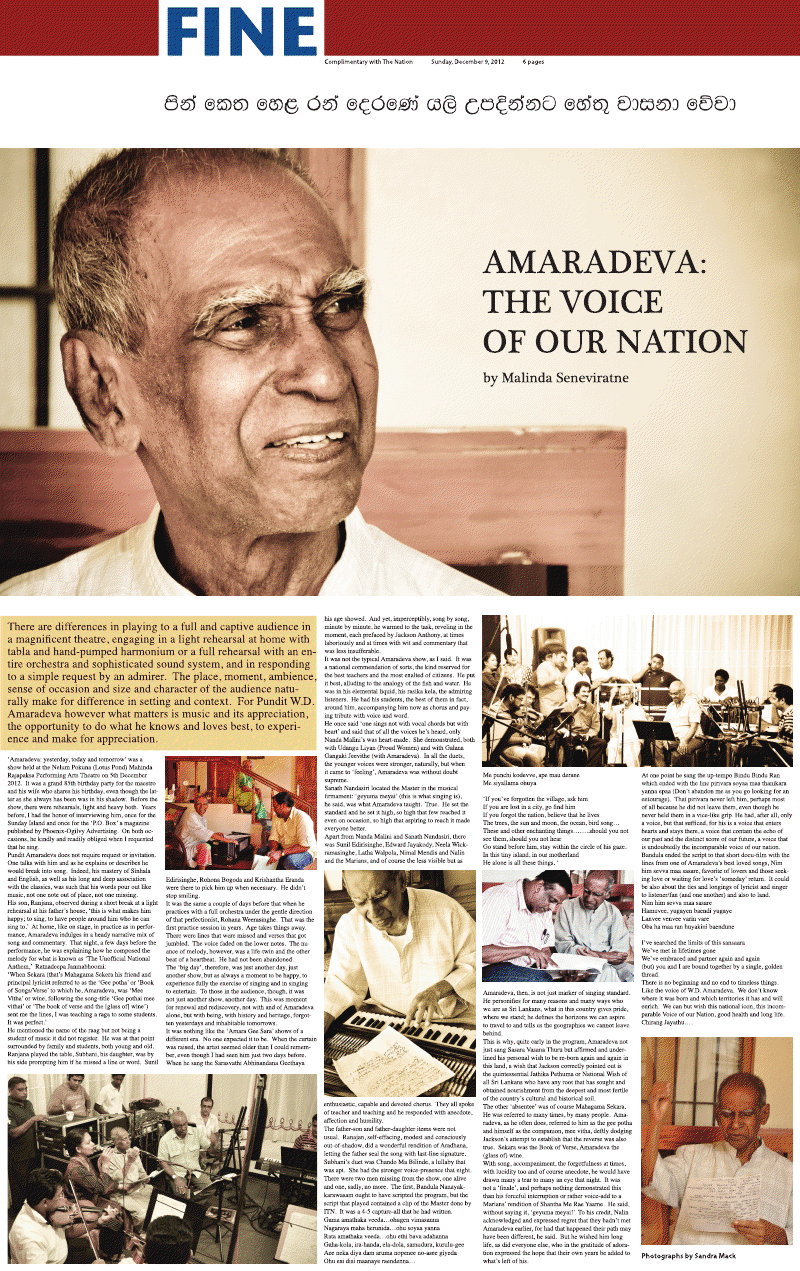
There are differences in playing to a full and captive audience in a magnificent theatre, engaging in a light rehearsal at home with table and hand-pumped harmonium or a full rehearsal with an entire orchestra and sophisticated sound system, and in responding to a simple request by an admirer. The place, moment, ambience, sense of occasion and size and character of the audience naturally make for difference in setting and context. For Pundit W.D. Amaradeva however what matters is music and its appreciation, the opportunity to do what he knows and loves best, to experience and make for appreciation.
‘Amaradeva: yesterday, today and tomorrow’ was a show held at the Nelum Pokuna Mahinda Rajapaksa Performing Arts Theater. It was a grand 85th birthday party for the maestro and his wife who shares his birthday, even though the latter as she always has been was in his shadow. Before the show, there were rehearsals, light and heavy both. Years before, I had the honor of interviewing him, once for the Sunday Island and once for the ‘P.O. Box’ a magazine published by Phoenix-Ogilvy Advertising. On both occasions, he kindly and readily obliged when I requested that he sing.
Pundit Amaradeva does not require request or invitation. One talks with him and as he explains or describes he would break into song. Indeed, his mastery of Sinhala and English, as well as his long and deep association with the classics, was such that his words pour out like music, not one note out of place, not one missing.
His son, Ranjana, observed during a short break at a light rehearsal at his father’s house, ‘this is what makes him happy; to sing, to have people around him who he can sing to.’ At home, like on stage, in practice as in performance, Amaradeva indulges in a heady narrative mix of song and commentary. That night, a few days before the performance, he was explaining how he composed the melody for what is known as ‘The Unofficial National Anthem,’ Ratnadeepa Janmabhoomi:
‘When Sekara (that’s Mahagama Sekera his friend and principal lyricist referred to as the ‘Gee potha’ or ‘Book of Songs/Verse’ to which he, Amaradeva, was ‘Mee Vitha’ or wine, following the song-title ‘Gee pothai mee vithai’ or ‘The book of verse and the [glass of] wine’) sent me the lines, I was teaching a raga to some students. It was perfect.’
He mentioned the name of the raag but not being a student of music it did not register. He was at that point surrounded by family and students, both young and old. Ranjana played the table, Subhani, his daughter, was by his side prompting him if he missed a line or word. Sunil Edirisinghe, Rohona Bulegoda and Krishantha Eranda were there to pick him up when necessary. He didn’t stop smiling.
It was the same a couple of days before that when he practices with a full orchestra under the gentle direction of that perfectionist, Rohana Weerasinghe. That was the first practice session in years. Age takes things away. There were lines that were missed and verses that got jumbled. The voice faded on the lower notes. The nuance of melody, however, was a life-twin and the other beat of a heartbeat. He had not been abandoned.
The ‘big day’, therefore, was just another day, just another show, but as always a moment to be happy, to experience fully the exercise of singing and in singing to entertain. To those in the audience, though, it was not just another show, another day. This was moment for renewal and rediscovery, not with and of Amaradeva alone, but with being, with history and heritage, forgotten yesterdays and inhabitable tomorrows.
It was nothing like the ‘Amara Gee Sara’ shows of a different era. No one expected it to be. When the curtain was raised, the artist seemed older than I could remember, even though I had seen him just two days before. When he sang the Sarasvathi AbhinandanaGeethaya his age showed. And yet, imperceptibly, song by song, minute by minute, he warmed to the task, reveling in the moment, each prefaced by Jackson Anthony, at times laboriously and at times with wit and commentary that was less insufferable.
It was not the typical Amaradeva show, as I said. It was a national commendation of sorts, the kind reserved for the best teachers and the most exalted of citizens. He put it best, alluding to the analogy of the fish and water. He was in his elemental liquid, his rasika kela, the admiring listeners. He had his students, the best of them in fact, around him, accompanying him now as chorus and paying tribute with voice and word.
He once said ‘one sings not with vocal chords but with heart’ and said that of all the voices he’s heard, only Nanda Malini’s was heart-made. She demonstrated, both with Udangu Liyan (Proud Women) and with Galana Gangaki Jeevithe (with Amaradeva). In all the duets, the younger voices were stronger, naturally, but when it came to ‘feeling’, Amaradeva was without doubt supreme.
Sanath Nandasiri located the Master in the musical firmament: ‘geyuma meyai’ (this is what singing is), he said, was what Amaradeva taught. True. He set the standard and he set it high, so high that few reached it even on occasion, so high that aspiring to reach it made everyone better.
Apart from Nanda Malini and Sanath Nandasiri, there was Victor Ratnayake, whose rendering of ‘Obe Namin Saeya Bandimi’ was probably the most exquisite piece of the evening. There was also Sunil Edirisinghe, Edward Jayakody, Neela Wickramasinghe, Latha Walpola, Nimal Mendis and Nalin and the Marians, and of course the less visible but as enthusiastic, capable and devoted chorus. They all spoke of teacher and teaching and he responded with anecdote, affection and humility.
The father-son and father-daughter items were not usual. Ranajan, self-effacing, modest and consciously out-of-shadow, did a wonderful rendition of Aradhana, letting the father seal the song with last-line signature. Subhani’s duet was Chando Ma Bilinde, a lullaby that was apt. She had the stronger voice-presence that night.
There were two men missing from the show, one alive and one, sadly, no more. The first, Bandula Nanayakkarawasam ought to have scripted the program, but the script that played contained a clip of the Master done by ITN. It was a 4-5 capture-all that he had written.
Gama amathaka veeda…ohugen vimasanna
Nagaraya maha herunida…ohu soyaa yanna Rata amathaka veeda…ohu ethi bava adahanna Gaha-kola, ira-handa, ela-dola, samudura, kurulu-gee Aee neka diya dam aruma nopenee no-asee giyeda Ohu esi disi maanaye raendenna… Me punchi kodevve, ape mau derane Me siyallama ohuya
‘If you’ve forgotten the village, ask him
If you are lost in a city, go find him If you forgot the nation, believe that he lives The trees, the sun and moon, the ocean, bird song… These and other enchanting things……..should you not see them, should you not hear Go stand before him, stay within the circle of his gaze. In this tiny island, in our motherland He alone is all these things. ‘
Amaradeva, then, is not just marker of singing standard. He personifies for many reasons and many ways who we are as Sri Lankans, what in this country gives pride, where we stand; he defines the horizons we can aspire to travel to and tells us the geographies we cannot leave behind.
This is why, quite early in the program, Amaradeva not just sang Sasara Vasana Thuru but affirmed and underlined his personal wish to be re-born again and again in this land, a wish that Jackson correctly pointed out is the quintessential Jathika Pethuma or National Wish of all Sri Lankans who have any root that has sought and obtained nourishment from the deepest and most fertile of the country’s cultural and historical soil.
The other ‘absentee’ was of course Mahagama Sekara. He was referred to many times, by many people. Amaradeva, as he often does, referred to him as the gee potha and himself as the companion, mee vitha, deftly dodging Jackson’s attempt to establish that the reverse was also true. Sekara was the Book of Verse, Amaradeva the (glass of) wine.
With song, accompaniment, the forgetfulness at times, with lucidity too and of course anecdote, he would have drawn many a tear to many an eye that night. It was not a ‘finale’, and perhaps nothing demonstrated this than his forceful interruption or rather voice-add to a Marians’ rendition of Shantha Me Rae Yaame. He said, without saying it, ‘geyuma meyai!’ To his credit, Nalin acknowledged and expressed regret that they hadn’t met Amaradeva earlier, for had that happened their path may have been different, he said. But he wished him long life, as did everyone else, who in the gratitude of adoration expressed the hope that their own years be added to what’s left of his.
At one point he sang the up-tempo Bindu Bindu Ran which ended with the line pirivara soyaa maa thanikara yanna epaa (Don’t abandon me as you go looking for an entourage). That pirivara never left him, perhaps most of all because he did not leave them, even though he never held them in a vice-like grip. He had, after all, only a voice, but that sufficed, for his is a voice that enters hearts and stays there, a voice that contain the echo of our past and the distinct score of our future, a voice that is undoubtedly the incomparable voice of our nation.
Bandula ended the script to that short docu-film with the lines from one of Amaradeva’s best loved songs, Nim him sevva maa sasare, favorite of lovers and those seeking love or waiting for love’s ‘someday’ return. It could be also about the ties and longings of lyricist and singer to listener/fan (and one another) and also to land.
Nim him sevva maa sasare
Hamuvee, yugayen baendi yugaye Lanvee venvee varin vare Oba ha maa ran huyakini baendune I’ve searched the limits of this sansaara We’ve met in lifetimes gone We’ve embraced and parted again and again (but) you and I are bound together by a single, golden thread.
There is no beginning and no end to timeless things. Like the voice of W.D. Amaradeva. We don’t know where it was born and which territories it has and will enrich. We can but wish this national icon, this incomparable Voice of our Nation, good health and long life. Chirang Jayathu….
A good hearted woman, Barbara Undershaft, devotes all energies to help the poor as a major in the Salvation Army. She sees Andrew, her millionaire father, an arms dealer, as someone who needs to be saved. At one point though, she is forced to accept a large contribution from the errant father to continue her work. In this story scripted by the playwright George Bernard Shaw, the woman who has to reexamine her moral assumptions started off with good intentions. Shaw, through her, brings to the fore the tensions between religion, wealth and power. It’s a story. Let’s have a couple more.
A rich wife-beater offers financial and other assistance to a women’s organization that runs a shelter for battered women. In fact it is he who sets it all up. The women, administrators and victims, know his history. They happily accept the cash, invite him for their events and celebrate him in this and other ways.
A rich drug lord sets up and funds a rehab facility for drug addicts. The administrators and the addicts know who he is and what he does. They don’t mind.
In both cases, there’s no room for examining moral assumptions for there are none. People know. No remorse.
Now let’s consider a racist with a genocidal history and a warmonger and thief to boot offering financial and other assistance to a group of people who, let’s say, claim to be against racism and dedicated to supporting inclusivity. The beneficiaries cannot really be forgiven for being ignorant. They ought to know. What of their moral assumptions, then?
How could a country or a collective of nations with a long yesterday of genocide and plunder and a very-much-alive present of slavery, warring, warmongering, racism, subjugation of other lands and peoples, exploitation and plunder within these countries and elsewhere as well, have any moral authority to talk of peace or inclusivity? How could anyone with any moral sense accept without question any help from such entities?
No, this is not a story. Neither is it the script of a well-informed and politically conscious playwright intent on using theatre as a site for transformational activism. This is the European Union. This is the European Union in Sri Lanka. And this is about Sri Lankans who dare not question or else are disingenuous themselves.
Now if anyone perceives injustice of any kind and resolves to address it, applause is warranted, provided of course that selectivity, tall claims and their exaggeration, suppression of truth etc., aren’t part of the story. If the corrector plays end-justifies-the-means, such a person’s morality calls for scrutiny.
The European Union. What a creature it is! Colonialism. Slavery. Persecution. Genocide. Outright plunder. All that and more. The European Union today is made of countries where racial discrimination and harassment is not only commonplace but becoming worse by the day. The European Union supports Nazis in Ukraine. The European Union supports, funds, arms and trains death-machines run by monarchies, military juntas and dictators all over the world. Racism, xenophobia, homo/transphobia are rampant in the European Union. And it’s not just extremists indulging in the odd attack we are talking about. It’s structure. It’s systemic. It is evident in institutions, law enforcement and the overall criminal justice system. And mind you, the European Union admits that nine in ten hate crimes and hate-motivated attacks in the region are not even reported and therefore not sanctioned.
And yet, the European Union thinks fit to conduct tuition classes in Sri Lanka to Sri Lankans about racism and exclusionary politics. And yet Sri Lankans, individuals and collectives, who benefit from the magnanimity of the European Union utter not one word about the irony of it all.
The European Union believes that Sri Lanka is a country that needs peace and inclusivity. Sure, why not? Sri Lanka is not paradise after all and there’s always room for improvement. However, if inclusivity is, say, about one race having one vote or one faith having one vote, that’s dodgy. If inclusivity and peace are about insisting that all Sri Lankans inhabit some European version of Sri Lankan reality, that’s dodgy too.
If it is about forcing the entire population to enact or abide by legislation based on wild claims made by terrorists, that’s also dodgy. If peace is about a system and situation that enables the continuous exploitation of a people by a particular class or the ceding of national interests to strategic designs of the USA and the EU, that’s warlike and should be read as such. If beneficiaries of this love, understanding and magnanimity of the European Union want to talk peace and inclusivity without questioning the credentials of the European Union on these matters, then they are either super-naive or absolute pawns of European and North American designs for Sri Lanka, the region and the world.
It is beautiful to be romantic about peace and inclusion. It is even necessary to be idealistic about such things. However if politics stops there, it is irresponsible and, as history has shown, even pernicious.
Let’s flip it. Let us hope the do-gooders who are wide-eyed about the European Union shed myopia and start a fund, poor though they may be, to support groups that work tirelessly to bring about peace and inclusivity in the member states of the European Union. Let’s hope those who represent the European Union stop navel-gazing and political clowning and offer free tuition classes to anyone interested about the past and present of those countries, especially with regard to peace (or rather war) and inclusivity (or rather exclusionist realities).
In a remarkable interfaith gesture, a coalition of Christian-Hindu-Buddhist faith leaders is seeking apology from singer-songwriter Taylor Swift for trivializing karma”, a serious and ancient religious doctrine of Hindus and Buddhists, calling it highly inappropriate.
Senior Episcopal priest in Connecticut Father Thomas W. Blake, Hindu statesman Rajan Zed, renowned Buddhist priest Rev. Matthew T. Fisher, Senior United Methodist Pastor Rev. Dawn M. Blundell; in a joint statement today in USA, said that while Hindu and Buddhist seekers and devotees took the concept of karma very seriously; Swift seemed to have irreverently trivialized it in her Karma” song in newly released album Midnights”.
Swift handled karma” frivolously; equating karma with a boyfriend, cat purring on the lap, guy on the screen, breeze in hair, etc.; and included a lot of cursing in the Karma” song; Blake, Zed, Fisher, Blundell stressed.
Doctrine of karma had been pervasive in Hindu thought for thousands of years and found expression in ancient Hindu scriptures like Brhadaranyaka–Chandogya– Shvetashvatara and other Upanishads, Bhagavad-Gita, Puranas, Dharmasastra, Shatapatha Brahmana; and various sages delved into it. Even Lord Krishna in ancient Bhagavad-Gita talked about karma yoga, the active path of selfless service. But Swift treated it very flippantly, without any regard to the feelings of devotees; Rajan Zed, who is President of Universal Society of Hinduism, indicated.
Rev. Fisher emphasizes that a 2,600-year-old faith should not be trivialized for profit, but Swift chose to debase and thus harm the entire Buddhist tradition with her ignorant cultural appropriation in this deeply careless and hurtful song. In the Pali sutra, “The Great Exposition of Karma”, Lord Buddha clearly shows that the Law of Karma is the most powerful natural law in the universe and sentient beings ignore it at their peril. Our actions plant seeds and those seeds bear fruit.
We welcome Swift’s belief in karma, which seems like having a colossal place in Swift’s cosmos; but she should have handled the concept more appropriately, responsibly and thoughtfully; giving due respect to the emotions of Hindus and Buddhists spread worldwide, who take karma very seriously; Christian, Hindu, Buddhist leaders note.
Singers-songwriters should not be in the business of trivializing serious spiritual concepts, religious appropriation and sacrilege. Insensitive handling of faith traditions sometimes resulted in pillaging serious spiritual doctrines and revered symbols, and thus hurting the devotees; Blake, Zed, Fisher, Blundell stated.
Rajan Zed further said that Hindus welcomed the entertainers to immerse in Hinduism and create projects about/around Hindu doctrines; but taking it seriously and respectfully and not for refashioning/redefining Hinduism concepts and symbols, as mentioned in the scriptures, for personal agendas. Moreover, any misrepresentation also created confusion among non-Hindus about Hinduism. He or other Hindu scholars would gladly help if industry needed any assistance in exploring Hinduism, Zed added.
Christian, Hindu, Buddhist leaders pointed out that they were for free artistic expression and speech as much as anybody else if not more. But faith was something sacred and attempts at trivializing it displayed callousness towards the feelings of adherents.
Hinduism was the oldest and third largest religion of the world with about 1.2 billion adherents and a rich philosophical thought and it should not be taken frivolously. No faith, larger or smaller, should be mishandled, Zed added.
Lyrics of Karma” include: karma is my boyfriend”, karma is the breeze in my hair on the weekend”, karma is a cat purring in my lap…flexing like a goddamn acrobat”, karma is the guy on the screen”, etc.
Karma” is track 11 on Midnights”, the tenth studio album by American singer-songwriter Taylor Swift, released on October 21 via Republic Records. Her online store is selling “KARMA is my boyfriend” (Cropped Ringer t-shirts) for $40 each.
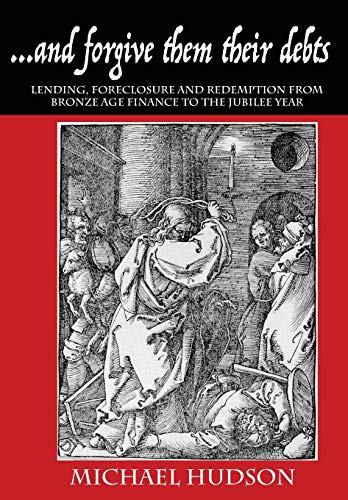
Germany has become an economic satellite of America’s New Cold War with Russia, China and the rest of Eurasia. Germany and other NATO countries have been told to impose trade and investment sanctions upon themselves that will outlast today’s proxy war in Ukraine. U.S. President Biden and his State Department spokesmen have explained that Ukraine is just the opening arena in a much broader dynamic that is splitting the world into two opposing sets of economic alliances. This global fracture promises to be a ten- or twenty-year struggle to determine whether the world economy will be a unipolar U.S.-centered dollarized economy, or a multipolar, multi-currency world centered on the Eurasian heartland with mixed public/private economies.
President Biden has characterized this split as being between democracies and autocracies. The terminology is typical Orwellian double-speak. By democracies” he means the U.S. and allied Western financial oligarchies. Their aim is to shift economic planning out of the hands of elected governments to Wall Street and other financial centers under U.S. control. U.S. diplomats use the International Monetary Fund and World Bank to demand privatization of the world’s infrastructure and dependency on U.S. technology, oil and food exports.
By autocracy,” Biden means countries resisting this financialization and privatization takeover. In practice, U.S. rhetoric accuses China of being autocratic in regulating its economy to promote its own economic growth and living standards, above all by keeping finance and banking as public utilities to promote the tangible production-and-consumption economy. What basically is at issue is whether economies will be planned by banking centers to create financial wealth – by privatizing basic infrastructure, public utilities and social services such as health care into monopolies – or by raising living standards and prosperity by keeping banking and money creation, public health, education, transportation and communications in public hands.
The country suffering the most collateral damage” in this global fracture is Germany. As Europe’s most advanced industrial economy, German steel, chemicals, machinery, automotives and other consumer goods are the most highly dependent on imports of Russian gas, oil and metals from aluminum to titanium and palladium. Yet despite two Nord Stream pipelines built to provide Germany with low-priced energy, Germany has been told to cut itself off from Russian gas and de-industrialize. This means the end of its economic preeminence. The key to GDP growth in Germany, as in other countries, is energy consumption per worker.
These anti-Russian sanctions make today’s New Cold War inherently anti-German. U.S. Secretary of State Anthony Blinken has said that Germany should replace low-priced Russian pipeline gas with high-priced U.S. LNG gas. To import this gas, Germany will have to spend over $5 billion quickly to build port capacity to handle LNG tankers. The effect will be to make German industry uncompetitive. Bankruptcies will spread, employment will decline, and Germany’s pro-NATO leaders will impose a chronic depression and falling living standards.
Most political theory assumes that nations will act in their own self-interest. Otherwise they are satellite countries, not in control of their own fate. Germany is subordinating its industry and living standards to the dictates of U.S. diplomacy and the self-interest of America’s oil and gas sector. It is doing this voluntarily – not because of military force but out of an ideological belief that the world economy should be run by U.S. Cold War planners.
Sometimes it is easier to understand today’s dynamics by stepping away from one’s own immediate situation to look at historical examples of the kind of political diplomacy that one sees splitting today’s world. The closest parallel that I can find is medieval Europe’s fight by the Roman papacy against German kings – the Holy Roman Emperors – in the 13th century. That conflict split Europe along lines much like those of today. A series of popes excommunicated Frederick II and other German kings and mobilized allies to fight against Germany and its control of southern Italy and Sicily.
Western antagonism against the East was incited by the Crusades (1095-1291), just as today’s Cold War is a crusade against economies threatening U.S. dominance of the world. The medieval war against Germany was over who should control Christian Europe: the papacy, with the popes becoming worldly emperors, or secular rulers of individual kingdoms by claiming the power to morally legitimize and accept them.
Medieval Europe’s analogue to America’s New Cold War against China and Russia was the Great Schism in 1054. Demanding unipolar control over Christendom, Leo IX excommunicated the Orthodox Church centered in Constantinople and the entire Christian population that belonged to it. A single bishopric, Rome, cut itself off from the entire Christian world of the time, including the ancient Patriarchates of Alexandria, Antioch, Constantinople and Jerusalem.
This break-away created a political problem for Roman diplomacy: How to hold all the Western European kingdoms under its control and claim the right for financial subsidy from them. That aim required subordinating secular kings to papal religious authority. In 1074, Gregory VII, Hildebrand, announced 27 Papal Dictates outlining the administrative strategy for Rome to lock in its power over Europe.
These papal demands are strikingly parallel to today’s U.S. diplomacy. In both cases military and worldly interests require a sublimation in the form of an ideological crusading spirit to cement the sense of solidarity that any system of imperial domination requires. The logic is timeless and universal.
The Papal Dictates were radical in two major ways. First of all, they elevated the bishop of Rome above all other bishoprics, creating the modern papacy. Clause 3 ruled that the pope alone had the power of investiture to appoint bishops or to depose or reinstate them. Reinforcing this, Clause 25 gave the right of appointing (or deposing) bishops to the pope, not to local rulers. And Clause 12 gave the pope the right to depose emperors, following Clause 9, obliging all princes to kiss the feet of the Pope alone” in order to be deemed legitimate rulers.
Likewise today, U.S. diplomats claim the right to name who should be recognized as a nation’s head of state. In 1953 they overthrew Iran’s elected leader and replaced him with the Shah’s military dictatorship. That principle gives U.S. diplomats the right to sponsor color revolutions” for regime-change, such as their sponsorship of Latin American military dictatorships creating client oligarchies to serve U.S. corporate and financial interests. The 2014 coup in Ukraine is just the latest exercise of this U.S. right to appoint and depose leaders.
More recently, U.S. diplomats have appointed Juan Guaidó as Venezuela’s head of state instead of its elected president, and turned over that country’s gold reserves to him. President Biden has insisted that Russia must remove Putin and put a more pro-U.S. leader in his place. This right” to select heads of state has been a constant in U.S. policy spanning its long history of political meddling in European political affairs since World War II.
The second radical feature of the Papal Dictates was their exclusion of all ideology and policy that diverged from papal authority. Clause 2 stated that only the Pope could be called Universal.” Any disagreement was, by definition, heretical. Clause 17 stated that no chapter or book could be considered canonical without papal authority.
A similar demand as is being made by today’s U.S.-sponsored ideology of financialized and privatized free markets,” meaning deregulation of government power to shape economies in interests other than those of U.S.-centered financial and corporate elites.
The demand for universality in today’s New Cold War is cloaked in the language of democracy.” But the definition of democracy in today’s New Cold War is simply pro-U.S.,” and specifically neoliberal privatization as the U.S.-sponsored new economic religion. This ethic is deemed to be science,” as in the quasi-Nobel Memorial Prize in the Economic Sciences. That is the modern euphemism for neoliberal Chicago-School junk economics, IMF austerity programs and tax favoritism for the wealthy.
The Papal Dictates spelt out a strategy for locking in unipolar control over secular realms. They asserted papal precedence over worldly kings, above all over Germany’s Holy Roman Emperors. Clause 26 gave popes authority to excommunicate whomever was not at peace with the Roman Church.” That principle implied the concluding Claus 27, enabling the pope to absolve subjects from their fealty to wicked men.” This encouraged the medieval version of color revolutions” to bring about regime change.
What united countries in this solidarity was an antagonism to societies not subject to centralized papal control – the Moslem Infidels who held Jerusalem, and also the French Cathars and anyone else deemed to be a heretic. Above all there was hostility toward regions strong enough to resist papal demands for financial tribute.
Today’s counterpart to such ideological power to excommunicate heretics resisting demands for obedience and tribute would be the World Trade Organization, World Bank and IMF dictating economic practices and setting conditionalities” for all member governments to follow, on pain of U.S. sanctions – the modern version of excommunication of countries not accepting U.S. suzerainty. Clause 19 of the Dictates ruled that the pope could be judged by no one – just as today, the United States refuses to subject its actions to rulings by the World Court. Likewise today, U.S. dictates via NATO and other arms (such as the IMF and World Bank) are expected to be followed by U.S. satellites without question. As Margaret Thatcher said of her neoliberal privatization that destroyed Britain’s public sector, There Is No Alternative (TINA).
My point is to emphasize the analogy with today’s U.S. sanctions against all countries not following its own diplomatic demands. Trade sanctions are a form of excommunication. They reverse the 1648 Treaty of Westphalia’s principle that made each country and its rulers independent from foreign meddling. President Biden characterizes U.S. interference as ensuring his new antithesis between democracy” and autocracy.” By democracy he means a client oligarchy under U.S. control, creating financial wealth by reducing living standards for labor, as opposed to mixed public/private economies aiming at promoting living standards and social solidarity.
As I have mentioned, by excommunicating the Orthodox Church centered in Constantinople and its Christian population, the Great Schism created the fateful religious dividing line that has split the West” from the East for the past millennium. That split was so important that Vladimir Putin cited it as part of his September 30, 2022 speech describing today’s break away from the U.S. and NATO centered Western economies.
The 12th and 13th centuries saw Norman conquerors of England, France and other countries, along with German kings, protest repeatedly, be excommunicated repeatedly, yet ultimately succumb to papal demands. It took until the 16th century for Martin Luther, Zwingli and Henry VIII finally to create a Protestant alternative to Rome, making Western Christianity multi-polar.
Why did it take so long? The answer is that the Crusades provided an organizing ideological gravity. That was the medieval analogy to today’s New Cold War between East and West. The Crusades created a spiritual focus of moral reform” by mobilizing hatred against the other” – the Moslem East, and increasingly Jews and European Christian dissenters from Roman control. That was the medieval analogy to today’s neoliberal free market” doctrines of America’s financial oligarchy and its hostility to China, Russia and other nations not following that ideology. In today’s New Cold War, the West’s neoliberal ideology is mobilizing fear and hatred of the other,” demonizing nations that follow an independent path as autocratic regimes.” Outright racism is fostered toward entire peoples, as evident in the Russophobia and Cancel Culture currently sweeping the West.
Just as Western Christianity’s multi-polar transition required the 16th century’s Protestant alternative, the Eurasian heartland’s break from the bank-centered NATO West must be consolidated by an alternative ideology regarding how to organize mixed public/private economies and their financial infrastructure.
Medieval churches in the West were drained of their alms and endowments to contribute Peter’s Pence and other subsidy to the papacy for the wars it was fighting against rulers who resisted papal demands. England played the role of major victim that Germany plays today. Enormous English taxes were levied ostensibly to finance the Crusades were diverted to fight Frederick II, Conrad and Manfred in Sicily. That diversion was financed by papal bankers from northern Italy (Lombards and Cahorsins), and became royal debts passed down throughout the economy. England’s barons waged a civil war against Henry II in the 1260s, ending his complicity in sacrificing the economy to papal demands.
What ended the papacy’s power over other countries was the ending of its war against the East. When the Crusaders lost Acre, the capital of Jerusalem in 1291, the papacy lost its control over Christendom. There was no more evil” to fight, and the good” had lost its center of gravity and coherence. In 1307, France’s Philip IV (the Fair”) seized the Church’s great military banking order’s wealth, that of the Templars in the Paris Temple. Other rulers also nationalized the Templars, and monetary systems were taken out of the hands of the Church. Without a common enemy defined and mobilized by Rome, the papacy lost its unipolar ideological power over Western Europe.
The modern equivalent to the rejection of the Templars and papal finance would be for countries to withdraw from America’s New Cold War. They would reject the dollar standard and the U.S. banking and financial system. that is happening as more and more countries see Russia and China not as adversaries but as presenting great opportunities for mutual economic advantage.
The broken promise of mutual gain between Germany and Russia
The dissolution of the Soviet Union in 1991 promised an end to the Cold War. The Warsaw Pact was disbanded, Germany was reunified, and American diplomats promised an end to NATO, because a Soviet military threat no longer existed. Russian leaders indulged in the hope that, as President Putin expressed it, a new pan-European economy would be created from Lisbon to Vladivostok. Germany in particular was expected to take the lead in investing in Russia and restructuring its industry along more efficient lines. Russia would pay for this technology transfer by supplying gas and oil, along with nickel, aluminum, titanium and palladium.
There was no anticipation that NATO would be expanded to threaten a New Cold War, much less that it would back Ukraine, recognized as the most corrupt kleptocracy in Europe, into being led by extremist parties identifying themselves by German Nazi insignia.
How do we explain why the seemingly logical potential of mutual gain between Western Europe and the former Soviet economies turned into a sponsorship of oligarchic kleptocracies. The Nord Stream pipeline’s destruction capsulizes the dynamics in a nutshell. For almost a decade a constant U.S. demand has been for Germany to reject its reliance on Russian energy. These demands were opposed by Gerhardt Schroeder, Angela Merkel and German business leaders. They pointed to the obvious economic logic of mutual trade of German manufactures for Russian raw materials.
The U.S. problem was how to stop Germany from approving the Nord Stream 2 pipeline. Victoria Nuland, President Biden and other U.S. diplomats demonstrated that the way to do that was to incite a hatred of Russia. The New Cold War was framed as a new Crusade. That was how George W. Bush had described America’s attack on Iraq to seize its oil wells. The U.S.-sponsored 2014 coup created a puppet Ukrainian regime that has spent eight years bombing of the Russian-speaking Eastern provinces. NATO thus incited a Russian military response. The incitement was successful, and the desired Russian response was duly labeled an unprovoked atrocity. Its protection of civilians was depicted in the NATO-sponsored media as being so offensive as to deserve the trade and investment sanctions that have been imposed since February. That is what a Crusade means.
The result is that the world is splitting in two camps: the U.S.-centered NATO, and the emerging Eurasian coalition. One byproduct of this dynamic has been to leave Germany unable to pursue the economic policy of mutually advantageous trade and investment relations with Russia (and perhaps also China). German Chancellor Olaf Sholz is going to China this week to demand that it dismantle is public sector and stops subsidizing its economy, or else Germany and Europe will impose sanctions on trade with China. There is no way that China could meet this ridiculous demand, any more than the United States or any other industrial economy would stop subsidizing their own computer-chip and other key sectors.[1] The German Council on Foreign Relations is a neoliberal libertarian” arm of NATO demanding German de-industrialization and dependency on the United States for its trade, excluding China, Russia and their allies. This promises to be the final nail in Germany’s economic coffin.
Another byproduct of America’s New Cold War has been to end any international plan to stem global warming. A keystone of U.S. economic diplomacy is for its oil companies and those of its NATO allies to control the world’s oil and gas supply – that is, to oppose attempts reduce dependence on carbon-based fuels. The NATO war in Iraq, Libya, Syria, Afghanistan and Ukraine was about the United States (and its French, British and Dutch allies) keeping control of oil. This is not as abstract as Democracies vs. Autocracies.” It is about the U.S. ability to harm other countries by disrupting their access to energy and other basic needs.
Without the New Cold War’s good vs. evil” narrative, U.S. sanctions will lose their raison d’etre in this U.S. attack on environmental protection, and on mutual trade between Western Europe and Russia and China. That is the context for today’s fight in Ukraine, which is to be merely the first step in the anticipated 20 year fight by the US to prevent the world from becoming multipolar. This process, will lock Germany and Europe into dependence on the U.S. supplies of LNG.
The trick is to try and convince Germany that it is dependent on the United States for its military security. What Germany really needs protection from is the U.S. war against China and Russia that is marginalizing and Ukrainianizing” Europe.
There have been no calls by Western governments for a negotiated end to this war, because no war has been declared in Ukraine. The United States does not declare war anywhere, because that would require a Congressional declaration under the U.S. Constitution. So U.S. and NATO armies bomb, organize color revolutions, meddle in domestic politics (rendering the 1648 Westphalia agreements obsolete), and impose the sanctions that are tearing Germany and its European neighbors apart.
How can negotiations end” a war that has no declaration of war, and is a long-term strategy of total unipolar world domination?
The answer is that no ending can come until an alternative to the present U.S.-centered set of international institutions is replaced. That requires the creation of new institutions reflecting an alternative to the neoliberal bank-centered view that economies should be privatized with central planning by financial centers. Rosa Luxemburg characterized the choice as being between socialism and barbarism. I have sketched out the political dynamics of an alternative in my recent book, The Destiny of Civilization.
This paper was presented on November 1, 2022. on the German e-site Brave New Europe. A video of my talk will be available on YouTube in about ten days.
Colombo, Nov 3 (AdaDerana) – Russia’s largest charter airline — Azur Air and the flag carrier of France — Air France, will resume flights to Sri Lanka starting from this week, according to Sri Lanka’s Tourism Ministry.
Azur Air will commence flights to Sri Lanka from tomorrow (November 03) while Air France is scheduled to resume flights from Friday (November 04).
Meanwhile in a twitter message today, Tourism Minister Harin Fernando announced that Switzerland’s national airline, Swiss International Air Lines, is now staring operations in Sri Lanka once again with weekly flights starting from November 10 to May2023.
He said this will further strengthen the European arrivals for the season.
Russian airlines have not been flying to Sri Lanka since early June, when an A330-300 operated by Aeroflot was briefly detained due to a dispute with lessor AerCap‘s special purpose vehicle Celestial Aviation Trading Limited.
Even though the court quickly released the aircraft and the Sri Lankan government guaranteed that no further seizures would be made in the country, Russian airlines had been reluctant to return to the island.
However, Russia’s flagship carrier Aeroflot last month resumed flights between Moscow and Colombo after a lapse of 4 months.
Meanwhile Minister Fernando had tweeted recently that Air France and KLM Airlines will resume flights to Colombo, and the said airlines will operate four flights a week to Sri Lanka.