I enclose a 2010 writeup on what we did achieve in the Marketing Department. Perhaps this may move our Prime Minister to Act to establish a Marketing Department today.
[ Price fixing] * Prices at main producer fairs closely monitored * Prices vary on quantities coming in * Prices informed by telegram and telephone * Floor prices offered with establishment of canning industry * Marketing Department exported canned pineapple
Working in trade required dependable and trusted officers. In addition there were around a dozen Marketing Officers. Kulasingham was at the Colombo wholesale market and the others were all in charge of the internal units. We had around eight cold rooms where we could store vegetables and my office staff was housed over the cold rooms. It comprised one Chief Clerk and some eight clerks and though their duty was confined to paperwork I would drag one of them to attend to the work of a Marketing Officer whenever necessary.
There was always a never-ending train of people who came to purchase vegetables. There were friends who would come to purchase goods and also call on me, whom I had to greet and entertain, at least by being with them for some time, inviting them to sit in my room and always something or other cropped up for me to leave them because there was always a problem that required immediate personal attention.
Consumer fairs
Fixing prices for the next day’s purchases was done by me, based on the prices prevalent at the wholesale market in Colombo, the prices at the main Fairs in the island as reported by the outstation Assistant Commissioners. The prices at all main producer fairs like Embilipitiya, Colombage Ara, Kekirawa, Welimada, Bandarawela were closely monitored, as well as the prices at the consumer fairs in Colombo, Kandy and other cities.
Competition among traders will result in stable prices.
The problem was that the prices varied even during the day depending on the quantities that came in. We always tried to fix a price above the prices reported at the producer fairs, if our margin often to fifteen percent enabled us to sell at a price below the Colombo market price. The Assistant Commissioners were informed of the prices by telegram and telephone. Those were days when we had telephones only in District Offices and outstation officers had to wait a long time at post offices to get a call to inform the prices to the Tripoli Market.
At times I would go to the office of the Government Agent as his phone always got priority and the telephone exchange would connect me at once. I can also recall the telephone I had at my Ambalantota Office where when I wanted a telephone call I had to wind my phone endless to get through to the postmaster at Ambalantota. Thereafter I had to wait for hours to get a connection. In today’s mobile telephone situation it would be very easy to work the system.
Tripoli Market
Deciding on the price to purchase goods was a hard task. We had to purchase islandwide and we were never certain whether we would be able to cover up transport and handling costs. The Assistant Commissioners in the Districts could use their discretion to increase or decrease prices, in keeping with availability. Tripoli Market required a minimum quantity and if the producers brought in less quantities to the Fairs our prices had to get adjusted upwards.
If large quantities were brought the prices had to get adjusted downwards because otherwise we would have to purchase a quantity that we cannot handle. It was a quick decision that had to be made and we had to face the consequences. There was no time to write down reasons and I wonder how the COPE Audits would have taken up the matter.
At times on certain consignments we incurred a loss, that had to be covered by a profit on the next day. It was a case of walking on a single tight rope. We dared and generally acquitted ourselves creditably well. Commissioner Fernando was a Chartered Accountant and every move by the Assistant Commissioners was under close surveillance. He kept in touch with the staff and would guide us in a most masterly manner. Trade was in his veins and gradually we learned the art of deciding the right price.
Working in charge of Tripoli Market was demanding at all times and I was happy when after a year’s time I got posted to Anuradhapura. The entire Marketing Department, involved other activities like the purchase of paddy under the Guaranteed Price Scheme for paddy and other cereals and Rice Milling. On the whole there was a total staff of around 3,000. We had a very efficient Transport Officer in Fonseka. A hundred lorries were on the incessant move.
The canning factory
The Marketing Department established a full fledged Canning Factory in the Fifties where we did experiments in processing fruits into jam and juice. Sri Lanka was then importing large stocks of jam and juice from Australia and the aim was to make jam and juice to enable us to stop imports. Under Alles and Pathmaperuma, the canning factory became fully functional. We tried various fruits. We even purchased guavas from the guava belt in Balangoda to Belihul Oya – where guavas grew wild. With the establishment of this canning factory the Department was able to offer Floor Prices for items like pineapples, ash pumpkin and red pumpkin.
A Floor Price meant that we purchased the total stock offered. Red pumpkin was the base to make golden melon jam and ash pumpkin the base to make silver melon jam. The producers of these varieties benefited from the floor prices because we would purchase their entire stock. As a result we became self sufficient in all jam, jelly and fruit juice. The fruit juice was orange. Today my blood boils to see the shelves of supermarkets full of orange juice from California!
My mind raves with the loss of production, the unemployment our people suffer and the loss of our valued foreign exchange in imports. Down came the IMF axe of privatization and the canning factory was privatized. Floor prices are no more for the producers.
Today in the remote areas pineapples, red and ash pumpkin cannot be sold at all during the season. They fetch very low prices. Many a producer has told me that their produce has had to be buried. Silver melon jam and golden melon jam are long forgotten. Imports have taken their place. Today thanks to the UNP and the IMF policies we are creating employment for people in the Developed Countries while our people remain unemployed.
Export trade
The Marketing Department was even successful in establishing an export trade in canned pineapple. Sri Lanka has the Mauritius variety of pineapple which is far tastier than the larger, Nav (Ship) Variety which is produced all over the world. In Hawaii I visited the DelMonte Canning Factory and saw Nav pineapple being canned. Our Marketing Department canning factory can easily stand comparison to the Canning Factory I saw in Hawaii. Our Mauritius pineapple variety is far tastier than the Nav pineapple variety produced in other parts of the world. After the demise of the Marketing Department, exports of pineapple died a natural death – a loss of valuable foreign exchange. The privatized cannery now even imports fruit
A couple of days ago, I realized that I was unable to buy any stocks using the platform access given to me by the broker firm, and when they were contacted immediately to know the reason why my ability to buy was brought to near zero rupees, the reply I received was astonishing and alarming.
My current portfolio is worth a couple of million rupees and has a healthy unrealized gain worth another couple of million rupees, yet the broker firm was not willing to give me any usable buying power.
The reason they give is that many have bought shares on credit and are not willing to settle their dues.
When asked as to why not “Force Sell” available shares of such people and recover dues, they had no answer.
I have spoken to a few more stockbroker firms and they all have the same song to play, which means that there is a very big credit exposure across the board but either instructions or guidance received from the governing body regulating the market activities and or their own management not to restore to Force selling to avoid a meltdown of the market in a couple of days.
If that is the case and real investors realize the same (not gamblers), the 5% safety barrier currently in place in the system will not be able to cope with the situation, unless the market is kept closed for an indefinite time to cool off at its own time and pace.
Finally, among all the negative news swirling around, it was a sad thing to know that we have finally reached the Catch-22 situation in investing too.
With the aim of increasing bilateral trade and mutual economic cooperation, special attention must be paid to the ‘Middle East’. Bangladesh seeks cooperation in at least 12 sectors from the top ten countries of the Arab world or the Middle East to overcome the ongoing power and energy crisis, the impact of the Russia-Ukraine war and the financial loss of the epidemic corona. One of these is the power and energy sector.
Maximum emphasis has been placed on easy terms of investment and energy imports from the Middle East in this sector. In addition to this, the government is interested in new manpower exports and product exports to collect remittances, one of the sources of foreign exchange. A meeting of Bangladesh-Saudi Arabia Joint Commission (JC) has been called in Riyadh, Saudi Arabia by the end of this month.
Looking ahead to that meeting, Saudi Arabia wanted to know what kind of cooperation Bangladesh wants to increase bilateral trade. The Economic Relations Department (ERD) will present an outline of economic cooperation and investment at the JC meeting itself.
It is known that assistance will be sought from the Middle East to resolve the ongoing power and energy crisis. Frequent load-shedding and rising prices of all types of fuel have increased the cost of production in the country. Its biggest impact is noticeable in inflation. In addition to this, the majority of remittances come from Middle Eastern countries. Due to this reason, the stakeholders have urged to increase mutual economic cooperation and bilateral trade with the Middle East. More than 80 percent of the fuel oil used in Bangladesh is imported from some countries in the Middle East including Saudi Arabia.
Similarly, most remittances are being extracted by exporting unskilled manpower to Middle Eastern countries. Most of the fertilizers used in agricultural production are imported from the Middle East. But the economy of Bangladesh is under pressure due to the ongoing global crisis and the increase in dollar prices. Inflation is increasing.
In this situation, the dollar crisis and the increase in the price of all types of fuel are making it more difficult to maintain the continuity of production. As a result, there is increasing load shedding and disruption of production. Initiatives have been taken to increase mutual cooperation with Middle East countries to overcome the current situation. Bangladesh is dreaming of developing economic relations with the Middle East.
The government is preparing to attend the 14th JC meeting to be held in Riyadh, Saudi Arabia on October 30-31. Bangladesh will be represented in that meeting by high-level representatives of the Economic Relations Department of the Ministry of Finance. Before attending the meeting, ERD held several inter-ministerial meetings on the initiative of the Ministry of Finance.
In these meetings, economic relations with other countries of the Middle East, including Saudi Arabia, have been urged to be strengthened and bilateral trade increased. Besides, cooperation in 12 sectors will be sought from the Middle East. These include development of bilateral economic and trade relations, manpower, employment and consular, private aviation, tourism and cultural, investment, Abu Dhabi Development Fund, electricity, energy and mineral resources, information and communication technology sector, education, science and technology sector, marine environment. Cooperation in development, agriculture, healthcare and health education sectors and humanitarian and charitable assistance is one of them.
Saudi Arabia has already expressed its positive attitude towards increasing cooperation with Bangladesh. Not only that, Bangladesh-Saudi Arabia has signed several agreements and memoranda of understanding to increase bilateral trade and investment. In addition, bilateral trade and economic cooperation with Saudi Arabia will be increased with the United Arab Emirates, Qatar, Bahrain, Oman, Iraq, Kuwait, Lebanon, Egypt and Turkey.
An official letter has been given to these countries by the Commercial Counselor of Bangladesh Embassy abroad to increase bilateral trade and manpower export. Besides, the government has taken a special initiative from the Middle East Branch-1 of the Economic Relations Department (ERD). An outline in this regard will also be presented in the JC meeting to be held with Saudi Arabia. Bangladesh Investment Development Authority (BIDA) has a separate program around the Middle East.
Saudi Arabia has already been informed about ensuring one-stop service from the bidder’s side. ERD believes that if mutual economic cooperation with Saudi Arabia, the top country of the Arab world, increases, bilateral trade with other countries in the Middle East will also increase.
And for this reason, preparations are being made vigorously in front of the 14th JC meeting. A high-level delegation from Bangladesh is expected to participate in the meeting. In this regard, Finance Minister AHM Mustafa Kamal said that currently there is an excellent environment for investment in Bangladesh. There is considerable potential for investment on Public-Private Partnership (PPP) basis, particularly in major infrastructure, information technology, communication, agriculture, power and energy, medical sectors.
Middle East entrepreneurs including Saudi Arabia can take investment opportunities in those sectors if they wish. Professional, skilled, semi-skilled and unskilled manpower is still in great demand in the Arab world. Middle East countries can take huge manpower from Bangladesh if they want. He said that the country’s electricity and energy sector needs investment and cooperation from the Middle East, including Saudi Arabia. To deal with the ongoing crisis, the government will take the cooperation of Saudi Arabia and other countries in the power and energy sector.
According to Bangladesh Petroleum Corporation or BPC data, the country imports 6.5 million tons of fuel oil annually. Of that, 4 million tons of diesel is imported annually. More than 90 percent of vehicles in the transport sector in the country are dependent on fuel oil. Again, 34 percent of the power generation capacity depends on fuel oil.
For these fuels, we have to depend on Saudi Arabia and other countries in the Middle East. Bangladesh imports refined and crude fuel oil. The foreign companies supplying oil are Saudi Arabian Oil Company (Saudi Aramco) of Saudi Arabia, Abu Dhabi National Oil Company Limited (ADNOC) of the United Arab Emirates, Kuwait Petroleum Corporation (KPC) of Kuwait, Petco Trading Labuan Company Limited (PTCL) of Malaysia, Emirates National Oil of the United Arab Emirates. Company (Inc), China’s PetroChina (Singapore) Pte Ltd and Unipec (Singapore) Pte Ltd, Indonesia’s PT Bumi Siak Pusaku (BSP), Thailand’s PTT International Trading Pte Ltd, India’s Numaligarh Refinery Limited (NRL).
Apart from this, BPC also buys fuel oil through open tender. In other words, more than 80 percent of fuel oil is imported from Middle East countries including Saudi Arabia. Earlier in 2019, two agreements and four memorandums of understanding were signed with Saudi Arabia for the development of various sectors of Bangladesh, including the power and industrial sectors. These agreements and agreements were made in the presence of Prime Minister Sheikh Hasina in a ceremony organized at her office.
If these agreements are implemented, the country’s bilateral trade and investment with Bangladesh will increase. It is believed that both countries will benefit economically. Especially the ongoing crisis in the power and energy sector of the country will be removed. Besides, bilateral trade with Saudi Arabia also has great opportunities and possibilities.
In addition, Saudi Arabia’s state-owned oil company Aramco has already shown interest in building, operating and maintaining an oil refinery. It will cost 1.5 to 2 billion dollars. Saudi firm Engineering Dimension LLC is very enthusiastic about investing in Bangladesh.
The company is interested in investing in 7 projects and has pledged to invest around 1.685 billion dollars during the International Investment Conference held in Dhaka in November last year. Saudi Arabia’s investment in the power and energy sector is urgently needed at the moment. This issue should be given maximum emphasis in any forum discussion with the country.
Engineering Dimension is one of the companies that have shown interest in the construction of Dhaka East-West Elevated Expressway. Some Saudi investments are already in the pipeline. These include the development of Patenga Container Terminal with Red Sea Gateway Terminal in Public Private Partnership. Further Saudi investment will largely depend on how successfully the projects in the pipeline can be managed.
ACWA Power, an internationally renowned energy company, has expressed interest in investing around $600 million to build a 730 MW combined cycle power plant in Chittagong. Al-Fanar plans to invest $100 million to build a 100 MW IPP solar project in a joint venture. Al-Bawani is interested in investing about $10 million in the employment of skilled human resources for construction and engineering projects.
Preparations for the 14th meeting of the Bangladesh-Saudi Arabia Joint Commission have started in full swing. The Economic Relations Department (ERD) of the Ministry of Finance prepared the working paper on behalf of Bangladesh. In the meeting to be held in Riyadh, Saudi Arabia on October 30-31, the cooperation of Saudi Arabia will be sought in the export of electricity, manpower, increasing the export of manufactured goods, export of halal products, especially fish and meat, export of agricultural processed products and fertilizer production.
Besides, Bangladesh has the opportunity to export clothes to other Middle East countries including Saudi Arabia. The entrepreneurs of the country’s garment sector have expressed their interest in this regard. Saudi Arabia will be requested to speedily implement the agreements made with Saudi Arabia at various times. In this context, Bangladesh has prepared for the Bangladesh-Saudi Arabia joint commission meeting.
Bangladesh has several bilateral trade investment agreements with Saudi Arabia. These agreements must be implemented now. It is reported that talks are going on between Petrobangla and Aramco regarding a liquefied natural gas (LNG) deal. This will solve the country’s LNG crisis. Besides, Eastern Refinery Unit-2 has sought Saudi Arabia’s cooperation in processing 3 million tons of crude palm oil per day.
If it is implemented, 68 thousand barrels of refined petroleum will be available. MoU will be signed between Bangladesh Power Development Board and world renowned ACWO Power. It is expected to make great progress in the renewable energy sector in the country. It has an agreement with Saudi Arabia to build a 100 MW Solar Independent Power Plant (IPP) and manufacture transformers and electrical components.
These agreements need to be implemented quickly. Meanwhile, 20 more Saudi Arabian companies have shown interest in investing in Bangladesh, said Foreign Minister Dr. AK Abdul Momen recently. After a recent meeting with a delegation of Saudi Arabia, he added, “We will give them all the facilities they need.” Both countries have much more to do in terms of trade and investment cooperation.
Besides, the country is also interested in investment on the basis of public-private partnership or PPP. Saudi Arabia will mainly invest in Bangladesh’s infrastructure, medical, tourism and other sectors. A memorandum of understanding has been signed with Saudi Arabia. Salman F Rahman, Adviser to the Prime Minister on Private Industry and Investment on behalf of Bangladesh, signed one such MoU a few months ago. However, countries of the Middle east especially Saudi Arabia’s investment in the power and energy sector is urgently needed at the moment.
Prime Minister of the Kingdom of Saudi Arabia and Crown Prince, Mohammed bin Salman, is expected to visit India and Pakistan next month, according to reports.
The Saudi Crown Prince is likely to visit the two countries on November 14 while on his way to the G20 summit in Bali (Indonesia), reports quoting sources said.
The Crown Prince is visiting India on Modi’s invitation, they added. It would be a day-long visit. Mohammed bin Salman had earlier visited India in 2019.
Earlier, Saudi Energy Minister Abdulaziz bin Salman had visited India last week, which had coincided with the OPEC+ taking a decision to cut oil production.
During their meeting, PM Salman and PM Modi are expected to exchange views on the present energy security scenario due to the Russian war in Ukraine, and the western coalition sanctions that neither India nor the Kingdom of Saudi Arabia has joined. The visit has geopolitical significance given U.S.-Saudi tensions over oil production cuts by the OPEC+ grouping that includes Russia, after which U.S. President Joseph Biden, who will also be in Bali, had warned of consequences” for the Kingdom of Saudi Arabia.
In Delhi, the two leaders will review bilateral projects including the progress on Mr. Salman’s 2019 promise of $100 billion investment” in India, particularly in oil reserves, and green energy projects, which hasn’t yet fructified. Mr. Modi has visited Riyadh twice, in 2016 and 2019, and announced a number of MoUs and projects as well, which will be reviewed, said officials.
On the other hand, Pakistan PM Shehbaz is visiting Saudi Arabia as the Saudi crown prince is also planning to visit Pakistan next month. Prime Minister Mohammad bin Salman is expected to travel to Islamabad next month on a crucial visit Pakistan is hoping will lead to yet another financial bailout package from the oil-rich Arab nation.
The visit comes at a time when the coalition government led by Shehbaz is facing an imminent long march of former prime minister Imran Khan and when Saudi Arabia is involved in a diplomatic row with the United States over the recent cut in oil supplies by major exporting countries.
Pakistan in a surprise and significant move took a public stance on the US-Saudi row and backed Riyadh’s position.But the statement in favour of Saudi Arabia at this juncture may help Pakistan get the much needed financial support from Riyadh.
The US has been furious over the OPEC+ move to cut oil supplies by 2 million barrels a day despite request by President Joe Biden to the contrary.
On the other hand, Prime Minister Sheikh Hasina has invited Saudi Crown Prince and Prime Minister Mohammed bin Salman to visit Bangladesh in September this year.
Ambassador of Bangladesh to Saudi Arabia handed over the invitation letter to the Vice-Minister of Foreign Affairs of Saudi Arabia Waleed El Khereiji at his ministry’s office in Riyadh, the capital of Saudi Arabia, on Thursday, said a press release issued today (September 30, 2022). The envoy also conveyed greeting to the Saudi prince for becoming prime minister of the kingdom. Saudi Arabia’s King Salman bin Abdulaziz named his son and heir Prince Mohammed bin Salman as the kingdom’s prime minister in September.
MBS can visit Bangladesh to strengthen bilateral relations between Bangladesh-Saudi Arabia. Bangladesh and Sau Arabia need each other. Bangladeshi government and people also want the visit of the MBS. MBS’ visit to Bangladesh will definitely pave the way of Saudi Investment in Bangladesh. MBS should visit Bangladesh as he visits South Asian countries such India, Pakistan. As Bangladesh as an important stakeholder in South Asia now, MBS should visit in Bangladesh also.
During his meeting with Sheikh Hasina, Muhammad bin Salman bin Abdulaziz Al Saud also focused on trade, investment and defence sectors in October, 2018.
Saudi Arabia’s Crown Prince Muhammad bin Salman bin Abdulaziz Al Saud has highly appreciated Bangladesh’s tremendous development under the dynamic leadership of Prime Minister Sheikh Hasina and said that he wants to be a part of that development.
I’m aware of the stunning development that took place in Bangladesh at recent time and I want to be a part of that uplift,” Foreign Secretary Md Shahidul Haque quoted the Saudi prince as saying while briefing reporters after a meeting between Al Saud and Hasina in Riyadh on Wednesday, reports BSS.
Shahidul said Al Saud also asked Saudi officials to go to Bangladesh and send experts as well to find out what is happening there.Then we will take decision in which sectors Bangladesh needs investment,” said Al Saud, who is also the kingdom’s prime minister and defence minister.
The official journey of Bangladesh and Saudi Arabia relations started in 1975 when Riyadh recognized the newly born South Asian nation as a sovereign country. Since then these two countries have maintained cordial and close friendship. State-level visits from both sides have contributed to further developing their bilateral bonding.
The current Saudi Foreign Minister, Prince Faisal bin Farhan Al Saud, is expected to visit Bangladesh on March 16. Bangladesh expects the visit will take bilateral ties to new heights by ensuring more economic cooperation.
Muslim-majority Bangladesh attaches a special priority to its relations with Saudi Arabia as the birthplace of Islam. Both countries have common social norms and cultural values derived from their religious practices. Also, they share similar views on many regional and global issues, especially those directly related to the Muslim world. Their common interest led them to cooperate in different regional and international platforms such as the Organization of Islamic Cooperation (OIC) and the United Nations.
Their current ties have further been reinforced by deepening cooperation in the fields of investment, trade, investment, manpower, defense, education and culture. As Bangladesh perceives Saudi Arabia as one of its trusted friends, it is the need of the hour to analyze the expectations of Bangladeshis from the KSA’s MBS visit.
Saudi Arabia-Bangladesh labor market cooperation
Saudi Arabia is the most sought-after destination for Bangladeshi expatriates. From 1976 to 2021, Bangladesh exported 45.81 lakh migrant workers to the Kingdom — almost 34 percent of the country’s total manpower export. Even amid the pandemic gloom in 2020 when most labor markets remained shut down, the Kingdom employed over 160,000 Bangladeshi workers.
Last year, Bangladesh exported over 600,000 migrants abroad, of which 460,000, almost 76 percent, went to Saudi Arabia. In the last five years, Saudi Arabia has become the top destination for Bangladeshi migrant workforces. The richest Gulf country is implementing a number of mega projects under its Vision-2030 which may turn the country a better job destination for Bangladeshis if proper steps are taken during the upcoming visit.
Bangladesh is on the highway to be graduated from the Least Developed Country (LDC) group by 2026. After the graduation, Bangladesh will not be eligible for many preferential treatments that are exclusively available for LDCs in global trade. Limited access to these preferential facilities will have adverse impact on the balance of payment of Bangladesh, especially with the unavoidable negative impact on its total export earnings. To counter these challenges, Bangladesh may negotiate with Saudi Arabia to ensure duty-free access to the Saudi market even after the LDC graduation.
Support for Rohingyas
Since the genocide orchestrated by Myanmar military on Rohingya community in 2017, Bangladesh has been hosting 1.2 million Rohingya refugees. Besides, Bangladesh had been experiencing a negative trend in the international humanitarian assistance funds for supporting these refugees.
Being the leader of the Muslim world, Bangladesh may expect that Saudi Arabia will take initiative to end the plight of Rohingyas by ensuring their safe and dignified return to their homeland. Bangladesh may talk with the Saudi minister regarding more financial support to ensure life-saving assistance required to support the Rohingya refugees.
Saudi Arabia-Bangladesh multidimensional relations
The tremendous economic growth of Bangladesh in the last 50 years has made the country a financial and industrial hub of South Asia. According to the World Bank, Bangladesh is one of the fastest growing economies of the world supported by its consistent growth in ready-made garment exports, demographic dividend and stable macroeconomic conditions.
Because of the economic success, Saudi Arabia now perceives Bangladesh – going beyond the religious dimension – as a lucrative investment destination. Saudi Arabia is now one of the most reliable bilateral development partners of Bangladesh, the relations dynamics of which have evolved from one-layered to multi-dimensional cooperation over time.
The Bangladesh Economic Zones Authority (BEZA) is planning to allocate some 300 acres of land to Saudi investors in Bangabandhu Sheikh Mujib Shilpa Nagar in Chattogram. It is expected that both countries will sign billion-dollar worth investment proposals, from the part of Saudi Arabia, including some energy sector-related projects. Saudi investors can invest in Bangladesh’s 100 special economic zones, large-infrastructure undertakings, textiles, IT and agro-based industries.
Saudi Arabia-Bangladesh military ties
On the initiative of King Salman bin Abdul Aziz Al Saud of Saudi Arabia and under the leadership of Saudi Defense Minister and Deputy Crown Prince Muhammad bin Salman, the first Islamic military alliance in history was formed on 15 December 2015 comprising 34 Muslim countries including Bangladesh. Now the number of member states is 41.
Military relations between Bangladesh and Saudi Arabia have been strengthened. A joint military exercise between the two countries was held already in March 2018, hosted by Saudi Arabia. The name of this exercise is ‘Gulf Shield-1’. Sixteen members of the Bangladesh Army took part in the month-long military exercise. This was the first joint military exercise of the Bangladesh Army with Saudi Arabia. Apart from Bangladesh and host Saudi Arabia, 23 other countries have taken part in it. Joint Gulf Shield 1”, the exercises involved tens of thousands of personnel from the land, sea and air forces of 24 countries, including Saudi Arabia, the U.S., the U.K., Pakistan, Sudan, Egypt and Malaysia.
Its purpose was to increase military cooperation. The Prime Minister of Bangladesh Sheikh Hasina arrived in Saudi Arabia on April 15, 2018, to deliver and attend the closing ceremony. He was invited by King Salman of Saudi Arabia.
Through this exercise, a new horizon of military relations between Bangladesh and Saudi Arabia can be opened. Of course, this is a very strong decision from the side of Bangladesh.
In the early 1990s, the Bangladesh Army participated in the Gulf War for the first time. The Bangladesh Army has ample opportunities to work with Saudi Arabia.
Counterterrorism, economic diplomacy, tourism, Covid-19 vaccine diplomacy may be the sectors of mutual cooperation between KSA-Bangladesh relations. KSA always supports Bangladesh in favor of Rohingya repatriation to Myanmar, refugees who were forcibly displaced by the Myanmar government in 2017. Bangladesh has sheltered them temporarily. But they have to be repatriated in Myanmar in the long run.
Hopefully, in the changed world situation and in the international political context, Saudi Arabia-Bangladesh’s good relations will play a strong role in the Muslim world. Wherever Muslims in the world, including Syria, Iraq, Palestine and Myanmar, are being persecuted and oppressed, they will play an effective role in solving their problems. Every Muslim around the world has high hopes for Saudi Arabia. We hope that in the coming years, Saudi Arabia will do its best to fulfill its responsibilities through good relations with all Muslim countries, including Bangladesh. given that the bilateral relationship between Bangladesh and Saudi Arabia has recently become more cordial.
Saudi Arabia-Bangladesh commerce ties
The Minister of Commerce of Saudi Arabia emphasized the importance of expanding trade between Bangladesh and Saudi Arabia by using information technology and digital platforms and promoting Bangladesh’s development progress and trade capabilities internationally. Majid bin Abdullah al-Qasabi.
On October 12, 2022, in his office in Riyadh, the ambassador of Bangladesh appointed to Saudi Arabia. He emphasized these issues in a bilateral meeting with Mohammad Javed Patwari, BPM (Bar). Appreciating Bangladesh’s progress in economic development after overcoming the epidemic, the Commerce Minister said that it is an expression of Bangladesh’s capabilities.
He said that good relations exist between brotherly Bangladesh and Saudi Arabia. In order to take this relationship to a new level, he called for strengthening the commercial relationship between the two countries. He assured all cooperation from Saudi Arabia in this regard in the meeting.
Referring to his visit to Bangladesh in 2019, the minister said that he has a long-standing relationship with Bangladesh. He highly praised the leadership of Bangladesh Prime Minister Sheikh Hasina and expressed hope to see Bangladesh as a strong economic power in the world in the near future. The Ambassador apprised the Minister about the recent initiatives taken between the two countries in the field of trade and commerce. He also informed about the 14th joint commission meeting to be held between the two countries at the end of this month.
At this time, the ambassador sought the minister’s assistance regarding duty-free entry of 137 products from Bangladesh to Saudi Arabia. The minister assured effective support in this regard. He expressed interest in increasing the import of these products in Saudi Arabia by referring to Bangladesh’s advanced sectors such as fish, halal meat, ready-made garments, leather products, medicine, electronics and ceramic products. Besides, the two sides also discussed the ongoing Saudi investment in Bangladesh and the Saudi proposal in this regard.
During his visit to Bangladesh in 2019, the Ambassador referred to the agreement of the two sides to establish a ‘Joint Working Group’ to enhance bilateral trade and sought the assistance of the Commerce Minister in this regard. The Minister emphasized on the expansion of trade between Bangladesh and Saudi Arabia by increasing bilateral communication using information technology and digital platforms. At the same time, he also emphasized on effective promotion of Bangladesh’s growing economy and commercial potential internationally.
Saudi Arabia will always remain beside Bangladesh in various aspects in order to make its dream come true towards the development, Saudi Ambassador to Bangladesh Essa bin Yousef Al Duhailan said.
In a message marking the 92nd Saudi National Day today (September 24, 2022), he said Saudi-Bangladesh relation is deep rooted and excellent based on strong foundation of religious, cultural, economic and humanitarian ties.”Saudi Arabia always stands beside Bangladesh helping it, especially in the time of hardship,” he said.
Essa bin Yousef said Saudi-Bangladesh relations witnessed more strength after the visit of Prime Minister Sheikh Hasina to the Kingdom in 2016 and meeting with the King of Saudi Arabia King Salman Bin Abdul Aziz Al Saud, as well as frequent high-level visits by a number of Bangladeshi high officials to Saudi Arabia and vise-versa.
Colombo, October 25 (newsin.asia): To commemorate the 7th Ayurveda Day, the Swami Vivekananda Cultural Center, the cultural arm of the High Commission of India in Colombo, organized a special exhibition on the theme Ayurveda Everyday, Ayurveda Everywhere” for the Sri Lanka Police Force on 22nd October.
The key objective of the exhibition was to spread awareness about Ayurveda for better health and living.
The Acting High Commissioner of India to Sri Lanka, Shri Vinod K. Jacob was the Chief Guest at the exhibition. Conveying his greetings on Dhanteras and Deepavali, the Acting High Commissioner highlighted the significance of Ayurveda as a holistic system of medicine, which promotes harmony of the body and the environment.
ADVERTISEMENT
SSP Athula Amarasinghe, the Deputy Director of National Police Academy of Sri Lanka, graced the occasion as the Guest of Honor. Dr. Pathirage Kamal Perera, Professor in Ayurveda Medicine and Consultant Physician, Institute of Indigenous Medicine, University of Colombo, attended the event as the subject matter expert.
Noting the role of diet, herbs, and spices in Ayurvedic treatment, Dr. Perera highlighted that Western medicine practitioners, and the World Health Organization (WHO), are increasingly taking interest in Ayurveda to promote a holistic lifestyle. Distinguished Ayurveda experts, Ms. Ruvi Rodrigio and Dr. Amila Wickramasinghe explained the various exhibits that were displayed during the exhibition.
About 50 participants from Sri Lanka Police force attended the exhibition.
Ayurveda day is celebrated every year on Dhanvantari Jayanti (Dhanteras), to commemorate the birth anniversary of Lord Dhanvantari, who is referred to as the ‘God of Ayurveda’ in Sushruta Samhita, an ancient Sanskrit text on medicine and surgery. Dhanvantari Jayanti is also first of the five days celebration of Deepavali, the festival of light.
The Ministry of Ayurveda, Yoga, Naturopathy, Unani, Siddha, Sowa-Rigpa and Homoeopathy (AYUSH) of the Government of India and the Sri Lankan Ministry of Health, Nutrition and Indigenous Medicine have undertaken a number of initiatives for the promotion of indigenous alternative medicine systems. After the outbreak of the COVID-19 pandemic, both the Ministries released guidelines that promote good health and hygiene as well as boost immunity to help combat the Corona virus.
The Tissamaharama Magistrate Tharindu Sameera Silva today ordered the Department of Wildlife Conservation (DWC) to conduct a prompt investigation into the incident where a group had harassed and abused animals at Yala National Park recently and also ordered the suspects to be arrested and produced before court.
The DWC was further instructed to monitor CCTV footage of the incident where the number plates of the vehicles are seen, and to obtain a report from the Department of Motor Vehicles.
A group of 80 persons were reported to have arrived at the Yala National Park in 35 vehicles last Thursday (20) around 2 pm. It was reported that 7 Guides and Park Rangers assisted the group in their unruly activities. The group was seen speeding inside the park and behaving in a manner which harassed animals, the court was informed.
Footage of the incident went viral on social media, with the public crying foul over the management of the Park. The DWC informed court that the guides employed by the park had sought to relieve their duties by 5 pm that evening, according to Park officials.
The Magistrate ordered the suspects to be arrested immediately. The case will be heard next on November 9, 2022. (Nilanthi Ranasinghe and Amila Sampath Sri)
According to the National STD/AIDS Control Programme sexually transmitted diseases including HIV are spreading more among school and university students.
Dr. Rasanjali Hettiarachchi, director of the programme, stated to the correspondents, this situation is mostly reported from the districts of Colombo, Gampaha and Kandy.
She also said, in the first five months of this year , 68 young women and girls have been infected with sexually transmitted diseases including HIV.
Colombo, October 24: Whenever Ranil Wickremesinghe occupies a seat of power, there is talk of developing Trincomalee harbor and its environs to serve the Eastern and North Central Provinces that had been hard-hit by the 30-year war.
Whenever he was in power as Prime Minister he would initiate some moves to develop Trincomalee. In 2003, during his first stint as PM, he invited the Indian Oil Corporation (IOC) to develop the 99 giant British-era oil tanks jointly with the Ceylon Petroleum Corporation (CPC). The Lanka IOC (LIOC) refurbished and began using 14 of them. Between 2016 and 2019, when he was PM again, he launched a long-term development plan for Trincomalee (Trinco) and surrounding areas christened: Eastern gateway to Sri Lanka by 2050”.
Trinco was to be developed as an export, tourism and leisure hub with the help of the Singapore infrastructure consultancy Surbana Jurong. Trinco was projected as a key export center in the Bay of Bengal region. Highways, transport, education, health and other facilities were planned to be built to generate more than a million new jobs.
By the year 2050, the population in the Bay of Bengal region will be about three billion, and then there will be great improvements here. By that time, we need to develop Trincomalee as the Eastern Gateway to Sri Lanka,” Wickremesinghe had said.
But his plans languished due to political opposition, given his contradictions with President Maithripala Sirisena and anti-India feelings in the Sri Lankan polity. The political and communal unrest, the COVID 19 pandemic and his losing power in mid-2020, stopped all work.
Back in power in mid-2022 as President, Wickremesinghe revived his plans for Trinco with gusto. Recently, he announced a Trincomalee District Strategic Development Plan. Trinco Port should be developed as a strategic port” with India’s assistance, he said. Recalling the objections raised when the oil tanks were to be handed over to India in 2003, he said that Sri Lanka would not have faced a fuel crisis if the decision to provide the oil tanks had received the green light to be fully implemented.”
Trinco will not develop in a day, Wickremesinghe cautioned. It will take another 10-15 years to develop Trincomalee and the Bay of Bengal region. Thailand’s development has yet to reach the Western Bay of Bengal. Development is yet to kick off in Myanmar and has just started in Bangladesh. And work is being done in Java and Sumatra in Indonesia. Therefore, Trincomalee will become a significant port only in the next 10-15 years. Our endeavor is to make a beginning now,” he said.
Referring to the strategic dimension of the development of Trincomalee, the President said that the port has to be developed as a naval hub. Here again, he preferred collaboration with India. It is important that we work together with India when we plan these activities because India is located much closer to us.”
Wickremesinghe then went on to say that currently, India is discussing several programs with Sri Lanka including a 100 megawatt solar power plant in Sampur across the bay. He would prefer India’s involvement in the Trinco region’s development. Many objections were raised by the unions since 2003 against the provision of the oil tanks to India. Had the Trincomalee oil tank farm been given to India, we would have had fuel; we would have neither had to stay in queues nor to resort to riots. These problems arose because of the shortage of fuel. Such obstacles should not be allowed to transpire again,” he said.
Not to neglect the needs of the North and North Central Provinces, Wickremesinghe said: We cannot limit the economic activities of this port solely to the Trincomalee District. This should be connected with the cities of Anuradhapura, Vavuniya and Dambulla. The districts of Wanni, Eastern and North Central are responsible for the bulk of our agricultural production. If we are to export agricultural produce, this region should be the starting point.”
India has agreed to develop industries in this province. Therefore, we should create an industrial zone. I have proposed a joint mechanism between India and Sri Lanka towards this endeavor. Then, the port will also be connected to it and we are planning to establish a joint task force for this purpose.”
Although Trincomalee has an airport, it cannot accommodate large aircrafts, the President said and added that government would have to upgrade Hingurakgoda or Vavuniya into international airports. There is an opportunity to develop the tourism industry from Trincomalee to Batticaloa,” he added.
Advantages and Drawbacks in Trinco harbor
The Asian Development Bank (ADB) had done a study of the development potential of the Trincomalee port and declared that it would be worthwhile developing it as a hub in the Bay of Bengal. Trincomalee is a large natural harbor with water depths ranging from CD -20 m to CD -40 m. It is the only entirely sheltered harbor in the South Asian sub-continent, the ADB noted.
Although the current port of Trincomalee has a limited number of berths, vessels of any size can be accommodated in the anchorage, it said. The sheltered bay is ideal for calm water vessel operations such as ship-to-ship transfer, lay-up of vessels, loading and discharging submersible structures and other shipping-related services,” the ADB study said.
The port handled 3.2 million tons in 2016 with the main commodities being dry bulk cargoes (wheat, clinker, gypsum and coal), liquid bulk (refined products) and breakbulk or general cargo (project cargo, steel products).
The port has several dedicated port terminals – the Tokyo Cement facility, the Lanka IOC oil facility and Sri Lanka Ports Authority oil berth, the Prima Flour grain facility, and the TTA tea facility – and a common berth for general cargo and dry bulks – the Ashroff jetty. Additionally, the giant oil tanks are nearby waiting to be developed. Some ship repair services are provided at the Mud Cove facility.
Connectivity
The access channel to Trincomalee port passes through the natural deep-water bay. As such, the channel has a minimum depth of CD -22.0m and a width of 1,554m. The depth of the navigable waters within the harbor vary between CD -11.0m and CD -30.0 m. However, due to a lack of adequate lights, buoys, and lighthouses, vessels are only allowed to enter and exit the port during daytime, ADB document says.
In terms of landside connectivity, the port is connected to the nearby A6 and A15 highways. However, the roads connecting the port terminals to the highways pass through the city premises, due to a lack of dedicated port access roads. While the privately-operated Prima Flour and Tokyo Cement terminals have direct rail access; the Ashroff facility currently lacks direct rail access.
At present the capacity of the common quay is limited, modern warehouses are lacking, and the land for industrial development is not directly connected to the port. To upgrade the port and to maximize the deep sea port potential, expansion of the Ashroff quay is required as well as unlocking the land available by providing new access roads and rail connections. This will facilitate settlements of industrial and logistical enterprises. The service activities in the bay require modern facilities at a one-stop shop location, the report said. The tourism industry is expected to increase as well. A marina and a cruise berth should cater to developments in this respect.
Political Consensus Needed
But all these require three things: political consensus; management of extreme nationalistic and anti-India and anti-foreign sentiments; environmental and legal clearances, and wide consultations with civil society groups so that decisions are not stalled by protests, court cases. The government must guard against poor implementation and political changes stalling the project. These obstacles are endemic in Sri Lanka. Hopefully, Wickremesinghe has plans up his sleeve to tackle them.
The initiative will collect excess food and avoid waste. Many children have stopped going to school because lunch is no longer guaranteed. The funds allocated by the government are not enough.
Colombo (AsiaNews) – Food banks and food exchange centres have been set up at religious facilities to provide food to needy families under the direction of the Ministry of Buddhasasana,[*] Religious and Cultural Affairs.
The plan involves 14,000 village service centres that collect surplus food and deliver it to food banks, which in turn distribute it. Thus, no food will be wasted.
To implement the programme, the government will rely on Buddhist monks and priests who are thought to have a better understanding of the living conditions of ordinary people affected by the economic crisis.
For months, Sri Lanka has been facing an unprecedented crisis that saw it default on its foreign debt in April with many families facing food insecurity.
The decision to create food banks with the assistance of clergy was taken to ensure that distribution to the needy was conducted in a transparent manner, instead of lists submitted by politicians in relevant areas,” said a senior analyst who took part in the meetings to discuss the programme speaking to AsiaNews.
Meanwhile, an education department official said that information from several school principals indicates that large numbers of children from low-income families were skipping school” since parents were unable to feed them and “many students were fainting during the morning assembly.”
According to a recent government report, “One in seven children have dropped out of school due to food shortages.”
According to a senior education ministry official, out of 4.1 million students, only 1.1 million receive midday meals,” this despite government funding (60 rupees, or 16 US cents per meal).
In the districts of Monaragala, Anuradhapura and Polonnaruwa, most parents are day wage earners employed as bricklayers, carpenters, plumbers, or labourers.
Some have not found work for days or even weeks forcing them to pawn the family jewels to buy basic necessities.
The 60 rupees the government has allocated is not enough. An egg costs 50 rupees so it is not possible to provide a full meal. Most of the children are fed thanks to the goodwill of the community,” said the principal of a rural school.
The government set itself the goal of providing lunch for one million children in order to keep them in school.
Several international organisations such as Save The Children and the United Nations World Food Programme (WFP) are working with the Education Ministry while some groups have set up community kitchens” in Wattegama, Maskeliya and Dickoya aimed at school children.
COLOMBO — Sri Lanka’s cash-strapped government has vowed to build food security for the nation — a tall order for a country suffering from one of the world’s highest food inflation rates and still cursing the agricultural policy of the previous, unceremoniously ousted Rajapaksa administration.
The World Food Program estimates that more than 6 million Sri Lankans, or nearly 30% of the population, are currently “food insecure” and in need of humanitarian assistance. With the inflation rate for food reaching around 90% on the year in recent months, the WFP has said that as many as 86% of families are buying cheaper, less nutritious food and in some cases cutting back on meals.
At an event in Colombo to mark World Food Day on Oct. 16, President Ranil Wickremesinghe said in a video message that the country faces a “critical juncture” for feeding itself, while Prime Minister Dinesh Gunawardena stressed the need to invest in modernizing farming, according to local reports. The “government is fully committed to achieving this gigantic task,” Gunawardena was quoted as saying. “Agriculture and food security remain a national priority.”
As foreign currency reserves dried up earlier this year, Sri Lanka defaulted on its foreign debt for the first time. Amid worsening shortages of energy and other essentials, including chemical fertilizers, massive protests ultimately forced the downfall of former President Gotabaya Rajapaksa. Now the immediate challenge for the bankrupt country is to secure cooperation from creditors, especially China, to restructure its debt and unlock a $2.9 billion bailout from the International Monetary Fund.
International assistance will also be crucial for securing the future of its farms, not only in the face of the economic crisis but also the threat of climate shocks.
A representative of the Food and Agriculture Organization told the World Food Day event that the United Nations body was working to provide agricultural essentials such as seeds and fertilizer “to boost production and help Sri Lanka move towards becoming a food secure nation,” reports said. In September, USAID announced $40 million in additional funding for Sri Lankan farmers, working with the FAO.
Also last month, Wickremesinghe said his government had “found” $200 million for the provision of fertilizers for the current cultivation season, according to a statement on his office’s website. The president spoke of the bigger picture, too, saying that modernization should be in full swing by the end of 2023 and that Sri Lanka should be looking to “earn foreign exchange from agriculture,” naming Saudi Arabia and Indonesia as potential export destinations.
It remains to be seen what form this modernization will take. But as Colombo attempts to look ahead, Sri Lanka and its farmers are haunted by the recent past.
A key tipping point in the economic crisis is widely considered to be former President Rajapaksa’s abrupt ban on chemical fertilizers and pesticides in April 2021, in favor of organic cultivation. Even proponents of organic farming shake their heads as they look back on the decision, which came when the economy was already on the brink due to COVID-19’s impact on tourism.
“The president’s committee of advisers to implement the new agricultural policy had no knowledge of organic farming,” explained Thilak Kariyawasam, president of the Lanka Organic Agriculture Movement, a professional organization founded in 1994 to promote such farming. A 46-member task force charged with creating a road map had “no understanding of how organic agriculture works,” he argued.
“They couldn’t find adequate organic inputs for the upcoming season, which became a huge problem for farmers,” Kariyawasam said. “Organic farming doesn’t give results overnight. It needs two to three seasons to develop microbes that enhance soil quality. It is during this time that the farmers needed governmental support. But that support was missing.”
While Rajapaksa sold the ban as necessary for health and the environment, many suspect he had a more pressing reason — to save the $400 million the country was spending every year on fertilizer imports.
“As an organic, passionate entrepreneur, I was delighted with the policy to create a national positioning strategy to become organic,” said Prasanna Hettiarachchi, founder of Saaraketha Holdings, Sri Lanka’s largest exporter and retailer of certified organic food products. “But on the other side, I was alarmed that the ban was imposed overnight. It was, in my opinion, a myopic decision influenced by the shortage of foreign currency.”
After the ban, rice production quickly fell to 2.92 million tonnes in the 2021-to-2022 season, from the previous year’s 3.39 million tonnes.
A U.S. Department of Agriculture report in 2021 speculated that “the lack of organic fertilizer productive capacity, coupled with the absence of a formalized plan to import organic fertilizers in lieu of chemical fertilizers, raises the potential for an adverse impact on food security.” This is exactly what happened.
“We are a tropical country with favorable weather and sunlight. We had enough to eat, enough to resources to grow our own food. No one was dying of hunger. But the introduction of this policy destroyed that balance, and commercial agriculture was affected,” said Rajith Tennakoon, director general of community affairs in the Presidential Secretariat.
Tennakoon, who has years of experience in organic and conventional farming himself, said the fuel shortage left no diesel for watering fields, and many crops were destroyed by pests. “I had to lay off 30 farmers because I didn’t have any money to pay them.”
While the blanket ban was reversed in November 2021, the damage was done. The scale of production has yet to fully recover, as the sector remains under pressure from the shortage of foreign currency required to buy agrochemicals.
However, Tennakoon, who now works as a go-between for the public and the government, says efforts are underway to remedy to problem and cut red tape. “The only prohibition is now on certain brands of chemicals due to environmental issues, and not due to policy.”
Despite anger over the chemical ban, organic farming does have broad support. A survey by Verite Research, a Colombo-based think tank, in July 2021 found that 64% of farmers agreed with a full transition or organic agriculture, but 78% of those who supported the change said they would need more than a year to adjust.
The government is not giving up on organic farming. The Agriculture Ministry has recommended 70% chemical fertilizer use this season, with organic fertilizer making up the rest. The ministry says a subsidy of 20,000 rupees ($54) will be granted to those who apply for organic fertilizer for their paddies.
Despite the incentives, though, some experts see the previous policy as a “point of no return.”
The “organic brand has gained notoriety in the last one year, bringing negative thoughts in the minds of ordinary citizens who are not even involved in organic farming,” said Hettiarachchi. “We nearly went hungry because of this madness. In my personal opinion, it will be very tough to roll out this kind of program again, and I don’t think any other government would ever even try it, because it is political suicide.”
State Minister of Tourism Diana Gamage today reconfirmed that she will leave for US soon to initiate talks on inviting Walt Disney to invest in a theme park in Sri Lanka.
Responding to social media claims that the Disneyland project was false, she said that she was in touch with the Walt Disney group and would soon visit the US to initiate discussions.
She also said that a project of such a scale would benefit Sri Lanka and also boost Sri Lanka’s tourism sector.
She said she was determined to attract projects to Sri Lanka which would strengthen the economy as well as benefit other sectors.
If the discussions are successful, Sri Lanka will be able to construct South Asia’s first Disneyland.
The Rajapaksa regime’s tax policies exacerbated endemic weaknesses in the economy
Sri Lanka’s fiscal situation has been facing turmoil since the global financial crisis of 2008 as well as the 26-year-long civil war that ended in 2009, draining the country of valuable resources over the years. The present economic breakdown is a result of various political missteps, which cascaded into the collapse of the political administration as well.
The political mismanagement ranged from the sweeping tax reforms in 2019 to the abrupt imposition of organic farming in 2021. The problems were compounded by the financial stress from managing the Covid-19 pandemic, the mounting foreign debt, and the skewed soft-power dynamics with China.
Managing the pandemic entailed added costs to the health-care system. Along with this, the spending by the government on social-security programs targeted at poverty eradication and unemployment saw a significant increase.https://securepubads.g.doubleclick.net/gampad/ads?iu=%2F339474670%2C22645818862%2FAsiaTimes%2FAtimes_AMP%2FLeaderboard_3_Desktop&adk=1914978949&sz=728×90&output=html&impl=ifr&ifi=2&msz=728x-1&psz=728x-1&fws=4&scp=slug%3Drole-of-tax-cuts-in-sri-lankan-crisis%26category%3Dopinion%26tag%3Dgotabaya-rajapaksa%2Copinion%2Csri-lanka-crisis%2Csri-lanka-economy%2Ctaxation%26author%3DSoumya%2520Bhowmick%26post_type%3Dpost%26ID%3D720017&adf=637937442&nhd=0&adx=378&ady=1795&oid=2&ptt=13&gdfp_req=1&sfv=1-0-37&u_sd=1&is_amp=3&_v=2210010655000&d_imp=1&c=723000090&ga_cid=amp-g7KJutm2B3ghv_dewAVlRA&ga_hid=90&dt=1666648742109&biw=1920&bih=929&u_aw=1920&u_ah=1032&u_cd=24&u_w=1920&u_h=1080&u_tz=60&u_his=2&vis=1&scr_x=0&scr_y=0&bc=7&url=https%3A%2F%2Fasiatimes.com%2F2022%2F10%2Frole-of-tax-cuts-in-sri-lankan-crisis%2F&ref=https%3A%2F%2Fc.newsnow.co.uk%2F&bdt=596&uap=Windows&uapv=14.0.0&uaa=x86&uafv=106.0.5249.119&uab=64&dtd=15&aet=n&__amp_source_origin=https%3A%2F%2Fasiatimes.com
While government departments were facing a challenging time managing their budgets due to the fiscal crisis, this was precisely when the presidential challenger for the 2019 general election, Gotabaya Rajapaksa of the Sri Lanka Podujana Party, released his manifesto that promised sweeping tax cuts if elected to power.
The manifesto, titled Ten Principles of Inclusive Government,” proclaimed that the prevailing tax system has contributed to the collapse of the domestic economy by discouraging domestic entrepreneurs. We would, instead, introduce a tax system that would help promote production in the country.”
However, evidently the fallout of the changes in these taxation policies has been detrimental for the Sri Lankan economy.
Tax Category
Amendment
Value Added Tax (VAT)
Reduced from 15% to 8%.
Nation Building Tax (NBT)
The earlier 2% NBT was abolished. The NBT was combined with the Ports and Airport Development Levy with a relevant ratio of 10%.
Economic Service Charge
Eliminated
Debit Tax on Banking and Financial Institutions
Eliminated
Capital Gains Tax on the Share Market
Eliminated
VAT on Sovereign Property
Eliminated
Pay As You Earn (PAYE) Tax
Eliminated
Withholding Tax on Interest Income, other types
Eliminated
Credit Service Tax
Eliminated
Tax on Telecommunication Tariffs
Reduced by 25%.
Taxes abolished in Sri Lanka in 2019-2020. Source: Colombo Page
Going by macroeconomic theory, the goal behind these tax reductions was to induce economic growth in the medium and long terms by promoting the utilization of disposable income and money supply in the economy.
However, in the short term, the pandemic wreaked havoc on the country’s revenue and the tax reliefs added more burden to the national treasury, resulting in tax revenue as a percentage of GDP being reduced from 8.1% in 2020 to 7.7% in 2021.https://securepubads.g.doubleclick.net/gampad/ads?iu=%2F339474670%2C22645818862%2FAsiaTimes%2FAtimes_AMP%2FInArticle_House_1&adk=3087839601&sz=728×90&output=html&impl=ifr&ifi=3&msz=728x-1&psz=728x-1&fws=4&scp=slug%3Drole-of-tax-cuts-in-sri-lankan-crisis%26category%3Dopinion%26tag%3Dgotabaya-rajapaksa%2Copinion%2Csri-lanka-crisis%2Csri-lanka-economy%2Ctaxation%26author%3DSoumya%2520Bhowmick%26post_type%3Dpost%26ID%3D720017&adf=2708650784&nhd=0&adx=378&ady=3288&oid=2&ptt=13&gdfp_req=1&sfv=1-0-37&u_sd=1&is_amp=3&_v=2210010655000&d_imp=1&c=723000090&ga_cid=amp-g7KJutm2B3ghv_dewAVlRA&ga_hid=90&dt=1666648742109&biw=1920&bih=929&u_aw=1920&u_ah=1032&u_cd=24&u_w=1920&u_h=1080&u_tz=60&u_his=2&vis=1&scr_x=0&scr_y=0&bc=7&url=https%3A%2F%2Fasiatimes.com%2F2022%2F10%2Frole-of-tax-cuts-in-sri-lankan-crisis%2F&ref=https%3A%2F%2Fc.newsnow.co.uk%2F&bdt=596&uap=Windows&uapv=14.0.0&uaa=x86&uafv=106.0.5249.119&uab=64&dtd=15&aet=n&__amp_source_origin=https%3A%2F%2Fasiatimes.com
Because of these changes in taxes, the number of taxpayers dropped by a million between 2020 and 2022. The reduction in taxes could not be handled by an economy where the contribution of direct taxes to the GDP was already only 2%.
Sri Lanka also features among the countries with the lowest tax-to-GDP ratios in the South Asian subcontinent. Along with the measly tax-collection rates, various tax-evasion methods have also been historically high. For instance, evasion by underreporting the value of imports and mislabeling imports have been rampant.
Government revenues decreased and spending increased, resulting in the widening of the budget deficit. The government relied on external debts to manage this, which caused its debt-to-GDP ratio to balloon from 86.9% in 2019 to 105.6% in 2021.
One must not forget that Sri Lanka is no stranger to large fiscal deficits. The average fiscal deficit over the 2011-20 period was 6.2% of GDP. The usual procedure was the government seeking domestic and foreign finances for managing the deficit. This time, however, foreign sources could not be accessed as its credit rating was downgraded in April 2020.
This shows the structural weakness in the Sri Lankan economy as the country has been reliant on external loans to tide over its deficits. This reliance resulted in the Sri Lankan economy suffering the effects of exogenous shocks in the form of the Covid-19 pandemic and the Ukraine-Russia conflict.https://securepubads.g.doubleclick.net/gampad/ads?iu=%2F339474670%2C22645818862%2FAsiaTimes%2FAtimes_AMP%2FInArticle_House_2&adk=3070241128&sz=728×90&output=html&impl=ifr&ifi=4&msz=728x-1&psz=728x-1&fws=4&scp=slug%3Drole-of-tax-cuts-in-sri-lankan-crisis%26category%3Dopinion%26tag%3Dgotabaya-rajapaksa%2Copinion%2Csri-lanka-crisis%2Csri-lanka-economy%2Ctaxation%26author%3DSoumya%2520Bhowmick%26post_type%3Dpost%26ID%3D720017&adf=2518863034&nhd=0&adx=378&ady=4622&oid=2&ptt=13&gdfp_req=1&sfv=1-0-37&u_sd=1&is_amp=3&_v=2210010655000&d_imp=1&c=723000090&ga_cid=amp-g7KJutm2B3ghv_dewAVlRA&ga_hid=90&dt=1666648742109&biw=1920&bih=929&u_aw=1920&u_ah=1032&u_cd=24&u_w=1920&u_h=1080&u_tz=60&u_his=2&vis=1&scr_x=0&scr_y=0&bc=7&url=https%3A%2F%2Fasiatimes.com%2F2022%2F10%2Frole-of-tax-cuts-in-sri-lankan-crisis%2F&ref=https%3A%2F%2Fc.newsnow.co.uk%2F&bdt=596&uap=Windows&uapv=14.0.0&uaa=x86&uafv=106.0.5249.119&uab=64&dtd=16&aet=n&__amp_source_origin=https%3A%2F%2Fasiatimes.com
To escape from the current economic crisis, the Sri Lankan government announced a reversal of the taxation reductions. The VAT was initially increased to 12% in May 2022 and the recently passed interim budget increased it to 15%. The budget also mandates other measures such as registration of all persons aged above 18 in the income-tax system.
The recent agreement with the International Monetary Fund involves more tax reforms to strengthen the fiscal position of the country. The Sri Lankan government must address such structural weaknesses of the domestic economy on a priority basis. Depending on loans to cover the revenue shortfalls without addressing such issues will lead to further deepening of the crisis.
The author acknowledges Aravind J Nampoothiry at the National Law School of India University in Bangalore for his research assistance on this article.
President Ranil Wickremesinghe has pardoned 08 Tamil prisoners including 03 accused of attempting to assassinate former President Chandrika Bandaranaike Kumaratunga who had consented to their release, the President’s Media Division (PMD) reported.
According to Article 34 of the Constitution of Sri Lanka, the President Ranil Wickremesinghe has granted amnesty to eight Tamil prisoners who by the powers assigned to the President in connection with granting amnesty to a person convicted by a court of Sri Lanka.
As a result of several discussions between Tamil MPs and the President on several occasions, steps were taken to release these prisoners. Before their release, a preliminary investigation had been carried out on them with the intervention of the Ministry of Defence on the instructions of the President. This decision has been reached after consulting the Minister of Justice and through him the Attorney General about the consent report.
Three of the Tamil prisoners who were pardoned were those accused of attempting to assassinate former President Chandrika Bandaranaike Kumaratunga. Before proceeding with the process of releasing these prisoners, the President’s Secretary Mr Saman Ekanayake had sought the approval of former President Mrs Chandrika Bandaranaike Kumaratunga on the advice of the President, the relevant arrangements were made after obtaining her consent.
Accordingly, the four detainees with connections to the LTTE organization who were detained at the Colombo Magazine Prison were released after their sentence was reduced.
Two Tamil LTTE prisoners related to the organization are to be released after the cases filed by them in the Court of Appeal are withdrawn and two more Tamil prisoners are to be released soon under the presidential amnesty.
Three prisoners had been sentenced to 30 years in prison and had served 22 years, one prisoner who had been sentenced to 11 years and had served 14 years, one who has been sentenced to 10 years and had also served 14 years, two prisoners who were sentenced to five years but had served for14 years, were among those who received a presidential pardon. Another person who had been sentenced to 19 years in prison and had served 11 years of his sentence so far was also among those who were pardoned.
We gained nominal independence in 1948. Nominal, because the Queen remained Head of State & UK Privy Council was the Highest Court inspite of being called ‘independent’. Hardly, 10 years into post-independence, a prime minister was assassinated, after the 1st prime minister accidentally fell to his death. But we also produced the world’s first female prime minister. Her reign continues to be regarded as the best, post-independence. She gained acclaim globally and she embarked on a nationalist program of self-sustenance. This was not a good recipe & she met her waterloo with the creation of JVP and the Tamil New Tigers the same day of her Republican Constitution. These were no coincidences. The geopolitical shift came in 1977 a year after Tamil leaders declared quest for a separate Tamil state, where South Asia began to dabble with western economic liberalizations in both goods & thought.
1980s came with bloodshed and the foundation for more bloodshed.
The JVP movement was created drawing Sinhala Buddhist youth to rebel and vanquish their heritage, their traditional customs, their nationalism and embrace an ideology of hate, jealousy, vengeance motivated by the belief that what they deemed true had to be accepted by all.
How far the JVP was packaged together with the Tamil New Tigers in 1972 is important for both came when Sri Lanka adopted the first Republican Constitution ending the Queens reign as head of state, ending UK military bases in Sri Lanka and ending UK Privy Council as our highest court.
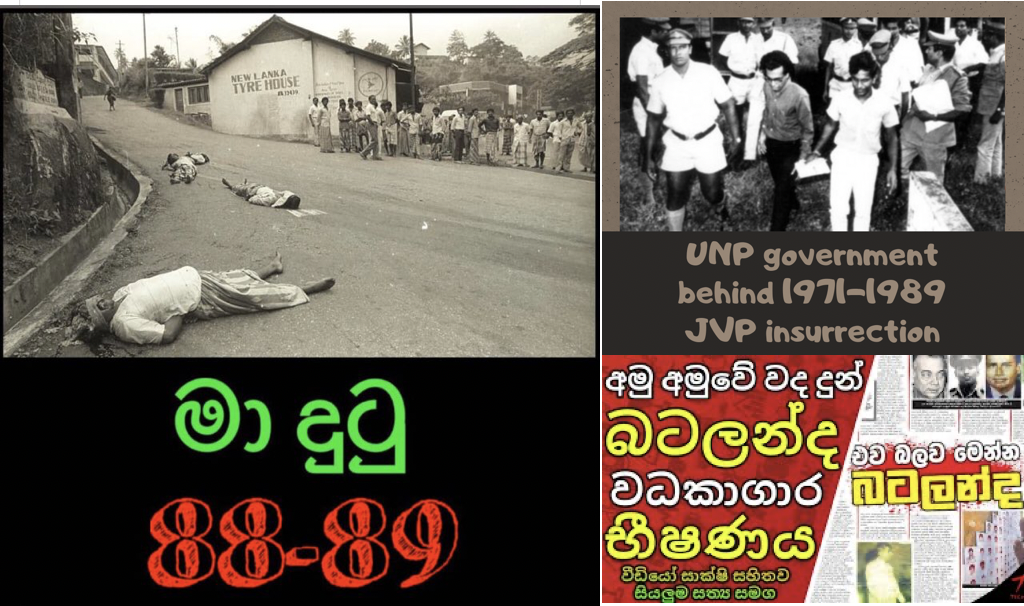
While JVP insurgency was quelled, it resulted in killing Sinhala Buddhist youth. Ironically, not many called for human rights investigations for their deaths! It was not fashionable or newsworthy enough. The aim would have been to eliminate these energized Sinhala Buddhist youth.
The Tamil New Tigers created in 1972, became LTTE after the Vaddukoddai Resolution of 1976 which called for a separate Tamil state & resulted in TULF become the country’s Main Opposition in 1977.
Then came 1977 elections & the start of Sri Lanka’s collapse.
The UNP reversed their 1956 set back, winning the elections. UNP leader, J R Jayawardena soon converted premiership to create an executive presidency.
Championing democracy by deceit became the hallmark of rule. Violating democracy in the name of democracy became the norm. Elections were replaced with a referendum. Judges that questioned had their houses stoned. Thugs, goon squads, underworld, armed security became the body-armour of politicians.
Politicians of pre-1977 were people who served the people. They used their own funds to serve their electorates. Post 1977 the scenario changed. JRJ ushered in a luxurious lifestyle for politicians giving them perks, privileges, cars, foreign trips and even state land for tuppence.
If you wondered how ballot box stuffing, ballot box stealing, impersonations, voter intimidation, voter threats started – it was during JR’s time as president & under UNP rule. Of course the credit for stealing NICs goes to the JVP.
In case you wondered how the distinguished and respected Public Service descended to such pitiful heights – look no further, post 1977 sealed the damage there too. Respected civil servants, secretaries were soon to become Yes Men to a bunch of thugs that started entering parliament after voter intimidation and ballot rigging. Public Sector became the den for employing their stooges and voters inflating the public service with a mob of people who were not qualified to do anything and who merely passing time reading newspapers & gossiping sipping tea. Each election meant more people were given political jobs as favors for canvassing.
It was only natural that this would trickle to the Armed Forces & Police as well. This eventually created a politicized police inspite of public sector supposed to be apolitical & required to serve the nation not the government in power but to carry out the orders of the government so long as it is in keeping with their public ethics code.
Erosion of the public sector commenced when they were demanded to do what they were not supposed to do. Erosion of public sector turned into corrupting the public sector. With this erosion a plethora of associated vices took place where resources and assets of the nation became victim and resulted in blatant wastage, theft, siphoning, sale, and its bargaining. The assets and resources came to be the treasures that siphoned off by politicians, their cronies and public sector and with every year and with every govt, it only got worse.
This was the source and root of the corruption. Lest people have forgotten – it was JRJ who introduced all of these vices and dished them out to the politicians to enjoy allowing him to rule as he pleased.
That was however shortlived, in JRJ’s shadow was a man who had other objectives. He was to put an end to dynastic family rule that had been a cornerstone of politics since independence.
1983 saw Govt sponsored mob riots once again choreographed to chastise the Sinhalese.
Then came the period of bloodshed – brute force if ever prevailed by a state was seen at no other period in time, than under UNP rule. The liberals who were the backers of the UNP are today mum when it comes to this period. They all refer to State oppression but flinch to say it was by UNP.
It was also during this period that the puthano’s piyano under advice or otherwise went on a rampage of killing opponents. This was the bheeshana period where all types of cats” roamed the streets and an alogosuwa, a man with a hood had to merely nod his head to decide the fate of people. Kidnapped lawyers, students, clergy, academics had their eyes treated with chillie powder, nails nailed to the ground, the type of horrendous physical abuse may not even come secondary to the waterboarding techniques used by US in their secret prisons.
People were burning on tyres or naked, tied to lampposts courtesy JVP.
Who dared to come forward to count the kidnapped or disappeared leave alone count the dead.
The JVP was used to bump off the cream of Sinhala Buddhists in Sri Lanka both from within & by virtue of their victims. What did people like Premakeerthi di Silva do to deserve to be shot in front of his own children by the JVP? How many more talented artists similarly were killed by JVP?
Thus, we watched JVP being used to destroy Sinhala Buddhists by drawing them to join the JVP and we watched as these brainwashed youth ran berserk resulting in the UNP Government shooting or torturing Sinhala Buddhists to death. In the end this period targeted Sinhala Buddhists & was aimed at terminating talented individuals who would have served their nation and would have posed a challenge to the gameplan being rolled out.
While Sinhala Buddhists were getting eliminated by both JVP and UNP, Sri Lanka was to be recipient of terrorism that came in the form of Tamil militancy trained by India and packed off to rebel against the State. This was to combine with an Indian Army presence that turned sour, creating a fire all killing spree. No one knew who was killing who but in the end scores of people were getting killed.
Where were these heroic” liberals of the present day?
Most of those that eloquently address in the halls of the suddas were very much present during those times, cowering in fear no doubt. That was the time they were in exile or had to hide their pen, not presently. How many of these were actually trouble makers themselves. How many of those that write on Richard de Silva care to mention the name of the UNP leaders who ruled during his disappearance. They are very careful to selectively say state oppression” but never the party or individuals involved. However, when the whole world likes to hate one family of people, they are all united in writing books, in galvanizing groups and proudly displaying I was there” slogans because such stands come with international awards, scholarships and even exile status – what a ticket to live in the West at the expense of the West and then be invited to panels or UNHRC from time to time to play the same broken record!
People who lived during the 1980s & 1990s & even early 2000 will know the life Sri Lankans had to deal with.
Those who were less than 10 years at the time and who are now in their 40s may not know what their parents had to go through to protect them from being kidnapped by the JVP or LTTE or killed by the UNP claiming they were either JVP or LTTE.
This was the period of fear we had to live in, not the glorified lies of fear that are being floated.
JVP joined CBK government. LTTE was eliminated in 2009 and IPKF was packed off in 1990.
JVP remains to ruin the lives of youth and brainwash people while LTTE diaspora wish to only make hay while the sun shines plugging geopolitical objectives to their advantage.
As for Sri Lanka, we are in an economic mess as a result of unplanned open economy and the system of corruptions that was unleashed under the then Executive President and followed by every successive government. It is a system that benefitted all those who today are on anti-corruption drives. Many of those who became rich after 1980s were the recipient of corrupt practices that prevailed then.
Only a handful of uncorrupt people can call both the pot & the kettle, black!
I draw the attention of all patriotic citizens to the following excellent news reported in Ceylon Today as instructions issued by the Presidential Secretariate.
The whole nation welcomes this patriotic decision, if it is true, as a timely action taken by the President at a time like this. In my opinion he should have taken this decision immediately after he was elected as the President. Nevertheless, although it is too late, as the common say goes, late is better than never. I am sure the whole nation will congratulate the President for taking this timely decision.
As person who has been continuously agitating and writing against the Provincial Councils right from 1987 as a useless political appendage that was created and imposed on this country by India to firstly, completely destroy the district administration, the economy and the entire political stability by dividing this small Island in to nine independent political divisions called provinces eternally fighting with each other for land, water and other resources and supremacy over the neighboring provinces and finally disintegrate this Island nation in to apolitical scrambled egg knowing very well that if they don’t do that now not only India but no country in the world ca beat this Island nation emerging as regional economic power , blessed by its bountiful natural resources both on land and in the vast expanses of the Indian ocean spreading for 7 from Bay of Bengal to South pole (N-S) t0 5 ((W-E)thousands of miles from Africa in the west to Australia in the East with its geopolitically and strategic location right at the Indian Ocean as a globally important strategic and economic pivot to Indo-Pacific political and economic hub of the 21st century.
First, I invite all my readers to read the following press release from the Presidential Secretariate and the ask the list of questions given below the press release
Ceylon Today –
October 1, 2022 2:06am
The Government has decided to immediately reduce the allowances and facilities of chairpersons and their personal staff members, of dissolved Provincial Councils (PCs), Ceylon Today reliably learns. Accordingly, Saman Ekanayake, Secretary to the President has issued a special circular No. PS/CSA/11-18(1) on 27 September, with regard to this issue. The President’s Secretary issued this circular based on the decision of the Cabinet chaired by President Ranil Wickremesinghe on 22 September.
The circular titled ‘Management of Government Expenditure – Provincial Councils’ was sent to all Governors, Chief Secretaries and the Secretaries to the Governors.
According to this new circular, the circular issued by former Secretary to President Udaya R. Senaviratna on 12.10.2018 has been cancelled.
Also, one vehicle and 150 litres of fuel have been given to a chairman of a dissolved Provincial Council. Earlier they were getting three vehicles and 1,500 litres of fuel earlier.
Similarly, various allowances, including monthly salary, vehicle facilities and fuel allowance, which have been given to chairpersons and their personal staffs for many years, have been reduced, the President’s Secretariat sources said.
Over Rs 250 million was paid by the Government to the chairmen of inactive PCs provincial and their special officers over the last several years.
Ceylon Today exposed this issue on 17 April using the Right to Information Act, under the title ‘Dissolved PCs drain millions from public coffers.’
The RTI request revealed that about six million rupees of public funds is continuously being spent in relation to Chairpersons of inactive PCs who do not discharge any official duties after dissolution.
At the same time, a staggering Rs 200 million is paid in total after the dissolution of PCs as salaries for Chairpersons and their personal staff for many years by the State, the RTI request revealed.
While welcoming this directive from the Presidential Office,I pause the following questions to the President for his immediate attention
1Why don’t you take this decision to be effective from the date of dissolution of these Councils
2 Why dint they close down these offices immediately after their dissolution
3 why did the then governments continued to paya salaries and provide these benefits to chairmen and staff who had ceased to function as Chairmen from the dates of dissolution of the respective Councils.
4 why don’t you stake immediate action at least now stop these payments and also take immediate action to recover the amounts paid to them from the respective dates of dissolution of the respective Councils with interest.
5 Why don’t you call for explanation from the Chairmen for appropriating public funds and enjoying the privileges of office like salaries, fuel allowances and the use of official vehicles etc in respect of non- existent posts as the Councils were closed. And also frame criminal charges against them for misappropriation of public funds.
6 Also take disciplinary action against public officers who have failed to take action to stop these payments and also failed to close down these non- functional offices as soon as the Provincial Councils were dissolved.
For the last few years, the SriLankan airline has been making a loss continuously. It is the consensus of everyone that the airline is overstaffed, particularly top-heavy, with millions of rupees to the senior management staff as salaries. Therefore, the only option would be to privatise the airline. During President Chandrika Kumaratunga’s rulership, one of the international airline multinational conglomerates, with its separate travel company, showed an interest in taking over SriLankan airways. Virgin Conglomerate’s Chairman, Mr Richard Branson, had discussions with President Kumaratunga. He had to return to the UK disappointed, only having placed Sri Lankan ginger beer for virgin flights.
SriLankan Airlines has gone through a metamorphosis of names in 42 years. Formally, it was known as the flag carrier of Ceylon under ‘Air Ceylon’. In 1979 Air Lanka commenced its operations from Bandaranaike Airport. Air Lanka was formerly managed by Singapore Airlines. Singapore airline’s motto to the flying staff was: ‘Smile from the heart.’ Indeed, it encouraged more passengers to use Air Lanka to run profitably.
In 1986 Presidential Commission discovered that the ‘Air Lanka Board was going through many mismanagement techniques.’ It was highlighted in the media that the late President Dingiri Banda Wijetunge appointed a retired General as Chairman cum MD with an Air Vice Marshal and a UNP attorney as Executive Director. None of them had previous experience in running a business airline! In 1979 the airline to was placed in charge by Captain Rakkitha Wickramanayake, and the board of Directors consisted of Industry Officials and Managers. A former Singaporean President was quoted as saying: “How could an airline pilot run an airline?”. Rakkitha Wickramanayake was formerly attached to Singapore airlines.
During Chandrika Kumaratunga’s Presidency, the airline entered into a management contract. with Emirates Airlines. Its name was changed to Sri Lankan Airlines, with an all-white fuselage covered by lines and the tail adorned with the new corporate logo. From 1979 onwards, a unique design consisted of red stripes on a white fuselage. The tail was solid red and sported the corporate logo, and was stylised as ” Flying Peacock”. It tried to imitate King Ravana of the ancient episode of the famous “Ramayana” mythology. The five ‘tail feathers’ represented the “Five Preceptsof Buddhism, and the three ‘crown feathers’ represented the “Triple Gem” of Buddhism. The Red colour reflected the predominant colour in the Sri Lankan national flag.
However, in 2008, Emirates notified the Sri Lankan Government that their management contract would not be renewed, which expired on 31 March 2008. Their refusal to renew the management contract was said that ‘the Sri Lankan government sought greater control over the day-to-day management of the airline.’ It was finalised in 2010, thus ending any affiliations between the two airlines with each other. At the time Sri Lankan Government pulled out of the Emirates management contract, the accumulated profit of Sri Lankan was Rs. 9.288 billion in that financial year. When the government administration took over to run the airline for 14 years, it ran into a total loss of900 billion rupees up to April 2022 as a result of the collapse of the currency. The bulk of these appears to be debts to state banks and the CPC, wholly owned by the Government of Sri Lanka.
President Mahinda Rajapaksa’s regime introduced a subsidiary airline called Mihin Lanka operated from Mattala airport in Hambantota. The airline absorbed the operations of sister carrier Mihin Lanka in October 2016 in a bid to create a single stronger national airline for Sri Lanka. Accordingly, SriLankan took over two of Mihin Lanka’s aircraft and absorbed its route network, adding ten new destinations to Sri Lankan’s route network. Ultimately Mihin Lanka, too, had to be disbanded due to its constant losses. SriLankan joined the One world’ alliance on 1 May 2014.
Covid-19 Pandemic
During the COVID-19 pandemic, SriLankan performed cargo and operating relief flights only. The airline lost 36.3 billion rupees up to August 2020, and the government approved a voluntary retirement package for 560 employees at 1.46 billion rupees.
With the present fuel crisis in 2022, Sri Lanka faced a massive fuel shortage. Consequently, SriLankan’s long-haul flights had to make stopovers at the airports in India- Trivandrum, Chennai and Kochi to refuel.
Sri Lanka currently has no bankruptcy protection act; the only option for a closedown would be a complete liquidation. If the government shuts down the airline completely, it will be compelled to raise significant concerns about writing off this debt to the state banks and the Ceylon Petroleum Corporation. This could place the two-state banks by foreign rating agencies and seriously jeopardise the prospects of Sri Lanka’s entire banking sector. The Government as the guarantor would also be called upon for immediate repayment of the international bond worth US$175 million.
The Board has once reported widespread corruption and confirmed the allegations of Nishantha Wickremasinghe’s affairs as Chairman. He is related to Mahinda Rajapaksa’s wife. However, they denied the allegations and accused the report of being biased and invalid, accusing the head of the Committee of Publicly supporting the then government and lacking technical knowledge about the aviation industry.
Fraud was imminent
In October 2015, the Presidential Commission of Inquiry investigated and inquired into Serious Acts of Fraud, Corruption and Abuse of Power. State Resources and Privileges (PRECIFAC) attempted to summon Wickremasinghe to inquire about various irregularities in the Airline; however, they could not locate him, and his wife claimed he had not come home for three years and that she was unaware of his whereabouts. Later Wickremesinghe notified the PRECIFAC that he was abroad and could not give a statement.
Catering
SriLankan Catering, incorporated in 1979, is a wholly-owned subsidiary of SriLankan Airlines; it provides flight catering services to all airlines serving the Bandaranaike International Airport. It is the only subsidiary of SriLankan airlines which provides a profit by providing 25,000 meals per day. Critics request that a catering service should be allowed as an independent unit. All the gains made by catering services are absorbed into the overall loss of the airline.
Sri Lanka currently has no bankruptcy protection act, and the only option would be for a closedown in a complete liquidation. If the Government is to shut down the airline, it will be compelled to write off this debt to the State banks and the Ceylon Petroleum Corporation. This could raise significant concerns about the two-state banks’ liquidity by foreign rating agencies. It could seriously jeopardise the prospects of Sri Lanka’s entire banking sector. The Government as the guarantor would also be called upon for immediate repayment of the international bond worth US$175 million.
Despite the old saying, the only sure things in life are death and taxes,” most of those working in Sri Lanka have never paid direct taxes, and those who pay have been enjoying relatively low taxes rates for several decades. We have also been spared a multitude of other taxes, such as inheritance, wealth and capital gains, that citizens of most developed and developing countries need to pay. So, the publication of the Gazette setting out the proposed increase in changes to tax rates and thresholds to be effective from October 01, 2022, seems to have set the cat amongst the pigeons!
A great deal of indignation and fury as to the impact on their disposable income and lifestyle have been expressed by many over the media and social media. In addition, concern has been expressed that the country will lose many skilled professionals who might migrate to countries with higher tax rates and compliance of nearly 100%!
The corporate sector, which is also being impacted, has demanded from the government greater restraint, accountability, and transparency on its spending. Unfortunately, we Lankans, have, in addition to accepting corruption as part of our country’s DNA, turned a blind eye to the civic responsibility of being a tax-compliant citizen for multiple reasons.
It reached a zenith in the year 2020 when Gotabaya Rajapaksa was elected President and proceeded to be the Santa Claus” by substantially reducing tax rates, increasing the tax-free threshold for individuals, doing away with certain taxes, and eliminating the well-established means of collecting taxes at source by abolishing PAYE and WHT.
It was absolute madness and a recipe for economic Armageddon which we are, sadly. in the midst of. The impact of the tax cuts is estimated to be around LKR 700 billion. In my article published in the Sunday Island of January 12, 2020, captioned Sri Lanka’s Tax Conundrum”, I highlighted the inherent risks of the tax cuts and stated, Based on the Household Income and Expenditure Survey of 2016 and the dispersion of the average household income, the recently introduced tax rates and increase in the threshold will only benefit a smaller segment of the population who in all probability do not need this type of assistance from the government.
I say this at the risk of getting a sharp poke in my ribs from some of my former colleagues still in employment. In my case, had I been in employment, the incremental income would most probably be spent on a few additional overseas trips, buying a few expensive imported branded gadgets and a higher-class BMW.Therefore, I am not sure I would have contributed to the increase in aggregate demand for our GDP. As to how a household spends, the incremental income would certainly depend on their income level. However, there is no doubt the greatest beneficiaries would be those who are not currently struggling to make ends meet.”
Not too many expressed such concerns because many were delighted that they would receive a windfall. But, unfortunately, those irresponsible and hare-brained decisions have seen tax revenue as a percentage of GDP declining to 7.3% inclusive of the covid impact when it should be around 15% for a developing country. So, the need to reverse those irresponsible tax cuts and increase our tax revenue is a fact that needs to be understood and appreciated.
Taxation, Purposes and Justification
Taxation is when a taxing authority, usually a government, levies or imposes a financial obligation on its citizens or residents. Since ancient times, paying taxes to governments or officials has been a mainstay of civilization. The government compels taxation through an implicit or explicit threat of force. Taxation is legally different from extortion because the imposing institution is a government, not private actors. The formulation of tax policies is one of the most critical and contentious issues in modern politics.” (Investopedia)
The most basic function of taxation is to fund government expenditures. Varying justifications and explanations for taxes have been offered throughout history. Before, taxes were used to support the ruling classes, raise armies, and build defences.
Later justifications have been offered across utilitarian, economic, or moral considerations. Proponents of progressive levels of taxation on high-income earners argue that taxes encourage a more equitable society. Higher taxes on specific products and services, such as tobacco or gasoline, have been justified as a deterrent to consumption.
Which Country Has the Highest Income Taxes?
As of 2022, the top 10 countries with the highest marginal income taxes (the rate on the top slab) are:
Ivory Coast – 60%, Finland – 56.95%, Japan – 55.97%, Denmark – 55.90%, Austria – 55.00%, Sweden – 52.90%, Aruba – 52.00%, Belgium – 50.00%, Israel – 50.00%, Slovenia – 50.00%
In South Asia, the highest marginal rates are:
India 30%, Pakistan 35%, Bangladesh 30%. In India, there is a 10% income tax surcharge on certain taxpayers, and the single-person tax-free allowance is INR 250,000 for a year.
So the Sri Lankan marginal rate of 36% is not as outlandish as it appears, although it is being imposed at a time when inflation is over 70% which is a challenging proposition.Research indicates those living in Nordic countries with the highest rates of taxes are often deemed the happiest!
Why do we hate to pay taxes?
Because as often as not, tax dollars get spent for things the public neither wants nor needs and would not choose to pay for. I wouldn’t mind taxes so much if all my tax money was spent wisely and in agreement with my perspectives.” (origin of quote unknown)
No nation grew prosperous by taxing its citizens beyond their capacity to pay. We have a duty to ensure that every penny that we raise in taxation is spent wisely and well.” (Margaret Thatcher)
I believe the above quotes capture most taxpayers’ feelings in Sri Lanka and the world. The word spent wisely” is a dilemma for all of us as our politicians are everything but wise!
Public Sector Salaries and Pensions
Currently, nearly 80% of government revenue is spent paying public sector salaries and pensions. Although an efficient and lean public service is a must and should attract some of the country’s best talent, successive governments abused their authority by giving jobs to their supporters when there was no vacancy.
In many developed countries, unemployed people are paid an unemployment benefit for a certain period of time. In Sri Lanka, those who govern have given unemployed people jobs for life, including a pension! The net result is that we have a bloated and inefficient public sector that is a drain on taxpayer money.
Defence Expenditure
The appropriation bill for 2023 submitted to parliament requests that LKR 360 billion be allocated to the forces and a further LKR 116 billion to the police; in contrast, only LKR 184 billion and LKR 267 billion are being allocated to education and health.A justifiable question of whether this allocation falls within the definition of spending wisely” needs to be responded to by the government. Undoubtedly, the bulk of the expenditure is spent on remuneration and not acquiring equipment.
Recently a former cabinet minister, much disliked by the public, raised a question in parliament as to why we need an armed force of 250,000 when there is no ongoing conflict or any such possible threat in the foreseeable future.
This matter was also widely discussed on a TV chat show by several prominent social activists and commentators. The consensus was that the defence budget needed to be reduced and the savings be allocated to education and health.I appreciate that there will be comments that pruning defence spending smacks of ingratitude to soldiers who fought during the civil conflict. However, given that 13 years have passed since the end of the conflict, it is time that the government take steps to demobilize and retrain the excess soldiers.
The Inland Revenue Department (IRD)
The mission statement of the IRD is To collect taxes in terms of relevant tax and other related laws, by encouraging voluntary compliance while deterring tax evasion and tax avoidance, and to enhance public confidence in the tax system administered by the Department of Inland Revenue by administering relevant tax and other related laws in a fair, friendly and expeditious manner and thereby facilitate a beneficial tax culture.”
Despite this mission statement, most will agree that the IRD has not performed. Voluntary compliance has not worked, and neither has constantly changing governmental tax policies assisted. My own experience is that IRD officers tend to go after those who are currently paying taxes for additional taxes rather than identifying those who are evading taxes.
That the department should be assisted with cutting-edge technology is to state the obvious. Whether the RAMIS system has facilitated this is questionable, although most corporates and a few individuals submit their tax returns through the system. A critical KPI for the department should be how many forced registrations were done during the year and how much tax, including back taxes and penalties, was collected from such registrations.
Tax Avoidance and Evasion
The difference is that tax avoidance is an action taken to minimize tax liability, whereas tax evasion is the failure to pay or deliberate underpayment of taxes. Reducing tax liability and deliberate underpayment of taxes can sometimes be a fine line. My interaction with many small and medium enterprises (SMEs) is that many don’t pay taxes or that what they do pay is minimal. In addition, many professionals are assumed to be non-compliant.
Many years ago, the GMOA and some professional bodies were lobbying the government to reduce their income tax rate from 24% to 16% after the Supreme Court dismissed their plea. The request was for professionals to be included within the definition of an SME who enjoyed a tax rate of 14%!
There is no doubt that many who should be paying direct taxes are not in the tax net as they should be. It is up to the IRD to ensure that they live up to their mission.
Conclusion
As I write this article, the President has on TV explained the reasons for higher direct taxes and that the IMF program is contingent on these mandated rates. Those conversant with economics and finance will appreciate the need for higher taxes for our country to come out of this self-inflicted economic disaster. But we must grit our teeth, curse the politicians, and pay up.
However, it is vital that the government spend our money transparently and not be profligate. We, the citizens, must be at the forefront of demanding that corruption among politicians cease, expenditures are rationalized, and those responsible are held accountable.
Deceleration in monthly prices stoke hopes on a consumer price pivot from October
Water and electricity tariff hike drives Sept. non-food and overall consumer inflation
UK offers a case for how markets stump governments, which come up with inflationary policies
Sri Lanka’s inflation measured by the National Consumer Price Index (NCPI) showed a relentless increase through September, as the prices continued their ascent over and above 70 percent for the second month in a row but the recent monthly price movements have galvanised expectations for the prices to have turned a corner.
Sri Lanka’s broader consumer price index showed the prices galloped 73.7 percent in September on an annual basis, accelerating from 70.2 percent in August but the monthly prices, which showed some deceleration in the last three months, have made the case to believe that the prices may have peaked last month.
The headline prices in September rose by 2.3 percent between August and September, decelerating from 2.5 percent and 5.6 percent in the previous two months, stoking hopes for cooling prices in the next inflation print. The national prices are a relatively lagging indicator, which is released after 21 days since the end of the month but a more recent indicator of inflation, the Colombo Consumer Price Index, which acts as the officials’ preferred inflation gauge, reported a 69.8 percent rise in annual prices for September.
Authorities expect inflation cannot shoot any higher. The food inflation came in at 85.8 percent in September from a year ago, up slightly from 84.6 percent through August. However, the worst could be over, as the monthly prices rose by 0.7 percent, from 1.7 percent in August, a trend which is seen from July.
In recent weeks, the prices of certain essential commodities were revised down after some cooling in global commodities prices and the improvement in the supply and foreign exchange conditions.
The non-food inflation in Sri Lanka rose by 62.8 percent, accelerating from 57.1 percent in August while the monthly prices also climbed to 4.0 percent, from 3.2 percent. The water and electricity price revisions were the biggest contributors for the non-food inflation in September.
The so-called core prices measured barring food, energy and transport, rose by 64.1 percent on an annual basis from 60.5 percent through August, reflecting that the underlying price pressures in the economy still exist even after leaving out the often-volatile items.
Inflation is a global issue being battled by every country with the exception of China. The United Kingdom (UK) offered a classic case this week how the markets brought an abrupt end to a government, which thought they could stoke growth through borrowings by slashing taxes and splashing subsidies to protect homes and businesses from rising energy bills at a time when inflation and the interest rates were fast rising.
The UK also offers a learning for any government, which may be thinking it could find its way through unfunded fiscal largesse through borrowings from the market, as markets have become ruthless since this year in penalising any kind of fiscal slippage or inflationary policy, a stark difference from a year ago when the governments could fund their budgets at interest costs next to nothing.
Seven persons who were filming the high security area of the Victoria Reservoir in Theldeniya using drone camera were taken into the custody by the Army personnel attached to the security at the Reservoir.
Police said the seven people were taking photographs of the reservoir and the dam while operating a drone without a legal permission.
Although the security officers had instructed them not to take photos or videos of the surrounding area with drones, they had taken videos and photos ignoring the instructions.
Accordingly, the seven suspects were arrested and handed over to the Theldeniya Police along with a drone. A van in which they arrived at the Reservoir was also taken into custody.
It was revealed that the group came for a trip and had taken photos of the surrounding area while visiting the place.
The arrested suspects, aged 31 and 32, are residents of Weligama and Dehiwala areas.(Darshana Sanjeewa Balasuriya)
Former President Mahinda Rajapaksa congratulated Chinese President Xi Jinping on his re-election as the General Secretary of the Central Committee of the Communist Party of China
He said in a message to the Xi Jinping that the election results have re-confirmed the strenght and courage that his leadership holds and the broad public support for a people centric policy towards the accelerated socioeconomic development of China.
It also strenghtens China’s standing in the international arena.
“My administration foresaw the strategic importance of the Belt & Road Initiative back in 2013 which helped Sri Lanka to enrich its national development agenda.
Our government is looking forward to continuing it’s strong cooperation with China, under your leadership, to further strengthen our bilateral relations and I also look forward to working with you and your government to further the development agendas of both our nations,” he said.
State Minister of Tourism Diana Gamage will be visiting US next month to initiate talks in constructing South Asia’s first Disneyland in Hambantota.
A statement from Gamage’s media unit said that the State Minister will be visiting Burbank in the United States next month to discuss initial plans for an 18-billion dollar investment in Sri Lanka, following an invitation following an invitation from the Walt Disney Company.
She was invited by Alexia S. Quadrani, Senior Vice President of Investor Relations at the Walt Disney Company. The State Minister had earlier written to Walt Disney Company inviting them to set up a Disneyland in Sri Lanka.
“Following your request, we at the Walt Disney Company have agreed to visit Sri Lanka during late November this year to hold a series of exploratory meetings to understand the financial feasibility of setting up a regional Disneyland in Hambantota,” Quadrani said in a letter to the State Minister. A delegation from Disney is expected in November this year.
Quadrani said that, while unable to provide exact details, an investment would be in the range of $16-18 billion. This would provide much needed financial injection to Sri Lanka in order to mitigate the dollar crisis, the statement said.
State Minister Gamage also said that such an investment would be beneficial to use the large infrastructure available in the area including the Mattala Airport.
President Ranil Wickremesinghe said that the delay in the Sri Lankan university system at the commencement of courses would be avoided enabling students to complete their studies within the stipulated duration.
The President made this observation during a meeting held with the prefects of Royal College, Colombo at the Presidential Secretariat yesterday (22).
Head Prefect of Royal College Colombo Kaveesha Rathnayake and the prefects of the college participated in this meeting, the President’s Media Division reported.
The matters concerning Royal College as well as matters regarding the country’s education sector were discussed there while the President answered the questions raised by the students on the measures taken by the government for the advancement of the education sector.
The President made queries from the prefects on the university education where the students brought the focus of the President to the vast difference between the duration to complete a degree in a foreign higher education institute and in a local university.
The President agreed with it and assured that remedial action would be taken without delay. He also highlighted the value of education in a local university over foreign education. He also emphasized that the government has taken many steps to expand the educational opportunities for students who have qualified for higher education following the completion of their school education. He added that measures have been taken to commence several new universities in Kurunegala and Batticaloa.
The President also mentioned that the Faculty of Engineering of the University of Colombo would be set up as a separate campus, while the National School of Business Management (NSBM) and the Sri Lanka Institute of Information Technology (SLIIT) would be upgraded as national universities.
President Ranil Wickremesinghe raised the issue of ragging with the students during the meeting and said that it seemed that students who attend the universities from schools such as Royal College, Thurstan College, Ananda College and D. S. Senanayake College turn a blind eye when such ragging incidents happen, although a large number of students from these schools are within these universities.
The President also pointed out that the students of those universities have a responsibility to bring ragging in universities to an end and the head prefects of those schools could perform their roles while in school.
The president further said that university education is interesting but the rate of students suffering from physical and mental stress has increased due to ragging at universities and emphasized that he would take measures to solve the problem.
President Ranil Wickremesinghe also appreciated the role played by the Board of Prefects of the Royal College in the development of the school and its reputation.
Senior Advisor to the President on National Security and Chief of Staff to the President Sagala Rathnayake also participated in the event.
Presidential pardons have been granted to a group of prisoners who had been convicted by courts in relation to LTTE activities.
The special amnesty was granted for eight LTTE inmates in accordance with the powers vested in the President under the Constitution of Sri Lanka, Additional Commissioner of Prisons, Chandana Ekanayake said.
Accordingly, measures were taken for the release of 04 LTTE inmates held in the Magazine Prison on October 21, under the reduction of the sentences to be served.
Two other prisoners are set to be released after their appeals court cases are withdrawn by them, he said.
The Department of Prisons further announced that the other two LTTE inmates have been referred to the Attorney General for directives needed for their release, after the completion of the rehabilitation process.
Ali Sabry, Minister of Foreign Affairs and President’s Counsel says that it will be possible to receive the first loan installment from the International Monetary Fund by the beginning of next year. The minister made these comments while speaking to the media in Colombo yesterday.
‘History repeats itself, first as tragedy, second as farce”
Karl Marx, The Eighteenth Brumaire of Louis Bonaparte
‘Make the Economy Scream’ were President Nixon’s instructions to the Central Intelligence Agency, September 1970, as the first Socialist President of Chile, Salvador Allende’s Popular Unity Party swept to power amid Cold War headwinds.[i]
According to then US ambassador, Edward Korry a JFK-style liberal, this meant “to do all within our power to condemn Chile and the Chileans to utmost deprivation and poverty.” There was also a massive destabilization and disinformation campaign Noam Chomsky wrote in Secrets, Lies, and Democracy our government intervened massively to prevent Allende from winning the preceding election, in 1964. In fact, when the Church Committee investigated years later, they discovered that the US spent more money per capita to get the candidate it favored elected in Chile in 1964 than was spent by both candidates (Johnson and Goldwater) in the 1964 election in the US. [ii]
The CIA planted stories in El Mercurio, Chile’s most prominent paper, and fomented labor unrest, protests and strikes. This was the soft line, but there was also a hard line.
Three years later, President Allende, a physician by profession was dead; killed, in a CIA-backed Coup that saw the establishment of one of the most repressive right-wing military regimes in South America. General Augusto Pinochet ruled Chile for 17 years and his rule was characterized by massive human rights violations, disappearances, and Dirty War operations, including Operation Colombo”, of which more later. But economic ‘aid’ immediately began to flow again from Washington.
The assassination of Chile’s democratically elected President Allende changed the course of history in a country described as a long petal of sea, wine and snow’ by poet Laureate, Pablo Neruda. Twelve days after the coup Neruda, a member of the Chilean Communist party and close advisor of Allende also died mysteriously. After an independent investigation and declassification of State Department documents in 2015, the Chilean government said that it was likely that Neruda too was murdered as part of the Coup of September 1973.
In 1976 the CIA backed yet another coup in South America: Chile’s neighbour Argentina saw the overthrow of Isabel Peron, who was replaced by a military junta, which triggered a Dirty War that saw thousands disappeared between 1976-83 as the Argentine economy screamed.
Argentina like Sri Lanka has had numerous Washington Consensus (International Monetary Fund (IMF), and World Bank (WB)), bail outs! Protests against the IMF are ongoing in Buenos Aires at this time again, as Argentina continues to Scream under Washington’s Monroe Doctrine Redux jackboot –negotiating its 21st bailout![iii]
History Repeats as Farce: Another Continent
Today, economy and society are ‘screaming’ in Colombo, Sri Lanka, which knows not of Chile’s infamous ‘Operation Colombo’ for which General Pinochet was stripped of his Presidential impunity and tried in Spain. This despite a recent film Alborada purportedly base on Pablo Neruda’s brief sojourn in Sri Lanka as a young diplomat, and a ‘poem he never wrote’!
As Cold War escalated in the Indian Ocean Region this year, Sri Lanka’s duel US Citizen , Finance Minister, Basil Rajapakse, hastily Staged a Default in April for the first time in its history– enabling the Washington Consensus to make deep inroads into the strategic island’s policy process.
As the cost of living soared in June with real and staged fuel and food shortages, amid Aragalaya ‘protests’ a partial regime change operation was effected with US-backed Ranil Wickramasinghe becoming President after the country defaulted on $26 billion of Dollar denominated debt in April this year.
At this time IMF austerity measures are being rolled out ex-ante an actual ‘bailout’ agreement with US and EU-based private creditors who caused the strategic Indian Ocean Island’s debt trap and Default. New York based, BlackRock, Sri Lanka’s biggest private creditor which got huge Covid-19 bailouts from the US government is prominent among them. An outfit called the Hamilton Reserve Bank a shadowy off-shore tax haven based in St. Kitts and Nevis has sued the Government of Sri Lanka for defaulting on bond payments of $ 250!
Sri Lankans face a grim future of Dollar Debt Colonialism, as the rupee has plummeted against an increasingly weaponized US dollar, while the rising dollar has compounded the local currency cost of servicing foreign debts denominated in USD- the global reserve currency— increasingly of last resorts?
Hence, some analysts have called for de-dollarization/ trading in a basket of currencies, and sourcing oil and gas from Russia whose sanctions-hit Ruble ironically remains the strongest currency against the US dollar. The global-local Debtocracy from Argentina to Sri Lanka and its failed policies seems set to continue if the readouts of the IMF and World Bank meetings last week are true.[iv]
An Islanded (Neo) Liberal Civil Society
Ironically too, while protests are set to continue, few among Colombo’s Human Rights activists and Aragalaya Stars had heard of ‘Operation Colombo’ in Santiago de Chile in 1974, which saw the disappearance of 119 dissidents, or the infamous ‘Condor Operation’ across South America- Precursor to the CIA’s Human Renditions program in the so-called ‘Global War on Terror.’
Amnesia in the USAID and EU funded Culture Industries, academic research and propaganda operations have ‘islanded” civil society in the country with few exceptions. Thus ‘dream films’ like Alborada with pretentions at post/colonial avant guard chic and vibes of the ‘Me Too’ movement seem almost Kafaesque – despite the best efforts of Director, Asoka Handagama.
If Neruda, whose voice would have been powerful in condemning the CIA-backed Coup in Chile had to be silenced, in death, he was subject to character assassination and disinformation campaigns replete with reverse Orientalism that seem to continue to this day (viz. Alborada which suggests that he was a white colonial rapist in Ceylon!).[v]
Clueless about Cold War South American history the apparently ‘leaderless’ Human Rights protestors organized via internet platforms controlled by external actors at Galle Face who capitalized on the genuine economic grievances of the masses had a limited agenda for Economic Rights and Debt Justice! Some groups of the Aragalaya held pro-IMF posters!
It is increasingly clear that the strategic Indian Ocean island has fallen victim to Full Spectrum Dominance (FSD), Digital Colonialism enabled cyber-operations with real and staged protests. as much as, to the ‘lender of last resort’s debt trap neo-colonialism and the International Sovereign Bond (ISB) ‘bailout business’ after the Staged Default. [vi]
However, given that this is Sri Lanka’s sixteenth IMF negotiation, and the fact that key bi-lateral creditors have not replied to the IMF and Paris Club of Euro-American private creditor nations’ (plus Japan), invitation to debt restructuring talks, it would be prudent for the island nation to consider alternatives to the Washington Consensus path.
After all, the IMF promise of an insignificant loan of 2.9 billion over four years with massive shock treatment” of economy and society, to enable the country to borrow from private markets again, is counterproductive to extricating itself from the current debt trap. Indeed, a moratorium and ban on borrowing from private markets which hold almost 50 percent of Sri Lanka’s dollar denominated debt would be logical.
PART 2
Make the Global Economy Scream: Exogenous Economic Shocks as Hybrid War
The IMF wants China and India, Sri Lanka’s biggest bi-lateral donors (aside from Japan which is part of the Colonial Club de Paris), to join its common framework” — for a debt reduction haircut” with creditors on the pretext of “burden sharing”. Whether these Asian Giants would acquiesce and sit with Euro-American private market bond traders convened by Japan on behalf of the OECD’s informal Paris Club is an open question.
India and China are sovereign states parties with their own geopolitical ambitions to match the Euro-American Paris Club and Washington Consensus as an Asian Century dawns again with the Indian Ocean Region a center for global growth.
Hence, should not the Central Bank and Government of Sri Lanka engage directly with the Asian giants China and India on Debt restructuring and a sustainable development path– outside the Paris Club, IMF and Japan led donor meeting and Common framework which has been extensively critiqued by leading economists who recently called for debt cancellation in Zambia with Debt Justice, UK?
The dawn of what has been widely deemed the ‘Asian 21st Century’ (Kishore Mahabubani), again after about 200 years of Euro-American global hegemony and dominance of world history has placed Sri Lanka front and center of Cold War and colonialism 2.0. The Asian Century is the projected 21st century dominance of Asian politics and culture, given demographic and economic patterns in Asia and the Indian Ocean region.[vii]
It is increasingly apparent that the US Empire with its 750 military bases all over the world, and global reserve currency weaponized by sanctions and rising interest rates would not go quietly into the night”. Rather, increasing sanctions and interest rates by the Federal Reserve to curb seemingly self-inflected inflation in the US and EU as economic de-coupling from China gathers pace appear to be a ‘solution’ designed to make the global economy scream”.
Is this an attempt to thwart the Asia Century and ensure that globalization which had benefited the emerging economies is reformatted to serve the imploding Euro-American, NATO, financial and military empire?
Be that as it may, Sri Lanka, located at the center of the Indian Ocean increasingly appears to be the canary in the coalmine of Global South countries facing dollar-debt Colonialism in the aftermath of Covid-19 bio-war lockdowns and Digital Colonialism to promote Euro-American Global Governance and the so-called ‘rules-based order’.
While the IMF and World Bank at their Fall Meetings this month in Washington DC focused on high interest rates and inflation, and War in Ukraine with grim predictions, no one mentioned copious money printing in the Euro Zone or the US government’s mammoth 31 trillion of debt!
Covid-19 Déjà vu: Dire Predictions. Lockdown Culture and Psychological Operations
The IMF and WB were long on dire predictions of low growth and possible global recession and short on solutions for the impoverishment and inequality pandemic sweeping the Global South last week at the Annual Meeting in Washington DC this month. There was no Talk about Economic Rights or Debt Justice.
The same tired IMF recipes are on offer again for the dollar-debt trapped Global South and Sri Lanka, with IMF inspired austerity measures include huge tax increases on the working class which seem designed to shrink the economy– to fit the IMF’s dire predictions for 2023 while promoting brain-drain.
There was however, something déjà vu about the dire predictions, fear, Lockdowns and promises of fuel shortages and Famine to make economy and society scream: We had heard it all before during the past two years of economically-devastating Covid-19 bio-war Lockdowns psychological operations that enabled a pandemic of corruption. Meanwhile Big Pharmaceutical Corporations made massive profits with militarized, mass Covid-19 injection programs.
Fear psychosis blocks critical thinking and reasoned analysis as psychologists have long known. Today Big Oil and energy corporations are making wind-fall profits while global governance institutions and powerful governments wring their hands rather than tax these corporations?!
But ‘reforms’ designed to shrink the Sri Lankan economy to fit the narrative, in addition to taxes, included higher energy, electricity, water prices, and soaring cost of living for hapless citizens caught in a debt trap not of their own making. Meanwhile, State Owed Enterprises are being un-bundeled and sold off to creditors and Vulture funds like BlackRock and their partners like Adani and Ambani as the rupee depreciates against an increasingly weaponized US dollar.
US and EU based private market creditors who made big profits lending at predatory rates in places they deem Frontier Markets”, now seek to profit from an IMF Firesale of Sri Lanka’s Strategic assets and State Owned enterprises. These include, land, energy, transport and telecom infrastructure as Cold War in the Indian Ocean Region ramps up. Rather than be compelled to bear the cost of their speculative investments in so-called frontier markets” these OECD creditors now seek to benefit again–ex-ante the IMF-PC Debt Haircut.
John Perkins’ famous book, Confessions of an Economic Hit Man, offers direct testimony highlighting how the creditor-debtor relationship built around the US dollar and the international institutions created to administer the ‘rules-based order’ has contributed to the deprivation of sovereignty of many struggling nations, especially those rich in exploitable resources. By design, not only governments but entire populations were meant to fall helplessly into the dollar debt trap and colonialism. The parameters on which the IMF determined that the strategic Indian Ocean’s debt of 26 billion was unsustainable to trigger the Default are not available. Nor is the IMF Debt Sustainability Analysis!
The on-going IMF inspired ‘Firesale’ of Sri Lanka’s strategic assets attests to the fact that the strategic island is now deep in Dollar debt trap colonialism in the wake of 4 years of hybrid economic war induced exogenous shocks –to make the economy scream. This has seen the Washington Consensus to move in to take control of economic, trade and energy policy autonomy and sovereignty, while stymying the possibility of de-dollarizing and buying oil and gas from sanctions-hit Russia at discount rates as Western Oil Companies make wind-fall profits at the expense of consumers while the EU and NATO blames their fuel crisis on their self-inflicted Ukraine war!
Exogenous Economic Shocks as Hybrid Economic War
While the debt crisis in Sri Lanka is primarily the result of poor governance and political corruption, a series of hybrid war style exogenous economic shocks over the past 4 years have also contributed significantly to the Debt trap over the past four years:
A series of Exogenous Economic Shocks including mysterious ISIS claimed attacks on hotels and the tourist dependent economy in 2019, followed by two years of economically devastating Covid-19 lockdowns and other hybrid war operations, such as the Lawfare program against Russia’s Aeroflot Airlines in June this year by external actors enabled the Shock Doctrine and Disaster Capitalism” a la Naomi Klein and contributed to the debt trap and default.
The mysterious 2019 Easter Sunday attacks claimed by the Islamic State (ISIS), on seafront Tourist Hotels and fisheries livelihoods saw the economy into a tailspin with extended security lockdowns. However, inexplicably, the World Bank in July 2019, ‘upgraded’ Sri Lanka to an ‘Upper Middle Income Country” (MIC) trap. MIC Status renders concessionary borrowing difficult and forces countries to borrow from US and EU private capital markets. These now hold the lion’s share, almost 47 percent of the strategic island’s debt.
The 2019 hybrid war attacks were then followed by two years of economically devastating Covid-19 lockdowns recommended by the World Health Organization. These caused knock on institutional debilitation, a corruption pandemic and digital colonialism in 2020 and 2021. Then in 2022 staged fuel shortages triggered by US sanctions on Russia brought the economy to a standstill.
The hacking of production and food supply chains due to fuel shortages and lockdown were accompanied by a psychological operation of fear amid absurd promises of ‘Famine” in a fertile and lush tropical island– as protests mounted.
As the economy screams, it is clear that Cold War headwinds are buffeting the strategic Indian Ocean island located among the busiest energy, trade and undersea data cable routes in the world, and hence perpetually in the cross hairs of big power rivalry as the Euro-American Cold War on China revs up.
But as Nord Stream 1 and 2, gas pipelines connecting Russia to Germany in the North Sea come under attacked as part of hybrid energy wars in Europe, it is clear that Sri Lanka would need to seek alternatives to the IMF path and up its game in the field of Maritime Domain Awareness which may need stretching and recalibration.
The strategic island’s Navy will be certainly called on to protect its ocean floors that contain submarine or Undersea Data Cables (UDC), that keep the internet and global financial system going.
Sri Lanka may need to strengthen its Navy and repurpose its military forces for a new generation of hybrid cyber wars. It would hence be logical for the cash strapped government to develop a plan to TAX the UDCs companies and their GAFAM clients. (Google, Apple, Facebook, Amazon and Microsoft). But it seems unlikely that the ‘lender of last resorts’ would assist or approve such an innovative income generation project is the debt-trapped strategic island, which may then render it solvent and independent!
Solutions and the good News: Alternatives to the IMF and Paris Club
It is increasingly clear, that in the event that the IMF and Paris Club process fails or drags on, contingency plans would be needed and it is imperative that Sri Lanka engage earnestly to meet unexpected exigencies that could arise, also given Cold War geopolitical rivalries.
The good news is that the Governor of the Central Bank of Sri Lanka (CBSL), noted in a press briefing recently that the country can on a monthly basis cover its import bill with its export earnings– if it can get rid of the debt and interest overhang.
In the context, the simplest and most elegant solution to the dollar debt crisis would be outright cancelling of Private Market dollar-denominated debt which amount to almost 50 percent, with a ban on future borrowing from International Bond traders (ISB). Once this is done restructuring the bi-lateral and multilateral debt with creditors who are more flexible would be relatively straight forward — though extending time frames for repayment and further debt cancelation.
There is a new Global South Development architecture emerging with new multilateral banks like the BRICS Bank, the New Development Bank (NDB), and the Asia Infrastructure Bank for development financing. Argentina has already applied for membership of the NDB, and Sri Lanka should do so too access credit.
This path forward is NOT Rocket Science in a world swirling in Odious and illegitimate US dollar-denominate debt with the US the most indebted country on the planet, but because of a huge amount of Disinformation, data manipulation, and exaggeration regarding both the Quantum of Debt, and the causes of the Default, relatively simple and elegant solutions to Sri Lanka’s debt crisis has been obscured and elided.
Debt datafication amid Cyber hacks and pseudo-scientific analysis by Economic hitmen who profit from extended negotiations in Colonial Club de Paris and IMF debt treatments do not help the identification of solutions in the Real Economy, but benefit the likes of Lazard, Clifford and Chance that work the ‘Bailout Business” as the Transnational Institute termed it.
A concomitant lack of transparency on the IMF, Paris Club, Lazard process and the opaque nature of ISBs given that bond holders whose identities are not disclosed has rendered debt restructuring needlessly complex and a rabbit hole of infinite regress. Meanwhile, manipulation of Sri Lanka’s status as an MIC country to fit various Washington Consensus narratives are on-going with Government undecided whether it is a now Middle or Low Income Country or not!
Provincializing Europe and America
While the IMF has judged Sri Lanka’s debt Unsustainable” on unknown parameters, a simple solution to making Sri Lanka solvent and keeping its economy going is securing supply of oil and gas to keep industry and manufacturing going given the dollar debt trap.
In the context, maintaining friendly relations with all counties while not succumbing to Western bullying and negotiating to buy oil at discount from India/Russia would significantly ease the economic situation. Fuel is the largest item for which foreign exchange is needed. This would also pre-empt the IMF inspired Firesale of energy infrastructure which will certainly negatively impact national Energy Security.
A second key aspect to sustainable recovery of the Economy is diversifying export markets, Eastward, as well as, products through transfer of technology and value adding, particularly in the Fisheries and Mineral Sectors which are low hanging fruit so to speak. Right now, Sri Lanka is dependent on export markets in the West that use threats of sanctions and tariffs while weaponizing human rights at the UNHRC. Periodic EU threats of GSP plus and minus removals seem to terrify large parts of the business community that has a colonial dependency complex, which have not spurred the so-called captains of industry to find alternative markets!
Another key point in sustaining economic activity amid IMF austerity measures designed to Shrink the economy is subsidizing and returning kerosene oil which is used by poor folks and fishermen to the previous price to enable Sri Lankans to harvest their protein from their extensive oceans.
Sri Lankans do not need digitalized cash handouts from the IMF or UNDP to sweeten the sale of their collective National Assets. What is needed is enabling folks to earn a living wage– sans hybrid war masked Economic Shocks and disaster capitalism!
In the context it would be important that the Ministry of Foreign Affairs and CBSL implement the Russian MIR Card payment system in Sri Lanka’s banking system. Now that Russian Airlines is flying again to Colombo, it would be necessary and important to welcome Russian tourists to jump start the tourist economy in the island and enable MIR card transactions, while also buying Russian oil and gas at discount rates, perhaps with India’s help.
Finally, as Asia unites to withstand Divide and Rule agendas in order to claim the 21st century– a transformation predicted for a generation now–when power would shift from an increasingly provincialized Europe and America to Asia and other places—is demonstrably underway. Small countries and civil society, from Chile to Sri Lanka, are now called upon to pull their weight in order to ensure that Colonial and Cold War History does not repeat– as tragedy or farce in the Global South.
[iii] President Theodore Roosevelt officially invoked the Monroe Doctrine to justify sending troops to the Dominican Republic, Nicaragua and Haiti in the first decades of the 20th century. https://www.fairobserver.com/region/north_america/peter-isackson-aukus-monroe-doctrine-cold-war-us-news-joe-biden-china-usa-australia-uk-deal-43892/
[vi] Transnational Institute, 2017 The Bailout Business: Who profits from Bank Rescues? https://www.tni.org/files/publication-downloads/tni_bail_out_eng_online0317.pdf
[vii] Kishore Mahhubhani 2021 The Asian 21st Century https://mahbubani.net/the-asian-21st-century/




 Sri Lankans shop for vegetables at a market in Colombo in July, amid accelerating food inflation. © Reuters