The Crisis facing the Buddhist World

October 21st, 2022

Senaka Weeraratna

The Buddhist World lacks an effective mechanism to help save a Buddhist Nation in Danger

https://www.vifindia.org/article/2017/may/27/the-crisis-facing-the-buddhist-world

Colombo, Sri Lanka — The crisis facing the Buddhist world is neither a decline in religious conviction nor an apprehension that truth underpinned by rational argument and new scientific discoveries will one day overtake and outstrip the core teachings of its founder which is a perennial fear bordering on despondency that characterizes several other competing religions, but the lack of an effective institutional mechanism that can lend support when a Buddhist institution, Buddhist community or even a pre-dominant Buddhist nation is in danger.

We see the lack of substantial networks of support driving threatened Buddhist nations or Buddhist communities into a sense of despair and hopelessness at times of emergency. Traditional Buddhist countries such as Thailand, Myanmar, Sri Lanka, Cambodia, and Laos are now under severe pressure to distance themselves from extending state patronage to Buddhism and erase their Buddhist country identity and embrace a secular identity with no such pressure being applied to countries in other parts of the world such as the Middle East or the Catholic belt of Europe.

Despite a 2500-year-old history that makes Buddhism one of the oldest religions in the world, a worldwide presence that makes it a global religion, and a way of life grounded in wisdom and compassion that attracts the envy of other civilizations, Buddhism still retains its biggest constraint i.e. lack of effective protections. It is a historical fact that Buddhism has lost more territory and space in Asia, its traditional homeland, in the last one thousand years than any other religion. It is also a hard fact that this process is ongoing with no sign of abatement and no effective measures developed to counter it.

Buddhism’s biggest appeal of being an eternally passive, non – confrontational, peace-loving religion that lacks a central place to direct its affairs in the international arena unlike in the case of say the Vatican (sovereign state enjoying both temporal and spiritual power) or the World Council of Churches ( powerful and well – funded with influence reaching to four corners of the world) or the Organisation of Islamic Cooperation (promoting Muslim solidarity in economic, social, and political affairs), has become Buddhism’s Achilles’ heel. Its organizational bases are relatively powerless when compared to the aforesaid entities. For example, the Organisation of Islamic Cooperation (OIC) is the second largest inter-governmental organization after the United Nations which has a membership of 57 states spread over four continents. The Organization is the collective voice of the Muslim world and is committed to safeguarding and protecting the interests of the Muslim world. It has its headquarters in Saudi Arabia.

Rising Challenges to Buddhism

The issue of rising challenges to Buddhism to the extent of undermining its very existence as the pre-dominant religion of a nation hardly merits much attention in discussions of International Buddhist Organisations, International Buddhist Conferences, or among National Governments in countries with predominant Buddhist populations and corresponding state and constitutional obligations to protect and foster Buddhism.

Traditional Buddhist countries now find themselves force-fed with ideas that are foreign to Asia, that had been given birth primarily in a Western setting and related to the interplay of dynamics of European societies but are nevertheless required to be uncritically accepted and transplanted in Asian societies without due consideration being given to the social tensions that would be generated in transplanting such ideas. To de-link state patronage to Buddhism is one such pressure brought on by various religious interests that during the heyday of colonialism enjoyed exclusive patronage from colonial rulers.

The solidarity that countries in Buddhist Asia showed towards each other in the distant past i.e. pre-colonial era, has greatly evaporated or become non–existent. The sense of kinship of being fellow travelers in a spiritual journey overarched by Buddhist precepts and bonded by common religious beliefs and foundations no longer acts as a reference point to summon or render assistance even between Buddhist peoples based in neighboring countries at times of need.

Recent events, for example, attacks on Buddhist Temples in Bangladesh or the crisis in Myanmar hardly drew concerted attention or action in other Buddhist countries in the form of assisting our co-religionists facing an existential plight.

Areas of growing concern

1) Religious conversions

Countries preserving Indian Civilizational religions e.g. Buddhism, Hinduism, Jainism, etc. are seen as soft and easy targets for manipulation and religious conversion of their people, and in turn replacement of centuries-old traditional culture with new cultures subservient to foreign interests. The resulting change in religious demography brings pressure on the State to disassociate itself from Buddhist values that underpin the stability of the society, legal framework, and moral direction of the country.

2) Mass Media

The mainstream Mass Media in the English language in pre-dominant Buddhist countries which act as the window to the world hardly makes any contribution towards creating any Buddhist public opinion or providing a voice reflecting Buddhist concerns. Instead, it acts as a group largely hostile to the creation of any such Buddhist opinion and thereby sacrificing the interests of the wider majority of the country’s people. One hardly reads newspaper editorials in support of a Buddhist cause. Instead, Buddhists find themselves repeatedly fed with a regular and steady diet of lectures on ‘human rights, ‘rule of law’ ‘democracy’ non – violence’, and ‘peace and reconciliation despite no such intransigence on their part at a major level.

There appears to be a calculated move to place Buddhists, metaphorically speaking, in the ‘dock’, make Buddhists feel guilty of alleged crimes or misconduct, and then extract more and more concessions totally out of proportion to what Buddhists enjoy as a religious minority in non – Buddhist countries.

3) Status of Buddhism as an official religion

Reciprocity is the norm that governs diplomacy or the grant of religious concessions. Buddhism hardly enjoys official status as a religion in Europe or in the Middle East. Freedom of religion is honored in the breach when it comes to acceptance of Buddhism as an official religion in these parts of the world. In Europe, only Russia and Austria recognize Buddhism as an official religion.

4) Hidden Agenda of ‘Secularism’

The proponents of secularism in Sri Lanka like in India are those clearly bent on repudiating the civilizational ethos of this country. Their main objective is to marginalize Buddhism from public – political and social – life. In the West, we find that secularism had stood for rationalism, universalism, and humanism. In Asia, secularism is being used as a smokescreen and a shield to push Indian civilizational religions such as Buddhism and Hinduism away from the center stage and replace them with religions and ideologies that were introduced much later in time to these lands.

In pre-colonial Sri Lanka, there was never any conflict between the State and organized religion. It is essentially a European phenomenon. What we are now faced with is an increasing challenge to an ancient, indigenous Buddhist civilization that is gentle, accommodating, and pacifist by later introduced religious cultures that have a track record of intolerance and violence and close association with colonialism and a self-declared objective of world conquest. They use the language of human rights and freedom of religion but their goals are very much political and predatory. They support the country’s adversaries in the international arena to engage in the game of finger–pointing, naming, and shaming our leaders and people. It is also a battle for the moral conscience of Sri Lanka which our people and rulers have worked so hard relentlessly to keep over many centuries as an expression of our indigenous religious beliefs and outlook.

League of Buddhist Nations

During the last five hundred years or so, since the beginning of the western colonial era, the governance and steering of the world were very much in the hands of powerful western nations using their mono religio- cultural framework as terms of reference in policy making and implementation of policy. That era is now drawing to a close. Sino – Indic civilizations will take over from euro-centric civilizations. The question is not whether but when. The old world will give rise to a new world and revert to Asia its traditional leadership role of the world.

Buddhism is well-integrated and deep-seated in both the Chinese and Indian cultures. To the Buddhists in Asia, the challenge is to develop new structures and institutions that reflect current realities. It would be feasible for countries with pre-dominant Buddhist populations to consider developing closer ties with each other in the spheres of economic, cultural, trade, and investment. The Organisation of Islamic Cooperation (OIC) provides a role model for the Buddhist world to adopt and establish at the summit level an equivalent body to give voice and make representations on behalf of the Buddhists.

Buddhist heritage countries such as China, Japan, Korea, Thailand, Myanmar, Vietnam, Taiwan, Cambodia, Laos, Bhutan, Nepal, and Sri Lanka among others should engage in increasingly close cooperation in international affairs and regularly meet like the European Union or the OIC in the form of a League of Buddhist Nations. Sri Lanka as a traditionally Buddhist country with the longest continuing Buddhist history in the world is eminently well qualified to take an initiative in this direction.

Buddhist Television Channel on par with BBC, CNN, and Al – Jazeera

The Buddhist voice is relatively speaking largely unheard in the international arena. Buddhist nations which are embattled or threatened by more powerful vested interests have to rely on International news agencies or foreign Television Channels such as BBC, CNN, or Al – Jazeera which have different policy objectives and are largely unsympathetic or sometimes even prejudiced towards the Buddhist cause, to air their position. This is an unsatisfactory situation. The time has come for the Buddhist world to seriously consider the inauguration of a Buddhist Television Channel on par with the aforesaid major TV Channels.


Putin’s Winter Offensive

October 21st, 2022

  Courtesy The Unz Review

Every dead Russian and Ukrainian in this war, every family anywhere in the world that suffers the consequences of this war, every business that shuts down because of the economic damage this war is causing and the increased risk of nuclear annihilation, it’s all US Govt made.” Twitter @KimDotcom

Proxy War (def)– a war instigated by a major power which does not itself become involved.

Ukrainian gains on the battlefield have been met by a widely-anticipated Russian escalation. On September 21, in a rare national address, Russian President Vladimir Putin announced the mobilsation of 300,000 reservists who would be called to serve in the war in Ukraine. In recent weeks, the Russian army has suffered a number of setbacks due to its lack of sufficient manpower in the battlespace. Simply put, the Russians did not have enough combat troops to carry out their mission or to defend the vast area that has recently been annexed by Moscow. Russia’s Special Military Operation was never designed to seize and occupy great swaths of Ukrainian territory. In essence, the SMO was a police operation aimed at locating and eliminating the Ukrainian forces that had been bombarding and killing ethnic Russians living in east Ukraine. After numerous clashes with advancing NATO-trained battalions, it’s clear that Russia needs significant reinforcements to roll back Ukrainian forces and impose a security buffer around its new provinces. Russia’s critics see the under-staffing as an indication of military incompetence but, in fact, Moscow is merely adapting to a fluid situation in which both parties continue to raise the stakes. Here is an excerpt from a post by Big Serge at Substack that helps to clarify what’s going on:

Cull Story

Putin’s Winter Offensive, by Mike Whitney – The Unz Review

ගෝඨාභය තවමත් ලංකාවේ ජනාධිපති.. ඉල්ලා අස්වීමේ නීති ගැටළුවක්.. ප‍්‍රබල නීති ගැටළුවක් මතුවේ…

October 21st, 2022

උපුටා ගැන්ම ලංකා සී නිව්ස්

තවමත් ආණ්ඩුක්‍රම ව්‍යවස්ථාවට අනුව මෙරට ජනාධිපතිවරයා ගෝඨාභය රාජපක්ෂ මහතා බව ජනාධිපති නීතීඥ ටිරන්ත වලලියද්ද මහතා පවසයි.

ඔහු පවසන්නේ ගෝඨාභය රාජපක්ෂ මහතාගේ ඉල්ලා අස්වීමේ ලිපිය මීට බලපා ඇති බවය.

අන්තර්ජාල නාලිකාවක් සමඟ සාකච්ඡාවකට එක්වෙමින් ඒ මහතා මෙම අදහස් පල කර ඇත.

පාර්ලිමේන්තුවේ මන්ත්‍රීවරුන් 225 දෙනාම මේ වන විට ආණ්ඩුක්‍රම ව්‍යවස්ථාව උල්ලංඝනය කර ඇති බවටද ඔහු චෝදනා කරයි.

How Sri Lankan-Kiwi writers are defying the odds and making their mark

October 21st, 2022

Chamanthie Sinhalage-Fonseka Courtesy Stuff

Chamanthie Sinhalage-Fonseka is a Sri Lankan-born New Zealander based in Auckland, where she lives and works as a public relations consultant.

OPINION: “Man wins top literary prize to convince parents he didn’t need to do medicine,” a Sri Lankan Aucklander tweeted in response to the announcement of this year’s Booker Prize winning author, Shehan Karunatilaka.

If you’re Kiwi of any kind of Asian heritage, you’ll probably recognise the reference immediately: we aren’t hugely represented in creative industries, but when we do, it’s often an act of rebellion against tradition and family.

There is a Sinhalese phrase that I heard a lot growing up: kala keroth mala. It translates roughly to: creative pursuits will lead you to ruin and failure” – or, more literally: do arts and die.

READ MORE:
Losing my appetite as I ponder the plight of my homeland
How Sri Lanka’s worsening crisis is making itself felt in New Zealand
‘An icon who showed what was possible’: Literary world’s sadness at Keri Hulme’s death

So, of course, if you are a creatively inclined Sri Lankan-Kiwi, you go hard because you know there’s no going home.

Shehan Karunatilaka holding the Booker Prize 2022 award for his second novel The Seven Moons of Maali Almeida.
KATE GREEN/GETTY IMAGESShehan Karunatilaka holding the Booker Prize 2022 award for his second novel The Seven Moons of Maali Almeida.

Sri Lankan-born Karunatilaka’s win of the most prestigious literary prize in the English-speaking world this week was a real moment for Sri Lankan creatives everywhere, but especially so for Sri Lankan-Kiwi creatives in Aotearoa.

Karunatilaka is not only Sri Lankan, but arguably Kiwi too, having attended secondary school and university in New Zealand. Digesting and dissecting his win with my Sri Lankan-Kiwi friends this week, there is an overwhelming feeling that he’s been where we’ve been, and he feels like he’s one of us.

Of course, the feeling of one of us” isn’t limited to Sri Lankan-Kiwis or Asian-Kiwis.

Karunatilaka has said he is in the process of moving back to New Zealand. When that happens, he’ll be an addition to our Booker-winning landscape along with Keri Hulme and Eleanor Catton.

At the same time, while Karunatilaka represents the zenith of Sri Lankan literary talent in 2022, it would be remiss to assume he’s an outlier as a literary Sri Lankan or literary Sri Lankan-Kiwi.

Michael Ondaatje described his writing style as being shaped by Ceylon’s oral traditions of “tall stories, gossip, arguments and lies at dinner”.
STUART C. WILSONMichael Ondaatje described his writing style as being shaped by Ceylon’s oral traditions of tall stories, gossip, arguments and lies at dinner”.

In fact, Sri Lankans have now won the Booker more times than the Cricket World Cup.

Remarkably, 2022 also marks 30 years since Sri Lankan Michael Ondaatje won the Booker Prize for The English Patient (although I maintain Running in the Family is his true masterpiece).

Though now a migrant to Canada, Ondaatje famously described his writing style as shaped by Ceylon’s oral traditions: “tall stories, gossip, arguments and lies at dinner”.

Back home, Sri Lankan-Kiwi writers are coming into their own as part of the modern New Zealand storytelling identity.

Chamanthie Sinhalage-Fonseka is a Sri Lankan-born New Zealander based in Auckland.
DAVID WHITE/STUFFChamanthie Sinhalage-Fonseka is a Sri Lankan-born New Zealander based in Auckland.

The five writers below are a sample of the depth and variety developing amongst New Zealand writers of Sri Lankan heritage today.

No two writers are the same, though in typical Sri Lankan-Kiwi fashion, they all definitely go hard, pairing their writing with interesting and ambitious day jobs.

Five Sri Lankan-Kiwi writers to watch

Brannavan Gnanalingam

Brannavan Gnanalingam has, in true creative Sri Lankan fashion, juggled a law career with a writing one.
SUPPLIEDBrannavan Gnanalingam has, in true creative Sri Lankan fashion, juggled a law career with a writing one.

Born in Colombo and brought up in Lower Hutt, 39-year old Brannavan Gnanalingam has seven novels to his name.

A three-time Ockham finalist (two shortlists and one long list) and recipient of the 2021 Ngaio Marsh Awards for his novel Sprigs, his writing draws widely and acutely from personal experience and observation both as a Kiwi and a Sri Lankan.

In true Sri Lankan creative fashion, outside of his absolute domination of the local literary scene, he is a lawyer and litigator at a major New Zealand law firm. (He is also a regular contributor to Stuff and Sunday magazine in the Sunday Star-Times.)

Himali McInnes

Dr Himali McInnes, author of The Unexpected Patient.
ALEX CARTERDr Himali McInnes, author of The Unexpected Patient.

Himali McInnes proves you can be Sri Lankan-Kiwi and have it all, by being both a doctor and a writer. An accomplished essayist and short story-writer, her 2021 book The Unexpected Patient: True Kiwi stories of life, death and unforgettable clinical cases explores the bonds that are forged between practitioner and patient in unique situations, from terrorist attacks to the brink of death to supernatural connections.

Jehan Casinader

Jehan Casinader, journalist, TV presenter and public speaker.
STUFFJehan Casinader, journalist, TV presenter and public speaker.

Sri Lankan-born New Zealander Jehan Casinader writes when a disaster strikes, most people run away – but journalists run towards it”.

The television presenter, public speaker and journalist takes the inherent rebellion of Kiwi-Asian creative pursuits up another notch by tackling one of the most taboo of Asian cultural topics: mental health.

His book This is Not How it Ends is both a personal memoir of his own journey of depression and a contribution to New Zealand’s growing male mental health kaupapa.

Romesh Dissanayake

Romesh Dissanayake is an up and comer in literary circles and a talented chef to boot.
./STUFFRomesh Dissanayake is an up and comer in literary circles and a talented chef to boot.

Romesh Dissanayake’s ostensibly Sinhalese name belies his Sri Lankan-Korean-Russian-Kiwi heritage.

An up-and-comer, his name is popping up in literary magazines, anthologies and writers’ festivals.

Like the others in this list, Dissanayake is no one-trick pony. A talented Wellington-based chef, he is also known for running Sri Lankan-themed pop-up dinners in the capital. He named the dinner series SEELA, after his rebellious, full-of-life Sri Lankan grandmother.

Andrew Fidel Fernando

Kiwis who are serious about cricket will likely recognise Andrew Fernando’s name. A prodigious and prolific writer on Cricinfo from a young age, this Auckland-raised Sri Lankan is now based in Colombo – a returnee of the diaspora, covering the country on the ground.

His book Upon a Sleepless Isle: travels in Sri Lanka by Bus, Cycle and Trishaw was the recipient of the 2019 Gratiaen Prize – Sri Lankan’s highest English-language literary honour which, incidentally, was won by one Shehan Karunatilaka in 2008.

Help maintain healthy debate

New Zealand would be a boring place if we all agreed on everything, right? We’re better off when a diverse range of perspectives are given equal footing.

The column you’ve just read is a small part of that. Stuff is committed to representing all angles of Aotearoa, and fostering smart, informed conversations.

If freedom of expression is important to you too, please make a contribution to support more columns like this.

India commits to strengthen defence cooperation with Sri Lanka

October 21st, 2022

Courtesy The Hindustan Times

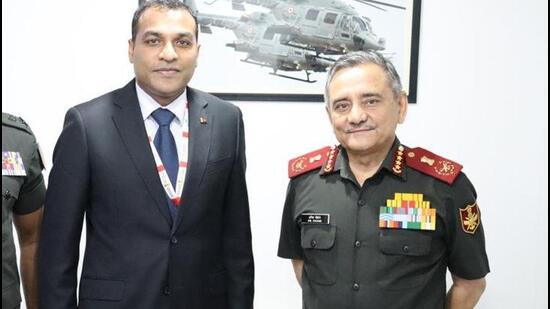
Sri Lankan state minister of defence Premitha Bandara Tennakoon met Union defence minister Rajnath Singh, minister of state for defence Ajay Bhatt, defence secretary Ajay Kumar, Chief of Defence Staff General Anil Chauhan and the three service chiefs

Sri Lankan state minister of defence Premitha Bandara Tennakoon with Indian chief of defence staff General Anil Chauhan (right). (ANI Photo)

India has reiterated its readiness to continue supporting Sri Lanka in the defence sphere during a meeting between the visiting Sri Lankan state minister of defence Premitha Bandara Tennakoon and minister of state for defence Ajay Bhatt.

Tennakoon is visiting India with a three-member delegation comprising army and navy officers to participate in the biennial global defence exhibition DefExpo2022. This is the first high-level visit from the Sri Lankan side since bilateral ties hit a rough patch over the visit of a Chinese surveillance to Hambantota port in August.

Besides meeting Bhatt, Tennakoon and his delegation also had interactions with Union defence minister Rajnath Singh, defence secretary Ajay Kumar, Chief of Defence Staff General Anil Chauhan and the three service chiefs of India.

During the meeting with Bhatt on October 17, the Indian side reiterated its readiness to continue to support Sri Lanka in the defence sphere”, according to a readout from the Indian high commission in Colombo.

India will continue to strengthen its multi-dimensional cooperation with Sri Lanka for mutual benefit and also for enhancing regional peace, security and stability,” the readout added.

This is the second time in the past year that a Sri Lankan minister has participated at an event inaugurated by Prime Minister Narendra Modi. Ministers from Sri Lanka were part of the event to mark the inaugural international flight to Kushinagar airport in October 2021.

Speaking at DefExpo2022, Tennakoon hailed the India-Sri Lanka partnership in defence and highlighted the importance of the defence industrial base in augmenting security policy.

India and Sri Lanka have maintained bilateral engagements in defence despite the challenges posed by the Covid-19 pandemic. The SLINEX naval exercise and the Mitra Shakti army exercise are held every year alternatively in India and Sri Lanka, and both armed forces collaborate closely in dealing with common security challenges such as drug and human trafficking, the readout said.

The Colombo Security Conclave – which brings together senior security officials from the Maldives, Mauritius, India and Sri Lanka – has emerged as a key platform to address security issues at a regional level. In August, the first Dornier reconnaissance aircraft provided by India was inducted into the Sri Lankan Air Force to enhance the country’s maritime surveillance capabilities.

However, ties between Colombo and New Delhi hit a rough patch when the Yuan Wang 5, a Chinese vessel with extensive surveillance capabilities, docked at the Hambantota port, which is controlled by the Chinese. Since then, officials from both ties have worked to restore ties to an even keel.

India and Sri Lanka also cooperate closely in training and capacity building in the defence sphere. Indian military establishments, including the National Defence College, have produced leaders of the Sri Lankan armed forces. Every year, 1,500 to 1,700 slots are allocated to Sri Lankan personnel, which amounts to an outlay of around ₹500 million to ₹550 million (more than $6 million). Similarly, Indian military officers are hosted by the armed forces of Sri Lanka, including for specialised training modules in fields such as counter-insurgency.

Both sides also cooperate on humanitarian issues, as reflected by joint efforts to avert large-scale environmental damage, expeditious supply of liquid medical oxygen and other materials, repatriation of around 700 Indian nationals with the assistance of Sri Lanka’s armed forces during the pandemic.

The futuristic partnership between the two neighbours underscores India’s ‘Neighbourhood First’ policy as well as Security and Growth for All in the Region (SAGAR) doctrine,” the readout said.

TN fisherman shot at by Indian Navy near Sri Lanka border, state writes to PM

October 21st, 2022

Courtesy The Hindustan Times

The Indian Navy on Friday shot at a fisherman while trying to intercept a suspicious boat” in Palk Bay, near the maritime border with Sri Lanka, with the Tamil Nadu government identifying the injured man as resident of the state and writing to Prime Minister Narendra Modi over the issue.

The Tamil Nadu government identified the injured fisherman as K Veeravel, a resident of Vanagiri village in Mayiladuthurai district. Chief minister M K Stalin has announced a compensation of ₹20 lakh for Veeravel and wrote to PM Modi asking him to direct security forces to exercise caution.

A statement tweeted by the defence ministry’s PRO in Chennai said that during the early hours of October 21, a suspicious boat” was observed by the Indian Navy ship on patrol in Palk Bay.

Despite repeated warnings the boat did not stop,” the statement read. The ship, as per standard operating procedures, fired warning shots to stop the boat. One of the crew onboard the suspicious boat is reported to have sustained an injury. The injured person was administered first aid by the ship and evacuated by an Indian Navy Chetak helicopter,” it added.

The injured person has been shifted to the Government Hospital, Ramanathapuram for further medical management. His condition is reported to be stable. An Inquiry has been ordered to investigate the incident,” the PRO tweet stated.

Veeravel sustained injuries to the abdomen and thigh but is in a stable condition, according to officials familiar with the matter. District authorities and the state’s fisheries minister, Anitha Radhakrishnan, met him at the hospital in Madurai.

Union minister of state L Murugan, who was in Chennai on Friday said he would comment on the matter only after the investigation is complete.

We have asked for an investigative report to identify the person who shot the fishermen,” Murugan said, adding that they will review if Veeravel falls in the ambit of the ministry’s group insurance scheme.

We have been insisting that fishermen attach a GPS because sometimes, we have instances of them crossing the border. We will know what happened in this specific instance only after completing the investigation,” he said.

Veeravel was among a group of ten fishermen (seven from Tamil Nadu and three from Karaikal in Puducherry) who had ventured for fishing in a Karaikal-registered mechanised fishing boat, said one of the officials mentioned above, asking not to be named.

Announcing the compensation for Veeravel, CM Stalin said: I am deeply shocked and saddened to learn that Mr Veeravel has sustained serious injuries after being shot by the Indian Navy this morning… I have ordered for him to be provided special medical treatment.”

Later in the day, he wrote to PM Modi Stalin on Friday wrote to Prime Minister Narendra Modi about the incident.

I am extremely saddened by this incident that has happened by an act of the Indian Navy. You are well aware of the plight of Indian fishermen being ill-treated by Sri Lankan security forces. But, when our security forces resort to similar acts, it creates a sense of despair and insecurity in the minds of the downtrodden fisher folk,” he wrote.

I request your intervention in this matter and request you to direct the Indian Security Agencies to exercise extreme caution and restraint while dealing with Indian fishermen in Indian waters,” he added.

UK will consider any request to support inquires.

October 21st, 2022

Courtesy The Daily Mirror

While claiming that the Metropolitan Police have not deployed any officers in support of the Sri Lankan investigation into the 2019 Easter Sunday bombings in Sri Lanka, Britain on Wednesday said that Metropolitan Police ‘will consider any request to support an overseas investigation where it is proportionate, necessary and legal.’

In response to a written question by a Labour Parliamentarian whether the Metropolitan Police are taking steps to support the investigation into the 2019 bombings in Sri Lanka, Minister of State (Home Office) (Security) Tom Tugendhat informed the UK Parliament that Metropolitan Police have not deployed any officers.

However, he said that the Home Office works closely with policing partners to support requests from international partners across the full spectrum of policing.

The Metropolitan Police counter-terrorism command dispatched a team of specialists to Sri Lanka in 2019, including family liaison officers, to support the families of British victims and assist with the repatriation of deceased British nationals. A programme run by Interpol involved the training of 30 Sri Lankan forensic specialists and police officers by UK experts in disaster victim identification,” the Minister stated.

Earlier, President Ranil Wickremesinghe said he will seek the assistance of the police authorities of the UK in order to complete the investigation into the Easter Sunday attacks of 2019. (Sunil Jayasiri)

Third reading of 22nd constitutional amendment passed in Parliament

October 21st, 2022

Courtesy Adaderana

The third reading of the 22nd Amendment to the Constitution has been passed in Parliament by a majority of 173 votes.

Announcing the result of the vote on the third reading of the bill, the Speaker of Parliament Mahinda Yapa Abeywardena informed the House that 174 had voted in favour of the bill while only MP Sarath Weerasekara voted against it.

Meanwhile it is reported that 44 Members of Parliament including former Prime Minister Mahinda Rajapaksa were absent during the vote. 

Earlier, the second reading of the 22nd Amendment to the Constitution Bill was passed by a majority of 178 votes.

During the division, 179 parliamentarians in total voted in favour of the bill while it received only one vote against it, with SLPP parliamentarian Sarath Weerasekara deciding to oppose the bill.

The two-day parliamentary debate on the second reading of the 22nd Amendment to the Constitution Bill commenced on Thursday (Oct. 20). At the end of the debate today, a vote was called on the bill.

The 22A draft bill was approved for its second reading at the Ministerial Consultative Committee on Justice, Prison Affairs and Constitutional Reforms held on Oct. 04.

Later, the Committee on Parliamentary Business, which met under the chairmanship of Speaker of Parliament Mahinda Yapa Abeywardana, decided to schedule the debate for Oct. 20 and Oct. 21.

The constitutional amendment is expected to empower parliament over the executive president and annul the 20A to the Constitution, which had given unfettered powers to President after abolishing the 19th Amendment.

Under the 22A, the President, the Cabinet of Ministers and the National Council will be held accountable to the parliament. Fifteen Committees and Oversight Committees are also accountable to parliament.

The 22A comprises features of both the 19th amendment introduced by the Yahapalana Government and the 20th amendment brought forth under the presidency of Gotabaya Rajapaksa.

According to the draft Bill, a Constitutional Council will come into effect which will consist of members including the Prime Minister, the Speaker of Parliament, the Opposition Leader, a Member of Parliament appointed by the President, two members nominated by both the Prime Minister and the Opposition Leader. The council will be chaired by the Speaker.

The Public Service Commission, the National Police Commission, the Audit Service Commission, Human Rights Commission, Commission to Investigate Allegations of Bribery or Corruption, Finance Commission, Delimitation Commission and the National Procurement Commission shall be responsible and answerable to the parliament. However, Election Commission is not.

As per this amendment, no person shall be appointed by the President unless such appointment has been approved by the council upon a recommendation made to the council by the Head of State in instances of appointing the Chief Justice and the judges of the Supreme Court, the president and the judges of the Court of Appeal, the members of the Judicial Service Commission other than its chairman.

The same is applicable when appointing the Attorney General, the Auditor General, the Inspector-General of Police, the Central Bank Governor, the Parliamentary Commissioner for Administration and the Secretary-General of Parliament.

The 22A abolishes the ability of a dual citizen to be appointed as a Member of Parliament.

It also includes provisions of the 20th amendment that the number of Cabinet Ministers shall not exceed 30 and the number of ministers who are not members of the Cabinet and Deputy Ministers shall not exceed 40.

However, if a recognized political party or an independent group which obtains the highest number of seats in parliament forms a national government, the number of ministers in the Cabinet, the ministers who are not in the Cabinet and Deputy Ministers shall be determined by the parliament.

Committee report on restructuring energy sector to be submitted to National Council soon

October 21st, 2022

Courtesy Adaderana

Minister of Power and Energy Kanchana Wijesekera has informed the National Council that the report of the committee for the restructuring of the energy sector would be submitted within two weeks.

At the same time, the minister stated that the National Council is also expected to be informed about the proposed measures to be taken for the various energy generation projects proposed to be launched by the Sri Lanka Sustainable Energy Authority and the Ceylon Electricity Board.

The National Council met yesterday (Oct. 20) under the chairmanship of Speaker of Parliament, Mahinda Yapa Abeywardena, Prime Minister Dinesh Gunawardena and the Chief Opposition Whip Lakshman Kiriella.

Institutions such as the Ceylon Electricity Board (CEB) and Sri Lanka Sustainable Energy Authority (SLSEA) were called before the National Council where the officials presented ideas and proposals related to the progress of the energy sector.

MP Namal Rajapaksa, as the chairman of the National Council sub-committee to identify short- and medium-term programs related to the National Policy, and Patali Champika Ranawaka, the chairman of the National Council sub-committee on identifying short and medium-term programs related to Economic Stabilization briefed the National Council about the progress and the expected future work of the committees.

Ministers Kanchana Wijesekera and Nasir Ahmed, State Ministers Indika Anuruddha and D. V. Chanaka, MPs Pavithradevi Wanniarachchi, Johnston Fernando, Sagara Kariyawasam, Asanka Navaratne, Rishad Bathiudeen, M. Rameshwaran and Sivanesathurai Santhirakanthan were present at the Council meeting held.

Sri Lanka’s NCPI-based inflation goes up to 73.7% in September

October 21st, 2022

Courtesy Adaderana

The Department of Census and Statistics (DSC) has released the National Consumer Price Index (NCPI) and the inflation rate for the month of September 2022.

The NCPI for all items for the month of September 2022 is 256.2 and it records an increase of 5.8 in index points compared to the month of August 2022 for which the index was 250.4. This increase represents an increase in expenditure value of Rs. 1879.94 in the ‘Market Basket’.

For September 2022, month-on-month change was recorded as 2.3% compared to August 2022.

The overall rate of inflation as measured by NCPI on year-on-year basis has increased to 73.7% in September 2022 from 70.2% in August 2022. In July, this was reported as 66.7%.

With respect to September 2021, the reported inflation for the month of September 2022 was mainly due to the higher price levels that prevailed in both food and non-food groups.

Accordingly, the Year-on-Year inflation of the food group increased to 85.8% in September 2022 from 84.6% in August 2022 and the Year-on-Year inflation of the non-food group increased to 62.8% in September 2022 from 57.1% in August 2022.

NCPI Based Inflation September 2022 by Ada Derana on Scribd

Construction sector reps meet President to discuss issues, request to form special task force

October 21st, 2022

Courtesy Adaderana

A discussion on the challenges faced by the construction sector and proposed plans to address these issues was held at the Presidential Secretariat under the patronage of President Ranil Wickremesinghe on Thursday (Oct. 20).

The problems faced by the construction sector under the current economic situation were discussed at length and special attention was paid to the delays in the construction of middle-income housing projects as well as road construction projects.

During the discussions, attention was also paid to the issues that have arisen about the contractors, banks and other financial institutions.

The President has drawn the attention of the officials to the program to be followed for the maintenance of the construction sector and job security in the sector while proposing the appointment of a committee to discuss the matter further and make recommendations.

Those engaged in the construction sector also requested the President to establish a special task force to uplift the construction sector.

Minister Bandula Gunawardena, State Minister Lasantha Alagiyawanna, Senior Presidential Adviser on National Security and Chief of Presidential Staff Sagala Ratnayake, President’s Secretary Saman Ekanayake, Senior Economic Advisor to the President R.H.S. Samarathunga and heads of institutions related to the construction sector were present at this discussion.

Refusal of MIR through eyes of transformation

October 20th, 2022

D Rajaratnam

News of Central Bank’s decision on refusal to link up with MIR clearing and settlement system was broadcasted in Lankan media in subdued tone and mediocre coverage. Restraint largely owing to a decade of hard work by United States to build partnership with local media than lack of importance. Nor that we hear substantial political voice raising concern. There are no Think Tanks like Advocata or Verite to argue a case for MIR system analogous to IMF. The decision has a direct bearing on our national interest and security as the nation in concern has been an unequivocal ally and security guarantor of Sri Lanka in the international stage.

Payment systems are the veins and arteries of financial system as the cross boarder trading grew west developed a secure massaging system to communicate between financial institutions that came to be known as SWIFT replacing manual Telex massaging. Like any other organ in western structure SWIFT was strategically promoted around the world realizing the leverage it would hold one day. Sri Lanka adopted SWIFT between Lankan banks around 2003 though we used them before for international transactions (CB Report 2003). Through time like the Dollar it morphed into a potent weapon at the hands of Washington.

China & Russia has been challenging this financial edifice by developing a parallel structure. Union Pay built by China is now largest payment system yet lacks outreach to match juggernauts Visa and MasterCard. Interbank payment systems CIPS (China) and MIR/SPFS compete with SWIFT and US Dollar clearing CHIPS. MIR and CIPS offer complete suite of clearing and settlement service not only massaging. It cuts middlemen and directly converts Rouble or Yuan to local currency enabling trade and commerce between the nations. System hence foster bilateral relationship. SWIFT on the other hand headquartered in ‘neutral’ Switzerland. It complements well with other products and services that western world dominates such as currency, markets, payment cards and Investment Banks. Severing MIR system therefore has flow on effect on decoupling Lanka’s economic reliance on Russia while enhancing dependency on western bloc.

Nature of the imperialism that we see today is complex to understand. It is more about dependency and leverage than direct control, based on a development of purported common value system that is often defined by hegemon. To this end Washington and its alliance has built a loyal fraternity comprise of Think Tanks, professional bodies like Ceylon Chamber of Commerce, Chartered Institute, funded legal fraternity, most importantly been giving advice to Central Bank through multilateral organisations in the likes of IMF. Many top management administrators in Central Bank poses US Doctoral degrees with scholarships awarded. Playbook of Lanka’s economic pathway bear stamp of Washington Consensus. An ‘independent’ CB may steer to become ‘dependant’ CB on Washington Consensus.     Pertinent point west transforms institutions not individuals and then relies on institutions to self-sustain the ideology.

Lately through USAID and IREX has been encroaching media space. Training journalist under MEND program and befriending media moguls are all part of craftily building influence which her opponents lack. Bulwark in the MIR (or any Chinese project) mostly comes from aforesaid fraternity augmented by ethno-religious divisions. Not long ago Aeroflot dispute created headlines how a law firm went out of its way to detain a plane. A convoluted equilibrium where local disharmony meets US geopolitical interest. In short when China was busy transforming the landscape of Colombo US focused on transforming the society. Lately published strategy paper Integrated Country Strategy” is unambiguous in naming the obstacles. Ethno-nationalism long played a role in resenting western influence over non-allied policy which it sees as an impediment. As a counterweight Lanka’s ethnic issue found refuge in western polity (analogous to Uygur Muslim for China or Rohingya in Burma). The Idea of ‘home grown’ economic model does not fit well neo-liberal economic theory. If continued nation would get completely absorbed into western orbit away from any emerging power bloc. In modern world such obstacles can only be overcome by transforming a society who would see the World in a given prism, by observation what is happening in Lanka!!

D Rajaratnam

Debunking Tamil Homeland myth with 5 questions

October 20th, 2022

Shenali D Waduge

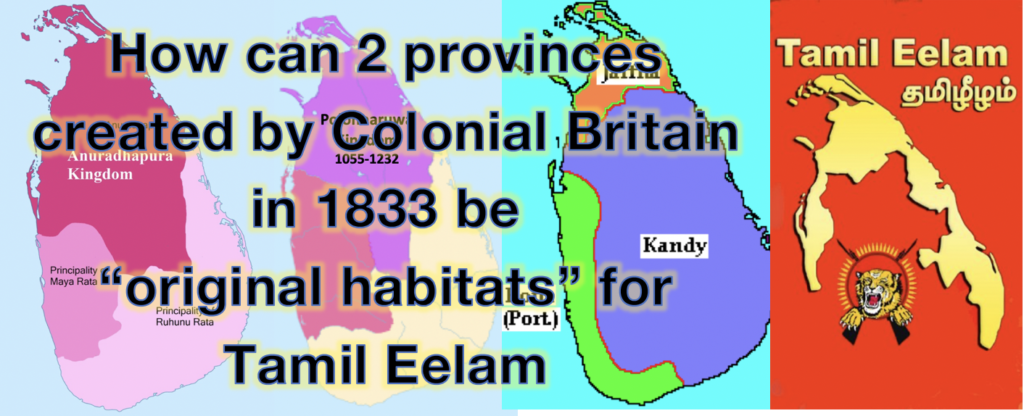
Divide & Rule was a key component of colonial rule. Illegally taking over lands and territories, planting fictitious history, infesting minds with hate and violence is part of a legacy that continues unabated. Sadly, historians have failed to take these false claims and nullify them. They have been silenced by political correctness”. However, it is time people begain asking the questions and demanding answers. How can 2 provinces that were created only by British in 1833 be claimed ‘original habitats” of Tamil people? How can Indian Malabars claim a separate homeland in Sri Lanka? How can a South Indian customary law applicable only to those inhabitants be the customary law in Sri Lanka? How did the Colonial Missionary created Dravida Nadu movement become a Tamil Eelam movement & what is their ultimate plan? Lets have you start asking yourselves these questions too!

Question 1: How can Tamil Eelam Homeland lobbyists claim 2 provinces as their homeland” making use of the 2 provinces created in 1833 by colonial Britain?

It is very clear that while the first Kingdom of Anuradhapura, 2ndkingdom of Polonnaurwa also included North Sri Lanka, the last kingdom of Kandy too included part of North & explains why the Kandyan king despatched his army to defend his people from the Portuguese. The last battle for the defense of Jaffna before it fell to European powers was fought not by a Tamil army but by Sinhalese men sent by the King of Kandy.

Portuguese historian Father Queroyz says as long as Rajapure (Anuradhapura) was the capital of Ceylon, the whole island was subject to one kng” If it was so with Anuradhapura, it was so with the rest of the capitals. When the Portuguese arrived in 1505 there were 15 ‘kinglets’ subject to the King of Kotte of which Jaffnapatao kinglet was one of the 15 kinglets” were independent or separate from the rest.

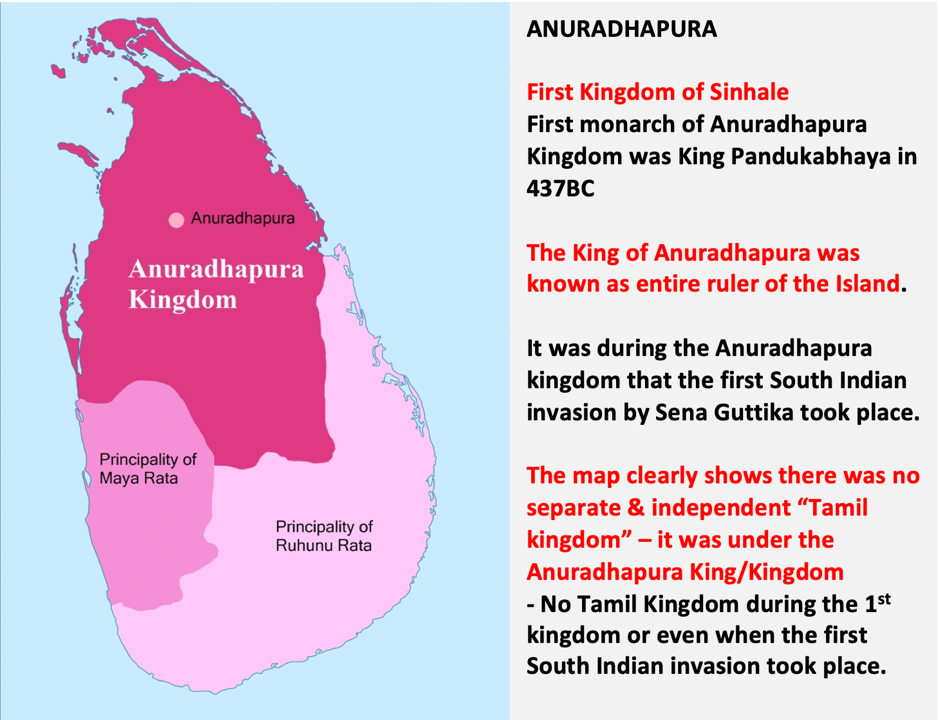
To quell the lies let us first turn to the maps.

The 1st kingdom was in Anuradhapura.

The 2nd kingdom was in Polonnaruwa

The last kingdom was in Kandy

The kings of these kingdoms were the sole ruler of the entire Island.

These 3 maps clearly show there was no separate or independent Tamil Kingdom and the so-called ‘separate’ area being claimed as a Tamil homeland” was ruled by the Sinhalese kings.

A separate kingdom must provide evidence of food/water supply (agriculture), a system of government, cultrure, belief & traditions, a written language, structures/monuments – the Kingdoms of Anuradhapura & Polonnaruwa leave us to cherish the worlds first man-made irrigation & water tanks, even animal hospital – these exist even to this day, where are those of a so-called Eelam Kingdom?

There were no separate independent kingdoms in Jaffna or anywhere else

There were no provinces.

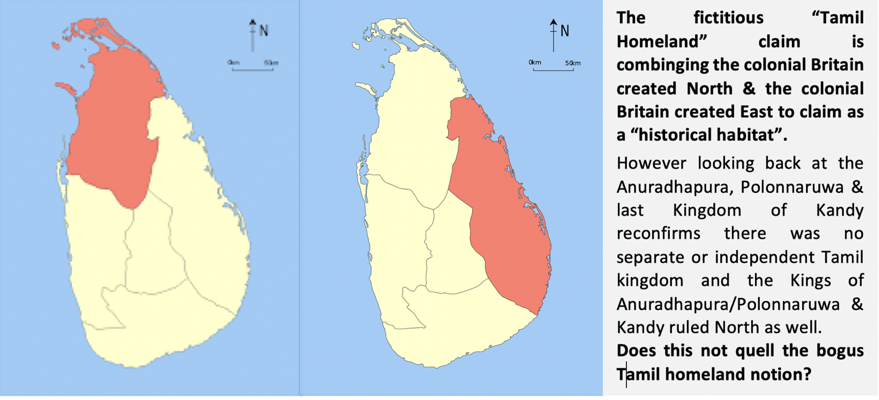
Provinces were created by the Colonial British in 1833

Thus, there was nothing called Northern or Eastern province until 5 provinces was created in 1833 by Colonial Britain.

Therefore, how can the Eelam lobby claim to have ruled 2 provinces that did not exist until the colonial British demarcated them in 1833?

This is a key argument to debunk the demarcation of a bogus Tamil Eelam Homeland.

Question 2: How can Indian Malabars rechristened as Ceylon Tamils in 1911 claim a separate homeland in Sri Lanka?

There is no record in ancient Sinhalese chronicals, Tamil chronicals or even records of Portuguese, Dutch or British to claim an ethnic group called Ceylon Tamils” were living before they landed. All of the colonial records refer to both Tamils & Muslims as Malabars”. Malabars was the term given to people who came from the Malabar coast of South India or Coromandel coast also in South India. Malabars were indigenous to South India. Therefore, anyone termed Malabar were descendants from South India. Thus, the Tamils living in Sri Lanka were referred as Malabars by the Portuguese, the Dutch & the British.

The term Ceylon Tamils” was coined only in 1911 when Sir Ponnambalam Ramanathan who was registrar of census, inserted Ceylon Tamils instead of Malabars. The term Ceylon was coined by the British only after the Kandyan Convention in 1815.

Malabars cannot claim any homeland” in Sri Lanka as they were immigrants from the Southern coast of India. Their homeland is in South India.

The quest for self-determination in India for Tamils started in India.

The same ethnic group cannot claim 2 homelands in 2 sovereign countries (or plan to annex Sri Lanka to create a Greater Dravida Nadu)

Question 3: Tamil caste system originates from South India – If Malabars are from South India, Vellalas & Thesawalamai Law is also – how can customary laws applicable to foreigners become mandatory customary law in Sri Lanka.

We have established Malabars are not indigenous to Sri Lanka but to South India.

The Vellalas are a low caste in South India but became the upper elite caste/class in Sri Lanka, not stopping there, the Vellala’s went on to oppress their own, dictating how other castes should function at kovil, funerals, weddings etc. If Tamils are marginalized or discriminated it is by the Vellala Tamils and not the Sinhalese. The Thesawalamai law encoded by the Dutch in 1706 claiming to be Tamil customary law is actually not applicable to all Tamils but to only Malabar inhabitants from Jaffna. What is the % of Tamils covered by this definition and how many Tamils does this law exclude – if so why should this be referred as a customary law for ALL Tamils when it is not so, more importantly, the Thesawalamai law is applicable to Malabar inhabitatnts in Jaffna only. Malabars are from South India. Vellala’s are a caste originating from South India. How can anyone quote these to claim homeland theories.

It is good for Tamils to realize who is discriminating them instead of falling prey to propaganda. How far has the caste system marginalized Tamils against each other, is a question Tamils themselves need to honestly answer. When Tamils are not welcome into Tamil homes, when even cutlery & crockery are differentiated, when even kovils disallow their own, when people are reluctant to share a toilet with their own – is this not discrimination?

Question 4: If the Dravida Nadu term was coined by colonial Missionaries, isn’t the Tamil Eelam quest (an offshoot of the Dravida Nadu movement) a similar Missionary infused agenda?

There was no term called Dravidian until it was coined by the Church.

The Church missionaries after creating the term Dravida went to great lengths to promote a fictitious history.

The Dravidian theory was an artificial theory implanted by the Church & it is possible the same was done to create a Tamil Eelam notion to separate both Tamil Nadu & Sri Lanka along ethno-linguistic lines.

Bishop Caldwell plugged the South Indian languages of Telugu, Tamil, Malayalam, Kannada as Dravidian languages.

If the Dravidian movement was led & controlled by the Global Church, is it a surprise that the Tamil Eelam lobby has the blessings of the Church apparatus as well? It is the Tamil Christians/Catholics who are mainly operating this quest.

1939 commenced the Dravida Nadu for Dravidians” a quest for a separate sovereign & federal state.

1940 Dravida Nadu map was released

1947 Britain rejected appeals for a separate Tamil state which led to Dravida Nadu Secession Day being passed on 13 July 1947 demanding an independent Dravida Nadu. 2 years later in Sri Lanka, ITAK was created seeking a separate Tamil state in Sri Lanka.

1960 Dravida Nadu Separation Day which led to the Tamil Nadu Liberation Army while the Tamil Eelam movement in Sri Lanka resulted in Tamil militancy with LTTE taking leadership.

Dravida Nadu was replaced with Tamil Nadu for Tamils” then We Tamil Movement” which led to demand for an independent Tamil Nadu which Government of India stopped by legislative enactments in 1963.

The demands for Dravida Nadu were identical to demands by LTTE during Thimpu talks in 1985.

If Dravida Nadu movement & map was created by the Global Church was the map of Tamil Eelam also their creation?

This implies that both movements (South India & Sri Lanka) did not originate from the people but from one external source – the Church.

Question 5: If the eelam” area was borrowed from colonial British map, if Global Church planted the Dravida Nadu movement & Greater Tamil Eelam initiative, if Malabars, Vellalars, Thesawalamail all are imported from South India is it so difficult to realize that Tamil Militancy was also exported from India to Sri Lanka to pass on India’s headache to us?

The Jain-Commission interim report following LTTE’s assassination of Rajiv Gandhi, memoirs by the IPKF former commanders and even former Indian High Commission to Sri Lanka J N Dixit prove a RAW hand in Tamil militancy in Sri Lanka from training, to supplying of weapons to even logistics support & funding.

These lies are what lays the foundation for a bogus homeland quest which is kept alive because of the benefits to key players promoting it. The geopolitical & conversion motives are clear. Unfortunately so-called academics and historians have been party to the lies or felt shy to negate these with historical facts & arguments.

So lets bring these to the open & demand facts not propaganda.

Shenali D Waduge

Rehabilitation: the broad and narrow, global and local

October 20th, 2022

Malinda Seneviratne

Rehabilitation is a word that presumes a previous state of perceived acceptance or agreement. Its etymology is interesting and revealing, deriving from re– again” or to turn” and habitare– make fit” which in turn comes from the Latin habilis– easily managed, fit.” In other words, rehabilitation is about restoring someone or something to a previous state; someone who has or something that has strayed from the norm is reined back into a controlled/controllable space or social architecture.  

This space or arrangement obviously has rules which if infringed upon warrant disciplining of one form or another.  One may argue that this is a necessary evil because complex societies ‘must have’ states or structures of governance, rulers and the ruled and therefore rules of engagement where certain freedoms are conceded to institutions of authority for smooth functioning of society. A lot of loaded terms there of course not least of all because arrangements are less agreed upon than are imposed, historically speaking.

Shehan Karunatilleka, who won the Booker Prize for his ‘The Seven Moons of Maali Almeida,’ in his acceptance speech is reported to have said “the ideas of corruption, race baiting and cronyism have not worked and will never work.” Congratulations are due — Shehan’s ‘Chinaman’ was epic in my opinion and I am sure this latest novel has the same flourish and brilliance in story-telling. A review will have to wait.

That said, parenthetically, his assertion is decidedly odd. What, after all, has history been if not the triumph and sustained development of that which he says has not worked and insists will never work?  Vinod Moonesinghe’s comment is apt: ‘This is proof that good writers are not necessarily the best historians. Just looking at the Histories of Britain, the USA, France, Canada, Australia, Germany, and Japan should be enough to disprove Karunatilaka’s statement. Their very success was based on exactly corruption, race baiting and cronyism. Indeed, it went further – the wealth of these countries was based on slavery and what Marx called “primitive capitalist accumulation” – grand larceny on unheard-of scales. Perhaps Shehan was referring to the victims for whom such things certainly do not work and will never work.

This is the problem of the status quo, things as they are and things to which people and things are required to return or be returned and therein contained. The underlying assumption is that what exists is good or is better than any alternative. This is why rehabilitation is seen as a must. The Europeans massacred people, perpetrated genocide, erased cultures and forced cross and bible on people to obtain and thereafter preserve a status quo. Rehabilitation is the unspoken cuss word of evangelism at gun point or extraction of compliance by preying on vulnerabilities. It is the unspoken dogma of IMF-WB-WTO operations on behalf of corporate capital and, as of now, the strategic interests of the USA (the EU is now, after ‘Ukraine,’ a vassal entity).

Let’s say, for argument’s sake, that in less pernicious contexts, some level of cogency is necessary and therefore the errant need to be contained. Such needs are typically felt more acutely during and in the aftermath of a conflict, especially a bloody one. In Sri Lanka, in recent times, two conflicts demanded rehabilitation. The first, the UNP-JVP conflagration in the late eighties where the UNP-led government set up torture chambers all over the country, K-points they were called (K for ‘Killing’). Less informal were the facilities available for dealing with terrorist suspects, but atrocities there were, especially during the first two decades of the struggle against the LTTE (hardly ever talked of, and no one asks ‘why not?’).

A formal rehabilitation process was in place by the time the LTTE was militarily defeated. Those who surrendered or were captured (and this included hundreds of child soldiers) were offered education and marketable skills and reintegrated into society. There were no formal provisions for monitoring them thereafter to my knowledge, but it is safe to assume that tabs were kept, defensible to a point considering the nature of the threat and the history of the LTTE.  

A legal entity, therefore, one may argue, is better than not having one. That however is where the applause for the draft bill for a Bureau of Rehabilitation must stop.  

The stated objective is to ‘rehabilitate drug dependent persons, ex-combatants, members of violent extremist groups and any other groups of persons who request or [are] required by law to be provided treatments and rehabilitation by adopting various therapies in order to ensure effective reintegration and reconciliation through developing socio-economic standards.’ [Part I, Section 3 and 4(b)].

The draft refers to a minister but does not state the ministry. The draft merely says ‘the ministry to which the Bureau is assigned,’ perhaps because ministries are made, broken and dissolved as per the prevailing political culture, but that’s not an excuse given the gravity of the exercise. We do know that the subject was previously handled by the Commissioner General of Rehabilitation, under the President, and using the Public Security Ordinance and Prevention of Terrorism Act. How drug-dependency, essentially a medical condition that ought to come under the purview of the Ministry of Health is coupled with public security and terrorism is mind boggling.

The drafters seem to have inserted vague language and this is what is most worrisome. What, for example, are ‘any other groups’? Who decides who requires rehabilitation? Yes, it says ‘required by law’ but then again, there is the quiet insertion of ‘requests’. In practice, people, especially those who are seen by the state as somehow being out of the loop, can be persuaded to request rehabilitation, especially in tense (or worse) political contexts.

Part I, Section 4 (d), under ‘powers, duties and functions,’ allows the Bureau to mobilise those who are undergoing treatment or rehabilitation for activities that ‘productively enhances the economy.’ No mentioned of such people being given the option to refuse such deployment here. That’s a green light for a prison-industrial complex akin to the one perfected by the USA!

The document also empowers the Bureau to monitor those who have been ‘reintegrated into society after treatment and rehabilitation.’ This, again, could be understood in the case of ex-combatants in the immediate aftermath of a bloody conflict, but the text is open-ended. There’s no provision for closure on such surveillance. Why should anyone who has been certified as rehabilitated be watched thereafter and until he/she dies?

The Bureau can set up any number of centers for rehabilitation (legally sanitized K-Points?) and will keep all records confidential (makes sense in the case of drug-dependents, ex-combatants, but then again what if these are facilities that are expressly political?).

What is most disconcerting is that the President, upon the minister’s request designate all security forces ‘as authorised members of the forces who may exercise, perform and discharge the powers, duties and functions under this Act’ as long as the specifics are gazetted. [Part III, Section 17]. No caveats as to context here, even if context were excuse enough. In other words, what the Premadasa regime did in 88-89 would now be given legal standing. Wouldn’t make a difference to the victims, except for the veneer of accountability offered by ‘legality’ which, history has shown, can easily be shoved aside (remember the Bill Against Vexatious Prosecution passed by the United Kingdom to make it possible for the military to kill, torture, destroy and displace with impunity?).

Indeed, Part V, Section 21 (2) has given a carte blanche to the Council administrating the Bureau to get away with anything as long as there is good faith. Well, that’s pretty subjective. The White Man’s Burden, for example, could be dismissed as a good-faith thing and so too the forcible conversion of ‘heathens’ or thrusting the 13th Amendment down Sri Lanka’s throat. How about redress for error (generous word, that)? Moreover, the minister can make any regulations to carry out and give effect to the principles and provisions of the Act and such will stand until and unless Parliament does not approve three months later. Coupled with ‘good faith’ this could allow all manner of violations which the victims cannot protest or obtain redress for.

The draft bill, taken in totality, is strewn with powers, provisions and caveats that are all about disciplining and punishing with impunity. Rehabilitation is a sanitizer, essentially. Sinister, certainly.

malindawords.blogspot.com

Economy collapse due to wrong policies: Minister Ramesh Pathirana

October 20th, 2022

Courtesy The Daily Mirror

The country’s economy started to collapse with wrong policy decisions, Industries Minister Ramesh Pathirana said addressing the panel discussion of the Sri Lanka Ceramics and Glass Council yesterday.

The discussion was on the quality, affordability and self-reliance of the sanitaryware industry.
We are a people who maintain a lifestyle that we cannot afford as a country and personally, we used to spend as much as we could,” he noted.

The Minister said the country started collapsing after massive amounts of debt were added to the country due to the above characteristics.

He said the wrong policy decisions that were made regarding borrowing and non-borrowing debt also caused the country to end up in the current situation.

“The Government has to pay an annual trade balance of 10 billion USD, including 22 billion USD on imports and 10 or 12 billion USD from exports.

With the open economy of the country since 1977, the current debt has become unsustainable,” he said.
“We are wrong. We took a decision that should not have been taken in principle. That is the fact that we will not borrow again. There was another decision made with the fact that we would not take loans again.
If there is something that can be produced in this country, a decision was taken to support the production of it -both in agriculture and industry. However, this improvement was lost in this critical situation of the country, ” he said.

He said after the current Government came to office, it had stopped importing vehicles as USD 2 billion was spent annually on importing vehicles into the country.

“We knew that the country was going to face foreign exchange issues and that there was a vehicle assembling industry in the country which could be developed. Therefore, a decision was taken to introduce a long-term policy to the automobile industry,” the Minister said. (Chaturanga Samarawickrama)

Rs. 6,900 mn loss from urea tender: Gulf Trade and Investment Board Head

October 20th, 2022

Courtesy The Daily Mirror

The government has incurred a loss of Rs. 6,900 million by awarding the tender to a company that submitted the highest bid during the tender process for the import of urea under World Bank assistance, Sri Lanka Gulf Trade and Investment Board (SLGTIB) Chairman Mohan Perera said.

Addressing the media, he said that the UAE-based company, which submitted a bid for US$ 595 for one metric ton of urea, but it was not awarded the relevant tender and it was awarded to another company. 

The company that submitted a tender for US$ 1,000 had agreed to supply for US$ 850, and there is a US$ 40 million deficit in comparison with the last tenderer, Perera said.

Three months ago, before the Russia-Ukraine war, the Falco company said that the consignment purchased from Ukraine and transferred to another country could be supplied at the old price without the production certificate.

But Mohan Perera said that if required, with all the certificates, urea can be provided from Oman and Turkmenistan for US$ 695 per metric ton.

However, he further said that he is capable of supplying a bag of urea for Rs. 12,500 inclusive of all taxes. (Chaturanga Samarawickrama)

Justice Minister calls for CID probe on facebook post that he arranged special treatment to Thilini Priyamali

October 20th, 2022

Courtesy The Daily Mirror

Lodging a complaint with CID, Justice Minister Wijedasa Rajapksha has urged the CID Director to conduct an investigation into the false and malicious Facebook Post alleging that he as the Minister of Justice and Prison has given special treatment to remand prisoner Thilini Priyamali.

The Justice Minister maintained that the dissemination of the said untruthful and malicious post via electronic media regarding a pending case has caused a severe prejudice to the entire legal system. 

The Justice Minister further said dissemination of such information would also affects the integrity of the Judicial System and the Criminal Justice process in Sri Lanka.

While attaching the copy of the post and the details of the person who posted the alleged false allegation, Justice Minister has urged the CID Director to conduct an inquiry at his earliest convenience and report the matter to Fort Magistrate’s Court for further action.

In his complaint, the Justice Minister said it tarnishes the legal system of Sri Lanka and creates a prejudice on the minds of the people at large since the matter refers to an ongoing case in the Fort Magistrate’s Court. (Lakmal sooriyagoda)

CBSL chief says Sri Lanka has no alternative other than IMF; defends tax reforms

October 20th, 2022

Courtesy Adaderana

The Governor of the Central Bank of Sri Lanka (CBSL) Dr. Nandalal Weerasinghe says that in present circumstances, there is no alternative other than the International Monetary Fund (IMF) to get assistance for reviving the country’s economy. 

He also said that tax revisions and other reforms combined with debt restructuring are parts of the stabilization process.

The CBSL Governor made these comments during an interview with the Director General of President’s Media, Danushka Ramanayake. 

Noting that 80% indirect tax and 20% direct tax should be evolved to 60% and 40%, respectively, in order to provide relief to low-income groups, the CBSL governor proposed to continue the tax regime for at least one year.

Speaking further, he said the tax income of Sri Lanka is only behind Iran and Venezuela both with oil reserves.

Efforts taken to create an investment-friendly environment and economic stability in Sri Lanka – President

October 20th, 2022

Courtesy Adaderana

President Ranil Wickremesinghe emphasized that immediate measures are being taken to create an investment-friendly environment in Sri Lanka and create economic stability.

The President said this addressing the gathering at the Mireka Tower opening ceremony at Havelock City in Wellawatte today (20), where he was the Chief Guest.

The President also said that laws that had been introduced under the Greater Colombo Economic Commission (GCEC) will be re-enacted to introduce an efficient system replacing the existing slow process, to encourage foreign investment.

The President further said that he had already appointed a committee to bring the Board of Investment (BOI), the Export Development Board (EDB) and the Sri Lanka Export Credit Insurance Corporation (SLECIC) together onto one platform and establish one investment promotion agency to encourage foreign investment in Sri Lanka.

He further added that Sri Lanka needs to be made an investor-friendly country to attract foreign revenue and get out of the vicious cycle of foreign borrowing.

The statement made by President Ranil Wickremesinghe is as follows:

This complex, Havelock City is a tribute to Mr S. P. Tao and his commitment to Sri Lanka. I told Mildred, now you are virtually a Sri Lankan citizen. So, let’s think of where the next investment is going to be. I first got to know Mr Tao in 1994 as I became the Prime Minister. He had started at the World Trade Center and after President Premadasa passed away, the late Sirisena Cooray brought him along to meet me. That’s how our first contact started. I met him many times, and not only the late Mr S. P. Tao but also Mildred Tao. Then I must say, the commitment is such that during the attacks, a lot of people wanted to pull out.

Instead, when I asked Mr Tao, he said, ‘no, I’m going to stay here. So first, thank you for that confidence in Sri Lanka’s future. When you crossed over and I was Prime Minister in 2003, again, I met S.P. Tao and he has been meeting me on and off, and he wanted to start a new project.

The new project came along and they were looking at the Havelock town, Wellawatte Spinning and Weaving Mill land that was abandoned. So, some people asked why we wanted to give it. We can have some industrial business there. But I said Havelock town started as a residential area. So, let’s look at this. This will be the start of the Havelock city development.

I had known this place earlier when I was young and the Wellawatte Spinning and Weaving Mills were operational. I used to come here when Mr Solly Captain’s father was in charge of the mills. We used to have lunch there and also, we were taken along to see the mills. Then in 1975 when I entered politics, President J. R. Jayawardena was the MP for Colombo South and he asked me to take over Wellawatte North. At the time this area was known as Wellawatte North Ward.

I used to come here and one of our meeting places was the old worker’s residence at the other end of the complex. So, I told Mr S. P. Tao, that whatever he does, to ensure that the workers who lived there were looked after, which he did. So, I was more than happy. Here was the area that I had known when I was first in charge and I thought why not. I took over Biyagama next and started zones there.

So, I thought, why not have one zone in Havelock town and no better person than SP Tao to start it off? So, it is this venture’s results which we see today. Many people were involved in it. I see Rohini Nanayakkara, who was involved in this project from the very beginning.

She doesn’t want me to reveal her age. Okay, I will not reveal your age, I am only saying that you were involved. There’s Ajith Jayaratne and many others who were involved in the project. So, I must again say thank you. I am saddened that Mr S. P. Tao is not here. After all, he had lived to 105. Nevertheless, this is a tribute to Mr S. P. Tao.

So, I look forward to another investment, as I said, from the company. That will have to be Mildred’s investment. This is Mr S. P. Tao’s investment. So now you got to make one for Mildred. However, I must say that we have to now seriously look at foreign investment, replacing foreign loans, as our main source of income.

We have to become an export-oriented economy, and we have to keep increasing our foreign investments. Now, if we are to keep increasing our foreign investment, we must have an outward-looking economy. We can’t have an inward-looking economy. So, now as the economic stabilization is taking place, and the discussions are on between Japan, China and India, about the main creditors, on how to restructure the debt, we are also looking at how we can now revive growth.

One of the biggest issues we have is the number of government agencies that investors have to pass through. You go through BOI, Tourist Board, or some other ministry, then you go to Port City and then you come back to where you started. Then you do a second round. After about ten years, you can get the investment through. This just won’t work.

When we came in 1977, we started the Greater Colombo Economic Commission (GCEC). There, the decisions were taken quickly and really in ten years, we got four zones going that is Katunayake, Biyagama, Koggala and Seethawaka. Then there was Pallekele which Mr Wijethunga wanted. Thereafter, what are the big investment zones that we have started?

The whole system has broken down. The Tourist Board is where people go around for various fairs and come back after they have had a good holiday. Therefore, I appointed a committee which is now looking at the whole structure and the investment authorities. What this committee is recommending and working on is that the BOI the EDB and Sri Lanka Export Credit Insurance Corporation (SLECIC) are brought together as one investment promotion agency.

Secondly, the industrial estates and investment zones will be broken off. I think Katunayake and Biyagama are the best zones in South Asia. We are now looking at thousand-acre zones and initiating them from Bingiriya, then Hambantota and Trincomalee. A separate corporation will handle these.

Then we have to look at the laws. We have to cut through these laws and go back to the GCEC system. When the investment is made, the organization has two weeks to make their remarks and the thereafter-final decision is taken. That is the only way. Next is to develop the quality of human resources, and manpower available and look at the infrastructure.

If these steps are in place, we won’t need 40-year tax holidays. We should have an efficient bureaucracy and efficient infrastructure to ensure that investment can take off. Therefore, we would be focusing mainly on zones, whether it be for manufacturing, IT or even tourism, rather than have people located everywhere they want. We could expedite matters earlier under the GCEC because we had an efficient system.

So, this is the new system, we are looking at. How do we open up? There will be many laws that will be changed and there will be some who will object and say that we are betraying the country. So, remember that propaganda will go on. But we must have fast growth. We have gone down. It doesn’t mean we have to stay down.

Sri Lanka can be like a football. You hit it, send it down and then it bounces back up again. So that’s what we have to be and we must go all out. We have several people leaving the country. That’s okay. We can’t stop that. We must train more people. We are modernizing the education system. So that’s what we are working on while we are looking at stabilization measures which we are working on with the IMF.

Certainly, we are also looking at modernizing the economy, looking at the industry and how we can go ahead. Another area of interest is going to be modernized agriculture. There’s so much land available. I thought I’d share with you what we are now working on because by the end of the year will be able to announce many of the measures that will be implemented by early next year to get the legislation enacted. Therefore, many measures are needed to be taken.

However, this is all to make Sri Lanka an investor-friendly country. And when investors come in, we will certainly have more employment, and higher income and we will be able to get off this vicious cycle of foreign borrowing. We can’t do this a second time. So, let’s make up our minds. Let us commit ourselves to moving forward to promote greater foreign investment.

Before I conclude, I would like to say that Mr S. P. Tao, had a lot of faith in Sri Lanka. He looked at the locations and said, this is a good point. Even better than China or India. I too share the same view. So, let’s hope it succeeds.

Thank you.”

Bureau of Rehabilitation Bill inconsistent with Constitution – Speaker informs parliament

October 20th, 2022

Courtesy Adaderana

The Supreme Court has determined that the Bureau of Rehabilitation Bill as a whole is inconsistent with the Constitution, Speaker Mahinda Yapa Abeywardene informed the parliament today (Oct. 20).

Delivering the Supreme Court’s determination, the Speaker stated that the relevant bill can be enacted only by a special majority in the parliament and a referendum.

However, the inconsistency would cease if the clauses in question are amended, the Supreme Court has indicated further.

The Supreme Court’s determination notes that all references to ex-combatants, violent extremist groups and any other groups of persons should be deleted from the Bill.

The Bill should be limited to the rehabilitation of drug-dependent persons and such other persons as may be identified by the law, the Supreme Court has said further.

According to the Supreme Court’s determination, Clauses 3, 4(a), 4(b), 6(b), 23, 24, 25(2), 27, 28(1), 34, 35 and 37 (the definition of rehabilitation) of the Bill are inconsistent with Article 12(1) of the Constitution. Accordingly, these clauses can be enacted only by the special majority required by Article 84(2) of the Constitution.

ඉන්දුනීසියාවේ බෞද්ධ සංගම්වලින් ශ්‍රී ලංකාවට ඖෂධ සහ වෛද්‍ය උපකරණ තොගයක්

October 20th, 2022

උපුටා ගැන්ම  හිරු පුවත්

ඉන්දුනීසියාවේ බෞද්ධ සංගම්වලින් ශ්‍රී ලංකාවට ඖෂධ සහ වෛද්‍ය උපකරණ තොගයක් පරිත්‍යාග කර තිබෙනවා.

ඉන්දුනීසියානු බෞද්ධ නියෝජිත සංගමය (WALUBI), ඉන්දුනීසියානු ථෙරවාද බෞද්ධ කවුන්සිලය (MAGABUDHI), කාන්තා ථෙරවාද බෞද්ධ සමූහය (WANDANI) සහ ථෙරවාද තරුණ බෞද්ධ සංගමය (PATRIA) යනාදී ඉන්දුනීසියානු බෞද්ධ සංගම් විසින් ජූනි සහ අගෝස්තු යන මාසවල ශ්‍රී ලංකාවේ ජනතාවට ඇමරිකානු ඩොලර් 19,296.11ක සමස්ත වටිනාකමකින් යුත් ඖෂධ සහ වෛද්‍ය උපකරණ තොගයක් පරිත්‍යාග කර ඇති බවයි විදේශ අමාත්‍යංශය කියාසිටියේ.

තානාපති කාර්යාලය විසින් මෙම ඖෂධ තොගය විදේශ කටයුතු අමාත්‍යංශය, සෞඛ්‍ය අමාත්‍යංශය, ශ්‍රී ලන්කන් ගුවන් සමාගම සහ එක්ස්පෝලංකා යන ආයතන සමඟ සම්බන්ධීකරණයෙනුයි ශ්‍රී ලංකාවට එවා ඇත්තේ.

මෙම පරිත්‍යාගය ඉන්දුනීසියාවේ ශ්‍රී ලංකා තානාපති සහ ආසියාන් හි තානාපති වන යසෝජා ගුණසේකර වෙත තානාපති කාර්යාල පරිශ්‍රයේ දී නිල වශයෙන් භාරදී තිබෙනවා.

මෙම පරිත්‍යාගය භාරගත් තානාපති යසෝජා ගුණසේකර කියාසිටියේ, මෙවැනි දුෂ්කර අවස්ථාවක දී ශ්‍රී ලාංකික ජනතාවට බෙහෙවින් අවශ්‍ය වන ඖෂධ පිරිනමමින් තමන් විදහා දැක්වූ ත්‍යාගශීලීත්වය පිළිබඳව ඉන්දුනීසියාවේ බෞද්ධ සංගම් වෙත කෘතඥතාව සහ අවංක ස්තුතිය පුද කරන බවයි.

ජාතික පිළිකා ආයතනය (අපේක්ෂා රෝහල) සමඟ සම්බන්ධීකරණය වී කටයුතු කරන ඉන්දුනීසියාවේ බෞද්ධ සංගම්, එම රෝහලට විශේෂාකාරයෙන් අවශ්‍ය වන ඖෂධ සහ වෛද්‍ය උපකරණ පරිත්‍යාග කිරීමට ද කටයුතු කරමින් සිටිනවා.

POHOTTU AS USA’ S PROXY Part 9D

October 19th, 2022

KAMALIKA PIERIS

Eventually, there was public outrage, worldwide, over the slaughter caused by the US army in Vietnam. Innocent civilians are dying every day in South Vietnam, observers reported.Pentagon set up a secret task force in 1970, the Vietnam War Crimes Working Group, using staff in the army Head office.

For the next few years, members of the Vietnam War Crimes Working Group reviewed army investigations, interviewed people and wrote reports for the military and the White House. The documents were known as the   Pentagon files. The records were declassified in 1994, and sent to US National Archives, where investigative journalist Nick Turse found them in 2001.

In 2001 at the US National Archives, I stumbled across a collection of war crimes investigations carried out by the military, Turse said. About 9,000 pages in all, it includes investigative files, sworn statements by witnesses and status reports.

Box after box of criminal investigation reports and day-to-day paperwork had been long buried away and almost totally forgotten. Eight boxes focused on My Lai. Though not a complete accounting of Vietnam War crimes, the archive is the largest such collection to surface to date.  After I published my first article on this, the records were pulled from the Archives’ shelves and they haven’t been on the public shelves since said Turse in 2013.

This collection recorded hundreds of atrocities committed by US forces in Vietnam, said Turse. They showed that atrocities by U.S. forces in Vietnam were more extensive than people thought. War crimes committed by the US military were on a far bigger scale than imagined.

Abuses were uncovered in every Army division that operated in Vietnam. Hundreds of soldiers, in interviews with investigators and letters to commanders, described a violent group within each division who murdered, raped and tortured with impunity. Some documents detailed the most nightmarish descriptions. Others hinted at terrible events that had not been followed up.

The documents found in the Pentagon files recorded 320 incidents apart from My Lai. In addition to these 320 substantiated incidents, the records contain material related to more than 500 other alleged atrocities that Army investigators could not prove.

Pentagon papers contained 141 instances in which U.S. soldiers tortured civilian detainees or prisoners of war with fists, sticks, bats, water or electric shock. The water torture impaired prisoners’ ability to breath. Phoenix Programme of the CIA also used torture.

Vietnamese women were raped by US soldiers. Pentagon papers recorded 78 attacks on civilians which included 15 sexual assaults. Sexual mistreatment of the Vietnamese women during the Vietnam War has been witnessed by numerous soldiers, said Turse.   Rape of Vietnamese women was normal operating procedure.” 20 Vietnamese women and girls, some as young as 13, were raped by the U.S. troops at Mai Lai.:      Phan Thi Mao, a young Vietnamese woman was kidnapped, gang raped and murdered on 19 November 1966.

The Pentagon records describe recurrent attacks on ordinary Vietnamese, families in their homes, farmers in rice paddies, teenagers out fishing. Soldiers provided many first person observations on such cruel, unfeeling attacks.

A soldier stated that On Oct. 8, 1967, after a firefight near Chu Lai, members of his company spotted a 12-year-old boy out in a rainstorm. He was unarmed and clad only in shorts. “Somebody caught him up on a hill, and they brought him down and the lieutenant asked who wanted to kill him,” Two volunteers stepped forward. One kicked the boy in the stomach. The other took him behind a rock and shot him. They reported him as an enemy combatant killed in action.

On another occasion, soldiers detained and beat an elderly man suspected of supporting the enemy. Two men had him, one guy had his arms, one guy had his legs and they threw him off the hill onto a bunch of rocks.”

Soldiers discovered an unarmed man hiding in a hole and suspected that he had supported the enemy. A soldier pushed the man in front of an armored personnel carrier. They drove over him forward which didn’t kill him because he was squirming around, so the APC backed over him again.

Soldiers had ambushed five unarmed women and reported them as enemies killed in action. Soldiers had pulled a naked woman from a dwelling.  She was thrown to the ground, the soldiers shot her dead.

The main reason for the extensive killings in Vietnam was because the soldiers were told to show a high body count. To motivate troops to aim for a high body count, competitions were held between units to see who could kill the most. The highest tally was displayed on “kill boards”.

Seymour Hersh observed that the soldiers sent to Vietnam came from rural America. They were young, ignorant. They were easily brainwashed during training. They were told that Vietnamese were not people, they were subhuman, and they could be killed or abused at will. Two soldiers had used a Vietnamese man for target practice.  It was like a game,” said a military leader, Colonel Anistranski. 

Mock Vietnamese villages were set up in army bases throughout the United States, and it was in these mock villages that American soldiers learned search and destroy” tactics that taught them to approach the entire village as an enemy target and to see all Vietnamese as potential Viet Cong.” The mock village at Schofield Barracks in Hawai‘i included villagers played by native Hawaiians. Soldiers who participated in the My Lai massacre trained there in 1967.

The public in USA refused to believe that US had done wrong in Vietnam. This made it difficult to charge senior military leaders, or win convictions in military courtrooms. The public also took the side of the soldiers. They said the soldiers simply followed the orders. All those who wrote adversely on the Vietnam War have been hammered, said one writer.

The Cam Ne killings were filmed by an American crew and broadcast on CBS Evening News on August 5, 1965. The images were shocking. Reaction to the Cam Ne report was immediate and powerful. CBS was inundated with calls and letters critical of this negative portrayal of American army.

The three who had openly opposed the killing while on duty at Mai Lai, Thompson, Andreotta, and Colburn were thereafter given flight assignments in the most dangerous areas of the Vietnam War, without adequate protection.  

When the war ended, these three were accused of treason by Americans both inside and outside the Army. They were given medals, certainly, but that did not stop the persecution. Thompson faced intimidation, name-calling, death threats in the mail and by phone, mutilated animals were dumped on his doorstep. Colburn received a rising number of death threats and customers refused to patronize his business in Atlanta. 

There was little interest in prosecuting Vietnam war crimes. Investigators determined that there was sufficient evidence against 203 soldiers accused of harming Vietnamese civilians or prisoners to warrant formal charges. Fifty-seven of them were court-martialed and 22 convicted. Fourteen received prison sentences ranging from six months to 20 years, but most won significant reductions on appeal.

Of the dozen or so officers and others who eventually faced court martial for Mai Lai, only Lt. William Calley was convicted. He was found guilty of murder and sentenced to life imprisonment. President Richard Nixon reduced the sentence to house arrest. 

Many substantiated cases were closed with a letter of reprimand or  a fine. In more than half the cases, no action at all.  A military intelligence interrogator convicted of committing indecent acts on a 13-year-old girl in an interrogation hut in 1967 served seven months of a 20-year term.

USA, it appears,  is not ashamed of Mai Lai or Vietnam.  In 2012  Pentagon kicked off a 13-year programme (sic) to commemorate the 50th anniversary of the Vietnam War. President Obama called the Vietnam War “a chapter in our nation’s history that must never be forgotten”. But thanks to cover-ups like that of Speedy Express, few know the truth to begin with, said angry critics.

BBC reported that an entry on the official Vietnam War Commemoration website for My Lai describes it as an “incident” and the number killed is listed as 200 not 500. In a presidential proclamation on the website, Barack Obama distils the conflict down to troops slogging “through jungles and rice paddies,  fighting heroically to protect the ideals we hold dear as Americans, for more than a decade of combat”  There is almost no mention of Vietnamese civilians, concluded BBC.

POHOTTU AS USA’ S PROXY Pt 9C

October 19th, 2022

KAMALIKA PIERIS

In the 1950s, USA decided to be the protector of the Free World versus the Communist world. In this self appointed capacity, US invaded and fought wars in countries that have done nothing to USA or against USA. By doing so, US caused much misery to the populations in those countries. USA has never shown any concern about this.

US started by sending troops to South Korea during the Korean war, 1950-1953.US supported anti-communist South Korea. China and Russia supported   communist North Korea.   US thereafter sent troops to Cambodia, Laos and Vietnam, to stop them also from turning Communist.  In 1970 US launched an invasion of Cambodia, which was kept from the public. 

The best known of these ‘domino wars’ is the Vietnam War (1955-1975).  In   1968, there were more than 500,000 American troops in South Vietnam, and the US Air Force was dropping bombs at a rate unequalled in history, said historian Howard Zinn. The amount of ammunition fired per soldier was 26 times greater in Vietnam than during World War II. By the end of the Vietnam war America had unleashed the equivalent of 640 Hiroshima-sized atomic bombs on Vietnam, said Nick Turse.

It is estimated that US killed two million Vietnamese civilians, another 5.3 million were injured and about 11 million became refugees in their own country, because of the Vietnam War. Whole villages were burnt to the ground, millions were killed or wounded, rest were driven into slums and refugee camps. CIA secretly executed at least 20,000 civilians in South Vietnam who were suspected of being members of the Viet Cong  through Operation Phoenix, 1967-1972.

In the Vietnam War, wide swathes of the Mekong Delta  were declared “free fire zones,” where bombs could be freely dropped by the US army. Vast areas in South Vietnam , dotted with villages were blasted with artillery, bombed from the air and strafed by helicopter gunships, after which ground troops went in on search-and-destroy missions , said Turse. Not a single soldier on the ground tried to stop the killing.

People were   lined up and killed. They were also picked up and killed. US army frightened people into running and then used this as a pretext to kill them. Civilians, including women and children, were   killed for running from soldiers or from helicopter gunships that had fired warning shots, or because they were in a village suspected of sheltering Viet Cong.

The village of Ben Suc, was surrounded and attacked, houses destroyed, women, children, old people killed. At Cam Ne the US army moved into the village and systematically began torching every house. The houses and personal belongings were burned. Pleas from the villagers to delay while their possessions were removed were ignored. All rice stores were burned. The day’s operation netted four prisoners, all of whom were old men.In most operations US soldiers destroyed all the villages they went past.

The Mai Lai massacre got world attention. On March 16, 1968, about 200 American soldiers from Bravo and Charlie companies, part of the 11th Infantry Brigade, entered two South Vietnamese villages   and killed 504 in Mai Lai and 347 in Mai Khe. More than forty soldiers took part in the killing.

Most of the victims at My Lai were shot. Some were bayoneted. Women and girls were raped, and then killed. At least one soldier later confessed to cutting out villagers’ tongues, and scalping others, said photographer Ronald Haeberle who was there in Mai Lai.

at Mai Lai,  US soldiers killed hundreds ofunarmed villagers, including elderly men, women, children, and babies. American soldiers raped, mutilated, and tortured the villagers before killing them; families were dragged from their homes, thrown into ditches and executed said  analysts. An old man with two small children walked toward the soldiers. The old man was shouting, to the soldiers that he was not Viet Cong. A soldier shot all three.

 Mai Lai massacre remained hidden from the public until November 1969 when it was  reported by journalist Seymour Hersh and distributed by, Dispatch News Service, a wire agency in the second week of November 1969. It appeared in several newspapers the next day, Novemebr 12th.

Hersh had tracked down Lt William Calley the platoon commander at My Lai also other soldiers who were at My Lai  and obtained information on what they had done. He told BBC Hardtalk’s Stephen Sackur that some of the things done to the villagers were so horrific that he did not include them in his report.

A week after Hersh’s article appeared came further proof. Military photographer Ronald Haeberle had been with the Mai Lai unit and had taken photos during the massacre. He had used his own camera not the army one, so had control over the photos. They were published  on the front page of the Cleveland’s  Plain Dealer on Nov. 20, 1969. These became the defining photos of the massacre and were later  seen worldwide.They appeared in LIFE magazine  in December, 1969.

There had been concern within the army unit too. Major Hugh Thompson, Army helicopter crew chief Glenn Andreotta, and gunner Larry Colburn who were participating in the attack were horrified by what they saw and protested to the authorities.  

Ronald Ridenhour was   also in Vietnam at the time  as helicopter gunner.  His friends from Charlie Company told him about the mass killing at Mai Lai.. He gathered evidence, interviewed people and   waited until he finished his service. Then in 1969 he wrote a letter detailing the evidence, which he sent to  the US  President, five senior officials at the State Department and the Pentagon, and 24 members of Congress.

A full-scale Department of Defense investigation took place and a report was issued, titled Investigation of the My Lai incident. Report of the Armed Services Investigating Subcommittee of the Committee on Armed Services, House of Representatives, Ninety-first Congress, second session, under authority of H. Res. 105.

However, crticis declared that Mai Lai was not the only massacre which had taken place in Vietnam. There was a My Lai each month, they said.  Nor was Mai Lai the biggest massacre.  Massacres like Speedy Express were far worse they said.  These  other massacres were hidden from the public.

Speedy Express was an operation in the Mekong Delta carried out in 1968, by the 9th Infantry Division, under the command of Gen Julian Ewell. Speedy Express engaged in civilian slaughter on a scale that far exceeded Mai Lai, said reporters. Speedy Express unleashed heavy firepower on a countryside packed with civilians. Soldiers went into villages, and killed women and children. Helicopter gunships frightened farmers into running and then cut them down. The killings were deliberate. Ewell encouraged the killings and sacked soldiers who did not kill enough.

A whistle-blower in the division wrote to the US Army Chief of Staff William Westmoreland, pleading for an investigation into Speedy.Just look at the ratio of those killed and weapons captured’ he told Westmoreland. Ewell’s division said it had killed 11,000 but could only show 750 captured weapons. Westmoreland did nothing at the time, but a secret investigation into Speedy Express was done later on. It remained classified for decades till researcher Nick Turse discovered the massacre and gave it publicity. ( continued)

NATO Debt Trap Tightens Around Sri Lanka to Accept Military Designs

October 19th, 2022

Dilrook Kannangara

Sri Lanka is in a NATO debt trap. Over 50% of Sri Lanka’s external debt was raised in the US and European NATO nations. Another 12% is held by another key US military ally in Asia. Altogether they hold over 62% of Sri Lanka’s external debt. Having trapped Sri Lanka into a perpetual debt trap, NATO is now pushing Colombo to accept their military arrangements. Succumbing to this pressure will have catastrophic consequences for the island nation as it will be targeted by other superpowers in the new multipolar world order.

Since clearing the island of terrorists in 2009 NATO led by USA made many attempts to establish a military presence in the island to counter and disrupt China. They failed to materialize as successive governments were reluctant to swing in the direction of one superpower given Sri Lanka’s strong non-aligned foreign policy for decades. War crimes allegations and human rights-driven constant harassment failed to cow down Colombo. MCC pact also failed to materialize as terrorism again engulfed Sri Lanka in 2019. COVID-19 pandemic temporarily halted US military moves in Asia. But NATO is back in action in Asia.

Unable to repay foreign loans, Sri Lanka has reached out to the IMF for a bail-out package. $2.9 billion over 4 years is a meagre sum of assistance given the enormity of the challenge which adds up to over $50 billion. Even the annual interest component is higher than the total IMF grant over 4 years. Sri Lanka will be compelled to accept a NATO military design to manage the 62% foreign debt owed to NATO and allies. US troops, particularly its naval units, will land in the island under various pretexts and engage in anti-China maneuvers.

These moves push Sri Lanka once again into the ring of geopolitical rivalries which will be played out, rather battled out, in the island with disastrous outcomes. The strategic location failed to provide sufficient economic benefits as expected but challenges that come with it never fail to deliver. Unless this delicate issue is handled decisively and fearlessly, the island nation is once again headed to a dark era. Given local ethnic rivalries and political rivalries, there is little hope of surviving the latest threat.

TOURISM NEEDS INSPIRATION

October 19th, 2022

By Dr Tilak S. Fernando

World Tourism Day falls on September 27. Tourism is a big business that benefits many globally. It does not only help hoteliers, but it aids those who are associated with the tourism industry culturally and religiously, with many natural attractions on offer.

Tourism provided the oxygen required for the country to survive the present economic crisis. An increase in the inflow of tourists depends on the quality of the product Sri Lanka offers tourists. The latest statistics before the advent of the Easter Sunday terror attacks and COVID-19 show Sri Lanka receiving a record number of tourists in 2018.

There has been a significant increase in tourist arrivals recently after Tourism Minister Harin Fernando appointed Priantha Fernando as the Chairman of the Sri Lanka Tourism Development Authority (SLTDA). The Sunday newspapers highlighted that the former Coordinating Secretary to the State Transport Ministry, Dr Aroha Fernando, was appointed the new Coordinating Officer to the Tourism Ministry by State Tourism Minister Diana Gamage.

After April 9, the tourism industry was greatly affected. The tourism industry is the second largest dollar earner for the country. The Aeroflot plane dispute, free from Sri Lankan Government intervention, drastically curtailed the inflow of Russian tourists to Sri Lanka. However, it is encouraging to note that Aeroflot has decided to resume flights from Moscow to Colombo on October 9, 2022. However, if the country suffers social and political instability, the tourist industry will again be dealt a heavy blow. The JVP leader maintains the youth are ‘only fighting against corruption and debauched the economic policies of the country.’

SLTDA

The SLTDA needs to identify the segments of the market. The new Management team always understands the supply and demand of the product. Tourists have different visions in their minds – some prefer to lie on the beach until they are bronzed, although some white people hate the ‘coloured skin’, and the rest may visit culturally significant sites.

Professor Raj Soma Deva said on TV that Sigiriya had been identified in 1981 as a World Heritage Site. We still have 2000 years ago the perception.’ Nevertheless, the management generally needs to move with the times.” Irrespectively, Professor Raj Soma Deva says there are two versions of Sigiriya: some claim it is a Fort, and others say it is a Town. If Sri Lanka needs to promote Sigiriya to attract more tourists, we must select the best option. Professor says many people visit Sigiriya daily, but on average, 63 per cent (of foreign visitors are charged) US$ 30 per person. According to the professor, 40 per cent of the income would be sufficient to make all payments to Sigiriya’s staff. It was long ago when H.C.P Belle recorded Sigiriya as a Fort, and people thus believed it wa

s a Fortress. But later, Professor Raj Soma Deva thought it was a leisure garden or a town.

He further disclosed that the Eastern side of Sigiriya is infested with wild animals, including elephants and serpents. That area needs to be developed”. Professor Raj Soma Deva added that. If we are keen to develop tourism, this will generate more dollars by making it safe for tourists and utilising the Eastern part of Sigiriya. Generally, foreigners have not seen wild animals and reptiles, and all they want to do is photograph them as souvenirs.

Additionally, medicinal gardens, which account for Ayurveda and traditional medicine (coming down through ancestry), will not only boost Sri Lanka’s economy. Professor Raj Soma Deva has spent more time in his career in wildlife. He states that each tourist spends 1.2 minutes to three hours in Sigiriya. Other areas and cultural events that could be developed for tourism are the Dalada Perahera (famous procession) and the Pidurangala temple, which is not far from Sigiriya.

Tourists from Western countries such as Germany, Switzerland and England like to take photographs as souvenirs of their trip. We must encourage them to do so, rather than our officials saying: Photographs are not allowed in Sigiriya”. There are reasons to stop taking photographs of statues and pictures because flashlights may damage paintings. Still, we need to move ahead with the times, says Professor Raj Soma Deva. The technology is so advanced today that there are the latest cameras to photograph without the flash. The authorities should, in such instances, issue a separate ticket specifically for photographers using modern cameras by granting special permission, which will help boost the country’s income. It should be the way to improve tourism and revenue simultaneously.

The Professor also delved into the nightlife in Colombo and other cities. He says, Sigiriya closes at 5 p.m. Why this is so, he cannot fathom.” To boost tourism, we must cater to the needs of tourists where they can enjoy the nightlife. Various hotels have specific day festivals to entertain tourists. Countries such as England and Switzerland have appointed Night Mayors to deal with nighttime activities to boost tourism. There is no point in covering our heads with cultural wrappings while harming the tourist industry.

Night Life

Usually, in Sri Lanka, darkness or the night is associated with many unpleasant occurrences. It could be burglary, prostitution and all negative aspects of life. Professor Raj Soma Deva wants to know whether ‘Thovil’ or Da Atta Sanniya (a form of exorcism) is done during the day or night. He mentioned a seminar in London about Night Life was that was held in 2017, and Night Mayors were introduced. Later the same technique was used in Zurich and many other cities covering authentic tourism. Going far back as the Mahavamsa, he noted that night administrators were in charge of nightlife even then. Instead of being left as dead cities, his view of the above would benefit the tourists and locals to enliven the cities with some form of entertainment rather than being confined to their hotel rooms at night.

tilakfernando@gmail.com
www.tilaksblog.com

IS PIRATING INTELLECTUAL PROPERTY A BOON OR BANE?

October 19th, 2022

Sasanka De Silva Pannipitiya

At a time when all seems lost and gloom is engulfing the Sri Lankans financially, politically, and sportingly, a person of Sri Lankan descent winning the Booker prize recently is something worth celebrating.

However, the euphoria was short-lived when a pirated version of the book started doing the rounds on many social media platforms.

Some readers, with limited resources, were happy to be able to get their hands on it very cheaply to quench their thirst, and some are annoyed because it amounts to stealing, according to them.

Further, it is denying the owner his rightful return for years of research and work to get the idea into book form.

Yes, it is a valid argument, but what is the alternative to meeting at the halfway point so both needs can be met?

It is no secret that while publishers are making a killing on such successes, the real owner gets a paltry sum as the writer’s royalty.

Many publishing houses present the same book in many different ways.

Electronic access, hardbound and paperback versions of the same.

Despite all of these avenues, they still fail to cater to the reading public who are not as affluent as the rest, and their only option is to read a pirated version or buy secondhand, and it will take years to hit the market, by which time the allure of it may have worn off in many minds.

Though a pirated version will not give a direct return to the publisher and the writer immediately, in the long run, it will, as the buzz created even by reading a pirated one can later turn into a direct purchase.

Looking at the big picture, I believe that all efforts should be made to stop pirated works, but if those efforts fail, no further efforts to bludgeon the pirated market should be made.

Sasanka De Silva

Pannipitiya.

ඍෂි ප්‍රවෘජාවෙන් පැවිදිවීම සහ මහා යෝග විද්‍යාව නම් PDF ග්‍රන්ථය.

October 19th, 2022

Yoga Science

ඍෂි ප්‍රවෘජාව යනු බුදුරජාණන් වහන්සේ පැවිදිවූ ස්වාධීන පැවිද්දයි. මෙය ලෝකයේ සදාකාලිකව ඇති පැවිද්දකි. බුදුරජාණන් වහන්සේ මෙන් නිදහසේ ශ්‍රමණ ධර්මය පිරීමට ඍෂි ප්‍රවෘජාව හොඳම තැනකි.
ඍෂි ප්‍රවෘජාවෙන් පැවිදිවීමට කැමති අයට සඳහා මාර්ගය පෙන්වන පොතක් නිකුත්වී ඇත. මේ පොත අන්තර්ජාලයෙන් නොමිලේ download කරගත හැක. මෙගා බයිට් එකක PDF විද්‍යුත් පොතකි. මේ පොතේ නම: “ඍෂි ප්‍රවෘජාවෙන් පැවිදිවීම සහ මහා යෝග විද්‍යාව” නම් වෙයි.
ඍෂි ප්‍රවෘජාවෙන් පැවිදිවීම පිළිබඳ ඔබ දැනගතයුතු සියලු කරුණු මෙහි අන්තර්ගතයි.


ඍෂිවරයෙක් වීමේ මාර්ගයත්, ධ්‍යාන ලැබීමේ මාර්ගයත්, මාර්ග ඵල ලැබීමේ මාර්ගයත්, ඍධිමය හැකියාවන් ලබාගැනීමේ මාර්ගයත් මේ පොතින් ඔබට උගන්වයි. තවද විවිධ යෝග විද්‍යාවන්ද මෙම පොතින් ඔබට ඉගෙනීමට ලැබේ. මේ පොත ලියා ඇත්තේ සැබෑ ඍෂිවරයන් වහන්සේ නමක් විසිනි.

ධ්‍යාන ලබාගැනීමට කැමති අයට මේ මහඟු අවස්ථාවකි. තවද අනුන්ට ආවේශ වීම, දිව්‍ය කන ලබාගැනීම, අතීත ජීවිත බැලීම, දිව්‍ය ඇස ලබාගැනීම, අවශ්‍ය ලෙස මරණයට පත්වීම, සතුරන් දුරු කිරීම ආදී විවිධ ඍධීන් ලබා ගන්නා ආකාරයද මෙහි පැහැදිලිව දක්වා ඇත. තවද මේ පොතේ එම ඍෂිවරයන් වහන්සේ විසින් අරූප සමාපත්තීන්ගේ තත්වයද දක්වා ඇත.

ඍෂි ප්‍රවෘජාවෙන් පැවිදිවීම සහ මහා යෝග විද්‍යාව නම් පොත මෙගා බයිට් එකක විද්‍යුත් පොතකි. (PDF E-book)
නොමිලේ download කළ හැක. පහත වෙබ් ලිපිනයෙන් දැන් Download කළ හැක. (https://rishipravurja.mystrikingly.com) (මෙම පොත මේ E-mail පණිවිඩයට අමුණා ඇත. බලන්න.)

Violation of Buddhist Human Rights during the Euro – Christian era of Colonial Rule in Sri Lanka and other pre-dominant Buddhist countries 

October 19th, 2022

Senaka Weeraratna

The World Fellowship of Buddhists (WFB) the premier international Buddhist organization must establish a Commission of Inquiry to investigate and report on the infringement of Human Rights of the Buddhist communities during the Western Colonial Rule of countries of Buddhist Asia. It is anticipated that there will be recommendations demanding an Apology and Reparations.

The terms for Inquiry should include:  

1)  Destruction of Buddhist Temples

2)  Execution of Buddhist Monks

3) Prohibition of the Practice of Buddhism

4) Ban on wearing the yellow robe of a Buddhist Monk

5) Plunder of Buddhist Temples

6) Exhibition of artifacts stolen from Buddhist Temples in European Museums

7) Construction of Churches on top of destroyed Buddhist Temple sites

8) Confiscation of Buddhist Temple lands to establish tea and coffee plantations and grow crops, and European settlement 

9) Forcible conversion of Buddhists to Christianity

10) Establishment of Missionary schools

11) Discrimination against Buddhists in matters of employment in both the public and private sectors

12) Use of the Mass media to vilify and denigrate Buddhism and ridicule and demonize Buddhist monks and Buddhist leaders.

13) Abuse of animals and animal sacrifice 

14) Re-writing of the narrative of Buddhist History during the colonial era from the perspective of Buddhist victims of foreign oppression.

15) The feasibility of establishing a League of Buddhist Nations to be the collective voice of the Buddhists at the summit level and to function more or less similar to the Organization of Islamic Cooperation (OIC)

It is suggested that these proposals be Tabled at the ongoing 30th General Conference of the WFB in Bangkok, Thailand from October 18 – 21, 2022.

Senaka Weeraratna

13 බලාත්මක කිරීමේ උත්සාහය පිටුපස සිටින්නේ යුද විරුවන් ජාත්‍යන්තර අධිකරණයට ගෙනියන්න දඟලපු අයමයි – ගෝලීය ශ්‍රී ලාංකික සංසදයේ විධායක කමිටු ලේකම් යසස් ධර්මදාස හෙළි කරයි

October 19th, 2022

Lanka Lead News

මෙරට යුද විරුවන්ට ජාත්‍යන්තරය විසින් එල්ල කර තිබෙන යුද අපරාධ චෝදනා නිසා වෙනත් රටකදී නඩු පැවරීමට ඇති තර්ජනය පහව යන්නේ රුසියානු, යුක්‍රේන නේටෝ සටනින් රුසියාව ජයගතහොත් පමණක් බව ගෝලීය ශ්‍රී ලාංකික සංසදයේ විධායක කමිටු ලේකම් යසස් ධර්මදාස මහතා පවසයි.

පසුගිය කාලයේ සිදුවූ ඊනියා  අරගලයේ දී හමුදා නායකත්වය විධායකයේ අණ ක්‍රියාත්මක නොකර හිටියේ ද මානව හිමිකම් තර්ජන නිසා බවත්, මානව හිමිකම් කෙවිට පෙන්වා ඔවුන් ඉතා පහසුවෙන් හමුදා නායකත්වය මෙල්ලකර ගත් බවත් ඔහු පෙන්වා දෙයි.

ශ්‍රී ලංකාවට එරෙහිව සම්මත කරන ලද ජිනීවා යෝජනා සහ යෝජිත 22 වන ආණ්ඩුක්‍රම ව්‍යවස්ථා සංශෝධනය අතර සබදතාවක් ඇති බවත්, 22 වැනි සංශෝධනය හරහා කූඨ ලෙස 13 වැනි සංශෝධනය බලාත්මක කිරීමේ වුවමනාව පිටුපස සිටින දේශීය හා ජාත්‍යන්තර බලවේග පිළිබදව ද යසස් ධර්මදාස මහතා හෙළිදරව් කරයි.

සම්පූර්ණ ලිපිය පහළින්…

රුසියානු, යුක්‍රේන නේටෝ සටනින් රුසියාව දිනුවොත්, අපේ රණවිරුවන් යුද අපරාධ චෝදනාවලින් නිදහස් වේවි!

Booker Prize 2022 winner Shehan Karunatilaka: ‘British publishers called my novel inaccessible’

October 19th, 2022

Courtesy inews.co.uk

The Seven Moons of Maali Almeida author talks about struggling to get published in the UK, Salman Rushdie and why his victory is a win for Sri Lanka.

On Monday night, after he was presented with the Booker Prize by the Queen Consort Camilla Parker Bowles at London’s Roundhouse, a stunned Shehan Karunatilaka thanked his family, his publisher and the judges, then said: Finally, I want to say this to the Sri Lankan people…”  

His sense of catharsis was palpable as the 47-year-old author of The Seven Moons of Maali Almeida switched to speaking in Sinhalese and Tamil. But what was he saying? 

I said: ‘All Sri Lankans, let’s keep telling our stories,’” Karunatilaka explains the following day. He is wearing a blue shirt, his silvery hair is tied back and he looks surprisingly alert after just two hours sleep.  

I wanted to speak in Sinhalese and Tamil because I didn’t want it to seem that [my winning this prize] was just something for those who read English. I managed to say that I write for Sri Lankans who read and write in these three languages, before I was dragged off the stage,” he jokes.

Success for Karunatilaka, whose second book was an outsider for the prize on a shortlist that featured novels by NoViolet Bulawayo, Percival Everett, Alan Garner, Claire Keegan and Elizabeth Strout, has come at a difficult moment in Sri Lanka. The last year has seen economic turmoil and popular protests that precipitated the resignation of the president Gotabaya Rajapaksa. An ongoing energy crisis has left Karunatilaka and his family cooking on a firewood stove at their home in Colombo and queueing for days for petrol.  

I received the news that Seven Moons was on the Booker longlist while my wife was queueing for petrol and I was walking our two children to school,” says Karunatilaka who, along with Michael Ondaatje in 1992, is the second Sri Lanka-born writer to win the Booker Prize.  

The country has suffered many losses over the last year but this was a win for Sri Lanka… I haven’t had time to check all of my messages but there seems to have been an outpouring of love. I think the president has congratulated me. But I rarely respond to tweets at the best of times.” 

Karunatilaka was born in Galle, Sri Lanka, in 1975. His father was a doctor and, when Karunatilaka was 16, the family moved to New Zealand where he went to university and, after switching from economics, graduated with a degree in English Literature:  

I spent a year on the dole in New Zealand, trying to write my big novel,” he says. I ended up watching daytime TV and getting drunk. Eventually, I got the opportunity to work in an advertising agency in Colombo so I moved back. I kept writing diaries but I was more interested in playing bass in bands then.”  

He worked as a freelance advertising copywriter while living in Singapore, Amsterdam and London. He watched bands at The Roundhouse many times so returning there to win the Booker Prize felt surreal. After he moved back to Colombo again in his thirties, he began writing fiction again and had an idea for a novel about cricket. It became his debut, Chinaman (2011), which won the Commonwealth Prize. In 2011, he began planning a novel about the Sri Lankan civil war which lasted from 1983 to 2009.  

I wanted to write a ghost story where the many victims, the voices that had been silenced, could speak. I had several false starts and, in 2017, abandoned the novel and started writing short stories. When I returned to the manuscript, I noticed this character Maali Almeida, the ghost of a murdered journalist. He was the most interesting character so I decided it would be a mystery where a murdered journalist solves his own murder. Somehow he began speaking in the second person.” 

The second person you-voice, combined with the disturbing subject-matter, gives the novel weight which Karunatilaka counterpoints with black comedy. At the beginning, Maali wakes up in a celestial visa office and observes: The afterlife is a tax office and everyone wants their rebate.”   

Initially, Karunatilaka struggled to get Seven Moons published in Britain. They said: ‘It’s not accessible and we aren’t really sure what’s going on.’ But then I sent it to [the small independent press) Sort Of Books and they replied with detailed notes. They took it on and, with my editors, I took the manuscript apart and put it back together through a lot of drafts.”  

In his Booker Prize acceptance speech Karunatilaka talked about the dispiriting and demoralising writer’s life”. Surely he doesn’t feel that today? 

No. But even to write a bad draft, it takes a lot out of you. I think what separates writers from normal people is that normal people write badly and stop, but writers write badly and keep trying to make it better.” 

He was disturbed by the attack on Salman Rushdie in America in August and says: I’m wary of writing things that can ruffle feathers. It wasn’t an issue with Seven Moons because I was writing about a long time ago and many of the perpetrators in the Sri Lankan civil war are dead. But I have self-censored. When I was compiling a short story collection, there were a couple of stories that I thought may be controversial in Sri Lanka, so I took them out.” 

What will he do with the £50,000 he received for winning the Booker Prize? 

I was already thinking of buying a Fender Precision bass. I have read that Kazuo Ishiguro has nine guitars… But I never anticipated getting such a windfall. I made peace with doing copy-writing two days a week and I haven’t had time to think about whether I will continue with that now.” 

He is already working on his third novel but refuses to say what it’s about:  

That would be telling,” he laughs, then adds: I hoped to finish a first draft by the end of this year but, after last night, I don’t think that’s going to happen. It’s a lighter story than Seven Moons, not a violent story. I think I’m more naturally comfortable with writing a lighter story.” 


Copyright © 2026 LankaWeb.com. All Rights Reserved. Powered by Wordpress