ව්‍යවස්ථා සංශෝධන මගෝඩි වලට ගොදුරු වෙන්න එපා! වසන්ත බණ්ඩාර පාර්ලිමේන්තුවේ 225න් ඉල්ලයි (වීඩියෝ සහිතයි)

September 2nd, 2022

 Lanka Lead News

විජේදාස රාජපක්ෂ මහතා විසින් ගෙනඑන ලබන ව්‍යවස්ථා මගෝඩියට මේ රටේ පාර්ලිමේන්තු මන්ත්‍රීවරු ගොදුරු නොවිය යුතු බවත් එසේ වුවහොත් මෙරටේ ජනතාව මන්ත්‍රීවරුන්ගේ කාර්යභාරය භෞතික වශයෙන් අවසන් කිරීමට කටයුතු කරනු ඇති බවත් වෛද්‍ය වසන්ත බණ්ඩාර මහතා සදහන් කළේය.

ශ්‍රී ලංකාවේ සිදුවූ ව්‍යවස්ථා සංශෝධන මගෝඩි පිළිබඳව සහ විශේෂයෙන්ම විජයදාස රාජපක්ෂ මහතා අධිකරණ ඇමතිවරයා ලෙස සිදු කළ දේ පිළිබඳව විග්‍රහයක් සහිත ග්‍රන්ථයක් අද දින( 01) නිදහස් චතුරස්‍රයේ පුස්තකාල සහ සේවා මණ්ඩල ශ්‍රවනාගාරයේදී එළි දැක්වීමට එක් වෙමින් ඒ මහතා මෙසේ සදහන් කළේය.

එසේම අධ්‍යාත්මය සිදගෙන ජීවත් වුවත් ඉන් පළක් නොමැති බව සදහන් කළ වසන්ත බණ්ඩාර මහතා පැවසුවේ මීට ගොදුරු වී මේ රටේ ඒකීය භාවය වෙනුවෙන් දිවිපිදු 30000 තරුණ තරුණියන්ගේ සහ අත් පා ඇස් අහිමිකරගත් තවත් 30000කට අධික මිනිසුන්ගේ නාමයෙන් මීට ගොදුරු නොවන ලෙසත් එසේ වුවහොත් පාර්ලිමේන්තුවේ මන්ත්‍රීවරුන් 225ම කාර්යභාරය අවසන් කිරීමට මේ රටේ ජනතාව පෙළගැස්සවීමටද පසුබට නොවන බවයි.

එහිදී අදහස් දක්වමින් මෙතෙක් ලංකාවේ ව්‍යවස්ථා සංශෝධන සම්බන්ධයෙන් සිදුකළ මගෝඩි සම්බන්ධව විශේෂ හෙළිදරව්වක් එම කෘතියේ කර්තෘ ජ්‍යෙෂ්ඨ නීතිඥ කල්‍යානන්ද තිරාණගම මහතා විසින් සිදුකරනු ලැබීය.

මෙම කෘතිය පිළිගැන්වීම සිදුකරනු ලැබුවේ හිටපු අගවිනිසුරු සරත් නන්ද සිල්වා මහතාටය. එය එළිදැක්වීමේ උත්සවය ආචාර්ය ගුණදාස අමරසේකර මහතාගේ ප්‍රධානත්වයෙන් පැවැත්විණි.

Ex-Sri Lanka President Gotabaya returns to island

September 2nd, 2022

Courtesy Adaderana

Beleaguered former Sri Lanka President Gotabaya Rajapaksa returned to the island a short while ago (Sep 02), Ada Derana correspondent says.

Rajapaksa fled the country after months-long mass public demonstrations demanding his immediate resignation gained momentum in July after protesters stormed the President’s House in Colombo and several other state buildings in the capital.

He reached the Maldives late on July 12, with his wife Ioma Rajapaksa and two security officers in a military plane. Sri Lanka Air Force (SLAF) later confirmed that it provided a military plane for Rajapaksa’s departure upon a request made by the incumbent government.

Rajapaksa subsequently travelled to Singapore on a Saudi Airlines flight from the Maldives. He reached Changi International Airport in Singapore on July 14. His stay was later extended by the Singaporean authorities, issuing him another 14-day visit pass expiring on August 11.

The Singapore government clarified that Rajapaksa was on a private visit and not granted asylum. During his temporary stay in Singapore, Rajapaksa tendered his letter of resignation to Speaker of Parliament Mahinda Yapa Abeywardena, officially stepping down from the presidency.

The 73-year-old then flew to Thailand, seeking temporary shelter. Thailand’s foreign minister Don Pramudwinai clarified that Rajapaksa can stay in Thailand for 90 days because he is still a diplomatic passport holder.

After Rajapaksa was ousted, the island’s parliament elected then-Acting President and six-time former Prime Minister Ranil Wickremesinghe as the new Head of State. He had the backing of Sri Lanka Podujana Peramuna (SLPP), the largest bloc in the 225-member parliament.

Disclaimer: All the comments will be moderated by the AD editorial. Abstain from posting comments that are obscene, defamatory or slanderous. Please avoid outside hyperlinks inside the comment and avoid typing all capitalized comments. Help us delete comments that do not follow these guidelines by flagging them(mouse over a comment and click the flag icon on the right side). Do use these forums to voice your opinions and create healthy discourse.

Duty free export opportunity to UK

September 2nd, 2022

Courtesy Hiru News

Developing Countries Trading Scheme will offer Sri Lanka the opportunity to benefit from duty- free schees for a range of goods exported to UK according to the Prime Minister of the United Kingdom.

British Prime Minister Boris Johnson has stated this while sending a congratulatory message to the President.

The UK Government announced the launch of the Developing Countries Trading Scheme (DCTS) effective from early next year, replacing its Generalised Scheme of Preferences (GSP) scheme.

DCTS applies to 65 countries including Sri Lanka, offering lower tariffs and simpler rules of origin requirements for exporting to the UK.

Sri Lanka has been categorised under those eligible for “Enhanced Framework/Preferences” along with Bolivia, Cape Verde, Kyrgyzstan, Mongolia, Pakistan, Philippines and Uzbekistan. The other three categories are Comprehensive preferences (with Bangladesh, Bhutan, Cambodia, Myanmar, Nepal among recipients), Standard preferences (India, Indonesia among others) and Economic Partnership Agreement.

The UK Government is also lowering or removing tariffs on an additional 156 products in DCTS Enhanced Preferences. The result of this change is that more than 85% of eligible lines now benefit from zero tariffs in DCTS Enhanced Preferences, covering trade worth around £ 2 billion.

Fitch to move SL out of ‘Restricted Default’ upon completion of commercial debt restructuring ?

September 2nd, 2022

Courtesy Hiru News

02 September 2022: Fitch Ratings-Hong Kong releasing a statement titled “Onus on Debt Negotiations after Sri Lanka’s IMF Staff Agreement” comments on the IMF agreement and the current context in Sri Lanka.

The Text of the Statement is as follows;

The IMF staff-level agreement with Sri Lanka on a USD2.9 billion programme, confirmed on 1 September, appears to signal a sharp change in policy settings in order to achieve macroeconomic stability, including through large fiscal adjustment, greater exchange-rate flexibility and more central bank autonomy, says Fitch Ratings. This should facilitate negotiations with official and private creditors, but the timing of any debt restructuring agreement remains uncertain.

The Extended Fund Facility will not be approved by the IMF’s Executive Board until the government has implemented a number of agreed prior actions (not publicly specified), financing assurances have been received from official creditors, and good faith efforts have been made to reach agreement with private creditors. The IMF has assessed Sri Lanka’s debt burden as unsustainable, so the outcome of negotiations with creditors should involve debt relief.

Tax reform will be an important element of the agreed programme. Personal income tax will be made more progressive and corporate income tax and VAT will be broadened, with a goal of achieving a primary fiscal surplus of 2.3% of GDP by 2025, compared with a deficit of 5.7% in 2021.

In line with this, the interim 2022 budget unveiled by the new government on 30 August laid out plans to raise the standard rate of VAT to 15% from 12% from 1 September, and proposed compulsory tax registration for all residents aged over 18 years. The budget sought to raise government revenue/GDP from 8.2% in 2021 to 15% by 2025, and to reduce public debt/GDP from around 110% at end-2021 to not more than 100% in the medium term. The revised budget deficit for 2022 is projected at 9.8% of GDP, up from 8.8% of GDP in the original 2022 budget.

We believe the government has some room to reduce capex, but its non-discretionary expenditure is large. Interest payments and wages were equivalent to 1.3x government revenue in 2021. We expect additional revenue raising to be the main driver of fiscal consolidation, but the budget signalled there will be reallocation of expenditure towards social spending to cushion the effects of the economic crisis.

Political instability will pose risks to the implementation of reforms and the distribution of IMF funding, even if a debt restructuring is agreed. Additional social spending may not be sufficient to prevent public opposition, particularly given that the government’s public support appears weak, in our assessment, and that the economic growth recovery in 2023-2024 will be constrained by the strong fiscal consolidation.

Fitch rates Sri Lanka’s Long-Term Foreign-Currency (LTFC) Issuer Default Rating (IDR) at ‘RD’ (Restricted Default). The Long-Term Local-Currency IDR is CCC and is Under Criteria Observation following our introduction of +/- modifiers in the CCC category. A default on local-currency debt could have adverse effects on Sri Lanka’s banking sector that would erode the net benefits of such a restructuring.

When we affirmed the Long-Term Local-Currency IDR in May, we assumed that the government would continue to service local-currency debt. Nonetheless, CCC rating reflects a high risk that local-currency debt will be included in debt restructuring, as the stock and interest costs are large, and omitting it could increase the restructuring burden on holders of foreign-currency debt. The central bank governor in late August affirmed that Sri Lanka would not restructure domestic debt, but this was partly in response to comments from President Wickremesinghe that appeared to suggest that this policy option was being examined.

Fitch may move Sri Lanka’s LTFC IDR out of RD upon the sovereign’s completion of a commercial debt restructuring that we judge to have normalised the relationship with the international financial community.

China ready to find solutions for SL debt, hopeful for feasible solution – Chinese Embassy

September 2nd, 2022

Courtesy Hiru News

Chinese embassy states that they have been always encouraging the IMF and other international financial institutions to continue to play a positive role in Sri Lanka.

As a traditional friendly neighbor of Sri Lanka and a major shareholder of the International Monetary Fund, China has been always encouraging the IMF and other international financial institutions to continue to play a positive role in supporting Sri Lanka’s response to current difficulties and efforts to ease debt burden and realize sustainable development.

As to the bilateral financial cooperation, shortly after the Sri Lankan government announced to suspend international debt payments in April 2022, Chinese financial institutions reached out to the Sri Lankan side and expressed their readiness to find a proper way to handle the matured debts related to China and help Sri Lanka to overcome the current difficulties. We hope Sri Lanka will work actively with China in a similar spirit and work out a feasible solution expeditiously.

‘Systemic racism’ in Canada

September 1st, 2022

Asoka Weerasinghe Kings Grove Crescent . Gloucester . Ontario . K1J G1 Canada

1 September 2022

Editor (Letters)

THE OTTAWA CITIZEN

This is in response to Les Bovell on “Many fear wrongly being called racist”,who is Black and immigrated here in 1969, believes that he was treated well in Canada as a “black” immigrant.   “Lucky You.  Congratulations”, I say to him.

I am a coloured Asian who immigrated on an invitation by the National Museums Corporation in October 1970, doesn’t  feel I was that lucky as he was, and he should be considered to be one of the very few lucky visible minorities who entered Canada then.

My story needs to be told and heard to understand the deck of “Racism” in Canada.  The story happened in the 1970s.

The Victoria Memorial Museum in Ottawa had been gutted in 1969 with the promise to the public that it will be reopened in one year with 15  new exhibition Halls.  And National Museums Corporation had formed a new Design and Display Division, at 39 McArthur Road,  to accomplish that task.  This new Division, had appointed  a Chief Tom Wood, (War Artist, and Manager of the Canada Pavilion at Osaka); Head of Design Jacques Saint Cyr (designer of the 11-point maple leaf of the National flag);  Manager of Administration Charlie Jessop  (Rtd. Major of the Army); and Head of Thematic Research (was still not filled as they were searching for a competent Liberal Scientist to fill that position).

With their head-hunting, they found me, a Liberal scientist in London, England,  recommended by the Head of the Department of’ Geology, Dr,.Ward Neale, at Memorial University in Newfoundland, who having witnessed the success I had in filling the 12 wall exhibit showcases with rotating geology exhibits that had been empty for almost 20 years. 

 The success showed by the students gathering around them at lunch hours, to study the lessons in three dimensions. As a Liberal scientist, I suppose the National Museums Corporation felt that I qualified to take on the job being a research scientist (Geologist-Palaeontologist-Stratigrapher), an award winning published poet in London, UK,; ‘award winning sculptor in Swansea, Wales; award winning competition ballroom dancer;  pianist and so forth).

I arrived in Ottawa on October 16, 1970, and started work on 1 November 1970,   By then all the staff at Design and Display were on contract.

On the last week in March 1971, Tom Wood,  Jacques Saint Cyr, Charlie Jessop and I received letters from the Public

Service Commision  (PSC) to come over to sign the letters of permanency  to begin  as permanent employees in the Federal Government as of 1st April.   All of us were ecstatic.

On Monday morning I got a call from the  PSC, and the voice on the phone said, “Mr. Weerasinghe, please ignore the letter that we sent you about the permanency. It was sent to you by error.” “Why is there a problem?” I asked.

Yes, we have decided to open the competition for your job across Canada,”

Are the other three coming over to sign the permanency papers?”  “Yes” was the answer.

Let’s cut out this ‘Bull’.  You all couldn’t find anyone qualified for the job.  You found me in London, England,  and invited me to come over.  And here I am.  Are you trying to tell me that there is an aparthied policy in hiring  candidates for management jobs in Canada?”

Is it a case of “If you are white, you’re alright…If you are black, stay back…..and if you are brown,’stick’around.’  I am Asian and I happen to be brown, and I have no intention to stick around.  If I knew that there was an aparthied policy in hiring, I would have not stepped on to this land of  your Canada.  Let me know by noon on Wednesday if you want my services or not.  If you don’t I will be on the first plane out of Canada on my way back to where I came from London, England.”

The Directors, Chiefs and  the  Deputy Minister were upset with the turn of events.  The place was on fire.  Later that day,

 Dr. Luis Lemeiux (Director of the National Museum of Natural Sciences); Dr. Bill Taylor (Director of the Museum of Man), Tom Wood, Jacques Saint Cyr and Charlie Jessop came to my Office  with red-faces of embarrassment to apologize.  And Mr. MacKenzie,  

The Deputy Minister for Museums came to my Office and apologized and asked me  not to leave, and that there will be a call from the PSC for me to get over to sign the papers  of permanency,

Towards the end of the day, I got a call from a staff member from PSC, telling me, “Mr. Weerasinghe’ we are sorry about the confusion”, “Let’s stop this baloney…there was no confusion…You knew exactly what happened.,  You all did not want to see a brown face sitting at the desk occupying the position of the Head of Thematic Research Section, at the Design and Display Division of the National Museums of Canada,

I will be with you tomorrow morning”.  And that was my introduction to Canada.

I understood why the National Museums insisted that the Head of Thematic Research should be a Liberal Scientist.

One day, Dr. Bill Taylor, the Director of the Museum of Man called me into his office.  He told me “Asoka, we are in trouble with the Orientation Hall as the two curators  who were supposed to be coming up with a storyline have had difficulty agreeing with its content.  Asoka, you are an anthropologist and a poet, why don’t you hide yourself for two days and come up with a long poem on the subject,  So I did.  My Trail of Mankind was adapted as the storyline for the Orientation Hall without any changes.  The poem was sold  at the gift store with colour photos of the murals for  one dollar.

It acknowledged me as the poet.

The first two floors of the Victoria Memorial Museum were opened by Prime Minister PierreTrudeau on October 4, 1974, and I was given the honour to take him and his wife around explaining the contents of the exhibition Halls.

The bottom line was, I am a proud, hardworking and an honest  Sri Lankan-Sinhalese, and absolutely no one was going to destroy my dignity because I am covered all over with a natural brown skin. 

There were two other incidents of racism.  One at the Museums in 1975, and the other at the  Medical Services Branch of Health and Welfare Canada in 1979,  It is upsetting for me to regurgitate those “racist”  incidents , so I will stop there.

And all this is my Canada.  Not as lucky  as Les Bovell of Ottawa.

Asoka Weerasinghe

විදේශ ගත ශ්‍රමිකයින් සදහාම වෙන්වූ විශේෂ පිවිසුම් ද්වාරය, HOPE GATE කටුනායක ගුවන්තොටුපොලේදී විවෘත වෙයි

September 1st, 2022

Manusha Media

විදේශ ගත ශ්‍රමිකයින්ට ගුවන්තොටුපොලේදී ගෞරවනීය පිළිගැනීමක් ලබාදෙමින්, විදේශ ගත ශ්‍රමිකයින් සදහාම වෙන්වූ විශේෂ පිවිසුම් ද්වාරය, HOPE GATE නමින් වරාය, නාවික හා ගුවන් සේවා අමාත්‍ය නිමල් සිරිපාල ද සිල්වා මහතා සහ කම්කරු සහ විදේශ රැකියා අමාත්‍ය මනුෂ නානායක්කාර මහතා අතින් අද (01) උදෑසන විවෘත විය.

ඒ අනුව කටුනායක ගුවන්තොටුපොලෙන් විදේශ රටකට පිටත්ව යන ශ්‍රමිකයාට මෙන්ම විදේශ රැකියාවක නිරතව සිට මෙරටට පැමිණෙන ශ්‍රමිකයින් සදහා මෙම නව පිවිසුම් ද්වාරය විවෘත වේ. ඒ අනුව ගුවන්තොටුපොලේදී විදේශ ගත ශ්‍රමිකයාට අවශ්‍ය සියලුම පහසුකම් ලබාදීමට නියමිත අතර, ඒ සදහා සහාය ලබාදීමට විශේෂ සත්කාරක සේවා සැපයීමේ කණ්ඩායමක්ද යොදවා තිබේ.

HOPE GATE හරහා ඉදිරියේදී  විදේශ ගත ශ්‍රමිකයින් සදහා වෙන්වූ විශේෂ විවේක පහසුකම් ලබාගැනීමේ ස්ථානයක්ද ගුවන්තොටුපොලේ ස්ථාපිත කිරීමට නියමිතව ඇත.


මුදල් හෝ බලය ඇති පිරිසට ගුවන් තොටේ දී ලැබෙන වීඅයිපී පහසුකම විගමනික ශ්‍රමිකයන්ටත් ඒ ලෙසින් ම ලබා දෙන බවත්, HOPE GATE යනු විදෙස්ගත වන ශ්‍රමිකයා පිටවන හෝ පැමිණෙන දොරටුව පමණක් නොව රටේ අනාගතය ම ගොඩනැගීමේ බලාපොරොත්තුවේ ස්වර්ණමය ද්වාරය බවත්, කම්කරු හා විදේශ රැකියා අමාත්‍ය මනුෂ නානායක්කාර මහතා මෙය විවෘත කිරීමේ අවස්ථාවට එක්වෙමින් පැවැසීය.

එහි දී මනුෂ නානායක්කාර ඇමැතිවරයා මෙසේ ද පැවැසීය.

පුංචි පිරිසක් එකතු වෙලා ලොකු අවදානමක් එක්ක මේ රට භාර ගනිද්දී අපිට තිබුණේ පුංචි බලාපොරාත්තුවක් විතරයි. ඒ කොහොම හරි මේ රට ගොඩනගනනවා කියන අපේක්ෂාව. දරුණු ආර්ථික අර්බුදයකින් අරාජික වෙලා තිබුණු රටට අපි බලාපොරොත්තුවක් දුන්නා. අද ජාත්‍යන්තර මූල්‍ය අරමුදල මාස හතළිස් අටක කාලයකට ඩොලර් බිලියන 2.9ක් ලබා දෙන්න කාර්ය මණ්ඩල එකගතාවට ඇවිත් තියෙනවා. රටේ අනාගතයට පුංචි කොළ එළියක බලාපොරොත්තුවක් දැල් වෙලා තියෙනවා. දවස් ගාණක් තෙල් පෝලිමේ, ගෑස් පෝලිමේ, බෙහෙත් පෝලිමේ හිටිය අපිට දැන් ඒ පෝලිම් ඉවර වෙයි කියන බලාපොරොත්තුව තියෙනවා. රුපියල් පන්සීයට යයි කියලා හිතපු ඩොලරය පවතින් මට්ටමේ ම තියෙයි කියන බලාපොරොත්තුව තියෙනවා. මේ සියල්ල පටන් ගත්තේ පුංචි බලාපොරාත්තුවකින්.

කෙනෙක් විදෙස්ගත වෙන්නෙත් තමන්ගේ ජීවිතය ගොඩනගා ගැනීමේ බලාපොරොත්තුව ඇතිවයි. හොද නිවසක්, වාහනයක්, දරුවන්ට අධ්‍යාපනයක් වගේ ම ඉහළ ජීවන තත්ත්වයක බලාපොරොත්තුවෙන්. මේ පිරිස තමන්ගේ බලාපොරොත්තු ඉටුකර ගත්තාම ඒ ඉටුවෙන්නේ රටේත් බලාපොරොත්තුව. මොකද ඔවුන් එවන මුදලින් තමයි රටට අවශ්‍ය ආනයන සම්පාදනය කර ගන්නේ. එතකොටයි අපි හැමෝම බලාපොරොත්තු වෙන රට අපට නිර්මාණය කර ගන්න පුළුවන් වෙන්නේ. ඒ සදහා මේ දොරටුවෙන් පිටවෙන ශ්‍රමිකයා මුලින් තමන්ගේ බලාපොරොත්තු සාක්ෂාත් කරගන්න ඕනෑ. ඒ නිසයි මේක හෝප් ගේට් එකක්, බලාපොරොත්තුවේ දොරටුවක් වෙන්නේ. ඒකට අපි භෞතික ව විතරක් නෙවෙයි මනසිනුත් දියුණු වෙන්න ඕනෑ. ඒ දියුණු රට ගොඩනැගීම තමයි අපි හැමෝගෙම බලාපොරොත්තුව වෙන්නේ.

ඒ නිසා මුදල් සහ බලය තියෙන පිරිසට සීමා වී තියෙන වීඅයිපී පහසුකම මේ ද්වාරයෙන් පිටව යන සියලු විගමනික ශ්‍රමිකයන්ටත් ලබා දෙන්න කටයුතු කරනවා. මේ පිරිස යන්නේ රටට ඩොලර් රැගෙන එන්න මිස රටේ ඩොලර් වියදම් කරන්න නෙවෙයි. ඒ නිසා ගුවන් තොටුපලේ දී විගමනික ශ්‍රමිකයාට අවශ්‍ය සියලු පහසුකම් සහ ගෞරවය ලබා දිය යුතුයි. ඒකට දියුණු ආකල්ප සහිත, සියලු දෙනාට ම සහ වෘත්තීන්ට ම එක හා සමානව ගරු කරන මනා ශික්ෂණයක් සහ පුහුණුවක් ලත් කණ්ඩායමක් විසින් සේවා ලබා දිය යුතුයි. ගුවන් තොටුපළේත්, ගුවන් යානයේත් විගමණික ශ්‍රමිකයාට ලැබුණු තුන්වැනි පංතියේ සැලකීම අවසන් විය යුතුයි. ඒක රාජකාරියෙන් ඔබ්බට ගිහින් හදවතින් ම කළ යුතු කාර්යයක්.

රැකියාවට විදෙස්ගත වන ශ්‍රමිකයාත් තමන්ගේත්, රටේත් බලාපොරොත්තු ඉටුකරගෙන, තවත් පිරිසකට මේ බලාපොරොත්තුවේ දොරටුවෙන් පිටවෙන්න අවශ්‍ය පසුබිම ආරක්ෂා කරගෙන රැකියාව කළ යුතුයි. වැදගත් විදියට හම්බ කරලා, වැදගත් විදියට මුදල් එවන වැදගත් ශ්‍රමිකයන්ට වැදගත් විදියට සලකන්නත් අපි සූදානම්. මේ දේවල් කළා වගේ ම ලබන සතිය වෙද්දී විශ්‍රාම වැටුපත් ආරම්භ කරනවා. ඒ වගේ ම සමන පොලී සමග විශේෂ නිවාස ණය වැඩසටහනකුත් ඉදිරියේ දී ක්‍රියාත්මක කරනවා. ඒ සියල්ලට හිමිකම් තියෙන්නේ විදේශ සේවා නියුක්ති කාර්යංශයේ ලියාපදිංචි වුණු පිරිසට පමණයි.

මෙම අවස්ථාවට එක් ව සිටි නිමල් සිරිපාල ද සිල්වා අමාත්‍යවරයා මෙසේ පැවැසී ය.

මේ රටේ ජාතික අවශ්‍යතාවයක් පරිපූර්ණ කිරීමට මනුෂ නානායක්කාර ඇමැතිතුමා ඉතා නිර්මාණශීලී වැඩපිළිවෙළ රැසක් ක්‍රියාවට නංවලා තියෙනවා. ඉන් එකක් තමයි මේ බලාපොරොත්තුවේ ද්වාරය. මෙච්චර කාලයක් විදස්ගත ශ්‍රමිකයන්ට රටවිරුවා කියලා වචනෙන් විතරයි සැලකුවේ.

දේශපාලනඥයන්ට ගුවන්තොටේ වෙනම වීඅයිපී ද්වාරයක් තියෙනවා. අතේ මිටේ තියෙන අයට වගේ ම ඩොලර් වලින් ගෙවන අයටත් විශේෂ පහසුකම් සහිත වීඅයිපී ද්වාර තියෙනවා.  අද ඉදන් අනෙකුත් ගුවන් මගීන් අතරින් විගමනික ශ්‍රමිකයන්ටත් විශේෂත්වයක් සහිත ව ගෞරවාන්විත ව පිටවීමට, පැමිණීමට, පිළිගැනීමට සහ පහසුකම් සැපැයීමට වීඅයිපී ද්වාරයක් විවෘත වෙනවා. දේශපාලනඥයාට, ව්‍යාපාරිකයාට ලබා දෙන සැලකිල්ල, පිළිගැනීම, පහසුකම් සහ සේවාවවන් විගමනික ශ්‍රමිකයාටත් ඒ විදියට ම ලබා දීම තමයි මේ ද්වාරය විවෘත කිරීමේ අරමුණ. විදේශ රැකියා අමාත්‍යවරයා විදියට මනුෂ නානායක්කාර මහතාගේ සංකල්පයකට මේ විදියට පණ දෙන්න ලැබුණු එක ගැන විෂය භාර අමාත්‍යවරයා විදියට ඉතාමත් සතුටු වෙනවා.  එසේ ම විගමණික ශ්‍රමිකයන්ට කුළී රථ රියදුරන්ගෙන් නොයෙක් අකටයුතුකම් වන බවටත් පැමිණිලි ලැබිලා තියෙනවා. ඉදිරියේ දී විගමණික ශ්‍රමිකයන් වෙනුවෙන් ම වෙන් වූ විශේෂ ප්‍රවාහන පහසුකම් සපයා දෙන්නටත් ගුවන්තොටුපල කාර්යයන්වල දී සහය වීම පිණිස පුහුණු කරන ලද විශේෂ නිලධාරීන් කණ්ඩායමක් ද යෙදවීමටත් කටයුතු කරනවා.

මෙම අවස්ථාවට වරාය, නාවික හා ගුවන් සේවා අමාත්‍යාංශයේ ලේකම් කේ.ඩී.එස්. රුවන්චන්ද්‍ර, ආගමන විගමන පාලක හර්ෂ ඉලුක්පිටිය, ගුවන්තොටුපොල සහ ගුවන්තොටුපොල සේවා සමාගමේ සභාපති විශ්‍රමික මේජර් ජනරාල් ජී.ඒ. චන්ද්‍රසිරි, ශ්‍රී ලංකා විදේශ සේවා නියුක්ති කාර්යාංශයේ සභාපති මහේන්ද්‍ර කුමාරසිංහ, ශ්‍රී ලංකා විදේශ සේවා නියුක්ති කාර්යාංශයේ සාමාන්‍යාධිකාරී ඩී.ඩී.පී. සේනානායක යන මහත්වරුද විගමනික ශ්‍රමිකයෝද එක්ව සිටියහ. Video Link – https://we.tl/t-NoGTNChmEI

අරගලයට පල්ලිය ආධාර කලා.. අරගලයේ බුද්ධාගමට තැනක් තිබුනේ නෑ..- අරගලයේ බලංගොඩ කස්සප හිමි

September 1st, 2022

උපුටා ගැන්ම ලංකා සී නිව්ස්

ගාලුමුවදොර මූලික කරගෙන ඇති වූ අරගලයේ බුද්ධාගම තැනක් නොතිබූ බවත් කතෝලික ආගමට ඊට වඩා තැනක් තිබූ බවත් බලංගොඩ කස්සප හිමියෝ සඳහන් කරති.

එම අරගලයට සම්බන්ධ වූ පළමු භික්ෂූන් වහන්සේ තමන් බව ද පැවසූ උන්වහන්සේ කතෝලික පියතුමන්ලාට එක විදිහට සලකමින් භික්ෂූන්ට වෙන විදිහකට සලකන බවත් කියා සිටිති.

කතෝලික පල්ලිය විසින් අරගලයට ආධාර කළ බවත් ජනතා විමුක්ති පෙරමුණ හා පෙරටුගාමී සමාජවාදී පක්ෂය අරගලයට රිංගා එය විනාශ කර දැමූ බවත් උන්වහන්සේ පැවසූහ.

අද වන විට ජනතාවට අරගලයේ එපා වී ඇති බවත් මොන පක්ෂ කිව්වත් මිනිහෙක් අද පාරට නොබහින බවත් උන්වහන්සේ තව දුරටත් කියා සිටියහ.

අන්තර්ජාල නාලිකාවක සාකච්ඡාවක දී උන්වහන්සේ මෙම අදහස් පල කරන ලදී.

Confirms introduction of wealth tax

September 1st, 2022

Courtesy The Daily Mirror

IMF yesterday confirmed that a wealth tax is part of the agreement entered with the Sri Lankan authorities. 
There was much speculation that the interim budget presented in Parliament this week by President Ranil Wickremesinghe would contain wealth tax as a revenue proposal. But it only contained a proposal to increase the VAT rate to 15 percent from 12 percent.  IMF mission chief for Sri Lanka Masahiro Nozaki pointed out that Sri Lanka’s tax collection is inadequate and the country has a very low tax to GDP ratio. He said there is a clear need to raise tax revenue to support the fiscal adjustments required and to reduce the fiscal deficit.  

The tax reforms under the programme need to be progressing. It means that ensuring greater contribution from high income earners to minimise the impact of fiscal adjustment on the vulnerable and the poor.


In this context, one of the ways to ensure progressivity of tax measures is to use personal income tax, including higher tax rate for high income earners, and here the wealth tax is coming in as you mentioned,” Nozaki said.
On the wealth tax, I would say it’s part of the discussion and part of the agreement in the staff level agreement with the authorities. The preparation of it will take time—how it will be designed, is going to be discussed with the authorities in an appropriate time frame,” he added.  With the assistance of the IMF, the government between 2015 and 2019 introduced a new tax law to Sri Lanka. But it was scrapped by the government that came into power in 2019 and introduced sweeping tax cuts.  Raising government revenue via tax reforms usually consists a major part of the policy framework recommended by the IMF towards fiscal consolidation. 


Under the latest programme with the IMF, Sri Lanka is expected to implement major tax reforms, including making personal income tax more progressive and broadening the tax base for corporate income tax and VAT,” the statement issued by the IMF yesterday, stated. The programme aims to reach a primary surplus of 2.3 percent of GDP by 2025,” it added.

China always encourages IMF and other lenders to help SL

September 1st, 2022

Courtesy The Daily Mirror

As a traditional friendly neighbour of Sri Lanka and a major shareholder of the International Monetary Fund, China has always been encouraging the IMF and other international financial institutions to continue to play a positive role in supporting Sri Lanka’s response to current difficulties and efforts to ease the debt burden and realize sustainable development, the Chinese embassy said in a statement.

The statement said as to the bilateral financial cooperation, shortly after the Sri Lankan government announced to suspend international debt payments in April 2022, Chinese financial institutions reached out to the Sri Lankan side and expressed their readiness to find a proper way to handle the matured debts related to China and help Sri Lanka to overcome the current difficulties. We hope Sri Lanka will work actively with China in a similar spirit and work out a feasible solution expeditiously.

Sri Lanka’s 2023 budget should be consistent with IMF program: Breuer

September 1st, 2022

Courtesy Adaderana

Sri Lanka’s 2023 Budget needs to be consistent with the economic reforms program and macroeconomic framework under the International Monetary Fund (IMF) program, says Peter Breuer, Chief of the Debt Capital Markets Division, Monetary and Capital Market Department.

IMF staff and the Sri Lankan authorities announced this morning that they have reached a staff-level agreement to support the island nation’s economic policies with a 48-month arrangement under the Extended Fund Facility (EFF) of about USD 2.9 billion.

Mr. Breuer told reporters that the staff-level agreement is a signal of the commitment by the authorities for significant, comprehensive economic reforms package.

Responding to a question, the IMF mission chief said these reforms are a credible device to show to creditors that Sri Lanka is serious about engaging in reforms. It assures creditors that Sri Lanka is doing everything that is needed to restore the payment capacity, he added.

Mr. Breuer also underscored the importance of having a forum where creditors and the debtor can have discussions where the debtor is given the opportunity to explain how they got to the situation and the measures it is taking to overcome the crisis.

Speaking further, he said Sri Lanka will have to continue negotiations with creditors to get the financing assurances to restructure its debt. For this engagement with official creditors and private creditors is of importance, he added.

Various weaknesses and wrong policy decisions led to debt default – PM

September 1st, 2022

Courtesy Adaderana

Prime Minister Dinesh Gunawardena said that the government was able to reach a staff level agreement this morning to obtain an extended fund facility of USD 2.9 billion dollars from the International Monetary Fund (IMF) that will operate for a period of four years.

Speaking in Parliament today (01), the Prime Minister also mentioned that after obtaining the approval of the International Monetary Fund’s Executive Board, the official bilateral level discussion will be followed.

Various weaknesses and wrong policy decisions ultimately led to debt default and pushed the country into a deep economic crisis and in order to recover from this crisis, similar deep and comprehensive economic reforms have to be carried out, the Prime Minister emphasized. 

He also mentioned that it is necessary to carry out these reforms regardless of which party is in power.

Full speech of Prime Minister Dinesh Gunawardena is as follows:

Hon. Deputy Speaker,

This morning, the government was able to reach an agreement at the staff level to obtain an extended fund facility of USD 2.9 billion from the International Monetary Fund, which will operate for a period of four years. This is a very important milestone in Sri Lanka’s efforts to recover from the deep economic crisis it is facing. Sri Lanka needs an Adequate Financing Assurance from lenders that they will help achieve debt sustainability in Sri Lanka’s debt restructuring programs following the staff -level agreement.

After that, it is necessary to obtain the approval of the Executive Board of the International Monetary Fund. Official Bilateral Level Discussion is scheduled to start next. At the same time, we are given opportunities to obtain loans from bilateral and multilateral development partners. Through that, we will get funds for essential activities, and we will be able to gradually restore the economy and people’s lives. Although today’s agreement is a sign of great progress in our efforts, we must remember that this is only the beginning and we have a long way to go.

In the future, we will have to make great sacrifices to find solutions to this economic crisis. For decades we have had a higher consumption comparative to what we had saved. As a result, our debt has increased greatly. The income of the country has decreased to a very low level due to various reasons. Because of this, we have not been able to invest more in important sectors like health, education and public transport. We have been consuming utilities such as petroleum and electricity at low prices in the country for a long time. As a result, a large trade deficit was created and exchange rates weakened. Public sector has been mismanaged for decades. As a result, those institutions suffered huge losses. It also created a huge tax burden on the public.

Various weaknesses and wrong policy decisions ultimately led to debt default and plunged the country into a deep economic crisis. To recover from this crisis, similar deep and comprehensive economic reforms have to be carried out. No matter who is in power, these reforms are necessary. Only then can sustainable and broad-based economic growth be achieved.

In the past five months, the government has prepared programs that include these reforms. Those programs have now received official approval. More challenging is the implementation of these difficult reforms. The government also knows that it is very difficult to carry out these reforms in a situation where the people are suffering economically. Therefore, the essential point is to understand why these reforms are necessary to save the country in the med-term and long-term and thereafter to ultimately achieve higher development. I would also like to remind you that the President and our government are committed to put the bankrupt country back on the path of development and to inherit a good future for our future generations.

Finally, I would like to say that after reaching an agreement with the International Monetary Fund, we will present further details to this Parliament. Thank you.

CBSL Governor reveals what triggered worst economic crisis in Sri Lanka’s history

September 1st, 2022

Courtesy Adaderana

The Governor of the Central Bank of Sri Lanka (CBSL) Dr. Nandalal Weerasinghe says that huge tax cuts in 2019 and extensive money printing to settle debts triggered the worst economic crisis in the history of the country.

He also stated that the government of Sri Lanka and the Central Bank had already defaulted even before the debt standstill was announced.

He said the country has USD 7.6 billion in reserves, but when he took over as the central bank governor in April 2022 usable reserves had already plummeted to just USD 20 million.  

Already the Central Bank and the Government had already defaulted. Even before we announced the debt standstill,” he said. 

The Governor stated this while addressing the dialogue held at the Parliament Complex yesterday (31) titled The Current Economic Status and The Way Forward”.

This program was organized by the Parliament Secretariat in order to ensure the active participation of the Members of Parliament in parliamentary debates and to create an effective discourse on the current economic situation and the future economic path of the country.

Governor Weerasinghe further said that in the event of an economic crisis, the low-income groups should be protected first and therefore money should be allocated for social security networks to protect them.

He pointed out that if the economic difficulties faced by low-income groups increase, the such groups may take to the streets and because of this, riots may occur in the country. Therefore, he further pointed out that by dividing the economic burden between the high-income and low-income groups, the economy should be stabilized by controlling the discomfort caused to the low-income groups.

He also pointed out the need to increase government revenue by controlling borrowing. He also said that the current inflation should be controlled and the export income should be increased and further emphasized that it is important to manage the government income and expenditure.

Dr. Weerasinghe pointed out that by restricting imports, the cost of 2 billion last year was reduced to 1.3 billion this year said that it was possible to buy essential items such as medicine, mineral oil and gas. He explained that especially the current state income is about 1.2 billion and if it is possible to control the state expenditure by restricting the import of non-essential items, it will be important for the state income.

The CBSL Governor further stated that solving this crisis is something that cannot be done in two months and he believes that it will be required to bear these inconveniences at least until December of this year. He also explained that to avoid this crisis, the state revenue should be increased to at least 14-15%.

The Speaker of the Parliament Mahinda Yapa Abeywardana, Leader of the Opposition Sajith Premadasa, Chief Opposition Whip Lakshman Kiriella and many other Ministers and Members of Parliament participated in this dialogue.

Furthermore, officials of the Parliament including Mr. Dhammika Dasanayake, Chief of Staff and Deputy Secretary General Ms. Kushani Rohanadheera were also present at the event.

Assets of Sri Lankans with LTTE links seized in India over money laundering charges

September 1st, 2022

Courtesy Adaderana

India’s Enforcement Directorate (ED) on Thursday said that they have attached three immovable properties worth INR 337 million belonging to Sri Lankan nationals, linked to the banned LTTE in connection with a Prevention of Money Laundering case.

The official said that a bungalow on the ECR and two agricultural lands in Thiruvannamalai district, owned by Gunasekaran alias Perama Kumar, and his son Dileep alias Thileep were attached.

Kumar was reportedly charged over the bomb attack targeting former Sri Lankan President Chandrika Bandaranaike Kumaratunga.

The Enforcement Directorate initiated money laundering probes on the basis of FIR registered by CID, Kancheepuram in 2020.

It is alleged that Kumar, his son, and others committed offences covered under the Foreigners Act, the Passports Act, the NDPS Act, and the Indian Penal Code.

The accused individuals had created and used fake identity cards such as PAN, Aadhar, and driving licenses over a period and stayed illegally in India.

During the course of investigation, it was found out that Kumar, Suresh Raj, Mohamed Sherif, and Raja Medura Gedara alias Gamini were involved in buying and selling of drugs, and were convicted by court for the crime in 2011.

After the completion of their jail term, they changed their identity and generated proceeds of crime. The properties attached in the instant case are all purchased after 2011 and the accused were not able to explain the source of funds used in their purchase.

It was learnt that the market value of the said immovable properties are much higher than the value mentioned in the documents.

Source: IANS

–Agencies

Did the US use Ukraine-Russia war to weaken Europe?

August 31st, 2022

Shenali D Waduge

Was US using Ukraine for a bigger goal than to draw Russia into a proxy war? Did US use the Ukraine war to destabilize & weaken EU? Shouldn’t EU leaders & Europeans wake up to this unpalatable reality. While many Europeans are asking why America does not fight its own wars & why European leaders are choosing to fight America’s war at the expense of their own, no one appears to be providing the answers. US did the same to Europe during the War on Terror and Arab Spring. How many non-Europeans & even terrorists flooded to Europe which included terrorists & given safe haven in European countries where they have created sleeper cells. The present predicament finds Europeans facing difficult economic times and a cold winter all resulting in financially destabilizing Europe and reducing their clout globally. After all Victoria Nuland did say F…. the EU”.

How many Ukrainians have been given refugee status in US? 5million Ukraine refugees are, being sheltered in countries across Europe. Initially it was welcome, now signs of strain are showing on account of social assistance allocations footed by Europeans for a war they did not want.

Experts say the cost is €40bn for Europe. Ukraine war came just after Europe was preparing to recover from the pandemic. Picking up investments came to a virtual halt. If the pandemic affected jobs and employment, the Ukraine war has worsened the situation & winter without gas/energy is likely to make matters worse. The spoils of war spilling on Europe is far more than the impact to America or Americans. Economic output has reduced & prices have increased. Life is not so rosy for Europeans.

Ukraine refugees can only return if Ukraine is back on its feet & that weight has also fallen on Europe – who will foot the bills for infrastructure destroyed in Ukraine for a war Europeans did not ask for? The post-war scenario looks far worse than waging war. Russia too will have to face many ills as will Americans who anyway suffer as a result of all of America’s illegal proxy wars since independence. So who is actually benefitting from these wars?

Ukraine, Europe and even Russia have to weather far more than they have taken stock off in walking into a war without thinking of the repercussions. 

Industrial & agricultural production output is impacted, exports, cargo handling are affected, unemployment is surging, automotive industry is suffering from supply disruptions, energy crisis will mean a severe winter as a result of sanctions on Russia. Europe sanctioned Russia on request of US but will US keep Europe warm in the winter?

Sanctions by EU against Russia for invading Ukraine on 21 February 2022 is a continuance on some sanctions placed after Russia annexed Crimea in 2014.

EU sanctions against Russia include individual/economic & diplomatic. These include 108 entities & 1214 individuals which includes the Russian President, Russian foreign minister, former Ukrainian President Viktor Yanukovych, members of Russian parliament, Russian businessmen & Oligarchs who have travel bans & asset freezes in EU banks.

EU has sanctioned Belarus for its siding with Russia.

While EU aimed at punishing Russia – the sanctions have invariably impacted EU mostly

Sanctioning Russia has impacted Russia’s trade with EU. Bans on import & exports to Russia means the ban invariably impacts EU. EU can no longer sell products to Russia & Russia cannot export to EU or import from EU. These items include health, pharma, food, agriculture. EU cannot import crude oil, refined petroleum products, coal, gold, steel, iron, wood, seafood or liquor from Russia. Sanctioning 90% of Russia’s oil imports to Europe means adverse impact to EU as well.EU has also refused access to EU airports for Russian carriers & banned them flying over EU airspace – this impacts EU travelers as well. If three-quarters of Russia’s commercial air fleet are produced in EU, US & Canada, their profits will get affected. How has closure of EU ports to Russia’s entire merchant fleet of over 2800 vessels cost the EU? As of February 2022 Russia’s international reserves of $643b had more than half frozen.

Did Europe take stock of how vulnerable it was making itself by piggy-backing US’s war against Russia? Europe is already feeling the pinch from sanctions, trade disruptions, inflation and impact on its energy security. Had Europe’s advisors looked at this scenario.

Germany & Italy are heavily dependent on Russia gas, automotive industry & rising energy prices.

The EU is Russia’s main trading partner. Russia is the largest export market for Latvia & 2nd largest for Lithuania. Russia wood makes up half of all Finish wood imports which is 20% of industry production & 15% of industry employment. Europe is also dependent on Russia & Belarus for fertilizers. EU relies heavily on Russian palladium (precious metal in engine exhausts to reduce emissions) Shortages has affected German & Italian automotive industry.

EU’s sanctions against Russia has impacted its energy imports – rising gas, oil, coal prices. In 2020 EU imported about 23% of oil, 40% natural gas & 45% coal from Russia. Latvia & Czech Republic receive all gas imports from Russia. Latvia & Hungry get their entire natural gas from Russia.  Russia’s state controlled Gazprom supplies 1/3 of all gas to Europe primarily because transport cost saving. Following Ukraine invasion by Russia, EU drew plans to cut gas imports – Russia’s response was to demand ‘unfriendly’ countries pay in rubles for purchase of gas.  When buyers from Poland, Denmark, Bulgaria, Finland & Netherlands refused, Russia cut off gas. Russia also cut supplies via biggest pipeline which impacted buyers in Germany, Italy, Austria & France. 40% of Italy’s demand was supplied by Russia.

US will do to India exactly what it has done to Europe. It is good for Delhi to wake up to this ground reality. If US can destabilize its ‘friends’ in Europe using a proxy-Ukraine-Russia war, what is India to US?

US has not only financially weakened Europe reducing its clout. US has benefitted by Ukraine-Russia war. US natural gas exports to Europe has increased. Euro has weakened but the US dollar has strengthened. US military-industrial industry is booming from war sales & arms purchases. With EU-Russia trade strained EU is now made dependent on US.

EU has fallen for US trap lock, stock & barrel.

Shenali D Waduge

Significance of Bangladesh PM Sheikh Hasina’s upcoming India visit

August 31st, 2022

Dr Arpita Hazarika  Gauhati University, Assam, India

After almost three years, Bangladesh Prime Minister Sheikh Hasina is going to Delhi again on a state visit on September 5. Prime Minister Sheikh Hasina’s visit is very significant in India-Bangladesh bilateral relations. The Modi government also wants to give special importance to this visit. Because in the changing geo-political situation, New Delhi considers Dhaka as its most ‘trusted friend’. On September 6, the two Prime Ministers will have a private meeting and a delegation level meeting. Sheikh Hasina will address major business meetings like the Indian Chamber of Commerce the next day i.e. September 7. She will present the picture of how both parties can benefit if Indian investors invest in Bangladesh. The next day she will return to Dhaka via Ajmer Sharif.

Why is this visit of Prime Minister Sheikh Hasina so important? The temporary power shortage in Bangladesh is going to end as Bangladesh’s largest thermal power project ‘Maitri’ is going to be inaugurated during her visit to India. Despite considerable ‘pressure’ from the Bangladesh government, the Teesta water distribution agreement could not be implemented mainly due to the objection of West Bengal Chief Minister Mamata Banerjee. This time there will be significant progress if not all of it. The demand for wheat in Bangladesh is increasing. In this situation, the Modi government has given permission to export wheat through the Hili border in Dinajpur. It should be remembered that this will be her last visit to India before the upcoming elections in Bangladesh. As a result, India will not return Sheikh Hasina empty-handed. During Sheikh Hasina’s visit this time, there is a bright possibility of finalizing the trade agreement called ‘CEPA’ (Comprehensive Economic Partnership Agreement) between the two countries. Prime Minister Sheikh Hasina recently approved the draft of this agreement in the cabinet meeting. Now just waiting for India to agree on this. It is being touted as a ‘landmark’ or landmark agreement for free and duty-free trade in hundreds of goods between India and Bangladesh. If this is the joint testing service, one stop service will be launched. It will increase investment. As a result, exports will increase by 3-5 billion dollars beyond the current (about 1.28 billion dollars) export earnings. After the signing of the CEPA agreement, if the trade barriers are removed, the import picture of Bangladesh will also change. As most of India’s products and services are compatible with Bangladesh’s economy and culture, and due to low transportation costs and time savings, Bangladeshi importers will turn to India instead of Far Eastern countries for the same products. Then the amount of import from India will increase. In that case, the current import of 7 billion dollars will increase by 4-7 billion US dollars.

Before Sheikh Hasina’s visit, a ministerial meeting of the Joint River Commission (JRC) was held in Delhi on August 25. On August 23, JRC secretary level meeting was held. It discussed the water sharing agreement of Manu, Dharla, Khoai, Muhuri, Gomti and Dudhkumar rivers. In this, the issue of finalizing the Memorandum of Understanding (MoU) on the withdrawal of Kushiara river water becomes important. Bangladesh wants to use Kushiara water to facilitate the cultivation of 5 thousand acres of land in Sylhet. This would require India’s permission to withdraw water from the same river. Besides, the Ganga water sharing agreement will expire in 2026. There is supposed to be a joint survey for maximum utilization of this common river water. After more than a century, the meeting of the Joint Rivers Commission (JRC) of the two countries is sitting in Delhi. The matters agreed by the JRC in terms of water sharing or water management of several important common rivers of the two countries will be fulfilled in the meeting of the two Prime Ministers. This time, the question is – Will the Chief Minister of West Bengal, who has held back the Tista Agreement, come and meet Sheikh Hasina in the capital during her visit to Delhi? The central government of India has invited as per rules. Meanwhile, Prime Minister Sheikh Hasina gave a message to the country’s Hindu community on Janmashtami before her visit to India. She said, ‘Don’t think of yourself as a minority. All people have equal rights in Bangladesh regardless of caste and religion.

The Bangladesh government has requested $4.5 billion in assistance from the International Monetary Fund or IMF. Economists say that the increase in the price of oil and gas, machinery and raw materials in the international market has created a huge pressure on the country’s reserves. Bangladesh approached the IMF donors to handle that pressure. Last year, Bangladesh’s foreign exchange reserves were 45.5 billion, but by July 20, it had dropped to 37.67 billion dollars. In addition to the increase in the prices of fuel oil, gas, food products in the international market, imports have increased a lot. Bangladesh has not faced such economic problems with foreign exchange for the last decade. Because both remittances and exports have done more or less well during this period. But now due to the situation that has developed in the world, there is a negative impact on remittances. Exports are good, but the rate at which imports have increased has created pressure on the balance of payments. Bangladesh’s infrastructure is improving rapidly. Now it’s time to set up various industries. In that case, in order to get raw materials and technical assistance quickly and cheaply, India will have to enter into some kind of financial agreement, which is not dependent on dollars in the parlance of economics. Bangladesh and India are gradually moving in that direction, only at this moment the leaders and ministers of the two countries need helpful to each other in tackling the crisis.

POHOTTU AS USA’ S PROXY Part 8Le

August 31st, 2022

KAMALIKA PIERIS

An unprecedented number of first year undergraduates have complained that they were abused mentally, physically and sexually in the fresher rag, said Daily Mirror in 2018. We have received detailed accounts from students subjected to ragging. Freshers are humiliated, abused, threatened and physically attacked. However, none were ready to reveal their ordeal, even behind closed doors, fearing retribution. That included those who had graduated, reported Daily Mirror

 Freshers hate the early stages of the university life due to ragging, continued Daily Mirror. The parents of a fresher, a hosteller had been very apprehensive over the frequent complaints of their daughter about ragging. She had on several occasions refused to go back to the university.

In 2018 UGC conducted a survey of university ragging. A considerable number of participants at this survey said that they were harassed as freshers and faced severe mental stress. I suffered a lot said one undergrad. It was depressing. I am fed up with my university life. Filthy language was used to address me. Another undergrad said, I am fed up of life because of the heavy mental pressure. I do not like to talk even. I am experiencing heavy mental pressure. I am afraid to come to the campus. If seniors get to know that I told these things they will kill me.

You Tubers added. ම්ම කොලඹ් විශ්ව විදියාලයෙ 1987, විද්‍යා අංශයෙ , මට තාම මතකයි ම්ට අනිසි කටයුතු කරන්න ඇවිත් මම චැලෙන්ජි කලා මගෙ ඇගට අත තිබ්බොත් තොට මන් කරන දෙ බලා ගනින් කියලා…උන් ම්ට ර්‍ රෑග් කරන්න ආවෙ නැහහැ. එදා ආව නම් මන් උන්ව තියන්නෙ නැහැ කියන අඪිශ්ටාන්‍යෙ හිටියෙ..

ඒ කාලෙ නම් අපේ විශ්ව විද්‍යාලයේ       colombo Jvp  එකට ලොකුවට රඟන්න දුන්නෙ නැති නිසා අපි නම් පාඩුවෙ ඉගෙන ගත්තා. කවදාවත් මොන පක්ෂෙටවත් කඩේ ගිහින් කැට හොල්ලුවෙ නෑ මම නම්.ඒත් කැළණිය විශ්ව විද්‍යාලයේ සමකාලීනව ඉගෙනගත්තු මගේ ගැහැණු වගේ ම පිරිමි යාළුවො වින්ඳ දුක් කරදර මගේ යාළුවොම මට කියලා තියෙනවා..

There are several rag related deaths in the university . They include  suicides and brutal murders. Some other deaths are suspected to be connected to ragging, said the media in 2016

Here are some unfortunate victims of university ragging. In 1993 Prasanga Niroshana, died as a result of ragging at School of Agriculture, Angunakolapalessa. in 1993 Chaminda Punchihewa died as a result of ragging at the University of Ruhuna In 1997. Kelum Thushara Wijetunge, a first-year student at the Hardy Technical institute in Ampara, died of kidney failure after he was forced to do tough exercises and drink excessive quantities of liquor in 1997 Varapragas a fresher at the Engineering Faculty, Peradeniya  died of physical exhaustion due to ragging,-

In 1997 a first year female student of the University of Ruhuna committed suicide after she was subject to severe sexual harassment. In 2015 a 23-year-old undergraduate of the Sabaragamuwa University committed suicide after suffering mental trauma because she underwent severe ragging.  

 In some instances those ragged end  up in hospital. A student who had been subject to ragging at the Peradeniya University was warded at the hospital in 2017.This received some publicity. In 1998 a science student at Kelaniya lost an eye when the members of the JVP affiliated “Maha Shishya Sangamaya” attacked him. In 2011, a female student attached to the Faculty of Humanities and Social Sciences, University of Ruhuna, became semi-paralysed in one limb as a result of the ragging she underwent at the faculty canteen.

 Three students from the University of Peradeniya were arrested for sexually assaulting a fresher in 2011 . three second year female students of the University of Peradeniya, were charged with ragging a group of female freshers in a toilet. The freshers had been stripped naked during the ragging and forced to perform indecent sexual acts In 2013. The university suspended them for three weeks. The report    stated that,  the victim  was afraid to lodge a complaint, as the university authorities did not take female ragging incidents seriously.

A male student of University of Peradeniya who had been forced to leave the University due to ragging committed suicide in 2014. In another case an Arts Faculty student, a victim of ragging and a witness of sexual  harassment committed suicide within the university premises in 2014 . He was a lead witness in a brutal ragging incident. (Continued)

POHOTTU AS USA’ S PROXY Part 8Lf

August 31st, 2022

KAMALIKA PIERIS

The majority of the freshers are scared and submit as commanded by the seniors without complaint. Many are afraid to stand against it.  Our precursor batch complained about the rag, and this simply prolonged the rag, said an undergrad.

My friends and I formed a group and planned to escape the evening rag, which was after lectures. But, many declined to join us and said that they would rather face the rag and that they were scared to escape, said a respondent. These freshers were scared to attend lectures without the ‘Vaatha Card’ issued to freshers by their raggers. It was considered their visa to survive in the university.

I tried to avoid the morning rag, but they note you, single you out and your rag merely gets worse, said one informant. My friend and I  walked away from the canteen, but a ragger found us and said that if we do not go to the canteen they would make the rag for our batch worse.  We had to comply. There are many exits in university, other than the main gate, but the raggers had positioned themselves in every exit path.

Freshers were told, you must submit to the rag or you will get isolated  and ostracized. A senior told me it was better to comply with the rag, otherwise we get left out from university activities and it becomes difficult to join clubs and sports. .

 Refusing the rag leads to being an ‘outcast’ and they would not be permitted to join clubs and societies subsequently, Freshers are thus compelled to cooperate with seniors. This is how the raggers perpetuate the submissive mentality within us, said an undergrad.

Those who resist ragging are ostracized for the full four years and those who speak to them are punished. Information is withheld. They are not told when the time and venue of a lecture was changed.

It was the same for those who were anti-rag. Anti-raggers were not allowed to stay in the corridor, use the canteen or library. I was anti-rag and I was told you cannot sit on this bench or walk on this grass and then they hit me, said an undergrad.  Another was asked to leave the hostel when he refused to join the rag 

The university ragging sessions, watha kireema’ started in the canteens   and then moved to university hostels, lecture halls/labs and university grounds.   Freshers were also ragged wherever the seniors caught them, be it in the toilet or the canteen. You are harassed for refusing or missing the rag as well freshers reported.

Hostels and canteens were considered hot-beds of ragging.’   In Rajarats University on the first day only ten students from the hostel were allowed to go to the canteen to get dinner, but those ten were  abused.. That same day seniors had switched off the water connection to the hostel bathrooms.

The worst forms of  ragging tookplace in the hostel, reported undergrads. The hostels catered primarily to low income students far from home.. Others avoid the hostel and  lived elsewhere or came from home.   Undergrads advised newcomers not to live in hostels.

A  male undergrad who   was  staying with a relative was tracked down and  invited to  come and stay   a hostel, saying that  he could then enjoy kuppi talks . He had refused. The raggers have a  separate vocabulary such as Kuppi, he observed.

The rag leaders stayed in hostels.  They had lap tops. In hostels there is a pressure from the peers to get involved in ragging. Second year students who are not interested ragging therefore  found it difficult to continue to live there.   

The ragging consists of a string of rituals, each  with its own name. They  were carried out in a prescribed  sequence  These  rituals are called by different names in different universities, but they follow the same pattern, observed Sujata Gamage. 

The Navikaranaya starts with ‘Maha thatiya’ in canteen. Freshers were surrounded by seniors and shouted at  in ‘kunu harupa’ in the canteen. They were forced to eat  from other peoples plates. A ragger who clearly saw that I had just eaten directed me to another table to eat again. The new group that I went to had almost finished eating, and the ragger was screaming into my ear saying, ‘Eat! Eat! Eat!’ and I had to eat the scraps from that rice packet.

A group of students enrolled at the Institute of Indigenous Medicine wrote to the Vice Chancellor   in 2017 .In this letter they stated, inter alia  that all new students have to be at the canteen by 7 am, eating elsewhere was forbidden by the seniors. Those who are not present at the canteen are subject to various punishments given by the seniors. 

 Once in the canteen the seniors abuse the freshers using filthy words. Leftovers from meals, containing  saliva, are given to the freshers by the seniors. Soft drinks and sand are mixed with the breakfast and lunch and freshers are forced to eat them.  They were  taught poems and stories containing obscene language . Those who fail to learn these obscene poems and stories are made to  crawl on the floor  . Students who refuse to obey these commands are punished. .

The Indigenous Medicine students were also ragged in their hostel. It  was compulsory to register in the hostel even if they lived close by.  They were forced not to pay the government fees to the hostel.   In the hostel, they were woken up at 5 am for ragging  which went on till 2 am the next day. They were given mental, physical and sexual punishments” by the seniors after lectures ended. During the period of six months of ragging, they were prohibited to do their studies.   The freshers were introduced to liquor and narcotic drugs. Drinks mixed with these were given for the new female students to drink,  statement concluded. .

An important feature of  university ragging was verbal abuse. We are verbally abused  repeatedly undergrads said.. Seniors surround freshers, intimidate them and scold them in obscene language.  They call us by filthy, unprintable names. Girls had to repeat these  obscene words,  I can’t repeat those words here, said one undergrad at a Derana interview.

The freshers were made to stand before ‘ a thousand students’ and were   ‘ scolded properly’,. This severe scolding in front of a large gathering  and the  use of abusive language frightened the freshers and caused stress.. Some had loose motions.

 The thing is, we are not used to getting such scolding. The first two weeks my friend and I experienced loose motions. We were not able to tolerate the tension, said one undergrad.. Freshers are scolded in filth and  then  are told that they should be able to bear anything. This is a very traumatizing experience,” added another. 

The freshers were also subject to much physical harassment.  They were assaulted , pushed off balance forced to kneel down. They were made to  do push ups and sit on ground for long hours. They were asked to keep legs and hands together and sit for five, six hours or until the dawn .

 The freshers feared harmful assault, reported the UGC.  In one instance, freshers were made to drink water containing salt and turmeric and then do a thousand dips and thousand squats. This  had affected  their breathing and the freshers were hospitalized.

In one university  all  freshers, male and female had to climb a five storey building on their backsides, every day. A  girl who was good in her studies had left the university after this experience, reported undergrads..At yet another university a student was forced to go down a flight of steps using his knees.

The rag also  targeted dress. Male freshers complained, we are forced to wear our trousers without wearing underpants.   Raggers were against underwear for males. They also complained, we are forced to wear a white shirt and black pants for two weeks without washing them. At the end of the two weeks the shirt and the black pants had become so dirty that students looked more like animals. And after removing our dirty clothes and clad only in our under pants, buckets full of water are then thrown at us .

 Male freshers complained repeatedly,  with deep feeling, that the raggers  deliberately tore their T shirts, over and over again, ,sometimes to shreds. This was a   great blow to the freshers.. The  few clothes they had lovingly acquired  for university  were precious to them. They did not come from wealthy families. This was a cruel,  well calculated, act.

UGC  report carried the following statement. I am a poor student. Both my mother and father are not alive. I grew up in a children’s home. However, I made a great effort to pass the A/L and entered the university. I had bought five long sleeve shirts, spending money that I earned, facing many difficulties. I wore all the five shirts. They were cut. I lost what I  had earned through hard work.

Freshers were harassed in other ways too. Their memory  was tested  in an impossible manner. Freshers said  they  were required to remember the names of all their peers (300 students or more), their parents’ names and room number. If they didn’t know these, they would be scolded”  we had to  byheart” the names of all the batch mates, other  freshers said.

  JVP  tried not to alienate  the  freshers too much. In the midst of  this physical assault,  they would comfort the fresher. You have to go through this  but don’t worry , they  assured him. An  undergrad observed in a television discussion  that after they were hit, someone from the Students Union would come to comfort him,  then hit him again.

There was a welcome party at the end of the rag. Then the  raggers wanted a return party. We  went out  with tills and collected money and  gave them a big party with alcoholic  drinks and drugs, reported the freshers. ( Continued)

Lankan President says he will not sanction death penalty

August 31st, 2022

Courtesy NewsIn.Asia

Colombo, August 31 (PMD): Sri Lankan President Ranil Wickremesinghe informed the Supreme Court on Wednesday (August 31) through the Attorney General that he will not place his signature for the execution of the death penalty.

Additional Solicitor General Nerin Pulle, who appeared for the Attorney General, stated this when several fundamental rights petitions filed calling for the annulment of the decision taken by former President Maithripala Sirisena in 2019 to execute four defendants sentenced to death on drug charges, were called.

The petition was called before a three-member Supreme Court bench consisting of Vijith Mallalgoda, L.T.B. Dehideniya and Mr. Murdu Fernando.

When the Attorney General inquired about this yesterday, President Ranil Wickremesinghe had informed that he will not use his signature to execute the death sentence.

Accordingly, the President had also said to inform the court about this when the relevant case is taken up in the Supreme Court.

Additional Solicitor General Nerin Pulle, who represented the Attorney General, stated before the court that the government has taken a policy decision not to implement the death penalty.

The chairman of the bench, Justice Vijith Malalgoda informed the petitioner’s lawyers to inform the court on the next court date if that there is any need to continue this petition.

Having considered the facts presented, the bench decided to recall these petitions on February 23 next year.

Former President Maithripala Sirisena had made a statement on June 26, 2019 that he had decided to sign the execution order of four prisoners sentenced to death for drug-related offences.

Several parties including the Bar Association of Sri Lanka, the Center for Policy Alternatives and the Organization for the Protection of Prisoners presented these fundamental rights petitions to the Supreme Court against the President’s decision.

The petitions had alleged that the then president’s decision was against the country’s public policy. Also, the petitioners submitted facts to the court that it is against international human rights principles, unjust and unfair.

Therefore, these petitions requested the court to issue an order nullifying the decision of former President Maithripala Sirisena.

Sky diving and bungee jumping from Lotus Tower in Colombo

August 31st, 2022

Courtesy NewsIn.Asia

Colombo, August 31 (PMD): Adding a new experience for the people of Sri Lanka, the operations of the tallest self-supported structure in South Asia, the Lotus Tower, is planning to commence operations from the 15th of September.

With the commencement of operations of the Lotus Tower, which was built at a cost of nearly US$113 million, the Colombo Lotus Tower Pvt Ltd intends to offer the Sri Lankan public a novel experience.

A Chinese company granted US$ 88.65 million and the rest has been borne by the Sri Lankan government. The loan instalments are due to be completed by 2024. Already, US$ 66.3936 million of the loan has already been paid.

Colombo Lotus Tower Private Company is a company established in March this year under the Treasury, and all its transactions are audited by the Auditor General’s Department.

The loan agreement between the Telecommunication Regulatory Commission and China was initiated and the work on the Lotus Tower commenced in 2012.

Although its construction was planned to be completed in 2015, the planned date of completion could not be met. The Chinese company completed the construction work and handed over the Lotus Tower to the Government of Sri Lanka on February 28, 2022. Thereafter, Colombo Lotus Tower Pvt. Ltd. was established and its operations were entrusted to the company.

The Chief Administrative Officer of Colombo Lotus Tower Pvt. Ltd Major General Prasad Samarasinghe (Rtd), said that it Lotus Tower is planned to avail new technological experiences along with entertainment similar to those found in wealthy countries around the world.

Among the attractions offered at Lotus Tower are adventure sports such as sky diving and bungee jumping.

Samarasinghe said that so far local investors (80%) and foreign investors (20%) have joined the investment opportunities at the Lotus Tower.

Dialog Telecom Company and Sri Lanka Telecom Company have already reached agreements for investments of Rs. 200 million each.

Crisis-hit Sri Lanka’s inflation hits another record

August 31st, 2022

Courtesy MailOnLine

Crisis-hit Sri Lanka’s inflation hit an eleventh consecutive monthly record in August, official data showed on Wednesday, rising to 64.3 percent as the International Monetary Fund extended bailout talks by one more day.

The benchmark year-on-year Colombo Consumer Price Index (CCPI) in August was more than eight times higher than the 7.6 percent recorded in October 2021. Since then it has set a new record high every month.

According to the department of census and statistics, food inflation in August was even higher, hitting 93.7 percent.

Inflation in August was impacted by a more than threefold increase in electricity tariffs and kerosene oil prices that hit in the middle of the month.

The CCPI figures were released hours after the IMF said it had extended by a day official-level talks with the Sri Lankan government on a possible bailout.

“The IMF Mission in Colombo has been extended by one day because discussions are still ongoing with the authorities,” the IMF said in a brief statement.

The IMF had asked Sri Lanka to contain spiralling inflation and address corruption as part of efforts to salvage the troubled economy, which has been ravaged by a foreign exchange crisis.

The Sri Lankan rupee has lost more than 45 percent of its value against the US dollar this year.

An unprecedented economic crisis — which saw the country default on its $51 billion debt in April — forced Gotabaya Rajapaksa to step down as president last month, after prolonged protests against acute shortages of food, fuel and medicines.

The country’s 22 million people have also been enduring lengthy electricity blackouts due to the government’s inability to import enough fuel to run generators.

Julie Chung and fire hoses of falsehoods

August 31st, 2022

Malinda Seneviratne Courtesy Courtesy The Daily Mirror

When it comes to fire hoses and falsehoods, the USA would be tough to beat. Chung and Biden ought to know.

US Ambassador Julie Chung was spot on. A few days ago, she pointed out, correctly, that ‘fake news – and fake tweets – are a real problem.’ She urged one and all, ‘don’t be misled.’ This particular tweet, apparently, was a response of sorts to ‘fake tweets mimicking [her] account’ which ‘have been spreading on social media’. 

Indeed, I have seen some ‘Julie Chung tweets’ which, at first glance, aren’t exactly out of sync with the tone and substance of her utterances — they are as hilarious, condescending and ill-informed — which perhaps, if we take her word for it, are fake. In these dismal times some light humour is not misplaced of course. Satire, as she knows, is legit. It’s good that she has alerted the general public who could be, in her words, misled. The lady, however, might want to review her overall operational thrust in Sri Lankan affairs, tweets and other statements included. Just to be sure that clever mimickers cannot make an already pathetic public image even worse. 

But. She got it right. Fake news (and news) and indeed fake anything can be a real problem. The rise of social media, for all the communicative benefits, has its own pitfalls, especially considering that those who run the platforms are not politically neutral and those who use it can get away with murder. Ambassador Chung should know, after all, her government, through the National Endowment of Democracy (NED) and other lovely-sounding-but-nefarious outfits have been funding all kinds of people and organizations with dubious histories for several years now. Sri Lanka had her fill of fake-news/tweets traceable to such people, consequently, especially during the aragalaya. 

She got it right. Fake news (and news) and indeed fake anything can be a real problem. The rise of social media, for all the communicative benefits, has its own pitfalls, especially considering that those who run the platforms are not politically neutral and those who use it can get away with murder


[Interestingly, those who seem to be even more upset than Chung about her being parodied in social media (yes, those fake tweets she refers to) uttered not a word of objection about deliberate efforts to mislead people. Maybe, for them, and by extension, Chung, such activity was never a problem but in fact a solution to a problem they were taxing their brains over. Yes, one is reminded of sauces, geese and ganders].
But. She got it right. Fake anything is a problem. And it’s not something that started happening just the other day. Any half-way decent study into the antecedents of what is supposed to be the origins of European (or white) civilization would yield rich, sophisticated and thriving black culture, science and social organization. Jesus Christ was not a blond haired, blue-eyed white man. He was black (Source: the Bible, no less). He was not born on December 25 either. A lot of Christian symbols and iconography are borrowed from what are called pagan religions. 


But. She got it right. It’s not just a long ago thing, but something that’s evident in remembered, recorded and verified history. It’s evident in a not-long-ago, in the yesterday and today of human affairs, political and otherwise, not excluding the machinations of the corporate sector and self-styled aragalists.


Joe Biden, her President, put it well: ‘There is no subject off-limits to this fire hose of falsehoods.  Everything from human rights and environmental policy to assassinations and civilian-killing bombing campaigns are fair targets.’ Of course he was targeting Russia, but when it comes to fire hoses and falsehoods, the USA would be tough to beat. Chung and Biden ought to know. 


Way back in 2010, Thomas L. Carson wrote an essay titled ‘Lying and Deception about Questions of War and Peace: Case Studies,’ in which he documented ‘political leaders and public figures [who] told lies or engaged in deception as a pretext for fighting wars.’ Chung would find references to William Randolph Hearst, Franklin Roosevelt, Lyndon Johnson, George W. Bush, and Dick Cheney. Obviously hardly an exhaustive list of liars. Fake news (no tweets back then) was not a problem for the USA even then. Remember Woodrow Wilson coming to power refusing to enter the way but in six months doing just that? 


According to John R. MacArthur (Second Front: Censorship and Propaganda in the 1991 Gulf War) George Bush (Snr) went about it professionally. The public relations firm Hill & Knowlton, among other things, arranged for a 15-year old Kuwaiti girl named Nayirah to testify before Congress prior to a key vote. She claimed, MacArthur recounts, ‘that she had volunteered at the al-Addan hospital. She had said, ‘While I was there I saw the Iraqi soldiers coming into the hospital with guns and going into the room where 15 babies were in incubators. They took the babies out of the incubators, took the incubators, and left the babies on the cold floor to die.’


Turned out that ‘it turned out that the witness was the daughter of the Kuwaiti ambassador to the US, and human rights organizations found no evidence that anything like what she described had actually happened.’ Fake news. No problem for the USA.


We all know about non-existent weapons of mass destruction as pretext to invade Iraq. There was the bombing of a Sudanese pharmaceutical plant. Then the Gulf of Tonkin incident. Exhaustive enumeration would force me to exceed the prescribed word-count for this piece.


The USA has a long history of interfering in other countries, beginning with the Ottoman colony Tripolitania in 1805 to the more recent examples of Ugly Americanism in Libya, Syria and Ukraine. Yes, another word-count exceeding exercise.  Maybe Chung wants her name somewhere in this long and disgusting history, we don’t know.  What is relevant is that in these machinations too, fake-news played a role, a plaint media did its part, one might add. 

  
White House Press Secretary Jen Psaki recently expressed surprise that anyone could doubt the US military’s claims when it came to civilian casualties. Oh well! Sums it up doesn’t it? Not only are their damned lies but perhaps uttered so often that the utterers believe it all to be truth beyond a shadow of doubt. Julie Chung, on the other hand, got one thing right. She knows that fake news/tweets are a problem. Maybe she’s more enlightened than Jen Psaki — she doesn’t believe the fake news manufactured by her country but uses it anyway. 


So, retire moral posturing, already, Julie Chung and just encourage the laughs, huh?
The contents in the above article are the writer’s personal views. He could be contacted at malindadocs@gmail.com. 

Sri Lanka, IMF reach preliminary agreement on emergency loan: reports

August 31st, 2022

Courtesy Adaderana

Sri Lanka and the International Monetary Fund (IMF) have reached a preliminary agreement on an emergency loan to the crisis-hit country and a formal announcement will be made on Thursday, four sources with direct knowledge of the matter said.

The island nation, struggling with its worst economic crisis in more than seven decades, had sought up to $3 billion from the IMF.

Spokespersons for the IMF and the Sri Lankan government did not immediately respond to requests for comment.

Staff-level agreements are typically subject to the approval of the IMF management and its executive board, after which the recipient nations get access to funds.

A visiting IMF team held talks with Sri Lankan government officials, including the treasury secretary, late into the night on Tuesday to address concerns on the political front, the sources said. Most of the technical details had been agreed to beforehand.

The country of 22 million was plunged into political crisis last month when then president Gotabaya Rajapaksa fled after a popular uprising against an acute shortage of basic goods and sky-high prices.

Rajapaksa was replaced by six-time prime minister Ranil Wickremesinghe, who also heads the finance department and held several rounds of talks with the IMF team.

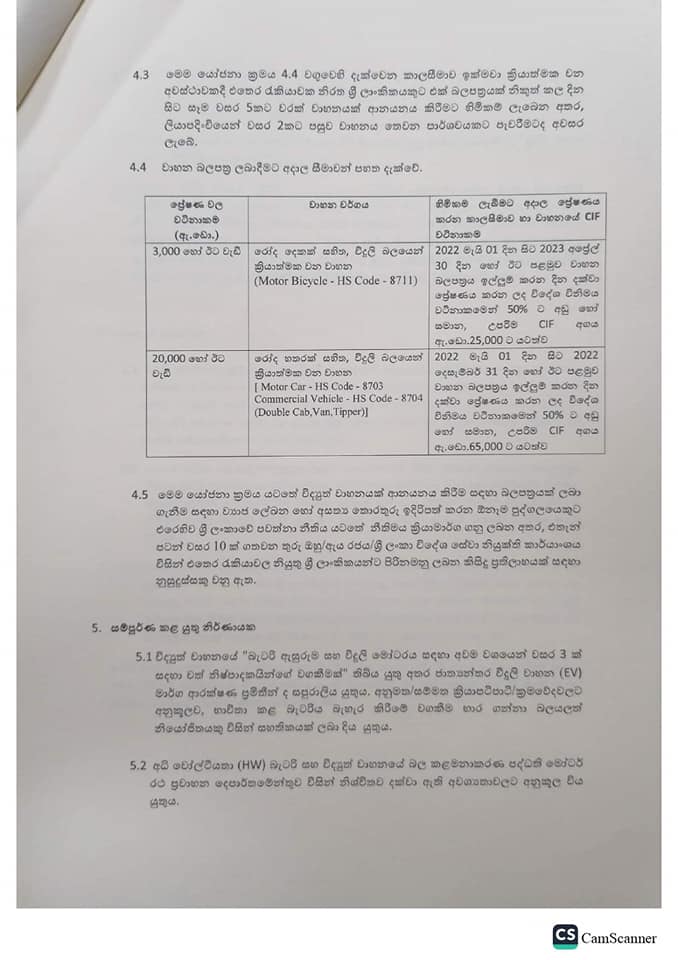
Circular issued allowing migrant workers to import electric vehicles

August 31st, 2022

Courtesy Adaderana

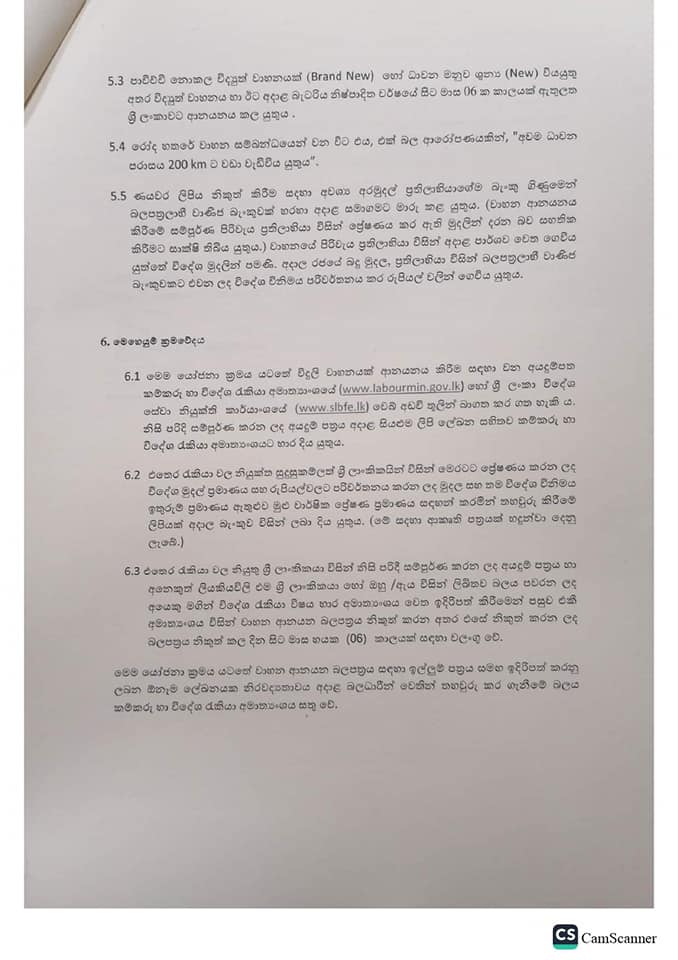
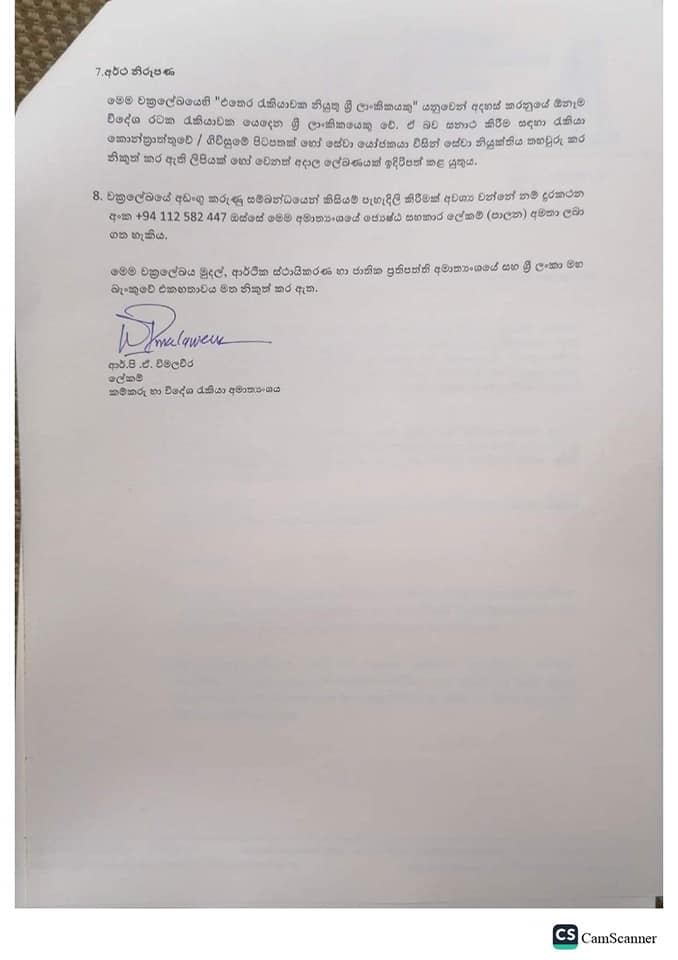
The Ministry of Labour and Foreign Employment has issued a circular allowing migrant workers to import an electric vehicle with the intention of promoting migrant worker remittance.

The Cabinet of Ministers green-lighted the proposal tabled by Minister of Labour & Foreign Employment Manusha Nanayakkara earlier this month.

Through this move, a license is issued to local migrant workers who import an electric vehicle equivalent to 50% or less of remittance transmitted through legal channels.

If a migrant worker has transferred more than USD 3,000 will be allowed to import an electric motorcycle.

Meanwhile, those who have transferred more than USD 20,000 will be permitted to import an electric car priced half of the amount transmitted to Sri Lanka, up to a maximum of USD 65,000.

However, they should also purchase or import a solar power system to provide the electricity required to charge the vehicle they import, as these electric vehicles are not allowed to be charged through the national grid.

Meanwhile, strict legal action will be sought against those who submit fraudulent documents to obtain the import licence, the ministry warned.

Two accused of stealing from Temple Trees further remanded

August 31st, 2022

Courtesy Adaderana

The Colombo Fort Magistrate’s Court ordered today (Aug 31) to further remand two suspects who allegedly entered the Temple Trees and stole two televisions and a bag containing a camera, until September 14.

The case filed against the suspects for forcibly entering the Temple Trees, stealing its properties and being a member of an unlawful demonstration was called before Colombo Fort Magistrate Thilina Gamage today.

Colombo Crimes Division (CCD) informed the court that the investigations regarding the suspects who are remanded in custody, have not yet been completed, and therefore requested to further remand the suspects.

Taking this into account, the magistrate has issued the order to keep the dup in remand custody until September 14, said Ada Derana court reporter.

In addition, a group of individuals, who were released on bail in connection with the incident, had also appeared before the court today.

Meanwhile, Colombo Fort Magistrate Thilina Gamage has ordered the release of two more suspects, who are accused of forcible entry to the Presidential Secretariat and holding a press conference inside the premises, after they surrendered to the court.

The two suspects namely, Sankha Jayasekara and Chamal Akalanka, were released under surety bails, each worth Rs. 500,000.

A group of suspects including Rev. Fr. Jeewantha Peiris, General-Secretary of the Ceylon Teachers’ Union (CTU) Joseph Stalin, and Frontline Socialist Party’s Duminda Nagamuwa, who are released under bail, also appeared before the court today in connection with the incident.

When the case was called today, the Colombo North Divisional Crimes Investigation Unit informed the court that the investigations into this incident are yet to be completed.

Accordingly, the magistrate further ordered the police to submit a report to the court on September 14 after completing the investigations.

ADB approves $200 million loan to mitigate Sri Lanka’s food crisis

August 31st, 2022

Courtesy Adaderana

The Asian Development Bank (ADB) approved a $200 million emergency assistance loan for Sri Lanka, with funds repurposed from other ongoing ADB projects, to improve food security and protect the livelihoods of the poor and vulnerable, especially women and children.

Food insecurity has severely affected the people of Sri Lanka amid the current economic difficulties. This assistance will expand direct financial support for the poor and vulnerable, boost livelihood development activities and agricultural production, and enhance social protection systems,” said ADB Senior Education Specialist for South Asia, Asako Maruyama. This fulfills the government’s request for a partial cancellation of loan proceeds from ongoing projects and to use the funds for this emergency intervention.”

The project will continue, for at least 3 months, the temporary increase in the monthly cash grant amount and the number of beneficiaries of the existing social assistance programs, including the Samurdhi subsidy program for low-income families, and allowances for the elderly, persons with disabilities, and kidney disease patients. The project will also support, for at least 3 months, a temporary increase in the monthly value of food vouchers for pregnant and lactating women to be replaced with cash grants, and extend support to undernourished children under the age of 2.

To increase food production and offset increasing agricultural production costs, the project will provide financial support for a maximum of 2 hectares of land cultivated by each farmer in higher-yield zones during the upcoming cultivation season. Moreover, upgraded livelihood development programs for low-income families will be supported in selected districts over 18–20 months to restore livelihoods and enhance coping capacity and food security. The project will also upgrade information technology systems and digital tools for the Samurdhi program and agriculture and agrarian development to enhance cash grant beneficiary selection, verification, monitoring, and communication, and improve financial, advisory, and other services for low-income families and farmers. 

In addition, ADB will administer a $3 million grant from the Japan Fund for Prosperous and Resilient Asia and the Pacific to support basic needs, such as food, hygiene kits, and medicines, of vulnerable women, children, elders, and persons with disabilities in shelters and care homes and those at risk of being placed in institutional care. It will strengthen referral and support mechanisms for victims of gender-based and domestic violence. To promote advanced practices and technologies for precision agriculture and improved crop productivity among farmers, it will support the upgrading and delivery of the Good Agricultural Practices certification program. 

ADB is committed to achieving a prosperous, inclusive, resilient, and sustainable Asia and the Pacific, while sustaining its efforts to eradicate extreme poverty. Established in 1966, it is owned by 68 members—49 from the region.


-ADB

Sri Lanka: Aragalaya has a message. Don’t shoot the messengers

August 30th, 2022

By Raj Gonsalkorale

One needs to question whether strengthening of Sinhala Buddhist hegemony has been a consequence of other religious denominations veering more towards orthodoxy and fundamentalism or whether it has been the other way about. There is confusion as to where the Egg is and where the Chicken is.

During a meeting in Anuradhapura recently, President Wickremasinghe, deliberately, or inadvertently and/or innocently touched on a core issue that is at the heart of the dissatisfaction people have with the political system and what it has produced over the years. He mentioned that the original spring (or ulpotha) that gave rise to subsequent political parties, (authors remark, Sinhala Buddhist oriented parties) was the United National Party (UNP). He mentioned late SWRD Bandaranaike who was in the UNP, and who subsequently formed the Sri Lanka Freedom party (SLFP), a section of which has since evolved into the Sri Lanka Podu Jana Party (SLPP) under the leadership of the Rajapaksa brothers, Chamal, Mahinda, Basil, and Gotabaya, and whose father late D A Rajapaksa had broken away from the UNP along with SWRD Bandaranaike to form the SLFP, and the Samagi Jana Balavegaya (SJB), a breakaway from the UNP, had their origins in the UNP.  In making these observations, President Wickremasinghe extolled all these parties to come together now in the country’s hour of need as they all had a common source of origin.

While all political parties must come together at this hour of need to forge a future together from the ashes of the economic debacle that the country is in, President Wickremasinghe must realise that such a coming together cannot be and must not be for a return to the status quo and to perpetuate the system that has existed since independence, as it is this system that has brought about the economic bankruptcy of the country.

The system that political leaders and political parties established and managed since independence had some successes, but many failures. The weaknesses outweighed the strengths.  In hindsight, the country can see this and should learn lessons from past mistakes. The bankruptcy of the country in economic terms is a result of the system and those who the system produced and who then managed it. Policy flip flops, absence of strategic thinking and action, huge debt based investments without assessing costs and benefits and return on investments, systemic corruption at all levels of the society, absence of a  coherent and consistent foreign policy, have all been inherent features of the political system that has failed the country. The reluctance and/or inability of political parties to get together to develop a governance policy for the next 12-18 months when the country is at the bottom of the pit is an indication of the dynamics of the political system. The next election and who acquires power is more important for the constituents of the system, than the interests of the country. This is the reality.

In this context, whatever other motives Aragalaya or some within it may have had and still have, the fundamental premise is the need to change the political system. And why? Simply, because it failed the country.

The spring or ulpotha that the UNP was, and all the rivers and rivulets that flowed from it no doubt would have had good intentions overall, but the stark fact is that they all failed. The present and coming generations do not see any light at the end of the tunnel. All they see is the system that failed them, making all possible attempts to resurrect itself.

Rather than arresting, detaining, and charging some who were associated with the Aragalaya, it would have been far more strategic and politically more prudent to have begun a discussion with the Aragalaya and encourage it to have discussions with the broader public rather than attempting to silence its voice. In saying this, there is not even a hint made that any violent action should be condoned and tolerated. However, some would view the use of the PTA, detention, and court action against protestors as nonphysical violence against them if one were to consider these means as part of the status quo, system wise.

The following excerpt from the Daily Mirror is quoted to support the contention that the system had failed. Quote the list of creditors in the $81 billion economy ranges from Western sovereign bondholders, who together account for the largest $14 billion slice of debt, to bilateral players such as China, Japan, and India. Then there are the multilateral lenders — the Asian Development Bank and the World Bank. The country’s outstanding foreign debt is a staggering $51 billion, with some independent economists estimating that China’s lending to Sri Lanka from 2001 to 2021 amounted to nearly $9.95 billion. Sri Lanka had a foreign debt bill of $6.9 billion that it had to service in 2022 but defaulted in April after it ran out of foreign reserves, a first in the South Asian nation’s history.

The country of 22 million currently has $300 million worth of usable foreign reserves, not enough to ensure a steady flow of food, fuel and pharmaceutical imports. The latest figures from the Department of Census and Statistics show that food inflation in July soared to 82.5% on the year unquote.

The country’s economic bankruptcy cannot be clearer than this. It is a country surviving on debt, and with almost no assets in the form of foreign exchange reserves to buy its essentials.

When mentioning systems, it is not only the political system that is the subject of the discussion. Many parts of the administrative system, the judicial system, the law enforcement system, the prison system judging by shocking and disgusting revelations made by a recently released high profile prisoner, are also in a state of dysfunction, with bribery and corruption permeating to these as they have to the political system.

Sinhala Buddhist hegemony has become even more evident and a stronger influence in the outcome of elections leading to who governs and who does not. There is increasing evidence of Muslim extremism from a Sri Lanka perspective, with more fundamentalist Wahabism taking hold in in the country and amongst Muslims. Christian church groups outside of the more traditional Catholic, Anglican and Methodist groups have spread and have become stronger. One needs to question whether strengthening of Sinhala Buddhist hegemony has been a consequence of other religious denominations veering more towards orthodoxy and fundamentalism or whether it has been the other way about. There is confusion as to where the Egg is and where the Chicken is.

The political system, and in a general sense, the politicians it has produced, one inextricably linked to the other, and the unquestioning attitude of voters, their expectation of maximum governmental interference in economic affairs of individuals and society, the opposite of a laissez-faire system, has contributed to short term politics and who gets their vote in return for small handouts. The political literacy of the public, in a general sense, has been questionable as they have been averse to considering and accepting a middle ground economic model.

In this climate, and context, unless the politicians of today take the lead to metamorphose themselves and the system, and learn lessons from the likes of the Aragalaya, the system could well be replaced by something else which everyone may come to regret later. Persecuting people associated with the Aragalaya is not the answer. Listening to their message, and the message of many who are very likely a silent majority, is the answer.

In effect, the current political system distances people from governance, and pays only lip service to the adage that democracy is about electing governments for the people by the people. No doubt there are no perfect democracies, and some might agree with the Churchillian adage that democracy is the least bad system of governance.

The purpose in mentioning these dysfunctional state of affairs is to pose the question where Sri Lanka is with human rights, moral and ethical conduct in all aspects of governance despite its 74 year post independence history, and the much publicized Sinhala Buddhist majority heritage.

If one takes the view that the political system is at the pinnacle of all systems considering its role in political governance, it would not be out of place here to conclude that the root of the cancer has been and still is the political system. Unfortunately, this cancer appears to have spread to all other parts of overall governance, and it is questionable whether it is possible to excise the cancer from the primary source of the eventual spread, the political system. Even if it were possible, leaving such a task in the hands of politicians themselves would be stupid and a guaranteed failure.

A new Aragalaya, comprising of as many non-partisan political bodies and personnel functioning as opinion facilitators amongst the public, should lead the task of exploring a new political system for the country. While some are calling for elections, it will not address the critical need to change the governance system that has brought the country to where it is now. Without a change to the system, it will continue to produce the kind of politicians who have governed the country so far and brought it to where it is today. The political literacy of the public too needs advancement, and this should be led and facilitated by a new breed of politicians as well as by religious and society leaders. The same machine will produce identical sausages. The machine must be changed to produce different sausages. A crude analogy, but a logical one.

A new system that focuses on long term  planning carried out by experts in economic, agricultural, energy, health, education and social areas, which provides equal rights to everyone, including women, which recognizes the ethnic and religious diversity of the country without any one segment of the society labeled as more equal than others, which ensures all citizens are equal before the law and which ensures that adherence with the law of the land entertains no compromise, which has strong punitive measures against bribery and corruption, and which provides for a political governance council drawn from all levels of the society and which devolves administrative governance to peripheral levels, are some features that a future governance model could consider.

One does not need to be an Einstein to say that it would be foolish to expect different results if one continues to do the same thing.

OFFER OF ASSISTANCE BY ‘FORMER’ PRO-SEPARATIST GROUPS SHOULD NOT BE ALLOWED TO OPEN  A PANDORA’S BOX

August 30th, 2022

RANJITH SOYSA

We wish to refer to Sri Lanka government’s  decision to de-list some of the banned designated persons, groups and entities which were proscribed  under paragraph 4 (2) of the United Nations Regulations no 1 of 2012.

The main reason for the proscription was their direct assistance and funding of  the Liberation Tamil Tiger Organization a k a Tamil Tigers , a terrorist organization.

The recent decision to de-list said to be after a detailed study of 577 individuals and 18 organizations
which were blacklisted in the year 2021 for financing terrorism. The people who underwent extreme difficulties and the kith and kin of the subjects of LTTE killings and specially of the soldiers and those who are still suffering from the injuries sustained in the war expect a more detailed explanation from the Government of Sri Lanka and the defense establishment of the Government of Sri Lanka whether any written reliable undertaking had been received from the de-listed entities that they will disassociate with the armed struggle against Sri Lankan people, Sri Lanka and the Government of Sri Lanka in future and they accept the country’s defeat of the armed terrorists at Nandaikadal as the final settlement of their separatist armed struggle.

One common feature of the separatist and terrorist movement launched by some Tamil political and the Tamil Tigers had been their use of ‘little now more later’ strategy in negotiating with the Sri Lankan government.

They launched their agitation against the enthronement of Sinhala language in the country and which received the attention of the policy makers and then the Tamil language too received due recognition. Then some Tamil parties initiated  their claims for a federal form of government and then to an exclusive Tamil areas in the North and the East which progressively  developed to the ‘Eelam’ concept  of balkanizing of the territorial integrity of Sri Lanka. The armed struggle launched in the 80s by the Tamil armed carders progressively evolved into a full scale war in the 90s which ended in the defeat of the Eelamists in 2009. But, during the period of war too there were peace talks sponsored by foreign nations. One would notice even during the negotiations the tactic of ‘little now more later’ was applied by the Tami Tigers. Even the present President,  Ranil Wickramsinghe was lead astray by the Tamil Tigers during the  negotiations  which resulted only making their position stronger making them a force to be reckoned with in the eyes of the international watchers. The situation was artificially created to identify that the Tamil Tigers cannot be defeated by Sri Lankan forces compelling some to believe  that only available solution  was to negotiate and share the land by creating a country called Eelam. But, subsequent efforts of the armed forces who were given the green light to get rid of the terrorist gang proved beyond any doubt that the LTTE was weak contrary to the mythical publicity  veil which was woven by the LTTE propagandists and their fellow travelers,

The Government and the country need an inflow of foreign exchange and some of the ‘de-listed entities’ apparently have given an undertaking as Sri Lankan expatriates to  arrange remittance of foreign funding. But. Such an exercise should not be allowed to open a Pandora’s Box for the country and the nation to receive continuous demands such as tampering with the Constitution, delegation of powers to the provinces, demand for traditional homelands and weakening of the national security in keeping with the well known little now and more later strategy.

The President and the Prime Ministers who were  appointed with the help of many members who believe in a unitary form of Government to tackle the immediate and acute economic issues should not fall prey to the possible manipulations of de-listed entities if they are motivated by ulterior objectives. The nationalist forces will be watching the unfolding scenario  with eagerness that the offer  to bring in foreign exchange will not be a monster Wooden horse of Troy.

We request the President, the Prime Minister and the Government to have their eyes wide open

RANJITH SOYSA

“D.B. Jayatilaka’s pioneering contribution to the Buddhist Revival in Sri Lanka as a Buddhist educationist at Ananda and Dharmaraja Colleges”

August 30th, 2022

by Senaka Weeraratna Attorney-at-Law

29th August 2022

The Buddhist Revival was one of the great landmarks in the history of Sri Lanka during the 19th and 20th centuries. It was followed by a Buddhist Renaissance in the Post-Independence period when the state machinery was regained by the downtrodden people after nearly 500 years of Euro-Christian colonial rule. Ananda College established in 1886 played a pivotal role in the Buddhist Revival. It was the hub of Buddhist resistance to the spread of missionary education, denationalization of Buddhist children, and Christian conversion. This school produced outstanding students and outstanding principals. Don Baron Jayatilaka, who was the third principal of Ananda College (1898 – 1907), was one of the pioneers of the Buddhist Revival movement and Buddhist Education. In 1890 he was appointed by the Buddhist Theosophical Society (BTS) as the principal of the Kandy Buddhist High School in Kandy (Dharmaraja College). He was a high-profile national statesman. His dedication to the cause of Buddhism and the uplift of Buddhist education is worthy of recall by a grateful nation. This talk intends to highlight the contribution made by D.B. Jayatilaka to the development of Buddhist education and the Buddhist revival in Sri Lanka.

රන්ජන් බාගෙට නිදහස් වී ආ ගමන්ම කට වරද්දාගනී.. බන්ධනාගාරයෙන් ප‍්‍රකාශයක්..

August 30th, 2022

Mawbima

බන්ධනාගාර ආයතනවල සපයන ආහාර ප්‍රමිතියෙන් තොර බවට හිටපු පාර්ලිමේන්තු මන්ත්‍රී රන්ජන් රාමනායක කළ ප්‍රකාශය සම්පූර්ණයෙන් ප්‍රතික්ෂේප කරන බව බන්ධනාගාර මාධ්‍ය ප්‍රකාශක, බන්ධනාගාර කොමසාරිස් (පාලන) චන්දන ඒකනායක පවසයි.

අද (අගෝ. 30) පැවති මාධ්‍ය හමුවකදී ඔහු මේ බව පැවසීය.

ඔහු ප්‍රකාශ කළේ, පණුවන් සිටින මාළු හෝ දහඩිය, සෙම්, සොටු සමග ආහාර පිසීම කිසිදු අවස්ථාවක සිදු නොවන බව ය.

වසරකට බන්ධනාගාරවලට සිරකරුවන් ලක්ෂ ගණනක් පැමිණ යන බව ත් මේ දක්වා එවැනි ගැටලුවක් පැන නැගී නොමැති බව ත් ඔහු පැවසීය.

එවැනි ගැටලුවක් තිබුණහොත් රැඳවියන් ඒ සම්බන්ධයෙන් බන්ධනාගාර අධිකාරිවරයාට, ප්‍රධාන ජෙලර්වරයාට හෝ බලධාරීන් දැනුවත් කරන බව ඔහු සඳහන් කළේ ය.

ඒකනායක මහතා සඳහන් කළේ, රන්ජන් රාමනායක මහතා බන්ධනාගාරගතව සිටි වසර එකහමාරක කාලය තුළ ආහාරවල තත්ත්වය සම්බන්ධයෙන් බන්ධනාගාර නිලධාරීන්ට පැමිණිලි කර නොමැති බව ය.

මගේ බන්ධනාගාර සේවා කාලය වසර 37යි. මගේ සේවා කාලය තුළ මම එක ම දවසකවත් පූසෙක් වැටිලා තියෙන පරිප්පු එකකවත්, හොද්දක්වත් දැකලා නැහැ, අහලා නැහැ,” යනුවෙන් මාධ්‍යවේදියෙකු යොමු කළ ප්‍රශ්නයක පිළිතුරු දෙමින් ඔහු පැවසීය.

මාධ්‍ය ප්‍රකාශකවරයා අවධාරණය කළේ, බන්ධනාගාර තුළ ආහාර පිසින පිරිසේ සනීපාරක්ෂාව ද ඉතා හොඳින් පවතින බව ය.

මේ සම්බන්ධයෙන් බන්ධනාගාර මාධ්‍ය ප්‍රකාශක, බන්ධනාගාර කොමසාරිස් (පාලන) චන්දන ඒකනාය නිවේදනයක් ද නිකුත් කර ඇති අතර එහි දැක්වෙන්නේ, බන්ධනාගාර දෙපාර්තමේන්තුව යටතේ ඇති බන්ධනාගාර ආයතනවලට ආහාර ද්‍රව්‍ය සැපයුම සඳහා සැපයුම්කරුවන් තෝරාගැනීම ප්‍රසම්පාදන ක්‍රමවේද හරහා සිදු කරන අතර එම ආයතනවලට අවශ්‍ය ආහාර්ර ද්‍රව්‍ය ප්‍රමිතීන්ට අනුකූලව දිනපතා සැපයීම සඳහා බන්ධනාගාර දෙපාර්තමේන්තුව සමග ගිවිසුම්ගත වී ඇති බව ය.

ඒ අනුව, අදාළ සැපයුම්කරුවන් දිනපතා සපයන ආහාර ද්‍රව්‍ය බන්ධනාගාරය තුළට ගැනීමට ප්‍රථම නියමිත ප්‍රමිතීන්ට හා ප්‍රමාණයන්ට අනුකූලව සපපයා තිබේද යන්න පරීක්ෂා කිරීම නිලධාරීන් විසින් සිදු කරනු ලබන බව එහි දැක්වේ.

එමෙන් ම, බන්ධනාගාර ආයතනවලට අනුයුක්තව සිටින මහජන පරීක්ෂකවරුන් හා වෛද්‍යවරුන් විසින් ද අවශ්‍ය අවස්ථාවලදී පරීක්ෂා කිරීම් සිදු කරනු ලබන අතර ප්‍රමිතියෙන් තොර ආහාර ද්‍රව්‍ය හඳුනා ගතහොත් ඔවුන්ගේ ද නිර්දේශ සහිතව ඒවා බන්ධනාගාර තුළට නොගෙන ප්‍රතික්ෂේප කිරීම සිදු කරන බව ඒකනායක මහතා සඳහන් කර ඇත.

ඔහු පෙන්වා දෙන්නේ, සැපයුම්කරුවන් සපයන ආහාර ද්‍රව්‍ය බන්ධනාගාර දොරටුවේදී පරීක්ෂා කර බන්ධනාගාර මුළුතැන්ගෙට භාර දීමෙන් අනතුරුව ඒවා පිරිසිදු කිරීමේ සිට ආහාර පිසීම අවසන් කර රැඳිවියන් අතරේ බෙදාහැර අවසන් කරන තුරු සියලු කටයුතු නිලධාරීන්ගේ අධීක්ෂණය යටතේ සිදු කරන්නේ රැඳවියන් බව ය.

ප්‍රමිතියෙන් තොර කිසියම් ආහාර ද්‍රව්‍යයක් ඇත්නම් ආහාර පිසීම සිදු කරන රැඳවියන් ඇතුළු සියලු රැඳවියන්ට ඊට විරෝධතාව දැක්වීම වැළැක්විය නොහැකි බව ද එහි දැක්වේ.

තව ද බන්ධනාගාර රැඳවියන් සඳහා පිසින ආහාර රැඳවියන් අතරේ බෙදා හැරීමට ප්‍රථම අදාළ බන්ධනාගාරයේ ප්‍රධාන ජේලර්වරයා හා අධිකාරිවරයා විසින් පරීක්ෂා කිරීම අනිවාර්යයෙන් සිදු කරනු ලබන අතර යම් ගැටලු සහගත තත්ත්වයක් හඳුනාගතහොත් එම ආහාර රැඳවියන් අතර බෙදා හැරීම සඳහා ඔවුන් විසින් අනුමැතියක් ලබා දීම සිදු නොකරන බව ඒකනායක මහතා අදාළ නිවේදනයේ වැඩිදුරට ත් සඳහන් කර ඇත.

හිටපු පාර්ලිමේන්තු මන්ත්‍රී රන්ජන් රාමනායක ජනාධිපති සමාව ලැබීමෙන් අනතුරුව පසුගිය දා පැවැත්වූ මාධ්‍ය හමුවකදී ප්‍රකාශ කර තිබුණේ, බන්ධනාගාරවල පරිභෝජනයට නුසුදුසු ආහාර සිරකරුවන් වෙත ලබා දෙන බව ය.

එහිදී අදහස් පළ කළ හිටපු මන්ත්‍රීවරයා…

හිර ගෙදර සප්ලයර්ස්ලාට පොලු තියලා ඒගොල්ලෝ දැන් සප්ලයි නවත්ත්වලා තියෙන්නේ. කෝටි 50, 60 පොලු තියලා. එතකොට දැන් ගේන්නේ, මේක කිව්වට කමක් නැහැ. මාළු එක අරන් එද්දී පණුවෝ වැටෙනවා. පණුවෝ වැටෙනවා. පණුවෝ අරන් දාලා මෙහෙම කැපුවා, උණුවතුර දැම්මා, මිරිස් ටිකක් දැම්මා, කන්න දුන්නා. එතකොට බත් එක හදන්නේ කුඩු කාරයෝ තමයි හදන්නේ. දාඩිය, සෙම, සොටු සේරම වැටෙනවා බත් එකේ. ඒවා තමයි මෙහෙම කරලා දෙන්නේ.

පාලිත තෙවරප්පෙරුම කිව්වා කළුතර දිගට ම වාට්ටු 6ක් තිබුණා. පරිප්පු එක අරන් ගියා. පරිප්පු එක අන්තිමට වාට්ටු 4කට බෙදුවා. ඉන්න හිරකාරයෝ ටික කෑගැහුවා ටිකක් පරිප්පු යටින් අරන් දෙන්න කියලා. මෙහෙම යටින් ගද්දි තඩි පූසෙක් ආවා. පරිප්පු එකේ. මේක උඩින් පනින්න ගිහිල්ලා වැටිලා. අර වාට්ටු හතර ම කාලා තියෙන්නේ පූස් හොදි. පස්සේ ඒක ඒ ගොල්ලන්ට කිව්වා ම වමනේ දාල තිබුණා.

බිත්තර ගද්දී බොහොමයක් බිත්තර ඇතුළ කුණු වෙලා. එතකොට මාළු කාපුවාම ඇස්වල ගෙඩි දානවා, කට වන වෙනවා. බොහෝ දෙනෙක් ලෙඩ වෙලා ඉන්නේ. පව් ඒක ඉතින්. බොහෝ ම භයානක තත්ත්වයක් හිර ගෙදර තියෙන්නේ. මොකද එළියේ අය හිතවා එළියේ අයට වඩා හිරගේ හොඳයි කියලා. නමුත් ඇත්ත වශයෙන් ම හිර ගෙදර කෑම තත්ත්වේ බලන්න හිරේ යන්න ම ඕනා. ඒ කියන්නේ කන්න ම බෑ. පෙළක් අය කන්නේ ම නෑ. ලෙඩ හැදෙන්න තෝතැන්නක් ඒක. ඒ කියන්නනේ කිසි ම රහක් නෑ. මොක ද බිල් ගෙවලා නැති හින්දා සප්ලයර්ස්ලා දෙන්නේ නැහැ.”

– Mawbima


Copyright © 2026 LankaWeb.com. All Rights Reserved. Powered by Wordpress