Delivering the Interim Budget Speech for 2022 in Parliament today (30), President Ranil Wickremesinghe stated that the government’s aim is to create a surplus in the primary budget by the year 2025.
Our effort is to stabilize the economic growth rate. Our aspiration is to establish a solid economic foundation by the year 2026,” he said, in his final remarks during the speech.
He said as at end 2021, Sri Lanka’s public debt is about 110 percent of the Gross Domestic Product (GDP). Our target is to bring this down to less than 100 percent in the medium term.”
If we build the nation and its populace based on the National Economic Policy, we would be able to become a fully developed country by the year 2048, when we celebrate the 100th anniversary of independence.”
The President said that Sri Lanka can no longer be a nation dependent on loan assistance. We can also no longer be used as a tool of interference by other countries with strong economies. All of our collective vision should be to make our country strong and stable, in order to stand independently.”
We must strive to bring business entities of our country to a competitive level in the global market. We must pursue to capture a share of the global market on agricultural exports. We should seek to create a disciplined, knowledgeable society, that provides right opportunities to maintain social justice.”
Wickremesinghe said all this can be achieved, only if they work together in unity with common consent.
He reiterated the invitation to all the parties represented in Parliament to join an All-Party Government, since this unprecedented situation is the responsibility of us all, and therefore need to prioritize the necessities of the country and the nation.”
I request all of you in this House and all the citizens of the country, to put aside your personal political goals and unite in the context of the national cause of rebuilding the country and the nation.”
If we all come together, we will be able to uplift our Motherland, and create a nation that competes and moves forward with the ever-changing world.”
If we miss these opportunities, we will be marginalized globally,” he said.
The Governor of the Central Bank of Sri Lanka (CBSL) Dr. Nandalal Weerasinghe says that Sri Lanka has made good progress” in the negotiations with the International Monetary Fund (IMF), which are aimed at clinching a bailout package.
I can announce that we have made good progress in the negotiations with the IMF. Hopefully, we will be able to reach the first milestone, a staff-level agreement with the IMF soon,” the central bank chief told reporters in Colombo. Once we reach that agreement with the IMF, it means that we have a credible program in our hands.”
He noted that the agreement with the IMF would be followed by important policy reforms that would put Sri Lanka back on track to return to stability. The interim budget that was presented to the parliament provides the basis for this, the central bank governor remarked.
He congratulated the President and the Treasury Secretary for presenting a budget which contains very bold steps that are not quite popular in the political sphere.
Speaking further on riding out the crisis situation in the country, Dr. Weerasinghe said the people have to go through a very painful process to that end. We experienced a lot more in the last couple of months but we are gradually seeing some improvements,” he continued, adding that Sri Lanka has made some progress in comparison to where it was and where it is now.
Delivering the interim budget speech for 2022 earlier today, President Ranil Wickremesinghe had also said that talks with the IMF had reached the final stage”.
Negotiations with the IMF, which has a team of officials visiting Sri Lanka, had made headway, said Wickremesinghe.
Negotiations with the International Monetary Fund (IMF) have successfully reached its final stage. Discussions on debt restructuring will be held with the main countries that provide loan assistance to our country,” the President had said.
Unveiling the measures in parliament, President Ranil Wickremesinghe added that the government would aim to rein in inflation and introduce legislation to bolster central bank independence.
Sri Lankan officials hope the budget will be followed by a preliminary, staff-level agreement with the IMF for a loan package worth between $2 billion and $3 billion.
The revised budget estimates project revenues of 2 trillion Sri Lankan rupees ($5.6 billion) in 2022, down from an initial figure of 2.23 trillion.
Total expenditure is set to rise to 4.4 trillion rupees, exceeding the earlier estimate of 3.9 trillion.
The Director General of Health Services has confirmed another three Covid-19 related deaths for yesterday (August 30), the Department of Government Information reported.
The victims include one male and two females, all in the age group of 60 years and above.
Meanwhile 74 new cases of coronavirus have been confirmed within today (30), increasing the total number of infections reported in the country to 669,893.
The government has decided to establish a State-Owned Enterprise Restructuring Unit” with the aim of facilitating the restructuring of government-owned business entities.
Presenting the Interim Budget 2022 in the parliament, President Ranil Wickremesinghe further proposed to allocate Rs. 200 million to implement this proposal.
He mentioned that the decision was taken as some of the state-owned enterprises have been making losses on a continuous basis due to issues of structural nature existed for some time.
As these losses cannot be met endlessly by the General Treasury, attention is paid to find an alternative mechanism to make them effective, the President added.
Speaking further on the matter, he noted that major fiscal risks arise from a few key state-owned enterprises (SOEs), particularly in the transportation (SriLankan Airlines) and energy sector (Ceylon Electricity Board and the Ceylon Petroleum Corporation).
These entities face significant losses, negative equity (SriLankan Airlines and CPC) and large volumes of debt that is predominantly owed to the state banks, creating significant sector risk, he explained.
He proposed to re-activate the Statement of Corporate Intent (SCI) process for key 50 SOEs, excluding CEB, CPC and Sri Lankan Airlines, as they are under different efforts to restructure, to closely monitor the set targets.
These difficult but necessary measures pertaining to SOEs will no doubt be challenging to address, but failing to do so would create catastrophic risks, particularly for financial sector stability, and will entail even higher taxation burdens on the public in the future,” the President added.
President Ranil Wickremesinghe, in his interim budget speech, said an independent National Debt Management Agency (NDMA) would be established in the country.
Speaking further, he said the government debt management-related activities are carried out by the Central Bank of Sri Lanka, External Resources Department, National Budget Department and the Treasury Operations Department at present.
As it is important to pay special attention to the management of public debt, an independent NDMA will be set up under the General Treasury in lieu of the current arrangement in this respect, the President added.
The government has decided to suspend the purchase of vehicles powered by fossil fuels for the state sector, President Ranil Wickremesinghe said delivering the interim budget speech in the parliament today.
As per this policy, only electric-powered vehicles will be purchased for the use of the public sector in the future.
Meanwhile, the private sector will also be encouraged to use electric vehicles, the President said further.
In purchasing vehicles for the public sector, suitable categories of vehicles are decided on the basis of the efficiency and prices of the vehicles.
This proposal will be implemented step by step and will be completed by January 01, 2026, he added.
COLOMBO, Aug 29 (Reuters) – Sri Lanka’s president is set to slash expenditure when he presents an interim budget on Tuesday to see the crisis-ridden country through the rest of the year, amid discussions with the International Monetary Fund on a bailout package.
The tourism-dependent nation of 22 million is facing its worst economic crisis since independence in 1948, with foreign exchange reserves crashing, public finances in a mess and the costs of basic goods rocketing.
Having become president after his predecessor was ousted in a popular uprising in July, Ranil Wickremesinghe told Reuters earlier this month that the interim budget would focus on fiscal consolidation measures agreed with the IMF. read more
He said that expenditure would be slashed by a “few hundred billion” rupees, including on defence, to channel funds for welfare and to repay interest on loans. Sri Lanka aimed for 3.9 trillion rupees ($10.99 billion) expenditure in its last budget, presented in November.
Wickremesinghe, who is also the finance minister, is expected to outline measures to support low income communities worst hit by the financial crisis and announce fresh taxes to shrink a double digit deficit.
A full-year budget for 2023 is likely to be presented in November, where a broader recovery plan will be outlined.
“The interim budget will likely aim for a 9.9% deficit for 2022, which is lower than the earlier 12%,” said Lakshini Fernando, macroeconomist at investment firm Asia Securities.
“But expenditure and revenue targets will be difficult to achieve given the cooling economy and welfare demands.”
The island nation missed interest payments due on June 3, June 28, and July 18, and a principal payment due on July 25, according to rating agency S&P Global.
An IMF team that arrived in the country last week concludes its visit on Wednesday, with Sri Lankan officials saying they expect to have a staff-level agreement in place to advance talks for an emergency loan of around $3 billion.
The IMF team has also discussed restructuring Sri Lanka’s debt of about $29 billion. read more
Sri Lankan Ambassador to China Dr. Palitha Kohona said Sri Lanka is an ideal spot for solar energy development and also wind energy development and China can be a big help as we transition to clean energy.
We would be able to address a huge part of our energy crisis by relying on renewable energy,” he said, according to the Chinese media.
The 2022 World Conference on Clean Energy Equipment is underway in Southwest China’s Sichuan Province.
More than 18 hundred guests from 17 countries and regions are taking part in the event to discuss the development and future of the clean energy equipment industry, according to CGTN.
The Sri Lankan authorities are seeking a developer to build a 100 MW solar project on a build-own-operate basis, in addition to a new 132 kV transmission line. The facility will sell power to the Ceylon Electricity Board under a 20-year power purchase agreement.
The Ceylon Electricity Board (CEB), Sri Lanka’s largest electricity supplier, has launched a tender for the development and construction of a 100 MW solar power plant in Siyambalanduwa, Uva province.
The selected developer will build the project on a build-own-operate (BOO) basis, in addition to installing a new 132 kV transmission line. The facility will sell power to CEB under a 20-year power purchase agreement. Interested developers have to submit their project proposals by Oct. 21.
According to a recent joint study by the UN Development Programme (UNDP) and the Asian Development Bank, Sri Lanka has the potential to deploy 16 GW of solar power. It aims to cover its entire power demand with renewables by 2050.
By the end of 2021, the country had 434 MW of installed solar power, according to the International Renewable Energy Agency (IRENA). Through its Soorya Bala Sangramaya program for solar energy, Sri Lanka hopes to add 1 GW by the end of 2025.
The interested countries are the UAE, Saudi Arabia, U.S., China, India, Russia, Britain, Malaysia, Norway, and the Philippines.
At least 24 foreign companies are interested in the petroleum business in Sri Lanka, a government official said on Monday.
The companies are from the United Arab Emirates (UAE), Saudi Arabia, the United States, China, India, Russia, Britain, Malaysia, Norway, and the Philippines.
Kanchana Wijesekera, Sri Lankan Minister of Power and Energy, said his ministry has appointed a committee to evaluate the expressions of interest (EOIs) submitted by the foreign firms”, which will finalise the process within six weeks.
Mr Wijesekera said companies in petroleum-producing countries were invited to import, distribute and sell petroleum products in Sri Lanka.
The minister added that 700 gas stations under the state-owned Ceylon Petroleum Corporation (CPC) could be given to selected companies for operation.
He said the selected companies could also use other CPC facilities commercially.
The CPC and the Lanka Indian Oil Corporation can distribute fuel to retail customers.
Mr Wijesekera said the CPC, which holds 80 per cent of the retail petroleum market, could not keep supplying fuel because of dollar shortages.
The US will support Sri Lanka through International Monetary Fund (IMF), if Sri Lanka could reach an agreement with the IMF, US Ambassador to Sri Lanka Julie Chung said.
She said in a twitter post that the US will redouble its endeavours to support Sri Lanka through ongoing efforts such as financing for SMEs, fertilizer and seeds for farmers, education exchange and training to strengthen public financial management.
In her tweet she also mentioned that she spoke with the US-SL Business Council on ways US and Sri Lanka businesses can collaborate to ensure Sri Lanka gets back on a path to prosperity.
“US-SL bilateral trade already supports more than 180,000 workers supplying exports to the US and contribute billions to the Sri Lanka’s economy,” she tweeted.
Whilst highlighting that some international forces might want to keep Sri Lanka as a weak state, UNP MP Vajira Abeywardene said an all-party government is essential to defeat these agendas.
Speaking during a UNP meeting in Galle, MP Abeywardene said all parties should get together to defeat the desires of some international forces.
These desires he said could be harmful to Sri Lanka.
All parties should get together to defeat the efforts of some international forces to harm Sri Lanka,” he said.
It is also essential to fulfill the needs of the youth who have led recent protests all over the nation. However they should be dealt with if they take up arms,” the MP said.
Referring to the mini budget which will be presented to Parliament, Mr. Abeywardene said it will mainly focus on tax reforms.
Mini budget will not focus on construction of roads or buildings bur will only focus on tax reforms,” he said. (Yohan Perera)
Prof. Prema-chandra Athukorala says China’s position on SL’s debt could drag negotiations for at least six months
Cites Zambia as example where debt restructuring negotiations took about 7 months to conclude as a result of China’s initial hesitancy in debt restructuring
After reaching staff-level agreement, debt restructuring advisors will approach creditors to obtain financial assurances from them to secure IMF facility
However, former CB Governor Dr. Coomaraswamy and current Governor Dr. Weerasinghe hopeful of fund disbursement by end of this year
After reaching a staff-level agreement, the full approval for the envisaged International Monetary Fund (IMF) Extended Fund Facility (EFF) arrangement could take about six months considering challenges in the negotiations process with the country’s external creditors, particularly China, according to experts.
An IMF staff team, which is currently in Sri Lanka, is holding discussions with the authorities with the intention of reaching a staff-level agreement on the envisaged IMF EFF facility. The mission is expected to conclude on Wednesday and the Central Bank expects to reach a staff-level agreement upon conclusion of negotiations. Central Bank Governor Dr. Nandalal Weerasinghe recently expressed confidence of the disbursement of the first tranche of the envisaged IMF programme by end of this year, with expectations of all external creditors including China cooperating with the government to secure the financial assurances in December.
After reaching a staff-level agreement with the IMF, Sri Lanka’s debt restructuring advisors are expected to officially approach the country’s bilateral and commercial creditors to obtain financial assurances from them to secure the IMF Executive Board approval for the envisaged EFF facility.
It’s usually a matter of weeks between a staff -level agreement and a full programme, but when your debt is unsustainable, you cannot move from a staff-level agreement to a full programme until you have demonstrated that you have sufficient financial assurances to move towards a sustainable debt dynamic.
In our case, it’s happening parallely. While the policy discussions are going on, debt advisors are working with the austerities to achieve a path towards debt sustainability,” former Central Bank Governor Dr. Indrajit Coomaraswamy told a virtual conference organised by the Department of Business Economics of University Sri Jayewardenepura last week.
Australian National University Professor in Economics Prof. Prema-chandra Athukorala opined that it’s likely to take 6-7 more months for Sri Lanka to secure the approval for the envisaged IMF programme. Zambia started negotiations with the IMF and they reached a staff-level agreement with the IMF in December 2020, however, it took until last week to get the debt restructuring completed, because the Chinese were reluctant to participate in debt restructuring initially. Altogether, it took around 7 months,” he said. However, marking a breakthrough, China who is not a member of the Paris Club, joined Zambia’s official creditor group as a co-chair in May this year supporting Zambia’s request for an IMF programme.
A lot of people are hopeful that China should be more sympathetic to the Sri Lankan case, given that China has changed its approach due to the agreement with G-20 countries (the G20’s Common Framework). If that happens, it will be finalised within six months. However, I don’t think it will happen in December,” he added.
However, Dr. Coomaraswamy remarked that there’s still a possibility for Sri Lanka to secure required financial assurances from the external creditors by December. Given there’s possible shift of China’s approach, it’s not impossible to secure first tranche by December,” he remarked.
Aviation Minister Nimal Siripala de Silva says that proposals are to be called for from desiring investors to invest in 49% shares and administration of SriLankan Catering and also 49% shares and administration in SrLankan Airlines’ Ground Handling.
The minister stated this at a press conference held today at the ministry regarding the restructuring of SriLankan Airlines, the country’s national carrier.
He stated that currently the SriLankan Catering is making profits to a certain extent and that therefore they have decided to sell 49% stake and administration of the SriLankan Catering, while keeping 51% stake with the government.
He said if an investor is seeking a higher stake in the company, based on the relevant requests by the investors, the government is prepared to sell a higher percentage of the shares and obtains some funding from that.
When we get that amount of money, we can use it to pay the 80 million dollars that we have mortgaged the shares of that company, and another amount of money and another loan.”
Then the debt burden of SriLankan Airlines will be somewhat reduced,” he said.
The minister also said that currently they are forming a separate company for ground handling and it will be provided the relevant duties and movable and immovable properties related to that company.
From there we get an income of about Rs. 5,000 million per year. Therefore, we think that we will be able to get a lot of money in restructuring it,” de Silva said.
He said that they expect to be able to sell 49% stake in that company as well and that no investor will be willing to invest for only 49% shares and therefore, they will have to give them management of the company as well.
Accordingly, he said the government intends to call for Expressions of Interest (EOIs) for this.
The moneys received for both these, we don’t expect to use for any other work. It will be used to pay the debt of SriLankan Airlines and get rid of the debt as much as possible.”
During the briefing, the minister also revealed that the total debt of SriLankan Airlines is USD 1.126 billion which is equivalent to about Rs. 401 billion.
The Director General of Health Services has confirmed 05 coronavirus related deaths for yesterday (28), the Department of Government Information reported today (29).
The new Covid-19 deaths include two males and three females while one of the patients is between the ages 30-59 years. The rest are aged 60 years and above.
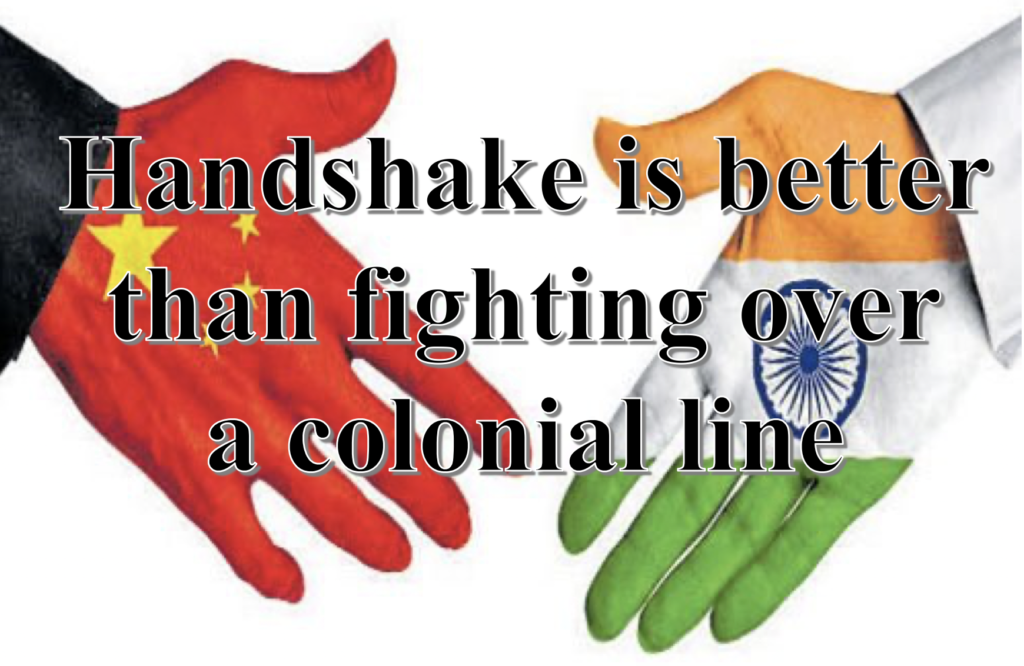
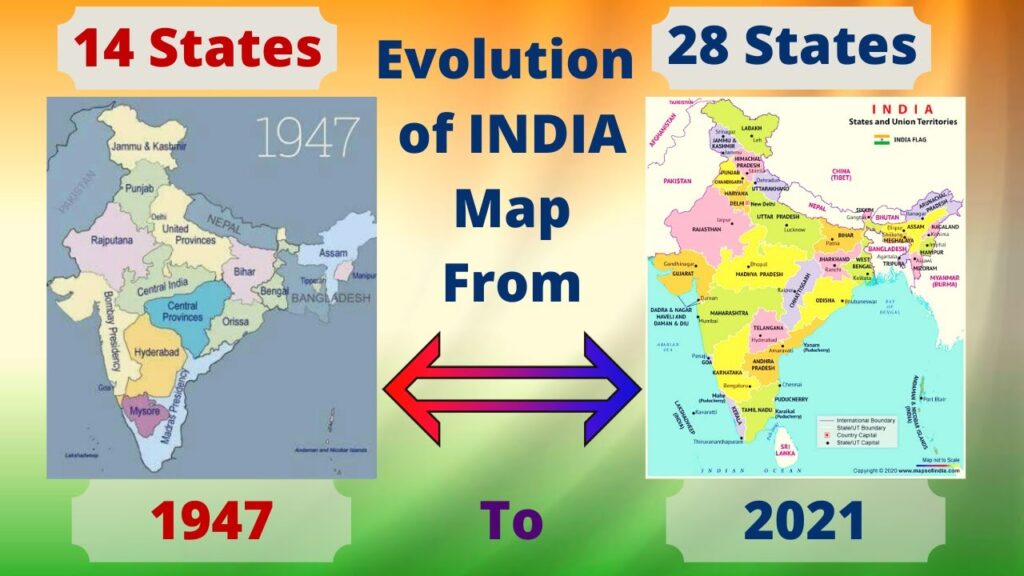
China has a history of over 3500 years. India’s history dates back to the Indus Valley civilization. India was given its name by the British in 1947. Asia’s population is 4.5billion of which 2.7billion are Chinese or Indian. Both China and India are key players in Asia. Asian continent can be strengthened by the unity of India & China. Unity means power and power means the ability to meet challenges & threats. This is why divide & rule colonial policies were rolled out to divide invaded nations & people. It was colonial division that led to the Indo-Sino war in 1962. An artificial line drawn by a pencil keeps China & India from rebuilding ties. The situation is made worse as neocolonials have tasked local neoliberals to continue divide & rule policies and these locals create tensions to prevent cordial ties between India & China. India is powerful so is China. India is not going to become more powerful by trying to destroy China or by joining with enemies of China. If at all, the enemies of China will use India not only to balkanize China but eventually they will balkanize India. What cost is India’s bogus friendship with countries India cannot truly trust? When neighboring nations are made weak, will it not impact one’s own country? Who seeks to weaken neighboring countries & why? When countries are made weak – who benefits in the end? The one’s who planned it all! It’s been 60 years since Indo-Sino war and that shows how caution has played a key role. Caution must now escalate to 60 more years of collaboration between India & China.
Is what makes China powerful, that threatens nations that thought they would remain powerful?
China has more vessels than Germany, India, Spain & UK navies. This makes China possess the ability to control the oceans. With this comes bases and logistics hubs. It is to prevent these that the anti-China camps are making alliances. Including India to alliance has been the icing on the cake. All their dirty work is now outsourced to India. But what is India gaining eventually? Does India think that India truly belongs to ‘their club’. India may like to watch the fate of Rishi Sunak to realize its own fate. At what cost is India’s allegiance to West joining with Japan who really had no choice given its subservient role post-World War where even Japans constitution was drafted by West. Japan’s inability to remove US troops from Okinawa shows how ‘independent’ Japan is.
Has it occurred to India, that the West’s use of the Church, LTTE Diaspora, UNHRC and the ‘Tamil minority’ card is a stepping towards this ultimate goal? The West has not minced its options about balkanizing India as it did to the Soviet Union & Yugoslavia. Already many of the UN goalposts and programs are in line with creating micro states while promoting corporate civil society governance abandoning the Westphalia system of governance. Much propaganda is being steered towards this end.
India has to way the threats. Who is a bigger threat to India realistically. India & China are key trading partners. Both have the worlds largest populations. People are power. Both have nuclear powers.
The world may think US abhors China – but isn’t it all a hoax? If US hated China so much, why does US encourage Chinese to study in US?
Majority of international students in US are Chinese.
35% of all foreign students in the US are Chinese.
914,095 foreign students (2020-2021) – this figure was 15% more in 2019-2020
In 2020 international students contributed $39billion to the US economy – of which $14.3billion or 36% came from Chinese students (Dept of Commerce/US)
In 2021, US embassy & consulates in China issued 85,000 student visas
Indian comprise 18.3% of international students in US
4million Indians live in US
Chinese Americans number 5.4million.
Together Indians & Chinese make up almost 10milion out of Americas 329.5million population. Many Indian-Chinese Americans are also holding top level Govt positions. Though they are from native-India or China, they think & act and function more than Americans.
Americans studying abroad for 2019-2020 numbered 162,633 choosing European countries.
cinema company AMC’s majority stakeholder investing $2.8b is Beijing-based Dalian Wanda Group with power to decide at executive level?
General Motors relies on partnership with Shanghai Automotive Industry Corp to stay profitable. They even set up a facility in Shanghai.
Swedish company Spotify headquartered in New York is also influenced by Chinese Tencent Holdings Limited
Snapchat shares have been bought by Chinese Tencent Holdings.
Hilton Hotels had 25% of its stake bought for $6.5b by Chinese aviation & shipping giant HNA Group allowing 2 Chinese directors to Hilton Board of 10.
There are many more such Chinese investors in US.
Similarly, though many think India-China relations are cold – it is quite contrary.
China has become one of the top 10 education destinations for Indian students.
23,000 Indians were studying in China in 2021 out of 11.3 lakh students.
China offers Indian students scholarships in a variety of subjects & cost of living is far lower that US, UK & Europe. China is also offering jobs.
Politics end up dampening good relations as Indian authorities refused to accept degrees awarded by Pakistan no different to India banned Chinese apps.
In 2016 there were more Indian students in China than in UK (Times of India) 18,171 Indians in China against 18.015 to UK.
Indian students make up the 5th largest group of international students in China after South Korea / USA/Thailand & Pakistan
India-China trade bilateral trade was $125.66billion in 2021.
China’s exports to India have gone up to $57.51billion (increase by 34.5% from 2020)
Indian exports to China however has fallen to $9.57b (decline of 35.3% from 2020)
Culturally too India & China remain close – 1988 Cultural Cooperation Agreement ensures large-scale festivals, art shows, exhibitions, films are held in each other’s countries.
Why does media lie? Why do propagandists attempt to show a different picture to what is on the ground & what is proven statistically?
To whose advantage is it when India & China are at odds?
Where is the source of tension?
On 20 October 1962 Indo-Sino war started when Chinese army invaded Ladakh & crossed McMahon Line. The war ended a month later. India became a republic in 1947 and People’s Republic of China was formed in 1949. Tibet became the contentious subject denting ties and leading to the eventual war.
India & China may recall how India did not attend a conference because China was not invited. India even took pains to speak on behalf of China who had been isolated. Both countries cannot forget the 1954 Five Principles of Peaceful Coexistence when India acknowledged Chinese rule in Tibet.
Thereafter came a steady flow of contentious incidents – issues with maps, reception given to Dalai Lama after fleeing Tibet by India in 1959, China attributing Lhasa rebellion to India and the most recent altercation in Galwan.
Sir Henry McMahon the foreign secretary of British India decided the 890km line dividing India & China after the 1914 Shimla Treaty between India & Tibet. China does not accept the line as China was not privy to the agreement & China is not bound by it.
India & China has been squabbling for 108 years over a line drawn by colonial Britain. Then British Foreign Secretary David Miliband apologized to China on 29 October 2008.
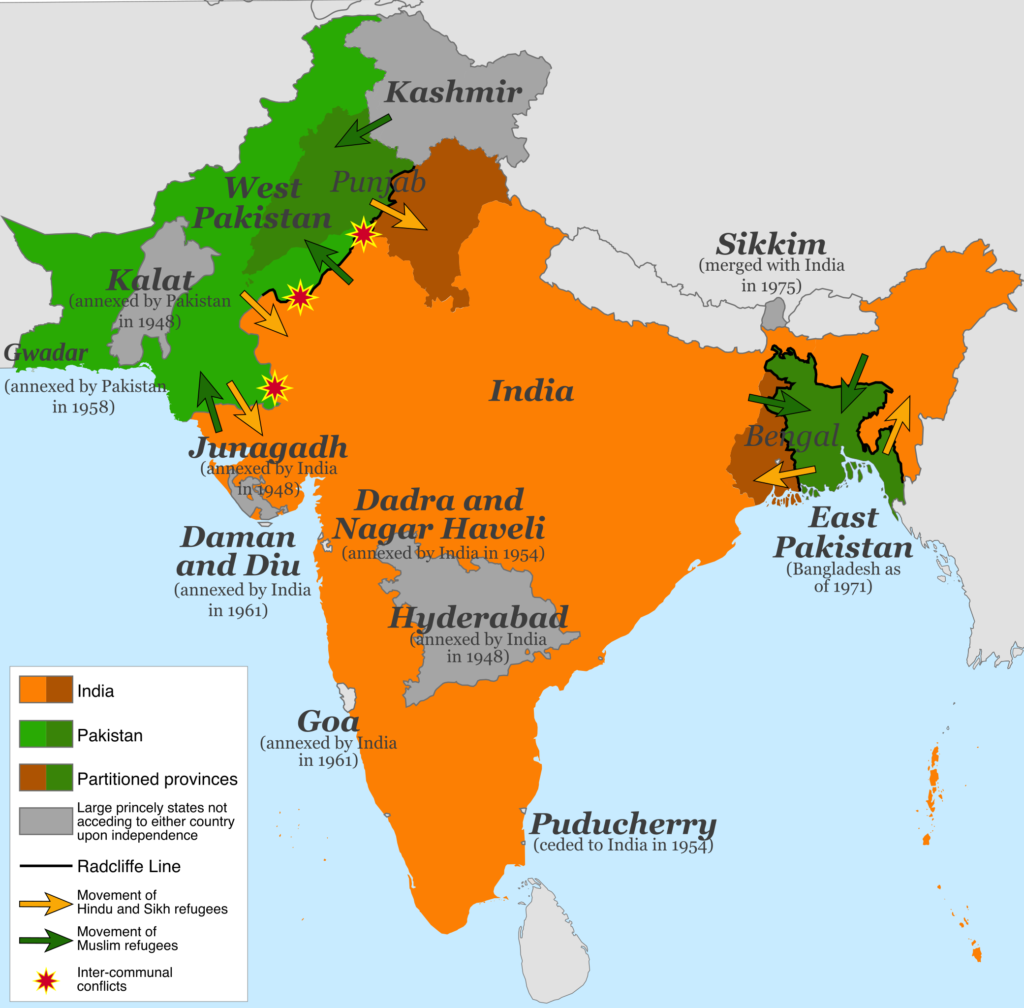
India carried all of the British territorial agreements after gaining independence in 1947. PM Nehru refused China’s proposal to negotiate a settlement in 1954 simply accepting British version.
It is now time for India to ask if it wishes to continue to adopt British colonial legacy or work out an amicable settlement with China. So long as issues prevail – external forces will be preying to stir the pot of conflict. This is what teams from India & China must realize.
It is in the interest of both nations to not allow third parties come between them.
Enemy initiatives in Asia is not going to take any Asian nation anywhere. India China & Japan are powerful in their own right – they do not require to be propped up by western alliances. It is time Asia and Asians realize their power and build themselves up on their terms and not those cunningly imported & articulated by forked tongues.
1794 – How India” looked before British conquered
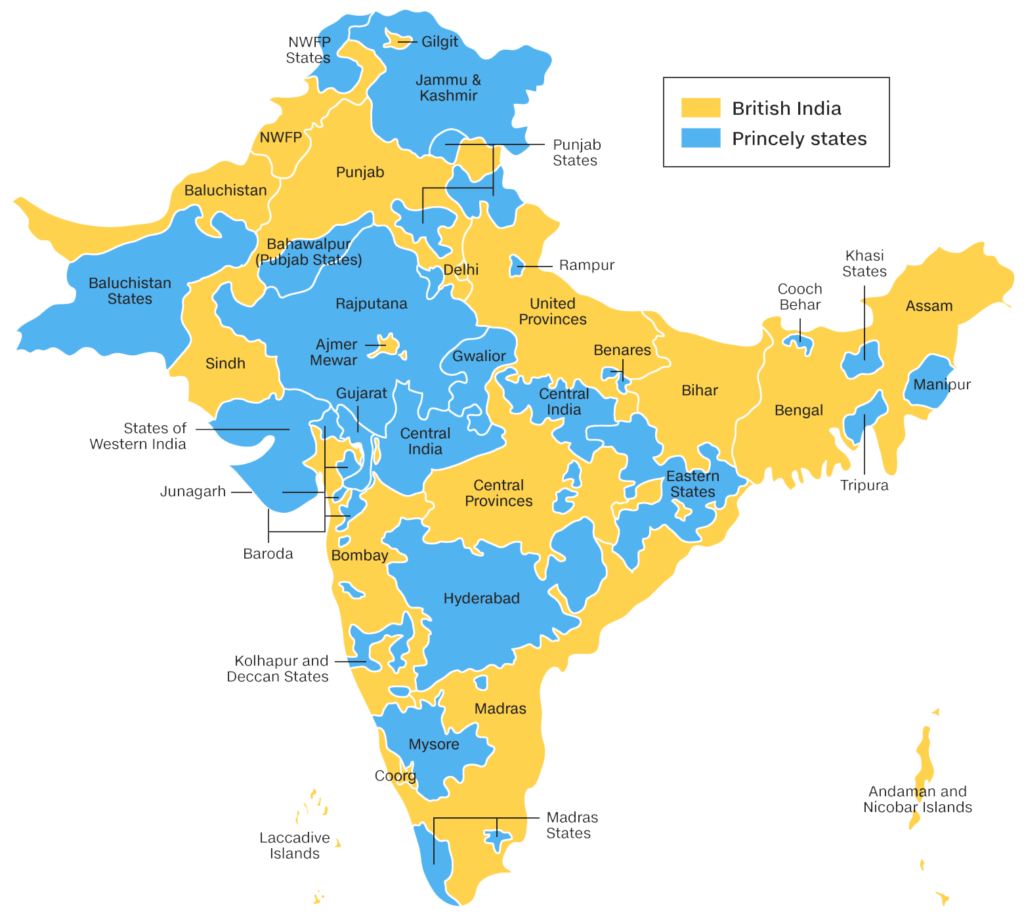
India before independence: British held territory & Independent Princely States
It will happen as per a request by Sri Lanka Podujana Peramuna (SLPP) which is the main party that backs President Ranil Wickremesinghe.
The SLPP MPs who served as state ministers in the previous government met the president recently to discuss the appointment of state ministers of the new government.
The SLPP has asked for the appointment of 40 of them. However, the president is keen to appoint only 30.
According to informed sources, the appointment of state ministers will take place either next week or during the first week of September.
A SLPP MP who attended the meeting said his party discussed the appointment of heads of district development coordinating committees. (Kelum Bandara)”
My Comments on the above crazy descision
ByDr Sudath Gunasekara Mhanuwara, from the last capital of the 2500 year old Sinhale Kingdom
28.8.2022.
First of all, before I respond to this crazy decision of the President, I must, categorically remind him, as my good friend, that appointing more Ministers (to appease SLPP MPP) is not the priority number 1 problem the country is facing today. There are many more burning issues that should be urgently prioritized and solved before you appoint another set of Ministers, whether they are Cabinet or State, popularly known as blood suckers” or the Boring worms” (kandha panuwo) of the nation, if the nations taken as a tree. Therefore, as an experienced officer of the SLAS coming from the country side, I strongly advise him to first solve the far more serious problems, the country is facing today before he is also ousted by the revolting mobs in no time. [S1]
Just to mention few of the more serious problems the country is facing today.
*Daily sky rocketing cost of living
*Mass hunger and starving due to shortage of food
* complete brake down of the mainstay of the agricultural sector the mainstay of the economy due the ban of chemical fertilizer and other inputs such as insecticides and pesticides and support services like a vibrant extension service and marketing etc.
*Shortage of medicine healthcare facilities
*Shortage of fuel and even kerosine that has hampered transport and every aspect of people’s day to day life
*Complete brake down in law and order and the failure to eradicate drugs and narcotic menace
*Excessive public expenditure arising from too many politicians, state officers, extravagance, wastage and pilferages
*Brake down in State enterprises due to overall poor and mismanagement, over staffing, (highest in the world:1 public servant for every 16 people) unbearable number of politicians (again highest in the world approximately 1 politician for every 3200 people) lack of strict administrative and financial management and careful business-oriented management and finally, political interference everywhere and in everything.
*Corruption, bribery, overspending, extravagance and wastage in the entire public sector
*Absence of discipline all over the entire society
*Above all absence of a strong and people friendly government of patriotic land honest statemen as leaders, who know their motherland, its civilization and culture and absence of patriotism in the hearts and heads of all from the president to the beggar in the street coupled with the absence of national and spiritual leaders who can guide the politicians.
President has already agreed to appoint 30 State Ministers.
According to the above news item the President has already agreed to appoint 30 State Ministers. Since the 3o Cabinet Ministers already appointed are also Ministers of the State, I don’t think you need to have another category of Ministers as State Ministers in addition to the 30 Cabinet Ministers already we have. Few people will know that there are already 48 people, who hold Cabinet rank status and enjoy all those privileges in the country. This includes the 9 Governors and 9 chief Ministers as they are also paid the same salary and given all the privileges of Cabinet Ministers. In addition, you also have another 36 provincial Council Ministers who are also called Ministers who enjoy more or less equal benefits if not more, for no work done at all. This adds up to a total of 84. If Ranil agrees to appoint another 40 Deputies or State ministers the total number of Ministers in the country will go up to 124.
I boldly say that none of these Ministers (with few rare exceptions in the whole history since 1948) has done his/her duty by the country, for the money tax payers spend on them and for the privileges they have enjoyed. That is why this country, the second richest country in per-capita in 1948 in asia has now become even worse than Ethiopia. As such why do we need all these pinpadikarayo whosyphon national resourceswithout any concern for the people or the country. Now that the Provincial councils have been not functioning nearly for 5 years without any brake down in governance, that alone justifies my call for the abolition of this system.
The concept of State Ministers in Sri Lanka
The concept of State Ministers was first introduced by JR Jayawardhana in 1977 to accommodate his chum Ananda Tissa De Alwis in the Cabinet as the Constitution has laid down the maximum number of Cabinet Ministers. Later starting from Premadasa all heads followed this practice and it was abused and misused to the maximum by Gotabhaya just to satisfy the vociferous backbenchers, eating in to the meager resources of the country for which he had to pay a very high price by fleeing in the mid night from the country and resigning in asylum, now looking for a place for permanent political asylum on earth. Therefore, it is high time that Ranil Wickramasinha should also realize that his predicament would be even worse than that of Gotabhaya, if he also commits the same mistakes.
What the country needs today is a small Cabinet of new blood, who are honest, capable and efficient and who can deliver the services to the people.
What the country needs today is a small Cabinet of new blood, who are honest, capable and efficient and who can deliver the services for the people at these difficult times. President must also take care not to appoint those who have miserably failed in their jobs in the past.
He also has to be extra careful not to appoint his old friends discarded by the people. If you find it difficult to find the required talent from within you can get few suitable men and women from outside the Parliament through the so-called national list which has never served the purpose for which, it was set up, other than accommodating close friends of the party leaders for them to enjoy the luxuries of Parliamentary life for five years without facing the hassles of elections.
Meanwhile, if you can abolish the Provincial Councils also then you will have a Cabinet of 17 only. If you start with this bold decision without giving in to these crazy dirty politicians when you form the new Cabinet (it should not be a container any more) without appointing State Ministers just to appease another set of expensive creatures just to maintain the majority in Parliament. If you do that billions of rupees wasted at Provincial Council level to maintain a useless system for nothing will be saved as revenue for the central government
You will go down in history as a people’s President
Mr. President since most of the MPP in Parliament and the people in the country are against you. The talk in the paddy field, village well or the spout or the village grocery stores or the street corner in towns and in the bus and train and in offices and factories is that you will allow asymmetric devolution to the North and East and might end up in signing the MMC and SOPA and betray and destroy this country and the Sinhala nation as your erstwhile uncle JR did by signing the Indo Sri Lanka Accord of 29 July 1987 as a revenge from the nation for not making him the leader of this country early in his life after Senanayakas were gone.
Therefore, this is the best time to introduce changes that benefit the people and that is not so and prove that you are a patriotic leader- stateman. Definitely you can do this if you change the current corrupt and dirty political culture that has plagued and destroyed the country, by adopting a completely different people centered and people friendly approach of governance that is radically different from the politician centered corrupt and what is called The government by the politicians, for the politicians and of the politicians” model of government we have had in this country particularly since 1977you will go down in history as a people’s President who resurrected a dead nation in the year 2022 of the Christian era.
If you do the right thing at the right time, you need not be scared of the SLPP who elected you as the President, or any other in the parliament as none will touch you, I repeat if you do the correct thing at the correct time”
In this backdrop, I lodge my strongest protest on behalf of all the starving and suffering people in my motherland on the above proposal to appoint 30 non- Cabinet Ministers at this critical moment. I also request the President not to appoint a single State Minister in the new Government.
Also, I strongly request him to limit the cabinet to a maximum of 17, as I have already requested him in my first letter sent to him immediately after his appointment as the President as given below.
I also strongly condemn the silly and untimely requests made by the SLPP MPP as reported above as if they have forgotten why Gotabahya had to resign and even to leave the country. I put the blame for that unfortunate episode squarely on these so-called Ministers and the State Ministers of the Gotabhaya regime who took that poor man, a novice to politics, for a ride and paved the way for him to flee the country seeking political asylum in fear of even death, as a fable one finds in fairy tales.
I am confident that they want be able to play the fool with Ranil Wickramasinha the same way they did with Gota who was surrounded by kewatta advisors, who ruined his entire political career and still quarrel for portfolios.
Ranil will also have to face the same consequences of hiding in unknown lands
On the other hand, if Ranil also gives in to these selfish requests together with them and his own acolytes, Ranil will also have to face the same consequences of hiding in unknown lands.
Therefore, Mr. President, as an elderly man first, I would like to request you not to give in for such pressures and to warn all these politicians suffering from Ministerial fever to get back to their senses before asking for ministries. You selfish politicians, first, think about the present economic situation in the country and the tens of thousands starving men, women and children and the future of at least your own children. If you have no brain to understand the sufferings of 22 million and the uncertain future of their children. I don’t think I need to elaborate any further.
Stop appointing raw politicians as Chairmen of District Development[S2] Coordinating committees
The present practice of appointing raw politicians as Chairmen of District Development Coordinating committees as the SLPP MPP requested should also be stopped forth with. I have found in many districts, in experienced Mpp who have entered for the first time also have been appointed as Chairmen of these Committees This has not only disgraced and demoralized the GAA the Heads of the Districts but also the entire district public service making district administration and development a bick mockery.
Appointing ruling party politicians only make it utterly undemocratic. On the other hand, such inexperienced politicians fail in their jobs as they cannot win the regard and respect of the senior officers in the district
Only GAA as Heads of district Administration should be appointed as Chairmen of DACC and DCC
Only GAA should be appointed as Chairmen of DACC and DCC in order to make these Committees effective and successful in administration and development the government should get back to the 1965- 77 practice of appointing selected senior people who have wide experience not only in Divisional and District Administration but also at National level experience at least two years of Experience as heads of Departments then only the District Committee can sustain an effective job.
Mr. President, this is the biggest challenge you face in your life. But the whole nation will stand behind you and admire you forgetting all your past failures, if you implement the above plan.
Message for the MPP who fight for Ministries
This is not the way you should behave, at a time when you people should be prepared to serve the people at your own expense even without a salary, at least for one year until the country’s situation come back to normal. Being politicians, you must first set an example for others. It is a shame you people behave irresponsibly like this when the people are starving and some dying on the road. If you continue to behave like this any further the day when the people will come and drag you out of the Parliament is not that far.
Taking the present economic situation and social unrest into account, I make the following suggestions to the President and the Prime minister
1 Appoint only 17 Ministers selected from all the Political parties in the Parliament. Ministries should be allocated according to the ratio of each party has in the House. If the Party leaders are not willing to accept portfolios let them nominate their members to accept them.
All these Ministers should work without a salary for one year Their facilities should be reduced to the bare minimum. But each one should be given a target and their performance must be evaluated weekly
2. Don’t appoint a single State Minister as they have been square pegs in round holes.
All these Ministers should work without a salary for one year as stated above.
3 All the MPP should be appointed to 17 Committees under the Ministries and they have to actively take part in deliberating and implementing the programmes of the respective Ministries Attending Parliament and these Committees must be made compulsory.
Anyone who cannot fit in to this arrangement should immediately resign from his seat and go home and say good bye to politics.
The philosophy behind this proposal is sacrifice by all
The philosophy behind this proposal is sacrifice by all, from the President down to the beggar on the street, to take the country out of the present abyss in to which it has been put by none other than the policy makers and the so-called public servants who are responsible for their implementation. for which they alone are responsible.
The Government has already met a few of the anticipated conditionalities of the IMF. Rupee has been devalued, subsidies reduced in essential services like electricity and water and cost reflective pricing has been imposed and interest rates increased. The next thing the IMF would insist is privatization of SOEs. We now hear the baying of the wolf pack of of many politicians and economic pundits urging the government to get on the job and privatize State Owned Enterprises (SOEs) to make them efficient and profitable and ease the burden of losses to the state. Majority of them think that a wave of the majic wand of privatization will turn the white elephants to cash cows. Historically in Sri Lanka, SOEs have made a significant contribution to industrial development, employment creation and providing essential services. Before 1977 many SOEs came into existence out of a nationalization wave born out of compulsions of state control or to fill a gap in the production of essential goods or services. Other than Corporations established under specific Acts, SOEs were formed underthe Government Sponsored Corporations Act No. 19 of 1955 and the State Industrial Corporations Act No. 49 of 1957. As of now it is estimated that there are 527 SOEs.
Economic analysts presently take a more balanced view of its effectiveness (of privatization). Few dispute the positive results of privatization of firms operating in competitive, or potentially competitive markets, but experience has yielded a deeper understanding of the complexities of implementing the policy, especially in infrastructure sectors such as electricity, railways or water and sewerage, and particularly in lower-income, less developed economies. There is a greater recognition that privatization needs to take place in a supportive institutional and policy framework if it is to live up to its potential; and there is a better realization of the socio-political challenges that inevitably accompany this always contentious activity. https://papers.ssrn.com/sol3/papers.cfm?abstract_id=1999098
Privatization should not lead to monopolies, and if it leads beyond the institutional and professional capacity of the private sector it will be counterproductive.
If some of the many SOEs which do not make an elemental contribution to the economy or provide an essential service, a selective and judicious privatization is justified. But when one looks at the past privatization episodes in Sri Lanka one shudder to think of the consequences. Privatization became a fetish during the JR regime on political grounds and more as an opportunity to enrich themselves and their henchman. A reputed economist and the head of the prestigious Institute of Policy Studies, late Dr. Saman Kelegama 2001 cites a case where in Sri Lanka an SOE valued at US $100 million was sold at only US $7 million on the ground that the government only wanted to get the privatization policy itself moving.” In many episodes the buyer of SOEs did not continue operating the SOE but sold the machinery for scrap like in the case of Kantale Sugar. A similar tragedy happened with the Werehara workshop of the CTB which was considered one of the best equipped and efficient workshops in South Asia. One cannot recall a single privatized SOE during this period operating more efficiently and profitably. Most of them are nonexistent.
During the regime of Chandrika Bandaranayake Kumaratunga (CBK) selling of the family silver in the way of selling off SOEs was the easy way to balance the budget. Fortunately, the Supreme Court found that some of those deals in the sale of valuable national assets were illegal and restored them back to the State. In addition,CBK was fined and her accomplish the Secretary of Finance was banned from the public service. The bigger crime of the pair was the selling back to Prima Flour Mill for a pittance an asset that was to be handed over to Sri Lanka on the terms of the BOT agreement. As a result, the country has lost its grip on food security.
It cannot be denied that behind the economic rationale on privatization is a lurking ideological pollical obsessionwhich prevents these advocates to examine the issue in depth and consider alternate strategies. Firstly, it must be accepted that it is not the ownership but the management of an institution which is of paramount importance for its success. Secondly all SOEs cannot be put into one basket. Some deal with the ‘commanding heights’ of the economy and are of strategic importance, some are purely commercial and others noncommercial. It is also important to gain from the lessons of past experience of Sri Lanka and the knowledge of international insights in privatization.
Even after several episodes of privatization it is reported that Sri Lanka as of now has 527 state-owned enterprises which could be categorized under: 55 Strategic SOEs, 287 SOEs with commercial interests, and 185 SOEs with non-commercial interests. (advocata)
The typical criticism of SOEs is that they are not profitable as they are not free to determine the price of their products or services. While it is important to maintain a cost reflective pricing mechanism in SOEs it has to be conceded that SOEs have to strike a fine balance between helping the Government achieve its socioeconomic objectives while ensuring the enterprise’s financial viability. This challenge stems from the engagement of SOEs in the provisioning of essential products and services, which are sometimes not commercially viable; for instance, the provision of public transport to rural communities or electricity in geographically challenging areas such as in mountainous regions.” CBSL.
Without rushing into a frenzied bout of privatization it would be useful to learn from the experience of privatization in Sri Lanka and abroad. Before resorting to surgery, it is essential to diagnose the malady. The problems of SOEs arise from three sources i.e., political interference, poor systems, and bad management. Political interference can be curtailed by law that the Minister is made to issue instruction only on policy and that too made in writing through the secretary of the ministry who is the chief accounting officer. All other interventions should be considered as illegal. Political interference occurs mainly on recruitment where Ministers insist on their list of candidates. It would be necessary to introduce an institution parallel to the Public Service Commission vested with similar powers and functions. Even Provincial Councils have their independent Public Service Commissions.
With regard to systems, we need not invent new systems when we have a functional system in our public service tested over at least 74 years since independence. The Financial Regulations and Establishment code of the public service are updated only on rare occasions when necessary. Export Development Board at its first Board Meeting decided that the EDB will follow the Financial and Establishment rules of the government and any deviations necessary will be dealt with by the Board. The EDB deals with significant amount of funds in grants and financial assistance schemes and has had no deviations necessary and has had no audit queries. The critics of government rules are those who neglect forward planning or create emergencies with dishonest intentions. Deviations from FRs are allowed when reasons are adduced justifying the need for such deviation. In government departments even with ‘profit and loss’ accounts, annual accounts are finalized unfailingly on the 31st of December. But in the case of SOEs most of them do not even submit their accounts for several years.
Efficient management is the key to success of any enterprise in the public sector or in the private sector. A good management can set up a new organization and introduce an untested system effectively. A good example is the CTB where with nationalization a brand-new system had to be set up to operate a massive island wide organization. This was accomplished by a handful of administrators seconded from the civil service. Until the CTB became the employment exchange of politicians it was run efficiently providing an essential service and making profit. In fact, in 1964 the CTB paid a significant dividend to the Treasury.
Before privatization of an SOE it would be useful to examine the original objectives of establishing the particular entity. For instance, the CWE was for wholesale trade and to serve the cooperative sector. Now CWE is focusing on retail trade. CWE should compete with the import trade mafia controlling the price of major commodities like sugar. State Trading Company was mainly to deal with restricted imports. STC could become a center for information on import trade serving the private sector. There are small SOEs which can be merged. There are others which only act as middlemen or conduits. They can be eliminated.
Counting a chairman and a managing director for each SOE, the 573 SOEs would consist of over 1100 personnel. At present these individuals are picked on an ad hoc basis where political loyalty becomes the dominant criterion. Most of these henchmen have no long-term interest in the success of the enterprise and would only be keen to please the minister and would stoop to corrupt practices. With over 550 SOEs there is a need for a special cadre of around 1000 top managers to run these entities. This number exceeds the cadre in SLAS Special Class and Class 1 which at present is around 700. This cadre should be professionals seconded from the management cadres of the Public Service or selected out of present holders in the SOEs. Both officers on secondment and inservice personal should be absorbed through an examination and interview by the proposed SOE Service Commission. SOE service may be structured in two or three grades. All holders of SOE posts should be given a high-level training in business management. Their salaries should not exceed the salaries of the parallel SLAS grades but they should be entitled to profit sharing. The posting of individuals into specific posts should be based on the needs of the job description of each post.
The feasibility of a forming a holding company for the say 10 of the most strategic SOEs on the model of Temasek of Singapore and SASAC of China should be considered. This should have the independence of business policy and operations similar to what is already enjoyed by the Port City.
Privatization decisions are of national importance and should be done carefully. All such decisions must be approved by the parliament to avoid CBK type scams.
The IUSF starts its process of controlling the freshers, long before they arrive in the University. IUSF made use of the one year gap between A Level and University to gain control over the future first year undergrad. IUSF does the work, but there is a political party behind this which provides the money, said analysts.
Once the intake into University was decided and the successful applicants are informed, the IUSF contacted those students over the phone and through social media. IUSF clearly has contacts in the administration, who are prepared to release this list to the JVP. The names and addresses of selected applicants are known only to the administration.
Weeramunda (2008) in his 2007 survey of student violence in university confirmed that the IUSF got addresses of all new recruits from the university. The officer in charge refused to give the list to the IUSF in 2007, said a respondent from Kelaniya, but they were given this information when X was the Chancellor.
IUSF then conducted unofficial meetings in each district, and invited the future undergrads to join classes arranged by the IUSF, which conveniently took place in the nearest town.Weeramunda confirmed that IUSF contacted new entrants privately at the district level and ran an awareness programme for them.
These ‘kuppi’ sessions took place every weekend, in their hometowns, in temples and in tuition classes. They were the first source of University information for these freshers, said Hettiarachchi. These classes initially took the form of providing genuine assistance in teaching the difficult subject modules students would meet in the first year. Students with weak scores would have responded eagerly to this.
These sessions then gradually converted in to brainwashing sessions identified as ‘thela gaseeme’. Participants were sent for political classes, for 5 day classes, two week classes and also camps, added Hettiarachchi.
Then came University. After our Advanced Level Examination we entered university with high hopes, said one undergrad who had entered in 2011. We were soon disillusioned. We were subject to inhuman ragging by the seniors.
IUSF is very welcoming when the freshers arrive. They meet the parents and undergrads and speak very encouragingly and comfortingly. They assure parents that they will look after their children. Parents leave happily, thinking that their children will be safe in the hands of the IUSF seniors.
In 2017, at Rajarata parents had been told by the Student Council at a meeting that there was no ragging in the university. They had later learned that this was far from the truth. When we started university, the seniors spoke to us in a very loving manner and even our parents were surprised. But things changed thereafter, said one undergrad.
For the first week, the freshers are treated very kindly and well. The seniors first used decent language. Then they started to call us, not nangi, malli but tho, thopi, yako, mehe varen. Thereafter they started scolding us using foul language. The freshers were then given a protracted ragging, which went on for three months, and in some places extended over the whole of the first year. It was not a one-or-two-week event.
The ragging was master minded by the Student Union, which in turn was led by the Inter University Federation of Students (IUFS). The Students Union is permitted by university regulations to address the welfare needs of students. Using this, the Union obtains approval for a familiarization programme for freshers.
They prepare a progamme and get University approval. This programme does not contain ragging; it consists of musical shows and other such activities..That is why we can’t catch them observed undergrads. They get their overt plan approved by the university. But the purpose underneath these activities is ragging, observed Hettiarachchi.
The description given by students in different universities and different years of study all corroborate each other and a pattern of systematic well planned ragging, common to all the Universities emerges . It is an organized rag, we only realized this later, saidRuhuna undergrad Dharsha Udayanga. This is a well organized scheme, agreed the authorities
There are several teams involved in the ragging operation. The actual ragging was done by the second year students under instruction from the third year students. In addition, there is a first aid team to look after those who become injured during the ragging. There is also a ‘security’ team, which stays on the stairs to each floor of the hostel, while the ragging is going on.
Security was also positioned outside as look out, they are stationed about half a kilometer away. Using Whatsapp they will inform those inside that a car is approaching. That is why it is difficult to catch them in the act, said undergrads. Also freshers had to switch off their mobile phones while the rag was on.
Before ragging starts, the IUSF acquires detailed information on each fresher. The freshers have to fill in a form given by the raggers. This form includes address, financial position of family, political affiliation, likes and dislikes, boy friend, girl friend, health issues , also caste. Those with medical ailments are not ragged. Some seniors pretended to be freshers to get information on the freshers, said informants.
Each fresher was given a card”, meaning a nickname unique to each student. He was known by that name for the rest of his stay at university. This helped to hide the true identity of the undergrad from the university administration. This is part of the JVP strategy of concealment, said authorities.
The real names of students are not known to us. They use nicknames and they do not have their ID with them on campus, authorities said. At Kelaniya it took the university authorities more than one month to get the real name of a student involved in an act of violence and that too by accident.
There was a dress code for the first three months. The men could not wear watches. Denims were forbidden. Girls had to wear long cotton dresses, rubber slippers and had to plait their hair. Analysts observed that the freshers knewthis beforehand and girls arrived wearing long dresses. Girls could not wear necklaces.
Freshers could not laugh or smile and had to speak in pure Sinhala. Freshers were forbidden to cry when spoken to roughly. Girls were not allowed to go anywhere alone. Freshers had to carry a particular colored file wherever they went during the first year. In one university it was yellow for arts and green for science faculty. ( CONTINUED)
(Note: Editor@ft.lk – This essay is an explanation regarding Victor Ivan’s guest column. If you are unable to print it in your newspaper, kindly forward it to him.)
Who wants a ‘state religion’?
The Buddhists wish—and quite rightly—that in this country where they form 70 percent of the population, Buddhism should be recognized as the predominant religion of the people. In the rest of the world, Ceylon is regarded as essentially a Buddhist country, and they want this claim established here as well…They will not be content to remain in the position of inferiority to which they have been reduced by 450 years of foreign occupation… They have no desire to make Buddhism the State religion—in spite of the cry raised by self-seeking politicians— but they want the State to help them rehabilitate themselves and undo some, at least, of the injustices perpetrated against them during the days of their subjection.”
(quoted from a speech by Professor Gunapala Malalasekera, President of ACBC reproduced in Times of Ceylon, January 15, 1956, and referenced on page 196 of the book, Ceylon: Dilemmas of a New Nation, by W. H. Wriggins, Princeton Univ. Press,1960)
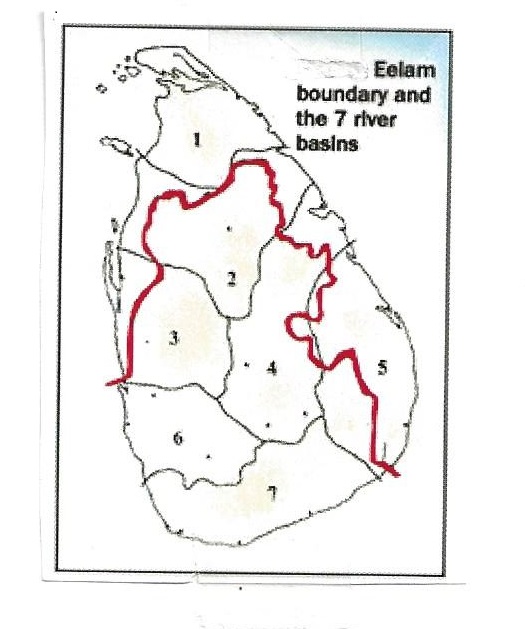
Map above shows the seven major river basins in Sri Lanka identified by geography professor M. C. Madduma Bandara. Thick red line delineates the Eelam boundary of the ‘Tamil homeland’. Short red lines in basin no. 4 indicates its potential MALAYANADU component, espoused more recently by ex-CM of NP, C. V. Vigneswaran and Indian PM Modi. It is currently buried by a 50-billion-dollar ISGA/P-TOM type trap.
1.Yalpanam, 2. Raja Rata, 3. Dambadeni, 4. Mahaveli, 5. Deegavaapi, 6. Kelani, 7. Ruhunu,
Introduction
In part 1of this discussion covered several matters: (1) the death of GF Aragalaya, a conspiracy against the Sinhala Buddhists resurgence in 2019 (like SWRD in 1956, Gotabhaya was its midwife, not owner). (2) failure of previous attempts for system change (3) Victor Ivan’s caste and Marxist approach to Sri Lankan mismanagement crises (4) Victor’s bias against the Buddhist Middle Path and the Jana Sabha concept, which must be followed to effect a change in an individual’s mind and his/her societal behavior and (5) Buddhists’ wish for a system change by evolution, not r-evolution, the difference between the approaches of Gandhi and Mao.
Victor Ivan and Dayan Jayatilaka are twin ‘theoreticians’ living in a Judo Christian-Marxist world with an anti-Mahavamsa agenda. Accepting Sinhala Buddhist civilizational norms, like what Cardinal Malcolm Ranjith did in 2018, a long lapse of time from 1551 (when Don Juan Dharmapala was the one and only Christian king in the island), young Uvidu Wijeweera rejects this ideology, perhaps a direct result of his father’s last wish when the army captured him. He asked his wife not to baptize the children. Thus, they grew up knowing what Buddhism is. Uvidu’s mother could confirm or deny this story we hear. However, Elle Gunawansa Thero once said that Somawansa Amarasinghe wished to follow Buddhist way of living, including giving a පාංශකූල after his death.
In countries such as Korea, Vietnam there are dog farms for dog meat. Chinese eat cats. But Sinhala Buddhists eat meat with much reluctance. Most of them face a dilemma. New generations run for KFC/MacDonald’s not knowing that in the USA new generations avoid beef. Besides, for them selling the cow that nourished them with milk as meat when the animal is old is not an easy business deal the way Victor Ivan sees it. For Victor, God created animals for the benefit of man/woman to kill and eat them. For a Buddhist an animal is part of his/her environment and Buddhist compassion extends to all beings, including trees and rocks. The science of how human body functions discourage excessive consumption of animal products. When Victor says that only 10% of animal should be allowed to live it conflicts with Victor’s other correct view that Sri Lankan society is so uncivilized that they have foul mouths. In no other country politicians and people insult presidents/PMs violating Samma Vacha (correct speech) of the Noble Eight-Fold Path as in Sri Lanka today.
As mouthpieces of black-whites, these two souls (පංචස්කන්ධ), Victor and Dayan, twist western ideas such as rule of law, interfaith fraud, pluralism/multi-ethnicity, non-majoritarian solutions, and R2P/IMF as tools to promote their target of balkanization of Sri Lanka. In this part of the essay, both are challenged to come and examine (not believe- එව අදහව නොව, එව බලව -ඒහි පස්සිකෝ) the Jana Sabha world, peoples’ councils (මහජන සභා), demanded by the more reasonable and pragmatic factions of the buried (but not dead) Aragalaya. Instead of the slogan Gota go home, if they demanded Gota to implement his own election manifesto of Jana muula Sabha, Aragalaya would have become a successful reform movement. Sadly, they did not receive wiser guidance. Jayadeva Uyangoda and Nirmal Ranjith Devasiri misled them by placating them stating they came to learn from the (bearded) boys!
If Ranil+225 do not act wisely, Libyan- Lebanon type anarchy is in store for the country. Instead of the 13-A+ path, politicians must go back to pre-1978 local government system strongly recommended by the Abhayawardena local government reforms commission report in 1999. If Ranil is genuine he could act swiftly to take simple steps which will make major changes. There are so many simple, straightforward, system-killing solutions proposed by so many other citizens such as ex-AG Gamini Wijesinghe, ex-civil servant Garvin Karunaratne, environmentalist Thilak Kandegama etc. before trying to please the minority MPs or the Geneva agency. Ranil needs to appoint a team to collect all these suggestions and examine them.
Victor’s Euro-centric world
In his lifetime of writing, Victor never tried to understand the internal decadence and external threats faced by Sri Lanka, especially the Sinhala Buddhists. Why he avoids or ignore them must be a strategy he follows copying the late Mangala Samaraweera. This kind of perspective is possible when one escapes from a Euro-centric, black-white mindset of looking at Sri Lankan history as periods of Portuguese, Dutch, English and independent (or Colombo Paradigm). As a Sinhala Buddhist following the Buddhist Middle Path, free of Judo-Christian influence, I was contemplating why Buddhist monks faced such harsh treatment in the hands of Sinhala politicians, after 1995, especially during the yahapalana days of 2015-19. Anyone taking this out of the box approach could see country’s history after 1802 as a story of an unending conflict between white/ black-white rulers and the temple. There is clearly identifiable pattern of ideological conflict zones. I was able to identify 13 overlapping phases of this history. I emailed this list to Pathum Kerner of Aragalaya on May 28th expecting him to come down from his utopian world of London to the real world of mismanaged in Sri Lanka. Listed below are interconnected phases with the names of the leading monks:
*1. Buddhism is falsehood (1798-1873) – Variyapola Sumangala/Migettuwatte Gunananda
*2. Buddhism on deathbed (1840 —–à ) – Valane Siri Siddhartha
*7. The Dark period (1960-78) rise of federal/Eelam demand, destruction of country by Sinhala political parties
*8. The Unjust Society (1978-2005) -Maduliwave Sobhitha/ The Gatambe (Peradeniya) monk
*9. Ven. Gangodavila Soma phenomenon (2000-2003)
*10. Pirith nuul ropes on wrists period begins (2004 —à) – Elle Gunawansa/Athureliye Rathana, JHU
*11. Meteoric rise of the Bodu Bala Sena (May 2012—à) Galaboda-atte Gnanasara
*12. Asgiri Declaration and Notice (June 20 & July 4, 2017
*13. Rise and fall of Sinhala Buddhist awakening (2019 presidential Election)
Some salient features gleaned from the historical stages mentioned above.
Each stage had a monk or several monks who played a catalytic role.
*1. Such monks faced threat of assassination (Ven. Velivita Sri Saranankara Sangha Raja [1698-1778] was the first target in this era).
*2. Buddhist monks did not oppose Christian missionary work; instead, they facilitated these pastors by hosting them (Juse Vaas was protected by temples from the Dutch).
*3. 1815 Convention was a fraud. Brownrigg had no intention of following it. The ruler secretly supported anti-Buddhist attacks by Christian pastors and sabotaged the temple education system then in vogue.
*4. The black-white class was an invention of McCaulay (Indian Education Minute of 1835). Governor North supported this idea of educating sons of local blck whites to serve as spies. This was officially implemented after Colebrooke’s recommendations in 1832, and Royal college, St Thomas college etc. started. When this was taking place Ven. Valane Siddhartha moved from Panadura to Ratmalana and started Parama Dhammachethiya Pirivena in 1842. Pupils of this pirivena established Vidyodaya and Vidyalankara. The learned monks of these institutions saved Sri Lanka from relentless white and black-white assault.
*5. Olcott came in 1880 and he was considered a Bodhisatva. But whether the school education system he created helped the country in the long run is now in doubt. It was a copy of Christian education. Leadbetter was a Christian priest before he came to Ananda college, he left it and lived as a Christian priest.
*6. The role played by monks in national affairs ended after Olcott’s interlude and the Buddhist Theosophical Society with English-speaking laymen eclipsed them. By 1911, the two-family model that the British used to facilitate civil control (Obeysekara- de Saram and Kumarasuriyar) had to be replaced by a new foreign educated sons of local black-whites.
*7. The 1915 Muslim-Sinhala clash paved way of a new crowd of nobodies to become somebodies in black-white politics. Anagarika Dharmapala understood this black-white phenomenon, but he was mercilessly attacked by new black-whites including D.B. Jayatilaka and D.S. Senanayaka aided and abetted by the white masters. What is happening to the monk Galabodaatte Gnanasara of BBS and to the Asgiriya monks today is reminiscent of what the establishment did then to Dharmapala.
*8. From 1910 to 1956 mostly Christian Sinhala black-whites and Christian Tamil black-whites handled and messed up affairs of the country. There was no place for monks in the system of politics. Instead, the role played by the Vidyalankara monks in the 1940s was branded as work of political monks by the Sinhala black-whites.
*9. From 1933 onwards Vidyodaya monks led by Ven. Kalukondayawe Pragnasekara implemented a national plan for crime control and rural reconstruction in Ceylon, which became a successful model for the country but it was sabotaged by the white and black-white ruling class. To destroy this movement, black-whites tried to bring in religious factor and went to the extent of throwing mud balls at the young ASP supporting it, digging into his private life. He later married the daughter of the IGP. This sabotage was like what government ministers did to kill the Gami Diriya, villager-centered rural development program, operated free from partisan politics. Instead, a Divi Neguma monster was imposed.
*10. By 1956, the Olcott-influenced Sinhala Buddhist laymen were in such helpless situation, they went begging to Dudley Senanayaka to come to their rescue who in turn told them to go to SWRD. Previously, DSSenanayaka with the Section 29 of the constitution, sarcastically rebuked them stating there is no Fourth Refuge called Anduwa Saranam Gachchami.
*11. From 1956-2002, what we saw was governments internally controlled by black-white Christians, projecting to outside world a picture of implementation of a program of Sinhala Buddhist affirmative action. Removing Sunday weekend, making the two pirivenas universities, making Buddhism government’s foster child, creating a Buddhist ministry while removing history and geography from school curriculum, these were all fake, un-Buddhist action to cheat the masses, generating fodder for anti-Buddhist forces.
*12. The silencing of Anagarika Dharmapala, sabotage of Vidyodaya monk Ven. Kalukondayawe’s program and branding of patriotic Vidyalankara monks as political monks, the use of robe in a coup to murder SWRD, all these had their negative affects until the rise of the Ven. Soma phenomenon in 2000. Then, in May 2012, Bodu Bala Sena came to point out how Sinhala Buddhist black-white politicians treat Sinhala Buddhists just the way some men treat kind-hearted women.
*13. From 2012-2017 Bodu Bala Sena monk Ven. Gnanasara became a target of attack for his Dharmapala method of exposing politicians’ game, and the government’s sinister attempts to kill the messenger came to an end with the Asgiriya Declaration in July 2017.
*14. The subject of this essay, the clash between black-whites and the temple has now come to a climax with Wigeswaran asking <federal> before the Asgiriya monks, Christian Marxist Dayan Jayatilaka promoting 13-A, and two ardent half-Christian Marxists Lal Wijenayaka and Jayampathi Wickremaratne re-submitting the 1995-2000 CBK Sri Lanka balkanization plan with titbits taken from the Tissa Vitharana APRC majority report of 2006. Asgiriya monks informed the government that there is no need for a new constitution at this time, but the government is not listening, most probably because of American pressure. Only clear voice against this propaganda comes from Nagananda Kodituwakku, who says he will abolish 13-A if he becomes the president.
Some aspects of the Internal Crisis that Victor ignores
*1. Divide and Rule of Sinhala people based on red, blue, yellow, and green colors by black-white party politicians. They did it better than the white masters.
*2. Assault on the village creating a society of beggars with inferiority complex. Voter became a slave of local politician.
*3. JRJ and RP giving birth to (මත්ස්ය න්යාය), big fish swallowing the small fish all in the name of free market, liberal economics. Money Is God’s younger brother (සල්ලි දෙයියන්ගෙ මල්ලි).
*4. Fear of death silently absorbed by people due to a 30-year war resulted in creating an atmosphere of men/women nakedly selfish and unashamed of their openly immoral conduct (හිරි-ඔත්තප්ප හිඳීයාම/වාෂ්පවී යෑම).
*5. The corrupt system of exploiting women by sending them to Arab homes to be used like slave labor. This often resulted in disrupted local families, children neglected and men going after other women. Dollars remitted after cleaning toilets etc. used to import chicken from Holland and export stupid children for overseas degrees.
*6. Garment factories, which provide no industrial base for a country’s development robbed village girls’ youth for a useless manual labour. Often, they became sex objects of cunning supervisors.
*7. Creation of a three-wheeled generation, lazy to learn any other vocation except dreaming to escape to Korea, Arabia etc. not knowing the hard life awaiting them.
*8. Use of university students as slaves/robots by Marxist politicians
*9. Unprofessional conduct of university teachers, lawyers, and doctors to name a few.
10* Ruination of young lives’ natural right to play and grow by competitive 5th grade scholarship race, OL-AL competition, and a country-wide tuition system
Victor is blind to External Threats
*1. World Christianization Movement (in SL-unethical religious conversion)
*2, World Islam Expansion Project (in SL- Arabianization, sharia-wahhabism, ගර්භාෂ යුද්ධය (promoted by Yasser Arafat & Gadhafi-when a Muslim child is taken out of the womb Dr. Shafi holds it up and thanks Allah!)
*3. Tamil country with a UN flag (Eelam Project)
*4. Multinational-Corporate invasion (creating conflicts and financing them)
*5. INGO-NGO agents (unlike in India, inability to monitor/regulate them)
*6. Foreign intelligence agents and dollar-paid local field agents
*7. Open interference in local affairs by foreign embassies
*8. Interfaith invasion (monk eating with Islam Lebbes at the same table)
*9. Path Finder & MCC Trojan Horse.
*10. World Trade Organization and piracy of plant rights.
*11. Geneva HRC as an agent of new imperialism
Dayan’s Eurocentric mind = 13-A + Formula
Dayan is popularly known as the father of 13th Amendment plus formula, political advisor to Sajith P, is not exactly a replica of Victor. Instead, his Anti Mahavamsa logic is more in line with Tamil-Christian-Marxist Kumar David’s. They oppose monks doing politics. But Kumar David influenced the American Ambassador Sisson to visit Ven. Maduluwawe Sobhita with atapirikara!
DayanJ still believes that 13-A+ would end the hunger and anger for a Tamil Eelam. He thought there are Tamil moderates. His prime choice for the NP-CM post therefore, was Vigneswaran, who disappointed and betrayed him with many Tamil genocide resolutions passed by Vigs as CM. Previously Dayan was with Vartharaja Perumal, an affair ended with Dayan escaping to TamilNad when RPremadasa wanted to catch him. Later RP pardoned him, and Dayan became a loyal disciple of RP. That was long before he crept into MahindaR’s politics, until he was fired from UN Geneva job for betraying MR on the issue of 13-A+ which MR did not support. His attempt to get on to Gotabhaya’s Viyathmaga bandwagon failed, and the next move was touting Dinesh as presidential candidate. For some reason Ranil hates him, but Sajith adores him. Readers need to know this kind of chameleon-like gymnastics of souls.
Dayan blindly believes western game of solving ethnic disputes with what is called non-majoritarian solutions. His godfathers in this case are Donald Horowitz (Ethnic groups in conflict, 1985/2001) and Joseph Nye (Soft Power, 1990, two American professors. Nye popularized the term Soft Power in his book, Bound to Lead: The Changing Nature of American Power stating, “when one country gets other countries to want what it wants [it] might be called co-optive or soft power in contrast with the hard or command power of ordering others to do what it wants”. It is this <smart power> USAID deploys by giving dollars to the Sri Lanka Bar Association for genuine-looking projects or to nefarious NGOs to do the field assignments. In Pakistan even army generals are on dollar pay.
Thus, a combination of Horowitz-Nye formulas is a deadly cocktail that black-white types living in former colonies drink with mesmerizing effect. For example, SajithP once talk about this non-majoritarian path in the parliament as if it is a panacea for all ills the country is faced with, tutored without doubt, by his trusted advisor Dayan! 13-A is one such method where minority politicians, not minority people, are empowered. For the peace and good governess of their colonies white rulers adapted a policy of divide and rule. Now white professors want to unravel the mess these masters created in the past by giving the divided people separate countries via the R2P path. 13A is one such example. The end is Eelam whether by way of land and police powers or new ISGAs by way dollar bills after RanilW became the president.
Make majority, minority
White man after capturing Sinhale in 1815, followed a policy of favoring Tamils. In 1832 he made Sinhalese and Tamils equal in the Legislative Council. By 1921, when increasing voting rights made it unnatural or ludicrous to follow this undemocratic policy, Governor Manning in 1924 introduced a new plan to balance the Sinhala majority with a combined minority, stating that no one community should be allowed to impose its will on the other communities.
Our heritage
Sinhala Buddhist civilization survived in this island for over 2,500 years with an ecological model, a Trinity of village-tank-temple. Over 40,000 village names we find today is evidence of this Trinity with collections of such villages/hamlets. Gamsabhava from the times of king Pandukabhaya was this political unit. Unfortunately, American professors like Donald Horowitz, who write about nonmajoritarian solutions to minority human rights, never mention about the Gamsabha institution in Sri Lanka or the Panchyathi Raj in India. Even the new book, why nations Fail Instead, those who implement western proposals soon end up splitting into separate countries at war. Best example is Sudan from which a South Sudan sprang up, now in total ruin and starving with no white expert to help. 13-A path will take Sri Lanka on this Sudan trap. Suffice it to say that so far, no country treated with this medicine escaped from the separation trap that Horwitz advocated.
The idea of two Tamil and Muslim Vice Presidents is in line with the new game called meaningful devolution” by way of unmajoritarian institutions.” This became so popular during GL-Neelan package deal days and CBK’s several versions of such deals. This method promoted by white Eurocentric writers like Donald Horowitz creates regional ethnic minority elites and slowly weakens the central governments in former colonies (it may take a decade or two or more), until a new Kosovo or South Sudan (or even a separate country of Scotland) is established splitting countries. Thus, the new policy of creating unmajoritarian institutions” is a sanitized” version of the old divide and rule policy, providing ladders to separatist monkeys to carve out separate countries at each other’s throat. Already, South Sudan started an internal war. Rohan Gunaratne from Singapore University used to promote a quota system for different ethnic groups in the army, police, government jobs etc. These are sure methods of breaking up of Sri Lanka.
This portion of the essay is giving Victor a sufficient dose of facts to think anew free of the late MangalaS’ ghost. Next essay expects to take Victor and Dayan on a Jana Sabha trip, the Buddhist Middle Path.
Media Release High Commission of Sri Lanka in New Delhi
Speaker of the Sri Lanka Parliament Mahinda Yapa Abeywardena unveiled a portrait of Sir D.B. Jayatilaka, Sri Lanka’s first representative to India, today (28) at the High Commission of Sri Lanka in New Delhi, coinciding with the 80th anniversary of the establishment of modern Indo-Lanka relations.
This year marks the 80th anniversary of Sri Lanka (then Ceylon) sending Sir D.B. Jayatilaka as its first Representative to India in 1942. Unveiling the portrait of Sir D.B. Jayatilaka at the Chancery Building comes as one of a series of activities organized by the High Commission of Sri Lanka in New Delhi this year to mark the important anniversary. Earlier, in February, the High Commission named its Chancery Building after Sir D.B. Jayatilaka.
Parliamentarians C.B. Rathnayake, Rohini Kumari Wijeratne and Secretary General of Parliament Dhammika Dasanayake also attended the simple ceremony organized to unveil the portrait. The Sri Lankan Parliamentary delegation led by the Speaker were in transit in Delhi on their way back to Sri Lanka from an international conference.
High Commissioner of Sri Lanka to India Milinda Moragoda and the staff of the High Commission were present on this occasion.
Sir Don Baron Jayatilaka, Statesman, Buddhist Educationalist, Barrister, pioneering literary figure of his era and one time Home Minister of Ceylon, had graduated from the Universities of Calcutta and Oxford. Sir Baron had first come to India to negotiate food shipments to Ceylon by the Government of India, and was later appointed as the first Representative of the Government of Ceylon to New Delhi.
The appointment of Sir D.B. Jayatilaka as Ceylon’s Representative to India, which pre-dates the establishment of formal diplomatic relations between independent India and Sri Lanka in 1948, stands testimony to the very special bond and close relationship that the two countries have been enjoying since time immemorial.
The Print is reproducing Qi Zhenhong’s article on the docking of Yuan Wang 5, which the Indian high commission in Colombo slammed as lacking ‘basic diplomatic etiquette’.
In recent days, two pieces of news related to China have widely caught the eyes in Sri Lanka. Early this month, after U.S. House Speaker Nancy Pelosi’s sneaky visit to China’s Taiwan region, the Chinese side responded with firm countermeasures immediately. Over 170 countries around the world have all expressed their firm support for the One-China Principle and strong objection against the US provocation. I’m grateful to see that H.E. President Ranil Wickremesinghe, many Sri Lanka’s political parties and social groups have also openly spoken up for justice in support of China.
Consequences of Pelosi’s sneaky visit to China’s Taiwan region
Meanwhile, in the middle of this month, with China and Sri Lanka having altogether resisted the rude and unreasonable interference from third parties, the Chinese scientific research vessel Yuan Wang 5” has successfully docked at the Hambantota Port for replenishment after receiving the latest approval from the Sri Lankan government. Those two matters may seem irrelevant and thousands of miles apart, but both share a same great significance between China and Sri Lanka, that is to jointly safeguard each other’s sovereignty, independence, and territorial integrity. The two matters, both the process and results, have also fully shown a fine tradition in our bilateral relations, that is since the diplomatic ties was established 65 years ago, China and Sri Lanka have always been mutually understanding, respecting and supporting each other on issues of core interests and major concerns.
In October 1971, UN Resolution 2758, co-sponsored by Sri Lanka (then Ceylon) and 22 other countries, was adopted with an overwhelming majority of votes in the 26th Session of the United Nations General Assembly. The Resolution officially acknowledges the One-China Principle and the position that There is but one China in the world, Taiwan is an inalienable part of China’s territory, and the Government of the People’s Republic of China (PRC) is the sole legal government representing the whole of China. It also recognizes PRC as the only legitimate representative of China to the United Nations. Since then, the One-China Principle has become a common understanding of the international society and a basic norm of international relations, and upon that principle, 181 countries including the US have established diplomatic relations with the People’s Republic of China.
Nancy Pelosi’s visit is a serious violation of the One-China Principle and the provisions of the three China-U.S. joint communiqués. It seriously infringes on China’s sovereignty and territorial integrity gravely undermines peace and stability across the Taiwan Strait and sends a seriously wrong signal to the Taiwan independence” separatist forces. However, I noticed that some local newspapers have forwarded voices from western media, falsely claiming that China overreacts, escalates the tension and changes the Taiwan Strait status quo”, which are just their habitual tactics of standing facts on the heads and of a thief crying stop thief”. It is the US and the Taiwan separatists that committed irresponsible acts, and change and escalate the Taiwan Strait situation, not China. China has every reason to respond unhesitantly to the severe impacts caused by the Taiwan visit of Speaker Pelosi, second in line to the US presidency and the No. 3 official of the US government.
Voyage of China’s Scientific research vessel, Yuan Wang 5
Upholding the One-China Principle is not only about safeguarding China’s core interests, but also about safeguarding the UN Charter and the basic norms of international relations. If China and the international society had not resisted such extremely irresponsible and irrational acts by the US side, the general principle of Non-Interference, National Sovereignty and Territorial Integrity in international relations would have just become a mere scrap of paper. More seriously, the world might slide back to jungle rules and barbarian times. With separatists and extremists being encouraged, national sovereignty and territorial integrity of medium and small countries might be severely challenged. The peace and stability in the region and the world enjoyed by countries including Sri Lanka would also suffer serious damage.
Looking back at the great history of the island, Sri Lanka overcome aggression from its northern neighbour 17 times, colonization by the west for 450 years, and an anti-terrorism war for nearly 3 decades, is now still standing in the world bravely and proudly. Any infringement on the national sovereignty, independence and territorial integrity of Sri Lanka shall not be tolerated. Approving a foreign vessel’s port call at Hambantota or any other port for replenishment is a decision made by the Sri Lankan government completely within its sovereignty, not to mention all the scientific research activities of Yuan Wang 5” comply with the international law and common international practice. External obstruction based on so-called security concerns” but without any evidence from certain forces is de facto a thorough interference into Sri Lanka’s sovereignty and independence. Fortunately, with China and Sri Lanka’s joint efforts, the incident was resolved properly, which not only safeguards Sri Lanka’s sovereignty and independence but also defends international fairness and justice once again.
Just like Sri Lanka, China had suffered a hundred years of humiliation from 1840 to 1949. Because of a similar dark experience, China has always been supporting Sri Lanka in the international for protecting its sovereignty, independence, and territorial integrity. We will continue to do that. In contrast, some countries, far or near, always make various groundless excuses to bully Sri Lanka and trample on Sri Lanka’s sovereignty and independence repeatedly. Next month, the the 51st session of the UN Human Rights Council will be held in Geneva where human rights issues in Sri Lanka might probably be stirred up again. As the Sri Lankan people are still grappling with severe economic and humanitarian difficulties, many might wonder what those countries who have been always preaching about human rights will actually do. Will they help Sri Lanka to ease its human rights crisis by providing concrete support? Or will they again use human rights as a cover-up tool to interfere into the island nation’s internal affairs and continue to rub salt into the wound of Sri Lankan people? Just let’s wait and see.
Twenty-four companies from UAE, Saudi Arabia, USA, China, India, Russia, UK, Malaysia, Norway and Philippines have submitted proposals for the Expressions of Interest (EOI)s to engage in the petroleum business in Sri Lanka, Power and Energy Minister Kanchana Wijesekera said.
He said the committee appointed by the ministry will evaluate proposals, issue Request for proposal (RFP)s and finalize the process in 6 weeks.
The Minister earlier said that they have called for Expressions of Interest for oil companies to import, distribute and sell petroleum products in Sri Lanka.(DSB)
While urging the public that they should not receive and/or pay foreign remittances through informal methods such as ‘Hawala’ or ‘Undial’ sytems’, the police said it would expand its investigations on illegal foreign currency traders.
Police said the Central Bank of Sri Lanka has observed that the significant decrease in the amount of foreign exchange received by the country is a major factor for the intensification of the economic crisis that Sri Lanka is facing.
The CBSL has also learnt that exchanging foreign currency is taking place outside the legal banking system, such as ‘Hawala’ or ‘Undial sytems’.
In addition, foreign currency transactions to import various essential and non-essential goods by expat workers are taking place through informal channels.
Accordingly, the IGP has appointed a separate unit of the Police Illegal Assets and Property Investigation Division to conduct investigations regarding the above matters following the request by the CBSL Governor.
Police said the investigations into the matter will be further expanded and intensified while they would also coordinate with the officials of the Central Bank to conduct investigations to identify the source and the manner of acquisition of foreign currency, in order to curb illegal foreign exchange transactions.(Darshana Sanjeewa Balasuriya)
The Director General of Health Services has confirmed another two Covid-19 related deaths for yesterday (Aug. 27).
Both deceased are males above the age of 60 years, according to the Government Information Department.
Meanwhile 56 new cases of coronavirus have been detected within today (28), increasing the total number of confirmed cases reported in the country to 669,749.
Minister of Foreign Affairs Ali Sabry awarded letters of appointment to a group of Sri Lankan trained nurses who are scheduled to begin their employment at hospitals in the United Kingdom at a ceremony held on 25 August, 2022 at the Lakshman Kadirgamar Institute.
This was the first batch of trained nurses under the programme implemented by the International Institute of Health Sciences (IIHS), Welisara, Sri Lanka, with the facilitation of the Sri Lanka High Commission in London.

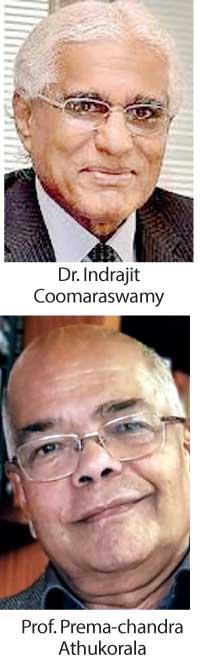 Extended Fund Facility (EFF) arrangement could take about six months considering challenges in the negotiations process with the country’s external creditors, particularly China, according to experts.