Programme launched by the President to ensure food security and nutrition

September 13th, 2022

Courtesy Hiru News

Multi-Sector Combined Mechanism for Empowering Rural Economic Revitalization Centres to ensure food security and Nutrition

No citizen should starve due to lack of food

07 committees for food safety

Prioritizer eradication of malnutrition

Fertilizer at reasonable prices for farmers

Continuity of agricultural inputs to make the season successful

Plans to meet food needs locally by 2025

The multi-sector mechanism to empower rural economic revitalization centres to ensure food security and nutrition was initiated under the patronage of President Ranil Wickremesinghe today (13).

The vision of the Food Security Programme of the Government is to ensure every citizen has access to enough food at a reasonable price to lead an active and healthy life, at any given situation of the country.

The government has initiated this program with the view of achieving dual objectives of ensuring that no citizen of the country should starve due to lack of food and no child should be a victim of malnutrition.

In order to achieve these dual objectives, it is required to protect all families in the country from being victims of poverty.

The relevant mechanism has been implemented through seven committees while the National Food Security and Nutrition Council will function under the chairmanship of the President.

The National Combined Mechanism on Food Security and Nutrition will function under the Chairmanship of the President’s Secretary whereas the Technical Advisory Committee on Food Security and Nutrition will be chaired by the Prime Minister’s Secretary.

The Provincial Combined Mechanism on Food Security and Nutrition will function under the chairmanship of the Provincial Governors while the District Combined Mechanism on Food Security and Nutrition will be chaired by the District Secretaries. The Combined Regional Mechanism on Food Security and Nutrition is to be implemented under the chairmanship of the Divisional Secretaries.

Rural Economic Revitalization Centers will comprise Grama Niladhari, Development Officer, Agriculture Research and Production Assistant, Samurdhi Niyamaka Niladhari, Midwife, principle of the closest school and two representatives of the local government institution.

This program will function under the leadership of President Ranil Wickremesinghe under the instructions of the President’s Adviser on Food Security Dr. Suren Batagoda, joined by the entire government machinery, from the Prime Minister and the President’s Secretary to the Grama Niladari level, the private sector, non-governmental organizations, professionals and religious leaders.

It is planned to produce 3.6 million metric tons of the total rice requirement of the country, 50% of the annual onion requirement and 35% of the potato requirement, locally.

It is also planned to produce 20% of the annual soy requirement of 250,000 metric tons in the country by 2025, 20% of the dry chili requirement to be produced locally by 2025, and the entire requirement of cowpeas, green beans, peas, sesame seeds and groundnuts to be produced locally by 2025.

It is planned to produce 80% of the 650,000 metric tons of maize required annually for the development of livestock such as eggs and poultry meat this year. By 2025, Sri Lanka is expected to grow its entire requirement of maize, locally.

Currently, steps have been taken to import 230,000 metric tons of urea, 100,000 metric tons of TSP and 182,000 metric tons of MOP required for the production of wheat and maize in the Maha season under the World Bank, Asian Development Bank and Indian credit line and to import fertilizer required for the production of other food crops with the contribution of the private sector.

Facilities are to be provided to buy agrochemicals and organic fertilizer from the market without shortage and it is planned to provide a 50 kg bundle of urea at a fair price lower than the current market price.

The government has already started the mechanism to supply the chemical fertilizer, organic fertilizer, agrochemicals and seeds to the farmers through the market at the right time to make the 2022 season a success.

It is planned to bring the products of the agriculture and livestock sector to the production level of the year 2018 and the necessary agricultural inputs including seeds, chemicals, chemical fertilizer, animal feed and fuel will be provided in sufficient quantity.

To achieve these production targets modern advanced irrigation systems and technology are planned to be used.
It is also planned to achieve the agriculture and livestock sector production to the levels experienced in 2018 and sufficient amounts of agricultural inputs such as seeds, chemicals, chemical fertilizer, animal feed and fuel will be provided to reach this goal.

Modern advanced irrigation systems and technologies are expected to be used to achieve the production targets.

The government’s concept of fertilization is planned to be popularized in plantations, thereby increasing production productivity.

Prime Minister Dinesh Gunawardena, Minister of Agriculture, Wildlife and Forest Conservation Mahinda Amaraweera, President’s Secretary Saman Ekanayake, Presidential Adviser on National Food Security Dr. Suren Batagoda and government officials including Governors, Ministry Secretaries, District Secretaries, Provincial Chief Secretaries, Bank and Corporation Chairmen were present at the inauguration.

Debt restructuring : Talks commence with India, China and Japan

September 13th, 2022

Courtesy Hiru News

The Financial advisory group Lazard hired by Sri Lanka has started talks with India, China and Japan on restructuring Sri Lanka’s debt, Minister Ramesh Pathirana the Cabinet spokesperson said today, as the country seeks an International Monetary Fund (IMF) bailout.

Lazard was hired by Sri Lanka in May, along with international lawyers Clifford Chance, to guide the government through the process of restructuring its debt.

Earlier this month, the IMF said it had reached a preliminary agreement with Sri Lanka for a loan of about $2.9 billion. But for the deal to go through, the country will require debt relief from China, India and Japan, its three main international lenders.

They are in the process of speaking to India, China, Japan, mainly to ensure we come to some sort of consensus,” acting cabinet spokesperson Ramesh Pathirana stated, referring to Lazard.

We will keep our fingers crossed that we will be able to come to an agreement.

The three countries hold about $13 billion of Sri Lanka’s debt, while China is Sri Lanka’s largest bilateral creditor.

Sri Lanka is also expected to formally reach out to private creditors who hold about $12 billion in bonds later this week, a government source told Reuters.

The government is planning to start talks with the ambassadors of China, U.S., Japan and India next week on debt restructuring,” the source said, declining to be named as he was not authorized to speak to media.

At UN event, India’s delivers sharp message to Lanka on Tamil minority, economy

September 12th, 2022

Courtesy The Hindustan Times

India said the Sri Lankan crisis has demonstrated the limitations of debt-driven economy and the impact it has on the standard of living”.

India on Monday expressed concern at the lack of measurable progress” by the Sri Lankan government on its commitments regarding a political solution to the ethnic issue involving the island nation’s Tamil minority.

While outlining India’s position at an interactive dialogue on the Office of the UN High Commissioner for Human Rights’ latest report on Sri Lanka, India’s permanent representative to the UN in Geneva, Indra Mani Pandey, also said the current crisis in Sri Lanka has demonstrated the limitations of debt-driven economy and the impact it has on the standard of living”.

People familiar with the matter said the stance adopted by India on the issue was stronger than in the past. This comes against the backdrop of strains in India-Sri Lanka relations caused by a Chinese surveillance vessel’s visit to the Chinese-controlled port of Hambantota.

Noting that India has always believed in the responsibility of countries to promote and protect human rights and constructive international dialogue and cooperation guided by the principles of the UN Charter, Pandey expressed the Indian side’s concern at the lack of measurable progress by Government of Sri Lanka on their commitments of a political solution to the ethnic issue”.

Such a political solution includes full implementation of the 13th Amendment of the Constitution, delegation of powers to Provincial Councils and holding of Provincial Council elections at the earliest”, Pandey said.

In recent years, India has taken up with the Sri Lankan side the issue of implementing the 13th amendment to Sri Lanka’s Constitution and holding elections to provincial councils to give greater autonomy to the Tamil minority.

The Sri Lankan leadership has shied away from committing to full implementation of the constitutional amendment and indicated it will not go against the wishes of the Sinhala majority while working for any resolution in Tamil-inhabited areas.

Pandey further said: India’s consistent view on peace and reconciliation in Sri Lanka has been for a political settlement within the framework of a united Sri Lanka, ensuring justice, peace, equality and dignity for the Tamils of Sri Lanka.”

He noted that the current crisis in Sri Lanka has demonstrated the limitations of the debt-driven economy” and said: It is in Sri Lanka’s best interests to build the capacity of its citizens and work towards their empowerment, for which devolution of power to the grassroots level is a pre-requisite.”

In this context, operationalisation of provincial councils through early elections will enable all citizens of Sri Lanka to achieve their aspirations for a prosperous future”, he said.

We, therefore, urge Sri Lanka to take immediate and credible action in this regard,” Pandey added.

India pulls up Lanka over ‘lack of progress’ in resolving ethnic issues

September 12th, 2022

Courtesy The Telegraph (India)

Current Sri Lankan crisis has demonstrated limitations of a debt-driven economy and impact it has on standard of living, says Indra Mani Pandey.

India on Monday expressed concern at the UN Human Rights Council about Sri Lanka’s lack of progress in evolving a political solution to its ethnic problem.

This is being perceived as a reprimand for Colombo for allowing the Chinese spy” vessel to dock at Hambantota Port last month despite New Delhi raising security concerns about its presence so close to the Indian coast.

Presenting India’s statement at the interactive dialogue at the UNHRC, on the Office of the United Nations High Commissioner for Human Rights (OHCHR) report on Sri Lanka, India’s permanent representative to the UN in Geneva, Indra Mani Pandey, said: The Indian delegation notes with concern the lack of measurable progress by Government of Sri Lanka on their commitments of a political solution to the ethnic issue — through full implementation of the 13th Amendment of the Constitution, delegation of powers to provincial councils and holding of provincial council elections at the earliest.”

Although India has been an early responder to Sri Lanka’s financial crisis, the ambassador took a swipe at Colombo for the dire straits it finds itself in. The current crisis in Sri Lanka has demonstrated the limitations of a debt-driven economy and the impact it has on the standard of living,” Pandey said, alluding to Colombo borrowing heavily from China.

It is in Sri Lanka’s best interests to build capacity of its citizens and work towards their empowerment, for which devolution of power to the grassroots level is a prerequisite. In this connection, operationalisation of provincial councils through early conduct of elections will enable all citizens of Sri Lanka to achieve their aspirations for a prosperous future. We therefore urge Sri Lanka to take immediate and credible action in this regard.”

The latest statement was in sharp contrast to one made in March this year in both tone and tenor. Presenting India’s statement at the interactive dialogue on the OHCHR report on Sri Lanka then, the Indian delegation had urged Colombo, without reprimanding it, to implement the 13th amendment and devolve powers to the provincial councils. India had also abstained from a vote initiated by the United Kingdom on Sri Lanka’s human rights record at that session of the UNHRC.

A vote on the subject is scheduled for October 7-8 in this session too, but Indian officials in Geneva were circumspect about how India would vote this time, maintaining that it was too early to say for sure.

India’s position on Sri Lanka has oscillated at the UNHRC since 2009 through different dispensations in both countries — abstaining thrice since 2014, voting against Colombo twice (in 2012 and 2013) and supporting a Lankan resolution in 2009.

Sri Lanka’s Left Turn

September 12th, 2022

By Devana Senanayake, a journalist from Colombo, Sri Lanka. Courtesy Coreign Policy

This year’s protests have revitalized the country’s socialists. But can they capitalize on that momentum electorally?

SEPTEMBER 12, 2022, 2:40 PM

The mass protests in Sri Lanka that led to the removal of President Gotabaya Rajapaksa and the appointment of a new president, Ranil Wickremesinghe, in July have now stalled. As Wickremesinghe cracks down on dissent, and demonstrators figure out where to go from here, many critics and experts have overlooked the role the country’s left has played in the protest movement.

Leftist parties are not the main players in the country’s aragalaya, or struggle, but they have shaped the movement considerably. Members of student and youth unions linked to leftist parties set up camp at Gota Go Gama, the now-disbanded site in Colombo that became the center of the movement after it was established in April. In the months that followed, leftist professional organizations, trade unions, and individuals also joined in, bringing their ideas and resources with them to the site’s complex political ecosystem.

Though they have yelled out chants with socialist agendas—defending universal health care and free education, and advocating for wealth redistribution, environmental conservation, and anti-corruption measures—many of these people haven’t outright identified as members of the left. When they identified that way in the past, few Sri Lankans listened or paid attention to them, said Kaushalya Ariyarathne, an academic and a member of the leftist National People’s Power party alliance. But when they introduced these positions in a nonpartisan context, other people joined in their chants.

We did not join as [the Frontline Socialist Party] because the people there did not like the state, Parliament, or political parties,” party spokesperson Pubudu Jayagoda said. We did not reveal our name but decided to contribute.”

Due to the left’s complex history in the island, most Sri Lankans are opposed to leftist groups and politicians. (Currently, only three leftist politicians are in Parliament, all belonging to the National People’s Power.) This only worsened with this year’s intertwined economic and political crises, when the public started to condemn all political parties, including leftist ones.

The left’s position in the country’s aragalaya reveals a strange tension. Over the past six months, the public has adopted the left’s concerns, demands, and language, but Sri Lankans are still not ready to see the left as a political alternative to the current ruling parties and elect more leftist politicians into government.


The turbulent history of Sri Lanka’s left continues to color the public’s perception of leftist parties. In its early days, it wielded considerable influence. The country’s first leftist political party, founded in 1935, was the Trotskyist Lanka Sama Samaja Party. That party became a major political force in the country’s independence movement, which succeeded in 1948.

The Lanka Sama Samaja Party joined with the Communist Party in leading the 1953 hartal, or general strike, successfully opposing the government’s proposal to end a rice subsidy that many Sri Lankans relied on.

Yet it was not until 1970 that the parties’ success in Parliament peaked. At that year’s general election, they joined a broader coalition and launched several socialist policies, including ones that supported the local production of rice and land reform. Ultimately, these policies could not be fully implemented due to the dynamics of the coalition government. The workers, peasants and poor of the country had a lot of hopes, but none of their promises were borne out,” said Siritunga Jayasuriya, a trade unionist who leads the United Socialist Party.

Soon, the situation became violent. A faction of the Maoist Communist Party broke out to form the Janatha Vimukthi Peramuna, which led to an armed revolt in 1971 against the government roused by rural poverty and unemployment that was crushed by the state.

Tensions continued after J.R. Jayewardene became president in 1978, when Sri Lanka initiated a market-driven economy. In the 1980 general strike, when several leftist parties and trade union leaders advocated for a pay increase, the state used force to crush the country’s trade union movement. It has never fully recovered.

Jayewardene banned the Janatha Vimukthi Peramuna in the aftermath of the anti-Tamil Black July riots in 1983, falsely blaming them for the deadly pogroms. From 1987 to 1989, the party launched a second insurrection in response to the government introducing a provincial council system and the arrival of the Indian Peace Keeping Force. The state responded with a counterinsurrection, which brought murder, enforced disappearances, and torture. Many of the party’s leaders, including Rohana Wijeweera and Upatissa Gamanayake, were assassinated.

The government’s death squads and torture camps of this beeshanaya, or period of terror, still haunt the country today. Despite the evolution of the Janatha Vimukthi Peramuna over the years, the insurrections have continued to taint Sri Lankans’ perceptions of the party.

Leftist ideas quickly began contributing to the movement and gave it more shape.

In 1994, the Janatha Vimukthi Peramuna regrouped and reentered Parliament. The party’s ideological core deteriorated due to its members’ desire for it to become a stakeholder in mainstream politics, which drove it to form alliances with parties and individuals on the right and center-right. Those have included then-President Chandrika Kumaratunga’s pro-capitalist regime from 2001 to 2003, the Sinhalese nationalist Mahinda Rajapaksa’s bid for the presidency in 2005, and former Army Commander Sarath Fonseka’s presidential campaign in 2010.

Since then, the left has continued to fragment. In 2012, some members exited the party to form the Frontline Socialist Party, focused on building a social movement and nurturing progressive politics. In 2015, the leader of the Janatha Vimukthi Peramuna formed the National People’s Power, an electoral coalition, and five years later, the party won three out of 225 seats in Parliament. Rather than focusing on class, as previous leftist parties did, this front primarily cares about anti-corruption and strengthening public services.

The left was still fragmented by the time the protests exploded across the country earlier this year. The Frontline Socialist Party’s Jayagoda noted that at the start of the protests, the main theme had been Go Home Gota”—or getting Gotabaya Rajapaksa to resign. It didn’t have another direction or vision for the future. But leftist ideas quickly began contributing to the movement and gave it more shape. This was evident in the protest boards and banners at Gota Go Gama. For instance, banners were frequently adorned with the slogan Power to the People Beyond Parliament,” which stemmed from the Frontline Socialist Party.

That party has also helped set up other protest camps around the country, including in the cities of Badulla, Galle, and Kandy. These sites have worked to mobilize citizens, and the party has hosted meetings and provided resources to help develop and sustain the movement.

Leftist parties’ presence also helped retain momentum in the period after May 9, when a mob supporting then-Prime Minister Mahinda Rajapaksa attacked Gota Go Gama. After Wickremesinghe was appointed prime minister on May 12, many middle-class protesters stopped participating, because they believed he could stabilize the economy and reintroduce a sense of normalcy. As Balasingham Skanthakumar, a Sri Lankan researcher and editor, said, the movement needed groups that could marshal support and reenergize the aragalaya.” Leftists filled that vacuum.

The Frontline Socialist Party and the Janatha Vimukthi Peramuna, in particular, have continued to mobilize the public. The former paid attention to citizens’ concerns and sought to funnel people’s emotions about the economic crisis into demonstrations it staged around the country: In June, for instance, people in Colombo held pots and pans in so-called Kitchen Laments to protest the rising cost of food. We were aware of the dynamics inside society and decided to motivate them further,” Jayagoda said. We set up the structure for the first protest, and then people copied them and continued.”

While the Janatha Vimukthi Peramuna started focusing on campaigning for more seats in the next parliamentary election, which is expected after the 2024 presidential election, it also held events including 50 days of protest” and 100 days of protest.”

Meanwhile, the leftist Inter University Students’ Federation, known as Anthare, held multiple marches and protests. As lawyer and activist Balachandran Gowthaman said, the group had a big say in any documents that came out of [Gota Go Gama], because they put their bodies where their mouths were.”

The influx of members of these groups contributed to the vast numbers of people who turned up to protest outside the president’s house in July, leading to Gotabaya Rajapaksa’s resignation and decision to flee overseas.

Despite leftist groups’ contributions to the movement, they face considerable pushback from across the political spectrum. For one, the public is still concerned about their presence. Some Sri Lankans have accused leftists of attempting to monopolize the movement. Several leftist party members I spoke to denied this, maintaining that they remain committed to a shared ideological space. We have never branded ourselves or raised a flag [at Gota Go Gama],” said Vrai Cally Balthazar, a Socialist Youth Union member and local politician. Rangana Dewapriya, a national organizer for the Socialist Students Union, echoed this sentiment. Skanthakumar, meanwhile, pointed out that a plurality of opinions over demands and tactics” existed in documents that came out of Gota Go Gama.

Disinformation has also plagued leftist parties. For instance, rumors circulated that the Janatha Vimukthi Peramuna asked protesters to occupy Parliament in July, but according to Ariyaratne, a party member had actually asked people to stage a silent protest outside Parliament and tried to stop people from breaking the barricades to enter the building.

The left is facing assaults from the authorities. Since Wickremesinghe became president on July 21, he has used several tactics to squash the protest movement. Armed forces, special task forces, and police have attacked and intimidated protesters, including many leftists, at Gota Go Gama, culminating in the removal of all camps from the site in early August.

Since then, tensions have only worsened as many protesters have received travel bans or have been arrested, intimidated, and harassed. Several anonymous dead bodies have also turned up in Galle Face Green, the beach facing Gota Go Gama, reminiscent of the death of leftist journalist Richard de Zoysa in 1990. Several youth activists, such as Wasantha Mudalige, have been detained under the draconian Prevention of Terrorism Act despite outcry from the international community. Experts such as Skanthakumar have compared the current period to the state’s counterinsurrections in 1989.

With the recent attacks, the only arena for the left is electoral politics and preparing for the next election in a few years. One way of garnering support would be to form coalitions and alliances, said researcher Devaka Gunawardena. He pointed out that political fragmentation” in a lot of mainstream parties as they recombined and reconfigured” in recent years could provide an example for the left. Examples of this include the birth of Samagi Jana Balawegaya out of the United National Party and the Sri Lanka Podujana Peramuna out of the Sri Lanka Freedom Party.

Another option would be to transform the social movement, with its leftist currents, into a political party itself, like Podemos in Spain and Syriza in Greece. I am hopeful a nucleus could rise out of the people’s movement and the popular uprising,” Gunawardena said.

While experts debate the future of leftist parties and question if they can capture broader support, it is clear that the public has opened up to leftist ideas and policies over the course of the people’s movement. The question is whether the left can capitalize on this rare opportunity by formulating an alternative economic plan for the country and transferring the momentum from the protests into representation in Parliament over the next few years. This could, ultimately, bring about the radical transformation of society that Sri Lanka desperately needs.

If Ven. Sobhitha doesn’t pay his bills, disconnection of power inevitable: Minister

September 12th, 2022

Courtesy The Daily Mirror

Power and Energy minister Kanchana Wijesekera said that if the temples do not pay their electricity bills, it will result in disconnection.

While responding to the statement made by the former parliamentarian and Leader of the Jathika Hela Urumaya, Ven. Omalpe Sobhitha Thera, the minister said that if the prelate falls into the same category as being a politician, the non payment of Electricity bills will be treated as default and result in disconnection.

While expressing disagreement, Ven. Sobhitha said he was unable to pay the electricity bill which he had received after the recent tarrif revision.

Addressing the media he said the electricity bill which was at Rs.58,000, has been increased to Rs.300,000 for this month.

We utilise this power for the benifit of the people in the area till 10.00 pm only.

We cannot bear the revised electricity bill and we cannot pay and we are not going pay this bill,” the prelate said.

“The Ceylon Electricity Board (CEB) is trying to cover its lossess from us and from the innocent people. The politicians have robbed the country’s valuable assets and billions of money and as a result of their malicious deeds, the CEB incurred a colossal loss.

Why should we pay money for redeem them?,” the Ven. Sobhita questioned. (Chaturanga Samarawickrama)

UNHRC’s resolution on Sri Lanka a product of politicization – China

September 12th, 2022

Courtesy Adaderana

The Permanent Representative of China to the UN Office at Geneva, Ambassador Chen Xu, openly spoke for Sri Lanka and opposed external interference during the Interactive Dialogue on the island nation at the 51st Session of the UN Human Rights Council on Monday.

Ambassador Chen stressed that China appreciates Sri Lanka’s continued efforts in enhancing and protecting its human rights, especially in reconciliation, reconstruction and counter-terrorism. 

As a traditional friendly neighbor of Sri Lanka, China firmly supports Sri Lanka in safeguarding national sovereignty and independence, maintaining social stability and realizing economic recovery. We believe that the Sri Lankan government is able to lead the people to overcome temporary difficulties.” 

The Chinese envoy emphasized that the UNHRC’s resolution on Sri Lanka is a product of politicization. It does not abide by the principles of impartiality, objectivity and non-selectivity. 

It has not been recognized by Sri Lanka, the country concerned, and has not played a constructive role in promoting and protecting human rights in Sri Lanka.” 

China said it opposes any country taking advantage of current difficult situation in Sri Lanka to seek self-interest, and urges relevant parties to respect the human rights development path that Sri Lanka has independently chosen according to its national conditions, and abandon the practice of using human rights to exert political pressure and interfere in other’s internal affairs.

THE DECISION TO EDUCATE IN THE ENGLISH MEDIUM

September 11th, 2022

BY EDWARD THEOPHILUS

I read a news report in Daily Mirror that the education in Sri Lanka from next year would be in the English medium. It is a good decision and it would support reducing social differences in the country. As we have seen for a long-time education in the English medium is an essential policy decision while teaching Sinhala should be a major concentrated subject in schools. The total student population from Grade one to Grade 12 is smaller and teaching English language and literature would be the strategy to broadly understand the use of language and vocabulary.

English medium education will be an effective decision to change social divisions in the country. As a result, the decision would be supported to create a multicultural society with the changing attitude of people. Reducing the giving priority to selected people with English knowledge and insulting people based on the lack of English knowledge would be removed by teaching in English medium and giving priority to people with English knowledge will be ended by new policy decisions in education.

The policy decision of Sri Lanka’s government decision to offer education in the English medium would be opposed by some groups such as International Schools owners, tuition masters, people who communicate in English to show off as a special group in society and many others. The opposing groups of people would be a group in society who have manipulated conduct to show that they are a specific group of people who are depicted a mental weakness.

Sinhala and Tamil should be specific knowledge areas and kids may need good knowledge of the mother tongue and contribution in either Sinhala or Tamil in rural and urban areas would not be strange behaviour of people but it will give value to the knowledge of Sinhala and Tamil. It will remove a major social issue and social fabric in the country. Kids will not waste time and money learning English because the media of instruction in schools would naturally promote to use and learn the English language and support many organizations to recruit quality staff and increase productivity.

The other significant impact would be the reduction in competition to enter urban schools, which means knowledge gained from whichever school is treated as identical and the broad of knowledge would not different whether it is gained in English or any other language.     

Providing education in the English medium would reduce additional work such as translating books into Sinhala or Tamil language and the country has been spending funds for this translation purpose and giving knowledge in English and Sinhala /Tamil might support changing the society.

For implementing this policy decision, Sri Lanka needs more teachers who could communicate and offer education in the English medium and the donor countries need to provide financial and other support to Sri Lanka. The special requirement is once in three years school teachers should be offered a training program, which reviews the quality of teaching in the English medium. 

New policy decision support school leavers for further education and accepting work in foreign countries and sending foreign money to Sri Lanka. 

Malnutrition

September 11th, 2022

Sugath Kulatunga

It was refeshing to see our Parliament debating for two days on a critical problem of child malnutrition facing the country, without wasting time on splitting hairs on political issues. It is sad that the debate was triggered not on a finding of the government but on a statement made by the UNICEF based on a report made in 2018 on acute malnutrition and protein deficiency in children of our country.  the UNICEF had described a desperate situation of this problem and made an urgent appeal for donations. The media sensationalized the comments without revealing the date of the findings. With Corvid ravaging the economy during the last two years the situation must be much worse today. The crisis has aggravated with the devaluation and food inflation reaching close to 100.

UNICEF may have gone to town now, due to the developing national disaster and to raise funds. The fund-raising objective for the agency is like the unsupported statement made by the Head of the WHO visiting Sri Lanka after the Tsunami, when she said that there would be more deaths by disease than caused by the Tsunami.

Whether the international bodies sound an alarm or not the bitter fact is that there is a severe problem of malnutrition and protein deficiency in children and pregnant mothers among the economically less privileged segments of our community. The present spike in bread and wheat flour prices will make the problem more acute among the urban poor and the plantation community. Specially in urban areas the convenient breakfast is bread. The increase in bread prices will make many school children skip breakfast. In this background we are heading for a stunted nation with poor health and underdeveloped brain power.

The present tragedy is that the media and politicians make a loud noise about the problem but rarely make any useful and specific suggestion on the solution. In Chinese Wei-Ji is the word for crisis.” It is composed of two words; Wei meaning danger” and Ji meaning opportunity”—hence the saying Every crisis is an opportunity!”

Opportunities and problems do not fall from manna. They are manmade. Present crisis in nutrition has its roots in dismal political decisions, administrative laxity, and social dogma.

The free supply of wheat flour/grain under PL 480 changed our food habits and made us addicted to wheat flour products. The problem got aggravated with the entry of the Prima project where we provide them with the grain which is milled by them and sold to us minus the bran and the wheat germ. This situation could have been corrected when the Prima BOT agreement terminated after 20 years. But CBK sold the complex back to Singapore and allowed them to continue to give us refined flour devoid of nutrition. Consumption of refined flour products minus these nutrients is suggested as one reason for malnutrition among school children who consume the convenient food for breakfast. Food technologists have not considered developing a breakfast cereal with local grains and pulses.as done even in some African countries.

Protein deficiency is highlighted as a main outcome of malnutrition in children and pregnant mothers. Animal proteins are more important in filling this need. In the Agriculture plan of Philip Gunawardhana in late 1950s there was a comprehensive plan for self-sufficiency and wide availability of animal products. This plan was neglected by succeeding governments. If the artificial insemination programs implemented at that time were continued by now SL would have an upgraded and productive cattle herd for milk production. instead, recently governments have been interested in overnight solution of importing cows which was a scam and a disaster. SL should go back to AI where quality semen can be easily imported. Government can follow the example of the privately run Ambewela Farm.

Milk is a major source of nutrition. Sri Lanka has been good at slaughtering the national cattle herd but not done enough to upgrade them.

The dairy farmer is not given a fair price for the liquid milk whereas the price of milk powder has continuously increased with the present price fixed at Rs. 2400 per KG. (One kg of milk powder requires 8 liters of fresh milk). Amul which is the largest dairy cooperative in India pays 60 percent of the cost of their milk packs to the producer. If processing, packeting, and marketing cost is calculated even at 50 % of the total cost, fresh milk could be paid 1200/8 = Rs 150. At this price there will be more production and availability of fresh milk. It is also necessary to check the quality of milk powder packets in the market for sugar content and liquid milk cartons for adulteration with water.

There is hardly any cream in cartons labelled full cream.

In India the goat is considered the poor man’s cow. In the Far East flocks of ducks in thousands are seen in the rural areas. These sources of animal products are not adequately tapped.  

In the early 60s Agriculture Ministry banned the import of eggs and launched an island wide program on small scale deep litter and free-range poultry to increase the availability, reduction of prices and more consumption of egg. This was backed with easy loans from the Peoples’ Bank and enhanced veterinary services. In a few months the country was made self-sufficient with eggs. This also increased the consumption of eggs and chicken and provided productive employment to many small breeders.

Fish is an excellent food to prevent malnutrition. But all governments have neglected tapping the marine resources even within our 200 mile economic Zone. Today fish prices have gone beyond even the middle class. Fresh water fisheries had a good start but was banned by a previous President. It is restored now. But a fish that can be bred on small scale is not promoted. Breeding of catfish which could be bred in earthen ponds (mud ponds) can be a cheap source of protein. Catfish can also be a good export commodity. Vietnam exports around US$ 2 billion worth of catfish to the USA where it is considered a delicacy.

Recently the media reported a recommendation by medical authorities that powdered fried sprats added to meals as a good source of protein. A better and cheaper source would be dried Murunga leaves which has 25 percent protein. Hybrid Murunga plants can provide harvests of leaves in six months. Seeds of hybrid murunga can be imported from South India.

SL has a variety of Yams which are not part of the regular diet of the people.  Our authorities do not seem to be in touch with international agencies engaged in the development of yams. This has deprived diversity in our diet. Sri Lankans consume more rice in their meals than vegetables, meat, and fish. In the Far Eastern countries like Thailand and the Philippines a normal meal has only one cup of rice but consists of plenty of other items. We also do not consume fruits like in those countries. Our horticulture has been neglected. Lack of variety in our diet is another cause of malnutrition.

There is also a cultural factor which discourage meat eating specially eating beef which was the cheapest meat in the past. Slaughter of animals is looked down upon whereas there is no objection on killing of fish although fish die of a painful death of suffocation when taken out of water.

There is a serious social problem where the father, the breadwinner in the family get addicted to drugs, alcohol or tobacco. A substantial amount of the meagre earnings of the father is spent on these addictions depriving the children of healthy meals. The government is totally committed against drugs, but alcohol and tobacco continue to be rich sources of government revenue. Restrictions on legal alcohol would lead to more consumption of illegal brew but the more harmful tobacco is given a free leash. It is easily controlled by banning the cultivation of tobacco which no government is prepared to do.

Pulses are a rich source of nutrients, and most can be cultivated in the country. But the free trade policy allowed their imports discouraging their production locally. Masoor dhal is the most popular pulse and is imported in large volumes at high price. Before 1977 a local substitute named Maha Illuppalama or Mi Dhal was produced but disappeared with the masoor dhal imports. More of this and other pulses and ground nuts should be produced here to improve the variety and richness in our diet. Sorghum is a hardy cereal which tolerates arid and infertile conditions. It is called the poor man’s maize. It was grown widely some time back but is imported now.

In the past children were given a wholesome lunch in the school. This helped to improve the health of the children and encouraged them to attend school. This in the long run will save in our health budget.

The SL Agricultural authorities have concentrated on rice, where they have done well but neglected other crops and horticulture. They can contribute more to improve the nutrition deficiency in the population.

Let us believe in Wei-Ji.

Sugath Kulatunga

Interim measures for energy needs

September 11th, 2022

by Neville Ladduwahetty Courtesy The Island

According to a media report the Power and Energy Minister Kanchana Wijesekera has set up a committee to evaluate renewable energy project proposals…with the aim of identifying the obstacles to the quick implementation of renewable projects and providing solutions for them” (Daily News, August 27, 2022).

This step has been taken at a meeting, which was led by the Minister with the Ceylon Electricity Board and Sustainable Energy Authority officials to review progress of renewable energy projects… Under this the Committee will evaluate the proposals received on a 100-Megawatt solar energy project to be set up in the Siyambalanduwa area. Moreover, a study of floating solar energy projects proposed to be built in reservoirs will be carried out.” (Ibid.)

While the attempt to exploit renewable energy is an absolute necessity, and solar power generation is a vital contributor towards such a goal, NO attention has been paid to doubling the capacity of the Victoria Hydro Power Project despite the fact that provisions for expansion were provided when the existing structure was constructed. What is even more glaring is the fact that while the proposed 100 MW solar project would require 500 to 1,000 acres of land, expansion of Victoria does not use any additional water other than what already passes through without being exploited to its full potential. This indeed is a sad indictment on successive Ministries of Power and Energy, and the Sustainable Energy Authority.

POWER GENERATION

The only explanation why the recommendations proposed in a Feasibility Study for Expansion of Victoria Hydropower Station”, dated June 2009, and undertaken for the Ministry of Power and Energy on behalf of Japan International corporation Agency (JICA) by Electric Power Development Co., Ltd. Nippon Koei Co., Ltd have not been implemented is that the either the Ministry of Power and Energy has rejected the recommendations or they in the Ministry gathering cobwebs despite attention to their existence has being made known in repeated articles published in The Island.

Section 6.1 of this report states: The expansion of the Victoria Hydropower Station is composed of a headrace tunnel, a surge tank, penstock(s) and a powerhouse. The water intake was already constructed for the purpose of future expansion of the hydropower facility during the construction of the existing Victoria dam … One possible option of expansion plan is simply to place these components nearby the existing hydropower facility … referred to as ‘Basic Option’” (p. 29). Although the Report presents two other options, what is recommended is to place an expansion powerhouse nearby the existing powerhouse facility.”

In the Section 6 under Conclusions and Recommendations, the Report states: Based on the results in (5) above, the Project is to connect the existing intake for the expansion and a new powerhouse to be located next to the existing powerhouse with a waterway parallel to the existing waterway. Water for generation of 140 m3/s is to be taken at the existing intake for the expansion and led through the headrace tunnel and penstock to the surface type powerhouse. The installed capacity is 228 MW with 2 units, and 716 GWh of annual energy are obtained with the existing and expansion power facilities (210 MW and 228 MW). Power generated is evacuated to the CEB grid through the existing transmission lines.” (Ibid, p.4)

Section 7 under ‘Conclusions and Recommendations’ states: The design in the Study is carried out at more detailed level than conducted in a feasibility study on a hydropower project, in accordance with S/W (Scope of Work) for the Study. In the basic design, salient features of civil structures and electromechanical equipment for the optimal development scheme selected in (5) are examined, and drawings are prepared. Following that, the construction planning, estimate of the project cost, and preparation of implementation schedule are conducted” (Ibid).

As stated in the Feasibility Study cited above, the fact that provision was made in the existing Victoria Dam for expansion, reflects the confidence the original designers had to double its capacity. Furthermore, the Sri Lankan agency that over saw the project also would have been aware of the provisions for expansion. Despite all this awareness, the fact that the project has lapsed means that those responsible should be held accountable. Perhaps, the Committee for Public Enterprise (COPE) should summon the relevant Authority and call for explanation as to why this project has been allowed to lapse all this time.

The material presented above clearly demonstrates that a real opportunity exists to double the capacity at Victoria using a resource that is not only the cleanest and cheapest resource to generate power, but also one that allows these freely available resources to be wasted without making full use of their potential. It is indeed a serious omission to pursue new power generation projects without expanding capacities at existing power generation units, such as those at Victoria.

INTERIM ENERGY NEEDS

The current arrangement in respect of importing fuel oil requirements is not sustainable judging from the reappearance of fuel queues to obtain their quotas. Sri Lanka has to accept the fact that the primary cause is the lack of sufficient foreign exchange to maintain steady supplies of both crude oil and finished petroleum products. Furthermore, it is also fact that the capacity of the existing Refinery at Sapugaskanda is insufficient to meet all of Sri Lanka’s energy needs.

The only option for Sri Lanka is to explore seriously and urgently a joint venture to set up a refinery of sufficient capacity to meet not only local needs, but also for export. Furthermore, by locating such a refinery in Trincomalee, where the combination of the existing storage tanks that could be refurbished, coupled with the strategic location in the Indian Ocean could be a profitable venture for any country that wished to participate in such a venture, because it could not only serve Sri Lanka’s needs but also serve the Indian Ocean Rim countries.

The invitation extended by Sri Lanka to Saudi Arabia to set up an oil refinery reported in The Daily News of September 2, 2022 is particularly heartening. According to this report the invitation has been extended by Sri Lanka’s Environment Minister Naseer Ahmed who went to Saudi Arabia last Sunday as a special representative of President Ranil Wickremesinghe, made this invitation during the discussion with Saudi Deputy Minister of Foreign Affairs Waleed AI-Quraji and the CEO of the Saudi Foundation for Development, Sultan AI-Mershad”. However, while the need to extend an invitation to set up a Refinery is commendable, its success or failure depends on the basis on which the deal is negotiated.

Whenever the idea of setting up an oil refinery in Sri Lanka is mooted, the immediate but unimaginative response is that it is a long-term project. While this is an indisputable fact and therefore does not serve the immediate needs, the challenge could be overcome if the terms of the venture are such that intermediate needs are supplied on a deferred payment basis to be paid back from the shares of the venture when the refinery comes into operation. In addition, the terms of the venture should be such that the cost of the installed refinery should be considered as being on par with the investment in the storage facility and the location for distribution to Indian Ocean Rim countries. Furthermore, the savings accrued by deferring payments while the refinery is being set up could contribute towards the debt payment. This by itself is an extremely significant factor. Additionally, the setting up a refinery would present an opportunity to move out some of the excess fat from the Ceylon Petroleum Corporation, and make it lean and profitable.

CONCLUSION

The issues raised above relate to two vital issues that would contribute immeasurably to the economy. The first is what measures could be adopted to improve the capacity of power generation from Renewable Energy, and the second is how to ensure a sustainable energy strategy to meet the energy needs of Sri Lanka.

The solution to the first issue is to double the power generation capacity at the Victoria Hydro Power Project as recommended in a feasibility report to the Ministry of Power and Energy in 2009, cited above. The second issue can be overcome by setting up a refinery as a joint venture with a partner that has abundant supplies of crude oil. The fact that a special representative of the President Wickremesinghe had discussions with Deputy Foreign Minister and the CEO of Saudi Foundation for Development, Sultan AI- Mershad is both helpful and encouraging. However, the country’s dependence on fossil fuels should only be an interim measure until Sri Lanka could be dependent on renewable energy for its power and energy needs. Both issues have been presented in previous articles. The need has arisen to repeat them is in the hope that a new administration under a new President and a new Prime Minister together with a committed and dedicated Power and Energy Minister would take note and act on what is proposed herein, and pursue the efforts initiated for Sri Lanka to sustain its Power and Energy needs.

The Billion-dollar bribe & balkanization of Sri Lanka

September 11th, 2022

C. Wijeyawickrema, LL.B., Ph.D.

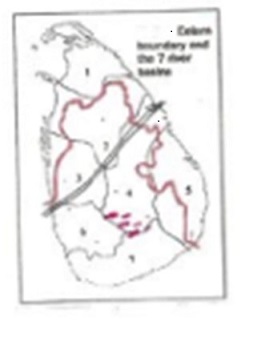
The map above shows 4 ideas:

A. the division of the island as seven major river basins instead of the 1832 Colebrooke-based artificial nine provinces (1. Yalpanam 2. Rajarata 3. Dambadeni 4. Mahaveli 5. Deegavapi 6. Kelani 7. Ruhunu).

B. red line demarcates the mythical Tamil homeland (Eelam) boundary.

C. broken red lines in and around the no. 4 basin marks the Malayanadu estate Tamil settlements.

D. black lines indicate the proposed electric railway line connecting Trincomalee and Colombo.

Note:

Within about 10 days of the beginning of <Galle Face Aragalaya>, I was able to detect and report that it was a local and foreign conspiracy to balkanize the island.  Whether its original participants knew about it at that time is a difficult question to answer, except that even with clear and convincing evidence before the country, the bearded Aragalaya leaders opted to ignore them.

The offer of a 52-billion-dollar bribe by the overseas Tamils to get the NP & EP under their control compared to 3 billion from IMF, needs to be understood from the perspective of the Yahapalana Orumittanadu constitutional draft of January 2019, which was a resurrection of the Neelan-GL package deals of Mrs. CBK during 1995-2000.  The attempt to abolish or weaken the executive presidency by the 22 Amendment prepared by minister Wijedasa Rajapaksa is a signal of what is in store for the country, when the urgent need now is to wage a war to provide basic human needs such as food, fuel, medicine, and electricity (Maslow’s hierarchy of human needs!)

World Tamil movement wants to have a separate Tamil country with a UN flag, and Sri Lanka provides the best real estate for this purpose, even though the one and only Tamil homeland is in South India. Their attempt to have one in the Fiji Island boomeranged.

It is very clear that the black-white Sinhala politicians and Buddhist monks of all kinds have not realized the gravity of the situation and if another uprising occurs, an anarchical atmosphere like in Libya would be inevitable and UN forces led by India will come under the cover of R2P to restore normalcy. That could very well include balkanization of the island based on Mrs. CBK’s secret plan of 1997.

This unfortunate situation could be avoided following two parallel paths.  (1) A war-like approach on the economic development front, restricting unreasonable dissent, and (2) empowerment of people at the Jana Sabha level, free of partisan politics, to rescue the country from socio-political and moral decadence. Resurrection of our Trinity of Gama-Weva-Dagaba (village-water reservoir-temple/kovil/church), the socio-economic-political model of our harmonious civilizational existence. The Aragalaya crowd talked about People’s Councils, but they as well as their opportunist party-politician backers have all forgotten it altogether, dreaming or planning for a second uprising. These politicians are like the proverbial fox went behind a goat and the end-result will not be what they think they will be able to harvest.

In the meantime, I felt it useful and relevant to reveal the secret balkanization plan of Mrs. CBK drafted in 1997.

Where Tamils live (Source map: Tamilnation.org website 1/25/2010

Source: Lankaweb -What and which zone of agreement?
Posted on October 29th, 2013 

If the Tamils’ cry for separatism is given up, the two communities could solve their problems and continue to live in amity and dignity. – M.C. Sansoni, CJ-(Sessional Paper No. 7 of 1980). 

-Sinhala people have no other land [place to go] –   Wigenswaran-CM, NP

Expatriate remittances up 16 percent to USD 325 million – number of overseas job departures exceeds 200,000 in 2022

September 11th, 2022

Manusha Media

 Labour and Foreign Employment Minister Manusha Nanayakkara said that the foreign exchange sent by expatriate workers to Sri Lanka has increased by 16.4 percent in August compared to July this year, and the number of workers who have registered with the Sri Lanka Bureau of Foreign Employment (SLBFE) to leave for foreign jobs this year has exceeded 200,000.

According to the minister, the amount of foreign labour remittances which was US$ 279 million in July has increased by USD 46 million to USD 325 million by the month of August.

 The minister said that he would like to express his gratitude to every expatriate worker who has sent money through the banking system legally, and that all Sri Lankans need the support of expatriate workers at this time, with the country facing a foreign exchange shortage.

 Meanwhile, during this year, the number of workers registered with the Sri Lanka Bureau of Foreign Employment (SLBFE) to leave for foreign employment has exceeded 200,000.

This year there was a target of sending 300,000 workers for foreign jobs and the target has been increased to 330,000 due to high demand, both on the part of job seekers and the labour receiving countries.

Reply to “How a Separate State in the Northern and the Eastern Provinces of Sri Lanka will be beset with poverty and destitution”

September 11th, 2022

Dilrook Kannangara

Having read an interesting article by Garvin Karunaratne prompted me to write this to bring to attention real issues of today that were disregarded in it. In short, if a separate state or states are declared in the northern and eastern provinces, they will be rich and developed countries in a generation thanks to the sheer investment potential of their sponsors abroad!

Agriculture is Not the Engine of Growth Today

The article focused only on agricultural produce. However, agriculture is not the engine of modern economic growth which is based on industry, services, IT, AI, financial markets, mining, defence and shipping. It is true the two provinces seriously lag behind in these but not the rest of the world. Sri Lanka tried extremely hard to bring these investments into the two provinces but failed. None of this can be done by the government. They must be made by private and corporate investors. This will be discussed later.

On the subject of agriculture, the two provinces still do not have developed ports for international trade. If they were independent nations, they will have ports that engage in international trade. Their produce can be exported for dollars. Earnings will be far more lucrative than selling them for Sri Lankan rupees. Similarly, they can directly import from foreign nations with massive savings in import duties and VAT charged by the Sri Lankan government (which may go to their own governments), savings in intermediary costs and transport costs. Once again, a better deal for the people in the north and the east.

Investments

The biggest challenge of all developing nations is investments. Despite various attempts, Sri Lanka failed to attract investments in modern industries.

If the two provinces turn into one or two independent nations, Tamil Diaspora, Tamil Nadu and the Organisation of Islamic Countries (OIC) will generously invest billions of dollars annually and turn them into the next economic miracle.

The total dollar earning of the Tamil Diaspora is higher than the total earnings of Sri Lankans converted to dollars! This is due to the fact that the Sri Lankan Tamil Diaspora lives in some of the richest nations on earth and their sheer number. Also, Sri Lanka’s currency has steadily lost its value. This means, Tamil Diaspora has billions of dollars to invest. However, they are unwilling to play by the rules of what they call Sinhala” governments. They are also totally unwilling to invest in the island if their investments benefit Sinhala people. If a separate nation is created for Tamils, their blood relatives in the Diaspora will invest billions of dollars in new industries.

Tamil Nadu is the second largest Indian state economy. They too will invest in billions in a separate Tamil nation in the island which will be indirectly ruled by Tamil Nadu influence in terms of policy, taxation, defence matters, governance, border security (or lack of it), fishing rights, etc. This is not possible at the moment as the Sri Lankan government makes all these decisions.

If Muslims get their own nation to run on Islamic laws, most importantly in compliance with Sharia principles, ultra-rich Islamic nations will help the Islamic republic with billions of dollars of investments, heavily discounted fuel and gas, preferential export status and many other benefits. At the moment this is not possible as not the entire legal and economic system of Sri Lanka is Sharia compliant.

The Islamic nation in the east will be the next Dubai or Maldives (the richest South Asian nation today in terms of per capita income).

Choice of Government Investments

In addition to business investments, there is government investment.

Until now, the Sri Lankan government decided on the choice of government investment in the north and the east. People in these areas were never consulted. For instance, defence expenditure the government spends in the north and the east is close to a billion dollars annually! People in these two provinces would prefer that money to comes to them instead. That cannot be done without allowing them a separate nation as the moment the military is weakened in the two provinces violent separatism will begin.

Sri Lankan government has also invested heavily in building houses for the displaced, roads, etc. in the north and the east. However, if the two provinces were independent, they would not have invested so much in these. Instead, they would have invested in income-generating and export-oriented activities. From the earnings, they would have built houses, etc.

The governments in separate states in the north and the east will have an extremely attractive and new financing source – their Diaspora and sponsors abroad. They would raise bonds with ultra-low interest rates with a term of over 25 years which will be sold to the Tamil Diaspora, Tamil Nadu, etc. For them it is a low price to pay for a nation of their own. Israel does this very successfully. This will be a cheap financing source the Sri Lankan government will never have.

Cultural and Spiritual Resurgence

At the moment all Tamil cultural works are imported from India. Sri Lanka produces next to no Tamil cultural works. This will totally change when a separate nation/s is/are created in the north and the east for Tamils (and for Muslims too). Locally produced original Tamil artworks will reach a starving global Tamil audience. The same goes for Tamil, mostly Hindu, spiritual activities too. Instead of importing from India, the Tamil nation within the island will be an exporter of these.

Implications for the Rest of the Island

Implications for the rest of the island depends on the arrangement. Resources and opportunities in the rest of the island may be divided among a smaller number of people than now which will make them richer. However, this depends on the arrangements.

At the moment a disproportionately larger tax revenue is earned from the seven provinces outside the north and the east and the two provinces consume a disproportionately larger government spend in education, defence, healthcare, administration, sea patrol, border control, narcotics control, etc. This will be saved which can be invested in the seven provinces. Imports, especially legal and illegal gold imports, fuel imports (travel and transport between the north and Colombo consumes a significant amount of fuel), foreign currency spent on foreign education, etc. can be saved. These savings will run into billions of dollars each year.

Provincial councils can be discontinued as only Tamils ever wanted them, saving dozens of million dollars each year and reducing layers of governance and associated waste and corruption.

Caution

However, this does not mean a division of the island as demanded by Tamil voters in the north and the east and their political parties throughout the island is the solution. It is not. Over 50% of total Tamils and over 60% of total Muslims live outside the north and the east. The north and the east make up a massive 28% of the island. Therefore, allowing independence to the north and east is inequitable and unfair by the people in the seven provinces. An equitable arrangement must be made for a fair exchange before division (if at all).

However, the northern and eastern areas will certainly not suffer poverty and destitution if they become one or more separate nations.

ලොව ප්‍රථම සිංහල සංවිධානය ආරම්භ කල ගාමිණී ‘දිවයින’ට කතා කරයි

September 11th, 2022

උපුටා ගැන්ම දිවයින

එංගලන්තයෙන් දුටුගැමුණු කෙනෙක් ඇවිත්….
සිංහල බල මණ්ඩලය ආරම්භ කරලා කොළඹ සිට

අනුරාධපුරය හරහා නුවරට රථ පෙළපාලියක් ගියා…
ලෝකය පුරා රටවල කොටි සාමාජිකයන් යුද පුහුණුව ලබන බව

ප්‍රථම වරට මෙරටට දැනුම් දුන්නේ මමයි…

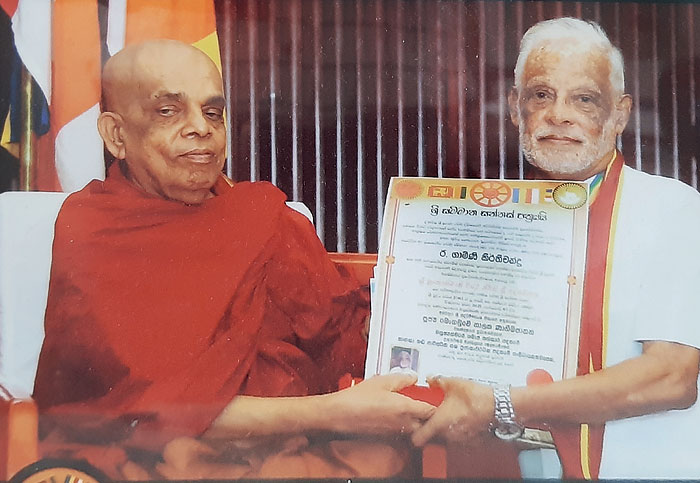
අදටත් ඒ හඬ ගාම්භීරය. සිංහල ජන දුක හමුවේ දැනුදු ඒ හදවත කම්පනයට පත් වේ. හිරු නොබසින අධිරාජ්‍යයේ සැපවත් ජීවිතයක් ගත කිරීමට අවස්ථාව තිබියදී, ඔහු මෙරට හුදෙකලා ජීවිතයක් ගත කරනුයේ දුක්විඳින සිංහල ජනතාවට සරණක් වීමටය. හේ අන් කිසිවෙක් නොව ඉතිහාසයේ ප්‍රථම වරට එංගලන්තයේ ‘සිංහල සංවිධානය’ සහ මෙරට ‘සිංහල බල මණ්ඩලය’ ගොඩනැගූ ගාමිණී කීර්තිචන්ද්‍ර ය. අද ඔහු වියපත්ය. වයස අවුරුදු අසූපහකි. එහෙත් ඔහු සමාජයට සේවය කිරීමේදී භද්‍ර යෞවනයෙක් වැනිය. පසුගිය දිනෙක සුන්දර හැන්දෑවක ඒ සොඳුරු මිනිසා සමග සුහද පිළිසඳරක නිරතවීමට මට අවස්ථාව උදා විය. හෝරා දෙකකට වැඩි කතාබහේදී දුක දිනා ජීවිතය ජයගත් ආකාරයත්, නිදා සිටි සිංහල ජාතිය අවදි කළ ආකාරයත් හේ කෙටියෙන් විස්තර කළේය. දැන් අපි ඔහුගේ හඬින්ම ඒ කතාව ඔබට කියන්නෙමු.

මම ඉපදිලා තියෙන්නෙ 1939 පෙබරවාරි මාසෙ 14 වැනිදා. උපන් ගම මොරටුව. ජීවත් වුණේ වැල්ලවත්තේ. අපේ පවුලේ සහෝදර, සහෝදරියෝ දහතුන්දෙනයි. ගැහැනු දරුවො හයදෙනයි. පිරිමි දරුවො හත්දෙනයි. සහෝදර, සහෝදරියන් තුන්දෙනෙක් පුංචි සන්දියේම මිය ගියා. මම තමයි පවුලේ වැඩිමලා. මගේ තාත්තා මෝටර් රථ කාර්මිකයෙක්. තාත්තා වැඩ කළේ තලවකැලේ ගරාජ් එකක. මාසෙකට වතාවක් ගෙදර ආවේ. අපිව රැක බලා ගන්නවා හැර අම්මට රස්සාවක් කරන්න වෙලාවක් තිබුණේ නෑ…

ඒ කාලේ අපි බොහොම දුප්පත්. වැල්ලවත්තේ ජීවත් වුණේ ගෙවල් පේළියක. එක කාමරයයි, පුංචි ඉස්තෝප්පුවයි. කුස්සිය මඩුවක්. පවුලේ සේරටම නිදාගන්න කාමරය ඉඩ මදි. ඒ වගේම තාත්තා ගරාජ්වල වැඩ කරලා ගන්න පඩිය අපේ පවුල නඩත්තු කරන්න ප්‍රමාණවත් වුණේ නෑ. සමහර දවස්වල රෑට අපිට කන්න නෑ. තියෙන හාල්වලින් කැඳ හදලා අපිට දීලා අම්මා වතුර බීලා නිදාගත්තා. අම්මගේ එකම අභිප්‍රාය වෙලා තිබුණේ තාත්තා එවන සල්ලි පරිස්සම් කරගෙන අපිට හොඳට උගන්වන්න. නංගිලා, මල්ලිලා සේරම හොඳ පාසල්වලට ඇතුළත් කරගත්තා. මම අධ්‍යාපනය හැදැරුවේ බම්බලපිටිය ශාන්ත පීතර් විද්‍යාලයේ. නංගිලා ඉගෙන ගත්තෙ විශාඛා විද්‍යාලයේ.

ලොව ප්‍රථම සිංහල සංවිධානය ආරම්භ කල ගාමිණී 'දිවයින'ට කතා කරයි

‘අපේ තාත්ත, අම්ම අපිට ඉගැන්නුවේ නෑ. මාව ඉස්කෝලෙ යැව්වා නම් අද මම උසස් තැනක ඉන්නවා. මට වෙච්ච දේ ඔයලාට වෙන්න දෙන්නෙ නෑ…’ අපෙ අම්මා මන්තරයක් ජප කරනවා වගේ නිතර එහෙම කියමින් අපිට උගන්වන්න පුදුම විදිහට උනන්දු කළා. ඒ වගේම අපේ අම්මා හැමදාම උදේ පාන්දර හතරට අවදි වෙලා අපි සේරම අවදි කරලා එළඟි තෙල් පහනක් පත්තු කර අල්මාරිය උඩින් තියලා වඳිනවා. උදේ පහ වෙනකොට මම යාළුවො කිහිපදෙනෙක් එක්ක වෙරළට ගිහින් ගල්කිස්සෙ වෙරළට දුවලා මුහුදෙන් නානවා. එන ගමන් රෝයල් බේකරියට ගිහින් පරණ පාන් අරගන්නවා. නංගිලා, මල්ලිලා, කෑමට ඉස්කෝලෙට අරගෙන ගියේ පරණ පාන්. සමහර දවස්වලට ඉස්කෝලෙ ගිහින් එනකොට නංගිලා අඬනවා. පරණ පාන් කනකොට ළමයි ඔච්චම් කරලා. ඒත් මට කවුරුවත් අනං මනං කියන්න ආවේ නෑ. පුංචි කාලේ ඉඳලා මම හිටියේ චණ්ඩි පාට් එකෙන්. කවුරුහරි කඩප්පුලි කතාවක් කිව්වොත් ඒ මොහොතේම ගහනවා. හරිම මුරණ්ඩුයි. දඩබ්බරයි. මගේ නැති බැරිකම් වහ ගත්තෙ ගණන්කාරකමෙන්. ඒ වගේම මම ඉස්කෝලෙ නොකරපු ක්‍රීඩාවක් නෑ. හොඳ ක්‍රිකට. නංගිලා, මල්ලිලත් ක්‍රීඩා කළා. ඒත් අපි සේරම හොඳට ඉගෙන ගත්තා…

මම ඉගෙන ගත්තෙ ඉංග්‍රීසි මාධ්‍යයෙන්. ගණිත අංශයෙන් උසස් පෙළ ඉහළින්ම සමත් වුණා. නංගිලා, මල්ලිලා විශ්වවිද්‍යාලවලට තේරුණා. මම විශ්වවිද්‍යාලයට ගියේ නෑ. ක්‍රීඩා කරලා තිබුණු නිසා පිටකොටුවේ වෝකරේන් සන්ස් ආයතනයේ රැකියාවට ගියා. කොන්ත්‍රාත් සමාගමක්. එංගලන්ත කොම්පැණියක්. දක්‍ෂතාවයට වඩා මම උනන්දුවෙන් වැඩ කරගෙන ගියා. ඒ වගේම ආයතනයේ ප්‍රධාන එංගලන්ත ජාතිකයන් දෙතුන් දෙනාම අපිත් එක්ක රගර් සෙල්ලම් කළා. ටික කාලයක් යනකොට හොඳ යාළුවො බවට පත් වුණා. ඒ සමඟ දේශීය කොන්ත්‍රාත් සමාගම් කිහිපයක්ම ආරම්භ වුණා. ඒ සමාගම් අඩුවට ටෙන්ඩර් ගන්නකොට අපේ සමාගමට වැඩ නැතිව ගියා. අන්තිමේ අපේ ආයතනයේ කළමනාකාරිත්ව කොම්පැණිය වහලා එංගලන්තයට යන්න තීරණය කළා…

ගාමිණිත් අපිත් එක්ක එංගලන්තයට යන්න එනවද? ආයතනයේ ප්‍රධාන සුදු ජාතිකයා මගෙන් ඇහුවා…

‘හරි මම ලෑස්ති…’ හිතන, පතන කිසිම දෙයක් නෑ… ඒ මොහොතේම කැමති වුණා.

කොම්පැණිය වහලා සති දෙකක් විතර යනකොට මම එංගලන්තයට ගියා. ප්‍රථම වරට රටින් ගියේ 1959 වර්ෂයේදී. එංගලන්තයේ වෝකරේන් සන්ස් ප්‍රධාන ආයතනයේ රැකියාව කරන අතරේ වැඩිදුර ඉගෙන ගත්තා. ඒ අතරේ මගේ නෝනා මුණගැහුණා. ඇයත් ශ්‍රී ලාංකික කාන්තාවක්. 1973 අවුරුද්දෙ අපි විවාහ වුණා. මගේ බිරිඳ ගාල්ල දිස්ත්‍රික් පාර්ලිමේන්තු මන්ත්‍රී ඒ. පී. ද සොයිසාගේ වැඩිමහල් දියණිය. පිලිප් ගුණවර්ධනට පුටුවෙන් ගැහුවේ මගේ මාමණ්ඩි. ඒත් මාමණ්ඩි දේශපාලනය කළාට දියණියවත්, මමවත් දේශපාලනයට සම්බන්ධ වුණේ නෑ. දක්‍ෂතාවය, උගත්කම නිසා එංගලන්තයේ ප්‍රසිද්ධ ආයතන කිහිපයක ඉහළ රැකියා කළා. ටෙක්ස් එකෝ ඉන්ධන පිරවුම්හලේ කළමනාකරු විදිහට වැඩ කරන කාළේ මගේ පරිපාලනය දැකලා වෙනත් ඉන්ධන පිරවුම්හලක් කරගෙන යන්න සම්පූර්ණයෙන්ම මට භාර දුන්නා. මම දෙකේම වැඩ කරගෙන යනකොට ටෙක්ස් එකෝ කොම්පැණියෙන් දැනගෙන එකක් තෝරගන්න කියලා මට කිව්වා. එදාම මම ටෙක්ස් එකෝ ආයතනයෙන් ඉවත් වෙලා මගේ ආයතනය දියුණු කරන්න උපරිම කාලය වැය කළා. ඒ කාලයේ එංගලන්තයට ගිහින් වීසා නැතිව හිටිය ශ්‍රී ලාංකිකයන් හැම කෙනෙකුටම වගේ ජොබ් දුන්නෙ මමයි. 1976 අවුරුද්ද වෙනකොට අපේ රට බෙදන්න යනවා කියලා මට ආරංචි වුණා. ලෝකෙ විවිධ රටවල එල්.ටී.ටී.ඊ. සාමාජිකයන්ට යුද පුහුණුව ලබාදෙන බවට ලිඛිත සාක්‍ෂි සමඟ මට තොරතුරු ලැබුණා. ඒ තොරතුරු ලබාදුන්නෙ අපේ ඉන්ධන පිරවුම්හලේ වැඩ කරපු ලංකාවේ දෙමළ තරුණයෙක්. සෙල්වරාජා. එවකට එංගලන්තයේ එල්.ටී.ටී.ඊ. හිතවාදියෙක්.

ලොව ප්‍රථම සිංහල සංවිධානය ආරම්භ කල ගාමිණී 'දිවයින'ට කතා කරයි

‘තරුණයො විදිහට ජාතිය වෙනුවෙන් පණ දෙන්න වුණත් සූදානම් වෙන්න ඕනෑ. ඔයලාගේ සංවිධානයේ රැස්වීමකට යන්න ඕන නම් මට කියන්න, නිවාඩු දෙන්නම්…’ කියලා මම ඒ කොල්ලව මුරුංගා අත්තෙ තියලා සියලු තොරතුරු ලබාගත්තා. ඒ තොරතුරු ජේ. ආර්. ජයවර්ධනට ලබා දුන්නා. ජේ. ආර්. ඒ තොරතුරු ගැන සොයා බලනවා වෙනුවට මම මොනවද කරන්නෙ කියලා සොයාබලන්න එස්. පී. මර්වින් ප්‍රනාන්දුව එංගලන්තයට එවලා තිබුණා. නීතිවිරෝධී කිසිම දෙයක් මම කළේ නෑ. උගත්කමෙන්, දක්‍ෂතාවයෙන්, කැපවීමෙන් හම්බ කළා. මා ගැන තොරතුරු සොයාගෙන පැමිණි අයටත් ඉඳුම් හිටුම් පහසුකම් ලබා දුන්නෙ මමයි…

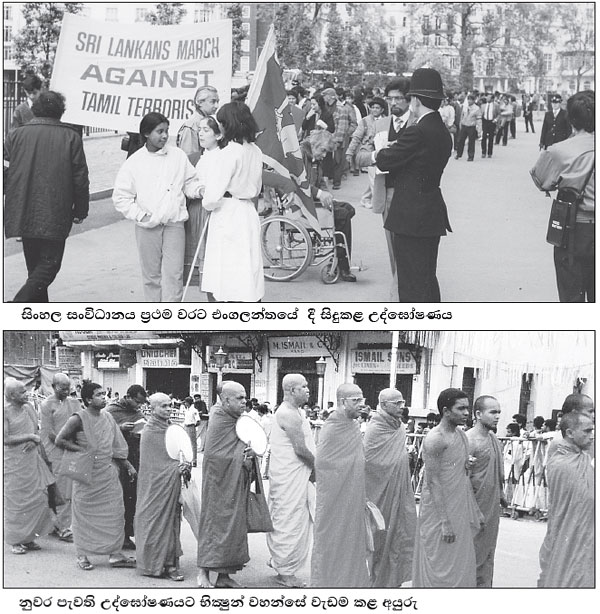
ඒ කාලේ සිංහල යාළුවන්ට වඩා මට හිටියේ දෙමළ, ලංසි ජාතික හිතවතුන්. ශාන්ත පීතර විද්‍යාලයේ අපේ පන්තියේ වැඩිපුර ඉගෙන ගත්තෙ දෙමළ සහ ලංසි ළමයි. පාසලෙන් විසිරිලා ගියත් අපේ යාළුකම් ඈත් වුණේ නෑ. ඒත් දෙමළ ජාතිකයන් රට බෙදීමට සූදානම් වෙනකොට ලංකාවේ දෙමළ යාළුවන්ට කතා කරලා ‘බෙදන්න යන රටක හිතවත්කම් පවත්වන්න බෑ… සියලු ජාතීන් එක ධජයක් යටතේ ජීවත් වෙන්න කැමති දවසක මම ඔයලාට කතා කරන්නම්…’ සියලුම දෙමළ හිතවතුන්ට එහෙම දැනුම් දීලා මම එංගලන්තයේ සිංහල සංවිධානයක් ගොඩනැගුවා. එම සංවිධානය ආරම්භ කළේ 1976 වර්ෂයේදී. එතකොට මගේ ලොකු දුවට වයස අවුරුදු දෙකයි. ප්‍රථම රැස්වීම පැවැත්වුවේ බැලැන් බාත් ශාලාවේ. ඒ රැස්වීමට සිංහල මිනිස්සු හැත්තෑ ගාණක් විතර සහභාගි වෙලා හිටියා. ඊට පස්සෙ පෙළපාලි ගියා. ශ්‍රී ලංකා තානාපති කාර්යාලය ඉදිරිපිට උද්ඝෝෂණ කළා. ඒත් එල්.ටී.ටී.ඊ. සංවිධානයේ ගොඩනැඟීම ගැන අපේ රටේ වගේම ලෝකයේ ජීවත්වන බොහෝ සිංහල ජාතිකයන්ට හරිහැටි අවබෝධයක් තිබුණේ නෑ. ඒ නිසාම මම ජාතිවාදය පතුරුවනවා කියලා සමහර මිනිස්සු විවේචනය කළා. සිංහල සංවිධානය ආරම්භ කරලා ලංකාවේ බෙදුම්වාදයට එරෙහිව එංගලන්තයේ ක්‍රියාත්මක වෙනකොට මා ගැන තොරතුරු රැස්කරන්න සේපාල ආටිගල එංගලන්තයට ආවා.

‘පුතා… ඔයාගේ වැඩසටහන ඉතාම හොඳයි. අපිත් උදව් කරන්නම්…’ අරවා දෙන්නම්… මේවා දෙන්නම් කියලා එංගලන්තයෙන් පිටත් වුණා. ඒත් කිසිම දෙයක් දුන්නෙ නෑ. එතකොටත් දෙමළ බෙදුම්වාදී සංවිධානයක් හිස ඔසවන්න යනවා කියලා ලංකාවේ මිනිස්සුන්ට අවබෝධයක් තිබුණේ නෑ. ඒ වෙනකොට එංගලන්තයේ දෙමළ මිනිස්සු එළිපිටම ක්‍රියාත්මක වෙමින් සිටියා. ලන්ඩන් විහාරයේ නායක හාමුදුරුවෝ හම්මළුවේ සද්ධාතිස්ස හාමුදුරුවොත් දෙමළ ක්‍රියාකාරකම්වලට තදින්ම විරුද්ධ වුණා. උන්වහන්සේ එංගලන්තයට වැඩම කරලා තිබුණේ 1939 වර්ෂයේදී. ලෝකය පුරා බෞද්ධ ආගම ව්‍යාප්ත කිරීමට උන්වහන්සේ විශාල සේවයක් කරගෙන ගියා.

ඔය කාලේ එංගලන්තයේ ජීවත්වන ශ්‍රී ලාංකිකයන්, එරටට තානාපතිවරයෙක් ඉල්ලා මෙරට ජනාධිපති ජේ. ආර්. ජයවර්ධනට ලිඛිතව දැනුම් දීලා තිබුණා. ප්‍රේමදාස අගමැතිවරයාගේ සූදානම තිබුණේ දෙමළ ජාතික මූර්තිව එංගලන්ත තානාපති විදිහට පත් කරන්න. දෙමළ බෙදුම්වාදී සංවිධාන හිස ඔසවන පසුබිමක දෙමළ ජාතිකයෙක් එංගලන්ත තානාපති විදිහට පත්වීම සුදුසු නෑ. ඒ නිසා ඒකට විරුද්ධ වෙලා අපි පෙත්සමක් අත්සන් කර ජනාධිපති ජේ. ආර්. ට යොමු කළා. අන්තිමේ මූර්තිව තානාපති විදිහට පත් කර, අපි යවපු පෙත්සමේ කොපියක් දීලා එංගලන්තයට එවලා තිබුණා. ඊට ටික දවසකට පස්සෙ 1978 අවුරුද්දේ එංගලන්තයේ සර්වජන ඡන්ද ප්‍රදර්ශනය පැවැත්වුණා. එම උත්සවයට ජනාධිපති ජේ. ආර්. ජයවර්ධන, අගමැති ප්‍රේමදාස ඇතුළු රාජ්‍ය නිලධාරීන් විශාල පිරිසක් එංගලන්තයට පැමිණ සිටියා. ඒ අවස්ථාවේදී ප්‍රේමදාස අගමැති නතර වෙලා හිටිය හෝටලයට මට එන්න කියලා දැනුම් දුන්නා. මම ගිහින් එතුමා සමඟ පැය තුනක් සාකච්ඡා කළා. ‘ගාමිණී… මූර්තිව තානාපති කළේ අපි නෙමෙයි. හමීට්. එයා තමයි මේ සේරම අවුල් කරන්නෙ… මීට පස්සෙ අපි මූර්ති එක්ක නෙමෙයි වැඩ කරන්නෙ, ගාමිණී කීර්තිචන්ද්‍ර එක්ක…’ එවකට විදේශ කටයුතු ඇමැති විදිහට හිටියෙ හමීට්. සියලු වැරැදි හමීට් පිට පටවලා ‘ගාමිණී කවදද සිංහලයො අපිට උදව් කරන්නෙ…’ කියලා ප්‍රේමදාස මගෙන් ඇහුවා. ඒ වචනයට එම උත්සවය සාර්ථක කරගන්න සිංහල බෞද්ධ සංවිධානයේ සාමාජිකයො උපරිමයෙන් වැඩ කළා. සර්වජන ඡන්ද ප්‍රදර්ශනය විවෘත කරන්න පැමිණියේ එංගලන්ත මහ රැජින. එල්.ටී.ටී.ඊ. හිතවාදීන් උද්ඝෝෂණ කරලා, දොරවල් කඩලා ලොකු ආරවුලක් ඇති කළා. දෙමළ කෝලාහළ මැද ජනාධිපති, අගමැති ඇතුළු අපේ දේශපාලන නායකයන්ව ආරක්‍ෂා කරගෙන ප්‍රදර්ශනය සාර්ථකව පැවැත්වීමට අපි ලොකු වැඩ කොටසක් කළා. ප්‍රදර්ශනය අවසාන වෙලා ජනාධිපති ජේ. ආර්. ලංකාවට පිටත් වෙන්න සූදානම් වෙලා මට එන්න කියලා විශේෂයෙන් ස්තුති කළා. ඊට ටික දවසකට පස්සෙ මම සිංහල සංවිධානය රැස් කරලා ‘එංගලන්තයේ ක්‍රියාත්මක වෙලා ඵලක් නෑ. ලංකාවට යන්න ඕනෑ…’ කියලා අපේ සාමාජිකයන් දැනුවත් කළා. ඊට පසුව මම 1980 අවුරුද්දෙ ලංකාවට ඇවිත් වරකගොඩ සීලරතන පණ්ඩිත හාමුදුරුවෝ, මාදුළුවේ සෝභිත හාමුදුරුවෝ, මඩිහේ පක්‍ද්ක්‍දාසීහ හාමුදුරුවෝ දැනුවත් කරලා උන්වහන්සේලා ප්‍රධාන කොටගෙන මෙරට ස්වාමීන්වහන්සේ විශාල නමක් සම්බන්ධ කරගෙන ‘සිංහල බල මණ්ඩලය’ ආරම්භ කළා. ප්‍රථම රැස්වීම පැවැත්වුවේ පිටකොටුවේ බී.ටී.එස්. ශාලාවේ. දැනුම් දීමකින් තොරව එම රැස්වීමට බෙංගමුවේ නාලක හිමි ඇතුළු භික්‍ෂූන් වහන්සේ විශාල පිරිසක් වැඩම කළා. රැස්වීම අවසාන වෙලා බෙංගමුවේ නාලක හාමුදුරුවෝ පන්සලට එන්න කියලා මට විශේෂ ආරාධනාවක් කළා.

ඒ විදිහට තමයි කොටි බෙදුම්වාදයට එරෙහිව මෙරට ප්‍රථම සිංහල සංවිධානය ආරම්භ වුණේ. ලෝකය පුරා කොටි සාමාජිකයන් ආයුධ පුහුණුව ලබන බව මෙරට ජනතාවට ප්‍රථම වරට දැනුම් දුන්නෙ සිංහල බල මණ්ඩලයෙන්. ප්‍රථම රැස්වීම පවත්වලා දිනක් ගෙවෙන්න පෙර මගේ මාමණ්ඩි ඒ. පී. ද සොයිසා ශ්‍රී ලංකා නිදහස් පක්‍ෂයෙන් ඉවත් කරලා තිබුණා. ඒත් අපිව නතර කරන්න බැරි වුණා. ප්‍රථම රැස්වීමේදී මම කරපු කතාව අහගෙන ඉඳලා එරමිටිපොළ හාමුදුරුවො, කොටුගොඩ ධම්මානන්ද හාමුදුරුවන්ට දුරකථනයෙන් කතා කර ‘එංගලන්තයේ ඉඳලා දුටුගැමුණු කෙනෙක් ඇවිත් ඉන්නවා. ජාතියට ලොකු හයියක්…’ කියලා තිබුණා. ඒ වගේම මම ජාතියට ශක්තියක් වුණා…

1982 අවුරුද්දෙ දී කොළඹ ඉඳලා අනුරාධපුරය හරහා නුවරට රිය පෙරහැරක් සංවිධානය කළා. වාහන තුන්සියක් විතර ගියා. සියලු වියදම් දැරුවේ මමයි. ලංකාවේ සියලුම නායක හිමියන් ඒ පෙරහැරේ වැඩම කළා. පාර දිගට වෙළෙඳසැල්වල එක ලෑල්ලයි ඇරලා තිබුණේ කොළඹ ඉඳලා නුවරට යනකම් මග දිගට තොරණ් ගහලා අපිව පිළිගත්තේ. නුවර වයි. එම්. බී. ශාලාවේ පැවැති රැස්වීමේදී ගැටඹේ විහාරයේ නායක හිමි, ලබුදුවේ සිරිධම්ම නායක හාමුදුරුවො ජනාධිපති ජේ. ආර් ට, අගමැති ප්‍රේමදාසට රිදෙන්න දේශනයක් කරගෙන යනකොට ශාලාවේ විදුලිය කැපුවා. බෞද්ධ සම්මේලනය කුඩු වෙන්න පහර දුන්නා. ඊට පහුවෙනිදාම ගැටඹේ විහාරයට කම්බි ගැහුවා. මට අපේ ගෙදරින් එළියට බහින්න බැරි විදිහට පොලිස් නිලධාරීන් යෙදෙව්වා. හතරවෙනි තට්ටුවට අරගෙන ගිහින් ප්‍රශ්න කළා. ප්‍රේමදාස අගමැති, ලංකාව පුරා ව්‍යාපාරිකයන් රැස් කරලා අපේ සංවිධානයට උදව් කරන්න එපා කියලා තර්ජනය කරලා තිබුණා. සිංහල බල මණ්ඩලයේ රැස්වීම් පවත්වන්න කිසිම තැනක් දුන්නෙ නෑ. එදා ජේ. ආර්. – ප්‍රේමදාස කළේ සිංහලයගේ අතපය බැඳලා දෙමළ මිනිසුන්ට ගහන්න ඉඩ හැරීම. අවසානයේ 1983 කළු ජූලියට දවස් දෙකකට පෙර මාව රටින් පිටුවහල් කළා. නැවත මම ලංකාවට ආවේ 1994 අවුරුද්දෙ ප්‍රේමදාස ජනාධිපතිවරයා නැති වුණාට පස්සෙ…

අවුරුදු දහයක් ලංකාවට ආවේ නෑ කියලා මම වැඩ නොකර හිටියේ නෑ. එංගලන්තයට ගිය දවසෙ ඉඳලා ලංකාවටම තමයි කළේ. ඒ වගේම ගමනායකත් එක්කත් කතා කළා. සියලු දේශපාලන නායකයන් එක්ක ගනුදෙනු කළා. ඒත් කිසිම දේශපාලන පක්‍ෂයකට වැඩ කළේ නෑ. මගේ එකම සිහිනය වුණේ ජාතියට වැඩ කිරීම. ශාසනයේ උන්නතියට වැඩ කිරීම. පුංචි කාලේ අපි විඳපු දුක තවත් ළමයෙක්ට විඳින්න නොදෙන්න කටයුතු කිරීම. ඒ වෙනුවෙන් වසර ගණනාවක් තිස්සෙ ඉඳලා කළ හැකි උපරිමයෙන් වැඩ කරගෙන යනවා. අදටත් මම ඉතුරු කරපු දෙයක් නෑ. අතේ තියෙන සතෙත් නැති, බැරි මිනිසුන් වෙනුවෙන් වියදම් කරනවා. 1979 සිංහල බල මණ්ඩලය පිහිටුවීමේ උත්සව සභාව අමතලා කීවේත් ‘මම වියදම් කරනවා හාමුදුරුවො වැඩ කරන්න…’ සිංහලේ අවදි කරන්න එදත් වියදම් කළේ මම විතරයි. අදටත් මම මේ රටේ දුප්පත් මිනිසුන් වෙනුවෙන් වියදම් කරනවා. මැරෙනකම් ඒ සද්කාරය කරනවා. දෙයක් කරන්න හිතුවොත් ඒ කටයුත්තට අවශ්‍ය ප්‍රතිපාදන මට ලැබෙනවා. මගේ දරුවො හතරදෙනාම කසාද බැඳලා තියෙන්නෙ එංගලන්ත ජාතිකයන්. ඒත් බුද්ධාගමයි. සිංහලකමයි ගහයි පොත්තයි, පන්සල නැති නම් අපිත් නැති බව මගේ දරුවොත් අවබෝධ කරගෙන ඉන්නවා. ඒ අයත් සෑම මොහොතකම නැති, බැරි මිනිසුන්ට උදව් උපකාර කරන්න කැප වෙනව. ඒ වගේම එදා වගේම අදටත් මේ රටේ දේශපාලනඥයෝ කිසිම කෙනෙක්ට රට වෙනුවෙන් වැඩ කරන්න දෙන්නෙ නෑ…” දීර්ඝ කාලයක් හදවතේ තුරුලු කරගෙන සිටි මතක පොත නැවත වසා දමා හේ දිගු සුසුමක් පිට කළේය.

ලෝකය පුරා කොටි හඬ පරයමින් සිංහල හඬ අවදි කළ ගාමිණී කීර්තිචන්ද්‍ර ගැන දන්නෝ දනිති. නොදන්නෝ බොහෝය. ඒ ඔහුගේ ජාතික මෙහෙවරට හඬබෙර නොවැදුණු නිසාය. අදටත් මෙරට ඈත, එපිට දුෂ්කර ගම්මානවල දුක්විඳින සිංහල ජනතාව වෙනුවෙන් කරන මෙහෙවර ගැන ප්‍රසිද්ධ කරනවාට ඔහු අකමැතිය. ඒ ඔහු දේශපාලනඥයෙක් නොවන නිසාය. ජනතා ප්‍රසාදයෙන් ඔහුට ඵලක් නොවන නිසාය. ඔහුගේ එකම අභිප්‍රාය සිංහල ජාතියට ජීවයක්දීම පමණි.

තරංග රත්නවීර

Chinese loans allow developing countries to avoid IMF-imposed structural reform

September 11th, 2022

Courtesy Morning Star

CHINESE loans to countries facing financial ruin in recent years, including Sri Lanka, Argentina and Pakistan, mean that Beijing is increasingly seen as an alternative to the International Monetary Fund, an analysis published in the Financial Times has found.

China’s Belt and Road Initiative had already led to it eclipsing the World Bank as the biggest funder of public works in other countries, but the emergency loans threaten to further undermine Western financial dominance of the global South because China does not attach the usual conditions applied by the IMF, such as cuts to public spending, according to AidData, a research facility at the US William and Mary University.

Beijing has tried to keep these countries afloat by providing emergency loan after emergency loan without asking its borrowers to restore economic policy discipline or pursue debt relief through a co-ordinated restructuring process with all major creditors,” AidData executive director Bradley Parks told the newspaper.

The United States has accused China of trapping” poorer countries in debt to itself as a means of increasing its political influence.

Chinese authorities say that they have written off billions of dollars of debt and that the accusation is fuelled by resentment over the existence of an alternative source of funding for developing countries that does not force them to open up their economies to foreign exploitation through selling off public services and natural resources or opening their markets to transnationals.

Instead of colonialism, China provides solidarity between developing countries. Chinese-financed physical infrastructure projects have become attractive to many developing countries’ governments as an attractive alternative to the US-dominated World Bank,” Jiangxi University of Finance and Economics fellow Mohammad Saiyedul Islam has argued.

No objection from CB chief to tabling IMF deal:SpeakerNEWS

September 11th, 2022

Courtesy The Island

ECONOMYNEXT –Sri Lanka’s central bank chief has informed the speaker of parliament that he has no objections to presenting the country’s agreement with the International Monetary Fund (IMF) though doing so is a decision up to the minister of finance.Speaker Mahinda Yapa Abeywardena informed parliament Friday September 09 morning that Central Bank Governor Nandalal Weerasinghe had communicated this to him in a discussion the two had held on the matter.

He said he has no objections about presenting it, and he is prepared to present the report anytime, but it is a decision that ultimately rests with the minister of finance. The reason for this is that there are certain sensitive proposals including those with regard to taxation that cannot be revealed beforehand.

He asked me to take it up with [President and Finance Minister Ranil Wickremesinghe] and then reach a decision,” said Abeywardena.

The speaker was responding to Chief Opposition Whip Lakshman Kiriella who had reiterated a request by the main opposition the Samagi Jana Balawegaya (SJB) to table Sri Lanka’s agreement with the IMF in parliament.

The government’s agreement with the IMF must be on our tables in parliament. How else can we discuss it? We must have something on the table,” said Kiriella.

[IMF-recommended reforms] cannot be carried out without the support of the parliament and the people of the country, as you know,” he added.However, the central bank governor had previously said that Sri Lanka had no practice of revealing IMF programmes to parliament early and tax changes can only be revealed to the parliament at the time of implementation.

Kiriella further said: No one can say that [the agreement] contains things that cannot be revealed to parliament. People will oppose any reforms that they feel are being carried out in secrecy.”

SJB MP Hesha Withanage requested that provisions in the agreement that can be revealed should be presented to parliament.

With the exception of the contents that cannot be publicised, the rest must be presented. This is a non issue. We as the opposition has no intention of using this against the government. I ask you to intervene to ensure transparency, or else there will be more allegations that both sides in parliament are teaming up and making deals.”

Speaker Abeywardena responded that he would bring the matter to the attention of the finance minister.Meanwhile, Leader of the House and Education Minister Susil Premajayantha said: There is no such agreement yet. Only an understanding. A final agreement will only be reached upon IMF board approval.”

President says he will give Parliament 6 months to agree on electoral reforms

September 11th, 2022

Courtesy Adaderana

President Ranil Wickremesinghe said that he is focusing on an export oriented, very competitive market economy for Sri Lanka as the country has the opportunity of supplying South Asia, Southeast and east Asia.

Our focus is on competitiveness and export markets. That’s what we are working on looking at the industry for technology and modernizing agriculture. If you look at the region by 2050 from Saudi to Indonesia there will be an addition of 500 million mouths to feed at high income level.”

He said this during the meeting with the visiting Administrator of the United States Agency for International Development (USAID), Samantha Power who is currently in Sri Lanka on a two-day official visit.

President Wickremesinghe said that the wheels have been set in motion to make Sri Lanka a prosperous nation by 2048 as we reach the centenary of our independence.

He noted that Sri Lanka is an aging population and automation and semi automation is one way out for Sri Lanka. He also noted that a 25-year program has been planned from 2023, adding that Sri Lanka will need the assistance of USAID for its 25-year program to go ahead.

He also noted that as far as democracy is concerned, the 22nd Amendment is before parliament. We are waiting for the parliament to pass it. In administrations, we have brought out the first cabinet manual in Sri Lanka. Hence, that will have to go before the cabinet and we’ll establish procedures for the whole of the cabinet. The oversight committees are back again and we’ll be looking forward to support from the USA.”

The President also said that increased economic committees from Public Finance, committee on Public Accounts, committee on Public Enterprise to include the Ways and Means Committee, committee on Banking and Finance because the banking sector is relatively weak and the Committee on State Enterprise Restructuring, they will start a parliamentary budget office and for the first time, legislative research service in Parliament.

We are also bringing in the new anti-terrorist legislation. I’m going to call the parliament to say once and for all that they must agree on electoral reform. This has been going on. The parties are arguing among themselves. I give them six months. If they don’t, I’ll have a referendum and ask the country which system they want. The political parties can’t be putting this off forever. They have to bite the bullet at some stage. So, if they are not willing, I have not told them yet. They’ll I will go for a referendum on the major reforms,” he said.

The President also said that former Speaker Karu Jayasooriya and Victor Ivan have come up with the concept of People’s Councils at grassroots level. We are giving them support, whatever finance they require. And officials at grassroots level have been asked to promote the concepts. So, it will be done not by us. And that’s a request, even with the Galle Face Green that the people at Village level must be allowed to express their views. So, there will be 14,000 people’s councils in the 14,000 basic units.” 

He also added that discussions have been held with the Tamils regarding the PTA detentions. We’ve agreed on a formula that will set off against the judgment, the period in detention, since they have all had more than ten years, no judgment will be more than ten years. It will be out. Except for the few who had bombed the Temple of the Tooth Relic and the assassination one or two other Parliamentarians.” 

The President also noted that he intends to bring in some of the associate degree here, which can be an employment-oriented degree with two years rather than go for the bachelor’s degrees for fall. 

So, help in having your associated degrees that are in community colleges would certainly be welcomed by Sri Lanka.” 

President Wickremesinghe also noted that there’s much that can be done towards agricultural modernization of the ongoing projects. 

He thanked Ms Power for the $ 40 million for the farmers, which will certainly be a big help as the country is about to launch a food security and nutrition initiative which will go down to the 14,000 basic administrative units in the country. And we are making use of all the officials, plus the private sector and others to push to ensure that we are self-sufficient in rice and many other food stuff. We have a good Maha season cultivation, that’s the main season. Then the economy gets stabilized and if you go to the next smaller season, also in 2023, that will help us certainly in a big way.” 

He also highlighted the novel concept of including youth representation in committees, where the ideas of the youth will receive due focus. In addition to the members of Parliament, there will be five youth representatives, people under 35 who will be there. They have the right to ask questions through the chairman and they cannot contribute to the main report. But we are giving them addendum so they can say whatever they want on the report. Thereafter it will be in print. This is the first time it’s happening in the world and we have to select the five members. We have what’s called a youth parliament that will legislate for that and bring it under the law.”

The President also highlighted the anti-corruption laws which have to be brought in, which were just approved, and the women’s caucus has been requested to prepare the Women’s Equality and Empowerment Bill. That’s the first one, I think. The first one for the region. A private member bill has come to decriminalize homosexuality. And I said the government will not oppose it. We are for it, but you have to get the support of individual members. It’s a matter of their private conscience,” he added. 

Meanwhile, the President also touched on the topic of the Easter Sunday terror attack investigations and said that the Scotland yard has been asked to come in, review the reports and come to a final conclusion on this whole issue to determine if there was a hidden hand behind the bombing. 

He also mentioned that land issues and how much land can be released. The missing persons, he said would also be accelerated. 

Reconstruction plans will be also be reviewed and accelerated, the President said, adding that the Northern Plan development plan is also on the cards. With renewable energy, the north will become big economic center followed by the Trincomalee development scheme. So with renewable energy and Trincomalee development we have a big opportunity there.” The President also said that he intends on bringing in the new anti-terrorist legislation. He also said that he plans to call the parliament to say once and for all that they must agree on electoral reform. 

Meanwhile, the visiting administrator of the United States Agency for International Development (USAID), Samantha Power said she conveys on behalf of President Biden that the US stands with Sri Lanka.

We certainly are here to come together with you and to help take advantage of this rare window of opportunity. Also, for you to be able to make the kinds of changes that have been proposed for so long.” 

She also highlighted Sri Lanka’s vibrant private sector and said measures should be taken to unleash the potential of the private sector. You have such an incredible private sector, such entrepreneurship. But the government, over so many years has largely stood in the way of unlocking that potential instead of fueling it. Mangala used to say, as you know, government has no business running business. And you know what was done in the telecom sector? If that could be done in other sectors in an expeditious and transparent way, to unlock the potential of your people, it would be incredible.” 

She said that the political reform agenda and the economic agenda go hand in hand which they have already seen this in the United States in trying to engage the business community to look at Sri Lanka now and to see the opportunities that exist here.

Ms. Power assured assistance of $60 million in new assistance. But compared to the challenges you face, that is very, very small and very modest. But we want to use our convening power to be catalytic as best we can, at the international financial institutions, with the private sector, with other countries that themselves are looking anew at Sri Lanka and thinking where to go.” 

Samantha Power, Administrator, U.S. Agency for International Development (USAID), Julie Chung, United States Ambassador to Sri Lanka, Sonali Korde, USAID Deputy Chief of Staff, Änjali Kaur, USAID Deputy Assistant Administrator for the Bureau of Asia, Gabriel Grau, USAID Sri Lanka Mission Director, Anamika Chakravorty, Political Officer, U.S. Embassy, State Minister of Foreign Affairs Tharaka Balasooriya, Chief of staff Mr. Sagala Rathnayake, President Secretary Mr. Saman Ekanayake, Foreign Ministry Secretary Ms. Anuni Wijewardhana, Finance Ministry Secretary Mr. Mahinda Siriwardhana and Advisor Dr. R.H.S. Samarathunga participated in the meeting.

Source: PMD

Sri Lanka crowned Asian Netball Champions

September 11th, 2022

Courtesy Adaderana

Sri Lanka beat Singapore to win the Asian Netball Championship and also qualify for the 2023 World Cup.

Sri Lanka defeated Singapore 63 – 53 at the finals on Sunday (11) to become six-time Asian Netball Champions.

Singapore were forced to settle for second at the Asian Netball Championship for a second straight edition after falling to Sri Lanka.

In a rematch of the 2018 final, three-time winners Singapore looked set to end their eight-year trophy drought as they came out firing from the start.

But defending champions Sri Lanka rallied in the next period to outscore Singapore 14-11 but the hosts held on for the 30-27 win at the half-time buzzer.

The third quarter was the turning point as the visitors tightened their defence, forcing errors from Singapore and limiting their attackers to just eight goals. 

With Sri Lanka’s 2.06m veteran Tharjini Sivalingam lighting up in the circle with a game-high 19 goals, they levelled matters before stealing the lead and the 46-38 win.

In a tense final quarter, both teams brought their A game with Sri Lanka’s shooters putting in scoring 17 goals to Singapore’s 15. But the gap proved far too big for Singapore as Sri Lanka prevailed 63-53 to win their sixth Asian Championship trophy.

Both teams have qualified for the 2023 World Cup in Cape Town, South Africa.

Malaysia finished third out of 11 teams after beating Hong Kong 54-42 in the play-off. The Philippines won the Plate division while India won the lowest-tier Bowl title.

The biennial event returned for the first time since 2018 after the 2020 edition in South Korea was cancelled because of the pandemic.

Sri Lanka had beaten Hong Kong 67-43 in the semi-final yesterday to reach their sixth straight ANC final.

Sri Lanka coach Hyacinth Wijesinghe said the win gave the players and country something to celebrate amid the nation’s economic crisis.

She noted that the team has not had a smooth build-up to the ANC as they were unable to go on an exposure tour before a major tournament for the first time and sometimes had to train in the dark when the power supply at their facility was disrupted.

She said: Whatever the disturbance, I was trying my best to keep on going. I must salute the girls, they really did their best and I think the country will be very happy.”

Meanwhile President Ranil Wickremesinghe has congratulated the unbeaten Sri Lankan Netball team who were crowned Asian Netball Champions after having defeating Singapore.

–With Agencies Inputs

Sri Lanka beat Pakistan to clinch sixth Asia Cup title

September 11th, 2022

Courtesy Adaderana

Sri Lanka produced a dominant performance to defeat Pakistan by 23 runs in the 2022 Asia Cup final on Sunday. 

Bhanuka Rajapaksa (71*) and Wanindu Hasaranga (3/27) were the stars of the night for Sri Lanka as they lifted a sixth continental title in Dubai. 

Being invited to bat, the Sri Lankans posted a strong score of 170/6 in 20 overs and Pakistan, despite a strong 71-run partnership for the third wicket, gave the momentum away in the final few overs as they were bowled out on 147 in a massive batting collapse.

After asking Sri Lanka to bat first, Pakistan made a blistering start as Naseem Shah dismissed the in-form Kusal Mendis in the first over of the match, but Rajapaksa, along with Dhananjaya de Silva (28) and Wanindu Hasaranga (36) made efficient contributions to take the Lankans to a strong score in Dubai.

For Pakistan, captain Babar Azam failed again as he was dismissed on 5 off 6 balls, and even as Mohammad Rizwan (55) forged a 71-run stand with Iftikhar Ahmed (32), the men in green failed to build on the same as no player from positions 5-11 barring Haris Rauf (13) could cross double figures.

Hasaranga shined with the ball too, as he picked three wickets while conceding 27 runs in his four overs; however, Pramod Madushan, who had made his T20I debut in only Sri Lanka’s previous game against the same opponents in the Asia Cup, took four wickets including that of Babar Azam to become the leading wicket-taker in the Lankan lineup.

This was Sri Lanka’s sixth continental title, inching closer to India, the most successful team in the Asia Cup with 7 titles to their name. Additionally, this is Sri Lanka’s first Asia Cup title in the T20 format.

–Agencies

How to calculate the proper doses of vitamin D and calcifediol (as a ratio of body weight):  

September 10th, 2022

Robin

Rapidly Increasing Serum 25(OH)D Boosts the Immune System against Infections-“Sepsis and COVID-19”  

Dear Vitamin D Researchers, Medical Professionals and/or Advocates:  

QuestionWhy should doctors or the public notice vitamin D researchers if immunologists are unaware of 25-hydroxyvitamin D’s importance to the immune system?  

I can only do a fraction of what I would like to regarding highlighting the best research and bringing it to the attention of others who need to read it, including every immunologist I know of.   https://vitamindstopscovid.info/00-evi/  

Much of this material is covered by the following article, which I will link to from the above page:  

Rapidly Increasing Serum 25(OH)D Boosts the Immune System against Infections—Sepsis & COVID-19   

Sunil J. Wimalawansa, Nutrients 2022-07-21: full- https://www.mdpi.com/2072-6643/14/14/2997/htm  

[https://www.mdpi.com/2072-6643/14/14/2997]  

I am updating my charts (https://vitamindstopscovid.info/00-evi/#charts) to be compatible with above-revised recommendations for vitamin D3 daily supplemental intake quantities as ratios of body weight.   

I based these charts and the submission on his earlier recommendations to the FLCCC, now cited in some of their protocols:   

https://covid19criticalcare.com/covid-19-protocols/

      (https://covid19criticalcare.com/covid-19-protocols/i-prevent-covid-protection-protocol/) Also updated now.  

Dr Wimalawansa’s recent article highlights the need for at least 50 ng/mL circulating 25-hydroxyvitamin D for immune system health, with higher levels for those suffering from inflammatory auto-immune disorders.   

It makes a crucial distinction between the hormonal function of circulating 1,25-dihydroxyvitamin D, for regulating calcium-phosphate-bone metabolism and the immune system’s need for 50 ng/mL circulating 25(OH)D.  The latter is not acting as a hormone. Immune cells are not affected by the very low, and generally stable, level of circulating 1-,25-dihydroxyvitamin D.

Intracrine signaling is within individual cells. Paracrine signaling is to nearby cells, typically of a different type.  These systems are crucial to the ability of many types of immune cell to respond to their circumstances.  The details have only been elucidated in detail for a subset of immune cell types by Martin Hewison et al. (macrophages and dendritic cells) and Chauss et al. (Th1 lymphocytes remaining stuck in their pro-inflammatory startup program due to lack of 259OH)D).   

However, since most or all immune cells are known to alter their gene expression according to VDR activation, it is reasonable to assume that most such cell types are involved in vitamin D based intracrine and/or paracrine signaling. 
For all non-immune-system, cell types which are also known to alter gene expression according to VDR activation – other than those involved in calcium-phosphate-bone metabolism – these also depend on vitamin D based intracrine and/or paracrine signaling to respond to each cell’s changing circumstances.  

There is a critical need for vitamin D researchers to explain this properly, especially to immunologists, since immunologists seem to have no knowledge of or interest in vitamin D.   I have two recent, highly regarded immunology texts here – 1500s full of all sorts or details and intriguing research: Janeways 9th and Abbas 10th.  Neither mention vitamin D in their indexes.  


At present, the best explanations of vitamin D-based intracrine and paracrine signaling systems, and of why “vitamin D” is not a hormone I know of are:  

https://vitamindstopscovid.info/02-intracrine/  (cites Reinhold Vieth 2004 Why Vitamin D” is not a hormone, and not a synonym for  1,25-dihydroxy-vitamin D, its analogs or deltanoids.)  

https://vitamindstopscovid.info/00-evi/#02-compounds

While Dr Wimalawansa’s article also draws the crucial distinction between these signaling systems and hormonal signaling. He highlighted the time it takes (months) to attain proper 25(OH)D with suitable quantities of supplemental vitamin D3 and how inadequate this is for clinical emergencies.  He discusses bolus vitamin D3 (~~ 4 days to raise 25(OH)D levels over 50 ng/mL) and, most importantly, the use of 0.014 mg per kg bodyweight (1mg for 55 to 85 kg) calcifediol to raise these levels safely over 50 ng/mL in 4 hours or so.  

https://www.linkedin.com/posts/sunilwimalawansa_ivermectin-for-covid-19-real-time-analysis-activity-6829805643533287424-8Wuv

Simplified Protocol for Using Vitamin D, Calcifediol, & Ivermectin:    

https://www.linkedin.com/posts/sunilwimalawansa_simplified-protocol-for-using-vitamin-d-activity-6834224355317207040-yIEv

100 or so such tablets can be made into an easy-to-drink suspension by adding a small amount of xanthan gum and water. See the end of:  https://nutritionmatters.substack.com/p/calcifediol-to-boost-25-hydroxyvitamin


COVID-19 is not the most dramatic example of harm and death due to inadequate vitamin D3 intake.  Sepsis is arguably worse since it kills 11 million people a year and would only rarely occur or kill people if everyone had 50 ng/mL 25(OH)D: Global Burden of Disease project: https://www.thelancet.com/journals/lancet/article/PIIS0140-6736(19)32989-7/   

Boosting innate immunity with vitamin D could help reduce complications and deaths from COVID-19: recent advances (video).   

https://www.linkedin.com/posts/sunilwimalawansa_reduction-of-complications-of-covid-19-with-activity-6759684685204455424-w-Bw

For children:  

Multisystem Inflammatory Syndrome (MIS) and Kawasaki-like syndrome & COVID-19:
https://www.linkedin.com/posts/sunilwimalawansa_multisystem-inflammatory-syndrome-mis-activity-6815294839769436160-99qJ     

Finally, years of evidence show that flu vaccines do not reduce hospitalisation or death due to influenza or influenza-like illnesses, at least directly in those too are vaccinated.  See Anderson et al. 2020 and other research cited at: https://nutritionmatters.substack.com/p/influenza-vaccines-do-not-reduce .  

  Best regards  

    Robin (rw@firstpr.com.au)  

Sri Lanka to allocate land for International Football stadium

September 10th, 2022

Courtesy NewsIn.Asia

Colombo, Sept 9 (NewsWire) – Minister of Tourism Harin Fernando has held discussions with the President of the Qatar Football Association Sheik Hamad Bin Khalifa Bin Ahmed Al-Thani on building an International Football Stadium in Sri Lanka.

Minister Fernando said the meeting with the Qatar Football Association President focused on promoting sports tourism.

A fruitful discussion had been held regarding helping Sri Lanka, especially with sports tourism, he revealed, in a message on Twitter.

The Minister further said the matter of providing a plot of land to build an international football stadium in Sri Lanka had also been discussed. 

රෝ සංවිධානයේ බළලා මිලින්ද මොරගොඩගේ කටින් එළියට පනී

September 10th, 2022

Lanka Lead News

ඉන්දියාවේ ශ්‍රී ලංකා තානාපති මිලින්ද මොරගොඩ මහතා විසින් ශ්‍රී ලංකාවේ ආර්ථිකය ඉන්දියාවේ ආර්ථිකය සමඟ ඒකාබද්ධ කල යුතු බවට ඉල්ලීමක් ඉදිරිපත් කළ බව ද daily mirror පුවත්පත වාර්තා කරයි.

ඒ පිළිබඳව අදහස් දක්වන දේශපාලන විචාරකයන් සඳහන් කරන්නේ ඉංදියාවේ උපායමාර්ගික උවමනාව මිලින්ද මොරගොඩ කටින් එලියට දැමීම ඉන්දියානු ඔත්තු සේවා සමත් වී ඇති බව ය.

ඔවුන්ට අනුව ශ්‍රී ලංකාව මුහුණදෙන ආර්ථික අර්බුදය යොදා යොදාගනිමින් මූල්‍ය ඒකාබද්ධ කරණය හෙවත් ඉන්දියානු රුපියල ලංකාවේ භාවිතා කිරීම, රේගු, සහ බදු ඒකාබද්ධ කරන මෙන් ම බලශක්ති, නාවික, ගුවන් සේවා ඒකාබද්ධ කරණය කිරීම මගින් ශ්‍රී ලංකාව අර්ධ යටත් විජිතයක් බවට පත් කිරීමේ උපාය මාර්ගයක් ඉන්දියාව විසින් දියත් කර ඇත.

FacebookTwitterWhatsAppMessenger

Prez has final say in making IMF agreement available to MPs

September 10th, 2022

By Saman Indrajith Courtesy The Island

It was up to the Minister of Finance Ranil Wickremesinghe to decide whether to present the government’s agreement with the IMF to Parliament, Speaker Mahinda Yapa Abeywardena said yesterday.Earlier, Chief Opposition Whip, Lakshman Kiriella, said that at the next business of the committee meeting, he was planning to ask for a debate on the agreement the government had entered into with the IMF.

We need a copy of the agreement. This will help the debate. These reforms need the support of the Opposition, and the people, to be successful. You know there is no point in hiding this and we would like to support the government to carryout the agreement. We understand the state of the economy. You need to show us this agreement before the debate. We must have something on the table. We must know what the government wants to do,” Kiriella said.

In response, Speaker Abeywardena said that he had a discussion with the Governor of the Central Bank about this and the Governor had said he had no objection of presenting the agreement to the Parliament.

He is ready to give us the agreement but its up to the Finance Minister to take a final decision. There are tax sensitive proposals in the agreement and apparently these can’t be discussed in public. The Governor asked me to talk to the Minister of Finance,” he said.Kiriella replied that the Parliament has finance power and if the government tries to implement the agreement, in secret, people will oppose.

We are left clueless about the state of the economy. Apparently, a few months ago, our usable reserves were down to 20 million US Dollars. Did you know of this as the Speaker? We didn’t know. At least you should know,” he said.The Speaker said he will speak to the Minister of Finance about this.

Major tea export company in SL has been evading taxes: Govt. MP reveals

September 10th, 2022

Courtesy The Daily Mirror

A major tea export company in Sri Lanka has been evading taxes worth US dollars 300 million every year, a government MP told Parliament yesterday.

MP Mahindananda Aluthgamage who made this disclosure in Parliament added that none of the companies who run supermarket chains does not pay a single cent as taxes.

“There is also a popular clothing store which has 48 outlets islandwide that also does not pay a single cent and a major apparel company which earns Rs 700 million annually but evades paying taxes.

Coming up with another staggering disclosure, he said a certain senior officer who earns Rs 1.4 million in a state bank and his taxes are paid by the bank itself.

“A total amount or 3 billion could be earned as taxes if the Inland Revenue

Department is properly regulated,” he said.

Also, he proposed opening up fresh tax files for all 225 MPs so that those who evade paying taxes could be found out.  (Yohan Perera and Ajith Siriwardana)

Facilities for state ministers brought under public expenditure management.

September 10th, 2022

Courtesy Adaderana

The President’s Media Division (PMD) says the facilities provided to state ministers have been brought under the management of public expenditure.

Accordingly, President Ranil Wickremesinghe has emphasized that all authorities should make every effort to utilize public funds spent by the government in a frugal and efficient manner, taking into account the severe economic difficulties that the government has to face in the current economic and social climate of the country.

The Secretary to the President, Saman Ekanayake has given instructions to all secretaries of the ministries on Friday (Sep 09) to make special arrangements for the management of public expenditure.

The President’s Secretary has issued the following instructions to all ministerial secretaries informing that the state ministers appointed by the President with effect from Thursday (Sep 08) should act according to those terms while carrying out their duties:

• A separate expenditure head is not allocated for state ministries. Secretaries will not be appointed for those government ministries and the most senior additional secretary should be employed among the additional secretaries of those ministries to facilitate the work of the state ministers under each scope.

• The ministry to which the relevant state ministers have been appointed should meet the staffing requirements from the currently approved staff. Requests for creation of new posts should not be submitted to the Department of Management Services.

• For operating the offices, facilities should be provided within the office premises where the relevant cabinet ministry is currently operating.

• Only the private secretary of the support staff of the state ministers is entitled to an official vehicle, and the overtime and composite allowances of the private secretary’s official driver should be handled in accordance with the circulars issued by the Ministry of Public Administration, Home Affairs, Provincial Councils and Local Government.

• Only 02 common vehicles should be reserved for other officers of the support staff. Other vehicles in the vehicle pool of the ministry should not be used for the needs of the said officials.

• Management Assistant, Development Officer, Office Assistant and Driver are to be selected only from among the permanent civil servants. Those drivers can receive monthly overtime allowance subject to a maximum of 150 hours and their monthly composite allowance entitlement is subject to a maximum of 08 days..

• The communication allowance shall be provided to the private secretary, coordination secretary, press secretary and public relations officer subject to the approved maximum limit, and the communication allowance shall include data usage, international telephone charges, monthly fixed charges, taxes and other charges.

• The support staff should not be provided with mobile phones at government expense.

Accordingly, this order has been issued revising the provisions mentioned in the letters from time to time by the President’s Secretary on the instructions of the President under CA/01/17/01 and the letters issued on May 14, 2010 under the title of Public Expenditure Management.

Legal action against misleading, false statements on coal procurement

September 10th, 2022

Courtesy Adaderana

Minister of Power & Energy Kanchana Wijesekera has held a discussion with the officials of Lanka Coal Company and the supplier who was awarded the coal term tender.

The coal procurement for the Lakvijaya Power Station in Norochcholai was taken up for discussion at this meeting.

Due to various misleading statements that were circulated on the procurement process, the supplier has decided to suspend performing the contract awarded to them until legal clearances were given, Minister Wijesekera said further.

At the meeting, it was decided to take legal action against misleading and false statements by certain individuals and the companies engaged in misleading the public for political and financial reasons and placing the power generation at risk.

Contingency plans were also discussed to procure the coal requirements for next season if the awarded suppliers are not able to supply the requirements, Minister Wijesekera added.

USD 40 million to help farmers – USAID Administrator Samantha Power

September 10th, 2022

Courtesy Hiru News

USAID Administrator Samantha Power announces an additional USD 40 million to Sri Lanka to help farmers purchase fertilizer and other vital agricultural inputs

How a Separate State in the Northern and the Eastern Provinces of Sri Lanka will be besetted with poverty and destitution

September 9th, 2022

By Garvin Karunaratne, formerly of the SLAS

The Northern and Eastern Provinces of Sri Lanka happen to be interlocked into the rest of Sri Lanka economically and cannot sustain itself if separated.

This fact is well illustrated in the working of government departments that deal with development.

My life in the Administrative Service began in the Marketing Department in 1955. It was called the Department for the Development of Agricultural Marketing. It dealt with the marketing of agricultural produce and in the Fifties when I joined as an Assistant Commissioner, the Department implemented the Guaranteed Price Scheme for Cereals etc. including paddy etc., the Vegetable and Fruit Marketing Scheme, the Cannery, Rice Milling, Fertilizer Distribution and Granting loans for agricultural purposes to cooperatives, among other functions.

I have worked in the Southern Province, Anuradhapura and Trincomalee, one year in charge of the Vegetable and Fruit Marketing Scheme in charge of the entire island, and also worked for short spells in Jaffna and Batticaloa. Working at Anuradhapura, when the Assistant Commissioner at Batticaloa went on leave I covered his area.

Let me deal with real happenings instead of a learned discourse. The ideas are firm and this paper contains real facts.

When I covered the Southern Province based at Ambalantota, one of my tasks was to clear some ten wagons of paddy that came to Matara and another ten wagons of paddy that came to Boosa(Galle) daily for at least four months each year. The paddy came from China Bay in the Trincomalee District and from Batticaloa. This was a major task and if I failed to clear the ten wagons every day, there would be a pile up and demurrage charges had to be paid. The paddy had to be brought into our Stores at Boossa and Matara, issued to rice millers. This was the excess paddy that was produced in the Districts of Trincomalee and Batticaloa.

When I covered Trincomalle from Anuradhapura I had to send off ten or more wagon loads of paddy to all places in the South, to Boosa, Matara, Kandy, etc from China Bay. The Railway was asked by me to provide the maximum number of wagons they can find and all were despatched with paddy to Colombo and the South. These two Districts produced an enormous amount of paddy. . The population of the island was more in Colombo and the South and that was where the paddy found its way- turned into rice, issued to the people on a ration scheme.

In short without the consumers in the rest of the island, there will be no market for the paddy produced in the Eastern Province. The closest neighbour is India which also produces an excess of paddy and the price of rice in India is always lower than in Sri Lanka.

Take Red Onions. Red Onions were produced in the Jaffna peninsula and during the three harvesting months our Assistant Commissioner in Jaffna had his hands full visiting cooperatives that purchased red onions, ensuring that the cooperatives had sufficient funds, accepting the red onions from the cooperatives to our departmental stores, storing- rather drying the red onions, ensuring quality, packing into bags and despatching red onions by railway wagons to all other parts of the island. This happened for some three months every year and it was the duty of the Assistant Commissioners in charge of the other Districts to clear and sell to dealers.

When I covered the Southern Province in 1958 and 1959, three wagon loads of red onions were daily received at Boosa and had to be cleared, by my staff at Galle, brought to our stores and sold wholesale to dealers in the Southern Province and also sold at our departmental retail outlets. Once I had a major problem with the member of parliament at Galle Mr. Dahanayake. He had sent a telegram to the Ministry that there were no red onions in Galle. It was the red onion season and I had ensured that there were ample stocks both in our retail shop as well as in the wholesale outlet at Galle. I was informed of Mr Dahanayakes complaint by telegram. There were no mobile phones those days in 1958. I drove from Ambalantota to Galle as quick as my peugeot 203 took me. It was a life or death problem- a bad name on my career. I visited private shops as well as our stores and red onions were being sold- there was no shortage whatsoever. I then went to the residence of Mr Dahanayake and as he was not in I waited at his residence till night. He came at about ten in the night and inquired why I was there. I told him of his complaint to the Ministry and added that there was no shortage ever of red onions in Galle. One felllow, one of my supporters came and told me and to satisfy him I sent a telegram to the Ministry.” I replied; There was never a shortage of red onions in Galle and the Ministry is concerned. It will be a bad name on my administration. ” To satisfy that man I had to send that telegram.”. I told him that the Ministry would punish me if there was a shortage to which he replied that he will inform the Minister that there never was a shortage and that he had sent the telegram to keep in the good books of one of his supporters. That was all and I reported the matter to the commissioner in Colombo and the matter ended there. This shows how red onions were sold all over the island and the importance attached to the sale of red onions. .

Again when I was in charge of Tripoli the head quarters of the vegetable marketing scheme at Maradana, every day for some four months of the year there were at least five wagon loads of red onions from Jaffna and my task was to ensure that the onions were sold somehow at our fifty small shops in Colombo, wholesale to dealers and when there was yet red onions unsold there were van sales till late at night selling somehow.

So was it in other distrcts like Kandy and if not for the rest of the island the red onions will not find a market and the farmers in Jaffna will face poverty and destitution.

Take Paper. The PaperMill at Valachenai produced around half the paper requirements of Sri lanka and everyday paper products were sent by wagon to Colombo. If not for sales out of the Eastern Province there would be no sales for the paper produced in Valachenai near Batticaloa. Further the straw in Batticaloa was insufficient and straw was taken by lorry from Hingurakgoda and Polonnaruwa. In short Valachenai had to obtain straw from the Polonnaruwa District.

Take Tourism. The beaches in Trincomalle, Nilaveli, Pasikuda and Arugam Bay are marvels and tourists have to come from the rest of the island to enable the people in these areas to find employment. I have never met any locals from the Northern and Eastern Provinces in these hotels where I regularly visit when in Sri lanka. It is a few foreign tourists and people from Colombo and the South that patronize them. In short tourism will be a non runner if the North and East were a separate state.

In 1970 I worked as the Deputy Director of Small Industries. My duties included the development of small industries and ensuring that all small industries in the private sector got allocations of foreign exchange to enable them to import items that were essential for their manufactures. The amounts approved by me for industrialists was for products to be sold in the entire island, It depended on the machinery, inspected by me or one of my inspectors. Though the private entrepreneurs were sited in various districts, the places where the manufactures had to be sold was in Colombo and the South where the people live. The market for manufactures was out of the Eastern and Northern Provinces. Almost all the cement produced in Kankasanturai was sent by wagon to the rest of the island. In short any industrialist in Jaffna or Trincomalle will have to invariably sell the products in the rest of the island

Take Fisheries. The catch of fish in the Trincomalee area is enormous and has to be sold in Colombo or turned into dry fish and most of the dry fish in Colombo comes from the Trincomalee and Mannar areas.

Now let me tell briefly how we administrators managed the entire island before the advent of the LTTE. I have worked in the Department of Agrarian Services handling loans to cooperatives for agricultural purposes and for issue of fertilizer to cooperatives in 1962. I was in charge and cooperatives had to come to me from all parts of the island with their applications for loans to farmers and also to obtain fertilizer. It was my staff that processed the papers and the loans were issued and the fertilizer was issued under my signature. There was never any complaint and every cooperative was treated alike. I selected cooperatives at random and visited them inspecting their books and inquiring from farmers, to ensure that loans and fertilizer were made available in time and this included cooperatives in the East and North Provinces. Always, I was alone but cordially greeted by people. Some of my closest friends even today happen to be Tamils.

At St Peter’s College I was a non runner in Latin and it was a Tamil gentleman, a neighbour who daily helped me in my Latin homework. We lived in amity and amity is what is needed today.

Confrontations commenced with President Jayawardena and his leasing out land in Trincomalee to an American company which was resented by the Prime Minister of India, Indhira Gandhi who invited Prabahakaran, trained them in methods of warfare, equipped them with more advanced weapons than what the Sri lankan Army had and unleashed terror on Sri Lanka. Before that there were small problems but the problems commenced with President Jayawardena’s rule.

What all above facts point out is that Sri lanka is one integral whole and if any segment is split up the entire country would suffer. The population in the Northern and Eastern Provinces will suffer from the lack of employment and incomes if the rest of the island is not there to sell their produce.

Sri lanka is an integrated whole and its future lies in remaining an integral country.

Garvin Karunaratne, former G.A.Matara

9/9/2022

 SYSTEMS CHANGE

September 9th, 2022

Sugath Kulatunga

Many parties try to read a systems change factor  which was not there into Gota Go home cry. Aragalaya focused only on  the single objective to send Gota home. The core of the Aragalaya consisted of an urban and semi urban subculture of long haired persons of unconventional appearance who reject conventional values. They were more the Ranil’s Bracelet wearing and jean clad generation of veteran youth. The fact that the battle cry was the anglicized Gota Go Home was zeroed on this subculture rather than the youth in general. It may have been more effective if the slogan was Gota Gedara Pala.

 The significant participation of the JVP elements had no effect on the ideological stance of the Aragalaya. Religious groups and minority elements which joined later were there to fish in muddied waters. Bar Associations support was an enigma which perhaps was political. The intellectuals and artistes marked their presence only for future reference. None of these peripheral groups added to the one and only cry of get rid of Gota. They never had any notion of what next. These and the main Aragalaya did not have even a clue on systems change.

A turning point in the people’s protests came with the violent demonstrations on 31 March in Mirihana close to the residence of the President. It was under these circumstances that on 3rd April 2022, all 26 cabinet ministers except the PM resigned en masse.

The Galle Face Aragalaya demanding Gota Go Home started on April 9 almost a week after the resignation of the cabinet The Galle Face Aragalaya demanding Gota Go Home started on April 9 almost a week after the resignation of the cabinet and cannot take credit for that change.

Aragalaya would have secured wider support from the community if it addressed the critical national issues which need urgent change of systems. A few of the major issues which need attention are defined below in brief.

  • Power Sharing: The country has been burdened with a power sharing system imposed by India, which nobody wanted. It has become a massive white elephant and continues to be a security threat and encourages separatism. Power sharing should be on the principle of subsidiarity where it is shared with the lowest level in the administration which can manage it. In Sri Lanka it is at the district level. This is a vital systems change which needs attention for political stability and better governance .
  • Balance of Trade: The root cause of scarcities, queues and deprivations is the lack of dollars to import these essentials. The country has been import dependent rather than export oriented. Since independence SL has neglected export dependent growth as the path of economic development and covered the yawning trade gap with borrowings. Most IMF interventions in the past have concentrated on import liberalization. The past system of meeting a balance of payments through borrowings must be replaced with a system where this is achieved through a balance of trade with exports matching imports. The system must prioritize export development. This is a primacy for a change in the present system which encourages imports and discourages local production.
  •  Youth participation in governance: The energy and enthusiasm of youth have turned into destructive militancy due mainly to the absence of a power sharing by youth at the center and a place in the governance system. This has been a problem affecting the women of the country as well, who are today a majority in the population. A major system change must be introduced to resolve this situation and make people’s sovereignty more meaningful by creating a second chamber in the Parliament for youth with equal participation for males and females.
  • Productive Employment: World today is driven by science and technology. Most countries have adopted education policies which prioritize their systems of education to meet the demands of science and technology which cover STEM education and vocational training. Although vocational training was a recommendation in the Kannangara proposals as far back as 1944 this aspect received scant attention.

 Taiwan is an Island smaller than Sri Lanka with a similar population. It was a predominantly an agricultural economy. Today it is a high tech powerhouse leading the world in a number of high tech industries. It has a per capita income of 36, 000 dollars. At the beginning of the 1980s, Taiwan increased the ratio for senior vocational schools and general high school to 7:3. By 2012 there were 155 senior vocational schools, 14 junior colleges, and 77 universities/colleges of science & technology, totaling 246. It is the education system that has sustained the significant development of this small nation. Our education system must be revamped if we are to progress in technology and expand into high valued exports and create productive employment. It cannot be left to the University Grants Commission or the FUTA.

  • Presidential system: The existing Presidential system is a hybridized jumble of  a presidential system and a parliamentary system. The cabinet is formed with members of the legislature violating the principle of separation of powers. With a large number of members of Parliament serving in the cabinet it makes the legislature a rubber stamp of the cabinet. Minsters who should be confined to make law become involved in the implementation of the law. The Cabinet is formed not with the best talent in the country, but of members of Parliament selected on their political strength. In the US system the Cabinet is a technocracy consisting of members tested for their ability and aptitude. The legislature (Congress)controls the finances and uses its authority to ensure that the laws they passed are being enforced the way they were intended to be. The oversight responsibilities of the Congress apply to the federal bureaucracy as well as to elected and appointed officials. US system is better as it maintains a strict separation of powers and the cabinet consists of professionals.
  • Right of Referendum: This is a powerful tool in many democracies to ensure the government keeps in touch with the pulse of the people. Referendum is as expensive to hold as a general election. In this context a Referendum has been invoked in the country only once and that too for the wrong purpose of extending the life of the Parliament.

    In our democracy the people can use the power of franchise in selecting a government only once in 5 years unless the Parliament is dissolved earlier. In between elections the voice of the people is muted. This makes people to resort to demonstrations and Aragalayas. The government also takes decisions on conjecture. A typical guesstimate decision was the overnight ban on chemical fertilizer.  It was done with good intentions on the advice of a small coterie of pseudo experts, not anticipating an adverse response from the farmers. What the country needs is a mechanism to consult the people and for the people to show their response at an intermediate level between the Parliament and the grassroot constituency, which the people themselves can make it operative

Fortunately, we have such a representative constituency at the grassroots where a new constituency of around 8000 elected members of Pradeshiya Sabha and local authorities could be introduced. While the government can invoke a referendum at the will of the President or on a simple majority of the Parliament expressed in a secret ballot, the people could also demand a referendum to express their will with a simple majority of the new constituency registered in a secret ballot.

  • Venture Capital: Government of Sri Lanka had established the National Development Bank for the purpose of promotion of industrial, agricultural, commercial and other development of the economy of Sri Lanka having regard inter alia to the development of the rural sector. One of the objectives of the NDB was to undertake development projects, including pilot projects, in order to achieve the purposes of the Bank. Unfortunately, the NDB acted like any other commercial bank and was finally privatized by CBK who was on a selling spree. It is no more national but continues to call itself national.

       In view of the absence of any other financial institution to provide funds for innovative investments with risk, the EDB Act provided for investments in selected export projects. A special Division was created in the EDB to evaluate projects and participate as a Venture Capital provider in innovative pioneering projects. Through this facility a number of pioneering projects were established. But a subsequent Board of Management not only abandoned the concept of venture capital but disbanded the EDB division with its trained staff.

   The absence of a venture capital facility led to the sale to India the patent rights of the nano urea project of the Sri Lanka Institute of Nanotechnology (SLINTEC). This is a serious lacuna in the Banking system which must be filled.

  • State Owned Enterprises: Efficient management is the key to success of any enterprise in the public sector or in the private sector. A good management is able to set up new organizations and introduce even an untested system effectively. A good example is the CTB where with nationalization a brand-new system had to be set up to operate a massive island wide organization. This was successfully accomplished by a handful of administrators seconded from the civil service. Until the CTB became the job bank of politicians it was run efficiently providing an essential service and making a profit. There are small SOEs which can be merged. There are others which only act as middlemen or conduits. They can be eliminated. Some others have become irrelevant as the original objectives of the enterprise have ceased to be valid.

Counting a chairman and a managing director for each SOE, the estimated 573 SOEs would consist of over 1100 personnel at the management level. At present these individuals are picked on an ad hoc basis where political loyalty becomes the dominant criterion. Most of these cronies have no long-term interest in the success of the enterprise and are only keen to please the minister and would stoop to corrupt practices.

With over 550 SOEs there is a dire need for a special permanent cadre of around 1000 top managers to run these entities. This number exceeds the cadre in SLAS Special Class and Class 1 which at present is around 700. This cadre should be professionals seconded from the national management cadres or selected out of present holders. Both officers on secondment and in service personal should be absorbed through an examination and interview by an independent Corporation Service Commission. They should be placed in 2 or 3 grades and given a high-level training in business management. Their salaries should not exceed the salaries of the parallel SLAS grades but should be entitled to profit sharing. The posting of individuals into specific posts should be based on the needs of the job description of each post. This is a major system change that demands attention.

  • Welfare Handouts: Welfare handouts like Samurdi should be better targeted. Instead of the monthly dole granting a lump sum to start off a productive operation should be considered.
  • Feasibility studies: Small and Medium Industries sector is considered the engine of economic development. There are many concessions accorded to this sector like low interest loans. At present the Banks confine themselves to only the evaluation and approval of SME projects. They do not play a role in the identification of projects and developing project profiles and feasibility studies to make them available to prospective investors. This is the policy followed by established development banks in India such as the National Bank for Agriculture and Rural Development. (NABARD). It is also the practice of Small and Medium Enterprise Development Authority (SMEDA) of Pakistan. (www.smeda.org.pk) The participation of the Banks in project identification and development would also result in channeling scares resources into priority sectors of development and would contribute to the reduction of project failure.

    The EDB with its provision for venture capital could restart the Projects Division to carry out prefeasibility studies in export-oriented projects.

   It is also time that SL focus less on country promotion of FDI and promote investments in identified projects where at least prefeasibility studies are available.

Above are a few areas where systems change is essential and the Aragalaya and supporters had not even a clue.

Rajapaksas to regroup through new Lanka political alliance

September 9th, 2022

Courtesy The Telegrapgh (India)

‘We will form a new political alliance under the leadership of Mahinda Rajapaksa’

Sri Lanka’s politically under siege Rajapaksa family would return to dominate once again by forming a new alliance, Namal Rajapaksa, the son of the former president and prime minister Mahinda Rajapaksa, said on Friday.

“We will form a new political alliance under the leadership of Mahinda Rajapaksa,” he told a political gathering of the ruling Sri Lanka Podujana Peramuna (SLPP) in the southwestern province of the crisis-hit country.

The SLPP has been at the receiving end of public anger when the island plunged deep into the current economic crisis, leading to street protests in late March, blaming the government for its incompetence.

A continuous public protest which lasted over three months saw the ouster of Gotabaya Rajapaksa, the then president.

Namal Rajapaksa said Gotabaya Rajapaksa’s inability to crack down on the protests, which he claimed had turned violent, was the reason for the ousted President’s downfall.

The Rajapaksa family had dominated Sri Lanka’s political scene for nearly two decades before all the brothers were forced to quit following unprecedented anti-government protests.

Namal’s father Mahinda resigned on May 9 when his supporters physically attacked the protest site, followed by bloody violence that left many dead.

A backlash thereafter saw over 70 SLPP parliamentarians suffering arson attacks on their private properties throughout the country in addition to one of them being killed in a mob attack.

The SLPP since May has suffered defections with nearly 50 of their coalition members quitting the party to form other alliances.

The protest movement forced the fleeing of Gotabaya Rajapaksa from the country while Basil Rajapaksa, the former finance minister and Namal’s uncle, was stopped at the airport early in July from leaving the country by the protest activists.

However, Basil Rajapaksa departed to the US on Friday after the court allowed him to travel overseas, officials said.


Copyright © 2026 LankaWeb.com. All Rights Reserved. Powered by Wordpress