I give you the relevant news item below as it was rereported. Posted on August 14th, 2022 Ada derana
Sri Lanka lifts ban on six Tamil diaspora organizations. The Government of Sri Lanka has lifted the ban imposed on six international Tamil organizations by the previous Government”.
In my opinion this is a very serious and dangerous a move against the National Security of this country. that will have far reaching implications. Because obviously it opens the gates for a resurrection of the LTTE. Which mean the present Government has betrayed the 2009 May victory over the most cruel and dangerous Terrorist outfit in the world.
Therefore, in the first place, I would like to find out as to on whose direction this decision was taken.at a time the whole country is on fire with far more serious national problems the Gov has to tackle first as priority business in order to overcome human suffering and a major uprising. whether this decision has got the approval of the Cabinet and the Parliament. Also has to be probed
If the answer is no, then the President has to withdraw his decision immediately and restore it to its previous status quo. If the President refuse to do so then the Parliament may have to take firm decision in the name of the Security of the country.
None of the MPP who disagree with such course of action is fit to be in Parliamen.t
The Government of Sri Lanka has lifted the ban imposed on six international Tamil organisations.
This is through an Amendment to the List of Designated Persons under Regulation 4(7) of the United Nations Regulations No. 1 of 2012.
According to the Defence Ministry, a total of 577 persons and 18 entities were Listed under United Nations Security Council Resolution 1373.
Accordingly, 316 persons and 06 entities have been De Listed from the Designated List.
Entities De Listed from the Designated List:
01. Australian Tamil Congress (ATC)
02. Global Tamil Forum (GTF)
03. World Tamil Coordinating Committee (WTCC)
04. Tamil Eelam Peoples Assembly (TEPA)
05. Canadian Tamil Congress (CTC)
06. British Tamil Forum (BTF)
The List of Designated Persons published in the Gazette Extraordinary No. 1992/25 of November 9, 2016, is hereby amended.
By Indrajit Samarajiva Courtesy The New York Times
As a Sri Lankan, I find watching international news coverage of my country’s economic and political implosion is like showing up at your own funeral, with everybody speculating on how you died.
The Western media accuses China of luring us into a debt trap. Tucker Carlson says environmental, social and corporate governance programs killed us. Everybody blames the Rajapaksas, the corrupt political dynasty that ruled us until massive protests by angry Sri Lankans chased them out last month.
But from where I’m standing, ultimate blame lies with the Western-dominated neoliberal system that keeps developing countries in a form of debt-fueled colonization. The system is in crisis, its shaky foundations exposed by the tumbling dominoes of the Ukraine war, resulting in food and fuel scarcity, the pandemic and looming insolvency and hunger rippling across the world.
Sri Lanka is Exhibit A. We were once an economic hope, with an educated population and a median income among the highest in South Asia. But it was an illusion. After 450 years of colonialism, 40 years of neoliberalism, and four years of total failure by our politicians, Sri Lanka and its people have been beggared.
The former president Gotabaya Rajapaksa deepened our debt problems, but the economy has been structurally unsound across administrations. We simply import too much, export too little and cover the difference with debt. This unsustainable economy was always going to collapse.
But we are just the canary in the coal mine. The entire world is plugged into this failing system, and the pain will be widespread.
Here’s how the past few months have felt.
I have a car, which has now turned into a giant paperweight. Sri Lanka literally ran out of gas, so my kids asked if they could play inside the vehicle. That’s all it is good for. Getting fuel required waiting for days in spirit-crushing queues. I gave up. I got around by bus or bicycle. Most of the economy stopped moving at all. Now fuel has been rationed, but irrationally. Rich people get enough fuel for gas-guzzling S.U.V.s while working taxis don’t get enough and owners of tractors struggle to get anything at all.
The rupee has lost almost half its value since March, and many goods are out of stock. You learn to react at the first sign of trouble: When power cuts started a few months ago, my wife and I bought an expensive rechargeable fan; days later, they were sold out. When fuel cuts became dire, we immediately bought bicycles, and the next day their price went up. Staples like rice, vegetables, fish and chicken have soared in price.
Many Sri Lankans are going on one meal a day; some are starving. Every week brings to my door a new class of people reduced to begging to survive.
I earn in dollars as a writer online, so when the rupee depreciated and was devalued, I effectively got a raise. We can afford solar and battery backups to keep the power on. But many others are at the mercy of blackouts. People couldn’t work as factories and other workplaces shut down, and children couldn’t sleep in the heat. The first major protests kicked off in March after a full night of this, when it seemed that the entire country was sleep-deprived and furious.
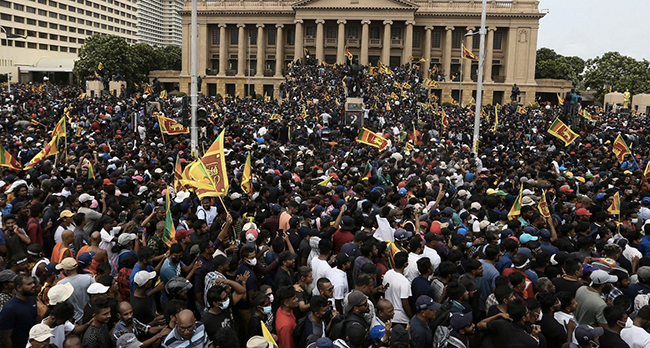
Last month, protesters breached the presidential residence and prime minister’s office, and it was the one thing that felt good. Along with thousands of ordinary Sri Lankans, I got to see inside these colonial-era fortresses for the first time. It was spontaneous, safe and respectful. Couples went on dates there; parents took their kids. I saw people singing in the president’s house, a mother dancing with her toddler, people swimming in the pool. I walked around a hall lined with plaques bearing the names of British colonizers, which seamlessly became the names of our own presidents.
At the prime minister’s office, someone played the piano, and a shirtless man draped in a Sri Lankan flag slept on a couch. Four guys had set up a game of carrom and were flicking the discs around. A child joyfully cartwheeled across the lawn outside, and a community kitchen served rice to anyone who was hungry. It was a beautiful sight in a space where elites nibbled on canapés before, surrounded by armed guards. It felt hopeful.
But what had briefly felt like true democracy didn’t last. Parliament merely replaced Mr. Rajapaksa with one of his cronies, Ranil Wickremesinghe, who had been prime minister a handful of times but lost his parliamentary seat in 2020. He has turned the military on demonstrators and arrested protesters and trade unionists. It’s all been constitutional,” eroding faith in the whole liberal democratic system.
Sri Lanka — like so many other countries struggling for solvency — remains a colony with administration outsourced to the International Monetary Fund. We still export cheap labor and resources and import expensive finished goods — the basic colonial model. The country is still divided and conquered by local elites, while real economic control is held abroad. The I.M.F. has extended loans to Sri Lanka 16 times, always with stringent conditions. It just keeps restructuring us for further exploitation by creditors.
And as much as the West blames Chinese predatory lending, only 10 to 20 percent of Sri Lanka’s foreign debt is owed to China. The majority is owed to U.S. and European financial institutions or Western allies like Japan. We died in a largely Western debt trap.
It’s going to get worse: The I.M.F. just warned that the likelihood of a global recession is growing. As economies collapse, Western loans simply won’t get repaid, and poor nations will crash out of the dollar system that props up Western lifestyles. Then, even Americans won’t be able to money-print their way out of trouble. It’s already begun. Sri Lanka has started settling loans in Indian rupees, and India is buying Russian oil in rubles. China may buy Saudi oil with yuan.
The Sri Lankan uprising that threw out our leaders is called the Aragalaya. It means struggle.” It’s going to be a long one, and it’s spreading across the world.
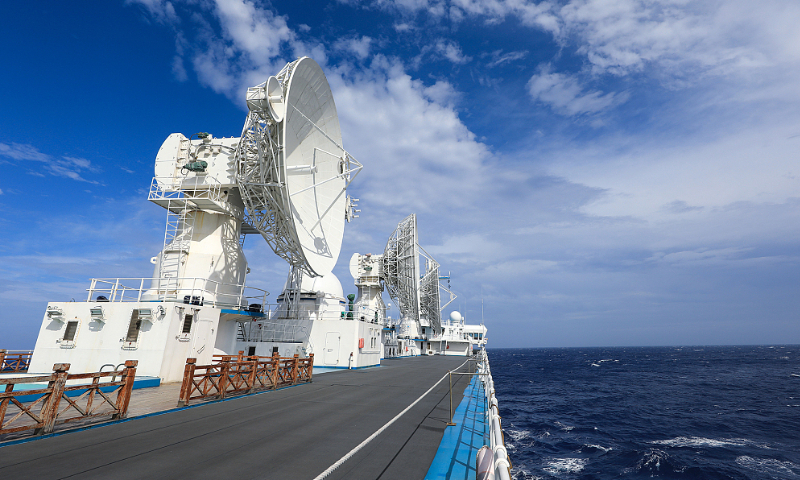
The Chinese Embassy in Sri Lanka will hold a welcoming ceremony for the arrival of the Chinese Yuan Wang 5 scientific research vessel at the port of Hambantota, a source close to the matter told the Global Times on Monday.
“The Chinese Embassy in Sri Lanka will hold a simple but warm welcoming ceremony on the premise of epidemic prevention and control,” the source said.
According to Sri Lanka’s Ministry of Foreign Affairs, the Yuan Wang 5 was cleared to dock at Hambantota port from Tuesday to August 22 after the government “engaged in extensive consultations at a high level through diplomatic channels with all parties concerned,” Bloomberg reported on Sunday.
At Monday’s media briefing, Chinese Foreign Ministry spokesperson Wang Wenbin confirmed that Sri Lanka has granted permission for Yuan Wang 5 to dock.
A separate source told the Global Times on condition of anonymity that Yuan Wang 5 is China’s third-generation space-tracking ship. Survey vessels are an important part of the aerospace measurement and control network. Compared with land surveying stations, survey vessels can flexibly select and deploy stations on the vast oceans, and maneuver emergency monitoring and control, the source said.
The vessel was scheduled to dock at the port of Hambantota on August 11, but India had continuously pressured Sri Lanka to defer the arrival of the Chinese vessel, citing so-called national security concerns.
In response, Wang Wenbin said at a routine media briefing on August 8 that Sri Lanka is a transportation hub in the Indian Ocean, and scientific research vessels from various countries including China have made port calls in Sri Lanka for replenishment. China always exercises freedom of the high seas in accordance with law and fully respects coastal countries’ jurisdiction over scientific research activities in waters under their jurisdiction.
It is completely unjustified for certain countries to cite so-called security concerns to pressure Sri Lanka, Wang said, noting that as the country grapples with economic and political difficulties, grossly interfering in its normal exchange and cooperation with other countries exploits its vulnerability, which is morally irresponsible and goes against the basic norms governing international relations.
While de-listing six Tamil international organizations including the Global Tamil Forum (GTF) and 317 individuals, the government has added 55 new individuals and three more organizations to the banned list as part of this year’s review, informed sources said.
According to the gazette notification issued on July 28 this year signed by Defence Ministry Secretary General
(Rtd) Kamal Gunaratne ban on Global Tamil Forum (GTF), Australian Tamil Congress (ATC), World Tamil Coordinating Committee (WTCC),TAMIL Eelam Peoples Assembly (TEPA), British Tamil Forum (BTF) and Canadian Tamil Congress (CTC), have been lifted.there were 18 entities that were listed as banned organizations in Sri Lanka.
At the same time a ban on 317 individuals out of 577 individuals, has been lifted. GTF Spokesman Suren Surendiranan is also among those de-listed.
The ban was retained on fifteen entities including the Liberation Tigers of Tamil Eelam (LTTE),TAMIL Rehabilitation Organization (TRO), Transnational Government of Tamil Eelam (TGTE), National Thowheed Jama’ath (NTJ) and Save the Pearl.
According to UN resolution 1373 (adopted in 2001), UN member states should appoint a Competent Authority and it should recommend to the Minister of the respective country, regarding the removal of the names of any person, group or entity designated from the List every year after reviewing each and every entity and individual.
Speaking to Daily Mirror, a senior military official said that the listing or de-listing process should be carried out following a thorough investigation into those entities and individuals and it should be reviewed every year.
It is totally dependant on law enforcement authorities and nothing to do with the politicians, as each country should clearly produce evidence about those entities/individuals whether they financed terrorism or not during each year,” the official confirmed.
In response to the reason for de-listing the influential Tamil diaspora organization Global Tamil Forum, the official confirmed that during last year there had been no evidence that the above organization financed terrorism-related matters.
Sri Lanka’s death toll from Covid-19 climbed to 16,624 today after the Director General of Health Services confirmed 03 more Covid-19 related deaths in the country for yesterday (Aug 14).
Two victims were aged 60 years and above, and the remaining one was aged between 30-59 years, according to the Govt. Information Department. One victim was a male and the other two were females.
Meanwhile, another 129 new Covid-19 infections have been identified in the country today (Aug. 15).
This brings the total number of Covid cases detected in the country thus far to 668,141.
President Ranil Wickremesinghe has ordered the public sector officials to strictly adhere to the circular issued by the Treasury earlier this year to limit government expenditures.
Pakistan Navy Ship (PNS) ‘Taimur’ which arrived at the port of Colombo on an official visit on 12th August 2022, set sail from the island after successful conduct of a Passage Exercise with Sri Lanka Navy Ship (SLNS) “;Sindurala” today (15th August).
Sri Lanka Navy bade customary farewell to the departing ship in accordance with naval traditions at the port of Colombo. Subsequently, PNS ‘Taimur’ conducted the Passage Exercise with SLNS “Sindurala” off Colombo harbour, on her departure. As such, the two ships conducted maneuvering and Search and Rescue exercises off Colombo harbour.
Exercise of this nature will pave the way for regional partners to enhance interoperability, partnerships and goodwill as well as exchange best practices with foreign navies when responding to common maritime challenges.
The alarm bells had been ringing for some time in Sri Lanka. The island nation is strategically located at the center of the Indian Ocean on the busiest trade and Undersea Data Cables routes in the world and hence perpetually in the cross-hairs of big power rivalry.
For those who missed the signs if not the red flags; ripples caused by the US House of Representatives Speaker, Nancy Pelosi’s Pivot to Asia last week announced loud and clear that colonialism and Cold War are back, big time in the mythical Free and open Indo-Pacific”.
Island nations from Taiwan to Solomon Islands, and the illegally occupied Chagos islands that house the Diego Garcia military base are being used for target practice amid environmentally destructive militarization once again.
Pelosi’s trip to Taiwan was in the wake of the setting up of AUKUS last year as if the QUAD or Quadrilateral Group which comprises Australia, Japan, US and India was not enough, in addition an estimated 40 US military bases to contain China and the Belt and Road Initiative.[i]
Following remote instructions, the US-backed regime in Sri Lanka last week informed a Chinese research ship with Satellite tracking capability that was due to dock in the southern Hambantota Port to defer its trip. This was just when Yuan Wang-5 which also has intercontinental ballistic missile tracking capability was entering Sri Lanka’s maritime Exclusive Economic Zone.
Yuan Wang 5’s docking was delayed after India and the US Ambassador, Julie Chung, had raised concerns about the ship in a meeting with President Ranil Rajapakse. The Central Intelligence Agency (CIA), refers to the Hambantota Port as one of the Indian Ocean String of Pearls”, along with Chittagong in Bangladesh, Sittwe in Myanmar, and Gwadar ports in Pakistan.
Debt, Default, Greenwash or Hybrid Economic War
Signs of the escalation of Cold War geopolitics in scenic Sri Lanka, one of South Asia’s wealthiest countries that was classified as an Upper Middle Income Country (MIC), by the World Bank in 2019 have been apparent for a while.
The country was declared ‘bankrupt’ a couple of months ago by an Economic Hitman who became president in a deft ‘regime change’ operation after a Staged Default enabled the entry of the International Monetary Fund’s (IMF) into the strategic island in April this year.
As Sri Lanka negotiates a Staff-level Agreement” with the IMF, it seems to be fully remote controlled from Washington DC with New Delhi as a junior partner. The country is already in structural adjustment mode and being readied for an IMF Firesale and asset stripping as part of a bailout” of US and EU-based International Sovereign Bond (ISB) holders.
Although China is routinely blamed for debt trap lending, almost fifty percent of Sri Lanka’s $26 billion external debt is held by ISBs. They caused the odious debt trap, default and financial melt-down, ironically, also due to a purported lack of exorbitantly privileged” US dollars to buy Oil and Gas from sanctions hit Russia and Iran! These same opaque bondholders stand to benefit from the sale of assets in the strategic island. The Sri Lankan Airline is set to be privatized soon and the state-owned Yugadanavi Power plant was sold to a US company, New Fortress, last year.
The IMF does not recognize the difference between ‘illiquidity’ and ‘insolvency’, or the fact that location, location, location” matters in valuing assets, particularly, or the fact the island’s mineral-rich sea bed has UDC data cables that keep the global financial and economic system going, and if taxed would render the country super rich!
According to some United Nations agencies, Sri Lanka is now a potential victim of famine and may soon be listed as a Least Developed Country (LCD), like Haiti. This would enable Debt for Nature Swaps (DFNS), and humanitarian disaster capitalism promoted by the UNDP. This despite the fact that local communities would be impoverished and deprived of access to forests, fisheries and marine resources in the name of environmental conservation’.
Beware the clean energy and organic fertilizer Greenwash that have caused food and fuel shortages and economic meltdown in a country with a minute carbon footprint, while the environmental impacts of the global military-business industrial complex remains the elephant in the room of the ‘Anthropocene climate catastrophe’ discourse.
There seems to a miss-fit between the economic disaster narrative and the data and ground reality: It is increasingly clear that Sri Lanka’s financial meltdown may have other roots/routes beside certain corruption by successive regimes in Colombo.
Over the Horizon Operations: Chinese Experiment-3
Over the Horizon (OTH), hybrid war operations have been apparent in the island ever since the mysterious 2019 Easter attacks claimed by the Islamic State (IS), that targeted the environs of South Asia’s busiest port, the Colombo harbor and adjacent Chinese investments, as well as, Sri Lanka’s tourism dependent economy and multi-religious society.
Four scientists from the Chinese Academy of Sciences scheduled to board the “Experiment 3” research vessel at the port of Colombo to carry out joint research with local scientists were confirmed dead after the Easter attacks. Li Jian (38), senior engineer of the South China Sea Institute of Oceanology, senior engineer Pan Wenliang (35) Chinese Academy of Sciences, assistant researcher Li Dawei (30) of the Ministry of Natural Resources and the doctoral student Wang Liwei (28) were killed at the Kingsbury Hotel in Colombo. They had arrived in Sri Lanka on April 18, 2019.
The Easter bombers also targeted the Hong Kong Chinese-owned luxury Hotel Shangri-La and Sri Lanka’s tourism-dependent economy in a hybrid war attack. Although the purported reason for the crime was religious, the leader of the group, Zaharan Hashim died at a luxury hotel!
Colombo’s Shangri-La was built on land where the Sri Lanka military headquarters once stood, overlooking South Asia’s busiest port and trade hub which was also protected by the iconic St. Anthony’s Church that was also bombed. The soon to be commissioned Chinese Port city built on reclaimed land was adjacent to the Colombo port.
The Easter suicide attacks that targeted hotels and churches were staged by locally networked external actors while the Millennium Challenge Corporation (MCC) and Status of Forces (SOFA) agreement were being discussed, and were believed to be a pretext for setting up a US ‘lily pad base’ to purportedly fight Islamic Terrorism in the Indian Ocean region.
Like the devastating explosion in Lebanon’s strategic Beirut Harbour in 2020, there have been endless cover up ‘investigations’ into the 2019 Easter attacks in Sri Lanka by local and foreign intelligence agencies. The identity of the mastermind of the hybrid war style crimes remain elusive.
Militarization amid Fishy Lockdowns and Blockades
Over a hundred pilot whales were stranded on southern beaches of Sri Lanka, with many dying during the Malabar War Games staged by the QUAD in October 2020, a year after the IS claimed Easter attacks. The stranding of so many Whales due to the sonar disturbance was unprecedented.
The Malabar exercises were followed by 2 mysterious burning ships– the MV Pearl and the MT Diamond – spilling oil and other deadly cargo eon the east and west coasts of the island in 2020 and 2021. The MV Pearl sank just outside the Colombo Port.
The months of curfews and lockdowns in the wake of the Easter attacks in 2019 seem like a dry run for almost two years of ill-advised economically devastating Covid-19 Lockdown and militarized mass injection policies by the Rajapakse regime in 2020 and 2021, albeit on the advice of the World Health Organization. These dealt a devastating blow to the country’s economy.
So too the island’s impoverished fisheries communities lost livelihoods for many months, indeed years as a result of various ‘disasters’ ever since the mysterious Easter 2019 attacks that targeted coastal regions. These lockdowns and blockades were enforced ironically by the Sri Lankan Navy (which is constantly receiving foreign training), against the island’s fisheries communities enable Distant Water Fishing State ‘aid donors’ like France, Japan, Korea, and EU trawler companies to fish literally and metaphorically in Sri Lanka’s strategic seas.
Sri Lanka is constantly visited and its Navy trained in inter-operability” by various foreign powers seeking a foothold in the country while citizens are often kept in (Covid-19) lockdowns and blockades. At other times the SL Navy follows external orders, arresting citizens in the EEZ while the country’s fisheries resources are looted by Distant Water Fishing States (DWFS) and their trawler companies.
Thus the price of fish hit record highs, indeed was unaffordable, in an island with fifteen times more marine extent than land. In 2022 following Covid-19 lockdown precedent, fuel shortages and embargos again devastated the livelihoods of coastal fisheries communities who were unable to operate their boats due to the fuel embargo enforced in the island by external actors and their local economic hit men.”
US Marines in Sea Vision Operations
The various lockdown and blockades imposed on Sri Lankan citizens and the fisheries communities during various bio- war games by big powers reached its peak this year in June-July during the US Department of Defense ‘Sea Vision’ training operation by US marines when the island was effectively shut down due to an oil and gas blockade.
While the US Marines under a US Department of Defense program carried out Sea Vision” Operations, purportedly trained the SL Navy, ships bringing Russian oil had disappeared mysteriously into thin air.
The US had imposed sanctions of Russia following the Ukraine war, but many countries have been de-dollarizing and continue to buy oil and gas from Russia, while India has set up a currency swap widow to trade in rupees and rubles. However, the island at the center of the Indian Ocean was under US-India and Quad air and sea embargo and blockade with planes diverted to South India as the Sea Vision operation proceeded.
While the Indian Oil Company made massive profits selling small amounts of oil in fuel during the embargo, citizens starved of oil and gas protested, and the economy was shut down while an International Monetary Fund (IMF), team with Special Advisors from Washington was in Colombo!
Thus it came to pass, that Ranil Wickramasinghe, Washington’s Economic Hit man who became President in an Arab Spring Protest Playbook regime change operation less than three months ago, declared the country with the best Human Development and Social Indicators and one of South Asia’s wealthiest, bankrupt– with relish — shortly after taking office, while promising 15 hour-power cuts, zero fuel, and famine.
Conclusion: Yuan Wang to dock and IMF to bailout BlackRock
The thriller narrative around the mysterious Yuan Wang-5’s arrival in Sri Lanka has ended for the time being. Colombo has declaring that New Delhi and Washington had “failed to give concrete reasons” for why they opposed the arrival, of the high-tech Chinese tracking vessel Yuan Wang 5. The ship will dock at the Hambantota International Port on August 16, five days behind its original scheduled visit and we must hope that there will not be any explosions at Hambantota Port!
It is increasingly clear that the so-called free and open Indo-Pacific” is a device to contain China and the BRI for global connectivity and infrastructure development.
In Sri Lanka the game with the Yuan Wang 5 ship is also related to ongoing IMF negotiations to bailout of Sovereign Bond traders, like BlackRock. The IMF controlled by the US and G-7, is making new transparency demands from countries in Western debt traps, seemingly to target the new Asian donors like India, China and the members of the New Development Bank. The later have resisted joining the Western Paris Club debt restructuring process, preferring to deal bi-laterally with development partners.
The Chinese and Indian approach to debt restructuring also enables great policy autonomy and sovereignty for debt trapped countries, rather than the IMF approach of enforcing convergence of all debt holders in a debt restructuring process designed to benefit the BlackRocks and Hamilton Reserve Banks of the world and Global One percent, and enable asset stripping of Global South countries.
Ironically, while the IMF claims to promote transparency the ISB holders whose interests it represents in so-called debt restructuring are not properly identified, the interest rate and fees are unknown and as opaque as their deals and trades in secondary markets.
Given the lack of information and transparency about the ISB Debt holders, the Coalition for Economic Development (CEDSL), has called for ISB debt to be declared null and void” and cancelled outright, while re-structuring bi-lateral and multi-lateral loan payments which would also enable future borrowing from friendly countries.
In the final analysis, the facts on the ground are clear: There is a miss-fit in the fear inducing debt and famine narrative and ground realities at this time: Sri Lanka’s economy has picked up and is open and functioning while the Chinese ship draws near. However, in the months of June and July, when Washington advisors and US Marines were conducting Sea Vision operations in the country, the citizens were under a fuel embargo, the economy shut down, with famine threatened in the midst of a psychological operation of fear, dread and debt messaging.
Ironically, the only thing happening while the IMF team was in Colombo was the Arab Spring style protest, or Aragalaya—that had enabled an Economic Hit man to become President. And Sajith Premadasa, the leader of the opposition, is yet to call for the resignation of the Minister of Power and Energy, Kanchana Wijeratne, for incompetence, corruption, and bringing the country to standstill with fuel shortages.
[i] David Vine 2020 The United States of War. University of California Press.
This is a response to the media, the BASL and foreigners who never give up preaching on how ‘peaceful protesters’ were attacked ‘brutally’ by the Security Forces, especially at Galle Face Green on July. 22. With hundreds of thousands of protesters (Sunday Times Aug . 7) including non-nationals living on charity,, who were the peaceful protesters?
There is a right to peaceful assembly but not to unlawful assembly..Under which law can protesters ‘peacefully’ block access to government buildings or interfere with other purposes the building was designed for? Can they obstruct vehicles or pedestrian traffic or cause a threat to public peace?.Did they not? Interestingly in the UK the punishment for a public nuisance offence is life imprisonment under laws made eons ago. .So which law, ancient or modern, allowed protesters to occupy the Presidential Secretariat in SL? Was it the same law that allowed protesters to overrun the President’s official residence, the prime minister’s office, set fire to the prime minister’s home, murder persons on May 9 and incinerate 76- 91 homes of MPs etc? Were the people who did so ‘peaceful’, never mind the protests?
An unlawful or any assembly of five or more persons likely to cause a disturbance of the public peace may be ordered to disperse by a magistrate or police officer not below Inspector rank and it will be the duty of the of the members of such assembly to disperse (Code of Criminal Procedure Act (No 15 of 1979 Sect 95).Did the protesters do so? Peacefully or otherwise?
Unlawful assembly is one in which those involved behave in a violent, boisterous, disruptive or tumultuous manner. Who else except Ambassador Chung and the media remembers all these protesters being ‘peaceful’? The leaders and associated ruffians were blood thirsty..
Unlawful assemblies can be dispersed with the use military force by a commissioned officer of any of the three Forces acting alone in the absence of a magistrate or Inspector level police officer (Sect 96).The military has not used military force so far. Possibly because Ms. Chung thinks ‘the time is not right just now’. Will she signal the right time? Heaven help SL when she does, knowing how well she knows what ‘force’ is including ‘shredding’.
Public order – a definition It is an offence to use threatening or abusive words or behaviour or disorderly behaviour or display in writing signs, a representation of which is threatening or abusive in the hearing or sight of a person that is likely to cause harassment, alarm or distress. Were we deaf and blind from April 22 that we did not see the behaviour of the mobs as ‘threatening’ or ‘abusive’ and in fact by some massive abberation thought they were actually ‘peaceful’? Who decides which is which? The BASL,the media, Ms. Chung or the police? Why was a magistrate not asked to be present at barricades to decide? Did the sight of ‘ thousands upon thousands’ baying for blood prevent the legal system from functioning through fear and cowardice of those responsible for public security? The same people who, did not hesitate to castigate, ridicule and insult the police soon after they took office? Who then weighed in profoundly to say the constitution was irrelevant and the government illegitimate helping to creating a state of anarchy? It actually became the popular thing to say so until an Emergency was declared and arrests were made.
Suddenly the Government that had been in a blue funk due to its guilt that made its promise of splendour and prosperity become one of nightmares and bankruptcy, had stood up.,following the example of the present President. Had the BASL taken the place of the judiciary to misdirect the country? Yes, absolutely no force should be used against ‘peaceful’ protesters or a peaceful assembly in SL .However the time was not long past when mounted police in western capitals laid about with swords (Belgium, France?) to disperse unlawful or not, ‘assemblies’.The Jallianwalla Bagh Amritsar (India) massacre of peaceful protesters (it was a religious holiday) may be forgotten by some but not by Indians
Gen Dyer’s orders to the troops led to 1,200 killed and 1,500 wounded in 1919. Winston Churchill called it ‘intolerably monstrous”.In 2019 Britain ‘expressed regret’ but did not apologise to India..Lessons were not fully learned even 50 years on. .The British in Kenya were intolerable again.The Ohio State National Guard on 4 May 1970 shot and killed 4 Kent University undergrads and wounded nine with 69 rounds being fired by 28 Guardsmen in 13 secs when confronting an unarmed peaceful protests against US involvement in Cambodia.
Some of the dead were only observing the protests from 300 yards.Four million undergrads from universities all over the USA walked out in sympathy.. In 1974 the USA with 7,000 troops and press ganged support from six Caribbean countries invaded Grenada.Why? It had a leftist government supported by Cuba. It is 100 miles from Venezuela. Was this an anti left protest launched by the USA? It ended in a farce .
A mental asylum was bombed by the USAF. USA had 25 troops killed and 59 wounded.The inter force communications had not been tested. It ended with US Navy ships having to call back to their command HQ in USA to inform USAF pilots circling overhead in Grenada about opportunity targets. Grenada had 45 killed in action and 337 wounded inaction (not including Cubans)..
Grenada covers an area of 344 sq kms and had a population of 84,000 in 1993. The 7,000 US troops consisted of two Ranger battalions, the crack 82 Airborne Division and the Rapid Deployment Force! In 1919 the British declared martial law in Ceylon.They shot without judicial trial very many national leaders including William Pedris They panicked thinking it was an uprising against British rule. A Brit officer used to have his breakfast watching the executions. Is it not arrant arrogance and stupidity for the US or British envoys whose countries had enslaved Africans, taken native lands by force and attempted genocide of American Indians to preach to SL on how to deal with protesters?
The British action in dealing with ‘protesters’ in Wellawaya in the ‘Great Liberation war’ (1817-18) laid waste the fertile countryside and killed all males above 10 years of age.This was a catastrophy the effects of which were seen in the insurrection of 1971.The survivors swell the ranks of ‘protesters’ yet The SL Police style of operating by first establishing communications with the mobs is exemplary.Their monumental and enduring patience over the last four months is extraordinary.It has to be highly commended. However, except for the Colombo middle and upper middle class originals (generally) ,and the farmers, teachers, unionists etc were there not at Galle Face Green (GFG) peace hating protesters too? Have they been treated differently for being different?
Were they the followers of the terrorists of 1971?; who later together with the then President who had an entente with them, were responsible for 60,000 death in 13 months 1988/9? .Were they the new shock troops, well fed and generously looked after by the original ‘Aragalists with deep pockets, that attacked the police barriers almost daily in 2022 while the poor people were struggling to find food to feed their families among shortages of other bare essentials?
So what were they actually fighting for? (WHO says 6 million – nearly a quarter of the SL population, mainly children and women) are on the brink of starvation? At GFG who would have believed WHO? Food was in plenty and of all varieties, while drink flowed and dancers did the merry baila and other jigs. It looked so western fun, like a song/drug festival in the West whoever funded it. The police always, repeat always, attempted at first to communicate with the ‘peaceful protesters’ and pacify them at every demo..They did not threaten.They ended up using water canon and firing tear gas when the barrier toppling thousands of ‘peaceniks’ breached their defences.Surely this last police response could not be correct if the protests were ‘peaceful’? Who did something wrong? The police or the ‘protesters’?
To say that only ‘some’ trouble makers have ‘infiltrated the current’ protesters’ as in one newspaper, is hypocrisy..Were the ‘some’ of those ‘peaceful’ thousands who with years of experience in terrorising especially freshers with savage ragging in all except the Northern and Eastern universities ,(they would not have dared) switched from site to site to challenge and overrun, outnumbered, neutered and emasculated police/military (POLMIL) that had their hands/batons/weapons tied?.When the Presidential Secretariat was taken back in July after illegal occupation, the numbers game was reversed. That took the obstinate ‘peaceful’ protesters completely by surprise.
The ‘some’ trouble makers knew the police would only use tear gas and water canon while the troops sadly acted like dummies. Few doubted that a state of near anarchy prevailed. It grew in intensity with every protest. The law was openly flouted (to the delight of many) by these ‘some’ trouble makers.Was it not their actions in 1988/89 that resulted in 60,000 deaths in 13 months? Does Ms Chung know?.
The killings were limited only to the Sinhalese while massive damage was done to govt. property, administrative machinery and national infrastructure. .The country was nearly shut down by the then ‘aragalists/terrorists’ distributing ‘chits’ and slaughtering anyone who disobeyed them even for keeping lights on in one’s home? Is this their third and final attempt?
However there are laws that protect the citizen’s body and his property and also public property.The police are there to see that these laws are enforced. Sadly they did little if nothing instead during these ‘peaceful’ protests due to poor leadership at national level including some of the top brass of the police. Was this due to ignorance or fear and possibly due to Western interference and influence Or was it due to threats such as the visit to MOD by the western envoys? There was also the fear of a Geneva backlash.
Ironically it was the new elected by parliament President,hardly a Sando, (but much reviled by many of his former friends, sycophants and beneficiaries). who decided to invoke these laws, now called harsh.If these only knew the provisions of the US Patriot Act they would throw up.The new President during most of his over 40 years as a politician was the knight in shining western dress for the elite in Colombo, especially the middle aged women. Where are they now? Have they not done the SL thing? Desert and abandon when the going turns bad.
The former ex-military Prez disappeared. It may have been out of guilt for the horrible state of the nation under him or by being ill advised as usual..Did they all forget the Penal code? Who advised him on his course of action? Were they the same rotters of boastful academic (Viyathmaga) fame who are now deserting like rats?
The past president had a heroic choice when the final push came to overrun the near naked and ordered to be spastic, defenders of President’s 250 year old House (not ‘Palace’ as the western media likes to dub all non western leader’s houses) .Like General Gordon, vastly outnumbered , he could have faced the mobs alone. Gordon with his Egyptian and British troops near starvation after many months of encirclement, faced the Madhi of Sudan and his Dervish army at Khartoum.Gordon had often said that when God distributed fear he ran short of it when he came to Gordon.
Unfortunately for him the Dervish attackers had dodged God too.They were devilishly brave too They hacked off his head. Gota had probably not heard of Gordon who had a steamer on the Nile just behind his house (not Palace) to evacuate him.He refused. Ironically Gota had a SLN ship ready. He used it, fortunately. It is now rumoured that Gota may come back to SL. Whenever he does, he may be compared by the fanciful SL media that likened him earlier to Hitler,(SL is a sucker for western imagery) to Napoleon coming back from Elba.Would the Western powers then contrive to send him to Guantanamo instead of St Helena even before a 100 days pass?
As for defending not only Presidents but all citizens Penal code Sec 25 para 89 clearly states that ‘nothing is an offence which is done in the exercise of private defence. Why then did the police not use force to defend the President’s life? Where does it say force cannot be used?. Self defence does not cease as long as the threat to life exists.
This important if not vital aspect of law is skillfully or cunningly not elaborated to the lay person by the countless BASL bulletins .The use of force causing even death is within the law in self defence. Six offences are specified.Who judges what is justifiable or proportionate? Is it the BASL, the media, western envoys ,or the individual (s) in danger?
The security forces (police) opened fire only at Rambukkana after a long, hot, whole day of protests that included stone throwing and attemped arson.The protesters hail from a long established JVP hotbed. Their activities included an abortive attempt at setting fire to the only petrol shed and a lone fuel tanker because there was no fuel!. If a person is killed or injured while the person is exercising his right of self defence he may still be arrested until the case is heard and extenuating circumstances if any are proved.This is not the law of the jungle or of asses .The police and others knew but were not convinced there was a level playing or fighting field. prevailing.
The ‘peaceful’ protesters destroyed 91 (MP Welgama in parliament in July 2022) houses of Govt MPs by arson on 9 May 22 and murdered nine(9) people including one MP whose naked body was dragged along the street .Did Mrs Chun see this? What would the BASL and media have stated if the law as given above was acted upon when the threat manifested itself? Would it be called an exhibition of brute force? Have they seen the very same activists displaying different slogans periodically attacking university students who disagree with them?
Para 90 states self defence covers ‘his own body or that of any other person against an offence affecting the human body.’….. and ‘property’. Any citizen, not only the police can act under that law .The police ordinance too provides legal cover.But the police it would appear were ordered to ignore the law.What was the IGP thinking and why?
Para 95 states the right to private defence ‘commences as soon as a reasonable apprehension of danger to the body arises from an attempt or threat and continues as long as apprehension of danger to the body continues’…So when does reasonable apprehension manifest itself and end? Is it after killing(s) and stripped bodies are dragged along streets or when a threat with paving stones, clubs and steel rods is apparent?
Para 96 covers mischief by fire or explosion … where ‘death or grievous hurt’ may result while para 99 covers Mobs.The same rights of defence applies. Clearly the police are fully aware of all this as are the Forces when trained for duties in Aid of the Civil’ power .The principles followed are prevention,necessity, impartiality and minimum force..Impartiality is required when 2 mobs confront each other..Red shirts only cannot be the targets! Minimum force is the force applied immediately to stop danger to body or property and not after any bargaining as at the Presidential Secretariat in July 22..It normally starts after non lethal methods have failed. A single live round may be fired at a law breaker.If the danger continues 2 rounds may be fired.If the danger persists, heaven forbid but the aggressor may force the issue, a volley may be fired! The last has never happened in SL The worst example was at Amritsar during British rule in the late 1910s when machine guns were used under the orders of Gen Dyer Hundreds of Indians were killed.Dyer was killed in revenge much later in England.
The original protesters were organised, smartly dressed, well fed and wined, educated, witty, tech savvy They were the people who fashioned the ‘aragalaya’.No one else can claim to have done so . .They were the darlings of the media and an inspiration to the youth in particular. They were generous, helpful and kind to all who joined them. .They were not compromised and used for ulterior ends. People may recall their laudable efforts during the December 2004 tsunami and many candle light and other peaceful protests over the years.
Originally the cry was amusingly Go Gota Go which is a rallying cry at rugby.That was mistaken wit..This changed to ‘Gota Go Home’ even after he had been advised or forced to leave his home, and then ‘Ranil go home’ when Ranil wise cracked ‘I am at home’ .However those who confronted the police (and the military later) in many instances were dangerously violent.They were not representative of the original Aragalists.
The Mirihana protest, peaceful at first ,became violent and then certainly intimidating and threatening when a violent group infiltrated the original protesters, turned off the main road and onto the private road that led to the residence of the former President.Their intent was clearly unlawful and violent and could have included murder ,abduction and arson as subsequently happened with increasing frequency and boldness of the ‘protesters’ ..
What is the response of a house holder if a mob carrying poles, clubs and iron rods assembles by his perimeter wall, baying for his blood? Is he to wait until they scale his wall or should he act in self defence according to the law especially if it is at night? The former course appeared to be the response of, and temporary interpretation of the law by the police.It made the mobs lose fear of the law and its guardians and become reckless.
At the entrance to the Naval Dock Yard Trinco on 10 May 22, TV showed a young woman standing in front of a baying mob , surprisingly in a very mellifluous voice, singing out the refrain, ‘kapapang kapapang’ (cut cut ) and then ominously ‘kayli kayli (pieces pieces).A Sinhala Madame Defarge? The mob were not at a fish market looking to skin fish but were attempting to rush the gates of the Dock Yard, the premier base of the SL Navy and kill the former Prime Minister ..They knew it would have been a step too far had they challenged the Navy.Instead they taunted the Naval guards to entertain the easily cowed and cheap thrilled media instead. The mob attack to storm parliament did not appear to have a single peaceful intention. One JVP leader (not drunk and driving this time) did say they would surround parliament and not allow anyone who did not do what the JVP wanted done,to leave parliament. The stealing of 2 automatic rifles from badly battered troops showed that peace was furthest from their intentions..That was the turning point.The worm had turned. .Have the peaceful protesters now gone underground?Are they cutting off their beards and trimming their hair styles?Are they regrouping? Those 2 rifles must be found quickly. .
That woman in Trinco was not an exception but one of a kind of thousands of unemployable and unemployed rather elderly ‘students’ that launched attacks all over Colombo Fort and surrounding areas, transporting themselves almost magically over long distances while the rest queued 2-4 days for fuel.Who cared whether or how the people got petrol or food or cooking gas?
Why they are/ were called ‘peaceful protesters’ stuns the imagination .They are the same people who switched from one to another barricade encounter.Their leaders remained in the rear, as in 1988/9 when they attempted genocide of the Sinhalese .They have blood on their hands and their thinking is bloody but they masquerade as ‘peaceful’ protesters especially when western media is around. Local media laps them up in mortal fear 24 x 7.So did a western envoy, looking for a political stooge.There are many in SL, if dollars flow.
Were they not screaming obscenities and murderous threats while armed with iron bars and clubs well hidden? Did they at GFG not use force on the leader of the Opposition (9 May 22 – he subsequently dodged contesting the Presidency?!) and gave a former minister, who had produced 2 IRCs at a TV interview in 2019, a taste of the same on 9 July ?
RW correctly asked the US envoy,who declared her admiration if not undying affection for the JVP, whether force was not used by US security officials on the Trump supporters who stormed the Capitol building .He also asked where else in the world would attacks on a President’s office take place without a law enforcement response..He should have also asked what level of force was used on Sadr city protesters in Iraq who were confined in Abu Graib prison and what type of protest the villagers of Mai Lai were doing when Capt Calley (who was never incarcerated as a consequence) and his men murdered and raped the entire village.They killed all the dogs and cats too. South Korean troops were allied to the US forces then to fight the Vietnamese. Or he might have asked why tanks, helicopters and 2 battalions of Air Mobile troops were used to murder hundreds and wound thousands in Gwanju South Korea in 1980. Chung added a caveat.,She said the time was not right just now for strong arm tactics.So when will that correct time be and who will say so ? Is she trying to outdo Mr.Dixit?
Unsurprisingly no regional country criticized SL Thank you brothers and sisters.· The SL Police have acted with sufficient if not overwhelming restraint quoting law and doing their best to solve the continuing impasse, peacefully.They, after negotiating and pleading with the recalcitrant ‘protesters’ for 3 days, used only minimum if any force to execute a written order of the Fort magistrate to vacate the Presidential office which they had trespassed .That was their duty. Brutal force by police is most evident not in SL but where ‘Black Lives matter’ as the whole world knows.
Who set fire and destroyed RW’s house together with those of his brothers and his library and the dogs? Why were RWs brothers’ houses termed ‘neighbours’ houses by the media? Was the whole family a target . Were the attackers a foreign legion or the spearhead troops of the protesters?.Why does the JVP deny gleefully that it was they that did it? Are they pointing fingers at the FSP as everyone else does? Which lunatic calls the FSP ‘peaceful’? What was a leading opposition politician’s sister adding to the the baying by the mob?
How does one distinguish between ‘peaceful’ and violent’ in these circumstances? Has one to wait until foul deeds including murder and arson take place? The law clearly states that once a threat manifests itself, action according to the law, including use of force, is permissibleThe most important question is whether,after a corrupt, ineffective, weak, disgraced etc Govt fails, even as a global recession sets in,and the Ukraine war continues ,is it to be replaced, out of fear of retaliation, by local experts in terror ? Where is the cash coming from to steady SL? According to Sajith P in May 22, Saudi Arabia promised him oil.He has not repeated this very silly statement.The IMF is the only hope SL has. SL should ensure China chips in by restructuring her loans and with out right grants in addition to what India has unhesitatingly and generously given. SL has a very delicate balancing act to perform to ensure our historical Asian benefactors continue to help.She has to be sincere in all she does She should never try to play one against the other.That would be suicide . It will however be difficult for the West not to try to exploit SL at this time.
Pray for SL less the politicians, media, BASL and western imperialists who think they are the reincarnation of Gods.
Diehard critics of the government ignore the impact of Corvid 19 on the foreign exchange earnings of the country. In 2020 worker remittances were 7.1 billion dollars and Tourism earnings in 2018 was 4.4 billion dollars. If we had this revenue even without an increase, we would have 11 billion dollars. Even with a trade deficit of 7 billion dollars we would have a surplus of 4 billion dollars which is the outstanding debt this year. If Corvid was not there, we would have got an increased export value and a higher tourist income as well. The current trade statistics show that imports could have been reduced by at least by 3 billion USD which would have given the county a USD surplus of 7 billion. (This does not take into account the increase in oil prices). Only mental retards will deny the impact of Corvid19 on the present crisis.
Borrow more to import more
I am glad to read the CBSL report that the value of imports during the first 6 months of this year has been limited to below $ 4 billion. If this trend continues the annual import value may not go beyond 10 billion USD. End of the year export would hopefully reach USD 12 billion leaving a positive trade balance of 2 billion USD. If we had limited our imports to match with export revenue, the country would not be facing the present dollar crisis. But our imports during 2017 was 20.9 billion USD, in 2018 it was 22.2 billion USD and in 2019 it was 19.9 billion USD. At the same time our borrowings on ISB as given below were USD 8400 at high rates of interest.
1 May 2017 11 May 2027 SRILAN 6.200 05/27 US85227SAT33 USY8137FAH11 6.2000 1,500.00 18 April 2018 18 April 2023 SRILAN 5.750 04/23 US85227SAV88 USY8137FAK40 5.7500 1,250.00 18 April 2018 18 April 2028 SRILAN 6.750 04/28 US85227SAW61 USY8137FAL23 6.7500 1,250.00 14 March 2019 14 March 2024 SRILAN 6.850 03/24 US85227SAY28 USY8137FAN88 6.8500 1,000.00 14 March 2019 14 March 2029 SRILAN 7.850 03/29 US85227SAZ92 USY8137FAP37 7.8500 1,400.00 28 June 2019 28 June 2024 SRILAN 6.350 06/24 US85227SBA33 USY8137FAQ10 6.3500 500.00 28 June 2019 28 March 2030 SRILAN 7.550 06/30 US85227SBB16 USY8137FAR92 7.5500 1,500.00 Total 8,400
The value of imports rose mainly due to the import of motor vehicles to recover high customs duties to earn revenue to balance the budget and to pay for the increase of unproductive employment in the public sector and to reward MPs. This was the work of the financial wizards of the Ministry of Finance and the CBSL. You know who.
All party government
The All-party government or sarvaloka pootuwa” proposed by the President is not likely to be realized as the main opposition party SJB is against it. Every political party in the Parliament looks at the proposal not in the national interest but from pure partisan interest of what is there in the proposal for them. SJB feels that they have a good political advantage in an early election and does not want to be a party to salvage the government. JVP feels that they have a good chance of getting a majority or a remote controller status if there is a general election now. Of course, the burning of houses of government politicians which they vehemently deny has not improved their political image.
The position of the minority parties is not clear. Their stand as usual will be ‘Vasi patthata and or kasi patthata hoyya.’ Ranil wants a stable government to get back to his lost glory and prove his ability. His performance will determine the conduct of many SJB members who would go back to Ranil making SJB disappear.
The tragedy is that the 22nd Amendment to the Constitution and the All-Party proposal have diverted the attention of both the Executive and the Legislature and the public away from the dollar crisis and an action plan to recover from the predicament.
This is not cricket
What made the SL Cricket Board surrender the Asian Cup to the UAE. Cricket brings in tourists. Holding international cricket tournaments in the country gives publicity to the country. SL held series of matches against Australia and Pakistan under worse law and order conditions. Holding the Asia Cup here would have given a boost to tourism which is picking up. There must be a law to prevent sports bodies acting against national interest.
This is a very important YouTube clip for circulation, to create awareness of underlying and background realities. This is not the usual You Tube made by people. It is backed up by carefully researched supporting information.
Listening to it and analysing the facts presented gives a good understanding of this entire Aragalaya and where it is coming from – and where it is going. The Sri Lankan people need to be aware that their country is being made use of for the US geopolitical agenda of world hegemony. Is that what Sri Lanka wishes? – to give up its sovereignty and independence as a nation?
One Response to ඊනියානිදහසලැබීවසර 71 ක්ගතවීඇතත්තවමත්යටත්විජිතවාදීමානසිකත්වග්රහණයෙන්මුදාගෙනනැතිමහනුවරශ්රීදළදාපෙරහැර”
dhane Says:
August 26th, 2019 at 5:06 pm
We Sri Lankan should be very grateful that in 1853 දීඉන්ග්රීසිආණ්ඩුවවිසින්දළදාවහන්සේගේභාරකාරත්වයඅස්ගිරිහාමල්වතුනාහිම්වරුන්ටසහදියවඩනනිලමේටභාරදීමෙන්සිදුකොටඇත්තේඅමිලසේවයකි. මන්දඑසේනොකොටයම්ලෙසකින්අපේදේසපාලකයින්අතටඑයත්ලැබුණේනම්මේඋතුම්රටට 1948 සිටඔවුන්විසින්සිදුකොටඇතිවිනාශයදෙසබලනවිටමේවනවිටත්දළදාවහන්සේදලෝකබැන්කුවටහෝවෙනත්රටකටවිකුනාගෙනකාඅවසන්වීමටසෑමඉඩක්මතිබුණනිසාය.Hopefully this Bank Robbery Chief Ranil & Malik will not get idea on this.
Americans are especially likely to say politicians are corrupt
Protesters chant and demonstrate outside the French Senate in Paris, opposing a new law they say would consolidate police power and restrict civil liberties, on March 16, 2021. (Kiran Ridley/Getty Images)
How we did this
As they continue to struggle with a public health crisis and ongoing economic challenges, many people in the United States and Western Europe are also frustrated with politics.
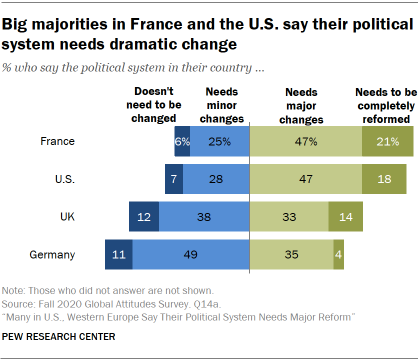
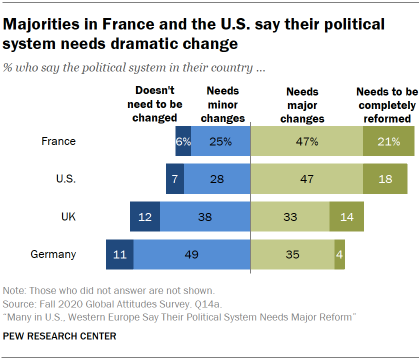
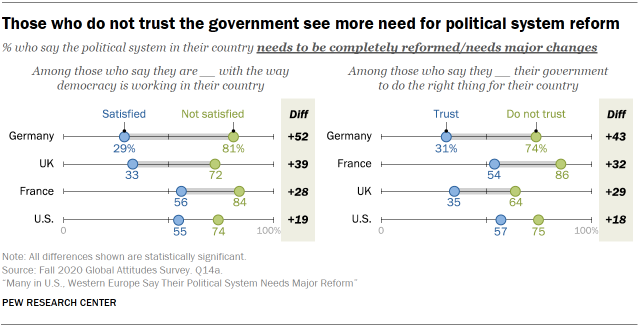
A four-nation Pew Research Center survey conducted in November and December of 2020 finds that roughly two-thirds of adults in France and the U.S., as well as about half in the United Kingdom, believe their political system needs major changes or needs to be completely reformed. Calls for significant reform are less common in Germany, where about four-in-ten express this view.
Of course, there are important differences across these countries’ political systems. But the four nations also share some important democratic principles, and all have recently experienced political upheaval in different ways, as rising populist leaders and movements and emerging new forces across the ideological spectrum have challenged traditional parties and leaders.
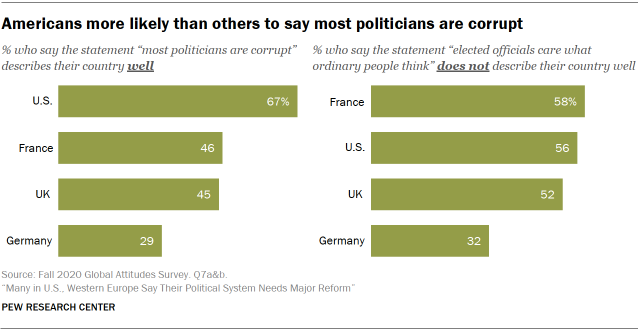
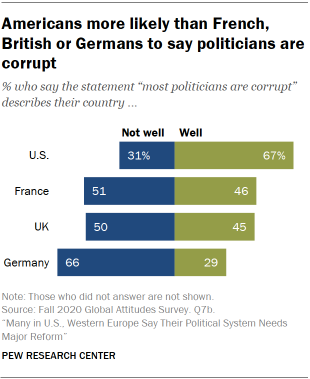
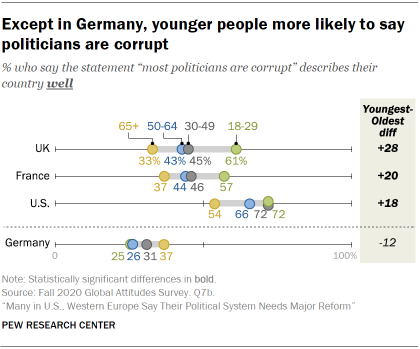
Some of the frustrations people feel about their political systems are tied to their opinions about political elites. In the U.S., concerns about political corruption are especially widespread, with two-in-three Americans agreeing that the phrase most politicians are corrupt” describes their country well. Nearly half say the same in France and the UK. Young people, in particular, generally tend to see politicians as corrupt. And those who say most politicians are corrupt are much more likely to think their political systems need serious reform.
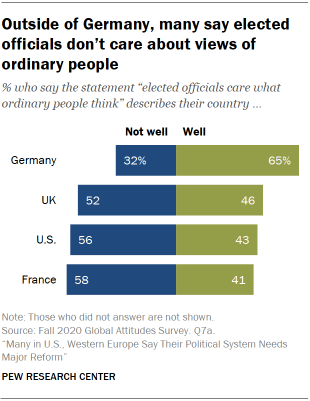
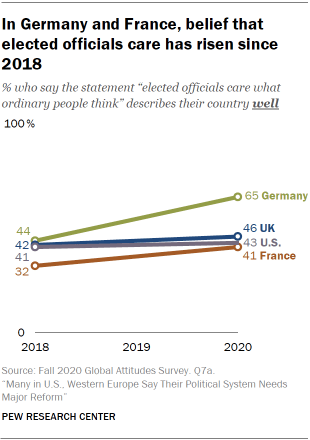
A belief that politicians are out of touch is also common. In France, the U.S. and the UK, roughly half or more say elected officials do not care what ordinary people think. Still, in both France and Germany, the share of the public who believe elected officials do care has increased since 2018.
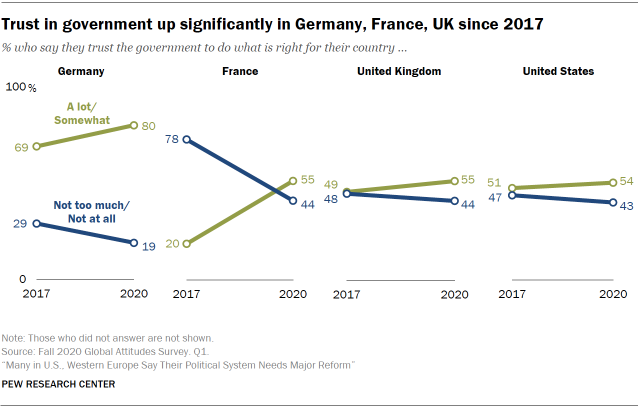
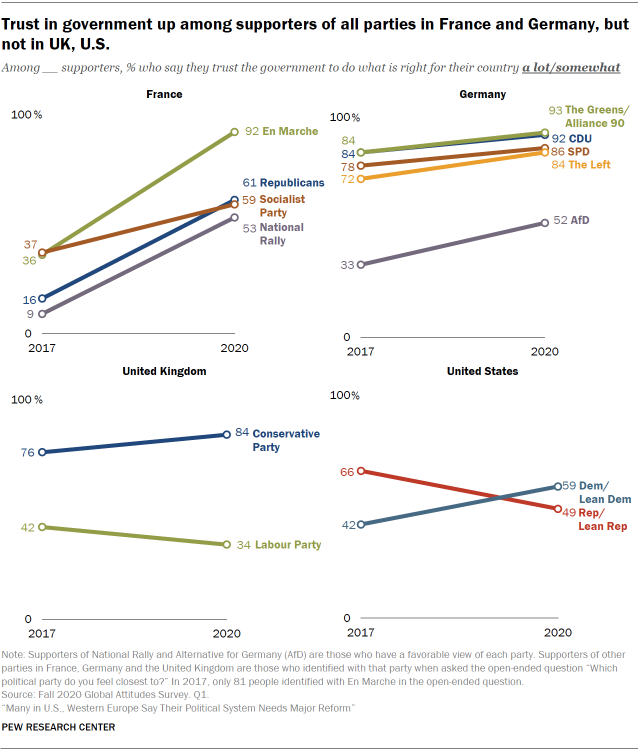
Since 2017, the French and German publics have also become more trusting of government. In France, just 20% said they trusted the government to do what is right for the country in 2017, compared with 55% in the new survey. Trust is especially high among supporters of President Emmanuel Macron’s En Marche party, but it has risen across the partisan spectrum. Similarly, trust is up among supporters of parties on the right, left and center in Germany.
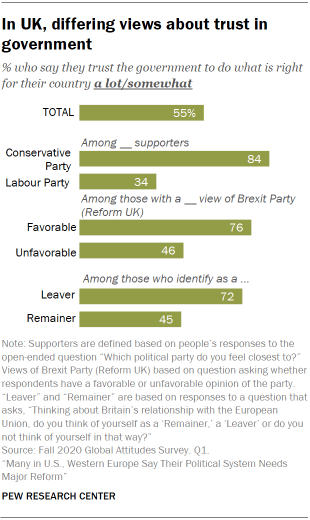
Trust in government has also increased slightly in the UK, although while it has risen among supporters of Prime Minister Boris Johnson’s Conservative Party, is has actually declined among those who identify with the opposition Labour Party.
How Pew Research Center measures public trust in government, globally and domestically
For several years, Pew Research Center has been committed to researching issues of trust, facts and democracy. And for decades, the Center has studied Americans’ attitudes about federal, state and local government in the United States.
In this survey, the Center compares the attitudes of the publics in four nations – the U.S., France, the UK and Germany – toward democracy and their countries’ political systems. The survey also includes a measure of trust in the four countries’ national governments: How much do respondents trust the government to do what is right for their country?”
This is different from the question that has been asked for more than six decades by Pew Research Center and other survey organizations in the U.S.: How much of the time do you think you can trust the government in Washington to do what is right?
In the United States, the measures yield very different results: Last August, just 20% of the public said they trusted the government in Washington to do what is right always” or most of the time.” Americans’ trust in the federal government has been mired at that low level for longer than a decade.
In the four-nation survey, which was conducted in the U.S. in November – after Joe Biden had been declared the winner of the presidential election, but when large shares of Donald Trump’s supporters expressed skepticism about the result and the voting process – 54% of Americans said they trust the government a lot or somewhat to do what is right for the country. This is little changed from 51% who said this in 2017.
The four-nation survey provides a valuable comparative examination of views of government, the political system and the state of democracy. In the coming months, the Center will update its long-standing measures of Americans’ trust in their government, as well as attitudes on the scope and size of government.
In the U.S., the overall level of trust in the government has remained largely unchanged since 2017, but who trusts the government shifted substantially. In 2017, only months after Donald Trump was elected president, Republicans and those who lean toward the Republican Party were more likely to trust the government than Democrats and those who lean Democratic. In the current survey, fielded in November and December 2020 – after major media outlets had called the election for now-President Joe Biden – Democrats express higher levels of trust.
The state of U.S. politics during this survey period
In France, Germany and the UK, trust in government tends to be higher among those who think their country has done a good job of handling the coronavirus pandemic. This is particularly true in France, where 80% of those who say the country is handling the outbreak well trust the government, compared with only 27% of those who say the country is doing a poor job.
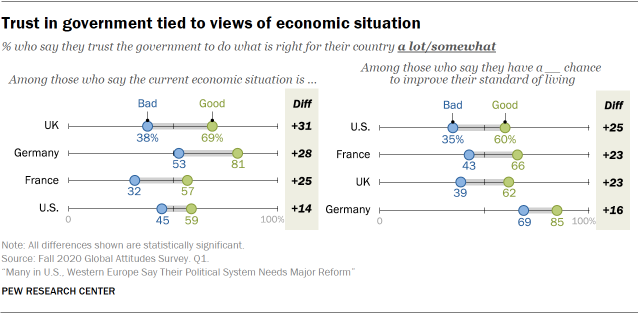
Trust is also linked to views about the economy. People who think the national economy is currently in good shape express higher levels of trust in government, as do those who believe they have a good chance to improve their own standard of living.
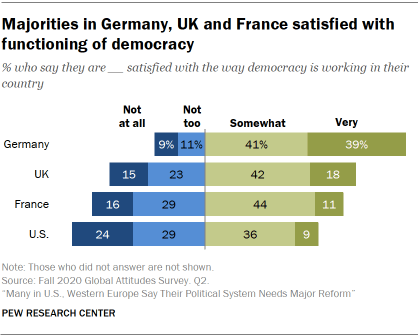
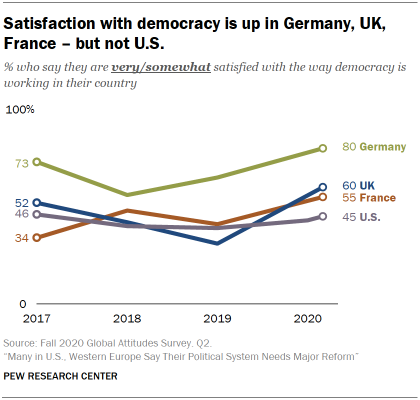
While more than half of Americans say they generally trust the government to do what is right, fewer than half (45%) are satisfied with the way democracy is working in their country. (The survey took place before the violent storming of the U.S. Capitol on Jan. 6 by a mob of Trump’s supporters.) In contrast, majorities in France (55%) and the UK (60%), as well as eight-in-ten Germans, say they are satisfied with how democracy is functioning.
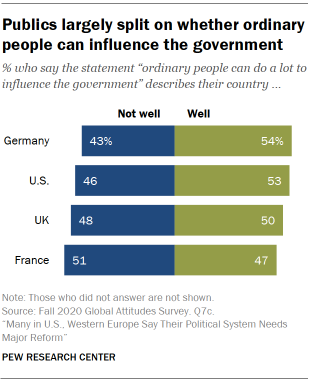
These four publics are divided over how much impact ordinary people can have on government: 54% of Germans, 53% of Americans, 50% of Britons and 47% of the French say the statement ordinary people can do a lot to influence the government” describes their country well.
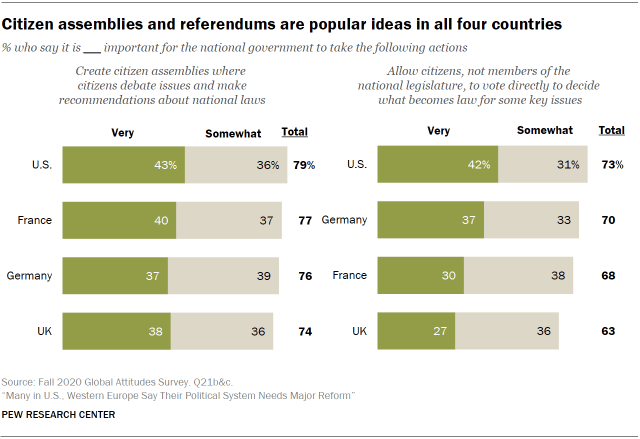
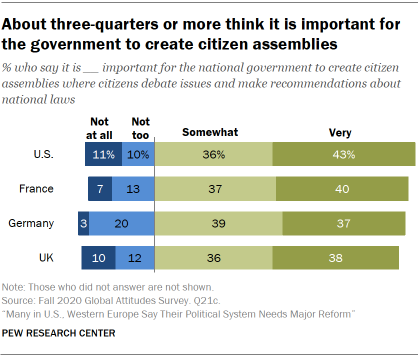
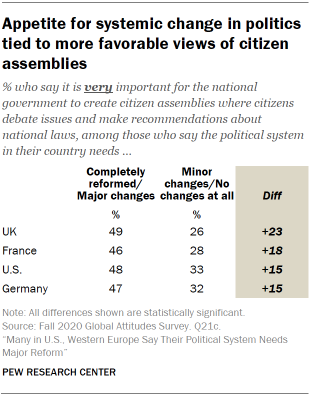
In all four countries, there is considerable interest in political reforms that would potentially allow ordinary citizens to have more power over policymaking. Citizen assemblies, or forums where citizens chosen at random debate issues of national importance and make recommendations about what should be done, are overwhelmingly popular. Around three-quarters or more in each country say it is very or somewhat important for the national government to create citizen assemblies. About four-in-ten say it’s very important. Such processes are in use nationally in France and the UK to debate climate change policy, and they have become increasingly common in nations around the world in recent years.
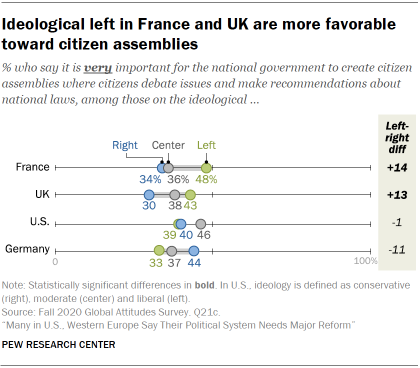
Citizen assemblies are popular across the ideological spectrum but are especially so among people who place themselves on the political left.1 Those who think their political system needs significant reform are also particularly likely to say it is important to create citizen assemblies.
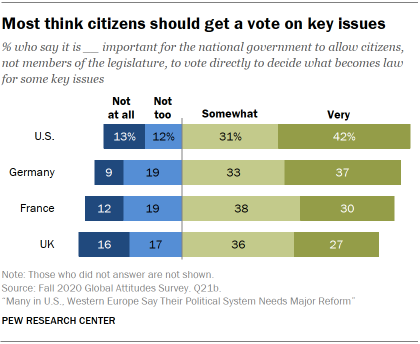
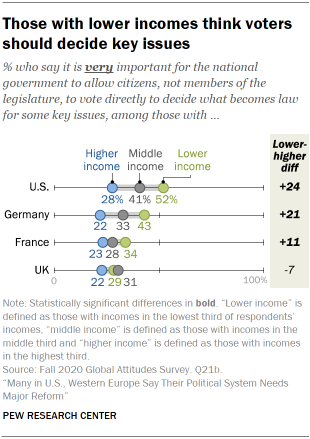
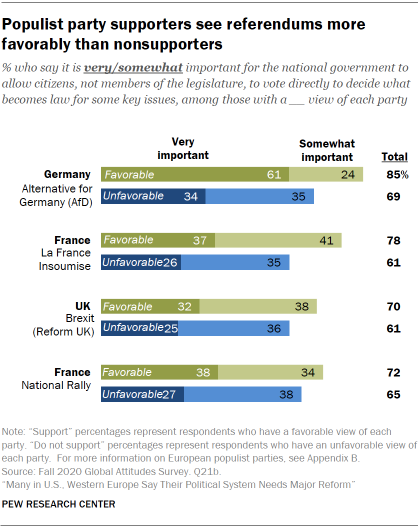
There are also high levels of support for allowing citizens to vote directly to decide what becomes law for some key issues. About seven-in-ten in the U.S., Germany and France say it is important, in line with previous findings about support for direct democracy. In the UK, where crucial issues such as Scottish independence and Brexit were decided by referendum, support is somewhat lower – 63% say it is important for the government to use referendums to decide some key issues, and just 27% rate this as very important.
These are among the findings of a new Pew Research Center survey conducted from Nov. 10 to Dec. 23, 2020, among 4,069 adults in the France, Germany, the UK and the U.S. This report also includes findings from 26 focus groups conducted in 2019 in the U.S. and UK.
How the focus groups were conducted
Across the four countries surveyed, more trust the government than not
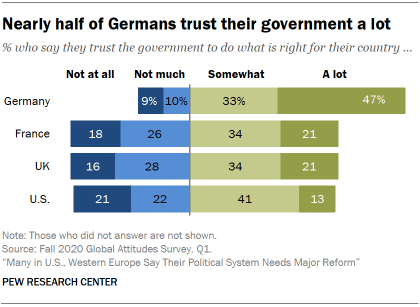
Half of adults or more trust the national government to do what is right in each of the four countries surveyed. But, whereas only a slim majority trust the government in the United States (54%), France (55%) and the United Kingdom (55%), 80% in Germany express this view. And, in Germany, 47% say they trust the national government a lot – more than twice as many as say the same in any of the other surveyed countries and more than three times as many as in the U.S., where only 13% have a lot of faith in the government.
In the U.S., trust in the government has remained largely unchanged since the question was last posed in 2017. But who trusts the government shifted notably over this period. In 2017, when Donald Trump was the newly inaugurated president, Republicans and independents who lean toward the Republican Party were more likely to trust the government than Democrats and leaners toward that party (66% vs. 42%, respectively). In the most recent survey, fielded in November 2020 after the election was called for now President Joe Biden, Democrats trust the government at higher rates than Republicans, 59% vs. 49%.
Trust in the government has increased in each of the three European countries surveyed since 2017, the largest change being in France (55% today, up from 20%). The 2017 French survey was fielded in the month prior to the first round of the national elections – a particularly contentious election in which nontraditional parties, including the now-governing En Marche, were vying for leadership.2 Trust has grown most precipitously among En Marche supporters: Today, 92% trust the government, compared with 37% who said the same before the 2017 election that brought Emmanuel Macron to power. Supporters of the Republicans (LR) and the Socialist Party (PS) – two parties that had long governed in France prior to 2017 – also have more trust in the government now. And, while only around half of those with a favorable view of the right-wing populist National Rally trust the government (53%), trust among this group has gone up 44 percentage points since 2017.
In Germany, trust in the government is up 11 percentage points since 2017, and the share who trust the government a lot has nearly doubled during this same period. But, while supporters of the ruling CDU are among the most trusting of the government (92%), trust has increased comparably since 2017 among most of the major parties. And, while those who have a favorable view of Alternative for Germany (AfD) tend to be much less trusting than those who have an unfavorable view of the party (52% vs. 85%), even this group is more trusting of the government now than in 2017, when only 33% trusted the government.3
In the UK, the share who trust the government a lot has risen 7 points since 2017 (to 21%), and overall trust has increased 6 points. For supporters of the Conservative Party – which was governing in 2017 but had a change of prime minister in 2019 – trust in the government has gone up from 76% to 84%. On the other hand, Labour Party supporters are less likely to trust the government now than they were in 2017 (34%, down from 42%). Trust is significantly higher among those who identify as Leavers (72%) than those who identify as Remainers (45%), as well as among those who have a favorable view of the right-wing populist Brexit Party, now called Reform UK (76%) compared with those who have an unfavorable view of the party (46%).4
Across all four of the countries surveyed, trust in the government is higher among those who say the economy is in good shape and those who say they have adequate opportunities to improve their own standard of living. For example, in the UK, those who say their current economic situation is good are about two times as likely to say they trust the government as those who say it’s bad.
In France, Germany and the UK, those who think their country is doing well handling COVID-19 are much more likely to trust the government than those who think their country is handling the pandemic poorly. The difference is largest in France, where 80% of those who think the country is doing well handling the outbreak trust the government, compared with only 27% of those who think the country is not doing a good job.
Trust is higher among people who believe elected officials care what ordinary people think. Also, those with at least a university degree and those with higher incomes are more likely to trust the government in France and Germany, though not in the U.S. or UK.
Democratic satisfaction lower in U.S. than European countries surveyed
Satisfaction with democracy varies widely across the four countries surveyed. In the U.S., only 45% of people say they are satisfied with the way democracy is working (the survey in the U.S. took place Nov. 10 to Dec. 7, 2020, which was before the violent storming of the U.S. Capitol on Jan. 6 by a mob of President Trump’s supporters). In contrast, in each of the three European countries surveyed, a majority holds this view: 55% in France, 60% in the UK and 80% in Germany. And, in Germany, around four-in-ten are very satisfied (39%). No more than one-in-five in the other three countries surveyed reach this level of satisfaction.
Across all three European countries surveyed, satisfaction with democracy has increased substantially: up 14 points in France, 15 points in Germany and 29 points in the UK between 2019 and 2020. In contrast, in the U.S., the percentage of people who say they are satisfied with democracy has remained relatively consistent in recent years.
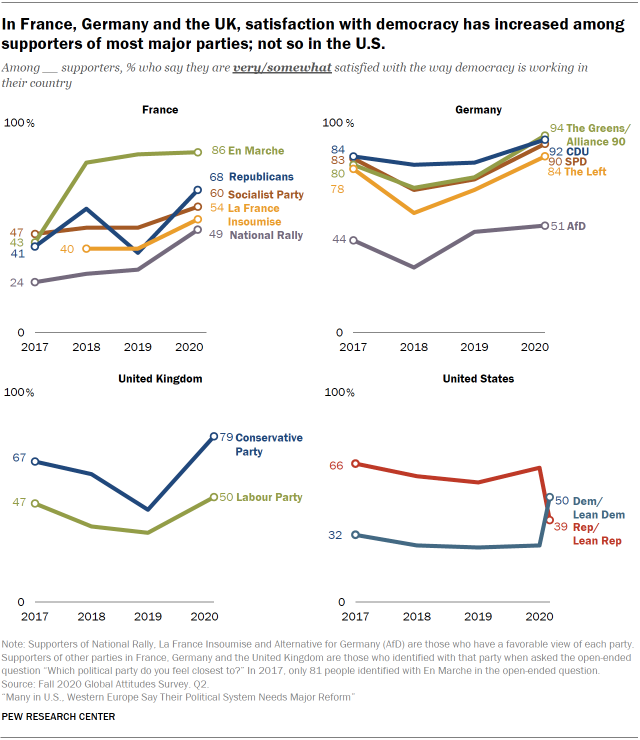
But, in the U.S., who is satisfied has changed substantially over the past year. Between 2017 and 2019, Republicans were more than twice as satisfied with democracy as were Democrats. In 2019, for example, 57% of Republicans and 26% of Democrats said they were satisfied. But, in 2020, after Biden’s election, this relationship inverted, and today, 50% of Democrats are satisfied with democracy while only 39% of Republicans say the same.
In each of the European countries surveyed, supporters of the party or parties that are currently in government tend to be among the most satisfied with democracy. While En Marche supporters are the most approving of the way democracy is working in France, their opinions have shifted little since a 2018 survey, which was the first Pew Research Center poll in France following their party’s electoral victory. Rather, much of the 14-point increase in democratic satisfaction between 2019 and 2020 in France has come from supporters of other parties. For example, 60% of the supporters of the Socialist Party now report satisfaction with democracy, up from 50% in 2019. The growth among Republicans is even larger, going from 40% in 2019 to 68% in 2020. Satisfaction is even up among those who hold favorable views of the right-wing populist party National Rally (49% in 2020, up from 30% in 2019) and the left-leaning populist party La France Insoumise (54% in 2020, up from 40% in 2019).
The increase in democratic satisfaction is evident among supporters of most large German political parties in the country. For example, supporters of SPD (up 17 points), the Greens/Alliance 90 (16 points) and CDU (11 points) as well as those with a favorable view of Die Linke (16 points) all are more satisfied with democracy now than in 2019. But those with a favorable view of the right-wing AfD have not changed over the past year and continue to have relatively low democratic satisfaction (51%).
In the UK, supporters of the Conservative Party (79%) are more satisfied with democracy than Labour Party (50%) supporters. But this comes as partisans in both camps are more satisfied than they were in 2019, with increases of 35 and 17 points, respectively. Those who identify as Leavers and Remainers are equally satisfied with how democracy is working in their country.
Leavers and Remainers both saw Brexit as a failure of democracy in focus groups
Focus groups conducted in August 2019 in the UK were dominated by discussions of Brexit. At the time, around three years had passed since voters had approved a referendum to leave the European Union. Boris Johnson had just taken over as prime minster from Theresa May, and invocation of Article 50 – the start of formal withdrawal – had been delayed until at least October, meaning the UK was still in the EU and still consumed by debates about Brexit. Both Leavers and Remainers saw the aftermath of the referendum as a gross failure of democracy. Although Brexit was not an explicit topic for guiding focus group discussion, it came up in several groups as something that made people feel ashamed to be British.
For Leavers, complaints centered around frustrations that, despite their vote to leave, the country had made no forward progress on the issue, thus highlight[ing] clearly how little our opinion matters.” Leavers bemoaned calls for a second referendum that were percolating at the time, arguing that overturning the will of the people, which they thought had been fully expressed in the 2016 vote, would be a miscarriage of democracy.
For Remainers, frustrations often hinged on the process. People felt that misinformation was rampant in advance of the 2016 vote, and many who voted to leave may not have done so had they understood the implications of their vote. Others highlighted how it would have made more sense to negotiate a deal and put that to the people in a referendum, rather than voting first on whether to leave when there was no clear plan on how to execute it. Remainers also noted that Brexit has diverted all other issues,” distracting” the government away from running the country,” which one participant even blamed for an increase in crime.
Despite wanting wildly different outcomes with regard to Brexit, what united Leavers and Remainers were a few core complaints and their general dissatisfaction with their politicians and the political process. Both Leavers and Remainers lamented how much time Brexit was taking and suggested just getting on with it.” People highlighted how it was difficult to plan for the future with such a major decision in limbo. Some emphasized how the whole thing made Britain look weak, the politicians seem ineffective, and the country was becoming a global laughing stock.”
There are few age or gender differences across these countries when it comes to satisfaction with democracy. But those who have completed at least a university degree tend to be more satisfied with democracy than those who have completed only some university schooling or less.
Across all four countries surveyed, people who think the economy is in good shape are significantly more content with the functioning of their political system than those who think the economy is in poor shape. In France, for example, those who think the economy is in good shape are more than twice as likely to be satisfied with democracy (70% vs. 33%). Similarly, those who think they have opportunities to improve their own standard of living are also more satisfied with democracy.
Those who think elected officials care what ordinary people think are also more likely to be satisfied with democracy.
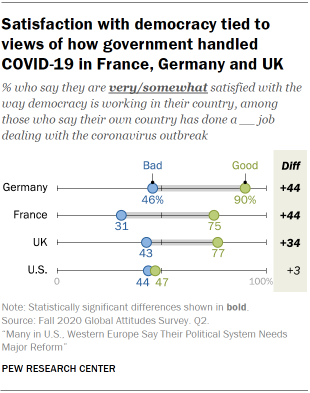
In France, Germany and the UK, people who think their country has done well handling COVID-19 are also around twice as likely to be satisfied with democracy as those who think their country has handled the pandemic poorly. But, in the U.S., those who think the country has done well and those who think it has done poorly when dealing with the global health crisis are equally satisfied with democracy.
Outside of Germany, many see need for major changes to their political systems
Across the four countries surveyed, few say they live in a political system that does not need to be changed at all: 6% in France, 7% in the U.S., 11% in Germany and 12% in the UK. But what degree of change they seek – minor, major or complete reformation – varies.
In both France and the U.S., a majority say dramatic change is needed, with a plurality in each country saying the system requires major changes (47% in each country). In the UK, fewer seek substantial changes (14% complete reform, 33% major changes), and the largest share of people report the system needs minor changes (38%). Only in Germany do substantially fewer than half seek serious changes.
In the U.S., Democrats and independents who lean toward the party tend to be slightly more supportive of major systemic overhaul than Republicans and independents who lean toward the Republican Party – 70% vs. 58%, respectively. This is consistent with results of other recent surveys showing that Democrats are more supportive of reforms like moving away from the electoral college or doing everything possible to make it easier for every citizen to vote. Democrats are also less likely than Republicans to describe America as a country where people are free to peacefully protest or where the rights and freedoms of all people are respected.
Supporters of the party currently in power in France – En Marche – are slightly less likely to support major systemic overhauls (51%) than are supporters of the two major traditional political parties: the Republicans (59%) and the Socialist Party (70%). But those with favorable views of the populist right-wing National Rally and left-wing La France Insoumise are no more likely to call for major changes or complete reform to the French political system than are those with unfavorable views of those parties.
In the UK, support for at least major changes is higher among Labour Party supporters (57%) than among Conservative Party supporters (29%). Those who identify as Remainers are also more supportive of significant changes to the political system than those who identify as Leavers. Similarly, those who have an unfavorable view of the right-wing Brexit Party (Reform UK) tend to be more likely to want systemic reforms than those who have a favorable view of the party (56% vs. 30%, respectively).
In Germany, where the overall desire for change is relatively low, there are few differences along partisan lines.
Across all four countries surveyed, those who think most politicians in their country are corrupt are more likely to favor systemic reforms. For example, in the UK, 60% of those who say most politicians are corrupt” describes their country well think the system needs significant changes, compared with 39% who say it does not describe the country well. Those who are less satisfied with the way democracy is working and less trusting of the government are more likely to call for significant changes. On the other hand, those who think elected officials care what ordinary people think are less likely to think large-scale reforms are required.
Views of how well COVID-19 has been handled also play a role: People who think their government has done a poor job dealing with the pandemic are also more likely to call for major reforms. In Germany, for example, 70% of those who think the government has done a poor job think the system needs complete or major reforms, compared with just 29% of those who think the government has dealt with the pandemic well.
Those who believe their country is doing poorly economically are also more likely to call for substantial reforms to the political system. The same is true of those who say they lack opportunities to improve their standard of living. But opinions don’t differ across age groups in any of these countries, with younger and older people equally likely to support calls for reform.
Outside of Germany, there are no significant differences across income groups on this question (in Germany, the less affluent are more likely to support changes). In Germany, the U.S. and France, those with secondary degrees or less schooling are also more likely to call for major political system reform than those with more education.
Elected officials seen as out of touch in U.S., France and UK
Nearly two-thirds of Germans (65%) say the statement elected officials care what ordinary people think” describes their country well. However, fewer than half of those surveyed in France, the U.S. and the UK express this opinion.
The share of Germans who say elected officials care what ordinary people think has risen precipitously since 2018, when only 44% held this view. In France, too, the share saying elected officials care has risen 9 points (from 32% to 41%). Indeed, all partisan groups in France studied registered an increase in the percentage who say this.
In the UK and U.S., however, the share who say elected officials care about ordinary people has remained largely unchanged since 2018, although it has risen in the UK among those who identify with Conservative Party and decreased among those who identify with the Labour Party. Today, Conservatives are more likely (61%) to say elected officials care than are Labour Party (41%) supporters. Those who have a favorable view of the Brexit Party (Reform UK) are also more likely than those who have an unfavorable view of the party to say elected officials care what ordinary people think (56% vs. 43%, respectively).
Partisan identity colors opinion about whether elected officials are seen as caring in each of the countries surveyed except for Germany. For example, in France, about two-thirds (67%) of those who identify with President Emmanuel Macron’s party En Marche say elected officials care, compared with fewer than half of supporters of the Socialist Party (43%) and the Republicans (39%).
In the U.S., Democrats are more likely than their Republican counterparts to describe elected officials as caring. Only one-third of Republicans say elected officials care what ordinary people think, compared with about half (52%) of Democrats. This difference in opinion between partisans has flipped since 2018, when Donald Trump was president. At that time, 50% of Republicans said elected officials care, compared with only 36% of Democrats.
There are few differences on this question by age, gender, income or education. However, French men (46%) are 10 percentage points more likely than women (36%) to say that elected officials care what ordinary people think. In Germany, those in the highest income group are more likely than those in the lowest income group to say elected officials care. While in the U.S., those with more education are more likely to agree that elected officials care than those with less education.
Americans largely describe politicians as corrupt, fewer Europeans agree
Two-thirds of Americans say the statement most politicians are corrupt” describes their country well. However, in France and the UK, publics are more split on the matter, with slightly fewer than half saying most politicians are corrupt. Germans are much less likely to express this opinion.
And in the U.S., while large majorities in both parties believe most politicians are corrupt, Republicans are more likely (78%) to say this than are Democrats (60%).
Partisan differences are relatively muted in the UK, Germany and France, although French supporters of the Republicans (49%) are more likely than En Marche supporters (32%) to describe politicians as corrupt.
In focus groups, Americans and Britons both gave examples of politicians being corrupt
In focus groups conducted in both the U.S. and UK in the fall of 2019, when participants were asked about things that made them embarrassed to be American or British, national politicians often came up.
This was especially true in the UK, as it came up in discussions with groups comprised of both Conservative and Labour supporters as well as those who had voted leave” or remain” in the EU referendum. Some Britons cited expenses scandals” among members of Parliament (MPs) as reasons for why they were embarrassed about politicians. One 33-year-old woman in Edinburgh said that all MPs are pocketing everyone else’s money.”
In the U.S., discussion of corruption among politicians was related to the notion that politicians can be bought” by corporations through the lobbying process. In Seattle, participants discussed how they were ashamed of corruption in America, with one participant saying that it seems like politics are being bought and sold” due to lobbyists and the special interest groups and all that kind of thing.”
Attitudes about politicians being corrupt or not have not changed significantly in any of the four countries surveyed since the question was last asked in 2018.
Younger people in the UK, France and U.S. are more likely to say most politicians are corrupt. The difference is largest in the UK, where 61% of people ages 18 to 29 say that politicians are corrupt, compared with only one-third of people 65 and older, a 28 percentage point difference.
Respondents in the lowest income group in Germany, the UK and France are more likely to say politicians are corrupt than those in the highest income group in these countries. However, about two-thirds of Americans of all income groups express this view.
Publics largely split on whether ordinary people can do a lot to influence the government
When asked about how much impact ordinary citizens can have on politics, these four publics are somewhat divided. Germans and Americans lean slightly toward the view that ordinary people can do a lot to influence the government,” while the British and French publics are more closely divided. In France, about one-quarter (24%) say that the statement describes their country not well at all,” while one-in-five say the same in the U.S. and UK.
In each country surveyed, those who say that they personally have a good chance to improve their standard of living are more likely to say that ordinary people can influence the government.
Only in the U.S. does partisanship play a role in shaping this belief: 58% of Democrats think that ordinary citizens can influence the government, compared with 46% of Republicans.
Citizen assemblies popular, especially among those who want major change to the political system
In all four countries, there is considerable support for the creation of citizen assemblies where citizens debate issues and make recommendations about national laws. Citizen assemblies have become increasingly common in nations around the world in recent years and have been used, for example, in Ireland to decide such contentious issues as abortion and gay marriage.
Citizen assemblies have already been used nationally in France and the UK to debate environmental policy. The French Citizens’ Assembly on Climate, initially convened in October 2019 in response to the Yellow Vest Movement, concluded last year with the release of 149 proposals, though many remain to be implemented.
The country with the largest share of respondents who say such reforms are very or somewhat important is the United States, though about three-quarters or more in each country say it is important to create citizen assemblies. A plurality of Americans say it is very important for the national government to create citizen assemblies; only 21% say it is not too or not at all important.
There are significant ideological differences on the question of how important it is to create citizen assemblies. In France and the UK, those on the ideological left are significantly more likely than those on the right to say creating citizen assemblies is very important.
Respondents who say their country’s political system needs major changes or needs to be completely reformed are also warmer toward citizen assemblies than those who say it only needs minor changes or no changes at all. For example, 46% of French respondents who say France needs systemic political change say it is very important for the government to create citizen assemblies, while about three-in-ten who say the political system needs minor changes or no changes say creating citizen assemblies is very important.
In the UK, where citizen assemblies have been used to debate Scottish independence, Brexit and climate change policy, there are significant political differences on this question. For instance, 83% of Labour supporters think it is very or somewhat important for the government to create citizen assemblies, while 66% of Conservative supporters say the same. Those who identify as Remainers are also more likely than those who identify as Leavers to support citizen assemblies.
Majorities say it’s important for voters to decide key issues
In each of the four countries surveyed, majorities believe it is very or somewhat important for the national government to allow citizens to vote directly to decide what becomes law for some key issues rather than letting members of the legislature decide.
A plurality (42%) of Americans say it is very important to decide some key issues by referendum. Views on this question are linked to perceptions of political corruption: 45% of Americans who think most government officials are corrupt say it is very important for the national government to allow citizens to vote directly on key issues, compared with 35% of those who think the phrase most government officials are corrupt” does not describe the country well. There are similar divides in Germany and the UK.
While the ghosts of referendums past may influence British opinions on this question today, there are no significant differences between those in the UK who identify as Remainers and those who identify as Leavers. However, there are differences based on age. Nearly four-in-ten Britons ages 18 to 29 – some of whom were too young to vote in the Scottish independence and Brexit referendums – hold the view that it is very important for the national government to allow citizens to vote directly to decide what becomes law. This is a higher share than among those ages 30 to 49 (23%), 50 to 64 (27%) or 65 and older (24%).
In the U.S. and Germany, those with less education are especially likely to think it is very important for the national government to decide key issues by referendum. About one-quarter of Germans (24%) with a university education or higher hold that opinion, compared with 43% of those with a secondary education or less. A similar pattern appears in the U.S., with a 14 percentage point gap between those with a secondary education or less (48%) and those with a university degree or higher (34%).
Those with lower incomes are also significantly more likely than those with higher incomes to say it is very important to have referendums. In the U.S., this income gap is 24 points, with about half of lower-income Americans and about three-in-ten higher-income Americans holding that view. There are also significant income gaps of 21 points and 11 points in Germany and France, respectively.
In the three European countries, larger shares of those with favorable views of populist parties think it is very or somewhat important for their government to allow citizens to decide what becomes law for some key issues. This pattern transcends ideology, with more favorable views toward referendums among supporters of the right-wing Alternative for Germany (AfD) and Brexit Party (Reform UK) and the left-wing La France Insoumise.
In the U.S., the question about ideology asked respondents to place themselves on a spectrum from liberal to conservative while in Europe the question asked them to place themselves on a spectrum from left to right.
The 2017 survey was fielded March 6–April 1 and the first-round election took place April 23.
Because only 7% of Germans identify as Die Linke supporters and 3% as AfD supporters in an open-ended question asking which party people feel closest to, we are unable to examine change in opinion among Die Linke or AfD supporters. As a result, this analysis reflects the change among those who said they had a favorable view of each of these parties in 2017 and in 2020, respectively. We also use favorable views of National Rally and La France Insoumise in France and the Brexit Party (Reform UK) in the UK for our analyses for the same reason.
Because the Brexit vote about whether to leave the European Union took place in 2016, many people surveyed in 2020 who may have opinions about the issue may not have been eligible to vote. As a result, we have changed our question away from asking about how people voted and instead are asking: Thinking about Britain’s relationship with the European Union, do you think of yourself as a ‘Remainer,’ a ‘Leaver’ or do you not think of yourself in that way?”
In a major revelation in a case pertaining to the seizure of a huge quantity of narcotic drugs along with five AK-47 rifles and 9mm ammunition numbering 1,000 from Sri Lankan fishing boats, the NIA has stated that an accused had been involved in activities of proscribed terrorist organisation LTTE within India and abroad.
The accused had also plotted to procure prohibited arms and ammunition, besides contraband articles. The NIA filed the report in the Kerala High Court in response to the bail plea filed by Ramesh, a Sri Lankan native and eighth accused in the case, the Indian Express reported.
The Indian Coast Guard intercepted the boat, ‘Ravihansi’, near Minicoy Island, Lakshadweep, on March 18, 2021. There were no proper documents and six Sri Lankan nationals found on board were arrested by the Kochi sub zone of Narcotics Control Bureau (NCB) on their arrival at Vizhinjam port in Thiruvananthapuram.
The Central government directed the NIA to take over the probe and later the seventh and his brother and eighth accused were taken into custody, allegedly for being members of the banned Liberation Tigers of Tamil Eelam (LTTE). Ramesh revealed that he had stayed in India without a visa violating the provisions of the Foreigners Act.
According to NIA, Ramesh and the other accused, including his brother being a core cadre of the LTTE, held secret meetings and conspired to carry out illegal activities of trafficking in drugs and also arms and ammunition with the intention of raising funds to revive and further the activities of the LTTE, both in India and Sri Lanka, They formed a terrorist gang and transferred money through hawala channels for the procurement of drugs, arms and ammunition.
A witness in the case also spoke of the drug and hawala business carried out by the brothers and specifically referred to Ramesh having collected hawala money from a person named Faseel Bhai. While dismissing Ramesh’s bail plea, the court noted that the statements of the witnesses show not only his inextricable connection with the illegal activities but also his definite link with LTTE, with full knowledge and complicity in the attempt to smuggle heroin, arms and ammunition in the boat, intercepted before its entry into the port.
Archbishop of Colombo Cardinal Malcolm Ranjith today requests President Ranil Wickremesinghe to investigate whether there was a political conspiracy behind the Easter Sunday terror attack.
He expressed these views while participating in the second phase of the distribution of the financial donation given to the victims of the Easter Sunday attack by His Holiness Pope Francis.
The second phase of distribution of the financial donation of 100,000 Euros made by the Pope Francis, for the welfare of the victims of the Easter Sunday terror attacks, was carried out today at St. Anthony’s Shrine in Kochchikade.
Speaking during the event, Cardinal Ranjith said that they will continue their struggle seeking justice for the victims of the Easter Sunday attacks and also urged the incumbent President to probe allegations of a political conspiracy behind the attacks.
Even though the Galle Face struggle has stopped, this struggle will continue. We will not give up,” he said.
He said that authorities must thoroughly investigate everything behind the Easter attack, including who carried it out, who aided and abetted, and who did not prevent it when it could have been prevented.
He said the current president should find out about these things as the report of the parliamentary selection committee appointed by him at the time says that there is a semblance of a political conspiracy behind it.
If so, this president is bound to analyze what the parliamentary committee appointed by the president said. Therefore, I request the president to please be honest about what the select committee you appointed said. Don’t hesitate to analyze.”
The Government of Sri Lanka has lifted the ban imposed on six international Tamil organisations.
This is through an Amendment to the List of Designated Persons under Regulation 4(7) of the United Nations Regulations No. 1 of 2012.
According to the Defence Ministry, a total of 577 persons and 18 entities were Listed under United Nations Security Council Resolution 1373.
Accordingly, 316 persons and 06 entities have been De Listed from the Designated List.
Entities De Listed from the Designated List:
01. Australian Tamil Congress (ATC) 02. Global Tamil Forum (GTF) 03. World Tamil Coordinating Committee (WTCC) 04. Tamil Eelam Peoples Assembly (TEPA) 05. Canadian Tamil Congress (CTC) 06. British Tamil Forum (BTF)
The List of Designated Persons published in the Gazette Extraordinary No. 1992/25 of November 9, 2016, is hereby amended.
To: Sima Sami Bahous, UN Women Executive Director, Åsa Regnér, UN Women Deputy Executive Director for Policy, Programme, Civil Society and Intergovernmental Support; Anita Bhatia, Deputy Executive Director for UN Coordination, Partnerships, Resources and Sustainability
Subject: UN Women’s MoU with BlackRock
Dear Ms Bahous, Ms Regnér, Ms Bhatia,
We write to you on behalf of the undersigned feminist organizations, networks, constituencies and individuals, all of whom are committed to ensuring that the United Nations delivers on international agreements on gender equality, SDG 5 and women’s human rights. We are dismayed to hear that on May 25th, 2022, UN Women announced that it signed a Memorandum of Understanding with BlackRock, Inc. to cooperate in promoting the growth of gender lens investing”. The declaration is dissonant, in view of BlackRock’s well-known record of prioritizing profits over human rights or environmental integrity, to a degree that meets precisely the Secretary-General’s characterisation of ‘morally bankrupt’ global finance institutions as being amongst the chief threats to human equality and planetary integrity. Gendered historical and structural inequalities ensure that women and people who face multiple and intersecting forms of discrimination are the ones who suffer the harshest consequences of the social, economic, ecological and political impact of the work of asset management firms that concentrate the world’s wealth into investments in fossil fuels, military and civilian weapons, and sovereign debt. In a time of climate, environmental, health, political and economic crises, a partnership with an entity that is actively undermining international commitments to advance sustainable development, is a serious aberration. It departs from the human rights principles of the UN, from the SDGs priorities of building equality, peace, and sustainable development, and from UN Women’s mandate to promote gender equality. Civil society watchdog groups consistently identify BlackRock as among the worst performers on corporate accountability. Its climate and socially-destructive investments — particularly significant in impact because of the massive component they represent of BlackRock’s portfolio — have been called out by activists, including Indigenous leaders. Aware of the optics, BlackRock has attempted to ‘greenwash’ itself by acknowledging the seriousness of 2 climate change – in a move that the New York Times has condemned as ‘climate hypocrisy’ that is intentionally misleading; worse than climate denial. The recently-announced partnership with UN Women suggests that UN Women has been recruited to BlackRock’s image-cleansing efforts – this time it is seeking to ‘pinkwash’ itself. It is hard to reach any other conclusion from the May 25 press release. A joint interest in ‘gender lens investment’ is offered to explain the partnership with no explanation of what this means, nor why BlackRock is the best interlocutor for this effort, nor whether it would require BlackRock to divest from the many industries it supports that exacerbate gender inequality (through, for instance, gendered job segregation and segmentation, gendered pay gaps, let alone gender-specific impacts of small arms proliferation and ecological destruction). If this is a ‘partnership’, it looks like it works in just one direction. It gives BlackRock a veneer of feminist approval that it clearly does not merit. Given BlackRock’s phenomenal size and influence (reportedly managing ten trillion USD) in assets, it is not unreasonable to assert that this UN Women partnership also gives a feminist imprimateur to the version of neoliberal global capitalism that is condemned by the SG. This crisis-prone speculation-based capitalism, spawning grotesque income inequalities, has also been linked to misogynistic neo-populism and entrenched poverty for many women, particularly those from ethnic or racial minorities, marginalized sexualities, and female-headed households. To substantiate our concerns, we list here just a few examples of BlackRock practices of extreme concern that directly contradict feminist social and economic change agendas: Fossil fuels In 2021, contradicting declarations that BlackRock would divest from fossil fuels (it is one of the world’s biggest investors in the world’s dirtiest fossil fuel companies), it put $85bn of assets managed into coal companies, including those seeking to identify and exploit new coal assets, breaching the decisive climate action required by the Paris Agreement. The Working Group III report, Climate Change 2022: Mitigation of Climate Change” by the Intergovernmental Panel on Climate Change, released on 4 April 2022, highlighted the need for a dramatic shift away from fossil-fuels, gas and coal-based economies. Just one month later, UN Women’s partnership with BlackRock was announced, with no reference to BlackRock’s massive fossil fuel portfolio, nor of the differentiated impacts the environmental crises have on the human rights of women and other marginalized groups who face multiple and intersecting forms of discrimination. In a wider manner, BlackRock also invests in projects that are harmful to environmental integrity as a whole. For instance, BlackRock is a major investor in deforestation projects, destroying the tropical rainforests to invest in palm oil plantations in Papua New Guinea, while human rights abuses have been documented in parallel. 3 External private debt BlackRock is the leading known holder of external private debt in the global South. In Zambia, it is the largest private bondholder, but it refused a request by Zambia to suspend debt payments in 2020 and has not offered to restructure the debt. BlackRock’s holdings of Zambia’s bonds were $220 million as of February 2022, over half of which were purchased during the high stress first 18 months of the COVID-19 pandemic. It could make a 110% profit on this debt, if it is fully paid. Meanwhile, cuts planned by the government of Zambia in 2022–26 are equivalent to five times its annual health budget, putting women and other marginalized groups at risk as they depend on public health services and also form a large portion of frontline health workers. Private creditors such as Blackrock and Ashmore hold 47% of Sri Lanka’s debt via bonds that were issued post Sri Lanka’s civil war; the bondholder, Hamilton Reserve Bank, has sued Sri Lanka in the state of New York for the full payment of principal and interest, as it considers that the recent debt default has been orchestrated by the government. New York State’s legislature recently passed a bill to ensure that private creditors can’t use courts to get better settlements than bilateral government creditors. Blackrock is now part of a bondholder group that is negotiating a restructuring with the Sri Lankan government. Sri Lanka is currently in a severe crisis, with food shortages and fuel rationing, both of which impact women and girls disproportionately, with women and other marginalized groups experiencing job losses first. This takes place in a context where male household members’ food and health needs tend to be prioritized, while care and domestic work burdens increase. Labor rights BlackRock has voted against every single shareholder resolution relating to labor rights where it has shareholdings, including resolutions relating to corporate accountability for sexual harassment and closing the gender pay gap as well as against 47% of climate resolutions. In contrast, it has voted for every resolution that the Committee for Workers Capital (the global committee representing workers interests in pension funds), has advised voting against. BlackRock has investments where child labour has been exposed. Militarization Through its investment strategies, BlackRock is also a major supporter of the military industrial complex. It has major investments with civilian gun manufacturers such as Smith and Wesson and Sturm, Ruger, & Company (which produces the Ruger mini-semi automatic 14 rifle among other weapons). It has holdings in Lockheed Martin, General Dynamics, Raytheon, Boeing, and Northrop Grumman (these are identified by the Stockholm International Peace Research Institute (SIPRI) as among the largest weapons sales companies globally), Axon (which produces tasers), and Elbit (which provides logistical support for weapons delivery). High level executives in BlackRock serve on the corporate boards of various military suppliers and vice versa. These investments build a gruesome connection 4 between BlackRock and wartime violence and displacement, which have severe and highly gendered consequences, as well as with civilian gun deaths and the militarization of the police. UN Women’s mandate includes a focus on building sustainable peace” and working to prevent armed conflicts, as well as a central concern with ending the global pandemic of violence against women, violence that is significantly amplified by small arms proliferation. For UN Women to partner with a corporation that is so extensively involved in profiting from militarism seems contradictory at best, and potentially highly damaging to its credibility in the Women Peace and Security arena. Moving forward: Rescind the BlackRock partnership, set standards for future private sector partnerships, involve feminist civil society in UN Women governance The partnership between BlackRock and UN Women presents serious and potentially irreparable risks to UN Women’s reputation. It gives UN Women the job of sanitizing the reputation of an asset management institution whose investments have contributed to some degree to climate catastrophe, the economic immiseration of women and other groups marginalized because of sexuality, gender, race, and class, and the proliferation of weapons and by association, the increased recourse to political violence in unstable politics. To see the world’s leading institution for the defense of women’s rights in league with an enabler of patriarchal dominance, violence, and ecological collapse, with not a word directed to critiquing or reforming BlackRock, could spell the end of UN Women’s credibility as a gender equality institution. We urge UN Women immediately to rescind and repudiate this partnership, to honor its mandate to promote the highest standards of human rights, gender equality, environmental integrity and the wellbeing of people, as outlined in the SDGs targets. We are aware that Member States are not fulfilling their financial commitments to fund the UN, or, even worse, orienting their contributions to serve narrow political purposes. This is a driver of the corporate capture of the UN, weakening its capacity to face the multilateral crises of our times. UN Women has made attempts in the past to partner with the private sector, with companies such as Uber or Coca Cola, with poor results. Other parts of the UN have been tempted to do the same; OHCHR for instance, made an agreement with Microsoft. These efforts have failed to deliver either for the UN or for the populations they ostensibly serve. In a larger manner, the trend of a corporate capture of the UN is largely seen in the Secretary-General’s Our Common Agenda, which places priority on a networked multilateralism” with several multi-stakeholder proposals. Although more stakeholders participate in various processes, responsibility of governance and accountability to advancing the goals of the UN 5 must remain with Member States. While the UN welcomes private donors, their influence is carried to shape program priorities. Multistakeholderism and networked multilateralism assert duty bearers, rights holders, and corporate interests are all equal stakeholders and in doing so, obscures the power imbalances that exist among these groups. Corporations, unlike governments, are accountable to their shareholders with a view to increase profit. This, in many cases, is directly in conflict with the transformation needed to protect people and the planet. One example of this in Our Common Agenda is the proposal for a multistakeholder digital technology track in preparation for the 2023 Summit for the Future to agree on a Global Digital Compact to be informed by the existing High Level Panel of Experts on Digital Cooperation, co-chaired by Melinda Gates and Jack Ma – two members of the corporate sector that have conflicting interests with the public good. How can global corporations be trusted to recommend the strict regulation needed of digital technologies? The UN should not need to be reminded of its mandate by observers. Its governance systems should incorporate civil society leaders to help prevent these mistakes. For this reason, we recommend that feminist organizations should have formal seats in UN’s advisory groups and leadership (including to its Executive Board). It is essential and urgent that across the United Nations System, as entities turn to the private sector for funding and services, standards are set for transparency and accountability, based on human rights principles and aligned with the UN’s normative goals and standards. Moreover, all partnerships should be underpinned by an understanding of the UN as the primary duty bearer internationally, and Member States as duty bearers first and foremost. Any partner whose operations undermine human rights and planetary integrity is inherently in conflict with the interests and mission of the United Nations at large. In solidarity,
#Whispers
Abibinsroma Foundation
ACADHOSHA
ACTG
ActionAid France
ActionAid International
ActionAid Cambodia
Actionaid Senegal
ActionAid Tanzania
Adéquations
African Centre for Biodiversity
African Forum and Network on Debt and Development (AFRODAD)
African Women’s Development and Communication Network (FEMNET)
Agroecology Research Action Collective 6
Aid/Watch
Aidos
AIDS-Free World
Akina Mama wa Afrika
Alliance for Future Generations – Fiji
Almena Cooperativa Feminista,SCCL
AMECE
American Jewish World Service
Amigos da Terra Brasil /Friends of the Earth Brazil
ANND
Asia Development Alliance
Asia Indigenous Women’s Network
Asia Indigenous Peoples Network on Extractive Industries and Energy
Asia Pacific Forum on Women, Law and Development (APWLD)
Asia Pacific Women’s Watch (APWW)
Asociacion Ciudadana por los Derechos Humanos
ASOCIACIÓN SALUD Y FAMILIA
Associació de Drets Sexuals i Reproductius
Association Equality – Wardah Boutros
Association for Middle East Women’s Studies (AMEWS)
Association For Promotion Sustainable Development
Association Jeunes Agriculteurs (AJA)
Association of Women of Southern Europe AFEM
Association pour la Conservation et la Protection des Ecosystèmes des Lacs et l”Agriculture Durable
Australian Food Sovereignty Alliance
Avtonomi Akadimia
AWID (Association for Women’s Rights in Development)
Bangladesh Indigenous Women’s Network
Bangladesh Nari Progati Sangha (BNPS)
Bangladesh Unnayan Parishad
Barguna nari Jagoran kormochuchi JAGO NARI
Beautiful Hearts Against Sexual Violence NGO
Beijing-SDG 5 Facilitating Group
Beyond Beijing Committee Nepal
BIMBA Inc.
Biowatch South Africa
Biswas Nepal
Black Sea Women’s Club
Bootblack
Bretton Woods Project
Campaign of Campaigns 7
Canadian Voice of Women for Peace
CCFD-Terre Solidaire
Centre des Dames Mouride (CDM)
Center for Advancement of Public Policy
Center for Climate Change & Sustainable Development (3CSD)
Center for Legislative Development
Center for Women’s Global Leadership
CENWOR – Centre for Women’s Research
Chirapaq, Center of Inidgenous Cultures of Peru and Continental Network of Indigenous Women of the Americas- ECMIA
CHOICE for Youth and Sexuality
CIEDUR
Civil Society FfD Group
Civil Society SDGs Campaign GCAP Zambia
Climate Families NYC
CLRA
CNCD-11.11.11
Citizen News Service (CNS)
Coastal Development Partnership
Comité de América Latina y el Caribe para la Defensa de los Derechos de las Mujeres CLADEM
COMMUNITY AND FAMILY AID FOUNDATION-GHANA
Community Development Services (CDS)
Community Initiatives for Development in Pakistan
Confédération paysanne
Congregation of Our Lady of Charity of the Good Shepherd
Consumidores Conscientes
Coordinadora de la Mujer
Corporate Europe Observatory
CREA
Creación Positiva
CSO Youth FfD Constituency
Cultivate!
Czech Social Watch Coalition
Development Alternatives with Women for a New Era (DAWN)
Debt Justice Norway
Debt Justice UK
DECA, EQUIPO PUEBLO, AC
Dhaatri Trust
Diálogo 2000-Jubileo Sur Argentina
Diverse Voices and Action (DIVA) for Equality
Dones No Estàndards 8
Eategrity
Ecojustice Ireland Community Interest Company
Ekumenická akademie (Ecumenical Academy)
Ekvilib Institute
Elige Red de Jóvenes por los Derechos Sexuales y Reproductivos, A. C.
EMPOWER INDIA
ENABLE THE DISABLE ACTION, EDA DPO
EnGen Collaborative
Environmental Rights Action/Friends of the Earth Nigeria
Equidad de Género: Ciudadanía, Trabajo y Familia
ERA – LGBTI Equal Rights Association for Western Balkans and Turkey
Eurodad – European Network on Debt and Development
EXTINCTION REBELLION CAMEROON (XR CAMEROON)
Feminist Dalit Organization
Feministas en Holanda
FIAN International
FIAN Belgium
FIAN Germany
FIAN Switzerland
Financial Transparency Coalition
Focus Association for Sustainable Development
Focus on the Global South
Fokupers (Forum Komunikasaun ba Feto Timor Lorosa’e)
FOKUS – Forum for Women and Development
Fondation Eboko
Food Sovereignty Alliance, India
FORO DE MUJERES POR LA IGUALDAD DE OPORTUNIDADES
Forum for Equitable Development
Fós Feminista
Franciscans International
Fresh Eyes
Friends of the Earth Africa
Friends of The Earth Australia
Friends of the Earth International
Friends of the Earth US
FUNDACIÓ ASSISTÈNCIA I GESTIÓ INTEGRAL
Fundacion Arcoiris por el respeto a la diversidad sexual
Fundacion para Estudio e investigacion de la Mujer
Fundeps
GABRIELA
Gender and Development in Practice (GADIP)
GCAP Italia 9
Gender Action
Gender and Development for Cambodia
Gender and Development Network (GADN)
Gender at Work
GenderCC SA
GESTOS
Global Alliance for Tax Justice
Global Alliance for Tax Justice, Tax and Gender Working Group
Global Call to Action Against Poverty (GCAP)
Global Forest Coalition
Global Initiative for Economic, Social and Cultural Rights
Global Justice Now
GLOBAL MEDIA FOUNDATION
Global Migration and Health Initiative
Global Network of Sex Work Projects
Global Social Justice
Global Women’s Institute
Good Citizenry
Good Health Community Programmes
Gramya Resource Centre for Women
Grassroots Global Justice Alliance
Green Advocates International (Liberia)
GroundWork Trust
Haki Nawiri Afrika
Haldane Society of Socialist Lawyers
Halley Movement Coaliion
Health and Environment Justice Support (HEJSupport)
Heñói – Centro de Estudios y Promoción de la Democracia, los Derechos Humanos yla Sostenibilidad Socio-ambiental
Himalayan Community Resource Development Center
Hope for Kenya Slum Adolescents Initiative
Housing and Land Rights Network – Habitat International Coalition (HIC-HLRN)
Human Rights Focus Pakistan (HRFP)
IBON International
ICW-CIF
ILGA Asia
ILGA World
Indian Christian Women’s Movement
Indian Confederation of Indigenous and Tribal Peoples North East Zone (ICITP-NEZ)
Indigenous Environmental Network
Indigenous Women Empowerment Network 10
Indigenous Women’s Network of Thailand (IWNT)
Indigenous Youth Exchange Africa
Iniciativas para la Mujer Oaxaqueña
Initiative for Right View (IRV)
Institut Vinetum so.p.Etri group
Institute for Agriculture and Trade Policy
Institute for International Women’s Rights Manitoba
Instituto de Ciencia y Tecnología Regional (ICTER)
Integrated Social Development Effort (ISDE) Bangladesh
International Accountability Project
International Federation of Business and Professional Women
International IPMSDL
International Service for Human Rights
International Women’s Rights Action Watch Asia Pacific
Ipas Ethiopia
Ipas
IPPF
IWDA
JPIC KALIMANTAN
Justiça Ambiental – JA!
Justice Institute Guyana
Keepers of the Circle
Khpal Kore Organization
Kolektiv Z
Kopila-Nepal
KOTHOWAIN (Vulnerable Peoples Development Organization) Bandarban Hill Tract, BANGLADESH
KULU-Women and Development (KULU)
L’ Associacio de Drets Sexuals i Reproductius
Ladlad Caraga Inc
Landless Peoples Movement SA
LASNET (Latino American Solidarity Network)
LATINDADD
La Via Campesina
Les Amis de la Terre Togo
Let’s Do It Kenya
Like Mountains
Lithuanian NGDO Platform
Lumiere Synergie pour le Developpement
Ma’al Center for Consultations,Training and Human Development
Madhira Institute
MAELA México 11
Main_Network
Major Group for Children and Youth
MAKAAM
Marie-Schlei-Verein e. V.
Mazingira Institute
Mecanismo Sicuedad Civil CEPAL
MenEngage Global Alliance
MY World Mexico
MYSU- Mujer y Salud en Uruguay
Nagorik Uddyog
National Campaign for Sustainable Development Nepal
National Campaign on Dalit Human Rights
National Council of Women of Canada
National Indigenous Women Forum
Nawi Collective
NeverEndingFood Permaculture
New Hope For The Poor
Fiji Women Rights Movement (FWRM)
NGO Forum on ADB
Nigerian Women Agro Allied Farmers Association
North-East Affected Area Development Society (NEADS)
EnrDHadas – Tejiendo feminismos por el Mundo
observatorio universitario de seguridad alimentaria y nutricional del estado de guanajuato (OUSANEG)
Action for youth development uganda
Pakistan Fisherfolk Forum
Pakistan Kissan Rabita Committee (PKRC)
Pariwartankhabar.com
Paropakar Primary Health Care Centre PPUK
Participatory Research & Action Network- PRAAN
People’s Health Movement
People’s Health Movement-Canada
People’s Working Group on Multistakeholderism
Persons Against Non-State Torture
Pesticide Action Network Asia Pacific (PANAP)
Pesticide Action Network International
Pesticide Action Network North America
PHM Kenya
PILUPU
Plataforma Bolivia Libre de Transgenicos
PROGRESS
Project Organising Development Education and Research 12
Public Services International
RAÍCES, Análisis de Género para el Desarrollo
Raise Your Voice Saint Lucia Inc
Rapad Maroc
Reacción Climática
Red por los derechos sexuales y reproductivos en México
ReFocus Consulting
Regions Refocus
REMAC
RITES Forum
RUIDO Photo
Rural Area Development Programme (RADP)
RURAL WOMEN’S ASSOCIATION ALGA”
SACBTA
SAFIGI Outreach Foundation (Safety First for Girls)
Sanklapa Darchula Nepal (Sankalpa)
SCIAF
SEDRA-FPFE
Shirkat Gah – Women’s Resource Centre
Siempre ong
SILAKA CAMBODIA
Sisters of Charity Federation
Social Watch
Society for International Development
Solidarité des Femmes pour le Développement intégral (SOFEDI)
Solution Research Point
Soroptimist International
South Asia Forum for Human Rights
South Feminist Futures
Stop the Bleeding Campaign
SUHODE Foundation
SUKAAR WELFARE ORGANIZATION
Sustainable Development Council
Tamazight Women’s Movement
Tanggol Bayi
Tax Justice Network Africa
Temple of Understanding
The European Women’s Lobby
The New Environmental Justice Solutions
The Scottish Womens Convention
Third World Network
TORANG TRUST 13
Transnational Institute
Trócaire
Turkish Council of Women
UBINIG (Policy Research for Development Alternative)
UFAP
University of Sindh
UnPoison
Urgent Action Fund for Women’s Human Rights
Vereda Themis
Vienna Institute for International Dialogue and Cooperation (VIDC)
Wada Na Todo Abhiyan
War Resisters League
Water Justice and Gender
WECF International
WEDO
Wemos
WIDE Austria – Network for Women´s Rights and Feminist Perspectives in Development
WIDE+ (Women In Development Europe+)
Witness Radio
Womankind Worldwide
Women and Gender Constituency of the UNFCCC
Women and Law in Southern Africa
Women and Modern World Social Charitable Center
Women committee in general federation of Jordanian trade unions
Women Deliver
Women for Women’s Human Rights – New Ways
Women with Disabilities Development Foundation (WDDF)
Women Working Group (WWG)
Women’s Budget Group
Women’s Earth and Climate Action Network (WECAN)
Women’s Global Network for Reproductive Rights (WGNRR)
Women’s Health and Equal Rights Initiative
Women’s Health in Women’s Hands CHC
Women’s International League for Peace and Freedom (WILPF)
Women’s International Peace Centre
Women’s Leadership and Training Programme
Women’s Major Group on Sustainable Development
Women’s Rights Caucus (WRC)
Women’s Support and Information Centre NPO
Women’s Working Group on Financing for Development
Women’s Intercultural Network 14
Women´s Major Group UNEA-UNEP
Women’s Intercultural Network
WOMENVAI
WoMin African Alliance
World Economy, Ecology and Development – WEED
WO=MEN
WREPA
Y+ Global
Young Feminist Europe
Young Peace Builders – YPB
Youth and Women for Opportunities Uganda
Youth Coalition for Sexual and Reproductive Rights Individuals:
Import Substitution does not ring a bell with the IMF, The talk today is to privatize. However what we need today in order to tackle the economic meltdown is import substitution. My mind travels to an older Paper of mine which offers the solution to provide the production that we need which we earlier imported which we cannot get now due to the dearth of dollars and also in that process find employment and incomes to the people.
Colombo, August 12 (Counterpoint): The geopolitical controversy over Sri Lanka’s granting permission to the Chinese survey and tracking vessel YuanWag 5 at the Hambantota port from August 11 to 17, has blown over with India and the US finally taking an accommodative stance.
The vessel, which was in the vicinity of the Hambantota port in South Sri Lanka, is likely to dock soon.
India had delivered a demarche to the Sri Lankan government expressing its objections to the docking of the vessel on the grounds that it could spy on vital Indian installations in South India. But on Friday, India’s External Affairs Ministry categorically rejected insinuations that it had mounted pressure on Sri Lanka regarding the said vessel. Speaking during the weekly media briefing held by the Ministry, Spokesperson Arindam Bagchi emphasized that Sri Lanka is a sovereign nation, which can make its own independent decisions.”
According to www.timesonline.lk the Sri Lankan government had sought from the Indian High Commission and the US embassy, concrete reasons” for objecting to the docking of the vessel. When they could not give such reasons, the Lankan government decided to grant permission to the vessel to berth at the harbor.
Earlier, due to the concerns raised by the Indian and US embassies, the Lankan Foreign Ministry had asked the Chinese Ambassador to defer” the arrival of the vessel to give time for consultations”.
The Chinese came back to say that the demand for deferment was unacceptable as the vessel was on a perfectly legitimate scientific mission and was wanting to docking at the port only for replenishment. China suggested that Sri Lanka was being pressured to deny permission by a third party” in violation of Sri Lankan sovereignty. The objection was senseless”, China said in a communique released in Beijing.
The Chinese Ministry of Foreign Affairs thinks that Sri Lanka is a transport hub in the Indian ocean. Many scientific exploration ships including those from China have stopped at the ports of Sri Lanka for resupplies. China has always exercised freedom of navigation in the high seas and fully respects the jurisdiction of coastal states in respect of scientific exploration activities within their jurisdictional waters.”
Sri Lanka is a sovereign state. It can develop relations with other countries, in light of its own development interest. Cooperation between Sri Lanka and China are independently chosen by the two countries based on common interests. It doesn’t target a third party. Citing security concerns is senseless, to pressure Sri Lanka.”
China urges the relevant parties to see China’s scientific exploration in a reasonable and sensible way and stop disturbing normal exchange of cooperation between China and Sri Lanka,” the communique said.
India’s grievance was that Sri Lanka had not kept it informed about the arrival of the vessel. India and Sri Lanka are part of an institution called Security and Growth for All in the Region” or SAGAR, that is meant to build an inclusive and cooperative approach to regional security. India, Sri Lanka and the Maldives are part of a scheme to keep track of movements in the Indian Ocean Region under the rubric of Maritime Domain Awareness”. Sri Lanka ought to have informed India about the permission given to the vessel to dock in Hambantota, but it did not. India came to know about it independently. Hence the demarche.
Sri Lanka’s reasoning that the vessel is on a harmless scientific mission and not on an intelligence-gathering mission did not convince New Delhi and Washington. Colombo was felt constrained to ask China to defer the arrival of the vessel to allow time for consultations.
China’s subsequent rejection of the objections put Colombo in a fix. It needed India’s financial support to tide over the economic crisis. India had already loaned US$ 3.8 billion. On the other hand, Colombo could also not alienate China, which had to cooperate to enable Sri Lanka to get an IMF bailout. The West, Japan and the IMF, had all said that China would have to take a haircut” like Sri Lanka’s other creditors so that a collective loan repayment schedule could be worked out. In other words, Sri Lanka could not alienate any of the parties involved in the Sri Lankan imbroglio.
However, none of the parties wanted Sri Lanka to sink. Therefore, a compromise was worked out so that the vessel could dock. Since the Sri Lanka navy is in charge of security in Hambantota port (though a Chinese company had taken it on a 99-year lease), Lankan naval officers could board the ship at any time they want.
President Ranil Wickremesinghe, who is working under tremendous pressure to shore up the ailing economy amidst stiff political opposition, would have heaved a sigh of relief that the imbroglio over the ship finally turned out to be a storm in a teacup.
Sri Lanka’s death toll from Covid-19 climbed to 16,619 today after the Director General of Health Services confirmed 09 more Covid-19 related deaths in the country for yesterday (Aug 12).
According to the Govt. Information Department, all five victims were aged 60 years and above. Three were males and the remaining two were females.
Meanwhile, another 181 new Covid-19 infections have been identified in the country today (Aug. 13).
This brings the total number of Covid-19 cases detected in the country thus far to 667,916.
On 12 August 2022 the Embassy of the People’s Republic of China had informed the Foreign Affairs via Diplomatic Note that the Vessel YUAN WANG 5 was scheduled to arrive in the port of Hambantota on 16 August, 2022 and applied for clearance for replenishment purposes for the new dates 16 to 22 August, 2022.
Having considered all material in place, on 13 August, 2022 the clearance to the Embassy of the People’s Republic of China was conveyed for the deferred arrival of the vessel from 16-22 August, 2022 by the Foreign Affairs.
The Ministry of Foreign Affairs has stated the following regarding the Chinese vessel YUAN WANG 5.
Full statement;
On 28 June, 2022, the Embassy of the People’s Republic of China in Colombo informed the Ministry via Diplomatic Note that the Chinese Scientific Research Ship YUAN WANG 5 is scheduled to pay a port call at the port of Hambantota from 11-17 August, 2022 for replenishment purposes.
While no rotation of personnel were to take place during the call, the Government of Sri Lanka was requested to provide necessary assistance and positive consideration to the request by the Embassy of the People’s Republic of China.
The Ministry, as per accepted practice related to such requests for ‘diplomatic clearance’, circulated the said request among relevant stakeholders in Government for approval – the Ministry of Defence, the Sri Lanka Navy and the Telecommunications Regulatory Commission of Sri Lanka(TRCSL).
Following receipt on 7 July, 2022 of security clearance from the Ministry of Defence for the visit of the vessel for replenishment purposes during the stipulated period, as well as a No Objection Letter from the TRCSL for the use of frequencies and communication equipment subject to noninterference and non-protection basis, diplomatic clearance was conveyed to the Embassy of the People’s Republic of China by the Ministry on 12 July, 2022 for the said vessel to make a port call at the port of Hambantota for replenishment purposes. The following conditions highlighted by the Ministry of Defence were also stated – keeping the Automatic Identification System (AIS) switched on within the EEZ of Sri Lanka and no scientific research to be conducted in Sri Lankan waters.
Subsequently, in light of certain concerns raised with the Ministry, the Government of Sri Lanka requested the Embassy of the People’s Republic of China, by Diplomatic Note dated 05 August 2022, to defer the visit of the vessel to Hambantota port until the conduct of further consultations on the matter.
The Government has since engaged in extensive consultations at a high level through diplomatic channels with all parties concerned, with a view to resolving the matter in a spirit of friendship, mutual trust and constructive dialogue, taking into account the interests of all parties concerned, and in line with the principle of sovereign equality of states. In light of concerns raised, the Ministry also sought further information and material that could assist in consultations on the matter.
On 12 August 2022 the Embassy of the People’s Republic of China informed the Ministry via Diplomatic Note that the Vessel YUAN WANG 5 was scheduled to arrive in the port of Hambantota on 16 August, 2022 and applied for clearance for replenishment purposes for the new dates 16 to 22 August, 2022.
Having considered all material in place, on 13 August, 2022 the clearance to the Embassy of the People’s Republic of China was conveyed for the deferred arrival of the vessel from 16-22 August, 2022.
The Ministry wishes to reiterate Sri Lanka’s policy of cooperation and friendship with all countries. Security and cooperation in the neighbourhood is of utmost priority.
It is Sri Lanka ;intention to safeguard the legitimate interests of all countries, in keeping with its international;obligations. The Ministry is deeply appreciative of the support, solidarity and understanding of all countries, especially in the current juncture when the country is in the process of addressing severe ;economic challenges and engaging in multiple domestic processes to ensure the welfare of the Sri ;Lankan people.
Justice and Prison Reforms Minister Wijeyadasa Rajapakshe says that he will work with any group willing to support the formation of an all-party government.
He stated that today (13) while speaking to the media in Kandy.
The minister further said that if it is not possible to gather all the political parties representing the parliament, obtaining the support of a majority of parties is the next best option.
The minister also said that there is no connection between the formation of an all-party government and the introduction of a new constitution.
He recalled how the idea of an all-party government was presented in the first week of April to solve the country’s problems, and the minister noted that the problems in the country got worse due to the political groups not being able to reach a consensus on the formation of an all-party government.
The Minister of Justice also said that the government is still hoping to form an all-party government under the leadership of President Ranil Wickremesinghe.
Yuan Wang 5’s docking was delayed after India cited security concerns, but New Delhi and Washington “failed to give concrete reasons” for why they opposed its arrival, Colombo said.
New Delhi: Sri Lanka on Friday, August 12, granted permission for the high-tech Chinese tracking vessel Yuan Wang 5 to dock at the Hambantota Port after India and US failed to give concrete reasons” for why they opposed its arrival, according to local media reports.
According to the Sri Lankan newspaper Sunday Times, the ship will dock at the Hambantota International Port on August 16, five days later than originally scheduled. Sri Lanka had asked the docking to be deferred after India raised strong concerns citing national security.
The report says Colombo requested China to defer the visit until further consultations” were held on the matter. The vessel abruptly changed track earlier this week. However, it is now heading towards Hambantota again,” it added.
US Ambassador Julie Chung also raised concerns about the ship in a meeting with President Ranil Wickremesinghe on Monday.
The Sri Lankan government asked India and the US to explain their opposition to the ship docking but neither party offered concrete reasons” and the government granted the go-ahead, according to the Sunday Times.
Foreign security analysts describe the Yuan Wang 5 as one of China’s latest generation space-tracking ships, used to monitor satellite, rocket and intercontinental ballistic missile launches. The Pentagon says Yuan Wang ships are operated by the Strategic Support Force of the People’s Liberation Army.
While China on August 8 slammed India for its completely unjustified” citing of security concerns” to pressure Colombo and grossly interfere” in its internal affairs. We urge the relevant parties to see China’s marine scientific research activities in a rational light and stop disrupting normal exchange and cooperation between China and Sri Lanka,” a Chinese foreign ministry official said.
On Friday, India rejected China’s allegation that Colombo was pressured by New Delhi to delay the docking. Sri Lanka is a sovereign country and makes its own independent decisions,” the Ministry of External Affairs spokesperson said.
On July 12, amidst the political turmoil in Sri Lanka, the previous government approved the Chinese vessel’s docking at the Hambantota Port.
The Chinese vessel was expected to dock at the Sri Lankan port for refuelling and replenishment’ and to conduct satellite control and research tracking in the northwestern part of the Indian Ocean region through August and September.
The southern deep-sea port of Hambantota is considered strategically important for its location. The port, located in the hometown of the Rajapaksa family, has been developed largely with Chinese loans.
The ties between India and Sri Lanka came under strain after Colombo gave permission to a Chinese nuclear-powered submarine to dock in one of its ports in 2014.
In 2017, Colombo leased the Hambantota port to China Merchant Port Holdings for 99 years, after Sri Lanka was unable to keep its loan repayment commitments, fanning fears in India over the potential use of the port for military purposes.
China is the main creditor of Sri Lanka with investment in infrastructure. Debt restructuring of Chinese loans would be key to the island’s success in the ongoing talks with the International Monetary Fund for a bailout.
India, on the other hand, has been Sri Lanka’s lifeline in the ongoing economic crisis. It has been at the forefront of extending economic assistance of nearly $4 billion to Sri Lanka during the year as the island nation is grappling with the worst economic crisis since independence in 1948.
There are some people who sit on cushy taxpayer paid platforms & promote privatization while others also mandated to function as a government body accepts foreign funds compromising their ‘advice’ to the state. If entities are not working for the state, do the tax payers require to pay for them? Are these entities not better off being privatized first?
The Central Bank of Sri Lanka was established in 1950 as a semi-autonomous body & is governed by a 5 member Monetary Board. CBSL is the sole authority allowed to print currency (notes & coins) CBSL is the economic advisor and Banker of the Government of Sri Lanka.
Though CBSL was created after independence its first governor was a Britisher (John Exeter) who served from 1950-58. N U Jayawardena became the 1st Sri Lankan Governor in 1958. Ironically the 13thGovernor was also a foreigner by virtue of his passport and not being a dual citizen (A Mahendran)
The two main objectives of the CBSL is to maintain financial system stability & to maintain economic price stability.
The CBSL is a body staffed with over 2000 – all paid by the Sri Lankan taxpayer. Their salaries and remunerations far exceed that of normal public sector.
When international bodies infer local bodies have to be ‘independent’ they actually mean independent of the govt but dependent on these international bodies. This is the same format used when they refer & demand ‘independence’ for other local bodies.
Why are CBSL top management protecting their seats & disallowing room for inclusion of new private sector professionals (at least middle management) to pool in their ideas for the country?
Leaving aside what the international bodies demand – how far are the local entities like CBSL independent of influence by these international bodies. In other words do they listen to the dictates of the international bodies or do they function in the interest of those from whom they are given their salaries & perks?
If a local body paid by locals is more interested in pleasing the demands of external parties resulting in the demands of the external parties prevailing but given the notion that it is for local interest, do we need to have the taxpayer pay for such hypocritic advice? We may as well privatize this function as well – if the solutions being offered are not in the interest of the country. Why should locals have to pay for such?
Next we move on to another state entity – the Institute of Policy Studies (IPS) is supposed to be the premier economic think tank in Sri Lanka established by an Act of Parliament in 1988.
How far is the IPS ‘independent’ if since inception it has been collaborating with the Dutch govt?
IPS Chairman is a member of many foreign neoliberal think tanks funded by foreign governments to advance economic policies advantageous to them. How does that make IPS ‘independent’. The chairman was Senior Advisor to late Mangala Samaraweera in 2017 and was promoting the sale of state enterprises & proposing deceitful strategies to justify its sale.
This IPS Chairman proposed privatization of public utilities by first replacing Board members of the Public Utilities Commission with ‘independent’ directors implying foreign ones or locals doing the dirty work of the foreign parties.
How much of their ‘research’ is independent or funded by foreign govts or think tanks to be advantageous for their decision making. If research is not in Sri Lanka’s interest does the tax payer need to pay for such?
IPS former Board members have been Indrajit Coomaraswamy who proposed to take $12.5b international sovereign bonds as governor, Dr. Rajapathirana who was economic advisor to yahapalana President & was a member of the neoliberal think tank American Enterprise Institute, M Rafeek former secretary to Ministry of National Policies & Economic Affairs, S Mudalige DG National Planning Dept
Do we need a government think tank which is also funded by the Sri Lankan tax payer if they are collaborating with foreign think tanks & who funds IPS ‘endowment fund’?
How ‘autonomous’ is IPS when its donors are UK, US corporations, banks & equity funds like Bill Gates Foundation, or the govts of Norway, Canada, Netherlands?
IPS drafted VISION 2025 & organized the Sri Lanka Economic Forum in 2016 that invited George Soros the architect of ‘coloured revolutions’ to Sri Lanka. It was at this forum that Ricardo Hausmann of the Harvard Centre who had an office in the Yahapalana PM’s office & handled the land privatization Bill linked to the MCC Land project.
Do the tax payers need to fund govt created institutes that pretend to provide fiscal, agriculture & energy policy of Sri Lanka but are actually spying for external sources?
Why do we need to have a tax payer funded think tank if it is working in foreign interests. We may as well have them fund it openly & privatize this entity as well.
In the name of development Sri Lanka has seen enormous changes. How far development was not planned considering the environment is seen by many environment-related catastrophes across the island. The geopolitical position of Sri Lanka impacts every issue Sri Lanka faces be it local or international. The efforts to control Sri Lanka by any other means & the modus operandi used has to be considered by the government – policy advisors especially the general public. In such a scenario, when local NGOs function as lobbyists for foreign governments canvassing conferences to ‘privatize state enterprises’ it means more than their desire to offer a service to the public. This is why it is important to look at privatization from the perspective of the objective that being transfer of power, goods & services held with a government into the control of private parties (local & foreign). How will this impact geopolitical, internal politics, governance & the people’s sovereignty!
The term privatization cannot mean to simply hand over a state asset to the private sector ignoring the associated outcomes & who would shoulder accountability over them. This is often an issue ignored & sidelined. Ex: privatizing a state asset to a foreign investor who puts profits before people may consider layoffs – when large numbers of people become jobless & without a livelihood – does a government have the power or means to take up their welfare? What happens thereafter?
What is often untold is the ulterior motive behind the quest to privatize. The aim of privatization is to shift not only powers from public to private hands but shift public goods & services as well. The experiment with state-sovereignty appears to be slowly waning & with limited resources the preferred option appears to be to hand control of the limited resources to a limited group of people & away from public access. This ulterior motive is shrouded behind a well-funded campaign, no doubt with some truth that public sector is corrupt & full of waste. Other sugar-coated propaganda include: private sector is efficient & offers quality & greater customer satisfaction.
While part of that narrative is true, what is omitted is that it is the private sector that corrupts the public sector to create a notion that private sector is better than public sector.
Keep this thought in mind.
Globally governments have given management of public sector to private entities – electric utilities, prisons, railroads, telephones etc. Privatization is always on top of all economic agendas of developing nations & is a catalyst for international loans.
The initial euphoria over privatization has however waned and contrary to the quality & quantity service the private sector assured to provide, countries are seeing that what was affordable are becoming unaffordable to large segments of the population.
The crux of the issue is actually MANAGEMENT – thus whether it is private or public it does not matter, it is the MANAGEMENT of the resource that matters & if the resources are under Public, then the Govt must be made to manage it properly. Private sector are no magicians. Public sector can & should be able to provide a superior service without political interference & unnecessary bureaucracy. Removal of red-tape should not be to give private sector a carte blanche to do as they like.
When it comes to privatization private entities are unlikely to compromise profits for public interest. The takeaway is that simply transferring from public to private will not necessarily reduce the cost or enhance the quality of service.
Privatization or the sale of public assets to private owners, put simply is the cessation of government programs, contracting out services that was previously by state organizations. Private producers enter markets under public monopolies & private own the monopoly. While state apparatus can be publicly influenced – public have no control once state assets fall into private hands.
The other ignored fact is the need to consider fundamentals of privatization in the economy or its purpose.
In 1987 the Thatcher government sold British Airways, British Telecom & British Gas for $20b. What is the advantage to Britain today? UK’s privatization drive in the 1980s resulted in major social inequalities – creating a wider rich & poor gap.
Size also matters – privatization of entities with less employees as against privatization against entities that have large employees will definitely result in issues. What invariably happens is that when government workers begin to reduce, the power of the government also shrinks. When the government’s powers shrinks it subtly becomes irrelevant. This objective is aligned to the new emerging initiative of transferring national governance to corporate hands building the image that political framework is corrupt. Thus, we must view the present initiatives by local parties promoting privatization who are funded by foreign bodies using privatization as phase one of project to remove sovereign powers from the government to transnational companies. With companies interfering and corrupting governance & politicians for their deals, imagine the context when these very companies grab control of the assets?
Essentially simply transferring hands is not enough to make a difference. This is a key factor that people need to wake up to.
A few changes including non-interference by politicians together with monitoring mechanisms as well as remunerations based on targets are ways Public Sector can be motivated to do what privatization claims it can do.
Exactly who wants to transfer ownership, property, business from the government to the private sector & why? To whose advantage is this transfer & who benefits?
What happens when the Govt ceases to be the owner of the state entity & its operations?
Privatization creates wealth – but for whom? Is it the country or is it the parties that own it?
What entities should the govt open up to competition that benefits the market & consumer?
Privatization becomes profitable because the owners want profits. Why stops the public sector adopting same mentality?
Why can’t the govt channel excess staff to more profit-oriented ventures given the need to raise Sri Lanka’s revenue. Foreign investors can be transferred these access public staff who would have to work with new targets & challenges.
Contrary to what is commonly promoted – private sector is more corrupt than public sector. Their corruptions are less transparent. Not many wish to highlight the private monopolies that emerge. Who regulates the monopoly power? The Government eventually has to intervene but at what cost? Once in private hands, is there price control? Flour monopoly of Sri Lanka is a good example. The prices are never reduced even on humanitarian grounds.
Privatizing essential services means the public has to pay as a taxpayer & for service offered. Look at your phone bill – the add on’s are far more than the calls you make!
Profits of the privatized state entity will be shared with shareholders not reinvested for public. Every additional service has a price.
The most undebated fact is that private companies are not accountable to the people. Individuals may take a company to court – but what is the price he/she has to pay for lawyers while the corporate lawyers have ways and means to win.
Companies are not subject to Freedom of Information – all agreements cover their confidentiality. What companies promise the government behind closed doors for contracts is never disclosed. Look at the private schools – how many were human enough to consider the financial status of parents unable to afford school fees. Imagine if all schools were privatized – how many of the poor would have to give up schooling because their parents could not pay their fees. Transport is another sector, privatization of public transport means the private bus operators dictate the price and decide to ply or not if price hikes are refused. They can also cherry pick busy areas that provide bigger profits & reduce areas where profits are few. In such a scenario where does that leave the general public?
Private monopolies are worse than state monopolies in particular when all essentials fall under private control. The power as a citizen is rarely democratically available. This is an area that people must give thought to prior to parroting privatization simply because of their anger with politicians.
While people can hold a government accountable, the same cannot be said of multiple private companies foreign & local who are tasked to deliver public services. In such a scenario it creates a fragmented system where people end up having to ‘grin & bear’ what they had opted for.
The ethics of private companies can also be factored in via the manner outsourcing contract companies demand huge amounts for any changes or improvements requested by the government. These extras are all piled on the public. Lands that are privatized often end up exclusive zones out of bounds for public. This with time limits the freedom that public have to move in their own land of birth. Let us also not forget how failed private companies end up footing the bill on the public to get back on its feet.
These are some areas that people need to consider without getting caught to the bandwagon that are paid by their foreign funding bodies to promote privatization of Sri Lanka.
‘Human Rights’ mercenaries are those who unceasingly vilify the ethnic majority until almost the last pound of flesh is extracted, and are constantly promoting the anti-majoritarian propaganda rhetoric of Multi-Culturalism, Secularism, Reconciliation, and whatnot, and now the Division of the country on Ethnic and Religious lines.
The greatest victory in recent times was achieved by the Security Forces on the battlefield after a huge sacrifice of life and limb by the heroic soldiers. About 30, 000 personnel from the security forces perished.
It must be noted that when the Allies beat Germany and Japan in 1945, they (the allies) engaged in a full-scale de – Nazification programme and established War Crimes Tribunals to try the leaders of the two defeated countries.
In Sri Lanka, the reverse happened. The winner was placed in the dock for alleged war crimes while the defeated Terrorists, with blood-stained hands for ruthlessly killing innocent civilians in several incidents of mass murder, were hailed as liberators and victims by the international community.
When the Western colonial countries started invading countries outside Europe they found that the greatest resistance to their plans for conquest came from people who they described as savages, for example, the ethnic majority i.e. Sinhala Buddhists, Hindus (in INDIA), Burmese in Burma, Malays in Indonesia, etc.
In order to overcome the stiff resistance from the locals, they used propaganda both from outside and assistance from within i.e., local collaborators.
An Englishman calls the Sinhalese ‘ a very highly civilized race ‘
Sinhala Buddhists are one of the most demonized ethnic groups in South Asia, despite their tolerance of other races and religions.
The following is an account written by an Englishman named Campbell in 1932, on his trip to Australia from Ceylon, accompanying a group of about 500 (largely Sinhalese), on the ship SS Devonshire, in 1882:
” The Cingalese were a very highly civilised race…. They have deep pride of the Island’s historical and spiritual continuity. They burn with enthusiasm in their religious devotion and live up to it.. they are a race of primitive simplicity, know no malice, are hospitable, peaceful and cheerful minded. The rich Cingalese in Ceylon can say as Job said I was eyes to the blind and feet was I to the lame; I was father to the poor, and the cause which I knew not I searched out
Every traveller to Ceylon cannot help but notice the friendliness of the natives; everything looks clean and bright as if to show off before strangers that they felt it was good to be alive…They have left their footsteps in sands of time over a century as loyal British subjects.
Over 50 years ago, the hymn from Greenland’s icy mountains was composed by Bishop Heber, the suffragan bishop of Madras, India, after paying a short visit to Colombo. The hymn contains the two following lines: ”Where every prospect pleaseth, but only man is vile” As a matter of fact, the native of Ceylon was never vile” to any one, in any way. It is a subject on which extreme exaggerations have prevailed. It is an obvious criticism that if they were as bad as some writers imagined they never could have subsisted if this view of their human nature had been a just one. Ceylon would have been like a cage full of wild beasts, and the inhabitants would have soon perished in constant internecine war.
Vile” was in the spirit of poetry” in rhythm with Isle” but lacked the spirit of truth and piety”. Evangelists use the hymn in their so-called missionary services and Sunday Schools composed of white people in the fervent hope it will give nourishment to the spiritual life of those who sing it and enlarge the collection of the Almighty Dollar”.
According to the most recent statistics there are no fewer than 187 sects of Christians, and they all more or less, bear very strange names. Some must flout the Bible in their numerous complex faiths. Some make a religious taboo of the Lord’s Supper, some of infant baptism, some of mixed marriages, and they are all antagonistic to each other theologically and overlap each other with churches, therefore the heathen in his blindness” is not safe getting into theological holts with their would-be saviours.”