Demonstrators celebrate after entering the Sri Lankan PM’s office in Colombo to demand his resignation as interim president.
REUTERS/Dinuka Liyanawatte
Things have gone from bad, to worse, to outright crazy in Sri Lanka since the beginning of the year.
We warned you early on that the country would default on its huge sovereign debt, which it did in May. Since then, the economic crisis has quickly morphed into full-blown political turmoil and a social catastrophe the likes of which the region has not seen for a long time.
And there’s no easy fix.
The backstory. Thanks to the double whammy of COVID killing tourism and dismal economic policies — like banning chemical fertilizers to grow more organic food — the island nation depleted its foreign currency reserves weeks ago. Sri Lanka is now virtually out of fuel because the state can’t pay for imports.
Sky-high inflation has pushed food prices through the roof and left one-quarter of Sri Lankans hungry. Life in Colombo has become a dystopian nightmare of empty schools by day and dark streets by night to save power.
Long-simmering public fury at deeply unpopular President Gotabaya Rajapaksa boiled over last weekend, when protesters occupied the presidential palace to demand his resignation. The president, who belongs to a dynasty that has dominated Sri Lankan politics for two decades, reluctantly agreed but has not been seen or heard from since.
The latest. Rajapaksa fled the country on Wednesday, and from the Maldives appointed his also-reviled PM Ranil Wickremesinghe as caretaker president. Wickremesinghe — who’d previously promised to quit himself — then declared a nationwide state of emergency, which protesters defied by storming his office. The interim leader responded by ordering the army to do “whatever’s necessary” to maintain order.
We’re still waiting for Rajapaksa’s official resignation letter, and no one seems to know who’s really in charge.
So, what might happen next? Don’t count on a swift resolution, says Akhil Bery, director of South Asia Initiatives at the Asia Society Policy Institute.
Even if Rajapaksa and Wickremesinghe keep their promises to step down and MPs appoint successors, Bery believes the new government will lack a popular mandate. This would make it too weak to pass the tough economic reforms the IMF requires to bail out Sri Lanka. What’s more, the ruling party controls parliament — having won a two-thirds majority in the 2020 election — and its support can turn on a dime.
Finally, opposition leader and presidential hopeful Sajith Premadasa is also quite unpopular, and he lost big in the 2019 presidential election against Rajapaksa.
What about a coup? Bery says a military takeover — which would be Sri Lanka’s first — is unlikely because the army so far hasn’t cracked down hard on protesters breaking curfew and other emergency decrees. And the institutions, especially the judiciary, remain strong.
The only way out seems to be to hold a general election. But the cash-strapped government can hardly afford the cost, and the people are clearly in no mood to wait four months to vote.
The scarier and more likely scenario is continued unrest. What would that look like?
“Anarchy,” predicts Bery, drawing a comparison to crisis-ridden Lebanon. “Sri Lanka has gone from having one of the highest development indicators in South Asia and being on the cusp of becoming an upper-middle-income country to […] going backward. You could be staring at a lost generation here.”
Meanwhile, the anger will keep bubbling. “There’s as much frustration with the political situation and the capture of politics by the elite as there is with the economic crisis,” Bery says, adding that Sri Lankans are fed up with the leaders who led them down this path.
“The no. 1 big political risk in South Asia is food inflation. People don’t care about much, but if you can’t put food on the table, that’s when they take to the streets.”
Indian High Commission ‘categorically denies’ reports that India facilitated the Rajapaksas’ recent travel
Distancing itself from the Rajapaksa family that has been pushed out of power by angry protestors in Sri Lanka, the government made it clear that it has not offered outgoing President Gotabaya Rajapaksa, his brother and former Finance Minister Basil Rajapaksa, and others who may wish to flee Sri Lanka, any support. New Delhi is watching the situation in Colombo closely, even as efforts get underway for the Sri Lanka Parliament to elect the next President next week.
“It is reiterated that India will continue to support the people of Sri Lanka as they seek to realize their aspirations for prosperity and progress through democratic means and values , established democratic institutions and constitutional framework,” the High Commission added.
On Sunday, the High Commission had also strongly denied reports suggesting India would send troops in to Sri Lanka, reiterating the statement put out by the Ministry of External Affairs that India would stand with” the people of Sri Lanka, mirroring a position the government has taken, carefully moving away from past statements that mentioned discussions with former President Gotabaya and former Prime Minister Mahinda Rajapaksa, ever since the protests in Colombo escalated.
The comments have followed several unconfirmed reports in Colombo that members of the Rajapaksa family, with the exception of former PM Mahinda Rajapaksa who has decided for the moment to remain in Sri Lanka, were in touch with senior Indian officials, including National Security Advisor Ajit Doval and External Affairs Minister S. Jaishankar for safe passage”, as they made their way to destinations in the U.A.E., U.S. and Singapore. However, officials in Delhi have denied any role in helping the ousted Sri Lankan leadership, focusing instead on providing food, fuel, medicines, and other essentials to the country, as it grapples with the economic crisis.
The Rajapaksas stand totally discredited in the eyes of the Sri Lankan people…To be on the wrong side of history by facilitating their escape from Sri Lanka could not be on option and I believe India has done well in respecting the voice of Sri Lankan democratic opinion in this regard,” former Foreign Secretary and Ambassador to Sri Lanka Nirupama Rao said.
Senior officials also pointed out that any hint of support to the outgoing leadership could also complicate” New Delhi’s position with a new government in Colombo. At present, Acting President Ranil Wickremesinghe, who has the support of the Rajapaksas’ Sri Lanka Podujana Peramuna (SLPP) party in Parliament, will go up against Sajith Premadasa and possibly other contenders from the opposition. With many members of the SLPP turning Independent in the last few months, New Delhi would rather not be seen as taking sides and await the outcome of the election due on July 20.
The Modi government’s disavowal of the Rajapaksas is yet another twist in what has been a see-saw relationship since 2014. President Mahinda Rajapaksa and PM Modi hit it off at the start when the Sri Lankan President attended Mr. Modi’s swearing-in ceremony. At the SAARC summit in Kathmandu in November 2014, Mr. Modi even wished President Mahinda Rajapaksa success in the upcoming elections, which raised many eyebrows.
However, some months later, the relationship soured, as Mr. Rajapaksa was defeated by a united opposition, something he blamed Indian intelligence officials for engineering”. In 2019, as Mr. Modi’s second tenure began, the Rajapaksas returned to power, with massive mandates that elected President Gotabaya first, and Mahinda Rajapaksa as Prime Minister next, and New Delhi and Colombo decided to forge a new relationship, getting off on a fresh footing. Soon after he was sworn-in, President Gotabaya visited Delhi, telling The Hindu that he would avoid the misunderstandings of the past”, especially over China’s presence, by keeping the lines of communication open. That determination helped when Mr. Gotabaya suddenly cancelled a joint Memorandum of Understanding with India and Japan to develop the East Coast Terminal in favour of a Chinese company in February 2021. New Delhi was reportedly assuaged after the West Coast Terminal was awarded to Adani Ports, after a direct request from the Modi government to the Sri Lankan President’s office, according to officials.
As Sri Lanka’s economic crisis spiralled out of control last November, the Modi government moved quickly to fulfil requests made by the Rajapaksas — opening credit lines for food and fuel, donating medicines, allowing debt repayment delays and enabling currency swaps to the tune of $3.8 billion. However, as the chants of Gota Go Gama” (Go home Gotabaya) grew louder at Colombo’s Galle Face, New Delhi decided its first duty as a neighbour was to the people, and made it clear its assistance was meant for them, not as a way of helping the leadership tide over the crisis.
India’s focus and concern has rightly been the plight of the people of Sri Lanka at this juncture. They are in want, they suffer because of the dire economic situation in the country. They are the constituency in need of help,” Ms. Rao told The Hindu.
An island-wide curfew has been imposed until 5.00 a.m. tomorrow (July 14) by Acting President and Prime Minister Ranil Wickremesinghe.
The Prime Minister’s Office said an islandwide curfew has been imposed effective from 12 noon today (13) until 5.00 a.m. tomorrow.
The curfew order has been issued by virtue of the powers vested in the Prime Minister under section 16 of the Public Security Ordinance (Chapter 40) and directs that no person shall be on any public road, railway, public park, public recreation ground or other public ground or the seashore in such areas during this period.
Earlier today, Prime Minister Ranil Wickremesinghe, as the Acting President, had ordered to impose a curfew in the Western Province and a state of emergency island-wide.
He also ordered the security forces to arrest those engaging in unruly behaviour and to take into custody the vehicles they travel in, the PM’s Office had said in a statement.
The move came as thousands of angry protesters gathered outside the PM’s office, and several other locations in Colombo this morning.
Protesters later stormed the prime minister’s office, demanding the country’s leaders step down after President Gotabaya Rajapaksa left for Maldives and named Wickremesinghe as Acting President.
Police fired tear gas and used water cannons to disperse protestors in front of the Speaker’s official residence near the Parliament.
A large group of people were engaged in a protest near the Speaker’s house while police had used tear gas to disperse them as they attempted to breach the police barricades, Ada Derana reporter said.
Meanwhile police had previously fired tear gas to disperse a group of protesters at Polduwa Junction in Battaramulla, near the entry road to the Parliament.
Acting President Ranil Wickremesinghe has requested the Speaker of Parliament to nominate a person agreeable to the government as well as the opposition to be appointed as Prime Minister under an all-party government, the PM’s Office said.
In the discussion held with the Cabinet Ministers at the Prime Minister’s Office on the 11th of July, all the ministers who participated were of the opinion that as soon as there is an agreement to form an all-party government, they are ready to hand over the responsibilities to that government, the release said.
Accordingly, Acting President and Prime Minister Ranil Wickramasinghe has informed Speaker Mahinda Yapa Abeywardena to nominate a Prime Minister who is accepted by both the ruling party and the opposition to form an all-party government.
Sri Lanka’s new Prime Minister Ranil Wickremesinghe | AP
Acting President of Sri Lanka Ranil Wickremesinghe on Wednesday said there was a fascist threat to democracy in the country and vowed to restore normalcy as well as stop the destruction of state property, hours after anti-government protesters stormed his office.
In his first televised address since being appointed to the post after embattled President Gotabaya Rajapaksa fled to the Maldives, Wickremesinghe said he had ordered military commanders and the police chief to do what is necessary to restore order.
We must end this fascist threat to democracy. We can’t allow the destruction of state property. The President’s office, the President’s Secretariat and the Prime Minister’s official residence must be returned to proper custody, he said.
Those who are in my office want to stop me from discharging my responsibilities as acting president. We can’t let them tear up our Constitution. We can’t allow fascists to take over. Some mainstream politicians too seem to be supporting these extremists. That is why I declared a nation-wide emergency and a curfew, Wickremesinghe said.
Wickremesinghe said he has ordered military commanders and the police chief to do what is necessary to restore order.
He said as acting President he is declaring a state of emergency and a curfew in the Western province after his office was stormed by protesters.
He said according to intelligence inputs, protesters were to capture his office and Parliament which prompted the action to impose emergency.
Protesters have been demanding resignation of both Rajapaksa and Wickremesinghe to restore normalcy in the country.
President Gotabaya Rajapaksa has appointed Prime Minister Ranil Wickremesinghe as the Acting President in accordance with the Article 37.1 of the Constitution, Speaker Mahinda Yapa Abeywardhane said today.
He said in a special statement that the President informed him that the Prime Minister was appointed as the Acting President as he was away from the country.
Even as Gotabaya Rajapaksa is officially yet to resign, PM Ranil Wickremesinghe is expected to declare an island-wide Emergency ‘after he becomes acting President’
Meanwhile, Leader of Opposition Sajith Premadasa said in a tweet that PM becomes acting President only if the President appoints him as such, or if the office of President is vacant, or if the CJ in consultation with the Speaker forms the view that the President is unable to act.”
In the absence of any of these, the PM cannot exercise the powers of President, and cannot declare curfew or a state of emergency,” Mr. Premadasa added.
The move came as thousands of angry protesters gathered outside the PM’s office, official and private residences, and several other locations in capital Colombo on July 13 morning.
Asked how Mr. Wickremesinghe could invoke powers of an acting President” when Mr. Gotabaya is still in office, PM’s spokesman Dinouk Colombage told The Hindu: The legal explanation will follow. We want to get the situation under control first.”
Protests break out across Colombo demanding Maldives-bound Gotabaya Rajapaksa step down immediately
An anti-government protester outside president Gotabaya Rajapaksa’s office in Colombo on Wednesday as crowds awaited his official resignation. Photograph: Eranga Jayawardena/AP
The Sri Lankan president, Gotabaya Rajapaksa, has fled to the Maldives on a military jet hours before he was due to resign on Wednesday, following days of extraordinary scenes including his presidential palace and office being taken over by anti-government protesters.
Following his departure, the prime minister’s office said a state of emergency had been declared as protesters continued to try to storm government offices.
The airforce confirmed that Rajapaksa, his wife and two security guards boarded a military aircraft in the early hours of Wednesday morning, after he invoked executive powers to enable his escape.
Under the provisions of the constitution and on a request by the government, the Sri Lanka air force provided a plane early today to fly the president, his wife and two security officials to the Maldives,” a statement said.
On their arrival in the Maldives capital of Malé at 3am, they were greeted at the airport by the president, Ibrahim Mohamed Solih, and his wife. At the time of his departure on Wednesday morning, the president still had not submitted a letter of resignation.
Protesters, activists and lawyers have called for the president to be prosecuted, along with various Rajapaksa family members, over alleged corruption and human rights abuses.
However, while he is still president, Rajapaksa enjoys immunity from arrest. It is believed that Rajapaksa will not officially resign until he reaches his final destination of the United Arab Emirates, which has long been a haven for disgraced leaders.
As news of his departure to the Maldives broke on Wednesday morning, protests broke out across the city of Colombo as people demanded he step down immediately. There was a heavy security presence outside the office of the prime minister, Ranil Wickremesinghe, and teargas and water cannon were deployed by police as the crowds gathered to demand the prime minister also step down.
Rajapaksa’s escape to the Maldives followed a dramatic 24 hours in which he unsuccessfully tried various means of leaving the country. He was blocked from boarding a commercial flight to Dubai on Monday night after airport staff refused to stamp his passport in the VIP area of the airport. India also refused to give permission for a military airport transporting him to land on its soil.
The president’s younger brother Basil Rajapaksa, who served as finance minister, was also prevented from boarding a flight to Dubai en route to the US where he is a dual citizen. Basil was also reported to have left the country on Tuesday night.
Gotabaya Rajapaksa, who was elected in 2019, has been resisting calls for his resignation for months, as Sri Lanka has sunk deeper and deeper into a financial crisis for which he is widely blamed. Rajapaksa and five family members who held senior government posts stand accused of widespread corruption and economic mismanagement which left the country without any foreign currency to import food, fuel and medicines, and pushed inflation to record levels. According to the UN, the island of 22 million people is facing a humanitarian crisis.
Rajapaksa was forced at the weekend to announce his intention to step down from power this week, after hundreds of thousands of protesters filled the city of Colombo and stormed into the presidential palace and offices, as well as the official residence of the prime minister. They have occupied the buildings ever since, refusing to leave until both Rajapaksa and Wickremesinghe step down.
According to the constitution, if Rajapaksa steps down on Wednesday, then Wickremesinghe will automatically be put in his place. This would be highly unpopular among anti-government protesters, who believe that Wickremesinghe – who took over as a caretaker prime minister two months ago – was responsible for propping up the Rajapaksa regime. Wickremesinghe has agreed to step down when an all-party unity government is in place.
Opposition parties said the unity government had been agreed in principle, though it was not clear who the new prime minister would be. If Rajapaksa’s resignation goes head as planned, parliament will reconvene on 15 July and MPs will vote on 20 July to decide the new president.
13th July 2022 will be remembered as the day an elected President resigned becoming the only President since 1978 to do so. He was the 7thPresident of Sri Lanka but one who was unlucky enough to inherit a legacy for which only he has been held accountable. Though 6.8m voters voted him to power on 19 Nov 2019, less than 500,000 protesters secured his downfall. Is this democracy & rule of law? It is a warning to all others who may also meet the same fate from a well-planned psy ops. This came in the form of a hora hora” propaganda to which the Rajapakses chose not to respond & absolve themselves from any fake stories or false flags being hurled at them. Most of the supporters urged them to take legal action and absolve themselves, which they chose too late to do. Now an unelected UNP leader, entering Parliament from National List to become the PM has now become the President of Sri Lanka and all thanks to a protest undermining democratic path to representation.
The term of President Jayawardena though heralded the open economy, Sri Lanka faced turbulent times with President Jayawardena unleashing all forms of corrupt practices.
He was the tuition master of corruption in Sri Lanka though he himself did not indulge in it.
The term of President Premadasa saw many projects that raised villages and commenced factories and generated income. He kept the public sector on their toes and was one of Sri Lanka’s best administrators. The public offices were the cleanest and efficient under his rule.
Then came President Chandrika in whom people placed a lot of trust, eventually disappointed all, though she too came with resounding victory and remained 2 terms in office.
In 2005 Mahinda Rajapakse became PM and did what all previous presidents was scared to do. In so taking a forthright decision to end terrorism, Mahinda Rajapakse received the wrath of all the entities that had been riding the tiger to advance their agendas. These entities were powerful and had tentacles in almost every sphere of society. The failure of the Rajapakses was in their ability to strategize how to handle the propaganda campaign against them. The entire media channels became against them and not many were bothered to look into the truth and facts of the allegations spread with ‘authority”. It was the neglect of dealing with these false propaganda coupled with an arrogant attitude towards handling the political system that eventually saw their fate. In refusing to read the pulse of the people, in taking the enemy to their fold distancing nationalists who voluntarily championed for them resulted in having no friends to back them. As for the rest of the Rajapakse’s them best take lessons from the fate that befell the 3 main architects that defeated terror – how far who gave the nation away or succumbed to international pressures or if the entire tarnishing campaign was false – we will come to know in months to come. The victors will boast of their achievements & this will embarrass many thereafter.
What is quite clear is that while the foreign entities may have also considered the Rajapakses a threat in view of the nationalist backing, the locals that joined efforts against them did so for personal vendettas, personal interests & nothing to do with national interests. Majority were harboring hate as a result of Rajapakse’s not giving them what they wanted while others fell for propaganda. This was why Rajapakses were asked to clear their name as they owed it to those that supported them.
The nationalists were supporting national interests and not individuals and supported individuals who only stood for national interests.
Leaders that do not represent the nation nor national interests end up destroying the nation together with its people.
Be that as it may, it is now pointless analyzing where they went wrong or why. A well-organized protest whose real architects will soon come to be known may embarrass most of those that have taken part, but it engineered a complete change to the law & order system of Sri Lanka. It is now too late to worry how far jungle law will affect people when justice is not decided by the courts and punishment means having homes and belongings destroyed, looted and gutted. Even this tragedy is being justified as accepted if the collateral damage is to chase away the Rajapakse. The logic of this, even foreigners believe is deemed to equate to ending corruption in Sri Lanka. In other words, everyone has been projected the notion that no one and no politician is corrupt except the Rajapakses.
Presuming we accept this perception, it means Sri Lanka has arrived at a golden phase sans the Rajapakses. While Parliament is fighting for power, illegal occupiers are fighting over who gets AC rooms, while aragala without electoral mandate demands it be included into decision making & the boss of the legal fraternity thinks he can become President. This is the golden era we must now become used to. Days of queues will be over. Days of corruption are no more.
Yet, no one has answers to dealing with the economy. Where are we to get money to buy all these? Where do we get the money to repay loans taken. Let it be noted that from 2019-2022 Jan no loans were taken by President Gotabaya. His administration was only repaying loans taken by the previous government. All other governments took loans to not only repay loans but to run the government. President Gotabaya upon assuming office was faced with a global crisis – covid which impacted tourism foreign remittances and loss of business (import-export) trade. It will be too late when people realize he is not responsible for the debt situation of the country. He is responsible for the fertilizer issue for which he apologized. He is also responsible for some bad decisions but these come nowhere near the treacherous decisions taken by predecessors. However, as President he must take the blame which he did.
Sri Lanka’s problem centres around the lack of foreign currency to make purchases. Political changes or amendments to constitution or appointment of new heads is not going to bring dollars. Not one of those making demands and speeches have given the roadmap to make revenue or rejuvenate the economy.
Those who are celebrating the victory are silent when asked where are they to find dollars to buy essentials or even non-essentials.
When Sri Lanka made $7b from foreign remittances – can this amount suffice especially when those overseas are also facing the same global recession, inflation and high living cost.
When Sri Lanka made $5b from tourism – will tourists arrive when they are scared of the manner barricades were dismantled, state buildings were forcibly taken, valuable belongings and antiques stolen or destroyed and now flights are getting cancelled and foreign governments for fear of their natives are issuing travel advisories. The already in debt local tourism industry will see more suffering with job losses and inability to maintain their properties. What are the answers the protestors and their organizers and supporters have for their revival?
The last measure is the sale of public assets – with $52b debt, once assets are sold or privatized will what we make from these suffice to settle the debt? Presuming it does, when we have forsaken all the avenues that the state can make revenues – how does the State function, how can a government run a country with no revenue or no means to tax? Whatever economic so called experts parrot, forsaking state assets is not the answer or the solution. But it becomes the lazy option without thinking of ways to resurrect the economy. If such happens, the protests will be more aggressive than presently – as life will become far worse than is now.
Be that as it may, we must move on & as Buddha said – nothing is permanent. We have gone through all types of phases and this one is no different.
The challenge comes in meeting the real challenge and not creating new challenges.
Sri Lankans blame President Rajapaksa’s administration for their worst economic crisis in decades.
For months they have been struggling with daily power cuts and shortages of basics like fuel, food and medicines.
The authoritarian leader, who enjoys immunity from prosecution while he is president, is believed to have wanted to flee abroad before stepping down to avoid the possibility of arrest by the new administration.
The Immigration & Emigration Officers’ Association (SLIEOA) says its members have no lawful authority to prevent President Gotabaya Rajapaksa from leaving the country as he is still officially in office.
In a statement, the association also said there is no truth to the media reports and social media posts in circulation, which claim that the immigration & emigration officers refused to allow President Rajapaksa to fly out of the country after he arrived at the Bandaranaike International Airport (BIA) in Katunayake today.
After the anti-government protesters in large numbers gathered to Colombo and occupied the President’s House, Presidential Secretariat and the Temple Trees on Saturday (July 09), there have been reports of top-level officials including President Gotabaya Rajapaksa attempting to fly out of the country.
Early this morning, former Minister Basil Rajapaksa had tried to leave the country from the BIA, however, he was forced to turn back after the immigration officers at the BIA declined to serve him at the Silk Route departure lounge for VIPs.
The Immigration & Emigration Officers’ Association later said its members have withdrawn from providing services citing security concerns and tremendous pressure to not allow top-level figures to fly out of the country.
Subsequently, SriLankan Nidahas Sewaka Sangamaya (SLNSS) also walked away from operations at the CIP operations at Silk Route lounge.
The president of the union Janaka Vijayapathiratne said SriLankan employees will have to face public outrage if services are provided to high-ranking officials, who are responsible for the ongoing crisis, attempting to flee.
The political system has collapsed. Mob rule has taken over. Where lies the People’s mandate? Is Sri Lanka a functioning democracy or is life to function as per protests, protestors & their demands? What will life be under such a system of lawlessness & disorder when a handful decides what is law & who is right. How will this apply to diplomatic relations & international trade & business. The foreign envoys, the NGOs, the Civil Society groups, including political parties, that took part in this must provide the answers. Getting rid of one family has ended corruptions in Sri Lanka. Sri Lanka can look forward to much is the general consensus or is it!
Who became the aragalaya” – the aragalaya was easy to form as a result of mobilizing people who were suffering untold difficulties as a result of fuel-gas-medicine shortages. The govt apparatus is faulted for its failure to deal with the sensitive situation & come up with some form of relief while also addressing the allegations of corruptions.
From this frustration, it was easy to generate the hate and anger to up the ante and create a momentum to demand the removal of the President & PM believing that would resolve the shortages. It showcased the shortsightedness of people who were unknowingly being steered by agents” who held personal vendettas.
Who were these agents” – the Church, NGO/Civil Society heads, the legal fraternity, the LTTE Diaspora, the Unions and everyone who had a personal vendetta or a political vendetta. The outcome to the country & its future was irrelevant. It was no different to the manner politicians had politically destroyed the nations by their selfishness. The same applies to the corrupt Public Service and Corrupt Private Sector and even Corrupt Citizens. All are guilty of placing personal interests above national interests. Whatever excuses and justifications they present this is the fact.
The outcome was the removal of two elected leaders – initially the PM in May and now the President & caretaker PM in July. The aragalaya has presented a list of demands and one noteworthy clause is the right of recall. However, what percentage of the aragalaya constituted the voting public to remove elected representatives (however much people personally dislike or hate them). Democracy is about bowing to majority opinion via election not getting chased out of office – what if the same happened to a CEO by this staff.
Political mandate by the People comes in Elections not Mob rule
How much of the People’s Power was Sponsored”
Countries that experienced regime change via protest continue to struggle without a political system as a result of their inability to control the protestors.
Sri Lanka cannot live in isolation. We must abide by the political principles adopted by the world. If democracy means electing representatives by election, it requires representatives to be elected. Even the Arab Spring eventually had to create a political system agreeable to those that funded it. This is where the catch comes. While the protestors are presenting fancy demands – how much of it will be allowed to be implemented can be seen as things roll out.
At present we have a breakdown of the entire governmental system. Mobs have taken over 3 key state buildings and contrary to what the US envoy claims, looting and vandalism and public property destruction is shocking. Will those that funded & supported this occupation pay for the renovations? More importantly can those that supported the mobs remove the mobs from the premises & make a statement on the damage & destruction done? If those that created the protestors cannot control the rioters they created – what is the next option they propose to take?
The easy way out is to blame the law enforcements. Let’s not forget that numerous arm-twisting was done to allow rioters to carry out the protest & subtle warnings were given not to take action. Had the law enforcements taken action – the cry would have been that peaceful protestors were attacked & their rights abused.
There is stoic silence about the breaking of barricades and destruction to public property – this is a new version of peaceful protest”. Soon, they will pass the ball to the armed forces & police accusing them of not maintaining law & order. What are they to do when diplomatic demarches are given not to take action.
Therefore, those that created the riots must now be asked to end them.
Slowly some of the supporters are feeling the pinch as they cannot return to their businesses or lives as nothing is today normal. When their profits and businesses get affected, they too are likely to blame the authorities for not taking action. We can watch how the pillow will be passed soon enough. Social media promoters themselves are now gone into silent mode slowily realizing the repercussions – too late.
Having unleashed mob rule – we return to the days of living in fright under both JVP & LTTE. Agree with them or face the consequences. They were judge-jury-justice.
On the other side of the spectrum is the tussle to take reigns of the democratic process. While there is no constitutional provision for a national government – with the vacuum, politicians think the aragala have helped them to come into power. None of them are in the least worried or concerned or have given thought to how they are going to find the funds to run the country. They are only interested to sit in power thinking they can enjoy power the same manner their predecessors did. They are in for a rude shock.
Interviewing people who took part or promoted the situation is unlikely to get the pulse of the people except to use as a tool to advance part 2 of the agenda.
Let us look at the scenarios – on those vying to take powers. All for personal glory & none for national interest.
Sarath Fonseka – former army commander who led troops to defeat LTTE, was the common candidate in 2010 supported by West-India-Tamils-Muslims-Colombo Elite-UNP-JVP-TNA but lost the elections.
Champaka R– member of JVP in 1989, was in SU/JHU & SLFP, joined UNP, joined SJB and has formed the 43 Brigade & vying to be President. Legal case against him to be heard.
SajithP – leader of SJB and leader of the Opposition, lost Presidential Elections in 2019, the flipside of taking mantle in an interim set up is that failure will cause his election defeat in 2025.
Anura Kumara – JVP leader, party used by handlers to bring govts to power or do their ground campaigning, talks as if solutions are in hand but from facial and body language, looks to be reluctant to take over.
DullesA – allegedly a dual citizen of US which should promptly erase him from contest. Nothing significant done to be President or PM.
Same goes for Harsha/Eran/Nimal Siripala & a few other names being thrown into the air – there is a big difference in talkers and doers.
Bickering and bargaining are currently in place. The outcome will depend on the entities that are influencing them from behind the scenes. These are the same entities that are also influencing the ‘aragala’. The infighting has already commenced not only amongst the aragala, those that support it, those that funded it – all wanting a piece of the cake. Nothing is done for free. All no better than politicians eventually. Unfortunately, those that genuinely took part for real change are in for a worse Sri Lanka than they bargained for.
Some are now of the opinion that the President & PM should continue given the uncertainty of the present options.
While, this circus is taking place, the entities themselves are maneuvering alternate options.
The envoys are suddenly dashing to meet former President Sirisena. What will they offer him?
What if the solution arrived at by Parliament is rejected by the aragala mobs occupying State buildings though the general public agrees as interim measure?
What if the agents inside aragala also have differences & cannot arrive at an amicable solution?
What if this leads to another riot?
Will US envoy control the situation she helped create alongside others that supported it?
If the Parliament solution is rejected and the aragala solutions have no democratic mandate to be accepted, is the next option a military one? Who will lead this? Who is being manipulated for this?
The foreign agents that enabled the current situation did so as Sri Lanka was of geopolitical advantage to them. They are least bothered with what happens to the Sri Lankan People whatever community they are from. People are only used to advance their agendas. These agendas will not get changed because local agents advise them against such. Locals tapped are paid to serve. This is why NGO / Civil Society heads funded by them have suddenly gone silent. They will reappear only when they are given a new task.
US pivot to Asia requires the full implementation of ACSA-SOFA & MCC. This is what they want while via Church/NGOs/Political Parties they will advance their other programs. IMF is now being used to economically control Sri Lanka. Sabry & Nandalal were used to default Chinese loans & prevent any loan taking.
India is suddenly feeling the pinch. The statement of Subramaniam Swamy to send Indian troops echoes the fear that India may lose its influence over Sri Lanka. India influenced Tamil Nadu using Tamil theme, but Tamil Nadu is heavily influenced by Church which will follow West’s agenda. All those that speak on behalf of Tamils are not Hindus. This is where India has been fooled. India is realizing this too late. Now US like an octopus has its tentacles across all spheres of influence. But without ability to generate revenue, even US cannot sustain Sri Lanka.
This is where China can step into the scene. Will China provide a relief package and assist formulating a small interim political council to govern Sri Lanka & set economic development programs to get Sri Lanka economically back on track? Political sovereignty aligned to national security comes in the ability to be economically strong. Therefore, Sri Lanka must have a team to put this first by reviving the state revenue making apparatus for which China can assist. India can partner as Sri Lanka will want India to partner and not play the same destabilizing games India has a habit of doing. Role of US in post-regime changed countries will showcase US has no interest in the people or country except to fulfil its desires & this alone should remove US as a partner for progress.
The scenarios should provide food for thought. Let Sri Lanka not be raped any more than it has already due to selfishness and personal vendettas of people neglecting their duty to their Nation by being brainwashed to only make demands.
My answer is no. Only the Chapter on Rajapaksa family in the Mahavamsa will be closed. It will be followed by a very uncertain and really turbulent period that might be followed by a period of prosperity, happiness and peace for all if the present system of Government is replaced with a homemade model of development that make the maximum use of its bountiful physical, human and cultural resources under a strong, patriotic, visionary and benevolent Sinhala Buddhist leader who considers the subjects as his own children as it was done by our ancient Kings, following the footsteps of Dharmasoka the Great.
With the announcements that Gota will go on Wednesday and Ranil will also follow, most people will think the problem is solved, as the the nation’s curse, the Gota and Ranil Alliance” as some people think, is hopefully likely to end this week.
But in my opinion, it is not so. I strongly feel this is only the beginning of a worse period in the political history of this country. True enough we did have a period of partial anarchy over the past few years starting from around August 2015 with incremental effect as the months passed by.
But the real troublesome era which I would describe as full anarchy” has dawned only now. You mark 13th of July 2022 as the starting date of this anarchic period in this country. In fact, it has already started on the 9th with the invasion and occupation of the President House, the Presidential Secretariate and the Temple Trees, the official Residence of the Prime Minister of this country. Now all these places are occupied by a riotous antigovernment mob installing the rule of mobocracy.in place of democracy even though it was also not perfect. Now the rioters are in occupation of these public buildings doing enormous damages to public property, restoration of which will cost billions of public funds for any government to restore them to their previous status.
Let us not waste our time by trying to speculate whether it was an American coup, of the Maharaja’s Jockstrap Protest at Galle-Face – A Re-run of Ukraine’s ‘Maiden Square’ False-Flag Operation on February 2014 (Lankaweb July 9th, 2022) as Jonathan Manz has said or a coup organized jointly by a collective group of NGO, Civil Societies the Church and other anti-Sinhala anti-Buddhist elements with foreign funds. Majority who flocked into Colombo on that day from outskirts are mostly who are disgruntled and hungry masses of this country sans any dirty politics. But those who remain inside these buildings forcibly and illegally occupying them are the real culprits of the game and they are the hardcore JVP and peratugugaami carders. This assertion is proved as one listen to the statement made by Kumar Gunaratnam where he said ‘Strugglers are the Law” and as such they have to be there in any future government. Even Tilvin Siva expressed the same views
It was announced this morning that there will be a meeting of the strugglers with the Speaker this afternoon. It further said 29 strugglers are going to attend this meeting. This number made me to wonder whether they have a suggestion to demand the Speaker to nominate these 29 by the political parties to Parliament so that they will also have a representation in the present Parliament Even if the Speaker agrees, to my understanding one cannot do that without the consensus of all party leaders. Moreover, it is unconstitutional and goes against the election Law. If you say that then they might ask, as to how Gotabhaya brought Ranil and Dhammika Perera to Parliament.
So, this will create another impasse in Cabinet forming even if both Gota and Ranil resign as stated. The mob might use the same tactics to get the consent of the Party leaders as well.
At the same time even in the resignation of Gota still there is a big gap between the cup and the lip’ as politicians could never be trusted since both have not yet tendered their resignations, although millions of people who flocked in to Colombo on the 9th of July have already apparently chased them out of the Presidential House, Presidential Secretariate at the Gall Face and also from the Temple Trees, the official residence of the Prime Minister. The mob occupy these buildings until Gotabhaya and Ranil handover their joint resignations. As the say goes ‘A smiling cat can never be trusted” similarly a politician too can never be trusted. Now although Gota has agreed to resign on the 13th no one can believe that, until the papers are handed over. Ranil on the other hand must be waiting Gota to hand over papers to him first, so that he can be the President at least for few days, before the Parliament elect a new President within one month as stipulated in the Constitution. In any case he will also have to go from Parliament as his appointment to Parliament from the so-called National list was also illegal as his name was not there in the UNP national list submitted to the Election Commissioner in 2020.
However, still there is some grey area even with regard to Gota’s resignation as there is some speculation as he is reported to have said his confidants that he has the support of a powerful external source and therefore has no overt concerns about his future” By saying so we do not know what he has up his sleeves. Whether it is American or Indian intervention no one knows. If that is so I warn him not to dream of such disastrous dreams. Because if he resorts to such silly and disastrous means, the aragalaya activists might even resort to extra legal action.
As a person who has voted him, canvassed heavily and written long letters to media on his behalf, as the whole nation trusted him as a true nationalist leader, I will never forgive him for the humiliation he did to me on the 13th of Feb 2022 at my village, Meemure, in front of my own people by ignoring me by not giving 5 minutes to receive him on behalf of my village and its people. But I feel sorry for him for the way he has been dethroned. Had he walk the talk he made at the Ruwanweliseya on the 18th of Nov. 2019, he would have ended up as a legend in this country and never has ended up disastrously like this, carrying the curse of a whole nation on his shoulders, for betraying the aspiration of 6.9 m voters. Bad advice from his Chief advisor and his fortune tellers at Anuradhapura and even Thirupathi in India, lack of PR on his part, reluctance to listen to others, his obvious arrogance and above all his ignorance on the art of governance and statecraft and public administration were the main reasons for his downfall. In my own view the crown was too heavy for him. The way he set about as the President right at the beginning shows he had no clue of the role he was expected to play as the President of this country. His failure to take suitable action to manage foreign debt which was reported to be about 54 billion US$ by end of 2019, to increase domestic production in both Agricultural and Industrial sectors on the one hand and control state expenditure by cutting down waste and extravagance like the Provincial councils and manage the economy have proved that he was misfit in that position. Had he taken timely action in these areas, at least the speed of deterioration could have been mitigated.
Finally, a word for him who is going to succeed Gota as the President at these turbulent times of the history of this nation. The post of President is not a bed of roses. More so particularly at this time. You are faced with a big challenge in handling a Herculian task of rescuing a nation made bankrupt by politicians like you, for 74 years since the so-called Independence in 1948. It is high time to think of an entirely a novel, creative and a home grown political mechanism that is radically different and free from the stale post- colonial dependency trap, that will first, rescue the country from the present abyss of the current political and economic mess by taking steps immediately to provide the people with the basic essentials such as staple food items, domestic gas and fuel to restore normalcy in the day to day life of people and second, lead the nation to an economically prosperous and vibrant status, firstly, achieving self -sufficiency in agriculture, livestock products and fishing and boosting traditional export industries like Tea, Coconut, Rubber, spices and gems .
In the process it is also imperative to restore law and order and not allow unlawful elements to interfere with governance. Aa a starting point I would suggest the new regime make a full assessment of all damages done to state and private property, on the 9th by the mob and thereafter punish those responsible. If the new government fails to restore democracy by consolidating Law and order and address the burning grievances of the people in time by simultaneously bringing all undesirable elements under control and mobilizing all avenues of economic development both at home and abroad. It is indeed a super Herculean task which only a modern Hercules can handle.
But remember the most difficult and challenging period in Sri Lanka’s history will begin tomorrow.
Good luck to the new President and the Prime Minister and the suffering masses of mother Lanka.
In early March this year the Sri Lanka rupee was devalued by about 15% against the dollar. Since then, we have had a fuel and gas crisis and the escalation of all prices of essential commodities. The economic crisis led to Cabinet reshuffles several times and the resignation of the Prime Minister in early May after the island wide arson and the murder of one MP. Meanwhile from early April a youth protest called Aragalaya with a cry of Gota go home had camped out in Galle face.
During the last four months from the time of the devaluation the Parliament has met many times. Parliament has been preoccupied with finding a political solution to the crisis through an Amendment to the Constitution while the economic crisis has worsened with an empty Central Bank foreign exchange reserve. At the same time economic wizards who are responsible for the catastrophe are busy firefighting with their monetary arsenal. None of these bodies or their minions have the honesty and courage to say MEA culpa and own up their doctrinaire blunders and profligate borrowing habit in the past.
Meanwhile people are dying in fuel and gas queues. Children are starving in homes. Media is not in short supply of their variety of high-octane fuel which they are gleefully add fuel to the fire. There is a severe escalation in all prices. Inflation is running at over 50 percent. Out of desperation the youth led by university students came out in an island wide mass protest on July 9 in which they have occupied the President House, Presidential secretariat and the Temple Trees. The social upheaval of this catastrophic proportion was in the making. The economic crisis has now become an acute political crisis and made all the Constitutional amendments proposed irrelevant. Media was adding fuel to the fire. Nary a word on the real problem and how it can be solved. The time they spend on showing the misery of the people was as long as the queues for fuel. (There was a rare exception on Derana last Wednesday where a professional panel discussed the vast opportunities to earn dollars from our maritime assets).
The present economic debacle of dollar deficit is the result of irresponsible short-term policies of political leaders and delinquent behavior of economic wizards in the Central Bank monastery. The simple explanation that the persistent economic crisis of the country of chronic adverse balance of payments has been lost on politicians and many policy makers. In the pre-Corvid period, the remittances from foreign employment and income from tourism mitigated this predicament. But the vulnerability of these two sources was soon demonstrated with the strike of the Corvid pandemic The only solution was and continue to be is to ensure a positive trade balance. The proven path is in industrialization and not in subsistence agriculture of paddy farming which is practiced in Sri Lanka. With all the attention and investment in paddy farming over half a century we have to import wheat flour to achieve food self-sufficiency. The plantation sector which has been the mainstay of our foreign exchange earnings is beset with adverse terms of trade. The country has a high density of population, and the land man ratio is high. In modern agriculture the introduction of new technologies results in less workers employed in agriculture. It is only with industrialization that there can be full employment. But Sri Lanka has given some attention to import substitution industries which have a limited potential due to our modest domestic market. But we did not give priority to export led industrialization.
At independence Sri Lanka (Ceylon) had a stable democracy, a sound economy, and an efficient public service. Our external assets were equal to 100 percent of annual import value. Ceylon was second only to Japan in almost all social indicators and above South Korea at as late as the mid-sixties. Per capita income of Singapore was just a little bit higher than that of Sri Lanka at the time. It is now over USD 64,000 whereas ours is only USD 3845. The oft repeated question is why Sri Lanka with better physical resources failed to advance like Singapore.
What went wrong? Did we have the correct policy mix? What were the unforeseen events which impacted on the destiny of the country?
This note is impressionistic but unbiased. It tries to focus on turning points in the political trajectory of the country and the consequential policy determinations.
In 1944, the State Council resolved to launch a State Project of Industrialization in Ceylon. In the same year there was the – Industrial Corporation Bill. The concept of socialist industrialization was keenly advocated by the Marxist parties which believed that full employment could be achieved only through industrialization. In the same year J.R. Jayawardene (JR) moved a motion in the State Council for the preparation of a complete plan for industrialization. There was a firm bipartisan consensus on industrialization with a different emphasis on ownership. D.S. Senanayake (DS) was a prime mover of the plan for industrialization. This was also the time that Anagarika Dharmapala was haranguing the nation to industrialize. The following paragraphs highlight in a chronological order the performance in industrialization of different regimes in Sri Lanka.
At the general election of 1947 the UNP fell short of a majority and had to form a government in coalition with the All Ceylon Tamil Congress. The success of the left parties at the 1947 election alarmed DS who was an astute politician. He was aware that the left could build a mass base with industrialization. DS had a staunch commitment to the development of agriculture through colonization. He also had the motive to create a pool of peasant farmers who would be a strong base for the UNP. The project had both a nationalistic and political flavor and was vigorously pursued in the face of criticism from the left parties. But for the political bias, DS could have steered a two-pronged strategy for the development of the country leading to food security and full employment through industrialization. We had the funds, physical and human resources, and the infrastructure to venture into manufacture. But politics prevailed and we missed the most important opportunity for an early start of a manufacture-based economy with export orientation.
DS denied SWRD Bandaranayake (SWRD), who was at the time the leader of the House, his due place, and maneuvered to get his son Dudley Senanyake to succeed him as Prime Minister. This resulted in SWRD creating a new party resulting in both positive and negative consequences. The split created divisive politics based on ideology and ethnicity. This was the dawn of the era of chauvinistic and emotional politics.
This maneuver also kept JR, the best brain in the party, out in the cold. If JR succeeded DS, he who believed in planned industrialization could have introduced industries with modern technology with the help of the Japanese who were under obligation to him for his open support to Japan, at the war reparation conference at San Francisco in 1951,where he rejected reparations and quoted the Buddhist saying Nahi verena verani.
With the Korean Boom’” in 1949 Sri Lanka had a trade surplus and the plantation sector was strong and bringing in sufficient foreign exchange. This background may have made the policy makers of the time complacent on the performance of the economy and other than a few import substitution industries, industrialization on a larger scale was not contemplated
Dudley S who inherited the leadership was a perfect gentleman but a weak leader. He followed the policies of DS giving priority to agriculture. He resigned in the face of a civil disobedience campaign (Hartal) organized by left parties. With his resignation, Sir John the strong man in the UNP became the Prime Minister. Sir John took over the leadership at a moment of history in politics in Sri Lanka when there was a tempest of opposition to the policies of the UNP. It also coincided with a socio-cultural groundswell spurred by the Buddhist Commission Report. The flamboyant style of Sir John was not helpful in resisting the forces against the UNP.
The MEP led by SWRD swept into power in 1956 on a wave of religious and cultural renaissance. But SWRD also believed in planning and development based on nationalism and state ownership. He established a Planning Secretariat which formulated a 10 year plan in consultation with renowned development economists such as Gunnar Myrdal, Joan Robinson, Kenneth Galbraith and Nicholas Kaldor. It is reported that Myrdal recommended the invitation of foreign investors on a Build Operate and Transfer basis. The period of foreign operation was to be limited to 20 years. (The Prima investment during the time of JR was on this basis). The ascent of SWRD was supported by the Pancha Bala Vegaya led by leading Buddhist clergy some of which acted as kingmakers. The assassination of SWRD by the same kingmakers terminated the planned development in the country. The proposals and the 10-year plan of SWRD were not implemented by subsequent governments. If we had FDI on a BOT basis we would have had access to both markets and technology which would have had a spread effect. In1957 Industrial Corporation Act No 40 was enacted. But the industries established under this Act were for import substitution which to some extent relieved the pressure on the trade balance.
On the assassination of SWRD, Philp Gunawardhane, the most dynamic and experienced minister in the MEP government was denied the Prime Minister’s position. That prevented the continuation of the 10-year plan.
During the regime of Mrs. Sirimavo Bandaranayake between 1960 to 1965 she followed in the footsteps of her husband SWRD. She reveled in international relations and supported the Non-Aligned Movement. Mrs Bandaranaike became a founding member of the Movement along with great world leaders like Nehru, Tito, Sukarno, Nasser and Nkrumah.
During this time certain industries were confined to the State sector which hampered private sector led industrialization. Sri Lanka had introduced a dual rate of foreign currency was introduced in order to reflect the real value of LKR.
As the Central Bank annual report of 1964 reveals that the focus was to continue and even intensify efforts to step up the production of her staple exports”
CBSL considered that in the long run Ceylon could also add to her export ear nings through the sale abroad of industrial products. Indeed, the establishment of export capacity in the industrial sector is, in view of domestic market limitations, a necessary condition for both large scale industrialisation in Ceylon and for a long-term solution of her external payments problem.” However, CBSL envisaged constraints such as Industrial exports on a large scale might also be dependent on arrangements for regional co-operation in Asia which would help to improve access to regional markets. Moreover, the successful establishment of large scale industrial capacity in Ceylon would itself involve increased imports of machinery, equipment and raw materials.”
The conclusion is that as far back as 1964 there was realization that SL should resort to industrial exports to generate foreign exchange to increase imports, but the approach was lukewarm and there was no policy at political level to implement an export-oriented industrialization program.
Duringthe time of the return of the UNP government under Dudley from 1965 to 1970 therewas again an emphasis on Agriculture. This too was on paddy farming where the green revolution of the introduction of hybrid varieties of rice like H4 increased paddy yields significantly. But not much impact was made in areas like horticulture and floriculture where countries like Thailand have made them high foreign exchange earners.
The coalition government of 1970-1977 had high expectations of development with the participation of the intellectuals of the left. But it was plagued with serious constraints such as the JVP insurgency of 1971, a marked decline in the terms of trade, increase of the price of oil from an index of 147 in 1972 to 826 in 1975 (1969=100), global financial crisis and severe drought affecting food production. Above all these there was the ideological difference between the two coalition partners which finally led to the breakup of the coalition. 1970 -77 government was more firefighting than concentrating on long term development.
The 1977 JR regime missed many opportunities under fortuitous circumstances and also made more self-inflicted blunders and evaded emerging opportunities. The 1977 regime established new institutions like GCEC and EDB for investment and export development (which had their origins in the previous regime) but introduced a wide-ranging package of neoliberal policies. The government removed all import controls and opened the floodgates to imports. These free-market policies destroyed many nascent domestic and import substituting industries and also had a severe adverse effect on domestic agriculture. The import liberalization diverted most of human and financial resources into import related activities. Although the government was keen to encourage exports the sector was starved of finance which went to meet the incessant demand for import and construction activities that carried minimal risk. The Banks were more than happy to finance these activities which involved low risks. Import finance was recoverable in a short time. Finance for investments exports and investments in export projects carried interest rates as high as 25 percent. The 1977-regime went into a frenzy of unwarranted and unplanned privatization of state enterprises. This was contrary to the successful development model of Singapore, which adhered to the basic principles of a free market economy, but never shied away from state planning or state ownership where deemed important‚.
The JR regime did not focus on economic restructuring other than dismantling existing institutions like the Marketing Department and the Paddy Marketing Board which were the connecting links between the producers and consumers of food products. The adverse impact of this policy is felt even today. Unlike Sri Lanka, in 1979, the Singapore Government started a program of economic restructuring. This was achieved by modifying education policies, expanding technology and computer education, offering financial incentives to industrial enterprises and launching a productivity campaign‚. Sri Lanka Government had no innovative policies. Even today the education system in SL is not producing the manpower to fit the needs of skills and knowledge for now and the future.
The American Business-Higher Education Forum said in 2005 that ; Increased global competition, lackluster performance in mathematics and science education, and a lack of national focus on renewing its science and technology infrastructure have created a new economic and technological vulnerability as serious as any military or terrorist threat.” This is more relevant to Sri Lanka.
Under the government of Prime Minister Ranil Wickremesinghe, his magnum opus was Regaining Sri Lanka” with emphasis on poverty alleviation where he identified Four Challenges Facing Sri Lanka i.e.
I. Increasing Employment – Creating 2 Million New Jobs
II. Overcoming The Public Debt Crisis
III. Resources For Reconstruction
IV. Increasing Income Levels – Higher Productivity & Increased
Investment
It also had a divided power centers with the President and Prime Minister in two opposing parties. Ranil was also preoccupied with a dubious peace move with the LTTE.
The challenge of the adverse balance of trade was not even mentioned under the Regaining project. Export led development was not even envisaged.
President Chandrika Bandaranayake claimed that her economic strategy was market driven but geared to achieve human development and prosperity at the grass roots level. Her policy was to channel development efforts and resources to domestic capacity builders at the village level who are the pillars of the national economy.
Her Government’s stated policy was free market economy with a human face”designed to give access to the benefits of development to all sections of the population.
This again was a populist policy evading the real problem of the trade gap and debt. There was no policy on industrialization, only privatization of existing SOEs some of which were making substantial profits.
The next regime of Mahinda Rajapaksa came out with an elaborate and ambitious pollical manifesto called the Mahinda Chinthanaya with the objective to transform Sri Lanka into a strategically important economic centre of the world. The thrust was to develop the country as a Naval, Aviation, Commercial, Energy and Knowledge hub. Closing the trade gap and industrialization did not come into the picture. MR concentrated on developing infrastructure. The supreme contribution of MR was the ending of the separatist war which cost the country 200 billion dollars.
But the Chinthanaya had no thoughts on the development of exports and closing the gap in the balance of trade.
The Yahapalanaya government of Maithripala and Ranil were bent on penalizing leaders of previous regimes. The Maithripala political manifesto promised to achieve for the country ten times the development that occurred during the past six years only by preventing mega corruption that existed in the country. There was no serious attention on long term issues like the trade balance and debt. To begin with, the attention was on amending the Constitution to transfer powers from the President to the Prime Minister. Thae government was involved in major scams like the Central Bank bond issue. In the latter stages the rivalry between the President led to divert focus on serious economic issues. Finally, the Easter bomb blast put back the country by many years.
The government of President Gotabaya Rajapaksa presented a comprehensive manifesto titled Vistas of Prosperity and Splendour” with 10 Key Policies i.e., 1. Priority to National Security 2. Friendly, Non-aligned, Foreign Policy 3. An Administration Free from Corruption 4. New Constitution that fulfils the people’s wishes 5. Productive Citizenry and a vibrant Human resource 6. People Centric Economic Development 7. Technology Based Society 8. Development of Physical Resources 9. Sustainable Environmental Management 10. Disciplined, Law Abiding and values based society
Gotabhaya (GR) government started with an abundance of good will and expectations. Within a few months of the new government the Corvid 19 pandemic battered the country and the full attention of the government had to be diverted to the management of the pandemic. When the country was coming out of the health crisis the President on the hair-brained advice of dubious experts made a serious blunders of rushing into banning chemical fertilizer which generated intense reaction from the farmer community. The financial wizards of the Central Bank and the Treasury totally mismanaged the scarcity of dollars. The President was ill advised on the financial crisis and did not take timely action at least to soften the impact.
In early March this year the government resorted to devaluation which has not helped in a solution to the problem and has resulted in price escalations in essential commodities and their scarcity. Cost of living has become unbearable to the vast majority of the people who finally has said enough is enough.
One of the grave mistakes of all governments was the neglect of the chronic problem of the trade gap and not increasing industrial exports. Industrial export venture would also have generated productive employment. Educated employment was a recurring problem for which all governments had the facile solution of absorbing them to already over staffed public service and SOEs which made the public service a burden on the government. Over staffing of public enterprises made them loss making white elephants.
While political leadership were blind to the critical problem of the adverse balance of trade they made prejudicial decisions which affected export development and the economy of the country. A turning point was the decision taken by the first Prime minister DS to focus on paddy cultivation in the dry zone to the exclusion of industrial development. This was in spite of DS ardently supporting In the State Council in 1944 to launch a State Project of Industrialization in Ceylon and the Industrial Corporation Bill.
Later, when in South Korea President Park directed the leading business houses to venture into high tech industries, president Premadasa forced leading business houses in Sri Lanka to invest in low tech garments industry in rural areas to generate employment. While South Korea through industrialization developed into a leading industrial powerhouse in the world, Sri Lanka continues to excel as a superior tailoring shop.
Even in the 1977 regime the GCEC was keener to fill up the Zone rather than attracting technology. The result was GCEC became a haven for apparel quota seekers.
In 1983 the Black July resulted in Sri Lanka losing high tech investments by firms like Samsung and Motorola. Samsung went to Vietnam and now their investment in Vietnam has exceeded 17 billion US dollars mainly in high-tech industries.
Rather than export led development and aim at a healthy balance of trade and payments and provide productive employment, all governments resorted to devaluation and prolific borrowing as the remedy. The outcome of many devaluations and IMF prescriptions has been negative as far as the trade balance is concerned. The LKR which was 8.83 in 1976 declined 15.56 to a US dollar after the 1977 devaluation and slumped to 100 per $ in 2005 and was 135 to a $ in 2015 and today it is frozen at 365 per one USD.
In 1977 before devaluation there was a positive balance of 41 million US dollars which became a minus 680 $ in 1978, minus 3656 in 2007 and rocketed to 10343$ million in 2018.
The panacea adopted to solve the trade deficit was to devalue the currency with a view to discourage imports and induce exports. Devaluation has been a futile exercise in Sri Lanka where at the time of independence in 1948 the US dollar was only 3 rupees and now it is over 350 rupees. We continue to chase the dollar without focusing on the real problem of poor export performance.
The two-fold objective of a devaluation is to stimulate exports and reduce imports. What have we done to stimulate exports? Have we diversified our supply base? Have we introduced new technology? Have we made full use of our human resources and physical resources in minerals, marine products and horticulture or in the scope for adding value to existing products? What incentives are there for innovations and their commercializing?
Now with the massive devaluation of the currency there is an excellent opportunity to push for a concerted export development drive. It appears that the political leaders have now got into their thick heads that the only solution to get out of the dollar crisis is to produce for export and export more. In the 1980s when the EDB went into operation it had a slogan export or Perish” Our decision makers have now trying to an economy which has perished. Had the policies and objectives of the EDB were implemented Sri Lanka would have ‘Exported and Prospered’.
Exports cannot be increased overnight. It is necessary to have both short term and long term programs. In the short term we could concentrate on adding value to existing products and making the best use of our existing physical and human resources. But in the long run the country has to improve its export supporting services and industries.
Taiwan is an Island smaller than Sri Lanka with a similar population. It was a predominantly an agricultural economy. Today it is a high tech powerhouse leading the world in a number of high tech industries. It has a per capita income of 36, 000 dollars. At the beginning of the 1980s, Taiwan increased the ratio for senior vocational schools and general high school to 7:3. By 2012 there were 155 senior vocational schools, 14 junior colleges, and 77 universities/colleges of science & technology, totaling 246. It is the education system that has sustained the significant development of this small nation. Our education policy must be revamped if we are to progress in technology and expand high valued exports. Far back in 1944, the Kannangara education reforms proposed practical schools (vocational) but this aspect of reform has not been implemented seriously. The private sector should be encouraged to conduct Technical and Vocational training. It could be useful to request India to establish a branch of their IIT in Sri Lanka.
If the government is serious about giving priority to export development the export cess should be made available in full and directly to the EDB. The EDB should use these funds on export incentives and for venture capital investments in pioneering projects. Export and investment promotion should be made the primary function of our representatives in foreign countries who should be given targets for FDI and market access. Business leaders should be encouraged with incentives as done in South Korea to venture into selected high-tech industries. One effective incentive would be to give them import quotas which could be resold. EDB should again be made a lead project of the government.
For the first time, two natural gas discoveries were made in two wells out of the three wells drilled in Block M2 by Cairn in 2011.
A few more fau pas. :- Sri Lanka’s Petroleum Resources Development Secretariat (PRDS) with the assistance of regional experts estimated that the Mannar basin alone could have the potential to generate over two billion barrels of oil and over nine trillion cubic feet of natural gas(9 TCF), which would be sufficient to fulfil a substantial portion of Sri Lanka’s energy needs for the next 60 years.
It took another 10 years to enact Petroleum Resources Act, No. 21 of 2021 to provide for the establishment of the petroleum development authority of sri lanka; the formulation of a national policy on upstream petroleum industry and regulation and management structure capturing the maximum economic value of domestic petroleum resources.
The present estimate of the Mannar Bay oil and gas resources is claimed at US$ 267 billion. Cabinet approved the proposal of the then Minister of Energy to invite investors to exploit the resources on a fifty/ fifty basis. He was planning to present the proposal to a forum of oil explorers on the 15th of March 2022 but before that the Minister was sacked.
It is noted that the government policy and action on oil exploration was entirely erratic. The last act of preventing the presentation of the present proposals to the international oil interests at this moment when oil prizes at their peak is criminal.
We should have offered one well in 2011 to an investor for 20 years on a Build Operate and Transfer basis. This was the formula for FDI that Gunnar Myrdal suggested to SWRD in 1957. When this well was in operation other investors could have been invited on our terms.
So, the present crisis is a result of all governments from 1960 onwards for lack of a vision and inability to exploit a proven resource. While we were dilly dallying Ghana attracted investors, such as China Development Bank Corp, which lent $1 billion to Ghana for developing its natural gas infrastructure and resources. In 1990 a US dollar was 246 cedis but today a dollar is only 8 cedis.
Another failure in the determination of development priorities was on the Sapugaskanda Oil Refinery built in 1969 with a capacity of 35,000 bbl/d. This was expanded thereafter to a processing capacity of 50,000 bbl/d to meet the domestic requirement of Petroleum fuel. Singapore which does not produce a drop of crude oil developed a refinery capacity of 1.51 million bpd by 2018. Our vision was to build a refinery capacity to meet only the domestic demand whereas Singapore went into the export of refined products.
Sapugaskanda refinery also had a facility for the production of urea.It had a capacity for an annual production of over 294,000 tons of granulated urea valued at US $ 79 million. This facility was sold to an Indian buyer and it is mentioned that there is no information in the public domain as to how much this urea plant was sold by the Sri Lankan Government to the Indian company. (https://www.ft.lk/Agriculture/The-saga-of-the-fertiliser-industry-in-Sri-Lanka/31-700789)
If all the refined petroleum products could be produced in our own refinery we would have cheaper products and avoid anxiously the arrival of a refined products ship.
On the management of resources Sri Lanka had a golden opportunity of holding a reserve of crude oil which even USA does, using the Trincomalee oil Farm which we got for a pittance from the British. While Sri Lanka did not realize the vital importance of the Oil Farm India was so cognizant that in the subterfuge of the Exchange of Letters in the Indo Sri Lanka Accord It was included at item three as -III) The work of restoring and operating the Trincomalee Oil Tank will be undertaken as a joint operation between India and Sri Lanka. Yahapalanaya gave the Oil Farm to India on a platter.
A government with a vision could have made use of these tanks to stock oil when the prices were down.
During the last few years fuel consumption has swelled rapidly due to the surge in the import of vehicles mainly high-powered gas guzzling vehicles. It is known that more vehicles were allowed to be imported to collect a higher amount of customs duty. The surge of imports and the over concentration of economic activities in the city has led to a severe traffic congestion. It was estimated in 2005 that the average speed on Colombo roads falls below 15 kms per hour. It must be very much lower today. At such speeds, fuel consumption doubles, consequently increasing air pollution as well. In addition to the direct cost of fuel there is also the opportunity cost to the commuter of the time lost on the roads.
Colombo roads have been widened as much as possible and it is impracticable to widen the present roads any further. There are several actions that could be taken to ease the traffic congestion marginally. These include introducing flexi hours in officers thus smoothing the traffic peak. In many countries heavy goods vehicles are kept away from the center during peak hours. Charging a fee on single passenger vehicle induces passengers to use vehicle pools. Another method is the use of park and use of public transport is being presently tried out. The improvement of public transport is perhaps the best way to wean away commuters from using private vehicles.
When all countries in the world were encouraging the use of electric vehicles, Sri Lanka in the 2015 interim budget’ imposed a prohibitive tax on hybrid vehicles of 92 per cent of the total value of the vehicle. One wondered whether it was a scam to induce the import of petrol vehicles of Indian makes. It is estimated that if all vehicles in Sri Lanka were to move to hybrid, we could save 25% (or more) on the total import value of fuel for motor vehicles.
It is truly a tragic tale with self-imposed blunders. One cannot imagine that the politicians and the advisers were not aware of the dire consequences. All of them deserve to be ‘sent home’.
Sugath Kulatunga
PS. The tragedy of the EDB will be dealt with in another article.
In Ukraine in Feb 2014, Yatsenyuk, a former Central Banker now installed as the Junta Prime Minister, scrapped the Russian bail-out deal and sought instead IMF assistance.
The IMF demanded the immediate implementation of austerity measures; pensions, heating-assistance and other social programs were slashed.
Describing the situation created by the coup, an analyst said Regime change unleashed chaos, transforming Ukraine into a financial black hole”.
The Coup in Colombo on 09th May, had many features that resembled the Ukrainian Coup of 2014; just days prior to Sri Lanka’s Black Monday, 23rd March 2022, Victoria Nuland, now the US Deputy Secretary of State for Political affairs and also a Board member of the NED (the CIA) met up with NED funded protestors in Colombo; the simmering issues erupted in earnest after that visit.
The NED has reportedly invested 2.5 million USD for the Colombo subversion Project.
Sri Lanka was shocked when President Rajapakse, showing his hand and his complicity in the Coup, unconstitutionally appointed as Prime Minister, Wickramasinghe, a detested politician, rejected by the people and his party, who enjoys having his hair tousled by the Americans.
It became clear why President Rajapakse wanted Prime Minister Rajapakse to resign on 08th May 22.
Wickramasinghe lost no time in telling the country that he would be aborting the will of the people – expressed strongly at the Elections of 2019 and 2020 – by repudiating the policies on which the government was elected.
Wickramasinghe made it clear that he would be moving the country into the IMF camp (Washington), privatising all Land in the country (in violation of the Constitution), initiating measures that would enable foreign Countries and entities to own Sri Lanka’s Land, resources and assets and, assist the US to establish in Sri Lanka the largest military Base in the Indo-Pacific region which would serve as the Headquarters of the ‘Indo-Pacific Command’; he hinted that he would be signing and ratifying the ACSA, SOFA and MCC Agreements.
With South Korea applying for membership in the NATO, it appears that NATO too is pivoting to Asia; Sri Lanka could well be a critical NATO Base in the Indian Ocean, abutting the Indian sub-continent.
With Bangladesh, Pakistan and Sri Lanka being potential NATO candidates, in the light of recent developments, the US could well be developing a NATO capability which could either encircle China or chip away at the edges, to threaten the integrity of the Union of India.
In Sri Lanka, the coup on 09th May 22, nearly cost Mahinda Rajapakse his life; a fighter, especially when chips are down, he has already begun creating political ripples forcing the Americans and their dual-citizen cohorts to engage in psy-ops to assassinate him on social media.
President Rajapakse considered by many Sri Lankans to be, if not the foremost, one of the leading traitors in the 2600-year history of the Island, escaped indictment and the wrath of the people, in May, by colluding with the plotters; if he too were swept-out now, how would Wickramasinghe be brought in as Prime Minister?
The plotters overthrew the legitimate government of Sri Lanka but retained Gotabaya Rajapakse as the President of the Junta.
It may perhaps be confusing to the ‘jockstrap and braces’ protestors at Galle Face, inanely chanting ‘Gota-Go-Home’, to perceive that the President, is a part of the Junta, which says that the Galle-Face protestors must stay on.
The Galle Face protestors do not seem to realise that they are perhaps unwitting players in the plot, to be available as cannon fodder if and when the occasion demands.
Yes, Gota will go but only after completing the job the Americans have assigned him, to do; analysts say that he needs to accomplish this, to their liking, to ensure a guaranteed safe exit.
The Junta is required to facilitate the breakdown of what is left of the structures of the State (the Judiciary, the Legislature and the Executive) and to dilute the potency of the instruments that prop-up the structures of the State, such as the Constitution, the Police, the Clergy and the Military.
To achieve this end, the Junta must therefore, deliberately NOT take any meaningful steps to resolve the shortages, the queues and the frustration.
In such a situation only, would the frustration and anger of the people rise to a breaking-point.
Simultaneously, the Junta needs to provoke and confront these people, whose patience is at breaking point, with law enforcing agencies who, complying with orders perhaps, would be required to act unprofessionally and insensitively towards these people.
The stage is being set-up for a holocaust. When the situation explodes there would be anarchy, mayhem and carnage.
Developments within the country suggest that, that flash-point is not very far off; a date, 09th Jul 22, has been named by the American-funded political Parties and Unions as D-day.
Pseudo left politicians are openly inciting insurrection and courting arrest, perhaps like Wijeweera seeking the protection of a prison cell to avoid being killed in any conflict with the security forces, a fate that may befall the ignorant flock resorting to anarchy.
When the need is to bring to book, immediately, all those inciting anarchy, the Junta fails to act against the insurrectionists.
All the American funded elements on the political chess board, are well positioned and strategically deployed: the political Parties, Trade unions, University unions, NGOs, TV anarchists and underworld, to name a few.
Forces, which could be described as auxiliary, have been diabolically and unwittingly lured into queues, to be effectively used by the American Junta, without their volition.
These auxiliary forces (the people in fuel queues) are strategically ‘deployed’ around the length and breadth of the country; they can be easily used to, cut-off cities and towns, take-over police stations, paralyse the country, create simultaneous flash-points around the country, allow anarchical mobs a free rein in cities and towns (with police attention distracted elsewhere), lay siege to government establishments and make the country ungovernable.
In this scenario, the American Junta established on 09th May 22 will capitulate and hand over power to the new American Junta. The Americans would now be in total Control of the Island.
If the Americans believe that Gotabaya Rajapakse has done his job to their satisfaction, they will allow ‘Gota to Go Home’ and be re-united with his family.
If the Americans believe that Gotabaya has not completed the job given him, satisfactorily, the likely scenario would be a ‘military intervention on humanitarian grounds and the intervening forces would complete the task, left undone by Gotabaya.
Many analysts pose the question, Is not waging war against the Government of Sri Lanka punishable with death”? If so, why are no investigations being initiated against Anura Dissanayake, Kumar Guneratnam and prominent Sri Lankan broadcasters like Watawela, Shaukat Ali and lawyers like Peiris?
Julie Chung, in acknowledgment of her gratitude to Dissanayake, visited him in his lair and invited Champika Ranawaka for crumpets and tea.
Observers pose the question, Julie, what is your take on ‘conspiracy to commit sedition’?”
Donald Trump is being investigated for ‘conspiracy to commit sedition’ for storming Capitol Hill; are you not in conflict with your government’s policy by hugging, kissing and encouraging anarchists who stormed the President’s House, Temple Trees and vandalised Government buildings?”
Julie it is time for you to go home. The people are angry as they chant, Go-Home-Julie-Go, Go-Home-Julie-Go”.
Millions of Sri Lankans are anxiously waiting to see what actions will be taken to make life bearable again.
If we follow the example of successful countries, we see how they have exploited their opportunities, and used the wealth created, not to import cars and go on luxury trips abroad, but to re-invest the money proceeds in further projects to bring in even more money. These worthy patriots proceed in this way until their fellow citizens have a good standard of living. Probably, the best example of that compounding of wealth is Singapore.
Singapore exploited its geographic advantages. It provided cruise ships with bunkering and repair services, later they provided airlines with a refueling stop and then expanded that to one-night free stop overs for passengers to enable them to buy luxury goods at newly built, glamorous tax-free shopping malls. The Japanese were making wonderful new gadgets: cameras, music players, portable radio cassette players, binoculars, all available in the malls and sold tax free!
Housekeeping was supreme; Lee Kuan Yu forbade the ladies to wear denim jeans, and required them to wear dresses with hem lines coming down two inches below the knee! He even instructed the ladies to smile! No man could have long hair for fear of arrest. Littering was prohibited, so was chewing gum and smoking butts on the roads and pavements. The place was kept clean!
They used the proceeds arising from all this commercial activity to build housing blocks, develop new roads and other beneficial projects. (Individuals were not allowed to walk away with the profits, just to fritter them away.) Sentosa Island had installed a communications dish antenna connecting it with New York and the latest financial prices. This was an example of intelligent seizing of opportunities. I account for this intelligent development as due to the high educational and knowledge of Singapore’s progressive management.
Something similar has happened to Russia. Russia is rich. It is under progressive intelligent management. Stalin had developed the railway network across the full eight time zones. But many areas remained to be connected. Putin found the finances to develop coal mines, develop oil and gas deposits and build railway bridges and tunnels for better access to markets and their demand for Russian products. Even as you read this, 70 plus long trains of coal trucks, each with 70 tonnes of coal are grinding their way to China, day and night. Gas is flowing through an extensive network of pipelines, both east to China and west to friendly countries in Europe. Mr. Putin and his men have succeeded in getting Russia back to work. And wages increase demand for services: shops, etc., multiplying employment in Russia.
Mr. Putin wants to build a road and rail link to India. A design plan is in the works. It is being discussed with the intervening countries involved. Putin is displaying innovative initiative for the development of Russia and its citizens. He cares for the citizens of Russia and is creating both wealth and jobs, too. Education of Russian citizens is playing a big part in Mr. Putin’s thinking. Russia needs talent – smart countries need smart people to run them.
Belarus can also be fairly examined for its outstanding development. The population in the main centre, Minsk, are cossetted in amenities and facilities which provides a luxury way of life for the few with industrial jobs. The standard of life in the countryside has yet to catch up. The administration is strict and everyone is law abiding. You can leave your hand phone at your seat while you visit the toilet conveniences and it will remain undisturbed until you return.
Belarus, a mostly agricultural country, has a big tractor manufacturing plant, a fertiliser producing plant,a commercial vehicle plant producing fire brigade trucks and the most comfortable low step buses and so on, and of course, it makes its own industrial vehicle tyres. It is all prosperous and clean, and Minsk, the capital is a beautifully laid out city. Town apartment blocks are multi-storeyed living spaces. They reduce urban sprawl across the wooded countryside to zero.
What are Sri Lanka’s strengths? It is a small island and therefore communication is easy. Its location in the Indian Ocean is a plus; its scenic beauty helps tourist trade thrive; its soil is fertile and climate allows almost anything to be grown. Therefore, its agriculture is a great strength. Its long coastline can provide fish. It has deposits of graphite and phosphate which can be exploited to produce money for further investment in development projects. It has its ilmenite sands which are extremely valuable but need to be controlled and exploited in a business-like manner. It has a whole gem mining industry which need to be managed in way beneficial to the government. The Tourist industry is well organised and serves tourists well.
Profits from existing projects need to be ploughed back into the next generation of projects to bring about a higher standard of living for its inhabitants. Then the reputation of being a paradise island will be well restored.
July 12, 2022: Mobs have ended the Gotabaya Rajapaksa-Ranil Wickremesinghe government in Sri Lanka. On Saturday, huge crowds of angry youth stormed the official residences of the president and the prime minister and set fire to the private residence of Wickremesinghe, forcing the hands of the two leaders.
Both President Gotabaya Rajapaksa and Prime Minister Ranil Wickremesinghe have declared their intention to resign. While the president said that he would quit on July 13, the prime minister said that he would quit as soon as the proposed all-party government is formed.
ADVERTISEMENT
Sri Lankans are amazed that the discredited duo is still sticking in office despite their manifest alienation from the masses.
Meanwhile, a meeting of all parliamentary parties called by the speaker, Mahinda Yapa Abeywardena, had demanded the resignation of the president and the prime minister and proposed that the speaker take charge as interim president for a maximum of 30 days. Within that time, parliament should elect a president to complete Rajapaksa’s term.
The party leaders rejected Wickremesinghe’s plea that he be allowed to complete critical talks with the International Monetary Fund (IMF) for a bailout package and secure fuel supplies from various countries. His ministers declined to speak up for him; some declared their intention to resign.
The mob violence was unprecedented because it was the first time that mass anger was directed against the top rulers of the country and not a minority community, such as Tamils or Muslims.
The police and fire services watched as thousands broke iron barricades and occupied the president’s colonial-era mansion and the prime minister’s official residence. Later in the night, the mob set fire to the prime minister’s private residence, destroying hundreds of books, antiques, and paintings collected by Wickremesinghe and his wife, both aesthetes.
It looked as if the Sri Lankan state machinery had crumbled under the weight of the agitators’ numbers as well as the public support they enjoyed. The island nation’s citizens, suffering for months for want of basic necessities like food, fuel, and medicines, had tacitly sanctioned destruction and arson directed against political leaders, who were collectively derided as rogues” who deserved no better.
However, neither Rajapaksa nor Wickremesinghe was in residence at the time of the attacks, having been evacuated to unknown safe houses by the military.
The Build-up
By Saturday, it was obvious to Rajapaksa that the political situation had turned against him irreversibly. The opposition was to organize a huge rally on Saturday in front of his official residence. The first sign of the collapse of the system appeared when the courts refused a police request to ban rallies near the president’s house. The curfew that the police had instituted on Friday was lifted at 8 a.m. on Saturday on the demand of the Bar Council of Sri Lanka. Trains and buses, which were not supposed to run on Saturday, did run, bringing thousands of agitators to Colombo.
The police, who resisted the marchers initially, eventually gave in and allowed the crowd to storm the president’s and the prime minister’s official residences and then attack Wickremesinghe’s personal residence. The army also decided not to act, apparently because officials from Western nations, especially U.S. Ambassador Julie Chung, had warned against the use of force against peaceful” demonstrators.
Above all, several members of the ruling coalition led by the Sri Lanka Podujana Peramuna (SLPP) demanded the resignation of the president. It looked as if Rajapaksa had no legs to stand on. His support structure, comprising the ruling party and its coalition partners, the law and order machinery, and the courts, had collapsed. Public forces like the Gota Go Home” agitators, lawyers, Catholic, Protestant and Buddhist clergy members, prominent Muslim leaders, and trade unions were now calling the shots.
The Rise and Fall of Gotabaya
Gotabaya Rajapaksa is the younger brother of former President and SLPP supremo Mahinda Rajapaksa. When Mahinda came to power in 2005 on an anti-separatist and Sinhalese-nationalist platform and decided to go to war with the separatist Tamil Tigers in 2006, Gotabaya, a retired lieutenant colonel of the Sri Lankan army, came back from the United States to take charge as defense secretary. After winning the war he shone as secretary of the urban development ministry.
Mahinda was voted out of office in 2015, but the family did not remain sidelined for long.
In August 2019, a series of suicide attacks by Islamic terrorists created a new wave of Sinhalese-Buddhist majoritarian nationalism, which demanded a strong leader. The SLPP and its nationalist allies put up Gotabaya Rajapaksa as their presidential candidate in 2019 on the strength of his war-winning ways. He swept the elections.
But the moment he took office, Gotabaya started replacing civilian officials with retired military officers in key posts, causing dismay in the civil service. He cared little for ministers and members of parliament, as he believed that professional politicians were lazy, inefficient, and corrupt. Thus, he alienated the entire political class, including his own party men. Even experienced men in the politically savvy Rajapaksa clan could not disabuse him of his notions.
Gotabaya’s initial actions were populist but at the cost of the treasury. He announced tax cuts, which reduced revenue. He recruited 100,000 unemployable university graduates to petty government jobs, which drained the state’s resources. He also went against the Muslim minority, seeing them as terrorists or jihadists.
When the COVID-19 pandemic hit Sri Lanka, he ordered frequent lockdowns. The economy ground to a halt. Export income and customs duties plummeted. Tourist arrivals fell to a trickle because of expensive quarantine regulations. Remittances from citizens working abroad also thinned. On top of all that, Rajapaksa suddenly slapped a total ban on chemical fertilizers and pesticides, which ruined the agriculture sector, affecting 70 percent of the population.
While the import-dependent country was facing a dollar crunch, the time came for paying foreign loan installments. In 2022, Sri Lanka had to pay $7 billion in debts when it had only a little over $1 billion in foreign exchange reserves. In April, Sri Lanka defaulted on loan repayments and sought restructuring of the repayment regimen. Afraid of the IMF’s conditions, the government delayed an appeal to the IMF for a bailout. When Colombo did approach the IMF, the country was down to the dregs, surviving on handouts from India, which between January and June totaled $3.5 billion.
Depending entirely on Indian lines of credit, the government was unable to meet even the basic expectations of the people: fuel for their vehicles, food on the table, and medicines in state hospitals. Food inflation had hit 56 percent.
Restive Sri Lankans, mostly the youth, had by then started the Gota Go Home” movement, brazenly blocking the main entrance of the president’s office. The round-the-clock agitation continued for weeks, with the agitators demanding the ouster of the entire Rajapaksa clan. A violent attack perpetrated by Prime Minister Mahinda Rajapaksa’s followers on peaceful Go Home Gota” agitators on May 9 led to Mahinda’s resignation. But even after this, agitators burnt the houses of the Rajapaksas and 60 other ruling party honchos in the districts.
Enter (and Exit) Wickremesinghe
Following the resignation of Mahinda, there was a vociferous demand that an all-party government be formed. The president asked the leader of the opposition, Sajith Premadasa, to form a government, but Premadasa said that the president should resign first, a condition Gotabaya rejected. He then asked Ranil Wickremesinghe to assume office as prime minister. Wickremesinghe took up the job on the condition that he be given a free hand, to which Gotabaya agreed.
Meanwhile, the peoples’ woes continued as India had reached the end of its tether as far as giving credit went. It was clear that debt restructuring would take time and the IMF’s bailout package, which was tied to debt restructuring, was not expected anytime soon. Most Sri Lankans and the politicians in parliament were of the view that a change of government, with the exit of Gotabaya Rajapaksa as well as Wickremesinghe, would help.
The common demand was for an all-party government and not a patchwork under Wickremesinghe, whose political legitimacy was questioned because he was not an elected MP but a nominated one. He represents the United National Party (UNP), which did not have a single elected MP. That Wickremesinghe had the support of the president and the SLPP, the single largest party in parliament, did not matter. He was seen as a lackey” of the hated Rajapaksas.
People blindly felt that nothing good could be achieved unless Rajapaksa and Wickremesinghe quit. When the duo did not go but kept saying that they could turn the country around, the agitators decided to abandon non-violence and force the issue.
Sri Lanka’s future is now extremely uncertain. The formation of an all-party government will be difficult because the parties in parliament are an extremely disparate lot, each in stiff competition with the other. There is no standout leader to rally the various groups under one umbrella. Given the instability, the IMF package will be delayed, foreign aid may cease, and foreign investment will not come.
In other words, the ouster of Rajapaksa and Wickremesinghe is not the end of Sri Lanka’s woes. It may in fact usher in an even more acute crisis in the coming weeks.
END
GUEST AUTHOR
P.K. Balachandran is an experienced Indian journalist writing on South Asian affairs from his base in Colombo, Sri Lanka. He has written for a number of prestigious publications including The Guardian, The Observer, and the Economist.
Former Central Bank Governor Arjuna Mahendran, wanted by Sri Lankan authorities over the bond scam, speaking to CNN Philippines about the island nation’s crisis situation said the government of Sri Lanka is finding it difficult to persuade lenders.
In response to a question on the events that led to the collapse of Sri Lanka’s economy, Mahendran said the abrupt tax cuts introduced by the incumbent government created inflationary pressure as most of the government spending had been funded by the printing of new money.
He also said: There was a change in the agricultural policy regarding the imports of fertilizer, where there was a switch from chemical fertilizer to organic and that deeply affected the plantations which export tea and other products. Once COVID struck Sri Lanka, the economy was already faltering. This is why Sri Lanka has been affected much earlier than other countries.”
Mahendran pointed out that some of the taxation rates need to be increased to previous rates so that the government budget and money printing do not get completely out of control. He added that agricultural practices should be reverted and more time should be given for any drastic changes.
Speaking further, he said the lack of foreign exchange reserves needs to be addressed by some sort of new lending. Due to the accumulation of previous debts, Sri Lankan government is finding it very difficult to persuade lenders even India to put in fresh money, Mahendran added.
I am informed that the Prime Minister is back at work. He is in his office. So, the government is functioning and as I said there are crucial talks going on regarding the economy and economic policy in general which has to be set right fast before this economic crisis really results in starvation and unnecessary pain for the population of Sri Lanka.”
Mahendran, who is named the first suspect in the case filed over the 2015 and 2016 bond scam is a fugitive wanted by the Sri Lankan authorities.
He was found to have been involved in the financial irregularities that occurred in issuing of treasury bonds from February 2015 to May 2016 by the Central Bank which incurred a massive loss to the government. It is reported that he took shelter in Singapore soon after irregularities in the Central Bank’s bond transactions came to light.
Sri Lanka on several occasions requested Singapore to facilitate the extradition of Mahendran, however, the appeal is yet to receive a response. Meanwhile, the INTERPOL has issued Red Notices for the arrest of the former Central Bank governor.
Several complaints had been lodged with the Kollupitiya Police claiming that various items and equipment were stolen from the Temple Trees.
Police said the staff of the Temple Trees had lodged the complaints.
The Media Unit of the Temple Trees also complained that some of their equipment was stolen from the Temple Trees.
However, a senior officer of the Kollupitiya Police said they were unable to ascertain what items were stolen from the Temple Trees premises as protesters are still occupying the Temple Trees.
However, the police confirmed that a number of items were stolen from the Temple Trees and several properties were also damaged.
Meanwhile, several protesters inside the Temple Trees were hospitalized early this morning following a clash between two groups.
The Kollupitiya Police are investigating.(Darshana Sanjeewa Balasuriya)
A group of officials from the Archeology Department arrived at the President’s House this morning to ascertain whether there have been any damage caused to the properties which have archeological value.
The officials including the Director General of the Archeology Department Anura Manathunga discussed with the protesters who are occupying the premises.
A large number of protesters stormed the President’s House, Presidential Secretariat and Temple Trees last Saturday and they are still occupying the premises.
– Gotabaya Rajapaksa yesterday signed his resignation letter, dated for July 13
– Speaker will make a public announcement tomorrow ending Gotabaya Rajapaksa’s presidency
– Rajapaksa was still in the country and was protected by the Armed Forces
President Gotabaya Rajapaksa yesterday signed his resignation letter, dated for July 13 and the Speaker of Parliament will publicly announce it to the nation tomorrow, the Daily Mirror learns.
The resignation letter of the President was signed and handed over to a senior government official who will hand it over to the Parliament Speaker.
Speaker Mahinda Yapa Abeywardena who has been informed of the letter will then make a public announcement tomorrow ending Gotabaya Rajapaksa’s presidency.
Speculation was rife yesterday that Rajapaksa had already left the island last afternoon, however, these reports were rejected by senior sources close to the President who confirmed to Daily Mirror that Rajapaksa was still in the country and was protected by the Armed Forces.
Just before the July 9 riots, President Rajapaksa was evacuated from the President’s House in Fort by the security forces and was protected on a naval vessel within the territorial waters of the country for security reasons.
However, sources close to him said that Rajapaksa physically met commanders of the tri forces yesterday morning at 9.30 am and thereafter remains in the country. His exact whereabouts in the country is unknown but he is likely to leave the country this week, paving way for a new President to be sworn in and an All Party government to be formed.
On Wedneday Prime Minister Ranil Wickremesinghe will for a temporary period be sworn in as the President till a new President is selected by Parliament on July 20. Speaker Mahinda Yapa Abeywardena in a statement said party leaders had decided to elect a new President on July 20 through a vote in Parliament in accordance with the provisions of the Constitution.
Nominations for the presidency will be called for on July 19.
So far the two confirmed candidates are the Prime Minister and Opposition Leader Sajith Premadasa who yesterday already informed that he is ready to rebuild Sri Lanka’s economy.
Sri Lanka’s president was considering using a navy patrol craft to flee the island Tuesday following a humiliating standoff with airport immigration, official sources said.
Gotabaya Rajapaksa has promised to resign on Wednesday and clear the way for a “peaceful transition of power” following widespread protests against him over the country’s worst economic crisis.
The 73-year-old leader fled his official residence in Colombo just before tens of thousands of protesters overran it on Saturday. He then wanted to travel to Dubai, officials said.
As president, Rajapaksa enjoys immunity from arrest, and he is believed to want to go abroad before stepping down to avoid the possibility of being detained.
But immigration officers refused to go to the VIP suite to stamp his passport, while he insisted he would not go through the public facilities, fearing reprisals from other airport users.
The president and his wife spent the night at a military base next to the main Bandaranaike International airport after missing four flights that could have taken them to the United Arab Emirates.
Rajapaksa’s youngest brother Basil, who resigned in April as finance minister, missed his own Emirates flight to Dubai early Tuesday after a similar standoff with airport staff.
Basil — who holds US citizenship in addition to Sri Lankan nationality — tried to use a paid concierge service for business travellers, but airport and immigration staff said they were withdrawing from the fast track service with immediate effect.
“There were some other passengers who protested against Basil boarding their flight,” an airport official told AFP. “It was a tense situation, so he hurriedly left the airport.”
Gotabaya Rajapaksa fled his residence in Colombo just before tens of thousands of protesters overran it Photo: AFP / Arun SANKAR
Basil had to obtain a new US passport after leaving his behind at the presidential palace when the Rajapaksas beat a hasty retreat to avoid mobs on Saturday, a diplomatic source said.
Official sources said a suitcase full of documents had also been left behind at the stately mansion along with 17.85 million rupees in cash, now in the custody of a Colombo court.
There was no official word from the president’s office about his whereabouts, but he remained commander-in-chief of the armed forces with military resources at his disposal.
A top defence source said the president’s closest military aides were discussing the possibility of taking him and his entourage overseas aboard a naval patrol craft.
A navy boat was used on Saturday to take Rajapaksa and his aides to the northeastern port city of Trincomalee, from where he was helicoptered back to the international airport on Monday.
“The best option now is to take the sea exit,” the defence official said. “He could go to the Maldives or India and get a flight to Dubai.”
Another alternative, he added, would be to charter a plane to fly him from the country’s second international airport at Mattala, opened in 2013 and named after the president’s elder brother Mahinda.
It is widely considered a white elephant, with no scheduled international flights and described as probably the world’s least-used international airport.
Rajapaksa is accused of mismanaging the economy to a point where the country has run out of foreign exchange to finance even the most essential imports, leading to severe hardships for the 22 million population.
If he steps down as promised, Prime Minister Ranil Wickremesinghe will automatically become acting president until parliament elects an MP to serve out the presidential term, which ends in November 2024.
Sri Lanka defaulted on its $51-billion foreign debt in April and is in talks with the IMF for a possible bailout.
The island has nearly exhausted its already scarce supplies of petrol. The government has ordered the closure of non-essential offices and schools to reduce commuting and save fuel.
Shivanthi Ranasinghe observed in May 2022 that for the past two months, the country has been experiencing different types of protests. Television news from March 2022 onwards showed groups of people in different towns blocking the main roads protesting against the shortage of petrol, gas, kerosene, as well as electricity cuts. These protests continued into June 2022 and scenes from them were seen daily in television news. There was a demonstration in Horowopotana on April 21st.
Shivanthi observed that these protests did not erupt in just one area, they erupted in several areas simultaneously. This shows that the protests are organized by a central force. They remind one of the USA sponsored Arab Springs, she said. A protest of this nature and scale strongly indicates the support of INGOs as well.
The protests that ended in violence on 31 March were of very serious nature. The violence erupted closer to midnight, which in itself was unusual for a protest. Usually, protests are very much a daytime affair. It was very clear that something very serious was afoot threatening national security said Shivanthi .
However, that glimpse of violence thereafter disappeared and was replaced by protests by Colombo yuppy crowd. Usually, protests in Sri Lanka are by lower middle class youth whose slogans are in Sinhala. These protestors however were mostly from middle or upper middle class and the primary language of protest was English, concluded Shivanthi.
Then came an impressive countrywide token strike on April 28. Trade unions representing banks, railways, education, harbour, electricity, postal, apparel industry and tea estate workers joined in.
This was followed by an equally impressive country wide hartal on May 7th. This hartal would beat all previous hartals in the country, the organizers said. It did. This hartal was certainly even more successful than the 1953 hartal, analysts said.
Over 1,000 government and private sector trade unions, representing all sectors from transportation to banking, participated. Employees of government, semi-government and private institutes also joined. The country came to a standstill with almost all public and private sector services halted. All regional traders associations supported the hartal. Shops closed in all towns. Trains and private buses did not operate.
Demonstrations were held in towns. Workers in Katunayaka, Biyagama, Seethawaka, Kotagala and other Free Trade Zones, too, joined the demonstrations. The staff of the Colombo National Hospital, Lady Ridgeway Hospital, the Castle Street Hospital, and other health institutions, did not take part in the strike, but they held demonstrations during the lunch hour and in the evening. Organizers asked people to hoist black flags in their houses.
Protests that began as small groups in every nook and corner, suddenly, in a well coordinated move shifted to the front of the Presidential Secretariat. There were two agitation sites, a major one located at the Galle Face in front of the Presidential Secretariat, called GotaGogama” and in a minor one, later on, in front of Temple Trees, called Mynagama. GotaGogama started on April 9th.. Multiple GotaGogama branches” have sprung up in Anuradhapura, Kandy, Galle, and Negombo, reported the media on April 22.
Observers noted that the title given to the gama was in English, it was GotaGogama”. it was put up in foot high letters on a name board at Galle Face. There was also briefly, the title GotaGotta Go, which sounds American.
The Galle Face venue caught on, precisely because it was Galle Face”. Yahapalana 2 and the USA had selected the location well. it provided a location for protests, to allow the public to ventilate its anger and grievances in a controlled location.
GotaGogama attracted a large number of supporters within a very short time. The majority of the protesters were the angry public, happy to be given a convenient place in which to shout out their anger. There was a steady stream of supporters. People arrived to demonstrate, even in the pouring rain. Raincoats and garbage bags were handed out to them.
The logistics at GotaGogama were sound. There was a core group of mature youth, permanently there, providing services and organizing the crowd. There were loudhailers and also megaphones in strategic areas. One group handed out mikes for protesters to express themselves. A stall had Bristol board with markers and crayons for those who didn’t come to the site with placards.
As GotaGogama progressed it became a major venue for protest. Group after group came here to protest, shout, complain. They included professionals, academics, lawyers, artists. They were greatly welcomed by the loudly complaining public.
The legal and Medical professions came in deputation to announce their displeasure. Artists, religious leaders, sports personalities also came to support GotaGogama.. Television news showed the protests in their daily broadcasts. While visibly exhausted, participants are persistent, observed the media.
The pubic came to Galle Face to demonstrate even during the Sinhala New Year, which is always reserved for family reunions. Instead of travelling back to their homes, in the villages, entire families, young and old alike, left their homes to come to Galle Face.
The crowds enlarged in the evenings when the usual Galle Face visitors join the Aragalaya partly out of curiosity. The numbers at the protest site increased during holidays and dropped as the work week commenced. The bulk of the crowd was middle class Colombo residents. They were able to shuttle between home and Galle Face
GotaGogama soon became a temporary settlement with protestors living on Galle Face Green in tents. These tents occupied the large expanse of grounds at Galle Face, at the Presidential Secretariat end. There were washrooms and food stalls.
Groups took turns to take up residence. Many do not go back but pitch tent there, said an observer. One businessman, who sells wedding invitations and cake boxes, has been camping at Galle Face since April 9 when he first came to Galle Face.
More and more people were sleeping over in tents and soon, the infrastructure was groaning. The number of stalls increased. One stall overflowed with everything from water to biscuits to cooked food. Dinner comprised of at least five different varieties, that day. They even ran out of paper plates and cups. It had no shortage of helpers.
The isso vadey” vendors of Galle Face who are usually near the sea moved to the sides of the main road along with the sara vita”, ice cream, achcharu” and pineapples. A cigarette went for Rs 100.
Critics observed that The Galle Face protest would not have lasted for more than a few days if not for the support given by private sector firms, observed an Island editorial. The facilities, including food and water, are predominantly donations. The food provision was very generous, there were all kinds of biscuits, paper serviettes, tea and buns, even expensive, elusive powdered milk, observed the media.
The GotaGogama provided other facilities for its tent settlers and visitors. GotaGogama had a library, barber saloon, medical center phone charging booth, kitchen, centralized logistics and an IT centre. Also a legal advisory office,a cinema, a school, an art gallery. The tent library is always full of readers hunched over books in deep concentration amidst the noise.
GotaGogama had the ambulances and medical tents, the artist corners, library, the legal aid tent, phone charging stations, recycling point for plastic bottles, multiple music tents and puppet shows, drawing materials for children, portable toilets and food for everyone, reported Sunday Times. Over the past week, a free childcare” center, free counseling center and more legal advice centers were set up Sunday Times added. The pharmacy” at Galle Face stocked a large array of donated over-the-counter medication from Panadol and Asamodagam to antibiotics, balm and Strepsils.
Musical shows, and other performances have given the Aragalaya a carnival atmosphere which helps to retain continued interest. Memorials, music, poetry and performance art pieces keep adding on to the landscape observed the media. It is like a beach carnival with free entry and exit at will said Sena Thoradeniya.
The proliferation of national flags added to the colour. the chanting, the slogans, the singing and endless tooting, some of it rhythmic and coordinated, gave Galle Face a carnival atmosphere without ever diminishing the political reason for this unprecedented mass gathering.
The protest movement, and the self-led groups within GotaGogama, have been disciplined and careful in their approach. There was never even the faintest threat that the protest would turn violent, said an admirer. The mood was unflinchingly upbeat. The protests are peaceful and carnival-like said the BBC.
There was plenty of politics and political strategy at GotaGogama. There was an international media centre” for press conferences and media-related work.
Black flags with anti-Government and anti-Rajapaksa slogans flew from light poles. There are murals against ecological harm caused by the Government and portraits of murder victims. Painters are creating politically vibrant caricatures on-site, reported the media.
There was a 22-minute video, which draws parallels between Guatemalan rulers and Rajapaksas in Sri Lanka. The narrator with the aid of a visual portrays the present struggle as the tip of the iceberg.
There was also free political education. Young activists conduct teach-outs to spread political awareness,. At the People’s Forum”, there are thought-provoking statements hung on the sides. People read them and write down their views on a book at the desk. Tent-holders say these ideas will be compiled and published, reported Sunday Times.
A People’s University” for intellectual discussions is humming with the sound of conversation. A giant screen at the site play clips from Parliament and so on. There are always viewers.
People have a lot of questions, especially about the constitutional solutions available to them,” noted a University student who was at the law advice tent” Started by a group of friends from the University of Colombo Law Faculty, it has been addressing questions about how the President could be removed, the possibility of reclaiming stolen national assets, the right to protest, the no-confidence motion, the travel bans and the recourse available when the President does step down.All the solutions we give are ones that are available within the Constitution of Sri Lanka,” they said.
However, critics observed that while GotaGogama was blocking the entrance to the Presidential Secretariat facing Galle Face, Presidential Secretary Gamini Senarath continued to use his Presidential Secretariat office and went there through a rear entrance. Protestors were occupying the main one. Both appear content with the arrangement , said the media.
Political education was conducted elsewhere too. There was a need to have teach-outs at the peripheries of people’s protests, said the organizers. While there was enthusiasm and energy, I think if we also don’t have very specific demands, after a certain point you go back home and wonder what exactly it is you’re asking for.
The first teach-out was held at Independence Square on April 6. Around 100-200 people gathered to hear from the two speakers. This very first ‘Teach-out at the protest’ was organized in order to ‘create strategies to maintain momentum as well as build a collective political consciousness about this moment’. In order to be inclusive, the sessions were conducted in English, Sinhala and with Tamil translation
They had six teach-outs through April covering topics from history, politics and economics to ethnicity, violence, corruption, law. the reason that Sri Lanka is in this situation is because of a lack of both education and political engagement amongst citizens so we opted for short-term benefits rather than long term solutions, said the organizers.
GotaGogama was attacked on the afternoon of May 9th,2022 around 2.30 pm- 3 pm. Sri Lankans who were watching live television coverage of the Temple Trees meeting called by Mahinda Rajapaksa , saw mobs carrying wooden poles and other objects trooping out of Temple Trees, immediately after Mahinda Rajapaksa had ended his speech.
They headed to the main entrance to Temple Trees along Galle Road, went to Minagama, broke down the tents and beat up those inside them. The mobs then marched towards the Galle Face Green and attacked GotaGogama supporters there, who were wearing easily identifiable white headbands saying in black, ‘Gota Go Home.’
They were ‘mercilessly’ assaulted and the tents were burnt down, said the media. However, none of those attacked were hospitalized. Over a dozen tents were demolished. The police stood by. Later, the Police moved into action to disperse the crowds and baton charged sections of the protestors. Armed troops also moved in around this time. Television channels and social media provided uninterrupted coverage of the attacks.
It was like a real-life action movie, said the media. It was like a real-life action movie because that is exactly what it was. It was a staged performance, planned well ahead. Wooden poles and other objects had appeared when needed. Critics asked, who provided the funds and the organization for this.
Critics noted that the camp at GotaGogama was rebuilt immediately after the attack. It was rebuilt within a few hours of the attackers leaving. Television showed people arriving with new tents in the very next clip. The new GotaGogama camp was better than the earlier one observed commentators. The tents were superior. We could see that on TV. Aragalaya is the visible arm of a dark invisible anarchic movement, said Weerakkody. This quick reconstruction of the vandalized site with no show of anger aroused comment.
Jonathan Manz has an explanation. He says this is yet another false flag operation of the USA. A False-Flag operation is a political or military act done in such a way that it appears to have been carried out by the opposite party. The history of the CIA (aka NED) is replete with False-Flag operations hatched to topple governments, initiate wars, stage coups and starve countries into submission, said Manz.
The False-Flag operation in Colombo, that began five meters from the American Embassy on 09 May 2022, was the start of a US inspired coup d’état that would illegally seize political power from the legitimate government of Sri Lanka. Mahinda Rajapakse, America’s bete noir was ousted as Prime Minister.
Manz says a group of agent provocateurs, wearing protective helmets and armed with batons, infiltrated a group of marchers showing solidarity with the former Prime Minister who had refused to agree to President Gotabaya‘s call to step-down as Prime Minister. Thereafter, the agent provocateurs began attacking protestors camping on the pavement in front of Temple Trees.
Reports suggest that the poles, backpacks and helmets used by the ‘peaceful-protestors’ were conveniently placed in restaurants and eating houses in the vicinity, for the protestors to ‘grab-and-go’ observed Manz.
The Galle Face operation mirrored the False-Flag operation in Ukraine, continued Manz. In October 2013 US encouraged two paramilitary groups of Ukraine, Svoboda Party and Right Sektor, toestablish a protest site in the city of Kyiv, the capital city of Ukraine. The protest issue was the trade offer made by the EU, which the USA supported and Ukraine was refusing to sign. They were funded by the CIA.
These two para military groups had previously fought, under US military command, as mercenaries, in America’s invasions of Afghanistan, Iraq, Libya and Syria. They had been trained by the 33rd Infantry Brigade in Illinois.
These two groups occupied Maidan-Square in the city and established a barricaded Zone there. They too established libraries, workshops, beauty parlours, tents, bedding, bathrooms, toilets, food outlets in this zone. TV media gave extensive coverage to activities inside the zone implying that this was how Ukraine thought, continued Manz.
On 20 Feb 2014, agent-provocateurs trained by the US in ‘urban-warfare’, armed with batons, shirts with distinct shoulder sleeve insignia and helmets, infiltrated the Square, merging with protestors. Buildings close to the protest site, controlled by ‘Right Sektor’ gangs were occupied by snipers.
At the right time the snipers fired indiscriminately at both the protestors and the government forces alike. Baton wielders also went into action. It was a blood bath. Elsewhere, mobs rampaged. Parliament was overturned. The President went into hiding. On 24 February 2014, the President was unconstitutionally removed from office and on 27th Feb, USA’s choice Yatsenyuk, USA’s nominee was unconstitutionally inducted as Prime Minister of Ukraine, concluded Manz.
GotaGoGama fell silent as soon as Mahinda Rajapaksa was removed and Ranil Wickremesinghe was appointed Prime Minister. Wickremesinghe’s appointment as Prime Minister should have angered the protestors at Galle Face, but it did not.
After Ranil’s appointment there was a sudden loss of enthusiasm at Galle Face, reported the media. The campaign visibly lost momentum. Many who had camped had packed up and left. Private sector firms, which had serviced the protest pulled out after the appointment of Ranil Wickremesinghe as the Prime Minister, noted the media. A skeletal structure continued at Galle Face but there were no more demonstrations. Television news stopped featuring GotaGoGama.
Critics commented on the sudden end to the protests. They pointed out that the main demand of the GotaGogama, which was ‘Gota must go’, had not taken place. Gotabaya had not gone, he was still there. What the protest had achieved was getting Mahinda Rajapaksa out. Clearly that was the purpose of this protracted exercise.
GotaGogama, which also posed as ‘Aragalaya’, was sharply criticized by the intelligentsia. One could see a comprehensive organization behind the face of spontaneity in Gotagama. The slogans they shout do not sound spontaneous but orchestrated. This is also evident in the ‘sister’ protests in the provinces. They are reading from a script, the leader as well as the chorus said Asoka Weerakkody.
Sena Thoradeniya had identified two major groups which supported the Galle Face Protesters, one local player, the other international players. He had divided the local players into 18 sub-groups and gave the characteristics of each sub-group. I was not able to locate this essay.
Sena said that the Aragalaya leaders had nothing to say politically. They did not make any practical or strategic utterances when interviewed on TV. They could not state clearly on TV, in a convincing manner, what the Aragalaya was about, what its aims were. Nor were they able to respond to the questions asked, he said.
Sena Thoradeniya commented on the costs.See the enormity of funds pumped to Gota Go Gama”, he said. A lot of funds seemed to be pouring in, agreed Asoka, from where, he asked. For instance GotaGogama was providing expensive buriyani free. Who is providing the huge amount of money to provide this and why, he asked.
Sena was not impressed by GotaGogama. One of my learned friends who visited Gota Go Gama in its early days talked very highly about the structure of GGG, said Sena. He said it was a wonderful place full of disciplined youngsters; he was highly impressed by the structure presented in Gota Go Gama.
A few weeks later, I visited GGG. I saw all the structures well set up and appealing. Legal Advisory Unit with two-three people running it, but no one seeking legal advice. The library with four or five aged males and females, chatting.
The food stall was the only place functioning at its full capacity with a long queue. One who occupied a centre of GGG said all those who joined the queue for food are not a part of the GGG rebellion. Some came to pick food to sell out, concluded Sena.
The statement that the Aragalaya group was not communal is incorrect. It was highly communal. They were pro-Eelam. Media reported on 24.4.2022 that the national anthem was initially sung each day at GotaGoGama in Sinhala. After this was criticized as being dismissive of the Tamils who have undergone decades of repression, it is being sung now in both languages. It is popularizing and familiarizing Sri Lankans with the Tamil words of the anthem said the report.
The library had a biography of Mahinda Rajapaksa written in Tamil. All books were stamped with a trilingual library seal. Books were also shared with the Jaffna Library as a gesture to remember the 1981 burning of the Jaffna Library. Books were also donated to begin a temple library near Hambantota for children from a nearby farming community who had to contend with frequent wild elephant attacks.
The notion that the GotaGogama protest was a leaderless protest movement cannot be accepted. There cannot be a leaderless ‘movement’. A movement by definition must have a direction and a leader. GotaGogama protest definitely had a leader. It is now public knowledge that JVP and the Frontline Socialist Party (FSP) have been behind the protest, said an Island editorial.
The JVP General Secretary, said, Our party has been there right from the beginning; we have our youth, cultural, students’ and women’s wings at the Galle Face”. Lal Kantha had wanted the venue of the protest site changed from Galle Face to Diyawanna. This showed that JVP was clearly the force behind the Galle Face protest, said Sena Thoradeniya.
JVP and FSP have forged an alliance and function as the leading force at Galle Face and other protest sites. Youth activists of the two parties work together at the Galle Face protest site, observed Sena.
Frontline Socialist Party, also known as Peratugami, is a registered political party launched by dissident members of the JVP in 2012. FSP polled a paltry 20,000 votes at the last general election. It has now come into prominence thanks to GotaGogama. Its leader hits the headlines daily, observed analysts.
Political antagonism emerged when the leaders of the Opposition came to GotaGogama after the May 9th attack. Sajith Premadasa was hooted, attacked and had to be rescued, whereas the JVP leader was welcomed.
SJB Chief Premadasa and several of his MPs, including Eran Wickremaratne and Mujibur Rahuman had to flee Galle Face when protesters threw various objects at them. Their bodyguards had to evacuate them. JVP leader Anura Kumara Dissanayake and former MPs, Lal Kantha, Wasantha Samarasinghe and Dr. Nalinda Jayatissa visited the scene without any problem.
Galle Face Protest is no more a peaceful” and non-partisan” agitation of angry young men and women”, said Sena. Now it is being led by the activists and front organizations of JVP and FSP.My view is that it was never spontaneous. It was obvious from the very beginning that the Galle Face Aragalaya was using public protest as a tool to further a political purpose.
Sena Thoradeniya suggests that the Aragalaya will go further. It will not stop at GotaGogama. He predicts a return to the JVP violence of 1971. Aragalaya is the visible arm of a dark invisible anarchic movement, added Weerakkody.
In 1971, JVP launched a one-day armed insurrection to capture state power, overnight. They were so sure of capturing power, in one night, and did not have any alternative plan if the insurrection failed. This time it will be different, said Sena. They intend to move forward incrementally. Their third upheaval is going to be a protracted one.
General Secretary of the FSP in a press interview (June 01) has told that the current public agitation should be sustained in the long run, that it should not be confined to Galle Face alone it should spread across the country.
It is very clear that their aim is to create a Guatemalan type struggle in Sri Lanka said Sena. A 22-minute video, shown at GotaGogama, drew parallels between Guatemalan rulers and Rajapaksas in Sri Lanka.
Anura Kumara Dissanayake presented a set of files as documentary evidence of corruption of Rajapaksas and some other politicians at the Sri Lanka Foundation Institute. These were known files already exposed by political commentators of Sunday newspapers many years ago. Similar activities preceded the protests that took place in Guatemala, too said Sena.
By A. Abdul Aziz, Chairman, Press & Media Desk – AMJSL.
(Given below is an excerpt of the Eid-ul-Adha Sermon delivered by Hazrat Mirza Masroor Ahmad, Supreme Head of the world-wide Ahmadiyya Muslim Community in Islam, on 10th July, 2022, at ‘Masjid Mubarak’, Islamabad, Tilford, U.K.)
After Tashahud, Ta‘awuz and the recitation of Surah al-Fatihah, Ahmadiyya Khlaifa (may Allah strengthen his hands) highlighted the importance of trusting in God’s promises, Who does not let sincere sacrifices go to waste and eventually grants victory to the believers. However, it was important to act according to God’s will.
His Holiness (may Allah strengthen his hands) said we were celebrating Eid al-Adha today to commemorate the sacrifices of Prophet Abraham, peace be on him, his wife and their son, Prophet Ishmael, peace be on him. This was not an isolated act of devotion. Rather, their sacrifices spanned a long period throughout their lives. Allah, Who is Most True to His Word, rewarded them for these sincerely offered sacrifices most magnificently: The land which was once deserted is brimming with millions upon millions of people in fulfilment of the promise that Allah the Almighty made.
Above all, the fulfilment of God’s promise found its culmination in the appearance of the Holy Prophet Muhammad, the Seal of the Prophets, peace and blessings of Allah be upon him, who was given the final Testament of God for the spiritual nourishment of all mankind.
It was for the propagation of this Holy Book, the Holy Quran to the corners of the earth through peaceful means and to establish the superiority of Islam that Allah also sent Hazrat Mirza Ghulam Ahmad of Qadian, the Promised Messiah and Mahdi, peace be on him, who came in exact accordance with the prophecy of the Holy Prophet Muhammad (PBUH) at his appointed time.
As a result of this sacrifice of Prophet Abraham, peace be on him, Allah established a whole city and gathered all kinds of worldly delights and sustenance in Mecca and Medina. Ahmadiyya Khalifa said that when pilgrims come to Hajj and worship they also take benefit of the surroundings and sustenance in the area. Now millions take benefit from this holy area. This showed the fulfilment of Allah’s promise – he made a barren land full of blessings and sent the greatest Prophet Muhammad (PBUH) to that blessed land.
Ahmadiyya Khalifa (may Allah strengthen his hands) said that the promise Allah gave to Prophet Abaraham and Prophet Ishmael4,000 years ago shows how Allah loves those who show true sacrifice to Allah. There is no religion today, his Holiness said, whose adherents follow the actual and original teachings of that religion. It is only the teachings of Islam that have been protected in the Holy Quran which remains today in its original form, despite the efforts of those who harbour hatred against Islam. Allah continued to send those who would protect the Quran both by word and meaning by sending people who truly followed it.
The Holy Prophet Muhammad (PBUH) foretold that a man would come 1400 years after him who would revive the lost teachings of Islam and would – through arguments and proofs – prove the truth of Islam and also tackle those who rejected God.
In following this prophecy, Allah sent the Promised Messiah – Hazrat Mirza Ghulam Ahmad, peace be on him, the Holy Founder of Ahmadiyya Muslim Community in Islam. It was this wrestler of Allah who showed the true light of Islam and claimed with powerful arguments, that there was no religion greater than Islam. He challenged all religions to show their proofs if they thought they were greater than Islam.
The Promised Messiah, peace be on him, announced to the Muslims that Islam would spread with love, not through war. He said, If I had not come, some other would have come.” He emphasised that it was the time for the Promised Messiah to come and exhorted Muslims not to go against him and instead join his hand to spread the true teachings of Islam.
Ahmadiyya Founder told Muslims that they would see success if they joined hands with him and that they should be grateful for his advent. But instead, regrettably, the Muslims turned against this messenger of Allah and continued to do so, Ahmadiyya Khalifa added.
Ahmadiyya Supreme Head (may Allah strengthen his hands) said that Muslims are not only at each other’s necks but have issued edicts to murder, loot and harass the followers of Allah’s messenger. They try to stop Ahmadiyyat but Allah creates new means of escape.
Prophet Abraham and Prophet Ishmael, peace be on them, prayed for a peaceful” town so that those who abide there and visit protect the establishment of peace. Therefore, if Muslims attribute themselves to the blessed town of the Kabah they should instil within themselves peace and create peace in society.
Ahmadiyya Khalifa invited Muslims – worldwide to celebrate the true Eid by accepting the Promised Messiah, peace be on him.
Ahmadiyya Khalifa (may Allah strengthen his hands) exhorted those Ahmadis who were suffering to be patient. He gave the example of the patience of Prophet Abraham and his family. Therefore, will that God Who is true to His promises leave us today? Surely not, Ahmadiyya Head told Ahmadis.
Those who oppose Ahmadiyya Community, have not an ounce of power before Allah the Almighty, therefore Ahmadis, more than before, should bow before Allah, better their levels of taqwa (righteousness) , develop the true spirit of Eid and sacrifice in the most accurate manner. It is then that we can partake of Allah’s blessings and the promises Allah gave to the Promised Messiah, peace be on him.
His Holiness (may Allah strengthen his hands) said that some hastily wrote to him that their prayers and sacrifices were not being fulfilled. The promises to the Promised Messiah, peace be on him, would certainly come true, His Holiness said, but every one of us should ask ourselves if we are at the level of sacrifice which the Promised Messiah, peace be on him, spoke about.
One must show true sincerity for Allah and this requires spiritual death. The Promised Messiah, peace be on him, said that idol worship was not just worshipping before stones, rather everything which puts a hurdle before Allah is an idol. Anything which stops one from worshipping Allah or reaching Him is an idol.
Allah desires action and is pleased only by action and action results from pain and grief, the Promised Messiah, peace be on him, said. This is what happened with the great sacrifice of Prophet Abraham, peace be on him, when he was ready to sacrifice his son, Ishmael, peace be on him, and then was also put into the fire. If one does this, then in turn Allah saves them from pain and grief.
On this Eid, we should also introspect on our sacrifices, sincerity, truth and taqwa (righteousness), Ahmadiyya Khalifa said. As a Jama’at, the more we introspect on our conditions and seek to improve them, the quicker success will come. We should pray for this as well, Ahmadiyya Head emphasised.
We should all pray that all Ahmadi men, women and children reach the level of sacrifice, practically, that Prophet Abraham and his family achieved. The sermon concluded with silent prayer and Ahmadiyya Khalifa convened his salaam and Eid Mubarak”.
The whole Sermon on LIVE with simultaneous translation in major languages including Tamil went on air through MTA (Muslim TV Ahmadiyya) and other social media platforms.
The President of the Republic & the Prime Minister was summarily kicked out. Dismissed. Well done!
The Democratic Republic of Sri Lanka shall run through the Democratic Process of electing the next leaders!
Let us get back to business!
Sri Lanka needs Credibility & International Support.
To get the economy back on its feet, Sri Lanka desperately needs foreign currency, which is generated by Tourism & Exports. But do not forget Human Resource values!
Foreign tourists have many options in the East, & West to enjoy the Sun, Sea & Fun. Sri Lanka must get the beautiful “smile” back to attract tourists with peace on land.
The primary exports such as Tea & Spices require the basic work at source as well as funding for marketing & sales.
This is an educational matter.
Another export is the unemployed human resource.
European Union needs over 150,000 Qualified Healthcare workers such as Nurses, Eldercare, and Childcare, today.
The average BSc or Diploma nurse the starting wage is around USD 2500-3500 per month.
Basic minimum wage of an Eldercare/Daycare is around USD 2000 per month.
It is Pure Simple Mathematics, how much revenue a 100,000 unemployed Sri Lankans will contribute to the national economy?
There is an insatiable demand for IT Graduates in UK & EU.
The salaries may reach USD 5000-12,000/month +++.
India rakes in millions in this market.
No EU or UK or the USA wants any employees who come from a background of terror & commotion.
Regarding Exports & Export Marketing,
I may write my “two cents” worth of thoughts in another prose.
Lets get back to Peace, Law & Order, First!
Express Your Opinion – Read What Others Say! The Independent Interactive Voice of Sri Lanka on the Internet.

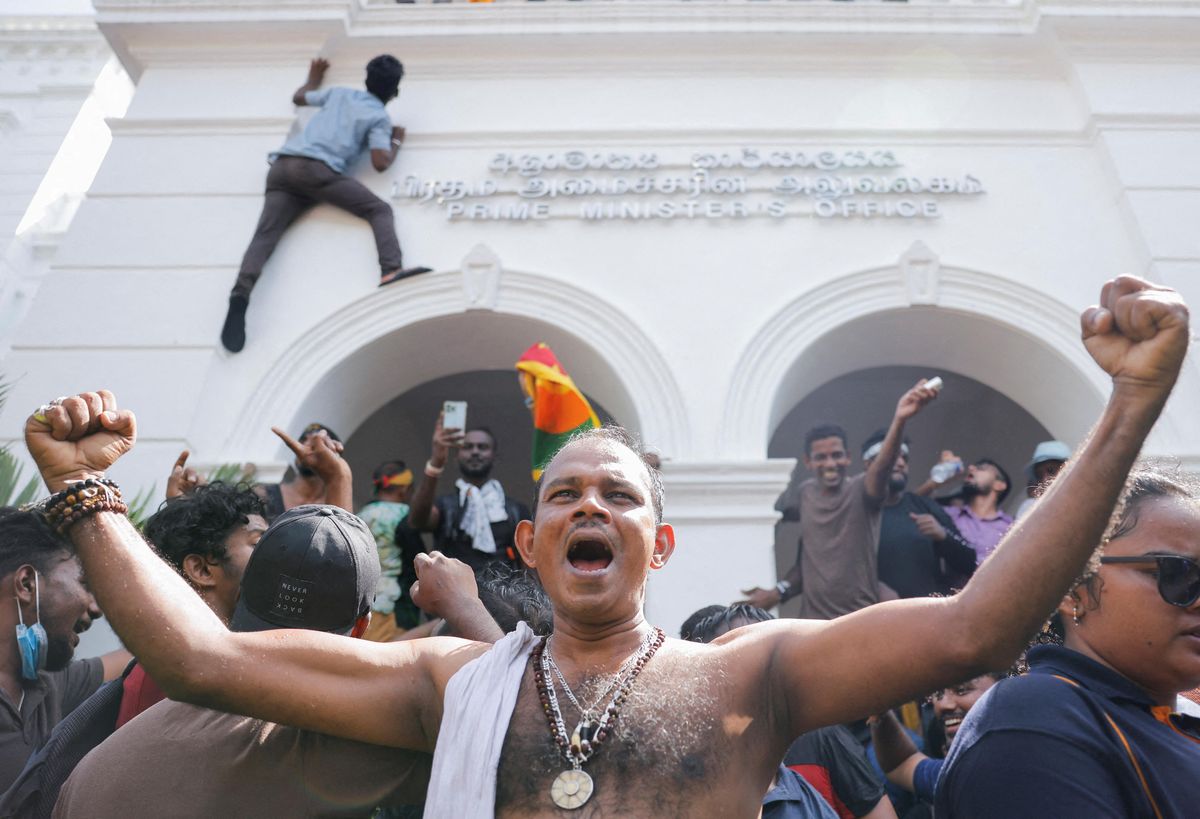
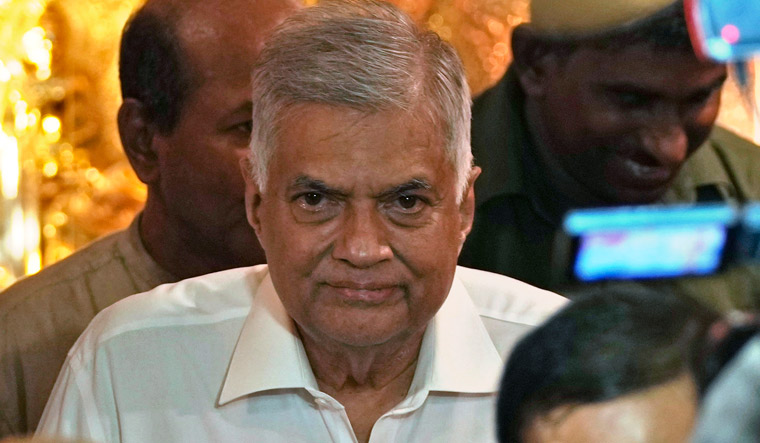 Sri Lanka’s new Prime Minister Ranil Wickremesinghe | AP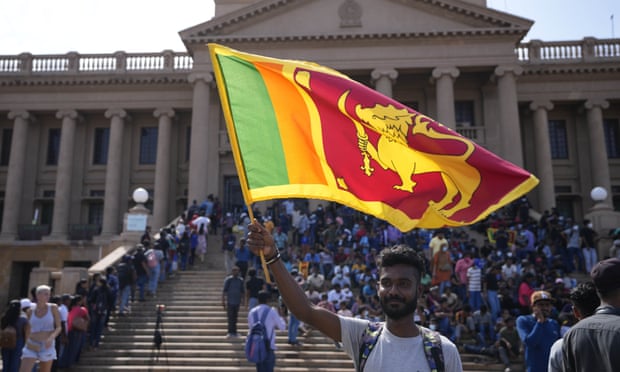
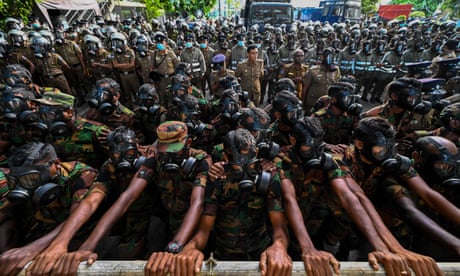


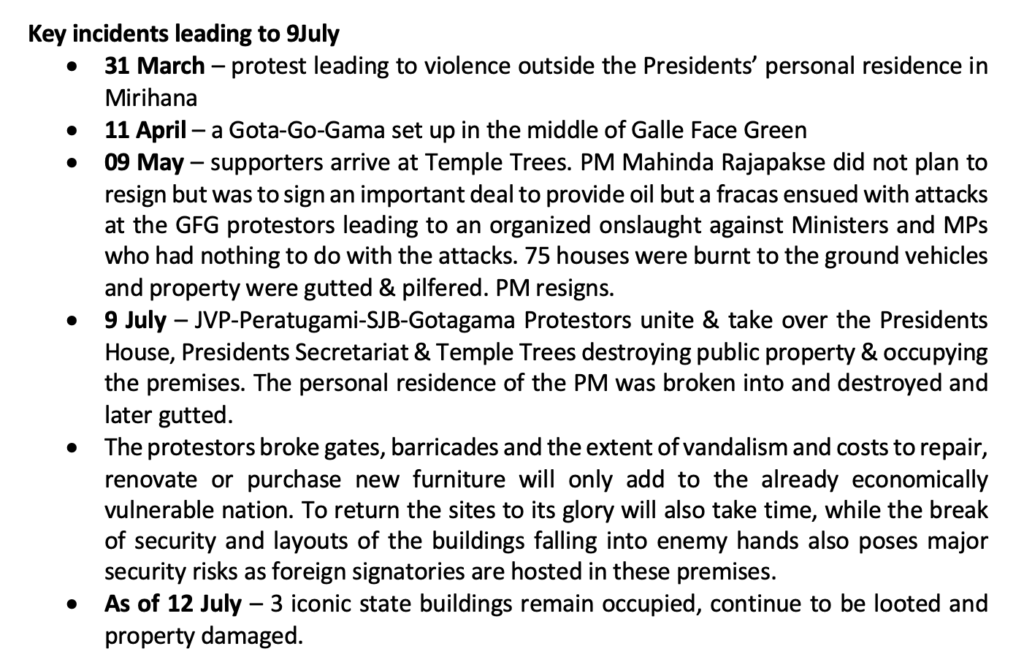
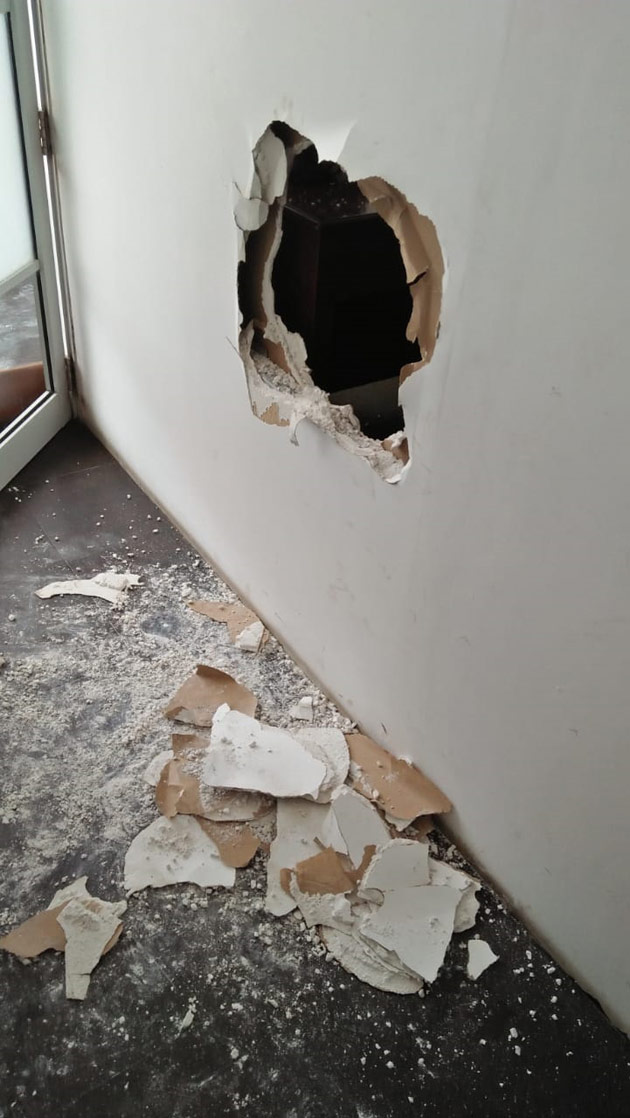
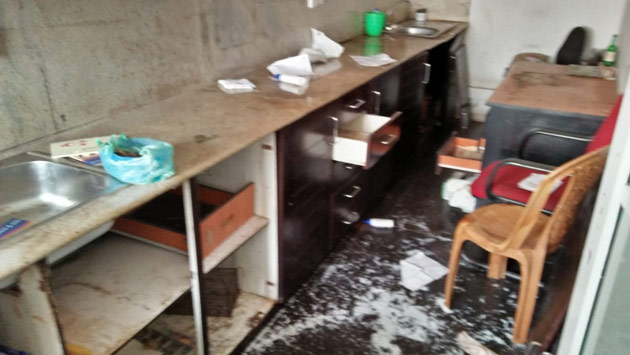
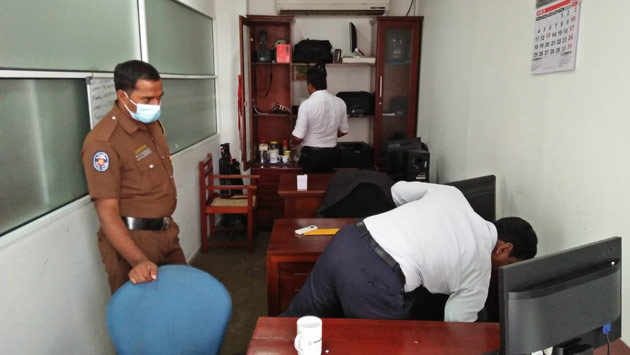
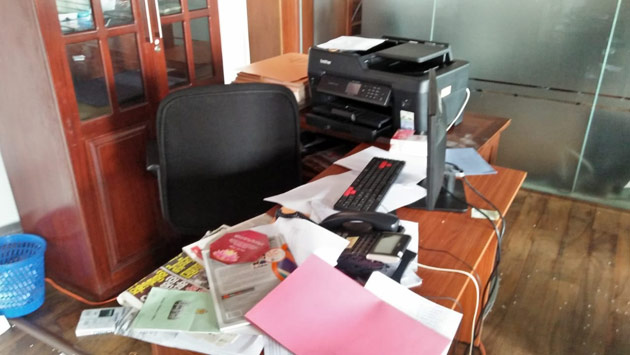
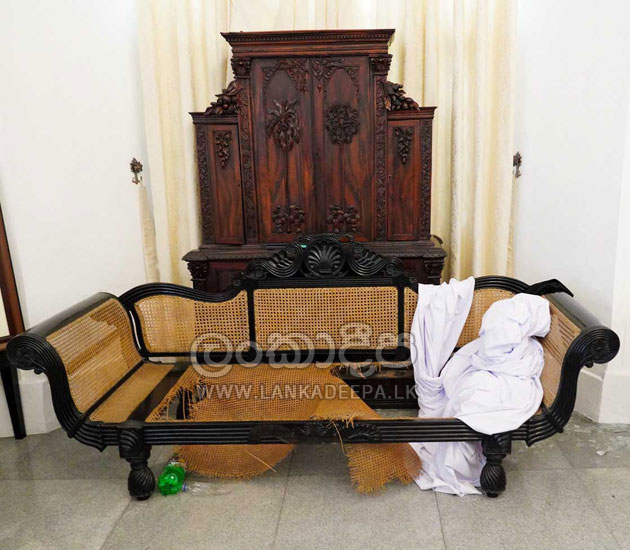
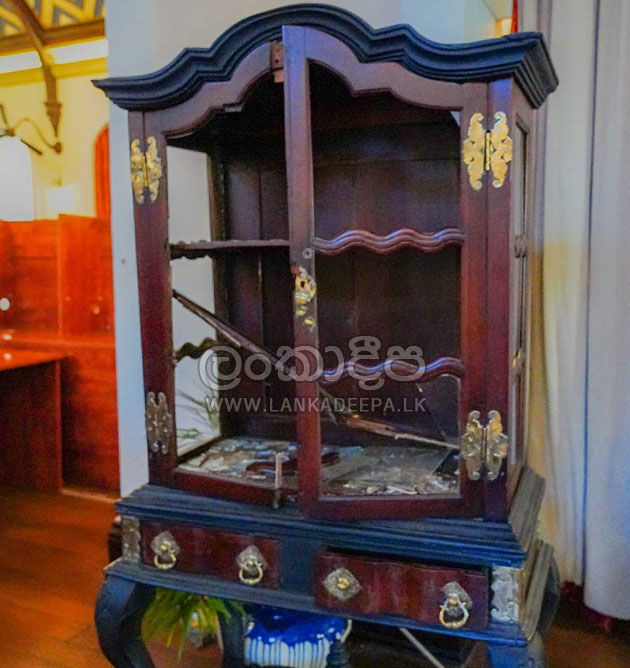
 Gotabaya Rajapaksa fled his residence in Colombo just before tens of thousands of protesters overran it Photo: AFP / Arun SANKAR