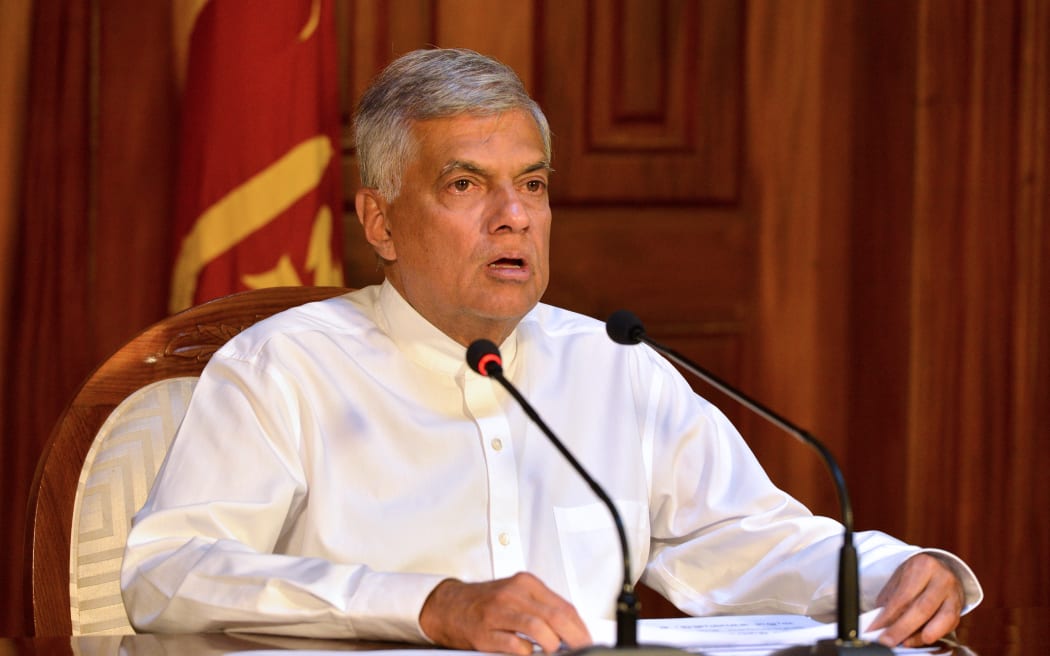
The new Sri Lankan PM, Ranil Wickremesinghe, on Saturday said that a committee has been appointed to look after the interests of the ‘Gota Go Home’ protesters who have been camping at Colombo’s Galle Face Green since April 9.
In an unusual move, Sri Lanka’s new Prime Minister Ranil Wickremesinghe has extended public support to the protesters, who have been camping at a popular beachfront here for over a month calling for President Gotabaya Rajapaksa’s resignation for mishandling the country’s worst economic crisis.
The Prime Minister on Saturday said he had appointed a committee to look after the interests of the ‘Gota Go Home’ village protesters who have been camping at Colombo’s Galle Face Green since April 9.
Wickremesinghe, who was appointed by President Gotabaya Rajapaksa as Prime Minister after asking his elder brother Mahinda Rajapaksa to quit, said the young protesters in the village would be safeguarded and their views would be sought for the shaping of future policy.
In an interview with the BBC Sinhala Service, the Prime Minister said the ‘Gota Go Gama’ protest should be continued to bring a change in the political system in the country and let the country’s youth take the responsibility for leading.
Wickremesinghe, the 73-year-old United National Party (UNP) leader, was appointed as Sri Lanka’s 26th prime minister on Thursday as the country has been without a government since Monday when prime minister Mahinda Rajapaksa resigned after violence erupted following an attack on the anti-government protesters by his supporters.
The attack triggered widespread violence against Rajapaksa loyalists, leaving nine people dead and wounding over 200 others.
Rajapaksa’s Sri Lanka Podujana Peramuna Party (SLPP) has extended their support to Wickremesinghe and almost all parties represented in the 225-member Parliament have said although they wouldn’t be a party to Wickremesinghe’s government, they would support him in his effort to pull Sri Lanka out of the current economic crisis.
Political sources said two more ministers are to be appointed to the interim Cabinet on Sunday. Rajapaksa appointed four of them on Saturday.
At least 78 parliamentarians, including the former prime minister Mahinda Rajapaksa, faced arson attacks on their private properties during the unrest on May 9.
At the government parliamentary group meeting held on Saturday, the attendance was low as parliamentarians still fear for their lives despite the imposition of a curfew.
Those present blamed the Inspector General of Police for what they alleged was “police inaction” to prevent arson attacks on the properties of government parliamentarians. Sri Lanka is going through the worst economic crisis since independence in 1948.
A crippling shortage of foreign reserves has led to long queues for fuel, cooking gas and other essentials, while power cuts and soaring food prices have heaped misery on people.
The economic crisis also triggered a political crisis in Sri Lanka and a demand for the resignation of the powerful Rajapaksas.
President Rajapaksa sacked his Cabinet and appointed a younger Cabinet as a response to the demand for his resignation. A continuous protest opposite his secretariat has now gone on for well over a month.
Wickremesinghe appoints committee to look after interests of ‘Gota Go Home’ leaders camping at Colombo’s Galle Face Green since April 9.
In an unusual move, Sri Lanka’s new Prime Minister Ranil Wickremesinghe has extended public support to the protesters, who have been camping at a popular beachfront here for over a month calling for President Gotabaya Rajapaksa’s resignation for mishandling the country’s worst economic crisis.
Appointment of a new prime minister in Sri Lanka has failed to appease anti-government protesters demanding the resignation of the president for the country’s disastrous economic crisis.Advertisement
The Prime Minister on Saturday said he had appointed a committee to look after the interests of the ‘Gota Go Home’ village protesters who have been camping at Colombo’s Galle Face Green since April 9.
Wickremesinghe, who was appointed by President Gotabaya Rajapaksa as Prime Minister after asking his elder brother Mahinda Rajapaksa to quit, said the young protesters in the village would be safeguarded and their views would be sought for the shaping of future policy.
In an interview with the BBC Sinhala Service, the Prime Minister said the ‘Gota Go Gama’ protest should be continued to bring a change in the political system in the country and let the country’s youth take the responsibility to lead.
Wickremesinghe, the 73-year-old United National Party (UNP) leader, was appointed as Sri Lanka’s 26th prime minister on Thursday as the country was without a government since Monday when prime minister Mahinda Rajapaksa resigned after violence erupted following an attack on the anti-government protesters by his supporters.
Rajapaksa’s Sri Lanka Podujana Peramuna Party (SLPP) has extended their support to Wickremesinghe and almost all parties represented in the 225-member Parliament have said although they wouldn’t be a party to Wickremesinghe’s government they would support him in his effort to pull Sri Lanka out of the current economic crisis.
Political sources said two more ministers are to be appointed to the interim Cabinet on Sunday. Rajapaksa appointed four of them on Saturday.
At least 78 parliamentarians, including the former prime minister Mahinda Rajapaksa, had faced arson attacks on their private properties during the unrest on May 9.
At the government parliamentary group meeting held on Saturday, the attendance was low as parliamentarians still fear for their lives despite the imposition of curfew.
Those present blamed the Inspector General of Police for what they alleged as “police inaction” to prevent arson attacks on the properties of government parliamentarians.
Sri Lanka is going through the worst economic crisis since independence in 1948.
A crippling shortage of foreign reserves has led to long queues for fuel, cooking gas and other essentials while power cuts and soaring food prices heaped misery on the people.
The economic crisis also triggered a political crisis in Sri Lanka and a demand for the resignation of the powerful Rajapaksas.
President Rajapaksa sacked his Cabinet and appointed a younger Cabinet as a response to the demand for his resignation. A continuous protest opposite his secretariat has now gone on for well over a month.
JVP General Secretary Tilva Silva yesterday (10) said that Opposition Leader Sajith Premadasa shouldn’t have visited Galle Face during the SLPP goons attacks on protesters.
Silva was commenting on protesters attacking the SJP leader and his colleagues as they walked towards the crowds.
The JVP General Secretary said so addressing the media at the party headquarters in Pelawatte.
Everybody should be careful. People hate to see politicians travelling in luxury cars with security contingents. People detested the politicians’ attitude of trying to stay above them. The Opposition Leader went there in his luxury vehicles with his security guards and henchmen. So, he had to face the wrath of the people.
Go and see what happens on the roads. Angry people stop only luxury vehicles. They have a reasonable anger against them because they know that they have to live without food because the politicians and their officials travel in those petrol guzzlers.
The Opposition leader should know where he should go. On the other hand, the prevailing public anger is also against him,” Silva said.
Asked to comment on his party leaders visiting Galle Face and coming out without incidents, Silva said: Our party has been there right from the beginning. We have our youth, cultural, student and women wings at the Galle Face. Our leaders did not go there because we did not want to stamp our seal on a people’s struggle. We are part of that struggle. Yet, there was an incident when the SLPP set its goons on the struggle. So, our leaders had to rush there. Leaders have to do that. Our leaders did not go there with escorts of security and VIP vehicles. We went there and saw what happened and supported them in whatever possible manner and left that place. We did not go there to mark our presence. The Opposition Leader and others have been rejected by the people because they too are responsible for the crisis, and on the other hand their intentions are to score political points.”
SLFP Leader Maithripala Sirisena has written to Prime Minister Ranil Wickremesinghe today saying the SLFP will support forming a new government with Wickremesinghe, senior sources said.
In the letter, Sirisena said party members had sought a meeting with Wickremesinghe and a time and date are now being worked out for the discussions.
So far the SLPP and SLFP have pledged support to Wickremesinghe with political sources saying discussions were also ongoing with the 11 party alliance members and opposition political groups. (Jamila Husain)
Four suspects have been arrested on charges of the murder of MP Amarakeerthi Athukorala and his security officer during the recent unrest earlier this week.
The arrests were made today (May 15).
Two of the accused have been handed over to the Criminal Investigation Department for further investigations.
The other two were produced before the Attanagalle Magistrate’s Court today.
Sri Lanka Police says it has arrested a total of 230 suspects in connection with curfew violations, looting, assaults, public and private property damages and other offences following the unrest that broke out on the 9th of May.
According to police spokesperson, 68 of the arrestees are currently in remand custody.
In a statement, SSP Nihal Thalduwa said 71 suspects were arrested in the Western Province, 43 in the Southern Province, 17 in the Central Province, 36 in the North-western Province, 47 in the North-central Province, 13 in Sabaragamuwa Province, one in Northern Province and two from Uva Province.
Since early 2020, the Gotabaya Rajapaksa government appeared to implement a plan with several components for the external sector. These components included securing of multi-lateral and bi-lateral loans, monetization of selected assets, obtaining Central Bank SWAPs, promoting Hambantota Industrial & Pharmaceutical Zones, Colombo Port City and other FDIs, and increasing non-debt inflows, remittances and exports. That plan did not contemplate an IMF programme. That official government stance was well known and in place until the President announced that he was seeking an IMF programme on 15th March 2022.
It will also be noted that those who were constantly urging the Government to seek an IMF programme, were claiming that Sri Lanka would then be able to access funding of about USD 3,000 million via an IMF programme and other borrowings.
In that background, it would be helpful to assess what was achieved by the Sri Lankan authorities in the last year through the alternative strategies, without an IMF programme.
The analysis of publicly available data shows that the Government secured forex cash loans of almost USD 1,300 million from the China Development Bank, while the CBSL obtained a SWAP of USD 1,550 million from the Peoples Bank of China.
The CBSL also secured bridging finance” of over USD 1,500 million from India through the postponement of the Asian Clearing Union (ACU) settlements and a further SWAP of USD 400 million from the Reserve Bank of India.
In addition, another SWAP from the Bangladesh Bank was obtained for USD 200 million.
All those inflows added up to USD 4,950 million.
In fact, it was by using these new funds, and the brought forward reserves of the CBSL that the 3 ISBs totalling USD 2,500 million in 2020, 2021 and 2022 plus other maturing debt had been
settled, while also providing significant liquidity support of nearly USD 2,000 million to the State Banks, and forex for urgent essential imports of around USD 1,500 million for food, fuel, gas, coal, medicines, etc.
In addition, the Government finalized a trade credit line of USD 1,000 million for oil imports and USD 1,000 million for other essential imports from India and these facilities have already been accessed from late March 2022 onwards.
Further, based on an appeal from the Sri Lankan President to the Chinese President in January 2022, China had also indicated that it was ready to arrange USD 1,000 million as a liquid finance facility and USD 1,500 million for import financing. In fact, that was officially referred to by China’s Ambassador in Sri Lanka on 17th March 2022 and Sri Lanka’s Ambassador in China on 12th April 2022. On the basis of the above assurances from China and India, further commitments of USD 4,500 million were also assured.
In addition, it has also been reported at intervals that negotiations with several other Middle Eastern Governments and Central Banks were also on-going and although by the end March 2022, those had not been successful, some of those engagements may still have potential for success in the future.
It may also be noted that the Government’s effort to raise USD 250 million from the partial divestment of West Coast Power, and a further USD 100 million from the partial divestment of the Eastern Terminal of the new Colombo Port, did not bear fruit due to political reasons, although that was also a part of the Government’s plan to raise non-debt inflows.
It may also be noted that the secondary market for Sri Lankan ISBs was trading at highly elevated levels throughout 2020 and 2021, and it is very unlikely that the Government would have been able to access funds from the international bond markets during that Covid-stricken period, even atexorbitantly high interest rates. Hence, obtaining funds at low single-digit interest rates from bi-lateral sources was the better option, if not the only option, from that point of view as well.
In any event, in the light of the materialised receipts of USD 4,950 million and credible commitments of USD 4,500 million, the decision taken by the Government to pursue its stated path could be justified, since the option of bilateral support and other declared strategies was a lot less controversial and risky than pursuing a tough IMF programme that could have been quite painful to the people (high taxes and interest rates, depreciated currency, sale of national assets, etc) and long-drawn out.
In fact, the situation would have been grave from about a year ago, if the aforementioned forex inflows had not been arranged by the authorities and the commitments not obtained, whilst only relying on a possible IMF programme, which could have been delayed or dragged on for whatever reason, even if the IMF had been approached an year earlier.
It must also not be forgotten that it was during the period 2015-2019, while following an IMF programme, that the then Government issued an additional net USD 10,000 million of ISBs which could be termed the origin of the current external debt problem.
As a direct consequence, the Government’s external debt shot up by 65% and forex debt servicing tripled, while the GDP was almost stagnant at around the USD 80 to 84 billion levels.
Sri Lanka’s external debt problem was further aggravated from 2020 onwards, by about USD 4.5 billion of the country’s annual forex inflows suddenly drying up due to the collapse in tourism, and about USD 1.5 billion reducing in 2021, due to the Hawala proliferation affecting Workers remittances.
In any event, it must be clearly understood that seeking a programme with the IMF is a decision to be taken by the Cabinet of Ministers, and not by officials. If the Cabinet had taken a policy decision one year or even two years ago to approach the IMF and informed the country of the Government’s intention to do so, the entire governmental machinery including the CBSL and MOF would have complied with that decision. In fact, that happened on 15th March 2022, when the President made the official announcement that the Government would seek an IMF programme.
Unfortunately, the true situation has been misinterpreted, which explains why the blame is being pinned on the former Governors of the Central Bank, former Secretary to the President, and former Secretary to the Treasury as being responsible” for Sri Lanka not embarking on an IMF programme. They seem to have forgotten that such a decision should have been taken by the Cabinet of Ministers, and not by officials.
In any event, even at this stage, it may be useful for those persons to familiarize themselves with case studies of past IMF programmes” in similar circumstances in other countries, as well as understand the repercussions of sovereign debt default”. They should probably do that before hailing a possible “IMF programme” and the sovereign debt default” as Sri Lanka’s new panacea for all ills.
It may still be possible that those steps which are today being hailed, may be the very cause of a very serious, irretrievable and unmanageable economic and social outcome that may haunt Sri Lanka for a long time to come.
Dr. Chula Rajapakse MNZM United Sri Lanka Association.
To:
Hon Nanaia Mahuta,
Minister of Foreign Affairs,
Ministry of Foreign Affairs .
NZ Parliament.
Dear Minister,
I am writing to say how pleased I was to read your tweet and that of NZ High Commissioner in Colombo, informing us of your decision to make the above donation to help Sri Lanka in it’s hour of need.
It makes me immensely proud, as a New Zealander of Sri Lankan origin, that despite being a small nation and economy, New Zealand has been the first cab off the rank, from among western nations, to come to Sri Lanka’s aid in it’s current crisis. You have also chosen a group in Sri Lanka that has been significantly affected currently, demonstrating not only your concern but also of your being well informed of SL’s current needs.
My mind goes back to the 2004 Asian Tsunami, when New Zealand, then under PM Helen Clark, was again a most prominent & generous donor that enabled our association to build 60 brand new homes of SL’s western coast to replace 60 destroyed by the tsunami.
I haven doubt with these thanks and reflections , I am also reflecting the thoughts of many thousands of Sri Lankan origin, who now call New Zealand, home.
Permit me also to record our appreciation of the efforts of the Sri Lankan born MP in the NZ parliament, Vanushi Walters, who I know, has been advocating very vigorously to help Sri Lanka. This outcome , which though the first hopefully will not be the last, will no doubt please her too.
The Muslim Council of Sri Lanka wishes our Buddhist brethren peace and contentment on the auspicious day of Buddha Jayanthi (Vesak) where millions around the world follow the teachings of the Buddha and commemorate the birth, attainment of enlightenment and the passing away of the Buddha.
Vesak”, on the Day of the Full Moon in the month of May, is the most sacred day to millions of Buddhists around the world. It was on the Day of Vesak two and a half millennia ago, in the year 623 B.C., that the Buddha was born. It was also on the Day of Vesak that the Buddha attained enlightenment, and it was on the Day of Vesak that the Buddha in his eightieth year passed away.
We pray for peace and prosperity for all Sri Lankans and to get over the difficult social and economic crises that our country is facing.
We call upon all Sri Lankans to support the recovery efforts and austerity measures of the Government that may be necessary in the immediate term, reduce consumption to the minimum and help those in need with food and other basic essentials in keeping with the traditions of Vesak and the spirit of giving taught by all faiths practiced in Sri Lanka.
Crises prompt proposals for management, recovery and future prosperity. Of the many we’ve seen, perhaps on account of public profile, the set of proposals submitted by the Bar Association of Sri Lanka (BASL) is one which calls for serious consideration. Indeed, the BASL proposals have been approved by multiple political groups/individuals including the President and the main party in the Opposition, the Samagi Jana Balavegaya (SJB). What is offered here is a review. The BASL document is organised under three headings, background, objectives and proposals. Let us consider them in this order.
Background: Yes, the economic crisis is grave. The crisis however has little to do with the political architecture . The political unrest was spurred by the economic debacle which of course was exacerbated by horrendous policy decisions and brought to tipping point by the unleashing of goons by ruling party politicians in an exercise where the then Prime Minister is clearly culpable.
All this, however, has little to do with the alleged failures of the Executive Presidency as the BASL insists. The BASL believes that ‘meaningful parliamentary oversight’ would have done the trick. However, we’ve had presidential terms without such economic hardships even though there wasn’t any meaningful parliamentary oversight. On the other hand, there have been and there are countries without executive presidencies that have suffered and are suffering economic collapses. The ‘background’ as articulated by the BASL, appears more like a necessary preamble to shoot down the 20th Amendment which of course has its flaws.
The people are demanding a system change, the BASL claims.‘System change,’ though, was but a footnote in the agitational tract. The BASL speaks of constitutional amendments and institutional rearrangement. Good. Political stability. Yes. Calling for responsibility is fine too. Obtaining it is another matter. However, the BASL has sketched the situation decently enough.
Objectives: Let’s move to the five stated objectives: a) create political, economic and social stability in the country, b) create an environment to address the fundamental problems that have brought about the current crisis (and imperil future reforms), c) restructure external debt and enter into appropriate programmes with multilateral institutions including the IMF and for that purpose to appoint the financial and legal advisers and negotiate a debt standstill pending debt restructuring, d) obtain bridging finance [which] together with the savings arising from the debt standstill to be used to procure uninterrupted supply of essentials to the People until such time the debt restructuring, and the IMF program is in place, will eliminate the shortages in power, fuel, gas, medicines, food etc., and e) create an environment to combat corruption and to ensure accountability and strengthening independent institutions.
Of these, ‘a’, ‘b’ and ‘e’ are hard to object to. They are easily written as well. Everyone wants stability, everyone wants root causes addressed and everyone wants corruption ended, accountability ensured and independent institutions strengthened. The other two, ‘c’ and ‘d’ are the giveaways.
I can understand ‘economic recovery’ or ‘economic stability’ as an objective (which of course is already in ‘a’), but it is puzzling that the BASL thinks seeking IMF support is an objective. A suggested means to an end would have been defensible. More on the IMF (as per the specifics in the BASL proposals proper) later.
Proposals: The proposals are framed by a clearly stated ‘overarching requirement,’ viz a stable Government with the ability to implement reforms domestically and the ability / credibility to negotiate with the IMF, other multilateral agencies, and friendly countries to help Sri Lanka get out of the economic crisis.’
The first part is almost intuitive. We do need political stability and a government capable of implementing domestic reforms. The second part is about seeking outside support, again understandable. Why the IMF though? And why is it an ‘overarching requirement’? Cannot the BASL see beyond the IMF? Is the BASL aware of what that particular path to salvation has resulted in? Surely the post-1977 history of Sri Lanka has taught all of us that the IMF is a) part of the system that got us into this mess, and b) is a problem and cannot be part of the solution? Is neoliberalism, discredited and proven untenable on multiple counts, some kind of overarching touch-me-not for the BASL? It would be interesting to know a) if the BASL sought and obtained advice from economists, and b) if so, who these economics are (as it is said, ‘before studying economics, study the economists).
Let’s move to the proposals proper. The first is a useful and important caveat. The BASL demands adherence to constitutional provisions. More critically, the BASL insists that ‘transitional provisions’ recommended not be used as precedent. If any of these proposals are worked into policy at this time, such caveats should be included and emphasised.
Proposals 2-6 relate to constitutional reform. Proposals 7 and 8 are about an interim operational architecture (logically, these should have preceded constitutional matters, given the initial and cautionary note). Number 9 refers to the Presidential Commission of Inquiry appointed to Investigate Allegations of Political Victimisation during the Yahapalanaya years. This seems to be a cherry-picked issue (a first year law student could come up with several dozens of issues similar to this). Proposals 10-12 are nuts and bolts stuff pertaining to a Common Minimum Program (CMP) put together by the the proposed ‘Cabinet of National Unity (CNU)’, in consultation with the proposed ‘Advisory Council’ which would be appointed as per Proposal No 8. The last, i.e. No 13, sets timelines: the duration of the ‘Government of National Unity’ and when parliamentary elections are to be held. Let’s consider these sets of proposals.
Constitutional Reform (Proposals 2-6) via a 21st amendment: With respect to immediate amendments, it’s essentially a matter of repealing the 20th Amendment and restoring the 19th while retaining the current number of judges in the higher courts. Provisions regarding the Constitutional Council (CC) and Independent Commissions (ICs) are to be complemented by, the BASL proposes, enhanced financial independence, transparency and accountability.
The following needs to be stated, if only parenthetically:
[The passage of the 19th Amendment made a mockery of judicial review and set a very bad precedent which, interestingly, was not leveraged in the passage of the 20th Amendment. An article published in the Daily Mirror on the 21st of February, 2019 titled ‘Constitutional Council and the poverty of independence, intellect and integrity’ elaborates on this. Then there’s also the issue of dual-citizenship. The 19th effectively blocked dual-citizens and the 20th removed it. The former was politically motivated and the latter too. The fact remains that this country has been wrecked by citizens as well as dual citizens. Most importantly, those in whose hands the BASL, among others, wants to put the country and its future, the IMF, is not run by citizens or even dual-citizens but foreigners].
The BASL has ignored completely the fact that the composition of the CC completely reneges on the spirit of the 19th Amendment, i.e. clipping the wings of the President and inserting independent oversight. Seven out of the ten members were to be parliamentarians. The other three, nominated jointly by the Leader of the Opposition and Prime Minister were to be ‘persons of eminence and integrity who have distinguished themselves in public or professional life and are not members of any political party.’ The majority of ‘independents’ who sat on the CCs from the time the 19th was operationalised were ideologically/politically aligned with the then ruling coalition. In effect then, the CC of the 19th Amendment was no better than the Parliamentary Council of the 18th Amendment (which of course was an even worse piece of legislation for other reasons).
The CC, then, would inevitably be a slanted body. The impartiality of the ICs that the CC sets up, would be, again, inevitably compromised. We know in hindsight that the conduct of the various CCs in appointing ICs was marked by political bias and incompetence. Independence (or otherwise) is dependent on the process of selection and if the composition of the CC and the constitutionally sanctioned process are flawed, it is hard to obtain. The BASL ought to have paid more attention to the relevant clauses of the 19th Amendment.
Next the BASL suggests additions. Necessitating approval of the CC for appointments of the Governor of the Central Bank and the Monetary Board, certainly broadens the process. This is not necessarily a bad thing except, as mentioned, the CC as per the 19th is necessarily a politically compromised body. If the composition issue is fixed, then it’s fine, one could argue. Then again, why only the Governor and the Monetary Board? How about the Attorney-General, the Auditor-General and heads of similar institutions? The BASL need not have been selectively specific. The proposal could have been worded in general terms to cover all such posts. On the other hand, why leave it to the whims and fancies of a group of people oddly chosen? Couldn’t the BASL have proposed the setting up of robust mechanisms to affirm meritocracy?
The last sub-proposal, that of the CC-recommended body recommending presidential pardons, seems to have been hurriedly inserted. There is already an established procedure for presidential pardons. A revisit wouldn’t have harm. Shifting the power to give the final green light from the president to some other body would make the term ‘presidential pardon’ ridiculous. One wonders if the BASL took into consideration all the powers of the Executive Presidency or responded to what the BASL knows about or what has had media traction over the past few years.
Next (No 4) comes appointments of ministerial secretaries and the ICs. These are routine exercises. No 5 forbids the President from holding [cabinet] portfolios. Since the 21st seeks to turn the President (who, by the way, secured way more votes than any politician in Parliament and, unlike anyone in the ICs and the three independent members of the CC, is accountable to the people of the country) into a rubber-stamper of the new executive arrangement (Prime Minister and Cabinet), this makes sense. It, however, violates the entire spirit of the current Constitution. Ideally a new constitution or abolition of the executive presidency (which the BASL recommends and which we will discuss presently) should precede these kinds of changes which, essentially, amount to constitutional tinkering. It is also disconcerting that the BASL has not taken issue with the fact that ‘National Government’ as per the 19th Amendment remains undefined. The problems of this vagueness came to the fore during the Yahapalana dispensation, especially at the time of the parliamentary crisis in 2018. No 6 sets a timeline for abolishing the Executive Presidency. It may require a referendum though since the incumbent was elected by the people. The Supreme Court would have a say, no doubt. Attributing all ills to the Executive Presidency is downright silly. Curtailing of presidential powers is defensible, but calling for the abolishing the office without addressing important safeguards embedded in the Executive Presidency on other matters amounts to gross negligence. The BASL appears to be unaware of the implications in relation to the (illegally ‘enacted’) 13th Amendment. If the BASL had proposed relevant caveats/amendments or even a repeal of the 13th, the demand could be half-way legitimate. They have not. Indeed, if the BASL proposal is implemented as is, it opens the path not to federalism but to separation. The BASL has not addressed this serious issue.
Now, is an executive presidency by definition made for error and curtailing of freedoms? Are systems that do not have executive presidencies necessarily better and do they ensure countries don’t go bankrupt and are insured against political crises? It’s all about checks and balances, but these need to be discussed and carefully crafted. The BASL has not proposed any new checks and balances. They have gone with what they, erroneously, believe to be a fantastic piece of legislation, the 19th Amendment. They are so wrong.
The operational architecture (Proposals 7-9): ‘The immediate’ is laid out in Proposal No 7. The BASL proposes a cabinet of 15 ministers in an Interim Government of National Unity. The swearing in of Ranil Wickremesinghe has of course scuttled the idea of unity. The BASL proposes that in the absence of ‘unity’ a vacancy be created to shoo-in an outsider. We are no longer talking about legitimacy and mandate given ‘exigencies of the situation,’ so this could also be considered. If Wickremesinghe’s government collapses that might be an option that will be brought back into the discussion. Overall, there’s nothing seriously wrong with No 7.
Number Eight is where the BASL does itself the greatest disservice. Here, the BASL proposes an independent Advisory Council (AC) consisting of 15 qualified professionals from disciplines corresponding to the 15 ministries. The BASL insists, ‘All major policy decisions of the Government to be taken in consultation with the Advisory Council in a transparent manner.’
What is this Advisory Council? The BASL says the AC will be appointed following consultation between the Interim Government and ‘all relevant, independent, apolitical professional/trade/civil society organisations.’ Is the BASL going to guarantee relevance, independence, the apolitical nature of these organisations and the people who run them? And to whom, pray, are these organisations and their bosses answerable? Certainly not the people of this country.
We have seen what ‘advisors’ can do. We have seen what additional centers of administrative authority can do to the institutional arrangement and the institutions therein. Pundits and punditry are ace put-offs. We do have an administrative service and therefore each ministry will have a secretary with specific functions. Where needed, there is provision for such individuals to obtain advice from relevant experts. At the end of the day, if the BASL proposals are implemented, ’experts’ will call the shots but they won’t land anywhere close to the intended target.
The ninth proposal seeks the Special Presidential Commission of Inquiry mandated to investigate allegations of political victimisation rescinded. Implied here is that the BASL believes there was no victimisation whatsoever during the Yahapalana years. However, if one assumes that the BASL, although this is not spelled out, objects to the possibility of witch-hunts, Number 9 makes sense. The BASL could have gone beyond this measure and insisted on provisions to ensure that such witch-hunts don’t get off the ground.
The Program (Proposes 10-13): Number 10 is about preparing a ‘Common Minimum Program (CMP)’. The Cabinet is required to design this in collaboration with the AC. Even if we assumed (and we are being generous here) that the AC is ‘independent’ and have ‘expertise,’ the BASL essentially straight-jackets the AC and the Cabinet by way of an operational framework.
The CMP ‘conditions’ have some valid features such as enacting necessary amendments to the Monetary Law, strengthening the independence of the Central Bank, immediate resolution of the shortages of essential goods and services, upholding the Rule of Law, recovery of state assets, campaign finance, declaration of assets and liabilities, revisiting the Prevention of Terrorism Act, timeframes for elections etc. Essentially the BASL wants problems alleviated, fiscal discipline, professionalism and accountability. The BASL stops short of demanding better measures to audit one and all, not just politicians the President downwards, but, say, professionals such as lawyers, doctors, tuition teachers etc. Yes, those are ‘details,’ but then again in this document the BASL does fiddle with details on occasion.
The meat of the BASL brief with regard to the CMP is economic. Again, the IMF is seen as a saviour. Not surprisingly the BASL wants to sell off state assets. It’s perfectly fine to ensure that awarding of tenders is conducted in a transparent manner. Such procedural caveats are good. However, the BASL does not seem to understand or care about the fact that the IMF is a part of the system, that the Bretton Woods institutions keep systems/countries on the edge, ensure scandalous value appropriation by a few at the cost of disempowering the vast majority of the particular population.
Number 11 proposes that the CMP must include the abolition of the Executive Presidency. We’ve discussed the matter above. Number 12 insists that the Interim Government presents a budget based on the CMP. This goes without saying and in the saying we will have all the problems raised above adequately mirrored. It cannot be a pretty picture.
The last proposal is about the tenure of the Government of National Unity, 18 months. So, the incumbent president will be out in 15 months, and as things stand Ranil Wickremesinghe would have free rein for three months plus six weeks as head of a caretaker government overseeing General Elections. Enough time to obtain a decisive edge over political rivals. An insurance policy written for a preferred political force, then? The BASL could have done better.
Conclusion: Taken as a whole, the BASL proposals have merits and demerits. That they were accepted without reservation by political groups such as the Samagi Jana Balavegaya says a lot about the seriousness of that political party and anyone else which doffed hats to the BASL. All that said, it is worthy of study, but only if it is considered to be nothing more than a ‘discussion paper’ for a program that seeks to resolve the multiple crises Sri Lanka is ridden with. An uncritical embrace would be out of order. malindadocs@gmail.com
[Malinda Seneviratne is the Director/CEO of the Hector Kobbekaduwa Agrarian Research and Training Institute. These are his personal views.]
Whatever the aspiration of the protesters in Sri Lanka, the chaos they created has caused the messiah to appear in the form of the IMF. For the IMF to be effective, it needed a government it could vibe with. That there could not have been a better choice for the job of Prime Minister than Ranil Wickremesinghe became clear as daylight the moment he was sworn in.
Ranil Wickremesinghe’s appointment and the quick formation of an inclusive government are first steps in addressing the crisis and promoting stability. We encourage meaningful progress at the IMF and long term solutions that meet the needs of all Sri Lanka.”
This instant approval of RW is by US Ambassador Julie Chung.
She knows RW as someone who has always been supportive of American presence in Sri Lanka in every shape and form. He clashed with President Srisena who was not inclined to sign the Status of Forces agreement exactly as the Americans wanted. There can be no better candidate for such abject surrender than someone as politically weak as RW. His UNP was decimated in the last elections and he did not win a single seat.
This is farcical democracy with the military on the roads and people under curfew” wrote Activist Social Scientist, Dr. Darini Rajasingham Senanayake.
RW’s appointment has been greeted with dismay across the board. For political oxygen he was seen prostrating before hawkish Sinhala clergy who would bless the US presence to eliminate Chinese presence from the island. China is on their wrong side because of Tibet. This wing of the clergy is also happy with India for having created the Union Territory of Ladakh by bifurcating Kashmir. There were celebrations in their Viharas when the Union territory was created.
This is all part of the comeback that the US is staging in South Asia after the excruciatingly painful debacle in Afghanistan in August. Even that may not have been such a humiliating retreat in retrospect. President Vladimir Putin’s adviser, Valery Fadeyev told me as much in the course of an hour long zoom interview last week. Who knows, he said, the US may have simply transferred power to the Taleban.
Sometimes political shifts alter geography as well. After 1947 Indian diplomacy, to a large extent, consisted in neutralizing Pakistan everywhere. With the creation of Bangladesh in 1971, the geography of South Asia changed. India become a large country surrounded by small ones. These countries, in concert, began to balance power by flourishing a Chinese card in their pocket. It was to neutralize this card that Atal Behari Vajpayee, as External Affairs Minister, made what he thought would be an epoch making visit to China in 1979. Den Xiaoping had other priorities: he had just launched his four modernizations in 1978. A somewhat charged up Deng decided to teach Vietnam a lesson” in 1979, same year as Vajpayee’s visit.
The visit was something of a disaster. Later, several Prime Ministers, including Vajpayee visited Beijing. Bilateral relations were up and down but the border, viewed from two different perspectives, remained insoluble.
The collapse of the Soviet Union in 1990-91 provided the US with is Sole Super Power moment. Manmohan Singh’s economic reform 1991 onwards brought India in line with the US on many issues. It is forgotten that Narendra Modi’s arrival in Gujarat on 7 October, 2001 to take over from Keshu Bhai, coincided with the US fireworks in Afghanistan in pursuit of Osama bin Laden. It electrified Hindutva.
Islamophobia was the flavor of the season when the Godhara disaster leading to an anti Muslim pogrom of February 2002 happened. There was perfect harmony between the Bush-Blair Islamophobia and our communalism. Intelligence agencies kissed each other and became chums sharing or creating data on terrorists.
The US began to look in weak health after the collapse of Lehman Brothers in 2008. What magnified American decline was the corresponding rise of China. With diligence and with Chinese help, Vladimir Putin build Russia up into a power which it is today.
China-Russia declaration of friendship without limits”, set the cat among the pigeon, in the Western camp. Just about this time came the humiliating images from Afghanistan.
The American century was a pipedream. The US was in retreat. Even steady camp followers like India began to cultivate other options. Yes, we were in the Quad but then what is this exclusive Anglo Saxon club called AUKUS? How reliable is the US?
India’s balanced votes in the UN on Ukraine are clear indications of diminishing faith in a policy of relying too much on one power.
The image of a tennis racket comes to mind to understand how New Delhi may have felt when the US left Afghanistan. Imagine the wiring of the racket as Afghanistan where once the American presence gave New Delhi comfort. Taleb-Pakistan nexus was the Indian nightmare.
Post American departure, Iran, Turkmenistan, Uzbekistan, Tajikistan, China and Russia are all peering into Afghanistan. India is somewhere at the throat, joining the shaft to the rim or frame. The US has gone beyond two oceans. This altered Geography was disconcerting, a pressure on New Delhi to live in peace with neighbours, even the ones with border issues.
Pakistan is part of our internal politics, just as India is Pakistan’s. We need communal temperatures on tepid heat for the national mood to be boosted to a feverish pitch when required by, say, a Balakot. Remember Love Jihad, beef, hijab, stone pelting from mosques keeps the mood in a saffron hue. The national mood is galvanized only when communalism is tied to nationalism. In other word for big game hunting Kashmir and Pakistan are required as issues. Settlement of Kashmir or peace with Pakistan is not in our interest atleast until 2024.
So, we are relieved that the Americans are making a comeback in South Asia, first Pakistan, now Sri Lanka, next……… The people in these countries can stand in long queues till eternity because there is neither food in the shops nor petrol in the pumps.
The phoenix is an immortal bird associated with Greek mythology (with analogs in many cultures) that cyclically regenerates or is otherwise born again. Associated with the sun, a phoenix obtains new life by arising from the ashes of its predecessor. Some legends say it dies in a show of flames and combustion, others that it simply dies and decomposes before being born again -Wikipedia
Sri Lanka’s political equivalent to the mythological Phoenix, Ranil Wickremasinghe, has risen again to become the Prime Minister of the country for the sixth time. The challenge before him on this occasion perhaps is the biggest that he will encounter and his ability to deliver some redress to the country now in economic ruin and social disarray will surely test his mettle as a leader.
He comes back to the hall of power with strange credentials. He is the only UNP member of the Parliament and that too from its national list. The UNP he led at the last election polled less than 250,000 notes nationally and did not win a single seat. Wickremasinghe himself did not get elected. He still leads the party, and has done so since 1994 and he and his party have lost all elections they contested bar two.
In terms of his economic management credentials, during his time as the Prime Minister from 2015 to 2019, and with constitutional powers vested in the Prime Minister and the Parliament under the 19th amendment, he presided over a less than impressive economic performance that saw the GDP growth falling from nearly 7% when he took office, to 2.75% when he left office. Similarly, what now has come to sink the country, the foreign debt as a percentage of GDP increased from 70% to 96% when he left office. It is reported that the component within this debt that is the rope that is strangling the country, the International Sovereign Bond component, rose from USD 5 Billion in 2015 to USD 17 Billion by 2019.
Wickremasinghe takes office within the backdrop of the worst economic situation the country has ever faced, which he too has never faced, and takes on a massively daunting task to initially provide relief to millions of people whose life has been so adversely affected, so much so that they collectively feel they cannot fall further into an abyss as they already are in one without a bottom.
His task has been made even more daunting considering that he will not be leading a multi-party government that includes the SJB, JVP, the SLFP and the 11 independents who have placed their parties above the interests of the country. The SLPP has assured support although whether this is the entirety of the SLPP is not yet known. All parties however have assured Wickremasinghe their support for policies that are in the best interest of the country.
At this juncture, Wickremasinghe’s not so impressive credentials mentioned above and thus his weaknesses, could well be his strengths. The UNP is in doldrums, and it is unlikely it can make a comeback to the national limelight before the next election. This could be the first phase of such a comeback, but certainly will not be sufficient to elevate it past the SLPP, SLFP or the SJB, and of course the JVP. So, one could take it that the UNP leader has placed the country above his party and taken on this almost impossible and some say even suicidal task to bring some life back to a dying Sri Lanka.
Wickremasinghe also has an advantage in not having ministers in his cabinet from the SJB, SLFP and the JVP, and therefore a freer hand to operate and steer economic policies that could rejuvenate the country. He could, if he is wise as many seem to claim, seek advice and counsel from experts rather than politicians to guide the country’s destiny.
Some of his first acts point to the right direction. The immediacy and absolute urgency of finding solutions to overcome gas, diesel, medicine, and food shortages is one. Discussing the convening of a donor consortium with diplomatic heads from China, India, USA, UK amongst others is another.
As the writer mentioned in an earlier article, the chance of raising as much as a USD 10 billion donor funded relief package is within the realm of a possibility. This coupled with an IMF intervention to restructure the country’s debt, in particular the suffocating ISB debt, could be the basis to give life to the country and its people.
Wickremasinghe has also signaled clearly that he wishes for the Galle Face confab to continue. This is welcome. It has been incorrectly touted as a protest, although it did commence as one. It has now gone beyond that, and it is a venue for ideas on the future direction of the country. It is therefore a confab and not a protest, a word that can be misinterpreted and misunderstood easily. These types of civil confabs should be encouraged not just in Galle Face but throughout the country, so that the prevailing political system would change and a new system that stops producing the caliber of politicians who have brought the country to its knees is introduced.
Something the Prime Minister has not stated yet, but what he should advocate without interfering in the activities of the Central Bank that is responsible for monetary policy, is the question of currency stability. Consideration should be given to ending the floating of the rupee, an exchange rate fixed and to be reviewed every 6 months. Some amount of price stability of essential goods, a greater chance of more remittances flowing into the country could be the outcome of such a shift in policy.
These measures, if rightly handled and successful, will restore the confidence of possible investors, both overseas and local, the country’s export industry, and import substitution industries. Mr Wickremasinghe should not discount and overlook the many positive features and proposals contained in President Rajapaksa’s own election manifesto and not take a partisan attitude towards them. If he remains true to his stated objective of rising above politics to find solutions, he should consider these and others from other political parties.
It should not be the UNP in the driving seat but Ranil Wickremasinghe, who now has to work with all political parties. His task will be doomed should he be seen to be partisan. In fact if he is wise, and wishes to be the Statesman who guided Sri Lanka to safety, he should temporally step down as the leader of the UNP distancing himself from party politics involving his own party.
There is an abundance of criticisms of what President Rajapaksa has done, why he has not resigned and why he selected Ranil Wickremasinghe. All these may have justifications. However, what is paramount to many ordinary people is about their day to day lives, how they are going to cook their next meal, and how long they will have to wait in queues to get gas, diesel, and when power cuts will end so that they can have a modicum of normalcy in their homes and small-scale entrepreneurs could resume their business activities to make a living. They are wondering how much more they could stretch their meagre savings or what they are borrowing to meet the high prices of basic food items and medicine, gas and fuel. They are wondering what will happen to a sick person in their family should a need arise for that person to be taken to hospital that does not have drugs to treat them and even pharmacies that do not have medicines. They do not hear of solutions from the politicians from all sides, but only about conditions to be met to even begin thinking of solutions. Politicians hunger for power has exceeded the hunger felt by millions of ordinary people for basic foods and how they could cook that food even if they have it.
In this context Prime Minister Wickremasinghe has to be given a chance to deliver some immediate solutions to the people whose limit of suffering is probably past its boiling point and also work on a futuristic, sustainable economic strategy supported by all political parties and civil society.
Myanmar military wants now strategic engagement with Bangladesh military for various reasons. Myanmar-Bangladesh must have mutual strategic engagement as they share common border. Myanmar-Bangladesh have some common problems which need to be resolved bilaterally as soon as possible. Myanmar, Bangladesh need defense diplomacy for cementing their ties with neighbourly spirit. Myanmar must understand that Bangladesh is a good neighbor for Myanmar. The neighbourly friendship needs to be bolstered through defense diplomacy. Defense diplomacy has long been regarded as an important component of international diplomacy and an effective tool for fostering bilateral and regional relations.
Military training cooperation is an important part of military diplomacy and aids in the development of close relationships with other countries.
This type of collaboration also aids in the strengthening of strategic security ties and the resolution of common security challenges.
Bangladesh and Myanmar are two neighboring countries that share a border of 271 kilometers.
Bangladesh gained independence in 1971.
Myanmar recognized Bangladesh as an independent state on January 13, 1972.
Bangladesh and Burma signed a broad trade agreement on August 13, 1973.
On June 1, 1989, three memorandums of understanding were signed to begin border commerce and economic cooperation.
The bilateral partnership between the Myanmar military and the Bangladesh military has a lot of potential. There are a lot of areas where the two countries may collaborate and work together, with the enhancement of relations being the most important.
Myanmar’s military-to-military ties with other countries are crucial for Myanmar, which has been governed by the military for decades. The military of Bangladesh should likewise enhance its links with the Tatmadaw. Myanmar’s military (Tatmadaw) should strengthen ties with Bangladesh’s military to safeguard common bilateral interests.
Myanmar’s military can collaborate with Bangladesh’s military to broaden the scope of their relationship and explore deeper cooperation in areas such as counter-insurgency, counter-terrorism, Bangla-language skills, Burmese-language skills, joint naval and air exercises, and intelligence sharing in the Bay of Bengal region. In order to combat trans-border crimes such as illegal arms trade, drug trafficking, and human trafficking, the two military forces can increase mutual cooperation through training exchanges, intelligence sharing, and joint patrolling along the Myanmar-Bangladesh border.
The exchange of military delegations between Bangladesh and Myanmar could open the way for the two countries to resolve their bilateral concerns. Both sides can cooperate and exchange their knowledge and expertise in order to address certain common bilateral issues. Military training exchanges between the two-armed forces can help both sides improve their operational skills. Some examples of sectors of cooperation include combined military exercises, UN peacekeeping operation (UNPKO) training, and disaster management cooperation, as well as exchanging programs, senior-level visits, and medical cooperation, sports events, adventure activities, military tourism, joint cycling expeditions, and adventure training.
In 2019, Bangladesh’s then-Chief of Army Staff, Gen. Aziz Ahmed, embarked on a four-day tour to Myanmar. The goal of the tour was to strengthen both countries’ current military connections and determine the breadth of potential cooperation. General Aziz’s visit to Myanmar was Bangladesh’s first high-profile military visit to Myanmar in over five years. Gen. Iqbal Karim Bhuiyan, the former Chief of the Bangladesh Army, visited Myanmar in 2014 to discuss topics such as trans-border crime and human trafficking. Air Marshal Muhammad Enamul Bari, the Chief of Air Staff, and his five subordinates departed Dhaka for Myanmar in 2019. U Ne Win, President of the Socialist Republic of the Union of Burma (Myanmar), arrived in Dhaka for a four-day official visit on April 26, 1974. Bangladesh President Mr. Muhammadullah and Prime Minister Bangabandhu Sheikh Mujibur Rahman greeted him at the airport. In 2011, Lt. General Myat Hein, the then-Commandant in Chief of the Myanmar Air Force, arrived in Dhaka for a six-day visit to Bangladesh. These types of high-level visits, on the other hand, are critical for both Myanmar and Bangladesh to strengthen ties and improve mutual understanding.
In the past, Myanmar defense officers attended Bangladeshi training schools such as the National Defense College and the Defense Service Command and Staff College (DSCSC). However, in order to maintain a higher level of interest, these training exchanges must be resumed. As a result, Bangladesh and Myanmar should work together to provide additional training opportunities.
The two forces’ joint endeavors may pave the way for stronger ties between the two neighbors. Improved military connections between Bangladesh and Myanmar can help to smooth out ties and resolve long-standing concerns including the Rakhine displaced persons crisis in Bangladesh, maritime disputes, and border-related trans-border crimes.
In general, members of Myanmar’s and Bangladesh’s armed services should exchange visits, training, and joint exercises on a regular basis. These will help to eliminate mistrust and increase trust and understanding. This may also aid in the resolution of the region’s long-standing Rohingya refugee dilemma.
On the environmental front, both Bangladesh and Myanmar should guarantee that global climate conferences do not merely focus on climate issues, but also set actual steps and a constructive framework, with the genuine purpose of reducing environmental degradation.
The only thing that matters for Bangladesh is that there is enormous economic potential for Bangladesh within Myanmar. Bangladesh should have no concerns about the military in Myanmar ruling the show. Regardless of who is in power in Myanmar, Bangladesh must fight for tighter connections. Myanmar’s Constituent Assembly still has a strong military presence. Bangladesh has discovered new opportunities to earn billions by exporting to and investing in Myanmar. As one of Myanmar’s five neighbors, Bangladesh should endeavor to seize such possibilities, strengthen its connections with Myanmar, and take advantage of Myanmar’s economic potential through military diplomacy between the two countries.
Countries like Bangladesh and Myanmar, which are among the worst-affected by climate change, with the worst yet to come, may band together to solve concerns related to global environmental degradation. Aside from the obvious issues of poverty and illiteracy, Bangladesh and Myanmar’s environmental vulnerability is particularly concerning. Basically, through collaborative disaster management systems, operations, and initiatives, the Tatmadaw and Bangladesh military may work together to reduce the risk of regional environmental degradation. The finest example to grasp it was Cyclone Nargis in 2008. This natural disaster impacted both coastline countries. Both Myanmar and Bangladesh have numerous potentials to collaborate in order to reduce the danger and loss of environmental deterioration.
The relations between the two countries are the cross-border communication of general people from the two sides of Bangladesh and Myanmar. The people-to-people connection between two sovereign countries must be made the most effective way to progress together and to keep a peaceful relationship between the concerned countries. This factor is particularly important when the concerned countries are neighbors. There must be a smooth and vibrant relationship between the people of both Bangladesh and Myanmar. Basically, both militaries can promote Trade and Commerce with each other.
Being one of the closest neighbours of Myanmar, both countries should maintain a friendly relationship with each other. Bangladesh armed forces must take effective steps to improve the relations with Myanmar armed forces assuring the zero-tolerance policy of the Bangladesh government against terrorists, human traffickers, illegal drug traders criminals.
Myanmar’s military should take effective steps to foster the ties. It must understand that Bangladesh is a peace-loving country and friendly neighbours. Bangladesh believes in peaceful coexistence. Thus, engagement with Bangladesh would be beneficial for Myanmar also. Military ties between the two neighbouring countries can assure peace, harmony, regional stability, regional greater interest, etc. in the whole regions (South Asia and Southeast Asia)
Sri Lanka’s Ministry of Defence on Saturday denied reports of ex-LTTE cadre regrouping to launch attacks” in Sri Lanka, as reported by The Hindu, citing sources in Indian intelligence.
The article is completely baseless. We have received no intelligence warning of such a security threat,” a Ministry spokesman said. The report, citing Indian intelligence reports, was picked up by Sri Lankan media and widely shared on social media.
Sri Lankan political leaders, too, strongly reacted to the Indian security establishment’s claims. Tamil Progressive Alliance Leader and Opposition legislator from Colombo Mano Ganesan said The Hindu report on #LTTE regrouping” is very disturbing in today’s social context of Sri Lanka where race relations are improving”.
How authentic is this news? What’s the intelligence source? Is it Indian/Foreign? #Indian Media & Authorities are requested give more explanations,” he said.(The Hindu)
Sri Lanka’s new prime minister has told the BBC an economic crisis that has brought misery and unrest is going to get worse before it gets better”.
The country is facing fuel shortages and soaring food prices, with some Sri Lankans forced to skip meals.
Anger over the government’s handling of the crisis has led to violent protests.
Ranil Wickremesinghe was appointed in an attempt to defuse the protests. It is the opposition MP’s sixth stint as prime minister.
In his first interview since taking office, Mr Wickremesinghe told the BBC he would ensure families get three meals a day.
Appealing to the world for more financial help, he said there won’t be a hunger crisis, we will find food”.
The new PM described the Sri Lankan economy as broken”, but he said his message to Sri Lankans was to be patient, I will bring things back”.
Mr Wickremesinghe was sworn-in by President Gotabaya Rajapaksa on Thursday, but his appointment has largely been met with dismay, as he is seen as too close to the politically dominant Rajapaksa family.
In his interview, Mr Wickremesinghe said he agreed with the sentiment of protestors who’ve been calling for President Rajapaksa to resign, but said that would not happen. Blaming won’t lead to action, I’m here to see people nourished,” he said.
But he added that he was going to change all the policies of the Rajapaksa government”.
He also called on the international community for help.
We need your assistance for a year, whatever we get from you we will repay. Help us to do it. We are the longest and oldest democracy in Asia,” he said.
Sri Lanka’s economy is in freefall. Food, medicine and fuel have run out or become unaffordable. Some people have died waiting at petrol stations to fill up their tanks.
It is the the island nation’s worst economic crisis since gaining independence from Britain in 1948.
We don’t have kerosene, we don’t have petrol, we don’t have diesel, we don’t have cooking gas and we don’t even have access to wood-fired stoves,” a 68-year-old woman in the Sri Lankan capital Columbo told AFP.
We are struggling everyday to feed our children. Food prices have tripled in the past few days. How are we supposed to manage?”
At the heart of Sri Lanka’s economic woes is that the country is heavily reliant on imports but has been burning through the foreign currency reserves it needs to pay for them.
The economy suffered in the Covid pandemic and tourism was hit by the 2019 church bombings. But experts have also blamed economic mismanagement too.
The Sri Lanka Podujana Peramuna (SLPP) has decided to support a government established under Prime Minister Ranil Wickremesinghe.
The ruling party pledged their support during a meeting of its parliamentary group held under the patronage of President Gotabaya Rajapaksa this morning (May 14).
Prime Minister Ranil Wickremesinghe says the support of the country’s youths is expected when finding solutions to overcome the current crisis situation.
He stated this, delivering a statement following bilateral talks with several ambassadors and high commissioners to Sri Lanka today (May 14).
The prime minister met with the ambassadors of South Korea, France, Italy, Norway, EU delegation, Germany, Switzerland and high commissioners of the United Kingdom, Australia, New Zealand and Canada.
In his statement, PM Wickremesinghe said favourable responses were received from the foreign envoys during the discussion. We have to continue to negotiate with these countries and enter into relevant agreements,” he added.
President Gotabaya Rajapaksa appointed four new Cabinet ministers today (May 14) to maintain the affairs of the Parliament and other functions of the country legitimately and stably until a full Cabinet is appointed.
The swearing-in ceremony took place at the President’s House in Colombo this afternoon.
According to the President’s Media Division (PMD), the following parliamentarians were sworn in before the President:
Prof. G.L. Peiris – Minister of Foreign Affairs
Dinesh Gunawardena – Minister of Public Administration, Home Affairs, Provincial Councils and Local Government
Prasanna Ranatunga – Minister of Urban Development and Housing
Kanchana Wijesekara – Minister of Power and Energy
The MP’s death was due to multiple injuries, fractures and internal bleeding, but he had no gunshot wounds, the autopsy report said
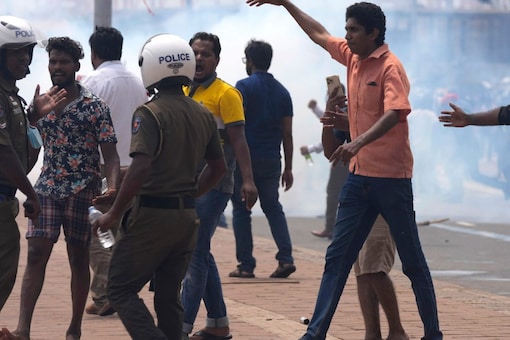
Sri Lankan government supporters and anti-government protesters clash outside president’s office residence in Colombo in presence of police officers, Sri Lanka (Image: AP)
A Sri Lankan lawmaker who shot dead an anti-government protester this week was later lynched by a mob, a forensic report showed Friday, contradicting a police report that he died by suicide. Amarakeerthi Athukorala opened fire on people blocking his car’s path in the town of Nittambuwa on Monday, after the country erupted into violence when a gang of government loyalists attacked peaceful protesters.
Police said Athukorala had tried to take refuge in a building and shot himself after being surrounded by about 5,000 people.
The MP’s death was due to multiple injuries, fractures and internal bleeding, but he had no gunshot wounds,” the Lankadeepa newspaper said, quoting the autopsy report.
Athukorala’s police bodyguard died of gunshot injuries, the report said. Police have been ordered to investigate and find out who may have fired the shot.
The duo’s car was surrounded by a large crowd, which had taken to the streets after a club-wielding mob attacked a peaceful protest demanding the government’s resignation over Sri Lanka’s painful economic crisis.
The prime minister, Mahinda Rajapaksa, who protesters blamed for orchestrating the violence, resigned soon afterwards. He was later forced to flee the capital Colombo, taking refuge at a naval base.
A total of nine people were killed in incidents related to the unrest, while at least 225 were wounded and hospitalised.
A overnight curfew is still in place across Sri Lanka.
‘Sri Lankan Tamil outfits abroad have planned attacks to mark Mullivaikal anniversary’
Intelligence agencies have warned of erstwhile cadre of the banned Liberation Tigers of Tamil Eelam (LTTE) regrouping to launch attacks in Sri Lanka, as the country is embroiled in a deep economic and political crisis.
As the island nation has declared emergency twice amid escalating violent protests, some sections of the Sri Lankan Tamil diaspora, with multinational links, were trying to make their presence felt” in the ongoing clashes between protesters and security forces, police sources said on Friday.
Besides planning attacks to mark the Mullivaikal anniversary that falls on May 18, which some groups observe as Tamil Genocide Remembrance Day, the ex-LTTE cadre were also conspiring to avenge the killings of their leader Velupillai Prabhakaran, newsreader Isai Priya and others, who were killed as the ethnic conflict ended after fierce fighting in 2009.
The sources, quoting intelligence inputs, said some erstwhile cadre had entered Tamil Nadu to plan and execute their sinister plans in Sri Lanka. Special teams of the State intelligence and local police, drawn from coastal districts, had mounted vigil along the 1,000 plus km coastline in the State. The Coastal Security Group of the Tamil Nadu police had enhanced the frequency of patrolling along the territorial waters, they said.
Fishermen venturing into the sea were sensitised to the risk factors and advised to look for any suspicious activity or persons in deep sea and along the International Maritime Boundary Line. While coastal security agencies were told to prevent any intrusion of Sri Lankan nationals into India, Superintendents of Police of all coastal districts were told to strengthen check-posts for intensified vehicle check on all roads leading to the sea, the sources added.
Tamil Nadu has been witnessing activities of suspected LTTE sympathisers or its former cadre in the recent years. Last year, the National Investigation Agency arrested a former LTTE intelligence wing operative Satkunam, alias Sabesan, on charges of indulging in drug trafficking with international connections and also raising funds to revive the organisation in Sri Lanka.
In another case, a woman was arrested in Chennai airport, while she was proceeding to Mumbai to draw a huge sum of money lying in a dormant bank account, by fraudulent means. Investigation revealed that she was assigned to raise funds for the revival of LTTE in Sri Lanka, the sources added.
May 13, 2022 (LBO) – Business leaders in Sri Lanka say the new Prime Minister Ranil Wickremesinghe should be given a chance to resuscitate the economy.
Wickremesinghe was appointed to replace Mahinda Rajapaksa, taking many political leaders by surprise and leaving them scrambling to respond. Much of the response from opposition parties was negative as they actively held media events aimed at undermining the legitimacy of Wickremesinghe’s appointment.
The business community’s views appear to be significantly different. Not wanting be quoted due to political sensitivities, several leaders in the software, agricultural and financial industries had confidence that the appointment of the new PM was the need of the hour, providing a solid chance to catalyze Sri Lanka’s economic recovery.
They view the appointment as bringing the political stability that its crucial for an economic recovery, and for the most part are disappointed at the opposition parties attempt to destabilise the new government before it is even formed.
Wickremesinghe enjoys significant credibility with the international community, and is seen by business leaders as someone who can significantly increase support from the donor community.
Markets reacted positively with the Colombo Stock Exchange up almost 10% on the back of the appointment, while the currency exhibited some stability due to moves by the Central Bank likely encouraged by the political stability its Governor demanded just days before.
The suit-clad prime minister, who is more comfortable in English than Sinhala and less popular with the majority lower middle-class population, could be the answer to Sri Lanka’s unprecedented economic crisis for now.
Ranil Wickremesighe, the longest running leader for the oldest political party in Sri Lanka, was sworn in as prime minister for the sixth time on Thursday evening. His appointment comes three days after Mahinda Rajapaksa, brother of President Gotabaya Rajapaksa, resigned as prime minister following island-wide riots, incited by Rajapaksa supporters.
The 73-year-old was appointed amid a severe economic crisis in the nation, that has metamorphosed into a political upheaval. Suffering Sri Lankans, who have been facing a severe shortage of essential food, medicines, fuel and eight-hour long blackouts over months, have been calling the Rajapaksas to step down. Although Wickremesinghe, with his sound economic policies and strong international relations, has been grudgingly accepted as the man of the moment to help the debt ridden, nearly bankrupt nation, Sri Lankans are unhappy with his hand-in-glove relationship with the allegedly corrupt Rajapaksas.Paid ContentSheikh Khalifa Passes Away: Emiratis Mourn Loss Of Their Beloved Leade…https://cdn.speakol.com/widget/html/speakol-appends.html
Island-wide protestors, who have been demanding the expulsion of the Rajapaksas from politics, shouted for Wickremesinghe to step down immediately after his appointment.NextStay
Insiders say that Wickremesinghe’s appointment without election, following closed-door talks with the president on Wednesday, bodes only one thing — that he will use his premiership to protect the Rajapaksa family, who have been accused of widescale corruption of billions of dollars, bringing the nation to its knees.
Pact with Rajapaksas?
Wide speculation within political circles indicates that Wickremesinghe may have reached an agreement with the president to protect the allegedly nepotic Rajapaksa family. Sources say that President Rajapaksa might quit due to public angst, making way for Wickremesinghe to become president. According to the Sri Lankan constitution, the prime minister will automatically become president upon the resignation or death of a president. For a man who has lost majority public support, been prime minister six times and lost two presidential elections in 45 years of politics, this might well be his final chance at presidency.
The Rajapaksa-Wickremesinghe pact goes beyond Thursday’s appointment. In 2015, Wickremesinghe’s party led a coalition alliance and announced a common candidate, Maithripala Sirisena, for president against then president Mahinda Rajapaksa. Sirisena, an ally and health minister in the Rajapaksa government defected, and won the elections, with Wickremesinghe being appointed prime minister for 100 days in accordance with a 100-day programme. The Sirisena-Wickremesinghe election pledge promised to sweep corruption and bring perpetrators to justice. At this juncture, the Rajapaksas, who had been hailed as heroes for ending a three-decade civil war against the Liberation Tigers of Tamil Ealam (LTTE), had fallen from grace due to nepotism and wide scale corruption.
After the 100 days, Wickremesinghe’s coalition alliance — the United National Front for Good Governance — won the parliamentary elections with 106 seats. Although it fell short of an outright majority, Wickremesinghe was re-elected prime minister for the third time, with over 35 of the Rajapaksa party members defecting and joining his cabinet.
Wickremesinghe led the government with strong promises. Heading the list was bringing Mahinda and Gotabaya Rajapaksa, who served as defence minister during his brother’s presidency to trial for war crimes allegations, human rights violation, and mass corruption. Despite mounting evidence against the two brothers and their family members, for killings and disappearances of journalists, anti-Rajapaksa civilians and sportsmen, the investigations and interrogations did not lead to any charges. Public fury over the blatant cover-up of a Wickremesinghe-led investigations grew, when evidence following the exhumation of the body of a star rugby player, Wasim Thajudeen, mysteriously went missing. Evidence proved that Thajudeen had been abducted, tortured and murdered, allegedly upon the orders of the second son of Mahinda Rajapaksa.
The last premiership of Wickremesinghe also marred his image as Mr Clean” that he had earned from the public for not dabbling in family politics and corruption. Born into a wealthy family, with no siblings or children of his own, Wickremesinghe remained a cut above the rest in a nation that was steeped in nepotism and corruption.
The public, however, lost all faith when a bond scam involving the hen central bank governor, Arjuna Mahendra, a close confidante of Wickremesinghe, cost the country $11 million. This also soured his relationship with president Sirisena, who sacked Wickremesinghe overnight and brought back his former ally Rajapaksa back as prime minister. Following 52 days of constitutional crisis, Wickremesinghe was reinstated as prime minister after receiving 117 votes in favour of the 225-member legislative body.
During this period, a series of bombs targeting churches and civilians on Easter Sunday in 2019, killed more than 250 people, and plummeted the waning popularity of the UNP further. Critics blamed the government for ignoring warnings that could have prevented the attacks. Wickremesinghe’s party lost in the next elections, with the UNP securing just one seat in the parliament.
But Wickremesinghe has not always been an unpopular man. He cut a dashing figure when he entered politics as a young lawyer in 1977. Under the shadow of his uncle, then president Junius Jayawardene, the 28-year-old, who was the youngest parliamentarian, soon climbed up the UNP party ladder.
Elite background
Wickremesinghe hails from an elite family belonging to a high caste, and his roots go back to pre-independence Sri Lanka. His maternal grandfather, D.R Wijewardena, supported the independence movement with a series of nationalistic newspapers. His paternal grandfather, C.G Wickremesinghe, was the most senior Sri Lankan colonial government servant.
His father, Esmond Wickremesinghe was the managing director of Lake House, the publishing empire started by his father-in-law, and later became one of the closest confidantes of the UNP. Wickremesinghe, who is widely read, once said he would have taken journalism as a career if his family’s publishing empire had not been taken over by the government under Sirimavo Bandaranaike, the first woman prime minister of the world.
Young Wickremesinghe worked with the UNP during its resurgence, following a disastrous defeat by a coalition led by Bandaranaike in 1970. He joined the party following its landslide victory in 1977, led by his uncle president Jayawardene.
It was the beginning of an era of hope and optimism of the country, and the educated, eloquent, English-speaking young man, who schooled at the elite Royal College, was looked upon as a role model by the youth of the nation. The man who is considered crafty and intelligent by his peers, was first posted as deputy foreign minister, and then as minister of youth affairs and employment. He went on to make marked reforms during his tenure as minister of education.
In his four years as minister of industries under president Ranasinghe Premadasa, Wickremesinghe made some key changes to the Sri Lankan stock market, attracting much needed foreign investors to the country.
During his later years in power, Wickremesinghe has been known to take on larger projects and neglect grass root problems of the nation. This, together with his inability to connect to the masses, has led the suit-clad Wickremesinghe, who is more comfortable in English than Sinhala, to become less popular with the majority lower middle-class population.
First premiership
He first catapulted into the seat of premiership following the assassination of former president Premadasa in 1993, when then incumbent prime minister D.B. Wijetunga filled the presidential seat. Shortly before the assassination, the top two members of Wickremesinghe’s party, Gamini Fonseka and Lalith Athulathmudali, broke away, after a failed attempt to pass a no-confidence motion against Premadasa, paving the way for Wickremesinghe to become prime minister for the first time.
Following his stint as prime minister, he contested and lost in his first presidential election in 1994, against Chandrika Bandaranaike Kumaratunga, the daughter of late prime ministers S.W.R.D. Bandaranaike and Sirimavo Banadaranaike. Kumaratunge, who entered politics as the widow of assassinated popular former movie star and politician Vijaya Kumaratunga, gathered a large number of sympathy votes. Wickremesinghe was then appointed prime minister for the second time by president Kumaratunga, his childhood friend, who later became his bitter political rival.
In the same year, Wickremesinghe became leader of the UNP, a post he has held for 28 years, attracting much criticism.
In 2005, he failed once more in a bid to become president, this time losing narrowly by just about 150,000 votes to Mahinda Rajapaksa. This was during the middle of the bloody conflict, where Tamil and Muslim voters in the North and East, a strong UNP support base, were prevented from voting by the LTTE. Wickremesinghe has not run for president since.
Despite his survival in a political quagmire for almost half-a-century, Wickremesinghe has refused to relinquish party leadership to younger members. He has been accused of not grooming able, younger members to take over the leadership, and instead of elevating individuals prone to corruption, with limited intellect.
This resulted in Sajith Premadasa, son of the late president Premadasa, to break away from the UNP and form the Samagi Jana Balawegaya (United People’s Power) party in 2020.
Despite his inefficacies and mistrust by the public, critics and fellow politicians believe that Wickremesinghe is the man of the hour due to his strong international relations and economic acumen. Inside sources say that following his appointment as prime minister, several countries, including Japan, India and the United States, with whom Wickremesinghe maintains close ties, have already pledged financial support for the crippled nation. Reversing years of economic mismanagement and corruption and winning public support would yet be his biggest challenge.
Whatever his motives be, in the short run, the man the public detests as much as the Rajapaksas, could be the answer to Sri Lanka’s unprecedented economic crisis.
Ranil Wickremesinghe was appointed in an attempt to defuse the protests. It is the opposition MP’s sixth stint as prime minister.
In his first interview since taking office, Wickremesinghe told the BBC he would ensure families get three meals a day.
Appealing to the world for more financial help, he said “there won’t be a hunger crisis, we will find food”.
The new PM described the Sri Lankan economy as “broken”, but he said his message to Sri Lankans was to “be patient, I will bring things back”.
Wickremesinghe was sworn-in by President Gotabaya Rajapaksa on Thursday, but his appointment has largely been met with dismay, as he is seen as too close to the politically dominant Rajapaksa family.
In his interview, Wickremesinghe said he agreed with the sentiment of protesters who’ve been calling for President Rajapaksa to resign, but said that would not happen.
“Blaming won’t lead to action, I’m here to see people nourished,” he said.
But he added that he was “going to change all the policies of the Rajapaksa government”.
He also called on the international community for help.
“We need your assistance for a year, whatever we get from you we will repay. Help us to do it. We are the longest and oldest democracy in Asia,” he said.
Sri Lanka’s economy is in freefall. Food, medicine and fuel have run out or become unaffordable. Some people have died waiting at petrol stations to fill up their tanks.
It is the the island nation’s worst economic crisis since gaining independence from Britain in 1948.
“We don’t have kerosene, we don’t have petrol, we don’t have diesel, we don’t have cooking gas and we don’t even have access to wood-fired stoves,” a 68-year-old woman in the Sri Lankan capital Columbo told AFP.
“We are struggling everyday to feed our children. Food prices have tripled in the past few days. How are we supposed to manage?”
At the heart of Sri Lanka’s economic woes is that the country is heavily reliant on imports but has been burning through the foreign currency reserves it needs to pay for them.
The economy suffered in the Covid pandemic and tourism was hit by the 2019 church bombings. But experts have also blamed economic mismanagement too.
Colombo, May 13: Sri Lanka’s new Prime Minister, Ranil Wickremesinghe, has secured the support of key countries in the world such as India, the US, Japan and China. He is expected to get majority support in parliament also, though he is the lone representative of his party, the United National Party, in parliament.
Wickremesinghe might not head a truly national” government composed of all parties in parliament. But he might get the support enough MPs to have a majority, that is, at least 113 in the House of 225. ADVERTISEMENT
World’s Interest in Stability
The countries supporting Wickremesinghe have based their policy on the critical requirement of stability, as the statements put out by their envoys show.
The Indian High Commission said in its tweet, that India hopes for political stability and looks forward to working with the Government of Sri Lanka formed in accordance with democratic processes pursuant to the swearing-in of Hon’ble Ranil Wickremesinghe as the Prime Minister of Sri Lanka.” It further said that India’s commitment to the people of Sri Lanka will continue.”
In its first reaction to the situation in Sri Lanka after Mahinda Rajapaksa resigned as Prime Minister, India on Tuesday said that it was fully supportive” of the island nation’s democracy, stability and economic recovery. India will always be guided by the best interests of the people of Sri Lanka expressed through democratic processes,” said External Affairs Ministry spokesperson, Arindam Bagchi.
In keeping with our Neighborhood First policy, India has extended this year alone, support worth over USD 3.5 billion to the people of Sri Lanka for helping them overcome their current difficulties. In addition, the people of India have provided assistance for mitigating the shortages of essential items such as food and medicine,” Bagchi added.
The Indian High Commissioner, Gopal Baglay, followed this up with a meeting with Wickremesinghe in the latter’s office on Friday. He presented the PM with a bouquet.
Later, asked by newsmen about Sri Lanka’s relations with India, its closest neighbor, Wickremesinghe said: It will become much better.” During his previous stints as PM, Wickremesinghe had visited India on four occasions – in October 2016, April 2017, November 2017 and October 2018.
Asked about his agenda as the Prime Minister, Wickremesinghe said: I have taken on a challenge of uplifting the economy and I must fulfill it.” Setting the economy right by meeting the forex shortage and getting for the population essential goods, is his single point agenda. And for that, political stability in the form of parliament’s support, is needed.
US Support
The US Ambassador, Julie Chung, also stressed the need for political stability for Sri Lanka to solve its grave economic problems. In a tweet she said: Look forward to working w/ @RW_UNP. His appointment as PM, and the quick formation of an inclusive government, are first steps towards addressing the crisis & promoting stability.”
We encourage meaningful progress at the IMF & long-term solutions that meet the needs of all Sri Lankans,” she added.
Chung met Wickremesinghe on Friday, and discussed the US TREAsury team’s visit to Sri Lanka. The Japanese Ambassador Mizukoshi Hideaki and the Chinese Ambassador Qi Zhenhong also met him. The cancelled Japanese urban rail project is likely to be revived as a result of the change in the government.
The Chinese envoy discussed financial assistance to Sri Lanka. Earlier, the Chinese Foreign Ministry spokesman had said in Beijing that China believes that with the joint efforts of all sectors of Sri Lanka, the country will regain peace and stability as soon as possible.” Again the stress was on the need for stability.
Problems in Parliament
While Wickremesinghe has strong support from the four most important countries in its foreign relations, he is yet to fathom the level of support in parliament. He has to face parliament on May 17, when the opposition Samagi Jana Balawegaya (SJB) led by Sajith Premadasa, will be bringing in a Motion of No Confidence against his government, and also President Gotabaya Rajapaksa.
As of now, the ruling Sri Lanka Podujana Peramuna (SLPP) is with Wickremesinghe as per the wishes of President Rajapaksa and the rest of the Rajapaksa clan. The 41 MPs from the SLPP and its allies, who had rebelled and are sitting as Independents, are expected to act independently but without the objective of toppling the government.
The group’s spokesman, Wimal Weerawansa, stated that it has no intention of sabotaging the administration. It will not indulge in hate politics” and will not allow the country to become anarchic”, he said.
The Pivithuru Hela Urumaya (PHU) leader Udaya Gammanpila stated that as long as PM Ranil Wickremesinghe works to rescue the country from the abyss” the Independents would extend support while remaining in the opposition. This country needs a government. We will not make any attempt to topple it,” the former Energy minister said.
The Sri Lanka Freedom Party (SLFP), a former ally of the SLPP, has decided not to accept any portfolios or be part of a government under Prime Minister Wickremesinghe. It will decide on its stand vis-s-vis the SJB’s No Confidence Motion later on Friday after internal consultations.
Te Janatha Vimukthi Peramuna (JVP) and the Tamil National Alliance (TNA) are anti-government and are likely to vote for the No-Confidence Motion But they are small parties. The JVP has only three MPs and the TNA 10.
President asks Lankans to be resilient
In his Vesak festival message to the people of Sri Lanka on Friday, President Gotabaya Rajapaksa appealed to the people to be resilient and come out of the present dire situation through collective and resolute actions.
Resilience is essential in difficult situations. At this juncture when the country is in dire straits, all the people’s representatives must work together immediately for a solution on behalf of all citizens. The true goal should be to reach the desired target without deviating from the primary goal,” the President said.
We must be mindful of the current situation and unite around a program that can deliver a fair determination to all. That is the Buddhist policy.”
May the common goal of all be to build a resilient, consensus and religious society based on principles. I wish you a Happy Vesak Poya Day,” the President said.
Newly appointed Prime Minister Ranil Wickremesinghe had pledged to repeal the shoot at sight order given to security forces after the recent violence.
Mr. Wickremesinghe made this pledge when foreign journalists questioned him about this procedure.
Prime Minister’s office said such orders will be given to security forces only if riots resume.
It was also reported that the new government will repeal the 20 amendment to the constitution and reduce President’s powers.
Meanwhile, UNP Assistant Leader Akila Viraj Kariyawasam told a press conference that no one from his party will look for any positions in the government. We will support without playing an active role in the government,” he said.
The new cabinet will comprise members from a number of political parties,” he added.(Yohan Perera)
Sri Lanka, which is facing the biggest economic crisis in its post-independence history, is aiming to boost its agriculture sector
Sri Lanka has received assurance from Indian officials regarding supply of fertilizers that the island nation requires urgently. High Commissioner Milinda Moragoda met concerned officials on Friday where the issue was discussed.
“High Commissioner Milinda Moragoda met with the Secretary to the Department of Fertilizers of India Shri Rajesh Kumar Chaturvedi and thanked him for India’s decision to supply 65,000 MT of urea required for the current Yala cultivation season in Sri Lanka,” the High Commission of Sri Lanka said in a message. Yala is the season of paddy cultivation in Sri Lanka that lasts between May and August.
Sri Lanka, which is facing the biggest economic crisis in its post-independence history, is aiming to boost its agriculture sector to avoid any disruption in the agriculture market.
Soaring food prices in Sri Lanka have added to the economic difficulties and any setback to the next paddy cultivation season will be hard for the island to bear.
It is understood that India has given an oral assurance ahead of a final official order that will ensure flow of fertilizers to Sri Lanka. However it is not yet clear, how the cash-strapped Sri Lankan government will pay for the fertilizer shipment.
Sri Lanka is the second country after Nepal to have received India’s assurance for supply of fertilizers. During the pandemic season, the global fertilizer market was choked as several major producers banned export of fertilizers that affected non-producing countries. Nepal’s PM Sher Bahadur Deuba had taken up the issue during his April visit to Delhi. However, India too is dependent on imported urea.
The fertilizer sector has been repeatedly affected because of the global disruptions such the pandemic and the Ukraine crisis, which has disrupted Ukraine’s agriculture sector creating shortage of supplies in the global agriculture market.
India had been in talks with Russia to bolster its own fertilizer sector and has received approximately 3.60 lakh metric tonnes of fertilizers since the beginning of the Ukraine war. India’s own reliance on imported urea is going to increase as it plans to maintain top productivity of the agriculture sector that aims to fill up some of the scarcity that the absence of Ukrainian supplies has left in the global food market.