Sri Lanka economy crisis to get worse before it gets better, PM says

May 13th, 2022

By Rajini Vaidyanathan BBC South Asia Correspondent Courtesy BBC

Sri Lanka’s new prime minister has told the BBC an economic crisis that has brought misery and unrest is “going to get worse before it gets better”.

The country is facing fuel shortages and soaring food prices, with some Sri Lankans forced to skip meals.

Anger over the government’s handling of the crisis has led to violent protests.

Ranil Wickremesinghe was appointed in an attempt to defuse the protests. It is the opposition MP’s sixth stint as prime minister.

In his first interview since taking office, Mr Wickremesinghe told the BBC he would ensure families get three meals a day.

Appealing to the world for more financial help, he said “there won’t be a hunger crisis, we will find food”.

The new PM described the Sri Lankan economy as “broken”, but he said his message to Sri Lankans was to “be patient, I will bring things back”.

Mr Wickremesinghe was sworn-in by President Gotabaya Rajapaksa on Thursday, but his appointment has largely been met with dismay, as he is seen as too close to the politically dominant Rajapaksa family.

In his interview, Mr Wickremesinghe said he agreed with the sentiment of protestors who’ve been calling for President Rajapaksa to resign, but said that would not happen. “Blaming won’t lead to action, I’m here to see people nourished,” he said.

But he added that he was “going to change all the policies of the Rajapaksa government”.

He also called on the international community for help.

“We need your assistance for a year, whatever we get from you we will repay. Help us to do it. We are the longest and oldest democracy in Asia,” he said.

People queue for cooking gas in Sri Lanka
Image caption,Long queues for essentials are now part of daily life in Sri Lanka, for those that can afford them

Sri Lanka’s economy is in freefall. Food, medicine and fuel have run out or become unaffordable. Some people have died waiting at petrol stations to fill up their tanks.

It is the the island nation’s worst economic crisis since gaining independence from Britain in 1948.

“We don’t have kerosene, we don’t have petrol, we don’t have diesel, we don’t have cooking gas and we don’t even have access to wood-fired stoves,” a 68-year-old woman in the Sri Lankan capital Columbo told AFP.

“We are struggling everyday to feed our children. Food prices have tripled in the past few days. How are we supposed to manage?”

At the heart of Sri Lanka’s economic woes is that the country is heavily reliant on imports but has been burning through the foreign currency reserves it needs to pay for them.

The economy suffered in the Covid pandemic and tourism was hit by the 2019 church bombings. But experts have also blamed economic mismanagement too.

Sri Lanka: New PM Wickremesinghe Gets International Backing

May 13th, 2022

By  Courtesy Eurasia Review

Majority support in parliament is also on the cards

Sri Lanka’s new Prime Minister, Ranil Wickremesinghe, has secured the support of key countries in the world such as India, the US, Japan and China. He is expected to get majority support in parliament also, though he is the lone representative of his party, the United National Party, in parliament.Advertisement

Wickremesinghe might not head a truly national” government composed of all parties in parliament. But he might get the support enough MPs to have a majority, that is, at least 113 in the House of 225.   

World’s Interest in Stability

The countries supporting Wickremesinghe have based their policy on the critical requirement of stability, as the statements put out by their envoys show.

The Indian High Commission said in its tweet, that India hopes for political stability and looks forward to working with the Government of Sri Lanka formed in accordance with democratic processes pursuant to the swearing-in of Hon’ble Ranil Wickremesinghe as the Prime Minister of Sri Lanka.” It further said that India’s commitment to the people of Sri Lanka will continue.”

In its first reaction to the situation in Sri Lanka after Mahinda Rajapaksa resigned as Prime Minister, India on Tuesday said that it was fully supportive” of the island nation’s democracy, stability and economic recovery. India will always be guided by the best interests of the people of Sri Lanka expressed through democratic processes,” said External Affairs Ministry spokesperson, Arindam Bagchi.

In keeping with our Neighborhood First policy, India has extended this year alone, support worth over USD 3.5 billion to the people of Sri Lanka for helping them overcome their current difficulties. In addition, the people of India have provided assistance for mitigating the shortages of essential items such as food and medicine,” Bagchi added.Advertisement

The Indian High Commissioner, Gopal Baglay, followed this up with a meeting with Wickremesinghe in the latter’s office on Friday. He presented the PM with a bouquet.  

Later, asked by newsmen about Sri Lanka’s relations with India, its closest neighbor, Wickremesinghe said:  It will become much better.” During his previous stints as PM, Wickremesinghe had visited India on four occasions – in October 2016, April 2017, November 2017 and October 2018.

Asked about his agenda as the Prime Minister, Wickremesinghe said: I have taken on a challenge of uplifting the economy and I must fulfill it.” Setting the economy right by meeting the forex shortage and getting  for the population essential goods, is his single point agenda. And for that, political stability in the form of parliament’s support, is needed.      

US Support

The US Ambassador, Julie Chung, also stressed the need for political stability for Sri Lanka to solve its grave economic problems. In a tweet she said: Look forward to working w/ @RW_UNP. His appointment as PM, and the quick formation of an inclusive government, are first steps towards addressing the crisis & promoting stability.”

We encourage meaningful progress at the IMF & long-term solutions that meet the needs of all Sri Lankans,” she added.  

Chung met Wickremesinghe on Friday, and discussed the US TREAsury team’s visit to Sri Lanka. The Japanese Ambassador Mizukoshi Hideaki and the Chinese Ambassador Qi Zhenhong also met him. The cancelled Japanese urban rail project is likely to be revived as a result of the  change in the government.

The Chinese envoy discussed financial assistance to Sri Lanka. Earlier, the Chinese Foreign Ministry spokesman had said in Beijing that China believes that with the joint efforts of all sectors of Sri Lanka, the country will regain peace and stability as soon as possible.” Again the stress was on the need for stability.

Problems in Parliament

While Wickremesinghe has strong support from the four most important countries in its foreign relations, he is yet to fathom the level of support in parliament. He has to face parliament on May 17, when the opposition Samagi Jana Balawegaya (SJB) led by Sajith Premadasa, will be bringing in a Motion of No Confidence against his government, and also President Gotabaya Rajapaksa.

As of now, the ruling Sri Lanka Podujana Peramuna (SLPP) is with Wickremesinghe as per the wishes of President Rajapaksa and the rest of the Rajapaksa clan. The 41 MPs from the SLPP and its allies, who had rebelled and are sitting as Independents, are expected to act independently but without the objective of toppling the government.

The group’s spokesman, Wimal Weerawansa, stated that it has no intention of sabotaging the administration. It will not indulge in hate politics” and will not allow the country to become anarchic”, he said.

The Pivithuru Hela Urumaya (PHU) leader Udaya Gammanpila stated that as long as PM Ranil Wickremesinghe works to rescue the country from the abyss” the Independents would extend support while remaining in the opposition. This country needs a government. We will not make any attempt to topple it,” the former Energy minister said. 

The Sri Lanka Freedom Party (SLFP), a former ally of the SLPP, has decided not to accept any portfolios or be part of a government under Prime Minister Wickremesinghe. It will decide on its stand vis-s-vis the SJB’s No Confidence Motion later on Friday after internal consultations.

President asks Lankans to be resilient

In his Vesak festival message to the people of Sri Lanka on Friday, President Gotabaya Rajapaksa appealed to the people to be resilient and come out of the present dire situation through collective and resolute actions.

Resilience is essential in difficult situations. At this juncture when the country is in dire straits, all the people’s representatives must work together immediately for a solution on behalf of all citizens. The true goal should be to reach the desired target without deviating from the primary goal,” the President said.

We must be mindful of the current situation and unite around a program that can deliver a fair determination to all.  That is the Buddhist policy.”

May the common goal of all be to build a resilient, consensus and religious society based on principles. I wish you a Happy Vesak Poya Day,” the President said.

P. K. Balachandran

P. K. Balachandran is a senior Indian journalist working in Sri Lanka for local and international media and has been writing on South Asian issues for the past 21 years.

Lankan PM Wickremesinghe moots ‘aid consortium’ with foreign envoys

May 13th, 2022

Meera Srinivasan  The Hindu BusinessLine

Vows to deliver solutions” to the island’s deepening economic crisis

Sri Lanka’s newly appointed Prime Minister Ranil Wickremesinghe, who has vowed to deliver solutions” to the island’s deepening economic crisis, kicked off duties on Friday, discussing formation of a foreign aid consortium” with Colomb-based envoys, his office said.

His outreach came a day after he was sworn in Premier by President Gotabaya Rajapaksa, in the place of Mahinda Rajapaksa, who resigned earlier this week following widespread protests.

Indian envoy Gopal Baglay was among the first to meet Wickremesinghe shortly after he assumed charge Friday morning. High Commissioner called on Hon’ble PM [Ranil Wickremesinghe] @RW_UNP. Conveyed greetings and good wishes. Discussed continued cooperation for economic recovery and stability in #SriLanka through democratic processes towards the wellbeing of all the people of Sri Lanka,” the Indian Mission said in a tweet. India has extended assistance totalling $3.5 billion this year to help Sri Lanka cope with its severe dollar crunch.

The PM, who is in office for the sixth time, also met the Ambassadors of China, US<NO,,>nited States<NO>, Japan, and the British High Commissioner. The Chinese Ambassador expressed his country’s willingness to continue to support Sri Lanka while also pledging to review existing assistance,” his office said in a statement.

‘Little political support’

Wickremesinghe has few backers other than the ruling Sri Lanka Podujana Peramuna. Opposition parties have said they will not be part of a government led by him and Gotabaya, while government allies seem hesitant to take up ministerial positions. The PM has no parliamentary colleagues from the United National Party he leads, he is its sole legislator. It remains to be seen if Wickremsinghe can prove he has the confidence of the House when the Parliament convenes on May 17. The country also awaits a new cabinet and government to run its affairs at a critical time.

Meera Srinivasan is The Hindu Correspondent in Colombo.

New Sri Lanka PM to steadfastly push forward BRI projects in the country

May 13th, 2022

By Global Times

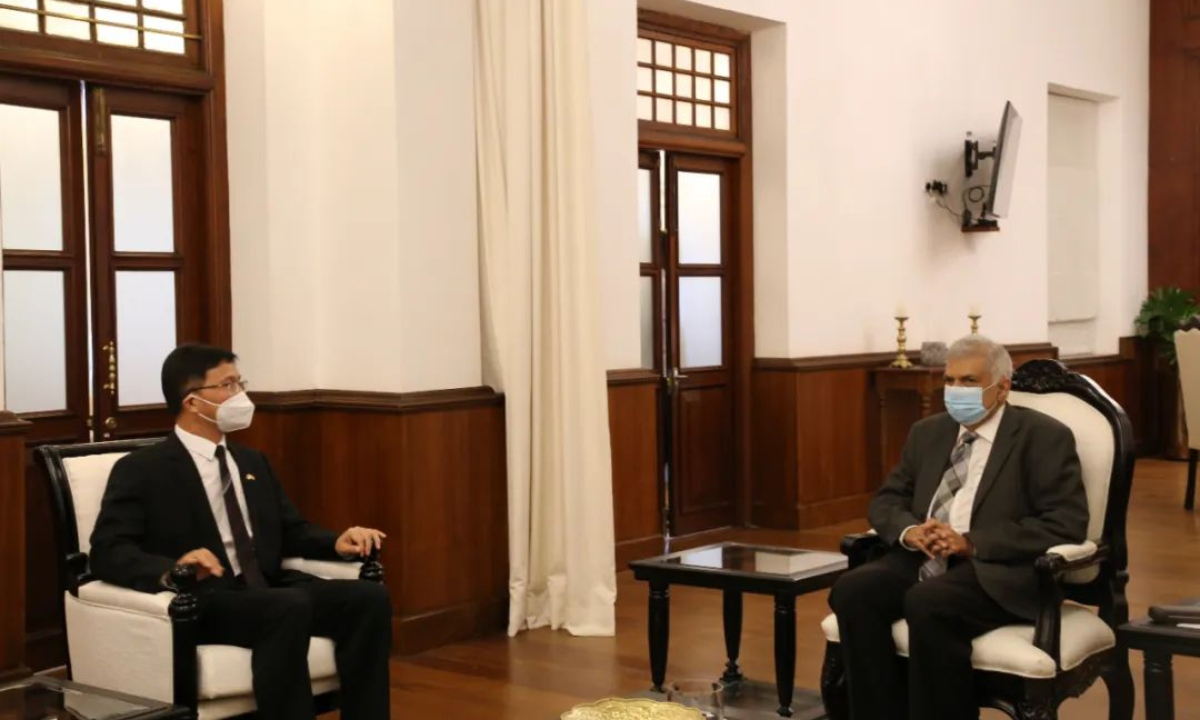
Ranil Wickremesinghe, Sri Lanka's new prime minister met with Qi Zhenhong, Ambassador of China to Sri Lanka on Friday. Photo: Courtesy of Embassy of China to Sri Lanka

Ranil Wickremesinghe, Sri Lanka’s new prime minister met with Qi Zhenhong, Ambassador of China to Sri Lanka on Friday. Photo: Courtesy of Embassy of China to Sri Lanka

Ranil Wickremesinghe, Sri Lanka’s new prime minister, said on Friday that his new government will continue to attach great importance to developing ties with China and will push forward Belt and Road projects in the country.

During a meeting with Qi Zhenhong, Ambassador of China to Sri Lanka on Friday, Wickremesinghe stressed that the new government will push forward the development of Colombo Port City and Hambantota Port projects among other major cooperation projects and make every effort to protect the safety of Chinese institutions and personnel in Sri Lanka, according to a notice issued by the Chinese Embassy to Sri Lanka on its website.

Wickremesinghe said he is looking forward to resuming and pushing forward the cooperation between the two countries in all aspects as soon as the new cabinet and government are in place.

Qi congratulated Wickremesinghe on being reappointed as prime minister and appreciated his contributions to promoting China-Sri Lanka friendly cooperation over the years.

The two sides also exchanged views on the current economic and financial situation in Sri Lanka and other issues of common interest.

Politicians’ Obligation to the Nation

May 13th, 2022

FB

As a country when Sri Lanka is in dire need of a debt restructure and economic recovery, the IMF in combination with The World Bank prepared a package on conditions set forth.

While these conditions were laid so clearly of what is being required from Sri Lanka, the sabotaging acts committed collectively by short sighted rulers, all other political fractions, Trade Unions, religious fractions and the majority of the citizens have brought this Resplendent Land to its death bed.

As the only viable option available to attempt a resurrection, Sri Lanka and its people have failed to recognize the International Monetary Fund (IMF) who would act in the best interest of that country.

While the top recognized economists were engaged in planning and implementations, the country opted to promote demonstrations, riots, political instability, social instability and violence or violence provoking acts for other agendas of personal growth.

First and foremost, the country needed to be on course of economic recovery and all other agendas to be secondary.

Demonstrations of any sort and provocation acts should not have occurred during this IMF planning stages.

This recovery needs to be achieved by Economists and NOT politicians, Attorneys, Law Enforcement, astrologers and the like.

Upon being on the path of economic restructure and recovery is when all else need to be addressed.

Sri Lanka need a bona fide government in place irrespective of its effectiveness for the IMF to enter into agreement of loan and debt restructure.

Currently they have effectively removed such preventing any financial entity entering into agreement.

If they force the President to be removed at this time, they will nail their coffin for good.

Once the country is in the correct path to economic recovery, is when they need to take steps in eliminating corruption and what surrounds those acts.

Political and social stability must be instilled for economic revamp.

Once the country is on its path to raising its heads, Sri Lanka must be rid of all who promoted all demonstrations, riots, looting, political chaos etc. for they have NOT the best interest for the country but agendas of their own.

Courtesy Hemnath De Silva‘s FB

Sri Lanka’s New Prime Minister Wickremesinghe Thanks PM Modi, Says ‘Want a Closer Relationship’ With India

May 13th, 2022

Courtesy News18

Sri Lanka’s new Prime Minister Ranil Wickremesinghe has said he looks forward to closer ties with India during his term and thanked India for its economic assistance to the country as it tackles the worst economic crisis since independence.

Wickremesinghe, 73, was sworn-in as Sri Lanka’s 26th prime minister on Thursday to stabilise the country’s debt-ridden economy and end the political turmoil. I want a closer relationship and I want to thank Prime Minister (Narendra) Modi, Wickremesinghe said, referring to the Indian economic assistance to his country.

His remarks came during a religious ceremony held here last night after he took the oath. India has committed more than USD 3 billion to debt-ridden Sri Lanka in loans, credit lines and credit swaps since January this year.

The 73-year-old United National Party (UNP) leader took over as the prime minister as the country was without a government since Monday when President Gotabaya Rajapaksa’s elder brother and prime minister Mahinda Rajapaksa resigned after violence erupted following an attack on the anti-government protesters by his supporters.

The attack triggered widespread violence against Rajapaksa loyalists, leaving nine people dead and wounding over 200 others. Wickremesinghe said his focus was limited to tackling the economic crisis. I want to settle this problem to ensure the supply of petrol, diesel and electricity to the people,” Wickremesinghe said.

Sri Lanka is facing its worst economic crisis since gaining independence from Britain in 1948. The crisis is caused in part by a lack of foreign currency, which has meant that the country cannot afford to pay for imports of staple foods and fuel, leading to acute shortages and very high prices.

I will do the job that I have undertaken to do. Asked if he could sustain his premiership in the 225-member Parliament since he only has only one seat, he said: I will prove the majority when it comes to that. Referring to the island-wide protests, Wickremesinghe said the main protest near president Gotabaya Rajapaksa’s secretariat for over a month now would be allowed to continue. I will talk to them (protesters) if they are willing,” he said.

Asked if he feared protest demanding him to quit, he said he would face them. If I can undertake the job to handle the economic crisis, I will handle that too,” he said. Wickremesinghe was appointed the Prime Minister as the main Opposition Samagi Jana Balawegaya (SJB) party and the third-largest party Janatha Vimukthi Peramuna (JVP) attached tough conditions, such as the resignation of President Rajapaksa, to lead the interim government.

Wickremesinghe heads the interim government in which all political parties are to be stakeholders for a limited period before facilitating a parliamentary election.

Members of the ruling Sri Lanka Podujana Peramuna (SLPP), a section of the main Opposition SJB and several other parties have expressed their support to show a majority for Wickremesinghe in Parliament, sources said.

However, several factions opposed the move to appoint Wickremesinghe as the new Prime Minister. The JVP and the Tamil National Alliance claimed that his appointment was unconstitutional.

The veteran politician is seen as being close to the Rajapaksa clan. But he does not currently command much support from the Opposition or among the public. It remains to be seen if he can prove his majority in the 225-member Parliament. We will allow him space,” Weerasumana Weerasinghe of the Communist Party said. Former President Maithripala Sirisena’s Sri Lanka Freedom Party party said its central committee would meet this morning to make a decision.

The trade union cum political party for the plantation community of Indian-origin, Ceylon Workers’ Congress, said they would support Wickremesinghe. Sri Lanka’s worst economic crisis has provoked widespread protests calling for political reform and the resignation of President Gotabaya Rajapaksa.

On April 1, President Rajapaksa imposed a state of emergency, lifting it five days later. The government reimposed a state of emergency on May 6 after police fired teargas and arrested students protesting near parliament, which was adjourned until May 17. Although the protests have been overwhelmingly peaceful, the police fatally shot a protester on April 19, and on several occasions have used teargas and water cannons against protesters. The authorities have made numerous arrests and repeatedly imposed curfews.

The political crisis was triggered in late March when people hurt by long hours of power cuts and essential shortages took to the streets demanding the resignation of the government. President Rajapaksa sacked his cabinet and appointed a younger cabinet as a response to the demand for resignation. A continuous protest opposite his secretariat has now gone on for well over a month.

On Monday, his brother Mahinda Rajapaksa resigned as the prime minister to make way for the president to appoint an interim all political party government.

Main Opposition Won’t Join New Government: Sri Lanka Latest

May 13th, 2022

Courtesy Bloomberg UK

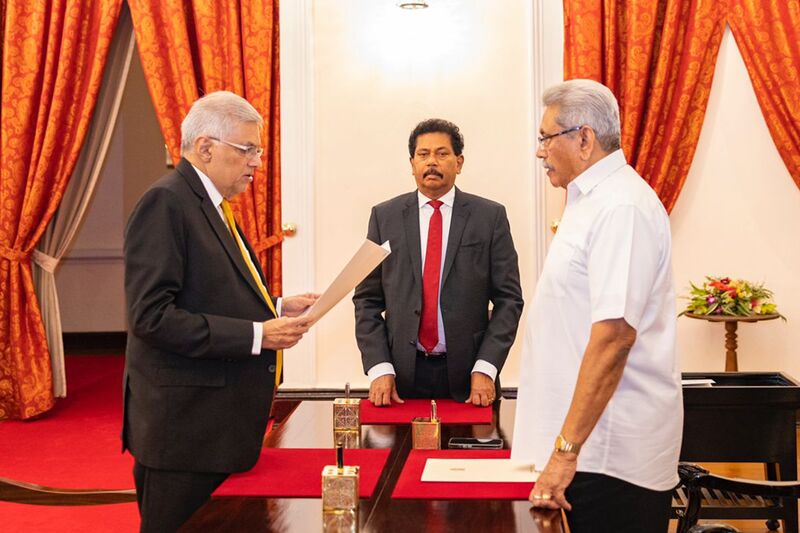
Ranil Wickremesinghe, left, is sworn in as Sri Lanka’s prime minister in front of President Gotabaya Rajapaksa, in Colombo, on May 13.
Ranil Wickremesinghe, left, is sworn in as Sri Lanka’s prime minister in front of President Gotabaya Rajapaksa, in Colombo, on May 13.Source: Sri Lankan President Media Division

By Anusha Ondaatjie and Asantha SirimanneMay 13, 2022, 2:32 AM GMT+1Updated on

Sri Lanka’s Prime Minister Ranil Wickremesinghe said he will show his majority in parliament and protests against President Gotabaya Rajapaksa should not be curbed, local media reported.  

However, the main opposition Samagi Jana Balawegaya party has said it won’t join a so-called unity government and will not take any cabinet roles, indicating that more political uncertainty could lie ahead. 

The new premier’s United National Party didn’t win a single seat in the 2020 election, which brought the Rajapaksas back to power, but he was able to return as lawmaker in 2021 through a system where parties with enough votes can nominate a member under the national list.” He can only prove a majority with the support of Rajapaksa’s ruling alliance.

Stocks Surge on News of Political Stability (1:30 p.m.)

Sri Lankan stocks surged for a second day as the appointment of the new prime minister was seen as a step toward political stability.

The Colombo All-Share Index jumped 4.4% and was the best performing key gauge in Asia on Friday. For the week, which saw only three days of trading, the gauge advanced 9%, its biggest weekly gain since January 2021, data compiled by Bloomberg show.

Still, market participants remain cautious as the premier needs to build a cabinet of ministers and take steps to calm public anger. Low foreign exchange reserves, a potential delay in negotiations with International Monetary Fund for financial aid and rising interest rates remain key risks for market sentiment, they say.

Main Opposition Will Not Join Government (1:00 p.m.)

The main opposition party told a news conference in Colombo that its lawmakers they would not join the new government. 

We are telling you that we will not take any portfolio in Ranil Wickremesinghe’s government,” said Ranjith Madduma Bandara, the general secretary of the Samagi Jana Balawegaya party.

Rajapaksa Tells Opposition Leader His PM Offer Came Late (9:44 p.m.)

President Gotabaya Rajapaksa told opposition leader Sajith Premadasa that his offer to form a government under several conditions came too late, local media reported, citing a letter. 

As Premadasa had rejected an earlier offer, Rajapaksa said he had decided to name Ranil Wickremesinghe as premier instead. Also Premdasa had some conditions that hadn’t been agreed to by other party leaders. 

Wickremesinghe Says No Decision Made on Cabinet (8:35 p.m.)

The new minister said he plans to show his majority in parliament, local media reported. The next session is slated for May 17. He said no decisions have been made on the size of the cabinet though there are news reports that some ministers could be sworn in as early as Friday. 

Wickremesinghe also said the protests against President Gotabaya Rajapaksa could continue and promised the police wouldn’t crack down. A nationwide curfew has been lifted at 6 a.m. for a few hours. 

India Hopes For Political Stability with new PM (7:35 p.m.)

The High Commission of India said it looks forward to working with a Sri Lankan government formed in accordance to democratic processes. The new prime also thanked India for the aid it has extended to the country. 

We need help from the Indian government, Wickremesinghe said. I must thank Prime Minister Modi

U.S. Ambassador Looks Forward to Working with New PM (6:55 p.m.)

The U.S. envoy to Sri Lanka Julie Chung said the quick formation of an inclusive government are first steps to addressing the crisis and promoting stability.

Sri Lanka Names Longtime MP Wickremesinghe as New PM (6:41 p.m.)

Ranil Wickremesinghe, a veteran lawmaker and former premier has been named Sri Lanka’s next prime minister, days after the last incumbent resigned in the face of escalating anger with the deepening economic crisis.

He was sworn in a private ceremony by President Gotabaya Rajapaksa. 

Ranil Wickremesinghe Visits Buddhist Temple
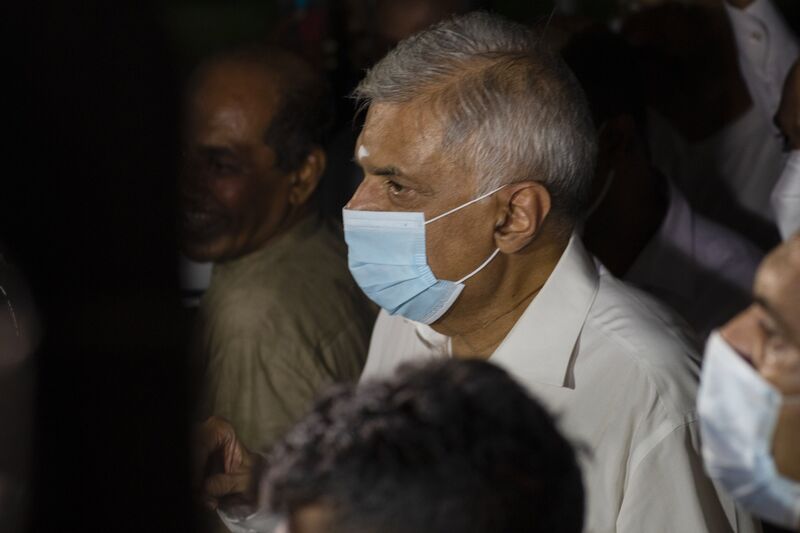
Ranil Wickremesinghe visits a Buddhist temple to receive blessings in Colombo, on May 12.Photographer: Buddhika Weerasinghe/Bloomberg

Opposition Leader Agrees to Be Prime Minister (2:47 p.m.)

Sajith Premadasa, the leader of the main opposition party Samagi Jana Balawegaya, told a news conference in Colombo that he has written to President Rajapaksa to inform him that he was ready to take on the role of prime minister and form an interim government.

Premadasa had earlier rejected several overtures from Rajapaksa. Among his conditions for becoming prime minister, is the end of the executive presidency and for Rajapaksa to step down within a given time frame.

Court Orders Travel Ban For Many Ruling Party MPs (2:00 p.m.)

A magistrate has barred 13 members of Rajapaksa’s ruling Sri Lanka Podujana Peramuna party, including former Prime Minister Mahinda Rajapaksa, from traveling overseas, local news website Newswire reported, citing unnamed sources.

It also includes Mahinda’s son and former cabinet member Namal Rajapaksa. The court was acting on an application moved by the Bar Association of Sri Lanka and demonstrators who were attacked by government supporters during Monday’s violence, the report added.

Namal Rajapaksa tweeted to say he would cooperate with any investigation into the violence.

— With assistance by Nupur Acharya

Wind Power to our rescue

May 12th, 2022

by Garvin Karunaratne

These days when we have to live with hours of power cuts, and when we are really short of dollars- scraping the barrel, my theory that wind power offers the solution to our power requirements comes to the forefront.

I enclose a write up by eesrilanka wordpress.com/2019/04/13/playing with history:

__________________________________________________________

C2. Buying Power from Multinationals

Garvin Karunaratne recalls his experience of 18 years working in stations like Hambantota as well as in the hilly Districts of Kandy and Nuwara Eliya. He chides the authorities for erecting wind turbines on the coast. He believes that the authorities seem to be working to prove that wind turbines are not suitable for Sri Lanka.

Karunaratne then mentions his vast travel experience and states that the US, Spain Portugal and many more countries have put up wind turbines never at their coastal areas but in their hills. Further he highlights authorities that have noted the vast resources of wind power in Sri Lanka. He urges Sri Lanka to use its wind resources and he actually has requested the State Engineering Corporation engineers who did make long concrete poles to hold the canopy for the Avukana Buddha statue to be enlisted to make the wind turbines. He emphasizes that Sri Lanka can become self sufficient in all its power requirements if only a few hundred wind turbines are constructed and he states that this can be done within a year.

Karunaratne speaks with the broad experience of having worked designing and establishing the Youth Self Employment Programme of Bangladesh in two years, a programme that has created employment for millions of youths, something which even the ILO  had failed earlier. He urges and provides many facts showing that wind power holds the magical solution for Sri Lanka.

– www.lankaweb.com/news/items/2019/04/09/buying-power-from-multinationals/

The only item that has to be imported for wind turbines is the turbine mechanism. It will be child’s play for Jinasenas, the makers of reputed Jinasena pumps to make these turbines if called upon.

For full details: Wind Power for Sri Lanka’s Energy Requirements: Godages, 2019

Why Myanmar Should Have ‘Friendship and Neighbourhood policy to Bangladesh’?

May 12th, 2022

Fumiko Yamada

Bangladesh and Myanmar share a land boundary of 271 kilometers. Prior to their establishment as contemporary nation states, both countries had a long history of exchanging political, cultural, and economic concerns. They also share a common history of British colonialism. The relationship between these two countries is based on demography rather than geography. Since Bangladesh’s 1971 independence from West Pakistan, the two countries have had “cordial” relations. One of the first countries to acknowledge Bangladesh was Myanmar. However, due to the Rohingya crisis and border disturbances, Bangladesh-Myanmar ties have turned tense at times.

Despite the persistence of certain topics of contention and the resulting Luke-Warm bilateral ties, Bangladesh and Myanmar had a fairly active cooperation process. Aside from bilateral collaboration, the two countries are strengthening cooperative links through a number of regional and sub-regional organizations and initiatives.

Bangladesh and Myanmar are founding members of the Bay of Bengal Initiatives for Multi-Sectoral Technical and Economic Cooperation, a sub-regional association (BIMSTEC). Both countries are also part of the Track-II Kunming effort, often known as BCIM, which comprises Bangladesh, China, India, and Myanmar.

Bangladesh is also working to strengthen its formal connection with the Association of Southeast Asian Nations (ASEAN), which Myanmar is a member of. Bangladesh has already joined the ASEAN Regional Forum (ARF) and is pursuing an ASEAN dialogue relationship. Despite both nations’ consistent efforts, the progress of Bangladesh-Myanmar ties has been clouded at times by controversial problems. The following are the main issues of bilateral relations in this context:

Though political and economic ties between countries in the Eastern South Asia subregion have improved since the 1990s, the Rohingya issue has frequently disrupted ties between Burma (Myanmar) and Bangladesh. The Rohingyas are a Muslim ethnic minority who live in the Buthidaung and Maungdaw Townships in the Arakan State of Burma’s northwestern region. The Mayu region is located near to the Naaf River, which serves as a border with Bangladesh. They make up the majority of the population, together with Buddhist Arakanese and Burmese. The number of the Rohingyas is unclear because no proper census has ever been done.

Their citizenship was officially denied by the Ne Win government in 1974. Due to Myanmar army’s Operation Dragon King in 1978, over 200,000 members of this ethnic group fled the country. Bangladesh and Myanmar resolved to resolve the issue in 1978 via a 1978 accord. However, the total number of Rohingya refugees in Bangladesh has always been a point of contention between Bangladesh and Myanmar. According to the various open sources, there have been living more than 1 million Rohingya refugees in Bangladesh temporarily. The region could see the holistic sustainable solution of this long pending crisis between Myanmar and Bangladesh if Myanmar accommodates a sophisticated holistic and pragmatic ‘Bangladesh policy’ based on friendship and neghbouhood.

Myanmar, with the help of the international community, was able to return almost all of the Rohingya refugees who had fled to Bangladesh in 1978-79. However, about 250,000 Rohingyas migrated to Bangladesh to escape persecution in 1991 and 1992. 5After disturbances pitting Buddhists against Muslims in Myanmar’s Rakhine province, a huge number of Rohingyas attempted to enter Bangladesh in June 2012.  More than 0.7 million Rohingya Muslims have been living in Bangladesh since 2017, causing the situation to deteriorate. The crisis forced over Rohingyas to flee to other countries. Most fled to Bangladesh, resulting in the creation of the South Asia and Southeast Asia’s largest refugee crisis.

It is vital to note that the Rohingya problem remains the most contentious political issue between the two countries. In this regard, Bangladesh’s approach should be to link up the Rohingya situation to regional security concerns, as well as how a peaceful border can boost bilateral friendship and goodwill.

After the ruling of the International Tribunal of the Law of the Sea on March 14, 2012, the long-running maritime dispute between Bangladesh and Myanmar came to a conclusion. In the Bay of Bengal, Bangladesh got 111000 square kilometers of exclusive economic zone. Bangladesh was also given a 12-mile territorial sea around St. Martins Island by the Tribunal. It’s a win-win situation for both countries. Order can boost bilateral friendship and goodwill.

Bangladesh and Myanmar share a land boundary of 271 kilometers. An effective and cooperative management of the common border is required to achieve a stable bilateral relationship. When the Myanmar government began fencing 40 kilometers of border in 2009, the Bangladesh government expressed reservations about the project. Following that, both countries agreed that “the erection of the barbed wire barrier will have no impact on bilateral relations.” Myanmar constructed 40 kilometers of fencing in 2011.

The Bangladesh Department of Narcotics Control has identified the Myanmar border region as a major entry site for illegal drugs into Bangladesh. The Rohingya are used as transporters, middlemen, and traffickers. Bangladesh’s security is threatened by some armed organizations led by Rohingya Muslims. The Arakan Rohingya Islamic Front (ARIF), Rohingya Solidarity Organization (RSO), Rohingya National Alliance (RNA), and Arakan Rohingya National Organization (ARNO) are among the prominent groups posing a security danger to Bangladesh. Myanmar has also same security threat. Both states can work together in combating those non-traditional security threat.

In the depths of the Chittagong Hill Tracts, some groups frequently coerce local communities into planting poppy. Arms and drug trafficking have now become major concerns along the Bangladesh-Myanmar border. For border stability and peace, the countries must preserve this unlawful networking.

The bilateral trade between the two countries is also improving. During the fiscal year of 2011-2012, Bangladesh exported goods to Myanmar worth US $ 13.45 million and imported goods worth $ 65 million. In the 2012-2013 fiscal years, the average amount of border trade was US $ 6.3 million.

The export value was $6.2 million, while the import value was $87 million. Despite the limited amount of trading, the potential is enormous. Despite the fact that the trade balance between the two countries favors Myanmar because Bangladesh imports many food items from the neighboring country, the trade gap is expected to narrow as Myanmar begins to import new materials from Bangladesh in early 2012, following Bangladesh Prime Minister Sheikh Hasina’s visit to Yangon in late 2011.

Connectivity is generally regarded as a crucial aspect of bilateral collaboration. Since 1988, the Myanmar government has prioritized physical infrastructure development to bolster the economy through state monopoly. The situation has evolved over time due to a lack of foreign exchange reserves. The power and communication sectors remained state monopolies, but road transport was given to private enterprise.

The current state of Bangladesh-Myanmar ties is extremely delicate. There is no doubt that bilateral issues arise out of national interest and national security considerations. The Rohingya refugee crisis in Bangladesh, in particular, has become a national security danger. Myanmar is to blame for the influx of Rohingya IDPs and refugees. As a result, it is Myanmar’s responsibility to make appropriate decisions in accordance with international law and standards in order to mitigate this issue. Bangladesh is not obligated to bear the brunt of the Rohingya refugee crisis. To tackle this challenge and enrich bilateral relations with Myanmar, Bangladesh requires a robust diplomatic movement. Myanmar also Should Have ‘Friendship and Neighbourhood policy to Bangladesh

අරගලය ජවිපෙ ට යද්දී රට රනිල්ට යයි

May 12th, 2022

 චින්තන ධර්මදාස උපුටා ගැන්ම  අරුණ පුවත්

මේ වෙලාවේ රටට ඕන රනිල්

මං ප්‍රතිසංස්කරණවාදියෙක්. කොයි විදිහකින්වත් සිස්ටම් චේන්ජ් වෙනුවෙන් පෙනී ඉන්න කෙනෙක් නෙමෙයි. කවුරු හරි එහෙම එකක් කරනවා නම් පැත්තකට වෙලා බලන් ඉන්නවා මිස විරුද්ධතාවයක් නෑ. අපි එක එක්කෙනා විශ්වාස කරන දේශපාලනය වෙනස්.

රනිල් කියන්නෙ මගේ ප්‍රියතම දේශපාලකයා නෙමෙයි. රනිල්ට ජනතා දේශපාලනය තේරෙන්නෙ නැති ප්‍රශ්නයක් තියෙනවා සහ මං ඒක නිතර විවේචනය කරනවා.

ඒත් රනිල් අපේ රටේ එක ශිෂ්ට දේශපාලන පරම්පරාවක අවසානතමයා කියන එකයි මගේ විශ්වාසය. ඒ වගේම අනිත් අයගේ සහාය ලැබුනොත් රට යම් ආර්ථිකමය ස්ථාවරත්වයකට ගේන්න රනිල්ට පුළුවන්. මොකද රනිල් දේශපාලනය කියල විශ්වාස කරන්නෙ ආර්ථිකය.

අවසාන වතාවට රනිල් මුනගැහුනු වෙලාවෙදිත් රනිල් කිව්වෙ මිනිස්සුන්ට ගෑස් විදුලිය ඉන්ධන බෙහෙත් නැති ප්‍රශ්නෙ විසඳන්න ඕන කියල. මං කිව්වෙ නෑ ඉස්සෙල්ලා රාජපක්ෂ සංස්කෘතිය නැති කරන්න ඕන කියල. මං දේශපාලනය කියන්නෙ ආර්ථිකය කියල විශ්වාස කරන්නෙ නැති නිසා සහ රනිල් සංස්කෘතිය කියන කාරණයට දේශපාලනයෙදි බරක් නොතබන නිසා අපි අතර පෑහීමක් නෑ.

ඒත් විවෘත ආර්ථිකය, ලිබරල් මතවාදය පැත්තෙන් මට රනිල් කියන්නෙ ක්ලැසික් චරිතයක්. එයා රාජපක්ෂලා හිරේ දාන්න යන්නෙ නැති එක ඇත්ත. ඒක නොකරන්නෙ රාජපක්ෂලා එක්ක හිතවත්කමකට වඩා තමන් ප්‍රතිවාදීන් හිරේ දාන නායකයෙක් විදිහට ජාත්‍යන්තරය දකිනවට අකමැති නිසයි. ඒක රනිල්ගෙ ක්‍රමය නෙමෙයි.

හොරු අල්ලන එක, දඩුවම් කරන එක, ද්‍රෝහීන් හොයන එක ජවිපෙ ක්‍රමය. ඒකෙන් මේ වෙලාවෙ රටේ මිනිස්සු මුහුන දෙන ප්‍රශ්නයට උත්තර ලැබෙන්නෙ නෑ. ඒ වගේම ඒ ප්‍රචන්ඩ චූන් එක රටට හොඳ මානසිකත්වයක් උදා කරන්නෙ නෑ.

අපි කොයිතරම් අකමැති වුනත් මේ රටේ ඉන්නවා රාජපක්ෂව බිත්තියේ අලවගෙන පහන් පත්තු කරපු ජනතාවක්. මහින්ද වගේ මහල්ලෙක් හිරේ දානවා කියන එක සහ රටක් බේරගත්තා කියල මිනිස්සු කියන නායකයෙක් (මට නං දෙමළ සංහාරයක් කරපු නායකයෙක්) අවසානයේ හිරේ මැරෙන්න අරිනවා කියන එක තමයි නාමල් රාජපක්ෂට හොඳම ආරම්භය දෙන්නෙ.

මේ අරගලය ගැන ඉතාම සුබවාදීව බලපු, ඒ ගැන වර්ණනා ලියපු කෙනෙක් මම. ඒත් රාජපක්ෂලා එළවපු මොහොතෙදි මං අරගලයේ ඉතාම අඳුරු පැත්තක් දැක්කා. අරගලය විසින් සජිත්ව එලවලා අනුරව වැළඳගත්තා. ජවිපෙ අරගලයේ අයිතිකාරයා වුනා. මෙච්චර කාලයක් ඒක ඇතුලෙ හැපුනු පෙරටුගාමීන් පවා මුල්ලකට තල්ලු වුනා. හැමදාම වීඩියෝ දදා එතන හිටපු මෝටිවේෂන් අප්පච්චිලා පන්නලා දැම්මා.

සජිත්ව පන්නා දැමීම ගැන මං ලිව්වා. එතනදි අරගලකරුවො මාව සජිත්වාදියෙක් කළා. සජිත්ගේ වාහන හින්ද එලෙව්වා කියල අනුර කුමාර හිනාවෙවී කිව්වා. මෝඩ සජියා එලෙව්වා කියල අරගලකරුවො හුරේ දැම්මා. ඒ ගැන කණගාටුවක් පළකරන එකම ප්‍රකාශයක් හෝ අරගලයෙන් නිකුත් වුනේ නෑ.

මිනිහෙක් මෝඩයෙක් වීම නිසා අපහාසයට බඳුන් විය යුතුයි කියල මං පිලිගන්නෙ නෑ. මෝඩයෙක් වුනත් ඒ මිනිහා නියෝජනය කරන ජනතාවක් ඉන්නවා. අරගලය ඇතුලෙත් සජබෙ පාක්ෂිකයො ඉන්නවා. අරගලය දෙකඩ වුනේ එතනදි. ජවිපෙට විතරක් ඇතුලට එන්නත් සජබෙ කිසි කෙනෙකුට ඇතුලට එන්න ඉඩ නොදෙන්නත් අරගලය ඇතුලෙ අප්‍රකාශිත කොන්දේසි තිබුන.

ඒ වගේම ඒ මිනිහගෙ අයිතිය වෙනුවෙන් කතා කිරීම නිසා මාවත් අරගලයෙන් නෙරපා හැරියා. මගේ වෝල් එක දිගේ බැලුවොත් කෙනෙකුට තේරුම් ගන්න පුළුවන් ඒ ජවිපෙ මානසිකත්වය තව කෙනෙකුගේ අදහස් දැරීමේ අයිතියට කරන ගෞරවයේ තරම. අපි අරගල කළ යුත්තේ ඒ ‍වගේ සමාජයක් හදන්නද?

මහින්ද සහ ආන්ඩුව එලෙව්වට පස්සෙ රටේ වැදගත්ම දේ කුමක් හෝ ආන්ඩුවක් ඉක්මනට පත් කරන එකයි. රට අරාජිකත්වයට යමින් තිබුන. එතනදි අනුර සහ සජිත් දෙන්නම ඉතාම කැත විදිහට තමන්ගේ වගකීම පැහැර හැරියා. ගෝටා ඉවත් කළ පසු තමන් බාරගන්නා වග කිව්වා. මේ වෙලාවෙ රට මැතිවරණයකට අරගෙන යන ඕනම දේශපාලකයෙක් Thakkaඩියෙක් නැත්තං modaයෙක්. ජවිපෙ උත්සාහය වුනේ රට අරාජික කිරීම හරහා තමන්ගේ බලය හදාගැනීම වග පැහැදිලියි.

රනිල්ට මගේ ගෞරවය හිමිවෙන්නෙ එතනදියි. මාස හයක හෝ කෙටි කාලයකට තමන්ට කළ හැකි දේ කරන්න ආණ්ඩුවක් නිර්මාණය කිරීමට රනිල් පියවර ගත්තා. ඒක රට වෙනුවෙන් බෙල්ල තැබීමක්. ඔය කියන කිසිම විප්ලවීය නායකයෙක් ඒක කරන්න ලෑස්ති වුනේ නෑ.

ගෝටා එලවන තෙක් අරගල කරමින් එලියෙ ඉන්න එක මං පිලිගන්න ක්‍රමය නෙමෙයි. ඒක කරන්න පුළුවන් රටේ දුක් විඳින මිනිස්සු ගැන හැගීමක් නැති උන්ට විතරයි. ඒ වෙනුවට ආණ්ඩුව අතට අරගෙන විධායකයේ බලතල නැති කරමින් ව්‍යවස්ථාදායකය හරහා විධායක ජනාධිපති ධූරය අහෝසි කිරීමයි ප්‍රායෝගික මාර්ගය වෙන්නෙ.

අපි හැමෝම අරගල කරන්නෙ එක එක අරමුණු වෙනුවෙන්. සමහරු කැමතියි සදා අරගලයේ ඉන්න. අපි කැමතියි අරමුණු ජයග්‍රහණය කරලා ගෙදර යන්න. සමහරු කොමියුනිස්ට් සමාජයක් ඇතිවෙනකල් අරගල කරනවා කියලත් කියනවා. ඒක ඒ අයගෙ අයිතිය.

ඒත් මේ වෙලාවෙ ආණ්ඩුවක් පිහිටුවීමයි වැදගත්. ඒ වෙනුවෙන් ඉදිරිපත් වෙන්නෙ රනිල්ද, අනුරද, සජිත්ද ඒ කාට වුනත් මගේ ගෞරවය හිමි වෙනවා. ඒත් අනිත් දෙන්නම තක්කඩි/මෝඩ කියන එක විතරයි අන්තිමට ඔප්පු වුනේ.

දැන් අරගලය සම්පූර්ණයෙන්ම තියෙන්නෙ ජවිපෙ උවමනාව මතයි. එහෙම නෑ කියනවා නම් ඒක ඔප්පු කරන්න වෙනවා.

(චින්තන ධර්මදාස)
දේශපාලන හා සමාජ විශ්ලේෂක
අධ්‍යක්ෂ – facultyofsex

පුද්ගල චරිත මතුවේ, නිර්පාක්ෂික හැව ගැලැවේ, අරගලය ඉදිරියටම….

May 12th, 2022

MALINDA SENEVIRATN​E

අදේශපාලනික අරගලකරුවන් සිටිය නොහැක. නිශ්චිත නොවුනත්, දේශපාලනික පක්ෂ සහ ඒවායේ අරමුණු සමග අනන්‍ය නොවුනත්, අරගලකරුවා දේශපාලනිකයි. අදේශපාලනික අරගලකරුවන් සිටිය නොහැකි නමුත් නිර්පාක්ෂික අරගලකරුවන් සිටිය හැක. 


නිර්පාක්ෂික අරගලකරුවන් අනිවාර්යයෙන්ම නිර්පාක්ෂික නොවූ අරගලකරුවන්ට වඩා උසස් වන්නේ ද පහත් වන්නේ ද නැත. එහෙත් යම් දේශපාලන සංවිධානයක් සමග අනන්‍ය වී ඇති අතරම තමුන් ‘නිර්පාක්ෂික’ යැයි කියන, ‘නිර්පාක්ෂිකයෙකු’ ලෙස හැසිරෙන අරගලකරුවන්ට වඩා සැබැවින්ම නිර්පාක්ෂික වූ අරගලකරුවන් සදාචාරාත්මක වේ.   

‘ගෝටාගෝහෝම්’ ලෙස නම් කර ඇති අරගලය තුළ නිර්පාක්ෂික සහ නිර්පාක්ෂික නොවූ අරගලකරුවන් සිටිති. අරගලයට වත් සමස්ත අරගලකරුවන්ට වත් මෙය ප්‍රශ්නයක් වුයේ නැත. ඒ, ගෝටා පන්නා දැමීම හෝ/සහ ඒ හා බැඳී සිස්ටම්-චේන්ජ් එකකට මේ දෙපිරිසම අප්‍රකාශිතව එකඟ වූ බැවිනි.  

#ගෝටාගෝහෝම් තුළ #සිස්ටම්චේන්ජ් ලෙස හැඳින්විය හැකි යටිපෙළක් ඇති බව ඉතා පැහැදිළිය. එහෙත් දැන් දැන් ඇතැම් අරගලකරුවන් සිස්ටම් එකෙන්ම නිර්මාණය වූ, සිස්ටම් එක නිසා ගොඩ ගිය, සිස්ටම් එක තුළම සිස්ටම් එක නඩත්තු කරන සහ එයට න්‍යාය සපයන දේශපාලන සංවිධාන සහ චරිත යෝජනා කරන්නට  පටන් ගෙන ඇත. එසේ නැතිනම් සිස්ටම් එකෙන්ම නිර්මාණය වූ, සිස්ටම් එක නිසා ගොඩ ගිය, සිස්ටම් එක තුළම සිස්ටම් එක නඩත්තු කරන සහ එයට න්‍යාය සපයන දේශපාලන සංවිධාන සහ චරිත යෝජනා වනවිට ඒවාට දැඩිව එරෙහි වන්නෝය.

උදාහරණයකින් පැහැදිලි කරගමු. රනිල්, මීළඟ අගමැති වීමට ඉඩක් තියෙනවා යැයි රාවය මාධ්‍යයේ සටහන් වූ වහාම ඔහුට ඇති ජනවරම ප්‍රශ්න කරන්නට බොහෝ දෙනා ඉදිරිපත් වුහ. ඇත්ත. ජාතික ලැයිස්තුවෙන් අමාරුවෙන් පාර්ලිමේන්තුවට ආපු රනිල්ට වඩා ඉතිරි 224න් අති බහුතරයකරට ‘ජනවරමක්’ ඇත. ඒත් එසේ තර්ක කරනවා නම්, එක ඡන්දයක් වත් ලබා නොගත් අරගලකරුවන් ගෝ හෝම් කිව්ව පළියට ඡන්දෙන් පත් වුන කිසිම කෙනෙක් ගෙදර යා යුතුද?

කෙසේ වෙතත් රනිල්ට විරුද්ධ වන අය අතරේ ‘අනේ ඇයි සජිත්ට නොදෙන්නේ,’ ‘රාජපක්ෂලා එක්ක ඩීල් ගහලා සජිත්ව අන්තිම මොහොතේ පැත්තකට තල්ලු කෙරුවා’ වගේ දුක හිතුන කතා දොඩවන ‘අරගලකරුවන්’ ඇති බව සමාජ මාධ්‍යයේ සටහන් වලින් පෙනේ. ඒ වගේම ‘අනුරට දුන්න නම් හරිනේ’ කියන අයත් දැකිය හැක.

තමන්ගේ දේශපාලන හැව ගැන වඩා සැලකිලිමත් වන අය ‘මේකෙන් විධායක ජනාධිපති ක්‍රමය ආරක්ෂා වෙනවා, කළ යුත්තේ ‘ගෝටා අස් වෙලා පොහොට්ටුවේ නොවන කෙනෙක් අගමැති කරන එක’ වගේ තියරි ඉදිරිපත් කරති. ව්‍යවස්ථාව ගැන සහ පවතින ව්‍යවස්ථාව තුළ කළ හැකි නොහැකි දේ ගැන එයාලා දන්නා තරම ඉන් පැහැදිලි වේ. අරයට-මෙයාට කතා මෙන්ම මෙයා හොඳයි එයා නරකයි කතා වලින් ද ගැළවෙන්නේ කාගේ කාගේත් අදේශපාලනික හැවමයි.

‘රනිල් ඊස් ද මෑන්’ කියලා දැන් කියන අය එවැනි දෙයක් කලින් යෝජනා නොකළේ මන්ද? ‘රනිල් ඊස් නොට් කේපබල්, සජිත් හැස් ද නම්බ(ර්)ස් ඇන්ඩ ලේජිටිමසි’ කියන අය අරගල භූමියේ වගේම සමාජ මාධ්‍ය වලද ‘අපි නිර්පාක්ෂිකයි’ කිව්වේ මන්ද? බොරුවටද?

අරගලයේ මෙන්ම ඉන් පිටත ද ගොටාගෝහෝම් සටන් පාඨය යටතේ ක්‍රියාත්මක වූ සියලු දෙනා ෆේක් කියනවා නොවේ. ෆේක් වුනත් කමක් නැහැ පසුව හෝ රියල් වෙනවා නම්. එහෙත් දුෂිතයින්, වංචනිකයින් පළවා හැරීමේ ව්‍යාපෘතියක බොරු කාරයෝ ඉන්න එක ප්‍රශ්නයක්.  ඒක ප්‍රශ්නයක් වන බව හොඳටම පැහැදිලි වී ඇති නිසාදෝ දැන් දැන් එක එක පක්ෂ අරගලයට අයිතිවාසිකම් කියන්න උත්සාහ කරති. වෙස් මුහුණු, හැව, මේක්-අප් ගැළවෙන එක හොඳයි. සැබෑ දේශපාලන සංවාදයක් ඇතිවන්නට නම් ඒ විවෘතභාවය අවශ්‍යයි. අරගලකරුවන්, විශේෂයෙන්ම, අව්‍යාජ ව අරගලයේ යෙදෙන නිර්පාක්ෂික අරගලකරුවන් සහ තමන්ගේ දේශපාලන අනන්‍යතාවයන් විවෘතව ප්‍රකාශ කරමින් අරගලයට ශක්තිය දුන් අරගලකරුවන් මෙය තේරුම් ගෙන ඇති බව විශ්වාසයි. 

 ඔවුන් අතර එවන් සංවාදයක් මුල සිටම තියෙන්නට ඇතැයි විශ්වාස කරමි. සිදුවන්නේ කොළේ වහගෙන දේශපාලන සෙල්ලමේ යෙදුනු අයට ‘මචං ලා මේකයි ඇත්ත…මම අහවලා, මගේ සැබෑ දේශපාලන වුවමනාව මෙයයි, මම උත්සාහ කරන්නේ අහවලා නැතිනම් අහවල් පක්ෂයේ වුවමනාවන් ඉදිරියට ගෙන යෑමටයි’ වගේ දෙයක් කියලා එම සංවාදයට එක් වන්න අවසර සැබෑ, නිර්පාක්ෂික සහ විවෘතව තම දේශපාලනය වෙනුවෙන් ක්‍රියාකරන අරගලකරුවන් ඉඩ දෙනු ඇත. අරගලයේ ඉතාම සුන්දර ස්වභාවය එයමැයි.

මෙවැනි විරෝධතාවල ස්වභාවය මෙයයි. සංවාදය ද විසංවාදය ද ඒවා තුළ ජීවමානයි. නිශ්චිත අයිතිකරුවන් නොමැති බැවින් තමන්ගේ මතවාදයට දේශපාලන සංවිධානයට අරගලය නතු කර ගැනීමට උත්සාහ කරන අය ද අරගල භූමියේ සරති. මේ සියලු දේ සිදුවන අතර අරගලය ගමක ස්වරූපයක් ගෙන ඇත. ඒ ගම තුළ, ඒ සමස්ත ක්‍රියාවලිය හරහා වෙනම රටක සිතියමක් ඇඳෙමින් පවතී. පැයකින් දෙකකින්, දවසකින් සතියකින් නිමා කළ හැකි සිතියමක් නොවේ එය. ඒ කෙසේ වෙතත් මේ නොනිමි සිතියම රෆ් ස්කෙච් එකක් ලෙස හෝ ඉදිරිපත් කළ හැකිනම් වටී. විශේෂයෙන් නිර්පාක්ෂික නොවූ එහෙත් නිර්පාක්ෂික වෙස් ගත් අයගෙන් අරගලය ආරක්ෂා කිරීමටත්, ඉතා ලස්සනට සිත්තම් වන අලුත් රට පටු දේශපාලන වර්ණ වලින් දුර්වර්ණ කිරීම වළකාලන්නටත් එවන් ඉදිරිපත් කිරීමක් වැදගත් වනු ඇත.

හෙට අප දන්නා අඳුණන, අහලා තියෙන, අඩු වැඩි වශයෙන් දේශපාලනිකව කිලිටි වූ කෙනෙක් අගමැති වෙනු ඇත. අරගලයේ අවසානය එය නොවනු ඇත. අරගලයට එවන් පත්වීමක් නැවැත්විය නොහැක, එහෙත් පත්වන අගමැති සහ ආණ්ඩුව මූලික කොන්දේසි සපුරාගත හැකි යම් නිශ්චිත වැඩපිළිවෙළකට අවනත කිරීමේ හැකියාව පවතී. එය අරගලය තුළ වෙසෙන නිර්පාක්ෂික-පාක්ෂික අරගලකරුවන්ට, රට ප්‍රතිනිර්මාණය කිරීමේ මුල් පියවරක් වනු ඇත. පොත්තක් නොව එය පෙත්තක් ම වනු ඇත. ෆේක් නොව රියල් වනු ඇත. අදේශපාලනික නොව දේශපාලනික වනු ඇත. නිර්පාක්ෂික නොවන, ෆේක්, අරගලය ගසා කෑමට උත්සාහ කරන අයගෙන් අරගලය ආරක්ෂා වනු ඇත. 

THE ECONOMY OF SRI LANKA Pt 4 A

May 12th, 2022

KAMALIKA  PIERIS

Sri Lanka possesses an abundance of minerals. The best known of these in Sri Lanka is our gemstones. Sri Lanka also has an abundance of good quality non-metallic mineral resources. They are mainly industrial minerals. These include Apatite, Calcite, Clay, Dolomite,  Feldspar, Garnet sand, Graphite, Ilmenite, Kaolin, Mica, Quartz, Rutile, Silica Sand, and Zircon.

Although the country has a large amount of valuable mineral resources, not all locations of these minerals have been identified. It is expensive to explore the mineral resources, to locate them and find out the size and depth of the area where those mineral resources are located, said experts.

 In 2022, Geological Survey and Mines Bureau bought through a VLF Receiver for Rs.3.5 million from France. This Very Low Frequency Device can detect minerals in the Earth’s crust up to 100-100 km away.

Sri Lanka‘s mineral resources are of interest to foreign commercial firms. Many  foreign research groups are beginning to realize that Sri Lanka is a treasure trove of many valuable metals and minerals, scouts said.

Reports indicate the presence of a 10 by 250 miles mineralization belt between Ambalantota and Seruwawila,  said these scouts. The region is also rich in other minerals such as magnetite, copper, iron and cobalt among others. Foreign expert teams, who have been studying the country for years, have come up with reports that indicate the presence of large gold deposits in Sri Lanka, they added. 

Sri Lanka however,   has failed to see the economic value of its   very own minerals. Sri Lanka has never   considered using mineral resources for economic development, observed disgusted critics.  Sri Lanka is living on loans instead of making best use of these valuable mineral resources.   Some minerals have not been exploited to their full potential, others are sold at a pittance to overseas buyers, they said.

Why are we selling our valuable raw material at rock bottom prices, asked Tissa Vitarana. Why are we sending the mineral rich earth from Pulmoddai in ship loads abroad. The Ilmenite is a source of Titanium dioxide. From Titanium dioxide is obtained Titanium , a highly priced substance essential for the aeronautics industry.

We have the best graphite in the world in Bogala and other places.  Elsewhere this is being converted into the wonder material, Graphine, which is being used to produce a whole range of goods in the west. We do nothing with it.  Also we must not forget the phosphate deposits in Eppawela that the McMorran of USA tried to steal from us for a pittance, concluded Tissa.

Our minerals  should be an  important money generating sector in our economy.  At present Quartz, ball clay, silica and feldspar are utilized in the ceramics and glass industries with great success. The country’s porcelain is ranked among the best in the world. But that seems to be all.

We should , in addition, establish graphite based industries, salt based industries and production of salt for export, said experts. We should develop export oriented ceramic industries, and the export of dolomite stone in polished slab and other forms.

High purity quartz based industries should be  set up. Quarts is the raw material used in producing silicon used for the huge semiconductor industry today. silicon production from quartz is simply out of the question, in Sri Lanka since it is technologically very complex and the electricity requeitmnets are very high. However , there are many other smaller industries which be started with quartz as the raw material such as water glass ( sodium silicate) quartz lenses and other quartz glass items which involves simple melting and reforming of quartz. said Oliver Ileperuma.

Joint ventures with outside firms should be initiated  for upgrading Ilmenite to a high titanium product and thereafter move to the production of Titanium dioxide pigments. There should be  manufacture of phosphate fertilizer utilizing the Eppawela apatite deposit. The production of phosphate fertilizer from this mine would greatly ease the burden of expensive fertilizer subsidies, experts said.

Apatite, Graphite, Minerals sands and Gem stones will be discussed later in this series. The other minerals mentioned in the first paragraph of this essay, as well as  some not mentioned will be  now be discussed  very briefly  .

The Balangoda Calcite Deposit is currently the best calcite deposit in the world, said Prof. H. M. G. A. Pitawala, speaking  in 2021. He said that no other country in the world has a calcite deposit comparable to Balangoda. Such a high quality calcite deposit has never been recorded in any other country in the world. Elsewhere, calcite deposits   come mixed with dolomite , and great effort  is needed to separate the two. Balangoda calcite deposit contains  only calcite. A high-tech process to separate  Dolomite is not required

It is unfortunate that the Sri Lanka does not to make the best use of this rare natural resource which can only be found in our country.At present minor excavations at the Balangoda Calcite Deposit are being carried out by various individuals in an informal manner. The deposit is currently used only in animal feed.

Calcite is used in many products abroad  and is in high demand  there. Calcite  powder is used as filler in industries. Calcium carbonate  is used in the manufacture of medicinal pills, in the building industry,  in paints, and in the production of animal feed.

Maximum use must be made of the Balangoda  resource now, Pitiwala said. In order to properly utilize this calcite deposit, it must be turned into calcium carbonate which can be used for a number of industrial products.

In 2021, Environment Ministry was instructed to explore the possibility of producing calcium carbonate using the 2,000 tonnes of waste calcite already excavated at the Balangoda Calcite deposit.  There was talk of setting up a factory to manufacture calcium carbonate using Balangoda deposit as a joint venture between the Geological Survey and Mines Bureau, a state-owned Technical Services Company and the Peradeniya University.

The three main types of clay – kaolinite, ball clay and brick clay, are used in Sri Lanka for export industries. Sri Lanka‘s deposit of clay and kaolin is considered ideal for ceramic ware and is used in the ceramic industry in Sri Lanka. Major Kaolin deposits in Sri Lanka are located at Boralesgamuwa and Meetiyagoda. The Boralesgamuwa deposit has already been exhausted.

Crystalline limestone deposits- which contain Dolomite, Calcite, and Magnesite and Dolomitic limestone are scattered throughout the Highland, South Western, Vijayan, and Wanni geological complexes. The dolomitic limestone is the most abundant type of material found in these deposits. Some of the localities known for limestone deposits are Anuradhapura, Habarana, Matale, Kandy, Ratnapura, Balangoda, Badulla, Bibile, Welimada, Ambilipitiya, Hambantota, and Kataragama.

Dolomite has many commercial uses. Dolomite is used, in the ceramic and glass industry. It is used to produce quicklime and slaked lime for the building industry.  Dolomite powders are also used in the rubber and paint industries as filler material and also to produce wall finishing materials.  Dolomite is also used as fertilizer.

As far as I know, Dolomite is not exploited industrially in Sri Lanka.  The colored dolomite stones, so appealing in their pink, blue and green, are sold as decorative lumps to tourists by local vendors. I have bought some. I attended an industrial fair some years back and found a  stall where a foreigner was  selling Dolomite lamp stands. When I pointed out that this was a serious misuse of Dolomite he told me that   it was a BOI project.

OreGeology-1.png

Source https://www.amecamining.com/serwulia

Feldspar deposits are found in many areas of Sri Lanka such as Rattota, Namaloya, Koslanda, Balangoda. At Rattota feldspar occurs with other pegmatite minerals such as quartz, biotite (mica), and fluorite (calcium fluoride) as thick bands with clear boundaries. This deposit is found more than 600m below the surface. Feldspar is used in the ceramic and glass industries.

Industrial quality Garnet sand can be recovered from beach sand.   Mineral sand deposits which are rich in Garnet sand are available in Dondra and Hambantota, but these are not commercially mined. Garnet sand has a wide range of applications in the mineral industry, as an abrasive. The demand for garnet sand is steadily rising.

Mica is easily identified by its unique flaky structure.  The most common types of mica in Sri Lanka are Biotite and Phlogopite. Phlogopite is mica rich in magnesium. Mica deposits are found in Matale, Talatu Oya, Badulla, Maskeliya, Haldummulla, Kebithigollewa and Balangoda. There is Phlogopite underground mine at Wariyapola, in Matale. Muscovite, a Mica variety with high levels of potassium can be found in Kebithigollewa.

Mica can withstand high temperatures, high dielectric strength, and is an electrical insulator. Because of these properties, sheet mica is used in electrical and electronic industries. Mica powder is used as filler in plastics, paints, some printing inks, and papers. Ground mica is used as a lubricant for special purposes and also for heat and electrical insulating purposes. 

High quality quartz is found in many locations in the country. Vein quartz deposits of high purity (over 98% Silica) are found in many areas of Sri Lanka, such as Galaha (Kandy), Rattota, Balangoda, Pelmadulla, Embilipitiya and  Ratnapura. In Sri Lanka, the mineral is currently exported in the raw form without any value addition.

Silica sand found in Sri Lanka is white in color and is of high purity (over 98% SiO2). Deposits are found in Marawila, Nattandiya, and Madampe (in Puttalam district) and also in Ampara and Jaffna peninsula. Silica sand is mined from Nattandiya and Madampe seas for use as a raw material in the glass and ceramic industries.

 Zircon has many commercial uses. It is used in ceramic industry, refractories and foundry casting , in water and air purification systems and a growing array of specialty applications  such as nuclear fuel rods, catalytic fuel converters  I think that it is  used in Sri Lanka only as a gemstone.

Sri Lanka also has other minerals which have economic potential. Marble is found in Kandy, Matale, Nalanda, Habarana, Badulla, Welimada and Balangoda. This marble is readily available in large minable quantities. There are marble quarries at Digana, Matale and Balangoda. 

Research into the commercial possibilities of local marble was done at Sri Lanka Institute of Nanotechnology, by a team led by PG Mantilake. By 2015, this group had six patents relating to this project. They had created high purity Precipitated Calcium Carbonate (PCC) from marble for industrial applications. The team observed that PCC was imported for about LKR 16 million per month for Sri Lanka industries in 2015.

Value added nano materials can be extracted from Sri Lanka‘s marble. There is great potential for this as a new industry, this team said.  Synthetic nano materials are in high demand in other countries. There is a huge export market for them.  Also, our nano pieces are more suitable for Sri Lanka industries, they added.

We are now working on design processing plants for this new industry, the team said in 2015. We have developed techniques for this manufacture. The processes are simple, and industrially viable.  The other items needed for the manufacture are available here. The chemicals additives needed are commercially available at low cost and they are environmentally friendly and biodegradable. The by- products are harmless. And the final product can be sold for USD 30-50 per 100 gms, they said.

Sri Lanka has scattered deposits of iron ore, mostly ignored today. Residents of Tholabowatte were surprised to be told in 2004, that the black unidentifiable stuff they threw away as nuisance was a grade of iron ore, said Milroy Ratwatte.

In 2019 Geological Survey and Mines Bureau found iron deposit in an area of about 100 kilometers in Arippu and Kollakulam. The Kurampola iron deposit covers an area of about 26 square kilometers and it contains at least 86 million tonnes of iron. In 2021 it was reported that Buttala, Kurampola and Chilaw Panirendawa iron ores would be excavated by the government.

In 2011,  Geological Survey and Mines Bureau of Sri Lanka recorded gold finds in Kiriibbanara, Balangoda and several places close to the Manik and Walawe Rivers . In 2016 Geological surveys have also found gold deposits in Horana, Akuressa, Deniyaya and Nilwala Ganga. There was a high amount of Uranium and Titanium in the samples.

So far, Sri Lanka has seen only limited commercial mining of gold, observed foreign firms interested in gold mining. The country is rich in alluvial gold deposits that can be easily processed with simple and already available mining techniques.

 These alluvial sources are attractive to small-scale and medium-scale mine operators. Most of the gold in rivers is being mined by artisanal miners throughout the country, they observed.

 The artisanal mining makes up the bulk of the country’s gold production. That’s because, in Sri Lanka, the gold is not deep under the earth, but in quartz reefs and alluvial deposits in the rivers.

Geological surveys conducted in 2019 revealed a golddeposit of 100 sq. kilometers buried in an area centered on Seruwawila. . They found that there was iron and  copper as well in the Seruwawila deposit.

The French Geological Survey (BRGM) began a drilling program in Seruwila in the early 1980s which ended with the start of the Eelam was in 1983.   Later, the French firm AMECA obtained an exploration licence and commenced work in  2018. AMECA said that it had selected Seruwawila area as its maiden project due to indications that the area could contain a significant amount of gold.

In 2019, it was reported that The Geological Survey and Mines Bureau had recommenced excavations in the  Seruwawila area and evidence of gold deposit has been found. In 2021, The Geological Survey and Mines Bureau (GSMB) announced that it has decided to explore further the gold and other deposits in Seruwawila..

Technology today is more advanced, it is possible to dig up to 250-300 meters deep  and we hope that more information can be revealed regarding the mineral resources that have been discovered in this deposit,  GSMB said.

Surveys are also needed to ascertain the economical viability of the expected gold deposit. Samples have to be analyzed to see the possibility of finding palladium, platinum elements. If the survey reveals positive results foreign investors can be attracted to develop the ore.

Government said it hoped to seek foreign investors willing to work in accordance with the policies and procedures adopted by the bureau to join with the GSMB to carry out further surveys based on the data and geological elements available. (Continued)

Sri Lanka’s Demise: What has to be done immediately.

May 12th, 2022

By Garvin Karunaratne, former Government Agent, Matara

Sri lanka my beloved motherland has descended to chaos. The causes are many, mainly by the country closely following the IMF’s Structural Adjustment Programme since it was imposed at the end of 1977 when President Jayawardena requested financial help and the ineptitude of our leaders. I have since leaving the Administrative Service devoted myself to study and my three books: How the IMF Ruined Sri Lanka & Alternative Programmes of Success(2006), How the IMF Sabotaged Third World Development(2017) and How the IMF’s Structural Adjustment Destroyed Sri Lanka(2022) tell it all.

Though we have approached the IMF, judging from the IMF’s record in the past we can only expect them to restructure the foreign debt. The IMF looks after the interests of the creditors, not the interests of the poor countries which their policies ruined.

We are in dire straits. We have since 1977 dismantled our administrative systems that we had built up for production and got weaned to live on imports.

We do not have any dollars to sustain essential imports for food and daily sustenance. It is my thinking that there will be famine and starvation of untold dimension. I have read of the ideas expressed by our economists Harsha de Silva and Eran Wickremaratna in the news and am thankful for their concern.

It is my plea to everyone to all citizens to get down to plant edibles like sweet potatoe, (batala) manioc, yams and vegetables immediately. Government officials working in every capacity may please also help this process. Though the IMF and our discredited leaders led us down, Mother Nature is bountiful. It is the rainy season and this will help to produce some edibles.

May this message be copied by the media.

Garvin Karunaratne

යල කන්නයේ පොහොර අවශ්‍යතාවය කඩිනමින් ඉන්දියාවෙන් සැපයෙන තීරණයක්

May 12th, 2022

High Commissioner of Sri Lanka in New Delhi

යල කන්නයේ පොහොර අවශ්‍යතාවය කඩිනමින් ඉන්දියාවෙන් සැපයෙන තීරණයක්
ඉදිරි යල වගා කන්නයේ වී වගාව සඳහා අවශ්‍ය යූරියා සැපයීම පිළිබඳව සාකච්ඡා කර තීරණ ගැනීම සඳහා නවදිල්ලියේ ශ්‍රී ලංකා මහ කොමසාරිස් මිලින්ද මොරගොඩ මහතා අද (12) ඉන්දියාවේ ජාතික පොහොර දෙපාර්තමේන්තුවේ ලේකම් රාෙජ්ෂ් කුමාර් චතුර්වේදි මහතා හමුවිය.

මෙම කන්නයේ වී සඳහා යූරියා මෙටි්‍රක් ටොන් 65,000ක් අවශ්‍ය වනු ඇති අතර දෙරට අතර දැනට පවතින ඇ.ඩො. බිලියනයක ණය පහසුකම යටතේ වහාම ශ්‍රී ලංකාවට පොහොර සැපයීමට ඉන්දීය රජය තීරණය කර ඇත. එයට අදාල ඉදිරි සැපයුම් සම්බන්ධව මෙම හමුව සිදුවිය. ඉන්දියාවෙන් යූරියා අපනයනය තහනම් කර ඇති අතර එරට අවශ්‍යතා ස`දහා පාලනය කර ඇති තීරණය තාවකාලිකව ඉවත් කරන්නට ඉන්දිය බලදාරීහු මෙහි දී එක`ගත්වය පළ කර ඇැත.  

කොළඹ සිටින ඉන්දීය මහ කොමසාරිස් ශ්‍රී ගෝපාල් බග්ලේ මහතා සමග සාකච්ඡා කර යූරියා මෙට්‍රික් ටොන් 65,000ක් ශ්‍රී ංකාවට සැපයීමට අවශ්‍ය අනුමැතිය සහ ප්‍රවාහන පහසුකම් සැලසීම සම්බන්ධයෙන් මහ කොමසාරිස් මිලින්ද මොරගොඩ පොහොර දෙපාර්තමේන්තුවේ ලේකම් චතුර්වේදි මහතාට මෙම හමුවේ දී ස්තුතිය පුද කළේය. ඊට ප්‍රතිචාර වශයෙන් ශ්‍රී චතුර්වේදි පැවසුවේ, ඉන්දියාවේ ‘අසල්වැසියාට ප්‍රථම ‘ ප්‍රතිපත්තියට අනුකූලව ශ්‍රී ලංකාවට සහාය දැක්වීමට තම දෙපාර්තමේන්තුව සැමවිටම සූදානම් බවත්, අවශ්‍ය යූරියා ප්‍රමාණය ශ්‍රී ලංකාව ආසන්නයේ පිහිටි ඉන්දියාවේ වරායක සිට නැව්ගත කිරීමට දෙපාර්තමේන්තුව කටයුතු කරමින් සිටින බවත්ය. දැනට පවතින ණය මාර්ගය යටතේ සහ ඉන් ඔබ්බට ඉන්දියාවෙන් ශ්‍රී ලංකාවට රසායනික පොහොර අඛණ්ඩව සැපයීම සහතික කිරීමේ සැලැස්මක් ද මහ කොමසාරිස්වරයා සහ ලේකම්වරයා සාකච්ඡා කළහ. මහ කොමසාරිස් මොරගොඩ, නියෝජ්‍ය මහ කොමසාරිස් නිලූක කදුරුගමුව, අමාත්‍ය උපුල් පුෂ්පකුමාර සහ අමාත්‍ය උපදේශක ගාමිණී සරත් ගොඩකන්ද යන මහත්වරුන් ද මෙම සාකච්ඡාවට එක්ව සිටියහ.

Press release issued by the Academics’ Movement to Safeguard Agriculture (AMSA) Sri Lanka regarding the present crisis in the Agriculture Sector

May 12th, 2022

The Academics’ Movement to Safeguard Agriculture (AMSA) in Sri Lanka

The Academics’ Movement to Safeguard Agriculture (AMSA) in Sri Lanka expresses grave concern about the potential impact of the current national crisis on the agriculture sector in Sri Lanka. First, we vehemently condemn the brutal assault launched against the peaceful protesters in front of Galle Face and Temple Trees, and the detrimental chain reactions emanated from it.

We are at a crucial stage of the Yala season of 2022 where crop establishment is severely constrained by shortages of fuel, fertilizer and other essential inputs. The current crisis has brought to a standstill almost all activities in the value chain of production, processing, transport and marketing of agricultural produce. These include food for the local population and export-oriented products which bring-in valuable foreign exchange. 

Future repercussions of the present state of inactivity are alarming. Failure of the current Yala season will not only create substantial and widespread shortages of essential food items (rice, pulses, vegetables, fruits, eggs, meat, etc.), but also cause a shortage of seed paddy for the next Maha season of 2022/2023. In view of the fact that the Maha season produces two-thirds of the national paddy production, potential impacts of its failure on the national food security and social stability are wide-ranging and severe. The current status of foreign exchange reserves means that the country will not have the capacity to compensate for the impeding shortfall in national food production by food imports.

As such, AMSA urges the President and the Legislature to urgently take measures necessary to resolve the current impasse in national-level administration and governance to enable resumption of activities across the whole value chain of the Sri Lankan agriculture sector, for both local consumption and export. We urge the new administration that will, hopefully, come into operation to accord a high priority to ensuring a reasonably adequate supply of essential agricultural inputs, especially fertilizer and fuel, and restoring farmer confidence to engage in agricultural production.  We urge the officials of the mandated governmental institutions and agencies to facilitate a fair distribution of limited agricultural inputs and provide advice to farmers, via the agricultural extension network, on technologies to achieve the maximum possible productivity with the limited amount of inputs available. We urge the general public to fully-support all agriculture, food and export-oriented crop production activities, to increase export earnings, to reduce food wastage, and to engage in home gardening where possible. We also request everyone to refrain from any activities causing destruction to infrastructure, both public- and private-owned, particularly used in agricultural production. 

The AMSA as a group of academics in the field of agriculture are prepared to fully-support all above activities by lending our expertise in different disciplines of agriculture on the basis of proven and valid scientific principles.

Names of Signatories, on behalf of the AMSA-Sri Lanka:

Senior Professor Buddhi MarambeFaculty of Agriculture, University of Peradeniya  
Senior Professor Janendra de CostaFaculty of Agriculture, University of Peradeniya  
Professor Devika de CostaFaculty of Agriculture, University of Peradeniya  
Senior Professor Aruna Kumara  Faculty of Agriculture, University of Ruhuna  
Professor T. SivananthawerlFaculty of Agriculture, University of Peradeniya  
Professor Saman DharmakirthiFaculty of Agriculture, University of Peradeniya  
Professor Nalika RanathungeFaculty of Agriculture, University of Ruhuna  
Professor Warshi DandeniyaFaculty of Agriculture, University of Peradeniya  
Professor Nilantha LiyanageFaculty of Agriculture, University of Ruhuna  
Professor Ewon KalidasaFaculty of Animal Science and Export Agriculture, Uwa Wellassa University
Professor Gangani SamaraweeraFaculty of Agriculture, University of Ruhuna  
Dr. Pradeep Gajanayaka  Faculty of Technology, University of Sri Jayewerdenepura

Lines of credit extended to Sri Lanka may go through rough patch: Exim Bank

May 12th, 2022

Courtesy Business Standard

Export Import Bank of India (Exim Bank), however, said there is no overdue payment from the Sri Lankan government as of now

The lines of credit extended to the Sri Lankan government by India Exim Bank may go through a “rough patch” as the island nation faces the worst economic crisis, a senior bank official said on Thursday.

Export Import Bank of India (Exim Bank), however, said there is no overdue payment from the Sri Lankan government as of now.

Exim Bank, at the behest of the government of India, extends lines of credit (LOCs) to financial institutions, regional development banks, sovereign governments and other entities overseas to enable buyers in those countries to import developmental and infrastructure projects, equipment, goods and services from India, on deferred credit terms.

It has extended LOCs worth USD 1.3 billion to the Sri Lankan government.

Under the Buyers’ Credit- National Export Insurance Account (BC-NEIA), the development finance institution has an exposure of around USD 230 million in the country.

“The LOC part is going to get into some negotiation between the two governments. I don’t think everything is rosy with Sri Lanka. This is going to be a rough patch,” Exim Bank’s managing director Harsha Bangari told reporters.

“How we navigate Sri Lanka in the near term is going to be a little difficult, but I am sure at least the government of India is totally invested in Sri Lanka,” she said.

While extending LOCs, Exim Bank takes risk, which is backed by the government of India, but it does not do credit assessment, Bangari said, adding that any decision on restructuring of LOCs will have to get initiated by the finance ministry.

“I am sure discussions have happened and there will be imminent restructuring. We will become a partner in negotiation but the table will be set by the government,” she said.

Bangari said the Sri Lanka government made its last repayment on March 31, 2022 and there are no bills overdue currently.

“Technically, there is no overdue from Sri Lanka today but that doesn’t mean it will not be there (in future). Going forward, there could be some stress,” she noted.

Exim Bank has a very small exposure to Sri Lankan banks but there are no concerns over it, she said.

Sri Lanka is facing its worst economic crisis since gaining independence from Britain in 1948. The crisis is caused in part by the lack of foreign currency, which has meant that the country cannot afford to pay for imports of staple foods and fuel, leading to acute shortages and very high prices.

On the impact of Ukraine-Russia conflict on the bank’s exposure, Bagari said none of the exporters of the development finance institution has exposure to Ukraine.

Although the bank does not have any direct exposure to Russia, it has provided project guarantees to Indian companies that are doing contract work for Russian companies.

“We are very closely monitoring it on a daily basis. We are in touch with these companies. We have not seen any sign of stress till now. So, on the financial transaction side we do not have exposure,” she said.

The export credit agency has provided assistance to a couple of companies in India, which are the licensed manufacturer of Sputnik vaccine, but there are no concerns over it, she said.

Time is running out to save Sri Lanka from total economic collapse

May 12th, 2022

Rashmee Roshan Lall OpenDemocracy

Oonce hailed as South Asia’s ‘success story’, the island nation has faced months of escalating violent unrest.

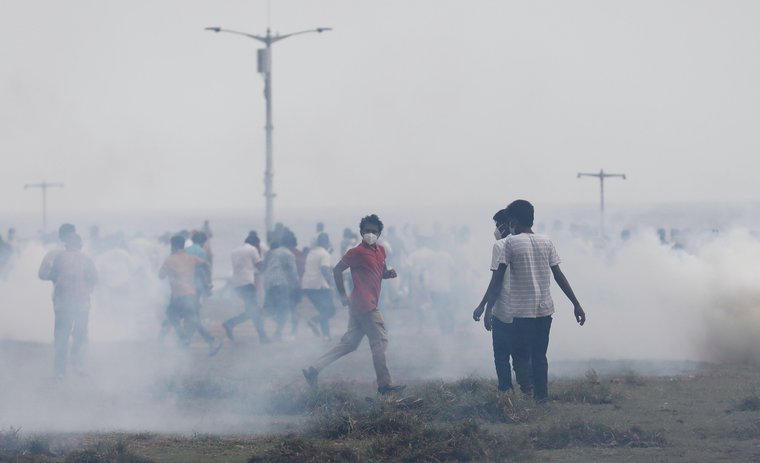
Riot police fire tear gas during a clash with anti-government demonstrators in Colombo, Sri Lanka’s capital, on 9 May | Dinuka Liyanawatte/ Reuters/ Alamy. All rights reserved

Sri Lanka is in a state of chaos. Faced with the worst economic crisis of its 74 years of independence, the country has been roiled by days of violent unrest – leading the government to the brink of collapse.

For months, nationwide protests have taken place over soaring food prices, severe shortages of everyday essentials, weeks of power cuts lasting up to ten hours a day, and crippling petrol and diesel costs, which are up 92% and 76% respectively since January.

A national emergency remains in force, the army is enforcing a nationwide curfew and threatening to shoot looters on sight and some Western countries are issuing advisories to warn their citizens against non-essential travel to Sri Lanka.

Its growing notoriety – as a failing state and an unstable no-go area – is a bitter blow for the tear drop-shaped island nation, which once counted tourism as its third-largest foreign-exchange earner and was not too long ago hailed by the World Bank as South Asia’s development success story”.

State of play

President Gotabaya Rajapaksa’s government is struggling to remain in office as he attempts to cobble together a national unity administration. This would replace the 26-member cabinet, whose members resigned in unison last month bar the president and his elder brother, the prime minister, Mahinda Rajapaksa.

The situation is volatile. Mahinda, who hung on until Monday, when he also resigned, has had to be evacuated by the army, after protesters tried to storm his official residence in the capital, Colombo. He is currently sheltering at a naval base in the north-eastern city of Trincomalee.

On 12 May, Ranil Wickremesinghe was sworn in as Sri Lanka’s prime minister for the sixth time, but it’s not clear if cabinet formation will be speedy and smooth. The lack of a new cabinet is taking its toll on Sri Lanka’s people and its prospects. On 11 May, the head of Sri Lanka’s central bank, Nandalal Weerasinghe, said the country has just 48 hours to save itself, lest the economy will completely collapse”.

Even the basics are unaffordable. Lentils rose from 168 rupees (37p) a kilo in October to 500 rupees (£1.11) in April

Meanwhile, angry protesters chant Go Gota, go”, while the International Monetary Fund (IMF) – with which the government is urgently negotiating a bailout – has said talks for a loan can advance only once a new cabinet is in place.

The IMF also expressed concern over rising social tensions and violence”, according to a statement shared with local media.

A mounting debt crisis has left Sri Lanka unable to refinance foreign debt totalling more than $50bn. And with foreign currency reserves as low as $50m, the country is unable to import food, medicine and fuel.

Its 22 million people have suffered weeks of severe shortages of everyday essentials. Even the most basic food has become unaffordable. Lentils, for instance, rose from 168 Sri Lankan rupees (37 pence) per kilo in October to 500 rupees (£1.11) in April. Meanwhile soaring fuel costs are forcing public transport and private vehicles off the roads and leaving farmers unable to run tractors or start their rice paddy crops, despite it being planting season.

A desperate government has sought bailouts from India and China and even poorer Bangladesh.

How did it come to this?

But how did Sri Lanka get here? It was the first South Asian country to embrace market liberalisation way back in 1977 and was often compared to Singapore, says P. Jayaram, a visiting professor at Amrita University in Coimbatore, India, who reported from Colombo in the 1980s and 1990s.

Barely a decade ago, a report for the research-focused International Growth Centre was hailing Sri Lanka’s 7% growth rate and its substantial reduction in poverty”. As recently as 2018, Sri Lanka’s per capita GDP was more than $4,000 (by 2020 this had fallen to $3,680). According to UNESCO, an astonishing 92.5% of Sri Lankans are educated, with non-profit Borgen Project declaring the country’s relatively new education system has shocked the world with its success”. Sri Lanka’s free and universal healthcare was celebrated as a success story in South Asia”.

On 16 May 2009, Mahinda Rajapaksa, then the president, declared victory in the nearly three-decade civil war against Tamil Tiger rebels. There was dancing on the streets of Colombo and a stream of congratulatory messages poured in from world leaders for this stunning defeat of ‘terrorism’.

Sri Lanka seemed poised to reap the harvest of peace and prosperity. But the decisions made after the end of the war put the country on a quite different, perilous path.

Flawed choices

Sri Lanka made a series of flawed choices after the end of the civil war,” Sumit Ganguly, a professor of political science at Indiana University, told openDemocracy.

Amongst other matters, it went on a borrowing spree and it cut taxes. The debts came due and the revenue losses undermined public finances.”

Sri Lanka was Asia’s largest high-yield bond issuer, borrowing heavily in the years following the war for several ambitious infrastructure projects, such as South Asia’s tallest self-supported tower and wide highways in the hinterland. Critics call these projects the Rajapaksa white elephants”. The pile of debts continued to grow, with roughly a third owed to international bondholders and China and India as other large creditors.

Mahinda was in charge of the country from 2005 until 2015; his thumping election victory in 2010 leading political analysts to label him a man with a Midas touch”. But that seemed not to extend to the country’s finances, with Mahinda taking Chinese loans to build the expensive Hambantota port in his southern home district.

Related story

lead

‘Handicapped sovereignty’: escalating costs of Sri Lanka’s post-war development vision20 October 2018 | Benjamin Brown , Loritta Chan , Kanchana N RuwanpuraAs capital elbows its way in and remakes the world according to its own designs, the need to democratise this polity is more urgent than ever.

This controversial relationship with China went back a long way, as Ganguly wrote in a 2018 paper. Mahinda’s final military onslaught against the Tamil rebels, Ganguly noted, found significant support, especially in the form of substantial amounts of military equipment, including six F7 fighter jets, from the People’s Republic of China.

The PRC also provided millions of dollars’ worth of other military equipment and about $1bn in overall assistance.”

The Hambantota project followed on from that – but it hasn’t ended well. In 2017, the port was leased to Beijing on a 99-year debt-for-equity swap, after Sri Lanka failed to pay off the loan. Critics say Mahinda caused Sri Lanka to fall into the Chinese debt trap”.

The man with a Midas touch lost the 2015 election, but with brother Gotabaya chalking up an emphatic win in 2019, the Rajapaksa family was back in power. At the time, Sri Lanka’s economic situation was fair – it had foreign reserves of some $7.5bn and a budget surplus – there seemed a chance it could turn the corner on the bad deals of the past.

But Gotabaya put in place sweeping tax cuts, in what some Sri Lankan commentators call voodoo economics”. With value-added tax nearly halved to 8% and seven other taxes abolished, government revenue fell. Ganguly indicates that it changed Sri Lanka’s progressive, poverty-cutting arc. Economic disparities certainly had widened with the tax cuts as the benefits mostly accrued to the wealthy,” he told openDemocracy.

The pandemic didn’t help because there was a dramatic drop in tourism… and the country lost significant remittances from the Middle East,” Ganguly added. To compound matters, with the exchequer drained an import-dependent economy saw soaring inflation.”

Economic disparities certainly had widened with the tax cuts as the benefits mostly accrued to the wealthy

In April 2021, the Rajapaksa government announced a bold and aspirational transition to organic farming. Chemical fertilisers were banned and their import halted. Virtually overnight, farmers were left to get on with farming in an organic way.

There was no proper plan, no training or education,” Vimukthi de Silva, an organic farmer in Rajanganaya, later told The Guardian. Yields of rice, the country’s staple food, dropped precipitously, as did formerly plentiful banana and tea crops. Vegetables became five times as expensive as before the ban.

The cash-strapped government slashed funding for school meals. A food crisis loomed. Donations of Chinese rice were supplemented by high-priced purchases from Myanmar. Sri Lanka’s failed organics experiment became a salutary story in South Asia for how not to do it.

What happens next?

The president promised, late on 11 May, that he would form a new government within a week. But this may not be quick enough. The situation remains fluid and the only certainty is flux.

Writing in The Guardian in 2009, celebrated British-Sri Lankan writer Romesh Gunesekera described his country of origin in lyrical terms. Sri Lanka, he wrote, is an island that everyone loves at some level inside themselves. A very special island that travellers, from Sinbad to Marco Polo, dreamed about.

A place where the contours of the land itself forms a kind of sinewy poetry.”

But Gunesekera’s article was headlined: ‘A long, slow descent into hell’. It may have been prescient, albeit unintentionally, about a country whose leaders’ aspirations catastrophically exceeded their ability to sustainably deliver.

‘You can’t throw out a president’: Namal Rajapaksa on Sri Lanka crisis

May 12th, 2022

Akshaya Nath Courtesy India Today

Speaking about the ongoing crisis in Sri Lanka, MP Namal Rajapaksa said one cannot throw out a president as it will deepen the political instability. Since the start of the economic crisis, Opposition leaders have called for the removal of President Gotabaya Rajapaksa from office.

Namal Rajapaksa, the son of former Sri Lanka Prime Minister Mahinda Rajapaksa, said one cannot throw out a president as it will deepen political crisis. He also blamed the Opposition leaders for not taking responsibility of governing Sri Lanka during the country’s worst economic crisis.

Rajapaksa said, “People who are protesting against the government need to understand the democratic way. You can’t throw out the president. The president had to function without a government for over 48 hours. If the president resigns what next? We have opposition leaders who didn’t want to take responsibility. We have a clear road map now.

Sri Lanka’s economic crisis escalated into civil unrest following the resignation of Prime Minister Mahinda Rajapaksa on May 9. Soon after Rajapaksa’s resignation, his supporters clashed with the anti-government protesters.

The ancestral home of the politically-influential Rajapaksa family in Hambantota was set on fire by protesters. Eight people have died and around 250 people have been injured in the violence.ADVERTISEMENThttps://a78f51adf141dba7ee9533e4f8784c67.safeframe.googlesyndication.com/safeframe/1-0-38/html/container.html

The Hambantota MP said allegations of government inciting violence are false. He stated that his family would remain in Sri Lanka and face investigation into violence that broke out between pro- and anti-government protesters in the streets of Colombo.

Speaking exclusively to India Today, “This is not the first time we have a travel ban. We had four travel bans during the last government too. No intention of running away. We want to work with people and remain in Sri Lanka. As an individual or family, we didn’t have a part to play in any violence. Allegations of us [ruling party] inciting violence are false. We will face investigation. “

“We have to come out of [economic] crisis. The PM resigned as per the demands of the people. At the same time, a chaotic situation prevailed because mobs were instigated by political-motivated groups,” he added.

Namal Rajapaksa, who is currently at a secured location in a naval base, said the country went without government for 24 hours and the resignation of President Gotabaya Rajapaksa won’t serve as a solution to the current crisis.

“There is a democratic way of transferring power. The 21st amendment will be worked and executive power will be abolished. President’s power will be reduced,” Rajapaksa said, backing the demand for Constitutional reforms.

In a late night televised address on May 11, President Gotabaya refused to quit but had promised to appoint a new Prime Minister and a young Cabinet which would introduce key constitutional reforms to curb his powers.

Gotabaya had said that after appointing the new Prime Minister, and Government a constitutional amendment will be moved to enact the content of the 19th Amendment to the Constitution, which will vest more powers with Parliament.

MR felicitates Ranil

May 12th, 2022

Courtesy Daily Mirror

Former Prime Minister Mahinda Rajapaksa extended his wishes to newly-appointed Prime Minister Ranil Wickremesinghe.

In a twitter post, he said “Congratulations to the newly-appointed Prime Minister Ranil Wickremesinghe. I wish you all the best as you navigate in these troubled times,”

Public requested to provide information on violent acts

May 12th, 2022

Courtesy Ada Derana

The Ministry of Defence has requested the general public to inform the details of criminal activities by mobs or violent groups and incidents of damaging of public and private properties, looting and assaults from any parts of the island.

The public can provide such information through the following contact numbers:

Defence Ministry Hotline – 0767 392 977 and 0112 441 146 

Ministry of Public Security – 118

President responds to Sajith’s letter on Premiership

May 12th, 2022

Courtesy Adaderana

President Gotabaya Rajapaksa, responding to the letter directed by Opposition Leader Sajith Premadasa has said the decision to appoint Ranil Wickremesinghe as the new Prime Minister cannot be reversed at the moment.

You refused my prior invitations to accept the Premiership. Following discussions with political party leaders representing the parliament, I have appointed Ranil Wickremesinghe to the post of Prime Minister.”

President Rajapaksa has informed the Opposition Leader to inform him if he desires to include any of his party members in the Cabinet.

Accepted premiership to deliver solutions, PM Ranil says

May 12th, 2022

Courtesy AdaDerana

Newly-appointed Prime Minister Ranil Wickremesinghe says he accepted the President’s invitation by choosing to deliver solutions over practicing petty politics.

Speaking to the media following his swearing-in, PM Wickremesinghe stressed that the country’s economy needs to be rescued and the people are living with great difficulty.

Ranil Wickremesinghe sworn in as new Prime Minister

May 12th, 2022

Courtesy AdaDerana

The Leader of the United National Party (UNP), Ranil Wickremesinghe has been sworn in as the new Prime Minister of Sri Lanka.

Wickremesinghe took oath before President Gotabaya Rajapaksa at the President’s House this evening (May 12).

Secretary to the President Gamini Senarath and Prof. Maithree Wickramasinghe were also present on the occasion. 

Wickremesinghe has served as Prime Minister of Sri Lanka on five previous occasions.

President Rajapaksa and Wickremesinghe held a round of discussion on Wednesday evening (May 11) during which the new appointment for the vacated premiership and the present crisis situation in the country was discussed at length.

Wickremesinghe’s appointment comes after Mahinda Rajapaksa resigned as the Prime Minister following a brazen attack on peaceful protesters camped outside the Temple Trees and the ‘GotaGoGama’ protest site at Galle Face Green by a mob of ruling party supporters on May 09. The events led to a nationwide public furore.

The resignation of Mahinda Rajapaksa was later notified in a Gazette Extraordinary published on May 09, under the directives of the President.

Soon after the swearing-in of Wickremesinghe this evening, former PM Mahinda Rajapaksa, who was reportedly relocated to the Sri Lanka Navy Dockyard in Trincomalee due to security reasons, congratulated his successor.

Congratulations to the newly appointed Prime Minister of #lka, @RW_UNP. I wish you all the best as you navigate these troubled times,” Rajapaksa tweeted.

Congratulations to the newly appointed Prime Minister of #lka@RW_UNP. I wish you all the best as you navigate these troubled times.— Mahinda Rajapaksa (@PresRajapaksa) May 12, 2022

The citizens of the island nation have been showing this discontentment with the incumbent government as they continue to stand in long queues to meet their basic necessities, including food and medicines. 

It was reported last week that the Sri Lankan President had requested Mahinda Rajapaksa to vacate the premiership, in order to allow the formation of a government of national unity, an interim arrangement until the present economic crisis could be dealt with. 

Rajapaksa’s resignation as the Prime Minister came after several rounds of discussions among the ruling Sri Lanka Podujana Peramuna Party (SLPP) and its constituent parties. The PM’s departure also results in the dissolution of the Cabinet. 

The Sri Lankan government is currently struggling to meet basic requirements for its population of 22 million citizens amid an unprecedented economic crisis caused by mishandling of finances and ill-timed tax cuts. 

The island nation is also currently facing a foreign exchange deficit, which has resulted in food, fuel, power, and gas shortages, and has sought economic assistance from friendly countries. 

Meanwhile, people in the country have been protesting for nearly a month demanding for the government, led by the Rajapaksa family, to resign.

Would Mahinda Rajapakse set fire to his own house?

May 11th, 2022

Shenali D Waduge

Ask yourself, if you were Mahinda Rajapakse, with no intention of resigning as PM, would you unleash a mob to attack unarmed protestors, knowing the ultimate blame will fall on your shoulders? Presuming the answer is negative, think about what could have really happened. Without falling for pick &  go versions, think of the events & make your intelligent conclusions.

9 April 2022 – Protestors create #GoHomeGota inside Galle Face Green

Did the President err in allowing structures inside public place for a handful of protestors to claim it as their own inside which curfew & emergency were deemed null & void, questioning inequality to others having to remain indoors! This protest soon was overtaken by others with agendas diluting the message of the protestors (knicker show/anti-Buddhist slogans & dramas etc)

7 May 2022 – President declares emergency

9 May 2022 – Supporters arrive to urge Mahind Rajapakse not to resign (some had come in buses – some marched)

SCENARIO 1

  • Around mid-day these supporters began attacking protestors stationed outside Temple Trees & thereafter proceeded towards Galle Face Green where they attacked the GoHomeGotaGama protestors.

Questions to answer

  • Who organized these supporters to arrive at Temple Trees
  • From where did these supporters arrive (districts/provinces)
  • How did these supporters arrive (given the fuel crisis)
  • Was PM Mahinda Rajapakse part of the organizing team?
  • Did they bring poles/sticks etc with them or were they strategically placed en route or were they given poles/sticks at Temple Trees?
  • If so who supplied these poles/sticks
  • If the supporters inside Temple Trees did not have sticks but another group of supporters joined with sticks – who organized these people?
  • who instructed them to attack the unarmed peaceful protestors”?
  • By 3p.m. another set of people mostly youth arrived – were they JVP/FLSP/SJB or another group (who organized these)
  • The Temple Trees supporters were outnumbered & many landed up in Beira Lake – clothe removed by ‘peaceful protestors’. Minister Johnston Fernando’s vehicle was also put into the Beira Lake – with quite a number of arrack bottles.
  • The attacks left over 150 injured with the death of 1 policemen, 2 bodyguards and a SLPP Member.
  • It was unusual to see the Opposition Leader Sajith P and Eran W arrive at Galle Face Green in the middle of an altercation – who asked him to arrive?
  • JVP leader Anura Kumara Dissanayake, former MPs, Lal Kantha, Wasantha Samarasinghe and Dr. Nalinda Jayatissa also arrived – who asked them to arrive?
  • Who attacked Sajith? Why didn’t the same people who attacked Sajith not attack Anura Kumara & Co? Does this mean the protestors at Galle Face Green are supportive of Anura Kumara but does he get the same support from the rest of the Island which is 99.9% of the populace?
  • The police & army are accused of not taking action – was this under orders (if so by whom & why) or was it out of fear as they have been lambasted by the international community & human rights organizations not to block peaceful protests” & the time they did take action, this has resulted in arrest of police. Was the arrest to scare police from taking actions as arrest meant withholding salary until cleared of charges! Was police neutralized into inaction this way?
  • The most important question is was Mahinda Rajapakse aware that his supporters were going to attack the peaceful protestors” & did he give the nod of approval?
  • Another point to consider is – would political savvy Mahinda Rajapakse who would have known the outcome of armed supporters attacking unarmed protestors, allow such an attack when the outcome would have been blamed on him? This is the crucial question that needs to be answered.

The ultimate outcome of this attack

  • Resulted in the resignation of PM Mahinda Rajapakse & the entire Cabinet

SCENARIO 2

  • Immediately after the attacks in Galle Face Green – SLPP MPs houses became the target of arson with over 50 being burnt to ashes, vehicles smashed & furniture destroyed.
  • If this was an act as reaction to the unprovoked attacks on unarmed protestors in Galle Face Green – how were groups of men with kerosene ready to attack houses of Ministers/MPs around the island & knew where these houses were located?
  • Why did the attackers not attack the President’s residence in Mirihana, though the residences of Mahinda Rajapakse in Tangalle, Medamulana, Carlton House & Kurunegala were burnt down as well as the shrine for the parents of the Rajapakse brothers?
  • Who organized these groups – generally around 25 to 30 for every attack? Why were they wearing helmets? How was media present to film the attacks?
  • Why were no one present in the homes that came under attack? Were they given prior warnings? Why? Was the intent to only cause property damage & not lives?

There are numerous opinions regarding these attacks which are linked to the allegation that the police & army just watched looking helpless.

Scenario 2 – were the attacks by

  • Locals organized by foreign intel
  • Prime Minister & his associates (setting fire to their own homes)
  • JVP / Peratugami
  • SJB
  • Champaka & Pathum K
  • Or any other?

Then, there is the deafening silence of the head of State & all protestors appear to have forgotten about the kakka” – were these two with their families overseas also facing some sort of arm-twisting not to take action as were the other heads upon whom fell the responsibility of defending the nation & the people.

From the above scenarios, we must be intelligent enough to analyze & wonder who has the biggest advantage of the chaos that prevails? It is certainly not Mahinda Rajapakse. Who has the advantage & how?

We see very strong messages coming from the US & India is even mooting Indian troop presence claiming Indian interests in Sri Lanka are at risk.

If you were in Mahinda Rajapakse’s shoes – would you have created a situation where you are being hounded by helmet gangs and there’s a threat to Sri Lanka’s sovereignty?

GOAL ACHIEVED

In getting the PM to forcefully resign, the President has been further cornered minus the brothers that backed him, by getting over 40 key MPs to lose their homes & fear for their lives & family, they are now in a situation where to survive in politics, they have to bend on knees & beg – no longer can they dictate terms or demand dollars or positions for their vote. They are now political pawns & will say or do anything for their survival. They have been effectively neutralized. This is the perfect potion for pass legislation sans even debate or objections. There is even the question of rallying candidates to contest for the next elections with no strong leader to lead the party.

Such an operation cannot be done with local brains.

Therefore, we have to wonder who are the brains behind the chaos that erupted. From where did the pluck the helmet gangs for the job?

The biggest disadvantage was, to no one else but Mahinda Rajapakse – the once loved and the most charismatic politician in Sri Lanka. A Goebbels propaganda systematically brainwashing people over 5 years has been successful. He is now the most hated person in Sri Lanka by the LTTE-lobby/ the LTTE diaspora / the anti-Rajapakse Christian/Catholic lobby / the JVP-SJB-Peratugami & even foreign intel.

Being the only politician able to command the largest vote base, it was important that he had to be neutralized ahead of an election as well as to weaken the state and prevent him leading any opposition.

Getting rid of him was not a major exercise given the arrogance of his family members and the greed of acquiring wealth. Whether allegations of corruptions are true or not, the campaigns around them united people against him far beyond previous times.

Combining the unprovoked attacks, the allegations sufficed to justify that he was unsuited to be PM.

If he was not prepared to give up his PM position even on the day that supporters were arranged to arrive in support of him, was this unprovoked attack planned to force his resignation and to neutralize all the MPs that posed a threat for the ultimate goal of the brains behind the attacks – to abolish the Executive Presidency?

With the resignation of the PM & entire Cabinet, even those who oppose the Executive Presidency would realize its merit. Whether a weak leader sat in the seat, the position is giving the much needed powers to keep the country stable. Those that recently proudly proposed its abolishing will be realizing its importance now, especially in the light of personal vendettas/looting taking place in the guise of ‘revenge attacks’.

If the Opposition is brimming with glee – they must surely know, they can also be next!

Shenali D Waduge

Digital Colonialism and the Covid Endgame: Cyber War Simulacra in an Upside-Down World

May 11th, 2022

Dr. Darini Rajasingham-Senanayake

The greatest transfer of wealth in human history took place during Covid-19 Lockdowns with Covid masks and Personal Protection Equipment. The rest of the world was impoverished.[i]  

As Sri Lanka caught in an International Sovereign Bond (ISB) debt trap defaults into the arms of Washington and the International Monetary Fund (IMF), questions arise at this time: Have two years of Covid-19 lockdown induced digitalization of economy, society and democracy, a.k.a. Digital Colonialism, advanced to a point that all sides are infiltrated and gamed in this strategically located Indian Ocean island nation perpetually in the cross-hairs of great power rivalry?

Both the staged Gota Gama” protest Party that was a prelude for the coordinated violence to follow, and the Sri Lankan Parliament convening via zoom while citizens were kept in the dark suggest disturbing trends. Currently with curfew in place parliament sessions are tipped to take place on zoom or Skype– with more bots and trolls than politicians?!

To what extent are democracy, society and economy gamed and controlled by external actors when a national parliament is convened via Zoom or Skype while citizens are locked down in an era of heightened Disinformation Playbook narratives, artificial intelligence, cyber war and data wipes, globally and locally?

Leaderless protestors at ‘Gota Gama’ were organized anonymously via social media platforms and networks like Facebook (META) and Whatsapp chats and invisible bots on the English-language based internet. On the ground the activities in Galled Face were organized by foreign funded local Non-Government Organizations NGOs.

Who provided the (artificial) ‘intelligence” for the apparently leader-less protestors to gather and organize at Galle Face? The Gota Go Gama” Protestors were anonymously organized via social media. They appeared to set the stage and were the prelude to the violence and curfew to follow that further debilitated the Lankan economy as talks with the IMF take place?

Some protestors carried posters supporting Washington and the IMF although the country was led to Default by a US citizen and Minister of Economic Disaster, Basil Rajapakse who has since disappeared.

Of course many protestors were youth enjoying post-Covid lockdown freedoms and genuine patriots frustrated by the deterioration of economy and society. The question remains who enabled the intelligence and led anonymous Protest organizers and later violent mobs?  Who or which intel agents and agencies backed and provided the digital intelligence though invisible, remote, server networks?

Frances Haugen the Face book Whistleblower has revealed how social media is used to game elections and other social and economic outcomes. Facebook was also used in the past to spread hate to divide societies and countries by CIA and external intelligence agencies in Myanmar and Ethiopia and during the Arab Spring Regime Change operations in the Middle East and Eastern Europe.

Dominance of cyberspace it is said had tipped the war in Ukraine in this era of Full Spectrum Dominance (FSD) and hybrid economic war with Over the Horizon (OTH) operations by those with the technology and cyber capability. Is such an operation on-going in Sri Lanka with the citizens kept in locked down once again as talks with the IMF commence?

Inequality Kills

Meanwhile, Oxfam released a report on the economic costs and global impacts of Covid-19 titled Inequality Kills” in time for the IMF’s Spring meetings last month.

There has been, however, little analysis of the economic costs of Covid 19 lockdowns and other policies and their causality vis-à-vis the current International Sovereign Bond (ISB) Debt trap and economic meltdown in Sri Lanka, which have resulted in the predicted pivot to the Washington Consensus and International Monetary Fund (IMF).

Analyses of the compounding economic crisis in Sri Lanka have mainly focused on lost State revenue due to ill-advised tax cuts implemented in the wake of the mysterious ISIS claimed 2019 Easter Sunday attacks that targeted luxury hotels and the tourism dependent economy, rather than Covid-19 lockdowns and related policies to explain the current economic crisis in this strategic Indian Ocean island.

Back in 2020 discerning medical economists like Dr. Jayantha Bhattacharya of Stanford University and national leaders like Pakistan Prime Minister Imran Khan stated that in poor countries more people would die of hunger, mal-nutrition and starvation due to Covid-19 lockdowns and their economic fallout, than due to the virus.

PM Khan who wisely refused to lockdown Pakistanis was removed through a ‘regime change’ operation earlier this year amid staged Arab Spring protests, but his statement rings true in Sri Lanka as people died in food, fuel and petrol queues at this time.

 In the context, a study of the full impacts and Economic Costs of World Health Organization (WHO)-recommended Covid-19 Lockdown policies (including on livelihoods and small and medium enterprises), leading to the current economic crisis in Sri Lanka would be relevant.

Other countries in the Global South are in a similar Covid-19 induced debt trap at this time and a Debt Jubilee and eventual debt cancellation is necessary, rather than an IMF’s led Firesale” of national assets including telecommunications infrastructure, electro-magnetic and digital telecom frequencies while people are under curfew as IMF talks with the Central Bank commence.

But globally, the tipping point is here now: Two years of Covid ‘panicdemic’ and World Health Organization (WHO) staged ‘Permanent Emergency’ media narrative now followed by the war in Ukraine has shown us that ‘the Emperor has no clothes’, comprehensively.

In the ‘West’ versus the ‘Rest” face-off, which the Covid-masked new hybrid Cold War looks like, the Rest has come out on top—having bested the West. The Euro-American Empire is almost done and dusted; its legitimacy shattered as the Truth leaks out: The Gain of Function (GoF) research-based, Covid virus and vaccine bio-warfare project (partly subcontracted to Wuhan labs), to digitalize, govern the world, its wealth, populations and migration with a CV-Mask, while taking down emerging economies’ and ‘China’s Belt and Road Initiative (BRI), is coming apart at the seams.

By now, it is not a secret that Moderna’s mRNA injection was a United States (US) Defense Advanced Research Projects Agency (DARPA) program to manufacture ‘vaccines’ at ‘warped speed’. Nor is it a secret that Moderna had patent applied and obtained patents on certain SARS-COV2 sequences, subsequently named Covid-19.

A First World Virus and Land Mark Indian Supreme Court ruling

All the Data shows that Covid-19 was mild in the Global South, particularly Asia and Africa, which has beaten the virus without ‘vaccines’ despite poverty and poor health care systems.

Rather, Covid-19 appears to have decimated and divided the ‘First World’ despite and arguably because of its advanced biotechnology and Big Data-dependent Health Systems and mRNA injections and global human genome maps. Not to mention over-consuming, co-morbidities-intensive, hyper-digital lifestyles.

The Global South has outperformed the so-called advanced” techno-cyborgs of the West on Covid-19. So too it seems the other Emergency, CoP-26, a.k.a. Climate Emergency” and Anthropocene discourse (Agenda 21), meant to bend the Rest to the corporate agri-business and energy agenda of the West, to enable Green-washing” of big and dirty oil companies and their rebranding as captains of clean, green renewable (LNG) energy technology as part of Climate catastrophe ‘Disaster Capitalism’.

Meanwhile, in a landmark decision the Supreme Court of the largest democracy in the world, India, ruled unambiguously last week, that no one could be forced to be vaccinated and that that there was NO data to show more risk from unvaccinated persons. The court said the Centre and states did not place any scientific evidence or data to indicate that the risk of transmission of the virus from unvaccinated individuals is more than from vaccinated persons to justify the discriminatory treatment of unvaccinated persons.

India’s apex court also asked the Centre to make public data on the possible adverse effects of the Covid injections, as had the US court calling for release of Pfizer vaccine trail data.

The boot is now on the other foot! The West will have to eat humble pie and learn how to fight for democracy and against Covid-19 from the Rest”—the colonized and denigrated Third World—Africa and Asia, with its teeming masses. Covid-19 has also deeply divided ‘First World’ societies and economies (Euro-America and its NATO, QUAD and AUKUS allies), where democracy seems increasingly a farce for the rich and connected to perform. The Covid-19 ‘panicdemic’ increasingly looks like a disease of the First world” although it was supposed to target ‘minorities” everywhere.

In Africa fewer than 30 per cent are ‘vaccinated’ but Covid deaths are few, and so too, in much of Asia with its huge populations. This, despite the Hunger Virus unleashed by the World Health Organization’s (WHO), criminal Lockdown policy recommendations that have caused mass impoverishment.

Indeed, it increasingly appears that the mass rollout of inadequately tested and trialled Pfizer and Moderna mRNA injections have done much of the damage to Euro-American populations as the numbers of Vaccine Adverse Events (VAE), Antibody-Dependent Enhancement (AED) cases mount. Covid-proofing with leaky gene-therapies simply has not worked in the rich West. The next pandemic would be of the ‘vaccine’ injured.

Simultaneously, Democratic Rights and freedoms are being stripped fast and loose with the Covid-19 mask at hand in so-called advanced” Western Democracies, as vaccine mandates and passports kick in amidst massive protests on the streets and in the Courts.

The US and Europe with their vaccine cards, bio-politics and digital surveillance are hardly beacons of Democratic Rights, Liberty and Freedoms these days, and certainly cannot lecture anyone on Social and Economic Justice, Rights or Equality. Just remember Julien Assange languishing in Belmarsh Prison for exposing the war crimes of the Empire.

Vaccine and mask mandates have taken Divide and Rule” to a whole new level.

Clearly, the Covid-19 narrative to legitimate snooping on one’s own citizens and cover-up ‘Digital Colonialism’ under the guise of protecting Society and Community while destroying our COMMUNITY, RELIGIOUS AND SOCIAL LIFE and digitally hacking our brains and bodies with lockdowns and injections is not working.

Society must be Defended’ was how the brilliant Philosopher and Historian of ideas, Michel Foucault, who died of AIDS, which he also knew was invented in a Lab (just like the Fall Army Worm that destroyed crops and food security in Africa and Asia not so long ago), ironically glossed the Orwellian bio-warfare program. Indeed, it is quite clear that ‘society’ and communities as Social Scientists know them had to be Destroyed and Digitalized in order to be defended, masked, surveilled and controlled by Big Brother. This irony has however been lost on a great majority of acquiescent social scientists as pop psychology and therapy has displaced social and communal life and indigenous healing systems such as Ayurveda, Siddha, or Unani.

Wither the Imploding Empire that won’t go ‘quietly into the night?

Postmodernist and social theorist Jean Baudrillard argued that a simulacrum is not a copy of the real, but becomes truth in its own right: the hyperreal.  We have lived two years of Covid hyper-reality.

Of course, Pax Americana and its NATO-AUKUS imperialism is not dead yet and evidently refuses to go ‘quietly into the night’ as Asia led by China and ASEAN rises once again as the global growth centre. Rather, Joe Bidden is on the warpath with America’s old Cold War rival, Russia, while Stoking a New Cold War with China, having concocted AUKUS to encircle both while egging on the EU part of NATO to fight Mr Putin in Ukraine!

The Pax Americana was always a Hot War; partaking of coups, assassinations, staged terrorist attacks and riots as regime change operations like the Jakarta Method”, and proxy wars in the Global South, while a Cold War prevailed in the Global North. It is in this context, that strategic Sri Lanka perched in the middle of the Indian Ocean, governed by dual American citizens of the Rajapaksa family, is an outlier in the Global South with almost 70 per cent of its population vaccinated.

Sri Lanka sits at a chokepoint among Indian Ocean Sea Lanes of Communication (SLOC) and is in the crosshairs of the new Cold War’s vaccine Geopolitics. The US citizens who rule this post/colony are desperate (like India’s Modi) for a vaccine victory following self-inflicted economically devastating Lockdowns and attendant millionaire migration and brain-drain to the West amid the pandemic of corruption.

Simultaneously, South Asian ethnoreligious Diaspora networks in AUKUS countries have been Weaponized to advance the economic and security interests of the Deep state and against the interests of those of us actually living and working in the Global South at this time.

Digital Colonialism and Disaster Capitalism

The West is still pushing the Covid-19 and CoP 26 Climate Catastrophe narrative to enable what Naomi Klein termed Disaster Capitalism” in her book Shock Doctrine” and ensure Global Governance through Digital Colonialism: Euro-American Corporate Captains and Hedge Funds like BlackRock that got huge chunks of the 9 trillion US Government Covid 19 bailout” continue to asset strip the Global South.

Booming stock markets are an indicator of the asset stripping and massive wealth transfers going on everywhere as people are impoverished. the current surge in the stock market amid mass impoverishment and what Oxfam terms the ‘Hunger Virus’ amid spiralling inequality look like something out of Ripley’s Believe It or Not—a phantom market,” as a Colombo Stock Exchange analyst put it.

What is increasingly clear is that the Euro-American Global Reset project is headquartered between Geneva (where the DAVOS/ WEF clique and various UN agencies like the WHO and ILO that funds and controls Trade Unions that have been promoting Covid-19 Lockdowns hold sway), and Washington with its military business intelligence, research, and media industrial complex that President Dwight D. Eisenhower famously warned U.S. citizens about in his farewell address in 1961.

Novak Djokovic is the latest Celebrity victim of the Global Governance dream project of the Deep state Military Business industrial complex in tow with the DAVOS clique. Djokovic was rendered a spectacle by Australia’s judicial system and puppet Prime Minister who had earlier rushed to dis France (which is competing with and waging a high stakes battle for its share of the Indian Ocean with the Anglo-Old Commonwealth’s Pakkha Sahibs), for AUKUS.

After all, Djokovic’s defiance of Australian Vaccine Mandates advertised on pacifying Global Sports Media channels cannot be tolerated in Vaccine-card carrying Covid Democracies!

Life in a Cyber Simulacrum of Protests

It is not a secret that the world’s top ten wealthiest doubled their wealth last year.

US digital giants, known as GAFAM (Google, Apple, Facebook, Amazon, and Microsoft), aside from Big Pharma are the biggest beneficiaries of the Covid-19 global wealth transfers and re-set: Indeed, big Pharma funded WHO’s Covid-19 Pandemic would not have been possible without Digital Colonialism, which it has in turn deepened.

‘Digital nomads’ along with BPO or Business Process Outsourcing (BPO) have also enabled business-intelligence agents’ game global and local (social) media narratives around the world while promoting the Permanent Emergency” to destabilize, distract and digitalize communities. Online the message is surveilled and controlled, while the reality is encased the Covid-19 ‘Infodemic’ and numbers game.

Concealed in this cyber simulacrum is truth and the big picture. The Permanent Covid and Climate ‘Emergencies’ have enabled a Pandemic of Corruption, DIGITAL COLONIALISM, hacking of national data, institutions, policy-making processes and information systems like the National Medicines Regulatory Authority (NMRA) Data Wipe on the Sri Lanka Government Cloud and unprecedented division of societies and communities. Divide and Rule amid digitalization.

Simultaneously, many are so distracted with mask-policing of their neighbours and now with Protests directed by Pied Pipers on social media platforms that the looting of national wealth by corrupt politicians and Digital Corporates passes unnoticed.

At this time is increasingly apparent that the protestors at the post Covid-19 party Gota Go Gama” at Galle Face were played by the same anonymous social media pied pipers who spread Covid-19 fear psychosis and promoted economically devastating lockdowns in the country over the past two years.

These protestors” had obediently followed the Covid-19 narrative, fear psychosis, militarized mass injection, and economically devastating lockdown campaign promoted on the same social media platforms and networks and via the internet for the past two years with WHO’s questionable data. They were finally enjoying freedom at the Gota Gama party, or what some cynically termed the fun gama” and sin city”. On the ground the party was supported by local donors and coordinated by foreign funded NGOs. It was a post-Covid lockdown freedom and protest party!

In the context, a systematic analysis of two years of Covid 19 Panicdemic narratives and lockdowns on industry also given lost production and livelihoods for small and medium enterprises, as well as, the Covid-19 policy response including money printing in Sri Lanka seems overdue.

After all, almost 40 percent of the national budget was diverted to the Health Sector for purchase of expensive Covid-19 injections, Pfizer boosters, endless PCR tests, oximeters, fleets of ambulances etc. Indeed, the Health Sector procurement policy may warrant systematic analysis and investigation also in the context of a constant refrain regarding medicine shortages”.

Aside from GAFAM Big Pharmaceutical companies benefited most from the Covid panicdemic and they often fund many national health sector events, research, conferences and organizations such as the Sri Lanka Medical Association (SLMA), and GMOA and other Trade Unions which called for economically-devastating Lockdowns.

A study of the full impacts and Economic Costs of WHO-recommended Covid-19 Lockdown policies, their causality and continuity with the Easter 2019 hybrid economic war-style attacks on the tourism dependent island economy leading to the current economic crisis in Sri Lanka would be relevant. Such a report may enable seeking an ISB debt jubilee and eventual debt cancellation in this geostrategic island perpetually in the cross-hairs of great power rivalry?!

Remarkably, three years of investigations into the mysterious Islamic State (ISIS), claimed 2019 Easter attacks on economy and society have revealed that they were directed by a mysterious Pier Piper named Sonic-Sonic via the internet, who also seems to be directing many of the on-going anonymously-led Arab Spring” protests organized via Social Media platforms. These are compounding and distracting from a systematic root causes analysis of this strategic Indian Ocean island’s economic crisis, even as asset stripping and sale of national transport, electro-magnetic frequencies, communication and energy infrastructure to hedge funds that would further compound the problem are increasingly trotted out as solutions”.

Hollow Independence: Covid and the abrogation of Self-determination

The Covid-19 project, an Over the Horizon (OTH) operation for Full Spectrum Dominance (FSD) and re-colonization of the Global South which would provide cheap migrant labour and raw materials for the West after the Great Re-set, while simultaneously promoting de-globalization and hyper-globalization via digital colonialism appears to have turned core principles of the United Nationals System, as well as, the Natural and Social Sciences on their heads.

Article 2.7 of the United Nation’s Charter explicitly states that: Nothing contained in the present Charter shall authorize the United Nations to intervene in matters that are essentially within the domestic jurisdiction of States”. However national policy autonomy seemed to be in abeyance as global emergency narratives and Covid-19 Lockdown prescriptions and vaccine’ mandates caused great harm by unleashing the ‘Hunger Virus’ as Jeffrey Sacks and a host of distinguished economists have shown.

So too, founding principles of the UN and International State System, particularly the principle of the Right to Self-Determination of colonized Peoples, National Sovereignty, Territorial integrity and Policy Autonomy in National ownership in policy-making has been abrogated with the Covid-19 Emergency” and ‘Climate Catastrophe’ narrative.

No longer is it possible for people and goods to travel freely around the world as the current phase of Globalization grinds to a halt with the Covid-19 masked cyber and maritime trade wars and vaccine” mandates and passports, while finance capital moves around the world with increasing speed transferring wealth to the global corporate elite.

This is evident particularly in the social sectors (Health, Education, Culture), as the Right to self-determination for peoples in the post/colonial countries that includes POLICY AUTONOMY have been attenuated with the so-called Global Covid Emergency and Climate Emergency narrative, and the push to Digitalization amidst heightening cyber-wars.

So too have core principles in Social Science research and analysis, such as, the fact that ‘local context’ and regional and country-specific qualitative and quantitative Data and Analysis matter for appropriate policy-making have been ignored by local and global experts under the WHO’s and other UN agencies and Washington Consensus, Global Crisis, Pandemic and Climate Emergency narratives. Meanwhile, global biotechnology and pharmaceutical corporations and GAFAM profit from marketing of their products including PCR tests that are now obsolete and expiring Covid-19 injections with WHO’s Emergency Use Listing (EUL).

 In the final analysis All that’s solid melts in the air’: The paper money castles of Euro-American Hedge Funds like Black Rock which backs India’s Adani and Ambani may disappear no sooner the Undersea Data Cables (UDC) are clipped or taxed to end the inequality pandemic and financial wealth transfers, that keep stock markets hi. After all, we cannot eat or breath data, even in this era of data fetishism in the Information Economy!

Finally, since the US has printed USD 9 Trillion as “Covid Bailouts” in the past two years and is the most indebted country on the planet, the Trillion Yuan question now is: how long will it take for the US dollar to crash as the chickens come home to roost and the masks come off?

[i] The Top 1% of Americans Have Taken $50 Trillion From the Bottom 90%—And That’s Made the U.S. Less Secure: https://time.com/5888024/50-trillion-income-inequality-america/

The writer, Dr Darini Rajasingham-Senanayake, is a Sociocultural and Medical Anthropologist based in Colombo. Her latest publication is ‘Multi-religiosity on Contemporary Sri Lanka: Innovation, Shared Spaces, Contestation”.(Routledge 2022).

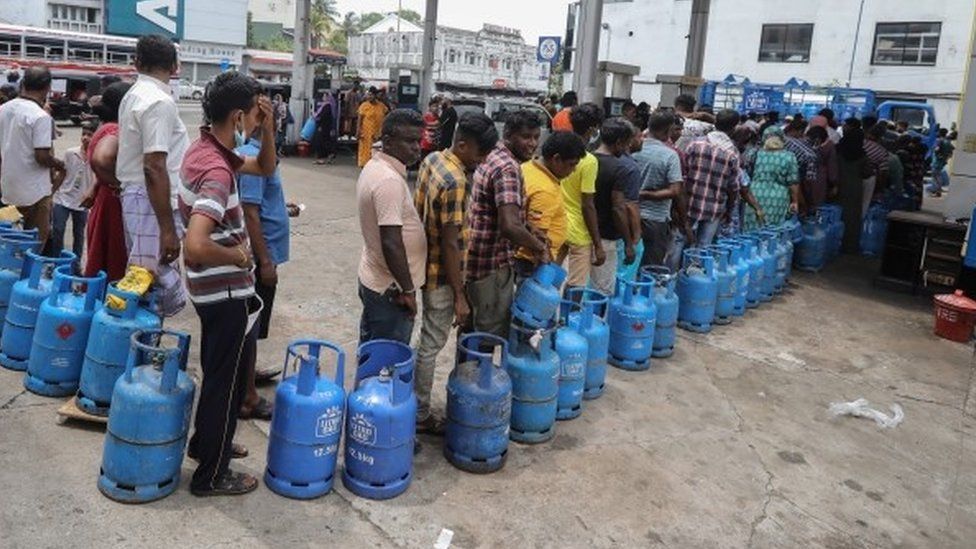
Sri Lanka: Debt Crisis, Neocolonialism and Geopolitical Rivalry

May 11th, 2022

By Asoka Bandarage Courtesy Inter Press Service

World Bank, Washington DC.
The multilateral Asian Development Bank and the World Bank owns 13% and 9% of Sri Lanka’s foreign debt, respectively.

WASHINGTON DC, May 11 2022 (IPS) – Sri Lanka is in the throes of an unprecedented economic crisis. Faced with a shortage of foreign exchange and defaulting on its foreign debt repayment, the country is unable to pay for its food, fuel, medicine, and other basic necessities. Notwithstanding the austerities that would be entailed, a bail out by the International Monetary Fund (IMF) has been accepted as the only way out of the dire economic situation.

Opposition political parties and citizens across the country blame the Rajapaksa government’s widespread corruption and mismanagement for the crisis, and demand that the President and the Parliament resign.

The Prime Minister, Mahinda Rajapaksa did so on May 9th, 2022. However, the protesters at Galle Face Green and elsewhere have not been able to put forward an alternative leadership or a viable road map for the future. The country remains mired in confusion, chaos and a highly volatile political impasse.

To understand the complexity of the current crisis, and to prevent us falling back into the same paralyzing debt-cycle, it is necessary to move beyond domestic politics and the relentless news cycles of corporate media and explore some of the commonly overlooked yet basic global economic and geopolitical dimensions.

Debt Crises and Global Inequality

The transfer of financial and resource wealth from poor countries in the global South to the rich countries in the North is not a new phenomenon. It has been an enduring feature throughout centuries of both classical and neo-colonialism.

At the start of 1989, developing nations owed foreign creditors $1.3 trillion US dollars. That is, just over half their combined gross national products and two thirds more than their export earnings.”

Recently, the effects of the war in the Ukraine and the Covid-19 crisis have worsened the high debt burdens of developing countries. These countries were already struggling to pay accumulated debts stemming from the expansion of capital flows from the high-income countries to lower income countries after the 2008 global financial crisis. Financial liberalization was fostered by powerful global interests, including the IMF, when interest rates dropped in the richer countries.

This facilitated borrowing by developing countries from private international capital markets through International Sovergein Bonds (ISBs), which come with high interest rates and short maturation periods.

Financial liberalization facilitated by the IMF and the developed countries working with the domestic elites of poor countries has created a hierarchical and asymmetrical international financial architecture.”

As a December 2021 Report published by the Bretton Woods Project points out, this unequal framework creates macroeconomic imbalances, financial fragilities, and exchange rate instability that can trigger debt and/or currency crises and curb the economic policy autonomy of affected countries to pursue domestic goals.”

The international NGO Debt Jubilee Campaign (soon to be called Debt Justice) has pointed out that 54 countries are now experiencing a debt crisis. According to the World Bank, Sri Lanka owes $15 billion in bonds, mostly dollar-denominated, out of a total of $45 to 50 billion in long-term debt.

The country needs $7 to 8.6 billion to service its debt load in 2022, whereas it had just $1.6 billion in reserves at the end of March 2022. The downgrading of Sri Lanka by rating agencies such as Moody’s added to the difficulty of further borrowing to pay off the debt.

The devaluation of the Sri Lankan rupee by 32% since the beginning of the year has made it the ‘world’s worst performing currency,’ exacerbating the plight of the Sri Lankan people.

The multilateral Asian Development Bank and the World Bank owns 13% and 9% of Sri Lanka’s foreign debt, respectively. Currently, China is Sri Lanka’s largest bilateral lender, owning about 10% of its total foreign debt, followed by Japan which also owns 10%.

Approximately half of Sri Lanka’s total foreign debt (55% according to some estimates) is market borrowings through US- and EU-based ISBs. Asset managers BlackRock, Inc. and Ashmore Group Plc., along with Fidelity, T Rowe Price and TIAA are among Sri Lanka’s main ISB creditors. However, the information on the ownership of ISBs – including one worth $1 billion that is maturing on July 25, 2022 – is not publicly revealed.

Sri Lanka is in negotiations with the IMF to restructure and repay its massive debt. IMF structural adjustment will include the familiar privatization, cutbacks of social safety nets and alignment of local economic policy with U.S. and western interests, to the further detriment of local working people’s standard of living and inevitably leading to more wealth disparity and repeat debt crises.

Debt Crisis and Geopolitical Rivalry

Economic crises create opportunities for external powers to expand economic exploitation and geopolitical control. In Sri Lanka’s context, this means India, the US and China.

Sri Lanka’s big neighbor India has extended a $1 billion credit line to provide essential food and medicine. The Sri Lankan government has stated that there are no conditions attached to the Indian loans. However, Sri Lankan analysts believe that agreements have been made giving Indian companies exclusive access to investments on the island.

Sri Lanka is strategically located in the sea lanes of the Indian Ocean. Over 80% of the global seaborne oil trade is estimated to pass through the choke points of the Indian Ocean. Although bizarrely overlooked by the global media, a Cold War is already in place between China and the Quadrilateral Alliance (United States, Japan, Australia and India) over the control of Sri Lanka and the Indian Ocean.

Sri Lanka is part of China’s $1 trillion Belt and Road Initiative, which includes the island’s Hambantota Port and Port City. The United States, on the other hand, signed an open-ended Acquisition and Cross Services Agreement (ACSA) with Sri Lanka on August 4, 2017, facilitating military logistic support.

The US is also seeking to sign a Status of Forces Agreement (SOFA), which would effectively turn Sri Lanka into a US military base. While the proposed United States Millennium Challenge Corporation Compact has not been signed due to local protests, the pact’s objective – US control over the land, transportation and communication infrastructure in Sri Lanka – continues unabated.

In this context of Sri Lanka as a tense theater of geopolitical rivalry, the Sri Lankan debt crisis cannot be understood simply as an economic crisis. Could it, in fact, be a ‘staged default’ designed to push Sri Lanka into an IMF bailout which would complete the island’s subservience to the US dominated economic and political agenda?

Alternative Sustainable Approaches

The young ‘Gotta Go Home!’ protesters who demand President Gotabaya Rajapaksa’s resignation seem to be unaware of the global dynamics of the Sri Lankan crisis. Perhaps local and foreign interests guiding the protests may want to keep it that way.

They are certainly not encouraging the protestors to join global calls for much-needed debt cancellationdebt swaps and regulation of capital market borrowing to prevent debt crises occurring in the first place.

However, at least a few Sri Lankan professionals concerned about the implications of an IMF bailout have put forward alternative short and long-term solutions. They recognize that while exploitative colonial and neocolonial policies have turned Sri Lanka into a poor and desperate country, the island is rich with abundant natural resources and human capital.

If the land and ocean and the graphite, ilmenite and the other mineral resources are sustainably utilized, Sri Lanka can be economically self-sufficient and prosperous. There is also much to be learned from Sri Lanka’s pre-colonial history in this regard, not least its hydraulic civilization.

The Committee on Public Accounts (COPA) has revealed that there are enough fuel and natural gas deposits in the Mannar Basin to meet the entire country’s needs for 60 years. If the abundant sustainable solar and wind power are also utilized, Sri Lanka can become not only energy self-sufficient, but an exporter of energy as well.

Bioregionalism, economic democracy, and food and energy sovereignty are the only route to a sustainable future for Sri Lanka and other debt-trapped countries, and indeed the world at large. To overcome the dominant forces seeking to monopolize control over the natural environment and humanity, people – especially the young – need to awaken and work in partnership with each other to fight the destructive greed that ensnares and threatens to destroy us.

Asoka Bandarage is Distinguished (Adjunct) Professor at the California, Institute for Integral Studies. She is the author of Colonialism in Sri Lanka (Mouton), The Separatist Conflict in Sri Lanka (Routledge), Women, Population and Global Crisis (Zed), Sustainability and Well-Being (Palgrave McMilllan) and many other publications on global political-economy and South Asia.

IPS UN Bureau

WAS DEAR MOTHER LANKA RAPED BY UNSCLUPROUS POLITICAL OPPORTUNISTS OVER THE LAST MONTH?

May 11th, 2022

By Noor Nizam – Peace and Political Activist, Political Communications Researcher, SLFP/SLPP Stalwart, Patriotic Sri Lankan, May 11th., 2022.

DID THE INTERNATIONAL OPERATIONS COORDINATION OPERATE FROM ITALY OR SWEDEN?

The statement made to the Press/Media today by the Secretary of Defense Kamal Gunaratne that Stern actions would be taken against all those involved in violent acts such as vandalism and arson after May 9 irrespective of party politics, reiterate the confidence and trust the peace loving and rural folks of Sri Lanka have in the Mahinda Rajapaksa/Gotabaya Rajapaksa/SLPP coalition leadership – the 6.9 million voters who elected this government through democratic institutions since 2005.

The Defense Secretary has to be thanked profusely for stating that action would be taken against responsible persons after analyzing CCTV footage and video clips and telling “point blankly” that the government and defense establishment mean business when it comes to the manner in which the protests were organized, obstruction were created to law enforcing officers to carry out their duties to safeguard the citizens, assaulting Senior Police offers, burning of government and private property and mob groups laying “SIEGE” to official government administrative buildings and official residences.

The Secretary Defense should “NOT” forget to take a look of the Chamuditha – Lal Kantah interview released on the YouTube channel of journalist Chamuditha Samarawickrama’s “Truth With Chamuditha” on JVP’s opinions about the protests and confrontations that took place on the 9th., instant in front of Temple Trees and Gota Gama at Galle Face green. 

Lal Kantha says clearly that he phoned all his senior cadres in every important city and asked them to launch protest in their localities after the action taken by the government to clear the protesters camped outside Temple Trees. 

Was these calls asking them to launch protests in their localities end up in burning residences of the PM and SLPP Politicians? 

Did the International Operations Coordination of the “gang of protesters” operate from Italy or Sweden?  The SIRASA NEWSFIRST.- TV breaking news broadcasts showed almost all the violent incidents continuously and it was noticed with sadness that Sri Lankans who were former JVP’s, Frontline Socialist Party, Tamil diaspora and some belonging to a religious denomination domiciled abroad had made special trips to Sri Lanka under the disguise of visiting the country, but really to participate in these violent episodes that had been organized as these recent “riots” in Sri Lanka. These have been recorded by the TV cameras and called for scrutiny. Even YouTube individual channels (Tamil and Sinhalese) showed these characters arriving from abroad and then participating in the events , some with their families too.  

The Secretary Defense should also probe to find out “WHO THESE INDIVIDUALS/GROUPS ARE” from these TV footage and YouTube Channels after analyzing those releases and make sure that they will “NOT” be allowed to leave the country until they are probed according to the law and allowed to leave “ONLY” if they were not involved. 

The Government should “NOT” be scared about the HR violations that the R2P promoters of the West who have pulled there strings against the Rajapaksa regime and the Gota Presidency quite smartly now will make big “noises” in the International Forum to stall these legitimate probes against the acts amounting to “TREASON” of a peaceful people and Nation and a Sovereign State. 

These probes will also show whether these interested groups infiltrated the peaceful gathering that was held at Temple Trees on May 9th., 2022 and create the chaos inside Temple Trees and then with the formation of a “CROWD ATTITUDE” by this group, attack the “MynaGama” protesters and run to “Gota Gama” and assaulted the protesters there, which made JVP Lal Kantha to give his “command orders” to his senior cadres in all the cities to begin the assaults as he had admitted to Chamuditha Samarawickrema” Truth with Chamuditha YouTube program the next day?

The so-called democratized” JVP and the SJB are working very closely with the powers that would be” who are interested in Regime Change in Sri Lanka since 2005. The JVP students group, Inter University Students Federation (IUSF), Frontline Socialist Party and the Catholic Church have shown their real faces now in this political game” that is being played in Sri Lanka at the cost of the suffering people and innocent student/youth population. 

Have the SINHALESE PEOPLE FORGOTTEN THE DISASTER THEY CREATED TO YOUR NATION AND HOW THE TRI FORCES DEFENDED OUR MAATHRUBOOMIYA” UNDER THE LEADERSHIP OF SLFP/SLPP GOVERNMENT LEADERSHIPS. Sri Lanka was not allowed to be divided or separated into two nations during the 30 years brutal LTTE war against our “Maathruboomiya” as planned by the R2P group of Western powers and the EU in connivance of the UN, like what the Westerners and the EU/UN did to Aceh of Indonesia in 2005 just after the Tsunami.

Like what the Canadian PM Justin Trudeau did to the Truckers Protest which happened a few months ago in Ottawa and then in other cities in Canada, all the bank accounts of these so-called protesting groups should be also probed immediately and frozen and details of those who funded them must be made public. Using the EMERGENCY” they should be brought before the Rule-of-Law” an punished accordingly, irrespective of party politics, as the Secretary of Defense Kamal Gunaratne has stated. 

Elitist ‘Colombians’ Hogging the Maharaja-Circus at Galle Face and Parroting CIA-Scripted Slogans Stifle the Voices of Seven Million Voters Betrayed by Nandasena

May 11th, 2022

By ‘The Socialist Vanguard Party for the Restoration of a Sovereign Unitary State of Sri Lanka’

It was indeed pathetic to see broadcaster Watawala attempting to incite carousing revellers at the Maharaja-Circus on Galle Face Green to take the law into their hands, incapacitate the Legislature and make the ‘Green’, the Country’s Parliament while establishing on the esplanade an anarchical zone where State authority would not apply.

Shades of Sierra Leone where scores of ‘Galle-Face -Greens’ have been established and ‘dime-a-dozen’ warlords, with bigoted notions of governance, rule their respective parochial patches, the hallmark of a failed State.

At the ‘Maha-Killi Gama’ at the Galle-Face circus, Warlords Maharaja and K Gunaratnam reign supreme. A curious place where, anti-Sri Lankan NGOs abound, rejected Elitist ‘Colombians’ (parroting CIA scripted slogans and harbouring notions of crawling back to power through the rear door) patronise, dead Tamil terrorists (including terrorist Issipriya posthumously described as a journalist) are feted and the National Anthem is sung in Tamil. No, not ‘God Save the Queen’ or ‘The Star-Spangled Banner’, but ‘Sri Lanka Matha’

The atmosphere at Maha-Killi Gama is surreal; when the need of the hour is to preserve and re-build on what little is left of the three structures of State, it is an act of hara-kiri when the warlords of the ‘Green’, willfully attempt to raze the wobbling structures of the Sri Lankan State to the ground.

When the three structures of State collapse what remains is a failed state where anarchy reigns.

To create a failed state is the ultimate goal of a foreign Enemy with designs on the country; a failed State facilitates the easy capture of the country.

Staging protests, the people must; but they must be mindful, all the while, to work within the framework of the law. These are trying times; people must resist falling prey to contracted rabble rousers. 

It is also tragic because the inflammatory exhortation tends to suggests that the warlords of the ‘Green’ are attempting to highjack the protest movement and route it in a direction that suits their agenda.

What is the Maharaja – Gunaratnam agenda? Are they working the blind-side of the American MCC plan? Is Maharaja staking claims for a monopoly of the Island’s water resources, via the ‘Gammeda’ project, when the country disintegrates, and the projected MCC Land grab takes place?

In 2019, seven million people delegated to Nandasena, their sovereign Executive power, after he pledged that no more would there be: secret deals with foreign governments; transfer of State Land and Assets to foreign entities; signing of MCC -type documents; privatising of State Land; massive corruption and mismanagement at the levels rampant during the ‘Wickramasinghe-Sirisena-Premadasa’ regime.

Nandasena further pledged to strictly adhere to Sri Lanka’s foreign policy of  Non-Alignment’ and vowed that he would re-negotiate with the relevant foreign governments to ‘re-possess’ all lands and assets bartered away by the Yahapalanaya regime.  

Nandasena, a greenhorn in politics and a below-average officer who had virtually deserted the Army in her hour of need, had the advantage of Mahinda underwriting his political campaign.

Charisma is nature’s gift to each generation, parsimoniously dispensed amongst a few; in Sri Lanka’s present political firmament Mahinda is indeed a recipient of this gift; he used his innate talent to unite the country and with his able General, Sarath Fonseka, to decimate the US mercenaries terrorising Sri Lanka for over thirty years. 

To this day, Mahinda is loved by the simple folk of this country and remains a formidable foe to any external aggressor who may entertain ideas of Colonising the Country. To the external aggressor, the Mahinda factor has to be taken care of, if they wish to succeed.  

In contrast, Nandasena’s life has been one of disloyalty, desertion and betrayal.

It is a fact of history that yankee-Nande, having absolutely and entirely renounced any iota of loyalty to Sri Lanka and even pledged his life to the cause of achieving American objectives, had in 2007 treacherously, secretly and without authority signed the ACSA Agreement, the mother of all US military agreements.

In 2019, Nandasena did another flip-flop; he claimed that he had deserted the American cause to contest the Sri Lankan Presidential election.

Curiously though, Nandasena’s family chose to remain disloyal to Sri Lanka and bow in reverence to the American flag; they file their tax returns, as is required of them, with the American Government.

Nandasena, as the faithful spouse of a committed American citizen, makes tax declarations to the American Government.

Within days of assuming Presidential office, Nandasena brazenly shed his political masquerade, not caring a whit about betraying seven million people to whom he owes his Executive power.

With the baton of Executive power firmly in his hand, Nandasena did a volta face and traversed the same treacherous American-path the Sirisena -Wickramasinghe-Premadasa gang had trod.

Nandasena, surrounded himself with American advisors and their think-tanks, secretly bartered away Sri Lanka’s Land and Assets to America and India, implemented some of the pre-conditions America insisted on prior to signing the MCC Agreement, privatised State Land, turned a blind eye to the corrupt activities of his spaniels, made a monumental mess of the Foreign Service -stacking it with his cronies and charlatans -that resulted in the Tim Sebastian fiasco.

Within two and a half years of his Presidency, Nandasena succeeded in bankrupting the economy, destroying the agricultural backbone of the country, and driving the people onto the streets.

A major factor that contributed to this debacle was the ill-advised tax bonanza granted to the super rich that helped Nandasena’s cronies; personal and corporate income taxes were abolished in some sectors while in some other sectors taxes were slashed from 28% to 18%.

The rich were jubilant; the Ceylon Chamber of Commerce chirped, We Welcome the tax relief for investment”.

The Treasury lamented; Sri Lanka lost 1 trillion (One Thousand billion) Rupees of revenue by this ill-conceived move to help cronies.

But the straw that broke the camel’s back was when Nandasena, overnight, banned the use of chemical fertiliser for agriculture, without making available the organic alternatives and studying beforehand the problems associated with this change.

This decision not only broke the agricultural backbone of this country, it pauperised the farmers and pushed the teetering economy over the edge; the yields of the money-spinning cash crops, without fertiliser, suffered and the country’s kitty shrank drastically. 

The question on the lips of many is, Was this the work of a brainless man or was this destruction planned and deliberately executed at the behest of a Foreign Nation”?

The answer to the above question, lies in the answer to Why did Nandasena, give the American Government think-tank, ‘Pathfinder Foundation’, to direct, control and manage Sri Lanka’s economy?”

/to be contd.

The Aragalists and the challenge of re-mapping Sri Lanka

May 11th, 2022

MALINDA SENEVIRATN​E

It was expected and yet shocking. Expected, because that’s what history has taught us: those in power, having enjoyed all the luxuries that come with power, and especially through abuse of office, are lulled into believing that power is permanent, and therefore rudely shocked when they realise otherwise, seldom exit peacefully. They fight back, typically. They did.

Here are some interesting facts to keep in mind. The attack on the agitators at Galle Face (the ‘aragalists’) was carried out not by the Police or the Army; those arms of the state were adjuncts or bystanders. It was a blatant act of thuggery orchestrated by key members of the ruling party. Whether the Prime Minister, who is reported to be in ill health, had a part in it is yet to be established. Regardless, the Prime Minister was complicit; the goons were clearly invited. Nevertheless, the goons were clearly invited to Temple Trees and it is from there that they proceeded to unleash violence on citizens, mostly young men and women, who had for an entire month expressed their political views/demands peacefully. 

If someone came to my house and then proceeded to leave it only to beat up people who had gathered to protest my conduct and that of my immediate family, any law enforcement entity inquiring into the attack would, among other things, question me. Indeed, in all likelihood I would be arrested and questioned while in detention. Didn’t happen in this case.

The perpetrators weren’t stopped by the Police. They were dealt street justice, so to speak. Those who mobilised them and deployed them remain untouched by the law. It reminded me of a popular poster-line in the late eighties: paalakayini, thopi thopema neethiya kada karanne nam, apa eyata avanatha vanne kumakatada? (Rulers, if you break your own laws, why should we submit to it?).

I disagree, though, about whether our ends justifies our means. Self-defence is justified. If the perpetrators are around, chasing them is also understandable. In a situation where the law and law enforcement are absent, where a citizens’ arrest makes no sense simply because there’s no place and no one to hand over the miscreant, rage quickly transforms into a delivery of justice. Understandable. Angry mobs seeking out those who sent the goons in the first place is also understandable. However, the absence of the law  does not give license to untramelled hooliganism, vandalism, theft, arson, and murder. Sadly that’s what happened on Monday.  Anyone and everything associated with ‘the enemy’ were taken as legitimate targets. Reminds one of the proxy arrests of 88-89.

If ‘Rajapaksavaadaya’ (‘Rajapaksism’) was what was being objected to, and if this was about abuse of power, theft, thuggery, and murder (as has been claimed), indulging in the very same acts albeit on a smaller scale, essentially turns the objector into a Rajapaksavaadiyaa (Rajapaksist). There were aragalists who immediately called for blood. Many who advocated for violence on social media have come to their senses and are today calling for restraint. They’ve removed posts and stories, but the trace still exists in the following form: ‘this content is not available.’ 

The thugs and their masters clearly underestimated things. They may have believed that ‘Galle Face’ was where the problem exists and if removed, all would be fine. However, the response to the mob attack clearly indicates that Galle Face is an expression of widespread discontent. It is a movement, it is not containable or erased with an attack on the physical structures that housed the people. 

There are many serious dangers if things are allowed to spiral out of control. First and foremost, it gives those who have the keys to the coercive state apparatus  license to unleash further violence. After some time, who fired the first shot is only of academic interest. Remember 88-89? Anarchy results. Bloodbath is what is likely to happen. As serious is the possibility of conditions being created for external powers to intervene. Remember the way the USA has moved in on so many occasions to ‘restore democracy’? They essentially took control of resources, established puppet regimes and turned populations into (glorified) slaves. Let’s not forget that India is the proxy of the USA in the region. Sinophobia is what drives the USA, Japan, Australia, and India (the ‘Quad’). The EU openly and unabashedly wants Sri Lanka to sever ties with China so that the US-led policy on the Indo-Pacific region can proceed without any hiccups.

In the midst of all this, we have a serious political crisis. The Bar Association of Sri Lanka (BASL) has come up with some proposals which are not bad if they constitute nothing more than a discussion paper. However, the BASL has arrogated upon itself the role of Economic Expert, advocating acceptance of the IMF doctrine and thereby endorsing the neoliberal model that has turned us into easy prey for the import mafia, and compromised energy and food sovereignty. The BASL wants the 20th Amendment repealed and the 19th restored, never mind the fact that the latter was a weak document and one that was driven by narrow political interests. In the name of clipping presidential powers, the 19th set up a Constitutional Council whose composition ensured that the interests of the ruling party would prevail in all ‘independent’ institutions.

Neither has the BASL said anything of the need to define ‘national government’ as per the 19th Amendment. The BASL has called for the abolishing of the executive presidency, but saying nothing of what this could do, considering the provisions of the 13th Amendment. It’s almost as if M.A. Sumanthiran (who famously said ‘it’s ok not to use the word federalism if we get federalism in effect’) has drafted the BASL proposals.

And, in the midst of all this, we’ve forgotten that the political crisis was precipitated by an economic debacle for which few have any mitigating proposals, not for the immediate, not in relation to the long term.

And yet, we don’t have to retire hope. The aragalists rebuilt. It’s not a ‘gama’ that they are building. It’s a country they are forging. What we are seeing is a prototype. It’s a blueprint for a tomorrow that’s very different from yesterday and today. They are cartographers who have the potential to re-map the entire country, taking into account all the contours of class, caste, religion, and other identifiers, and finding the unifying threads between all of those

They’ve shown courage, creativity, leadership and organisational skills that are clearly exceptional. They got two cabinets to resign. They got a prime minister to resign. All this without throwing a single stone. They were able to do this because the people by and large, got out of their way and let them lead, and also stood with them. They proved they can re-imagine Sri Lanka. They have the ability to change things. They can see through and sideline all those groups peddling outdated theories and pernicious designs even as they tolerate such racketeers. They are not a political party but as a pressure group their role is particularly significant. They have, most importantly, the will and ability to contain the potency of their energies to degrees beyond which things could become uncontrollable and disastrous.

For a month, apart from the tragedy in Rambukkana and a few occasions when teargas was used, the aragalists were allowed to do their thing. What would JRJ, Premadasa, Chandrika or Mahinda have done is a question that needs to be asked. So there’s some credit that should go to the President.  Nevertheless, it is clear now that the President has not been able to unshackle himself from family and party. What happened on Monday, one could argue, was not only about the political survival of the perpetrators, but a clear attempt to sideline the President altogether.

For now, there’s sanity. The thugs are silent. The over-enthusiastic and pernicious sections of the aragalaya have been contained. We cannot predict what tomorrow will bring, but if we are to see a different and more beautiful Sri Lanka, it will largely depend on how the aragalaya keeps transforming itself and the extent to which those with political power can dialogue with the aragalists, one way or another.

malindadocs@gmail.com.

ලෙයට ලෙය වෙනුවට ආලය

May 11th, 2022

Malinda Seneviratne

මසක කාලයක් ගෝල් ෆේස් හි ගොඩනැගු ගෝටාගෝගමෙහි දහස් ගණන් තරුණ තරුණියන් මෙන් ම නොයෙකුත් මතවාදී ධාරාවන් නියෝජනය කරන අන් අය එකට බැඳ තැබූ සුන්දර වරපටය ආදරයයි. එකට එක් වී වැපුරුවේ ආදරයයි. යෙදුනේ හෙට දින රට හදන ව්‍යායාමයක පෙරහුරුවකයි.  අහිංසකත්වය, අවිහිංසාවාදය, නිර්මාණශීලිත්වය, එඩිතරකම, ඉවසීම, සාමුහිකත්වය යනාදියෙන් අරගල භූමිය සුවඳවත් විය. එවැනි අහිංසක, අවිහිංසාවාදී, නිර්මාණශීලී, එඩිතර අරගලයක් මතක ඉතිහාසයේ නැති තරම්ය. අපේ රටේ හෙට දවස පිලිබඳව සුභවාදීව හිතන්න අරගලකරුවන් සියලු දෙනාට බල කර සිටියා මෙන් ය.

ඊයේ මැර ප්‍රහාර එල්ල කරන ලද්දේ අරගලකරුවන්ට පමණක් නොව, ඒ සුභවාදී සිහිනයට මෙන් ම මේ ගොඩනැගෙමින් තිබුණු අපුර්වත්වය දෙස ආදරයෙන් බලා සිටි සුවහසක් හදවත් වෙතය. මැර කණ්ඩායම් මෙහෙය වූ අය තක්සේරු නොකෙරුවේ මෙයයි. ගෝටාගෝගම යනු රට පුරා විහිද ගිය ආණ්ඩු විරෝධයක එක් ප්‍රකාශයක් බව ඔවුන් නොසිතුවා විය හැක. මැර ප්‍රහාරවලින් සිහින තුවාල වන්නේ නැති බව ඔවුන් දැන සිටියේ නැත. කෙතරම් දරුණු ලෙස පහර දුන්නත්, අරගලකරුවන්ගේ අධිෂ්ඨානය පලුදු කළ නොහැකි තරමටම ඝනකම්ව අරගලකරුවන්ගේ ආදරය වර්ධනය වී තිබිණ. සිහිනයේ බ්ලු ප්‍රින්ට් එක ඉතා වේගයෙන් නැවත සකස්වුනි.          

වෛරයම වපුරා, ප්‍රචණ්ඩත්වය යෝජනා කර, විහිංසනයේ මාවතම තෝරාගෙන ක්‍රියාත්මක වුවන්ට උපේක්ෂාව හෝ අනුකම්පාව නෙළා ගැනීමට අවසර නැත. ජනතා විරෝධය ජනතා කෝපය බවටත් කෝපය ප්‍රකෝපය දක්වා වර්ධනය විය. සංවිධානාත්මක පිරිස් ප්‍රභූ නිවෙස් ගිනිබත් කිරීමට කටයුතු කළා යැයි විවිධ මත ඉදිරිපත් කරන කිසිවෙකුට බැහැර කළ නොහැකි කාරණය වන්නේ ඒ සියල්ල සඳහා මාර්ග බාධක ඉවත් කරන ලද්දේ මැරයන් ම සහ ඔවුන් මෙහෙයවූවන් බවයි. අද වන විට මහින්දගේ සහ ඔහුගේ දේශපාලන සගයින්ගේ ලේ ඉල්ලන තැනට සියල්ල තල්ලු කලේ ඔවුන් ම මෙහෙයවූ ලේ පිපාසිත මැරයින්ගේ ක්‍රියාකාරිත්වයයි.

ලේ පිපාසය පෙරළා ලේ පිපාසයම අවදි කරන බව ඉතිහාසය කියා දෙන සරලම පාඩමකි. සොඳුරු සිහින බොඳ වෙන්නේ එහෙමයි. ‘ලෙයට ලෙය’ දරුණුයි, එක්තරා ආකාරයකට මුග්දයි. පහරදීමට එරෙහිව පහරදීම එකක්, පහර දුන්න අයට පහර දීමත් ‘පහර දීපිය’ යන විධානය දුන් අයට පහර දීමත් තේරුම් ගත හැක, එහෙත් ‘සතුරා’ සොයා ගැනීමට අපහසු වූ විට සතුරා සංකේතවත් කරන සියලු දේ සහ සතුරාට නෑකම් කියන සියලු දෙනා විනාශ කිරීමට යොමු වීම ‘සටන’ භයානක පැත්තකට තල්ලු කිරීමක් වේ. එය දැනට උද්ගත වී ඇති තත්ත්වය තුල මීට වඩා බොහෝ දරුණු මිලිටරිකරණයකට අත වැනීමක් වැනිය. විශේෂයෙන්ම මතක තියාගතයුතු වන්නේ එවැනි ‘තත්ත්වයක්’ කෘත්‍රිමව නිර්මාණය කිරීමට වැඩිම හැකියාව ඇත්තේද ගැටුම ලේ ගැලුමකට පරිවර්තනය කිරීමට අවශ්‍ය පාර්ශවයන්ට බවයි. ඒ සඳහා හැම විට ම විභවය සතු වන්නේ මර්ධනකාරී රාජ්‍ය ව්‍යුහය හසුරවන්නන්ට වේ.   

අරගලයට ඇති ප්‍රධාන ප්‍රාග්ධනය සදාචාරයේ වාසියයි. ප්‍රධාන අවිය ආදරයයි. ප්‍රබලම ශක්තීන් නම් සාමුහිකත්වයයි, අධිෂ්ටානයයි, සිහින දැකීමට ඇති හදවත් සහ සිහින සැබෑ කිරීමට අවශ්‍ය ආත්ම විශ්වාසයන් වේ. ඇමති මණ්ඩලය නොව ඇමති මණ්ඩල දෙකක් ඉවත් කරන්නත්, අගමැතිවරයෙක් ඉල්ලා අස්කරවන්නත් එය ප්‍රමාණවත් විය. රටක් ජනතාවක් අවදි කරන්නත්, අරගලයට කැඳවන්නත් එය ප්‍රමාණවත් විය. මේ සියල්ල ක්‍ෂණයකින් ම්ලේච්ඡත්වයෙන් මකා දැමිය හැක.  නැවත කියන්නෙමි ‘ලෙයට ලෙය’ දරුණුයි, මුග්ධයි, අරගලයේ සදාචාරාත්මක වාසිය පලුදු කරයි. ‘ලෙයට ආලය’ ලයාන්විතයි, මෘදුයි, අරගලයට පණ පොවයි. මැර ප්‍රහාරයෙන් අනතුරුව ගෝටාගෝගම පුරා නොකියවෙන එනමුත් සියල්ල වෙළාගෙන ඇත්තේ ‘ලෙයට ආලය’ විසිනි. අරගල භූමිය හරහා තවමත් හමා යන, අරගලකරුවන්ට ශක්තිය පොවන සුවඳ එයයි. ගෝටාගෝගම වඩාත් ලස්සනට ප්‍රතිනිර්මාණය වුයේ ඒ නිසා ය.

අරගලයක ආරම්භය කවියක් වැනිය. අරගලයක හුස්ම හිරවෙන්න පටන්ගන්නේ අරගලයෙන් ආදරය ඉවත් වූ විටයි. ආදරය ‘ලේෆ්ට්’ වුනොත්, සටන්පාඨ සමග බිඳුණු සිහින පමණක් ඉතිරි වේ. වෛරයට වඩා ආදරය ඝනකම් විය යුතුම වන්නේ මේ නිසයි.


Copyright © 2026 LankaWeb.com. All Rights Reserved. Powered by Wordpress