“Young Love Is a Flame; Very Pretty, Often Very Hot and Fierce ” – Henry Ward Beecher
When Henry Ward Beecher scribbled two sentences: “Young love is a flame; very pretty, often very hot and fierce and light and flickering; the love of the older becomes disciplined as coals, deep-burning, unquenchable,” he would never imagined these quotes would become world-famous one day and slot into a specific day on 14 February, as Valentine’s Day.
The modern world celebrates the 14 of February as Valentine’s Day, which has transformed into what is known as ‘ lovers’ day! Usually, this day fills with a series of events, predominantly for those in love. It is a day filled with fun and punctuated by sending Valentine’s cards to their admirers. Valentine’s Day is not complete unless it ends with a party or dance. Meanwhile, it’s a sad day for eligible bachelors and damsels when they find a marriage proposal is not even on the cards in the predictable future.
Henry Ward Beecher was a social reformer, speaker, and author. He published over two hundred and seventy books, and dozens of beautiful quotes that appear on the Internet. He always said, God’s love is above everything else: It’s easier to go down a hill than up, but the view is much better at the top.”
From time immemorial
Steadfast lovers consistently celebrate Valentine’s Day from time immemorial. Valentine’s Day becomes Cupid (Venus) day or the child-like winged deity of the Roman Goddess’s son of love. Valentine’s Day relates to the conjoint exchange of flattery through greeting cards. Usually, Valentine’s Day relates to red roses and the red heart-shaped contours with Cupid’s figure. It usually resembles a single rose, candlelit dinners, dancing in a star hotel, and exchanging expensive trinkets or real gold rings as tokens of love. Such feelings are impossible to view even under a microscope of human reaction. It certainly is an internal emotional state in every individual’s experience.
History
Valentine’s Day has its different views and opinions. Some believe that Valentine’s Day originated from the Roman martyr who refused Christianity. Others believe it is the day devoted to the ‘Love Lottery’. Emperor Claudius II, banned marriages because he thought ‘married men were substandard soldiers.’ The Roman martyr Valentine felt that was unfair and broke the rules to promote arranged marriages secretly. When Claudius II found out about valentine’s secret moves, the Emperor sent Valentine to jail and sentenced him to death. In prison, Valentine fell in love with the jailer’s daughter. When the soldiers took Valentine to the gallows, he sent a love letter through them signed ‘from Valentine’. He died on 14 February 269 AD. Some believe it has some significance to Valentine’s Day. Many think St. Valentine, who served as a priest at a temple, was jailed during Emperor Claudius for defying Pope Gelasius, the third, and the last Bishop of Rome (492-496) in the Catholic Church.
During the Battle of Agincourt, Duke of Orleans was captured and imprisoned in the Tower of London in 1415. From prison, he wrote a few lines to his wife on a Valentine card, which is preserved in the British Library in London, as part of a manuscript collection. Several years later, King Henry V hired John Lydgate to compose a valentine message to Catherine of Valois, who was very pretty and attractive. When King Henry V finally met her, he became smitten with love. She was the daughter of Charles VI of France. She married Henry V of England and gave birth to his heir Henry VI of England.
Britain commenced celebrating Valentine’s Day during the 18 Century. It soon became so popular among lovers and led to handwritten notes. During the 18th Century, the 14 of February became popular among friends and lovers in Britain, which led to handwritten notes to friends. Printing commenced during the 18th Century in Britain that took over the printing of Valentine cards.
Commercialisation
Valentine cards have become commercialised like other popular themes such as Birthdays, Mother’s Day, Father’s Day, Engagements and Weddings. These appear as a mega commercial hysteria throughout the world to make stationery manufacturers, shop keepers and the postal services’ wealthy. Human beings generally get impregnated with emotions. Therefore, humans tend to become sycophants often with an overdose of relationships with others, from time to time.
One is likely to be jolly on Valentine’s Day after receiving loads of romantic cards, bouquets of red roses or boxes of chocolates, with all kinds of fancy writings on them. Those who take Valentine’s Day seriously become vulnerable and spend lavishly on candle lit dinners in five-star hotels to please their lovers. Or hit the dance floor and enjoy a bit of pelvic thrust in romantic dim lights. But let’s face it, If one focuses oneself to rely on a single day of the year to feel that ‘love is in the air and ‘happy ever after,’ one may instead look at the horizon. Haven’t we all heard of the suggestion, “to love another, one has to love oneself?
Valentine’s Day falls on the 14 of February every year – a day observed to celebrate love and care for someone lovingly. Generally, animals too love each other daily in their way. Still, Valentine’s Day for humans calls for something a little more special. Does anyone find it difficult to figure out how to wish on Valentine’s Day? Then, pick a piece of blank notepaper and write on it any sentence with ‘fancy’ writing on it, or a Valentine card and send it to your much-loved person.
Nowadays, it is easier to send Valentine’s Day wishes through a text message from your smartphone or emails to your fiancé and friends. One may write as follows: “I love you like crazy, baby ‘Cuz I’d go crazy without you.” (Pixie Foudre). Instead, one may scribble, there is only one happiness in this life, to love and be loved.”
Moscow has just been voted the third best city in the world to live in by the UN. But it beats all the competition in having the highest quality of life for its citizens, which includes the best medical care, the best education, attractive public spaces, public safety and, importantly, the best cultural activities.
Moscow alone has 170 concert halls and theatres, with 40 million visits annually, which means Muscovites attend an average of four concerts per year. And this is repeated in towns and cities throughout the Federation of Russia and including even the old Soviet Union.
They are benefited from their legacy of Communist rule with its policies of developing all its people and raising them up, equally as their talents allow. There are hundreds of theatres and stages throughout the towns and cities of the old Soviet Union, not to forget to mention all those great gymnasia used to train young ballet dancers, rhythmic gymnasts and even young circus performers. You can go ice skating in Russia all year round and trampoline-ing, too!
St Petersburg has the Mariinsky theatres (old and new). The old and original Mariinsky theatre is most beautiful, glamorous and historic and is where Europe’s royalty came to be amused in bygone times. Russia’s capital, Moscow has the famous Bolshoi Ballet and now, there is the newly opened hi-tech Zaryadye Park Concert Hall with its spectacular expanse of glass roof and perfect acoustics.
Note that for these many theatres they must require the services of hundreds of performers, costume designers and dress makers; make-up artists, scenery designers, and lighting experts, musicians and scriptwriters. Well, Russians have to spend their long, dreary winter nights somehow – so, why not be involved in these socially approved activities. Participation in choirs, orchestras, gymnastic teams and artistic groups is considered as worthy, Good”. As a result of this legacy from the past, one can choose to develop one’s talents in so many ways. All this expression of art and culture has resulted in both a professional and also a huge, spare-time entertainment industry based on music, dance and drama, and of course, gymnastics.
Schools are very active in this area by organising competitions and annual shows where they display their talented performers. The originality and the inspiration of these productions is amazing, if not actually stunning. Winners of competitions, and those particularly good performances are filmed and then broadcast on TV, thus providing public entertainment of good quality; in a word, uplifting. Then the whole of Russian society can see and enjoy watching this home-grown skill and wonderful talent. Some performances, perhaps the best, are loaded up to the internet, for the whole world to see and be amazed!
At the end of every competition young student participants are awarded medals and certificates and even cuddly toys as a reward. These mementos are collected and students proudly show them to relatives to admire.
Choirs and Choral music
Russia has its patriotic songs arising from their struggle to survive the many madmen and robber invasions they have endured over the centuries. These are stirring songs sung with gusto and feeling with real motivation! The famous Moscow based Gnessin School of Music is active in traditional and cultural music making, and their Moscow Boys Choir is world famous. The choir has recorded The Children’s Prayer.” This is quite heavenly to hear. Also, Igor Donilov of the Moscow Choral School, has sung Motherland” which is of stunning beauty. You have heard nothing until you hear this. These choral pieces are posted on the internet.
Russian Music Composers and
their Music
Professional song and music writing is to a high standard, and of course Tchaikovsky and the Bolshoi Ballet are the pinnacle of all this creative activity. Many Russian composers have created great amounts of good music and now the world has a most wonderful cultural heritage. It is waiting for you to explore! Thank you, Russia!
It’s the duty all parties in Sri Lanka to initiate a dialogue and come to an agreement on the report which the IMF is expected to release on Sri Lanka shortly,, Former Prime Minister Ranil Wickremesinghe said today.
” The IMF according to section 4 of its mandate usually goes for a dialogue with all its member states and issue a statement on each member . A team of IMF officials visited Sri Lanka in December last year. We have received information that it will release a report next week. It essential and the duty of all political parties to come to an agreement on it, it is our duty to initiate such an exercise. We have to think of Millennials and Genz which are the younger population. These groups will blame us if we fail in our duty,” Wickremesinghe said.
” Sri Lanka has failed to resolve it’s FOREX crisis. The dollar is expected to go up to Rs. 270 and even up to Rs. 300. The population of poor in Sri Lanka is expected to increase by 500,000 while the middle class is expected to crash. All transactions pertaining to foreign currency is done according to Hawala system moving away from the banking system. The total foreign debt services Sri Lanka has to settle this year is dollars 6 billion. Sri Lanka is yet to talk to any institution such as IMF with regard to resolving the crisis” he added.(Yohan Perera)
The Health Ministry says that another 1,217 persons have tested positive for Covid-19 today, as the daily count of new cases continues to rise in the country.
This brings the tally of Covid-19 cases registered in the country thus far to 631,816.
According to official figures, 596,042 positive cases have recovered.
Following the new development, the number of virus-infected people who are undergoing treatment moved to 19,875. Meanwhile, the death toll stands at 15,899.
The Director-General of Health Services has confirmed 25 new coronavirus-related fatalities for February 15, moving the death toll in the country from the virus to 15,899.
This includes 20 males and 05 females, according to the Department of Government Information.
Six of the deceased were in the age group of 30-59 years. The remaining 19 victims were aged 60 years and above.
It is on record that the IMF did stall development all over the Third World from the Seventies.
The colonies of the Superpowers were developing fast since they achieved independence. Seeking the help of the United Nations’ organizations- the Food and Agricultural Organization(FAO) for agriculture and livestock development, the UNIDO for industries, the ILO for employment creation- for labour, the UNESCO for education. There was all round development, new programmes were implemented fast bringing employment and incomes to people. This included industries making items that were earlier imported from the colonial masters. In the Forties the shops in Sri Lanka were full of imported food textiles and everything that was required. In order to enable people to have incomes industries were opened up and local production mounted . The Superpowers found that this development in the newly independent countries was causing unemployment and lack of income in their countries. The SAARC Report of the Independent South Asian Commission on Poverty Alleviation, Meeting the Challenge states that the international countries are for the first time since World War II in need of markets for their products…. So they have put into effect the Structural Adjustment Programme….the Industrialized countries are pressurizing the receipients of Structural Adjustment loans to unilaterally open their economies to goods from them.”
The Structural Adjustment Programme accepted the private sector as the engine of growth and the public sector should not have anything to do with development. The countries had since reaching independence developed various development programmes to enable the march of peasants to be allieviated from poverty and become economically productive. These were all done by Government Departments. It has so happened that my eighteen years’ span in the Sri Lanka Administrative Service was totally spent handling such programmes- in developing the marketing of agricultural produce, in organizing agricultural development, in developing industries and finally, attending to the total development of people. The condition stipulated in structural adjustment loans was that the public sector cannot attend to any commercial undertakings and this meant that all the development programmes that I had laboured in had to be abandoned or deemphasized.
SriLanka had developed a special agricultural marketing scheme where the Government department engaged actively to purchase produce from farmers. Farmers brought their produce to the Fairs and the Department for Development of Agricultural Marketing( Marketing Department-MD) also purchased in competition with traders. The MD purchased vegetables and fruits and sent them direct to their Headquarters in Colombo- called Tripoli Market, where the goods were distributed to a major retail outlet at Tripoli Market and also to over fifty small sales units. The MD was not interested in making a profit. Its aim was to offer a higher price to producers to encourage them to produce more, and simultaneously offer produce at cheap prices to city dwellers-aimed at reducing inflation. The MD had officers in all producer areas who reported the prices at which private traders purchased produce and availability. Private traders that purchased at the Fairs despatched good to the Wholesale Market in Colombo from where retailers purchased goods for sale at their retail outlets. The produce went through three hands which meant three parties keeping a profit. The MD closely followed the availability of produce at the Wholesale Market and the rates at which produce was being bought and sold. The Tripoli Market fixed purchasing prices for produce at a rate higher than what was offered by the traders at the Fairs. The MD sold the produce at rock bottom prices- keeping a margin of only 15% as against a hundred percent margin kept by the private dealers at the purchasing, wholesale and retail units. This system was worked to perfection. The Commissioner of the MD would summon all Assistant Commissioners in the Districts to a conference in he first week of every month where details of produce bought and prices fixed were looked into and we Assistant Commissioners in the Districts were pulled up if we had charged a profit of over 15%. The ideal was to break even. I worked in charge of Tripoli Market controlling the entire Scheme for one full year. This is a system peculiar to Sri Lanka developed by Commissioners RH Basset and later by BLW Fernando. This proved a boon to producers as well as consumers, all achieved by eating into the profit margin kept by the private traders. The MD purchased around ten percent of the total produce but was able, both to ensure that the producers received a high price and simultaneously city dwellers got their requirements at reasonably low prices.
A further development of this was a Cannery which purchased vegetables and fruits and canned them, even building up an export market. With the establishment of the Canning Factory the MD purchased large quantities of Red Pumpking, Ash Pumpkin, Tomatoes and Pineapple that was made into jam, sauce and juice. The MD Cannery was instrumental in making Sri Lanka self sufficient in all fruit products- jam, and juice within the three years 1955 to 1958.
This MD activity was abandoned and the Cannery privatized in 1978 at the advice of the IMF. As a result all jam, sauce and Juice are now imported from as far as Cyprus, the USA and Australia. The producers do not get high prices and the city dwellers have to depend on private traders. Traders have a heyday of high incomes.
The MD also attended to purchase produce in short supply from producers at a high price under the Guaranteed Price Scheme to encourage production. This programme covered paddy, red onions, and various cereals. The purchase of paddy was developed further by handing it over to the Department of Agrarian Services and later to the Paddy Marketing Board. There were rice mills to mill the paddy and this too was the public sector dabbling in commerce and the rice mills were closed down and abandoned. Instead the Structural Adjustment Programme of the IMF saw to it that government units that sought to increase production were gradually closed down and abandoned. Consequently imports increased.
In textiles, Sri Lanka developed handlooms, power looms and Textile Mills importing yarn and this scheme, worked with a major Research Unit, called Velona at Moratuwa saw to it that Sri lanka produced all its textiles by the Seventies. This was directed by the Small Industries Department. The textile section of the Small Industries Department was closed down and this entire programme abandoned, resulting in thousands of textile workers losing their jobs and earnings and causing the country to import all textiles all done as dictated by the IMF.
Government departments like agriculture and agrarian services were crippled and the private sector was moved in to attend to agricultural extension.
Sri Lanka had a major industry making all rail coaches, buses and lorries and only chassis were imported. These coach and lorry making units were closed down and lorries and buses were imported. This caused unemployment as well as proved costly due to having to purchase built up vehicles.
This was the situation in other departments and government controlled commercial undertakings. For instance an efficiently run commuter bus organization was totally scrapped, its vast machinery sold for scrap and abandoned and sections privatized.
This effectively stalled development, caused a fall in production, leading to the country importing everything.
The IMF provided loans freely and the loans were used to fund imports- the net result was that loans coming to Sri Lanka were sent back to the multinationals with profits, all done leaving the loans as a debt saddling the country. This is the process that in the period 1977 to today led to the mounting of the foreign debt to as much as $ 56 billion today.
The private sector was also crippled in an indirect but very effective manner by the provision that the country had to follow a high interest rate policy. As detailed by me:
The IMF and the World Bank advises to follow high interest rates. It has meant that producers and manufacturers have to get loans at around 20% to 30% interest. Can they ever compete with manufacturers in Developed Countries that can get loans varying from 2% in Japan to 7% in the USA…. This is engineered to ensure that local production and manufacturing is costly and thereby raw materials we produce( Like rubber) get exported without local processing. By this method, the riches accruing from adding value to the raw product remains with the Developed Country…The high interest policy also helps foreign banks to make fantastic profits through lending in Third World countries”.(How the IMF Ruined Sri lanka033,34)
This meant that private entrepreneurs had to obtain bank loans paying interest at high rates even to the extent of 25%. Speaking to many entrepreneurs known to me, they confided in me that high interest charged on bank loans made them sell or give up their ventures. They said that it was easier to deposit their funds in deposit accounts and draw high interest than having to toil in enterprise development. The imposition of high interest rates killed the commercial enterprises done by the private sector.
This was the scene in every country that followed the IMF”s Structural Adjustment Programme. It was always stalling production and imports taking its place, also causing unemployment and increasing poverty.
The IMF advocates attracting foreign investment which too means stalling local production. One type of foreign investment is for multinationals to bring some funds initially and set up sales outlets, eateries like MacDonalds and Burger King get involved in local trade . However this eats into our foreign reserves when we allow the investors to repatriate their profits.
Another type of foreign investment advocated, detrimental to the countries because resources in the country are exploited to make a profit, where the country only benefits from the employment created is widely prevalent. In Sri Lanka: Noritake came to Sri Lanka on a tax holiday and used ceramic deposits for making porcelineware. When the tax holiday period ended it was extended. It is now realized that the clay deposits are very low. Further working on the tax holiday no taxes are paid in the country of manufacture, but the products are heavily taxed in their own country and further taxes are charged when the goods are sent to Europe and the USA where sales taxes are charged.”(From: Success in Development)
When wheat imports and flour milling was given to Prima from Singapore, Prima fixes the price of flour and profits are repatriated. Earlier the Government imported wheat and flour and no profit was kept as a Government Department attended to the task.
The IMF was not interested in creating local production. Instead the IMF encouraged SafetyNets of hands out to the poor. The aim was not to create production in the countries.
Sri Lanka though one of the countries that provided rubber, depended on the import of tyres and tubes. A Russian grant enabled the establishment of the Tyre Factory. This was the Government dabbling in commerce and the Tyre Factory was privatized. Purchased by an local entrepreneur, now the Tyre factory was purchased by a international magnate CEAT.
Indonesia had developed BULOG a government organization that attended to agricultural development. BULOG was closed down at the instance of the IMF.
.
A further method of the IMf was its advice that the countries should do no development planning. Sri Lanka had to abandon Development Planning.. Development Planning is essential to enable development and production. This was a method of stalling development.
A classic case is Pueto Rico. In my words, Luring foreign investment was the model of development that was tried out by Piuerto Rico in the Fifties. This attracted a million $ worth of investment from outside. It was found that by 1980-1986, for evey single US $ imported $ 2.40 was paid as a return on capital.(Beckford: 1989(61) It was found that companies closed down when the tax exemption period lapsed>”(From How the IMF Ruined Sri Lanka)
Following the IMF’s Structural Adjustment Programme from 1977 crippled all development activity in Sri Lanka and confined the administrators to the barracks.
Next week- Get the Administrators out of the barracks to work again. Can it be done?
Garvin Karunaratne, Phd Michigan State University,
Aiuthor of
How the IMF Ruined Sri lanka & Alternative Programmes of Success(Godages:2006
How the IMF Sabotaged Third World Development(Kindle/Godages:2017
Success in Development, (Godages:2011)
Papers on the Economic Development of Sri Lanka(Godages:2012)
Howthe IMF’s Structural Adjustment Destroyed Sri Lanka, Godages; 2022
Selleing the Mother Land& Ideas for Developing Sri Lanka, Godages: 2022
Bangladesh is one of the India’s largest trade partner in the region. Trade Volume is increasing day by day. Even, the bilateral trade between the two countries grew at an unprecedented rate of 14 per cent during the COVID-19 pandemic. Media reports said that despite the COVID-19 pandemic, bilateral trade was at an unprecedented rate of 14 per cent from 9.46 billion US dollars in 2019 to 10.78 billion dollars in 2021.
Bangladesh mainly exports products including readymade garments, jute and jute-processed products, leather-processed products, plastic products, fish, soft drinks, copper and edible oil while goods including rice, raw cotton, onion, motor vehicles, boilers, machinery, milk, dairy products, electronic products and iron were imported from India. There is huge potential to increase the trade Volume between Bangladesh and Indian. There is a huge demand of Indian products in Bangladesh. On the other hand, the demand of Bangladeshi products is increasing day be day. Now Indian consumers want to consume Bangladeshi products. Border markets are the best example to understand it.
According to media reports, India exports to Bangladesh was US$7.91 Billion during 2020 (United Nations COMTRADE database on international trade). In the last one year, Bangladesh-India trade has increased by 94%. At the end of the current financial year, Bangladesh’s exports to India are expected to reach 2 billion for the first time. India is keen to take this trade relationship to a new height.
Bangladesh’s stable economic development is creating new opportunities for India’s northeastern states and work on a CEPA trade agreement is ongoing. The two countries are celebrating 50 years of India-Bangladesh friendship and India’s President Ram Nath Kovind completed a successful visit to Bangladesh last year.
2021 marks the golden jubilee of the liberation of Bangladesh and fifty years of India-Bangladesh diplomatic ties. India’s President Ram Nath Kovind is currently on a three-day state visit to Bangladesh from December 15 to 17, 2021; this is his first state visit since the outbreak of the COVID pandemic.
Speaking on the state of bilateral ties in November, India’s Defense Minister Rajnath Singh affirmed that India Bangladesh relations are going through a golden phase. As Bangladesh attains developing nation” status (upgrading from less developed country” status), India has reiterated its commitment to deepen trade and economic ties with Bangladesh as partners rather than competitors. That Bangladesh is India’s biggest trade partner in South Asia, with a volume of over US$10 billion, is testimony to this commitment. In the same pursuit, both countries are working to finalize a Comprehensive Economic Partnership Agreement (CEPA).
Bangladesh’s holistic development is also viewed positively by New Delhi with new opportunities arising along India’s northeast region. Bangladesh and India share a 4096-kilometer-long (2545 miles) international border, the fifth-longest land border in the world, including 262 km (163 mi) in the state of Assam, 856 km (532 mi) in Tripura, 318 km (198 mi) in Mizoram, 443 km (275 mi) in Meghalaya, and 2217 km (1378 mi) in West Bengal.
Economic and commercial partnership between India and Bangladesh
According to various Indian and Bangladeshi media reports, Bangladesh may become India’s fourth largest export destination in FY22, jumping five places in two years. This comes as the economic boom of the eastern neighbour continues to fuel India’s exports growth.
Indian media outlet ‘Business Standard’ wrote last year that the first seven months of FY22, exports to Bangladesh grew 81 per cent over the same period in the preceding year to $7.7 billion. This makes it India’s fourth largest export market behind the US, UAE and China.
Bangladesh is India’s biggest trade partner in South Asia and India is the second biggest trade partner of Bangladesh. Bilateral trade between India and Bangladesh has grown steadily over the last decade and the exports of Bangladesh have tripled over the last decade to cross US$1 billion in 2018-19. In FY 2019-20, India’s exports to Bangladesh were US$8.2 billion and imports were US$1.26 billion.
The two countries now should concentrate on people-to-people contact, trade, business and connectivity as the issues became increasingly important for the two sides. India could be a major supplier of yarn and cotton to the garment industry in the near future.
A deeper economic and trade engagement becomes all the more relevant, given the success of phenomenal and uninterrupted supply chains during the pandemic. An augmented connectivity infrastructure is imperative to actualize the bilateral trade and investment potential between the two countries. India’s Commerce and Industry Minister Piyush Goyal has recognized five focus areas to bolster bilateral economic ties – technology, connectivity, entrepreneurship, health, and tourism. Bangladesh is also important for aiding India’s connectivity in the Southeast Asian region through Chittagong and Mongla ports.
Indian and Bangladeshi companies signed agreements worth nearly $10 billion for Indian investment, mainly in the power and energy sectors, during a visit of Prime Minister Sheikh Hasina to India in April 2017.
And with Indian economic zones coming up at Mongla and Mirsarai, the amount of FDIs from the neighbouring nation is bound to increase manifold.
Both India and Bangladesh are also working towards holding the first meeting of the India Bangladesh CEOs Forum to provide policy level inputs in various areas of trade and investment and also to facilitate exchanges among the business communities of both the countries. Additionally, a bilateral textile industry forum has also been constituted to facilitate cooperation in the textile sector.
According to the data of media outlets, With Bangladesh being the central pillar of India’s Neighbourhood First policy, Dhaka is New Delhi’s largest trade partner in South Asia and bilateral trade between the two countries grew at an unprecedented rate of 14 per cent during the COVID-19 pandemic. the COVID-19 pandemic, bilateral trade was at an unprecedented rate of 14 per cent from 9.46 billion US dollars in 2019 to 10.78 billion dollars in 2021. Joint energy space is steadily emerging, India and Bangladesh’s electricity grids are interconnected from east and west with more than 1160 megawatts of powers way across from India and Bangladesh.The ₹346 crore Pipeline Project, signed in 2018, will connect Siliguri in West Bengal in India and Parbatipur in Dinajpur district of Bangladesh. The work on the India-Bangladesh Friendship Pipeline, a project that will enable the two countries to integrate their energy needs, is progressing well and could be inaugurated next year. ( The NDTV, the Hindu, Foreign Secretary Harsh Vardhan Shringla )
Despite COVID-19 restrictions, the trade between India and Bangladesh crossed $10 billion. . India had sent over one crore COVID-19 vaccines to the country and has extended concessional credit lines of about $8 billion, the highest for any single country. India is also developing two Indian economic zones at Mirsarai and Mongla. Prime Minister Narendra Modi’s invitation to 50 young entrepreneurs from Bangladesh will further augment our ties. Over 350 Indian companies are now registered in Bangladesh. The India-Bangladesh CEO Forum will meet soon for the first time, even as the two countries work towards finalising a Comprehensive Economic Partnership Agreement (CEPA) to deepen trade and economic ties as partners rather than competitors.
India stands shoulder to shoulder” with the country’s leadership and people in their development journey.
Noting that India-Bangladesh supply chains worked uninterrupted through the pandemic, Improving connectivity is imperative” for expanding and realising the potential for bilateral trade and investments. The two countries’ leaders have brought Delhi and Dhaka closer and can together bring economic prosperity to South Asia. ( The Hindu, Commerce and Industry Minister Piyush Goyal)
India and Bangladesh have signed a Memorandum of Understanding (MoU) for the construction of a high-speed diesel pipeline from Nonmilitary in Assam to Parbatipur in Bangladesh, a joint venture between Numaligarh Refinery Limited and Bangladesh Petroleum Corporation. As an indication of goodwill, an initial consignment of 2200 ton of diesel has already been transported from Siliguri in West Bengal to Parbatipur in 50 wagons by the Indian Railways
Furthermore, India-Bangladesh cooperation in the power sector too has become an important aspect in this bilateral relationship. Bangladesh is currently importing 1160 MW of power from India. The Joint Working Group (JWG)/Joint Steering Committee (JSC) on power provides an institutional framework to promote bilateral cooperation in cross border trade of electricity.
How is India aiding Bangladesh as a development partner ?
Presently, Bangladesh remains India’s biggest development partner. Over the past eight years, India has extended three Lines of Credits (LOC) to Bangladesh, amounting to US$8 billion for development of infrastructure in various sectors, including roads, railways, shipping, and ports. Additionally, India has also been providing grant assistance to Bangladesh for various infrastructure projects, including construction of Akhaura-Agartala rail link, dredging of inland waterways in Bangladesh, and construction of India-Bangladesh Friendship Pipeline.
Further, High Impact Community Development Projects (HICDPs) also form an important part of India’s developmental assistance to Bangladesh, with India having funded 68 HICDPs, including construction of, academic buildings, cultural centers, skill development and training institutes, student hostels, and orphanages etc. in Bangladesh. 16 additional HICDPs are being implemented.
Although there is a huge trade deficit between Bangladesh and India. As a big partner, India has been enjoying the major trade volume but India should consider this with its highest sincere consideration. Bangladesh is a well trusted ally of India. India should give more duty free access of Bangladeshi products.
This growing trade and economic ties are very important for the two fraternal ties. India and Bangladesh are really eternal friends. Their bondage is based on strong neighbourly spirit. However, this growing trade and economic ties will definitely benefit the people of the two countries. India and Bangladesh can benefit from growing trade and economic ties. We hope that thus bilateral growing trade and economic ties reflects better bilateral understanding.
The health sector trade unions currently on strike have decided to temporarily call off their strike for 14 days from 8.00 a.m. tomorrow (15).
Co-convenor of the Federation of Health Professionals Ravi Kumudesh said that all 18 trade unions have decided to temporarily call of the strike from tomorrow.
Earlier today, the Federation of Health Professionals had said that the final decision on whether or not to continue their strike action would be taken today (15).
Mr. Kumudesh had said that the minutes of the discussion held with the Minister of Health Keheliya Rambukwella last evening regarding their demands has been received and that thereby a decision on continuing the strike will be taken.
The strike action launched by several health sector trade unions had continued for the ninth day today.
The Government Nursing Officers’ Association alone had decided to withdraw from the strike following an enjoining order issued by the Colombo District Court.
However, the remaining 17 trade unions had opted to continue with the strike, which had severely disrupted services and activities at hospitals across the country.
Eighteen health sector trade unions including those affiliated with nursing, supplementary and paramedical services commenced an indefinite strike from 7.00 a.m. on February 07.
The island-wide strike was staged based on demands including transforming health professional services into closed services, increasing the special duty allowance to Rs. 10,000, eliminating parallel salary anomalies caused by eliminating only teacher salary anomalies, the establishment of a ‘Health Administration Service’ representing all health professionals and the delays in providing solutions to problems that have arisen for health professionals.
However, the strike had not taken place at cancer, maternity and pediatric hospitals, hospitals for treatment of kidney diseases as well as the central blood bank. The strike was also not extended to emergency and lifesaving services.
On February 10, the District Court of Colombo issued two enjoining orders against the Government Nursing Officers’ Association and its chairman Saman Ratnapriya calling for the immediate suspension of their trade union action.
The enjoining orders were issued after taking into account a request made by the Attorney General. He had filed action against the said union and its chairman, seeking an enjoining order from the court to immediately suspend the trade union action of the said association.
The Attorney General also appraised the court of the current deplorable conditions at hospitals due to patient care has been gravely affected.
The Government Nursing Officers’ Association decided to withdraw from the strike following the court order, however the other trade unions had decided to press forward with it. Meanwhile on February 11, the Presidential Secretariat had issued a special gazette declaring the supply of electricity and provision of healthcare as essential services.
Thereby, electricity supply and provision of healthcare have been identified as essential services for the conduct of ordinary public life.
As per the gazette notification, the supply of electricity” and all service, work or labour, of any description whatsoever, necessary or required to be done in connection with the maintenance, and the reception, care feeding, and treatment, of patients in hospitals, nursing homes, dispensaries, and other similar institution” will now be considered essential services.
He said the India-Sri Lanka partnership continues to work towards energy security of Sri Lanka.
India’s High Commissioner to Sri Lanka Gopal Baglay today handed over a fuel consignment of 40,000 metric tonnes from the Indian Oil Corporation (IOC) to Sri Lanka’s Energy Minister Udaya Gammanpila.
India – a committed partner and a true friend of Sri Lanka. High Commissioner handed over 40,000 MT fuel consignment by @IndianOilcl to Hon’ble Energy Minister Udaya Gammanpila today. India-Sri Lanka partnership continues to work towards energy security of Sri Lanka,” the High Commission in Colombo tweeted.
Steps will be taken to immediately unload the consignment and hand over the fuel to the Ceylon Petroleum Corporation (CPC).
The fuel consignment was delivered by the Oil tanker ’Swarna Pushp’ arriving from India.
Earlier this month, Sri Lanka signed a $500 million credit line with India to import fuel, as the country seeks to stave off power cuts amid a foreign exchange crisis that has hampered purchases of diesel for power plants.
The Export-Import Bank of India (EXIM) is providing the credit line for purchasing petroleum products.
Sri Lanka’s Director General of Health Services has confirmed another 30 coronavirus related deaths for February 14, pushing the country’s death toll due to the virus pandemic to 15,874.
The deaths reported today include 20 males and 10 females, according to the figures released by the Government Information Department.
Eight of the victims are between the ages 30-59 years while the remaining 22 are in the age group of 60 years and above.
Meanwhile the Health Ministry reported that another 1,252 persons have tested positive for Covid-19 within today (15).
This increases the tally of Covid-19 cases registered in the country thus far to 630,599 while over 19,000 patients infected with the virus are currently undergoing treatment across the island.
Colombo, February 14: A survey conducted by the Colombo-based Centre for Policy Alternatives (CPA) in September-October 2021, found that while the majority of Sri Lankans were wedded to the principle of elections, they were also hankering for a strong leader who is not inconvenienced by elections.”
An overwhelming majority (92.2%) were in support elections as a way of choosing the rulers. However, 75% favored a strong leader. From an ethnic perspective it was mostly respondents from the Sinhala and Tamil communities who said that there should be a strong leader who did not have to worry about elections. Up Country Tamils and Muslims opposed the strong leader principle.
Exactly half of the respondents (50.3%) were of the opinion that more powers should be given to parliament by reducing the powers of the President.
An overwhelming majority (87.4%) said that all major decisions that concerned the country should be taken by experts rather than politicians. Nationally, a majority of respondents (60.7%) were of the view that there should be more experts as opposed to politicians in the government.
There appeared to be overwhelming support for the military as a result of its efforts to mitigate the COVID-19 crisis in the country. However, when asked as to whether the country should be governed by the military, a substantial majority (70.8%) said no”.
There was however considerable support in the military handling public affairs at a time of crises. This view was held particularly by the Sinhala community (60.5%), as opposed to those from the minorities (Tamils 30.5%, Up Country Tamils 30.2% and Muslims 25.2%).
On giving decision-making powers to religious leaders, a majority of respondents (76.3%) disagreed that major decisions should be taken by religious leaders.
A majority of respondents (64.1%) said that it is unlikely that during its term in office, the Gotabaya Rajapaksa government would lift the country from the economic crisis it has been in.
There appears to be a certain degree of skepticism about the government’s plans to bring about a new constitution. Nearly 40% were of the view that a new constitution was unlikely.
Fertilizer Question
A majority of respondents (72.1%) were of the opinion that even though chemical fertilizers are not good for one’s health, until a viable solution is found, chemical fertilizers should continue to be used to some extent. Only 23% of the respondents were of the view that chemical fertilizers must be completely stopped, immediately.
Foreign Investment
Nearly 45% of the respondents felt that the government should allow foreign companies to invest in the country, as an increase in trade would benefit everyone. But 37.5% said that due to exploitative practices of foreign companies, the government should not allow foreign investment in the country.
On household income, a significant proportion of respondents (75.1%) indicated that their household income got worse. This is felt most among the Up Country Tamil community (63.6%) which indicated a drop in income. A significant majority of respondents (58.8%) from the Up Country Tamil community indicated that their political party affiliations resulted in their being unfairly treated when receiving government subsidies.
Ethnic Relations
Nearly 48.6% were of the view that their association with persons from other ethnic groups had remained the same when compared to what it was two years ago. Nearly 30% of the respondents claimed that it had got worse. Up Country Tamils (47.3%) and Muslims (40.5%) reported that inter-ethnic relations had got worse.
Nearly 37% of the respondents believed that freedom to criticize the President and other political leaders had decreased, whilst nearly 32% of the respondents claimed that it had remained the same. Muslims (51.9%), Up Country Tamils (51.5%) and Tamils (50.3%) claimed that there had been a decline in the level of freedom to criticize the President and other political leaders when compared to what it was during the previous government.
Muslims (50.4%) and Up Country Tamis (56.6%) and Tamils (45.3%) said that it had become difficult to criticize the military. Only 25.3% of the Sinhalese felt so.
Whilst a majority of respondents (58.2%) were of the view that the government would maintain good foreign relations, nearly one third of the respondents indicates that the government would not. From those who indicated that the government would not maintain successful foreign relations, it was mostly respondents from the Muslim community (40.2%) who held this view.
Colombo seems to be veering to the middle path between China and the US on global matters, but in regional matters of strategic security, it is increasingly identifying with India, points out N Sathiya Moorthy.
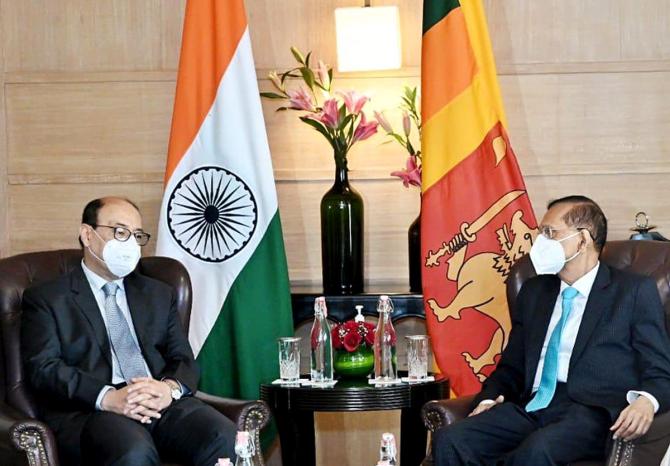
IMAGE: Foreign Secretary Harsh Vardhan Shringla calls on Sri Lanka Foreign Minister G L Peiris in New Delhi, February 8, 2022. Photograph: ANI Photo
In New Delhi recently, Sri Lanka’s Foreign Minister G L Peiris told interviewers that bilateral ties are moving from a ‘transactional’ to a ‘strategic’ phase.
It was a line drawn out from the position paper of his nation’s high commissioner, Milinda Moragoda, who has also been flagging the idea since his taking over last year.
The bilateral ties have jumped nautical miles ahead in recent months, say, beginning with the Indian private sector Adani Group getting management stakes in the West Container Terminal project in Colombo port.
Earlier, India was peeved at President Gotabaya Rajapaksa’s government cancelling the tri-nation MoU for joint development of the port’s Eastern Container Terminal, also involving Japan, signed by the previous government of his political rivals.
Sri Lanka’s forex and economic crises have cemented bilateral ties as never before in recent years.
The steep fall in tourism, beginning with the 2019 Easter Sunday serial blasts followed by the COVID-19 pandemic, which also drained internal remittances from Sri Lankans employed overseas — they all had returned home — caused the forex crisis.
The economic crisis is a legacy issue and every government since Independence should take the blame.
To this, President Gota made his contribution in the form of overnight ‘organic farming’ policy, starting with import-ban on items of daily need like turmeric from Tamil Nadu.
Anti-Rajapaksa economists saw it as an honourable way of covering up the impending forex crisis, as applicable to import ban on other goods.
Sooner than later, it translated as previously-undisclosed import of ‘organic fertiliser’ from China.
Beijing’s tactless usury of demanding and obtaining $6.4 million in scarce forex after Sri Lankan farm scientists had rejected the imports as ‘sub-standard’ has made China overnight unpopular among large sections of Sri Lanka’s rural population, who are dependent on farming.
Coupled with that is the instant delivery of chemical fertiliser to save standing crops in vast, if not all the areas, has enhanced India’s image as a friend-in-deed among multiple sections.
The knowledgeable are convinced, now as always, that India’s terms won’t be usurious in any which way.
Sri Lanka could count on New Delhi to relax terms further in unforeseen circumstances such as a tsunami now and a pandemic another time.
Today, there is greater appreciation for India extending about $2.5 billion in aid than when India volunteered Covid-related medical assistance to all neighbours.
The COVID gift package had included medical kits in the early stages, followed by vaccines and oxygen.
Today’s forex-related aid includes $ 1 bn in loan for importing essentials, including food and medicines, and $500 million for importing oil to keep the Sri Lankan machinery going.
However, the greater attraction involves the hurried Sri Lankan clearance of the delayed deal for the joint development of the British era Trincomalee oil tank farms — 99 tanks, total one-million tonne capacity.
Indian expectations are that Colombo would not use motivated protests and court cases to scuttle the project on a later date — or, allot the 24 Trinco tanks retained by the public sector Ceylon Petroleum Corporation to scuttle the project on a more convenient day, as was the case with such others in the past.
Minister Udaya Gamanpilla has since told the Sri Lankan parliament that India had expressed a desire to participate in oil and gas exploration in Sri Lankan waters. Incidentally, when Norway mapped these waters for oil wealth two decades ago, Sri Lankan critics termed as their hidden agenda for playing facilitator to ethnic talks between the government and the LTTE.
The Peiris-Moragoda use of the term ‘strategic’ possibly refers to creating a joint ‘strategic oil reserve’ for both nations to benefit from.
Refurbishing the tanks is going to cost India billions, and the physical security of the farms, both from internal and external threats, on land and sea alike, can be expected to be entrusted to the Sri Lankan forces, particularly the Navy.
The nation’s armed forces had sought and got the right when the previous government handed over the southern Hamabantota port territory to China in a debt-to-equity swap-deal after the earlier government of then president Mahinda Rajapaksa — now Sri Lanka’s prime minister — had got into a usurious construction contract with the Chinese.
Minister Peiris’s maiden visit in this term as foreign minister after taking over in August was delayed by the pandemic, though he had met his Indian counterpart Subrahmanyam Jaishankar on the sidelines of the United Nations.
Sri Lanka’s Finance Minister Basil Rajapaksa, another brother of President Gota, visited New Delhi not very long ago, where one of his engagements was a uniquely co-hosted meeting by his counterpart Nirmala Sitharaman and Dr Jaishankar.
Incidentally, the two ministers and also High Commissioner Moragoda have also met National Security Advisor Ajit Kumar Doval, indicating that there were other aspects of ‘strategic’ relations that the two nations were engaged in.
It had all begun with Doval’s Colombo visit of November 2020, when the two nations along with common neighbour Maldives elevated their existing yet non-operational Maritime Security Agreement into a ‘Maritime and Security Agreement’ with all its import.
After Peiris’s Delhi visit, an Indian media interview with him is now talking about preliminary talks for the purchase of two India-made Dornier fixed-wing aircraft, which New Delhi had deployed and also donated to the Maldives some time ago for maritime surveillance.
If it happens, the request-and-offer, or offer-and-acceptance as the case may be, should mark the first time New Delhi is supplying military use aircraft, though for not-exactly military purposes, after deciding not to supply lethal war material at the height of the ethnic war in Sri Lanka.
Following the end of the ethnic war in the country, Sir Lanka, since 2011, is the third arm of what originally commenced as the two-nation, bi-annual Dosti Coast Guard friendship exercises.
The last such joint exercise was conducted in Maldives in November 2021. It will be interesting to note if common Ocean neighbours, Mauritius and Seychelles are invited, and participate in the next edition of Dosti.
In between, the two nations participated as observers at the NSA-level talks, and the likelihood of their joining the Maritime and Security Arrangement, with Colombo as the secretariat, among the other three nations cannot be ruled out.
With thr US in Diego Garcia in the middle and India’s tri-Services Andamans Command and the upcoming Lakshadweep unit forming the natural flank along with French Reunion, a strong cooperative Indian Ocean Region security arrangement can blockade the mouth of the Indian Ocean for adventurous navies intent on harm.
Evaluating the emerging situation, the ministry of external affairs created a new division on the Indian Ocean Region some years back, overseeing affairs with the Maldives and Sri Lanka, Mauritius and Seychelles.
More recently, it expanded the Indian Ocean Region division to include western Indian Ocean nations, namely, Madagascar, Comoros and Reunion.
This does not automatically mean that these nations, especially Madagascar and Comoros, are with India on matters the Indian Ocean Region. Instead, it is India’s way of looking at the Indian Ocean Region south of its land territory as a single unit on matters of maritime development, security and consequent concerns.
In Delhi, Peiris also extended invitation for Prime Minister Narendra Modi to attend the BRICS Summit in Colombo next month.
If Sri Lankan media speculation comes true and Modi attends the summit — possibly with a bilateral on the sidelines — then, India would have upturned predecessor Manmohan Singh’s last-minute cancellation from the 2008 CHOGM, though the comparison should end there.
It also remains to be seen if BIMSTEC would follow the ASEAN precedent of offering the seat to Myanmar, but not to the ruling junta.
The subdued bilateral euphoria of the present is to be accompanied by the Indian vote at yet another UNHRC resolution on Sri Lanka in March, after New Delhi had abstained a year ago.
Beginning last year’s Resolution 46/1, the West-initiated resolution has gone beyond the original war crimes probe to include every day violations, the likes of which deviate from the original and are also committed by other States, including some of the resolution-movers.
The West, starting with the US as prime mover, has since begun painting India with the same Sri Lankan brush, when it comes to more recent allegations of non-war crimes human rights violations.
Under Modi especially, India has been moving slowly but surely to the centre-stage on the Sri Lankan ethnic issue.
It has more to do with competitive Sri Lankan Tamil politics over the non-acceptance of the India-facilitated power devolution package under the Thirteenth Amendment to the Sri Lankan constitution than New Delhi’s security concerns of the China kind.
Then, there is the irreconcilable fishermen’s dispute between the Tamil-speaking coastal population in the two nations.
It would continue to be a thorn in the flesh for both nations, but for starters, Colombo has to display a certain level of maturity in ensuring that the Sri Lanka Navy does not continually harass the Indian fishers crossing the IMBL, as it acts as a constant dampener to bilateral ties.
Non-regional diplomats posted in the two countries and also the international media are the culprit, but they should be given least opportunity in the matter.
Bilateral ties have three major impediments.
One, of course, is China, and the other two relate to the ethnic issue and the fishers’ dispute, the latter bilateral in form and content.
Colombo has since sought to address the former.
The return of institutionalised foreign policy — or the foreign policy returning to the institutional mechanism, to whatever extent possible under the circumstances — has meant that Sri Lanka is able to articulate its India-China bi-polar approach in a better way than any time in the past.
In Delhi media interviews, Peiris reiterated that they would go to India, China, Bangladesh or any other bilateral partners first to address the forex and fiscal crisis, before considering the IMF.
It’s not about the IMF’s all-American character as often inadequately understood.
Though the minister did not explain it, the left-leaning leadership in Colombo is anxious to avoid politico-electoral unpopularity attending on IMF conditionalities nearer home compared to their populism.
To this, Sri Lankan street opinion may have now added Chinese usury, which was felt in every rural home, too, after the ‘fertiliser scam’.
It was unlike the two Hambantota deals — construction and swap — and also the upcoming Colombo Port City, which were mostly urban politico-economic issues.
The China-funded projects mostly relate to urban or economic infrastructure, including the upcoming Colombo Port City and expressways that do not impact the vast rural population directly.
Over the past close to a decade, they have also been taking away Sri Lankan jobs in their millions, hence family incomes.
Colombo seems to have understood what is wrong with their China-centric economic policy, which has proved to be too costly for Beijing’s uncomplicated political and diplomatic support at the UNHRC and the UN, if and when it’s hauled up over there.
Against this, Indian projects, though infrastructure-related at present, are expected to massively boost domestic jobs and family incomes.
No one in Sri Lanka can dream of India demanding its territory in lieu of debt, or blacklisting a public sector bank for non-payment for substandard fertiliser, on the government’s advice.
The message has to be taken across, but no one in Sri Lanka has any doubt that if the present forex/economic crisis were to continue for unforeseen reasons again, India would be as mean a lender, which anyway it has never been, given the concessional terms and the comforting hope of rescheduling as has happened now with two pending debts, totalling $ 900 mn, if it came to that.
There now seems to be greater clarity and acceptance in Indian government circles that they needed to take Colombo at its words, on ‘development funds from all, strategic ties only with India’.
The coming months especially will (have to) provide evidence to this also to the Indian strategic community and to the larger world.
At some point, India also needs to re-evaluate unilateralism in defence and strategic affairs, without prior consultation or post facto information for smaller neighbours, on the nation’s extra-regional defence and security pacts — with the erstwhile Soviet Union during the Cold War and the US-led West, since.
The latest is the Quad, Indo-Pacific duo, where Sri Lanka seems to be moving closer to the EU-led Indo-Pacific, instead.
The EU initiative itself is a product of absence of prior consultation and later-day communication between the US and its European allies.
Clearly, Colombo seems to be veering to the middle path between China and the US on global matters, but in regional matters of strategic security, it is increasingly identifying with India, as it has been declaring through the past decade-plus-half but not as convincingly as at present.
There is a long way to travel together, but a new beginning has been made, after all!https://imasdk.googleapis.com/js/core/bridge3.498.2_en.html#goog_1561762740
N Sathiya Moorthy, veteran journalist, political analyst and author, is Distinguished Fellow and Head-Chennai Initiative, Observer Research Foundation.
Prof.Peiris addressing armed forces and police officers at the National Defence College (NDC) (pic courtesy FM)
Foreign Minister Prof. G. L. Peiris has questioned the conduct of the British government, a member of the Geneva-based United Nations Human Rights Council, in addition to being the leader of Sri Lanka Core Group at the UNHRC, the extraordinary efforts it had made to suppress wartime dispatches from Colombo.
Prof. Peiris underscored the irrationality in the British action as they were reportedly so keen to establish the truth, pertaining to unsubstantiated war crimes allegations directed at the then political leadership and the military.
The Foreign Minister said so addressing a selected group of armed forces and police officers at the National Defence College, Kollupitiya.
Prof. Peiris addressing the officers on the invitation of Maj. Gen. Amal Karunasekara, Commandant of the NDC, Prof. Peiris explained how the British worked overtime to prevent a senior member of House of Lords Michael Wolfgang Laurence Morris from securing classified documents.
At the onset of the discourse, Prof. Peiris acknowledged that Sri Lanka was high on the Geneva agenda at the forthcoming 49th session of the UNHRC scheduled to commence just two weeks later.
The controversial dispatches authored by Lt. Colonel Anthony Gash, the then Colombo-based Defence Attaché dealt with the ground situation on the Vanni front (January to May 2009) as troops surrounded the remaining fighting cadre of the LTTE.
Sri Lanka brought the war to a successful conclusion on May 19, 2009 on the banks of the Nanthikadal lagoon.
Emphasising the importance of the British dispatches sent simultaneously as the fighting was taking place on the Vanni east front, Prof. Peiris asked whether the British questioned the credibility of their own employee based in Colombo.
The UK succeeded the US as the leader of Sri Lanka Core Chair in June 2018 in the wake of the then President Donald Trump quitting the UNHRC calling the UN body a cesspit of political bias. The US returned to the Geneva body in the wake of Joe Biden’s election as the President.
Prof. Peiris discussed why Lord Naseby hadn’t been able to secure the dispatches until he sought the intervention of the Information Commissioner’s Office in terms Freedom of Information Act 2000. However, the Foreign and Commonwealth Office (DCO), the custodian of the classified documents pertaining to the Vanni war, released a heavily censored section of them, Prof. Peiris said, questioning the British motive. The Foreign Minister emphasized that the British documents would have helped those really concerned about accountability issues to ascertain the Vanni situation.
Declaring that he had perused the heavily detracted British diplomatic cables, Prof. Peiris explained how they helped Sri Lanka to prepare its defence. A particular cable questioned the very basis of the UN allegation pertaining to the death of over 40,000 civilians during the final phase of the ground offensive.
During the course of the one-hour lecture, Prof. Peiris assured the military that in terms of international laws applicable to wars/conflict Sri Lankan personnel couldn’t be hauled up before international war crimes court under any circumstances. Twice Foreign Minister Prof. Peiris emphasized there was absolutely no danger or risk in them being subjected to such action as the international law was very clear in this regard.
Prof. Peiris served as the foreign minister during 2010-2015 President Mahinda Rajapaksa’s presidency. President Gotabaya Rajapaksa brought him back as the FM last August in place of Dinesh Gunawardena.
Prof. Peiris also dealt with what he called critically important work undertaken by an international Advisory Council appointed to assist the Presidential Commission to Investigate Complaints Regarding Missing Persons. The Advisory Council comprises three legal luminaries namely the late Sir Desmond de Silva (chairman), Sir Geoffrey Nice, and Prof. David Crane.
Referring to current international ‘flashpoints,’ Prof. Peiris expressed shock and dismay over the way a section of the international community had responded to the Sri Lanka accountability issue. Prof. Peiris was harsh on the creation of a special mechanism to gather information on Sri Lanka against the backdrop of UN Human Rights Commissioner Michelle Bachelet declaration that they have developed an information and evidence repository with nearly 120,000 individual items already held by the UN.
A resolution adopted in March 2021 allows the UN to collect, consolidate, analyze and preserve information and evidence, and to develop possible strategies for future accountability processes for gross violations of human rights or serious violations of international humanitarian law in Sri Lanka, to advocate for victims and survivors, and to support relevant judicial and other proceedings.”
Questioning the credibility of the Geneva process Prof. Peiris asked how evidence and individual items that hadn’t been subjected to examination whatsoever could be used against Sri Lanka.
How could unsubstantiated claims made under the condition of anonymity be accepted without being verified?” Prof. Peiris asked, accusing Geneva of what the academic called cynical violation of the basic law.
Reiterating Sri Lanka’s commitment to the UN processes, Prof. Peiris questioned the necessity of a special mechanism at the UN’s expense in spite of the availability of UPR (Universal Periodic Review) to inquire into the conduct of all countries. Alleging that war winning Sri Lanka had been singled out and treated unfairly, Prof. Peiris said that the human rights issue was being used as a tool to interfere in domestic affairs.
Prof. Peiris pointed out that Geneva was even interfering in the functions of the Parliament. Referring to Geneva resolutions and statements from therein, Prof. Peiris said: the devolution of power, reorganisation of the armed forces, reorganization of the police force, the balance of authority between the Central government and the Provincial Councils, the Prevention of Terrorism Act and its reforms are matters that should be decided by the Parliament and the people of Sri Lanka.
Instead of giving local mechanisms much needed support, the UNHRC was pushing to impose solutions, Prof. Peiris said, declaring such measures weren’t durable.
Prof. Peiris stressed the importance of the role played by mechanisms-namely the OMP (Office of Missing Persons), OR (Office of Reparations) and ONUR (Office of National Unity and Reconciliation) in current efforts to address accountability issues. Reference was also made by Prof. Peiris to the Truth and Reconciliation Commission of South Africa while explaining the work undertaken by Commission of Inquiry (CoI) appointed under the chairmanship of sitting Supreme Court judge Abdul Hameed Dileep Nawaz to investigate, inquire into and report, or take required actions, regarding the findings of the former Commissions, or Committees, that investigated human rights violations, serious violations of International Humanitarian Law (IHL) and other such offences.
Declaring that Sri Lanka was ready to cooperate fully with UNHRC, Prof. Peiris said that Geneva couldn’t substitute the Parliament.
Leader of Opposition Sajith Premadasa will be the common opposition candidate for the next presidential elections as SJB believes that people want him to lead the nation, its National Organizer Tissa Attanayake said today.
Attanayake told a press conference that the SJB believes that people will endorse Premadasa’s candidacy and that all opposition political parties will back him. We feel that Mr. Premadasa will be the person who will be backed by all opposition political parties and the people,” he added.
Responding to the challenge given to his party by the SLPP to come for an election, Attanayake said SJB is even ready for a presidential or a general election. A Presidential election or a general election could be held next year if the President wishes and we are ready for any elections,” he said.
Also he said the local government elections and the provincial council elections can be held this year. (Yohan Perera)
Finance Minister Basil Rajapaksa has explained and assured the Cabinet of Ministers that 11 funds including the Employees’ Provident Fund (EPF) and the Employees’ Trust Fund (ETF) will be exempted from the one-time tax surcharge of 25% proposed in the 2022 Budget.
It had been proposed in the 2022 Budget to impose a 25% Surcharge Tax on individuals or companies earning an annual taxable income of Rs. 2,000 million or more.
It is to be a one-time tax payable by high value taxpayers in 2022 for their income in the tax year of 2020/21 while the objective of this special tax was to raise the necessary revenue to finance the Government expenditure programs for the year undisturbed.
Concerns were subsequently voiced by experts, opposition politicians as well as members of the government itself that the Employees’ Provident Fund (EPF) and the Employees’ Trust Fund (ETF) would also be subjected to this 25% surcharge tax as any fund that exceeds Rs. 2 billion taxable income would be subjected to this surcharge tax.
However, making a special statement to Ada Derana today the Minister of Finance Basil Rajapaksa said he assured the Cabinet during its meeting this evening that 11 funds including the EFP and the ETF will not be subjected to this surcharge tax.
He said that clearly at the time the government expected to generate a revenue of around Rs. 100 billion from this surcharge tax and that accordingly they identified 69 companies and individuals who will be subjected to this tax.
He said that at no point did they expect to include the EPF or ETF into this tax. Rajapaksa said there are 11 funds including the EPF and ETF and that they never intended to include any of them into this tax surcharge.
However, the Inland Revenue Act No. 24 of 2017 of the previous government has identified these 11 funds as income tax paying institutions. Therefore, there was an opinion among the public that this would be a surcharge.”
He said that they have explained in the Cabinet meeting that all 11 funds will be exempted from this tax.
Ceylon Chambers urges govt to reconsider
Meanwhile the Ceylon Chamber of Commerce today also noted serious concerns on the provisions of the Surcharge Tax Bill that has been gazetted recently to implement the budget proposal on same.
The Chamber said it provided many alternative recommendations for the implementation of the Surcharge Tax by considering either an income tax surcharge of 10% from all taxpayers, an income tax surcharge at varying rates depending on the level of income, credit to be carried forward for paying the one-off tax or the imposition of the tax on a prospective basis.
Any of these alternatives could have raised the targeted revenue while minimizing the burden on the private sector during this extremely challenging period in the country, it said.
Further, the Chamber in its representations, specifically requested to avoid application of the Surcharge Tax at Group level considering its unfair impact on smaller subsidiaries and minority shareholders. This method of application at the Group level could be a serious deterrent to local and foreign investors who consider entering into joint ventures with large conglomerates, it emphasized.
Therefore, the Ceylon Chamber of Commerce requested the Government to reconsider some of these provisions before it is submitted for approval by Parliament and extends its support to develop alternative proposals to ensure the revenue targets are met.
The Health Ministry says that another 1,231 persons have tested positive for Covid-19 in Sri Lanka within today (14).
This brings the country’s official Coronavirus caseload thus far to 629,347 while presently a total of 18,158 patients infected with the virus are under medical care.
The Director General of Health Services has confirmed another 36 coronavirus related deaths for February 13, increasing the death toll in the country due to the virus to 15,844.
The deaths reported today includes 20 males and 16 females, according to the figures released by the Government Information Department.
Six of the victims are between the ages 30-59 years while the remaining 30 are abed 60 years and above.
An economic symposium conducted in Colombo a few years ago especially focused on vital issues related to the country. The issues discussed were foreign debt, regulation, export performance and attracting foreign investment also included. Sound advice and views of economists were encouragement for competition, reducing the cost of debt service and promoting exports to achieve a higher volume of foreign reserves. The major issue relating to the foreign exchange has been an inability to balance the incoming and outgoing foreign exchange flow.
After the COVID-19 pandemic, Sri Lanka and other countries of the world encountered significant economic backwardness and many countries show reluctance to talk about it. For example, lockdowns harm the economy because movements of people contributed a considerable volume of value to the circular flow, and COVID-19 and associated virus control measures limited the contribution to the economy. Employment opportunities have been limited and people are scared to go to market and spend. The World Bank (IBRD) recently mentioned the situation. Developed nations show apprehensiveness to talk about the outlook, most probably, investors would have considered that economic backwardness might create an unexpected risk to the world economy through stock markets. Economic policymakers have no answers, but the reality is they need to adapt to the environment, especially taking steps to control spending instead of sticking to Keynesian theory. Spending controls are admissible to Sri Lanka because the linkage of spending has no positive link back to the economy. The funds for government spending find from borrowing and such a process blows many macroeconomic disadvantages.
The issues focused on the conference were significant issues not only in Sri Lanka alone but also in many third-world countries. Common people have less understanding of the issues they could understand from popular news in print and social media. The political motivation of the country has been aligned to spending without discipline since the 1960s. The major macroeconomic attention of the conference was based on three vital aspects: competitiveness, government fiscal stability, and maintaining long-term sustainable economic growth. These three aspects were interconnected with economic reforms, which stuck to the general rhetoric of the international financial institutions such as IMF, World Bank, and Asian Development Bank towards developing countries since the ending of the cold war in the early 1990s.
Sri Lanka already identified several issues related to economic competitiveness during the 1977 general election and the government budget presented for 1978 by Ronnie de Mel highlighted some of these issues in the budget speech with complicated corruption in the country. Corruption in the country has been a factor that affects the cost of investors and the complexity of corruption becomes a hard task to eliminate during the past several decades. The vicious aspect of corruption is politicians and public bureaucrats with politicians involved in corruption.
Corrupt practices of bureaucrats and politicians have no party difference and all are equally corrupt. The right of the universal franchise is used by political parties to work against the economic rights of the public and capitulate the rights of ordinary people and the free investment capabilities of entrepreneurs. The elected government in 1977 started several policy measures for trade liberalization and market-oriented economic policies, as they were essential conditions under the environment of that time. The liberal policy initiation of Sri Lanka and radical changes intended in the economy in Sri Lanka were kicked off before Australia introduced such competitive measures into the economy. However, today Sri Lanka is behind all other countries, two major reasons for the situation were corruption and the population policy that has not been implemented with a clear prognosis to maintain 15 million population in the country like in Singapore and ethnic issues massively contributed to an increasing population when the economic contribution has been stagnated. If the size of the population is 15 million, the value of per capita GDP would be more than the US $8000 and it might be $15000 to purchase power parity.
There were many criticisms against Sri Lanka’s policy initiatives and later rapid economic progress achieved in the country found out that the market economic policies were the right strategies to the country despite much criticism made by left political parties for purely political advantage misleading the public. The advantage of liberal policies was opening the market for investment, and the response from the political sector did not provide measures for controlling corruption from the operation. The difference between Singapore and Sri Lanka has been this factor to achieve international competitiveness. Economic and social policy markers did not motivate to eliminate vicious corruption and explain the situation to the political administration. The total value of corruption in Sri Lanka could estimate to be US $100 billion or more and if the value of corruption adds to the economy, it would be competitive beyond the Indian region and the productivity from debts would add a massive value. If the market policy was implemented without corruption, the per capita GDP could have been counted as US $ over 20000 and more investment would have come to the country as a competitive state in Asia. The other vital point is if the value of corruption in the country after the independence added to the foreign reserves Sri Lanka rupee would have a strong monetary unit in Asia and the foreign reserve volume in the like in Taiwan would be more than the US $100 billion.
Although Sri Lanka started a competitive policy framework, it was lacking positive controls for good governance and economic disciplines when compared to Singapore, Malaysia, or Australia, there should have been undertaken market economic system with strong economic disciplines. The elected governments since 1990 have not been attempted to abolish the fundamental policy directions of the economy started in 1978 despite the market economic system rhetorically used as a feature to blame in the political platforms by opposition political parties before electing them to office. The backsliding of open economic policies was a major challenge and the hardest task for elected governments since the 1990s.
Contrast the politically motivated propaganda in public meetings and newspapers and social media, the government with leftist ideology will continue market policies in the country as it appeared such policies generated economic benefits to the country. The public of Sri Lanka did not want to go back to the inward-looking policies of the so-called Bandaranaike era, which created queues and black markets for each essential item. Although the prices were higher under the market economy, scarcity was not an issue and the producers too gained the right price for their products at an open market.
The trade competition of Sri Lanka involved many sectors of the economy supporting the market-oriented equilibrium rather than an artificial counterpoise maintained by the Bandaranaike regime with a massive scarcity. Deregulation of several key markets was the initial requirement of beginning market policies to give support for efficient operation. The major market was the financial market, which comprises trading banks, non-bank financial intermediaries, investment banks, stock markets, and superannuation markets. The regulatory authority in the financial system is the Central Bank and practically, it has not been operated as a regulator and it was forced to participate in market operations such as superannuation, rural credit and development financing. In contrast to this, the regulatory authority (Central Bank) works as a market player in the superannuation market with a monopoly and it should have done to maintain a strong regulation system with good supervision. The weak market operations have been involved with a heavily regulated labour market and a rigid trade union system in the country, the government has failed to crack down the trade union system which operates as a barrier to investment and maintaining product quality.
The budget speech of 2015 and the government policy initiatives of the good governance regime reflected a tiny attempt to deregulate the financial system, but it has appeared that the effort was becoming purely unsuccessful because the contract between the president and the Prime Minister concerning policy implementations and crooks associated with market operation stole the system for personal advantages. This situation gave a powerful push to the election of Gotabhaya Rajapaksa in 2019 and the minister of finance in the new government has not taken effective steps to eliminate corruption and open for competitiveness. Many so-called educated guys who showed the ability to run the operation proved that they are highly corrupt personnel with a mask to show off.
Bulky ownership of the banking market of Sri Lanka is in the government hand. This includes as Bank of Ceylon, Peoples Bank, National Savings Bank and several development banks, investment banks and long-term financial institutions such as mortgage and national development banks. As the government is not in a position to provide capital for state banks, they are in a difficult situation to profitably manage and provide investment support to the private sector and public enterprises. There are few banks under private ownership with a small capacity to finance the development thrust of the country, but they are also depending on the government business services subject to direct or indirect control measures of the government. The existing competition within the banking market appears to be like in house conflict between family members with many regulations. It is also observed that banks are working as a secret cartel when referring to decisions making process of interest rate and bank charges, application of procedures and many other matters. In this environment, the banking market in Sri Lanka restrains attracting foreign investments to compete and provide greater benefits to customers. The efficient operations with the ability to provide financial services for domestic investments and foreign investors in expanding export market.
Recently, I have examined annual reports of government banks and found that profit figures of these banks comprise Rs Billions of exchange revenue, which automatically made of declining the foreign value of Sri Lanka rupee. This automatic process is quite easier because of a weak economy in the country, the foreign value of domestic currency declines every day generating rupee profits from existing foreign assets. This exchange profit is not a result of the quality of management stewardship of banks.
The billions of risk assets of banks were funded by borrowing from either domestic or foreign sources, issuing debt instruments at a higher rate of interest. As the government guarantee ensures the safe return of funds to investors and debt instruments mark at a higher rate of interest, foreign and domestic investors will subscribe to them. The bank management indulges this situation as a higher achievement covering actual truth to the government and customers. In this situation why Sri Lanka’s government is reluctant to consider alternative options for capitalizing banks.
The technique of banks generating liquidity for lending business has become a serious repercussion for indebtedness of the country. It has already created structural issues in the economy with a possibility of austerity measures to be insisted by international financial institutions when they support the country. The other serious issue of the banking system is that it has not made realistic credit lost provisions after successful risk asset reviews, which is the global strategic technique that is used to realistically estimate the required volume of specific and general provisions for total credit portfolios.
When examining credit portfolios of banks, obviously they are comprising a large volume of non-performing credits, in which the pace of bad debt is possibly over 15% but the bank management calculates interest earning for these non-performing credits adding it into the banks’ revenue component as provided paper profits. If there are 15% non-performing credits in the aggregate lending portfolio of a bank, it means that the bank is not making profits from its lending business.
When these interest revenue and exchange profits are transferred to the treasury, they will use for government spending. That means paper money will be added to the country increasing inflation. There are several reasons to increase non-forming credits in the banking system of Sri Lanka, but I do not know to explain them in this article as it has limited space.
The other visible issue in the government bank imperatives is that many subsidiaries are attached to individual banks and these subsidiaries eat a considerable portion of bank profits. Why did these subsidiaries created is a hard question to answer, sometimes ago it was a pattern of the management of government banks that when a top banker retires from the service, he or she creates a subsidiary using bank funds as initial capital? The purpose of the subsidiary was to continue in the service by the retired person indirectly enjoying banks’ facilities. Before creating subsidiaries, banks never evaluated the viability of subsidiaries from a different point of view. The government banking system also promoted opening branches overseas or creating subsidiary branches overseas purely for management indulgence purposes rather than profitability or investment diversification purposes. Sometimes, the purpose of creating subsidiaries appears to be contained undisclosed dishonest elements to a certain extent. This type of management is not successfully supervised or controlled by the top management of banks. It is quite possible to assume that politicians or regulators have no clear understanding of this type of risky manipulation in the government banking system.
Sri Lanka needs to maintain strong domestic and international confidence in its payment system. During the last several years there has been a major news item in international media about the financial crisis and the public confidence in the payment system of various countries. Although it was not a serious issue, bad debt in the banking system created distress in many countries. If such a situation incurs in Sri Lanka, it is difficult to imagine what would be the probable results in the country. There had been several financial failures in the country since the beginning of the 1980s. Some people, who were badly affected by failures, are still cursing to some organizations and their management as they lost the savings of a lifetime. The style of the management of financial institutions needs to reflect how they support to secure the payment system of the country.
Although the investment regulations in the country indicate that investors are allowed to borrow working capital from the domestic banking system, the current banking system is unable to provide the required volume of credits to investors as they expect at a competitive rate. The capacity of domestic banks to provide lending support for foreign investors is highly confined to a lower level than investors expected in the country. In this connection, Sri Lanka’s trading banks cannot ignore BIS regulations, which insist on the capital requirement base on risk-weighted assets. In this background, how could Sri Lanka become competitive in the financial market to attract foreign investments for expanding export earnings?
The answer to these vital issues would be dependent on the strengthening of Sri Lanka’s banking system with a portion of foreign capital injections and gradually privatizing the government banks for broadening the ownership as it was done in Australia for government banks under the microeconomic reforms in the 1990s. The banking system of Sri Lanka is in a serious distressful situation because the government and domestic industries look for finance from banks rather than using other alternative sources. Sri Lanka needs to consider how Asian countries resolved problems promoting the Asian Bond Market. The distress of banks in Sri Lanka could be reduced by 50% by promoting an effective domestic bond market among industries and provincial governments. To be succeeding the bond market, it needs support from the government or regulatory authority by offering the guarantee for bond investment.
The superannuation market of Sri Lanka remains in the government hand which controls entire operations of the market such as basic administration, investments, regulation and all other related activities. This market is comprised of employee’s provident fund, employee’s trust fund and pension fund while several small funds related to finance and insurance institutions’ employees prevail under the control of individual institutions. The operative controls and the management of funds are performed by the Central Bank of Sri Lanka, which is the regulatory authority and it is playing the role of market operations. No country allows the regulator to play market operations as the role of the regulator is to fundamentally regulate the market for efficient and effective operations and to maintain its stability, integrity and confidence of investors. The management of the superannuation market in the modern era becomes a highly risky task as the volatility in investment markets such as investment in stocks or many other lending-related activities are subject to contain a high risk. The decline in oil prices has badly affected investment returns of super funds. In this situation, the government might have thought that superfunds must be on its hand rather than allowing it too risky players.
The entire superannuation system of Sri Lanka has become an investment source for treasury and Central Bank bonds, which are sources for government spending. In other words, the government of Sri Lanka indirectly uses the superannuation market to finance the budget deficit and payment for foreign debts. Generally, the superannuation systems in developed and emerging market economies use to promote private investments through the stock market. It does not mean that the investments of the superannuation market should be direct only to risky investments in stocks, the investment managers need to set a diversified portfolio in which a reasonable component could be given to investment in government bonds. The problem in the current system is that money generated by the government of Sri Lanka from issuing bonds seems to be spent for recurrent expenditures to maintain loss-making public enterprises or corrupt spending in provincial governments and expensive government services that are not essential to the country.
Sri Lanka desperately needs an average of 10% of annual economic growth, which supports double the economy within less than seven years. The current expenditure pattern of the government would not support strong fiscal stability to the government unless it is focused to have a balanced budget or an excess budget over the expending. The government of Sri Lanka provides too many services to the community, which is addicted to government services at free of charge, or a subsidized price rather than paying for the value or user-pay price like payments for quality services. The traditional left politics has created a false consciousness among the members of the community on private services. There is no comparative logic in left political ideology against private sector services.
Public investment management is under the hand of government henchmen, who have no either qualifications or skills or experience in managing such organizations. They do not know to review the operational capability, efficiency and efficacy of organizations management and make a productive policy structure to the organizations. This situation has been in Sri Lanka since the so-called socialist revolution in 1956 and no elected government has been taken successful action to solve the problem, but all political parties were using the issue like a beggar’s wound to gain power but the system is allowed to continue creating problems in the economy without nationhood attitudes.
The trade union system of Sri Lanka is an invisible hand of left politics, which had supported certain individuals to be a part of the elected parliament without an intention to take over the power to fix the problems. The broad objectives of the trade union systems of the world are expanding focus on broader areas such as generating productivity in the workplace, safeguarding workers’ rights as well as industrial democracy and equal opportunity, strengthening employees’ capacity, knowledge and skills and so on. In this situation, it is essential to educate trade union officials on the government policy and the possible positive impact of the government policy on members of trade unions. The best example for this situation is the proposed reforms on the superannuation market, which focuses to establish a strong independent organization to manage superfund’s removing from the current status, which is a hostage of the regulatory authority. However, the effort of the government was dead in the labour room as the government did not educate trade unions on the policy matters before presenting them to the parliament.
Sri Lanka may be a country with higher basic literacy, but the financial literacy of people is weaker compared to Western countries and the ability of citizens to comprehend financial transactions and constructively participate in the economic and financial decision-making process is limited to a tiny extent. In this situation educating the general public, workplace employees, as well as politicians are key aspects to the success of developing the competitive economic environment in the country. Newspaper reporting in Sinhala, Tamil and English media demonstrate that politicians always talk rubbish on political platforms, which are reported to the public by newspapers without considering the negative impact to the community. The role of politicians should be comprised of educating the public on government’s policy matters for a successful implementation of policies rather than making attention to drawing stories on political platforms.
International competitiveness is a circuitous notion that involved a variety of factors but product quality, cost of production and cost leadership are major contributing factors to maintaining international competitiveness. In many instances, the product quality and the other factors are not compromising because when the product quality is higher, the cost of production should be lower. Concerning the quality aspect, many Western countries believe that they could maintain a competitive leadership in the world as the product quality of Western countries assumes to be higher. Despite this notion, China and other Asian countries were able to achieve competitive leadership defeating the Western world using the natural ability of Asian countries to make products at a lower cost using fairly cheap labour. It can be observed that China maintains international competitiveness using a group of factors rather than sticking to a single factor. In this connection, Sri Lanka needs to learn a lot and also needs to select areas where the country could be competitive when compared to other countries in Asia.
Attracting foreign investment to Sri Lanka using factors that are competitive with other countries is vital and in this sense, it is necessary to align to service industry rather than industrial productions which consume more capital or high-quality labour. Under the economic diversification programs since 1965, Sri Lanka identified several subsectors of the economy such as tourism, foreign employment and many others. It appears that the government policy has not much focused on the service sector. For example development of port services, tourism, real estate services, and leisure activities would be in a highly competitive environment unfortunately Sri Lanka is losing this opportunity due to international politics under the present government, which got away from the Chinese alliance which can make a positive impact on the development of competitive services.
Well there was three of us in this marriage, so it was bit crowded.”අපේවිවාහයේතුන්දෙනෙක්හිටියා. ඒනිසාඑතනපොඩිතදබදයක්තිබුණා” යැයිඇයවචනදහසකින්කිවයුතුදේඉතාකෙටියෙන්පැවැසුවාය.
විවාහකචාල්ස්සමගහොරසම්බන්ධයක්ඇතිකරගැනීමනිසාකැමිලාදඩයනාගේමරණයටඅනියම්ලෙසවගකිවයුතුයැයිබ්රිතාන්යජනතාවඇයටචෝදනාඑල්ලකරන්නටවිය. ඩයනාගේවිවාහයකඩාකප්පල්කරමින්ඇයමරණයකරාගෙනගියාකියමින් The Sun පත්රයකැමිලාවහැඳින්වූයේජාතියේඅංකඑකේහැතිරිය” ලෙසය.
Is India Bangladesh’s true friend and well wisher? It is a question of century. How India and Bangladesh can become a real friend in South Asia? India and Bangladesh can show the world how neighbouring countries can become all-weather friends. Bangladesh-India bilateral relations are a role model in the world in terms of relations among neighboring countries. They are deep and have evolved over time. India is seen as Bangladesh’s true friend.
On December 6, 1971, India granted diplomatic recognition to Bangladesh as an independent and sovereign country. The same day, Bhutan recognized Bangladesh. India has stood by Bangladesh since the Liberation War started. It provided shelter and food to one crore refugees, training and arms to the freedom fighters and all assistance to the Bangladesh government-in-exile. After India’s recognition, Pakistan was quickly defeated in a joint offensive by the Mukti Bahini, the Bengali independence militia, and Indian forces on December 16. The date is very important for Bangladesh.
This relationship has expanded in many different ways in a spirit of friendship, understanding and mutual respect. Under the visionary leaderships of Prime Ministers Narendra Modi of India and Sheikh Hasina of Bangladesh, the two countries have become partners in a “shonali adhyaya” (golden chapter).
Bangladesh celebrates the birth centenary of the Father of the Nation, Sheikh Mujibur Rahman, and 50 years of independence. This year is also the 50th year of Bangladesh-India diplomatic relations. On December 6, for the first time, Bangladesh and India celebrated ‘Friendship Day’ in 16 countries.
Foundation of ties
Sheikh Mujibur Rahman and Indira Gandhi laid the foundation of bilateral relations through a 25-year Friendship Treaty in 1972, which his daughter, Sheikh Hasina has consolidated and diversified. Bangladesh has become an important partner of India due to its ‘Neighbours first’ policy
After the Treaty of Friendship, a trade agreement was signed in 1973 and the Mujib-Indira border agreement in 1974. After Mujibur Rahman’s assassination in 1975, social, political, economic and commercial relations between Bangladesh and India deteriorated. After 21 years, when the Awami League came to power, an atmosphere of trust and expectation was created again.
This led to the historic Ganges water agreement. After Sheikh Hasina returned to power in 2009, bilateral relations again improved. Since Modi took power in 2014, the two Prime Ministers have taken relations to a new height. The seven-year-old enclave exchange, maritime demarcation and other unresolved issues began to be resolved.
Sheikh Hasina has reiterated her commitment to further strengthen the mutual ties. The anniversary has given us an opportunity, she said, to think about the basis of the bilateral relations and the way forward. Now it is necessary to focus on connectivity, trade, business and communications among the people.
In a tweet on Friendship Day, Modi said: Together we are remembering and celebrating 50 years of friendship. I look forward to continuing to work with … Sheikh Hasina to broaden and deepen our ties.”
A year-long programme has been chalked out to celebrate the 50th anniversary of diplomatic relations. Bangabandhu-Bapu digital exhibitions are being held in different cities of the two countries. The two leaders unveiled stamps commemorating Bangladesh-India friendship. Exchange of visits of veterans of war, inspection of ships, sports events, and cultural and other programmes are being organized.
Milestone year
The last year was significant for Bangladesh and India. Modi visited Dhaka on March 26-27. Indian President Ram Nath Kovind will decorate the closing ceremony of Victory Day. Sheikh Hasina may be the Chief Guest on India’s Republic Day.
Revolutionary changes have been made in the communication system of the two countries to make the economy dynamic. Dhaka, Kolkata and Khulna-Kolkata passenger train services and rail services for transporting goods from Chilhati in Nilphamari to Haldibari and Dhaka-Siliguri in West Bengal and Dhaka-Kolkata, Dhaka-Agartala, Dhaka-Siliguri-Darjeeling bus services have been introduced. In March, the Prime Ministers inaugurated the Sabroom Bridge over the Feni river, which connects Ramgarh in Khagrachari to Tripura. With the 1.9 km bridge, new business doors have been opened.
Under the Protocol on Inland Water Transit and Trade (PIWTT) agreement, there are plans to connect the Sonamuri-Daudkandi route of the Gumti river and the waterway from Dhulia-Godagari to Aricha on the Padma. Cargo transportation activities have been started from Chittagong port to Tripura. But some pending issues such as the Teesta water-sharing issue and killings on the border should be resolved as soon as possible.
India will provide training and technical assistance to Bangladesh through military experts. India was the first country to provide free vaccines to Bangladesh to battle Covid-19. Amid a shortage, an Oxygen Express entered Bangladesh with 180 tonnes of oxygen.
Sheikh Mujibur Rahman had said on February 8, 1972 in Calcutta: India-Bangladesh friendship will remain intact forever. No power in the world can separate it. Occasionally some anti-independence, fundamentalist forces try to destroy the relations between the two countries. But their efforts will not succeed. Because the basis of Bangladesh-India friendly relations is trust and confidence. This relationship is written in the blood through the great liberation war.” India and Bangladesh can show the world how neighbouring countries can become all-weather friends.
Geneva: Press Emblem Campaign (PEC), the global media safety and rights body, demanded stringent punishments to perpetrators of the murder of a young scribe in central India’s State of Uttar Pradesh some days back. Condoling the demise of Sudhir Saini (30), the PEC also urges the UP government in Lucknow to adequately compensate the reporter’s impoverished family.
It may be mentioned that Sudhir, who worked for a local newspaper titled Shah Times, was physically attacked by three individuals while travelling by a car in Saharanpur locality on 26 January 2022. They had a quarrel with Sudhir, who was on a two-wheeler, following an issue of overtaking the vehicle. The car passengers not only stopped the reporter, but also thrashed him and finally threw to a water channel.
Seriously wounded Sudhir was taken to a nearby hospital by the locals, where he succumbed to injuries. The eye-witnesses provided vital inputs to the police about the vehicle and those passengers. The police team accordingly arrested Jahangir, Farman and Mannan accusing them of murdering the reporter, who was only son to the elderly parents.
It’s so unfortunate that the life of a promising scribe had ended in such a way. India continues to be a dangerous country for working journalists as the populous nation lost six journalists to assailants last year,” said Blaise Lempen, secretary-general of PEC adding that year 2021 witnessed murders of 79 media workers in 29 countries, where Afghanistan emerged as the most dangerous country with 12 journo-casualties, followed by Mexico (10) and Pakistan (7).
Days back, another young scribe named Rohit Kumar Biswal died in a landmine blast, informed Nava Thakuria, PEC’s India representative.
Biswal (40), who used to work for an Oriya daily titled Dharitri, stepped on the mine planted by left-wing rebels in Odisha’s Kalahandi locality and died on the spot. The incident took place on 5 February as the reporter went to cover a local election related developments where the ultra-left extremists threatened people to boycott the forthcoming polls.
Last December, hundreds of Islamists lynched and set fire to the body of a Sri Lankan factory manager in Pakistan’s Sialkot district after he removed stickers of an extreme right-wing party featuring Quranic verses from factory machinery. Prime Minister Imran Khan had called the incident a “day of shame for Pakistan.”After Punjab police failed to save a man who allegedly burned pages of the Quran from the fury of hundreds of villagers in the district of Khanewal, Pakistan PM Imran Khan on Sunday demanded the local authorities ensure the “full severity of the law” is imposed on those responsible for the mob lynching.
“We have zero tolerance for anyone taking the law into their own hands, and mob lynchings will be dealt with [the] full severity of the law,” Khan said on Sunday.Khan also sought a report from the Punjab police concerning the officers who “failed in their duty” to protect the factory manager.On Saturday, hundreds of people gathered in the remote village of Mian Channu village in the district of Khanewal following an announcement from the mosque that a middle-aged man had torn pages from the Quran pages and burned them.Police said officers rushed to the scene and arrested the alleged perpetrator. However, the crowd snatched the man from police custody and lynched him.In a series of tweets, the police claimed that they demanded that the angry crowd hand over the man, but to no avail.”The suspects hung his body from a tree which spread immense fear,” the police report said, adding that the body was recovered hours later.Punjab Province police have launched massive raids across the region and detained 62 suspects so far. A case against 33 known suspects and 300 unknown people has been registered.
“Punjab government must immediately take action against the Police that watched it happen & the perpetrators. Laws exist – the Police must enforce these laws and not allow mobs to rule the day,” Shireen Mazari, federal minister for Human Rights, said.The incident is a stark reminder of the lynching of Priyantha Kumara, a Christian from Sri Lanka who was set on fire by mobs in the Sialkot district of Pakistan on 3 December 2021.Kumara had allegedly removed stickers linked to an extreme Islamist party from inside the factory where he worked as a manager. The perpetrators claimed that Quranic verses were featured on these stickers.