Assembly speaker seeks support for Korean businesses in Sri Lanka

January 21st, 2022

Courtesy The Korea Herald

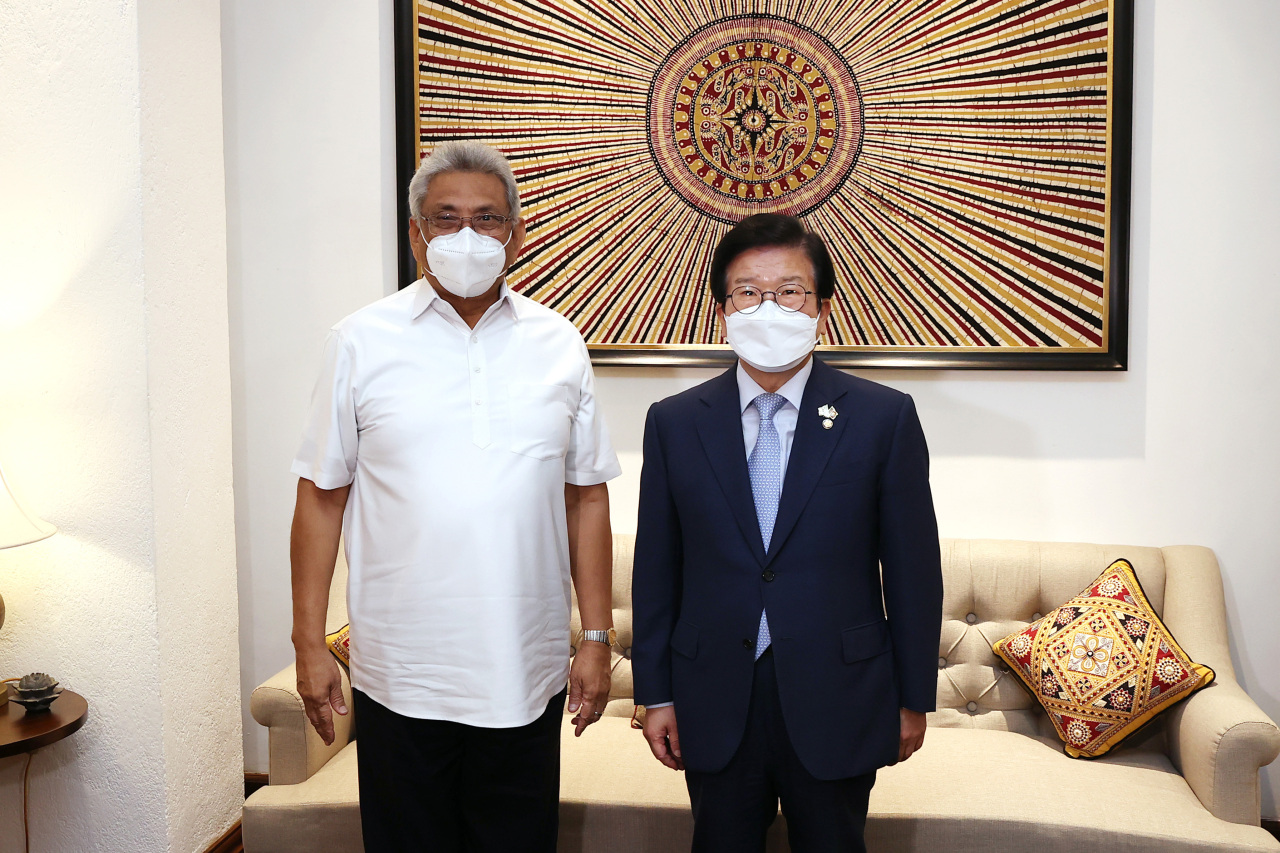
National Assembly Speaker Park Byeong-seug and Sri Lankan President Gotabaya Rajapaksa pose for camera in their meeting in Sri Lanka on Thursday. (National Assembly Speaker’s Office)

National Assembly Speaker Park Byeong-seug met with Sri Lankan President Gotabaya Rajapaksa and Prime Minister Mahinda Rajapaksa of Sri Lanka on Thursday to discuss expanding economic cooperation and minerals investment.

Park made the two-day trip to Sri Lanka to celebrate the 45th anniversary of the two countries’ diplomatic relations.

In the meeting with the Sri Lankan president, Park stressed how the economic structures of South Korea and Sri Lanka complement” each other and has a lot of untapped possibilities for stronger economic cooperation.

Our two countries have yet to fully tap our potential for bilateral cooperation. We need drastic measures to expand Korean companies’ investment in Sri Lanka and strengthen trade,” Park said.

When the two countries established diplomatic ties in 1977, the trade volume hovered at only about $12 million. But in the past decades, the exchange between Korea and Sri Lanka rose by over 30 fold to $391 million in 2021, according to the speaker’s office.

Sri Lankan government expressed the wish for more Korean companies, particularly those in the IT and pharmaceutical sectors, to invest in its market, according to the press release from the speaker’s office.

To encourage more Korean companies to advance into the Sri Lankan market, Park noted on the importance of making more success stories of Korean companies to encourage them to advance into the Sri Lankan market.

On that part, Park also requested to the president for Sri Lanka to issue a long-term visa valid for five years, as Korean employees currently have to renew the visa every one year.

To this, the president said it would review the visa expansion, and also on the plan on launching a special investment zone for Korean companies.

As Sri Lanka is rich in natural resources, such as graphite, and other rare minerals including rutile and zirconium, Rajapaksa called for Korea’s active investment.

Sri Lanka is rich in mineral resources such as graphite. We look forward to active investment by Korea,” the president told Park.

Sri Lanka annually produces about 5,000 tons of graphite, which is used in making lithium batteries and vehicle parts. While graphite is acclaimed for high commercial value, the country has been experiencing difficulties in mining due to outdated facilities and lack of technology.

Park and Rajapaksa also agreed to speed up the discussion on the Double Taxation Avoidance Treaty.

The Double Taxation Avoidance Treaty stipulates that the foreign-source income of a company should be taxed by either its native country or the country of the source of income, but not by both.

On this, the two countries have been discussing on the revision of the treaty, to specify the exchange of OECD-level information to prevent tax avoidance by multinational companies through income shifting, according to the speaker’s office.

The two sides also exchanged opinions and ideas on climate change and energy issues in the meeting.

I sincerely hope that the Korea-Sri Lanka Climate Change Cooperation Treaty will be concluded and go into effect soon to contribute to fortifying our bilateral cooperation,” Park said.

President Rajapaksa responded, Sri Lanka also takes the climate change issue very seriously. Sri Lanka has taken great interest in renewable energy sources. We await Korea’s investment to promote solar power and wind power generation in Sri Lanka.”

On the same day, Park met with Sri Lankan Prime Minister Rajapaksa, who is the incumbent president’s elder brother and served as the president from 2005 to 2015.

Park and the prime minister agreed to expand human resources exchanges between the two countries.

On Friday, Park is set to meet with his parliamentary counterpart Mahinda Abeywardena.

By Jo He-rim (herim@heraldcorp.com)

China-SL to decide on relief plans

January 21st, 2022

Courtesy The Daily News

The Governments of China and Sri Lanka will commence discussions on what essential items should be obtained under the Chinese assistance scheme announced earlier.

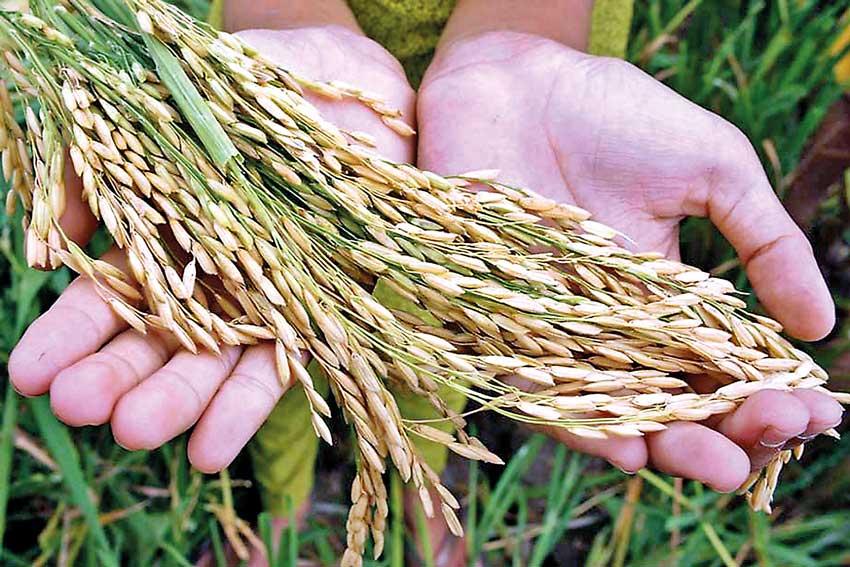
Both governments have agreed to explore the possibility of using this facility to purchase essential items such as rice to Sri Lanka, a release issued by the Department of Information said yesterday. The Cabinet of Ministers on January 18 decided to begin discussions with the Government of China on what kind of items that could be purchased under this facility.

The Trade Ministry together with the Finance Ministry will identify the essential goods and services that should be prioritized at present and those goods and services will be obtained from China.

Daily COVID cases count crosses 800 for third straight day and records 17 new COVID deaths

January 21st, 2022

Courtesy Adaderana

The count of new Covid-19 cases surpassed the 800-mark for the third consecutive day as 840 people in total were confirmed positive for the virus today (January 21).

According to the Government Information Department, the newly-detected cases include 06 individuals who recently arrived on the island from overseas.

The latest development has brought the total number of confirmed cases of coronavirus reported in the country so far to 600,203.

As many as 569,043 recoveries have been confirmed in Sri Lanka since the outbreak of the COVID-19 pandemic.

More than 15,800 active cases in total are currently under medical care and the death toll stands at 15,272, official figures showed.

The Director-General of Health Services has confirmed another 17 coronavirus-related deaths for January 20, increasing the death toll in the country due to the virus to 15,272.

This includes 13 males and 04 females, according to the Department of Government Information.

Six of the victims are in the age group of 30-59 years. Another one is aged below 30 years and the remaining 10 patients are aged 60 years and above.

Bangladesh Needs Both The USA And China

January 20th, 2022

Mehjabin Bhanu Rajshahi City Corporation in Bangladesh

Bangladesh needs both the USA and China. Now, Bangladesh and the Bay of Bengal get attention from world powers. US, UK, China, India and Japan have focused their attention on South Asia, Bangladesh and ‘Bay of Bengal’. US has shifted its policy from ‘Asia Pacific’ towards ‘Indo Pacific’ to counter China’s ‘BRI’. Both parties want Bangladesh into their respective blocks.

Bangladesh’s polices are not towards bipartisan international politics. Bangladesh was an active member of the ‘Non-Aligned Movement’. Bangladesh has no intention and interest to join any bloc. But Bangladesh has the intention to be benefitted from the blocs. Bangladesh wants and believes in peaceful coexistence in the region. It always avoids any kind of clash with any actor. Despite having provocation from Myanmar during the Rohingya refugee crisis in 2017, it abstained from using any kind of force. Bangladesh knows the Strategy. Bangladesh is balancing successfully with ‘BRI’ and ‘IPS’.  Whether Bangladesh is involved in the US-led Indo-Pacific Strategy (IPS) or the Chinese-led Belt and Road (BRI), it must maintain peace and the rule of law in the region to reap the maximum economic benefits from these.

Bangladesh still believes in the ‘relevance’ of the Non-Aligned Movement (NAM), State Minister for Foreign Affairs Md Shahriar Alam said at the summit in Venezuela in 2016. NAM was set up during the Cold War era as an association of countries that did not wish to take sides with either the US or the Soviet Union. Basically, Bangladesh wasn’t to take sides either the US or the Soviet Union. But after the demise of the USSR, the present USA-China rivalry remembers the past. The participation of Bangladesh in the 18th summit of the multilateral forum Non-Aligned Movement (NAM) held in Baku of Azerbaijan in 2019 further strengthened the country’s position in the international arena. Bangladesh’s position in the international arena is neutral.

In this regard, Bangladesh is handling this issue tactically. It avoids its involvement with the blocs directly. Having request from the US for years, Bangladesh didn’t show any interest to sign the ACSA (Acquisition and Cross-Servicing Agreement) and GSOMIA (General Security of Military Information Agreement) agreement with the US. On the other hand, When the Chinese Envoy to Bangladesh commented that Bangladesh shouldn’t join IPS last year, Bangladesh strongly protested against the remarks uttered by the Chinese envoy saying Bangladesh is capable to form its own national policy.


Bangladesh wants and believes in peaceful coexistence in the region. Whether Bangladeshis are involved in the US-led Indo-Pacific Strategy (IPS) or the Chinese-led Belt and Road (BRI), it must maintain peace and the rule of law in the maritime region to reap the maximum economic benefits.

But US may target Bangladesh because Bangladesh is an active partner of the Chinese BRI project. Recent sanctions on Bangladesh RAB are the clear-cut example to understand it. But the US should understand that Bangladesh is also with the USA.

The USA is the main export destination of Bangladeshi garments. Bangladesh also believes in the US’s ‘Free and open Indo pacific strategy. Bangladesh needs both the USA and China simultaneously for its development process. It is pertinent to mention that Bangladesh wants to be a welfare state in South

Asia. Its economic success is now praiseworthy. Thus, it needs both the USA, China, EU for ensuring the pace of the rapid economic growth. The US shouldn’t be worried about Bangladesh. Bangladesh strongly believes in friendship with all.

According to the various open sources, Bangladesh is America’s main ally in South Asia. The two countries have extensive cooperation in regional and global security, counter-terrorism and climate change. Bangladesh is an important participant in the Obama administration’s major international development initiatives, including food security, healthcare and the environment. In 2012, a strategic dialogue agreement was signed between the two countries. In 2015, US Ambassador to Bangladesh Marcia Bernikat described the relationship as “vibrant, multifaceted and essential”. As of 2016, Bangladesh is the largest recipient of US assistance in Asia outside of Afghanistan and Pakistan. The US-Bangladesh relationship is strengthened by the Bangladeshi American community. Fazlur Rahman Khan designed the United States’s tallest tower in Chicago.

According to the data of the US State Department and US Embassy to Bangladesh, the United States is the largest export market in Bangladesh. The United States is one of the largest sources of foreign direct investment in Bangladesh. The largest American investment in the country is Chevron, which produces 50% of Bangladesh’s natural gas. Bilateral trade in 2014 was the US $ 6 billion. The major US exports to Bangladesh are agricultural products (soybean, cotton, wheat, dairy products), aircraft, machinery, engines and iron and steel products. American imports from Bangladesh include clothing, footwear and textile products; Toys, games and sporting goods; Shrimp and shrimp; And agricultural products. There are many Bangladeshi students in U.S. universities. The United States has assisted Bangladesh during cyclone relief operations in 1991 and 2007 In 2017, U.S. direct investment in Bangladesh was $460 million, an increase of 0.4 per cent from 2016. Bangladesh’s exports to the US were valued at $9.4 billion between January and October last year. Bangladesh and the United States belong to a number of the same international organizations, including the United Nations, ASEAN Regional Forum, International Monetary Fund, World Bank, and World Trade Organization. According to the media reports, the American government also donated $218 million as Covid-19 donations alongside 28 million vaccines. In addition, a US company has signed an agreement with Bangladesh to install the undersea submarine cable at a cost of $700 million to $1 billion by 2023 that will connect France via Singapore.

On the other hands, though China and Bangladesh shared an adversarial relationship during the latter’s independence movement and immediately after that, the relationship has undergone a tremendous transformation to the extent that China is now considered by many in Bangladesh as an ‘all-weather friend’. They established diplomatic ties in 1976; it was defence ties that was an important area of their relationship, which led to further expansion of ties.

China, the largest economy in Asia, has decided recently to grant duty-free access to 98% of Bangladeshi products through the inclusion of 383 new products, especially leather and leather goods, in the zero-treatment list.

According to the media reports, Over the past 46 years, the relationship between China and Bangladesh has been developing, with mutual cooperation and friendship on both sides. In the international arena, Bangladesh has, to the best of its capacity, maintained unwavering support for the “One China Policy” and China’s peaceful rise.

According to data of various media outlets, from January to July 2021, the overall import and export volume of China and Bangladesh was $13 billion, a rise of 58.9 percent year on year. China has become Bangladesh’s largest trading partner, and Bangladesh is China’s third largest trading partner and third largest engineering contracting market in South Asia. Although there is trade deficit between the two trade ties, China should consider this. Bangladesh is an important participant in China’s Belt and Road Initiative and one of the first countries to respond to China’s Belt and Road Initiative. Although bilateral trade favors China heavily, Bangladesh has enormous potential in the Chinese markets.. Affected by the favorable policy of the official entry into force of the zero-tariff treatment of 98% of Bangladesh’s tariff items exported to China, Bangladesh’s exports to China may show a growth in 2022.

On October 14, 2016, Chinese President Xi Jinping arrived in Bangladesh on a historic visit. During that visit, China announced huge investments in various sectors of Bangladesh. The implementation of those investment projects is now in full swing. Among the ongoing projects are the Padma Multipurpose Bridge Project, Karnafuli Tunnel, Dhaka-Chittagong Highway Four Lane Upgradation, Payra Port Development, Chittagong-Cox’s Bazar Railway Project, Power Grid Network Strengthening Project, Dhaka-Ashulia Elevated Expressway, Dhaka-Sylhet Four Lane Highway etc.

During the Corona period, China showed that the ‘friend of danger is the real friend’. During the covid-19 pandemic, China has shown that the ‘friend in need is a friend indeed, and at this time, China has bound Bangladesh with the belief that ‘the boats of love sails mountain’. The country once again extended a helping hand to Bangladesh when vaccination diplomacy was in dire straits to get the coronavirus vaccine. China has given 1.2 million vaccines to Bangladesh in two phases as a gift and has assured that the country will supply tens of millions of vaccines to Bangladesh step by step commercially. It is expected that China will soon start vaccination production in a joint venture with Bangladesh in addition to supplying vaccines. The two countries are also discussing this. Lee Jimming, the country’s ambassador to Dhaka, said that the friend of danger is the real friend. Bangladesh will remember this friendship with China. The Bangladesh Army has been equipped with Chinese tanks, its navy has Chinese frigates and missile boats and the Bangladesh Air Force flies Chinese fighter jets. In 2002, China and Bangladesh signed a “Defence Cooperation Agreement” which covers military training and defence production.

In the line with the above-mentioned discussions, we can say that Bangladesh needs both China and USA. Despite having various challenges, Bangladesh is going to be a South Asian economic miracle and a welfare state in South Asia. Thus, it is the moral responsibility of both China and the USA to cooperate with Bangladesh. Bangladesh wants to coexist with all actors in the regions. The rise of Bangladesh in South Asia is very peaceful. It believes in perpetual peace. Of course, to achieve the ultimate goal, Bangladesh needs both USA and China.

Prevention and Treatment Protocols for COVID-19

January 20th, 2022

Courtesy Front Line COVID-19 Critical Care Alliance

We are a group of expert clinicians who are driven only by our desire to save lives.  We continually update our protocols based on clinical observations as well as the best studies of modes of prevention and treatment therapies for COVID-19.   For our latest, most comprehensive clinical guide to the management of COVID-19, please click the following text, or the box below the logos, to read and download  An Overview of the MATH+, I-MASK+ and I-RECOVER Protocols, A Guide to the Management of COVID-19”, by Dr. Paul Marik.

Studies recently affecting our protocols:

By clicking the logos below. you can read about and download the FLCCC Alliance’s most recent individual protocols to prevent and treat COVID-19:

THE COMPLETE GUIDE TO THE CARE OF THE COVID-19 PATIENT

ශ්‍රී ලංකාව රනින් බැබළ වූ දිනේෂ් ප්‍රියන්ත හේරත්ට අග්‍රාමාත්‍යතුමා නව නිවසක් ප්‍රදානය කරයි

January 20th, 2022

අග්‍රාමාත්‍ය මාධ්‍ය අංශය

ටෝකියෝ නුවර පැවැති පැරාලිම්පික් 2020 හෙල්ල විසි කිරීමේ ඉසව්වෙන් නව ලෝක වාර්තාවක් තබමින් ශ්‍රී ලංකාවට රන් පදක්කමක් දිනා දුන් දිනේෂ් ප්‍රියන්ත හේරත් මහතාට අග්‍රාමාත්‍ය මහින්ද රාජපක්ෂ මහතා ඊයේ (19) පස්වරුවේ නව නිවසක් ප්‍රදානය කළේය.

තරුණ හා ක්‍රීඩා අමාත්‍ය නාමල් රාජපක්ෂ මහතාගේ මැදිහත්වීම අනුව ලබා දුන් මෙම නව නිවසේ ‘‘ප්‍රදාන පත්‍රය’’අග්‍රාමාත්‍යතුමා විසින් රන් පදක්කම් ලාභී දිනේෂ් ප්‍රියන්ත හේරත් මහතාට අරලියගහ මන්දිරයේ දී පිරිනමන ලදි.

ලෝක වාර්තාවක් තබමින් පැරාලිම්පික් ඉතිහාසයේ ශ්‍රී ලංකා නාමය රනින් බැබළවූ දිනේෂ් ප්‍රියන්ත හේරත් මහතා වෙනුවෙන් නව නිවසක් ලබා දෙන්නැයි පසුගිය වසරේ සැප්තැම්බර් 08 වැනිදා තමන් කළ ප්‍රකාශය අනුව යමින් අග්‍රාමාත්‍යතුමා ඊයේ මෙම පොරොන්දුව ඉෂ්ට කළේය.

ඒ අනුව නාගරික සංවර්ධන හා නිවාස අමාත්‍යාංශයේ නාගරික සංවර්ධන අධිකාරිය සතු කොළඹ 02 කොම්පඤ්ඤ වීදියේ පිහිටි මෙට්‍රෝ හෝම්ස් නිවාස ව්‍යාපෘතියේ 40 ඒ 4/10 දරණ නිවස නිදහස් දීමනාවක් ලෙස දිනේෂ් ප්‍රියන්ත හේරත් මහතාට ප්‍රදානය කෙරිණි.

මේ වනවිටත් ශ්‍රී ලංකාවේ පැරා ක්‍රීඩක ක්‍රීඩිකාවන්ගේ දක්ෂතා ඉහළ මට්ටමක පවතින බව පෙන්වා දුන් තරුණ හා ක්‍රීඩා අමාත්‍ය නාමල් රාජපක්ෂ මහතා ඉදිරියේ දී ජාතික ක්‍රීඩා උළෙලට පැරා ක්‍රීඩා එක් කිරීමේ යෝජනාව පිළිබඳව අග්‍රාමාත්‍යතුමා දැනුවත් කළේය.

පැරා ක්‍රීඩක ක්‍රීඩිකාවන්ගේ දක්ෂතා එළිදැක්වීම සඳහා පවතින ඉඩ ප්‍රස්තාවන් පුළුල් කිරීම ප්‍රශංසනීය කරුණක් බව අග්‍රාමාත්‍ය මහින්ද රාජපක්ෂ මහතා මෙහි දී පැවසීය.

තරුණ හා ක්‍රීඩා අමාත්‍ය නාමල් රාජපක්ෂ, තරුණ හා ක්‍රීඩා අමාත්‍යාංශයේ ලේකම් අනුරාධ විජේකෝන්, ක්‍රීඩා සංවර්ධන දෙපාර්තමේන්තුවේ අධ්‍යක්ෂ ජනරාල් අමල් එදිරිසූරිය, පැරාලිම්පික් කමිටුවේ සභාපති ලුතිතන් කර්නල් දීපාල් හේරත්, පැරාලිම්පික් කමිටුවේ හිටපු සභාපති මේජර් ජෙනරාල් අම්පෙමොහොට්ටි, නාගරික සංවර්ධන අධිකාරියේ අධ්‍යක්ෂ (දේපල) අනුර ප්‍රසන්න, නාගරික සංවර්ධන අධිකාරියේ අධ්‍යක්ෂක (නිවාස)රත්න කුමාර මහත්වරු ඇතුළු ජාතික ක්‍රීඩා සභාවේ සාමාජික මහත්වරු පිරිසක් මෙම අවස්ථාවට සහභාගී වුහ.

ප්‍රතිසංස්කරණය කළ සිරිමතීපාය ජනපති අගමැති සුරතින් විවෘත වෙයි

January 20th, 2022

අග්‍රාමාත්‍ය මාධ්‍ය අංශය

ප්‍රතිසංස්කරණය කළ සිරිමතීපාය” ජනාධිපති ගෝඨාභය රාජපක්ෂ හා අග්‍රාමාත්‍ය මහින්ද රාජපක්ෂ මහත්වරුන්ගේ ප්‍රධානත්වයෙන් අද (20) දින පෙරවරුවේ විවෘත විය.

කොළඹ 07 අර්නස්ට් ද සිල්වා මාවතේ අංක 58 දරණ ස්ථානයේ පිහිටි මෙම ගොඩනැගිල්ල අග්‍රාමාත්‍ය මහින්ද රාජපක්ෂ මහතා ඇතුළු මෙරට අග්‍රාමාත්‍යවරුන් අට දෙනෙකුගේ කාර්යාල පරිශ්‍රය පිහිටි ස්ථානය වීම විශේෂත්වයකි.

කොළඹ සිටි ධනවත් ව්‍යාපාරිකයකු වන ඇල්බට් එම්මානුවෙල් ද සිල්වා මහතා තමන්ගේ ආදරණීය එකම පුත්‍රරත්නය වන ශ්‍රීමත් ඇල්බර්ට් අර්නස්ට් ද සිල්වා මහතා වෙනුවෙන් වර්ෂ 1916 දී මේ මන්දිරය ඉදි කර සිරිමතීපාය නමින් නම් කර ඇති අතර මනරම් පරිසරයක පිහිටි මෙම දෙමහල් මන්දිරය 1960 වර්ෂයේ දී අර්නස්ට් ද සිල්වා මැතිණිය විසින් රජයට පවරා දී තිබේ.

වසර 105ක් පැරණි මෙම ගොඩනැගිල්ල අග්‍රාමාත්‍යතුමාගේ උපදෙස්  පරිදි ජනාධිපති ලේකම් ගාමිණී සෙනරත් මහතා අග්‍රාමාත්‍ය ලේකම්වරයාව සිටියදී මුල් ආකෘතියට හානි නොවන අයුරින් ප්‍රතිසංස්කරණය කළ යුතු යැයි කළ මගපෙන්වීම අනුව පුරාවිද්‍යා දෙපාර්තමේන්තුවේ සහය ඇතිව ශ්‍රී ලංකා නාවික හමුදාව විසින් ප්‍රතිසංස්කරණය කරන ලදි.

සමරු ඵලකය නිරාවරණය කරමින් ප්‍රතිසංස්කරණය කළ සිරිමතීපාය කාර්යාල කටයුතු සඳහා විවෘත කළ ජනාධිපතිතුමා සහ අග්‍රාමාත්‍යතුමා අනතුරුව එහි වූ බුද්ධ ප්‍රතිමාවහන්සේට මල් පූජා කළහ.

පුරාවිද්‍යා අධ්‍යක්ෂ ජනරාල් මහාචාර්ය අනුර මනතුංග මහතා විසින් සිරිමතීපාය පිළිබඳ තොරතුරු ඇතුළත් සමරු පුස්තකය (Coffee Table Book) මෙහි දී ජනාධිපති ලේකම් ගාමිණී සෙනරත් මහතාට භාර දුන් අතර එතුමා විසින් එම ග්‍රන්ථය ජනාධිපති ගෝඨාභය රාජපක්ෂ මහතාටත් අග්‍රාමාත්‍ය මහින්ද රාජපක්ෂ මහතාටත් පිළිගැන්නුවේය.

අනතුරුව අග්‍රාමාත්‍ය ලේකම් ලෙස ගාමිණී සෙනරත් මහතා ඉටු කළ සේවාව පිළිබඳ ඡායාරූප ඇතුළත් අග්‍රාමාත්‍ය ලේකම් ධුරයේ අභිමානවත් මතක” ඡායාරූප එකතුව අග්‍රාමාත්‍යතුමා විසින් ජනාධිපති ලේකම් ගාමිණී සෙනරත් මහතාට පිරිනැමීය.

ප්‍රතිසංස්කරණය අවසන් කළ සිරිමතීපාය කාර්යාල කටයුතු සඳහා විවෘත කිරීමට සමඟාමීව සිරිමතීපාය, අරලියගහ මන්දිරය සහ නුවරඑළිය අග්‍රාමාත්‍ය නිල නිවසේ සිතුවම් යෙදූ රුපියල් 15ක වටිනාකමින් යුතු සමරු මුද්දර තුනක් මෙහි දී නිකුත් කෙරිණි. තැපැල්පති රංජිත් ආරියරත්න මහතා විසින් අදාළ සමරු මුද්දර ජනමාධ්‍ය අමාත්‍ය ඩලස් අලහප්පෙරුම මහතාටත් එතුමා විසින් එම සමරු මුද්දර ජනාධිපතිතුමා සහ අග්‍රාමාත්‍යතුමාටත් පිළිගන්වන ලදි.           

සිරිමතීපාය පිළිබඳ තොරතුරු ඇතුළත් වාර්තා චිත්‍රපටයක් ද මෙහි දී තිරගත කෙරිණි. හිටපු අග්‍රාමාත්‍ය ලේකම්වරුන් වන බ්‍රැඩ්මන් වීරකෝන්, කේ.එච්.ජේ විජේදාස,කේ.එම් අබේසිංහ, කේ.බාලපටබැඳි, ලලිත් වීරතුංග මහත්වරු සහ සිරිමතීපාය අග්‍රාමාත්‍ය කාර්යාලය සඳහා ප්‍රදානය කළ ශ්‍රීමත් අර්නස්ට් ද සිල්වා මහතාගේ පවුලේ ඥාතීහු පිරිසක් ද මෙහි පැමිණ සිටියහ.

අමාත්‍ය ඩලස් අලහප්පෙරුම, රාජ්‍ය අමාත්‍ය විදුර වික්‍රමනායක, ජනාධිපති ජ්‍යෙෂ්ඨ උපදේශක ලලිත් වීරතුංග,අග්‍රාමාත්‍ය ලේකම් අනුර දිසානායක, බුද්ධශාසන,ආගමික හා සංස්කෘතික කටයුතු අමාත්‍යාංශයේ ලේකම් මහාචර්ය කපිල ගුණවර්ධන, ජනමාධ්‍ය අමාත්‍යාංශයේ ලේකම් අනූෂ පැල්පිට, තැපැල්පති රංජිත් ආරියරත්න, පුරාවිද්‍යා අධ්‍යක්ෂ ජනරාල් මහාචාර්ය අනුර මනතුංග, අග්‍රාමාත්‍ය අතිරේක ලේකම්වරුන්වන හර්ෂ විජේවර්ධන, නීතිඥ චමින්ද කුලරත්න,ඇන්ටන් පෙරේරා,නිශාන්ත වීරසිංහ,මහත්වරු ඇතුළු අග්‍රාමාත්‍ය කාර්යාලයේ සහ රාජ්‍ය ආයතන කිහිපයක ප්‍රධානීහු මෙම අවස්ථාවට එක්ව සිටියහ.

ආණ්ඩුවේ අගමැති පොරයක්…? බැසිල් ඉදිරියෙන්..?

January 20th, 2022

උපුටා ගැන්ම ලංකා සී නිව්ස්

ආණ්ඩුවේ අගමැති පොරයක් ඇති වී තිබෙන බව සමගි ජන බලවේගය පාර්ලිමේන්තු මන්ත්‍රිනී රෝහිණි කවිරත්න මහත්මිය සඳහන් කළාය.

ඇය මේ බව කියා සිටියේ පාර්ලිමේන්තුවේ දී පැවති විවාදයේදී අදහස් පලකරමිනි.

ඇය එහිදී මෙසේද අදහස් පල කළාය.

රාජාසන කතා කරන ජනාධිපති විතරයක් නෙවෙයි මුදල් ඇමති ගහන ගැසට් එකටවත් දැන් රටේ පිළිගැනීමක් නෑ. ගැසට් ගැහුවට ක්‍රියාත්වක වෙන්නේ නෑ.

මාසයකට වැඩිය වහලා තිබ්බ පාර්ලිමේන්තුව ඇරලා, රාජාසන කතාව කරලා ගෝඨාභය ජනාධිපතිතුමා කිව්වා, ‘‘අපේ රජය පසුගිය වසර දෙක තුලම ගොවි ජනතාවට නොමිලේ පොහොර ලබා දුන්නා‘‘ කියලා. ඇත්තද?

ආණ්ඩුව පොහොර ගෙන්වන එක නැවැත්තුවේ 2021 මැයි නෙවෙයි. 2020 මැයි වෙනකොටත් පොහොර ගෙන්වන එක අඩු කරලා තිබුණේ. 2020 කඳු කන්නයටත් රටේ ගොඩක් තැන්වලට ඩොලර් නැති නිසා පොහොර තිබුණේ නෑ.

ඊලඟට ජනාධිපතිතුමා කිව්වා, ‘‘වී වලට රු. 50 ක සහතික මිලක් නියම කලා. අද තිස්සමහරාමේ කැකුළු වී කිලෝවක් රු. 110 ට මිලදී ගන්නවා. ඊයේ අක්කරේපත්තුවේ දැන් කැපෙන කුඹුරුවල වේළපු නැති වී කිලෝවක් රු. 95 යි.

මේ ආණ්ඩුවේ කෘෂිකර්ම ප්‍රතිපත්තියේ ප්‍රතිඑලය තමයි ඔය. අම්පාර දිස්ත්‍රික්කයේ දැන් ගොයම් කැපෙන්න පටන් අරගෙන. සාමාන්‍ය යෙන් අම්පාරේ පළවෙනි කුඹුර කපනකොට වී මිල අඩුවෙනවා. හැබැයි මේ සැරේ දවසින් දවස වී මිල ඉහළ යනවා.

ජනාධිපතිතුමා මේ කතා දියවන්නාවේ වතුරෙන් වටවෙච්ච මේ සුවිසල් පාර්ලිමේන්තු මාලිගාවේ ඉදන් නෙවෙයි, මේ වා පුළුවන් නම් ගම සමඟ පිළිසඳරක් තියලා කියන්න.

මගේ මාතලේ දිස්ත්‍රික්කේ වටේ තමයි මේ භෝග වගා කරන්නේ. මේ වගාවලට කෘමිනාශක, දිලීර නාශක ඕනි. මුං – උදු විතරක් හැම වගාවක්ම කෘමිහානියෙන් වලක්වා ගන්න කෘෂි රසායන ඕනි. මිනිස්සු වගා කරනවා. හැදෙන ඇටේ – මල් – කොළ – අල ටික සත්තු කනවා. කෘමියෝ කවනවා. ගොවියාට හුළං තමයි.

වස විසෙන් තොර කෘෂිකර්මාන්තය/හරිත කෘෂිකර්මාන්තය දිගටම කොරගෙන යනවා කිව්වා. ඒ කියන්නේ මේ ආණ්ඩුවට තවම මොළය පෑදිලා නෑ කියන එකයි.

දැන් මහ කන්නය ඉවරයි. හැබැයි මේ රටේ කෘෂිකර්මයට අනාගතයක් තියෙන්න ඕනි. යල කන්නය වත් ගොඩදාගන්න නම්, මුලින්ම වල් නාශක ආනයනය කල යුතුයි. රටට වල් නාශක ගේන්න නම් මාස දෙකක් ඕනි.

බදුල්ලේ ගොවිතැන දන්න, අම්පාරේ හිටපු දිසාපති – පළාත් සභාවේ ප්‍රධාන ලේකම් විදිහට වී ගොවිතැන හොඳටම අමාත්‍යාංශ ලේකම් රටට අවශ්‍ය වල් නාශක ටික ගෙන එන නවත්වාගෙන ඉන්නවා.

මුදල් ඇමති බැසිල් රාජපක්ෂ මැතිතුමා දෙසැම්බර් මාසේ ඉන්දියාවට යන්න ඉස්සර කෘෂි රසායන ගැසට් එක රිවස් කළා. හැබැයි කෘෂිකර්ම අමාත්‍යාංශය අද දක්වා එකම වල් නාශකයක්වත් ගෙනල්ලා නෑ. මේ ආණ්ඩුවේ ප්‍රබලම ඇමතිවරයා තමයි බැසිල් රාජපක්ෂ මැතිතුමා.

හැබැයි බැසිල් රාජපක්ෂ මුදල් ඇමතිතුමාව පඹයෙක් බවට පත් කරන්න කෘෂිකර්ම ඇමති මහින්දානන්ද අලුත්ගමගේ කටයුතු කර තියෙනවා. කෘෂිකර්ම රාජ්‍ය ඇමති ශශින්ද්‍ර රාජපක්ෂ පුතා, මුදල් ඇමතිතුමාව පඹයෙක්ගේ ගානට දාලා කෘෂි රාසයන ටික ගේන එක නවත්තලා තියෙනවා.

කෘෂිකර්ම ලේකම් බණ්ඩාරනායක තමයි වල් නාශක ටික ගේන්න දෙන්නේ නැතුව ෆයිල්ටික මේසේ උඩ තියාගෙන ඉන්නේ. එයා තමයි, කෘමි නාශක – දිලීර නාශක ටික ගේන්නේ නැතුව ගස්වල ගෙඩි ටික, වී කරල් ටික පණුවොන්ට, කෘමීන්ට කන්න ඉඩ ඇරළා බලාගෙන ඉන්නේ. කෘෂිකර්ම අමාත්‍යාංශයේ ලේකම් තමයි, ගොවියෝ අමාරුවෙන් හදාගන්න ගස් වැල් දිලීර රෝගවලට ගොදුරු වෙනකල් කෘෂි රසායන ගෙන්වන්න අවසර දෙන්නේ නැත්තේ.

කෘෂිකර්ම ඇමතිලා දෙන්නා, කෘෂිකර්ම ලේකම් තමයි බැසිල් රාජපක්ෂ පඹයෙක් කරලා තියෙන්නේ. මේක පිටිපස්සේ තියෙන්නේ අගමැති පොරය. බැසිල් රාජපක්ෂ ගොවි ප්‍රශ්ණ විසඳනවාට කැමති නැති පිරිසක් ආණ්ඩුවේ ඉන්නවා. අද ගොවියෝ කාබාසිනියා කරලා, රටේ ආහාර නැති කරලා, රට සාගතයකට යවලා, බැසිල් රාජපක්ෂ පඹයෙක් කරලා තියෙනවා.

ජනාධිපති විතරක් නෙවෙයි දැන් මුදල් ඇමති ගහන ගැසට් එකක්වත් වැඩක් නැති බව එකෙන් කියනවා. ජනාධිපති විතරක් නෙවෙයි, මුදල් ඇමතිත් ජනාධිපතිවගේම පඹයෙක් කියලා කෘෂිකර්ම ප්‍රශ්නයේ දී පෙන්නලා තියෙනවා.

අම්පාරේ හිටපු දිසාපති, නැගෙනහිර හිටපු ප්‍රධාන ලේකම් දන්නේ නැද්ද අම්පාරයි, මඩකලපුවයි කුඹුරු වල් නාශක නැතිව විනාශ වුනාම, කෘමි නාශක නැතුව විනාශ වුනාම රටටම කන්න නැති වෙනවා කියලා. මගේ කුඹුරු අනුරධපුර දිස්ත්‍රික්කයේ තියෙනවා. අනුරාධපුර පෙළාන්නරුවේ එක ඇමතිගෙයක් කතා කරන්නේ නෑ, තමන්ගේ ගොවිජනතාවගේ ප්‍රශ්න ගැන.

රටේ ආර්ථික අර්බුදය විහින් ඇතිකර ගත්ත එකක්. තියෙන ඩොලර් විදයම් කරලා රටට අවශ්‍ය පොහොර – කෘෂි රසායන ටික ගෙනවා නම් අඩුම ගානේ රටේ මිනිස්සු බඩගින්න නිවාගන්නවා. දැන් හාල්ටික දවසින් දවස චීනයෙන්, වියට්නාමයෙන්, පාකිස්තානයෙන් හිඟා කනවා. ගොවියාගේ කුඹුරු ටික විනාශ කරලා දැන් ඉන්දියාවෙන් හාල් ගෙන්වනවා.

අද ලංකාවේ තියෙන්නේ හොරකම් ආර්ථිකයක්. ශ්‍රී ලංකා මහ බැංකුව තමයි හොරකම් කිරීමේ කේන්ද්‍රය. 2010 – 2014 තිබුණ ‘පම්පිං – ඩම්පිං‘ කණ්ඩායම තමයි අද රටේ ආර්ථිකය, ඩොලර් ටික හසුරවන්නේ. මහ බැංකු අධිපති අජිත් නිවාඩ් කබ්රාල් ඩීල් එකක් දාගත්ත ගමන්, ටුවිටර් පණිවිඩයක් ගහනවා. අනේ අපේ ජනමාධ්‍ය ත් ඉතිං කබ්රාල් කියන ටික පත්තරේ දානවා.

කබ්රාල් ට පහුගිය 18 වෙනිදා ඇමරිකානු ඩොලර් මිලියන 500 ක් ණය ගෙවලා මහ ලොකු සංදර්ශනයක් තිබ්බා. මේ ඩොලර් මිලියන 500 න් 170ක්ම තනි පුද්ගලයෙකුට. කබ්රාල් ගේ පම්පිං – ඩම්පිං ටීම් එක තමයි දැන් ඩොලර් ටික හසුරුවන්නේ.

බැඳුම්කර සල්ලි ගෙවන්න බැරි බවට ආපු බිය නිසා බැඳුම්කර ගත්ත අය අර ග්‍රීක් බොන්ඩ් එක වෙලාවේ සිද්ධ වුණා වගේ 50%කට වඩා අඩු මිලට ද්වීතීය වෙළෙදපොලේ බැඳුම්කර ටික විකුණුවා. ඒවා ගත්තේ අර ශ්‍රී ලංකා මහ බැංකු විගණන වාර්තාවල නම් තියෙන කබ්රාල් ගේ ‘පම්පිං – ඩම්පිං‘ යාළුවෝ – ව්‍යාපාරික ගජමිතුරෝ සෙට් එකයි.

– media unit

Sri Lanka raises rates to rein in prices, boost reserves

January 20th, 2022

Courtesy Nikkei Asia

COLOMBO (Reuters) — The Sri Lankan central bank raised interest rates on Thursday, as expected, shifting its focus to controlling inflation, curbing imports and attracting foreign capital as it looks to build reserves and avoid a potential default later in the year.

The island nation has reiterated its commitment to repaying the entire $4 billion owed to investors in the rest of 2022 but some analysts believe the country could face its first-ever default unless it increases dollar inflows.

As expected by many economists, the Central Bank of Sri Lanka (CBSL) raised the standing deposit facility rate and the standing lending facility rate by 50 basis points (bps) each to 5.50% and 6.50%, respectively.

In its statement, the central bank said the “measures will curtail the possible build-up of underlying demand pressures in the economy, which would also help ease pressures in the external sector, thus promoting greater macroeconomic stability.”

The CBSL had been the first central bank in Asia to tighten policy in the pandemic era by raising rates by 50 bps in August last year and then held rates steady in October and November.

බ්‍රිතාන්‍යයේ දකුණු ආසියාව භාර ඇමති ජනපතිගේ මූණට ම කියපු දේ

January 20th, 2022

 තාරක සම්මාන්  මව්බිම දැන්

මානව හිමිකම්, සංහිඳියාව සහ යුක්තිය හා වගවීම පිළිබඳව ප්‍රගතියක් ලබා ගැනීමේ අවශ්‍යතාව තමන් ශ්‍රී ලංකා රජයට අවධාරණය කළ බව එක්සත් රාජධානියේ දකුණු ආසියාව සහ පොදුරාජ්‍ය මණ්ඩලය පිළිබඳ අමාත්‍ය තාරික් අහමඩ් සාමිවරයා පවසයි.

අමාත්‍ය තාරික් අහමඩ් සාමිවරයා අද (ජන. 20) පෙරවරුවේ ජනාධිපති කාර්යාලයේදී ජනාධිපති ගෝඨාභය රාජපක්ෂ මහතා හමු වූ අවස්ථාවේ දී මේ බව සඳහන් කර තිබේ.

ට්විටර් පණිවිඩයක් නිකුත් කරමින් ඔහු සඳහන් කර ඇත්තේ, දේශගුණික විපර්යාස සහ කොවිඩ්-19 හේතුවෙන් බලපෑමට ලක්වූ ආර්ථිකය යළි නගා සිටුවීම ඇතුළු ගෝලීය අභියෝග පිළිබඳව සාකච්ඡා කිරීමට තමන් ජනාධිපති ගෝඨාභය රාජපක්ෂ මහතා හමුවූ බව ය.

I met President @GotabayaR ???????? to discuss global challenges including climate change and economic recovery from #Covid19. I emphasised the need for GoSL to make progress on human rights, reconciliation, and justice and accountability, in line with the UN HRC process and the SDGs. pic.twitter.com/QZ23K3Ij00— Lord (Tariq)Ahmad of Wimbledon (@tariqahmadbt) January 20, 2022

කෙසේ වෙතත්, මේ සම්බන්ධයෙන් නිවේදනයක් නිකුත් කරමින් ජනාධිපති මාධ්‍ය අංශය සඳහන් කළේ, මානව හිමිකම් සම්බන්ධයෙන් ශ්‍රී ලංකාව ගෙන යන වැඩපිළිවෙළ ඉතා ඉහළ ප්‍රගතියක් පෙන්නුම් කරන බව අමාත්‍ය තාරික් අහමඩ් සාමිවරයා පැවසූ බව ය. 

තවදුරට ත් එය ශක්තිමත් කිරීමට ප්‍රායෝගික සහ අරමුණු කරා ළඟා විය හැකි ක්‍රමවේදයක් අනුව ඉදිරියට යාමෙන් මානව හිමිකම් පිළිබඳ ශ්‍රී ලංකාවට ඇති සියලු ගැටලු නිරාකරණය කර ගත හැකි වනු ඇති බවට ඒ මහතා පෙන්වා දුන් බව ජනාධිපති මාධ්‍ය අංශය අදාළ නිවේදනයේ සඳහන් කර තිබේ.

දකුණු ආසියාව, එක්සත් ජාතීන්ගේ සංවිධානය සහ එක්සත් රාජධානියේ පොදු රාජ්‍ය මණ්ඩලය පිළිබඳ රාජ්‍ය අමාත්‍යවරයා ලෙස ඉන්දියානු සාගර කලාපය, මධ්‍යම ආසියාව, පොදු රාජ්‍ය මණ්ඩලය සමග සහයෝගීතාව ඇති කිරීම සඳහා ක්ෂේත්‍ර රැසක වගකීම් පැවරී ඇත්තේ තාරික් අහමඩ් සාමිවරයාට ය.

එමෙන් ම, එක්සත් රාජධානියේ සිටින ශ්‍රී ලාංකික ඩයස්පෝරාව සමග අවබෝධයෙන් කටයුතු කිරීමට ඇති කැමැත්ත ජනාධිපතිවරයා ප්‍රකාශ කළ බව ත් ඒ සඳහා ඩයස්පෝරාව සමග සාකච්ඡා කිරීමට අවස්ථාව සලසන ලෙස ජනාධිපතිවරයා එහිදී තාරික් අහමඩ් සාමිවරයාගෙන් ඉල්ලා සිට ඇත. 

 තාරක සම්මාන්

CBSL expecting gradual economic recovery following ‘temporary setbacks’ posed by Covid 3rd wave

January 20th, 2022

Courtesy The Island

The Central Bank expects economic activity to record a gradual recovery following a temporary setback due to the third wave of the Covid-19 pandemic, Central Bank Governor Ajith Nivard Cabraal said.

We have noted that the External Sector remained resilient amidst heightened challenges. With the normalization of global economic activity, a notable improvement in export performance was observed, with monthly exports remaining in excess of US dollars 1 billion, consecutively since June 2021, Cabraal told the Monthly Policy Review Meeting yesterday at the Central Bank in Colombo.

The Sri Lanka rupee depreciated by 7.0 per cent against the US dollar in 2021 and has been broadly stable thus far in 2022. At the same time, the Central Bank was able to fulfill the timely settlement of the International Sovereign Bond (ISB) of US dollars 500 million on January 18, 2022, the Governor said.

Cabraal added: As of end 2021, the gross official reserves were estimated at US dollars 3.1 billion.

It has been decided to increase both the deposit rate and the lending rate by 50 basis points each with the view to strengthening macroeconomic stability.

‘’In consideration of the current and expected macroeconomic developments, the Monetary Board at its meeting held on January 19, 2022 has decided to adopt several policy measures with the view to strengthening macroeconomic stability.

Accordingly, the Monetary Board decided to increase the Standing Deposit Facility Rate (SDFR) and the Standing Lending Facility Rate (SLFR) by 50 basis points each, to 5.50 percent and 6.50 per cent respectively.

Developments in the tourism sector appear to be promising with the influx of tourists in recent months. Although inflows in the form of workers’ remittances have reduced somewhat in the latter half of 2021, the introduction of special incentive schemes and the actions taken by the authorities to curb illegal fund transfers have generated renewed interest in routing funds through formal channels.

Considering these developments in the External Sector, the Monetary Board, in addition to the policy rates hike, has decided to distribute the financing of essential import bills for fuel purchases among the licensed banks in proportion to their foreign exchange inflows.

Further, all registered tourist establishments are to accept foreign exchange only in respect of services rendered to persons resident outside Sri Lanka. It has been decided to extend the payment of an additional Rs. 8.00 per US dollar for workers’ remittances paid, in addition to the incentive of Rs. 2.00 per US dollar offered under the Incentive Scheme on Inward Workers’ Remittances” until 30 April 2022.

It has been also been decided to reimburse the transaction cost borne by Sri Lankan migrant workers through the payment of Rs. 1,000 per transaction, when remitting money to rupee accounts via licensed banks and other formal channels with effect from February 1, 2022 and to introduce higher interest rates for both foreign currency and rupee denominated deposits of migrant workers.

The Monetary Board was of the view that the above measures will curtail the possible build-up of underlying demand pressures in the economy, which would also help ease pressures in the external sector, thus promoting greater macroeconomic stability.”

Sri Lanka reports over 800 daily COVID cases for second straight day and confirms 12 more coronavirus deaths

January 20th, 2022

Courtesy Adaderana

he Health Ministry reported that 827 persons have tested positive for coronavirus today (20), as the daily count of new Covid-19 cases surpasses the 800-mark for the second consecutive day. 

The new coronavirus cases detected today includes 03 persons who had arrived in the country from overseas. 

The total number of Covid-19 cases registered in the country jumps to 599,363 with this while over 15,000 infected patients are currently undergoing treatment. 

The Director General of Health Services has confirmed another 12 coronavirus related deaths for January 19, pushing the death toll in the country due to the virus to 15,255. 

This includes 08 males and 04 females while one of the female victims is below the age of 30 years. 

Two of the patients are between the ages 30-59 years while and the other nine are aged 60 years and above. 

UK’s Lord Ahmad stresses on need for progress of human rights in Sri Lanka

January 20th, 2022

Courtesy The Morning

Holds series of meetings to discuss human rights issues over three-day visit

UK Minister of State Foreign Commonwealth and Development Affairs (Central and South Asia, Commonwealth, UN, Human Rights) Lord Tariq Ahmad of Wimbledon, during his three-day visit to Sri Lanka, met a series of officials, including President Gotabaya Rajapaksa, to discuss key issues revolving around human rights. 

He met President Rajapaksa at the Presidential Secretariat yesterday (20). On his official Twitter account, Lord Ahmad stated that the purpose of the meeting was to discuss global challenges including climate change and economic recovery from Covid-19”.

He further stated: I emphasised the need for the GoSL (Government of Sri Lanka) to make progress on human rights, reconciliation, and justice and accountability, in line with the UN HRC (United Nations Human Rights Council) process and the SDGs (Sustainable Development Goals).” 

The President’s Media Division, in a media release, stated that Lord Ahmad had noted that Sri Lanka’s programme to empower human rights is making great strides. He had further stated that Sri Lanka will be able to resolve all issues pertaining to human rights by moving forward with a pragmatic approach to further strengthen it.

Further, Lord Ahmad toured the northern and eastern parts of the island on Wednesday (19).

During the visit, Lord Ahmad had held discussions with Northern Province Governor Jeevan Thiagarajah on the plans for the Northern Province, his priorities, and the need for justice and accountability, and had spoken to Eastern Province Governor Anuradha Yahampath about the Government’s priorities to address key concerns and livelihoods, access to justice, and integrated community relations in the Eastern Province.

Lord Ahmad also visited and paid respect to the ancient Hindu temple Thirukoneswaram while touring Trincomalee.

Further, he met with the United Nations Development Programme (UNDP) Sri Lanka to discuss the UK funding providing income-generating opportunities for the Tamil community Santhai Village.

In a series of Twitter updates about his three-day stay in Sri Lanka, Lord Ahmad also stated that he had held an insightful discussion with Council for Business with Britain (CBB) representing UK companies operating in the market, where he listened to current economic impacts, and thoughts on improving trade between the UK and Sri Lanka.

Lord Ahmad also discussed efforts to support Sri Lanka’s development initiatives with UN Resident Co-ordinator Hanaa Singer-Hamdy. 

We also discussed justice and reconciliation, the protection of human rights, climate initiatives, and improving access to healthcare,” he had said on his official Twitter account.

Further, the UK and Sri Lanka have signed a Memorandum of Understanding (MoU) on healthcare co-operation, which is expected to improve best practices and expertise on healthcare, and develop an ethical and sustainable recruitment programme for the employment of Sri Lankan healthcare professionals in the UK. It was inked by State Minister of Foreign Employment Promotion and Market Diversification Piyankara Jayaratne and Ministry of Health Secretary Dr. S.H. Munasinghe from the GoSL, and Lord Ahmad on behalf of the UK Government.

Further, he also discussed a broad range of issues, including co-operation on environmental issues, and human rights with a focus on reconciliation and justice with Foreign Minister Prof. G.L. Peiris.

Grenade inside Borella church: suspect who provided grenade to retired doctor arrested

January 20th, 2022

Courtesy Adaderana

Police have reportedly arrested the person who allegedly provided the hand grenade to the retired doctor from Piliyandala, who was recently arrested in connection with the grenade recovered from a church in Borella. 

The suspect has been arrested at Ranna in Hambantota, according to Ada Derana reporter. 

Investigations have uncovered that the same suspect had previously provided the retired doctor with the hand grenade which had been placed at a private hospital in Narahenpita. 

Following the discovery of a hand grenade at the All Saints’ Church in Borella on Jan. 11, four suspects in total were taken into custody over the incident.

According to the police, the hand grenade had been placed using sellotape, matchsticks, and incense sticks for it to catch fire and explode.

Meanwhile a retired doctor was apprehended on Jan. 18 in the area of Piliyandala by the crimes investigation unit of the Colombo South Division, based on the information divulged by another suspect, who was arrested in Panamura, Embilipitiya.

The 75-year-old retired doctor has reportedly confessed to the Colombo Crimes Division (CCD) that he planned the entire incident of placing the grenade at the church. 

According to sources, the retired doctor who is in the custody of the CCD has revealed that he had a long-standing feud with the church in question and had also claimed that he was involved in the recent incident of a hand grenade placed at a private hospital in Narahenpita. 

Suspect confesses reason for planting hand grenade inside church in Borella

January 20th, 2022

Courtesy Adaderana

Is the Public Served?

January 19th, 2022

By Dr. Tilak S. Fernando

The Government constantly complains about public services being overstaffed. President Gotabaya Rajapaksa takes every opportunity to restate the public should not face harassment; instead they must be treated with courtesy.

When the writer was a schoolboy, letters from any Government institution carried the phrase at the end of the communication as ‘Your obedient servant,’ and signed by an authorised individual. This signing style of ‘Your obedient servant’ has currently flown through the window, and at times, Government letters carry no name or legible signature at all! As everyone knows, the taxpayer pays the public servants’ salaries, and they are appointed to serve the public and not be on cloud nine

Basic Problem

The fundamental problem with any Government institution is the apathetic approach by the average staff. They come in the morning, go to the canteen to eat breakfast before starting work. Once they sit, they must discuss the previous night’s television programmes! The writer once went to a Government office on an official task at 9 am and witnessed this melodrama. The frustrated writer instantly photographed the chattering of staff with his mobile phone. Later an officer who attended to the writer’s matter wanted to know whether the writer was from the press! 

Another distraction is the television sets installed in offices throughout the country and smartphones freely available in the Sri Lankan market. Facebook, WhatsApp, and Skype make the staff concentrate more on their natter rather than absorbed in office work during office hours. Today, easy access to the internet and mobile phones enables public servants to engage in social media or send friends messages via email or texted notes. 

Should the Government want to improve the standard of working in public offices, the most vital act should be disconnecting TV sets from all offices and banning mobile phones during office hours. Should there be an emergency, staff should inform the chief clerk and leave the office environment to make the call. Removal of TV sets countrywide will relieve the Government with extra expenditure in buying and installing TV sets in offices throughout the country and improve the staff’s overall performance. The Chief Clerks control the office, but they are not sufficiently strict or pay no attention to their staff’s behaviour. Chief Clerks should be made answerable for their team.

Computerisation

Computerisation helps overcome the old systems of maintaining records in ledgers, which is time-consuming. Registers finally must be stored in a separate room in the office building, occupying extra space. Stored logs become subjected to bookworms and insects that injure pages by gnawing the binding and piercing the pages with small holes. Computerised systems can save records into a microcassette, store them into a cassette holder, and mark them appropriately. The writer was familiar with this type of microcassettes in London; however, he is not aware whether Sri Lanka adopts that system!

If one visits a police station to lodge an entry, one must be prepared to spend hours until a police officer records in a Register using multicoloured pens. If the officer is busy with a previous customer, one needs to bite one’s nails and mark time until the officer is free, which is time-consuming. Therefore, one must keep a wide margin to visit a police station before committing to other appointments. That is why many disregard visiting police stations to lodge entries even to their disadvantage. In advanced countries, however, computers take over the task of helping the police by storing the lodged complaints in the hard disc of the police computer.

If the Government intends to computerise everything, it should go full swing. The Department of Motor Traffic at Maligawatta functions ingeniously as far as the computer systems are concerned. Anybody may produce the relevant documents to renew the annual road tax of a motor vehicle, while staying in the vehicle and the new disc becomes available in a matter of minutes. It should be an effective way to help the public. Meanwhile, privately-owned fast food outlets use a drive-through facility system for their customer’s convenience. Why can’t the Government adopt a similar method to serve people rather than frustrate the public?

The driving licence renewal office in Werahera needs a lot of adjustments and improvements. Although it appears simple on paper and TV to book an appointment to renew one’s driving licence, it does not work as simple as that. According to the Government’s instructions, one should get a text message to one’s mobile phone to collect the renewed driving licence. First and foremost, it isn’t straightforward to get through to the Werahera office on the phone to book an appointment as the lines are eternally busy. Even when one gets through to Werahera and obtains a fixed day, only the applicant can enter, the security guards do not allow anyone else other than the claimant to enter the building. There is also a day service: to enjoy this facility one pays an extra Rs. 2,150. This system however, does not always work like a horse, in reality it is quite the opposite. The case mentioned below is a typical example.

Online DL renewing  

Applicant B handed over her application and all relevant documents including her postal address, to renew her expired driving licence (DL) at the Werahera Office. Unfortunately for her, when her driving licence expired in March 2021, she was in the UK and was unable to visit Sri Lanka due to Covid-19 lockdowns. This is another area where the Government’s attention can be focussed and enable online renewing of driving licences. 

For example, in the UK, the renewal of driving licence offices is done online. They maintain the applicant’s photograph scanned in their database. When one applies to renew one’s driving licence online, the applicants need to advise whether they have changed from the profile picture in the database. In Sri Lanka, the officer handling each case takes a photograph of the applicant. Is it troublesome to attach the medical certificate compulsory?

In this case, the applicant requested a one day-service and paid Rs. 2,150.00 and was issued a receipt.. However, the applicant did not receive the renewed licence till after three months had lapsed, nor did she receive any text message on her phone as advertised. The applicant was told her renewed licence would be mailed. Later enquiries revealed the renewed driving licence was posted on 17 December 2021. The applicant contacted the sorting office at Pannipitiya to check and was informed in the negative.

Numbers out of order

On 31st December 2021, the writer emailed the RMV drawing the personal attention of the Commissioner in charge of renewal of driving licences. The writer did not receive even a courteous acknowledgement to his email. The writer then tried to contact the Commissioner’s on 011-254-5891 and 011- 251-8926 and made numerous calls daily for over two weeks, but they were in vain. Finally, through the internet, the writer obtained the telephone numbers of the driving licence department at Werahera viz: 011-2- 518- 926; 0706-334-134 and 0706-354-123. But the telephone response was that ‘none of the numbers were available’. Some Government departments do not care to update their telephone numbers on the internet.

It raises the question of how helpful the officials working at the Werahera office are in helping or harassing the public!When President Gotabaya Rajapaksa visited this office to inquire about the department’s efficiency, some time ago, it appeared that all they did was to whitewash the walls. It is still not clear why they charged the applicant Rs 2,150 in the first place for a ‘Day’s Service’?

The writer made a special request from the postman to keep an eye out for a registered post letter from the RMV, Werahera. On10 January 2022, the postman finally informed us that  a registered letter from the Werahera office had arrived. The postmark on the envelope was not very clear. The postman went on leave, but he arranged for his substitute to deliver the registered letter containing the renewed licence.

The cardinal point is why charge the applicant Rs.2150.00 for a day’s service when it was not provided? What drove them to mail the renewed licence? It sounds like an act of high-handedness. The RMV at Werahera, Renewal of DL section, should refund the Rs.2150/- as the service was not provided within a day.

Maybe the President is unaware of what goes on in this Government Department after his visit, President Gotabaya Rajapaksa repeatedly said, ‘public servants must help the public and not harass them.’

tilakfernando@gmail.com

How Cambodia AS ASEAN Chair Can Play A Key Role In Rohingya Refugee Crisis Solution

January 19th, 2022

Jubeda Chowdhury

The Rohingya issue is currently an important international issue. More than 1.1 million Rohingyas have taken refuge in Bangladesh since August 2017 due to genocide and ethnic cleansing in Myanmar. About 50,000 newborn Rohingya children are added to it every year.

Bangladesh Prime Minister raised the issue at the UNGA on September 25, 2021 to draw the attention of global leaders in solving the Rohingya crisis. She focused specifically on the engagement of ASEAN leaders. It is ASEAN which can resolve Rohingya refugee problem easily.

Foreign Minister AK Abdul Momen today said the Cambodian Chairmanship of Asean provides a great opportunity to facilitate safe and dignified return of the Rohingyas, now sheltered in Bangladesh, to Myanmar.

According to media reports, The foreign minister said this to Cambodian Deputy Prime Minister Prak Sokhonn, also the country’s minister of foreign affairs and international cooperation, during a telephone conversation recently.

During the conversation, Momen laid emphasis on the potential security risks to Bangladesh, Myanmar and to the greater region if the Rohingya crisis is left festering for a much longer period of time.

He mentioned the vulnerability of the displaced people to radicalism, extremism, terrorism, cross-border crimes, etc.

Foreign Minister Momen congratulated his Cambodian counterpart on Cambodia’s assumption of Asean Chairmanship and on the latter’s appointment as the Special Envoy of the Asean Chair to Myanmar.

Referring to the longstanding and excellent bilateral relations between the two countries, Momen mentioned that Bangladesh highly values its relations with Cambodia as an important partner in the neighborhood.

Lauding the big heart” demonstrated by Bangladesh in sheltering 1.1 million displaced Myanmar nationals, Prak Sokhonn expressed his full understanding of and sympathy for the difficulties being faced by Bangladesh.

As Chair and an active member of ASEAN, Cambodia can help to resolve it. Cambodia can be an honest mediator in this regard. Cambodia has very warm relations with both Myanmar and Bangladesh.

On October 28, 2021, Cambodia officially took over the chairmanship of the Association of Southeast Asian Nations (ASEAN) for the third time since joining the group in 1999.

Cambodia holds the ASEAN chair for the third time since it joined ASEAN on 30 April 1999. It was the last amongst the 10 ASEAN countries to join ASEAN and has followed its regular turn in chairing the organisation every decade, in 2002 and 2012, respectively. There are only two countries—Cambodia and Brunei—whose leaders continued their tenure over the years in ASEAN, one being PM Hun Sen and the other one being the Sultan of Brunei.

Earlier, the Rohingya had been subjected to systematic discrimination, deprivation of the right to vote, and regular targeting of violence in Myanmar for decades.

Rohingyas have come to Myanmar to save their lives after being subjected to extremely inhumane treatment by the military; But their position in the country has become a cause for concern as they are involved in migration, drug trafficking, child trafficking, smuggling, and other misdeeds as Bangladeshis. Again, some of the Rohingyas have been accused of being involved in militant activities and the Ramu attack.

According to various sources, there are about four lakh Rohingyas inside Bangladesh and about one lakh outside the country, especially in the Middle East. Moreover, there are reports that underage women and children in various camps in Cox’s Bazar are being tied to an important social bond such as marriage; Which is having a hugely detrimental effect on the society and the state system. Child marriage is a threat to the health of the mother as well as the health of the child. It has far-reaching detrimental effects on women. Adolescent pregnancy can lead to a variety of health problems, including complications in childbirth. In some cases, they are also victims of domestic violence, sexual abuse, and marital rape. In addition, increasing population density is having a devastating effect on the environment.

In the last four and a half years, despite various initiatives, no real progress has been made in resolving the Rohingya crisis. Under pressure from the international community, the Myanmar government signed an agreement on Rohingya repatriation, but to no avail. According to the agreement, the Rohingyas were to be repatriated in stages. The repatriation process has not started for a long time. The Myanmar government has failed to repatriate the displaced Rohingya and resolve the crisis. Bangladesh has repeatedly urged various international forums to take effective steps to resolve the Rohingya crisis. At the UN General Assembly, Prime Minister Sheikh Hasina not only ended her duty by calling on the international community to repatriate Rohingya but also presented six specific proposals. The Prime Minister also raised the issue during his recent visit to France. In such a situation, the UN committee has unanimously passed a resolution urging Myanmar to end the Rohingya crisis. Most importantly, Russia and China did not oppose the proposal. The resolution, introduced by the OIC and the European Union, was unanimously passed by the Social Humanitarian and Cultural Committee, known as the Third Committee of the UN General Assembly. Foreign Minister in response to the proposal. Abdul Momen considers the support of Russia and China important. He said China and Russia also want a solution to the Rohingya problem. This is positive news for us.

In this regard, Cambodia can play a holistic, significant and strategic role.  Cambodia can support Bangladesh at every international forum such as at UNGA and regional conferences. They can vote in favour of Bangladesh. They can raise the issue within the ASEAN platform. Cambodia can negotiate with Myanmar diplomatically and bilaterally. It has good bilateral relations with Myanmar. Cambodia can engage with others ASEAN states to solve the crisis. Cambodia’s Buddhist society can play an effective role in this regard. Cambodia can make Myanmar understand on the regional significance of Rohingya repatriation.

Earlier, Cambodia hoped hat Bangladesh and Myanmar find a solution allowing the Rohingya repatriation,  Prime Minister Hun Sen said at the joint press conference held following his bilateral meeting with visiting Bangladeshi counterpart Sheikh Hasina in 2017.

For her part,  Sheikh Hasina affirmed the Bangladesh’s commitment to provide shelters to some 700,000 Rohingya refugees and to continue negotiating with Myanmar for their repatriation.

Cambodia has confirmed its clear stance over Rohingya crisis in Myanmar. On Nov. 16, 2017, Cambodian Premier underlined that Rohingya crisis is an internal affair of Myanmar and Cambodia will not interfere in this issue. The Cambodian premier also expressed his sadness over the crisis in Myanmar’s Rakhine State, adding that Cambodia is considering providing humanitarian assistance to Rakhine’s people, some of them are living in Myanmar while others fled to Bangladesh.

Meanwhile, PM Hun Sen visited Myanmar (6-8 January 2022). A new Special Envoy of the ASEAN chair, Prak Sokhonn the Deputy Prime Minister and Foreign Ministerof Cambodia, was announced. He will be assisted by Cham Prasidh, Minister of Industry, a veteran of the Cambodian peace process.

Cambodia was initially hesitant to speak out against the junta, citing ASEAN’s principle of noninterference. But this time, as a chair of ASEAN , Cambodia wants to engage itself and Asean with Myanmar.  It is a positive side of Cambodia. Isolation is not a solution. Involvement, engagement, negotiations are some tools to find solutions. Cambodia is doing so.  PM Hun Sen is very interested in ASEAN’s relations with Myanmar. Cambodia’s role in this regard would be warmly welcomed. As a chair, Cambodia can resolve a long disputed regional issue. If Cambodia take a initiative to resolve the Rohingya refugee crisis, it would be a great achievement for ASEAN. Whole south Asia and Southeast Asia would see a permanent solution of a regional crisis. Of course, role of Cambodia as ASEAN Chair would be seen positively. The prestigious of Cambodia as Asean chair would be accepted amongst all South Asian and Southeast Asian countries.

එක්සත් රාජධානියේ රාජ්‍ය අමාත්‍ය තරික් අහමඩ් සාමිවරයා සහ අග්‍රාමාත්‍යතුමා අතර හමුවක්

January 19th, 2022

අග්‍රාමාත්‍ය මාධ්‍ය අංශය

එක්සත් රාජධානියේ දකුණු ආසියානු හා පොදු රාජ්‍ය මණ්ඩලයීය කටයුතු රාජ්‍ය අමාත්‍ය තරික් අහමඩ් සාමිවරයා සහ අග්‍රාමාත්‍ය මහින්ද රාජපක්ෂ මහතා අතර හමුවක් ඊයේ (18) පස්වරුවේ කොළඹ හිල්ටන් හෝටලයේ දී පැවැත්විණි.

ශ්‍රී ලංකාව සමඟ පවතින සහයෝගිතාව තවදුරටත් ශක්තිමත් කර ගැනීමේ අපේක්ෂාවෙන් මෙරටට පැමිණි රාජ්‍ය අමාත්‍ය තරික් අහමඩ් සාමිවරයා දින තුනක කාලයක් මෙරට රැදී සිටිනු ඇත.

ඉහළ රාජතාන්ත්‍රික හමුවීම්වලට අමතරව රාජ්‍ය අමාත්‍ය තරික් අහමඩ් සාමිවරයා යාපනය සහ ත්‍රිකුණාමලය ප්‍රදේශවල ද සංචාරය කිරීමට නියමිතය.

සංචාරක කර්මාන්තයට සහය පළ කිරීම, සංචාරකයන්ගේ පැමිණීම වර්ධනය කිරීම, විදේශ රැකියා අවස්ථා සහ අධ්‍යාපන ක්ෂේත්‍රයේ දියුණුව වෙනුවෙන් ගත හැකි ක්‍රියාමාර්ග සම්බන්ධයෙන් මෙම හමුවේදී අවධානය යොමු විය.

මුදල් අමාත්‍ය බැසිල් රාජපක්ෂ, විදේශ අමාත්‍ය මහාචාර්ය ජී.එල් පීරිස්, පරිසර අමාත්‍ය මහින්ද අමරවීර, මහබැංකු අධිපති අජිත් නිවාඩ් කබ්රාල්, රාජ්‍ය අමාත්‍ය තාරක බාලසූරිය, ශ්‍රී ලංකාවේ  බ්‍රිතාන්‍ය මහ කොමසාරිස්වරිය සාරා හුල්ටන්, විදේශ කටයුතු අමාත්‍යාංශයේ ලේකම් අද්මිරාල් මහාචාර්ය ජයනාත් කොළඹගේ මහත්ම මහත්මීහු ඇතුළු පිරිසක් මෙම අවස්ථාවට එක්ව සිටියහ.

අග්‍රාමාත්‍යතුමාගේ ප්‍රධානත්වයෙන් පැවති 2022 වසරේ පළමු ආණ්ඩු පක්ෂ මන්ත්‍රී කණ්ඩායම් රැස්වීම

January 19th, 2022

අග්‍රාමාත්‍ය මාධ්‍ය අංශය

නව වන පාර්ලිමේන්තුවේ දෙවන සැසිවාරය ජනාධිපති ගෝඨාභය රාජපක්ෂ මහතාගේ ප්‍රධානත්වයෙන් අද (18) පෙරවරුවේ ආරම්භ විය.

ජනාධිපතිතුමා විසින් ඉදිරි වසර තුනක කාලය සඳහා වන රජයේ ප්‍රතිපත්ති ප්‍රකාශය එහි දී ඉදිරිපත් කරන ලදි.

අනතුරුව දෙවන සැසිවාරයේ සහ 2022 වර්ෂයේ පළමු ආණ්ඩු පක්ෂ මන්ත්‍රී කණ්ඩායම් රැස්වීම අග්‍රාමාත්‍ය මහින්ද රාජපක්ෂ මහතාගේ ප්‍රධානත්වයෙන් පාර්ලිමේන්තුවේ කමිටු කාමර අංක 01හි දී පැවැත්විණි.

ජනාධිපති ගෝඨාභය රාජපක්ෂ මහතා විසින් පාර්ලිමේන්තුවට ඉදිරිපත් කරන ලද ප්‍රතිපත්ති ප්‍රකාශය සම්බන්ධයෙන් කල්තැබීමේ විවාදය ජනවාරි 19 සහ 20 දෙදින පැවැත්වීමට කථානායක මහින්ද යාපා අබේවර්ධන මහතාගේ ප්‍රධානත්වයෙන් පැවති සාකච්ඡාවේ දී තීරණය වූවද ආණ්ඩු පක්ෂ මන්ත්‍රීවරුන් බහුතරයක් විවාදයේ දී අදහස් දැක්වීමට සූදානම්ව සිටින බැවින් 21වන සිකුරාදා දිනය ද විවාදය සඳහා වෙන් කර දෙන මෙන් ආණ්ඩු පක්ෂයේ ප්‍රධාන සංවිධායක අමාත්‍ය ජොන්ස්ටන් ප්‍රනාන්දු මහතා මෙහි දී අග්‍රාමාත්‍ය මහින්ද රාජපක්ෂ මහතාගෙන් ඉල්ලා සිටියේය.

ඒ අනුව කථානායකතුමා දැනුවත් කර 21 සිකුරාදා දිනය ද මෙකී විවාදය සඳහා ලබා ගන්නා ලෙස මෙහි දී අග්‍රාමාත්‍යතුමා විසින් උපදෙස් දෙන ලදි.

තෙල් ටැංකි යළි රටට”යන තේමාවෙන් ත්‍රිකුණාමලය තෙල් ටැංකි සංකීර්ණය සංවර්ධනය කිරීම සම්බන්ධයෙන් වන ගිවිසුම පිළිබඳව බලශක්ති අමාත්‍ය උදය ගම්මන්පිල මහතා විසින් ආණ්ඩු පක්ෂ මැති ඇමතිවරුන් වෙත මෙහි දී පැහැදිලි කිරීමක් කරන ලදි.

සභානායක අමාත්‍ය දිනේෂ් ගුණවර්ධන, ආණ්ඩු පක්ෂයේ ප්‍රධාන සංවිධායක අමාත්‍ය ජොන්ස්ටන් ප්‍රනාන්දු, මුදල් අමාත්‍ය බැසිල් රාජපක්ෂ, විදේශ අමාත්‍ය මහාචාර්ය ජී.එල් පීරිස්, කම්කරු අමාත්‍ය නිමල් සිරිපාල ද සිල්වා, කර්මාන්ත අමාත්‍ය විමල් වීරවංශ, පරිසර අමාත්‍ය මහින්ද අමරවීර මහත්වරු ඇතුළු  කැබිනට් ඇමතිවරුන්,රාජ්‍ය අමාත්‍යවරුන් සහ අණ්ඩු පක්ෂයේ මන්ත්‍රීවරුන්,පාර්ලිමේන්තුවේ සභානායක ලේකම් හර්ෂ විජේවර්ධන,ආණ්ඩු පක්ෂ ප්‍රධාන සංවිධායක ලේකම් නීතිඥ චමින්ද කුලරත්න, ජනාධිපති පාර්ලිමේන්තු කටයුතු සම්බන්ධීකරණ ලේකම් ශානිකා ගොපල්ලව මෙනවිය, අග්‍රාමාත්‍ය පාර්ලිමේන්තු කටයුතු සම්බන්ධීකරණ ලේකම් ප්‍රියන්ත රත්නායක මහත්වරු ඇතුළු නිලධාරි පිරිසක් මෙම අවස්ථාවට සහභාගී වුහ.

දිවියෙන් සමුගත් සිය දියණිය සිහි කර අනුරපුර ආර්ථික අපහසුතා ඇති පවුල් වලට ආධාර

January 19th, 2022

තිසර සමල් – එප්පාවල

දිවියෙන් සමුගත් සිය දියණියට පිං පිණිස අනුරාධපුර දිස්ත්‍රික්කයේ ආර්ථික අපහසුතා ඇති පවුල් 100 කට අත්‍යවශය ආහාර මලු බෙදා දීමට කොළඹ 05 ප්‍රදේශයේ ව්‍යාපාරික මහත්මියක වන විශාකා වීරකෝන් මහත්මිය ඊයේ (17) දුරුතු පොහෝ දින කටයුතු කළාය.

මීට දෙවසරකට පමණ ඉහතදී දිවියෙන් සමුගත් නදීරා විජේරත්න නම් දියණියට පිං පිණිස ඇයගේ මව වන කොළඹ ප්‍රදේශයේ ව්‍යාපාරික මහත්මියක වන විශාකා වීරකෝන් මහත්මිය‍ මෙම පිංකම සිදු කරනු ලැබුවාය.

මෙම පිංකම සඳහා රාජ්‍යය අමාත්‍ය දුමින්ද දිසානායක මහතාගේ සම්බන්ධීකරණයෙන් අනුරාධපුර නොච්චියාගම අඹගහවැව ගල්කිරියාගම ගම්මානයේ , පලාගල කළුගල ගම්මානයේ හා ගල්නෑව ප්‍රදේශයේ ආර්ථික අපහසුතා ඇති පවුල් සියයක් වෙත මෙම අත්‍යවශ්‍යය භාණ්ඩ බෙදා දීම සිදු විය.

එම එක් එක් ගම්මානයන් වෙත ගොස් ඔවුන් හමුවී මෙම පරිත්‍යාගයන් සිදු කරනු ලැබීය.

මේ දින වල බොහෝ ආර්ථික දුෂ්කරතා මැද දිවි ගෙවන බැවින් මෙම පරිත්‍යාගය බොහෝ සේ වටිනා බවද ඔවුන් පැවසූහ.

පරිත්‍යාගයන් සිදු කිරීමෙන් අනතුරුව ආඩියාගල අඹරැලි විහාරයේ විහාරාධිපති අධිකරණ සංඝනායක ඉඟුරුවැවේ පියරතන හිමියන් මෙම පරිත්‍යාගයන් අගයමින්, දිවියෙන් සමුගත් නදීරා විජේරත්න දියණියට පිං අනුමෝදනා සිදු කරනු ලැබූහ. මෙම අවස්ථාවන්ට ආඩියාගල අඹරැලි විහාරයේ විහාරාධිපති අධිකරණ සංඝනායක ඉඟුරුවැවේ පියරතන හිමියන්, රාජ්‍යය අමාත්‍යය දුමින්ද දිසානායක මහතා හා ගම්වාසීන් සහභාගී වූහ

නව ලොවට පියනගන දරුවන් වෙනුවෙන් ඉදි වූ සුහුරු පන්ති කාමර සංකල්පය වයඹ පළාතින් යථාර්ථයක් බවට පත් වේ.

January 19th, 2022

නිපුණතා සංවර්ධන, වෘත්තීය අධ්‍යාපන, පර්යේෂණ හා නව නිපැයුම් රාජ්‍ය අමාත්‍යාංශය

පළාත් මට්ටමින් ක්‍රියාත්මක කෙරෙන “නිපුණතා උදානය” ජාතික වැඩසටහන පසුගියදා වයඹ පළාතින් ආරම්භ විය. එම වැඩසටහනට සමගාමීව සිදුවන තවත් එක් ජාතික මෙහෙවරක් වූ දිවයිනේ සියලුම දිස්ත්‍රික්කවල ස්ථාන 40ක ගොඩනැඟෙන සුහුරු පන්ති කාමර ව්‍යාපෘතිය පළමුවරට වයඹ පළාතින් ආරම්භ කරන ලදී. ඒ අනුව කුලියාපිටිය විශ්වවිද්‍යාල විද්‍යායතනයේ ඉදි වූ තාක්ෂණය උපයෝගී කරගත් දුරස්ථ අධ්‍යාපනය පහසු කරන සුහුරු පන්‍ති කාමරය පළමුවරට සිසු අයිතියට පත් කිරීම නිපුණතා සංවර්ධන, වෘත්තීය අධ්‍යාපන, පර්යේෂණ හා නව නිපැයුම් රාජ්‍ය අමාත්‍ය, විශේෂඥ වෛද්‍ය සීතා අරඹේපොල මැතිණියගේ ප්‍රධානත්වයෙන් සිදු කෙරිණ.

මෙහි දී භාෂා ත්‍රිත්ත්වයෙන්ම අධ්‍යයන කටයුතු සිදු කෙරෙන අතර අන්තර්ජාල පුස්තකාල පහසුකම ( E – library), සෑම සිසුවෙක්ටම නොමිලේ 1TB දත්‍ත ගබඩා කිරීමේ පහසුකම (Cloud Storage)ඇතුළු පහසුකම්  රැසක් නොමිලේ ලබා දීමට කටයුතු කෙරේ.

මාධ්‍ය ඒකකය

නිපුණතා සංවර්ධන, වෘත්තීය අධ්‍යාපන, පර්යේෂණ හා නව නිපැයුම් රාජ්‍ය අමාත්‍යාංශය

US sanctions on Bangladesh’s RAB: Was there a better way?

January 19th, 2022

By NANDITA ROY

Dhaka contends that the US move against its elite paramilitary force was precipitous

Members of the Rapid Action Battalion (RAB) stand guard during a rally by the Bangladesh nationalist Party (BNP) in Dhaka December 19, 2011. BNP leaders have announced that they will organize a public procession in the city on Wednesday protesting the government's "suppression of opposition activists" and police obstruction during Monday's demonstration, local media reported. REUTERS/Andrew Biraj (BANGLADESH - Tags: POLITICS CRIME LAW CIVIL UNREST) - RTR2VGCT

Members of the Rapid Action Battalion (RAB) stand guard during a rally by the Bangladesh Nationalist Party (BNP) in Dhaka on December 19, 2011. Photo: Reuters / Andrew Biraj

On December 10, 2021, the US Treasury Department imposed sanctions on the Rapid Action Battalion (RAB), the elite paramilitary force of Bangladesh, as well as seven of its current and former officers, accusing them of human-rights abuses and abductions.

Rather than slinging mud by getting involved in the debates over whether or not sanctions are really effective tools, whether these sanctions are part of a US strategic move against China in South Asia, or whether they are simply the results of misreading Bangladesh, it is the need of the hour to answer a simple question: Were sanctions the only option left available to the US?”

Generally, the US imposes sanctions with an intention to alter the strategic decisions of state and non-state actors that it thinks threaten its interests or breach international behavioral norms. The question of whether sanctions are effective splits the policy wonks into two schools.

One group argues that sanctions are often imposed inequitably and are rarely successful in bringing the desired outcome, while the other group supports sanctions as effective foreign-policy instruments for the US.

To put in perspective the recent US sanctions on the RAB, a force that has successfully spearheaded the hunts for drug smugglers, militants, and transnational terrorists as shared priorities with the US, it is imperative to analyze the historical background, current condition, and future prospects of Bangladesh-US bilateral engagement.

Longtime partners

The journey of US-Bangladesh relations started with Washington’s recognition of Bangladesh as a sovereign nation-state on April 4, 1972. Since then, the two countries have had a shared vision for a secure, inclusive, and prosperous future.

The US, the most trusted development partner of Bangladesh, is the latter’s single largest export destination, with shipments mostly from the country’s ready-made-garments sector.

Two-way trade reached a US$9 billion landmark in 2019. Bangladesh is the largest recipient of US assistance in South Asia after Afghanistan and Pakistan. Also, the US is one of the principal strategic military allies of Bangladesh, with arms purchases of around $110 million between 2010 and 2019, with substantial defense exchange and cooperation.

Though the above data transmit a positive signal about the depth and warmth of US-Bangladesh relations, why did the US impose these sanctions?

Historically, the US has imposed sanctions on those state and non-state actors with which it has strained relations and when Washington thinks there is no option left for discussion, or that the concerned actors will not pay heed to any constructive talks. As Bangladesh is one of the most trusted allies of the US in South Asia, this sudden decision to sanction the RAB has surprised other countries that are friendly toward the US.

‘Unilateral’

According to the Bangladeshi government, the sanctions were imposed unilaterally” without any prior information.” The US based its decision on the allegations of some non-governmental organizations without hearing the Bangladeshi government’s opinion or even conducting any independent investigations.

Although the US Treasury Department provided explanations for the sanctions, it seems like a one-sided decision as the US didn’t take into account Bangladesh’s response these allegations. If the US purports to be the custodian of global democracy, then it ought to have discussed its concerns with Bangladesh and considered its counterpart’s explanation.

This raises a new question: What else could have been done instead of imposing sanctions?”

Bangladesh and the US hold an annual Partnership Dialogue, established in 2012, to advance their shared bilateral, regional, and global objectives. This dialogue aims to help these two moderate and pluralistic nations to generate a strategic direction to ongoing and future cooperative moves.

In this platform, these two countries may discuss any issue, such as trade and investment, security, development and governance, and regional cooperation, to find fruitful solutions toward a deeper and broader relationship.

Instead of imposing sudden sanctions, US President Joe Biden’s administration had the option of discussing the allegations against the RAB that the US views as a matter of concern. The US could have discussed the issues in the Partnership Dialogue, or it could have arranged a separate dialogue with Bangladesh where it could have offered suggestions and guidelines on positive reforms in the RAB.

This could have brought much more fruitful results, as Bangladesh has a proven track record of accepting constructive criticisms from the US. If Bangladesh had not listened to any positive suggestions for its security forces, then the US could have played its trump card – sanctions.

The US image in the world court would have brightened, instead of being questioned, if it had followed the aforementioned procedures, which Bangladesh, like any sovereign state, should be able to expect from the US.

Dhaka always tries to maintain a cozy relationship with Washington, not only because of the US influence in the world but also as part of implementing the core mantra of its foreign policy, Friendship towards all, malice towards none.” Considering the geopolitical eminence and commercial noteworthiness of Bangladesh, the US should not ignore one of its most trusted allies in South Asia.

Coercion in the form of sanctions may have long-standing ill effects on the ties between Bangladesh and the US, with political and ethical concerns. And the profound long-term fallout from these sanctions could push Bangladesh further toward the geo-strategic orbit of China. Not to mention the fruitful outcomes that could be generated through discussion and bilateral talks that cannot be achieved by sanctions.TAGGED:BangladeshOpinionRapid Action BattalionUS sanctions

NANDITA ROY

Nandita Roy is a women’s rights activist. She holds a master’s degree from the Department of Women and Gender Studies, University of Dhaka.

චීනයෙන් ලංකාවටම මාස පහක් බත් නොමිලේ..

January 19th, 2022

උපුටා ගැන්ම ලංකා සී නිව්ස්

චීන රජය විසින් සහල් මෙට්‍රික් ටොන් ලක්‍ෂ දහයක් ශ්‍රී ලංකාවට නොමිලේ ලබා දීමට තීරණය කර තිබේ.

කොළඹ සිටින චීන තානාපතිවරයා මේ බව දන්වා ඇති බව මුදල් ඇමැති බැසිල් රාජපක්ෂ මහතා කැබිනට් මණ්ඩල රැස්වීමේ දී ඊයේ ප්‍රකාශ කර තිබේ.

චීන ශ්‍රී ලංකා රබර් සහල් වෙළෙඳ ගිවිසුමට වසර හැත්තෑවක් සම්පූර්ණ වන නිසා මෙම තොගය නොමිලේ ලබා දෙන ලෙස බෙදන අමාත්‍ය බන්දුල ගුණවර්ධන මහතා කළ ඉල්ලීමක් අනුව මෙම ප‍්‍රධානය හිමිවෙයි.

ශ‍්‍රී ලංකාවේ වාර්ෂික සහල් අවශ්‍යතාවය මෙට්ට්‍රික් ටොන් මිලියන 2.4ක් වන අතර චීනයෙන් මෙසේ නොමිලේ ලබා දෙන ප්‍රමාණය මාස පහක් සදහා රටටම ප‍්‍රමාණවත්ය.

Spotlight on looming food crisis

January 19th, 2022

Courtesy The Daily Mirror

According to food experts a rice shortage seems unavoidable

Reportedly, 300,000 Metric Tons of Nadu and Samba are to be imported to address the rice shortage

The price of one kilo of rice would be 200 rupees a kilo by March

1500 containers of food items such as sugar, milk powder, wheat, dhal and other items are currently stuck at port

Corn cultivation has been heavily affected by the fertilizer shortage

Paddy was cultivated in 1,208,454 hectares in 2020 with a harvest of 5,120,934 MT. The surplus, if any was consumed in 2021

It is uncertain whether there will be rice production for the first quarter of 2022

Without chemical fertilizer rice plants will not grow and a considerable amount of harvest cannot be expected

2000 bakeries out of 7000 have stopped operations due to the shortage of wheat

According to agriculture experts, Sri Lanka is facing a food crisis and the food related shortage will be felt more in March. Farmers cultivated less during the Maha season due to the current fertilizer issue in the country. Cultivation was not successful. This was because the farmers who were engaged in cultivation did not receive fertilizer.

Therefore there is a shortage of paddy, other crops and vegetables. Former Director of the Department of Agriculture K. B. Goonaratne said that the harvest is expected to reduce by 50% and a shortage of rice, other crops, vegetables and fruits would be unavoidable. This situation arose as there were no plans for organic cultivation. Organic cultivation could have been successful with a step-by-step plan and the lack of planning ruined the whole agricultural industry.” he added.

Reportedly, 300,000 Metric Tons of Nadu and Samba are to be imported to address the rice shortage. 200,000 MT of Nadu and 100,000 MT of G. R. 11 short grain rice- which is a substitute for Samba- will be imported at the price of 436 USD per one MT of Nadu and 465 USD per one MT of Samba substitute. These stocks are to be imported from Pattabhi Agro Foods Private Ltd. Cabinet approval was given to import rice under these prices and the stocks will be imported after issuing letters of credit. It will take six more months to import the stocks. 20,000 MT of white raw rice to which the Cabinet gave approval in November last year are to be imported as well. Even though approval was given to import one MT at 460 US$, Myanmar issues rice at 445 US$ a MT. Goonaratne said that the stock would reach Sri Lanka by the end of April. That stock is also not a solution to the rice shortage expected in March. The price of one kilo of rice would be 200 rupees a kilo by March. People will starve. The Government has no solutions to address this issue before a shortage occurs,” Goonaratne said.

1500 containers of food items such as sugar, milk powder, wheat, dhal and other items are currently stuck at port. According to Goonaratne many such items have expired. Some food items have gone stale. Even if containers are released there would still be a shortage in the market due to the expiry and spoiling of food items. There will be a huge food shortage in the market. 1000 million USD are to be paid for suppliers of goods stuck at port. This issue had arisen as banks have not issued dollars,” he said.

Goonaratne’s statement is further confirmed by what the Media Spokesperson of Essential Food Commodities Importers and Traders Association Nihal Seneviratne told the media. According to him the Government had not fulfilled its promise to grant 25 million USD to release the containers of food items stranded at port by January 10. Containers of essential items are stuck at the port. There is a dollar scarcity and we are awaiting dollars to release the containers.” he said.

The price of rice will go up to 180-200 rupees a kilo by March and up to 300 rupees in April, Goonaratne said. ”The price of capsicum will increase to 1500-1800 rupees, green chilies to 1500 rupees, beans to 800-1000 rupees, chicken to 1000-1200 rupees a kilo,” he added.

There will be no shortage of fish such as seer and trevallies. But because of the increase in fuel price, the price of fish will increase to 2200 rupees a kilo. The Government has proposed to import 4200 MT of corn. But that may not prevent the poultry industry from facing a drop in production,” Goonaratne added. The price of chicken will continue to increase. Corn was cultivated in 78249 hectares in 2020 and the harvest was 313,520 MT. During the 2021 Maha season corn was cultivated in 97122 hectares with a harvest of 435,159 MT. However that is not sufficient for local use. Therefore the shortage will be felt more in 2022 and corn cultivation has been heavily affected by the fertilizer shortage,” he said. Goonaratne said that the poultry industry will face a huge crisis without corn for feed. The poultry industry, which had reached a satisfactory level, is at the brink of collapse, he added. 

The 3,061,394 MT of harvest obtained was sufficient for local use, but rice was still imported in large stocks in 2020

Paddy was cultivated in 1,208,454 hectares in 2020 with a harvest of 5,120,934 MT. The surplus, if any was consumed in 2021. During the 2020/21 Maha season paddy was cultivated in 770,240 hectares. The 3,061,394 MT of harvest obtained was sufficient for local use, but rice was still imported in large stocks in 2020.

15,770,228 kilograms of rice were imported in 2022 at the cost of 1,936,087,671 rupees. It is uncertain whether there will be rice production for the first quarter of 2022. Harvest of 2021/22 Maha season will be obtained in February and March 2022. Rice from Ampara and Batticaloa districts should arrive in markets by February. The rice production of those districts are 12% but because of the shortage of fertilizer 50-60% of paddy lands have been destroyed. The harvest expected is less than 50%,” Goonaratne said. Without chemical fertilizer rice plants will not grow and a considerable amount of harvest cannot be expected. This situation is common in every district where paddy is cultivated. A rice shortage is unavoidable. Rice was imported to control prices, but it will take months to arrive. According to Goonaratne people will have to starve during the coming Sinhala New Year. Even the imported rice will be not less than 140-150 rupees a kilo, he added.

This situation arose as there were no plans for organic cultivation. Organic cultivation could have been successful with a step-by-step plan and the lack of planning ruined the whole agricultural industry”

– K. B. Goonaratne, Former Director of the Department of Agriculture

Beans were cultivated in 7830 hectares in 2020 and the harvest was 82,973 MT. During the 2020/21 Maha season beans were cultivated in 4115 hectares and the harvest was 40184 MT. Even though beans were cultivated during the 2021 Yala season to a considerable extent, 2021/22 Maha season did not see sufficient bean production for local use. Potatoes were cultivated in 3565 hectares in 2020 with a production of 65085 MT of potatoes. Potatoes cultivated in 2124 hectares in 2021/21 Maha season produced 40008 MT and is not sufficient for local consumption at all. Therefore potatoes will have to be imported causing the price to go up, Goonaratne added.

Green chilies were cultivated in 6781 hectares in the previous Maha season with a harvest of 35752 MT. Green chilies can be cultivated easily in Sri Lanka, but because chili cultivation was impacted by fungal diseases the increase of price is unavoidable, he added.

The most recently released data of Department of Census and Statistics is for the year 2017 and accordingly the annual rice consumption per person is 89 kilos. 1,914,000 MT of rice have been consumed in 2017. The data also say that a person consumes eight kilograms of potatoes per year. 195,000 MT of corn are required for annual consumption. Chicken consumption is 199,000 MT per annum and is nine kilograms per person annually. 131,000 MT of eggs are required annually and a person consumes 6 kg per year. These data are for 2017 and when compared, the question arises whether it will be possible to fulfill the consumption requirements for 2022, underscored Goonaratne. A food crisis would begin in the first quarter of 2022 and the whole country would starve, he added.

There will be no food crisis at all. Rice is imported to control increasing prices. As this will cause injustice to farmers the paddy produced in the Maha season will be bought at 75 rupees a kilo. Even though this Maha season’s harvest has reduced by 40-50%, that will be sufficient for six months and there will be no rice shortage”

– Mahindananda Aluthgamage, Agricultural Minister

All Island Bakery Owners’ Association said they have been unable to maintain bakeries as finding the wheat required for daily use has been difficult. All Island Bakery Owners’ Association Chairman N. K. Jayawardena said that 2000 bakeries out of 7000 have stopped operations due to the shortage of wheat. Wheat issued to markets daily is not sufficient for bakery production. Consumers cannot eat bread as a substitute for rice. Importing wheat has been unthinkable due to dollar scarcity and this issue has occurred,” he added.

Agricultural Minister Mahindananda Aluthgamage said recently that at the event of a food crisis, measures would be taken immediately to import items. However our efforts made to contact the Minister proved futile. But according to the announcement issued by the Ministerial Media Unit, the Agriculture Minister has said that even though the organic fertilizer project failed this season, that can be successfully launched during the Yala season and measures had been taken to import organic fertilizer as well as chemical fertilizer. There will be no food crisis at all. Rice is imported to control increasing prices. As this will cause injustice to farmers the paddy produced in the Maha season will be bought at 75 rupees a kilo. Even though this Maha season’s harvest has reduced by 40-50%, that will be sufficient for six months and there will be no rice shortage,” he added. 

Only a few people want the Chinese vessel containing fertilizer. They are trying to import fertilizer and are claiming that their money was wasted during the previous deal. If fertilizer does not meet the standards we will not allow them to be imported”

– Dr. Ajantha de Silva, Director General of Agricultural Department 

Attempts made to contact Trade Minister Bandula Gunawardena were also futile. A spokesperson of the Trade Ministry said that essential items stranded at port would be released when dollars are received. A food crisis will not be tolerated in the country. 400,000 MT of rice are to be imported and they will be distributed at fair prices through Sathosa,” he added.

The Government is attempting to import organic fertilizer for the next season and successfully carry out organic cultivation. Compensation has been paid for the fertilizer stock reported to contain harmful microbes. The fertilizer company issuing a statement said recently that a test conducted in Singapore had confirmed that harmful microbes were absent in the said stock. In such a backdrop, many people have focused their attention on the fertilizer vessel again to see if the Government is trying to purchase another organic fertilizer stock from the same Chinese company. If their fertilizer meets the standards there should be no issues But if someone is trying to bring back the same stock containing harmful bacteria, what actions will be taken with regards? People wonder whether the same stock will be brought back. 

Meanwhile State Minister for Agricultural Shashindra Rajapaksa said during a media briefing recently that the report on the Chinese fertilizer produced by the Department of Agriculture was suspicious. The report given in Singapore does not mention the presence of any harmful microbe and the Sri Lankan report on harmful microbes is therefore suspicious.” he added.

Wheat issued to markets daily is not sufficient for bakery production. Consumers cannot eat bread as a substitute for rice. Importing wheat has been unthinkable due to dollar scarcity and this issue has occurred”
-N. K. Jayawardena,
 All Island Bakery Owners’ Association Chairman

People do not believe in what Ministers say. Therefore the Daily Mirror contacted Director General of Agricultural Department Dr. Ajantha de Silva who said that samples should be sent prior to importing fertilizer. Only when samples pass the test and are proven to contain no harmful substances, are the vessel permitted to enter. Sending a vessel earlier without sending samples is of no use. Only a few people want the Chinese vessel containing fertilizer. They are trying to import fertilizer and are claiming that their money was wasted during the previous deal. If fertilizer does not meet the standards we will not allow them to be imported.


We cannot accept the tests done in Singapore. Those tests are different to ours. We cannot allow the importation of harmful fertilizer because of tests conducted elsewhere. Even if the Government accuses us, we are working in keeping with the law.” he added.

“Erroneous and outdated information”: Sri Lanka responds to Canada travel advisory

January 19th, 2022

Courtesy Adaderana

Sri Lankan government today insisted that the recent travel advisory issued by Canada on the island nation contains flawed references to the economic and security situation in the country as well as inaccurate information with regard to the safety and security of female travelers and harassment of foreigners.

The Foreign Ministry, responding to the said travel advisory which was published on January 13, stressed that it is erroneous and has outdated information.

It does not reflect the actual situation in Sri Lanka, the statement read further.

In a bid to apprise the Canadian authorities of ground realizes, the Foreign Ministry noted that Sri Lanka has successfully overcome the immediate challenges posed by the COVID-19 pandemic.

The island nation is now in a state of normalcy with all public service, corporate and business, and education activities functioning normally without interruption, in accordance with COVID-19 health and safety guidelines, it added.

The nationwide inoculation programme has been commended by the World Health Organization (WHO) and almost 90% of the eligible population has received both doses of the COVID-19 vaccine. A campaign has been launched to provide the booster dose to the population above 20 years of age.”

The Foreign Ministry stated that despite the pandemic, Sri Lanka has received several international accolades in the tourism industry including CNN’s Where to Travel in 2022”; the Global Wellness Institute; Conde Nast Traveler 2021 Reader’s Choice Awards as well as other endorsements received previously in 2019 by Lonely Planet and the National Geographic Travel.

The Sri Lankan government looks forward to more tourists visiting Sri Lanka from Canada and elsewhere with the gradual normalization of travel globally, the statement continued.

It is important to note that even though Sri Lanka’s economy has been affected by the COVID-19 pandemic, the country is making every endeavor to reinvigorate its economy this year, through the implementation of prudent policies. Food security and law & order are the topmost priorities of the Government, and the availability of all essentials is considered as a vital part of the Government’s functions. As such high priority is given to ensuring that all essential items continue to be available to the public at all time and there are sufficient stocks of food items.”

The Foreign Ministry explained that with regard to the security situation, the Sri Lankan government maintains minimum presence of military in the North and the East to ensure security and stability in keeping with national security imperatives and this is similar to such presence elsewhere in the country.

There is no arbitrary arrest and detention of persons by the police or security forces.  Since the end of the terrorist conflict in 2009, security forces have conducted a comprehensive demining operation in the North and East, with technical support of several foreign governments and international agencies.  As at December 2014, 94% of the de-mining had been completed, while presently, the figure has risen to 98.7%.”

In response to the Canadian travel advisory’s warning that there is a threat of terrorism” and further attacks cannot be ruled out”, the Foreign Ministry said it is notable that since the election of President Gotabaya Rajapaksa in November 2019 the Sri Lankan government has taken all necessary measures to ensure public safety and national security throughout the country, to prevent any resurgence of terrorism.

There has not been even a single terrorist-related incident in Sri Lanka, due to the enhanced vigilance and proactive measures taken by the relevant security authorities, the ministry pointed out.

Sri Lanka is a multi-ethnic, multi-religious and multi-cultural country with a rich, cosmopolitan heritage where different communities have peacefully co-existed over centuries.  There is no civil unrest in the country. Sri Lanka has a long democratic tradition with strong institutions and a vibrant civil society.  Freedom of association and assembly are safeguarded with peaceful demonstrations occurring in Sri Lanka as in any other country where liberal democratic norms and traditions prevail.”

The police have allowed and continue to allow such peaceful demonstrations to take place unimpeded and these demonstrations do not in any way hinder the comfort, movement, safety or activities of tourists, the Foreign Ministry assured in its statement.

It also noted that special attention is being paid to the safety and security of female tourists with measures taken to strengthen the presence of police, including tourism police, island-wide in all regions. Under this programme, police presence is being increased in all popular tourist destinations of the country with greater presence of women police officers in police stations. Emergency numbers of tourist police regional units, local police, and other emergency units such as hospitals, are available online to be accessed by travelers to Sri Lanka, it explained.

Sri Lanka is an island nation with friendly people with a high level of education, knowledge of English and literacy, and incidents of harassment or violence against tourists or foreigners are extremely rare.”

Daily COVID cases count moves to 829 today and reports another 12 coronavirus deaths

January 19th, 2022

Courtesy Adaderana

The daily count of COVID-19 cases recorded in Sri Lanka moved to 829 today (January 19), the Health Ministry said.

According to the Government Information Department, the newly-detected cases include 09 individuals who recently arrived on the island from overseas.

The latest development has brought the total number of confirmed cases of coronavirus reported in the country so far to 598,536.

As many as 568,637 recoveries have been confirmed in Sri Lanka since the outbreak of the COVID-19 pandemic.

More than 14,600 active cases in total are currently under medical care and the death toll stands at 15,243, official figures showed.

The Director General of Health Services has confirmed another 12 coronavirus related deaths for January 18, pushing the country’s death toll due to the Covid-19 pandemic to 15,243. 

The deaths confirmed today include 05 males and 07 females while two victims are between the ages 30-59 years. The other 10 patients are aged 60 years and above. 

The Rajapaksas to blame for Sri Lanka’s disastrous 2021

January 19th, 2022

Author: Neil DeVotta, Wake Forest University Courtesy East Asia Forum

President Gotabaya Rajapaksa’s 2019 election manifesto promised ‘Vistas of Prosperity and Splendour’. Professionals for a Better Future (Viyathmaga) were to implement his programs, which would achieve successive years of economic fortune. But Rajapaksa will instead be remembered for presiding over Sri Lanka’s worst-ever year post-independence.

Sri Lanka's President Gotabaya Rajapaksa addresses the General Debate of the 76th Session of the United Nations General Assembly in New York City, 22 September 2021 (Photo: Justin Lane/Reuters)

2021 was a year that millions will associate with lengthy queues to purchase sugar, milk powder, kerosene and cooking gas. This is because prices skyrocketed to hitherto unseen levels, thanks mainly to a severely indebted island lacking dollars to pay for essential imports. The year ended with around 1500 shipping containers comprising essential items stuck at port because the government had not released dollars to pay for them.

Inflation in December was 12.1 per cent, having risen from 9.9 per cent in November, with food prices having more than doubled in the past year. The government exacerbated inflation by printing money willy-nilly — as much as Rs 69,100 crore (US$3.4 billion) in 2021. With the focus on the dollar crisis, inflation, and food queues, what is not sufficiently covered concerns those going hungry.

The regime was also linked to various scams that worsened conditions. One such scam centred on the propane and butane ratio in cooking gas cylinders, which caused numerous household explosions and killed and injured individuals. Another centred on contaminated fertiliser from China, which the government was forced to return yet pay US$6.7 million for, apparently due to corrupt procurement. In a country now infamous for impunity, no one was held responsible for corruption or incompetence.

Sri Lanka’s foreign currency inflow has long depended on remittances, tourism and specific exports like garments and tea. The COVID-19 pandemic, which has now killed over 15,000 people, was bound to trouble these sectors. While the government oversaw a relatively successful vaccination program, unsustainable debts plus arrogant and fatuous decision making landed the country where it is.

The nearly three decades-long civil war contributed to these debts, but so did ‘blingfrastructure’ projects former president Mahinda Rajapaksa and his Chinese partners initiated. Consequently, Sri Lanka must cough up around US$7 billion in 2022 to various creditors to service its debts, which between now and 2026 will amount to around US$26 billion. The possibility that Sri Lanka may, for the very first time, default on its obligations is the reason Fitch Ratings downgraded it in December. The move raised predictable government hackles, but it reflects the balance of payments crisis facing the island. While COVID-19 exacerbated the balance of payments crisis, debt financing was a pre-COVID-19 predicament.

President Gotabaya Rajapaksa’s decision in April to ban chemical fertiliser was related to this dilemma. Doing so would eliminate US$400 million per year of government fertiliser subsidies. Vistas of Prosperity and Splendor promised an organic agricultural sector within ten years, but this hastily imposed policy negatively impacted farmers. They have since protested unceasingly against the government, joining teachers and others who are also demanding higher wages given the runaway cost of living. It now seems the rice shortage caused by the addle-brained decision to abruptly ban chemical fertiliser, weedicides, and herbicides will likely cost the government US$450 million in rice imports over the next few months.

Rajapaksa’s authoritarian reputation and Sinhalese Buddhist credentials made Tamils and Muslims fear for their future. The continued militarisation of the predominantly Tamil northeast and the ban against burials for those who died from COVID-19 — a policy that especially traumatised Muslims — confirmed their fears. Rajapaksa’s unwillingness to fully investigate the 2019 Easter Sunday Islamist bombings that killed around 270 people, allegedly because forces close to him helped orchestrate the event to promote his election prospects, has also estranged the Christians who voted for him in large numbers.

This and his attentiveness to Buddhist interests aside, the country has thus far not experienced anti-minority violence. Indeed, the difficulties stemming from COVID-19 may have tamed the regime’s rabid majoritarianism. But this was not enough for Sri Lanka to be invited to US President Joe Biden’s Summit for Democracy. Some think cosying up to China, especially under presidents Mahinda and Gotabaya Rajapaksa, was the reason why. In any case, the pro-China tilt took place amid rampant corruption, increased authoritarianism and an unwillingness to account for human rights violations — major themes undergirding the democracy summit.

The Rajapaksa government is slated to announce a new constitution, which will further strengthen the island’s Sinhalese Buddhist character and presidential powers. The government and its allies command a two-thirds parliamentary majority, but today even cabinet ministers excoriate the regime while allies threaten to desert it. At the same time, Rajapaksa effigies are hit during protests and family members are booed in public.

Even government officials now warn of impending food shortages. Overall, the country’s multiple crises cannot be addressed unless the economy is restructured and embraces a more pluralist climate. Those with vested interests, including the Rajapaksa family, find this threatening. Hopelessness is why some ask the military to take over.

Sri Lanka’s military enjoys status and resources, with many retired and serving officers currently benefitting from sinecures. It is unlikely these individuals want to undermine their positions by taking on a debilitated state. They are more likely to further militarisation under Rajapaksa rule, which does not bode well for democracy.

The Rajapaksa family wants to stay in power and build a political dynasty. Their corrupt governance is a major reason for the island’s recent democratic backsliding. On the other hand, various anti-government protests highlight the island’s democratic resilience. This simultaneous fortitude and retreat notwithstanding, the year ahead may see Sri Lanka mired in violence and militarised autocracy. If so, it will be another year of disasters.

Neil DeVotta is a Professor of Politics and International Affairs at Wake Forest University.

Is Three years enough to make a country?

January 18th, 2022

By Garvin Karunaratne

President Rajapaksa and Prime Minister Mahinda have stated that two years were lost, but the promise of a glorious country will be achieved in the three years that remain. Can we re assert the economy of our country within three years?

Having served in the Administrative Service of Sri Lanka where one gets posted to different positions very often for a year or two and having worked as a foreign consultant for two years terms, I have been charged to show quick results and my frank answer is that three years is enough to bring about development. However we have to work fast and steady.

Once in 2019 I was on the way from Batticaloa to Polonnaruwa when I suddenly saw a Board Valachenai Paper Mill. I was enticed to turn in as I had stayed there in its Circuit Bungalow many a time on my circuits in the Sixties. I went upto the gates and gazed at the buildings overgrown with trees and creepers and wondered what a calamity. On my next visit to the east in August 2020 I heard that the mill was being resurrected by the Paper Corporation and the Army. In a few months the papers splashed that the mill was in action turning out paper. It was a miracle done so fast- within a year accomplished by the Gotabhaya administration. Resurrecting the Valachenai Mill within one year tells me that three years is enough.

To start with we have to see the end of queues for essentials. Get back to the days of Dudley and Sirimavo before 1974, when every dollar that came in was carefully collected and allocated for importing essentials- not a dollar for foreign study – essentials first and a small allocation for fridges and other useful supplies. . I was then in charge of allocating imports for small industrialists and they were provided with enough dollars to import essential supplies for their production, so I speak from sheer experience. That is a foolproof blue print to follow.

Let me also delve into the depths of what officers known to me have achieved within two to three years. That will provide the answer. This is not hearsay, not economic projections, instead it is what our officers actually did achieve. Mind you, they were tough, never taking No for an answer.

I can relive my working in Anuradhapura in the early Sixties when celebrity Nissanka Wijeyratne was the Government Agent and directed the building up of the New Town – it was a colossal task, moving an entire town from the precincts of the Sri Maha Bodhi and Ruwanweliseya to the New Town, constructing buildings, ordering companies to move, pulling down buildings all done with precision within some three years. He gave a hearing to all protests, but was very firm and today we enjoy the sacred city. It is a great achievement.

Let us remember the Gal Oya Development Programme where a very large tank, over three times the size of Parakrama Samudra was built from scratch, 60,000 hectares were brought under paddy, a tile factory, rice mill, sugar factory, a 10MW power plant, 30,000 families moved in and an entire District – Amparai was created, construction work done within some three years- 1950-1953.,

The Divisional Development Councils Programme of 1970-1977, comes to my mind. It was the largest employment creation programme our country ever implemented. That was the programme which DrNMPerera said would fulfil the aspirations of thousands of young men and women for whom life will lose all meaning unless they can find a useful place in our society.”(Budget Speech, 1970.) The Government head hunted the most eminent economist of the time, Professor H A de S Gunasekera and made him the Permanent Secretary of a new Ministry, created directly under the Prime Minister, provided with ample funds and even a helicopter was allowed for his travel to get the programme moving. The Government Agents were entrusted with the implementation.

The achievement of this programme is commendable:

By 1972, the DDCP was implemented islandwide. By 1973, 590 Councils were fully established and these councils had submitted 1900 project proposals of which 900 projects were approved and special allocations of funds were made for their implementation… These projects comprised 341 agricultural projects, 512 industrial projects and 47 infrastructural projects. Nearly 2000 acres were brought under cultivation, 68 poultry projects and these enabled 7904 youths to find employment….over 1971-1976 Rs 127 million was spent and 33,271 jobs were created.” (From: Papers on the Economic Development of Sri Lanka:Godages, 2012)

The aim of the programme was to bring about employment to 100,000 youths in the first year. Why the low achievement? Apart from some deficiencies in the programme one of the main causes was the JVP insurrection of 1971 which controlled the hinterlands for over a month with kangaroo courts and instilled fear and terror. Estate owners, rice millers etc. who invested and created development in rural areas migrated to the cities, instead of developing their land they sent children overseas and even today five decades later officers on circuit are scared; some owners have never sighted their estates.

Many are the achievements of the DDCP. Special mention is worth of the Paper making industry at Kotmale entirely accomplished by the Divisional Secretary. It was based on waste paper and it will be of interest to note that today we do not make any paper with our waste paper. Instead we collect waste paper and cardboard in Colombo and ship it to India- some 8,000 tons per month and earn some 4 to 5 million rupees a year. The waste paper we send to India is processed into paper and cardboard which we buy for treble that price- that is unfortunately, our economic accumen for the last few decades! We import everything that we did make earlier.

Under the DDCP there were agricultural projects in every district. In the Baddegama Divisional Area, the Divisional Secretary Wilson Perera, in addition to his normal duties, built up a a cooperative farm with 60 youths- they took over an neglected estate and established 40 acres of tea,112 acres of rubber and 50 acres of paddy, and a small industry making high quality forks, mammoties and spades-all done within three years-1973-1976.

I served in Matara only for two years and perhaps what was done within my two years may be useful to think whether something worthwhile can be done within the three remaining years of the Gotabhaya Presidency. Without mentioning the many small agricultural and industrial projects like in Baddegama, the main projects established were a Mechanized Boatyard at Matara. It was a cooperative making 40 foot seaworthy boats. It made around thirty five inboard motor boats a year, all done by youths trained on the job. These boats were sold to fishermen’s cooperatives and plied on the high seas fishing, increasing the fishing catch. It may be of interest to note that this boatyard was established within two months, including the building to house it, the machinery bought and fixed and brought to the production stage. This was ably handled by Development Assistant Kumarasiri and Divisional Secretary the late Ran Ariyadasa.

The Councils suggested many special projects- to make water colours, to increase milk production and establish a creamery making butter and cheese and I vehemently pursued, but Ministry approvals were not forthcoming. The Ministry sang praises of the Boatyard and was highly satisfied. I and my stalwart officers were not to be outdone. I had worked as a Deputy Director of Small Industries and working with some twenty Inspectors of Industries and with eternal inspections I had a good knowledge of industries. What I knew of making water colours was fed to our Planning Officer who was a chemistry grad and he, closeted in the Rahula College science lab, aided by the science teachers, for three months from 6 pm to midnight found the art of making crayons. Then we wanted it to be established as a cooperative. Sumanapala Dahanayake the Member of Parliament for Deniyaya happened to be the President of the Morawak Korale Coop Union and I directed him to establish a factory producing crayons using cooperative union funds. He willingly agreed and the katcheri stalwarts- the Planning Officer Vetus Fernando, Development Assistant Palihakkara, District Land Officer, Chandra Silva and Divisional Secretary Wimalaratne moved to Morawaka where twenty youths were trained day and night for two weeks- it was a hand made crayon where every stick had to be crafted for quality. It was 24 hour operation till crayons were made, put into packets and two rooms filled. I was not expected to establish an industry without Ministry of Planning approval, so the operation was a secret and done at speed. Sumane and I took samples to the Minister of Industries Subasinghe, who was surprised at the quality and accepted the offer of opening up sales. With that approval our clandestine operation was declared safe.

Next we had to buy dyes in the open market at high prices. We were denied a foreign exchange allocation by the Ministry of Industries because we were a cooperative. We were lost. We heard that the Ministry of Imports was about to import crayons and Sumane and I moved in. We convinced Harry Guneratne the Controller of Imports that by giving us a small amount of foreign exchange to import dyes he could do away with all imports of crayons, saving foreign exchange. He was an immediate convert but as this had never been done earlier wanted us to get the approval of his Minister, Illangaratne. The Minister was surprised at the quality of the product. He not only gave approval but insisted that we should open a factory in his electorate at Kolonnawa. This illustrates how our industries save foreign exchange. This Crayon factory was developed to have island wide sales and became the flagship industry of the DDCP, all done by Sumanapala Dahanayake the member of parliament .

The first LESSON is that it was a chemistry grad with no experience that found the art of making crayons. A Crayon is a sophisticated product and the recipe for making Crayola crayons manufactured in USA is patented, worth millions and held locked up. If we could produce crayons there is no import product that we cannot produce. We have to get our chemistry graduates and science teachers on the job of finding methods of producing everything that is imported. Another LESSON is that the industry was established in two weeks working on a 24 hour basis. It is a forgone conclusion that we can produce everything we import if only approval is granted. We can thereby provide employment and income not to thousands but to hundreds of thousands only if we want to do it.

Another area is fruit juice and food preparations. In 2020 Cargils sold tomatoes sauce made in the USA, and fruit juice from Cyprus and Australia. Till 1954 Sri Lanka was importing all fruit juice and food preparations from Australia and other countries. The Marketing Department where I was working as an Assistant Commissioner established a Cannery in 1955 and by 1957 we were producing the country’s full requirements of tomatoe sauce, tomatoe juice, pineapple jam, juice and slices. We even built up exports in pineapple products. The Marketing Department fixed floor prices, i.e. prices at which all quantities offered will be purchased for red pumpkin which was turned into Golden Melon Jam , Ash Pumpkin which was turned into Silver Melon Jam and for pineapple. Producers, mainly chena cultivators made a windfall. All that was lost with the dictate of the IMF that we had to privatize the Cannery. Our fruit trees- mango and creepers- red pumpkin, ash pumpkin and melon are full of fruit, few buy them as food to eat and the rest go to waste. In the meantime the country buys jam, juice, tomatoe sauce etc. from foreign countries and pay with dollars. In 2020 we imported banana crisps from Vietnam, while we have a glut of banana in Godakawela and Rambukkana and it is a simple process to make banana crisps.

It is important to note that before Sri Lanka started following the IMF prescriptions of neoliberal economics in 1977 Sri Lanka produced all its textiles. This was done by 96,000 handlomers, many powerlooms and Textile Factories. The Department of Small Industries imported yarn and sold them to the units and the textiles manufactured were sold through LakSala, and cooperatives. The entire operation was guided by a specialist research and help unit called Velona sited at Moratuwa. As the Government Agent I was held responsible for powerlooms in Matara District and I may mention that the suiting done at Hakmana Powerloom was even on demand by Sri Lankans living in London. The specialist was Ranjith Wimalaratne, the Divisional Secretary, placed in charge of the Hakmana Powerloom. The textile industry has to be resurrected, Velona re established and this can provide employment for hundreds. This can easily be done in a year or two at most.

Let me further support this theory that we can create employment with details of what I did within two years in my consultancy as the Commonwealth Fund Advisor for youth development in Bangladesh. As usual there were fights in the Bangladesh Parliament and it did not meet for one year. The Army took over the country one night in a bloodless coup d’etat. In a few days the Minister for Labour and Manpower, Air Vice Marshall Aminul Islam held an evaluaton of all programms of youth development and training and expressed dissatisfaction. Identifying me as an outsider he inquired who I was. Being told that I was the Advisor from the Commonwealth Fund, he ordered me; What can you contribute for Bangladesh?” I replied that though the Ministry of Youth, trained 40,000 youths a year in various vocations most of the trained continue to be unemployed and it would be ideal to establish a Programme of Employment Creation to guide the trainees to become self employed. The Secretary to the Treasury, the Head of the Public Service, the highest official in Bangladesh, objected stating that the ILO failed to create a self employment programme in Tangail, Bangladesh and the country had lost a massive amount of money and will not have another failure. He contested my ability and insisted that I will fail because the ILO in their attempt had brought experts from all over the world and yet failed. The serious arguments between both of us went on for over two hours, till the Minister ordered us to stop, said that I have convinced him and ordered me to establish a Youth Self Employment Programme and added that he will come personally to inspect progress. The Secretary to the Treasury immediately said that the Government will not provide any funds to which I replied that I needed no new funds, but asked for approval to find savings in approved budgets and re-write the remits of officers to create the self employment programme. The Minister approved my request.

I commenced work the next morning training all youth directors and lecturers of training institutes in economics and methods of guiding youths to establish employment ventures producing what the country needed to stave off imports, we organized a countrywide extension service to supervise enterprises established by the youths. My ideas were fully supported by the two Secretaries of the Ministry, Ayubur Rahaman and Asafuddowlah. I never had the occasion to ask for any thing twice and no one ever contested a word of what I said. I stared addressing the youths who were being trained in various vocations and guiding youths that established small ventures and by the end of my consultancy I with the youth officers and lecturers was guiding 2000 youths, many of them earning the salary level of a clerical officer in the government service within seventeen months.. After I left, the programme of youth self employment was directed by the Secretary to the Ministry and other officers all trained by me, and by 2011, the Government of Bangladesh reported to the IFAD(FAO) one of the funders that two million youths had established commercially viable enterprises. By now, 2022 over three million youths have established viable ventures. This Youth Self Employment Programme is today the leading employment creation programme the world has known.

Relating my experiences to the situation we face in Sri Lanka today.

Today Sri Lanka is faced with a shortage of foreign funds to import essentials and is also saddled with a massive foreign debt of $ 56 billion. The foreign debt is due to the fact that since 1977 the country was fooled by the IMF to follow its Structural Adjustment Programme which advised Sri lanka to use foreign exchange freely and find loans to meet the expenses. Before 1977 we managed with our incomes and in 1976 we had no foreign debt. The foreign debt of Sri Lanka grew from no debt in 1976 to $ 9 billion by 2000, $ 18 billion by 2009 $ 42.9 by the end of 2014,and to $ 56 billion today. Once our country accepted the IMF advice of living on loans, abolished the development infrastructure we had developed to get the public sector establishing development, it was purely a case of confining the public service to the barracks and living on loans. The foreign debt and the shortage of dollars today is absolutely not a creation by the present Government. It is the debt that has cumulated by following the advise of the IMF to close public sector development, free imports and live on loans.

However there has to be an end to this and Sri Lanka has the resources to commence becoming self reliant. The one and only method to do this is by establishing a massive employment creation programme to make everything that is being imported. If we could have found the method of making crayons equal to the Crayola crayons of today and established a crayon making factory all done within five months, with islandwide sales, we do hold the ability to produce all what we import.

It has to be a major programme for employment creation directed by the Government Agents and managed by the Divisional Secretaries. This Programme has to be directed by an Additional Secretary under the Prime Minister.

The aim is to have an employment creation- agricultural and industrial unit in every Divisional Area using resources available in the area. .

In 2000 I wanted to buy a step ladder and I could not find a step ladder made in Sri Lanka in all the shops at Nawala. We import easily over 80% of our step ladders from Singapore and Thailand. In the meantime we train annually thousands in metal work. The answer is simple- to get cracking with making the trained people produce what the country requires. In addition there are a host of resources to work on: wood shavings and saw dust to make timber, made in most countries and even by Damro , ceramic industries to make all cups and saucers- tableware, medicinal oil can be distilled and sold in foreign markets. We can make all ladders and wood and metal items in demand. Many quick crops can be planted and industries built up like Aloe Vira- to make perfumes-Pasikuda soils are ideal

Making Jam, Fruit Juice and Tomatoes Sauce

A decade ago I came across a distant relative of mine, a graduate in food technology who works as a clerical officer in a government department. He said that he would have been in food technology if he had the opportunity. Our trees will be full of mangoes in April and the chenas will be full of red pumpkin, ask pumpkin and melon by February.

The ANSWER is to import three small canneries and fix them in Tissamaharama, Naula and Anuradhapura, fix floor prices, buy all fruits-mangoes, red pumpkin, ash pumpkin, pineapple, avocadoes etc. and make jam, juice and sauce. We will not only save foreign exchange but also find employment for our unemployed. This is exactly what we did in the Marketing Department(MD). The MD even exported pineapple within three years. This is something that has to be done immediately. Send a food technician and an engineer from the Army Engineers to inspect small canneries in India or China and buy three . In the meantime get the sites with water and other facilities ready, get temporary buildings done and get the machinery fixed. Collect the produce, process them into juice, jam and market. It is a three months operation and that is the speed at which we did work at Matara in 1971. It is a challenge that can be taken on.

The cost of importing the three canneries can be recouped within the very first year of sales. Within three years we can make Sri Lanka self sufficient.

Many agricultural crops can be easily grown and self sufficiency achieved. Take Maize that grows in chenas. We were never self sufficient in maize. In 1963 when I was in charge of the Anuradhapura District paddy cultivation and had vibrant cultivation committees, I offered to make the country self sufficient in maize. I just had to get the cultivation committees to attend to maize in addition to paddy . This was not approved and even today five decades later we import Maize. Making Sri Lanka self sufficient in maize is a one years’ task. That is also true of potatoes and many other crops. Sorry to state that President Premadasa promoted all Agricultural Overseers the only trained agricultural officer at the village level to be Grama Niladharis in 1992 and till today- three decades have gone by without any trained agricultural officer at the village level. The problem is that the Ministry of Agriculture itself does not realize that it is a monster that has no legs to stand on.

Sri Lanka in the Seventies and Eighties was producing around half our requirements of Paper and Cardboard. The Gotabhaya Government has been able to repair the machinery at Valachenai Paper Mill and it is functioning now. In Mahawillachchiya there is plenty of ILLUK grass that can also be used to make paper. It is suggested that a few small scale Paper making machines be imported from India or China and set up in the colony areas of Polonnaruwa, Anuradhapura, Mahawillachciya and Amparai to make paper out of straw and illuk. The cost of importing the paper making machinery can easily be recouped within the very first year. It is suggested that an expert from the Paper Corporation and an engineer from the Army should be immediately sent either to China or India to identify small scale paper making machines and select the four machines that have to be imported. I am certain that these paper making industries can easily be established within six months in colony areas using straw and illuk, and could be in production within a year.

We import a lot of perfumes. Perfumes are made out of flowers and I have trailed behind lorries of flowers in South France. We have problems in disposing the flowers at Anuradhapura temples and the Dalada Maligawa in Kandy. Import two small distilleries and get cracking on making perfumes.

Finally the question of finance. In the DDCP easily ninety percent of the work was done by officers in addition to their duties. All officers and payments for setting up industries and agricultural farms, payment of stipends to youths till production and sales are realized etc was all in local Rupees. Foreign exchange- dollars are required only for the import of Canning and Paper making machinery and

the amount spent can easily be recouped within the first year of operation. May I mention that the Youth Self Employment Programme of Bangladesh, which is today the largest employment creation programme the world has known was entirely implemented with savings from approved budgets in the first four years. .

A major programme has to be established and implemented islandwide, directed by the Government Agents and by the Divisional Secretaries using the staff under them. The suggestions of the individual projects suggested by me earlier in this paper can be within this major programme. The Divisional Secretaries know their areas and the resources available and with his staff should come up with ideas of developing industries which will be further developed upon by the district staff comprising the Assistant Director of Small Industries and the Assistant Director of Planning in the District, with inputs from the various Ministries. They will have to obtain support from the Industrial Development Board and such organizations and draft feasible reports for approval by the Ministry.

May I suggest that a cadre of specialists is approved with a higher salary scale than agricultural instructors and science teachers in schools for drafting and implementing projects. I am aiming at agricultural instructors as they hold the ability and training to attend to agriculture and livestock development projects while I am suggesting science teachers because they do have the background to experiment and bring about industrial development. In the crayon and batik industry in Matara in 1971, the science teachers played an important role.

Wind Turbines to turn out power. Today we do not have the dollars to import crude oil and coal to make power, but all this while the winds howl and force their way through our hills. Our current wind power programme is based on using the coastal breeze. The areas where wind power is really available is in the hills but the Environmental Ministry has ruled that no wind turbines should be established in the hill country. Countries like the USA and Spain who are leaders in wind turbines today have their wind turbines on the hills and not by the coast. I know this for certain as I have often travelled there. I would suggest that wind turbines should be installed at Hunnasgiriya, Madugoda and Ramboda. In the USA some 5000 wind turbines are sited at Altamont Pass and I have passed by that site several times. At Ramboda and Hunnasgiriya one can easily locate a few Altamont Passes as there is wind power with sheer force at many spots in these two areas. My book: Wind Energy For Sri Lanka’s Power Requirements(2019) proves that we can easily produce all our power requirements within a few years.

May I suggest that the Engineering Section of the Army be entrusted with this task. At Avukana I have seen the tall concrete columns built by the Army Engineers holding a canopy above the statue. . May I suggest that same unit be called upon to design and build the wind turbine towers and wings. Only the turbine has to be imported. That too can be made if Jinasenas, the makers of Jinasena Pumps are requested. The columns and wings are all made of concrete and in the USA and Spain this is a major source of employment for the people. I have seen many small units at work making and repairing them. I am told that our grid capacity is a problem. We can site the wind turbines at places where the grid has capacity May I suggest that our Army Engineers may be put on this task. In the USA the US Army Engineers attend to many civilian tasks, like day and night maintaining the levees built in New Orleans to save the city which is below the sea level. The Chesapeake Bay Bridge tunnel, 17 miles long was done by the Army. On the Columubia River the McNary Dam done by the US Army creates 950 MW.

What I state may not be believed by many. May I suggest that the officers whom I have named be summoned by the President or the Prime Minister and they will further substantiate the details of work accomplished.

I am dead certain that we can build Sri Lanka from scratch within three years.

Garvin Karunaratne 16/1/2022

Ph.D. Michigan State University 12/1/2022 garvin_karunaratne@hotmail.com

Author of:

Microenterprise Development…The Way Out of the World Bank and IMF Stranglehold(Sarasavi:1997)

How the IMF Ruined Sri Lanka & Alternative Programmes of Success(Godages:2006)

How the IMF Sabotaged Third World Development(Godages/Kindle:2017)

Papers on the Economic Development of Sri Lanka(Godages, 2012)

Resource Papers in support of the facts in this Paper:

New Initiatives in the Economic Field: A Progressive Move” (LankaWeb: 27/1/2018

(www.lankaweb.com/news/items/2018/01/27/new-initiatives-in-the)

How the Army of the USA is used for development work” (Lankaweb:6/8/2010)

(www.lankaweb.com/news/items/2010/08/06/how-the-army-of-the-usa-is-used-to)

Learning from the Past: The Divisional Development Councils Programme Offers hope for our Economic Woes”,Lankaweb, January 1st, 2022

Mahawillachchiya Illuk to alleviate poverty and also to save foreign exchange

Lankaweb, September 23rd, 2020

Laya Waves: A Cosy Holiday for now: A Catalyst for Future Development

Lankaweb, August 15th, 2020

A Perfume Making Industry at Anuradhapura and Kandy”Lankaweb, November 29th, 2019

Lessons from The Youth Self Employment Programme of Bangladesh

Lankaweb, January 7th, 20201

1

India’s “helping hand” to forex and energy-starved Sri Lanka

January 18th, 2022

Courtesy NewsIn.Asia

India’s “helping hand” to forex and energy-starved Sri Lanka

Colombo, January 18 (newsin.asia): India on Tuesday extended a US$ 500 million  credit to Sri Lanka for emergency purchase of petroleum products. In a tweet, the Indian High Commission in Sri Lanka tweeted to say that a friend holds out a helping hand again.”

Energizing bilateral economic partnership, India offers a credit line of USD 500 million to Sri Lanka for the purchase of petroleum products. Critical support by India follows a discussion between External Affairs Minister Dr.S.Jaishankar and (Lankan) Finance Minister Basil Rajapaksa,” the tweet added.

Subscribe to our Telegram channel for the latest updates from around the world

This followed an assurance made by Jaishankar to his Lankan counterpart, G.L. Peiris on January 15.

After an on-line meeting with Basil Rajapaksa on January 15, Jaishankar had tweeted to say that they had positively noted the extension of the USD 400 million swap facility and the deferred ACU (Asian Currency Union) settlement of USD 515.2 million. They discussed the early realization of USD 1 billion term loan facility for essential commodities and of USD 500 million Line of Credit for fuel purchase.”

READ: India steps up critical support to Sri Lanka for fuel

Jaishankar assured that India will take up with other international partners, initiatives to support Sri Lanka at this important juncture. He welcomed the progress on the Trincomalee Tank Farm which will contribute to Sri Lanka’s energy security.

The Indian External Affairs Minister also said that he and Basil Rajapaksa had considered projects and investment plans by India that would strengthen Sri Lankan economy. He reaffirmed that India will be a steadfast and reliable partner of Sri Lanka.”

Adding to this, the Indian High Commission in Sri Lanka said that India would seek an early operationalization of the Line of Credit” as it will help realize one of the four pillars of economic cooperation identified during the visit of Hon’ble Minister of Finance, Mr. Basil Rajapaksa to India in December 2021.”

READ: Indian Oil Corporation turns down request for fuel supply to Ceylon Electricity Board

Power Cuts

According to the website ECONOMYNEXT, the Ceylon Electricity Board (CEB) is in talks with the Finance Ministry, the Central Bank and the Ceylon Petroleum Corporation to get fuel and foreign exchange. Power Minister Gamini Lokuge said this amid looming prospects of 2.5 hour power cuts on January 19.

The CEB is expected to run out of diesel for a combined cycle plant and several reciprocal engines and gas turbine with a total capacity of around 280 MW by January 19, unless fresh deliveries are made, according to officials at the utility. CEB Spokesperson, Andrew Navamani, said Ceylon Petroleum Corporation (CPC) has promised to give 900 metric tons of Furnace oil, which they hope to use on Wednesday to avoid power cuts.

READ: Wealth of India’s 10 richest enough to fund school, higher education of every child for 25 years: Study

Rolling 1.5 hour power cuts are likely to start in the daytime from 11.00 am and run until 17.00 hours in four slots if deliveries are not made. One hour power cuts are likely to start at 1730 hours and run till 2130 hours.

The CEB is facing higher demand for diesel than earlier planned because a 300MW coal plant is down. Meanwhile, the local media reported that the Lanka Indian Oil Corporation had told the authorities that it could not supply diesel to meet the emergency need because its stocks were inadequate.

President Highlights Forex Problem

The most serious challenge we face today in economic management is the foreign exchange problem,” President Gotabaya Rajapaksa said delivering a policy speech to a new session of parliament on Tuesday.

Sri Lanka’s currency crises in the past have come from outright deficit finance, re-finance of rural credit, output gap targeting. But with commercial debt with large bullet repayments coming up for maturity which cannot be rolled over, Sri Lanka is facing a debt problem.

When I took over the country in 2019, the country’s foreign exchange reserves were only US $ 7.2 billion. Part of it was short-term loans We had realized that under these circumstances if we fail to control our spending, there will be a foreign exchange problem in the near future. That is why we had to take unpopular decisions such as suspending the import of vehicles and restricting the import of various non-essential imported goods. In this manner, we have been able to control the total import expenditure for the last two years,” the President said.

Sri Lanka’s imports are estimated to have soared to 21.5 billion US dollars in 2021, a three year high as money flowed into areas other than vehicles and controlled items.

President Gotabaya said he expected tourism revenues to grow, and effort will also be made to boost information technology exports.

He said renewable power is being promoted and electric vehicles will be encouraged instead of fuel driven ones.

Meanwhile, Sri Lanka has paid off a 500 million US dollar sovereign bond that fell due on January 2021, according to the Central Bank Governor Nivard Cabaal.

Sri Lanka’s credit had been downgraded to ‘CCC’ and ‘CC’ by Standard and Poor’s and Fitch over risks of default.

Sri Lankans celebrate Buddha’s first visit to the island

January 18th, 2022

Courtesy NewsIn.Asia

Sri Lankans celebrate Buddha’s first visit to the island

Colombo, January 18:  The Buddhist festival Duruthu Poya was celebrated on January 17, the first full moon in January. It marked the first visit of the Buddha to Sri Lanka.

This is a key religious and historic date in the calendar for Sri Lankan Buddhists as it marks Gautama Buddha’s first visit to Sri Lanka in the ninth month after attaining Enlightenment.

Subscribe to our Telegram channel for the latest updates from around the world

The Buddha first visited Mahiyanganaya in the Uva Province of Sri Lanka about 2,500 years ago. According to the ancient texts of Sri Lanka, the Mahavansa and Dipavansa, the Buddha visited to bring an end to fighting between the two main tribes on the island.

Kelaniya temple: Kids wet their floral offerings at a fountain in Kelaniya temple. Photo: Ajith Perera/ Xinhua

READ: How many visited the Port City Marina Promenade in one week?

During his visit, the Buddha delivered sermons to the tribes. After listening to the sermons, the tribes gave up fighting with each other and started to respect each other.

Impressed by the sermons, the local God Sumana Saman invited the Buddha to leave his sacred footprint on the peak of the Samanala Mountain. Duruthu poya marks the beginning of the three-month pilgrimage season to Samanala Mountain to worship the footprint of the Buddha.

A Buddhist monk makes his floral offering at Kelaniya temple. Photo: Ajith Perera/Xinhua

The impression of the footprint is sacred to other religions also. In the Hindu tradition, it is thought to be the footprint of Shiva and some Christians think it is the footprint of Adam, which is why the mountain is also called ‘Adam’s Peak’.

The poya is also celebrated with a spectacular procession (Perahera) at the Raja Maha Vihara, a Buddhist temple in Kelaniya, about seven miles from Colombo. Taking place on the pre-full moon poya day and attracting thousands of spectators, the Perahera involves dancers and animals and can take over two hours to pass by. In some years, there are two full moons in January. In such years (2018 was the most recent example), the second full moon Poya is known as Adhi (Sinhalese: half) Duruthu Poya.


Copyright © 2026 LankaWeb.com. All Rights Reserved. Powered by Wordpress