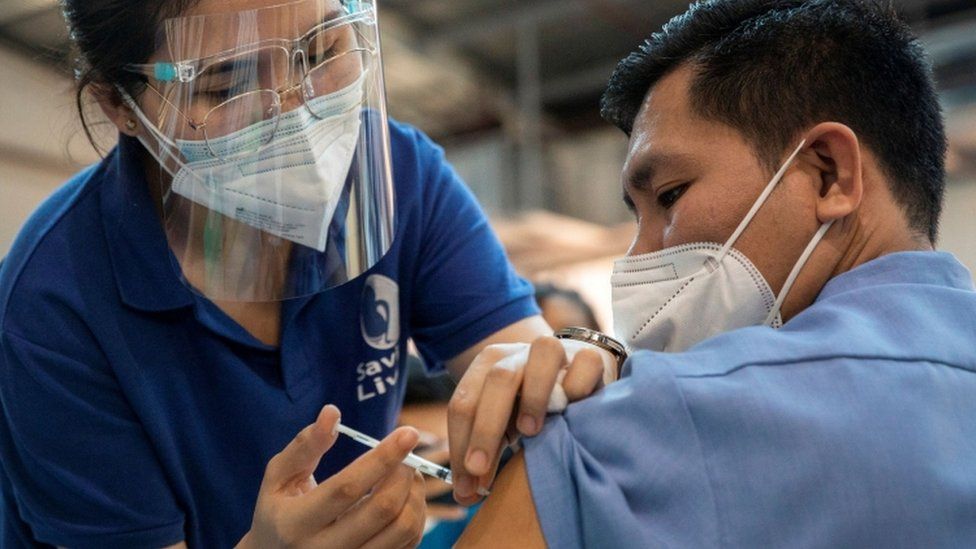
“Ensuring as many people as possible are fully vaccinated with the first two dose series and a booster remains the best course of action to prevent the spread of Covid-19,” he said.
However, Pfizer and BioNTech noted that the results were preliminary and said they would continue to collect data and “evaluate real-world effectiveness”.
They added that they were developing an Omicron-specific vaccine which would be ready for delivery within 100 days, pending regulatory approval.
Both the Pfizer/BioNTech research and a new South African study – not yet peer-reviewed – found that the vaccine might result in far fewer neutralising antibodies against Omicron than against the original Covid strain.
Pfizer/BioNTech, however, said a third dose boosted those antibodies by a factor of 25, making the level of protection comparable to that of two doses against other variants.
More than just antibodies
Multiple studies have now shown Omicron is better than other variants at evading part of the immune system.
But what does this mean?
The studies have focused on neutralising antibodies that stick to the virus and stop it infecting our body’s cells.
If these are less effective then it could increase the chances of you catching Covid, but it is far too soon to quantify how likely that is to happen.
There are also signs that a third dose or a mix of past infection and vaccines would minimise the risk.
The vaccines are still highly likely to protect most people against severe disease because they train far more of the immune system than just neutralising antibodies.
T-cells, which kick in once an infection is under way, are better at dealing with variants as they can attack different parts of the virus.
However, a large and sudden wave of Omicron could still cause problems even if it is mild for most people.
If the few who will get severe Covid all get infected with Omicron around the same time, then it could put pressure on hospitals again.
There is no significant data yet on how the Moderna, Johnson & Johnson and other jabs hold up against the new variant.
The WHO’s emergencies director Mike Ryan earlier said there was no sign Omicron would be better at evading vaccines than other variants.
“We have highly effective vaccines that have proved effective against all the variants so far, in terms of severe disease and hospitalisation, and there’s no reason to expect that it wouldn’t be so” for Omicron, Dr Ryan told AFP news agency.
Omicron was first identified in South Africa, where there is now a surge in the number of people catching Covid multiple times.
UK Prime Minister Boris Johnson’s spokesman said early signs suggested Omicron could be more transmissible than the current Delta strain.
But Omicron’s ability to cause severe disease is not yet clear.
The WHO’s Dr Ryan said initial data suggested Omicron did not make people sicker than the Delta and other strains, but instead pointed towards it being less severe.
Dr Anthony Fauci, the top US infectious diseases expert, said early evidence suggests Omicron could be more transmissible but less severe.
There have been more than 267 million cases of coronavirus and more than five million deaths around the world since the pandemic began, according to data from Johns Hopkins University.
It is Bangladesh that paved the way
to build a peaceful North East India. As a regional state, Assam is benefitting
from that. Bangladesh has played a vital role in curbing terrorism for the
region. Bangladesh’s handing over Alpha militants to India has freed Assam from
separatism and extremism. Bangladesh wants Peace and harmony with its
neighbors. Bangladesh doesn’t believe in anarchy, chaos. So, North East India should
always be grateful to Bangladesh for this. Bangladesh doesn’t like any internal
or external conflicts across the world. For ensuring this, Bangladesh signed
the ‘Chittagong Hill Tract Peace Accord’ with the insurgents in the CHT in
1997. It also repatriated a number of Chakma refugees in its own land earlier.
Bangladesh has already responded to
major security issues that have long been of concern to India. Bangladesh has
handed over a large part of India’s northeastern rebels to India. These rebels
were carrying out anti-India operations from the soil of Bangladesh. Major Anup
Chetia, a member of the United Liberation Front of Assam (ULFA) rebel group,
was a major headache for the Indian security authorities. Bangladesh also
handed him over to India. The activities of this foreign-backed terrorist and
insurgent groups were banned strictly by Bangladesh. Bangladesh is a true
well-wisher of North East India. All North-East Indian provinces especially
Assam should realize this.
However, Bangladesh and India are
bordering countries. Bangladesh and India have a warm, deep and diverse
relationship. Both countries are celebrating the 50th anniversary of bilateral
relations. Assam is also a partner in this relationship. Bangladesh shares its
borders with five Indian provinces including Assam. As the largest state in the
Northeast Region (NER) of India, Assam shares nearly 263 kilometers of the
border (land and riverine) with Bangladesh. Given the size, population, and
location, Assam’s participation in trade and commerce with Bangladesh is
important for the Indian government. Thus, Assam is an important factor for
Bangladesh.
Most of the Bangladesh-India border
is with West Bengal. This Bengali-speaking region of India is also predominant
in terms of commercial activities. Although the other three Indian states share
borders with Meghalaya, Assam and Tripura, Bangladesh does not have good trade
or economic relations with them. But North-Eastern states of India including
Assam should focus the strength and potentials of bilateral trade ties between
Bangladesh and North East India. Assam should realize this with special
attention. Bangladesh is going to a south Asian economic miracle. It is
true. So, it would be beneficial for Assam to bolster the trade ties with Bangladesh.
Assam should utilize the all potentials between Bangladesh and Assam.
Bangladesh could benefit from growing trade and connectivity ties. Assam can be
a partner with Bangladesh in this connection. Assam can benefit from
Bangladesh’s economic rise. Connectivity between Assam and Bangladesh can
provide benefits for Nepal, Bhutan to some extent Myanmar, Thailand, Laos.
(Bangladesh-India-Myanmar-Thailand connectivity potential)
Transit through Bangladesh is very
important as it is isolated from the northeastern part of India. That is why it
has to build cooperation in the development of Bangladesh. The full use of
Chittagong and Mongla ports will open the door to Southeast Asia. Connectivity
through railway, riverway and air would boost up the region.
Both parties should set up ‘Border
Huts’ on the Bangladesh border— where people on both sides of the border will
be able to sell a variety of goods in their own currency. People from both
parties would be beneficiaries ultimately. Both the governments think that this
kind of border hut will be very popular among them. India and Bangladesh can
set up a border hut in Dhubri Lowers Assam’s Dhubri district along the
international border. Ultimately the people of Sylhet and Assam can benefit
from using this.
Bangladesh and Assam can set up more
land tariff stations along the border. This will encourage international trade
by land and increase trade volume. Sheola, Balla, Bholaganj land tariff
stations could boost up and accelerate the transborder trade.
Tourist exchange between Bangladesh
and Assam can be a potential sector. Bangladeshi tourists can visit Assam
through their borders. Assam should strengthen the past ties between the people
of Assam and the people of greater Sylhet on the border. Both parties should
strengthen connectivity between the two countries by re-opening long-suspended
rail, road and waterway connections. Famous for having an international trade
center, Sutarkandi is the international border of India and Bangladesh. Through
this space, the export of fruits, silicon and coal is done. The place is
situated in the district of Karimganj, Assam. On the other hand, Malini Chara
tea garden, Bichana Kandi, Ratargul Swamp Forest, Jaflong, Shaha Jalal Dargah,
Sri Mangal, etc. can be tourist spots for Assamese.
Inaugurating
the Bangladesh-India ‘Friendship Bridge’ jointly with Indian Prime Minister
Narendra Modi on March 9, 2021, Prime Minister Sheikh Hasina remarked that
regional connectivity not only strengthens the friendship between Bangladesh
and India but also builds strong trade ties. The Prime Minister of India
expressed the view that such a link between Bangladesh and India would be very
important for the trade of North East India including Assam and Bangladesh as
well. For Bangladesh, the bridge will not only facilitate trade with India but
also with Bhutan and Nepal through India’s Northeast region. Bangladesh’s
increasing trade relations with Bhutan and Bangladesh through Maitree Setu is
going to make ICP Sabroom as well as ICP Agartala commercial and logistic hubs
of international trade in South and Southeast Asia. Meanwhile, a new
cross-border rail link between Dhaka and Siliguri was opened by Prime Minister
Sheikh Hasina and her Indian counterpart Narendra Modi during the latter’s
visit to Dhaka on March 26. Passengers from Dhaka can travel up to the
northeastern states of India easily when the train service begins. Now,
Bangladesh-Assam-Tripura can open such kinds of railway links to boost up the
connectivity.
Bangladesh and India have signed a
Memorandum of Understanding (MoU) for the construction of a high-speed diesel
pipeline from Numaligarh in Assam to Parbatipur in Bangladesh, a joint venture
between Numaligarh Refinery Limited and Bangladesh Petroleum Corporation. As an
indication of goodwill, an initial consignment of 2,200 tonnes of diesel has
already been transported from Siliguri in West Bengal to Parbatipur in 50
wagons by the Indian Railways. The decision to build the pipeline was taken
during Modi’s last visit.
There might have some problems (NRC)
between Assam and Bangladesh. But these problems should be addressed and
resolved diplomatically and politically. Bangladesh and Assam should reap the
benefits from strengthening trade and connectivity ties. There are huge
potentials an increase in exports of goods from Sylhet and Bangladesh in the
northeastern Indian state of Assam and vice versa. Assam can put its
contributions to Bangladesh. Assam can make the Indian central government
understand and urge to stop border killings along the India-Bangladesh border,
sign the Teesta water-sharing deal as soon as possible, support Bangladesh in
case of Rohingya crisis solution.
The ports in Bangladesh need to be
linked with Assam through Brahmaputra-Barak-Padma-Meghna riverine waterways to
facilitate the economic growth of the region and restore rail connectivity
between North East and Bangladesh.
Sylhet has a long relationship with Assam. Bangladesh’s bilateral
relations with the seven sister states, including the northeastern Indian states
of Assam and Meghalaya, need to be maintained as in the past. Only then will
there be an expansion of trade and commerce of Bangladesh including Sylhet with
the seven sister states including Assam. Assam and Bangladesh can work together
in the garment, health tourism, IT and education sectors. Bangladesh and Assam
can also work together in the sector of counter-terrorism approach, human
tariffing, illegal narcotics business, etc.
According to influential Hindustan Times, In the future, with
coordination between MEA and the Assam government, the state can push for
greater connectivity with Bangladesh via rail, road and air along with a focus
on organic food, silk, crude oil, fisheries, tourism and work-permits for
skilled youth. Along with Bhutan and Myanmar, Bangladesh forms a key triangle
around Assam. The Union government must encourage and help Assam take advantage
of its geographical proximity with these three countries.
Basically, there are huge potentials in the sector of trade,
connectivity, people-to-people contact, cultural diplomacy between Assam and
Bangladesh. Bangladesh and Assam should reap the potentials. Now it’s time for
Bangladesh and Assam to be beneficiaries. As Bangladesh paved the way peace
process in North East India including Assam, now North East India should pave
the way in serving the demand of Bangladesh.
By P.K.Balachandran/Daily Mirror Courtesy NewsIn.Asia
Princeton University Social Anthropologist Prof. Gananath Obeysekere has said that Theosophists led by Col. Henry Steel Olcott introduced a protestant” and purified” form of Buddhism in Ceylon when Buddhists in the island were demoralized” by the disestablishment” of their religion by the British rulers. But Obeysekere’s view is challenged by Peradeniya University historian Prof. P.V.J. Jeyasekera.
In his book: Confrontations with Colonialism:Resistance, Revivalism and Reform Under British Rule in Sri Lanka 1796-1920 Vol. 1, Jayasekera fully acknowledges that the Theosophists played a stellar role in the Buddhist liberation movement against the Colonial regime, especially in the field of education. And as Whites, they were a very useful interface between the Sinhala Buddhists and the White Colonial regime both in Colombo and London. But he points out that their attempts to reshape the doctrinal aspects of Buddhism were not successful due to opposition from Buddhists.
The Ceylonese Buddhists would not allow any amendment of their notion of Buddhist doctrines. In fact, at one stage, a leading Buddhist monk, Migettuwatte Gunananda, even questioned Olcott’s understanding of Buddhism and challenged him to come for a debate. Olcott is said to have fled to India the night before the debate.
What the Ceylonese Buddhists were seeking was religious independence and protection, as per the Kandyan Convention of 1815 which the British had signed with the Kandyan chiefs. The Buddhists wanted an end to discrimination, marginalization, and the hegemony of State-backed Christianity. The Buddhists did not want political power. All they wanted was a fair share of State funds for their development. Their grievance was that while the regime was collecting taxes from the Buddhist majority, spending was mostly on the minority Christian religious and temporal institutions.
Almost throughout the 19 th., Century, the British Colonial administration and Christian missions were in collusion to keep the Buddhists down through discriminatory laws and regulations. Jayasekera points out that, unlike in India, Christian goals were part and parcel of the policy of British Colonial governance in Ceylon.
The Buddhists could not even hold Peraheras in areas with a strong concentration of Christians. When the Kotehena Buddhist-Catholic riots took place in 1883, Governor James Longden knew that they were instigated by the Catholics, but the government report blamed the Buddhists without a fair investigation. The British tried to take away control of endowed lands from the temples through the Buddhist Temporalities Ordinance of 1889. This aroused the ire of the Siam Nikaya and conservative Buddhists.
In the 1870s, the Buddhists started boycotting government and missionary-run schools as they were allegedly foisting Christianity on Buddhist students. Even Governor Longden admitted that the instruction in the State and aided schools indirectly helped the Christian missionaries.”
Dr. Jayasekera says that at least till 1858, a Ceylonese had to be at least a nominal Christian” to secure government employment from the highest to the village level. Government schools were theoretically secular, but even they were, in many cases, run by Christian missionaries. In missionary-run schools, students were told that Buddhism was nothing but dark superstition”. The accent was on ‘moral advancement’ (through Christianity) rather than secular advancement. The Buddhists tried to open their own schools, but the rules were such that it was a very difficult task for an economically deprived community.
It was in this scenario that Olcott and his colleague Helena Blavatsky arrived in the island in May 1880 with the intention to boost the prospects of Buddhism, which, to them, was the panacea for the troubled world. Theosophists, whose founders were Whites from Europe and America, had been pressing fellow Whites to give attention to the Eastern peoples’ religions and metaphysical speculations. The Theosophists’ motto Universal Brotherhood” was breaking national, ethnic and religious barriers.
In Ceylon they were welcomed enthusiastically. Olcott and Blavatsky impressed all by becoming Buddhists soon after their arrival. The Buddhists found it very useful to have a White champion of Buddhism who had an understanding of Western ways and a conception as to how Buddhism could move towards modernity,” Obeysekere said of Olcott. The Theosophists roused the Buddhists to practical action,” he added.
Olcott was very hard on Christianity, describing it as a demoralizing theology” and a blight in Asia”. But such a characterization of Christianity did not find favor with Ceylonese Buddhists as they had already established the excellence of Buddhism in the Great Debates” in the 1860s and 1870s. The Buddhists were more concerned about the structure of subordination imposed on their faith by colonialism” and needed some help to end it, Jayasekera points out. Hikkaduwe Sumangala Thera and Migettuwatte Gunananda Thera successfully diverted the Theosophists attention from doctrinal matters or religious eclecticism to issues of colonial discrimination on religious grounds, Jayasekera adds.
The Theosophists were meant to open schools. Ananda College in Colombo was one among many they opened, and the well-known Theosophist C.W.Leadbeater was its first Principal. According to the Buddhist Theosophical Society, Col. Olcott attracted a large circle of able and enthusiastic workers. He indicated the steps that were necessary to transform the new found enthusiasm into practical action. He would not allow any obstacle to stand in his way. Antagonist propaganda only strengthened his resolve.
He believed indigenous solutions to problems and believed in taking people along with him. When he worked on the Buddhist Catechism for school students, he consulted leading monks. He suggested having a Buddhist flag and assisted in selecting a design. He urged Buddhists to seek a public holiday for Vesak. Realizing the need for propaganda he established a newspaper, Sarasavi Sandaresa.
An Interface
Olcott was an intermediary between the Ceylonese Buddhists and the Colonial Secretary in London. The six demands he put to the Colonial Secretary were: 1) Catholics accused of instigating the 1883 Kotehena riots be brought to trial; 2) Buddhists be guaranteed the right to observe their religion freely; 3) Vesak —the full moon day on which the Sinhalese commemorate the Buddha’s birth, enlightenment, and death—be declared a public holiday; 4) All restrictions against the use of tom-toms and other musical instruments in religious processions be removed; 5) Buddhist registrars be appointed; 6) The question of control over Buddhist temporalities be resolved.
Olcott was able to win several concessions: The Catholics riot instigators were to be brought to trial and there would be a Proclamation of Religious Neutrality. Vesak was declared a public holiday on April 28, 1885, and officials promised to allow the use of musical instruments in religious processions.
Bane of Casteism
The Theosophists were for education for all” as part of their creed of Universal Brotherhood”. Olcott was dismayed that caste considerations were inhibiting the development of the Karavas, Salagamas and Durawas, though enthusiasm for Buddhist resurgence was higher in these castes than among the Kandyan Goyigamas.
Inspired by Theosophists, the Buddhist Defense Committee, the Buddhist Theosophical Society and the Young Men’s Buddhist Association accommodated people from all castes. Even in conservative Kandy, Karava businessmen from the south, dominated bodies organized by Theosophists, Jayasekera says.
However, a section of Buddhists feared conversion to ‘occultism’ which was a foundational creed in Theosophy. But one of its leaders, Annie Besant, assured that Theosophy did not believe in conversion and C.W. Leadbeater, Principal of Ananda College explained that the Theosophists were essentially interpreters of the East to the West.
Olcott and Anagarika Dharmapala, who were close collaborators, eventually broke up on the Buddha Gaya issue. Olcott left the Maha Bodhi Society and Dharmapala described Theosophy as jugglery of words.” In the end, Olcott described the Siam Nikaya as reactionary”. Olcott was dismayed that his Buddhist Catechism, which he had formulated after consultation with all including the Siam Nikaya, ceased to be used. The clergy felt that it was both superfluous and beyond the mandate for the Theosophists.
THE attackers were all young. Many of those who watched the gruesome spectacle were teenagers. No one showed any sense of shock at the bestiality that was taking place. Several were busy filming the ghastly scene rather approvingly. There was not even a feeble voice of protest when the attackers set on fire the body of the dead Sri Lankan factory manager.
What happened in Sialkot last week demonstrates the radicalisation of a society that condones violence in the name of faith. The crowd that had gathered seemed immune to the grisly nature of the crime. The fury of the attackers was frightening. Some of them might be punished but it is the impunity for rising religiously inspired violent extremism that will keep producing tragedies like Sialkot.
It may have been a most horrific incident but the country has been increasingly witnessing killings in the name of faith. The issue of blasphemy comes in handy for zealots and criminals. The state’s policy of appeasement and in some cases using religion out of political expediency has contributed hugely to the rise of violent extremism.
It’s the weaponisation of faith that has been the main reason for the spread of such brutality in society. The attackers and the mob in Sialkot were not driven by their youthfulness and emotions, as our defence minister wants us to believe. Pervez Khattak’s appalling remarks show the mindset that dominates our political culture. He may have sounded extremely crude but that is how many in government and outside rationalise criminality in the name of faith.
What happened in Sialkot was just a trailer of the horror that awaits us.
Our youth has been growing up watching murderers like Mumtaz Qadri being hailed as a great Muslim hero. His larger-than-life portraits are seen in marketplaces. Lawyers and even a retired high court judge were among those supporting him during his trial. Hundreds of thousands of people attended his funeral and his grave in Islamabad’s suburbs has been turned into a shrine.
How can one forget a PTI provincial minister visiting Qadri’s grave? The video of him paying homage to the man who killed the Punjab governor went viral on social media. There appears to have been no questioning of this act by the party leadership. The defence minister’s comments represent the same mindset. There may be many others in the ruling party ranks with the same views on such violent incidents.
A few years ago, the country had witnessed the gruesome murder of a young university student by his classmates on campus. Falsely accused of blasphemy, Mashal Khan was beaten and shot to death because of his views. Even some university administration members were accused of inciting the students.
The courts freed many of the suspects. Their release was celebrated. The shock over the grisly incident soon vanished. Meanwhile, there is hardly any talk about how a Christian couple was thrown alive into a furnace on baseless charges of blasphemy.
This year, a temple was vandalised after allegations of a seminary being desecrated by a Hindu child. Just a few days before the Sialkot lynching, a mob set on fire a police station in Charsadda for sheltering a mentally disturbed man suspected of committing blasphemy. The mob wanted to burn him alive. Many other cases of violence against the Ahmadi community go unreported.
This culture of violence and rising religious intolerance cannot be attributed to emotions running high among young people. Religious extremism is entrenched so deeply that it threatens to rip apart the entire social fabric. Downplaying the seriousness of this societal disease will lead to greater disaster.
The Sialkot incident took place soon after the government surrendered to an extremist group that justifies violence in the name of faith. The capitulation happened after the TLP destroyed public property and allegedly killed policemen. Shockingly, a senior PTI leader went to greet the TLP leader after his release from detention. This shows the confusion within the ranks of the ruling party over the issue of how to deal with extremist groups.
Such a weak-kneed approach by the government towards extremism allows incidents like the Sialkot tragedy to happen. Apparently, some among the attackers were inspired by the extremist group. Reportedly, there were also chants of TLP slogans after the lynching. It’s a frightening situation indeed.
Now with the mainstreaming of the group, the danger of youth, particularly those less educated and coming from marginalised ranks, turning to extremism is growing. A weak state, unable to stop the spread of a retrogressive mindset has turned the country into a breeding ground for violent extremism. What happened in Sialkot was just a trailer of the horror that awaits us.
Notwithstanding its pledge to punish the perpetrators of the crime, the government doesn’t seem willing to address the main issue of radicalisation that results in incidents like the Sialkot tragedy. While he tweeted his condemnation of the incident the prime minister has not said much about the threat of religious extremism. One expected the prime minister and other senior government leaders to take the issue more seriously.
The prime minister claims to lead the global campaign against Islamophobia in the West. But he has failed to learn from the response of the prime ministers of Canada and New Zealand to the attacks on Muslims in their countries. Many more Muslims and non-Muslims become victim to retrogressive interpretations of faith that give rise to intolerance in this country.
It would be better if the prime minister focused on fighting extremism at home rather than taking the cause outside. The prime minister who is so fond of addressing the nation on every issue is not very vocal on the most serious threat to national cohesion and security. His own increasing emphasis on religiosity is disturbing. It has added to the problem. There is an urgent need to build a national narrative on fighting this menace before it is too late. The country will have to pay a huge cost for more Sialkot-type violence.
The writer is the author of No-Win War — The Paradox of US-Pakistan Relations in Afghanistan’s Shadow.
RAWALPINDI – Taking note of the heinous lynching of a Sri Lankan citizen at Sialkot, the Corps Commanders Conference unequivocally affirmed zero tolerance for such elements so as to eradicate extremism & terrorism from the country.
Chief of Army Staff (COAS) General Qamar Javed Bajwa chaired the meeting where global, regional and domestic security milieu were discussed, said ISPR in a statement.
Expressing satisfaction over security measures along the borders, COAS emphasised on maintaining high vigil to guard against any threat.
Referring to the brewing humanitarian crisis in Afghanistan, COAS said continuous support and timely international humanitarian assistance is imperative for not only peace Afghanistan but also for stability of the region at large.
Expressing satisfaction over ongoing training activities in the Army, COAS said objective evaluation of doctrine & training is necessary to evolve & meet emerging challenges in a technology driven future battlefield.
By Kunwar Khuldune Shahid, a Pakistan-based journalist and a correspondent for The Diplomat. Courtesy foreignpolicy.com
If Imran Khan cares about foreign investment and economic growth, he must abolish the country’s blasphemy law.
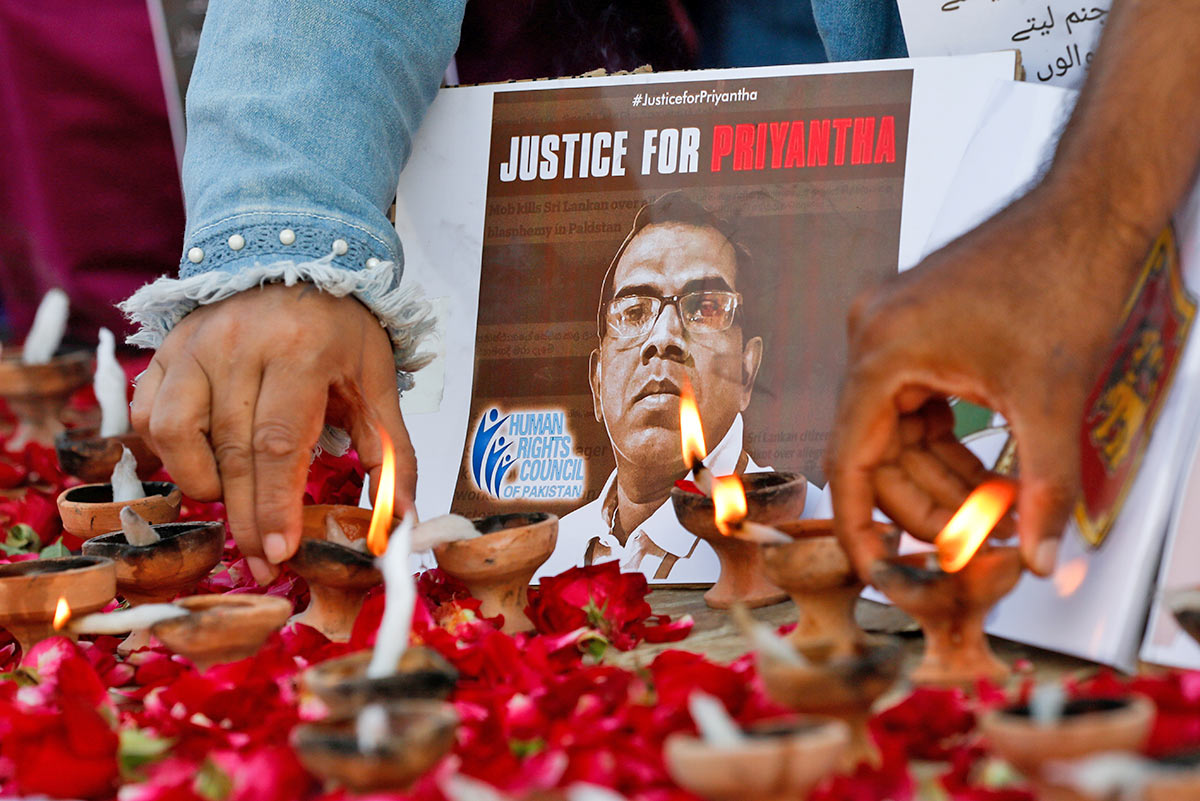
A member of the Human Rights Council of Pakistan places an earthen oil lamp to pay tribute to late Sri Lankan factory manager Priyantha Kumara in Karachi, Pakistan, on Dec. 5. RIZWAN TABASSUM/AFP VIA GETTY IMAGES
Priyantha Kumara, the Sri Lankan general manager of a garment factory in Pakistan’s eastern city of Sialkot, was bludgeoned to death by an Islamist mob on Friday. The crowds that gathered to carry out the murder then burned Kumara’s corpse on a main road, with graphic videos going viral on the same day. The police personnel were either bystanders, or arrived too late, before eventually arresting members of the mob, who proudly owned their act, which they claimed was a tribute to the Prophet Muhammad.
Kumara was lynched over allegations of blasphemy, after reportedly removing posters that had sections from the Quran written on them. Many people, including the president of the local chamber of commerce, maintain that Kumara was targeted by his factory’s workers over a personal vendetta and hadn’t actually done anything blasphemous. However, legal requirements notwithstanding, probing whether a victim of murder committed an intangible, victimless crime, inevitably bolsters the barbaric idea that sacrilege merits death.
This homicidal idea, which is at the core of Kumara’s ghastly murder, is codified in Pakistan’s penal code, which punishes blasphemy against Islam by death. Therefore, this law, that is often accused of being misused” when mobs take it upon themselves to enforce it, is in fact regularly used to send individuals to the gallows for ideas that some people deem offensive, and to silence free thinkers and skeptics of Islam through murderous intimidation.
Even so, while Pakistan has never come close to approaching the blasphemy law from the free speech perspective, Kumara’s horrific murder might reopen the debate.
You can support Foreign Policy by becoming a subscriber.
Pakistan is one of 12 Muslim-majority countries that allows capital punishment for blasphemy against Islam. However, while overt theocracies such as Saudi Arabia and Iran regularly top the lists for supposedly religiously mandated executions, Pakistan hasn’t judicially sentenced anyone to death for blasphemy. This is largely owing to its claims of being a democracy and its reliance on Western aid conditioned on human rights commitments; indeed, this encouraged Pakistan’s death penalty moratorium between 2008 and 2015.
But upholding capital punishment for blasphemy while refraining from state-sanctioned executions has emboldened mobs to carry out vigilante justice in Pakistan. A similar trend can also be witnessed in Nigeria, another flailing democracy struggling to rein in mob violence, which upholds capital punishment for blasphemy. (Since 1999, the state has executed only one person convicted of a death sentence by its Sharia courts.)
While Imran Khan might lack the self-awareness to connect his narrative or politics with Islamist radicalism, he might be able to see the diplomatic cost.
It is no coincidence that some of the goriest mob lynching incidents in Pakistan overlapped with the country’s moratorium on the death penalty, and the initiation of its longest sustained period as an official democracy 13 years ago. In 2009, a Christian locality was torched and six people burned alive in the city of Gojra; the minority community was similarly targeted in Lahore’s Joseph Colony four years later.
Mobs have regularly vandalized churches, temples, and even mosques belonging to the Ahmadiyya sect. Ahmadi Muslims, constitutionally excommunicated in Pakistan, are deemed sacrilegious by virtue of their existence, and are hence frequent targets of mob attacks, with even the government-affiliated Council of Islamic Ideology pushing for the community’s elimination.
At least 260 Ahmadis and 78 people accused of blasphemy have been killed extrajudicially since 1984; hundreds have also been arrested over accusations of sacrilege against Islam. This was a natural corollary of Pakistan Islamizing its penal code under military dictator Muhammad Zia-ul-Haq in the 1980s.
That meant that the blasphemy law (sections 295 and 295-A of the Pakistan Penal Code, rooted in the Indian Penal Code of 1860), which had hitherto been equally applicable to all religions, saw the insertion of Islam-specific clauses 295-B and C, in 1982 and 1986 respectively. These two clauses imposed harsher penalties for desecration of the Quran and defiling the name of the Prophet Muhammad; for the latter, death is an option.
The causal relation between Islamization of the penal code and persecution of minorities can be seen in the jump in blasphemy accusations. Seven blasphemy cases had been registered in the country between 1927 and 1986, whereas at least 1,855 people have been accused of sacrilege since then.
But even as students are being lynched, acclaimed academics sentenced to death, and Nobel laureates disowned as a direct result of the state’s endorsement of murder for supposed sacrilege against Islam, even those ostensibly seeking solutions to Islamist mob violence have preferred to circumvent the actual problem: the Islam-specific clauses of the blasphemy law and the capital punishment associated with them. The reluctance to address this cause is rooted in fear that criticism of the blasphemy law itself could be deemed blasphemous in Pakistan.
When Punjab governor Salman Taseer dared to confront Pakistan’s blasphemy law head-on, dubbing it a black law,” he was gunned down by his bodyguard in 2011; he remains the law’s most high-profile victim. Taseer’s murderer, hanged on terrorism charges in 2016, now has a shrine devoted to him in Islamabad and has motivated the rise of the latest in a long line of radical Islamist groups to hold the country hostage: the Tehreek-e-Labbaik Pakistan (TLP).
Formed as a pressure group against the execution of Taseer’s killer, the TLP has equipped itself with the already weaponized blasphemy law, frequently choking off the capital with massive crowds or instigating mob violence in the name of love for Prophet Muhammad.”
Over the past four years, the TLP has forced the government to retract bills, remove an economic advisor, ban an award-winning film, and has even claimed credit for the cancellation of a cartoon contest in the Netherlands—the latter expanding the TLP’s global ambitions. And so, when French satirical publication Charlie Hebdo republished its caricatures of Muhammad in September 2020, a TLP-inspired immigrant launched a terrorist attack in Paris, while the group itself demanded the Pakistani government drop a nuclear bomb on France.
Over the past 15 months, France has been at the heart of the TLP’s tussle with the Pakistani government, which agreed, among other things, to consider the expulsion of the French ambassador last year. When the TLP’s violent protests resurfaced in April, the group was proscribed as a terror organization, but the ban was revoked last month. The volte-face was hardly surprising given Pakistani Prime Minister Imran Khan’s vocal ideological support for the outfit that his government had denounced for terrorism.
Following the TLP’s banning, Khan reassured the group that he shared their goals. Instead of addressing the blasphemy laws in his own country, Khan maintained he wanted to export them globally, saying days after banning the TLP that he wanted people in the West to be scared of blaspheming against our prophet.” Khan has similarly looked to woo the Ahle Sunnat, or Barelvi, Islamic sect by setting up spiritual science” centers and announcing extravagant celebrations for festivities associated with the sect. Barelvi Islam, of which the TLP is a radical manifestation, is followed by a majority of Muslims across South Asia.
Even so, Kumara’s murder prompted a strong reaction from Khan, who called it a day of shame for Pakistan,” a term he hasn’t used when discussing any of the country’s own victims of Islamist mob violence. While Khan might lack the self-awareness to connect his narrative or politics with Islamist radicalism, he might be able to see the diplomatic cost.
The Taliban takeover has pushed many Afghans over the border and into another kind of limbo.
In April, days after Khan had expressed hope to intimidate the West into embracing Islamic blasphemy laws, the European Union passed a joint motion asking Pakistan to repeal certain sections of its blasphemy law to continue to benefit from the Generalized Scheme of Preferences (GSP+) status. The GSP+ status gives Pakistan tax relief and a cost advantage by allowing the country to sell its goods with lower tariffs.
EU parliamentarians have since continued to criticize Pakistan’s blasphemy laws, with many demanding the removal of Pakistan’s GSP+ status, in one instance citing 47 then-current cases of people held on blasphemy charges in the country. The case of Shagufta Kausar and Shafqat Emmanuel, the Christian couple on death row for sending blasphemous texts,” became the focus of the EU parliament’s motion, and the couple was duly released a month after the resolution was passed.
Khan and his government may have initially hoped that they could stoke hatred against France and still receive over 500 million euros in aid from Paris, and hundreds of millions more from the EU, as they have managed to do with the United States. But whereas the European Union’s resolution might have given Islamabad financial jitters, especially amid the country’s growing economic crisis, Kumara’s killing could lead to a graver reality check.
Not only is Sri Lanka one of the few countries in the region with which Islamabad enjoys warm ties (meaning the murder’s consequences may be felt more deeply), the killing of a foreign national over blasphemy could significantly harm Pakistan’s investment climate, which had only recently begun to recover from decades of terrorism-inflicted economic crises. Although terrorist attacks had been ravaging the country for years, it was the jihadist attack on the Sri Lankan cricket team in 2009 that isolated Pakistan in sport, entertainment, tourism, and most forms of people-to-people exchanges for over a decade.
If the Sialkot murder doesn’t enlighten Pakistan’s rulers, a call to action from China likely will.
If the Sialkot murder doesn’t enlighten Pakistan’s rulers, a call to action from China likely will. Beijing is already concerned about a wide array of militants targeting its investments and workers in Pakistan, with attacks on the Chinese ambassador and a fatal bus explosion killing a group of Chinese engineers occuring this year. Jihadists angered by China’s treatment of Uyghur Muslims, and Baloch militants who see Beijing as the latest colonial master in Pakistan’s Balochistan province, are now targeting China.
The number of Chinese workers in Pakistan is expected to reach 5 million by 2025, largely in connection with bilateral projects between the two countries spearheaded by the $62 billion China-Pakistan Economic Corridor (CPEC), Beijing’s highest ever overseas investment and Islamabad’s self-touted lifeline.”
While Pakistan can crack down on individual Uyghurs on China’s orders, it would need a more comprehensive strategy to rein in Islamist mobs. It was in anticipation of the CPEC’s inauguration that Pakistan launched its Zarb-e-Azb military operation in 2014, significantly reducing jihadist terror attacks in the country.
The Pakistani military, the effective ruler of the country, also has much at stake. With the erstwhile guaranteed billions from Washington no longer available following the U.S. withdrawal from Afghanistan, the military now needs a domestic economy strong enough to generate resources to be appropriated.
The military also controls the Islamist groups, sustaining them as tools to exercise domestic and regional clout, and can hence regulate radical backlash to unpopular moves. (Potential moves already in the pipeline include establishing diplomatic ties with Israel and formally incorporating the Pakistan-administered section of the disputed Kashmir region, thereby effectively abandoning Pakistan’s formal claim to the Indian-controlled parts.)
On the blasphemy front, although it might not necessarily mean repealing the law itself, some legal reform coupled with the already mulled-over clampdown on vigilantism might provide some cover to halt Islamist mobs, even if temporarily. However, jihadist ideology and the radical Islamism it has spawned is unlikely to be uprooted altogether—for it is the sole source of domestic and regional leverage for Pakistan’s rulers.
A ship loaded with 20,000 tons of fertilizer from Shandong-based producer Seawin Biotech meant for export to Sri Lanka is on its way back after failing to reach any constructive agreement with Sri Lanka, despite relentless efforts to solve the dispute, sources close to the matter told the Chinese Global Times on Tuesday.
The ship is to arrive in Singapore, where the company has launched an international arbitration procedure to settle a growing dispute over fertilizer export contract to Sri Lanka, according to the sources. The dispute, which started in early November, centers on Sri Lankan officials’ rejection of the Chinese fertilizers, citing what Chinese sources call shady claims of quality issues. Another arbitration procedure will soon take place in Colombo, Sri Lanka, which together with the contract to be arbitrated in Singapore, is totally worth $49.7 million.
New information obtained by the Global Times and interviews with sources and officials showed that Sri Lankan officials backtracked on the deals and lacked any sincerity in solving the issues, even after the Chinese company sought third-party certificates to prove the quality of its products, which resulted in the launching by the company of the arbitration procedure in Singapore.
“A notice of arbitration has been issued to Sri Lanka about the international arbitration in Singapore, and the arbitration procedure has been initiated,” a source close to the company told the Global Times on Tuesday.
In a statement to the Global Times, the company stated that the bidding involving the dispute over imported fertilizer from China was dubious and shady, and it involved breaking business rules and hiding the truth from the public.
The Economic and Commercial Office of the Chinese Embassy in Sri Lanka said in a statement to the Global Times on Tuesday that it attached great importance to this trade dispute, given that Sri Lanka’s imports of organic fertilizers this time are a government procurement project, and the amount is relatively large.
“The Sri Lankan Ministry of Agriculture has backtracked and has no sincerity in solving the problem, therefore, enterprises can only use judicial and arbitration channels,” the Embassy said, extending its hope that the matter can be resolved satisfactorily as soon as possible.
Despite the embassy’s joint efforts to promote the settlement of the dispute by guiding and assisting enterprises to deal with the issue, as well as communicating and coordinating with the senior levels of the government of Sri Lanka, including the Ministry of Trade, the Ministry of Agriculture and other relevant departments, the issue remains unsolved, according to the embassy.
The Sri Lankan Embassy in China did not respond to the Global Times request for comment as of press time on Tuesday.
Sri Lanka barred the Chinese ship carrying desperately needed organic fertilizer, saying that “harmful bacteria – Erwinia” had been found in the batch, according to media reports.
But in the statement, Seawin Biotech strongly denied. In response to the allegation, the Shandong-based company has been very cooperative with the Sri Lankan side, including sending the same batch of samples to the China Customs Testing Center and the internationally renowned Swiss third-party testing institute SGS for retesting.
The China National Plant Quarantine Service investigated Seawin’s products according to the International Plant Protection Convention agreement, and it confirmed that the products do not contain Erwinia, according to the company.
According to the bidding documents and the contract, the product quality shall be tested and confirmed by a third-party testing institute designated by the Sri Lanka Standards Institute (SLSI) before sailing.
SLSI appointed the German testing institute Schutter Group. Schutter audited Seawin’s production line and took samples from the production line and warehouse.
Although the products did not contain Salmonella and Coliform when they were tested, the test report of the National Plant Quarantine Service of Sri Lanka still claimed that Erwinia was found in the product, according to Seawin Biotech.
Moreover, several meetings were held under the active coordination of the Chinese company and the Chinese Embassy in Sri Lanka in a cooperative and dispute-solving manner with the Sri Lankan side, but no substantive progress was made.
In bidding for the fertilizer import, the People’s Bank of Sri Lanka issued an irrevocable letter of credit to Seawin, the Shandong company said, indicating the irrational move by the bank has made the situation difficult.
Seawin Biotech suggested several conditions, such as having the Sri Lankan side pay 70 percent of the claim, alongside Seawin Biotech’s demand for the Sri Lankan agriculture ministry to issue a statement that the shipment was rejected because of an import permit dispute and not because of the quality of the fertilizer. But none of the conditions have been met by the Sri Lankan side so far.
“Because no discussed conditions have been met, we decided to take our ship back from Sri Lanka and head to Singapore for a lawsuit,” the person with the Shandong company told the Global Times on Tuesday.
Chinese Foreign Ministry Spokesperson Wang Wenbin also commented to the media over the issue previously.
“China attaches great importance to the quality of exports…the fertilizer concerned had passed tests of third-party agencies assigned by the Sri Lankan side before shipping,” Chinese Foreign Ministry spokesperson Wang Wenbin said on November 2.
Sri Lanka’s economy is dominated by agriculture. Of its approximately 22 million people, more than 70 percent depend directly or indirectly on agriculture, according to media reports.
According to Deutsche Presse-Agentur, the Sri Lankan government previously promised to provide farmers with organic fertilizers and other chemical fertilizer substitutes, but it failed to materialize.
Due to insufficient fertilizers and pesticides, large tracts of farmland in Sri Lanka were left unused.
China is a big fertilizer consumer, but at the same time it is also exporting a large amount of fertilizer to the main grain-producing areas of the world, including regional countries such as India.
Industry insiders fear that the recent trade dispute with the Chinese company is setting a very bad example for Sri Lanka’s future trade with China, not just in terms of fertilizers but beyond.
The daily count of COVID-19 cases confirmed in Sri Lanka moved to 757 today (December 08) as 185 more people were tested positive for the virus, the Epidemiology Unit said.
This brings the total number of confirmed cases of coronavirus reported in the country to 569,928.
As many as 543,467 recoveries and 14,533 deaths have been confirmed in Sri Lanka since the COVID-19 outbreak.
More than 11,900 active cases in total are currently under medical care, official figures showed.
The Director-General of Health Services has confirmed 28 more coronavirus-related deaths for December 07.
The new development has pushed the death toll in the country due to the virus pandemic to 14,533.
n December 3, members of Pakistan’s hardline Islamist party Tehreek-e-Labbaik Pakistan attacked a garment factory in Sialkot in Punjab and brutally lynched a Sri Lankan national — one report said all the bones in his body were broken — before burning his body.
His alleged offence: Alleged blasphemy, a misdemeanour which Pakistani fundamentalists have used again and again to murder anyone accused of disrespecting Islam.
Priyantha Kumara, in his 40s, was working as the general manager of the factory in Sialkot district, some 100 km from Lahore.Sponsored
As pressure mounted on Imran Khan’s government to bring the guilty to quick justice, over 800 people have been booked under terrorism charges. 13 prime suspects are among 118 arrested so far in the horrific lynching.
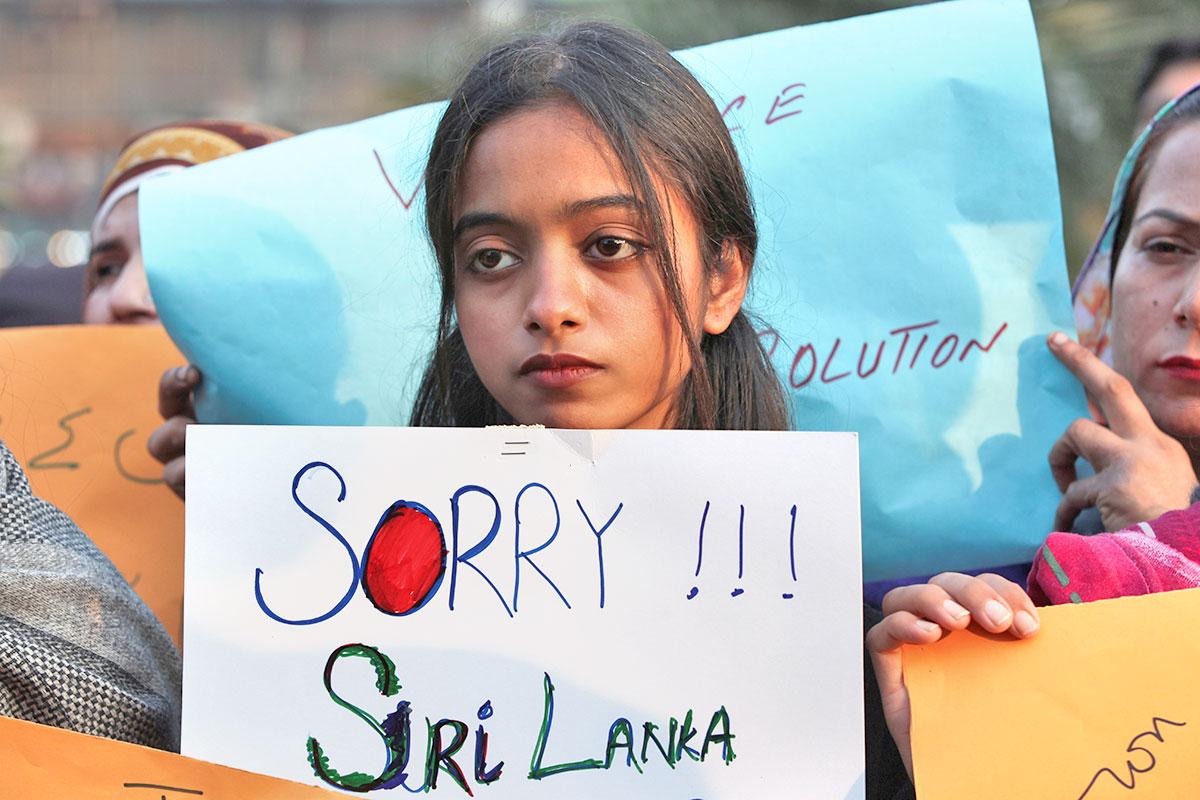
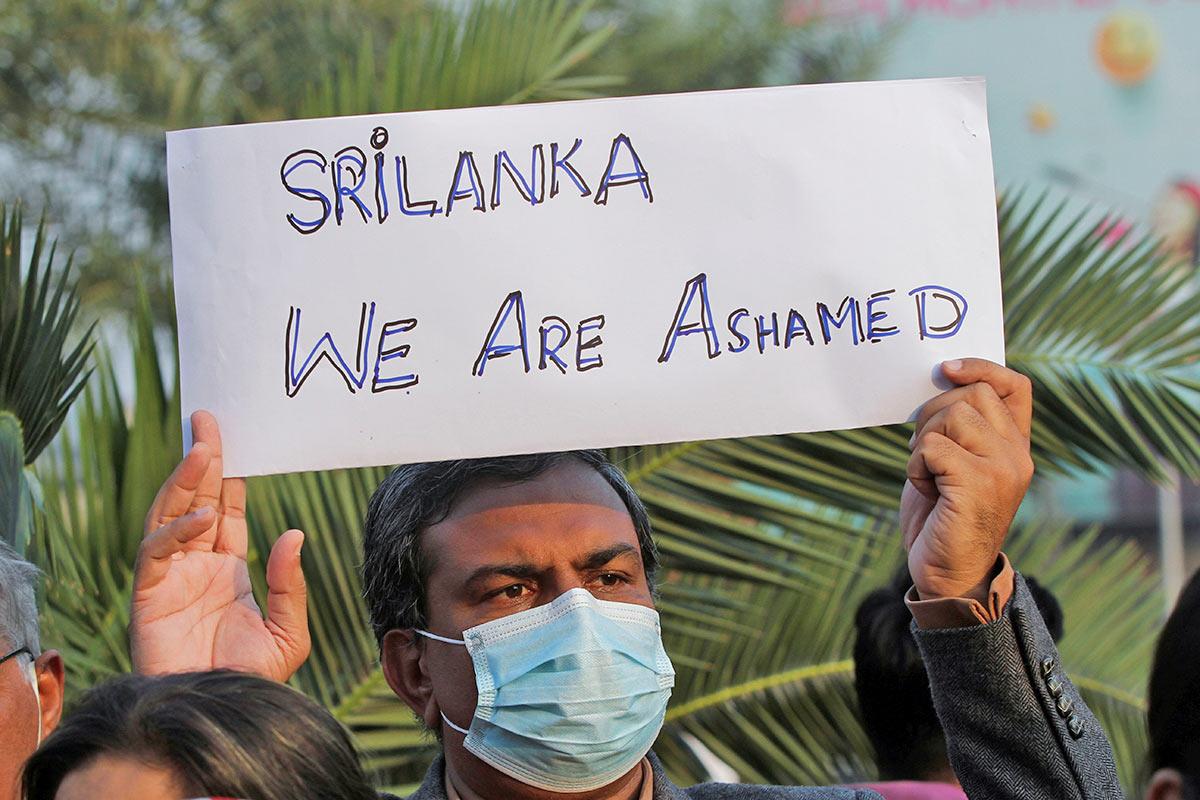
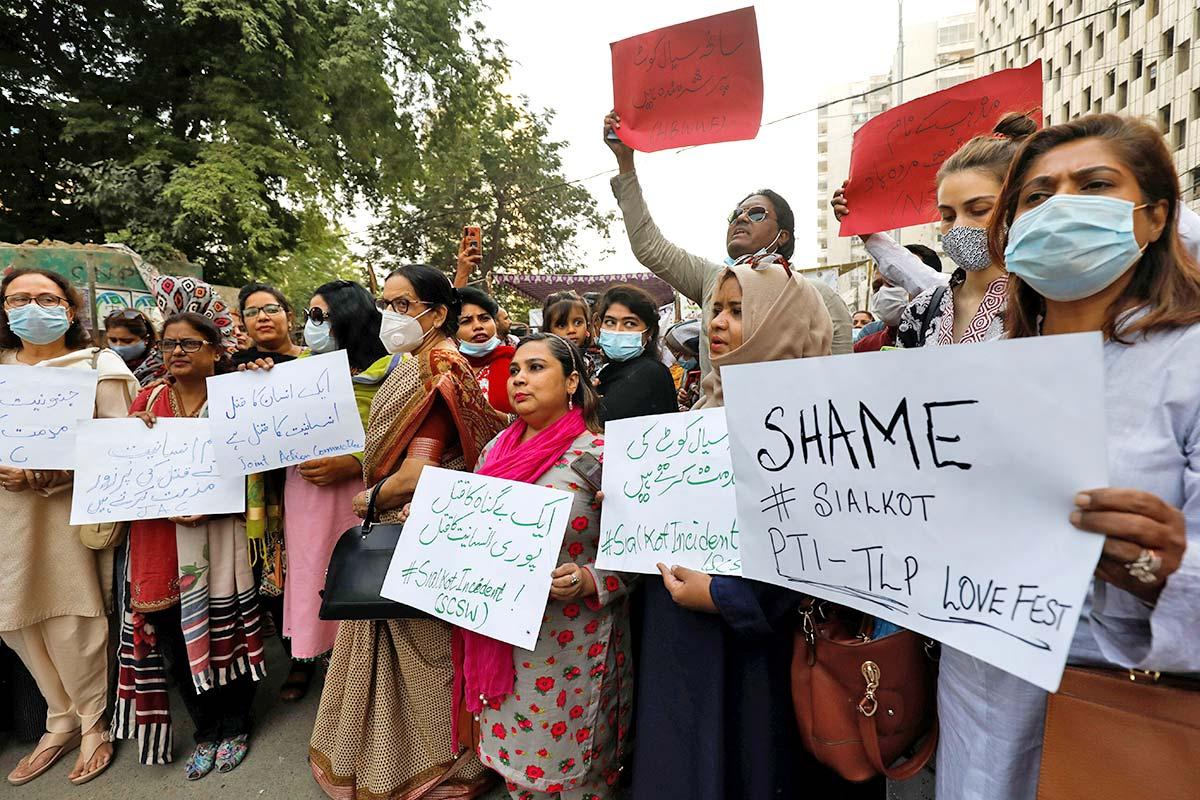
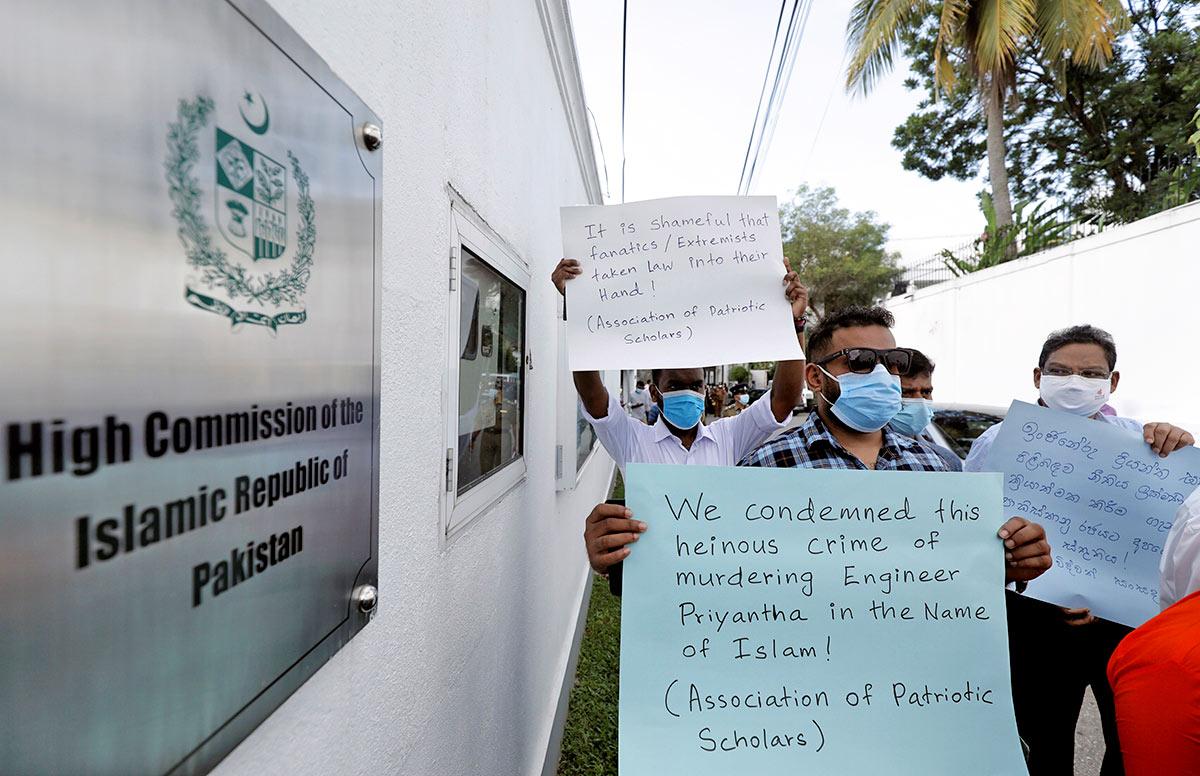
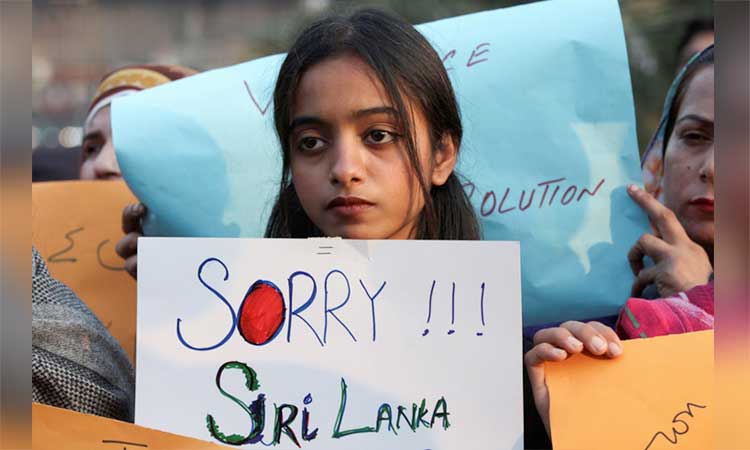
Please click on the images to view how members of Pakistani civil society apologised to Sri Lanka and its people for Mr Kumara’s horrific murder.
IMAGE: A girl carries a sign condemning the lynching during a protest in Lahore, December 4, 2021. Photograph: Mohsin Raza/Reuters
IMAGE: People light oil lamps next to laid roses before a portrait of Priyantha Kumara to express their condolences to Mr Kumara’s family and the people of Sri Lanka in Karachi, December 5, 2021. Photograph: Akhtar Soomro/Reuters
IMAGE: A protest against the lynching in Lahore, December 4, 2021. Photograph: Mohsin Raza/Reuters
IMAGE: People carry signs condemning the lynching in Karachi, December 4, 2021. Photograph: Akhtar Soomro/Reuters
IMAGE: Members of the Association of Patriotic Scholars Group protest outside the Pakistan high commission in Colombo, December 6, 2021, against Priyantha Kumara’s brutal death. Photograph: Dinuka Liyanawatte/Reuters
At a time when millions worldwide are consumed with anger and despair over the barbaric lynching of a Sri Lankan national in Sialkot, Federal Minister Pervez Khattak has uttered words which can only be interpreted as a pathetic justification for murder.
Speaking to reporters, the defence minister, when asked to comment on the ghastly crime, said the killing was simply a result of young people being high on emotion and passion.
Indignant at the idea that the government is somehow responsible for creating an environment where such a horrific crime can happen, Mr Khattak downplayed the incident in words that can only be described as ignorant and dangerous.
Not only was he adamant that people refrain from characterising the Sialkot lynching as an incident that shows how society is headed towards destruction, he also appeared to believe that young people, when high on emotion, can kill in the name of religion.
He went so far as to indicate that he himself in his youth was emotional and ready to do anything, and that fights and even murders are a result of such a mentality.
Such a statement from a federal minister should come as a shock, but unfortunately, we are accustomed to our public officials being in denial about the realities of extremism and violence in the country. Mr Khattak’s remarks are deeply problematic.
They create an impression that such killings are somehow a ‘normal’ part of growing up in a country where religion can be used to justify crime.
Instead of asking the journalist who was quizzing him to change this mob mentality, it would have served the minister better to have recalled that, in fact, he is a member of government who actually has the power to influence large sections of the population.
It may be an alien idea to Mr Khattak, but he should have roundly condemned this incident and reflected on why our society has become so brutalised, instead of ascribing this heinous crime to youthful passions.
To read what Minister Pervez Khattak has said, refer to:https://ceylontoday.lk/news/diyawadana-murder-pakistan-defence-minister-lays-blame-elsewhere
An Extraordinary Gazette notification has been issued allowing the imports of organic and inorganic compounds, and phosphorous derivatives of fertilizers.
In addition, this communiqué has banned the import of Glyphosate.
The daily count of COVID-19 cases confirmed in Sri Lanka moved to 748 today (December 07) as 222 more people were tested positive for the virus, the Epidemiology Unit said.
This brings the total number of confirmed cases of coronavirus reported in the country to 569,171.
As many as 543,111 recoveries and 14,505 deaths have been confirmed in Sri Lanka since the COVID-19 outbreak.
More than 11,500 active cases in total are currently under medical care, official figures showed.
The Director-General of Health Services has confirmed 21 more coronavirus-related deaths for December 06, increasing the death toll in the country due to the virus pandemic to 14,505.
According to the figures released by the Govt. Information Department, the deaths reported today include 11 males and 10 females.
Five of the patients are between the ages 30-59 years while the remaining 16 are in the age group of 60 years and above.
A complex masterpiece of irrigation engineering design, Sigiriya’s artfully designed water gardens required structural planning way ahead of its time.
Orange sand particles twinkled in the sun as a lone motorbike kicked up dust in its wake. It was 09:30 on a bright Monday morning and the temperature was already creeping past 30C. A family of toque macaque monkeys swung from verdant tree branches and rolled playfully in the hot sand in front of us. But we barely took notice; we couldn’t take our eyes off the 200m-high monolith in the distance.
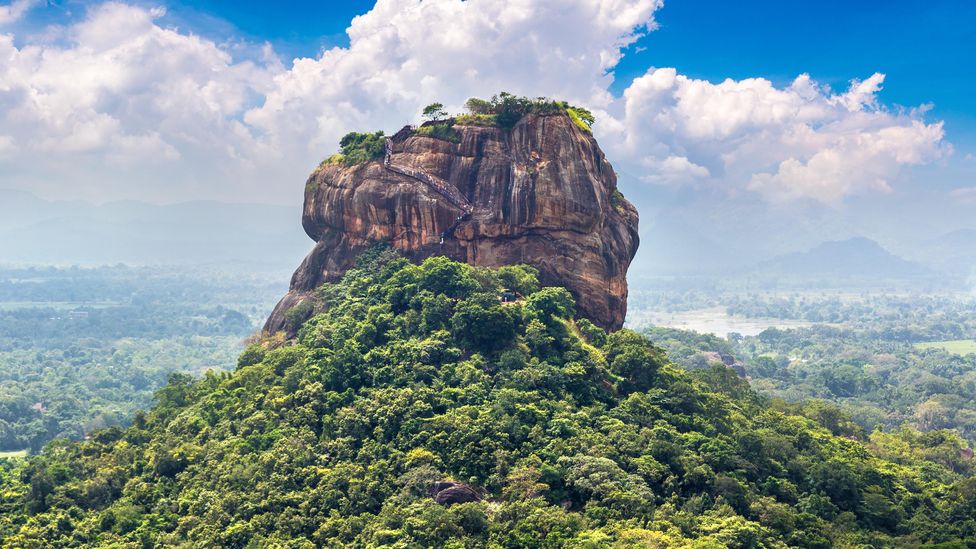
Sigiriya, an ancient rock fortress and former royal palace, is one of Sri Lanka’s most visited and best-known sights, attracting just more than one million visitors in 2019. But on this sunny day in May 2021, my partner and I were the only two people there.
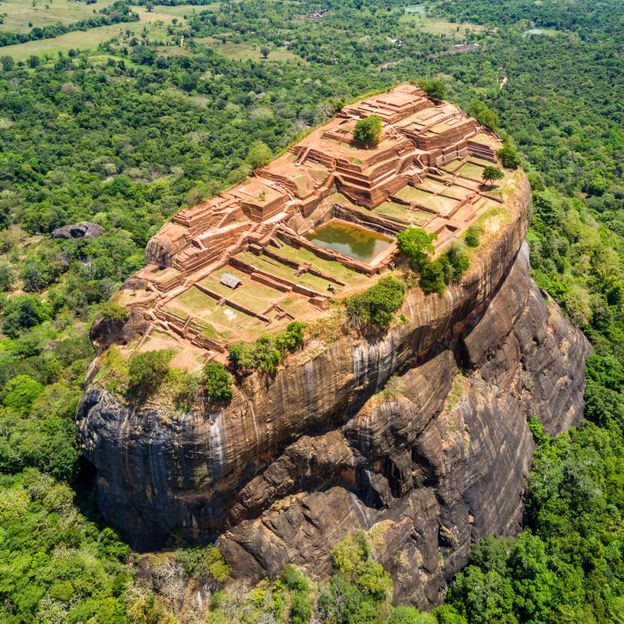
Dating back to 477 AD, Sigiriya is considered one of South Asia’s best-preserved examples of urban planning and one of its most important archaeological sites. The elaborate palace and its towering construction on top of the rock, as well as its risqué artwork, resulted in its 1982 listing as a Unesco World Heritage Site. However, its ingenious garden and water systems at the foot of the rock are what make it a national treasure.
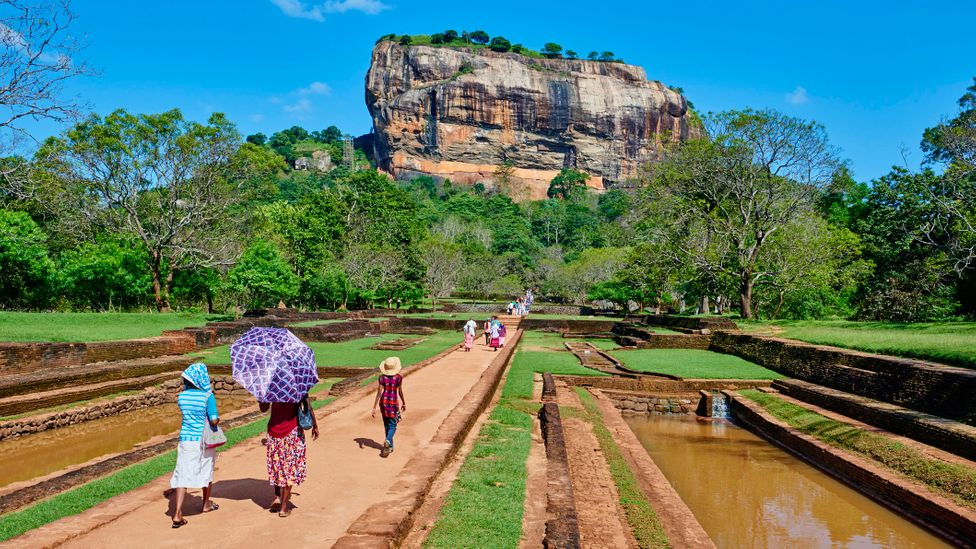
The gardens at Sigiriya are not only the best-preserved water gardens in South Asia but some of the oldest landscaped gardens in the world. Important guests in the 5th Century would have walked a path with the impressively designed water gardens on either side, serving as a grand entrance to the more than 1,200 steps leading up to the palace.
In his essay Sigiriya: City, Palace and Royal Gardens, Senake Bandaranayake, founding director of archaeology at Sigiriya, explained that the site is a brilliant combination of deliberate symmetry and asymmetry playing on both natural and geometric forms. “The gardens at Sigiriya consist of three distinct but interlinked sections: the symmetrical or geometrically planned water gardens; the asymmetrical or organic cave and boulder garden; the stepped or terraced garden circling the rock, the (miniature) water garden and the palace gardens on the summit of the rock,” he wrote.
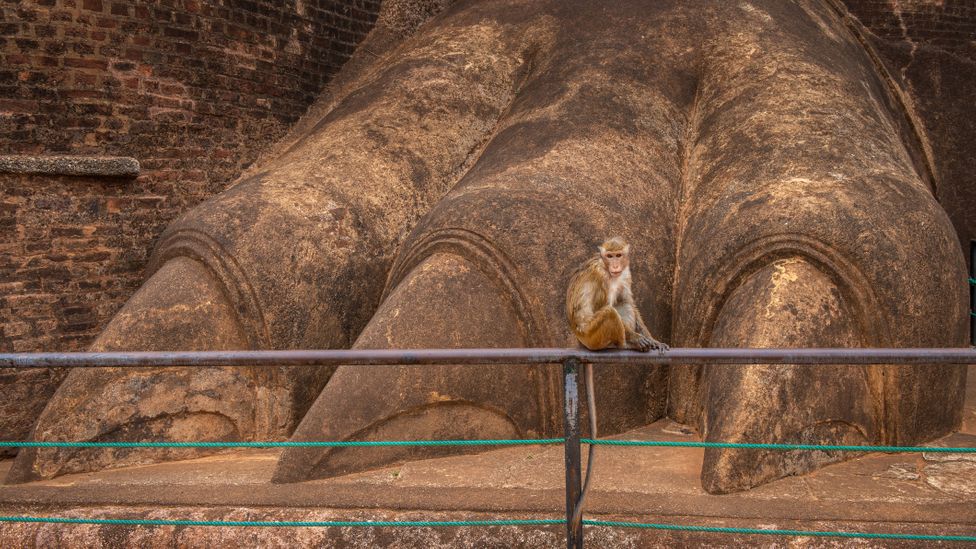
The 5th-Century palace was built to resemble a lion, with the paws flanking the main entrance (Credit: Boy_Anupong/Getty Images)
Within the gardens were artfully designed pools, fountains, streams and platforms that once held pavilions and performers. “For comparison, it would have looked similar to a modern luxury resort with beautiful gardens and swimming pools,” said Sumedha Chandradasa, a tour guide lecturer in Sri Lanka for more than 24 years.
Surprisingly, the detailed design of these gardens is not what’s most impressive; rather it’s how they work. These water systems are considered an engineering marvel due to the use of hydraulic power, underground tunnel systems and gravitational force that creates a visually spectacular system of pools and fountains still functioning almost 1,500 years later.
Some Sri Lankans still believe in ancient folklore that says all the water that fills the garden’s streams flows down from the pond at the top of the rock. In reality, the palatial complex’s water is sourced from a nearby reservoir, known locally as “tanks”. A series of underground conduit terracotta pipes use gravitational force and hydraulic pressure to send water from the Sigiriya tank (with a slightly higher elevation than the gardens) into the different pools, fountains and streams throughout the impeccably organised gardens.
However, some of the garden water does come from the top of Sigiriya. The pools at the top of the rock are filled with rainwater, and a series of drains cut into the rock connect to a large cistern, which feeds into the underground conduit system to help supply the gardens with water. “The total conception involves the knitting together of a number of hydraulic structures of varied scale and character in a single intricate network – a complex masterpiece of irrigation engineering design,” wrote Bandaranayake.
Bandaranayake also notes in his essay that during excavation, water conduits were found at different depths, likely to achieve varying water levels; something that required a masterful knowledge of physics and engineering.
Although the complex’s origins date to the 5th Century, the story of how it came to be seems more like a modern-day soap opera. Before Sigiriya, Sri Lanka’s royal capital was located in Anuradhapura, more than 70km to the north-west. A coup, led by King Dhatesena’s son from a non-royal consort, led to his bloody death and the scheming son, King Kasyapa, taking the throne.
Sigiriya is considered one of South Asia’s best-preserved examples of urban planning (Credit: Dmitry Malov/Getty Images)
Kasyapa moved the royal capital to Sigiriya, or “Simha-giri” which means “Lion Mountain”, and built a new palace on top of the rock. When approaching the stairs that lead to the top of the rock and the palace complex above, you see why. “The theory is, according to The Ancient Chronicles [Sri Lanka’s historical chronicles], that he built the palace to look like a squatting lion,” explained Jagath Weerasinghe, emeritus professor at the Postgraduate Institute of Archaeology and Sigiriya’s director of archaeology. “The lion paws are the main entrance that will take you to the top of the mountain.”
King Kasyapa ruled from there until 495 AD, when he abandoned it and the site became a Buddhist monastery.
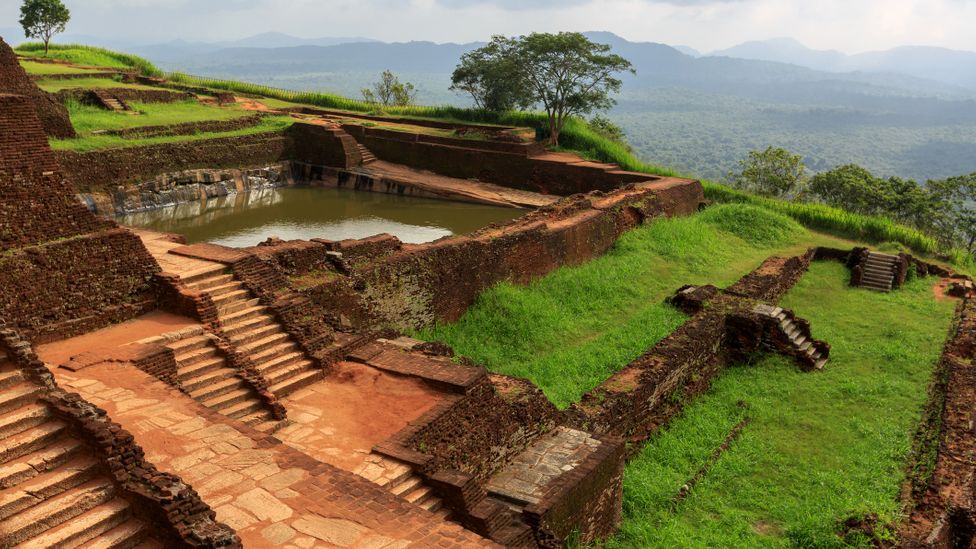
A welcome effect of visiting during the pandemic meant my partner and I had the entire complex to ourselves for several hours. While the once-plastered-and polished finishings of the water gardens have disappeared with time, we could still see the brick foundation outlines of the pools, fountains and streams that fill with water during the rainy season.
One area, known as the “miniature water gardens” (not-so miniature; measuring 30m wide and 90m long), was split into five sections with several unique features including a snake-shaped stream that required structural planning way ahead of its time. “A striking feature is the use of these water-surrounds with pebbled or marbled floors, covered by shallow, slowly moving water. These, no doubt, served as a cooling device and at the same time had great aesthetic appeal, creating interesting visual and sound effects,” wrote Bandaranayake.
According to Weerasinghe, these miniature water gardens would have been best experienced at night, under the moonlight’s reflection on the shallow pools. “There are very romantic aspects to the royal precinct of Sigiriya,” he told me. While the miniature water gardens are no longer as spectacular as they would have been in the late 400s, the low water levels and platforms in the pond have led archaeologists to believe that they were used for musical performances – an incredibly thoughtful design feature for that period.
We kept walking along the grounds in front of the rock, through the miniature water gardens to its snake-shaped stream, which holds Sigiriya’s signature water fountains. They are made of limestone plates with symmetrical holes, and even after 1,500 years, still work during the yearly monsoon rains. “Below the fountain is a small chamber where the water pressurises, forcing the water to bubble up into the fountain about four or five inches when the water level is high,” Chandradasa explained.
Stone steps leading into the pools indicate that they would have been used for swimming (Credit: Pavel_klimenko/Getty Images)
Theorised to have been used by the royal family and Kasyapa’s consort of women, these fountains and pools, especially the large pond on top of Sigiriya, were designed as swimming pools to give relief from the hot South Asian sun, complete with stone steps leading down into the water.
But beyond their beauty and practicality, the water gardens had another purpose. “Kasyapa wanted to present water in a particular way,” said Weerasinghe. As well as being used for pleasure, they also sent a strong message of his power and ingenuity to anyone who doubted King Kasyapa, especially Mahavihara monks, who made up the most powerful monastery in Anuradhapura and were in favour of his father.
As well as being used for pleasure, they also sent a strong message of his power and ingenuity to anyone who doubted King Kasyapa
“When you look at this elaborate and very intriguing way of using water at the royal precinct of Sigiriya, he’s telling something to these people about his power,” Weerasinghe added.
Past the massive stone lion paws, at the end of more than 1,200 precarious steps up Sigiriya, our clothes were soaked with sweat and I struggled to catch my breath. We walked the ruins of the central palace and stumbled upon the summit’s large pool. A dip in it like the ancient royals once did would have been tempting, but no rain in weeks and no royal servants to maintain it meant murky bacteria lurked on the surface.
From high above, the water garden system below was clear, perfectly centred and impressively aligned. The views of the lush green jungle melding with the blue horizon seemed endless. It was an ideal place for a palace with gardens worthy of the powerful king who built it.
“Just imagine during the rainy season, there are clouds sitting on this hill,” said Weerasinghe. “Then, you are walking through this garden and you see this big pond with these water waves coming down and the fountains gushing water. Just imagine what kind of an experience that would be.”
Designed to impress, the long path to the palace was flanked with pools and fountains (Credit: Tuul & Bruno Morandi/Getty Images)
Ancient Engineering Marvels is a BBC Travel series that takes inspiration from unique architectural ideas or ingenious constructions built by past civilisations and cultures across the planet.
—
Join more than three million BBC Travel fans by liking us on Facebook, or follow us on Twitter and Instagram.
If you liked this story, sign up for the weekly bbc.com features newsletter called “The Essential List”. A handpicked selection of stories from BBC Future, Culture, Worklife and Travel, delivered to your inbox every Friday.
Bangladesh is a Southeast Asian
country geographically but South Asian culturally. Myanmar-Bangladesh is a
bordering country. On the other hand, Thailand and Myanmar are neighboring
countries. There is close historical-geographical proximity among Myanmar,
Thailand, and Bangladesh. Trilateral relations amongst these countries were
good. The three states could benefit hugely from Myanmar-Bangladesh
Ties.
But a little problem between
Bangladesh-Myanmar has become an obstacle. Seven and a half lakh Rohingya Muslims
have come to Bangladesh to take shelter to save their lives from the atrocities
of the Myanmar army in 2017. Bangladesh is trying to repatriate them to
Myanmar. But Myanmar doesn’t want to take back them.
Then four years have passed. After
that, the initiative was taken to return the Rohingyas but it did not happen.
The initial initiative failed. This Rohingya refugee problem has created a long
distance between Bangladesh and Myanmar. As a result, the distance between
South Asia and Southeast Asia has increased. But if this problem is resolved
diplomatically, the whole southeast Asian countries including Thailand and
South Asian countries would benefit economically, socially, and culturally.
Bangladesh wants Thailand’s
cooperation in Rohingya extradition. Bangladesh wants to speed up the plan
after the process was suspended due to a coronavirus infection. As a
neighboring and friendly country of Myanmar, Thailand can and should mediate
the problem for ensuring the greater interest of the region. If the problem is
solved, then greater regional interest would ensure.
Thailand would be able to connect
itself by road with the BCIM (Bangladesh-China-India-Myanmar) corridor. The
BCIM corridor will be connected with the east-west corridor and the north-south
corridor of Thailand. This will establish direct communication between
Bangladesh, Myanmar, and Thailand. Again, using this medium, Bangladesh will be
able to go directly to Malaysia, Laos, and Vietnam. On the other hand, Thailand
and Myanmar will be able to enter into South Asia, Central Asia.
Thailand wants to establish trade relations with
Bangladesh. Connecting Thailand with the Bangladesh-China-India-Myanmar
Economic Corridor or the BCIM Economic Road Corridor will increase trade
between the two countries. Myanmar-Bangladesh good relations is very needed for
ensuring this.
As the Rohingya crisis has become a
regional and international issue, Thailand as a regional state can play a
significant role in the peaceful repatriation of Rohingya citizens who have
been forcibly displaced by Myanmar and taken refuge in Bangladesh. If the
Rohingya problem is not resolved soon, it could be an obstacle to peace and
progress in the region. The longer the Rohingya crisis cannot be resolved, the
more likely it is that the issue could become a breeding ground for
fundamentalism, exploited and manipulated by terrorists.
For decades, Myanmar has gone
through extreme cruelty to the Rohingya. Never cared about the law. The
Rohingya problem is not new to Bangladesh. This problem, which started in 1978,
became apparent in August 2017. More than 1 million Rohingyas fled to
Bangladesh to save their lives when the Myanmar army launched a brutal
operation against the Rohingya ethnic group. Bangladesh is seeking the
intervention of the United States, the European Union, and the United Nations
as well as the regional alliance ASEAN for a lasting and acceptable solution to
the Rohingya problem. On the other hand, there are also some Rohingyas who are
living in Thailand. There is no data on the total number
of Rohingyas
in Thailand, but unconfirmed reports suggest there could be between 3,000 and
20,000.
However, Bangladesh is now facing serious
problems for this artificial crisis committed by Myanmar. Some
socio-economic threats are rising in Bangladesh. Bangladesh has given shelter to
Rohingyas for humanitarian reasons. But because of this humanity, the country
is now at risk. As a result, there is a danger of Rohingyas spreading all over
the country, there are also many challenges
The forest is being uprooted, they
are cutting down the mountains and destroying them. There are also long-term
economic risks Socio-economic and political problems may also be evident, and
security risks may increase. Illegal narcotics trade, human trafficking,
prostitution, terrorism in Rohingya camps are increasing in camps.
Source: Internet
Bangladesh and Myanmar signed an
agreement to repatriate the Rohingya to Myanmar within two years in 2017 and
2019 respectively. The Myanmar authority did not take back the Rohingyas
according to the agreement. It is true that they don’t want to repatriate
Rohingyas in Myanmar. Bangladesh raised the issue in every international forum.
Many countries have supported Bangladesh. But Myanmar has no respect the
international law and norms. Some mighty powers may have been behind the scene.
Bangladesh Prime Minister has raised
the issue at UNGA on September 25, 2021, to draw attention to solving the
Rohingya crisis. She has focused especially on the engagement of ASEAN leaders.
It is ASEAN that can solve the Rohingya refugee problem easily.
As an active member of ASEAN,
Thailand can help to resolve it. Thailand can be an honest mediator in this
regard. Thailand has very warm relations with both Myanmar and Bangladesh. Various countries and international
organizations have taken various measures to solve the Rohingya problem. Former
UN Secretary-General Ban Ki-moon has criticized Myanmar authorities for being
lax in repatriating displaced Rohingya. UN Secretary-General Antonio Guterres
has expressed deep concern over the ongoing Rohingya crisis. Yang Lee, the UN special
envoy for human rights in Myanmar, said all major countries in the world had a
responsibility to resolve the Rohingya crisis.
In this regard, Thailand can and
should play a very significant role to solve the crisis such ways:
1) Thailand can support Bangladesh at
every international forum such as at UNGA, regional conferences. They can vote
in favor of Bangladesh. They can raise the issue in BIMSTEC and ASEAN
platforms.
2) Thailand can negotiate with Myanmar
diplomatically and bilaterally. It has good bilateral relations with Myanmar
3) Thailand can engage with other
regional states to resolve the crisis.
4) Thailand’s Buddhist society can play
an effective role in this regard. The relations of Buddhists between Myanmar
and Thailand are well established. Thai Buddhists can do it very easily.
Buddhism is more related to the establishment of Peace and non-violence. Thai
Buddhists can play a significant role in this regard. They can exercise the
path shown by the founder of Buddhism, Gautama Buddha. Buddhists will be
recognized as the Avatar of human rights if the Buddhist community plays a role
in resolving the Rohingya crisis. It will ensure regional to some extent world
peace and communal harmony.
5) Thai businessmen can engage to some
extent. Because stability in the region (for both South Asia and Southeast
Asia) is very needed for investment.
Why
Thailand should Play role in resolving the regional problem?
1) This issue is a humanitarian issue.
Rohingyas are the son of Land in Rakhine in Myanmar. They have birthrights to
reside in Myanmar.
2) It is an issue of
Justice. According to Luther king, Junior “Injustice anywhere is a threat
to justice everywhere.” Myanmar authorities committed genocide. The perpetrators
should be under international legal jurisdiction.
3) It is the issue of the
region. The whole of South Asia and South East Asia may be volatile for this
issue. As a South Asian state, Thailand has some responsibilities.
4) Thailand has very good relations
with both Myanmar and Bangladesh.
5) Enhancing bilateral relations could contribute to the growth
of trade and investment relations with ASEAN and SAARC countries. This will
create an opportunity to serve greater regional interests.
6) Re-establishing
the Himalayan-South Asian connectivity can occur if political and diplomatic
solutions of Bangladesh-Myanmar strained ties can be found.
7) Bangladesh has been supporting Thailand at every
international forum. Now it is time and duty for Sri Lanka to stand in favor of
Bangladesh in her crisis moment. Thailand-Bangladesh
relations have the potential to further strengthen ties for regional and global
peace, progress, and prosperity.
8) For greater regional connectivity such as implementation of
BCIM, Asian High way project.
9) To create opportunities for Thai investors to access the
South Asian markets easily.
10) Rohingya
refugee crisis and internal crisis in Myanmar can be regional crises. Thailand
can be a sufferer. Terrorism, insurgent movement, illegal narcotics trade,
human trafficking are some concerning issues.
11) To
strengthen trilateral ties amongst Thailand, Myanmar, and Bangladesh for the
interest of the people.
However, Thailand is a
close friend of Bangladesh. Bangladesh has a long history of trade and cultural
ties with Thailand. Thailand has been cooperating with Bangladesh since
independence in 1971 under the leadership of the Father of the Nation
Bangabandhu Sheikh Mujibur Rahman. Thailand should consider these issues. Thailand should do
some things in favor of Bangladesh regarding Rohingya refugee repatriation to
Myanmar. Thailand can make Myanmar understand and agree in this regard.
Thailand can play a very significant
role in this regard. Thailand can mediate to bolster the strained relations
between Bangladesh-Myanmar. Thailand can play to repatriate the Rohingyas in
Rakhine in Myanmar. Thailand can easily resolve the problem because it has very
good relations with Myanmar.
However, as a well-wisher friend and
partner in the development process and trade, Bangladesh can expect cooperation
and support from Thailand regarding the repatriation of Rohingya refugees to
Myanmar. Bangladesh deserves it. So, Thailand should help, support
Bangladesh and mediate in resolving the crisis as soon as possible.
I
was very sad to hear of the passing of Douglas Wickremeratne in London on
December 01, 2021. He was in touch with me regularly by forwarding posts until
the last and I used to reciprocate.
He
has a huge claim for the gratitude of Sri Lanka and its patriotic people for
the stand he took soon after the civil unrest in July 1983, when he alone stood
up to fight the disinformation campaign of the country’s detractors in London.
His brave stand triggered others, primarily Sinhalese in many parts of the
world, to come out in support of national unity, territorial integrity, and an
undivided Sri Lanka. He gave leadership to this cause in an unblemished
manner.
Douglas acted as a de facto representative on behalf of the Sri Lanka
High Commission in London to combat increasing false allegations against the
country, the Army, and the Sinhala people engineered by the LTTE and their
supporters. The latter had planned these campaigns for a long time early and
the Govt. machinery including the Sri Lankan Embassies was caught off
guard.
Furthermore, the Sri Lanka High Commission in London as a matter of
protocol was required to obtain prior permission from the Foreign Ministry in
Colombo before responding to any sudden development, for example, a bomb
explosion. Its hands were tied. When permission was granted for the Sri Lanka
High Commission by the Foreign Ministry in Colombo to issue a
written statement authorized by the latter it was too late. The delay
had resulted in the stable door getting closed, and the horse bolting away.
Overseas Sri
Lankans’ Organization for National Unity (OSLONU)
Around
the same time, Sri Lankan expatriates in Melbourne formed the Overseas Sri
Lankans’ Organization for National Unity (OSLONU) at a public meeting held at the
University of Melbourne in September 1983 under the leadership of Professor
C.G. Weeramantry who was elected as the first President of OSLONU. He delivered a
brilliant oration on this occasion entitled ‘A Plea for National Unity and an
Undivided Sri Lanka’.
Dr.
Ranjith Hettiarachi and H.L.D. Mahindapala was elected as the Joint
Secretaries. Senaka Weeraratna served as Assistant Secretary jointly with
Astrid Edrisinha. Dr. Olga Mendis (Hony. Treasurer), and Soma Perera, Tony
Edrisinha, Chris Lawton, Eddie Gray, and Hanif Badurdeen, were elected as
Committee members. All of them were founder members.
It
grew into a sizable body to counter anti – Sri Lanka propaganda worldwide. Sri
Lanka newspapers carried statements of OSLONU regularly. Even Australian
academics at the University of Melbourne who attended the inaugural
sessions of OSLONU later commented that they have now realized that there
was another valid and highly tenable point of view contrary to what the LTTE
detractors were saying. OSLONU used to liaise constantly with Douglas
Wickremeratne.
Douglas
is an old Anandian. At Ananda College in 1953, he was a classmate of Indrajith
Malalasekera (son of Dr. G.P. Malalasekera), D.B. Nihalsinghe (filmmaker),
Ananda K. Wijetunga, Ranjith Rathnayake, Palitha Premasiri (Cricket Captain
1957), Neville Gajaweera, and Dr. Ranjith Hettiarachi.
Sinhala
Association in the UK
Douglas
was the founder of the Sinhala Sangamaya in London thereby ensuring that
Sinhala expatriates were able to maintain close cultural links with their
motherland. They organized cultural shows by bringing famed Musicians to London
on an annual basis including W.D. Amaradeva, Sinhala film shows, Vesak
festivities, Sinhala and Tamil New Year celebrations, and they funded the
dispatch of provisions to help villages in heavy rain-affected areas in Sri
Lanka and financed repairs to Ancient Water Tanks in the hinterland. The
Sinhala Sangamaya also invited Ven. Madihe Pannasiha Nayake Thera, Elle
Gunawansa Thera, Professor (Dr.) Nalin de Silva, and Minister Cyril Matthew,
among others to address gatherings in London.
Douglas represented the Sinhala Association in
the U.K. He bravely faced the country’s detractors in the west including LTTE
supporters on all T.V. and radio debates, and in turn, won the hearts of
the well-wishers of Sri Lanka in Britain and elsewhere.
World
Federation of Sri Lankans
Douglas was a founder member of the World Federation of Sri Lankans and a distinguished speaker at the inaugural sessions of the World Federation held in Toronto in 1984. Dr. Jeeva Ganepola ( New Jersey, USA) was elected as its First President. The Sri Lanka United National Association of Canada under the leadership of its President Tilak Wickremasinghe hosted this event.
The
Sinhala Sangamaya hosted the Second Convention in London in 1986 where Douglas
was duly elected as the second President of the World Federation. Several
distinguished speakers from Sri Lanka including Minister Lalith Athulathmudali,
Anura Bandaranaike (Leader of the Opposition), Earnst Corea, Dr. Jeeva Ganepola
(USA), H.L.D. Mahindapala (Australia), Dr. Walter Jayasinghe (USA),
and Walter Jayawardana (Los Angeles, USA) spoke at this
International Conference.
Sri
Lanka United National Association of Canada published the first ‘Overseas Sri
Lankan’ Journal which was distributed at the London Convention in 1986.
Even
the Govt. of Sri Lanka gave him high recognition and VIP treatment when he
visited Sri Lanka as the President of the World Federation at that time. The
interviews that Douglas gave to British TV Channels won him star status and a huge
following of admirers both within and outside Sri Lanka. He was the pride of
the nation as he was performing better than any of our diplomats stationed
overseas. In almost every conversation on the subject of civil riots in
Sri Lanka in the mid-eighties Douglas name invariably came up in admiration.
Prime
Minister R. Premadasa hosted a meeting at the Office of the Prime Minister in
Colombo in 1985 to gauge the views of the overseas-based Sri Lankans. Douglas
Wickremeratne, Dr. Ranjith Hettiarachi, Senaka Weeraratna, Dr. Jeeva Ganepola,
Jayantha Dhanapala were among those who attended this discussion.
The
Rupavahini conducted a TV Program in 1985 focused on the contributions that the
Overseas Sri Lankans were making to the cause of combating anti – Sri Lanka
propaganda. It had Douglas Wickremeratne, Dr. Ranjith Hettiarachi, and Senaka
Weeraratna as the participants. M.J. Perera, Civil Servant, was the Chairman of
the Rupavahini at that time.
In
January 1987 a meeting was held at the residence of Senaka Weeraratna in
Colombo and attended by visiting Sri Lankans to review the progress being made
in protecting the fair name of Sri Lanka internationally. Professor C.G.
Weeramantry, Douglas Wickremeratne, Mahinda Gunasekera, Hema Jinadasa, Senaka
Weeraratna, and a couple of others were present.
Douglas
is a real hero by any definition. He is an old Anandian with a firm commitment
to the ‘ Rata, Jathiya, Agama’ idea. The adage ‘ Come the hour, Come the
man’ was strikingly illustrated in the manner that Douglas Wickremeratne
stepped forward to defend Sri Lanka in the hallowed portals of elite British
institutions, Universities, and mainstream T.V. Channels. He scored debating
points convincingly in front of British TV audiences.
May
Sri Lanka find the strength to show remembrance and gratitude at a national
level to this great Patriot. A man with such a backbone and spine is a vital
need for the country more so today
He
deserves a commemorative postage stamp issued in his honour.
Police arrested 126 people, identifying some culprits from the selfies.6.12.21
A PERSON PLACES AN EARTH OIL LAMP IN KARACHI ON DEC 5 TO PAY TRIBUTE TO PRIYANTHA DIYAWADANAGE, THE LATE SRI LANKAN FACTORY MANAGER WHO WAS BEATEN TO DEATH AND SET ABLAZE BY A MOB WHO ACCUSED HIM OF BLASPHEMY IN SIALKOT, PAKISTAN. PHOTO: RIZWAN TABASSUM / AFP
A Sri Lankan man accused of blasphemy was lynched and his body set ablaze by workers he oversaw at a factory in the city of Sialkot in northeastern Pakistan.
Priyantha Diyawadanage, 48, the general manager at Rajco Industrustries, was targeted by the violent mob following rumors that he was tearing stickers bearing the name of the Prophet Muhammad. World News
On Friday, Dec 3, a few dozen workers began protesting outside the factory gates against Diyawadanage, accusing him of blasphemy. The crowd swelled to the hundreds as local residents began to join in, causing a traffic jam in the vicinity.
Fearing the mob, Diyawadanage rushed to the factory roof but was charged upon by throngs of people chanting anti-blasphemy slogans used by the fundamentalist political party Tehreek-e-Labbaik Pakistan (TLP). In a video, Diyawadanage could be seen clinging desperately to his colleague Malik Adnan, who was trying to shield him from the oncoming crowd.
Chilling videos circulating across social media show the crowd hurling Diyawadanage onto the ground, tearing off his clothes and ruthlessly beating him. The mob proceeded to torture Diyawadanage using stones and iron rods until he became motionless. The mob then set Diyawadanage on fire. In some videos, a few people are seen taking selfies with the corpse.
Due to the renovation of the factory building, some posters were taken off from the wall. They may have desecrated posters bearing the name of Prophet Muhammad. Maybe the manager was lynched because of that,” police assistant comissioner Murtaza Muhammad told the press.
Unfortunately, I can’t affirm or deny anything at the moment. The alibi used for murder is blasphemy but the cause of murder appears personal and targeted. The issue is being investigated,” he said. The province’s police chief also said that police were notified of the incident at 11:28 a.m. and reached the spot at 11:45 a.m.
SECURITY OFFICIALS GATHER NEAR THE PREMISES OF A FACTORY IN SIALKOT, PAKISTAN AFTER POLICE CONFIRMED THAT SRI LANKAN NATIONAL PRIYANTHA DIYAWADANAGE, A FACTORY MANAGER, WAS BEATEN TO DEATH AND SET ABLAZE BY A MOB ON DEC. 3. PHOTO: AFP
A police report has been registered against 900 people for the murder, which include charges of terrorism. Around 126 have been arrested so far. Police have revealed that 57 suspects have been identified through CCTV footage out of which 25 have been detained. Raids are underway to track down the remaining suspects. Police are also currently analysing data from 160 CCTV cameras along with cell phone videos, mobile data and phone logs.
Diyawadanage’s wife Nilushi Dissanayaka has denied the allegations of blasphemy against her husband. I totally reject reports that said my husband tore down posters in the factory. He was an innocent man,” she told the BBC.
Diyawadanage was reportedly a Christian. VICE World News could not immediately verify this.
He was very much aware of the living conditions in Pakistan. It is a Muslim country. He knew what he should not do there and that’s how he managed to work there for eleven years,” Dissanayaka said.
According to Adnan, who is set to receive the national Tamgha-i-Shujaat award for attempting to save Diyawadanage’s life, the stickers were being temporarily removed for a clean-up, which was part of factory protocol.
In response to the incident, Prime Minister Imran Khan tweeted: The horrific vigilante attack on a factory in Sialkot and the burning alive of a Sri Lankan manager is a day of shame for Pakistan. I am overseeing the investigations. Let there be no mistake: All those responsible will be punished with the full severity of the law.”
In a tweet, Sri Lankan Prime Minister Mahinda Rajapak said: Sri Lanka and her people are confident that Prime Minister Imran Khan will keep to his commitment to bring all those involved to justice.”World News
Khan’s special representative on religious harmony, Tahir Ashrafi, has said that police are investigating the case from various angles, including that some factory workers might have played a religious card to take revenge on the manager.”
Blasphemy is a highly contentious issue in Pakistan, and people accused under its blasphemy laws can be sentenced to death. Critics say false reports of blasphemy are rampant, and the law is often abused to settle personal issues with people from minority groups. Since 1990, around 77 people have been killed in vigilante mob attacks that stemmed from blasphemy allegations. While human rights activists have been calling for an end to the colonial-era blasphemy law, the TLP has succeeded in having the government keep it in place, through several violent protests since 2017.
Few other religious groups got the same type of media visibility that TLP got in its early days. If any other group behaved like TLP did they would be dealt harshly by the state, as has been the case with nationalist groups,” Freelance journalist and web developer Fahad Desmukh told VICE World News. But instead the government repeatedly negotiated and made compromises with the TLP, and despite later being banned were able to continue operating freely – even contesting elections and receiving well wishers from the government.”
PROTESTERS CARRY PLACARDS IN KARACHI ON DEC 4, AGAINST THE KILLING OF PRIYANTHA DIYAWADANAGE, A SRI LANKAN FACTORY MANAGER IN SIALKOT, PAKISTAN. PHOTO: RIZWAN TABASSUM / AFP
The TLP has denied any connection to the incident. While the incident is tragic, what’s equally sad is linking the TLP to it. We call for an independent and transparent investigation and those responsible to be arrested and exposed. When the rule of law prevails, no one will dare take the law into their hands,” a TLP spokesman told local press.
However, the mob was caught on camera using a blasphemy slogan that most Muslim scholars distance themselves from, but which the TLP uses and has popularized through viral internet videos.
There is an ecosystem through which these messages circulate – from speeches at rallies, to mainstream media, to bit-sized social media content savvily edited together with catchy music and slick graphics, to homes and schools, to sites of violence,” said Desmukh.
The episode has been widely condemned in Pakistan, with protests condemning the attack. Prominent religious scholars have denounced the lynching.
Diyawadanage’s body is expected to be returned to Sri Lanka on Dec 6.
A girl along with others carries a sign, condemning the lynching of the Sri Lankan manager of a garment factory after an attack on the factory in Sialkot, during a protest in Lahore. ReutersThe lynching of Sri Lankan national, Priyantha Kumara Diyawadana, a factory manager, by an enraged mob apparently provoked by blasphemy against Islam, has been a cause of anger and despair across Pakistan. Prime Minister Imran Khan called it ‘a day of shame’, and even far-right Tehreek-Labbaik-Pakistan (TLP) had condemned the act.
The lynching was dreadful because the mob pulled out the dead body of the victim and burned it, and even took selfies with the burning body. It is being revealed that the blasphemy charge was only a pretext, and that the workers were unhappy with the manager who was strict. This could very well be the case. But it makes the issue even more dangerous. Even lynching a man other than for religious reasons remains a heinous crime. The use blasphemy as a cover for the savage deed makes it explosive. It shows that religious extremists and miscreants are unholy partners in crime.
Pakistan rulers, including the army, and the influential sections of society, have always been seriously concerned with the rise of religious extremism in the country, and how it is undermining the political foundations of the country which is based on democracy and rule of law. Detractors of Pakistan may want to spread the message that the country carved out for Muslims in the Indian sub-continent in 1947 spreads the message of fanaticism. Historians and political analysts have shown that the Islamisation project ushered in by military ruler Zia-ul-Haq from 1978 to 1988 was not what Pakistan set out to be in 1947, and time and again political parties fought for a democratic set up and constitutional rule. It is believed that Prime Minister Khan’s Tehreek-e-Insaaf Party has flirted with Tehreek-e-Labbaik Party, but Mr Khan now in power has been compelled to deal with TLP and not give them the license to act as they like.
The rise of religious extremism is not peculiar to Pakistan, but in Pakistan political parties have sought to take advantage of religious sentiments to gain political mileage in the last quarter century and more. It has coincided with the political success of the Taliban in Afghanistan in 1996 and then again in 2021. The puritanical regime in Kabul has emboldened in indirect ways puritanical and fanatical elements in Pakistan. It has been a source of inspiration for Tehrik-e-Taliban Pakistan (TTP), which poses a direct challenge to civilian authority in the country.
The lynching of the Lankan national has put even the religious conservatives on guard because the realization has grown that these episodes of fanatical fury give a bad image to Pakistan in the world, while also projecting religion in a bad light. Prime Minister’s representative on religious harmony and religious scholar Tahir Ashrafi said, Police experts are investigating this case from various angles, including that some factory workers played a religious card to take revenge on the manager. Human rights activist Mehnaz Rehman said, He was killed on false charges of blasphemy.”
All the people who matter in Pakistan have come round to the view that the rage of religious fanatics cannot be condoned, and that it does not contribute to social stability. It would be necessary to sustain this sense of penitence in the country to send a clear message to the extremists in the country that people will not tolerate the misuse of religion for acts of terrorism and vandalism. Pakistan has been a hapless victim of terrorism within its own territory apart from the negative image that the country is epicentre of religion-based terrorism. That is why, Pakistan is under the purview of Financial Action Task Force (FATF) which keeps a watch on money-laundering and the financing of terrorism.
A man along with others carries a sign, condemning the lynching of the Sri Lankan manager of a garment factory after an attack on the factory in Sialkot, during a protest in Lahore, on Dec 4. — Reuters
WASHINGTON: The Sialkot tragedy will have a horrible impact on our efforts to promote Pakistan in the US Congress,” says Dr Rao Kamran Ali, who heads the Pakistani American Political Action Committee.
Wajid Hassan of the Pakistani American Congress fears that this incident will have a long-lasting effect. Every time we go and talk about Pakistan, they will ask about the Sialkot incident.”
Agha Hasnain, a Pakistani runner who has run 135 marathons in each of the 50 US states, says that whenever he gets a chance, he talks about Pakistan after an event. But now, it will be very difficult to do so. This is unbelievably bad news for Pakistan.”
President PTI Washington, DC Junaid (Johnny) Bashir says he is ‘devastated.’ We need to act now, arrest all those responsible and ensure that all of them are punished.”
Khawar Shamsul Hassan, a Pakistani American entrepreneur, agrees. It is the perceived and real absence of law and order and accountability that emboldens the extremists to do such things,” he says.
The incident has jolted the Pakistani American community like the Peshawar school tragedy did in 2014. From Los Angeles, California, to Baltimore, Maryland, Pakistani Americans have posted hundreds of thousands of messages on social media, expressing their grief, anger and fear.
They have turned the country into a madhouse,” says Bushra Ahmed of Baltimore. Who will bell this insane cat?” asks Ras Siddiqui of Sacramento, California.
Mr Hassan of the Pakistani American Congress, who is from Seattle, Washington, says his group has been lobbying for Pakistan for the last eight years. Every now and then, something happens that tarnishes the country’s image,” he says.
This indicates that we have no tolerance for religious minorities in Pakistan. It will have a negative impact on everything, from tourism to investment,” he adds. American lawmakers will be asking about it every time we go to discuss Pakistan with them.”
He thinks that it will also impede Pakistan’s effort to come off the FATF gray list and will be mentioned in international reports on religious intolerance as well.
Dr Khalid Abdullah of the Physicians for Social Responsibility NGO suggests reconsidering policies and laws that encourage such violence. Burning someone alive! No, people are not going to forget it anytime soon. We have crossed the limits of narrow-mindedness.”
Dr Ali of Pak Pac, who lives in Dallas, regrets the failure of the Pakistani state in curbing such activities. When something so horrible happens, something that is also evidence-based, it is difficult to deal with,” he says. TLP committed such atrocities before too. Then it made a truce. It went back to violence and made another pact with the authorities! How long will this continue?” he asks. This must stop.”
We are so ashamed! No word can describe our feeling,” says Mr Bashir of PTI, who lives in Virginia. Americans already have a bad image of Pakistan, and this makes it worse. The only way to deal with it is to give exemplary punishment to the perpetrators.”
Mr Hasnain, the runner from Virginia, says his daughter showed me the news and asked: ‘What’s happening in Pakistan?’ I said those are foolish people. But she, ‘that’s not an answer. Tell me how they let this happen?’”
Our state has backed down many times in the face of street power and that sends the wrong message. This must stop now,” says Mr. Hassan, the entrepreneur from Maryland.
Prime Minister Imran Khan presides over a meeting on Monday called to review the overall security situation in the country. — Photo courtesy Prime Minister’s Office
Prime Minister Imran chaired a high-level meeting of the country’s civil and military leadership on Monday to review the overall security situation in Pakistan after the brutal mob lynching of a Sri Lankan national in Sialkot last week.
The meeting was attended by Chief of Army Staff General Qamar Jawed Bajwa, National Security Adviser Dr Moeed Yousuf, Information Minister Fawad Chaudhry, Interior Minister Sheikh Rashid Ahmed, Punjab Chief Minister Sardar Usman Buzdar and other senior military and civil officers.
According to a statement issued by the Prime Minister’s Office, the participants resolved to bring the perpetrators involved in the Sialkot lynching to justice.
A mob comprising hundreds of protestors, including the employees of a factory where Priyantha Kumara worked as a manager, had tortured him to death on Friday and later burnt his body over blasphemy allegations.
Subsequently, a first information report was registered against 900 workers of Rajco Industries, and scores of suspects have been arrested since then.
According to the the PMO, the participants of today’s security meeting were of the view that individuals and mobs could not be allowed to take the law into their hands and such incidents could not be tolerated.
The country’s civil and military leadership expressed serious concern over Kumara’s lynching, stressing the need for implementing a comprehensive strategy to curb such incidents and ensuring “strict punishment” for all the perpetrators, the PMO said.
It added that the participants also acknowledged the act of bravery by one of Kumara’s colleagues, Malik Adnan, who was seen confronting a group of angry men in an attempt to save the former in a video of the incident.
“Malik Adnan […] endangered his own life to save Priyantha Kumara,” the PMO’s statement said, adding that the participants of the meeting also conveyed their deepest condolences to the family of late Kumara.
Widespread condemnation
The condemnation of Kumara’s killing in today’s meeting was the latest expression of disapproval of the incident by the country’s leadership. The incident has drawn a strong reaction and widespread condemnation from across the country.
Hours after the incident was reported on Friday, Prime Minister Imran Khan had condemned the “horrific vigilante attack” on the Sri Lankan man, calling it “a day of shame for Pakistan”.
“Let there be no mistake all those responsible will be punished with full severity of the law,” he had tweeted.
Similar sentiments were expressed by President Arif Alvi, other politicians, diplomats and activists.
Amid countrywide outrage over the incident, Human Rights Minister Dr Shireen Mazari also said today that the government had decided to review the National Action Plan (NAP) on counter-terrorism in the wake of the brutal lynching of Kumara.
Speaking exclusively to Dawn.com, the minister rued the recurrence of such incidents and called for “strict government action”, terming it the “need of the hour”.
Govt expresses serious concern over cruel act of killing a Sri Lankan national in Sialkot, aims to bring perpetrators to justice
Prime Minister Imran Khan chairs a meeting to review overall security situation in the country in Islamabad on December 6, 2021. — PM Office
ISLAMABAD: The government on Monday decided to implement a comprehensive policy to control violence after a mob lynched a Sri Lankan national in Sialkot.
Last week, hundreds of people, including workers from the factory, had tortured the foreigner, Diyawadanage Don Nandasri Priyantha, to death and later burnt his body over blasphemy allegations.
According to a statement issued by the PM Office, the decision to implement the strategy came during a meeting chaired by Prime Minister Imran Khan in Islamabad, where the overall security situation in the country came under review.
“The meeting expressed serious concern over the cruel act of killing of Sri Lankan national Priyantha in Sialkot and expressed the resolve to bring the perpetrators to justice,” the statement read.
The participants of the meeting were of the view that individuals and mobs cannot be allowed to take the law into their hands and such incidents cannot be tolerated.
“Therefore, a comprehensive strategy shall be implemented to curb such incidents and strict punishments to all the perpetrators shall be ensured,” the statement said.
During the meeting, the participants praised the bravery and courage of Malik Adnan who endangered his own life to save Diyawadanage and conveyed deepest condolences to the family of the deceased.
The meeting was attended by Information Minister Fawad Chaudhry, Interior Minister Sheikh Rasheed Ahmed, Chief of Army Staff General Qamar Jawed Bajwa, National Security Advisor Dr Moeed Yousaf, Chief Minister Punjab Sardar Usman Buzdar, senior military and civil officers.
Remains sent off to Colombo
Earlier today, the remains of the factory manager were sent off to Colombo. Sri Lankan embassy officials arrived at the hospital to escort Priyantha’s body to the airport and laid flowers over it.
Priyantha’s last rites will be performed upon the arrival of his body in Sri Lanka.
Twenty-six suspects arrested in connection with the lynching of the Sri Lankan factory manager have been remanded into police custody.
The police presented the suspects before an anti-terrorism court earlier in the day and requested their remand for interrogation.
During the hearing, the names of the suspects were called out to mark their presence. All the suspects responded to their names except for one, named Shoaib alias Gonga (speech impaired).
The investigation officer informed the court that Shoaib is speech impaired.
The police requested the court to grant 15-day remand of the suspects for interrogation which the court accepted and ordered the investigation officer to present them on December 12.
So far, a total of 131 suspects have been arrested in connection with the Sialkot lynching case.
The incident
Priyantha, working as a manager at a private factory in Sialkot, was lynched on Friday by a mob after being accused of blasphemy.
The gruesome incident was dubbed by PM Imran Khan as “a day of shame for Pakistan”.
Workers of a garment industry, located on Sialkot’s Wazirabad Road, had alleged that the foreigner had committed blasphemy. He was subsequently lynched and his body set on fire.
The mob had also vandalised the factory and blocked traffic, according to the police.
The brutal murder drew widespread condemnation from senior government functionaries, including the prime minister and president, as well as the military’s top leadership, who promised to bring all those involved to the book.
The remains of Sri Lankan national Priyantha Kumara, who was lynched by a mob in Pakistan’s Punjab province, reached the island a short while ago.
The body was repatriated on Monday, even as Pakistani authorities arrested more suspects involved in the grisly incident that shocked people across the world.
The remains were airlifted by SriLankan Airlines flight UL 186 at 12.30 p.m. from Lahore and arrived at the BIA in Katunayake at 5.00 pm via UL 186 from Lahore (12.30 pm).
The remains will be handed over to his next of kin today (06) at the BIA, the foreign ministry said.
The wooden coffin has the words: Human remains of late Don Nandasri P Kumara Diyawadanage. From Lahore to Colombo”, transcribed on it.
A mob of over 800 men, including supporters of hardline Islamist party Tehreek-e-Labbaik Pakistan (TLP), attacked a garment factory and lynched its general manager Priyantha Kumara Diyawadanage and set him on fire over allegations of blasphemy on Friday last in Sialkot district, some 100 km from Lahore.
The officials of the Sri Lanka High Commission arrived here early Monday morning and the body was handed over to them at the Lahore airport by Punjab minorities minister Ijaz Alam. The body was transported on the Sri Lankan Airlines flight,” a Punjab government official told PTI.
Meanwhile, Punjab Police claimed to have arrested seven more prime suspects allegedly involved in the lynching of 49-year-old Kumara.
A total 131 suspects, including 26 main ones, have been arrested so far. The 26 prime suspects have played a key role in inciting the people, lynching Kumara and setting his body ablaze,” the Punjab Police said in a tweet on Monday.
Some 15 prime suspects were presented before the Anti-Terrorism Court Gujranwala on Monday where they were remanded in police custody for 15 days.
According to police, after brutally killing Kumara, the mob also wanted to kill the factory owner and set the building on fire.
The mob wanted to set on fire the entire factory after lynching Kumara. A group of charged workers headed towards the residence of the factory owner to kill him, but timely action by police prevented further violence,” Sialkot District Police Officer Omar Saeed said.
Earlier, narrating the sequence of the gruesome incident, Inspector General Police (Punjab) Rao Sardar Ali Khan had said: A mob of over 800 men gathered and attacked the factory at 10 am Friday after reports emerged that Kumara had torn a sticker/poster inscribed with Islamic verses and committed a blasphemy. They searched for him and found him on the rooftop. They dragged him, beat him severely and by 11.28 am, he was dead and the body was set on fire by the violent mob.”
Kumara was working as general manager in Rajko industries, which deals in sportswear, for the last seven years.
The horrific incident sparked outrage across Pakistan with all sections of the society condemning it and calling for the culprits to be punished.
According to the post-mortem report, nearly all bones of Kumara were broken and his body was 99 per cent burnt in the horrific lynching incident.
Kumara had gone to Pakistan in 2011 after he got a job as a mechanical engineer at an apparel factory in Faisalabad. After a year, he joined Sialkot’s Rajco Industries as its general manager and was the only Sri Lankan national working in the factory.
He is survived by his wife and two sons aged 14 and 9.
Litro Gas Lanka Limited has commenced the distribution of domestic LP gas cylinders, conforming to the requirements of the Consumer Affairs Authority (CAA).
The CAA said that the new stock of LP gas cylinders can be identified by the shrink bundling film of the gas cylinder valves (the polythene seal), which will carry a red logo on a white background (See the image above).
Following a discussion held yesterday with State Minister Lasantha Alagiyawanna, Litro Gas Lanka Limited and Laugfs Gas PLC, the two largest suppliers of LP Gas in Sri Lanka, had agreed to resume the supply of domestic LP gas, conforming to the guidelines of the Consumer Affairs Authority (CAA).
The Consumer Affairs Authority on December 04 gave its approval to release liquefied petroleum gas (LPG) to the market under three conditions.
A decision was taken to commence distribution of domestic gas with effect from yesterday (December 05) under the following three conditions:
01. Not releasing previously imported LP gas stocks to the market.
02. Adding Mercaptan (also known as methanethiol) to new stocks before they are released to the market, enabling the consumers to identify any leaks by its odorant.
03. Testing one per every 100 gas cylinders during the manufacturing process, serializing and producing them to the CAA.
Meanwhile incidents related to gas cylinders continue to be reported from various parts of the country.