Litro Gas Lanka Limited, one of the largest liquefied petroleum gas suppliers in Sri Lanka, says unloading and distribution of LPG from a latest shipment is currently underway.
According to the chairman of the company, Mr. Theshara Jayasinghe, two more ships with LP gas, docked near the Kerawalapitiya Terminal, are awaiting the approval of Sri Lanka Standards Institute (SLSI) and Consumer Affairs Authority (CAA).
Joining Ada Derana’s BIG FOCUS program earlier today, the Litro chief stated that a total of three ships carrying LP gas have arrived in Sri Lanka.
One of these was given the go-ahead to unload the LP gas shipment following a spot check conducted yesterday, he added. It has the necessary facilities to meet the required level of ethyl mercaptan, Mr. Jayasinghe said adding that the remaining two ships are being inspected at present while the other is currently unloading its LPG consignment.
Litro Gas Lanka Limited has been given the nod to unload one of the two latest shipments of liquefied petroleum gas.
Earlier this week, the Consumer Affairs Authority (CAA) directed Litro Gas not to unload the latest shipment of LP gas as it does not comply with the SLSI standards.
Ada Derana had reported yesterday that the latest shipment of liquefied petroleum (LP) gas that had arrived in Colombo Port for Litro Gas, one of the main suppliers of LPG in Sri Lanka, does not comply with the required level of ethyl mercaptan.
Ethanethiol, commonly known as ethyl mercaptan, is added to natural gas as an odorant, usually in mixtures containing methane. It is what makes propane gas smell and is an additive that is combined with LPG to alert users of a leak.
After the ship recently docked at the Colombo Port, relevant authorities had tested the gas samples.
It was reported that the propane-butane ratio of the latest domestic gas shipment is in compliance with the standards.
However, Litro Gas was given the nod on Friday to unload one shipment of LPG.
It is reported that the government is focusing on a cabinet reshuffle early next year.
Sources stated that several top ministerial posts will be changed accordingly.
Meanwhile, political sources stated to the Hiru News team that the President had stated during a recent discussion that he was not happy with the way some ministers are currently acting.
Also, some ministers are of the opinion that a cabinet reshuffle is appropriate.
The daily count of COVID-19 cases confirmed in Sri Lanka moved to 695 today (December 18) as 187 more people were tested positive for the virus, the Epidemiology Unit said.
This brings the total number of confirmed cases of coronavirus reported in the country to 579,134.
As many as 547,182 recoveries and 14,734 deaths have been confirmed in Sri Lanka since the outbreak of the COVID-19 pandemic.
More than 17,200 active cases in total are currently under medical care, official figures showed.
The Director-General of Health Services has confirmed 14 more coronavirus-related deaths for December 17, increasing the death toll in the country due to the virus pandemic to 14,734.
According to the figures released by the Government Information Department, the deaths reported today include 09 males and 05 females.
Five of the patients are between the ages 30-59 years and the remaining 09 are in the age group of 60 years and above.
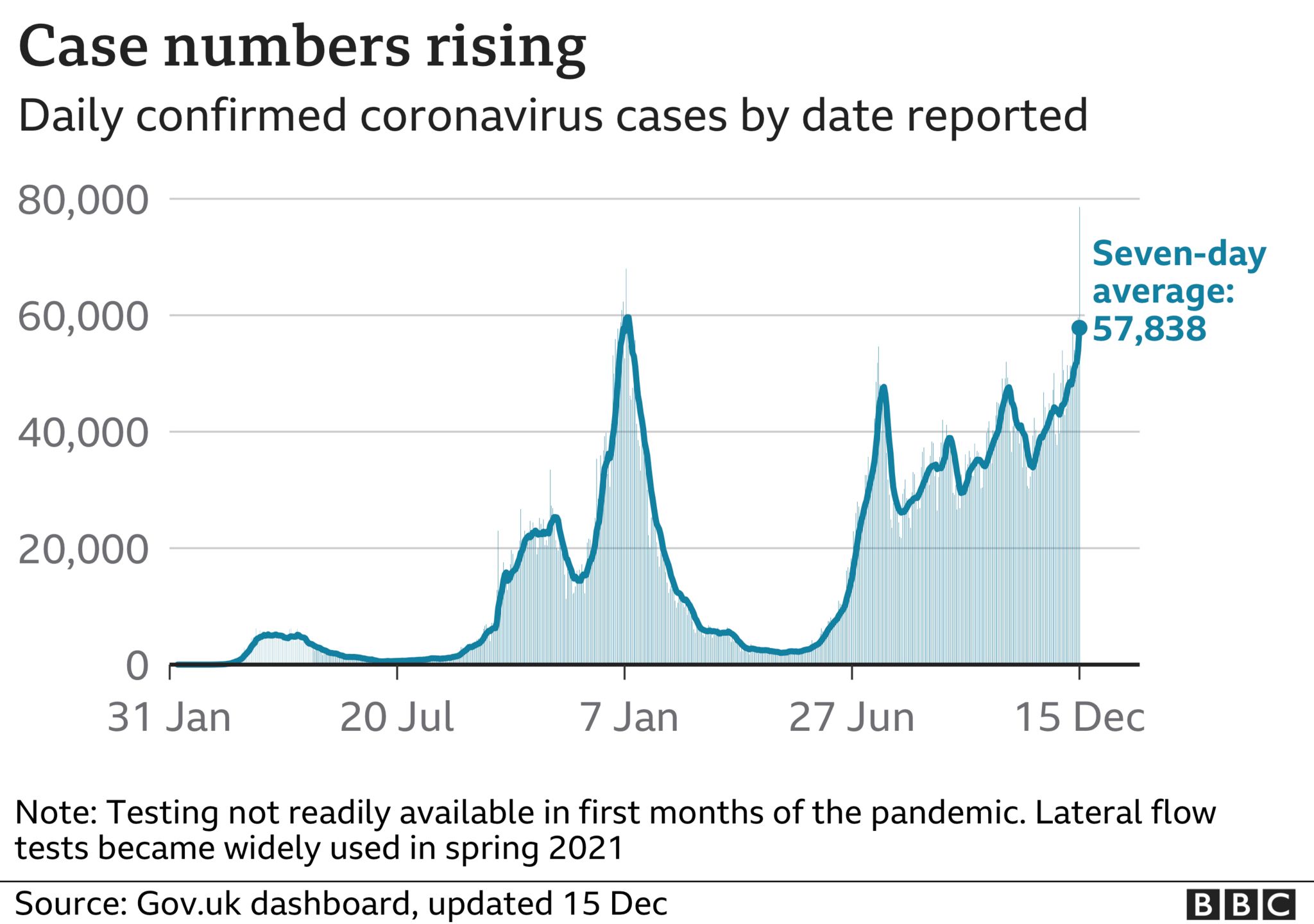
The UK has reported its highest number of daily infections since the pandemic began, and England’s chief medical officer has warned that more Covid records will be broken.
Speaking at a Downing Street news briefing, Prof Chris Whitty said the Omicron variant was moving at a phenomenal pace and that case numbers would continue to hit new highs over the coming weeks.
In that case, infections will reach a level that will exceed testing capacity. So why is it happening and what does it mean for the NHS? Here are three takeaways from a record day.
1. We’re seeing two epidemics at once
Omicron is spreading rapidly, but Delta is not disappearing. It means we have two variants circulating together. It is still early days, but it does appear to be different from what we have seen before when Alpha wiped out the original variant circulating in the UK and was then itself displaced by Delta.
This is likely to be because Omicron is able to get past some of the body’s defences built up by vaccination and previous infection. The two variants are not competing for the same people.
It means at the moment we have a fairly stable number of cases of Delta – as we have had pretty much since the summer.
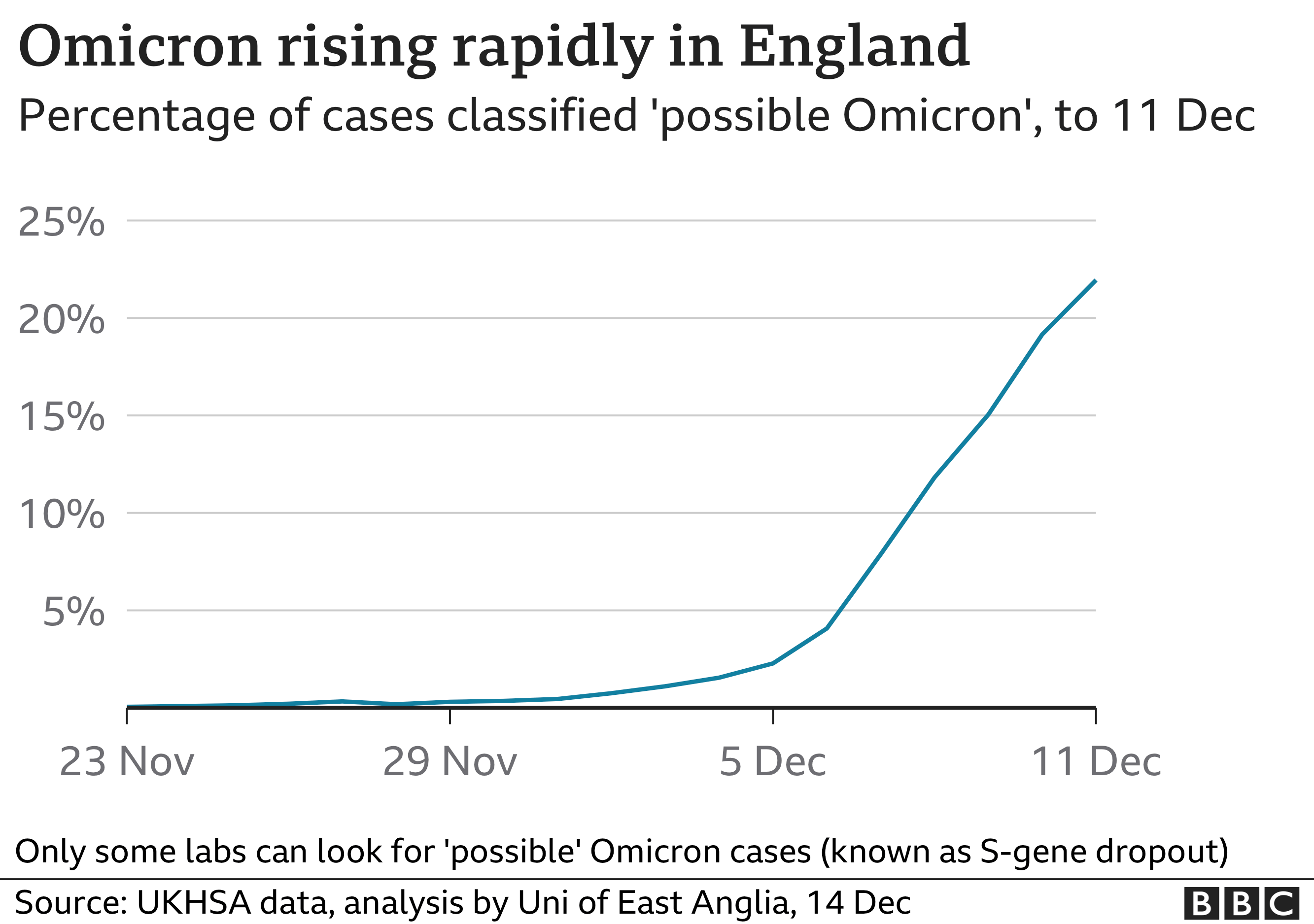
But Omicron cases are rising rapidly and driving the overall number of cases up. Latest data suggests about a quarter of cases are Omicron – that would mean around 20,000 of Wednesday’s reported 79,000 cases have been caused by the new variant.
It is quite possible these two variants will circulate together for a while, although the expectation is that Omicron will eventually displace Delta given how much immunity vaccination and our high levels of infection give against that variant.
2. Infections are rising at break-neck speed
Health officials have been saying for days that we should expect cases to surge.
And these are just the ones that come forward for testing – the true level of infections will be much higher.
Omicron cases are rising rapidly, probably now doubling every two days, so it was only a matter of time before a new high was set – although the lack of testing at the start of the pandemic means comparisons with that wave are difficult.
Expect new records to be set day after day as these numbers are only going to go up from here.
If the two-day doubling continues, by Christmas Day 640,000 Omicron infections would be being recorded and early in the new year the whole population will have been infected.
That said, the cases would never be spotted as testing capacity is limited to fewer than one million a day.
Clearly, however, that rate of growth will slow. There are already signs this has started happening in South Africa.
But not before we get to – in the words of UK Health Security chief Dr Jenny Harries – staggeringly high rates of infection.
3. The threat to the NHS is uncertain
What is not clear is what it means for serious illness.
There are suggestions Omicron is causing milder illness.
There is logic to that – reinfections or infections post vaccination are likely to be milder.
But if infections continue to rise as quickly as they are, that will push up hospital admissions.
Even if the severity of the virus is halved, as soon as the total number of infections double, hospitalisations will go up.
Left unchecked, with no extra restrictions than we have now, the peak will come quickly. How big it will be is uncertain.
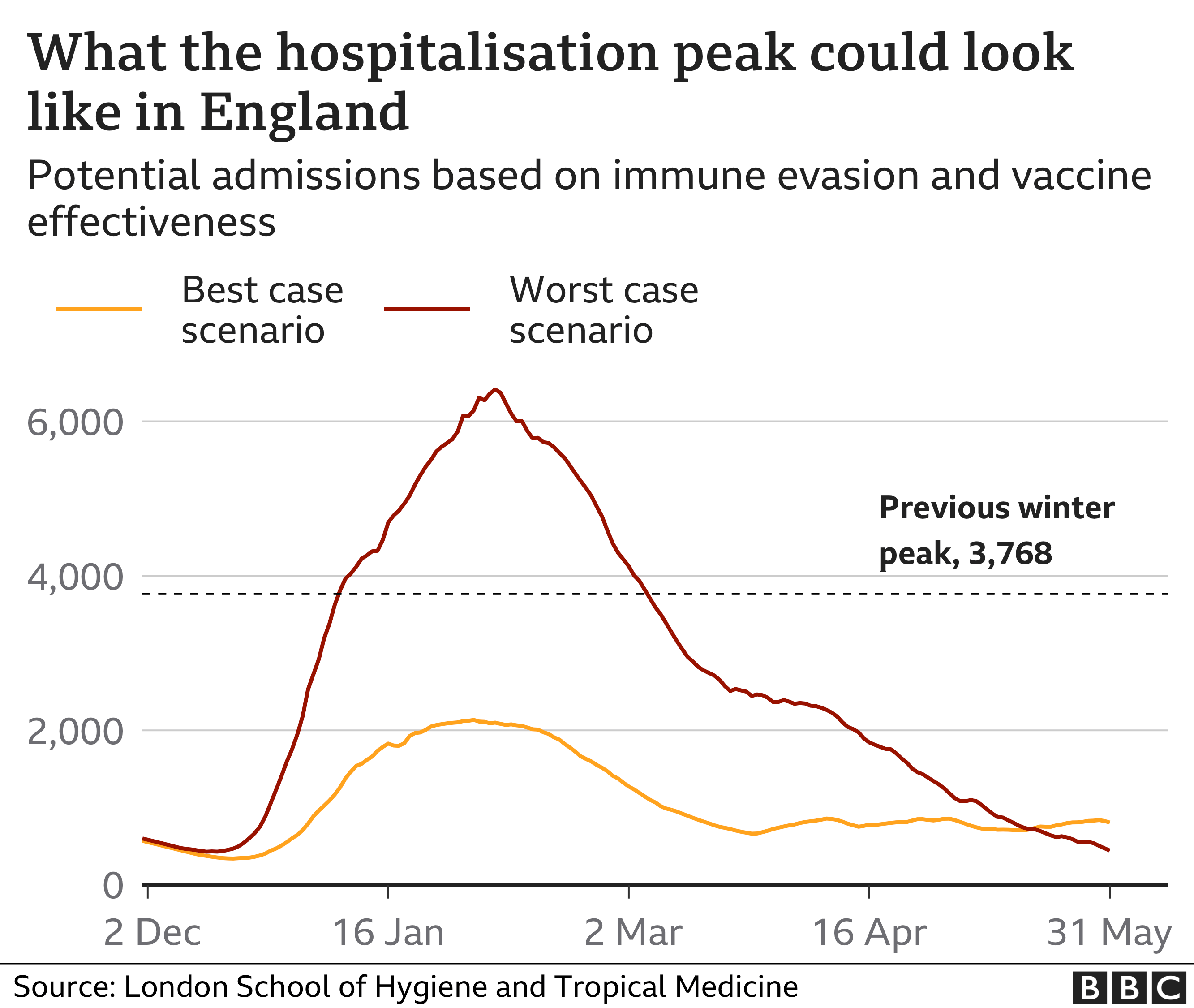
Modelling from the London School of Hygiene and Tropical Medicine has suggested that in a best-case scenario hospital admissions in England could peak at just over 2,000. But in a worst-case scenario they could exceed 6,000.
To put that into context, last winter it topped out at 3,700 a day after lockdown was introduced.
Privately ministers accept that if the numbers go past 2,000 a day, with no sign of them levelling off, the NHS would be at real risk.
But it is also worth keeping an eye on the total numbers in hospital – the time patients spend in hospital with Covid has been falling.
That means the same level of admissions now will not equate to the same pressure it did earlier in the pandemic.
So why no restrictions then?
Clearly as cases go up there will be more and more pressure to introduce restrictions, perhaps even a full lockdown.
That is understandable. But it is also important to remember restrictions don’t stop the epidemic – they just prolong it.
That can be used to buy time. Last winter the lockdown allowed the rollout of vaccines.
But with more than 80% of the most vulnerable boosted, the benefits of a lockdown are much lower this time.
The costs, however, are the same – perhaps greater considering what people have endured so far in terms of the harm to jobs, mental health and education.
What would change the equation significantly is if the NHS is going to be overwhelmed, which would deny people basic life-saving care.
Clearly the NHS is struggling, doctors are pointing out care is suffering, but the situation is very different from last winter when over a third of beds were occupied by Covid patients at one point. Today just 8% of beds are.
Colombo, Dec 17 (newsin.asia) – Spider-Man: No Way Home is already breaking records post-pandemic with immense response kicking in from cinema fans across Sri Lanka. The latest Marvel instalment, Spider-Man: No Way Home is one of the most anticipated films of the year, and fans eager to avoid spoilers are expected to arrive in droves to cinemas this weekend.
The ticket sales for the blockbuster movie opened two weeks in advance at SAVOY Cinemas. The movie lovers who were keen on a cinematic experience have started to storm the theatres with occupancy reaching full capacity. All shows are sold out days ahead of the release.
The movie is set to make its mark as the highest-grossing English blockbuster release in Sri Lanka ever since the pandemic,” said Sashini Kiriella Bandara – CEO, SAVOY Cinemas. Spider-man: No Way Home is recording phenomenal pre-sales across the world, even beating Avengers: Endgame in various markets for the sales record. It may be too early to assess the sales record in Sri Lanka considering how big Endgame was but we had our first taste of what may be coming ahead when most of the weekend shows were sold out in 24 hours.”
READ: A bold and spectacular movie from the get go. I went for the first show on opening day and I can safely say that the movie did not waste a single moment giving Spiderman fans exactly what they want.
The EAP Distribution circuit holds 28 theatres under its umbrella and the movie will be screened at Savoy 3D Cinema – Wellawatte equipped with real Dolby Atmos, Savoy Premier -Wellawatte, Savoy Premier – Rajagiriya, Cinemax – Ja Ela, Sinexpo – Kurunegala, Samantha – Dematagoda and many other theatres islandwide.
The SAVOY Cinemas operate under the right health & safety practices, maintaining standards to ensure the health & safety of our patrons. COVID-19 pandemic has accelerated and amplified ongoing shifts in consumers’ behaviour, pulling forward digital disruption and forging industry tipping points that wouldn’t have been reached for many years.
However, despite all of this it is fascinating to see the patrons back at the theatres and to truly see how passionate the market is in watching a movie on large screens and proper sounds – a true cinematic experience.
With high anticipation for the Jon Watts-directed film since the trailer debuted in November, critics and viewers rounded up their takes on Spider-Man: No Way Home, which many consider the best Spider-Man film yet.
A bold and spectacular movie from the get-go. I went for the first show on opening day and I can safely say that the movie did not waste a single moment giving Spiderman fans exactly what they want” said Fadil Feisal, one of the first to watch the movie in Sri Lanka.
A group led by Cabinet ministers Vasudeva Nanayakkara, Wimal Weerawansa and Udaya Gammanpila campaigning against the Yugadanavi deal is holding a public meeting today (14) at Eheliyagoda to step up pressure on the government to scrap the questionable deal.
The group launched its campaign on 29 October at the Solis Hall, Pita Kotte, where it vowed to oppose the agreement detrimental to the country. The SLFP, the second largest party in the government parliamentary group with 14 members, would be represented by its General Secretary Dayasiri Jayasekera, organisers of today’s event said.
Besides the three ministers and the SLFP General Secretary, six other lawmakers, namely Ven. Athureliye Rathana Thera, Prof. Tissa Vitharana, Tiran Alles, A. L. M. Athaulla, Asanga Navaratne and Gevindu Cumaratunga are scheduled to join the Eheliyagoda meeting at Suwinera Hall at 3 pm.
The Communist Party would be represented by its General Secretary Dr. G. Weerasinghe, organisers said, adding that altogether the group campaigning against Yugadanavi comprised over 25 lawmakers.
The focus of the high-profile campaign is on the Yugadanavi deal and the rising cost of living.
In spite of repeated SLPP warnings the group has refused to abandon its campaign.
Minister Udaya Gammanpila told The Island that they couldn’t keep quiet against the backdrop of an utterly corrupt agreement between Sri Lanka and the New York based New Fortress Energy Company. Attorney-at-law Gammanpila appreciated the media coverage received by those campaigning against the agreement finalized on Sept 17, 2021.
Minister Gammanpila asserted that no one could impede their protest campaign both in and outside Parliament.
The Eheliyagoda meeting would be the first major public gathering since JVP leader Anura Kumara Dissanayake tabled a copy of the Yugadanavi agreement in Parliament last Friday (10).
Pointing out that those who had been campaigning against Yugadanavi voted for the SLPP Budget 2022, the main Opposition SJB and the JVP yesterday reiterated that at least the ministers should quit the cabinet without further delay.
The Attorney General today (December 17) informed the Supreme Court that affidavits filed by three ministers with regard to the Fundamental Rights (FR) petitions challenging the Yugadanavi Power Plant agreement are unconstitutional.
The affidavits had been submitted by Ministers Vasudeva Nanayakkara, Wimal Weerawansa and Udaya Gammanpila.
The petitions were called before Supreme Court’s five-judge bench consisting of Chief Justice Jayantha Jayasuriya and Justices Buwaneka Aluvihare, Priyantha Jayawardena, Vijith Malalgoda and L.T.B. Dehideniya earlier today.
The FR petitions were put forward by the Archbishop of Colombo His Eminence Cardinal Malcolm Ranjith, Venerable Elle Gunawansa Thero, Samagi Jana Balawegaya, former parliamentarians of Janatha Vimukthi Peramuna (JVP), Sunil Handunnetti and Wasantha Samarasinghe and a group including Ven. Bengamuwe Nalaka Thero, Dr. Gunadasa Amarasekara and Dr. Wasantha Bandara.
The petitioners have challenged the decision taken by the Cabinet of Ministers to transfer shares in West Coast Power Limited (WCP) – the owner of the 310 MW Yugadanavi Power Plant to the US-based New Fortress Energy.
The New Fortress Energy, in a statement, recently said it will acquire a 40% ownership stake in the WCP and plans to develop a new liquefied natural gas (LNG) receiving, storage and regasification terminal located off the coast of Colombo.
The petitioners claimed that the government has not properly explained particulars of the deal even to the Cabinet of Ministers when. They also accused the government of failing to obtain the approval of the Parliament for signing the agreement in question and that the relevant share transfer process had not been carried out in accordance with a formal tender procedure.
Against this backdrop, MP Anura Kumara Dissanayake, on December 10, made a startling revelation in the House with regard to the much-disputed Yugadanavi agreement.
According to the JVP leader, the relevant deal was not signed with the United States-based New Fortress Energy Inc. but with another company affiliated to the New Fortress Energy, namely NFE Sri Lanka Power Holding LLC.
The daily count of COVID-19 cases confirmed in Sri Lanka moved to 715 today (December 17) as 177 more people were tested positive for the virus, the Epidemiology Unit said.
This brings the total number of confirmed cases of coronavirus reported in the country to 578,439.
As many as 546,839 recoveries and 14,720 deaths have been confirmed in Sri Lanka since the outbreak of the COVID-19 pandemic.
More than 16,800 active cases in total are currently under medical care, official figures showed.
The Director-General of Health Services has confirmed 22 more coronavirus-related deaths for December 16, increasing the death toll in the country due to the virus pandemic to 14,720.
According to the figures released by the Government Information Department, the deaths reported today include 15 males and 07 females.
Three of the patients are between the ages 30-59 years and the remaining 19 are in the age group of 60 years and above.
The Public Service Commission on Friday (December 17) insisted that it has not directed the Health Ministry’s Secretary to pay the arrears of Dr. Shafi Shihabdeen who was sent on compulsory leave from May 24, 2019, over allegations of performing illegal sterilization operations.
However, the Health Ministry reiterated that the Director of Kurunegala Teaching Hospital was instructed to pay Dr. Shafi’s salary arrears based on a notice issued by the Public Service Commission on November 30.
In a letter, dated December 06, the Secretary to the Health Ministry Dr. S. H. Munasinghe directed the Kurunegala Teaching Hospital’s Director to pay Dr. Shafi’s salary arrears.
Dr. Munasinghe had also called for an explanation from the Kurunegala Hospital Director as to why Dr. Shafi was not paid his salary for that period.
According to the ministerial secretary, this directive follows an appeal made by Dr. Shafi in January last year from the Public Service Commission.
Against this backdrop, the Secretary to the Public Service Commission, M. A. B. Daya Senarath said neither the Health Ministry nor any other body had so far sought the commission’s advice on the payment of arrears or his reinstatement.
He also stated that no such directive was issued by the Public Service Commission or its Health Services Committee.
Further, Mr. Senarath mentioned that the Health Services Committee had approved the recommendation made by the Health Ministry’s Secretary on June 19, 2019, that Dr. Shafi should be sent on compulsory leave with effect from May 24, 2019.
The press release noted that relevant officials are authorized to act in accordance with the Establishments Code, which clearly stipulates how to proceed with regard to an official sent of compulsory leave.
The Court of Appeal has directed the two largest suppliers of liquefied petroleum gas in Sri Lanka – Litro Gas Lanka Limited and Laugfs Gas PLC – to only distribute products that are in compliance with the standards approved by Sri Lanka Standards Institution (SLSI).
This interim order was issued by Appeals Court Judges Ruwan Fernando and Sampath Wijeratne when the writ application filed by public interest litigation activist Nagananda Kodituwakku was taken up this morning.
In his petition, Kodituwakku also sought the Appeals Court to direct the Inspector-General of Police to initiate criminal investigations against Minister of Trade Bandula Gunawardena, State Minister of Consumer Protection Lasantha Alagiyawanna, Chairman of Consumer Affairs Authority (CAA) and the Director-General of Sri Lanka Standards Institution (SLSI) on the matter.
He alleged that the importation and distribution of substandard LP gas have resulted in a number of dangerous incidents across the island.
During today’s proceedings, the judge bench also ordered the two gas companies to recall the unused gas cylinders that have already been released to the market.
Further, Litro Gas Lanka and Laugfs Gas were directed to display a sticker on cylinders indicating the composition of LPG.
Companies that import chemical fertilizers stated that farmers will have to pay 30 to 40 percent more for other crops, including paddy, as the government will no longer subsidize chemical fertilizers.
Sujeewa Walisundera, Secretary of the Special Fertilizer Importers’ Association, stated that the government has not yet paid around Rs. 27 billion due to companies for fertilizer subsidies for the past three years.
Meanwhile, agitations were held in several parts of the island today to protest against the lack of fertilizer for their crops.
A special discussion on the gas crisis is scheduled to be held on 21 December under the chairmanship of Prime Minister Mahinda Rajapaksa.
It is reported that the ministers in charge of the subject, as well as the heads of the gas companies, are scheduled to participate in the discussion and a number of decisions are to be taken there.
Meanwhile, the Sri Lanka Bureau of Standards has decided that the propane content of a domestic gas cylinder sold in Sri Lanka should be 30 percent.
The Court of Appeal today ordered Litro and Laugfs Gas to release only compliant domestic gas cylinders.
The bench of Justices Ruwan Fernando and Sampath Wijeyeratne passed the order on a petition filed by Nagananda Kodithuwakku, a civil society activist, seeking an inquiry into the explosions caused by the gas leaks.
Accordingly, the Court of Appeal issued another order to take steps to recall the unused gas cylinders currently on the market.
Nagananda Kodithuwakku had earlier requested the court to issue an order to the company to recall the half-used gas cylinders currently in the possession of consumers and to pay a certain amount for the same.
The court also directed the Consumer Affairs Authority to look into the matter and prepare an appropriate program.
The court ordered that the petition be heard and ordered that it be called on 26 January.
State Counsel Manohara Jayasinghe, appearing for the Sri Lanka Bureau of Standards, stated that a special meeting was scheduled to be held on the 20th to determine the composition of a domestic gas cylinder, but the meeting was abrupt.
At that meeting, it was decided that the composition of “propane” which should be contained in a domestic gas cylinder should be 30 percent.
State Minister of Consumer Protection Lasantha Alagiyawanna while participating in the ‘Balaya’ program telecast on Hiru TV yesterday stated that there is a problem with the gas samples contained in the second Litro gas ship that arrived on the island last Monday.
For months, the lives of the people of this country have been in a very precarious situation with this gas crisis. No matter what anyone says, gas companies cannot shirk that responsibility.
Our news team has revealed to the country not once but twice that the chairman of Litro, which is operating with public funds in such a background, had followed a dormant policy in this regard.
His irresponsible disregard for our phone calls cannot be underestimated. This is because he is responsible for the welfare and safety of gas consumers in the country.
However, Theshara Jayasinghe, the Chairman of Litro Gas Company, who was avoiding the media in the face of the gas crisis, had to appear before the media today.
That is because he and the Chairman of Laugfs Gas Company K.H. Wegapitiya, Director General of the Industrial Technology Institute, and the Chairman of the Ceylon Petroleum Corporation were summoned before the Human Rights Commission of Sri Lanka today.
However, the chairman of the Litro Gas Company, as usual, fled the scene in front of Hiru Correspondents who exposed the gas scam to the country.
He is the Chairman as well as the CEO of Litro and operates all of its official offices and earns over Rs. 2 million a month from public taxes.<br /><br />Meanwhile, the heads of the gas companies have expressed their displeasure over the negligence of various parties.
U.R. de Silva, President’s Counsel to the Ministry of Justice, stated that there was a possibility of criminal action against the heads of the gas companies.
Several accidents due to gas leaks from domestic gas cylinders were reported in several areas today as well.
Meanwhile, the Women’s Rights Organization today staged a protest in front of the Consumer Affairs Authority regarding the dangerous situation faced by gas consumers throughout the country.
Sri Lanka is facing what is
arguably its most challenging external financing crisis. Gross Official
Reserves have declined to USD 1.6 bn as at end-November. Repayments over the
subsequent 12 months amount to about USD 7 billion. The authorities have
responded with import and capital controls as well as a fixed exchange rate
based on moral suasion by the CBSL and rationing of foreign exchange by the
commercial banks. This has resulted in a scarring of the economy which will
inevitably have an adverse impact on growth, employment and incomes. Inflation
is rising and is on the verge of reaching double digits and shortages
constantly emerge of essential goods and services.
The Road Map, presented by
the CBSL, identified a number of potential sources of debt- and
non-debt-creating inflows to fill the external financing gap. The
securitisation of remittance flows has been added to the menu of options
recently. However, to date there has been an alarming depletion of external
reserves and an inexorable increase in the external financing gap.
If the authorities have
clear visibility of sufficient inflows to arrest the steady deterioration in
the country’s external position, one can be hopeful of a turnaround to avoid
the possibility of a debt default which would greatly amplify problems, such as
rising inflation; pressure on exchange and interest rates; losses in the real
value of incomes; decline in business confidence; and disruption to the
supplies of basic goods and services. If the anticipated inflows are not
forthcoming in sufficient quantities to fill the external financing gap, there
will be no option but to turn to the IMF to avoid further scarring of the
economy and creating greater shortages of essential goods and services.
It is extremely unlikely
that it would be possible to obtain IMF assistance without a debt rescheduling
as the Fund does not support countries where the debt is considered
unsustainable. Equally, it is not practical to reach agreement on debt
restructuring without an IMF programme. So, the twin pillars of the way forward
would need to be negotiating an arrangement with the IMF and agreement on a
preemptive debt restructuring.
Attempting to undertake
stabilisation of the economy without the cushion of financing that can be
mobilised through an IMF programme would be like performing on the high-trapeze
without a safety-net. There needs to be a less painful blend of adjustment and
financing. However, it must be highlighted that pain cannot be avoided. An IMF
programme would impose significant burdens on the people. The main thrust of
this article is that this pain would be less than the severe dislocation that
is already being caused by squeezing the economy to make up for the dollar
illiquidity. The conditionality attached to IMF programmes are intended to
stabilise the economy (contain inflation and balance of payment pressure) and
improve its creditworthiness.
An IMF programme could
include, inter alia, the following: strengthening the government’s revenue base
(widening the tax base and improving tax administration); improving the primary
balance in the budget (revenue – (expenditure-interest payments)); proactive,
data-driven and non- interventionist monetary policy; a flexible and realistic
exchange rate policy to assist in building up external reserves;
commercialisation of SOE operations, including full cost-recovery in the
pricing of electricity and fuel, restructuring of CEB and CPC, the
implementation of the Statements of Intent and addressing the losses being
incurred by Sri Lankan Airlines.
An IMF Extended Fund
Facility can provide balance of payment financing of up to USD 1 bn per year
for three years. The amount made available would be calibrated according to the
strength of the reforms undertaken. An IMF programme would also unlock direct
budgetary support from the World Bank, Asian Development Bank and possibly a
few bilateral donors (over and above their usual project loans). Both balance
of payments and budgetary support are most urgently required for the twin
deficit Sri Lankan economy. Based on indications in 2020, up to USD 2 bn in all
can be mobilised through these sources, depending on the strength of the
reforms undertaken. Engagement with the IMF will also transmit positive signals
to both investors and creditors, both at home and abroad. It can also pave the
way for an eventual upgrading of the sovereign rating, which would improve the
prospect of attracting foreign investment and credits.
The second pillar,
preemptive restructuring, must also be pursued concurrently with negotiations
with the IMF. Not only can this facilitate the obtaining
of a Fund programme but it
can also create some leeway to stabilise the economy and place it on a path of
sustained growth. Debt restructuring can be achieved through: extending
maturities; modifying coupon (interest) rates; and hair-cuts on the principal
(write-downs). One or more of these modalities can be used to reach an
agreement with creditors that places Sri Lanka’s debt servicing on a
sustainable path. Ideally, about a 3-year window should be created where debt
servicing is suspended. This can release a very substantial amount of scarce
foreign exchange to finance imports. The impact on growth, employment and
incomes would be materially positive. In considering debt restructuring,
it is important to realise that the most significant usual downside is a loss
of access to international capital markets. In Sri Lanka’s case, this has
already happened with the downgrading of the sovereign rating. So, the most
important disadvantage is no longer a factor. Another concern relates to the impact
on domestic holders of USD denominated sovereign debt, mainly banks. A
mitigating factor is that a significant share of these holdings have been
bought at a discount from the secondary markets. In other countries, Central
Banks have exercised regulatory forbearance to assist financial institutions
which have required such support to repair their balance sheets.
It must, however, be
recognised that it could take 4-6 months to negotiate an IMF programme and a
preemptive debt restructuring agreement. The present trends in external
reserves on the one hand and net drains on foreign currency on the other
indicate that bridging finance is required to meet obligations over the next 6
months to avoid a debt default. The package of assistance offered by India is
an encouraging start and needs to be finalised as soon as possible. It has to
be supplemented by financing from other friendly countries, like
Japan. There is scope for India and Japan to work together to support Sri
Lanka at this critical juncture. Their willingness to step forward is
likely to be greater, if it is known that Sri Lanka has taken a decision to
approach the IMF. While our development partners will be wary of having to make
an open-ended commitment, they are likely to find bridging finance more
palatable.
Time has almost run out.
Urgent, focused and pragmatic attention to these pressing issues is of
paramount importance. An IMF programme can be at the heart of a
medium-term strategy to overcome the current challenges and give Sri Lankans
greater hope about the future prospects of the economy.
The visiting U.N. Assistant Secretary-General
Kanni Wignaraja called on Prime Minister Mahinda Rajapaksa last evening at
Temple Trees and discussed a range of issues, including Sri Lanka’s vaccination
program.
You have a very good vaccine program,” Ms.
Wignaraja said.
After mention of the fact that Sri Lanka has
also started administering COVID vaccine booster shots, she pointed out that
many countries who have started the booster shots are seeing an increase in
tourist arrivals. The Prime Minister noted that tourism is slowly starting to
pick up once again in Sri Lanka. The tourism sector has been particularly hard
hit all across the world due to the pandemic.
I think with the vaccines, the tourists will
come,” Ms. Wignaraja said.
In further discussing Sri Lanka’s
post-COVID-19 economic recovery, Ms. Wignaraja said there are many ways that
the United Nations can support Sri Lanka.
Prime Minister Rajapaksa reiterated that Sri
Lanka has always worked closely with U.N. organizations and will continue to do
so.
The two delegations also discussed the need
for creating jobs and opportunities for young people, particularly in the
private sector, and encouraging young people to seek private-sector jobs.
Ms. Wignaraja, who also serves as the
Assistant Administrator of the United Nations Development Program (UNDP) and
the Regional Director of UNDP’s Regional Bureau for Asia and the Pacific, also
briefed the Prime Minister about the work the United Nations is supporting in
the areas of climate change and sustainable development.
One of the major projects that the UNDP is supporting in Sri Lanka is the
Climate Resilient Integrated Water Management Project (CRIWMP), which is a
seven-year project aimed at strengthening the resilience of smallholder
farmers in Sri Lanka’s Dry Zone to climate variability and extreme events,”
according to the UNDP. A little over 73 percent of the total cost of the
project is being financed through a grant received from the Green Climate Fund
(GCF).
Robert Juhkam, the Resident Representation of
UNDP Sri Lanka, briefed Prime Minister Rajapaksa on the work being carried out
towards achieving the sustainable development goals (SDGs) in close cooperation
with the Sustainable Development Council of Sri Lanka (SDC). The SDC convened
the first national-level multi-stakeholder consultative workshop last month.
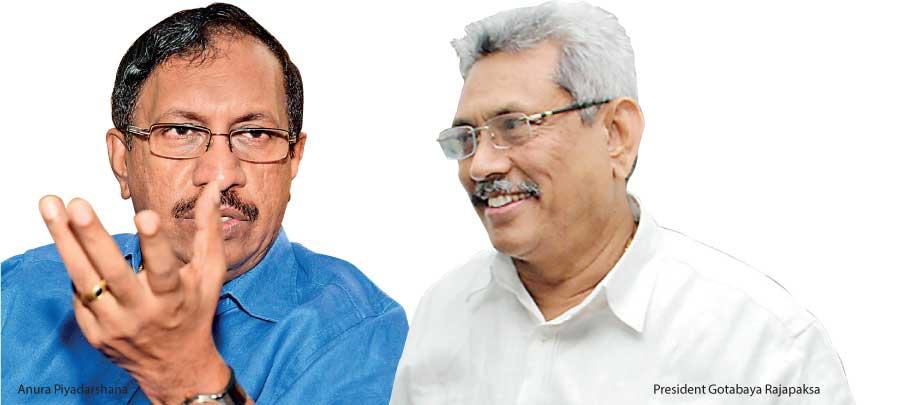
Prorogation of Parliament by President Gotabaya Rajapaksa has sparked a political debate with many interpreting it in different ways. It appears to have caused dissension within the government with MP Anura Priyadarshana Yapa being skeptical about the move and making remarks openly. Every President who served in the past prorogued Parliament, but the timing of the present prorogation with no logical reason left the scope for interpretation of it in different ways. What is plausible is that it was done to get rid of the heads of some vital parliamentary committees.
The president, in terms of powers vested with him under Article 70 of the Constitution, prorogued the House. He has only discharged a constitutional function in this instance. However, one should examine what prorogation means and its impact on parliamentary businesses. Then only a plausible picture can be figured out. A prorogation which is nothing but a recess of Parliament for a short period, and it should not extend to a period of more than two months. According to an article placed on the official website of Parliament, the Proclamation related to the prorogation of Parliament should notify the date for the commencement of the new Session of Parliament under Paragraph (3) of Article 70 of the Constitution.
“One school of thought, which is also mooted by the opposition, is that the House was prorogued to get rid of the heads of these two bodies, since their performance in the examination of the financial activities of certain state institutions portrayed the government in the negative light”
The president has fixed January 18 as the day of the next sitting. Prorogation has its effects on the businesses of the House. All businesses pending before the House lapse in the event of prorogation. All matters which having been duly brought before Parliament, have not been disposed of at the time of the prorogation of Parliament, may be proceeded with during the next Session,” Paragraph (4) of Article 70 of the Constitution says.
Besides, the committees which perform vital functions in Parliament cease to exist in the event of prorogation except the Committee on High Posts, Consultative Committees and Select Committees. The committees that lapse upon prorogation are the Committee on Parliamentary Business, the Committee on Standing Orders, the House Committee, the Committee on Ethics and Privileges, the Legislative Standing Committee, the Ministerial Consultative Committees, the Committee on Public Accounts(COPA), the Committee on Public Enterprises (COPA), the Committee on Public Finance , the Committee on Public Petitions and the Backbencher Committee.
“Every President who served in the past prorogued Parliament, but the timing of the present prorogation with no logical reason left the scope for interpretation of it in different ways. What is plausible is that it was done to get rid of the heads of some vital parliamentary committees”
Prorogation is nothing new. According to parliamentary records outlined on the official website Parliament had been prorogued about 50 times to date since 1947 and more than 25
Professor Tissa Vitharana
Sessions since 1978. The first Parliament commenced on September 7, 1978 had Seven Sessions until its dissolution on December 12, 1988. The Second Parliament commenced on March 9, 1989 had five Sessions until its dissolution on June 24, 1994. The third Parliament commenced on August 25, 1994 had three Sessions until its dissolution on August 18, 2000.
The fourth Parliament commenced on October 10, 2000 had three sessions until its dissolution on October 10, 2001. The fifth Parliament which commenced on December 19, 2001 had two Sessions until its dissolution on February 9, 2004. Starting from April 22, 2004 the Sixth Parliament had four Sessions until February 9, 2010. The Seventh Parliament started on April 22, 2010 had only one Session until June 26, 2015. The eighth Parliament commenced on September 1, 2015 and had four Sessions until its dissolution on March 2, 2020. The 9th Parliament or the current Parliament commenced on August 20, 2020 and had one Session to date. When the House is reconvened after prorogation, the second session of the ninth Parliament will begin.
” In the wake of the latest prorogation, a spotlight is shone on the works done by COPE and the COPA as watchdog committees that examines financial performance of the state institutions. The COPE and the COPA uncovered a lot of irregularities in the state institutions”
In the wake of the latest prorogation, a spotlight is shone on the works done by COPE and the COPA as watchdog committees that examines financial performance of the state institutions. The COPE is headed by ruling party MP Dr. Charitha Herath and COPA by Government MP Prof. Tissa Vitarana. These two bodies have to be reconstituted once Parliament is reconvened for its next session by the president on January 18, 2022. The COPE and the COPA uncovered a lot of irregularities in the state institutions. One school of thought, which is also mooted by the opposition, is that the House was prorogued to get rid of the heads of these two bodies, since their performance in the examination of the financial activities of certain state institutions portrayed the government in the negative light. Another committee that will cease to function is the Public Finance Committee which is headed by MP Anura Priyadharshana Yapa.
MP Yapa said he could not fathom as to why the House was prorogued without any valid reason at the moment. When the House is reconvened, this committee has to be reconstituted. Probably, MP Yapa is concerned whether he will get his post or not. In the opening of the new session, the president will get the opportunity to make a policy statement in the House. Wonder, prorogation is done to remove the heads of the vital committees or for the president to make a policy statement from the Chair of Parliament envisaging a new plan to address current issues of the country.
Supporters of Sri Lanka’s President-elect Gotabaya Rajapaksa cheer near the Election Commission office in Colombo [S Kodikara/AFP]
Before the Covid-19 pandemic, Sri Lanka was infested by a pandemic of a different kind: An outbreak of borderline racism and boundless populist irrationality. The carriers and incubators of that pathogen are now the stakeholders of the current government. Then in the opposition, they spread a mass hysteria laced with racist dog-whistling, conspiracy theories and promises to fix it all through the pie in the sky economic policies and an exclusivit restructuring of the state at the expense of minorities. The large swathe of the constituency swallowed it hook, line and sinker.
Gotabaya Rajapaksa was elected the president in a landslide in November 2019 and Sri Lanka Podujana Peramuna (SLPP) swept to power with a near two-thirds majority in the house months later. They duly bought in a few pole-vaulters to secure the two-third majority and pass the 20th amendment, effectively dismantling the constitutional checks and balances set in the previous 19th amendment. With an all-powerful president, the spin-doctors predicted with a fawning delight that the country was all set for a great economic takeoff.
“The tragedy in Sri Lanka was that the populist irrationality that underpinned the election victories of the current government outlived the election. They came to define the government policy and unleashed destruction unseen in recent memory.”
What happened instead was an unprecedented economic disaster. Temptation is to blame the Covid-19 pandemic for all the unravelling. The pandemic surely had its tool on the economy, but in the international comparison, Sri Lanka’s economic woes are exceptional and cannot be explained by the economic shock of the pandemic alone. After all, a few countries, such as Lebanon, have faced a certain bankruptcy, even then only in part due to pandemic shock, but more due to long term economic mismanagement. Yet a few countries have acted as incorrigibly as the leaders of the current government. The tragedy in Sri Lanka was that the populist irrationality that underpinned the election victories of the current government outlived the election. They came to define the government policy and unleashed destruction unseen in recent memory.
While Sri Lanka’s debt crisis has been developing for over decades, a shortsighted decision, indeed an election pledge, to grant extensive tax exceptions effectively reduced the government revenue by 1.5% of the GDP. The number of registered taxpayers dropped by 33.5% from 2019 to 2020. Having curtailed its tax base, the government also snubbed the IMF, from which its predecessor had obtained a bailout. For the next two years, the government ate into the foreign reserves to pay off the sovereign debt, effectively eroding the US $ 8 billion of foreign reserves when it took over the office to less than US$ 1.5 billion as of November this year. That is sufficient for less than one month of import. With around US$ 3.5 billion of debt and interest payments due next year, Sri Lanka is veritably bankrupt.
“While Sri Lanka’s debt crisis has been developing for over decades, a shortsighted decision, indeed an election pledge, to grant extensive tax exceptions effectively reduced the government revenue by 1.5% of the GDP. The number of registered taxpayers dropped by 33.5% from 2019 to 2020.”
Instead of fixing the problem before it could lead to a complete economic collapse at home, the government has squandered each opportunity. An ego fuelled ignorance has procrastinated the crisis, bringing it to a point of no return. As the government is now sending contradictory signals about going to the IMF, much of the damage is already done. The domestic economy is at the brink of collapse due to an acute dollar shortage and stiff import restrictions. The construction sector, which accounted for 7.2% of the GDP in 2019 and employed 600,000 is at its breaking point, faced with an acute shortage of building material.
The fallacy of a demagogic ban on chemical fertilizer is now all to see. The decision was meant to be a face-saving measure for the government›s inability to finance the fertilizer subsidy and was heralded as fulfilling another election promise of Gotabaya Rajapaksa. However, the unprecedented calamity it unleashed had no comparison. The skyrocketing vegetable prices, the usual consumer gripe, is not the most devastating of the outcome. The greatest tragedy of all was the hundreds of thousands of farming families who have been forced back into poverty. Notwithstanding the rhetoric of offering compensation, a cash strapped government is not in a position to do so, except through another binge of money printing which would increase inflation.
“An ego fuelled ignorance has procrastinated the crisis, bringing it to a point of no return. As the government is now sending contradictory signals about going to the IMF, much of the damage is already done.”
So much for fostering exports, an unsustainable peg of Sri Lankan rupee against the US dollar (Rs. 203/US$) is effectively a 20% tax on the local exporters, and remittance by the migrant workers, the latter has halved in October for the second consecutive month against the corresponding month in 2019. The local importers are resorting to ad-hoc measures to overcome the exchange crisis. Daily explosions and fires related to cooking gas canisters are a dangerous fall out of these home remedies.
The worst affected of the government’s mishandling of the debt crisis is indeed the constituency that voted in both hands to elect Gotabaya Rajapaksa and the SLPP to power. Like many other populist leaders around the world, the president and the government have cannibalized their own support base. Faced with a looming debt default and uncertain future, Sri Lanka is not in a position to attract credible investors. Notwithstanding the government blaming the pandemic for the low foreign direct investment, across the world, FDI inflows in 2021 exceeded the pre-pandemic level. According to OECD, the global investment flows rebounded to US$ 870 billion in the first half of 2021, a 43% increase from the corresponding period in 2019. Sri Lanka’s FDI inflows during the period are barely US$ 0.5 billion!
As the country enters 2022, it would also be the worst year in Sri Lankan history. Without a clear policy to solve its debt crisis, and vacillation about committing itself to a long term debt restructuring plan which would come with strings by the IMF, and a temptation to backtrack on such commitments at the first available opportunity, Sri Lanka is in an unenviable place. A disorganized debt default may happen at any time when the government runs out of its temporary fixes. If not, with this is bound to be one-term government and president, it will hand over a nation that has crumbled both inside and outside, to its successor. That is a tragedy. That might also be karma!
The Sri Lanka Standards Institution has convened a special meeting on 20 December to decide on the composition of a domestic gas cylinder.
Manohara Jayasinghe, Senior State Counsel appearing for the Consumer Affairs Authority and the Sri Lanka Standards Institution, made this statement when the petition filed seeking an inquiry into the accidents due to gas leaks were taken up in Court today (16).
Litro Gas today filed an affidavit in the Court of Appeal stating that only domestic gas approved by the Consumer Affairs Authority and the Sri Lanka Standards Institution will be released to the market in the future.
Their other affidavit states that they also agree to display a sticker on the cylinder showing the composition of the gases contained in the cylinder.
The lawyer representing Litro Gas stated that investigations have confirmed that more than 90% of the gas accidents reported in recent days are due to substandard stoves and appliances.
However, Nagananda Kodithuwakku, a civil society activist who filed the petition, rejected the affidavits.
After considering the facts presented, the Court of Appeal announced that its orders in this regard will be issued tomorrow.
Meanwhile, Minister Johnston Fernando addressing a function held in Colombo today expressed his views on the leaders of Litro Gas Company by continuing to respond to the media.
The Minister asked the head of the relevant gas company to reply without hiding.
Meanwhile, the Consumer Affairs Authority stated that the laboratory test report on the samples of the ship containing the new gas tank that arrived in the country three days ago was submitted to the Standards Institution. The authority said it had not given any permission to release gas on the ship until a final decision was made on the report.
However, reliable sources say that there is a problem with the quality of the gas stock. The gas ship is currently anchored off the coast of Uswetakeiyawa.
Although the Consumer Affairs Authority (CAA) had officially instructed Litro to refrain from unloading substandard gas on Saturday, the ship is still anchored off the coast.
The Department of Measurement and Standards Services has conducted an investigation into the pressure that should be present in a gas cylinder. Accordingly, a report on the current pressure in a cylinder and the pressure conditions in the tested samples has been submitted to the Minister of Trade.
Meanwhile, several gas related accidents were reported from several parts of the island today as well.
Several civil society organizations staged a silent protest in front of the Sri Lanka Standards Institution in Narahenpita this morning, allowing the consumption of substandard food, oil and gas.
Several other civil society organizations also staged a protest in front of the State Ministry of Consumer Protection today.
The Governor of Central Bank of Sri Lanka, Ajith Nivard Cabraal today (December 16) cleared the air about the rumours that claimed there has been a change in exchange rate policy.
In a tweet, the CBSL chief dismissed the rumours as ‘fake’.
The Ministry of Health has given instructions to pay the salary arrears of Dr. Shafi Shihabdeen who was sent on compulsory leave from May 24, 2019, over allegations of performing illegal sterilization operations.
This was conveyed in a letter directed to the Director of the Kurunegala Teaching Hospital by the Secretary to the Health Ministry Dr. S. H. Munasinghe on Dec. 06.
Accordingly, Dr. Shafi will be paid the arrears of his salary for the period he was sent on compulsory leave.
Dr. Munasinghe has also called for an explanation from the Kurunegala Hospital Director as to why Dr. Shafi was not paid his salaries for that period despite the fact that the Establishments Code clearly stipulates how to proceed with regard to an official sent of compulsory leave.
This directive follows an appeal made by Dr. Shafi in January last year from the Public Service Commission which subsequently instructed the Health Ministry to pay the relevant salary arrears, the health ministry’s secretary explained.
He further noted that Dr. Shafi was not reinstated in his position.
Dr. Shafi had meanwhile filed a Fundamental Rights (FR) petition seeking an order declaring his arrest and detention unlawful.
The Supreme Court has postponed the hearing of Fundamental Rights (FR) petitions challenging the Yugadanavi Power Plant agreement until 10.00 a.m. tomorrow (December 16).
The applications were called before a five-judge bench consisting of Chief Justice Jayantha Jayasuriya and Supreme Court Justices Buwaneka Aluvihare, Priyantha Jayawardena, Vijith Malalgoda and L.T.B. Dehideniya is taking up the petitions this morning.
President’s Counsel Manohara de Silva presented submissions on behalf of several trade unions including the Ceylon Electricity Board Engineers’ Union (CEBEU).
The petitions were filed seeking a court order revoking the decision taken by the Cabinet of Ministers to transfer shares in West Coast Power Limited (WCP) – the owner of the 310 MW Yugadanavi Power Plant to the US-based New Fortress Energy.
They were put forward by Archbishop of Colombo His Eminence Cardinal Malcolm Ranjith, Venerable Elle Gunawansa Thero, Samagi Jana Balawegaya (SJB), former parliamentarians of Janatha Vimukthi Peramuna (JVP), Sunil Handunnetti and Wasantha Samarasinghe and a group including Ven. Bengamuwe Nalaka Thero, Dr. Gunadasa Amarasekara and Dr. Wasantha Bandara.
The Cabinet of Ministers including Prime Minister Mahinda Rajapaksa, West Coast Power Limited, New Fortress Energy and the Attorney General are among the respondents in the case.
The Colombo High Court today ordered to acquit and release interdicted Magistrate Thilina Gamage from the case filed over the illegal possession of an elephant calf.
Delivering the decision today, Colombo High Court Judge Damith Thotawatte stated that the prosecution has failed to prove the allegations against the defendant Thilina Gamage beyond a reasonable doubt.
Therefore the court ordered to acquit and release him from the case, Ada Derana reporter said.
However, the court decided not to acquit the other defendants named in the case including the former Assistant Director of the Wildlife Conservation Department Upali Pathmasiri, the clerk in charge of the Elephant Registration at the department Priyanka Sanjeewani and Chandraratne Yatawara, who is said to be the first owner of the elephant calf.
The High Court Judge ordered them to present their defence when the case is taken up before the court once again on January 21, 2022.
Former Additional Magistrate of Colombo Thilina Gamage had been sent on compulsory leave in May 2016 due to the ongoing investigation into the case while he had surrendered to court the following month and was granted bail the same day.
In July 2019, the Attorney General had filed the indictments against the interdicted magistrate and the three other defendants on 25 counts, accusing them of committing a crime under the Public Properties Act by keeping the elephant calf named ‘Sakura’ using a forged license.
The Agriculture Ministry and the Health Ministry have decided to set up a special task force to study and submit a report on the effects of chemical pesticides and fertilizers on humans.
The decision was taken at a meeting chaired by Ministers Keheliya Rambukwella and Mahindananda Aluthgamage at the Health Ministry.
During the meeting, it was noted that the said task force should consist of an independent team of experts representing multiple sectors and that a comprehensive study should be conducted on the matter.
Accordingly, the Director-General of Health Services has been instructed to start taking necessary measures in this regard by next week.
The Health Ministry reports that 758 new coronavirus positive cases have been identified within today (16).
The new cases include 03 returnees from overseas while the total number of Covid-19 infected patients currently undergoing treatment is 16,528.
The tally of confirmed cases of Covid-19 detected in the country climbs to 577,724 with this.
The Director General of Health Services has confirmed another 21 coronavirus related deaths for December 15, increasing the death toll in the country due to the virus to 14,698.
The deaths confirmed today reportedly include 12 males and 09 females while 07 of the victims are between the ages 30-59 years. The remaining 14 are aged 60 years and above.
The
lesson taught by the failure of our parliament to register a prompt united
response of unqualified condemnation against the occurrence of the Sialkot
savagery committed in the name of religion should never be forgotten by all
patriotic Sri Lankans. My hunch is that ordinary Sri Lankans whose hearts bled
for Priyantha Kumara, the victim of that sadistic barbarity, would have
reasonably expected all the MPs to unite against murderous Islamism that led to
his ordeal, following the example of all Muslim MPs having stood by their
fellow Muslim MP Rishad Badiuddeen who was suspected by some to have had
links with the suicide bombers who carried out the 2019 Easter Sunday attacks.
The lesson that can be derived from the collective dereliction of a vital
national responsibility by the MPs is that the present ruling elite (fully
represented in parliament in the form of the government and the opposition) has
neither the will nor the ability to resolve the problems of political and
ideological extremism that have been unnecessarily assailing the nation for a
long time, in the characteristically peaceful nonviolent and enlightened way so
well illustrated in our dominant, almost identical, Buddhist and Hindu
cultures. Relentless pursuers of conflicting geopolitical agendas in our
neighbourhood exploit these issues of externally imposed political and
religious extremism in their own interest, but to the great detriment of our
people (as His Eminence the Cardinal has so often emphasized in the recent
past).
It’s
almost two weeks since an innocent Sri Lankan expatriate employee
Priyantha Kumara Diyawadana was set upon, beaten to death, and burned on a main
road in a most despicable, inhumanly cruel manner by an Islamist lynch mob,
arbitrarily and maliciously accusing him of blasphemy, at Sialkot in the
north-east of the Punjab province of Pakistan on Friday, December 3, 2021. The
sickening details of the appalling incident are now well known, and so we can
avoid the pain of repeating them. If the horrendous outrage fails to galvanize
the civilized world to resolve to root out forthwith the diabolical crime
(against humanity) of killing in the name of religion, nothing will. Not that
this kind of extremist brutality is an uncommon happening in the Islamic
Republic of Pakistan; probably, though, no religious atrocity committed there
previously could rival what our unfortunate compatriot was subjected to.
Pakistan
premier Imran Khan tweeted his utmost concern late Saturday(4) about the brutal
lynching episode of the previous day, which he had earlier condemned as
‘horrific’; it was a day of shame for Pakistan, he said. Imran Khan’s twitter
message ran: Spoke
to Sri Lankan President Gotabaya Rajapaksa today in UAE to convey our nation’s
anger & shame to people of Sri Lanka at vigilante killing of Priyantha
Diyawadana in Sialkot. I informed him 100+ ppl arrested & assured him they
would be prosecuted with full severity of the law”. (Both the presidents were
then in Abu Dhabi for the recent Indian Ocean Conference held there.) The online wionews.com later reported (December 5) that
after the Pakistani premier’s order to initiate a concerted probe, more than
800 suspects had already been booked, including the principal assailant Farhan
Idrees.
To
my mind, the Sri Lankan government’s response has not at all been commensurate
with the enormity of the outrage. Hardly a handful of the 225 in parliament
(most of whom are eating and drinking zombies, i.e., will-less and
speechless human corpses claimed to have been magically raised from the dead
and used in African witchcraft) were courageous enough to utter anything that
contradicted or questioned the Pakistani government’s judicious, but
duplicitous stand on the lynching of a lone, completely helpless, Sri Lankan
citizen. Priyantha was no ordinary Sri Lankan citizen. He had served the
Pakistan nation with exceptional professionalism in a senior position in its
industry field for eleven long years away from his home country and from his
beloved young family. Actually, it was his commitment to his work that brought
him this fate. Some workers under him were unhappy about the expat senior
manager’s no-nonsense approach to work. They were looking for an opportunity to
have him punished. The poster removing incident gave them the chance to invoke
the blasphemy allegation, and physically eliminate him. However, we cannot
blame the Pakistani premier or his government too much in connection with the
lynching. It must be as abhorrent to them as it is to all civilized people of
the world. Yet it is up to the Pakistani rulers to put an end to blasphemy laws
in order to prevent future crimes like this. The civilized Pakistani citizens
do not approve of what happened, but they know the PM’s constraining dilemma,
and would excuse him for his dubious stand on the matter; but they will not
think very highly about Sri Lankan MPs’ chickening out of a more robust
rejection of violent Islamism on this occasion.
Be
that as it may, with justice and humanity on our side, we have all the reason
to have expected of our politicoes a non-militant, but nationally more
dignified and more engaged response to the tragedy. It looks like they are too
dumb to realize that, probably, their own accustomed parochial politicking even
while the whole country is being devoured by the monster of geopolitics
in the region also served to precipitate this obviously premeditated attack on
a poor unsuspecting citizen of a country that the Jihadists have been
brainwashed to identify as an infidel nation that persecutes Muslims.
This unsavoury image of Sri Lanka has been created through relentless
anti-Buddhist false propaganda.
It
looked as if both the government and the opposition were more concerned with
dealing with the political fallout of the Sialkot incident than with assuaging
the suffering of the bereaved family. When minister Bandula Gunawardane
announced in parliament the planned award of the derisory sum of 2.5
million in the debased SL currency to Priyantha’s family as interim relief
until proper compensation is arranged, opposition and SJB leader Sajith, gave
the family 2.0 million rupees for the educational welfare of Priyantha’s
children. Probably, they were both more concerned about the political capital
they were individually making out of the family’s inexpressible suffering than
about helping them to cope up with the tragedy.
Sri
Lanka must demand that premier Imran Khan keep his word in this case, and as
Professor Pratibha Mahanamahewa urges, Pakistan ought to tender an
international apology for failing to protect a defenceless individual’s basic
human right to live; it is ironical that this happened so close to December 10,
the International Human Rights Day. The Pakistan PM’s apparent attempt to
mitigate the atrociousness of the lynching episode as a case of vigilantism
(i.e., law enforcement by a self-appointed group of people without legal
authority, especially in a situation where relevant authorities are not
available or cannot function) is not an encouraging gesture (Please see his
twitter message quoted above).
According
to the Indian newspaper Hindustan Times of December 8, 2021,
Pakistan’s defense minister Parvez Khattak has made a more explicit attempt
than prime minister Imran Khan to rationalize the lynching. Khattak was
reported as having made a shockingly unapologetic statement: Murders take
place when young people get emotional over Islam…..They are emotional kids with
Islamic understanding; they act under Islamic understanding, they act under
Islamic sentiments…. At Sialkot, these boys converged, shouted slogans and
termed manager’s action against Islam…..They became emotional and the murder
took place suddenly, but that doesn’t mean everything has got ruined…..Please
make people understand that they are youngsters who become emotional for Islam
….I too can become emotional for Islam and do something wrong but that doesn’t
mean Pakistan is heading towards destruction.” These murdering ‘kids’ that Pak
defence minister Khattak idolizes are no doubt products of the Islamic madrasas
in that country, 30,000 of which PM Khan himself planned, as reported in early
2019, to bring under state control in response to allegations that they
turned out youngsters indoctrinated with violent Jihadism, that led them to
carry out attacks in neighbouring India and Afghanistan. The Islamist suicide
bombers who carried out the 2019 April 21 Easter Sunday attacks were educated
at local non-traditional madrasas that teach Wahhabism. Prof. G.L. Peiris, as
education minister of the new government vowed to streamline those madrasas,
obviously completely ignorant of the problems involved, without any serious
sense of commitment to carry out what he promised.
When
public security minister Sarath Weerasekera in parliament questioned the
Pakistani defence minister’s utterances, government MP Shantha Bandara of the
SLFP rose to the latter’s defence. TNA MP Shanakiyan Rasamanickam tried to
suggest that the majority community, to which Priyantha Diyawadana belonged,
deserved even worse treatment on account of similar acts of vicious violence
they have allegedly inflicted on the Tamil minority since 1956. The show of grief to the
bereaved family by the highest of the land was also subdued, probably in
deference to the local sympathizers of the jihadist lynch mob with whom they
struck deals to maintain the required two thirds majority in parliament for
passing 20A.
Meanwhile
the Sri Lankan people and the leaders (of both the government and the
opposition), no doubt, appreciate the Pakistan PM’s resolve to mete out justice
to the perpetrators. They may be thought to be similarly determined to prevent
any spillover effect of the tragic affair flowing into Sri Lanka. Pakistan is
and has always been one of Sri Lanka’s staunchest friends. That friendship at
the government to government and the people to people levels should not be
damaged, though we have to recognize the fact that the Pakistani society today
seems to be far more radicalized than in the past.
Nevertheless,
social media including Twitter, Facebook, Instagram, etc are flooded with
expressions of shock, sorrow, and shame by thousands of outraged ordinary
Pakistani citizens who share our grief with the utmost sincerity. All our
political, civil and religious leaders are sure to unite in fulfilling their
obligatory national responsibility to convince the leaders of friendly Islamic
nations not to be misled by certain opportunistic Sri Lankan Muslim politicians
who maintain treacherous links with suicide-bombing extremists for personal
political advantage, while creating an illusion of a non-existent
Buddhist-Muslim conflct or disharmony in Sri Lanka through false
propaganda.
Pakistan is one of the
twelve Muslim majority countries where blasphemy against Islam or its founder
is punished with death. Journalist Khundar Khuldune Shahid working and living
in his native Pakistan, a Muslim himself, who is a correspondent to the
Washington D.C. based online current affairs magazine The Diplomat,
believes that Islamist fundamentalists in his country commit murder with
impunity because of the blasphemy law that operates in the country. It was
because of the fact that the concept of ‘death for blasphemy’ is included in
Pakistan’s penal code that the crowd including the few policemen who were there
or arrived too late to stop the lynching looked on passively, while the lawful
proceedings were going on. But Priyantha’s Pakistani colleague Malik Adnan made
a heroic effort to save him from the mob, risking his own life in the process.
PM Imran Khan expressed his and the nation’s appreciation of Malik Adnan’s
attempt to rescue the victim by honouring him with a special award. Malik has
now dedicated it to Priyantha and Sri Lankans. Hundreds and thousands of
ordinary Pakistanis have already expressed their outrage from both within and
from outside Pakistan at the hideous murder of Priyantha Kumara. This unfortunate
incident should not be allowed to have the least negative impact on Pakistan
Sri Lanka bilateral relations. At the same time, Sri Lankans should not
dishonour the memory of their murdered compatriot by opting not to demand an
adequate apology from Pakistan for failing to ensure the physical safety of the
Sri Lankan citizen. This is not too much to demand from a friendly Muslim
nation. The last thing our leaders could do to continue our prevailing
excellent relations with Pakistan without undermining them is to unnecessarily
act as if these relations depend on their tolerance of the barbaric Islamist
excesses inflicted on our citizens on its soil, condemned as creatures unworthy
of human dignity.