I.L.M. Abdul Aziz – First Sri Lankan Ahmadi Muslim.

November 1st, 2021

By A. Abdul Aziz

          In Sri Lanka, Ahmadiyya Muslim Jama’at was established in 1915.It was during the life time of Hazrat Mirza Ghulam Ahmad, (Peace be on him) – Founder of Ahmadiyya Muslim Community (Jama’at)  in Islam – Promised Messiah and Imam-al-Mahdi that, some of his books reached Ceylon as they reached Europe,  America and  Africa, A prominent Muslim gentleman who had been the trustee of the Mardana Mosque in Colombo at that time Mr. I.L.M. Abdul  Aziz, after reading a few of such books, had sent his Bai’at (oath of allegiance) to enter the Ahmadiyya Muslim Jama’at by post direct to Hazrat Mirza Ghulam Ahmad of Qadian in 1907.  Mr. I.L.M. Abdul  Aziz published an article entitled ‘A short sketch of Ahmadiyya Movement’, in a magazine named Muslim Guardian”, (Sept. 1907 issue) authored by him. This way the first introductory article about Ahmadiyya  Muslim Jama’at appeared in Ceylon in September, 1907. He died in 1915 and his tomb is still preserved at Mardana Mosque in Colombo. In 1915, Hazrat Sufi Ghulam Muhammad, a companion of Hazrat Mirza Ghulam Ahmad (a.s.) arrived in Colombo and stayed there for 3 months and established this Community in Sri Lanka. It’s also came to know, Sri Lanka had issued a Commemorative Stamp of Marhoom I.L.M. Abdul Aziz at that time.

Minority Opportunism: Crossovers & Alliances – Rauf Hakeem

November 1st, 2021

Shenali D Waduge

Sri Lanka’s Minority Population makes up 36% of Sri Lanka’ total population. Muslims account for 9.3% around 1.9million of Sri Lanka’s 21million population. The present proportional representation system has enabled minority leaders to act as king-pins plugging themselves into Parliament to prop up a government and demanding plum portfolios or threatening to join the opposition. This has been the modus operandi of all Muslim parties that successive governments have had to align with. We look at the political opportunism in SLMC & its leader. What has the party done for Muslims by doing kangaroo jumps every parliamentary election?

Hakeems History of Cross-Overs

1994 2000 2001 2004 Jan2007 Dec2007 2010 Nov2010 Dec2014 2015 2020
PA PA UNP UNP UPFA UNF UNP UPFA UNP UNP SJB

Hakeem joined SLMC (Sri Lanka Muslim Congress) in 1988 & became SLMC General Secretary from 1992-2000.

His Parliamentary career began as a National List MP having aligned to the PA government of Chandrika Bandaranaike in 1994.

He became SLMC leader in 2000 after the untimely death of A H M Ashroff but contested under the National Unity Alliance but aligned with PA

He crossed over from PA to UNP in 2001 after getting dismissed by President Chandrika

He contested from SLMC aligned to UNP in 2004 but crossed over to UPFA in Jan 2007 then left UPFA in Dec 2007 but re-entered Parliament joining UNP as a National List MP.

He continued with UNP in 2010 but crossed to UPFA in November and was made Justice Minister. He leaves UPFA in 2014 December crossing over to join the Joint Opposition that canvassed for Maithripala Sirisena in January 2015 Presidential Elections. He contested under SLMC & UNFGG and entered Parliament. Not crossed over as yet!

Alliances & Cross Overs

  • SLMC with PA in 1994
  • NUA with PA in 2000
  • SLMC with UNP in 2001
  • SLMC with UNF in 2004
  • SLMC with UNF in 2010
  • SLMC with UNFGG in 2015
  • SLMC with SJB in 2020

Parliament & Positions

  • 1994 Parliamentary Elections– PA National List& appointed Minister of Shipping, Ports & Rehabilitation & Deputy Chairman of Committees.
  • 2000 Parliamentary Elections– National Unity Alliance from Kandy & appointed Minister of Internet & International Trade Commerce, Muslim Religious Affairs & Shipping Development.
  • 2001 Parliamentary Elections– SLMC joins UNF & Hakeem contests from Kandy & appointed Minister of Ports Development & Shipping.
  • 2004 Parliamentary Elections– SLMC from Ampara district & appointed Minister of Port Development & Shipping, Minister of Eastern Development & Muslim Religious Affairs
  • 2007 Jan– SLMC joins UPFA & Hakeem appointed Minister of Posts & Telecommunication. SLMC leaves UPFA in Dec 2007.
  • 2008– Re-entered Parliament as UNF National List MP.
  • 2010 – Parliamentary Elections– UNF candidates in Kandy
  • 2010 Nov– Joins UPFA & appointed Minister of Justice.
  • 2014 Dec– SLMC leaves UPFA & joins Common Opposition to support Maithripala Sirisena for President.
  • 2015 – National Government& Hakeem is appointed Minister of Urban Development, Water Supply & Drainage.
  • 2015 Aug Parliamentary Elections– SLMC joins United National Front for Good Governance to contest Parliamentary Elections & Hakeem contests from Kandy district. Appointed Minister of City Planning & Water Supply.
  • 2020 Aug Parliamentary ElectionsSLMC joins SJB to contest Parliamentary Elections

Sacking & Resignations

  • 2001 June– President Chandrika dismisses Hakeem from Cabinet.
  • 2008 April– Resigns from Parliament to contest Provincial Council Elections as UNF candidate in Trincomalee & elected to EPC (Eastern Provincial Council) but resigned in July 2008 after UNF failed to gain control of EPC.
  • 2014– President Rajapakse dismisses Hakeem from Cabinet

Rauf Hakeem represented Kandy District & Ampara District to get elected to Parliament.

Kandy District population is 1.37million

Muslim population in Kandy District is close 200,000

Ampara District population is close to 700,000

Muslim population in Ampara district is close to 290,000

Now look at the votes given by Muslims to Hakeem since 2000

Electoral history of Rauff Hakeem
Election Constituency Party Alliance Votes Result
1994 Kandy District SLMC United People’s Front Alliance NL  
2000 parliamentary Kandy District SLMC National Unity Alliance 28,033 Elected
2001 parliamentary Kandy District SLMC United National Front 71,094 Elected
2004 parliamentary Ampara District SLMC United National Front 68,627 Elected
2008 provincial Trincomalee District SLMC United National Front NL
2010 parliamentary Kandy District SLMC United National Front 54,047 Elected
2015 parliamentary Kandy District SLMC United National Front for Good Governance 102,186 Elected
2020 parliamentary Kandy District SJB Samagi Jana Balavegaya  83,398 Elected

Rauf Hakeem has functioned as Minister of Shipping & Ports from 1994 – 2000 – 2001 – 2004

Rauf Hakeem as functioned as Minister for Rehabilitation -1994

Rauf Hakeem has functioned as Minister of Internet – 2000

Rauf Hakeem has functioned as Minister for International Trade & Commerce – 2000

Rauf Hakeem has functioned as Minister for Muslim Religious Affairs – 2000 – 2004

Rauf Hakeem has functioned as Minister for Eastern Development – 2004

Rauf Hakeem has functioned as Minister for Posts & Telecommunications – 2007

Rauf Hakeem has functioned as Minister of Justice – 2010

Rauf Hakeem has functioned as Minister for Urban Development, Water Supply & Drainage – 2015

For a decade, Rauf Hakeem a minority minister held the portfolio of Minister of Ports & Shipping (1994-2004) exactly what is the development or progress that he brought to this critical revenue centre of the Government?

The most controversial of appointments was that of being made the Minister of Justice after crossing over from UNP in 2010. The many irregularities committed during this tenure was a key reason to request governments not to appoint a minority minister (elected or from national list) as Justice Minister because the likelihood of fairplay was unlikely. 

It is the fault of governments for appointing politicians who are representing an ethnic political party to positions where they are unlikely to be fair by all ethnic communities given that their mandate is to serve only their community first & foremost.

Ironically, the cross overs – were not made in the interest of the Muslim population or has benefited the Muslim population one bit. These were all personal gains and for personal perks and to plug personal friends and cronies of one community into State positions.

In summing up a comment by Yvonne Ridley is suitable to describe the plight of Muslims at the hands of corrupt and opportunist Muslim politicians who love to drum the ‘minority’ ‘racism’ ‘discrimination’ card not for anything else – only to divert media and international attention for themselves and gain cheap political publicity. This is really no different to the theatrics that the majority politicians play as well. However, the people must see the larger picture and not become prey to these corrupt and opportunist politicians.

The Muslim politicians I met – all men – had the backbones of sticky toffee puddingand were more concerned about their political careers in government than the plight of their brothers and sisters…a bit like the pathetic few we have in European parliaments.”

(Ridley, Y. 2006, ‘The Plight of Sri Lankan Muslims’)

Yvonne Ridley

http://yvonneridley.org/index2.php?option=com_content&do_pdf=1&id=27

Shenali D Waduge

Sri Lanka highlights the resilient measures taken to overcome the economic and financial challenges of the COVID-19 pandemic

November 1st, 2021

Embassy and Permanent Mission of Sri Lanka Bangkok, Thailand

Third session of the Committee on Macroeconomic Policy, Poverty Reduction and Financing for Development of the United Nations Economic and Social Commission for Asia and the Pacific (UNESCAP) was virtually convened in Bangkok, from 20 to 22 October 2021, and discussed a range of economic policies and innovative financing strategies to overcome multifaceted challenges, in the post COVID-19 context.

Leading the Sri Lanka delegation,  Ambassador of Sri Lanka to the Kingdom of Thailand and Permanent Representative to the UNESCAP, C.A. Chaminda I. Colonne conveyed Sri Lanka’s appreciation to the Committee on Macroeconomic Policy, Poverty Reduction and Financing for Development of the UNESCAP for its work to overcome the challenges of COVID-19 pandemic and expressed Sri Lanka’s support for the establishment of a Consultative Group on financing strategies for the Sustainable Development Goals, along with China, Japan, Pakistan, France and Finland. Governor of the Central Bank of Sri Lanka Ajith Nivard Cabraal will be coordinating the said Group.

As a key note speaker for the special side event ‘Regional Conversation on Financing for Development: Financing sustainable development and addressing debt risks in the aftermath of the COVID-19 pandemic – potential of innovative sustainable financing strategies’ Governor Cabraal stated that downgrading countries in a time of global pandemic is creating chaos and that itself causing vulnerabilities and add further vulnerabilities to countries by downgrading and providing low access to finance”. Governor Cabraal also highlighted the importance of providing Special Drawing Rights by the IMF at the very first stage of pandemic and elaborated on Sri Lanka’s new approaches towards managing debt risk by reducing market debts, looking for G2G new additional financing, using under-utilized assets etc.

Delivering the Country Statement, Additional Director General of the Department of External Resources, Sampath Manthrinayake of the Ministry of Finance of Sri Lanka stated that ‘Sri Lanka can work to secure fiscal and debt sustainability and drive resilient growth and jobs, particularly by focusing on blue and green economy and smart agriculture, allowing productive local companies to integrate into global value chains, and attaining higher value addition in manufacturing, agribusinesses, and service sectors’.

Director General of Sustainable Development Council of Sri Lanka, Chamindry Saparamadu, Director of Department of External Resources, Samantha Bandara, First Secretary and Deputy Permanent Representative of the Mission, Saritha Ranatunga were the other members of Sri Lanka delegation.   

STANDING ON PAST ISSUES AND RELUCTANCE TO CHANGE

November 1st, 2021

BY EDWARD THEOPHILUS

The dynamic nature of the world shows that changing attitudes and many occurring are natural in the world and evidence in history proves that people had been changed their thinking patterns or attitudes towards various issues throughout history. Despite this nature, the people of Sri Lanka are stuck with past issues and are interested in sticking in the past issues and exhibiting past issues with changed features repeatedly. What factors contributed to this stagnation is worthy to investigate and the current ethnic and religious problems have clear links to the past. For example, ethnic issues in the country had been in the country since before King Dutugemunu despite many attempts to solve it, has been unsuccessful. 

The historical information in the country divulges that people had been changed and adapted to modernization. The best example is adapting to information technology. In Europe, Martin Luther was concerned about adapting to modernization, and in Sri Lanka, Anagarika Dharmapala showed ideas on the requirement of changing attitudes following modernization and the positive impact of modernization on society.

Media contributes to reminding past occurrences and linking such matters to modern events. Dynamism in the modern world may associate with this standing on past issues and support to emerging them with recent issues. Media professionals are in a crisis that handles issues and shows they associate with modernization. Therefore, the standing of the past issues is a nature that is supported or contributed by the media. Anyone who asks a media person about this situation they reluctant to answer the question because he/ she cannot answer, or like to avoid answering.  

The other point that relates to the reluctance of changing and hanging/standing in the past is that the impression of people should not forget the past and need to retrieve the point in history as and when they need to connect. This is a universal understanding. The problem in Sri Lanka is that this nature has become a barrier to solving many problems relating to political, social, cultural, and religious issues. There is a Sri Lanka’s traditional saying that washing, washing to put them into muds” and this nature of people has become a barrier to change the society or human behaviour and solving significant problems.

When I am thinking further about this vicious situation, I feel that many critical political, social, and religious problems could not be solved or removed in Sri Lanka as attitudes of people’s reluctance to change. In the modernization process, people need to change and their attitudes need to go along with modern thinking. However, the nature of Sri Lanka is going repeatedly forward. This nature may be a negative aspect of people. How to change this negative aspect of attitude? The best option is promoting kids to change when they need to change their attitude. 

Many educators, psychologists, and elders don’t talk about this significant issue and attempt to hang in the past. Although the identity of ethnicity varies and the influence of human genes (this is a biological concept) remains without metamorphic and the behaviour of all ethnic groups remains uniform. Sinhala, Tamil, Muslim, and other ethnic people in Sri Lanka display manage attitudes similar way. When educating kids, this topic should include in social studies and kids should be given a broader understanding of the requirement of changing attitudes and the benefits of changing attitudes regarding ethnic and religious issues. Many parents force the kids to consist of their attitudes and I observed Sri Lankan migrants in other countries follow uniform actions.

Bureaucrats in education are reluctant to change the content in curriculum documents or syllabi and many academics are of the view that bureaucrats are stuck with the attitudes they are familiar with past, and standing on past issues unnecessary way have links to many problems that are related to attitudes of people. When changes the world, it needs changing attitudes, and the system of educating kids needs to promote modernization of attitudes. The change of attitudes was supported in all developed countries and why Sri Lanka was being stood in the past and reluctance to change? 

මතකද මේ කතා || ගෝඨාභය ගැන ටක්කෙටම කිව්ව ඈ || #Wimal With #Gotabaya || වසර දෙකකට පසු තත්වය

November 1st, 2021
https://youtu.be/XZ-nCAqB3WA

A Golden Chance For Pakistan

November 1st, 2021

MD Pathik Hasan

Bangladesh Prime Minister Sheikh Hasina Wazed has invited Pakistani Prime Minister Imran Khan to visit Bangladesh. She was talking to Pak­istan’s High Commissioner to Bangladesh Imran Ahmed Siddiqui during their meeting in Dhaka on October 25. Pakistan PM Imran Khan should utilize this golden opportunity to visit to Bangladesh for strengthening ties.

Prime Minister of Bangladesh Sheikh Hasina on October 25, 2021 reiterated her government’s desire for stronger trade ties and economic collaboration with Pakistan. And that is the peak of the practice. Recent relations between Pakistan and Bangladesh from 2013-2020 are not good, but in the changed situation, this time the opponent, Bangladesh invited Pakistan. Thus, Pakistan should pave the way to smooth the strained ties. Policy makers of Pakistan should visit Bangladesh as soon as possible to pave the way.

Recent incidents in Bangladesh surrounding the violent acts during the Hindu festival of Durga Puja have indeed created some distance between New Delhi and Dhaka. This followed issues like India’s National Register of Citizens and the Citizenship Amendment Act, which had already caused tension between Bangladesh and India. Delay in the resolution of long-pending issues like the signing of the Teesta water-sharing deal despite Dhaka’s persistent demands, killing of civilians across the Bangladesh border, as also the onion crisis have sowed some distrust between the two longtime friends. Pakistan should and must utilize this opportunity.

Relations with Pakistan were strained almost seven years ago over the trial of crimes against humanity committed during the 1971 war of liberation. Pakistan then opposed the trial. Against this background, the two countries reciprocally expelled diplomats for non-diplomatic behavior. The post of Pakistan High Commissioner in Dhaka was vacant for almost two years from February 2016. High Commissioner Imran Ahmed Siddiqui came to Dhaka in January last year after the Bangladesh government approved ‘Agrimo’ (letter of credence). He met the Prime Minister for the second time on October 2021 after taking charge.

Bangladesh-Pakistan relations have been deteriorating since 2009. Relations between the two countries continue to deteriorate. However, from 2020, Islamabad-Dhaka began to come closer. And then this invitation seems to be quite significant.

Yes, such an incident has taken place in the diplomatic context of the world. Which is now being practiced in the international arena. A few days ago, Imran Khan also invited Sheikh Hasina to visit Pakistan. The influential Hindustan Times of India published a report in the Bengali edition on October 28, 2021. Earlier, in a meeting with the Prime Minister on December 3, he also expressed Pakistan’s interest in advancing relations with Bangladesh.

Pakistan wants to improve relations with Bangladesh. The country’s Prime Minister Imran Khan has sent a message to Prime Minister Sheikh Hasina. A few months ago, President Arif Alvi ordered the Pak Envoy Imran to bolster the ties between Pakistan and Bangladesh during the meeting in March, 2021. Prime Minister Imran Khan had in July, 2021 spoken to his Bangladesh counterpart over the phone and expressed his government’s desire to deepen fraternal relations on the basis of mutual trust, mutual respect and sovereign equality”. Then there was Pakistan and Bangladesh’s mango diplomacy towards each other in July and August month in 2021.

Pakistan’s High Commissioner in Dhaka Imran Ahmed Siddiqui handed over the message to Prime Minister Sheikh Hasina at Ganobhaban on October 25, 2021. On the other hand, Prime Minister Sheikh Hasina highlighted Bangladesh’s policy of maintaining good relations and friendship with all. He said Bangladesh’s foreign policy formulated by Father of the Nation Bangabandhu Sheikh Mujibur Rahman is ‘friendship with all, not enmity with anyone’.

On the occasion of the Golden Jubilee of Independence and the Year of Mujib, Bangladesh last March invited the leaders of India, Bhutan, Maldives, Nepal and Sri Lanka except Pakistan to Dhaka. However, the Prime Minister of Pakistan Imran Khan sent a video message on the occasion. Now PM Hasina Wazed herself has invited PM Imran to visit in Bangladesh. PM Imran Khan and policy makers of Pakistan should understand the geopolitical scenario in the region. They should utilize this opportunity because Pakistan needs Bangladesh. Pakistan needs Bangladesh’s support in common international regional forum. Bangladesh is going to South Asian economic star. Increasing trade ties with Bangladesh would beneficial for Pakistan. However, Pakistan needs friend in the region.

After meeting the High Commissioner of Pakistan with Prime Minister Sheikh Hasina, Prime Minister’s Press Secretary Ihsanul Karim told reporters that Prime Minister Sheikh Hasina has told the High Commissioner that South Asian countries should be freed from the curse of hunger and illiteracy and work for the welfare of the people of the region. Pakistan and Bangladesh with other regional countries should work bilaterally in this regard.

The High Commissioner handed over an original copy of the message of the Prime Minister of Pakistan Imran Khan to Sheikh Hasina. He also gifted a photo album, painting and video footage of Father of the Nation Bangabandhu Sheikh Mujibur Rahman’s visit to Pakistan as the Prime Minister of Bangladesh to attend the 1974 summit of the Organization of Islamic Co-operation (OIC).

The Prime Minister thanked the High Commissioner for handing over the historical monument of Bangabandhu. The Prime Minister commended the publication of a calligraphy book in Bengali, Pakistan on the occasion of the golden jubilee of Bangladesh’s independence. Ambassador at Large Mohammad Ziauddin and Chief Secretary to the Prime Minister. Ahmed Kaikaus was present at the time. According to the Pakistan High Commission, High Commissioner Imran Ahmed Siddiqui thanked the Prime Minister for supporting the implementation of his diplomatic mandate in Bangladesh.

Expressing hope for further development of Pakistan’s bilateral relations with Bangladesh, Pakistan’s High Commissioner to Dhaka Imran Ahmed Siddiqui said his country’s Prime Minister Imran Khan had invited Bangladesh Prime Minister Sheikh Hasina to visit Islamabad. Prime Minister Sheikh Hasina has accepted the invitation. The visit will encourage the two countries to work for mutual benefit and deep understanding.

Everyone is monitoring at whether Imran Khan accepted the invitation. India in particular is looking into the matter. However, Sheikh Hasina did not announce any date for the visit. Sheikh Hasina is optimistic about strengthening trade relations with Pakistan.

If Pakistan visits Bangladesh this time, there may be various agreements which would be mutual beneficial for both states. By forming an alliance, Bangladesh, China and Pakistan can work closely for ensuring the greater interest of triad to some extent for the region. Pakistan can offer Bangladesh to utilize Gwadar port and CPEC. Pakistan would be able to resolve the bilateral problems between Bangladesh and Pakistan. Pakistan should fulfill the demand of Bangladesh. Pakistan should formally apologize to Bangladesh for the atrocities committed by Pakistan during the liberation war period in Bangladesh. Because Pakistan has a lot of responsibilities towards Bangladesh. Bilateral relations will be possible if Pakistan seeks formal apology to Bangladesh. However, Pakistan should utilize this golden opportunity for their own interest. PM Imran Khan should visit to Bangladesh as soon as possible. Pakistan should remember and think that opportunity doesn’t come again and again.

The article was first appeared in Pakistan’s leading daily ‘Pakistan Today’ (https://www.pakistantoday.com.pk/2021/10/31/a-golden-chance-for-pakistan/)

Message from Ven. Bhante Wimala

November 1st, 2021

Suzette Aloyo

 Dear Friends and Students: 

I would like to inform you that one of the Dhamma talks given by Ven. Bhante Wimala is now available on youtube for you.  Click here to access the talk.

Best Regards,  Suzette Aloyo, Office Manager

Here are two of the many comments we received from those who heard it.

“Dear Ven. Bhante Wimala
That was a mind-boggling Dhamma talk… 
It awakened my half-awakened loving and forgiving heart to greater heights.
 I share all the merit accrued primarily with YOU, ….Charika 
and all those who helped to organize this priceless talk by you.
May you realize your noble aspirations and attain the bliss of supreme Nirvana.

“Dear Bhante, 
thank you for your divine words allowing me to put sense in my life 
and showing me the path of my future. 
I will distribute this very important message of yours around me. 
Be blessed and grateful to meet you.Thank you.  
Warmest regards  
 Jiří “


www.nairobibuddhisttemple.org
www.bhantewimala.com

ERASING THE EELAM VICTORY PT 19 H

November 1st, 2021

KAMALIKA PIERIS

The government of Sri Lanka took much trouble over the development of the north after the Eelam war ended. The government called it development initiatives to improve the quality of life for conflict affected returnee communities in the North.”

Mahinda Rajapaksa initiated many improvements such as houses, roads and bridges. 15,000 wells were cleaned or renovated to provide safe drinking water. Major hospitals were renovated, provide with additional facilities at great expense. Families were given assistance to commence economic operations. Each family was given a package of assistance, of not less than Rs 35,000. Paddy cultivation, food crops, dairy farming, goat rearing and backyard poultry were encouraged.

In 2014 The Centre for Poverty Analysis (CEPA) organized an Open Forum to share the findings of a 6-year research programme carried out by CEPA for the Secure Livelihoods Research Consortium (SLRC), exploring how resettled communities in selected areas in the North and East of Sri Lanka, have fared, during the ‘postwar’ phase in accessing basic services, social protection and livelihoods.

This essay looks at improvements after 2015. Yahapalana government greatly helped the north. First of all, Yahapalana government provided Samurdhi to north, which did not have it before. This was a   very valuable service.

In June 2016 Government allocated Rs 14 billion for high impact resettlement project in north and east for war affected families. This was to be implemented by the Prisons and rehabilitation ministry, under Minister Swaminathan. In August 2016 Yahapalana government said it had allocated Rs    8000 million for resettlement progamme, for those in camps as well as 10,000 more living with friends.

There were 31 welfare camps in Jaffna district and 936 families consisting of 3260 members.  682 families within this group did not own land or houses. Yahapalana stated that   it was going to close down the IDP camps and offer houses, land to build own houses and provide financial assistance to built houses.

 There is a housing programme to build 9000 housing units for IDPs, 630 for refugee returning families, 400 in former threatened villages. 3140 houses in Jaffna district, 1035 in Kilinochchi district, 1035 in Mullaitivu, 1140 in Mannar, 910 in Vavuniya. Also 2 lakhs per house was provided for repairing damaged houses. There were 729 damages house injaffna120 Kilinochchi, 170 Mullaitivu, 200 Mannar, 50 Vavuniya. Rs 480 million has been allocated for this. Rs 100 million allocate for water supply projects, continued Yahapalana.

The Ministry provided the following breakdown. in Jaffna they have constructed houses with toilets for IDPs 3140  houses,  renovation 720 houses, financial assistance worth Rs. one lakh each to   3000 families, construction or renovation of  around 200 wells,  over 5 million spent on roads in Jaffna. In Kilinochchi new houses and toilets 1035, renovation 120, livelihood assistance of Rs. one lakh each 1600 families, new toilets for 1000 families.  Also well and water connections, roads and assistance to  hospitals and  schools.

In Mullaitivu it was new houses and toilets 1035, renovation 170, livelihood assistance of Rs. one lakh each for  families, 1500, new toilets for 1000 families. Also roads, schools, medical care units, paddy store. In Mannar new houses and toilets 1140, renovation 200, livelihood assistance 1600, new toilets 1000, well, roads, school buildings, hospitals, electricity connections and other infrastructure facilities.  In Vavuniya new houses and toilets 910, renovation 50, livelihood assistance  1500, new toilets 1000  roads, school buildings.

Title deeds were handed over to 190 families who had been temporarily settled in Sidhamabarapuram IDP camp .They were now given deeds to the lands. Eleven new houses were handed over in Pookkulam, Wanathavillu district. The main road to Pookklum village was also developed.

In 2017 Ministry of national integration and reconciliation advertised proposal for 50,000 brick and mortar type housing programme for north and east for conflict affected families. Puttalam, Vanathavilluwa, Panadhurawatha Mangalapura area was given a new electivity connection.

For the development of the health services in the north, Rs. 5 billion in 2016 and Rs. 33 billion in 2017 was allocated. 68 primary health care facilities in Jaffna, Kilinochchi, Vavuniya, Mannar and Mullaitivu, including OPD, MOH offices, were provided by 2017. These were funded by the Global Fund. Global Fund also spent Rs. 33 million to construct the new MOH office at Maradankerni. elanai Rural Hospital and Chankanai Divisional Hospital in Jaffna were upgraded at the cost of 6.8 million rupees.

Yahapalana government also planned to provide a new accident and emergency care hospital, a fully-fledged child and maternity hospital and a new kidney hospital for the north.  A new cancer hospital will be constructed at Thalippalei and a rehabilitation hospital at Mankulam.

In 2016 the government planned to develop about 15,000 km of road in the north and east and of which 700 km will be for Jaffna district. In 2017 The Cabinet of Ministers granted approval for the rehabilitation and upgrading of 66 roads in Northern and Eastern Provinces based on a Cabinet Memorandum submitted by Prime Minister Ranil Wickremesinghe. This was a long-felt need of the Northern and Eastern Provinces which were affected by conflict over a period of 30 years.

Under this project in the Jaffna District, roads such as Valukkaiyaru Punguduththivu – Kurikadduwan Road, Jaffna Manipai- Karainagar Road and Punnalai – Point Pedro Road, Eluthumadduwal – Nagarkovil Road including many Road Development Authority, Road Development Department  and rural roads. Nainathivu and Kurikadduwan Jetties are to be rehabilitated. In the Kilinochchi District, roads such as Murikandi Kanagapuram Paranthan Road and in the Mullaitivu District the bridge across Kokkilai lagoon, Vadduvaikal bridge, and Vattapalai main road and in the Mannar District, Mahilankulam Pallamadhu Road, Peramanalankulam Road, and Periyapandivirichan Road – Mullikulam Road and in Batticaloa Kiran bridge, Santhiveli Thikiliveddai bridge and Marine Drive Batticaloa – Kalkuda Road will be rehabilitated and upgraded.

Private social services organizations also moved to help the north. In 2016 Sarinda Unamboowe and Nathan Sivagananathan started cross-country fundraising walk from Dondra in 2011 to raise funds for USD one million to build an extension to the Tellipallai Jaffna hospital as a cancer treatment unit.  They got much support. Now they are doing this in reverse to raise USD 5 million for built a cancer treatment unit at Karapitiya teaching hospital, Galle, reported the media in 2016.

The Foundation of Goodness has worked relentlessly in 2011 to make a difference to the lives of people in the Northern Provinces of Sri Lanka, which were devastated by the 30 year civil war. Working in the Mankulam, Kilinochchi, Mullaitivu, Jaffna and Eastern areas of Sri Lanka since January 2011, the Foundation of Goodness has positively affected over 25,729 beneficiaries through a variety of projects and programmes including the gifting of 7,816 essential school packs, 3,722 bicycles and the betterment of countless lives through livelihood programmes, sports workshops, agricultural provision, essential food package distribution, school infrastructure projects (library, computer and sanitation), and the gifting of essential household items, clothing, computers for girls, musical instruments for school children and sports equipment. The Foundation set up the North Learning & Empowerment Institute’ in Panikkankulam in the Mankulam Region.

Appé Lanka is a project which aims to help the people of Poonekary achieve sustainable development Poonekary, is a small village west of Kilinochchi With a population of about 19,000. Many of the villagers earn their living through farming or fishing. After suffering from years of devastation following three decades of war, they face many challenges in rebuilding their lives.

A rural development project which began in 2015, Appe Lanka has been endorsed by the Ministry of Resettlement and Reconstruction. The programme was initiated by Shaan Corea. The project has four main goals – providing renewable energy, psychological empowerment, raising awareness and improving livelihoods. As a part of their first goal, a pilot project providing renewable energy to 28 households has already been successfully completed. They plan to provide renewable energy to all the households in Poonekary.

Appé Lanka organized a bike drive to raise the money for 150 bicycles to help such students stay in school, with people having already pledged enough funds for the bicycles. There were many people ready to support the project including Bishops College, S. Thomas’ College and Ladies’ College that joined as the school partners. Appé Lanka is here to stay in Poonekary , reported the media in 2016.

The Yahapalana government did not forget economic development . Karainagar was to gets a new     fishing boat yard costing 285 million.  There was to be a coconut rehabilitation programme. Over 18500 acres of coconut land in north will be rehabilitated and 25400 new coconut lands this will be done by the Coconut Cultivation Board of the Coconut Development Authority. Treasury will provide 650 million and balance 2650 million be will foreign investments said the media in 2016

Firms were encouraged to move into the North. Hirdramani open Rs 450 million factory in Puthukkudiyiruppu. Buddhi batiks conducted a CSR project for war widows in Batticaloa and Vavuniya to design woven shawls. Sustainable Green Energy a  Sri Lanka company  was to start a bamboo cultivation project in north in Vavuniya.

Pelawatte dairy planned to  invest Rs 1.5 billion in three fresh milk processing plants in North, there are several abandoned milk producing factories in the north east which could be developed with employment for 200 persons, said Pelawatte.

The Sri Lanka Export Development Board  launched the first in a series of awareness programmes in Jaffna in March 2017 to  enable regional exporters to explore new opportunities, set up and develop new enterprises to enter global markets. The Northern region with an abundance of natural resources in terms of minerals, agricultural produce, fisheries, offer innumerable opportunities for export development in agro based industries, fisheries, lifestyle product, IT and Tourism sectors.

The government encouraged foreign firms to invest in the north. The 1st ever Northern province investment forum in 2016has attracted over Rs 3315 million dollars investments in 2016. This has led to a 209 billion solar power in Vavuniya, apparel factory in Kilinochchi 

Vinay R. Sharma, Chairman, Exhibition Council Chamber of Commerce and Industry of India (ASSOCHAM) said that Indian entrepreneurs are keen to set up joint ventures and revive sick industries in the North.  The main draw in the North is that the area offers plenty of virgin land and unprecedented business opportunities.

The Pohottu government of 2019  is continuing the good work. The Second Phase of construction of 100 Rural Townships programme in the country was intiated in the Velani DS Division in the Jaffna District in 2021. 182 title deeds for houses constructed by the Re-Settlement Ministry were handed over and the construction work of another 32 new houses under the housing programme was started in July 2021.

In 2021, the water needs of the north were attended to by the Jaffna-Kilinochchi Water Supply Project” of the National Water Supply and Drainage Board with the financial assistance of the Asian Development Bank.  the scheme consists of Nagadeepa Seawater Treatment Plant, Thalaiyadi Seawater Treatment Plant and Jaffna Town Distribution System.

The Nagadeepa Drinking Water Treatment Plant will provide safe drinking water through pipelines to 6,000 beneficiaries belonging to 1500 households in the Nagadeepa, Iluvativu and Analathivu islands. The cost for this is Rs. 187 million. The second phase of this project that is, laying of 25 Kilometer length pipeline system for transmitting water to the islands of Nagadeepa, Iluwathivu and Analathivu from the Nagadeepa Treatment System will also commence parallel. The estimated cost for this is Rs. 34 million.

Thalaiyadi Seawater Treatment Plant which is being constructed at a huge cost of about Rs. 19,000 water to a population of about 60,000 living in 12,000 households. Thalaiyadi Water Purification System will also be constructed parallel to this which provides pipe borne water for the Jaffna City Limits and suburbs and the cost of the project is Rs. 3,160 million. It has been able to provide safe piped water facilities to a population of about 60,000 people belonging to 28,000 families. The length of this system is 271 kilometers.

There was a lack of Post Offices and Sub Post Offices in the Northern Province, including the Kilinochchi District. This would be resolved as soon as possible said Pohottu government. The required number of Post Offices and Sub Post Offices for the Province including Kilinochchi have not been established.

Drinking water problem of the Jaffna Peninsula will be solved by more than 50% and this will benefit about 300,000 families only in the first phase. ONUR gave rainwater harvesting tanks to Jaffna and Kilinochchi   ( Continued)

රස වැඩියෙන් ලුණු අඩුවෙන් ආහාර පිසීමේ ජාතික අභියෝගය-2021 අග්‍රාමාත්‍ය ආර්යාවගේ ප්‍රධානත්වයෙන්

November 1st, 2021

අග්‍රාමාත්‍ය මාධ්‍ය අංශය

ශ්‍රී ලංකා පෝෂණ වෛද්‍ය සංගමය සංවිධානය කළ “රස වැඩියෙන් ලුණු අඩුවෙන් ආහාර පිසීමේ ජාතික අභියෝගය-2021” අවසන් මහා තරගය අග්‍රාමාත්‍ය ආර්යා ශිරන්ති රාජපක්ෂ මහත්මියගේ ප්‍රධානත්වයෙන් අද (30) පස්වරුවේ කොළඹ ගාලු මුවදොර හෝටලයේ දී පැවැත්විණි.

ලෝක සෞඛ්‍ය සංවිධානය, සෞඛ්‍ය අමාත්‍යාංශය සහ ශ්‍රී ලංකා සූපවේදීන්ගේ සංගමයේ සහයෝගය ඇතිව ශ්‍රී ලංකා පෝෂණ වෛද්‍ය සංගමය සංවිධානය කළ මෙම තරගාවලියේ පළමු වටය සඳහා නිර්ණායක සපුරන ලද සාමාජිකයන් තිදෙනෙකුගෙන් සමන්විත කණ්ඩායම් හතළිහක් තරග වැදුනේය.

එම කණ්ඩායම් හතළිහෙන් විස්සක් දෙවැනි වටයටත් දෙවැනි වටයේ ප්‍රතිඵල අනුව කණ්ඩායම් පහක් අද දින පැවති අවසන් මහා තරගයටත් තේරී පත්ව තිබේ.

අවසන් තරගය පැවැත්වෙන අවස්ථාවට පැමිණි අග්‍රාමාත්‍ය ආර්යාව ශ්‍රී ලංකා පෝෂණ වෛද්‍ය සංගමයේ සභාපතිනි විශේෂඥ වෛද්‍ය රේණුකා ජයතිස්ස මහත්මිය විසින් පිළිගනු ලැබුවාය.

අනතුරුව අවසන් මහා තරගයට එක්වූ තරගකරුවන් හා සුහඳ කතාබහක නිරත වූ අග්‍රාමාත්‍ය ආර්යාව එම කණ්ඩායම් පිසින ලද ආහාරවල රස බැලුවාය.

අධික ලුණු භාවිතය සෞඛ්‍යට අහිතකර ලෙස බලපාන අතර අධි රුධිර පීඩනය සහ ඊට අදාළ සංකූලතා ඇතිවීමේ අවදානම ඉහළ යයි.

දෛනික ලුණු පරිභෝජනයෙන් සියයට 80ක් නිවසේ පිසින ලද ආහාරවලින් ලැබෙන බැවින් ආහාර පිසීමේ දී ලුණු අඩු කිරීම සෞඛ්‍යට ඇති අහිතකර බලපෑම අවම කරයි.

ලුණු අඩු ආහාර වේලක ඇති වැදගත්කම පිළිබඳව ආහාර තාක්ෂණ සහ සූපශාස්ත්‍ර කටයුතුවල නියුතු වන්නන් මෙන්ම මහජනතාවට අවබෝධයක් ලැබෙන පරිදි මෙම තරගාවලිය සංවිධානය කර තිබිණි.

මෙම අවස්ථාවට පසුගාමී ග්‍රාමීය ප්‍රදේශ සංවර්ධන රාජ්‍ය අමාත්‍යාංශයේ ලේකම් විශේෂඥ වෛද්‍ය අමල් හර්ෂ ද සිල්වා මහතා, ශ්‍රී ලංකා පෝෂණ වෛද්‍ය සංගමයේ වෛද්‍යවරු සහ යුනිසෙෆ් ආයතනයේ හා ලෝක සෞඛ්‍ය සංවිධානයේ නියෝජිත පිරිසක් සහභාගී වී සිටියහ.

ERASING THE EELAM VICTORY Part 19 G

November 1st, 2021

KAMALIKA PIERIS

Throughout the thirty year period of the Eelam war, the aid coming into the country was exclusively for the north and east. This was well known.  Once the war ended, the north became the favored community with the blessings of the government.  Foreign countries offered assistance. These offers accelerated during the Yahapalana period 2015-2018.

India led in foreign assistance. By   2017, India had had completed 25 projects for Northern Province with 11 ongoing. This could be contrasted with its assistance to the south during the same period, 4 completed projects and 5 ongoing.

India has completed the construction of   40700 houses out of the 50,000 promised by 2015.

In 2016 Sri Lanka and India signed MOU to supply 150 boats and fishing equipment to fishermen of Mullaitivu. An Indian steel manufacture and fish net manufacturing company   started a factory in Jaffna.  In 2017 India granted Sri Lanka a credit line of US$ 45.27 million for rehabilitation of the Kankesanturai Port.  India also agreed to develop roads in Jaffna

India provided a generous grant of Rs 1.7 billion to construct a cultural centre in Jaffna district. It will be located adjoin the Jaffna public library. To help them reconnect with their cultural roots, and nurture the ancient cultural heritage of Jaffna.  There is also an Indian funded English language lab in Jaffna.

There were offers of Indian investment at the first Northern Province investment forum held in 2016. An Indian steel manufacture and fish net manufacturing company   had by then started a factory in Jaffna  

Other foreign countries also offered assistance to the north. They were mainly countries connected to USA.

Norway extended support for resettlement in the newly released Myliddy harbor area in Jaffna with support amounting to Rs 150 million. Norway and UNDP signed an Agreement to restore Myliddy Pier so that 550 fisher families   would benefit. Norway had also given through UNDP Rs. 290 million to the newly resettled community in the Valalai and Thellipalai areas in Jaffna District to start their livelihoods.

Since 2009, Australia has provided more than AUD250 million to support the reconstruction of conflict-affected communities in the North and East. Australian support has included housing and local infrastructure construction, de-mining, education, and a wide range of economic and business activities. Australia – World Bank ‘North East Local Services Improvement Programme’ had helped resettled families in Valikamam North .

The German embassy funded a project to construct 10 wells in the Chettilukam division of Vavuniya. German development corporation GIZ  started  the Sri Lanka German training institute at Kilinochchi. This is part of the vocational training in the north and east project. It is co funded by government of Switzerland. It will function under NAITA.

.Jointly implemented by five agencies of the United Nations namely UNDP, UNICEF, UNOPS, FAO and ILO, and IFC from the World Bank Group, the EU-SDDP is a European Union-funded development cooperation programme with a total financial grant support of EUR 60 million. Its objective is to contribute to poverty reduction and livelihood development in seven districts in the North and East to bridge the socio-economic gap with the rest of the country. The programme supports the conflict-affected districts of Batticaloa, Mannar, Vavuniya, Ampara, Monaragala, Anuradhapura and Puttalam impacting half a million people.

The Women’s and Children’s Desk (WCD) at Kanagarayankulam Police Station, Vavuniya was jointly inaugurated  IN 2017 by the Ambassador of the European Union to Sri Lanka and the Maldives Tung-Laï Margue, the United Nations Resident Coordinator (UNRC) Una McCauley and the United Nations Children’s Fund (UNICEF) Representative, Tim Sutton.

Also during their visit, in Nelumkulum, Vavuniya District, Ambassador Margue and UNRC McCauley handed over equipment to the Technical College of the Department of Technical Education and Training. Construction is a high growth sector in Vavuniya .The lack of up-to-date equipment for construction-related training led to funding assistance being granted through EU-SDDP, at the request of the Department of Technical Education and Training and the District Secretariat. The ILO is the implementing partner for this initiative. Approximately 300 people have already benefitted from this project, .while 250 people are expected to benefit annually.

The EU-SDDP is also providing support to the Vavuniya General Hospital through an UNOPS-implemented sewerage and waste water treatment facility, which was officially handed over by the visiting delegates including Ambassador Margue, UNRC McCauley and Director and Representative United Nations Office for Project Services (UNOPS), Francoise Jacob.

.Ambassador Margue and UNRC McCauley also attended an opening ceremony of the Local Economic Development Centre and Economic Advisory Service unit at Venkalachedikulam. This too has been funded through EU-SDDP and implemented by UNDP.

In 2017  and EU-funded housing project commenced in Kilinochchi, Mullaitivu and Batticaloa.  2,455 families would benefit from this  Euro 14 million multi-faceted housing project, financed by the European Union  and implemented by Habitat for Humanity and World Vision Lanka. The project, which bridges the gap between relief, rehabilitation and development, aims to build 2,315 houses and repair 140 homes in 31 divisions across Batticaloa, Kilinochchi and Mullaitivu by early 2020.

Ford Motor Company USA, represented in Sri Lanka by Future automobiles a subsidiary of soft logic holding was given a contract to Japanese NGO JEN   to carry out an agriculture livelihood project in Kilinochchi.

World Bank  has provided much assistance to North.  In 2015, it granted USD 20 million for improvement of local services in North and east. Rural small bridges, parks, small water schemes, rural electrification, waste dispels, drainage. in 2016 the  International Finance Corporation  of the World Bank has rolled out a programme to promote small business in Mannar and Vavuniya districts. This project is also funded by EU and implemented by five UN agencies and IFC.

In 2016 UN office for Project services and ILO started  to work with NAITA to increase skilled labor force in construction sector of Batticaloa, Mannar and Vavuniya. ( Continued)

High Commissioner Milinda Moragoda calls on the Chief Minister of Uttar Pradesh; proposes a concrete mechanism for cooperation in culture and tourism

November 1st, 2021

High Commission of Sri Lanka New Delhi

Sri Lanka’s High Commissioner to India Milinda Moragoda, accompanied by a delegation of senior High Commission officials, paid a courtesy call on the Chief Minister of Uttar Pradesh Shri Yogi Adityanath recently at the Chief Minister’s official residence in Lucknow. The Chief Secretary of the Uttar Pradesh Government Shri Rajendra Kumar Tiwari and several other key State officials were present at the meeting.

The courtesy call on the Chief Minister of Uttar Pradesh by the High Commissioner came as part of the latter’s plan to expand Sri Lanka’s footprint at state level to promote greater interactions between Sri Lanka and the states of the Indian Union as stipulated in his policy road map the “Integrated Country Strategy for Sri Lanka Diplomatic Missions in India”.

The Chief Minister extended a warm welcome to High Commissioner Moragoda and the delegation. During the very cordial discussion that followed, the two dignitaries reviewed the ancient and strong cultural and religious affinities between Uttar Pradesh and Sri Lanka and discussed the ways to further strengthen them. The Chief Minister stated that they were very happy and honoured to have a high-profile delegation from Sri Lanka in the inaugural flight to the new international airport in Kushinagar. The High Commissioner thanked the Chief Minister for the excellent arrangements that were in place for the delegation from Sri Lanka and for the hospitality extended to them.  

Chief Minister Yogi Adityanath observed that six important places associated with the life of the Buddha are located in his state, while the High Commissioner brought to his attention that, similarly, there are a number of sites in Sri Lanka, which are connected to the Ramayana and Lord Rama. The two dignitaries agreed that there is tremendous potential for Uttar Pradesh and Sri Lanka to cooperate in the cultural and tourism sector, and High Commissioner Moragoda proposed a concrete mechanism for collaboration in this regard. The Chief Minister was in agreement with such a mechanism and instructed his senior officials to work closely with the High Commission to realize this objective.

High Commissioner Moragoda invited Chief Minister Yogi Adityanath to visit Sri Lanka, which the latter accepted with pleasure. Uttar Pradesh is the most populous state in India with a population of 24 million.     

High Commission of Sri Lanka
New Delhi

මිලින්ද මොරගොඩ, උත්තර් ප්‍රදේශ් ප්‍රධාන අමාත්‍ය ශ්‍රී යෝගී ආදිත්‍යනාත් හමුවෙයි

November 1st, 2021

Sri Lanka High Commission of India

ඉන්දියාවේ ශ්‍රී ලංකා මහ කොමසාරිස් මිලින්ද මොරගොඩ මහතා, උත්තර් ප්‍රදේශ් ප්‍රධාන අමාත්‍ය ශ්‍රී යෝගී ආදිත්‍යනාත් මහතා ලක්නව්හි ප්‍රධාන අමාත්‍යවරයාගේ නිල නිවසේ දී හමුවිය. උත්තර් ප්‍රදේශ් රජයේ ප්‍රධාන ලේකම් ශ්‍රී රාජේන්ද්‍ර කුමාර් තිවාරි සහ තවත් ප්‍රධාන රාජ්‍ය නිලධාරීන් කිහිප දෙනෙකු මෙම රැස්වීමට එක්ව සිටියහ.

මහ කොමසාරිස් විසින් උත්තර් ප්‍රදේශ් ප්‍රධාන අමාත්‍යවරයා අතර හමුවීම සිදු වූයේ “ඉන්දියාවේ ශ්‍රී ලංකා රාජ්‍යතාන්ත්‍රික දූත මණ්ඩල සඳහා ඒකාබද්ධ රට උපාය මාර්ගය” ඔහුගේ ප්‍රතිපත්ති මාර්ග සිතියමේ දක්වා ඇති පරිදි ශ්‍රී ලංකාව සහ ඉන්දීය ප්‍රාන්ත අතර අන්තර්ක්‍රියා ප්‍රවර්ධනය කිරීම සඳහා ප්‍රාන්ත මට්ටමින් සහයෝගීතාවය පුළුල් කිරීමේ සැලැස්මේ කොටසක් ලෙස ය.

උත්තර් ප්‍රදේශ් සහ ශ්‍රී ලංකාව අතර පවතින පෞරාණික සහ ශක්තිමත් සංස්කෘතික හා ආගමික බැඳීම් පිළිබඳව සමාලෝචනය කළ අතර ඒවා තවදුරටත් ශක්තිමත් කර ගත හැකි ක්‍රම පිළිබඳව සාකච්ඡා කළහ. කුෂිනගර් හි නව ජාත්‍යන්තර ගුවන් තොටුපළ වෙත මංගල ගුවන් ගමනේදී ශ්‍රී ලංකාවෙන් ඉහළ පෙළේ නියෝජිත පිරිසක් පැමිණීම ගැන තමන් ඉමහත් සතුටට හා ගෞරවයට පත්වන බව ප්‍රධාන අමාත්‍යවරයා ප්‍රකාශ කළේය.

බුදුන් වහන්සේගේ ජීවිතය හා බැඳුනු වැදගත් ස්ථාන 6 ක් උත්තර් ප්‍රදේශ් ප්‍රාන්තයේ පිහිටා ඇති බව මහ ඇමති යෝගී ආදිත්‍යනාත් මහතා ස`දහන් කළ අතර, ශ්‍රී ලංකාවේද රාමායණය හා සම්බන්ධ ස්ථාන ගණනාවක් ඇති බව මහ කොමසාරිස්වරයා පෙන්වා දුන්නේය.

උත්තර් ප්‍රදේශ් සහ ශ්‍රී ලංකාව සංස්කෘතික හා සංචාරක ක්ෂේත්‍රයේ සහයෝගයෙන් කටයුතු කිරීමට විශාල හැකියාවක් පවතින බවට එකඟ වූ අතර, මහ කොමසාරිස් මොරගොඩ මේ සම්බන්ධයෙන් සහයෝගීතාව සඳහා සංයුක්ත යාන්ත්‍රණයක් යෝජනා කළේය. ප්‍රධාන අමාත්‍යවරයා එවැනි යාන්ත්‍රණයකට එකඟ වූ අතර මෙම අරමුණ සාක්ෂාත් කර ගැනීම සඳහා මහ කොමසාරිස් කාර්යාලය සමඟ සමීපව කටයුතු කරන ලෙස තම ඉහළ නිලධාරීන්ට උපදෙස් දුන්නේය. මහ ඇමති යෝගී ආදිත්‍යනාත්ට ශ්‍රී ලංකාවට පැමිණෙන ලෙස ආරාධනා කළ අතර එය දෙවැන්නා සතුටින් පිළිගත්තේය. උත්තර් ප්‍රදේශ් යනු කෝටි 24 ක ජනගහනයක් සිටින ඉන්දියාවේ වඩාත්ම ජනාකීර්ණ ප්‍රාන්තයයි.

මල්වානේ නිවස හැදුවේ බැසිල් දුන් මුදල්වලින්..- මුදිත ජයකොඩි උසාවියෙදී කියයි..

November 1st, 2021

newsfirst

බැසිල් රාජපක්ෂ හා තිරුකුමාර් නඩේෂන් යන මහත්වරුන්ට එරෙහිව මල්වානේ නිවසට අදාළව පවරා ඇති නඩුව (01)ගම්පහ මහාධිකරණය හමුවේ නැවතත් කැඳවීය.

නඩුවේ සාක්ෂිකරුවෙකු වන මුදිත උපාලි ජයකොඩි මහතා අධිකරණයේදී කියා සිටියේ බැසිල් රාජපක්ෂ මහතා දුන් මුදල්වලින් කොන්ත්‍රාත්කරුවෙකු යොදා මල්වානේ නිවස ඉදිකළ බවයි.

තමන්ට ලැබුණු මුදල් කොන්ත්‍රාත්කරුට භාර දුන් බව ද සාක්ෂිකරු කියා සිටියේ ය.

මුදිත ජයකොඩි මහතා මේ බව කියා සිටියේ ගම්පහ මහාධිකරණය හමුවේ නඩුව අද කැඳවූ අවස්ථාවේ විත්තිය වෙනුවෙන් පෙනී සිටි ජනාධිපති නීතිඥවරයා නැගූ හරස් ප්‍රශ්නවලට පිළිතුරු දෙමිනි.

සාක්ෂිකරු කියා සිටියේ කොන්ත්‍රාත්කරුට මුදල් ලබා දීමේදී ඊට අදාළ රිසිට්පත් ලබා ගත් බවයි.

ඒවා තමාට අයත් සමාගමේ රිසිට්පත් බවට පිළිගන්නා බව ද සාක්ෂිකරු අධිකරණයේදී කියා සිටියේ ය.

දොම්පේ මල්වාන ප්‍රදේශයේ අක්කර 16 ක ඉඩමක් මිලට ගෙන එහි නිවසක් හා නාන තටාකයක් ඉදි කර රජයේ මුදල් අවභාවිත කිරීමේ චෝදනාව සම්බන්ධයෙන් මුදල් විශුද්ධිකරණ පනත යටතේ නීතිපතිවරයා බැසිල් රාජපක්ෂ සහ තිරුකුමාරන් නඩේසන් යන මහත්වරුන්ට එරෙහිව මෙම නඩුව පවරා තිබේ.

මාධ්‍යවේදී ප්‍රශ්නය :- ඇමැතිතුමා මංගල අයවැය ගැන ටිකක් කියලා යන්න කෝ

පිළිතුර (මුදල් අමාත්‍ය බැසිල් රාජපක්ෂ) :- ඒක රහසක්

මාධ්‍යවේදී ප්‍රශ්නය :- මොනවා ද ජනතාවට ලැබෙන්නේ?

පිළිතුර (මුදල් අමාත්‍ය බැසිල් රාජපක්ෂ) :- ජනතාවට ලැබෙන්න නෙවෙයි යන්නේ ජනතාවගෙන් ගන්න වෙයි.

Sri Lankan conservationist says people expect a “major breakthrough” from COP26

November 1st, 2021

Courtesy NewsIn.Asia

Colombo, November. 1 (Xinhua): People are pinning hope on a major breakthrough at the 26th United Nations Climate Change Conference (COP26) due to the failures in building a unified and global response to climate change in the last two decades, a Sri Lanka-based conservation activist has said.

The COP26 or the first conference after the five-year review cycle under the Paris Agreement on climate change reached in 2015, kicked off on Sunday in Glasgow, Scotland. Global leaders are expected to review overall progress and plan future actions at the meeting delayed for a year due to the COVID-19 pandemic.

In an interview with Xinhua, Dilhan Fernando, CEO of Dilmah Tea, said that Sri Lanka has suffered multiple economic challenges, and he called for international support in the form of climate finance and technology transfer to build renewable energy options, strengthen waste-to-energy systems, upgrade electricity distribution, or modernize public transport.

In his opinion, Sri Lanka and other climate-vulnerable countries are anticipating a major breakthrough at COP26.

Without exaggeration, therefore, everything depends on COP26 … Some of the collaboration and actions proposed in COP26 are critical for Sri Lanka,” Fernando said.

Sri Lanka is a signatory of the Paris Agreement on climate change, and the current government has committed to generating 70 percent of energy supply from renewable sources by 2030. Sri Lankan President Gotabaya Rajapaksa announced in September that the South Asian country would suspend building new coal energy capacity and target achieving carbon neutrality by 2050.

Fernando noted that Sri Lanka has a low per capita carbon emission of around 1.02 tons and a cumulative global contribution at 0.03 percent, but it ranks among the countries at very high risk of extreme weather events according to the Global Climate Risk Index.

Fernando is also director of Dilmah Conservation, which is actively involved in advocacy for biodiversity conservation in Sri Lanka and has undertaken projects to create eco-friendly tea gardens and encourage sustainable energy generation.

Fernando said that he thinks climate change threatens Sri Lanka’s economic development in a range of sectors including agriculture, fisheries, livestock, and tourism. He believes that urgent intervention is needed to enhance climate resilience.

The tourism appeal of Sri Lanka is significantly connected with its biodiversity, particularly where luxury or ecotourism is concerned. Sri Lanka’s wealth lies in its beaches, forests, national parks, and culture which is intertwined with nature,” Fernando said.

In his opinion, For Sri Lanka’s rural economy to continue to sustain the majority of the country’s population, the agriculture sector needs to be realigned to strengthen its resilience to climate change.”

Hassina Leelarathna, co-founder of the only Sri Lankan newspaper in the U.S., dies at 73

November 1st, 2021

ANH DOSTAFF WRITER  Courtesy Los Angeles Times

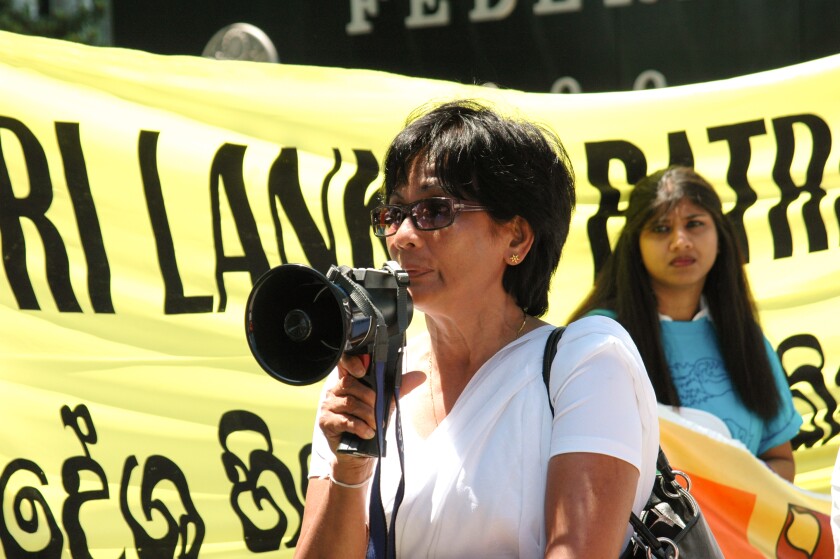
Sri Lankan journalist Hassina Leelarathna holds a megaphone in front of federal building.

Hassina Leelarathna, a co-founder of the only Sri Lankan newspaper in the U.S. and an activist who spurred fellow immigrants to help when disasters struck their homeland, has died at age 73.

Leelarathna died in Sherman Oaks on Oct. 17 after battling lung cancer for the last five years, said her son, Sahan Gamage.

After moving to California from her native Sri Lanka, Leelarathna founded the Sri Lankan Express in 1981 with her husband, Deeptha Leelarathna.

The paper initially published biweekly, in English, moving completely online in 2015.

For her, it was an intense” labor of love. Leelarathna worked full time at other jobs, most recently as a financial analyst for the Department of Veterans Affairs.

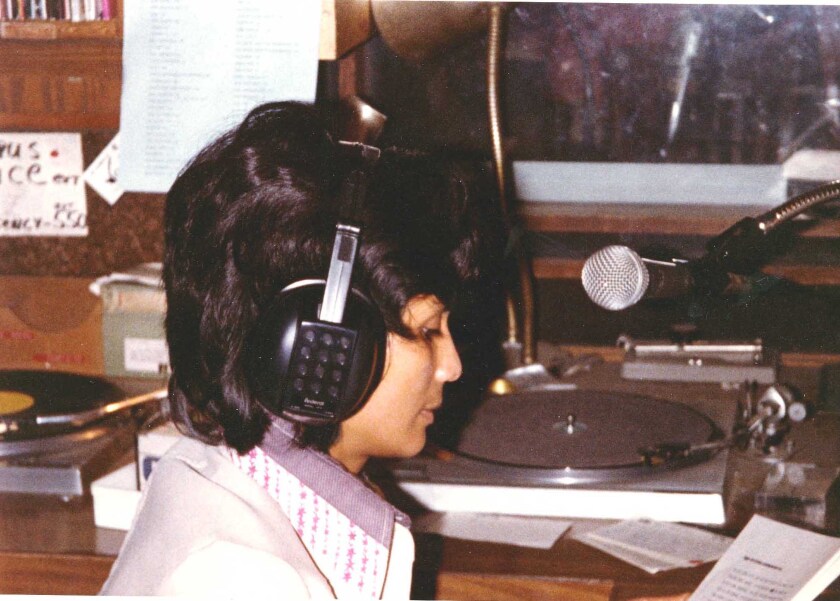
Hassina Leelarathna wears headphones and speaks into a microphone

The couple also broadcast a radio program, Tharanga,” in English and Sinhalese for a Sri Lankan community that in Los Angeles County numbers nearly 20,000 and supports about 10 Buddhist temples.

After her husband died in 2006, Leelarathna ran the newspaper on her own, spotlighting the decades-long civil war in Sri Lanka as well as issues faced by new immigrants in this country, including healthcare, education and the economy.

The Express also highlighted the accomplishments of immigrants and their children.

If a Sri Lankan won the spelling bee, he or she would be covered,” Gamage, 38, said. We’re small in size. We need to celebrate each other.”

Leelarathna played a dual role as a documenter of events and a participant.

She was a ubiquitous presence at rallies and protests, both interviewing people for the newspaper and at times, taking the megaphone to pump up the crowds.

She did not hesitate to tell people what she thought they should do, whether it was raising money for tsunami victims or showing greater respect to Buddhist monks.

She did not stay quiet, ever, when she could be doing something better like bringing attention to crisis or inhumanity,” said Podinilame Dissanayake, a longtime friend from Duarte who used to deliver the paste-up paper from the couple’s home in Pacoima to the printer in Gardena. Her character was marked by two distinct traits: her passion for journalism and the uncompromising patriotism toward the country of her birth.”

After a tsunami hit Sri Lanka and nearby nations in December 2004, the pair reported extensively on efforts to assist victims.

On a visit to his homeland, an island nation off the southern coast of India, Deeptha Leelarathna discovered international aid stuck at ports or being siphoned off by corrupt officials.

The Sri Lankan Express was among the first media outlets covering tsunami-related corruption and inefficiency at government agencies and international aid groups.

Urging fellow Sri Lankan immigrants to raise money for disaster victims or to take up social service causes, Hassina Lalarathna demanded: Why do you keep silent? Let us get together and make it happen,” recalled the Ven. Punyasiri Aparekke, a leader of the Maithree Vihara Buddhist Meditation Center in Sun Valley.

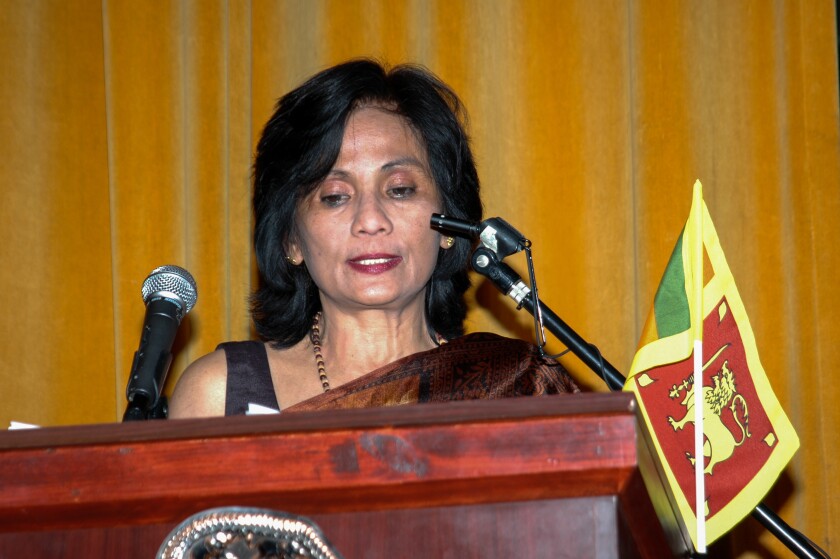
Hassina Leelarathna at a lectern.

I would say more than 95% of the Sri Lankan older generation knows her and her contributions,” Aparekke said. She was a woman with a strong backbone. She was so dedicated, so concerned even about the minute things of life.”

Hassina Leelarathna was born on June 22, 1948, in Colombo, Sri Lanka.

At the Times of Ceylon, she met another reporter, Deeptha Leelarathna, whose pieces on politics and science won him two fellowships, including one at Stanford.

In 1975, the couple left their native country to move to the U.S., first settling in the Bay Area, then in Southern California.

Leelarathna, raised in a Muslim family in Sri Lanka’s small Malay community, had converted to Buddhism and became devout, attending weekly meditation sessions at Maithree Vihara.

She earned a master’s degree in English from San Jose State and loved Shakespeare and mysteries, reading every John Grisham novel.

She was a persistent sleuth” who pushed sources to explain themselves and was also a committed fact-checker, Gamage said.

She was really good at asking the right questions,” he said. Why are we spending X amount on this? Why are there two purchases when you only need one?”

Leelarathna wrote all the time” and in the last few years had been working on a book documenting the history of the Sinhalese people in the U.S.

The book is more than half-done, according to Dissanayake, and friends hope to dig into her computer files to see if there is a way to complete it.

Gamage, a systems analyst who describes himself as a terrible writer,” has no plans to take over the newspaper.

With no successor, its future is in jeopardy.

When my friends and I cleaned the garage and looked at my mother’s belongings and the old issues, they were amazed at everything the newspaper did. The depth of the coverage — suicide bombings, attacks, assassinations, aid — and the images and headlines were fascinating. It talked about real life, it was raw,” Gamage said. We need to save it, but how?”

A productive way out of the LNG dilemma

November 1st, 2021

by Eng Parakrama Jayasinghe Courtesy The Island

Both Liquid Petroleum Gas (LPG) which recently saw a sharp price increase and is now the preferred cooking fuel even in some rural areas, and yet-to-be-used Liquefied Natural Gas (LNG) have received widespread public attention.

Natural Gas (NG) , which is mostly Methane (CH4) , the fossil fuel promoted as the alternative for dirty coal used for power generation, has to be brought in to the country in concentrated form liquefied at low temperature for transport logistics and economies. This makes it LNG when the source of supply is foreign. We will therefore have to depend on LNG as long as it is imported and would also need the storage and regasification facilities such as the Floating Storage and Regasification Units (FSRU) to convert the LNG to the form usable at a power plant. These are the issues under hot debate right now.

Ignoring the sordid details of the major decision making processes of Sri Lanka, particularly in the energy sector, let us face the realities

* A 350 MW power plant designed to use natural gas is being built without any arrangements in place for the supply of the gas needed.

* The 300 MW Yugadhanawi power plant, pushed as designed for easy conversion for the use of Natural Gas, has been running on low sulfur furnace oil as expensive as diesel since 2011.

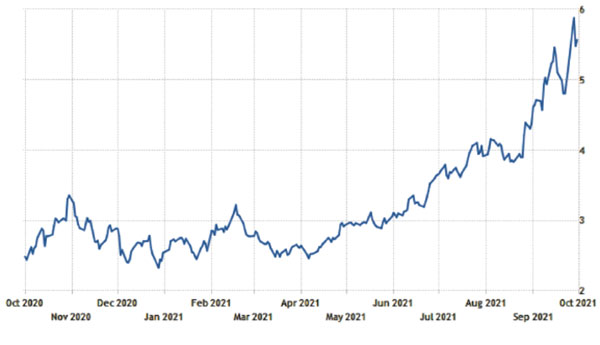
* The natural gas price in the world is soaring compared to what it was when it appeared to be the best option to get away from coal

* Renewable energy based electricity is now undoubtedly cheaper than any form of fossil fuel based generation including NG , and this is true for Sri Lanka too.

* There is a proven indigenous natural gas reserve in Mannar in Blocks M2 in close proximity to the 900 MW Norochcholai coal power plant

* Coal prices have gone through the roof making coal power, once considered the cheapest when all its ill effects are ignored, is no longer an option financially, economically, environmentally and socially

* Sri Lanka has declared a policy to achieve a 70% contribution by RE sources for electricity generation by 2030, and an international commitment to reach zero carbon emission status by 2050

* There is significant interest backed by actual commitments and multi million dollar investments for the purchase of the Mannar data, by big players in the oil and gas industry targeting the balance blocks offered by Sri Lanka for exploration. This process is underway, supported by an immediate captive demand for the proven sources to be developed

* Sri Lanka is in the throes of a foreign exchange crisis which makes an offer of US $ 250 Million to appear as manna from heaven. However the annual drain of over $ 4,000 Million for the import of fossil fuels, of which nearly $ 1,000 Million is consumed for power generation, is the main contributor to the crisis which is exacerbating due to the current world trends.

* In the government sector, the left hand does not seem to know what the right hand is doing

* Thus a national asset in a company making good profits is being sold through a midnight deal by the Treasury owning the shares, accepting conditions gravely affecting the performance of the Ministry of Power and Energy and the plans and programs of the Ministry of Energy, without any consultation with them.

* In this background it is worthwhile considering if there is still a way out and to eat the cake and keep it. This can be shown to be possible.

The Current State of Play in the Electricity Sector

There has been doomsday predictions of impending energy shortages in the past, most recent being in 2019, which did not come to pass. The next prediction is for 2023 unless the present dependence on imported fossil fuels is arrested. This may come true not because of lack of generation capacity but due to inability to pay for the import of fossil fuels – both oil and coal.

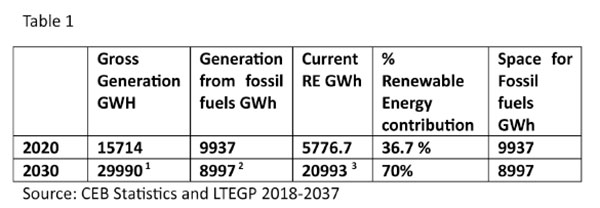
There has been some progress in the development of indigenous renewable energy which fortunately for us is non-fuel based in case of wind and solar. Some impediments imposed by vested interests on this progress has now been removed by the present administration and coupled with the laudable target to achieve 70% RE by 2030 would help accelerate this progress. This goal clearly limits the space available for non-renewable power generation. As the table below indicates there is no room to add any more fossil fuel based power plants including Natural Gas, except perhaps as replacement for the units due to be retired shortly at the end of their economic life.

Notes.

1. Projected total electricity demand in 2030

2. Fossil fuel generation allowable under 70% RE scenario

3. Renewable Energy Capacity to be reached by 2030 to achieve 70% RE target

Therefore the 350 MW Subadhanwi Power Plant under construction may have a role to play as several plants in the Kelanitissa complex are due to be retired.

Although the commitment to achieve zero emission by 2050 would be further challenged by the target of carbon free power generation by 2040, the introduction of natural gas (also a carbon emitter) as a transitional source of fuel to occupy the 30% space up to 2030 is not illogical.

The game plan

As stated above there is no room for adding any more NG power plants at Kerawalapitiya or for fuel switching at Kelanistissa, proposed as the means of absorbing the minimum Take or Pay (TOP) condition of 35 Million MBTU per year in the present deal with New Fotress Energy ( NFE) . Therefore the suggestion that we will only pay for the 25 Million MBTU per year that we can consume, during the first five years and the balance would be accumulated, but nevertheless is payable, will be a Damocles Sword hanging over us. This would also be a strategy to extend the contract for a further five year period. It is futile to make calculations of the amount we have to pay, for something we will not consume at present, as the crystal ball is quite cloudy as to the rate at which the NG prices would escalate. The recent price trends shown below is a good indication.

As such depending on imported natural gas which makes it LNG is not an option we should pursue, if not for any reason other than the drain on the foreign exchange.

Do we have an option? Fortunately based on the opinion of the officials of the Petroleum Development Authority of Sri Lanka (PDASL) now formally established under the Act No 21 of October 8, 2021, we do have a more attractive option. The hard work of these officials who never lost faith in spite of setbacks, unequivocally confirm the proven resources in the Block M2 in Mannar named Barracuda and Dorado of the presence of almost 1.85 Trillion Cubic Feet of Natural Gas (mid-level estimate). This is equivalent to 1,850 Million MBTU, to be compared to the present numbers being bandied about, of 175 Million MBTU over five years as the TOP offered by the NFE. There is adequate gas to operate these two power plants for over 50 years from this one gas field alone.

The prospects of the wider Mannar Basin, inc. Block M2, is estimated to hold 9 TCF of Natural Gas based on analysis of all available data.

So we can operate the Norochcholai, Yugadhanawi and Sobhadhanawi power plants for 30 years with our own gas, if we take the trouble to develop these two reservoirs alone.

But naturally we do not have the expertise or the economic capacity to develop this resource and would need a competent company in the Oil and Gas industry to come to a contractual arrangement with Sri Lanka. May I mention in passing that I hope these negotiations will be done by competent people who have interest of Sri Lanka as the utmost aim, while accepting the realities of the commercial world.

Take or Pay for Natural Gas Development in Mannar

As much as a supplier of an FSRU and supply of LNG would expect a minimum guaranteed of off take, the potential developer of our own gas fields would also have similar expectations, which we cannot deny. It is up to Sri Lanka to evaluate the minimum quantities we can afford to consume without having to pay for gas or services beyond that amount. This becomes even more critical when that payment will need to be in dollars that we don’t have.

It has often been said that the minimum off take that would be acceptable would be in the range of 1000 MW of power generation. This is verified by the NFE terms which targets the two plants at Kerawalpitiya adding up to 650 MW and the passing references to another power plant of capacity 350 MW at the same location, which has not received much attention. It is clear that this cannot happen if we accept the 70% RE target.

But how can we reach the 1,000 MW target but not violate the 70% RE target? Fortunately the recent events have opened a most attractive opportunity to offer a viable level of off take without having to construct any new power plants. The phenomenal rise in the coal prices now exceeding $ 240 per MT at source, could be a blessing in disguise in many ways. No amount of fancy accounting can now prove the cost of coal power generation to be at an acceptable level, even if we can find the dollars to buy the coal.

So the most obvious step to be taken is to covert the three units of 300 MW coal power plants at Norochcholai to operate on natural gas from our own gas resources. Not only does this not require any FSRUs, as the gas will be supplied in gaseous form, which can be pumped directly to the power plant, we will not have to pay for the gas in dollars. There would be some payment on the extraction, processing and piping costs. But this is not linked to any world gas prices. However, the benefits that would accrue, financially, economically and environmentally are massive and too numerous to list here.

Before anyone objects to this proposal by saying that this is not proven technology or has not been done anywhere, I must say that over 100 coal plants have been converted to gas in USA alone.

No doubt this kind of leap would require much planning and analysis in addition to the political wisdom and will. Some temporary measures would need to be taken if the planned time schedules are disturbed. But the realities on the ground and the dire situation faced by Sri Lanka presently and in the foreseeable future, behooves us to look for innovative solutions and maximize the utilization of our own resources that nature has bestowed on us.

But as mentioned before, the principle ingredient required is the commitment to achieve the best for Sri Lanka and the integrity of the decision makers. These unfortunately has been the missing ingredients in all of the past events.

I await responses from those who can appreciate the validity and value of these proposals, as well as those from among the doubting Thomas’s to which I will respond, as the space limits me to preempt such queries.

Has Sri Lanka got the courage to reject the current proposals driven by short term expediencies and possibly other reasons, which will definitely block any chances of our chances of ever developing our proven resources and take this step to make us a net energy exporter?

(E Mail : parajayasinghe@gmail.com Telephone : 0777269970)

Ven. Gnanasara’s appointment: Sabry likely to quit justice portfolio

November 1st, 2021

By Shamindra Ferdinando Courtesy The Island

President’s Counsel Ali Sabry, the only Muslim among the Cabinet ministers, is likely to quit the justice portfolio over the recent appointment of Ven. Galagodaatte Gnanasara Thera as the head of the Presidential Task Force (PTF) to make recommendations in respect of ‘One Country, One Law’ concept.

Well-informed sources say Sabry, who campaigned alongside civil society group ‘Viyathmaga’, at the 2019 presidential election, is quite disappointed at the unexpected development.

Sabry, who appeared for Gotabaya Rajapaksa in several high-profile cases, including the controversial acquisition of MiG-27 fighters, entered Parliament on the SLPP National List. Sabry is expected to make an announcement after President Gotabaya Rajapaksa’s return to the country from the UK.

Premier Mahinda Rajapaksa has discussed the issue with the Justice Minister and advised the latter against taking a hasty decision. The Justice Ministry was not consulted as regards Ven. Gnanasara Thera’s appointment as the head of the PTF, sources say.

The Ven. Thera is the General Secretary of the Bodu Bala Sena (BBS).

Justice Ministry sources said the announcement of Gnanasara Thera’s appointment had surprised them. Initially, we thought it was a social media prank,” they said.

The PTF has been authorised to examine the work undertaken by the Justice Ministry.

SLMC leader and one-time Justice Minister Rauff Hakeem has questioned the rationale behind accommodating Gnanasara Thera, who received a presidential pardon during Maithripala Sirisena’s tenure while serving a jail term for contempt of court, in the PTF. The SLMC is a constituent of the Samagi Jana Balavegaya (SJB), the main Opposition party in Parliament.

Lawmaker Hakeem has asked whether the new move was aimed at strengthening the hands of those trying to cause further mayhem amidst pressure on the government to implement the recommendations of the Presidential Commission of Inquiry (PCoI) into the 2019 Easter Sunday carnage.

The former minister said that such short-sighted strategies would only tarnish Sri Lanka’s image at a time the global Muslim community as well as other countries interested in post-war reconciliation process here were closely following the situation here.

Controversy has erupted over Ven. Gnanasara’s appointment as PTF head amidst speculation the monk may receive the national List slot of the Ape Jana Bala Pakshaya (AJBP) at the expense of Ven. Athureliye Rathana Thera.

The AJBP on 16 Oct, informed the Secretary General of Parliament of its decision to expel Ven. Rathana from the Parliament. Election Commission Chairman Attorney-at-Law Nimal Punchihewa told The Island that Ven. Rathana would automatically lose his seat within one month unless the monk moved court against the party’s decision.

Pointing out that Tamils and Christians hadn’t been represented in the PTF, MP Hakeem said that Gnanasara Thera’s leadership to such a vital outfit wouldn’t be acceptable under any circumstances.

Yuthukama Chief Gevindu Cumaratunga, too, raised the issue at hand with President Gotabaya Rajapaksa at a recent meeting at Temple Trees.

Meanwhile, Sri Lanka’s former Ambassador in Myanmar Prof. Nalin de Silva, in a statement, appreciated the appointment given to Ven. Gnanasara. Saying that he didn’t accept Ven. Gnanasara Thera’s views on some issues and the monk’s connections with certain persons, Prof Silva emphasised he was the most qualified to serve in that capacity.

Prof. de Silva said that the relevant the PTF should be headed by a Buddhist monk.

පිටරට පරකාසේ ගෙදරට මරගාතේ

November 1st, 2021

ලංකාවේ වෙනදේ

දැන් අප මුහුණ දෙන අභියෝගය වන්නේ නවීන විද්‍යාත්මක තාක්ෂණික ක්‍රම සහ භාවිතයන් පාරිසරික හානියක් ඇති නොකර කෘෂිකාර්මික නිෂ්පාදනය ඉහළ නැංවීම සඳහා යොදා ගැනීමයි. දශක ගණනාවක් තිස්සේ නිදන්ගත වකුගඩු රෝගය ශ්‍රී ලංකාවේ කෘෂිකාර්මික හදවත් තුළ බරපතල ප්‍රශ්නයක් වී තිබේන බව නයිට්‍රජන් යළි සොයාගැනීම: දේශගුණික විපර්යාස, සෞඛ්‍ය, ජෛව විවිධත්වය සහ සඳහා විසඳුම් සහ සහයෝගීතාව” යන තේමාව යටතේ ස්කොට්ලන්තයේ ග්ලාස්ගෝ නුවර පැවැත්වෙන එක්සත් ජාතීන්ගේ දේශගුණික විපර්යාස සමුළුවට (COP 26) සමගාමීව ශ්‍රී ලංකාව විසින් සංවිධානය කරන ලද විශේෂ සමුළුව අමතමින් ජනාධිපතිවරයා ප්‍රකාශ කළේය.

රසායනික පොහොර අධික ලෙස භාවිත කිරීම මෙම ගැටලුවට විශාල දායකත්වයක් ලබා දී ඇති බව පැවසූ ජනාධිපතිතුමා, රසායනික පොහොර ආනයනය අවම කිරීමටත් කාබනික කෘෂිකර්මාන්තය දැඩි ලෙස දිරිමත් කිරීමටත් තම රජය දැඩි පියවර ගත් බව මෙහිදී ප්‍රකාශ නමුත් ඔහු රසායනික පොහොර සහ කෘශි රසායනික ද්‍රව්‍ය සම්පූර්න්යෙන්ම තහනම් කර ඇතිබව සභාව ඉදිරියේ ප්‍රකාශ නොකිරීමට වගබලා ගතේය

සමුළුව ඊයේ (31) පස්වරු 5.00 ට පැවැත්විණි. ස්කොට්ලන්ත වේලාවෙන් ජනාධිපති මාධ්‍ය අංශය පැවසීය.

“නයිට්‍රජන් යළි සොයාගැනීම” තේමාවද අසාසිටින පිරිස ව්‍යාකූල තත්වයටද පත්කර තිබුනි. සමහරදෙනේකුගේ අදහස වූයේ ලංකාවේ නවතම නයිට්‍රජන් සොයාගැනීමක් කල එලි දැක්වීමට එක්සත් ජාතීන්ගේ දේශගුණික විපර්යාස සමුළුවට (COP 26)  සමගාමීව ශ්‍රී ලංකාව විසින් මෙම සමුලුව සංවිධානය කරන ලද බවයි

සොබාදහමට එරෙහි නොවන නව කෘෂිකාර්මික විප්ලවයක අත්‍යාවශ්‍ය අවශ්‍යතාවය අවධාරණය කළ ජනාධිපති ගෝඨාභය රාජපක්ෂ මහතා සොබාදහමට එරෙහිව ක්‍රියා කරනවාට වඩා සොබාදහම සමඟ සහජීවනයෙන් සිටිය යුතු බව පෙන්වා දුන්නේය.

මගේ රජයේ ප්‍රතිපත්ති රාමුව තිරසාර බව අවධාරණය කරයි. දේශගුණික විපර්යාස පිළිබඳ එක්සත් ජාතීන්ගේ මූලික අවශ්‍යාංග සම්මුතිය (UNFCCC) යාන්ත්‍රණය සඳහා ශ්‍රී ලංකාවේ අභිලාෂකාමී යාවත්කාලීන කරන ලද ජාතික වශයෙන් නිර්ණය කළ දායකත්වයෙන් මෙය පිළිබිඹු වනබව” ජනාධිපතිතුමා පැවසීය.

මෙම ක්‍රියාව පුළුල් ලෙස අගය කර ඇතත්, එය යම් විවේචනයකට සහ ප්‍රතිරෝධයකට ද මුහුණ දී ඇත. රසායනික පොහොර ලොබි කණ්ඩායම්වලට අමතරව අස්වැන්න වැඩිකර ගැනීමේ පහසු ක්‍රමයක් ලෙස පොහොර අධික ලෙස භාවිත කිරීමට පුරුදු වී සිටින ගොවීන්ගෙන් මෙම ප්‍රතිරෝධය මතුව තිබෙනවා” යැයිද ජනාධිපතිතුමා පැවසීය.

ශ්‍රී ලංකාවේ පොහොසත් කෘෂිකාර්මික උරුමය සලකා බැලීමේදී මෙය විශේෂයෙන් අවාසනාවන්ත තත්ත්වයක්” යැයි ජනාධිපතිවරයා වැඩිදුරටත් පැවසීය.

සංවර්ධනය වෙමින් පවතින රටක් ලෙස සම්පත් අවහිරතා මධ්‍යයේ වුවද පරිසරය පිළිබඳ ශ්‍රී ලංකාවේ ප්‍රගතිශීලී න්‍යාය පත්‍රය ක්‍රියාත්මක වන බව පැවසූ ජනාධිපතිතුමා, විශේෂයෙන් වසංගතයෙන් පසුව සංවර්ධන වැඩසටහන් සමඟ එවැනි න්‍යාය පත්‍රයක් පවත්වාගෙන යාම සංවර්ධනය වෙමින් පවතින සියලුම ජාතීන්ට අභියෝගාත්මක බව පෙන්වා දුන්නේය.

සංවර්ධන ආධාර, තාක්ෂණ ස්ථාන මාරුවීම්, නිපුණතා සංවර්ධනය, ආයෝජන සහ මූල්‍ය සහය තුළින් සංවර්ධිත රටවල් සිය පූර්ණ සහයෝගය එවැනි ජාතීන්ට ලබා දෙනු ඇතැයි ජනාධිපතිතුමා විශ්වාසය පළ කළේය. මෙම ප්‍රයත්නයේදී ව්‍යාපාර සඳහා සැලකිය යුතු කාර්යභාරයක් ද ඇති බවත්, තිරසාරභාවය සඳහා ආයෝජනය කිරීමේදී සැලකිය යුතු ප්‍රතිලාභයක් ලැබිය යුතු බවත් ඔහු සඳහන් කළේය.

අද ජීවතුන් අතර සිටින අප සියලු දෙනාම අනාගත පරපුර වෙනුවෙන් මේ පෘථිවියේ භාරකරුවන්ය. අපට හැකි සෑම ආකාරයකින්ම දායක වෙමින් එහි සෞඛ්‍යය තහවුරු කිරීම සඳහා අප සියලු දෙනා එක්ව කටයුතු කළ යුතුයි.’’ ජනාධිපතිතුමා පැවසීය.

“අපි සියලු දෙනාම සාමූහිකත්වයෙන් සහ හොඳ හිතකින් මෙය කරන්නේ නම්, අපගේ ජනතාව සහ අපේ පෘථිවිය සඳහා ධනාත්මක වෙනසක් ඇති කිරීමට අප සාර්ථක වනු ඇතැයි මට විශ්වාසයි,” ඔහු පැවසීය.

විදේශ නියෝජිතයින් සංසදයට සාදරයෙන් පිළිගනිමින් පරිසර අමාත්‍ය මහින්ද අමරවීර මහතා පැවසුවේ සාම්ප්‍රදායික කෘෂිකාර්මික ඉඩම් 100% කාබනික බවට පත් කිරීමට තීරණය කළ ලොව පළමු රට ශ්‍රී ලංකාව බවට පත්ව ඇති බවයි. දේශගුණික විපර්යාස සඳහා තිරසාර විසඳුම් සහිත හරිත සමාජ-ආර්ථිකයක් නිර්මාණය කිරීම මෙම පියවරේ අරමුණ බව අමාත්‍යවරයා පැවසීය.

ප්‍රමාද වූ සහ ජීවතුන් අතර සිටින සියලුම විද්‍යාඥයින් නයිට්‍රජන් පිළිබඳ ඔවුන්ගේ ක්‍රියාකාරකම් අගය කළ අමාත්‍යවරයා, නයිට්‍රජන් සොයා ගැනීමෙන් සියවස් ගණනාවකට පසු අපි නයිට්‍රජන් නැවත සොයා ගනිමින් සිටිමු” යනුවෙන් පැවසීය.

පරිසර අමාත්‍යාංශයේ ලේකම් ආචාර්ය අනිල් ජාසිංහ දේශගුණයට ඔරොත්තු දීමේ හැකියාව සහ අනුවර්තනය වීම පිළිබඳ ශ්‍රී ලංකාවේ අභිලාෂයන් පිළිබඳව අදහස් ප්‍රකාශ කළේය: COP26 සහ ඉන් ඔබ්බට,” එක්සත් රාජධානියේ ශ්‍රී ලංකා මහ කොමසාරිස් සරෝජා සිරිසේන ද අදහස් පළ කළ බව PMD වාර්තා කරයි.

Sri Lanka reports 408 new coronavirus cases and 17 deaths

November 1st, 2021

Courtesy Adaderana

The Director General of Health Services has confirmed another 17 coronavirus related deaths for October 31, pushing the death toll in the country due to the virus to 13,760.

This includes eleven males and six female patients. Six of the victims are aged between 30-59 years while the rest are aged 60 years and above. 

Meanwhile the Health Ministry reported that another 408 persons have tested positive for Coronavirus today, increasing the tally of confirmed cases reported in the country to 541,481.

Gnanasara Thero on responsibility of Task Force for ‘One Country, One Law’

November 1st, 2021

Courtesy Adaderana

The Chairman of the Presidential Task Force for ‘One Country, One Law’ Ven. Galagodaaththe Gnanasara Thera has said that he is committed to fulfilling the desired objectives of the Task Force together with its members.

The Thera pointed out that in fulfilling that role, they will act according to a core policy framework and no citizen should be subjected to any difference or discrimination before the law on the basis of their race, religion, caste or any other factor.

The first media conference on the role of the Presidential Task Force for ‘One Country, One Law’ was held today (01) at the Presidential Media Centre via video technology.

Ven. Galagodaaththe Gnanasara Thera emphasized that if the citizens can place the country as number one, above all, regardless of their ethnicity, religion or political affiliation, the Task Force is ready to listen to all opinions regarding the legal framework of such a country and further said that the Presidential Task Force has a broad understanding on this issue.

Our responsibility is to create a one nation that can get together under one flag and to formulate one law suitable for the country,” the Thera added.

We need one nation which deviates from the narrow divisions and lives together in harmony, respecting each other’s cultural and religious heritages. Our responsibility is to create the necessary environment in this country to formulate one law that will bring together all the communities without being divided into as Sinhalese, Tamils, Muslims or else Buddhists, Catholics, Hindus or Muslims.”

The youth of this country have suffered the most due to racial, religious and provincial divisions.” Therefore, the youth have a special place in this process, he said, adding that all young people representing universities, higher education institutions and various organizations are invited to submit their ideas and suggestions to the Task Force.

The Thera also said that he hopes to discuss the matter with all political parties, religious and civil society organizations and groups in the coming days and added that the discussion is open to all who come without any hidden agendas. The Thera said that after consulting all these sections, the views and recommendations of the Task Force would be submitted to the President within the given timeframe.

Prof. Sumedha Siriwardana, Member of the Presidential Task Force for One Country, One Law, stated that the Task Force has been mandated to make recommendations for the implementation of One Country – One Law” concept in Sri Lanka after conducting a study. 

He said the Presidential Task Force does not have the power to make laws and that it will be done by the legislature.

ආචාර්ය ,මහාචාර්ය පට්ටම් නොතිබූ,ආසියාවේ යකඩ ගැහැණිය

November 1st, 2021

උපුටාගැනීමකි

ඇය ගැහැණියක් වී මේ රටට කල සේවය අප රට පාලනය කල කිසිදු පාලකයෙක් සිදු කලේ නැත.

2000 අවුරුද්දේ සිරිමාවෝගේ නිසල දේහය නුවර පාරේ පෙරහැරකින් සමාධිය වෙත අරගෙන යද්දී ඒ දිහා බලාගෙන හිටිය මම මේ යන්නේ කවුද කින්ද මන්ද කියලා මුකුත් දැනගෙන හිටියේ නෑ.ඒත් ඒ ගියේ ලංකාව ඇත්තටම ආස්චර්‍යයක් කරන්න මාස්ටර් ප්ලෑන් එකක් තිබ්බ මහ යකඩ ගෑණියෙක්ගේ දේහය කියලා අද තමා තේරෙන්නේ.ඒලෙවල් පන්තියේ ඉද්දී එක සර් කෙනෙක් කිව්වා ගෑණුන්ට රටවල් පාලනය කරන්න බෑ කියලා.අපේ රටත් දෙන්නෙක් පාලනය කලා රට කෑවා කිව්වා.අපිත් අහගෙන හිටියා.අපේ වැඩිහිටියෝ ගොඩක් මෙහෙම කියනවා.”ඒ කාලේ මේ ගෑනි හින්දා අපිට කන්න නෑ.අඳින්න නෑ.පුදුම දුකක් වින්දේ ජීවත් වෙන්න”.මේ ඔක්කොම ඇත්ත වෙන්න ඇති.ඒත් තව අවුරුදු දහයක් අපේ ජාතිය ඉවසුවා නම්.

ඇය අපේ රට පාලනය කල මහ උත්තරීතර පාලිකාවක්.ඇමරිකන් ඩොලර් එකක් මිලදී ගන්න අපි රුපියල් හතරයි වැය කලේ.ඇයගේ කාලය තුල ලංකාව කිසිඳු රටකට ණය නැති රටක්.ඇය දේශීය නිශ්පාදන නව නිපැයුම් කෙරෙහි විශ්වාසය තැබුවා.අපේ රටේ දේවල් පිට රට ඇරියා.රටක් ගොඩ එන්න නම් දුක් විඳින්න ඕනෙම තමා.ඒ දුක මිනිස්සුන්ට දැනුණා.ආසියාවේ තිබ්බ විශාලතම වානේ කර්මාන්ත ශාලාව වෙච්ච ඔරුවල වානේ සංස්ථාව අපිට තිබුණා.කන්තලේ,සෙවණගල සීනී කර්මාන්ත ශාලා තිබුණා.කන්කසන්තුරේ,පුත්තලම,ගාල්ල සිමෙන්ති කර්මාන්තශාලා තුනක් තිබ්බා.කැලණි ටයර් ඉන්දියාවට අපනයනය කලා.තුල්ටෙක්ස්,වේටෙක්ස්,කූටෙක්ස් සමාගම් තිබ්බා.විදේශීයන්ට අයත් වෙලා තිබ්බ අපේ රටේ වතු ඇය විසින් රටට යලි ලබා ගත්තා.රිදී අපනයනය කලා.වාලච්චේන කඩදාසි කම්හල තිබුණා.ඇය යකඩ ගැහැණියක්.මහා දැක්මක් තිබ්බ රාජ්‍ය පාලිකාවක්.

ජේ ආර්ගේ සුරපුරයට වහ වැටිලා මිනිස්සු 77දී මැතිණියව ගෙදර යැව්වා.ජේ ආර් කරපු හානිය දැන් තමා අපිට තේරෙන්නේ.ඉඳිකට්ටක්වත් අපිට හදාගන්න බෑ.දේශීය සමාගම් පිටරටවල් වලට විකුණලා.ඇය දේශීය නිශ්පාදන කෙරෙහි විශ්වාසය තැබුවා වගේම දේශීය ව්‍යාපාරිකයන් කෙරෙහි සියලු සම්පත් ලබා දුන්නා.උපාලි  විජේවර්ධන වැනි දේශීය ව්‍යාපාරිකයන් ගොඩ නැගුවා.යුනික්,කැන්ඩොස්,මැස්ඩා ෆියට්,ඩෙල්ටා වැනි සන්නාම ලෝකයට ගෙනගිය පිලිප් උපාලි විජේවර්ධන වැනි මහා දැවැන්ත මිනිසුන් ගොඩ නගන්න ඇයගේ රජය කටයුතු කලා.සිරිමාවෝ දිගටම හිටියා නම් බිල්ගේට්ස් වගේ මිනිහෙක් ලංකාව ඇතුලේ හදලයි නවතින්නේ.කපු වගා කලා.මහා වගා සංග්‍රාමයන් කලා.තෝර පරිප්පු ,මුං ඇට වැව්වා.දේශීය ආහාර  රටාවක් ගොඩ නැගුවා.මහවැලිය ආරම්භ කලා.ඒවා ණය අරගෙන කරන්න ඇයට අවශ්‍ය වුණේ නෑ.ඒ හින්දා ඇය දශක ගණනකට එය ව්‍යාප්ත කලා.දේශීය මුදල් වලින් ලෝකයට ණය නොවී රට ගොඩනගන සැලැස්ම ඇය සතු වුණා.එහෙත් ජේ ආර් ආවා.මැතිණියව අන්ත අසරණ කරලා දැම්මා.ලෝකයේ බලවත් රටක් අපේ මිනිස්සුන්ගේ ඔලුවල මැව්වා.ආර්ථිකය විවෘත කලා.කිසිම දෙයක් අපි හදන්න ගත්තේ නෑ.තිබ්බ දේශීය සමාගම් විකුණලා දාලා චීනයෙන් ඉන්දියාවෙන් ගෙන්නන්න ගත්තා.අද අපි කොතනද????

මාග්‍රට් තැචර් පරාදයි සිරිමාවෝ ඉස්සරහා.සිරිමාවෝට තිබ්බ දර්ශණය කිසිම පාලකයෙකුට තිබ්බේ නෑ.ඔක්කොම ආවේ ණය අරගෙන රට ගොඩ දාන්න.දැන් අපේ රජයේ සේවකයන්ට පඩි ගෙවන්නෙත් ණය අරගෙන.ණය පියවන්න තව ණය ගන්නවා.මාර ආර්ථික ඔස්තාර්ලා අපේ රටේ ඉන්නේ.ඇයට නම් උපාධි මහ සහතික තිබ්බේ නෑ.ඒත් රට පාලනය කරන්න අවශ්‍ය සරල බුද්ධියක් තිබ්බා.සිරිමාවෝ ගෑණියෙක් තමා.හැබැයි සිරිමාවෝට තිබ්බ ගට් එක එක පිරිමියෙක්ට තිබ්බේ නෑ.ඇය ගියේ ඇගේ සැමියා ඇයට පෙන්නපු පාරේ.ඇය ගියේ උත්සහවන්ත ගමනක්.තවමත් ඇයට බනින මිනිස්සු ඉන්නවා.
එහෙත් ඇය තමයි මේ රට සුරපුරයක් කරන්න හරිම ප්ලෑන ගහපු පාලිකාව.ඔය මොන දැක්මවල් පොත් වල තිබ්බත් ක්‍රියාත්මක වෙච්ච නිවැරදිම දැක්ම ඇයගේ.ඇයට පණ දෙන්න අපේ ජාතියට පුලුවන් නම් රට ගොඩ දාන විදිය දවසින් ඇය උගන්නයි.

දේශීය කර්මාන්ත ගොඩ නොනගා දේශීය ආර්ථිකය ගොඩ ගැනීමට හැකි නම් ඌ වයිමාටත් වඩා වැඩ්ඩෙක් විය යුතුමය…..

මැතිණියනී…..
ඔබේ අගය වටහා ගැනීමට නොහැකි වීම අප ජාතියේ කරුමය මිස අන් කවරක්වත් නොවේ..
උපුටාගැනීමකි

මේක ගොවියාට පාරිභෝගිකයාට වඩා හරකුන්ට ආදරේ ‘හරක් ආණ්ඩුවක්’

October 31st, 2021

රජිත් කීර්ති තෙන්නකෝන් දකුණු පලාත් හිටපු ආණ්ඩුකාර  

කෘෂි ඉතිහාසයේ ලොකුම මිනිස්සු හදාගත් ව්‍යසනය විදිහට ලංකාවේ කාබනික නාඩගම ඉතිහාසගත වේවි

කිසිම වල් නාශකයක් නැතිව, කෘමි නාශක – දිලීර නාශක විතරක් ගෙන්න ආණ්ඩුව කැබිනට් පත්‍රිකාවක් සකස් කරලා තියෙනවා.  කාබනික නාඩගමේ ඔස්තාර් ලා හිතාගෙන ඉන්නේ කෘමිනාශක – දිලීර නාශකවලට වැඩිය වල්නාශක ‘විෂයි’ කියලයි. වෙච්ච වරද නිවැරදි කරනකොට නැට්ටේ ඉදන් ගොම ගාන්න හරක් වගේ හැසිරෙන්න හොඳ නෑ.   මේ ආණ්ඩුව කිසිම විශේෂඥ මතයකට ඇහුම්කන් දෙන්නේ නෑ.  ගොවියාට වඩා තණ කොළ කන හරක් එළුවෝ කුකුලන්ගේ සෞඛ්‍ය ගැන හිතන රටක් බව ලංකාව පත් වෙලා තියෙනවා.

ලංකාවේ කාෂිකර්ම ව්‍යසනය ස්වභාවික ආපදාවක් නෙවෙයි. අමන තකතීරු පාලකයින් විසින් ඇතිකරගත් ව්‍යසනයක්. අනාගතයේ දවසක ලෝක ආහාර වැඩසටහන, ලෝක කෘෂිකර්ම සංවිධානය වගේ ජාත්‍යන්තර සංවිධාන ‘ඊනියා විශේඥයින්ගේ උද්දච්චකම නිසා විහින් කෘෂිකර්ම විනාශ කර ගත්ත රටක්’ ලෙස ලංකාව ගැන සදහන් කරයි යැයි හිටපු ආණ්ඩුකාර රජිත් කීර්ති තෙන්නකෝන් පවසයි.

මහ වැස්ස නිසා උඩරට එළවළු වගාව විනාශ වෙනවා.  උඩරට තේ වගාවට දිලීර රෝග හැදිලා කුඩා තේ වතු විනාශයි.  මහ වතු සමාගම්වලට දිලීර නාශක විතරක් නෙවෙයි, වල් නාශකත් තියෙනවා. කුඩා තේ වතු හිමියෝ, පොඩි වගාකරුවන්නට පොහොර බෙහෙත් මොකවත් නෑ. මේක ධපතියාට සලකන, දුප්පතා කාබාසිනියා කරන ප්‍රතිපත්තියක්. විනාශය කරා රට ගෙනියන මාවතක්.

පොහොර තහනමට වැඩි විනාශයක් බෙහෙත් පළිබෝධ නාශක  තහනම නිසා වගාවට සිදු වෙනවා. ආණ්ඩුව ඉන්නේ අමු මිත්‍යාවන් එක්කයි.  පලිබෝධ නාශකවලින් අඩුම විෂ තියෙන්නේ වල්නාශකවල.  එවා ගහන්නේ තේ වගාවේ, බඩ ඉරිඟු වගාවේ වල්වලට මිසක් ගහට නෙවෙයි. දැන් කාබනික වගාව ඉවරයි. හෙට කැබිනට් මණ්ඩලය පලිබෝධ නාශක කිහිපයක් ගෙන්නන්න අනුමැතිය දෙනවා.  හැබැයි හැම වගාවකටම, කර්මාන්තයකට අවශ්‍ය වන වල් නාශක තහනම් කරලා. 

මේක ගොවියොන්ට වඩා හරකුන්ට ආදරේ ‘හරක් ආණ්ඩුවක්’.  මේකේ තියෙන්නේ මිනිස් ප්‍රේමයක් නෙවෙයි හරක් ප්‍රේමයක්.  ආණ්ඩුව හරකුන්ට, කුකුලොන්නට කොච්චර ආදරේ ද කිව්වොත් උන්ට හදන බඩඉරිඟු ගහ අහලකටවත් වස විස වදින්න ඉඩක් නැති කරනවා. කෘමි නාශක අනුමත කරලා, වල් නාශක තහනම් කරන මැටි මෝල් ප්‍රතිපත්ති හදපු නිලධාරීන්ට අං තට්ටුවක් පලන්දන්න ඔ්න.

රජිත් කීර්ති තෙන්නකෝන් දකුණු පලාත් හිටපු ආණ්ඩුකාර  

Daily count of new Covid-19 cases moves to 542 and 18 deaths.

October 31st, 2021

Courtesy Adaderana

The Health Ministry says that another 154 persons have tested positive for Covid-19 today, pushing the daily count of new cases to 542.

This also increases the tally of coronavirus cases confirmed in the country thus far to 541,073.

14,532 patients infected with the virus are currently being treated across the island while total recoveries is 512,798.

The Director General of Health Services has confirmed another 18 coronavirus related deaths for October 30, increasing the death toll in Sri Lanka due to the virus to 13,743. 

The deaths confirmed today include 10 males and 08 females while all the patients are in the age group of 60 years and above.

ඇයි පාලකයෝ /මේ බුද්ධිමතුන්ගෙන් ප්‍රයෝජන නොගන්නේ ?

October 31st, 2021

ඉතාම වැදගත් සාකච්ඡාවක්….මේවාගෙන් රජය උගත යුතු පාඩම් ගොඩාක් තියෙනවා. ඉන් වඩාත් වැදගත්ම දේ නම්,.. රටක මූලික පැවැත්ම රඳවාගැනීම වෙනුවෙන් ගන්නා තීරනවලදි මෙවන් විශය උගත් ස්වාධීන බුද්ධිමතුන්ගෙන් උපදෙස් ගත යුතු බවයි. නමුත් සිද්ධවෙන්නේ තම “පාක්ශික” උගතුන්ගේ හඬට පමනක් සවන් දීමයි. ඇමතිවරයා උගත්, බුද්ධිමතෙක් නොවුනත් ඔහුට උපදෙස් දෙන්න ඕන අය හඳුනා ගත යුතුයි.

ආනයනික පොහොර නිසා ගොවියා කබලෙන් ලිපට වැටෙයිද? | මාවත | Mawatha 28.10.2021

October 31st, 2021

Newsfirst Sri Lanka

නැනෝ යූරියා: වත්මන් පොහොර අර්බුදයට විසඳුමක්ද?

October 30th, 2021

ආර්.එස්.  ධර්මකීර්ති පාංශු සාරවත් බව සහ පෝෂක කළමනාකරණය පිළිබඳ පේරාදෙණිය විශ්වවිද්‍යාලයේ මහාචාර්ය විසිනි. අනුග්‍රහය The Island

ගූගල් පරිවර්තනයක්.

ආහාර සුරක්ෂිතතාව සුරක්ෂිත කිරීම ජාතික ආරක්ෂාව සහතික කිරීම සඳහා පූර්ව අවශ්යතාවකි. අපට අවශ්‍ය තරම් ආහාර නිෂ්පාදනය කිරීමට හෝ ආහාර මිලදී ගැනීමට අවශ්‍ය තරම් විදේශ විනිමය උපයා ගත හැක්කේ ආහාර සුරක්ෂිතතාව ළඟා කර ගැනීමටය. මේ දෙක ආරක්‍ෂා කර ගැනීමට අපොහොසත් වුවහොත් අපට වෙනත් රටවල් විසින් ඉදිරිපත් කර ඇති කොන්දේසිවලට යටත් වීමට සිදුවනු ඇත. ආරක්ෂිත අවකාශයන් සුරක්ෂිත කිරීම සඳහා වත්මන් ගෝලීය භූ දේශපාලනික සටන යටතේ, සුපිරි බලවතුන් සෑම විටම ශ්‍රී ලංකාව වැනි උපායමාර්ගික වශයෙන් වැදගත් රටවල ප්‍රයෝජන ගත හැකි අවස්ථා සොයනු ඇත. ශ්‍රී ලංකාවේ කෘෂිකාර්මික ක්ෂේත්‍රයේ වත්මන් පොහොර අර්බුදය අපව වඩාත් අවදානමට ලක් කරයි.

කාබනික කෘෂිකර්ම උන්මාදය

ජාතියට ආරක්ෂිත සහ සෞඛ්‍ය සම්පන්න ආහාර සැපයීම සඳහා එක රැයකින් පාහේ කෘෂි රසායන භාවිතය තහනම් කිරීමට අප්‍රේල් 27 වැනි දින කැබිනට් මණ්ඩලය නිර්භීත තීරණයක් ගත්තේය. පසුගියදා කෘෂිකර්ම අමාත්‍යාංශයේ ලේකම් ජ්‍යෙෂ්ඨ මහාචාර්ය උදිත් ජයසිංහ මුදලිගේ මහතා හදිසියේ 100% කාබනික කෘෂිකර්මාන්තය වැරදි උපදෙස් මත සිදු වූවක් බව පිළිගනිමින් වාර්තාගතව ඇත. ජාතික ආරක්‍ෂාව සම්බන්ධ කාරණයකදී යම් කිසිවකුට රජයක් නොමඟ යැවිය හැකි නම්, එහි බරපතළ වරදක් තිබිය යුතුය. බලධාරීන් දැන් පවසන්නේ වසර 3-5 ක කාලයක් තුළ 100% කාබනික කෘෂිකර්මාන්තයට අදියරෙන් ඉවත් කිරීම හොඳම ප්‍රතිපත්තිය විය හැකි බවයි. 100% කාබනික කෘෂිකර්මාන්තයට යන්නට ආණ්ඩුවේ අධිෂ්ඨානය යමෙකුට දැකගත හැකි විය. රටක ආහාර අනාරක්ෂිත භාවයට තුඩු දෙන කාබනික කෘෂිකර්මයේ දී බෝග අස්වැන්න සාමාන්‍යයෙන් 20-25% කින් අඩු වන බව අවධාරනය කරන විද්‍යාත්මක ප්‍රකාශන ඕනෑ තරම් තිබේ. එබැවින් සංක්‍රාන්ති සමය නොව 100% කාබනික කෘෂිකර්මය යන සංකල්පයම ජාතික ආරක්ෂාවට තර්ජනයකි.

රසායනික පොහොර විෂ සහිත නොවේ

රජය තවමත් විශ්වාස කරන්නේ රසායනික පොහොර විෂ සහිත වන අතර එය නොදන්නා හේතු විද්‍යාවේ නිදන්ගත වකුගඩු රෝගය (CKDu) ඇතුළු බෝ නොවන රෝග ගණනාවකට හේතු වී ඇති බවයි. පාංශු විද්‍යාව පිළිබඳ දැනුමක් ඇති අය නැවත අවධාරණය කරන්නේ ශ්‍රී ලංකාවේ යොදන පොහොරවල සෞඛ්‍යයට ඇත්තේ ඉතා අඩු අවදානමක් පමණක් බවයි. උදාහරණයක් වශයෙන්, පේරාදෙණිය විශ්වවිද්‍යාලයේ ජ්‍යෙෂ්ඨ මහාචාර්ය රෝහණ චන්ද්‍රජිත් විසින් මෙහෙයවන ලද CKDu පිළිබඳ රජයේ අරමුදල් සහිත පර්යේෂණ ව්‍යාපෘතියක අවසන් වාර්තාවක් උදාහරණයක් ලෙස සැලකිය හැකිය. එම වාර්තාවට අනුව, CKDu සඳහා හේතු සාධක තුනකට පටු කර ඇත; එනම් පානීය ජලයේ ෆ්ලෝරයිඩ් අන්තර්ගතය සහ මැග්නීසියම් අන්තර්ගතය සහ ගොවීන් අඩු ජල පරිභෝජනය. මෙම හේතු කිසිවක් එම ප්‍රදේශවල භාවිතා කරන කෘෂි රසායනවලට සම්බන්ධ නොවේ. 100% කාබනික ආධාරකරුවන් විසින් උද්දීපනය කරන ලද අනෙකුත් සෞඛ්‍ය ගැටළු සඳහා පවා, විද්‍යාත්මක පරීක්ෂණ මගින් හේතු-ඵල සම්බන්ධතාවයක් ස්ථාපිත කර නොමැත.

කාබනික පොහොර හිඟය

රජයන් 100% කාබනික කෘෂිකර්මාන්තය සඳහා වෙහෙසෙන්නේ නම්, ඔවුන්ට මුලින්ම අවශ්‍ය වූයේ රට තුළ කාබනික පොහොර අවශ්‍ය ප්‍රමාණයට නිපදවීමට සහ ඊළඟ බෝග කන්නය (එනම් මෙම මහ කන්නය) ආරම්භ වීමට පෙර මාස 3-4 ක් ඇතුළත ය. මෙම ඉලක්කය සපුරා ගැනීමට ඔවුන් අසමත් වූ අතර ගොවීන් පොහොර ඉල්ලා සිටිති. ඉන්පසුව කාබනික පොහොර ආනයනය නොකරන්නැයි විද්‍යාඥයන් කළ කෑගැසීමට කන් නොදී එය අපේ ජෛව විවිධත්වයට, ශාක හා සත්ව සෞඛ්‍යයට තර්ජනයක් වන බැවින් චීන සමාගමකින් කාබනික නයිට්‍රජන් පොහොරක් ආනයනය කිරීමට රජය තීරණය කළේය. මෙම කාබනික පොහොර තොගවලින් අහඹු ලෙස අඳින ලද සාම්පල කට්ටල දෙකක්වත් රෝග කාරක සහ ක්ෂුද්‍ර ජීවීන් විසින් දූෂිත වී ඇති බව සොයා ගන්නා ලදී. පසුව රජය ප්‍රකාශ කළේ මෙම මුහුදු පැලෑටි සහ පොහොර සහිත නයිට්‍රජන් පොහොර මෙරටට ඇතුළු වීමට ඉඩ නොදෙන බවයි. ඉන්පසුව චීන රජය මාධ්‍ය නිවේදනයක් නිකුත් කරමින් කියා සිටියේ අපගේ පරීක්ෂණ වාර්තා නිවැරදි නොවන බවයි. මේ සියල්ල තිබියදීත් පොහොර තොගය රැගත් නෞකාව තවමත් යාත්‍රා කරමින් පවතින අතර, එම පොහොර තොගය භාර ගන්නා ලෙසට චීන රජයෙන් එල්ල වන බලපෑම්වලට ශ්‍රී ලංකා රජය කෙසේ මුහුණ දෙයිද යන්න බලා සිටීමට සිදුවනු ඇත.

කෘෂිකාර්මික ඉඩම්වලින් ලැබෙන නිෂ්පාදන ගොවි ජනතාවගේ ජීවන මාර්ගය සහ එකම ආදායම් මාර්ගයයි. ඔවුන්ට පොහොර අවශ්‍යව ඇත. පොහොර සම්බන්ධයෙන් රජයෙන් සහතිකයක් ලැබෙන තුරු වාරි වැව්වල ජලය භාර නොගැනීමට පවා ඇතැම් ගොවි සමිති තීරණය කර ඇත. ගොවීන්ට නියමිත වේලාවට පොහොර ලබා නොදෙන්නේ නම්, මෙය තවත් අර්බුදයකට තුඩු දිය හැකිය; වාරි වැව්වල ජලය කළමනාකරණය කිරීම.

නැනෝ යූරියා: මායාවක්

Nano-N” නම් විකල්ප පොහොර ඉන්දියාවෙන් මිලදී ගැනීමට රජය තීරණය කර ඇත. මේ වන විටත් දිවයිනේ ඇතැම් ප්‍රදේශවල වගාව ආරම්භ කර ඔක්තෝබර් 20 වැනිදා ලැබී ඇති බැවින් මෙම පොහොරවලින් කොටසක් ගුවනින් ගෙන්වා ඇත. නැවතත්, කෘෂිකර්ම අමාත්‍යාංශයේ ලේකම් එය ඉතා කාර්යක්ෂම කාබනික” ද්‍රව නයිට්‍රජන් පොහොරක් බව වාර්තා විය. කුඹුරු හෙක්ටයාරයකට අවශ්‍ය වන්නේ මෙම නැනෝ-එන් ලීටර් 2.5ක් පමණි. මෙවර කෘෂිකර්ම අමාත්‍යාංශයට සහ රජයට කවුරුන් හෝ වැරදි උපදෙස් ලබාදී තිබෙනවා.

Nano-N” පොහොර සඳහා පේටන්ට් අයිතිය සීමාසහිත ඉන්දියානු ගොවි පොහොර සංස්ථාව (IFFCO) සතු වන අතර එය නිෂ්පාදනය කරනු ලබන්නේ ගුජරාටයේ IFFCO සතු කර්මාන්ත ශාලාවක ය. ඔවුන් මෙම තාක්‍ෂණය 2019 දී සොයා ගත් අතර 2021 ජුනි මාසයේදී වාණිජ අරමුණු සඳහා නිකුත් කරන ලදී. මෙයින් ඇඟවෙන්නේ ඉන්දියාවේ පවා මෙම පොහොර භාවිතය පිළිබඳ සීමිත අත්දැකීමක් ඇති බවයි. මගේ දැනුමේ හැටියට ශ්‍රී ලංකාවේ තත්ත්වයන් යටතේ මෙම නිෂ්පාදනය භාවිතා කිරීම පිළිබඳ පර්යේෂණාත්මක සාක්ෂි නොමැත. මෙම Nano-N හි ගොවීන් සහ සාමාන්‍ය ජනතාව දැනුවත් විය යුතු වැදගත් අංග කිහිපයක් තිබේ.

කෘෂිකර්ම අමාත්‍යාංශයේ ලේකම්වරයා පවසන පරිදි මෙය කාබනික” පොහොරක් නම්, චීන කාබනික පොහොර ප්‍රශ්නය වැනි තවත් ව්‍යසනයක් වළක්වා ගැනීම සඳහා නිසි ප්‍රොටෝකෝල අනුගමනය කරමින් ශාක ආරක්ෂණ පනතේ දක්වා ඇති කොන්දේසිවලට අනුව මෙය මෙරටට ආනයනය කළ යුතුය. එහෙත් බලධාරීන් මහජනතාවගෙන් වසන් කරන්නේ මෙම නැනෝ-එන්” යනු ඇත්ත වශයෙන්ම කාබනික කෘෂිකර්මාන්තයේ යෙදිය නොහැකි කෘත්‍රිම පොහොරක් බවයි. IFFCO හි වෙබ් අඩවියට අනුව, මෙම නිෂ්පාදනය ඇත්ත වශයෙන්ම නැනෝ-යූරියා ලෙස හැඳින්වේ, එබැවින් කාබනික විය නොහැක.

මෙම නැනෝ-යූරියා” යූරියා කැට වල නයිට්‍රජන් 46% ට සාපේක්ෂව 4% නයිට්‍රජන් අඩංගු වේ. හෙක්ටයාරයකට නැනෝ යූරියා ලීටර් 2.5ක් යෙදුවොත් වී පැලවලට ලැබෙන්නේ නයිට්‍රජන් ග්‍රෑම් 100ක් පමණයි. මෙය 100% ක කාර්යක්ෂමතාවයක් උපකල්පනය කරයි, එය අපට ස්වභාවධර්මයේ කිසිදා අත්කර ගත නොහැකි ය. මෙහි ඇති වැදගත්ම කරුණ වන්නේ හෙක්ටයාරයකින් වී අස්වැන්න ටොන් පහක් නිපදවීමට ශාකයකට නයිට්‍රජන් කිලෝග්‍රෑම් 105 ක් අවශ්‍ය වන අතර එයින් නයිට්‍රජන් කිලෝ 50 ක් ධාන්‍යවල තිබීමයි. එබැවින්, අපේක්ෂිත අස්වැන්න ලබා ගැනීම සඳහා නැනෝ යූරියා ලීටර් කීයක් අවශ්‍ය දැයි ඕනෑම කෙනෙකුට ගණනය කළ හැකිය. එනම් හෙක්ටයාරයකට නැනෝ යූරියා ලීටර් 1,250 කි. අඩුම වශයෙන් කුඹුරුවලින් ඉවත් කරන නයිට්‍රජන් අස්වැන්න සමඟ (එනම් කි.ග්‍රෑම් 50 කි. මේ නිසා, පවතින සීමිත ඉන්දියානු පර්යේෂණවලින් පෙනී යන්නේ නැනෝ-යූරියා නයිට්‍රජන් ප්‍රභවය ලෙස යෙදිය නොහැකි නමුත් අනෙකුත් කාබනික හා රසායනික ප්‍රභවයන්ගෙන් අවම වශයෙන් 50% නයිට්‍රජන් සමඟ භාවිතා කළ යුතු බවයි. ගොවීන්ට නැනෝ යූරියා ලීටර් 2.5 ක් පමණක් ලබා දීමෙන් ගොවීන් නිසැකවම ඵලදායිතාව අඩු කරනු ඇත. අපගේ පර්යේෂණ සාක්ෂි අනුව නයිට්‍රජන් පොහොර නොමැතිකම හේතුවෙන් වී අස්වනු හානිය අඩවියේ ලක්ෂණ අනුව 16-60% පමණ විය හැකිය. එබැවින් නැනෝ යූරියා” අපගේ ජාතික ආරක්ෂාව අනතුරේ හෙළනු ඇත, අපගේ ප්‍රධාන ආහාරය සඳහා වෙනත් රටවල් මත යැපීමට සිදුවනු ඇත.

IFFCO වෙබ් අඩවියට අනුව නැනෝ යූරියා මිලි ලීටර් 500 බෝතලයක මිල රුපියල් 640ක් පමණ වේ (ඉන්දියානු රු.240). ගුවන් භාණ්ඩ ප්‍රවාහනය සහ අනෙකුත් වියදම් නොසලකා හැරියත්, නැනෝ යූරියා හි නයිට්‍රජන් කිලෝවක මිල රුපියල් 31,000 ක් වන අතර, කැට යූරියාවල නයිට්‍රජන් කිලෝවක් රුපියල් 130 ක් පමණි. හෙක්ටයාරයකට නැනෝ යූරියා ලීටර් 2.5ක් පමණක් ලබාදීමට රජය තීරණය කර ඇත්තේ ඇයිද යන්න පුදුමයක් නොවේ. 100% කාබනික කෘෂිකර්මාන්තය සෙවීමේදී යූරියා වැනි ඉතා ලාභදායී කෘත්‍රිම පොහොරක් තහනම් කර පසුව 240 ගුණයකින් වැඩි මිලකට වෙනත් කෘත්‍රිම යූරියා පොහොර වර්ගයක් ආනයනය කිරීම මෙම ලේඛකයාට තේරුම් ගත නොහැක. රජය විසින් රුපියල් 4,000,000,000 (ඉහත දක්වා ඇති සංඛ්‍යාලේඛනවලට අනුව රුපියල් බිලියන හතරක්) සඳහා IFFCO වෙතින් Nano-Urea ලීටර් 3.1million ඇණවුම් කර ඇත. ගොවීන්ට තම අපේක්ෂිත අස්වැන්න ලබා ගැනීමට අවශ්‍ය නම්, රජය විසින් ගොවීන්ට අතිරේක නයිට්‍රජන් ප්‍රභවයන් ලබා දිය යුතුය. නමුත් විවිධ භෝග අංශවලට අවශ්‍ය නයිට්‍රජන් ප්‍රමාණයෙන් තුනෙන් එකක්වත් සැපයීමට තරම් කාබනික හෝ ජෛව පොහොර රට නිෂ්පාදනය කර නැත.

නැනෝ යූරියා යනු යූරියා බෑගය කිලෝග්‍රෑම් 50ක් වෙනුවට මෙම දියර නැනෝ පොහොර ලීටර භාගයක් පමණක් ලබා දිය හැකි ආශ්චර්යමත් නිෂ්පාදනයක් බවට රජය මිත්‍යාවක් නිර්මාණය කරමින් සිටී. ඇත්ත වශයෙන්ම, ඔවුන් IFFCO විසින් සපයන ලද තොරතුරු මත රඳා පවතී. IFFCO ට අනුව, යූරියා නැනෝ” ප්‍රමාණයේ අංශුවල ඇති බැවින්, ශාකවලට මෙම නිෂ්පාදනයෙන් නයිට්‍රජන් පහසුවෙන් අවශෝෂණය කර කාර්යක්ෂමව භාවිතා කළ හැකිය. ඔවුන් බොහෝ විට නොදැන හෝ මහජනයාගෙන් වසන් කරන දෙය නම් යූරියා 100% ජලයේ ද්‍රාව්‍ය වන අතර ඒවා ක්ෂණිකව පාහේ විඝටනය වන යූරියා කැටය යූරියා අණු බවට දියකර හැරීමයි. යූරියා අණුවක ප්‍රමාණය නැනෝ යූරියා” අංශුවකට (ඇන්ග්ට්‍රොම් 200 සිට 500 දක්වා) වඩා බෙහෙවින් කුඩාය (විවිධ මානයන්හි ඇන්ග්ස්ට්‍රොම් 0.3 සිට 0.5 දක්වා). ප්‍රමාණය අවශෝෂණ කාර්යක්ෂමතාව තීරණය කරන්නේ නම්, විසුරුවා හරින ලද යූරියා වේගයෙන් අවශෝෂණය විය යුතුය. ඒ නිසා නැනෝ යූරියා” මුලින්ම නිෂ්පාදනය කළ යුත්තේ ඇයි කියන එකයි ප්‍රශ්නය. Nano-Urea” පිළිබඳ සීමිත සාහිත්‍යයට අනුව, IFFCO විසින් සිදු කරන ලද ක්ෂේත්‍ර අත්හදා බැලීම් වලට Nano-Urea” ප්‍රතිකාරය සමඟ සැසඳීමට දියර යූරියා ප්‍රතිකාරයක් නොමැත. අවම වශයෙන් මෙම ලේඛකයාගේ මතය අනුව, මෙම ආශ්චර්යමත් නිෂ්පාදනයේ වැදගත්කම පිළිබඳව මෙය යම් කනස්සල්ලක් ඇති කරයි.

නැනෝ නිෂ්පාදන පරිසරයට අලුත් වන අතර මානව සෞඛ්‍යයට සහ පරිසරයට නැනෝ අංශුවල දිගුකාලීන බලපෑම් පිළිබඳව ප්‍රමාණවත් පර්යේෂණ සිදු කර නොමැත. එබැවින් බොහෝ කාබනික කෘෂිකාර්මික සහතික කිරීමේ පද්ධතිවල නැනෝ පොහොරවලට අවසර නැත. එබැවින්, එවැනි නව නිෂ්පාදන හඳුන්වා දීමට පෙර, කාබනික කෘෂිකාර්මික පද්ධති වලින් අපේක්ෂා කරන පාරිසරික තිරසාර බව සහතික කිරීම සඳහා දී ඇති පරිසරයක් තුළ ප්‍රමාණවත් පර්යේෂණ පැවැත්විය යුතුය.

අවසාන වශයෙන්, රජය ඔවුන්ගේ උපදේශකයින්ගෙන් සාක්ෂි පදනම් කරගත් උපදෙස් ලබා නොගන්නේ නම්, අපට බලා සිටිය හැක්කේ අපගේ ආහාර සුරක්‍ෂිතතාවයට සහ එම නිසා ලෝක බලවතුන්ගේ අවශ්‍යතාවලට අනුව ජාතික ආරක්ෂාවට කුමක් සිදුවේද යන්න බලා සිටීම පමණි.

ලේඛකයා වෙත dharmakeerthirs@gmail.com හෝ +94-77 264 0505 වෙත ළඟා විය හැකිය.

To Remind our leaders what we need today: Youth Employment -Follow The Youth Self Employment Program of Bangladesh.(1982 till today)

October 30th, 2021

Garvin Karunaratne

The Ministry of Youth Development where I was working as the Commonwealth Fund Advisor in Youth Development was attending to traditional youth work and providing skills training to 40,000 youths annually. The Military Government that took over in 1982 expressed dissatisfaction with the programmes and at an evaluation, presided over by Air Vice Marshall Aminul Islam, the Minister for Labour and Manpower,  I was questioned as to what contribution I could make for Bangladesh. It was delivered in the form of a military command

I replied that it would be ideal to have a Self Employment Program which will guide and train the annual intake of 40,000 youths  undertaking skills programs to become self employed.  Bereft of any such programme to guide them to venture into employment most of the trained youths remained unemployed. I was told blankly that this was something that can never be achieved because The ILO had miserably failed to establish a self employment program in Tangail in the earlier three years. The Secretaries of the Finance and other Ministries strongly objected, stating that it would end up in a waste of funds and also that the Youth Ministry should not be entrusted with the task of creating employment opportunities. I argued that though the ILO failed, I had the ability to  succeed because I had established many employment projects in my work in Sri Lanka. I also argued that youth work should concentrate on skills training and guiding the trained to establish enterprises. The Hon Minister listened carefully to an easy two hours’ arguments between me and the Secretaries of some Line Ministries. Finally he ordered all of us to shut up and asked the Secretaries for the number of drop outs of the education system in any one year, those who would be searching for employment without any qualification. The answer was in the millions. Then he asked for the number of youths who would be guided to become self-employed through Government Programs. The answer was none. He immediately ruled that I should be allowed to establish a youth self employment program. The Secretary to the Treasury immediately vetoed it by stating that there were no funds. I immediately said that I needed no funds, but authority should be granted for the Ministry to re deploy officers, redraft their work remits and to find savings within the skills training budgets for expenses on holding workshops to train and guide youths to become self employed. The Hon Minister granted that request.

The Youth Development Department under my direction  got cracking the very next day, identifying key areas where the work will commence, drafting training schedules to train the staff who attended to skills training on how to guide the youths to make their own assessment of how they can be self employed in their habitat. The Ministry took over elements of national planning, in identifying areas where there was a potential for youths to become self employed. I with a core of officials addressed the 40,000 youths in training on identifying areas where they could generate incomes,  and how they should draft plans to be self employed. It was to be a family basis where the parents and elders of the youths were also consulted. All skills training institutes were activated till late at night to enable youths to utilize the machinery to make something that  could be sold. What they made was evaluated at the next days training and this took on a process of training to make marketable products. The three Livestock and Poultry Training Institutes of the Ministry established  an extension service to help youths who commence farms in their homes. The Deputy Directors of Youth Development in charge of Districts took on the mantle of guiding the youths to establish income generation activities and guiding them on a day to day basis. In short the Ministry of Youth Development  became in facto a Ministry creating employment.

In 1982 I commenced training the staff in economics and techniques of community development and non formal education where the thrust was to enable youths to make their own decisions  and develop their abilities to make them become successful entrepreneurs. I was training 2000 youths and also training the staff to continue the program when I leave.

The design of the program and what was achieved in eighteen months is recorded by the two Secretaries with whom I worked.

Mr Ayubur Rahaman, The Secretary to the Ministry wrote on 5/10/1983:

His contribution towards successful launching of a number of skills  development training programs to promote employment of youths deserves special appreciation. His role as formulator of the self employment project has been particularly commendable. Dr Karunaratne  applied his initiative, skills, expertise and energy on training of youth officers, preparation of business profiles for encouraging self employment and guding youths to formulate small projects. It was mainly through his dedication and hard work  that the pilot program  for self employment  has now been formally accepted as one of the most important development projects to be implemented  by the Youth Development Department.”

Mr Md. Asafuddowlah, Joint Secretary on 28/8/1983:

Dr Karunaratne’s significant contribution has been in the field of self employment to the drop out youths. This Programme was not only designed by him but also guided by him. This activity which was initially launched  as a pilot experimental project has been a great success and has now been  adopted as a full fledged programme of the Youth Development Department. This is a non subsidy programme  in which the youths are subjected to non formal education inputs while they are engaged in viable bur small scale commercial ventures. The Government  has been successful in providing  meaningful employment  to a large number of youths on this programme.

Mr Md Asafuddowlah,  Secretary to the Ministry, on 20/2005, again wrote to me:

You will be happy to learn that the Self Employment Program of the Youth Development Department  has expanded across the country and attained great success. I have not forgotten your valuable contribution to the success of this programme.”

The Programme has been expanded apace, run by the administrators trained by me. . On 19/2/2011, the Government of Bangladesh,  in its Report to the 34 th Session of the IFAD(FAO) stated that two million youths have found self employment on this Programme.

Today this is the largest employment creation program the world has known. The Programme currently guides  160,000 youths to become self employed. The Ministry has taken over the task of national planning to create employment. Ninety five percent of the work of the Youth Development   is to create employment for the youth. In the first four years this Programme was not provided any funds. It was entirely worked on savings found in other approved training budgets. Later it was  provided ample funds. The Fifth Five Year Plan of the Planning Commission of Bangladesh details an  eight page assessment of this great programme. 

The Youth Self Employment Programme of Bangladesh, now in its third decade, having guided as much as three million youths to become viably self employed stands out as a success that can be repeated in many a Third World country.

Garvin Karunaratne,

 October 30, 2021

To remind our leaders what we need today: Wind Power to save forex spent on fuel imports.

October 30th, 2021

By Garvin Karunaratne

All we need is a few thousand wind turbines sited at Madugoda, at Ramboda, at Ohiya. at Haputale- at places where there is ample wind power, not sited on the coast to run with the evening breeze.  It will create employment for hundreds and all with little foreign exchange to import only the turbine mechanism. Even that I am dead cert that Jinasena Pumps can make it locally. It can all be done within a year if we work at the pace our men  worked  at the GODB- Gal Oya Development Board in the early Fifties
I repeat my earlier message:

A Message from the Wind that howls and blows

Posted on December 12th, 2020

By Garvin Karunaratne  

See the source image

Two decades ago,
Motoring up Altamont Pass in California
I gazed at thousands of Wind Turbines.
It was the Californian Wind churning power for the USA.
I could hardly believe my eyes.
Once five centuries ago,
It was the  Wind that took Vas Co de Gama across the Cape of Good Hope,
But not in Sri Lanka
Where at Ramboda, Madugoda, at Hayes
The wind howls blowing us off the roads
Once in the Fifties, living in Hambantota
My evening walks were all to enjoy the sea breeze
The Winds wafted and soothed me; never blew me off
It is this evening breeze that wafts the turbines at Mannar and Puttlam
Our big wigs are happy with 100MW
It is sad that we do not site our turbines
Where the Wind howls and blows
Instead, let the wind blow through
Let Sri Lanka import fuel for power
Continue getting more and more into foreign debt.

By Garvin Karunaratne, author of

Wind Power for Sri Lanka’s Energy Requirements(2019)

ලෝක නගර දින පණිවුඩය

October 30th, 2021

අග්‍රාමාත්‍ය මාධ්‍ය අංශය

මුළු ලොවම තිරසාර නාගරික සංවර්ධනය පිළිබඳ අවධානය යොමු කරවන ලෝක නගර දිනය වෙනුවෙන් සුබ පැතුම් එක්කරනුයේ ඉතාමත් සතුටිනි.

නාගරීකරණය රටක සමාජ සංවර්ධනයේ සුවිශේෂී කැඩපතකි. එසේ වුවද නාගරික ජීවන පරිසරය අප පෝෂණය කළ යුතු වන්නේ තිරසර සංකල්ප තුළිනි.

දේශගුණික විපර්යාස බලපෑමට ඔරොත්තු දෙන නගර නිර්මාණය කර ගැනීම අප හමුවේ ඇති ප්‍රධාන අභියෝගයකි. ඒ වෙනුවෙන් ගත යුතු ප්‍රතිපත්තිමය තීරණ කලට වේලාවට ගැනීමට අප සැමවිටම කටයුතු කර තිබේ.

මෑත ඉතිහාසයේ නාගරික සංවර්ධනය පිළිබඳව වැඩිම අවධානයක් යොමු කිරීමට මෙන්ම ප්‍රතිපත්තිමය වශයෙන් තිරසර නාගරික පරිසරයක් නිර්මාණය කිරීම සඳහා ගත යුතු ක්‍රියාමාර්ග සඳහා අපි යොමු වී ඇත්තෙමු.

අද වනවිට ලෝක ජනගහනයෙන් සියයට 55ක් පමණ නාගරිකව ජීවත් වේ. මෙම ප්‍රමාණය 2050 වර්ෂය වනවිට සියයට 70ක් දක්වා ඉහළ යනු ඇතැයි එක්සත් ජාතීන්ගේ සංවිධානය දැනටම පුරෝකථනය කර ඇත.

සංවර්ධන කටයුතු අඛණ්ඩව පවත්වාගෙන යෑම නිසා ශ්‍රී ලංකාවේ ද නාගරීකරණය දිනෙන් දින ඉහළ යන බව සැබෑය. මෙසේ දෛනිකව ඉහළ යන නාගරික ජනගහනයට සරිලන නිවාස, යටිතල පහසුකම් හා ප්‍රවාහන පහසුකම් ආදිය සංවර්ධනය කිරීම අප විසින් කළ යුතු වේ.

නාගරික වටපිටාවක් තුළ කැළිකසල බැහැර කිරීම වැනි පාරිසරික ගැටලු, ආර්ථික හා සමාජීය ප්‍රශ්න මෙන්ම දේශගුණික විපර්යාසයන්ගෙන් එල්ලවන බලපෑම සුළුපටු නැත.

දේශගුණ විපර්යාස බලපෑමට ඔරොත්තු දීමේ හැකියාව සඳහා නගර අනුහුරු කිරීම” මෙවර ලෝක නගර දින තේමාව ලෙස යොදා ගැනීමෙන්ම මෙහි ඇති අභියෝගය වඩාත් පැහැදිලි වේ.

මෙවන් දිනයක් එක්සත් ජාතීන්ගේ මහා මණ්ඩලය  ප්‍රකාශයට පත්කරන්නේ ගෝලීය නාගරීකරණය කෙරෙහි ජාත්‍යන්තර ප්‍රජාවගේ උනන්දුව ප්‍රවර්ධනය කිරීම, නාගරීකරණයේ අභියෝගවලට මුහුණ දීමේ අවස්ථාවන් සඳහා රටවල් අතර සහයෝගීතාව ඉදිරියට ගෙන යාම සහ ලොව පුරා තිරසර නාගරික සංවර්ධනයට දායක වීම යන අපේක්ෂාවන්  මුල්කරගනිමිනි.

ප්‍රධාන නගර හා ග්‍රාමීය නගර අතර පවතිනුයේ  අසමතුලිතතාවයකි. සියලු ජනතාවට සමාන නාගරික පහසුකම් ලබාදීමේ අරමුණ ඇතිව දීර්ඝ කාලයක් තිස්සේ  සංවර්ධනය නොවූ නගර සියයක් එකවර අලංකරණය කර සංවර්ධනය කිරීමේ සියක් නගර” සංවර්ධන ව්‍යාපෘතිය ද අපි මේ වන විට ක්‍රියාවට නංවා ඇත්තෙමු.

නගර ආශ්‍රිතව පැල්පත් හා මුඩුක්කු බිහිවන්නේ අක්‍රමවත් නාගරීකරණයේ ප්‍රතිඵලයක් ලෙසිනි. නාගරික සංවර්ධන හා නිවාස අමාත්‍යාවරයා මෙන්ම  අග්‍රාමාත්‍යවරයා වශයෙන්  මාගේ අපේක්ෂාව තිරසර සංවර්ධනයක් ඔස්සේ ඉහළ ජීවන තත්ත්වයක් උදාකර දෙමින්  තිරසර නගරයක පහසුකම් අත්විඳිය හැකි අයුරින් ජනතාවට විධිමත් නගර උරුමකර දීමයි.  

ඒ සඳහා නාගරීකරණයේ තිරසර සංවර්ධන ඉලක්කයන් සපුරා ගනිමින් වඩා සුවදායී නගරයක් හා යහපත් ජීවිතයක් වෙනුවෙන් සියලු දෙනා අත්වැල් බැඳගනු ඇතැයි මම විශ්වාසය කරමි.

Sri Lanka bans strikes over opposition to US power deal

October 30th, 2021

Courtesy MailOnline

Sri Lankan President Gotabaya Rajapaksa’s “essential services” order prohibits collective action across numerous public service sectors including energy, banking, and food distribution

Sri Lanka’s president on Saturday effectively banned trade union action against a controversial energy deal with a US firm in an attempt to scupper dissent within his coalition government.

The Ceylon Electricity Board (CEB) last month agreed to sell a 40 percent stake in its thermal power plant outside Colombo to New Fortress Energy, a move trade unions say hands the US firm a monopoly over LNG sales to the country.

“We will have a mass protest rally on Wednesday bringing all our members out from power stations,” CEB trade union leader Ranjan Jayalal told AFP.

“If the government fails to remedy the situation by then, there will be a general strike.”

Strikes by electricity unions usually lead to blackouts in Sri Lanka.

Gotabaya Rajapaksa’s “essential services” order prohibits collective action across numerous public service sectors including energy, banking, and food distribution, and is aimed at curtailing possible work-stoppages backed by his disgruntled junior coalition partners.

Saturday’s decree could send those who violate the order to prison for up to five years.

The deal, which according to the central bank will generate $250 million for Sri Lanka’s cash-strapped state, has been slammed by Rajapaksa’s coalition partners for having taken place behind closed doors and intensified fissures within the government.

“No government in the past had carried out a transaction like this in total violation of tender procedures,” said petroleum minister Udaya Gammanpila, who leads a smaller nationalist party in Rajapaksa’s cabinet.

Industries minister Wimal Weerawansa, another coalition partner, said he would give up his portfolio if the government finalised the New Fortress deal.

Rajapaksa left for the COP26 summit in Glasgow soon after the decree was announced.

Cracks in his two-year-old government surfaced as the country was gripped by protests from farmers demanding chemical fertiliser, which was banned earlier this year.

Faced with the prospect of crop failures and food shortages within months, the government relaxed an import ban on agrochemicals, but a foreign exchange shortage has prevented imports.

The foreign currency crisis has also led to shortages in imported milk powder, sugar, wheat flour as well as industrial raw materials such as cement.


Copyright © 2026 LankaWeb.com. All Rights Reserved. Powered by Wordpress