බෞද්ධ ජනරජ ප්‍රවාදය – 40 වැනි කොටස- ‍ජාතියේ රස ශාස්ත්‍රය

October 18th, 2021

ආචාර්ය වරුණ චන්ද්‍රකීර්ති

ආර්ථිකයේ පළමු අවශ්‍යතාව ආහාර සපයාගැනීම බැව් අපි දනිමු. ඒ පිළිබඳ මූලික කරුණු ගණනාවක් මෙයට පෙර ලිපියෙන් අපි විමසා බැලුවෙමු. ස්වභාවික ව්‍යවසනයක දී, වසංගතයක දී, යුදමය වාතාවරණයක දී අනෙකුත් අවශ්‍යතා අතපසු කළ හැකි නමුදු ආහාර අවශ්‍යතාව කල් දැමිය හැකි නොවේ. එහෙයින් ආහාර සුරක්‍ෂිතතාව සහතිකකිරීම බෞද්ධ ජනරජයේ ප්‍රධානම වගකීමක් වන්නේ ය.

වසර මුළුල්ලේ ම හොඳින් හිරු එළිය වැටෙන, නිසි පරිදි වර්ෂාව ලැබෙන, සරු පසක් හිමි සහ ජෛව විවිධත්වයෙන් අනූන ශ්‍රී ලංකාව වැනි රටක ආහාර හිඟකමක් ඇතිවීමට කිසිදු හේතුවක් තිබිය නොහැකි ය. එහෙයින් ඒ හා සම්බන්ධ දැනුම වර්ධනය කර, එම දැනුම සහ අදාළ භාවිතාවන් ජනතාව අතර ප්‍රචලිතකිරීම උදෙසා අදාළ සියලු ආයතන කටයුතු කළ යුත්තේ ය. මේ සම්බන්ධයෙන් අධ්‍යාපන සහ මාධ්‍ය ආයතන විසින් කළ යුතු කාර්යය අතිමහත් ය.

ආහාර ලබාගැනීමෙන් අපි අපගේ පෝෂණ අවශ්‍යතා සපුරාගනිමු. එසේ වුව ද, ඒ ඇසුරින් මානසික තෘප්තියක් ද අපි අපේක්‍ෂාකරමු. නීරස ආහාර අනුභවයට කිසිවකුත් කැමැති නොවේ. රසවත් වුව ද එක ම ආකාරයේ ආහාර නිතර නිතර අනුභවය විසින් ද අප තුළ අතෘප්තියක් ජනිතකරයි. ආහාර සැකැසීමේ ශාස්ත්‍රය නිසි පරිදි වර්ධනය කරන්නේ නම් මෙම ගැටලු විසඳාගත හැකි ය.

මෙ ලොව ඕනෑම භූමියක වගාකළ හැක්කේ සීමිත භෝග ප්‍රමාණයකි. ජෛව විවිධත්වයෙන් අනූන ශ්‍රී ලංකාව වැනි රටක එ ලෙසින් වගාකළ හැකි ප්‍රමාණය තරමක් ඉහළ ය. කෙසේ වුව ද, එම ප්‍රමාණය ද සීමාසහිත ය. සීමිත භෝග ප්‍රමාණයකින් විවිධත්වයෙන් පරිපූර්ණ ආහාර සැකැසීම බුද්ධිය මෙහෙයවා වර්ධනය කරගත යුතු කාර්යයක් වෙයි. ඒ ඇසුරින් ගොඩනැගෙන රස ශාස්ත්‍රයක් ජනරජයේ ජනතාව වෙත හිමිකර දිය යුත්තේ ය.

ඉතා සුන්දර සිතුවමක් ඇඳීමට චිත්‍ර ශිල්පියකු විසින් භාවිතාකරනුයේ ඉතාමත් සීමිත වර්ණ ප්‍රමාණයකි. තමන් සතු වර්ණ කිහිපය විවිධාකාරයෙන් මිශ්‍රකිරීමෙන් ඔහු විවිධ වූ වර්ණ ඉස්මතු කරගනියි. සංගීතඥයා ද එ බඳු ය. සීමිත ස්වරවලින් විචිත්‍ර වූ විවිධ සංගීත නිර්මාණ දායදකිරීමට ඔහුට හැකි ය. ආහාර ශාස්ත්‍රය තුළින් ද මෙවැනි ම කාර්යයක් සිදුකළ හැකි ය. භූමියේ වැවෙන සීමිත භෝගවලින් විවිධ වූ ආහාර සැකැසීමේ දැනුමක් ඒ තුළ අන්තර්ගත යුතු වෙයි.

ඒ ඒ භෝගයේ රසය සහ ගුණය පිළිබඳව පවත්නා මූලික අවබෝධය මත පදනම් වී විවිධ වූ අත්හදාබැලීමේ සිදුකිරීමෙන් අපට ම අනන්‍ය වූ ආහාර ශාස්ත්‍රයක් බිහිකර ගැනීම අපහසු නැත. අතීත පරම්පරා විසින් කළ රස නිර්මාණවල මගපෙන්වීම ද ඒ සඳහා උපයෝගී කරගත හැකි ය. පිරිවැය (කාලය, ධනය) සහ නාස්තිය අවම කරගනිමින් මෙම රස නිර්මාණ හඳුන්වාදීම ද වැදගත් වෙයි. ජනතාව තුළ වැඩි ඉල්ලුමක් ඇතිවන්නේ අඩු කාලයකින්, පහසුවෙන් සහ අවම පිරිවැයකින් සැකැසිය හැකි ආහාරවලට ය.

අදාළ මූලික කරුණු ඇසුරින් මෙවැනි රස ශාස්ත්‍රයක් බිහිකිරීම උදෙසා පදනම දැමීම අදාළ උගතුන්ගේ වගකීමක් වෙයි. රට පුරා ගමින් ගමට ගොස් පාරම්පරික ආහාර ගැන පර්යේෂණ කරන උගත්තු දැනට ද සිටිති. මෙම ආරම්භක පර්යේෂණ කාර්යයන්හි ප්‍රතිඵල විධිමත් සහ අවිධිමත් අධ්‍යාපන වැඩපිළිවෙළක් වෙනුවෙන් යොදාගත යුතුවෙයි. ගැහැණු, පිරිමි භේදයක් නොමැතිව සෑම දරුවකුට ම ආහාර පිළිබඳ මූලික පාඩම් කියාදිය යුතුවෙයි. ඒ ඇසුරෙන් දක්‍ෂතා පෙන්වන්නන් රස ශාස්ත්‍රයෙහි විශේෂඥයන් බවට පත්කිරීම එයින් අනතුරුව කළ හැක්කේ ය.

ආහාර ශාස්ත්‍රය වර්ධනයකිරීමට අදාළ යම් යම් දැනුම වෙනත් රටවල්වලින් ද ලබාගත හැකි ය. එ ලෙසින් ලබාගන්නා දැනුම අපගේ අවශ්‍යතාවලට අනුරූප වන පරිද්දෙන් ගලපාගැනීම අදාළ විශේෂඥයන්ගේ වගකීමක් වෙයි. දේශගුණික සහ සංස්කෘතික කරුණු පිළිබඳ නිසි අවබෝධයක් ඇතුව මෙය කළයුත්තේ ය.

එක් නිශ්චිත භෝගයකින් හෝ කිහිපයකින් අලුත්, රසවත්, එ මෙන් ම, වැඩි දෙනකුගේ කැමැත්ත දිනාගනු ලබන ආහාර නිර්මාණ එළිදක්වන අය ඇගැයීමේ වැඩපිළිවෙළක් ද හඳුන්වාදිය හැකි ය. මෙවැනි කාර්යයකින් ලැබෙන පෝෂණ සහ ආර්ථික වාසි ද මෙහි දී සළකාබැලිය හැක්කේ ය. පුළුල් ඇගැයීමකට පාත්‍රවන ආහාර නිර්මාණ හඳුන්වාදෙන්නන් වෙත මුදල් හෝ ඉහළ වටිනාකම් ඇති වෙනත් ත්‍යාග ලබාදීම ද කළ යුත්තේ ය. වැඩි පිරිසක් මෙවැනි නිර්මාණ වෙත යොමු කළ හැක්කේ එවැනි වැඩපිළිවෙළකිනි.

මෙ ලෙසින් වර්ධනය කරනු ලබන රස ශාස්ත්‍රයෙන් සිදුවිය යුත්තේ ජනතාවගේ පෝෂණ අවශ්‍යතා කාර්යක්‍ෂම අයුරින් සැපැයීම, ඉතා පොහොසත් ආහාර සංස්කෘතියක් රට තුළ නිර්මාණයකිරීම, අප සතු සම්පත්වලින් නිසි වැඩ ගන්නා සකසුරුවම් ආහාර සැකැසීමේ ක්‍රමයක් ජනගතකිරීම සහ ඒ ඇසුරින් ආර්ථික අරමුණු සාක්‍ෂාත් කරගැනීම යනාදිය ය. පිරිපුන් රස ශාස්ත්‍රයකින් සන්නද්ධ සමාජයක් ආහාර අවශ්‍යතා වෙනුවෙන් ආනයන කෙරෙහි යොමු නොවනු ඇත්තේ ය.
ආචාර්ය වරුණ චන්ද්‍රකීර්ති

The British Government Exploited the Angolan Civil War to Lobby for BP Forget peacekeeping. It’s all about petrol.

October 18th, 2021

by Stephen Delahunty Courtesy NOVARA MEDIA

John Major’s government exploited Angola’s need for peacekeeping support during its bloody civil war to ensure British Petroleum (BP) was awarded new operating licenses in the country, declassified documents reveal.

A series of government memos held in the National Archives and made public at the start of this year show how Conservative ministers lobbied the Angolan government on behalf of the British oil giant during a fragile ceasefire between 1995 and 1997.

At the height of these discussions, a British official at the UK embassy in Angola advised civil servants in the Foreign Office that the BP card be played with care and subtlety” during a discussion about the Angolan president’s planned visit to the UK – an invitation”, they concede was largely inspired by a wish to give … BP … a major push”.

The documents reveal a long history of corruption, painting a picture of a government that has consistently been willing to leverage conflict in order to satisfy private corporate interest, undermining its commitments to meaningfully address climate change in the process.

Petrol over peace. 

Angola’s 27-year bloody civil war in Angola began in November 1975 immediately after two decades of anti-colonial struggle against the Portuguese. By the time the communist People’s Movement for the Liberation of Angola (MPLA) achieved victory against the anti-communist National Union for the Total Independence of Angola (UNITA) in 2002 more than 800,000 Angolans were dead, sparking a humanitarian crisis that internally displaced around a third of the population.

The declassified files document a period of relative peace during the conflict that begun with the signing of a ceasefire agreement, the Lusaka Protocol, in October 1994. The agreement attempted to bring an end to the conflict by integrating UNITA into the MPLA-led Angolan government and disarming its forces.

The United Nations (UN) spent more than £1bn overseeing the protocol that one of its officials would later brand a mistake”, given that both sides continued to buy arms throughout the ceasefire.

Unsurprisingly, the UK had only a fleeting interest in stopping the war. In February 1995, the UN invited the UK to deploy troops as part of a new peacekeeping mission in Angola – the estimated cost of which was £8m. The treasury, however, was not convinced.

Peace-keeping does not provide worthwhile trade assistance,” argued treasury secretary Paul Raynes in a letter to the Foreign Office on 13 February 1995. He also highlighted the scepticism of government officials about the relative importance of Angola to essential British interests”, given that Angola accounted for just 0.02% of British exports, or less than £50m a year, at that time. 

The Foreign Office, however, disagreed, with foreign secretary Douglas Hurd writing to his Treasury colleagues to insist that an effective contribution by the UK to peace and stability in Angola should leave us better placed than we are now to benefit from the commercial prospects.”

Hurd’s argument clearly had an impact. On 13 April 1995, Foreign Office private secretary Sam Sharpe wrote to the prime minister’s office confirming that a British battalion would be in theatre by the end of the month.

A filthy partnership. 

While Hurd was not explicit about what the commercial prospects” from which Britain stood to benefit were, he didn’t have to be. At the time, the oil industry was responsible for around half of all economic activity in Angola – between $1.8bn and $3bn a year. And central to that were the activities of BP.

Poor reporting practices and a lack of transparency makes it difficult to estimate the scale of BP’s operations in the country during the 1990s, however, some evidence suggests they were substantial. A regulatory filing in the United States in 2002 revealed that BP paid at least $111m to the Angolan government to win the right to operate Block 31, a 5,000km2 deepwater block off the Angolan coast suspected to contain vast oil reserves. 

Yet in the mid-90s, the oil giant was still struggling to win operatorship of the area, and looked to the UK government for support, with Sharpe writing to the prime minister’s office on 17 September 1996 to explain the company’s difficulties. There are believed to be significant areas of oil that have not yet been licensed,” he said. BP is seeking the assistance of the Prime Minister in obtaining an operatorship.”

Sharpe pointed out that since BP’s main competitors were already well established”, and since the awarding of operating licenses was considered the gift of the [Angolan] President”, a letter from the prime minister in support of BP’s bid would significantly increase” the company’s chances of success.

Major obliged. Two days later, he wrote to dos Santos strongly commending” the company’s application.

Shady motives. 

Then came the charm offensive. Dos Santos was invited to visit the UK in December 1996, ostensibly to discuss concerns around the ceasefire and Angola’s economy. In a memo written in October of that year, embassy officials recommend that the president receive the rolled out carpet treatment”, including a meeting with the queen and having lunch at 10 Downing Street. Yet official documents make clear that peacekeeping support was not the government’s true intention.

In the October memo, officials also recommend that the BP card be played with care and subtlety”, arguing that it could be counter productive to create the impression (no matter how true it might be) that the invitation was largely inspired by a wish to give the BP operatorship a major push”.

The trip was eventually cancelled, but in another memo, one official reiterated the strategic importance of rescheduling it: Although the Angolans have been extremely tiresome over this,” he wrote, we need to bear in mind the help that a visit to Britain might provide in the context of BP’s interests here.” 

Meanwhile, on 20 March 1997 – two months after a visit to the country by princess Diana, which had, as one UK official put it, left bilateral relations further enhanced” – dos Santos wrote to Major to confirm he had granted the company right of preference” (first refusal) regarding the operatorship of Block 31. BP was eventually awarded the contract in May 1999. The 19 discoveries of oil that have been announced to date have generated billions of pounds of profits for the oil giant. 

Looking at all the evidence, it is clear that the UK’s desire to promote BP’s corporate interests conflicted with its peacekeeping efforts.

Just as the UK’s battalion left for its mission in April 1995, dos Santos wrote to the UN general secretary, Boutros Ghali, saying that UNITA was breaking the ceasefire agreement. The UK government, however, dismissed his concerns, with Sharpe telling the prime minister’s office: It is part of the Angolan government’s continuing propaganda campaign against UNITA. As such it doesn’t require a reply.”

Despite Sharpe’s cavalier attitude, Simon Taylor, the co-founder of the human rights group Global Witness, who spent time in Angola in the 1990s investigating the role of western oil companies and governments in prolonging the civil war, condemns the dismissal of dos Santos’ concerns as shocking”, adding that early warning signs were not heeded…maybe…because the focus had already begun to shift from peacekeeping support to commercial interests.”

Oil-financed arms deals. 

The government’s support for BP during the ceasefire was also controversial because, while as much as 90% of the Angolan government’s revenue came from oil, up to a third of it was unaccounted for. According to Global Witness, this disappearing revenue was being used in kickbacks for high-level Angolan politicians, and for over-priced” arms deals, financed by oil-backed loans.

A significant proportion of … payments for these blocks … were diverted by the government for arms procurement”, says a spokesperson for the organisation.

So while the government was privately concerned about the success of the Lusaka Protocol, its support for BP would ultimately undermine the ceasefire as the Angolan government was using the money from these deals to stockpile military equipment. 

A long relationship. 

The British government’s relationship with BP goes back more than a century. The government bought a majority share in the company in 1914 after it began speculative drilling in the Gulf, as it realised the company could fuel its war effort. Following BP’s privatisation in 1979, Thatcher’s government would sell the last of its shares in 1987.

Even after the sell-off, BP retained close links to the British government. John Browne, the company’s chief executive at the time of the civil war, was so close to then-prime minister Tony Blair, it was suggested that an appropriate name for the company would be Blair’s Petroleum”. Such a perception was solidified when Blair made Browne a lord in 2001. 

But beyond Browne, there has long been a revolving door between BP and the British establishment.

Minister for Africa and Tory peer Lynda Chalker, who visited Angola in June 1995 on behalf of the government, worked at a company part-owned by BP before she became an MP.

In 1997, Labour peer David Simon, another former chairman of BP, came under fire for failing to declare his £2m shareholding in the oil giant as he undertook new responsibilities at the Department for Trade and Industry.

Meanwhile, in 2014, Sir John Manzoni was made the chief executive of the civil service after spending 27 years at BP in a number of senior roles. A year later, the former chief of the Secret Intelligence Service Sir John Sawers became a non-executive director of the company.

Climate catastrophe. 

This cosy relationship is, needless to say, a disaster for climate change, and will undermine British policymaking on climate-related issues. Given that the government has been as one with the fossil fuel industry for so long,” says Taylor, we should all be concerned about whether it is at all capable of rising to the challenge of our times: the climate crisis.”  

It doesn’t look likely. In May 2020, Greenpeace revealed that BP executives had met with ministers and the government’s COP26 unit in two meetings to discuss how BP could contribute to the [UK’s] presidency”.

Meanwhile, at the start of last month, lawyers for the UK government argued that emissions coming from burning oil extracted by BP were not relevant” when granting the company a new oil permit in the North Sea.

The significance of all this for climate change is profound. After being embedded in Whitehall for decades, BP appears to be confident that the government won’t act on its obligation to keep the rise in global temperatures below 2C and will in fact be allies in keeping BP’s revenues flowing. And judging by the track record of our current government, it seems these practices won’t be going away anytime soon.

The Foreign and Commonwealth Office, the Development Office and BP all declined to comment on the documents or the nature of their relationship, although the oil company said it was aware of the declassified files. 

Stephen Delahunty is a journalist based in London. He writes about politics, lobbying, corruption and foreign aid.

ශෝක පණිවිඩය

October 18th, 2021

මහින්ද රාජපක්ෂ ශ්‍රී ලංකා ප්‍රජාතාන්ත්‍රික සමාජවාදී ජනරජයේ අග්‍රාමාත්‍ය

ශ්‍රී ලංකා ටෙස්ට් ක්‍රිකට් කණ්ඩායමේ පළමු නායකයා ලෙස කටයුතු කළ බන්දුල වර්ණපුර මහතා අභාවප්‍රාප්ත වූ පුවත ඇසීමෙන් මම බලවත් සංවේගයට පත්වීමි.

කලකදී ජාතික ක්‍රිකට් කණ්ඩායමේ පුහුණුකරු ලෙසත්, අනතුරුව ශ්‍රී ලංකා ක්‍රිකට් හි පරිපාලක තනතුරකත් සේවය කළ වර්ණපුර මහතා මෙරට ක්‍රිකට් ඉතිහාසයේ ටෙස්ට් වරම් ලැබූ පළමු ශ්‍රී ලාංකිකයා ද වේ.

කොළඹ නාලන්ද විද්‍යාලයේ ආදි සිසුවෙකු වූ බන්දුල වර්ණපුරයන්, නාලන්ද විද්‍යාලයේ ජ්‍යේෂ්ඨ ක්‍රිකට් පිලේ නායකත්වය ද දැරීය. එතැන් පටන් ක්‍රිකට් ක්‍රීඩාවට අත් පොත් තැබූ ඔහු,  වර්ෂ 1975 දී ශ්‍රී ලංකා ක්‍රිකට් කණ්ඩායමට එක් විය.

1975-1982 කාලය තුළ ශ්‍රී ලංකා ක්‍රිකට් කණ්ඩායම නියෝජනය කළ බන්දුල වර්ණපුර මහතා ලංකා ක්‍රිකට් ඉතිහාසය තුළ දී හමුවන සුවිශේෂී ක්‍රීඩකයෙකුය. ශ්‍රී ලංකාව ටෙස්ට් වරම් ලබාගැනීම සඳහා කළ දුෂ්කර මෙහෙයුමේ දී සිය කණ්ඩායමට විශාල සවියක් ලබාදුන් හෙතෙම, අප රට ක්‍රීඩා කළ පළමු ටෙස්ට් ක්‍රිකට් තරගයේ කණ්ඩායමේ නායකයා ලෙස කටයුතු කිරීමට ද වාසනාවන්ත විය.

වර්ෂ 1979 ලෝක කුසලානයේ දී ලංකා එක්දින ඉතිහාසයේ පළමු ජයග්‍රහණය ලබාගත් අවස්ථාවේ ද සිය කණ්ඩායමේ මෙහෙයවනු ලැබුවේ බන්දුල වර්ණපුරයන්ය.

ඔහුගේ ජාත්‍යන්තර ක්‍රිකට් දිවිය තුළ ටෙස්ට් තරඟ 4ක් හා එක්දින තරඟ 12ක් ක්‍රීඩා කරමින් ශ්‍රී ලාංකේය ක්‍රිකට් වංශකතාව නවමු මාවතක් ඔස්සේ රැගෙන යාමට සුවිශාල කාර්යභාරයක් ඉටු කළේය.

පුහුණුකරුවෙකු, කළමනාකරුවෙකු ලෙසත්, ක්‍රිකට් ක්‍රීඩාව දියුණු කිරීමට ලබා දුන් දායකත්වය නිසාත්,  ක්‍රිකට් ක්‍රීඩාව වෙනුවෙන් කළ සේවය නිසාත් බන්දුල වර්ණපුර නාමය ශ්‍රී ලංකා ක්‍රිකට් ඉතිහාසය තුළ සැමදා රන් අකුරින් ලියැවෙනු ඇත! ‍එසේම, බන්දුල වර්ණපුරයන්ගේ නික්ම යෑම අප රටට බලවත් පාඩුවකි.

අභාවප්‍රාප්ත බන්දුල වර්ණපුර මහතාට නිවන් සුව ලැබේවායි ප්‍රාර්ථනා කරන අතර, එතුමාගේ අභාවයෙන් ශෝකයට පත් එම පවුලේ සියලු දෙනාටත්, ඥාති හිතමිත්‍රාදීන්ට හා බන්දුල වර්ණපුරයන්ට ආදරය කළ සුවහසක් ජනතාවටත් මාගේ බලවත් සංවේගය මෙයින් ප්‍රකාශ කරමි. ්‍

මිලා-දුන්-නබි දින සුභාශිංසන පණිවුඩය

October 18th, 2021

මහින්ද රාජපක්ෂ ශ්‍රී ලංකා ප්‍රජාතාන්ත්‍රික සමාජවාදී ජනරජයේ අග්‍රාමාත්‍ය

ලොව පුරා විසිරී සිටින ඉස්ලාම් බැතිමතුන්ගේ ශාස්තෘවරයා වන ශුද්ධ  වූ මුහම්මද් නබිනායකතුමාගේ උපන් දිනය සමරන සියලුම ශ්‍රී ලාංකික ඉස්ලාම් ජනතාවට මාගේ සුභාශිංසන එක් කරන්නේ ඉමහත් සතුටිනි.

මනුෂ්‍යත්වයෙන් පිරිපුන් ගෞරවනීය මානව ප්‍රේමයක් ගොඩනැඟීමට සිය පෞද්ගලික ජීවිතය තුළින් අන් අයට ආදර්ශයක් වෙමින් කැපවූ  මුහම්මද් නබිනායකතුමා ඉස්ලාම් හර පද්ධතියක් ඇති කළ නියමුවාය. අන් අයගේ විශ්වාසය දිනාගත් නිසාම අල් අමීන් නාමයෙන් එතුමා ප්‍රචලිත විය.

ඉස්ලාම් ආගමික ඉගැන්වීම්වල අනුව කලින් කල දෙවියන් විසින් එවන ලද දූතයන්ගේ අන්තිම දූතයා ලෙස සැලකෙන්නේ මුහම්මද් නබිනායකතුමාය. මවුපියන් අහිමිව කුඩා කල කටුක දිවිපෙවතක් ගතකළ එතුමා එඩේරයෙකු සහ ව්‍යාපාරිකයෙකු ලෙස තරුණ අවධිය ගතකරන්නේ සිය චාම් ජීවිතය සහ යහපත් සිරිත් විරිත් දුටුවන්ගේ නොමද ආදරයට සහ ගෞරවයට ලක්වෙමිණි.

මුහම්මද් නබිනායකතුමා එවකට පැවැති සමාජයේ විෂමතාවයන්ට එරෙහිව බුද්ධිමත් විප්ලවයකින් ඇති නැති පරතරය නැති කර, සමානාත්මතාව වෙනුවෙන් කැපවී ක්‍රියා කළ ශාස්තෘවරයෙකි. දුසිරිතින් පිරුණු සමාජයකට අල්ලා දෙවියන්ගේ පණිවුඩකරු ලෙස නබිනායකතුමා පුරා විසිතුන් වසරක් දෙවියන්ගෙන් ලද මෙහෙවර මනාව ඉටු කළේය.

ලොව පහළ වූ ශාස්තෘවරුන් අතර නබි නායකතුමන්ගේ දර්ශනය වූයේ මානව සමාජය ගුණ නැණ බෙලෙන් හා අවිහිංසාවාදයෙන් පුරවාලීමය. දෙවියන්ගේ දූතයෙකු ලෙස නබි නායකතුමාගේ ඉගැන්වීමේ මූලික හරය වන්නේ ලෝකයේ ජීවත්වන මිනිසාට යහපත් මාර්ගය පෙන්වා දීමය. ඒ මග යන සියලු ඉස්ලාම් ජනතාවට යහපත් සමාජයක් වෙනුවෙන් සිය දායකත්වය උපරිමයෙන් දිය හැකි බව මාගේ විශ්වාසයයි.

කොවිඩ් වසංගතයට මුහුණ දෙමින් ගතකරන මෙවැනි දුෂ්කර කාල වකවානුවක් ජය ගැනීම උදෙසා නබි නායකතුමන්ගේ ජීවිත ආදර්ශය තම ජීවිතයට සමීප කරගන්නැයි ඉස්ලාමීය ජනතාවට සිහිපත් කරමි.

ආගමික වතාවත්වලට මුල් තැන දී අසරණ ජනතාවට පිහිටවෙමින් උතුම් නබිනායක උපන් දිනය අර්ථාන්විතව සමරන ශ්‍රී ලාංකික හා ලෝකවාසී සියලු ඉස්ලාමීය බැතිමතුන්ට ප්‍රීතිමත් මිලා-දුන්-නබි දිනයක් වේවා! යැයි ප්‍රාර්ථනා කරමි!

Nanofertilizer and Nanotechnology: A quick look

October 18th, 2021

By Robert Mikkelsen

The word Nano” means one-billionth, so nanotechnology refers to materials that are measured in a billionth of a meter (nm). A nanometer is so small that the width of a human hair is 80,000 nanometers. The field of nanotechnology has resulted from advances in chemistry, physics, pharmaceuticals, engineering, and biology. The size of a nanomaterial is typically about 1 to 100 nanometers. They can be naturally occurring or engineered.

Due to their extremely minute size, they have many unique properties that are now being explored for new opportunities in agriculture. There are naturally occurring nanoparticles that have been previously proposed for agricultural use, such as zeolite minerals. However, engineered nanomaterials can now be synthesized with a range of desired chemical and physical properties to meet various applications.

Nanofertilizers are being studied as a way to increase nutrient efficiency and improve plant nutrition, compared with traditional fertilizers. A nanofertilizer is any product that is made with nanoparticles or uses nanotechnology to improve nutrient efficiency.

Three classes of nanofertilizers have been proposed:

1. nanoscale fertilizer (nanoparticles which contain nutrients),

2. nanoscale additives (traditional fertilizers with nanoscale additives), and

3. nanoscale coating (traditional fertilizers coated or loaded with nanoparticles)

Nanomaterial coatings (such as a nanomembrane) may slow the release of nutrients or a porous nanofertilizer may include a network of channels that retard nutrient solubility. The use of nanotechnology for fertilizers is still in its infancy but is already adopted for medical and engineering applications. Schematic diagram of potential smart fertilizer effects in the soil-plant system. Adapted from Calabi-Floody et al. 2017.

Another promising application of nanotechnology is the encapsulation of beneficial microorganisms that can improve plant root health. These could include various bacteria or fungi that enhance the availability of nitrogen, phosphorus, and potassium in the root zone.

The development of nanobiosensors to react with specific root exudates is also being explored.

SUMMARY There is more talk and publications about nanofertilizers in recent years, but these materials are still new for many agronomists. Because these fertilizers are still in the early stage of development, a brief review of their potential is useful. https://doi.org/10.24047/BC102318 KEYWORDS: fertilizer technol

Principals and teachers informed to report for duty on Oct. 25 – trade unions

October 18th, 2021

Courtesy Adaderana

The Teachers-Principals Trade Union Alliance has informed principals and teachers to report for duty at schools on October 25, and not on October 21 and 22 when the primary sections of schools with less than 200 students reopen.

Speaking to reporters today (18), the trade unions leaders said that teachers and principals will not report to schools on Thursday (October 21) and Friday (22) when these schools open and that, however they will report for duty from October 25 (Monday).

Today marks the 99th day since teachers and principals’ trade unions started a strike action and withdrew from online teaching activities demanding solutions to issues over wage disparities. 

Meanwhile the Education Ministry had decided to reopen the primary sections of schools with less than 200 students on October 21.

Accordingly, the Teachers-Principals Trade Union Alliance held a discussion today to decide on whether they would be reporting for duty when schools reopen on Thursday.  

Cardinal Ranjith and Ven. Elle Gunawansa Thero file FR petition over Yugadanavi deal

October 18th, 2021

Courtesy Adaderana

Archbishop of Colombo His Eminence Cardinal Malcolm Ranjith and Venerable Elle Gunawansa Thero have filed a fundamental rights petition before the Supreme Court against the transfer of shares of the Yugadanavi LNG Power Plant in Kerawalapitiya. 

The petition requests the court to issue an order to nullify the Cabinet decision on transferring state-owned shares of the Yugadanavi power plant to a US company.

Prime Minister Mahinda Rajapaksa, other members of the Cabinet, West Coast Power Limited (WCP) – the owner of the 310 MW Yugadanavi Power Plant, the US-based company New Fortress Energy and the Attorney General are among the 54 respondents named in the fundamental rights petition 

The petition states that the decision taken by the Cabinet of Ministers to transfer 40% stake in the company owning the Yugadanavi Power Plant to the US company in question was not justified.

It states that the Cabinet has failed to focus on issues such as the national economy and national security before taking the relevant decisions. 

The New Fortress Energy, in a statement, recently said it will acquire a 40% ownership stake in the WCP and plans to develop a new liquified natural gas (LNG) receiving, storage and regasification terminal located off the coast of Colombo.

Cabinet approval to import Nano Nitrogen liquid fertilizer

October 18th, 2021

Courtesy Adaderana

The Cabinet of Ministers has granted approval to import Nano Nitrogen liquid fertilizer for 900,000 hectares, according to Agriculture Minister Mahindananda Aluthgamage.

Meanwhile the Ministry of Agriculture says that 3.1 million litres of Nano Nitrogen liquid fertilizer have already been ordered from India.

100,000 litres of liquid fertilizer will arrive tomorrow (19) via air freight as the first delivery of this order.

570 new coronavirus cases and 23 deaths confirmed within today

October 18th, 2021

Courtesy Adaderana

The Health Ministry says that another 103 persons have tested positive for Covid-19 increasing the daily count of new cases to 570.

This includes 102 patients associated with the New year COvid-19 cluster and one returnee from overseas.

This brings the total number of Covi-19 cases registered in Sri Lanka to 532,218 while 25,736 infected patients are currently being treated across the island. 

Meanwhile the Director General of Health Services has confirmed another 23 Covid-19 related deaths for October 17, increasing the death toll in the country due to the virus to 13,507.

According to figures released by the Govt. Information Department, the deaths reported today include 10 males and 13 females. 

Two of the victims, a male and female, are aged between 30-59 years while the other 21 victims are aged 60 years and above. 

Investment Opportunities in Fisheries and Aquaculture in Sri Lanka

October 18th, 2021

Chiranthi Hettiarachchi

https://youtu.be/-zfROUGkoRQ

WHAT ARE THE REASONS FOR A HIGH-RISK BANKING MARKET IN SRI LANKA?

October 17th, 2021

BY EDWARD THEOPHILUS

I read an interview had with Mr. Lakshman Silva, the chairperson of Bankers Institute, wherein he described the banking system in the country as in a high-risk situation. What factors have been contributed to the high risk not described, but two points mentioned were the low economic performance of the country and foreign exchange shortage. Economic performance fluctuates in any country, if it investigates the economic history of past three centuries it would reveal that many economic fluctuations incurred, and the COVID-19 pandemic harms many countries where economic managers can nothing to do against the pandemic, the nature of the pandemic is it forces lockdown and reduce economic activities. It could be interpreted as an economic downturn or a recession (Negative Economic Growth). No country will make a public statement that it is in a recession, as it will harm the economy and wipe off the value of the stock market. He did not explain the reasons for risk in the banking system. This subject had been broadly studied since the late 1980s and effective steps have not been taken by the market authority and allowed continuing the problem. This is the major reason for generating a higher risk in the banking market.

The Central Bank of Sri Lanka issued banking licenses when they were not needed. Sri Lanka needed to encourage merging banks to establish a Large Bank for holding assets. When the country needed reducing the players in the market, what the central bank done was done was creating more players and put the banking market to glut risk situation. The second factor that contributed to market risk was many government finance organizations allowed for lending businesses commissioned by the Central Bank. The Central Bank has many economists, why they allowed to create a high-risk environment despite the fundamental role of the Central Bank. Why did the National Savings Bank was given authority to perform trading bank functions in the absence of critical consideration of many points? An executive of the National Savings Bank who was in a trading bank had an interest in performing trading baking role to show off his merits, but it was misguided advice. The role of the National Savings Bank would have provided supports to the government providing funds for investing treasury bills by saving money in the National Savings Bank, and absorbing excess money in the market. They were some reasons to create risk in the banking market.

The Central Bank issued banking permits to several executives who retired from the government banks. The finance environment was higher inflationary and to react against inflation needed policies to reduce money in the market, but the retired executives wanted make places to find lifetime jobs. I wrote to the president of Sri Lanka not to entertain these people and harm financial system in Sri Lanka.  

In the early 1980s, International banking regulation was introduced by the Bank of International Settlements (BIS) to maintain risk-weighted capital adequacy in individual banks, and later this regulation was introduced to finance companies too by the Central Bank of Sri Lanka. If this regulation is being maintained by banks, they would not relegate to risk situations because banks have sufficient capital to write off bad debt, which is unrecoverable after litigation and realizing the collaterals. If bank managers have taken the wrong decision and dishonest decisions, there may be created high-risk credit portfolios. That was the major reason to create high environment. The nature of Sri Lanka was looking for loopholes in the system rather than proper compliance to reduce the risk in the market. To prevent this situation, banks were introduced a credit audit process and a strict bank supervision process by the Central bank. After 1990, these strict regulation measures were abandoned and politics invaded the bank operations.

If the chairperson of the Bankers Institute makes a public statement that banks in Sri Lanka are in a risky and uncertain condition, he should have given reasons or submitted data to support his statement. How credit portfolios contain intolerable risk, which is neither the responsibility of the government nor the negligence of customers, the bank management needs to maintain compliance and protect the banking system from intolerable risk. Since 1990, banks were encouraged to develop credit policies that were neglected by political friends appointed to bank management.

Banks in Sri Lanka do not respect BIS regulation, and current risk could be avoided by increasing the capital contribution. The current economic condition would not allow the government to contribute a massive volume of budget spending for capitalising on government banks. Don’t forget the stupid decision made by when Mr.R. Premadasa was president. How did he capitalise government banks and most probably Paskeralingam given advice to the Central Bank to make stupid decisions?  The best option is to allow 25% of capital to be contributed by foreign investors and 25% of capital should be contributed by local investors and Sri Lankan who are living in overseas. Then 50% of new capital comes into the banking system and the shortage of capital crisis will be solved easily. Besides bank capital, nearly US $500 million to one billion come in and it would solve foreign exchange shortage. The risk level of the banking system will be eliminated.   

It is not selling government assets, it can include a condition to buy back shares and many of the shares could be given Sri Lankan living overseas. That is how can reduce the risk in the banking market.  

‘කාබනික කෘෂිකර්මයෙන්‘ – ‘හරිත කෘෂිකර්මය‘ ට කියන්නේ ‘අහසින් – පොළවට‘ වගේ වැඩක්

October 17th, 2021

රජිත් කීර්ති තෙන්නකෝන් දකුණ හා මධ්‍යම පළාත් හිටපු ආණ්ඩුකාර

මාස 12 ක් තුල ආණ්ඩුව කාබනික කෘෂිකර්මයෙන් – හරිත කෘෂිකර්මයට රිවස් ගියර් දාලා තියෙනවා.  මේක හරියට අයලීන් සිරිවර්ධන ගේ ‘අහසින් පොළවට‘ කතාව වගේ.  එකිනෙකට වෙනස් සංකල්ප දෙකක්. ආණ්ඩුව අද ‘බෙහෙත් – පොහොර‘ ප්‍රශ්නය නිසා ඉන්නේ ‘දෙලොවක් අතර‘.  ඔබ චිත්‍රපටි දෙකම අධ්‍යක්ෂණය කළේ ලෙස්ටර් ජේමිස් පීරිස් වුනාට ‘කාබනික නාඩගම‘ අධ්‍යක්ෂණය කරන්නේ ‘ගජ මිතුරු කණ්ඩායම‘ යැයි හිටපු ආණ්ඩුකාර රජිත් කීර්ති තෙන්නකෝන් මහතා පැවසීය. 

‘‘අයලීන් සිරිවර්ධන නම් අහසින් පොළවට කතාව අවසන් කළේ ‘වෙරළින් සයුරට‘ හරහා ‘කතරින් එතෙරට‘ ගිහින්.  කෘෂිකර්මය විනාශ කරන ‘ගජමිතුරු කණ්ඩායම‘ අපි කතරේ තියලා එතෙර පනින බව නම් ස්ථීරයි‘‘ යැයිද තෙන්නකෝන් පැවසීය.

අද රටේ ලොකුම ප්‍රශ්නය කෘෂිකර්මාන්තයට බෙහෙත් – පොහොර නැතිවීමයි.  කාබනික ලේබල් ගහපු ‘රතු කැට‘ වෙනදා ගාටන වඩා දෙගුණයක් මිල ගෙවලා ගෙනත් ගොවිජන සේවා මධ්‍යස්ථානවල ගොඩ ගහලා දැන් වගා කරපියව් කියනවා.  මේ අය දන්නේ නෑ, වල් නාශක – දිලීර නාශක – කෘමි නාශක නැතුව මහා පරිමානයෙන්  වී වවන්න බෑ කියලා. යැයි තෙන්නකෝන් මහතා පැවසූවේ හල්දුමුල්ලේ පැවති උත්සවයක දී ය.

ගජමිතුරන්ගේ මඩිය තර කර ගන්න ‘කාබනික සංකල්පයක්‘ ගෙනල්ලා දැන් රටේ ආර්ථිකය හොම්බෙන් ගිහින් තියෙනවා. කෘෂිකර්මයෙන් ජීවත් වෙන ගම්මානවල මිනිස්සුන්නට දැනටම කන්න නෑ. තේ වගාවේ දළු නෑ.  අර්තාපල්-කැරට්-බීට් අල හැදෙන්නේ නෑ. බෝංචි කරල් හැදෙන්නේ නෑ.  බඩඉරිඟු හදන්නේම නෑ. හරක්ට දෙන්න තණ කොළ වගාවටත් යූරියා ඕනි.

ආණ්ඩුව ‘කාබනික කෘෂිකර්මයෙන් – හරිත කෘෂිකර්මයට‘ ඊයේ ගැසට් රිවස් කළා. 1960 දශකයේ ‘හරිත විප්ලවය‘ (Green Revolution)  කියලා‘ මීහරකා කුඹුරෙන් ඉවත් කරලා ට්‍රැක්ටරය කුඹුරට දැම්මා. මෙච්චර කල් කාබනික ගැන කථා කරලා දැන් හරිත කෘෂිකර්මය ගැන ගැසට් ගහනවා. ආණ්ඩුව දැන් හරියට ගිණි මද්දහනේ තණමල්විල මල් ගැහුව වදුරෙක් වගේ.  වෙලාවකට මල් වතු මැදින් පනිනවා. ඊලඟට මහ මුදුදේ පීනනවා.

දැන් චීන අශුචි නැව ආපහු රටට ගේන්න උත්තසහ කරනවා.  මේක අපරාධයක්. මේක පාපයක්.  මඩ පොහොර ඕනි වෙළාවට බණ්ඩි පොහොර ගෙන්නන කෘෂිකර්ම අමාත්‍යාංශයකින් රටේම කෘෂිකරමය විනාශ වෙනවා. යැයිද පැවසීය.

රජිත් කීර්ති තෙන්නකෝන්

දකුණ හා මධ්‍යම පළාත් හිටපු ආණ්ඩුකාර

කාබනික කෘෂිකර්මයෙන් – හරිත කෘෂිකර්මයට පීල්ල මාරු කිරීම කෘෂිකර්ම රසායන විද්‍යා කේෂ්ත්‍රයේ නිරත සියළු දෙනා වෙත විවෘත ආයාචනයක්

October 17th, 2021

රජිත් කීර්ති තෙන්නකෝන්  දකුණ හා මධ්‍යම පළාත් හිටපු ආණ්ඩුකාර

කෘෂි විද්‍යා, විද්‍යා පීඨවල ආචාර්යවරුන්, පිඨාධිපතිවරුන්,
රසායන විද්‍යාව, ක්ෂුදු ජීව විද්‍යාව පිළිබඳ මහාචාර්ය, ආචාර්ය, කථිකාචාර්යවරුන්,
රසායන විද්‍යාඥයින්, 
කෘෂිකර්ම සේවයේ සියළුම නිලධාරිවරුන්,
කෘෂිකර්ම හා රසානය විද්‍යා සියලුම උපාධිධාරීන්,
වෙනත් රැකියාවල නිරත කෘෂිකර්ම/රසායන විද්‍යා උපාධිධාරීන්,
ලංකාවේ වැඩිම පශ්චාත් උපාධි, ආචාර්ය උපාධි හිමි කෘෂිකර්ම/කර්මාන්ත කේෂ්ත්‍රයේ බුද්ධිමතුනි,
රසායන පොහොර, කෘෂි රසායන පිළිබඳ තවමත් අවධානය යොමු කර නැති දේශපාලන පක්ෂ, සිවිල් සංවිධාන සහ කෘෂිකර්මයට, රසායන විද්‍යාව, පරිසරයට ආදරය කරන සියළුම ශ්‍රී ලංකා පුරවැසියන් වෙත යොමු කරන විවෘත ආයාචනය යි.

ලංකාවේ කෘෂිකර්ම ප්‍රතිපත්තිය ඊයේ ‘කාබනික කෘෂිකර්මන්තයේ‘ සිටි ‘හරිත කෘෂිකර්මාන්තය‘ දක්වා පීල්ල මාරුකර ඇත. ඒ අතර, කාබනික පොහොර හෙවත් චීන අශුචි පොහොර නැවත ලංකාව වෙත රැගෙන ඒමට කෘෂිකර්ම අමාත්‍යාංශය මෙහෙයුමක් සිදු කරමින් ඇත.  කෘෂිකර්ම අමාත්‍ය මහින්දානන්ද අලුත්ගමගේ ප්‍රමුඛ අමාත්‍යවරුන් ද, කෘෂිකර්ම ලේකම් මහාචාර්ය උදිත් ජයසිංහ ද එක්ව ‘කාබනික වගාව‘ නාමයෙන් ඔබගේ දැනුම, අධ්‍යාපනය, වෘත්තීය, තාක්ෂණය හා ආත්ම ගරුත්වය බල්ලාට දමා ඇත.  කලිසමක්, සාරියක්, ගවුමක් ඇඳගෙන රස්සාව කළ නොහැකි තැනකට පත් කර ඇත.  

කිසිදු රසායනාගාර පරීක්ෂාවකින් තොරව, කාබනික ලේබල් ගැසූ ‘රතු කැට‘ පොහොර තොගයක් රට පුරා බෙදා හරිමින් ඇත. ලංකාවේ කෘෂිකර්ම නීතිය, රේගු නීතිය, නිරෝධායන නීතිය බල්ලාට දමා අත්තනෝමතිකව ක්‍රියාකර ඇත. ඒ තුලින්, ශ්‍රී ලංකා දූපතේ ජෛව විවිධත්වය අනතුරේ හෙලා ඇත. ‘පොටෑසියම් ක්ලෝරයිඩ් කාබනික පොහොර‘ නාටකය ඔබ හොදින්ම දන්නේය. ලොව විශාලතම පොටෑසියම් රසායනික පොහොර නිෂ්පාදකයෙකු වන බෙලරූස් හි නිෂ්පාදන අපනයන සිදුවන්නේ ලිතුවේනියාව ය. තර්ක ජය ගත හැකි නමුත්, ජාවාරම්කාරී අත්හදාබැලීම් ආපසු හැරවිය නොහැකිය.     

ඇමති සාලින්ද දිසානායක කාබනික වගාව පටන්ගත්තේ තමන්ගේ කුඹුරෙනි.   ඉතිහාසය පූරා කෘෂිකර්ම අමාත්‍ය ධූරය දරා ඇත්තේ ජනපති, අගමැති ධූරයන්ට පත් වූ පතාක යෝධයින්ය.   ඩී.එස්.සේනානායක, කෘෂි විද්‍යා උපාධිධාරී ඩඩ්ලි සේනානායක, ජේ.ආර්.ජයවර්ධන, ඩී.බී.විජේතුංග, දී.මු.ජයරත්න, රත්නසිරි වික්‍රමනායක, මෛත්‍රිපාල සිරිසේන ඒ දැවැන්තයින් ය. මින්නේරිය දෙවියන් යැයි නින්දගම් කෙටුම්පත පාර්ලිමේන්තුවට ගෙනා සී.පී.ද සිල්වා , සර් ඔලිව්ර් ගුණතිලක, කුඹුරු පනත ගෙනා පිලිප් ගුණවර්ධන, විශිෂ්ඨ කළමනාකරුවෙකු, 1970 මහා මැතිවරණයෙන් පැරදී, පොල්ගහවෙලින් උදේ කොච්චියේ උදැල්ලක් අරගෙන  තමන්ගේ කුඹුරේ වැඩට ගිය එම්.ඩී. බණඩා ඒ අතර වූවේය. ඉඩම් ප්‍රතිසංස්කරණ පනත ගෙනා නීතිඥ හෙක්ටර් කොබ්බෑකඩුව, ජේ.ආර්. ට දෙවැනි වූ ජනාධිපති අපේක්ෂකයා ය. සිරිමා රජයේ ඔටුණු නොපලන් රජු ෆීලික්ස් ඩයස් (1963), වප් මඟුල් කළ ඊ.එල්. සේනානායක, ඇමතිකමට වඩා හෘර්ද සාක්ෂිය උතුම් වූ ගාමිණී ජයසූරිය, ලලිත් ඇතුලත්මුදලි ඔටුනු නොපන් රාජ්‍ය නායකයින්ය.  නිදහසින් පසු එදා මෙදා තුර කෘෂිකර්ම රැදුණේ එවැනි අගමැති, ජනපතිවරුන් වූ විශිෂ්ඨයන් නැතිනම්, ඔටුණු නොපැලදි රාජ්‍ය නායකයින් අතය. එබැවින්  කෘෂිකර්ම බැබලුණු අතර, ඉතිහාසයේ කවර කලෙකවත් මෙවැනි ව්‍යසනයකට මුහුණ දුන්නේ නැත. ඒ ඔවුන් බුද්ධිමතුන් වූ නිසා පමණක් නෙවා, දැනුමට බුද්ධියට, විද්‍යාවට, ස්වභාවිකත්වයට, ජෛව විවිධත්වය කළමනාකරණය කළ නායකයින් වූ නිසාය.

ඔවුන්ට මඟ පෙන්වූවේ කෘෂිකර්ම, විද්‍යා, රසායන විද්‍යා කේෂ්ත්‍ර යේ දැවැන්ත පෞර්ෂයන් වූ රාජ්‍ය නිලධාරීන් ය. අදටත්, කෘෂිකර්මයේ ගල් පිළිම ඒ දක්ෂ පරිපාලකයින්ය. සමාගම් ඒජන්තවරුන් නොව පරිපාලකයින් වූ නිසාය.  අවසන් කෘෂිකර්ම ලේකම් පුෂ්පකුමාර, හෘර්ද සාක්ෂියට එකඟව අස්වීමේ ලිපිය ලියා පූල් එකට ගියේය.  

වසර 72 ක් ගොඩනැගුනු මේ සියල්ල අද, කෘෂිකර්මය ද සමඟ විනාශ වී යයි.  පොහොර වලට කලින් වල්නාශක අවශ්‍ය බවත්, කෘමි නාශක – දීලීර නාශක මිත්‍යව විසින් සිදු කර ඇති විනාශය කාටත් වඩා දන්නේ ඔබය.  තව මාස දෙක තුනකින් රට සාගතයට ලක්වීම වැලැක්විය හැක්කේ ඔබටමය.

වසරකට අඩු කාලයක් තුල ‘කාබනික කෘෂිකර්මය‘ – ‘හරිත කෘෂිකර්මය‘ ට පීල්ල මාරුකරන්නේ ප්‍රාදේශීය ලේකම් වරුන්ට කෘෂි නිලධාරීන්ට කන්න රැස්වීමක් තියා ගත නොහැකි පරිසරයක් නිර්මාණය වීමෙන් පසුවය.

කෘෂි වෘත්තිකයින්ට, අධ්‍යාපනඥයින්, කථිකාචාර්යවරුන්, උපාධිධාරීන් ලෙස ඔබ මුහුණ දෙමින් ඇති අර්බුදය පිළිබඳ ජනතාවට අවබෝධයක් ඇත. මෙවන් ඛෙදවාචකයක් කිසිදු උගතෙකු, බුද්ධිමතෙකු, වෘත්තිකයෙකුට හිමි නොවිය යුතුව ඇත. තර්කයෙන් ඛෙදවාචකය වසා ගත නොහැකිය.

ලංකා කෘෂිකර්මාන්තයේ මරණ සහතිකය ලියන්නට කිසිවෙකුට ඉඩ ලබා නොදීම අප සැමගේ වගකීමකි.  පරිසර යුක්ති කෙන්ද්‍රය විසින් කාබනික ලේබලයෙන් චීන අශුචි රටට ගෙනඒමට විරුද්ධව අභියාචනාධිකාරණයේ රිට් නඩුවක් (CA WRT 476/21) පවරා ඇත.   සිහි බුද්ධියක් ඇති සියළු දෙනා මේ ව්‍යසනය හදුණාගෙන ඇති බවත්, එයට එරෙහිව හඬ නගන බව පැහැදිලිය.  අපි සැම එක්ව එම වගකීම ඉටු කරමු.  

නමුත්, එයට රැකියාව ලෙස මුහුණ දෙන,  කෘෂිකර්මය, රසායන විද්‍යා, ජීව විද්‍යා විෂයානුබද්ධ දැනුමෙන් සන්නද්ධ පිරිස ඔබලා වෙති.  මේ විෂය සම්බන්ධයෙන් විෂයානුබද්ධ අදහස් දැක්වීමකට, විකල්ප ඉදිරිපත් කිරීමේ හැකියාව ද, වගකීම ඇත්තේ ඔබ අතේය.

අද කෘෂිකර්මාන්තය ගිලගනිමින් සිටින ව්‍යසනය පිළිබඳ ජනතාව දැනුවත් කිරීමටත්, විෂයානු බද්ධ කරුණු ඉදිරිපත් කිරීම තුලින් ද, වැරදි පෙන්වා දෙමින් සාධාරණ විවේචනයකට යොමු වන ලෙසත් ඔබට ඇරයුම් කරමි. ආයාචනා කරමි.

ඉතිහාසය පුරා කෘෂිකර්ම කේෂ්ත්‍ර යේ අර්බුද ජයගත් ලෙසම රටක් ලෙස අප මේ අවසනාවන්ත, අභාග්‍ය සම්පන්න යුගය ජයගැනීමට එක්වන එක්වෙමු.

1.     කාබනික ලේබලයෙන් සාමන්‍ය වෙළෙඳපොල මිලට වඩා දෙගුණයකට වැඩි මිලකට රසායන පොහොර/කෘෂි රසායන ගෙන්වීම

2.     සිව්වන වරටත් රසායනාගාර පරීක්ෂණය අසමත්, චීන අශුචි පොහොර නැව රටට ගොඩබෑමට දරණ උත්සාහය

3.     ගජමිතුරු සමාගමකට කෘෂි රසායන ගෙන්වීමේ ඒකාධිකාරය ලබාදීමේ උත්සාහය,

4.     නීති විරෝධී බෝට්ටු කෘෂි රසායන කළු කඩ වෙළදාම වැලැක්වීම

5.     නිදහස් වෙළදාම වලක්වා පොලීම් ඇති කිරීම තුලින් ගොවියා කෘෂිකර්මයෙන් ඉවත් කිරීම ඒ අතර ප්‍රමුඛ වේ.

6.     කිසිදු ප්‍රමිතියකින් තොර, පොහොර ලේකම් කාර්යාලයේ අනුමැතියක් නැති ‘කාබනික ලේබලය සහිත‘ දේශීය නිෂ්පාදන රට පුරා සංසරණය වීම

7.     නීති විරෝධී කෘෂි රසායන රට පුරා රහසේ අලෙවි කිරීම

8.     එයට අමතරව කෘෂිකර්ම ව්‍යාප්ති සේවයේ බිඳ වැටීම, පර්යේෂණ ආයතන වෙත පහසුකම් ලබා නොදීම, විශේඥ උපදෙස් නොතකා හැරීම, හරිතාගාර ඇතුළු නූතන කෘෂිකර්ම ව්‍යවහාරයන් අකර්මන්‍ය කිරීම, අධි තාක්ෂණික කෘෂිකර්මය විනාශ කිරීම ඇතුළු ප්‍රශ්න දිනෙන් දින උත්සන්න වෙමින් තිබේ.

මේ සියල්ල පිළිබඳ සංවාදයක් ඇති කිරීම සහ විකල්ප යෝජනා කිරීම තුලින් කෘෂිකර්මාන්තයේ වත්මන් අර්බුදය විසදා ගැනීමට එක්වන ලෙස ඔබට ආයාචනා කරමි.  ‘කාබනික කෘෂිකර්මය‘ හෝ ‘හරිත කෘෂිකර්මය‘ ලේබලනයන් ව්‍යවසනය පරාජය කළ හැක්කේ එවිට පමණී.

ස්තුතියි,

රජිත් කීර්ති තෙන්නකෝන්ද කුණ හා මධ්‍යම පළාත් හිටපු ආණ්ඩුකාර

ඓතිහාසික ඡායාරූප කුෂිනගර් ජාත්‍යන්තර ගුවන් තොටුපලේදී ප්‍රදර්ශනයට

October 17th, 2021

High Commission of Sri Lanka New Delhi

ඉන්දීය අග්‍රාමාත්‍ය නරේන්ද්‍ර මෝදි මහතා ලබන ඔක්තෝම්බර් 20 වන දින කුෂිනගර් ජාත්‍යන්තර ගුවන් තොටුපල විවෘත කරන අතර එහි ඉදිකරන වෛද්‍ය විද්‍යාලයක් සඳහා මුල්ගල තැබීමට ද නියමිතය. ඩිජිටල් තාක්ෂණය හා ව්‍යවසාය සංවර්ධන අමාත්‍ය සහ යෞවන හා ක්‍රීඩා රාජ්‍ය අමාත්‍ය  සහ සංවර්ධන සම්බන්ධීකරණ හා අධීක්ෂණ අමාත්‍ය නාමල් රාජපක්ෂ මහතා මෙම ජාත්‍යන්තර ගුවන් තොටුපල විවෘත කිරීමේ උත්සවයට ශ්‍රී ලංකාවේ විශේෂ ආරාධිතයා වශයෙන් සහභාගී වනු ඇත.


ගුවන් තොටුපොල විවෘත කරන සමාරම්භක උළෙලේදී ශ්‍රී ලංකාවේ පළමු ගුවන් යානයේ ගමන පැමිණෙන්නේ සියයකට අධික මහා සංඝරත්නය පළමු බෞද්ධ වන්දනා පිරිස ලෙස රැගෙන බව ස `දහන්ය. කුෂිනගර් ජාත්‍යන්තර ගුවන් තොටුපල විවෘත කිරීමේ අවස්ථාවට සමගාමීව ශ්‍රී ලංකාවේ මහා සංඝරත්නයේ ආශීර්වාදය ඇතිව ශ්‍රී ලංකාවේ ජනතාව විසින් ඉන්දියාවේ ජනතාවට ඉදිරිපත් කරන ලද ඓතිහාසික ඡායාරූප දෙකක් ද එහි දී විවෘත කිරීමට නියමිතය. ඉන්දීයාවේ, ශ්‍රී ලංකා මහකොමසාරිස් මිලින්ද මොරගොඩ මහතා ගේ යෝජනාවක් මත මෙම ඡායාරූප ස්ථාපනය කිරීමට මහ කොමසාරිස් කාර්යාලය පියවර ගෙන ඇත. බුදුන්ගේ තෙවන ශ්‍රී ලංකා සංචාරය සිදු වූ ස්ථානය ලෙස සැලකෙන කැලණිය රජමහා විහාරයේදී ශ්‍රී ලංකාවේ ප්‍රකට චිත්‍ර ශිල්පියෙකු වූ සොලියාස් මෙන්ඩිස් (1897-1975) විසින් පින්තාරු කරන ලද බිතු සිතුවම් දෙකක් මෙම ඡායාරූප වල ඇත. මෙම ඡායාරූප පුරා විද්‍යා දෙපාර්තමේන්තුවේ ඡායාරෑප ශිල්පී අර්ජුන සමරවීර මහතා පිටපත් කර ඇති අතර එහි අධ්‍යක්ෂ ජනරාල් මහාචාර්ය අනුර මනතුංග මහතා ගේ සම්බන්ධීකරණය මෙයට ලැබී තිබේ.


ඉන්දියාවේ ශ්‍රේෂ්ඨතම අධිරාජ්‍යයා වූ බෞද්ධ පාලකයා වූ ධර්මාශෝක බුදුන් වහන්සේගේ ධර්මය හඳුන්වා දීම හා ව්‍යාප්ත කිරීම සඳහා තම පුත්‍රයා සහ දියණිය යන දෙදෙනාම ලංකාවට එවන ලදී. පළමු බිතු සිතුවමේ දැක්වෙන්නේ අශෝක අධිරාජ්‍යයාගේ පුත්‍රයා වූ මිහිඳු රහත් භික්ෂුව දිවයිනට වැඩම කළ විට ශ්‍රී ලංකාවේ දේවානම්පියතිස්ස රජුට බුද්ධ පණිවිඩය ලබා දෙන අයුරු ය. දෙවන බිතු සිතුවමේ දැක්වෙන්නේ ගෝතම සිද්ධාර්ථ බුද්ධත්වයට පත් වූ ශ්‍රී මහා බෝධි වෘක්ෂයේ දකුණු ශාඛාව රැගෙන අශෝක  අධිරාජයාගේ දියණිය වන භික්ෂුණි සංඝමිත්තාගේ ලංකාවට පැමිණීමයි. ක්‍රි.පූ .249 දී ශ්‍රී ලංකාවේ පුරාණ අගනුවර වූ අනුරාධපුරයේ රෝපණය කරන ලද බෝධිය සහස්‍ර දෙකකට වැඩි කාලයක් පවතී. මෙම වෘක්ෂය ලොව ෙඓතිහාසිකව වාර්තා වූ පැරණිතම වෘක්ෂය ලෙස සැලකෙන අතර ලොව පුරා බෞද්ධ ජනතාවගේ මහත්ගෞරවයට පාත්‍ර වී තිබේ.


ක්‍රිස්තු පූර්ව 3 වන සියවසේදී සිදු වූ මෙම සිදුවීම් ශ්‍රී ලංකාවේ බෞද්ධ ශිෂ්ඨාචාරයේ ආරම්භය සනිටුහන් කළ අතර ශ්‍රී ලංකාව සහ ඉන්දියාව අතර පැවති ශක්තිමත් හා නොබිඳිය හැකි ශිෂ්ටාචාරී සබඳතා සංකේතවත් කරයි.

අලි- මිනිස් ගැටුමට කිසිවකුටත් ඇඟිල්ල දිගු නොකර අපිම අපේ ප්‍රශ්න විසඳා ගන්න කටයුතු කරනවා-රාජ්‍යය අමාත්‍යය දුමින්ද දිසානායක මහතා

October 17th, 2021

තිසර සමල් – අනුරාධපුර

අලි- මිනිස් ගැටුමට කිසිවකුටත් ඇඟිල්ල දිගු නොකර, ගොවි ජනතාවත් සමඟ අත්වැල් බැඳගෙන, අදාළ ආයතන හා සම්බන්ධ වී අපිම අපේ ප්‍රශ්න විසඳා ගන්න කටයුතු කරනවා යැයි රාජ්‍යය අමාත්‍යය දුමින්ද දිසානායක මහතා පවසයි.

ඒ මහතා මේ බව ප්‍රකාශ කර සිටියේ,අලි-මිනිස් ගැටුමේ ප්‍රථිඵලයක් ලෙස මිනිස් ජීවිත දෙකක් අහිමි වූ අනුරාධපුර තිරප්පනය ප්‍රාදේශීය ලේකම් කොට්ඨාශයේ මාරාකුළම ගම්මානයට පවතින අලි- මිනිස් ගැටුමට තිත තබමින් මාරාකුළම ගම්මානය ආවරණය වන පරිදි අලි වැටක් ඉදි කිරීමේ කටයුතු සමාරම්භ කිරීමේ අවස්ථාවට සහභාගී වෙමින්ය. සූර්ය බල, සුලං හා ජල විදුලි ජනන සංවර්ධන රාජ්‍යය අමාත්‍යය දුමින්ද දිසානායක මහතාගේ ප්‍රධානත්වයෙන් එහි කටයුතු සමාරම්භ විය.

මාරාකුළම ගම්මානයේ ගොවි බිම් , නිවාස හා ගෙවතු ආවරණය වන පරිදි කිලෝ මීටර 05 ක් දුරට මෙම අලි වැට ඉදි කෙරේ. රාජ්‍යය අමාත්‍යය දුමින්ද දිසානායක මහතාගෙන් ගම්වාසීන් කල ඉල්ලීමක් අනුව අමාත්‍යයතුමන්ගේ සම්බන්ධීකරණයෙන්,වන අලි සංරක්ෂණ පර්යේෂණ ආයතනනයේ මූළ්‍ය පරිත්‍යාගයෙන් හා ගම්වාසීන්ගේද දායකත්වයෙන් මෙම අලි වැට ඉදි කෙරේ, මේ සඳහා රුපියල් ලක්ෂ 25 කට වැඩි මුදලක් වැය කෙරෙනු ඇතැයි ගණන් බලා ඇත.සූර්ය පැනල හරහා මෙම අලි වැට සඳහා විදුලිය ලබා ගැනීම සිදු කෙරෙන අතර,අලි වැට ඉදි කිරීම් කටයුතු සමාරම්භ කරමින් අලි වැට හරහා කම්බි ඇඳීම රාජ්‍යය අමාත්‍යය දුමින්ද දිසානායක මහතාගේ ප්‍රධානත්වයෙන්, ගම්වාසීන්ගේ සුරතින් සිදු කෙරිණි.මෙම කිලෝ මීටර 05 අලි වැට ඉදි කිරීමෙන් පසු, දෙවන අදියර ලෙස මෙම ගම්මානයට යාබද ගම්මානයටද අලි වැට ඉදි කිරීමට නියමිතය.

රාජ්‍යය අමාත්‍යය දුමින්ද දිසානායක මහතා අලි වැටේ ඉදි කිරීම් කටයුතුද නිරීක්ෂණය කරනු ලැබීය.අනතුරුව ගම්වාසීන් ඇමතු රාජ්‍යය අමාත්‍යය දුමින්ද දිසානායක මහතා කියා සිටියේ, ඔබතුමන්ලා දැන් මේ අලි වැට බලාගන්න, ආරක්ෂා කර ගන්න, මම ඉල්ලන්නේ හැමදාම ආණ්ඩු වලට බැණ බැණ ඉන්නේ නැතිව තමන්ගේ යුතුකම, වගකීමත් ඉටු කරන්න, සමහර ප්‍රශ්න වලට ආණ්ඩුවට මැදිහත් වෙන්නත් බෑනේ,මොකද අලියා කියන කෙනා කොහොම පාලනය කරන්නද?  අලිත් ආරක්ෂා කර ගෙන අපිත් ආරක්ෂා වෙන්නේ කොහොමද කියලා, අපි විශේෂ වැඩපිළිවෙලකට යන්න ඕන යැයි පැවසීය.

එහිදී අදහස් දැක්වූ ගම්වාසීන් කියා සිටියේ, අද දවසේ දුමින්ද ඇමතිතුමාගේ ප්‍රධානත්වයෙන් අපේ ගමේ මේ ඉදි කිරීම් ආරම්භ කරපු විදුලි වැට ගොඩක් වටිනවා, ගම්වැසියෝ දෙන්නෙක් අපිට නැති වුණා අලි මිනිස් ගැටුමෙන් අපිට මේ විදුලි වැට ලොකු ආරක්ෂාවක්, අපේ ගමට අලි ප්‍රශ්න ගොඩක් තිබුණා, අපේ වතු වලට හානි වුණා, දේපළ හානී වුණා ඒ නිසා අපිට අලි වැටක අවශ්‍යතාව අපිට දැඩිව තිබුණා, අලි වැටක් ඉදි කිරීම හරහා අපේ ගොවිබිම්, ගෙවතු ඇතුළු දේපල ආරක්ෂා වෙනවා,අපේ ඒ අවශ්‍යාතාව ඉටු කර දීමට මැදිහත් වුණ දුමින්ද ඇමතිතුමාට බොහෝම ස්තූතියි යැයි පැවසීය.

වන අලි සංරක්ෂණ පර්යේෂණ ආයතනයේ සභාපති පෘථිවිරාජ් ප්‍රනාන්දු මහතා අදහස් දක්වමින් කියා සිටියේ, අපි දැනට අවුරුදු 30 ක් පමණ, අලි ගැන සහ අලි -මිනිස් ගැටුම පිළිබඳව පර්යේෂණ කරලා තියෙනවා, ඒකෙන් අපිට පැහැදිලි වෙලා තියෙන්නේ මේ අලි මිනිස් ගැටුම පාලනය කර ගන්න හෝ මැඩපවත්වා ගන්න නම් අපි මෙච්චර කාලයක් පාවිච්චි කළ ගමන් මගට වඩා වෙනස් මගකට යොමු විය යුතුයි.දැනට ලංකාවේ භූමි භාගයෙන් 62% ක  ප්‍රදේශයක අලි ඉන්නවා.අලි ඉන්න ප්‍රදේශයෙන් 70% ක අලි ඉන්නේ මිනිස්සුත් ජීවත් වෙන ප්‍රදේශ වල අද අපි මේ තත්වයට ඇවිත් තියෙන්නේ අවුරුදු 70 කට වඩා වැඩි කාළයක් අලි ඔක්කොම රක්ෂිත ප්‍රදේශ වලට සීමා කරන්න ගත්තු ඉතිහාසයක් එක්ක.ඒක අසාර්ථක වෙලා තියෙනවා.ඒ නිසා අපි වෙනත් මගකට යොමු විය යුතුයි කියලා තීරණය කලා. අපි අලි ඉන්න ප්‍රදේශයක ජීවත් වෙනවා නම්, අපේ ගමට, අපේ කුඹුරට අලින්ගෙන් ප්‍රශ්නයක් තියෙනවා නම් අපි ඒකට ඉදිරිපත් වෙලා අපේ දේ ආරක්ෂා කර ගත යුතුයි කියන මගට යොමු විය යුතු වෙනවා.එවිට අලි-මිනිස් ගැටුම පාලනය කර ගන්න හා මැඩපවත්වා ගන්න පුලුවන් යැයි පැවසීය.

අනතුරුව අදහස් දැක්වූ රාජ්‍යය අමාත්‍යය දුමින්ද දිසානායක මහතා කියා සිටියේ,අපේ දිස්ත්‍රික්කයට විශාල ගැටලුවක් වෙලා තියෙනවා, අලි -මිනිස් ගැටුම, පහුගිය දවස් වලත් දකින්න ඇති වන අලි ප්‍රහාරයන්ගෙන් කීප දෙනෙක්ම ජීවිතක්ෂයට පත් වුණා.ඒ වගේම අපේ පළාත තුළම වන අලින්ව ඝාතනය කරපු සිද්ධීත් වාර්ථා වුණා.මේ ගැටලු වලට කාටවත් බැන්නට, දොස් කිව්වට වැඩක් වෙන්නේ නෑ,මෙම වන අලි සංරක්ෂණ පර්යේෂණ ආයතනනය ගම්මාන වල ගොවි මහතුන් සමඟ සම්බන්ධ වෙලා ඔවුන්ගේ ආධාර හා  ගොවි මහතුන්ගේ දායකත්වය මත අලි වැට ඉදි කිරීම ආරම්භ කරලා තියෙනවා.අද අපි එහි නියමු ව්‍යාපෘතියක් ආරම්භ කළා, ඉදිරියේදීත් අපි එම සංවිධානයේ හා ගොවිජනතාවගේ සහයෝගය ඇතිව, කාටවත් ඇඟිල්ල දිගු නොකර, කාටවත් දොස් කියන්නේ නැතිව අපේ ගෙදර, අපේ වගාව අපිම ආරක්ෂා කරන්න ක්‍රමයක් අපි හදන්න බලාපොරොත්තු වෙනවා, එහි පළමු වැනි උත්සහය තමයි මේක, මේක සාර්ථක වුණොත් අපි බලාපොරොත්තු වෙනවා අනුරාධපුරයේ තියෙන අලි- මිනිස් ගැටුමට කාටවත් ඇඟිල්ල දිගු කරන්නේ නැතිව, ගොවි ජනතාවත් සමඟ අත්වැල් බැඳගෙන, ආධාර දෙන අනෙකුත් ආයතනත් සම්බන්ධ කර ගෙන අපිම අපේ ප්‍රශ්න විසඳා ගන්න පුලුවන් ආකාරයකට කටයුතු කරනවා යැයි පැවසීය.

2021 Global Hunger Index reveals world rankings; Find out where Sri Lanka stands

October 17th, 2021

Courtesy NewsIn.Asia

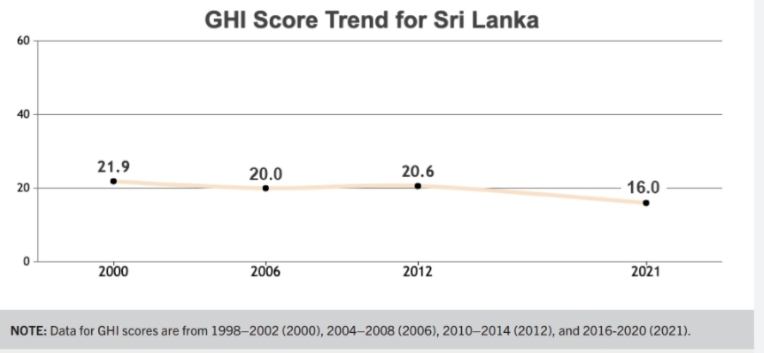
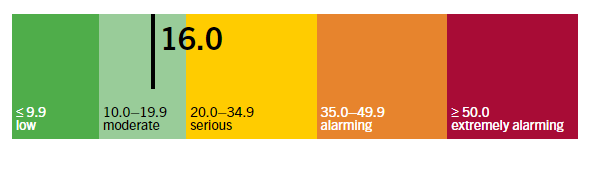
Colombo, Oct 17 (newsin.asia) – In the 2021 Global Hunger Index, Sri Lanka ranks 65th out of the 116 countries with sufficient data to calculate 2021 GHI scores. With a score of 16.0, Sri Lanka has a level of hunger that is moderate.

For the 2021 GHI report, data were assessed for 135 countries. Out of these, there were sufficient data to calculate 2021 GHI scores for and rank 116 countries (by way of comparison, 107 countries were ranked in the 2020 report). For 19 countries, individual scores could not be calculated and ranks could not be determined owing to lack of data. Where possible, these countries were provisionally designated by severity.

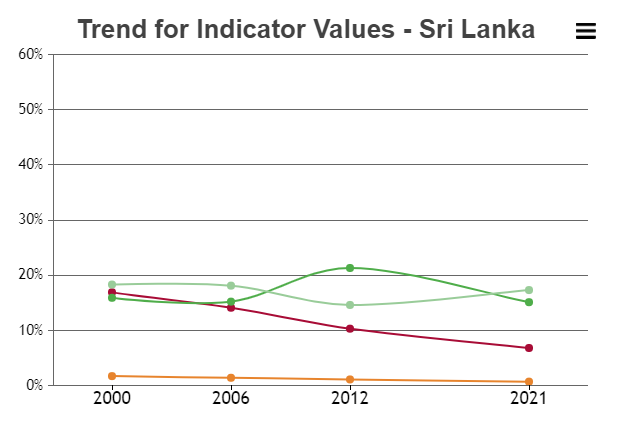
The GHI score is based on four indicators—undernourishment; child wasting or the share of children under the age of five who have low weight for their height, reflecting acute undernutrition; child stunting or the number of under-5 children who have low height for their age, reflecting chronic undernutrition; and child mortality.

Neighbours India (101), Nepal (76), Bangladesh (76), Myanmar (71) and Pakistan (92) are in the ‘alarming’ hunger category.

READ: New variants can enter Sri Lanka at any time, warns Health DG

SRI LANKA

Subscribe to our Whatsapp channel for the latest updates from around the world

Sea rally in Sri Lanka demands implementation of laws against bottom trawling

October 17th, 2021

Meera Srinivasan Courtesy The Hindu

The protest comes in the wake of an increase in reported intrusions by Indian trawlers over the last few weeks into Sri Lanka’s territorial waters.

Dozens of northern fishermen on Sunday set out on boats from the coast of the eastern Mullaitivu district to Point Pedro in Jaffna in the north, demanding that Sri Lankan authorities implement laws banning the destructive bottom trawling method of fishing.

The protest comes in the wake of an increase in reported intrusions by Indian trawlers over the last few weeks into Sri Lanka’s territorial waters. On October 13 the Sri Lankan Navy, arrested 23 Indian fishermen and seized two fishing vessels on charges of trespassing, resuming action months after limiting arrests of foreign fishermen, fearing COVID-19.

Northern Sri Lankan fishermen have been resisting Indian trawlers in their seas for over a decade. Bilateral talks and governmental mechanisms have not delivered a solution yet. India is unable to prevent its fishermen from crossing the International Maritime Boundary Line (IMBL), and has not been successful yet in diverting them to deep sea fishing practices elsewhere.

The tensions have persisted, at times with a human cost like in January this year when Tamil Nadu four fishermen were found dead following an attack allegedly by the Sri Lankan Navy.

The protest on Sunday was led by Tamil National Alliance (TNA) MPs M.A. Sumanthiran, S. Shritharan and Shanakiyan Rasamanickam, and former MP Shanthi Sriskantharajah, and sought to pressure Fisheries Minister and Jaffna MP Douglas Devananda to use Sri Lankan laws to initiate action on those engaged in illegal fishing.

We have joined this protest to demand that our fishermen’s livelihoods are protected, and to demand that the Fisheries Minister initiate appropriate legal action against fishermen using the bottom trawling,” Mr. Sumanthiran told the media in Jaffna.

Sri Lanka banned bottom trawling in 2017 and imposed hefty fines in 2018 to deter illegal fishing, which has been a recurring concern in the narrow Palk Strait running between northern Sri Lanka and Tamil Nadu. The 2017 law banning trawlers was based on a Private Member’s Bill tabled by Mr. Sumanthiran in 2015.

The new law and stiff penalty saw a reduction in the number of Indian fishing vessels spotted in Sri Lankan waters briefly. It brought some relief to thousands of northern Sri Lankan fishermen whose post-war livelihoods were severely affected by the Indian trawlers ravaging their coastline.

But the trawlers from India are back again in large numbers, according to northern fishermen, some of whom wrote to the Indian Consulate in Jaffna recently, seeking compensation.

While Indian fishermen, from Tamil Nadu, are repeatedly caught trespassing, the TNA has avoided a frontal challenge to Tamil Nadu on the issue, due to the solidarity extended by the state to Sri Lankan Tamils during the civil war years and after. The TNA rarely challenges India, seeing the country as an ally and arbiter in its call for a long-pending political solution from the Sri Lankan government.

Fragmented polity

The largest grouping of Tamil legislators — with 10 seats in the 225-member Parliament — from the north and east, the TNA also faces criticism for ignoring” its voters’ economic concerns.

As an Alliance they don’t show a shared understanding or clarity on our problem and how we ought to respond to it collectively and responsibly. Tamil politicians should not use our problem to settle scores between themselves. That will only dilute our struggle,” said Annalingam Annarasa from the Federation of Jaffna District Fishermen’s Cooperative Society Unions.

We are neither supporting today’s protest, nor opposing it,” he said. For the northern fishing community, it is hard to turn away rare support coming their way. It is also difficult to antagonise the politically influential Fisheries Minister, a local MP, whose intervention they will need in resolving their crisis, fishermen observed.

Sri Lankan flotilla protests against Indian poaching

October 17th, 2021

Courtesy Channel News Asia

COLOMBO: Sri Lanka’s fishermen launched a flotilla of boats on Sunday (Oct 17) demanding that the government block Indian trawlers from poaching in the island’s prawn-rich northern waters.

Boats flying black flags and carrying opposition legislators travelled 100km from the north-eastern fishing town of Mullaittivu to the island’s northernmost tip, Point Pedro.

“We have come in boats to protest bottom trawling by Indian fishermen,” MA Sumanthiran, a legislator for the main Tamil opposition party, the Tamil National Alliance (TNA), told reporters in Point Pedro.

Bottom trawling – which was banned in Sri Lankan waters in 2017 – involves dragging heavy nets across the sea floor to catch a large volume of fish. It causes severe damage to the marine ecosystem.

The TNA said that it was protesting against Sri Lankan authorities’ failure to stop poaching by Indians and protect the impoverished local fishing communities.

There was no immediate comment from the government.

India and Sri Lanka are separated by the narrow Palk Strait, a rich fishing ground known for jumbo prawns, and poaching has led to tensions between the South Asian neighbours.

Sri Lankan fishermen were not allowed to venture out during much of the island’s decades-long Tamil separatist war that ended in May 2009, allowing Indians a free run in the area.

But there have been increasing tensions over poaching since Sri Lankan fishermen have been allowed to venture out again.

Sri Lanka has regularly detained large numbers of Indian fishermen and seized their boats, but there has been no let-up in poaching, according to local fishermen.

An Indian fisherman was allegedly killed by Sri Lankan forces in March 2017.

The Fertiliser Fiasco: Discretion is the Better Part of Valour

October 17th, 2021

By Dr Parakrama Waidyanatha Courtesy The Island

In his novel published in 1891, tiled The Light that Failed”, Rudyard Kipling wrote the phrase, ‘biting the bullet’ to express the thought that fortitude can be gained by ‘biting a bullet’! As things are, should the President and government continue ‘biting the bullet’ or compromise in sincerity as discretion is the better part of valour.

The farmers have a genuine grievance in that there is no fertiliser, organic or inorganic! And organic fertiliser is not something that can be produced overnight. They are adamantly up in arms, and it would appear most likely that paddy and other arable crop cultivations will incur huge production losses. Farmers in the Mahaweli and other irrigated lands have taken up the unyielding stand that unless fertilisers are available, they will not cultivate this Maha season. Crop losses without fertiliser and other inputs can be as high as 40-50%, if not more, leading to a highly calamitous national situation. The same applies to plantation and other crops. Expert calculations reveal that tea yields too could decline by 50%!

More importantly, there are no readily available organic materials, vegetable, animal or other to meet the nutrient demand of the three million hectares of crops! Most plant–based organic matter has only about 1% nitrogen, if not less. Assuming, however, that together with animal dung and other organic matter sources the figure is increased to 1.5% and on average a hectare of cropland requires 100kg N per year, the total annual organic fertiliser demand should be at least 200 million tons if not more to provide the nitrogen requirement.

The average N demand for tea is at least 200kg/ha/yr, and some vegetables and other crops too, require more N than 100kg/ha/yr. The issue then is, how such a huge demand of organic fertiliser is to be met locally.

The recent fiasco with the attempt to import a seaweed- based organic fertiliser from a Chinese enterprise, Seawin Biotechnologies, is well known. Samples tested locally were reported to be contaminated with a harmful bacterium, Erwinia and the importation was stopped. Incidentally, the local Chinese Embassy had the audacity to contest the report of our quarantine authority, that the culture of the microbe could not have been done in the three-or four-day period as reported, but a senior professor of microbiology of the Peradeniya University and other specialists in the field have debunked the Embassy claim!

The supplier claims that fertiliser is heated to a temperature of 600 degrees centigrade to kill microbes. If so, how was the live pathogen detected. At this temperature not only microbes but also nitrogenous compounds should break down! Then how is the nitrogen replenished?

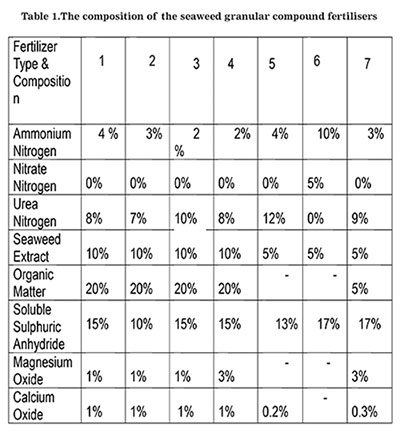
According to the company’s brochure on ‘seaweed granular compound fertiliser’ there are seven fertiliser formulations available for sale comprising nitrogen (N ) phosphorus (P2O5) and potassium (K2O), and nitrogen is replenished as ammonia, urea or nitrate! (Please see Table)

So, evidently, it is a granular fertiliser mixture of chemical and organic materials. The supplier does not claim that the product is organic, and it cannot as other than the ‘organic matter’ and the’ seaweed extract’ the rest are inorganic chemicals! So, clearly, having heated to the high temperature and losing the nitrogenous compounds, inorganic nitrogenous chemicals have to be added to achieve the required nutrient composition. So, the product is no longer fully ‘organic’. Then, who is deceiving whom?

Moreover, these seaweeds are believed to be essentially harvested from the Yellow Sea off the coast of Quindío City, an area highly polluted with metropolitan waste and excessively contaminated with heavy metals such as arsenic, cadmium, lead and mercury. The status of these heavy metals are, however, not cited in the fertiliser composition table in the brochure. Further, although the supplier has apparently promised a 10% nitrogen content in the formulation, it is impossible to get such a high value from seaweeds! On the whole, then there are grey areas in the fertilizer deal.

The President and the government are apparently now gradually yielding to the countrywide fertiliser demand pressures of the farmers as evident from a recent news item that chemical fertiliser for corn will be imported. Then what about tea and other crops?

As per the ‘grapevine’ there is evidence that some nano (chemical) fertilisers are also to be imported and the Tea Research Institute has been asked to work out how much ammonium sulphate as the nitrogen fertiliser source is needed for the country’s tea apparently because some stocks of the latter being available. Ammonium sulphate has only 21% nitrogen whereas that of urea is 48%. Because of production interferences due to COVID the urea prices have shot up by 35 -43%, from April to September 2021, and the same should be true for other straight fertilisers.

Ammonium sulphate price globally is now reported to be about USD200/ metric ton whereas that of urea is about 450 USD. So, in terms of N contents in the fertilisers, the cost should be comparable except for the haulage. However, over application of ammonium sulphate can be detrimental in that the added sulphur in the soil is reported to inhibit phosphorus uptake by crops affecting growth and yield! Urea is the better option as the nitrogenous fertiliser when large quantities of it are needed.

In conclusion, it is the ignorance and obstinacy of the authorities that has pushed the country into this calamity. Minister after minister are obsessed with the wasa visa” myth as evident from their utterances both in Parliament and outside! It is the general belief, without evidence that, agrochemicals are the cause of many non-communicable diseases.

No politician speaks about ambient air pollution, the leading environmental health risk factor locally and globally. Records reveal that nearly 3.5 million premature, non-communicable deaths, for example, in 2017, were from stroke, ischemic heart disease, chronic obstructive pulmonary disease, lung cancer, lower respiratory infections, and diabetes.

The President should, as a matter of priority, obtain a report from the health authorities on this matter of agrochemicals and health. This false belief was aggravated as a result of the initial suspicion that the chronic kidney disease (CKD) of the Rajarata was caused by agrochemicals but none of the research supported this contention. Research evidence gathered over several years, especially during the period 2010 and 2018 by no less than five groups of researchers established that the most likely aetiolating agent is hard water and fluoride in the some dug wells especially on high ground, as those who drank such water were essentially the ones that contaminated the disease.

Those who consumed water from the streams, reservoirs or dug wells in the plains did not contact the disease! Some of the research conducted by the current coordinator of CKD activities in the Health Ministry too supported this contention!

However, it is sad that the health authorities have failed to brief the President, the Health Minister and the government in general on this vital matter! Had this happened the President would, not have rushed into this decision of ‘going organic’ virtually overnight!

Rice Genetic Improvement Odyssey of Past Centuries

October 17th, 2021

by M. P. Dhanapala Former Director, Rice Research and Development Institute, Batalagoda Courtesy The Island

History is important. It keeps you away from reinventing the wheel and repeating the mistakes already committed in the past. In history, there should not be hidden expressions to read between lines as the ten giants of King Dutugamunu were fed with traditional rice,”concealing the details of what the others were eating and why they were not giants or that we have been exporting rice during the past in such and such era” without disclosing the quantities and the recipient countries. For that matter if you go through the export details, we do export rice even now.

The green revolution was criticized as the contributing factor for the so called unidentified Kidney Disease of Unknown Origin (CKDu) which was reported primarily from the North Central Province. Whatever the causal factor of CKDu is, Norman Borlaug or his green revolution has nothing to do with the kidney disease or rice in Sri Lanka. It is true that his innovative ideology in wheat breeding induced the rice breeders worldwide to develop aphysiologically efficient rice plant type by changing the plant stature and canopy characteristics. The Sri Lankan rice varieties were developed within the country, by the Sri Lankan scientists. It was an extension of the breeding process initiated by the British scientists during the colonial era. The progress of rice breeding from its inception by different generations will be unfolded in this write-up to judge the calculated decisions taken by the ancestral breeders to improve rice productivity in the country.

I would like to lay the baseline from a report published by Edward Elliott, a British Civil Servant in 1913. (Tropical Agriculturist, Vol. XLI, No. 6, Dec. 1913). He states that the forced labor (Rajakariya) that existed then was abolished in 1832. Subsequently, the communal cooperation system (Atththam) also ceased to exist gradually. These two incidents were cited as the major reasons for the neglect of irrigation structures and subsequent decline of rice production in the mid 19th Century. The annual rice production estimated for the period of 10 years ending in 1856 was 5.5 million bushels, the lowest in the recorded history.

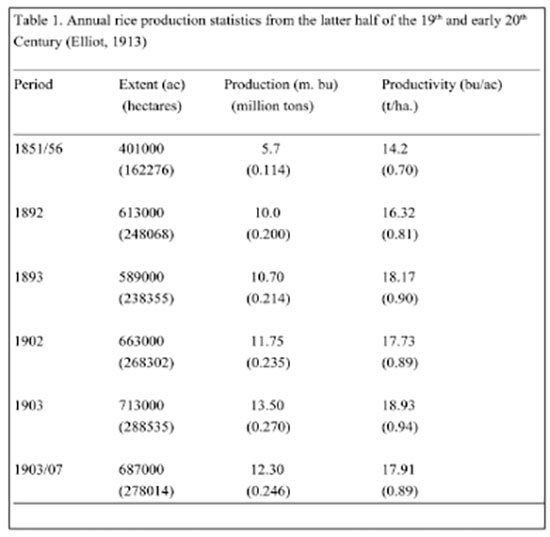
Enacting the Paddy Ordinance in 1857 allowed voluntary restoration of old irrigation structures which eventually led to the gradual increase in the cultivated extent and the annual rice production. Estimated rice production data during this era and at the turn of the century are summarized in Table 1. The original data were in acres and bushels. The data were transformed into hectares and kilograms and tonnes assuming 20 kg as the bushel weight. The transformed data in Table 1 appear within parentheses.

See table 1.

Annual rice production statistics from thelatter half of the 19th and early 20th Century (Elliot, 1913)

The rice production data above are estimates based on returns from paddy, probably grain tax, in the Government Blue Books. You may realize that these estimates are sometimes too high when actual data appear towards 1940s. However, at the turn of the 19th Century, the rice varieties were exclusively traditional types maintained by farmers and the Department of Agriculture was not established.

Many critics maintain that we had innumerable different varieties of rice in the past. The earliest recorded in the history was a collection of 300 rice varieties displayed by Nugawela Dissawe for the agri-horticultural exhibition held in 1902 (Molegoda, 1924) (Trop. Agric. XLII (4): 218-224.). This probably represented almost all the cultivars in the field during this period. This was the largest collection of rice varieties in the recorded history in Ceylon, leaving out the recent collections performed in the latter half of the 20th century. Molegoda explains very comprehensively the status of rice varieties and the procedure followed in naming them.

The rice cultivation at the beginning of 20th century was entirely organic manure dependent. The farmers then were apparently more competent in traditional methods of rice cultivation. The most striking feature during this era was that the average yields were below one ton/ha (<20 bu/ac) even in the best productive year, 1903 (Table 1).

In 1914, an encouraging note on Extension of Paddy Cultivation by A. W. Beven (Trop. Agric. XLIII (6): 421-424.) appears with the suggestion of seed selection to improve rice yields. He states that in the year 1913 the yield estimate of 9,622,320 bushels was too high atarget, i.e.14.2 bu/ac (0.71 t/ha), for the cultivated extent of 671,711ac (271,827ha), but suggests that with seed selection accompanied by proper land preparation, manuring and transplanting, the yields could be increased up to 25 bu/ac (1.25t/ha). This suggestion was at the inception of the Department of Agriculture which was established in 1912.

The earliest record on rice varietal improvement dates back to seed selection in 1914 by Dr. Lock at Peradeniya. This was done more or less parallel with the establishment of Johannsen’s pure line theory (1903). In the literature, Dr. Lock’s improved Hatial (a seven month variety) appears from time to time as a standard variety in yield tests.

The next most important step was the pure-line selection. Initially, three Economic Botanists, F. Summers (1921), R.O. Iliffe (1922), L. Lord (1927) and at latter stages Paddy Officer G.V. Wickremasekera were involved in the selection of pure- lines (Trop. Agric. LVIII (2): 67-70; Trop. Agric. LXVIII (5): 309-318). Pure-line selection exploited heterogeneity within the farmer maintained traditional rice cultivars. Each cultivar composed of different types within it. As a result, individual plant selection within cultivars produced progenies with better genetic potential, but resembling the mother plant selected; they bred true to type as rice is an obligate inbreeder. This was the essence of pure-line theory established by Johannsen (1903).

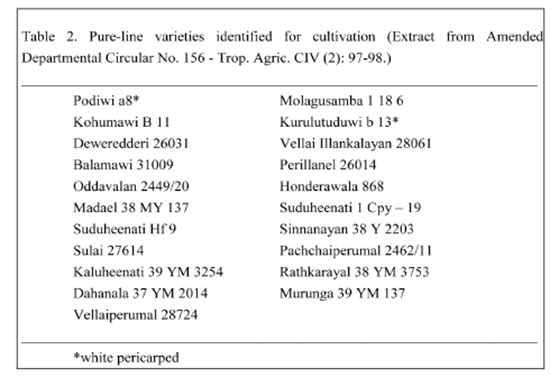
Pure-line selection was initiated with a representative collection of traditional varieties. The most popular varieties were included in the process. Pure-line selection was done at two major locations, Mahailluppallama and Peradeniya. Subsequently, selection was regionalized to accommodate regionally adapted varieties in the process. The best isolated progenies were tested at 19 test locations in different agro-ecological regions for adaptability, prior to recommendation. The best adapted pure-lines (21 lines – Table 2) were identified for purity maintenance at four different paddy stations – Ambalantota (nine lines), Mahailluppallama (eight lines), Madampe (two lines) and Batalagoda (two lines). Further multiplication of seeds was done in government farms under the supervision of Agricultural Officers and distributed as seed paddy for cultivation (Trop. Agric. CIV (2): 97-98.).

See table 2.

Pure-line varieties identified for cultivation (Extract from Amended Departmental Circular No. 156 – Trop. Agric. CIV (2): 97-98.)

While the pure-line selection process was on, Joachim (1927) (Trop. Agric. LXIX 137) warned that the sustenance of increased yields by cultivation of high yielding pure-lines has to be met with liberal manuring. However, despite of all these attempts during the two decades from 1920s, the paddy yields were not substantially increased (Table 3). Rice yield data presented in Table 3 shows lower values compared to yield estimates from Government Blue Books presented in Table 1. The data in Table 3 being more reliable, the Table 1 data could be overestimates.

However, the majority of the harvested rice crop in the 1940s could be from potentially better pure-line selections, but the yields were much below the anticipated levels. The total production was around 15 million bushels (0.3 m tons) and yields stagnated ataround 14 bu/ac (0.7 t/ha).

The Draft Scheme for Development of the Paddy Industry in Ceylon drawn in 1945 (Trop. Agric. CI (3) 191-195) begins with the statement that only a third of the annual requirement is met by the local rice production.

The balance was imported; the population was less than seven million during that period and the paddy cultivation was done organically with the best adapted pure-lines of traditional cultivars, though it failed to deliver what was intended.

The importance of inorganic (chemical) fertilizer was felt during this period as the only option to improve paddy yields further. Use of sodium nitrate (Na NO3) as the source of nitrogen (N) was attempted in rice prior to 1905 based on American experience in soybean cultivation, but nitrite (NO2) toxicity under reduced conditions in submerged paddy soils prohibited its use. Superiority of NH4 form of N was demonstrated by Nagaoka (1905) and Daikuhara and Imaseki (1907). However, the application of N promoted vegetative growth in pure-lines derived from traditional rice varieties causing premature lodging. Furthermore, two fungal diseases, blast and brown spot, became prominent. Around this period some introduced varieties were tested without much success. Among them, Ptb 16 from Pathambi, India, popularly called Riyan wee, with long panicles and slender grains (Buriyani rice) became popular, but self sufficiency in rice appeared to be far away.

Transition to another phase in rice breeding began as the rice breeders over the world employed cross-bred populations to create genetic variability to bring together desirable characteristics of different rice cultivars to develop better varieties. Rice hybridization techniques were developed around early 1920s and a major break through in changing the plant-type was accomplished in Japan with the use of Jikkoku, a dwarf natural mutant of Japonica rice. The performance of Japonica varieties exhibited substantial improvement with this transition. Influenced by the Japanese experience, the Food and Agriculture Organization sponsored a cross breeding program of Japonica with Indica rices in Cuttak, India to change the Indica plant type too in this direction, but without success due to incompatibility between the two groups (Japonica and Indica) leading to grain sterility in subsequent generations.

In Sri Lanka, the first paper on rice hybridization techniques was published in 1951 by J.J. Niles, an assistant in Economic Botany, guided by Prof. M. F. Chandraratne, the Economic Botanist (Trop. Agric. CVII (1):25-29.). Prof. Chandraratne was instrumental in initiation of rice hybridization. Simultaneously rice hybridization work began at the Dry Zone Agricultural Research Station at Mahailluppallama under the guidance of Dr. Ernest Abeyratne. The Central Rice Breeding Station, Batalagoda was established in 1952 and Dr. H. Weeraratne was transferred from Mahailluppallama to Batalagoda as the rice breeder with the hybrid populations already developed at Mahailluppallama.

Dr. Weeraratne, influenced by his superiors, Prof. Chandraratne and Dr. Abeyratne, continued rice hybridization to create genetic variability for selection. The hybridization techniques adopted by him were published in 1954 (Trop. Agric. CX (2) 93-97). Apparently, the labor intensive pedigree method was employed by Dr. Weeraratne to identify and fix desirable genotypes from segregating populations. And this was the beginning of theH” series of varieties that revolutionized the rice sector in Sri Lanka. The letter H” was used to imply that the varieties were of hybrid origin and were different from traditional varieties or pure-lines, but not to imply that they are hybrids.

Fig. 1,

The Central Rice Breeding Station, Batalagoda, Department of Agriculture

The first of the series, H4 (4.5 month, red bold), released in 1957, reached its peak popularity after a five year lapse of time and covered over 60% of the cultivated extent in Maha season, 62/63. The others in the series were H7 (3.5 month, white bold), H8 (4.5 month, white samba), H9 (5-6 month, white bold), H10 (3 month, red bold). Release of H varieties (1) minimized crop losses due to blast disease, (2) changed rice cropping pattern from single to double cropping, (3) use of N fertilizer increased by 350% due to their moderate response to fertilizer, (4) increased national yield level up to 3.5 t/ha (Senadhira et. al., Rice Symposium, Department of Agriculture, 1980). This effort, though appreciated widely, fell short of self sufficiency again.

The most controversial phase for the critics in rice breeding was initiated in mid 1960s, while H” varieties were replacing the pure-lines and the traditional varieties from paddy fields. The International Rice Research Institute was established in 1960 and the plant physiologists conceptualized the plant type structure of rice to make it physiologically efficient. The development of H” varieties (Old Improved Varieties) abruptly ended with these new innovations.

The breeders responsible for developing this new plant type in Sri Lanka, specifically the Bg varieties, were Dr. H. Weeraratne, Dr. N. Vignarajah, Dr. D. Senadhira and Mr. C.A. Sandanayake. None of them are among us any more. I joined the team in the late 1960s, at the tail end of H varieties and continued the process till the country reachedthe brim of self reliance in rice.

The Bg and other modern varieties are physiologically efficient. They are devoid of unproductive plant tissues and ineffective tillers. The plant structure is designed to reduce mutual shading of leaves and trap solar radiation effectively by every leaf in the canopy thus reducing the respiratory losses and promoting the net assimilation rate. They out yield traditional and H varieties at any level of soil fertility and show positive grain yield response to added fertilizer. They are lodging resistant and incorporated with resistance/tolerance to major pests and diseases prevalent in the country. More preciously, we have reversed the source-sink relationship of the rice plant to translocate photosynthates to produce more grains and less straw. The potential yield of improved varieties exceeds 6t/ha. All these traits listed above have been tested in controlled experiments in the field to confirm the superiority of new improved varieties. We reap around 4.5 tons/ha as our national average yield at present; the country is self sufficient in rice, the dream every political leader had since independence.

This in anut shell is what the rice breeders have accomplished and for which they were given the title Kumbandayas” in an article written apparently by a medical professional. The local rice scientists embark only on innovations backed by scientific facts. They do not have to exaggerate or lie. They know little more than those who seek cheap popularity by being critical about the accomplishments of rice scientists. This country needs people dedicated and confined to their respective professions allowing other professionals to play their own role. At any time rice breeders can take the country back to thetraditional rice era if you want to begin all over again from the beginning. The traditional accessions are in long-term storage at the Plant Genetic Resource Center (PGRC), Gannoruwa, Department of Agriculture, and can be taken out for multiplication at any time as the seed samples are viable.

Now I repent why we produced rice with more grains and less straw. There appears to be unsatisfied demand for straw. I like to conclude this disclosure with a statement made by Dr. N. M. Perera at the University of Ceylon, Peradeniya in the mid 1960s. Comrade, I can give you facts and figures, but I am sorry; I am unable to implant a brain in you”.

Email: maddumadhanapala@yahoo.com

(The writer holds a Ph D, Genetics and Plant Breeding, North Dakota University, USA, 1990, M Sc., Plant Breeding, Saga University, Japan, 1978 and B sc. Agric. University of Ceylon, Sri-Lanka, 1968. He has served as Research Officer, Rice Breeding (1969 – 1995) Central Rice Breeding Station, Batalagoda, Director, Rice Research and Development Institute, (1996 – 2000), Batalagoda, Affiliate Scientist, International Rice Research Institute (2000 – 2003), Philippines and Technical Advisor, JICA,, Tsukuba International Center, (2004 – 2012), Japan)

Central Bank looking at proposal to permit dollar-paid vehicle imports

October 17th, 2021

Courtesy The Island

Duty too must be paid in hard currency

The central bank is looking at a proposal to allow persons who can pay in foreign exchange to import vehicles and pay taxes in hard currency, Central Bank Governor Nivard Cabraal said last week.

He said that this was a proposal made by certain parties whom he did not identify making clear it was at a proposal stage with no decision taken. But it was under examination.

Asked whether Non-Resident Foreign Currency (NRFC) account holders – now called Personal Foreign Currency Accounts – would be permitted to use their resources to import a vehicle provided they would pay the applicable duty in hard currency, he said that he did not see why not.

If the vehicle is paid for in hard currency and not converted rupees, and the duty also accrues to the government in hard currency, I don’t see any harm, in fact it would be good,” he said.

It would also mean that there’s are new vehicles coming into the country not paid for by rupees converted into hard currency plus a hard currency duty stream, an analyst said.

Banning vehicle imports on account of the present foreign exchange crunch has cost the government an immense revenue stream.

Conspiracy by Rathana Thera triggered chemical fertilizer issue: AJP

October 17th, 2021

Courtesy The Daily Mirror

The sudden decision by the government to stop importing chemical and organic fertilizers took place as a result of a conspiracy by parliamentarian Ven. Rathana Thera, Ape Janabala Pakshaya (AJP) National Organizer Dr. Susantha Kodithuwakku said.

Addressing the media today, he said the central committee of the Ape Janabala Party had expelled parliamentarian Ven. Athuraliye Rathana from his party membership.

The decision was taken while convicting Ratana Thera of four counts. A political conspiracy is going on in the country, and as a result, the country has become anarchic, Dr. Kodithuwakku said.

“Ven. Rathana earlier claimed that he would advise the President and the Agriculture Minister over the fertilizer issue. This is his agenda. His main purpose is to give the fertilizer production to his people and make a profit, ” he said.

Rathana Thera’s political agenda is to destabilize the country’s politics while breaking the government at some point, he said.

Therefore, he is supporting the government’s wrong decisions without any approval from the party, Dr. Kodithuwakku added. (Chaturanga Samarawickrama)

President said some recommendations cannot be implemented – Cardinal

October 17th, 2021

Courtesy The Daily Mirror

President Gotabaya Rajapaksa had told him that it was not possible to implement every recommendation that has been made by the Presidential Commission which probed the Easter Sunday attacks, Archbishop of Colombo His Eminence Cardinal Malcolm Ranjith said.

The Cardinal called for the support of international community to find out the truth about the mayhem.

Cardinal Ranjith made this call via zoom discussion he had had with the Sri Lankan community living in Australia on Saturday.

The attack on Easter Sunday 2019 was not carried out by a group of seven of eight persons. There is something big behind the attacks. We need the support of the international community to find out as to who used these seven or eight persons to fulfil their objectives,” Cardinal Ranjith said.

President and the present government assured that they would deliver justice to those who were affected in the Easter Sunday attack of April 21 2019. He assured that the presidential commission will continue to probe the attacks when he met the Sri Lanka Catholic Bishops Conference as soon as came to power. President called me over the phone two days after the presidential commission report came out and told me that it was not possible to implement everything that is recommended by the PCoI. Those who were affected by the attacks have been badly let down. We don’t want to take revenge from anyone, nor have we called for anyone’s blood. I, together with Ven. Ittapane Dhammalankara Thera called for calm after the Easter Sunday attacks. I requested the Catholic brethren not harm the Muslims,” he added.

The PCoI recommended that the Attorney General should get intelligence units to carry out investigations on a series of grey areas. But this has not happened,” he asserted. (Yohan Perera)

Samagi Jana Balawegaya SJB to bring no-confidence motion against Agri Minister

October 17th, 2021

Courtesy Adaderana

The Samagi Jana Balawegaya (SJB) has decided to bring forth a motion of no confidence against Agriculture Minister Mahindananda Aluthgamage.

SJB National Organiser MP Tissa Attanayake stated that the parliamentary group of the party would meet in the coming week to decide on the matter.

Speaking to media in Kandy, he said that the government has completely messed up the issue of providing farmers with fertilizer and that the protests by farmers across the island is not an anti-government movement. They are asking to grant their demands.” 

He said it is the government and no one else that is constantly turning this issue into an anti-government wave. The MP said the government is taking too long to resolve this issue and that it shows the failure of the government. 

Attanayake said that if as the subject Minister Mahindananda Aluthgamage does not provide a solution to the issue the legislature would express its lack of confidence on his actions and thereby present a no-confidence motion. 

Farmers’ protests continue demanding fertilizer

October 17th, 2021

Courtesy Adaderana

Sri Lanka seeks USD 500 mn loan from India for fuel purchase

October 17th, 2021

Courtesy Adaderana

Sri Lanka has sought a USD 500 million credit line from India to pay for its crude oil purchases amid a severe foreign exchange crisis in the island nation, Indian media reported today.

The move came few days after energy minister Udaya Gammanpila warned that the current availability of fuel in the island nation can be guaranteed only till next January.

The state-run Ceylon Petroleum Corporation (CPC) owes nearly USD 3.3 billion to the two main government banks — Bank of Ceylon and People’s Bank. The state oil distributors import crude from the Middle East and refined products from other areas, including Singapore.

We are currently engaged with the Indian High Commission here to obtain the facility (USD 500 credit line) under the India-Sri Lanka economic partnership arrangement,’’ CPC Chairman Smith Wijesinghe was quoted as saying.

He said the facility would be utilized for purchasing petrol and diesel requirements.

The energy secretaries of both India and Sri Lanka are expected to sign an agreement for the loan soon, the report quoted Finance Secretary S R Attygalle as saying.

The government has put on hold the expected retail price hike of fuel despite the last week’s increase in cooking gas and other essentials.

-Agencies

Sri Lankan law enforcement agencies have opportunity to reveal truth about Pandora Papers: TISL

October 17th, 2021

Courtesy Adaderana

Transparency International Sri Lanka (TISL), as an organization that continues to raise awareness of the damaging effects of corruption, has once again drawn the attention of the general public to the serious concerns that were brought to light by the Pandora Papers and revealed to the public earlier this month. 

The Pandora Papers exposé provides clear evidence of how the offshore industry promotes corruption and demonstrates the importance of ensuring the transparency of beneficial ownership of entities. Particularly on Sri Lanka, the Papers refer to extensive assets held offshore by former Deputy Minister of Water Supply and Drainage Ms. Nirupama Rajapaksa and her husband, Mr. Thirukumar Nadesan. 

TISL in its initial statement following the revelations, called on the Sri Lankan authorities to ensure that independent investigations are carried out expeditiously into the revelations made by the Pandora Papers. Since then, the President has called on the Commission to Investigate Allegations of Bribery and Corruption (CIABOC) to investigate the claims made by Pandora Papers.  

TISL says it has taken several steps since the initial statement, pertaining to the revelations made by the Pandora Papers.  

One the 7th of October 2021, TISL filed a complaint with CIABOC, calling for an investigation into the alleged unexplained assets of the former Deputy Minister and her husband who haves been identified as Politically Exposed Persons (PEP). 

TISL noted that the transactions revealed through this exposé could amount to offences under Section 23A of the Bribery Act, Section 4(1) of the CIABOC Act, and relevant provisions of the Declaration of Assets and Liabilities Law, and requested the Commission to probe into the Declarations of Assets and Liabilities of Mrs. Nirupama Rajapaksa relating to her tenure as a Member of Parliament. 

TISL said it requested CIABOC to investigate whether public funds have been embezzled and laundered to these foreign safe heavens. 

TISL has also written to the Financial Intelligence Unit (FIU) of the Central Bank of Sri Lanka on 13th October, calling on them to coordinate with relevant law enforcement authorities at both local and international level to investigate into potential money laundering allegedly committed by the former Member of Parliament and her spouse. 

The FIU, as the central independent body established in terms of the provisions of the Financial Transactions Reporting Act No. 06 of 2006 (FTRA), is empowered to facilitate the prevention, detection, investigation and prosecution of offences related to money laundering and terrorist financing. 

Through the letter TISL had requested the FIU to take further steps to furnish the authorities with evidence, examining the financial transactions that have flowed in and out of Sri Lanka by coordinating with local and foreign financial institutions, connected to these two individuals.  

TISL has also filed three Right to Information Requests to the Elections Commission, Parliament of Sri Lanka and the Presidential Secretariat, calling for the Declarations of Assets and Liabilities of Ms. Nirupama Rajapaksa as an election candidate, member of parliament and Deputy Minister respectively  
 
The Declaration of Assets and Liabilities Law No 1 of 1975 makes it mandatory for Parliamentarians and senior public officials to annually submit a declaration of assets and liabilities, which includes the assets and liabilities of their spouse and dependent children. 

If the former Parliamentarian has not disclosed the overseas assets revealed through Pandora Papers, she will be in breach of the Declaration of Assets and Liabilities Law, TISL said. Therefore, her asset declarations would be a key tool to identify whether the overseas assets of the deputy minister, her spouse and children revealed through Pandora Papers have been disclosed at the time.   

TISL Executive Director Nadishani Perera commenting on the matter stated We urge the relevant authorities in the country to take immediate action to independently investigate the revelations made by Pandora Papers. It is important that the due process is followed without any interference, obstructions or delays. For the PEPs implicated, there remains a path to clearing their name, if they were to heed the call of the public by making the relevant asset declarations public. A thorough and impartial investigation will also bolster faith in the law enforcement agencies of the country and prove to be an important deterrent against perpetrators of white-collar crimes.” 

The TISL Executive Director also noted that while it is important to take stringent action to prevent foreign currency unlawfully flowing out of the country into secrecy jurisdictions, it is also imperative that countries like Sri Lanka take this issue up on a diplomatic level in order to ensure financial institutions in countries such as Singapore  are also held accountable and that steps are taken to recover any proceeds of crime back to our country from these asset destinations.”

Sri Lanka reports another 12 Covid-19 deaths

October 17th, 2021

Courtesy Adaderana

The Director General of Health Services has confirmed another twelve Covid-19 related deaths for October 16, increasing the death toll in Sri Lanka due to the virus to 13,484.

According to the figures released by the Govt. Information Department, the deaths confirmed today include 08 males and 04 females. 

Three of them, including a female, are between the ages 30-59 years while the remaining nine are aged 60 years and above. 

Daily count of coronavirus cases reaches 578

October 17th, 2021

Courtesy Adaderana

The Health Ministry reported that another 125 persons have tested positive for Covid-19 today, increasing the daily count of new coronavirus cases to 578.

Sri Lanka’s coronavirus caseload has climbed to 531,648 with this while over 25,500 infected patients are currently being treated across the island. 

Total recoveries stands at 492,621 while the death toll has risen to 13,484.

Reply to Wigneswaran’s attack on Prof. G. L. Peiris – Part 2.-Insane fury in Tamil politics destroys the Tamils

October 16th, 2021

H. L. D. Mahindapala

The cruelty of Sangkili (and his avatar Prabhakaran) increased with his power…..” Yalpana Vaipava Malai

Jaffna has been the dark side of the Sri Lankan moon: its’ history has been consistently hidden from public scrutiny. Reason: It is politically disadvantageous to reveal the horrors of Jaffna Vellala rulers oppressing their own Tamil people throughout its history when they are accusing the Sinhalese of discrimination. This factor may have inhibited the Tamil historians from producing an authoritative and comprehensive history book. In fact, Jaffna Tamil intellectuals, most of whom are Vellalas, seems to have imposed self-censorship in dealing with the dark side of Jaffna history. Reports speak of the Jaffna University dons and Vellala high-ups discouraging research into the iron-fisted rule of the Vellalas who ruthlessly oppressed and persecuted the low-castes. Confirming this Prof Rajan Hoole wrote: …when a recent Jaffna University doctoral thesis had extensive quotations showing the dark state of Jaffna society early in the 19th century, one of the three examiners insisted on  a good part of it being removed before approval.” (p. 27 – 28 – NETHRA, Vol 2. No.1. Oct-Dec. 1997, a quarterly journal edited by Regi Siriwardena). In the same paper he reveals that a leading member of the Navalar commemorative committee with an O.B.E. moving to block some less attractive side of Navalar” being exposed, saying that it is high time to stop researches of this type on Navalar.” Navalar, the revered guru of the Vellalas, is a caste fanatic who hated the low-castes and the Christians. He did not hesitate to urge the Saivite followers to kill the blasphemers” (i.e. the Christians).

Sanitizing the history of Jaffna for political gain has been a common trend. Though Jaffna boasts about its history, it is yet to produce an authoritative history of its bloody past. Jaffna University (established 1972) too has failed to deliver a scholarly historical account of its people to guide its people. So, the magnitude of the cruel history of Jaffna was never told to the Tamil people or to the world. It is obvious that Jaffna University prefers to keep its history hidden rather than reveal the horror stories that haunt it. The void in the mind caused by either hiding or white-washing history has been filled with a rosy picture of Jaffna as an idyllic haven of non-violent, Gandhian Tamils persecuted by the Sinhala-Buddhist hegemonists” who had denied them their legitimate aspirations”, equality, justice and dignity. History, however, tells a different story: the English-speaking, Saivite Jaffna Vellala (ESJVs) elite of Jaffna was the most privileged community and the PQLI  rated Jaffna metrics (education, health, transport etc) as the highest in Sri Lanka. Those who get their history wrong can never get their politics right. Even though  it is late – their distorted historical perspectives have already wreaked havoc in the nation  and done its worst to the Tamils — it is time to put the record straight again.

The dark side of Jaffna history has been bloodied by brutal violence against the other”. Mylvakanam, poet and historian, was accurate when he described the violence of Sankili, the first mass killer of Tamils, as insane fury”. He said so when he wrote the Tamil equivalent of the Mahavamsa, the Yalpana Vaipava Malai. The History of the Kingdom of Jaffna – p.33. He added: The cruelty of Sangkili increased with his power. His subjects were not able to endure it any longer….” (Ibid- p.37). The meaning contained in this telling phrase foretold the ingrained  nature of Tamil political violence that was to come. The ”insane fury” of Sankili did not end with him. The Sankili cult that became an integral part of the Tamil political culture ran down to Prabhakaran. Insane fury” defines the hate cult of Sankili against the non-Hindu Tamil. First, Sankili’s the insane fury” led to the massacre of 600 Tamil Catholics for owing allegiance to the King of Portugal. Second, this insane fury” then turned against the Sinhala Buddhists who were forcibly thrown out of Jaffna. It is the first known act of ethnic cleansing in recorded Sri Lankan history. Those Sinhala-Buddhists never came back, says Mylvakanam. Third, his wrath turned towards the remnants of the Malay soldiers who were expelled. Later, Tamil fury targeted the Muslims who were driven out of Nallur. Muslims who dragged their feet discovered pigs’ heads in  their wells. Fourth, the perennial oppression and killing of Tamils by Tamils became the norm in Jaffna history – an ingrained trend that sprouted from the insane fury” of Sankili  and flowed via the casteist Vellalas in feudal times to the insane fury” of Velupillai Prabhakaran. Like that of Sankili it was a fury that targeted anyone who refused to swear allegiance to Tamil power. Victims of Prabhakaran’s bloated arrogance ranged from Neelan Tiruchelvam to Rajiv Gandhi. Sankili’s hate cult and the insane fury of Prabhakaran had the common aim of ethnically cleansing Jaffna. Sankili is the original father of separatism who cleansed Jaffna of the other” to establish a Tamils only state. After him the establishment of the Tamil only state, if necessary through violence as expressed in the Vadukoddai Resolution, became the sole goal in Tamil politics. This insane fury” in the Tamil political culture found its ultimate expression in Prabhakaran. Only an insane fury” would have prompted him to kill Rajiv Gandhi. Taking on India was a suicidal act. His decision to kill Rajiv  came from the insane Sankili cult of hate. It is revealed in a new book that has come out recently. It will have to be dealt with in a separate chapter. It is this cult of hate that killed him and the Tamils at Nandikadal. Had he been more flexible, tolerant and democratic he would still be dictating  terms to the Sri Lankan government.

The insane fury” in Tamil political culture refuse to tolerate dissenting Tamil individuals who do not toe the racist Tamil line.  They are either ruthlessly eliminated by the sword of the Sankili hate cult, or killed politically by the Tamil electorate which knows no other history other than that of Sankili and Prabhakaran. As for the non-Vellala Tamils, their fate was worse than death. The ostracised low-caste minority was treated as subhuman beasts. The insane fury” of Jaffna politics was repeated with slight variations in the post-independent years, particularly in the post-Vadukoddai Resolution (May 14, 1976) period. This Resolution – the ultimate political manifesto of the SJVs – legitimised the insane fury” of the Tamils when it urged the Tamil youth to take up arms. Going to war was an insane act that destroyed the Tamils mainly. The  slow but steady rise of Tamil violence is documented in the Sansoni Report of the Presidential Commission of Inquiry into Incidents which took Place between `13th August and 15th September, 1977, Sessional Paper No. VII – 1980. It is a valuable document that details the rise and rise of the insane fury” of the Tamils that finally exploded in 1983. The provocative Tamil violence needling the lower-level ethnic leadership in South” (Prof. A. J. Wilson) exploded in 1983. The cumulative impact of the escalating Tamil violence in the post-Vadukoddai period resulted finally in the Sinhala lower-level ethnic leadership” erupting in violence against the Tamils in 1983. The killing of the 13 soldiers in Jaffna was the last straw. The rest is history.

Violence of insane fury” must necessarily lead to barbarism. This history was kept in the dark by the Tamil leadership because they feared the political consequences  of exposing the barbaric side of Jaffna. If the hidden history of how Jaffna was ruled by the fascist Vellala ruling elite, reducing the low-caste Tamils to labouring beasts, was revealed,  the Tamil propagandists could not have marketed to the world their narrative of victimology accusing the Sinhalese of discriminating against them. What the Vellala elite did to their fellow-Tamils is unforgivable. Assuming a genetic purity and a spiritual superiority which they never possessed  they ruled Jaffna using brutal violence, whenever necessary, to keep the low-castes within the rigid caste boundaries from birth to death. For the Vellalas lording it over the low-castes in the peninsula Jaffna was indeed a romantic haven – the only domain where caste slavery of the Vellalas was legalised under Thesawalamai law. The English-speaking, Saivite, Jaffna Vellala elite (ESJVs) had one foot in high society in Colombo and the other foot holding down the heads of the Jaffna low-castes who, as ostracised outcasts, had no status in Tamil society.

To the ostracised low castes, Jaffna was a dehumanised hell-hole. They were condemned to live in it from the womb to the tomb without any hope of redemption. The delusional belief of the Vellalas that they are the Brahmins of Jaffna born to rule infused them with an unwarranted arrogance. They manipulated the internal dynamics to monopolise the decision-making process at all levels and to overdetermine politics in Jaffna, excluding the other” (mainly the low-cates) from having a say in power politics of the peninsula. Only the ESJVs – the majority – had the power and the positions in the hierarchy to frame and write  the political agenda of the peninsula from A to Z. Their grip on the levers of power was comprehensive which made the ESJVs the virtual rulers of Jaffna, even when they were serving as servile subalterns during the colonial period.

The craze among Jaffnaites was to be in the clerical service of the British bureaucracy. Being in the bureaucratic machine of the colonial administration gave them the advantage of using administrative power in the absence of political power. By holding a disproportionate share of jobs in government service the ESJVs had the ear of the colonial administrators. They used their reserve power in the bureaucracy  to protect Vellala interests wherever there was a loophole, particularly in the judiciary. In special cases loaded with issues judges were sent from  the South to prevent Vellala judges perverting justice. Besides, in the colonial time being in the public service  gave a prestigious status, particularly to win a fat dowry in the marriage market. The power-crazy political culture warped Jaffna society: it turned Jaffna into a violent society as it went in search of power at any cost. The pursuit of power was a speciality among the ESJVs. When S. J. V. Chelvanayakam, the father of Tamil separatism, launched his separatist movement he did not launch it in Jaffna – the vaunted homeland of the Tamils. He launched it in headquarters of the Government Clerical Services Union (GCSU) in Maradana, Colombo. He picked the right audience which was responsive to his separatist cry. They believed that a Tamil state would restore more power to the Tamils in a Tamil only bureaucratic hierarchy. Of course, the main political demand was for a greater share of public service jobs. The cry of discrimination was primarily a cry for a greater share of government jobs despite the fact that the Jaffna Tamils had a disproportionate share of jobs.

Jaffna politics and history has been the politics and history of the Vellalas. The low-castes did not have the power, prestige, resources and status in the hierarchy to influence and determine the political agenda of the day. Nor were the non-Vellalas organised as a collective to exert political pressure. As the majority controlling the commanding heights of the peninsula – land, temples, schools, local councils, government jobs, lucrative tobacco plantations, professionals (lawyers, doctors, academics, engineers, accountants etc) – the Vellalas determined the course of events which always went in their direction. It was so from feudal and colonial times. Vellala power reached a climax when the laws and customs of Jaffna, Thesawalamai, were codified by the Dutch with the consent of the Vellala mudliyars. Thesawalamai  legalised   Vellalaism. The power of the Vellalas was entrenched so deeply that not even the Prevention of Social Disabilities Act of S. W. R. D. Bandaranaike — the only legal instrument that dared to challenge the Vellala power  — was able to dislodge their tentacles gripping Jaffna society. The exclusion of the low-castes was just not  a mere demotion in ritual status. It was an outright denial of political, social and human rights. It was a political ploy designed to keep power within the Vellala clan.

The English-speaking Saivite Jaffna Vellala elite who lived in the South, enjoying the best of both worlds, romanticised Jaffna as their ideal haven. Their biggest grievance was that they could not rule the rest of Sri Lankan the way they ruled Jaffna. They were bent on retaining a dominant grip on the administration because they knew that they could not dominate the nation politically. Jaffna, however, was the only domain which had legalised Vellalaism. So, they manoeuvred every which way to preserve Jaffna as the exclusive domain of the Vellalas. As the majority they had the numerical superiority to maintain their dominance in electoral politics of Jaffna and to keep the minority in its place. What they lacked was political power to rule the North as a separate state. One of the factors that propelled separatism was the ambition of the Vellalas to retain their feudal and colonial powers and privileges, most of which gave them power to rule Jaffna and the minority Tamils without external interventions. It is the power of external interventions that hindered their power to retain their ritual status in Jaffna. Even within Jaffna the Vellalas marked their separate territory with cadjan curtains.  The ubiquitous cadjan curtain that marked the Vellala houses was a signal to the other” to keep off the high-caste premises.

Though it was a powerful force Vellalaism was not a significant determinant of the Tamil identity in Jaffna. The Jaffna identity was dependent essentially on Hinduism and Tamil language. The Vellalas cottoned on to these two ideologies in the 20th century as Hindu casteism was losing its power with the rise of secular ideologies. In particular, in the post-Donoughmore period the universal franchise took away the monopoly of political power held by the Vellalas. The low-castes empowered by the vote was threatening to fragment Jaffna on casteist lines. The Vellalas had no counter ideology to hold Jaffna together under their hegemony. The secular ideologies of socialism and democracy would undermine their dominance. The only ideologies that could hold Jaffna together under Vellala hegemony were Hinduism and Tamil Language. It also enabled them to hold on to their concepts of purity and superiority. These two ideologies would also prevent the fragmentation of Jaffna on casteist lines. Language was the force that could bond divided Jaffna under Vellala hegemony. Consequently, Vellalaism surfaced as Tamil linguistic nationalism. The Vellalas latched on to the language and Hinduism because they were the only two forces that could save them ideologically and politically. Navalar and C. V. Thamotherampillai shine in the Jaffna political landscape because they represent both Hinduism and Tamil language. Both are known for reviving the Tamil language. Their tireless efforts to resuscitate the buried cultural treasures of Tamil literature made them cultural heroes both in S. India and Sri Lanka. Vellalas took linguistic politics as it was the most viable instrument to retain power. 

With the decline of casteist Vellalaism, Hinduism and the Tamil language became the most formidable forces of Jaffna. It is these two factors that bonded all layers of the fragmented Tamil communities together. The identity of the Jaffna Tamil is woven around these two ideologies. Prof. S. Pathmanathan says that the Hindu tradition, along with the Tamil language, forms the basis of the Tamil identity.” (Quoted by Prof Ratnajeeevan H. Hoole in p. 28 of Nethra Ibid). These two forces were hijacked by the Vellalas when they realised that casteism, the divinely ordained order, was losing its power to sustain them in power. But power did not slip out of the Vellalas until the arrival of Prabhakaran. In the same page Prof. Ratnajeeevan Hoole  says that the belief of the many Tamils (is that) unless one  is a Saivite, he is not a Tamil and unless one is a Vellala, he is nothing.” The Vellalas continued to exploit both Hinduism and language to maintain their dominant place in  politics. They have not offered the electorate any other liberal, democratic, socialist to the Tamil electorate. Prof. Kumar David has branded the Tamil leadership as congenital idiots”. They succeeded in surviving as a caste elite under Hinduism in feudal and colonial times. But modernity undermined casteism as a political force. As the force of casteism declined in the 20th century the Vellalas turned to language for political survival. The use of Tamil language became the most explosive issue in national politics as it spilled over from Jaffna to the rest of the nation. To the Vellalas it turned out to be the most unifying force of Tamils cutting  across caste divisions. It even appealed to the Westernised Sinhalese and the English-speaking elite in Muslim and Burgher communities. But it was the Vellala Tamils who, in the absence of any progressive political programme,  went all out to exploit the language issue. It was also an issue confined mainly to the elitist Vellalas in the professions. It was not a vital issue to the Tamil-speaking Muslims and Indian Tamils as it was to the Jaffna Tamils. It was not an issue that affected the Tamil traders because those running shops communicated without any difficulties with the Sinhala customers. It was not an issue that affected Tamils who had settled in the South to live in Sinhalese neighbourhoods. As neighbours the Muslims and the Tamils communicated with the Sinhalese without any linguistic problems. It was not an issue at the highest elitist level because they communicated with each other mainly in English, with Sinhalese thrown in.  So, language was not really a divisive issue that threw communities apart. It was really a class issue that brought the elite of all communities together against the use of Sinhalese.

Language continues to  be played up as  key issue by the Tamil politicians. It is pushed to extreme levels by Wigneswaran who never ceases to harp on its greatness. He never fails to boast of its antiquity. So what if Tamil is one of the oldest languages in the world? He uses this argument to downgrade Sinhalese which he says is a latter day product of the 6th and 7th centuries. Here he is trying to impress that there is superiority in antiquity. It is a stupid argument that has no validity.  According to that argument English is inferior to Tamil because the father of the English language, Geoffrey Chaucer, lived and wrote his poetry only in the 15th century. Simply put, the antiquity of a language does not  grant any superiority.  Superiority, if any, of a language depend primarily on its utility. Besides, the Tamils of Jaffna have no right to claim any part of its greatness because they had not contributed to it glory. Tamil remains in Jaffna only as a borrowed language. They came with this borrowed language from S. India – the one and only homeland of Tamils. They did not create it nor have they contributed anything substantial to it greatness. The greatness of the Sinhalese is that they created a new language, new civilisation and a new culture. The Tamils of Jaffna never rose to any great historical heights from their mediocrity. They excelled only creating the Sankili cult of violence which killed more Tamils than any other force. Wigneswaran belong to this cult. He worships a Tamil who is a murderer and a rapist. More of this next Sunday.


Copyright © 2026 LankaWeb.com. All Rights Reserved. Powered by Wordpress