The Sri Lanka High Commission in New Delhi says that SriLankan Airlines will operate 4 weekly flights to Chennai, 4 to Mumbai and one to Bangalore under its new schedule, and is expected to introduce significant frequency enhancements after the country opened it borders to India.
Under the new schedules, the airline will be resuming services between Colombo and the Indian points; Madurai, Tiruchirappalli, Trivandrum and Cochin with flights once a week.
In addition, Hyderabad and New Delhi will be connected to Colombo with twice-weekly flights.
Further, the airlines’ operations out of Chennai and Mumbai will expand up to five times a week whilst its Bangalore-Colombo services will be enhanced to flights three times a week.
SriLankan Airlines has also commenced a buy one-get one free campaign to induce travellers to fly to Sri Lanka.
Fully vaccinated travellers will only require a negative PCR 72 hours prior to arrival and an on-arrival PCR test at a certified hotel. They will then be allowed to travel across the country freely.
Such travellers should make sure that their second COVID vaccine shot was taken at least 14 days before the journey.
Meanwhile, the SriLankan Airlines will also operate direct flights between Colombo and Kathmandu in Nepal from August 31.
In a tweet, the national carrier stated that flights between the two cities will operated with a frequency of twice a week.
Daily COVID-19 cases confirmed in Sri Lanka surpassed 4,000 for the eighth consecutive day today (August 29) as 914 more people were tested positive for the virus.
According to official data, 4,612 novel coronavirus infections in total were detected within the day and they have been associated with the New Year Cluster.
The new development brought Sri Lanka’s confirmed COVID-19 cases tally to 426,169.
At present, 59,796 active cases are receiving medical care at hospitals, treatment centres and their respective homes.
Meanwhile, the number of total recoveries has reached 357,598 and the death toll now stands at 8,775.
The total number people who fell victim to COVID-19 infection in Sri Lanka soared yet again as 192 more fatalities were confirmed by the Director-General of Health Services on Saturday (August 29).
The new development has pushed the official death toll from the virus outbreak in Sri Lanka to 8,775.
According to the data released by the Department of Government Information, the latest victims include 109 males and 83 females.
As many as 156 deaths were reported among the elderly people who are aged above 60 years.
In addition, 36 individuals aged between 30-59 years have also succumbed to the virus infection.
නවීන ඉන්ජිනේරු ශිල්පයේත් මේ ක්රමය පාවිච්චිකරනු ලැබේ. (Riprap, also known as rip rap, rip-rap, shot rock, rock armour, or rubble, is human-placed rock or other material used to protect shoreline structures against scour and water, wave, or ice erosion.) කොක්රීට් බැංමකින් මෙය නොකල හැක්කේ ජලයේ ඇතිවන් රැල්ල නිසා වැව් බැම්ම කාදනයට බාජනය වනනිසයි. අවුරුදු දහස් ගානක් මේ වැව් රැකී තිබුනේ පැරණි හෙලයාගෙ තිබූ විශිෂ්ට තාක්ෂණික ශිල්ප ක්රමනිසායි
News from Polonnaruwa states that a
jogging track is to be built on the bund of the Great Tank (Wewa) – Parakrama
Samudraya.
Parakrama Samudraya is a gigantic tank (‘samudra’
means large as a sea). Its archeological
value is unspeakable/unmeasurable.
Parakrama Samudraya was built by
Parakramabahu the Great, more than 1,500 years ago. During his period Sri Lanka exported rice to
other countries as well. It is stated
that he conquered parts of modern day Myanmar.
Our ancient tanks were built with the
intention of storing rainfall and surface run off water. They are inter connected
with number of complex canals and spillways.
The tanks collected and distributed water
primarily for paddy cultivation. They
were also a method of flood protection.
This is Sri Lanka’s ancient ‘Sinhala
Hydraulic Irrigation’ system. The whole world is astonished about it.
Our forefathers preserved these great
tanks with meticulous care and dedication. That is why they exist in such fine
form today.
Our solemn duty should be to preserve them
in their original form and shape for the next 1,500 years.
If we build modern/state of the art
jogging tracks upon bunds (banks) of the great tanks, they will not only harm
the tanks’ ancient value but their engineering structures as well.
A jogging track was recently built on the
bank of Tissamaharama Tank (Tissa Wewa – another ancient tank, built about 2,300
years ago). It is a modern track built
using expensive red bricks. The track
resembles Colombo Independence Square’s walking tracks.
Is Tissamaharama walking track compatible
with the Tank’s ancient status, rich historical value and glory? No.
The irreversible changes made to these
precious archeological structures clearly amount to unnecessarily meddling with
them.
Building modern jogging tracks upon bunds
of these most valuable, ancient tanks is akin to someone wearing a flashy,
European tie with his Sri Lankan national dress (jathika anduma).
Parakrama Samudraya mirrors our rich
history. It is a clear personification of the Great Sinhala Buddhist
Civilization that was built on 3 pillars – ‘village, temple and tank’.
It is an embodiment that represents our
unique, most significant culture to the whole world. It is part of the nation’s
heart, soul and life.
We should not disregard that Polonnaruwa
is a UNESCO World Heritage site.
The construction work – use of very heavy machinery, removal
of thousands of large granite/quartzite rocks that form the current breakwater
(where these precious rocks would end up?), concrete/cement work, and use
of chemicals can ruin the tank permanently. Once the solid breakwater is gone,
would the jogging track be able to prevent the tank water from flooding lower
lands? There is no doubt that the work involves removing trees and plants growing
in and around the tank.
Once built, thousands of people will use the jogging track
(current tank bund) each day; wanting to jog/walk. They will cause untold damage to the tank’s natural
and serene environment. The overcrowding of people/vehicle fumes will pollute the
tank water; they will introduce tons of polythene, plastic, sewage and air/noise
pollution. Many shops and boutiques will pop up to cater to the needs of the
increased population (thus the inevitable emergence of pests like stray dogs, rats,
crows and cockroaches). The damage/disturbance that the jogging track could do
to wildlife is immense. Wild elephants too use this reservoir.
Today, local people uses the tank bund for various purposes
like bathing in the tank, spend time leisurely, drive cattle, and pilgrims to
Polonnaruwa who cannot afford hotels use it as a place to cook a quick meal. All this will end as the track will be
exclusively reserved for those who jog/walk. Basically that area will become
out of bounds to simple, ordinary peasants of Polonnaruwa and poor visitors to
Polonnaruwa (it is alleged that similar things have happened in Tissamaharama).
True, modernization is important to
enhance people’s standard of living. But, that does not mean we should ‘modernize’
our valuable ancient history, heritage, culture and values.
Like the good monks who protested outlining
that there are ample other places in Polonnaruwa to build jogging/walking tracks,
the authorities must permanently disband the idea of building a jogging track upon
the bund (bank) of the Great Tank – Parakrama Samudraya.
The
United Nations delegated the subject of ‘war’ to theUnited
Nations Security Council (UNSC). The UN
Charter authorizes the Security Council to investigate any situation
threatening international peace and take suitable action. UNSC is the only UN agency
whose decisions Member states are obliged to follow.
The UNSC is the only UN body with the
authority to issue binding resolutions on member states. Any discussion of the role
of the United Nations in Sri Lanka‘s Eelam war must begin with the UN Security
Council.
COMPOSITION AND POWERS OF
THE SECURITY COUNCIL
Chapter V of the
United Nations Charter gives the composition and powers of the Security Council
Article 23
The Security Council shall
consist of fifteen Members of the United Nations. The Republic of China,
France, the Union of Soviet Socialist Republics, the United Kingdom of
Great Britain and Northern Ireland, and the United States of America shall
be permanent members of the Security Council. The General Assembly shall
elect ten other Members of the United Nations to be non-permanent members
of the Security Council, due regard being specially paid, in the first
instance to the contribution of Members of the United Nations to the maintenance
of international peace and security and to the other purposes of the
Organization, and also to equitable geographical distribution.
The non-permanent members of the
Security Council shall be elected for a term of two years. In the first
election of the non-permanent members after the increase of the membership
of the Security Council from eleven to fifteen, two of the four additional
members shall be chosen for a term of one year. A retiring member shall
not be eligible for immediate re-election.
Each member of the Security
Council shall have one representative.
FUNCTIONS AND POWERS
Article 24
In order to ensure prompt and
effective action by the United Nations, its Members confer on the Security
Council primary responsibility for the maintenance of international peace
and security, and agree that in carrying out its duties under this
responsibility the Security Council acts on their behalf.
In discharging these duties the
Security Council shall act in accordance with the Purposes and Principles
of the United Nations. The specific powers granted to the Security Council
for the discharge of these duties are laid down in Chapters VI, VII, VIII,
and XII.
The Security Council shall submit
annual and, when necessary, special reports to the General Assembly for
its consideration.
Article 25
The Members of the United Nations agree to accept and carry out
the decisions of the Security Council in accordance with the present Charter.
Article 26
In order to promote the establishment and maintenance of
international peace and security with the least diversion for armaments of the
world’s human and economic resources, the Security Council shall be responsible
for formulating, with the assistance of the Military Staff Committee referred
to in Article 47, plans to be submitted to the Members of the United Nations
for the establishment of a system for the regulation of armaments.
VOTING
Article 27
Each member of the Security
Council shall have one vote.
Decisions of the Security Council
on procedural matters shall be made by an affirmative vote of nine
members.
Decisions of the Security Council
on all other matters shall be made by an affirmative vote of nine members
including the concurring votes of the permanent members; provided that, in
decisions under Chapter VI, and under paragraph 3 of Article 52, a party
to a dispute shall abstain from voting.
PROCEDURE
Article 28
The Security Council shall be so
organized as to be able to function continuously. Each member of the
Security Council shall for this purpose be represented at all times at the
seat of the Organization.
The Security Council shall hold
periodic meetings at which each of its members may, if it so desires, be
represented by a member of the government or by some other specially designated
representative.
The Security Council may hold
meetings at such places other than the seat of the Organization as in its
judgment will best facilitate its work.
Article 29
The Security Council may establish such subsidiary organs as it
deems necessary for the performance of its functions.
Article 30
The Security Council shall adopt its own rules of procedure,
including the method of selecting its President.
Article 31
Any Member of the United Nations which is not a member of the
Security Council may participate, without vote, in the discussion of any
question brought before the Security Council whenever the latter considers that
the interests of that Member are specially affected.
Article 32
Any Member of the United Nations which is not a member of the
Security Council or any state which is not a Member of the United Nations, if
it is a party to a dispute under consideration by the Security Council, shall
be invited to participate, without vote, in the discussion relating to the
dispute. The Security Council shall lay down such conditions as it deems just
for the participation of a state which is not a Member of the United Nations.
Chapter VII of the
United Nations Charter gives the UNSC power to act when there are threats
to worl peace.
CHAPTER
VII: ACTION WITH RESPECT TO THREATS TO THE PEACE, BREACHES OF THE PEACE, AND
ACTS OF AGGRESSION
Article 39
The Security Council shall determine the
existence of any threat to the peace, breach of the peace, or act of aggression
and shall make recommendations, or decide what measures shall be taken in
accordance with Articles 41 and 42, to maintain or restore international peace
and security.
Article 40
In order to prevent an aggravation of the
situation, the Security Council may, before making the recommendations or
deciding upon the measures provided for in Article 39, call upon the parties
concerned to comply with such provisional measures as it deems necessary or
desirable. The Security Council shall duly take account of failure to comply
with such provisional measures.
Article 41
The Security Council may decide what measures
not involving the use of armed force are to be employed to give effect to its
decisions, and it may call upon the Members of the United Nations to apply such
measures. These may include complete or partial interruption of economic
relations and of rail, sea, air, postal, telegraphic, radio, and other means of
communication, and the severance of diplomatic relations.
Article 42
Should the Security Council consider that
measures provided for in Article 41 would be inadequate or have proved to be
inadequate, it may take such action by air, sea, or land forces as may be
necessary to maintain or restore international peace and security. Such action
may include demonstrations, blockade, and other operations by air, sea, or land
forces of Members of the United Nations.
Article 48
The
action required to carry out the decisions of the Security Council for the
maintenance of international peace and security shall be taken by all the
Members of the United Nations or by some of them, as the Security Council
may determine.
Such
decisions shall be carried out by the Members of the United Nations
directly and through their action in the appropriate international
agencies of which they are members.
Article 49
The Members of the United Nations shall join
in affording mutual assistance in carrying out the measures decided upon by the
Security Council.
Article 51
Nothing in the present Charter shall impair
the inherent right of individual or collective self-defence if an armed attack
occurs against a Member of the United Nations, until the Security Council has
taken measures necessary to maintain international peace and security. Measures
taken by Members in the exercise of this right of self-defence shall be
immediately reported to the Security Council and shall not in any way affect
the authority and responsibility of the Security Council under the present
Charter to take at any time such action as it deems necessary in order to
maintain or restore international peace and security.
INFORMAL
CONSULTATIONS.
In
addition to the formal meetings of the UNSC,
there are also informal meetings of the
full Security Council, where the
UNSC conducts off the record discussions with member states. This is intended
to give all parties to the conflict
their say . .Only parties that have been invited can attend but Non-Council
members could request a meeting. These informal meetings are presided
over by the UNSC President but they do
not take place in the Council Chamber or Consultations Room. There are no
official records of informal dialogues.
ARRIA FORMULA MEEETINGS
Venezuelan
Ambassador Diego Arria created the
Arria formula meeting in 1992 when he
was President of the Security Council. Arria meetings catered to the entities
that could not appear before the UNSC. UNSC did not hear testimonies from
non-members, individuals or non-governmental organizations. Arria formula meetings on the other hand were open to a wide range of
stakeholders, persons, and institutions, including non-governmental organizations
(NGOs) and delegations from member states of the UN who were not in Security Council.
Arria
meetings were informal consultations, convened by a member of the UNSC, who
also presided over the meeting as
facilitator.. The meetings were in a private setting where speakers could speak
frankly to UNSC members. Arria meetings did not need full attendance of the
State Council, unlike Security Council meetings which must be attended by all
15 members of the Council.
Since 2012,
Arria formula meetings have been used to
provide United Nations Security Council Members with interaction with the Commissions of Inquiry of the UN Human Rights Council. In 2012, there was
an Arria formula meeting with the Human Rights Council’s Commission of Inquiry
on Syria. In 2014, there was an Arria
formula meeting with the Human Rights Council’s Commission of Inquiry on the
Democratic People’s Republic of Korea..
Arria formula
meeting on the humanitarian situation in Aleppo, Syria, was broadcast on the UN
Web TV In2016.Since then other Arria formula meetings have been broadcast and archived on the UN
website.
Arria
meetings have been effective. In 2018, the Security Council failed to hold a
meeting on Syria, the idea was vetoed by four of its members. Immediately an
Arria meeting was organized by France, USA, UK, Sweden, Netherlands, and
Peru. UN High Commissioner of Human
Rights was invited to brief the meeting on the situation in Syria. The
UNSC took up the matter after that.
Today,
the UNSC is discussing what to do about Afghanistan, also Jammu and Kashmir. UNSC
met to discuss Afghanistan on 17th August 2021. The meeting was called by Norway and Estonia. Statements
were made by UK, USA, Russia, China, France, India, Norway, Ireland, Kenya,
Mexico and Vietnam. They welcomed the President
of Afghanistan and regretted that Pakistan had not been invited to speak. The member
states spoke of HR, IHL and IHRL and the protection of civilians. War had been
going on for 40 years, they said. Now must restore peace, stability and order. A political solution was needed. The Afghan
government has collapsed and Afghanistan is today volatile and unpredictable. Taliban must reform.
UNSC must act. https://youtu.be/aYprincRR5o (continued)
Please find below James Pilger’s,
The great Game of Smashing Nations”. This is how the foundations were
laid to todays misery of Afghanistan
The unprincipled , selfish, devoid of any
moral qualms , designs that US and their western allies had then are now being
duplicated and being implemented in Sri Lanka,today,
destabilising an administration with overwhelming support from the rank
and file of Sri Lanka, backed by 6.9 million votes, like the then Afghan
regime. This is a carbon copy of their strategy and actions in
Afghanistan in 2001 to dislodge Soviet Union from Afghanistan, never mind the
consequences on Afganistan . “It is for the greater good!!.’. Could
even lead to the break up of USSR, soothes thought and s it happened.
Their aim then was dislodge Soviet
Union From, Afghanistan. Today it is dislodge today’s enemy China from Sri
Lanka, !
Then they armed the Mujahidine to
fight their war, Today they arm the JVP, and the trade unionists headed by no
less than Joseph Stalin himself, to release the Covid Bomb through
shrieking demonstrators, using over 1500 demonstrations and thousands of them
at a time. These are far more effective than the Cluster Bomb of that time .
The aim is to dislodge the stumbling block of the Rajapakse Regime , and
then installing a puppet regime that will obey their every beck and call and
when necessary even against SL’ s National interest.
Remember how they tried
to push through the MCC agreement , without a discussion in Parliament, days
before a decisive election and had the audacity suggest we will sign it
today, and have a debate after the election!! .That was RW at its
brilliant best , even surpassing Tony Blair.
If Sri Lankans don’t wake up , and
stand resolute and steadfast against this conspiracy, without being victim to
it, their fate will be even worse than that of Afganistan .
Every
Sri Lankan government since independence has acted on the tacit understanding
that, while remaining politically independent of India without being overawed
by its size or strength, Sri Lanka should maintain friendly relations with its
big northern neighbour at all times. But unfortunately, India doesn’t seem to
reciprocate this established cooperative, non-threatening stance of Sri Lanka.
Instead India seems to overlook or slily exploit the growing supranationalist
influence of the West on Sri Lanka that is aimed at containing China. Here,
America and India view China as their common rival in the region. What Sri
Lanka wants is to remain neutral and non-aligned in its dealings with all three
powers and enjoy the benefits of sound relations with each one of them. No one
should blame Sri Lanka if it gravitated towards China in these
circumstances.
At
the beginning of this essay I wrote: ‘the primary definition of the word
supranationalism given in the Merriam-Webster online dictionary is the
state or condition of transcending national boundaries, authority, or
interests” (which needs to be related to different contexts as appropriate, I
think, such as global economics, politics, etc)’. A fuller definition of the
concept is offered by Marshall Hargraves, editor at Investopedia.com:
A
supranational organization is a multinational union or association in which
member countries cede authority and sovereignty on at least some internal
matters to the group, whose decisions are binding on its members. In short,
member states share in decision making on matters that will affect each
country’s citizens.”
Supranationalism
seems to be an ideal nursed by the Western bloc, not embraced with any
enthusiasm by the other powers of the world that are its rivals or adversaries.
It may be a good idea for the few rich powerful nations of the West and the
handful of their allies in the rest of the world, but at what cost to the
poorer nations of the third world whose ancestors were at the receiving end of
the depredations of Western colonialism that reigned more or less over the past
five centuries? Isn’t it not likely that it will threaten nations’ sovereignty
and their internal democracy?
The
United Nations, the World Trade Organization, and the European Union are supranational
groups to varying degrees. They were established with a view to promoting
cooperation while preventing conflict between nations particularly in economic
and military matters. Supranationalism itself is not a new idea. It may be seen
as a more threatening version of globalization, which itself is a metamorphosis
of Western colonialism. Supranationalism has evolved into what
nationalists see as oppressive and imperialistic. Of course Americans decry the
nationalism of countries that choose not to toe their line as ‘radical
nationalism’, as a negative tendency that must be suppressed. Supranationalism
has evolved from its apparently non-aggressive beginnings soon after the end of
World War II in 1945 into a global menace. Sri Lanka seems to be almost in the
grip of a steadily tightening supranationalist domination, exercised through UN
organs for example, in a world where the country, as a small independent state,
is being increasingly subjected to manyfold dangers and disadvantages.
Sri Lanka faced with three sinister forces
Thus
Sri Lanka finds itself pitted against a monstrous coalition of three sinister
forces: global supranationalist hegemony, separatist Tamil racism and Indian
expansionism. The three are actually strange bedfellows pursuing their
respective separate targets at the expense of hapless Sri Lanka. They are
mutually beneficial to each other at the moment. It appeared that America’s
Millennium Challenge Corporation program was set to bifurcate the island
without the people’s mandate to do so into two parts (north-western and
south-eastern) with a so-called economic corridor from Colombo in the western
province to Trincomalee in the eastern; the economic corridor was going to be
administered under American, rather than Sri Lankan, law. Sri Lankans
that this would have coincided with the separatist agenda. Though the scheduled
MCC Compact between the US and Sri Lanka was not signed in the face of Sri
Lankan public’s opposition to it, giving the impression that the project was
unilaterally abandoned by America, whether certain concessions are being
guaranteed to the interventionist power through diplomacy, or whether it is
being implemented under a different form of coercion is not known.
India,
preoccupied with expansionist regional superpower ambitions at the expense of
Sri Lanka and other smaller neighbours, has lately given indications of its own
bent towards a version of supranationalism. The Indian Bharatiya Janata Party
(BJP)tried to augment its influence in neighbouring countries through
political, ideological, and religious strategies using Indian-related
minorities in those countries. In mid-February this year (2021), Diplab Kumar
Deb, Chief Minister of India’s Tripura State , was reported to have stated that
the BJP was planning to expand the party into countries like Sri Lanka and
Nepal. The BJP’s national president Amit Shah also has hopes of establishing
BJP branches in neighbouring countries to win elections and form or participate
in governments in Sri Lanka and Nepal. Sri Lanka and Nepal have already
expressed their vehement opposition to such hegemonic moves on the part of
India. Within opposition ranks in India itself, the BJP proposition has drawn
heavy flak.
The
handful of racist Tamil politicians hinge their separatist demand upon an
alleged Tamil nationalism within Sri Lanka. As shown in the first part,
‘nation’ means a large body of people united by common descent, history,
culture, or language, inhabiting a particular country or territory”. Now the
separatists had to back up their claims with proof of their eligibility in
terms of this definition. So they concocted a historical homeland theory. It is
noteworthy that even prominent Tamil historian Karthegesu Indrapala did not
accept this idea. A distinguished Tamil historian and the first professor in history
at the Jaffna University (established in 1974 during the United Front
government of Sirimavo Bandaranaike), Karthigesu Indrapala clearly asserted in
his London University University PhD thesis (1965) Dravidian Settlements in
Ceylon and the Beginnings of the Jaffna Kingdom”, that on the basis of the
meagre evidence that is available, we have to conclude that there was no
notable Dravidian settlements of a widespread nature before the tenth
century…….”. He rejected assertions to the contrary made by earlier Tamil
historians like C. Rasanayagam and Gnanapragasam as unscientific. Sri
Lanka’s recorded history of two thousand five hundred years and ancillary
historical and archaeological evidence available, do not lend support to the
Tamils’ Sri Lankan homeland hypothesis. So they decided to fabricate one
that did. To this end, they wanted to distort the history of Sri Lanka to
suit their separatist goal. So, let’s now turn to this aspect of our subject.
Historicity of Sri Lanka’s historical narrative
When
our country became an independent republic in 1972, we should have
retained the name Ceylon by which it had been internationally known for
centuries before that and the name Lanka domestically, both as official names.
Our narrow-minded politicians failed to use that great opportunity for making
the historical assertion that the country still remained ‘Ceylon’. To explain
the significance of this: ‘Lanka(wa)’ is what Sinhala speakers still call it
locally; its Tamil version ‘Ilankei’ is what Tamil speakers use. Even
officially, they seem to prefer ‘Ilankei’ to the formal post-1972 ‘Sri
Lanka’. Or at least, we should have straightaway named it ‘Lanka’ without
the Sanskrit word ‘Shri’ (which is what the simplified English spelling ‘Sri’
stands for). During his term as president, Ranasinghe Premadasa, being a
confirmed believer in occultism in spite of his ostentatious Buddhist
piety, insisted on the letter ‘h’ being added to ‘s’ in the word as transcribed
in English (thus forming the palato-alveolar fricative ‘sh’), on the suggestion
of numerologists, in order to ensure the alleged ‘correct’ pronunciation of the
name, that is supposed to nullify certain alleged malefic effects! This was
very naïve on his part, for in practice, even Sinhala speakers rarely get the
fricative sound ‘sh’ right (it is not a phoneme in the authentic Sinhala sound
system). Sinhala speakers almost always say ‘siri’ instead of ‘shri’. So it is
always pronounced ‘Siri Lanka’ not ‘Shri/Sri’ Lanka among them, because initial
consonants unaccompanied by appropriate vowel sounds are almost nonexistent in
the language.
This
preoccupation with the name of the country was due to the fact that, especially
the Sinhalese majority, were anxious to make a clear break with the
colonial past with which the name ‘Ceylon’ was associated (or so the
politicians reasoned). They were unaware of the fact that ‘Ceylon’ harked back
to the ancient name of the island Sivhela/Sinhale/Sihela. Even the proponents
of the new Sanskritized name ‘Sri Lanka’ seemed to have forgotten that ‘Ceylon’
was actually a corruption of ‘Sinhale’ ‘the land of the Sinhalese’. But
there were many other names by which the country was known in the past:
Heladiva, Taprobane, Serendib, Lanka, etc. Lanka appears even in the Chronicles
written before the 5th century CE, which deal with happenings in Lanka in the
6th century BCE. That these descriptive names were in common circulation among
international visitors, sailors, travelers, and traders suggests the fact that,
being on the ancient Silk Route, Ceylon/Sri Lanka was widely known in the
ancient world.
The island was
most commonly famous as ‘Sinhale’, the land of the Sinhalese, because it has
been the homeland of the Sinhalese, and it was they who built up a vibrant
civilization whose cultural moral foundation was the Buddhist ethical
philosophy. King Dutugemunu (161-137 BCE) declared at the launch of his
campaign against the invader Choa king Elara (205-161 BCE): This enterprise of
mine is not for the purpose of acquiring the pomp and advantages of royalty.
This undertaking has always had for its object the re-establishment of the
religion of the supreme Buddha” (Chapter XXV of The Mahavansa/Mudaliyar L.C.
Wijesinghe translation/1889). The whole country is flagged with archaeological
remains of ancient buildings such as royal palaces, Buddhist monasteries,
stupas and shrines. Then there are rock inscriptions that support the written
histories, bearing testimony to a history of more than two and a half
millennia. The fact that the Sinhalese have no other homeland than this country
cannot be disputed.
Sinhalese
ambassadors in the court of emperor Claudius
The Roman
historian Pliny the Elder (23-79 CE) in his Natural History gives a
vivid account of a royal embassy consisting of four members with a person
called Raki as its leader from the court of king Bhatika Abhaya Tissa (38-66
CE) visiting the imperial Roman court during the reign of the emperor Claudius
(41-54 CE) to negotiate the purchase of red coral from there. The coral
was for making an ornamental net to cover the Maha Tupa (Ruvanveli Maha Saeya)
at Anuradhapura as an offering to the sacred monument. Ptolemy (c. 100 –
c. 170) made his map of Taprobana (Taprobane as foreign visitors at that time
called Sinhale) significantly larger than it actually was relative to his map
of what is today called India to the north, signifies the importance he
attached to the island as a country.
The account of
Annius Plocamus, a Roman tax collector from the Mediterranean region, (who
mediated the royal ambassadorial visit during king Bhatika Abhaya Tissa’s reign
(20 BCE – 9 CE)), currently available in the Wikipedia, provides a fine example
of the deliberate distortion of Sinhalese history that has been carried on for
nearly a century by certain Tamil racist historians. The Wikipedia entry refers
to a certain Tamil writer by the name of T. Isaac Tambyah, author of ‘Psalms of
Saiva Saints’ (1925). Isaac Tambyah assumes that the name given by Pliny of the
leader of the embassy Rachias is a version of Rasaiah! Rasaiah is
familiar to us as a common Tamil name. (Actually, to be fair by Isaac Tambyah,
he only repeats an obviously uninformed guess that had been made by British
governor Emerson Tennent (1804-1869) that the name Rasaiah suggested that the
embassy was sent to Rome by an alleged Rajah of Jaffna (The governor had been
misled by a Tamil zealot’s figment of imagination for there were no Tamil
rulers in Dambakolapatuna {Jambukolapattana in Pali}, as that area was known
then, in the first century CE.) There is no doubt that a Tamil distortionist
had fed Tennent with wrong information! The same Wikipedia account suggests
that the embassy was prompted by a trivial discovery of the sincerity of Romans
by the king. The late Dr D.P.M. Weerakkody, Western Classics scholar, wrote a
paper about historical Sri Lanka-Rome relationships in 2013. It is
obvious that Dr Weerakkody never took the Tamil historian’s claim that Pliny’s
Rachias was ‘Rasaiah’ seriously.
Historical
truth of the Sinhalese embassy to Rome
The historical
truth about the first century Sinhalese embassy to Rome is well established.
Authoritative historians have found that the name Rachias is a corruption
of the Sinhala name Raki or Rakiya, one of the typically short Sinhala names
that recurs in a number of inscriptions as distinguished professor in Archaeology
Raj Somadeva of the University of Kelaniya, Sri Lanka, has clearly pointed
out. He has provided much documentary and epigraphical evidence to prove
this. Pliny himself has given a detailed account of Rachias or Raki, which
shows that Raki was an important personage, indeed, a scion of the Sinhalese
royal family. Raki’s father was an ambassador too. He was employed by the king
of Sinhale of the time to lead an embassy to China. For Raki to represent the
Sinhalese king in the Roman court, he had to be of the Sinhala royal family. He
won’t have insulted the emperor by sending ambassadors under the leadership of
a non-Sinhala, non-native commoner called Rasaiah! Can you imagine that a king
who was rich enough to buy red corals to make a huge net to adorn the stupendous
Maha Saeya would do such a thing? (The purpose of the embassy was to negotiate
the purchase of those red corals.)
Real
independence was asserted in 1972
No fair minded
Sri Lankan with a sense of self respect would disagree that real independence for
Sri Lanka came with the adoption of the republican constitution in 1972 under
the United Front government of Sirimavo Bandaranaike, widow of SWRD
Bandaranaike who had spearheaded the 1956 nationalist revolution. However,
according to the Encyclopaedia Britannica editors Actual independence for the
dominion of Ceylon came on February 4, 1948, when the constitution of 1947 went
into effect. …”. (The author of the entry is Sinnappah Arasaratnam
representing the E.B. Editors). A dominion in this context means a
self-governing nation within the Commonwealth of Nations (which is a euphemism
for the menacing spectre of the former British empire). How can that be actual
independence for any former colony? Hardly any Sri Lankan with a sense of
history and a measure of regard for truth and justice would accept E.B.’s
definition except the anti-nationalist minority, who still hanker after
the privileged position that they had been granted by the rapacious
colonialists at the expense of the majority Sinhalese and the equally
dispossessed lower sections of all the communities that far outnumbered the
minuscule elite (composed of the privileged sections of the subject population
irrespective of their racial identity) that relished the crumbs fallen from the
imperial table.
Menacing glare
of former colonials
Even after half a
century of egalitarian democratic republicanism, Sri Lanka hasn’t still
succeeded in escaping the menacing glare of the former colonials, who continue
to exploit the communal disharmonies that they created to destabilize the
Lankan state. As Shamindra Ferdinando of The Island reported a couple of months
ago, Conservative Party member Lord Naseby, the President of the All Party
Parliamentary UK-Sri Lanka Group, said, It was reprehensible that the UK, as a
member of the UNHRC, had suppressed ‘robust evidence of utmost importance’”.
Lord Naseby was speaking in defence of Sri Lanka against false allegations of
war crimes); he stressed: It is unforgivable and is a black day for my UK
Government”. (I consider Lord Naseby to be in the line of Western intellectuals
who, moved by their sense of humanity during colonial times, rendered yeoman
service to energise the Buddhist national revival that independently originated
among Lanka’s learned Buddhist monks in the latter half of the 19th century; these
included British Buddhist scholar T.W. Rhys Davids {1843-1922}, founder of the
Pali Book Society, German orientalist Wilhelm Geiger {1856-1943} who brought
out critical editions of the Pali chronicles the Mahavansa and the Culavansa,
and had them translated into English, his compatriot Buddhist educationist and
author Marie Musaeus Higgins {1855-1926}, and the American military officer
turned theosophist and Buddhist revivalist Henry Steel Olcott
{1832-1907}).
History behind
the ‘Tamil national question’
Centuries of
shared history between the native Sinhalese and South Indian Tamils anciently
defined by trade relations and cultural interactions, but more frequently
marked by Tamil military aggression that went well beyond commerce and
culture, preceded the arrival of European imperial powers in the island.
Permanent Tamil presence in Sri Lanka is only about 800 years old. (More than a
century of deliberate distortion of history has enabled some Tamil politicians
to put sovereign Tamil presence in the island even before the alleged arrival
of Vijaya!) Until the 13th century CE, there were no permanent Tamil settlements in Sri
Lanka, as authoritative historians like Professor K.M. de Silva have proved
beyond disputation. Of course, Dravidians had trade relations with Sri Lanka
over a long time before that. Muslims, though they didn’t settle down in the
island permanently in significant numbers until much later, came to Sri Lanka
for trade through India more than one thousand years ago; most of them must
have come with Tamils from South India. Even today the Muslim minority
are overwhelmingly Tamil speakers. The islanders had trade and cultural
links with countries in Asia such as China, Myanmar,Thailand, and
Cambodia, and with countries in Africa such as Egypt, and even with imperial
Rome in Europe, where Sinhale was well known as a popular port of call for
trading vessels and as a regional emporium for diversified commerce (rice,
spices, gems, elephants, and so on).
At independence,
the pursuers of the goal of a separate Tamil state within Ceylon who formed the
Tamil State/Kingdom Party euphemistically called the Federal Party, had seized
upon the historically invalid two nation” hypothesis embedded in the
Cleghorn Minute of 1799, which proposes the idea of two different nations
(Sinhala and Tamil) from a very ancient period (having) divided between them
the possession of the island……”. This two-nation theory is a complete
fallacy. Ceylon asserted real independence in 1972 through parliamentary democracy
by declaring itself a republic, a unified country where the citizens belonging
to various ethnic, linguistic and religious communities enjoy the same
democratic rights and bear the same responsibilities as equal members of a
single sovereign state protected by the same laws.
She drew attention to three matters recommended
in the Report. First, ‘R2P’ which says
if a state is not willing or able to protect its own citizens, then other
states can intervene. This is a dangerous notion, which has been rejected at the UN.
The second matter is ‘universal Jurisdiction’,
which was always dicey and controversial.
Third is ‘sanctions’, which according to this Bachelet report, must be used to prevent
human rights violations. Chapter 7 of the UN Charter says sanctions can be
applied only if there is a threat to international peace and security or act of
aggression against another country. It cannot
be used as a preventive measure, said Tamara. These
three recommendations are dangerous for all countries. There is something going
on behind all this, said Tamara.
UN Human Rights
Council passed yet another Resolution
on Sri Lanka at its March 2021 session.
This was resolution A/HRC/RES/46/1 titled Promoting reconciliation,
accountability and human rights in Sri Lanka”
This Resolution made it clear that it was linked to the earlier resolutions
19/2 of 22 March 2012, 22/1 of 21 March 2013, 25/1 of 27 March 2014, 30/1 of 1
October 2015, 34/1 of 23 March 2017 and 40/1 of 21 March 2019. It was adopted by a vote of 22 to 11, with 14
abstentions.
This 2021 resolution is yet another Tamil Separatist Movement
write up. It diplomatically supports the sovereignty, independence, unity and
territorial integrity of Sri Lanka, also the importance of a peaceful and
unified land. Then comes the call for Eelam.
The
Resolution speaks, inter alia, of devolution of political authority, of holding
of elections for Provincial Councils, and making sure that all provincial
councils, including northern and eastern operate effectively. Actions
taken against terrorism, meaning the Eelam
war of course, must conform to International Human Rights Law and International
Humanitarian Law.
The resolution then goes into intimate matters. It condemns the
militarization of government, and marginalization of Tamil and Muslim communities.
It criticizes the government for not allowing burials for Covid 19 Muslims .It
criticizes restrictions on the war memorials and the destruction of a memorial.
These are warning signs of a
deteriorating situation of human rights in Sri Lanka”, declared the Resolution.
The Resolution then moved
to its main purpose, transference of responsibility to the OHCHR and the creation of a new Anti Sri Lanka Secretariat. The war
crimes charge now moves from the
UNHRC to the much more stable OHCHR, which, unlike UNHRC, is a
department of the Secretariat of the United
Nations. The Resolution
a) Recognizes the
importance of preserving and analyzing evidence relating to violations and
abuses of human rights and related crimes in Sri Lanka with a view to advancing
accountability.
b) Requests the Office of the High Commissioner to enhance its
monitoring and reporting on human rights in Sri Lanka,
c) decides to strengthen the capacity of the Office of the High
Commissioner to collect, consolidate, analyze and preserve information as
evidence on rights violations in Sri
Lanka. Also develop possible strategies
for future accountability processes for gross violations of human rights or
serious violations of international humanitarian law in Sri Lanka.
d) the UHCHR must present an oral update on this matter to the Human Rights Council at its
forty-eighth session, in September 2021 and a written update at its forty-ninth
session (March 2022) and a comprehensive report that includes further options
for advancing accountability at its fifty-first session,(probably September
2022) .
The
OHCHR moved quickly to set up a Special Secretariat of 13 members. The
Secretariat was to comprise investigators and lawyers, among others. Military
experts are not mentioned.. There will be one senior Legal Advisor and two
Legal Advisors. The top-most position
is expected to be given to a Senior Legal Advisor with experience in
international criminal justice and/or criminal investigations and prosecutions
to coordinate the team and oversee an information and evidence collection
strategy, said analyst.
The Advisor’s responsibilities included the development of a
central repository to consolidate, preserve and analyze information and
evidence; co-ordinate the processes of reviewing and sharing of information
with national authorities for universal jurisdiction and extraterritorial
jurisdiction and other accountability purposes in line with relevant United
Nations guidelines.
The advisor’s other responsibilities include developing
accountability strategy and engaging with specialized investigators,
prosecutors, judges, and other legal practitioners. The Office of the Human
Rights High Commissioner has already advertised for applications for the new
positions.
OHCHR put forward a budget of US$ 2,856,300 for the Secretariat
for 2021. UN
Headquarters initially cut this down by more than 50 percent. But in August 2021,the Administrative and Budget Committee (Fifth
Committee) of the UN General Assembly approved the funds. The US$ 2.8 million
has been phased out as $ 0.737 million for 2021 and $ 2.1 million for 2022.
Sri Lanka
strongly objected to this fact finding
Secretariat. The UNHRC Resolution makes a reference to a ‘traditional Tamil
homeland’. This is a deliberate attempt to give recognition to the illegal,
unconstitutional claim of a homeland, the so-called ‘Eelam’ .In doing so the
UNHRC Resolution encourages separatism and condones terrorism, said Sri Lanka. Sri
Lankan delegates urged the UN members not to provide funds for the new
Secretariat.
The UNHRC
Resolution wanted Sri Lanka to cooperate with the proposed Secretariat. Colombo
rejected this outright. Sri Lanka is not prepared to allow such investigations
to take place using unsubstantiated and cooked-up charges, Sri Lanka said.
If the Secretariat is
allowed to come into Sri Lanka ,OHCHR staff would have freedom of movement throughout the
territory; unhindered access to all places and establishments; freedom to meet
and interview representatives of national, local and military authorities,
community leaders, non-governmental organizations and other institutions, and
any such person whose testimony is considered necessary for the fulfillment of
its mandate. It would also mean free access to all sources of information,
including documentary material and physical evidence. UNHRC has also called for cooperation from other governments
on whose territory the Secretariat may interview witnesses and gather
information.
This is the
first physical intrusion into Sri Lanka that the foreign powers have managed to
make after Yahapalana, said Chandraprema. The unit that is being set up by the
OHCHR seems to be more in the nature of collecting evidence for future use said
Shamindra Ferdinando. OHCHR has not indicated how the
investigations would be carried out without cooperation from the Government of
Sri Lanka. (Continued)
More than a generation ago, Afghanistan won its freedom, which the U.S., Britain and their allies” destroyed.
As a tsunami of crocodile tears engulfs Western politicians,
history is suppressed. More than a generation ago, Afghanistan won its freedom,
which the United States, Britain and their allies” destroyed.
In 1978, a liberation movement led by
the People’s Democratic Party of Afghanistan (PDPA) overthrew the dictatorship
of Mohammad Dawd, the cousin of King Zahir Shah. It was an immensely popular
revolution that took the British and Americans by surprise.
Foreign journalists in Kabul,
reported TheNew York Times, were surprised to find
that nearly every Afghan they interviewed said [they were] delighted with the
coup.” TheWall Street Journal reported that
150,000 persons … marched to honor the new flag … the participants appeared
genuinely enthusiastic.”
TheWashington
Post reported that Afghan loyalty to the government can scarcely be
questioned.” Secular, modernist and, to a considerable degree, socialist, the
government declared a program of visionary reforms that included equal rights
for women and minorities. Political prisoners were freed and police files
publicly burned.
Under the monarchy, life expectancy
was 35; 1-in-3 children died in infancy. Ninety percent of the population was
illiterate. The new government introduced free medical care. A mass literacy
campaign was launched.
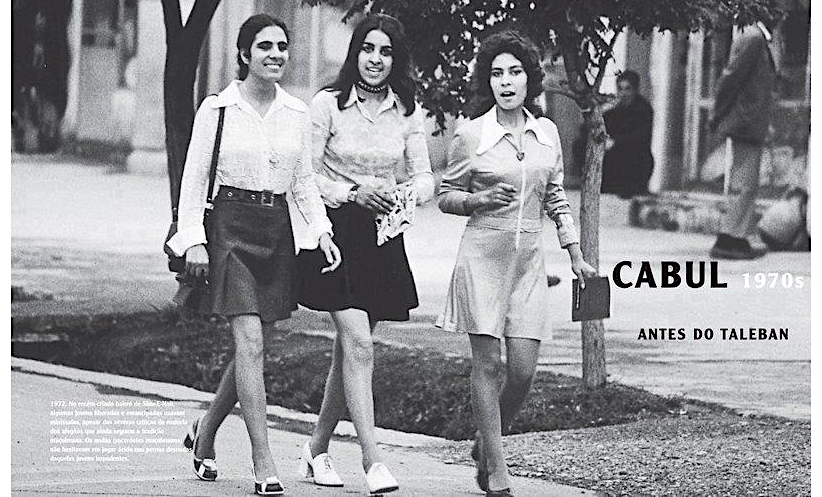
For women, the gains had no precedent;
by the late 1980s, half the university students were women, and women made up
40 percent of Afghanistan’s doctors, 70 percent of its teachers and 30 percent
of its civil servants.
Women at
university in Afghanistan in the 1970s. (Amnesty International U.K.)
Backed by the West
So radical were the changes that they
remain vivid in the memories of those who benefited. Saira Noorani, a female
surgeon who fled Afghanistan in 2001, recalled:
Every girl could go to high school and university. We could
go where we wanted and wear what we liked … We used to go to cafes and the
cinema to see the latest Indian films on a Friday … it all started to go wrong
when the mujahedin started winning … these were the people the West supported.”
For the United States, the problem
with the PDPA government was that it was supported by the Soviet Union. Yet it
was never the puppet” derided in the West, neither was the coup against the
monarchy Soviet backed,” as the American and British press claimed at the
time.
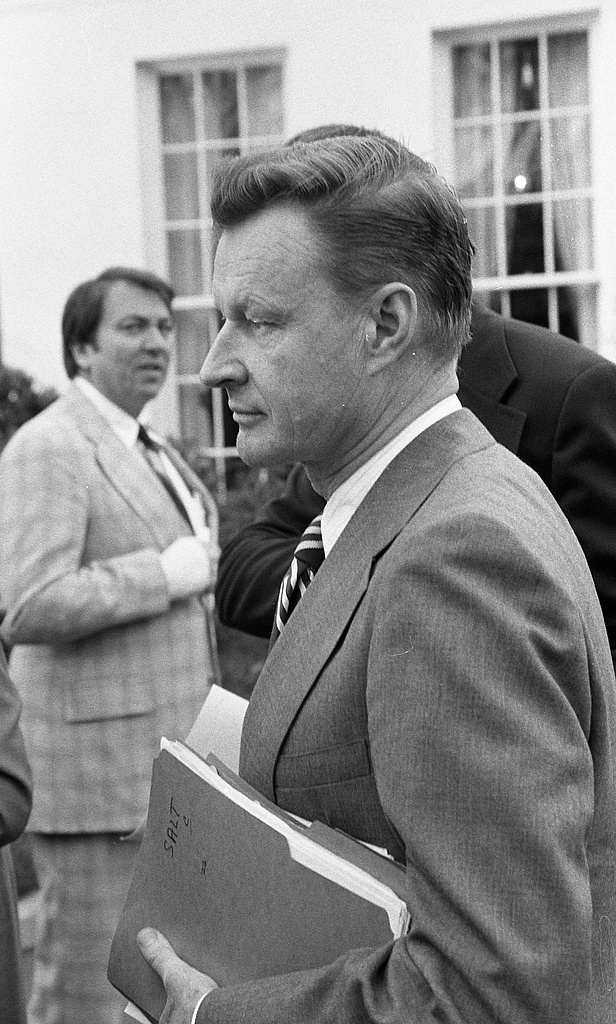
Zbigniew
Brzezinski in 1977. (Library of Congress)
President Jimmy Carter’s secretary of
state, Cyrus Vance, later wrote in his memoirs: We had no evidence of any
Soviet complicity in the coup.”
In the same administration was
Zbigniew Brzezinski, Carter’s national security adviser, a Polish émigré and
fanatical anti-communist and moral extremist whose enduring influence on
American presidents expired only with his death in 2017.
On July 3, 1979, unknown to the
American people and Congress, Carter authorized a $500 million covert action”
program to overthrow Afghanistan’s first secular, progressive
government. This was code-named by the CIA Operation Cyclone.
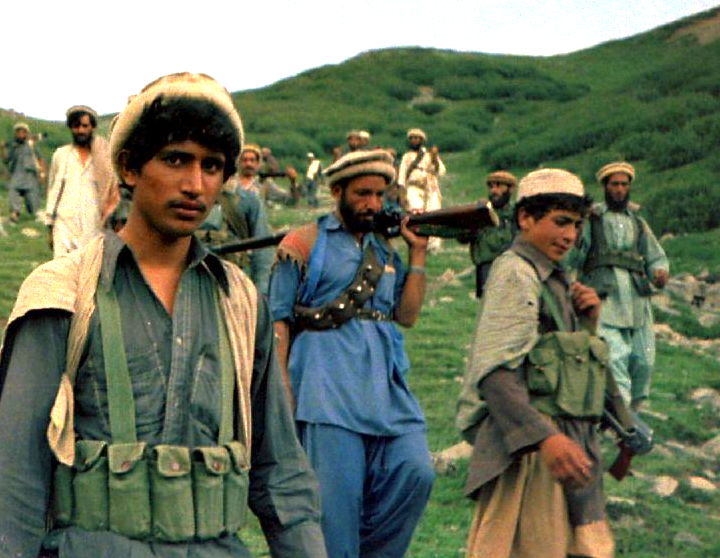
The $500 million bought, bribed and
armed a group of tribal and religious zealots known as the mujahedin. In
his semi-official history, Washington Post reporter Bob
Woodward wrote that the CIA spent $70 million on bribes alone. He describes a
meeting between a CIA agent known as Gary” and a warlord called Amniat-Melli:
Gary placed a bundle of cash on the table: $500,000 in one-foot
stacks of $100 bills. He believed it would be more impressive than the usual
$200,000, the best way to say we’re here, we’re serious, here’s money, we know
you need it … Gary would soon ask CIA headquarters for and receive $10 million
in cash.”
Recruited from all over the Muslim world,
America’s secret army was trained in camps in Pakistan run by Pakistani
intelligence, the CIA and Britain’s MI6. Others were recruited at an Islamic
College in Brooklyn, New York – within sight of the doomed Twin Towers. One of
the recruits was a Saudi engineer called Osama bin Laden.
The aim was to spread Islamic
fundamentalism in Central Asia and destabilize and eventually destroy the
Soviet Union.
‘Larger Interests’
In 1985,
Afghan mujahideen cross into Afghanistan from a border region of
Pakistan. (Erwin Franzen, CC BY-SA 1.0, Wikimedia Commons)
In August 1979, the U.S. embassy in
Kabul reported that the United States’ larger interests … would be served by
the demise of the PDPA government, despite whatever setbacks this might
mean for future social and economic reforms in Afghanistan.”
Read again the words above I have
italicized. It is not often that such cynical intent is spelt out as
clearly. The U.S. was saying that a genuinely progressive Afghan
government and the rights of Afghan women could go to hell.
Six months later, the Soviets made
their fatal move into Afghanistan in response to the American-created jihadist
threat on their doorstep. Armed with CIA-supplied Stinger missiles and
celebrated as freedom fighters” by Margaret Thatcher, the mujahedin eventually
drove the Red Army out of Afghanistan.
The mujahedin were
dominated by war lords who controlled the heroin trade and terrorized rural
women. Later, in the early 1990s the Taliban would emerge, an ultra-puritanical
faction, whose mullahs wore black and punished banditry, rape and murder but
banished women from public life.
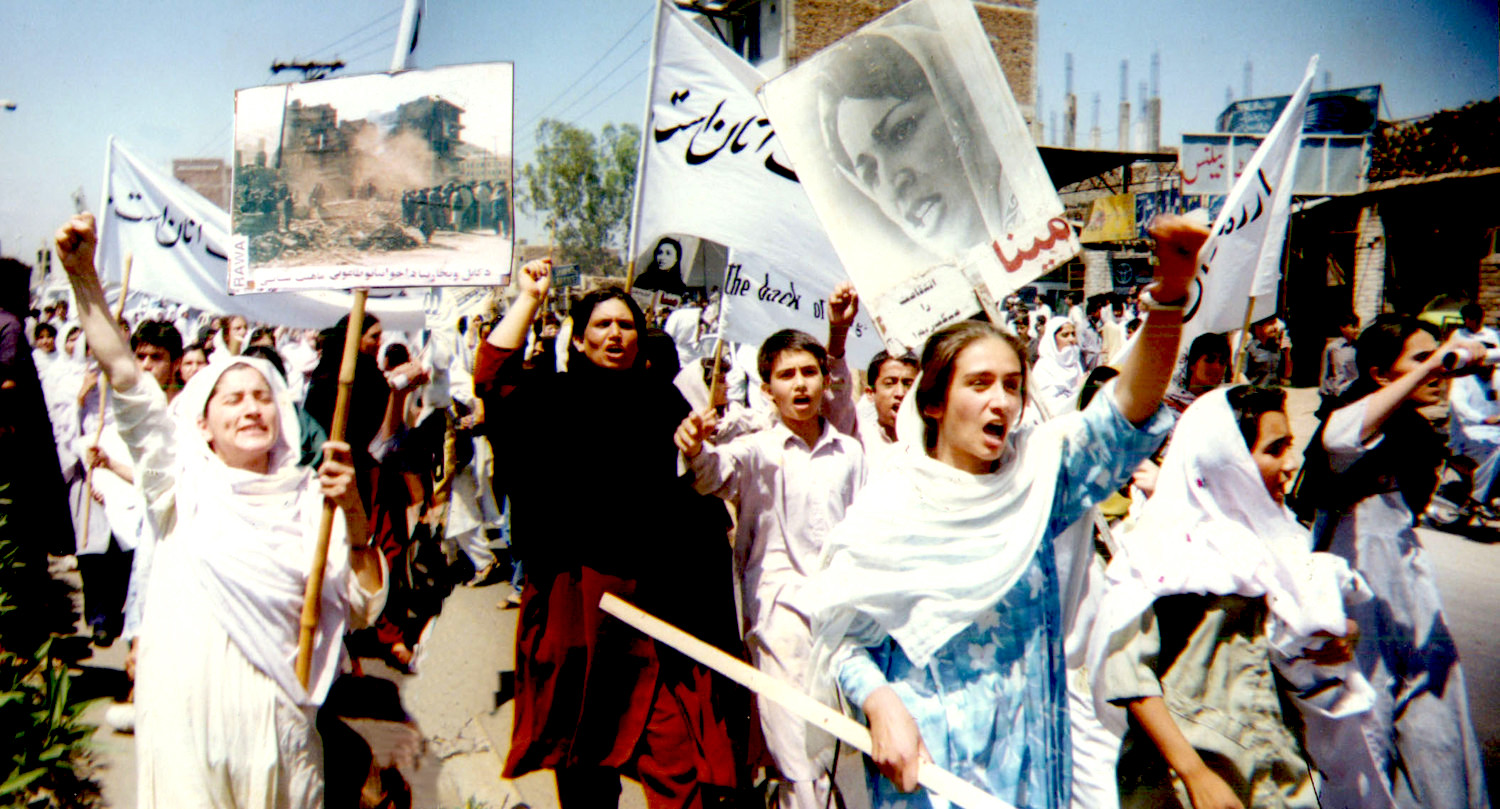
In the 1980s, I made contact with the
Revolutionary Association of the Women of Afghanistan, known as RAWA, which had
tried to alert the world to the suffering of Afghan women. During the Taliban
time they concealed cameras beneath their burqas to film
evidence of atrocities, and did the same to expose the brutality of the
Western-backed mujahedin. Marina” of RAWA told me, We took the
videotape to all the main media groups, but they didn’t want to know ….”
April 28,
1998: Demonstration of the Revolutionary Association of the Women of
Afghanistan in Peshawar, Pakistan, to condemn the sixth anniversary of
swarming of fundamentalists into Kabul.” (RAWA, CC BY 3.0, Wikimedia
Commons)
In 1992, the enlightened PDPA
government was overrun. The president, Mohammad Najibullah, had gone to the
United Nations to appeal to for help. On his return, he was hanged from a
street light.
The Game
I confess that [countries] are pieces
on a chessboard,” said Lord Curzon in 1898, upon which is being played out a
great game for the domination of the world.”
The viceroy of India was referring in
particular to Afghanistan. A century later, Prime Minister Tony Blair used
slightly different words.
This is a moment to seize,” he said
following 9/11. The Kaleidoscope has been shaken. The pieces are in flux. Soon
they will settle again. Before they do, let us re-order this world around us.”
On Afghanistan, he added this: We
will not walk away [but ensure] some way out of the poverty that is your
miserable existence.”
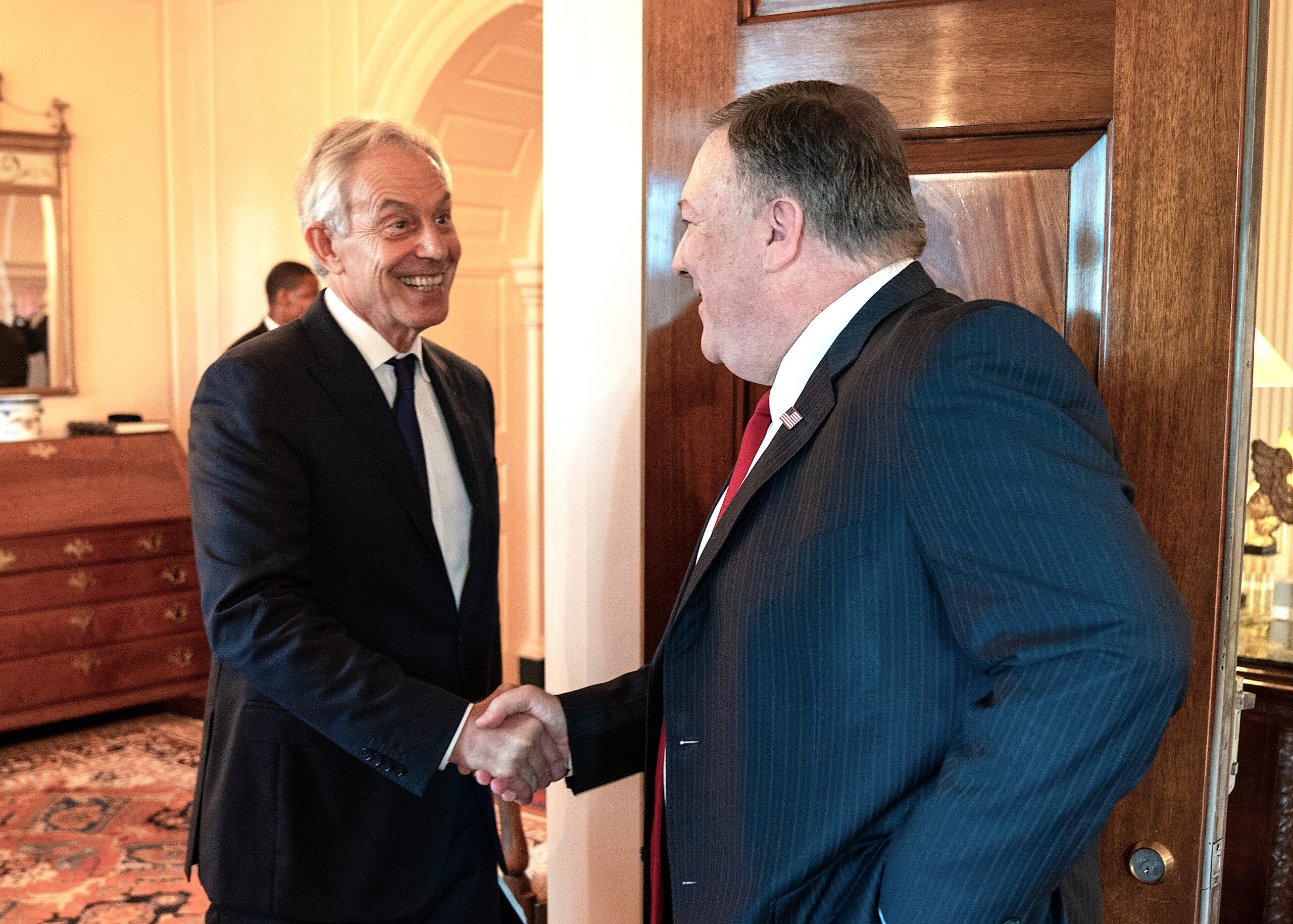
July 17,
2019: Former U.K. Prime Minister Tony Blair, left, with U.S. Secretary of State
Michael Pompeo. (State Department)
Blair echoed his mentor, President
George W. Bush, who spoke to the victims of his bombs from the Oval Office:
The oppressed people of Afghanistan will know the generosity of America. As we
strike military targets, we will also drop food, medicine and supplies to the
starving and suffering …
Almost every word was false. Their
declarations of concern were cruel illusions for an imperial savagery we” in
the West rarely recognize as such.
Orifa
In 2001, Afghanistan was stricken and
depended on emergency relief convoys from Pakistan. As the journalist Jonathan
Steele reported, the invasion indirectly caused the deaths of some 20,000 people
as supplies to drought victims stopped and people fled their homes.
Eighteen months later, I found
unexploded American cluster bombs in the rubble of Kabul which were often
mistaken for yellow relief packages dropped from the air. They blew the limbs off
foraging, hungry children.
In the village of Bibi Maru, I watched
a woman called Orifa kneel at the graves of her husband, Gul Ahmed, a carpet
weaver, and seven other members of her family, including six children, and two
children who were killed next door.
An American F-16 aircraft had come out
of a clear blue sky and dropped an Mk82 500-pound bomb on Orifa’s mud, stone
and straw house. Orifa was away at the time. When she returned, she gathered
the body parts.
Months later, a group of Americans
came from Kabul and gave her an envelope with 15 notes: a total of $15. Two
dollars for each of my family killed,” she said.
The invasion of Afghanistan was a
fraud. In the wake of 9/11, the Taliban sought to distant themselves from Osama
bin Laden. They were, in many respects, an American client with which the
administration of Bill Clinton had done a series of secret deals to allow the
building of a $3 billion natural gas pipeline by a U.S. oil company consortium.
In high secrecy, Taliban leaders had
been invited to the U.S. and entertained by the CEO of the Unocal company in
his Texas mansion and by the CIA at its headquarters in Virginia. One of the
deal-makers was Dick Cheney, later George W. Bush’s vice president.
In 2010, I was in Washington and
arranged to interview the mastermind of Afghanistan’s modern era of suffering,
Zbigniew Brzezinski. I quoted to him his autobiography in which he admitted
that his grand scheme for drawing the Soviets into Afghanistan had created a
few stirred up Muslims”.
Do you have any regrets?” I asked.
Regrets! Regrets! What regrets?”
When we watch the current scenes of
panic at Kabul airport, and listen to journalists and generals in distant TV
studios bewailing the withdrawal of our protection,” isn’t it time to heed the
truth of the past so that all this suffering never happens again?
John Pilger’s 2003 film, Breaking the Silence, about the war on terror” is available to view here.
Ministry of Youth and Sports,Ministry of Development Coordination and Supervision,State Ministry of Digital Technology and Enterprise Development.
The
State Minister of Digital Technology and Enterprise Development Hon. Namal
Rajapaksa delivered the keynote address on the theme “Digital Inclusion
and Transformation in South Asia” at a virtual event that took place on Friday,
Aug. 27, 2021.
The
event, organized jointly by the Observer Research Foundation (ORF) of India,
Colombo Initiative in Sri Lanka and the Sappani Foundation in Canada, aimed to
promote engagements between Sri Lanka, India and other nations in the region,
which also aligns with Minister Rajapaksa’s
vision to elevate Sri Lanka as a global hub for digital technology and
commerce. The event featured prominent digital industry leaders from India and
Sri Lanka, who unanimously agreed on the need to create a truly inclusive”
digital growth in the South Asian region.
During
the keynote address, Minister Rajapaksa announced that the Sri Lankan
Government is actively pursuing Block-Chain technology, which would facilitate
digital currencies and a larger digital economy in the future. This initiative
falls in line with the vision of the Government to build a technology-based
society: Smart Nation.” Minister Rajapaksa also invited corporations to start
investing more in digital platforms and online trading, assuring a simplified
processes for e-businesses in the future.
We
are looking at attracting more investment in the e-ommerce space,” Minister
Rajapaksa said.
Commenting
about the significant business opportunities in the e-sports industry, Minister
Rajapaksa said, We are also looking at promoting e-sports and gaming, with so
many talented youth and an already vibrant community of gamers and developers a
like, we see a lot of promise in this, especially for the younger generations.
Globally e-sports remains a $100 billion dollar industry with infinite
potential.”
The
Minister encouraged Sri Lankan youth to explore these avenues to create a
livelihood for themselves, while contributing to develop new industries. He
also urged the youth who are stuck indoors during the pandemic to capitalize on
the digital space, not only to express their creativity but also to monetize it
and thereby contribute towards the post-pandemic economic recovery.
Minister
Rajapaksa also highlighted that Governments, civil society and the private
sector must work together to ensure that digital technologies benefit not only
the economy but also society and the environment and have inclusion at their
heart. It was also pointed out that the aforesaid collaboration between
multiple stakeholders will pave the way to realize the true transformative
potential of digital technologies in accelerating the progress of the United
Nations Sustainable Development Goals.
Keynote Address by Minister Namal
Rajapaksa for the Roundtable Discussion on Digital Inclusion and
Transformation in South Asia” Organized by the Observer Research Foundation
(ORF) of India, the Sappani Foundation of Canada and the Colombo Initiative in
Sri Lanka.
Ayubowan !
It gives me great
pleasure to be with you at this webinar on Digital Inclusion and
Transformation in South Asia” Organized by ORF India in collaboration with
Colombo Initiative and the Sappani Foundation.
First of all I would
like to thank the organizers for taking the initiative and conducting this much
needed forum amidst current challenges we face due to this global pandemic.
Digital
transformation is affecting how we work, socialize, and create economic value.
The COVID-19 crisis has highlighted the need for significant support and
investments on digital transformation and effective digital governance across
all countries in the region, particularly to ensure the continuity and delivery
of core government functions.
The COVID-19
pandemic’s devasting impact is reaching every corner of the world. As we look
back at this period, we will see history divided into a pre-COVID and a
post-COVID world. A defining feature of the post-COVID world will be the
digital transformation that has permeated every aspect of our lives.
As the Forbes
magazine highlights there are six pillars of digital transformation.
experiences, people, change, innovation, leadership, and culture.
I believe that
inclusion must be at the heart of digital transformation to leave no one
behind”. We need to embed inclusive objectives in the four core foundations of
the digital economy: Internet access, digital skills, digital financing and
e-commerce.
If a nation is to
move forward in the current context Community Led Digital transformation is
vital. Irrespective of the government policies, the community needs to embrace
the digital transformation fundamentals and take lead in this journey,
governments will be then compelled to make the step toward digitalization.
We need to educate
the public on the importance of Digital transformation and benefits of Digital
Education specially during the pandemic. For example, digital education in Sri
Lanka even though at the early stage is growing at a rapid rate, due to the
pandemic the school system has had to embrace online education which they were
reluctant to do before and now it is one of the fastest growing sectors in the
country.
The United Nations
has recognized digital education as one key pillar in their sustainable
development goals. One of the objectives under this pillar is by 2030,
substantially increase the number of youth and adults who have relevant skills,
including technical and vocational skills, for employment and entrepreneurship.
This too is a key priority for us in Sri Lanka, we are committed to provide our
youth with the skills and the tools to further their ambitions and promote
entrepreneurship and assist them to find skilled employment. This is vital for
countries such as ours. We need to keep our youth occupied.
The 21st Century is
known as the knowledge-centric century. Therefore to remain globally competitive,
we must be efficient and technology needs to be integrated with every sector of
the economy, be it agriculture, industry, or the service sector. It is vital
that we invest strategically in new technologies and include such innovations
into our education systems, and economy. A culture of technological innovations
must be nurtured.
Under the leadership
of his Excellency the President a key priority of our government is to work
toward a digitally inclusive Sri Lanka”.
While we drive all
this vision forward the convenience of our citizens would be the foremost
consideration in setting up a Citizen Centric Digital Government. We will
ensure that we put in place a process where people would not have to be
inconvenienced due to inefficiency, delays, and having to commute to many
points of service delivery to obtain public services, when such services could
be obtained via the internet.
While we have already
implemented digital access to vital documents such as birth & death
certificates, we are working toward establishing a fully digital ID. The
process of establishing a centralized Digital ID has already begun and we hope
to begin work by the end of the year along with an E-Gramasevaka service which
will allow the public access to essential public services from home.
While education,
public services and work is shifting to the digital space Economies too have
had to follow suit. With covid19 our entire lifestyles have changed we no
longer interact or go about like we used to, we cannot.
Corporations and
countries alike need to start investing more in digital platforms and online
trading.
In Sri Lanka we hope
to simplify the processes for E-businesses and we are looking at attracting
more investment in E-Commerce space. We are also actively pursuing Block-Chain
technology which would facilitate for digital currencies and a larger digital
economy. We are also looking at promoting Esports and Gaming with so many
talented youth and an already vibrant community of gamers and developers a like
we see a lot of promise in this, especially for the younger generations.
Globally Esports remains a 100 Billion dollar industry with infinite potential.
We should encourage our youth to explore these avenues to create a livelihood
for themselves but also create new industries. While youth are stuck in doors
digital space provides them with an escape to not only express their creativity
but also monetize it.
While digital
transformation is certain, its direction is not. Governments, civil society and
the private sector must work together to ensure that digital technologies
benefit not only the economy but society and the environment and have inclusion
at their heart. Only then do we stand a chance of realizing the true
transformative potential of digital technologies to accelerate progress on the
Sustainable Development Goals.
Media
Unit,
Ministry of Youth and Sports,Ministry of Development Coordination and Supervision,State Ministry of Digital Technology and Enterprise Development.
Embassy and Permanent Mission of Sri LankaBangkok, Thailand
The Embassy and Permanent Mission of Sri Lanka in
Bangkok, Thailand in collaboration with Sri Dalada Maligawa, Sri Lanka
Tourism & Mahachulalongkorn Rajavidyalaya University (MCU) in
Thailand presented the very first live telecast of Sri Lanka’s most
historic and colourful cultural event Esala Perahera Randoli in Sri
Lanka on MCU TV Channel in Thai Language on 22nd August
2021. The Esala Perahera Randoli was also live streamed in Thai Language
in social media platforms of Mahachulalongkorn
Rajavidyalaya University in addition to the MCU TV for Thai Buddhist
devotees.
Theravada Buddhism was introduced to Thailand from Sri
Lanka and known as ‘Lankawamsa’ in Thailand and subsequently during the
colonial period, when the foundation of Sri Lanka’s Buddhist monkhood
eroded, Most Venerable Pra Upali Thero from Ayutthaya city in Thailand, then
called ‘Siam’ re-establish the higher ordination tradition, which is known
as ‘Siam Nikaya’ in Sri Lanka. Today, Kandy in Sri Lanka and Ayuttaya in
Thailand have been declared as sister cities.
The Esala Perahera Randoli was also live streamed in
Khmer and Thai languages in Cambodia and
Laos respectively in their social media.
During the pandemic of COVID-19 where many travel
restrictions are in place, the live telecast from Kandy, Sri Dalada
Maligawa, invoked blessings and brought back the spirit of rich religious and
cultural heritage to the Buddhist devotees in the East Asia.
Embassy and Permanent Mission of Sri LankaBangkok, Thailand
Colombo, August 27 (NewsWire) – The decision to lift the nationwide lockdown on Monday (30) with gradual relaxation afterwards could contribute to an eventual Covid-19-related death toll of 16,700 in Sri Lanka, the World Health Organisation (WHO) has projected.
According to The Morning Newspaper, a WHO-backed study has revealed that it will also limit the economic impact of the lockdown to US$ 1.1 billion, or 1.3% of GDP.
The WHO has also revealed that if the lockdown is extended to 18 September then it would result in a death toll of 13,712 and an economic loss of US$ 1.67 billion.
If the lockdown is extended to 2 October then it would result in an economic loss of US$ 2.2 billion, but limit the total death toll to 10,400, it added.
The projection is contained in the report Epidemiological and Economic Projections of Mitigation Measures for the Covid-19 Pandemic in Sri Lanka’s Roadmap” issued on 26 August 2021 through a webinar.
According to several experts who had attended the webinar, based on these projections, the Government cannot consider any other option but to continue the quarantine curfew or lockdown with more stringency.
They added that any other option would prove to be utterly disastrous, both for the country and the Government, and that the economic impact will also be felt thereafter.
Trade Minister Bandula Gunawardane has tested positive for Covid-19, becoming the ninth Member of Parliament to be tested Covid-19 positive within this month, the minister confirmed.
Sri Lanka has extended the current island-wide quarantine curfew orders by a week, in a bid to curb the soaring COVID-19 figures in the country prompted by the rapid spread of the Delta variant.
Minister of Health Keheliya Rambukwella tweeted that the extended quarantine curfew orders are effective until 4.00 am on the 06th of September (Monday).
He urged the members of the public to continue to work from home and to abide by the curfew orders while refraining from unnecessary travel.
The current #COVID19SL curfew will continue till Monday 4am (06/09). Following an observation that #lka citizens have not taken the curfew to heart, in order for this to be effective, I implore again to refrain from unnecessary travel, work from home & abide by the curfew.”
The decision was taken during the meeting of the Special Committee on COVID-19 Control convened under the patronage of President Gotabaya Rajapaksa this morning (August 27).
On August 20, Sri Lanka imposed a ten-day island-wide quarantine curfew and it was set to be lifted at 04.00 am on August 30.
Chinese Ambassador to Sri Lanka Qi Zhenhong has called on Speaker of Parliament Mahinda Yapa Abeywardena on Thursday (Aug. 26).
During the meeting held at the Speaker’s official residence, the Chinese Ambassador reiterated that the Chinese Government would continue to extend its full support to the Government of Sri Lanka for the control of COVID-19 situation at a time when both countries are working with utmost commitment to control the current Covid-19 situation.
They also discussed economic and financial cooperation between the two countries as well as the strengthening of inter-parliamentary relations.
The Speaker also expressed his gratitude to the Chinese Government for its continuous support as a long standing friend of Sri Lanka.
The total number people who fell victim to COVID-19 infection in Sri Lanka soared yet again as a record high of 214 new fatalities were confirmed by the Director-General of Health Services on Thursday (August 26).
This is the highest number of deaths reported within a day since the beginning of the pandemic and the second consecutive day the daily fatalities count crossed the grim milestone of 200.
The new development has pushed the official death toll from the virus outbreak in Sri Lanka to 8,371.
According to the data released by the Department of Government Information, the latest victims include 120 males and 94 females.
As many as 151 deaths were reported among the elderly people who are aged above 60 years.
In addition, 58 individuals aged between 30-59 years and five people below the age of 30 years have also succumbed to the virus infection.
Daily COVID-19 cases confirmed in Sri Lanka exceeded 4,000 for the sixth consecutive day today (August 27) as 779 more people were tested positive for the virus.
According to official data, 4,591 novel coronavirus infections in total were detected within the day.
The Government Information Department stated that 4,561 of the latest cases were associated with the New Year Cluster and the remaining 30 have been identified as arrivals from foreign countries.
The new development brought Sri Lanka’s confirmed COVID-19 cases tally to 416,961.
At present, 55,399 active cases are receiving medical care at hospitals, treatment centres and their respective homes.
Meanwhile, the number of total recoveries has reached 353,191 and the death toll now stands at 8,371.
The
world needs an Emperor with full clothing to counter the increasing stridency
of China. Unfortunately, the US has been progressively shedding its clothes
beginning perhaps with the defeat in Vietnam. The many military incursions that
followed, all basically abject failures in improving the lives of the people of
the countries so invaded, has shown that US objectives have been flawed, and
the execution of such objectives, even worse.
One
wonders however whether there is a dichotomy when it comes to these objectives.
Were they meant to help the countries so invaded, were they purely to serve US
interests, or were they to serve the interests of a powerful lobby within the
US which has profited hugely on account of these futile military adventures.
The latter wants conflict, war, instability, corruption at the highest levels
in the countries invaded in order to beget even more conflict and war.
If
the invasions were for the benefit of the countries invaded, then during the
time of occupation, the people of the countries would have had an improved
economy, improved livelihoods for the people, a better health system, a more
modernised education system, infrastructure, political and democratic freedoms.
It is highly debateable whether any of the countries invaded passed muster on
these key fronts.
Afghanistan
today is nearly 100% dependent on foreign aid to run the country, as it was 20
years ago. Reports say that Healthcare in Afghanistan is
provided by over 3,000 health facilities found throughout the country. The
decades of war and neglect by the world community has destroyed Afghanistan’s
already-poor healthcare system. In recent years, however, the country had
somewhat improved its healthcare system. Life expectancy rates are among the
lowest in the world and 25% of children die before their fifth birthday.
In 2019, life expectancy at birth for women in Afghanistan was about 66.39
years, while life expectancy at birth for men was about 63.38 years on average.
Lack of basic health care and malnutrition contribute to the high death rates.
Afghanistan has the second highest maternal mortality rate in the world”.
UNESCO
says that Currently, over 10 million youth and adults in Afghanistan are
illiterate. However, it also says that since 2016, the country has made
significant progress. While in 2016/17 the literacy rate was at 34.8 per cent,
the UNESCO Institute for Statistics recently confirmed that is has now
increased to 43 per cent. However, other reports say it’s around 28.1%. (https://www.infoplease.com/world/country-statistics/lowest-literacy-rates)
As
regards the economy of Afghanistan, Wikipedia says that while there have been
improvements over the last few years, it is still described as follows Despite holding over $1 trillion in proven
untapped mineral deposits, Afghanistan remains one of the least developed countries in the world. Its unemployment rate is over
23% and about half of its population lives below the poverty line. Many of the unemployed men join the foreign-funded militant groups or the world of crime,
particularly as smugglers. The Afghan government has long sought foreign investment in order
to improve Afghanistan’s economy”
The statements made by
the US and its allies that they invaded Afghanistan to prevent it from becoming
a haven for the Al Qaeda terrorist movement and not for the benefit of the
Afghan people seems clear when one looks at the above statistics. A question
can be asked legitimately by the people of Afghanistan whether the price they
paid for a decision they had no input or a say, was worth it, in getting the
Taliban out of Afghanistan and for them to come back 20 years later, reportedly
after spending some 2 trillion dollars over this period with not much to show
as an improvement to the lives and livelihoods of ordinary Afghans.
No
doubt corruption and mismanagement has been one of the biggest contributors to
the lack of trust and confidence the people of the country had with their
politicians and government officials. So
called war lords from provinces entered Parliament and some became ministers.
A
corrupt government becoming more and more distant to the people, many of whom
were in poverty, and the US and allies seen as protecting the corrupt, provided
ample ammunition to the Taliban to establish themselves throughout the country.
Although
there was increasing freedom for women during the past 20 years, in a country
with high illiteracy, it is possible that many Afghan men may have been
supportive of the Taliban as they too were not culturally supportive of freedom
for women. The younger, more educated, urban based men may have been supportive,
but they were a minority. The US, its allies and the Afghan government they
propped, were not succeeding in winning the hearts and minds of people, and it
was a matter of time before the Taliban took over.
The
issue before the US, NATO and Allies and what is called the free world”, is
not just Afghanistan. It is the situation where this group has shown its
impotency in being able to halt the march of the not so free world of Islamic
extremists, terrorist groups intent on achieving their objectives via violent
means on the one hand, and the rising belligerence of China on the other hand.
In
Buddhist philosophy, the doctrine of dependent origination or Patticca Samuppada”
underpins ongoing human existence. It is about cyclical consequential thoughts
and action that follows from present thoughts and action. This is a very
simplified statement, but it is just that simplicity that has a bearing on some
of the reasons for conflicts arising out of the battles between the free
world” and the not so free world”.
While
the value of democracy, freedom and justice, and law and order existing or
should exist in a society that has the fundamentals mentioned is not in
question, it is perhaps pertinent to ask whether such societies have been as
inclusive as they have been portrayed to the world. It is also equally
pertinent to ask whether social and societal inequities and inequalities,
exploitation of the less fortunate by the more fortunate does or does not occur
in such countries, and what consequential actions follow as a result of it. Do
the structures and systems in such countries have avenues for the less
fortunate, affected people to overcome feelings of helplessness?
People
who are affected, and who do not feel the systems are able to address their
situation, could react in many different ways. Some may just accept it, some
may strive to find ways and means of overcoming such situations, and some may
do so using methods that are not conventional and outside the norms of the
societies they live in. Amongst these different groups, there would be fertile
ground for extremist leaders, using tools such as extremist religious
interpretations, to recruit such disgruntled people. These could be consequential
actions arising from the mental state of some people facing helplessness and
hopelessness in societies. Poverty is rife in many democratic countries and
contributes significantly to the rise of extremism.
GSDC Applied Knowledge Services in a working
paper from Stanford University’s Centre on Democracy, Development and the Rule
of Law suggests that the obstacles to the elimination of poverty are largely
political. Poverty is generated and reproduced by power disparity and abuse.
The enduring reduction of poverty requires a broad context of good governance,
beyond the narrow arena of free and fair elections. The deepest root cause of
development failure is bad governance – the inability or unwillingness to apply
public resources effectively to generate public goods. Good governance involves
the capacity and commitment to act in pursuit of the public good, transparency,
accountability, citizen participation and the rule of law. Bad governance
prevents the accumulation of the financial, physical, social and political
capital necessary for development.
The paper goes on to say that Democracy should
provide a corrective to bad governance by holding corrupt, unresponsive or
ineffectual leaders to account and enabling citizens to participate in making
policy. The evidence on the relationship between democracy and development is
ambiguous, however. While authoritarian rule offers poor prospects for
sustained poverty reduction, democracy does not offer any guarantee of good
governance. The effectiveness of democracy in reducing poverty depends to a
great extent on the type and degree of democracy. Democracy can be seen as
having three dimensions: electoral competition, civil liberties and responsible
and accountable government” https://gsdrc.org/document-library/moving-on-up-out-of-poverty-what-does-democracy-have-to-do-with-it/.
Two things are clear
from this paper that firstly, democracy could be a very loose term and it
doesn’t necessarily serve all people with equal measure when it comes to
inequity, inequality, opportunity and it provides safeguards to the less
fortunate when through natural occurrences or deliberate acts, the less fortunate
and the marginalised are left behind, and secondly, the democratisation
experiment of Afghanistan did not work as it was not culturally attuned and
facile at best.
The lesson hopefully
for the free world” is to examine how these consequential situations occur,
before they occur, and see how they can be avoided or mitigated. These need to
be done within historical and cultural contexts in different societies as one
rule does not fit all. This is probably the single biggest reason for the
failure of US policy of successive regimes as cultural contexts have been rarely
recognised by policy makers.
The Emperor cannot
wear more transparent clothes to cover its nakedness. The Emperor needs not
just different clothes but more importantly, a different mindset to realise it
cannot continue to walk around pretending there is no nakedness. This approach
must be firstly and lastly, based on giving a helping hand to countries in need
of assistance to overcome poverty, to improve their health services, improve
education and helping them to stand on their own feet to improve their
economies, but within their cultural contexts. Democratisation has to be a
progressive exercise and based on conviction, and not introduced allowing corrupt individuals to further their
personal nests. Placing military boots, guns and bombs in countries on the
pretext of helping them has to stop, as recent history in Vietnam, Iraq, Libya,
and now in Afghanistan, has proven beyond any doubt.
The
writer is confident that readers may have seen the picture of ‘praying
hands’ umpteen times, mainly hung on Christian homes, but wonders how
the story originated! As narrated initially by
Ranjit Seneviratne, some time ago, the story was about a family in Nuremberg,
West Germany, in the fifteenth century. Dürer’s was a large family with eighteen children.
The children’s father was a professional goldsmith. Because he had to
provide food for so many children, the father had to work overtime up to
eighteen hours a day. Despite their hopeless financial situation, one of two of
the elder children, Albrecht once had a dream about becoming rich by following
his father’s talent. He discussed his dream with Albert, his brother. But in real life, they were
quite convinced that their father would never allow them to do so, however much
they were financially miserable.
The father’s wish was to send both boys to the
Nuremberg Academy to become professionals. Their dream was discussed in the
night, in their crowded bed. After a lengthy discussion in their packed bed in
the night, the two boys reached an agreement to toss a coin. The loser would go
to the local mines or do sales and earn to support his other brother who
attended the University. The brother who won the toss had to participate
in the academy and engage in studies diligently. So, they tossed a coin on a
Sunday morning after returning from the Church and Albert lost the agreement, which opened the opportunity for Albrecht to
go to the Nuremberg Academy. Albrecht Durer, as per agreement, between the two
brothers, went off to Nuremberg to attend studies at the academy.
Consequence of the
Dream
Meanwhile, Albert Durer had to go down the
dangerous mines for four years devotedly to finance his brother, whose work at
the academy was a sensation to him. Albrecht’s progress of producing etched
plates and objects, his woodcuts, and his oils at the Nuremberg Academy was far
superior to his professors’. After the graduation, he was able to earn substantially. When the young, qualified sculptor
returned home, his parents, and the rest of his (Durer) family held a grand
dinner on their lawn to celebrate and welcome Albrecht’s success.
At the Dinner Party
After a
memorable dinner, with beer to the galore, Albrecht stood up from his chair and
raised his glass to drink together in honour of his beloved brother’s (Albert)
for his four years of dedicated sacrifice, which made him (Albrecht Durer)
fulfil his ambition successfully.
Holding the glass and with loving words, he made an emotional speech
that touched every one who attended the dinner and the family. At the end of
his speech, he raised his glass again and said: Now, Albert, you, are my
blessed brother, who scarified your life for four years on account of me to
qualify at the academy, it is now your turn to go to Nuremberg Academy to
pursue the dream. On
my part, I can take care of all your expenses at the academy.”
All heads turned towards the far end of the table where Albert was
sitting. His eyes were wet with emotion, and his face looked pale . In a
tottering voice, he lowered his head from side to side and sobbed with
sentiment and repeated the words, saying, “No! No!!…. No….!!!
Finally, Albert Durer rose
and wiped the tears and glanced down the long table at the faces he loved, and
then, holding his hands close to his right cheek, said softly, “No,
No!! Brother, I cannot go to Nuremberg Academy, look at my hands.”
Thank
you, brother, for the kind gesture, but it is too late for me.
See what has happened to my hands for the past four years having to work at the
mines! The bones of all the fingers were smashed at least once. Of late, I was
suffering from arthritis so very badly, in my right hand, that I cannot even
hold a glass to return your toast! No, brother . It’s too late for me. I am so
sorry. Thank you very much for your sacrifice. I love you so much.”
In Loving Memory
Later, in loving memory of
his beloved brother Albrecht Durer crafted a masterful portrait as a reminder
of his brother’s dedication, which
helped him to become a professional craftsman. It was done in pen and silver
point sketches, watercolours, corals, woodcuts, and copper engravings, all of
it as a total dedication to his beloved brother Albert, who sacrificed in the
mines for four consecutive years, which enabled Albrecht to master his father’s
job in a much wider sense.
Albrecht Durer painstakingly drew his brother’s abused hands with palms
together, and thin fingers stretched skyward to pay homage to Albert for all he
had sacrificed. He called his powerful drawing simply ‘Hands. But the
entire world almost immediately opened their hearts to his great masterpiece
and renamed his tribute of love as “The Praying Hands.” It was
over many centuries ago that the emotional story took place.
Yet, masterful portraits, woodcuts, and even copper engravings are
available today about the two hands as a commemoration of Albert’s sore hands
created by hissbrother
Albrecht Durer, as paying compensation to his brother. Albert kept to his word
and helped his brother to study and graduate at the Nuremberg Academy. Albrecht
Durer’s masterful portraits, pen and silver-point sketches, watercolours,
charcoals, woodcuts, and copper engravings hang in every great museum in the
world even today.
But
many buy them as a religious observation ,
without knowing the real
story behind the emergence of an invaluable piece of craft created by Albrecht
Durer. Currently there are so many reproductions hanging in your homes or offices .
Next time you see a copy of that touching creation,
take a second and look sharply. Let it be
your reminder, if you still need one, that no one – no one – ever makes
it alone!
‘These people have substantially worse problems after hospitalization than clinicians would have expected,’ said Dr Jack Iwashyna, co-lead author and a physician at the Michigan Department of Internal Medicine, in a statement.
The median age of patients in the study, which was published last week in the Journal of Hospital Medicine, was 60 years old, and the average hospitalization time was five days.
In total, 84.2 percent of participants reported having symptoms months after hospitalization and not feeling ‘fully back to their pre-COVID-19 level of functioning.’
Around 56 percent of patients, or 139, reported having a new or worsened cardiopulmonary symptoms.
Almost a quarter of participants, 57 out of the 253, said they have a frequent cough now, and early 20 percent have a rapid or irregular heartbeat.
Some reported more serious symptoms.
Nearly 16 percent said they now have to use a home oxygen machine or have difficultly getting around the house due to chest troubles.
Gallery: 20 diseases much more common than we think (Espresso)
Ten percent reporting having to sleep sitting up to deal with potential issues.
In total, 50 percent of patients reported that their daily life is now limited in some way due to their post-Covid symptoms.
Over a quarter of the patients said that they now have three or more limitations to their daily life that did not previously exist.
‘This isn’t patients saying: “I can’t run quite as far as I used to”,’ said Dr Terri Hough, professor of Medicine and Chief, Division of Pulmonary and Critical Care Medicine Oregon Health & Science University.
‘This is them saying: “I can’t walk, I can’t cook, I can’t shower.” The effects are devastating.
‘Unfortunately, we saw this even among patients with quite short hospital stays.’
The cause for these long term symptoms is not yet known.
‘Long Covid’, the name given to the condition where people feel symptoms of the virus long after recovery.
Anywhere from one-third to two-thirds of COVID-19 patients will develop some form of the condition.
It can appear in anyone, even in relatively healthy people who contract the virus and do not experience serious symptoms while they are hospitalized.
Researchers of the Michigan study hope that identifying more potential symptoms of ‘long Covid’ can help physicians develop treatments to the conditions.
‘As we continue, we’re excited that this study will link the biology of initial hospitalizations for COVID-19 to long-term patient-centered outcomes, and thereby help us find treatments to decrease the burden of recovery from COVID-19,’ said Hough.
The team also hopes that long Covid patients are not forgotten as the world plans to eventually move past the pandemic.
‘While much attention has focused on deaths from COVID, these findings highlight the long-term consequences in survivors of COVID-19 and shed light on the public health crisis resulting from the disability and economic loss among COVID survivors,’ said Dr James Kiley, director of the National Heart, Lung, and Blood Institute’s Division of Lung Diseases.
Since
the election of Mr.Gotabhaya Rajapaksa as the president of Sri Lanka at the end
of 2019, people expected from him he will launch Sri Lanka in an era of new
policy implementation. People expected the eminence of the political
administration compared to previous presidents. The excellent feature of his
administration is a halcyon approach to issues and a focus on result-oriented
reforms and supervision. The best example is the approach on the COVID-19 issue
that needs the wide support of people without a political difference.
The
owned styles of administration had been shown by political leaders of Sri Lanka
since King Vijaya, and King Senkadagala Rajasinghe was the best the example of
the calm approach of administration. He investigated many issues himself rather
than listening words of others in a way like opening soda bottles. The facet of
the Gotabaya administration is given priority for results examining that the
results breed from policy outcomes. The way of King Vijebahu was a secret investigation
in the community walking in the night. The nature of Mr. Gotabhaya’s
administration shows he adapts to historical kings, and it shows the excellence
of Rajapaksa policy above Mr. Sajith Premadasa and Mr. Ranil Wickramasinghe.
Many people don’t quickly understand the way of handling issues, because the
approach of Mr.Gotabhaya Rajapaksa concerns achieving broader outcomes rather
than hanging on narrow indulgence.
When
Mr.Gotabaya was addressing before the new lockdown decision, he clearly
explained people the potential impact of the lockdown, and his explanation was
clear to people. He expected unitedly working rather than too much talking. The
world has been adapted to working collectively than distancing on political
reasons. The COVID-19 has been promoting social distancing that is against the
way all religions promoting. Mr.Gotabhaya Rajapaksa directed unity in working
to eliminate the virus than political-based collectivism.
The
most significant point that he mentioned in the address was the requirement of
unity to control covid and his fundamental view is Sri Lanka wants political
unity than the concept of the Queen’s opposition, which divulged that the
opposition is the alternative government of Queen by Ivor Jennings. Religious
leaders and elders of the country have been preaching this view since 1956, but
it was unsuccessful because an underhand element worked against the unity. When
Mr. Rajapaksa was working against the LTTE, he had in mind that unity was an
essential condition, but Mr.Ranil Wickramasinghe had ignored the unity might be
under the advice of foreign powers. If he agreed with the unity, he could have shared
the victory with the government. It was the major reason to backward UNP in
2020. The policy eminence of Mr. Gotabhaya Rajapaksa is strong trusts the unity
of people to eradicate problems in Sri Lanka.
The
political divisions are being the poison that entered political administration
in Sri Lanka. Democracy began in the early 1930s and since then, people have
misunderstood the concept and many politicians have misused the concept. With
these democratic reforms, the concept of unity has gone away and people
attempted to achieve various outcomes in divided ways. People expect Mr.Gotabhaya
Rajapaksa will change the misunderstanding in a way that is appropriate to Sri
Lanka.
What
is the policy eminence of Mr. Gotabhaya Rajapaksa?
Organic Agriculture
Production–Many health issues in Sri Lanka are
associated with inorganic agricultural production and people saw that
agrochemical and chemical-based fertilizer invaded the agricultural production
process. Before formulating the British policy in late 1800, Sri Lanka had an
organic production system, and resulting from the plantation industry, the
inorganic method of soil management began and people became an allurement of
agrochemicals. A.Bour and Company, Colombo Commercial company, and others
turned to inorganic fertilizer production, and the farmers were forced to use
inorganic fertilizer and chemicals. In the long run, Sri Lanka has become an
element of an inorganic method of production and relegated to a variety of diseases.
And the cost of these diseases absorbed a large sum of the budgetary fund and
the country pushed to an indebtedness. The wise policy of Mr.Gotabhaya
Rajapaksa is an attempt to change the method of agricultural production and the
results could be seen after several seasons.
Renewable Energy–Sri
Lanka gave priority to hydropower generation. Many countries use fossil fuel
and modernization of power production and services encourages power production
using hydro, wind, and sunlight, and others and the policy of Mr.Gotabhaya
Rajapaksa has directed to generate renewable energy.
Export Economy.
The export economy becomes a major factor determining the exchange value of the
monetary unit of Sri Lanka. Prof.Dudley Seers has analyzed the export economy
of Sri Lanka late 1960s and Mr. Rajapaksa has focused on his policies to
increase earnings from exports and make restrictions on a variety of imports
that could be domestically produced. The trade policy of Mr. Gotabhaya
Rajapaksa could support achieving better terms of trade and a gradual
improvement of the exchange rate of the Sri Lanka rupee.
Import Policy–Since
the late 1950s, Sri Lanka began import substitution and established many public
enterprises to manage import substitution. However, this policy has been
changed by Mr.J.R. Jayawardane for a market economic system without disciplines,
and the liberalized import regulation allowed to come unnecessary imports and
incurs foreign exchange shortage. Mr.Rajapaksa has started a policy to fix the
problem.
The
outcomes of policies cannot be seen overnight. It will take a minimum of ten
years and people in Sri Lanka are not calm and struggle to show results. The
era of Mr.Gotabhaya needs to change society. Free and education from
mother-tongue have made radical changes, but the current situation is people
need education from three media and people to need to be conversant in three
languages. Although education was free, it was not offered equally and
disparities created a class that secretly promote feudal society promoting the
use of the English language. This could be changed by offering three languages
to all in Sri Lanka.
Mr.
Martin Wickramasinghe had been enthusiastically talking about the brahmin caste
that influences society. The brahmin class was conversing in the English
language. Changes in the economy, especially land reforms and distribution of
education in rural areas, contributed to change. However, now there is called a
posh society, people in the posh society are not well educated and capable in
English communication. They are in an artificial society and they are less
respected for values. Mr.Gotabhaya Rajapaksa needs to focus on changing the
concept of posh society to achieve equity and justice.
Bangladesh
and Bhutan are situated in South Asia
geographically. They share a common regional platform such as BIMTEC, SAARC.
There are some harmonies between Bangladesh and Bhutan in sphere of mutual
interest, shared history, culture.
On
December 6, 1971, Bhutan and India became the first countries to recognize the
independence of Bangladesh. Bangladesh will never the Bhutanese support and
contribution during the liberation war in 1971. Relations between Bangladesh
and Bhutan started to deep from this period.
Bangladesh
and Bhutan have common identity in the world. Both are peace lovers and peace
keepers. The peace loving people of Bhutan and Bangladesh shared similar views
on many regional issues. Bangladesh is a humanitarian democratic country in
South Asia. Bhutan is also a democratic country in the world. Bhutan and
Bangladesh have many potentials to work with each other for the better
promotion of democracy, peace keeping, regional stability, betterment of People
etc.
The entire region have a huge
potential for development. To ensure that the leadership of both countries have
since exchanged many state visits. In 2016, the President of Bangladesh
addressed the Parliament of Bhutan. On 6 December 2020, both countries signed a
Preferential Trade Agreement (PTA) with provisions for free trade in certain
goods. The signing of the PTA was witnessed by the Prime Minister of Bangladesh
and the Prime Minister of Bhutan. Bhutanese PM came Bangladesh to mark the
birth centenary of the founder of Bangladesh Father of the nation Bangabandhu and
50 years of Bangladesh indepence. It is very pertinent to mention that PM Lote
Tshering studied in My mymensingh medical college. He can speak in Bangla.
Bangladesh PM Sheikh Hasina is also very interested to strengthen the ties.
This is the first PTA
Bangladesh has signed with any country in the world. The PTA aims to establish
a preferential trading arrangement, explore all appropriate measures to
facilitate and promote bilateral trade. The PTA is expected to build upon the
existing friendly relations and strengthen the mutual cooperation in the field
of trade and commerce between the two countries.
With
the signing of the PTA, 16 more products from Bhutan will enjoy duty free
access to Bangladesh, in addition to the existing 18 products. Likewise, 10
more products from Bangladesh will enjoy duty free access to Bhutan in addition
to the existing 90 products.
However, Under
the PTA 100 Bangladeshi products will get duty free access to Bhutan. At the
same time, 34 items from Bhutan will get duty free access into Bangladesh.
Further items can be added in the list later on the basis of discussion between
the two countries.
Goods
like Jute and Jute products, baby clothes and accessories, men’s trousers,
jackets and blazers are among the 100 items
from Bangladesh which will get duty free access to Bhutan. On the other
hand fruit juice, natural honey, wheat flour jams, jellies and lime stone,
quartzite etc from Bhutan will have duty free access to Bangladesh.
The
trade volume between the two countries is approximately 50 million dollars with
7.56 million of export and 42.09 million
import into Bangladesh.
The areas of between Bangladesh and Bhutan are many,
including trade, tourism, hydro-power, climate change impacts, health,
protection of bio-diversity, agro-processing, agriculture, ICT, education,
water resource management and much more.
Both have many other ways in where Bangladesh and Bhutan can cooperate and they are always ready to do
it. Bhutan can use the water ways.
Bangldesh’s water ways link already has started. Bangladesh is developing Chilmari port. Chilmari port, Narayanganj and Pangaoni
can be opened for Bhutan. Not only that,
three ports Chittagong, Mongla, Payra can use it. Sayedpur airport is being developed as a regional airport. So,
for Bhutan, it is open. Bhutan can use that airport too. In the sector of
railway connectivity, Chilahati railway
project can be another opportunity for Bangladesh and Bhutan.
Bangladesh and Bhutan have already established extraordinary relations even more meaningful
for mutual benefits and for the overall development and well-being of both
citizens. It is in this spirit that we have signed today the Bangladesh-Bhutan
PTA. Under this Agreement, a wide range of products from Bangladesh and Bhutan
can find duty-free entry into each other’s markets. The agreement also has
provision for including an additional list of products through mutual
consensus.
Once the agreement comes into force, more people in Bangladesh
will get the access to have good apple and orange from Bhutan and other fruits
and other vegetables and other thing. And also from Bangladesh the fashion
conscious people Bhutan can choose from more varieties of quality apparels from
Bangladesh.
Infrastructure projects in Bangladesh can further benefit from
boulder stones from Bhutan, while Bangladeshi pharmaceuticals can enhance
contribution to the health sector in Bhutan. Bhutan is today democratic, modern
and progressive country. Bhutan’s concept of ‘Gross National Happiness’ has won
the admiration of the world.
Bangladeshi NGOs can participate in the development process in
Bhutan. Bhutan can utilize more the human resource of Bangladesh to serve it’s
own interest. This PTA will ensure mutual benefit for Bangladesh and Bhutan.
Bangladesh and Bhutan’s aim is similar and that is to strengthen democracy,
achieve economic growth and make their citizen happy individuals of a
hunger-poverty-free developed-prosperous countries.
Bangladesh’s Vision 2021 and Vision 2041 are guided by the dream
of Golden Bangladesh as envisioned by the Father of the Nation Banghabandhu
Sheikh Mujibur Rahman. Already significant progresses have been made on food
and energy security, education, poverty alleviation, empowerment of women,
social welfare, and development with sustained economic growth. As we endeavor
to reach the goals, Bangladesh want valuable cooperation of it’s friends and
neighbors to strengthen it’s government’s initiatives, including regional connectivity
designed to make all in the region
prosperous. Bangladesh has shared
excellent cooperation with Bhutan and other South Asian neighbors and beyond.
Stronger regional and international cooperation is necessary in the coming days
for mitigating the impact of the pandemic and for the rebuilding phase.
Bangladesh is going to be a rising South Asian economic super
star. Bangladesh would like play a significant a vital role to tackle some
regional problems. Bhutan and Bangladesh can work together in these sectors. Bhutan
can also play in Bangladesh to tackle
the covid-19 pandemic using it’s well known strategy.
Ministry of Youth and Sports,Ministry of Development Coordination and Supervision,State Ministry of Digital Technology and Enterprise Development.
Minister Namal Rajapaksa to Deliver Keynote Address on
“Digital Inclusion and Transformation in South Asia”
The State Minister of Digital Technology and
Enterprise Development Hon. Namal Rajapaksa will be delivering the keynote
address on the theme “Digital Inclusion and Transformation in South Asia”
at a virtual event that will take place on Friday, Aug. 27, 2021, at 2 p.m.
The event, organized jointly by the Observer Research
Foundation (ORF) of India, Colombo Initiative in Sri Lanka and the Sappani
Foundation in Canada, aims to promote engagements between Sri Lanka, India and
other nations in the region, which also aligns with Minister Rajapaksa’s vision to elevate Sri
Lanka as a global hub for digital technology and commerce.
Both India and Sri Lanka have leveraged their digital
tools to help their populations through the challenges posed by the COVID-19
pandemic. Digital technologies have been crucial for the continuity of
governments and industries and for social resilience during the pandemic, and
they will also be key to post-pandemic economic recovery. The “pandemic
push” also accelerated the adoption of services in the realms of
e-commerce, digital payments and online education.
The pandemic has accelerated the need to create
digital inclusion in developing countries, in order to cope with the “new
normal.” In such a context, Minister Rajapaksa will be outlining the progress
Sri Lanka has made in terms of establishing digital inclusion during the
pandemic. Further, the keynote address will also present the Government’s plan
to achieve truly inclusive” digital growth in Sri Lanka, in the post-pandemic
era.
Colombo Initiative (CI), in collaboration with
the Observer Research Foundation (ORF) of India and the Sappani
Foundation in Canada, is delighted to launch a series of discussions and
high-level engagements on the Sri Lanka—India bilateral relationship and the
larger region.
The inaugural panel discussion under the theme “Digital
Inclusion and Transformation in South Asia,” which will take place
virtually on Friday, August 27, 2021 at 2 p.m. The event will commence
with a keynote address by Hon. Namal Rajapaksa, State Minister of Digital Technology
and Enterprise Development, and will be followed by the panel discussion that
will include leaders from the digital sector in Sri Lanka and India:
Anna Roy
Senior Advisor, NITI Aayoh, India
Mahinda B. Herath
CEO, Information and Communication Technology Agency,
Sri Lanka
Deena Jacob
Co-founder & Chief Financial Officer, Open India
Jayomi Lokuliyana
Co-founder/CEO of zMessenger & DigitalX, Founder
of MyMed International and Chairperson of the Women’s Chamber for Digital Sri
Lanka, Sri Lanka
Nisha Holla (Moderator)
Visiting Fellow, Observer Research Foundation, India
With access to digital technologies becoming central
to government/private sector approaches to social, economic and quality of life
challenges, this panel brings together prominent stakeholders in the digital
arena from India and Sri Lanka to discuss key questions.
Join the discussion:
https://www.orfonline.org/research/digital-inclusion-and-transformation-in-south-asia/
Media Unit,
Ministry of Youth and Sports,Ministry of Development Coordination and Supervision,State Ministry of
Digital Technology and Enterprise Development.
Bangladesh
and Nepal are situated in South Asia
geographically. They share a common regional platform such as BIMTEC, SAARC.
There are some harmonies between Bangladesh and Bhutan in sphere of mutual
interest, shared history, culture.
Nepal
recognized Bangladesh as a sovereign state in 1971. Then Bangladesh Built up
ties with Nepal. The bondage and relations between Bangladesh and Nepalese started
from that time. Bangladesh was and is very interested regarding Nepalese
culture, their trends of agricultural development, extraction of stone,
production of hydro electricity, tourism etc
The
first Bangla poetry ( Charjapad) was discovered in the library of Nepal’s King by
a famous linguistic Harproshad Shastri. From the poetry, we able to know that
Nepal-Bengal ties is eternal. Connection was started by the Buddhist priests
who was known as Charjaguru. It is proved that Bangladesh-Nepal’s historical linkage
was opened up.
Now
Nepal is a known South Asian modern state as a whole. The distance between
Nepal and Bangladesh was very short and Indian Chicken Neck ( Siliguri
corridor) divided Bangladesh and Nepal geographically. But both are united
spiritually.
There
are many potentials waiting for Bangladesh and Nepal. Bangladesh’ economy is
booming day by day. It is going to be a South Asian super star. Current ruling
party, Bangladesh Awami league is trying to develop the country. By 2041,
Bangladesh would be developed. It is confirmed.
Nepal
is also a prosperous country. It’s people are peace lover and peace keeper,
hard worker. The people of Bangladesh share the same characteristics. Bangladesh
and Nepal both can play to develop the standard of their people by connecting
with each other.
Nepal
is a huge source of hydro electricity. Nepal can provide it Bangladesh to
fulfill the demands of Bangladesh. Bangladesh needs more electricity to move
it’s factories. Bangladesh is a power hungry. There are many industries and
factories in Bangladesh. The have need electricity. So Nepal can play the role
to boost up the economic strength of Bangladesh. Nepal will be also benefitted.
It’s electricity market would grow up. For this, the transmission line of electricity is needed.
Bangladesh-Nepal- India have to work to start it as soon as possible. India
will be benefitted. On other hands, as a South Asian big brother, it should
play it’s role to boost up Nepal-Bangladesh ties and trades. Trilateral trades scheme
can be initiated along the border markets to ensure the trilateral mutual
interest. Bangladesh will be able to export its ‘surplus’ electricity to Nepal
during the dry season.
In
June, Bangladesh’s state minister for energy said that Bangladesh has decided
to import around 700 megawatts (MW) of hydropower from Nepal to meet its future
electricity demand. It’s Foreign Minister stated that Bangladesh, Nepal and
India are on the final stage of a deal allowing Bangladesh to import hydropower
from the Himalayan state during the Visit of Nepal’s president to Bangladesh in
March to mark the birth centenary of Bangladesh’ founder father Bangabandhu and
Bangladesh’s 50th anniversary of it’s independence from Pakistan.
However, we expect that the hydropower exchange will be able to meet the
demands of both parts people.
According
to Bangladeshi Media, Bangladesh signed an MoU with Nepal in 2018 to oversee
investment, development and trade in hydroelectricity between the two
countries. Under this arrangement, Bangladesh will import up to 9,000 MW of
hydropower from Nepal by 2040. Bangladesh has also been in favor of investing
in Nepal’s hydropower sector.
Bangladesh can export it’s apparel and
fertilizer to Nepal. Some Nepalese media reported few days ago, A total of 52 thousand metric tonnes of urea
imported fertiliser from Bangladesh arrived in Nepal in July.
Tourism,
tackling Covid-19 , counter terrorism
approach, microfinance of Bangladesh in Nepal, exchange of expertise for training, education
sectors are some sectors in which there have chance to work Bangladesh and Nepal both can utilize these
sector with each other. Agro products and medicine of Bangladesh can be
exported to Nepal.
Bangladesh’s
Walton company is working in Nepal. International NGO, Brac and other NGos can play
role to develop the mass education and health sectors in Nepal.
Bangladesh
signed Preferential Trade Agreement with Bhutan on December 06, 2920. Now for
Nepal case, Preferential Trade Agreement
is also at the final stage and is likely to be signed soon to get duty free
access of product of both parties for the welfare of people As an addition to the Protocol of the
Nepal-Bangladesh Transit Agreement signed in 1976, a letter of exchange has
been signed between the two countries to include Rohanpur-Singhabad Rail Link.
Nepal
is also interested in using Chattogram, Mongla and Paira Sea ports because it
is a landlocked country. Bangladesh has agreed to work on the modalities for
this during the visit of Nepali President. India has to play it’s role as a
regional giant to mediate Bangladesh-Nepal relation for the trilateral interest.
Nepal
has also expressed its interest to use inland waterways of Bangladesh. Besides,
Nepal is also interested in using the Saidpur Airport for direct flights with
Viratnagar. Bangladesh is open to it. We want to facilitate connectivity.
Bangladesh-India
must have to work mutually to give the access of Nepal into seaport access.
Bangladesh can be a open source for connectivity with Nepal for their mutual
interest. Nepal has rights to deal trade with outer parts in the world for the
betterment for it’s people. And Bangladesh. Government and people are committed
to express the solidarity of Nepalese brother for their geographical reality.
BIMSEC must have role to accelerate it.
and India have already agreed to sign
passenger protocol under the BBIN. Nepal is expected to give nod to it at the soonest
BBIN connectivity project can not be started because of Bhutan cause. However, India-Nepal-Bangladesh
have to work together to start the alternative. Connectivity is the synonym of development.
So Nepal and Bangladesh have to be connected through India. India should have a
leading role for the betterment of the people in the region.
For
implementing the Motor Vehicle Agreement among Bangladesh, Bhutan, India and
Nepal, options of some new routes other than the existing ones are being explored.
India,
Nepal and Bangladesh should have holistic diplomatic approach to bolster the
connectivity project. There are many gains for all parties, there are no loss
in this regard.
There
are many potentials between Nepal and Bangladesh. It is true. So it is high
time for both parties to utilize it for the maximization of both interest.
New Delhi, August 26 (TOI) – Sri Lanka has reopened for fully vaccinated tourists from India — including those who have got Covaxin— SriLankan Airlines’ head of worldwide sales and distribution, Dimuthu Tennakoon, told TOI on Tuesday.
Also, there is no requirement for quarantine for travellers who test Covid negative on arrival in the Emerald Island.
Sri Lanka is now open for Indian tourists. People need to be fully vaccinated, with the second shot taken at least 14 days before the trip.
On arrival, travellers will go to their hotel where RT-PCR test will be conducted. Those who test negative can travel where they want to go,” Dimuthu, the revival man for Sri Lankan Airlines, said.
Those who test positive will be taken to health care centres run from hotels.
All other Covid time requirements of social distancing and hand sanitation will need to be obviously observed by those testing negative. Sri Lanka is accepting all vaccines, including Covaxin.
Currently, India accounts for over 12 crore fully vaccinated citizens which has resulted in the reawakening interest in travel,” Dimuthu confirmed.
Accordingly, SriLankan Airlines is enhancing to Sri Lanka from key Indian cities. It is currently operating four flights a week from Chennai; three flights a week from Mumbai, and once a week from Bangalore to its hub in Colombo. It will increase connectivity to India from September 1, 2021.
It will resume services between Colombo and Madurai, Tiruchirappalli, Trivandrum and Cochin with flights once a week, whilst Hyderabad and New Delhi will be connected to Colombo with twice-weekly flights.
The airlines’ operations out of Chennai and Mumbai will expand up to five times a week whilst its Bangalore-Colombo services will be enhanced to flights three times a week. Before the pandemic, SriLankan operated 120 weekly flights between Colombo and 11 Indian cities.
Covaxin is yet to get approval from WHO. Pending that, a number of countries are yet to allow Indians fully jabbed with Covaxin to travel there. On the other hand, those who got WHO-recognised Covishield can travel to several countries
A ceremony was held in Anuradhapura when the sacred sapling was sent to Bendigo.( Supplied: Deeptha Wickramaratna)
Australian quarantine is nursing a sacred sapling from a Sri Lankan bohdi tree that can be directly linked back to Buddha more than 2,300 years ago.
Key points:
Sapling from the famous bodhi tree in Sri Lanka is currently in Australian quarantine waiting to be planted in Bendigo
The specimen is a direct descendent of the tree under which Buddha achieved enlightenment
That tree is the oldest tree known to have been planted by humans some 2,300 years ago
Sri Lanka’s sacred tree is revered by the world’s Buddhist community and is a direct descendent of the original tree under which Buddha obtained enlightenment.
It is the oldest living tree with a known planting date.
The sapling will sit in Australian quarantine for 12 months and, eventually, will be planted at The Great Stupa of Universal Compassion in Bendigo, Victoria.
Chair of The Great Stupa of Universal Compassion, Ian Green, said once the sapling was planted, Bendigo would become a pilgrimage destination for Buddhists from all over the world.
To have that connection with history is very unusual and inspiring, and it brings the whole story of the Buddha to life,” Mr Green said.
There was so much effort and expense went into obtaining this tree. It’s value is much beyond money.”
The tree will eventually be planted in a temple known as Bodhi Vhamma Vihara, and will become the first place in regional Victoria for Sri Lankan Buddhists to practice their rituals.
World’s oldest living tree
Mr Green said the significance of the tree to the Buddhist community was immense because the original tree was where Buddhism was born.
The first bodhi tree sapling from the original “Sri Maha Bo” tree to be sent to Victoria. (Supplied: Deeptha Wickramaratna)
After going through a whole effort of trying to find the spiritual meaning for his life, the Buddha sat under the shade of a bodhi tree in India and stayed there until he had this experience where he obtained enlightenment – meaning he understood the answer to his questions and, from that moment, Buddhism was born,” he said.
The original tree that Buddha was enlightened under had been destroyed by invaders but, fortunately for the Buddhist world, the Sri Lankan community had actually taken sapling from that tree and replanted in Sri Lanka.
It’s still there today — it’s actually guarded and looked after by a botanist and the whole thing is protected like a living treasure.
To have a descendent from the tree that the Buddha sat under more than 2,000 years ago is incredibly emotional,” Mr Green said.
Year in quarantine
Australia’s chief plant protection officer, Dr Gabrielle Vivien-Smith told ABC’s Fiona Parker that quarantine authorities were hoping to have the sapling released in May 2022.
The precious bodhi tree sapling will spend 12 months in quarantine and be tested weekly. (Supplied: Department of Agriculture, Water and the Environment)
It arrived in May this year,” Ms Vivien- Smith said. It was meant to be chaperoned by Buddhists [but], unfortunately, [COVID-19] limited that and it had a bit of a rough ride over. It looked a bit like a stick when it arrived.”
The sapling will be tested weekly for pest and diseases for biosecurity reasons.
It arrived as a bare-rooted sapling without any soil,” she said.
We look at all the plants that come into Australia very carefully for pests and diseases. There are some really important pests that we need to keep out of Australia, such as Xylella fastidiosa, which is Australia’s number one plant pest threat.”
Mr Green said the planting ceremony would be a once-in-a-lifetime event” that would have to wait until pandemic restrictions allow it.
It’s such a significant thing for Buddhists and the Sri Lankan community,” he said.
We’re just waiting for some clear air to make that ceremony significant.”
Will tree bode well in Bendigo’s winter?
The treasured bodhi tree sapling is due to be released from Australian quarantine in May, 2022.(Supplied: Department of Agriculture, Water and the Environment )
Mr Green said one of the concerns with the sapling was making sure it was protected from harsh Bendigo winter frosts.
The thing about this particular fig tree is that it’s not ideally suited to Victorian winters,” he said.
So, we have to be very careful with frost. Once it gets established and gets a little bit higher, then it will above the frost line and it will be protected.”
We’ve been acclimatising it under direct supervision.
It’s been treated with as much reverence and security as if it was back in Sri Lanka.”
Humanists, atheists, and non-religious people in Sri Lanka face discrimination and persecution every day, especially if they come from a Muslim background. Even though Sri Lanka is not a Muslim country (the majority of the population is Buddhist), the strong presence of Islamic militants, fundamentalists, and extremists is still very powerful and dangerous.
Rishvin Ismath’s story illustrates the dangers nonreligious people can face. After years of activism as an Islamic preacher, Rishvin left Islam in 2013 and founded the Council of Ex-Muslims of Sri Lanka in 2016 (the only explicitly non-religious organization in the country). There was a dramatic backlash from Islamic terrorist groups, who tried to kill Rishvin at least six times, as confirmed by the Sri Lankan police to Rishvin himself in 2019.
Rishivin’s story is at the same time inspiring and worrying. On the one hand, it shows his courage and determination since, after the unexpected public outing in 2019, he is considered to be the only outspoken ex-Muslim in his country. On the other hand, it tells us bluntly how harsh and life-threatening the life of Sri Lankan humanists can be when they end up on the radar of religious fundamentalist groups.
Humanists at risk badly need support, and this support can only come from outside. I see Humanists International as the main connector, capable of giving oxygen to humanists at risk around the world. I know the value of the work of Humanists International, and that’s why I ask everyone to support its work to support persecuted humanists”.
Born during the Sri Lankan Civil War, Rishvin was forced to leave his hometown at the age of 10 by the Liberation Tigers of Tamil Eelam, who threatened his family at gunpoint. The family ended up in a city dominated by Islamist groups and, at school, Rishvin was taught that music is blasphemous” (Haram), that the appropriate punishment for apostasy” (Riddha) is murder”, and so on.
After studying foreign languages at university, he started working with tourists in the coastal area of Sri Lanka. But the 2004 tsunami changed his life. Rishvin had a near-death experience which led him into an existential and religious crisis. He left his job, moved back home, and started studying the Quran and the Hadiths under the guidance of Mullahs. This journey into Islam brought Rishvin to Saudi Arabia in 2009, because he considered all other countries un-Islamic”.
It was only in 2011 that a seed of doubt started growing in Rishvin’s mind. Back in Sri Lanka, he was put in charge of an Islamist Facebook group. In this position, Rishvin read the constructive criticism from atheists about Islam. Slowly, he lost his faith but didn’t reveal himself as a humanist, fearing for his safety.
In 2016, after receiving death threats online, Rishvin founded the Council of Ex-Muslims of Sri Lanka, the only specifically nonreligious organization in the country, working in hiding to promote humanist values and provide a safe space for ex-Muslims. He even reported to the police that ISIS was getting stronger in Sri Lanka and that the possibility of a terrorist attack was increasing. Unfortunately, the police ignored these warnings.
In 2019, things escalated quickly for Rishvin. After the Easter suicide bomber attacks in Colombo, Rishvin appeared before the Parliamentary Select Committee to give a statement, made in front of the media. The video of Rishvin’s statement went viral on television news and he was outed” as an ex-Muslim.
Since then, Rishvin has been living in hiding. Humanists International is closely following his case and will keep supporting Rishvin until he is free and safe. If you want to help Rishvin and the many other humanists at risk in the same situation, please consider making a donation to the #ProtectHumanistsAtRisk campaign or joining Humanists International as an Individual Supporter.
Your support can make a difference in the lives of the many Rishvins around the world: please take action today.
Giovanni Gaetani is the Membership Engagement Manager at Humanists International.