Why is EU Funded Foundation for Human Rights South Africa administering Yasmin Sooka’s ITJP against Sri Lanka?

June 24th, 2021

Shenali D Waduge

We seek clarification from the EU, South Africa & the Government of Sri Lanka. In 1996, the European Union created the Foundation for Human Rights in South Africa and appointed Yasmin Sooka as its Executive Director in 2001 paid by the EU. The Foundation for Human Rights is funded by EU and its scope is South Africa. The golden question that remains unanswered is how a EU funded South African human rights project can administer another project (International Truth & Justice Project-Sri Lanka since 2014) that has nothing to do with South Africa or South Africans? Can the EU, the South African Government or the Sri Lankan Government provide the answer! 

If EU is funding human rights initiatives in South Africa via the Foundation for Human Rights who the hell allowed ITJP to be administered through the Foundation for Human Rights? What is the connection with EU funded FHR & ITJP(SL) Sri Lanka is not South Africa – Sri Lanka is not even in the African continent!

https://www.fhr.org.za(put a search for the name ITJPSL – all that appears is sorry, but nothing matched your search items) There is something seriously amiss.

If FHR website does not mention ITJPSL – how can ITJPSL on its website claim that it is being administered by FHR & its Executive Director Sooka? (pl note that since 2021 the ITJPSL introduction has been changed. Below a screen shot of previous introduction is given as proof)

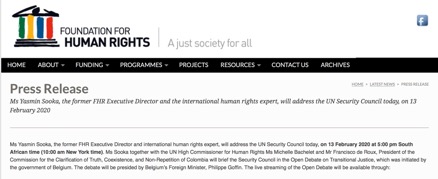
  • Sooka became Foundation for Human Rights Executive Director from 2001 to 2019 September.
  • If the EU paid for Sooka to function as Executive Director of FHR did the EU also pay for her to function as Director ITJPSL within the FHR? (2 salaries?)
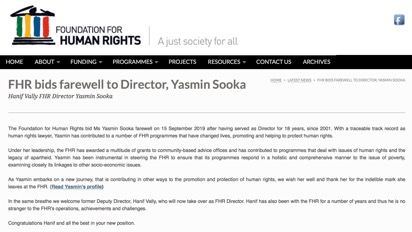
  • The post of Executive Director FHR was passed on to Hanif Vally in August 2020.
  • Is Hanif Vally also the Director of ITJPSL or is Sooka continuing as ITJPSL Director & is EU continuing to pay her?
  • If EU is not funding ITJP(SL) which is administered within FHR – who is? https://www.fhr-mirror.org.za/?ccm_paging_p_b2194=3

https://itjpsl.com

  • Though Sooka relinquished duties as Executive Director of FHR in September 2019, the ITJPSL reports on Sri Lanka has only increased. Is FHR really involved in South Africa or churning reports against Sri Lanka via ITJPSL?

Simple questions – No answer!
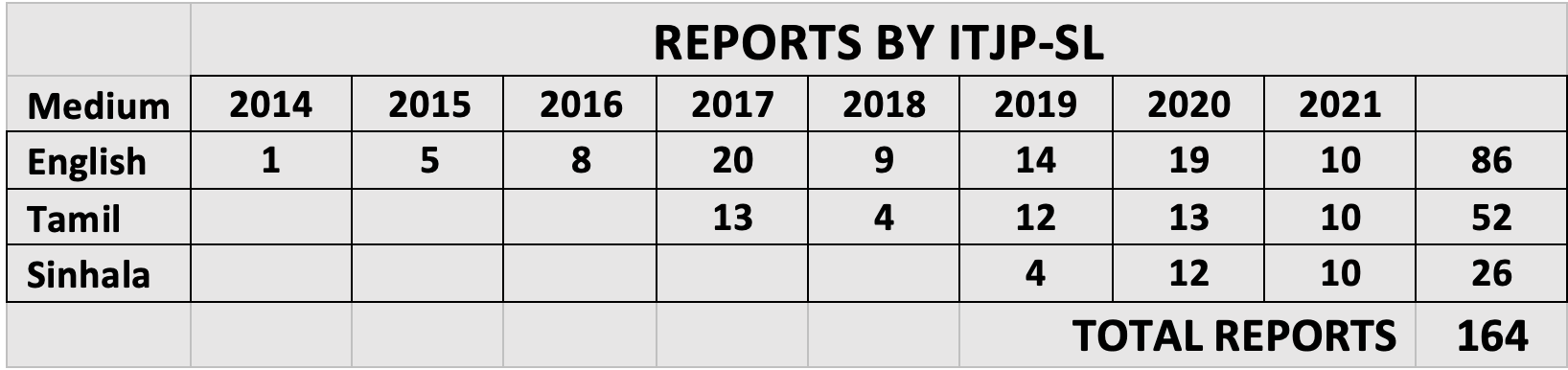
Till 2020 the ITJPSL website gave this introduction.
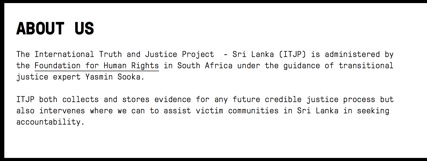
Hanif Vally who was Deputy Director of Foundation for Human Rights became Executive Director as per facebook post on 31 August 2020
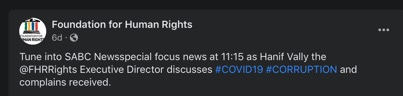
While Yasmin Sooka was paid to look into South Africa’s human rights as Executive Director, her time was obviously only directed to churning reports against Sri Lanka through the ITJPSL. From2014-2021 (7 years), the ITJPSL and Sooka has issued a record breaking 164 reports on Sri Lanka in English, Tamil & Sinhalese. How many reports has she issued on South Africa? Some South Africans should start counting!

Some of these reports are fallacious and filled with innuendos. That’s nothing to be surprised in her own words we released the report in time before the Geneva Resolution because we wanted to influence the Geneva Resolution”.

Give her applause, what a magnanimous gesture!

In June 2018, ITJP & Sooka submitted a list of 351 missing persons to the Office of Missing Persons. With the hype of 40,000-20000 dead, she should have submitted the names of the dead first!

https://www.shenaliwaduge.com/can-yasmin-sooka-itjp-produce-a-civilian-list-of-missing-dead-instead-of-ltte-terrorists/?doing_wp_cron=1624427105.5097439289093017578125

https://www.shenaliwaduge.com/yasmin-sooka-itjp-blurring-distinction-of-civilian-slurring-sri-lanka-army-when-ltte-had-armed-civilian-killer-units/

These reports of Sooka’s are funded by powerful players – the 2014 ITJP report was funded by the British Foreign Office through the Bar Human Rights Committee of England & Wales. Funnily enough the majority of the 40 cited cases were former LTTE illegal combatants seeking asylum in UK. Please keep them, UK!

May we ask, what is the Truth & Reconciliation, Sooka has delivered to Sierra Leone or South Africa?

Sooka’s involvement with Sri Lanka has been as handpicked panel member of Ban Ki Moon’s personally commissioned Panel on Sri Lanka in 2011, co-authoring article against Sri Lank in 2012,

http://www.nytimes.com/2012/03/03/opinion/revisiting-sri-lankas-bloody-war.html?_r=0

That became the stepping stone to be selected as a member of the Advisory Council of the Sri Lanka Campaign for Peace & Justice in which C4 Director Callum MaCrae was also member, along with a host of other anti-Sri Lanka personages – Basil Fernando, Bruce Haig (patrol of Centre for Peace & Conflict Studies) & J Tissainayagam.

So there was no surprise when she became ‘comrade’ to the Global Tamil Forum & invited as its Guest Speaker in 2013 to UK where TNA’s Sambanthan and Sumanthiran were also present. Sooka was the 2ndsignatory in a petition by the Sri Lanka Campaign for Peace & Justice in 2014 to which other signatories included Desmond Tutu, Bishop Rayappu Joseph (both dead), Sambanthan, Wigneswaran and 35 others. http://dbsjeyaraj.com/dbsj/archives/28557

Just as the EU, South Africa & Sri Lanka must provide answers, the Board of Trustees of Sigrid Rausing Trust must also explain why a Trust covering Balkans, Central & Eastern Europe, Former Soviet Union, Lebanon & Turkey, Egypt, Tunisia, Kenya, Zimbabwe & South Africa is funding ITJP Sri Lanka since 2014? Sri Lanka is in Asia, not in East or Central Europe, Africa or in the former Soviet Union! https://www.sigrid-rausing-trust.org

As per Trust website from 2014 to March 2019 the Sigrid Rausing Trust has given £471,500 to ITJP (Sri Lanka) and a further £300,000 from 1stApril 2019 to 2020. But the Trust’s NewsStories from 2013 to 2020 does not cover a single story on Sri Lanka. https://www.shenaliwaduge.com/open-letter-to-the-sigrid-rausing-trust-on-yasmin-sooka-itjp/

EU & Sigrid Rausing Trust by its association with the ITJPSL must have felt embarrassed when ITJPSL had to make an apology to Brig. Ravindra Dias for wrongfully using his picture claiming it to be Maj. Gen. Suresh Salley, the Director of State Intelligence Service. Maj. Gen. Suresh Salley is taking legal action against Sooka separately!
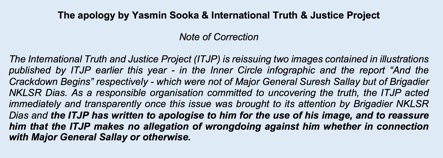
The Sri Lanka Foreign Ministry must take this up at diplomatic levels with the EU, the South African Government and even withSigrid Rausing Trust.

EU funds come from EU Tax Payers, this money is not meant to be used for witch hunts by individuals or groups.

Shenali D Waduge

https://www.shenaliwaduge.com/to-hide-embarrassment-to-comrade-sooka-itjpsl-ltte-diaspora-campaigns-against-sri-lankas-defense-attache-in-uk/

https://www.shenaliwaduge.com/why-is-yasmin-sooka-so-obsessed-with-sri-lankas-affairs/

Values and vultures

June 24th, 2021

Laksiri Warnakula 

You must be wondering: What has the first got to do with the other; I mean the two words that appear in the title. Vultures have no moral values and as such they are not qualities that you can associate, even in your wildest of dreams, with those rapacious, avian desert-dwellers.

Well, this is what happened. The other day, I saw this photograpgh on Facebook, of a vulture of the Kalahari desert. The award winning photo shows the raptor amidst a cloud of dust, while the rest of its wake were busy nibbling and snacking on the  skeleton of a camel (not in the photograph but the following narration), one more gone ‘the way of the desert’, in the end.

Now back to the question: What made me put these two words alongside each other that are otherwise incomparable beyond imagination. How could someone in his/her right mind entertain such an incomprehensible thought?

Anyway, as I kept looking at the photo, something slowly emerged from the periphery of my mind and then quickly moved to the centre. 

They were the images of ‘vultures’ in human form, waiting at every turn to pounce on the hapless and the helpless.  

For the sake of limited space, I will start from the beginning of the viral epidermic to the present, though it is in fact a long story now seventy years old. 

First it was the ‘Facemask’ that people had to buy in a hurry. When the ferocity and the danger of the virus came to be known, waking up the people from their slumbers, the panic button was hit and so was the buying-frenzy. Masks were sold without any price-controls whatsoever and the vultures were getting multifold returns. So were the sellers of other products with vulturine appetite for profits. 

Advance forward skipping many examples of ‘human vultures’ in action, following are the saddest of the story (in my opinion), so far, given in summary though: the PCR test, the quaratine, the false lab. reports in regard to PCR test (as one lady patient reported in social media websites) and then how a baby, who was found to be PCR test positive and the following bitter experience that the parents had to undergo at a private hospital (again according to social media sites), and lastly the vaccination program.

Now as far as the ‘quarantine’ procedures go, we all know how it is handled by whomever, and them only going by profit and zero-customer care. 

And I have nothing new to add to the vaccination-programmes many of which are set-up and conducted in a disorganised manner, while the intervention of another set of those human vultures was seen getting in the way of the health officials carrying out their duties.

Lastly some two hundred odd of them sitting near the ‘Oya’ seem to have no qualms whatsoever about the ‘importing of luxury vehicles’ costing millions to the country, which is short of financial resources and still fighting a health crisis of unimaginable proportions.

Dear Mr President. Please begin from the ones around you and then work all the way down to the bottom, getting rid of these vultures in human form, who do not hesitate to put their personal gains before everything else.

A sink hole is in the making and unless immediate measures are taken to stop this vulturine behaviour of some, we will all be sucked into it before long.

Laksiri Warnakula 

පොසොන් පොහොය දින පණිවුඩය

June 24th, 2021

මහින්ද රාජපක්ෂ ශ්‍රී ලංකා ප්‍රජාතාන්ත්‍රික සමාජවාදී ජනරජයේ අග්‍රාමාත්‍ය

අදීන ජාතියක් ලෙස නිර්මල බුදුදහම අනුගමනය කරමින් සහජීවනයෙන් කටයුතු කිරීමට මග පෙන්වා දුන් අනුබුදු මිහිඳු මහරහතන් වහන්සේගේ ලංකාගමනය අද වැනි උතුම් පොසොන් පොහොය දිනයක දී ගෞරවයෙන් යුතු ව සිහිපත් වේ.

ධර්මාශෝක රජු හා දේවානම් පියතිස්ස නිරිඳුන් අතර පැවති රාජ්‍යතාන්ත්‍රික කල්‍යාණ මිත්‍රත්වයේ මහඟු ප්‍රතිඵලයක් ලෙස ශ්‍රී බුද්ධ වර්ෂ 236 දී පමණ බුදුදහම ලක්දිවට දායාද විය. මෙමගින් අපගේ ජාතිය, ආගම මෙන් ම සංස්කෘතියේ නව යුගය ඇරඹිණි.

සීලය, මෛත්‍රිය, ගිලානෝපස්ථානය, ආගන්තුක සත්කාරය වැනි උතුම් ගුණාංග සපිරි ශිෂ්ට සම්පන්න ජාතියක් මෙරටෙහි බිහි වූයේ ද ගමයි පන්සලයි වැවයි දාගැබයි යන සංස්කෘතික පදනම මත ධර්ම ද්වීපය හා පෙරදිග ධාන්‍යාගාරය ලෙස සිරිලක විරුදාවලියට පත් වූයේ ද මිහිඳු මාහිමියන් අප වෙත දායාද කළ බුදුදහමේ ආලෝකයෙනි.

බෞද්ධ සංස්කෘතිය තුළ කලාව, අධ්‍යාපනය, තර්ක බුද්ධිය, කෘෂිකර්මාන්තය ආදී සැම අංශයක් ම දියුණු විය. මිහිඳු මාහිමියන් හඳුන්වා දුන් බුදුදහමේ ජීව ශක්තිය නිසා ශ්‍රී ලාංකිකයන් ලොව කිසිදු ජන වර්ගයකට නොදෙවෙනි ශ්‍රේෂ්ඨ ජාතියක් ලෙස පෙරට ආ බව මම සිහිපත් කරමි.

වෙනදා පොසොන් පොහොයට බැතිමතුන්ගෙන් පිරී යන මිහින්තලා පුද බිම අද එසේ නොවන්නේ මිනිස් ජීවිත බිලි ගනිමින් ලොව පුරා පැතිර යන කොවිඩ්-19 වසංගතයෙන් අප සියලු දෙනා ආරක්ෂා විය යුතු නිසා ය.

බුදුදහමේ උතුම් හරය නිවැරදිව තෝරා බේරා ගැනීමටත් බුද්ධ දර්ශනය අනුව අනාගත දිවි පෙවත සැලසුම්කර ගැනීමටත් දුෂ්කරව ගෙවා දමන මෙම කාලය ඉතා වැදගත් බව මාගේ විශ්වාසයයි.

මෙම උතුම් පොසොන් පොහොය දිනය ධර්මාවබෝධය පිණිස සිත් පහන් දැල්වූ අර්ථාන්විත දිනයක් බවට පත් වේවා! යි මම ප්‍රාර්ථනා කරමි. තෙරුවන් සරණින් සැමට නිරෝගී සම්පත වේවා!

මහින්ද රාජපක්ෂ ශ්‍රී ලංකා ප්‍රජාතාන්ත්‍රික සමාජවාදී ජනරජයේ අග්‍රාමාත්‍ය

ජිම්නාස්ටික් උපකරණ මිලදී ගැනීම සම්බන්ධව පළවන සාවද්‍ය මත ප්‍රතික්ෂේප කිරීම.

June 24th, 2021

ඩිජිටල් තාක්ෂණ හා ව්‍යවසාය සංවර්ධන රාජ්‍ය අමාත්‍යංශය.

ජිම්නාස්ටික් ක්‍රීඩා භාණ්ඩ මිලදී ගැනීමේ ටෙන්ඩරය පිළිබඳ වෙබ් අඩවි ඔස්සේ පළවන සාවද්‍ය පුවත් ප්‍රතික්ෂේප කරන බව ක්‍රීඩා සංවර්ධන දෙපාර්තමේන්තුවේ අධ්‍යක්ෂ ජනරාල් අමල් එදිරිසූරිය මහතා පවසයි.

ජිම්නාස්ටික් ක්‍රීඩා උපකරණ මිලදී ගැනීම මේ වනතුරුත් සිදුකර නොමැති අතර, ජිම්නාස්ටික් ක්‍රීඩා භාණ්ඩ මිලදී ගැනීමේදී ප්‍රසම්පාදන අක්‍රමිකතා සිදුව ඇති බවට විවිධ වෙබ් අඩවි හරහා පළවන සාවද්‍ය පුවත් තරයේ ප්‍රතික්ෂේප කරන බවත් ඒ පිළිබඳ කණගාටුව ප්‍රකාශ කරන බවත් ඒ මහතා වැඩිදුරටත් ප්‍රකාශ කර සිටියේය.

ඒ පිළිබඳව ක්‍රීඩා සංවර්ධන දෙපාර්තමේන්තුවේ අධ්‍යක්ෂ ජනරාල් අමල් එදිරිසූරිය මහතා මෙසේ  අදහස් දැක්වීය.

අපේ රටේ ජාතික තලයේ ක්‍රීඩක ක්‍රීඩිකාවන්ගෙන්  රට වෙනුවෙන් ජාත්‍යන්තර ජයග්‍රහණ අපේක්ෂා කරන බැවින් ඊට අනුකූල වන පරිදි ජාත්‍යන්තර පහසුකම් හා අන්තර්ජාතික මට්ටමෙන් උසස් ගුණාත්මකභාවයෙන් යුතු ක්‍රීඩා උපකරණ හා ක්‍රීඩා පහසුකම් ලබාදීමට තරුණ හා ක්‍රීඩා අමාත්‍යංශය ලෙස  අප කටයුතු කරනවා.

ජිම්නාස්ටික් ක්‍රීඩක ක්‍රීඩකාවන්ට ජාත්‍යන්තර තරග සඳහා සුදුසුකම් ලැබීමට ජාත්‍යන්තර ප්‍රමිතීන්ට හා තාක්ෂණික මාර්ගෝපදේශවලට අනුව තාක්ෂණයෙන් උසස් අන්තර්ජාතික මට්ටමේ ඉහළ ගුණාත්මකභාවයෙන් යුතු ජිම්නාස්ටික් ක්‍රීඩා උපකරණ ලබාදීම අත්‍යාවශ්‍ය වෙනවා.

ඒ අනුව ජිම්නාස්ටික් ක්‍රීඩා පුහුණුව ලැබීම සඳහා දෙපාර්තමේන්තුවේ ජිම්නාස්ටික් ක්‍රීඩා පුහුණු මධ්‍යස්ථානය නවීකරණය කිරීමටත් සැලසුම් කර තිබෙනවා.

ජිම්නාස්ටික් උපකරණ මිලදීගැනීම සම්බන්ධව  මිළ ගණන් කැඳවීම සිදු කර තිබෙන අතර  මිලදී ගන්නා ක්‍රීඩා භාණ්ඩවල අන්තර්ජාතික ප්‍රමිතිය හා ඉහළ ගුණාත්මකභාවය පිළිබඳව අප වඩාත් සැලකිලිමත් වෙනවා.

මේ සම්බන්ධව තාක්ෂණ ඇගයීම් කමිටුවක් මගින් ඇගයීමක් සිදුකර ඇති අතර තවදුරටත් ඒ පිළිබඳව ශ්‍රී ලංකා ජිම්නාස්ටික් සංගමයේ තාක්ෂණික කමිටු නිලධාරීන්ගේ විශේෂඥ මතය විමසා මෙම ක්‍රීඩා භාණ්ඩ මිලදී ගැනීමට අප අදහස් කර තිබෙනවා.

ජිම්නාස්ටික් ක්‍රීඩා උපකරණ මිලදී ගැනීම සම්බන්ධව අවසන් තීරණයක් මේ වනතුරුත් අරගෙන නැහැ.

මේ සම්බන්ධව පළවන පුවත් සාවද්‍ය වන බවත් ජාතික තලයේ ජිම්නාස්ටික් ක්‍රීඩක ක්‍රීඩිකාවන් සඳහා අවශ්‍ය වන ජිම්නාස්ටික් උපකරණ මිලදී ගැනීම ඉතාමත් විනිවිදභායකින් යුතුව රජයේ ප්‍රසම්පාදන ක්‍රමවේදයන්ට අනුකූලව සිදුකරන බව ක්‍රීඩා සංවර්ධන දෙපාර්තමේන්තුවේ අධ්‍යක්ෂ ජනරාල් අමල් එදිරිසූරිය මහතා වැඩිදුරටත් පැවසීය.

මාධ්‍ය ඒකකය,

තරුණ හා ක්‍රීඩා අමාත්‍යංශය,

ඩිජිටල් තාක්ෂණ හා ව්‍යවසාය සංවර්ධන රාජ්‍ය අමාත්‍යංශය.

දක්ෂ ක්‍රීඩකයන් බිහි කරමින් ජාත්‍යන්තර ජයග්‍රහණ කරා යන ගමනට කවුරුන් බාධා කළ ද, නොනැවතී ඉදිරියටම යනවා – අමාත්‍ය නාමල් රාජපක්ෂ මහතා

June 24th, 2021

ඩිජිටල් තාක්ෂණ හා ව්‍යවසාය සංවර්ධන රාජ්‍ය අමාත්‍යංශය

කිසිවෙකුටත් සිය වගකීමෙන් මිදිය නොහැකි පරිදි නව ක්‍රීඩා පනත කඩිනමින් සකස්කොට රටට අවශ්‍ය ජයග්‍රහණ ලබා දෙන ක්‍රීඩකයන් බිහි කරන බව තරුණ හා ක්‍රීඩා අමාත්‍ය, ඩිජිටල් තාක්ෂණ ව්‍යවසාය සංවර්ධන රාජ්‍ය අමාත්‍ය නාමල් රාජපක්ෂ මහතා අද (23) දින පැවසීය.

උලහිටිවල ප්‍රදේශයේ ඉදිකළ අතරමැදි කොවිඩ් ප්‍රතිකාර මධ්‍යස්ථානය විවෘත කරමින් අමාත්‍ය නාමල් රාජපක්ෂ මහතා මේ බව අවධාරණය කළේය.

එක්කෙනාට ඇගිලි දිගු කරමින් සිටියහොත් මේ වසර 04 තුළ දී වැඩක් කිරීමට නොහැකිවන බව පෙන්වා දුන් අමාත්‍යවරයා, දක්ෂ ක්‍රීඩකයන් බිහි කර ජාත්‍යන්තර ජයග්‍රහණ කරා යන සැළසුම් සහගත ගමනට කවුරුන් බාධා කළ ද එය ඉදිරියට රැගෙන යන බවට විශ්වාසය පළ කළේය.

ප්‍රතිපත්ති සෑදීමට වියදමක් නොයන බැවින් කලින් ආණ්ඩුවේ අයටත් උවමනාවක් සහ උනන්දුවක් තිබුණේ නම් මේ වනවිට නව ක්‍රීඩා පනත සකසා අවසන් බව අමාත්‍යවරයා කියා සිටියේය.

අමාත්‍ය නාමල් රාජපක්ෂ මහතා එහි දී මෙසේද පැවසීය.

දීර්ඝකාලීන සැලැස්මක් එක්ක ඊළඟ අවුරුදු 04 ඇතුළත ක්‍රීඩකයෝ නිර්මාණය කරන්න මේ වන විට අපි ක්‍රීඩා සංගම් 06 කට මිලියන 100 කට වඩා මුදල් ආයෝජනය කරලා තිබෙනවා.

ඊළඟ සතියේ අපි තවත් හදුනාගත් ක්‍රීඩා සංගම් 05 ක් සඳහා මිලියන 100 කට ආසන්න මුදල් ප්‍රමාණයක් ආයෝජනය කරන්න බලාපොරොත්තු වෙනවා.

ඒ සමඟම ඔලිම්පික් ක්‍රීඩා උළෙල සදහා සහභාගී වන ක්‍රීඩකයින්ට පළමු වතාවට ව්‍යාපාරික පන්තියේ ගුවන් ටිකට්පත් ලබාදීලා,  ජාත්‍යන්තරයේ ක්‍රීඩක ක්‍රීඩිකාවන්ට සලකන ආකාරය හා සමානවම අපි අපේ ක්‍රීඩක ක්‍රීඩිකාවන්ටත් සළකනවා.

ග්‍රාමීය ක්‍රීඩා පිට්ටනි හැදෙනවා. පාසල් ක්‍රීඩා පිටි හදන්න අවශ්‍ය මුදල් ප්‍රමාණය මේ වන විටත් යවලා තිබෙනවා.

ආසන මට්ටමින් ක්‍රීඩාංගණ 162 ක් පළමු වටයේ හදන්න ඊළඟ සති කිහිපය ඇතුළත වැඩ කටයුතු ක්‍රියාත්මක වෙනවා.

කොරෝනා ව්‍යසනය පාලනය කරන්න සටන් කරන අතරතුරේදීම මේ රටේ ජනතාවගේ ක්‍රියාශීලීත්වය ඇතිකරමින් සෞඛ්‍ය සම්පන්න සමාජයක් වෙනුවෙන් අපි  ප්‍රමුඛස්ථානය දී කටයුතු කරනවා.

ක්‍රිකට් සම්බන්ධයෙන් දිගුකාලීන සැළැස්මක් ක්‍රිකට් කමිටුව විසින් හදනවා. ඒ කමිටුවේ සැළැස්ම අනුව ජයග්‍රහණ කරා ගමන් කරනවා.

ක්‍රීඩකයින්ගේ සහ රටේ ආත්ම ගෞරවය ආරක්ෂා කරගෙන ජයග්‍රහණ කරා යන්න අපේ පැත්තෙන් ගතයුතු සෑම ක්‍රියාමාර්ගයක්ම අපි ගන්නවා.

පැහැදිළිව අපි තේරුම්ගත යුතු කාරණය තමයි එක රැයකින්, දෙකකින් චැම්පියන්ස්ලා හදන්න බැහැ. ජයග්‍රාහකයෝ හදන්න බැහැ. ඒ සඳහා යම් කාලයක් ගත වෙනවා.

වසරකට ක්‍රීඩකයින් 100 ක් විදේශ පුහුණුව සදහා යැවීමට අපි බලාපොරොත්තු වෙනවා. දැනට ක්‍රීඩකයින් 60 දෙනෙක් ඒ සඳහා හඳුනාගෙන තිබෙනවා.

අපේ උසස් දක්ෂතා සංචිතයේ ක්‍රීඩකයින්ට තමන්ගේ දක්ෂතා අනුව රුපියල් ලක්ෂයේ සිට මාසික දිමනාවක් ලැබෙනවා. කඩිනමින් මෙම ක්‍රීඩකයින් කෙටි කාලීන පුහුණු කොන්ත්‍රාත්තු මත විදේශ පුහුණුව සඳහා යවන්න කටයුතු කරනවා.

අපි එක එක්කෙනාට ඇගිල්ල දික් කර කර හිටියොත් මේ අවුරුදු 04 ම  වැඩක් කරන්න බැරි වෙනවා. කවුරු බාධා කළත් ඉන්න අයත් එක්ක මේ ගමන යන්න ඕනේ.

අපි එකතුවෙලා ප්‍රතිපත්ති හැදුවාට පස්සේ ක්‍රීඩාව දියුණු වෙයි. අපි ඉවසීමෙන් ඒ කාලයට අවශ්‍ය සැළැස්ම හදලා මේ පද්ධතිය ඇතුලේ දක්ෂ ක්‍රීඩකයෝ බිහි කරලා ජාත්‍යන්තර ජයග්‍රහණ කරා යමු.

ඉතිහාසයේ පළමු වතාවට ඔලිම්පික් තරගාවලියට සම්බන්ධ වන සාධනීය මට්ටම ඉක්ම වූ ක්‍රීඩකයින්ට ඩොලර් 10,000 ක දීමනාවක් ලබාදෙමින් පවතින නීති රාමුව තුළ ක්‍රීඩකයන් වෙනුවෙන් කළ හැකි උපරිමය ඉටු කරන බවත් අමාත්‍යවරයා මෙහි දී පැවසීය.

මෙම අවස්ථාවට සංචාරක අමාත්‍ය ප්‍රසන්න රණතුංග, පාර්ලිමේන්තු මන්ත්‍රී මිලාන් ජයතිලක, හිටපු පළාත් සභා මන්ත්‍රී ගුණසිරි ජයනාත්, දොම්පේ ප්‍රාදේශීය සභා සභාපති පියසේන කාරියප්පෙරුම මහත්වරු ඇතුළු ප්‍රාදේශීය සභා මන්ත්‍රීවරු පිරිසක් සහභාගී වූහ.

මාධ්‍ය ඒකකය,

තරුණ හා ක්‍රීඩා අමාත්‍යංශය,

ඩිජිටල් තාක්ෂණ හා ව්‍යවසාය සංවර්ධන රාජ්‍ය අමාත්‍යංශය

Organic fertilisers can also be polluting, Soil Scientists say

June 24th, 2021

Courtesy The Daily Mirror

Government has turned a deaf ear to fervent pleas from agricultural scientists and economists for a step by step approach

Organic fertilisers could be a boon as well as a bane, soil scientists say.

Colombo, June 20: The Sri Lankan government is determined to make farmers immediately switch over to organic farming citing health and environmental reasons as well as the severe foreign exchange shortage which impairs the import of chemical fertilisers. Government has turned a deaf ear to fervent pleas from agricultural scientists and economists for a step by step approach to the change-over. It has ignored the argument that an overnight change would be impossible to implement and that the change-over itself could,in fact, hurt agriculture instead of fostering it.


But there is another angle to the controversy which has not been taken into account so far, namely, the question of the suitability of organic fertilisers for the soil itself. Organic fertilisers could be a boon as well as a bane, soil scientists say. 


Peradeniya University Soil Scientist Dr.Warshi S. Dandeniya and her collaborator Serene Caucci, say in their paper: Composting in Sri Lanka: Policies, Practices, Challenges, and Emerging Concerns. (www.link.springer.com) that organic fertilisers could also pollute the soil. They point out that organic fertilisers commonly called ‘compost’ can be a carrier of potentially toxic trace elements. 


Producing good-quality compost, safe for human health and the environment, is a challenge that should be addressed at various levels: from production to policymaking. The long-term use of compost in large quantities and/or application of poor-quality compost to soil can deteriorate environmental quality and pose a threat to the safety of food,” they warn. 


The progressive accumulation of toxic trace elements such as lead and cadmium in soils has been reported in several studies where there has been a long-term application of compost produced from Municipal Solid Waste (MSW).  Contamination of food items with potentially toxic trace elements and human pathogens due to the application of compost to crops has been reported in the literature on the subject,” Dandeniya and Caucci point out. 


Poultry litter/manure is a source of antibiotic resistance determinants and, therefore, imposes a silent threat” to environmental quality and health, they say. And night soil (human faeces) could also get mixed up with organic fertiliser. Furthermore: Organic pollutants such as detergents and antibiotic resistance determinants and pathogens surviving in night soil and septic waste, and the fate of these constituents during composting, have not been studied extensively in Sri Lanka,” they say.  


The soil scientists also warn that microbial pathogens and parasites could spread in the environment through creatures like flies and dogs found at the composting sites. 


Bio-aerosols and volatile compounds could enable transmission from composting sites to other environments with the wind. Leachates coming out from compost piles during the production process, and runoff water from the composting sites, could contaminate both surface and groundwater,” Dandeniya and Caucci warn.


Demand for change-over not new 
The bid to change- over from chemical fertilisers to organic fertiliser is not new. Between 2010 and 2015, government had tried to reduce the import of synthetic fertilisers by 15%. And fertiliser imports did drop by 33% between 2015 and 2017. Compost production graduated from being a backyard activity to a commercial venture, thanks to government schemes like ‘Pilisaru’ (introduced in 2008).The ‘Api Wawamu Rata Nagamu’ (i.e. let’s grow and develop the country) programme between 2008 to 2015 promoted home gardening using the concepts of organic agriculture.


Over 100 composting stations associated with Municipal Councils were established by 2011. However, a lack of sorting waste before disposal increased the labour requirement in processing the compost and reduced the quality of the compost, Dandeniya and Caucci point out.  Bad odour from the decomposing waste made the fledgling industry socially undesirable. Therefore, despite the government’s efforts, organic farming did not catch on. The easy availability of chemical fertilisers in the market and the quick response of crops to their application were other reasons for the desired switch over not taking place.


Financial Viability
Andante Hadi Pandyaswargo, Dickella Gamaralalage and Jagath Premakumara went into the question of financial sustainability of modern composting in the developing countries of Asia in their 2014 paper published in the International Journal of Recycling of Organic Waste in Agriculture. Their study found that the viability of composting plants depended on the selection of suitable processing methods, the technology used, the scale of the operation,the quality of the product, and marketing strategies.


In the developing countries, where Municipal Solid Waste is mostly organic waste, it is not properly segregated. But compost plants are highly sensitive to input quality. They are best used to treat animal manure, kitchen and agricultural waste because of the uniformity and purity of the organic content, the authors say.


Generally the application of compost technology has not been very successful in the Asian cities because segregation of ‘waste-at-source’ is poor in these cities. The raw garbage here is full of contaminants such as heavy metals, glass, inert materials, and plant and animal pathogens. Larger scale composting plants receive a large volume of mixed waste with contaminants, the authors point out.


Therefore, the scientific use of the solid waste becomes a tedious process. Landfilling is resorted to as the easy way out. However, the landfills in the under-developed countries are poorly designed and maintained. They are a serious threat to public health. The landfills also cause global warming because organic waste is the main source of methane gas emissions.


Technological Issues
Then there are technical issues facing the compost making industry. The authors say that large-scale composting facilities with complex mechanical pre-processing to remove non-compostable materials have largely failed because there is hardly any mechanical system which can adequately identify and separate all of the materials in the mixed waste to ensure production of good-quality compost. 


Also, the initial investment is high and there are maintenance costs and technical skill requirements which are difficult to meet. 


Medium Scale Plants Sustainable 
The authors say that medium-scale (51 TPD) and lower large-scale (200 TPD) composting plants have a better opportunity to be financially sustainable because the waste input and product quality of these plants are more controllable than larger scale composting plants.Government aid in terms of financial, technical and market-oriented inputs, is a vital necessity, they say.


Lack of Market Acceptability
Another reason for the failure of compost plants is the lack of a market for the compost manufactured. Market acceptance depends on price, quality and consistency of the product.The experts also point out that there is a failure to understand the nature of the biological processes that underlie composting. 


Compost bacteria, insects, and micro organisms require certain environmental conditions to thrive. If these conditions are absent or interrupted, it badly affects the composting process and 
its quality.”

Duminda Silva gets presidential pardon

June 24th, 2021

Courtesy Adaderana

Duminda Silva, who is currently imprisoned under a death sentence, has been granted a Special Presidential Pardon, Prisons Media Spokesman informs.

President Gotabaya Rajapaksa today (June 24) granted presidential pardon to 93 prison inmates to mark the Poson Full Moon Poya day.

Media Spokesperson of Department of Prison Chandana Ekanayake said that former MP Duminda Silva was also among them.

Former parliamentarian Duminda Silva was jailed in September 2016 after the Colombo High Court found him and several others guilty in the murder of former MP Bharatha Lakshman Premachandra.

President pardons 93 prison inmates including former LTTE cadres

June 24th, 2021

Courtesy Adaderana

President Gotabaya Rajapaksa today (June 24) granted presidential pardon to 93 prison inmates to mark the Poson Full Moon Poya day.

Among them, 16 are former LTTE cadres, according to Media Spokesperson of Department of Prison Chandana Ekanayake.

Another 77 have been imprisoned over minor offenses.

Media Spokesperson of Department of Prison Chandana Ekanayake said that former MP Duminda Silva was also among them.

Coronavirus death toll up by 65 fatalities

June 24th, 2021

Courtesy Adaderana

The Director General of Health Services has confirmed 65 more COVID-19 related fatalities that have occurred yesterday (June 21).

The new development has pushed the official death toll due to the virus in Sri Lanka to 2769.

According to the data released by the Department of Government Information, the new victims confirmed today include 25 females and 40 males.

Two of them is aged below 30 years, ten victims are between 30-59 years and the remaining 53 are aged 60 and above.

Daily COVID infections count climbs to 2,205

June 24th, 2021

Courtesy Adaderana

The Health Ministry says 820 more persons have tested positive for COVID-19 today (June 23) increasing the daily count of positive cases to 2,205.

All new cases reported within the day have been associated with the New Year cluster. 

This brings the tally of confirmed infections of coronavirus reported in the country so far to 246,091.

As many as 211,186 recoveries and 2,769 deaths have been confirmed in Sri Lanka since the outbreak of the pandemic last year.

According to official data, more than 32,000 active cases are currently under medical care at designated hospitals and treatment centres.

Continuous Indian Interference in Sri Lanka’s domestic affairs

June 23rd, 2021

S. AKURUGODA

As per the media reports, the Indian High Commission has quoted Indian High Commissioner Gopal Bagley as having told a bunch of local politicians led by R. Sampanthan, who recognized the LTTE as the sole representative of the Tamil speaking people and promoted its terrorism for three decades in Sri Lanka, that India remained committed to devolution within a united Sri Lanka on the basis of full implementation of the 13A, which would be in line with Tamil aspirations for equality, justice, peace & reconciliation in Sri Lanka.

While responding to the Indian High Commissioner’s statement, Sri Lanka’s Ambassador in Myanmar Prof. Nalin de Silva quite correctly pointed out the relevant Section of the Vienna Convention on Diplomatic Relations 1961 – Article 41.1 which clearly says “Without prejudice to their privileges and immunities, it is the duty of all persons enjoying such privileges and immunities to respect the laws and regulations of the receiving State. They also have a duty not to interfere in the internal affairs of that State.”

As per the Prof. de Silva’s statement, the deputy HC of the Indian High Commission too reported to have had similar meetings with former LTTE cadres to discuss the matters related to 13A which is a blunt violation of the Vienna Convention. 

The above behavior of the Indian HC is nothing new to us. We remember the days how India interfered blatantly in the internal affairs of Sri Lanka through its High Commissioner J. N. Dixit (1985-1989).

India became the first country, since independence, to interfere blatantly with the internal affairs of Sri Lanka. We also remember the reports describing how India trained Tamil terrorists and launched a terrorist war against the Sri Lankan people and how the Indian government later went all out to coerce Sri Lanka into submission. When the Sri Lankan security forces were about to destroy the same terrorists, Indian cargo planes invaded Sri Lanka’s air space undermining her sovereignty, and almost forced Sri Lanka President JR Jayewardene (JRJ) to ‘invite’ Indian Prime Minister Rajiv Gandhi to sign an agreement and to accept the accommodation of Indian military on Sri Lanka soil under the name of IPKF. JRJ had no alternative but to give in to India and to sign the document hurriedly prepared and enforced by the Tamil separatist groups including the LTTE. The JRJ-Rajiv agreement thus signed led to 13th Amendment which made both Sinhala and Tamil official languages and to establish Provincial Councils (PC) or a Federal system of government. Provincial Councils set up under Indo-Lanka agreement are, if fully implemented, State Governments with Governors representing the Central Government in all but name, Chief Ministers, Ministers with wide powers (even more than those exercised by State governments of India).

Although the Indian government undertook to disarm the terrorists group in return of implementing the constitutional amendment imposed on the Sri Lanka government, India has failed miserably to fulfill its obligation as per the agreement. On the other hand, Sri Lankan people had to bear the huge cost of war against terror abetted by India and the cost of implementing the constitution amendment, thus imposed under the failed agreement, in addition to the loss of lives since 1987.

As per media reports the government’s expenditure for maintaining PCs has gone up from of 22,128,000 LKR million in 1996 to 286,031,000 LKR million in 2017. (https://www.ceicdata.com/en/sri-lanka/provincial-councils-revenue-and-expenditure/provincial-councils-expenditure). It would be interesting to find out whether there is any benefit to the general public on spending such a large sum of funds, and how many millions of rupees have been saved from the public funds for not activating the PCs during the last two and half years.

Since it is the Sri Lankan Security forces who ultimately disarm the terrorists, the moral rights of the Indian government to ask the government of Sri Lanka to implement 13th amendment is highly questionable. Former Indian diplomat and analyst of international politics M. K. Bhadrakumar (MKB), in one of his article titled ‘Geopolitics of Sri Lankan Tamil Problem’ appeared in Newsclick.in dated 30th September 2020 (https://www.newsclick.in/Geopolitics-of-Sri-Lankan-Tamil-Problem), quite correctly identified, it is likely that India will continue to interfere with the internal affairs of Sri Lanka, not only due to the internal politics of Tamil Nadu, but to satisfy the geopolitical interests as described in the said article titled ‘Geopolitics of Sri Lankan Tamil Problem’.

Full implementation of the 13th or any other Amendments, or the complete overhaul of the entire Constitution of Sri Lanka, is a matter for the Citizens of Sri Lanka and its elected leaders. Continuous insisting of how we should solve our problem and to push Sri Lanka towards Indian solutions is simply a gross violation of our rights as a sovereign country and a clear example of how powerful states are bullying the weak and small states to achieve their own geopolitical interests.

S. AKURUGODA

ERASING THE EELAM VICTORY Part 20 C7

June 23rd, 2021

KAMALIKA  PIERIS

 When Sri Lanka won Eelam War IV, the west called for an international    war crimes investigation. This is a new development in warfare. The International Criminal Court in Hague (2002) was created for this purpose and serious war crimes are now referred to it.

But   the first war crime courts were the tribunals for the wars in Rwanda (1990-1994) Yugoslavia, (1991-2001) and Sierra Leone (1991-2002). Yugoslavia   had a series of wars from 1991 to 2001, and finally broke up into the   successor states of Bosnia and Herzegovina, Croatia, Kosovo, Montenegro, Macedonia, Serbia, and Slovenia. There was a long-running dispute between the Hutu and Tutsi In Rwanda. From 1990 to 1994 there was war n Rwanda and the Hutus slaughtered 500,000 to 600,000 Tutsi.

 In Sierra Leone there was a civil war. Sierra Leone Tribunal was a judicial body set up by the Government of Sierra Leone and the United Nations to investigate war crimes during its civil war. This court appears to have functioned effectively. It sentenced persons left and right. However, Sierra Leone is not mentioned in any discussion of the war crimes of the Eelam war IV.  Commentators in Sri Lanka looked at  Yugoslavia and Rwanda.

 International Criminal Tribunal for the Former Yugoslavia  (1993) and the International Criminal Tribunal for Rwanda,(1995)  were established by the UN Security Council acting under Chapter VIII of the UN Charter.

US gave much money and EU provided personnel for the    Yugoslavia and Rwanda investigations. Netherlands gave certain concessions free. USA also provided prosecutors, investigators and other experts from the Dept of Defence, FBI and  US Department of State.

The Yugoslavia and Rwanda  tribunals were heavily criticized  by legal experts. These tribunals  have perverted the  accepted laws ,they said. Many jurists were appalled by these two trials  saying that the standard of evidence in these trials differed significantly from the legal standards of most member nations of the UN.

The evidence rules in international war crimes tribunals have a lower benchmark than in the  national legal system of most countries. Life sentences can be handed down on little evidence, observed analysts.

Further, in the Rwanda and Yugoslavia trials it was decided that the normal rules of evidence need not be followed.  Witness testimony need not be corroborated to be admitted.  Thus removing the protection provided for the defendants.

Trials in both Tribunals were based entirely on oral testimonies. There is no documentation , only the accounts of witnesses. This also came in  for a barrage of criticisms by international jurists and other experts. Stephen D Roper observed that  with the passage of time,  recollection becomes blurred   making witness accounts un-reliable

Hassan B Jallow, chief prosecutor for Rwandan trial admitted that the trial was seriously handicapped by the fact that the investigators were all foreigners and had to work through interpreters. Nuances were lost in translation and this could  distort what a person said.

Jose Alvarez, Prof of Law at Columbia Law School, pointed out that when trials are conducted with the aid of interpreters, and without knowledge of the relevant culture or manners, misunderstandings at all levels are bound to occur.

 Manohara de Silva observed that almost all the international war crime tribunals  have been kangaroo courts where any    unreliable organization can make a complaint, false statements included, without having to face any consequences. Witnesses  are permitted  to give testimonies  that have not been properly verified. Witnesses are coached and taught how to tell convincing stories without contradicting one another.   

Christopher Black, a lawyer specializing in International Law who has appeared for persons brought before UN tribunals, has exposed  other  flaws in  the way these tribunals  conduct  the inquiries.

According to him these tribunals are propagandist. Stories are circulated about targeted countries, demonizing  their regimes and covering up the role of the US and its allies in their interventions. Christopher Black says that it  is now  known that the US was responsible for what happened in Rwanda and that America’s falsehoods were exposed at the trials.  

Many individuals brought before these tribunals had been falsely accused. A respected Rwandan General who had saved many Rwandan lives was arrested in 2000. Eleven years later the trial judges concluded that the arrest had been illegal and politically motivated because he had testified that the US and the UN forces had been directly involved in the violence unleashed in that country.

Black also said that these tribunals use criminal methods against those local  persons  whom  powerful countries want punished, such as first throwing them in prison without an indictment. Prisoners suddenly disappear, isolation being a method used to exert psychological pressure on them.

Tribunals pressurize the accused to use lawyers  in their pay,  or those whom they could bend to their will to do their bidding, or those in the pay of the West. Other lawyers are subject to harassment, intimidation, are followed, their hotel rooms are broken into and rumours are spread about them to discourage their appearing for the accused.

Indictments/charge sheets are often false and propagandist and often have parts blackened so that the defence lawyers cannot understand that whole charge. Documents and relevant disclosures are withheld from these lawyers.   ( Continued)

Port City on the Beira: looking a gift horse through its derriere

June 22nd, 2021

by Jolly Somasundram Courtesy The Island

I thought I saw a turquoise sea, billowing smooth and bright.

Wrong! It was an emerging Republic, a 700 acre wee sovereignty,

Passport and flag ready, she awaits an anthem, to enter the UN.

Defying scurrilous on-line disinformation, out of nothing came something.”

It has been done or has it? The Port City Bill has received overwhelming approval of Parliament, all amendments suggested by the Supreme Court were incorporated, so that a referendum or 2/3rds majority requirement were foreclosed. On the Speaker signing it, following due process, the Bill became law: it is within the constitution. But social media, for which truth is not a troubling issue, are carrying out a carping, personalised campaign of innuendo and insinuation against it. It would be useful to revisit the foundational bases for this law, to judge whether there is something genuine in their concerns or social media is merely flying someone else’s flag for advantage.

Natural harbours are created by nature, artificial ones by man. Both enclose the sea. Sri Lanka provided a wrinkle: a sea was drained, at a cost of US$ 15 Billion, creating a land mass on which six million square meters of built space will be erected, for commercial users. This collectivity is the Port City. The entire operation- of reclamation, building, and providing equity and debt finance- was undertaken by the Chinese: there were no Chinese loans given to Sri Lanka for this purpose, thereby leading her to debt enchainment and traps. Sri Lanka will receive half of the reclaimed land as a gift to her people. The balance, on which Chinese driven development will take place, was leased back to the Chinese for 99 years, an instance of one’s own product being back- leased. It will be managed by a corporate body headed by a very senior, experienced and highly respected Sri Lankan. This deal was riskless for Sri Lanka, for it was an asset created with no debt or funding from the Budget. Those who risk going far, would only know how far they could go! The reward of this deal came in aces. What was the catch? Punch drunk with debt blows and Sri Lanka on the fiscal ropes, Sri Lanka was not an enticing investment market. The public could not believe this deal. It was so good, it must be bad! Conspiracy theories sprouted. Social media referred to secret deals (if there were, how would they be known?). It had a whale of a time, broadcasting fake news- Galle Face Green will become a brown, they said, but a quarter mile of verdant green had already been added. The cliché, there is no free lunch, was widely bandied. Classical Latin vendors darkly quoted Aeneas, beware those who come bearing gifts.” (Timeo Danaos et dona ferentes.)

The fable of the Arab and the Camel was invoked, the Camel, given accommodation in his tent by the trusting Arab, used its vantage fulcrum point, to craftily mount a successful reverse takeover bid and later, dispossess the owner. This 700-acre transistor Republic- smaller than any municipal ward in Colombo – would be the first stop in making the country a Chinese colony, to be renamed Sino Lanka, they alleged.

There is confusion between rights of equity providers and of sovereignty governors. Lever Brothers, a British multinational, owns significant land parcels in Grandpass. They have managerial rights over company activities but these do not morph to exercising governance powers over Grandpass. Debt-equity swaps are a standard management tactic, to transfer risk from a debtor to owner, as Hambantota showed, but they are not equity-sovereignty swaps, like the Louisiana purchase of the US from France, a century and a half ago. In the Port City project there is no debt, all the equity is held by Sri Lanka. The Port City asset leased to China for 99 years is unlike Guantanamo, where the US forced Cuba to renounce sovereign rights over this parcel of Cuban territory to itself and in perpetuity too.

History repeats but, it is now claimed, with Chinese accents. 70 years ago, newly independent Sri Lanka (then Ceylon) was in dire straits as there was a severe shortage of rice. The Korean war was on and the price of rubber rose precipitously. Sri Lanka being a rubber exporting country was unable to take advantage of this bonanza because the US frowned on rubber trade with China. China countered with a win -win offer. She sold rice to Sri Lanka at a lower price than the market and purchased rubber at a higher price than what the market offered. The nay-sayers were aghast, there is a catch in this. It is the first step in the takeover of our newly independent country by China,” they growled. The government, though a West oriented one, stood firm. The US retaliated by cutting off assistance under the Battle Act. Today, sanctions would be the retaliatory measure. These alarmists need only scan a map. A Chinese air fleet would take eight hours flying time to reach Sri Lanka with a refuelling stop in-between, a navy will take three days. Napoleon was defeated by General Winter in his abortive invasion of Moscow. General Distance with stretched supply lines, would prove an invader’s nemesis with respect to Sri Lanka. A successful invasion of Sri Lanka is a fantasy of unthinkers, futile as The Charge of the Light Brigade.

The Rice-Rubber agreement has lasted 70 years with no adverse repercussions. It was renewed periodically by every government, irrespective of ideology. The same anti-China arguments offered then, were now dusted and re-presented. But the international situation has changed. A Thucycydian trap has inserted itself. What happens when an upstart power challenges a long established one? The US superiority is in hard power- land, sea (750 bases all over the world, some nuclear armed), undersea, air, cyber, nuclear and space. China’s counter was soft power, build infrastructure all over the world, a dire need if the third world were to benefit from development. The Port City furore is all about geo-politics, of a change of power relations, whether a numero uno would let itself get downgraded tamely without resistance.

The US used its superior public relations repertoire to denigrate China by instilling fear of the Chinese Dragon swallowing innocent Sri Lanka, the Arab and the Camel fable re-furbished. Social media provided the billboard.

Anything is permitted for debaters. For them,

To be or not to be, is not a question,

But a continuing answer.

The time has come to talk of many things,

Whether pigs have wings?

These debaters are eternal talkers of the ‘could’ (the possible), but not of the ‘can’ (doable) or making the doable an ‘is’ (done). Only a century ago did human beings grow wings to fly. Perhaps, eventually, pigs too may get air borne! Just seven years ago an entrepreneurial chance was offered to Sri Lanka, to get built a Port City. The central issue was how, a ‘Could’, be made to become a ‘Can’ and later, an ‘Is’. The challenge was taken. Rewards go only to the venturesome, whether in life or in love. The losers, chagrined, then take recourse to social media, with gossip, unsupported accusations of corruption, abuse- the fox and grapes- and fake news. Social media played the Game of Losers: they lost. Their opposites- past masters- played the Game of Winners: they won and handsomely too.

When new projects are proposed, professional contrarians and fundamental rights lawyers are attracted to them, like blue bottles to rotting protein or gossipy social media, to gain carrion comfort. Columbus had a trying time getting acceptance to go West, to an unknown land mass. This was the time when Flat Earth was the prevailing cosmology. The question was posed, what will happen at the end of the outward journey? When the Gal Oya scheme was proposed all the Left political parties opposed it, saying the reservoir will silt in twenty five years. If the current social media were in existence then, they would have talked of deforestation, environmental degradation, rights of those living in the this doomed habitat- the Vedddahs. If these protests were heeded, one could imagine what Amparai would be like today. With the wave of new independent countries post- 1950, the UN wanted to set up regional Economic Commissions. One was proposed for Asia and the Far East (ECAFE). The headquarter location was offered to Colombo. Sri Lanka turned it down. Bangkok grabbed the chance.

No” is the ugliest word in the vocabulary of development. It gives power to those who do not take responsibility for their decisions like the ECAFE one. It is against entrepreneurship, it conspires against innovation. The cost of projects undertaken could be measured but not the cost of projects not undertaken, caused by the fall of the kaduwa, no. No is reactionary, it congeals existing social and economic structures to an unchanging permanence which induces a violent revolution to dissolve. No Bungawewa!

Saying yes” to a postage stamp Port City has developmental benefits, a sea change of the land where the sea had been drained. The investment is very high. To be able to pay the interest on loans taken by the Chinese, instalment payments and have a modicum of return on capital, the Port City cannot depend on cultivating turmeric, green chillies, setting up garment factories or exporting domestics. It has to go very high tech with high value addition serving overseas markets. A matured Port City is not for this century but the next. As much as the determining economic activity of this century is Information Technology, the next would be Artificial Intelligence (AI)- in which robotics will have a major part to play- cryogenics, global financial innovation where economic activity is a 24 hour business cycle following the sun in its progress from East to West and East again. In none of these activities has Sri Lanka significant experience. The Sri Lankan work force entering the job market are journeymen, making their daily journeys to homes of politicians in search of permanent, pensionable government unsackable jobs. The Port City will be a training ground for high paying jobs in high tech, jobs having international demand.

There is downside too. The lubricant coursing through Port City’s different functions and parts is cold cash. The Port City will have a different culture where cash is king. There will be cultural costs where value is determined by cash not morals. Port City could become a cesspit like Havana under Batista. The governing board has to keep a laser eye peeled to prevent it.

Change is necessary for stability. Sri Lanka, instead of getting involved in Thucycydian dialectics, should clearly survey the current scenario through unprejudiced eyes. Spurning China is monumental folly. China is becoming a superpower. The Port City project is giving Sri Lanka an opportunity to prepare herself for next century’s strategic commitments. Decisions taken now will determine whether she will be an exporter of domestics, which brings her, her highest foreign exchange earnings or a Singapore, who, when she was ejected from the Malaysian Federation had to import drinking water. Today, she is the third highest exporter in the world of oil products, though she does not have a drop of oil.

Will Sri Lanka be a Nepal or a Singapore?

ERASING THE EELAM VICTORY Part 20 C6

June 22nd, 2021

KAMALIKA PIERIS

Sri Lanka first contributed to a UN peacekeeping mission in 1960, by deploying six peacekeepers in the Democratic Republic of Congo (MONUC). During Eelam war III, the UNP government decided to weaken the strength of the army fighting in the north, by sending troops on peacekeeping missions abroad. UK’s General Rose had advised the government to send Sri Lanka troops for UN assignments abroad, when he was invited to study Sri Lanka’s armed forces in 2002. The armed service commanders had no say in the matter. 

In 2004, Sri Lanka sent troops to the UN peace keeping forces in Haiti. These troops were not recalled when Eelam War IV started. Although many expected Lt. Gen. Fonseka to suspend the Haiti mission, he sustained the deployment much to the surprise of the UN. The army maintained over a battalion of troops in Haiti throughout the campaign. They continued in Haiti till the UN project ended in 2015.

Sri Lanka is one of the longest serving nations in the UN mission in Haiti. Their contribution was considered exceptional, their discipline and conduct was admired.  The Sri Lanka force won the UN Haiti medal in 2012.

In 2004, Sri Lanka sent troops to the UN peace keeping forces in Haiti. These troops were not recalled when Eelam War IV started. They continued in Haiti till the UN project ended in 2015. Sri Lanka is one of the longest serving nations in the UN mission in Haiti. Their contribution was considered exceptional, their discipline and conduct was admired.  The Sri Lanka force won the UN Haiti medal in 2012.

 Over the years, Sri Lankan troops have served in Ethiopia, Burundi, Central African Republic, Congo, Cote d’Ivore, Haiti, Lebanon, Liberia, South Sudan, Timor and Western Sahara. It was one of the highest Troop Contributing Countries (TCC) to the United Nations Peacekeeping Operations. In 2012, over 100 army officers and over 1000 soldiers were abroad  and their remittances are a significant addition to the national revenue. The three services rotated their overseas contingents twice a year.

The troops in Haiti and Lebanon were admired by those working alongside them. The Lebanon team was honored with medals. In South Sudan they were asked to build and operate a hospital. It was considered one of the fastest, well planned projects of the time. The hospital had 66 Sri Lanka army staff, including Sri Lanka army doctors. Services include medical specialists, operating theatre, intensive care unit, emergency departments, and outpatient department.  In 2015 Sri Lanka sent an air force contingent to South Sudan, for VIP transportation, food and equipment distribution, and   medical evacuation.

The Sri Lanka contingents have been recognized for their commitment, competence, and ability in all UN assignments. They were assigned the toughest areas during their missions and were been lauded for their splendid performance.  Within a short space of time they were able to make a positive impact on UN peacekeeping efforts. A UN peacekeeping training school was established in Kukule Ganga. It is recognized by the UN, said the authorities in 2015.

But things started to change when the Yahapalana puppet government came to power in 2015.In 2018 the UN called for the immediate repatriation of Lt. Col. Amunupure, Commander of Sri Lanka’s Peacekeeping force in Mali, because of his human rights background. The decision was reached following a review of the human rights background of the Commander, UN said.

Sri Lanka has rejected the allegations. This mission has been in Mali for the last nine months. We find it odd that such intimation has been received many months into the mission. This is Lt. Col. Amunupure’s second mission to Mali for which he was granted approval following a stringent vetting process. The Commander has not committed any crimes to warrant such an action .We will comply with repatriation in keeping with protocols. However, the Commander has not committed any crimes and the army is prepared to appeal, Sri Lanka said.”

Then in 2019, UN Department of Peace Operations (DPO) announced it will no longer accept non-essential Sri Lankan troops in peacekeeping missions. The reason for this unusual move, said Human Rights Watch, is that Sri Lanka’s newly appointed army chief, Gen. Shavendra Silva, faces credible allegations of war crimes.

In 2012, while serving as Sri Lanka’s deputy ambassador to the UN, Silva was removed from the UN Special Advisory Group on Peacekeeping Operations due to the allegations against him. Silva has also been accused of rights violations during security operations in southern Sri Lanka against the Sinhalese nationalist Janatha Vimukthi Peramuna (JVP) armed group in the late 1980s, explained HRW.

Sri Lanka President appointed Lt Gen Shavendra Silva, one of the leaders of the war against the LTTE, as the Army Commander   despite well-documented, credible allegations of his involvement in serious violations of international humanitarian and human rights law”. In light of this appointment, the UN Department of Peace Operations is therefore suspending future Sri Lankan army deployments except where suspension would expose U.N. operations to serious operational risk reported the media.

UN further stated that while Sri Lankan troops deployed with the United Nations Interim Force in Lebanon (UNIFIL) will not be replaced at the end of their mission. However, Sri Lankan army personnel could still be used in UN contingents where their presence is considered critical.

Sri Lanka pounced on this. Sri Lanka troops would not be used in locations where it was easier to serve but would be retained in   high threat locations, where the troops would face danger. This smacked of political discrimination, said Sri Lanka, bluntly.

Sri Lanka expressed its views at two levels. Kshenuke Senewiratne, Sri Lanka’s Permanent Representative to the UN in New York spoke out at the Legal Committee (Sixth Committee) of the UN General Assembly. Foreign Secretary Ravinatha Aryasinha leading the Sri Lanka delegation to the 74th UN General Assembly Session, September 2019 met with the head of Department of Peace Operations at the UN Headquarters in New York to discuss the matter.

Sri Lanka had much to say on the matter. Sri Lanka loudly objected to the UN decision to link peacekeeping to an internal appointment made by Sri Lanka relating to   Shavendra Silva. UN was thereby challenging the Head of State of a member country.

Also, there were no factually substantiated or proven allegations of human rights violations against Shavendra Silva. The Government of Sri Lanka disputes the credibility of the reports that carry these allegations, said Sri Lanka. The International Truth and Justice Project (ITJP) publication of January 2019 was a re-formulation of previously published flawed material. None of these reports can be used to establish the culpability of Lt. Gen. Silva. Individual criminal responsibility can only be determined by a Court of Law.

Sri Lanka also pointed out that the appointment of Lt. Gen. Silva as the Army Commander has nothing to do with the suitability of   peace keeping troops.  These troops are jointly vetted by UN and Sri Lanka. It is unfair to penalize these troops.  Troop adjustment decisions must not be taken unilaterally and they must not be based on   issues which have nothing to do with peacekeeping. Sri Lanka  asked the UN DPO to review its decision.

Sri Lanka has also commented on the questionable procedures” followed by the UN in this matter. This unilateral decision taken by the DPO   is violating the provisions of the Memorandum of Understanding. Further, since every area of peace keeping was rule based,  this could become a dangerous precedent. It must be speedily arrested”.

The MoU with the UNDPO clearly states that modalities for termination can be decided only after consultations between the parties. In this case there had been no discussion with Sri Lanka.  Instead, UN took a unilateral decision and the decision was conveyed to Sri Lanka, during a courtesy call by the Permanent Representative of Sri Lanka on the UN under Secretary General. This is inappropriate.

The name of the country whose peacekeepers would replace those of the Sri Lankan troops, was learnt by Sri Lanka’s Ambassador in Lebanon from the ambassador of that country, at a diplomatic reception.  Sri Lanka  also complained  in October 2019, that   it is  extremely regrettable that the Secretariat to date has failed for over a month to formally reply the written communications sent by Sri Lanka .

The UN did not completely remove Sri Lanka from peacekeeping. in  November 2020 The 7th contingent of the Sri Lanka Army Medical Corps (SLAMC), left for United Nations Peace-Keeping Mission in South Sudan’s Level-2 Hospital (UNMISS). ).

in 2020 delivering a written statement at the UN Security Council high-level open debate on “Peace Operations and Human Rights”, Sri Lanka said it remains fully committed to UN Peacekeeping and upholding human rights, and in this context has taken a number of measures to ensure that all Sri Lankan Peacekeepers are suitably trained and fully equipped with theoretical knowledge and practical application of all necessary functions of peacekeeping, including the promotion and protection of human rights.

The statement added that towards this end, a comprehensive package of education and training on relevant subjects are included in the pre-deployment training courses and continuity is maintained during the deployment by way of in-mission training, conducted in consultation with UN authorities.

In addition, human rights has been included as part of the training of security forces and police in Sri Lanka. The Human Rights Commission of Sri Lanka and the ICRC also conduct a number of training programmes for the Military and the Police on human rights and international humanitarian law.

At the Kotelawala Defence University, ,human rights is taught as an important component of the academic programme. The Human Rights Commission of Sri Lanka and the ICRC also conduct a number of training programmes for the Military and the Police on human rights and international humanitarian law.

It is observed that Peace Operations are becoming progressively complex in nature. Sri Lanka has endorsed the Kigali Principles on the Protection of Civilians. Having engaged in a humanitarian struggle with a terrorist organization that used human shields, suicide bombers and child soldiers, Sri Lanka’s armed forces and Police have been sharing expertise in handling difficult and complex terrains of the humanitarian engagement field in difficult areas of the world. ( Continued)

නොමිලේ ලබාදෙන overall kit කඩිනමින් ශීෂ්‍යයින් වෙත ලබා දීමට සියලු කටයුතු සූදානම්…

June 22nd, 2021

නිපුණතා සංවර්ධන වෘත්තීය අධ්‍යාපන පර්යේෂණ හා නව නිපැයුම් රාජ්‍ය අමාත්‍යාංශය

සෞභාගයේ දැක්ම කරා රට ගෙනයමින් නිපුණතා සංවර්ධන, වෘත්තීය  අධ්‍යාපන, පර්යේෂණ හා නවනිපැයුම් රාජ්‍ය අමාත්‍ය විශේෂඥ වෛද්‍ය  සීතා අරඹේපොල මහත්මියගේ මැදිහත්වීමෙන් අමාත්‍යාංශයට අනුබද්ධ වෘත්තීය අධ්‍යාපනය සපයන ආයතන වල කාර්මික අංශයේ අධ්‍යාපනයේ නිරත වන සෑම සිසු දරුවෙකුටම වැඩබිමේදී සුරක්ෂිතව තම ප්‍රායෝගික ක්‍රියාකාරම් වල නිරත වීම සඳහා ආරක්ෂිත ඇදුම් කට්ටලයක් (overall kit) නොමිලේ ලබා දීමට කටයුතු සිදු කෙරිණි.

මේ සදහා තිස් දහසක් පමණ අවශ්‍යව ඇති අතර ඒවා වඩාත් ප්‍රමිතියකින් හා උසස් තත්වයකින් මසා නිම කිරීම ශ්‍රී ලංකා යුධ හමුදාව විසින් සිදු කරනු ලබයි. මෙහි ප්‍රථම අදියර ලෙස ඉන් කොටසක් පසුගියදා  අමාත්‍යංශයට බාර දීම ශ්‍රී ලංකා යුධ හමුදාව විසින් සිදු කරන ලදී.

මාධ්‍ය ඒකකය

නිපුණතා සංවර්ධන වෘත්තීය අධ්‍යාපන පර්යේෂණ හා නව නිපැයුම් රාජ්‍ය අමාත්‍යාංශය

සන්නිවේදන පහසුකම් නැතිව ගස් ගල් උඩ නගින දරුවන්ට අමාත්‍ය නාමල් රාජපක්ෂ මහතාගෙන් සති දෙකකින් විසඳුමක්

June 22nd, 2021

තරුණ හා ක්‍රීඩා අමාත්‍යංශය

සන්නිවේදන පහසුකම් නොමැතිකමින් ගස් උඩ, ගල් උඩ නගින, වැව් තාවුල්ලට යන ගමේ දරුවන්ට එම දුෂ්කරතා මගහැරීම සඳහා සති දෙකක් ඇතුළත ග්‍රාමීය සන්නිවේදන පහසුකම් මධ්‍යස්ථාන පිහිටුවන බව තරුණ හා ක්‍රීඩා අමාත්‍ය සහ ඩිජිටල් හා ව්‍යවසාය සංවර්ධන රාජ්‍ය අමාත්‍ය නාමල් රාජපක්ෂ මහතා අද (21) දින පැවසීය.

රජයේ ප්‍රවෘත්ති දෙපාර්තමේන්තුවේ පැවති ප්‍රවෘත්ති සාකච්ඡාවකට එක්වෙමින් අමාත්‍ය නාමල් රාජපක්ෂ මහතා මේ බව අවධාරණය කළේය.

පාසලක්, මහින්දෝදය විද්‍යාගාරයක්, නැණසලක්, ආගමික ස්ථානයක්, ප්‍රජා ශාලවක් හෝ පුස්තකාලයක් හෝ පෞද්ගලික අංශයේ ධානපතියෙක් මැදිහත්ව ලබාදෙන මධ්‍යස්ථානයක් තුළ පරිගණක හෝ ටැබ් උපරිම 10ක් සහිතව මෙම ග්‍රාමීය සන්නිවේදන පහසුකම් මධ්‍යස්ථානය පිහිටුවීමට නියමිතය.

අදාළ මධ්‍යස්ථාන ඔස්සේ උදෑසන සිට සවස්වනතුරු e-තක්සලාව හරහා අධ්‍යාපනය හැදෑරීමේ අවකාශය දරුවන්ට ලබාදෙන බව කියා සිටි අමාත්‍ය නාමල් රාජපක්ෂ මහතා එම දරුවන්ගේ වැඩිදුර අධ්‍යාපනයට වියදම්වන දත්ත සඳහා වැයවන මුදල් රජය විසින් දරණ බව පැවසීය.

e-තක්සලාව මේ වනවිටත් සියයට සියයක් අන්තර්ජාල දත්ත ගාස්තුවලින් ඉවත්කර තිබෙන බව සඳහන් කළ අමාත්‍යවරයා, ලංකාවේ ඕනෑම තැනක සිටින දරුවෙකුට e-තක්සලාව ඔස්සේ කිසිම වියදමකින් තොරව නොමිලේ අධ්‍යාපනය ලැබීමේ හැකියාව ඇති බව පැවසීය.

ඒ අනුව පාසල් දරුවන්ගේ අධ්‍යාපනය වෙනුවෙන් සන්නිවේදන පහසුකම් සැපයීම සහ දුෂ්කරතා ඉවත්කිරීමේ කෙටි හා මධ්‍ය කාලීන සහ දිගු කාලීන වැඩපිළිවෙලක් අමාත්‍ය නාමල් රාජපක්ෂ මහතාගේ උපදෙස් පරිදි ක්‍රියාත්මක වේ.

වසර දෙකක් ඇතුළත රට පුරා සන්නිවේදන කුලුනු ලබාදීම යාවත්කාලීන කොට සියලුම සන්නිවේදන සැපයුම්කරුවන් සහ විදුලි සංදේශ නියාමන කොමිෂන් සභාව එකට එක්ව ඒකාබද්ධ ප්‍රවේශයකින් එක් ප්‍රතිඵලයක් ලබා ගැනීමට අපේක්ෂා කරන බව ද අමාත්‍ය නාමල් රාජපක්ෂ මහතා පැවසීය.

යාවත්කාලීන නොකිරීම නිසා ඇතිව තිබෙන රික්තක වලට ප්‍රධාන හේතුවක් වී ඇත්තේ කුලුනු ඉදිකිරීමට පසුගිය කාල සීමාව තුළ දී එක් එක් සමාගම්වල අවශ්‍යතාවයට අනුව පමණක් අවසර ලබා දී ඇති නිසා බව අමාත්‍යවරයා හෙළි කළේය.

2021 ජුනි මාසයේ සිට වීඩියෝ කොම්පරන්ස් පහසුකම e-තක්සලාව හරහා නොමිලේ ලබා දෙන බව අනාවරණය කළ අමාත්‍ය නාමල් රාජපක්ෂ මහතා ඉගෙනුම් කළමනාකරණ පද්ධතිය නැතිනම් ලර්නින් මැනේජ්මන්ට් සිස්ටම්  (LMS) ජුනි 25 වැනිදා සිට පාසල් 20කින් ආරම්භ කරන බව පැවසීය.

මීළඟ වසර 2ක ඇතුළත මෙරට පාසල් 10000කට වැඩි සංඛ්‍යාවක් 4G වලින් ආවරණය කිරීමට අදාළ අමාත්‍ය මණ්ඩල සංදේශය මේ වනවිට කෙටුම්පත් කර ඇති බව ද අමාත්‍ය නාමල් රාජපක්ෂ මහතා මෙහි දී හෙළි කළේය.

අමාත්‍ය නාමල් රාජපක්ෂ මහතා මෙසේ ද කීවේය.  

කොවිඩ් වසංගත තත්ත්වයත් සමඟ වසර 2කට ආසන්න කාලයක් දරුවන්ට පාසල් අහිමිවෙලා තියෙනවා. පළමු රැල්ලේ සිට අද වෙනකොට මාස කිහිපයක් හැර දරුවන්ට පාසල් අධ්‍යාපනය හදාරන්න අපහසුවෙලා තියෙනවා.

ඉතිං මේ අනුව තව කොතරම් කාලයක් මේ විධියට ගමන් කරන්න වේවි ද යන්න ගැන කිසිවෙකුටත් තක්සේරු කරන්න බැහැ. ඒ අනුව තමයි ගරු අධ්‍යාපන අමාත්‍යතුමා සමඟ සාකච්ඡා කරලා, අධ්‍යාපන අමාත්‍යංශයත් ඩිජිටල් තාක්ෂණ අමාත්‍යංශයත් එක්ව අතිගරු ජනාධිපතිතුමාගෙත් අග්‍රාමාත්‍යතුමාගෙත් උපදෙස් පරිදි මේ රටේ නව සාමාන්‍යට අනුකූලව තීන්දු තීරණ ගන්නෙ.

මෙහි දී ප්‍රධාන ගැටලුව තමයි සිග්නල් නැත්නම් ඩේටා ලබා ගැනීමට තිබෙන අපහසුතාවය. පසුගිය වසර ගණනාවක් කුලුනු ඉදිකිරීමේ දී ජාතික සැළැස්මකට අනුව ඒවා ඉදි නොකොට එක් එක් සමාගම්වල අවශ්‍යතාව මත කුලුනු ලබා දීම මේ ගැටලුවට හේතුවෙලා තිබෙනවා.

ඒ නිසා රටේ බොහෝ  ප්‍රදේශවල අන්තර්ජාල පහසුකම් ලබා ගැනීමේ දී රික්තකයක් ඇතිවෙලා තිබෙනවා. නැතිනම් ජංගම දුරකථනවලට පවා සන්නිවේදන පහසුකම් ලබා ගැනීමේ ගැටලු තිබෙනවා.

පළමුව අපි මේ කාරණය නිවැරදි කොට රටම ආවරණය වන පරිදි ජාතික සැලැස්මක් සමඟ සියලුම ආයතන ඒකාබද්ධව වැඩපිළිවෙලක් ක්‍රියාත්මක කරනවා

ගමට සන්නිවේදනය අතිගරු ජනාධිපති ගෝඨාභය රාජපක්ෂ මැතිතුමාගේ සංකල්පය අනුව අපි යාවත්කාලීන කිරීමේ වැඩසටහන දැනටමත් ආරම්භ කරලා තියෙනවා. අපේ ඉලක්කය වසර දෙකක් ඇතුළත මුළු ලංකාවෙම ඒ සන්නිවේදන කුලුනු ලබාදීම යාවත්කාලීන කොට ඒකාබද්ධ ප්‍රවේශයක් සියලුම සන්නිවේදන සැපයුම්කරුවන් සහ විදුලි සංදේශ නියාමන කොමිෂන් සභාව එකට එකතුවෙලා ක්‍රියාත්මක කිරීම.

එක වැඩපිළිවෙලක් ඔස්සේ එක ප්‍රතිඵලයක් ලබා ගැනීම තමයි අරමුණ. එහි ප්‍රවේශයක් විධියට මේ වනවිටත් රත්නපුර දිස්ත්‍රික්කයේ කුලුනු ඉදිකිරීම ආරම්භ කර තිබෙනවා. තව සති කිහිපයක් ඇතුළත කුරුණෑගල දිස්ත්‍රික්කයේ කුලුනු 49ක් ඉදිකරන්න අපි පටන් ගන්නවා.

මාතර ඇතුළු දිස්ත්‍රික්ක 10ක සිදුවන එවැනි යාවත්කාලීන කිරීම් උදෙසා කුලුනු ඉදිවෙනවා. ඒ තුළ රටේ බහුතරයක් ප්‍රදේශවලට පවතින සන්නිවේදන අපහසුතා විසඳාගැනීමට හැකිවෙතැයි අපේක්ෂා කරනවා.

දරුවන්ගේ අධ්‍යාපනය සම්බන්ධයෙන් කෙටි කාලීන විසඳුම තමයි රටේ සන්නිවේදන පහසුකම් නොමැති ග්‍රාමීය ප්‍රදේශ හඳුනාගෙන ඒ ප්‍රදේශවල සන්නිවේදන පහසුකම් ලැබෙන මධ්‍යස්ථාන පිහිටුවීම.

සති දෙකක් ඇතුළත ඒ තැන්වලට අවශ්‍ය පරිගණක හෝ ටැබ් උපරිම 10ක් ලබා දෙමින් උදෑසන සිට සවස්වරුව දක්වා e-තක්සලාව හරහා අධ්‍යාපනය හදාරන්න අවකාශය ලබා දෙනවා.

ඒ තුළ අපි විශ්වාස කරනවා ගමේ දරුවො අපි දකිනවා ගස් උඩ නගිනවා. වැව් තාවුල්ලට යනවා. ගල් උඩ නගිනවා. එහෙම කරන්න අවශ්‍ය නැහැ. අපි මේ හඳුනාගන්න මධ්‍යස්ථානවලට පැමිණීම තුළින් ඒ දරුවන්ට 4G පහසුකම අත්විඳිමින් අධ්‍යාපනය ලබා ගැනීමේ හැකියාව තිබෙනවා.

ඒ මධ්‍යස්ථානවලට දත්ත සඳහා යම් වියදමක් යනවා නම් එය අපි දරාගන්න බලාපොරොත්තුවෙනවා. ඒ තුළ පර්යේෂණ කාරණාවලට දරුවො පෙළඹෙනවා නම් ඒ මධ්‍යස්ථාන ප්‍රධානීන්ගේ අධීක්ෂණය ඔස්සේ අමතර දත්ත භාවිතා කළ හැකියි.

e-තක්සලාව මේ වනවිටත් නොමිලේ ලබා දෙන්න අප කටයුතු කරලා තියෙනවා. දළ වශයෙන් මිලියන හයකට අධික ප්‍රමාණයක් හිට්ස් දෛනිකව e-තක්සලාව ලැබෙනවා.

සන්නිවේදන ආයතන සමඟ සාකච්ඡා කරලා e-තක්සලාව සියයට සියයක් අන්තර්ජාල දත්ත ගාස්තුවලින් ඉවත්කර තිබෙනවා. ඒ තුළ අද ලංකාවේ ඕනෑම තැනක සිටන දරුවෙකුට e-තක්සලාව ඔස්සේ අධ්‍යාපනය හදාරන්න ඒ දරුවගෙ දෙමාපියන්ට මුදල් වැය වෙන්නෙ නැහැ.

මේ තුළ රටේ දරුවන්ට තම අධ්‍යාපනය සඳහා විශාල සහනයක් ලැබෙයි කියලා අපි විශ්වාස කරනවා.

e-තක්සලාව හරහා ප්‍රයිවට් වීඩියෝ කොම්පරන්ස් තාක්ෂණය පිළිබඳ දැනට සළකා බලමින් සිටිනවා.

 දැනට තිබෙන ප්‍රධානම ගැටලුවක් තමයි දරුවන් වීඩියෝ කොම්පරන්ස්වලින් අධ්‍යාපනය හදාරනවා නම් මුදල් වැයවීමක් වෙනවා. ඒ හින්දා තොරතුරු තාක්ෂණ ආයතනය සමඟ එක්ව අපි මේවනවිට වීඩියෝ තාක්ෂණ පහසුව  e-තක්සලාවට ගෙනවිත් තිබෙනවා.

අපි විශ්වාස කරනවා මේ මාසේ ඉඳන් ඒ වීඩියෝ කොම්පරන්ස් පහසුව e-තක්සලාව හරහා ලබා දෙන්න පුළුවන් කියලා.ඒ අනුව යම්කිසි හෙයකින් ගුරුවරයා හෝ දරුවට අධ්‍යාපනය හදාරන්න වීඩියෝ කොම්පරන්ස් හරහා ප්‍රවිශ්ට වීමට අවශ්‍ය නම් අපි e-තක්සලාව ඇතුළට අපේ වීඩියෝ කොම්පරන්ස් පැසිලිටි එක අනුයුක්ත කරනවා. ඒ තුළ දරුවන්ට ඩේටා හෝ දායකත්ව ගාස්තුවකින් තොරව වීඩියෝ කොම්පරන්සින් පහසුකම හරහා අධ්‍යාපනය ලබාගන්නත් අවකාශය ලැබෙනවා.

ඉගෙනුම් කළමනාකරණ පද්ධතිය නැතිනම් ලර්නින් මැනේජ්මන්ට් සිස්ටම්  (LMS) ක්‍රියාවලියත් මේ මාසේ 25 වැනිදා පාසල් 20කින් අපි ආරම්භ කරනවා.

ජූලි මාසේ 25 වෙනකොට පාසල් 200ක් ලර්නින් මැනේජ්මන්ට් සිස්ටම්  එක හරහා සම්බන්ධ කිරීමට නියමිතයි. ඒ තුළ ග්‍රාමීය පාසලක ඉඳලා රටේ ප්‍රසිද්ධයි කියන පාසලක ගුරුවරයෙකුගෙන් අධ්‍යාපනය හදාරන්න හැකිවෙනවා.

මීට අමතරව අපේ ඉලක්කය ලංකාවේ පාසල් 10000 කට වැඩි සංඛ්‍යාවක් මීළඟ වසර 2ක ඇතුළත 4G වලින් ආවරණය කරන්න. ඊට අදාළ අමාත්‍ය මණ්ඩල සංදේශය මේ වනවිට කෙටුම්පත් කරලා තියෙනවා යැයි අමාත්‍ය නාමල් රාජපක්ෂ මහතා පැවසීය.

මෙම අවස්ථාවට අධ්‍යාපන අමාත්‍ය මහාචාර්ය ජී.එල්.පීරිස්, ජනමාධ්‍ය අමාත්‍ය කෙහෙළිය රඹුක්වැල්ල, රාජ්‍ය අමාත්‍ය පියල් නිශාන්ත ද සිල්වා මහත්වරු සහ සූම් (Zoom) යෙදුම ඔස්සේ එක්වූ මාධ්‍යවේදී මහත්ම මහත්මීහු පිරිසක් එක්ව සිටියහ.

මාධ්‍ය ඒකකය

තරුණ හා ක්‍රීඩා අමාත්‍යංශය

බෞද්ධ ජනරජ ප්‍රවාදය – 23 වැනි කොටස – ස්ව-ශක්තියේ ප්‍රාග්ධනය

June 22nd, 2021

ආචාර්ය වරුණ චන්ද්‍රකීර්ති

මුදල් ඒ ස්වරූපයෙන් ම නිෂ්පාදන කාර්යයට දායක නොවන බැවිත් අර්ථ ශාස්ත්‍රය තුළ මූල්‍යමය ප්‍රාග්ධනය” හැඳින්වෙනුයේ උදාසීන නිෂ්පාදන සාධකයක් වශයෙනි. මෙම උදාසීන බව නැතිවන්නේ නිෂ්පාදන කාර්යය සඳහා අවශ්‍ය භාණ්ඩ මිල දී ගැනීමට එය යෙද වූ විට ය. ගොවිතැන් කටයුතු වෙනුවෙන් මිල දී ගත් ට්‍රැක්ටරයක් එම නිෂ්පාදනය සඳහා යොදාගනු ලබන ප්‍රාග්ධනයකි. කෙසේ වුව ද, මෙම මිල දී ගැනීම් බලගන්වන්නේ මුදල්වලිනි. එහෙයින් නිෂ්පාදන කාර්යයට අවශ්‍ය ප්‍රාග්ධන සම්පත් සපයාගැනීම උදෙසා මුදලෙහි නියෝජනය බැහැර කළ නො හැකි ය.

කෙසේ වුව ද, වේතන වශයෙන් විකල්ප සම්පත් භාවිතා කරන අවස්ථාවල දී මුදල් වැයකිරීමකින් තොරව නිෂ්පාදන කාර්යයට අවශ්‍ය යම් යම් ප්‍රාග්ධන භාණ්ඩ නිර්මාණය කරගත හැකි ය. එහෙයින් මුදල් යනු නිෂ්පාදන කාර්යය සඳහා නැතිවම බැරි අවශ්‍යතාවක් ලෙසින් සැළැකිය යුතු නොවේ. ඒ, මුදල් වැයකිරීමෙන් හෝ වෙනත් ක්‍රම මාර්ගවලින් හෝ ප්‍රාග්ධනය රැස් කරගැනීම කළ හැකි බැවිනි.

වර්තමානයේ බලවත් වී තිබෙන වෙළෙඳපොළ ක්‍රමය තුළ මුදලට මූලික තැනක් හිමි වී තිබේ. එහෙයින් නිෂ්පාදන කාර්යය සඳහා ද එහි අවශ්‍යතාව තව තවත් වැඩි වී තිබේ. මෙම වාතාවරණය තුළ අවශ්‍ය මූලික මූල්‍ය අවශ්‍යතා සපුරා නොගෙන නිෂ්පාදන කාර්යයෙහි නිරතවීම ඉතාමත් අසීරු ය.

මූල්‍යමය ප්‍රාග්ධනයට අමතරව ස්වභාවික, සමාජ, දැනුම හා බුද්ධිය, මානව, පොදු සහ පාරිසරික යන ස්වරූපවලින් ද නිෂ්පාදනයට දායකවන ප්‍රාග්ධන සම්පත් පවතින බැව් මෙහි දී අපි මතක තබාගත යුතු වෙමු. කෙසේ වුව ද, ප්‍රාග්ධනය ගැන සාකච්ඡා කෙරෙන මෙම ආරම්භ ලිපියෙන් මූල්‍යමය ප්‍රාග්ධනය කෙරෙහි පමණක් අපි අපගේ අවධානය යොමු කරමු.

යම් නිෂ්පාදන කාර්යයකට අවශ්‍ය මූලික මූල්‍යමය සම්පත් සපයාගැනීමට බැංකු ක්‍රමය (ණය) සහ කොටස් වෙළෙඳපොළ (කොටස් ආයෝජන) යොදා ගැනෙයි. ණය වෙනුවෙන් පොලිය ද කොටස් වෙනුවෙන් ලාභාංශ ද ගෙවීමට නිෂ්පාදකයා හට සිදුවෙයි. කෙසේ වුව ද, තමන්ගේ නිෂ්පාදන කාර්යයට අවශ්‍ය මූල්‍ය සම්පත් මෙම ක්‍රමවලින් සපයාගැනීම සෑම නිෂ්පාදකයකු හට ම පහසු කටයුත්තක් නොවේ. විශේෂයෙන් ම, බිම් මට්ටමේ සිටින නිෂ්පාදකයෝ නිරන්තරයෙන් ම මෙවැනි ගැටලුවලට මුහුණදෙති.

බැංකුවකින් ණයක් ලබාගැනීම උදෙසා සම්පූර්ණ කළ යුතු මූලික අවශ්‍යතා විශාල ප්‍රමාණයක් තිබේ. නිෂ්පාදන කාර්යයේ වැඩි පරිචයක් නැති බිම් මට්ටමේ සිටින නිෂ්පාදකයෝ මෙම සංකීර්ණ ක්‍රියාදාමය තුළින් ම හෙම්බත් වෙති. තව ද, එම ණය වෙනුවෙන් තැබිය යුතු ඇප සම්පත් එවැනි නිෂ්පාදකයන් සතු නොවේ. එහෙයින් නිෂ්පාදනය සඳහා ප්‍රමාණවත් ණය මුදලක් ලබාගැනීම එවැනි නිෂ්පාදකයන් හට ඉතාමත් අසීරු කටයුත්තකි. තව ද, කොටස් වෙළෙඳපොළ ක්‍රියාත්මක වන්නේ බිම් මට්ටමට ඉතාමත් ඈතින් පිහිටි තලයක ය. එහෙයින් එහි සේවය ලබාගැනීම බිම් මට්ටමේ නිෂ්පාදකයාට අදාළ නැති දෙයක් බවට පත් වී තිබේ.

මෙම ගැටලු විසඳාගත හැක්කේ කෙ ලෙසින් ද?

බිම් මට්ටමේ අවශ්‍යතා ඒ තලයේ දී ම විසඳාගැනීමට හැකි ක්‍රමවේද සකසාදීම මේ සඳහා ඇති හොඳ ම විසඳුම වේ.  බිම් මට්ටමේ කටයුතු සඳහා මෙම ප්‍රවාදයෙන් ගම් සභා සහ නාගරික සභා ක්‍රමයක් යෝජනා කර ඇති බැවින් එහි සහාය ලබාගෙන මෙම අවශ්‍යතාව සම්පූර්ණ කළ හැකි ය.

මූල්‍යමය ප්‍රාග්ධනය සැපයෙන්නේ අතිරික්ත සම්පත් ඇති තැනකින් හිඟ තැනකට සම්පත් ලබාදීමක ආකාරයෙනි. බිම් මට්ටමේ ඇති අතිරික්ත මූල්‍ය සම්පත් ඒ මට්ටමේ ම නිෂ්පාදන කාර්යයක් වෙනුවෙන් ලබාදිය හැකි ය. මෙම කාර්යය සිදුකළ හැකි මූලික ආකාර දෙකක් තිබේ. මූල්‍ය සම්පත් ඇති පාර්ශ්වය සහ හිඟ පාර්ශ්වය සෘජුවම සම්බන්ධ කරදීම ඒ සඳහා වන පළමු ක්‍රමයයි. බිම් මට්ටමේ ආයෝජන අරමුදලක් ඇතිකර ඒ හරහා ප්‍රාග්ධනය සැපැයීම දෙවැනි ක්‍රමයයි.

බිම් මට්ටමේ සිටින මූල්‍ය සම්පත් හිමියන් ඔවුන් ඇසුරෙහි සිදුවන නිෂ්පාදන කාර්යයන්ගේ කොටස් හිමියන් බවට පත්කිරීම සෘජු ආයෝජන සඳහා යොදාගත හැකි පහසුම මාර්ගයයි. ප්‍රාග්ධන සම්පාදකයින් සහ නිෂ්පාදකයා හොඳින් හඳුනන අය වීම නිසා එම සම්පත් භාවිතය සහ අදාළ ප්‍රතිලාභ ගෙවීම පිළිබඳ වගකීම ඉතා ඉහළ මට්ටමක පවතිනු ඇත. මෙම වගකීම හුදු ලේඛන මට්ටම ඉක්මවා ගිය එකකි. එයට අමතරව, අදාළ ආයෝජන සෘජුවම ලැබෙන හෙයින් එයට අදාළ පිරිවැය ද ඉතා පහළ මට්ටමක පවතියි. ග්‍රාමීය (නාගරික) මට්ටමේ ආයෝජන අරමුදලක් හරහා අදාළ පාර්ශ්ව දෙක සම්බන්ධ කරවීම අනෙක් වැඩපිළිවෙළයි. මේ සඳහා සුළු පිරිවැයක් දැරීමට සිදු වුව ද එහි විනිවිදභාවය ඉතා ඉහළ මට්ටමක පවතිනු ඇත්තේ ය. අනුගමනය කරනු ලබන ක්‍රමය කුමක් වුව ද එයට අදාළ සම්බන්ධීකරණ කටයුතු ගම් (නාගරික) සභාව විසින් සිදුකළ හැකි ය.

මෙම ක්‍රමය හරහා ගොඩ නැගෙන්නේ ස්ව-ශක්තියේ ආරම්භක ප්‍රාග්ධනයකි.

ආචාර්ය වරුණ චන්ද්‍රකීර්ති

Pathfinder Beyond the Box: A New Economic Vision for Post – COVID Sri Lanka Time to Take Stock?

June 22nd, 2021

 Pathfinder

The Pathfinder Foundation produced a Report Pathfinder Beyond the Box; a New Economic Vision for post-Covid Sri Lanka,” can read full text on https://bit.ly/3iSRx1L which was presented to senior policy makers and made available to the public in May 2020. 14 months on, it is time to take stock. The Report presented a policy matrix which identified issues and actions in the following areas: Social Empowerment and Safety Nets: Food Security and Agriculture; Macro-Economic Management; Trade and Investment; Infrastructure; Technology; Labour; Finance; and Policy Coordination.  Some of the recommendations in the Report seem aligned with government policy. However, the Pathfinder Foundation is of the view that there are other recommendations in the Report which merit consideration at this point.

COVID – 19 and its impact

Sri Lanka, like many countries, has been severely affected by both the medical and the economic consequences of the pandemic. The economic impact has been greatly amplified by the fact that the country entered the crisis with twin deficits (in the budget and in the current account of the balance of payments). This has placed Sri Lanka in a category alongside the most vulnerable countries, with very limited buffers to absorb the effects of external and/or domestic shocks – a predicament which is the result of very many years where politics consistently overwhelmed basic economic principles, particularly in relation to fiscal policy and exchange rate management.

 The third wave of the pandemic is posing more demanding health challenges. In addition, the economy has been brought to a precarious state. Disruption to economic activities has dealt a blow to the growth momentum. This is being compounded by severe dollar illiquidity. Inflation, particularly food inflation, is being elevated by supply constraints caused, inter alia, by import restrictions and the ban on chemical fertilisers and pesticides. When inflation is caused by supply constraints, it tends to be transitory, unless it persists to the point where it affects inflationary expectations.

 On the external front, gross official reserves have declined to the point where questions can be raised as to whether the country’s external debt servicing can be met while sustaining a level of imports which would meet the demand for essentials, like food and pharmaceuticals, as well as intermediate and investment goods required to support growth, employment and incomes.

Time for a policy re-set?

Has the time come to consider whether the current policy stance should be reviewed?  It includes, inter alia, yield-curve management in monetary policy; control of the exchange rate through moral suasion and administrative measures, including import restrictions; a low-tax regime at a time when it is proving to be problematic to get government revenue above 10% of GDP (peer countries collect 20% of GDP) while expenditure amounts to 19% -/20% of GDP; a reliance on SWAPs (bilateral government arrangements as well as expensive arrangements with private parties) which tend to be short term in nature and can contribute to elevating rather than containing rollover risk.  

 The effect of the combination of decades of weak economic management and the unprecedented adverse impact of the pandemic means that Sri Lanka does not have any easy options.  Managing the crisis with as little pain as possible needs to be the priority. 

The immediate priority is stabilizing the economy by: 1. Restoring fiscal sustainability in the medium term, primarily through revenue enhancement, and 2. Restoring debt sustainability by reprofiling debt servicing to a level which avoids severe compression of domestic absorption (investment plus consumption). 

Choosing the least painful path

If the priority is to limit the pain of the adjustment required to stabilize the economy and place it on a path of sustained growth and development, an arrangement with the IMF can facilitate a less painful blend of financing and adjustment.  It can increase confidence among creditors and investors, which in turn would address the current dollar illiquidity by unlocking a more diverse range of bilateral, multilateral and market-based financing sources.  Pain cannot be avoided. The challenge is to choose the least painful path.

‘කළුගලේ ඔළුව ගහගන්න සූදානම්.. කළුගල පුපුරා යාවි..’ – ගම්මන්පිල කියයි.. පොහොට්ටු ලේකම්ද හමුවේ..

June 22nd, 2021

උපුටා ගැන්ම ලංකා සී නිව්ස්

කළු ගලේ ඔළුව ගහ ගන්න එපා යැයි කතාවට කීවද තමන් ඇතුළු පිරිස හැමදාමත් කළේ කළු ගලේ ඔළුව ගසා ගැනීම බවත් නමුත් සිදු වූයේ හිස තුවාල වීම වෙනුවට කළු ගල් පුපුරා යාම බවත් බලශක්ති අමාත්‍ය නීතිඥ උදය ගම්මන්පිල මහතා ප්‍රකාශ කර සිටියේ ය.

ඒ මහතා මේ බව සඳහන් කර සිටියේ දෙරණ රූපවාහිනියේ විකාශනය වූ 360 දේශපාලන සංවාදය හා එක්වෙමිනි.

බලශක්ති අමාත්‍යවරයා මේ බව සඳහන් කර සිටියේ, සාගර කාරියවසම් මහතාගේ ලිපිය සහ විපක්ෂයේ විශ්වාසය භංග වැනි ක්‍රියා හේතුවෙන් ඔබ භීතියට පත්වී ඇද්දැයි වැඩසට මෙහෙය වූ සංඛ අමරජිත් විසින් ඇසූ ප්‍රශ්නයකට පිළිතුරු දෙමිනි.

2000 වසර වන විට කොටි ත්‍රස්තවාදය පැරදිය නොහැකි බවටත් ඔවුන්ගේ ඉල්ලීම් ලබා දී මේ ප්‍රශ්න විසඳිය යුතු බවටත් රටේ ජනතාවගෙන් 99%ක් පමණ විශ්වාස කරද්දී තමන් ඇතුළු පිරිස කොටි පරාජය කළ යුතු බවත් පරාජය කළ හැකි බවත් ජනතාවට පෙන්වා දෙමින් ඒ මතය සමාජගත කරවීමටත් අවසානයේ ජයග්‍රහණය කරවීමටත් කටයුතු කළ බව මෙහිදී බලශක්ති අමාත්‍යවරයා ප්‍රකාශකර සිටියේය. එමෙන්ම යහපාලන රජයට රටේ සියලුම දේශපාලන පක්ෂ සහ ලොව සියලු රටවල් ආශීර්වාද කරද්දී පවා එම රජයට එරෙහිව සටන් කර පරාජය කිරීමට හැකියාව ලැබුණු බව ද සිහිපත් කළේය.

සාගර කාරියවසම් මහතා මුහුණට මුහුණ හමුවූ අයුරු, ඉන්ධන මිල ස්ථායිකරණ අරමුදල ආදී කාලීන දේශපාලන කරුණු රැසක් ගැන මෙහිදී අමාත්‍යවරයා විසින් කරුණු දැක්වීය

Tender scam at Sports Ministry over gym equipment

June 22nd, 2021

Yohan Basura Courtesy The Daily Mirror

A serious issue has arisen in the Sports Ministry after tender procedures have been allegedly breached over the purchase of equipment for the Fitness Center (Gym) of the Department of Sports Development under the Ministry of Sports.

Both companies that submitted bids for this tender have deficiencies in the tender files and are preparing to purchase goods from the company that submitted the highest bids.

It has been further reported that the officials of the technical committee appointed for this purpose have also approved the purchase by the company which has submitted the highest bids.

One of the two companies has offered a price of Rs. 74 million while the other company has offered a price of Rs. 66 million. 

COVID: 71 more victims confirmed today

June 22nd, 2021

Courtesy Adaderana

The Director General of Health Services has confirmed 71 more COVID-19 related fatalities that have occurred yesterday (June 21).

The new development has pushed the official death toll due to the virus in Sri Lanka to 2,704.

According to the data released by the Department of Government Information, the new victims confirmed today include 38 females and 33 males.

One of them is aged below 30 years, thirteen are between 30-59 years and the remaining 57 are aged 60 and above.

Daily coronavirus cases count climbs to 2,071

June 22nd, 2021

Courtesy Adaderana

The Health Ministry says 751 more persons have tested positive for COVID-19 today (June 22) increasing the daily count of positive cases to 2,071.

All new cases reported within the day have been associated with the New Year cluster. 

This brings the tally of confirmed infections of coronavirus reported in the country so far to 243,891.

As many as 209,296 recoveries and 2,704 deaths have been confirmed in Sri Lanka since the outbreak of the pandemic last year.

According to official data, more than 31,000 active cases are currently under medical care at designated hospitals and treatment centres.

China bails out Republic of Congo with second debt restructure

June 22nd, 2021

Courtesy The South China Morning Post

  • Xi Jinping responds positively to direct appeal from his Brazzaville counterpart to renegotiate terms of US$2.4 billion loans
  • A renewed agreement with Chinese lenders will help the central African country unlock funding from the IMF

China has once again come to the rescue of the Republic of Congo, with President Xi Jinping agreeing to restructure the central African country’s US$2.4 billion worth of loans amid a debt crisis.

In a call with Xi on Monday, President Denis Sassou Nguesso asked China to restructure the loans, according to officials in Brazzaville. Finance Minister Rigobert Roger Andely told a media briefing Xi had approved the request and thanked him for this proposition”.

Andely said a team would be appointed with representatives from both sides to agree on the terms and conditions of the debt restructuring deal.

විමල්ට උදයට තව ගැහුවා මදි….

June 22nd, 2021

උපුටා ගැනීම – දිවයින 2021.06.22

උදය ගම්මන්පිල තෙල් මිල වැඩි කිරීමේ ප‍්‍රකාශය කළේ ජනාධිපති සහ අගමැති ඇතුළු ආණ්ඩුවේ ජ්‍යෙෂ්ඨයන් පිරිසක් සහභාගි වූ රැස්වීමක නිර්දේශය මතය. රැස්වීමෙන් එළියට පැමිණි ගම්මන්පිල තෙල් මිල වැඩි කරන බව ප‍්‍රකාශයට පත් කළේය. මේ අනුව අප පෙරද සඳහන් කරන ලද පරිදි උදය ගම්මන්පිල තෙල් මිල වැඩි කළේ සිය බිරිඳ, නැන්දම්මා සහ මාමණ්ඩිය සමග කුස්සියේදී පවත්වන ලද සාකච්ඡාවකින් පසුව නොව රාජ්‍යයේ ඉහළම ස්ථරයේ නියෝගය මත ය.

ඔහු පිටතට ඇවිත් ඒ බව කියන්නේ පණිවුඩකරුවකු ලෙස ය.

පණිවුඩකරුවාට වෙඩි තබන්නා හරකෙකි; බූරුවෙකි; පල් මෝඩයෙකි. (වෙනත් සුදුසු වචන ඇතොත් ආදේශ කරගත හැක) පණිවුඩකරුවා යනු කුලීකරුවෙකි.

ඔහුට වෙඩි තැබුවොත් පාඩු කිහිපයක් සිදුවෙයි.පළමුකොට කුලියට පණිවුඩය ගෙනා අසරණයා මිය යයි. දෙවනුව ඒ පණිවුඩයට පිළිතුර ඔහු අත ආපසු යැවීමට නොහැක.

තෙල් මිල වැඩිකරන පණිවුඩය ප‍්‍රකාශයට පත්කළ සැණින් පොහොට්ටුවේ ලේකම් සාගර කාරියවසම් වහාම තුවක්කුව ගෙන ගම්මන්පිලට වෙඩි තැබීය. එහෙත් එතැන වරදක් සිදුව තිබිණ. කාරියවසම් කොකා ගස්සා තිබුණේ තුවක්කුවේ කට තමා පැත්තට හරවා ගෙනය.

මේ සිද්ධියේදී උදය ගම්මන්පිලට කිසිදු ඩැමේජ් එකක් සිදු නොවූ අතර කාරියවසම්ට සිදුවූ ඩැමේජ් එක ඉතා විශාල විය. කාරියවසම් ට සිහිය එනවිට ඔහු සිටියේ සිද්ධ වූ දේ ගැන කිසිවක් කියා ගැනීමට බැරි කෝමා තත්ත්වයකය.

ඒ නිසා ඔහු මාධ්‍යවලින් සැඟවින. මාධ්‍යයකින් කතා කළවිට අදටත් එතුමා උත්තර නොදෙයි.

විමල් වීරවංශ පිළිබඳ කතාව ද මෙයට සමාන ය. ඒ කතාව කීමට කලින් පොහොට්ටුව ආණ්ඩුව බලයට ගෙන ඒම සඳහා ඔහු කළ මෙහෙවර ගැන ස්වල්පයක් මතක් කළ යුතුය.

පොහොට්ටුව බලයට ඒමේ වැඩපිළිවෙළ පටන් ගන්නේ යහපාලන ආණ්ඩු කාලයේදී නුගේගොඩ හංදියේදී පවත්වන ලද මහින්ද සුළඟ නමැති රැස්වීමෙනි.

ලංකා ඉතිහාසයේ නුගේගොඩට රැස් වූ වැඩිම සෙන`ග මහින්ද සුළඟට ආ සෙන`ග ය. විමල් වීරවංශ, උදය ගම්මන්පිල, දිනේෂ් ගුණවර්ධන, කුමාර වෙල්ගම, වාසුදේව නානායක්කාර යනාදීහු එය සංවිධාන කළහ.

ඒ වනවිට විමල් වීරවංශ සහ උදය ගම්මන්පිල යහපාලන ආණ්ඩුවේ රිමාන්ඞ් හිර ගෙදර සෑහෙන කාලයක් ගතකර එළියට ආවා පමණි.

එම ආණ්ඩුවේ පොලිස් මුලාදෑනීහු මතුගම පිහිටි කුමාර වෙල්ගමගේ පාරම්පරික ඉඩම්වලට ගොස් එක්ස්කැවේටර් යන්ත‍්‍ර යොදා සැක කටයුතු දෑ සෙවීම පිණිස එම ඉඩම් හාරමින් සිටියහ.

අප දන්නා පරිදි හාරන්නට තරම් ඉඩම් වාසු ට සහ දිනේෂ් ට නැත. එබැවින් ඒ දෙදෙනා බේරිණි.

මහින්ද සුළඟ පසු කාලයේදී කොතරම් බලවත් වීද යත් ආණ්ඩුවත් දිනවා ගෝඨාභය රාජපක්ෂත් ජනාධිපති කරලීමේ බැසිල් රාජපක්ෂ මෙහෙයුමේ ප‍්‍රමුඛ යාන්ත‍්‍රණය ලෙස ක‍්‍රියාත්මක විය.

ආණ්ඩුව පිහිටුවීමෙන් පසු එක්තරා දවසක පොහොට්ටු පක්ෂයේ නායකත්වය ගෝඨාභය රාජපක්ෂට ලබාදිය යුතු යැයි විමල් වීරවංශ කීවේය. උදය ගම්මන්පිල එය අනුමත කළේය.

ඒ සමගම සාගර කාරියවසම් විමල් වීරවංශට දෝෂාරෝපණය කරමින් නිවේදනයක් නිකුත් කළේය. විමල් ඊට දුන් උත්තරේ හැටියට සාගර කාරියවසම් අප වී නම් කරන්නේ ළිඳට පැනීමය.

එහෙත් දේශපාලන රොබෝවකු වන සාගර කාරියවසම් ක‍්‍රියාත්මක වන්නේ වෙනත් බලවේගවලට අවනතව ය. ඒ බලවේග ගැන මෙහිදී කතා කරනු නොලැබේ. මන්ද ඒ බලවේග ද මිනිසුන් වශයෙන් ගත්කල ඉතාම හොඳ මිනිස්සු වන නිසා ය.

කෙසේ හෝ වේවා උදය ගම්මන්පිල ඇමැතිකමින් ඉල්ලා අස්විය යුතුය යනුවෙන් සාගර කාරියවසම් නිකුත් කළ ලියවිල්ල තවමත් එසේම ය. එයින් හැෙඟන්නේ පොහොට්ටුව ප‍්‍රතිපත්තියක් වශයෙන් ඊට අවනත බවය.

පසුගියදා විමල් වීරවංශ යටතේ තිබූ ලංකා පොස්පේට් සමාගම කෘෂිකර්ම අමාත්‍යාංශය යටතට අනුයුක්ත කරන ලදී.මෙය මේ වෙලාවේදී කිරීම විමල්ගෙන් දේශපාලන පළුවක් ගලවාගැනීම හා සමාන ය.

විමල්, ලංකා පොස්ෆේට් සමාගම තමා යටතට ගන්නා විට එය පැවතියේ එතරම් ලාභ ලබන තත්ත්වයක නොවේ. එහෙත් කෙටි කාලයක් තුළ ඔහු එය රුපියල් කෝටි දහයක ලාභයක් දක්වා ගෙන ගියේය.

තවත් මෙවැනි කතාවක් කියමු. ඊස්ටන් පේපර් මිල්ස් නමැති සමාගමක් නැගෙනහිර පළාතේ වාලච්චේනායි ප‍්‍රදේශයේ තිබිණ. 1970 දී බලයට පත් වූ බණ්ඩාරනායක මැතිනියගේ ආණ්ඩුව මේ සමාගම නැගෙනහිර කඩදාසි සංයුක්ත මණ්ඩලය බවටත් ඊළඟට කඩදාසි සංස්ථාව බවටත් පත්කර රටට අවශ්‍ය කඩදාසිවලින් සියයට හැත්තෑවක් පමණ නිෂ්පාදනය කිරීමේ නියුක්ත විය.

මේ කියන කාලයේදී ශ‍්‍රී ලංකාව කිසිදු රටකට සත පහක් ණය නැත. ඉන්දියාව රුපියල් අසූ පන් ලක්ෂයක ණයක් ශ‍්‍රී ලංකාවෙන් ලබාගෙන එය ගෙවාගත නොහැකිව හිස කසමින් සිටියේය.

කඩදාසි සංස්ථාව කොතරම් සාර්ථක වීද යත් පත්තර අච්චු ගසන කඩදාසි රෝල් හැර රටේ සෙසු සියලූ කටයුතු සඳහා අවශ්‍ය කඩදාසි එහි නිපදවීමට හැකිවිය.

1977 දී නූතන ලංකාවේ ආර්ථික ගෘහ නිර්මාණ ශිල්පියා වූ ජේ. ආර්. ජයවර්ධන බලයට පැමිණ ටික කලකින් කඩදාසි සංස්ථාව බංකොලොත් විය.දශක දෙක තුනක ඇවෑමෙන් එම සංස්ථාවේ යන්ත‍්‍ර පරණ යකඩවලට විකිණීම සඳහා බ්‍රෝකර්ලාට පෙන්වනු ලැබීය.

වීරවංශ කර්මාන්ත ඇමැති වීමත් සමගම කඩදාසි සංස්ථාව නැවතත් නිෂ්පාදන කටයුතු පටන් ගත් අතර අද ඉතාම සාර්ථක ව්‍යාපෘතියක් ලෙස ක‍්‍රියාත්මක වෙමින් පවතී.

ඔහුට දෙන දෙවනි ෂොට් එක හැටියට කඩදාසි සංස්ථාව ගලවා එය කාන්තා කටයුතු අමාත්‍යාංශයට හෝ ජනමාධ්‍ය අමාත්‍යාංශයට අන්තර්ග‍්‍රහණය කළොත් පුදුම නොවන්න.

GMOA President Misleading the Public

June 21st, 2021

Dr. Parakrama Waidyanatha Courtesy The Island

Dr Anurudha Padeniya, President of the GMOA in a LankaCNews presentation overwhelmed this writer with trepidation and fear. What is his mission in public fear-mongering?

The title of his talk (in Sinhala) was Agrochemical which is a mass-exterminator” kills ten times more than Corona”. He claims that while the Corona has killed 500 patients per year, the Rajarata Chronic Kidney Disease of Unknown etiology (CKDu) kills ten times more. Incidentally, the etiology of the kidney disease is now known, and the ‘u’ from the acronym, should be removed. He confidently claims that CKD is caused by agrochemicals. Regrettably, he appears to know neither the research nor the statistics on the subject.

No evidence that the kidney disease is caused by agrochemicals

First, let me present a quick profile of the key research findings.

International Consultation on CKDu in Sri Lanka (2017) concluded that there was NO EVIDENCE that agrochemicals caused CKDu.

Dr. Padeniya is still in 2013, when a WHO study tentatively stated that CkDu patients secreted more trace amounts of cadmium, arsenic and some pesticide residues in their urine, compared to reference limits. However, the Report, for some unknown reason, did not reveal, as shown from subsequent analysis of the raw data, that there were two to four times more subjects in the non-CKD control” area (Hambantota) with HIGHER cadmium, arsenic and pesticide levels than in the CKD area.

A dramatic study compared two adjacent villages in Girandurukotte, namely, Badulupura”, on high ground where the people exclusively drank water from dug wells and Sarabhumi in the plain where the people drank water from the river, reservoir or wells dug close to their homes. The Baduluprua people contracted the disease, which affecting virtually none from Sarabhumi. Analysis of the water in the wells in the Badulupura and Sarabhumi revealed that the Badulupura water was hard and heavily contaminated with fluoride, a highly nephrotoxic chemical, while being FREE OF AGROCHEMICALS.

Further evidence for a role for fluoride in the disease is that CKD patients also often have dental fluorosis.

Several independent research groups also have shown that high fluoride and magnesium contents in the hard water of the wells (fed by regolith aquifers) were the causative agents of CKD.

Further, the Medical Faculty, University of Peradeniya and the Institute of Fundamental studies, showed that rats fed with fluoride containing hard water contracted the disease, but not those fed with tap water. This was independently confirmed by Dr. Thammitiyagoda et al using well water from an endemic area (Ceylon Medical Journal 2018).

University of Tokyo studies on input water (2020) used in reverse-osmosis units in Ginnoruwa also confirmed the link to fluoride and magnesium, and the absence of agrochemicals in the water.

Meanwhile, Badulupura households were provided roof-top tanks for harvesting rainwater. Consequently, with the drinking of rain water, the incidence of CKDu in the village DECLINED over the years.

Now people in the CKDu affected areas are aware of the etiological agent and avoid drinking well water. With all this evidence deleting the ‘u’ from CKDu is justifiable’

Fertilizer and pesticide consumption

Displaying a copy of the Dinamina”, Dr Padeniya uncritically claimed that Sri Lanka is the world’s highest consumer of agrochemicals as reported in that paper. Regrettably, He has rushed to the microphone without checking authentic sources.

Table 1 gives the World Bank fertilizer and pesticide consumption figures of several countries which shows that Sri Lanka consumes the LEAST amount of agrochemicals in this part of the world, even below India. That is not all. As reported by the Department of Agriculture, from 2006, we have reduced the use of the most toxic, Class 1 and 2 pesticides by 98% and 29% respectively, and increased the least toxic ones of Class 3 and 4 by 91% and 41% respectively.

However, there is rampant overuse of agrochemicals resulting in the presence of phosphates and nitrogen in the runoff water. But, according to chemical analyses by Prof. Chandrajith et al., University of Peradeniya, no heavy metals above reference levels have been detected in the aquatic bodies, confirming the studies by University of Tokyo. So educating the farmers and misinformed gurus” like Dr. Padeniya is needed. I have, in my The Island article, May 19, 2021, already dealt with the need to educate the farmers for which strengthening the drastically run down agricultural extension service is a critical need.

Returning to old food habits and traditional varieties

The good doctor is recommending a return to old food habits and traditional rice varieties which, he claims, are more nutritious and healthy — another claim unsubstantiated by appropriate research.

Together with Ven. Ratana and the ‘toxin-free agriculture’ group, during the Yahapalana regime, Dr. Padeniya claims planting traditional varieties (TVs) or rice which yield at best only 30-40% of that of the new improved varieties (NIVs); see Table 2. His claims that although low yielding, the TVs have high nutritious with health benefits. Sadly, he is not aware that, apart from very high yields some of the new varieties have much of those attributes. However, the staple food provides the calories, while the other nutrients are usually obtained from other foods.

If we go back to the TVs, as evident from Table 2, we need at least double the current extent of land under rice to feed the population. And where is the land? Norman Borlaug, Nobel Laureate and the Father of the Green Revolution, addressing the Nobel forum in 2000, reminded the environmentalists and other critics of the Green Revolution technologies, the likes of Dr Padeniya, that had the pre-green revolution of yields of the 1950s remained today the world would need three times more land to feed the population with far more disastrous environmental consequences than we have today with conventional farming.

Re-installing ‘sekkuvas’ in the villages for coconut oil production Another of Dr Padeni

ya’s half-baked recommendations is to make pure” coconut oil using sekkuwas” (stone mills worked by oxen), to stop palm oil consumption. Palm oil is the world’s number one vegetable oil with an over 40% global output; and over 50% inclusion in our food etc. It’s as safe as any other saturated fats, and many health benefits have been claimed for it. He is one of the key advisers to the government’s foolish move to ban palm oil and uproot existing oil palm cultivations. However, the palm oil import ban had to be lifted. No country has banned palm oil except Sri Lanka.

The ‘sekkuwa’ proposal is more pie in the sky” than going fully organic.” Besides, it carries the high risk of afflotoxin contamination. The villagers usually sun and air-dry the coconut kernel, thus inviting the fungus Aspergillus to produce afflotoxin. According to a Coconut Research Institute food expert, a ‘sekkuwa’ cannot be totally cleaned of bits of poonac, an ideal medium for Aspergillus growth.

Dr Padeniya often quotes the wise words of Hippocrates(460-370 BC), the father of medicine: ‘Let food be thy medicine and medicine be thy food’. And yet, Dr. Padeniya knows that even the best” food cannot save the world from viral epidemics. Did he not get his vaccine shots? Even if food were the only issue, the massive and increasing global population and the limited land and water, make conventional agriculture the only viable approach, while ever correcting its weaknesses. Organic farming experts like Adrian Mueller agree that its two percent output can never be increased to feed the world. It was abandoned in the 1850s when, even then, it failed to provide food to the increasing population globally.

Dr. Padeniya says we have been eating poison since 1950, but our life expectancy has steadily increased since then. It is far more appropriate in the current context of global agriculture for him to preach the wise words of the father of pharmacology, Bombastus Paracelsus, rather than those of Hippocrates: ‘ All substances are poisons, there is nothing which is not a poison. It is the dosage that differentiates poison and remedy’. The farmers need to judiciously use agrochemicals. Then the poison becomes remedy.

He would also do well to remember the wise words of Lord Buddha: ‘Speak only when you feel that your words are better than your silence.’

Dr Parakrama Waidyanatha

https://dh-web.org/people/CV-PWaidya.pdf

Case of decomposing government’s “Organic Country” Project

June 21st, 2021

Courtesy The Daily Mirror

Health Minister Pavithra Wanniarachchi was quoted telling parliament, Sri Lanka reports 230,000 new kidney and cancer patients annually due to use of chemical fertiliser and pesticides. Breaking down that number she had said 6,000 kidney patients annually and 54 cancer patients succumb daily to their tragic ailments. She had also told parliament medical experts have confirmed that these were due to use of chemical fertiliser and pesticides.
 That same day, June 7, referring to the ban on chemical agri-inputs, President Gotabaya Rajapaksa had told a meeting of district development committee chiefs; there can be no turning back. He was quoted by media telling the participants, though there are protests and opposition, even with difficulty good things for the people have to be done.


 Health Minister Wanniarachchi’s harangue was about justifying the total ban on chemical agri-inputs by President Gotabaya. She made a valiant effort to give new life to the overused and wasted slogan Food without poison”. Yet they have no clear source. Nor has any survey or research proved chemical fertiliser and pesticides are direct attributes for kidney ailments and cancer. What nevertheless needs attention is the President’s assurance, the total ban on all chemical agri-inputs will continue. All district development committees were asked to work on agriculture development with organic agri-inputs.


 The debate unfortunately has been reduced to immediate substitution of chemical fertiliser with compost or organic fertiliser. There in fact is no attention paid to the ban on chemical pesticides and weedicides. Weeding in both large plantations and smallholdings is a major issue that cannot be managed by employing labour. Issues related to this sudden change of agri policy entails many more problems making this change more complex and complicated than mere substitution of one with another. Though not considered in any discussion forum collection, scavenging and disposal of solid waste all around the country by local government bodies called Municipal Solid Waste” (MSW) provide the basis for going totally organic.

‘The President had told a meeting of district development committee chiefs; there can be no turning back. He was quoted by media telling the participants, though there are protests and opposition, even with difficulty good things for the people have to be done”

 Decision of the government to establish an organic fertiliser manufacturing centre in Anuradhapura was announced at the President’s meeting on June 7. Based on its success, that is to be replicated in all 29 Divisional Secretariat (DS) areas in the Anuradhapura and Polonnaruwa districts. The promise is to establish them before this year’s Maha Season, beginning September end through October.


 These fast-track projects for mass scale compost production would require greater volumes of solid waste. It is common sense that solid waste volumes cannot be arbitrarily increased for want of bigger volumes of compost. Composting was introduced in Sri Lanka in late 1980’s with this city based free market economy promoting heavy consumption among a growing urban middle-class that led to increased volumes of solid waste, municipalities and urban councils had to regularly and constantly collect and dispose. Disposal of waste in open dumps in neighbouring areas created more issues with unbearable stench, insects, crows and birds, reptiles and stray dogs frequenting them in growing numbers and with residents protesting. Composting was thus thought of as a remedy, integrated into government policy of reducing import of chemical fertiliser. To cut short a detailed story of composting in Sri Lanka, the initial effort in promoting households develop compost fertiliser with their kitchen and household waste through distribution of bins first by the CEA and then with private partnerships served little purpose. Commercialising of compost manufacture was thereafter undertaken by local government bodies and small-scale businesses. Slow progress in market expansion over years with efforts made to improve and increases floriculture and organic fruits and vegetables creating a new profitable niche market in urban society, demand for compost as organic fertiliser increased. This gave space for few medium level businesses as well.


 Within solid waste disposal and compost manufacturing, starter materials” are basically; (1) bio-degradable waste scavenged from MSW that include kitchen, household and garden waste, hospital, market and hotel waste (2) farm waste that include manure and poultry litter (3) crop residues and agricultural waste and then (4) slaughter-house waste.


 Most numbers related to solid waste generation and compost in Sri Lanka are arbitrary. Different sources provide different projections. During the few years 2015 and aftersolid waste collected before scavenging for re-use and recycling was calculated at 4.8 billion MT per year at an average. It should also be said, far worse than most services, collecting, scavenging, transporting and disposing of waste in Sri Lanka is not efficient and has no set standards and methods. The total waste collected therefore is about 60% to 70% of the generated volume. Only about 60% to 80% of it is biodegradable. There is also a significant difference between the composition of solid waste generated in heavy urban areas and largely rural areas, with seasonal changes too.


 Composting depends on none other than biodegradable waste in collected waste. In a co-authored research paper by two academics, one in Peradeniya University specialised in soil science and the other from the UN University in Dresden, Germany have inferred, Due to the push for recycling solid waste and a poor understanding of quality and safety concerns, many commercial-scale compost producers tend to use any biodegradable material that they can find conveniently in their composters. ….. Any biodegradable material could be composted. But if source materials and the composting process are not carefully regulated, whether the end product is going to meet the quality and safety standards cannot be guaranteed.” (Composting in Sri Lanka: Policies, Practices, Challenges and Emerging Concerns – Warshi S.Dandeniya and Serena Caucci).

“For whatever desperate reason, government’s intervention to turn the whole country organic by year end” would create an unattainable demand for compost”

 In another research an observation is, In addition to hazardous and biomedical waste such as batteries, small electronic appliances, and hospital waste that could release potentially harmful organic and inorganic contaminants to the compost, non-biodegradable materials like plastics, textile, and polythene are also present in large volumes in MSW” (Arachchi, K. H. M. – Present status of solid waste management and challenges for change. Colombo: National Solid Waste Management Programme in Sri Lanka.” – 2016.) 


 For whatever desperate reason, government’s intervention to turn the whole country organic by year end” would create an unattainable demand for compost. With no standards in collecting and scavenging, no mechanisms for regulating and the quality of the end product least considered, this new passion of the government for organic farming” would not secure even half the desired results. Both in terms of harvest and toxic-free” organic food.
 Reason being, while MSW is not properly scavenged for toxic waste, the second largest and more readily available poultry manure” used in composting, adds toxics never checked for. A research on poultry litter says, Non-standardised manure and improperly generated compost procedures are causes of public health concerns which have not been considered in the past and that are going behind the pathogen or heavy metal concentration. Poultry litter/manure is a source of antibiotic resistance determinants and, therefore, imposes a silent threat to environmental quality and health.” [E.M Herath, A.G.K.N. Palansooriya et al, An assessment of antibiotic resistant bacteria in poultry litter and agricultural soils in Kandy District, Sri Lanka”: Tropical Agricultural Research Journal, 27(4)] 


 Compost is therefore not safe though hyped as poison free”. Local government bodies that account for the total volume of MSW in compost manufacture do not have skilled labour, technology and infrastructure for proper scavenging and separation of toxic material. Nor have any plans been made for such improvement. Release of potentially harmful organic and inorganic contaminants to the compost” therefore in State sponsored accelerated expansion of market demandwould be a major issue, despite the promise for poison free food”.


 This raises two major issues for the government and for those who believe this to be the answer for our subsistence agriculture and food safety”. First is the question, can the government make available the minimum required compost within about three months for the N-C paddy farmer this Maha season? That seems impossible with a half-hearted MSW collecting network in a province that generates only about 10% of the total national volume of solid waste annually. The second is, with no serious and district level monitoring of compost manufacture paid any attention that anyway is not clean and never toxic free as popularly projected, can the government make certain the new frenzy for organic fertiliser would not give way for sub-standard products? That again is an impossible task with a corrupt and inefficient State apparatus sickeningly subservient to local politics. 
In short, compost or organic fertiliser is not a clean and effective substitute for chemical fertiliser though people are told to believe it is and, in this country, there is no capacity to produce a better cleaner” product with local government bodies not even thought of as the major stakeholder in compost manufacture in the campaign for a totally organic Sri Lanka” before year 2022. It is not a long wait anyway to see how the clean food – clean soil” campaign finally roots itself in society. NC province Maha season would sure be the harbinger.

Sri Lanka’s farmers: A fate worse than Pandemic!

June 21st, 2021

Courtesy The Daily Mirror

  • The President is effectively hollowing out 25% of the earnings of these already cash-strapped communities. His gamble is pushing a good part of Sri Lanka’s farmers, who are living on the fringes of poverty, back into abject poverty. This is a crime! To be blunt, this is a crime worse than white vans
  • Worst still, the ban was announced out of the blue, taking them by surprise in the height of the corona virus pandemic. Tea smallholders lament their harvest had plummeted to one third – from 900 kg per acre to 300 kg. Subsistent farmers point to emaciated pumpkin
  • Many countries that experienced a pandemic infused negative growth in 2020 are bound to bounce back. Some others, like Sri Lanka, which are still barely coping with, still have the opportunity to economic revival in the second half

Farmers across this paradise isle are raging against a man-made disaster courtesy of a presidential directive. Holding placards in their starving paddy lands and hollowed out cash crops, they protest against a crippling shortage of fertilizer, the reason for that being a dimwitted presidential order to ban chemical fertilizer. Worst still, the ban was announced out of the blue, taking them by surprise in the height of the corona virus pandemic. Tea smallholders lament their harvest had plummeted to one third – from 900 kg per acre to 300 kg. Subsistent farmers point to emaciated pumpkin.


Their grievances fill the prime time news of television stations, even some, which are staunchly pro-government. They are not just sound bites, nor are personal tragedies. They are the tip of an iceberg of a major national calamity that would come to full force in a couple of months when the country faces a full-blown man-made food crisis for the first time in its history and an unprecedented rise in poverty in farming communities.  


If you are a dispassionate watcher of world affairs, you might guess that when a Third World country does things, no one else has not ever done, and is simply guided by guesswork, sans scientific logic, that doesn’t end well. Like the economic joke about a 100 dollar bill lying on the road, if something is so good, someone else has already picked it up – The bottom line is that if some things are too good to be true, they aren’t true.  


As for the Presidential ban on fertilizer, it is going to be a monumental disaster.  Consider the captive group on whom this experiment would be tried on. Sri Lanka’s farmers account for nearly 25% of the country’s workforce. They contribute barely 7.5% to the GDP. In other words, the low productivity per farmer means that they earn only 30% of the GDP per capita.  Sri Lanka’s GDP per capita in 2019 was US$ 3853 (World Bank). Put the dichotomy of the output and workforce of the agricultural sector, the average per capita income of a farmer would be US$ 1156. That would place them barely above the World Bank classification of a low-income country (US$ 1036 as of the year 2020). Effectively, Sri Lanka’s farmers are eking out a living on par with Sub Saharan Africa.
It is the very survival of these communities that President Gotabaya Rajapaksa is threatening with his ill-advised fertilizer ban. There is a near consensus among Agri scientists that the yield reduction of the organic fertilizer only crop cultivation is significant. According to well-documented research work, the mean yield reduction could vary from 19% to 25%.  When the existential conditions of Sri Lanka’s agricultural sector and other extraneous factors counted on, the fallout is likely to be much larger.


The President is effectively hollowing out 25% of the earnings of these already cash-strapped communities. His gamble is pushing a good part of Sri Lanka’s farmers, who are living on the fringes of poverty, back into abject poverty. This is a crime! To be blunt, this is a crime worse than white vans.


 Alongside the collective misery of farmers, there will be a national crisis due to the economic fallout of the substantial drop in export income from tea, rubber, and other cash crops, and a potential food crisis.
Many countries that experienced a pandemic infused negative growth in 2020 are bound to bounce back. Some others, like Sri Lanka, which are still barely coping with, still have the opportunity to economic revival in the second half. However, the self-inflicted agricultural crisis would mean, Sri Lanka would lose a minimum of 30% of the output of the agricultural sector.  This government has not just squandered economic revival, it has self-inflicted colossal damage, which no sane entity would do.


This is a sequel to my last week’s column where I argued against the folly of the fertilizer ban. But, farmers in Sri Lanka don’t read English newspapers. It is disheartening to see the extremely limited critical discourse on the impending fallout in the vernacular media. Much of that discourse, if any is sanitized or politicized. This is not a political problem. This is a looming national crisis.


Also, you have a freak show of sycophants defending a policy that is indefensible. Jokers have replaced the agri-scientists and agronomists in deciding and defending the policy. One such, Anuruddha Padeniya of the GMOA has all of sudden become the authority in agriculture. Sycophants are competing for brownie points from their political masters.


Equally disappointing is the absence of a coherently articulated opposition by the opposition parties. The Samagi Jana Balawegaya interlocutors seem to be at a loss of distinguishing crass reality and fiction of the fertilizer ban. Some speak out against the shortage of fertilizer but fail to tackle the policy that is the root of the problem. Some fellows seem to buy the skewed rationalization of health reasons.

 
A political opposition that is not capable of identifying the economic viability and tremendous social-economic cost of a demagogic policy is indeed a case in point of poverty in Sri Lankan politics, the very reason why Gotabaya Rajapaksa is now the President.


Mr. Rajapaksa himself is being overly callous; he is inflicting pain and misery upon his very constituency, the archetypical 6.9 million who voted him to power.  Funny thing though most of the farmers, who would go broke at the end of this farming season, thanks to Mr. Rajapaksa’s policy, are yet to blame him. They reproach the local officials for hoarding fertilizer or failing to provide them with the stuff on time, but fail to understand the root cause of the shortage.  Their ignorance in their small worlds is shielding President Rajapaksa from their scorn for the time being, just like the same conditions elected him to power. (This may sound like a condescending take, but, that is how the world of inequality functions).


However, this cloak of complacency cannot last forever and will shatter at some point in time.


But, why wait till this irrationality runs its full course?


Follow @RangaJayasuriya on Twitter 

Cabinet approval to import 100,000 metric tonnes of rice

June 21st, 2021

Courtesy Adaderana

The Cabinet of Ministers have approved a proposal to import 100,000 metric tonnes of rice to counter the unusual price increase of rice in the local market. 

The cabinet paper presented by Trade Minister Bandula Gunawardena for this purpose has been approved by the Cabinet.

Sri Lanka reports another 52 Covid-19 deaths

June 21st, 2021

Courtesy Adaderana

The Director General of Health Services today confirmed another 52 Covid-19 related deaths that had occurred on June 20. 

The latest deaths include 22 females and 30 males while one of the victims is a below the age of 30.

Ten are aged between 30-59 while the rest are 60 years and above. 

This pushes Sri Lanka’s death toll due to the virus to 2,633.

Over 2,000 coronavirus cases reported within today

June 21st, 2021

Courtesy Adaderana

The Health Ministry says that another 367 persons have tested positive for Covid-19 today increasing the daily count of positive cases to 2,098.

All new cases reported today are associated with the New Year cluster. 

This brings the tally of confirmed cases of coronavirus reported in the country so far to 241,820.

Presently a total of 31,952 patients infected with the virus are being treated at hospitals and treatment centres while total recoveries stands at 207,287.


Copyright © 2026 LankaWeb.com. All Rights Reserved. Powered by Wordpress