The committee stage reading of the Colombo Port City Economic Commission draft bill has been passed with amendments in parliament, with majority of 91 votes.
Ada Derana reporter said that the third reading of the bill was passed with 149 parliamentarians voting in favour and 58 voting against the bill.
After presenting the amendments, Justice Minister Ali Sabry moved the Port City Bill for the Third Reading and JVP MP Vijitha Herath had called for a Division for the Third Reading of the Bill.
During the Second Reading, the Government presented the Bill with amendments at the Committee of the Whole Parliament. Amendments proposed by the Opposition were rejected by the Government.
Accordingly, a division were called for and voting took place in three occasions at the Committee Stage.
The Opposition, asked for a number of clauses to be recorded as opposed by the Opposition during the committee stage.
Previously SJB MP Harsha de Silva had proposed amendments to Clause 23 and a division had been called for it as well, the 3rd proposed amendment for which a vote has been called for. 45 votes were cast in favour of the amendment proposed by the MP while 146 vote against it.
Earlier today, the second reading of the bill was passed with a total of 148 Members of Parliament voting in favour and 59 against.
All political parties affiliated with the government have supported the draft bill during the vote, while members of Samagi Jana Balawegaya (SJB), National People’s Power (NPP) and Tamil National Alliance had opposed it.
Parliament this morning resumed the debate on the Colombo Port City Economic Commission Bill, which kicked off on Wednesday morning (May 19).
Delivering a special statement to the House yesterday, Prime Minister Mahinda Rajapaksa said the government expects to bring in an amendment that allocates at least 75% of the job opportunities at the Colombo Port City should be reserved for Sri Lankans.
On Tuesday (May 18), Speaker Mahinda Yapa Abeywardena had presented the Supreme Court’s determination on the Colombo Port City Bill.
The Supreme Court had found that several clauses of the Bill were inconsistent with the Constitution. However, these clauses can either be amended or passed in the parliament with a special majority or in a referendum, the Supreme Court determined.
In its 62-page determination on the Bill, the Supreme Court had also included how the concerning clauses can be amended.
The government later announced that it agrees with all determinations and amendments of the Supreme Court with regard to the Colombo Port City Bill.
The Parliamentary Council has approved the appointment of Acting Solicitor General Sanjay Rajaratnam as the new Attorney General of Sri Lanka.
The Parliamentary Council decided to concur with the proposal of the President Gotabaya Rajapaksa to appoint Sanjay Rajaratnam, PC, Solicitor General (Acting) as the Attorney General upon the retirement of the incumbent Attorney General, the statement said.
The official term of current Attorney General Dappula de Livera, who was sworn in to the position on May 10, 2019, is set to come to an end this month.
The Parliament Council which met today (20) under the patronage of Speaker Mahinda Yapa Abeywardena also agreed to concur with the recommendation to re-appoint Mr. Sanjeeva Jayawardena, PC, as a member of the Monetary Board of the Central Bank of Sri Lanka (CBSL).
The Parliament Council also recommended the nomination of Mr. H. Jayantha Shantha Kumara Wickremarathne to the vacant post of a Member of the Office on Missing Persons and recommended Major General (Retd.) W. P. P. Fernando to the vacant post of a Member of the Office for Reparations.
Sanjay Rajaratnam was appointed as the Acting Solicitor General in October 2019, after then-Solicitor General Dilrukshi Dias Wickremasinghe was interdicted, pending an inquiry into her alleged phone conversation with Avant-Garde chairman Nissanka Senadhipathi.
The Ministry of Health reported that another 661 persons have tested positive for the novel coronavirus, pushing today’s total count of positive cases to 3,441.
All new Covid-19 cases reported today are associated with the ‘New Year’ Covid-19 cluster.
The tally of coronavirus cases associated with the Minuwangoda, Peliyagoda, prisons and New year clusters has risen to 148,406 with this.
There may be three times more cases of COVID-19 infections in the society than the ones that are being reported, says State Minister of Primary Health Care, Epidemics and COVID Disease Control Dr. Sudarshini Fernandopulle.
She points out that there is a risk of these unreported infections spreading around the virus even further.
She said, Over 3,500 cases were reported as the daily count yesterday. But there may be more patients in the community. If 3,500 is reported, there must be three times as many in the community. These individuals can spread [the virus] further in society.
Even if the public is asked to remain at home and only to go out on odd, even days, people are still on roads. The roads must empty. But it doesn’t happen. To prevent the spread we must stay at home. I request the public not to leave their houses unless it is essential.”
When inquired regarding the circular issued to health officials on issuing statements to the media, State Minister Fernandopulle said that state officials in the Ministry of Health have discipline.
Therefore, no one can issue statements to the media as they like and this only inconveniences the public, she added.
She said, People are intelligent now. They know who to choose and believe in medical matters. People are aware. The public is inconvenienced when different persons in the Health Ministry make different statements.
Meanwhile, State Minister Fernandopulle denied the charges that the government is trying to cover up the true situation regarding the pandemic.
I am deeply grateful to have been offered this opportunity to contribute to this years USLA commemoration , as I have done in the previous 10 years since 2010.
As before , we remember the Ranaviru, every single one of them that contributed to liberating Sri lanka from three decades of Tiger Terror, especially the ones who paid the price with life and limb to achieve this. We remember them starting from the 13 soldiers who were ambushed by the tigers in July 1983 to the ones who contributed to the many campaigns of the war, from Vadamarachi, to the rescue of Jaffna fort , to the elephant pass campaign, to the campaign in the Eastern province an Thoppigala, thence to Mannar, to Vanni to the final campaign Mulaltivu that ended on the shores of Nandikadal.
We remember the combatants, those that directed the different campaigns, the civilian leadership that made this possible. We also remember the over one hundred thousand civilian victims of all races of the war. We also remember that it was the sacrifices of the Ranaviru that made it possible for Sri Lankans to travel freely without fear of being bombed out, that enabled parents going to the same destination to travel in the same public transport without having to split lest a single Tiger bomb would deprive their children of both parents in one blast.
We remember that it was because of the ranaviru that it became possible for those of us living overseas to travel freely to sri lanka without being a victim of a blast.
We are grateful to USA for having a ranaviru fund, so we could all contribute to the welfare of the maimed ranaviru in the different Abimansala’s they reside in and contribute to the welfare of the families of the Ranaviru as USLA is doing this year providing computer tablets of the ranaviru children needing them.
However Ladies and gentlemen, I must also remind that our obligations do not end there. An equally important obligation is to protect the dignity and honour of their sacrifices and achievements by preventing them from being tarnished & desecrated by false allegations .
Unfortunately, this is precisely what happened , when within days after the SL’s liberation from Tiger Terror, the Tiger backers, their international diaspora came out with the allegation that this liberation was achieved through a disproportionately high loss of civilian lives in the last few weeks , with figures of anything from 40,000 to 120,000 being claimed as this number of civilian victims .
They therefore equated it to serious HR violations and s Genocide. They claimed the UN supported this number , quoting a reference made by the Darusman commission. This was not a UN commission but a panel of experts” appointed by the UNSG Bank Moon , against the wishes of the UNSC to advice him on accountability provisions in SL .
Any credibility to their findings is lost as, all these three had in the immediately preceding period had adverse interactions with with SL, they issued their report receiving submissions only from the Tigers but not the SL govt and the sources of their information was not revealed and would not be for a further three decades. . On the other hand over the years, a mountain of evidence has accumulated that would make this claim of large civilian loss of life and Genocide, untenable.
The most prominent of these would come from Lord Naseby of the UK hose of lords who in October 2017 tabled 39 dispatches from Lt Colonel Anton Gash, Defence attache at the UK HC in Colombo in May ’09 that clearly showed that the SL security forces had exercised extreme care with civilians and the casualty numbers were of the order of 7000 . this information and numbers were corroborated by the defence attaches of the US embassy, by Sir John Holmes the UN resident representative at that time, and the census carried out by the Jaffna university teachers, a few months later.
Additionally , it is recognised in war that the casualty numbers would be accompanied by at least twice that number being injured making it anything from 80 to 240 thousand. The injured found post war was no where near that number not to mention no trace of burials or dead bodies of the order of 40 to 120 thousand as claimed. Considering all this information, Sir Desmond De Silva UK based QC, a former UN Chief War Crimes Prosecutor in Sierra Leon, presented with all this information advised that the regrettable civilian loss in the final stages of the war was permissible collateral damage” It is for all these reasons that the allegation of HR violations and Genocide is no longer tenable.
Despite all these, in one of the saddest moments in modern SL history, in March 2015 at the UNHCR sessions in Geneva, the then SL govt joined US to co sponsor a resolution that tacitly acknowledged HR violations and Genocide” by the Ranaviru as a credible possibility and continued to reinforce it annually till March 2020 when the present administration withdrew the sponsorship when the resolution lapsed as the other sponsor US had , under Donald Trump withdrawn for the UNHCR calling it a cess pool of intrigue”.
Unfortunately in March 2021 at the UNHCR the UK sponsored a resolution similar to the lapsed one which once again reintroduced the dark cloud over the honour and dignity of our war heroes sacrifices. Though the government fought against it the resolution was carried with a simple majority.
However , much of the information I just enumerated , especially Lord Naseby’s revelations and those of Sir Desmond did not get the airing at the UNHCR that it deserved . The Tamil Genocide cry reached a new height in Ontario Canada two weeks ago when Bill 104 naming the week leading to the 18th of May , the Tamil Genocide Education week” opening up funds to orchestrate this falsehood to schools and public in Ontario annually.
This campaign of well organised misinformation is being carried out by some vociferous members of Tiger Diaspora in Ontario, led by prominent LTTE cadres there .
When I first learnt of the last August 2020 after the passage of the second reading of the bill I wrote to every one of the 140 members of the state legislature explaining the lack of legitimacy of this claim along the lines I have just enumerated and also wrote to the President, PM and FM of SL urging action to prevent completion of the third reading , but to no avail.
Since its third reading however, the FM of SL has advised the Canadian High Commissioner of SL’s objection to this bill and requested central government to over ride of it while SL groups in Onatario are challenging the legality of the Bill in it’s courts. Time will tell whether it is a another case of too little too late.
Closer to home , on learning two weeks ago of a planned Tamil Genocide Remembrance Meeting” on the 18th in Auckland, I wrote to the NZ PM , FM, Ethnic affairs Minister, MP’s Anushi Wolters and Greg O’Connor indicating our frustration at the planned event in view of the lack of legitimacy to the Tamil Genocide” claim siting the the evidence just enumerated and sought their support to prevent this claim being perpetuated.
However, the detailed responses I received so far from Anushi Wolters and Greg O’Conner, while not offering patronage to the meeting or claim indicated the right in NZ for groups to have freedom of expression”.
I have responded asking them of what protection the likes of us have, consequent to such expression, when we are accused of Tamil Genocide” , when clearly the evidence suggest that, Tamil Genocide did not happen.
I have also asked if there was room to protect against such serious accusations when they are clearly false, along the lines that the NZ PM along with the French President , have called for restricting the freedom of expression in social media when such freedom is used to incite violence & terrorism, to protect potential victims.
This is a call that all of you too may choose to orchestrate to your local MP’s, as a part of protecting the honour and dignity of the sacrifices of our Ranaviru.
Ray Cook: A Mohawk perspective on Canada Day and Independence Day
Canada’s Mohawk peoples view of Canada Day
Regaining Indigenous Rights – Play Against All Odds
Canada has this image internationally of a great defender of human rights violations, the protector of human rights throughout the world, but in its own backyard it’s violated the rights of the First Peoples indiscriminately for years and years. And the greatest human rights violation has been the imposition of the residential school experience.” Phil Fontaine, Aboriginal Canadian leader
“The Tamil diaspora is not monolithic; it is differentiated by class, excludes certain castes and is gendered in its exploitation. The mobilisation of the diverse Tamil diaspora abroad and the rhetoric used have become the rationale for reinforcing the security establishment in Sri Lanka. A democratic Tamil leadership from within the country should challenge the larger Tamil diaspora to change course and work constructively towards building a plural and democratic society out of the ravages of war.” Ahilan Kadirgamar Tamil Diaspora: Classes, State and politics” Economic & Political Weekly. July 31, 2010 vol. xlv no 31
Whitewashing LTTE genocide
A recent announcement featuring the news, Tamil Genocide Education Week by Scarborough MPP Vijay Thanigasalam’s Bill 104, received third reading at Queen’s Park on May 6th. Let us look at the messenger” first and his credibility and secondly, the nature of the Canadian State i.e. hidden political agenda Canada has for the dependent Diaspora as a cat’s paw. The man himself has a dubious history and was a one-time LTTE sympathiser even after the Elaam war ended in 2009.
Quite naturally Thangasalam’s antics immediately sparked off a debate within Canada and the overseas resident Sri Lankan community.
The mindset of the pro-LTTE Diaspora is inevitable. It is another step in the long march consolidating its racial identity and legitimacy within a white-dominated country and the West.
It also needs a bogy to legitimise very existence in the eyes of its host country, the international community, and funding agencies, mostly, to the next generation and generations yet born.
Mythifying the heroic struggle opposing this evil is an instrument unifying the larger Tamil community and a convenient oppressed people’s theory”. On the other hand, it is an essential ingredient imaging the enemy” i.e. the Sri Lankan state, Sinhala speaking community, and Buddhists.
There is certain dialectic in this process. While projecting the Evil” Sri Lankan state, Sinhala people and Buddhists, simultaneously whitewashes the genocide carried out by the LTTE. It will be an education to learn to what extent this education” will list the human and cultural genocide and the carnage carried out by the LTTE.
The abduction of children transforming them into killer machines and feeding them with cyanide pills; physical liquidation of opposing Tamil political parties and their leadership; the killing of Sri Lankan leaders, civilians (Tamil, Muslim and Sinhalese), Buddhist bikkhus and destruction of cultural property is an unending list of scalps that need to be listed as genocide, even by UN standards.
Huge funds they amassed by robberies, intimidation carried out on the helpless Tamil-speaking Diaspora by pro-LTTE thugs will not feature in the awareness program.
They also will not speak of the untold racial discrimination they themselves faced in White Canada. This will provide a comfort zone to the Canadian State to whitewash and present itself to the international community as the moral state”, which ironically emerged by default as a champion of the oppressed when President Trump was doing is number in the neighborhood. Ironically, Canada’s own track record on human rights needs a new chapter on the history of genocide.
Will the learning material highlight the genocide carried out by the LTTE and unfold the genocide track record of the masters of the Pro-LTTE Diaspora – Canada?
These are the antecedents of rewriting history to be introduced to the school system perpetuating a mythical story of the birth of a new Nation” to the next generation.
This is the long-term plan of laying the foundation of its own future Eelam State which will be the next step towards demanding or carving out a Province within the State of Canada. It may be too late when Canada wakes up to a replay of the Quebec Syndrome”!
It will dilute Canada’s banal excuse of inclusivity is nothing but empty rhetoric. Only a week back it was reported that the highest number of racial attacks on Asians is in Vancouver. With almost 1 out of every 2 residents of Asian descent in British Columbia experienced a hate incident as it was reported in the past year (Bloomberg Equality + Businessweek May 7th 2021).
The study of history and its dynamics needs to be seen in the motion of events and people
Of course, this is happening in Canada, in case the pro-LTTE Diaspora forgot the map! It will be interesting to document the nature of discrimination the newly arriving Tamil-speaking immigrants faced in Toronto and other cities. Either they are silent or consciously hide such facts without causing embarrassment to the Canadian white master.
Conversely, the pro LTTE Diaspora will never educate their children how the LTTE gunned down their own people while escaping along the eastern beach front; they will never speak of Tamil-speaking people who were fleeing not so much from the Sri Lankan military but from the LTTE and how many of them were also hunted down overseas.
It is unlikely that the humanitarian aid given by the Sri Lankan army to the public in the North and the East as the war ended; social development carried out in the north and the east, where inclusivity programs and systems were placed on track and among other people-friendly measures.
Will they educate the children that in almost all metropolitan centers such as Colombo, Kandy, Jaffna, Batticaloa, Galle Trincomalee, Nuwara -Eliya the Sinhala and Buddhist population is less than 50 percent of the resident population and there is coexistence among language, religious and ethnic groups? Will they be educated on the quantum of investments made by the Diaspora in such places during the battle period against terrorism and the rich harvest they reap from such investments?
There is another important factor we often tend to forget. This is conscious support and the nurturing of pro-LTTE elements and lovingly embraced by the Canadian State.
The great savior and knight in the shining armor crying and lamenting on Heroes Memorial Day who actually shed tears and how their voices break down at such events.
Full marks to the Canadian political leadership for the Oscar-winning performances. Seeing this, Niccolo Machiavelli may have added another volume to his thesis on The Prince pleased that the pro-LTTE Diaspora followed his famous dictum, the end justifies the means”! Of course, Canada will not shed any tears for its own indigenous people nor will it take the state of Israel to task for current massacres carried out on the Palestinian people!
Hero worshipping Prabhakaran is a God-given excuse to sweep under the carpet Canada’s own miserable history of slavery, racial discrimination, exploitation of indigenous people and brutally putting down its own French origin white citizen’s aspirations and silent support for multinationals that undermine environment protection within Canada and overseas.
This is the Diaspora’s ‘His Masters Voice’ that was screaming on Sri Lanka’s genocide record at the UNHRC this March! A press release from the Scarborough-Rouge Park MPP, however, said the Conservative government, by passing the bill, demonstrated its commitment to fighting injustices and standing up for the Tamil people who call Canada home”.(MAY 11, 2021 Scarborough Mirror).
The thread of history: Multiple narratives
The study of history and its dynamics needs to be seeing in the motion of events and people. This dynamic is seen in cyclical and spiral movements. However, if the circle or spiral is stretched, it becomes linear. There is linearity representing the History of Canada as multiple narratives connecting it from the past to the present. Canada’s ruling cabal may wish to hide behind the sympathetic engagements of the pro-LTTE Diaspora and presenting itself as the greatest exponent of human rights (bleating from the UNHCR pulpit).
But it cannot wash away the sins of the past, its double standards, and crimes against humanity which is yet a living reality in its sub- stratum culture and psyche.
Narrative 1: Colonialism
As in the case of most countries discovered” by the West, Canada was founded under Colonialism with a history of discrimination and cruelty to humanity. Colonialism commenced as early as 1600 though Canada became a nation in 1867. Formalising genocide as a policy of the state then commenced with state patronage and blessings.
Controlling land and resources was imperative. Indigenous people had to be physically liquidated that provided the space to appropriate their land (mainly resource areas) by force. They were expelled to unproductive land unworthy of good soil, water resources, and game including sacred spaces.
The most successful system of liquidating the indigenous people was: the forced sterilisation and disenfranchising them of their indigenousness thus mentally and physically deculturalising those communities.
The most damaging strategy was by culturally absorbing them to the Western ethos introducing by force the damning colonial school system and the creation of stolen generations.
This was practised in the USA, Australia and Africa with great success and Canada fine-tuned this system by establishing the Resident or Industrial School system. Since the Pro LTTE Diaspora is targeting the school system, let us look at the roots of the Canadian school system under Colonialism and how subordinate people were educated, and its tragic consequences.
The Truth and Reconciliation Commission of Canada (TRC) in 2015, released its final report, documenting the tragic experience of at least 150,000 residential school students.
Residential Schools were part of a coherent policy to eliminate Aboriginal people as distinct peoples and to assimilate them into the Canadian mainstream against their will.” (Genocide and Indigenous people in Canada”. The Canadian Encyclopedia).
Policy on indigenous education was primarily based on assimilation and colonisation. Assimilation was carried out by removing children from their parents and families to educate” and to be deculturalised and isolate them where children had to be caught young” (1879 Devin Report).
Residential School (RS) system run by the Federal Government and the Church totally removed children from parents, who were not permitted to visit their children.
They in fact never saw their children again. Between1890-1970 over 100,000 children were forced to attend 139 RS. Half the day they had no education but menial work in school, barns, and farms. It was slave labour and hardly any time for education.
Girls were taught to cook, sew, and household work to become maids. Eventually, when they left school after 10 years, their level of knowledge and education was at the level of a Grade two child. In the final count over 70 percent of children were tortured, sexually abused by school teachers, priests, and nuns. This is cultural genocide at its best!
These children were unable to adjust to an alien space and society nor were they able to receive higher education or skills.
They often resorted to larceny, drug and alcohol addiction, ending up as urban poor and plantation workers and often without livelihood as urban poor.
The memory of their cultural past was obliterated and abuse blocked out the indigenousness. School leaving children who lacked family love, parental guidance, and poor family life and pauperised in turn also resorted to child abuse of their own children.
Five generations of children went through this school system and the next generation of indigenous people was diluted and devastated and had no identity. Only in 2008 did the Prime Minister of Canada, Steven Harper, apologised to the indigenous people, again too late. Similarly, the Australian Prime Minister too apologised for the wrong done to the indigenous people only in 2008.
It has been very trying for Indigenous populations to have their existence annulled—that’s what the last 150 years have been. The 150th anniversary has to be marked by the fact that things have to change. We must confront our colonial thinking and attitudes and redefine what Canadian-ness means. We must move beyond the false notion that Canada was founded by the French and the English, recognising that we started off with the First Nations, Métis, and Inuit, and have become a society that thrives on diversity and knows how to share resources fairly among everyone.” – Karla Jessen Williamson (Inuk),
Will the pro-LTTE Diaspora convey this dark history to their children by instructing them on Sri Lanka’s imagined genocide and sweep under the carpet the history of their White Master’s ugly history? They are only perpetuating the White Man’s history and not looking at their own history taught in the school system (Justice Murray Sinclair).
Quotes About School And Learning – About Quotes g
Narrative 2: French separatist movement.
The Quebec Sovereignty Movement (Mouvement souverainiste du Québec) emerged in the 1960s as a political movement and presented its ideology advocating an independent movement for the province of Quebec.
Its antecedents ran to a much earlier period. The 1837 Patriots Rebellion was the first attempt by French Canadians to overthrow British dominance since 1760 conquest.
An entire literature has grown up around the theme of the exploitation of the French-Canadian people. Until the II World War, the French-Canadians, who constituted more than two-sevenths of the population, disposed of only one-seventh of the wealth.
Thirty-one richest mines, twelve were owned by Anglo-Canadians and nineteen by Americans. The 497 mining companies listed employed a grand total of seven French-Canadian engineers (French Canada and the war”. TE Wood. VQR.1940). It is their ethnic and language identity that propelled the French-speaking Canadians to move towards separation. In 1969 the FLQ stepped up its campaign of violence with the October Crisis. The group claimed responsibility for the bombing of the Montreal Stock Exchange, and in 1970 the FLQ kidnapped British Trade Commissioner James Cross and Quebec Labour Minister Pierre Laporte was later murdered. The silent repression that followed is not popularly recorded.
Many of Quebec’s francophones felt that the 1982 constitution significantly eroded their status and powers and threatened their survival as a people. The Canadian Charter of Rights and Freedoms specifically acknowledges the multicultural character of Canada.
The tension between the bi-communal and emerging multicultural aspects of Canadian society and politics is at the root of the current threat to Canada’s survival as a country. (Vol. XVII No. 2, Fall 1997 Ethnic Structure, Conflict Processes and the Potential for Violence and Accommodation in Canada. by David E. Schmitt). Here is another thread in history the pro-LTTE school book may wish to include. They may well borrow Charles de Gaulle’s famous slogan expressed in Montreal during a state visit to Canada,”Vive le Québec libre!” only with a slight twist, Vive le Scarborough libre!”
The Canadian Right Pushes Away The Québécois Left – AN SIONNACH FIONN
Narrative 3: Environment and genocide
New court challenge launched against Trans Mountain pipeline expansion – Vancouver Is Awesome
One of the focus areas of colonialism was its predatory expansion into land held by indigenous people that had resources of water, precious metal and minerals, supply of fish, animal skins and furs, and by the mid19th Century striking crude oil.
The height of eviction of indigenous people, massacres, forced sterilisation, enhanced expansion of industrial (Residential) schools coincided with this period. They were placed in reservations and had little ownership over their traditional land. The First Nation or indigenous people are yet alienated from their land and resources and are on a relentless confrontation with the Federal government of Canada. To cite some case studies. The Aamjiwnaang First Nation community has expressed concern regarding its proximity to chemical plants over a falling birth rate. This is due to the adverse effects of maternal and exposure to the effluent and emissions of the nearby chemical plants.
Protests broke out in many parts of Canada including Wet’suwet’en community, triggered off by arrests of dozens of protesters on traditional indigenous land along a route for TC Energy Corp’s TRP pipeline.
The flashpoint was police arrests that started in northern British Columbia of protesters who opposed the pipeline’s construction on the traditional land of the Wet’suwet’en indigenous people.
Some 28 percent of the pipeline route runs through Wet’suwet’en lands.
Alberta Premier Jason Kenney, whose province depends on oil and gas revenue, called for police to step up enforcement, saying the protests are about ideology that is opposed to fossil fuels, not indigenous issues”. (Reuters Feb. 13th 2020).
In addition to pipelines, coal deposits, salmon fishing zones and timber growing areas are on or adjacent to indigenous residential areas. There is a constant conflict between these communities and investors who are covertly supported by authorities.
The worst of it comes from the conduct of Canadian companies outside Canada (see Report to UN Committee in Mining Companies Pervasive abuse against women Oct. 4th, 2016. The Mining watch/Canada) Human rights advocates’ report shows that the government has actively supported abusive companies, rather than holding them accountable (Ottawa/Washington, D.C.)
A majority of the world’s mining companies, operating at over 8000 sites in over 100 countries, are headquartered in Canada. Many of these mines are also sites of serious human rights violations, including direct violence against local women and environmental degradation.
One recent study found that Canada’s mining companies are involved in such abuses and conflict more than any other country.
The report, submitted to the UN Committee on the Elimination of Discrimination against Women (CEDAW), charges that Canada has been supporting and financing mining companies involved in discrimination, rape, and violence against women in their operations abroad, when it should be holding those companies accountable for the abuse”.
I hope this part of environmental and human degradation will be taught to the Diaspora school program enlightening the students of the violence and abuses supported by the magnanimous state of Canada while it sheds tears of genocide against Sri Lanka over the fallen heroes of LTTE!
Epilogue
The greatest hope and asset to the Tamil-speaking Diaspora is their children, the next generation. Let their minds open up to the world, inquire, question, and think for themselves. This is all about education and not something that is poured into one’s head tainted with biases and prejudices. Let them be exposed to their parents’ and grandparents’ place of origin and learn for themselves what Sri Lanka is and its inclusive history and heritage.
This account does not point the finger at all resident individuals of the Tamil-speaking Diaspora. I personally know of high-end professionals, intellectuals, and friends who are very close and dear to me. Some of them cannot voice their sentiments in an invisible draconian social environment that has taken root over 40 odd years making them a potential voice of the voiceless”. This is in some ways is dedicated to such individuals who one day will rise up and question the residue of a fascist rule controlling their thoughts and mind. Please reach out to your brothers and sisters across the ocean in Sri Lanka and embrace us!
The writer is an Emeritus Professor. University of Peradeniya
Only in 2008 did the Canadian Prime Minister Steven Harper apologise to the indigenous people, again too late
“I’ve been very pleasantly surprised at the development each time I visited China, ” said Mayantha Dissanayake, a youth political leader of Sri Lanka, adding Xi Jinping Thought on Socialism with Chinese Characteristics for a New Era leads China into a new era.
By RYUICHI KITANO/ Senior Staff Writer Courtesy The Asahi Shimbun
Wishma Sandamali’s bereaved family, seen on their way to sit in on a Lower House preliminary session on May 18 (Yosuke Fukudome)
Sisters of the Sri Lankan woman who died while detained at an immigration facility in Nagoya met the justice minister on May 18 and urged her to release the facility’s video footage of their sister.
Wayomi and Poornima Sandamali are visiting Japan following the death of their sister Wishma in March.
Wishma, 33, died at a detention facility run by the Nagoya Regional Immigration Services Bureau after suffering from severe nausea and experiencing difficulty walking. She was detained in August after overstaying her visa.
Justice Minister Yoko Kamikawa held hands with Wayomi, 28, and Poornima, 26, and hugged them during their meeting on May 18, the sisters told reporters. They said Kamikawa also offered her heartfelt condolences.
When they urged Kamikawa to quickly release the video and the results of the investigation into their sister’s death, the minister told them that she will make sure that they can receive the final report on the case, the sisters said.
But they revealed that the immigration bureau rejected their request to release the footage when they met earlier.
Wayomi and Poornima said they cannot report how their sister died to their mother when they return to Sri Lanka without seeing the videos.
Before their meeting with Kamikawa, the two sat in on a Lower House preliminary session held on the same day. They wanted to enter the chamber with a photo of Wishma, but their request was turned down due to opposition from the ruling party.
I was sad because we couldn’t carry a picture of our sister,” said Poornima. I want the Japanese government to make sure that no one will die like she did.”
The ruling coalition decided on May 18 it would not hold a vote over a controversial immigration reform bill that would have revised the rules for detaining and deporting foreign nationals, effectively shelving the legislation.
The proposed reforms had drawn sharp criticism from opposition lawmakers over how immigration officials handled Wishma’s death. Opposition parties refused to take a vote on the bill until the government releases the video of her at the detention facility.
Sri Lanka marked its highest count of coronavirus cases reported within a day as another 540 positive cases, the Department of Government Information confirmed.
Thereby, the current daily count sits at 3,591.
Sri Lanka has reported a total of 151,311 coronavirus cases so far and 27,929 of them are currently receiving medical care at selected hospitals and intermediate treatment centers across the island.
Meanwhile, a total of 122,367 have recovered from the virus, as per the Epidemiology Unit of the Ministry of Health.
Sri Lanka is to receive another stock of the China-manufactured COVID-19 vaccine Sinopharm, State Minister of Production, Supply and Regulation of Pharmaceuticals Prof. Channa Jayasumana stated.
The 500,000 vaccine doses will arrive as a donation from the People’s Republic of China.
The Embassy of China in Sri Lanka has confirmed that the stock of vaccines will be delivered within this month, Jayasumana said.
The government has decided to suspend arrival of passengers into Sri Lanka from midnight on May 21 until midnight on May 31, the Civil Aviation Authority (CAA) announced.
Director General of Civil Aviation and Chief Executive Officer Capt. Themiya Abeywickrama, issuing a notice, said the decision was taken in a bid to prevent further spread of COVID-19 in Sri Lanka.
However, the following activities will be permitted at Bandaranaike International Airport and Mattala Rajapaksa International Airport during this period:
• Emergency diversions of aircrafts • Cargo aircrafts • Humanitarian flights • Technical landings • Inbound ferry flights without passengers • Transit of passengers for less than 12 hours with confirmed ticket to an onward destination
Further, the restrictions will not affect the passengers departing the country, the CAA said further.
All economic centres across the country will remain closed when island-wide travel restrictions come into effect later this week, the Ministry of Agriculture announced today (May 19).
Accordingly, operations at economic centres will be halted from May 21 – May 24.
However, all economic centres as well as the Manning Market in Peliyagoda will remain open from 4.00 am 11.00 pm on May 25, the announcement read further.
The establishments will remain closed again from May 26 – May 28 while travel restrictions are in force next week.
Travel permits will be issued to allow lorries to transport vegetables and fruits to these establishments on May 24 and 25. The Agriculture Ministry has directed District secretaries and the Police to come up with an efficient measure to issue these permits to mobile vendors, wholesale traders, farmers and retailers before travel restrictions are imposed on May 21.
Traders are instructed to arrive at economic centres before 4.00 pm on May 24 to procure vegetables and fruits and to transport the goods to economic centres in Colombo and Gampaha and to Peliyagoda Manning Market before 4.00 am the following day.
Meanwhile, farmers are instructed to take their produce to relevant economic centres by 2.00 pm on May 24. They can obtain permits from respective Grama Niladhari Offices, Divisional Secretariats or nearby police stations for this purpose.
Mobile vendors and retailers in Colombo and Gampaha areas have been informed to arrive at economic centres located in these two areas by 4.00 am on May 25 to procure the produce.
In order to procure vegetables and fruits required for May 28, the vendors and retailers are instructed to arrive at economic centres by 4.00 am on May 27.
No
doubt that the Hon. Minister of Justice Mr. M.U.M. Ali
Sabry is a genius in law. He shall have some empathy of humanity on humane
culture as cow slaughtering is the most heinous perpetrators’ acts among animal
slaughtering.
If he knows the
history of eons, he would realize that the life span of human being is ever
reduced by thousands of years for the first time when the man kills a cow for
meat. There is no animal as useful to the man as a cow. Even a grade 3-year-old
child would summarize the advantages of a cow for the man and to illustrate how
the cow should be protected.
Hon. Prime
Minister Mahinda Rajapaksa with the approval of Hon. President Gotabaya
Rajapaksa was preparing the required initial steps and surroundings for the
Bill to be passed for cow slaughtering and it was ceased abruptly. It can be
the pressure which Mr. Ali Sabry faced from his colleagues, partners and
friends in society.
Dear Minister of
Justice Mr. Ali Sabry, if you really and honestly love Sri Lanka and Sri
Lankans and more than that wants to go to the real heaven, you shall ratify the
cow slaughter in Sri Lanka and get the bill passed and not be biased to one
race in Ministry of Justice affairs.
OFFICE OF
THE HIGH COMMISSIONER FOR HUMAN RIGHTS (OHCHR)
The Office of the High Commissioner for Human Rights (OHCHR)
is a separate body. It is not part of the UNHCR. It is a department of the Secretariat of the United Nations. Unlike the UNHCR, the Office of High
Commissioner for Human Rights (OHCHR) has the power to intervene in human
rights issues of countries.
The office was established by the United Nations
General Assembly
on 20 December 1993. The Office is headed by the High Commissioner for Human
Rights, who co-ordinates human rights activities throughout the UN System and supervises the Human Rights Council in Geneva. The task of the OHCHR is to promote and protect the human rights that
are guaranteed under international law and stipulated in the Universal
Declaration of Human Rights
of 1948.
Its Mandate
includes preventing human rights violations, securing respect for all human
rights, promoting international cooperation to protect human rights, coordinating
HR related activities throughout the United Nations, strengthening and
streamlining the United Nations system in the field of human rights. OHCHR is also expected to encourage a human rights
approach in the work of the United Nations agencies. But the OHCHR must respect
the sovereignty, territorial integrity and domestic jurisdiction of States when
carrying out its activities.
OHCHR has set up field offices in several countries,
In 2020, OHCHR had offices in Mexico, Guatemala, Honduras, Colombia, Syria,
State of Palestine, Tunisia, Yemen, Ukraine, Chad, Guinea, Niger, Liberia,
Sudan, Uganda, Mauritania, south Korea, Cambodia.
OHCHR has a list of ‘experts’ given ‘mandates’ to
report and advice on human rights of specific countries. Currently there are 41
thematic and 14 country mandates. There are also the HRC ‘Special Rapporteurs’,
about 25 of them, one for each Human Right. These experts serve in their
personal capacity, and do not receive pay for their work, which hopefully,
ensures their independence and impartiality. OHCHR provides staffing and logistical support for these experts.
The OHCHR like the UNHCR is under funded. Other
UN agencies were given over a billion dollars, the office of the UNHCR has only
97 million per year, the Organization complained in 2014.
OCHRC is largely financed from voluntary funds.
These donors are mainly US, UK, and other rich Western countries. USA, particularly has invested heavily in the
OCHRC and the Office has become a ‘weapon’ of the US, observed Tamara
Kunanayagam. All the important staff
positions in OCHRC are also held by persons from western countries. They make up half the cadre in the
OHCHR. The west influences the Office
through them.
Countries have objected to the imbalanced representation in the OHCHR,
where the west holds half the staff positions. Every year the
UNHRC passes (with more than a two thirds majority) a resolution calling upon
the OHCHR to end the domination of Westerners in that office and reduce its
dependency on Western funds, said Tamara.
OHCHR field
offices are also fully funded by the Western countries, and most of the staff
are directly or indirectly linked to the donors, continued Tamara. The offices
are frequently utilized for destabilization purposes and help the west to gain
a foothold in countries where it is difficult to have a direct western
presence.In 2012 the Government of Nepal asked OHCHR office to leave the
country.
OHCHR is not
impartial in carrying out its role, said Pathfinder. In 2009, Algeria
criticized the Commissioner’s report on civilians and armed conflict.
Navaneethan Pillay had lumped together various conflicts around the world where
circumstances differed and used a one size fits all approach.
In Sri Lanka OHCHR was on the side of the LTTE.
It was not on the side of the government of Sri Lanka. The Commissioner herself
was against Sri Lanka. Navaneethan Pillay, UN Commissioner for Human Rights
2008-2014, a South African of Indian Tamil origin took the side of the Eelam
fighters. She spoke against the government of Sri Lanka on many occasions. She
said that the government of Sri Lanka had perpetrated atrocities in the Eelam war
‘under the guise of fighting terrorism’.
In 2009
after the anti Sri Lanka Resolution had been rejected, at the UNHCR she had
called for an independent inquiry into Sri Lanka. The Algerian envoy had pointed out that the
Council had already rejected the call for such an inquiry. She could not challenge
this.
In 2012,
after the US resolution against Sri Lanka at 19 session of UNHRC at Geneva, was
passed an aide at OHCHR, (Mungoven) had emailed that the US victory was a
culmination of sustained and determined work over the past few years.’ He had thanked the OCHCR representative in
Sri Lanka, (Velko), the Secretary General’s advisory panel, the Special
Procedures Branch of the OHCHR and the Special Rapporteur on extra judicial
execution.
Sri Lanka
representative Tamara Kunanayagam had pointed out that the OHCHR had acted
outside its mandate in facilitating the US resolution. OCHCR was playing to the
political agenda of the USA and the west. This raised serious doubts about the
impartiality of the OHCHR. The OHCHR is bound by the UN Charter to be neutral,
she said.
In May 2014,
presumably on leave prior to retiring from OHCHR, Navi Pillay appeared at a US Tamil Sangam’s commemoration event to
mark the LTTE’s war and those who were killed. She wore a saree that featured
the colors in the LTTE flag. She began her address by announcing that she
had brought greetings from the Durban (South African) Tamil Sangam.
At this
meeting Navaneethan Pillai said, This memorial event to commentate victims of
the final war in Sri Lanka on May 18 in 2009, is a re-enforcement of our
commitment to honour the almost 146,000 Tamils perished in the six decades of
struggle for self-determination of Tamils in Sri Lanka and reverberations of
collective action for justice.
She had made
an official visit in 2013. What I saw and heard of the suffering of Tamils in
Sri Lanka is worse. The anguish of survivors was dramatic. I saw fresh shallow
unmarked graves with limbs and clothing visible abandoned in the sand. That was
the point where civilian Tamils who have been shot from air. I saw videos of
piles of dead bodies, women naked in several areas. It is an enormous violation
of the Tamil women. Tens of thousands were annihilated, not for no other
reasons than being Tamil. Such killings constitute international outcry. Sadly,
the Tamil minority continues to suffer discrimination.
Last year,
the Government of Sri Lanka refused to play the national anthem in Tamil. In
past, on Independence Day celebrations it was sung. Last year it was denied.
This is one more act of denying the Tamils and their identity. I understand 200
people are in detention under the Prevention of Terrorism Act. This act
violates human rights. The UNHRC appealed to the Sri Lanka government to review
it.
Tamil lands that were seized by military are
restored in minuscule portions. Most lands have been still not been returned.
Instances of violation of human rights of Tamils are regularly reported to the
Office of the High Commissioner for Human Rights, she concluded. Sunday
Times observed that Navi Pillay was now a champion
of LTTE policies and propaganda.
OHCHR dispatched
several high ranking officers on fact finding missions to Sri Lanka starting
2006. P. Alston, UN Special Rapporteur on extrajudicial executions and Alan
Rock, Special representative of the UN for children in armed conflict came in
2006. John Holmes, UN Under Secretary for humanitarian affairs, Louse Arbour UN
High Commissioner for Human Rights and Manfred Nowak, the U.N. Special
Rapporteur against torture and other cruel and inhuman treatment came in 2007. Pablo de Greiff, Special Rapporteur on the promotion of truth, justice, reparation
and guarantees of non-recurrence, and Ben Emmerson, UN Special Rapporteur on the promotion and protection of human rights
and fundamental freedoms while countering terrorism” visited Sri Lanka in July 2017.
Ben Emmerson was openly critical
and also threatening. He said that work
on the 2015 Resolution seems to have ground to a halt.
There was little evidence that perpetrators of war crimes were being
brought to justice. If Sri Lanka failed to meet HRC commitments, the
international community could use a range of measures increasing in severity,
against Sri Lanka .There comes a point where patience runs out, he said.
The United
Nations Special Rapporteur on Minority Issues, Rita Izsak-Ndiaye visited in
2016. She said ‘Sinhala-Buddhist majoritarian leadership’ as the main reason
behind minority grievances and Sri Lanka’s ‘long civil war’. She also thought
that keeping Article 9 of the Sri Lankan Constitution which refers to the
primacy of Buddhism, ‘could lead to further suppression of and discrimination
against minority religions and communities’.
Rita
Izsak-Ndiaye brought strong charges against the Buddhist
majority for construction of Buddhist places of worship ‘in areas that were
traditionally non-Buddhist’. she blamed ‘Buddhist extremists’ for inciting
‘violence and hatred against religious and other minorities while proclaiming
the racial superiority of Sinhala Buddhists’.
Asoka Bandarage
observed that the widespread destruction of Buddhist places of worship in the
island’s north and the east and incidences of aggression, extremism and
violence by members of other religious groups towards the Buddhists, however,
are not mentioned in Izsak-Ndiaye’s statement.
Sri Lanka has been highly critical of these HRC
experts. These experts arrive with fixed ideas on Tamil Separatism and they
produce biased reports based on limited surveys of doubtful validity, said
G.H.Peiris. They had contact with the LTTE.
Rock had participated in LTTE festivities in Canada. Louise Arbour met the Bishop of Jaffna and
members of civil society in Jaffna. At her request, several such meetings in Colombo
and Jaffna were held without the presence of Government or security officials,
enabling her to interact freely.
Whenever HRC
experts are sent in to review Sri Lanka, the Sri Lanka media and analysts
demolish their statements while the Tamil Separatist Movement praises them. The media criticized Emmerson
heavily, giving much publicity to his statements. Wijedasa Rajapaksa, then a
Cabinet Minister had openly disagreed with Emmerson.
These visiting groups do not hide their support
for the LTTE. UN Working Group on Arbitrary Detention, reporting to OHCHR arrived
in December 2017. They had inspected 30 detention centers and interviews with
more than 100 imprisoned persons. They
travelled to Colombo, Negombo, Anuradhapura, Vavuniya, Trincomalee and
Polonnaruwa.
But they were
not prepared to visit Commodore D.K.P Dassanayake, held in remand at Welikada, without
bail, for six months. ‘He is also an arbitrary detainee, said Dassanayake’s
daughter Manjari. This group came to Sri
Lanka to investigate arbitrary detainees. They interviewed LTTE people, but not
war heroes, she commented.
TV news
showed one of the Group refusing to accept Manjari’s petition. The others had
said they would not come out of the Conference Room till Manjari left.
Commodore Dassanayake’s wife said she had to hand over her letter to UN
Resident Representative as UN staff refused
to let her hand it over directly
to leader of the Working Group.’ The UN staff had wanted to know, first of
all, whether she represented a missing
LTTE cadre.’
The
OHCHR badly wishes to establish an OHCHR field office inside Sri Lanka .High
Commissioner Louise Arbour had wanted to establish a UN mission to monitor
human rights in Sri Lanka in 2007. This
was criticized as a ‘diabolical plan’. The government refused to consider it.
It emphatically ruled out the possibility
of establishing a OHCHR country office and setting up a field mission in Sri
Lanka. The Government, quite rightly, rejected the proposal to set up such a
field presence said analysts.
The
2015 UNHRC Resolution 30/1 tried to achieve what Louise Arbour had wanted. It
allowed for the establishment of an office which will have the combined
function of investigation, monitoring, and governance. It would be a permanent
Western presence. This Field Office will also see to the implementation of the
2015 Resolution, going beyond its General Assembly mandate, said Tamara
Kunanayagam
If such an Office
is established, Washington and London will take over the entire process. The
office will become the Trojan Horse that will permit direct US intervention in
Sri Lanka, concluded Kunanayagam. Rajiva Wijesinghe, then Secretary-General of the Peace
Secretariat, was told not to
let the OHCHR into Sri Lanka, because once they come in you cannot get rid of
them.
In 2014,
UNHRC requested the UN High Commissioner for Human Rights to undertake a
comprehensive investigation into alleged serious violations and abuses of human
rights and related crimes by both parties in Sri Lanka during the period
covered by the Lessons Learnt and Reconciliation Commission (LLRC), with
assistance from relevant experts and special procedures mandate holders” and
produce a report at its twenty-eighth session.
Instead of commissioning
such an inquiry, OHCHR engaged in an inquiry of its own, known as the OISL
report. (2015) This report was heavily
criticized. the correct procedure was for the HCR to appoint a three member
commission after the resolution is passed in HCR but here the investigation was
done by the OHCR itself, said critics.
On page 250 OISL report has recommend that the
Sri Lanka government develop a vetting process to remove form office security
force personnel who are believed to have been involved in human rights
violations. This is actually a purge of the armed forces.
On page
252 of this report a specific request is made for member states to investigate
and prosecute those allegedly responsible for war crimes. This is a call for universal
jurisdiction.
Names
of important military personnel and units have been mentioned in the report in
a manner designed to incriminate and direct investigations. These persons are
under grave risk of being arrested in foreign countries for alleged HR
violations under universal jurisdiction.
The OISL Report of the OHCHR came up for
discussion in Geneva on 30.9.15. The
High Commissioner Zeid Al Hussein
said that there are reasonable ground to believe that the Sri Lanka security
forces and armed paramilitary forces were implicated in widespread and willful
killing of civilians and other protected persons.
There
was also widespread torture by the armed forces Of LTTE members and civilians
detained on a mass scale, also rape.
There was repeated shelling of hospitals etc. denial of medical supplies
and food. IDPs were deprived of their liberty in camps far beyond what is
acceptable in international law, and discriminated against because of their
Tamil ethnicity, which may amount to crime against humanity.
Zeid Al
Hussein says that reports suggest the existence of secret and unacknowledged
place of detention. He recommended a
hybrid court of international judges, prosecutors, lawyers and investigators to
try war crimes and crimes against humanity.
( continued)
From: Ravinatha Aryasinha, Ambassador of Sri Lanka to the USA
To : All Overseas Sri Lankans and Friends of Sri Lanka in the USA
In view of the increasing number of COVID infected persons being detected in Sri Lanka over the last few weeks and the urgency of accommodating them and their close associates in hospitals and quarantine centers respectively, the healthcare workers and others on the front lines in Sri Lanka have done and continue to perform their duty by the motherland despite staff and resource constraints.
Taking into account the enormity of the tasks at hand and the numerous limitations on the ground, the Foreign Ministry is reaching out to Overseas Sri Lankans (OSLs) and to Friends of Sri Lanka, with a view to enlisting their support and contributions in kind and other forms toward their fellow Sri Lankans affected by the pandemic, on a voluntary basis.
Donation of relief items
The Embassy of Sri Lanka in Washington DC, together with the Sri Lanka Permanent Mission in New York and the Consulate General Office in Los Angeles, is in the process of coordinating such voluntary donation of relief items, for the treatment of the COVID 19 infected persons in hospitals and augmenting facilities around the country. Already several groups in the US have channeled assistance in this regard, including in collaboration with the Consul General in Los Angeles, for which the Embassy is most grateful.
In this context, the Ministry of Health has indicated that the immediate need is for ventilators, oxygen concentrators, high flow oxygen units, multi-parameter monitors, PPEs including N95 masks, telemedicine platforms which could be used by medical professionals in Sri Lanka.
As time is of the essence, the Embassy will be grateful to Overseas Sri Lankans and Friends of Sri Lanka in the US for their commitment and generosity towards this timely and worthy cause. Those who are able to extend whatever help at this hour of need are kindly requested to reach out to the Embassy through email at accounts@slembassyusa.org or call the Deputy Chief of Mission Mr. Sarath Dissanayake (202-816-9666) or Accounts Officer Ms. Nadeeshani Dias (301-275-6349) at the numbers indicated.
Monetary Contributions
Additionally, as you may already be aware, the ‘COVID – 19 Healthcare and Social Security Fund’ set up last year is open for monetary contributions extended by OSLs and Friends of Sri Lanka toward strengthening the mitigation activities in controlling the spread of pandemic and related welfare programs. They could directly remit their donations to the ‘COVID – 19 Healthcare and Social Security Fund’ or make an online transfer or cheque deposit to the Embassy of Sri Lanka bank account at the Bank of America as per details furnished at: https://slembassyusa.org/new/images/Financial_Contributions_to_COVID_-_17_May_2021.pdf
Securing of Vaccines
Meanwhile, I also wish to update you, that since the announcement was made on 26 April 2021 that the US Government planned to make available 60 Million doses of AstraZeneca vaccines to countries in need, the Foreign Minister through the US Ambassador in Colombo, and I through the relevant officials in the State Department and the National Security Council, have brought Sri Lanka’s needs in this regard to the attention of the US Government. It has been emphasized that 600,000 doses of AstraZeneca in particular is urgently needed to be given to those who had their first shot almost 2 months ago. While a decision in this regard is awaited, the Embassy has been advised by the concerned authorities that the release of AstraZeneca vaccines by the US will have to be preceded by authorization for its use by the US Food and Drug Administration (FDA).
Additionally, following the announcement today (17 May) by the US Government that they will share an additional 20 Million doses of domestically authorized COVID vaccines – Moderna, Pfiser-BioNTech and Johnson & Johnson, the Embassy has also requested that Sri Lanka be considered for the provision of Johnson & Johnson vaccines, under this scheme.
Earlier this month, the Embassy also facilitated a discussion between the Chairman of the State Pharmaceuticals Corporation (SPC) of Sri Lanka and the Johnson & Johnson (J&J) Regional Manager in India, with a view to enabling the purchase of these vaccines, which have the particular advantage of being a single dose, has high efficacy against death and hospitalization, and also has less stringent storage requirements. Several US based Sri Lankan medical professionals are also assisting the Embassy in Washington DC in the task of trying to secure these vaccines early.
Your continued support in this time of need would be deeply appreciated and would go a long way in saving lives and protecting those presently vulnerable and needy in Sri Lanka.
At last Great film, today the first time I have seen it.First time I read about the so-called white flag incident, but Share among the world in the English version, the different version on the atrocities of LTTE against their own, how many died of Army bullets, how many committed suicide by taking the cyanide, the tactics adopted by LTTE to deceive the army and prevent the civilians from escaping, the photos clip of bombers and details of how many civilian killed by action, how many suicide bombers disobeyed the orders, the foreign interference that led to prolonging the battle. And many more. Let’s .hope they do this before the next sessions at Geneva. Experts like Shaminder F Shenali Waduge and others must help
Colombo, May 17: The annual ceremonies held by the Sri Lankan armed forces on May 19, to mark the defeat of the separatist Liberation Tigers of Tamil Eelam (LTTE) and the observances held by Tamil political leaders on May 18 to mark what they consider genocide”, keep alive the conflict between Sinhalese and Tamil nationalisms, which have marked post-independence Sri Lankan politics.
This year, to prevent the Tamils from commemorating their dead at Mulliwaikkal (the scene of mass killings at the tail of the 30-year war) the Lankan government has used the COVID-19 pandemic to isolate the place along with the adjacent areas of Mullaitivu, Pudukudiyiruppu, and Mulliyawali.
On May 12, unidentified persons destroyed a memorial tupi” (stupa for the dead). The Tamils suspect that the army had done it, though the army has denied it.
Over the years, the observances of the Tamils on May 18 have gained international attention thanks to the growing influence of the Tamil Diaspora and the active post-war involvement of the international community headed by the US and its Western allies under the umbrella of the UN Human Rights Council (UNHRC).
In response to this, Sri Lankan governments have reacted through sharp denials. They maintain that the charge of genocide is based on biased inputs from interested parties.
The high point on the 12 th. Anniversary of the end of the war this year is the passing of a bill in the Ontario provincial legislature on genocide” in Sri Lanka. Bill 104, the Tamil Genocide Education Week Act, establishes seven days each year, May 11 to 18, during which Ontarians are encouraged to educate themselves about, and to maintain their awareness of, the Tamil genocide and other genocides that have occurred in world history.”
Infuriated by the ‘genocide Bill’ passed by Ontario Legislative assembly, Foreign Minister Dinesh Gunawardena summoned Canadian High Commissioner David McKinnon and expressed Sri Lanka’s deep concern. The Minister pointed out that the position taken by the Ontario Legislative Assembly contradicted the Canadian Government’s stand.
Foreign Secretary Jayanath Colombage pointed out to the Canadian High Commissioner the potential harm Bill 104 could cause to the reconciliation process, peace building in Sri Lanka and bilateral relations.
Along with this, on May 12, unidentified persons destroyed a memorial thupi” for the Tamils who were killed in Mulliwaikkal in the last days of the war. Stones kept for building a better stupa were removed so that when Tamil politicians and their followers gather there to pay homage on May 18, they do not have a focal point. The government however denied that the army had destroyed it.
Reacting to this, the former Chief Minister of the Northern Province, C.V.Wigneswaran, who is now an MP, issued a press release saying that the government’s efforts to hide the genocide” will fail because, one day, the international community would surely recognize what happed in Mulliwaikkal was genocide. He appealed to the Tamils to observe the day, but strictly in accordance with pandemic regulations.
The Democratic Peoples’ Front leader Mano Ganesan condemned the destruction of the monument and pointed that the government could not prevent Tamils from mourning their war dead while allowing the revolutionary Sinhala organization Janatha Vimukthi Peramuna (JVP) to pay homage to its dead. He appealed to Tamil leaders to seek the support of progressive Sinhalese politicians and Buddhist monks for their reasonable demand for equality in commemorating the dead in conflicts.
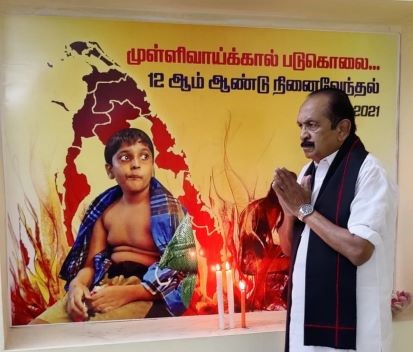
In the Indian State of Tamil Nadu, home to nearly over 67 million fellow Tamils, Tamil nationalists, LTTE and Tamil Eelam supporters have already started observing Mulliwaikkal Day. The Marumalarchi Dravida Munnetra Kazhagam (MDMK) leader Vaiko, who is an MP, paid homage to the dead. The object of veneration for him and his followers, was a map of Tamil Eelam with a picture of the 12 year-old Balachandran, the slain son of LTTE chief Velupillai Prabhakaran, superimposed on it.
Meanwhile www.army.lk said that the Sri Lankan Security Forces are all set to remember the fallen war heroes at the National ‘Ranaviru’ monument in Battarmulla on May 19. The ceremony would be witnessed by President Gotabaya Rajapaksa and other dignitaries of the Sri Lankan State.
The website said that 23,962 army, 1160 Navy, 443 Air Force, 2598 police and 456 Civil Security personnel, a total of 28,619, had made the supreme sacrifice in the fight against LTTE terrorism before May 2009.
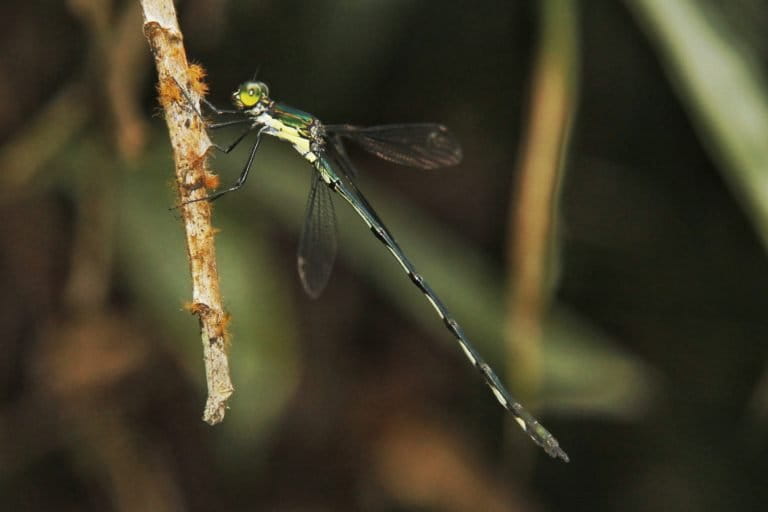
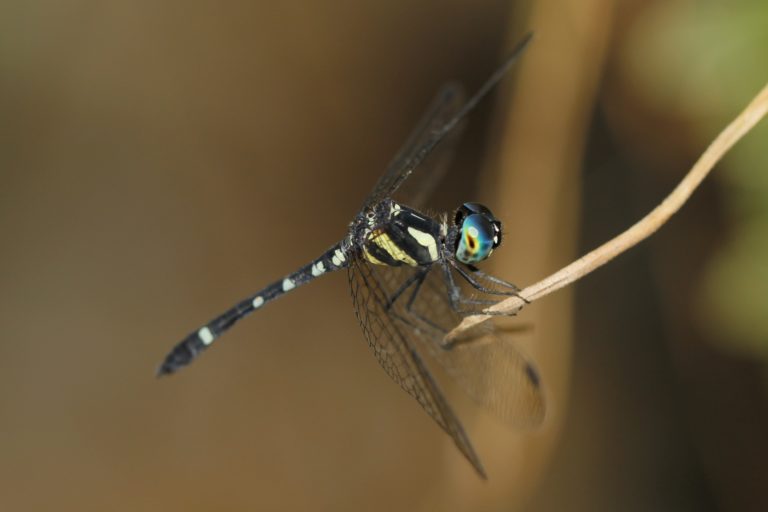
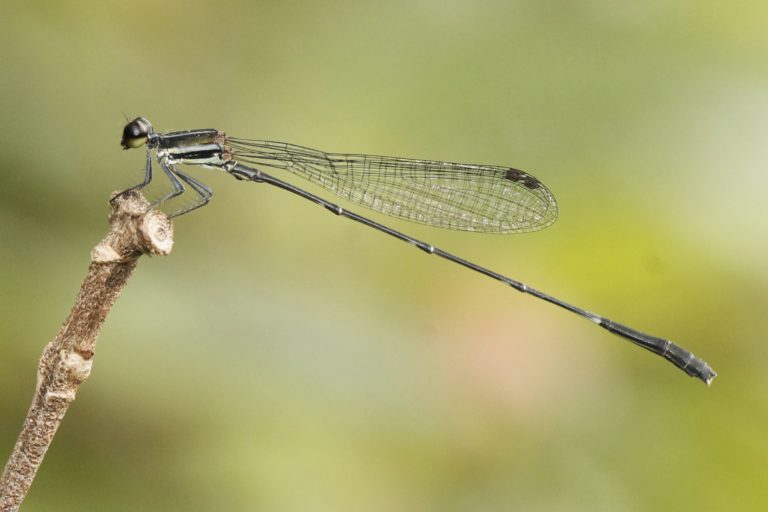
Nearly half of the 130 known species of dragonflies and damselflies in Sri Lanka are found nowhere else on Earth.
The highest endemic species density is found in the island’s central highlands, attributed to the variations in the geography and climatic conditions as different mountain ranges have different ecological characteristics providing unique evolutionary pressures for speciation.
But for long, knowledge of these odonates had been confined to scientific names and basic descriptions and locational information, until a new surge of interest drove the country’s odonates research to new heights.
This post is a commentary. The views expressed are those of the author, not necessarily Mongabay.
A tropical continental island located close to the Indian subcontinent, endemic fauna and flora form an integral part of Sri Lanka’s rich biodiversity.
The island’s biodiversity is globally recognized for both its diversity and endemism of fauna and flora, and this is true of its dragonflies and damselflies, or odonates in general.
With 130 known species, 58 of Sri Lankan dragonflies and damselflies are endemic to the country. In addition to these, Sri Lankan subspecies of eight other species are also endemic, elevating the total number of endemics to 66 (50.8%) and thus making Sri Lanka the country with the highest density of endemic odonates in South Asia.
Highest endemism in the region
Though Sri Lanka has a very high number of endemic dragonflies and damselflies, and they have been studied for more than two and a half centuries, very little was known about them until a couple decades ago.
Most were only known by their scientific names and basic descriptions. Then dawned a golden era of research and explorations into the world of Sri Lankan odonata, led by several odonatologists and naturalists. Field explorations coupled with taxonomic studies over the past three decades explored their natural history and taxonomy, and more than a dozen endemics were discovered during this period.
Most importantly, the knowledge gained was documented for the use of others, which helped build a surge of interest in dragonflies and damselflies among the naturalist community in Sri Lanka.
Endemic odonates occur in most parts of Sri Lanka. Among them, species like the Sri Lanka orange-faced sprite (Pseudagrion rubriceps ceylonicum) and stripe-headed threadtail (Prodasineura sita) are widespread in the lowlands. However, the species density of endemics is highest in the wet climatic zone, including in the southwestern part of the country.
The Sri Lanka emerald spreadwing (Sinhalestes orientalis) is a globally critically threatened damselfly species. Image courtesy of Amila P. Sumanapala.
Due to variations in geography and climatic conditions, different mountain ranges in Sri Lanka have different ecological characteristics providing unique evolutionary pressures for speciation. This is clearly evident among the species in the family Platystictidae, which has the highest diversity among Sri Lankan damselflies with 26 species and 100% endemism.
These damselflies, generally referred to as shadowdamsels and forestdamsels, are shade-loving, close-canopy forest-dwelling species with relatively low mobility. Their habitat–specificity, coupled with limited dispersal ability, has resulted in many restricted-range species confined to different geographical regions. These include the Adam’s shadowdamsel (Ceylonosticta adami), among the rarest of damselflies and restricted to the Knuckles Mountain Range, and multiple other shadowdamsel (Ceylonosticta spp.) species restricted to the Peak Wilderness Mountain Range.
Of the more common endemics, the shining gossamerwing (Euphaea splendens) is probably the most common one in the wet zone of Sri Lanka. This species inhabits a wide range of streams both in and outside forests.
The female shining gossamerwing is known to remain underwater for many minutes and lay its eggs in submerged plant material. The endemic dragonfly Yerbury’s elf (Tetrathemis yerburii) is another remarkable species as it is the only known Sri Lankan dragonfly to lay its eggs on plant material above water, thus keeping them exposed to the atmosphere. This species, mainly distributed in the wet zone, is often found inhabiting shady wells with earthen walls, which are usually overgrown with ferns and other such vegetation.
With years of explorations, it is now understood that many endemic species once thought to be rare and known only from a handful of specimens are out there in the biodiversity-rich rainforests and montane cloud forests, hiding from plain sight.
A distinct metallic-blue dragonfly species endemic to Sri Lanka, Yebury’s elf (Tetrathemis yerburyii) occurs in the southwestern and eastern parts of the island. Image courtesy of Amila P. Sumanapala.
Surge in research
Species like the Sri Lanka emerald spreadwing (Sinhalestes orientalis), which was not recorded for more than 150 years and once thought to be possibly extinct, was later rediscovered from the Peak Wilderness Mountain range.
The smoky-winged threadtail (Elattoneura leucostigma), which was not seen for more than 40 years, was recently recorded from several locations in the highlands including Horton Plains National Park, which is one of the most visited parks in the country.
Similarly, Nietner’s grappletail (Heliogomphus nietneri), a species only known from a single specimen for more than 120 years, was recently recorded from multiple locations in the Knuckles Mountain Range, which is one of the most popular travel destination among local travelers.
One reason for some of these rarities to be overlooked for prolonged periods is the fact that they are highly seasonal. Certain species like the shadow damsels of the genus Ceylonosticta, especially in the highlands, are only observed for a couple of months during or immediately after the southwestern monsoon. They are also very habitat specific and usually occur only in their preferred habitats, thus making it crucial to be in the right place at the right time to find these species.
Over the years, researchers and naturalists have gathered a considerable amount of data on these species, gradually widening the horizons of our understanding of the endemic dragonflies and damselflies of Sri Lanka. With recent findings, we now have a better understanding on where and when these amazing species occur.
The stripe-headed threadtail (Prodasineura sita) is a common endemic damselfly found in streams and riverine habitats. Image courtesy of Amila P. Sumanapala.
However, despite decades of research and explorations, some rarities still remain hidden. Species such as Flint’s cruiser (Macromia flinti), which has only been collected once, in 1970, and Keiser’s forktail (Macrogomphus annulatus keiseri), last collected in 1970, have evaded researchers despite their search attempts. Whether they are still surviving the various threats and pressures on dragonflies and damselflies, their habitats and ecosystems, is still an unanswered question.
Further explorations targeting the missing, lesser-known and undescribed species; research on understanding their biology, ecology and biogeography; as well as research focused on investigating the impacts of climate change, pollution and other environmental changes on their survival, are crucial to supporting the conservation of these enigmatic Sri Lankan endemics.
It is hoped that with the use of novel research and conservation tools and opportunities such as citizen science, we will be able to create a better future for the endemic dragonflies and damselflies of Sri Lanka.
Amila Prasanna Sumanapala is a field researcher studying the faunal biodiversity of Sri Lanka. He is currently doing postgraduate work on Sri Lankan Odonata, an order of carnivorous insects that include dragonflies and damselflies, and has more than a decade of experience in biodiversity research and assessments. He serves as an active member of several conservation organizations.
Banner image of a shining gossamerwing (Euphaea splendens), a damselfly found only in Sri Lanka, courtesy of Amila P. Sumanapala.
Kalkman, V., Babu, R., Bedjanič, M., Conniff, K., Gyeltshen, T., Khan, M., … Orr, A. (2020). Checklist of the dragonflies and damselflies (Insecta: Odonata) of Bangladesh, Bhutan, India, Nepal, Pakistan and Sri Lanka. Zootaxa, 4849(1), 1-84. doi:10.11646/zootaxa.4849.1.1
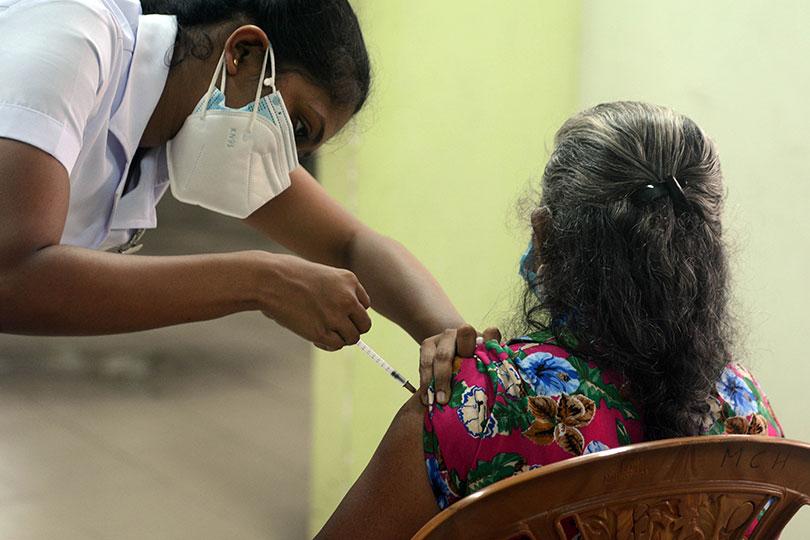
Picture shows people are receiving Sinopharm Vaccine as protection against Covid-19 in Colombo today. The Government earlier decided to inoculate the Chinese Sinopharm vaccines for citizens over 60-years of age. Pix by Pradeep Pathirana.
The Cabinet of Ministers has given the nod to introduce a suitable insurance scheme for Sri Lankan migrant workers.
The Department of Government Information says the Foreign Employment Bureau has provided an overseas labor insurance coverage for these expatriates.
Under this insurance coverage, Sri Lankan migrant workers are paid compensations subject to a maximum of Rs. 600,000 in case of death of an employee and Rs. 400,000 in case of total disability.
However, these employees have no coverage for various industrial and domestic accidents in the workplace, access to medical care for mental and health problems due to various illnesses and harassment by employers as well as job losses due to epidemics such as COVID-19.
Taking these factors into account the Cabinet of Ministers, during its meeting on Monday (May 17), agreed to grant permission to the proposal tabled by Labour Minister to introduce a suitable insurance scheme for Sri Lankan migrant workers.
Sri Lanka’s novel coronavirus death toll crossed the grim milestone of 1,000 today (May 18), as the Director-General of Health Services confirmed 34 new victims.
This is reportedly the highest number of fatalities the country registered in a single day following the outbreak of the pandemic last year.
As per official data, Sri Lanka has witnessed as many as 1,015 deaths from the COVID-19 so far.
Among the deceased is a youth aged 20 years from Ratnapura area who died of acute COVID pneumonia.
Further, a 32-year-old female from Dematagoda area succumbed to COVID pneumonia, diabetes, chronic kidney disease, thrombophilia and hypothyroidism while a 38-year-old female from Ragama area fell victim to acute COVID pneumonia and diabetes.
According to the Department of Government Information, the remaining 31 victims were over the age of 50.