The newly appointed Sri Lanka Ambassador to
the Kingdom of Thailand Mrs. C. A. Chaminda I. Colonne assumed duties today, 01st
March 2021, at the Sri Lanka Embassy in Bangkok, Thailand [concurrently accredited
to the Kingdom of Cambodia, Lao People’s Democratic Republic and the United Nations
Economic and Social Commission for Asia and the Pacific (UNESCAP)].
During the occasion Buddhist, Hindu,
Christian and Islamic religious observances were conducted by Ven. Prof. Walmoruwe
Piyarathna Thero, Rev. Krishnamoorthy Sivasubramanian, Rev. Worawut Saraphan and
Rev. Sittirath Wacharapisudhi respectively.
Chaminda Colonne is a career diplomat, who
joined the Sri Lankan Foreign Service in 1998.
Prior to being appointed as Ambassador to
the Kingdom of Thailand, she served as Director General of the Middle East of
the Foreign Ministry (2018-2021) and Director General of Middle East and Africa
of the Ministry of Foreign Relations (2016-2018).
Her posts in Sri Lanka included, Director
General of Africa (2011-2013), Director of Africa (2008-2011) of the Ministry
of External Affairs, Deputy Director of Economic Affairs (2004-2005), Deputy
Director of Consular Affairs (2003-2004) and Assistant Director of Political
Affairs – East (1998-2000) of the Ministry of Foreign Affairs.
Her overseas posts included Minister/Deputy
Chief of Mission of the Sri Lanka Embassy in Berlin, Germany with concurrent
accreditation to Switzerland (2013-2016), Counsellor of Sri Lanka High
Commission in New Delhi, India (2005-2008) and First Secretary / Second
Secretary of the Sri Lanka Embassy in Moscow, Russia (2000-2003).
During her tenure as Counsellor at the Sri
Lanka High Commission in New Delhi, she also served as the Secretary of the
India- Sri Lanka Foundation.
She holds a Bachelor of Science (Zoology
Special) from the University of Colombo and served as a member of academic
staff of the Faculty of Science, University of Colombo (1996-1998), prior to
joining the Sri Lanka Foreign Service.
She is also a past pupil of Visakha
Vidyalaya, Colombo, Sri Lanka.
She is married to Mr. Stephen Senanayake, a
Sri Lanka Government officer.
Her hobbies include bird watching, preservation
of wildlife, biodiversity and archeological sites.
Sri Lanka has confirmed 07 new COVID-related deaths today (March 02), says the Director-General of Health Services.
According to the Department of Government Information, the death toll from the virus outbreak in the country has climbed to 483 following the new development.
Details of the deceased are as follows:
1. An 87-year-old woman has died yesterday (March 01) at her home in Colombo 15. The cause of death was cited as COVID pneumonia, acute diabetes, acute kidney infection and high blood pressure.
2. An 89-year-old woman from Colombo 05 area has died yesterday. This has been recorded as a home death. The victim has suffered from COVID pneumonia and acute diabetes.
3. A 78-year-old woman from Colombo 15 area passed away today while receiving treatment at the Colombo National Hospital. COVID pneumonia, acute diabetes and high blood have been recorded as the cause of death.
4. A 73-year-old man from Piliyandala area has died yesterday due to COVID pneumonia, and respiratory system failure. He was initially under medical care at the Pimbura Base Hospital and was later moved to Homagama Base Hospital after testing positive for the virus.
5. A 63-year-old woman from Pilimatalawa area fell victim to COVID pneumonia, high blood pressure and acute diabetes today. She was transferred from Peradeniya Teaching Hospital to Theldeniya Base Hospital upon testing positive for novel coronavirus.
6. A 63-year-old man from Colombo 02 area succumbed to COVID pneumonia. After testing positive for the virus, he was transferred from Colombo National Hospital to Anuradhapura Teaching Hospital where he passed away yesterday.
7. A 63-year-old man from Galewela area died today due to COVID pneumonia and lung cancer. He was moved from Matale District Base Hospital to Theldeniya Base Hospital after testing positive for the virus.
Archbishop of Colombo Malcolm Cardinal Ranjith today called on Sri Lankan authorities to bring to justice without delay the true masterminds” behind the Easter Sunday attacks and those who have seriously neglected their duties despite having prior knowledge of the attacks.
A copy of the final report of the Presidential Commission of Inquiry (PCoI) appointed to investigate and inquire into the Easter Sunday attacks was handed over to the Archbishop of Colombo, yesterday (01).
Speaking to reporter at a press conference in Colombo today, Cardinal Ranjith expressed his gratitude to the members of the commission for their work over a period of around one-and-a-half years.
He also stated that a team comprising himself, Auxiliary Bishops, reverends and several experts are working on studying the report extensively and present recommendations.
He stated that although various individuals have expressed various views regarding the report of the commission, he cannot make a final conclusion regarding the report until it is properly studied.
However, the Archbishop pointed out that they have great doubts as to whether the country’s security agencies such as the Criminal Investigation Department (CID), Terrorism Investigation Division (TID) and State Intelligence Service (SIS) had carried out investigations in depth regarding these culpable homicides while the commission was engaged in its duties.
Cardinal Ranjith stated it does not seem like the aforementioned agencies are working on apprehending the true masterminds” behind the Easter Sunday attacks.
He said that although some actions have been taken it appears though these have been done without much conviction.
Therefore, we are asking authorities to explain as why they have been unable to investigate the masterminds behind the attacks, those who aided and abetted, those who funded the attackers as well as the individuals who intervened to weaken and sabotage the investigations into them, and to bring them all before justice despite two years passing since the attacks.”
He alleged that they have received information of undue political influence on certain high-ranking officers who investigated the attacks.
Neither the President nor the government will take responsibility for the final report of the Presidential Commission of Inquiry on the 2019 Easter attacks, says Cabinet Spokesman Keheliya Rambukwella.
Speaking at the press conference held today (02) to announce the Cabinet decisions, Minister Rambukwella said that the report has been presented on an independent basis and that a commission report being right or wrong is not entirely up to the government.
He added that the government will continue its investigations via the Criminal Investigation Department (CID) and the Terrorism Investigation Division (TID) if the justice has not been delivered.
Stating that the Presidential Commission of Inquiry was an independent commission, the Minister reiterated that the party, the government, the President, the Prime Minister, the Cabinet, and the parliamentarians reject bearing the responsibility for the reports of the Commission.
The Attorney General has received 65 volumes of the proceedings of the Presidential Commission of Inquiry (PCoI) which probed the Easter Sunday terror attacks from the Presidential Secretary today (March 02).
The Presidential Commission has handed over a total of 87 volumes containing its proceedings to the Presidential Secretary, Coordination officer of the Attorney General State Counsel Nishara Jayaratne stated.
However, 22 volumes have not been handed over due to the sensitive nature of evidence pertaining to national security, she said further.
Attorney General has noted that thousands of pages of investigative material pertaining to the 08 terror attacks, nearly 30,000 pages of evidence recorded by the Presidential Commission and Parliament Select Committee which probed the matter will be studied further.
Volume 01 of the report was handed over to the Attorney General on the 25th of February. However, the Attorney General had requested the President’s Secretary to submit all proceedings, documents and materials of the commission to the Attorney General’s Department.
Attorney General Dappula De Livera on February 12 had requested for a copy of the final report of the Presidential Commission of Inquiry from the Secretary to the President in order to consider forwarding charges against the suspects.
The Presidential Commission of Inquiry appointed to investigate the 2019 Easter Sunday terror attacks handed over its final report to President Gotabaya Rajapaksa on February 01.
Hearings and other procedures of the Presidential Commission officially came to a conclusion on January 27, 2021.
The Commission was appointed by former President Maithripala Sirisena on September 22nd, 2019 to investigate the series of attacks that took place on Easter Sunday same year and to recommend necessary actions.
The commission had recorded evidence from a total of 440 individuals during its term.
The commission was chaired by Court of Appeal Judge, Janak de Silva and included Court of Appeal Judge, Nishshanka Bandula Karunarathna, Retired High Court Judges Nihal Sunil Rajapaksa and A.L. Bandula Kumara Atapattu, former Secretary of the Ministry of Justice, W.M.M.R. Adikari.
Archbishop Malcolm Cardinal Ranjith has stated that time will be given until April 21 to take legal action against those responsible for the Easter attack.
He was addressing a media briefing today after receiving the report of the Presidential Commission of Inquiry into the Easter attack yesterday.
Meanwhile, the Attorney General has obtained 65 volumes from the final report of the Presidential Commission of Inquiry into the Easter attack from the Secretary to the President today.
Attorney-at-Law Nishara Jayaratne, the Attorney General’s Coordinating Officer stated that 22 volumes containing sensitive information on national security were not received.
The UNHRC is all about HUMAN RIGHTS. Sri Lanka’s conflict ended with a military offensive that applied international humanitarian laws and not human rights law. Sri Lanka has to be judged by violations of IHL not HR in a non-international armed conflict. Nevertheless, human rights is human rights and there can be no time bar to human rights violations. This is why the human rights violations committed by colonial rulers upon countries that they invaded matter. UK ruled all but 22 countries around the world (90% of the world) making UK the world biggest human rights offender when tabulating all the human rights violations UK committed. There is no time bar for human rights. The GoSL and all of the former colonies must unite to demand accountability, apology and reparations instead of attending Commonwealth summits to shake the hand of the oppressor! Therefore, the UK Government cannot be peddling any resolutions against Sri Lanka with soiled hands that are bloodied from committing mass scale human rights violations for 133 years (1815-1948) Why is the UNHRC not bothered about human rights violations during colonial rule. If UNHRC insists on going after Sri Lanka even after 12years of peace post-LTTE defeat, we demand UNHRC take action on colonial crimes too.
There were no human rights for the colonized.
Human Rights violations were regarded as a White Man’s Burden to ‘civilize’ the ‘uncivilized’.
Britain is guilty of dividing communities
Britain is guilty of dividing people as majority & minority
Britain is guilty of favoring the minority & hounding the majority
Britain is guilty of suppressing the majority & showering the minorities
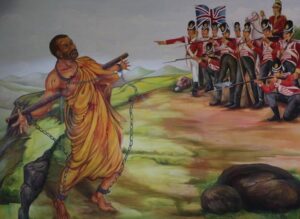
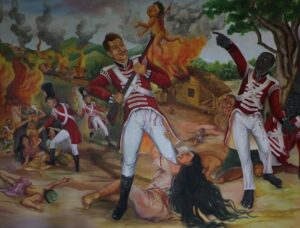
Britain is guilty of genocide by scorched earth policy (raid & destroy policy of 1803) – Colonial Governor Brownrigg’s order was to kill anything that moved even babies. Uva-Wellassa was victim to that policy. Even babies were killed by the British. How many human rights of babies did Britain destroy & kill? Entire villages and farms were torched, cattle were slaughtered, vegetation burnt to the ground – all these were human rights violations that have no time bar for accountability of indiscriminate killings.
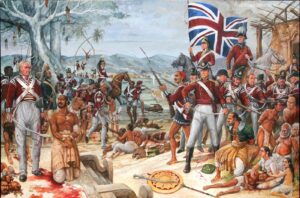
The Uva Rebellion/Third Kandyan War (1817) turned into a guerilla war with rebels being brutally massacred by the British. The Madulla massacre was one of shoot-to-kill policy leaving not a woman or child spared. What was the human rights Britain adopted?
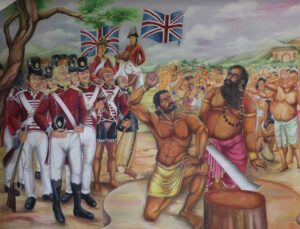
Britain is guilty of killing unarmed civilians– memos of Colonial officers reveal how they had breakfast watching Sinhalese men being hung to death. How many human rights of Sinhalese men did Britain violate by hanging? Refer the House of Commons Committee for the gory details that would include how Lt. J. Maclaine of the 73rd Regimen
Britain is guilty of throwing babies to hungry crocodiles– where were the human rights of these babies.
Britain is guilty of raping native womenand without accounting for these rapes, how dare Britain manipulate UNHRC
Britain that hung people without trialhas no moral right to be asking for international tribunals.
Britain that starved natives to deathhas no moral right to be questioning Sri Lanka’s humanitarian rescue operation that statistically can prove the essentials sent while militarily taking on the LTTE
Britain that plundered nations of their wealthincluding our own and proudly display this stolen wealth in British museums and on the head of the British Queen, has no moral right to demand accountability
Britain that rolled out policy programs to ‘civilize’ the ‘uncivilized’ resulted in attempting to destroy native traditions, cultures, Buddhism, native legal & social systems and replace with British systems that aimed at creating a generation of brown-sahibs, living in post-colonial times but tapped to continue the colonial project in a modern context. We call these the ‘kalu-suddas’, the brown sepoys.
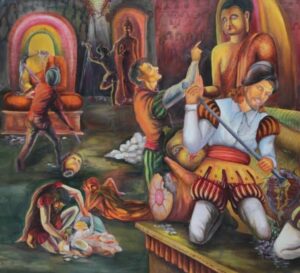
Britain is guilty of attempting to destroy Buddhism and convert the natives
Britain is guilty of causing demographic change with intent to cook trouble
When the British landed in Sri Lanka its population was just 800,000 by the time the British left 157 years later (1972) that population had risen to 7m. The sudden increase was due to a flood of South Indians dumped to Sri Lanka to work on British plantations. – there was never a time until repatriation in 1971 and 1981 that the Sri Lankan Tamils (a nomenclature created only in 1911) outnumbered the Indian Tamils who brought in as cheap labor from India.
We saw how LTTE committed war crimes against animals. Britain did virtually the same. Samuel Baker was the British elephant slaughterer killing 30-40 elephants on a daily basis. Calculate this into 133 years of British occupation to estimate the elephants that the British killed.
Britain that is taking pot shots at Sri Lanka’s Armed Forces are reminded about the human rights violations British Armed Forces committed upon natives(Britain the invader occupier). Britain cannot judge our armed forces
Lt. J Maclaine of 73rdregiment had breakfast watching Sinhalese being hung.
Col. Braybrooke (Assistant Commissioner for Badulla) reported that he hung Kandyan prisoners without trialand he declared that he relished watching them being hung while having breakfast (House of Commons Committee on Ceylon 1849/50)
Maj. MacDonald guilty of arson in Badulladistrict burning to the ground villages near Hausanwella. He writes to the Governor this act of severity, I trust will not be disapproved” (CO 54/56 – 7th November 1817)
Campbells’ memo
Soldiers wonder about the value of what they destroyed……..! We were under orders to destroy all coconut trees, all fruit trees and paddy fields. We were also ordered to destroy the bunds of the water reservoirs. This water was essential to them for cultivation. We wondered how long it must have taken for them to build these giant reservoirs and how long it would take them now, without having any engineers or the equipment, to rebuild or repair them.”
Major Forbes memo 1818
We met so many military patrols who had been dispatched for burning the villages and their property. They were not looking for the enemy. The natives who survived our fire would definitely get perished in sickness and in famine as we had destroyed all their cultivation, lakes and villages.”
Sergeant Calladine’s diary of 1818
Not a single day passed without burning a village and killing the Chingalese men. We didn’t take prisoners.”
British captured wives and children of patriots and held them as ransom until patriots surrendered. These same dirty tactics continue to be repeated.
Col. Hook orders Sinhalese to be hung without trial (1817)
(Mawatagama Nilame a close relation of the Mahanayake of Asgiriya was hung without trial)
Capt. Fraser, Brownrigg’s personal assistant killed 19 Sinhalese.7 of them were executed without trial, other 3 forced to work as his guides. The 7 executed Sinhalese were hung on the roadside in Godamunne and the blood of their corpses polluted the nearby river making it unusable to the natives the next morning.
Diary of Dr. John Davy (British Army Surgeon) Indiscriminate killing of civilians
We didn’t manage to kill the enemy. But we killed a lot of villagers. We must have killed at least 10,000 men in the villages”
When a district rose in rebellion, one or more military posts were established in it; martial law was proclaimed; the dwellings of the resisting inhabitants were burnt; their fruit-trees were often cut down and the country was scored in every direction by small detachments, who were authorized to put to death all who made opposition, or were found with arms in their hands… In candour… it must be remarked that our government was hardly answerable for the irregularities committed on our side…….”
Diary of Dr. John Davey: Killing of children of Patriots
Dr. John Davey of the British Army declares that by 1821 there were no children of patriotic families in Uva-Wellassa.
Dr. Davey estimated at least 7% of the population of the entire Central province was killed by the British Army.
British Colonial Army rape
Understanding the British Empire” by Ronald Hyam on Sergeant Calladine
Wellington declared in 1914 that the British Army represented the ‘scum of the earth”
Flexner described the British army as ‘recruited from the adventurous & derelict”
UK is taking over US. We do not need to go down the road of modern human rights violations committed by both these nations. We are stupefied that they choose to ignore their own atrocious war crimes and point fingers at other nations.
What moral right does Britain have to speak a word on human rights & rule of law as ample evidence prevails of British crimes in Sinhale during colonial rule. Until & unless these are accounted for, apologized & compensated Britain has no right to be pointing fingers at Sri Lanka.
Britain that is slowly destroying its colonial atrocities has no moral right to be peddling any UNHRC resolutions on account of attempts to destroy records and evidence of British colonial crimes.
Right Honourable Justin Trudeau Prime Minister of Canada Ottawa
Right Honourable Prime Minister,
Canada’s efforts to prevent the recruitment and use of children in armed conflict is greatly appreciated. Your statement on the 12th of February 2021 reaffirming Canada’s commitment to draw attention to this inhumane practice with the longstanding intent of ending such conscription along with nearly 100 UN Member States endorsing the Vancouver Principles on ‘Peacekeeping and the Prevention of the Recruitment and Use of Child Soldiers’ is most commendable.
The Late, Honourable Lakshman Kadirgamar, Sri Lanka’s former distinguished Minister of Foreign Affairs too devoted a great deal of time in campaigning for the same laudable objectives and also canvassing international support towards the aims envisioned in the Vancouver Principles and peace in Sri Lanka. He was unfortunately gunned down on August 12, 2005, by a sniper belonging to the Liberation Tigers of Tamil Eelam (LTTE), which group was designated as an international terrorist movement by the UNSC in September 2001, as he was emerging from the swimming pool at his residence in Colombo.
The LTTE was one such organization that abducted and conscripted children several of whom were as young as ten years over a long period, that came to the attention of UNICEF that recorded a total in excess of 7634 such child soldiers. After a short period of training they were unleashed on remote villages in the north and east of Sri Lanka settled by Sinhalese farming communities who were set upon in the middle of the night to be hacked and shot to death while they slept to make them combat ready. The last such village that was similarly attacked was Gonagala in the Ampara district in the year 2000 where 62 persons were put to death, with the lucky ones escaping to the jungle to be rescued later by Sri Lanka’s security forces. Despite the LTTE signing a pledge with UNICEF’s Special Rapporteur, Olara Otunnu in 1998, and thereafter making repeated promises to the UN officials, they continued to conscript under age children to their fighting forces. They would abduct them on their way to school or homeward bound children after school hours, and by instilling fear and making threats to the parents. Subsequently, they forced each family to release a child for their separatist war effort.
These child soldiers were given combat training and were equipped with an AK47 automatic weapon and a cyanide capsule strung around their neck to be bitten into in the event of their being captured. They were used as storm troopers in the LTTE’s unceasing waves military strategy adopted in battles against the Sri Lanka Army, with many of them becoming casualties in combat. Their bodies were laid to rest in the special cemeteries set up to bury the LTTE’s martyrs, with no mention of their dates of birth and only the date of death being recorded on the gravestones in order to hide the fact that they had conscripted under age children below 15 years, which was a war crime. Some of the children so conscripted were brainwashed to become suicide bombers, with the LTTE holding the world record having exploded around 377 human bombs.
Those responsible for the disruption of schooling and family living and care for Tamil children in Sri Lanka are present in Canada as well that raised funds for the terrorist war engaged in by the LTTE through extortion of Tamil expats and Tamil owned businesses, drug and human smuggling, passport fraud, and numerous other illicit activities. Following the military defeat of the LTTE in May 2009 and ending of the three decade long separatist terrorist war in Sri Lanka, these LTTE activists in Canada have donned the cloak of human rights activists to spread their fabricated stories, doctored videos and unsubstantiated wild allegations of IHL violations and war crimes supposed to have been committed by the Sri Lankan security forces during the last phase of the armed conflict during the period January 1 to May 18, 2009. It is a shame that these allegations have been swallowed by the powerful countries in the west that continue to harass Sri Lanka at the UNHCR and other fora based on these unproven alleged violations citing Ban ki-Moon’s one sided three member panel report headed by Marzuki Darussman which has been locked away for 20 years till the year 2031.
Unlike these bogus allegations emanating from born again pro-LTTE Human Rights activists, Sri Lanka rescued about 300,000 Tamil civilians held by the LTTE as a human shield in the final battleground at Mullivaikkal on the northeast coast, sheltered them in welfare camps in Vavuniya where they were fed, provided with education, vocational training, psychiatric help,etc. till the land area of almost 1,000 sq. km was cleared of land mines, houses and infrastructure restored, and made safe for resettlement in their former villages. Among those surrendering were nearly 12,600 former LTTE fighters including the remaining 594 child soldiers who were rehabilitated with new livelihood skills and released to their families and society where they could be gainfully employed under the restorative justice principles adopted in their case.
*A new 12 minute video documentary has been produced under the title ‘Truth Behind Dare’ using video clips provided by the rehabilitated ex-LTTE fighters which shows the military training given to the children who were abducted and conscripted as soldiers for armed warfare, most of whom perished in battle.* Some scenes show parents handing over their children to the LTTE terror organization as part of their propaganda to claim willingness of the civilian population to give up their children for the separatist cause, which obviously fails as the parents faces shows the immense pain they suffer at the time as the alternative is violence being directed at them and their children still risking being abducted on their way to or from school. Other scenes shows Adele Balasingham, the Australian nurse who was married to the LTTE’s ideologist in military attire participating in a Passing Out Parade of women cadres most likely trained by her who were being garlanded with the signature ‘Cyanide Necklace’ for committing suicide in the event of capture. Adele Balasingham today resides freely in the UK probably supported with the tainted funds raised by the LTTE with no questions asked about her being part of a designated international terrorist movement. *The LINK to this revealing video is given here: *
<https://www.youtube.com/watch?v=Fpz8Cl_-YpM&feature=youtu.be> . Please watch the video to learn the facts behind the rigged version that is propagated by the pro-LTTE organizations which has been sold to the western powers who seek to punish Sri Lanka for geopolitical reasons best known to them.
Mahinda Gunasekera Toronto, Canada
Encl.
*Statement made by the Right Honourable Prime Minister of Canada on the International Day Against the Use of Child Soldiers*
Prime Minister Justin Trudeau February 12, 2021 Ottawa, Ontario
The Prime Minister, Justin Trudeau, today issued the following statement on the International Day Against the Use of Child Soldiers, also known as Red Hand Day:
Children have the right to grow up in a safe environment, to access basic care, to pursue an education, and – above all – to be children. Taking them away from their families and putting them on the front lines of conflict robs them of these fundamental rights.
Whether they are trained to fight, armed with deadly weapons, used as spies, sexually exploited, or forced into marriage, child soldiers face unimaginable violence and abuse, and suffer long-lasting, scarring effects. These horrible practices must stop.
That is why, every year on this day, we reaffirm our long-standing commitment to help end the recruitment and use of children in armed conflicts. Since 2017, Canada has mobilized close to 100 countries to endorse the Vancouver Principles on Peacekeeping and the Prevention of the Recruitment and Use of Child Soldiers <https://www.international.gc.ca/world-monde/issues_development-enjeux_developpement/human_rights-droits_homme/principles-vancouver-principes.aspx?lang=eng>. These commitments, which were developed in partnership with the Dallaire Institute for Children, Peace and Security, the United Nations, UN Member States, and other organizations, help protect children through education, training, and prevention.
No child should bear the brunt of conflict and be forced to participate in acts of violence. Canada will continue to be an unwavering advocate against the use of child soldiers and to bring countries together to endorse and implement the Vancouver Principles. Children have the right to be children, away from the atrocities of war.”
‘’It is going to disappear one day. It is like a miracle it will disappear’’ repeated Donald Trump former President of the United States of America
Let the above be our wishful thinking though living with Covid-19 is frightening and disturbing. But since we are compelled to live with it the challenge is ours and depends on how we react and fight the virus, following guidelines and medical advice. We are not experts to advise on any form of treatment or invisible forces to combat the virus. The news we receive are uncertain with no credible or scientific sources, leaving us in the dark. Whether the injections are effective will be decided in the future but it appears that UK is slowing down a bit.
No slowdown is yet shown in many rich countries after immunisation of the vaccine. There is no guarantee on the success of the vaccine and the side-effects. Progress is slow and every innovation has side effects and time is needed to test them. Rich countries have given the vaccinations to a majority while many poor nations have not been given the treatment at all. As this is a worldwide pandemic the solution too should be applied worldwide.
For example, Sri Lanka’s immediate neighbour India is densely populated and the close association with fishermen, – smuggling, drug trafficking and involved in the import-export trade are mediums of close contact and transmission between cross – border countries.
The Japanese way of prevention is strict adherence to the rules while Britain is engaged in educating their citizens on social distancing and adherence to rules. Despite the best NHS system, supposed to be the best in the world the death toll in the UK is increasing day by day with some reduction due to the vaccine. China, Taiwan and North Korea are extremely strict but some Western countries have a liberal attitude. All in all unless the entre globe acts as one unit the danger would spread faster than expected increasing the death toll and spreading the disease.
Abide by health guidelines
The Sri Lankan situation is unique though unsatisfactory due to indiscipline in the society acting in defiance of the regulations. The information and statistics received vary on a daily basis worldwide with uncertainty. We are trying to live with this menace and the best and easy way to meet the challenge is to be clean and abide by the directions given by the experts. Sri Lanka started well and if continued would have been one of the best success stories in the world. Some sections of society defy the most dedicated health sector advice. Now the situation has become worse and the pandemic appears to be fast spreading.
This is the time to turn to technology and digitalisation to combat the unseen but powerful enemy successfully. Technology today allows people to connect with anyone, anywhere in the world from almost any device. This has automatically changed people’s work facilitating 24/7 collaborations with colleagues who are disposed across time zones, countries and continents. We must forge all available energies to build new avenues and different paths. The whole world is in danger. The poor are the worst hit and left alone with no vaccine or assistance while the West is full of excesses which is the reality, based on the success of the fittest based on Charles Darwin’s theory, survival of the fittest.
The USA, the richest and the most powerful, is one of the worst hit. Often when you think you are at the end of something you do not realise that you are at the beginning of something else which may be exceptionally good. Let us wish to belong to this category. Let us be the beginning of a new successful post Corona world of our own. May the next year bring an end to the pandemic and the beginning of a normal lifestyle.
We have gone through worse situations before and it is inevitable that humans will emerge victorious, with the power they possess of imagination, innovation and determination. We must protect and save the environment we live in for our own good and the existence of Mother Earth. Covid-19 and the environment are interconnected as food pattern and the way of life has direct relevance to the menace we are confronted with.
There are many theories on the origin and source of the pandemic that started presumably in Wuhan, China and spread paralysing the entire world with the threat to continue and cause further destructions, and there is no possibility that it will end any time soon. Preventive measures were prepared for the community worldwide with little variations to be followed by citizens of all ages.
The preventive measures are as simple as follows: (1) Wash hands frequently and thoroughly (2) Avoid touching mouth, nose and eyes (3) Cover mouth when you cough or sneeze with elbow or with tissues (4) Dispose used tissue into a closed bin and wash hands or sanitise (5) Avoid crowded places (6)Practise physical distancing and maintain at least 1 m distance (7) Routinely disinfect surfaces (8) Stay at home if you do not feel well (8) If you have symptoms of fever, cough or difficulty in breathing consult a doctor.
In short it is mooting to live with nature and be clean, in an environment friendly atmosphere consuming healthy food preferably devoid of meat or fish obtained from worldwide food chains and consuming junk including poisonous beverages, especially the young. This is what ‘’Ayurveda’’ medicine too has taught us Asians for over 5,000 years and we have not come across pandemics or diseases such as cancer in our history. It is simple and effective to adhere to these rules.
Transform disaster to success
This pandemic has magnified every inequality in our society, such as, racism, gender inequality, and poverty. The citizen should transform disaster into success and opportunity by adopting to new challenges and circumstances with the help of people friendly innovations on livelihood, environment, employment, medicine, education and generally the way of life in pre– Covid-19 times.
This pandemic may give rise to stronger societies out of necessity and livelihood whereby families and neighbours will be closer and inter dependent on each other which may lead to new ventures in trade and business. Once secluded and confined in houses for long periods the friendship, relationship and neighbourhood bonds are bound to enhance and lead to developments and new thinking as groups. It will strengthen family ties and cooperation in all areas including joint livelihoods. This is the period of innovations such as in Israel where every other person is an innovator converted to a start-up company owner and SME for the development of the nation.
The youth in Sri Lanka today are innovative and computer literate with IT knowledge and computer centres at every junction with basic IT facilities available for payment of utility bills and data for the children for online education. The transport system has been changed with fewer public transport and cheaper three wheeler services, thereby preventing congestion on the roads.
Working from home and flexible office hours have strengthened family ties with less household expenditure. It has increased the resilience to crisis, ensuring sustainable developments. Digital transformation and setting of new digital platforms are inevitable adaptations that have resulted in drastic changes in the economy with a strong political will by the governance also out of compulsion and circumstances.
Education, a badly hit area
Education is a widely hit area in Sri Lanka where the students, parents and the school managements have bounced back successfully despite school closures and interrupted transport systems. Sri Lankan parents have resolved to invest on children’s education for a better future for them and the nation which is a good move. Parents with difficulties invested on expensive data, giving their personal smartphones to the children for their e- education.
E- education is booming in private schools as expected. There were news reports that children in village areas climbed water tanks for Wi-Fi which is a sorry affair and an encouraging news on their capability to adaptation with determination. This is an opportunity to improve e-education and to link with international players through the Ministry of Education and our University system, especially, the Moratuwa University should lead the process. Education should be linked with e education, e business, and e news and information based on advanced IT with ICTA.
The newly set up Technology State Ministries tend to attend seminars and meetings without getting into business and it is time the Minister of Education gives them specific instructions. The nation should rise above all in education and assist all other groups to emerge during the pandemic.
Road discipline and behaviour
The number of accidents is on the rise in Sri Lanka compared to deaths due to Covid-19 and Dengue that we successfully minimised. Road accidents are mainly due to indiscipline and loss of effective control by the governance that has failed to curtail accidents. Relating to the environment sector many youth had fallen victim to ruthless sand transporters in heavy trucks who have taken the law unto their hands with political patronage, linked to environmental destruction. In fact accidents should be on the decline due to less vehicular movements. However, greedy politicos eat into forests and sand on river banks according to the helpless Minister of Environment. Covid-19 is a by-product of the mismanagement of environment and it is the duty of the citizen to exert pressure on perpetrators destroying the environment that we have saved for millions of years.
Trade, employment and Commerce
The economy is bound to set back due to inactivity in all sectors and working from home with the loss of billions of rupees in all sectors worldwide. Sri Lanka feels it more due to less reserves while the pinch is bearable to UK, USA, Japan and EU with their food and fund reserves and assistance from International Organisations. Although there are improvements in the agriculture sector, employment, commerce and trade including exports have decreased. Sri Lankans have been brave and resilient to challenges by bouncing back after the tsunami that hit Sri Lanka and many countries. We won the Tsunami over and winning Covid-19 is certain! Let us raise our nation to be a world power such as Israel during the difficult period.
Covid-19 cremation or burial
During the ancient period, the Muslims who arrived in Ceylon obtained permission from the kings and lived in Sri Lanka for thousands of years as traders and friends having married Sri Lankan women with the freedom to practise their religion. They did not come as invaders- like some other ethnic groups did. Islam is a rigid religion unlike Buddhism, which is a philosophy and a religion with lots of freedom as free thinkers. Many Muslims became mild due to the association of Buddhists and bhikkhus while some became rigid due to fundamentalists’ influence of Middle East contacts.
Sri Lankans are friendly and work together in international and inter-governmental Muslim groups, helping each other in international issues fighting together against rich and powerful groups. Covid-19 deaths are comparatively less and we should and could have taken all the precautions as guided by the committee, and as Prime Minister, Mahinda Rajapaksa, an experienced politician, supposed to be the most senior politician in Asia, indicated his views with few words in Parliament. We are in an internationalised world community and it is appropriate to adjust ourselves to the views of the international brotherhood which has an adverse effect on Geneva deliberation for no reasonable reason.
Be safe, be smart and be kind – DG, WHO
The virus will mutilate and live on with variants with permanent changes unless we outsmart the virus. The Israelis are the best innovators and best partners in this process to combat the virus. Variants will thrive in poor countries in the way they live with lack of necessary facilities.
The detection of variants in laboratories before they occur will fast spread, which shows the need for sharing of knowledge and international network in combating the menace. Every country must have budgetary requirements and or diversion of other funds for this important venture which is an investment for the future. Monitoring and organising the population to be vigilant and collection of data are important. It is not possible to keep countries in isolation or lockdown too long which could be disastrous.
Way forward to be free from Covid-19
As former President Donald Trump said the miracle will reach mankind as this affects the entire world. As the Director General of WHO stated we have to be smart, kind and safe. Are we? Very unlikely. If we are clean and follow the Ayurveda advice to go through the cleaning process there is no way that the virus would spread.
If we live with nature protecting Mother Earth, she will look after her children. It is time to change for the good or face the danger. Mankind went through many similar disasters of larger magnitude and escaped but the time factor is the issue despite the advancement of technology and science. We should expect the worst and start adapting to modern technology with new platforms and devices, as well as be innovative, for success.
We must have a global program and approach and not a national approach as it is a worldwide pandemic spreading fast so that the world has to act as one. There could be climatic changes and mass destruction of deforestation and release of mass scale garbage to the environment which will have an adverse effect of Covid-19 spread. World leaders must get together and exert a collective approach to face the menace with the scientists and the NGOs headed by the United Nations. This is a matter that cannot be resolved in isolation and therefore sharing of knowledge, experience and data is essential.
The IMF may think of keeping developments aside for a while and start helping members of the world family to get over the most difficult threat. Small is powerful and we will be victorious if we follow the adage that ‘’you are your own saviour and no one else’’. (The Buddha) Therefore, follow the simple rules to the last word and be safe, smart and kind. May everybody be healthy and happy. Sarth7@hotmail.co.uk
The writer is a President’s Counsel, former Ambassador to UAE and Israel and President, Ambassadors’ Forum
TORONTO — Armed with everything from school attendance records to drones, researchers across Canada are racing to shed light on a bleak part of the country’s history: How many indigenous children died at residential schools, and where are their unmarked graves?
From 1883 to 1998, nearly 150,000 indigenous children were forcibly separated from their families and sent to the government-funded, church-run boarding schools in an attempt to assimilate them. Once there, they were frequently neglected and abused. What happened at the schools was akin to cultural genocide,” concluded a 2015 report from Canada’s Truth and Reconciliation Commission.
It also found that at least 3,200 students died at residential schools over those 115 years — a much higher rate than for students elsewhere in Canada — though the commission contended that the number was probably much higher and merited further investigation.AD
In 2015, Prime Minister Justin Trudeau promised to implement the Truth and Reconciliation Commission’s calls to action. Six of them deal specifically with creating a register of the missing children and mapping their graves.
But nearly three years later, some say that a lack of resources and missing documents is inhibiting progress, increasing the likelihood that the relatives of missing residential-school children will die without knowing the fate of their loved ones, and that unmarked graves could be destroyed.
There are scant resources being provided to do this work,” said Ry Moran, director of the National Centre for Truth and Reconciliation, which is working on some of these calls to action. We know some of those cemetery locations now sit under parking lots.”
A spokesman for the department of Crown-Indigenous Relations and Northern Affairs Canada said in a statement that the government provided the National Centre for Truth and Reconciliation with $500,000 in March and that it is working closely” with it in making progress toward the completion of these, and other associated Calls to Action.”AD
Moran said he expects to have an initial register of dead schoolchildren ready by March 2019 but cautioned that it won’t be a complete list because there are literally millions more documents to review.”
Putting together the puzzle pieces found in those documents is seldom straightforward,” said Nancy Hurn, a former archivist at the Anglican Church of Canada who pores over church records to find the names of dead children in her retirement but is not affiliated with the commission or the center. She has so far uncovered the names of 119 dead children.
I’ve been an archivist for 40 years, and this is the most important work I’ve done,” Hurn said. There is a lot to account for.”
School records were often destroyed or inconsistently kept, according to the commission’s 2015 report. Officials also frequently failed to record the name and gender of students who died or the cause of death. Authorities even neglected to report the deaths to the parents.AD
Complicating matters further, Moran said, some of the Catholic entities responsible for running the schools have not yet turned over their documents.
The religious organizations that operated the schools — the Anglican Church of Canada, Presbyterian Church in Canada, United Church of Canada, Jesuits of English Canada and some Catholic groups — in 2015 expressed regret for the well-documented” abuses. The Catholic Church has never offered an official apology, something that Trudeau and others have repeatedly called for.
Children at residential schools often died of illnesses such as tuberculosis and typhoid, which spread rapidly because the children were not adequately nourished and sometimes were forced to endure hard labor. Others died by suicide, in fires or by freezing to death while trying to escape.AD
Those who died were commonly buried in cemeteries on school grounds, in part because the schools were located far from indigenous communities and travel was difficult in the winter, said Anne Lindsay, a former archivist at the National Centre for Truth and Reconciliation.
Moran said it should be easy to map the locations of the graves because researchers know where the schools were located.
Earlier this year, he and a team of researchers found an unmarked grave near the Muscowequan Residential School in Saskatchewan by using ground-penetrating radar near the school’s abandoned building.
Moran would like to use this radar technology elsewhere but said it isn’t possible without more funding from the government.
What is at stake is perhaps best exemplified by what is happening in Brandon, Manitoba, on what archivists say they believe is the former site of the Brandon Indian Residential School, which operated from 1895 to 1972.AD
After years of neglect, the school’s cemetery was marked and cared for by the Girl Guides, Canada’s version of the Girl Scouts, from 1962 until the 2000s, when city officials sold the land to a private owner and it vanished.
Lindsay said the principal’s letters, a hand-sketched map by a former student and other records indicate that the cemetery was just south of the school, near the Assiniboine River.
Lindsay and others say they believe that today, it is the Turtle Crossing RV park and that at least 60 students are buried there.
The park’s owner is planning to expand the campground, but archivists and Vince Tacan, chief of the Sioux Valley Dakota Nation, oppose it.
Neither he nor the owner of Turtle Crossing responded to a request for comment.
This is a cemetery that sort of appears and disappears again,” Lindsay said. It speaks to how fragile that memory is and how much it needs people to actually commemorate and argue for remembrance.”
In an exclusive interview to India Today TV, Sri Lanka Foreign Secretary Admiral (Retd) Jayanath Colombage on Monday said that he expects India to stand by and vote in favour of Sri Lanka ahead of next week’s UNHRC sessions on the island nation’s rights and accountability record.
India has been urging Sri Lanka to implement and enforce the 13th amendment of its Constitution ever since the country’s war with Tamil separatists ended in 2009. At the ongoing session of the United Nations Human Rights Council (UNHRC) in Geneva, India said that it supports its neighbour’s “unity and territorial integrity” and remains committed to “aspirations of the Tamils of Sri Lanka for equality, justice, peace and dignity”.
In an exclusive interview to India Today TV, Sri Lanka Foreign Secretary Admiral (Retd) Jayanath Colombage on Monday said that he expects India to stand by and vote in favour of Sri Lanka ahead of next week’s UNHRC sessions on the island nation’s rights and accountability record.
“Abstention will not hamper ties. But India’s great leader speaks of ‘Neighbourhood First’. We are immediate neighbours,” Jayanath Colombage said.
ALLUDES TO TAMIL NADU ELECTIONS BECOMING FACTOR IN INDIA’S VOTING DECISION AT UNHRC
“We understand Tamil Nadu elections are coming up and Sri Lanka is always an issue. So we understand. India is a great friend. We expect India to stand by Sri Lanka. India is against country specific resolutions. They are against so-called rapporteurs being around to judge human rights situations in other countries. I think India is moving a resolution in that regard.”
ON PAKISTAN VISIT
“It was a bilateral visit. We did not visit [Pakistan] to garner OIC votes at UNHRC neither were we influenced by Imran Khan’s visit. We were very conscious of India’s concerns and ensured New Delhi is not embarrassed sorting the Pakistan Prime Minister’s visit. There will be no cooperation in defence or maritime with Pakistan. Sri Lanka’s soul will not be allowed to be used against India or to attack India.”ADVERTISEMENT
ON EAST CONTAINER TERMINAL
“Like farmers’ protests in India, our trade union protested against a deal. As a democratically chosen government we had to listen to them. We have offered India the West Container Terminal. I think they are happy with our offer and might even accept it.”
India described Sri Lanka as Priority One” partner in the defence sphere and said the participation of its military aircraft in the 70th anniversary celebration of the Sri Lanka Air Force (SLAF) is indicative of the growing cooperation, camaraderie and friendship between the two militaries.
The SLAF is celebrating its 70th Anniversary on March 2 and to commemorate the historical event, a Fly Past and an Aerobatic Display is being organised for the first time in the country at a grand scale.
A total of 23 aircraft of the Indian Air Force (IAF) and Indian Navy would participate in the grand event.
Sri Lanka is Priority One” partner for India in the defence sphere, the Indian High Commission in Colombo said in a statement on Sunday.
It said the assurance of India’s fullest cooperation in the field of defence and security was recently reiterated to Sri Lanka’s leadership by National Security Adviser Ajit Doval during his visit to Colombo for a trilateral Maritime Security Cooperation talks.
Doval attended the high-level trilateral maritime dialogue in Colombo among India, Sri Lanka and the Maldives in November last year. The meeting – hosted by Sri Lanka – took place after six years. The last meeting was held in New Delhi in 2014.
The statement underlined that the participation of the Indian Air Force and Indian Navy aircraft and personnel in the 70th Anniversary celebration of the SLAF is indicative of the growing cooperation, camaraderie and friendship between the Armed Forces of the two nations.
As a gesture of solidarity, and in keeping with years of close interaction and camaraderie between the two countries and their militaries, Indian Air Force (IAF) and Indian Navy will participate in the event with an Aerobatic Display by Sarang (Advance Light Helicopter), Surya Kiran (Hawks), Tejas Fighter Aircraft, Tejas Trainer and the Dornier Maritime Patrol Aircraft,” it said.
The deployment of such wide variety and huge inventory of aircrafts and helicopters of IAF and Indian Navy is testimony to the strong bonds of friendship and close interoperability shared between the corresponding forces of India and Sri Lanka services,” the Indian mission said.
It said that all the Indian aircraft on display are ‘Made in India’ and as such represent the indigenous technical prowess of Indian research and development sector and reliability of products of India’s defence industry.
Tejas Trainer, on display for the first time, would also afford the opportunity of independent sorties for the Sri Lankan pilots, accompanied with the Indian pilots whilst adhering to relevant strict health guidelines, the statement said.
During the deployment, the officers from Sri Lanka Air Force and Sri Lanka Navy will also have firsthand experience onboard the Indian Navy’s Maritime Patrol Aircraft Dornier, it said.
Sri Lanka Air Force pilots and Sri Lanka Navy observers will fly along with the Indian crew.
This is in continuation of the half yearly Dornier training sorties being facilitated for SLAF/SLN, it added.
Sri Lanka has reported 05 more coronavirus-related deaths, the Director-General of Health Services confirmed today (March 01).
As per the Department of Government Information, three male patients and two female patients are among the victims.
The new deaths bring the number of COVID-19 related deaths witnessed in Sri Lanka to 476 in total.
01. The deceased is a 73-year-old female resident from Ganemulla. She was diagnosed as infected with Covid-19 and transferred from Colombo South Teaching Hospital to Base Hospital Pimbura where she died on 01.03.2021. The cause of death is mentioned as Covid-19 pneumonia and cancer in the gallbladder.
02. The deceased is a 75-year-old male resident from Colombo 10. He was diagnosed as infected with Covid-19 and transferred from General Hospital Colombo to Base Hospital Pimbura where he died on 26.02.2021. The cause of death is mentioned as Covid-19 pneumonia and acute diabetes.
03. The deceased is an 83-year-old male resident from Bulathkohupitiya. He died on 11.02.2021 while undergoing treatments at Base Hospital Karawanella. The cause of death is mentioned as Covid-19 pneumonia.
04. The deceased is a 61-year-old male resident from Kandy. He was diagnosed as infected with the Covid-19 virus and transferred from the Teaching Hospital in Peradeniya to the National Hospital in Kandy where he died on 28.02.2021. The cause of death is mentioned as Covid-19 pneumonia.
05. The deceased is a 75-year-old female resident from Pujapitiya. She was diagnosed as infected with Covid-19 virus and transferred from National Hospital Kandy to Base Hospital Theldeniya where she died on 01.03.2021. The cause of death is mentioned as Covid-19 pneumonia and heart failure.
A copy of the final report of the Presidential Commission of Inquiry on the Easter Sunday attacks has been handed over to Archbishop of Colombo Cardinal Malcolm Ranjith.
The Director General, Legal Affairs of the Presidential Secretariat Hariguptha Rohanadheera presented the report to the Cardinal Ranjith at the Archbishop’s House today (01).
Meanwhile the President’s Media Division stated that the report was also presented to the Mahanayake Theros of the Malwathu and Asgiri Chapters this morning.
The report was presented to the Mahanayaka of the Malwatte Chapter Most Ven. Thibbatuwawe Sri Sumangala Thero at the Malwathu Maha Viharaya in Kandy and to the Mahanayaka of the Asgiriya Chapter, Most Ven. Warakagoda Sri Gnarathna Thero at the Asgiri Maha Viharaya in Kandy.
Sri Lanka is facing repeated baseless accusations at the UNHRC this time around as well, which primarily stems from the Darusman report. What is the reality behind these calls for accountability?
41st Chief Justice of the Supreme Court of Sri Lanka Sarath N. Silva joins Mahieash Johnney this week to discuss the legal basis of the challenges in the UNHRC.
The world is a divided place as evidenced by the interactive dialogue on the OHCHR Report on Sri Lanka during the ongoing 46th Session of UN Human Rights Council. Instead of being the mediator, the actions of the incumbent High Commissioner of the UNHRC Michelle Bachelet are exacerbating this division further. Unless Bachelet takes corrective measures that deviates her Office from the UN mandate, she too will leave behind her a failed legacy as her predecessors did. As such, all member States must engage with the UN and its bodies, namely the UNHRC that is under the cloud of being politicised, and constructively agitate for the much needed reforms.
Straight to the point response
Philippines’ succinct, straight to the point response was the best delivered in this regard. Its official response in verbatim was, The Philippines considers the credibility of OHCHR reports to be critical to the integrity of the work of the Council and has consistently called for objectivity and fairness in the reporting process. We are concerned that this report fails to ground itself properly on contextual realities, particularly the challenges of addressing the grave threats of the pandemic and terrorism to Sri Lanka’s 21.3 million people. For a country like the Philippines, which has lost precious lives to terrorism, the report’s mischaracterisation of security policies of Sri Lanka is insensitive to the long struggle of its people against conflict and terrorism. We regret that this feeds the troubling discourse in the Council that downplays the victims of terrorism and earnest efforts by affected countries to stop it within the framework of law. We note that despite the challenges, the Government of Sri Lanka actively pursues reconciliation, accountability and Human Rights through domestic processes with all stakeholders. We therefore find some of the conclusions and recommendations in the report to be inappropriate and ill-conceived.”
China, Russia and Pakistan as always are solidly standing by Sri Lanka. Japan too has expressed its confidence in the Sri Lankan Government and acknowledges the State’s efforts to promote the well-being of all its people – including the families of victims of enforced disappearances”.
Schizophrenic relationship
India’s schizophrenic relationship with Sri Lanka continues. While providing enormous support to face the pandemic related challenges, India accuses Sri Lanka of denying Tamils equality, justice, peace and dignity. Without specifying the policies that discriminate Tamils, India insists on the full implementation of the controversial 13th Amendment. It is curious how devolution will resolve these so-called issues when over 50 per cent of Tamils live outside the North and East and reasons to allow these two provinces to be merged where as the rest of the country that has not asked for devolution must live in a quasi federal system. It is also questionable how these comments were allowed when it violates the UN’s mandate of non-infringement of internal policies of sovereign States.
The West, as individual member States as well as the collective body of the European Union, has expressed their concerns over what they claim to be the deteriorating Human Rights, civil society space and democracy in Sri Lanka. According to their verdict, the minority communities in Sri Lanka are increasingly marginalised. Furthermore, it is their prescription that Sri Lanka cannot move forward without reconciliation and due accountability to allegations, which the domestic processes did not deliver”.
Hypocritical disappointed
These countries that have consistently refused to follow the same prescription for violent crimes committed by their own forces, are hypocritically disappointed with Sri Lanka for withdrawing from the UNHRC Resolution 30/1 and for taking a step back from the important gains” Sri Lanka had supposedly achieved by this Resolution. Remorselessly they ignore the manner these so-called gains paved the path to the Easter Attack. It is their recommendation that the Sri Lankan Government sufficiently resource the Office for Missing Persons and for Reparations and ensure its independence.
The West is strengthened by the rejoining of US, under the new Biden regime, back into the Council. The US support of the stance taken by Europe that is parallel to the LTTE ideologists is certainly fodder for thought, especially for those who expected gentleman politics from the new suave American regime and thereby welcomed the departure of the loud, swaggering and brash Donald Trump.
The position taken by the West is consistent with their historical role in global dynamics. For the past five or more centuries the Western envoys on the guise of promoting Human Rights have created discord among our communities, propagated mistrust in our governing institutions, discredited our systems and challenged (militarily and otherwise) our sovereignty.
As a consequence, entire civilisations have disappeared and their descendants are reduced and constrained. They are today the most vulnerable sectors in the global community. The strong Western economies have been built on enslaving other nationalities, deliberately destroying industries in other countries, suppressing indigenous ways whilst forcing an etiquette in line with the Western thinking and displacing countless populations from their ancestral properties to further their own production. The high rate of deformities in new borns and still births as well as cancers in East Asia and the burning rubble in the terrorist riddled Middle East attests to the calamities inflicted by the West.
The backlash in the aftermath of George Floyd’s murder, disproportionate number of non-Caucasians in State prisons and deeply affected by the ongoing COVID-19 pandemic underscores the institutional discrimination that still prevails in the West. Despite their advanced and sophisticated security mechanisms, these countries have not prevented extremists from harassing their own citizens of Tamil or similar origins, nor stopped these groups from funding terrorism in other parts of the world.
Refusal to cooperate
The West expects the Sri Lankan Government to strengthen the Office for Missing Persons. However, these governments have categorically refused to cooperate with Sri Lanka to identify those who have sought or seeking asylum in those countries. Shamelessly they harbour well known terrorists as Adele Balasingham and yet demand that missing persons should be found. The insincerity is further highlighted by the terms of this Office. The status of a person listed as missing if found can only be amended with that person’s consent.
The Western block repeatedly pressurise the Sri Lankan Government to hold those accused of war crimes accountable. Yet, they will not furnish the UNHRC dispatches from their own defence attaches. The UNHRC too have not made any attempt to even request for this vital evidence from these governments. Such requests are not easily honoured either as Lord Naseby’s experience proves. It took him three long years to obtain few of the pages and that too were heavily redacted. Still the evidence in support of Sri Lanka and its military could not be suppressed. Lord Naseby, a true champion of human rights, has been underlining his findings since 2017. Yet the UNHRC had simply ignored him.
Countries like Sri Lanka are still battling to overcome the huge social problems inherited from the European forced occupation – especially the British. Farmers without land or water in an ever increasing conflict with the elephants can be traced to this ignominious legacy left by the British.
Sri Lanka as a traditional agricultural economy had jealously protected its thick rainforests. Especially the forests in the hill regions have been preserved for millions of years as restricted areas. Disregarding these ancient practices, the British mowed down forests in entire hills to make way for tea plantations. This deeply affected our weather patterns and the waterways that fed to the extensive irrigation system of the country. It also forced the elephant populations out of their homes and into areas below. The Wasteland Ordinance Act, supposedly to make better use of the land, resulted in displacing the people in their own country. In turn this has forced the people, especially the rural farmers to encroach on the elephants’ diminishing territory.
Since regaining Independence, successive governments have tried to resettle these internally displaced persons. However, this has been deliberately misconstrued by separatists as colonising” their homeland.
Meegaha
The use of the terminology ‘colony’ in this context is interesting. The European forced occupation is also termed as the colonising of the Island. The Government of Sri Lanka’s attempts at settling people of the country in the country is also termed as colonising. This thereby misinterprets the Government’s efforts as a form of invasion against the minorities. It is of little surprise that the West sympathies with the separatists who profess to be protecting their homeland.
Today the debate between the oscillating governments in Sri Lanka is between subsidising fertiliser and giving it free to the farmer. It is somewhat of a consolation that there is a revived discourse on the traditional practice of growing the meegaha (Mee tree) along the borders of our paddy fields.
Long before the West configured to use the atmospheric nitrogen into the much needed soil soluble format, we discovered the large doses of nitrogen released by the fruits of the meegaha through the digestion and excretion by bats. Furthermore, these 20-metre tall trees provide homes to birds who in turn feast on various insects below. Thereby, this magnificent tree not only provided a source of much needed fertiliser but also provisions for controlling pests.
When the West discovered the art of extracting Nitrogen, the British forcibly destroyed this tree to promote their chemical fertiliser. Our continued dependency on these chemical fertilisers not only enriches these western economies but also supports their arms industry. This industry for its growth continues to support or even create armed conflicts in the rest of the world in the guise of promoting human rights, establishing democracy and protecting minority concerns.
The only way to break this vicious cycle would be to gain independence in not only terms of territorial integrity, but also economically and technologically.
Science and technology
At the 15th Governing Council meeting of the Non-aligned and Other Developing Countries for Science and Technology, President Gotabaya Rajapaksa noted, Science and technology-based planning is what was used to build and transform the world. Indeed, technology provides answers to many of the challenges that are taking place in this dynamic world.” However, the major challenges in introducing new technologies due to high capital investment. Similarly, there is heavy competition developing countries have to face. As a result, our own inventions do not progress much.” The new Ministry of Technology, which is under the President’s purview will exchange technologies and collaborate with member countries to share best practices and so minimise our capital investment in introducing new technologies.”
It is heartening that steps were already taken to introduce scientific methodologies and technological advancements in major economic sectors such as Information and Communication Technology, agriculture, plantations, and fisheries. The President further asserted Sri Lanka has a proud history of indigenous and traditional technologies that are environmentally-friendly would integrate our local and indigenous technologies with high-end technologies.”
Success in this endeavour is the most effective protection against the hegemonic overtures by the West and India. The current role of the UNHRC is absolutely contentious. Instead of using human rights as a bludgeon vulnerable countries like Sri Lanka, this Council ought to support the Herculean efforts of the Governments to meet the pace of modern technology and thereby hugely improve the quality of life of all sectors. At the very least, the Council should not let other member States use its platform to bully and browbeat weaker members. After all, it is only the citizens that can be the true judge of its Government.
Bandaranaike had
advocated an independent foreign policy for Sri Lanka long before he became
Prime Minister. In 1952, Bandaranaike speaking in Parliament during the debate
on the Throne speech said that Sri Lanka has so far failed to formulate a well defined and independent
foreign policy. Sri Lanka should play an important and constructive role in
international affairs. She should be neutral in power politics. Sri Lanka
should occupy a position in South Asia like that of Switzerland in Europe, he said.
In 1954,
Bandaranaike persuaded Sri Lanka Parliament to
approve Panchaseela. The
Panchaseela policy advocated (i) mutual respect for each other’s territory and
sovereignty, (ii) non aggression, (iii) non interference in each other’s
affairs, (iv) equality and mutual benefit, (v.) peaceful coexistence. Panchaseela
first appeared in a treaty in the India-China agreement on the Tibet region,
signed in 1954 by Nehru and Chou en Lai.
Foreign
affairs was not an issue in the first three General Elections, 1947-1956,
observed H.S.S.Nissanka. Those in power had no understanding of international affairs,
said Bandaranaike. UNP depended on British advice and guidance in its foreign relations.
This was not in the interest of Sri Lanka, he said.
A non-aligned
foreign policy was introduced to Sri Lanka by SWRD Bandaranaike. His first
policy statement as Prime Minister of Ceylon on April 20, 1956, outlining his
government’s foreign policy and goals stated, “In its foreign policy, my
Government will not align with any power blocs. Consideration will be given to
exchange of diplomatic representatives with countries in which Ceylon is not at
present represented.”
Bandaranaike’s
foreign policy was a turning point in Sri Lanka‘s history, observed
Nissanka. It marked a new beginning in
foreign relations. V.L.B. Mendis said
Bandaranaike set the country’s foreign policy on a new course. Bandaranaike directed his foreign policy
towards relations which would help Sri Lanka‘s national security and economic
progress.
Bandaranaike
set the compass when it came to Sri Lanka’s international relations. All governments
that came after Bandaranaike have followed his policy of recognizing as many
sovereign states as possible, if it was in the interest of Sri Lanka to do so.
The
1956 MEP government, when it came to power, quickly swung to a non aligned
position in foreign affairs. The foreign affairs division in Radio Ceylon was headed by an
Englishman. SWRD did not like its rightwing slant. He appointed Mervyn de Silva
to the post.
Before
1956 Ceylon had diplomatic relations with 21 countries, with representatives in
9 of them. Bandaranaike expanded this list. He established diplomatic relations
with Afghanistan, Greece, Israel, New Zealand, Philippines, Switzerland,
Thailand, Turkey and UAR.
The
previous UNP government had failed to send a representative to Canada despite
the fact that Canada had representation in Colombo. The
Government of Canada feels aggrieved about this. Their High Commissioner in Ceylon
has been very helpful to us. We will remedy this very quickly, said SWRD in
Parliament.
Bandaranaike
gave formal recognition to the state of Israel. The previous UNP government had agreed to
diplomatic representation by Israel, said Bandaranaike. When I assumed office
the Israel Government, kept on pressing us to find out whether they could send
their representative here as the previous Government had decided to recognize Israel,
so I agreed.
Israel opened
its diplomatic mission in Colombo with a Charge’de’Affairs. Then the question
of appointing our Representative to Israel arose. Arab states object, therefore
I have laid it by, concluded Bandaranaike in Parliament. After Bandaranaike’s
assassination in 1958, interim Prime Minister, W. Dahanayake sent the representative
to Israel.
A
number of world leaders visited Sri Lanka when SWRD was Prime Minister. They
included Robert Menezies, Prime Minister of Australia, Walter Nash, Prime
Minister of New Zealand, John Diefenbaker, Prime Minister of Canada, Harold
Macmillan, Prime Minister of UK, Ludwig Erhard, Deputy Prime Minister of
Germany, Soekarnao, President of Indonesia and Nobusuke
Kishi, Prime Minister of Japan. This was an
impressive recognition of SWRD and a tribute to his policy of non alignment,
said Vernon L.B. Mendis.
MEP government
had also established diplomatic relations with
socialist countries. Viliam
Široký Prime Minister of Czechoslovakia visited
in 1958 accompanied by Czech Minister of Foreign affairs.President Josip Broz
Tito, President of Yugoslavia visited in 1959.
Sri Lanka was one of the first countries to establish diplomatic
relations with Cuba soon after Fidel Castro took power in 1959. ‘Che’ Guevara
visited Ceylon as Castro’s special emissary in August 1959. Guevara visited
Yahala Kele rubber estate in Horana and planted a Mahogany tree there. Bandaranaike
entertained these leaders at great expense, observed Nissanka.
Joint
communiqués were issued at the end of these visits. Bandaranaike and Prime Minister Siroky of
Czechoslovakia had discussed, inter alia, the stockpiling of atomic weapons. Japan and Sri Lanka jointly said nuclear
tests should stop. Disputes between nations should be settled through
negotiation. Japan also promised to help Sri Lanka’s economic development.
In 1956, Sri
Lanka celebrated Buddha Jayanti, the 2500 anniversary of the parinirvana of Gautama Buddha. Sri Lanka
invited heads of state to visit. King Mahendra of Nepal, Prince Norodom of Cambodia, Prince and Princess Mikasa of Japan came. Also Prime Ministers of India and
China. For all five red carpet was unrolled, streets were decorated, and they
were taken to see places of interest Anuradhapura, Polonnaruwa and Kandy, noted
Nissanka. Large crowds welcomed them. The
chief justice of Burma, Justice Chan Htoon and Ven. Othani, high priest of
Japan also attended.
The visits of
foreign heads of state made a great impact on the public, who were allowed to
line the roads to welcome them. The wide publicity given in the local press to
these visits and the countries they came from encouraged the general public to
take an interest in foreign affairs.
Under SWRD Sri Lanka
diplomatic ties with India, China and Japan became strengthened. SWRD wanted a close
friendship with Asian states. Within a space of four
months in early 1957, the Prime Ministers of India and China were in Sri Lanka as
state guests, followed by Nobusuke Kishi,
Prime Minister of Japan.
First to come was Chinese Prime Minister Zhou
En Lai. Followed by Indian Prime Minister, Jawaharlal Nehru, who visited in May
1957, accompanied by daughter Indira. The highlight of his visit was a trip to
Anuradhapura where a large crowd was present to listen to his address. Nimal Karunatilleke translated Nehru’s
speech into Sinhala. Bandaranaike hosted official receptions at Temple Trees,
for Nehru and Chou en Lai, when they visited.
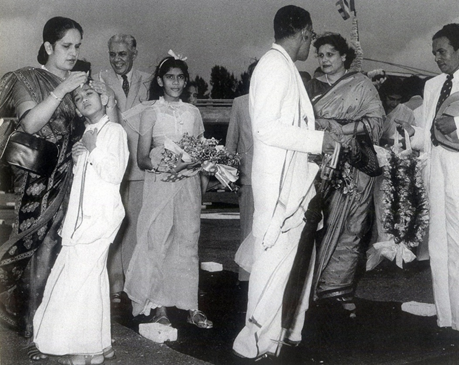
Rajendra
Prasad, President of India visited in June 1959. Bandaranaike went to meet him
at airport, carrying an umbrella. Photograph shows SWRD and Sirima
waiting to greet President Rajendra Prasad at the airport.
DS Senanayake
thought India was going to invade Sri Lanka .He viewed India as an enemy.
Bandaranaike knew better. Bandaranaike brought India and Sri Lanka closer, said
Nissanka.
Bandaranaike
insisted that relations with India had to be based on cordiality and that the issue
of Indian labour must also be settled in a cordial manner. Sirimavo followed this policy in her
relationship with Indira Gandhi. The Sirima Shastri pact” could be considered
the culmination of the discussion started by Bandaranaike.
India helped
a lot during the floods of December 1957. India sent planes, helicopters,
boats, clothes, food, medicine and engineers from Indian army Rescue Unit. Indian
air craft flew more than 150 sorties, and dropped over a total of 600,000
pounds of food and medical supplies.
SWRD
developed a personal friendship with Nehru. That is not surprising. Both came
from ‘aristocratic’ families and had been educated in Oxford and Cambridge,
respectively. They would have felt comfortable with each other. Also they were
in the same boat. Both were struggling to administer intractable, newly independent states. When Bandaranaike died,
India ran its flag at half mast, and declared a day of national mourning. The
messages of condolence when Bandaranaike died
showed that the rest of Asia too, mourned his death, observed HSS
Nissanka.
The
previous UNP government had followed a strong
anti-Communist and pro western foreign policy. UNP was considered
to be a party which had sold Ceylon to America. D.S.Senanayake
permitted US planes to fly over Sri Lanka airspace during the Korean
War. Ceylon had signed two treaties, in
1951 and 1954, agreeing to broadcast Voice of America. Sri Lanka‘s statement at the Japan Peace conference at San
Francisco in 1951 was to
hit Russia, not to help Japan, said Bandu de Silva.
Kotelawala,
the next Prime Minister, took a firm anti-Communist stand at Bandung in 1955. Kotelawala
did not allow Soviet scientists to come to Ceylon to
observe the eclipse of the sun in 1956, but permitted French planes to
fly over Sri Lanka airspace to Vietnam. John
Foster Dulles, US Secretary of State visited in early 1956.
Bandaranaike
changed this. Bandaranaike established diplomatic relations with six communist
bloc countries, while maintaining the cordial relation with the western bloc.
The communist countries were China, Russia, Czechoslovakia, Rumania, Poland and
Yugoslavia.
This brought
benefits. In 1959, China, Poland and Yugoslavia,
gave scholarships. It also brought assistance
from USA through Fulbright grants.
In 1963 or so, University of Peradeniya had 2 visiting professors from USA, Georg
Lerski was one and also two Fulbright undergraduates.
The socialist
ideology started to come in. Many writings from the Communist bloc were
translated and circulated throughout Sri Lanka including rural areas. Books on socialism were available
at low prices in bookshops.
There was also an influx of
films from these communist countries. University of Peradeniya showed many well
made communist bloc films. They came from at least three different communist
countries. From Poland came the films of Andres Wajda.
Bandu de
Silva said that this socialist policy was due to Philip Gunewardene, not SWRD. Bandu compared the MEP manifesto of 1956
with the SLFP manifesto of 1951. The MEP manifesto displays the uncompromising
position of Philip Gunawardena more than the pacifist position of SWRD.
Bandaranaike was the first to open diplomatic relations with the
Peoples’ Republic of China and the Soviet Union. In August 1956 SWRD sent a delegation to
visit China and Russia and report back on the feasibility of establishing
diplomatic relations, said Wiswa Warnapala. Diplomatic relations were approved in September
1956. SWRD informed Britain and USA of his intention to open diplomatic relations
with China and Russia, thus avoiding abrasiveness in implementing foreign
policy decisions, observed Bandu de Silva.
There was a public debate on the ambassadors for these two
countries. The choice was of critical importance. Competent individuals had to
be selected. Wilmot Perera went to China.
Since India was sending Sarvapalli Radhakrishnan to Moscow, SWRD also sent
an academic, G.P. Malalasekera.
Malalasekera had to cover Czechoslovakia,
Yugoslavia, Poland, Austria and Rumania as well.
SWRD established diplomatic relations with China in
1957. Chou en Lai visited in February 1957 during his tour of Asian
countries. He came with Vice Premier He
Long. Chou had been invited to
participate at the ninth celebrations of Sri Lanka’s Independence. Chou en Lai
toured the island. He offered flowers at Dalada Maligawa, climbed Sigiriya,
visited a colonization scheme and met colonists.
Bandaranaike and Chou issued a joint statement. China
gave a loan of 75 million rupees for a period of five years. Scholarships
to study in China were offered. Bandaranaike was
specially honored by Chou en Lai with the gift of a conference hall which later
became the BMICH, said VLB Mendis.
Chinese
culture arrived in Sri Lanka, notably Beijing Opera, followed by other Chinese
dance and drama troupes. Chinese literature, including Mao’s speeches
started flowing into the country, said Nissanka. Sinhala writers translated
Chinese revolutionary literature to Sinhala.
There were cultural exchange programmes. Ceylonese artists
performed in China. In the early 1960s,
there were beautiful Chinese paper cut outs, book marks and other such items,
for sale in Chinese stalls at exhibitions. Reprints of Chinese paintings were also available. The scroll with a black
flying horse was very popular. High quality books on Chinese culture were
available at exhibitions in the 1970s too.
Bandaranaike established
diplomatic relations with Russia In
1957. Wiswa Warnapala found, when he went to USSR as Counselor, in the 1970s that
during Malalasekera’s time, the ambassadors from India and Sri Lanka had had easy
access to the top leadership of the Soviet Union, including Khrushchev,
then General Secretary of the Communist Party. Malalasekera had given talks at
Russian universities on Sri Lanka. Russian magazines had published articles on
Sri Lanka, including some on native Sinhala medicine.
In Sri Lanka, Russia gave scholarships to Sri Lankan students, to
study medicine and engineering at prestigious Russian universities. Sri Lanka exported tea, rubber, coconut oil
and coir products to Russia. Tea was the major export item to Russia.
Sri Lanka signed 3 agreements with Russia in 1958. The most
important agreement was the agreement on cooperation in economic and technical spheres.
Through this agreement Sri Lanka was able to gain Russian assistance in many
fields’. The projects including Oruwala Steel Mill, Modera Flour Mill, Kelaniya
Tyre Factory, Samanala Weva hydro-energy project, Russian aid and technology. Sri Lanka also received heavy machinery such
as tractors, tippers, cranes. Russia helped some housing projects, too.
This agreement
referred to above listed 16 areas of assistance. They were
Kelani Ganga flood control, Malwatu oya dam and irrigation canals, clearing
of jungle land for sugar cane at Kantalai, clearing of land at Hambantota for
cotton, mining of peat at Muthurajawela, pilot plant for extracting flour form
manioc, setting up factory for motor car
tyres and tubes, metal works centre, a
flour milling plant with an annual capacity of up to 70,000 tons of wheat ,
construction of a grain elevator up to
20,000 capacity, plant for building
materials and prefabricated units for house construction, cold storage plant
for 200 tons of vegetable and fruits, assistance
for utilizing by products of salt manufacture, development of fisheries
and assistance for science laboratories in schools.
There was a
flood of Russian literature into the country. There were low priced, well bound
editions of the writings of Marx Engels, Lenin, also Tolstoy, Chekhov,
Dostoevsky, and recalled Nissanka. A three volume version of Das Kapital was
available at less than two US dollars. The Russian novel was studied in the
Sinhala Departments of the University .Modern Sinhala works were translated
into Russian, by Russian scholars who had learned Sinhala in a very short time.
The Sinhala
intelligentsia became aware of Russia’s role in science and technology. The public
also saw plenty of Russian films, including the ubiquitous ‘Cranes are flying’.
Russian film festivals were held in Colombo and University of Peradeniya. I saw ‘Ivan the Terrible’ by Eisenstein at Peradeniya.
The image of Russia as a land of cold winters, regimentation, purges and forced
labor, began to fade, observed Nissanka.
The link with
Russia had another benefit, later on. During the visit of Prime Minister Sirimavo
Bandaranaike to Russia, in the 1970s, Sri Lanka asked Russia to provide a
statue of SWRD. . Lev Kerbel was asked to do it, as he had done many such statues. Kerbel observed that most of the
monuments in Sri Lanka were colonial. He wanted his to be different.
Kerbel said he
wanted to portray SWRD as a people’s leader. He worked on the premise that it
was SWRD who had brought real freedom to people of Sri Lanka. The statue was to
be the posture of dynamic personality striding forward anticipating numerous
vistas of political and social change. That
was the answer to the question, why such a big monument to such a small made individual.
In order to
do the statue Kerbel studied Sri Lanka history, people and culture and also the
political philosophy of SWRD. Kerbel had also spoken to the family, SLFP
politicians and the Left. I had to visit
him at every stage of the work to discuss certain aspects, recalled Wiswa.
The Arts council of Russia had to approve the
clay statue while the political committee too examined it. Deputy Minister for
Foreign affairs, Firubin, and Sudrikov, Head of Asia Department of foreign
ministry wanted it to be a political contribution. Firubin had been to Sri
Lanka and had met SWRD.
Bandaranaike‘s
foreign policy had far reaching benefits. By linking with the Communist bloc,
and also with several other countries in Europe and Asia, Bandaranaike had
expanded the world view of the Sri Lanka public. They were now shown a more
diverse view of the world. This was
something new for Sri Lanka who till then only knew the views of it colonial
rulers. It enabled Sri Lanka to get out
of the orbit of Britain and the Commonwealth. Cultural links with other countries was encouraged. USA, China and Russia started to
communicate directly with the people of Sri Lanka.
However,
Bandaranaike’s far reaching foreign policy was not given the recognition it
deserved until H.S.S. Nissanka took up the subject for his postgraduate study
in the 1970s. The work was published under the title, The Foreign Policy of
Sri Lanka: Under S.W.R.D. Bandaranaike by H. S. S. Nissanka, Department of Government
information, Sri Lanka, 1976.
Nissanka was
one of the first, if not the first, to introduce S.W.R.D. Bandaranaike’s
foreign policy to the world through an academic contribution said Bandu de
Silva. His book remained for a long time, a standard reference work among
students of Sri Lankan foreign policy.
Marshall
Singer of the University of Pittsburgh who supervised the thesis said, he found
it to be an outstanding thesis which added considerably to our understating of
Sri Lanka’s foreign policy of the time. It should be made available to as wide
a group of scholars as possible as a publication”.
In 1956, when
Bandaranaike became Prime Minister, there were only 14 Officers in the Foreign
Service. The first recruits had been personally selected by D.S.
Senanayake. There was no separate Ministry
of Foreign affairs. The Foreign Service
was an extension of the Defence Ministry.
Some officers
lacked any knowledge of international affairs. One officer told Bandaranaike
that Ceylon’s foreign policy was same as Nehru’s. The Foreign Relations Advisor,
who was a top Civil Servant, had pretended he had not heard of the Suez
invasion and Bandaranaike wanted him removed from the Ministry by noon.
Bandaranaike wanted a strong Foreign Servicewith experienced diplomats trained in the art of conducting foreign
policy, which would support a dynamic foreign policy.He saw the importance of having
career diplomats, who could rise up in the service as in other countries.
Bandaranaike removed the Civil Service hold on the Foreign Service. Bandaranaike gave
orders to device a new scheme of recruitment. “I want a scheme to take in
people with foreign experience.” he said. Two batches were selected through a competitive interview, alone. We
had two batches recruited during Bandaranaike’s premiership who were entirely
recruited on the basis of interviews said Jayantha Dhanapala.
Jayantha
Dhanapala observed that Bandaranaike
did this, because he realized that interview skills were vital for a potential
diplomat. Bandaranaike met these two
batches of recruits. That was the first time a Prime Minister had met new
recruits, though that was a common practice in many other countries, recalled
diplomat Bandu de Silva. (Continued)
The annual patriotic taunts and the laments of the majority are heard as the day of reckoning approaches in Geneva. We are shouting ourselves hoarse, complaining that the whole world is ganging up against the brave Sri Lankans, to punish them for eliminating the most brutal terrorist outfit the world has ever seen. It is true that what was achieved in 2009 is something that no other country could do in eliminating terrorism. But does that guarantee peace when the basic grievances that led to civil unrest over the years have not been addressed?
This article is not an attempt to justify violence, untruth or deplorable and unprincipled activities of other countries. Nor is it to devalue the achievements up to 2009. The intention is to open the eyes of my own countrymen to the reality of the hopeless situation facing the nation.
As was mentioned in earlier articles, seeds for racial disharmony were laid during the British colonial period. With their divide-and-rule method, they pitted the majority community against the minorities. This was done by establishing proportionately more schools in the North to ensure a better education, and thereby giving them superior positions in government service. Thus, with the country gaining Independence in 1948, and the Sinhalese gaining the upper hand, the minorities, mainly Northern Tamils, felt disadvantaged. They tried negotiations with the Southern politicians. Naturally, their demands like Ponnambalam’s 50-50 were unjust, but we could have negotiated that. With the watershed political upheaval in 1956, the situation became very volatile. With the Sinhala chauvinists becoming very influential and vociferous, taking politicians virtual hostage to achieve their aims, the minorities were getting increasingly marginalised. The Bandaranaike- Chelvanayakam Pact and later the Dudley-Chelvanayakam Pact were not honoured, without working on them to solve the ongoing disputes. There were several episodes of violence against unarmed members of the minorities during that period.
With the overwhelming electoral victory of the UNP in 1977 (followed immediately by another bout of violence), the majority assumed that whatever grievances of the minorities could be stepped over. Eventually, the Tamils were expelled from Parliament blaming their non-allegiance to the Constitution, leaving them with no forum to air their grievances. The terrorist outfits were taking shape in the North, claiming to be the sole representatives of the oppressed. The Southern leaders ignored the political sensitivities of India, which strengthened the terrorists calling them Freedom Fighters”.
The pogrom of 1983 is the darkest patch in the recent history of our paradise. The unarmed Tamils in Colombo were killed, even burnt alive and their property looted. With the government not making any efforts to curtail the violence for several days, there was a worrying suspicion of state patronage. Many Tamils, who worried about their lives, escaped to Western countries. Naturally, they were warmly welcomed as refugees in those countries as their embassies here were witnesses to what happened in Colombo and elsewhere. From then on, the Eelam war escalated, and it is not necessary to detail here the damage done in both human and material terms over thirty years. Many subsequent peace overtures of the government were rejected by the terrorists, who were determined to establish their own Elam.
After eliminating terrorism in 2009, what actions have we taken to restore lasting peace? Have we had at least belatedly, an ongoing dialogue sans political rhetoric with the Tamil leaders to see what their grievances are and taken steps to address them? Instead, our politicians kept on boasting of their victory”, further arousing separatist tendencies with communal rhetoric, purely to ensure that their success in winning the battles will keep them in power for generations. They were fighting with each other claiming credit for what was achieved.
The Tamil refugees who settled down in Western countries were establishing themselves. Well educated and employed, they are working according to a plan. With their natural energy, determination and ambition, characteristics we used to admire in our Northern countrymen for ages, they are flourishing making the best use of the opportunities provided there. The diaspora is making use of their increasing numbers to influence the local politicians, who are interested in winning their votes, to speak up for them at influential fora. They themselves have taken to politics and entered legislatures.
One can imagine the grudge they must be harbouring against us. They will tell the generations to come about barbaric violence they suffered. That generation, about everyone under 40 years of age at present, will not be informed of terrorism, suicide bombers, child soldiers, killing of innocent villagers, massacre of Samanera monks or bombing of Buddhist holy sites. They will be taught only about the 1983 pogrom and unsubstantiated allegations of civilian killings and the elimination of their freedom fighters” in 2009. In fact, there is a campaign in Toronto schools to have a week declared every year to commemorate the so called Tamil Genocide”. This and subsequent generations in the diaspora will be increasingly hostile to us. Though the LTTE remains proscribed in many countries, they have managed to operate freely with political patronage.
There is no use in shouting ourselves hoarse about the unforgivable crimes committed by the rebels during the war years if future security and peace is the concern of Sri Lankans. We will be facing this formidable force of the diaspora at every international forum in the future. Our diplomats, who are mostly the kinsmen or other acolytes of those in power and grossly unqualified to represent the country, have failed miserably to give the correct picture to those that matter. The whole world is well aware of the atrocities committed by the Tigers. Yet, successive governments have failed to exploit that knowledge to turn the world opinion favourable to us.
Despite all this, many educated members of the diaspora still love this country. Many of my colleagues there are still dreaming of the day they might be able to return after retirement. They keep visiting us regularly, having bought property here. Some have put up hospitals, churches and indulge in other public service ventures to help especially those in the North. So many doctors having achieved high positions in the health services overseas, help the country train our postgraduate doctors.
Sri Lankan politicians are still fighting among themselves without any concrete plans to counteract the allegations being made. Enough ammunition is being provided to the United Nations Human Rights Commission, UNHCR, to work against the country. After agreeing to various conditions imposed over the years, but dishonouring them immediately afterwards, the country has become one of the most untrustworthy to deal with. Those in power keep blaming the previous governments for the international agreements reached, without working for a common stance to face the imminent threat. Guarantees are being given repeatedly to the international community about an impartial judiciary to deal with various allegations emanating from the ethnic war. At the same time, new legislation is enacted to ensure that the opponents of the government are punished by a judiciary handpicked by the rulers. While saying that minority rights are being respected, the Muslims are denied their fundamental right to bury their dead.
It is meaningless to claim that other countries should not interfere with the internal affairs of Sri Lanka, which is a sovereign state. Having signed many international conventions and agreements, we cannot seek self-isolation when the situation suits us. We have allowed our internal matters to be discussed at international fora by failing miserably to solve them ourselves, often due to political expediency. This has forced our own citizens to seek relief from international organisations. If not for the influence and intervention of external sources, by now many countries in the world would have become ruthless dictatorships torturing their own citizens.
If the gravity of the issue was realised, a permanent secretariat should have been established in the foreign ministry long ago, with experienced diplomats purely to conduct an international campaign against the misinformation, and give the correct picture to foreign countries and various organisations that matter.
Our politicians know that they can fool most Sri Lankan voters all the time. But if they believe they can continue to fool the international community in the same way, they are sadly mistaken. Unfortunately, the whole nation will suffer paying for their folly.
Since
the Department of Archaeology began exploration and excavation work in the
Northern areas of the island, it has been the talk of the town. There were some
incidents which stirred up some controversy, starting from arguments about the
identity of these ancient monasteries and the true inheritance of them. One
such highly controversial place was Mullaitivu. Despite the archaeological and
historical evidence, there were disputes about the place’s history. Therefore,
Ceylon Today took you on a voyage to the past of Mullaitvu in one of our
previous heritage articles.
As
a stone element was unearthed at one of the ancient stupas at Mullaitivu,
things were steamed up once again. The ancient stupa at Kuruindi Vihara was
excavated. Then a stone architectural feature, which is known as a yupa gala
was discovered. As soon as it was unearthed, photographs and various
interpretations began circling in social media, print media, and the electronic
media. While the monolith could be instantly and clearly identified as a yupa
gala, certain groups all of a sudden claimed it to be a Siva Linga. As the
monolith had eight faces, the term Ashta-Thara was added by these groups.
Siva
Lingas are not uncommon or new to us. We have discovered a considerable number
of ancient Siva Lingas as well as yoni symbols, which were highly venerated
sacred objects of the Hindus. Thus, our scholars are not unable to identify a
Siva Linga if one was discovered. Also all of these discovered Siva Lingas,
Siva sculptures and all other Hindu veneration objects are well preserved and
loved by all of us and they are considered a part of ‘our’ proud heritage by
Sri Lankan scholars and the public. If such an object was discovered, there is
no reason to not admit it and distort its’ identity.
Moreover,
a Siva Linga cannot be discovered in the centre of an ancient stupa mound. This
has never happened before. Yet we have found a number of yupa stones in ancient
stupa sites. Today we at Ceylon Today will present to you the story of the
Buddhist architectural feature yupa gala and its evolution. Well known Sri
Lankan senior archaeologist, Professor emeritus T.G. Kulatunga who has done
extensive research on the Stupa and Buddhist art and architecture joined us to
share his knowledge about the yupa gala.
What
is a yupa stone?
A
yupa stone is an architectural feature of early Buddhist stupas. In the ancient
text Manjushriwasthavidya, this is called the Gajasthambha. Gaja-padaka is also
an ancient name for the yupa stone,” said Prof. Kulatunga.
Prof.
Kulatunga explained that according to the Divyavadana, once the dome of the
stupa is built, the yupaya was fixed on it. This was fixed on the top of the
ceiling of the topmost relic chamber.
The
yupaya was always an octagon-shaped pillar. The top was curved, the bottom half
which is buried beneath the surface has four sides.”
Prof.
Chandra Wikramagamage in his scholarly work, Stupa, says that the yupaya was an
architectural feature of the stupas belonging to the Abhayagiri sect. This is
because we do not see a yupa stone in every stupa in Sri Lanka,” explained
Prof. Kulatunga.
The
antiquity of the concept of the yupa stone goes back to pre-Buddhist times in
India. It was an object used for veneration by Vedic Brahmin priests; it was a
sacrificial pillar. Animals who were supposed to be sacrificed were tied on to
this pillar. Therefore, the yupaya was a pillar dedicated to the gods.”
Although
scholars believe that the yupa could be having a pre-Buddhist origin in India,
in his scholarly work The Ceylon Stupa, Prof. Senarath Paranavithana says that
there is no evidence to say the Sanchi had a yupaya, nor at stupas in Amravati
and Nagarjunakonda. Therefore, he says that the yupaya may not have been a
common feature among all Buddhist stupas.
He
further says that an octagon pillar similar to the one we know as yupaya today
was placed on the top of the ancient stupas in Java. He also says that yupaya
could be the stone pillar known as the Indra-Kilaya by today’s Buddhist monks.
Dr.
Roland Silva in his highly acclaimed work, Thupa, Thupaghara and Thupa-Pasada,
says that, Basing himself on a passage in the Divyavadana, Paranavithana uses
the term yupa – a Vedic sacrificial pillar – for the stone inside the
devathakotuwa, which is also called the danda or chattra-danda, the equivalent
of which is the yasti.”
According
to Prof. Wickramagamage, the yupa was visible between the chathra and the
harmika. When the chathra evolved into the koth karalla, the yupaya became the
devathakotuwa. In ancient dewathakotuwa there can be seen eight deities who are
to be known as the ashta-dik-pala. He further states that the yupaya was a
symbol of Buddha.
What
was this called in ancient times?
An
inscription at Vessagiriya mentions the term karawidaka. The inscription is as
follows; Mahanaka raja pitanika chethehi karawidaka kotawaya chatha aruwaya…
which means King Ila-Naga (38 – 44 CE) built the koth karalla and the chathras
of Pitanika Stupa. This is how Prof. Paranavithana translates this. According
to him, karawidaka means karali,” explained prof. Kulatunga.
That
cannot be accepted. At the terrace of Ruwanweliseya, remains of a yupa stone,
was found. It is the bottom half of the pillar. There is an inscription on it
which says that the pillar is a karawidaka tabi. Tabi means tamba or pillar.
Thus, if we compare the Vessagiriya inscription and this, the term karavidaka,
hints that it means the stone pillar or the yasti which we know as the yupa
stone today. So we can assume that during that time this stone pillar was known
as karawidaka,” Prof. Kulatunga enlightened us.
Why
does yupa stone have eight sides?
Prof.
Kulatunga explained to us that various pre-Buddhist deities were adopted into
the Buddhist culture and some of them were considered as guardian gods of
Buddhism.
We
have ashtadikpala deities; which means, deities representing each eight
direction. So the pillar had eight faces. Each side represents each deity. The
yupa stone was dedicated to these gods, who were considered as protectors of
Buddhism and the stupa.”
After
the yupa stone was not in use…
The
Stupa style evolved with time. Many of its early architectural features changed
into new features. So did the yupa stone,” said Prof. Kulatunga.
In
this process of evolution, the upper half of the stupa changed and instead of
the yupa gala, devathakotuwa was developed. In the devathakotuwa there are
eight deities facing the eight directions.”
When
did koth karalla evolve?
Based
on archaeological evidence we believe that it was king Kanitta-Thissa (164 –
192 CE) who was the one who first added a koth karalla to a stupa.
Our
assumption is based on an inscription we found at Deegavapi. A golden casket
was discovered here and it had a koth karalla and also the name of the king,”
said the professor. We have evidence to believe that small stupas developed
the koth karalla, while larger stupas still had yupa stones on them. Later they
evolved into the dewathakotuwa.”
Other
evidences of yupa stones
–
Two massive yupa stones at Abayagiriya.
–
Mihindu Seya – a casket was found by Prof. Paranavithana in 1951. This has a
yupaya.
–
Daliwalakota Vehera – hundreds of caskets were found here. They all have
yupayas. These were found by then Commissioner of Archaeology Dr.
Godakumbura
Prof.
Paranavithana says that the remains of yupas found at Abhayagiri and Mirisveti
are massive in size and that they would have weighed more than twenty tons at
their fullest.
Apart
from these examples there are yupa stones at Lahugala, Manikdena, Yatala, and
many other ancient Buddhist stupa sites.
Sri
Lanka is a country that practiced religious harmony for more than 15 centuries.
These are not just words. Archaeological and historical evidence proves this.
Yet, due to some unfortunate recent incidents and well-planned political
stunts, starting from the shrewd British rule, ethnic and religious harmony of
the island is destroyed. ‘Divide and Rule’ was their strategy. And we were
fools to fall into their traps. We still are in it.
Fighting
over the identity of cultural heritage is also a result of games played by
politicians for their own good. Once the dispute between the two main
ethnicities of the island is over, once understanding and harmony bonds these
two communities, politicians and their manipulators will be deprived of their
power. Therefore, it is the responsibility of us to act wisely. Scholars, media
and the public should act wisely and sensibly.
Let’s
not allow ‘them’ to distort our cultural heritage and to nourish ‘their’
vicious existence. Let us not fall into prey. Scholars, please step forward and
share your knowledge and enlighten the public. Media, be responsible, ethical,
and wise. Use words carefully as words can be very dangerous. Public, be wise
and rational.
A
concerted effort to preserve our heritage is a vital link to our cultural,
educational, aesthetic, inspirational, and economic legacies – all of the
things that quite literally make us who we are.”
–
Steve Berry
By Ama H. Vanniarachchy | Published: 2:00 AM Feb 27 2021
India has said the update lacked ‘objectivity and impartiality’.
United Nations human rights chief Michelle Bachelet. Photo: Twitter/UNGeneva
New Delhi: United Nations Human Rights commissioner Michele Bachelet raised the farmers’ protests, sedition charges against journalists and curbing of social media in an update to the Human Rights Council on Friday, February 27.
In her oral update, Bachelet had raised concerns about human rights issues in 50 countries, ranging from Spain to Sudan.
In the part about India, she observed that farmers’ protests highlight the importance of ensuring laws and policies are based on meaningful consultations with those concerned”. She hoped that the dialogue efforts by the farmers and Centre will lead to an equitable solution to this crisis that respects the rights of all”.
She also stated that sedition charges on journalists and activists for reporting or commenting on protests and attempts to curb freedom of expression on social media are disturbing departures from essential human rights principles”.
At least three BJP-ruled states have filed FIRs against journalists for sharing unverified” news about the tractor rally on January 26. An FIR was also filed against The Wire, its founding editor Siddharth Varadarajan and reporter Ismat Ara for reporting on the allegations made by the family about the death of Navreet Singh at the tractor rally on January 26. An independent journalist, Mandeep Punia, was arrested at Singhu border for reporting on the farmers protests.
The Centre had also asked social media platform Twitter to block tweets and handles which had been actively posting on the farmers’ protests. The accounts included that of magazine Caravan, the farmers’ protest account Kisan Ekta Morcha and several independent journalists and activists.
Bachelet also appreciated the experience of a pilot programme from Kerala where officials, civil society organisations and community leaders have used innovative technology to ensure that the voices of marginalized and poor people are heard, and their needs addressed, in the pandemic response”.
Police personnel placed iron nails near the barricades in an attempt to stop farmers from crossing Tikri border during their agitation against the new farm laws, in New Delhi, Monday, Feb. 01, 2021. Photo: PTI
India’s permanent representative to UN, Indra Mani Pandey stated that Indian government had set a target of doubling farmers’ income by 2024. The purpose of enacting three Farm Acts is to enable farmers to realise better price for their produce and enhance their income. It will particularly benefit small farmers and offer more choices to those farmers who opt for them. The Government has shown utmost respect for protests by farmers and has remained engaged in dialogue with them to address their concerns,” he said.
Pandey said that the Indian government was perplexed to note some of the comments by the High Commissioner”. She appeared as oblivious of the enormous efforts made by my Government to address the challenges, as indeed of many of the factors driving these challenges. The unprovoked violence on our Republic Day in the name of farmers’ rights, apparently, left her unmoved,” he added.
Bachelet also spoke on the situation in Kashmir, noting that restrictions on communications and clampdowns on civil society activists remain of concern”. She observed that despite the restoration of 4G access for the first time since August 2019 in Kashmir, the communications blockade has seriously hampered civic participation, as well as business, livelihoods, education, and access to health-care and medical information”.
Raids against human rights defenders in October and November exemplify the continued restrictions on civil society, and resulting impact on the rights of the people of Kashmir to impart and receive information, and to engage in free, open debate on Government policies affecting them,” she noted.
Across the border, Bachelet said that there had been students’ protests in Pakistan Occupied Kashmir due to disruptions in internet access.
Pandey, meanwhile, claimed that the constitutional changes in status of Jammu and Kashmir were welcomed by the people of India, including people of Jammu and Kashmir”.
He said that India has restored grassroots democracy, through District Development Council (DDC) elections, and provided good governance through the ‘Back to Village’ initiative”. There has been a significant decline in terrorist attacks and progressive national laws have been extended to Jammu and Kashmir to enable the people there to enjoy the same rights as the people in rest of India,” he added.
Lashing out at the UN human rights chief, Pandey stated, Her indifference to terrorism is, of course, not new”. Bachelet’s office has issued repeated observations about the human rights situation in Jammu and Kashmir following the complete lockdown in the state after August 5, 2020.
Objectivity and impartiality have to be the hallmarks of any Human Rights assessment. We are sorry to see that the High Commissioner’s oral update is lacking in both,” said the Indian diplomat.