Veemansa Initiatives’ discussion
on ‘external debt situation in Sri Lanka; Are we heading for a resolution or
crisis?’. The Governor Central Bank is
confident all debt obligations will be met.
–
The Central
Bank Governor affirms the government’s commitment and ability to honor all debt
obligations.
–
Sri Lanka to
mobilize domestic financing to meet countries investment requirements.
The
measures to increase foreign currency inflows and restrict outflows to
continue.
A
Low-Interest regime and monetary expansion is sustainable in the prevailing
conditions of suppressed demand and the absence of inflationary pressures.
Doomsday
predictions prompted by forthcoming UNHRC Session on Sri Lanka
Colombo, 28
February 2021- The inaugural webinar of the Veemansa Initiative, a newly launched
policy development and advocacy think tank on the external debt situation in Sri Lanka
was held on 24th Wednesday, February 2021. It highlighted
several challenges facing the country’s economy and concluded with valuable policy
responses from expert panelists and participants.
Delivering the keynote address on the topic, External Debt Situation in Sri Lanka: Our Route to
Resolution, the Governor of the
Central Bank, Deshamanya Professor W D Lakshman said that despite the COVID-19
pandemic and its impact Sri Lanka will maintain its unblemished records of debt
service. The following are the key point
of the Governor’s speech.
COVID-19 pandemic and its wide-ranging
impacts have compelled the country to rethink its economic strategies. In the
past, we borrowed from multilateral agencies, initially on concessional terms, and
over time, our foreign debt had increased slowly but steadily. While graduating
to the middle-income country status, Sri Lanka has become less eligible for
concessionary funding and had to move increasingly into commercial borrowing to
finance its investments as well as to meet its consumer imports and debt
servicing obligations,”
The Government has decided that reliance on
foreign borrowings, particularly commercial borrowings, should be phased out
gradually to reduce the burden of debt service. The Government is of the view
that the country’s development projects should be as far as possible domestically
oriented, both in terms of the implementing parties involved and the funding sources,
wherever possible. The medium-term objective is to reduce the foreign to
domestic ratio in Sri Lanka’s public debt to 33:67 from the current level of
43:57. Although this could have been done during the 2nd half of the
last decade, the foreign debt volume has increased from $ 24.6 billion in 2015
to $ 34.7 billion in 2020.
This will no doubt require some austerity in
terms of mostly cutting down of import of non-essential consumer goods and
enhancing all forms of foreign currency inflows. Due to these measures, the
current account deficit of the balance of payments (BOP) in 2020 is estimated
to have reduced to $ 1 billion compared to $ 1.8 billion in 2019. This tendency will strengthen further in 2021
and the target is to achieve a surplus in the current account in 2021. These
inflows to the current account will be complemented with FDI on the Capital
Account. The Colombo Port City and
Hambantota Industrial Zone are expected to be major contributors of FDIs.
The necessity of adopting such policies have
become very important in the current conditions in the global financial markets
after the outbreak of Covid19 pandemic. Particularly for Sri Lanka, the
prospects of external financing have been constrained by risk aversion and
volatility in global financial markets,”
While stability in the price level, the rate
of interest rate and rate of exchange to a politically stable and economically
feasible level is desirable when conflicts emerge on these objectives, required
trade-offs have to be worked out. The
production in the Sri Lankan economy remains below the potential and demand-led
inflation pressures remain weak in the aftermath of the pandemic. There are
possibilities for monetary expansion within reasonable limits to meet the
government’s expenditure to meet COVID-29 related social protection needs as
well as capital expenditure. The limits here are dictated by domestic inflation
and changing external reserve position. The empirical research carried out in a number
of countries including Sri Lank has failed to establish a direct relationship
between changes in money supply and price level.
Despite these challenges, and adverse predictions
by many parties who projected doomsday scenarios, the Central Bank of Sri Lanka
affirms to all foreign stakeholders, that Sri Lanka remains committed to meet its
debt obligations, as it has done impeccably in the past and it has the ability
to so in the future. Of around US
dollars 3.7 billion to repay in external debt in 2021, we have already paid a
considerable chunk in the first two months of the year.” the Governor said.
The Governor also indicated that gloom and
doom predictions are seemed to have coincided with the UN Human Rights Council
Sessions where a resolution is moved against Sri Lanka by a group of western
countries. The governor has outlined a number
of measures that the government and the Central bank has undertaken to increase
non-debt creating foreign currency reserves.
The keynote speech of the governor followed by
a discussion among an eminent panel of experts chaired by Prof. Sirimal Abeyratne – Head of Department
of Economics, University of Colombo. Mr.
Sumanasiri Liyanage – Senior Academic, Formally of the University of Peradeniya
and Sanasa Campus, Dr. Nishan de Mel-Head of Verite Research, a renowned think
tank, and Dr. Ravi Liyanage Chairman Raigama Group, participated in the panel
discussion.
The experts also discussed the need to
create a conducive environment for investment through tax reforms as well as
legislative reforms, thereby making Sri Lanka a destination of promise for
investment, domestic and foreign alike. The panelists agreed that maintaining
the interest rates low is conducive to post COVID -19 economic recovery. In this context, a panelist suggested a more
gradual and phased approach to the transition from external financing of
government debt to predominantly domestic financing.
Over 150 participants from Australia, China, India,
Philippines, US, etc. joined online sharing experiences on a range of issues
that included import substitution, fiscal gap, the debt obligation for this
year, non-debt creating financial measures, that the focus of the government in
the short and medium-term.
Veemansa initiative has made provisions to make available the
recorded session on its website. https://veemansa.org. .
Dr. Hans Wolfgang Schumann is a German Buddhist. He is a well known Buddhist scholar and chronicler of the history of Buddhism in Germany.
Born on January 31, 1928, Dr. Hans Wolfgang Schumann died on June 26th, 2019 in Bonn.
In a seminal article on the state of Buddhism in Germany, ‘ Buddhism and Buddhist Studies in Germany’, Maha Bodhi Journal, Vol. 79, (February – March 1971) page 99, Dr. Schumann raises a significant question as follows:
Shouldn’t Germans be grateful to Sri Lankan Buddhist Societies for giving organizational help at several critical periods of Buddhism in Germany and thereby helping in saving the flame of the Buddha Dhamma in Germany” ?
Dr. Hans Wolfgang Schumann, answers as follows: another important Buddhist Centre is the Buddhist House’ founded by Paul Dahlke in Berlin – Frohnau in 1924. It survived World War II in a dilapidated condition and probably would have been auctioned and dismantled if the Ceylonese ‘German Dhammaduta Society’ (founded in 1952) which inherited a large sum of money from a German Buddhist had not come to its rescue. The GDS purchased the house in 1958, renovated it, furnished it with additional rooms, a well stocked library and Ceylonese Bhikkhus (monks) sent from the GDS took charge of regular lectures and meditation courses.
Dr.Schumann further states …..Asian Buddhist mission was successful. The organizational help which Asian Buddhist Societies, in particular Ceylon, in several critical periods had extended saved the flame of the Dhamma in Germany. Isn’t this for the Germans reason enough to be grateful? ”
UNP Deputy Leader Ruwan Wijewardena says that the leader of the Sri Lanka Muslim Congress Rauff Hakeem is directly responsible for the split in the party.
He was addressing a meeting of UNP district representatives.
The Polonnaruwa District Representative Meeting of the United National Party was held today and the party members expressed their views as follows.
Meanwhile a meeting of UNP representatives in the Trincomalee district was held yesterday.
By Lakshman I. Keerthisinghe Courtesy Ceylon Today
I detest that man, who hides one thing in the depth of his heart and speaks forth another”– Homer- Illiad (Deciet)
The United States is fully committed to the universal protection and promotion of human rights”
– Antony Blinken- US Secretary of State -Video Message to 46th UNHRC Session in Geneva
US Secretary of State Antony Blinken addressing the 46th UNHRC Session stated: We encourage the Council to support resolutions at this session addressing issues of concern around the world, …the lack of accountability for past atrocities in Sri Lanka.” He also announced the US will seek election to the UN Human Rights Council for the 2022-24 term. Being surprised by this new stance of the Biden administration, the remark on alleged ‘lack of accountability in Sri Lanka’ as alleged by Blinken raises the issue of lack of accountability by the US for its past grave atrocities in global human rights abuses. Sri Lanka has already taken meaningful steps in appointing Lessons Learnt and Reconciliation Commission (LLRC), Office of the Missing Persons and Reparations Commission and several other institutions to investigate any such allegations and take appropriate action.
As stated by Lord Naseby in the UK Parliament the statement that 40,000 deaths occurred during the last stages of the conflict has been disproved with evidence but Commissioner Bachelet repeats these unsubstantiated charges against Sri Lankan Armed Forces baselessly.
A horrible video depicting LTTE child soldiers being trained by Adele Balsingham presently based in UK tying cyanide capsules around the necks of innocent Tamil children forcibly removed from parental custody by the brutal terrorists is presently circulating in social Media. Further evidence produced by Lord Naseby indicates the humanitarian manner in which Sri Lankan troops assisted civilians escaping from the LTTE human shield to protect their terrorist cadres in combat. It was proved the LTTE massacred escaping civilians from the LTTE human shield.
Sometime ago responding to such adverse remarks of then US Ambassador Sisson, Sri Lanka’s President then Defence Secretary Gotabaya Rajapaksa said, The job of an ambassador was to strengthen relations between two countries and not to ruin them by giving lessons in good governance in the host country.”
US human rights violations
Hence, this article attempts to investigate the accountability of the US in its own record of global human rights in addition to recent racist brutal police shootings of Blacks in US and other human rights violations in the form of cowardly drone attacks killing large numbers of innocent women and children in Pakistan, Afghanistan and other Muslim countries in the world. Subsequent to the 9/11 attacks in the US by the Al Qaeda, US appears to be engaged in a witch-hunt indiscriminately murdering human beings all over the world in acts of unwarranted revenge targeting innocent Muslims. American website Policymic reported thus: ‘Meanwhile, U.S. drones are killing children and terrorising families abroad. Earlier this year, the Bureau of Investigative Journalism found that 176 children have been murdered in Pakistan alone. And along with drone attacks, an average of 4.8 children is killed per day in Afghanistan where earlier this year, a U.S. sergeant is reported to have killed nine children. Will these murders be deemed worthy of our thoughts and prayers, or even our news headlines?
Thus before talking about fictitious past atrocities committed by Sri Lanka we invite Blinken to first put his own house in order.
Antony Blinken are you aware of the human rights violation in the form of atrocious torture committed by US troops in Vietnam, Guantanamo Bay and other prison camps maintained by the US? The US Government adopted American Service-members’ Protection Act (ASPA) to protect any US citizen from appearing before International Court of Criminal Justice (ICJ). The ASPA is a United States federal law introduced passed in August 2002 by Congress. The stated purpose was to protect United States military personnel and other elected and appointed officials of the US government against criminal prosecution by an international criminal court to which US is not a party.” When attempting to falsely implicate our heroic soldiers in alleged past atrocities with the UN Commissioner applying universal jurisdiction, is the US prepared to annul the ASPA and produce the US servicemen before the ICJ for necessary reprisals?
In conclusion, the painful truth behind the deceitful American concerns about human rights violations in Sri Lanka is to bully the present regime in to submission so as to make Sri Lanka a power base in Asia subservient to the edicts of the US Government and thereby gain a foothold in the Indian Ocean region by planting the US troops in our peaceful motherland. Homer’s statement quoted above comes to mind.
The writer is an Attorney-at-Law with LLB, LLM, MPhil.(Colombo)-keerthisinghel@yahoo.co.uk
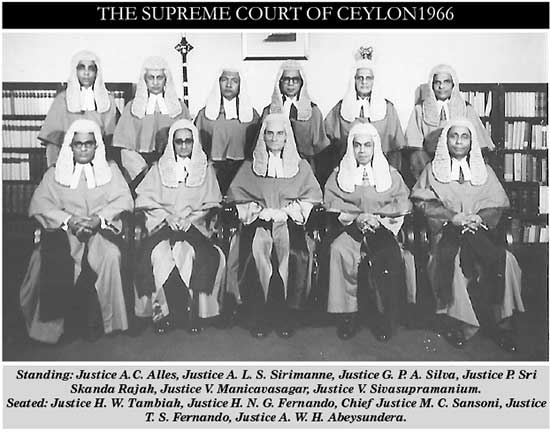
I grew up, spending my childhood, adolescence and early adult life, in the home of a judge who ended his judicial career as head of the country’s highest court. I also had the enviable experience of serving as his private secretary sometime between my graduation and entry into the profession. The life of a judge of that time, as I observed it, is perhaps best described in the words of Justice Michael Kirby of the High Court of Australia. The regime imposed on a judge, he said, is monastic in many of its qualities”. Lord Hailsham, a former Lord Chancellor, described the vocation of a judge as being something like a priesthood”. Sir Winston Churchill considered that A form of life and conduct far more severe and restricted than that of ordinary people is required from judges”.
While judges did not isolate themselves from the rest of society, or from school friends and former colleagues in the legal profession, they rarely, if ever, socialized with politicians. They declined to perform the quasi-executive function of serving on commissions of inquiry. In that relatively calm and stable economy, their salaries were rarely increased. They drove, or were driven, to Hulftsdorp in their own cars. They lived in their own homes, except for the Chief Justice who was provided with an official residence.
In the early 1960s, when I was admitted to the Bar, and began practising before the courts of this country, any suggestion that a judge or magistrate might be corrupt would have been so preposterous that, in fact, it was never heard. A strong tradition of integrity underpinned the judiciary at every level. At a time of immense change, both political and social, the judiciary remained constant in its commitment to equal justice under the law.
Of course, the judiciary had its share of problems and its critics. The trial rolls were long; the backlog in the appellate court was enormous. The rules of civil and criminal procedure were Victorian. I recall expressing the exasperation of a starry-eyed young lawyer when, writing the annual report as honorary secretary of the Bar Council, I described the judicial system as an antique labyrinth with tortuous passages and cavities through which the potential litigant must grope, often blindfolded, in his search for justice. From below the Bench, some of the judges seemed short-tempered and discourteous; some seemed lazy – one, in particular, appeared to fall asleep from time to time; and not every judge appeared to be learned in the law. However, it was unthinkable that a judge could be corrupt.
The emergence of judicial corruption
It was some ten years later, in the 1970s, when I was serving as Permanent Secretary to the Ministry of Justice and also, ex officio, as a member of the Judicial Service Advisory Board, that I encountered, for the first time, a complaint that a magistrate had accepted a bribe. The complaint appeared to be true. When confronted, the magistrate resigned his office. It was also during this period that I saw and experienced, with considerable unease and sadness, how some serving judges could demean themselves, and the sanctity of their office, in the pursuit of preferential treatment from the executive branch of government. When some of these efforts proved to be rewarding, it was difficult not to become sceptical. It was time for the illusions of youth to disappear.
Conventional bribery
The picture changed dramatically in the 1980s and in the decades that followed. The civil, criminal and appellate procedural reforms of the 1970s which we introduced were repealed and the Victorian laws revived. Thereafter, many a litigant or accused person began to find it more economical to secure the disappearance of a case record or the absence of a witness than continue to retain counsel for prolonged periods when no progress was made in his or her case. Complicated procedural steps meant several gatekeepers requiring payment to facilitate movement to the next stage of judicial proceedings.
In a direct mail survey in 50 Sri Lankan judicial stations conducted by the Marga Institute in 2002, civil litigants, virtual complainants, and remand prisoners reported to having paid bribes to lawyers’ clerks, court clerks, police officers and fiscals. Lawyers reported hundreds of incidents of bribery, the beneficiaries being the same. Several Judges admitted to being aware of such acts of bribery, and added members of the legal profession to the list of beneficiaries. Finally, the Judges identified at least five of their own brethren as bribe takers, three of them being in connection with the delivery of judgments. The report of that survey was published by the Marga Institute under the title: A System Under Siege; An Inquiry into the Judicial System of Sri Lanka”.
Global phenomenon
Judicial corruption was not a Sri Lankan phenomenon. In Bangladesh, a national household survey revealed that 63% of those involved in litigation had paid bribes to either court officials or the opponents’ lawyer. In Tanzania, a commission of inquiry reported several instances of judicial officers accepting bribes to grant injunctions, reduce sentences or dismiss cases; accepting bribes from advocates to give preferential judgments; and colluding with auctioneers to share the receipts from selling property belonging to litigants. In Uganda, the Chairman of the Judicial Service Commission reported several complaints of judicial officers taking bribes to give bail or judgment. In Argentina, 57% of those polled said that they felt corruption was the main problem with the judiciary. In Honduras, three out of four polled believed the judiciary was corrupt. According to the Geneva-based Centre for the Independence of Judges and Lawyers, out of 48 countries covered in its annual report for 1999, judicial corruption was pervasive in 30 countries.
Undue influence
Corruption in the judiciary is not limited to conventional bribery. An insidious and equally damaging form of corruption arises from the interaction between the judiciary and the executive, as well as from the relationship between the judiciary and the legal profession. For example, the political patronage through which a judge acquires his office can give rise to corruption if and when the executive makes demands on such judge. Similarly, when a family member regularly appears before a judge, or when a judge selectively ignores sentencing guidelines in cases where particular counsel appear, the conduct of the judge would give rise to the suspicion of corruption. So would a high rate of decisions in favour of the executive. Indeed, frequent socializing with particular members of the legal profession, the executive or the legislature, is almost certain to raise the suspicion that the judge is susceptible to undue influence in the discharge of his duties.
The blurring of a critical relationship
In Sri Lanka, a dramatic change in the relations between the judiciary and the executive occurred with the advent of the Executive President, the ultimate source of power and patronage. For example, in 1983, a Judge of the Supreme Court described to a parliamentary select committee his relations with the then President:
I want to say this. My relations with His Excellency the President have been very cordial. In fact, I know him. I have only met Mrs Bandaranaike for a few seconds in my life. But I have known the President from 1948 and I have had very cordial relations with him. We had a common interest in history. I admire his culture, his refinement, and it was never my intention to do anything harmful to him personally. We have met at several functions at President’s House, at private dinners, and in 1981 he invited me and my wife for his birthday party at President’s House. We were very honoured. My community, my family, are his traditional supporters”.
The same Judge described how he enjoyed the hospitality of a Cabinet Minister:
Thanks to the hospitality of the Honourable Minister of Lands, we were all sent on that wonderful trip of the sites. We got younger. You know, we all went and it was a delightful trip. I wrote and told you about it. Lovely time, delightful! We were hoping we could make it a sort of annual trip.”
He also spoke about a prominent Opposition parliamentarian:
His step-brother, Mr Michael Dias, has been a friend of mine since he was my tutor in the Lex Aquilia at Cambridge University in 1945-48. However, my friendship with Michael Dias has brought me no advantages. The two brothers are as different as chalk and cheese. I think in 1973, Honourable Minister of Lands, your nephew Upul had that tragic death by drowning. I met you in the funeral house. That was a time when he was turning Hulftsdorp upside down. We had a conversation about that. I think I told you in plain, blunt, Anglo-Saxon what I thought of him. You may remember this. I wish to say that in the 1977 election nothing gave me greater pleasure than listening all night to the Dompe result.”
The blurring continues
The blurring of the critical relationship between the Judiciary and the Executive continued under later Presidents. For example, in 2004, on the eve of the general election, a Chief Justice, reputed for his political sagacity and legal acumen, participated in a religious ceremony in a Buddhist temple together with a Cabinet Minister and several candidates of a particular political party. The television camera constantly focused on the Chief Justice, who was seated at the feet of the Minister (who appeared to be on an elevated seat) during the long programme. Several years after he had left office, the same Chief Justice publicly apologized for not having given the right judgment in a politically sensitive case. I am very sorry. I am asking the whole country: forgive me”, he was reported as having said (Sunday Times, 26 October 2014).
In 2011, barely weeks after his retirement, another Chief Justice was appointed as an Adviser to the President. When a judge, and a Chief Justice at that, decides to take a great leap from the Supreme Court to the Presidential Secretariat to serve the executive branch at its core, the alarm bells must surely begin to ring. The country was entitled to know, but was not told, whether the Chief Justice had sought this position, or whether the Head of the Government had offered it to him, when and why.
In 2014, yet another Chief Justice travelled from Colombo to the deep south, to join the then President, his immediate family and his siblings, in celebrating the Sinhala and Hindu New Year rituals at the President’s ancestral home”. Several pictures that were published showed the participants, including the Chief Justice, attired in white and facing south” feeding milk rice to each other and engaging in other traditional transactions in what was essentially a family occasion.
In the same year, the same Chief Justice joined the President’s entourage (which included Ministers and Members of Parliament) on an official visit to Italy and the Vatican. It was the first occasion when a Chief Justice had accompanied a political leader on a state visit abroad.
Such conduct too, was not peculiar to Sri Lanka. A former President of the Supreme Court of Jordan, speaking at a conference in 1999, provided several illustrations from his own personal experience of this form of judicial corruption. He described how judges were pressurized by executive authorities to render judgment contrary to law; received benefits from the government in the form of gifts in money or in kind; and offers of employment to the judges’ children. He also spoke of victimization when the decision did not accord with the wishes of the executive.
The corrupting influence arising from the interaction between the judiciary and the executive has been documented by a Nigerian jurist. For example, he describes how a newly appointed judge, still undergoing training, was flown by a presidential jet to try a sensitive case of national importance and delivered his judgment by midnight; and how a judge trying a case of an opposition leader said he would need time to consult others before delivering his judgment. In Costa Rica, 54% of those polled believed that judicial decisions were subject to external pressures”.
Combating Judicial Corruption
In 1997, after almost two decades in academia, I was persuaded by a former colleague at the Commonwealth Secretariat to come down from the ivory towers” to work at Transparency International in Berlin. That non-governmental organization was then in its formative years, and one of its principal objectives was to identify sectors that were vulnerable to corruption, and then to formulate strategies to combat such corruption. It was there that credible evidence began surfacing of corruption in judicial systems. How should this phenomenon be addressed? Independence had always been considered to be the single fundamental requirement for a national judiciary. Judicial independence is not a privilege of judicial office, but an essential pre-requisite for the protection of the people. How real was that protection if the evidence that was surfacing was an accurate reflection of the state of the judiciary? Was judicial independence being traded for money or other benefits? Was adherence to the principle of judicial independence, by itself, sufficient to ensure the delivery of justice? Was it now necessary to formulate and implement a concept of judicial accountability?
Judicial Accountability
Accountability was not a new or novel concept. It is a constitutional requirement in a society based on the rule of law and democratic principles of governance that every power holder, whether in the legislature or the executive, is, in the final analysis, accountable to the people. Was there any reason why the judiciary, which is entrusted by the people with the exercise of judicial power, should not, individually and collectively, be accountable for the due performance of its functions? The challenge, however, was to determine how the judiciary could be held to account in a manner that was consistent with the principle of judicial independence. My colleague, the late Jeremy Pope, and I agreed that these were issues that were best resolved by the judges themselves.
Judicial Integrity Group
For that purpose, we initiated discussions with a representative group of ten Chief Justices from Africa and the Asia-Pacific region who agreed to meet under the auspices of the United Nations. At that preparatory meeting in Vienna in April 2000, which was chaired by Judge Weeramantry, Vice-President of the International Court of Justice, the Judicial Integrity Group (as this group of Chief Justices is now known) agreed that judges should be accountable to the community they serve through their absolute adherence to a set of judicial values, and that a statement of core judicial values should be capable of being enforced by the judiciary without the intervention of the executive and legislative branches of government. The Group believed that transparency at every critical stage of the judicial process will enable the community, especially through its legal academics, civil society and a free media, to judge the judges.
The Bangalore Principles of Judicial Conduct
At the request of the Group, I prepared an initial draft statement of principles of judicial conduct, drawing on rules and principles already articulated in national codes of conduct (wherever they existed) and in regional and international instruments. Over the next twenty months, that draft was widely disseminated among senior judges of both common law and civil law systems in over 75 countries. In November 2002, at the Peace Palace at The Hague, a revised draft was placed before a Round Table Meeting of Chief Justices drawn from both the civil and common law systems, at which Judges of the International Court of Justice also participated. The final draft that emerged from that meeting – the Bangalore Principles of Judicial Conduct – identifies six core values of the judiciary: Independence, Impartiality, Personal Integrity, Propriety, Equality, and Competence and Diligence.
In 2006, the Bangalore Principles were unanimously endorsed by the UN Economic and Social Commission (ECOSOC) in a resolution which requested Member States to encourage their judiciaries to develop rules with respect to the professional and ethical conduct of judges based on the Bangalore Principles. Sri Lanka has ignored that request.
Commentary and Implementation Measures
In 2007, at the request of ECOSOC, the Judicial Integrity Group developed a 175-page Commentary on the Bangalore Principles which has since been published by the UN and by national judiciaries in several languages. Sri Lanka has failed to take note of that.
In 2010, the Judicial Integrity Group agreed on Measures for the Effective Implementation of the Bangalore Principles. That statement describes action required to be taken by the judiciary, and the institutional arrangements to be established by the State to secure judicial independence and accountability. Among the latter is an independent appointment mechanism with both judicial and non-judicial members to ensure that persons selected for judicial office are persons of ability, integrity and efficiency. Through the recently enacted 20th Amendment to the Constitution, Sri Lanka has rejected that requirement.
Conclusion
The Bangalore Principles now provide the judiciary with a framework for regulating judicial conduct. It is the global standard. These Principles have been the model for codes of judicial conduct from Belize in the Caribbean to the Marshall Islands in the Pacific, from Tanzania to the Philippines, from Bolivia to Jordan. They were motivated by the need to address the phenomenon of judicial corruption. Many judiciaries across the world have profitably employed them to achieve that objective. However, the Sri Lankan Judiciary has chosen not to formulate or to implement a code of judicial conduct to regulate itself.
Director-General of Health Services today (February 28) confirmed 07 new COVID-related fatalities in Sri Lanka.
The new development has pushed the country’s death toll from the virus outbreak to 471, Department of Government Information said.
Details of the deceased are as follows:
01. A 56-year-old man from Kurunegala area – He was under medical care at the Kurunegala Teaching Hospital at the time of his passing on Friday (February 26). COVID-19 infection and acute diabetes were recorded as the cause of death.
02. A 55-year-old man from Anuradhapura area – He has passed away at his home on Friday (February 26). The cause of death was recorded as acute complication in respiratory system due to COVID-19 infection.
03. A 59-year-old man from Gampaha area – He was transferred from Dompe District Hospital to National Institute of Infectious Diseases (NIID) after testing positive for the virus. He died today due to COVID pneumonia, blood poisoning and liver infection.
04. A 79-year-old woman from Rukgahawila area – She was moved to Homagama Base Hospital after testing positive for the virus at Wathupitiwala Base Hospital. She has fallen victim to COVID pneumonia and shock due to blood poisoning on Saturday (February 27).
05. A 51-year-old man from Demalagama area – Upon testing positive for the virus, he was transferred from Colombo North Teaching Hospital to Homagama Base Hospital where he died today. The cause of death was recorded as COVID pneumonia and cancer.
06. An 81-year-old man from Colombo 05 area – He tested positive for the virus in a COVID test carried out at the Colombo National Hospital. He was then moved to Homagama Base Hospital where he succumbed to COVID pneumonia today.
07. An 87-year-old man from Pannipitiya area – He died yesterday at the Kandy National Hospital after being transferred from Colombo South Teaching Hospital where he tested positive for novel coronavirus. The cause of death was reported as COVID pneumonia, blood poisoning, acute kidney damages and heart disease.
Sri Lanka registered 148 more positive cases of COVID-19 today (February 28) as total novel coronavirus infections reported within the day reached 352.
Department of Government Information says 346 of today’s cases are close contacts of earlier cases linked to the Peliyagoda cluster.
Four others were detected from the prison cluster and the remaining 02 are reportedly arrivals from foreign countries.
New development has pushed the country’s confirmed COVID-19 cases count to 83,242.
According to COVID-19 figures, 3,824 active cases are still under medical care at selected hospitals and treatment centres.
Meanwhile, total recoveries reported in the country now stand at 78,947.
Sri Lanka has also witnessed 471 fatalities due to the outbreak of the pandemic.
The Tamil
people followed Velupillai Prabhakaran blindly because he promised to deliver
Eelam. The gains of the initial military adventures of the LTTE also made him
look like the messiah who could fulfil their dream. But he took
them for a ride – the biggest in the history of the Tamils — and gave them
Evil-laam. His only achievement was in constructing and honing the most
efficient killing machine which targeted and killed mostly Tamils.
His
juggernaut had its roots in the violent political culture of Jaffna. He became
the iconic image of the Tamil political culture, particularly with his
cadre of suicide bombers, because he was an integral part of the traditional
fascist culture of Vellala-dominated Jaffna. Nothing represents Jaffna
political culture better than Prabhakaran’s fascist one-man regime. He hit the
headlines of the New York Times on May 28, 1995 with
James F. Burns branding him as the Pol Pot of Asia”. The Vellala
supremacists dominated the history of Jaffna particularly from the Dutch period.
They never loosened their iron-fisted grip on Jaffna and open their society for
democratic liberalism at any stage. In broad outline, Jaffna could be
divided into two layers: 1. the Vellala oppressors, the dominant majority and
2. the marginalised low-castes whose lives were determined from the womb to the
tomb by fascist casteism. Prabhakaran was the genie that came out of the corked
violent Vellala culture.
The only
difference was he did not belong to the Vellala caste. He was a karaiyar,
the fisher caste, who catalysed and transformed Vellala fascism into his
brand of Tamil Pol Potism / Prabhakaranism. Vellala fascism segued
into Prabhakaranism naturally like a river that flows into the sea and when the
integrated forces emerged as Tamil Pol Potism in the 20th century
the Vellalas took to it like duck to water. They glorified him, financed him,
spun theories to legitimise him, internationalised him as key player in S. Asia
taking on even India, lobbied for him, provided logistics and expertise to oil
his killing machine etc. Prabhakaran mobilised a broad front of various
castes but without the critical and massive support of the Vellalas
he could never have gone as far as he went. In the end, one was hardly
distinguishable from the other. They were two sides of the same coin. The
change over from Vellalaism to Prabhakaranism was as easy as Stalin taking over
oppressive Czarist culture and marketing it as glorious and liberating
communism. Prabhakaranist fascism was marketed as glorious Tamil nationalism.
Vellala
leaders like Rajavarothiam Samapanthan and M. A. Sumanthiram fell at his feet
and accepted his supremacy. He was elevated by them to the highest position of
being the sole representative of the Tamil nation”. In other words,
they acknowledged voluntarily, without any compulsion, that they were the
servile factotums willing to obey the commands of the master killer of Tamils.
They never once raised the issues of dignity of the Tamils, justice for Tamils,
equality for the Tamils and peace for Tamils with their Supreme Leader. They
never went to UNHRC to complain about the war crimes and crimes against
humanity community by the Supreme Commander of the busiest killing machine ever
produced by the Tamils.
Ideologically,
there was no difficulty for the Vellalas to embrace Prabhakaranism because it
was merely a secular version of the Vellala religious dogma spelt out
with clarity by the holy guru of the Vellalas, Arumuka Navalar. In one
of his commentaries he says: It is the duty of every Saivite to kill
those who steal Sivan’s property or revile him. If one is not strong enough to
kill the blasphemer, one must hire another to do it. If one has nothing to hire
with, one must leave the country where the sinner lives. By remaining in the country
one becomes a participant in the sin .(p. 80 – The Bible Trembled,
the Hindu-Christianity Controversies of Nineteenth-Century Ceylon, by
R. F. Young and Bishop S. Jebanesan, Vienna 1995).
So, killing
is anointed as a religious duty in the Hindu-Vellala culture to
retain the supremacy and the purity of the believers. Going step by step
to any length in violence to preserve the supremacy of the deities of the day –
including anthropomorphic demi-gods like Sankili and Prabhakaran – is the
validated norm. Killing or hiring someone else to kill is the legitimised modus
operandi. For instance, the Vellala elders who declared war in the Vadukoddai
Resolution was too old to kill. So, they licensed the youth to take up arms and
kill anyone who stood in the way of attaining Eelam.
This sealed
the affinity between Vellala religiosity and Prabhakaranist secularism. In some
Vellala homes abroad they light lamps and place it before Prabhakaran’s
image located alongside other Hindu gods on the mantelpiece of the living room.
Tamils who have no remarkable heroes in their history are left with no
option but to go down the lowest depths to ferret out heroes from the
best killers of Tamils as their demi-gods. Only a warped culture which
has lost its humane values would pick the most heinous killer as their hero.
So, the Tamils have picked Prabhakaran, the evil genie who had killed more
Tamils than others, as their latest hero.
The desperate
bid in Tamil politics has been to fill the vacuum in their history. Though the
Tamils of Jaffna boast of a great Tamil culture they never produced anything
worthy of note in the civilizational domains of literature, drama, art, music,
architecture etc. They were at best third-rate imitators of the great Tamil
culture of S. India. So, when they boast about their great Tamil culture they
refer to the classical Tamil culture of S. India and not anything innovative or
creative that came out of Jaffna. Mediocrities are genetically incapable of
producing great cultures.
The perennial
oppressive culture of Jaffna has either produced a one-man regime or a fascist
ideology like Vellalaism / Prabhakaranism. This oppressive culture had its
origin in Sankilli, the forefather of Prabhakaran, who marched down to Mannar
in 1544 and massacred 600 Tamil Catholics who refused to recognise him as the
sole representative of the Tamils” – an incurable obsession with Tamil
leaders. As Catholics they had sworn allegiance to the King of Portugal.
Because they refused to pay homage to him he massacred them all, babies,
pregnant women, old and young without any discrimination. Tamils specialised in
eliminating discrimination with either the sword or the gun.
Sankili put on record the first mass massacre. Prabhakaran was the last.
Jaffna never
had space for liberal, open, tolerant, pluralistic, or an inclusive
political culture. After Sankilli came the slave society with the
Vellalas rising as a dominant force during the Dutch period. The Tesawalamai legitimised
slavery and the supremacy of the oppressive Vellala culture. It was this
culture that dominated and warped Jaffna society. After the Vellalas came
Prabhakaran, the first child born out of the Vellala Declaration of War on May
14, 1976 at Vadukoddai. Ironically, Prabhakaran began by eliminating the
Vellala elite who declared war against the Sinhalese in the noted Vaduukoddai
Resolution and ended by throwing bombs and shooting the helpless Tamils refuges
running away from him into the arms of the Security Forces.
Tamil people
running away from their first Tamil state – it was only a quasi-state —
was the ultimate insult to Tamil nationalism. It exposed the fake Tamil
pride of being superior to all other communities. It is a state that could
not give the Tamils food, security or dignity. It had to depend on the
Sinhala state” to feed their people. Or to wait for parippu to
fall from the skies. It also meant that what God has put together cannot be
separated by the force of brutal Tamil violence. History that has
rejected Tamil invaders, marauders and colonialists repeated itself once gain
in 2009 to prove that those who forget history end up in
Nandikadal.
The Tamils
who hero-worship Prabhakaran fail to realise that he had Eelam in the palm of
his hands and he threw it away. He had it when Rajiv Gandhi offered him the
Chief Ministership. He had it when Chandrika Bandaranaike offered him the North
and the East for ten years without elections. He had it when Ranil
Wickremesinghe gave him the power that was nearest to Eelam, with international
guarantees. Every one of these offers was a prospective political base from
which he could have launched his political manoeuvres to reach his next
political stage on the road to Eelam, if he knew how to get there. But in his
arrogance and total ignorance of alternatives methodologies to achieve
political goals, he assassinated Rajiv Gandhi – the goose that laid his golden
egg. And he shot to pieces CBK’s offer and, most of all, Ranil
Wickremesinghe’s deal for which he (Ranil) was expecting to win the
Nobel Peace Prize.
By
miscalculating and missing the best opportunities that came his way,
Prabhakaran too proved to be a congenital idiot”, in the colourful phrase of
Prof. Kumar David. Drunk with his own belief of invincibility he went
beyond his limits to take on GOSL, India and even some segments of the
international community who were initially sympathetic towards the Tamils. He
had only one answer to all his problems: kill, kill and kill. In the end
he ran short of killers. He had to forcibly drag children out from school
to fight in his futile war. In short, he overreached himself. He went for Eelam
or nothing. In the end he got nothing.
Apart from
his own arrogance he was misled by the glorification of the Tamil diaspora and the
servile Vellala elite, led by the TNA. Like the politically bankrupt Tamils
Prabhakaran was a victim of his own egotistic myths. The inexhaustible
capacity of Tamils to believe in their political piety, purity and greatness
has been suicidal. At each stage of their political movement, starting from
satyagraha on the language issue, they deceived themselves – and the world —
with their manufactured myths and, in the process, took the wrong route which
finally led them to Nandikadal.
This brief revisit to the past is to question the
role of the current Tamil leadership which is whipping up hate politics in the
name of minority rights. As in the past they are once again parading as
non-violent Gandhians performing satyagraha. D. B. S. Jeyaraj, (DBSJ),the best-informed Tamil
journalist, wrote about the latest protest march of the Tamils in the Daily
Mirror (13/2/2021) in dithyrambic ecstasy. He wrote: The latest is the
Pottuvil to Poligandy” (P2P) Protest that ended last week was a watershed
moment in the political history of Sri Lankan Tamils. The Five day P2P”
began in the East on Wednesday, February 3 and concluded in the north on
Sunday, February 7. Thousands of Tamils marched on foot and proceeded in
vehicles from Pottuvil in the Ampara District to Poligandy in the Jaffna
District….. What is forgotten, ignored or conveniently overlooked is the fact
that for over three decades in post–Independence Sri Lanka, the Tamil political
struggle was basically non – violent and adhered to the noble doctrine of
Ahimsa” (avoidance of injury/violence) enunciated by that great apostle of non
– violence Mahatma Gandhi.”
Now DBSJ
knows, only too well, that the last sentence in particular is a load of bunk.
He knows that neither S. J. V. Chelvanayakam nor his followers were ever
noble apostles of non-violence in the mould of Mahatma
Gandhi. The essence of Mahatma Gandhi’s non-violence satyagraha movement was to
combat high-caste oppression of the low-caste, leaving aside his
anti-imperialist campaign. When did Chelvanyakam ever sit with the low-castes
to back their non-violent campaign to open the doors of Maviddipuram
Temple – the historic battle waged by the low-castes against the Vellalas? On
the contrary, the Chelvanayakam leadership did nothing when the Vellalas
cracked the head of the non-violent low-castes staging their protest at the
Maviddipuram Temple? He never took a courageous stand and defended the rights
of the low-castes to enter the Hindu temples. Prof. Bryan Pfaffenberger, a
leading American authority on the caste system in Jaffna, said that
Chelvanayakam and the Federal party tip-toed out” of the issue. The entire
Tamil leadership, from Sir Ponnambalam Ramanathan, and running through G. G.
Ponnambalam and Chelvanayakam never followed Gandhian principles in
dealing with the persecuted low-castes of Jaffna.
DBSJ’s article glorifying the Tamil Satyagraha 0f
1961” (DM –13/2/2021) is typical of the Tamil propaganda to portray the Tamil
politicians as highly moral apostles of non-violence who were forced to give up
non-violence by the failure of the non-violent Tamil struggle to remedy
prevailing political maladies.” Romanticising of the doctrine of Ahimsa
(avoidance of injury / violence)”, he gives the Tamil leaders the aura of
being non-violent saints who were about to enter Mahatma Gandhi’s nirvana when
the frustrated youth took up the gun.
This, of course, is the external façade presented
to the world outside Jaffna. While the Tamil leadership was posing apostles of
Ahimsa in Colombo and other places outside Jaffna, inside Jaffna they
were beating the daylights out of the low-castes who had dared to
challenge the fascist might of the Vellala supremacists. He says, I quote:
What is forgotten, ignored or conveniently overlooked is the fact that for
over three decades in post-Independence (sic) Sri Lanka, the Tamil political
struggle was basically non-violent and adhered to the noble doctrine of
Ahimasa” (avoidance of injury / violence) enunciated by that great apostle of
non-violence, Mahatma Gandhi.” Here he dodges the brutal history of Tamils
oppressing, persecuting and murdering Tamils which was an integral part of the
Jaffna political culture throughout its history. It ceased only the day after
the Sinhala state” ended the 33-year-old war on May 19, 2009 at
Nandikadal.
He says and I quote: …for over three decades in
post-Independence (sic) Sri Lanka, the Tamil political struggle was basically
non-violent and adhered to the noble doctrine of Ahimasa” (avoidance of injury
/ violence) enunciated by that great apostle of non-violence, Mahatma Gandhi.”
There were two political struggles going on in Jaffna: 1. the racist war
declared on May 14, 1976 at Vadukoddai by the Vellala supremacists (the
holy Ahimasavadins of Jaffna) to retain their feudal and
colonial powers and privileges and 2. the low-intensity war of the low-castes
against the Vellala supremacists — the perennial oppressors who had denied
them their basic human rights.
In 1968 the Vellala supremacists went all out to
suppress the Nalavars, Pallas and Parayas etc., rising as an organised front
for the first time against the Vellala oppressors. Prof. Bryan Pfaffenberger,
America’s leading authority on Vellala casteism, in his essay on the Temple
entry Politics of the Vellalas, revealed that the Vellala Gandhians
cracked the heads of the non-violent protesters with bottles filled with sand.
He added that the Vellalas who led the Federal Party tip-toed out” of
the crisis without standing up for the low-castes. Rajavarothiam Sampanthan,
who was then an up-and- coming young man in the Federal Party, was never
seen fighting for the dignity, equality, justice and peace” of the Tamils
oppressed by the Tamils.
In a grim snap-shot of the
Vellalas Prof. Bryan Pfaffenberger wrote: Vellarlars had long considered
the Jaffna Peninsula a private preserve for their interests……In the fifties, for
instance, many Minority Tamils ( Vellahla euphemism for their untouchables /
dalits ) still lived in Vellarlar – owned palmyrah groves or wasteland; if they
did not submit to Vellarlar labour demands, they could be threatened with
expulsion. The economic compulsions were paired with informal political
controls : Minority Tamils who attempted to raise their position would find
their communities victimised by Vellarlar- organised gangs of thugs, who burned
down huts and poisoned wells.” (p. 81 — The Political Construction of
Defensive Nationalism: The 1968 Temple-Entry Crisis in Northern Sri Lanka, The
Journal of Asia Studies, 49, No. 1, February 1990).
How does this compare with DBSJ’s Jaffna which
he thinks is the ideal nirvana of the apostles of non-violent Gandhians ?
This question the veracity of DBSJ’s claim that the Tamil politics in the first
three decades of independent Sri Lanka was based on the non-violent doctrine of
Gandhi. In any case, can DBJ cite an instance where Gandhi took the side of the
Brahmins as against the harijans? What were the chances of Gandhi
walking up and down the entrance to Maviddipuram Temple with a walking stick
like Prof. C. Suntheralingam, threatening to beat the hell out of any low-caste
daring to enter the holy space of the Vellalas?
Tragically, our age is dominated by lies. We live
in an age where 74 million Americans believe that Trump won the election and
Biden stole it from him. Isn’t DBSJ acting like another Tamil Trumpian twister
of the truth? He knows – if not, he should know – how the imported slaves from
Malabar were treated by the Vellala supremacists down the ages in his glorified
land of Ahimsa apostles. He knows what happened at Maviddipuram. The
temple entry issue at Maviddipuram in 1968 was the climactic moment when the
Jaffna Tamils were asked to choose between evil and violent casteism and
humane politics of giving the Tamils – just not the Vellala caste/class –
their dignity, equality, justice and peace. Can DBSJ tell us in what part of
the Tamil verti was non-violent Gandhism tucked in?
DBSJ should know, with all his deep knowledge of
Tamil affairs that the path to Nandikadal began with the first satyagraha
staged by the Vellala leadership at Galle Face Green. It was staged not for the
oppressed Tamil but for the privileged Vellalas. It was Vellala elite
performing satyagraha for Vellala privileges and not for the oppressed
Tamils. If he loves his Tamil people and if he desires to prevent the kind
of beating he got from the Tamils he must stop writing bunk – at least for the
sake of peace and reconciliation.
People in Sri Lanka see the current ‘Geneva debacle’ of UNHRC/OHCHR as a tug of war between a handful of white ex-colonial masters and the past and present Rajapaksa governments, with India hopelessly caught in between. However, when we try to unravel this Geneva game from a historical perspective, it becomes obvious that the real fight was/is between local black-white agents of Geneva and the Sinhala Buddhist patriots. When we properly understand this fact (truth), this Geneva headache could easily be dismissed as ‘much ado about nothing’ by a corrupt UN agency, just like Cuba and Israel routinely ignore its toothless bites. In a way these Geneva characters get some low oxygen supply from Sinhala black-whites and from some Tamils for an Eelam.
The black-white side is represented by Sajith Premadasa’s brand new foreign policy guru Dayan Jayatilleka, who is known as the < father> of the 13-A plus project in Sri Lanka. Others behind him write almost daily reports to the Colombo Telegraph and some English newspapers. DBS Jeyaraj from Canada and Rajan Philips are also in this club. Kumar David and Victor Ivan compete for a top place of this demolition crew. Amazingly, all of them named and not named here have Christian origin! The Sinhala Buddhist side is led by the now public security minister Sarath Weerasekara with Dinesh Gunawardena behind him. The subtle attacks against Sarath indicate that black-whites consider him as the real enemy to be crushed, jumping on every statement he makes inside or outside the Diyawanna motel.
Balkanization of Sri Lanka
In the case of Ceylon, the aim of the ex-colonial masters (now international king makers) has been to divide the island on ethnic lines. This had shadows of the Christian project that began in the late 19th century to balkanize India on Dalith/Hindi fault lines in South India. The Dravidasthan Movement that began in 1917 in Madras Presidency with a Marxist/Christian/anti-Hndi/anti-Brahmin touch, influenced the Tamilakkam (Tamilness) project of Arunachalam Ponnambalam in 1921/24. When separatism was finally proscribed in India by Nehru in the aftermath of India-China war (1963), its agents took the separatist germ to Sri Lanka Kandyan Indian Tamil habitat as a DMK (Kallathonis) operation, during Dudley Senananayaka’s time in the mid 1960s.
SJV Chelvanayagam of the South Indian Church, moved from Malaysia to Colombo, when Tamils there faced harassment and eviction threats, and started his Colombo Christian-dominated Tamil State party in 1949, based on a claim of a mythical Tamil homeland in the artificially created Eastern Province. In 1957, SWRD with his B-C pact foolishly gave a boost to this myth directly and indirectly. Later, in 1965, Dudley Senanayaka with his D-C secret agreement made it worse for the Sinhale with JRJ behind it. In 1977, JRJ came to power and messed up ruining everything he touched including the black-white created Tamil ethnic issue. This unfortunate man became a pawn in the hands of Dixit and the USA. White masters led by America, capitalized on his weakness and failures, and carved out a new path making Sri Lankan black-white politicians willing or unwilling servants of the balkanization project. As explained later, when a comparison is made between Dayan J and Tamara Kunanayakam, surrendering to the West began with the consensus resolution (no vote) passed at UNHRC on March 12, 1987. India was behind this trap, in which JRJ agreed not to oppose the Red Cross coming to the island to help with its ‘humanitarian problem.’ But within 3 months it turned out to be a dhal invasion by Indian war planes on June 5, 1987, followed by Rajiv-JRJ humiliating agreement on July 29, 1987, 13-A created a federal state in the island. The Indian agent’s stand at Geneva at the current meeting that Sri Lanka should implement in full the 13-A is the next step of going from federal to Eelam state. On May 27, 2009, just 8 days after Prabhakaran went to heaven, as MahindaR’s trusted advisor, Dayan J promised this to UNHRC. In October 2015, Managala Samaraweera completed that promise and much more! Before discussing these in detail, there is a world history-Sinhale history interface that needs to be examined.
Colonialism A Sinhale king once sent an envoy to a Roman emperor. Yet, on the Greeco-Roman world map, barbarians lived in hot lands outside Europe. Europe obtained almost ‘everything’ from the East via the Silk Route (Jesus went to Kashmir) This East later became an ‘Eastern nightmare,’ which we see now as the fear of China by America. The fear of India was overcome by dividing the subcontinent into three pieces. Historically, the Crusades and the determination to reach the Christian kingdom of Prester John of Ethiopia, to jointly fight against the Muslims had other aims such as obtaining spices and luxury items for the rich in Europe. Portugal and Spain took the lead in this regard Columbus going to America and Vasco da Gama landing in Goa India. From 1505 white colonial enterprise started in Sinhale. What did they use/develop as tools and weapons in this regard? < Every tool is a weapon if you hold it right>
Sword – now bombing and military bases by USA2. Bible – colonist came to civilize and save natives- now Christian Fundamentalism (Evangelist conversions)3. Bottle (arrack) – which ruined the remnants of Kandyan aristocracy first4. Humiliation – Anagarika Dharmapala fought against this and item 8.5, Divide & Rule – used even the caste system for this purpose6. Genocide- 1818, 1848 and so many minor ones in between7, Discrimination against Sinhala Buddhists and temples8. Creation of a black-white class with English education (Lord McCaulay vs. Ven. Walane Siri Siddhartha)9. Remote-controlled colonialism -use of black-whites rulers (Clause 29 (2) of 1947 constitution) after 194810. NGOs and INGOs (NGO idea created to overcome government corruption is now a massive dollar business) 11. Spy agents-CIA/RAW etc. (Indian embassy branch in Jaffna is a spy center) use of NGO agents to create tension in the country capitalizing on government weaknesses and defects – e.g., Digana/Aluthgama/Galle/ Rathupaswala/ Katunayake export zone strike/prison riots etc. SOFT POWER- new smart power strategy (selling western democracy)
Human rights and R2P (Tamil genocide theory of Vigneswaran. Sumanthiran & Ponnambalam)13. Rule of Law (found only in books)13.1. Non-majoritarian constitutional provisions- end result weaken central sovereign state and break it14. Representative democracy (presently the Diyawanna motel)-giving razor blades to monkeys15. International agencies- UNO, IMF, WB, WTO. UNHRC, UK based Commonwealth etc.16. Free market globalism – open exploitation local resources including plants and insects17. MCC trap-instead of traditional weapon of US foreign aid agency18. Index and rating games – religious freedom/ development/ poverty/ economic health/credit score Of the above methods items 4, 8,12 & 15 are directly relevant to the current situation at Geneva UNHRC session 46 in Feb-March 2021. The idea of world peace with a League of Nations was American president Woodrow Wilson’s plan (Versailles Treaty 1918), and one could not deny there is some benefit to the world from agencies mentioned on item 15. UNESCO, WHO, WLO are clear examples. But they are mostly methods used by ex-colonists and the USA to maintain their hegemony and ‘Euroceric developmentalism’ (poor countries exploited using European agenda or extension of the sovereignty of European nation states beyond their own boundaries). Items 12 and 13 are deployed by USA, Canada, UK and some EU members such as Germany, as a saintly and noble attempt that they wish to accomplish using UNHRC as the implementing arm. But how many member countries really know that the hidden agenda is balkanization of Sri Lanka! The Indian agent is direct in this regard with 13-A plus demand as the target, whereas the American agent is indirect in his approach.
Colombo black white agency Any support from locals of a targeted country is better than nothing for the politician set in the few western countries determined to partition their prey using UNHRC/OHCHR mechanism as their saintly vehicle. Besides they receive dual benefit; unjust enrichment through LTTE funds plus Tamil vote bank in their respective electorates. In Sri Lanka they find hordes of local Sinhala black whites working for them as NGO agents and opposition political party supporters. With the Yapalana-Orumitthanadu combine in power, for the first time in UNO history, the government itself became an active supporter of western political agenda. Of course, LTTE and other western donors, including the US government, pumped millions of dollars to get it elected defeating the Rajapaksa regime. Sri Lankan party politics is such a dirty game run by black whites, leaders wearing pirith nuule, who paid lip service to high Buddhist principles but failed to apply them in solving the so called ethnic conflict in a just and reasonable manner. They played a hide and seek game with local Tamil separatists, until finally, Rajiv and Dixit forced JRJ with the 13-A death trap. Events leading up to this federal formula were briefly discussed above. !3-A solved nothing, other than black white politicians trying to make deals with Prabhakaran, who opposed 13-A. After JRJ, a local half black white politician, R Premadasa decided to hold the tiger’s tail until he was bitten by the tiger. Before that he sacrificed 600 policemen who were asked to surrender to Karuna, Prabakaran’s agent. Mrs. Chandrika wanted to go beyond 13-A and prepared 3 draft package deals and a final constitutional document in 2000, balkanizing the island into 7-12 regions. GL-Neelan-Jayampathy trio took special care to carve out a Tamil mono-ethnic region in the island plus a Muslim region. The west loved it because a separate Eelam and the disintegration of Sinhale were inevitable consequences of this betrayal. In the meantime RanilW as PM gave a free hand to Prabhakaran with a CFA 2002, which is recorded as the greatest betrayal in world history. He sabotaged Mrs. Chandrika’s package deal because it went against his secret ambition to become the president. She was willing to empower Prabakaran with Ptom and ISGA (2003) projects. Despite their private rivalries both Chandrika and Ranil thought that Prabakaran could be satisfied if a federal form of power sharing was offered. Chandrika and Rpremadasa respectively offered Northern Province to Prabakan on a 15-year lease. In 2005 MahindaR won, defeating RanilW with a razor thin margin. Western politicians who supported the Eelam project were behind Ranil. It was the late Ven. Soma’s Sinhala Buddhist dowry that helped MR.to win. His attempts to have a peaceful solution failed, and after the Mavil Aru blockade (July 26, 2006), the Sri Lankan military won the war on May 19, 2009. USA, UK and EU politicians tried their best to save Prabakaran from death, and to give him shelter in a foreign location so that the Eelam fight could be continued. If this had happened, he would have run a LTTE government in exile with much more influence than the Rudrakumaran Tamil Government today! The USA, UK and others wanted to break Sri Lanka, and they realized the best path to take was 13-A plus. But this plan has to be camouflaged with other saintly-looking objectives such human rights, war crimes, missing persons, rule of law, democracy and minority rights. Who could then imagine that Dayan Jayatilleka sent to Geneva by MahindR would betray him and deliver all what they wanted! German politicians could not believe what had happened to Prabakaran, and quickly brought a resolution at the UNHRC against Sri Lanka’s ‘war crimes.’ Dayan agreed to work with Geneva and promised 13-A plus on May 27, 2009. Funny thing is Dayan boasts that he won the Geneva battle. A 30-year was ended by the sacrifices made predominantly by Sinhala Buddhist village boys and girls. They fought against 13-A to save their motherland from disintegration. A Christian-Marxist Colombo black white agent betrayed and sabotaged that victory in 8 days This is where Tamara Kunanayakam’s views are relevant and important. She says that we should never give our consent to proposed by UNHRC. It is like a Genevian Trojan Horse. JRJ agreed for one such thing on March 12, 1987. India was behind it, but then within 3 months India dropped dhal from air. With her experience at UNO, Tamara tells that America runs the UNHRC show! There is no democracy, equality or justice in their internal operations. And they dictate edict for poor countries to follow. Dayan was later fired from his Geneva job, but his servile behavior before white colonial masters paved the way for the separatist TNA politicians in Colombo to continue Prabakaran’s war using pen. This is why America spent millions of dollars to get RanilW- Mr. Chandrika couple back into power in 2015 using candidate Sirisena as a puppet. Similar Attempt failed in 2010 with Sarath Fonseka as the fall guy. Total surrender to the USA-UK-India Geneva plan was done by Mangala Samaraweera in October 2015. Accepting everything that UNHRC/OHCHR wanted it to accept, the yahapalana cabal betrayed the nation, the country and the Sinhala Buddhist heritage. They did all they promised, including the burning of weapon storage at Salawa and dumping costly weapons in the sea. The only thing that went wrong was the plan to balkanize the country as an Orumitthanadu. America tried to recover ground using the MCC bait. A foothold in Sri Lanka is sine qua non with its China fever. Failing that it is no wonder that America is behind promoting 13-A plus because with that a merged NP and EP would be American friendly territory. It is therefore understandable why America is trying hard to force the Bachelet document on the Sri Lankan government. America forgets democracy when it is disadvantageous to it. What right Bachelet has to question what Gotabhaya is doing to fulfil the mandate given to him by 6.9 million voters twice within one year. The problem Gotabhaya is facing is that he is too slow in implementing the One Law-One Country election promise he made. Even RanilW, who could not win a single parliamentary seat, is making sarcastic comments about it! The decision by the Gotabhaya government to throw Bachelet’s baby with the bathwater and the tub is the best kind of humiliation a small country could give to corrupt global politicians who manipulate UN agencies with ulterior motive, while wearing saintly or sanitized robes. Perhaps this time these manipulators cross the red line. What they tried to do to Sri Lanka is an alarm signal for small and poor countries in the world. These ex-colonies are struggling due to actions and omissions of the white masters. The masters are now coming back with remedies beneficial to themselves and not the former colony. The black-whites they created in these colonies ruin them by sheer mismanagement, and these black-whites in turn are in cahoots with the former masters. It is an unending cyclical circus.Tamara questions the justification for threatening countries with R2P (intervention to prevent danger) and Universal Jurisdiction. The Bush doctrine of intervention destroyed Iraq, but the American military did not find any nuclear weapons. She says sanctions should be applied only if there is a threat or aggression. Politicians in the west should not be allowed to attack governments they do not like using UNHRC as a vehicle. Tamara says, 13-A means division of Sri Lanka on ethnic lines and President Gotabhaya should not allow it to happen. She says as a Tamil she cannot see any ethnicity based discrimination in the island. Dayan, the father of 13-A plus project and Sumanthiran-Vigneswaran-Ponnambalam and the American-UK -EU Ambassadors need to digest her message.
(I benefited immensely from a series of essays written by Geethanjana Kudaligamage (Lankaweb, March 29 -May 11, 2010) in writing this essay)
All sensible adult citizens of Sri Lanka confidently hope that
today’s youthful politicians will realise the importance of working together
with their rivals in the national interest while maintaining their separate
political identities, because, in the final analysis, all politicians of
whatever party or faction they are affiliated to have no reason for their
existence except their commitment to serve our motherland Sri Lanka . It is
time they understood that any ethnic or religious or cultural community struggling
to promote its own welfare disregarding the interests of other communities is
not going to achieve permanent success. This has been demonstrated by the
failure of older generations which pursued such divisive strategies in the
past, regretfully slowing down the country’s forward march. Though they may be
committed to different political ideologies they should be able to resolve
their differences democratically in a cultured manner. Only when an atmosphere
of value-based politics becomes the norm will politicians, whether in the
government or the opposition ranks, be able to make their fullest contribution
to the survival of the nation as an independent sovereign entity and its future
wellbeing.
Friendly personal relations among politicians who fiercely clash
in public are nothing new. This has been always the case. But today such
interaction between political opponents must be seen in a new light in view of
the more widely shared socio-cultural and political sophistication of the
Sri Lankan populace.
It can’t be denied that Sri Lanka has achieved some tangibly
positive results at least in terms of a much larger proportion of the
population being afforded a chance to dream of a better future. This is a
direct result of a high rate of literacy achieved through free education.
Economically, she may have lost the stability she used to enjoy at
independence, as so often pointed out by those interested in the subject, and
slipped a few notches down in the scale of overall development in comparison with
some neighbouring countries. However, the generally growth-oriented policies of
the successive post-independence regimes led in turn by the two main parties
have brought about considerable human development, and a corresponding
improvement of the lot of the common people, and that too in the face of
unprecedented problems posed by a steadily increasing population, overt and
covert foreign interference in our affairs, politicization of issues and
institutions, terrorism, economic and political upheavals elsewhere, and other
crises that threw a spanner in the works most of the time.
Within a generation our society has undergone tremendous change.
The nation has emerged victorious after one of the most trying periods of
its history, which, though it slowed down the rate of growth, failed to arrest
it altogether. Today our literacy rate is among the highest in the region. We
enjoy fairly satisfactory healthcare services, both public and private, in
spite of occasional lapses. More people own houses and cars than before, and
more young people take part in cultural activities such as singing, dancing,
and drama than their parents used to in the past. Increasingly accessible
modern technology is revolutionizing every aspect of their life. People living
in the remotest districts are aware that they too have a democratic right to a
decent living standard like those placed in better circumstances in urban
areas. Amidst all this, today’s young, particularly those in their thirties and
forties, have known no life other than the one they have had to live under
terrorism (which is now fortunately out of the way; the under-twenties
were spared any adult experience of it). They expect more from life, are less
prepared to put up with privations, and are more aggressive in meeting
challenges than earlier generations. Their expectations are high.
These social, economic, and political realities influence the
thinking of the youngest section of the population, particularly those below
thirty. They are almost completely insulated from any meaningful memory of the
conditions that prevailed thirty to fifty years ago in which their parents grew
up, and that helped form the latter’s values and attitudes, which may not be in
tune with the existing state of affairs today. Youth are usually more
responsive to change than the old. The former love the excitement of change,
while the latter prefer the sedateness offered by a settled order. The
traditional clash between the old and the young in any age in opinions, values,
and attitudes known as the generation gap applies to those involved in
parliamentary politics too, though it is often obscured by an ostensible
unanimity of opinion among members of the same party. In this context, the
young are in a better position to decide what is in the best interest of the
country.
By this, however, I don’t mean to say that every young politician
is invariably forward looking and progressive in outlook, and that every old
one is incorrigibly retrograde. There are enough examples of senior politicians
adopting fresh viewpoints in keeping with the changed circumstances in
principled ways; there are also young novices who squander their youth and
energy by aligning themselves with old fossilized elements of yesteryear with
no future. In other words, a certain fossilization of ideas and attitudes is
characteristic of an older generation; but there can be exceptions; some older
politicians prove themselves more progressive, and more adaptable than their
younger colleagues.
When politicians decide to accept the membership of a particular
party, they do so after committing themselves to the ideology and the policies
of that party. It is important to adhere to these. But since situations may
arise in which a particular party line is not the best position to adopt in
regard to a critical issue, it becomes necessary in such instances to be
flexible in order, for example, to avoid betraying the whole country through
blind adherence to a particular policy such as some conservative politicians’
unrealistic commitment to a negotiated settlement of the separatist crisis in
the face of the intransigence of the separatist terror outfit, which is now no
more. A critical turn of events may demand that established beliefs and ways of
behaviour be given up in favour of new modes of thought and action to serve the
national interest.
Some time ago an MP from a prominent party, then in the
opposition, said that the main role of the opposition is to bring down the
government at any cost. If what he said was true, then no government would have
an opportunity to rule or to implement any development plan without being
baulked at every turn, irrespective of the soundness or otherwise of the
policies pursued. The irrational way some opposition politicians criticise
every move of the government suggests that this in fact is the principle that
guides their conduct even today. Probably the same principle was at work when
it was clear that not even the December 2004 tsunami nor the raging separatist
terror led the opposition to join forces with the government to rescue the
country from those disasters. However, in the critical last stages of the then
MR government’s campaign against terrorism, it was thanks to the support
extended by seventeen opposition MPs acting on their own in defiance of the
party hierarchy that made it possible for the government to put an end to that
scourge. Now that there are more young MPs who are capable of thinking in
terms of promoting the national interest rather than their own self-interest,
we may be hopeful that the constitution making project embarked upon by the
present administration will go ahead without a hitch.
In terms of the ordinary people’s understanding of parliamentary
democracy, the role of the opposition is to ensure that the ruling party
governs the country well by monitoring its conduct and by criticizing its
actions when they believe that it is not performing its duty, and to be a
potential alternative to the government. The broadest interface for positive
government-opposition interaction includes the three interrelated areas
of the rule of law, human rights, and good governance. The opposition’s
responsibility is to maximize the chances of these three things being realized
for the good of the country through constructive criticism of the government’s
performance. When faced with external challenges and threats, the opposition
and the government must act as a single solid group in defence of the nation,
based on the commonsense realisation that in geopolitics a country is obliged to
interact with both friendly and hostile countries who sometimes happen to be
one another’s rivals.
Such a political culture will evolve only when young broadminded
politicians take the centre stage. If there is any obstacle to the unhindered
development of such an environment, steps must be taken by the concerned
politicians and ordinary citizens to remove it. Of course, politicians can’t
act by themselves unless they have a similarly educated and inspired following.
An enlightened electorate that will promote cultured politicians is already
there, to show their mind when the old fossils, among the present-day
leaders, either ensconced in positions of power or already kicked out into
irrelevance, finally bow out or are successfully convinced to do so gracefully.
India has a national position against resolutions targeting a single country in multilateral bodies. But, with regard to Sri Lanka, India’s record has been varied, as domestic political factors often dictated its voting decision.
New Delhi: Indicating that New Delhi has kept all options open, India has signalled to Sri Lanka that its support for the country at the United Nations Human Rights Council should not be taken for granted.
In Geneva, the UN Human Rights Council is holding its 46th regular session, which will decide the fate of a critical resolution against Sri Lanka. The first draft (also confusingly termed the ‘zero draft’) was circulated earlier this week. The vote will take place in the last couple of days of the session, ending on March 22.
The draft resolution, submitted by the Core Group comprising the United Kingdom, Germany, Malawi, Montenegro and North Macedonia, responds to a scathing report released by the Office of the UN High Commissioner for Human Rights on January 27.
This report was formally presented to the UN Human Rights Council on Wednesday, February 24, followed by member states offering their views over two days.
At the meeting, Sri Lankan foreign minister Dinesh Gunawardena had called on the member states to reject the draft resolution.
Indian permanent representative to the UN in Geneva, Indra Mani Pandey, significantly noted that the UN report had raised important concerns” and aspirations of Tamils contributions to Sri Lanka’s unity and integrity.
The assessment of the High Commissioner regarding developments nearly 12 years from the end of the conflict raises important concerns,” said Pandey at the virtual meeting.
The UN report warns that lack of accountability of Sri Lanka’s previous violations has not only increased the risk of repetition of those crimes but also highlighted worrying trends over the past year, such as deepening impunity, increasing militarisation of governmental functions, ethno-nationalist rhetoric, and intimidation of civil society”.
India also noted that the Sri Lankan government has articulated its position on these issues as well”. In evaluation of both of these, we should be guided by a commitment to find a lasting and effective solution for this issue,” added Pandey.
He then noted that India’s position rested on two pillars. The first was support for Sri Lanka’s unity and territorial integrity. Commitment to Sri Lankan Tamils’ aspirations for equality, justice, peace and dignity” was the second pillar, said the Indian diplomat.
India declared that these were not either-or choices”.
We believe that respecting the rights of the Tamil community, including through meaningful devolution, contributes directly to the unity and integrity of Sri Lanka. Therefore, we advocate that delivering on the legitimate aspirations of the Tamil community is in the best interests of Sri Lanka,” said Pandey.
A file photo of ethnic Tamil demonstrators protesting against the Sri Lanka government in Sydney, February 4, 2009. Reuters/Daniel Munoz
Calling on Sri Lanka to address Tamil aspirations, India said that Colombo should take necessary steps” through the process of reconciliation and full implementation of the 13th Amendment to the Constitution of Sri Lanka”.
After the UK-led core group circulated the draft resolution, the first informal consultations with other countries will be held in Geneva on March 1.
It is learnt that India has not yet taken a call on its vote in the resolution, as it awaits the resolution’s final shape. India’s statement on Thursday, however, was an indication that all options were open”.
A clear signal was conveyed through the statement that it was not providing full support to Colombo, said sources.
Speaking to The Wire, the spokesperson of the UK-based group of Sri Lanka Tamils diaspora, Global Tamil Forum, said that he was very happy” with India’s statement.
He even compared it with India’s explanation of the vote when New Delhi voted against Sri Lanka in a critical resolution approved by Human Rights Council in 2013.
Although the context of this statement made by the current HC Indra Mani Panday yesterday was different from what the then HC Dilip Sinha did in 2013 when India voted in favour, the basic contents remain pretty similar. The importance is that this is possibly the strongest statement by Indian at an interactive dialogue on Sri Lanka, since the end of armed conflict in Sri Lanka,” said GTF spokesperson Suren Surendiran.
He also added that it was significant that India had underlined that resolving the aspiration of Tamils of Sri Lanka for equality, justice, peace and dignity” was fundamental to finding a permanent solution. Note, it includes Justice!” he said.
Similarly, K. Gurupuran, attorney-at-law and formerly Senior Lecturer in Law at the University of Jaffna, felt that India’s statement referring to meeting Tamil aspirations and Sri Lanka’s sovereignty as mutually reinforcing is interesting”.
One wonders whether India also meant the contrary, that not meeting Tamil aspirations will weaken Sri Lanka’s sovereignty,” he asked.
The draft resolution recognises a persistent lack of accountability through domestic mechanisms” and urged the UN human rights commission to devise strategies to support relevant judicial proceedings in Member States with competent jurisdiction”.
India has a national position against resolutions targeting a single country in multilateral bodies. But, with regard to Sri Lanka, India’s record has been varied, as domestic political factors often dictated its voting decision.
In the last 12 years, there have been seven resolutions on Sri Lanka at the UN human rights council.
India’s vote at resolutions on Sri Lanka at UNHRC
After the end of the civil war, Sri Lanka had submitted a resolution (S-11/1) at a special session in May 2009. It was passed by 29 votes in favour, with the western bloc voting against it. India had voted in favour.
Three years later, the United States brought a substantial resolution (19/2) against Sri Lanka, which was approved. For the first time, India joined 23 other states voting in favour of the resolution.
Next year in March 2013, India again voted in favour of another resolution (22/1) on Sri Lanka, drafted by the United States. Just ahead of the vote, Tamil Nadu’s main opposition party, Dravida Munnetra Kazhagam (DMK), had withdrawn from the Centre’s ruling alliance on the grounds that India was not doing enough to alleviate the alleged human rights violations of Sri Lankan Tamils.
In March 2014, the Human Rights Council, through resolution 25/1, authorised an investigation of war crimes committed in Sri Lanka between February 2002 and 2011. India abstained during the vote on grounds that the resolution ignored steps taken by Sri Lanka at reconciliation.
After the Mahinda Rajapaksa government’s defeat in 2015, Sri Lanka joined resolution 30/1 drafted by the Core Group that called for a domestic accountability mechanism, with the prospect of international judges. The Council adopted the resolution without a vote.
The next two resolutions in 2017 (34/1) and 2019 (40/1) were also approved by consensus.
However, there will undoubtedly be a vote on a resolution on Sri Lanka before the end of the current HRC session. This will be the first such resolution after the Rajapaksa brothers came back to power in November 2019.
During the discussion on February 24 and 25, the divide between the member states were on expected lines – China, Pakistan defending Sri Lanka, while the UK and the EU were calling on Colombo to show more accountability. However, there was no statement on behalf of the bloc of Islamic countries.
Unlike in previous years, India’s remarks did not list any steps that Sri Lanka had taken on the reconciliation process.
GTF”s Surendiran was optimistic that India might not just abstain at the voting. I would read the last paragraph as an indication that India could potentially vote in favour of the resolution”.
Sri Lanka has made it clear that it wants a vote from India rejecting the resolution. Sri Lankan foreign secretary Jayanth Colombage told The Hindu that he hoped for proactive” and constructive” commitment, rather than abstention, which is neither here, nor there.”
Gurupuran felt that the Indian statement was indicative of its frustration” with the Sri Lankan government. The frustration is fuelled by the cancelling of the agreement signed during the former regime handing the development of the Eastern Container Terminal of the Colombo Port to India and other developments which reflect a realignment of Sri Lanka’s foreign policy priorities favouring China,” he said.
The Jaffna-based lawyer also felt that India’s vote would be decided with an eye on elections in Tamil Nadu. India’s Election Commission announced on Friday, February 26, that the southern state of Tamil Nadu will have a single-phase polling on April 6.
AIADMK has already started reminding voters that UPA (i.e. Congress and DMK) had failed to stop the Sri Lankan government from committing atrocities during the last phase of the war in 2009. While the Sri Lankan Tamil issue has never been a deciding factor in Tamil Nadu elections, the AIADMK and BJP will be desperate to use anything that comes their way,” he said.
Prime Minister Narendra Modi had raised the issue of Sri Lanka during his last visit to the southern state on February 14, 2021.
It is getting clearer that as far as foreign policy is concerned the change of administration in the United States of America (USA) has no significant impact, at least with regard to the Indian Ocean Region or Asia-Pacific. The Japanese news agency Kyodo reported that the Biden Administration had proposed to the Heads of States of New Delhi, Tokyo and Canberra the idea of holding an online summit meeting of the quadrilateral security dialogue or ‘Quad’ as it is popularly known. Continuing to work within foreign policy paradigm of the Obama Administration, President Joe Biden called up Prime Minister Narendra Modi and the topics discussed included and centred around the close cooperation for a stronger regional architecture through the Quad”. Following the telephone conversation between the two Heads of States, US Secretary of State Antony Blinken also called his Indian counterpart S. Jaishankar and expressed the US aspiration and intention to expand regional cooperation through the Quad if possible expanding it with the inclusion of at least some of the ASEAN countries.
The Disturbed History of Quad
It was the Prime Minister Shinzo Abe of Japan who initiated the dialogue in August 2007. His initiative to ensure ‘Seas of Freedom and Prosperity’ won the support of then Prime Minister of India, Dr. Manmohan Singh, Vice President Dick Cheney of the US and Prime Minister John Howard of Australia. The dialogue was paralleled by joint military exercises of an unprecedented scale, titled Exercise Malabar in which Australia opted not to participate. This diplomatic and military arrangement may be seen as a response to increased Chinese economic involvement in the Indian Ocean Region. As a counter response, the Chinese Government responded to the Quad by issuing formal diplomatic protests to its members. The Quad has a disturbed and discontinuous history. The allegiance to the concept by the member countries depended on their intended relationship with China, so the nature of the administration in respective countries mattered. However, after negotiations that started during the 2017 ASEAN Summits, Heads of State of four countries with Prime Minister Malcolm Turnbull of Australia, Prime Minister Shinzo Abe of Japan, Prime Minister Narendra Modi of India, and President Donald Trump of the United States agreed in Manila to revive the security pact. Australia joined the Malabar exercise on an invitation from India. So, all member countries of Quad took part in naval exercises for the first time in 2019 making it not only diplomatic but also a military alliance.
Rebooting the Quad
Reflecting on the new development to reboot Quad mechanism, M. K. Bhadrakumar, a former Indian diplomat, has noted that the Biden Administration strategises to deploy it as the major counter-offensive against the Peoples Republic of China. He opines: ‘The decision to upgrade” the Quad to the highest level of leadership is a major initiative by the Biden administration. The Quad overnight becomes the tip of the spear in the Indo-Pacific strategy. National Security Advisor Jake Sullivan recently signaled during an online event that Quad will play a key part in US policy in the Indo-Pacific region facing China’s rise. Sullivan said, I think we really want to carry forward and build on that (Quad) format, that mechanism, which we see as fundamental, a foundation, upon which to build substantial American policy in the Indo-Pacific region.” Interestingly, Robert O’Brien, former National Security Adviser to Trump, also said at the same event that the Quad may be the most important relationship we’ve established since NATO at a high level.”
He has further pointed out that Joe Biden used the military coup in Myanmar to legitimise rebooting of Quad as ‘the platform to galvanise the restoration of democracy in that country and the promotion of human rights and democracy in the Asia-Pacific in general’. It is interesting to note that Democratic administrations since days of Jimmy Carter have tended to use the human right regime for America’s advantage. Nonetheless, it is clear that the principal objective is to use Quad as a controlling mechanism in the Indian Ocean Region and to use it as a counter offensive to China. China has brilliantly succeeded through the past decade in dominating and shifting the narrative in the Asia-Pacific to the economic agenda. The US cannot possibly retrieve that lost ground. But, in the US assessment, by positioning the Quad as the flag carrier of human rights and democracy in the Asia-Pacific, Washington could carve out a political domain where China is doomed to remain an outsider.”
The involvement of Japan, China and Australia in the Quad mechanism is nothing more than a cover for the direct operation of the USA in the IOR and South Pacific. Hence, US is trying to get the ASEAN countries within Quad mechanism, but because of heavy presence of China in their economies, the Heads of States in those countries are to rethink in joining an apparently purely military and diplomatic ensemble.
India’s Slow Response
Although Joe Biden contacted the Indian Prime Minister, Narendra Modi, to organise a quick online meeting between the Heads of States in Quad countries, Modi was a bit hesitant to commit to such an intervention. This may be for many reasons. First, India is the only Quad country that has a common border with the Peoples’ Republic of China. China has on numerous occasions increased the border tension deploying new forces at the border and building permanent structures. Secondly, whatever the rivalry between two countries, China plays an important role in the Indian economy. Thirdly, linking together with the US is always problematic for India’s relations with the countries of the Global South. Close collaboration with the US may cause many problems for India’s stature as a leader of the Global South and the Non-aligned Movement that is weak but not dead. Fourthly, the consensus among the neighbouring countries on the recent developments in Myanmar does not go beyond the objection of the arrest of the leaders of the duly elected Government. Hence, whether it would be possible to materialise the plan for IOR by Joe Biden Administration depends on multiple factors.
Using the military takeover as a scapegoat, Joe Biden and his administration seem to record the US dominance, in the global South, forcing regional leaders to follow the US and his initiative. This effort may be seen also at the on-going Human Rights Commission deliberations.
The writer is a retired teacher of Political Economy at the University of Peradeniya.
Guidelines for the Circular permitting burial of bodies of COVID-19 victims has been drafted, says Director-General of Health Services Dr. Asela Gunawardena.
He added that locations for the burial of COVID victims will be identified within 3 – 4 days.
Drafting of guidelines was completed after the committee of experts appointed to examine methods for disposal of COVID victims met earlier today (February 27).
Speaking in this regard, Dr. Gunawardena said the Circular will be issued after finding the suitable locations and seeking the approval of task force on COVID-19 prevention.
For now, the bodies of COVID victims will be kept in cold storage until the proper procedure for burial is introduced, he said further. However, the bodies of the deceased will be cremated if the next of kin wishes to.
Extraordinary Gazette notification allowing the burial of COVID victims was published on Thursday night (February 25).
It amended the regulations made by the Minister of Health under Sections 2 and 3 of the Quarantine and Prevention of Diseases Ordinance (Chapter 222).
The gazette stated that regulations published in Gazette No.7481 of August 28, 1925 is further amended by the substitution of the words, Cremation of Corpse” with the words Cremation or burial of the corpse”.
In the case of burial, the corpse of such person shall be buried in accordance with the directions issued by the Director General of Health Services at a cemetery or place approved by the proper authority under the supervision of such authority,” it read further.
Prime Minister Mahinda Rajapaksa recently informed parliament that permission will be granted for the burial of COVID-19 victims.
In response to a question raised by MP S.M. Marikkar during the parliamentary session on February 10, PM Rajapaksa had noted that permission will be given to bury the victims of novel coronavirus.
Several months after the outbreak of COVID-19 pandemic last year, the Sri Lankan government amended a law to make cremation compulsory for those who fall victim to the novel coronavirus with the intention of preventing any potential threat.
The Quarantine and Prevention of Diseases Ordinance (Chapter 222) was accordingly amended by an extraordinary gazette notification issued by Health Minister Pavithra Wanniarachchi.
The decision sparked debate locally and internationally, as concerns were raised stressing that it is against the dictates of Muslim community’s faith.
Several world leaders and international organisations had also called on the Sri Lankan government to allow burial of COVID-19 victims and to end forced cremation of victims.
Today Sri Lanka, Tomorrow Your Country”is the message that countries of the Global South must internalize from the intrusive nature of the OHCHR Report and unprecedented precedents attempted to take place via Global North backed Resolutions using the UNHRC as puppet. When UNHRC head boldly reads out reports condemning the national judiciary, the national laws, national mechanisms of Sri Lanka insisting they are replaced with international players, it is a stepping stone to doing the same to other countries. Geneva hegemony being created allowing Global North to master R2P must not be allowed by Global South nations.Sri Lanka’s conflict may be too confusing for nations to understand, but countries of the UN must protect their own country and not allow UNHRC precedents to take place. This means countries should vote against the Core Group Resolution on Sri Lanka or help Sri Lanka canvass for a closure. On Sri Lanka’s part, our delegation must request a Global South nation to seek vote on the Core Group Resolution when it is taken up & separately Sri Lanka must begin drafting a resolution of closure. Sri Lanka must not fall prey to attempts by Core Group to trickle down its resolution and present one of compromise!
An armed conflict, applies international humanitarian laws. Sri Lanka’s conflict is defined a non-international armed conflict. Even Ban Ki Moon’s personal panel applies this term.
UNSC sanctions nations based on violations of IHL and if countries are a threat to international peace.
No UNSC sanctions have taken place for violations of human rights!
If UNHRC can sanction nations and declare them war criminals based on selected nit picking of less than 10 unproven allegations for human rights violations, then the very countries drafting resolutions should be locked up by the World Court.
Look at the allegations by the UNHRC since May 2009 – majority of the allegations are post-conflict and based on hearsay by third party sources and brush stroke statements without evidence. The same names which are less than 10 gets circulated and printed over reports compiled by the same lot of NGOs funded by Global North foreign governments to create mischief.
All of the fundamental allegations completely overlook that it was the LTTE that herded Tamil civilians with them to be kept as hostages and human shields.
The UNHRC overlooks the fact that there is a major blur in distinction of civilians – LTTE had its own civilian armed force. So how many of these ‘civilians’ were actually civilians? The blur of distinction was confounded further as 1/3 of LTTE comprised child combatants – whether they were children, they were trained to kill and they did not qualify to be called a ‘child’ with gun in hand.
What the UNHRC completely overlooks is that the LTTE broke the rules of war by herding Tamils and firing from among them. This violation has to take precedence over the return of fire by Sri Lanka Armed Forces, which they had every right to do.
Then there is also allegation of not providing humanitarian aid – even this allegation can be put to rest by statistics and the fact that foreign envoys sat every 2 weeks since January 2009 to discuss the rescue operation and they had every opportunity to bring to the table any issues without waiting years after the conflict ended. The US and UK Defense Attache secret reports to their respective governments clearly showcases further distortions of successive resolutions.
What UNHRC totally ignores is that UN system did nothing to stop LTTE from 1980s to 2009 and only after Sri Lanka ends terror, UN is asking questions. Where were these questions when LTTE was killing unarmed civilian? UNHRC cannot forget there has been no LTTE terror for 12 years and kudos for that peace goes to Sri Lanka not UNHRC.
There is a well-funded campaign to hype accusations, create a campaign of lies and based on gun-boat diplomacy use the UNHRC to commence bogus tribunals with intent to only carry out R2P for Global North political agendas. This is very clear from the demands being made.
If Sri Lanka falls prey to precedents – the same will be applied to Global South nation’s most of whom are already victims of covert operations by Global North nations. African nations /South American nations & even the Middle East & Asian nations will have enough of examples to give how they have been victimized by Global North nations.
We saw how Libya was liberated. Today Libya is a hell hole. We know the devastation in Iraq and Afghanistan.
We are now seeing Syria being bombed for no reason. Syria is to become the newest means for the war industry to gain profits at the cost of human lives and devastation of countries. Should Global South allow this rampage to continue?
We have also seen no outcome of the tribunals or truth commissions the UN steers. There is no Truth and there is no Justice. It’s only a super means of foreign travel for UN officials and an excellent form of channeling funding legally for agendas that are not accounted for.
Exactly what kind of Justice for the Victims has ensued from the UN Tribunals held thus far: We have had tribunals on Rwanda, Yugoslavia, Cambodia, Sierra Leone, Lebanon, East Timor!
When UNHRC former head Navi Pillay hid her supposed witnesses for 20 years and based on their supposed evidence the bogus allegations against Sri Lanka are made, we do not want the fate that happened to Serbian leader Milosevic to happen to our war heroes.
The Serbian leader was put in prison in 2002 claiming him to be a war criminal. Milosevic was branded the ‘butcher of the Balkans’. They compared him to Hitler and accused him of genocide. They demonised him just like the same entities are doing with Sri Lanka and its troops. He was given only 4 hours to present his case. He died mysteriously in his prison cell on 11 March 2006. In 2016, the ICTY says Milosevic did not commit war crimes.The judgement came 14 years too late as Serbia’s leader was dead.
It was all a sham for larger agendas but a leader had to pay with his life. The global south must realize this and protect their nation by taking a stand on Sri Lanka for their own interest.
Serbia & Sri Lanka have many similarities – genocide was theme in both cases with inflated figures of dead but no dead bodies or names. Marti Ahtisaari who played a role in Kosovo independence was ironically chosen to investigate Sri Lanka by UNHRC in 2014. (OISL)
TNA is Sri Lanka’s version of the Kosovo Liberation Army (KLA) KLA was supported by CIA. LTTE and KLA are known drug traffickers.
Thus, the intrusive nature of HRC and OHCHR Head’s report paving the way for another unfair Core Group Resolution has been opposed by China in the statement by Ambassador Cheng Xu.
The sentiments expressed by the Chinese ambassador is what all Global South ambassadors must resonate, primarily because in allowing HRC and OHCHR head to pass unfounded allegations based on hearsay and intrude into the national laws of Sri Lanka means, the next target can be the 35 nations of the Global South including India.
We must also appreciate Russia for being a Global North nation but consistently backing Sri Lanka in the halls of the UN/UNHRC.
The Report of the UN High Commissioner for Human Rights is
fundamentally an anti – Sri Lanka document. It is a biased and shameful report
which is totally one sided. Not a semblance of fairness.
One would not expect the Spanish Inquisition to return to the
UN in the 21st century with total faith placed on mere accusations and
falsehood without verification.
A display of malignant predictability when the party accused
happens to be a former British colony showing defiance and no longer prepared
to be subservient to the dictates of the inheritors of colonial Empires, is
what we see in Reports of the UN High Commissioner of Human Rights.
Human Rights has been weaponised and been used as a red
herring and a pretext by empire builders to white wash their genocidal crimes
against the indigenous people all over the world.
Michelle Bachelet is a woman of Spanish descent from Chile.
Most likely a descendant of the Spanish conquerors who ravaged the harmless
natives of South America and exterminated them in a manner not very different
to the Holocaust in modern times.
It is difficult to forget the crimes of the Spanish
Conquistadors who wiped out the Incas, Aztecs and Mayan Civilizations in North,
Central and South America.
While evading Accountability for colonial crimes and
past atrocities, people of Spanish descent have joined hands largely with the
current generation of western colonial countries and without a qualm of
conscience or sense of collective guilt for the crimes of their forebears, are
now earnestly engaged in witch hunting leaders of small countries using
inquisitorial tactics.
What is happening to Sri Lanka today at the UNHRC will
happen to India tomorrow. The breaking – up of India is the end station of this
White Supremacist Christian conspiracy. To get there Sri Lanka has to be
balkanized on the pretext of helping the minorities. Similar to the case of
Yugoslavia. Dismembering is what is in store for Sri Lanka and eventually
India. To trust Britain which looted India and Ceylon during the height of the
British Empire is an unpardonable act of folly.
Colombo, February 26: India has told the UNHRC’s on-going 46 th.session in Geneva that the full implementation of the 13 th. Amendment of the Sri Lankan constitution, which provides for devolution of power to the provinces, is the way to bring about ethnic reconciliation in the country.
The Indian Ambassador to the UN in Geneva, Indra Mani Pandey told the council that India’s policy towards Sri Lanka rests on two pillars: i). Support for Sri Lanka’s unity and territorial integrity. ii). An abiding commitment to aspirations of the Tamils of Sri Lanka for equality, justice, peace and dignity. But these are not either-or choices, he added.
We believe that respecting the rights of the Tamil community, including through meaningful devolution, contributes directly to the unity and integrity of Sri Lanka,” Pandey said.
While advocating that delivering on the legitimate aspirations of the Tamil community is in the best interests of Sri Lanka, India calls upon Sri Lanka to take necessary steps for addressing such aspirations, including through the process of reconciliation and full implementation of the 13th Amendment to the Constitution of Sri Lanka.”
Ambassador Pandey, who is the Permanent Representative of India, said Indian believes that respecting the rights of the Tamil community, including through meaningful devolution, contributes directly to the unity and integrity of Sri Lanka.
We have taken note of the High Commissioner’s report on Sri Lanka and her oral remarks. The Council has adopted 7 Resolutions on the question of human rights in Sri Lanka since May 2009, when the three decades old conflict in that country ended.”
The assessment of the High Commissioner regarding developments nearly 12 years from the end of the conflict raises important concerns. The Sri Lankan Government has articulated its position on these issues as well. In evaluation of both of these, we should be guided by a commitment to find a lasting and effective solution for this issue,” Pandey said.
US Seeks Mandates To Pursue Accountability
United States has urged Sri Lanka to make public a strategy and timetable for the implementation of recommendations in the report compiled by UN High Commissioner for Human Rights Michelle Bachelet.
Daniel Kronenfeld of the US mission in Geneva informed the UN Human Rights Council that the United States shares the concerns of Office of the United Nations High Commissioner for Human Rights (OHCHR) on Sri Lanka.
We thank High Commissioner Bachelet for her comprehensive report and note the Government of Sri Lanka’s engagement.”
Kronenfeld stressed that the US is concerned by accounts of increasing marginalization of minority communities and shrinking space for civil society, including independent media.
We remain concerned about the lack of accountability, including high-level appointments of military officials credibly accused of conflict-era abuses,” he went on to say.
The US envoy insisted that Sri Lankan government’s efforts to address concerns raised in OHCHR’s report via a domestic process need to be meaningful and credible. We note that the Sri Lankan Commission of Inquiry does not include a mandate to pursue accountability, and that the Office of Missing Persons and Office of Reparations need to operate without political interference.”
We note that respect for the human rights of all Sri Lankans is critical to Sri Lanka’s long-term peace, security and prosperity, and call on the Sri Lankan government to take meaningful, concrete steps to promote accountability, justice, and reconciliation,” he remarked.
China Backs Lanka
Chen Xu, Chinese Ambassador in Geneva
The Chinese Permanent Representative in Geneva Ambassador Chen Xu extended China’s support to Sri Lanka in his official statement in the Interactive Dialogue on the OHCHR Report on Sri Lanka.
As a friendly neighbor of Sri Lanka, China sincerely hopes that Sri Lanka maintains political stability, ethnic solidarity and national unity and wishes Sri Lanka greater achievements in its national development. We commend the government of Sri Lanka for its efforts to actively promote and protect human rights, advance sustainable economic and social development, improve people’s living standard, protect the rights of the vulnerable groups, advance national reconciliation and combat terrorism.”
It’s the consistent stand of China to oppose politicization and double standards on human rights, as well as using human rights as an excuse in interfering in other countries’ internal affairs. We are concerned about the clear lack of impartiality shown in the OHCHR’s report to this session on Sri Lanka and express our regret over the failure of the OHCHR to use the authoritative information provided by the Sri Lankan government.”
The so-called preventive intervention” and the proposed targeted sanctions contained in the OHCHR’s report are clear interference in the internal affairs of Sri Lanka and exceed the mandate of the OHCHR. We hope that the HRC and the OHCHR will strictly follow impartiality, objectivity, non-selectivity and non-politicization principles, respect the sovereignty and political independence of all nations, respect the efforts of the nations for the protection and promotion of human rights, advocate constructive dialogue and cooperation, and abandon the practice of interfering in the internal affairs of other countries and exerting political pressure.”
Prior to the opening of the 46th Session of UNHRC, President Gotabaya Rajapaksa wrote a letter to Chinese President Xi Jinping requesting China’s understanding and assistance on the resolution. On 24th February, Foreign Minister Dinesh Gunawardena also made a telephone call to Chinese State Councilor and Foreign Minister Wang Yi to seek the continued solidarity and support. Wang Yi reiterated that China is willing to unswervingly support each other with Sri Lanka to jointly safeguard the legitimate rights and interests of developing countries, the basic norms governing international relations, and the purposes and principles of the UN Charter including non-interference in other countries’ internal affairs.”
Colombo, February 25: Late on Thursday, February 25, the Sri Lankan Health Minister Pavithra Wanniarachchi issued a gazette extraordinary lifting the year-old ban on burying COVID-19 dead. The Gazette amended the earlier ordinance by putting the words cremation or burial” in place of the single word cremation”.
In the case of burial, the corpse of such person shall be buried in accordance with the directions issued by the Director General of Health Services at a cemetery or place approved by the proper authority under the supervision of such authority,” the gazette said.
The government’s decision brought the curtains down on an issue which deeply agitated the minority Muslims for whom burial is mandated by Islam and therefore inviolable.
Over the past year, the Muslims, who are about 10% of the Sri Lankan population, had brought into play an international expert in virology, to challenge the government’s expert committee’s contention that burying the COVID dead would contaminate ground water and be a public health hazard. Prof. Malik Peiris of the University of Hong Kong said in a widely circulated video: If the body is wrapped in water-resistant material and chemicals are used to expedite the process of decay, the possibility of even a residual amount of the COVID-19 infection seeping through the soil and contaminating water is an entirely non-scientific argument. That is a major reason why the World Health Organization and many countries in the world have no problem with burials.”
In April 2020, Muslim leaders proposed that a Muslim dying of COVID be wrapped in a body bag and put in a concrete grave which will have one and a half feet of soil in it. A chemical could be sprayed on the body bag to let it and the body inside de-compose in a week or so. The Muslims had also submitted a design for the concrete grave. They suggested that the mourners might stand 50 meters away from the grave after spending three minutes beside it to say the customary prayer. The community would help indigent families bear the expenses involved in constructing the concrete grave and in getting a coffin if a coffin is made mandatory, they added.
The government appeared to be open to this suggestion but was hesitating to take a decision. Frustrated, some leading Muslims appealed to foreign leaders like Mohamed Nasheed, Speaker of the Maldivian parliament, Pakistan Prime Minister Imran Khan, and the Malaysian Prime Minister to intercede with the powers-that-be in Colombo. Nasheed sounded Lankan President Gotabaya Rajapaksa about the idea of sending Muslim bodies to the Maldives. The Lankan President made a formal request this his Maldivian counterpart, Ibrahim Solih, who responded favorably. But this idea of airlifting bodies to the Maldives was found to be impractical.
At the Muslims’ insistence Prime Minister Mahinda Rajapaksa set up a second committee of experts in virology, which challenged the contentions of the earlier experts’ committee and recommended burial as well as cremation as sanctioned by the WHO. But the first committee, which apparently had the backing of President Gotabaya Rajapaksa, stuck to its guns and threw the recommendation of the second committee out.
However, the Muslims did not lose heart. They took the issue to the Organization of Islamic Cooperation (OIC). The OIC issued a statement om December 10, 2020 which said: The General Secretariat of the OIC expresses concern over reports of Sri Lankan authorities insisting on cremation for COVID-19 Muslim victims. Against this practice, inconsistent with Islamic precepts, the OIC calls for respect to the burial ritual in the Muslim faith.”
The Muslims’ cause began to be taken up by Lankans of other faiths also and their plight became the subject matter of articles in leading Western dailies. Sri Lankans were appalled by the forced cremation of a 20-day old baby Shykh in the absence of his parents, who had stayed away in protest. People tied white cloth on the gates and iron railings of the main crematorium in Colombo even though the police kept removing them.
While the government kept talking about an ‘expert committee’ which had said that COVID-19 bodies would pollute the soil and ground water, a section of the ruling Sri Lanka Podujana Peramuna (SLPP) led by Prime Minister Mahinda Rajapaksa and Basil Rajapaksa, had thought it fit to strike a deal with the Muslims. They planned to get the ban lifted in return for votes to pass the controversial 20 th.Constitutional Amendment (20A) with the required two-thirds majority. The 20A was meant to arm the Executive President (Gotabaya Rajapaksa) with enhanced powers which he had been seeking. Six MPs did cross over from the opposition to vote for the 20A as part of the deal but the SLPP did not keep its part of the bargain.
At this stage, an influential factor appeared on the scene: a UN Human Rights Council (UNHRC) session where there was to be a resolution condemning Sri Lanka for alleged human rights violations and war crimes and failing to implement earlier resolutions calling for accountability mechanisms. Government feared that apart from the already hostile Western bloc, Muslim countries would also turn against Sri Lanka in the Council. The Muslim burial issue was sure to be on the top of the litany of complaints against Sri Lanka.
Prime Minister Mahinda Rajapaksa, who always wanted the ban lifted in order to get the Muslim’s political support, announced in parliament that burials would be allowed after a Minister said that the first expert committee had changed its opinion and said that burial will not pollute ground water. But no action followed because government said that the experts’ committee had not given a ruling.
Meanwhile, international pressure was mounting. Apart from the OIC which called for the lifting of theban, it was feared that Sri Lanka’s time tested friend, Pakistan, would also join the chorus against the ban on burial. The vote of the Muslim countries and Pakistan’s lobbying were crucial to beat the expected hostile resolution against Sri Lanka in the UNHRC in March.
Pakistan Prime Minister Imran Khan was to come to Sri Lanka and address the Lankan parliament. It was feared that he could touch upon the subject in his speech (apart from touching upon Kashmir to embarrass India).
On the excuse that COVID 19 might prevent full attendance of MPs, the Speaker of the parliament asked government to cancel the speech. Imran agreed to call off the speech.
Unfazed, Lankan Muslim leaders continued to urge Pakistan to take up the matter with the powers-that-be. The Pakistanis told the Lankan Muslim interlocutors that while the issue could not be part of the official talks, it could figure in informal interactions. Perhaps it did. In an oblique reference to the issue, the Joint Communique issued at the end of Imran’s visit said: Both sides underlined the importance of inter-religious dialogue and harmony as a key to promote cultural diversity, peaceful co-existence and mutual empathy.”
When Muslim MPs met Imran before his departure from Colombo to find out if indeed he took up the issue at the talks, he said he did and added that the response was positive.” Sure enough, a day after Imran’s departure, the government issued a gazette lifting the ban on burial.
The Attorney General’s Department yesterday (25) said that a section of the Presidential Commission of Inquiry (P CoI) report had been received by AG Dappula de Livera, PC.
The AG received the Volume 1, which contains the final report,” a spokesperson for the Department said. According to the official the remaining volumes (2 to 5) containing proceedings, materials and other documentary evidence hadn’t been handed over, the official said.
The official was responding to The Island query regarding the government announcement that the final report of the PCoI presented to President Gotabaya Rajapaksa had been handed over to the Attorney General.
The report was handed over by the Director General, Legal Affairs of the Presidential Secretariat Hariguptha Rohanadheera at the Attorney General’s Department.
The AG’s Department emphasized that it could not proceed without the entire set of Volumes. (SF)
The Asian Infrastructure Investment Bank (AIIB) has approved Sri Lanka’s request for USD 180 million loan for the Covid-19 emergency and crisis response facility to be disbursed through the Bank of Ceylon (USD 90 million) and People’s Bank (USD 90 million), Sri Lankan Embassy in Beijing said.
The loan application was submitted in 2019.
Dr. Kohona met the President of the AIIB (Mr. Jin Liqun) on 1st February 2021 to discuss this loan and other funding matters.
Sri Lanka Ambassador to China, Dr. Palitha Kohona met Dr. D. J. Pandian, Vice President, at the Bank headquarters yesterday when the approval of the loan was confirmed.
At the meeting, Dr. Kohona thanked the AIIB for the timely assistance in extending USD 180 million for the Covid19 crisis recovery for Small and Medium Scale Enterprises (SMEs).
Further, Dr. Kohona briefed Dr. Pandian on the current Covid19 situation in Sri Lanka which has received wide commendation. He also spoke of Sri Lanka’s handling of the economic challenges confronting Sri Lanka.
Dr. Pandian invited the Sri Lanka private and government sectors to consider seeking funding for renewable energy (wind and solar power), electric public transport systems, light rail transport, electric vehicles, digital technology, shipbuilding, water supply and manufacturing. The Bank has sufficient funding for these sectors, especially for those involving renewable energy.
Dr. Kohona said that Sri Lanka is one of the top 10 countries in the world in managing Covid19 and slowly beginning to normalize the economy. He expressed his confidence that the private sector would welcome the offer of funding.
Dr. Kohona encourages the private sector to consider the offer of the AIIB and if interested, to contact the AIIB directly or through the Embassy.
Sri Lanka registered 250 more positive cases of COVID-19 today (February 26) as total novel coronavirus infections reported within the day reached 497.
Department of Government Information says 487 of today’s cases are close contacts of earlier cases linked to the Peliyagoda cluster.
The remaining 10 are reportedly arrivals from foreign countries.
New development has pushed the country’s confirmed COVID-19 cases count to 82,430.
According to COVID-19 figures, 4,341 active cases are still under medical care at selected hospitals and treatment centres.
Meanwhile, total recoveries reported in the country now stand at 77,625.
Sri Lanka has also witnessed 464 fatalities due to the outbreak of the pandemic.
Sri Lanka has confirmed 05 more COVID-19 related deaths, Director-General of Health Services confirmed today (February 26).
This brings the country’s death toll from the virus to 464, Department of Government Information said.
Details of the recently-reported COVID victims are as follows:
01. A 69-year-old man from Nawadagala area – He had been under medical at the Karapitiya Teaching Hospital. After testing positive for the virus, he was transferred to Homagama Base Hospital where he passed away yesterday (February 25). The cause of death was recorded as COVID pneumonia, acute kidney disease and high blood pressure.
02. A 72-year-old woman from Narahenpita area – She was transferred from Colombo National Hospital to Homagama Base Hospital upon testing positive for the virus. She died today due to COVID infection and shock caused by blood poisoning.
03. A 70-year-old man from Kandy area – He was moved to Theldeniya Base Hosptial after a PCR test carried out at the Kandy National Hospital came out positive for novel coronavirus. Reports revealed that he succumbed to COVID pneumonia and kidney failure yesterday (February 25).
04. A 71-year-old man from Colombo 09 area – He was transferred from Colombo National Hospital to National Institute of Infectious Diseases (NIID) upon testing positive for the virus. According to reports, he had passed away today. The cause of death was cited as shock due to blood poisoning, COVID pneumonia, diabetes and high blood pressure.
05. A 71-year-old man from Veyangoda area – He had initially been under medical at the Apeksha Hospital in Maharagama. Upon testing positive for novel coronavirus, he was moved to NIID where he died yesterday (February 25). COVID pneumonia, shock due to blood poisoning and cancer have been identified as the cause of death.
Four police officers – 03 Constables and one Inspector – have been interdicted for allegedly assaulting a law student at the Peliyagoda police station.
Several offices attached to Peliyagoda Police had reportedly assaulted a law student named Migara Gunaratne yesterday (February 25).
The victimized student was identified as the son of former Central Province Governor, President’s Counsel Maithri Gunaratne and the brother of Attorney-at-Law Charitha Gunaratne.
Reports revealed that 10 police officers had assaulted him when he arrived at Peliyagoda Police to visit a suspect detained at the station.
Minister of Public Security Dr. Sarath Weerasekera subsequently directed the Inspector General of Police (IGP) Chandana Wickramaratne to probe the incident and to suspend the officers involved in the assault.
Meanwhile, Police Headquarters, issuing a statement on the incident, said 08 suspects – 04 Nigerian males, 02 Belarussian females, one Sri Lankan male and one Sri Lankan female – were arrested on Tuesday (February 23) for possession of 25g 120mg of heroin, racketeering narcotics, defrauding more than Rs. 1.7 million, possession of 25 bundles of paper used for printing counterfeit currency as well as commercial sex work.
The arrest was made by several officers of Kelaniya Division’s crimes unit including Chief Inspector of Police Linton de Silva, the statement pointed out. Reports revealed the said officer is also accused of assaulting the victim.
According to the Police, the law student had arrived at the police station to visit the Sri Lankan female in custody at around 8.35 pm.
On the directives of IGP, two police teams are probing the incident further, the statement read further.