I am fond of pigs,” Winston Churchill once said. Dogs look up to us. Cats look down on us. Pigs treat us as equals.”
Maybe they are right to do so. A new study has discovered another intellectual skill the animals can master: playing video games.
Scientists said the ability of four pigs — called Hamlet, Omelette, Ebony and Ivory — to play a basic game similar to the classic Pong revealed cognitive skills not before seen in swine.
Ebony the micro pig puts her best trotter first
Dr Candace Croney, from Purdue University in Indiana, said the project had changed her view of the animals. When I started this study, I didn’t know much about pigs and what I did know was negative,” she said. I thought that, frankly, they were dumb and dirty animals.”
The research, published in the journal Frontiers in Psychology, involved training the pigs on apparatus normally used to test the intellect of monkeys. They had to move a joystick to direct a cursor on a screen to hit a wall.
What it’s testing is whether an animal can make a connection between the joystick and what it is doing — poised in space and time on a computer screen,” said Croney. Nothing in their natural world prepared them for this.”
Yet they could do it — and Ivory was the star pupil. He was the pig you could count on to get any task done quickly, and done well,” said Croney. He had around an 80 per cent success rate. It was not all about results, though. Omelette was slower, but worked hard and was really sensitive.”
Croney and her colleagues quickly realised that the comparison with monkeys’ skills was unfair — not because they were cleverer, but because monkeys do not have trotters. Without opposable thumbs, they had to move the joystick with their snouts — which meant they could not watch the screen and operate the game at the same time.
Dr Candace Croney with Omlette, the poorest porcine gamer
Worse, with a snout designed for rooting, side-to-side motions were hard. If the wall” was on the left or right of the screen, their success rate dropped, and they had to iterate by tacking up and down.
Croney confesses she did not always maintain a strict scientific detachment. In particular, she noted that human contact worked better than treats to motivate the animals. One of the biggest motivators were belly scratches. If they were frustrated, we would give them a break and they would flop over and we would scratch them. Then they would go back to the task.”
Croney says the findings show that we should take the intellectual needs of pigs far more seriously when considering their welfare. Afterwards, all except Omelette, who died, were rehomed — and Croney kept in touch.
Hamlet lived out his years on a farm. When I went back to visit him, he not only recognised me, he barked, raced towards me, sat and then rolled over so I could scratch his belly.”
Animal kingdom’s cleverest
Crows Researchers at the University of Washington captured crows while wearing a caveman mask. Later the crows attacked anyone in the mask.
Dolphins In Mississippi’s Institute for Marine Mammal Studies, scientists trained dolphins to clear rubbish out of a pool by giving them a fish when they collected some litter.
Chimpanzees Santino the chimp, who lived in a Swedish zoo, built up a stash of rocks at night so he could throw them at visitors the next day.
Colombo, February 11 (Daily Mirror) – Despite Prime Minister Mahinda Rajapaksa yesterday claiming in Parliament that burial of COVID-19 victims would be permitted, senior Health and government officials were unaware till late last evening of any such decision which would change an existing gazette notification, which made cremation mandatory for all Coronavirus victims.
Prime Minister Rajapaksa, in Parliament yesterday in a vague statement said burials would be permitted when SJB MP S. M. Marikkar questioned as to whether cremations had to continue after State Minister Dr. Sudarshani Fernandopulle said the previous day that the virus could not spread through water.
However, when contacted, a senior Health Ministry official said that up to last evening, they had received no instructions from the Director General of Health or the Health Secretary to reverse the cremation only policy and even Ministry officials were made aware of this new decision only through Parliament.
A senior government official said that in recent days there had been no discussions held to discuss the burial issue and this matter came to light once again only after Dr. Fernandopulle commented the previous day saying that the virus could not spread through water. Even after her statement, the Expert Committee and Health officials had not gathered to discuss the matter and it was only mentioned in Parliament by the Prime Minister yesterday.
The official said for burials to be permitted the Director General of Health Services had to issue a gazette notification, reversing the earlier decision. Several attempts to contact the Director General of Health services last evening failed.
Meanwhile, Pakistan Prime Minister Imran Khan, who is expected to arrive in the country soon on an official visit, in a statement on his twitter account last night said he welcomed Prime Minister Rajapaksa’s assurance given in Parliament, which would allow Muslims to bury those who died of the virus. (Jamila Husain)
In a statement made during today’s Parliamentary session, Labour Minister Nimal Siripala De Silva stated that the current government would continue to fight for the rights of estate workers, even if it calls for the introduction of new laws and/or regulations.
Speaking in relation to the recent increase of the daily wage of an estate worker, the Labour Minister emphasized the fact that the decision was handed over to the Wages Board only because a Collective Agreement could not be reached.
Min. Nimal Siripala added that estates owned by the Janatha Estates Development Board (JEDB) will undoubtedly pay the newly implemented wage of Rs. 1000. In the event they are unable to do so, the minister stated that they are willing to obtain the necessary funds from the Treasury, in order to pay the wages of these estate workers.
Moreover, the minister noted that private plantations who are unable or unwilling to do honour the decisions reached at the wages board will be asked to hand over the estates back to the Government.
Archbishop of Colombo His Eminence Malcolm Cardinal Ranjith says he is ready to seek International Criminal Court (ICC) probe if the law is not properly enforced against those who are responsible for the Easter Sunday terror attacks in 2019 which claimed the lives of more than 260 persons.
He made this remark in response to questions raised during a media briefing held at the Archbishop’s House in Colombo this morning (February 11).
The Cardinal went on to say, I hope our leaders will not allow that to happen.”
Speaking further, the Cardinal said he has requested President Gotabaya Rajapaksa for access to the report of the Presidential Commission of Inquiry (PCoI) on Easter Sunday bombings. He, however, noted that he is yet to receive a copy of the report.
The PCoI to investigate the 2019 Easter Sunday terror attacks handed over its final report to the President on February 01.
Hearings and other procedures of the Presidential Commission officially concluded on January 27.
The Commission was appointed by former President Maithripala Sirisena on September 22nd, 2019 to investigate the coordinated series of attacks that took place on Easter Sunday same year and to recommend necessary actions.
The Cardinal says he has requested the panel of the PCoI to look into the individuals who were behind the terror attacks, in addition to probing those who failed to prevent carnage. I hope the Commission would respond positively to the request,” he added.
Sri Lanka has reported 04 more coronavirus related deaths, the Director-General of Health Services confirmed today (February 11).
As per the Department of Government Information, one male patient and three female patients are among the victims.
The new deaths bring the number of COVID-19 related deaths witnessed in Sri Lanka to 379 in total.
01. The deceased is an 83-year-old male from Colombo 05. He died on 09.02.2021 while undergoing treatments at General Hospital Colombo. The cause of death is mentioned as COVID-19 pneumonia, acute diabetes, high blood pressure, and Parkinson‘s disease.
02. The deceased is a 70-year-old female from Kotahena. She died on 08.02.2021 on admission to General Hospital, Colombo. The cause of death is mentioned as COVID-19 pneumonia, high blood pressure, heart disease, and anemia.
03. The deceased is a 42-year-old female from Colombo 13. She died on 10.02.2021 while undergoing treatments at General Hospital Colombo. The cause of death is mentioned as acute lung cancer with COVID-19, asthma, high blood pressure, and acute diabetes.
04. The deceased is a 64-year-old female from Udathalawinna. She died on 02.02.2021 while undergoing treatments at General Hospital Kandy. The cause of death is mentioned as blood poisoning shock with COVID-19 pneumonia and heart failure.
Attorney General Dappula de Livera today (February 11) requested the Chief Justice to appoint a trial-at-bar to try former Minister Ravi Karunanayake, former CBSL governor Arjuna Mahendran, Perpetual Treasuries Limited owner Arjun Aloysius and 8 others over the Bond Scam involving Treasury Bond Auction of March 2016.
The request came after the Criminal Investigation Department (CID) informed the court that investigations into the Rs. 51.98 billion financial irregularities in the 2nd Central Bank bond issue against 11 suspects named in the case have been concluded.
Coordinating Officer of Attorney General, State Counsel Nishara Jayaratne announced this a short while ago.
On 21stApril
2019 – 10 years of peace without a single bombing incident since defeat of LTTE
was shattered. The multiple attacks that took place on Easter Sunday has put
even LTTE to shame. LTTE at no time in its 30 years of terror was able to carry
out multiple attacks with such precision as what took place on 21/4. A lot of
planning, a lot of training & a lot of people had to have been involved
either directly or indirectly in this mass murder. While all attention has been
focused primarily on the state apparatus and its loopholes that could not
prevent these acts of murder, we are yet to be told who are the real kingpins
in this plot are, we do not care whether those involved are ministers, former
ministers, lawyers, religious leaders – we want to know why this mass murder
was planned and by whom. This to us is more important than the yahapalana
dimwits who had no courage to take action despite warnings given and foolishly
believed some small fracas was being planned instead of multiple mass murders.
The venues for the attacks were
Churches and Hotels.
Why
specific churches? Why specific hotels? Who decided these targets? How did
Indian intel know so much information?
Why
Easter Sunday?
Who
decided this? Was it a single person’s decision or multiple people? We want to
know who were involved.
Are
they all Sri Lankans? Are they foreigners or are they a mix? We want their
names.
The attackers were all Muslims
Who
led them to extremism? Why?
What
were their objective and is this project still alive? This is the most
important question!
Who
were they liaising with and for how many years has this been planned?
Were
there any foreign elements involved (individuals, agencies, governments etc)
Who
were the locals roped in & were they involved because of money given to
them or did they too share the same objectives?
Who
funded them – indoctrination, families etc – what is the story behind the
Muslim family nexus involved in this mass murder – so many families appear to
be involved.
Were madrassas involved?
If
so which ones and where and have these been closed down and all linked to them
investigated?
Have the banks that held
deposits of the monies channeled to these terrorists and their helpers been
investigated?
Banks
must be told to have a better network to question large funds of money
deposited to accounts.
Banks
are not shy to question ordinary people for even Rs.5000 deposits, why are they
not questioning sudden large deposits?
Who are the lawyers involved in
the Easter Sunday attack and why?
Who
are the influential players who tried to and continue to try to free these
arrested lawyers linked to a mass murder? Why would they want to align with
terrorists? How many lawyers or persons in the legal industry are camouflaging
their objectives which are similar to these Islamic mass killers? Are they
waiting for special orders?
Who are the media personnel,
academics, professionals & even police, politicians & public officials
linked to this nexus?
Have
the authorities combed the area of Sainnamaridu and evaluated the radicalism in
these areas – why is this happening, how is it happening and who is allowing
such to happen and how can it be stopped and why is it not being stopped?
How did so many swords end up
across mosques and in Muslim homes.
Who
planted them and what was the reason behind this?
Are
mosques under radar too. Are preachers also under intel radar. All of the
suicide bombers visited mosques and drew strength from fulfilling their mission
for a greater good which is what some hateful group of people had drilled into
their minds. Who are these people teaching others to hate and take that hate to
the level of killing people in the name of their religion? All these people
must be identified and action taken against them.
How did so much of money end up
in homes of people barely able to earn a living?
How
is so much black money floating around a segment of people?
Why
are witnesses suddenly been targeted?
Has the state investigated the
expose by Risham Marush?
how free is police and armed
forces from creeping radicalism of not only Islamic fundamentalism but new
faith-cults too!
If
these are linked to global destabilizing projects and those roped in are to be
served as brainwashed foot soldiers, we are sitting on a volcano that might
erupt until a secret and subtle investigation is done identifying the Islamic
& faith-cults trying to indoctrinate or penetrate into our police &
armed forces and the players tasked to do the job. It is wiser to act with
caution given that we have the example of Easter Sunday to prevent another mass
murder taking place.
The
yahapalana coterie of inept leaders and their police stooges had all the
information necessary to take action, but they did not primarily due to
communication errors an simply a don’t-care attitude for others. While, they
are certainly to be faulted and held to account, this bunch were not the evil
players that had been plotting and planning the mass murder. The focus of
attention on yahapalana failures to prevent should not hide or divert the
People’s demand to know who were the Muslims & even Non-Muslims involved in
the planning and execution of the mass murder and those involved in trying to
safeguard and release the one’s arrested for it. We believe this bunch of
people to be far more dangerous than the negligent yahapalana coterie.
The
inability to identify the one’s who plotted and planned Easter Sunday holds the
fear that another similar attack can and will happen. We know that there is one
Sara suddenly gone missing. We also know that a large number of purchases of
white clothes were being made. This clearly identifies a future attack to be on
a Buddhist place of worship.
Therefore,
money and influence should not hide the evil minds at large, many who are
pretending to be moderates, pretend to be what they are not, positioning themselves
and their stooges for the waiting game! Until such time that the state can
provide us the answers, the people have every right to look upon people with
caution for no one wants to have to experience the agony of what took place on
Easter Sunday. Simply camouflaging that by showing a stigma story to divert
attention away from focusing on going after the real culprits is not done.
It’s
almost 2 years now and we are yet to know or be told who planned Easter Sunday,
why and every evil person involved in this mass murder.
Colombo, February 10: The Sri Lankan Prime Minister Mahinda Rajapaksa told parliament on Wednesday, that government would allow the burial of those who had died of COVID, thus ending a 10-month long controversy over the disposal of the bodies of those who had died of COVID-19.
Responding to a question posed by opposition Samagi Jana Balwegaya (SJB) MP, S.M Marikkar, the Prime Minister said that burials would be permitted.” But he gave no idea as to when the ban will be formally lifted.
Marikkar had pointed to an earlier statement made by Minister Sudharshini Fernandopulle that Covid-19 could not be transmitted via ground water and asked why, in the light of that statement, burials were not being allowed.
Muslims, for whom cremation is haram” (forbidden or sinful), were distressed over the ban and were agitating to get the order reversed. The government’s contention was that burial of COVID 19 dead would contaminate ground water. The Muslims’ refutation of this with scientific arguments fell on deaf ears.
UNHRC Session
The sudden change in government’s policy now has led to speculation that the March session of the UN Human Rights Council (UNHRC) and the visit of the Pakistan Prime Minister Imran Khan on February 22 and 23, have brought it about.
With a hostile resolution against Sri Lanka at the UNHRC looking increasingly likely, despite on-going talks on a consensual” resolution, the Lankan government could have thought it prudent to give in on the Muslims’ demand at least.
Pakistan PM’s Visit
Secondly, it would have been considered appropriate to concede this demand ahead of the visit by the Pakistan Prime Minister Imran Khan due on February 22 and 23. Sri Lanka needs Pakistan’s help to get enough votes in the 47-member UNHRC to defeat the West-led Core Group’s hostile resolution against the country. Sri Lanka could count on Pakistan’s support at the UNHRC if it made this concession to the Muslims.
Stinging UN Experts’ Report
In January, UN human rights experts had urged the Sri Lankan government to end its policy of forced cremation of COVID-19 victims, saying it ran contrary to the beliefs of Muslims and other minorities in the country and could foment existing prejudices, intolerance and violence.
The UN Experts were: Special Rapporteur on Freedom of Religion or Belief, Ahmed Shaheed, Special Rapporteur on Minority Issues Fernand de Varennes, Special Rapporteur on the Rights of Peaceful Assembly and Association Clément Nyaletsossi Voule, and Special Rapporteur on the Right of Everyone to the Enjoyment of the Highest Attainable Standard of Physical and Mental Health Ms. Tlaleng Mofokeng.
The Experts said: Imposition of cremation as the only option for handling the bodies confirmed or suspected of COVID-19 amounts to a human rights violation. There has been no established medical or scientific evidence in Sri Lanka or other countries that burial of dead bodies leads to increased risk of spreading communicable diseases such as COVID-19,” said the experts.
All of the bodies were cremated according to the fourth amendment of the Provisional Clinical Practice Guidelines on COVID-19 suspected and confirmed patients issued on 31 March 2020.”
The decision to make cremation mandatory followed alleged expert advice, including that by the chief epidemiologist who claimed that burials could contaminate ground drinking water. However, the World Health Organization has reiterated there is no evidence to suggest that cremation prevents the spread of the disease, while the College of Community Physicians of Sri Lanka and the Sri Lanka Medical Association issued statements recently clarifying that there has been no proof that burial of COVID-19 dead bodies constitutes a public health hazard.”
While we must be alert to the serious public health challenges posed by the pandemic, COVID-19 measures must respect and protect the dignity of the dead, their cultural and religious traditions or beliefs, and their families throughout.”
We deplore the implementation of such public health decisions based on discrimination, aggressive nationalism and ethnocentrism amounting to persecution of Muslims and other minorities in the country.”
Such hostility against the minorities exacerbates existing prejudices, inter-communal tensions and religious intolerance, sowing fear and distrust while inciting further hatred and violence.
We are equally concerned that such a policy deters the poor and the most vulnerable from accessing public healthcare over fears of discrimination,” the experts said, adding this would further negatively impact the public health measures to contain the pandemic. Information received by the experts indicates that cremation often takes place immediately upon the notification of the test results without granting family members reasonable time or the opportunity to cross check or receive the final test results.”
There have been several cases of cremations based on erroneous information about COVID-19 test results.”
The President and Prime Minister had instructed the health authorities to explore options for burials in Sri Lanka.
However, we are concerned to learn that the recommendation to include both cremation and burial options for the disposal of bodies of COVID-19 victims by a panel of experts appointed by the State Minister for Primary Health Services, Pandemics and COVID Prevention was reportedly disregarded by the Government.”
We strongly urge the Government of Sri Lanka to stop the forced cremation of COVID-19 bodies, to take all necessary measures to combat disinformation, hate speech and stigmatization of the Muslims and other minorities as a vector of the pandemic; and to provide remedy and ensure accountability for cremations that were carried out by error.”
According to media reports, more than 150 bodies of Muslim victims of COVID-19 had been cremated. This list includes Sheyk, a boy only a few days old.
It was revealed that a mature plant, endangered crudia zeylanica could also be found at the Henarathgoda botanical gardens and another small plant on the border of the 14th km point on the central expressway, the Central Environmental Authority (CEA) said today.
The CEA said it came to light during the field observation by the CEA, the National Botanic Gardens Department, the Wildlife Conservation Department and the Road Development Authority (RDA) in December 31, 2019.
it was initially recommended by the wildlife conservation department to uproot the endangered crudia zeylanica plant on the expressway construction site, and replant it at another suitable location.
The CEA said it had also been informed by the RDA that there are more places in the country where crudia zeylanica could be found. It was the RDA that has been vested with the responsibility of taking further action in the future pertaining to the rare plant species,” the CEA added.
The Sri Lanka legume (crudia zeylanica) was discovered and named a new species in 1868; in 1911 it was found in another locality. Since then, however, there was no trace of it even being seen, and it was eventually presumed to be extinct.
The only surviving tree of crudia zeylanica was re-discovered close to the Daraluwa Railway Station in Gampaha along the Kadawatha-Mirigaa stretch, where the central expressway is being constructed.
Environmentalists raise serious concerns over removing it and doubt whether Sri Lanka is equipped with such technology to relocate the plant.
Prime Minister Mahinda Rajapaksa says that permission will be granted for the burial of COVID-19 victims.
The Premier mentioned this in response to a question raised by Parliamentarian S.M. Marikkar during the parliamentary session today (February 10).
Quoting State Minister of Primary Health Care, Epidemics and COVID Disease Control Sudarshini Fernandopulle, the parliamentarian said COVID-19 does not transmit through water and requested the Prime Minister to grant permission to bury victims of novel coronavirus.
In April last year, the Sri Lankan government amended a law to make cremation compulsory for those who fall victim to the novel coronavirus with the intention of preventing any potential threat.
The Quarantine and Prevention of Diseases Ordinance (Chapter 222) was accordingly amended by an extraordinary gazette notification issued by Health Minister Pavithra Wanniarachchi.
The decision sparked heated debate locally and internationally, as concerns were raised stressing that it is against the dictates of Muslim community’s faith.
Former Minister and Leader of All Ceylon Makkal Congress (ACMC) Rishad Bathiudeen, former MPs Seyed Ameer Ali, Abdullah Mohamed Mahroof, and Hussein Ahamed Bhaila meanwhile petitioned against the government’s decision, arguing that there is no scientific evidence to support the conclusion that cremation is safer than burial to prevent the infection from the coronavirus.
The topic was also brought to the attention of the Cabinet of Ministers on several occasions.
However, the Cabinet decided to refer the matter back to the experts’ committee to look into the possibility of burying Covid-19 victims in a remote, dry area.
Later in November, UN Resident Coordinator in Sri Lanka, Ms Hanaa Singer wrote to PM Mahinda Rajapaksa, reiterating the concerns of the United Nations with the existing Health Ministry guidelines, which stipulate cremation as the only method for the disposal of bodies suspected of COVID-19 infection.
In her letter, Singer had noted that the common assumption that people who died of a communicable disease should be cremated to prevent spread is not supported by evidence.
Five more COVID-19 related deaths have been reported in Sri Lanka today (February 10), the Director-General of Health Services confirmed.
Following the new development, total lives claimed by the novel coronavirus outbreak in the country have climbed to 375.
According to the Department of Government Information, a 73-year-old woman who was residing in Colombo 05 has died yesterday (February 09) while receiving treatment at the Colombo National Hospital. The cause of death was recorded as COVID-19 pneumonia, heart disease and stroke.
The second victim is a 51-year-old woman who was transferred to the Mulleriyawa Base Hospital from a private hospital in Colombo, after testing positive for the virus. She has fallen victim to COVID-19 pneumonia on February 08.
Meanwhile, a man aged 67 years died yesterday due to blood poisoning, acute kidney disease and COVID-19 pneumonia. He had been moved to the National Institute of Infectious Diseases from a private hospital in Colombo after it was confirmed he was positive for novel coronavirus. He was identified as a resident of Aluthgama area.
In addition, a 75-year-old man from Gampaha area passed away while receiving treatment at the Divulapitiya District Hospital today (February 10). He has succumbed to COVID-19 pneumonia.
Reports revealed that a 61-year-old man who was living in Wellampitiya area also fell victim to COVID-19 pneumonia. He had been under medical care at Iranawila Treatment Centre at the time of his passing today (February 10). He was transferred from Colombo National Hospital after testing positive for the virus.
Sri Lanka registered 424 new positive cases of COVID-19 today (February 10), as total novel coronavirus infections reported within the day reached 963.
Department of Government Information says 940 of the new infections are close contacts of earlier cases linked to the Peliyagoda cluster. Meanwhile, 15 have been reported from the prison cluster.
The remaining 08 were identified as arrivals from the United Arab Emirates.
The new development has pushed the country’s confirmed COVID-19 cases count to 72,174.
According to COVID-19 figures, 6,160 active cases are still under medical care at selected hospitals and treatment centres.
Mr.Bandula
Gunawardane, a minister of the government expressed in a recent press
conference that the government has decided to reduce the prices of dhal
(lentil), sugar, rice, and other several consumer items. He again stated in the
parliament that the gazette notice has been canceled as no retailer sells goods
for a controlled price. Although the
changes of prices of consumer items should be based on the price mechanism the
government should get away from intervening in the determination of prices of
consumer items. Food shortages created during the second world war forced to
supply two measure of rice and in 1951 it became a political football and a
serious protest in Sri Lanka under the leadership of Marxist parties conducted
and Mr.Dudley Senanayake resigned from the Prime Minister position considering
the difficulty to face the issue. Rice
had been a political football till J.R.Jayawardane changed it to eight-pound of
cereal grains before the election in 1977.
The
argument of J.R after coming to power in 1977, was in an open market system not
only eight pounds, but more can purchase and he changed the policy with an
accelerating Mahavelly project. Why
again cheap dhal (Lentil), sugar, and other consumer items came political
platform is difficult to understand and it shows that politicians in Sri Lanka
much enjoy using the prices of consumer items than developing policies for
sustainable development.
The
prices of consumer items are depending on various factors especially production
and the quantity of supply. This is an automatic mechanism and the government
should not intervene in this price mechanism and if Mr.Gotabaya Rajapaksa
direct intervene making a production economy this type of retail issue will not
come to politics.
The
government gives subsidies and cash allowances to lower-income earners. In such
a background, it is not necessary to intervene in determining the market prices
and the role of the government is to educate people on how to determine
consumer prices. If the government creates competition among retail sellers
prices will drop without government gazette notifications.
Politics
is a short term matter and economics is long term behavior. What is Mr.Bandula
Gunawardane wants politics or economics?
Sri Lanka’s
envoy in China Dr Palitha Kohona-Journalist Chakravarthi Raghavan
When the 134-member Group of 77, the largest single
coalition of developing countries, was trying to strike a hard bargain in its
negotiations with Western nations years ago, one of its envoys famously
declared: You have the numbers. We have the money.”
But that implicit threat – signifying the power of the
purse– did not deter the G77 from playing a key role in helping shape the UN’s
socio-economic agenda, including sustainable development, environmental
protection, universal health care, South–South cooperation, eradication of
extreme poverty and hunger – all of them culminating largely in the 17
Sustainable Development Goals (SDGs) adopted in 2015 and targeted for a 2030
deadline.
The People’s Republic of China, the world’s second
largest economy after the US, has remained an integral part – and a strong
supporter – of the G77, going back to the historic 1992 Earth Summit in Rio.
At that summit meeting – which marked a battle between
the West and the global South over funding to promote development while
protecting the environment – a G77 delegate told his colleagues in a
closed-door gathering: We have to confront them with an iron fist cloaked in a
velvet glove.”
The G77’s strength in numbers – with over two-thirds
of the UN’s 193-member states – provides it with an unparalleled political
clout ranking ahead of the Non-Aligned Movement (with 120 members), the
Organization of Islamic Cooperation (57), the Asian Group (55), the African
Group (54), the Latin American and Caribbean Group (33) the European Union (27)
and the Eastern European Group (23).
While the G77 focused on achieving sustainable
development, NAM pursued the hard-core politics of the global South, including
human rights, neo-colonialism, international security, military conflicts and
UN peacekeeping.
Speaking from Beijing, Dr Palitha Kohona, Sri Lanka’s
Ambassador to China, told IPS that while many countries in the Western camp
have tended to dismiss the G77 and China as irrelevant to contemporary economic
and political developments, the Group has provided the platform for developing
countries to make a profound input to contemporary global economic policy
formulation.
In its heyday, he pointed out, the G77 and China
contributed significantly to the development of the New International Economic
Order (NIEO) and the Law of the Sea regulatory framework.
Today, the Law of the Sea Convention is considered to
be the Constitution of the oceans and seas,” said Dr Kohona, a one-time Chief
of the UN Treaty Section and a former Permanent Representative of Sri Lanka to
the United Nations.
More recently, he noted, its influence on the Rio
Process, the conventions on Climate Change, Biological Diversity, Hazardous
Wastes, Ozone, the Millennium Development Goals (MDGs) and Sustainable
Development Goals (SDGs) has been seminal.
He said the G77’s influence on global policy
development in these major areas of importance to humanity remain undiminished
and cannot be underestimated.
These global rules are now impacting on policy
formulation in the Bretton Woods institutions as well,” he added.
The role played by individual intellectual giants from
the developing world in highlighting the G77 and China needs to be
acknowledged, he argued.
Today China has assumed a lead role in addressing the
challenge of climate change affecting the very survival of humanity,” he
declared.
Mourad Ahmia, Executive Secretary of the G77, told IPS
the integral role played by the Group in economic diplomacy and projecting the
development interests of the global South is a testimony to its continued
relevance in the ongoing global development dialogue.
When it was established on June 15, 1964, the signing
nations of the well-known Joint Declaration of Seventy-Seven Countries formed the
largest intergovernmental organisation of developing countries in the United
Nations to articulate and promote their collective interests and common
development agenda.
Since
the First Ministerial meeting of the G-77 held in Algeria in October 1967, and
the adoption of the Charter of Algiers, he pointed out, the Group of 77 laid
down the institutional mechanisms and structures that have contributed to
shaping the international development agenda and changing the landscape of the
global South.
Over the years, he said, the Group has gained an
increasing role in the determination and conduct of international relations
through global negotiations on major North–South and development issues.
The G-77 adheres to the principle that nations, big
and small, deserve an equal voice in world affairs….Today the Group remains
linked by common geography and shared history of struggle for liberation,
freedom and South–South solidarity, said Ahmia.
The Group has a presence worldwide at UN centres in
New York, Geneva, Nairobi, Paris, Rome, Vienna, and Washington D.C., and is
actively involved in ongoing negotiations on a wide range of global issues
including climate change, poverty eradication, migration, trade, and the Law of
the Sea.
The G-77 remains the only viable and operational
mechanism in multilateral economic diplomacy within the UN system. The growing
membership is proof of its enduring strength.
Chakravarthi Raghavan, the former Chief Editor of the
Geneva-based SUNS, told IPS since its founding in 1964, the G77 came into
being, along with the UN Conference on Trade and Development (UNCTAD), as an
organ of the UN General Assembly (UNGA) and brought about several changes for
the better in the international economic system.
With UNCTAD came the scope for ‘alternate view’ to
‘liberal/neoliberal economics’ and Generalized System of Preferences (GSP
schemes) – True, they are voluntary, not mandatory.”
The principle of non-reciprocity, and Special and
Differential treatment in trade relations with developed countries (initially
non-binding, Part IV of GATT-1947, but contractual for developing countries
after 1994 Marrakesh Agreement for WTO) that the US now is trying to eliminate
as part of its proposals for ‘WTO Reform’, said Raghavan, a former
Editor-in-Chief of the Press Trust of India.
The G77 also created the concept of ‘development’ as
against the original IMF Bretton Woods concept of ‘Reconstruction and
Development’ for war-ravaged economies of Europe, said Raghavan, winner of the
1997 G77/UN Development Programme (UNDP) Award.
In the immediate post-war order, the major
Industrialized countries decided on policy (with US holding a veto on most
decisions) that others were forced to accept. Now there is at least an attempt
at dialogue (from G7 to G20).
Initially, said Raghavan, the G77 concerned itself
only with economic issues; the much earlier NAM dealt with political and
security issues.
But gradually, individual G77 members, brought their
political and security issues and alliances with Great Powers, to influence the
G77 decision-making. This has resulted in weakening the G77 positions and
influence in international economic matters, declared Raghavan.
(The
writer is a former editor of the Journal of the Group of 77)(IPS)
Zahida
Bibi feared for her family’s survival when she lost her job as a housekeeper in
Islamabad during the COVID-19 outbreak. Zahida’s four children depend on her
income – and so does her husband, a…
When
the 134-member Group of 77, the largest single coalition of developing
countries, was trying to strike a hard bargain in its negotiations with Western
nations years ago, one of its envoys…
What
happened in Myanmar? The military ‘coup’ in Myanmar is not a coup in the truest
sense of the word for the simple reason that the military was already in charge
more or less. Maybe you could say…
Concluding
16 months of extensive investigations, the much-awaited Final Report of the
Presidential Commission of Inquiry (PCoI) into the Easter Sunday attacks was
submitted to President Gotabaya…
Dr.
Neville Fernando, Maama, Aiya, Seeya or Uncle to diverse family members, left
on his onward journey leaving his family in shock and grief, as Covid-19 took
him completely unexpectedly. Even at 89…
The
coastal areas of Sri Lanka have some stunning historic forts. Some are massive
and imposing. Other forts are not that big but served their purpose of a
fortified defensive bastion. With the…
Ensuring
equitable access to vaccines globally during a pandemic is not only a moral
issue, but an economic imperative to protect the well-being of people
everywhere. But when will Africa get…
Last
week, we discussed some of the features such as redundancy and structure
dependency that characterize language. In today’s article, we will talk about
some more features of language such as…
Both
coverage in the Asian press and statements by neighbouring Asian governments
reported in the media on the grabbing of exclusive power by the military in
Myanmar, reflects the traditional Asian…
China,
we are told, inveigles poorer countries into taking out loan after loan to
build expensive infrastructure that they can’t afford and that will yield few
benefits, all with the end goal of…
President
Gotabaya Rajapaksa said that going to the grassroots level to give swift
solutions to public grievances is neither political gimmick nor media hype.The
next Presidential Election is almost…
Ranga
Suriarachchi, General Manager of PrintCare Secure Limited, has sent us the
following Clarification and Right of Reply with regard to an article that
appeared in the Daily News on January 12,…
As it is
revealed (Jan 31 (Island) Indian scientists will soon undertake a possibly
first scientific expedition to date the chain of corals and sediments forming
the Ram Setu, also known as Adam’s Bridge.
This 48-km long bridge-like structure between India
and SL finds mention in the great Hindu epic
Ramayana, but little is known or scientifically proven about its formation.
Recently, a central advisory board on archaeology, functioning under the
Archaeological Survey of India (ASI), approved the project proposal submitted
by more
Since this area
stretches between two countries (India and Sri Lanka) and is owned by both
countries it is politically very sensitive area
I think this study should be a joint venture .As the news item reveals
the study is undertaken by India without consultation or collaboration with Sri
Lanka. Therefore I would like to draw
the attention of Sri Lankan authorities
to get in touch with the Indian Government and get this project
converted to a by partisan study so that
both countries can share the results and avoid any future possible conflicts. A mono Indian research project
will always come out with conclusions favorable to India and India will
definitely use them in defeat any Sri Lankan claim in all International for The
will not respect the Sri Lankan interests as they are doing presently with
regard to fishing in this region Therefore Sri Lankan Government should
intervene at the outset to avoid future conflicts.
Peduru Hewage
William de Silva (1908-1988) was the only son of a wealthy professional family
of Batapola, near Ambalangoda. William studied at the Buddhist Mixed School in Batapola,
then at St. John’s, Panadura, later at Richmond College, Galle, and finally at
Ananda College from which he entered Ceylon University College. He had joined the Suriyamal movement when he
was a student at University College, Colombo.After one year, disenchanted
and bored, he left University College and went abroad for higher studies.
He
went to Oxford, then studied law in London and was called to the Bar in 1940. He was
President of the Ceylon Students Union.He
joined the India League and a
Marxist study group with other Ceylonese students in London. He was influenced by Laski and was attracted to Trotskyism. In London
William associated closely with Krishna Menon, later Defence Minister of India
and Jomo Kenyatta, later Prime Minister of Kenya.
He was
arrested in 1943, for fomenting strikes, and spent the remaining years of the
war in prison. He was held in Bogambara and Badulla Prisons from 1943–45. He funded the break out of the LSSP leaders
from prison. During the war when the
LSSP was proscribed and the leaders had fled to India, he kept the underground
movement going using his wealth. The family estate and graphite mining business
which his father had built up brought him the income he needed to engage in
full time politics, observed Bandu de Silva.
P.H.William
Silva represented Ambalangoda in Parliament from 1947-1960. He won the
1947 election as a member of the Bolshevik Leninist Party of India (BLPI) led
by Colvin R de Silva. In 1952 he won as nominee of the merged LSSP and BLPI. William
Silva left the LSSP, In 1953 together
with a dissenting group and later joined the Viplavakari Lanka Sama Samaja Party (VLSSP) where he was made deputy leader. He won in 1956 on the MEP ticket. He later became Vice-President
of the Sri Lanka Freedom Party.
William Silva was appointed
Minister of Industries and Fisheries in the 1956 MEP government (1956–59). His name is forgotten today,
but it was under William Silva, that the country saw the
beginnings of industrialization in Sri Lanka.
There were no local industries
when MEP came to power in 1956, everything was
imported. The country was importing everything, from a pin, comb, pencil,
biscuit to mammoties, water pumps, agriculture and industrial machinery,
reported economists.
William Silva decided that in such a situation, the state
had to step in and provide a lead in developing industry. He presented a
White paper on Industrial policy. Budget 1957-58
included various tax concessions for industry.
He introduced the
State Industrial Corporations Act of 1957. ..
Corporations were established under State Industrial Corporations Act 1957, as
well as special legislation. These corporations were provided with startup
capital in form of grants and loans, confirmed economist Saman Kelegama.
He saw the
state leading with a few basic industries whilst the rest were left to the
private sector.The State with its limited resources had to promote private
enterprise in industry by providing the infrastructure, credit and other
incentives. We are going to invite
people to invest in small scale industries. We are not only going to encourage
them, we are going to offer them inducements by way of tax concessions, tariff
protection, and so on, said William Silva.
William
Silva thought that the state should
undertake ‘large’ industry, such as
cement, steel and machinery. He drew up
three lists of industries. The first
list consisted of items reserved for the state. They included iron and steel,
cement, chemicals, fertilizer, salt, mineral sands sugar, power alcohol and
rayon.
The
second list had industries which were open to both state and private sectors.
They included textiles, tyres and tubes,
tiles, asbestos products, bicycles, industrial alcohol, acetic acid, sugar, vegetable oil, ceramic ware, glass
ware, leather products, plywood, paper, electric bubs, dry cell batteries,
accumulators, barbed wire, lumber, agricultural implements, wood working,
furniture and cabinetry, and concrete
products.
There
was a third list of 82 industries ranging from motor car assembly to activated
charcoal, reserved exclusively for the private sector. Persons embarking on these industries would
receive tax concessions and tariff protection.
Meegama observed that this period therefore saw the beginning of a
private sector in industry with government encouragement. Industrialists
promptly asked the government to stop imports in the goods they are
producing.
The
first industrial estate was established at Ekala, with a grant from the US, giving facilities for the small
industrialist, so that he could avoid the expenses for land, building and
provision of water and electricity. Ekala started to operate in 1960.
The
main obstacle to the creation of local industry when the country became
independent was the lack of credit. World Bank Survey of 1951 reported that the
banks operating in Ceylon did not support local industry. Development
of private industry was retarded by inadequate facilities for medium and
long-term credit, it said.
The Agricultural and Credit Corporation
(est. 1943) for the express purpose of Providing such
credit had not done so. Those who went there found it impossible to arrange
acceptable security. The British and Indian commercial banks present in the
country, only lent for short term
import export transactions.
Bank
of Ceylon did not help either. Mortgages had to be secured by personal assets
of borrowers. Bank of Ceylon did not give loans on new enterprises unless the
bank officials knew the person. The
local moneyed class was also not prepared to invest in industry. William Silva
observed that when a local person made money, he preferred to buy an estate and
get a quick return.
William
Silva needed to find funds for the state industries. World Bank had refused to finance
local industry when the earlier government had asked them, so this time William
turned to Russia. Russia gave money to
start the steel factory at Oruwala, tyre factory at Kelaniya, cement factory at
Puttalam and the State Flour Milling factory.
A Ceramic Corporation, Leather corporation, Plywood corporation and
Caustic soda project were set up by the MEP government later on.
The
Mineral Sands Corporation was started by William Silva. William Silva was aware
of the value of these mineral sands. It
contains titanium oxide, rutile, and zircon, he told Parliament . He was
hoping to process them with the limited technical knowledge we possess.
He also
took note of the Monazite available. There is monazite washed up by the tide.
It is there on the shore. We can collect about a thousand tons for nothing, he
said. Having collected it, you separate
by magnetic operation, the monazite from the sand. Monazite is radioactive. We
will not sell it. We will stockpile pile it, so that we can use it someday in
an atomic programme for peaceful purposes said William Silva hopefully.
William
Silva set up a National Textiles Corporation and a new spinning and weaving
mill at Veyangoda. He encouraged handloom weaving by supplying yarn at a reasonable price. He stopped the import of Indian handlooms to
give a boost to the local handloom industry. It was on the foundation laid by
him that the industry forged ahead and tens of thousands of rural girls found
employment or self employment, said Bandu de Silva.
In 1956,
Lakshman Rajapaksa, MP for Hambantota and Deputy Minister for Commerce and
Trade set up a cotton processing factory at Mirijjawila near Hambantota to
encourage cotton cultivators in Hambantota and Monaragala. During this period
cotton was a popular crop in the Eastern part of Hambantota and Monaragala, and
cotton was cultivated under rain-fed conditions. This factory functioned
satisfactorily and it started processing their home grown cotton. It was set on
fire by the JVP in 1971.
William Silva was responsible for the mechanisation of
the deep sea fishing industry. This was a far reaching change. Till then deep sea
fishing was done in the traditional 35
foot oruwa. This was replaced in 1958, by a locally built 27 ft, three and half
ton mechanized boat with a 25 horse power engine, built with Japanese aid. The catch increased,
and fish landing doubled in 1964 and trebled in 1969. A cold room was installed
at Mutwal.
William Silva
he not only gave a boost to the industry but also improved the living
conditions of fishermen throughout the island especially by providing them
housing, said Bandu de Silva. William Silva also promoted inland fisheries by breeding
tilapia and gourami.
William Silva was a close friend
and a comrade of Philip Gunawardena. He was a calm personality and a glutton for
sustained hard work like Philip, said Meegama.
In 1959 the two of them resigned from the MEP Cabinet, due to
pressure from other Cabinet members. William Silva,
usually mild, was angry and showed it in his resignation speech. He never held cabinet office again .
In 1970, he became the Ceylon High
Commissioner to Canada. He was also Chairman of the Press Council, 1974-77. Sri Lanka commemorated the hundredth Birth
Anniversary of P.H. William de Silva with the issue of a new Stamp and a First
Day Cover in 2008. (continued)
I remember the days before 1956, when the official
language of the country was English. Most
of the Sinhala schools in villages had classes up to 8th standard
and those who wanted to do higher studies in English had to go to collages in
the main cities. All most all the
government officials other than low-ranking workers were English educated.
Things have changed remarkably after the introduction
of the Official Language Act, paving the way for the majority community,
especially those who lived in villages including myself to move forward. The Official Language Act of 1956 replaced
English as the language of the country with Sinhala.
After the introduction of the 13th Amendment
to the Constitution in 1987, stating the official language of Sri Lanka is Sinhala” while Tamil
shall also be an official language,” with English as a link language”, followed
by the 16 Amendment in 1988, the status of the Sinhala language maintained for
32 years from 1956 to 1988 as the country’s
official language started
diminishing gradually while that of English language appears to be regaining
slowly but surely.
As per the 16th Amendment made in
1988, Sinhala language, in effect, is no longer the Official Language or the
language of administration throughout Sri Lanka. It is only an Official
Language, in the sense that it is the language of administration in seven
provinces other than the Northern and Eastern Provinces, whereas Tamil can be
the language of administration throughout Sri Lanka in addition to its Official
Language status, since there is no limitation imposed on its application as in
the case of Sinhala. Sinhala is no longer the language of administration
throughout Sri Lanka.
https://island.lk/16a-removed-sinhala-as-countrys-official-language/
On the other hand, International Schools are popping
up everywhere and national languages are no more the medium of their education. Sinhala, we hear in TV channels (including
the national channels) and we read in printed media now is not the Sinhala we
learnt but a mixture of Sinhala and English.
Even after 64 years of the replacement of English as
the language of administration of the country, the highest court of law of the
country is still conducting its investigations and delivering their judgments
in English.
It is interesting to note how the Law Collage stopped its medium of
legal education, Sinhala, in 2010 after 25years, when the Ministry of Justice
was under Rauff Hakeem. Soon after this change, an abnormal number of law applicants got admission to the law collage
from a specific community. Most recently, there was an attempt by the current minister to
recruit 150 Tamil (Sinhala is not a requirement) speaking lawyers to police department.
Making the situation worse, Council of Legal Education has issued a
Gazette Notification upgrading English, the link language, as the mandatory
medium of legal education commencing from 2022, thus preventing the use of
Sinhala for the purpose of legal education, anymore, anywhere within the country. This rule is applicable not only to Law
Collage but to all the universities, the Open University and the Kotelawala Defence
University.
The Gazette Notification No 2208/13 dated 30/12/ 2020,
under the subject Council of Legal Education Ordinance”, the following new
rules 28A have been introduced.
28A. (1) All
courses conducted at the Sri Lanka Law College shall be conducted in the English
Medium.
(2) English shall be the mandatory medium of
examinations and shall be introduced in the following manner-
(a) Preliminary Year, commencing from the
year2022– a minimum of three (3) subjects to be answered in the English
medium;
(b) Intermediate Year,
commencing from the year2023– a minimum of five (5) subjects to
be answered in the English medium;
(c)
Final Year, commencing from the year2024 – all subjects to be
answered in the English medium.
(3) The Council may,
considering the medium of instruction at any university established or;deemed
to be established under the Universities Act, No. 16 of 1978, the Open
University of Sri Lanka or the Kotelawala Defence University, at its
discretion, grant exemptions to any person who has obtained a Bachelor of Laws
Degree (LL.B) from any such university, from the application of this rule until
the year 2025.”
The law is a scheme of control backed by the state for the
protection of social interests. Unlike engineering and medicine, the law is social engineering
and social medicine. Hence it is the responsibility of the state to
ensure its free availability to its citizens to understand their rights and
duties and to act according to the law.
Once the new rule 28A is in action, imposing further
limitation of the use of Sinhala (the language of the 74.9% of the population,
according to the 2012 censes) in the legal system throughout the country, the
entire legal proceedings including hearing of court cases will be in English
violating the constitutional provisions and rights of the ordinary citizens. The Council of Legal
Education consists of 14 members chaired by the Chief Justice. Out of 14members, six are appointed by the
Minister of Justice. Thus any legal action against this injustice may not be
possible.
By chasing away our 2500 year linguistic
heritage to the backyard, what patriotism are we trying to protect? The nation “Sinhala” lives only
until its “language” is alive. The day the Sinhala Language becomes dead
that would be the funeral date of Sinhala nation!
Britain was colonizing, enslaving Asian people before WW2.
The British Empire ruled South Asia for 180 years. Though Japan lost WW2,
however it was the consequence of Japan’s entry to war in December 1941 with
its attack on Pearl Harbour that all S E Asian countries and South Asian
countries achieved their long hoped for independence from the Western
colonial powers within 15 years after the end of the War.
As the famous British historian
Arnold Toynbee said:
Japan
put an end to West’s colonialism in Asia once and for all”
On
November 14, 2018, a meeting was held on the
premises of the Japanese Parliament (Diet) Building in Tokyo,
Japan to commemorate the 100th Anniversary of Japan’s Proposal
for the Elimination of Racial Discrimination, sponsored by the Japanese Society
for the Dissemination of Historical Fact.
Three speakers made
presentations at this meeting: Mr. Senaka Weeraratna, Attorney at Law, from Sri
Lanka, Mr. Kase Hideaki, Foreign Affairs commentator and President of the
Society, and Dr. Yamashita Eiji, Professor Emeritus, Osaka City University.
Mr.
Senaka Weeraratna was the keynote speaker at this meeting. He
stated:
I am here today not only to share my thoughts on what
needs to be done to rectify a blatant historical injustice done to the leaders
and people of Japan in the aftermath of the Second World War, through
manipulation of the media and the writing of history, but also to fulfill a
long overdue duty, as a Buddhist Sinhalese from Sri Lanka, as a representative
of South Asia and a fellow Asian, to thank Japan for setting in motion a
phenomenal process that brought about the liberation of Asia from Western colonial
domination.”
The
video footage of the concluding segment of his talk has been uploaded on to the
YouTube channel.
Here he is seen sharing some
perspectives on the fairness and the impartiality of the International
Military Tribunal for the Far East (IMTFE) (Tokyo Trial) that was established in 1946 to
try Japanese leaders for alleged war crimes in the second world war.
Islamic State in Iraq and the Levant – Khorasan’s (ISIL-K) new leader Shihab al-Muhajir heads its operations in India, Afghanistan, Bangladesh, the Maldives, Pakistan and Sri Lanka and is said to have had an earlier affiliation with the dreaded Haqqani Network.
The 12th report of the Secretary-General on the threat posed by ISIL to international peace and security and the range of United Nations efforts in support of member states in countering the threat said that ISIL-K currently has 1,000-2,200 fighters in Afghanistan spread across several provinces. Daily Excelsior, February 5, 2021.
International experts investigating the origins of Covid-19 have all but dismissed a theory that the virus came from a laboratory in China.
Peter Ben Embarek, the head of the World Health Organization (WHO) mission, said it was “extremely unlikely” that the virus leaked from a lab in the city of Wuhan.
He said more work was needed to identify the source of the virus.
The investigation could now focus on South East Asia, one expert said.
The WHO team are currently at the end of their investigation mission.
Wuhan, in China’s central Hubei province, is the first place in the world that the virus was detected in 2019. Since then, more than 106 million cases and 2.3 million deaths have been reported worldwide.
Dr Embarek told a press conference the investigation had uncovered new information but had not dramatically changed the picture of the outbreak.
Experts believe the virus is likely to have originated in animals before spreading to humans, but they are not sure how.
Dr Embarek said work to identify the origins of Covid-19 pointed to a “natural reservoir” in bats, but it was unlikely that this happened in Wuhan.
He said identifying the animal pathway remained a “work in progress”, but that it was “most likely” to have crossed over to humans from an intermediary species.
The experts also said there was “no indication” that the virus was circulating in Wuhan before the first official cases were recorded there in December 2019.
Liang Wannian, an expert with China’s Health Commission, said Covid-19 could have been in other regions before it was detected in Wuhan.
The team called for further investigation into the possibility of “cold chain” transmission, referring to the transport and trade of frozen food.
Dr Peter Daszak, a member of the WHO team, said the focus on where the origins that led to Covid-19 might be, could be shifted to South East Asia.
“We’ve done a lot of work in China and if you map that back it starts to point towards the border and we know that there is very little surveillance on the other side in the whole region of South East Asia,” he told the BBC’s John Sudworth in Wuhan.
“China is a very big place and South East Asia is a very big place. The supply chains to the Huanan seafood market were extensive, they were coming in from other countries, they were coming in from various parts of China, so to really trace that back it’s going to take some work.”
He added that the focus should now be on those supply chains.
The WHO mission began in January, following months of negotiations with Beijing. The experts’ visit was closely-monitored by the Chinese authorities.
Complicated task
It was unlikely that the expert group, in its politically-charged mission, would be able to pinpoint the source of the pandemic in China a year after it began. But, after visiting the Wuhan Institute of Virology, they have closed the lid on a controversial theory that coronavirus came from a lab leak or was made by scientists.
Their search for clues also included a visit to the now-famous wet market in Huanan – selling fish, meat and live wild animals – that was linked to some of the first human cases.
The team say the virus may have jumped from animals to humans, but they don’t have the proof yet.
Possible carriers include bats and pangolins, but tests so far have yet to find convincing evidence for this. Another line of investigation is whether the virus could have spread through imported frozen food. The hunt for the origin will continue.
What was the laboratory theory?
Speculation about the Wuhan Institute of Virology – one of China’s top virus research labs – began last year and was propagated by former US President Donald Trump.
The office of the US national intelligence director said at the time that while the virus was not man-made or genetically modified, officials were investigating whether the outbreak began through contact with animals or through a laboratory accident.
But Dr Embarek said a visit to the laboratory during the mission showed it was “very unlikely” that anything could have leaked out.
He said the laboratory theory was “not in the hypotheses that we will suggest for future studies”.
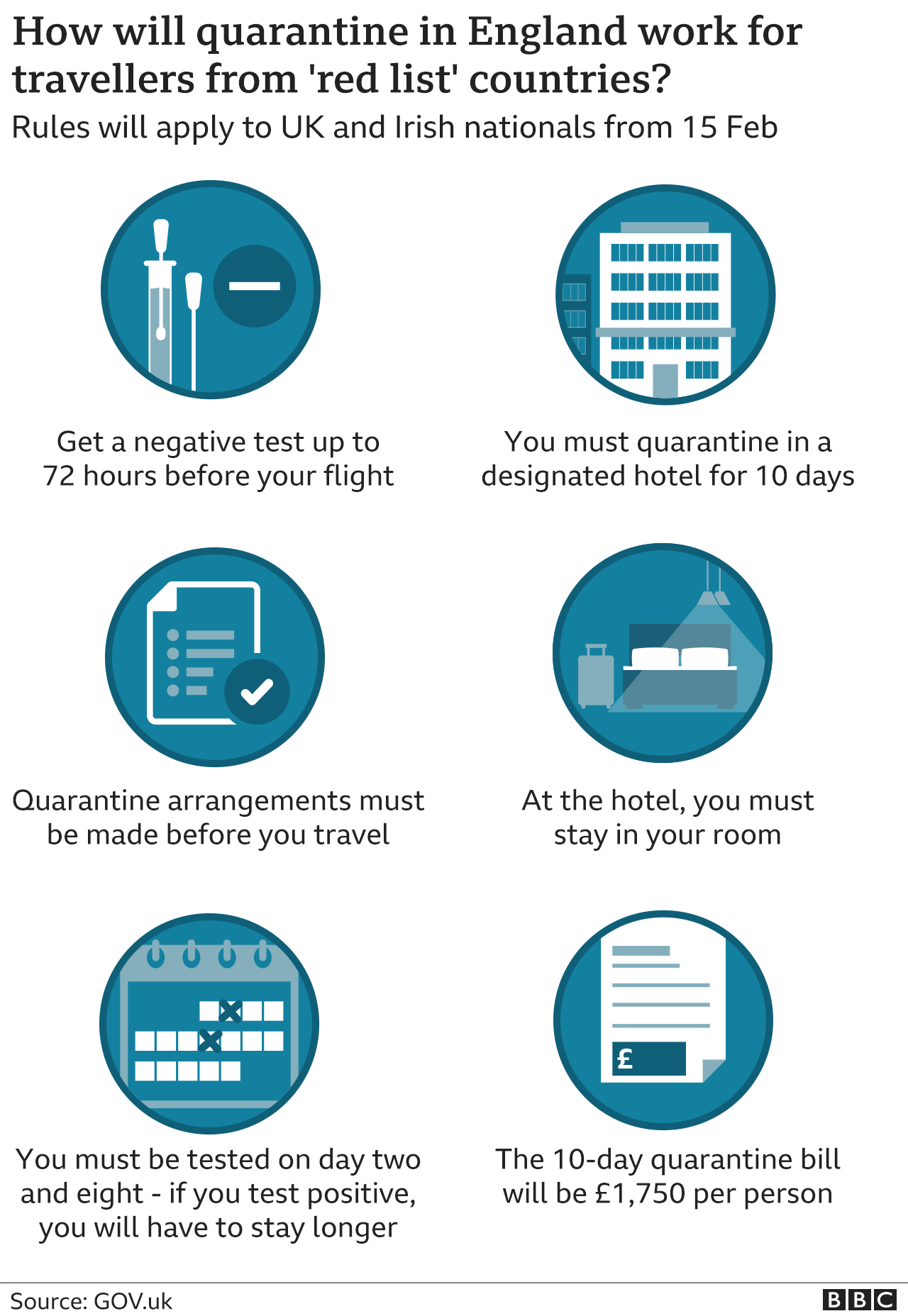
People travelling from red list countries to Wales and Northern Ireland will be required to book and pay for quarantine in England, as neither destination currently has any direct international flights.
Travellers arriving into England who lie on their passenger locator forms about visiting a red list country face a fine of £10,000 or up to 10 years in jail.
It comes as the UK reported another 12,364 confirmed cases of coronavirus and a further 1,052 deaths within 28 days of a positive test – bringing that total to 113,850. More than 12.6 million people have received a first dose of the vaccine.
Delivering a statement in the Commons, Mr Hancock said 16 hotels have been contracted for the programme, with 4,600 rooms secured.
The health secretary also confirmed a new “enhanced testing” regime for all travellers arriving into the UK would begin on Monday, with two tests required during the quarantine process.
They will be required to get a test on days two and eight of their 10-day quarantine period, whether they are isolating at home or in a hotel. The tests, conducted by NHS Test and Trace, will cost travellers £210.
“People who flout these rules are putting us all at risk,” the health secretary told MPs.
Airlines and travel companies will be legally required to make sure travellers have signed up for the new measures before they depart, with fines for companies and passengers if they fail to comply, he said.
The penalties include a £1,000 fine for travellers who fail to take mandatory tests and a £2,000 fine for failing to take the second mandatory test – along with a 14-day extension to quarantine.
Failing to quarantine in a designated hotel carries a fine of between £5,000 and £10,000.
Asked when the travel rules would be relaxed, Mr Hancock said: “We want to exit from this into a system of safe international travel as soon as practicable and as soon as is safe.”
Passengers required to stay in a quarantine hotel will need to reserve a room online in advance using a booking system that opens on Thursday.
The £1,750 fee for an individual includes the hotel, the cost of transport and testing. The additional rate for one extra adult or a child aged over 12 is £650, and for a child aged five to 12 it is £325.
These travellers will only be allowed to enter the UK through a “small number of ports that currently account for the vast majority of passenger arrivals”, Mr Hancock added.
Responding to Mr Hancock’s statement, Labour’s shadow health secretary said the public wanted the government to “go further” on border quarantine measures.
Jonathan Ashworth told the Commons: “Our first line of defence is surely to do everything we can to stop (new variants) arising in the first place. That means securing our borders to isolate new variants as they come in.
“He’s announced a detailed package today but he hasn’t announced comprehensive quarantine controls at the borders.”
Mr Hancock later said the red list was kept “under review”.
Announcing Scotland’s tougher measures, which apply to arrivals from all countries, Scottish Transport Secretary Michael Matheson said the “targeted, reactive approach” of the UK government was “no longer sufficient” to deal with the threat from coronavirus.