President Gotabaya Rajapaksa says that the Hambantota district will be developed as one of ‘Four Multi-dimensional Commercial Cities’ that was expected to be function as International Coordination Centres.
Colombo, Jaffna, and Trincomalee are the other districts expected to be developed as ‘Four Multi-dimensional Commercial Cities’. The President further said that the government will build a country that can compete in international markets by establishing a “C-shaped economic corridor‟ connecting two main ports and airports while integrating all business zones.
President Rajapaksa made these remarks during his campaign visit to Hambantota district, today (02) in support of the candidates of Sri Lanka Podujana Peramuna contesting the next Wednesday’s Parliamentary Election.
The President commenced his Hambantota district tour at the public meeting organized by Minister Chamal Rajapaksa near the Tissamaharama Bus Stop.
The President was accorded a grand welcome at the meeting and the public gathered at the venue presented their issues to the President.
Attending a public gathering at the Lunugamvehera Bus Stop premises, the President said that a proper and systematic programme will be implemented to provide permanent solutions for the issue of drinking water and to the issue of wild elephant threat.
The Maha Sangha extended their blessings for the success of President’s initiatives.
The attention of the President was also drawn to the shortages in Hambantota Mahanagapura Maha Vidyalaya and Lunugamvehera Maha Vidyalaya. The people presented their issues such as lack of public transport facilities to several villages to the President and they also requested to provide facilities to purchase fertilizers directly from stores.
A girl child P.G. Pasangi donated a till with her savings to COVID – 19 Fund.
The people gathered at the Public Market premises requested the President to take steps to eradicate the drug menace from the country.
The President also paid his attention to the request made by the people of the area to construct a building for Rideegama Maha Vidyalaya.
A little girl donated a till with her savings to COVID – 19 Fund.
The Ministry of Health and Indigenous Medicine states that steps will be taken to provide motorcycles to public health inspectors who have been deployed to control the corona epidemic.
A statement issued states that the motorcycles will be handed over to the Public Health Inspectorsby the 20th of this month.
Section 4.1 of MCC says all documents & communications are to be in English.Section 6.4 of MCC says the Government Law is to be ‘international law’(not Sri Lankan laws). The Ministry of Finance website says The Attorney General is in the opinion that Agreements are in order and there exists no legal impediment to execute same”– how is it that no one has saw fit to object to the fact that everything is to be in ENGLISHin a country where 90% are not conversant in English or even computer literate or having internet facility to undertake land transactions in English. Are all Sinhalese happy to do all land transactions in English? Are Tamils who objected to Sinhala Only” ready to embrace English Only” and where are all those know-it-alls who claim to have spoken on behalf of minorities against the Sinhala Only but are keeping mum about the English Only? Won’t minorities be impacted by the English Only or do their mouths & arguments function for issues related to Sinhala Only”? The MCC Land Project is to be in ENGLISH raising the constitutional violation of the 2 official languages in Sri Lanka. No one has even objected to MCC Agreement being ONLY in ENGLISH with no translations made available to even Parliament MPs. The MCC is getting away by publishing a 2page factsheet in Sinhala & Tamil without translating the entire MCC Agreement to Sinhala & Tamil.
Divide & Rule of colonial invaders was to marginalize the majority and uplift the minority. No one complained about the discriminations Sinhalese suffered.
Asia’s 1st English education school was opened in Vaddukoddai in 1823
Half the students at the Colombo Medical College when set up in 1872 were Tamils.
Half the students of the Technical College when set up in 1902 were Tamils.
St. John’s College, Chundikuli and Jaffna College, Vaddukoda (Vatticotta Seminary) were established in 1823. Prestige schools in Colombo, Royal College (1835) and S. Thomas’ College (1851)
In 1938, Tamils held 19.4% of government jobs – disproportionate to the population.
In 1946, two years before independence 33% of the civil service & 40% of the judicial service were Tamils (Chandra Richard de Silva, 1983)
In 1948, after independence 60% government jobs were held by Tamils who were less than 10% of the population
Even by 1956 (8 years after independence), 30% Ceylon Administrative Service, 50% Ceylon Clerical Service, 60% Engineers & Doctors, 40% Armed Forces were held by ONLY Tamils while 31% of students admitted to university were Tamils.
The Soulbury Commission acknowledges Tamils benefitted for over a century from first-rate secondary schools founded and endowed by missionary effort”.
What needs to be noted is that throughout colonial rule it was the ELITE from all the main communities that enjoyed the perks & privileges of colonial rule and none of them were too bothered about the sufferings of their own communities who were poor, uneducated & unlikely to gain proper employment without English. Are we returning to that period after over 70 years of independence”!
The reality was that post-independence leaders of Sri Lanka would not have able to govern the country in English language when 99% of the people were not conversant in English or had English education to secure employment. The reality was that they had to return to the language that the majority was conversant in and that language was Sinhala.
The Official Language Act was in reality to regain the status for the Sinhala language that was illegally taken away by 3 foreign invading forces. Sinhala language and Buddhism enjoyed royalty status prior to 1505 – there is no evidence or historical record of Tamils enjoying official language status at any time before 1505 or during colonial rule. To claim grievance, one must lose what one was enjoying. Thus, the language and religion status was applicable to only the Sinhalese. However, that valid claim was quickly tarred by a well-funded propaganda to claim the official language act was against Tamils & Tamil language which was completely false as the demand was to return the language status that the Sinhalese language enjoyed which was denied to them. When the Official Language Act was enacted in 1956, there was much hue & cry over Sinhala language regaining its lost status after 443 years of occupation. Tamils went so far as to travel to the UK Privy Council to object and filed court cases too. Ultimately a bogus Indo-Lanka Accord in 1987 placed Tamil as an official language.
A survey in 2000 discovered only 166 translators in Sri Lanka of which only 44 able to translate from Sinhala to Tamil and only 108 able to translate from Sinhala into English & only 14 were Tamil-English translators(Daily News, 2007a)
With the MCC Land Project we return to the colonial status where ENGLISH is to RULE and Sinhala & Tamil are to have no place. This is a constitutional violation. But no one including the attorney general’s department have objected to this clear constitutional violation.
Where are the Hooles, the Radhika’s, the Pakiasothy’s, the Nimalika’s, the Viyangoda’s, the Friday Forum, the Jehans – all of the lot bellowing against ‘Sinhala Only” but silent on ‘English Only” of MCC Land Project when 99% of the people are going to be affected by this English Only MCC clause. Will Prof. Rohan Gunaratna also write an article on English Only” ‘destroying peaceful Sri Lanka”? http://www.ft.lk/opinion/Sinhala-Only-Act-destroyed-peaceful-Sri-Lanka–Prof–Rohan-Gunaratna/14-650183Sinhala Only Act destroyed peaceful Sri Lanka: Prof. Rohan Gunaratna
The issue recalls the famous Kodeswaran case against the disadvantage he was facing for an increment because of ‘Sinhala’ https://www.lawnet.gov.lk/1977/12/31/c-kodeeswaran-appellant-and-the-attorney-general-respondent/—- won’t the same scenario apply if Tamils did not know English to read a deed, to transact a deed, to sell a property, to buy a property, to lease a property, to mortgage a property which if MCC is signed will all have to be in English including reading their own records from an English e-land bim saviya registry operated & funded by MCC? Isn’t this the same scenario for Sinhalese who can understand basic English but not English in form and content applicable to legal documents related to their land & property. How many Sinhalese & Tamils have computers or internet to be doing transactions via technology. Can Colombo wake up & take a look around at the villages across the country and see reality.
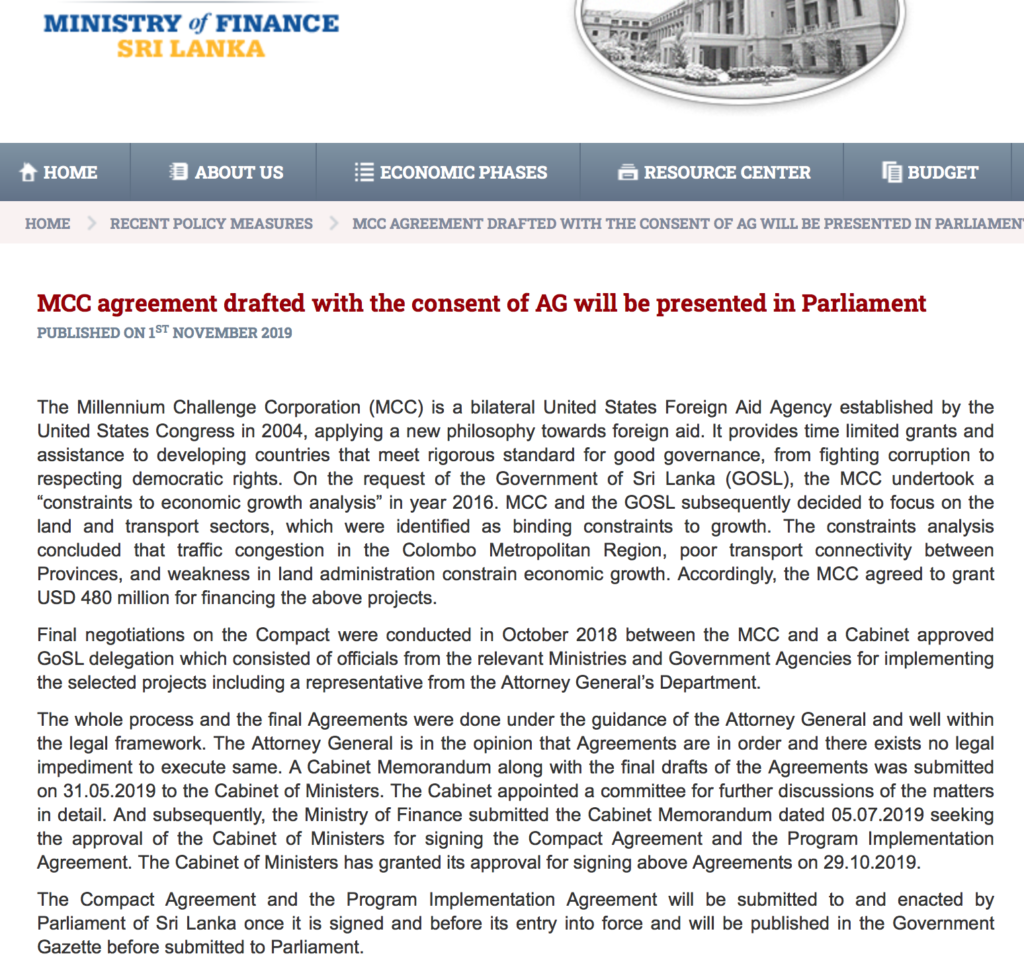
MCC agreement drafted with the consent of AG will be presented in Parliament
Two news items published in the prestigious New York Times tell the harrowing tale of what has happened to the USA in the ceaseless deterioration of conditions under the Covid-19 pandemic. News item 1: The U.S. coronavirus caseload, the world’s biggest, passed four million on Thursday. (23/7). The numbers of daily hospitalizations and deaths were also on the rise.
Public health experts have warned that the actual number of people infected is far higher than the number of reported cases, and could be up to 13 times as high in some regions.
California and Texas are among
the states setting daily records for new infections. More than 143,000
people have died in the U.S., according to a Times database.” (NYT – July
24th, 2020)
News
item 2: After a survey of the global reaction to the way America
has handled the pandemic, NYT reported:
A Singaporean is in disbelief to learn of the
number of Americans who lost their jobs to the pandemic. His government, by
comparison, subsidized up to 75 percent of citizens’ lost wages. A German
woman, who could have been slapped with a hefty fine had she violated social
distancing mandates, is astonished to see photos of Florida’s beach parties. A
South Korean woman compares her nation’s phone booth testing sites to America’s
bungling version. What does a Senegalese man feel when he sees mass graves in the
States?”
These two reports highlight the abysmal
mismanagement of the pandemic in USA. Sri Lanka, on the contrary, has won
plaudits from WHO and leading lights of the international community for the way
it has managed the pandemic without letting it run wild.
Why has the pandemic in the world’s greatest
power ended in colossal avoidable tragedies? And why has Sri Lanka succeeded in
controlling it? What has caused the difference?
Answer: Leadership.
It is the quality of leadership that makes all
the difference in a crisis situation. The pandemic has proved that President
Donald Trump is not only a danger to humanity but a fraud. It is his quackery
and refusal to face the grim and scientific realities that are a threat to
American lives and the global economy. The only silver lining is that the rise
of the victims of the pandemic has resulted in a commensurate plummeting of
Trump’s popularity ratings.
As opposed to this misguided disaster, the
leadership of the Rajapaksas, despite all the drawbacks, has risen to meet the
great challenges of our times rescuing it from the jaws of defeat. Leadership
must be judged by the victories scored at a nation’s most perilous moments. It
is the Rajapaksas quality of leadership that made all the difference at
Nandikadal. It is the quality of leadership that saved the nation from the
brink of being sold out to the combined anti-Sinhala-Buddhist forces on
November 19, 2019. It is the determined and dynamic leadership that fought the
invisible virus and saved the nation from the pandemic. It is their
overwhelming and convincing victories that has forced their detractors to bat
on the back foot.
The Rajapaksas’
grip on the nation was demonstrated when the Rajapakses lost to Yahapalanaya in
2015. They lost the polls but bus loads streaming from
all corners of the
nation flooded the precincts of Medamulana. The Rajapaksas lost in January but
the Mahinda Sulanga” held in Nugegoda in February was packed with the
loyalists flocking
to ensure the return of the Rajapaksas. This was a unique political experience
for a party that had lost. Though they lost to the organised force of the
anti-national front – the minorities, NGOs, alienated civil society, Western
agencies, etc., all of which were spearheaded by the symbolic Buddhist icon, Madoluwawe
Sobitha Thero — the people never abandoned the Rajapaksas. They never forgot
that it was their leadership that paved the way to defeat the invincible”
Tamil fascist terror.
On this issue of leadership, the obvious is to
compare the response of the electorate to the leadership of the Yahapalanaya.
Neither the people nor the party loyalists have shown a similar attachment to
the leaders of the discredited Yahapalanaya. It is the failure of the
Yahapalanaya leadership that brought the regime right down to rock bottom. They
had not left behind any memorable victories for the people to energise their
political passions and yearn for their return. Every big move they made
boomeranged on them. Whether in foreign policy (Resolution 30/1 betraying the
soldiers at Geneva), or whether in making R. Sampanthan the leader of a party
with 16 MPs the Leader of the opposition in a House of 225, whether in
importing a foreigner from Singapore to rob the nation’s Central Bank, or
whether in manipulating the Parliament to change the constitution – a demand to
satisfy only the minorities – the Yahapalana regime failed to provide a
leadership that could win the nation’s gratitude.
On top of all these, the divided leadership in
the Yahapalanaya regime, with the President and the Prime Minister pulling in
two different directions, could never have given a united and constructive
leadership. After the Yahapalanaya regime hit nadir there was no space to go
down any further. After the fall of the kakistocracy of the Yahapalana
manipulators, their successors can only go up. The success of the battle
against Coronavid-19 is indicative of the leaders in power to grapple with
crises with the least fuss or mess.
Right now, President Gotabaya is in the middle
of his fourth war. First ended in Nandikadal. Second, on November 19th 2019
by saving the nation from the anti-national and alien forces. Third, was in
Covid-19 battlefield – and still advancing. Fourth, is the war on underworld
drug dealers. The reports indicate that he is winning that too. Compared
to that of President Dutarte’s battle with the underworld to eliminate the drug
menace President Gotabaya’s methodology is progressing with a smooth
efficiency, using the appropriate dose of force, to apprehend the drug dealers
without the shoot-at-sight tactics of Dutarte. The fifth, undoubtedly the most
menacing, is coming over the global horizon and it is looming large. It’s, of
course, the dark clouds of the economy. That battle will begin in all its
complexities and challenges after August 5th when the new
Parliament assembles to define the next phase of our time.
There is another distinguishing factor.
President Gotabaya is a result-oriented, hands-on activist determined to make a
difference. He does not govern by passing the buck to committees whose findings
are never read by the leaders who appoint them. In the meantime, he is waging a
war against an obstructive and lethargic bureaucracy. Every failure of the
bureaucracy is reflected on the regime wielding power. Refining the bureaucracy
to serve the needs of the people particularly in developing countries is a
massive task. There are plenty of theories on how to make the bureaucratic
Leviathan work but none has worked so meaningfully as President Ranasinghe
Premadasa taking the state machinery to the people instead of the people coming
to the fat cats, or President Gotabaya going down to the basement to make the
system deliver the services to the neglected people.
These are some of the distinguishing
characteristics of President Gotabaya’s style of governance. In the main, he
has run the state so far almost single-handedly without a Parliament to either
back him or oppose him. The coming election will clear this anomaly, one way or
another. With a fragmented and disoriented Opposition in total disarray the
prediction is that he will win that battle at the polls too. Then he will be
well entrenched in power to govern with an iron fist covered in a velvet glove.
There is no alternative to it.
The path ahead for President Gotabaya is cut
out for him in the economic and political success stories of South East Asia
history. Singapore, Malaysia, Taiwan and even China and Japan tell the same
story: success came out of a little bit of dictatorship. Forging consensus with
a touch of dictatorship – mark you, only with a touch of dictatorship a
la the much-admired Lee Kwan Yew – has proved to be a prime condition
for growth and stability. Both go hand in hand.
Sri Lanka right now is positioned at this critical
intersection to go down the Singaporean path if it is to achieve success. The
time has come for a leader to take the monster by the scruff of its neck and
give it a good shake-up. A good example is the unwinnable war” declared by the
Tamil leadership at Vadukoddai in May 1976. It ended in May 2009 only because
there was a leadership to tackle it head-on. Otherwise we would be still
listening to our political pun(k)dits preaching to us on what should be done to
appease the monster to end the war.
The inevitability of reinforcing and
consolidating the Centre – there is nothing left in the Left, Right or North as
an alternative — the anti-national pun(k)dits are reduced to fear-mongering.
Not knowing what to do, particularly with the disillusioned electorate
rebelling and rejecting their analyses and remedies, they have withdrawn into
their intellectual cubicles predicting doom and gloom. Unable to find solid
arguments against the most effective Centrist leadership that has produced
tangible results they have been reduced to the mean role of doubting Thomases.
They are screaming that the dictatorship has come already. However, they are
not even sure of that. They end up by saying that time will tell”.
Take just three of them who project themselves
as well informed pundits: Prof. Kumar David, Prof. Charles Ponnuthurai Sarvan,
and my colleague, Sarath de Alwis. The first two are obsessed, as usual, with
the yellow robes”. Sarath is obsessed with a yellow jacket” worn by a female
canvasser who is pleading the cause of the Sinhala-Buddhists and
Catholics. All three of them are blind to the yellow shawl that covers
Modi’s India from the top of Himalayas to the tip end of the Southern coast, or
his counterpart in Sri Lanka, C. V. Wigneswaran. Jaffna too is covered in the
yellow manufactured, marketed, and distributed by Wigneswaran. They accept the
Tamil yellow as a fundamental right of the minority. They are worried only when
the majority uses it. They are agitated only when the Sinhala-Buddhists
wear it. Then the yellow to them becomes what a red rag is to a bull. They come
charging like wounded bulls in a ring.
In ranting against the lady in a yellow jacket, my friend Sarath seems
to be unaware that our women have been doing what the yellow-jacketed canvasser
had been doing down the ages wearing not a yellow but a white jacket. What’s
the difference in colour if the message is the same? Does toothpaste
wrapped in different colours loose its essence, eh Sarath? He
concludes, somewhat sorrowfully, saying: And we must live with the lady in the
saffron blouse in the video clip and her candidate.” Why is he so upset about
the lady in yellow only now? Haven’t we been living with these ladies from the
time Mahinda Thero landed at Mihintale, eh Sarath?
But
more telling is his admission that there is no alternative to President
Gotabaya. In making a rational assessment” he concedes: Gotabaya is a very
popular product.
There
is a strong conviction amongst a large swathe of the populace that President
Gotabaya Rajapaksa will take the right call for the country.” He also dismisses the
Right-wing of Sajith and the Left-wingers too confirming that there is no
alternative to President Gotabaya.
However, in the same breath he
moans: I think they (the people) are wrong. That is my opinion. I cannot
prove them wrong. Only time will tell.” Even the other two
pun(k)dits are in the same boat. They can’t prove that they are right. But they
think that the end of the world is about to happen though they are not sure. In
the end they conclude with the their refrain: only time will tell.”
They
are worried about the militarisation” and the nation heading towards a
dictatorship. The two professors are most concerned about the Rajapaksa regime
ending in a dictatorship. Take the case of academic Sarvan who has been a
consistent Tamil chauvinist pretending to be a defender of human rights when,
in his spare time, he has been manufacturing justifications to protect and
perpetuate the Tamil fascist de facto state of Prabhakaran. What are his
academic credentials worth when he churns out threadbare concoctions like this:
At present, Sri Lanka has a democratic, more precisely and honestly, a
majoritarian form of government.” Which democracy is not a majoritarian
(meaning ethnic) form of government? Is France formed by Occitanians or
Corsicans? Is England formed by a majority of Scots and Welsh? Was Barack Obama
elected because he was a black or because he was whiter than the whites? Would
he have been elected if he like Louis Farrakhan, the Black separatist, demanded
a separate state for the blacks?
I
will stop with one more quote: Socialism forms links, makes common cause, with
workers from other groups, both within and outside the country.” Tut! Tut,
Professori! Can you tell us how many links the Union of Soviet Socialist Russia
made under Stalin with his fellow Slavs, let alone the workers of the
world? And where are they now?
Prof.
Kumar David is an outdated, old fashioned Marxist who comes out with some gems
from time to time. However, I am sad to say that from time to time he too falls
into the category he has condemned: the Tamil leadership he branded as
congenital idiots”. Now he is most concerned about the Rajapaksa state
trending, according to him, towards an authoritarian regime. And he cites a
string of militarised states that had gone to pot. Like all pun(k)dits
pontificating in the commentariat he skips the most relevant example created by
the Tamils: the de facto state of the Tamil Pol Pot.
The
most relevant example for comparison should have been a relativistic assessment
of the only state created by the Tamils in the post-colonial period with that
of the Sinhaltistsa state”, as branded by the Tamil federalists / separatists.
The pro-Tamil pun(k)dits avoid that because it negates all their arguments
about the Sinhala majoritarian state” which has been a democracy with all its
infirmities. The failure of the Tamil federalists / separatists to establish a
democratic state, respecting human rights in any form, at least to their own
people, condemns the Tamil political culture as an extension of its past
subhuman Vellala culture that dominated the peninsula from feudal times. It is
not in the nature of traditional history for the Vellala oppressors, suppressors
and persecutors to produce benign and compassionate adherents of human rights.
Velupillai Prabahakaran belongs to the fascist Vellala culture. He was the
first born child of the Tamil Vellala ideology that was enshrined in the
Vadukoddai Resolution.
Prof. Kumar David should know that the Sinhala state” fought
the longest barbaric war unleased by the Tamil leadership within a democratic
framework (1) providing food and essentials to a rebel-held territory – the
only of its kind according to David Feng of UNICEF – and (2) even giving
protection to those Tamils persecuted and hunted by the de facto Tamil state.
Besides, he should know that it was the Rajapaksas who liberated the Tamils
from their Pol Pot. And the whole nation, like any other nation, has the right
to celebrate the ending of the curse of a 33-year-old war that leads naturally
to stability, peace and democracy which the Tamil state could not provide its
own people. Frustrated by the defeat the pro-Tamil pun(k)dits called it
triumphalism”. What would Pakiasothy Saravanamuttu and his ilk done if the
boot was on the other foot? Would they have gone into mourning and apologising
for the crimes they committed to their own people let alone the Muslims and the
Sinhalese?
Based on the available evidence the choice for the nation
is between leaders who have proved their worth and those who have failed to
deliver peace, stability and progress. The argument that militarisation” would
lead to dictatorship deserves another chapter. But the record so far proves
that the fascist forces of the Right and the Left that ventured to impose their
dictatorial regimes have failed. Rohana Wijeweera, Prabhakaran, Zaharan and the
Right-wingers that that came from the barracks ended in disaster.
Democracy is well rooted in the soil. And no mature political leader will ever
dare to do what Prabhakaran did to the Tamil people.
There is a tug of
war going on in the north between the Buddhist and non-Buddhists regarding the
new Buddhist temples built in the north. Neither side is prepared to give in.
The Tamil Separatist Movement complained
loudly that Buddhist temples were being built in the north where there were no
Buddhists. There are nine Buddha Viharas being built in Mullaitivu district
alone, said Tamil Separatist Movement. A Buddha statue has come up in
Sambaltheevu with police protection. In
Kokkilai, Mullaitivu district, a Buddha Vihara is coming up with army support
despite a claim to the land by a local Tamil.
Other places in the Northern Province where
Buddha viharas are coming up are Omanthai, Semmadu, Kanakarayankulam,
Kilinochchi, Mankulam, Paranthan and Pooneryn. A 67 foot Buddha statue is
coming up in front of the Nainai Nagabhooshani Amman Hindu temple, complained
Tamil Separatist Movement. The British
Tamil Forum launched in 2017, a book titled Proliferation of Buddhist
structures in Tamil Homeland-sowing the seeds of disharmony.”
The Tamil Separatist politicians vehemently
objected to the construction of Buddhist temples in the north. Tamil Peoples’
Council, headed by Northern Province Chief Minister C.V.Wigneswaran said, in
2016 that Buddha viharas
are sprouting like mushrooms in areas where there are no Buddhists.. In
Mullaitivu District, these Buddhist viharas were constructed after the armed
conflict ended.
Tamil National Alliance MP P. Raviharan said
in 2018 that Buddha statues and temples had been built in areas where there
were no Buddhists. There were 131 sites of Buddhist religious worship in the
North, of which 67 were in Mullaitivu. .
These were ‘unlawful’ as there were no Sinhalese living in those areas. They must be removed immediately.
In some areas, such as Vavuniya, Kilinochchi,
and Point Pedro, the military has built Buddha statues within or in close
proximity to Hindu temples. Buddha
statues have come up in front of the 2500 year old Thirukoneswara Hindu temple
in Trincomalee and the Thiruketheeswaram temple in North West Sri Lanka.
The military’s construction of Buddhist
viharas in traditionally Tamil areas with no Buddhist population is a
preliminary step to the Sinhala-Buddhist colonization of these areas and a
re-assertion of Sinhala Buddhist dominance, said Adaalayam Centre for Policy Research , Jaffna.
Sinhala colonies, Buddhist temples and Buddha
statues are being aggressively constructed with military sponsorship with the
sole purpose of Sinhala Buddhisation of the North eastern Tamil homeland, said Tamil
Peoples Council.
In 2016, after the Yahapalana government came
to power, there were numerous demands for the removal of Buddhist temples,
statues, and shrines built in the Northern Province, reported the media. In August 2016 TNA MPs met Prime Minister
Ranil Wickremasinghe and raised concerns about Buddhist temples and statues
being built in the area. The Northern
Provincial Council passed a resolution
in 2016 prohibiting the construction of Buddhist temples in the north. It had no legal standing, said lawyers.
Tensions flared in September 2017 over the
President’s proposed attendance at an illegally constructed vihara on the
premises of a Hindu temple in Mannar. A local Hindu priest reported that the military
destroyed a Hindu temple in order to construct a Buddhist temple, said Adaalayam
Centre, Jaffna. While Tamil
landowners whose properties were occupied by the Air Force in Keppapilavu were
protesting, the military was reportedly seen constructing a Buddhist temple on
their occupied land, continued Adaalayam Centre.
Those in Mullaitivu have forcefully opposed
the construction of Buddhist structures in areas with no Buddhist civilians said Adaalayam
Centre. Mullaitivu District has witnessed the
military’s construction of Buddhist structures on both state and private Tamil
lands. Despite a ban on building illegal Buddhist viharas by local authorities
in 2015, another temple is being illegally constructed on land that is
partially owned by a Tamil living in the Kokkilai region of Mullaitivu District.
Security forces arrested this Tamil landowner in 2015 for protesting against
the military land grab said Adaalayam Centre.
The Tamil Peoples’ Council (TPC), invited people to join a mass protest in
Jaffna on September 24, 2016 to demand a stop to the construction of Buddha
statues and Buddhist temples in areas in the Northern Province where there are
no Buddhists. C.V. Wigneswaran issued a statement where he said,
stop erecting Buddha statues and Buddhist temples illegally and in places where
there are no Buddhists, except in the army camps. He also objected to putting up Buddha statues
and temples illegally on private lands.
Northern Province Governor Reginold
Cooray said in reply that there are
only 13 Buddhist temples in the entire Northern Province and that there is
nothing wrong in constructing Buddhist temples.
D.M. Swaminathan, Affairs,
responding
to a complaint that there were attempt to build Buddhist temple and Buddhist
statue in Kilinochchi,
said that no one will be allowed to remove Buddhist temples or statues in the north. Buddhist monks and devotees had the
right to built temples and statues in any part of the Northern Province. ( Continued)
Russia expects to start mass anti-coronavirus vaccinations, across the country, by October, the country’s health minister has said. Mikhail Murashko added that medical workers and teachers will be given first priority.
Murashko announced on Saturday that clinical trials of a vaccine developed by the Moscow-based Gamalei Institute have been completed and that the health ministry is aiming to begin a public vaccination program in October. Medical personnel and teachers will be the first to receive immunization, he said. Now, the package of documents for the procedure of registration [of the vaccine] is being prepared,” Murashko added.
The Minister also said that another vaccine, developed by Vector, a Novosibirsk-based infectious diseases lab, is undergoing clinical trials. The health ministry is also expecting two more vaccines to be ready soon for start tests on volunteers.
Russia hopes to become the world’s first country to have a Covid-19 vaccine approved. Normally vaccines take years to develop and properly test – but, given the circumstances of the pandemic, many nations and pharmaceutical companies have claimed that a safe product could be made in 18 months or less.
I was watching the tv on today and on another day and saw hundreds of port workers planning to stage a strike against a decision of corrupt politicians to sell part of the port.
They were mercilessly threatening the nation which had been battered by Corona.
SAGT sale was also marred with corruption similarly ECT sale too.
But the reason why Port workers are on strike because a private sector taking over management will deprive them of earning illegal money by demanding kickbacks during unloading and releasing cargo. Crane operators forklift operators in the port take bribes.
Port in Sri Lanka is synonymous with corruption. Except for a few Engineering staff at a higher level almost everyone has been and are corrupt Security service is most corrupted and work hand in hand with customs where most of them are corrupt.
Few chairmen appointed by the ministers in the past were
involved in corruption
Nothing can be done without paying them.
Private sector send applications for annual entry passes to get into port to do business and the security handling the passes harass you and delay issuing passes to get kickbacks.
If you want to do business in the port you need to be ready to pay someone.
Authorities involved in approving the usage of tugs and other service vessels have to pay underhand to survive.
The whole country is corrupt and now most important agency which is police narcotic bureau is openly corrupt.
We are a nation of politicians state officers and corporate bosses who are corrupt and it looks like we will never get rid of it. With Corona where bribe-takers had to lie low are now back in business
Only army navy and airforce may be above board and we
should salute them
Dr Sarath Obeysekera
CEO Walkers Colombo Shipyard
Colombo
Sri Lanka
Maj.Gen (Rtd) Vijitha Ravipriya, currently Director General of Sri Lanka Customs elected as the association’s first President
COLOMBO, July 31 (Xinhua): Sri Lanka-China mutual cooperation was emphasized at the inauguration of the country’s first-ever association for Sri Lankan alumni of the People’s Liberation Army National Defense University (PLA NDU) in Colombo on Thursday.
Speaking at the inauguration ceremony of the Chinese National Defence University Alumni Association of Sri Lanka, retired Major General G.Vijitha Ravipriya said the organization would serve as a bridge to connect PLA NDU alumni in Sri Lanka with its alma mater in China, and help continue the centuries-long friendship between the two countries.
China has always extended ready assistance to the Sri Lankan military by way of coordinating more and more armed personnel for military training,” Ravipriya said.
Ravipriya, who will serve as the first president of the organizing committee, made an open call to all PLA NDU graduates to actively engage in the affairs of the association in order to keep abreast of academic developments, mentor younger generations in the armed forces, and take Sri Lanka-China relations to new heights.
Guest of honor at the inauguration ceremony, Secretary to the Ministry of Defence Major General Kamal Gunaratne, said that the founding of the alumni association was a step towards facilitating the historical military bond and bilateral relations between China and Sri Lanka.
Sri Lanka-China relations have been growing through mutual trust built on political, economic, cultural, educational and, most importantly, defense diplomacy and cooperation,” Gunaratne said.
He added that the university in Colombo was an internationally reputed seat of education which has shared its knowledge and wisdom with officers from around the world. Sri Lankan alumni of the PLA NDU have excelled in safeguarding the country through times of war, he said.
Meanwhile, the International College of Defense Studies of the NDU PLA, in a letter signed by Major General Xu Hui and Rear Admiral Cao Jianqi, hailed the association as an opportunity to strengthen strategic communication between the two countries and militaries… and make greater contributions to build the community with a shared future of mankind.”
The PLA NDU is a military university based in Beijing and administered by the People’s Liberation Army. It was founded in 1985 and offers training to officers from around the world.
Newsin.asia adds:
Major General (Retired) Vijitha Ravipriya is currently Director General of Sri Lanka Customs.
During his tenure in the army, Gen.Ravipriya held many commands and staff appointments in his Regiment and the Army, including the office of Director General Training at the Army Headquarters, General Officer Commanding, 57 Division (during Eelam War IV), Director Media and office of Military Spokesman, Director Personal Administration, Director Plans and a number of other key appointments in the Army including overseas ones.
He held the position of the Commander Security Forces – Kilinochchi (SF-KLN) as his last appointment, prior to his retirement in early 2020.
Colombo, August 1 (newsin.asia): The European Council on July 30 decided to renew the ban on the Liberation Tigers of Tamil Eelam (LTTE) of Sri Lanka, along with 20 other organizations including Babar Khalsa, Hizbul Mujahideen’ and Khalistan Zindabad Force.
Here are the details:
COUNCIL DECISION (CFSP) 2020/1132 of 30 July 2020, updating the list of persons, groups and entities subject to Articles 2, 3 and 4 of Common Position 2001/931/CFSP on the application of specific measures to combat terrorism, and repealing Decision (CFSP) 2020/20
THE COUNCIL OF THE EUROPEAN UNION,
Having regard to the Treaty on European Union, and in particular Article 29 thereof,
Having regard to the proposal of the High Representative of the Union for Foreign Affairs and Security Policy,
Whereas:
(1) On 27 December 2001, the Council adopted Common Position 2001/931/CFSP (1).
(2) On 13 January 2020, the Council adopted Decision (CFSP) 2020/20 (2) updating the list of persons, groups and entities subject to Articles 2, 3 and 4 of Common Position 2001/931/CFSP (‘the list’).
(3) In accordance with Article 1(6) of Common Position 2001/931/CFSP, it is necessary to review at regular intervals the names of persons, groups and entities in the list to ensure that there are grounds for keeping them thereon.
(4) This Decision sets out the result of the review that the Council has carried out in respect of persons, groups and entities to which Articles 2, 3 and 4 of Common Position 2001/931/CFSP apply.
(5) The Council has verified that competent authorities, as referred to in Article 1(4) of Common Position
2001/931/CFSP, have taken decisions with regard to all persons, groups and entities on the list to the effect that they have been involved in terrorist acts within the meaning of Article 1(2) and (3) of Common Position 2001/931/CFSP. The Council has also concluded that the persons, groups and entities to which Articles 2, 3 and 4 of Common Position 2001/931/CFSP apply should continue to be subject to the specific restrictive measures provided for in Common Position 2001/931/CFSP.
(6) The Council has concluded that there are no longer grounds for keeping one person on the list.
(7) The list should be updated accordingly, and Decision (CFSP) 2020/20 should be repealed,
HAS ADOPTED THIS DECISION:
Article 1
The list of persons, groups and entities to which Articles 2, 3 and 4 of Common Position 2001/931/CFSP apply is set out in the Annex to this Decision.
Article 2
Decision (CFSP) 2020/20 is hereby repealed.
1) Council Common Position 2001/931/CFSP of 27 December 2001 on the application of specific measures to combat terrorism (OJ L 344, 28.12.2001, p. 93.
2) Council Decision (CFSP) 2020/20 of 13 January 2020 updating the list of persons, groups and entities subject to Articles 2, 3 and 4 of Common Position 2001/931/CFSP on the application of specific measures to combat terrorism, and repealing Decision (CFSP) 2019/1341 (OJ L 8I, 14.1.2020, p. 5).
L 247/18 EN Official Journal of the European Union 31.7.2020
Article 3
This Decision shall enter into force on the day following that of its publication in the Official Journal of the European Union.
Done at Brussels, 30 July 2020.
For the Council
The President
ROTH
31.7.2020 EN Official Journal of the European Union L 247/19
ANNEX
LIST OF PERSONS, GROUPS AND ENTITIES REFERRED TO IN ARTICLE 1
PERSONS
ABDOLLAHI Hamed (a.k.a. Mustafa Abdullahi), born 11.8.1960 in Iran. Passport number: D9004878.
AL-NASSER, Abdelkarim Hussein Mohamed, born in Al Ihsa (Saudi Arabia), citizen of Saudi Arabia.
AL YACOUB, Ibrahim Salih Mohammed, born 16.10.1966 in Tarut (Saudi Arabia), citizen of Saudi Arabia.
ARBABSIAR Manssor (a.k.a. Mansour Arbabsiar), born 6.3.1955 or 15.3.1955 in Iran. Iranian and US national, Passport number: C2002515 (Iran); Passport number: 477845448 (USA). National ID number: 07442833, expiry date 15.3.2016 (USA driving licence).
ASSADI Assadollah, born 22.12.1971 in Teheran (Iran), Iranian national. Iranian diplomatic passport number: D9016657.
BOUYERI, Mohammed (a.k.a. Abu ZUBAIR, a.k.a. SOBIAR, a.k.a. Abu ZOUBAIR), born 8.3.1978 in Amsterdam (The Netherlands).
EL HAJJ, Hassan Hassan, born 22.3.1988 in Zaghdraiya, Sidon, Lebanon, Canadian citizen. Passport number: JX446643 (Canada).
HASHEMI MOGHADAM Saeid, born 6.8.1962 in Teheran (Iran), Iranian national. Passport number: D9016290, valid until 4.2.2019.
IZZ-AL-DIN, Hasan (a.k.a. GARBAYA, Ahmed, a.k.a. SA-ID, a.k.a. SALWWAN, Samir), Lebanon, born 1963 in Lebanon, citizen of Lebanon.
MELIAD, Farah, born 5.11.1980 in Sydney (Australia), Australian citizen. Passport number: M2719127 (Australia).
MOHAMMED, Khalid Shaikh (a.k.a. ALI, Salem, a.k.a. BIN KHALID, Fahd Bin Adballah, a.k.a. HENIN, Ashraf Refaat Nabith, a.k.a. WADOOD, Khalid Adbul), born 14.4.1965 or 1.3.1964 in Pakistan, passport number 488555
ŞANLI, Dalokay (a.k.a. Sinan), born 13.10.1976 in Pülümür (Turkey).
SHAHLAI Abdul Reza (a.k.a. Abdol Reza Shala’i, a.k.a. Abd-al Reza Shalai, a.k.a. Abdorreza Shahlai, a.k.a. Abdolreza Shahla’i, a.k.a. Abdul-Reza Shahlaee, a.k.a. Hajj Yusef, a.k.a. Haji Yusif, a.k.a. Hajji Yasir, a.k.a. Hajji Yusif, a.k.a. Yusuf Abu-al-Karkh), born circa 1957 in Iran. Addresses: (1) Kermanshah, Iran, (2) Mehran Military Base, Ilam Province, Iran.
SHAKURI Ali Gholam, born circa 1965 in Tehran, Iran.GROUPS AND ENTITIES: 1.Abu Nidal Organisation’ – ‘ANO’ (a.k.a. ‘Fatah Revolutionary Council’, a.k.a. ‘Arab Revolutionary Brigades’, a.k.a. ‘Black September’, a.k.a. ‘Revolutionary Organisation of Socialist Muslims’).
‘Al-Aqsa Martyrs’ Brigade’.
‘Al-Aqsa e.V’.
‘Babbar Khalsa’.
‘Communist Party of the Philippines’, including ‘New People’s Army’ – ‘NPA’, Philippines.
Directorate for Internal Security of the Iranian Ministry for Intelligence and Security.
‘İslami Büyük Doğu Akıncılar Cephesi’ – ‘IBDA-C’ (‘Great Islamic Eastern Warriors Front’).
‘Hamas’, including ‘Hamas-Izz al-Din al-Qassem’.
‘Hizballah Military Wing’ (a.k.a. ‘Hezbollah Military Wing’, a.k.a. ‘Hizbullah Military Wing’, a.k.a. ‘Hizbollah Military Wing’, a.k.a. ‘Hezballah Military Wing’, a.k.a. ‘Hisbollah Military Wing’, a.k.a. ‘Hizbu’llah Military Wing’ a.k.a. ‘Hizb Allah Military Wing’, a.k.a. ‘Jihad Council’ (and all units reporting to it, including the External Security Organisation)).
India’s new Defense Advisor in Sri Lanka Capt.Vikas Sood meets Lankan Defense Secretary and Army and Navy Commanders.
Capt. Vikas Sood with Sri Lankan Defense Secretary Maj.Gen (R) Kamal Gunaratne
Colombo, August 1 (August 1): After observing the health protocols stipulated by the Government of Sri Lanka for diplomats arriving in the country, the new Defense Adviser to the High Commission of India Captain Vikas Sood had interactions with the leadership of Sri Lanka’s Ministry of Defens and the armed forces in the past week.
Capt. Sood paid courtesy calls on Sri Lanka’s Defense Secretary Maj. Gen. (Retd) Kamal Gunaratne on 28 July; Acting Chief of Defense Staff and Commander of the Sri Lanka Army Lt Gen. Shavendra Silva on 27 July; and the Sri Lanka Navy Vice Admiral Nishantha Ulugetenne on 29 July.
During these interactions, marked by traditional cordiality and camaraderie between the armed forces of the two countries, a range of matters of mutual interest in bilateral defense cooperation was discussed. Strong commitment to further strengthen the defense relationship between the two countries was reiterated by participants on both sides.
Capt. Vikas Sood with Army Commander Lt.Gen. Shavendra Silva
It was noted that India and Sri Lanka enjoy a strong and growing defense relationship pillared on extensive cooperation in capacity building, such as through training, and other close linkages. More than 50% of all foreign military training slots in India are allocated to Sri Lankan defense personnel. It was observed that commonality of security concerns and challenges as well as the mutual resolve to address them for ensuring peace and security in our shared region guide the bilateral defense ties. Regular high level exchanges and visits, joint training and exercises, ship visits and sports interactions are the key elements of this robust cooperation.
Satisfaction was expressed at several high level exchanges and interactions between the two countries in the field of defense this year, despite the travel restrictions in the wake of the COVID 19 pandemic. Besides several delegation level visits, Maj Gen (retired) Kamal Gunaratne along with Lt Gen Shavendra Silva, participated in Def Expo 2020 at Lucknow, India in February 2020.
Gratitude of India for the excellent cooperation by Sri Lanka Navy and Sri Lanka Ports Authority in the repatriation of Indian nationals from Sri Lanka in June 2020 when INS Jalashwa undertook a visit to Sri Lanka was conveyed. The smooth conduct of this operation is a testimony to extremely close ties between Indian and Sri Lankan Armed Forces.
Capt.Viks Sood with Navy Chief Vice Adm.Nishantha Ulugetenne
It was also noted that in line with the commitment of the leadership of the two countries to cooperate in facing COVID 19 challenges, India had extended essential medical assistance to Sri Lanka in recent months. In this context, it was recalled that the Indian Navy had gifted two transportation pods for transferring COVID 19 patients and four thermal scanners to Sri Lanka Navy. In the context of sharing Sri Lanka’s valuable experience in effectively fighting COVID, the recent participation of Maj Gen HJS Gunawardena, Chief of Staff of Sri Lanka Army in a webinar organised by India for various partner countries including Bangladesh, Thailand and Myanmar to share best practices followed by Sri Lanka was appreciated.
It was noted that the participation of more than 400 personnel from tri-services of Sri Lanka in the celebration of ‘International Day of Yoga’ on 21 June this year at Sri Lanka Army Headquarters is a further testimony to the close professional and cultural affinity between the two countries and their armed forces.
President Gotabaya Rajapaksa has reiterated that no room will be left for anyone to destroy the historical heritage of the country or to cause damage to places of worship.
A comprehensive programme will be designed in order to preserve the heritage of Wellassa whilst protecting places of worship of all faiths, President Rajapaksa said addressing a public gathering organized by candidate Wimaladasa Galgamaarachchi in Wellawaya, Monaragala on Friday (31), the President’s Media Division (PMD) said.
People at the venue have requested the President to take measures to protect temples of historical value from treasure hunters.
Agriculture in the area could be further enhanced by rehabilitating tanks scattered across the district including Buduruwagala and BathalaAra, they have pointed out.
At the gathering organized by candidate, Padma Udayashantha at Buttalla weekly fair, the President was requested to set up a Presidential Task Force on preserving the historical heritage of UvaWellassa as well.
People commended the decision of the President to establish an investment zone in Monaragala. President said measures will be taken to commence pumpkin and watermelon based by-products and to promote pepper and orange cultivation.
The President who participated at the public meetings organized by candidate Shasheendra Rajapaksa and candidate Sumedha G. Jayasena at the Monaragala Weekly Fair premises also engaged in a cordial discussion with the people gathered at the venue.
President Rajapaksa responding to the issues faced by the pepper cultivators said that a comprehensive strategy will be implemented to uplift the pepper trade which has collapsed as a result of the re-export of pepper.
The President requested the pubic gathered at the venue to extend their support to form a strong and stable Parliament to accomplish promises in ‘Vistas of Prosperity and Splendour’ national Policy Framework successfully.
President Rajapaksa attending the public meeting organized by candidate Kumarasiri Rathnayake at the Dobagahawela Weekly Fair premises promised the people gathered at the venue to implement the Kumbukkan Oya water supply scheme as a solution to the drinking water issue of the area.
President Gotabaya Rajapaksa has guaranteed that his quest to eradicate poverty will not be abandoned.
Speaking at a public gathering in Badulla today (01), he noted that despite job opportunities for some in the past poor were left behind, the President’s Media Division (PMD) said.
President Rajapaksa assured that he will honour every promise in his policy framework Vistas of Prosperity and Splendour” and following the general election, promising that 150,000 job appointments for underprivileged and graduates will be granted.
In addition, the President also revealed a plan to provide employment for students who had succeeded in Ordinary Level and Advanced Level examinations following a satisfactory training program.
President made these remarks at Mahaweli playground, Mahiyangana during the election tour in the Badulla district in support of the Sri Lanka Podujana Peramuna candidates in the Wednesday’s general election, the PMD added.
The President has stated that every time a patriotic leader is elected to the highest office in the country, eventually conspirators and extremists would emerge to sabotage his/her policies and vision.
The President meanwhile assured provisions from the annual budget to resolve the shortage of drinking water in several districts.
During my tour across the country in the last 2-3 weeks, one of the major issues I was presented by the people is the scarcity of drinking water. This issue was discussed with the Prime Minister Mahinda Rajapaksa as well. Lack of drinking water is an issue which needs immediate attention and plans have been set in motion to address it” President added.
President Rajapaksa made these remarks during his campaign tour of the Badulla district today.
President participated in the public rally organized at the playground in close vicinity to Dowa Rajamaha Vihara, Bandarawela and assured the crowd that he would take steps to resolve issues faced by the people in the Badulla district.
I would implement a proper plan to permanently resolve the elephant intrusions and shortage of water supply for irrigation in the area.” President assured, during another campaign rally. He added that he would take steps to return inherited lands for cultivation purposes. President stated that he would examine each and every issue in order to successfully combat poverty and uplift the lives of the people under a proper strategy.
Representatives of the ‘Sinhale’ National Organization visited the Colombo Crimes Division this afternoon to inquire into the progress of previous complaints against Shani Abeysekera.
The
current trends in Sri Lanka politics are expected to change the status of
established political parties relegated to distinct defeat whilst some of the
minor parties emerging to be a fighting force.
The
oldest political party of Sri Lanka, UNP will lose its status as a major
party. Newly formed SJB will emerge as the second largest political
force in Sri Lanka, well short of gaining power in the House, but able to
secure the role of the Opposition Leader , a position previously held by the
UNP.
The
SLFP, which was a main political force in 1956 under Mr Bandaranaike has
virtually been destroyed by Chandrika Kumkaratunga and Maithreepala
Sirisena. It will enter the political wilderness.
The
Jathika Nidahas Perramuna, pioneered by Minister Wimal Weeerawansa, is gaining
momentum at a faster speed. As the new Minister of
Industries, Wimal Weerawansa has become a very close associate of
President and the Prime Minister. In his current role, he has
made an identifiable contribution by resurrecting defunct national
ventures, such as Paper, Ceramics, Tiles, Batik, Handloom etc in a
short period. He continues to contribute to the national development agenda by
embarking on new concepts, displaying enormous organising skills and the
ability to work with mixture of Sinhalese, Tamils and Muslims, As a
result of his long term commitment as a nationalist leader, his political
party is likely to emerge ahead of SLFP, JVP and MEP at this election.
The
SLFP,JVP vote bank depleted, its leaders will become dead
heroes.
Once
again Basil Rajapakse will emerge victorious, as a living testimony for his
ability, paving way for future national leadership.
Thankfully to the smart and peace-loving Sri Lankan citizen’s
decision that brought you to the great victory in the Presidential election in
last November, today whole peace-loving Sri Lankans enjoy a sigh of relief and
confidence for the future of Sri Lanka.
The brave and bold decisions you have executed so far courageously
as the executive president of the country have already started showing positive
results to the progress of the island. As a leader who took the oath as the
president of Sri Lanka in front of Swarnamali Maha Chaithyaya in ancient
capital of Anuradhapura, you made history.
As a staunch and strong supporter of you ever since we
decided that you are the most suitable and appropriate person to lead the
country and as a person who could convince and transform many opposite voters
for you, I have a humble request here by to make.
Please ban cow slaughtering in Sri Lanka”
According to Buddhism also cow slaughtering has caused
many illnesses and calamities to befall on human beings and ever since the life
span of man has dropped immensely.
It is the high time now to ban cow slaughtering in Sri
Lanka and when the present general election is over, please issue an executive
order to ban cow slaughtering. This sole act would make you to shine as a real
justice leader in the world and pave the way to Thawthisa or Thusitha celestial
worlds in your wish after this life.
As arahath Mahinda mentioned to King Devanampiya Thissa
(247 BC to 207 BC), ‘You are not the owner of the country, but the ruler and
the administrator only. You cannot take lives of any living being which lives
on earth, in water or in the sky’.
Even though there are plenty of more things to note to
justify to ban cow slaughtering from our beloved motherland, I do not intend to
write a long letter for you today.
I hope you will have the courage and blessings to issue
an executive order to ban cow slaughtering in Sri Lanka soon after the current
general election.
Thank you Mr. President.
May the Triple Gem and all good guardian deities protect
and guide you and Sri Lanka till eternity.
All major political parties must now recognize that animal
welfare is a key issue for a growing number of voters in Sri Lanka and so it’s
essential that they adopt sound, evidence-based policies in their Election
manifestos.
In a country which takes pride in proclaiming that it has the
longest uninterrupted history of Buddhism in the world and accepts fostering of
Buddhism within and overseas as a fundamental duty of the State (Article 9 of
the Constitution), it is sad to note that despite such national commitment to
propagation and protection of Buddhism, the mainstream political parties in Sri
Lanka have failed miserably unlike their counterparts abroad to mention a
commitment to protect animals and repeal archaic legislation by enacting the
Animal Welfare Bill, in their Election Manifestos. Moreover, what is glaringly
lacking is a pledge of a real commitment to action on such matters.
The newly formed ‘Justice for Animals and Nature’ headed by Ven.
Dr. Omalpe Sobhita Thero, the founder of the Sri Bodhiraja Foundation that was
commenced in 1991 to ensure the well – being and happiness or all beings, both
human and non-human,
has
formulated a set of objects that provides a guide for all political parties in
Sri Lanka to adopt.
We need cross party support for these animal welfare measures in
our Objects such as the updating of the laws to protect animals e.g. enactment of the
Animal Welfare Bill, and promotion of
humanitarian education and awareness programs commencing at
pre-school level, aimed at securing animal rights, protection and welfare.
The
objects of the ‘Justice for Animals and Nature’ organization are as follows:
i.
To strive for Freedom and Justice for
Animals, and creation of a Just Society.
ii.
To rebuild an animal-friendly cultural
heritage in Sri Lanka, by fostering and caring for the well – being of animals.
iii.
To campaign for reform of the
Constitution and updating of the laws to protect animals, nature, and heritage,
commensurate with modern standards of care and treatment, and engage in legal
advocacy and public litigation.
iv.
To liaise and support other organizations
within or outside Sri Lanka engaged in the promotion and protection of fauna,
flora and nature.
v.
To promote
humanitarian education and awareness programs commencing at
pre-school level, aimed at securing animal rights, protection and welfare.
vi.
To work towards ending cruelty to animals
and the use of animals in entertainment, zoos, slavery, sports, races,
experiments and religious activities including ritual animal sacrifice(s).
vii.
To promote plant – based food
production and consumption, and propagate the benefits of Vegetarianism and
Veganism.
viii.
To call for a ban on the export of live
animals from Sri Lanka for slaughter, entertainment and as gifts to other
countries, and export of meat products and seafood from Sri Lanka.
ix.
To encourage the public to not earn a
living by rearing animals for slaughter or killing animals, including
invertebrates such as crustaceans,
and to call for a ban on slaughter of cattle and other animals.
x.
To create awareness on environmental
pollution and environmental degradation, and their injurious effects on human
health, climate change and bio – diversity, and campaign against all such forms
of pollution, including noise pollution.
xi.
To advocate preservation of remains of
pre-historic and historic cultures and heritage, archaeological areas,
residual forests and natural habitats of non – human living creatures, elephant
corridors, and engagement in sustainable development.
xii.
To promote ‘Ahimsa’ as a cardinal tenet
pervading all activities.
Senaka
Weeraratna
Founder
member of ‘Justice for Animals and Nature’
People want our communities to be safe. People want our security ( our borders are safe) to be intact. People want our environment and forest reserves to be protected. People want our historical sites to be respected and protected. People want our children protection from abuse. People want our roads to be safe with adequate safety features. People want our people to follow law and order and discipline. People want law-abiding, disciplined, society & nobody to challenge court orders and respect the law & order. People want to see Tamils, Muslims, Sinhalese live in harmony. People want politicians to less talk and more to deliver.
When our Army commander was appointed to his present position, some nongovernmental organizations started complaining of his appointment and influenced the government to change it. Which is wrong and it is the inter-fearing to internal affairs of a country. It is our national security, safety, and internal affairs. Which is again very wrong according to UN Code as well. However, these influences were due to the hidden motives of different objectives of western countries and the United States. Those objectives are not visible, but those influences are the mitigation of geopolitical interests of powerful countries of above to enter and to make ground for themselves and executing their futuristic interest due to economic shift to south Asia in the world economy. Ranil Maithree’s rule was the best ruling for westerners as it was the weakest ruling of the Sri Lankan state history. The interested countries want to make our country weak from many fronts, such as a weaker constitution, weak-armed forces, communal unrest among religious groups, etc. Introducing mockery into our constitution-making the country’s instability and making vulnerable our country’s integrity & slowly destabilizing the country and make it more unstable was the carefully planned strategy by western powers. So it happens but not totally because of its strength of the constitution. There were certain front-line politicians such as Dr. Wijayadasa Rajapakse and Dinesh Gunawardena who did do a good standing to protect the constitution and its integrity.
Plotting, conspiring, igniting troubles, funding, and making use of international media, was quite common in those days, and making false statements against the country was quite common as well. It is one of the strategies; present-day imperialist plotting to destabilize countries. It was quite successful in the middle east; as they were able to external forces to flattened the countries of very well-governed of Iraq, Libya, and Syria. In order to achieve their interest, they use local interested groups, bribing politicians, make use of nongovernmental organizations, monetary gifts arms and ammunition, etc. We experience such interventions, at a low level in our country. The politicians are responsible for receiving western funding to carry out neo-liberal economic policies in Sri Lanka. The famous debatable MCC funding is a product of that geopolitical interest of western policies and their interests.
Simultaneously, we remember there was a movement by Maduluwawe Sobitha and a bunch of other people. But now they are not active. Probably Maduluwawe Sobitha had his honest intention to bring a better political and social environment to our country. However, their movement was successful and Ranil Maithree yahapalanaya came to power causing many perils to our country. The main political contender Ranil Wickramasinghe wants himself to snatch the power and continue his regaining Sri Lanka economic devastation and making the country towards a market economy. Our own exports were let to malfunction, corruption went up, our productions were malfunctioning, Strikes were daily on our streets. Sri Lanka once made into trouble again. There were much nongovernmental organization boldly commenting on democratic freedom. But they didn’t remember there were many moms jumped into rivers and died with their children. Those years the suicidal rate was very high and people lived their lives with desperation. People jumped on to running trains and dies by themselves. You all remember activist Sarath Wijesooriya where is he now? Venerable Maduluwawe Sobitha who initiated the movement went out of boundaries and introduced huge political destabilization into our country. In the end Maduluwawe Sobitha Thera before his demise accepted that his movement was wrong, but Thera himself done the damage to the country by mobilizing the people against that day government. Because of that movement, the country ends up with a government-run by a president who does not have the backbone to make decisions, and pro-western interest was achieved in that way. So the country was unsecured, people were unsafe, religious disparities were looming, the country was vulnerable for attacks from Muslim extremists.
As everybody is aware it happens in our country. I wouldn’t’ say the government of Mahinda Rajapakse in 2015 was perfect, but it was a government that came to power and run through the people mandate. In those days the movement leaders were making discussions in media on how to establish a society in our country which is good for the people. Honestly, it worked against the will of the people of this country. I think people remember some of the key figures of that campaign Upul Shantha Sannsgala, Saman Rathnapriya, Sudharshan Gunawardena, K w, Janaranjana, the person who invented Ranaviru Gaya word into our vocabulary Chandragupththa Thenuwara , the famous Dhabara Amila who did make mockery comments also. The question is, Were they really did work for the society for a better outcome? Absolutely not; they had a different interest which is not to fulfill the expectations of deserving people of our country.
The present-day stability has been a reality within a short period of time. There are only two powerful strengths that worked for that stability of this country which is our valiant armed forces, intelligent services, and our president’s vision and his strategy which worked for the current day stability of the country. So the immediate past history taught us a lesson which means we need to continue the present-day stability through & make it a prosperous country in the coming years. That is only possible through a big political mandate. That mandate is the people of this country. The present government has shown that they are capable people to lead the country forward. The mass majority of the people of the country recons their governing by now. My articles just not analyzing the situations but my article brings enormous perspectives on how to get better. As a born citizen of the country, I have a moral responsibility to get those perspectives, and people in policy planning and implementation could evaluate the relevance of those perspectives and develop them into ideas and work on them. Our constitution has introduced some changes by Ranil and the rule, which obviously delayed the implementation of laws orders. I only remember the days of election commissioners, when had the election commissioner, he had been given all powers to conduct elections in the country. Sri Lanka had an outstanding commissioner and his name was Chandrananda de silva. According to my understanding, he was one of the top government executives who did his job exemplary gold standing service in the profession. I still remember the day when he called the main contenders of the 1977 election; J.R. Jayawardena and Sirimavo Bandaranayake. He did it much better than now. His conducting of administrative work as the state officer much better to the present day. There wasn’t a problem in the system for him to continue his duties as the top government election commissioner at that time. After all with new changes now we all know what the new chairman of the commission is doing. He had been doing everything but withholding elections in the country. Probably the delay of everything ma, not his fault, but this mockery’s due to constitutional changes by the previous government.
The president is requesting a 2/3 majority to introduce a new constitution to expedite process and implementation. It is obvious that we need to have a people-centered constitution which expedite processes and implementations. Most importantly once the new constitution introduced new laws need to be introduced to protect its integrity. Politicians like Ranil Wickramasinghe who don’t have any people mandate shouldn’t be able to change its regulations to his own existence. My awareness as such the former government didn’t receive a mandate from the people to change our constitution, didn’t receive any mandate from people of the republic. We want to know who had been funded to introduce mockery to our constitution. I know the famous lawyer called Jayampathie Wickramaratne who did a majority work to change the constitution, with Urumithtanadu” already left the country for good. I am sure the new constitution will be done with the participation of patriots and it will be a constitution we all can live happily with communal harmony.
Why we need a state service sector predominantly service-oriented to public needs and how can we achieve that and what are the strength and weaknesses of the existing system? If I would conclude that we are racially biased in our society that nobody will disagree with the term I used by myself. That awareness helps us to move forward with solutions with understanding. Racial disparities unconsciously may be built into the decision making of services. Being Sinhalese cannot be considered as a privileged group of people to concern? I believe if a Sinhalese person comes to state service they might not have that problem. This is where social bias occurs; probably it might be the unconscious bias, But if a Tamil person comes to Sinhalese officer for state service the disparity might happen. The disparity of this nature shouldn’t happen in the service sector. Diverse group needs and their accessibility should have met equally without any disparity. The disparity could be minimized if the officers well aware of Tamil language fluency. The other disturbing factor is the state policies which we are trying to bring forward all the time. But the research shows policies has been the biggest contributions for dissatisfying state services. State Policies must be formatted around people’s expectations, satisfaction, achievement, etc. So the service sector needs some training in understanding racial injustice and also understanding of unconscious bias.
Everybody wants to see a country with all the above in place and it is only an awareness at this moment. Time to time I have been taking people to that awareness of the country and experience the beauty of that awareness. Well having said that, now there is an opportunity for people to achieve that probability. People need to use their mandate in the coming election; the most powerful political right of electing Members to the Legislative Assembly. This is the only, and one time opportunity to make that happen, as you decide. The present government qualifies to receive 2/3 majority of people’s mandate and they have proved in a short span of time that they are capable of getting more and more people’s responsibilities. Most importantly they have a road map to bring the country towards prosperity. Let’s make that mandate of 2/3 majority to present government and tied them up with responsibility and accountability to deliver. They are the most qualified contenders to receive the people’s mandate and outran all other political parties in the country.I am sure it will happen. I hope we all can live with harmony in this beautiful island as a proud nation.
The global pandemic of COVID -19 has changed the world order. The most powerful nations are shaken by themselves more than ever before. The wealthiest nations are in limbo as they are unable to control the disease and their death toll is rising. The experts in their countries have been advised to governments to follow national guidelines to control the virus, but it has been not done the way it has to be. Now those countries paying the price by human deaths due to politicizing the pandemic for political gains. The United States of America is at the top of the list of countries of the category. The world must use its media and advise people to ban the United States of America as it is a dangerous place to live due to the spreading of the virus. As Sri Lankans, we must be happy and show our gratitude to health officials, armed forces, and the government of taking timely measures to protect the citizens of the country. Their dedication is outstanding and it is the world best by now.
I have been writing always about the environment forest reserves in my all articles. It is because it is quite important to protect nature’s gift we have in our country. But our forestry is in danger due to many reasons. The first reason is the climate change of the globe and it’s adversely contributing to natural forest reserves. The most important 2 nd reason is the deforesting of our forest reserves by political influence and for development, and colonization E.G. Willpattu forest reserve. Let’s talk about why we need to protect our forestry more than anything else in our care. Forest density regulates the temperature of the land. Forest density helps to regulate the raining fall of the land. More than anything else, forest reserves are ecosystems in which a diverse amount of ecological living is going on which is essential for the balance of nature. In these balanced ecosystems, the living beings make their food cycles, water, carbon dioxide, photosynthesis, delicate chemical organic chains prominent with the sun the sunlight. Many forest living beings’ habitats has been affected by human intervention to the environment. Furthermore, forest reserves help to prevent soil erosion which helps to preserve soil with nutrients. Many waterfalls origins from rain forest reserves. So overall there is an ecological balance in a forest, but human intervention has imbalanced the sustainability of the coexistence. It has been revealed by research that all amphibians In Sri Lanka under threat, especially hourglass tree frog. The tree frogs are extremely sensitive to temperature increase and humidity, so there habitat loss and forest fragmentation, their collective future is threatened by climate change. Globally threats against amphibians have escalated so rapidly. Those living amphibians and other living beings are our valued natural resources. The frogs are being found in the Horton Plains forest reserve of our country. The ministry of environment and forest reserves need to be handled by people who know the subject and most suitable and most qualified people must be appointed as the state officials. Please remove all kinds of politicians and political influence by the name development doing deforestation.
Immature
eagerness rather urgency makes things horrible particularly when matters are
directly linked with the credibility of a nation and security of a country. A
few days back when a renowned Pakistani journalist was allegedly kidnapped from
a very busy road of Pakistan’s federal capital Islamabad, some media-men from
national and international media groups started pointing their fingers towards
the security agencies of Pakistan without any proof and without any
investigation. Whosoever was behind this heinous act must be taken to task but
after thorough investigation. Blaming abruptly simply mars the facts; moreover such
type of ‘blame-game’ defames and discredits not only the working of our
security agencies but the whole country and the whole nation. Today countless
Indians are sarcastically asking on social media ‘What were the security
agencies of Pakistan doing when that journalist was being kidnapped from that
busy road of the federal capital.’
It is the professional responsibility of all
media-men to file their stories after complete investigation and certainly they
must provide proofs in support of their investigative reports. As far as the
kidnapping incident from Islamabad’s busy road is concerned, there had been
countless incidents of the same kind in US, UK and so many countries hundred
times more advanced in resources and available technology. The security
agencies must stop such type of incidents and they no doubt do everywhere as
much as is possible for them. In most of the cases they try to keep a vigilant
eye on nefarious activities but they have no power of performing miracles; they
cannot stop things which are in the minds of the planners.
Recently
another example of this immature eagerness was observed in different national
and international newspapers when a news-report on unfreezing of the bank
accounts of five leaders of (defunct) Jama’at-ud-Da’wah and Lashkar -e-Taiba
was published in a Pakistani paper. The news-report said that Pakistan has
restored their bank accounts. The report said, All of them are UNSC’s enlisted
terrorists though and currently facing sentences ranging 1 to 5 years in Lahore
jail for terror financing cases filed against them by the Punjab Counter
Terrorism Department.’ According to the details narrated in the news-report the
defunct JUD leaders had forwarded an appeal to the government of Pakistan for
restoring their bank accounts so that they could run their family affairs. They
also mentioned about their financial income and sources of earning. A copy of
this application was sent to the UNSC also for final approval. It means that
the UNSC was the final authority which could restore their accounts. The
government of Pakistan simply acted upon the directions given by the United
Nations; there was no personal interest or will of the government in restoring
their bank-accounts.
Keeping
the facts and figures aside, unfortunately, some analysts tried to convince their
audience that this restoration of accounts was the result of that ‘soft corner’
somewhere hidden in the heart of the government of Pakistan. They tried to
misguide the world around that this restoration of bank-accounts was
independently done by the government of Pakistan. The facts are altogether
otherwise; Pakistan has never encouraged any kind of terrorism as Pakistan
itself has been the worst victim to this menace. Restoration of the bank accounts
of all these leaders has nothing to do with the ‘will and desire’ of the
government of Pakistan; it was simply done on the direction of UNSC.
Dragging
Pakistan into a new blame game is in fact an attempt to defame the whole nation
in the international community and to weaken the very foundation of the country
already facing a lot of problems. As per tradition the Indian media took full
benefit of the situation and exploited the news published in Pakistani
newspapers in the most negative way. It was also propagated that at the initial
stage, Pakistan had restored the bank accounts of the ‘terrorists’, at some
later stage, arrangements would be done for their release. The South Asia
Monitor said focusing on that news report, The report raised eyebrows over
Pakistan’s actions on ground and claims on papers in front of the global
community and the Financial Action Task Force (FATF), where it has claimed to
seize all assets, offices and bank accounts of the JUD and its affiliate
individuals.”
The
ball was never in the court of the government of Pakistan; the applicants sent
their applications for the restoration of their bank accounts to the government
of Pakistan and forwarded the same to the UNSC. It was not the government of
Pakistan but the United Nations Sanctions Committee responsible for unfreezing
of these accounts. The Committee looked thoroughly into all details, followed
all rules and regulations, approved the application and then directed the
government of Pakistan to take necessary action.
Anyone
who misreported the facts and figures in fact violated all moral and ethical
values. Blaming someone for the thing he has not done is a crime and this crime
becomes an act of terrorism when our own people get involved into it. While
reporting on some issue of a sensitive nature or analyzing some sensitive
situation of national importance, we all must keep in mind that words become
more poisonous and more disastrous than nuclear weapons if not carefully used.
Director of Health and Nutrition at the Ministry of Education, Renuka Peiris; Charge d’Affaires ad interim of Japan to Sri Lanka, Kitamur Toshihiro; WFP Deputy Country Director of Sri Lanka, Andrea Berardo; Secretary of the Ministry of Education, N.H.M. Chitrananda; and Additional Secretary of School Activities at the Ministry of Education, L.M.W. Darmasena.
The Government of Japan has donated a large shipment of canned fish, weighing 388 metric tonnes and worth ¥300 million (Rs.519 million), to the United Nations World Food Programme (WFP) and the Government of Sri Lanka, to meet the protein needs of schoolchildren covered by the National School Meal Programme.
The donation was formalised at a ceremony held at the Japanese Ambassador’s residence in Colombo, at which the Exchange of Notes were signed by Kitamura Toshihiro, Charge d’Affaires ad interim of Japan to Sri Lanka; and Andrea Berardo, WFP Deputy Country Director of Sri Lanka. The event was presided over by N.H.M. Chitrananda, Secretary of the Ministry of Education; L.M.W. Darmasena, Additional Secretary of School Activities at the Ministry of Education; and Renuka Peiris, Director of Health and Nutrition at the Ministry of Education.
The Governments of Sri Lanka and Japan have had a strong bond with a mutually supportive relationship between the people of our countries for many years,” Charge d’Affaires ad interim of Japan to Sri Lanka, Kitamur Toshihiro, said.
The Government of Sri Lanka and its people demonstrated their solidarity to Japan in the immediate aftermath of the Great East Japan Earthquake and Tsunami in March 2011, through a cash donation of US$1 million and three million tea bags. The canned fish provided by Japan is sourced from the areas supported by Sri Lanka, as an extension of the continuous supply provided by Japan, reflecting our appreciation of our Sri Lankan friends for lending a hand to Japan in times of need. We will continue to support Sri Lanka, in the spirit of unity and solidarity in our joint battle against the effects of COVID-19,” he added.
Through this agreement, the Government of Japan commits to making available to the Government of Sri Lanka—through the WFP—388 metric tonnes of canned fish; enough for the preparation of 19 million meals (rich in protein) for 270,000 schoolchildren. This latest contribution ensures that canned fish will continue to be offered to schoolchildren from 2021 – 2022, in addition to the previous consignment of canned fish supplied by the Government of Japan, which will last up to mid-2021.
Nutritious meals are the foundation to good health, especially for children. This generous contribution from Japan comes at a crucial time when so many Sri Lankan families are hard-hit by COVID-19, with reduced incomes and job-loss. Fish is a great source of protein, and by including it in school meals, we can be certain that children will get the right nutrients they need to grow and develop,” WFP Deputy Country Director of Sri Lanka, Andrea Berardo, said.
A lack of adequate protein intake could result in several health issues amongst children, including slow growth, poor concentration, and decreased immunity. In Sri Lanka, nutrition surveys have indicated that 40% of primary-level schoolchildren were too thin prior to the COVID-19 outbreak. Consumption of protein-rich foods, such as fish, is vital to help children meet their dietary requirements.
The Government of Sri Lanka has been conducting the National School Meal Programme for several decades. The programme was developed with the objective of ensuring that children are healthy and can optimally benefit from the educational opportunities provided to them,” Secretary of the Ministry of Education, N.H.M. Chitrananda, said.
We are thankful to the Government of Japan and the World Food Programme for providing canned fish to supplement the school meal programme, and for supporting us in enhancing the nutritional status of schoolchildren,” he added.
The National School Meal Programme, which the WFP has supported since 2003, was disrupted by COVID-19-induced school closures in March.
The Government of Japan, through the WFP, has been supporting the programme since 2011, with approximately 1,500 metric tonnes of canned fish worth more than ¥1 billion, to supplement school meals twice a week, adding diversity, nutrition, and taste.
The World Food Programme, together with the Government of Japan, has pledged to continue their support to the Government of Sri Lanka in its efforts to scale up and enhance the National School Meal Programme.
I think what is most important is proper debt management. If we get that right, we don’t need to think of debt restructuring
The Daily Mirror discussed the impact of the COVID 19 pandemic on the national economy and how Sri Lanka could emerge from this unprecedented challenge with the least possible damage, with former Central Bank Governor, senior advisor to Prime Minister on economic affairs and SLPP National List candidate, Ajith Nivard Cabraal.
Excerpts: Q What exactly is the nature of damage done to the economy by the pandemic? As we all know, the pandemic caused a massive shut-down of economic activities, globally. As a result, many industries suffered. Transportation by air, sea and road came to an almost complete halt. Tourism was severely affected. Many factories closed without work. Many also didn’t get paid for the goods they produced and sold because the buyers were so badly affected. Global oil prices plunged. In that scenario, the Sri Lankan economy suffered a serious setback because exports of apparels as well as tourism which were two of the key foreign exchange earners in our country, were seriously affected. The lockdown, while helping to control the spread of the virus, naturally led to a major slowdown in purchasing power which further affected all businesses, big and small. Many in the private sector lost livelihoods and jobs, hopefully temporarily.
Even though difficult, the government was able to prop up several sectors as well as the affected people to some extent. Nevertheless, the significant reduction in consumer demand across the board, caused a serious contraction in the economy since the advent of the COVID -19 virus. Fortunately, the recovery is finally taking place worldwide and Sri Lanka opening out gradually, and businesses beginning to pick up. In that scenario, we now hope that the resumption of at least a reasonable degree of economic activities will enable the overall economy to record a V-shaped recovery by the fourth quarter of 2020, although that’s somewhat optimistic.
Q Though we have contained the pandemic, the world is yet to come out. Then, is it realistic for us, to realise the economic targets? We need to develop some economic targets if we are to move forward. Otherwise, we will find it difficult to stay focused. We also need to make certain estimates now because such estimates would be needed to help position ourselves to meet the crisis in a reasonably professional manner. It is of course quite possible, that some of the estimates and assumptions that we make today, could later prove to be erroneous, but that is a risk that we will need to take at this time. We all need to acknowledge and understand that the entire world is moving on uncharted waters right now. The course is not clear, but yet, we have got to move forward. Otherwise, we would surely perish. The government too will have to think out-of-the-box and take some bold steps. Not every decision will be 100% accurate. But, in these circumstances, if no decisions are taken or no action is taken, business confidence will suffer and all economic stakeholders will enter into a very pessimistic mode, which will lead to disastrous results. Even otherwise, it may slowly limp back, but that would take too long and the social fallout could be highly dangerous.
Q The industrial sector, tourist industry, Small and Medium Enterprises, rural and domestic industries are the most affected from COVID – 19. How can these vital segments of the economy be revived in the shortest possible period of time? As already stated, almost all sectors of the economy have been affected due to the collapse of local and international demand. In that background, the greatest pain and vulnerability will be faced by businesses in the immediate and short term. That is why we have to give our country’s businesses the necessary support to tide over that difficult period. That is not going to be easy since the government finances are also stressed at this time as tax collections in the post-COVID period would be weak while foreign inflows too, will be interrupted.
Q Who are the most vulnerable sections in society that should be given priority in the government’s recovery programme? There are several sectors that have been badly affected as a result of the fall in demand for various goods and services. The apparel and tourism sectors have been significantly affected in particular, and the persons who are involved in those sectors have become quite vulnerable. They certainly need to be supported until such time that those sectors recover. At the same time, there are several other local industries and services that have also suffered significantly as a result of the acute fall in local demand due to the lockdown and reduced purchasing power. Those persons too need to be supported by way of cash grants, tax breaks, loan and interest moratoriums, quick release of new loan facilities at concessionary interest rates. All these matters have received the consideration of the government, and solutions are being developed to provide the maximum support.
Q The largest contributions to Sri Lanka’s foreign reserves come from remittances of the expatriate Sri Lankan community, garment and apparel exports, fish exports and the exports of tea and rubber. At a time all the export revenues has dropped to a drip, what incentives could the government offer to rekindle these sectors? If export revenue in a country drops due to quality issues or availability problems within the exporting country, then it could be fixed by taking the required management and operational remedial measures to rectify such issues. However, if the export revenue is declining due to the decreasing purchasing power of the importing nation’s people and business entities, the problem would be more challenging as it would be beyond the control of the exporter or the exporting country.
As is well known, in the case of many export-market collapses experienced in the last few months, it is clear that the decline is due to consumer demand in the importing country declining as a direct result of the COVID -19 situation. In that background, it is likely that the demand would pick up after a few more months, and therefore what would be important is for the exporting country to remain resilient by following policies that would enable its exporters to keep their factories and businesses intact, and survive until such time the downward trend changes. In the case of exports of apparels, fish, tea, rubber, etc., we have already begun to see an improvement in export revenues. Therefore, it is now time for us to strive even harder to stimulate our existing markets and find new niche markets that would provide us with the opportunity to export more.
Further, although we do observe a reduction in remittances due to the purchasing power decline in the Middle Eastern countries, it is likely that once global demand picks up, oil prices would improve, which would be a favourable outcome from the point of view of the oil exporting nations. I think the government would do well to provide some short-term relief to those affected businesses until such time demand in the importing or employing nations reaches at least the pre-COVID levels.
Q How does the government plan for debt restructuring? I think what is most important is proper debt management. If we get that right, we don’t need to think of debt restructuring. During the period I was the Governor from 2006 to 2014, we were able to reduce Sri Lanka’s Debt to GDP Ratio from 91% to 71%. We were able to shave 50% off the average interest rate of our debt stock. We were able to double the average time to maturity of the debt stock. By keeping the Rupee stable, we ensured that foreign debt servicing was manageable.
The impact of the COVID -19 economic contraction has thrown fresh challenges to debt management, and I believe this is not a matter that Sri Lanka must face as an individual country only. This is an extraordinary global condition that has been caused by a global occurrence, and as I said earlier, the world community must take a global approach to deal with the fallout. That’s why I have been advocating since April this year that the G7 countries get together with the IMF and the World Bank and take a holistic view and implement an across-the-board debt moratorium for all emerging nations for about two years. That would be a kind of an economic vaccination” that would help all countries and organisations to deal with one another, without having to continuously worry as to whether the other would suffer from debt issues.
May I also say that, just like individual companies or countries, the multi-lateral institutions too must think out-of-the-box to safeguard the global economy, and I hope that realisation will dawn soon.
Q How challenging is it to increase the government’s revenue following tax cuts and dwindling income generation activities during the shutdown? Increasing the Government revenue at this current time will be very challenging. The traditional methods are not going to work. That is why I have been advocating some new ways and means to achieve the same objective. If, as an emerging nation, Sri Lanka, together with the other emerging nations, could work out a debt-standstill” on its dues for the next two years to the IMF and World Bank, that would save a large chunk of Forex from flowing out of the country. Further, if the EPF releases 20% of the member balances direct to the members themselves, about 2.5 million persons will benefit by an important cash inflow of around Rs.500 billion at this most difficult time, which will also stimulate the economy. If several global equity and venture capital funds can be tapped and those inflows are infused into our economy, the government won’t have to allocate expensive” government funds to stimulate the economy in the post COVID -19 period. We have got to think differently now. If we go along the same beaten track and search for solutions along that track, we will not be able to deliver results. If we try to deal with the issue of dwindling income by imposing new taxes and having more restrictions on businesses, that would also be a path to certain failure.
Another 37 Local Government members of the United National Party (UNP) have been temporarily expelled from the party.
The party membership of these members was suspended for the time being as they had endorsed other political parties, the Legal Secretary of the UNP stated.
This move comes days after the UNP’s Working Committee ousted 54 members, who had submitted nominations from the Samagi Jana Balawegaya (SJB), along with another 61 Local Government members.
Several top figures of the party including Ajith P. Perera, Field Marshal Sarath Fonseka, Sujeewa Senasinghe and Ranjan Ramanayake were also among the ousted members.
The Attorney General has filed indictments in the Colombo High Court against former minister Dr Rajitha Senaratne and former Chairman of State Pharmaceutical Corporation (SPC) Mohamed Rumi, in connection with the controversial press conference on ‘white van abductions’.
AG Dappula De Livera has also filed Discharge Orders with the Colombo Magistrate’s Court on the other two suspects in the press conference, listing them as witnesses in the case.
In the days leading up to the Presidential Election last year, Senaratne had called two persons named Anthony Douglas Fernando and Athula Sanjeewa Madanayake for the said press conference, where they made controversial statements regarding alleged white vans” and purported incidents of certain abductions, assassinations, robberies and forced disappearances during the administration of former President and incumbent Prime Minister Mahinda Rajapaksa.
One of them had claimed that he was a white van” driver involved in abducting people while the other claimed he once served as a driver to transport a stock of gold in previously LTTE-held areas.
The former Health Minister was arrested last December and remanded over the controversial white van” press conference organized by him in November, but he continued to receive treatment at the hospital.
On December 30, Colombo Magistrate’s Court ordered to release Senaratne on bail. However, the Attorney General filed a revision application on January 08 challenging the decision of the Magistrate Court to grant bail to the former Health Minister.
The Attorney General, in his revision application, had pointed out that the Colombo Magistrate’s Court has not taken into consideration the submissions by the prosecution before delivering the verdict to release Senaratne on bail.
On May 13, Senaratne was placed under arrest after he surrendered to the Criminal Investigation Department (CID) and was placed under remand custody by Colombo Chief Magistrate Lanka Jayaratne.
Director of the State Intelligence Service (SIS) Nilantha Jayawardena revealed that former deputy ministers Ameer Ali and M.L.AM. Hizbullah had supported terrorist and extremist groups in the country.
He made this revelation on Thursday (30), testifying before the Presidential Commission of Inquiry (PCoI) probing the Easter Sunday terror attacks, for the fourth consecutive day.
During the evidence hearing, the focus of the Presidential Commission fell on the intelligence report issued by the SIS with regard to a lecture delivered by Zahran Hashim at the office of the National Thowheed Jamaath (NTJ) on the 20th of November 2016.
The panel asked the former SIS chief if the responses of Muslim organizations and lawmakers challenging the statement made by former Minister of Justice Wijeyadasa Rajapakshe during the parliamentary session on the 18th of November 2016, which claimed that 30 members of four Muslim families had joined the ISIS, are included in the said intelligence report.
In response, Jayawardena said the report contains the counterstatements made by former Ministers Rauff Hakeem, Rishad Bathiudeen and then-Chief Minister of Eastern Province and Leader of Muslim Council of Sri Lanka (MCSL) N.M. Ameen.
In addition, following the clash at the Aliyar Junction on the 10th of March 2017, former Deputy Minister Ameer Ali had provided political support to the NTJ while former Deputy Minister M.L.AM. Hizbullah endorsed the Sunnat Wal Jamat, former SIS chief said continuing his testimony.
The Presidential Commission then questioned the witness of the measures taken by then-Defence Secretary and the National Intelligence after the SIS had forewarned them of the Zahran Hashim-led NTJ and the threats posed by the Islamic State (IS) to Sri Lanka.
To this, Jayawardena said the SIS had regularly provided intelligence information to the relevant authorities and they should be questioned on the measures they had taken in that regard.
When responding to certain questions posed by the Presidential Commission, the former SIS chief had requested permission to testify only in the presence of the Presidential Commission’s panel and the representatives of the Attorney General’s Department.
However, the chairman of the Presidential Commission of Inquiry on Easter attacks, in response, said the witness cannot be allowed to testify only in the presence of the aforementioned parties, pointing out that several attorneys-at-law appearing on behalf of certain parties linked to the incident have already been given the opportunity to cross-examine the witness.
Accordingly, these attorneys need to be present when the witness produces his testimony, the PCoI chief had stressed.
A stash of narcotics has been seized from a house in the area of Brandiyawatta, Wellampitiya.
According to reports, the haul contained nearly 23kg of heroin.
In the meantime, a suspect has also been taken into custody from the house where the heroin cache was discovered.
The raid was jointly carried out by Army personnel and the officers of the Police Special Task Force, acting on a tip-off received by the Army intelligence officials.
Prime Minister Mahinda Rajapaksa requested the people to send to Parliament at the next general election, only those who are able to work.<br /><br />He said this while participating in a public meeting held in Kahawatta, Ratnapura today.