Director-General of Health Services Dr. Anil Jasinghe says that there currently is no reason to enforce another lockdown in the country, as the current cluster remains limited in its reach.
With the upturn in the number of COVID-19 infections in the country, measures have been taken to place the area in Rajanganaya in Anuradhapura under lockdown, banning both entry and exit. Rajanganaya which is home to about 12,000 people has reported over 15 cases of COVID-19 so far.
Meanwhile, with an Army Intelligence Officer attached to the Kandakadu Rehabilitation Center residing in Delthara, Piliyandala testing positive for COVID-19, several places including shops visited by him have been shut down with staff members placed under quarantine. PCR tests of all those identified as the associates of the infected officer are scheduled to be carried out tomorrow (16).
An Inspector of Police (IP) attached to the Sigiriya Police Station along with his family were directed to quarantine after it was found that he was exposed to an infected Army officer deployed at the Kandakadu rehabilitation center. As a result, due to the risk of deploying police personnel from the Sigiriya Police Station for day to day operations a special team from the Dambulla Police Station was deployed at the Sigiriya Police Station.
Following the detection of COVID-19 positive Kandakadu facility counselor from Gampaha and his driver, PCR tests of all associates exposed to the duo were carried out today.
Meanwhile, officials at the Gampaha District Court also underwent PCR tests after it was found that the court complex was visited by the driver. The results of these PCR tests are to come out tomorrow.
A counselor at the Kandakadu rehabilitation center who attended a Catholic mass at St. Cajetan’s Church in Kotugoda, Seeduwa on July 04 has been diagnosed with COVID-19. As a result, 44 people exposed to him at the church including the priest and 04 nuns were self-isolated, while 36 more people residing in the neighborhood of the infected patient were also instructed to self-quarantine. All of them were subjected to PCR tests today.
In the meantime, another counselor attached to the Kandakadu rehabilitation center, residing in Gonapeenuwala, Ambalangoda, has tested positive for the virus. Fifty-one people exposed to him including his wife – who is a teacher – along with 11 of her students and 07 other teachers, underwent PCR tests today.
In addition, 30 residents of Hikkaduwa, Rathgama, and Dodanduwa were subjected to PCR tests today after being detected as associates of COVID-19 carriers from the Kandakadu rehabilitation facility.
Speaking on the COVID-19 spread within the country, Director General of Health Services Dr. Anil Jasinghe stated that, 73 people from Kurunegala and 73 from Nikawewa are currently under quarantine at two quarantine facilities, as they had associated with an infected patient during a rehabilitation meeting in Colombo.
Meanwhile, nearly 150 from Kundasale have been directed for quarantine along with several families in Kegalle who associated with a patient from Kundasale.
In addition, nearly 100 people in Aparekka, Matara are under quarantine, said Dr. Jasinghe.
Further, PCR tests have been carried out in many areas in the country including 101 from Kundasale, 266 from Rantambe, Thanthirimale, 200 from Polonnaruwa Hospital as a sample, and 150 from Rajanaganaya, said Jasinghe.
However, Dr. Jasinghe is of the view that the current situation does not call for the imposition of curfew in the country.
He said: If we are to impose an island-wide curfew, there should be COVID-19 issues faced island-wide. The virus has the only surface in a few areas.
If COVID-19 is spreading rapidly, that would be a sufficient reason for us to impose a curfew.
The current situation does not call for the imposition of curfew nor do we think such a situation would arise.”
The Sunday Times released the full text of the Status of Forces Agreement (SOFA). Noteworthy is that the discussions have been with the US Embassy Colombo & the Sri Lankan Foreign Ministry with no inputs sought from the Ministry of Defense and completely disregarding the threats to Sri Lanka’s National Sovereignty & Security. Whoever approved this deserves to be tried for treason.
15 clauses were highlighted in the Sunday Times leaked version of the Draft Agreement of 28 August 2018 following last discussions in May 2018 between Yahapalana Foreign Minister Tilak Marapana in Washington.
As per the Agreement,
US Personnel will be referred to Members of US Department of Defense (US Military & Civilian Personnel)
All Members of US Department of Defense (US Military & Civilian Personnelto receive immunities & privileges.
US Contractors & Employees who are non-Sri Lankans who are under contract from US Department of Defense in connection with ship visits, training, exercises, humanitarian activities & other activities shall not receive any privileges & exemptions under SOFA.
There is a confusion in this 1stclause – while it says US contractors” under contract to the US Department of Defense who are temporarily in present & their employees, the same sentence also says ‘not under contract with the US Department of Defense” – so the question is who will not receive privileges & be exempt under the agreement?
The US embassy is making the following proposals
US personnel (US military & civilians of US Defense Dept) to be given privileges, exemptions & immunities equivalent to administrative & technical staff of a diplomatic mission under Vienna Convention on Diplomatic Relations of 18 April 1961.
US military & civilians of US Defense Dept be allowed to enter & exit Sri Lanka with US identification, move in groups or individual and Sri Lanka must accept any US identification
US military & civilians of US Defense Dept can drive any vehicle in Sri Lanka even without driving license.
US military & civilians of US Defense Dept will wear uniforms on duty
US military & civilians of US Defense Dept will carry arms on duty
GoSL allows US Govt to exercise criminal jurisdiction over US personnel in Sri Lanka (2 parallel laws running in Sri Lanka)
US Department of Defense & US Personnel will not pay any tax or similar charges in Sri Lanka – does this mean they can refuse to even pay tax if they travel on the Expressway?
US Embassy also wants GoSL to cooperate & take measures to provide security & protection for US personnel, their property, equipment, records & official information in Sri Lanka (all this while US personnel is carrying arms & can travel anywhere in Sri Lanka)
US military & civilians of US Defense Dept can IMPORT / EXPORT anything & be exempt from any inspection, license, other restrictions, customs, duties, taxes within Sri Lanka (exactly why are we having an ARMED FOREIGN FORCE in SRI LANKA US military & civilians of US Defense Dept vessels and vehicles can move FREELY within Sri Lanka and be exempted from any payment.
US military & civilians of US Defense Dept vessels, aircrafts will NOT be subject to payment of LANDING FEES, PORT FEES, PILOTAGE charges, lighterage, harbor dues which will be in FACILITIES OWNED & OPERATED BY GoSL
US military & civilians of US Defense Dept owned and operated aircrafts SHALL NOT BE SUBJECT to PAYMENT of NAVIGATION, OVERFLIGHT, TERMINAL or similar charges by Sri Lanka.
US military & civilians of US Defense Dept aircrafts & vessels shall NOT BE inspected and Sri Lankans CANNOT board them
US military & civilians of US Defense Dept can contract any material, supplies, equipment, services (including construction) to be furnished or undertaken in Sri Lanka without restriction and the guidelines and regulations applicable to them will be that of the US Govt not Sri Lanka
US military & civilians of US Defense Dept acquisition of articles & services in Sri Lanka will not be subject to any taxes or similar charges
US contractors TOO will not have to pay any tax or similar charges in Sri Lanka for activities under SOFA (what exactly are the activities?)
US contractors can import into Sri Lanka & export out of Sri Lanka & use Sri Lanka’s any PERSONAL PROPERTY, equipment, supplies, material, technology, training or service under SOFA & shall be EXEMPT from any license, restrictions, customs duties, taxes or any other charges in Sri Lanka
US contractors are to be given same treatment as US military & civilians of US Defense Dept for driving in Sri Lanka without license.
US military & civilians of US Defense Dept shall enjoy freedom of movement & access to & use of mutually agreed transportation, storage, training & other facilities
US military & civilians of US Defense Dept shall operate its own radio spectrum/telecommunications system and be FREE of COST to US by Sri Lanka
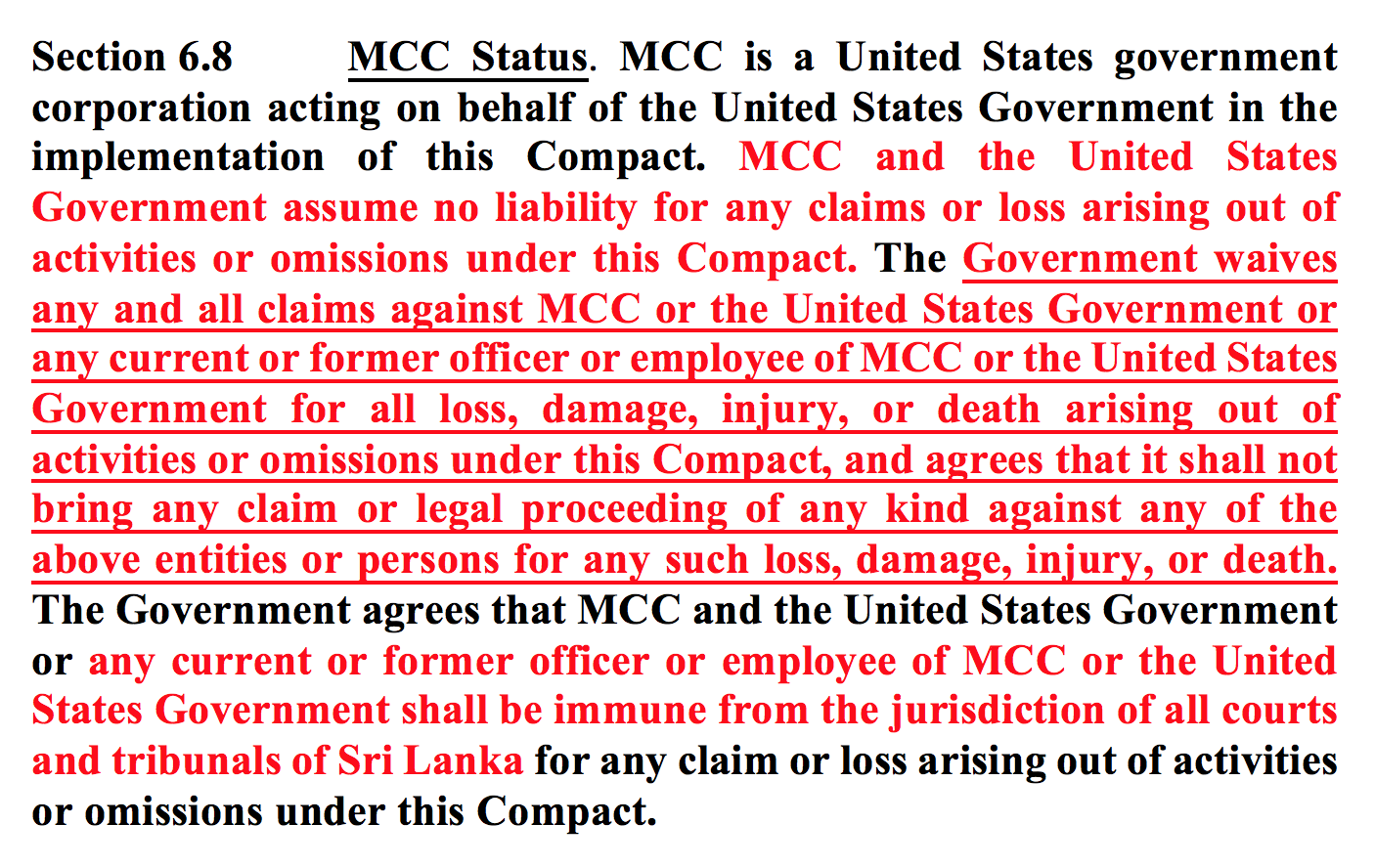
GoSL waives any claims for damages to, loss of, or destruction of property or injury or death to personnel of either party’s armed forces or their civilian personnel arising out of performance of official duties (are we to turn Sri Lanka into a war zone) Third Party claims for damages or loss caused by US military & civilians of US Defense Dept will be according to US laws & regulations
The new SOFA will supersede the one signed on 9 Feb & 16 May 1995 and entered into on 16 May 1995
The US embassy proposes that GOSL & US Govt or their designated representatives may enter into implementing arrangements to carry out provisions of Agreement
On agreement of proposals by US embassy and reply by Sri Lanka’s Foreign Ministry will be taken as AGREEMENT between the 2 Govts (this is seriously dangerous if a ministry is allowed to decide the destiny of an entire country & its populace by way of a letter the contents of which is not known to anyone)
That these proposals are even taken to a discussion is shocking without completely rejecting in its entirety.
ACSA was signed by Yahapalana in 2018 – even members of the Parliament does not know the contents of that. What is more surprising is that not one is demanding the document to be released or made available at least. Even the legal fraternity is silent.
Then we have the other damaging agreement MCC.
We may as well return to 1815 and sign the Kandyan Convention in a newer format and hand over Sri Lanka to US for another 200 years! Do we need politicians or parliament if they cannot stand up for Sri Lanka’s sovereignty?
The Koggala township where reputed writer Martin Wickramasinghe was born, received its name due to an engraved picture of a crane on a rock. Hundreds of books, including the novels Gamperaliya and Madolduwa, written by Wickramasinghe were based on Koggala where his ancestral home is situated.
Martin Wickramasinghe was born on May 29, 1890, at village headman’s house which was then known as Ginpathaliye Opisara Gedara. Opisara is the Sinhala word for officer, a man respected by the villagers, who was appointed by the Government to keep law and order in the village. Wickramasinghe was not only a writer but also a literarian and a historian. He received his education at Buona Vista College, a Christian Missionary School in Galle, which is situated on a hillock close to the present cement factory at Katugoda in Galle.
The Koggala beach was one of his favourite places and he used to take a stroll at the beach of Koggala at dawn often.
The Koggala lagoon consists of small islands such as the Mangrove Island (Madol Duwa), Cinnamon Island and Kathduwa which enhance the scenic beauty of Koggala.
FOLK ART MUSEUM IN KOGGALA
The Folk Art Museum in Koggala (Jana Kauthukagaraya) which is situated in a seven-acre plot of land is close to the Koggala Air Force Base. The museum is established at the ancestral home of Martin Wickramasinghe.
In the museum, in addition to the room where he was born, his personal belongings such as the table clock, the wristwatch, clothes, shoes, writings, and gifts, certificates and honorary degrees received from various universities along with books and souvenirs are exhibited. Apart from these, historical and cultural items related to ancient rural livelihoods are also displayed at this museum. It houses the utensils and implements used by farmers, fisherfolk, weavers, physicians, teachers, and housewives. This place is a key attraction of students, intellectuals, literarians and historians.
KOGGALA EXPORT PROCESSING ZONE
Koggala town became more prominent due to the Koggala Export Processing Zone, the first of its kind in the southern region, established in a 225-acre plot of land. There are more than 14 factories which manufacture various products including garments, for both export and the local market.
Koggala is a self-contained township. The area is surrounded by many star class hotels, and is full of amenities required by the tourists who arrive at Koggala from different parts of the world.
KOGGALA AIR BASE
The Koggala Sri Lanka Air Force Base is situated in the heart of the township of Koggala. This was set up during the World War by the British colonial administration following evacuation of residents from the area.
This Base is now used by the Sri Lanka Air Force. The Matara–Colombo railway track runs along the Air Base. The Koggala town has been identified as a centre for air, sea and road travel.
The second town in the southern region which has such facilities is Hambantota where all three modes of transportation are available due to the seaport, airport, road and railway services.
MADOLDUWA IN KOGGALA
The boat ride to Madolduwa is extremely fascinating. A majority of travellers visit Madolduwa more than any other island in Koggala lagoon due to the reference made by veteran author Martin Wickramasinghe in the book Madolduwa, which was later turned into a movie.
DEVAGIRI VIHARAYA
Devagiri Viharaya situated in Koggala is also known as Hirugal Devalaya. There are an ancient Bo tree, inscriptions and large statues of Lord Buddha and it is one of the oldest Shrines in the area.
KOGGALA FOREST HERMITAGE
The Koggala Forest Hermitage is situated on the island of Kataluduwa in Koggala. It has all facilities required for meditation.
No danger of Second Wave: Contact tracing successful: Faster control than Navy cluster:
Rumours being spread that Covid-19 infected persons of the Kandakadu cluster have been reported from various parts of the island are baseless, Director General of Health Services Dr. Anil Jasinghe said yesterday.
He said that if an infected person is actually reported from anywhere in the country, it will be announced by the authorities without any delay.
Dr. Jasinghe was speaking to the media at the National Operation Centre for Prevention of COVID-19 Outbreak (NOCPCO) yesterday.
Only a person found positive through a PCR test is considered to be a Covid-19 infected person. Recalling the Kandakadu Rehabilitation Center staff from their residents or the Welikada Prison inmates does not mean they are already infected,” he stressed. According to Dr. Jasinghe, the identification of the infected and their close associates and the process of quarantine from the Kandakadu new cluster are successful. Therefore, there is no danger of the contagion spreading throughout the country as a second wave.
In fact, the Kandakadu COVID-19 cluster can be controlled quicker than the Navy cluster, Dr. Jasinghe said. According to Dr. Jasinghe, this latest COVID-19 cluster from Kandakadu will not drag on for months like the Navy cluster. The Kandakadu cluster can be controlled within a shorter period of time. More COVID-19 patients will appear in the next few days from this cluster from various areas,” he said.
Dr. Jasinghe pointed out quarantine is the best and most powerful weapon available at the moment in the world against COVID-19. Therefore, all required individuals need to be quarantined for 14 days at a quarantine centre and then for another 14 days at home.
Dr. Jasinghe stressed that any suspected COVID-19 persons can be released after the required full quarantine period at a quarantine centre and another 14 day quarantine period spent at home even without performing a PCR Test but there is no way of releasing any suspected COVID-19 infected person only with a negative PCR Test result.
All people and all state and private sector institutions should strictly follow all health guidelines and operational guidelines issued by the Government and the Health Ministry. The basic health guidelines are wearing a mask whenever going out from home, keeping at least one metre distance from another person all the time, washing hands with soap and water for 30 seconds often and using a hand sanitizer whenever soap and water is not available,” Dr. Jasinghe added.
Meanwhile, the NOCPCO Head, Acting Chief of Defence Staff and the Army Commander Lieutenant General Shavendra Silva said so far a total of 492 have been identified as Covid-19 positive from the Kandakadu cluster. Of them 429 are inmates, 47 are staff members and 16 are their close associates.
Twenty five Coronavirus-positive cases have been reported in the country yesterday, the Ministry of Health confirmed. Reportedly, the latest cases have been identified from the Treatment and Rehabilitation Centre in East Kandakadu. The new cases have brought the total number of COVID-19 cases in Sri Lanka to 2,631. As per the Epidemiology Unit of the Ministry, 639 active cases are under medical care at selected hospitals across the island. The count of recoveries in the country currently stands at 1,981 cases.
According to a report by the Canadian outlet Global News, a case relating to two Canadian Sikhs being placed on a no-fly list in the country has now been linked to an alleged Pakistan-based plot to use pro-Khalistan elements to conduct terrorist acts in India.
The details emerged as two men – Bhagat Singh Brar and his business partner Parvkar Singh Dulai – challenged being blocked from travelling by air. As per supporting case documents filed by Canadian security agencies, including Public Safety Canada, the Royal Canadian Mounted Police and Canadian Security Intelligence Service,
Brar was “promoting extremism, including the radicalisation of youth, with the aim of achieving Khalistan independence; and attack planning and facilitation, including weapons procurement, to conduct attacks in India”.
by Tang Lu and Jamila Najmuddin Courtesy NewsIn.Asia
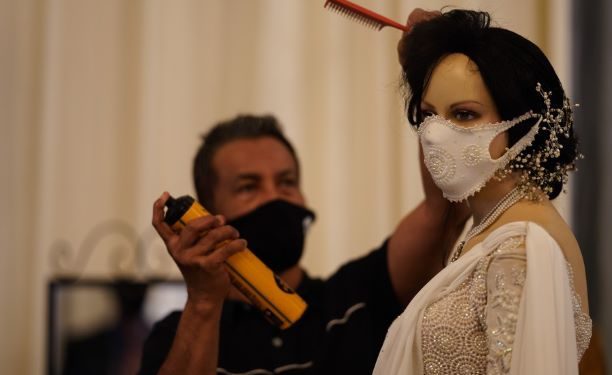
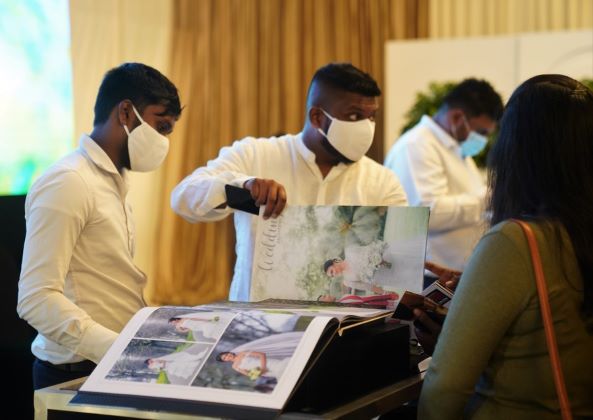
The “Wedding Boutique 2020” exhibition held in Colombo last weekend had many eye-catching and dazzling wedding products on display
The picture shows a famous hairstylist Ramzi Rahaman and a mannequin in a bridal dress wearing an attractive face mask at Wedding Boutique 2020”. Photo: Tang Lu/Xinhua)
COLOMBO, July 12 (Xinhua) — Early Saturday, young Ranjani Gunatilake, who is planning her wedding in December, traveled to the Waters Edge resort in Sri Lanka’s capital Colombo to attend Wedding Boutique 2020,” the first wedding exhibition held in the country after a COVID-19 curfew was lifted.
She has been looking forward to the event since she saw the advertisement on social media a few days ago.
Ranjani is a client manager in a business process outsourcing company in Colombo. Her fiance, an IT professional, is currently stranded in Malaysia because of COVID-19 travel restrictions. My father passed away and my mom is not in good health. Therefore, only I could come to the wedding exhibition to customize my wedding plans and do my shopping,” Ranjani told Xinhua.
Fortunately for Ranjani, the pandemic situation in Sri Lanka is now stable and the government lifted the curfew last month and has gradually relaxed the restrictions on holding weddings.
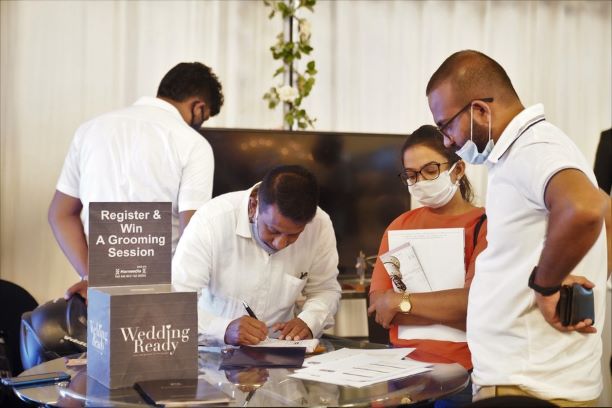
Wedding ready: The customized packages offered are very attractive. Photo: Tang Lu/Xinhua
A wedding occupies a very important place in the social life of Sri Lankans. Holding a decent wedding is a top priority for a family. And preparing for a wedding is a major responsibility for the bride and groom’s families as many items need to be purchased.
There are only a small number of wedding companies in Sri Lanka that provide a one-stop-shop” service and many families head for them.
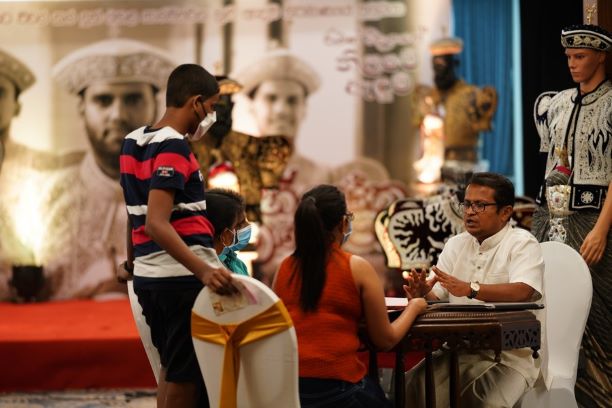
Professional advice given by expert wedding planners. Photo: Tang Lu/Xinhua
The Wedding Boutique 2020” exhibition held on Saturday and Sunday had many eye-catching and dazzling wedding products on display. There were also wedding planners, floral designers, makeup artists, hairstylists, professional tailors, jewelers, catering service providers, fancy cake makers, photographers, sound systems and lighting experts, among others.
Among the busiest at the wedding show were the creative designers who could provide comprehensive services and guidance for planning a wedding.
The wedding photographers’ counters were also surrounded by people. A young couple were seen holding an album as the photographer and salesman pointed to their ideal wedding picture.
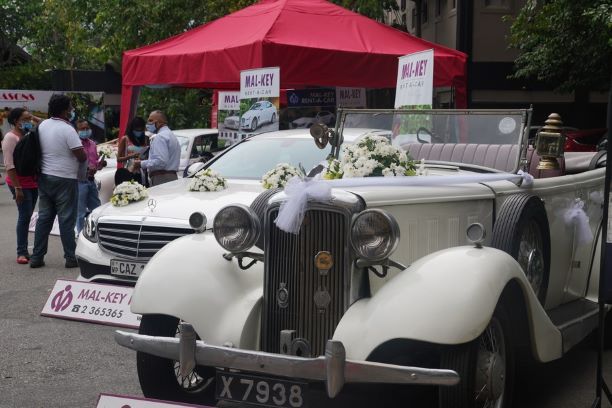
Fancy vintage cars on hire for the bride and the groom to arrive and leave in style. Photo: Tang Lu/Xinhua
In front of the jewellery counter, the supplier tirelessly helped newcomers to choose their jewellery.
At a wedding hairstyle and beauty counter, there was a mannequin in a bridal dress wearing an attractive face mask.
This bridal mask was specially designed for the bride after the outbreak of the epidemic,” Sri Lanka’s famous hairstylist Ramzi Rahaman told reporters. I am very keen on designing masks. Masks have become a fashion statement,” he added.
There were some large screens at the exhibition showing colorful weddings in various styles. A manager who participated in the wedding boutique exhibition said that an Indian-style wedding in Sri Lanka would cost between 3 million and 6 million rupees (about 16,000 U.S. dollars to 32,300 dollars), while a grand Sri Lankan-style wedding will cost at least 2 million rupees (10,765 dollars).
The manager said that Indian-style weddings are ordered by rich Indians who come down from India with hundreds of guests. Sri Lankans, on the other hand, prefer their own local style, he added.
Wedding photographers display their albums. Photo: Tang Lu/Xinhua
Most stalls at the exhibition displayed attractive 25% discount signs. Ajantha Wijesundara, manager of Raja Jewelers, said customers who place an order at the exhibition will get a discount of 20 to 25%. But if the order is placed after the two-day exhibition, the discount will be reduced to 10% to 15%.
Because of this, locals who are interested in planning a wedding come prepared to pay up.
I will gather information today, go home and discuss with my fiance and mother, and maybe come to sign the contract tomorrow before the exhibition closes,” Ranjani said.
Considered one of the four main sacred places associated with Lord Buddha, Kushinagar in Uttar Pradesh is believed to be the site where the Buddha attained ‘parinirvana’.
Colombo, July 14 (newsin.asia): The Indian cabinet of India, chaired by the Prime Minister Narendra Modi, has granted approval to declare Kushinagar Airport in Uttar Pradesh as an International Airport.
Considered one of the four main sacred places associated with Lord Buddha, Kushinagar is believed to be the site where the Buddha attained ‘parinirvana’.
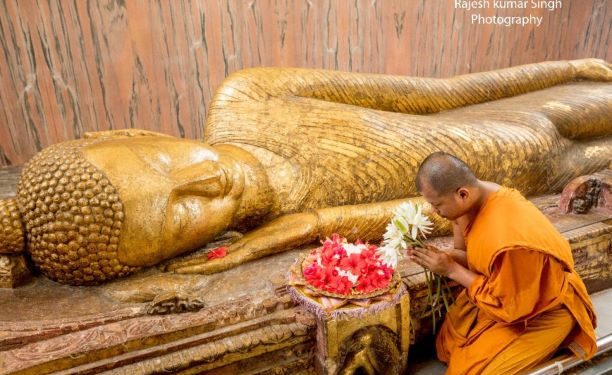
A colossal reclining statue of Lord Buddha from the 5th Century at the Mahaparinirvana Temple pays homage to this.
The Ramabhar Stupa, also known as the Mukutbandhan Chaitya is said to be the cremation place of Lord Buddha, and is located in the vicinity of the Mahaparinirvana Temple.
The Kushinagar district is also home to numerous other monasteries and Buddhist cultural sites. The decision to declare Kushinagar airport as an International airport, will provide Buddhist pilgrims, historians and cultural enthusiasts the opportunity to comfortably explore not only Kushinagar, but also other historically significant locations such as Lumbini, Kapilavastu and Sravasti, which are in close proximity, the Indian High Commission said in a press release on Wednesday.
President Gotabaya Rajapaksa today assured that the people would be protected from the COVID-19 pandemic by mitigating the risk of the virus spreading in the country, until the pandemic is finally wiped out.
He said the government took successful measures in the wake of the virus outbreak long before many other governments.
According to the President’s Media Division, the President said this when the Task Force on COVID-19 met at the Presidential Secretariat to discuss the current COVID-19 situation in the wake of the positive cases found at the Kandakadu Rehabilitation Centre.
He recalled that there were objections from the residents when planning to set up quarantine centres at the beginning, and those who arrived from Italy and south Korea also objected to being sent to quarantine centres.
No matter what obstacle we face in the future, we will overcome the challenges and will not shy away from the responsibility of safeguarding the people,” the President said and added that the close associates of the patients found positive at the Kandakadu Rehabilitation Centre have been sent for quarantine.
The close associates and links extending up to four circles have been asked to undergo a period of self-quarantine. The government has made plans to overcome the future challenges in a manner similar to how it controlled the situation initially,” he said.
At the meeting, the President instructed the health officials to continue with the PCR tests to keep the spread of the virus at a minimum level and instructed that the number of PCR tests being conducted at Rajanganaya and other areas where positive cases were reported to be increased and to update the people on the action taken to control the situation and about the pandemic.
The PMD said it was also agreed to expand the programme to rehabilitate the drug addicts parallel to the programme of mitigating COVOD-19 pandemic.
The President also expressed his gratitude to all those involved in the battle against the pandemic.
Prime Minister Mahinda Rajapaksa, Health Minister Pavithra Wanniarachchi, President’s Secretary P.B.
Jayasundera, Chief Presidential Adviser Lalith Weeratunga, Prime Minister’s Secretary Gamini Senarath, Army Commander Shavendra Silva, Health Services Director General Dr. Anil Jasinghe and members of the COVID-19 Task Force and medical specialists also attended the meeting.
President Gotabaya Rajapaksa says that the heads of both government and private entities are accountable for adhering to health guidelines in their organizations in the wake of the current spike in COVID 19 cases.
The COVID-19 virus is prone to spread among groups until adequate and satisfactory containment. Kandakadu Rehabilitation Center is an unfortunate example.” Hence, the President emphasized the necessity of continuing easily accessible tests related to clusters of people immediately.
The President made these remarks during a discussion with the Presidential Task Force to established to combat COVID-19 in Sri Lanka, at the Presidential Secretariat today (14).
Although day to day life has returned to normalcy, precautionary measures should not be relaxed as the risk of COVID 19 spread remains high, the President has said highlighting the importance of carrying out simple tests such as regular body temperature checks in Rehabilitation Centers, prisons, universities, schools and similar places.
Wearing facemasks, washing hands, maintaining social distance are vital under this situation. If you suffer from fever and ailments related to throat, you should refrain from mingling with crowds. Simple practices like these would make a difference in combating COVID-19”, the President added.
Prime Minister Mahinda Rajapaksa, Minister Pavithra Wanniarachchi, Secretary to the President P.B Jayasundera, Principal Advisor to the President Lalith Weeratunga, Secretary to the Prime Minister Gamini Senarath, members of the Presidential Task Force and several medical consultants were present.
COVID-19 infections patients confirmed thus far in Sri Lanka increased to 2,665 today (14) following the detection of four more positive cases, the Ministry of Health said.
The latest cases include 01 contact of a patient detected from the Treatment and Rehabilitation Centre in Kandakadu, 01 arrival from Oman and 02 arrivals from the United Arab Emirates, according to the Department of Government Information.
Earlier today, 08 close contacts of patients linked to Kandakadu COVID-19 cluster tested positive for the virus. In addition, 04 inmates at the Rehabilitation Centre in Senapura were also confirmed coronavirus positive. Meanwhile, 03 virus-positive returnees from Oman also added up the total cases count.
Accordingly, 19 fresh cases of novel coronavirus have been confirmed so far within the day.
The Epidemiology Unit says 666 active COVID-19 cases are currently under medical care at several hospitals across the country.
Meanwhile, the number recoveries from the disease increased to 1,988 earlier today as seven patients were discharged from Infectious Disease Hospital (01), Iranawila Hospital (02) and Minuwangoda Base Hospital (04).
Sri Lanka witnessed a total of 11 deaths due to COVID-19 thus far.
Health Minister Pavithra Wanniarachchi today answered a question raised by UNP leader Ranil Wickremesinghe regarding the use of foreign financial assistance received to curb the Covid 19 epidemic.
Meanwhile, Minister Pavithra Wanniarachchi responded to the allegations made by UNP leader Ranil Wickremesinghe on several occasions regarding the money received by the Ministry of Health from foreign countries for the Covid 19 pandemic.
Samagi Jana Balawegaya’s candidate Ajith P. Perera has stated that the competition is not with the United National Party but with the Podujana Peramuna.
He stated this at a press conference today and said that he would challenge the UNP leader Ranil Wickremesinghe to contest and get results.
Sri Lanka managed to control the spread of the Covid-19 pandemic in the country very successfully from the start, in comparison to many countries in the world. Since March 30 there have not been any community cases reported in the country and the cases that were reported were all from quarantine centres and mainly those arriving in the country from overseas.
However, by last week, a new cluster that sprung from Kandakadu has so far identified a total of 519 new coronavirus cases, following the detection of an inmate who was transferred to the Welikada Prison from the Treatment and Rehabilitation Centre – East in Kandakadu, testing positive.
So far, 440 of these infections are inmates of the rehabilitation centre in Kandakadu as of last morning (14). Out of this cluster, 63 of the cases are staff members of the Kandakadu rehabilitation centre. Meanwhile, 16 other cases were identified from the Rajanganaya area as contacts of the virus-positive cases of the Kandakadu cluster.
Many questions have arisen with the new cluster emerging from Kandakadu as to why the inmates of this drug rehabilitation centre were not subjected to PCR tests and how the virus had crept in without being detected by health authorities.
In an exclusive interview with the Daily News the Commissioner General of Rehabilitation Maj. Gen. (Rtd) Dharshana Hettiarachchi spoke about the Kandakadu and Senapura Drug Rehabilitation Centres, how it all began, its current crisis and future plans. Gen. Hettiarachchi was the Commissioner General of Rehabilitation when the Bureau was first established. He later moved on and after his retirement, he was re-appointed as the Commissioner General of Rehabilitation in February this year.
Q: How and when did the drug rehabilitation programme commence?
A: In 2013, we completed the rehabilitation of the ex-LTTE combatants and converted these rehabilitation centres into centres for rehabilitation of drug addicts. Since we were able to conduct a successful rehabilitation programme for ex-combatants, the Defence Secretary at the time, who is the current President, Gotabaya Rajapaksa decided to make use of the same facilities to start a rehabilitation programme for drug addicts, as narcotics were becoming a real menace to society and the country as a whole.
Thereafter, the necessary legal framework was prepared to send drug addicts to the Kandakadu Rehabilitation Centre from the Welikada Prison through the courts. Accordingly, the necessary legal framework was drafted under the supervision of the National Dangerous Drugs Control Board. At Kandakadu, we do a six-month programme for these addicts consisting of a number of subjects in an attempt to break their drug addiction. After the initial six months, they are put through another six months of vocational training to arm them with the knowledge to engage in some trade once they leave the centre and go back into society.
Q: How did the Covid-19 virus enter Kandakadu?
A: As a practice, we have been getting all these people from the Prisons Department. But during the Covid-19 period, in the month of May, there was a special programme in and around Colombo to track down the drug addicts. Accordingly, the police arrested around 66 persons and they were sent to the Air Force Quarantine Centre in Mullaitivu and another centre in Galkanda in the Welikanda area. They wanted to send these drug addicts for rehabilitation, but we insisted that unless they go through the required quarantine process, we cannot take them in as it would put the health of the other inmates at risk. Accordingly, they went through the 14-day quarantine process and thereafter PCR tests were also done and they were sent to the rehabilitation centre.
Although the PCR tests were done, we suspect that there may have been one or two who probably still had the virus in them when they entered Kandakadu. Since the months of May and June we did not have any problem. There are almost 600 persons at this Kandakadu Rehab Centre.
Q: Why were these inmates not tested?
A: It has been a very common thing that sometimes some of these inmates develop a cough or cold or fever. If anyone is ill, we usually take them to the Polonnaruwa General Hospital and have them treated. In addition, there is a doctor from the Polonnaruwa Hospital who visits the rehabilitation centre daily to check on these inmates. No one had any special symptoms or showed signs of coronavirus.
However, one of the inmates had to be produced in court for a case and we handed him over to the Polonnaruwa Prison to be brought to Welikada for his court appearance.
Prior to sending him back to Kandakadu, he was tested and his PCR test was positive and that is when we discovered that he was infected and traced him back to Kandakadu and did the tests on the other inmates and found many others too who tested positive.
The issue is that none of these patients showed any symptoms or signs of being ill. The activities at Kandakadu went on as usual and whenever anyone had a cough, cold or fever, the doctor treats these persons and they recover. This was a routine practice and no one thought much about it. Only after this inmate tested positive did we test the others and discover that many more had contracted the virus.
The rehabilitation of drug addicts is a very challenging task and the staff members involved in this process serve with great commitment.
Some quarters are questioning us as to why these inmates were not tested. But in all fairness to the officers at these centres, there was nothing out of the ordinary that warranted such testing.
Cough or cold and slight fever is a common thing at these centres and prompt action had been taken to get medical treatment for them. As there is a doctor visiting the centre daily, there was no concern as we were certain that the doctor could detect if anyone had contracted the virus. Even those who had minor ailments were treated and recovered well. Even one of the officers who was infected had been treated for a mild fever and having recovered after around three days, he had even engaged in his usual physical fitness activities such as his routine jogging without any issue. So no one expected this situation.
Even those who have been moved to the special hospital on the other side after testing positive are leading a normal life and are not showing any symptoms of being ill. This is probably why it was not detected earlier.
However, I don’t think this will have a strong impact on society as the Army and security forces are doing a wonderful job under the directives of the Army Commander, and the military intelligence units have traced all the contacts who had come in contact with these patients and have sent them for treatment or quarantine. Their mechanism is very efficient and effective. The very next day that these people tested positive, the military intelligence managed to trace all their contacts and isolate them to prevent further infection.
Q: Can social distancing be implemented at these centres?
A: This is something special unlike any ordinary hospital. These are drug addicts who most often do not adhere to rules and regulations. Even the staff are specially trained to handle these inmates. Under such circumstances and given the number of inmates and the limited resources, it is impossible to adhere to the required social distancing regulations.
It is not possible practically. In a place where there are around 500 persons accommodated, it is not possible to get them to maintain distance, especially when bathing and so on. Constructing separate bathing and toilet facilities is not practically possible.
One must understand that this facility has been set up to cater to drug addicts and not people who can act rationally.
Q: Based on the location of these facilities, is there a danger of a community spread?
A: Kandakadu is an isolated place and there is little or no danger of it spreading. In fact, even the Kandakadu Quarantine Centre was established there due to its isolation from congested town areas. Within a radius of around four to five kilometres there is no residential area, so there is no possibility of other communities being at risk.
However, in Senapura there are several residential areas in proximity, but we have taken all possible measures to ensure that these communities are not affected.
We have also temporarily stopped the families of these inmates from visiting them at these centres until the infection has been brought under control.
Q: If the 66 drug addicts who were brought to the centre were subjected to quarantine, how do you think the infection got in?
A: We must conduct a thorough investigation into this matter to see how it happened. Although they were sent for quarantine and the PCR tests were conducted, I suspect that due to some technical error, one or two positive cases may have gone undetected. We cannot blame anyone as there is evidence that the virus could surface even after 21 days. Otherwise, there is no possibility at all, as we have only been getting persons from Welikada under court orders. So if it had come from Welikada, then there would have been more cases reported from Welikada. So the only thing we can suspect is that somehow the infection could have crept through one of the 66 who were sent here.
After three months, we only allowed parents to visit their children in July. But we strictly adhered to all the health guidelines and there is no possibility that the infection could have been brought in by any of the relatives.
Hence, I expect the health authorities will do a proper investigation to trace as to how the infection could have got through.
Q: What are the future plans for the Drug Rehabilitation Centres?
A: There is a huge human resource at these drug rehab centres and the majority of them are in the prime of their youth. So we thought why not make use of this resource for the betterment and development of this country and contribute to the country’s economy.
Accordingly, we had several rounds of discussions with the Foreign Employment Bureau and the agencies and they have agreed to find out what jobs are in great demand overseas and in the future we plan to tailor our vocational training courses to suit these requirements. If it is required, we are prepared to give them the needed language training as well. Our aim is to direct them in a productive manner as soon as they complete their rehabilitation, so that they don’t get back to the same circle of drug addicts and fall prey again to drug abuse.
We are in the process of acquiring around 1,000 acres of land from the Mahaweli Authority to initiate a coconut plantation. The Coconut Development Board has already agreed to give us the saplings and the Coconut Research Institute will do soil research and show us the suitable areas for this project.
We have also initiated discussions with the Cashew Corporation to commence a cashew cultivation using the inmates at these centres. The Corporation will assist by providing us with the seeds and the expertise.
Discussions have also been held with the Ayurveda Department and we also had a workshop for our officers to grow herbal plants. The country spends millions of rupees every year to import herbal medicinal plants from India. Hence, we intend to plant these medicinal plants in Sri Lanka under this project, depending on the suitability of the climatic conditions. The produce can be given to the Ayurveda Department.
We also have plans to commence a cement block manufacturing plant, where the cement blocks produced by us can be supplied to low-income families for their construction purposes at only the material cost. Our main aim is to use these drug addicts to contribute productively towards the country’s development without being a burden on the country.
President’s Counsel Romesh de Silva appearing for President Gotabaya Rajapaksa informed Court of Appeal that summons issued by Jaffna Magistrate’s Court requiring President Gotabaya Rajapaksa to appear before Jaffna Magistrate’s Court as a witness in connection with the Habeas Corpus inquiry into the disappearance of two human rights activists Lalith and Kugan, cannot be maintained since he holds the post of President in the country.
Senior State Counsel Wasantha Perera appearing for the Attorney General informed that the President was immune to the judicial process in terms of Article 35 (1) of the Constitution.
However, Counsel Nuwan Bopage appearing for the respondents informed the Court of Appeal that there is no constitutional barrier to summon the President as a witness in a fact finding inquiry.
Taking into consideration the facts, Court of Appeal President Justice A.H.M.D. Nawaz and Justice Sobhitha Rajakaruna ordered the parties to file their written submissions before August 26.
On September 24, 2019, Court of Appeal had issued an Interim Order staying summons requiring then presidential candidate Gotabaya Rajapaksa to appear before the Jaffna Magistrate’s Court on September 27, 2019. The Court of Appeal had made this order pursuant to a petition filed by Mr. Rajapaksa citing urgency and security reasons. The Court had issued this order in connection with the Habeas Corpus inquiry into the disappearance of two human rights activists, Lalith and Kugan, who went missing in December 2011 when President Gotabaya Rajapaksa was serving as the Defence Secretary.
In his petition, Rajapaksa stated that he received summons through Magistrate’s Court of Jaffna to attend and give evidence in connection with the Habeas Corpus inquiry. Human Rights and political activists Lalith Kumar Weeraraj and Kugan Muruganandan went missing on December 9, 2011.
The petitioner states that the petitioner in the capacity as the Defence Secretary facilitated logistical and strategic support to be obtained through the government to the forces during the war which eradicated the separatist outfit namely the LTTE who operated heavily in the Eastern and Northern parts of Sri Lanka.
The petitioner states that the said threats continue to loom time and time again including the most recent occurrence wherein investigations are underway to ascertain any treat to assassinate the petitioner and several other high-ranking members of the military and in the government.
President’s Counsel Romesh de Silva under the instructions of Counsel Sanath Wijewardena appeared for petitioner Gotabaya Rajapaksa. Senior State Counsel Wasantha Perera appeared for the Attorney General. Counsel Nuwan Bopage appeared for the respondents.
The Tamil National Alliance (TNA) was formed in 2001. At its inception, it was an umbrella organization consisting of the Tamil United Liberation Front (TULF), the All Ceylon Tamil Congress (ACTC), the Tamil Eelam Liberation Organization (TELO), and the Eelam People’s Revolutionary Liberation Front (EPRLF). The organization was a Liberation Tigers of Tamil Eelam (LTTE) creation. Since it was an LTTE creation, the party supported the LTTE and took orders from the LTTE.
Rewriting History
In the recent past, there has been an attempt to detigerize the TNA. Some of the current leaders argue that the LTTE did not form the TNA. The process of detigerizing TNA is not universal. It targets the South and non-Tamil media. In the north, the party’s nexus with the LTTE is upheld because the Tiger connection is vital for harvesting votes. It is ludicrous to argue that the TNA was formed independently of the LTTE because nothing happened within the Tamil polity in this period without the LTTE approval. In this period, trying to be active and independent within the Tamil polity could cost one’s life. Even those who argue that the TNA was formed independently of the LTTE agree that it had cautious indirect backing” of the rebels.
Long before the current leaders of the TNA started rewriting the history, an independent analyst pointed out that The TNA, founded in 2001 with the LTTE’s encouragement, was the ambiguous product of the Tigers’ anti-politics: a political formation with no real autonomy and no right to dissent, but used by the LTTE to claim popular support” (International Crisis Group 2012, p.6). In 2004, the party claimed that the LTTE was the sole representative of the Tamil people. In its 2004 parliamentary election manifesto, the party stated that accepting LTTE’s leadership as the national leadership of the Tamil Eelam Tamils and the Liberation Tigers as the sole and authentic representatives of the Tamil people, let us devote our full cooperation for the ideals of the Liberation Tigers’ struggle with honesty and steadfastness” (p.4). As I said, it is ludicrous to claim that the TNA was an independent entity its inception. The TNA members were rebels without arms.
Transition: From Rebels to Partners
After the LTTE was gone, the TNA became independent and making decisions without too many constraints. In 2015, the party supported Maithripala Sirisena for president and extended its tacit approval for the Yahapalana government. Some of my friends indicated that one of the top-tier leaders of the TNA worked behind the scene for the UNP campaign in 2015. During the Yahapalana government’s tenure in office, the United National Party survived at least two no-confidence motions with the TNA assistance. The TNA’s collaboration with the UNP was such that some commentators called the party a proxy of the UNP.
One significant aspect of this collaboration was that the TNA did not try to become a part of the government by accepting ministries. The support was mostly unofficial and secretive. Why didn’t the TNA join the government? The TNA did not join the government in 2015 because the Tamil people were not there. They were mentally not ready to be part of a Colombo government. The TNA leaders feared that they would be called traitors if they join the government. It is imperative to note that the Eelam People’s Democratic Party (EPDP) leaders were often called traitors by the LTTE sympathizers due to their association with the Colombo government. This fear prevented the TNA from officially joining the government despite the deep desire among some TNA members to do so. This was one reason why Sumanthiaran became an almost” minister, not an actual one.
2020 Campaign
It was against this backdrop, a recent campaign speech by Sumanthiran becomes significant. On July 11, the Kalaikkathir newspaper reported a statement Sumanthiran made at Sembiyanpattru. According to Kalaikkathir, Sumanthiran has stated that I agree that we need to work toward development. We don’t know when we will get a political solution. In a democratic environment, one has to negotiate and patiently wait for a political solution. In this interim period, we need to improve our economic development.” Sumanthiran was indirectly suggesting that political solution is not feasible in the short run; hence the Tamils should worry about development,” which is reasonable, and it reflects the reality.
What he said next may be very significant, and it could mark a considerable transformation of Tamil politics. He said, even if we are to join the new government (after the election), we need strength to negotiate ministries, number of ministries, and the nature of power (of these ministries).” One, it indicates that the TNA is now ready to join the government as a partner. Two, the TNA, which hitherto asked Tamil people to vote for it to negotiate devolution of power and political autonomy, is now asking Tamil people to vote for them to negotiate ministries. In my view, this is a significant transformation. Sumanthiran argued that there had been a change within the Tamil community. He said, expectation of our people was to secure the political rights because we can handle development issues if we have political rights. Now we see a change in this trend.” One has to wait and see if there has been a change within the Tamil community or if Sumanthiran is projecting his deep desires on the Tamil people.
The TNA or Sumanthiran joining a UNP-led government cannot be a big surprise. The chemistry between the two is excellent. But it is certain that the UNP or the Samagi Jana Balwegaya (SJB) will not win the August election. Is Sumanthiran talking about joining the SLPP government?
What surprised me the most in this speech was that the TNA (or Sumanthiran) is willing to join even the SLPP government. This is new. Sumanthiran declared that this (the SLPP) government needs a two-thirds majority. But political analysts predict that they will not get a two-thirds majority. Against this backdrop, they might need our support. I have already indicated to them on what basis or condition we may join the government…In response, the government has responded with positive signals.”
This is big news. Are the government and the TNA already in negotiation, or is Sumanthiran taking Tamils for a ride? Any information on this from the government could be extremely valuable.
Nevertheless, Sumanthiran stated, nothing could be predicted now. We cannot just say that we are joining the government and accepting ministries…But I am not saying that we will not do that.” I am sure this is news for the Tamil people as well. It would be interesting to see if the TNA manifesto, which is expected sooner rather than later, will reference its plans to partner with the SLPP government.
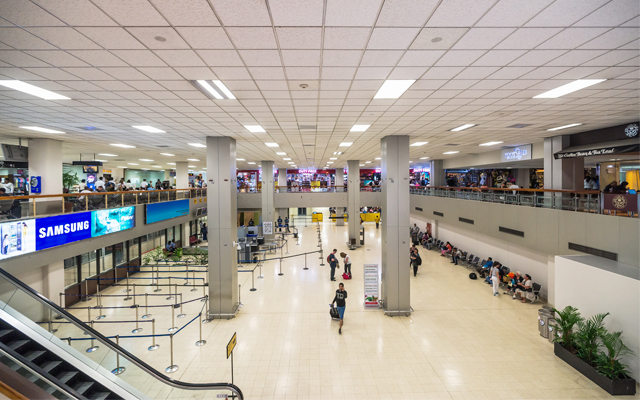
The reopening of Sri Lanka’s Colombo International Airport has been delayed indefinitely, after repatriation flights were suspended due to a spike in Covid-19 infections last week.
This marks the second postponement of the reopening of the country’s main international airport, after authorities announced last month that its initial August 1 reopening would be pushed to mid-August to focus on the repatriation of the tens of thousands of Sri Lankans stranded abroad.
Reopening of Colombo International Airport runs into second delay, as the country battles Covid-19
Over 300 Covid-19 cases were detected last Friday at a drug rehabilitation centre in Sri Lanka’s North Central province, prompting authorities to close schools for a week starting Monday (July 13) – just a week after selected classes were allowed to resume – while contact tracing is being conducted since some centre officials had gone home and may have infected others.
Repatriation flights operated by SriLankan Airlines will be suspended from Tuesday (July 14) as quarantine centres are running out of space after the surge in Covid-19 cases, many of whom are Sri Lankan returnees serving a mandatory 14-day quarantine at government-designated facilities.
Tourism and aviation minister Prasanna Ranatunga told reporters: We cannot give an exact date for the reopening of the airport. The top priority of the government is to contain the spread of Covid-19 and to repatriate Sri Lankans still stranded in various parts of the world.” The repatriation process will resume once the spike in new clusters is controlled, he added.
The government has said that the airport, closed to commercial traffic, will reopen only after all or most of the Sri Lankans stranded abroad have been brought back.
To date, nearly 15,000 stranded Lankans from 65 counties have returned, out of 50,000 citizens awaiting flights home, according to government figures. Sri Lanka has reported 2,617 Covid-19 cases as of July 13, with 1,981 recoveries and 11 deaths.
In
the 1980s, I attempted to develop industry averages in Sri Lanka, and the
purpose of my effort was to support credit policy development, which needed to
successful credit management in a government bank, where I had been working.
When I was talking about industry averages, bank executives, and the government
authority had no clear understanding of it, and the unpleasant environment of
the country at that time, and in the bank where I was working, I left the
country. Recently, I read a statement issued by the governor of Central Bank,
which was an issue related to the financial system of Sri Lanka. The statement
of the Central Bank governor confirmed that Sri Lanka needs working lots for
the development of many industries, services, and business for sustainable
growth.
The
concept of the industry has broadly expanded in Sri Lanka during the past
several decades, and I observed that many issues related to the various
industry are being discussed in news media, and such problems seem to be
continued in the country without proper solutions. When I was talking about the concept of
industry standards with a higher level director of the Ministry of Industry, he
admitted that my point was vital, but top people in the country have no
understanding about the concept of the industry, the executive personnel of the
ministry had an excellent understanding of my idea, and the executives of the
Industrial Development Board and the Central Bank did not concern about the
concept of the industry because they were self-centred, and they did not want
to work on the idea I presented.
When
the world has been rapidly transforming to the dynamic environment I noticed
that Sri Lanka has relegated to higher risk in business activities, and I wrote
to the president of Sri Lanka, Mrs. Chandrika Kumaranatunga was holding the
office on this complication of industry concept and how it could be used to
attract foreign investments to the country.
The operation of various parts of the financial system had a negative
implication to Sri Lanka’s economy and policy personnel did not concern on the
matter.
Colombo
Stock Exchange also rapidly expanded at the beginning of the 21st
century and the concept of the industry was valuable to attract and promote
investments in the CSE, and to attract the confidence of international
investors. I mentioned this point in the
letter addressed to the president. I saw in news reports some crooks were
playing dishonest games in the Colombo Stock Exchange
I
read a public statement of a person that Colombo Stock Market is an adorable
place that supported him to purchase a piece of land from Colombo 7. Many
people became rich short selling and misleading people. Investors had difficulties to estimate
investment returns of various industry and individual firms within an industry
as averages of the industry with firms were not available in the country.
The lack of knowledge of industry
classification, role of the industry authority, weak industry policy
development negatively impacted the development and opportunities of CSE. Nobody can underestimate the Asian crisis in
the late 1990s and impact made on Asian currencies and stocks. Indonesia is
still in the same mud pond without overcoming fundamental issues.
In
this background, Sri Lanka needs an industry authority, which prepares industry
average, industry regulation, and plays an ombudsman role. If it takes the
financial system of Sri Lanka sub-system or markets such as insurance, non-bank
finance companies, leasing institutions, Superannuation organizations, hire
purchase companies and others are operating in the system. The Central Bank of Sri Lanka cannot regulate
the broader system and develop industry averages.
The
industry authority needs to perform a regulatory role and they need to meet
quarterly and discuss issues. The
Central Bank of Sri Lanka cannot perform all activities and need to delegate
the powers to sub-industry authorities and supervise the roles of industry
authorities.
Mr.
Gotabaya Rajapaksa as the president of Sri Lanka must order his advisors to
perform this role. If this work
successfully effective in the country nearly one hundred graduates could be
provided good jobs and there cannot be graduate unemployment in the country.
President
Gotabhaya Rajapakse had requested the Cabinet of Ministers to submit their
opinions on the Prof.Lalithasiri Gunaruwan Report on the Millennium Challenge Corporation (MCC) agreement with the USA. This
has now been extended for a further two weeks. Though not a Cabinet Minister, but
as the leader of the Lanka Sama Samaja Party (LSSP), which is a member of the
Sri Lanka Freedom Podujana Alliance (SLFPA), I wish to express the opinion of
the LSSP on this controversial proposal.
The LSSP
views the MCC agreement, and the two other related agreements (ACSA & SOFA), as totally opposed to the independence,
sovereignty and territorial integrity of Sri Lanka and that the SLFPA
Government should not sign any of them if it wishes to safeguard the real
interest of Sri Lanka and its people.
The Sri
Lanka Podujana Peramuna (SLPP) had correctly opposed the MCC agreement while in
the Opposition as it would divide the country and have other ill effects. Accordingly
the President had appointed the Gunaruwan Committee to submit a report. In this
Report the Committee has pointed out the dangers of the MCC agreement to our
sovereignty and territorial integrity and that it violates our Constitution and
Laws. It also mentions the fact that the American company that would be
preparing the digital register of all land holdings in the North and other
areas would be able to get possession of a huge extent of land for foreign
exploitation. The entire profits could be sent abroad. The Gunaruwan Committee
is to be congratulated for producing a factual and comprehensive document which
highlights the dangers to the country.
The passing
reference in the Committee Report to the fact that they had come across some
references to USD 10 million in some documents which needed to be looked into,
was pounced upon by the US Embassy in Sri Lanka and by the USA’s political
agent in Sri Lanka, UNP leader Ranil Wickremasinghe, to be used as a red
herring to discredit the report. Whether this sum was paid or received in
advance is irrelevant to the charges made by the Gunaruwan Report, which
nevertheless retains it validity. There
are several countries that have suffered badly as a result of MCC agreements.
Some of these are also mentioned in the Gunaruwan Committee Report.
There was a
report in the Daily News on 8th July 2020 of a study by a top
accountancy firm Ernst & Young on the land and other subjects covered by
the MCC agreement. The report adds that, beside the privately owned or
cultivated land, a significance portion of the land comes under the purview
and protection of the Department of Wildlife Conservation and the Department of
Forestry of Sri Lanka”. In this connection, another news report says that 500,000
hectares (28% of the total forest land in the Island) is being considered for privatization
in the North.
It must be
mentioned that there is a report of an investigation into the activities of
Ernst & Young done in 2016 that describes how Ernst & Young, and three
other major accountancy firms, had been used by the EU and IMF to use the
economic crisis to impose privatization of state owned assets on indebted
countries in Europe, despite mass resistance. They made huge profits and were
also able to acquire vast wealth by under-valuing assets and reselling them. The
promised revenue to the indebted states was not realized. The wages and working
conditions of the recruited staff was at reduced rates, thereby increasing income
inequality in those countries.
Therefore
the SLFPA Government should not under any circumstances sign the MCC agreement.
As this agreement has the unusual requirement that some of the conditions have
to be implemented prior to signing the agreement, it would appear that these
conditions are already being implemented. These should all be stopped and
reversed forthwith in the interest of our country and our people.
ACSA and SOFA agreements
The above
agreements are military agreements that are thrust on our countries by the USA.
The Acquisition and Cross Services
Agreement (ACSA) is an agreement which allows American troops coming from
outside to make use of our airports, harbours and military facilities and also
engage in joint maneuvers with the Sri Lankan forces. They can also engage in bilateral
and multilateral military exercises.
The Status of Forces Agreements(SOFA) has been signed periodically
with over 80 countries throughout the world by the USA. These can vary from
country to country and from time to time. In response to a question asked by
the Mahanayaka of the Malwatte Chapter on 24th May 2019, referring to the ongoing
discussion between the UNP and USA
Governments on the SOFA agreement, the US Ambassador to Sri Lanka, Ms.Teplitz,
stated that it was to allow
US forces to tour the country and to conduct combined security operations”. But
in fact an unlimited number of US troops will be allowed to enter Sri Lanka
wearing uniform with guns in hand and accompanied by heavy armaments at any
time they wish to come. They will be given all diplomatic privileges and
whatever they bring cannot be examined by Sri Lankan officials. They have to be
given access to enter any institution or premises that they desire to enter at
any time. If they commit any crime they cannot be tried by Sri Lankan Courts,
but only by Courts in the USA. They are not liable to pay any taxes or duty on
anything they import or export. The American troops will be free to move to any
part of the country, at any time without prior permission.
With our
small armed forces Sri Lanka will not be able to get rid of the US troops if
they wish to stay on in the country. The USA can make Sri Lanka a military base
and the whole country a colony. If we agree to these terms we shall loose our independence,
sovereignty and territorial integrity.
Thus, it is
extremely worrying when Cabinet spokesman, Minister Bandula Gunawardene, is
reported to have stated at a media briefing, while denying signing the MCC agreement,
that the Government has entered into ACSA and SOFA agreements with the US
Government. The situation is made more disturbing when newspapers report that
Basil Rajapakse allegedly mentioned that if this has been stated by Bandula
Gunawardene then it could be correct. I earnestly request the President and the
Prime Minister to make a categorical statement denying the above newspaper
reports if they are not true, and to reassure the people that the Government
has no intension of signing or implementing the MCC, ACSA and SOFA agreements.
By Saroj Jayasinghe Consultant Physician and a Professor in a University of Colombo
A
single incident in the US which was captured on a mobile phone by a teenager
has triggered waves of protests against racism, globally. This has included
bringing down of monuments that represented racists or slave owners in the UK
and USA. Well-known names of such racists who were being implicitly honoured
include the statue of Cecil Rhodes in Oxford University and the Policy School
named after Woodrow Wilson in Princeton USA, both of which are likely to be
removed by the universities.
It
is inevitable that countries in the global financial periphery such as Sri
Lanka, too are touched by these events and reflect about racism. In the next
few paragraphs I wish to outline the history behind a few selected names we
currently glorify in Sri Lanka. The fact that Sri Lanka honours white skinned
looters, criminals and murderers with road names may illustrate that we have
learnt to accept racism within our collective psyche. This brief paper is to
confront this by identifying a few well-known road names and delving into their
histories.
Human
rights violators
1.
Thomas Maitland (1805-1811).
A
soldier who became a governor, TM came after the blockage of the Kandyan
Kingdom by Governor North. He cannot be considered a benign leader worthy of a
road named after him. Maitland was famous for using modified slave labour and
used deceit to undermine the Kandyan King. His letters to Britain (quoted in
Colvin R. De Silva’s book) stated that ‘it is by sword alone that we have
obtained possession of this island and it is by the sword alone we can expect
it to hold it’. He fleeced the country with innumerable taxes and ensured trade
rules favourable to themselves: cinnamon, pearl fisheries, etc.
He
was a soldier at a time when slavery and white supremist ideas would have been
the norm. If we are to extrapolate to the past from what Floyd underwent inside
his own country under the full glare of mobile phones, it must have been worse
200 years ago, when absolute unbridled power was with the
colonisers.
We honour him
with the following roads:
Maitland
Crescent in Colombo 7.
Maitland
Place in Colombo 7.
2.
Robert Brownrigg (1811-1820).
Another
soldier, we have chosen to honour a military brute for his genocidal approach
against a rebellion. A war criminal by any standards, he implemented a scorched
earth policy and ordered that all males above 16 years were to be executed,
destroyed dams, cut coconut trees, and burnt paddy fields in order to starve
the rural populations. (See K.M. de Silva: A History of Sri Lanka). These are
crimes against humanity and collective punishments that are despicable by any
standards.
The roll call
of honours:
Brownrigg Road in
Colombo 7
Brownrigg Street
Kandy
3. George Torrington
(1847-1850).
A
pompous aristocrat who was known to have crushed the second freedom struggle in
Ceylon (1848). Human rights violations were his forte especially executions
without proper trials. Venerable Kudapola, a Buddhist monk was executed by
Torrington in 1848 for supporting Veera PuranAppu. Those who were associated
with the rebels, even remotely were banished. Areas such as Moneragala still
have families that fled the British occupation (in puraana gam”- old villages)
and they continue to suffer, partly as a result of these historical
events.
We do honour
him with the following:
Torrington
Avenue
Torrington
Place
Torrington Flats
Colombo
Torrington Ground
Colombo
Slave Traders and
Ecological destroyers
4.
Edward Barnes (1824-1831). The man who used a form of slavery to build roads is
ironically honoured by a road named after him. His method was to use existing
systems (Rajakariya) to force people to build roads for the colonisers to
transport their commercial products from the hill land to the ports for
export.
Sadly,
the blood, sweat and tears of the peasants who died in the process are forgotten
and we continue to hail their slave master. Though we venerate tea, what the
British did was close to an ecological catastrophe by denuding the virgin hill
forests to plant tea. By 1848 almost 250,000 acres of prime hill land had been
sold at a pittance to British landowners. The land-grab was masterminded by a
string of governors whom we don’t fail to honour. The areas were cleared by
slaves or forced labour brought from India. Hundreds of such labourers died
during the grueling treks to locations inland, but none are honoured by any
memorials. Its time we honour these generations of Indian labour who perished
in Sri Lanka, far away from their own homes.
This
generational discrimination is partly responsible for the plight of modern-day
plantation workers, a fact that is glossed over by most researchers who tend to
place the blame only on post-colonial Sri Lanka for the poor health and
socio-economic outcomes of plantation workers.
Honours for
Barnes:
Barnes Place Colombo
7
Racists
5. William Manning
1918-1925
A
manipulator and deceitful person of no mean repute, credited for having split
the emerging independence movement by helping to weaken the Ceylon National
Congress. He was a racist who promoted divisions based on ethnic groups, the
more sanitised words used by V.L.B. Mendis is that he was ‘a ruthless
communalist’. The impact of his divisive policies which led to 30 years of
conflict are conveniently forgotten. Instead, we have honoured him with the
following:
Manning Market, Colombo
Manning Place,
Colombo
Manning Town Flats,
Colombo
Manning Town Apartments,
Colombo
Manning Town Housing
Scheme
Robbers and looters
In
addition to honouring a few despicable characters, we have also let several
looters of our treasures off the hook. There is a treasure trove of items in
museums all over the world plundered during the colonial period (see ‘Catalogue
of Antiquities’ by Dr. P. H. D. H. de Siva available at the National Museum
Library in Colombo). Some of these were looted by the governors: the 10th
century golden statue of Tara, was taken out of Sri Lanka in 1830 by Robert
Brownrigg.
What
should or should not be done:
We
need to confront hidden symbols of racism, in a way similar to debates sweeping
the US and Europe. We could be brave and change all these names of previous
criminals and replace them with names of local heroes, people or places. The
other option is to keep their names while placing a bold plaque below each name
board that lists their criminal behaviour. Perhaps a group of historians could
be appointed to review situations where colonial criminals are being honoured.
This could be followed up with proposals to rename certain locations, roads and
buildings.
The
views expressed do not reflect those of the institution.
PS
First
a confession. I am not a historian. Second, I wish to lay to rest the
philosophical argument as to whether we should or should not reflect on
history. These protests, including the bringing down of statues of racists
overseas show how deep-seated systemic racism is and how it has blinded
thinking. In the US, it manifested recently as White Policemen killing Black
people, but its tentacles were wide enough to glorify the killers with statues.
I consider the existing situation in Sri Lanka an insult and would equate it to
having a street named after Hitler in London. Unless we identify the roots of
some of our current predicaments, we will continue to be haunted by the ghosts
of yesteryear. To understand what I mean, please listed to this video on The
Australian Dream by Stan Grant” the Australian TV presenter (search the above
or go the following link:
Finally,
some may critique me for using harsh words. I shall not defend this because I
believe what the colonists did was infinitely more harsh and cruel.
Sri Lanka Podujana Peramuna (SLPP) Chairman Professor G.L. Peiris yesterday said those who are afraid of facing the elections use the COVID-19 situation as a scapegoat to get the General Elections postponed.
Speaking at the weekly SLPP news briefing, Professor Peiris said a proper plan was in place to mitigate the COVID-19 situation and the health authorities are taking all necessary action accordingly.
He said it was not practical to prevent risks 100 per cent and therefore, the people should not take the situation lightly. All steps and guidelines necessary must be taken, but at the same time there is no need to create a panic situation,” he said.
He said some people, who know that they are not winning the General Elections, use the COVID-19 situation as a scapegoat to get the elections postponed.
Resorting to get the polls postponed is the simplest theory they have. If polls are held, they will lose without a doubt. In order to avoid defeat, they need to avoid polls. That’s why they have been postponing elections. We already know the results. The SLPP won the Local Government election with a landslide victory,” Professor Peiris said.
He said the government’s priority is to protect the people and their health.
Health authorities say action has been taken to mitigate the COVID-19 situation and the government follows their instructions. This is a humble government and not a know-it-all government. Some politicians recommend medicines for illnesses, but we are not like that. We follow the recommendations made by the health authorities. We are confident that we can control it,” he said.
While claiming that 428 Covid 19 Positive cases had been reported from Kandakadu and Senapura Rehabilitation Centres, Director General of Health Services Dr Anil Jasinghe today said the spreading of the virus in the respective areas was not a wide-spread scenario.
The spreading of the virus is only confined to the isolated areas,” Dr Jasinghe said.
He said surveillance by intelligence services had been beefed-up round the country to detect Covid-19 positive cases and added there were no signs to suggest that the viral infection had spread islandwide or a second wave of the viral infection was on.
All precautionary and protective measures have been taken to prevent further escalation of the pandemic,” he said.
What we expect from the public is to follow protective guidelines and health protocol to the letter. Unfortunately, we have witnessed some complacency among the public in the last few weeks. Therefore, I reiterate that if we are to control Covid-19 successfully, each and every Sri Lankan must be determined to adhere to health guidelines,” he stressed.
The Commander of the Army Lieutenant General Shavendra Silva stated that 429 of the 506 infected persons found at the Kandakadu Rehabilitation Center are rehabilitated prisoners.
Meanwhile 47 are staff members and 30 are close contacts.
Former Member of Parliament Palitha Range Bandara stated that 56 persons who were with Sajith Premadasa had discussed with him to re-join the UNP .
He further stated that he has recorded the telephone conversations of 23 of them and he has the recordings.
Former parliamentarian Ranjith Maddumabandara stated that although Palitha Range Bandara is the trade union leader, all trade union leaders are now with the Sajith faction.
Former Minister Ranjith Maddumabandara is not contesting the election because he knows he will lose, said the candidate of the Sri Lanka Podu Jana Peramuna, Vijitha Berugoda.
Former Member of Parliament Kanchana Wijesekera stated at a public meeting held today that the first responsibility is the safety of the people.
Former Member of Parliament Navin Dissanayake stated that a decision should be taken to hold this election after a discussion between all parties.
Former Member of Parliament Harsha de Silva stated that the allowance of Rs. 20,000 was given only for a period of time for the people in need.
US tops the world list on coronavirus cases and deaths with 3.2million cases and 137,000 deaths in a world with over 12million cases and over 560,000 deaths. Sri Lanka has had 11 deaths with over 2000 confirmed cases and close to 2000 recoveries. Sri Lanka has done remarkably well in not only containing but quickly identifying the cluster groups in an effort steered by a Presidential Task Force & the dedicated services of the health sector, the armed forces, police, intelligence & public service. The discipline of the citizens in conforming to the measures and instructions given by authorities has to also be commended. Across the ocean in the US even requests to wear a mask has been ignored alongside the most basic requests made. In short, it is pandemonium in the US and explains why Japan has banned US & Canada from entering its shores. When Japan has SOFA bases in Okinawa and is part of US-ally, taking such a decision is noteworthy. In such a scenario, the MCC with its unlimited US personnel, contractors and firms allowed to enter Sri Lanka is a serious worry to Sri Lanka, given that all of Sri Lanka’s covid-cases & spread have been after arrival of people from overseas. Therefore, the Health Authorities & GMOA must take a stand that MCC cannot be on any table for discussion or signature or even MOU level given the Covid-19 situation. Let us not forget that the colonial invaders brought small pox and killed millions of natives and it is no exaggeration to place Covid in this perspective too. The priority of a Govt is to look after the health of a nation BEFORE ironing out differences with foreign nations over agreements ventured into in secret.
See how Japan is protecting the health of its citizens.
Sri Lankans are one of the few countries that Japan has permitted to enter its shores.
Japan is one of America’s closest allies in Asia but Japan has placed the lives of the Japanese above any relationship with external parties.
This is how Sri Lanka has also function.
This is why we must relook at the MCC Agreement more seriously.
Take Section 8.3 in the MCC Agreement which binds the GoSL to allow ANY FOREIGN PERSONNEL (this indicates the provision to allow even non-US nationals) to be PROMPTLY provided ENTRY or WORK VISA. Even a time period is not mentioned.
The legally binding ‘SHALL’ in the agreement confirms Sri Lankan Governments commitment to facilitate this promptly.
Imagine if hundreds of FOREIGN PERSONNEL as individuals, consultants or personnel of firms arrive in Sri Lanka and similarly refuse PCR tests and may be carriers of the covid virus?
When Section 8.3 is read with Section 6.8 on IMMUNITY it is seriously worrying.
We are falsely presented a notion, that is mentally trying to make us believe that we are getting a GRANT or GIFT of $480m but when reading the clauses attached to the Agreement it is clear that this is NEITHER a GIFT NOR a DEVELOPMENT PROJECT to benefit Sri Lankans.
Compounding the negatives in the agreement is the health issue with covid-19.
These 2 videos will show the attitude of the American.
‘I don’t wear a mask for the same reason I don’t wear underwear: Things gotta breathe.’ —Anti-maskers in Florida.
In Sri Lanka it is mandatory to wear a mask – what if all the MCC ‘foreigners’ refuse and enter anywhere and everywhere without a mask & spread the covid? Just take a minute to imagine this scenario.
The MCC is nothing but a CONDITIONAL CONTRACT full of UNCONDITIONAL & CONDITIONAL PROVISIONS and UNLIMITED CONDITIONS.
A translation of the MCC Agreement into Sinhala & Tamil will make the public understand the dangerous nature of these provisions can be understood. Patriotic organizations must demand that the Agreement has to be translated & presented to the People.
Who is the AG that approved this nationally detrimental MCC Agreement?
Who are the Public Officials who nodded their head in consent to MCC Agreement?
Who are the locals who helped draft this detrimental MCC Agreement?
Who are the locals promoting this dangerous MCC Agreement?
We want to know who they are because they are helping repeat 1815 two hundred years later.
When the country is facing a serious health issue that is impacting our daily lives, our economy and even the education of our children, we cannot have MCC plugged into make matters worse.
The doctors must come forward to raise this dangerous aspect vis a vis MCC.
We, the members of
the Sri Lanka Study Circle in the Democratic Socialist Republic of Sri Lanka, a
founding member of the Non Aligned Movement – the largest organised grouping of
Nations after the UN – that initiated a UN General Assembly Resolution in
1971 which was unanimously adopted by the entire World to make forever
the Indian Ocean a zone of peace within which area no Nuclear weapons
whatsoever would be permitted, are perturbed by your insensitive and
hypocritical attitude in not providing the Sri Lankan people official
Sinhala and Tamil translations of the draft MCC Conditional -Contract made out
in English which too was made public only a few months ago while you took time
and effort to have your propaganda material on the MCC Conditional-Contract
translated into Sinhala and Tamil.
This matter is of
grave importance to the people of this country, about a 98 per cent of whom do
not have an intricate knowledge of the English Language – and that includes
parliamentarians – to read, understand and give an independent opinion on an
issue that affects the very Sovereignty and future of the Country, her people
and the unborn generations of Sri Lankans whose Fundamental Rights will be
adversely affected.
When Agreements such
as these, are signed or are being prepared to be signed behind the backs of the
People and their Representatives, you are working against the very norms of
civilized behaviour laid out clearly in the Vienna Convention on International
Treaties.
We, the members of
the Sri Lanka Study Circle, demand that you make available immediately to the
people of Sri Lanka the official Sinhala and Tamil translations of the draft
MCC Conditional-Contract and in the same measure make available to the people
the originals and translations of the SOFA and ACSA.
We demand that
you do so immediately, before the General Elections, because the people can
then study these Agreements and the election results will reflect in no
uncertain terms what the people think of these ‘Agreements’ and the motives of
the Americans.