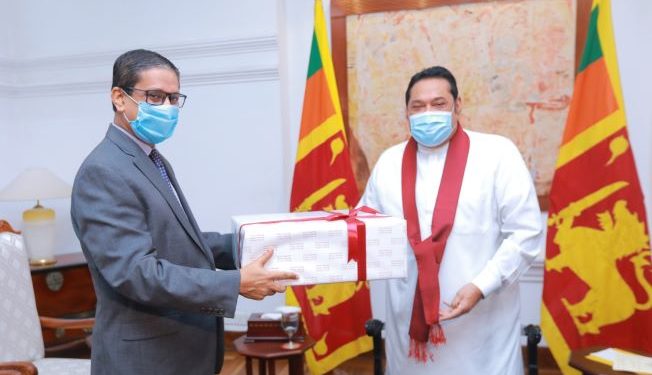
Two more persons have tested positive for the COVID-19 virus today (19), the Ministry of Health said.
On that account, the total count of coronavirus cases in the country has risen to 1,950.
A total of three patients were discovered within the day, according to the Department of Government Information. Two of them are returnees from Kuwait at the Trincomalee and Minneriya quarantine centres. The other one is a passenger from Mumbai, India travelling to Qatar.
In the meantime, the number of recoveries in Sri Lanka moved up to 1,446 as 25 patients returned to health earlier today.
The Epidemiology Unit’s tally says that 493 active cases are currently under medical care.
Sri Lanka has confirmed 11 deaths due to the COVID-19.
Prime Minister Mahinda Rajapaksa has instructed the contractors involved in the project to expedite the construction of the North-Central Expressway.
The Prime Minister expressed these views while participating in an inspection tour of the second phase of the project on complaints that the construction of the North Central Expressway is not being properly conducted.
The Prime Minister also inspected the ICC’s main operational center, which is leading the construction in the Riloluwa section of the expressway from Mirigama.
The Director in charge of the project has explained to the Prime Minister the current situation of the expressway in detail. He pointed out that the construction of the second stage of the expressway, which began with four lanes and six interchange points, has been awarded as a 30-month contract.
The project director has told the Prime Minister that the project has been delayed due to the lack of proper land acquisition when handing over contracts and that contracts have been awarded to local construction companies in four packages, and the progress of some of the construction companies was not satisfactory
The second phase of the construction of the expressway from Mirigama to Kurunegala is part of the second stage of construction and the contract has been handed over to two local construction companies.
The project director has also stated that the construction of the central highway has not been completed as per the agreement.
He pointed out that some construction companies have not completed work to match the advance payments provided and have extended the construction period with various excuses.
The Prime Minister has instructed the Director of the Contracting Company to expedite the construction work of the Riloluwa to Rangallepola section, where 69% of the construction has been completed.
The director in charge of the project pointed out to the Prime Minister that although some construction companies are nearing the end of the project, due to the slowing down of some companies, it will take another year and a half to open the second section of the Central Expressway.
He also explained to the Prime Minister that construction of the expressway, which commenced on January 30, 2017 on a 30-month contract, should have been completed by July 2019 if the construction work had been completed according to schedule.
The Prime Minister expressed these views while speaking to the media after the inspection tour.
The work of some companies is weak while some companies have made good progress. Some companies have stopped construction since the previous government has not provided the money. Once we have paid for their projects, they will start work again. We will take prompt action in this regard. I laid the foundation stone for all these projects. Work on this project was started by the previous government. If my government was in power then the construction work on the expressway would have been completed and the highway would have been handed over. We will finish the work as soon as possible and make it available to the public”
The total number of Coronavirus patients that have fully recovered from their infection in the country has increased to 1446 with 25 more people who have recovered being discharged from hospitals today.
Also, an infected person who arrived from India has been reported today. According to the Epidemiology Unit the total number of coronavirus infected persons reported in the country is currently 1948.
The Foreign Employment Bureau today said that nearly 2,000 Sri Lankans who are overseas have been infected with the coronavirus and 21 of them have died due to the virus.
71 Naval Personnel who were quarantined at the SLAF Quarantine Centre located in Iranamadu were released this morning.
This Quarantine Centre operated by the Sri Lanka Air Force was established on the instructions of the Commander of the Air Force, order to support the government’s efforts in controlling the spread of COVID-19 in Sri Lanka
The Naval Personnel who were released were also instructed to self-quarantine themselves for a further 14 day period before returning to duty.
The Government has decided to reopen all cinemas island wide from the 27th of this month .
The island’s cinemas, which were closed due to the Covid-19 pandemic, will reopen after 105 days.
The Director General of Health Services Dr. Anil Jasinghe yesterday issued a Health Guidance to reopen film halls.
When inquired the Secretary of the Ministry of Cultural Affairs Bandula Harischandra stated that approval will be granted under the Health Guidelines.
Minister Wimal Weerawansa says that the government will never come to an agreement with the USA to sign the MCC agreement
He said this while he was speaking at the Bellanwila Raja Maha Viharaya today.
Minister Wimal Weerawansa commenced his election campaign by visiting the Bellanwila Raja Maha Viharaya today and received blessings from the Maha Sangha.
Minister Weerawansa expressed his views to the media after giving a pledge for 19 areas.
Sri Lanka’s top intelligence head has issued a letter of demand to Yasmin Sooka and her entity ITJP alleging violation of ICCPR ACT. He also alleges she & ITJP are accessory to LTTE front agenda with likelihood of posing a risk to his life & that of his family. Complaints regarding Sooka & ITJP have been issued through lawyers to UN & the EU missions in Colombo as well. We await their acknowledgment & response. The events, also raises caution to all foreign governments in particular those in UK-US-EU-Canada-India which continue to ban LTTE while LTTE fronts are allowed to operate from their shores. Foreign Govts must look into & be alert to their MPs frequently visiting LTTE front events in view of LTTE international network continuing to thrive and remunerating foreign personalities to their fold through various political campaign funding etc. We believe materially supporting terrorist organizations is banned by these countries therefore no foreign MP is expected to accept terrorist funding in any format either.
An interesting development is taking place. We await the action Sooka’s EU employer will take while we also await what UN has to say about the complaint made against ITJP and Sooka who sits on many UN panels/tribunals.
Who really funds ITJP – from its lists of reports churned against the Sri Lankan Government & Military, it takes no idiot to realize that those she claims as civilians are really LTTE combatants. Who is funding ITJP to present LTTE terrorists as civilians and falsely claim Sri Lanka’s military killed civilians? Funding lies with intent to tarnish the image of the country & its armed forces is not done.
All this poses a national security threat.
No Government would allow its military to be smeared and put into danger in this manner. Sri Lanka has a history of such scenarios where confidential details of military has been compromised leading to LTTE assassinating many intel officers.
In 2015, the US state department declared The LTTE’s international network and financial support are still intact despite its military defeat at the hands of Sri Lankan government troops in 2009”
However, in September 2015– 8 of these 15 LTTE fronts were de-listed for a flimsy reason
2016
Germany – In February Yogendran G was convicted of raising 81,000 Euros for LTTE
Malaysia – In September Sri Lanka’s High Commissioner to Malaysia was assaulted inside the Kuala Lumpur International Airport by protestors linked to LTTE
US – In December Tamils for Obama, urged out-going President Obama to delist LTTE from US Terrorist Organization List. It would be interesting to know how much they funded Obama campaign to make this request.
2018
Australia has taken a tough stand on LTTE asylum seekers by deporting them.
2019
LTTE has carried its violent streak overseas where factions are fighting even in the open. A Tamil slashed the arm of another Tamil in a café in southern Paris in September 2019. There are some 10 underworld gangs operating in France.
Little Jaffnas” have been created in France, Canada, UK and virtually every foreign capital/major town LTTE diaspora are congregating.
It is to the advantage of all foreign governments that must look after its own citizens before looking into the welfare of people in other countries.
Foreign governments must first investigate the LTTE fronts operating in their countries. The original list of banned LTTE fronts declared by GoSL in April 2014 is a good foundation for foreign governments & their think tanks to work on.
Human smuggling and illegal immigrants is a topic that is a major issue for citizens in UK-EU-Canada, US and Australia. No British, European, American, Australia and Canadian likes to have their country flooded with illegal immigrants arriving as part of a global human smuggling cartel where much money is flowing from supposed victim to the carriers and into hands of border officials who should also be investigated for bringing illegals into the country for personal advantage.
There are law offices functioning in the UK charging some 60,000 sterling pounds for Tamils to get themselves burnt with cigarette butt ends, then be medically examined by a UK doctor and then be trained on how to cry and act in front of the immigration officials to claim asylum. This is a major business racket happening in the UK. Surely British intel can and should investigate.
Credit card scams by LTTE front supporters have fleeced a lot of people as have money-laundering and many other acts of crimes LTTE fronts are involved in manipulating tax holidays and tax exemptions by registering as charities.
Western governments in a covid-19 cash strapped economy are well advised to look into the funding to foreign MPs by LTTE fronts. The loopholes in foreign systems have been masterminded by these terrorist front members.
AUSTRALIAN GREENS – PROTECT AUSTRALIAN CITIZENS INSTEAD OF LTTE TERRORISTS
Western Governments must keep in mind that Janes Intelligence Unit claimed LTTE made an annual profit of $300m in 2004. This money was made not in Sri Lanka but overseas from the illegal and legal network of money-generating operations LTTE fronts were running while crying crocodile tears about discrimination in Sri Lanka.
Imagine how much savings LTTE fronts have made since 2009 when LTTE ground force was eliminated? Now the LTTE fronts do not have to spend on arms, ammunition, combatant welfare, feeding them, clothing them etc. How much savings are they making now since 2009? What are they doing with all this money? Where do they bank all their money? Who doesn’t want to know?
We don’t need to be repeating that terrorists are terrorists. They are united by the thirst to kill, to commit mayhem and to fleece people. LTTE has killed not only people in Sri Lanka. They have committed murder and mayhem overseas. They in fact assassinated the former Indian Prime Minister Rajiv Gandhi and many more even before and after killing Rajiv Gandhi. Many say this was on a contract. Plenty of LTTE snipers who ran away with the help of LTTE fronts are now living overseas. As they become richer and richer their sadism increases to return to commit heinous crimes – this time not in Sri Lanka but overseas.
The enemies can easily contract them and LTTE fronts can never be underestimated.
It is really the choice of foreign governments to allow LTTE fronts to fleece their citizens and even cause future harm. Follow the money trail. Follow their demands. Follow the foreigners supporting them & their bank accounts. This is no favor to Sri Lanka but a favor to foreign citizens whom foreign governments are bound to protect.
Western countries invited our enemy to their shores. Western countries should deal with them appropriately before they get out of hand.
President Gotabaya Rajapaksa, yesterday, faulted the top echelons of the Central Bank (CB) over their failure to come up with strategies to overcome the unprecedented economic crisis facing the country.
Without a wink, he had quite rightly hit the nail on the head. In fact, ordinary citizens might be wondering what’s these top head Central Bankers have been doing in the past to the country’s economic health rather than just sitting in their comfort zone.
Nothing will progress be it private or public, if the top head is heavy. The CB top head may be having hundreds of PHDs, Masters, and all other postgraduate qualified people but yet Central Bank has been stagnating in one place over the years DUE TO LACK OF DYNAMIC THINKING. yet if no one takes decisions or try to look at problems facing by the country beyond the normal box, there will not be any progress.
I think the moment has come for President Gotabaya to take steps to get rid of the sleepy lethargic top Central Bankers and replace them with young dynamic educated, skilled and talented staff even from the private sector who can think beyond the box instead of the current rot who run the CB.
(Translation of
the text of a speech made by Prime Minister Mahinda Rajapaksa on Thursday,
18 June 2020)
Venerable members of the Maha Sangha, clergymen of all other
faiths, Hon. Ministers, former members of Parliament and friends,
After the
Presidential election of 16 November 2019, we will be able to convene a new
Parliament only in August 2020. The 19th Amendment provision which forbids the
dissolution of Parliament until the lapse of four and a half years and the
Covid-19 pandemic have together brought about a situation where the whole
country has been in a transitional stage for nine full months. We have never before,
experienced a situation like this in our political history. This Parliamentary
election is essential to complete the change that the people of this country
initiated at the Presidential election last year.
This election is a democratic right that we won with great
difficulty. The yahapalana political parties tried to get this Parliamentary
election delayed by petitioning courts but the Supreme Court did not permit
that to happen. You will recall that the yahapalana government arbitrarily
delayed the local government elections for three years and made it impossible
to hold the provincial councils elections. The people now have the democratic
right to elect a government of their choice.
One thing that was proved during this prolonged transitional
period after the presidential election was that like the government led by me
between 2006 and 2014, the present government led by President Gotabhaya is
also capable of prevailing over apparently insurmountable odds. That was proved
by the way the spread of Covid-19 was brought under control. There are other
Asian countries like Vietnam, Hong Kong and Taiwan that have successfully
controlled the spread of Covid-19. There have been no Covid-19 related deaths
in Vietnam. Four deaths are reported from Hong Kong, and Seven from Taiwan. Sri
Lanka has had 11 Covid-19 deaths. New Zealand has also
managed to keep Covid-19 deaths at 22.
It should be borne
in mind however that Vietnam, Hong Kong and Taiwan learnt many lessons from the
2003 SARS epidemic, and that experience helped them to control Covid-19.
However Sri Lanka has been able to control Covid-19 successfully without
significant experience in combatting these virus related respiratory diseases
such as SARS or MERS. Our health services, armed forces and all those involved
in the Covid-19 control operation deserve the highest praise for what they have
achieved. This achievement was made possible by the correct political
leadership provided by the President.
We will be facing this election, with a major achivement which
has brought us to the notice of the entire world even during the transitional
period after the presidential election. The people are only too well aware of
what would have happened to this country if the Covid-19 pandemic had hit Sri
Lanka when the yahapalana cabal was in power.
After winning the presidential election, we had to face many
difficulties as a minority government. Due to the 19th Amendment, the defeated
party was able to maintain an artificial majority in Parliament until the beginning
of March 2020. They used that majority to undermine the government at every
turn. When we tried to get a Vote on Account
passed to pay suppliers for fertiliser and medicine provided to the previous
government, the yahapalana political parties blocked it. When suppliers are not
paid, a shortage of fertiliser and medicine naturally ensues. That was how the
defeated yahapalana cabal sought to undermine the new government.
The formation of
the 2015 yahapalana government was a result of foreign and local conspiracies. Their
defeat in November 2019 however, did not put an end to
such conspiracies.
Within the first
two or three days after the new President took office, we noticed odd stories
appearing in the media. One news story said that pedestrians crossing the road
without using marked pedestrian crossings will be fined by the police. Another
story said that all the beggars in Colombo would be rounded up and sent off to
camps and that all those begging on trains will be arrested. These were all
false reports. The new dispensation that had just assumed power did not have
the time to discuss such low-priority matters. What the conspirators expected from such
proaganda was to put it into the minds of the public in a subtle way, that an
authoritarian President had come into power and the people will have to obey the
rules to the letter.
Within days of the President taking office, there was the well
publicised drama alleging that an employee of a Western embassy had been
abducted, harassed and questioned. Reports about this first appeared in the
foreign media. The Sri Lankan public got to know about it only later. All this
was designed to create a certain impression about the new dispensation in the
minds of Sri Lankans as well foreigners. But the President adroitly defeated
all these conspiracies. Investigations showed the Sri Lankan people and the
world that the story about the abduction of a Western embassy employee was a
total fabrication.
All demonstrators marching to surround the Presidential
secretariat were allowed to get to their destination unhindered, thus giving
the lie to the propaganda that a rigid, authoritarian rule had commenced under
a former military officer. All such groups of demonstrators were given a
hearing, some were even served refreshments. No demonstration was broken up
with the use of tear gas, water cannon or baton charges. With this, the attempt
to paint a picture of authoritarian rule evaporated.
Just as normal life resumed after bringing the spread of
Covid-19 under control, a small group of agitators in defiance of a court
order, tried to hold a demonstration in front of the American embassy over an
incident that had taken place in the USA. They were all bundled off to be
produced in courts. Following this single incident all those who had been
engaged in propagating falsehoods during the 2015 presidential election campaign came out in force
to condemn what they referred to as state repression.
An actress who got caught red handed directing a video where
she pretends to have been injured and hospitalised after an allged assault in
2014, and another long haired individual who said that it would have been
better if he had been thrown into a drain soon after brith to save him the pain
of living in a country ruled by the Rajapaksas, were once again seen in public
after a lapse of five years.
The yahapalana
government from 2015 to 2019 was preoccupied with fighting off demonstrators
with tear gas, water cannon and baton charges. On most days of the week, Lotus
Road near the presidential secretariat resembled a battle field. You will
recall that a baton charge on a demonstration by disabled ex-armed forces
personnel resulted in one disabled ex-soldier losing an eye. The agitators in
front of the American embassy who were recently hauled off to courts by the
police were themselves frequent recepients of the yahapalana government’s tear
gas, water cannon and baton charge hospitality on Lotus Road. Those who never
said a word about the way the yahapalana government responded to demonstrations
are now making a hue and cry about this single, minor incident that took place
under our watch.
As a government, we are not happy with the manner in which that
demonstration was dealt with, and we have said so publicly. Those involved in
this incident were professional agitators who know how to provoke the police.
Even after a police officer read out the court order banning the demonstration,
the agitators claimed they were not shown any such order. The police also
should not allow themselves to be provoked in that manner. These agitators need
images of scuffles with the police on the streets. That’s what ensures their
livelihood.
Except for that isolated minor incident, our opponents have no
allegations of repression to make. Some argue that we treated the Colombo agitators
and those who attended the funeral of the late Mr Thondaman differently. Arumugam Thondam was the leader
of the Up-country Tamil community. When we imposed curfew in the Nuwara Eliya
district to prevent large numbers of grief stricken people from attending the
funeral of their leader, the people of that area cooperated. Holding a
demonstration in Colombo in defience of a court order, over an incident that
had taken place in the USA which has no relevance to Sri Lanka, is an entirely
different thing.
The people should be vigilant about what is said by the
yahapalana camp during this election campaign. When we decided to provide an
allowance of Rs 5,000 to those who were unable to go to work as a result of the
curfew imposed to prevent the spread of Covid-19, the yahapalana presidential
candidate said Rs. 5,000 was not enough and that every family should be given Rs.
65,000 per month. After somebody apparently told him not to make
such foolish statements, this amount was brought down to Rs. 20,000. What did
these people who wanted us to give Rs. 65,000 to each family do when they were
in power?
You will recall that after the presidential election and before the Covid-19
pandemic hit Sri Lanka, demonstrators used to turn up almost daily in front of
the presidential secretariat just as they did during the yahapalana government. Most of
those demonstrators wanted the employment they had obtained from the yahapalana
government made permanent. Those demonstrators had come to the presidential secretariat not to find fault with us, but to curse the previous government.
Those youthful demonstrators were caught on camera telling the yahapalana
minister who had given them dud appointments not to come back to Hambantaota. We
now see that the yahapalana minister concerned has in fact
abandoned
Hambantota and is now contesting from Colombo.
The forthcoming parliamentary election will give the voting
public an opportunity to chose proven ability over yahapalana lies and
deception. In order to safeguard the progress made in controlling the spread of
Covid-19, I request all candidates to be mindful of the election related guidelines issued
by the health authorities and also to conduct an environmentally friendly and exemplary
election campaign.
Thank you
May the blessings of the Triple Gem be upon you, God Bless you.
Ven. Ellawala
Medhananda has explored the Buddhist ruins in
the North Western Province. The North western
Province consists of two districts, Puttalam and Kurunegala. Puttalam which is a
coastal district, contains Wilpattu and
Pomparippu. Medhananda has visited both
places.
Medhananda found a large monastery complex at
Pomparippu, in ruins. This area is now
Muslim so we cannot get information, said Medhananda. Muslims do not like to show Buddhist ruins. They
made that clear in their conversations with us when we went to explore the
ruins. Medhananda had to stop his Pomparippu exploration and return home.
Medhananda had
done an exploration of Wilpattu with the assistance of Minister S.M.Chandrasena.
He stayed at Wilpattu for a week. But could not see even a fraction of what was
there. Wilpattu has many Buddhist ruins, said Medhananda.
Wilpattu is full of ruins, every
hill, every rock, said Medhananda. It is a surprise that even these ruins are
still standing”.
There are ruins near Mullikulam on north bank
of Moderagam aru. These have not been examined. Ochchappu kallu had an inscription but
Medhananda had not been able to look at it. There are ruins also at Rajavanthi
hatpattuva, Kirimetiya pattuva, Vele vewa, Pichchindiyawa vihara, said Medhananda.
Access to these ruins is only through a
path from 6th milepost at Puttalam-
Anuradhapura road.
Vilindagoda area
in Wilpattu is rich in archaeological material. It has many cave and rock inscriptions. No
explorations had been done earlier in the area. Medhananda explored Vilindagoda . Vilindagoda
was known originally as Salvana vihara . It
is now in ruins but Medhananda found an inscription, dated to
Mahinda I (730-3) which said that king’s officers must not enter the temple and
create trouble.
Medhananda has
shown that Wilpattu came directly under
the Anuradhapura kings. He has illustrated this with an example from
Sinadigala. Sinadigala is in Vilachchiya korale, in Wilpattu, near Moderagam
aru.. Sinadigala is accessed by going to
Wilachchiya
then across Halmillgalavala through forest to Sinadigala .The ruins in Sinadigala have been destroyed, but
there is a rock inscription .This inscription is not well known.
The inscription
said that Vasabha (67-111) had spent one
lakh of kahavanu on the uposathghara at
Dhakkina vihara, Anuradhapura . Arrangements for renovation and for dane to the
monks , was also recorded. The
inscription then said that king Vasabha
had built Kalapahanaka wewa, now known as Karambakulama, spending
5000 kahavanu, and donated its water tax to [Dhakkina vihara]. This was a huge wewa, said Medhananda
.
The inscription also refers to Magana
nagara. Fifty families in Magana had helped in
the wewa
project. Magana
was situated between Mantota and Mannar on the coast. Vattapukallu
inscription shows that Magana nagara was by the mouth of Moderagam aru.
Medhananda found several Buddhist
ruins in Kurunegala .Wellagala Raja Maha Vihara,
Wariyapola has a huge reclining Buddha and
an inscription dated to Ist century AD. In
Vanni Hatpattu, Medhananda explored Halamba gal len vihara and Halbe Raja Maha Vihara . Medhananda said he was not able to explore
Halbe Raja Maha Vihara as thoroughly as
he wished. this should be done, he said.
At Ganekanda vihara Polpitigama, also known as
Mandalaramaya, he found 7 new inscriptions.. at least two were important and rare said
Medhananda .One inscription
had a reference to Gokani grama which must mean Trincomalee. Another said
that a king gave a lakh for the labour
needed for a wall for Tarapa gama to obtain water. It is probably an
amuna, said Medhananda .
One inscription was
very long . it recorded a donation
of paddy fields and kahavanu in the time
of king Bhatika(sic). Also a donation of
money to Sudamma chetiya. It is rarely that stupa get names, commented
Medhananda.
Medhananda also found two cave inscriptions at
Ganekanda. one cave has been donated
by the head and deputy head of a
trading concern( velenda samagamak). Another
donor was an intelligence or secret service man.
Medhananda has also visited Rangirimada Raja
Maha Vihara, Hiriyala, Kebel lena
vihara, Hiriyala, Rangiri len senasuna, Hiriyala, Naindanava vihara, Polpitigama, Budumuttawa
Raja Maha Vihara, Nikaveratiya and
Sadun giri magam pura Raja Maha Vihara .
Ven. Ellawala
Medhananda has explored Buddhist ruins in
North Central Province. Henanigala, near Dehiyattakandiya had caves, stupa, and row of steps cut
into rock. Veherapokuna
in Maduru oya valley, and places close by such as Kadupahara ella, Daminavela, Henanigala, Kudavila had ruins.
Siripalena, Siluminiseya, Devagala in Maduru oya valley have unseen ruins, said Medhananda.
Medhananda also
explored Katupotha kande lena, Mihintale, Sinhapura
Raja Maha Vihara ruins at
no 10,12 , 13 Yaya , Nadiya
gala Raja Maha Vihara and Ehetuwewa pansak kanda ruins. Serupitiya ruins were not examined till Medhananda did so.
In Sabaragamuwa
province , Medhananda explored Galpaye Bambaragala aranya
ruins, Veneragodella. This was very tricky to explore, said Medhananda .
it was Dangerous and one could get
injured. Wellagala Raja Maha Vihara at
Wariyapola had a huge reclining Buddha
and an inscription dated to 1st century AD.
Medhananda has explored some Buddhist ruins in Uva Province. Medhananda
discovered a second Nagadipa vihara in Badulla. To get there,
instructed Medhananda , go 14 miles from Mahiyagana, on Bibile
–Mahiyangana road, past Gaduguduwawa and Agna ulpatha, then 3 miles past the
ulpatha, there is a narrow path to Nagadipa
wewa.
There is huge stupa at Moneragala
Veherayaya ruins. Also
hundred more stupa, destroyed by
fortune hunters. No one has explored here, said Medhananda . Medhananda found archaeological sites on
the line of hills, Sitakanda, Maragala kanda, Obbegoda kanda, Sri pana kanda. At Sri pana
kanda, he found cave temples, cave, inscriptions
and ruins of stupa.
The hills
in the belt between Karanda oya
and Gal oya is full of viharas. Every
paddy field, or empty land is full of archaeological remains, inscriptions, and so on, he said. They were still discovering the ruins at
Kolladeniya, Medhananda observed.
Medhananda also
explored Bingoda Raja Maha Vihara, Wellassa.
Suduveli mankada ha gal hira mankade vihara, Moneragala, Seethkanda aranya senasana,
Moneragala, Konduvattavana ruins, originally Kandewatta wana and Devala hida village, inginiyagala.
When he went to
look at Bingoda Raja Maha Vihara, Wellassa Medhananda took along the A level students of Dharmaduta
Vidyalaya, Badulla. When he went to
explore Velellugoda kanda archaeological site he took teachers and pupils from
Karandana Maha Vidyalaya.
In the Southern
province, Medhananda looked at Bilivana
vihara in Hambantota, known also
as Karambagala senasuna . This vihara had caves ‘all over’. One cave could
accommodate 400. In another cave there was a
seat. Medhananda found 5
new inscriptions there. One inscription was a cave donation by
king Sirimeghavanna. ( continued)
Police have been directed to record statements from several influential figures of the former government including former President Maithripala Sirisena and former Ranil Wickremesinghe over the Central Bank (CBSL) Bond Scam.
The Attorney General Dappula de Livera has issued these directions to the Acting Inspector General of Police (IGP) C. D. Wickramaratne today (18), stated the Attorney General’s Coordinating Officer.
In addition to the former President and Prime Minister, statements are expected to be recorded from the former Advisor to the Prime Minister S. Paskaralingam and the former General Manager of the People’s Bank as well.
An individual who handled Rs 490 million worth transactions of a bank account belonging to an organized criminal figure has been arrested when he surrendered to the Western Province (South) Crimes Division yesterday (17).
On May 22 an individual was arrested in Ratmalana over the possession of 9 g 500 mg of heroin.
Upon interrogation of the suspect, it was revealed that an organized criminal figure, who is currently overseas, operates a drug racket through the instant messaging app ‘imo’. The money earned through the racket is deposited into a bank account.
Western Province (South) Crimes Division obtained a court order from the Mount Lavinia Magistrate to gain access to the details and reports on the relevant bank account.
Accordingly, it was revealed that an amount of Rs 490 million had been transacted through the account.
When the Western Province (South) Crimes Division was investigating to apprehend the owner of the account, the individual in question had surrendered to the Division through a lawyer, last afternoon.
The 34-year-old suspect had been arrested subsequently.
It has been revealed that he serves as an Assistant Quality Manager at a garment factory in Wellawaya, and had addresses in Galwatta, Buttala, Dampe, and Piliyandala areas.
He is to be presented before Mt. Lavinia Magistrate’s Court today (18).
Western Province (South) Crimes Division carries out further investigations into the matter.
Prime Minister Mahinda Rajapaksa says that the Opposition has no allegations of repression to make against the current government led by President Gotabaya Rajapaksa.
Speaking on the Parliamentary Election 2020, the Premier said that the defeated party, while holding an artificial majority following the presidential election made numerous attempts to undermine the government at every turn.
He stated that following the presidential election victory in 2019, conspirators propagated false rumors to subtly make an impression in the minds of the public that an authoritarian President had come into power.
Rajapaksa pointed out the incidents of various rumors of fake rules, the alleged abduction and harassment of an Embassy employee, blocking of the Vote on Account which led to a shortage of fertilizer and medicine.
All this was designed to create a certain impression about the new dispensation in the minds of Sri Lankans as well as foreigners, he added.
However, President adroitly defeated all these conspiracies, the Prime Minister said.
Premier Rajapaksa like the government led by him between 2006 and 2014 and the present government led by President Gotabaya has proven that they are capable of prevailing over apparently insurmountable odds.
He says that Sri Lanka being able to control the COVID-19 outbreak successfully without significant experience in combatting virus-related respiratory diseases such as SARS or MERS is an achievement made possible by the correct political leadership provided by the President.
The Prime Minister also spoke on the incident of controlling the recent protest carried out before the American Embassy.
He said that the agitators who were hauled off to courts by the police were ‘frequent recipients of the yahapalana government’s tear gas, water cannon and baton charge hospitality on Lotus Road’.
Those who never said a word about the way the yahapalana government responded to demonstrations are now making a hue and cry about this single, minor incident that took place under our watch.”
However, the Prime Minister said that, as a government, they are not happy with the manner in which that demonstration was dealt with.
Except for that isolated minor incident, our opponents have no allegations of repression to make.”
Holding a demonstration in defiance of a court order, over an incident that had taken place in the USA and has no relevance to Sri Lanka, is an entirely different thing from the gathering for the funeral of late Minister Arumugam Thondaman, Rajapaksa added.
Stating that the forthcoming parliamentary election will give the voting public an opportunity to choose the proven ability over Yahapalana lies and deception, Prime Minister Mahinda Rajapaksa requested all candidates to be mindful of the election-related guidelines issued by the health authorities and to conduct an environmentally friendly and exemplary election campaign.
Following is the full text of the speech made by the Prime Minister:
Venerable members of the Maha Sangha, clergymen of all other faiths, Hon. Ministers, former members of Parliament and friends,
After the Presidential election of 16 November 2019, we will be able to convene a new Parliament only in August 2020. The 19th Amendment provision which forbids the dissolution of Parliament until the lapse of four and a half years and the Covid-19 pandemic have together brought about a situation where the whole country has been in a transitional stage for nine full months. We have never before, experienced a situation like this in our political history. This Parliamentary election is essential to complete the change that the people of this country initiated at the Presidential election last year.
This election is a democratic right that we won with great difficulty. The yahapalana political parties tried to get this Parliamentary election delayed by petitioning courts but the Supreme Court did not permit that to happen. You will recall that the yahapalana government arbitrarily delayed the local government elections for three years and made it impossible to hold the provincial council elections. The people now have the democratic right to elect a government of their choice.
One thing that was proved during this prolonged transitional period after the presidential election was that like the government led by me between 2006 and 2014, the present government led by President Gotabhaya is also capable of prevailing over apparently insurmountable odds. That was proved by the way the spread of Covid-19 was brought under control. There are other Asian countries like Vietnam, Hong Kong, and Taiwan that have successfully controlled the spread of Covid-19. There have been no Covid-19 related deaths in Vietnam. Four deaths are reported from Hong Kong and Seven from Taiwan. Sri Lanka has had 11 Covid-19 deaths. New Zealand has also managed to keep Covid-19 deaths at 22.
It should be borne in mind however that Vietnam, Hong Kong, and Taiwan learned many lessons from the 2003 SARS epidemic, and that experience helped them to control Covid-19. However, Sri Lanka has been able to control Covid-19 successfully without significant experience in combatting these virus-related respiratory diseases such as SARS or MERS. Our health services, armed forces, and all those involved in the Covid-19 control operation deserve the highest praise for what they have achieved. This achievement was made possible by the correct political leadership provided by the President.
We will be facing this election, with a major achievement which has brought us to the notice of the entire world even during the transitional period after the presidential election. The people are only too well aware of what would have happened to this country if the Covid-19 pandemic had hit Sri Lanka when the yahapalana cabal was in power.
After winning the presidential election, we had to face many difficulties as a minority government. Due to the 19th Amendment, the defeated party was able to maintain an artificial majority in Parliament until the beginning of March 2020. They used that majority to undermine the government at every turn. When we tried to get a Vote on Account passed to pay suppliers for fertilizer and medicine provided to the previous government, the yahapalana political parties blocked it. When suppliers are not paid, a shortage of fertilizer and medicine naturally ensues. That was how the defeated yahapalana cabal sought to undermine the new government.
The formation of the 2015 yahapalana government was a result of foreign and local conspiracies. Their defeat in November 2019 however, did not put an end to such conspiracies.
Within the first two or three days after the new President took office, we noticed odd stories appearing in the media. One news story said that pedestrians crossing the road without using marked pedestrian crossings will be fined by the police. Another story said that all the beggars in Colombo would be rounded up and sent off to camps and that all those begging on trains will be arrested. These were all false reports. The new dispensation that had just assumed power did not have the time to discuss such low-priority matters. What the conspirators expected from such propaganda was to put it into the minds of the public in a subtle way, that an authoritarian President had come into power and the people will have to obey the rules to the letter.
Within days of the President taking office, there was the well-publicized drama alleging that an employee of a Western embassy had been abducted, harassed, and questioned. Reports about this first appeared in the foreign media. The Sri Lankan public got to know about it only later. All this was designed to create a certain impression about the new dispensation in the minds of Sri Lankans as well as foreigners. But the President adroitly defeated all these conspiracies. Investigations showed the Sri Lankan people and the world that the story about the abduction of a Western embassy employee was a total fabrication.
All demonstrators marching to surround the Presidential secretariat were allowed to get to their destination unhindered, thus giving the lie to the propaganda that a rigid, authoritarian rule had commenced under a former military officer. All such groups of demonstrators were given a hearing, some were even served refreshments. No demonstration was broken up with the use of tear gas, water cannon, or baton charges. With this, the attempt to paint a picture of authoritarian rule evaporated.
Just as normal life resumed after bringing the spread of Covid-19 under control, a small group of agitators in defiance of a court order, tried to hold a demonstration in front of the American embassy over an incident that had taken place in the USA. They were all bundled off to be produced in courts. Following this single incident, all those who had been engaged in propagating falsehoods during the 2015 presidential election campaign came out in force to condemn what they referred to as state repression.
An actress who got caught red-handed directing a video where she pretends to have been injured and hospitalized after an alleged assault in 2014, and another long-haired individual who said that it would have been better if he had been thrown into a drain soon after birth to save him the pain of living in a country ruled by the Rajapaksas, were once again seen in public after a lapse of five years.
The yahapalana government from 2015 to 2019 was preoccupied with fighting off demonstrators with tear gas, water cannon, and baton charges. On most days of the week, Lotus Road near the presidential secretariat resembled a battlefield. You will recall that a baton charge on a demonstration by disabled ex-armed forces personnel resulted in one disabled ex-soldier losing an eye. The agitators in front of the American embassy who were recently hauled off to courts by the police were themselves frequent recipients of the yahapalana government’s tear gas, water cannon and baton charge hospitality on Lotus Road. Those who never said a word about the way the yahapalana government responded to demonstrations are now making a hue and cry about this single, minor incident that took place under our watch.
As a government, we are not happy with the manner in which that demonstration was dealt with, and we have said so publicly. Those involved in this incident were professional agitators who know how to provoke the police. Even after a police officer read out the court order banning the demonstration, the agitators claimed they were not shown any such order. The police also should not allow themselves to be provoked in that manner. These agitators need images of scuffles with the police on the streets. That’s what ensures their livelihood.
Except for that isolated minor incident, our opponents have no allegations of repression to make. Some argue that we treated the Colombo agitators and those who attended the funeral of the late Mr. Thondaman differently. Arumugam Thondam was the leader of the Up-country Tamil community. When we imposed curfew in the Nuwara Eliya district to prevent large numbers of grief-stricken people from attending the funeral of their leader, the people of that area cooperated. Holding a demonstration in Colombo in defiance of a court order, over an incident that had taken place in the USA which has no relevance to Sri Lanka, is an entirely different thing.
The people should be vigilant about what is said by the yahapalana camp during this election campaign. When we decided to provide an allowance of Rs 5,000 to those who were unable to go to work as a result of the curfew imposed to prevent the spread of Covid-19, the yahapalana presidential candidate said Rs. 5,000 was not enough and that every family should be given Rs. 65,000 per month. After somebody apparently told him not to make such foolish statements, this amount was brought down to Rs. 20,000. What did these people who wanted us to give Rs 65,000 to each family do when they were in power?
You will recall that after the presidential election and before the Covid-19 pandemic hit Sri Lanka, demonstrators used to turn up almost daily in front of the presidential secretariat just as they did during the yahapalana government. Most of those demonstrators wanted the employment they had obtained from the yahapalana government made permanent. Those demonstrators had come to the presidential secretariat not to find fault with us, but to curse the previous government. Those youthful demonstrators were caught on camera telling the yahapalana minister who had given them dud appointments not to come back to Hambantota. We now see that the yahapalana minister concerned has in fact abandoned Hambantota and is now contesting from Colombo.
The forthcoming parliamentary election will give the voting public an opportunity to chose proven ability over yahapalana lies and deception. In order to safeguard the progress made in controlling the spread of Covid-19, I request all candidates to be mindful of the election-related guidelines issued by the health authorities and also to conduct an environmentally friendly and exemplary election campaign.”
The government of Japan has given its consent to award an aid of Japanese Yen 800 million (approximately LKR 1,360 million) under Japanese non- project grant scheme for the supply of medical equipment required for strengthening the activities of prevention of COVID -19 pandemic situation in Sri Lanka.
Under the scheme, Sri Lanka may obtain medical equipment such as MRI scanners, CT Scanners, Bedside X – Ray Systems, Central Monitors, Bedside Monitors and Defibrillators to fight the COVID-19 outbreak in the country.
Accordingly, the Cabinet of Minister approved the proposal submitted by the Prime Minister acting as the Minister of Finance, Economic and Policy Development to obtain the said grants, as well as to sign the agreements pertaining to it.
Meanwhile, the Cabinet also approved a proposal to transfer funds allocated by the World Bank Institutions under the uncertain emergency requirement responsive factors of the identified investment projects, to the projects to be implemented on the priority basis due to COVID – 19 pandemic conditions.
It has been identified that the issues faced by the country due to the COVID-19 pandemic, such as uplifting the agricultural sector, implementing the e-education methodology, establishment of a methodology for being engaged in duties from residences (working from home), disaster management as well as the prevention of spreading the disease while using public transport, should be addressed immediately.
It has also been decided that financial assistance should be provided in order to resolve the aforementioned issued.
Therefore, the Cabinet of Ministers approved taking necessary measures to enable the US dollars 56 million that have been included under the emergency requirement responsive factors to be released for four investment projects that were funded by the World Bank Group, so that the relevant funds could be utilized for the projects that should be prioritized in the fields mentioned above.
The proposal was submitted to the Cabinet by the Prime Minister as the Minister of Finance, Economic and policy Development.
Head of State Intelligence service, Major General Suresh Saleh submitted a report to the United Nations and the European Union stating that the Executive Director of the International Truth and Justice Project, Yasmin Sooka, had violated his fundamental rights by making false and slanderous accusations against him.
He further stated that the relevant false allegations were made contrary to the United Nations ICCPR agreement.
Prime Minister Mahinda Rajapaksa says that the forthcoming general election is a great opportunity to focus on the proven ability and to stop the good governance lies and to eradicate fraud and deceit.
The Prime Minister says the general election is a hard-fought democratic right and the people should be mindful of what the good governance representatives say during the election campaign.
The Prime Minister’s Media Unit had issued the full statement to the Media institutes today.
Meanwhile, Prime Minister Mahinda Rajapaksa and estate owners held a meeting yesterday with regard to the basic salary of estate workers.
The Prime Minister’s Office stated that the Secretary of the Ceylon Workers Congress Jeevan Thondaman and several others were also present.
The Prime Minister’s Media Unit stated that the estate owners have not reached a final agreement regarding the salary demands of the plantation workers and a special discussion is scheduled to be held on the 25th of this month under the patronage of the Prime Minister to reach a final decison.
China’s acting envoy, Hu Wei, discussed Sino-Lankan investment and financial cooperation with Gotabaya Rajapaksa
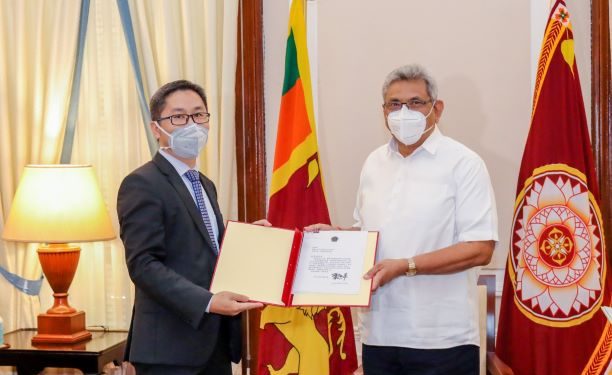
Colombo, June 18 (newsin.asia): The Acting Ambassador for China in Sri Lanka, Hu Wei, met President Gotabaya Rajapaksa on Thursday and handed over a letter from Chinese President Xi Jinping wishing President Gotabaya’s birthday which falls on June 20.
The Chinese delegation also conveyed President Xi’s deep appreciation of Sri Lanka’s successful efforts to fight the COVID-19 pandemic and discussed Chinese projects in Sri Lanka as well as financial cooperation with President Gotabaya Rajapaksa.
The Chinese government has sent a consignment of medical supplies to help Sri Lanka’s continuous fight with the virus. These supplies are already with the Health Ministry. Acting Ambassador handed over the lists of the supplies to President Rajapaksa.
President Gotabaya thanked President Xi and the people and companies of China for their unstinted support during the past difficult weeks as Sri Lanka battled with the pandemic. The Chinese delegation noted that both Sri Lanka and China followed a similar tracking system to identify potentially COVID-19 patients. Both countries were able to successfully tackle the crisis because of the dedicated efforts of their respective Security Forces and Intelligence officials.
The two countries have shown immense cooperation in supporting each other during the global pandemic. Early February this year, when China was fighting its worst battles, Sri Lanka gifted a consignment of the finest black teas as it is considered to have healing properties. Furthermore, pirith was chanted throughout the Island invoking blessings on those infected with the virus in China. Students from Devi Balika sent drawings of solidarity that really captured the appreciation of First Lady Peng Liyuan.
Appraising the latest situation in Beijing, the delegation noted that though close to 100 had got infected, the situation is under control. Fortunately, Chinese officials had been able to quickly track the source of origin. Surprisingly, it was not due to a person-to-person transfer, but through a consignment of salmon from Europe. WHO too has attached great importance to this development, noted the delegation.
A range of other topics were also discussed by the two parties. The main focus was on the tea auction and how best to promote Sri Lankan tea, renowned as the world’s best, in China. The talks included Chinese investments in Sri Lanka and improving financial cooperation between the two countries.
A new study has finally solved a herpetological mystery surrounding Dendrelaphis bifrenalis, a species of bronzeback snake endemic to Sri Lanka.
Researchers have established, through morphological differences and DNA sequencing, that the dry-zone populations of the snake are the true D. bifrenalis, and the wet-zone populations are a species new to science: D. Wickrorum.
They named the new species in honor of leading herpetologists L.J. Mendis Wickramasinghe, known as Sri Lanka’s Darwin” for the sheer number of species he has described, and his wife Nethu.
The study also rights a taxonomic wrong by re-establishing D. effrenis, another bronzeback, as a valid species, based on a 2016 discovery by Wickramasinghe and observations in the wild, after the species was effectively whitewashed from the taxonomic record nearly 80 years ago.
COLOMBO — For nearly a decade, siblings and scientists Dineth Danushka and Suneth Kanishka have been making field visits to study Dendrelaphis bifrenalis, a snake known as the Boulenger’s bronzeback, which is endemic to Sri Lanka. The data that the brothers gathered over time led them to believe there were two distinct populations of the snake, and that, for more than a century, its various populations had been wrongly lumped together as D. bifrenalis.
Now, in their first ever study, published in May in the journal TAPROBANICA, the researchers look to close a long-running taxonomic cold case by splitting up the species: the bronzeback populations of the dry and intermediate zones remain the true D. bifrenalis. And the population in the wet zone is described as a species new to science: D. wickrorum, or Wickramasinghe’s bronzeback, named in honor of leading herpetologist L.J. Mendis Wickramasinghe, known as Sri Lanka’s Darwin” for the sheer number of species he has described, and his wife Nethu.
The more we observed this snake, the more we suspected that there had to be two distinct species, but this needed extensive studies,” Dineth told Mongabay. He and his brother and fellow researchers followed up field observations with extensive study of physical details and traits and DNA sequencing to conclusively establish that these are distinct species.”
The redescribed D. bifrenalis is considered a beautiful snake bearing an unusual color combination. Image courtesy of L.J. Mendis Wickramasinghe.
Among the differences between D. bifrenalis and D. wickrorum are the former’s shorter, narrow and pointed snout, larger eyes, longer head, and a distinct temporal stripe stopping just behind it. The stripe on the dry zone species, however, continues behind the neck. The newly described species also has a divided nasal and a ventrolateral stripe that continues down to the tail.
We observed the wet zone species to be calm and often found them inside thickets deeper in the forested areas, whereas the dry zone species showed aggression and were found on the upper branches of trees, sometimes poised to strike,” Dineth said.
While D. bifrenalis has never been recorded at elevations above 300 meters (1,000 feet), the researchers identified a D. wickrorum specimen from an elevation of 1,000 m (4,000 ft).
The researchers also identified different threats faced by the two species. The dry zone species, D. bifrenalis, is considered vulnerable, while the wet zone species, D. wickrorum, is considered to be of least concern.
For the latter, the biggest threats come from the clearance of forests in Sri Lanka’s wet zone, driven by the expansion of farmland. In the dry zone, the restoration of water reservoirs and other human activity pose the biggest threats to the habitat.
The newly described wet zone species D. wickrorum is named in tribute to the remarkable contributions to the field of herpetology in Sri Lanka by L.J. Mendis Wickramasinghe and his partner, Nethu. Image courtesy of L.J. Mendis Wickramasinghe.
Righting a taxonomic wrong
With their new paper, the scientists also hope to do justice to another Dendrelaphis species, one that was whitewashed out of the taxonomic record.
D. effrenis was first described by the Austrian zoologist Franz Werner, in German, from a single specimen collected in 1909. In 1921, the British herpetologist Frank Wall provided a description in English, but considered the species a likely aberrant specimen of D. caudolineolatus, known as the striped bronzeback. The specimen had been lost by 1943 when another Englishman, Malcolm Smith, synonymized Werner’s species with D. caudolineolatus without any discussion,” the new study says, and subsequent authors followed that taxonomic treatment.”
So for nearly 80 years, D. effrenis never existed. Then, in 2016, none other than Sri Lanka’s Darwin, Wickramasinghe, described what was then believed to be a new species, Dendrelaphis sinharajensis, from the Sinharaja forest, a UNESCO World Heritage site. (Dineth and Suneth credited Wickramasinghe’s enormous effort in popularizing snake conservation among the general public.”)
Species review underway with veteran herpetologist and taxonomist A.A. Thasun Amarasinghe and evolutionary ecologist Sampath S. Seneviratne. Image courtesy of Sameera Suranjan Karunarathna.
A comparison of [that specimen] and the original description of D. sinharajensis with the original description of D. effrenis revealed that both names were created for the same species,” the study says. Therefore here we revalidate D. effrenis as a distinct species of the genus Dendrelaphis [and] we synonymise D. sinharajensis with D. effrenis.”
Not only did the scientists bring D. effrenis back to life on paper — they also observed two specimens in the wild, giving them a better understanding of the species’ range.
The fact that they were able to describe a new species, and even bring one back from the dead, highlights the need for further studies of Sri Lanka’s bronzeback snakes, the researchers say.
It is high time for a comprehensive phylogenetic study for this divergent, ecologically complex genus,” they write in the study, to understand not just the phylogenetic affinities of its members, but also its colonization patterns across Southern and Southeastern Asia.”
Citation:
Danushka, A. D., Kanishka, A. S., Amarasinghe, A. A., Vogel, G., & Seneviratne, S. S. (2020). A new species of Dendrelaphis Boulenger, 1890 (Reptilia: Colubridae) from the wet zone of Sri Lanka with a redescription of Dendrelaphis bifrenalis (Boulenger, 1890). TAPROBANICA, 9(1), 83-102.
Effective June 20, Etihad Airways will operate twice-weekly scheduled services for outbound passengers from Colombo to key destinations on its global network via Abu Dhabi.
EY265 will depart Colombo on Thursdays and Saturdays at 1.35am, landing in Abu Dhabi at 4.30am local time.
From Abu Dhabi, the service connects to Barcelona and Zurich on a weekly basis, and to Dublin, Frankfurt, Geneva, London, Madrid, Milan and Paris twice weekly.
These services complement Etihad’s existing schedule of flights to and from Abu Dhabi to several destinations on its global network.
Those wishing to book are advised to visit www.etihad.com/transfer to view their options, and to remain informed on the appropriate entry regulations at their end destination. Flights are also available for booking through the mobile app, by calling the Etihad Airways Contact Centre, or through a local or online travel agency.
Etihad continues to follow UAE and international government, regulatory and health authority directives, and is playing its part in helping to limit the spread of Covid-19. The airline has implemented an extensive sanitisation and customer safety programme and is practicing the highest standards of hygiene at every part of the customer journey. This includes catering, aircraft and cabin deep-cleaning, check-in, health screening, boarding, inflight, crew interaction, meal service, disembarkation and ground transportation, among others.
More information on the stringent measures being taken by Etihad Airways to provide a healthy and hygienic travel experience is available at www.etihad.com/wellness.
Events unfolding in our
beautiful island compels me to write an open letter aimed at inviting your
thoughtful attention to the mandate
entrusted on the election commission to conduct elections in Srilanka.I
don’t need to remind the provisions of
supreme law of the country ,constitution and other binding laws and
regulations guiding the conduct of elections.It is not about cancelling or
postponing the elections. Of course even
an average senior student in Srilanka
knows election can’t be conducted when the whole world including Srilanka is gripped by dangerous
corona 19A. As the chairman of the
independent commission you are weighing
the pros and cons of conducting
the election amidst a pandemic.Meanwhile
it is your responsibility to look around internally and externally to
accumulate statistics,knowledge and practices in order to develop an idea of
the appropriateness of conducting the
parliamentary election scheduled for April,2020.I am not surprised like millions of Srilankans by your announcement of the date
for parliamentary election.
Politics of coronavirus
locally and globally poses many serious
questions.President Trump has been very aggressive in attacking Chinese leadership for corona 19.It
is understandable Trump continues from
where he initiated a trade war with China. Global leader WHO has
dismissed the accusation of President Trump.
Corona virus epidemic, it is a pandemic ,ruined the social and economic fabrics around the world. Regardless of status of the countries almost the whole world struggle to contain the corona 19 and face the implications of the epidemic. Though it has
been generally accepted that the first reported case was confirmed in Wuhan city,Hubei province in
China ,now claims are being made there were deaths in USA and UK in December
2019 caused by covid 19. Veracity of the claim is yet to be known.
Scientists across the board
are engaged in inventing a vaccine to combat virus. Economic crisis has
overtaken the economic crisis m great recession, of 1930s.Millions of jobs have
been lost. Foreign exchange reserves are drying. Advanced economies though
affected, the developing countries like Srilanka are hardest hit lot. Lockdowns
compelled closing of airports factories, shopping malls , tourist hotels, colleges,universities,centres
of entertainment. Triggering another round of verbal bashing between US and
China is not a good news for combating common enemy coronavirus..
The whole world expect the
UN ,WHO and other international institutions and the national governments to
focus on combating the deadly virus.Countries like France,Newzealand,Germany,India
have to a great extent have been
successful in combating the dangerous situation.Meanwhile
USA,UK,Italy,Iran,Spain and some other countries the impact of coronavirus is
heavy.Compared to many other countries Srilanka is much safer.Future of the
globe in terms of economic recovery looks bleak.
Politics of corona virus
is not only limited to USA also many countries including Srilanka faces
political criticism emanating from handling
of cronavirus threat to conduct
of parliamentary elections from political opposition,media and civil societies. While leaders of
countries,scientific and medical community,WHO,UN, and other important
international agencies are at the receiving end of constructive criticism from many quarters ,interested parties in Srilanka under the quise of protecting
democracy filed several fundamental rights cases at the apex court in Srilanka praying
for postponing parliamentary elections
among other things. So called champions of democracy from
a country practicing franchise from early 30s joined together
and pleaded to postpone parliamentary elections. On top
of these developments it was an ugly
scene at the supreme court hearings when
Election commission was represented by two legal teams.
Now the supreme court decision is in the
public domain and you are expected to conduct the parliamentary election on 5th August. Srilanka’s confirmed
deaths so far is only 10 whereas number
one country in the world ,US, despite having the highest deaths have just successfully conducted the
election on 4th of June 2020
to nominate presidential candidate from
the Democratic party for 2020 November presidential election.South Korea
conducted presidential and parliamentary polls on 15 April,20120. Our
neighboring Indian state Tamilnadu national assembly election is due between
November and December 2020.Political parties are keen to contest the election.There
are suggestions by reputed past
cricketers such as Sunil Gavaskar to stage the IPL in Srilanka.West Indies are making preparation for touring England
for a Test series .
The volatile situation in Srilanka created by the commission has been worsened by one of the
commissioners, Professor Ratnajeevan Hoole.In a recent interview given to Dan TV from Jaffna by
Hoole, as a member of independent commission ,he exposed himself as an unfit to
be a member of the independent commission.Hoole’s response to the moderator of the Dan TV
became a laughing stock among intelligent people. During the course of his
interview Hoole ;
1.Appealed to the people
not to vote for SLPP as SLPP and media
supporting SLPP is hell bound to threaten him by publishing diabolical lies.
2. Accused Srilankan
pariliament is replete with robbers, drug smugglers and criminals.
3. Criticised Hon.Attorney
General for protecting wrong doers by not initiating legal actions against
them.
Hon.Chairman,
Hoole response
portrays himself as a person who fascinates abomination. His ignorance of parliament
history of Srilanka and the contribution of many parliamentarians from the period of Donoughmore constitution raises question of
his suitability to the post of commissioner.Srlanka is being hailed as a country for twin
achievements ,health and education, is not a mean accomplishment. Restoration of the rights of
Sinhala and Tamil language was a turning
point of social and economic upliftment of Srilankans across ethnic divide though communal leaders try to give
another interpretation. This is not the first time one of the members of the commission,Hoole violated
his mandate. Just before the presidential election 2019 he appealed to
the people through Tamil media to vote for
least bad candidate. The conduct of one of the members of the commission raised
questions about the usefulness of independent commissions and the big picture
is about the 19th amendment to the constitution.
Election commission need
not conduct special trial elections.
.Instead observations from
various segments of the population ,
how people behave in cities,town and villages during
curfew relaxed periods could give a clear idea of how to conduct a free and fair election. I
appeal to you execute the mandate entrusted on the commission by
conducting the election on 5th
August to enable the people to exercise their rights of electing a government
rather than wasting your valuable
time on defending a estranged member of the commission.
Ven. Ellawala Medhananda paid special
attention to the Buddhist archaeological remains in the North and east. He
explored as much as he could in these two provinces, using his own resources He
found that the north and east had many Buddhist ruins and many explorations
were needed, before they could be fully examined and recorded.
If one travels north along the sea
coast road, starting from Trincomalee town, one can see many Buddhist ruins,
even at present, he observed. Many ruins can be seen at Ridikanda area in Trincomalee
district as well. In Batticaloa district, in the deep forest,
there is Vasibandagala, Atubandagala, Iddagala,
Nelugala, and Mavulivala, full of ruins which have not been explored.
Medhananda
found that the public did not know that there had been a vibrant Buddhist
civilization in the north and east. Nobody had gone and researched there. So,
for several years, after each exploration, Medhananda wrote up his findings and
sent them ‘Divaina’ newspaper. These writings were very popular.
Thousands of readers have encouraged me by letter and phone calls, after
reading what I wrote, said Medhananda. Medhananda
made
particular mention of Prof Wijaya Dissanayake, then in
London.
Medhananda was repeatedly asked to put his writings into one book. The
result was, Pacina passsa,
uttara passa, nagenahira palata ha uturu palate Sinhala Bauddha Urumaya”
(Dayawansa Jayakody, 2003). The book has gone into five reprints, the last was
in 2013. It is a substantial text of 536 pages, giving detailed descriptions of
the ruined Buddhist viharas and monasteries. This book has been translated into
English as ‘The Sinhala Buddhist heritage in the east and north of Sri Lanka
(Dayawansa Jayakody, 2005) .This is not a very good translation and has many
omissions. I would therefore advise readers to go direct to the Sinhala
original.
Medhananda
has prepared a set of maps which showed the Buddhist ruins found by him, which
are NOT shown on the map compiled by the Department of Archaeology. The
maps therefore only show the places Medhananda
has found, they do not show all the Buddhist ruins found in the Province. This
should be kept in mind.
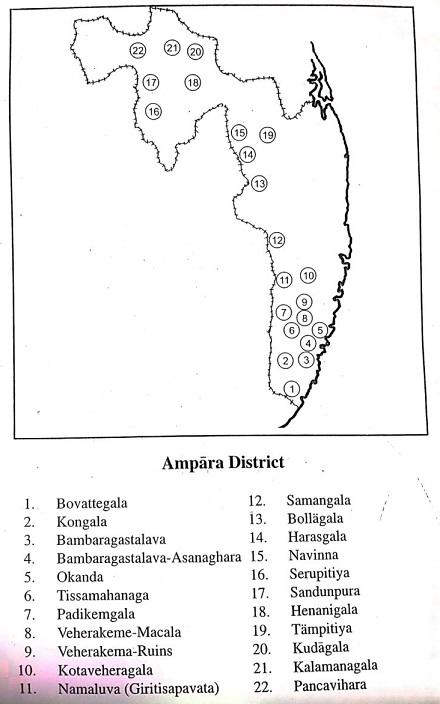
Medhananda‘s
maps shows 17 new
locations for Jaffna, including 4 on the smaller islands and 19 for Vavuniya and Mullaitivu Mannar has 32 places, of which 15 are lined
along the sea coast. The
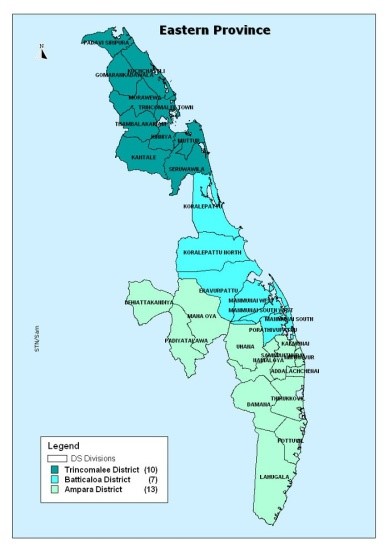
map of the Eastern province showed Ampara 22 places, many along the coast or
near it, Trincomalee 6, and Batticaloa 4. These maps are found in the English translation, not in the
Sinhala original. Medhananda says this list is incomplete. ‘There should be
much more than we found.’
Medhananda was able to explore the Eastern Province with greater freedom than the north. Medhananda has explored 80 Buddhist sites In the Eastern province. They included Agbo Raja Maha Vihara, Ariyakara Raja Maha Vihara, Bollegama Raja Maha Vihara, Balahandu vihara, Bambaragastalawa vihara, Boralukanda temple, Nilaveli. Bowattegala vihara, Buddhangala hermitage, Dighavapi, Diviyagala vihara , Ganegama vihara , Girikumbara vihara , Habutala Karandahela vihara , Harasgala vihara , Henanegala cave temple, Illukpitiya kanda len vihara Ampara. Kalkulam Udagala Dagoba, Kiliveddi bodiya, Kirivehera Raja Maha Vihara, Kombanachhi Ruhunu Somawathi vihara , Kongala natabun vihara , Kopavela vihara , Kotaveheragala vihara , Kuchchaveli Maha vihara, Kudimbigala hermitage, Kukuluvagala vihara, Lankapatuna Samudragiri vihara , Linemalai Sipavata vihara , Malayadikanda vihara, Namalu vihara , Nawinna Raja Maha Vihara ( Ampara), Neelagiri vihara and cave, Niyaguna kanda vihara , Okanda vihara , Omunugala cave temple, Panama raja maha vihara , Piyangala vihara , Pulakunava Maha vihara , Rajagala Maha vihara , Ratgala vihara , Rugama Piyakalutota vihara, Ruhunu magul maha vihara , Samangala hermitage, ,Samudragiri, Sastravela vihara , Seruwila vihara , Sri Pana Raja Maha Vihara, Potuvil, Tilapola pansala, Tiriyaya, Udayagiri Raja Maha Vihara , Vedikkinarmalai rock temple, Veheragala cave temple, Veheragama kubira therun vanaya Ampara, Veherakema Mavala vihara , Velatti badda aramaya and Velgam vihara.
Medhananda has also
looked at ruins. These are generally of monasteries or vihara, but some were
settlements. Medhananda found ruinsat
Ananda kulam , Agbo Raja Maha
Vihara , Allai, Arantawala
Balagala, Bandaraduva
,Buriyakulam kanda , Dighavapi, Etha bandi wewa, Galkanda
, Hingurana sugar factory (ruins near
it). Ichchalanpattai, Kadolupotana kanda Kandikudichchi aru, Kondavattavana, Koravanvadu, Kantalai track 6 and track 13 ruins, Kivulevatta , Kulankullimalai , Kunchinamalai, Mulgama kanda. Moraha
Pokuna, Mundikulam
malai Narakamulla, Nuwaralagala, Padi kemgala, Pallewela, Paragahakele, Pulmoddai , Punyadi ,
Ridikanda Ranankaduwa, Sembumalai
Serupitiya, Seruwila, Sunetra wewa, Taravakulam, Tirumangala, Toppigala , Valmandiyagala Veheragala, Veheragoda ,
Veherakema, Veheratenna, and
Vilankulam.
Medhananda
has also looked at ancient wewas in the Eastern Province. He found 115 ancient wewa in Ampara district, 64 in Batticaloa
district and 300 in Trincomalee
district. In Batticaloa and Trincomalee most of the wewa were known a ‘kulam’. Medhananda has also
listed 66 ancient wewas mentioned
in inscriptions.
Medhananda
made it a point to record the ancient names of the places he explored. Mahakaccakodiya vihara in Vavuniya was
Tittavalkada, . Kuchchaveli maha vihara was Samudradevi
vihara. Verugal was originally Veheragala. Kottiyar
pattu was Kotthasara. Panama
was known as Vajana rata in 7th century. A Gama donated to an aramaya become ‘aramagam’
which became ‘Arugam’. Rugam is the Tamilisation of this, said Medhananda .
Medhananda commented on the ruins he saw. The Yan Oya
valley is studded with many stupas and other buildings, he said. Inscriptions show that there were
Buddhist settlements there. At Lankapatuna Medhananda Found an unprotected moonstone, the rest have been destroyed. I found 6 inscriptions there. After I told them the Department of
Archaeology went and copied the inscriptions.
The most number of ruins were found at Ampara. One and a half miles to the east of the
preset Devalahinda school, Ampara, there are many ruins of stupas, ponds, Buddha
foot prints, and asanagharas. there is a wall fortification 7’ wide, stretching
for a distance of about 600 feet.
Sembumale
monastery complex spreads over an area of more than hundred acres. Somawathi
vihara, Kombanachchiya had ruins no one has seen before. Places like Diviyagala, Damana and
Timbirigolle in the vicinity also have inscriptions and ruins. Budu patum kande
is ‘full of ruins’. Medhananda found a sandaka pahana there, also interesting bricks.
Veherakema,
originally known as Mavala
vehera is in the middle of the Lahugala
forest. Medhananda took four hours to travel
the 7 or 8 miles to get there. he was the first to explore Veherakema. He found a huge rock with the
ruins of a probable padhanaghara,
columns 6 or 7 feet high and a plain moonstone without
decoration.
In the Veheragoda ruins at Ampara, there is a stupa which shows the earlier style of stupa building. this style is also seen at Buddhangala and
Rajagala. Veheragoda wewa had a
kalugal sorrowwa.
At Karandahela, Medhananda found a lotus petal moonstone, very old bricks, a huge cave, 512 feet long, 30 ft wide, and 82 feet height and a rock carved gal vangediya, one foot
deep with circumference of 7’ 2”.
At Veheragalkanda, Medhananda saw a foundation , 50’ x50’ with stone door
frame facing the east 9’8” in height There was another structure, 18’8’ by 14 ‘1”
with ten pillars in the middle, this
could be a gigantic doorway, said
Medhananda . When I first visited the
place there was a torso of a statue
lying there but ‘now it is not to be
seen’.
Bambaragastalawa
has acres of ruins, many, many stupa on hill tops and flat
ground, also remains of viharas, image houses, as well as steps, pillars
and caves. There was no road access to Bambaragastalawa. Medhananda
had to go through dense forest inhabited by wild animals.
Medhananda
said that many of the places he saw have not been looked at by the Department of Archaeology. There are far more
Buddhist ruins in Trincomalee district than the 54 given by the Department, Medhananda said. In our
exploration at Digamadulla, too we found many inscription and ruins never seen
before. The ruins around Dighavapi have not been explored, either.
Medhananda
had explored Bambaragastalawa,
Lenama, Budubava, Nalitta, and
found ruins which the Department of Archaeology had not found. There are no reports in the Department of
Archaeology as to the ruins at Mahapattuva , 8 km from Timbirigolla Vidyalaya. I found very fine archaeological ruins at Kadavat maduva near Batticaloa railway station. No
one had looked there.
Toppigala has not been properly explored by the Department of Archaeology . Medhananda found 150 archaeological sites in
Toppigala. All hillsides around Toppigala
such as Motagala, Vesibandagala,
Atubandagala, Varakamulla,
Kunchinamalai, Devinigala, Kavinigala, had vihara on it. Every
hill side around Thoppigala has a ruin
of an aramaya. There were inscriptions too. I spend 8 days
exploring in Toppigala jungles, said Medhananda .
Viharagal kanda
at Trikonamadu has ruins extending for
10 acres. These have not been explored before. The ruins of
stupa, walls, caves, asanaghara
could be seen. There is an ancient wewa near ruins. The archaeological sites at Vasi
bandagala, Atubandagala, Iddagala, Nelugala, Mavulivala, have not been explored before. There
are lots of ruins . Siripalena, Siluminiseya, Devagala in Maduruoya valley also
have unseen ruins.
The area north of
Badulla –Eravur has not been explored.
Lots of Buddhist sites there in the forests, also ruins of
irrigation schemes. There are Buddhist ruins also at Perillaveli
in Eravur pattu, Batticaloa district. These are in dense forest and have not
been seen by the Department of
archaeology.
Medhananda
found that many areas, now thick
forest, had been populated in ancient times.
The whole Thottama area was
populated. A part was at
Digamadulla under Ruhuna, a part was under Wellassa. Irrigation
channels at Valmandiyagala showed
that this was a large settlement. Periyakulam is
actually Manamatta wewa and is part of the Sinhala irrigation schemes. Kannimaduwa inscription refers to Salapavu vehera and its villages,
said Medhananda .
Medhananda found 114 wewas at Dimbulagala as well as an area which had held paddy fields
in the ancient period.
.Harasgala and
Serankada vihara near Maha oya were
prosperous in ancient times said Medhananda. Veherapokuna
in Maduru oya valley was an important
stopping place between Magama and Jaffna. Ruins at Velatti
badda aramaya in Uhana, shows that
this was a very developed aramaya.
The north and the east were a part of the ancient Raja Rata, explained Medhananda .
The Raja rata was
divided into uttara passa (
north) dakkhina, ( south) pacina, (east) and pajjima (west) . Each
division was ruled by officer appointed by king, said Medhananda .
Medhananda’s explorations confirmed that the
Eastern province was originally Sinhala Buddhist. Medhananda found
that in the east, Kumbukkan oya had Kamboja
gama, Heda oya bank had Mayvelesa gama, Gal
oya had Dighavapi.
Batticaloa had Kasaba
nagara, Giritisa gama,Karaginitisa gama,
Vilagama, Malu gama. Vihara gala ara,( Verugal aru
today) had Dahadiya.
At Pulukunava
there are ruins all over the place. You see caves all over the hillside,
with and without drip ledge and inscription. There are about 70 caves of
different sizes. This whole area has
been a developed Sinhala Buddhist area, said Medhananda . Sipavata vihara at Linemalai on Potuvil
–Akkaraipattu road, Ampara, has inscriptions which have not been examined. They
indicate that this area was once a
Buddhist agricultural area.
Panam pattu, today has Helawa Eliya, a Sinhala gama. Tilapola
pansala near Kallar, ‘also has a Sinhala gama today,’
said Medhananda . In 1806, the AGA had found 7 Sinhala villages, Halava, Okanda, Kumana, Potana, Yala, Buttuwa, Palatupana in Panama. Today there are just two villages
left, Panama and Kumana and they are destitute, said
Medhananda.
Inscriptions in Mahaweli region indicate that
there were many
settlements there.
These
areas were suitable for agriculture.
There was flat land and water. At least 25,000 settlements would have been
there, said Medhananda
. There were two
ancient towns, Seru and Soma between Veheragala
aru and Mahaweli.
(
continued)
Medhananda also went on exploration to the Northern Province and wrote his findings in his book Pacina passsa, uttara passa, nagenahira palata ha uturu palate Sinhala Bauddha Urumaya”. Ven. Ellawala Medhananda was not able to explore the North as much as he would have liked, due to LTTE control. The Northern Province consists of Jaffna, Kilinochchi, Mannar, Mullaitivu and Vavuniya districts.
Medhananda gave the historical background to the
Buddhist civilization of the North. He
stated that Jaffna, Elephant Pass and the islands around
it was known originally as Nagadipa. Ptolemy had
called it ‘Nagadiboy’. Vallipuram manuscript of Vasabha called it
Nakadiva.
Medhananda declared that the North was part of
the Sinhala kingdom. It was part of the Rajarata there was a main road from
Jambukolapatana to Anuradhapura. The Raja rata was divided into uttara passa (north) dakkhina, (south) pacina, (east) and pajjima (west). Uttara passa consisted
of today’s Vavuniya,
Mullaitivu, Kilinochchi, Mannar, and Jaffna. Each division was ruled by officer appointed by king. Tonigala
and Mannar inscriptions speak of uttara passa . Periyakulam inscription says that during the
time of Devanam Piyatissa, Vavuniya was ruled by ‘Naga’ and ‘Uti’ and Mannar
was ruled by ‘Kana’.
In Vasabha’s time (111-14) Jaffna was ruled by
Vasabha’s Minister Isigiri. Nelugala inscription indicated that a minister,
also named, Asgiri administered the north under Bhatiya Tissa II (143-167) and Kanitta Tissa (167-186). Sigiri
Gee (5th-8th century) contains verses
written by ‘Uturupasa vasi Samanal bati’ and ‘Uturupasa vasi Agalabati’ . They
wrote in Sinhala. Inscription of Kassapa IV(914-23) at Kadurugoda said
Kassapa was the ruler of the south as well as the north.
Mannar was a part of the Sitawaka kingdom. During
the time of Rajasinha I, (1581-93) Manamperi Mohottala administered Mannar. The Udarata kingdom included the north and
the east, said Medhananda .Baldeus (1632-72) writing during the Dutch occupation, gave a
list of places under the Sinhala king. It included Trincomalee, Mannar,
Batticaloa, and Jaffna. Kokila sandesaya
gives a route from Kotte to Jaffna via
Mannar. The
inscriptions in Ichchalampaththai
( date not provided) show that these were Sinhala villages.
Another way of showing that the North was ruled by the Sinhala king was by
comparing the language and script in northern inscription and those elsewhere,
said Medhananda . Medhananda found 2
inscriptions dated to 2 century AD at Kandakudichchi aru ruins. The script and
language resembled inscriptions at Ritigala, Vessagiriya, Mihintale.
He found that the language and
script were the same in the Mailagastota ,
Kallampattuva and Tunukai
inscriptions . Mailagastota was
in the south, Kallampattuva in the east and Tunukai
in the north of Sri Lanka .
Medhananda said that
inscriptions of Kassapa IV were found in south, east and northwest of the island. The script and language was
the same.
Medhananda says
the North is full of Buddhist remains, every hill, every mound has a
Buddhist building. Every village had an aramaya. Medhananda
said that there were over 1500 Buddhist archaeological sites in the
districts of Vavuniya, Kilinochchi, Mullaitivu and Mannar. Each time I went to Vavuniya and Mullaitivu I found new ruins. He
has found foundations of buildings, lived in caves, inscriptions, pada lanjana
and bricks. He says there are
many more sites. Medhananda said there are more than 20 archaeological sites on the small Dollar Farm village alone.
Vavuniya is
full of Buddhist ruins. There
are hundreds of Buddhist ruins In Vavuniya there are three sets of
ruins in a straight line, at Mahakachca kodiya, Erupotana,
and Periyapuliyam kulam malai. Odiamalai, Thadda malai, Kurundam malai had
inscriptions. Kurundammalai , originally
Kurunvashoka vihara, had
a lot of ruins. Medhananda said that this was the
place where he saw the most ruins.
Have not seen so many ruins in any other place I have gone to.
Vavuniya and Mullaitivu Buddhist ruins have not been examined fully by anyone., said Medhananda . Most
of these are not recorded by Department
of Archaeology. ‘We have never explored
these areas, said Medhananda . Our
archeology only concentrated on Anuradhapura, Polonnaruwa and a
few other places.
From Jaffna to Wilpattu, all along the ocean
strip, one sees places with over 100 ruins. No
explorations have been done in this area. These sites were never examined carefully,
other than presenting a random report.
In his book Pacina passsa, uttara
passa, nagenahira palata ha uturu palate Sinhala Bauddha Urumaya” Medhananda
gives a list of Buddhist ruins seen by
him in the Northern Province. The
viharas seen by Medhananda in his northern explorations include Atambagaskada
kiri vihara , Buddhanehela Raja Maha Vihara , Galgiriyagama kanda vihara , Iratperiyakulam vihara , Kadurugoda vihara , Kurundammalai vihara , Madukande Dalada vihara , Mahakachcha kodiya
vihara, Mangana vihara, Piyagukatissa vihara , Paribhoga chaitya,
Salavana vihara , Tonigala vihara , Valli vihara and Vedikinarimalai Vaddamana parvata vihara .
Medhananda
gives 48 places in Jaffna where he has seen Buddhist ruins He
says there are others as well. the places listed are Algiriya, Anai kottai,
Analativu,Ariyalai, Atchuveli,
Buddhatottam, Buddhawalawwa,
Chakaveli, Changanai,
Chulipuram, Chunnakam, Delft, Elavativu, Gotamalu watte, Karaitivu,Kodiyavatte Mahiyapiddy, Mallakam, Manipai, Marattamadam,Mavaddipuram, Nagachcha kovil precincts, Nagarkovil, Nainativu,Nallur, Neelavarai,
Pinwatte, Ponnalai, Poonaryn, Pukuditivu,
Puloli, Puttur,Sambaturai,Tellipilai,
Tennavali, Tiruadanilai,
Tisamalai, Tunukai, Udupiddy, Uduvil, Uratota,Uraturai, Vadukkodai, Valikamam and Valvettiturai. Medhananda says these ruins show
bricks, tiles, statues, potsherds, inscriptions. Most are in private lands, Medhananda
observed..
Medhananda has
also found ruins of some 1538 tanks form
Vavuniya, Kilinochchi, Mullaitivu, Elephant pass, Pooneryn Omanthai and Mannar.
Medhananda had also made a list of the
wewas found in the Northern Province. They are listed by name in his book. He
has listed 340 wewa in Vavuniya, mostly called kulam, and 15 wewa in Mannar
Iranamadu
in Kilinochchi district, was
originally Ranmadu wewa.
Medhananda has given a detailed description of the sites he has
visited. In Vavuniya, Medhananda explored Buddanehela Raja Maha Vihara . Ruins are fast deteriorating he said. Galkiriyagama
kande vihara, had remains of a huge
stupa , a Siripatula and ponds.
Inscriptions show king Uththiya’s queen had
built a structure here.
Kirivehera
at Atambagaskada, 6 km from Vavuniya,
has a Samadhi Buddha statue, which is
far superior to those found in this area. According to villagers was brought from
elsewhere. It is 2’ 21/2” high, the
head dress or ketumala is unique. Eeratiperiyakulam ruined vihara, Vavuniya, ruins show avasa,
vihara and 150 year old Bodhi tree. Medhananda had found a stylish
statue in pieces and had put it
together. ( continued)
By P.K.Balachandran/Daily Mirror Courtesy NewsIn.Asia
Sri Lanka should open up to Bangladeshi investments to reciprocate the welcome accorded to Sri Lankan investments in Bangladesh says Bangladesh envoy Riaz Hamidullah
the Bangladesh High Commissioner Riaz Hamidullah with the Sri Lankan Prime Minister Mahinda Rajapaksa
Colombo, June 16: The lockdowns and barriers imposed in countries across the globe following the outbreak of COVID-19 have crippled economies. But COVID or no COVID, countries are now constrained to open up to give back to the people their livelihoods. Therefore, it is time governments geared themselves up to meet the challenges of the post-COVID-19 world.
The disruptions brought about by COVID-19 call for fresh thinking on many things hitherto taken for granted. Since Sri Lanka and Bangladesh face similar problems, their approaches and solutions to post-COVID-19 issues could be similar.
Like Sri Lanka, Bangladesh has been heavily dependent on the apparel industry and overseas workers’ remittances. Again, like Sri Lanka, Bangladesh has been heavily dependent on Western markets. The apparel industry in both countries is suffering for want of orders from the West due to the disruption of the latter’s economies by COVID-19. Both Sri Lanka and Bangladesh have similar institutional and infrastructural drawbacks. An inability to rein in corruption is one of them.
Bangladeshi diplomat, Mustafizur Rahman, in his June 9 paper entitled: Global Partnership: Crucial to Bangladesh’s Economy and Development Strengthened Goals” written for the National University of Singapore, points out that the Ready-Made Garments (RMG) sector, which accounted for 12% of the GDP and 84% of total exports, is in shambles now with US$ 3 billion worth of orders cancelled. This has directly affected two million garment workers, mostly women. Remittances, which are the second-largest driver of the Bangladesh economy, could go down by 20%. In 2019, US$ 18 billion was brought into the country by over 10 million Bangladeshis working overseas, mostly in the Middle East. But Middle East economies have been hit hard by declining oil prices. Private investment and FDIs in Bangladesh are also expected to drop, particularly affecting 50 million workers in the informal sector.
The Bangladesh government needs an additional US$ 928.48 billion to achieve the Sustainable Development Goals (SDG) by 2030. The World Bank has fast-tracked US$ 100 million to support Bangladesh’s fight against the virus. But this is chicken feed. On its part, the Bangladesh government has announced rescue packages totally valued at US$ 11.9 billion, which is equivalent to 3.6% of the country’s GDP, Rahman said.
Even before COVID-19, Khaled Chowdhury had written in The Daily Star in 2018 that Bangladesh could diversify its production and export baskets by making forays into less technological-intensive products such as paper goods, mobile phone accessories, umbrellas, basic lighting, tiles, etc. The earning potential from exporting these products could be significant he said, pointing out that China was the major exporting country for these and many other basic products.
Bangladeshi entrepreneurs need to make Continuous Business Process Improvement (BPI) an integral part of their growth strategies, Chowdhury said. In the 1980s, the US automotive industry lost its top position to Japanese automakers when the Japanese adopted Continuous Business Process Improvement (Kaizen) to cut down inefficiencies and wastage of material and time, he pointed out.
Some Sri Lankan products have great potential in the Bangladeshi market. For example, a popular brand of Sri Lankan hair oil has displaced an Indian product. Sri Lankan investors in Bangladesh should not look only at the Bangladesh middle class market which is about 30 million.
Corruption is the other major issue in both Bangladesh and Sri Lanka. A 2014 paper presented by the US-based Milken Institute quoted the World Bank as saying the Bangladesh government was losing more than US$500 million a year due to corruption. And poor management practices cost US$ 1 billion. Bangladesh established a Board of Investment in 1989. But the BOI was not adequately empowered and therefore has had trouble attracting significant foreign private capital, other than in certain industries. For investments to come, whether from within the country or without, doing business must be made easier. But as per the World Bank’s Ease of Doing Business ranking, Bangladesh was poorly placed, the Milken Institute report said.
Planning for a set period of time is also essential, as the experience of South Korea shows. The Milken Institute’s report says: In 1961, South Korea’s military government established the Economic Planning Board, which produced a series of five-year plans for economic development from 1967 to 1981. These plans offered firms a number of incentives, such as tax benefits and low-interest bank loans to increase and diversify exports. Further, the government reduced or eliminated all taxes and import restrictions placed on intermediary goods used in export production. Existing industries, including textiles, clothing, and electrical machinery, benefited from the lifted import restrictions. Exports increased. Later, under the third five-year plan, investment in machinery, steel, shipbuilding increased. The result was a dramatic change in the character of South Korean exports: from commodities and processed foods in the 1960s (75% of South Korea’s exports in 1962) to manufactured goods (almost 90% of exports in 1985) and high-tech products since the 1990s. Today, heavy industry—including semiconductors, telecom equipment, automobiles, computers, steel, ships, and petrochemicals—accounts for 90% of all exports.”
Bangladesh’s advantages
However, there is a crucial difference between Sri Lanka and Bangladesh. Prior to COVID, unlike Sri Lanka, Bangladesh was already well on the way to becoming a South Asian Tiger.” From 2009 till this year, Bangladesh’s GDP was growing at 7% per annum and it’s per capita income had doubled from US$ 860 to the US$ 1,751.
Bangladesh has also been enjoying political stability with a purposeful government. Sheikh Hasina’s Awami League has been firmly entrenched in power. The opposition Bangladesh Nationalist Party has discredited itself and is in limbo. An unfettered Sheikh Hasina put down the highly disruptive Islamic extremists with an iron hand. When the Bangladesh Prime Minister lays down the law, her writ runs. In other words, Sheikh Hasina is eminently in a position to turn the economy around and put it on a new trajectory. She had already turned Bangladesh, the infamous basket case” into a potential South Asian Tiger” before COVID-19 struck. All she has to do is to pick up the threads.
Bangladesh envoy in Sri Lanka Riaz Hamidullah did not agree with the view that doing businessmen in Bangladesh is difficult. He quoted the Chairman of one of the Sri Lankan power and gas company W.K.H.Wegapitiya, as saying that he had invested in Bangladesh because of the comfort” factor. Wegapitiya had told a seminar in Colombo in 2018 that Bangladeshi officials would go out of their way to iron out issues or remove any obstacles that might arise. U. Gamini Sarath, General Manager of an Offshore Operations of Group, which has invested in power generation, had said he would walk into the offices of the top functionaries in Bangladesh departments without a prior appointment, and get his work done. High Commissioner Riaz Hamidullah said that Bangladeshis are welcoming by nature and are not suspicious about foreign investors. He pointed out that many Sri Lankans work in the garment and other sectors in Bangladesh in high capacities and send back to Sri Lanka US$ 2 million per year as remittances.
Some Sri Lankan products have great potential in the Bangladeshi market. For example, a popular brand of Sri Lankan hair oil has displaced an Indian product, he said, but added that Sri Lankan investors in Bangladesh should not look only at the Bangladesh middle class market which is about 30 million. They should look at the larger Indian market next door.”
As for Bangladeshi investments in Sri Lanka, Hamidullah said that protectionism was a major barrier. It stunts growth by shutting off opportunities.”
However, there are areas of cooperation which should be explored. Listing them, Hamidullah said: Bangladesh would profit from Sri Lankan expertise in hospitality, hotel management, and accountancy. And Sri Lanka could benefit from Bangladesh’s experience in rice cultivation in various climatic and soil conditions; inland fisheries, disaster management and coastal shipping.”
Having lost his diplomatic post in Russia, poor Dr Dayan Jayatilleka is now singing lustily for his supper. Having burnt his bridges with the Rajapaksa camp, his latest sonnet A knee on the neck of the next Parliament”, published in DailyFT on 11 June 2020 is his attempt to get Sajith Premadasa’s attention.
Premadasa is hoping to bag the position of Opposition Leader. Of course, having lost at the Presidential race, the premiership would be a nice consolation price. However, his fear of general elections indicates that he is not confident of winning the title. On the other hand, becoming the Opposition Leader would not be hard, for even those in the Rajapaksa camp would gladly help him to secure the position.
It is not that he has an inside deal” with the Government. Opponents see him as rather a naive gentleman. On the other hand, his erstwhile boss and now nemesis Ranil Wickremesinghe is the absolute maestro in political games. Given a choice between Premadasa and Wickremesinghe, political opponents will happily choose Premadasa.
Premadasa’s attempts of trying to attract the Buddhist votes with his sudden and recent show of interest in Buddhist sermons are nullified by his present company. Mangala Samaraweera, Malik Samarawickrama, Rajitha Senaratne, Patali Champika Ranawaka, Rishad Bathuideen, Rauff Hakeem, Azath Sally and Kabir Hashim make up his inner core.
They are openly disdainful of Buddhism and the Buddhists. They have been kicking the Sinhalese in the guts – right in the midriff. Except for Hashim, the Muslim politicians in this group are being accused of nurturing extremist ideologists. Bathuideen especially has been implicated with close ties with the Easter Sunday bombers. In the aftermath of this terrorist attack, the public demanded that he step down to allow impartial investigations.
Resigned
In response, all the Muslim politicians in all parties in a show of solidarity resigned from their positions. This included Hashim as well. Unlike the other Muslim politicians, Hashim is not dependent on the Muslim vote bank but the Sinhala base. Hence, he in effect slapped across the face of his voters. Hashim is also accused of having played a complicit role in the infamous Central Bank bond scams. However, for incomprehensible reasons the blame is deflected to Ravi Karunanayaka, who really was not involved.
Though true UNP stalwarts like Tissa Attanayaka and Imthiaz Bakeer Markar are fighting courageously to maintain a foothold in Premadasa’s camp, they really are not a match for these elements. Attanayaka especially dedicated himself to protect the UNP Party and leadership through the long and difficult years it sat as the Opposition to a powerful and popular government. In 2015, he did not leave the UNP for personal gain but in protest of a plan to be executed against the country. All attempts to prove him a liar and a forger have failed for events thereafter have vindicated him. A democracy needs a good and honourable Opposition and Attanayaka fits the bill.
Imthiaz too is a respected politician who rejects racial or divisive politics to establish his vote bank. After years of being out of public eye, he came back to the political arena when Premadasa pushed himself forward as an alternative to Wickremesinghe.
It is unfortunate that under Premadasa’s umbrella too they continue to be shown a back row seat. Die-hard UNP supporters, who hates Ranil Wickremesinghe for ruining the UNP should trace back and identify the exact point he started acting against the UNP grain. They will find it is the same causes that led them to be disgusted with Wickremesinghe that disappointed them with Sajith Premadasa.
Tenacity
Under J.R. Jayewardene’s and Ranasinghe Premadasa’s governments, Wickremesinghe was not such a disaster. However, there is a difference between just skirting on the rim of the honeypot and the fly actually falling into the honeypot. It was a childhood friend” who took Wickremesinghe from the rim to the honey in the pot. It is thanks to Wickremesinghe’s own tenacity that he is still holding on to his turf. However, the credit of Wickremesinghe now standing as a discredited politician belongs to this friend. It is little surprise that this friend is now attached to Premadasa.
Premadasa understands that Wickremesinghe’s former friends, who are now firmly flanked by his sides, will not attract the Sinhala Buddhist votes. Hence, making the COVID-19 as an excuse he tried his level best to get back to the dissolved Parliament without an election. However, Premadasa exposed his bogus concerns when his camp held protests over the arrest of Rajitha Senaratne notwithstanding the social distancing essential to prevent the spread of the pandemic.
The irony is Premadasa would have been able to mark a new chapter in Sri Lanka politics had he started his fresh beginning with respected politicians like Tissa Attanayaka, Imthiaz Bakeer Markar and enticed solid personalities like Tilak Marapana. Most unfortunately though he chose to bypass intelligent voters for the rabid block that hates the Rajapaksas and the racist block that harbours extremist notions and inferiority complexes.
It is in this backdrop that Dr Dayan Jayatilleka sings his ode. The message in his long harangue is that space for Tamils and Muslims is been taken over by the Sinhala, Buddhist military.
He asks, if the task force appointed to create a secure country, disciplined, virtuous and lawful society” is defined by one in which you can be ‘secure’ in the knowledge that if you skin an unarmed civilian and slash the throat of a five-year-old child, and you’ve been in the right uniform and the child is of a suitable ethnicity for you to do so, then even if you have been found guilty by a High Court and your appeal dismissed and the sentence upheld by the unanimous verdict of the Supreme Court, you can still be pardoned – with the pardon publicly justified”.
Dr Jayatilleka, who has represented Sri Lanka at the UNHRC, ignores that over 14,500 LTTE cadres were released without so much as a trial when the incumbent President was the defence secretary. These cadres were rehabilitated in programmes where they were either sent back to school or given a vocational training to help rebuild their lives.
These cadres too were engaged in violent crimes, where not only toddlers but even foetuses were ripped out of mothers’ bellies. The long list of atrocities including the Anuradhapura massacre, bomb attack on the sacred Temple of the Tooth, Aranthalawa massacre, Central Bank attack, Gonagala massacre, ethnic expulsion of Sinhalese and Muslims, closing of Marvil Aru sluice gates denying water to over 15,000 agrarian families of all ethnicities were all committed by these cadres. Yet, today they are living peacefully with their families without so much as a criminal record.
Victims
Not a single HR activist has spoken against these releases on behalf of the victims of the LTTE terrorists. In staff sergeant Ratnayaka’s case, after 13 years of hearing his case, the courts continued to entertain reasonable doubts about his culpability. Even while handing him the death sentence, the courts noted that this heinous crime could not have been committed by Ratnayaka alone. Furthermore, it was not established in courts his exact act in the crime.
In this context, to insist on upholding a sentencing of only one for a crime committed by a group, which if executed would be irreversible, is a gross violation of Ratnayaka’s human rights. The fact that this insistence on upholding his punishment is based on the racist element that this soldier is a Sinhala Buddhist should be universally condemned.
Dr Jayatilleka also picks a bone with the task force appointed for the Archaeological Heritage Management of the Eastern Province. The fact that Defence Secretary General Kamal Gunaratne is heading both these task forces is a bitter pill for Dr Jayatilleka who does not see eye-to-eye with the General.
In his article, Dr Jayatilleka notes that even the foreign journalist P.K. Balachandran has observed that this task force is without any Tamil or Muslim representation, despite these two communities constituting two thirds of the population. It is a pity that Dr Jayatilleka despite being the academic was unable to correct the misperception of a foreign journalist. The insinuation that the Sinhala Buddhists would do a disservice to Muslims or to Hindus should have been corrected. This kind of racist suggestions that a community can only trust their own kind and not the other Sri Lankans is despicable.
If that were true, then one must wonder at the reasons for the Catholic MPs who were in the then Government to prevent the Easter Sunday massacres. Harin Fernando shocked Sri Lanka when he confessed to having been forewarned of the attacks and chose not to do anything other than save his skin. In the same argument, Sajith Premadasa, Rajitha Senaratne, Mangala Samaraweera, Patali Ranawaka or any of the Sinhala politicians in this camp should not fear elections, but they do.
Dr Jayatilleka tsk tsk over Police brutality” for arresting those who were protesting the death of a man half way across the world, two weeks after the incident. There are some glaring omissions – including the absence of protests for the Sri Jayewardenepura undergraduate Pasindu Hiroshan. Pasindu sustained critical injuries to skull and brain after yet again another ragging incident went horribly wrong. The socialist groups ought to be protesting over these incidents than something unrelated to Sri Lanka. However, they will not; nor will the Premadasa camp.
Nothing to offer
Both the Premadasa group and these socialists are fellow travellers. With nothing to offer to their voters, they are hoping to gain ground by discrediting the incumbent Administration. Dr Jayatilleka finds it opportune to join the chorus. He is waiting for Premadasa to notice him and beckon him to his side.
However, Premadasa might not as he knows Dr Jayatilleka to be a slick character. Dr Jayatilleka does not have any special affinity with Premadasa or his politics. It is just that after his last encounter with the then Joint Opposition in which some members including Pavithra Wanniarchchi roundly told him off for his surreptitious attempts to push his devolution ideas into the camp, he feels that the Pohottuwa doors are forever closed for him.
However, if by chance the present Administration gives him an ambassadorship, preferably to a country that snows, Dr Jayatilleka in his true opportunist style would effortlessly change his tune. He has done so many times before and to repeat yet again would not be an issue.
If such a chance dawns on him under this Administration, then he would not be worried about the overrepresentation of Sinhalese, Buddhists or military or the task forces bypassing elected officials. Then, he would be passionately arguing that as Sri Lanka is the only isle with the unique Sinhala Buddhist identity, whether the adjective should be Sinhala” buddhists or Buddhist” Sinhala. Unfortunately for Dr Jayatilleka, both this Administration and most probably the Premadasa’s camp know that to have him on board would be to deal with another Hoole.
Investigations have confirmed that banned foreign terrorist organisations had funded the Easter Sunday bomb attacks took place on 21 April, 2019, Police Spokesperson SP Jaliya Senaratne said.
He noted that further investigations into the attack are being conducted by the Criminal Investigation Department and the Terrorism Investigation Division.
Furthermore, he added that three T-56 firearms, two revolvers, one pistol, one Bora-12 firearm, approximately 2,000 detonators, over 600 gelignite sticks, and a large number of firearms and ammunitions have been found.
The Police Spokesperson stated that the Colombo Crimes Division apprehended 26 suspects linked with the Easter Sunday terror attacks, and that eight of them are currently being interrogated. He added that five more suspects have been remanded.
The Criminal Investigation Department is currently interrogating 37 suspects in connection with the attack, while 35 suspects have been remanded.
The Terrorism Investigation Division is currently investigating 63 suspects in connection with the Easter Sunday attacks, and 16 of them are in remand custody, he added.