Arrested MP Ranjan Ramanayake has been remanded until January 29.<br /><br />He was produced before the Nugegoda Magistrate this noon. Ramanayake was arrested in connection with the interference of the functions of some judges yesterday.
Meanwhile, the Magistrate has ordered the Prison Commissioner to produce MP Ramanayake before the Government analyst for a voice test.
(A Paper published by the Sri Lanka Geo-Political Study Circle)
On 16th November 2019, a 6.9 Million people overwhelmingly voted Gotabaya Rajapaksa into office, sincerely believing that he would give Sri Lanka leadership to face her biggest danger in 200 years, a brazen attempt by the US to physically take over the Country.
Leaders of Gotabaya’s alliance-parties, like Vasudeva, Weerawansa and Gammanpila, vociferously supported Gotabaya, in the run-up to the Presidential Election, in a collective show of political force against the MCC and the insidious American ‘invasion’.
With Wickramasinghe hell-bent on handing over the country on a platter to the Americans, the US ‘invasion’ of Sri Lanka became one of the prime issues at the 2019 Presidential-Elections.
The MCC is the smartpower tool of the US Government. In the overall ‘Indo-Pacific Command’ Operational Plan to achieve the stated US strategic objective of establishing US hegemony over the Indian Ocean (described as Pivot-to-Asia), the MCC Plan for Sri Lanka is the Sri Lankan Phase of that Indo-Pacific Operation.
Gotabaya purportedly gave up his US citizenship to give his valuable leadership experience to the Sri Lankan people albeit his spouse did not give up her citizenship; she has the dubious distinction of being the first American woman to be categorised, in the words of some, as Sri Lanka’s First Lady.
The first hint that some skulduggery was afoot came when Chandrasena, in his ‘immediate-post-Ministerial-appointment-interview’ chortled witlessly, in front of the cameras, with a, ‘I-will-be-issuing-loads-of-land-deeds-come and-get-yours’ boast.
This insidious tremor was followed by a major shock. On 10 December 2019, less than a month to Gotabaya being elected into office by the people, Chandrasena presented to the Cabinet, a detailed proposal of what is described as a ‘Plan to accelerate the ‘Management of State Land’.
Accelerated Programme for State Land Management– The Minister of Lands & Land Development presented to the attention of the Cabinet, information in respect of 11 programmes planned to be implemented from the month of December 2019 up to the month of March 2020 by the institutions coming under the purview of the Ministry of Lands & Land Development. Accordingly, the Minister informed the Cabinet further that the programmes such as issuance of permits, Grants and Leases, in terms of the Land Development Ordinance and the State Land Ordinance after holding Land Kachcheries, conducting Mobile Days and Field Day programmes, issuance of Title Certificates under the Title Registration Act, regularizing of Land Data System, Launching of the New Edition of the Road Map and the preparation of Land Manual etc. are anticipated to be implemented. The Cabinet also decided to appoint an Officials’ Committee to make recommendations to prepare a simple and a convenient method in respect of the lands given under lease basis enabling the lessees to make their payments without causing much inconvenience to them.
It would have taken a great deal of work and time, even for professionals with greater capacity than Chandrasena, to formulate such an elaborate Plan in such a short space of time as three weeks.
The Cabinet approved the Plan and tasked Chandrasena to start on the Project immediately and have it completed by March 2020, before the anticipated General Election.
This Project, approved by the Cabinet, has 11 programmes and include, the issuance of Land Grants and Leases and the issuance of Title certificates under the Title Registration Act (Bim Saviya) of 1998.
Suspicions of what is being planned were compounded when on 29 Dec 19 Chandrasena, visiting Padaviya, declared that he would be issuing 200,000 Land deeds and that he would be establishing a land Secretariat system. (https://www.newsfirst.lk/2019/12/29/land-secretariat-system-to-resolve-land-ownership-issues/)
It is an extraordinary coincidence that Chandrasena’s proposal, approved by the Gotabaya Cabinet, is exactly what the MCC has instructed Sri Lanka to do, and that too, as laid down by the MCC, prior to signing the MCC Agreement.
Chandrasena’s proposal is the crux of the MCC Plan for America’s takeover of Sri Lanka. The accelerated Plan for ‘Management of State Land’ is the Accelerated MCC Plan for Sri Lanka.
The Objective of the MCC plan, is indicated in the ‘Constraints Analysis’ (https://assets.mcc.gov/content/uploads/constraints-analysis-sri-lanka.pdf)
and also, in the ‘Execution Phase’ of the MCC Plan leaked out unwittingly by Steve Dobrilovic and, which mistake, was acknowledged by MCC Country Director Edelman as ‘a big blunder’.
The objective of the MCC is ‘To make all of Sri Lanka’s Land (80% Government Land and 20% Private Land) accessible to the Americans, for outright purchase or lease. Vide the URL given below
The main obstacles, at present, to the Americans buying up the Country are: (a) SL Law does not permit foreigners to own land: (b) Government Land (viz 80% of the Country) is under the protective care of the Executive President who is not empowered to sell this Land; he, and only he, may lease out this land or issue Land Grants of limited extent; (c) Land ownership is restricted to 50 acres: (d) The absence of a mechanism to grant Absolute Title to State Lands held by people who are holders of Land Grants: (e) Some of the State Lands are under the purview of State Organisations: (f) The Constitution which safeguards the Fundamental Rights of the unborn generations to this Land.
The MCC demands that Sri Lanka dismantle all these impediments to the US take-over of the Country, before it parts with even a dime of the 480 Million US Dollars dangled before her.
The Sirisena-Wickramasinghe Government obliged: (a) The ‘State Land-Bank’ Bill was drafted (reportedly by the Americans) to remove the 50-Acre limitation on ownership and also, to enable State Lands, under the purview of State Departments and Corporations, to be sold to any potential buyer showing interest. This embryonic Law, waiting to be presented in Parliament, was alluded to by Sirisena in his infamous TV soap-opera performance in September 2018: (b) The Project of ‘Issuing-a- Million-Land-Grants’, was initiated, to release the protective hand of the President over State Land; by issuing a ‘Million’ Land Grants – to many who already have leasehold ownership of these Lands – over two Million Acres of Land in the Country are being initially privatised. These numbers are calculated on the basis of 2 acres per Land Grant to each beneficiary. (To deviate for a moment from the construct being placed before the readers, the MCC offer of 68 M USD for ‘Land’ – the balance of the 480 M USD being allotted to Transport – for a 200-year lease works out to Rupees 2/50 per acre per month or One and a half Cents per perch per month!): (c) ‘The Land (Special Provisions) Bill’ was drafted (reportedly once again by the Americans) to grant Absolute Title to those citizens holding State Land Grants: (d) Foreigners were permitted to lease Land for 99 years and renew a further lease for another 99 years.
The Land (Special Provisions) Bill ran into flak; concerned citizens challenged the Bill in the Supreme Court. The Court determined that the Bill was in violation of the Constitution and resolved that the Bill needed to go through the Provincial Councils which owe their existence to Amendment 13 of the Constitution; the controversial Amendment to the Constitution has given Sri Lanka a brief respite from the MCC invasion.
All obstacles to the US control of our Land have been done away with, save three; these are, the two draft Bills, adduced to earlier, which have to be passed in Parliament , the need to continue the programme of ‘Issuing a Million Land Grants’ until the Corridor from TCO – CBO is covered completely. The MCC has laid claim to this Corridor stating that this Corridor is its special focus of interest.
The special focus of MCC interest, the TCO – CBO Corridor, is enlarged below
It is quite evident that Gotabaya and Chandrasena, have picked up from where Sirisena and Wickramasinghe stopped; they are continuing the programme of issuing a Million Land Grants.
Gotabaya has given Chandrasena a deadline. “Complete the task before March this year”.
The last major task yet to be done, as required by the US, is putting in place a new Constitution.
The tragedy that is unfolding is criminal. Land Grants are being granted to a ‘Million’ people and, together with their families, the numbers that are being cold-bloodedly trapped into a deadly web could be conservatively estimated at 4 Million people.
The MCC anticipates these poverty-stricken people to apply for distress loans and thereafter default on these loans issued on the collateral of their newly gifted 2-Acre Land Grants.
When that happens, the Lending Agencies would seize the Land and resort to ‘distress’ sales/leases to the Americans waiting in the side lines to grab the Land as planned. As per the MCC Agreement, the Americans would be controlling the Land Secretariat which would control the ten Land Registries in the TCO-CBO Corridor.
By duplicity, a Four-Million farmers are being made landless overnight by a mafia of traitorous politicians who are exceeding and abusing their powers, acting in contempt of the Constitution and the Supreme Court and trampling the Fundamental Rights of the unborn generations of this Land.
Sadly, all this is being done without even a proper geological survey of the Land; a detailed survey would reveal the diversity, the extent, the quantity, the quality of wealth beneath the Land and the environmental impact that would be created in extracting these resources and the necessary precautions that have to be followed when extracting theses resources. The Corridor which the Americans demand is rich with divergent minerals and resources.
The people in the meantime, in this initial phase of the MCC Plan, are being disingenuously lured into a debt trap and thereafter evicted from the Lands of their forefathers.
Phase 1 of the MCC Plan would be achieved. The Americans (and their military allies from the Pacific) would pivot into the Lands made vacant by deceit and which makes up the American Corridor of Special Interest from TCO – CBO.
It appears that Gotabaya’s accelerated programme for the Management of State Land is an accelerated Plan for the division of Sri Lanka along the TCO-CBO Corridor.
What becomes of these Four Million Farmer families? They have been dispossessed of their Land and they have lost their means to earn an income.
What employment will they engage in to keep their families from starving? Where will they sleep? What happens to their health? Where will their children study?
Massive migration of a four Million people to cities, in this initial phase of the MCC, can be anticipated; With this massive urban migration, Sri Lanka would be reduced to a Haiti where beggary, prostitution, Narcotics, murder, robbery, ghettos, contract killings will be the order of the day.
In the meantime, Gotabaya has appointed a Committee to do a ‘Comprehensive study on the Millennium Challenge Corporation Project and submit recommendations to the Government’.
It certainly does not reflect well on Gotabaya. His actions suggest that he went into an Election with a promise to lead the people without even studying or identifying the biggest security threat that faces our Country because of the MCC -Plan of the Indo Pacific Military Command.
What are the terms of reference of this Gunaruwan-Committee which is required to do a comprehensive study of the MCC Project? Are the members of the Committee fiercely independent or are they a group of persons who could be influenced by the MCC? Are the public permitted to address the Committee? Will Gunaruwan and his committee be independent enough to submit their report for Public viewing before the General Elections?
Sri Lanka’s experience has been that many previous Committees, Commissions etc have not acted with a sense of responsibility; they have excluded some vital evidence and included evidence bordering on the nebulous. Since the MCC is a matter of life and death for Sri Lanka, would Gunaruwan and his Committee members take responsibility to allow themselves to be held culpable and liable for prosecution for any glaring sins of omission and/or commission on their part?
Would the Committee invite members of the MCC for a live televised debate to comprehensively discuss the MCC issue; there are several members in this Study Circle who would like to exchange views with the MCC.
Will Gunaruwan and his Committee, commissioned to do a comprehensive study, examine the entire MCC Agreement which consists of the ‘Constraints Analysis’ Report, the ‘Execution Plan’ and the ‘Administrative Plan’? The MCC disingenuously describes the Administrative plan as the ‘MCC Agreement’. The links to the three documents have already been given afore in this paper.
The view that Gotabaya is sailing with the Americans is bolstered when, without a blush, he surrounds himself with advisers who are known American agents, when he, without the peoples’ authority, attempts to change Sri Lanka’s Foreign Policy from Non-Alignment to Neutrality (the MCC would not be permitted under Non-Alignment while Neutrality would not pose problems for the MCC) and when, it has been reliably reported that instructions have been issued for all Madrasah Schools to be registered.
The 6.9 Million voters are hoping that the alarm bells that are ringing and the danger-lights which are blinking are ‘false alarms.
Gotabaya can reassure all of them and rebut his critics if he, in Parliament, decries the MCC and the Parliament takes a vote on that statement; Gotabaya is assured of a majority. Premadasa has assured Gotabaya, UNP support for such a move; the JVP too has latterly expressed its antipathy to the MCC.
Furthermore, such a move would assure Gotabaya of an overwhelming victory at the General Elections.
If Gotabaya does not take a firm stand against the MCC now, it would be a great disappointment to the people of Sri Lanka. It would signal the self-destruction of a present-day icon and would indeed be a bitter pill for the Sri Lankans to swallow.
If swallowing a bitter pill is the fate of the Sri Lankans they must then swallow that pill. With a bitter taste in the mouth and with the sheer anguish of betrayal running through their bodies, the minds of the Sri Lankans will not permit them, at the General Elections, to vote for any one of Gotabaya’s candidates; neither would they vote for the UNP or anyone in the recognised political parties who dance to the tune of the MCC.
The people would vote instead for some Independent Candidates whose Election Slogan is, MCC Never! Stop USA!
This is a reply to the opinion piece under the heading ‘Separating
Religion from Politics’ sent in by George Braine (The Island/January 13, 2020).
According to Braine ‘The various Mahanayakes and other Buddhist leaders must
act quickly before the deterioration of the Sangha hits rock bottom. Another
danger is to the state; when the monks begin to opine on and influence all
aspects of national affairs, they cross the line between religion and
politics’. After reading his scurrilous comments on the Maha Sangha, unworthy
of a scholar of his stature, I would like to draw his attention to the wisdom
of the following verse (158) from the Dhammapada:
‘One should first establish oneself In what is proper; Then only should one instruct others; Thus the wise man will not be reproached.’
Or let me quote the same idea put more strikingly in the Bible
(Matthew 7.5) that came later thus:
‘You hypocrite! First take the log out of your own eye, and then
you will be able to see clearly to take the speck out of your brother’s eye’
(from the Good News Bible/The Bible Society in Australia).
Braine’s criticisms (even if well meant, frivolous though they
really are) acquire some significance in Sri Lanka’s current politically
charged atmosphere. There is overwhelming evidence to show that the
Buddhasasanaya (the Buddhist religious establishment), which has been part and
parcel of the Sri Lankan polity for over two millennia, is under siege by
various foreign funded fudamentalist groups, apparently without enjoying any
patronage from the traditional mainstreams of the Abrahamic religious
communities in Sri Lanka. Today, the fundamentalist onslaught is at its most
virulent. Prime Minister Mahinda Rajapaksa made an explicit public assertion of
this fact recently. This is something unprecedented in his case, considering
the fact that he is very prudent and politic when he speaks as a politician He
is not the kind of political leader to make such statements without concrete
evidence.
This response to someone’s ill supported opinion is not an
important enough context to dwell on the matter. But I wish to refute all the
indiscriminate allegations that Braine makes against the Maha Sangha.
Allegations against individual bhikkhus who are human and fallible and those
against bhikkhus as a single organized community are two different
things. It is a fact that there is no more peaceful, no more nonviolent, no
more spiritual, no more democratic, and no more altruistic body of men and
women than the Maha Sangha, which literally means ‘The Community’ (of Buddhist
monks).
Contrary to what Braine asserts without evidence, Buddhist monks
are in the news for all the right reasons. It appears that the few monks who
are active (out of a total of some 30,000) have been forced to talk loudly and
agitatedly (which is out of character, but justified in the prevailing
circumstances) about various controversial subjects do so because the
traditional Buddhist leaders (Ven. Mahanayakes) have been sadly remiss in
attending to their duties until very recent times. The issues broached by the
monks affect all Sri Lankans in general, and the majority Sinhalese Buddhist
community in particular as a ‘targeted’ or victimised group of people. However,
circumstances are now emerging that are conducive for positive changes to be
effected in this respect, with a high level of awareness rising among the new
generation of Sri Lankans about this and other matters.
The professor monk who criticised the sex education book written
for early teenagers (of Grade 7) substantiated his objections by referring to
the inappropriateness of the language used, the explanations and examples
given, etc. in terms of their apparent insensitivity to local Buddhist cultural
values. He mentioned how mothers in the traditional Buddhist society educated
their daughters in the past about sexual matters without violating cultural
norms. Monks do not disapprove of or object to sex education for school
children in accordance with modern trends; but they want it done in a
culturally acceptable way. We have enough sociologists, scientists and
educators equipped with the necessary knowledge and linguistic competence who
can collectively produce proper sex education textbooks for school children.
The other issues raised by the monks (Shafi, Rajitha, Champika,
and Duminda cases) appear to be based on sound verifiable evidence, contrary to
what people have been led to believe. They are not imaginary allegations
designed to harm the reputation of some individual or group for some personal gain,
which is the last thing that Buddhist monks would choose to do. Why can’t
educated Buddhist monks express their opinions about such matters as
agriculture, and foreign policy, etc.? Is it only the preserve of benighted
religious fanatics, foreign NGO mercenaries, and Diaspora parasites? One young
monk started a fast unto death at the Independence Square protesting against
the MCC agreement. He had read the original document before he did so.
Those who habitually and maliciously underestimate the knowledge and
intelligence of the Bhikkhus need some education and moral
rehabilitation.
Braine
further writes: ‘Their tirades, sometimes leaden with obscenities, pollute TV
channels and social media. Essentially, these militant monks are out of
control. When added to their dubious financial dealings, religious and racial
intolerance, drunk driving, sexual liaisons, abuse of minors and other
escapades, there is little doubt that the Sangha is facing a rapid decline.’
There
are a couple of monks who do sometimes use obscenities. But they have expressed
their personal regret about having had to do that. However, had the Ven.
Mahanayakes had intervened at the appropriate time/beforehand, those monks
wouldn’t have resorted to such language. They will certainly return to their
accustomed ministerial duties in their respective viharas and monasteries once
these problems are sorted out by the state. If necessary, persons interested in
the welfare of the Buddhasasanaya and the Sri Lankan people, may study the case
of the famous/notorious Madakalapuwe Hamuduruwo, who was shown recently
slapping a drunken evangelist who dared question him about his knowledge of
Buddhism in order to insult him. Ven. Galaboda-aththe Gnanasara underwent a lot
of persecution at the hand of the police and NGO types, even imprisonment, as
result of his relentless attempts to reveal the unlawful activities of
religious fundamentalists. His warnings were ignored by the authorities for
seven years. The Easter bombing by Islamic terrorists happened killing 270+
innocent men, women and children at prayer in Catholic churches, and leaving
over 500 injured, while the monk was still in prison, a few days before his
release. He shed tears of sorrow over the perishing of those innocent people,
and over the failure of his attempts to convince the authorities and help
prevent such mayhem. That monk is not a demon. It was his violently prejudiced
critics who created that image through the media.
Braine
also quotes from an article by Dr Sarath Amunugama in The Island (“Bonds
of friendship: Sri Lanka and Thailand”, Nov. 24, 2018), where the latter,
according to him, had written to the effect that ‘…. the Sangha faced a
crisis in the 16th century. Monks had become landowners, promoted demon
worship, and kept concubines These women and their children even lived on
temple premises. These “monks” were called Ganninanses, not
Swaminwahanse, which was the common Sinhala term for pious Buddhist monks. Even
upasampada had been abandoned and had to be restored with the help of Thai
monks.’
This
is a misinterpretation or an uninformed misreading of Dr Amunugama’s
‘presentation’ as Dr Amunugama calls it in that particular article. When the
Portuguese came to the island in 1505, the country was passing an advanced
stage of its economic and cultural achievements, although it was an unstable
period of internecine political rivalry and fratricide. Still, the Portuguese
recognized the king of Kotte as the ‘emperor’ of the island. The native
population were at a higher stage of civilization than the invading Portuguese.
(In this connection, one may read Dr Susantha Goonatilake’s ‘A Sixteenth
Century Clash of Civilizations: The Portuguese Presence in Sri Lanka’, 2010.)
The degradation and the corruption of the Buddhist Order – this happened, not
in the 16th century, but in the 17th and 18th centuries; it was was mostly an
indirect result of the depredations of the rapacious Portuguese and Dutch
intruders. The system of ganinnanses, which Dr Amunugama calls ‘lapsed
monkhood’ in his biography of Anagarika Dharmapala ‘The Lion’s Roar’ (2016) was
actually a temporary device to tide over that period in which the
Buddhasasanaya and the Maha Sangha were faced with unprecedented trials and
tribulations, that threatened their very existence. The ganinnanses did yeoman
service to sustain the learning and practice of the Dhamma. However, the Dutch
later assisted the King of Kandy – king Kirti Sri Rajasinghe – to bring by ship
monks from Siam (Thailand) to restore the Upasampada or Higher Ordination
ritual in the country, which had lapsed due to difficult circumstances, not
voluntarily ‘abandoned’ as Braine irresponsibly claims. There are no
militant monks. The handful of monks who, on behalf of the whole Maha Sanga,
volunteer to fulfill their historic duty of protecting the country, the people
and the Buddhasasanaya when they are threatened – this obligation of theirs is
2300 years old – may feel forced to sometimes assume unexpectedly threatening
(but ultimately nonviolent) postures to achieve their legitimate ends. Braine
mentions some exceptional allegations such as drunk driving, sexual crimes,
which, whether true or false, need to be investigated, as isolated cases, not
reflecting on the whole Sangha Order, and the culprits punished according to
the common law of the land.
That
would be in agreement with what Thomas Jefferson said about ‘the wall
separating the church from the state’: ‘The
legitimate powers of government extend to such acts only as are injurious to
others. But it does me no injury for my neighbor to say there are twenty gods
or no god. It neither picks my pocket nor breaks my leg.’ That, however, better
applies to the Christian nation that America was then and still is. As Buddhism
is not a religion, Braine’s strictures on Buddhist monks’ alleged intrusion
into politics do not hold water. Don’t worry about GR. He knows how to use the
lessons he learnt as a distinguished military officer and as an efficient senior
government functionary, and also to draw on the social and professional
experience he gained in America to serve our Motherland in the way he has
pledged to. He is a man of his word.
It
is a pleasure to hear that Prof.W.D.Lakshman, the governor of Central Bank
publicly announced that a new banking act will be enacted in 2021. According to news reports, the following
areas would be the major consideration in the proposed legislation. However,
the governor’s statement did not give clear information on whether the proposed
act would be an admixture of all enactments since the establishment of Central
Bank on the advice of John Exter and the law relating to negotiable instruments
will be included to the proposed legislation.
Central Bank has accounts of government departments with cheque books
and if the funds transferring of the treasury continue, it would be useful
enacting of law relating to the negotiable instrument in Sri Lanka.
I
have recently published several articles regarding banking operations in the
Lanka web and pointed out significant issues in banking operations in the
country.
Approval for
establishment of branches and banking outlets –
This is a vital activity in the trading banks with the approval of the central
bank and it is subject to the regulation of Central Bank. It is observed that the Central bank of Sri
Lanka permitted many banking outlets for domestic and foreign-owned without
considering capital requirements consistent with the dynamic economic
environment and in this process, the regulatory authority has less emphasized
the possibility of insolvent threats. The proposed banking act should focus to
incorporate regulations rationally thinking about this area. What would be the future regulation regard to
capital requirements? It is essential to cover the proposed legislation and it
shouldn’t be too flexible and rigid as the change in the economic environment
needs direct involvement of the central bank and changing regulation from time
to time.
In the Western countries, population
density also considers in opening branches of banks as people in the rural area
needs banking services. Foreign banks
may not involve in the area and domestic banks should concern and be regulated
by the banking act and should not allow opening branches like emerging
mushrooms.
Did
foreign banks bring enough capital to operate in Sri Lanka as a registered bank
in the country or they operated as a branch in Sri Lanka covering or showing
the capital structure of the head office overseas? BIS regulations regard
capital adequacy concerns on this matter.
Foreign banks or branches need to maintain risk-weighted capital
regulation of Bank for International Settlements. In this connection think about the experience
of Bank of America branch in Sri Lanka and later the business operations of BA
took over by Mercantile credits which also bankrupted. The capital adequacy of domestic banks, which
were emerged like mushrooms after 1978 seems a question and practical
experience shows that they have not maintained adequate capital and this area
must be strictly covered by the proposed act. Credit demand and quantity
rapidly increase due to four main reasons, inflation, increase in business cost
and government promotion for business investment and expansion of the existing
business.
When a person visits a rural town, it
is seen that so many bank branches from various banks and they compete without enough
business to distribute among branches. Resulting allowing many bank branches,
non-bank finance institutions it seems that an intense competition between each
other and competition is good environment which generates benefits to
customers, but in Sri Lanka, it is not happening because branch managers have
no authority to give benefits to customers regarding the price of loans and
charges relating to non-credit business and other transactions Bank managers in Western countries have
limited power and electronic technology supported to reduce staff in rural
branches and reduce the delegated authority of rural managers to perform such
functions by regional managers and officers in head office.
Head Office authorities scare to
delegate more power to branch managers, one reason is it may encourage credit
frauds and other malpractices. The cost of branch management has skyrocketed
and this situation has created to implement weak regulation or neglecting
regulation of the Central Bank especially in exchange, credit and other
restrictions. The power to make strict regulations is needed for the central
bank to control unnecessary competition and rigid regulation also needed for
the approval of the establishment of branches and banking outlets.
The Central bank also needs to
regulate the operation procedures of trading bank branches although it is the
role of trading bank head office. When opening branches by trading banks should
not allow opening branches of several trading banks in small townships, like in
the Western countries trading banks can agree with banks open one branch in
small rural towns to provide the services to the community in the area. This
practice doesn’t appear working in Sri Lanka despite it is a good policy to be
adopted.
Central bank regulation should direct
trading bank branches to maintain branch liquidity requirements as a strategy
for the effective management of banks. Bank liquidity management is the
responsibility of individual trading banks and many bank executives have no
clear understanding of this strategy and branch managers have not been trained
by the training department how to manage the money base of a branch. Liquidity
management is a broader concept in foreign countries, but simply, it could
consider that the money base of a trading bank shows management stewardship of
branch managers and the reconciliation of money base with financial assets
minus liabilities of the branch would be easily supported to successful
liquidity management of the entire bank. The weak bank liquidity management has
forced many trading to borrow from overseas pushing the indebtedness of the
country. Therefore, Central Bank should
concern about this matter as regulatory authority and prudence controls will be
a useful measure to play a good regulatory role.
Strengthening Consumer
Protection – Foreign countries have banking
ombudsmen for this purpose and customers can make direct complaints to the
office of banking ombudsmen if individual banks disregard customers’
complaints. Customer complaints might be a pain to the head office and the
credibility of a bank. The culture of
Sri Lanka is the bank executives show the public that they are superior in
knowledge and practice. It is not a truth.
Sri Lanka has no such an institution for consumer protection purposes.
If anyone investigates the history of consumer protection it could be found
that many banks disregarded in practice and acted like a bull in a clay utensil
shop. In addition to this office, the
Western countries appoint commissions for banking inquiry and in Australia
investigations made on several occasions by banking commissions. The proposed banking act needs to considered
for establishing a Banking Ombudsman Office and giving authority to Central
Bank to appoint a banking Inquiry Commission to investigate issues from time to
time.
Deposit Insurance
– This is a good idea but the problem that needs to consider is who will pay
the insurance premium. It shouldn’t be
like a credit insurance system, which creates counterfeit obligations to
compensate deposit owners and liability to make profits to insurance companies
out of hard earn money from poor people. Go back to the case of the Leeman
Brothers. Sometimes banks can take the balance of deposit holder until the
account gets nil balance and in the case of current accounts or cheque accounts
banks may get insurance premium overdrawing accounts. If the bank pays
insurance premium it would cost to the bank and impact on the profitability of
banks. If it shifts the cost to customers it would be an additional cost to
customers like debit tax and the cost of collecting premium may be an
additional cost to the bank.
The deposit insurance program has a
positive aspect and if banks work like custodians of customers to protect
customer deposits, especially banks make good decisions in the process of
lending business considering they lend their own money, it will protect
customer deposits. The experience of Sri Lank has proved that bank executives
have not worked as custodian of customer deposits and made bad lending
decisions without protecting customer deposits.
Will
deposit insurance promote bank employees to cheat customer deposits with an
expectation that insurer will pay for damages when they cheat customer
deposits. What would be the answer? (Continue in Part 2)
Governance –
It is not clear governance refers to the management of the Central bank or
other trading banks. I believe that
Central Bank has own policy and procedures manuals, which are updated
amalgamating internal circulars. However, governance of the Central Bank should
consider appointing members to the Monetary Board and heads of departments and
other matters. As the regulatory
authority of the financial system of Sri Lanka, which consists of trading
banks, Non-bank financial markets, the Development Banking market, the Leasing
market, the Stock Market, the Insurance Market, the Superannuation market and
other the monetary board of the Central Bank should be consist of
representatives from all markets. Central Bank should have the authority to
control and regulate all markets. The
Central Bank should not be a market player doing market business such as EPF
management, rural credit operations, and development lending, etc. When the regulator becomes a market player it
creates more negative impacts on the regulatory role.
The amalgamation of Off-show Banking Units and
Domestic Banking operations into a Single Banking Business –
This is also a controversial aspect of bank management. This idea is not clear
and since the 1980s this idea has been in the banking circle. The amalgamation
of off-shore banking units (FCBU units) might be a good policy action, however,
individual banks will object to it. In
this connection, the Central Bank needs to think about risk factors. Many trading
banks in Sri Lanka shows profits from exchange earning (For example X bank has
the US $ 1000 balance in Off-shore banking unit and the accounting standard of
Sri Lanka insists that this deposit needs to record in Sri Lanka rupees and if
a US $ 1= Rs 175.00, it will record in the balance sheet Rs 175000 asset and Rs
175000 liabilities to customers. If the
foreign value of Sri Lanka Rupee depreciates and become the US $ 1.00 = Rs
180.00, the end of the month provision records the Rupee value of US $ 1000
increased by Rupees 5000, which treats as exchange earning or profit. When there are millions of the US dollar
balance in a bank, automatically exchange earning goes an upward trend but it
is not liquid earning to the bank It is paper profit and the government banks
transfer to .the treasury as earning and finally the government uses such book
entries for fiscal spending, which supports inflation in the country. One day a bank chairman asked me although the
bank has so much of profits they made by the change in or depreciating value of
Sri Lanka rupee, but not real earning from the business. There is nothing wrong
with accounting provision, the impact of the increase in exchange profit would
be creating more money supporting to inflation. Central Bank should talk with
FCBU owned trading banks and should come to regulate the accounting system.
In Western countries, trading banks
treat exchange earning as bank profit, however, in those countries, there is a
trend of exchange rate going up and down.
In such a situation, treating exchange gains would not be negative to
the economy, but in Sri Lanka, it would be negative to the economy when there
is a continuous depreciation of the foreign value of Sri Lanka rupee. Originally, the legislation to establish the
Central bank aimed at stablishing the domestic and foreign values of Sri Lanka
rupee and the stabilization of the economy, despite these aims the central
failed to achieve aims.
Amalgamation of off-shore banking
units and domestic business such as export and import business is good policy,
however, Sri Lanka has a trend in boosting international business, in such a
trend, it is better to allow international business to major banks with
standards and small banks and non-banking financial institutions should give
only retail international business such as providing services to tourists, and
making inward and outward remittances. Exchange contracts (forward) for export
and import businesses should do only major banks. This idea needs a broad
debate, which should be participated by customers, banks and government
policymakers.
Improving Resolution,
Enforcement and Supervisory Actions
– The Central has a major role as the banker to banks and the nation. This role needs to expand covering non-bank
financial markets, which creates many problems in the financial system. The
regulatory role is the priority of reserve banks in all countries and supervisory
actions also have become vital as an aspect of the role and many banks and non-
financial institutions need well supervision and good advice to remain as
solvent institutions. Banks and non-bank
financial institutions have no policy and procedures manuals. These institutions don’t conduct risk asset
reviews once in two years and classify credit portfolio and make credit loss
provisions. Bad credit decisions will
increase in non-performing credits and finally, institutions should go courts
to recover loans and exercise para te execution regarding fix or floating
mortgage charges which might not appropriate in a democratic society. Credit loss may create unexpected loss to
banks and when the loss cut off from the capital the balance sheet many reflect
negative net worth. To avoid this
situation, the regulation and the supervisory acts of the central bank must
effective. banks and non-bank financial institutions must need risk acceptance
criteria for customer and industry-wise.
The central bank must guide banks and non-bank financial institutions to
do these works.
Capital ratios are
expected to increase – What is capital of
trading banks and non-bank financial institutions is a broader area and
financial text writers outlined that capital functions as the provision of
funds for the development and expansion of finance organization’s
infrastructure, to provide buffer against unexpected credit losses so to
protect depositors’ balances and work as contributor to the profitability. Balance
sheet items such as ordinary shares that should be called or paid up shares and
not uncalled shares or unpaid capital, preference shares, convertible notes
that began as debts instrument such as bonds or treasury bills, retained
earnings, general or special reserves, minority interests in subsidiaries,
provisions, which don’t represent permanent commitment such as credit loss
provisions, subordinated debt, and perpetual floating-rate notes are considered
as capital. In the prudential supervision process, capital ratios expected is
given in BIS regulations.
Capital
ratios are considered as capital to some balance sheet measures. The widely applied capital ratios are the
ratio of capital to total assets, which is also called the gearing ratio. The other important capital ratio is the
ratio of capital to risk-adjusted assets.
This ratio is an attempt to relate the risk associated with the bank’s differing
assets portfolios to its ability to absorb unexpected losses. Risk weighting to
different kinds of assets in Sri Lanka is a quite difficult task. In the risk weighting process, my experience
is temporary overdrafts, Bills Receivable and investments in subsidiaries
contain very high risks. Bank of England has published many articles on this
matter in its Quarterly Bulletin. The Central Bank of Sri Lanka can use a
risk-weighting system advised by Bank for International Settlements.
As
I mentioned before Law of Negotiable instruments has been changed by many
countries and the central banks as the regulatory authority and the banker to
banks need to consider modernizing the law relating to negotiable instruments
and laws of banking operations. From time to time the central bank issued
instructions and Weerasooriya (1974), Banks and Banking Law in Ceylon have
summarised the law and it should be updated by the central bank. Merchant
banking is a new area of development and electronic banking has created many
problems creating liabilities to banks and customers. Many countries have taken steps; however, the
actions or response of Sri Lanka is slower and there should be regulations to
spend at least 5% profits for staff training purposes, which is the direct way
to enhance productivity, preventing frauds, improvement of credit quality and
many areas. Banks, which spend 5% or above annual profits for staff training
should be given tax concession and for double deductions like in some
countries.
Banking
is a highly dynamic business, which has a trend to change policies and
procedures. Many bank executives in Sri
Lanka have poor knowledge and practical experience in this area
The media
said in 2011 that the security forces had hundreds of acres under cultivation
in Mannar, Kilinochchi, Mullaitivu, Vavuniya and Jaffna districts.
In 2014 it
was reported that the Civil Defence Force ‘is engaged in agriculture at
Kebetigollewa’ .They have cultivated
over 812 acres, of paddy, maize, kurakkan, gingelly, urad dhal, cowpea, green
gram, fruits and vegetables. They use compost fertilizer only, produced through
their compost fertilizer manufacturing plants in each sub zone. There is a new paddy warehouse at
Kebetigollewa. The rice is offered to the military camps at Medawachchiya,
Kebetigollewa, Colombo and Padaviya.
The Army also
had farms at Vellankulam, Udayarkattukulam and Nachcchikuda in Mullativu, and two farms of 360 acres and 11,130 acres
at Kantale and Kandakuda. Kandakuda farm was earlier abandoned after its
workers were killed by the LTTE.
Kandakuda was now exporting Cavendish plantains. Its dairy farm had 120
cows.
The continued
presence of the military and its expanded role in non military sphere of daily
life had created a serious concern internally and internationally said Gamini
Keerawella. UN Human Rights Council
resolution 30/1 of October 2015, also spoke of ending the role of the military
in commercial enterprises in the North.
The issue of the
military running civilian businesses, such as hotels and farms, is an issue
that is often brought up by human rights and political activists. But to the
local population and the Diaspora community who may be less politically
motivated, the army is providing a quality service at a reasonable price and
from which they wish to benefit, said Jehan Perera.
TNA did not care about that. We don’t want the
military to run farms on our lands we want them out of these commercial
activities which hinder the livelihoods of our people, TNA said.They wanted the
farms handed over. Defence secretary agreed to release farm lands to the
Provincial Council if they could pay salaries for the 11,000 people who work in
the farms. The farms were running under the Civil Defence Force and salaries
were paid by the Defence ministry.
Army ran
three farms in Mullaitivu, Vellankulam,
Udayarkattukulam and Nachcchikuda, providing
employment to around 117 Tamil workers, both rehabilitated ex-LTTE members and
civilians. These farms were handed
over but Army had retained 100 acres at
the Vellankulam farm, handing over the balance 500 acres. Vellankulam farm generated around Rs. 20
million in profit. Army also ran a farm close to the Palali runway in Jaffna,
where around 150 rehabilitated ex-cadres were given employment.
Daily News visited Vellankulam farm in January 2019. The
workers were not elated regarding the releasing of lands held by the military.
On the contrary, almost all of the Tamil workers employed at these farms were
worried and unhappy about these farms being released.
26-year-old S. Damayanthi, a resident of
Ganesapuram, Vellankulam, has been
working on the farm for the past four-and-a-half years. She joined the farm with the first 25 recruits
and has been working there since.When we joined, there were only a few
females, but today there are 10 females and 21 males. We have to tend to the
vegetables, and during the cashew season, we have to pick the cashew. We pick
over 300 kg of cashew per day during the season. Each of us is given different
duties. We grow pumpkin, beans and other vegetables here too. The farm spans
around 600 acres. For me, I live nearly two kilometres away from the farm and
it is easy for me to travel here.” .
Niluka, who
is an injured ex-LTTE member, had lost a leg during the war and now, an
artificial leg supports her as she gets about her work. Most of us employed
here are recruited by the Army to work in these farms and are paid by the Army.
After the war, I was rehabilitated and thereafter I started my life. Now, both
my husband and I are employed at this farm and we take home a good salary.”
Many of these
farm workers have obtained loans for constructing their houses and purchasing
necessities. According to some of these workers, they have to pay as much as
Rs. 25,000 as repayment for their loans. With the salaries they receive by
working in these farms, they are able to manage their loans. Many of these farm
workers live in the vicinity of the farms making it easier for them to work in
the farms and keep an eye on their children as well.
Daily News
also spoke to Rajive Ghandi, Jeromeson, Manivanan, Sri Kala, Padmajayanthini
and Maniwanan who work at the Udayarkattukulam farm, which was also scheduled
to be handed over by the Army. They too have the same fear and uncertainty as
those in the Vellankulam farm and fear the loss of their source of income. All
these farm workers were recruited to work on these farms on the promise that
they would have their jobs throughout their service period. However, now they
face an uncertain future, as they do not know what would happen once they lose
these farms. There is no clear decision as to what the land would be used for
thereafter.
The
Udayarkattukulam farm is around 120 acres in extent, and there are around 50
Tamil farm workers employed here, who claim that they have worked happily at
the farm all these years, but now their entire future is again shrouded in
uncertainty.
There has
been much controversy about the Sri Lanka Army engaging in farming activities
in the North, especially in Jaffna. However, despite the outcry of the Tamil
politicians about the army engaging in farming activities, the Tamil youth,
especially those rehabilitated ex-rebel cadres who are given employment at
these farms feel that it has given them an opportunity to earn a decent living
and live with dignity in society. The benefits they enjoy does not merely mean
their salaries, they are also entitled to all the medical and welfare
facilities enjoyed by the rest of the army and even their families are provided
with free medical assistance, which according to them, is a great blessing.
The
ex-combatants who are employed on the Palaly farm were appreciative of the fact that the Army
had given them back their dignity by providing them with the opportunity to be
productive citizens of the country and a steady source of income for their
families.
Speaking to
the Daily News, Rasiah Lochana, who had been employed by the Army for the past
five years said she was a teacher previously and had served in the LTTE during
the war and after the conflict ended, she had not received the acceptance of
her people. In a family of four, she is now married and is the mother of two
children. Lochana noted that initially, she and her family had reservations
about joining the army and her parents were scared. However, after I joined, I
realised that the army personnel are not bad at all and they, in fact, accepted
us and treat us better than our own people.”
Sudhakaran
Navaneethamalai, another employee engaged in farming activities on the Army
farm in Palali said, I have also been in the army for the past five years.
They have treated me well and I am happy. My family is also accepting of my
job. I have four children and the oldest son is 14. My husband does not provide
for us and I run my family with what I earn from this job. When I am at work my
sister looks after my children and since I get to go home every evening, it is
easier for me to take care of them. I am originally from Kilinochchi and as an
active member of the LTTE, I know how much we suffered as we were the ones who
had to go to war. Both my parents were killed during the war and all I want is
to ensure that my children never have to undergo the same hardships as I did.”
Kirindika
Jeganathan who had joined the army just three months ago said she was still
adjusting to the work. At 21 years, she was initially employed elsewhere but
had later decided to join the army as she could earn better and the army
provides better facilities. Her family was initially afraid to send her to the
army. However, having seen the progress of those already in the army and
hearing their stories, she too had eventually decided to join. Now, she says
she feels safer with the army than with civilian organizations.
Earlier, we
were scared to death of the army after the stories we had heard. However, now
that I am with them, I realize that all that we were told are not true. I feel
very safe here and even the Sinhala soldiers and superiors are very kind to us
and we don’t face any discrimination or harassment. We work together on the
same farm as brothers and sisters, share our meals and work happily. Now I see
that they are no different to any of us, but we were initially scared because
of all the wrong impressions that we had about them,” she added.
Nidharshan a
24-year-old youth had joined the army just two months ago. I worked in a lathe
workshop earlier. My friends who were in the army told me of the many benefits
they receive and I too decided to join. When I first came, I was sceptical, but
now that I am here with the army, I have a totally different opinion of them. I
have lost all that suspicion and I am comfortable working with the Sinhalese
soldiers and I see no difference among us.
Now when we go out, I always tell the people
that army treats us well. Hence I personally would encourage anyone among my
people to join the army without any fear of all the negative things we have
heard about them are all fabricated lies. There is no issue working with the
army and it is a safe and secure place to work in. We never ever want a war
again and all I want is to educate my sisters and see a free and safe society
once again in the North,” he said.
Rahul said,
there are some who try to ridicule us that we are with the Sinhala forces. It
is the army that has given us the opportunity and I am grateful for it.” Karan said all these people who criticise us
for joining the army did not come forward to help us. Now that they see that we
are living well, they are coming behind us asking us to help them get
employment within the army too.
There are
about 120 Tamils working within the army farm. These females need to serve for a period of just 15 years
in order to be entitled to a pension. This, they say, is a great blessing for
them. Despite what is being said by the Tamil politicians, for these Tamil
civilians recruited by the army, life for them has changed dramatically and so
has their perception of the army and the Sinhalese people, concluded Daily News.
It is alleged
that the army-run farms are posing a threat to the local farmers and that they
have to compete with the military-run farms. However, the Jaffna Security Force
Headquarters Commander Maj. Gen. Dharshana Hettiarachchi, vehemently denied
these allegations and added that the produce from these farms are not sent to
the open market, but instead they are solely for the consumption of the
military establishments and the military personnel.
The army says
that their intention is to help these people manage their daily lives and these
farms and gradually, they would step back from these civilian activities and
hand them over to the people of the North to carry on these activities.
The army
also runs coconut plantations in collaboration with the
Coconut Development Board, Palmyra plantations in collaboration with the
Palmyra Development Board, and does reforestation, in collaboration with the
Forest Department.
Fifty
unemployed Jaffna youths, including
rehabilitated former LTTE combatants, were recruited by the Sri Lanka Army for the coconut cultivation project in the
Army farm in the Palaly Army Cantonment.
These
recruits are entitled to a monthly salary of Rs. 40,000 in addition to many
other privileges. They are provided with meals, transport, medicine and pension
rights in the Army on retirement. Their family members including parents have
access to Army medical facilities depending on their marital status. They were required to work a regular
8.5-hour work shift and were able to
travel from their homes daily.
These
ex-combatants, who were actively engaged during the war, have found it very
hard to be accepted into society once the war ended. As much as they were
hailed and feared during the rule of the LTTE, once the war ended these very combatants
were shunned by the general public. As a result of it, they were not given
employment by society as they were perceived to be violent. This situation left
many of these ex-combatants unemployed.
( Continued)
Earlier this day, the Russian Foreign Ministry confirmed that Libyan National Army (LNA) leader Field Marshal Khalifa Haftar had left Moscow without signing a ceasefire agreement with the head of the UN-backed Government of National Accord (GNA) Fayez al-Sarraj.
Commenting on the failure to reach a ceasefire agreement between Libyan Field Marshal Khalifa Haftar and the UN-backed government, Russian Foreign Minister Sergei Lavrov said that Libya’s statehood had been destroyed by NATO.
“If Libya could become ‘a second Syria’, I believe the Libyan people will benefit from this. Unfortunately, there is no statehood in Libya so far,” Lavrov said at a press conference, held after talks with Sri Lankan Foreign Minister Dinesh Gunawardena.
“The Libyan statehood was bombed by NATO in 2011, and we are still facing the consequences of this illegal, criminal escapade, the Libyan people first of all,” Lavrov said.
On Monday, Haftar met with Libya’s internationally recognised prime minister, Fayez Sarraj in the Russian capital for talks mediated by Russia and Turkey. That day, Lavrov said that Haftar had asked for a little extra time to look at a draft ceasefire agreement between Libya’s conflicting sides.
According to the Russian foreign minister, the assassination of Qassem Soleimani, the head of the Islamic Revolutionary Guard Corp’s Quds Force, was the culmination of US illegal actions.
“Of course, the killing of Qasem Soleimani, an official representative of the Iranian government who was paying a visit to neighbouring Iraq, was the culmination of Washington’s illegal actions. This is certainly beyond any international legal and humane framework,” Lavrov said at a press conference after talks with Sri Lankan Foreign Minister Dinesh Gunawardena.
He added that Washington’s policies on Iran were behind the increase in tensions in the Persian Gulf area.
“Of course, no one can be satisfied with the events in the Persian Gulf area, where tensions are increasing, and, I would say, nervousness is increasing, which affects practical steps and results in people’s deaths,” Lavrov said.
Donald Trump ordered the strike without seeking the approval of Congress, which is normally required in such cases.
Trump and US Secretary of State Mike Pompeo have claimed, citing undisclosed intelligence, that Soleimani was planning attacks on US embassies, creating the impression that he was posing a threat to US security.
‘The
fool’s paradise’ is getting more and more populous with the people who are
misguided rather detracted by different misunderstandings. Among the long queue
of such distracted ones is Mr. Narendra Modi too. In every speech he claims that he is the most
popular leader in India and his political party the BJP rules over the hearts
of the people of India. He claims that no one in India has got guts to defeat
the BJP in the coming years. His mouth-peace media persons also keep on the
same string all the time but on-ground realities altogether otherwise. The performance
chart of the recent elections of the Jharkhand State Assembly must be an
eye-opener to the BJP which were held in five phases from 30th Nov
2019 to 20th Dec 2019. According to the results announced by the
election authorities BJP got 25 seats; in 2014 elections this number was 37. Astonishingly
the regional political parties secured a far better rather far stronger
position in these elections. This situation indicates that the BJP is losing an
over-all support from the general public.
The
reasons behind this political defeat could be many but the most important one
is the extremism expressed by the BJP at different occasions. Revocation of
articles 370 and 35 A in the states of Indian Occupied Jammu and Kashmir and
implementation of the amended Citizenship Act 2019 are the other reasons behind
the political defeat of the BJP. All these actions of the Modi government have
generated very deep-rooted hatred against the BJP. Recent results of the
Jharkhand Assembly reflect this hatred very honestly. This
poor political mandate in
fact shows public discontentment against incumbent BJP government’s radical
policies. Certainly BJP’s advisers need a serious review of their policy
objectives to minimize this hatred against the Modi government. Mr. Modi must
try to realize that every battle could not be won with the help of
media-warriors. He must look at the increasing protest against the amended
Citizenship Law which is getting intensified day by day. The Modi government has
banned public gatherings in several areas of the country including India’s most
populous state Uttar Pradesh. Internet access has also been disrupted in many
parts of the country including the capital New Delhi.
On
19th December 2019, the Time reported that during a protest
procession several prominent protesters were also detained, including historian
Ramachandra Guha. He was among more than 200 peaceful protesters detained in
the southern city of Bengaluru a day before. Students of different colleges and
universities are also expressing their intense reaction on the Citizenship
Amendment Act 2019. Law enforcement agencies are treating the protesting
students as they are not the Indians; they are the Pakistanis. In Aligarh
Muslim University and Jamia Millia Islamia University, the law enforcement
agencies tried to snub the protesters in the most violent manner by firing different
poisonous tear gasses were on them. Media reports say that many students are seriously
injured and many missing. More than35 students of Jamia Millia Islamia
University and more than a dozen from Aligarh Muslim University have been
arrested; reports say. But in spite of all this brutality, the supporters of
Modi sarkar are harping on the same string that India is heading towards a new
era of peace and prosperity under the leadership of Mr. Modi.
At
the same time, there are some very positive social indicators too going side by
side with negativity projected by the Modi government in the Indian society.
One of these positive indicators is that the Indian public has started
realizing that extremism promoted by a handful of people is disfiguring the true
face of ‘shining India’. They have started feeling that the extremist approach
of BJP is pushing India towards a very unfortunate disintegration. It is the
result of this realization that various NGOs consisting of people representing
different religions philosophies have also joined hands with the Muslims in the
protest against the actions of the Modi government. The streets and roads of
different cities are resonating with the slogans ‘Hindu Muslim Sikh Isai, aapas mein hain bhai bhai’ (Hindus, Muslims,
Sikhs, Christians, we are all brothers). Let us see how Mr. Modi counters this
new revolutionary move leading to social unity and religious harmony in the
Indian society.
As both US and Lanka respect democracy, it is important to present a solution that will be acceptable to the people, Gotabaya said.
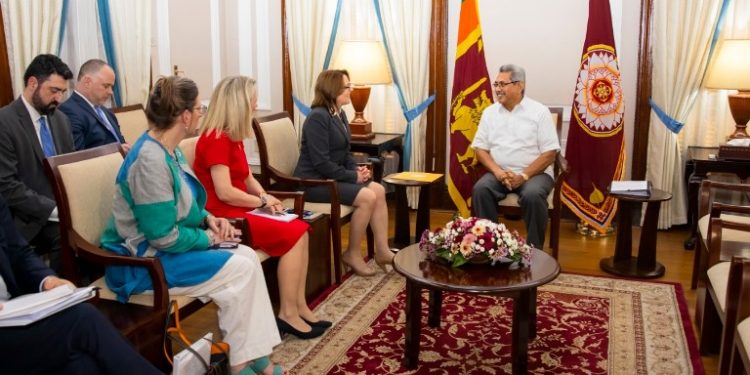
Colombo, January 14 (newsin.asia): Sri Lankan President Gotabaya Rajapaksa told the visiting Deputy Assitant to US President Donald Trump Lisa Curtis and Acting Assistant Secretary for South and Central Asia Alice G Wales on Tuesday, that a decision on the controversial Millennium Challenge Corporation (MCC) compact will be taken considering the views of the people and after the expert committee which is going into it comes out with its report.
It is important to address the concerns of the people. As both countries respect democracy, it is important to present a solution that will be acceptable to the people,” Gotabaya said.
The proposal is therefore now being reviewed by a Panel of Experts. This group will also study other countries’ experience with the MCC and the impact its projects had on those countries,” the President added.
Delineating his development priorities, Gotabaya said these centered around poverty alleviation and economic development for all.
To create a business-friendly environment steps such as a simplified tax system have already been taken, he said. Education, agriculture, technology-based industries, tourism are some of the areas the government is keen to develop.
Gotabaya pointed out that, currently, the US is Sri Lanka’s largest apparels buyer. But as Sri Lanka is ready for IT, and technology-based industries, the President invited the US to invest in these sectors.
Addressing US concerns regarding the Indian Ocean region, the President assured Wells that Sri Lanka will follow a policy of neutrality.
As such, Sri Lanka will ensure that the Island’s relations with countries do not cause any concern for other countries in the region,” he assured.
US officials Lisa Curtis and Alice Wells appreciated the steps taken and the meeting ended on a positive note, a press release from the Presidential Media Division said.
(The picture at the top shows Gotabaya Rajapaksa meeting US officials Lisa Curtis, Alice Wells, and Ambassador-AlainaTeplitz)
President Gotabaya Rajapaksa had said that he is striving to keep Sri Lanka free and economically independent
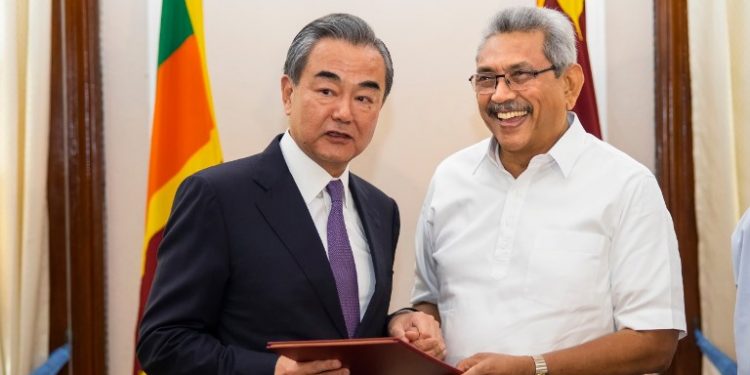
Colombo, January 14 (newsin.asia): The visiting Chinese Foreign Minister, Wang Yi, told Sri Lankan President Gotabaya Rajapaksa here on Tuesday, that China will not allow any outsiders to interfere in Sri Lanka’s internal affairs.
In a thinly veiled reference to the Western countries’ bid to dictate terms to Sri Lanka on human rights and ethnic reconciliation at the UN Human Rights Council (UNHRC), Wang said: We will not allow any outside influences to interfere with matters that are essentially internal concerns of Sri Lanka.”
Responding to Lankan President Gotabaya’s statement that he is striving to keep Sri Lanka independent and economically free, Wang said: China stands for Sri Lanka’s sovereignty, territorial integrity and independence. As Sri Lanka’s strategic partner, China will continue to standby Sri Lanka’s interests. As in the past, would be Sri Lanka’s longtime partner in prosperity and growth.”
Wang noted that China’s policy towards Sri Lanka had always been consistent and that it would continue to be Sri Lanka’s reliable friend.”
President Gotabaya had earlier said: Sri Lanka is a small country. Fortunately or not, it is geographically placed in a most strategic location. As a result, the country has to face many political challenges. The only way to overcome them is to be economically strong. Economic independence will ensure political independence.”
The Foreign Minister of Wang congratulated China’s old friend” President Gotabaya Rajapaksa on his election and added that he was confident that the already existing strong bilateral relations could be further strengthened.
President Gotabaya warmly reciprocated the visiting Minister’s good wishes and revealed that he was an admirer of President Xi Jinping, especially his work in poverty alleviation. Xi’s model of poverty alleviation had been incorporated into his own manifesto, he added.
Referring to the Lankan President’s visit to China in February, the Chinese Foreign Minister said that all arrangements would be made for him to meet with relevant parties who could help Sri Lanka in the areas of technology, tourism, infrastructure and other related fields of development. The visit, he assured, will be most productive.”
Driving home the point that China is sanguine about Sri Lanka’s progress, Wang said: Sri Lanka may have less landmass, but it will soon be strong economically. China will be with Sri Lanka in its striving to reach this goal.”
The Ambassador of China to Sri Lanka Cheng Xueyuan, Vice Minister of Commerce Qian Keming, Vice Chairman of China International Development and Cooperation Agency Zhou Liujun, Secretary to the Lankan President Dr. P. B. Jayasundara, honorary adviser to the President Lalith Weeratunga and the Additional Secretary to the President on International Relations Admiral Jayanath Colombage were present during the discussion.
Lankan Foreign Minister Gunawardena thanked Sergey Lavrov for Russia’s unfailing support for Sri Lanka’s sovereignty.
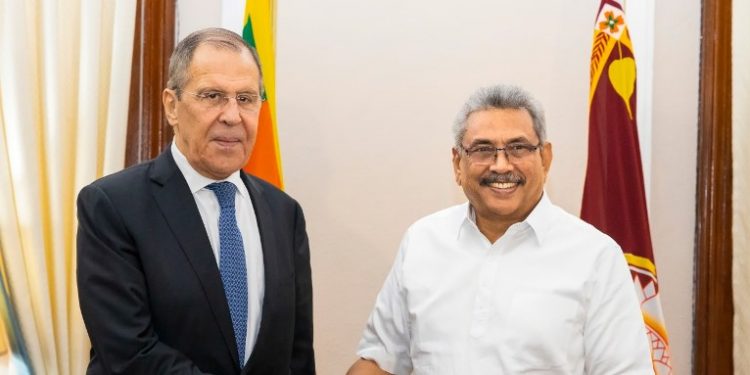
Colombo, January 14 (newsin.asia): Russia and Sri Lanka will continue to cooperate in the UN Human Rights Council (UNHRC) and other UN bodies to pursue shared interests,” said the Sri Lankan Foreign Minister Dinesh Gunawardena in his interaction with the visiting Russian Foreign Minister Sergey Lavrov here on Tuesday.
In the past three decades, we have fought against ruthless terrorism in or respective countries. We face numerous challenges in multilateral fora where we continue to support each other. I take this opportunity to extend Sri Lanka’s deep appreciation to the government of the Russian Federation for its unequivocal support for Sri Lanka’s sovereignty and territorial integrity. Therefore, a strong sense of understanding , solidarity and mutual respect underpin the Sri Lanka-Russia bilateral engagement,” Gunawardena said.
The two countries pledged to cooperate in economic development. The agreed areas of cooperation are: agriculture and the food economy, fisheries, water management, education, including technical and vocational education, trade and investment, tourism, security and defense, including counter terrorism, science and technology, renewable energy and oil exploration.
The two countries pledged to take bilateral trade from the 2018 level of US$ 388.98 million to US$ 700 million.
Previously, when Russia was part of the USSR, the latter had helped Sri Lanka in the field of housing, irrigation and steel and tyre manufacturing. Since 1840, Russian political movements and literature had greatly shaped the political thinking and literature of Sri Lankans, Gunawardena recalled.
At his meeting with President Gotabaya Rajapaksa, Foreign Minister Lavrov said that over five thousand Sri Lankans have graduated from Russian universities. Presently, there are around 800 students studying in Russia. The scholarship scheme for military cadets which was organized when President Gotabaya was Sri Lanka’s Defense Secretary is still an ongoing program which has increased its intake to 70 students.
President Gotabaya spoke of the possibility of new flights to Russia in the near future.
He pointed out that Foreign Minister Sergey Lavorv had begun his diplomatic career in Sri Lanka in 1972 and had learnt Sinhala during his stay here.
Arrests result in serious loss of liberty and reputation
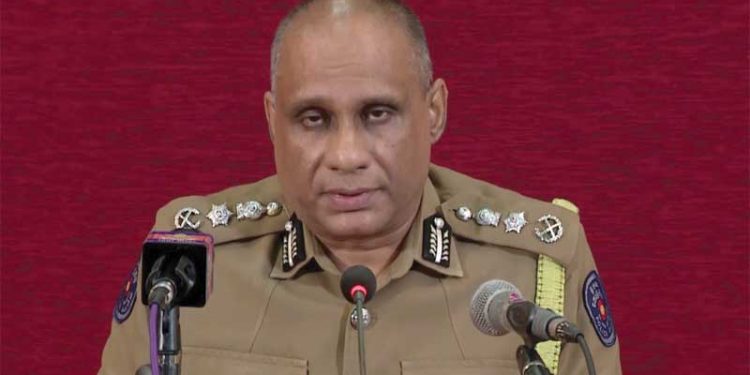
Colombo, January 14 (newsin.asia): Arrests result in serious deprivation of liberty of citizens and has other significant implications, such as loss of reputation and standing in the society, the Sri Lankan President Gotabaya Rajapasa told the Acting Inspector General of Police Senior DIG C. D. Wickramaratne.
Arrests are to be carried out only when absolutely necessary and upon a decision taken with utmost care and in strict compliance of the law, the President told the police chief.
The President further directed the police to ensure that, necessity to arrest is made entirely on the professional judgment of the officers in charge. They should discharge their duty independently and without any fear or favour.
Due respect should be given by officers discharging such duties to Members of Parliament as representatives of the people and professionals such as doctors.
The police were further directed by the President to apply the law equally to all citizens of Sri Lanka without any discrimination.
The President directed the police to duly and properly discharge the duties with utmost diligence and upon advice from the Attorney General when required.
(The featured image at the top shows C.D.Wickramaratne, Acting Inspector General of Police)
New Delhi (Sputnik): Russian Foreign Minister Sergey Lavrov along with a 42-member delegation is on an official two-day visit to the island nation of Sri Lanka. He held a joint press conference with Sri Lankan Foreign Minister Dinesh Gunawardena on their bilateral military and economic cooperation on Tuesday.
Russia will continue to provide arms and ammunition to the Sri Lankan Army, Russian Foreign Minister Sergei Lavrov said on Tuesday during a joint press conference with his Sri Lankan counterpart Dinesh Gunawardena on bilateral military and economic cooperation.
Along with Lavrov, Chinese Foreign Minister Wang Yi and US Principal Deputy Assistant Secretary of State for South and Central Asian Affairs Alice Wells are in Sri Lanka.
On economic cooperation and the investment front, Lavrov said: Russia knows Sri Lanka wants investment in hydrocarbon exploration and tourism. Direct contact between business communities will be promoted to meet this goal. Russia wants to increase bilateral trade with Sri Lanka from USD 400 million to USD 700 million.”
Lavrov expressed Russia’s desire to pursue the national interests of both countries through an independent policy in line with international law. Our relations traditionally developed based on trust, respect and equality.”
The Russian foreign minister is scheduled to arrive in India on Tuesday night to attend the 2020 Raisina Dialogue, the fifth edition of the annual geopolitical and economic summit, on Wednesday.
Following the tragic events in Sri Lanka, where a series of terrorist attacks on April 21 left 321 people dead and more than 500 injured, the island nation is keen on combatting international terrorism in the region and preparing for other security challenges.
In June 2019, speaking to Sri Lankan military officials, the Chief of General Staff of the Armed Forces of the Russian Federation said that Moscow was interested in developing military cooperation with Sri Lanka. The Russian Armed Forces Chief had noted that Sri Lanka is a friendly state and Russia’s reliable partner in South Asia.
The Sri Lankan Army is equipped with substantial numbers of Soviet-designed arms, artillery and armoured vehicles.” The Sri Lankan Air Force also has Russian-designed Mi-24 attack helicopters and MiG-27 ground attack aircraft. Since 2008, the Russian government has provided short military training programmes for Sri Lankan defence forces.
We have lost the narrative and we
need to correct this and re-write the narrative. The soldiers defended the
nation, got rid of terror and returned Sri Lanka to live in peace. The role of
the diplomats in defending the nation has been lackluster. As a result, the
world is unaware of what Sri Lanka went through and has come to accept the
fictions promoted by LTTE propagandists and those on their payroll as well as
those paid to destabilize Sri Lanka. The recent leaked voice-clips, allegations
of corruptions have afforded a golden opportunity to set the story right. It places the President on a morally high
ground in taking the very allegations by the international community &
seeking closure to them by finally cornering the culprits and serving them
justice.
Where do we start rewriting the
narrative and who should be tasked to start writing the narrative:
Disappearance of media personalities: a set
of names are oft circulated in the media –
Lasantha W, Ekneligoda etc
Whoever attacked, kidnapped,
killed or made them disappear needs to be brought to book. The tape revelations
by Major Ajit Prasanna are indeed startling and cannot be ignored.
But, in so doing President
Gotabaya CANNOT ignore every OTHER media personnel who was killed or went
missing too. Who killed Richard de Zoysa, Premakirthi de Alwis, Sagarica Gomes
even former President Chandrika Kumaratunga’s husband Vijaya Kumaratunga also
needs to be named and punished.
This should get nod of approval
by international media, UN and diplomatic community for they have been
crusaders of justice for media personnel attacked and this is a super
opportunity for the present Govt who had been unfairly accused to set the story
right by cornering the real culprits who have gotten away with their crime all
these years.
Every person killed during 1980s/1990s
‘bheeshana’ period covering Batalanda Torture:
There are thousands of deaths no
one knows who was responsible but their families deserve to know. What we all
know was that the crimes were committed by either UNP or JVP but there are a
handful of personalities who were directing and coordinating these vicious and
inhuman acts on people through groups like PRAA, Black Cats, Yellow Cats etc:
Deaths of Daya Pathirana (student
leader), Wijayadasa Liyanarachchi (lawyer), are just a handful of names who
fell victim. Scores of people were tied to lampposts and killed. Torture
chambers did inhuman acts and this period has never been properly investigated
and culprits brought to book.
The West is still hounding NAZI’s
and arresting those who are even in their 90s – therefore those that committed
crimes or ordered such crimes must be held accountable whatever their age.
The UNHRC also is asking to
release ‘independent commission’ reports this means the Batalanda Torture
Commission Report, the Sansoni Commission report on 1983 July riots must all be
released.
Armed forces/intel personnel/police
involved in any PRIVATE act of action violating the military/police code
of ethics
There are some personnel
allegedly named to be involved in accepting ransoms/attacking and causing harm
in connivance with numerous politicians to satisfy personal vendettas etc
If the State finds evidence
against them for violating the State and the Military Code of ethics the
military/police must take action against them and criminal charges must be
filed against them.
A few sour grapes cannot be
allowed to destroy the good name and reputation of the entire armed forces/police.
Taking action against these unwanted personnel who have embarrassed and
tarnished the armed forces/police will serve as a deterrent to others and
positively show the international community that Sri Lanka has taken action to
punish wrong doers.
Political victimization & interference
and influencing judiciary by previous govt
It is commendable that the
President has launched an investigation into the political victimization by
numerous state entities opened and operated under the former PM targeting only
Ministers of Rajapakse government. With the exposure of leaked tapes it has
come to light that the judiciary and police have been heavily influenced by the
previous government and many a person have been put into prison having
influenced the judges.
The case of Mr. Lalith Weeratunga
& Mr. Anusha Pelpita should be exposed publicly to show the low levels that
the UNP has stooped to in completely destroying the good name of a civil
servant.
The citizens of Sri Lanka must know the levels of corruptions that have been committed. This has nothing to do with hounding the previous government but everything to do with the injustice the previous government committed by unfairly influencing police and judiciary to arrest people and put them in prison. This is what needs to be exposed for the public to know
The judges & police breaking
code of ethics of their employment for personal gains must be punished and
debenched/sacked from service.
LTTE & roots of separatism: no
ethnic/civil war but terrorism & terrorists linked to people trying to
separate/divide Sri Lanka
Again we have failed in
highlighting the true picture of how divide and rule policies of the colonial
invaders created a minority thinking them to be superior to and demanding they
rule over the majority while unfairly targeting the majority claiming them to
be discriminating the minority. We had ample evidence to showcase how
minorities got preferential treatment under colonial rule and how that in a
democratic and independent sovereign framework could not continue and was
reason for grievance though it had no basis. The statistics was enough to
showcase what minorities enjoyed but it was never used. The demands of
separatist Tamil political leaders sufficed to showcase unfair demands but that
too was never internationally shown. The militancy and termination of lives was
enough to showcase who were the victims and the perpetrators but that too was
never projected to the world. The manner LTTE hijacked the separatist chant was
also never linked and shown.
All these anomalies need to be
now brought into the open and publicly shown not only as reminders to locals
but to set the story straight amongst the international community.
The lies about July 1983 must
also be exposed by showcasing who the real culprits were
(the background of all riots and
the players involved & timeline of events)
5th Columnists – Media / NGOs /
Civil Society
If the general public & the
international community are not aware of the truth it is the fault of 2 main
groups – the State and its apparatus and the other group that comprise media,
local NGOs and so-called civil society.
The state silence is often as a
result of political agenda where truth is often compromised for political deals
while the 5th columnists are often silenced by power of foreign
funding and other remunerations that come their way to either distort the
truth, not publicize the truth or publicize something completely opposite to
the truth.
It has always been left to the
common sense and personal judgement of the public to weigh the stories and make
their own conclusions but that is not doing justice to the victims.
From the 1980s Sri Lanka has been
subject to tremendous external influences all of which have hampered the
exposure of the covert/overt and other insidious plots and ploys at work.
The new President has before him
a golden opportunity to put all these untruths, half-truths and lies to rest by
addressing all areas that have been neglected and closing these chapters by
exposing the individuals and groups who have been responsible for the
injustices.
Spare no one in exposing the
truth before closing this chapter for good.
In so doing the international community will be left with nothing much to hound the new Government and it will certainly put to rest issues that are unnecessarily tarnishing Sri Lanka’s good name.
UNP Parliamentarian Ranjan Ramanayake has been arrested by the Colombo Crimes Division (CCD).
CCD officers had arrived at the MP’s official residence in Madiwela, a short while ago, with an arrest warrant, Ada Derana reporter said.
He was subsequently taken into custody and taken away by in a police jeep by the officers.
MP Ramanayake is expected to be produced before the court in a short while after a statement is recorded from him.
The Nugegoda Magistrate’s Court issued an arrest warrant against Mr Ramanayake, a few hours ago, based on a request made by the police.
Accordingly, the magistrate had ordered to arrest and produce the parliamentarian before the court.
Earlier today (14), the Attorney General directed the Director of the Colombo Crimes Division (CCD) to obtain a warrant and arrest UNP MP Ramanayake.
He has also instructed the CCD to produce the parliamentarian before court for offences committed in terms of Article 111C (2) of the Constitution, for interference with the functions judges.
Several controversial audio recordings containing telephone conversations between former State Minister Ranjan Ramanayake and several influential figures in the country had come to light recently.
Phone conversations the MP purportedly had with certain judges as well as officials in the judicial service were among those recordings released thus far.
The ‘Sinhale’ organization has filed several complaints with the Judicial Service Commission, seeking a comprehensive investigation into the involvement of judicial authorities in this matter.
A warrant has been issued to arrest UNP MP Ranjan Ramanayake, says Ada Derana reporter.
The Nugegoda Magistrate’s Court, issuing the arrest warrant, has ordered to produce the parliamentarian before the court.
Earlier today (14), the Attorney General directed the Director of the Colombo Crimes Division (CCD) to obtain a warrant and arrest UNP MP Ramanayake.
He has also instructed the CCD to produce the parliamentarian before court for offences committed in terms of Article 111C (2) of the Constitution, for interference with the functions judges.
Several controversial audio recordings containing telephone conversations between former State Minister Ranjan Ramanayake and several influential figures in the country had come to light recently.
Phone conversations the MP purportedly had with certain judges as well as officials in the judicial service were among those recordings released thus far.
The ‘Sinhale’ organization has filed several complaints with the Judicial Service Commission, seeking a comprehensive investigation into the involvement of judicial authorities in this matter.
Speaker of Parliament Karu Jayasuriya has stated that a decision regarding disclosing the Forensic Audit report on the bond issues of the Central Bank to the members of parliament, will be taken during next parliament sitting week which starts on the 21st of January 2020.
These forensic audit reports have been received by the Parliament and the Speaker has taken measures to abstain from releasing the aforesaid to Members of Parliament upon the instruction of the Attorney General.
At the meeting of the Party Leaders and Political Party Representatives held at parliament yesterday (13), the MPs have requested that the audit reports be released to them as soon as possible.
The parliamentarians have pointed out that the forensic audit report contains information on the bond crisis occurred prior to 2015 and it is necessary for them to be aware of its particulars.
The Speaker has met with Attorney General Dappula de Livera in Parliament today (14) before making a final decision on the matter.
Accordingly, the Speaker will announce his decision after the parliament sitting scheduled for the 21st of January 2020.
In
November 2019 Sri Lanka voted a President giving him 6.9million votes. The voters
pledged faith in Gotabaya Rajapakse to take Sri Lanka & its People on the
correct path. There are some anomalies that have been ignored and these
anomalies must be rectified. While the world is demanding of the Government of
Sri Lanka to account for dead ‘civilians’ during the final months of a 30 year
old conflict confusing the deaths of non-state actors as ‘civilians’, the world
is blatantly ignoring the thousands of innocent people LTTE killed since 1980s
and the tears of 5000 war widows, their children & parents who are yet to
be told what happened to their war heroes. The
new President must hold a domestic inquiry against LTTE for its crimes.
UNHRC or those that pass Resolutions against Sri Lanka cannot ignore that the
GoSL & its armed forces defended the nation against terror to safeguard the
nation & its people.
OHCHR
passed 3 resolutions & commenced an investigation. They accepted 5000
petitions filed by war widows of Sri Lanka Armed Forces. What has been their
response on 5000 Missing Soldiers?
Non-Tamils
also logged scores of petitions against LTTE what has been OISL response to
their petitions?
In the absence of OHCHR responding to them the
President must come forward to take up their grievances.
LTTE
killings started by first killing Tamils and killed thousands of Tamils. All of
the ceasefires and peace talks were failures. Sri Lanka tried two foreign
mediated solutions which also failed.
Have these reports been taken into
account by the OHCHR/OISL or those drafting resolutions against Sri Lanka?
Some noteworthy dates
22 February 2002 – CFA signed
13 April 2002 – Hakeem & Prabakaran issue joint statement
assuring rights of Muslims
LTTE
used CFA to build its defenses setting up LTTE judicial complexes, LTTE police
units, commemoration of LTTE dead even inside universities, hoisting LTTE flag
in schools and amidst all this LTTE saw fit to even deny SLMM officials inside
their camps (26 August 2003/Manirasakulam LTTE camp)
LTTE
struck in August 2005 by killing Lakshman Kadiragamar, Sri Lanka’s Foreign
Minister inside his own home. Within days EU imposed a travel ban on LTTE (27
September 2005) and on 19 November President Mahinda Rajapakse was elected
President.
A shift against LTTE was building up
7 April 2006 Canada proscribed LTTE,
11 May 2006 SLMM declared ‘non-state
actors (LTTE) cannot rule open sea waters or airspace. The LTTE has therefore
no right to sea’.
29 May 2006 EU banned LTTE. This led to LTTE refusing to meet
the GOSL delegation in Norway on 8 June 2006 and resulted in LTTE demanding
withdrawal of SLMM from North on 4 July 2006.
It
is with this background that LTTE decided to close the sluice gates on 21 July
2006 in Mavil Aru committing a war crime by denying water supply to some 50,000
people resulting in the Army being ordered to re-open the sluice gates.
On
1 December 2006 LTTE made an abortive bid to take the life of current President
and then Defense Secretary Gotabaya Rajapakse.
2 January 2008 – Cabinet approved abrogation of CFA which came into
effect on 16 January 2008.
East
was liberated from LTTE and North was liberated from LTTE in May 2009 with
entire island being reunited under one flag devoid of terror. The nation &
its people signed in relief that there would be no bombs or suicide missions.
The
below list are a handful of crimes committed against unarmed, innocent
civilians that had done no harm to LTTE but LTTE chose to plan and murder them
for no reason. This is not a complete list but you can be sure that the list
will include far more not less than that which is highlighted below.
Please
take special note of all of LTTE’s crimes committed during the Norwegian
mediated Cease Fire Agreement inspite of foreign Nordic presence in Sri Lanka
assuring to protect the Sri Lankan citizens from terror.
Also draw
your attention to every killing after 2006 when the military offensive against
LTTE was launched and then wonder why OHCHR has opted not to include any of
these instances against LTTE but have specifically cited a handful of
hospitals/sites claiming Sri Lankan army attacked them and calling these war
crimes. Why has the same argument not been applied equally to the LTTE at least
in OHCHR or Resolutions or UNHRC High Commissioners reports?
(coloured attacks show LTTE crimes
committed after military offensive began)
LTTE attacks passenger airplanes:
1978
Air
Ceylon blasted by a time bomb
(Police
constable 8103 Gnanasambandan who arrested the suspects was shot dead on 1 Feb
1979)
Jun 1984
Private
aircraft belonging to Brian Lawrence set on fire at Peruttiadappu
3 May 1986 Bandaranaike International Airport Attack – Air Lanka Flight
512:
LTTE bomb explodes aboard Air Lanka
flight carrying mainly French, British and Japanese tourists killing 21
(including 13 foreigners – of whom 3 British, 2 German, 3 French, 2 Japanese, 1
Maldivian and 1 Pakistani) and injuring 41 on Bandaranaike International
Airport.
LTTE places land mines/bombs targeting vehicles
25
June 1986
Sittaru, Kantalai, Trincomalee
District – Bomb exploded in a vehicle by LTTE
killed 16 Sinhalese.
13 April 1989
A car bomb explosion on the central
road, Trincomalee Town kills 51
civilians and wounds 43 civilians.
17 August 1989
IED explosion at Nochchikulam,
Vavuniya. 8 civilians killed and 4
civilians wounded.
10
April 1992
A Bomb exploded in a car close to
the National Youth Council building at Maharagama. 9 civilians killed and 23 civilians wounded..
10
April 1992
A car bomb explosion at Maradana,
Colombo 10. 8 civilians were killed
and 23 civilians wounded.
5 December 1995 –
A Vehicle Bomb explodes in front of
the Pudukudurippu Security Forces Camp followed by LTTE attacking camp with
suicide bomber resulting in 12 civilians killed. 29 police killed and 2 police
missing
1
June 1998
Vehicle bomb explodes at Maradana in the heart of Colombo killing 38 civilians
5 July 1999
4 Villagers travelling in
a van to Rathmalgahawella, Ampara hacked to death
18 November 2006
Remote controlled claymore targeting army truck kills 4 civilians and injures over 11
others in Thandikulam
LTTE attacks buses
22
July 1986
Vavuniya District – Mammaduwa- LTTE exploded
a land-mine on a civilian bus, killing
32 Sinhalese civilians and injuring 20 others.
24
July 1986
Anuradhapura district – Issenbessagala,
a bomb exploded inside a bus proceeding from Vavuniya to Anuradhapura; killing 13 passengers and injuring 40
others.
17 September 1986
LTTE explode a land mine on a passenger
bus at Mamaduwa, Vavuniay killing 32 and injuring over 20 civilians.
7 March 1987 Arantalawa massacre:
Six civilians killed when LTTE
detonated a land-mine as troops were passing.
11 armed forces personnel also die.
17 April 1987 Aluth Oya massacre:
LTTE
shot dead127 Sinhalese
civilians, including 31 police and security force personnel who were
travelling in 3 buses and 2 trucks to Trincomalee. LTTE clad in military
uniforms stopped the vehicles and dragged out the passengers and shot them to
death with automatic weapons after brutally assaulting them with clubs. Over 70
with injuries were air lifted. The dead included many children and 12 off duty
security personnel. Most of the victims were families visiting their relatives
for the new year.
17 April 1987
LTTE
massacred 96 civilians and 31 security forces personnel who were travelling in a passenger
bus at Habarana and Kithuluthuwa, Trincomalee
21 April 1987 Colombo – Central Bus Station Bombing:
A bomb detonated by LTTE operatives
at the central bus terminal of Colombo killed
113 civilians, two policemen and a soldier; 298 others were injured.
11 June 1987
Private Van Bearing No. 38 – 496,
Vavuniya District – Veppankulam attack: 13
civilians and a soldier were killed when a private van en route from
Horowpathana to Trincomalee was blown up by a LTTE pressure mine.
7 October 1987 Ampara District – Pottuvil Monargala Road massacre:
30
Sinhalese passengers travelling by bus were shot dead by LTTE,
who also killed five motorcyclists travelling along the same route.
9 November 1987 –
Batticoloa district – Kalkudah
attack: A private bus transporting Tamil passengers was blown up by a LTTE
land-mine, killing 40 persons and an
IPKF soldier 24 civilians wounded
5 March 1988
Terrorists exploded a land mine on a
civilian lorry at Sittaru, Kantale, Trincomalee
24
civilians were killed.
11 March 1988
Suhadagama Horowpathana
Anuradhapura: LTTE attacks a private bus, 22 Sri 2218, at Suhadagama with small
arms and grenades, killing 19 passengers
and injuring nine others
14 March 1988
LTTE ambush a civil bus at Peniketiyawa,
Trincomalee. 28 civilians killed
& 3 wounded.
27 March 1988
Bomb kept in a gunny bag explodes
inside a CTB bus plying from Medwachchiya to Horowapathana at Wewelketiya,
Anuradhapura. 9 civilians killed and
14 civilians injured.
30 March 1988
LTTE attack civil bus at Arantalawa,
Vavuniya. 4 civilians killed and 5
civilians wounded.
1
May 1988
Sittaru Kantalai, Trincomalee: LTTE
exploded a land-mine on a CTB bus killing
12 Sinhalese, 9 Muslims and five others, who were not identified
9
July 1988
A CTB bus leaving Jaffna was
ambushed by LTTE at Irattaperiyakulam, Vavuniya – 2 civilians killed.
8
August 1990
A private coach proceeding from Morawewa
to Horowapathana attacked by LTTE at Meegaswewa, Trincomalee. 26 civilians killed and 7 civilians
wounded.
13
August 1990
LTTE ambush a lorry travelling from Negombo
to Kokuvil at Pulmoddai, killing 14
civilians
21
June 1991
Explosive laden ISUZU
ELF truck driven by an LTTE suicide bomber exploded on the road in front of the
side entrance of Operational Headquarters of the Ministry of Defence (Former JOC), Flower Road Colombo 7.
11 soldiers & 12 civilians killed.
Over 65 Army personnel
& over 85 civilians wounded
26 January 1992
A land mine blasted targeting a
crowded private bus between Aranthalawa and Borapola in Ampara.
10
civilians killed & over 20 civilians wounded.
10
April 1992
A bomb exploded in a private bus
which was parked at the Ampara private bus stand. 28 civilians were killed and 36 civilians were wounded.
15
July 1992 –
Terrorists attacked a civil bus
proceeding from Kattankudy towards Kalmunai at Kirankulam in Batticoloa 19 civilians
were killed and 07 civilians were wounded.
30 July 1992
Bomb planted in a private bus
explodes at bus stand in Trincomalee town killing
9 civilians and wounding 4 civilians.
19 January 1994
Bomb blast in a bus at Rambawewa in
Anuradhapura – 10 civilians killed.
1
September 1996
Passenger bus as Aranthalawa plying between Ampara and Kandy
attacked 11 civilian passengers killed and
over 30 injured
12 September 1996
SLTB Bus plying from Ampara to Kandy killing 11 civilians
29 January 1997
Claymore explosion in Vaddukodai, Jaffna kills 9 civilians
15
March 1997
Claymore mine at a CTB bus from Talaidy to Jaffna kills 15 civilians
8 October 1997 – US bans LTTE
27 March 1998
Bomb hidden in a gunny bag inside a CTB Bus plying from
Medawachchiya to Horowpathana at Wewelketiya, Anuradhapura kills 9 civilians
30
January 2000
Bomb explodes in Peoples’ Transport Services bus Moratuwa Depot
at Dutugemunu Junction in Polgahawela killing
13 civilians
3 February 2000
A time bomb explodes in private bus at Wanduragala whilst
transporting civilians from Kurunegala to Polgahawela.
3 February 2000
A parcel bomb exploded in a private bus,
bearing No. 62 – 1225 plying from Colombo to Kadawatha.
7 February 2000
Bomb explosion on CTB bus while it was parked at the bus stand.
(Bibile)
8 February 2000
Bomb explosion in bus travelling from Colombo to Negombo near Karunarathna
Maha Vidyalaya. (WATTALA)
8 February 2000
A bomb exploded on a CTB Bus at the Central
Bus Stand Pettah.
5 January 2007
Time bomb explodes in private bus plying between Nittambuwa to Giriulla
killing 5 civilians and injuring
over 54
5 January 2007
Explosion inside Matara bound bus plying from Colombo to
Seenigama kills 12 passengers and
injures over 29
2 April 2007
Bus plying from Ampara to Badulla via Bibile blown at
Kondavattuvan, Ampara killing 14
civilians
23 April 2007
Claymore mine targets civil bus plying from Mannar to Vavuniya –
Cheddikulam killing 3 civilians and
injuring over 30
27 September 2007
Claymore
mine targeting police jeep of Chunnakkam Police Station kills 2 civilians and injures over 9
5 December 2007
Claymore
mine targeting bus with civilians explodes in Kebethigollewa killing 14 civilians and injuring
scores of others
16 January 2008
Claymore
mine on CTB bus plying from Okkampitiya to Buttala on 03rd Mile Post, kills 27 civilians and injures over 60
2 February
2008
Bbus
plying from Kandy to Anuradhapura blown up in Dambulla bus stand killing 20 civilians and injuring over
60
4 February 2008
claymore explosion hits bus plying from Parakramapura to
Janakapura kills 8 civilians
23 February 2008
Improvised
explosive device explodes inside bus plying from Moratuwa to Colombo in Mount
Lavinia killing 18 civilians
25 April 2008
Remote
control device explodes in crowded CTB Bus plying between Piliyandala &
Kahapola at Piliyandala Town killing 27
civilians including a Buddhist priest
31 May 2008
A
hand grenade exploded inside a bus halt at Wellawatte – 2 civilians killed and 8 civilians injured.
6 June 2008
Bomb
blast on bus from Matale to Kandy via Wattegama near the Polgolla Open
University kills 2 civilians
7 November 2008
Civilian
bus travelling from Buttala to Kataragama thrown hand grenade killing 4 civilians
12 February2009
Hand
grenade thrown at bus traveling from Puliyankulam kills 1 Tamil civilian
Parcel bombs
27 January 2000 –
An IED
Bomb Parcel placed under Foreign Mail Box at Vavuniya post office explodes killing 13 civilians and injuring over
50
27 January 2000 –
An IED parcel bomb which was placed
by an unknown person under the Foreign Mail Box at Vavuniya Post office,
exploded. 4 civilians killed. 58
civilians wounded. 5 soldiers killed. 16 soldiers wounded. 8 policemen wounded.
28 November 2007 –
Parcel bomb explosion at Nugegoda Junction in front of NOLIMIT building
kills 20 civilians and injures over
30
LTTE attacks passenger trains:
March
1982
Parcel bomb inside night mail train
from Jaffna to Colombo – 2 civilians
killed. Police managed to capture 11 parcel bombs before they exploded.
1
July 1983
Yal Devi train set on fire at
Kondavil Railway station – all 10 compartments destroyed
5
May 1985
Land mine explosion on “YAL
DEVI” train at Murugandi, Jaffna. 11
civilians killed 5 civilians including Buddhist priest injured.
31
May 1986
A bomb explosion on YAL DEVI Train
at Veyangoda, Gampaha 10 civilians
killed.
24
February 1987
Terrorists blewup the Railway Track
between Vavuniya & Omanthai. (THANDIKULAM)
6
October 1987
Batticoloa district – Valaichchenai
massacre: 40 Sinhalese passengers in the
night-mail train from Batticaloa were killed by LTTE who stopped the train.
19
October 1987
Batticoloa district – Kalkudah
attack: A private bus transporting Tamil passengers was blown up by a LTTE
land-mine, killing 40 persons and an
IPKF soldier 24 civilians wounded
21
July 1992 –
Terrorists stopped the COLOMBO/
BATTICALOA Train at PRANGIYAMADU, Batticoloa. and ordered the passengers to get
down and opened fire at the Muslim passengers. 8 Muslims were killed and 04 civilians were wounded.
11
November 1995
The second suicide bomber who had
been in the vicinity of Army HQ detonated himself opposite the Slave Island Railway
Station. 11 civilians killed and 52 civilians
wounded.
1
July 1996
Parcel bomb explodes on a train playing to the south kills 52 civilians
24 July 1996
Bomb explosion on the Aluthgama train at Dehiwela Station killing 59 civilian passengers and wounding over 365 civilians
8 October 1997 – US bans LTTE
30 January 2000
A bomb explosion in a train. (GALOYA)
11 January 2008
A
small scale bomb explodes at the Fort Railway Station, the explosion caused
minor injuries to one Muslim Civilian.
3 February 2008
Suicide
cadre blows herself at Fort Railway station killing 15 civilians including 7 students and injuring over 85
26 May 2008
Bomb
blast inside Panadura bound train at Dehiwela railway station kills 9 civilians and injures over
50 civilians
4 June 2008
Remote
controlled bomb took place in Wellawatte Railway Track targeting a train plying
from Panadura to Colombo kills 24
civilians
LTTE
attacks passenger ships
7
July 1987
Korean Ship MV “MORANG
BONG” was seized by the LTTE in Pudukudurippu Sea. (Released on 31/09/1997)
12
June 1991
Bomb explosion in Manmunai Ferry at Kokkadicholai,
Batticoloa. 10 civilians killed.
10
September 1992
Ferry at Kiliveddy Point,
Trincomalee blasted 6 civilians killed
16
March 1994
Approx. 10 boats that had gone
fishing close to Kudiramalai Point in Puttalam came under LTTE attack. 17 civilians killed and 3 civilians
wounded.
9
August 1995
MV “PRINCESS WAVE” Ship
was damaged due to an explosion carried by LTTE at Pulmoddai Sea. 9 civilians
wounded.
29
August 1995
The Ship “IRISH MOANA” was
attacked by the LTTE, while anchored. North of Mullaitivu
17
October 1995
LTTE launched an underwater suicidal
attack on a naval auxiliary vessel A 512, which was anchored in Trincomalee
Harbour and destroyed it completely. 2
civilians were killed while scores of military personnel also died.
9
September 1997
The Ship MV “CORDIALITY”
was attacked by the LTTE. 4 civilians
were killed while military personnel also died.
25
July 1999
A naval vessel MV “NEWKO”
anchored at the Trincomalee Harbour was exploded by terrorists. 1 civilian was killed and another
civilian was wounded.
20
March 2003
A Chinese Trawler named “FUYUAN
YU 225” with a crew was attacked by Sea Tigers. 17 civilians killed.
8 October 1997 – US bans LTTE
17
June 2006
Pesali naval boat patrol attacked killing 5 civilians and injuring over 30 civilians –
29
August 1996
The Argentinean Ship MV
“ATHNNEA” was slightly damaged due to LTTE explosion in the sea off
Trincomalee.
LTTE attacks civilians in villages & towns:
May 1984
Don Jayasinghe Walter of Jaffna, a peon at Jaffna Kachcheri shot dead in Thinnaveli.
July 1984
Henry Jayalath Rajapakse, a Sinhalese shot dead at Kalliyankadu junction,
Jaffna
30 November 1984 – Kent & Dollar
Farm massacre
first
Sinhala civilians to be massacred in 2 farming villages in Mullaitivu – over 100 killed including children,
pregnant mothers & babies.
1st attempt at ethnic
cleansing of Sinhalese from North Sri Lanka.
1 December 1984 Kokilai massacre
LTTE cadres massacre 11 Sinhalese civilians in the village of Kokilai (coastal
town near Kokilai lagoon) located in the Mullaitivu District
5 May 1985 – Wilpattu Village Massacre:
Wilpattu, a Sinhalese village in
Anuradhapura District, was the target of a raid of an armed group of LTTE
cadres, who killed 18 villagers that
included women and children.
30 May 1985
LTTE cadres shoot and kill five Sinhalese civilians in the
villages of Mahandapura and Dehiwatta. People of these villages had previously
received numerous threats from the LTTE associates. This massacre was part of a
series of massacres aimed at displacing Sinhalese from the North East of Sri
Lanka.
4 June 1985– Dehiwatta Village Massacre:
Armed with sharp weapons over 100
LTTE cadres killed 15 villagers on
their sleeping mats in the village of Dehiwatta. Victims included women and
children, which were the majority killed.
11 June 1985
13
Sinhalese civilians shot dead by LTTE gunmen in Dehiwatta.
18 August 1985 Trincomalee District – Namalwatta Village Massacre I:
A group of LTTE cadres armed with
sharp weapons hacked to death 7
villagers
7 November 1985 Trincomalee District – Namalwatta Village Massacre II:
Ten
villagers, including women and children executed at
Namalwatta for the second time.
2 February 1986
Trincomalee district – Kantale
Village massacre: Armed with small arms and swords LTTE cadres raided the
village of Kantalai killing 19 civilians.
25
May 1986 Anuradhapura District – Mahadivulwewa Village massacre:
LTTE killed 20 Sinhalese by shooting them dead and set alight 20 houses.
2
June 1986
Trincomalee district – Kantale
Village massacre: Armed with small arms and swords LTTE raided the village of
Kantalai killing 19 civilians.
4
June 1986
Trincomalee district – Sinhala
village – Andankulam Village massacre: 17–20
civilians, including Ven. Bakamune Subaddalanakara Thero, were attacked,
tortured and killed by LTTE in the village of Andankulam.
11
June 1986
Kantale – Trincomalee District – ’22
people were killed and another 75 others were injured when two bombs were
detonated simultaneously by the LTTE on two buses heading to Kantalai and
Colombo respectively. The first bus was front of the Bank of Ceylon Trincomalee
branch and the other in close proximity to the SP office.
21
June 1986
Trincomalee district – Wilgamwehera
Village massacre: 9 Sinhala civilians,
including children, were murdered in the Wilgamwehera hamlet by LTTE
8
July 1986
Trincomalee – Sinhala village Monkey
Bridge Village massacre: 15 Sinhalese
villagers were shot to death by LTTE
9
July 1986
Trincomalee district – Mollipothana
Village massacre: Mullipothana village was stormed at night by a group of armed
LTTE who killed 16 civilians most of
them being women and children.
13
July 1986
Trincomalee district – Pavakkulam
Village massacre: Nine Tamil and two
Sinhalese villages were killed by LTTE who had arrived in a jeep to tract
No. 16, Pavakkulam.
19
July 1986
Wadigawewa, North Central Province –
LTTE shot deadtwelve Sinhalese villagers.
24
July 1986
Damana, Central Province – About 50
LTTE entered Damana, a Sinhalese village, and killed nine persons; another 13 were injured.
21
April 1987
Trincomalee district – Jayanthipura
Massacre: The majority Sinhalese village of Jayanthipura was raided by a group
of armed LTTE who murdered 15 civilians
including women and children.
29
May 1987
Polonnaruwa district – Attack on
Kadawathmadu: A group of armed LTTE raided the majority Sinhalese village of
Kadawathmadu killing seven civilians
and leaving five others injured. Due to the LTTE threat, the villagers slept in
jungle hideouts during the night, which reduced the casualties.
21
June 1987
Sinhala village in Godapotha,
Polonnarruwa massacre: The hamlet of Godapotha, a majority Sinhalese village in
Polonnaruwa was raided by a group of armed LTTE killing eight villagers and injuring one. The death toll was
reduced since villagers had hid in the surrounding jungles anticipating such an
attack.
29
July 1987
Trincomalee District – Thoppur
massacre: Nine villagers were killed
after being tortured by LTTE armed with swords, machetes and small arms.
Indo-Lanka Accord was signed in July 1987 promising an end
to LTTE terror …. It did nothing of the sort!
6
October 1987
Batticoloa – Tharavi massacre:
Tharavi, a majority Sinhalese village, was stormed by over 100 LTTE armed with
swords, machetes and small arms, who killed
25 civilians, mostly women and children including infants and pregnant
mothers.
10
October 1987
Trincomalee district – Ganthalawa
massacre: Gantalawa hamlet in Kantala was attacked and 9-10 civilians murdered with three wounded by LTTE armed with
swords, machetes and small arms.
15
October 1987
Trincomalee district – Ella Kantalai
massacre: Ella Kantalai, a majority Sinhalese village, was attacked by LTTE armed
with swords, machetes and small arms, killing
14 civilians including women and children.
11
November 1987
Batticoloa district – Kalkuda
massacre: Seven Sinhalese people selling
fish were shot dead by LTTE cadres.
15
September 1987
Polonnaruwa – Devalagodella
massacre: Devalagodella and Somavathiya villages were attacked by LTTE armed
with small arms and sharp weapons, killing
7-9 civilians
31
December 1987
Trincomalee district – Mahadivulwewa
massacre: 10 villagers were shot dead
and 15 houses burnt by LTTE
1
January 1988
Terrorist attack on a Sinhala
settlement in Kuruniyankulama Trincomalee 3
civilians were killed and 2 civilians wounded.
2
February 1988
Terrorist attack on the Bogamuyana
village in Ampara – 11 civilians killed
15
March 1988
Kivulkade, Morawewa, Trincomalee:
Two groups of LTTE operatives entered the village and killed seven Sinhalese villagers.
17
March 1988
Deegavapiya, Damana, Ampara: LTTE hacked to death 13 Sinhalese villagers.
22
March 1988
Pudukulam, Vavuniya: Between ten and
15 LTTE attacked the Sinhalese village and killed
six villagers. Another three were injured.
22
March 1988
Medavachchi-kulam Vavuniya: LTTE shot dead nine Sinhalese villagers
28
July 1988
Ethawetunawewa, Weli Oya: LTTE
operatives hacked to death 16 Sinhalese
villagers.
10
August 1988
Terrorist attack on a village, Central
Camp Ampara. 11 civilians were killed.
25
August 1988
Marawila, Polonnaruwa: LTTE killed eleven civilians by cutting their
necks
10
September 1988
16th Colony, Central Camp Ampara:
LTTE shot dead seven Sinhaleseand four Tamils.
10
October 1988
LTTE attacked Mahakongaskada,
Medawachchiya, in Vavuniya killing 44
civilians
14
November 1988
Peniketiyawa, Gomarakadawela,
Trincomalee. LTTE shot dead 28 Sinhalese
12
December 1988
LTTE attack village, Sumedagama in
Trincomalee. 28 civilians killed.
17
January 1989
LTTE attack the village, Maharambekulam
in Vavuniya – 9 civilians killed and
7 civilians wounded.
2
February 1989
11
Villagers were hacked to death by LTTE at Bogam Uyana in Ampara.
11
February 1989
Anuradhapura – Terrorist attack
Sinhala village, Dutuwewa killing 37
civilians
11
February 1989
LTTE attack Sinhala village, Sinhapura
killing 6 civilians and injuring 7
27
February 1989
LTTE attack Sinhala village, Borawewa
in Polonnaruwa killing 8 civilians
and injuring 7
30
May 1990
LTTE attack village, Mihindupura
Dehiwatta in Trincomalee killing 5
civilians
24
July 1990
8
Sinhala villagers were hacked to death by LTTE at Aralaganvila in Ampara
25
July 1990
8
civilians hacked to death by LTTE at Meeyankulama in Polonnaruwa
25
July 1990
9
Villagers were hacked to death by LTTE at Wan-Ela, Trincomalee
26
July 1990
LTTE hacked to death 19 civilians in Thammannawa, Anuradhapura
31
July 1990
LTTE fire at villagers in Podankady
Kantale in Trincomalee killing 11
civilians
6
August 1990
LTTE kill 34 farmers working in a paddy field in Ampara.
8
August 1990
LTTE attack village in Nawagamuwa in
Vavuniya killing 7 civilians and
injuring 5
19
September 1990
LTTE attack Vellamuni fishing
village in Puttalam killing 23 civilians
21
September 1990
LTTE attack village, Pudukudurippu killing 15 civilians and wounding 15
24
September 1990
LTTE set fire to 05 houses at Gajabapura
killing 4 villagers
1
October 1990
LTTE attack Sinhala village, Peruvalthalawa
in Ampara killing 9 civilians
23
October 1990
Approx. 30 LTTE attack Chena
Cultivators at Kokabe, Thanthirimalai village in Anuradhapura killing 10 civilians
25
October 1990
About 40 Armed LTTE terrorists
attack Panmedavachchiya killing 4
civilians and injuring 5 others
27
October 1990
LTTE fire again at Thanthirimalai
village in Anuradhapra killing 5
civilians
29
October 1990
LTTE fire at villages at Olikulam in
Batticoloa killing 3 civilians
1
November 1990
LTTE fire at SF Guard Point and the Helambawewa
village killing 10 civilians
3
November 1990
LTTE attack village, Bandarakumbukwewa
in Anuradhapura killing 4 civilians
23
January 1991
Approx. 50 – 70 terrorists attack Guard
Point at Bogamuyana in Ampara killing 29
civilians
2
March 1991
LTTE attack village, Kalupavel in
Batticoloa killing 4 civilians
2
March 1991
LTTE attack village, Erakkandy in
Trincomalee killing 5 civilians
14
April 1991
LTTE attack the village, 22nd
COLONY, Ethimalai in Ampara killing 17
civilians
20
April 1991
LTTE attack village, Niyandella,
Okkampitiya in Ampara killing 22 civilians
24
June 1991
LTTE attack Weligahakandiya village
in Periyapillumaa Ampara killing 10
civilians
6
July 1991
LTTE attack a Sinhala village and abducts 10 civilians (are they still
missing?)
16
May 1992
LTTE attack village, Kosgolla in
Ampara killing 5 civilians
9
August 1992
LTTE attack on Mailanthenna village killing 25 civilians and wounding over
10
1
September 1992
LTTE launch bomb attack, Saindamadu
in Ampara 22 civilians reported missing
(are they still missing?)
1
October 1992
LTTE attack Konwewa village killing 15 civilians
25
May 1995
Fishing village attacked and 42 civilians hacked to death in Kallarava, Trincomalee
21
October 1995
Village in Mangalagama, Batticoloa attacked 16 civilians killed,
21
October 1995
Village in Monarathenna Polonnaruwa attacked 36 civilians killed
21
October 1995
Village in North of Padaviya, Galthalawa, Mullaitivu attacked killing 19 civilians
23
October 1995 –
Village in Eththimalai/Kotiyagal, Monaragala attacked killing 19 civilians
25
October 1995 –
Village in Panama, Ampara attacked killing 8 civilians
26 October 1995 –
Village in Thammenna Halmillewa, Anuradhapa attacked killing 26 civilians and injuring over
25
26 October 1995 –
Village in ALINCHIPOTHANA village Alapathwewa, Mullativu
attacked killing 26 civilians
11
February 1995 –
Village in Siyabalamduwa, Monaragala attacked killing 5 civilians
22 February 1996 –
Village in Mahanikawewa, Kebithigollewa, Anuradhapura attacked killing 6 civilians
1 June 1996 –
Village of Eluvankulam in the Puttalam area attacked killing 4 civilians including children
and set on fire
11
June 1996 –
Village in Eluvankulama, Puttalam attacked killing 14 villagers
10
February 1997 –
Village in Oddaimavadi, Batticoloa fired upon killing 5 civilians
12
May 1997 –
An attack on the Morawewa Police Station and village by the LTTE
kills 5 civilians
8 October 1997 – US bans LTTE
18
September 1999 –
3 Sinhala village in Galapitagala, Badirekka, Borapola attacked killing 50 civilians
11 April 2000 –
Gomarankadawala police post attacked 1 civilian killed
12 April 2000
Musical show attacked in Trincomalee Fort Federick killing 10 civilians injuring over 60
7 December 2000
Kurulubedda village attacked by LTTE killing 5 villagers. (Welikanda)
17 Oct 2001
Attack on Ruwanpitiya village kills 2 civilians
25 May 2006
7 civilians going to
Wilpattu national park killed by land mine in Nochchiyagama
29 May 2006
12 Sinhalese civilians
working at Irrigation cannel shot and killed at Omadiyamadu
8 August 2006
Bomb blast at Dickman’s Rd, Bambalapitiya kills 1 civilian and injures 8
9 March 2007
4 wild life officials
killed inside Wilpattu wild life sanctuary
5
April 2007 –
4 farmers killed in Nidanvala, BATTICALOA.
12 April 2007
PALEURUWA Village fired upon killing 7 civilians
28 May 2007
LTTE Terrorists exploded a claymore mine
targeting a STF Truck Bearing No. 47 – 3430 in Ratmalana near Belekkade
Junction. (Near the Vijitha Cinema).
16 January 2008
Attack
on Chena cultivators in Niyandagalayaya, Monaragala killing 6 civilians
17 January 2008 –
Troops
find 8 civilian bodies / 2 home
guards in Thibolkketiya, Moneragala
10 March 2008
Remote
Control Device (IED) explodes near the Roxy Cinema in Wellawatte killing 1 civilian and injuring 6
including children
8 May 2008 –
An explosion had taken place closer to the clock tower Ampara
Town – 12 civilians killed and over
36 civilians injured
16 May 2008
–
An LTTE male suicide bomber on a motorcycle laden with
explosives rammed into a bus carrying police riot squad and exploded opposite
the Sambuddhaloka Temple on Lotus Road in Fort killing 2 civilians & 2 policemen and injuring 33 civilians, 46
police and 6 army.
29 May 2008 –
LTTE
raid on Naval Detachment in CHIRUTIVU ISLAND, a small islet located in the Jaffna
Lagoon kills 5 civilians and injures
over 12 while also killing military personnel
30 May 2008 –
LTTE
attack a House in a village in YAYA 18, Masvadiya. 1 Home Guard and 2 civilians killed
16 June
2008 –
LTTE
suicide bomber explodes herself near police gate in Vavuniya Town and kills 1 civilian and 12 police
personnel
5 August 2008 –
Explosion
close to Clock Tower of Ampara Town kills
12 civilians and injures ove 35
28 October 2008 –
Two
LTTE Air attacks drops 3 bombs in Thallady / 2 bombs on Kelanitissa power
station – 1 civilian dies
9 November 2008 –
Monaragala
village attacked killing 7 civilians
16 November
2008 –
Dr.
Palitha Padmakumara, of Thavakkadu hospital shot dead at Vavunativu in
Batticoloa
28 December 2008 –
Suicide
bomber in Wattala kills 1 civilian
2 January 2009 –
Suicide
attack in Slave Island near Air Force head quarters – 14 civilians injured
18 January 2009 –
2 civilians attending to cattle killed in Monaragala / 4 missing (are they
still missing)
9 February 2009 –
Suicide
bomber explodes outside IDP center in Puliyampokkanal killing 9 civilians and injuring over 40 (military personnel also
killed)
12 February 2009 –
Karametiya
village at Rathmalgaha Ella in Inginiyagala attacked killing 16 civilians
20 April 2009 –
3
suicide attacks on IDPs fleeing from LTTE in Pudumathalan kills 17 IDPs and injures over 200
15 April 2009 –
5 civilians killed in Okanda
Attacking Buddhist places of worship:
June 1975 –
Improvised
bomb at Buddhist Temple Sri Naga Vihara, Jaffna
April 1984 –
Same
Buddhist Temple & Sinhala Maha Vidyalaya attacked by throwing bombs
14 May 1985 –
LTTE attack Sri Maha Bodhi temple in
Anuradhapura largest massacre of Sinhalese civilians by the LTTE. LTTE massacred Buddhist Devotees at Sri Maha
Bodhiya, Anuradhapura. 146 civilians
including Buddhist priests were killed. 85 civilians wounded.
2 August 1985 –
LTTE shot dead three Sinhalese Buddhist monksand three civilians, while they were worshipping at the Ruhunu
Somavathiya Temple – Thrikonamadu, Polonnaruwa District
14 August 1985 –
Aranthalawa Village Massacre: Seven Sinhalese villagers were tortured and
killed at Aranthalawa. They were targeted by an armed group of LTTE cadres-
Ampara District
2 June 1987 –
Ampara district – Aranthalawa
Massacre: In the first massacre of Buddhist monks in modern Sri Lankan history,
a bus carrying Buddhist monks was stopped by LTTE in Arantalawa. 32 Buddhist monks, including Chief Priest
Ven. Hegoda Indrasara, were killed with only one monk surviving.
12 June 1987 –
Polonnaruwa – Godapotta massacre: A
meeting to discuss a new temple was attacked by the LTTE, who surrounded the
temple and attacked the gathering of over 175 villagers, resulting in the deaths of eight villagers; a soldier
and six people were injured.
8 October 1997 – US bans LTTE
25
January 1998 –
Suicide attack on the Sri Dalada Maligawa (Temple of Tooth of
Lord Buddha) causes extensive damage to the Temple and kills 9 civilians
17 May 2000 –
A bomb was exploded opposite the
“VESAK PANDAL” at Mangalarama Temple in Batticoloa
10 July 2000 –
Attack on Vilgamvehera in Trincomalee
kills 4 civilians
18 November 2001 –
Claymore explosion at SRIPURA RAJA MAHA VIHARAYA kills 3 Buddhist monks including the
chief incumbent of the Vihara and driver
13 May 2007 –
A Buddhist Monk of
PABBATHARAMAYA, Phase I, MAHADIVULWEWA was shot dead
6 June 2008 –
Bomb
blast in Moratuwa near the Shailabimbarama Temple kills 25 civilians and injures over 90
LTTE
attacks kovils
12 August 2001 –
Firing at KOVIL FESTIVAL in ERAVUR Batticoloa kills 2 civilians and injures many
LTTE
attacks Muslims
5 May 1986 Trincomalee
District – Kinniya Village massacre:
Four
Moor civilians were tortured and killed by a group of LTTE
31
March 1988
Saindamaradu, Kalmunai: LTTE
attacked the village, killing ten
Muslims and seven Tamils.
29
July 1990
LTTE fired at the Mosque at Samanthurai
Ampara killing 5 Muslims and
injuring 3
30
July 1990
Terrorists abducted and killed 14 Muslims at Akkaraipattu,
Ampara
11
August 1990 –
Group of LTTE attacked the Muslim
persons in Divisions 03 and 06 Eravur, Batticoloa 173 civilians were killed and 20 civilians were wounded..
12
August 1990 –
Terrorists attacked Muslim civilians
working in a paddy field in Veerachcholai Ampara – 4
Civilians were killed and 10 civilians were wounded.
13
August 1990 –
6
Muslim fishermen were killed and buried at GUNGAI village in Muttur,
Trincomalee.
13
September 1990 –
Security Forces recovered 07 mutilated bodies of Muslim villagers
who were hacked to death at South of Poonani in Ampara
11
October 1990 –
LTTE shoot and hack to death 09 Muslims who were collecting fire woods near Kirankove
jungle, Arugambe, Ampara
6
June 1991 –
Approx. 30 to 50 terrorists attack a
Muslim village in Puddur in Plonnaruwa 16
civilians were killed and 3 civilians were wounded.
8
August 1991 –
8
Muslim farmers who where on their way home from their paddy fields were
killed, West of Samanthurai in Ampara.
19
September 1991 –
Terrorists attacked a Muslim
village, Palliyagodella, Medirigiriya in Polonnaruwa, 13 civilians were killed and 6 civilians were wounded.
29
April 1992 –
LTTE attack on ALINCHCHIPOTHA Muslim
village, KARAPOLA & MUTHUGALA in Polonnaruwa. 130 civilians killed and 71 civilians were wounded.
8 October 1997 – US bans LTTE
23
November 2000 –
Motors fired towards Muttur jetty and Almahar Maha School killing 2 students and injuring 11
civilians
23
November 2003 –
One Muslim killed and 2 others injured from hand grenade
attack at KANDALADIUTTU.
24 November 2003 –
Two Muslims killed and 2 others injured due to hand
grenade attack on a lorry at KATTAKUDICHCHI.
24
November 2003 –
3 Cadjan huts set fire and hand grenade thrown to the refugee
camp at FAIZAL NAGAR KINNIYA
28 November 2003 –
3 Muslims farmers of Edman
Nagar, Kinniya killed cutting
with sharp weapons whilst they were staying in the night in their paddy fields
in CHINA- BAY
30 November 2003 –
A Muslim person in working in Kasmir Hotel, Trincomalee
assaulted at the Shivan Kovil and admitted to hospital with head injuries
1 December 2003 –
A Muslim civilian of
Colony No 5 Kakamunai Soorangal shot and injured at Kinniya
18 September 2006 –
10 Muslim civilians killed while engaging in construction works
at Radella, Pothuvil
LTTE attacks mosques:
3
August 1990 –
Terrorists massacred Muslim Devotees
at a Kattankudy Mosque killing 103
civilian worshippers and injuring over 70
25
November 2003 –
6 Civilians including 04 Muslims injured due to a hand grenade
attack near the mosque at SALAIADI TRINCOMALEE Town.
LTTE attacks hotels:
January 1984
Bomb
at Hotel Oberoi (present Cinnamon Grand Hotel) killing 1 civilian
15 October 1997
Vehicle bomb explosion at car park of Galadari Hotel close to
World Trade Center, Colombo kills 11
civilians
2 January 2008
Claymoroe
mine explodes near Nippon Hotel, Slave Island, Colombo kills 3 civilians
8 September 2008 –
10
civilians injureddue to a bomb explosion near Mohamadia Hotel at Gas
Works Junction in Pettah
LTTE destruction of public property/places:
April 1984 –
blasting
railway track in Kilinochchi – 20 feet of rails & 15 sleepers damaged
July
1984 –
4 bomb explosions in Vavuniya town
in Senshirani, Well Café, Rahumaniya hotel & Dark Hotel
17 February 1986 –
Blasting 5 bridges.
a. VALLAI Bridge between Puttur
& Velvettiturai on Jaffna Pudukudurippu Road.
b. NALLI – KODIKAMAM – PPD Road.
c. VANNARTUPALAM (Butterfly Bridge)
between PUTTUR and SARASALAI.
d. KAITHADY Bridge at KOPAY.
e. KAPPUTI Bridge on CHAVA and PPD
Road.
7 May 1986 –
Colombo – Central Telegraph Office
Bombing: The Central Telegraph Office, Colombo was the target ofn a bomb
detonated by LTTE which killed 14
civilians who were at the office.
30 May 1986 –
Bomb explosion at the Elephant
House, Commercial Building, Slave Island, Colombo 2. Killed 11 civilians.
17 July 1986 –
Terrorists exploded a bomb in Block
4 Sugar Corporation, Trincomalee. 10
civilians killed.
18 February 1987 –
Parcel Bomb explosion at NELUMGAMA, Badulla
7 civilians killed
16 August 1988 –
Trincomalee (opposite Clock Tower):
LTTE exploded a bomb, killing six Sinhalese,
two Muslims, one Tamil and a soldier;
19 persons sustained injuries
24 March 1991 –
Bomb explosion at Fish Market
AKKARAIPATTU, Ampara. 9 civilians killed
and 32 civilians wounded.
7 August 1995 –
A suicide bomber pushing a cart
fixed with a bomb exploded in the vicinity of the Western Province Chief
Minister’s Office at the Independence Square, Colombo 7 -. 23 civilians were killed and 40 civilians wounded.
31
January 1996 –
LTTE activated a suicide vehicle bomb
(ISUZU Lorry) laden with Explosives in front of the CENTRAL BANK Building at
Janadhipathi Mawatha, COLOMBO 01 causing extensive damage to the building,
roads, vehicles and surrounding area. 86
civilians dead over 1400 wounded.
14 November 1997 –
Kelanitissa Power House, Orugodawatta blasted destroying 2 oil
tanks
14 June 2000 –
Suicide bomber explodes himself at Wattala junction killing 2 civilians
8 January
2007 –
CEB
Power Supply Sub-Station at Maradana Road, Hendala, Wattala was blasted
21 January 2007 –
LTTE
Sea Tiger abortive attack on COLOMBO Harbour.
LTTE harming/killing Foreigners
5 May 1984 –
American
couple Stanley & Mary Allen kidnapped in Jaffna & released on 10th
May.
3 May 1986
Bandaranaike International Airport
Attack – Air Lanka Flight 512: LTTE bomb explodes aboard Air Lanka flight
carrying mainly French, British and Japanese tourists killing 21 (including 13
foreigners – of whom 3 British, 2 German, 3 French, 2 Japanese, 1 Maldivian
and 1 Pakistani) and injuring 41 on Bandaranaike International Airport.
Civilians killed in high profile assassinations
2 March 1991
A suicide vehicle bomb explosion at Havelock
Road, Colombo 5 killing Minister of State for Defense Mr. Ranjan Wijeratne. 19 civilians killed and over 70
civilians wounded in addition to the military personnel who died.
1 May 1991 –
His Excellency the President RANASINGHE
PREMADASA was assassinated, whilst he was participating in the UNP May Day
Rally by a suicide bomber at ARMOUR STREET JUNCTION, COLOMBO. 8 policemen were
killed, 8 policemen were wounded, 13 civilians
were killed and 23 civilians were wounded.
7
August 1995 –
Suicide
attempt using cart bomb explodes at the gate of the Western Province Chief
Minister’s office killing 23 civilians
and wounding over 40
18 September 1999 –
Suicide
attack at Presidential Election Campaign Meeting held in Town Hall, Colombo 07
to assassinate former President Mrs. CHANDRIKA BANDARANAIKE KUMARATUNGA – she
lost an eye as a result. 16 civilians
were killed
18 December 1999 –
Suicide
bomber at UNP Propaganda Meeting Ja-Ela a Suicide Bomber killing Retired
Maj. Gen. C L ALGAMA including 12
civilians, 45 wounded
7 June 2000 –
Suicide
bomber kills Hon. Min. of Industrial Development Mr. C V GOONARATNE and wife
with 24 other civilians in RATMALANA
26 June 2006 –
Suicide
attack on Maj. Gen. Parami Kulatunga leaves
1 civilian dead and 4 civilians injured in Pannipitiya
28 November 2007 –
Suicide bomber explodes herself at Minister Douglas Devananda’s
office in Colombo 5 killing a civilian
(Stephen Peiris)
6 April 2008 –
Suicide attack kills Hon. Min. JEYARAJ FERNANDOPULLE, Minister
of Highways and Road Development, the Chief Government Whip and Treasurer of
SLFP, Chief Guest attending road marathon in Gampaha 9 civilians including children die
10 June 2008 –
Suicide blast at UNP meeting kills UNP Chief Ministerial
candidate Maj. Gen. Janaka Perera, his wife and 27 civilians injuring over 80
9 October 2008 –
Suicide bomber targets Hon. Minister MAITHRIPALA SIRISENA,
Minister of Agricultural Development and Agrarian Service Development and
General Secretary of SLFP at PIRIVENA JUNCTION, BORALESGAMUWA. The Minister
escaped but 2 civilians die
However,
the international community have conveniently ignored that Sri Lanka’s military
intervention commencing in July 2006 was as a result of the war crime of
denying water to thousands of farmers in the East of Sri Lanka by LTTE. It was
only after appeals were ignored and farmers were in difficulty that a decision
had to be taken & the Armed Forces were ordered to forcefully open the
sluice gates & return supply of water. The LTTE thereafter went on to
attack villages in the East and virtually enticed the Armed Forces to respond
with counter attack. What happened thereafter only LTTE can in hindsight blame
itself.
When
9/11 took place there was no investigation as to who committed the crime –
within hours Afghanistan was bombed and Afghanistan remains occupied by US
& NATO since 2001 and not a single suicide bomber was from Afghanistan!
If
OHCHR head and UNHRC can quote a handful of incidents to blame GoSL and its
armed forces why has the same entity not cited examples of LTTE atrocities during
the same period?