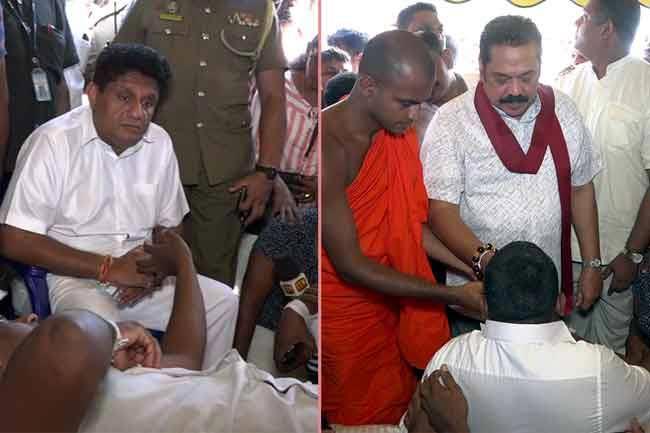
ශ්‍රී ලංකා නිදහස් පක්ෂයේ සහය ගැන ඩිලාන් පෙරේරා කියයි

October 2nd, 2019

උපුටා ගැන්ම  හිරු පුවත්

ශ්‍රී ලංකා නිදහස් පක්ෂයේ සහය ඔක්තෝම්බර් 15 වෙනිදාට පෙර ස්ථීර වශයෙන්ම ශ්‍රී ලංකා පොදුජන පෙරමුණේ ජනාධිපතිධූර අපේක්ෂක ගෝඨාභය රාජපක්ෂ මහතාට හිමිවනු ඇති බව එක්සත් ජනතා නිදහස් සන්ධාන පාර්ලිමේන්තු මන්ත්‍රී ඩිලාන් පෙරේරා මහතා පවසනවා.

ඔහු මේ අදහස් පළ කළේ එක්සත් ජනතා නිදහස් සන්ධානයේ පාර්ලිමේන්තු මන්ත්‍රී එස්.බී. දිසානායක මහතා සමඟ අද කැඳවා තිබූ ප්‍රවෘත්ති සාකච්ඡාවකදීයි.

ශ්‍රී ලංකා නිදහස් පක්ෂයේ සහය ගැන අදත් සාකච්ඡාවක්

October 2nd, 2019

උපුටා ගැන්ම  හිරු පුවත්

ගෝඨාභය රාජපක්ෂ මහතාට සහය දැක්වීම සඳහා වන අවබෝධතා ගිවිසුම පිළිබඳ අදත් ඔහු සමඟ සාකච්ඡාවක නිරත වීමට නියමිත බව ශ්‍රී ලංකා නිදහස් පක්ෂ මහලේකම් දයාසිරි ජයසේකර මහතා පවසනවා.

ඔහු මේ බව සඳහන් කළේ මැතිවරණ කොමිෂන් සභාවේ අද පැවති සාකච්ඡාවකින් අනතුරුව මාධ්‍යයට අදහස් පල කරමින්.

ඉදිරි ජනාධිපතිවරණය සම්බන්ධයෙන් දේශපාලන පක්ෂ නියෝජිතයන් සහ මැතිවරණ කොමිෂන් සභාව අතර විශේෂ සාකච්ඡාවක් අද පස්වරුවේ පැවැත්වුණා.

එම සාකච්ඡාව සඳහා වැඩ බලන පොලිස්පතිවරයා සහ තවත් ජ්‍යෙෂ්ඨ පොලිස් නිලධාරීන් පිරිසක්ද  එක්ව සිටියා.

මැතිවරණ නීති උල්ලංඝනය කිරීම් වැලැක්වීම සම්බන්ධයෙන් පක්ෂ නියෝජිතයන් මෙහිදී එකඟතාවන් කිහිපයකට පැමිණ තිබෙනවා.

සාකච්ඡවෙන් අනතුරුව ඔවුන් මාධ්‍යයට මෙලෙස අදහස් පළ කළා.

Can we win our Economy?

October 1st, 2019

By Garvin Karunaratne

It is perhaps the right time to address our economic situation. We are currently deep in debt with some $ 60 billion to repay which we never can. Poverty is on the increase because 51% of the country’s income is earned by the richest 20% of the people.

In 1976 we did not have foreign debt. In 1977 our foreign debt was only $ 750 million.  At the end of 2014, the foreign debt was only $ 42.9 billion. Even in the process of servicing that debt- paying the interest due and the instalments due per year we fall further into debt because we have to borrow dollars at high interest to meet that payment. We have to face a payment of $ 16 billion in the next 4 years to service our foreign debt. We are facing a drop in exports, and an increase in imports. Let us not forget that the massive Gal Oya Development was all done with our funds. This denotes that in the early Fifties we had a sound economy.

It is necessary to understand how did we fall into this predicament in order to find a way out of this mess.

We had a sound economy, though facing some problems till 1977.  There were ups and downs, but we were self-reliant. We often ran into problems like in the mid-Seventies when Minister Kobbekaduwa in the Government of Sirimavo decided to take over all plantations over 50 acres, which crippled the private sector. Fifty acres is not an economically viable extent to run a plantation. We ourselves crippled the private sector. Then came the demise in paddy production It is a landmark achievement to become self-sufficient in paddy while implementing a rice ration scheme- an achievement never reached anywhere.. Premier Dudley devoted all his effort at increasing paddy production and he did succeed. It was unfortunate that the next Government of Premier Sirimavo  de-emphasized agriculture and instead concentrated on small industry and youth employment which had mediocre success. The Divisional Development Programme of 1971-77 provided employment to only 33,271 youths, some of them on a part-time basis. The possible success of this DDC Programme was hindered by the JVP uprising of 1971 which crippled the rural areas for some six months. All development work was at a standstill.

   It also happened that the socialist policies of the 1971-1977 period were not appreciated by the Superpowers who imposed sanctions on us, though very unofficially, which caused problems. Take the bread queues of 1974-1975. This was due to the USA not giving us flour under the PL480 Food Aid scheme on discounted terms, which they were giving us earlier. The Government in the period 1972 to 1976 found it an extremely difficult task to balance the foreign exchange budget due to high increases in import prices. the cost of imported rice increased from Rs.1015 to Rs. 2639 per long ton in 1974. Sugar increased from Rs. 3093 to Rs.5486 per long ton.  Flour prices increased from Rs.  1386 to Rs. 2124. per long ton.(From: How the IMF Ruined Sri Lanka: 2006)

 Britain insisted that we pay in dollars to the tea multinationals for the plantations we took over  and we paid that bill.  Despite all these price increases and payments to be made in foreign exchange, the Government was able to have a positive balance of payments of US $ 58 million  in 1976 and $ 117 million in 1977. The value of the Rupee was maintained at Rs 15.50  to the $ US in October 1977 and the foreign debt was nil in 1976 and only $ 750 million in 1977.  Though there were bread queues and shortages, these statistics speak highly of the economy of the period 1970-1977.

What happened in 1977 for a country that was self reliant and had no debt to become bankrupt?

When the Government of President Jayawardena requested Aid from the International Monetary Fund at the end of 1977, because we could not find finances- due to the fact that the prices of oil were increased threefold, the IMF imposed various conditions that had to be followed. It was the intention of Finance Minister Ronnie de Mel that Sri Lanka will be able to get on its feet based on following the advice of the IMF.

The IMF imposed the Structural Adjustment Programme on Sri lanka as well as other Third World countries that sought financial assistance. The economic theories that had been followed till then had enabled our countries to meet all our expenses and to provide for local development- our countries were making what our people needed and the incoming foreign exchange was carefully handled and allocated with care. Our imports were controlled.  This led to a situation where our countries imported less manufactured goods from the Superpowers.  The inability to sell manufactures crippled the economies of the Superpowers and they came up with an alternative economic system which they imposed on our countries to cripple our economies. This was the Structural Adjustment Programme. It was intended to restructure our economies to make us indebted and make us economically subservient.

This SAP was first made up by the Chicago School of Economics by Professor Milton Friedman and adopted by President  Ronald Regan and Prime Minister Margaret Thatcher and imposed though the IMF on our countries whenever we requested help.  The fundamental premise was for our countries to give up all controls on imports and the use of foreign exchange. We were told to allow all imports and to allow the free use of foreign exchange for foreign travel, for foreign cruises, and to even send people for foreign study(this helped the rich) and when we faced shortages of foreign funds in this process we were given loans. This was aimed both to create sales for the manufactured products of the Superpowers as well as to make the Third World countries indebted so that they can be brought under control- the countries had to get more loans to service the loans they had taken and will have to abide by the Structural Adjustment provisions which will make them further and further indebted, a situation from which they can never recover.

To help this process we were given grace periods of 5 to 10 years when we need not service the loans and our leaders jumped at the idea because they may not be there when the days comes to repay. There were additional clauses that crippled us. We were asked tlo impose high interest rates and Sri Lanka hijacked interest rates to some eighteen percent which meant that banks charged twenty five percent. This put off all our entrepreneurs from manufacturing. They closed down their ventures and instead enjoyed high interest on fixed deposits. While Sri Lanka follows this high interest rate policy even till today India totally rejected it. Today finance is available to people in India at 8 %. Our industries had to get crippled to enable the Superpowers to sell their manufactures.  We have all become colonies once again. We produce raw materials get them exported and then buy the manufactured product from the Superpowers.

During the time when we were sovereign- from the time we became independent till  the time we became appendages of the Superpowers by following the SAP conditions  (at the end of 1977 in Sri Lanka) we had built up a development infrastructure to enable our producers to sell their produce at reasonable rates. We built up the Marketing Department(MD) activities, commenced under Premier DS Senanayake.  There was a vegetable and fruit marketing scheme to buy at high prices from producers- prices higher than what the traders bought. These were brought overnight to the cities and sold at low rates to help city dwellers to buy at low rates. I happened to have been in charge of this scheme and can vouch for its success. Our motto was to keep a margin of 15% while left to the traders they kept 100% or more. That was how we killed two birds with one stone- to provide a high price to the producer as well as to sell at low prices to city folk.  Thereby we controlled inflation. The Marketing Department had a Canning Fctory where fruits were processed into jam and juice.  The MD purchased the total produce of Red Pumpkin, Ash Pumpkin and Pineapple and made them into Golden Melon Jam, Silver Melon Jam, Pineapple Jam and Juice. Our producers became rich and we needed no imports. This was a pain in the neck for the Superpowers who wanted sales for their fruit. They decided that the Govcernment should not have any commercial undertakings. The Marketing Department was scrapped. Its Cannery was privatized.  While we used the Cannery to make Sri Lanka self sufficient in fruit and veg preparations, the privatized cannery runs to make a profit. No wonder we have on our shelves Tomatoe Sauce and Vinegar from the USA, fruit juice from USA and Australia, just to mention a few items.

We also had a Paddy Purchasing Scheme where we purchased paddy at a premium price from genuine producers.  After 1977 this Scheme was altered to purchase from anyone. The traders collected paddy from the farmers and handed over to the Government and benefited from the premium price offered by the people. In the pre 1977 Paddy Purchase Scheme paddy was purchased only from genuine producers on a list prepared by the agricultural overseers/ agrarian services officials. After 1977 the purchases were from anyone and the premium price paid did not serve to help the genuine farmers.

Ronal Regan and Margaret Thatcher directed the IMF, under their control to cripple our economies and make us ‘colonies’ once again and we were the losers. What is sad to realize is that almost all our economists fail to understand the ‘economics’ underlying the Structural Adjustment Programme and its effects. Our Universities are full of qualified economists, but analyzing the Friedman economics is far beyond their comprehension.

How we once do it? We imported chassis instead of coaches and built the chassis into busses and at Ramalana we made all the coaches required for the railways.  In that manner we made a controlled economy. We were self sufficient in all textiles. We imported cars- never luxury models and that was done by import controls. Some think that import controls will lead to chaos. I can assure that there was no chaos. I myself handled small industries and was in charge of allowing foreign exchange to import machinery or an ingredient that was needed for making some item. I can assure anyone that every genuine industrialist was satisfied. 

Way back in  1972 I wanted to establish an import substitution industry. I decided to make crayons and my Planning Officer Vetus Fernando, a raw chemistry graduate,  worked on experiments to find the art of making crayons locked up in the Rahula College school science lab for three long months from six to midnight every evening and did succeed.  I decided that a cooperative should be set up and Coop Crayon was born. I summoned Sumanapala Dahanayake the Member of Parliament for Deniyaya who was also the President of the Morawaka Cooperaive Union and authorized him to use cooperative funds and set up an industry. I had no authority to order the use of cooperative funds but in the national interest we always bend rules. Sumanapala was a maverick who too connived to bend rules for the benefit of the country. It was a handmade crayon like most Chinese products of today.  It was a difficult task to have exact quantities, boil to a certain degree and then pour into glass jars. But it was done, established in some three weeks under the personal direction of katcheri officials who worked day and night to assure the quality, training the youths who were workers. Coop Crayon was easily equal to the qualility of Crayola of today.  We had many problems to surmount and we did it all. We were refused an allocation of foreign exchange by the Ministry of Industries because we were a cooperative and the officials there did not want to bend rules in the national interest. I then approached Harry Guneratne the Controller of Imports who had earmarked dollars to import crayons. It did not take long to convince Harry that by giving us a small allocation he could stop imports. He readily agreed and we sought the approval of his Minister, Illangaratne to do something wrong- in administrative rules to use funds earmarked for imports to be used for manufactures. Minister Illangaratne not only approved it but insisted that we should establish a crayon making factory at Kolonnawa, his electorate.  This detail of how we once did –how the member of parliament Sumanapala Dahanayake slaved to establish Coop Crayon that had islandwide sales within a few months illustrate that we can such feats if called upon again.

. It was the IMF trap of the Structural Adjustment programme that really trapped us and we have now in the few decades from 1978 lost our bearings. The few illustrations of what we did once achieve illustrate that we can win.

Now we come to today. As illustrated though not in great detail we once did it and can do it again

This effort has to get support from the Government in departing from the high interest policy, having controls over imports to ensure that we do not import anything that we can make. For instance we can become self sufficient in all our fruit and fruit juice requirements in one year because we have mangoes and other fruit in plenty. What has to be done is to set up small scale fruit preparation industries and develop an industry. That is a task that can be done in a few months.

This is true of many things we import. The mantra that has to be followed is Import Control and Local manufacture and if we cannot do that we will be doomed for ever.

In addition to all this there has been increased corruption which can be effectively stopped somehow. I can assure that the Members of parliament and ministers till 1973, the year I left were not corrupt. Corruption was not in their veins. They were all fighting with the officers to get development tasks done.. It is my opinion that we can get out of the quagmire of corruption.

However many things have to be done. Economist Sanderatne cries aloud in the Sunday Times that agriculture has got lost.  Why? We have made a few mistakes. Take agricultural extension.

 Let me emphatically state that we have crippled our agricultural exztension service in the Seventies and Eighties. Firstly the World Bank(at the behest fd the Superpowers) decided to cripple our extension service. First they wanted our countries to privatize the Seed Research Stations, which we did.

Then they wanted to cripple the service. In our countries the number of farmers are legion. The only method of working with them to find their needs, provide good seeds etc is through a cooperative network and our countries had built up able cooperatives to muster and enable farmers. The World Bank came up with their Training and Visit System of Extension which they forced on our countries in around 1978. When Our administrators refused the World Bank gave us loans and grants and we readily complied. Giving us a loan or a grant is the bait offered by institutions like the World Bank and the IMF and even by the Superpowers.

Next, during the days of President Premadasa, he promoted all Agricultural Overseers- those who manned agricultural extension at the village level as Grama Niladharis and since then there has been no officer with agricultural training at the village level. For a few years there was no one at the village level and after a few years Niyamakas were appointed. They were not trained nor was any training programme done for them done till today.  The closest trained agricultural officer is at the divisional level and he caters tyo some 4000 to 12,000 farmers. In short the agricultural extension service does not exist at the field level. The problem is that this vacuum is not even understood by the authorities.

Building up the lost agricultural extension system, re establishing the lost Marketing Department activities, building up new programmes, enforcing import controls  etc have all to be done and this is a task that behoves attention by the authorities, even at this late stage.

Garvin Karunaratne

Former GA Matara

Author of:

How the IMF Ruined Sri Lanka, Godages, 2006

How the IMF Sabotaged Third World Development, Kindle/Godages, 2017

2/10/2019

Yahapalanaya not built anything of lasting value from USD26bn loans: MR

October 1st, 2019

Courtesy LBO

Oct 01, 2019 (LBO) – Sri Lanka’s Opposition Leader Mahinda Rajapaksa says that the yahapalana government has not built anything of lasting value or anything that would generate an income from the staggering 26 billion US dollars that they took in the form of foreign currency commercial loans since January 2015.

Releasing a statement, the ex-President says that the debt crisis created in Sri Lanka by the yahapalana government has now reached a critical stage.

The total government debt which was Rs. 7.39 trillion at the time this government came into power in January 2015, had skyrocketed to Rs. 12.64 trillion by the end of July 2019 – an increase of 71%,” Rajapaksa said.

The most salient feature of the debt that the present government has taken on, is that none of it has been utilised to develop the country but only to meet the day to day expenses of the government.”

Current position regarding the yahapalana govt.’s debt crisis

The debt crisis created in this country by the yahapalana government has now reached a critical stage. The total government debt which was Rs. 7.39 trillion at the time this government came into power in January 2015, had skyrocketed to Rs. 12.64 trillion by the end of July 2019 – an increase of 71%. The high proportion of foreign currency commercial loans in the debt taken by the yahapalana government increases the risk to the country. The international ratings agency Moody’s issued a warning recently with regard to this matter. From January 2015 to date, this government has taken a staggering 26 billion US Dollars in foreign currency commercial loans through Sri Lanka Development Bonds, Sovereign Bonds, Syndicated Loans, Currency Swaps and the like.

Foreign currency loans have to be repaid in foreign currency. Hence the debt burden increases automatically when the value of the US Dollar increases in relation to the Rupee. The value of the US Dollar which was Rs.131 when this government came into power, has increased to Rs.183 today. The depreciation of the currency from 2015 up to the end of 2018 alone, had increased the government’s debt burden by Rs.1,709 billion. The most salient feature of the debt that the present government has taken on, is that none of it has been utilised to develop the country but only to meet the day to day expenses of the government.

Whenever the yahapalana camp refers to the debt taken on by my government, they refer only to various project loans that we took to build infrastructure. It should be noted that during the past five years, the yahapalana camp has never referred to any debt taken by my government which was not related to a project. The reason for this is that it was very sparingly that my government took commercial loans through Sri Lankan Development Bonds, Sovereign Bonds, Currency Swaps or Syndicated Loans. The project loans taken during my time were long term loans taken at concessionary rates of interest. Furthermore the amounts that we took as project loans are very small in comparison to the yahapalana consumption borrowings.

The cost of the Norochholai power plant was 1.35 billion USD. The entire loan taken to build the Hambantota harbour was 1.26 billion USD. The Expressway up to Matara cost 740 million USD, the Mattala airport 209 million USD, the Colombo Katunayake expressway 292 million USD and the loan taken to build the Lotus Tower was 67 million USD. Even if the loans taken to build all these projects are put together, the amount taken does not come even close to the 4.4 billion USD that the yahapalana government borrowed in 2019 alone through the issue of two sovereign bonds.

That would place in perspective the proportions of the debt crisis created by the yahapalana government in less than five years. This is why I have kept the public informed about this issue from time to time. My government took loans for investment. Today the Norochcholai power plant is a very profitable enterprise. The Auditor General stated last year that the expressways are also making profits. Last Sunday, the newspapers reported that the nine story administrative building of the Hambantota Port now has a 95% occupancy rate with companies engaged in various operations related to the port renting space in the building. This means that before long the Hambantota Port will also be making profits. The government can also derive a large income from the Lotus Tower which was opened recently.

In contrast to this, the yahapalana government has not built anything of lasting value or anything that would generate an income from the staggering 26 billion USD that they took in the form of foreign currency commercial loans since January 2015. The reason why my government did not have to take foreign currency loans for consumption while the yahapalana government has had to do so, is because the latter threw government money into political endeavours to win elections and to retain power. The money spent by the yahapalana government to keep themselves in power will finally have to be paid by the people of this country. Economic crises have occurred under previous governments as well. However, this is the first time that an economic crisis has come about due to the mismanagement of state funds. Never in the 71 years since independence have we had a government that has been as irresponsible as this in the handling of government finances.

Mahinda Rajapaksa
Leader of the Opposition

SL currency notes signed by Mahendran – Opposition to seek SC interpretation

October 1st, 2019

Courtesy The Daily Mirror

In the wake of a court case filed challenging Gotabaya Rajapaksa’s citizenship, the Opposition said today, it would seek a Supreme Court interpretation on the validity of currency notes signed by Central Bank’s former governor Arjuna Mahendran, who is a Singaporean national.

MP Dr. Bandula Gunawardana told a news conference Mr. Mahendran was never a Sri Lankan though he signed Sri Lanka’s currency notes as the then CB governor.

According to Singaporean laws, no Singaporean can hold dual citizenship. Therefore, Mr. Mahendran always was and is a Singaporean national. No foreign national is allowed to hold office in Sri Lanka let alone sign currency notes. This was an issue we raised previously as well but gave in after the bond commission was appointed, because we thought proper legal action will be taken following the commission’s recommendations. It didn’t happen and today, the government is targeting Gotabaya Rajapaksa over his citizenship when he has evidently abandoned his US citizenship and is a Sri Lankan citizen now,” he said.

Dr. Gunawardena said the Opposition’s legal team was studying the legal aspect of Mr. Mahendran signing Sri Lankan currency notes while remaining as a Singaporean national.

This raises the question whether the notes signed by Mr. Mahendran are valid since he is not a Sri Lankan,” he said.

Commenting on the court case filed against SLPP presidential candidate Gotabaya Rajapaksa, Dr. Gunawardena said they had their faith and confidence in the judiciary to deliver a correct judgement.

Gotabaya renounced his US citizenship. All these allegations and court cases are being made against him since he is contesting the presidential election and is a strong candidate,” he said.

Cop or thug?

October 1st, 2019

Editorial Courtesy The Island

October 1, 2019, 8:20 pm 

IGP Pujith Jayasundera, currently on compulsory leave, was arrested, yesterday, for having manhandled a lift operator at the Police Headquarters, in 2017. One may wonder why on earth the police took so long to take action against the police chief for that incident in spite of the availability of irrefutable evidence against him. A video of the attack went viral on the Internet. But our judicial system is so efficient that no sooner had he been taken into custody than he was released on bail.

Ironically, IGP Jayasundera, who flew into a rage and pounced on the elevator operator, undertook to train the police personnel to exercise patience and be at peace with themselves as well as the world at large; he made it mandatory for them to observe sil every morning. He himself should have practised meditation and learnt to control his volatile temper. One may recall that in 2013, Jayasundera, who was a senior DIG then, made all the personnel, attached to the Kattankudy police station, kneel as it had been brought to his notice that one of the traffic cops had taken a bribe. Sadly, he failed to maintain law and order in the area, where gangs operated freely. Kattankudy became a hotbed of extremism and the home turf of Zaharan and other terrorists responsible for the Easter Sunday carnage.

Jayasundera should kneel, in public, by way of penance for his deplorable conduct and failures, which are legion. It has now been revealed that he did not properly act on the intelligence warnings of impending Easter attacks, which destroyed more than 250 lives. He shamelessly allowed politicians to use the police as a malleable tool. The CID is doing full-time political work. So is the FCID, which has turned a blind eye to the biggest ever financial crime in the country—the 2015 bond scam. Had some political rivals of the government been involved therein, the FCID would have lost no time in arresting the suspects and their family members as well. Billions of rupees have gone down the gurgler owing to an imported milch cow racket, where some politicians and bureaucrats lined their pockets. No action has been taken against these crooks.

The government claims to have restored law and order. If so, the IGP should have been arrested in the act of manhandling the hapless lift operator. The incident would not have come to light but for the fierce rivalries among senior police officers who are jostling for promotions. The officer who leaked the CCTV footage at issue, obviously, wanted to ruin the IGP’s career.

The police were recently looking for a person who had videoed an incident where two novice Buddhist monks were assaulted. The guardians of the law said that he had to be brought to justice for having videoed the assault without intervening to save the victims. By the same token, legal action should be instituted against the police officers who were present when the aforesaid lift operator was attacked but did not intervene to save him from the IGP on the rampage. It will be interesting to see what the National Police Commission has got to say to this.

Prime Minister Ranil Wickremesinghe has drawn heavy flak for the appointment of Arjuna Mahendran as the Central Bank Governor. It was on his recommendations that President Maithripala Sirisena appointed Mahendran to that post. Mahendran is now a fugitive from justice, having got involved in the bond scams and fled the country. President Sirisena was blamed for the appointment of I. H. K. Mahanama as his Chief of Staff, following the latter’s arrest for taking a bribe. Former President Mahinda Rajapaksa is still being raked over the coals for having appointed rogues to high posts while he was in power. So, the blame for the appointment of the incumbent IGP, who has become a disgrace to the Police Department and the country should go to the Constitutional Council, which picked him at the expense of a better qualified officer. 

Wednesday 2nd October, 2019

ඇතින්නියන් මිය ‍ගිය හේතුව ගැන හෝඩුවාවක්

October 1st, 2019

උපුටාගැණීම අද දෙරණ

හබරණ ප්‍රදේශයේදී අභිරහස් ලෙස මියගිය ඇතින්නන් 07දෙනාගේ මරණවලට හේතුව විෂ රසායනික ද්‍රව්‍යක් ශරීරගතවීම විය හැකි බව වනජිවි අධ්‍යක්ෂ ජනරාල් චන්දන සූරියබණ්ඩාර මහතා පවසයි.

අද(01) කොළඹදී මාධ්‍ය හමුවක් පවත්වමින් ඒ මහතා මේ බව සඳහන් කළේය. 

මෙහිදී අදහස් දක්වමින් කියා සිටියේ, මෙම සිදුවීම ඉතාමත් අස්වාභාවික සිදුවීමක් බවත් ඒ හේතුවෙන් අධිකරණයෙන් මෙම සතුන්ගේ පශ්චාත් මරණ පරීක්ෂණ සිදු කිරීමට අවසර ලැබුණු බවත්ය.

ඒ අනුව පශ්චාත් මරණ පරීක්ෂණ සියල්ල සිදු කර අවසන් බවත් දැනට එයින් ලැබී ඇති කරුණු මත මෙම මරණ 7 විෂ රසායනික ද්‍රව්‍ය නිසා බවට සැකයක් පවතින බවද ඒ මහතා පැවසීය.

එය තහවුරු කර ගැනීමට අවශ්‍ය බවත්, එය සමහර විට කෘෂි රසායනික ද්‍රව්‍යයක් විය හැකි බවත් එසේ නොමැති නම් වෙනස් දිලීර වර්ගයක් විය හැකි බවත් පැවසු වනජිවි අධ්‍යක්ෂ ජනරාල්වරයා, මේ ගැන පරීක්ෂණ පවත්වන බවත් කියා සිටියේය.

යහපාලන ආණ්ඩුව ඇතිකළ ණය අර්බුදයේ වත්මන් තත්වය

October 1st, 2019

මාධ්‍ය නිවේදනය මහින්ද රාජපක්‍ෂ විපක්‍ෂ නායක

යහපාලන ආණ්ඩුව මේ රටේ ඇතිකළ ණය අර්බුදය මේ වන විට අතිශයින්ම බරපතල  තත්වයකට පැමිණ තිබේ. වර්තමාන ආණ්ඩුව 2015 ජනවාරියේදී බලයට පැමිණෙන අවස්ථාවේදී රුපියල් ට්‍රිලියන 7.39 ක් වූ ලංකාවේ මුලු ණය බර, 2019 ජුලි මස අවසානය වන විට රුපියල් ට්‍රිලියන 12.64 ක් දක්වා 71% කින් ඉහල ගොස් තිබුණි. මේ ණය ගැනිල්ල  වඩාත්ම අවදානම් සහගත වන්නේ විදේශ විනිමය ණය වැඩි වශයෙන් ගැනීම නිසයි. ජාත්‍යන්තර ශ්‍රේණිගත කිරීම් ආයතනයක් වන මූඩීස් සමාගමද මීට නොබෝ දිනකට පෙර ලංකාවේ මේ විදෙස් ණය ගැනීම ගැන විශේෂ අනතුරු හැඟවීමක් කර තිබුණි. 2015 ජනවාරි මස සිට අද දක්වා මේ ආණ්ඩුව ශ්‍රී ලංකා සංවර්ධන බැඳුම්කර, සවරින් බොන්ඩ්, කරන්සි ස්වොප්, සින්ඩිකේටඩ් ලෝන් යනාදී නොයෙක් මුලාශ්‍ර වලින් ඇමරිකානු ඩොලර් බිලියන 26 ක් ඉක්මවූ මුදලක් විදෙස් විනිමය ණය  වශයෙන් පමණක් ලබා ගෙන ඇත.

විදෙස් විනිමය ණය ගත්විට ඒ ණය සියල්ලම විදේශ විනිමයෙන්ම ආපසු ගෙවීමට සිදු වේ. රුපියලට සාපේක්ෂව ඇමරිකානු ඩොලරයේ වටිනාකම වැඩිවන විට විනිමය අනුපොතයේ ඇතිවෙන වෙනස්කම් නිසාද රටේ ණය බර නිරායාසයෙන්ම වැඩි වෙයි. මහා පරිමාණයෙන් විදෙස් විනිමය වානිජ ණය ගැනීම මර උගුලක් වන්නේ මේ නිසාය. 2014 අවසානයේදී රුපියල් 131 ක් වූ ඇමරිකානු ඩොලරය යහපාලන ආණ්ඩුව යටතේ සිදුවූ ආර්ථික පරිහානිය හේතුවෙන්, අද වන විට රුපියල් 183 දක්වා ඉතිහාසයේ පෙර නොවූ විරූ ආකාරයට වැඩිවී ඇත. 2015  සිට රුපියලේ වටිනාකම බිඳවැටීම හේතුවෙන්ම පමණක් 2018 අවසානය වන විට ලංකාවේ මුලු ණය බර රුපියල් බිලියන 1,709 කින් වැඩි වී තිබුණි. වත්මන් ආණ්ඩුවේ ණය ගැනීමේ සුවිශේෂම ලක්‍ෂණය වන්නේ ඒ කිසිවක් රට දියුණු කිරීමට ලබාගත් ව්‍යාපෘති ණය නොව ආණ්ඩුවේ එදිනෙදා වියදම් පියවා ගැනීම සඳහා ලබාගත් වානිජ ණය වීමයි.

මගේ ආණ්ඩුවෙන් ලබාගත් ණය ගැන යහපාලකයන් කතා කරන විට ඔවුන් හැමවිටම සඳහන් කරන්නේ නොයෙක් ව්‍යාපෘති සඳහා ගත් ණය ගැන පමණි. මගේ ආණ්ඩුව කාලයේ ව්‍යාපෘතියකට සම්බන්ධ නැති ණයක් ගැන පසුගිය අවුරුදු පහ මුලුල්ලේම යහපාලන ආණ්ඩුවේ අය කිසිඳු සඳහනක් කර නැති බව ජනතාවගේ විශේෂ අවධානයට ලක් විය යුතුය.  මගේ ආණ්ඩුව ශ්‍රී ලංකා සංවර්ධන බැඳුකර, සවරින් බොන්ඩ්, කරන්සි ස්වොප්, සින්ඩිකේටඩ් ලෝන් වැනි මූලාශ්‍ර වලින් වානිජ ණය ලබාගැනීම ඉතාමත්ම අවම මට්ටමකින් පවත්වාගෙන ගියේය. අපේ පාලන සමයේ ව්‍යාපෘති සඳහා  විදෙස් ණය ගනු ලැබුවේ 2% වැනි සහනදායි පොලියට දිගු කාලීන ණය වශයෙන්ය. එසේ ලබාගෙන තිබෙන්නේද, යහපාලන ණය ගැනිල්ලට සාපේක්ෂව ඉතාමත්ම සුලු මුදලකි. නොරොච්චෝලේ බලාගාරය සම්පූර්ණයෙන්ම ඉදිකිරීමට වැය වූයේ ඇ.ඩො. බිලියන 1.35 කි. හම්බන්තොට වරාය අද තිබෙන තත්වයට ගෙන ඒමට ගත් මුලු ණය ඩොලර් බිලියන 1.26 කි. මාතර දක්වා දක්‍ෂිණ අධිවේගී මාර්ගයට ඩොලර් මිලියන 740කි. මත්තල ගුවන්තොටුපලට ඩොලර් මිලියන 209කි. කටුණායක අධිවේගී මාර්ගයට ඩොලර් මිලියන 292 කි. නෙළුම් කුලුණ ඉදිකිරීමට ගත් ණය ප්‍රමාණය ඩොලර් මිලියන 67කි. මේ සියලුම ව්‍යාපෘති වලට වැය වූ මුදල් එකට එකතු කළත්, යහපාලන ආණ්ඩුව මේ වසරේදී පමණක් සවරින් බොන්ඩ් දෙකක් හරහා ලබාගත් ඩොලර් බිලියන 4.4ට කිට්ටුවටවත් එන්නේ නැත.

යහපාලන ආණ්ඩුව විසින් අවරුදු පහකට අඩු කාලයක් තුළ ඇතිකළ මේ ණය අර්බුදයේ තරම එයයි. මම පසුගිය වකවානුව පුරාම මේ ප්‍රශ්නය ගැන විටින් විට ජනතාව දැණුවත් කිරීමට පියවර ගත්තේ මෙහි ඇති බරපතලකම නිසාමය. මගේ ආණ්ඩුව ණය අරගෙන කළේ ආයෝජනයයි. අද වන විට නොරොච්චෝලේ බලාගාරය අධික ලාභ ලබන ව්‍යාපෘතියකි. අධිවේගී මාර්ගද ලාභ ලබන බව විගනකාධිපතිවරයා ගිය අවුරුද්දේ පැවසීය. පුද්ගලික සමාගමකට අවුරුදු 99 කට බදු දී ඇති හම්බන්තොට වරායේ තට්ටු නවයේ පරිපාලන ගොඩනැගිල්ලෙන් 95% ක් දැනටමත්  වරාය ආශ්‍රිත වානිජ මෙහෙයුම් කරන නොයෙක් සමාගම් වලට බදු දී හමාර බව පසුගිය ඉරිදා මාධ්‍යයේ පලවිය. එයින් පෙනෙන්නේ හම්බන්තොට වරායත් තව නොබෝ කාලෙකින් ලාභ ලබන තත්වයට පත්වෙන බවයි. මෑතකදී විවෘත කළ නෙළුම් කුලුනෙන්ද ආණ්ඩුවට විශාල ආදායම් ලබාගත හැක.

නමුත් පසුගිය අවුරුදු හතරහමාර තුළ යහපාලන ආණ්ඩුවෙන් ලබාගත් ඩොලර් බිලියන 26ක විදෙස් ණයෙන්, කිසිඳු කල්පවතින, ආදායම් උපයන ආයෝජනයක් කර නැත. මගේ පාලන සමයේදී මහා පරිමානයෙන් පරිභෝජන ණය ගැනීමට සිදු නොවුණේත්, වර්තමාන ආන්ඩුවට එසේ කිරීමට සිදුවී තිබෙන්නේත් අන් කිසිවක් නිසා නොව යහපාලන ආණ්ඩුව මැතිවරණ ජයගැනීමට හා බලය රැකගැනීමට රජයේ මුදල් විසිකිරීම නිසාය. තමන්ගෙ බලය  රැකගැනීමට යහපාලන ආණ්ඩුව කරන වියදම් සියල්ල අවසානයේදී  ගෙවීමට සිදුවන්නේ මහජනතාවටමය. මීට කළින් පැවති ආණ්ඩු යටතේත්, මේ රටේ නොයෙක් ආර්ථික අර්බුද ඇති වී තිබුණත්, ආණ්ඩුවේ මූල්‍ය පාලනය අවුල් කිරීම තුළින් අපේ රටේ ආර්ථික අර්බුදයක් නිර්මාණය වූ පළමු අවස්ථාව මෙයයි. ආණ්ඩුවේ මුදල් පාලනය කෙරෙහි මේ තරම් වගකීම් විරහිත ආකල්පයක් දැක්වූ වෙනත් කිසිම ආණ්ඩුවක් නිදහසින් පසු ගත වූ අවුරුදු 71 දී අපි දැක නැත.   

මහින්ද රාජපක්‍ෂ

විපක්‍ෂ නායක

Yahapalana regime used govt. money for political purposes – Mahinda

October 1st, 2019

Mahinda Rajapaksa Leader of the Opposition

Current position regarding the yahapalana govt.’s debt crisis

The debt crisis created in this country by the yahapalana government has now reached a critical stage. The total government debt which was Rs. 7.39 trillion at the time this government came into power in January 2015, had skyrocketed to Rs. 12.64 trillion by the end of July 2019 – an increase of 71%. The high proportion of foreign currency commercial loans in the debt taken by the yahapalana government increases the risk to the country. The international ratings agency Moody’s issued a warning recently with regard to this matter. From January 2015 to date, this government has taken a staggering 26 billion US Dollars in foreign currency commercial loans through Sri Lanka Development Bonds, Sovereign Bonds, Syndicated Loans, Currency Swaps and the like.

Foreign currency loans have to be repaid in foreign currency. Hence the debt burden increases automatically when the value of the US Dollar increases in relation to the Rupee. The value of the US Dollar which was Rs.131 when this government came into power, has increased to Rs.183 today. The depreciation of the currency from 2015 up to the end of 2018 alone, had increased the government’s debt burden by Rs.1,709 billion. The most salient feature of the debt that the present government has taken on, is that none of it has been utilised to develop the country but only to meet the day to day expenses of the government. 

Whenever the yahapalana camp refers to the debt taken on by my government, they refer only to various project loans that we took to build infrastructure.  It should be noted that during the past five years, the yahapalana camp has never referred to any debt taken by my government which was not related to a project. The reason for this is that it was very sparingly that my government took commercial loans through Sri Lankan Development Bonds, Sovereign Bonds, Currency Swaps or Syndicated Loans. The project loans taken during my time were long term loans taken at concessionary rates of interest. Furthermore the amounts that we took as project loans are very small in comparison to the yahapalana consumption borrowings.

The cost of the Norochholai power plant was 1.35 billion USD. The entire loan taken to build the Hambantota harbour was 1.26 billion USD. The Expressway up to Matara cost 740 million USD, the Mattala airport 209 million USD, the Colombo Katunayake expressway 292 million USD and the loan taken to build the Lotus Tower was 67 million USD. Even if the loans taken to build all these projects are put together, the amount taken does not come even close to the 4.4 billion USD that the yahapalana government borrowed in 2019 alone through the issue of two sovereign bonds.

That would place in perspective the proportions of the debt crisis created by the yahapalana government in less than five years. This is why I have kept the public informed about this issue from time to time. My government took loans for investment. Today the Norochcholai power plant is a very profitable enterprise. The Auditor General stated last year that the expressways are also making profits.  Last Sunday, the newspapers reported that the nine story administrative building of the Hambantota Port now has a 95% occupancy rate with companies engaged in various operations related to the port renting space in the building. This means that before long the Hambantota Port will also be making profits. The government can also derive a large income from the Lotus Tower which was opened recently.

In contrast to this, the yahapalana government has not built anything of lasting value or anything that would generate an income from the staggering 26 billion USD that they took in the form of foreign currency commercial loans since January 2015. The reason why my government did not have to take foreign currency loans for consumption while the yahapalana government has had to do so, is because the latter threw government money into political endeavours to win elections and to retain power.  The money spent by the yahapalana government to keep themselves in power will finally have to be paid by the people of this country. Economic crises have occurred under previous governments as well. However, this is the first time that an economic crisis has come about due to the mismanagement of state funds. Never in the 71 years since independence have we had a government that has been as irresponsible as this in the handling of government finances. 

Mahinda Rajapaksa

Leader of the Opposition

I spoke the truth, I won’t resign: Ex-SG Gamlath

October 1st, 2019

Susitha Fernando Courtesy The Daily Mirror

Former Solicitor General (SG) and Chairman of the Sri Lanka National Authority for the Protection of Witnesses and Victims, Suhada Gamlath reiterated that he spoke the truth and said telling truth had been construed as politics.

He was responding to Justice Minister Thalatha Athukorala, who said he has talked politics while holding a position in the public service.

If telling truth is construed as politics what is the use of living in this country,” Mr. Gamlath asked.

He insisted that he would not resign from his position as the head of the National Authority for the Protection of Witnesses and Victims but that he would wait until any action was taken against him.

“When these people were making a fuss about this matter, I informed the Secretary to the President that I may resign. But reading what another lawyer told a state-run newspaper that I should resign forthwith I decided not to do so. They cannot remove me with that kind of pressure,” Mr. Gamlath said. Let them remove me.”

He said he was reappointed as the President of the National Authority this month on the recommendation of Minister Athukorala herself.

If they want to remove me they can do so. That is perfectly alright. But I have done my duty. If my removal is based on my statement, I really don’t know what is political in it. I have said the truth, the absolute truth of what is happening in this country. If saying the truth is construed as talking politics well then we have to fine another country to settle down,” Mr. Gamlath said.

Referring to an earlier controversial telephone conversation by former Solicitor General Dilrukshi Dias Wickramasinghe, Mr. Gamalath said, My statement is a sequel to what the other SG said. She has said that she was pressured by politicians to act in that manner and I endorse that view. That is what happened to me also. This is not talking politics. This is the reality that exists in the government service of this country,” he said.

Mr. Gamlath said he took over the National Authority for the Protection of Witnesses and Victims when it had become dysfunctional after its previous chairman quit within one year.

This authority was set up in 2016 and then a board of directors was appointed. The chairman couldn’t function for more than one year and he abandoned it. There was a lull without a chairman and the work came to a grinding halt. During this period I was left in the lurch at the Attorney General’s Department without being assigned any work by the then AG Jayantha Jayasuriya and as Solicitor General I was not allowed to do substantial work for some time,” he said. During that period I was told that this authority was not functional and I told Mr. Wijayadasa Rajapaksa to hand it over to me and I will see whether I could do something as a service to the country. In my view within the matter of one and half years I have done a lot to bring it up to this level.”

Mr. Gamlath said there were lot of defects in the law and that he did what he could to rectify them. He said Minister Athukorala had appointed him to draft a law on children who were victims of crimes and witnesses. I am spending lot of time drafting that as well. I have been asked to draft the whistle-blowers law and I am working on it as well. I am doing this work on a voluntary basis. I am doing this because I want to serve my country,” he said. 

Violating Procedures: Suhada Gamlath asked to resign

October 1st, 2019

Yohan Perera Courtesy The Daily Mirror

Chairman of the National Authority for Protection of Witnesses and Victims, Suhada Gamlath has said he would submit his resignation shortly but action is be taken by the Presidential Secretariat to remove him if he fails to do so by today, Justice and Law Reforms Minister Thalatha Athukorala said today.

She told a conference that Mr. Gamlath had committed an offence as a public servant by talking to the media on certain issues.

I requested President Maithripala Sirisena to take action against him and the President’s office had assured me that action will be taken,” the minister said. We have no issues with his political ideology but he has violated procedures which a public servant should follow.”

Mr. Gamlath was quoted as saying that two ministers had exercised undue influence on him to arrest SLPP presidential candidate Gotabaya Rajapaksa.

මහේෂ් සේනානායක එන්නේ මොකාටද?

October 1st, 2019

කතු වැකිය උපුටා ගැන්ම  අරුණ පුවත්

රටට නායකයන් නැති නිසාදෝ දැන් ජනාධිපති ධුර අපේක්ෂකයන් වැහි වැහැලාය. අලුත්ම අපේක්ෂකයා වන්නේ හිටපු හමුදාපති මහේෂ් සේනානායකය. ඔහුව මේ තරගයට ගෙනැවිත් ඇත්තේ ජාතික ජනතා ව්‍යාපාරය නම් සංවිධානයක් විසිනි. මහේෂ් සේනානායක මහතා සුදුසුම හා එකම අපේක්ෂකයා ලෙස ඉදිරිපත් කර ඇතත් අපට නම් පෙනෙන්නේ මහේෂ් සේනානායක එම සංවිධානයේ ‘බැරිම තැන’ අපේක්ෂකයා ලෙසය. ඔවුන් මීට පෙර ශිරාණි බණ්ඩාරනායක, දිල්රුක්ෂි ඩයස් වැනි චරිත ජනාධිපතිවරණයට කැඳවීමට සූදානමින් සිටියහ. නාගානන්ද කොඩිතුවක්කු හා ගාමිණී විජේසිංහ වැනි අයගේ නම්ද මීට පෙර සඳහන් වී තිබිණ.

මහේෂ් සේනානායක ඉදිරිපත්කොට ඇත්තේ මේ එක් අයකු හෝ ඉදිරිපත් කිරීමට උත්සාහ කොට නොහැකි වූ නිසා බව පැහැදිලිය. මේ අන්දමින් බලන කල ඔහු ගැන අපට ඇත්තේ අනුකම්පාවකි. ඒ මේ තරගයෙන් ඔහුගේ පරාජය නියත නිසා නොව, මේ රටේ යුද හමුදාපති ධුරය වැනි ඉතා භාරධූර වගකීම් සහගත ධුරයක් දරා ඇත්තේ මේ තරම් කුඩා මිනිහෙක්දැයි සිතෙන විටය.

ජනාධිපතිවරණයකදී සටන ඇත්තේ ප්‍රධාන පක්ෂ දෙකේ අපේක්ෂකයන් අතරය. ඉතිහාසයේ කිසි දිනෙක කුඩා පක්ෂයකින් හෝ පක්ෂයකින් තොරව ඉදිරිපත් වූ අපේක්ෂකයකු ජයග්‍රහණය කරනවා තබා දෙවන හෝ තෙවන ස්ථානයටවත් තේරී නැත. යුද විශේෂඥයකු වූ සුන්සු පවසා ඇත්තේ තමන්ට අවාසිදායක භූමියක සටනට නොයා යුතු බවය. වසර 36 ක හමුදා සේවා අත්දැකීම් ඇති මහේෂ් සේනානායක සුන්සු කියවා නැතිවන්නට විදියක් නැත.

එසේ නම් යුද හමුදාපතිවරයා ලෙස ගෞරවනීය මතකයක් ජනතාව තුළ රඳවන්නට හැකියාව තිබියදී පරාජිත ජනාධිපති අපේක්ෂකයකු වන්නට මහේෂ් සේනානායක තීරණය කරන්නේ ඇයි? මහේෂ් සේනානායක මෙන් නොව ඇත්තෙන්ම සංග්‍රාම භූමියේ සෙන්පතියකු වූද, එක්සත් ජාතික පක්ෂයේ හා ජනතා විමුක්ති පෙරමුණේ සහාය ලැබූ ඔහුගේ පූර්වගාමියකු වූ සරත් ​ෆොන්සේකාටත් වඩා තමන්ට ජන ප්‍රසාදයක් ඇතැයි සිතන්නට තරම් මහේෂ් සේනානායක මෝඩයකු වන්නට නොහැකිය.

එසේ නම් පරාජය සක්සුදක් සේ පැහැදිලිව තිබියදී ඔහු මේ සූදානම් වන්නේ කුමක් සඳහාද? කාගේ අවශ්‍යතාවක් වෙනුවෙන්ද?

2015 දී මෙරට පැවති පාලන තන්ත්‍රය වෙනස් වූයේ බටහිර සැලසුමකට අනුව බව දැන් කවුරුත් දන්නා කරුණකි. ඒ මහින්ද රාජපක්ෂ පාලනයේ තිබූ වැරදි නිසාම නොව ජාත්‍යන්තර භූ දේශපාලනයේ චලනයන්ට අනුව සිදු වූවකි. කෙසේ වෙතත් ඔවුන්ගේ සැලසුමට අනුව බලය ගත් කණ්ඩායම මේ වන විටත් ජනතාවගෙන් ප්‍රතික්ෂේප වී අවසන්ය. යළිත් වරක් මෙරට පාලනය හිමිවන්නට යන්නේ බටහිරට ගැති නොවන කණ්ඩායමකට බවට ඉඟි පළවෙමින් තිබේ. 2015 මෙරට පාලන තන්ත්‍රය වෙනස් කළ බලවේගයන්ට අවශ්‍ය කෙසේ හෝ එය වෙනස් කිරීමටය.

එහෙත් ඒ සඳහා ඔවුන්ගේ අභිලාෂයන්ට ගැළපෙන ප්‍රබල චරිතයක් නැත. දැන් ඔවුන්ගේ සැලසුම වී ඇත්තේ එක් එක් අංශයන් නියෝජනය වන පරිදි අපේක්ෂකයන් කිහිප දෙනකු යොදවා ඡන්ද කැඩීමය.

මේ අනුව මහේෂ් සේනානායක යනු ඒ මහා සැලැස්මේ එක් ඉත්තෙක් පමණකි. ඔහු පිටිපසින් සිටින්නේ කවුරුන්ද යන්න හඳුනාගත් පසු එය තේරුම්ගත හැකිය. එසේම මෙය කලක සිට කරන ලද සැලසුම් සහගත වැඩපිළිවෙළක් බවද වටහාගත හැකිය.

2015 ජනාධිපතිවරණයේදී සිවිල් සංවිධාන නමැති ප්‍රපංචයන්ට විශාල වැඩ කොටසක් පැවරී තිබුණේය. එහෙත් යහපාලනය කූජිත වීමත් සමග මේ සිවිල් සංවිධානවල වලංගුතාවද අහෝසි වී ගියේය. 2015 න් පසු සමාජ සාධාරණත්වය නීතිය, යුක්තිය, වගවීම ගැන කතා කරන නව චරිත සමාජගත කිරීම ක්‍රමානුකූලව සිදුවිය. දැන් මහේෂ් සේනානායක පිටුපස සිටින්නේ මේ නව සිවිල් යැයි කියන සංවිධානය. මෙතෙක් කලක් පසුබිමේ සිට දේශපාලනය කළ කුප්‍රකට රාජ්‍ය නොවන සංවිධානයක්ද පළමුවරට මේ හරහා ක්‍රියාකාරී දේශපාලනයට පිවිස තිබේ. ඔවුන්ගේ අවශ්‍යතාව කොතරම් ප්‍රබලද යන්න වටහා ගැනීමට එම කාරණය වුවද ප්‍රමාණවත්ය.

මහේෂ් සේනානායකද කලක සිටම මේ සැලසුමේ කොටස්කරුවෙක්ව සිටි බව අප්‍රේල් 21 ප්‍රහාරයෙන් පසුව ඔහුගේ හැසිරීම් නිරීක්ෂණයෙන් තේරුම්ගත හැකිය. ආරක්ෂාව තහවුරු වී ඇති නිසා පාසල් යන්නැයි ළමුන්ට කීවේ මහේෂ් සේනානායකය. මාස තුනකට රට භාර ගන්නැයි ජනතාව තමන්ගෙන් ඉල්ලන බවද කීවේ ඔහුය. රටේ ජනතාවට දේශපාලන නායකත්වය කොතරම් එපා වී තිබුණේද යත් පාස්කු ප්‍රහාරය එල්ල වීම ගැන හමුදාපති මහේෂ් සේනානායක ද වගකිව යුතු බව ජනතාවට අමතක විය. ඔවුහු මහේෂ් සේනානායක ජාතික වීරයෙක් බවට බෞතීස්ම කළෝය. මහේෂ් ඇතුළු නඩයට අවශ්‍ය වූයේද එයමය. ඒ අනුව දැන් මශේෂ් සේනානායක ජනාධිපතිවරණයේදී ස්ථානගත වන්නට සූදානම් වන්නේ දේශප්‍රේමියකු හා යුද වීරයකු ලෙසය.

ඔහු යුද වීරයකු යැයි කියන අය යුද්ධයේදී ඔහු කළ වික්‍රමය කුමක්දැයි විමසන්නේ නැත. අනෙක් අතට යුද්ධය ප්‍රතික්ෂේප කරන ඊනියා සිවිල් සංවිධාන කන්නට ඕනෑ වූ විට කබරගොයා තලගොයා කර ගනිමින් සොල්දාදුවකු මේ රටේ ජනාධිපති කරන්නට අපට යෝජනා කරන්නේ කෙසේ දැයි කිසිවකු ප්‍රශ්න කරන්නේද නැත.

අප වැනි කුඩා රටවල දේශපාලන න්‍යාය පත්‍රය ලියන්නේ ලොව බලවත් රටවලින් බව අප පිළිගත යුතු සත්‍යයකි. එහෙත් එහිදී අපටද රටක් ලෙස මැදිහත් වීමට ඉඩක් තබා ගත යුතුය. එලෙස ඉඩක් ලබා ගැනීමට නම් පළමුව කළ යුත්තේ මහේෂ් සේනානායක වැනි ඉත්තන් හා ඔවුන් පිටුපස සිටින රූකඩ පරාජය කිරීමය. කවුරුන් මේ රටේ ජනාධිපති වුවත් ඔහු බටහිර රූකඩයක් නොවිය යුත්තා ​සේම ඒ තනතුර දරන්නට සුදුස්සකුද විය යුතු බැවිනි

ආණ්ඩුවේ නීතිය නැවීම ගැන හෙළිදරව් කළ සුහද ගෙදර යවනවා – ඇමති තලතා

October 1st, 2019

උපුටා ගැන්ම  අරුන පුවත්

හිටපු සොලිස්ටර් ජනරාල් සුහද ගම්ලත් වින්දිතයන් හා සාක්ෂිකරුවන් ආරක්ෂා කිරීමේ අධිකාරියේ සභාපති ධූරයෙන් අද වන විට ඉල්ලා අස් නොවුනොත් තමන් ඔහු සම්බන්ධව ක්‍රියාමාර්ගයක් ගන්නා බව අධිකරණ හා බන්ධනාගාර ප්‍රතිසංස්කරණ ඇමැති තලතා අතුකෝරළ අද (01) ප්‍රකාශ කළාය.

මුදල් ඇමැති මංගල සමරවීරගේ කොළඹ පිහිටි නිල නිවසේ ජනාධිපතිධූර අපේක්ෂක සජිත් ප්‍රේමදාසගේ ප්‍රධානත්වයෙන් පැවැති මාධ්‍ය හමුවේදී අධිකරණ අමාත්‍යවරිය මේ බව සදහන් කළාය.

ගෝඨාභයට නඩු දාන්න රජය බලපෑම් කළ ආකාරය යන ශීර්ෂය යටතේ පසුගිය සති අග අරුණ පුවත්පතට සුහද ගම්ලත් විසින් සම්මුඛ සාකච්ඡාවක් ලබාදෙමින් කළ හෙළිදරව්ව පිළිබදව මාධ්‍යවේදියෙක් ඇමැතිවරියගෙන් විමසූ අවස්ථාවේදී ඇය මෙසේ කීවාය.

How does Public Service Work? Can the Presidential Aspirants Come Clean?

September 30th, 2019

Dr D.Chandraratna

Given the rush to recruit personnel to the public service we need reassurance from the powers that be that the country is not condemned to be a banana republic in South Asia for decades to come. Those of us who worked in the Sri Lankan administrative service are generally aware of the methods and procedures governing the recruitment, dismissal and retirement provisions of public servants. Monies are allocated to different departments taking account of the budgetary requirements of the respective ministries. These monies are voted under various heads, which guide the disbursement of funds. Strict regulations exist to prevent the illicit transfer of funds from different categories of expenditure. All this because of the indisputable sanctity of public money and the limits to the discretionary powers of those who are in charge of the executive functions of accounting.  The authorized personnel exclude any who are related to the legislative functions of the state. So runs the public service, the executive arm to guarantee the separation of powers needed for good governance.

How the public service functions in Sri Lanka which claims to have ushered in Good governance and pristine democracy is puzzling to the average citizen. What budgetary provisions were there in the Appropriation bills of the year, which allow recruitment of thousands of public servants and Samurdhi payments overnight? Where do the monies come from? If they come from Consolidated revenue were they approved by parliament under supplementary estimates? We are aware that Sri Lankan politicians being the most corrupt in South Asia are capable of bypassing any rule through vicarious procedures which, if at all, were intended to be for one off events. Such expenditures had to be ratified subsequently through normal channels to avert unpredicted crises. But the practice, which was a stop gap measure to avert a crisis, has become the norm and cabinet papers have become the easy way to manipulate the public purse.

That the public servants of today have become the acquiescent underlings of the Cabinet Ministers is well known and the rampant corruption in the public service is not the exception anymore. Our knowledge of unbridled corruption is through personal experience. In importing my used vehicle from Australia at every point I had requests to grease the palm of many a public official from the customs to the Motor vehicle department. Every ounce of my effort expended to avoid paying bribes was hard to edcape and my patience was tested to the n’th point. In getting my apartment the deed from the NHDA was another saga of gargantuan effort spruiced up with greasing the palm at every point. It is only in Sri Lanka a legal contract signed with the Government Housing authority is not worth the paper, even in a court of law. They had changed the Master Plan after signing our contracts without our knowledge.  What democracy are we talking about?

How various ministers have stacked their departments with their men is an offence of mammoth proportions. In doing so you are putting on a burden on the tax paying public for over many years. The recruits salary (not approved in the Treasury allowed cadre plus his pension, w & op thereafter plus the new demand on the Ranaviru persons (outside the reasonable dues) to pay for the children until they reach 18 years is the extremity of the nanny state. Who can sustain an unproductive work force of this magnitude in this modern age? Imagine a country with 225 MP’s (mostly uneducated, who will not understand the fiscal or monetary repercussions of silly actions), 8000 odd absolutely wasteful local legislators and another 15 to 20 lakhs of public servants who are mostly there for welfare reasons than productive activity, what kind of economy can we build for this country. Is the way out going be to send all our women as maids to every corner of the planet and live on the blood, sweat and tears of the hapless poor? When we see the politicos who flit in and out of the President’s Palace in Mahagama Sekera Mawatha, in expensive limousines one cannot but curse these good for nothing people pilfering the public purse.

Will the new Presidential aspirants promise to stop this mass robbery of the public purse starting from the Country’s August law making body? Which presidential aspirant will have this as an item in the manifesto if he/she is serious about a corrupt free administration. If you do not, even retrospectively, collect the taxes they avoided by claiming some irregular loophole then the prospective President will never be for a corruption free administration. Remember that the rot must be cleaned from the head. Who will be man enough to turn the corner in this ‘land like no other’?

GOTA PHOBIA – Part 1 (Threat to provoke Muslims)

September 30th, 2019

By : A.A.M.NIZAM – MATARA

We, Sri Lankans are facing a presidential election after almost five years  rule  of vicious, evil, visionless, foreign servile, economically bankrupt, unpatriotic, reactionary government which made Sri Lanka a fast developing nation in Asia to dwindle into one of the poorest countries in the world.  The CIA, British M16 and the Indian RAW espionage agencies together with Western embassies carried out an extensive, massive and unprecedented campaign of misinformation and distortion of facts with the support of dollar voracious unpatriotic N GO vultures most of which mushroomed in 2014 financed particularly by Tiger terrorist diaspora installed this government which called itself as a yahapalana government but in fact it turned out to be a yamapalana dictatorship.

Their promises of one million jobs, massive and extensive foreign investments, Volkswagon  factory in Kuliyapitiya, Modern Tyre Factory in Horana, and many other factories which could fill the pockets of the poor people were similar to Ranil’s 2001 promise of gold chains,  gold bracelets and denim trousers to youths and computer knowledge to farmers. Instead all ongoing projects such as Port City, Lotus Tower etc, were stalled and several thousand people were made jobless. 

They emphasized that Rajapaksas were misleading, cheating and robbing us for almost nine years and were swindling the wealth and resources of this country and among their robberies included depositing the swindled wealth in Banks in Dubai (as per quisling Manhgala Samaraweera it amounted to 18.5 Billiom U.S.Dollars which was substantiated by political chameleon dentist Rajitha Senaratne saying that he saw with his own eyes Namal Rajapaksa carrying the money stacked in gunny bags to a Dubai Bank). They branded the Rajapaksa government as a family enterprise of bandits, an extremely chauvinist outfit, Nepotists who denied meritorious employments, who denied freedom of expression, and all other individual freedoms. 

The new reactionary government instead of developing the country and ushering the promised new era was only interested in prosecuting the members and the family members of the former government including the grandmother of Rajapaksa children.  Many members of the former government and their supporters such as Mr. Mohamed Muzammil had to languish in remand custody for months and months.  This victimisation did not spare well known Buddhist monks even.  The highly admired Ven. Uduwe Dammaloka Thero was forced to remain in remand custody for several months for feeding and raring a baby elephant donated to his temple by a well-wisher.   None of these allegations could be proved and it only wasted government resources and funds.  

The neo-liberalist foreign servile Ranil Wickremasinghe unleashed a vicious pre-election campaign in 2014 under which he made Muslim wealthy traders docile to him go to villages inhabited by Muslims and show in wide screen TVs exaggerated and concocted scenes of Aluthgama/Beruwela incidents spinned especially by Sirikotha slasnder experts to make majority of the Muslims hateful of the Rajapaksa government and vote against Mr. Mahinda Rajapaksa.  At that time their propagandists also spread the concocted rumour that Mr. Gotabhaya Rajapaksa was a close confidante of Gnanasara thero and hence Mr. Mahinda Rajapaksa will not take any action against the thero. 

What actually happened in this case was Mr. Mahinda was not in the country at the time of the incident and when he returned he straight went to Aluthgama/Beruwela and instructed security forces to immediately commence the repair of damaged houses and properties. Then he also wanted to take legal action against Gnanasara thero.  Them Minister Pa.cha.Ranawaka intervened and threatened Mr. Rajapaksa that if he takes any such action he would resign from the government and would bring a large number of Buddhist monks to the streets to protest against the government and create an unprecedented blood bath in the country. Being well aware of the past activities of this pseudo-Buddhist JVPer , Mr. Mahinda was restrained from taking any further action as it could have led to an extensive blood bath.

Muslims faced continuous threats to their lives and properties from this pseudo-Buddhist former JVPer who was responsible for instigating and carrying out ant-Muslim clashes in Gintota, Ampara, Digana, Katugastota, Akurana and several other places and it was revealed in the Parliament that a tall UNP Minister from the Colombo district was responsible for the unrest and clashes in the country but the government did not take any action against the perpetrators of these crimes and remained silent similar to what happened when around 100,000 Muslims were forcibly expelled overnight from the North by the ruthless LTTE terrorists when Premadasa was the President.  This pseudo-Buddhist former JVPer has also written several books against Islam and Muslims including the book titled ‘Al Qaisw and Al Jihad’ and spoken condemning Islam and the Holy Quran in Parliament while the so-called Muslim Ministers and MPs remained silent. 

Muslims of this country are the biggest unemployed lot in the country and they are not being provided even unskilled jobs by the Ministers and members of this government as they give preference only to Sinhalese and people belonging to their particular religion and castes. This has forced many Muslim youths to become three-wheel drivers and women and girls to seek jobs as domestic servants in the Middle East countries and Malaysia.

Meanwhile, UNP sources indicate that there is a massive plan to be put into operation jointly by this pseudo-Buddhist former JVPer, foreign servile quisling Mangala Samaraweera and the political chameleon and alleged ship owner dentist Rajitha Senaratne to antagonise the Muslims against the presidemntial aspirant Mr.  Gotabhaya Rajapaksa as they are unable to stomach the growing support shown by Muslims to Mr. Gotabhaya Rajapaksa when he visited the mosques of Katchimalai in Beruwela, and the main mosques in Anuradhapura, Kaduruwela in Polonnaruwa, Ratnapura, Chilaw and several other places.

It was as a part of this vicious plan that stoning of houses in Kirinda. Hakmana was staged last week and it was rumoured that the stoning had been carried out by Gotabhaya’s people.  Newspapers reported that 4 Police officers had been suspended.  What happened as per the people of kirinda was some Cattle thieves who are staunch UNPers andnominal Muslims after consuming liquor had thrown the empty bottles to the nearby Temple yard and damaged the Temple gate as well to provoke the chief incumbent of the village Temple and the Sinhalese people of the area.   It is reported that Mangala has sent his Cinnamon Pole gang to stone the houses and properties of Muslims to provoke them saying they are Gotabhaya’s people. 

Several minutes after that Quisling Mangala is reported to have sent the same people saying that they are Mangala’s people who had been sent to protect the victimised Muslims. When these things happened the Police have remained silenced and just to show that the government was concerned about the incident 4 innocent Police officers 3 sergeants and one PC have been suspended,  This incident was a failed operation of the evil trio but Muslims should be highly cautious as definitely there will be some more operations to provoke the Muslims and instil fear in them and prevent them from voting for Mr. Gotabhaya Rajapaksa.   (end)`       

VARIETY OF CHOICES TO THE PEOPLE TO CHOSE AS A PRESIDENT

September 30th, 2019

Dr. Sarath Obeysekera 

 Well .we have an ex-army commander who us a General  in the fray to contest for presidency 

We also have an ex  Colonel who dictated the terms to Generals like in Sierra Leone many years back
Then  we have a politician who hails from lower ranks of society, and we also have  Buddhist priest as a contestant 

We are expecting a capitalist and a lawyer who want to contest preaching a just society 

But we still do not have a woman contestant or a  comedian like in Ukraine 

We need a strong person who can win the hearts of the people .

I suggest that we should have Casino owner or a Liquor supplier who has been very successful in business.

Dr. Sarath Obeysekera 

WHAT DO WE NEED -LAW AND ORDER COUPLED WITH DICTATORSHIP OR DEMOCRACY WITH EMPTY STOMACH ?

September 30th, 2019

Dr Sarath Obeysekera 

When JR was voted to be the prime minister and later to become the first president my mother wrote to me to Russia and said that ” Sri Lanka will have a prosperous   ( Saubaghyamath anagathayak) future.

What did we get? 

A doomed Constitution which has become a bane to the country.

Whatever said and done despite the fact that my mother was hardcore green party follower and my father who wore a national dress when SWRD become the prime minister, I was of the opinion that we were not ready for a sudden change.

We got a TV with Japanese funding, and I did not have to get an exit permit to travel abroad, I thought we are not yet ready.

Free Trade Zones were opened up , all the Industries started by Mrs. B with Russian help were left to rot

Cement, Plywood, paper, Steel, textile, petroleum, fertilizer factories which should have been developed with improved productivity were either sold or closed down.

People wanted to see miracles in the face of an open economy 

What did we get?

Mahaweli with a very high level of purported corruption has given some benefit to the country but our productivity was at the lowest level

Then Sirikotha imported the first Tuk Tuk with much publicity, and what did we get?

Millions of youngsters are now unproductive.

My opinion is that we should have had a dictatorship with s socialist outlook like China and make the people abide by the rule of law and then slowly open up to the west and open economy like China.

Now people are lamenting about lack of discipline and want a ruler with strong alienation to uphold law and order, but in a year or two they will complain?

But we may have higher productivity or do we prefer democracy with an empty stomach?

Dr. Sarath Obeysekera 

Curiouser and curiouser!

September 30th, 2019

Editorial Courtesy The Island

The government has urged the public to ensure its presidential candidate Sajith Premadasa’s victory, in November, to enact a new Constitution, among other things. One is puzzled. It had a two-thirds majority in Parliament, besides having the Executive President on its side, from January 2015 to October 2018, but failed to fulfil its pledge to introduce a new Constitution. There was a national government in power, but the UNP, which promised constitutional reforms, did not make a serious effort to grab that opportunity probably because it feared a political backlash in the southern parts of the country. It craftily put its constitution-making project on the back burner. Now, it is trying to market the same pledge in the run-up to the next presidential election as well! It is apparently trying to use that promise as a carrot to enlist the support of the Tamil political parties, which cannot face their voters, having failed to make good on their pledge to have more powers devolved to the provinces; some of them went to the extent of promising federalism.

The next President will have no say in Parliament, and, therefore, it defies comprehension how anyone can get a new Constitution passed after the upcoming presidential election. The executive presidency is a misnomer to begin with. It has been stripped of almost all vital powers. The real effect of the 19th Amendment (19A) to the Constitution will kick in when the transitional provisions, introduced in favour of the incumbent President, cease to be effective come the end of his term. His successor will be a mere figurehead so much so that President Maithripala Sirisena has said that the presidency is not worth fighting for ever again. His critics may argue that it is a case of sour grapes, but his argument is tenable.

The next President won’t be able to hold any Cabinet post or remove even a deputy minister. He will find himself in a gilded straitjacket. The Prime Minister will be more powerful than he, in most respects. Time was when the late Ranasinghe Premadasa lamented, in Parliament that he, as the Prime Minister, was like a glorified peon, where his powers were concerned. He told the truth in that he had to function under President J. R. Jayewardene, who was also the UNP leader.

When a President and a Prime Minister were elected from the same party, the former was more powerful than the latter; it was the other way around when they were elected from two different parties. But, in the future, the President won’t be able to control the PM in any manner even if they happen to represent the same party, thanks to 19A. This is the political reality.

It may be seen that the government won’t be able to fulfil its pledge to introduce a new Constitution even if it wins the upcoming presidential election; it won’t have a two-thirds majority in Parliament. The situation will remain the same even in the event of its victory at the next general election; it may be able to engineer some crossovers in such an eventuality. President Sirisena has gone on record as saying that during last year’s constitutional coup, the crossovers were paid as much as Rs. 500 mn each. But the numbers in Parliament alone won’t help replace the present Constitution; there will have to be a referendum, which is a worrisome proposition for any government.

Meanwhile, as things stand, there is no need to change the Constitution to get rid of the executive presidency, which has already been rendered impotent, to all intents and purposes. It is being argued in some quarters that only those who are desirous of having more powers devolved to the provinces are campaigning for a new Constitution.

Pressure is bound to mount on UNP presidential candidate, Sajith Premadasa, in the coming weeks, to make his position known on the government’s offer of a new Constitution. It will be interesting to see what he has got to say.

Is 19A a toothless Tiger?

September 30th, 2019

By Shivanthi Ranasinghe Courtesy Ceylon Today

It came up after the surprise change of Government on 26.10.2018 when Maithripala Sirisena tried to get rid of Ranil Wickremesinghe; it popped up again after the Easter Sunday Massacres.

  And here it is once again as we face a Presidential Election. It is none other than the 19th Amendment to the Constitution, which is perhaps the most controversial piece of legislation that Sri Lanka has ever passed.


Ironically it was brought to nullify the 18th Amendment, which threw away the bar on the term limits one may serve as the President of the country. 

The 18th Amendment was accused of allowing one person to stay in power indefinitely – even though presidential elections were to be held every six years.

 In that context, as was witnessed by the aforementioned incidents, the 19th Amendment can be said to allow someone to enjoy absolute power without responsibility.


The 19th Amendment is obviously a hasty and a shoddy cut and paste job. As a piece of legislation that was brought to prevent one person from clinging to power indefinitely, it ends up doing just that – disallowing one from getting terminated from position, even after events discredits that person’s capability. 

t was revealed in the aftermath of 26/10, when Ranil Wickremesinghe was unceremoniously chucked out of his job as Premier, that the Prime Minister can only be replaced if,
the sitting PM resigns
Or
the sitting PM ceases to be a Member of Parliament.
Therefore, even after Maithripala Sirisena as the President declared that he had lost all confidence in his PM and therefore can no longer work with him, the 19th Amendment saved Wickremesinghe his job.

 It took less than five months for the grave consequences to manifest itself for allowing a fractured government where the head and the deputy do not see eye-to-eye.

 Every single one of the tragedies of the Easter Sunday massacres could have been avoided had Sirisena been allowed to form a stable government where he could have worked with a new deputy. Thus, it was the 19th Amendment that effectively stopped Sirisena from forming a strong, stable government.


The investigations into the Easter Sunday massacres exposed the full extent of the 19th Amendment’s corrosiveness.

 Though this legislation reinstated Wickremesinghe back on the Prime Minister’s saddle, it did not ensure a harmonious relationship between the President and his Prime Minister. At the very least the 19th Amendment did not ensure that Wickremesinghe did his job well as Prime Minister.


Due to the strain between the President and the Prime Minister, the latter was not included in the National Security Council’s sessions for months. It is apparent that Wickremesinghe too enjoyed the “break” for he never took up the matter in Parliament.


The 19th Amendment takes great care in more than one way to safeguard the Premier’s job.

 Besides revoking the right of the President to terminate his Prime Minister, this legislation also ensures that Parliament cannot be dissolved until four and half years of a five-year term has been completed. This is indeed a most absurd stipulation.

 If a failed Government was allowed to exist up until the last six months of its term, then you might as well let that Government complete its full term.


The tragedy is that this legislation, that safeguards persons their positions, does not guarantee that those persons actually do their job.

 It has been revealed that from 2016 up until the 21 April terror attacks, the Sri Lankan authorities had been warned of Zahran Hashim and rising Muslim extremism 347 times.

 Of this figure, IGP Pujith Jayasundara had received 131 reports and the then Defence Secretary Hemasiri Fernando 94. 

Yet, neither the IGP nor the then Defence Secretary nor any other authority in the security establishment or at the very least the President of the country took any action regarding these reports.


The architects of the 19th Amendment are still patting themselves on the back for whittling away the powers of the President. 

They are yet to acknowledge the confusion that has arisen by splitting responsibilities between the President and his Prime Minister. By doing so, the officers in the lower ranks do not know who they should hold themselves accountable to.


The so-called independent Constitutional Councils that were created to prevent the President from acting arbitrarily had been outmanoeuvred by IGP Jayasundara, who simply refuses to resign. Therefore, we now have an IGP who had been sent on compulsory leave and an acting IGP to do his job.


Recently, Maithripala Sirisena dropped a bombshell of sorts when he exclaimed that the 19th Amendment had ensured that the Presidents succeeding him will not be allowed to hold a portfolio – not even the Defence Ministry. 

The question being asked now is if the President is to be a mere figurehead. Despite the fiasco this legislation has created and the hype surrounding it, this is really a toothless piece of legislation.

 When the 19th Amendment was conceived, the idea was to reduce the powers of the President. As such the President was no longer to be the leader of the State and was even to be removed from the Cabinet.


The Supreme Court, however, pointed out that if the Executive Powers that the President is presently entrusted with are to be transferred to another entity, it will affect the sovereignty of the people. Therefore, only the people can decide, via a referendum, if such a transfer of their executive power is permissible. 

It was the Supreme Court’s decision that without such a referendum, the Executive Powers of the President shall remain intact.


Therefore in the end, the 19th Amendment, that was brought forth to whittle the powers of the President, ended getting itself whittled to a toothpick. As such, the constraints this legislation places on the President are:


to place a two-term limit for a President to hold office;
reduced the term from six years to five years;


a Presidential candidate must be over 35 years of age;
only a Sri Lankan citizen may contest as a Presidential candidate. Even those with dual citizenship will not be legible;


earlier it was possible to dissolve the Parliament if it had completed a year in office. However, after the Amendment, the Parliament cannot be dissolved until it had completed four and half years;
the President can no longer sack his Prime Minister;


before the Amendment, the President could appoint any number of ministers.

 After the Amendment, the President can only appoint ministers in consultation with his Prime Minister and the number of ministers that could be appointed is restricted to 30;


Presidents succeeding President Sirisena cannot hold any ministerial portfolios
the President is no longer the sole authority in filling key positions. 

The Constitutional Council that is comprised with a representative of the President, the Prime Minister and the Opposition Leader will nominate three possible candidates to the President. He in turn must make his selection from the three recommendations;


the President may now be sued over fundamental rights violations;
the President is now answerable to Parliament; if the Prime Minister vacates his position, the Parliament will be automatically dissolved.


However, during the political discussion forum “Aluth Parlimenthuwa”, when the Supreme Court rules that the Executive Powers of the President cannot be touched without a referendum, the Supreme Court will not specify again to list the items the President can and cannot do.

 As President’s Counsel Ali Sabri noted the 19th Amendment is not a hindrance to anyone committed to his job.


This just goes to prove that at the end of the day it is the personality that counts. For the able, legislations such as the 19th Amendment are not conditions and constraints are really not issues.


(ranasingheshivanthi@gmail.com)

MR promises to solve problems Disabled soldiers call off protest

September 30th, 2019

Courtesy Ceylon Today

The disabled soldiers, who had been engaged in a protest in front of the Colombo Fort Railway Station, called off their protest yesterday (30), afternoon following promises that their issues will be resolved.


Opposition Leader Mahinda Rajapaksa visited the soldiers and told them that all issues of war heroes will be resolved under a Government of Sri Lanka Podujana Peramuna Presidential candidate Gotabaya Rajapaksa, therefore, they should call off their protest placing their confidence on this promise..


He proceeded to offer a glass of king coconut water to a soldier who had been engaged in a fast, marking the end of the protest.

Meanwhile, UNP Deputy Leader and Minister Sajith Premadasa also visiting the protesting soldiers, earlier yesterday, stated that he had done a lot for the war heroes and that he had provided housing loans for them too.


The Minister said that, as a person who would give his fullest support to the war heroes, he would return with a solution to their issues.


Subsequently, the temporary deck built by the disabled soldiers in front of the Railway Station was demolished.


Disabled war heroes and the families of the fallen launched the protest on 11 September demanding the authorities to provide their pension benefits even after they reach 55 years of age.


On 24 September, Cabinet approval was granted to provide all the Members of the Armed Forces, the Police and the Special Task Force who have been disabled due to the war, a pension equal to their last salary even after their retirement.


However, the protesting war veterans rejected the Cabinet decision and continued with their protest while four disabled war veterans commenced a fast-unto-death demanding that necessary provisions be made for their wives or a relative of the family to receive the pension even after they pass away.


On 26 September, one of the disabled soldiers who were engaged in the fast was admitted to the hospital and another soldier had replaced him and joined the fast-unto-death.


Yesterday marked the 20th consecutive day of their protest since the commencement of their protest.

Disabled soldiers call off protest

September 30th, 2019

Courtesy Adaderana

The disabled soldiers, who had been engaged in a protest in front of the Fort Railway Station, have called off their protest a short while ago, stated Ada Derana reporter.

Disabled soldiers call off protest

This was based on the promises made to them that their issues will be resolved.

United National Party (UNP) Deputy Leader Minister Sajith Premadasa visiting the protesting soldiers, earlier today (30), stated that he had done a lot for the war heroes of the country and that he had provided housing loans for them as well.

The Minister said that, as a person who would give his fullest support to the war heroes, he would return with a solution to their issues.

Later in the afternoon, Opposition Leader Mahinda Rajapaksa who visited the soldiers stated that all issues of war heroes will be resolved under a government of Gotabaya Rajapaksa.

Therefore, the protesting soldiers should call off their protest placing their confidence on this promise, requested Rajapaksa.

The Opposition Leader proceeded to offer a glass of King Coconut water to a soldier who had been engaged in a fast, marking the end of the protest.

Subsequently, it was observed the temporary deck built by the disabled soldiers in front of the Fort Railway Station being demolished.

Disabled war heroes and the families of the fallen launched the protest on the 11th of September demanding the authorities provide their pension benefits even after they reach 55 years of age.

On September 24th, the Cabinet approval was granted to provide all the members of the Armed Forces, Police and the Special Task Force who have been disabled due to the war, a pension equal to their last salary even after their retirement.

However, the protesting war veterans rejected the Cabinet decision and continued with their protest while four disabled war veterans commenced a fast-unto-death demanding that necessary provisions be made for their wives or a relative of the family to receive the pension even after they pass away.

On 26th September, one of the disabled soldiers who were engaged in the fast was admitted to the hospital and another soldier had replaced him and joined the fast-unto-death.

Today (30) marked the 20th consecutive day of their protest since the commencement on September 11.Disclaimer: All the comments will be moderated by the AD editorial. Abstain from posting comments that are obscene, defamatory or slanderous. Please avoid outside hyperlinks inside the comment and avoid typing all capitalized comments. Help us delete comments that do not follow these guidelines by flagging them(mouse over a comment and click the flag icon on the right side). Do use these forums to voice your opinions and create healthy discourse.

Documents of Gotabaya’s NIC & citizenship certificate submitted to court

September 30th, 2019

Courtesy Adaderana

The Court of Appeal today (30) ordered the Secretary to the Ministry of Defence and several other parties to submit the documents pertaining to the passport and the National Identity Card (NIC) issued to former Defence Secretary Gotabaya Rajapaksa.

The petition filed by Gamini Viyangoda and Prof. Chandraguptha Thenuwara against recognizing the former Defence Secretary as a citizen of Sri Lanka was lodged with the Appeals Court today.

The petition was taken up before the Appeals Court President Justice Yasantha Kodagoda and Justice Arjuna Obeysekara this afternoon for the submission of the relevant documents.

Appearing on behalf of Gotabaya Rajapaksa, President’s Counsel Romesh de Silva handed over several documents of his client’s citizenship certificate, NIC and copies of the testimonies given by Rajapaksa to the police on previous occasions.

Considering the presented documents, the judge bench ordered to Secretary to the Defence Ministry, the Controller General of the Department of Immigration and Emigration, Commissioner General of the Department of Registration of Persons and Minister of Internal & Home Affairs and Provincial Councils & Local Government Vajira Abeywardena to submit the documents related to the NIC and the passport issued to Gotabaya Rajapaksa.

The petition is to be taken up for consideration before a three-judge bench on the 2nd of October.

Arrest warrant issued on MP Hesha Withanage

September 30th, 2019

Courtesy Adaderana

An arrest warrant has been issued on the United National Party (UNP) parliamentarian Hesha Vithanage, stated Ada Derana reporter.

The warrant has been issued by the Embilipitiya Magistrate for absconding courts over a case of property misuse.

Gotabaya responds to allegations against his citizenship

September 30th, 2019

Courtesy Adaderana

The Presidential aspirant of Sri Lanka Podujana Peramuna (SLPP), former Defence Secretary Gotabaya Rajapaksa emphasizes that the certificate pertaining to his dual citizenship, the passport and the NIC were obtained legally.

He stated this responding to the allegations laid against his Sri Lankan citizenship while addressing a special convention organized by the Desha Vimukthi Janatha Pakshaya.

The event was held at the New Town Hall in Colombo under the patronage of former Defence Secretary Gotabaya Rajapaksa and Opposition Leader Mahinda Rajapaksa today.

Gotabaya Rajapaksa says he had applied for the dual citizenship before assuming duties as the Defence Secretary during the administration of former President Mahinda Rajapaksa.

SLPP’s presidential hopeful said, however, he had revoked his dual citizenship on April 2019 and subsequently obtained a Sri Lankan passport lawfully. Speaking further he said, in 2016, he had applied for a new NIC, which was issued to him legally under the incumbent government.

SLFP Central Committee meeting ends without final decision

September 30th, 2019

Courtesy Adaderana

The Central Committee meeting of Sri Lanka Freedom Party (SLFP) held today (30) has ended without reaching an agreement, says the spokesperson of the Party, MP Weerakumara Dissanayake.

He added that the Central Committee will convene again on the 5th of October to reach a final decision.

A crucial meeting of the SLFP’s Central Committee, chaired by President Maithripala Sirisena, was held today to discuss several suggestions pertaining to the upcoming Presidential Election.

Global Swedish giant IKEA resumes sourcing from Sri Lanka

September 30th, 2019

Courtesy NewsIn.Asia

Boasting nearly 39 b euros in global sales IKEA currently works with 50 suppliers in South Asia sourcing products worth 500 m Euros

September 30 (Daily FT) – IKEA, the Swedish-founded global home furnishings and appliances giant, has resumed sourcing from Sri Lanka with a planned increase in the number of products after a lapse of few years giving a big boost for the export sector.

A sourcing team from IKEA Group is in the country to explore trade opportunities between the group and Sri Lankan manufacturers and exporters.

IKEA Store

The Export Development Board (EDB) will hold a meeting between IKEA team and interested companies today whilst IKEA team also plans to visit the manufacturing facilities of identified suppliers in Colombo and in the Northern region of Sri Lanka.

In the past Sri Lanka has been an important sourcing location for various products for IKEA and after a break of a few years it has restarted sourcing from the country where supply of wooden furniture is established in the current year.

IKEA has now decided to expand sourcing base in the country by exploring various other categories. They include Home Textiles – Bed textiles, Curtains, Throws, Cushions, Towels, Ceramics – Tableware, Sanitary-ware, Glass – Tableware, Flat glass, Paper – Stationery, Packaging, Natural Fibres – Cane, Palmyra, Water Hyacinth, Banana Fibre, Coir, Metals – Carbon steel, Stainless Steel, Plastics – Injection Moulding, Extrusion and products from social entrepreneurs.

Globally as at June IKEA had 433 stores in 52 countries with a total retail sales worth nearly 39 billion euros (approximately $ 45 billion or Rs. 8 trillion). IKEA has 208 000 co-workers directly employed across the world. Around 957 million customers visited IKEA stores globally in 2018 and during the same year IKEA had more than 2.5 billion online visitors on IKEA websites.

IKEA Range & Supply has been sourcing from South Asia for over 30 years, and in this time brought in many processes and best practices, which have improved the way it works with suppliers and helped to continuously grow our sourcing operations. Today it works with over 50 suppliers in South Asia and have over 50,000 employees working in the supply chain, amounting to around 400,000 in the extended supply chain.

It sources products worth 500 million euros (approximately $ 547 million or nearly Rs. 100 billion) yearly from South Asia. IKEA also works with social entrepreneurs in a program called ‘Next Generation’, reviving local craft and giving the artisans market access in selected IKEA stores. Over 1,200 women in the region are now involved in two projects under the Next Generation projects.

IKEA was founded in Sweden more than 75 years ago and its vision is to ‘Create a better everyday life for the many people’. This vision is achieved by offering a wide range of well-designed, functional home furnishing products at prices so low that as many people as possible will be able to afford them. Sustainability has been at the root of IKEA›s strategy throughout its evolution.

Tamils mull unofficial boycott of Lankan Presidential poll

September 30th, 2019

By P.K.Balachandran/Daily Express Courtesy NewsIn.Asia

Colombo, September 30: Tamils living in the Northern and Eastern Provinces of Sri Lanka (called Sri Lankan Tamils) may unofficially boycott the November 16 Sri Lankan Presidential election, as none of the candidates has come forward with a pledge to meet their long-standing demands.

Their demands have been: a new constitution with devolution of power; and judicial accountability for the human rights violations allegedly perpetrated during the 2006-2009 war against the Tamil Tiger separatist militants.

Tamils mull unofficial boycott of Lankan Presidential poll

The feeling of having been let down by the Lankan leaders has gone deeper after the ruling United National Party (UNP) rejected liberal and broad-minded Prime Minister Ranil Wickremesinghe and opted unanimously and unconditionally” for Sajith Premadasa whose commitment to the fulfillment of the Tamils’ demand is at best vague and at worst nil.

Sajith has said more than once, that he will devolve maximum power under a unitary constitution”. But the Tamils consider this phrase as an empty one.

He may be having an idea as to how much can be devolved. Why can’t he spell it out and give it to us in writing? How can we commit our people to him in the absence of any concrete assurances?” asked C.V.K.Sivagnanam, a leader of the Ilankai Tamil Arasu Katchi (ITAK), the principal constituent of the Tamil National Alliance (TNA) and former Chairman of the Northern Provincial Council.

S.Sritharan, MP from Kilinochchi district, has said that Tamils have no choice but to boycott the election given the step motherly treatment that the government gives them.

Only recently, the police helped a radical Buddhist monk, Ven.Gnanasara Thero, to forcibly cremate the body of a monk in the compound of a Hindu temple in Mullaituvu district defying a court order. Pleas by the Hindus not to desecrate the temple by cremating a body in its precincts fell on the deaf ears of both Gnanasara Thero and the police force. Gnanasara’s argument was that the Buddhists have the right to do as they wish as Sri Lanka is a Buddhist country. The Tamils have also noted that Gnanasara Thero was not hauled up for contempt of court.

Earlier, President Maithripala Sirisena had pardoned and released him after he was jailed for six years for contempt of court in another case.

With the Lankan State extending immunity to virulent anti-Tamil forces like Gnanasara Thero’s Bodu Bala Sena, small wonder that there is no love lost between the Tamils and the ruling UNP or the Sri Lanka Freedom Party (SLFP) led by President Sirisena.

Likewise, there is no love lost between the Tamils and Gotabaya Rajapaksa, the candidate of the Sri Lanka Podujana Peramuna (SLPP). He too has made the same meaningless pledge that he will give maximum devolution under a unitary constitution.” In fact, Gotabaya does not believe in devolution. He believes that the panacea for Lanka’s ills is putting in place an efficient governmental machinery to carry out carefully and innovatively crafted policies for all round economic development from which all communities will benefit equally.

But the Tamils feel that without autonomy and devolved powers for the North and East, they will lose their political, social and cultural identity.

Of the two leaders of the UNP, Prime Minister Ranil Wickremesinghe has been more sympathetic to the Tamils’ demands. It was due to his prodding that the Lankan parliament turned itself into a ‘Constitutional Assembly’ to draft a new constitution which will embody greater devolution of power. The various sub-committees did excellent work and sent their recommendations to the Steering Committee headed by Prime Minister Wickremesinghe.

But it did not go beyond that because at the time of submission to the Constitutional Assembly in October 2018, President Sirisena sacked Prime Minister Wickremesinghe and appointed Opposition Leader Mahinda Rajapaksa as made Prime Minister.

The constitutional coup” failed and Wickremesinghe was back in the saddle, But he could not pursue the constitution drafting project because of the animosity that continued to plague his relations with Presidenr Sirisena and Opposition Leader Mahinda Rajapaksa.

This ugly episode was followed by the conflict over the UNP’s nominee for the Lankan Presidentship. Wickremesinghe was ranged against Sajith Premadasa. The TNA backed Wickremesinghe while other alliance partners backed Sajith. Ultimately, Sajith got the nomination as he had the numbers.

Wickremesinghe tried hard to get Sajith to accept devolution of power and the abolition of the Executive Presidency to be part of his manifesto in return for his support. But Sajith resisted this with all his might, and got the nomination unconditionally”.

Having lost the battle with the UNP, Wickremesinghe is likely to take the battle to the electoral arena. It is rumored that he may sabotage Sajith’s chances among the Tamils of the North and East with the help of the Tamil National Alliance (TNA).

It is learnt that in the Eastern Province, the Tamils are unhappy with Sajith for rubbing shoulders with the Muslim parties. The full support which the Muslim parties have given to Sajith is expected to turn the Tamils against him. In the East, the Tamils resent the Muslims’ advancement in various fields and feel discriminated against . But they cannot support Gotabaya either, given his anti-Tamil” war-time record.

Therefore, in the East too, the Tamils could unofficially boycott the election. Neither Sajith nor Gotabaya will get Sri Lankan Tamil votes.

Of the two main Sinhala candidates, Sajith is likely to bag most of Muslim votes almost en masse, because the Muslims are determined to defeat Gotabaya. Sajith will get a good chunk of the up-country Indian Tamil votes. A smaller portion will go to Gotabaya because of the support he will get from Arumugan Thondaman of the Ceylon Workers’ Congress (CWC).

The votes of the majority Sinhalese community (70 to 75 % of the population) is expected to be divided between Sajith and Gotabaya, with the bulk going to Gotabaya because he addresses the main issues agitating the Sinhalese both Buddhist and Christian.

Against the background of the April 21 Easter Sunday blasts in three churches and three hotels leading to hundreds of deaths, Sinhlese Buddhists and Christians are eager to have an Executive President who has a proven record as a security provider, namely, Gotabaya Rajapaksa. Radical Buddhist nationalists resent Sajith’s getting the support of Muslim leaders who they consider to be radical Islamist anti-nationals”.

Sajith has to live down his association with the non-performing UNP-led government for almost five years. He himself has nothing much to show for himself, except in the field of housing. He also lacks charisma. All that can be said to his credit is that he has united the UNP and is likely to get the cooperation of all UNP cadres and the votes of the committed UNP voters. Since he opposed by the dictatorial” Gotabaya, he will get the votes of the political liberals.

However, it is doubtful if Sajith will attract the un-attached Sinhala voter whose swing in one direction or the other will determine the winner. Gotabaya Rajapaksa, with a proven record of good work, both as a military and civilian leader, will be able to bag the unattached votes.

(The featured image shows Tamils demonstrating on the missing persons’ issue. They feel devolution of police-powers will prevent arbitrary arrests based on ethnic prejudice)

එජාප මන්ත්‍රී හේෂා විතානගේ අත්අඩංගුවට ගන්නැයි නියෝග

September 30th, 2019

උපුටා ගැන්ම  හිරු පුවත්

රුපියල් කෝටි දෙකක් පමණ වටිනා දේපළක් සාවද්‍ය පරිහරණය කිරීම සම්බන්ධයෙන් චෝදනා එල්ල වී සිටින රත්නපුර දිස්ත්‍රික් එක්සත් ජාතික පක්ෂ පාර්ලිමේන්තු මන්ත්‍රී හේෂා විතානගේ අත්අඩංගුවට ගෙන අධිකරණය හමුවට පමුණුවන ලෙස ඇඹිලිපිටිය මහේස්ත්‍රාත් අධිකරණය නියෝග කළා.

ඒ, මීට අදාළ නඩුව මහේස්ත්‍රාත් කේ.පී.ආර්.එල්. විදානගමගේ හමුවේ අද කැදවූ අවස්ථාවේදියි.

කොළඹ ප්‍රදේශයේ ව්‍යාපාරිකයෙකු වන ජේ.ඒ. අනුර මහේන්ද්‍ර විසින් ඔහුට අයත් ඇඹිලිපිටිය ප්‍රදේශයේ පවතින දේපළක් මන්ත්‍රීවරයා විසින් සාවද්‍ය ලෙස පරිහරණය කරන බවට නඩු පවරා තිබුණා.

කෙසේ වෙතත්, මන්ත්‍රීවරයා පසුගිය නඩු වාරය මෙන්ම, අද දිනයේත් අධිකරණයේ පෙනී නොසිටි අතර, මන්ත්‍රීවරයා වෙනුවෙන් පෙනී සිටි නීතිඥවරුන් කියා සිටියේ මන්ත්‍රීවරයාගේ මව සහ පියා අධිකරණයට පැමිණ ඇති බවයි.

කෙසේ වෙතත්, විත්තිකරු කිසිදු හේතුවක් නොදන්වා වාර දෙකකදීම අධිකරණය හමුවේ පෙනී නොසිටි බව පැමිණිල්ලේ නීතිඥයා කියා සිටියා.

නීති සම්පාදනය කරන පාර්ලිමේන්තුවේ මන්ත්‍රීවරයෙකු ලෙස නීතියට ගරු කළ යුතු බවත්, නීතියට අවනත නොවී වෙනත් පුද්ගලයින්ට ප්‍රසිද්ධ වේදිකාවේ ජම්පර් ඇන්දවීමට කතා කිරීම පුදුමසහගත බවයි ඔහු පෙන්වා දුන්නේ.

ඒ අනුව විත්තිකරුට එරෙහිව වරෙන්තු නිකුත් කර, අධිකරණයට ඉදිරිපත් කරන ලෙස විත්තියේ නීතිඥවරයා ඉල්ලා සිටියා.

ඒ අනුව විනිසුරුවරිය ප්‍රදේශය භාර පොලිස් අධිකාරීවරයාට නියෝග කළේ පාර්ලිමේන්තු මන්ත්‍රී හේෂා විතානගේ අත්අඩංගුවට ගෙන අධිකරණයට ඉදිරිපත් කරන ලෙසයි.

ද්විත්ව පුරවැසිභාවය ගැන ජනාධිපති අපේක්ෂක ගෝඨාභයගෙන් පැහැදිලි කිරීමක්

September 30th, 2019

උපුටා ගැන්ම  හිරු පුවත්

ද්විත්ව පුරවැසිභාවය ඉවත් කර ගැනීමෙන් අනතුරුව මෙරට හැඳුනුම්පතක් මෙන්ම මෙරට විදේශ ගමන් බලපත්‍රයක් ද ලබා ගත්තේ වත්මන් ආණ්ඩුව යටතේ බව ශ්‍රී ලංකා පොදුජන පෙරමුණේ ජනාධිපති අපේක්ෂක ගෝඨාභය රාජපක්ෂ පවසනවා.

ඔහු මේ බව කියා සිටියේ දේශවිමුක්ති ජනතා පක්ෂය, ශ්‍රී ලංකා පොදුජන පෙරමුණට සහය පළ කිරීම වෙනුවෙන් කොළඹ අද සංවිධානය කර තිබූ උත්සවයකට එක්වෙමින්.

ව්‍යාජ කරුණුවලින් ගෝඨාභයගේ ජයග්‍රහණය වැළැක්වීමට කිසිවෙකුටත් හැකියාවක් නෑ

September 30th, 2019

උපුටා ගැන්ම  හිරු පුවත්

ව්‍යාජ කරුණු අධිරණය හමුවේ ඉදිරිපත් කරමින්, අසත්‍ය චෝදනා එල්ල කළද ගෝඨාභය රාජපක්ෂ මහතාගේ ජනාධිපතිවරණ ජයග්‍රහණය වැළැක්වීමටකිසිවෙකුටත් හැකියාවක් නොමැති බව ඒකාබද්ධ විපක්ෂය පවසනවා.

අද පැවති ප්‍රවෘත්ති සාකච්ඡාවලදී විපක්ෂයේ මන්ත්‍රීවරුන් මේ සම්බන්ධයෙන් අදහස්  පළ කළා.


Copyright © 2026 LankaWeb.com. All Rights Reserved. Powered by Wordpress