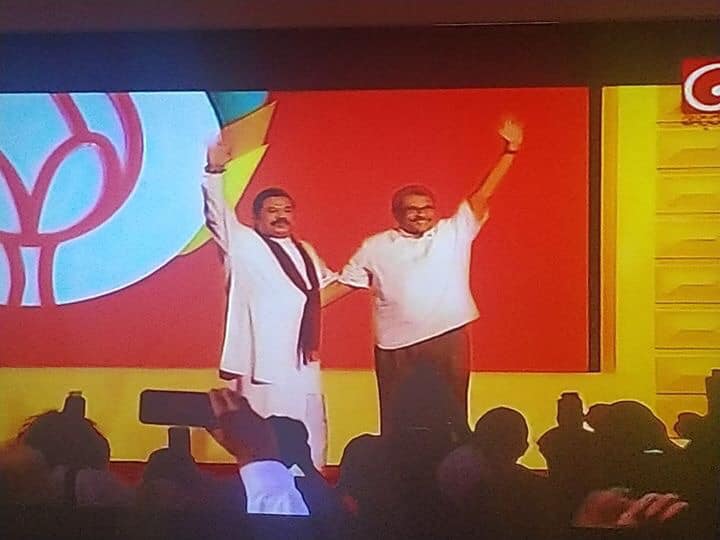
President Rajapakse hands GR to the Nation as Presidential-Candidate of SLPP

August 12th, 2019

It was one of the finest & most refreshing speeches delivered by former President Mahinda Rajapakse now Opposition Leader and had all the power and verbatim of a national leader. He raised the tempo high enough before declaring to the Nation the candidate whom he said the Nation had already elected. Some of the salient points covered in his speech delivered at the Sugathadasa Stadium is noteworthy.

Date: 11 August 2019

Venue: Sugathadasa Stadium

Event: Sri Lanka PoduJana Peramuna National Convention to announce its Presidential Candidate

https://www.facebook.com/AdaDeranaLive/videos/2568173230070582/UzpfSTEyNTQzOTQ5MTQ4MTYyMDozNzAzMDU3MTAzMjgzMjk/?epa=SEARCH_BOX

The President took us back through memory lane from how the SLFP was first formed, the ideological basis on which the SLFP existed and the manner SLFP had weathered political victimization that even included the removal of Mrs. Sirimavo Bandaranaike’s civic rights by UNP for 7 years. To all who lived during this period every word spoken by Mahinda Rajapakse would have brought home emotive sentiments.

He also took us back to the day he stepped down before election results were released and went to his hometown where for months lakhs of people travelled to show the world that they still loved him.

The journey thereafter that began with the formation of the SLPP he credited rightly to Basil Rajapakse. The cheers & applause acknowledged his role.

All that President Rajapakse spoke about what the country now needs showed what the country had lost under the present government.

When President Rajapakse told the Nation that we need to bring back law & order, he reminded all of the law & order lost since January 2015.  

When he spoke of the numerous methods adopted to crush their spirits, and defeat their popularity amongst the public, it brought to mind the string of revengeful politics that was always part of UNP ideology.

When he spoke about the imprisoning Maha Sangha & Armed Forces personnel and victimizing SLFP supporters, the people’s minds were taken back to all the revengeful incidents that happened since January 2015.

When he spoke of the 19th amendment and highlighted how a constitution was amended to prevent 3 brothers from being elected by the People – the reality dawned on how and who was part of this set up.

When he said that inspite of the victimizations, vengeful politics and revengeful acts, that he or his family did not betray the Nation’s sovereignty for their independence, it was nothing other than the truth.

While the UNP 24×7 and their supporters threw mud & humiliated the Rajapakses – President Rajapakse did not utter a word against them.

When President Rajapakse said that this government has attacked all religions, all religious heads and humiliated them – Buddhists, Catholics/Christians, Hindus and Islamic adherents would have all nodded in silent acknowledgement.

When he said that hate-filled revenge politics had lasted long enough & must be put to rest – it was a sentiment we all wanted to hear.

His ideology was never hatred or to take revenge and that is what makes him Mahinda Rajapakse

– වෛරකර මට දිනන්න දෙයක් නෑ

කාලය විසින් අපව නිර්දෝශී කලා.

කාලය විසින්ම අපිව නිර්දේශ කලා.

– මහින්ද රාජපක්ෂ -“

“රටම බලාපොරොත්තු වූ ජනාධිපති අපෙක්ෂකයා ගෝ

President Rajapakse also took many on a guilt trip … he roared…

When Hambantatot Port was put for sale

When Mattala Airport was put for sale after referring to it as a paddy storage

When  the Govt went to Geneva and signed resolutions in UNHRC against our forces

When even betal leaves were taxed

When people had to wait in queues for petrol

When people suffered from natural disasters

When murders were taking place in broad daylight… People remembered the independence that the Rajapakse Government gave

When garbage piled & the stink became unbearable.. People remembered us, he said

When this government began delaying elections .. people remembered us

When bombs went off … all communities remembered us

These victims had no solace – the SLPP is for them and the thunderous applause was enough.

President Rajapakse went on to say that the lifespan of the Government was no almost over.

Time had returned faith in them and had absolved them but he reminded the Nation that what happened after January 2015 had reversed all that they had accomplished since 2005 and that a new government was retaking a destroyed nation, a nation that was not the same as that handed over in January 2015. It brought home a lot of realities to the People.

He reminded all where the destructions have taken place since January 2015

Sri Lanka was now a nation that had given little attention to National Security and he reminded the Nation that without National Security there can be no Nation and safety for its People.

He brought relief to mothers when he said a new government must put an end to mothers guarding school, it was the task of the law enforcements not parents. He mocked at the manner that the present government had said Rs.100,000 would be given for every dead child. He said that national security must return so that all religions can practice their faith without fear.

We don’t need a government who tells civilians to look after national security, he said.

President Rajapakse took people down memory lane covering all that his government had done

  • People didn’t think we could end 30 years of terrorism – but we did
  • The Jaffna people didn’t think they could ever travel by train to the South – but they did
  • The Muslim refugees never thought they would come out of their refugee camps- but they did
  • The People never thought development could happen at such a fast pace – but we did
  • People never thought Colombo could become such a beautiful city – but they saw
  • It was only after elections were held in North that even TNA was free to travel to the North, President Rajapakse thundered!

President Rajapakse next went on to draw in our minds the picture of what the Nation needs and who the Nation needs to rebuild the Nation

  • We need a person who will take ownership of the Nation’s National Security
  • We need a person who will prevent without taking action afterwards
  • We need a person who grew up with discipline because only such a person can bring discipline to the country
  • We need a person who will not bend the law, who has the courage & will to take on the task of rebuilding the Nation
  • We need a person who knows how to protect our national assets both on land & in sea
  • We don’t need a person who has only tons of vision with no action
  • We don’t need anyone who boasts he will do – we now need someone who has shown he can do
  • We need a leader who will not fool the youth with promises like free wifi, chewing gum, bracelets, small cars – the Youth must have a leader they can believe in & look up to
  • We need a leader who will terminate poverty, drugs, mafia
  • We need a leader who both Youth & Old can look up to, a leader who loves the Nation
  • We need a leader who doesn’t just boast – we need a leader who is honest, with courage, who is fond of children & who leads a good marital life   

President Rajapakse said that the Nation has been seeking such a leader since January 2015 and he too was aware of what the Nation was seeking, but he went on to say that his decision didn’t matter because the People had already chosen their to be future leader, that person has already won the hearts of the People, whatever the government has been doing against him has not spoilt their hope in him.

In a very emotive few seconds later, former President Rajapakse declared

‘I am now handing my brother to you – he is no one else but Gotabaya”

He also declared to the Nation that Gotabaya never asked to be made President, he never begged to make his hands strong and he told Gotabaya that he was now selected not to make his hands strong but to strengthen the Nation & to strengthen the hands of the People.

President Rajapakse next declared, that just as his ideology was to put the Nation – first, second & third … Gotabaya must also put the Country & Nation first at all times.

Thus, President Rajapakse handed over his brother Gotabaya as Presidential-candidate of SLPP and the rest of the story will be written by the People of Sri Lanka.

Shenali D Waduge

Gota wins first battle

August 12th, 2019

Editorial Courtesy The Island

The SLPP is cock-a-hoop, having picked former Defence Secretary Gotabaya Rajapaksa as its presidential candidate while the UNP is still struggling to name its. The SLFP/UPFA, which tried to coalesce with the SLPP to field President Maithripala Sirisena at the next presidential election, has been left with egg on its face.

The SLPP, in a state of euphoria, seems to think everything is now copacetic, and the upcoming presidential race is going to be a walk in the park. But, an early start does not necessarily lead to victory in any contest. The outcome of the last presidential race is a case in point. President Mahinda Rajapaksa’s re-election campaign had been on for years by the time that election was announced. Maithripala Sirisena was not even in the picture, at that time, but turned out to be a dark horse within a matter of a few weeks after being nominated.

An early start can also prove disadvantageous if the contestant concerned fails to pace himself/herself properly in the race. For election campaigns tend to slacken with the passage of time. The first challenge, before the SLPP, will be maintaining the momentum of its presidential election campaign for over three months.

Having won his first battle on the political front, Gotabaya, on Sunday, said, inter alia, that the mistakes of the former administration had to be rectified. He said, “We must work towards achieving our long-term objectives whilst undertaking necessary course corrections swiftly and correcting the mistakes that have been made in the past.” This, in our book, is a textbook example of understatement or litotes. What characterised the last government were not just mistakes, but colossal blunders and serious wrongdoings, which were legion.

The fact that the present dispensation has failed to make good on its election promise to throw some of the former rulers behind bars for corruption, abuse of power, etc. does not mean that all the allegations it levelled against them were baseless. They are lucky that their successors, upon savouring power, started making up for lost time and got exposed for the bond scams, among other things, which allowed them to secure a bridgehead and launch a devastating counterattack. The UNP and the SLFP/UPFA have not recovered both politically and electorally.

The former rulers have been able to bounce back not so much because they have become very popular but because the UNF government has ruined things for itself and failed to live up the expectations of the people. Good governance has become just pie in the sky; national security was neglected to the point of government leaders and top bureaucrats ignoring a warning of terror attacks, which happened on 21 April; the government expected funds to pour in from the countries that had thrown their weight behind it at the last presidential election, only to be disappointed; there has been no discernible development and the much-touted election promise to provide one million jobs to the youth has remained unfulfilled. The government has been in overdrive, making state sector appointments, for the last several months, but whether the method will yield the desired results in term of votes in sufficient numbers is in doubt.

The UNP’s strategy worked last time; it succeeded in bringing together the TNA, the JVP, the SLMC and the ACMC and harnessing their collective power to defeat President Rajapaksa. It may not be able to secure the JVP’s support this time around, but the alliance it is planning to cobble together will be a force to reckon with in a nip and tuck. The SLPP will have its work cut out to win over the minority voters.

Gotabaya will be put through the paces in debates, etc. in time to come and he will have to convince the public that he is equal to the task of hoisting the country out of the politico-economic mire it finds itself in. Defeating his foes is not the biggest challenge he will have to overcome; instead, it will be saving himself from the unsavoury elements who were responsible for Mahinda’s downfall. On Sunday, some of them were seen crawling out of the woodwork. It was a disgusting sight!

YAHAPALANA AND THE ECONOMY Part 12

August 12th, 2019

KAMALIKA PIERIS

Revised  14.9.19

Section 1. SERVICES.

SHIPPING

New regulations are to be introduced soon to open up Sri Lanka’s shipping sector to transform the country to a Singapore-style shipping hub, Finance Minister Mangala Samaraweera announced in March 2019. This sector is at present controlled by five local companies.   They control the agencies of shipping lines that account for 74 per cent of the global shipping market.

Budget 2019 will lift Restrictions on the foreign ownership on the shipping and the freight forwarding agencies, under these new regulations,” he said adding that it will enable major international shipping lines and logistics operators to base their operations in Sri Lanka.

According to the present law, a foreign entity cannot own more than 40 per cent of a shipping company in Sri Lanka. By introducing new regulations the country would be able to attract major global shipping companies like Maersk to make an anchor investment in the country. Companies like Amazon could be attracted for warehousing for e-Commerce in the region. Support services such as financial services, legal services and other professional services can flourish in this environment, he said.

The Ceylon Association of Shipping Agents (CASA) and Sri Lanka Logistics and Freight Forwarders Association (SLFFA) vehemently protested against this move, saying it will not bring in any additional investments or benefits to the country. All aspects of the shipping industry except for agency including terminals, warehouse and depot infrastructure, ancillary service infrastructure, etc are already liberalized.

 If this change goes through, all profits of a shipping agency will be repatriated and not retained and reinvested within the country, as done at present by local agents. Also, shipping lines will charge all owners costs to the agency and make it a cost centre, depriving the government of tax revenue.

There are currently 130 shipping agents handling 35000 container vessels and 6000 non container vessels. They employ 12,000 people. These shipping agents will lose their livelihood by the government’s move to liberalize the shipping sector. Foreign investors from countries in the region will set up small agency offices for caller vessels and reduce business available to local small agents.

PETROL (1)

The National Movement for Consumer Rights Protection (NMCRP) complained in July 2019 that the fuel stations across the country were selling substandard 92 octane petrol. This had been proved by a test conducted by a Ceylon Petroleum Corporation (CPC) lab on samples collected from all parts of the country.”We lodged a complaint with the Consumer Affairs Authority (CAA) that the 92 octane petrol was of inferior quality. The CAA tested samples at the CPC lab and the test results show that 92 octane petrol is actually similar to 90 octane petrol. Some time back the CPC stopped selling 90 octane petrol due to its low quality. But it seems that we still buy 90 octane petrol.”

PETROL (2)

The government had incurred a loss of Rs. 11.3 million when Ceylon Petroleum Storage Terminals Ltd ( CPSTL) bought five 13,200-litre oil bowsers from a bidder who had quoted the highest price, the Presidential Commission of Inquiry investigating corruption in the current administration was told. The Commission was also told that four out of the five trucks were being operated in Kandy and  the drivers of those trucks had complained about various issues regarding the performance and facilities.

The tender board had not selected the second lowest bidder, Senok, citing the exhaust system in the vehicle it offered was different. General Manager of Senok said: “In Sri Lanka we usually use Euro 1 and Euro 2 standard. So when these vehicles are brought in, our mechanics make some changes to the exhaust system to improve vehicle emissions. That’s what the tender document had mentioned. However we explained in our tender document that the engine in the vehicle we had quoted adhered to Euro 3 standard. So we didn’t have to make that change to the exhaust system. Senok had been supplying UD Trucks to the CPSTL since 1990 and over 140 such vehicles had been sold to them.

RAJAGIRIYA – ATURUGIRIYA HIGHWAY PROJECT

The Elevated Highway Project from Rajagiriya to Athurugiriya, has hit a snag over its proposed route.  The initial proposal of the RDA was to have an elevated highway over the recently constructed Averihena Lake, which serves as a flood retention area, and surrounding paddy fields. The selected area was a part of the Thalangama wetland which was declared an Environmental Protection Area under the National Environmental Act in 2007.

  However  Central Environment Authority (CEA)objected to the project. CEA said, There is a tank constructed by the Irrigation Department, some paddy fields and a flood retention area. This area is important in terms of hydrology and it has rich ecology. The wetland is also the habitat of a large number of bird species. The entire area is rich in scenic beauty. We fear that the proposed elevated highway may damage this sensitive eco-system.”

 The RDA told us that the elevated highway would not cause much environmental harm since it is constructed over pillars, but it is our opinion that there will be significant damage to the wetland when the construction starts,”  CEA said. We are unable to approve such a proposal. True, it is not a natural eco-system, but over the years, it has gradually acquired the same status,”

RDA thereafter  proposed an alternative route from Pothuarawa. For this, the government  will have to acquire 750 land lots . It requires the resettlement of 1,010 families and the demolishing of about 34 shops, 42 shop houses and 42 self-employed business places. The land acquisition will leave 106 structures partially affected and 634 fully affected.  residents  objected. They asked why the RDA chose a highly residential area for this highway. Many families would lose their properties if the proposed elevated highway goes through Pothuarawa.

We cannot understand the rationale of choosing a highly residential area for the project, shedding the initial proposal which would have caused the least social impact, residents said. RDA’s initial proposal to have the elevated highway over the Thalangama wetland  will not cause much environmental harm as claimed by the CEA.It is a man-made environment with uncultivated paddy fields, a flood retention area and even jogging tracks. The lands belong to the Sri Lanka Land Reclamation and Development Corporation (SLLRDC). No private property will be affected if the RDA goes ahead with that plan. Any development project must be designed to cause minimal impact on the people’ they said.

GARBAGE DISPOSAL (1)

The garbage collection process in Colombo city was abruptly stopped in August 2019, after the CMC was advised not to send garbage to Kerawalapitiya as it had reached the maximum limit of garbage intake per day.  CMC was told to send it to Arawakkalu hereafter.  There was a delay and garbage started piling up on the streets of Colombo. In April 2019, People living in Ukwatte were told to go away as it was unsafe. They complained on television news that they had nowhere to go except to the temple. Garbage was still coming in.   Derana news of 7.8.19 showed piles of garbage in  many places in Colombo, with people  complaining loudly and angrily  about it.

Eventually, after several days, the necessary agreement was signed, payments made and   the garbage went to Aruwakkalu . It was taken by a  private transportation company and  CMC complained that the operation was costing a mint of money.  However, Derana news of 11.8.19 showed the residents of Aruwakkalu strongly  objecting to Colombo garbage coming there.

GARBAGE DISPOSAL (2)

Prior to the inception of the Fairway Karadiyana Waste Management project, the landfill consisted of two disposal sites; A and B. A plot of land in extent of 10 acres was allocated adjacent to Site B, which was being used to dispose of waste. With the project initiation, the old closed landfill, Site A, was re-opened by the Waste Management Authority as a temporary measure, for the project to progress unimpeded. At present, the re-opened site accepts approximately 60%-70% of the 500 tons per day from 8 local authorities that are legally allowed to dispose of waste at Karadiyana.

As a result of an extended delay in the implementation of the  Fairway Karadiyana Waste Processing Project the temporary disposal site continues to grow in size and at a rate that is not sustainable. The slopes of this landfill are becoming dangerously steep, echoing the memory of the catastrophe that took place at Meethotamulla two years ago.

The National Building Research Organization (NBRO) recently issued a report highlighting the precarious situation of the landfill and the danger of a possible collapse if garbage disposal continues at this site at the current rate. The report highlights the current situation, the dangers (steepness of the slopes, geophysical characteristics of the landfill, potential for gas collection and explosion) and the possible consequences and a set of recommendations to the WMA that can lead to full closure of the largest landfill in Colombo district.

The community in the area continues to bear the brunt of the consequences arising from the landfill and the inaction of the government. The ground and surface water pollution continues unabated and will only get worse with the rains. There are dangerous levels of gas build up as more and more garbage is piled on top. Leachate from the landfill continues to flow into the surface water bodies around the landfill, namely Weras Ganga that feeds into the Bolgoda River.

GARBAGE DISPOSAL (3)

In April 2019, the media reported that the Fairway Waste Management Project at  Karadiyana    was at a standstill. The project has been delayed due to various issues  raised by the CEB, followed by the Ministry of Finance, the Ministry of Power & Renewable Energy, and by the Treasury, while the importance and urgency of the issue had been pointed out repeatedly by the concerned authorities.

The developer having spent a total of LKR 1,312 million on the project from site preparation, engineering design, advanced payments and civil works (has completed 90% of the piling work), was forced to stop work and demobilize from the site.  

In April 2019, media reported that Fairway was still waiting for the Ministry of Power & Renewable Energy to act on the cabinet decision requesting the CEB to sign a PPA with Fairway Waste management. The government is yet to sign the PPA even after obtaining cabinet approval. The project remains a standstill, as of now. The developer is still hopeful that good sense will prevail and that it will be able to continue albeit the losses that it has incurred.

If the Fairway Waste to Energy project was allowed to proceed as planned , the facility would have been accepting a limited quantity of waste by July 2019  and the full 500 tons/day by not later than November 2019. The project would have  provided for the safe disposal of all Colombo South waste.

The landfill could have been reclaimed as a public space in a short span of 4 years allowing its use for recreational activities (walking path, biking and hiking etc.), as have been achieved with many closed landfills around the world. The inert byproducts from the facility would have been used as a landfill cover as a primary step.

The project would have addressed two critical issues that the country is facing today ,sustainable waste disposal and electricity generation. The waste processing facility would have provided enough electricity to power approximately 40,000 households (based on World Bank statistics of average energy use in Sri Lanka), by supplying approximately 83,000,000 kWh/year to the grid. The plant would have been considered a base-load facility as it is designed to operate approximately 8000 hours/year. It would have produced power at a rate significantly cheaper than what is considered to be paid for emergency power today.

The Karadiyana waste Processing Project would have been the most advanced Waste processing plant with integrated biological and thermo-physical treatment. It is  already recognized as a landmark project and is cited in international industry publications. The project has met the most stringent environmental, social and Health requirements required by the World Bank to receive USD 6.7 million through its private financing arm, the International Finance Corporation (IFC). It is the only waste project to receive IFC funding.

GARBAGE DISPOSAL (4)

The idea of a landfill for garbage at Arawakkalu in Puttalam was first considered in August 2014. The project involved loading sorted municipal solid waste into sealed containers at a transfer station built in Kelaniya, to be transported by rail and unloaded at an engineering sanitary landfill site  at Ganewadiya.

, the project costing US$ 274 million  was to be funded by Asia Infrastructure Investment Bank (US$ 115 million)  the World Bank (US$ 115 million) and Government of Sri Lanka  (USD  44  million). The Environmental Impact Assessment (EIA) and feasibility reports were ready by December 2014. 

 Yahapalana government rejected the EIA on January 2016.  Yahapalana said that Ganewadiya was within the buffer zone of the Wilpattu National Park   and that the Wildlife Department insisted that Fauna and Flora Protection Ordinance did not permit waste dumps in buffer zones.  Also that the site was frequented by wild animals including elephants. Once garbage comes in, it could aggravate the human–elephant conflict near the fishing village.

Yahapalana selected Seerakkuli instead. The public living in Seerakkuli protested. “Ganewadiya is several kilometres away. We have no objection to that place, but this has now been shifted to Seerakkuli.  We were told that officials from the Wildlife Department protested since it would have disastrous effects on the wildlife. What of us then?”

By August 2018, the Kerawalapitiya garbage site was full and garbage was to go to Seerakkuli ahead of schedule  by road.  More than 600 tons of garbage were to be transported from the Western Province by road daily to Puttalam. They would be transported by rail from mid 2019. 

The public strongly objected. In august 2019, four tipper trucks transporting garbage from Colombo to the Arawakkalu garbage dump were attacked twice by an unidentified group near the 4th km post on the Puttalam – Mannar old road. The tipper drivers complained that iron poles and rocks were used to attack the tippers and the protestors had even tried to drag them out of their seats without success. The four trucks were among a convoy of 29 transporting garbage from Colombo to Arawakkalu and were escorted by army and police. Four suspects arrested in this connection were released on bail by the Puttalam Magistrate’s court.

The protests continued. Stones were thrown at the trucks as they came in.  Puttalam Police were asked to take stern action against the offenders. Instructions have been given to tighten security provided to trucks transporting garbage to Arawakkalu, the police said. The army was also brought in.

In September 2019 the media reported that there were protests in Puttalam town against dumping of garbage from Colombo at Arawakkalu. Protestors came along Serakkuliya lagoon, accompanied by Muslim and Catholic priests, they invaded the construction site and protested. They removed the machinery also attacked the office of the project. The protest was so strong, the laborers ran away. Police were summoned .Television news showed the protest. The police anti riot squad was brought in to quell the protest.

SECTION 2 INDUSTRIES

COIR INDUSTRY

Sri Lanka’s coir industry, once a flourishing business that provided a major income to thousands of people is now in difficulties, the industry said in March 2019. The small, medium and traditional coir and coir-based industrialists in the country  complain that they are now compelled to close down their businesses owing to foreign company invasion in joint ventures with local partners.

Foreign companies engaged in the lucrative coir-based product exports with local partners are enjoying unlimited business freedom granted to them by Sri Lanka government authorities including the line ministries and the Board of Investment (BOI), they alleged. The local companies cannot survive in the stiff competition of foreign firms with modern machinery and resources.

A combination of factors has brought about a steady decline in the business of local entrepreneurs, including non availability of raw material, subsequent surge in input prices, the lack of modern machinery, and failure to mechanize their manufacturing process.Foreign companies in Sri Lanka have moved ahead with pre-crushing machines. All necessary facilities and approvals have been given to them by the North Western Provincial Council authorities.

A stock of over 2000 metric tons of calcium nitrate chemical fertilizer is being imported to the country yearly and 90 per cent of it is used for coco peat washing process. These multinational companies operating in Sri Lanka wash raw coco peat with water first and calcium nitrate with water thereafter  and discharge effluence to the environment causing severe water pollution in the area.

The wastewater produced in the process of removing unwanted elements in the coir substrate manufacturing process should be managed properly to prevent environmental pollution. Some companies are maintaining wastewater treatment plants in their coir factories. However, a Norwegian multinational firm was dumping waste water to some pits near the river contaminating ground water at Deduru Oya area in Kobeigane. All these complaints against such companies have fallen on deaf ears, coir manufacturers complained.

CANNED FISH INDUSTRY

Canned Fish Manufacturing Association of Sri Lanka complained that it  has not received support from  the present government  or the previous government. Mahinda Rajapaksa government had  agreed to purchase their products and sell them through the Lak Sathosa network granting an Rs 20 concession for each can. However neither Lak Sathosa nor the Treasury  has settled the arrears accumulating to Rs. 26 million. This has severely hampered their production ability.

Then in February 2015,   Yahapalana government reduced the import duty levied on canned fish by more than 50 percent. This had a negative impact on locally produced canned fish.the Association urged the government to reinforce the duty on imported canned fish to at least the level that existed before February 2015.

Four companies were engaged in canned fish production in Sri Lanka currently and the country’s capacities were thoroughly under-utilized due to large stocks being imported from countries such as China, Chili and Thailand. The local canned fish industry has purchased over Rs 100 million worth fish from the local fishing community for the past seven months

If the government  supports the local canned fish industry  it could be self-sufficient,  said the Association. With some relief, we could develop the industry and save the country US$ 64 million annually which is spent on the import of canned fish from overseas. The canned fish consumption is approximately 175,000 cans per day in Sri Lanka and we have the capacity to provide 75 percent of the total requirement.

FISHING NET INDUSTRY

Northsea Ltd, a government owned fishing net manufacturer, had taken over the  fishing net project  of Cey-Nor Foundation . CeyNor  had made  fishing nets from material from Toray Industries, Japan. “Toray is well known throughout the industry and Cey-Nor had  asked Northsea to keep using Toray.

Northsea had purchased substantial amounts of   material from J.P. Fernando and Sons, between 2014 and 2017. We were approached, in 2014, because we worked extensively with Toray Industries, Japan. The management that took over after August 2015, following the change of government, started reducing the purchases. “Towards the end the purchase order was at retail levels. Still, we delivered the stocks to Northsea fishnet factories in Jaffna, Weerawila and Lunuwila. However, they stopped working with us from May 2017 and instead of importing Toray products directly Northsea started material importing from India.”

Fishnet suppliers told the Presidential Commission of Inquiry investigating corruption in the current administration that Northsea then systematically got rid of suppliers of high quality material used in fishnets and started importing low quality material from India. The  owner of Delly Enterprises stated that Chairperson of Northsea S.T. Parameswaran threatened him in July 2017 after he had taken part in the bidding process to supply material to Northsea that year. “He told me that he was the brother of a Jaffna politician and that I should not mess with him. And, I didn’t want to continue for obvious reasons.( Island 4.7.19 p 3)

MINERAL SANDS INDUSTRY

Lanka Mineral Sands Ltd (LMSL) will be restructured under a public private partnership with a leading Japanese conglomerate, to take over strategic mineral production, especially ilmenite at the Pulmoddai deposit, reported the media in January 2019. This firm will  manufacture Titanium dioxide from ilmenite, .This deal was a major outcome of President Sirisena’s visit to Japan.

LMSL is not in a position to enter into value added production such as making Titanium dioxide, as it has neither the financial and human resources or the  necessary expertise. The only option is to enter into a joint venture with local or foreign investors to produce value added mineral products.

The LMSL sells its main mineral products such as Ilmenite, Rutile, Zircon, ilmenite, etc through an  international competitive bidding procedure. LMSL currently exports mineral sand to Russia, Japan, US and the UK.  The present production is limited to 90,000 tons of ilmenite, 9,000 tons of Rutile and 5,500 tons of Zircon annually. LMSL has already mined a massive stock of mineral sands over the past 50 years along the beach from Pulmoddai-Kokilai exhausting mineral sands  and therefore the company is not making much money at present, it is currently running at a loss and  salaries are paid jointly with Treasury.

Employees of the company are up in arms against this attempt to divest the mineral resources at Pulmoddai. They  say the  agreement with the Japanese company was through an unsolicited bid.  They said that modification and upgrading of the present plant in Pulmoddai has been completed, and the company is contributing large sums of money to the national coffers but it cannot carry out its functions with maximum productivity due to lack of human resources and other facilities.

They point out that these mineral sands are public assets. They  contain strategic Rare Earth Elements. Minerals and deposits are found along the eastern coastal belt from Mullaitivu to Pulmoddai and from there to Kotuwakambi. This is one of the most treasured natural resources of Sri Lanka.

GARBAGE RECYCLING INDUSTRY

In July 2019  it was discovered that  a consignment of 102 container loads of garbage consisting of ‘clinical waste’ had been imported from the United Kingdom.   Some  loads had had been dumped  on high ground at Katunayake and   the rest was held at the Colombo Port. They had remained uncleared for more than 15 months.

 On examination, Sri Lanka customs  found that  the waste had been imported as used mattresses, but contained bio and clinical waste, in contravention of international laws on the transport of waste material. Extremely hazardous” materials were  mixed in with mattresses, plastics and clinical waste. There was a gas emanating which could be harmful   and the stench is unbearable.” This is a well-organized racket that has been going on since 2017,” said Customs.  It is violating environment laws including  the international treaty which prevents import of  hazardous waste,

Minister of Finance, Mangala Samaraweera told Parliament that these   imports had begun in Sept 2017. From September 2017 until March 2018, 241 waste containers had been imported to Sri Lanka. The waste included used metal consignments, used mattresses, used carpets, bird feathers, worms and glass scrap.   “Of these containers 111  were detained at Colombo Port. 130 containers were released by Hayley’s Free Zone Limited. Hayleys has  re-exported 17 of them in 2017 and 2018 to India and Dubai.

Hayleys Free Zone Ltd ,an integrated logistics and entrepot trading company operating within the Katunayake Export Processing Zone, was reported  as the importer of the  consignment of clinical waste.  The company  firmly denied this.  Hayleys said this consignment was sent from the UK by a company named Vangaard Ltd  to be received here by  Ceylon Metals  Co. Hayleys said that Muthurama Shri Sashikumaran who was the head of Ceylon Metals had  got into financial difficulties,  his business operation got stalled and the consignment had been left un-claimed for the past seven months. Sasikumaran denied that the containers he had imported contained bio waste.

Sri Lankan authorities said they were going to send the   consignment back to the UK. The British government  looked into the matter, and announced  that it was willing to take back the  containers.  The public were told that Indonesia and the Philippines had also returned shipments of foreign rubbish to their ports of origin,. Indonesia announced it was sending more than 210 tonnes of garbage back to Australia and Canada has agreed to accept 69 containers of rubbish it had shipped to the Philippines between 2013 and 2014. 

Gomi Senadhira, former Trade Commissioner, had previously warned the government of dire consequences of importing of garbage of all sorts in accordance with the Sri Lanka-Singapore Free Trade Agreement (SL-SFTA)

The Centre for Environmental Justice (CEJ)  filed a writ of Certiorari and Mandamus in the Court of Appeal over the two consignments.. The petitioners said that some importers have brought in consignments of waste material including clinical waste, used cushions and mattresses, plant parts, plastic waste and other uncategorized and hazardous waste into country from United Kingdom in the guise of importing permitted consignments with the intention of disposing such waste within the country and such action may cause severe damage to the environment and serious threats to public health.

The petitioners  pointed out that if any such consignments containing chemical waste are permitted to be buried here or sent to open dumps, the underground water table and the surrounding environment will be severely affected. They have said that such waste imports have been done without adhering to the terms of the BASEL Convention on the Control of Trans-boundary Movements of Hazardous Wastes and Their Disposal for which Sri Lanka is a signatory and had ratified the said convention in 1992.

Petitioners seek a Writ of Certiorari quashing the validity of all documents/permits granted by any authority to import waste in violation of the provisions of the NEA.  Also a Writ of Mandamus, directing the Customs Department to act under and in terms of the customs Ordinance No. 17 of 1869 as amended in taking measures to punish the offenders. They also seek the court to direct the respondents to take steps to re-export the waste containers back to United Kingdom, the country of origin. 

Foreign garbage is reported to have been brought here for the last several years thanks to a an amendment passed in 2013 to the Finance Act. This amendment had removed certain strict restrictions which enabled the Customs to monitor  such imports. This was done to facilitate imports for BOI ventures.

Under Gazette notification No. 1818-30 of 2013  any new enterprise where at least 65 per cent of its total investment has been from foreign sources of which the total turnover is from export of goods and services were exempted from certain provisions of the Customs Ordinance, Exchange Control Act and the Imports and Exports (control) Act.  This meant that Sri Lanka  Customs has no right to inquire into these illegal imports or at least to check those containers. . This is in turn meant that no investigation can be carried out into illegal imports of this nature.”

BOI Chairman  disagreed. This extraordinary gazette notification facilitated trade activities such as entrepot trade, offshore business, front-end services, operations of the headquarters of leading buyers and logistic services. Certain goods have been limited or prohibited from being imported into the country as per the Custom’s Ordinance. If someone has violated these regulations, legal action can be taken against them.

He  said that the Regulations to this Act provides for the operational guidelines and the BOI Agreement too stipulates the conditions the Hub Operator has to fulfill. The Act enables electronic monitoring of all CUSDECS by Sri Lanka Customs (SLC) and with the adoption of synchronized procedures by the SLC and the BOI and monitoring of the cargo movement using GPS there is no room to smuggle anything, leave alone waste material,” he said. The government did not see any valid reason to cancel the  said extraordinary gazette notification. .the government did not see any valid reason to cancel said extraordinary gazette notification.”  ( Continued)

YAHAPALANA AND THE ECONOMY Part 13

August 12th, 2019

KAMALIKA PIERIS

SECTION 3 AGRICULTURE

FERTILIZER (1)

Auditor General’s Department has found that billions of rupees were erroneously credited to the bank accounts of persons who were not farmers under Sri Lanka’s cash transfer scheme for fertiliser and paid out towards untilled paddy lands instead of cultivated ones,  reported Namini Wijedasa in  May 2019.

The subsidy was introduced in 2006 under the Mahinda Chinthana to provide a hundredweight of paddy fertiliser at Rs 350 with the Treasury absorbing the difference. The objective was to raise production, to encourage more paddy cultivation by cutting input cost and to improve the living standards of the farmer community.

In 2016, the subsidy scheme was changed to a cash transfer system, ostensibly to make it more efficient. Farmers were instructed to provide bank account numbers into which money would be credited for fertiliser purchases. The paddy land registers of divisional Agrarian Services Centres were not updated, making it impossible to obtain the correct number of beneficiaries. Nevertheless, estimates were prepared on outdated statistics.

A computerised system was used for the disbursement of cash assistance before the 2017/2018 Maha season. Even under this program, Rs 4.8mn was overpaid to 985 farmers from the Alugolla Agrarian Services Centre which was sample tested. There are deficiencies even after the Rs 375mn facelift.

A circular pertaining to the 2017 Yala set the maximum payment receivable by a farmer for a single season at Rs 25,000. But sample tests found many cases of overpayment. That money could not be recovered.

The Auditor-General had carried out sample surveys in several districts. It found multiple instances of money credited to the accounts of non-farming beneficiaries during the 2016 Yala and 2017 Maha season. In the Bulathsinhala division, for instance, Rs 2.2mn was credited to 441 persons who were not the farmers. In Kalutara, Rs 6mn was paid to 1,170 ineligible persons. In Anuradhapura, 1,684 non-farmers received Rs 18mn. Similar instances were found in Galle and Badulla. During a sample test in 16 districts, the Auditor General also identified disbursements towards uncultivated paddy lands instead of cultivated ones. The amount thus squandered was Rs 1.1bn.

Further, financial assistance was not granted on time, severely inconveniencing farmers who must apply fertiliser at a specific time. There was a procurement fiasco that led to severe delays in fertiliser supply in 2017 and 2018. A total of Rs 5.4bn was paid after the required period of the 2016 Yala and Maha and the 2017 Yala seasons.

FERTILIZER (2)

It was initially planned to import 18,000 metric tonnes of urea for the 2017 Yala season under the accepted procurement procedure. The procurement method followed over three decades was unexpectedly shelved in favor of a new format that precluded equal participation by all suppliers.

instead of calling for bids from prequalified registered suppliers,  the Chairmen of the two State-owned fertiliser companies—Lanka Fertiliser Ltd and Colombo Commercial Fertiliser Company Ltd— decided to import fertiliser through open international bidding on ‘documents against acceptance’ (DA) terms. No reasonable explanation was given for the deviation.

When bids were called in November 2017, only Jat Holdings qualified for the contract to import 72,000 metric tonnes of prilled urea at US$ 327.40 per metric tonne. But the lab reports presented by Jat Holdings proved forged, resulting in the contract being canceled and the crisis emerged as time was running out. The company’s bid security of US$ 240,000 (Rs 42mn) has still not been confiscated.

.On December 11, 2017, the Agriculture Minister, presented a Cabinet memorandum to deviate from procurement procedure and order 36,000 metric tonnes of prilled urea within seven days and without an appeals procedure; and to grant Treasury backing to the State-owned fertiliser companies to open Letters of Credit for the import. It also proposed that the Treasury reimburses the two enterprises in the case of a deficit caused by price fluctuations.

Of the two types of urea, the import price of prilled urea is higher than that for granular urea.  World market reports show that the free on board (FOB) price of granular urea ranged between US$ 206 and 240 a metric tonne at the time. As of December 14, 2017, the maximum price was US$ 240. Freight and other expenses amounted to US$30 a metric tonne. So, at the most, it should have cost the Government US$ 270 a metric tonne of granular urea. It remains questionable how Sri Lanka imported these stocks at US$ 316.20 a metric tonne, the Auditor General states, calling it an overpayment”. The difference in price was US$ 46.20. And the 54,000 metric tonnes were bought. It was more than the requirement. This amounts to a further uneconomical expenditure” of US$ 17,074,800 at US$ 316.20.

Cabinet approved the proposal and Agri Commodities & Finance FZE got the contract to supply the specified quantity of fertiliser before January 15, 2018, at US$ 316.20 a metric tonne. On the same day, however, a special Cabinet procurement committee annulled the decision.

On December 12, another Cabinet memorandum was submitted. It said that President Sirisena had ordered Ceylon Fertiliser to find a supplier. The paper sought to import 72,000 metric tonnes of granular urea, not the required prilled urea, outside accepted procurement procedure through Agri Commodities and Finance FZE from a port in the Middle East before December 28, 2017, at US$ 316.20 a metric tonne.

Cabinet approved the proposal subject to Treasury concurrence. This was never obtained, a query by the Auditor General revealed. And while the Cabinet memorandum had said Ceylon Fertiliser was told to find a suitable supplier, there was no evidence of such instructions either.

It is not known on what basis Agri Commodities was selected. And no reason was given for why 76,000 metric tonnes of low-priced granular urea was ordered at US$ 316.20 despite 36,000 metric tonnes of prilled urea having been earlier ordered for an identical price.

The delay which started during the 2017 Yala season dragged on till the 2017/2018 Maha season. Lapses in decision-making and procurement caused colossal” expenditure to the Government, the Auditor General states. In the end, fertiliser supply was declared an emergency and high-priced stocks were imported outside procurement procedure in quantities exceeding the requirement.

 To avert a full-blown crisis, Cabinet authorized an emergency purchase of urea at a price much higher than world market rates. The loss to the Government — from paying US$ 46.20 more than the prevailing price for a metric tonne — was Rs 516mn.

The fertiliser requirement for the rest of the months of the Maha Season 2017/2018 was stated in writing to be 36,000 metric tonnes. But 72,000 metric tonnes were ordered. This, too, did not come within the mandated time period. Only 40,500 metric tonnes were received on January 08, 2018 while 32,000 metric tonnes came on January 15. The delay was around 10 days but seemed longer as the cultivation season had already begun, concluded Namini.

PEPPER

The Auditor General’s Department observed in August 2019 that the import of pepper from Vietnam, Indonesia and India under special tax concessions and at lower prices during the harvesting periods has depressed the price of pepper in the local market, while export demand has declined by 77 percent. Tax concessions had been granted for pepper imports without taking into consideration the harvest of pepper in Sri Lanka. AG recommended suspending the import of low-quality pepper to the country.

A surplus of pepper was observed in the local market due to increased imports and the price dropped. The price of black pepper at the local market was between Rs 1,200-1,400 per kilogram in 2015, the purchase price of black pepper remained between Rs 600-800 per kilogram in 2019.

Even though Sri Lanka has exported pepper to Vietnam in the past, pepper had been imported to Sri Lanka from Vietnam since 2016. The total volume of pepper imported in 2018 was 3.39 million kilograms. Eighty percent of that volume had been imported from Vietnam, Indonesia, and India. Pepper had been imported during the period from November to December and April to July, which are the harvesting seasons of pepper in Sri Lanka

Pepper imports have marked a significant increase whilst the pepper exports to the Western and Middle East countries, which pay higher prices, had marked a decline. The demand from 18 Western and Middle East countries for Sri Lankan pepper had marked a decline by 77 percent in 2016 compared to 2015 and again by another 40 percent in 2017 compared to 2016. It is necessary to win these markets again.

Hayleys Free Zone Pvt Ltd had imported pepper in bulk from Vietnam, using various tax concessions. It had thereafter, in 2018, re-exported 2.6 million kilograms of pepper.  Nearly 85 percent of the total pepper exports had been to India at lower prices. As a result, the local market for quality pepper dipped to a low of Rs 400- 450 a kg during the past three years.

There were mass street protests by pepper growers, o with the participation of UPFA parliamentarians at Pallebadda on Ratnapura – Uda Walawe Main road in 2017, and in many other places. We have 32291 hectares (78,000 acres) of cultivated pepper smallholdings, and 38 percent of them are in Matale and Kandy Districts. Sizes of smallholdings vary from 3.5 hectares to very small plots more than 100,000 families in the country benefiting from pepper cultivation, and they are affected by inferior pepper imports for reshipment, the protesters said.

Publicity has been given to one particular piece of export. 2800 tonnes of inferior quality black pepper imported from Vietnam has been transshipped to India, under the “made in Sri Lanka ‘ label in 2018,  by a  rogue, said one complainant.  Robberies of this nature are not possible without the blessings of politicians and big wigs in the state machinery. A single ‘parasite racketeer’ has earned Rs 1400 million by exploiting the tax benefit of 0%, for the first 2500 tonnes given to Sri Lanka, to benefit our pepper farmers, announced another. He is supposed to be a brother of a pole-vaulter minister, and it is well known that this Minister is hailed as a friend of the country, even by wild animals of Wilpattu.

TEA INDUSTRY

Tea factory owners are facing bankruptcy in the wake of low yields and poor quality products with some of them forced to close shop as well, said Sri Lanka   Tea Factory Owners Association   They were compelled to pay high interest. About 23 of around 531 proprietary owned factories had closed down due to bankruptcy and about 50 on the verge of collapse while about 12 have been put up for sale by the banks.

Factories were ridden with issues particularly due to the lack of crop as a result of which about 95 percent of them were running under capacity. Factory owners had also raised the issue that a minimum amount of Ceylon Tea is blended with teas imported from Darjeeling and Assam and CTC’s main grades for re-export in a bid to sustain the auction prices.

The factory owners wanted to be brought under the same category as exporters with regard to the Economic Service Charge (ESC). He pointed out that as manufacturers they were compelled to pay 0.50 percent whereas the exporters pay a reduced 0.25 ESC. The ESC payment was to be made for the total turnover but factory owners had to share 68 percent of this turnover with the smallholder and retain the balance. The Treasury should then ideally charge the factory owners only for their share of the earnings.

RUBBER INDUSTRY

Rubber factories owned by Sri Lankan plantation companies, were faced with the threat of bankruptcy as companies receiving BOI concessions had increased the import of liquid rubber, said President of Lanka Plantation and Mercantile Services Union, in April 2019. He said so while taking part in a demonstration organised by the employees of a rubber factory on Mirishena rubber estate, owned by Horana Plantation Company, protesting the decision to close down the factory. A large number of employees had been terminated. The factory usually produced about 2,500 kilos of crepe rubber daily. A large number of other factories would also be closed down in the future.

FALL ARMY WORM (‘SENA”)

In January 2019 it was reported the Fall Army Worm has been reported in all major maize growing areas in Sri Lanka and it was also affecting sugarcane cultivation and there was the fear that it may affect other crops, including rice. 

The Fall Armyworm (Sena) is still spreading across farming areas despite the government’s claim that the severity of threat was abating, All Ceylon Peasants Federation, National Organiser, told the media on February 2019.

The government insists that it has destroyed the pest. I have asked the Department of Agriculture officers to visit Ampara and find out whether the worm has not spread to new areas here. Nothing concrete has been done to eradicate it. The corn prices also dropped and the farmers will have to commit suicide as they did in the early 1990s.” He asked the government to increase the compensation paid to farmers affected by Rs. 75,000 per acre.

Distribution of compensation for farmers affected by the Fall Armyworm (FAW or Sena caterpillar) infestation commenced ceremonially in March  2019, beginning with the Ampara district.  Yahapalana announced that approximately 12,000 hectares of paddy as well as other crops were destroyed due to the infestation of the Sena caterpillar and the affected farmers will receive compensation of Rs. 40,000 per acre. The government has already allocated Rs. 250 million for this purpose and the compensation will be distributed by the Agricultural Insurance Board, 

One farmer said that it is obvious that this attack of the Fall Armyworm is a   biological attack and evidence has been received for farmers to prove it. There are many who are responsible for this. Some companies import seeds for a very low price. The Customs had not done its duty.

COWS FROM AUSTRALIA (1)

Ministry of Rural Economic Development had imported high- yielding pregnant milch cows from Wellard Rural Exports Pvt. Ltd., Australia. They had arrived in November 2017. These cows were imported as part of an initiative by the Ministry of Rural Economic Development. The Ministry had ignored the warnings given by the Department of Animal Production and Health that cows from Australia carried highly contagious and deadly diseases.

3,030 of these cows were distributed to 46  middle-scale dairy farmers around the country. Investors paid Rs. 200,000 per cow and the government contributed Rs. 265,000.  The dairy farmers were told that these cows would produce 20 liters of milk a day on average. They were advised to get rid of the Sri Lankan animals they already had.

the Presidential Commission of Inquiry into the corruption of the Yahapalana government was told that these cows carried the deadly Bovine Viral Diarrhoea (BVD) virus infection, which was new to Sri Lanka.  The cows also had fasciola hepatica (common liver fluke) a disease that had not been detected in Sri Lanka since 1973. Fasciola hepatica could affect humans as well.

These cows were in bad shape when they landed here, the dairy farmers said. A number of cows died, while a number of calves aborted or were stillborn. Dairy farmers had complained about the matter to the authorities.

They pointed out that BVD was known as the ‘dairy industry’s silent killer’ since cows carry BVD throughout their lives and infect others. In foreign countries, such animals are immediately killed. We also suggested that we follow similar procedures, but the government ignored the suggestion. The calves live in many of our farms. This is a threat to our dairy industry.

The government also failed to send the diseased cows back to the supplier. The Ministry was not prepared to ask Wellard to pay compensation nor was it prepared to obtain compensation from the Cabinet, complained to the farmers.

Many farmers testified that they were plagued by financial difficulties due to loans taken by them to take part in this government-subsidized scheme because the cows produce less milk than what was promised.

Kingsley Walter Senanayake, who had thrice won the award for the best milk farmer of Matale, yesterday, told the Presidential Commission of Inquiry  probing corruption in the current administration that he was plagued by financial difficulties due to loans taken by him to take part in this government-subsidized scheme to introduce high-yielding imported pregnant cows, in 2017. I took part in the project because of the assurances given by the Ministry but now I am in debt. I had never been in debt before.”

. “We were assured by the Ministry of Rural Economy, that the Ministry would ensure that the farmers received cattle feed at a concessionary rate of Rs. 40 a kilo and that steps would be taken to procure the milk produced at a higher price. However, we were never given subsidized cattle feed and I soon discovered that I was making a loss.” Senanayake said that he had bought 16 cows and six of them had died. 

Senanayake said that it cost him about Rs 30 to 35 to produce a liter of milk from local milch cows and it fetched about Rs. 65. “To maintain a local milch cow, on average, I spend about Rs. 350 a day and I can earn about Rs. 603 daily. For an imported cow given to me by the Ministry, I have to spend about R. 1,100 per day but I can make only about Rs. 1,088. This is when they produce the most amount of milk.” The imported milch cows consumed about 10 kilos of cattle feed a day and that alone costs over Rs. 600.

He had drawn a loan of Rs. 10 million from the Commercial Bank to finance the project and since the project had been a complete failure he had not been able to pay back the loan for eight months. The bank keeps telling me that it would sell the land I mortgaged as it wants to recover the loan.

Wellard Rural Exports Pvt. Ltd. Australia and its local agent Foresight had provided the plan for constructing cattle sheds to all farmers who took part in the project regardless of the climate and geography. “Wellard assured that they would provide medical facilities for two years. But these cows died between 8 and18 months and I feel that if they had responded on time when I complained, some of the cows could have been saved.

COWS FROM AUSTRALIA (2)

There have been five investigations into the matter.  First, the Ministry appointed a committee to evaluate the phase I of this cow scheme. That was not to inquire into the disease issue but to move on to phase II of the project. The committee met in January, February, and March and prepared the report. The team only visited six farms, out of 66, before preparing their report. On receiving the reports, the government then paid an advance to import another batch of 15,000 cows.

Questioned by the Presidential Commission of Inquiry the chairman said did not possess any minutes of the meetings or a list of farms the committee had visited. The committee had visited six farms. He could remember the names of two owners. , but I can’t remember the names of the owners of other farms I visited’. He also said that he wasn’t sure how many cows he had observed.

This Committee told the Presidential Commission of Inquiry that they had found the cows to be weak, but they had not taken into consideration whether the animals suffered from serious diseases. When asked by the Commission about the possibility that the cows were weak because they were suffering from the disease the chairman said, “I don’t know. I don’t know about diseases. Checking diseases is not my specialty.”

The main problem according to the investigating committee, was the feed. “The main issue was food. Farmers thought they could give feed that they give to local cows. But these imported cows weigh about 400 kilos and need about 50 kilos of feed. Most farmers were not educated on the need to grow grass or to stock feed. We could see that the cows were not getting enough feed by looking at their bodies.

 The second issue with the cows,  said the committee,  was that farmers hadn’t done enough to place the cows in a climate similar to where they came from. He added that the sheds built for cows were not suitable.  However, they had been built according to a design provided by Foresight, Sri Lankan agent for Wellard.

The second investigation was by the government Veterinarians. They conducted their own inquiry and they too gave evidence before the Presidential committee. They, however, knew about disease and informed the Committee  “Our officers kept tabs on those animals and they found several cows with  BVD when they commenced investigations. Soon after they found live eggs of fasciola hepatica in cow dung”.

The Vet dept of the Ministry, made inquiries and  it then emerged that the Chief Veterinarian Officer of Australia  had informed  his Director of Animal Production and Health  that the animals sent to Sri Lanka, were from a farm that had been free from BVD for one year, but on November 22, 2017, a lab report showed that 21 cows had been infected with BVD. They delayed sending the report to the Sri Lankan officials, Chief Animal Quarantine Officer, Sri Lanka got this report only on January 10, 2018, and Director,- Livestock Planning and Economics saw this only two weeks later.

The Vets said that it was clear that Wellard had been aware of the lab report before shipping the cows to Sri Lanka because they had removed the cows diagnosed with BVD from the shipment. However, the cows which had been with them were sent. “It was the responsibility of Wellard to send Sri Lanka healthy cows.  The Ministry could have taken action. “Unfortunately nothing happened.”

Further according to the relevant quarantine  Act,  every animal imported to Sri Lanka shall be subject to quarantine for a minimum period of thirty days. While usually they were held in one designated location, in this case, the cows were sent to various farms across the country, before the end of the quarantine period. This kind of thing has never happened before”.

The third investigation came from Australia. A team of auditors from Export Finance Australia arrived in Sri Lanka in July 2019 to conduct an independent assessment at the farms that took in milch cows.  They selected 15 farms out of 67. The local dairy farmers said the Australian team had visited some farms and attempted to find fault with farming practices there.

Fourthly, the Presidential Commission of Inquiry investigating corruption in the current administration, announced in July 2019  that they will commence an inspection tour of farms which have got 3,030 substandard imported Australian cows from the government. They will also inquire into claims that the cows are suffering from Bovine Viral Diarrhoea (BVD), hitherto not found in Sri Lanka.

Lastly, Minister of Public Reform and Public Distribution Dr. Harsha de Silva dismissed allegations that the government had distributed 3,030 substandard imported Australian cows among 46 investors and dairy farmers in 2017. The Minister said, in July 2019, that he had visited several farms on his way to Sri Pada. He said he could not recall the names of the farms he visited, but on one farm, a farmer got nearly 40 liters of milk each per day from the cows imported from Australia”. But on some farms, the cows were in pretty bad shape. My conclusion is that farms that were able to maintain the cows properly, got bigger yields than those which were not properly maintained, he said.  ( CONCLUDED)

ලංකා වෙබ් අඩවිය පරිශීලනය කරනා සියලුම ජාති හිතෛසින් වෙත අයචනාවක්!

August 12th, 2019

පාලිත ආරියරත්න

යහපාලනය රජය කාලය තුල  රටට මහා විපත් ගෙනදුන්,ගෙනදීමට, නියමිත අහිතවත් සිද්ධි සමුදාය පක්ෂ/විපක්ෂ /එන්ජිඕ / අන්‍යාගමික කරණය/ විදේශ කුමන්ත්‍රණ පිලිබඳ දැනගැනීමට විශේෂයෙන් (ආරක්ෂාව, බුදුදහම, ජාතියට එරිහි බලවේග ගැන ) කැමති විශාල පිරිසක් එම තොරතුරු විමසමින් සිටියි. උගත් බුද්ධිමත් ජනතාවකගේ දැනුම අඩුකම නිසා සට කපට දේශපාලකයන් උපන් බිමෙම අපව අනාත කරමින් සිටි. එබැවින් .

ලංකා වෙබ් අඩවිය පරිශීලනය කරනා සියලුම ජාති හිතෛසින් ඉල්ලා සිටින්නේ රටට එරිහි සියලුම කාරනා පහලින් ඇති කොමෙන්ට් තිරයේ කාරුණිකව සඳහන් කරන ලෙසිනි. නැතහොත්,

( කැමති මාතෘකාව ඔස්සේද ලියා එළිදක්වන්න )

ස්තුතියි

පාලිත ආරියරත්න  

ජනාධිපති ප‍්‍රතිපත්ති ප‍්‍රකාශන වලංගු ඒවාද? – විශ‍්‍රාමික විගණකාධිපති සරත් සී. මායාදුන්නේ

August 12th, 2019

උපුටා ගැන්ම දිවයින

පසුගිය ජනාධිපතිවරණ කිහිපයේදී ජනගත කළ විවිධ චින්තන හා ප‍්‍රකාශනවල මෙන් මෙවරද ඉදිරිපත් කෙරෙන ජනාධිපති ප‍්‍රතිපත්ති ප‍්‍රකාශනවල අඩංගු කරන බව පෙනෙන කරණු අනුව පැහැදිලිව පේන්නේ ජනාධිපති තනතුරට පත්වුණු, පත්වීමට පෙරුම්පුරන හා ඔවුන්ට ආවඩන බොහෝ දෙනාට ජනාධිපති තනතුරට අයිති හා අයිති නැති කටයුත්ත මොකක්ද කියා නොතේරෙන බවයි. නැතහොත් හිතාමතාම ජනතාව මුළා කරන බවයි. ඒ හැර අප රටේ මේ දක්වා ජනාධිපති තනතුරට පත් වූ බොහෝදෙනා කළ කියූ, එසේම අදත් කරන කියන දේවලින් පේන්නෙත් එම තනතුරට අයිති හා අයිති නැති කටයුත්ත මොකක්ද කියා කිසිම අවබෝධයක් නැති විත්තියයි. ජනාධිපති ප‍්‍රතිපත්ති ප‍්‍රකාශනවල අඩංගු කෙරෙන බොහොමයක් කරුණු සැබැවින්ම තිබිය යුත්තේ පාර්ලිමේන්තු මහ මැතිවරණයක ප‍්‍රතිපත්ති ප‍්‍රකාශනවලයි. විශේෂයෙන්ම පාර්ලිමේන්තුවට අයිති කාර්යයන්, ජනාධිපති තනතුරට අයිති කාර්යයන් ලෙස සලකා ජනාධිපති ප‍්‍රතිපත්ති ප‍්‍රකාශනවල අඩංගු කළ හා අඩංගු කිරීම් ගැන බුද්ධිමත් පාඨකයා විමසිලිමත් වියයුතු වෙනවා.

 අපේ ආණ්ඩුක‍්‍රම ව්‍යවස්ථාව අනුව රටේ රාජ්‍ය ප‍්‍රතිපත්ති සම්මත කිරීම හෙවත් ව්‍යවස්ථාදායක කටයුත්ත ඉටුකරන්නේ හා කළ යුත්තේ පාර්ලිමේන්තුව විසිනුයි. පාර්ලිමේන්තු මහ මැතිවරණයක එක් ප‍්‍රධාන අරමුණක් වන්නේ රටේ රාජ්‍ය ප‍්‍රතිපත්තිය ගැන එක් එක් දේශපාලන පක්ෂ හා කණ්ඩායම් ජනතා අනුමැතිය ඉල්ලන යෝජනාපත‍්‍ර ගැන ඡුන්දය මගින් ජනතා අනුමැතිය ප‍්‍රකාශ කිරීමට අවස්ථාව සැලසීමයි. පාර්ලිමේන්තුව පනත් ලෙස සම්මත කර කි‍්‍රයාත්මක කළ යුතුවන්නේ එලෙස මහ මැතිවරණයකදී ජනතා අනුමැතිය ලබන ප‍්‍රතිපත්ති මාලාවයි. රාජ්‍යය සඳහා භාවිතා කිරීමට යෝජිත ආණ්ඩුක‍්‍රම ව්‍යවස්ථා සංශෝධන, ජාත්‍යන්තර සම්බන්ධතා කරුණු, ජාතික ආරක්ෂාවට හා සංහිඳියාවට අදාළ කරුණු, ආර්ථික සංවර්ධනයට, විරැකියාවට, උද්ධමනයට, විදේශ සංචිතවලට මෙන්ම අධ්‍යාපනයට, සෞඛ්‍යයට ආදී සියලූ ජාතික ප‍්‍රතිපත්තිවලට අදාළ කරුණු ගැන ජනතා අනුමැතිය ප‍්‍රකාශවන්නේ පාර්ලිමේන්තු මහ මැතිවරණයකදීයි. පොදු රාජ්‍ය මණ්ඩල ආකෘතිය යටතේ පාර්ලිමේන්තුවේ බහුතර ජනතා අනුමැතිය නියෝජනය කරන කණ්ඩායමෙන් සමන්විත අමාත්‍ය මණ්ඩලය පාර්ලිමේන්තු අනුමැතිය සඳහා ඉදිරිපත් කරන්නේ මහ මැතිවරණයකදී ජනතා අනුමැතිය ලබන එම රාජ්‍ය ප‍්‍රතිපත්ති මාලාවයි. 1978 ආණ්ඩුක‍්‍රම ව්‍යවස්ථාවෙන් විධායක ජනාධිපති ක‍්‍රමය හඳුන්වා දුන්නත් රාජ්‍ය ප‍්‍රතිපත්ති සම්මත කිරීම හෙවත් ව්‍යවස්ථාදායක කටයුත්ත ජනාධිපතිවරයාට නොව පාර්ලිමේන්තුවට එලෙසින්ම භාර දී තියෙනවා. ඒ බව 4(අ) ව්‍යවස්ථාවේ ජනතාවගේ ව්‍යවස්ථාදායක බලය ජනතාව විසින් තෝරා පත්කර ගනු ලබන මන්තී‍්‍රවරයන්ගෙන් සමන්විත පාර්ලිමේන්තුව විසින්ද ජනමත විචාරණයකදී ජනතාව විසින්ද කි‍්‍රයාත්මක කළ යුත්තේය.’ යනුවෙන් දක්වා තියෙනවා. ව්‍යවස්ථාදායක බලය යන්නෙන් අදහස් කරන්නේ රට කරගෙන යාමට අවශ්‍ය ප‍්‍රතිපත්ති සමුදාය පනත් ලෙස සම්මත කර රටේ නීතිය බවට පත් කිරීමට ජනතාව විසින් පාර්ලිමේන්තුවට පවරන ජනතාවගේ බල වරමයි. ඒ අනුව රටේ රාජ්‍ය ප‍්‍රතිපත්තිය පනත් ලෙස සම්මත කරනු ලබන්නේ හා කළ යුතුවන්නේ පාර්ලිමේන්තුව විසින් මිස ජනාධිපතිවරයා විසින් නොවේ.

 4(ආ) ව්‍යවස්ථාව අනුව දැක්වෙන ‘රටේ ආරක්ෂාව ඇතුළුව ජනතාවගේ විධායක බලය ජනතාව විසින් තෝරා පත් කර ගනු ලබන ජනරජයේ ජනාධිපතිවරයා විසින් ක‍්‍රියාත්මක කළ යුත්තේය.’ යන්න ජනාධිපතිවරයාට අපගේ ආණ්ඩුක‍්‍රම ව්‍යවස්ථාව අනුව පැවරී ඇති ප‍්‍රධාන කාර්යභාරයයි. එහිදී ජනතාවගේ විධායක බලය යන්නෙන් කියැවෙනුයේ රාජ්‍ය ප‍්‍රතිපත්තිය තීරණය කිරීමේ බලය නොව, පාර්ලිමේන්තුව අනුමත කරන නීතියට යටත්ව රට කරවීම හෙවත් ආණ්ඩුකරණයයි. එහි සඳහන් නීතිය වන්නේ ජනාධිපති ප‍්‍රතිපත්ති ප‍්‍රකාශන නොව, පාර්ලිමේන්තුව විසින් නීතිය ලෙස සම්මත කරන රාජ්‍ය ප‍්‍රතිපත්ති මාලාවයි. ජනාධිපති ප‍්‍රතිපත්ති ප‍්‍රකාශනවල අඩංගු කළයුතු වන්නේ ජනාධිපතිිවරයා තම කටයුතු ඉතාමත් උචිත ලෙස ඉටු කරන ආකාරය මිස තමන් පාර්ලිමේන්තුවේ කටයුතු ආක‍්‍රමණය කරන ආකාරය නොවේ.


 ඉහත කී විධිවිධානයේ ‘රටේ ආරක්ෂාව ඇතුළුව ජනතාවගේ විධායක බලය…’ යන්නද අප නිවැරදිව තේරුම් ගතයුතු වෙනවා. එය ‘රටේ ආරක්ෂාව හා ජනතාවගේ විධායක බලය…’ යනුවෙන් දක්වා තිබුණේ නම් ජනතාවගේ විධායක බලය යන්නට රටේ ආරක්ෂාව ඇතුළත් නොවන බව සැලකීමට ඉඩ තිබුණා. එනමුත් ඉහත දැක්වෙන විධිවිධානය අනුව ජනතාවගේ විධායක බලය යන්නට රටේ ආරක්ෂාවද ඇතුළත්වන බව පැහැදිලියි. ඒ අනුව නිශ්චය වනුයේ රටේ ආරක්ෂාව පිළිබඳ නීති සම්පාදන බලය හෙවත් ජනතාවගේ ව්‍යවස්ථාදායක බලය පාර්ලිමේන්තුවටත්, එය ක‍්‍රියාත්මකකිරීමේ බලය ජනාධිපතිවරයාටත් පැවරී ඇති බවයි. එනම් රටේ ආරක්ෂාව පිළිබඳව ජනාධිපතිවරයාට අයිති වගවීම වන්නේ පාර්ලිමේන්තුව විසින් සම්මත කරන නීතියට යටත්ව රටේ ආරක්ෂාව ක‍්‍රියාත්මක කළ යුතු බවයි. මෙය අපට වැදගත් වනුයේ සැකසෙමින් පවතින සමහර ජනාධිපති ප‍්‍රතිපත්ති ප‍්‍රකාශනවල අදහස් දක්වනුයේ ඔවුන් පත් කරන ඊළඟ ජනාධිපතිවරයා රටේ ආරක්ෂාව පිළිබඳ පූර්ණ බලධරයා ලෙස, එනම් ආණ්ඩුක‍්‍රම ව්‍යවස්ථා විධිවිධාන ඉක්මවා බලය හිමිකර ගන්නා අයෙකු ලෙස හඳුන්වන නිසයි. එසේ කිරීමක් ආණ්ඩුක‍්‍රම ව්‍යවස්ථාව උල්ලංඝනය කරමින් පාර්ලිමේන්තුව සතු බලය, ජනාධිපතිවරයාගේ අතට දීමක් වෙනවා.

 විධායක බලය ක‍්‍රියාත්මක කිරීමට අමතරව රාජ්‍ය නායකයා වශයෙන්ද ජනාධිපතිවරයාට කටයුතු ගණනාවක් පැවරී තියෙනවා. එලෙස ජනාධිපති කාර්යභාරය පිළිබඳව අනිකුත් විස්තරාත්මක විධිවිධාන 33 හා 34 ව්‍යවස්ථා වලත් 41 ව්‍යවස්ථාව ඇතුළු තවත් ව්‍යවස්ථා වල සඳහන් වෙතත් මේ කිසිදු ව්‍යවස්ථා විධිවිධානයක ජනාධිපතිවරයාට ව්‍යවස්ථාදායක බලතල හෙවත් රාජ්‍ය ප‍්‍රතිපත්තිය තීරණය කිරීමට අදාළ රටේ නීති ව්‍යුහය සැකසීමට කවර හෝ බලයක් පවරා නැහැ. ඔහු නායකත්වය දෙන විධායකයට පවරා ඇත්තේ පාර්ලිමේන්තුව පනවන රාජ්‍ය ප‍්‍රතිපත්ති මාලාවට අනුව රටේ ආණ්ඩුකරණය හෙවත් රාජ්‍ය පාලනයේ විධායක කාර්යයයි. එනිසා ජනාධිපති ප‍්‍රතිපත්ති ප‍්‍රකාශනවල අඩංගු විය යුත්තේ රාජ්‍ය ප‍්‍රතිපත්තිය කුමක් විය යුතුද යන්න නොව පාර්ලිමේන්තුව අනුමත කරන නීති රාමුව යටතේ ජනතාව වෙත රාජ්‍ය සේවය ලබාදීමේදී හා රාජ්‍ය නායකයා ලෙස කි‍්‍රයා කරද්දී අනුගමනය කරන ප‍්‍රතිපත්තිහා කි‍්‍රයාකාරකම් මොනවාද යන්නයි. එනම් රාජ්‍ය පාලනයේදී තම කාර්යය යහපත්ව ලබාදෙන්නේ කෙසේද යන්න පැහැදිලි කිරීමයි.

 පාර්ලිමේන්තුව අනුමත කරන රාජ්‍ය ප‍්‍රතිපත්තියට අදාළ පනත් සඳහා වන කෙටුම්පත් වලින් අතිබහුතරය සැකසෙන්නේ ජනාධිපතිවරයා ඇතුළු අමාත්‍ය මණ්ඩලය විසින් බව ඇත්තය. එම පනත් කෙටුම්පත් කරන අමාත්‍ය මණ්ඩලයේ ප‍්‍රධානියා ජනාධිපතිවරයා බවත් ඇත්තය. එසේ වුවද එම කෙටුම්පත්වල අන්තර්ගතය විය යුත්තේ ජනාධිපති ප‍්‍රතිපත්ති නොව ජනතාව රාජ්‍ය ප‍්‍රතිපත්තිය ලෙස පාර්ලිමේන්තු මැතිවරණයේදී කළ අනුමත කිරීම්ය. ඒ, ජනාධිපතිවරයා ඇතුළු අමාත්‍ය මණ්ඩලය විසින් පාර්ලිමේන්තුවට අනුමැතිය සඳහා අමාත්‍ය මණ්ඩල සංදේශ ඉදිරිපත් කරනුයේ අමාත්‍ය මණ්ඩලයට අවශ්‍ය ප‍්‍රතිපත්තිමය කරුණු නීතිගත කිරීමට නොව මහ මැතිවරණයකදී ජනතා අනුමැතිය ලබන ප‍්‍රතිපත්ති මාලාව රටේ නීතිය බවට පත් කිරීමට වන නිසයි.

 ප‍්‍රජාතාන්ත‍්‍රික පාලන ව්‍යුහයකදී ජනතාව විසින්, ජනතාව උදෙසා, ජනතා නියෝජිතයන් පාර්ලිමේන්තුවට තෝරා පත්කර ගැනීමේදී ජනතාවට තමාව පාලනය වියයුතු රාජ්‍ය ප‍්‍රතිපත්ති මාලාව නිශ්චය කිරීමට දේශපාලන පක්ෂ ක‍්‍රමය අත්‍යවශ්‍ය වෙනවා. ඒත් රටක දේශපාලන පක්ෂ ක‍්‍රමය අවශ්‍යවන්නේ ව්‍යවස්ථාදායක කාර්යයට මිස නිර්දේශපාලනික වියයුතු විධායක කාර්යයට හෙවත් ආණ්ඩුකරණයට නොවෙයි.

 ජනාධිපතිවරණයකදී රාජ්‍ය ප‍්‍රතිපත්ති මාලාවක් ජනතා අනුමැතියට ඉදිරිපත් කිරීම මෙතෙක් සිදුවුවත් කරුණු කිහිපයක් නිසාම එය වැරදි කි‍්‍රයාවක් බව මේ අනුව පෙනී යනවා. එක අතකින් එය ආණ්ඩුක‍්‍රම ව්‍යවස්ථාවේ අරමුණට පටහැනි වෙනවා. අනිත් අතින් ඉන් ඉතාම බරපතළ වැරදි පණිවිඩයක් ජනගත වෙනවා. එනම්, පාර්ලිමේන්තු මැතිවරණයක් 

 ජයගන්නා පක්ෂයක් ලබාගන්නා ඡුන්ද ප‍්‍රතිශතයට වඩා වැඩි ඡුන්ද ප‍්‍රතිශතයක් ජනාධිපතිවරණයේ ජයග‍්‍රාහකයා ලැබීමකදී ජනතාව ඉහළ ප‍්‍රතිශතයකින් අනුමත කර ඇත්තේ ජනාධිපති රාජ්‍ය ප‍්‍රතිපත්ති මාලාව බවටත්, එනිසා කි‍්‍රයාත්මක කළ යුත්තේ ජනාධිපති රාජ්‍ය ප‍්‍රතිපත්ති මාලාව බවටත් සහ මුලින්ම වැරදි අර්බුදකාරී අර්ථකථනයකට එය ඉඩ සලසනවා. ජනාධිපතිවරයාගේ ජයග‍්‍රහණයට සැබෑ හේතුව ඔහුගේ ප‍්‍රතිපත්ති මාලාව නොව වෙනත් හේතූන් වුණත් ඉහළ ජනතා අනුමැතිය ලැබී ඇත්තේ ඒ ප‍්‍රතිපත්ති මාලාවට බවට තර්කයකටද එය ඉඩ සලසනවා. ජනාධිපති ධුරය හා පාර්ලිමේන්තු බලය ප‍්‍රතිවිරුදධ දේශපාලන පක්ෂවලට අයත් වුවහොත් හා එහිදී අසමාන ප‍්‍රතිපත්ති ප‍්‍රකාශන දෙකක් අනුමත වුවහොත් එය මුළු රටම මහා අර්බුදයකට ගෙන යනවා. අද ඇති අර්බුදය ඊට නිදසුනක්.

 ඉහත දැක්වෙන ජනාධිපති ප‍්‍රතිපත්ති මාලාවට අයත් වියයුතු ආණ්ඩුකරණයේ ප‍්‍රධාන කොටස් දෙකක් තියෙනවා. ඉන් එකක් නම් ජනතාවට යහපත්ව රාජ්‍ය සේවය ලබාදීමේදී රාජ්‍ය නිලධාරීන් ඉතාම යහපත් අයුරින් සේවයේ යෙදවිය හැකි රාජ්‍ය සේවා නිලධාරී ව්‍යුහය සකස් කරන ආකාරයයි. වැදගත් වන අනිත් කරුණ නම් ඉතාම යහපත් අයුරින්, භීෂණයෙන් හා දූෂණයෙන් තොරව, තම දේශපාලන පාක්ෂික නෑදෑ හිතවතුන්ට ප‍්‍රමුඛතාව ලබාදෙන පක්ෂ, පාට, ජාති, භාෂා, ආගම්, කුලමල ආදී භේදයන්ගෙන් තොරව, සමාජ සාධාරණත්වය ඉටුවන පරිදි, ජනතාවට යහපත්ව රාජ්‍ය සේවය ලබා දෙන ආකාරයයි. ආණ්ඩුකරණයේදී ඉතාම වැදගත් මේ ප‍්‍රධාන කොටස් දෙකම පසුගිය කාලය පුරාම ජනාධිපති ප‍්‍රතිපත්තිවල නොතිබීම නිසා ගෙන දුන් විනාශය මනාව පැහැදිලි වුණා.

 ජනතාවට රාජ්‍ය සේවය ලබාදීමට අදාළ ඉහළම රාජ්‍ය නිලධාරී ව්‍යුහය පත්කර ගැනීමට ආණ්ඩුක‍්‍රම ව්‍යවස්ථාව මඟින් ජනාධිපතිවරයාට අභිමතානුසාරී බලයක් ඍජුවම ලබා දී තියෙනවා. ඒ, මුළු රාජ්‍ය සේවයටම නිකැළල්, පිරිසිදු, පලදායී, කාර්යක්ෂම හා සුපිළිපන්න ආදර්ශවත් නායකත්වයක් ලබා දිය හැකි ඉහළම රාජ්‍ය නිලධාරීන් තෝරා පත්කර ගැනීම සඳහායි. පසුගිය දශක කිහිපය පුරාම මෙම ඉහළම නිලධාරීන්ගෙන් බහුතරය තෝරාගෙන ඇත්තේ කිසිදු සාධාරණ පදනමක් නැතිව දූෂිත ආකාරයට බවත්, එම නිලධාරීන්ගෙන් බහුතරය කි‍්‍රයාකර ඇත්තේද ඉතාම දූෂිත ආකාරයට බවත්, අද සනාථ වී තියෙනවා. මුළු රාජ්‍ය සේවයටම නායකත්වයක් දෙන ජනාධිපති ලේකම් ඇතුළු සම්පූර්ණ ජනාධිපති කාර්ය මණ්ඩලය, අමාත්‍ය මණ්ඩල ලේකම්, අගමැති ලේකම් සහ සියලූම අමාත්‍යාංශ ලේකම්වරු තම අභිමතයම අනුව පත් කිරීමට ව්‍යවස්ථාව ජනාධිපතිවරයාට පූර්ණව බලය දී තියෙනවා. අග‍්‍ර විනිශ්චයකාරතුමා ඇතුළු සියළුම ශ්‍රේෂ්ඨාධිකරණ විනිශ්චයකාරවරු, සභාපතිතුමා ඇතුළු සියලූම අභියාචනාධිකරණ විනිශ්චයකාරවරු, නීතිපතිවරයා, විගණකාධිපතිවරයා, පාර්ලිමේන්තු මහලේකම්වරයා, ඔම්බුඞ්ස්මන්වරයා සහ පොලිස්පතිවරයා පත් කිරීමට ජනාධිපතිවරයාගේ නිර්දේශය අත්‍යාවශ්‍ය වෙනවා. ඒ තනතුරකට ජනාධිපතිවරයා නිර්දේශ නොකරන කිසිම නමක් අනුමත කරන්නට ව්‍යවස්ථා සභාවට බලයක් නැහැ. පසුගිය කාලයේදී සුදුස්සන් නොසලකා හැර නුසුදුස්සන් නිර්දේශ වූ අවස්ථා අනන්තවත් තිබුණා. එම කිසිම පත්කිරීමකදී ජනාධිපතිවරයා කිසිවෙකුගේ උපදේශයක් තබා නිර්දේශයක් ලබා ගැනීමකටවත් බැදීමක් ඇති කර නැහැ. තානාපතිවරුන්, ති‍්‍රවිධ හමුදාපතිවරුන්, ජනාධිපති නීතිඥවරුන් ආදී පත්කිරීම්වලදීද එලෙසින්ම විශාල අභිමතානුසාරී බලයක් ව්‍යවස්ථාව අනුවම ජනාධිපතිවරයාට ලැබී තියෙනවා. එනමුත් ඒ ජනාධිපතිවරු කිසිවෙක් එම විශ්වාසය හා වගවීම මෙතෙක් ආරක්ෂා කර ඒ කටයුතු බොහොමයක් සිදුකර ඇත්තේ ඉතාමත් දූෂිත හා ප‍්‍රශ්නකාරී ආකාරයකටයි. ජනාධිපතිවරණයකදී අපේක්ෂකයන් තම ජනාධිපති ප‍්‍රතිපත්ති ප‍්‍රකාශනවල ඇතුළත් කළයුතු ප‍්‍රධාන ප‍්‍රතිපත්ති අතර තම අභිමතය අනුව සිදුකරන මෙබඳු සෑම පත්කිරීමක්ම ඉතාමත්ම උචිත ලෙස කිරීමට භාවිතා කරන සංවරණ හා සංතුලන ක‍්‍රම මොනවාද යන්න හා ඒවා නිසි ලෙස ක‍්‍රියාත්මක කෙරෙන බව තහවුරු කෙරන පාලන ක‍්‍රම මොනවාද යන්න නිශ්චිතව දැක්වීම සුදුසු වෙනවා.

 පොදු ජනතාව වෙත රාජ්‍ය සේවය ඉතාම යහපත් අයුරින් ලබාදීම ක‍්‍රියාත්මක කරන්නේ කෙසේද යන්නත්, ඒ කටයුතු සැලසුම් කරන්නේ, ක‍්‍රියාත්මක කිරීමට ප‍්‍රතිපත්ති සාදන්නේ, තීරණ ගන්නේ, ක‍්‍රියාත්මක කිරීම්වල උචිතානුචිතභාවය 

 අගැයීමට ලක්කරන්නේ, අපේක්ෂිත ප‍්‍රතිඵල හා සැබෑ ප‍්‍රතිපල සසඳන්නේ, පසුවිපරම් කටයුතු කරන්නේ, විචලතාවයන් හඳුනාගන්නේ හා එම විචලතා පිළිබඳ කි‍්‍රයා කරන්නේ කෙසේද යන්නත් ජනතාවට අවබෝධවන අයුරින් ජනාධිපති ප‍්‍රතිපත්ති ප‍්‍රකාශනවල ඇතුළත් කිරීම අවශ්‍ය වෙනවා. පසුගිය දශක 

 ගණනාව තුළම පොදු ජනතාව වෙත ඉතාමත් අශීලාචාර ලෙස රාජ්‍ය සේවය ලබාදුන්නේ මේ කටයුතු කිසිවක් ජනතාවට විවෘත නොකර පාර්ලිමේන්තුවට අයිති කටයුතුවලින් තම ජනාධිපති ප‍්‍රතිපත්ති ප‍්‍රකාශන පුරවා ජනතාව මංමුළා කරමිනුයි.

 මේ සියලූම කාරණා සලකා බලා බැසිය හැකි සරලම නිගමනය නම් ජනාධිපති ප‍්‍රතිපත්ති ප‍්‍රකාශනවල ඇතුළත් විය යුත්තේ ජනාධිපතිවරයාගේ කාර්යභාරයට අදාළ කරුණු බවයි. ජනාධිපතිවරයා වශයෙන් කරන්නේ කුමක්ද යන්න පමණක් නොව කරන්නේ කෙසේද යන්න දැක්වීමද අත්‍යාවශ්‍ය වෙනවා. විශේෂයෙන්ම, තම බලතල ක‍්‍රියාත්මක කිරීමේදී ඒවා අත්තනෝමතිකව නොකොට සම්මුතිකභාවය, සහභාගිත්වය, නීතියේ පාලනය, වගවියයුතුභාවය, විනිවිදභාවය, ප‍්‍රතිචාරාත්මකභාවය, පිරිමැසුම්භාවය, කාර්යක්ෂමතාවය හා සඵලතාවය, සමානාත්මකතාවය ආදී ගුණාංගවලින් පරිපූර්ණව සදාචාරසම්පන්නව කරන්නේ කෙසේද යන්න පැහැදිලිව දැක්වීම අත්‍යාවශ්‍ය වෙනවා. උදාහරණ ලෙස එක් එක් වර්ගයේ පත්වීම් කිරීමේදී හෝ අධිකරණයෙන් වරදකරුවන් කළ අයට සමාව දීමේදී කොයි කොයි මණ්ඩල හෝ කණ්ඩායම් විමසන්නේද, නිර්දේශ හෝ උපදේශ ලබාගන්නේද ආදී කරුණු එම ප‍්‍රතිපත්ති ප‍්‍රකාශනවල ඇතුළත් කිරීම උචිත බව පෙනෙනවා.

 ඒ සියල්ල එසේ නමුත් ජනාධිපතිවරණයකදී ඡුන්දදායකයා තම ඡුන්දය දීමේදී එකී එක් එක් ප‍්‍රතිපත්ති ප‍්‍රකාශනවල ඇතුළත් කුමක්ද යන්නෙන් ඔබ්බට ගොස් එම ජනාධිපතිධුරාපේක්ෂකයා හා ඔහුගේ ප‍්‍රකාශන කෙතරම් දුරට විශ්වාස කළ හැකිද යන්න තේරුම්ගෙන සිටිය යුතු වෙනවා. එසේ කියනුයේ ඔබ රැවටුනහොත් එහි හානිය ඔබට පමණක් සීමා නොවෙන නිසයි.

“SOMETIMES BEING A BROTHER IS EVEN BETTER THAN BEING A SUPERHERO” MARC BROWN. “FROM TODAY, MY BROTHER IS YOUR BROTHER, HE WILL NOW BE YOUR BROTHER”- MAHINDA RAJAPAKSE

August 12th, 2019

By M D P DISSANAYAKE

For political opponents,  if MR is no good, then GR is also no good.  GR made MR great when in power.  Now MR has made GR great. 

If the country rejects MR, it will also reject GR.  If the country rejects GR at the presidential election, then it will also reject MR at the next General Election.

It is what the Nation thinks of you, yourself alone.  The Nation has a specific feeling about MR, GR, BR, RW, MS, SP, etc. That is Not Negotiable.

In Singapore, Late Mr. Hon. Lee Kwan Yew groomed his son to Premiership.  Now Mr. LKW is no more.  Lee’s son ( Prime Minister) is being challenged by his own brother ( qualified Doctor) and has formed a new opposition political party known as Singapore Progressive Party. Tan Cheng Bock at the age of 79  is leading the new party against PAP (formed by his father LKW).  Singapore Prime Minister Lee Hsien Loong is 67 years of age.

In Sri Lanka, the Bandaranaike family disintegrated after parent’s death. They sold Nittambuwa properties to their servant and the servant Somawathi sold small lots to buyers through Anagi Property Sales. Loyal Somawathie for 34 years, siphoned funds off back to Chandrika and Suneththra for a kick-back.  Anura Bandaranaike was not a financial beneficiary of the deals  Singapore brothers are also fighting politically, but family property settlement is at the core of the issue.

Sajith Premadasa has no children, so there will be no fighting amongst brothers and sisters for his massive wealth.   Ranil (relatively poor) also has no children, so he is also on the same platform as Sajith. Mangala Samaraweera does not believe that marriage is between a man and a woman.  So he is not married to a woman.

Insinuations, innuendo is common in politics.  Your unknown enemy is very near you.  Your tomorrow’s enemy is today’s very close family relative or friend.  Your known enemies respect you.  But your unknown Enemy will not respect you.

Greed will overtake them.

Thankfully, the Rajapakse family is still together.  They respect their parents.  Still, there are pockets of opponents who would like to create a non-existing conflict even before the results of any Election.

දේශපාලන සහරාන් ලා ගෝඨාභය රාජපක්ෂට එරෙහි අවසන් සටනට පැමිණේ

August 12th, 2019

මාධ්‍ය නිවේදනය සුදත් රෝහණ සභාපති නිදහස් කලා සන්ධානය

ශ්‍රී ලංකා පොදුජන පෙරමුණේ ජනාධිපති අපේක්ෂකයා ලෙස ප්‍රකාශයට පත් වූ ගෝඨාභය රාජපක්ෂ මහතා වෙත නිදහස් කලා සන්ධානය දේශමාමක සියලූ‍ කලාකරුවන් වෙනුවෙන් සුභාශිංසන පළකර සිටී.

ගෝඨාභය රාජපක්ෂ යනු මේ මොහොතේ රට ඉල්ලා සිටින නායකත්වය බව ශ්‍රී ලංකා පොදුජන පෙරමුණේ ජනාධිපති අපේක්ෂකයා ලෙස ප්‍රකාශයට පත් ව පසු එතුමා කළ කතාව මගින් නැවත තහවුරු විය.

ඵලදායී පුරවැසියෙක්, සතුටින් ජිවත්වන පවුලක්, විනයගරුක සමාජයක් හා සෞභාග්‍යවත් දේශයක් ගොඩනැගීම ස්වකිය අරමුණ බවට ගෝඨාභය රාජපක්ෂ මහතා කළ ප්‍රකාශය ගැන සමස්ත සමාජයම විශේෂ අවධානයක් යොමුකළ යුතුය. පවුල් ඒකකය පදනම් කරගනිමින් ආර්ථීක සංවර්ධනය හා සමගාමී සමාජ සංවර්ධනයක් ඇතිකිරීමේ අවශ්‍යතාව එතුමා විසින් හඳුනා ගෙන තිඛෙන බව එයින් පැහැදිලිය. කලාව ආදී සංස්කෘතික සාධක රඳා පවතින්නේත් සමස්ත සමාජයේම ස්ථාවරත්වය රඳා පවතින්නේත් සතුටින් ජිවත්වන විනයගරුක පවුල් සංස්ථාවක් මත පදනම් වූ සමාජයක ය. එය වටහාගත් නායකයකු පහළවීම පිළිබඳ කලාකරුවන් වශයෙන් අපි සැබවින්ම සතුටට පත්වන්නෙමු.

ගෝඨාභය රාජපක්ෂ මහතාගේ නම ජනාධිපතිවරණ අපේක්ෂකයා ලෙස ප්‍රකාශවීමත් සමඟ ඇතැමෙක් කලබල වී සිටිති. ඒ කවුරුන්ද යන්න ජනතාව විමසිල්ලෙන් බැලිය යුතුය. මේ කලබල වී සිටින්නේ අසාර්ථක දේශපාලකයන්, විජාතික කොන්ත්‍රාත්කරුවන්, ඛෙදුම්වාදීන්, දුරාචාර චින්තකයන්, එන් ජී ඕ කුලී කාරයන්ය. ස්ථාවර ව තිබු රට අස්ථාවර කර විනාශකළේ ඔවුන්ය. නැවත රට ගොඩනැගෙන්නට වෙරදරන මොහොතේ එයට අකුල් හෙලන්නේ ඔවුන්ය.
මේ පිරිස කලබල වී සිටින්නේ ඇයි? ගෝඨාභය රාජපක්ෂ මහතා මේ රටේ ජනාධිපතිවරයා වීම නිසැක බව ඔවුන් දන්නා නිසාය. ගෝඨාභය රාජපක්ෂ වැනි දේශ ප්‍රේමයක් සහ නව දැක්මක් සහිත කාර්යශ=ර නායකයකු ගේ පාලනයක් තුළ නැවත ඛෙදුම්වාදයට, පරගැතිභාවයට, දුරාචාරවාදයට හා දුගී දුප්පත් භාවයට ඉඩක් නොමැති බව දන්නා නිසයි. ඒ නිසා මේ දේශපාලන සහරාන් ලා තමන් ගේ දේශපාලන අනාගත පැවැත්ම වෙනුවෙන් ගෝඨාභය රාජපක්ෂ මහතා ට එරෙහිව අවසන් සටනටය මේ සැරසී සිටින්නේ. ඒ බව ජනතාව වටහාගෙන සිටි.

සුදත් රෝහණ සභාපති

I won’t let anyone interfere with the sovereignty of my country – Gotabaya

August 12th, 2019

Dr. Sarath Obeysekera

As professionals and entrepreneurs, we expect the future president to have the qualities of what Gotabaya preaches.

Though freedom of the nation is of utmost importance, but at the end of the day, poor masses need food, shelter and also to live peacefully.

We cannot achieve that unless the whole country is put on High gear of development.

In order to achieve above, we need to be a disciplined nation which Gota is preaching

When you talk about discipline we need to make sure that discipline should start from home, family, on the road, at the workplace.

The young generation getting an education with public money should be made to understand that they have an obligation to serve the country.

Gota need to bring discipline not only in matters related to the environment but also in general behavior of the youth

Slightest miscommunication with university management they go on demonstrating and disturb day to day life of the masses

Gota need to stop this

Unbearable bureaucracy in the public sector which is an obstacle and impediment for investment should be eradicated

That means Gota need ruthless ministers and secretaries who can take decisions 

Gota needs to have a dialogue with Judiciary so that national interest is given priority when delivering judgments.

Gota need to make clergy involved only on religious matters and leave politics 

Gota need to emulate Lee Kwan Yew and be above board

People should not fear him but respect him

All bad eggs in the party should be asked to stop interfering 

If Gota can do this I will surely vote for him 

Dr. Sarath Obeysekera

The House is in cession

August 12th, 2019

ABHINAV CHANDRACHUD Courtesy The Hindu BusinessLine

The last and final amendment of Article 19(2) of the Indian Constitution, brought in to prevent the use of ballots to break away from the Union, had a specific target

In 1963, Article 19(2) of the Constitution was amended for the last and final time, and the words ‘the sovereignty and integrity of India’ were inserted in it, creating one more enumerated exception to the right to free speech. The Constitution (Sixteenth Amendment) Bill, 1963 (hereinafter, the ‘Bill’) was informally referred to as the ‘Anti-Secession Bill’. It was designed to prevent local political leaders in different regions within India from using the electoral process to peacefully propagate secession from the Union. In the past, the Muslim League in British India had used the electoral process to demand Partition. It was now feared that local political parties with regional, not religious, affiliations were getting elected to office on the promise that they would advocate secession for their region from India. The chief target of this constitutional amendment was the southern political party Dravida Munnetra Kazhagam (the ‘DMK’) in the state of Madras, which had advocated secession of parts of the south, and the creation of a separate nation state called ‘Dravida Nadu’ or ‘Tamilnad’. Calls for secession in Punjab and Nagaland also inspired the Bill. Ironically, it was enacted at a time when demands for secession had died down in the country in the wake of the Chinese aggression.

Mask slips: Though the DMK in Madras State was the primary target of the Bill, the amendment was also designed to quell calls for secession in other parts of the country, particularly Nagaland and Punjab. Seen here are DMK cadres in Karunanidhi masks. Photo: M Moorthy

The DMK was a political party which was founded in 1949 by followers of ‘Periyar’ (meaning ‘great man’) E.V. Ramaswami Naicker. The DMK used the parliamentary process itself for articulating demands for secession. It won a few seats in the 1957 election for the Madras Legislative Assembly, and their slow success began to trouble the government.

It was not the outbreak of war with China in 1962 which precipitated the Sixteenth Amendment to the Constitution. In fact, during the war, the DMK had scaled back its demands for secession. Much prior to the war, in January 1961, the Congress party at its Bhavnagar session had set up a ‘National Integration Committee’, under the chairmanship of C.P. Ramaswami Aiyar, to look into steps that could be taken for promoting national integration. Prime Minister Nehru had called a meeting of the chief ministers in August 1961, where it was recommended that advocacy of secession be made a criminal offence. In September 1961, a National Integration Conference was convened. The committee submitted its report to the prime minister on 5 November, 1962. It made only one recommendation, viz., that Article 19 be amended to prevent Indian citizens from demanding secession. The DMK was kept out of these proceedings, and was not consulted by the committee.

The debates in Parliament make it very clear that the Bill was primarily being enacted as a reaction to the DMK’s demands for secession. Law Minister A.K. Sen, who moved the Bill, said that it was the Bill’s purpose to outlaw ‘all activities of a secessionist nature, so that we may not have a repetition of what happened from 1940 in this country when the Muslim League made the partition of India . . . its main political platform and fought elections on that resulting in a disaster . . . ’. Sen informed the House that he had initially intended to speak in Hindi, but since ‘most of the challenge came from areas whose representatives might not have understood Hindi,’ he had decided to speak in English instead. ‘The immediate provocation or the immediate cause’ for the Bill, said M.S. Gurupada Swamy, ‘is obviously the activities of the DMK.’ Speaking in favour of the Bill, R.N. Reddi referred to the movement for a separate ‘Dravidnadu in the South’. Opposing the Bill in the Lok Sabha, DMK party member Nanjil Manoharan admitted that the DMK was carrying out ‘propaganda’ for ‘the formation of Dravidastan’.

Another opponent of the Bill, Narasimha Reddy, said that the Bill was being referred to in the press as the ‘anti-cession Bill’, but it was known in Madras as the ‘anti-DMK Bill’. He said that the Bill was ‘primarily intended for the suppression of the DMK organization, so some people think’. For Reddy, the Congress party was exacting its revenge against the DMK for giving it trouble in the previous elections. The debate on the Bill in the Rajya Sabha reads as though the DMK member, C.N. Annadurai, was himself on trial. Annadurai said that the Bill might have been ‘aimed at others also’, but that the newspapers and political speeches suggested that its target was only ‘the despicable DMK, not others’.

However, though the DMK in Madras State was the primary target of the Bill, the amendment was also designed to quell calls for secession in other parts of the country, particularly Nagaland and Punjab. Several members of the House referred to the situation in Nagaland as a possible justification for the Bill. Law Minister Sen expressly rejected the allegation that the DMK was the only reason that the Bill was being enacted. He said that there were others who ‘openly want secession from India and who openly preach (the) disintegration of India’. ‘One familiar example’, he said, was the ‘rebel or hostile Nagas on the eastern border’, who had not yet given up their demand for a separate nation state of Nagaland. Sen said that ‘forces of disintegration’ had taken hold in India ‘[s]tarting from the Punjab, right up to the South’. Thus, Sen referred to Madras, Nagaland and Punjab in support of the Bill.

The Bill was thought to be necessary because the words ‘security of the State’ in Article 19(2) were considered insufficient to prevent a person from using the electoral process to advocate secession peacefully. The amendment bill did not only seek to add an exception to the right to free speech. Among other changes, it also made ‘the sovereignty and integrity of India’ an enumerated exception to the rights to assembly and association contained in Articles 19(1)(b) and (c). Law Minister Sen said that ‘some of the decisions of the Supreme Court (had) made it quite clear that ‘security of the State’ is a limited expression and it does not comprehend any power to ban organizations or political activities so as to bring them within the exceptions under the article unless something more is there. The government thus appeared to be keen to ban associations which advocated secession, and the words ‘security of the State’ in Article 19(2) were thought to be insufficient for this purpose.

The amendment Bill was also symbolic. It introduced, for the first time, an oath which was now required to be taken by any person who was even merely nominated as a candidate to fill a seat for the Lok Sabha, Rajya Sabha or a state legislature. In other words, a person who wanted merely to contest an election for a state legislature or Parliament now had to take an oath. The Bill also amended the oaths that were required to be taken by elected members of Parliament and state legislatures. The Bill now required all these persons to swear that they would, among other things, ‘uphold the sovereignty and integrity of India’. Law Minister Sen believed that this would have ‘a salutary effect’ on elected representatives. Interestingly, even Supreme Court judges and high court judges are, following the Sixteenth Amendment, required to take an oath to uphold the sovereignty and integrity of India. This presumably means that Supreme Court and high court judges are bound by their oaths to deny any person the right to peacefully propagate secession from India.

While the war with China might not have been the cause for the Bill, it certainly provided the necessary rhetoric for its enactment and created a general feeling of insecurity and paranoia which reduced opposition to it. The Bill was enacted at a time when India was under its first national emergency, when civil rights and civil liberties had been suspended. Even though the war with China had lasted between October-December 1962, the national emergency was continued from October 1962 to December 1967. As Communist Party member Bhupesh Gupta noted in the Rajya Sabha, ‘[t]oday, as we are discussing this subject [i.e., the Bill], the irony of it is that article 19 is frozen, it does not exist.’ In his speech in the Lok Sabha, Law Minister Sen referred to the ‘hard-won freedom’ which India had earned ‘at the cost of millions of patriots’ lives’ and to ‘the flag of independence which we have earned for ourselves with the blood of many a martyr’, in support of the Bill. On another occasion, Sen said that it was ‘unfortunate that at a time when we are facing the most major threat in our history since independence, we should have to contend with such activities and have to ask for powers to deal with such activities’. Surendranath Dwivedy said that there were parties in India which had ‘extra-territorial’ loyalties, an obvious reference to the Communist Party, which another member said had two factions, one loyal to Peking, the other to Moscow.

Abhinav Chandrachud practises as an advocate at the Bombay High Court

Kashmir episode further dims chances of devolution of power to Sri Lankan Tamils

August 12th, 2019

What is happening in India now in regard to federalism and devolution of power to Muslim-majority Jammu and Kashmir (J and K) region could further dims prospects of Sri Lankan Tamils’ getting power devolution beyond what they have been given de facto under the 13th Amendment of the Sri Lankan constitution.

Through a Presidential Order on August 5, the Indian central government headed by strongman Narendra Modi, nullified Articles 370 and 35A of the Indian constitution which had given J and K State a large degree of autonomy. The Presidential Order also divided the State of J and K into two Union territories with very much less autonomy.

This was done with three objectives in mind: to fight Pakistan-inspired terrorism and separatism in J and K; to integrate J and K with India fully, and to facilitate economic development, hitherto hampered by restrictions placed by Art 370 and Art 35A on the application of Indian laws to J and K, and on the influx of labour and capital from outside the State.

RAJAPAKSA GIVES IT AWAY

In a significant interview to the Tamil daily Virakesari last Saturday, former Sri Lankan president and head of the opposition Sri Lanka Podujana Peramuna (SLPP) Mahinda Rajapaksa said that the devolution debate in the country will have to take into account the developments in J and K.

Rajapaksa did not elaborate, but given his expressed concern about national security in the context of perceived threats from Islamic terrorism and Tamil separatism, it was clear that he approved the steps taken by the Narendra Modi regime in India.

There are two strands of opinion now. Some want a new constitution. Some want a federal arrangement. And some say that a political solution based on the 13th Amendment would suffice. But a solution should not be one that divides the country. Look at what has just happened in Kashmir. We need to take steps keeping all these in mind. We have to understand these factors while we pursue a political solution,” Rajapaksa said.

Adding weight to this contention, Rajapaksa said that the SLPP’s candidate for the December 2019 Sri Lankan presidential election would be a person who would strengthen national security”.

By Saturday it was clear that the SLPP’s presidential candidate would be Mahinda’s brother and former defence secretary Gotabaya Rajapaksa, known for his no-nonsense approach to terrorism, separatism and devolution of power. He is also seen as a proponent of majoritarianism like Modi, a line favoured by Mahinda.

Gotabaya’s chances of winning have been enhanced by three factors: the Apr 21 multiple bombings carried out by Islamic zealots; the disregard shown to timely intelligence inputs from India about the attacks; and the progressive and manifest weakening of the Lankan security apparatus under the United National Party (UNP)- led government.

Given such a prospect, the UNP-led government’s bid to frame a new constitution to give greater power to the provinces in tune with the aspirations of the Tamil minority, is likely to be abandoned. In fact, it has been abandoned.

The bid to draft a new constitution had reached a final stage, but the government chickened out at the last moment because of perceived opposition both within the UNP and the opposition.

Speaking in parliament on July 26, Rajapaksa said: After holding many discussions and releasing numerous reports over a period of more than two and a half years, on Jan 1, the prime minister tabled in Parliament a document which was described as the report of the panel of experts of the Steering Committee of the Constitutional Assembly.”

Even in presenting that document to parliament, the prime minister insisted that its contents are not the views of the government but only of the panel of experts that compiled the report. Ultimately the report that was tabled in Parliament had no owner. How can a constitutional reform process succeed when nobody takes responsibility for the drafts that are tabled in parliament?”

We are resolutely opposed to the draft constitution that was presented to parliament by the Prime Minister. It would have had the effect of dividing Sri Lanka into nine semi-independent states. It contained proposals to set up nine separate police forces, and provisions that would have made it impossible for the centre to take back any powers devolved to the provincial units.”

Some say that I too spoke of ’13 Plus’ – a system of government going beyond the provisions of the 13th Amendment. I once told the then Indian Foreign Secretary that I was thinking of establishing a second chamber of Parliament made up of representatives of the provincial councils so as to get provincial leaders to participate in national affairs. It was the Indian Foreign Secretary who described my idea as 13 Plus. So it should be understood that what I meant by 13 Plus was not dividing the country into nine semi-independent units as proposed in the draft constitution that was tabled by the prime minister.”

The draft constitution that was presented to Parliament was prepared by (Tamil National Alliance) parliamentarian Sumanthiran and some NGO activists. After presenting it to Parliament, the Prime Minister repeatedly denied ownership of the document. Ultimately it appears that this government had taken the Tamil National Alliance too for a ride.

Parliamentarian Sumanthiran always drafts constitutional amendments that will lead to a separate state without the name. They have stated their views very clearly on paper.”

With Gotabaya likely to win the coming presidential election given the felt need among the majority Sinhalese for a strong and functioning government in contrast to the bumbling and directionless incumbent UNP-led regime, the chances of the minority Tamils getting power devolution beyond what is available de facto are slim indeed.

SEPARATING POLITICS FROM ECONOMIC DEVELOPMENT AND SECURITY OF SRI LANKA

August 11th, 2019

BY EDWARD THEOPHILUS

It has been reported in news media in Sri Lanka that Mr. Gotabaya Rajapaksa stated if he becomes the president of Sri Lanka from the next election, he will give all politics and political-related activities in the country to Mr. Mahinda Rajapaksa and fully concentrate on the economic development, elevating the economy and national security of the country.  No presidential candidate in the past made such a strong statement or promised to separate politics from national activities and even practically activated to work the same way after the election to the presidential position. In 2015, Mr. Maithripala Sirisena showed to work the same way as a candidate of Yahapalanaya, however, after few weeks acquiring the presidentship, he also acquired the leadership of his opponent’s political party (SLFP) and stuck in a political mud puddle.  The statement of Mr. Gotabaya Rajapaksa is a highly appreciated and respected statement compared to other presidential candidates. When compared to so-called presidential hopeful or self-proposed presidential candidates, Mr. Gotabaya Rajapaksa demonstrated his suitability to be the president and his maturity and understanding of the major issues of Sri Lanka.

UNP and its associated parties show internal conflicts to select the candidate for the presidential election and Mr. Sajith Premadasa and Mr. Karu Jayasuriya make conflicting statements to the community, most probably they are intending to covering up the real behavior of them during past five years. There is no argument that they behaved like henchmen of Western forces despite the will of people of Sri Lanka.  It is quite clear that Mr. Sajith Premadasa has no idea about Sri Lanka’s economy, elevating the economic status and national security. Can UNP candidate separate politics from economic development and the national security if he/she becomes the president of the country? It seems that the associated parties with UNP aim at playing politics as they played after 2015 and the people of Sri Lanka don’t want such games.

The experience since 2015 has been shown that UNP or it supported a candidate for the presidentship could not separate the politics from the economic activities and national security. The upliftment of the economy has been a pipe dream of supporters and people voted for them in 2015 realized with a short period that they did a mistake voting to so-called Yahapalanaya.   The current behavior of much-publicized UNP choice reflects that Mr. Sajith Premadasa is in a mud puddle without understanding or practical experience in the economy and national security and foreign affairs. There is no doubt that acting like Mr. R. Premadasa means taking arms against poor youth who struggle for a life with basic needs.   Mr. Ranil Wickremasinghe learned many strategic options for administration under Mr. JR Jayewardene and Mr. ACS Hameed but Mr. Sajith Premadasa did nothing and people will twice consider whether voting for Mr. Sajith Premadasa could be justified.

There are many negative points against Premadasa’s politics in Sri Lanka since the era of the last stage of Mr. Dudley Senanayake. What happened to Puravasi Peramuna established by the leadership of Mr. Premadasa and Mr. Gamini Fonseka is known to nobody.  Mr. Mahinda Rajapaksa after the defeat in 2015 publicly stated that a mistake he has done during his administration was helping Mr. Sajith Premadasa’s sister, Mrs. Dulanjali Jayakody to get away from the case of printing fake money or attempting to deposit fake money to her account.  These are moral issues against the honesty of Mr. Premadasa’s family.  If these issues emerge, Mr. Sajith Premadasa cannot answer to them but Mr. Sajith Premadasa attempts to show he is a superior person by words of mouth and pointing figure to a housing scheme, which is clear to people but there is more spending for publicity than the value of houses. 

People of Sri Lanka want a concrete person with excellent ideas and practical experience for development activities and national security.  Sri Lanka doesn’t want a presidential candidate, who purely attracted popularity because of playing Cricket or acting in movies or spending money for attracting popularity. If Sri Lanka wants a Cricketer, Mr. Arjuna Ranatunga was the best person who brought the Cricket world cup defeating Australia, but he might not be the choice of UNP. Sri Lankans are highly concerned with culture and religion.  Culture means rules, regulations, laws, and procedures, etc. Any presidential candidate disrespects culture and religion he or she is not the choice of Sri Lankans and candidates from any political party must be a respected person for human values and understand the expectations of people without racial differences.  The economy is the giant challenge of Sri Lanka which has been complicated by the changes during the past five years and the economy should be able to fulfill the expectations of the young generation.

Recent speeches of Mr. Sajith Premadasa reflected that although he studied in the London School of Economics, that he does not know about Schumpeter’s idea about investments, profit, and entrepreneurship. If so, how can he bring investment to the country? Can he develop an environment in Sri Lanka to attract investments as Schumpeter explained and why didn’t he work during the past five years to attract investment without money laundering in Sri Lanka?

Sri Lanka is a small country, which is subject to global hegemony and has no power to react or respond to global hegemony.  Mr. J.R. Jayewardene said without surrendering to India he works to live under the shadow of India.  Now Sri Lanka needs to live under the shadow of India, China, and America to attract investments without constraints. The future presidents of Sri Lanka must be able to live the shadow of these powers and the next presidential candidate needs to show the skills for it.  Mr. Gotabaya Rajapaksa has shown his capability and people of Sri Lanka have a clear understanding of his capabilities.

To do these, politics need to be separated from economic development, elevating the economy, national security, and foreign affairs.  Mr. Gotabaya Rajapaksa already stated that he will do it and he will be the best choice to Sri Lanka. Politics means differences and when a person elected as the president, he or she must be a national leader working for the country without any differences.  Mr. Sirisena elected in 2015, but he could not work as a national leader and he had to work for people who supported him to be the president.

The statement of Mr. Gotabaya Rajapaksa confirmed that he will be a national leader, who is desperately required by the people of the country. People of the country never expect a henchman in the way that Mr. Karu Jayasuriya acted in October 2018.  Therefore, Mr. Gotabaya Rajapaksa can understand what is needed for the people of the country.  

I won’t let anyone interfere with sovereignty of my country – Gotabaya

August 11th, 2019

Courtesy Adaderana

Sri Lanka Podujana Peramuna (SLPP) Presidential Candidate Gotabaya Rajapaksa states that he would not allow anyone to interfere with Sri Lanka’s sovereignty.

He mentioned this at the first-ever SLPP National Convention held at the Sugathadasa Indoor Stadium which commenced at 3 pm this afternoon (11).

At the convention, former Defense Secretary Gotabaya was named as the SLPP Candidate for the upcoming Presidential Election.

He stated that he is ready to provide leadership to overcome the challenges faced by the people in the country.

He said, I will not let anyone lay a hand on the sovereignty of my country in the future”.

The first task of their government would be to ensure the complete security of the country, stated Rajapaksa.

I will accept responsibility for your safety, and the safety of your children and your loved ones,” Gotabaya said.

Gotabya vowed that, if elected, he would prioritize the national security and the revival of the Sri Lankan economy, which has been hit by a lull in tourism after the attacks.

I pledge to create a safe and secure environment in which all Sri Lankans, irrespective of their race or religion, will be able to live in peace,”

He also said that he will build a country where women can travel anywhere without fear.

Addressing the gathering, Gotabaya Rajapaksa said that the entire election campaign should be carried out with the utmost discipline and that priority should be given to the environment.

I hand over my brother to you – Mahinda

August 11th, 2019

Courtesy Adaderana

The Leader of the Sri Lanka Podujana Peramuna (SLPP) and Leader of the Opposition Mahinda Rajapaksa says that he does not have anything to gain through hatred.

He mentioned this at the first-ever National Convention of the SLPP which commenced at the Sugathadasa Indoor Stadium at 3 pm today (11).

Leader of the Opposition Mahinda Rajapaksa was appointed the Leader of SLPP at the Convention a short while ago.

Rajapaksa stated that the Sri Lanka Podujana Peramuna (SLPP) was formed today as a party in which all citizens of all religions and races can stay united.

At the Convention, Mahinda Rajapaksa named former Defense Secretary Gotabaya Rajapaksa as the Presidential Candidate of the SLPP.

Addressing the Conventions, he stated,” Whether I choose or not, he has already become your brother. I hand over my brother to you”.

He further said,” Gotabaya never asked me to make him the President. I named him to strengthen your hands, not to strengthen his.”

My first, second and third priorities are my country. It should be the same for you too, ‘Gota’”, Rajapaksa concluded.

SLPP Presidential Candidate revealed ending suspense (English)

August 11th, 2019

Courtesy Adaderana

The former Defense Secretary Gotabaya Rajapaksa has been officially announced as the Presidential Candidate of the Sri Lanka Podujana Peramuna (SLPP) by party leader Mahinda Rajapaksa.

The decision was revealed at the first-ever National Convention of the SLPP held at the Sugathadasa Indoor Stadium.

Accordingly, Gotabaya Rajapaksa will be contesting for Presidency at the upcoming presidential election.

The currently ongoing National Convention of the SLPP is telecast live on TV Derana and Ada Derana 24.

Ada Derana First At 9.00 – English News

August 11th, 2019

Ada Derana

US-Sri Lanka military negotiations hit a roadblock

August 11th, 2019

MARWAAN MACAN-MARKAR, Asia regional correspondent Courtesy Nikkei Asian Review

Colombo flustered as it balances its relations with China, India, and Japan

COLOMBO — The U.S. government’s new military blueprint in the Indian Ocean is facing headwinds in Sri Lanka, a strategically located South Asian island also being courted by India, China, and Japan in a scramble for geopolitical influence.

In the crosshairs is a Status of Forces Agreement initially signed by the countries in 1995, paving the way for the U.S. military to access Sri Lanka for logistics. But Washington’s push to negotiate a new military cooperation deal under the SOFA, which lays out a raft of protections and privileges for visiting U.S. troops, has come under intense scrutiny.

It is proving an embarrassment to Prime Minister Ranil Wickremesinghe, who leads the pro-American wing of Sri Lanka’s deeply divided ruling coalition. He has been accused of caving to the U.S. by President Maithripala Sirisena, leading members of the business community and ultranationalists.

Even officials within Colombo’s foreign policy establishment are perturbed. They reckon closer military ties with the U.S. under the terms being negotiated will lead Sri Lanka to be “sucked into military competition” in the future.

“We cannot be seen aligned to one side of any future tensions in our region, because that will cramp our diplomatic options,” a foreign ministry official told the Nikkei Asian Review. “A nod to a SOFA with the U.S. opens the door for our other allies like China, India or even Russia to lean on Sri Lanka to sign similar deals. Do we say no to them?”

Such sentiments mark a change of tack from Sri Lanka’s appreciation of foreign military assistance during its nearly three-decade-long civil war, pitting government troops against Tamil Tiger separatists, which ended in May 2009. India, Pakistan, China and the U.S. put aside their deep differences and aided Sri Lankan troops in their final assault on the Tigers.

According to Adm. Jayanath Colombage, a former navy commander, “The most important intelligence to destroy the [arms supplying] Tamil Tiger ships came from the U.S.” Since the war ended, security ties were forged under a different beat, he said, referring to naval vessels from regional and global powers dropping anchor in Sri Lanka’s three ports.

Indian, Japanese and Chinese naval vessels top the list of nearly 500 warships that have visited over the past decade. Meanwhile, Australia, Japan, India, China and the U.S. have bolstered Sri Lanka’s naval assets by delivering patrol boats, Coast Guard cutters and frigates.

A Sri Lankan marine stands guard in front of Japanese helicopter carrier Kaga docked at Colombo port. Japan, along with India and China, have many ships going into the port.   © Reuters

But suspicion has dogged the U.S. efforts to change the ground rules of future naval visits. In some ultranationalist quarters there is fear that a new agreement will pave the way for Washington to set up military bases. Lawyers opposed to the deal have raised the alarm of U.S. troops enjoying extraterritoriality. Media commentators have questioned provisions for private military contractors from the U.S. being given diplomatic immunity.

The SOFA negotiations come in the wake of another military arrangement, the Acquisition and Cross Servicing Agreement, which both countries signed in 2017 after the lapse of the previous ACSA, first signed in 2007. ACSA caters to naval vessels visiting Sri Lankan ports.

Iqbal Athas, a veteran defense analyst, said the ACSA deal and SOFA talks are meant to “enhance a greater American military footprint in Sri Lanka.” He added that they are striking a raw nerve with the public because contentious details were kept under wraps.

“These agreements acquired a surreptitious character, with revealing clauses smuggled through the cabinet and not openly discussed,” he said. “The new ACSA is open-ended and will go on forever, and the SOFA allows U.S. troops to carry weapons, wear uniforms and carry communication equipment when in Sri Lanka.”

Observers say that the U.S. government’s rush to seal a deal is also fueled by looming presidential election, where the coalition faces an uncertain future due to rapidly growing public discontent over its dysfunctional record.

“The intention is to get the SOFA signed before the 2019 elections,” says Bernard Goonetilleke, chairman of the Pathfinder Foundation, a Sri Lankan international affairs think tank. “It is unlikely that the U.S. will want to delay it until there is a new government in power.”

Alaina B. Teplitz, the U.S. ambassador in Sri Lanka, has upped her public diplomacy. She dismissed the charge about a planned military base and argued that Washington’s agenda was not to undermine Sri Lanka’s sovereignty.

“What we would like to see is a very strong, capable and sovereign Sri Lanka, well able to defend its shores and control its waters, keep the airspace open so that all nations can transit and everybody is following the rules and norms of the international order,” she told Rupavahini, Sri Lanka’s state-owned TV broadcaster.

Her language echoes the text in the U.S. Free and Open Indo-Pacific strategy, a blueprint that U.S. President Donald Trump initially mentioned in 2017 and was unveiled two months ago by the U.S. Department of Defense. Built around three pillars — security, economic and governance — the Indo-Pacific strategy makes no secret that it is Washington’s response to China’s Belt and Road Initiative.

China’s multibillion dollar infrastructure ventures in Sri Lanka as well as the island’s geography have made Washington covetous as the U.S. tries to stretch its sphere of influence from its own West Coast to India’s. Western diplomatic sources in Colombo say China’s expanding economic stakes in Sri Lanka have also prompted Japan and Australia to step up their defense cooperation with Sri Lanka.

This geopolitical sea change does not warrant a hostile reception, said Harinda Vidanage, director of the Colombo-based Bandaranaike Center for International Studies, given the expected increase of American naval traffic in the Indian Ocean. “No Sri Lankan leader has defied U.S. interests,” he said. “We have always managed and engaged the U.S.”

“The last thing Sri Lanka needs now is to make an enemy of the U.S. — it won’t help.”

Terror-wary Sri Lankans pine for strongman

August 11th, 2019

Courtesy The Straits Times

Many roots for opposition’s pick as presidential candidate: former defence secretary Gotabaya

COLOMBO • Sri Lankans, angered by the government’s inability to prevent the Easter Sunday terror attacks that killed more than 250 people, want a strongman back in power who can guarantee their safety and bring back economic growth.

Many were rooting for Mr Gotabaya Rajapaksa who, despite fighting allegations of war crimes, was nominated yesterday as the opposition’s candidate for the presidential election scheduled for later this year. The Rajapaksa brothers, Gotabaya and Mahinda, were credited with bringing peace to Sri Lanka in 2009 by defeating the Tamil Tigers in a brutal end to the 26-year civil war between the Sinhalese Buddhist majority and minority Tamil groups. Mr Gotabaya was the defence secretary at the time and Mr Mahinda the nation’s president.

Mr Mahinda announced his brother’s candidacy to cheering supporters at a rally in Colombo. Earlier at the rally, he was named leader of the Sri Lanka People’s Front, under which Mr Gotabaya will contest.

“I thought of a man who is sought by the country’s history to build a future,” Mr Mahinda told the gathering. “I hand over my brother as a brother to you. He is no other, he is Gotabaya.”

Mr Gotabaya is facing lawsuits in the United States for allegedly instigating and authorising the extrajudicial killing of a journalist and of war crimes against the Tamils during his time as defence secretary. He has denied the allegation.

A final date for the presidential election has not been decided but it must be held before Dec 9.

Sri Lanka’s Constitution is modelled on the French system of government where the president has executive powers while the prime minister heads Parliament. The current government is headed by President Maithripala Sirisena, the leader of centre-left Sri Lanka Freedom Party, while Prime Minister Ranil Wickremesinghe is from the centre-right United National Party, which has a majority in Parliament.

Mr Sirisena and Mr Wickremesinghe, who have been at loggerheads since last October, have blamed each other for ignoring warnings from India and failing to stop the Easter attacks.

Calls for a nationalist leader like Mr Gotabaya, who has strong support from within Sri Lanka’s majority Sinhalese Buddhist community, echo similar choices made by voters in other nations including India and Bangladesh.

Sri Lanka's former defence secretary Gotabaya Rajapaksa waving to supporters. He is facing lawsuits in the US for allegedly instigating and authorising the extrajudicial killing of a journalist and war crimes against Tamils.
Sri Lanka’s former defence secretary Gotabaya Rajapaksa waving to supporters. He is facing lawsuits in the US for allegedly instigating and authorising the extrajudicial killing of a journalist and war crimes against Tamils. PHOTO: REUTERS

In India, Prime Minister Narendra Modi, who was elected for a second term in May in a landslide victory, rallied his Hindu-nationalist base and turned the campaign into a fight for national security and an aggressive stance against Pakistan.

Bangladeshi Prime Minister Sheikh Hasina, who won a third straight term in an election last December, has been criticised for suppressing dissent and jailing critics.

Reuters spoke to about 60 people, many of whom were victims of the terror attacks or affected by communal violence over the past year, and while some plan to abstain from voting, many of those who will vote say they want a more authoritarian figure.

Many Sri Lankan Catholics will not vote for Mr Sirisena if he stands, said a senior Sri Lankan priest. He is looking at Philippine President Rodrigo Duterte’s war on drugs as an example of the kind of behaviour that is required despite evidence that it involved extrajudicial killings by police.

“A Third World country like us needs a tough leader like Duterte – he is doing whatever is needed to rid his country of evils,” said the priest, who did not want to be named because of the sensitivity of the subject.

“Gotabaya is accused of crimes but he is tough and that is what we need right now to bring back some order,” he said.

Father Jude Chrysantha Fernando, director for social communication at the Archdiocese of Colombo, said the Church did not take political sides and would not ask people to vote for one candidate over another.

A country of 21 million, Sri Lanka has been a tinder box of sectarian and ethnic tensions, first between the majority Sinhalese Buddhist population and Tamil groups, and in recent years between the Sinhalese Buddhists and the Muslim minority.

While most Tamils are unlikely to vote for Mr Gotabaya, the Muslim community might be divided.

Mr S. H. M. Thameem, a government employee who is a Muslim, said he will vote for Mr Gotabaya because the current government has failed to deliver. “When there were anti-Muslim riots when he was the defence secretary, they were controlled within a day or two but Sirisena and Wickremesinghe have failed to control it. That adversely impacted the Muslim businesses and overall economy,” said Mr Thameem, who lives in the north-central district of Anuradhapura.

Mr J. M. Faleel, a Muslim autorickshaw driver in Colombo, feels differently. “We need a dictator, but I will not vote for Gotabaya as he is partially responsible for most of the suffering we see today,” he said, referring to anti-Muslim riots and alleged abuses against the Tamils.

The lawsuit allegations in the US might not hurt Mr Gotabaya’s chances of winning because he has the overwhelming support of the Sinhalese Buddhist majority, said Mr Kusal Perera, a political columnist in Sri Lanka.

“This election will be decided by the large majority of Sinhalese Buddhists who believe they need a hardline president to put things right. The Tamils and Muslims will be left out in deciding the president,” he said.

REUTERS, AGENCE FRANCE-PRESSE

The Sitawaka Hydro Power Project

August 11th, 2019

By Garvin Karunaratne

In the Eighties, we sacrificed the verdant Kotmale Valley for a mere 200 MW of Power. The Kotmale Dam does not provide any water for irrigation. That 200MW of power at that time when there were wind turbines that produced an easy 3 MW, could have been produced by 70 wind turbines scattered around Ramboda and the verdant Kotmale valley with its thriving agriculture and a pleasant people would have yet been there. Now there are wind turbines that produce an easy 5 MW. Fifty wind turbines could have been built with a fraction of the money spent on the Kotmale Dam. Imagine the amount of money we wasted in addition to the verdant land and the productive peasantry that was lost forever.

Then it was the Kitulgala Project which is yet being built all to make a mere 35 MW of power That power could be obtained from building ten wind turbines and it would have cost a fraction of what is being spent today.

Today it is the Sitawaka Hydro Power Project to get some 30 MW of power. It will cause immense damage at Dehiowita where land will be inundated. I do not know more of this project but this amount of power can easily be produced by building eight to ten wind turbines within the hilly areas- not at Sitawaka or Dehiowita.

It has so happened that I have lived years in the coastal towns of Hambantota and Matara as well as the hilly districts of Nuwara Eliya and Kandy and have traversed the entire island on endless circuits for over six years. I have been to Mannar and Kalpitiya, the areas that seem to have mesmerized our specialists in the Power Ministry. There is no need to get foreigners down to gauge the power of the wind that we administrators have had to contend with every day.

Why are we yet building wind turbines on the coast ignoring what all authorities in the USA, France, and Spain have been doing for several decades? They build in the mountains, never on the coast. The engineer that did the construction of the wind turbines at Hambantota had commented on one of my Papers detailing that in Sri Lanka building wind turbines is allowed only on the coast and not in the mountains! What a lot of silly people we are cannot be even imagined.

Building wind turbines is not something that cannot be done. The other day I was at Avukana and saw the hood that had been built by our engineers of the State Engineering Department. The hood is supported by long concrete beams. Get those engineers that did that and they will be able to design the structures and blades for a wind turbine in a week. Get a few 5 MW turbines airflow- that too can be done in days. Finding the sites and the construction can be done easily within three months. That was the speed at which my colleagues in the Land Development Department worked in the Fifties and Sixties. I too was involved in building very large stores and we got it done in record time. That was in the Agrarian Services

The Power Ministry need not find electricity from barges for long. Building power lines to get it from India is a far more costly and a long term plan than constructing a few hundred wind turbines. In my travels in the USA, France, and Spain I have seen wind turbines being transported and erected.  We can do it very soon at a fraction of the cost of building unnecessary projects.

My ideas in a Compendium of my Papers on Wind Power is due to be published soon.

For the moment let me quote more details from a Paper written by me last year.

Instead of developing the Kandyan Areas we are destroying existing development.
Posted on September 6th, 2018 in Lanka Web 

by Garvin Karunaratne

The Kotmale Valley was a thriving  area full of production when I worked in Nuwara Eliya in the Sixties. This valley, its luxurious vegetation and  a vibrant community that lived in plenty was sacrificed to get  200 MW of power.    The Kotmale dam does not provide any water for irrigation. Fifty Wind Turbines could have achieved that target of power, and Kotmale, its people and luxurious economy would have been spared extintion.

As I write, action in being taken to destroy miles of verdant jungle, luxurious home gardens  and a  developed tourist attraction- the rapids of the Maskeliya Oya at Kitulgala.

It is a mini Hydro Project-the Broadlands Dam, sited  about a milei above the Kitulgala Rest House. The water will be taken down in a 3 kilometer tunnel and enter a Power House that will  produce 35 MW of power. There will be two small weirs(tanks) of water.

The tunneling of the river water will change the eco system for at least 34 to 5  kilometers. Already the tunneling has caused damage to many homes and land.

Further the Maskeliya Oya at Kitulgala has 18 rapids and already it is a highly treasured tourist attraction, world wide, attracting some 100,000 tourists a year. The tunneling of water will make 13 rapids defunct. In short the tourists will not come. White water rafting is a developed , highly sought for sport and the only site for this is Kitulgala in Sri Lanka.

Compensation has been offered but the fact remains that the verdant Kitulgala Valley will be ruined- its eco sysytem will be damaged and the untold damage  in an unexpected manner like at Uma Oya in Welimada Bandarawela cannot be ruled out.. 

I know the Kitulgala area well having worked  as the Additional Government Agent at Kegalla and earlier as an Assistant Commissioner in Agrarian Services. I have walked through the area and can imagine the damage..  I can state that the Kitulgala Valley is having verdant forest and home gardens that will be sacrificed. White water rafting was not developed as a tourist attraction when I worked there in  the Sixties. The people have developed tourism and it is a shame to sacrifice the tourism  that has already been built up. I am certain that we attract youngsters world wide- even from the USA to Kitulgala for Water rafting..

 As far as the production of electricity is concerned i can state without any reservation that  that the proposed 35 MW of power can easily be produced by constructing 10 wind turbines. The wind turbines can be sited in Kitulgala itself and constructing 10 wind turbines can be done at a fraction of the cost of  $ 85 million. 

It is perhaps a travesty of our fate that our Power Ministry does not believe in wind power that can easily be harnessed . Costs of wind power are only 5 US cents a kilowatt in the USA. At most our cost will be Rs 10 a kw  which is a third of today’s cost.

There is said to be a loan from China. No foreign funds are required for wind turbines. It is only  the turbine mechanism that has  to be imported. The rest is built locally. The turbine mechanism  is not that costly.

Perhaps it is our fate that makes us destroy what development  we do have, specially in the Kandyan Areas. Then it was Kotmale. Now it is Kitulgala.

Let Kitulgala be spared the devastation that happened to Kotmale

Garvin Karunaratme

2/9/2018

IS THIS OUR MINISTER OF RECONCILIATION?

August 11th, 2019

Sugath Samarasinghe

The Tamil Net recently carried a news item to the following effect concerning a statement reported to have made to Tamil net by Mr. Mano Ganesan, our Minister of Reconciliation.

The SL Archaeology Department is the evil of all heritage related tensions in the North and East, and thirty-two Sinhala only experts currently advise it. This ‘Sinhala’ Archaeology must be reconfigured, said SL Minister of ‘National Integration’ and Hindu Religious Affairs Mr. Mano Ganesan, in an exclusive interview to TamilNet on Monday. The conservation of the protected sites in the North-East, including the ancient traces of the Tamil Buddhist heritage, must be carried out with the advice of Tamil historians. Mr. Ganesan said he would be moving a cabinet paper to this effect. At least five Tamil experts must be assigned the specific task, he said. Ganesan also warned Tamils against falling prey to the heinous designs of the anti-Muslim extremist monks who want to set the Tamils against the Tamil-speaking Muslims.

Can archaeology be ‘reconfigured’? one might ask. As far as we know, archaeology can only preserve, conserve already existing ancient ruins and whatever lies under the earth undiscovered. That is how the lost city of Pompeii or Mayan civilization of South America, Pyramids of Egypt, Greece and Rome were rediscovered. So were the ruined cities of Mohenjo-Daro and Harappa. Nobody ‘reconfigured’ them as far as we know, nor can anyone legitimately do that. History is history, period. Only new discoveries can throw any new light on it.

The latest effort to ‘reconfigure’ history when  the Mannar Mass grave was dug open ended with egg on the face of all interested parties in the North and elsewhere and also the likes of the National Reconciliation Minster Mano Ganesan who anticipated to support the bogus claims of ‘genocide’ by the Armed Forces. The DNA tests done in the US showed that the skeletons found were over 500 years old confirming the contrary theory that they were probably the victims of genocide of the Catholic Malabars of Mannar allegedly by Sankili. No wonder that people like Ganesan are angry with the Archaeology Department who professionally did the excavation.          

Can anybody in sane mind say: The SL Archaeology Department is the evil of all heritage related tensions in the North and East,”?  Is the fact that Sri Maha Bodhi sapling from India was brought to Jambukolapattana of the Northern Peninsula recorded in the Mahavansa be disputed when all the rest of the story is corroborated by physical evidence? Has the Archaeological Department concocted when the Gold Plate of Wallipuram was unearthed there? It said that a representative of King Vasabha reigned there on his behalf. When the archaeologists discovered an inscription in Kayts Island written in Tamil for the benefit of the visiting foreign traders on customs regulations, was it a fabrication? One could go on and on, but why go that far? The majority of the people living in the Jaffana Peninsula were called Malabars until Sir Ponnambalam Arunachalam who was Director of the Census and Statistics Department named them as ‘Ceylon Tamil’ in his census report of 1911. There is of course the writings of British writers such as Emerson Tenant and others who describe the state of affairs and other artifacts found in the Northern Province which may not to the liking of the likes of Mano Ganesan and the ‘Tamil Historians’ who are looking to ‘configure’ history to fit their present day ideology which is communal. I believe there are many like them who are laboring to give a Tamil twist to the history of India too.

Then there is the very transparent Tamil place names still found in Jaffna Peninsula like Walikaamam, Chunnakam etc. which are obviously corruption of original Sinhala village names. So what is the ‘transfiguration’ that can be done? Mr. Ganesan’s anger appears to be that such stand out instances could not be wiped out, to be consistent with the fictious history developed by Tamil Historians. The Archeological Department of this country is one of the oldest Departments established by early British Archaeologists like H.C.P Bell, H.W Codrington and later continued in the same tradition by eminent local scholars like Prof. Paranavithana, Dr, C.E. Godakumbure and Prof Deraniyagala and currently Prof. Raj Somadeva who are internationally accepted.  Thus, this Department had been established quite long before the present Tamil project ever started. As the world knows the discipline of archaeology is an empirical study corroborated by epigraphical and other recorded evidence, now further supported by DNA. Hence, where is the room for reconfiguration by anybody?

Any one in sane mind would expect a Minister for National Integration and Reconciliation to be a man who is impartial. Can this man be seen as an impartial judging by what he has told an avowed Eelaam website? The very purpose of reconciliation is to bring about some kind of consensus and tolerance among disagreeing parties most of whom are wrought with emotion. This has to be done with a lot of sensitivity and understanding. It is natural that all parties involved have sensitive issues and grievances perceived or real. This Minister by his brash utterance seem to think that only the Minorities have grievances. What about the grievances of the Majority? They have many issues like the illegal encroachments by other communities in places like at Muhudu Maha viharaya in the Eastern Province, Kurugala in Sabaragamuwa and Gurukanda Viharaya in the North which are all lawfully pronounced by the Archaeological Department to name a few. The latest is the resistance confronted by this Department in Kinniya hot water ponds by parties led by politicians and other extremists who lay claims to a latter day built kovil on an archeologically declared cite. And they call from housetops the lack of Rule of Law in the country!          

The grievance of the majority community is that the minorities could shamelessly engage in provocative activities at will. One of the latest being the damages caused to Buddha statues in Mawanella. The majority Sinhalese are not allowed to conserve any ancient places of worship in the Northern and Eastern Provinces, though they have not objected to Hindu and Muslim places of worship in other provinces. In fact, the Secretary, Ministry of Muslim affairs has recently claimed that there are some sixty odd unauthorized mosques in the country already. It is common knowledge that ‘church planting’ as a policy is carried out throughout the country at will, by Christian Evangelical Movements. When these activities are resisted there are cries of lack of religious tolerance in this country, raised even in international publications. The assumption of the minorities and the likes of Mano Ganesan that they are able to engage in such patent communal activities, that they are entitles to do so since they are minorities, but the majority community is not entitled to lodge their protests. Such provocative activities are taken as given but the impression seems to that the majority has no right to be provoked. It is this type of provocative activities that lead to the eruption of communal and religious conflicts in this country. If one is unable to grasp this reality or is not willing to understand this reality, one does not qualify to be a Minister of national Integration. So under such a dispensation communal and religious tensions will continue in this country since such a minister or a twisted policy will lack credibility of all parties. Therefore, whoever becomes a Minister of Reconciliation has to be a man of broad vision who can maintain a delicate balance between the competing interests among all communities. This certainly a challenging task that cannot be expected from its present incumbent. So we will never have communal harmony in this country in the near future. Fork it is common knowledge that if you work a sum in the wrong way, you always get a wrong answer.               Sugath Samarasinghe

පොහොට්ටුවේ ජාතික සමුළුව අමතා ගෝඨාභය රාජපක්ෂ මහතා සිදුකල සම්පුර්ණ කතාව

August 11th, 2019

Ada Derana

පොහොට්ටුවේ ජාතික සමුළුව අමතා මහින්ද රාජපක්ෂ මහතා සිදුකල සම්පුර්ණ කතාව

August 11th, 2019

Ada Derana

මෙහෙමයි වුනේ – (හතරවැනි කොටස)

August 11th, 2019

ආචාර්ය වරුණ චන්ද්‍රකීර්ති

1982 අවුරුද්දේ පවත්වපු ජනාධිපතිවරණයෙන් පස්සෙත් අපි හැංගිලා හිටියාට රටේ එහෙමකට කලබලයක් ඇති වුනේ නෑ. දිනලා හිටපු අය ම දිනපු හින්දා එහෙම වෙන්න ඇති. ඉතින් දිනපු අයට උණ වැඩිවෙන්න තරම් හේතුවක් ඇතිවෙච්ච නැති එකත් අපිට හිතාගන්න පුළුවන්. අතරින් පතර උෂ්ණය වැඩිවෙච්ච අය හිටියත් දවසක් දෙකක් යද්දි ඒ අයගේ උණත් බැහැලා යන්න ඇති.

ඒ වෙද්දි තාත්තාව වලපනෙන් කුරුණෑගලට මාරු කරලා එවලා අවුරුදු පහක් විතර ගතවෙලා තිබුණා. කිසිම නෑදෑයෙක් ළඟපාතක හිටියේ නෑ. අම්මාගේ නෑදෑයෝ හිටියේ නුවර, හඟුරන්කෙත පැත්තේ. තාත්තාගේ නෑදෑයෝ හිටියේ වලපනේ. කිරිඳිවැල වායගොල්ලේ හිටිය නැන්දා විතරයි කිට්ටුව පාතක හිටියේ. ඒත් මැටියගනේ ඉඳලා වායගොල්ලට කොච්චර නම් දුර ද? එහෙට යන්න බස් තුනක යන්න ඕන. අම්මායි තාත්තායි මේ ප්‍රශ්නය ගැන හිත හිතා හිටිය බව පැහැදිළියි.

මැටියගනේ ඉඩම ගත්තාට පස්සේ ඒකට එන පාරත් අසල්වැසියෝ වහපු හින්දා මේ එපාවීම තව තවත් දළු දාන්න ඇති. ඉතින් නුවර පදිංචියට යන්න ඕන කියලා අම්මායි තාත්තායි තීරණය කරලා තිබුණා. අයියාවයි මාවයි නුවර සෙන්ට් පෝල් එකට දාන්න කියලා තාත්තා ලක ලෑස්තිවුනා. තමන්ට පේරාදෙණියේ සරසවි උයන ඉස්කෝලෙට මාරුවක් හදාගන්න පුළුවන් බවකුත් තාත්තා අපිට කිව්වා. ඉතින් පේරාදෙණිය පැත්තේ ඉඩමක් බලන්නත් තාත්තා ගියා. ඒත් අධිබල විදුලි රැහැන් කීපයක් හින්දා ඒ වැඩේ වැළකුනා.

ඒක මෙහෙම සිද්ධියක්. පදිංචියට ගන්න කියලා හිතාගෙන තාත්තා බලපු ඉඩමට උඩින් අධිබල විදුලි රැහැන් පද්ධතියක් ඇදලා තිබුණා. ඒ හින්දා ඒ ඉඩමේ කෙහෙල් ගහක් ඇරෙන්න වෙන ගහක් කොළක් හදන්න අවසරයක් තිබුණේ නෑ. අම්මා ඒ වැඩේට එකඟවුනේ නෑ. අම්මා ගස් හදන්න කැමැති කෙනෙක්. මේ වැඩේට ඕන කරන හොඳ අත්ගුණේකුත් අම්මාට තිබුණා. මටත් ඒ ලෙඩේ තියෙනවා. ඇත්තෙන් ම මට හැදිලා තිබුණේ ඊටත් වඩා දරුණු ලෙඩක්. මම හදලා ලොකු මහත් කරපු ගහක් මොකක් හරි ඕනකමක් හින්දාවත් කපනවාට මම විරුද්ධ වුනා. ඉතින් මේ කාරණය මුල් කරගෙන මම නිතර නිතර ම තාත්තාත් එක්ක යම් යම් ආරවුල් පවා ඇති කරගත්තා.

කොහොම කොහොම හරි නුවර පදිංචියට යන වැඩේ අත ඇරලා දාන්න තාත්තායි අම්මායි තීරණය කළා. තාත්තාගේ ඉස්කෝලේ ගුරුවරුත් මේ වැඩේට උල්පන්දම් දෙන්න ඇති. ඉතින් අපි තවදුරටත් හත්කෝරළයේ මිනිස්සු බවට පත්වෙන්න පටන් ගත්තා. වලපනේ ඉපැදුනත්, කතා කරද්දි තවමත් යන්ට, එන්ට” කියලා කිව්වත්, තාමත් යකඩෝ” කියලා කියන්න බැරිවුනත් අපිට පුරුදුවෙලා තියෙන්නේ හත්කෝරළේ ගති පැවතුම්. අපි පුංචි කාලේ ම හත්කෝරළේට වැටිච්ච ගිරව් පැටව්. ඉතින් අපි හැදිලා තියෙන්නේ හත්කෝරළේ විදිහට. ඒ හින්දා අපි හත්කෝරළේ මිනිස්සු” කියලා මම අදටත් කියන්නේ හරි ම ආඩම්බරේකින්.

හත්කෝරළේ බින්න බහින්න ඕන කියන අවසාන තීරණයත් ගත්තාට පස්සේ ඊ ළඟට කරන්න ඕනවෙච්ච මූලික ම වැඩේ තමයි පිළිවෙළකට ගේ හදාගන්න එක. ඒ වෙද්දි අපි හදාගෙන තිබුණේ කාමර දෙකක ගෙයක්. සාලයක්, ආලින්දයක්, කෑම කාමරයක් වගේ මොකක්වත් ඒ ගෙදර තිබුණේ නෑ. පිටිපස්සට වෙන්න පුංචියට කුස්සියක් නම් හදලා තිබුණා. ඊට පස්සේ ගෙදර ඉස්සරහයි පස්සයි මාරු කළා. මුලින් ගේ මූණ දාලා තිබුණේ නැගෙනහිර පැත්තට. ඒත් ඊට පස්සේ ඒක බටහිර පැත්තට මාරු කළා. ඉතින් මේ හින්දා ගෙදර පිටිපස්ස පැත්ත බවට නැගෙනහිර පත්වුනා. ඒ පැත්තෙන් පිළිවෙළකට ගල් බැඳලා කුස්සියකුත් තව කාමරයකුත් හැදුවා. ඒක හදන්න ඕන ගඩොල් කැපුවේ අයියයි, ජයන්තයි, මමයි. ඒ දෙක හැදුවේ තිබුණු ගෙට අඩි දහයක් දොළහක් ඈත් කරලා. ඔය අල්ලපනල්ලේ ගේ පිටිපස්සේ පලේ යටට වෙන්න කණු දෙකක් හිටවලා, වරිච්චි බැඳලා, කටුමැටි ගහපු පුංචි කාමරයක් හදන්න අයියයි, ජයන්තයි, මමයි පටන්ගත්තා.

ඒ මොන විදිහට කෑලි ඇමිණුවත් අපිට ඕන කරන ගෙදර හදාගන්න අපිට පුළුවන් වුනේ නෑ. ඒ වෙද්දිත් තිබුණේ පොල් අතු බැඳපු පොඩි ගෙවල් කෑලි දෙකක්. මේ ගැන අම්මා සෑහීමකට පත්වුනේ නෑ. විදුහල්පති ශ්‍රේණියක රස්සාව කළාට දේශපාලන පලිගැනීම් හින්දා තාත්තාට උසස්වීම් ලැබුණේ නෑ. ඉතින් මේ හැම දෙයක් ම අපිට ඕන ඕන විදිහට කරගන්න අවශ්‍ය ආර්ථික ශක්තිය තාත්තාට තිබුණේ නැති එක පුදුමයට කාරණයක් නෙවෙයි.

අමතරව යමක් කමක් හොයාගන්න වැඩේට අම්මා කැපවෙලා හිටියා. වත්තේ පිටියේ එළවළු වවන එක, කෝපි – ගම්මිරිස් හිටවන එක අම්මා කරගෙන ගියා. තාත්තා ලොකුවට බුලත් පාත්ති දෙකකුත් හැදුවා. බුලත් හැදිල්ල බොහොම පරිස්සමින් කරන්න ඕන වැඩක්. ඔළුවේ තෙල් ගාගෙන බුලත් කොටුවට යන්න බෑ. එහෙම වුනොත් බුලත් වගාව විනාශ වෙයි කියන කතාව ඒ ගැන දන්න කියන අය අම්මාටයි තාත්තාටයි කියලා තිබුණා. බුලත්වලට හැම දා ම හොඳට වතුර දාන්න ඕන.

මේ වැඩේ ගැන වැඩි විස්තර කියන්න කලින් තව සිද්දියක් කියන්න ඕන. ඒ ගැන කියන්න අමතක වුනා. 1982 අවුරුද්දේ මහ නියගයක් ඇතිවුනා. ඒ මහා නියගයට අපේ වත්තේ තිබුණු ළිඳ පතුලට ම හිඳුණා. අනුන්ගේ ළිංවලට ගිහිල්ලා වතුර ගේන්න පවා අපිට සිද්දවුනා. ඉතින් හැම දේකට ම කලින් කරගන්න ඕන වෙලා තිබුණේ අලුතින් ළිඳක් කපාගන්න එක. පරණ ළිඳ තිබුණේ ගෙදරින් දකුණු පැත්තට වෙන්න.

අලුතින් ළිඳක් කපාගන්න ඕන කියලා තීරණය කරලා ටික දවසකට පස්සේ, වතුර තියෙන තැන් බලන්න පුළුවන් වයසක මනුස්සයෙක්ව තාත්තා එක් කරගෙන ආවා. ඒ මනුස්සයාගේ වයස අවුරුදු හැත්තෑවකට කිට්ටු ඇති කියලා තමයි මම හිතන්නේ. හරි ම මිටි මනුස්සයෙක්. උසින් අඩි හතර හමාරක් විතර ඇති. පිටිපස්සෙන් සරම තරමක් උස්සගෙන මේ මනුස්සයා වත්ත පුරා ම ඇවිද්දා. හැබැයි ඒ මනුස්සයා වැඩි හරියක් බැලුවේ බිම නෙවෙයි – උඩ. මේකත් මහ අමුතු වැඩක් කියලා හිත හිතා අපි ඒ මනුස්සයා පස්සෙන් ගියා. අන්තිමේ දී වත්තේ එක තැනක නැවතිච්ච ඒ මනුස්සයා අතේ තිබුණු කෝටුව එක තැනක ඇන්නා. මහත්තයා, මෙන්න මෙතන ළිඳ කපන්න” කියලා ඒ මනුස්සයා තාත්තාට කිව්වා.

ඒක මහ වේලිලා කරවෙලා ගිය තැනක්. එහෙම තැනක ළිඳක් කපන්න කියන්නේ ඒ මනුස්සයාට ඔල්මාදේ හින්දා කියලා තමයි අපිට හිතුණේ. ඒත් ඒ මනුස්සයා කියපු දේ අහලා ඒ කියපු තැන ම ළිඳ කපන්න ඕන කියලා තාත්තා තීරණය කළා. ළිඳ කැපුවේ අපි අපිමයි. අඩි දහයක් විතර විෂ්කම්භය තියෙන්න තමයි ළිඳ කැපුවේ. අඩි දෙකක් තුනක් ළිඳ කැපුවාට පස්සේ පස් උඩට ගන්න වැඩේට දබරයක් දාන්න ඕන. ඒ වැඩේ කරලා දුන්නේ දන්න අඳුනන අහල පහල කට්ටිය. කරු දෙකක් තියෙන කණු දෙකක් අඩි තුනක් විතර උසට හිටවලා ඒක උඩින් පුවක් කඳක් දාලා තමයි දබරයක් හදන්නේ. පුවක් කොටේ දෙපැත්තට අත් දෙකක් හයි කරනවා. එකකට එකක් විරුද්ධ පැත්තට හයි කරන ඒ අත් දෙක කරකවන්නේ බයිසිකලේ පැඩල් එක කරකවනවා වගේ. පුවක් ක‍ඳේ රවුම් කිහිපයක් වෙන්න කඹයක් පටලවනවා. ඒ කඹය දෙපැත්තට ම බාල්දි දෙකක් ගැට ගහනවා. පස් පුරවපු බාල්දිය යට ඉඳලා උඩට එද්දි හිස් බාල්දිය උඩ ඉඳලා යටට යනවා.

ටික දවසක් යද්දි බාප්පාත් ආවා. අහල පහල අයත් උදව් කරන්න පටන්ගත්තා. අඩි හයක් හතක් යටට කපද්දි මඩ මතුවෙන්න ගත්තා. ඒක මහා ආශ්චර්යයක් වගේ වැඩක්. ඒ වගේ මහ ඉඩැල්ලක ඒ වෙන දේ දැකලා අපි හැමෝම පුදුම වුනා. ඉතින් ඊට පස්සේ අපි ළිඳ කැපුවේ තවත් අඩි තුනක් විතරයි. ළිඳ බදින්න ඕන ගල් කඩලා ගෙනාවේ විජේසේකර මහත්තයලාගේ වත්තෙන්. ඉතින් විෂ්කම්භය අඩි අටක් විතර වෙච්ච, ගැඹුර අඩි දහයක් විතර වෙච්ච හොඳින් වතුර තියෙන ළිඳක් අපිට ලැබුණා!

වතුර තියෙන තැන අර මනුස්සයා හොයාගත්තේ ගස්වල කොළ දිහා බලලා තමයි කියලා අපි නිගමනය කළා. දැන් කාලේ ඉන්න අපේ විද්‍යාඥයෙක්ට” ඒ ගැන යමක් කියන්න පුළුවන්. ඒ මොකක් වුනත් අපි ඉතාමත් වාසනාවන්ත බව ඒ ළිඳ හදාගත්තාට පස්සේ අපිට තේරුණා. වතුර තියෙනවා නම් මොනවා ද කරන්න බැරි?

දැන් ආයෙත් බුලත් හදපු කතාව කියන්නම්. අලුත් ළිඳ කැපුවේ ගෙදර ඉඳලා මීටර් විස්සක් විතර දුරින්. ගෙදර ඉඳලා ඒ ළිඳට යන පාරේ වම් පැත්තේ තමයි බුලත් පාත්ති දෙක තිබුණේ. ඒ විතරක් නෙවෙයි. එළවළු පවා වගා කරලා තිබුණේ ඒ පැත්තේ. බුලත් පාත්තිවලට වතුර දාන්නේ කළවලින්. කට පුංචි ඒ කළ තරමක් උසයි. ළිඳ ළඟ තියලා ඒවාට වතුර පුරවන වැඩේ හරි පරිස්සමට කරන්න ඕන. කළේ ඇඳවෙලා තියෙන හින්දා ඕනෑවට එපාවට ඒවාට වතුර පුරවන්න බෑ. එහෙම කළොත් වතුර අහක යනවා. වතුර නාස්ති කරන එක මහ පව්කාර වැඩක් කියලා තමයි තාත්තා නිතර ම අපිට කිව්වේ.

ඉතින් අපි හැම දා ම හවස හයට විතර වතුර ඇදලා බුලත් පාත්තිවලටයි එළවළු පාත්තිවලටයි දාන්න පටන් ගන්නවා. පොළොවේ රස්නේ තියෙද්දි වතුර දාන්න හොඳ නෑ කියලා තමයි කිව්වේ. ඊට පස්සේ තමයි අපි නාන්නේ. හැබැයි අම්මා නාන්න යන්නේ අපිට රෑට කෑමත් බෙදලා දීලා ඉවරවෙලා. නෑවට පස්සේ තෙත මාත්තු කරලා ඔළුවේ තුවායක් බැඳගන්නවා මිසක් අම්මා කොණ්ඩේ හරියට වේලගන්නේ නෑ. එහෙම කළාම නාපු එකෙන් වැඩක් නෑ කියලා තමයි අම්මා කිව්වේ. ඒත් දැන් කාලේ ඉන්න ගෑණු කට්ටිය රෑ වෙලා නාන්නේ නැත්තේ කොණ්ඩේ වේලෙන්නේ නෑ කියලා හිතාගෙන.

මහ රෑ නාන වැඩේ අපිටත් පුරුදුවෙලා. හැම දා ම හැම වැඩක් ම ඉවරකරලා තමයි දැන් මමත් නාගන්නේ. මටත් අම්මාගේ ලෙඩ ඒ විදිහට ම බෝවෙලා. ඊට කලින් නාලා වැඩක් නෑ කියලා තමයි මටත් හිතෙන්නේ. ඒත් බාගෙට බාගයක් කෙස් හැලිලා තියෙන මට නම් වේලන්න තරම් ක‍ොණ්ඩයක් නෑ. ඒක වෙනම කතාවක්.

සති දෙකකට වතාවක් නාරම්මල පොළට තමයි තාත්තා බුලත් ගෙනියන්නේ. නාරම්මල පොළ තියෙන්නේ ඉරිදාට. බුලත් පොළ පටන්ගන්නේ හද්දා පාන්දර. ඉතින් බුලත් තට්ටුව බයිසිකලේ බැඳගෙන තාත්තා පාරට යනවා. ඊට පස්සේ නාරම්මලට ඒක ගෙනියන්නේ පත්තර ලොරියේ පටවගෙන. උදේ හතර හමාර විතර වෙද්දි ජයමහ සර්ලාගේ කඩේ ළඟට පත්තර ලොරිය එනවා. ඉරිදා උදේ පාන්දර ම පොළට යන්න ඕන හින්දා සෙනසුරාදා රැ වෙද්දි බුලත් අහුරලා තට්ටුව බැඳලා තියන්න ඕන. ඒක කරන්න නම් බුලත් කඩන වැඩේ පටන්ගන්න ඕන බ්‍රහස්පතින්දා. බ්‍රහස්පතින්දා, සිකුරාදා කඩන බුලත් ඊට පස්සේ තෝරනවා. පීදිච්ච කොළ, කඳ කොළ, කෙටි කොළ කියන විදිහට තමයි බුලත් තෝරන්නේ. ඊට පස්සේ ඒවා විස්ස විස්ස එකට අමුණන්න ඕන. විස්සේ මිටි දෙකක් එක බුලත් අතයි.

ඒ දවස්වල ළමයි ටියුෂන් ගියේ නෑනේ. ඉතින් මේ වගේ වැඩ කරන්න ඕන තරම් වෙලාව අපිට තිබුණා. ඉස්කෝලේ පොත්වල තියෙන පුංචි පුංචි දේවල් ඉගෙනගන්න ටියුෂන් යන්නේ ඇයි කියන එක නම් මට අදටවත් තේරෙන්නේ නෑ. ඔය ඉස්කෝල පොත්වල තියෙන බහුභූතවලට අමතරව තව කොච්චරක් නම් දේවල් මේ ලෝකේ ඉගෙනගන්න තියෙනවා ද? ඒත් සානුවක්, නිම්නයක් කියලා කියන්නේ මොකක්ද කියන එකවත් ටියුෂන් නොගිහින් තේරුම්ගන්න බැරි තරමට අපේ ළමයි ‍මොට්ට වෙලා කියලා හිතෙද්දි නම් හිතට මහා දුකක් ඇතිවෙනව‍ා. ඇත්තට ම අපිට මොකක්ද මේ වෙලා තියෙන්නේ?

අපි දැන් ඒක ගැන වදවෙන්න ඕන නෑ. දැන් ආයෙත් අපේ ගෙදර ආර්ථික යුද්ධය ගැන කතාව කියන්නම්.

කලින් ලිපියකිනුත් කියලා තියෙන විදිහට ඒ කාලේ අපේ අම්මා හැම දා ම වගේ පොල් අතු වියනවා. අපිත් ඒ වැඩේට හවුල් වෙනවා. වත්ත පුරා ම වැටිලා තියෙන පොල් අතු එකතු කරලා, ඒවායේ පිත්තයි අග්ගිස්සයි කපලා තමයි පතහට දාන්න ඕන. පතහට දාලා දවසක් දෙකක් පෙඟිච්ච පොල් අතු තමයි වියන්න ගන්නේ. අම්මත් එක්ක හරි හරියට පොල් අතු වියන්න අපිටත් පුළුවන්. ඒ කාලේ මඩකලපුව පැත්තේ ඉඳලා එන ලොරිවලට තමයි පොල් අතු විකුණන්නේ. ගමේ පොල් අතු එකතු කරන මිනිස්සු ඒවා පාර අයිනට ගෙනියනවා. ඊට පස්සේ ඒවා ලොරිවලට විකුණනවා. ඉතින් මේ සෙල්ලමින් අපේ ගෙදෙට්ටත් කීයක් හරි හම්බවෙනවා.

මේ වැඩවලට අමතරව හරක් හදන වැඩෙත්, කුකුල්ලු හදන වැඩෙත් අම්මා කළා. මුලින් හිටියේ රතුපාට වැස්සියෙක්. අපි ඌට කිව්වේ රත්ති කියලා. ඌ ටිකක් සැරයි. ඒත් අපිට කවදාවත් කිසිම අරියාදුවක් කළේ නෑ. පස්සේ සුද්දියකුත් ගෙනාවා. කල් ගතවෙද්දි වයසට ගිය සුද්දි බිම වැටිලා තුවාලයක් හදාගත්තා. අපි අහල පහල අයත් එක්ක එකතුවෙලා අට්ටාලයක් හදලා ඌව හිටවලා තිබ්බා. උගේ තුවාලෙට නිතර නිතර ම බෙහෙත් දැම්මේ මම.

ඒ දවස්වල අපේ වත්තේ පොල් කඩන්න එන්නේ වීරේ හිටපු පීතර මාමා. උණ ලී පහක් හයක් කරේ තියාගෙන තමයි පීතර මාමා එන්නේ. ඒ උණ ලී එක එක දිගට හදාගත්ත ඒවා. උස අඩු පොල් ගස්වලට කෙටි ඒවා. උස පොල් ගස්වලට දිග ඒවා. ඒත් උස ම උස පොල් ගහකුත් අපේ ළිඳ පැත්තට වෙන්න මිදුල අයිනේ තිබුණා. එක පොල් ගහක් වෙනුවෙන් දිග උණ ලීයක් ඇරගෙන එන එක කරන්න පුළුවන් වැඩක් නෙවෙයි. ඉතින් පීතර මාමා ඒ ගහේ පොල් කඩන්නේ නෑ. මම තමයි ඒ පොල් ගහට නැගලා පොල් කඩන්නේ. වළලු දාගෙන ගස් නගින්න මට බෑ. ඒ හින්දා මම ඒ ගහට නැග්ගේ බඩ උල උලා මහ අමාරුවෙන්. ආපහු පහළට බැස්සාම බඩ පතුරු ගිහිල්ලා. ඒත් ඒ ගැන මට වගේ වගක් නෑ.

සුද්දිට හැදිලා තිබුණු තුවාලේ ඇතුළේ පනුවොත් බෝවෙලා හිටියා. හිමින් හිමින් උන් අයින් කරන එක මහ අමාරු වැඩක්. මේක පීතර මාමා දැක්කා. මේකට කරන්න වැඩක් තියෙනවා කියලා පීතර මාමා කිව්වා. එහෙම කියලා පීතර මාමා අබ ටිකක් අම්මාගෙන් ඉල්ලගත්තා. ඊට පස්සේ ඒ අබ ටික අතේ තියාගෙන මතුරන්න පටන්ගත්තා. ටික වෙලාවක් යද්දි මහ පුදුමාකාර දෙයක් වෙන්න පටන්ගත්තේ. ඒ අබවලින් දුම් පිටවෙනවා. අබ ඇට ටික පොරිවෙලා. ඒ එක්ක ම  සුද්දිගේ තුවාලේ හිටිය පනුවෝ මැරි මැරී එළියට වැටෙනවා!

දැන් කාලේ ඉන්න දියුණු මිනිස්සු මේ කතා පිළිගන්න එකක් නෑ. ඒකට කමක් නෑ. අපි එච්චර දියුණු මිනිස්සු නෙවෙයිනේ. තවත් මේ වගේ මිථ්‍යා කතා” සෑහෙන ප්‍රමාණයක් කියන්න තියෙනවා. ඉඩ ලැබෙන විදිහට ඒ වැඩේ ඉදිරි ලිපියකින් කරන්නම්.

කොහොම වුනත් සුද්දි වැඩි කාලයක් ජීවත්වුනේ නෑ. ඒක සෑහෙන්න දුක් සහගත සමුගැනීමක්. ගෙදර හදන වැස්සියෙක් අපිට දෙන්නේ කිරි විතරක් නම් නෙවෙයි. ගොමත් දෙනවා. ඒ කාලේ අපි ගොම පාවිච්චි කළේ එළවළු පාත්තිවලට, බුලත් පාත්තිවලට, මල් පාත්තිවලට දාන්න විතරක් නෙවෙයි. ගෙදර බිම ගාන්නත් කුල්ලේ ගාන්නත් ගොම ඕනවුනා. පොහොර කවරයකට හරි තාච්චියකට හරි අතෙන් අහුලලා ගොම එකතු කරන එක කාටත් හුරු පුරුදු සාමාන්‍ය වැඩක්. මුල් කාලේ කුල්ලේ ගොම ගෑවත් පස්සේ පස්සේ ඒ වැඩේට අඹරපු ගොරක මද ගන්න අම්මා පුරුදුවුනා. දැන් අපේ ගෙවල්වල බිමට සිමෙන්ති දාලා, ටයිල් අල්ලලා තිබුණාට අදටත් අපේ ගම්වල මිනිස්සු උයන්නේ දර ලිපේ. ඉතින් ඒ දර ලිපට ගොම මැටි ගාන එක අදටත් අමුතු දෙයක් නෙවෙයි.

වැස්සි පැටියෙක් දැම්මාට පස්සේ ලැබෙන්නේ පුදුමාකාර අත්දැකීමක්. මුල් දවසේ හරි අමාරුවෙන් නැගිටලා වැස්සි වටේ කැරකෙන පැටියා දවස් කීපයක් යද්දි නටන්න පටන් ගන්නවා. වහු පැටියෙක්ගේ ලස්සන ම මොකක්ද කියලා දන්නවා ද? ඒ තමයි උගේ ඇස් දෙක. පුංචි වහු පැටියෙක්ගේ ඇස්වල පුදුමාකාර ලස්සනක් තියෙන්නේ. ටික දවසක් යද්දි උන් අපේ ම යාළුවෝ බවට පත්වෙනවා. කිරි බීලා ඉවරවෙලා වලිගය උස්සගෙන වත්ත පුරා ම දුවන වහු පැටියෙක්ගේ දඟකාරකම දිහා බලාගෙන ඉන්න එක හරි ම අපූරු වැඩක්. උන් පුංචි ම පුංචි ඒ කාලේට අපිට උන්ව උස්සන්නත් පුළුවන්. ඉතින් අද උස්සන වහු පැටියෙක්ව හෙට උස්සන්න බැරිකමක් නෑනේ. ඉතින් මේ විදිහට හිතුවාම ඒකා මහ ලොකු හරක් තඩියෙක් වුනාට පස්සෙත් අපිට උස්සන්න පුළුවන් වෙන්න ඕන. අපි ඒ දවස්වල මේ වගේ විකාර කතා කිය කියා විනෝද වෙනවා.

අපේ ගෙවල්වල වැස්සියෝ හැදුවාට ගොන්නු හැදුවේ නෑ. ඉතින් වැස්සියෙක්ට පට්ටි දාන්න නම් ඒකට ගැලපෙන වස්සෙක් කාගෙන් හරි ඉල්ලගන්න ඕන. පස්සේ පස්සේ කෘෂිකර්ම මහත්තයා ඇවිල්ලා වැස්සියන්ට කෘතිම සිංචනය කරන්න පටන්ගත්තා. ඒ වෙද්දි නවයේ පංතියේ විතර හිටිය අපිට මේ දේවල් තේරෙනවා. ඒ කාලේ වෙද්දි නිතර නිතර ම වැල් දොඩම් මල් පරාගණය කරන එකත් අපි කරනවා. අපි ඒ වැඩේට ගන්නේ පාවිච්චි කරලා අයින් කරපු දත් බුරුසුවක්. හැබැයි ඒ දවස්වල දත් බුරුසුවක් හොයාගන්න එකත් සෙල්ලම් වැඩක් නෙවෙයි. උදේ පාන්දරට පොල් හනස්සක් ලිපේ දාලා ඒකේ අඟුරු ලුණු වතුර දාපු පොල් කට්ටකට කඩලා ඒවායින් තමයි අපි දත් මැද්දේ. ඒ වැඩේ හුඟක් වෙලාවට අපි කළේ ඇඟිල්ලෙන්. පැරකුම්බා, දන්ත මුක්ත වගේ දත් කුඩු වර්ග” ගෙනැල්ලා දත් මදින වෙලාවලුත් තිබුණා.

කුකුල්ලු හැදුවේ බිත්තර ගන්න. මගුලාගම ඉඳිද්දි නම් පොල් අතුවලින් වට කරපු ලොකු කුකුල් කොටුවක් අපිට තිබුණා. ඒත් මැටියගනේ කුකුල්ලු හැදුණේ නිදැල්ලේ. ඒත් රෑට උන්ව උඩකට යවන්න ඕන. එහෙම නැතිනම් කලවැද්දෝ ඇවිල්ලා උන්ට වැඩේ දෙනවා. ඉතින් පොල් ගස් දෙකක් අතර කටු කම්බිවලින් ලොකු කුකුල් කූඩුවක් එල්ලලා තිබුණා. ඒක තිබුණේ පොළොව මට්ටමට අඩි පහළොවක් විතර උඩින්. හවස හය හමාර විතර වෙද්දි කූඩු, කූඩු” කියලා කෑගැහුවාම කුකුල්ලු ඉගිල්ලිලා ඒ කූඩුවට යනවා. ඊට පස්සේ ඒකේ දොරට ගැට ගහලා තියෙන ලණුවකින් ඇදලා අපි ඒ කූඩුව වහනවා. උදේට දොර ඇරියාව උන් පහළට එනවා.

තල කොළවලින් තේ පෙට්ටි හදන වැඩක් දඹදෙණිය සංවර්ධන පදනම පටන් ඇරගෙන තිබුණා. අම්මා ඒ වැඩේටත් අත ගැහුවා. පදනමට ගිහිල්ලා ගේන තල කොළවලින් තේ පෙට්ටි වියලා ආපහු පදනමට ම දෙන්න පුළුවන්. එහෙම නැති නම්, තමන් ම තල අතු හොයාගෙන, කොළ ඉරලා තම්බලා ඒ වැඩේට ගන්නත් පුළුවන්. මේ හැම වැඩක් ම අම්මා කළා.

ඔය අස්සේ තාත්තා පුංචි පුංචි බිස්නස් වැඩවලටත් අත ගහලා තිබුණා. ආපස්සට හැරිලා ඒ ගැන හිතුවාම ඒවා මොන තරම් පුංචි වැඩ ද කියලා දැන් අපිට හිතෙනවා. ඒ විදිහට කරපු එක වැඩක් තමයි කුරුණෑගල යන්තම්පලාව පැත්තේ කඩේකින් පොල් ටොපි ගෙනැල්ලා ඉස්කෝලේ කැන්ටිමට දාන එක. ගමන් මහන්සියවත් ඒ වැඩෙන් ලැබුණා ද කියන එක අපි දන්නේ නෑ. කිරිඳිවැල නැන්දායි මාමායි කළේ පොළවල්වල රෙදි විකුණන එක. ගම්පොළ පැත්තෙන් තේ කොළ ගෙනැල්ලා සති අන්තයට යක්කල, කිරිඳිවැල පැත්තේ පොළවල්වල විකුණන්නත් තාත්තා පටන් ගත්තා. ඒ වැඩේට තාත්තා අපිවත් එක් කරගෙන යනවා. පොළේ දී සද්දෙන් කෑ ගහලා මිනිස්සුන්ට කතාකරන්න කීවාට මම නම් කවදාවත් ඒ වැඩේ කරන්නේ නෑ. මට ඕන වෙලා තිබුණේ පොළට වෙලා මිනිස්සු කරන කියන දේවල් දිහා බලාගෙන ඉන්න.

මේ එක වැඩක්වත් දුකක් කියලා අපි හිතුවේ නෑ. අපි ඒ හැම වැඩක් ම කළේ හරි ම විනෝදෙන්. ඒ දේවල් ඇතුළේ ගැබ්වෙලා තියෙන විනෝද වෙන්න පුළුවන් පැත්ත දන්නේ නැති මිනිස්සුන්ට ඒවා තේරෙන්නේ නෑ. ඒ විතරක් නෙවෙයි. ඒ වැඩ කරලා ඉගෙනගත්ත දේවල් මොන තරම් ලොකු පොතක් කියෙව්වත් දැනගන්න බෑ. අකුරු තියෙන පොත්වල තියෙන්නේ ඒ අකුරුවලින් කොටුවෙච්ච පුංචි ම පුංචි දැනුමක්. ඒත් අකුරු නැති පොත්වල තියෙන දේවල් මෙච්චරයි කියලා මේ ලියන අකුරුවලින් කියන්නත් බෑ. ඒකට කරන්න දෙයක් නෑ.

(කතාවේ ඉතිරි හරිය පස්සේ කියන්නම්)

ආචාර්ය වරුණ චන්ද්‍රකීර්ති

SLPP VERSUS UNP PRESIDENTIAL PROSPECTS AND SAJITH P’S HAMARTIA

August 10th, 2019

By Rohana R. Wasala

(‘Hamartia’ is the fatal flaw that leads to the downfall of the tragic hero in classical Greek Tragedy; it is Greek for ‘missing the mark’.)

The artificially sensationalised controversy within the UNP ranks about the authenticity of the party deputy leader Sajith Premadasa’s educational qualifications in the evening twilight of its barely legitimate rule is a strangely anticlimactic, but justly retributive, reversal of its unbroken mudslinging campaign against the Rajaksas whose democratic return to power they have been determined to forestall by hook or by crook. The controversial 19th Amendment was primarily intended to keep them out of power for the foreseeable future. The calling into question of Sajith Premadasa’s academic attainments is actually much ado about nothing provoked by the heated leadership tussle between two camps within the party, the reactionary jaded old guard clinging to its hereditary ‘ownership’ of the party and the not so progressive ‘Young Turks’ (though they hardly have any passionate intention to bring about revolutionary change that would qualify them for that honourable title) trying to make it less inimical to the rising nationalist spirit of the electorate. But it promoted pro-Premadasa propaganda as a negative marketing strategy by giving him a little boost to his presidential nomination bid.

As a nonpartisan patriotic Sri Lankan, I believe that Sajith Premadasa has a historic role to play at this, the most crucial, a moment in national politics since independence, although he is not personally equipped for that role yet. Until he is able to execute that role successfully, his attempts, if he finds a chance to make them, at winning the executive presidency or executive premiership will be in vain, and his hopes will remain mere dreams. Though eventually, Premadasa could have an enviable future, right now, it is doubtful if he should even dream of it. However, he should not feel demoralized or distracted by his intra-party rival’s/rivals’ canard that he doesn’t even have the GCE OL qualification meant to disorient him, because none other leaders in the UNP could offer a credible challenge to him. Having said that, I need to add that I, for one, do not for a moment think that either he or any other candidate nominated by the UNP or by an alliance led by the UNP will stand a chance of defeating Gotabhaya Rajapaksa or any other nominee proposed as an alternative candidate by former President Mahinda Rajapaksa in the unlikely event of GR is not nominated as a result of the malicious myth propagated by detractors that he would be unpopular among Tamil and Muslim minority voters. 

Though a good formal education is a valuable asset for a presidential aspirant to possess, one could perform successfully as a prime minister or a president without having high educational qualifications to flaunt, as D.S. Senanayake, Sirima Bandaranaike, and his own father Ranasinghe Premadasa demonstrated in the past. Sajith apparently does have adequate educational qualifications. Whether he has them or not is not important. He cannot be unaware of the important complementary role he has to play in the immediately emerging transitional context to ensure the survival of Sri Lanka as a single independent sovereign state that is a safe home for all the communities. The geopolitical vulnerability of Sri Lanka’s geographical location is a formidable challenge to face, but a sovereign nation has no alternative but to fight to survive. In that context, the role that history is assigning him is different from that of serving as the next executive president or premier, for which, in any case, he is not at all likely to be elected. To assume the role that is actually awaiting him, he needs to subject himself to a complete personality transformation, in addition  to modernizing his party’s fossilized political ideology so as to make it more pro-Sri Lanka and less pro-West, and more nationalistic (in the positive sense that the term is invested within the current Sri Lankan political context), and less communalistic and less pre judgemental towards the majority Sinhalese community; the UNP must give up its traditional complacency about the Sinhalese majority and it stop taking the Sinhalese Buddhists for granted, which they have done since independence.

As to Sajith P’s educational qualifications, the controversy is ill-founded. It used to be an established tradition (I don’t know if this is the case now) that British schools and universities admit the offspring of powerful political leaders of the countries they earlier dominated as an imperial power. The purpose of this was obvious:  it was to perpetuate their cultural and political influence in those countries through them. Sajith may not have got his local GCE OL qualification, but is sure to have got its equivalent in Britain. He may have also followed his university education at the prestigious London School of Economics with the same aplomb he seems to have displayed at the public school level there (he was a class monitor at school, captained a school cricket team, etc.); it may also be true that he was actually taken ill about the time the final exams were held at the university. UK universities do not penalise their satisfactorily well-performing undergraduate students by refusing to award them degrees for succumbing to ill health at the time of the final exams. They award them ‘aegrotat’ degrees when the students fail to sit the exams due to illness. The meaning of aegrotat (Latin, literally, ‘He is ill’), according to the Merriam-Webster Dictionary is:

1. a medical certificate testifying that a student is unable to attend lectures or examinations as a result of illness

2.the unclassified university degree granted to a candidate who is prevented by illness from attending examinations 

It is awarded to a student who has been recognized as a potentially successful candidate on the assumption that s/he would have passed the exam if s/he had not fallen ill. So, Sajith P’s aegrotat degree is not actually a disqualification for him, though it is hardly a qualification either. The fact that he doesn’t demonstrate any deep knowledge about economics or politics or any high level of intellectual ability in his speeches or in his general performance as a presumably ambitious politician is a different matter, though it is not a non-negative reflection on him. Unfortunately, however, of late, he has begun to impress this fact on his captive audiences with every appearance he makes, and every speech he delivers, which means that his chances of eventually making it in politics at least in the future are receding, not exactly a prospect to be cherished.

But he need not worry if he is able to take notice and adopt remedial measures in order to avoid being overtaken by a younger and wiser person in the party. Sajith Premadasa is the son of former President Ranasinghe Premadasa who genuinely cared for the poor and did much to ease their lot within the framework of the open market economic model that his former leader and predecessor J.R. Jayawardane had brought in. But Sajith P is not cut from the same cloth as his father. The late R. Premadasa came from an underprivileged social background and had great empathy with the people of that class. He was not my ideal political leader, and I detested some features of his rule when he was in power. Yet he was a politician with certain good leadership qualities: He had a distinct vision; he followed a disciplined lifestyle dictated by his commitment to work; he was a good communicator and was outspoken about what he believed in; he inspired trust in his leadership and self-confidence among his followers; he had an instinctive knack for finding and employing persons with talent to work for him even among trusted followers of his political opponents; he demanded and got the best out of state functionaries serving under him, and personally enforced discipline among them; he didn’t waver in his decision making, although some of his decisions had disastrous consequences including his own assassination (which showed that he was not without naivety, nevertheless); and he was a creative person and even wrote a novel, which was later turned into a film. He brought his literary creativity to statecraft in the form of  his innovative practical solutions to crucial problems such as implementing a new housing scheme for the poor, trying to prevent level crossing accidents by installing low cost bamboo gates as an ad hoc measure, or devising ways to take development to the villages, and so on. He had to do these things within the broadly Colombo-centred neo-liberal economic model favoured and followed by the capitalist UNP.

Incidentally, more than a decade later, a much younger and more refined and more humane Mahinda Rajapaksa showed that he too possessed those leadership qualities plus a graceful generous nature and applied them more benignly and more successfully under worse constraints than the senior Premadasa faced. But naivety was a common factor between them: it cost Premadasa his life, and the other his presidency. Since J.R. Jayawardane was a decent party leader, Premadasa rose to the top in the UNP more smoothly than Rajapaksa did in the SLFP under the begrudging and bitchy Chandrika Bandaranaike. It was reported that when Sajith Premadasa met Mahinda Rajapaksa at a personally oppressive moment for him in the UNP, during the pre-2015 Rajapaksa government, he advised him to be patient and bide his time in the party, without getting frustrated for he had his future there. Rajapaksa used to stress the importance of the UNP being there as one of the two main national parties, along with the SLFP which he led. The historic role that I am suggesting for Sajith Premadasa is to do with the preservation of the UNP as one of the two main parties in a successful two-party system (the other being the newly emergent SLPP in place of the virtually obsolete SLFP under Sirisena), where bipartisan compromise, necessitated by national interest, obviates too much dependence on communalist minority parties for the purpose of forming a stable government (the ground reality is that these communalist parties now do not represent the vast majority of the ordinary members of the Tamil and Muslim minority communities, who are now with the Sinhalese majority).

The success of Ranasinghe Premadasa’s programs was constrained, among other things, by corruption, which of course, has bedeviled more or less all the governments to date, particularly since 1978. Introducing the free-market economic model in that year, President J. R. Jayawardane of the UNP, declared Let the robber barons come”, cynically warning or just predicting that the new economic system would allow businesses to resort to unscrupulous methods to increase profits. Since any government’s development activities are inevitably connected with these, opportunities for corruption in ‘high places’ are galore. Yet, Jayawardane saw advantages in his new economic model for Sri Lanka that, he thought, overshadowed the possibility of the governments having to succumb to the pressures applied on them by the ruthless business class to serve its own interests at the cost of national interest (something that is being experienced at its worst by Sri Lankans today under the current regime, its latest politics and economy-related imports being international crooks to run important financial institutions, foreign interference in internal affairs, terrorism and garbage).  

In addition to this inherent corruptibility of the system he participated in ushering in and later inherited, the senior Premadasa had to beat innumerable odds to meet the challenges from the elitist class, which was the immediate successor to the departing British colonials, that sponsored the UNP. In his undeclared struggle against the elite, he turned his lower-class origin to a strength, rather than a disadvantage (He used to say that poverty was actually a strength because it gave the poor the passion and the courage to fight to escape their helpless situation).

It has become a popular blame game ploy used against those who are set to rescue the nation-state from further destabilization and destruction that is being adopted by the JVP and and a handful of recent upstarts like lawyer Nagananda for their own purposes to attribute the country’s current politically and economically ruinous situation and its strategically exaggerated developmental backwardness over the past seventy years of independence to a single alleged cause: the unstoppable corruption and general depravity of all the politicians who have been ruling, generally, as members of the two main parties the UNP and the SLFP taking turns. (Significantly, they avoid talking about the much more important causes of Sri Lanka’s worsening fate such as the thirty-year civil war, brazen foreign interference in its internal affairs, and the related, recently introduced Wahhabist terrorism.) This indiscriminate attack on all past politicians and all the current 225 MPs seems to be gospel truth for the least informed members of the millennial generation (18 – 40-year-olds), but it is a fallacious argument thought up and peddled by the JVP for over fifty years now (Lalkantha, JVP’s politburo member and well-known trade union leader, publicly admitted the hollowness of that argument recently); the same specious reasoning has been picked up by a few others equally innocent of a general knowledge about how parliamentary democracy has malfunctioned, particularly after the 1956 watershed, much much more due to other potent factors including the communalism of  some minority politicians than to corruption, which itself remains uncontrollable, at least partly, as a result of minority politicians having the upper hand in parliament. All genuine attempts made by consecutive governments for the restoration of full national independence in terms of governance, economic development, cultural resurgence, education through the medium of native languages, and so on, with a view to creating a truly egalitarian society where all communities are treated without discrimination of any form,have always met with limited success due to the few powerful communalists among minority politicians failing to cooperate; often they have exploited the competition between the two main national parties, the UNP, and the SLFP to dictate policies in parochial communalistic, rather than, national interest. The virulence of minoritarianism in parliament is such that, assisted by other factors, it has indirectly reduced the SLFP to a mere wraithlike rump already, and it is leading the UNP (government) around by the nose. This reflects the parlous state of parliamentary democracy in Sri Lanka today, which has left the vast non-communalist minded ordinary citizens that form at least 95% of the population virtually silenced and leaderless. The few communalists there are rule the roost.

It is up to the two main parties to put an end to this anomaly immediately and to reverse the catastrophic course that Sri Lanka is being forced to take. Of these the almost dead SLFP (hence described as ‘wraithlike’ above) seems to have no future unless integrated into the newly formed SLPP, which now represents the ‘left of center’ alternative to the ‘rightist’ UNP in the roughly two-party system that has evolved. A good feature for democracy in this setup is that there are no significant differences between their political ideologies except for the UNP’s Westward leaning neoliberal economic policies and the SLPP’s, as can be presumed, relatively independent nationalist stance in that respect. At this critical hour, considering the ground realities, the SLPP, but not the UNP, is capable of producing the national leader the country needs and this candidate is going to be officially announced today, August 11, 2019, and he is most probably going to be Gotabhaya Rajapaksa. Since Sri Lankans are not mad enough to undergo the Yahapalana experience a second-time Sajith Premadasa or any other UNP candidate will not be a formidable opponent to Gotabhaya (or his, at the moment, unlikely substitute). The election bid of every possible UNP candidate will be inevitably undermined by the stigma of their association with the destructive Yahapalanaya.

Meanwhile, the UNP sorely needs a leader like the late Premadasa for its survival, but Sajith is not capable of filling that vacancy, primarily because he lacks the leadership qualities that his father possessed. This is because, instead of trying to appeal to the people as a capable leader of the same mould as his father, he tries to impress them, mistaking them for a captive electorate mesmerized by the personal charisma that he imagines he has, by his haughtiness of manner, lack of empathy with others, and his apparent superiority complex. Sajith’s public persona since the death of his father has betrayed these personality deficits. Such a person is not fit to lead a political party, much less the country. However, ordinary people have usually remained ignorant of these things and been prepared to be hoodwinked. That is the nature of popular democracy. At least, this was the case until January 2015. But four and a half years of Yahapalanaya must have knocked some sense into their heads by now. 

However, I for one, think that Sajith P need not depend on his father’s name or fame alone to play the role that he is destined to play, as it were, and he’d better not dream of becoming president overnight. There is something more important for him to do before that. It is up to him to correctly assess his importance or rather his current unimportance actually, to begin with; then, he needs to understand what that role is (as hinted at above), and play it to the best of his ability, for his own good, and his party’s, and most importantly, for the good of the country. As a well-wisher, I think that he must bide his time until he is able to claw his way up to the top of the party and mark time until the SLPP restores the country to normality over the next few years.

These are the writer’s subjective personal opinions offered for critical reception for what they worth with malice to none, but with love to all Sri Lankans, who are patiently waiting for a democratic reversal of the catastrophic results of the foreign engineered regime change conspiracy of 2015. 

MAHINDA RAJAPAKSE – BRANDED PRODUCT WITHOUT AN EXPIRY DATE –CHALLENGES AHEAD

August 10th, 2019

By M D P DISSANAYAKE

Today a political newcomer known as Sri Lanka Podu Jana Peramuna is celebrating the announcement of its Presidential candidate.  This event will be celebrated throughout the country by the voluntary participation of its supporters by offering traditional sweets and milk rice. The public anticipation is overwhelming to witness its hero none other than President Mahinda Rajapakse.

The masses who voted for a Change 4 years ago have experienced the Change with disgust.  The masses have witnessed the outright sale of assets of mother Lanka to foreign vested interests.   The masses have witnessed the mastermind money laundering at the Central Bank of Sri Lanka, by courtesy of Minister in charge of CBSL, viz. Prime Minister Ranil Wickremasinghe.

Today the nation once again live in fear.  The so-called government teams which came to power to bring about Reconciliation, are deeply divided.  It’s own hand-picked, head hunted President is no longer in talking terms” with the Prime Minister.  The Prime Minister is openly challenged by his own Party deputy.  Ministers of Cabinet are attacking each other.  Even after 4 years, the Government still recruiting Cabinet Ministers, Deputies and Governors.   

The anticipation of average Sri Lankan for a bright future for them and their families posing a formidable challenge and pressure for the future leaders.   Masses wait for a clear policy and policy implementation outcomes from the new team. There will be no honeymoon.  We need to stop building any more new temples, churches, mosques. We need to build mutual understanding among all communities.

Tomorrow’s event should give a clear direction for unifying the disintegrated land and nation. It needs to implement new projects that will increase the revenue earning capacity of mother Lanka.  To enhance investor confidence, a rigid but transparent Corporate Governance Regime must be established.  Having learned bitter lessons of the current Constitution, Sri Lankans hope for a new Draft Constitution, that will provide:

·        guarantee the unitary status,

·        pride of place for Buddhism and Sinhala   Language,

·        protection of minority rights,

·        right of every citizen to live in any part of the island,   

·        take-over national assets sold to foreigners and prohibit the future sale of national assets;

·        mandatory annual declaration of assets, liabilities and pecuniary interests of key personnel and their families to the Inland Revenue Office making it an Annual Public Document,

·        Ensure uniformity in Law and Order regardless of ethnicity.

·        Create a Special Fund Cash Reserve equal to 5% of Net National Income annually. The  Reserve must be protected by Statute and prevent any movement of funds without the 2/3 majority of Parliament and Referendum.  This will enhance and stabilise the Exchange Rate of Sri Lankan currency, ensuring an increase of investor confidence and Foreign Direct Investment over a period of time.

තිරස්චීන සත්ව ඝාතන සිදුකරන ආගමික උත්සවයක් අතළග

August 10th, 2019

මාධ්‍ය නිවේදනයයි,ආචාර්ය ටිකිරි බණ්ඩාර ඇටිපොළ සම ලේකම් – සත්ව අවිහිංසා ජාතික එකමුතුව

සෑම වසරක් පාසාම, ගවයින් ඇතුළු තවත් අහිංසක සතුන්ගේ ජිවිත අමු අමුවේම බිලිගන්නා තිරස්චීන ආගමික උත්සවයක් ‍අද හෙටම එළඹෙන්නට නියමිතය. දහස් ගණන් සතුන්ගේ ජිවිත බිලිගනිමින්, එම සතුන්ගේ රුධිරයෙන් තම දෑත් හා නිවෙස් සෝදාදමන මෙම දිනය ගවයින් ඇතුළු ලක්ෂ සංඛ්‍යාත හා ලොව පුරා කෝටි සංඛ්‍යාත සතුන්ගේ දුක් වේදනා ගුවනට මුසුවන ඛේදනීය දිනයකි. කාර්මික යුගයේ උච්ච ස්ථානයක සිටින යුගයක පවා තවමත් මෙවැනි ගෝත්‍රික සිරිත් විරිත් වලින් ඈත් නොවී ඒවා බදාගෙන ඉන්නා, සොබාදහමත් කම්පා කරවන, නොදියුණු ආගමික සංස්කෘතීන් තවමත් සමාජය තුළ ඉතිරිව තිබීම ඉතාම කණගාටුදායකය.

තම දරුවන්, බිරිඳ, ඥාතීන් ඉදිරියේ ඔවුන් බලා සිටියදීම ගෘහ මූලිකයා ගේ සියතින් අහිංසක සතුන්ගේ ගෙල සිඳ දමයි. මෙම කෲර දර්ශනය සහ සතුන්ගේ රුධිරය ගලායන අයුරු දකින දරුවන්ගේ මනසට ඇතිකරන බලපෑම නම් ම්ලේච්ඡත්වය සහ කෲරත්වය මිස වෙනකක් නොවේ. අනේකවිධ වධ හිංසාකර පසුව බෙලි කැපී, ප‍්‍රාණය නිරුද්ධ වන තෙක් වේදනාවෙන් දඟලන සතුන් දෙස බලාසිටීම මෙන්ම තම දෑත් හා නිවෙස් රුධිරයෙන් දෝවනය කිරීම වැනි දෑ මිලේච්ඡත්වය මිස අන්කවරක්දැයි විමසිය යුතුව තිබේ. පුරාතනයේ පටන් උතුම් සංස්කෘතික ගුණාංගවලින් හෙබි මෙම පින්බිම තුළ මෙවන් ම්ලේච්ඡ ආගමික චාරිත‍්‍ර හෝ සංස්කෘතියක කොටස් ඔවුන්ගේ උතුම් සංස්කෘතියක් ලෙස, දේශපාලනික උවමනාවම මත අප පිළිගත යුතුදැයි ප්‍රශ්ණ කළ යුතුය. ලක්ෂ සංඛ්‍යාත සතුන්ගේ ජිවිත බිලිගන්නා මෙවැනි ආගම් හා ඔවුන්ගේ උත්සව කොතෙක් දුරට ශිෂ්ට සම්පන්නද? සාදාචාරාත්මකද? මිනිසත්කමට ඔබිනවාදැයි බුද්ධිමත් ඔබ සිතා බලන්න.

එබැවින්, ඉදිරි දින දෙක තුන, විශේෂයෙන්ම ගව සම්පතට ඉතා අනතුරුදායක කාලයකි. ගවයින් හොරකම් කිරීම, වෙනත් ක්‍ර‍මවලින් පැහැර ගැනීම, නීති විරෝධී ලෙස ප‍්‍රවාහනය කිරීම හා සගවා ගැනීමට ඉඩඇති කාලයකි. ගෙවීගිය දින කිහිපයේත් වැඩුණු ගවයන් මෙන්ම, වසු පැටවුන් හොරකම් කිරීම් පිළිබඳව දසතින් පුවත් වාර්තා විය.

එම නිසා ඉදිරි දින දෙක තුන තුළ තම නිවෙස් වල, ගව පට්ටිවල, තම ගම්බිම් වල නිදැල්ලේ සැරිසරන ගවයින් හා එළුවන්ගේ ජිවිත ආරක්ෂා කර ගැනීම සඳහා දැඩි අවධානය යොමු කරන ලෙසත්, අහිංසක සතුන්ගේ ජිවිත හානිය වළක්වා ගැනීම සඳහාත් ගතහැකි සෑම පියවරක්ම ගන්නා ලෙසත්, සත්ව අවිහිංසා ජාතික එකමුතුව ආචාරධර්ම හා ශිෂ්ටත්වය අගයන රටවැසියන්ගෙන් ඉල්ලා සිටී.

ආචාර්ය ටිකිරි බණ්ඩාර ඇටිපොළසම ලේකම් – සත්ව අවිහිංසා ජාතික එකමුතුව

ඇත්ත වෙනුවට නැත්ත!

August 10th, 2019

වාගිස ප්‍රනාන්දු.

මෑතකදී, ජනතා විමුක්ති පෙරමුණේ නලින්ද ජයතිස්ස මංත්‍රීවරයා ලංකාවේ පලවෙන එක්තරා ජාතික පුවත්පතකට පවසා තිබුනේ කුරුඳු, ගම්මිරිස්, ගොරකා, කරුංකා, කරාබුනැටි ආදී භෝගවල මිළ බරපතළ කඩාවැටීමක් තිබෙනබවත් ඒනිසා ගොවියාට සාධාරණ මිලක් නොලැබෙන්නේ බවත්ය. තවදුරටත් අදහස් පළකරමින් මංත්‍රීවරයා පවසා ඇත්තේ පසුගිය කාලයේ ලංකාවේ වසරකට ගම්මිරිස් මෙට්රික් ටොන් 2800 ක් නිෂ්පාදනය කරන විට මෙට්රික් ටොන් 14000 ක් අපනයනය කර ඇති බවකි. තවද, ප‍්‍රතිඅපනයනය නිසා අපේ අපනයනයන් ක්‍රමයෙන් අඩුවූ බවත් විශේෂයෙන්ම වියට්නාමයෙන් ආනයනය කරන ගම්මිරිස් දේශීය ගම්මිරිස්වලට කලවම් කිරීම නිසා ගුණාත්මකභාවය අඩුවී ඇති බවත්ය.

නලින්ද ජයතිස්ස මංත්‍රීවරයා මේ කතා කරන්නේ තමන්ගේ බත්කන කටින්ද එසේත් නොමැතිනම් තමන්ගේ සිරුරේ ඇති වෙනත් අප්‍රකට අවයවයකින්ද යන්න මුළින්ම ඇසිය යුතු ප්‍රශ්ණයකි.

ගම්මිරිස් ඇතුළු ලංකාවේ කුළුබඩු සදහා මෑත යුගයේ අවම ඉල්ලුමක් මෙන්ම ඒවායේ මිළ පහත වැටීමට මූලික හේතුවක් වූයේ ප්‍රතිඅපනයනයයි. රටතුල කුළුබඩු නිශ්පාදනය වන ප්‍රමාණයට වඩා වැඩි ප්‍රමාණයක් විදේශ රටවලට මෑත කාලයේදී අපනයනය කිරීමට හැකිවූයේ මේ කූඨ ප්‍රතිඅපනයනය ක්‍රියාවලිය හේතුවෙනි. ඒ බව ලංකාවට මුළින්ම අනතුරු ඇගවුයේ අපේ අසල්වැසියාවන ඉන්දියාවෙනි.

මේ අතර ප්‍රධාන තැනක් ගන්නේ වියට්නාමයෙන් මෙරටට ගම්මරිස් ආනයනය කර ඒවා නැවත ලංකාවේ ගම්මිරිස් ලෙස හුවා දක්වමින් ප්‍රතිඅපනයනය කිරීමයි. මේ මගින් ලංකාවේ කුළුබඩු ව්‍යාපාරයට සිදුවූ හානිය ඉතා බරපතලය.

විදෙස් රටවල ගුණාත්මකබවෙන් අඩු කුළුබඩු ලංකාවේ කුළුබඩු ලෙස හුවා දක්වමින් අපනයන කිරීම නිසා, විදේශිකයින් අතර ලංකාවේ කුළුබඩුවල ගුණාත්මක තත්වය පිළිබදව මේ දක්වා තිබූ විශ්වාසය බිද වැටීම සහ මෙකී කූඨ ප්‍රතිඅපනයන ක්‍රියාවලිය නිසා ලංකාවේ නිශ්පාදනය කරන සැබෑ දේශීය කුළුබඩුවල මිළ සීඝ්‍රෙයන් පහත බැසීම ඉන් ප්‍රධාන තැනක් ගනී.

තත්වය මෙසේ තිබියදී ජනතා විමුක්ති පෙරමුණේ නාමල් කරුණාරත්ණ හිටපු පාර්ලිමෙන්තු මංත්‍රීවරයා ගම්මිරිස් මිළ පහත වැටීම වැලැක්වීම සදහා රජය මැදිහත්විය යුතු බව පවසමින් රටේ ගම්මිරිස් වගාකරන ගොවි මහතුන් සමග සහන ඉල්ලා මහ මග උද්ඝෝෂණ කලේ වරක් දෙවරක්ද නොවේ. ගම්මිරිස්වල මිළ පහත වැටීමට රජය වගකිව යුතු බව පැවසූවද ගම්මිරිස්වල මිළ මේ අයුරින් පහත වැටීමට සත්‍ය හේතුව ව්‍යාපාරිකයින් කීපදෙනෙකු විසින් කරගෙන යනු ලබන ගම්මිරිස් ප්‍රතිඅපනයනය බව හෙළි නොකිරීමට නාමල් කරුණාරත්න බෙහෙවින් පරිස්සම් විය.

අපනයන සංවර්ධන මංඩලය සහ රේගුවද එපමණටම මෙකී කූඨ ප්‍රතිඅපනයේ යෙදී සිටි අපනයනයකරුවන්ද මේ තත්වයට වගකිව යුතු නොවේද? ලංකාවේ සැබෑ නිශ්පාදන ධාරිතාවයන් නොදැන සිටීම සහ වාර්ශික නිශ්පාදනයට වඩා වැඩි ප්‍රමාණයක් අපනයනය කරන බව නොදැන සිටීම මත අපනයන සංවර්ධණ මංඩලය සහ රේගුවද, විදෙස් රටවල නිශ්පාදනයන් ලංකාවේ නිශ්පාදන ලෙසින් ප්‍රතිඅපනයනය කිරීම මගින් ලංකාවේ සැබෑ දේශීය නිශ්පාදනවලට සහ එකී නිශ්පාදනකරුවන්ට වර්තමානයේදී අත්කරදී ඇති ශෝචනීය ඉරණම මත මෙකී ප්‍රතිඅපනයනයකරුවන්ද මේ තත්වයට ප්‍රධාන වශයෙන් වගකිවයුතු නොවේද?

දේශීය ගම්මිරිස්වල මිළ පහත වැටීමේ සත්‍ය හේතුව කරළියට පැමිනෙන්නේ පසුගිය පාස්කු ඉරිදා එල්ල කෙරුනු අමානුශික බෝම්බ ප්‍රහාරයෙන් පසුවය.

පසුගිය පාස්තු ඉරිදා ප්‍රහාරයෙන් පසුව දෙමටගොඩදී අත්අඩංගුවට පත් ඊබ්‍රාහීම් ප්‍රසිද්ධ කුළුබඩු අපනයනයකරුවෙක් මෙන්ම 2015 ජනතා විමුක්ති පෙරමුනේ ජාතික ලැයිස්තුවේ සිටි පුද්ගලයෙක්ද වේ. මුලදී ජනතා විමුක්ති පෙරමුණේ වත්මන් ප්‍රධාන ලේකම් ටිල්වින් සිල්වා විසින් ඊබ්‍රාහිම් තම පාක්ෂිකයෙකු නොවන බවට කීමට අසාර්ථක උත්සාහයක් දැරුවද, පසුව විජිත හේරත් මංත්‍රීවරයා ඊබ්‍රාහීම් තම පාක්ෂිකයෙකු වුවත් ඔහුගේ පුතුන් දෙදෙනාගේ ත්‍රස්තවාදී ක්‍රියාවන් සම්බන්ධයෙන් ඊබ්‍රාහීම් නොදැන සිටින්නට ඇතැයි තමන් තවමත් විශ්වාස කරන බව පාර්ලිමෙන්තුවේදී ප්‍රකාශ කරන ලදී.

මේ අතර, ඊබ්‍රාහිම් කුළුබඩු අපනයනකරුවෙකු පමණක් නොව වියට්නාමයෙන් ගම්මිරිස් ගෙන්වා ඒවා ලංකාවේ ගම්මිරිස්වලට කලවම් කර ලංකාවේ ගම්මිරිස් ලෙසට ප්‍රතිඅපනයනය කල කූඨ ව්‍යාපාරිකයින් අතරින් ප්‍රමුඛයෙකු ලෙසද කරුනු අනාවරණය විය.

ජනතා විමුක්ති පෙරමුණේ සාමාජිකයෙකු ලෙස නලින්ද ජයතිස්ස මංත්‍රීවරයා මේ සියල්ල නොදැන සිටියා යැයි අපට විශ්වාස කල නොහැක.නලින්ද ජයතිස්ස මංත්‍රීවරයා ඇත්ත දැන දැනත් කුළුබඩු නිශ්පාදනවලට වර්තමානයේදී අත්වී ඇති ශෝචනීය ඉරණම ගැන තවදුරටත් කිඹුළ් කදුළු හෙළමින් මේ අයුරින් අදහස් පලකරන්නේ තමන්ගේ බත් කන කටින්ද එසේත් නොමැතිනම් තමන්ගේ සිරුරේ ඇති වෙනත් අප්‍රකට අවයවයකින්ද යනුවෙන් අප මුළදීම ප්‍රශ්ණකර සිටියේ මේනිසාවෙනි.

Will it be never?

August 10th, 2019

Laksiri Warnakula

He was clad in the national dress, an immaculate white that contrasted well with somewhat dark and enclosed surroundings. He was stocky, yet lean enough. He was not tall, yet not short either.

He was standing on the podium addressing a distinguished gathering of foreign and local dignitaries. With confidence and composure, he was speaking to his audience through an interpreter in his mother tongue. Little those listeners knew that if he chose to, he could with equal eloquence have given the speech in English too. Yet he was proud of his heritage, language, his country. He was not a man, who had given himself and sheepishly surrendered to an inferiority complex of any kind.

He stood erect, shook hands with that firm grip, which conveyed to the other that he was sincere yet firm in conviction of what he believed was fair and right. He without words could convey to all around him, that behind those smiling, charming eyes and frequent nodding lay a mind belonging to an iron man, a no-nonsense man, a man of action, yet someone, who always opted for fair play.

He never travelled in half-a-mile long motorcades with armed escorts dressed in camouflaged fatigues on vehicles with lights flashing and horns blaring.  Neither did he allow his ministers to do that. They, only a two dozen with impeccable credentials, whose thinking often resonated in perfect harmony with that of their leader, didn’t want it anyway.

He never treated his land of birth as his own. He wouldn’t sell it to the aliens in bits and pieces and wouldn’t lease parts and patches of that pristine soil to them in the name of ‘development’, which he always maintained as nothing but grand theft.

His kith and kin hardly got any mention anywhere, let alone in our more-than-curious media. They were just ordinary citizens not above or below the average, minding their own business.

He knew his limitations. He sought advice, when he felt the need from his team of honest, capable men and women of knowledge and moral standing. And he never felt small about it.

His aversion to self-aggrandizement was more than obvious. He never sought cheap popularity. He didn’t want to see pictures of him and his ministers displayed in government offices. He was a man, who could instantly recognise slavish obedience, servility and undue veneration, the signature qualities of greedy, incapable, incompetent, spineless yes-men/women, whom he despised intensely. He respected the opinions of the others, listened to them carefully before arriving at a solution.

And he didn’t fear the strikes and the unions. He always resorted to solution through discussion and negotiation. Yet when their actions and demands became unreasonable and unacceptable and were going to affect the greater good of the nation, he acted firmly, swiftly with corrective action without an iota of fear.

He faced his opposition with courage, emboldened by conviction and fact. And he was not afraid of criticism and was unshakable in what he believed was right.

Above all he was not a fake. He was an honest man, who was not power-hungry and he did not seek power for powers’ sake. He loved his country. And then he was still much more.

Then I woke up. The other day I started to read a book after my lunch. It was about an extraordinary man. Then came the snooze. And almost a similar figure to the man in the book took the centre stage of my mind while, I was basking in the comfort of my little siesta. Probably because of the story about the man that I was reading in the book was playing at the back of my mind. 

I kept thinking, now both my mind and eyes wide awake. When are we going to see a man/woman at the helm of our motherland, who could be like the one that I saw in my snooze or someone, who could at least come close, to that figure?

Will it be never?

Laksiri Warnakula

අගමැති හිරේ යන්න ඕන මිනිහෙක් – රතන හිමි

August 10th, 2019

Ada Derana

YAHAPALANA AND THE ECONOMY Part 11 A

August 10th, 2019

KAMALIKA PIERIS

 ELECTRICITY   (   MAHINDA RAJAPAKSA PERIOD)

President Mahinda Rajapaksa, when he assumed office on November 2005, immediately commenced the implementation of the 300MW Kerawalapitiya Combined Cycle Power Plant in early January 2006. This added 200MW to the system by 2008. That helped to avoid the massive power shortage and power cuts envisaged in 2008. A further 100MW from the same Plant was added to the system in 2009, which enabled the Government to confidently go ahead with electrifying the entire country from the then existing electrification level of about 60%.

The 900 MW Norochcholai Coal Power Plant too was cleared for implementation in three stages in early January 2006, and its Phase 1 added 300MW to the system in July 2011, this avoiding the electricity shortage expected in 2011.

Further electricity shortages were expected to occur in 2014 due to the rapid electrification program of the entire country, and the Government’s aim to provide electricity to all on a 24x7basis. Therefore, Phases 2 and 3 of the Norochcholai Coal Power Project were accelerated, adding 300MW in May 2014 and another 300 MW in October 2014. Another 600 MW Super Coal Power Plant was also planned from 2013 onwards, with construction to commence around 2016 as a further strategy to ensure continuous power beyond 2025. That project was to be carried out with a loan from Japan. The massive Wind Energy Park Project in Mannar, which would generate375 MW, was also finalised and ready for tendering with ADB loans.

Construction on the Sampur Coal Power Plant was to commence by the second quarter of 2015. JICA had already commenced a feasibility study to establish such a Plant in Sampur, in close proximity to the CEB/NTPC Plant location, in order to rationalize the transmission of power from both plants.

By the end of 2014, there were also several major Hydro Power generating projects in progress. They were the 120 MW from the Uma-Oya Hydro Power Project-commenced 2011 and completed 80%. The 40 MW from the Broadland Hydro Power Project-commenced 2013, and completed 40%. The 25 MW from the Moragahakanda Hydro Project-commenced in 2013 and completed 70%. In addition, 35 MW from the Moragolla Hydro Power Project, 25 MW from the Seethawaka Hydro Power Project.

The Government was also planning to implement”Pump-storage” Hydro generation projects in due course in order to increase the peak generation capacity of several hydro generation power plants. Towards that end, a detailed feasibility study was also carried out in 2013 with support from the Government of Japan.  

A further 150 MW through the Upper Kotmale Hydro Power Project, 375MW through several mini-hydro Projects, 100MW through two Solar Power Energy Parks in Hambantota, 98 MW through wind-driven Power Plants in Puttalam, and 23 MW through Biomass projects, were added to the National Grid. A further 30 MW was added as a result of consumers generating their own electricity through roof-top solar panels installed at their residences, factories, hotels, etc. which was encouraged through a “net metering facility” that was introduced in September 2008. Through these measures, the Government was able to honour its solemn promise to local and foreign investors that Sri Lanka will never experience power shortages again.

Two privately owned very high cost “emergency power” plants, Aggreko (25 MW) and Coolair (15 MW) had been in operation in Jaffna since 1996, with annual generation agreements being renewed each year, to provide electricity to Jaffna, due to the break-down of the main transmission network from Vavuniya.  However, immediately after the war ended, the Government re-connected Jaffna to the National Grid and the two “emergency power” plants were terminated. Whilst doing so, the Government augmented the power needs in the North by commissioning CEB’s own25MW Thermal Power Plant in Jaffna in December 2012.

Out of eight Thermal Power Purchase Agreements, four Agreements which ended between November 2005 and December 2014 were not renewed as it was the Government’s intention not to purchase costly Thermal Power from Private Power Producers. Accordingly, not a single unit of Thermal “emergency power” was procured during the period of November 2005 to December 2014.

By implementing the above strategies and projects in a timely and scientific manner, the Rajapaksa Government was able to prevent power cuts and ensure continuous power in the country. It was also able to reduce the Consumer Electricity Tariff by a significant 25% with effect from the time of the addition of Norochcholai Phase 3, namely October 2014. The electricity requirements in keeping with the power demand trends from 2018 to 2025 were also anticipated well in time.

ELECTRICITY   (   YAHAPALANA PERIOD)

Yahapalana Government could have easily commenced physical construction work on the 500MW Sampur CEB/NTPC Coal Power Plant by mid-2015 if it had diligently followed the on-going process. If it had done so, the Sampur Coal Power Plant would have been ready to commence generation by end of 2018. However, the new Government summarily canceled the Project in early 2015.

Analysts looked back and saw a link between this and the actions of earlier governments. They said that governments that came before Rajapaksa had also done the same thing. In 1992, the President had instructed CEB to refrain from proceeding with the Mawella coal-fired power plant”. A committee called the “Power Committee” was sitting at that time, chaired by the Secretary to the Treasury. So, the President decides, not the engineers said, analysts.

In 2002 Japan was told by the Prime Minister that the government has decided to cancel the Norochcholai coal power plant.” This time the committee behind it was called the “Energy Supply Committee”. So the PM decides, not the engineers.

The same individuals who sat had in various dubious committees outside the Ministry of Power and Energy in 1992 and 2002    stepped in again in 2016 dictate to the Ministry on how to run the electricity supply system. This time the committee was called the “Cabinet Committee on Economic Management”, continued the analysts.

in 2016, the Prime Minister appointed yet another a “committee” and all its members, except one, had no experience, at all, in the subject of electrical power systems, and the committee report came out precisely as expected “build gas power plants, bury Sampur”.

The decision to cancel the Sampur power plant, in 2016 was a decision to kill, and not to develop, the electricity sector. Even a decision to kill a project would have been compensated, at least partially, if Yahapalana had swiftly commenced a gas import terminal and gas-fired power plant, but they did not do that either, said an irate expert.

What would it have cost to resettle the people of Sampur in good alternative homes and lands, asked critics.  Calculate on the basis of 1000 families, though the estimate given was 825 families in June 2015. If it takes Rs 2 million per family to relocate to new lands (including homes, schools, health, and transport), 1000 families will require Rs 2 billion. That’s two orders of magnitude less than Rs.213 billion. Even if the cost per family was five times higher, comparatively the total it is still tiny said, one critic. “The additional cost which has to be incurred between 2019 and 2024 to provide oil-fired power due to the absence of Sampur coal power is $1.271 billion (Rs 213 billion).

The Government, during its first 100 days, decided to retire most independent power producer (IPP) power plants, resulting in the loss of medium-term power plants. It then also decided to stop the Sampur coal power plant. As such, both short-term and medium-term power plants were lost to us,” CEBEU said. We have been pushed into a situation where only the purchase of costly emergency power can end the crisis.

Experts complain that no major power project has been commissioned since Norochcholai in May 2006. A tender floated in 2016 to construct a power plant has still not been awarded. As of May 2019, it is being shuffled around between various authorities. The delay is supposedly due to various Ministers jockeying for different investors based on who is prepared to pay the highest commission.’

CEB had incurred a loss of over 80 billion in 2018 and it would continue to hemorrhaging money for the next six to seven years unless a major low-cost power plant was set up, they said in February 2019. ‘After the Norochcholai Power Plant was built in 2014, the generation cost of one unit of electricity dropped to Rs. 15.07 and the government was able to reduce the electricity bill by 25%. However, since then no low-cost thermal power plants had been added to the system, though each year the demand went up by 200 MW. The cost of one unit of electricity had gone up to Rs 21.32 in 2017 and the CEB had lost Rs 45 billion that year.

Then came the good news. In May 2019 it was reported that at last sanity has prevailed. Cabinet approved the construction of three coal power plants.  They gave the approval to construct two 300 Mw coal power plants at Foul Point, Trincomalee, and another 300 Mw coal power plant at Norochcholai.

CEB VS PUCSL

THE Ceylon Electricity Board  (CEB) controls the generation, transmission, and distribution of electricity on the island. It is, therefore, a very powerful organization. It is also a technically very competent body,  well trained in electricity generation.

An official recalled that in 1980, Dr. P. N. Fernando, Electrical Engineer, Ceylon Electricity Board went to the World Bank to run the Wien Automatic System Planning a computerized generation planning program developed by IAEA, then available on the WB mainframe computer. On his return, he set up the Generation Branch in CEB and trained other engineers.

Since then CEB engineers have very efficiently carried out Generation Planning, taking into consideration, the local, international and global requirements, and the need to run as a viable commercial venture, with the least inconvenience to consumers.   There is no other competent body to dictate terms to highly qualified electrical engineers in this field in the CEB,  officials declared.

However, a monster organization in the name of PUCSL had been set up to question the experts of the CEB, and alter or delete some items from the Least Cost, Long term Generation Plan.  There is a suspicion as to whether the PUCSL  was set up to sabotage CEB proposals, to create a power crisis so that private suppliers can benefit. PUCSL has interfered to the extent of calling for consultancy for the removal of electric posts. CEB must be taken out of PUCSL control. It is high time the government seriously thinks of abrogating the Act which gave birth to this monstrous PUCSL organization, said, critics.

The CEB was managed efficiently, prior to coming under PUCSL and there was a time when the Treasury insisted that the CEB invest in Treasury bonds rather than elsewhere. That was due to mutual understanding and directives given by the Ministry for Power and Energy and CEB, guided by a knowledgeable Minister and Secretary to the Ministry. The  Chief Electrical Engineer post at Ministry should be re-introduced, with extra powers, engaging a very knowledgeable senior electrical engineer to oversee, instruct and guide the CEB.

No one is  more competent to formulate an energy generation plan than the Generation Plan Engineers of the CEB and its outstanding energy experts, taking into consideration the country’s needs, global requirements, its own working of the institution to run at a profit at the same time conscious  of pricing to ease the burden on consumers, concluded critics.

In July 2019 the media reported that there is a cabinet paper to amend Sri Lanka’s Electricity Act to remove powers from PUCSL and to take the same to the Ministry of Power and Energy. This will result in major manipulation of powers and will lead to more emergency power purchasing from private parties, no transparency, no monitoring from third parties on the power purchase, power agreements and tariff of consumers which involves billions in public money, said critics. This will lead to tariff increase of the electricity consumers as well as establish the CEB as a loss-making entity for the next decade, said critics.

POWER CUTS

The power crisis in Sri Lanka had been looming for a considerable period, said analysts. Engineers had warned power cuts were inevitable by March or April 2019. This idiotic government was warned about this calamity by the CEB, the CEB Engineers Union, the Institution of Engineers and independent consultants, critics said. Power crises will happen for the next five to six years, warned the CEB Engineers’ Union (CEBEU) in 2019.

Several factors have contributed to the present power crisis. This was mainly due to the non-implementation of several critical power projects,  Norochcholai Coal Power Plant (since 1990),Kerawalapitiya Combined Cycle Power Plant (since 1990), Trincomalee Coal Power Plant (since 1985)and Upper Kotmale Hydro Power Plant (since 1990) said one critic. At least 150mw of power should be added to the national grid every year. There has been no major plant since 2014. CEB   blamed the PUCSL for not approving the CEB’s Least Cost Long-Term Generation Expansion Plan.

The power crisis was due to several factors, agreed on a second critic. Firstly, the undue long delay in selecting an investor to build the 300 MW combined cycle power plant at Kerawalapitiya, for which proposals were invited in November 2016. Secondly, the undue long delay of over 10 years for finalizing the plans to build the coal power plant at Sampur, Thirdly, the cancellation of the BOO project inviting proposals in November 2006 to build 4×300 MW coal power plants on the Southern coast during 2012 – 2020, Fourthly, the cancellation of the BOO project to build a 1200 MW LNG power plant at Hambantota, initially with 300 MW capacity, when it was about to commence work in 2015.

Engineers warned in April 2019 that the power situation was extremely volatile. The supply of electricity after the national holidays hinges only on a perfect scenario” where all power plants work smoothly, emergency power is connected promptly and the expected monsoons arrive on time,” warned the President of the Ceylon Electricity Board Engineers Union. In the event of an unfortunate breakdown in Norochcholai, power cuts would become inevitable, he said.

Engineers in charge of managing power supply wrote to the CEB’s Board of Directors on March 6 saying power cuts will have to be introduced to balance the grid. The General Manager notified the Ministry on March 18 that the utility planned to curtail electricity. He attached the proposed power cut schedule with the letter. But the Ministry did not grant permission, the CEBEU alleged.

The CEB repeatedly notified Power and Energy Minister that the situation was gradually deteriorating. Once the reservoirs are drained, we can’t refill them unlike fuel tanks,” the GM pointed out. We forecast this from October. And we gradually came to a situation where supply capacity was not enough to meet demand.”The CEB is now being accused of illegally imposing power cuts without prior notice but the Ministry must take the blame for refusing to give permission despite warnings being conveyed well in advance.”

Energy sector sources said there was another development that worsened the crisis. The reservoirs did, indeed, have water,” said one expert. But in December, the CEB carried out a planned shutdown of the Lakvijaya coal power plant’s third unit for an overhaul and they couldn’t get it running till February. What was meant to last one month went on for two-and-half months. They drew down on the reservoirs to plug the gap.”

The CEB was then compelled to introduce power cuts without notice to prevent the grid from crashing. If the system cannot meet the demand, it will go for automatic shutdown in six steps,” officials said. Whether the PUCSL or anybody else says we can’t have power cuts, the system will trigger a natural death. We are preventing it by shedding some excess power. The Public Utilities Commission of Sri Lanka, the regulator,  took the CEB to court for implementing power cuts without prior notice or approval.

Engineers had recommended the extension of agreements with retired IPPs like ACE Power Embilipitiya and Asia Power in Sapugaskanda. The CEBEU opposed emergency power on principle” but there was now no other way to stave off electricity interruptions. This crisis could have been avoided if we started private generation in January 2019,” but there were objections to this. Everyone started shouting that there was enough water in the reservoirs and that CEB was trying to get private power from friends and colleagues, experts said.

Emergency power purchases have been criticized. The actual cost of oil power-based electricity can be as high as 43 Rs/kWh and yet the government adds more emergency power plants to the system. “In 2019, the CEB purchased 670 megawatts of emergency power an increase from 158 megawatts in 2018. The number was 100 megawatts in 2016. The CEB, once a profit-making entity has now become a loss-making entity due to this private power purchase.

In March 2019 the media reported that people are left without electricity for three to four hours at times. In April 2019, the media reported that the majority of electricity consumers were confounded by the manner and timings of the power cuts. As they were unpredictable, it left them unable to plan their daily routines or work. Some consumers spoke of how they had no power cuts at all while others said they experienced more than other areas, even as long as four hours. And the most common allegation was that areas with VIP residences were not having their electricity curtailed.

The power cuts are organized by feeder”..Where there are multiple feeders”, say 10 to 20 feeders for a particular time slot, there is no need to shed all the feeders at the same time,”  CEB said. This is why some power cuts have been of varying lengths; and why some areas don’t have interruptions even when they are scheduled and others have cuts without forewarning.

In April media reported that with less than five days left for the Sinhala and Tamil New year, power cuts have affected all sectors including the business community. They have made day-to-day lives of people difficult as even simple errands are routinely put off. Shopping plans are delayed, service providers are failing to meet deadlines and normal life is disrupted.

In some areas, the public cannot take phone calls are fiber-optic lines are inoperable during power outages. Communication centers and shops that sell printouts, image scanning, telephone and Wi-Fi services are suffering. People with various ailments are affected as some pharmacies are closed during power interruptions with air-conditioners not functioning. Many medicines need to be stored in cool conditions with less humidity.

Vehicle repair shops and service stations can’t function as electric hydraulic lifts, pressurized water guns and pumps don’t function. These garages, therefore, have to halt certain services for hours. Rice mill owners, grinding mills and those who store fresh milk and frozen products including fish have been badly hit.

Eateries, restaurants, and bakeries were suffering not only because customers had to bear the dark and the heat. Their electric ovens, refrigerators, cool rooms, as well as food heaters, were of several hours a day. The water sumps at construction sites as well as high rise buildings were affected. Apartments on the highest floors were the worst hit. The phone and computer repair shops were also complaining. Though Colombo city did not experience power cuts until last week, the situation changed this week with the CEB curtailing power in selected areas. It attributed this to the worsening power situation”.

A small-time printing press owner said his printing press was off for over three hours a day now. Why can’t the government at least provide power during the week prior to Sinhala and Tamil New Year?” he asked. This is the time we get work to print banners, notices, cards, and calendars for New Year.” He traveled to Colombo to get work done for clients as he had to meet deadlines. Loss of business has made it difficult for him to pay New Year salary advances to the five employees at the press.

A three-member ministerial committee headed by Power and Energy Minister Ravi Karunanayake with Highways Minister Kabir Hashim and Non-Cabinet Economic Reforms and Public Distribution Minister Harsha de Silva was  tasked to make urgent recommendations to end the power crisis .in April 2019 it was reported that  alterations have been made to its report by a senior official of the Ministry of Power and Energy. The committee’s original report had been tippexed and the additions included.

 This has triggered questions on whether the alterations were intended to promote certain business interests under the cover of the power crisis. For example, the committee had specifically recommended the purchase of 200MW  of power for six months from a private supplier operating a barge-mounted plant. The ministry official had added other barge-mounted power projects. Another was the inclusion of two different contracts to different companies for LNG projects — a subject that did not come before the Committee. Though the recommendations were intended to be for a short-term period, the official changed it. It is not clear whether the official included these changes on his own or at the insistence of political leaders. At least, one committee member had refused to sign the report, forcing the Ministry official to revert to the original recommendations.

RECOMMENDATIONS

The country is persistently short of solid, baseload generating capacity, said an engineer. Not a single large power plant has entered the construction stage since 2012 since CEB began work on generator number 3 at Norochcholai, the country’s only coal-fired power plant. It is now five years since Norochcholai was completed, and none of the new larger power plants in the long-term plan has reached anywhere near the foundation stage. Wind, solar, biomass, or similar power plants can supplement, but they cannot substitute the crying need for solid baseload, lower-cost electricity generating capacity.

If the Government wants to listen to the professional point of view, here is the solution:

 Step 1: Appoint a task force with full powers (no politicians, no committees or anyone linked to various committees), to build 1000 Megawatt in Trincomalee, expandable to 2000 MW. Target date to produce electricity: 500 Megawatt in 2023, 500 Megawatt in 2024 

Step 2: Appoint a task force with full powers (no politicians or anyone linked to any of the committees), to build one LNG terminal.Target date to get gas into the country: 2022. Have all the planned gas-fired power plants (existing and new) ready to run by 2022 on gas. Establish a Gas Authority and a Gas Industry Act, to ensure respectable investors come in, not the dubious contractors presently hovering around various politicians.

Step 3: Get more wind and solar power plants into the grid, on the basis of competitive bidding, fix limits to what can be absorbed into the grid. A solid power generating system, not a shaky one as we have, is required to absorb smaller hydro, wind, solar and biomass, to cope with shaky resources like wind and sunshine. ( CONTINUED)


Copyright © 2026 LankaWeb.com. All Rights Reserved. Powered by Wordpress