You are most welcome to push forward
your own analysis of the events that had occurred in Sri Lanka and hold your
own analysis of the Eelamist Racist program of “an exclusive Tamil
Homeland” put in place since 1949 that has been the cause of the
calamitous evolution of Sri Lanka’s ethnic history.
I find it strange that you write
“Sri Lanka has paid a serious price for all the dabbling that has been
done by well-meaning” expatriates and we hardly need another voice to stoke
those fires”. And when you say WE in the “we hardly
need”, who are these We, especially because you are yourself a Canadian,
by your admission! What hypocrisy!
You seem to believe that only you
have the right to speak, and only your perspective is good and useful?
May be you do not have a vote in Sri Lanka, but I still have a vote, and live
there sufficiently long each year and pay taxes there.
Here are some points for you to
ponder.
1). I feel that you begin the
discussion by applying the tar brush to your interlocutor instead of
giving an evidence-based analysis because you have NO FACTUAL basis for what
you say.
If you feel that my analysis
is biased by “sinhala-Buddhist”, thinking, I could have equally well
stated that your analysis is biased by your Dutch- Burghur background (jusging
by your name – I don’t of course know if the name is authentic).
But such personal attack is not my approach to discussing these
matters as such a demarche is totally counterproductive and in the end leads to
what has happened in Sri Lanka over the years. In fact, it was this attitude
shown by people who think like you, but went further and took matters to their
own hand that led to the coup d’etats attempted in Sri Lanka on two occasions
(e.g., against Sirima’s government) and foiled.
2. The tone of the narrative
IN Sri Lanka and abroad, ON Sri Lanka, has been set by the Land-owning
upper class and upper Caste communities of Sri Lanka, which constitute
the Tamil Vellalar, Sinhala Goigama and European Colonial -planter progeny.
When SJV Chelvanayagam declaired the
North and East “exclusive Tamil Homelands” and launched a
program to extricate the northern fiefdoms of the rich Vellalar
living in in Colombo 7, he expected this to be quite easy because in the 1950s
the public service, the GCSU, the professions, the private sector
mercantile trade, import-export (shipping lines etc) were in the hands of the
tamil community. Remember that the ITAK, and before them the Tamil Congress in
the state council, PREVENTED the building of causeways and roads in the
Jaffna peninsula as they felt that it will make the olow caste people
“uppity”. Jaffna was maintained as an Urban council so that the
Vellalar living in Colombo did not have to pay municipal-level taxes, even
though Jaffana had become a big town. It was SWRD Bandaranaike who passed laws
against explicit and implicit caste discrimination, and moved Jaffna to the status
of a municipal council.
But this did not happen due to
complex reasons explained in detail by historians and by perceptive journalists
coming from the Tamil community itself. Nevertheless, the atttude the ITAK is
seen in the fact that Dr Navaratnam, the chief ideologue of the ITAK at that
time even wrote a book entitled the “Irreconcilability of the sinhalese
and the tamils”, published I think, in 1952. The standard narrative
is that the Banda-Chelva pact was torn apart by the actions of Buddhist priests.
It is only rarely mentioned that Navaratnam and other federal party stalwarts
held a shut down of all Jaffna shops and government services protesting AGAINST
the B-C pact because the core-component of the Jaffna ITAK were too and nail
against the BC pact. Chelva assuaged them by saying a little now, but we will
get full control later. Such statements, made in tamil, not reported in the
English press, did nevertheless percolate to the south. You CANNOT HAVE
federalism and
3. Who are these historians?
I hope you are familiar with the writings of the Oxford historian Dr. Jane
Russell. See for instance her book “Communal Politics under the
Donoughmore Constitution, 1931-1948”. You can also read Professor
K. M. de Silva.s writing on the ethnic conflict.
4. See the writings of Dr Sebastian
Rasalingam, one of the few Tamil journalists coming from a “depressed
cast”. In fact you should ask why there are virtually NO low caste
politicians, journalists or academics in the Tamil community, and how the social
engineering has controlled that society so that the Periya Dorei class controls
the vast majority of low caste people so that they continue to be landless and
educationless.
5. The most incisive writings
of Dr. Rasalingam are in Tamil. But it is quite probable that you do not
read Tamil (while you may know enough pidgin Tamil to speak to servants and
workers). So let me send you some references to Dr. Sebastian Rasalingam’s
English articles. Many of Dr. Rasalingam’s articles have appeared in the columns
of D. B. S. Jeyraj, a Tamil
journalist who lives in Toronto, and in the Sri Lanka Guardian.
Of course, you will say that
Rasalingam and Jeyraj are expacts “dabbling in Sri lankan politics”
and that only you and your voice should be heard.
On Wed Jul 31 2019
02:29:35 GMT-0500 (EST), Emil van der Poorten <emilvan@sltnet.lk> wrote:
Mr. Dhanapala:
With all due respect, you are comparing apples with oranges in
comparing the LTTE, its roots and the Sri Lankan political history that gave it
traction with the Jihadists who are driven by VERY different needs.
Or is this simply, yet another exercise in trying to justify the
gospel of Sinhala Buddhist Supremacy?”
Sri Lanka has paid a serious price for all the dabbling that has
been done by well-meaning” expatriates and we hardly need another voice to
stoke those fires.
In case you are wondering about my credentials, check them out
because I still hold citizenship of the country in which you reside.
That day I was passing by the SLLRDC office( now letter R” dropped) to give a better definition to Sri Lanka Land Reclamation and Development Corporation hitherto earlier called Low Lying Development Board.
I fully agree with their thinking as Reclamation is not a very environmentally friendly and good name to be linked to this organization which has done omen service to the city.
I hail there forward-thinking
I headed the same outfit in the nineties under RP when SLLRDC became a fearful name to many land developers. I faced death threats by politically backed land developers and yet I stood my grounds (on marshy land)
What I saw that day in front of the office of SLLDC was one of the stupidest actions taken by Megapolis.
I heard that a company deployed by the ministry of Megapolis to install a flood gate in the canal
Very stupid idea to install the gate in this Location
spending millions..
SLLDC surely wants to wash their hands off from this stupidity.
Megapolis with world bank funding wants to pump water from the Kelani River during drought to get rid of polluted water, and pump rainwater out.
Any sensible person will understand that during drought salt water will flow upstream along the Kelani River until Ambatale. Any more water pumped out from Kelani mother river to Colombo will cause enormous damage to Colombo ecosystem
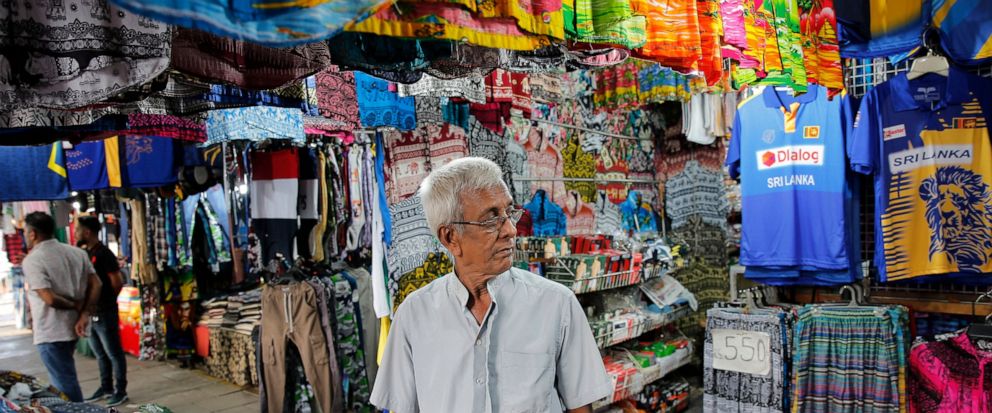
In this July 24, 2019, photo, Sri Lankan trader Ranepura Hewage Jayasena, 76, waits for customers at shop selling mementos in Colombo, Sri Lanka. Shocks from deadly suicide bombings on Easter Day in Sri Lanka are still reverberating throughout its economy in the worst crisis since the South Asian island nation’s civil war ended in 2009. Almost 100% of my business is gone. There are days without a single sale,” said Jayasena, looking grief-stricken as he went through the previous days accounts. We had a war that raged for years, but we had good business. Bombs exploded in Colombo city itself, but that did not affect our business,” he said. This is the worst period I have seen in my life.” (AP Photo/Eranga Jayawardena)
Shocks from deadly suicide bombings on Easter Sunday in Sri Lanka are reverberating throughout its economy in the worst crisis since the South Asian island nation’s civil war ended in 2009.
The blasts that killed more than 250 people were blamed on Islamic extremists. They have devastated Sri Lanka’s vital tourism industry, source of jobs for many, and are hindering foreign investment.
Sri Lanka’s economy already was in trouble, dogged by political crisis, its currency under pressure from a growing national deficit and rising debt. The attacks have added to those challenges.
Business is the worst it’s been in the 60 years that Ranepura Hewage Jayasena has been doing business in the capital Colombo, where he runs a shop that sells spectacular wooden carvings, wooden elephants and clothing designed for tourisms.
“Almost 100% of my business is gone. There are days without a single sale,” said Jayasena, 76, looking grief-stricken as he went through the previous days accounts.
“We had a war that raged for years, but we had good business. Bombs exploded in Colombo city itself, but that did not affect our business,” he said. “This is the worst period I have seen in my life.”
Seven suicide bombers struck two Catholic and one Protestant church and three luxury hotels on April 21. The Islamic State group claimed responsibility for the attacks, which were carried out by a local radicalized Muslim group known as National Thowheed Jammath.
Among those killed were 45 foreigners, mainly from China, India, the U.S. and Britain.
For days after the attack, many businesses remained shuttered. Tourists fled: the number of arrivals dropped more than 70% from a year earlier in May and nearly 60% in June.
The economy is forecast to grow at about a 3% pace this year, according to Central Bank governor Indrajit Coomaraswamy, way below the 6% plus average of recent years and possibly the lowest level in nearly 20 years.
The worst hit have been people, many of them self-employed, living close to the brink of poverty, economists say.
“Sri Lanka is undergoing a severe economic crisis at present and it is manifested at both the individual and national level,” said W.A. Wijewardena, an economic analyst and a former deputy governor of central bank.
The blasts “surely caused a temporary setback to the economy, which was already a sick one,” Wijewardena said.
While a huge share of job losses were in the tourism sector, they’ve rippled through many other industries.
Sanjeewa Samarasinghe, a 51-year-old father of three, began working as a marketing manager at a publishing company in June, after a long stint without a job. He was let go after just one week due to weak sales after the attacks.
“It’s true sales had plunged, but look at the plight of workers. How can they live?” he said.
For K.S. Mahendran, a peddler of mobile phone accessories on a sidewalk in downtown Colombo, recovery seems as far off as the day the explosions ripped through the churches and hotels
In a matter of hours, Mahendran’s business collapsed, leaving him without a way to pay rent and other daily expenses.
“The attacks were a severe blow to us and almost ruined our lives,” he said. “We had to borrow money from money lenders and we are in a great difficulty at the moment. No one is helping us.”
Sri Lanka has made significant progress thanks to a tourism boom and expanding manufacturing after the military defeated separatist Tamil rebels in May 2009, which ended the 25-year civil war. The country was engulfed in a political crisis late last year, however, when President Maithripala Sirisena suspended Parliament, firing the prime minister and replacing him with former strongman Mahinda Rajapaksa, who had ruled Sri Lanka as president for nine years from 2005.
Sirisena eventually backed down, reinstalling Ranil Wickremesinghe as prime minister. But divisions within the leadership are not helping the country overcome its myriad problems in the aftermath of the attacks.
Government debt is rising quickly as tax revenues fall far short of spending. Weakening growth also is adding to the burdens for repaying foreign debt totaling $33 billion as of March, as the country digs itself in deeper to meet repayments that will total nearly $6 billion in 2019.
With Sri Lanka’s foreign exchange reserves expected to drop to as low as $6.3 billion by the end of this year, in June the government raised $2 billion from U.S. dollar bond markets in its 14th bond offering since 2007.
“That’s not a wonderful level of reserves, but it is nowhere near a crisis either,” Coomaraswamy said in a recent speech. He noted the government could arrange foreign currency swaps and also seek panda or samurai bonds from China or Japan.
“If you take all these together, we feel fairly confident that we can manage the situation,” he said.
Apart from the direct impact from business disruptions and falling tourist arrivals, the attacks shattered a sense of stability that had helped draw in foreign investment.
Muslims living in this Buddhist-majority nation have suffered attacks and dozens of their shops and homes were burned, frightening both local and foreign investors.
“The government has not been able to eliminate the ‘economic fear’, that is, the fear that the economic assets owned by people could be destroyed by mobs with total impunity, from the minds of investors,” said Wijewardena.
“It is absolutely necessary for the government to build confidence among investors by bringing the trouble makers to justice,” he said.
So far, most efforts to cushion the impact of the attacks have focused on tourism. The government has slashed airline ground charges, aviation fuel prices and departure fees for at least six months. It set a one-year moratorium for repayment of loans for tourism-related businesses and cut interest rates on new loans.
Leaders also ordered officials to slash spending on electricity, water and telephone costs, banning use of public funds to print diaries and calendars for 2020.
Some businesses are seeing improvements.
Suresh Silva’s shoe shop was only selling one or two pairs of shoes a week just after the bombings. Sales are now back up to about 90% of normal, he said.
“I think the remaining 10% could be achieved this month.”
For many, though, the outlook remains uncertain.
“People have limited cash on hand, so they spend it on essential items such as food and medicine,” said Hameed Aslam, who runs a fabric shop.
“In my view it’s been like this for the past three years,” he said. “Living costs have been going up and the people are having great difficulties.”
Yohan Perera and Ajith Siriwardana Courtesy The Daily Mirror
JVP MP Bimal Ratnayake today questioned as to what action the government intends taking about the failure on the part of the Attorney General’s Department to take steps to ban National Thowheed Jama’at when the Terrorist Investigation Unit made requests to this effect twice.
Mr. Ratnayake said the TID had made two requests in 2017 and in 2018 to ban NTJ but the Attorney General’s Department had done nothing about it other than binding time. He said the government is bound to take stern action on this shortcoming.
Leader of the House Lakshman Kiriella said a court case has been filed against NTJ leader Zaharan while the intelligence units were going behind him. However this activity by the TID was thwarted as a result of changes made against an Intelligence Chief on an assassination attempt of a VVIP,” Mr. Kiriella said. (
Colombo, July 31 (Xinhua) — Sri Lanka will begin to waive off its existing visa fee for travelers from 48 countries including China from Aug. 1 as part of the island’s efforts to attract more tourists into the country, Tourism Development, Wildlife and Christian Religious Affairs Minister, John Amaratunga said here Wednesday.
In a media briefing held in Colombo, Amaratunga said that cabinet approval has been obtained to waive off the existing 25-U.S.-dollar visa fee for travelers arriving from the listed countries which included China, India, the United States, Germany, Canada, Malaysia and Indonesia, among others.
Amaratunga said the policy would remain in place for six months.
Controller General of Immigration and Emigration, Pasan Ratnayake said travelers wanting to visit Sri Lanka could obtain the visa approval by submitting all required information through the electronic method by accessing the Sri Lankan embassy websites in their respective countries or by visiting the Immigration website.
For travelers who have not obtained visa approval before arriving in the country, they can do so by submitting the necessary documents at the existing visa counter set up at the Bandaranaike International Airport.
He said travelers from the listed countries will be issued a free 30-day visa and if any travelers need an extension, they will be required to make a payment.
Despite suffering a set back from the Easter Sunday terror attacks on April 21, Sri Lanka is aiming to attract at least 1.9 million to 2 million tourists by the end of the year.
Prime Minister Ranil Wickremesinghe, speaking at the media briefing, assured that Sri Lanka was now safe for travel as all the suspects linked directly and indirectly to the suicide explosions had been arrested or had died.
The following is a list of the country who will be exempted from the entry visa fee –
Continuing to use statins after the age of 75 nearly halves the risk
of a heart attack, research has suggested.
Taking
the drugs into old age could also reduce the risk
of a stroke by a quarter, according to the first study to focus
on what happens when people aged above 75 stop using statins. Scientists have
debated whether healthy older people with no history of heart-related
conditions should take statins, with some arguing that there is no evidence of
any benefit.
Researchers
found that stopping the drugs after the age of 75 was associated with a 46 per
cent higher risk of a heart attack and a 26 per cent increased chance of
suffering a stroke. Overall, the French study of more than 120,000 over-75s taking statins suggested that those who stopped
were 33 per cent more likely to need hospital treatment for a heart or blood
vessel-related problem over the next four years than those who continued with
the medication.
Statins are
one of the most commonly prescribed drugs in Britain, used by about six million
people. They help to prevent heart attacks and strokes by lowering levels of
bad cholesterol”.
NHS
guidance says that people who have a 10 per cent or higher risk of developing
heart disease in the next decade should be offered statins. This includes most
people aged over 75, although decisions are made on an individual basis.
Previous research has suggested that about 40 per cent of over-65s prescribed
statins stop taking them. In the latest study, researchers analysed data from
the French national health insurance claims database, including statin
prescriptions and information on hospital diagnoses and clinical procedures.
They
looked specifically at patients who had turned 75 between 2012 and 2014 and had
been taking statins for at least 80 per cent of the time in the previous two
years but were in good health.
They
followed 120,173 people for up to four years, during which time 14.3 per cent
chose to stop taking statins and 4.5 per cent were admitted to hospital with a
cardiovascular problem. The researchers did not have access to data on deaths.
The
lead researcher, Philippe Giral, of Assistance Publique-Hôpitaux de Paris,
said: We estimated that an extra 2.5 cardiovascular events per 100 people
would occur within four years among those who discontinued their statins at the
age of 75 years compared with those who continued taking statins.”
Researchers
did not have precise information on why patients stopped taking the drugs but
some ceased because they developed other health problems or started cancer
treatment.
Previous
research into statins and older people has been based on analysis of
subsections of wider data but the latest study, published in the European Heart Journal, was the first to look
exclusively at a large number of healthy over-75s who were taking statins. The
research was observational, meaning it could show only an association and could
not prove that stopping the drugs raised health risks.
Sir
Nilesh Samani, medical director at the British Heart Foundation, said: This
study, although observational, adds to evidence that statins reduce heart
attacks and strokes in older people.”
Q&A: How do statins work?
They lower cholesterol in the blood by limiting a liver enzyme which regulates
its production. This helps to prevent heart attacks and strokes because high
cholesterol can narrow arteries over time.
What is the problem with older people taking them?
There is conflicting evidence about whether statins benefit healthy older
people with no history of heart disease or stroke. In September a Spanish study
of 47,000 patients with an average age of 77 suggested that statins only helped
those with type 2 diabetes, for example. Some doctors think prescribing statins
to healthy people is wasteful. Side effects such as diarrhoea or headaches are
reported by some users.
How could they help over-75s?
A study published in The Lancet this
year suggested that giving statins to everyone over that age could save up to
8,000 lives a year. Today’s research adds weight to this claim, suggesting that
when older patients continue to take them they have a lower risk of heart
attacks and strokes
It is perhaps because they
are rich and that their parents were
from UNP, that the UNP Parliamentary
backbenchers do not see that the old capitalist system is not suitable to Sri Lanka any more.
When we got our
Independence in 1948 there was Colonialism. It was the Russian Revolution that
influenced Colonies to gain
Independence. After Russian revolution Communism spread in Europe and the ideas
of a Socialist system of government,
different from Capitalism began to take root in European Countries, and even those countries that got independence from colonial rule.
In Sri Lanka
capitalism- a political system, a step
away from feudalism that existed in pre-colonial
Sri Lanka, was acceptable to the then political leaders, who continued with the capitalist parliamentary
system proposed by their Colonial
Masters. They interpreted the Socialist system of Government the Communist and the Samasamaja Parties were
proposing to the people , a system of
government against religion, and against accepted Buddhist Cultural norms
where they addressed everyone including their elders as Comrades.
The Marxists- the
Samasamaja and the Communist parties found
that their revolutionary political ideas were more easily accepted by the working
class, and hence neglected the farmers
and the peasants of the villages outside townships.
However the leaders of
the Marxist Parties, N.MPerera, Colvin R De Silva, Bernard Soysa,Dr.Wickramasinghe,
Keunaman, Philip and Robert Gunewardhan brothers, William Silva were becoming
popular political figures as people began to understand them through their
speeches that Socialism they proposed was a people friendly system more acceptable than the capitalist British system of the less talkative political leaders – of the Sinhala
Mahasabha the predecessors to the UNP
system.
By 1951 the UNP
Government started having political difference within the party. D.S.Senanayake
died in 1952. The UNP then as they are today were leaning heavily towards the
Western Countries , and they were not willing to change their western
capitalists system to a people friendly
system of Government.
The political
leaders of the UNP then, as they
are now were more concerned
about themselves and kept the
people dependent on their capitalist
system, placing them-selves above the ordinary people and within their
feudal hierarchic system. The people were depending on them as the slaves of their
Capitalist system of Government. Even today we see how much they look for their
place in the social hierarchy, when a wife of a UNP Presidential hopeful tells
the people at a public meeting that she
is the future first lady of Sri Lanka.
Seeing that UNP will
not move from their assumed social superiority to form a people friendly
Government, SWRD Bandaranayake left the UNP to give the people of Sri Lanka
their cultural and national rights
denied to them by the Colonial rulers, as well as by the UNP Government, SWRD Banadaranaike formed a government of the people giving the rightful place
to Buddhist Monk, the physician, the teachers, and the peasant and the farmer. He further put right the wrong political system
by which the country had been ruled since independence by joining hands with
the left wing politicians of the Samasamaja Party, Mahajana Eksath Peramuna and
the Communist Party. He made meaningful the National anthem and the National
flag.
The UNP Backbenchers
should look back and see for themselves the failure of their Capitalist System of Government, which has
not contributed to the development of an Independent Sri Lankan Culture, society,
or even such an economy. There was
a cultural revival in Sri Lanka only
after 1956 and that was not under the UNP.
The UNP Backbenchers
should note that the system of government necessary for the
benefit of Sri Lanka, and its
people, is a system away from Western Capitalism, a socialist system. That is
the demand of the people. It is why Sri
Lanka Podujana Peramuna has become a popular party of the people, within a
short time it was announced as a
Political Party.
The people will not
vote for the present SLFP too if it contests any election in future as they
have failed in 2015 to respect the very
reason that made SWRD Bandaranayaike leave the UNP in 1951 to form a Socialist
Government in 1956 and join with the leftwing Political Parties.
To-day the General
Secretary of the SLFP Dayasiri Jayasekara unable to feel the pulse of the
people, is making a great effort to make
SLFP an independent party without joining the progressive Sri Lanka Socialist
political Camp led by Sri Lanka Podujana
Peramuna. This may be because Dayasiri
Jayasekara comes from UNP and he can not sense the thinking of SWRD Bandaranayake
when he left UNP to form the SLFP. Today
SLFP has lost the reasons for which it was organised by its founder and
therefore SLFP is reduced to a mere a
name board. It is likely to break up and some of its members may even join the UNP.
The UNP, states as a criticism against the former Government
of President Mahinda Rajapakse , that it antagonised the Western Countries led by USA, and
boasts that the UNP has now established friendly relations with those
countries.
The UNP backbenchers
when they speak in TV debates etc., should
make sure of what they say without repeating what had been told by the UNP
leaders. The UNP backbenchers should
investigate the truth.
Mahinda Rajapakse and
his government did not want to antagonise USA and the west, but they wanted
them kept away from Sri Lanka until they completed the military operations against
terrorism.
But again Mahinda
Rajapakse government had invited USA to
help Sri Lanka to defeat terrorism,
which USA did by locating the most of the ten LTTE ships transporting arms and
ammunitions for terror purposes.
Yet other than that can
the UNP backbenchers say whether USA had really helped Sri Lanka at any time in
the past ?
USA is a country
which has still not helped any developing countries in the world to develop
even by giving them loans. JR Jayawardhan the UNP President had accepted
USA as his close friend. JR was in fact
called Yankee Dicky. When he became the President he had no fear even about
terrorism as he thought USA would stand
by him to defeat terrorism and help him bring peace and security to Sri
Lanka. Did it happen ?
When India dropped dry
ration”, to the terrorists in the North, and asked the President to enter into
a peace agreement and amend the Constitution of Sri Lanka to include the 13th
Amendment. USA looked away , and
President Jayawardhana had nobody to help him. USA had betrayed him. Therefore,
he entered into a peace agreement with India and mutilated the Constitution of Sri Lanka by including
the 13th Amendment proposed
by India.
Though there is no
developing country in the world that USA
helped to develop, there is no difficulty to name many countries destroyed,
their leaders assassinated or their development hampered by USA ?
Cuba under Fulgencio Batista was some what like what Sri Lanka would be under Ranil Wickramasinghe preparing to sign the SOFA Agreement with USA. Batista leased the
sothern part of Cuba to USA which is now
a USA army base called Guantanamo.
Under Fulgencio Batista,
Cuba
became the play ground for the rich Americans. There were prostitution, casinos, drug dealers ,and so
on. It was that Cuba, Fidel Castro made a free and an independent country. Yet Americans was all out
to destroy Cuba. There were planned military attacks, having failed in that America imposed trade
embargos against Cuba. Cuba faced all that but never allowed America to enter into the country. That is why Cuba
survived.
China is a rich and a
great country today, because they did not allow America to interfere in to
China. USSR was divided by USA, because Russian
leaders began to have ultra diplomatic relations
with USA. After that USA did not allow USSR to unite again. However Russia did not allow USA to interfere into Russia. Thanks to President
Putin, Russia is a rich and a developed
country today because Russia had severed
connections with USA.
USA cannot be
trusted. Sri Lanka should learn to avoid
dealings with USA as USA can bring about only ruin to Sri Lanka. The UNP Backbenchers
should pay serious attention to persons like Mangala Samaraweera in the UNP,
who is a party to selling Sri Lanka to America. He proved that by even sponsoring a Resolution by
America against his own Country-Sri Lanka, without even the
permission of the President and the Parliament.
India too claims an
economic growth, but is that growth seen on the ground and amoung the people.
There is a never ending caste problem in India and many are subject to utter misery many without even proper sanitary facilities.
Sri Lanka was progressing fast towards
development when unfortunately the people voted Yahapalanaya into power which has brought Sri Lanka back to being a poor
country.
The UNP Backbenchers please see and understand how
much you are correct about USA. Though
you repeatedly say at TV Debates that the Government of USA is friendly
towards Ranil Wickramasinghe, and you
had seen the Ambassador for USA Alaina Teplitz played a
very close role alongside UNP in
October,2019 when the President had
dismissed the
Prime Minister, do you think that USA ws playing a protective role to
help the PM Ranil in the development process , or was only looking after
America’s own benefits, without development
of Sri Lanka not even in their thoughts
?
This is what the
UNP Backbenchers should seriously contemplate, think of, and understand from
what the UNP had been doing in the past. Today UNP is like an old race horse. It has run out of
breath. It can never run any more races. It should be tethered and perhaps kept
as a museum piece, it cannot plough, it will only ruin the ground.
It is now time for
the UNP Backbenchers to start from scratch and initiate action to form a new political party
or reconstruct the UNP getting rid of the destructive elements in it such as
Ranil Wickramasinghe, Sajith Premadasa, Karu Jayasuriya, Malik Samarawickrama,
Mangala Samaraweera, Ravi Katunanayake, Lakshmn Kiriella, Daya Gamage, Rosy
Senanayake, Thalatha Athukorala, Amaratunga and the whole of that lot, including
the Muslim MPs. who do not toe the line in the formation of a new political
party.
The United States made an abortive bid, in
2002, to finalize an Acquisition and Cross Servicing Agreement (ACSA), formerly
known as ‘NATO Mutual Support Act’, with Sri Lanka. The attempt was made after
the Ceasefire Agreement was signed on Feb. 21. 2002.
Acquisition and Cross-Servicing Agreements are
negotiated on a bilateral basis by the US for use in combined exercises,
training, operations, or deployments and allow its forces to obtain food, fuel,
transport, ammunition, and equipment, collectively termed logistical supplies.
Reimbursement is in cash, or rarely, replacement in kind.
US Deputy Secretary of State Richard Armitage
announced plans for ACSA after Premier Wickremesinghe met US President George
W. Bush in Washington. The ACSA was to
be finalized in July 2002. Minister Milinda Moragoda, being close to the US,
played a high profile role in the project. But when in Dec 2002, Ambassador Wills
explored the possibility of using Sri Lankan ports and air space to invade
Iraq, Foreign Minister Tyronne Fernando explained the difficulty in giving into
US request and ACSA was abandoned.
Foreign Minister Lakshman Kadirgamar, (2004-2005) on a visit to Washington DC, ensured that the
subject of ACSA not be listed on the agenda for his talks with senior leaders
and officials there.
However, in
the first week of March, 2007 Sri Lanka entered into ACSA with the US. Gotabhaya
Rajapaksa and Ambassador Robert O. Blake signed on behalf of Sri Lanka and the
US, respectively. Both were US nationals, but Gotabhaya Rajapaksa held dual
citizenship. President Rajapaksa, in his capacity as the Defence Minister,
authorized ACSA. The Rajapaksas never
bothered to inform Parliament of the Agreement, observed Shamindra Ferdinando. They dismissed calls from the left parties
to table the agreement in Parliament.
The agreement
allowed the United States and Sri Lanka to transfer and exchange logistics,
supplies, support, and re-fueling services, either in kind or at cost, during
peacekeeping missions, humanitarian operations or joint exercises.
Specifically excluded from its coverage were
weapon systems such as guided missiles, naval mines and torpedoes, nuclear
ammunition and items such as warheads, warhead sections, cartridge and air crew
escape propulsion system components, chaff and chaff dispensers, guidance kits
for bombs or other ammunition, chemical ammunition (other than riot-control
agents), any other materials, subject to the Atomic Energy Act of 1954.
There was absolutely nothing special about the
Acquisition and Cross Servicing Agreement (ACSA), which Gota signed, said Chandraprema.
It was like so many other ACSA’s that the US had signed with other countries. The provisions of the Sri Lankan ACSA of 2007
are almost identical to those found in the ACSA signed between the US and
Australia in April 2010. The difference being that in Australia, the ACSA is a
public document whereas in Sri Lanka it is a top secret document. There was nothing in the 2007 ACSA
that warranted the secrecy in which it was signed either.
It was the US that wanted it to be done
secretly, said Chandraprema. A cable
sent to the State Department by the then US Ambassador in Colombo Robert Blake,
on 31 January 2007, (several weeks before the ACSA was signed) and released to
the public by Wikileaks said, “On December 7, 2006, Ambassador and Office
of Defense Cooperation (ODC) Chief met with Sri Lankan Defense Secretary Gotabhaya
Rajapaksa to provide background information on a Acquisition and Cross
Servicing Agreement (ACSA) and a the draft ACSA proposed for signature. On
January 25, 2007, Secretary Rajapaksa provided concurrence to ODC Chief on the
proposed agreement. Secretary Rajapaksa stated that he was ready to sign the
SIPDIS agreement at anytime convenient to the U.S.
“The US Government faces some risk
that the Government of Sri Lanka might seek to exploit the signing to convey
the US Government’s support for possible ongoing offensive military operations.
The Embassy therefore recommends the Ambassador sign the agreement in a low-key
ceremony with Secretary Rajapaksa in late February. The Sri Lankan military is
presently engaged in mop-up operations against the LTTE in eastern Sri Lanka.
However, the Defense Secretary and other military leaders have hinted they are
considering further offensive military operations in northern Sri Lanka.
“We recommend holding off on the signing
ceremony until late February when we will have a clearer idea of the Sri Lankan
military’s intentions. We also do not wish to detract attention from the Sri
Lankan Commission of Inquiry (on human rights) and the work of the
International Independent Group of Expert Persons who will arrive in Sri Lanka
the second week of February to observe the work of the Commission. Since the
ACSA benefits U.S. forces transiting through the region, and since the GSL
might leak news of the signing, the Embassy proposes to have the Ambassador
sign the ACSA with the Defense Secretary with a select number of photographers
and no statements. The Embassy will then issue a press release following the
ceremony explaining the purpose of the ACSA.”
United States, in
its fierce opposition to the Eelam War had banned the sale of war items to Sri
Lanka. As a result, the Sri Lanka Air Force (SLAF) could not use its US built
C-130 Hercules troop transport aircraft or the Israeli built Kfir
fighter jets. Israel, a strong US ally, followed Washington’s policy. Thus, the
C-130 and the fighter jets were grounded for lack of spares. In 1993 when the
Special (Boat) Squadron was created, the US helped and in 1996, the US military engaged in exercises with Sri Lankan Special
Forces, including the Navy’s elite Special Boat Squadron.
USA had helped Sri Lanka and Gota was right to
give them a favour in return by signing the ACSA, observed Chandraprema. Ambassador Blake assured that that ACSA
wouldn’t pave the way for US bases here. Having
signed ACSA, Gotabhaya Rajapaksa reiterated Sri Lanka’s commitment to defeat
the LTTE, militarily, in talks with top State Department official Stevan Mann,
when the latter met him at the Defence Ministry.
After ACSA, Sri Lanka received valuable US
support, particularly during Eelam War IV.
US provided specific intelligence on ‘floating LTTE arsenals’ to Sri
Lanka on a request made by Navy Chief Vice Admiral Wasantha Karannagoda.
Karannagoda’s move enabled the destruction of four LTTE vessels on the high
seas, thereby hastening the collapse of the LTTE. In addition to those vessels
that had been hunted down on the basis of intelligence provided by the US, the
Navy hit several other LTTE ships during Eelam War IV.
Several weeks after the signing of the
agreement, Karannagoda had sought a meeting with the then US defence attaché in
Colombo. Karannagoda has requested for US assistance to track down the
remaining LTTE vessels as the superpower was engaged in worldwide campaign
against terrorism. That meeting at Karannagoda’s office led to a meeting with
Ambassador Blake, also at the same venue in late May 2007.
In late
August 2007, the US provided the required information secured from a satellite
to the Navy. The US verified the positioning of four vessels about two weeks
later. They had been at the same position as two weeks before. In fact, the US had queried whether
Karannagoda’s Navy had the wherewithal to destroy four ships so far away from
Sri Lanka. Karannagoda dispatched naval task force comprising six vessels on
Sept 2007 from Colombo, Trincomalee and Galle.
Karannagoda, in his memoirs revealed how an
Indian diplomat based at its High Commission in Colombo made a despicable
attempt to misdirect the Navy by providing information contrary to that of the
Americans. Acting on US intelligence,
the Navy destroyed three out of four LTTE vessels in the second week of Sept.
2007. The US again provided specific intelligence in late Sept. 2007 regarding
the LTTE vessel that escaped during Sept. 2007 operation. The fourth vessel was
destroyed on Oct 7, 2007. Although Karannagoda, made no reference to ACSA, it
would be pertinent to stress that the US, perhaps reluctantly, provided
critically important intelligence following the finalization of the agreement
on March 05, 2007, said Shamindra.
The 2007 ACSA
ended in March 2017. USA and Yahapalana entered into another ACSA signed on
August 4, 2017. Analysts have compared
the 2007 and 2017 ACSAs. The 2007 ACSA was only eight pages including the
cover. The 2017 ACSA was 83 pages and had over 50 annexures. The annexure gave
the lists of US commands and military establishments which will be allowed the
use of Sri Lanka’s airports and sea ports. These voluminous annexures carried
the names and addresses of almost all US military establishments that could
have a foot print or boots on the ground in Sri Lanka. The list was exclusively
revealed in the Sunday Times of May 19.
The Sunday Times said it has seen the ACSA
agreement between by the US Defence Department and the Ministry of Defence. the
agreement begins with a preamble which says This Agreement is designed to
facilitate reciprocal logistic support between the parties (US and Sri Lanka)
to be used during combined exercises, training, deployments, port calls,
operations, or other co-operative efforts, or for
unforeseen circumstances or exigencies in which one of the parties may have a
need for Logistic Support, Supplies and Services.
This
Agreement applies to the provision of Logistic Support, Supplies, and Services
from the military forces of one party to the military forces of the other Party
in return either for cash payment or reciprocal provision of Logistic Support,
Supplies, and Services to the military forces of the Supplying Party. For the
purpose of this Agreement, the Sri Lanka Coast Guard is considered part of the
military forces of the Ministry of Defence of the Democratic Socialist Republic
of Sri Lanka.
Significantly, it
allows every single security or military apparatus in the United States access to Sri Lanka. All
those security commands are listed one by one and the Point of Contact (POC)
defined. .Though the agreement provides reciprocity,
Sri Lanka’s Army, Navy, Air Force or Coast Guard simply have no resources to
pay and use a military facility in the US. It is not required either.
The 2007
agreement was only for a period of seven years. The 2017 agreement is open ended, It says, This agreement shall remain in
force unless terminated by mutual written consent of the Parties or by either
Party giving not less than 180 days’ notice in writing to the other Party of
its intention to terminate. While the 2007 ACSA permitted US
military vessels to enter Sri Lanka ports on a ‘one-off’ basis, the 2017 ACSA
appears to be “open ended”.
Ambassador Hettiaratchchi told President
Sirisena that during the negotiations for the renewal of ACSA in 2017, he was
under constant pressure from Prasad Kariyawasam, Sri Lanka’s then ambassador in
the US, to expedite the passage of the ACSA. Kariyawasam had made many calls to
ensure the draft ACSA be concluded and placed before the Cabinet of Ministers
immediately, he said. Also telephoning Hettiaratchchi periodically over the
same matter, was then Foreign Minister Mangala Samaraweera.
Kariyawasam
and Samaraweera had pressured him at a time when the Defence Ministry had
sought the observations of the Armed Forces Commanders on the ACSA deal. . The
draft ACSA was rushed for approval by the Cabinet because of this pressure. It
had been hurried through before a thorough study had been done by the armed
forces commanders or officials well versed in the matter. Admiral Ravi
Wijegunaratne had expressed serious reservations over some of the provisions in
the ACSA. The Cabinet approved ACSA 2017.
Defence Secretary
Kapila Waidyaratne, a former Additional Solicitor General said that he had been
compelled to sign the document since the Cabinet had approved it. He was simply
implementing a Cabinet decision. His predecessor, Hettiaratchchi, negotiated
the ACSA but was forced to rush it through the Cabinet, even before all armed
forces commanders could send in their observations. This, he said, was due to
pressure from the then Foreign Minister, Mangala Samaraweera and former Foreign
Secretary Prasad Kariyawasam.
ACSA was signed without careful examination.
When told that the service chief’s responses were being awaited before sending the ACSA to the Cabinet ,
President Sirisena had said ‘Ekeng
mata vedak nehe. Vahaama assang karanna lesthi karanna’ . ACSA hadn’t been discussed at the
Cabinet or in Parliament. ACSA was not presented to Parliament, said
Dayasiri Jayasekera.
President
Sirisena’s Cabinet memorandum of June 30, 2017 in Sinhala had only a brief nine pages and no annexures.
The Sinhala version of the ACSA
presented to the Cabinet, did not
contain translations of the annexures. Due to delay in translations, the agreement
has been sent to Cabinet without the annexures. The English version, however,
had 83 pages that included the annexures.
When the ACSA
with Sri Lanka was renewed in 2017, it was once again shrouded in secrecy. The Sunday Times said that the
US Ambassador to Sri Lanka, Atul Keshap, directed that there be no media
coverage or any publicity regarding the signing event. This was why there was
no news release from the US Embassy in Colombo. Keshap signed on behalf of the
US Department of Defence. Even for the US, therefore, the matter was one of
utmost secrecy. The renewed document has
not been made public by Yahapalana either. Sri Lanka
Freedom Party, among others, said that
the people should be made aware of the dangers of ACSA.
The Prime
Minister said considering the current international political situation and
developments, the 2017 ACSA agreement
would be favorable to the country. He said extending the agreement with the
U.S. will be utmost importance given the global situation today. The
Acquisition and Cross-Servicing Agreement (ACSA) allows the United States and
Sri Lanka to transfer and exchange logistics supplies, support, and re-fueling
services, either in kind or at cost, during peacekeeping missions, humanitarian
operations or joint exercises. The categories of allowable goods and services
include food, petroleum, and transportation. The provision of weapons or
ammunition is prohibited. Each nation’s forces can support the other during
contingencies such as disaster relief or peacekeeping operations, which reduces
the logistics requirement for each nation.
But
others are not so happy. President of the Bar Association (BASL) Kalinga
Indatissa, PC has written to Minister of Foreign Affairs Tilak Marapana, PC in
June 2019, under the provisions of the Right to Information Act No. 12 of 2016
and Article 14A of the Constitution, requesting a copy of the proposed
Acquisition and Cross Servicing Agreement (ACSA).
The letter said, ‘the undersigned is a citizen
of Sri Lanka and the present President of the Bar Association of Sri Lanka
which is the sole representative body of more than 19,000 Attorneys-at-Law in
this Country. The BASL has always been concerned about matters of national
importance, and matters relating to the Rule of Law and administration of
justice. It has been reported in the media that the Sri Lankan Government is
due to enter into an Acquisition and Cross Services Agreement (ACSA) with the
United States of America. Considering the national importance of the said agreement
and I request from you to make available a printed copy of the proposed
Acquisition and Cross Services Agreement (ACSA) by virtue of Section 3(1) of
the Right to Information Act No. 12 of 2016 read with Section 24 of the Right
to Information Act No. 12 of 2016 and Article 14A of the Constitution of the
Democratic Socialist Republic of Sri Lanka’. ( Continued)
Here is the
full text of the draft Status of Forces Agreement (SOFA) dated
28TH August 2018, which the Government
of Sri Lanka is negotiating with the United States. (Sunday Times 30.6.19)
(1) The Embassy of the United States of America presents
its compliments to the Ministry of Foreign Affairs of the Democratic Socialist
Republic of Sri Lanka and has the honour to refer to recent discussions between
representatives of our two Governments regarding issues related to United
States (U.S) military and civilian personnel identified as members of the U.S
Department of Defence, respectively, hereafter referred to collectively as U.S.
personnel) and U.S. contractors (defined as non-Sri Lankan companies and firms,
and their employees who are not nationals of Sri Lanka, under contract to the
U.S. Department of Defence who may be temporarily present in Sri Lanka in
connection with ship visits, training, exercises, humanitarian activities, and
other activities mutually agreed. Companies and firms, and their employees, not
under contract with the U.S. Department of Defence shall not receive any
privileges and exempt under this Agreement.
(2) As a result of these discussions, the Embassy proposes
that U.S. personnel be accorded the privileges, exemptions, and immunities
equivalent to those accorded to the administrative and technical staff of a
diplomatic mission under the Vienna Convention on Diplomatic Relations of April
18, 1961, that U.S. personnel may enter and exit Sri Lanka with U.S.
identification and with collective movement or individual travel orders; that
Sri Lanka shall accept as valid all professional licenses issued by United
States, its political subdivisions, or States thereof to U.S. Personnel for the
provision of services to authorized personnel, and that Sri Lankan authorities
shall accept as valid, without a driving test or fee, driving licenses or
permits issued by the appropriate U.S. authorities to U.S. Personnel for the
operation of vehicles. The Embassy further proposes that the U.S. personnel be authorized
to wear uniforms while performing official duties and to carry arms while on duty
if authorized to do so by their orders.
(3)
The Government of Sri Lanka recognizes the
particular importance of disciplinary control by U.S. Armed Forces authorities over U.S. personnel and, therefore, authorizes the
Government of the United States to exercise criminal jurisdiction over U.S.
personnel while in Sri Lanka.
(4) The Embassy further proposes that the U.S. Department
of Defence and U.S. personnel shall not be liable to pay any tax or similar charge assessed within Sri Lanka. The Government of the United States of America and Sri Lanka shall
co-operate to take such measures as may be necessary to ensure the security and
protection of U.S. personnel property, equipment, records, and official
information in Sri Lanka. Such importation,
exportation, and use shall be exempt from any inspection, license, other
restrictions, customs duties, taxes or any other changes assessed within Sri
Lanka. The Governments of the United States of
America and Sri Lanka shall co—operate to take such measures as may be
necessary to ensure the security and protection of US personnel, property,
equipment, records, and official information in Sri Lanka.
(5) The Embassy proposes that vessels and vehicles operated
by or, at the time, exclusively for the US. Department of Defence may either,
exit, and move freely within the territory of Sri Lanka, and that such vehicles (whether self-propelled or towed) shall be
exempt from payment of overland transit tolls. Vessels and aircraft owned or
operated by or, at the time, exclusively for the U.S. Department of Defence
shall not be subject to the payment of landing fees, or port fees, pilotage
charges, lighterage, and harbor dues at facilities owned and operated by the Government of Sri Lanka. Aircraft owned and operated by or, at the
time, exclusively for the U.S. Department of Defence shall not be subject to
the payment of navigation, overflight, terminal or similar charges when in the
territory of Sri Lanka. The U.S. Department of Defence shall pay reasonable
charges for services requested and received at rates no less favorable than
those paid by the Armed Forces of Sri Lanka. Aircraft and vessels of the U.S.
Government shall be free from boarding and inspection.
(6) The Embassy also proposes that the U.S. Department of
Defence may contract for any material, supplies, equipment, and services
(including construction) to be furnished or undertaken in Sri Lanka without
restriction as to choose of contractor, supplier, or person who provides such
material and supplies, equipment or services. Such contracts shall be
solicited, awarded and administered in accordance with the laws and regulations
of the Government of the United States of America. Acquisition of articles and
services in Sri Lanka by or on behalf of the U.S. Department of Defence in
connection with activities under this Agreement shall not be subject to any taxes or similar charges in
Sri Lanka.
(7) The Embassy further proposes that U.S. contractors
shall not be liable to pay any tax or similar charge assessed within Sri Lanka
in connection with activities under this Agreement and that such contractors
may import into, export out of, and use Sri Lanka any personal property,
equipment, supplies, material, technology training, or services in the fulfillment
of contracts with the U.S. Department of Defence in connection with activities
under this Agreement. Such important, exportation, and use shall be exempt from
any licence, or other restrictions, customs
duties, taxes, or any other charges assessed within Sri Lanka.
(8)The Embassy proposes
that U.S. contractors shall be granted the same treatment as U.S. personnel
with respect to professional and driver’s licences.
(9)
The Embassy proposes that U.S. personnel shall
have freedom of movement and access to and use of mutually agreed
transportation, storage, training, and other facilities required in connection
with activities under this Agreement.
(10)The Government of Sri
Lanka recognizes that it may be necessary for the U.S. Armed Forces to use the
radio spectrum. The US Department of Defence
shall be allowed to operate its own telecommunication systems (as
telecommunication is defined in the 1992 Constitution and Convention of the
International Telecommunication Union). This shall include the right to utilize
such means and services as required to ensure full ability to operate
telecommunication systems. Use of the radio
spectrum shall be free of cost to the U.S. Government.
(11) The Embassy proposes that the parties waive any and all claims
(other than contractual claims) against each other for damages to, loss of, or
destruction of the other’s property or injury or death to personnel of either
Party’s armed forces or their civilian personnel arising out of the performance
of their official duties in connection with activities under this Agreement.
Claims by third parties for damages or loss caused by U.S. personnel shall be
resolved by the U.S. Government in accordance with U.S. laws and regulations.
(12) Further, the Embassy proposes that this Agreement, upon its entry
into force, shall supersede the Agreement regarding the status of U.S. military
personnel and civilian employees of the Department of Defence who may be
present in Sri Lanka for exercises or other official duties, effected by
exchange of notes at Colombo, February 9 and May 16, 1995, which entered into
force May 16, 1995.
(13) Finally, the Embassy proposes further that our two governments, or
their designated representatives, may enter into implementing arrangements to
carry out the provisions of this Agreement.
(14) If the foregoing is acceptable to the Government of the Democratic
Socialist Republic of Sri Lanka, the Embassy proposes that this note, together
with the Ministry’s reply to that effect, shall constitute an agreement between
the two Governments, which shall enter into force on the date of the Ministry’s
reply.
(15)
The Embassy of the United States of America avails itself of this opportunity
to renew to the Ministry of Foreign Affairs of the Democratic Socialist
Republic of Sri Lanka the assurance of its highest consideration. (END OF DRAFT
AGREEMENT.)
CLAUSES
EXPLAINED.
Sunday Times thereafter explained the clauses
saying, the public can
now decide whether the SOFA is harmless” or inimical to the national interests
of Sri Lanka. A
number of these demands would impinge on Sri Lanka’s sovereignty, Sunday
Times said.
United
States personnel (troops, contractors etc) be accorded the privileges,
exemptions and immunities equivalent to those accorded to the
administrative and technical staff of the US Embassy. They may enter and
leave Sri Lanka with US identification individually or collectively.
(Note: This means they could enter Sri Lanka without Passports or Visas)
Sri Lanka shall accept,
without a driving test or fee, driving licences or permits issued by the
appropriate US authorities to US personnel. US personnel be authorised to wear
uniforms whilst performing official duties and carry arms while on duty.
Disciplinary
control by US Armed Forces authorities over US personnel and, therefore,
the Government of the United States to exercise criminal jurisdiction over
US personnel whilst in Sri Lanka. (Note: This clearly means Sri Lankan
laws do not apply to them.)
US
personnel not be liable to pay tax or similar charge assessed within Sri
Lanka. The Government of the United States of America and Sri Lanka shall
co-operate to take measures to protect US personnel property, equipment,
records, and official information in Sri Lanka. (Note: They want the
Government to protect their assets free of charge)
Vessels
and vehicles operated by or, at the time, exclusively for the US
Department of Defence may either, exit and move freely within the
territory of Sri Lanka. Such vehicles shall be exempt from payment of
overland transit tolls. Vessels and aircraft owned or operated by or, at
the time, exclusively for the US Department of Defence shall not be
subject to payment of navigation, overflight, terminal or similar charges
when in the territory of Sri Lanka. The US shall pay reasonable rates for
services requested and received at no less favourable than those paid by
the Armed Forces of Sri Lanka. Aircraft and vessels of the US Government
shall be free from boarding and inspection. (Note: This is a blatant
infringement of the sovereign right of a nation)
The
US Department of Defence may contract for any material, supplies,
equipment and services (including construction) to be furnished or
undertaken and shall not be subject to any local taxes. (Note: Makes
clear that construction work would be required in Sri Lanka. What do they
propose to construct?)
US
contractors will not be liable to pay any tax or similar charges.
Property, equipment, supplies, material, technology training, or services
in the fulfilment of contracts with the Department of Defence and use
shall be exempt from any licence, or other restrictions, customs duties,
taxes or any other charges assessed within Sri Lanka. (Note: This again
is a blatant infringement of the sovereign right of a nation to impose
taxes and ensure their rules are followed)
The
Government of Sri Lanka recognises that it may be necessary for the US
Armed Forces to use the radio spectrum. The Department of Defence shall be
allowed to operate its own telecommunication systems. This shall include
the right to utilise such means and services as required to ensure full
ability to operate telecommunication systems. Use of the radio spectrum
shall be free of cost to the US Government. (Note: This simply means
they will have their own radio communications network parallel to those
used by the Army, Navy, Police and the Coast Guard)
Waive
any claims (other than contractual claims) against each other – and
damage or loss shall be resolved by the US Government in accordance with
US laws and regulations. (Note: This is also an infringement of Sri
Lanka’s sovereignty. Sri Lanka’s laws will not apply to US troops and
those associated with them. For the troops and others, it would be just as
good as moving around in any part of the United States)
The US is seeking that aircraft and vessels of the US Government
to be free from boarding and inspection. This means none of the state security
arms, like the Navy, Coast Guard or the Customs can board any US military
vessel or aircraft when it is in a Sri Lankan airport or sea port — or even
vehicles on land and helicopters, an internationally accepted sovereign right
of a country.
The US is also seeking authorisation for its troops to wear
uniforms whilst on duty” in any part of Sri Lanka, carrying arms and radio
communications equipment. (Both in terms of the Sri Lanka Constitution
and normal laws, only the armed forces and the Police are empowered to carry
out this task. The only exceptions are Sri Lankans who are authorised by
licence)
The US wants exemption from licence, Customs duties, taxes and any
other charges within Sri Lanka.
Washington wants US troops and contractors to be allowed to enter
and leave Sri Lanka, individually or collectively, with the use of only their
US identification. This will mean they will carry no passports or visas.
3
party claims by us, only under US Law. They
run over one of us, and kills, it
will be under US law.
thay
can do anything to our forces, our army can be killed. our movements can be
restricted.
THE DIPLOMATIC NOTE
Lasanda Kurukulasuriya commented on the agreement. She said, the SOFA under negotiation relates
to a confidential Diplomatic Note from the US embassy to the foreign ministry
dated 28th August 2018, said Lasanda.. The US embassy ‘reminds the GSL’ that
“as a result of these discussions the Embassy proposes that U.S. personnel
be accorded the privileges, exemptions, and immunities equivalent to those
accorded to the administrative and technical staff of a diplomatic mission
under the Vienna Convention on Diplomatic Relations; that U.S. personnel may
enter and exit Sri Lanka with U.S. identification and with collective movement
or individual travel orders”..
Lasanda observes: “The
Government of Sri Lanka recognizes the particular importance of disciplinary
control by U.S. Armed forces authorities over U.S. personnel and, therefore,
authorizes the Government of the United States to exercise criminal jurisdiction
over U.S. personnel while in Sri Lanka.””…the U.S. Department of
Defense and U.S. personnel shall not be liable to pay any tax or similar
charges within Sri Lanka. The U.S. Department of Defense and U.S. personnel may
import into, export out of, and use in Sri Lanka any personal property,
equipment, supplies, material, technology, training, or services in connection
with activities under this agreement. … They shall be exempt from any
inspection within Sri Lanka.”
“The Embassy proposes that vessels and
vehicles operated by or, at the time, exclusively for the U.S. Department of
Defense may enter, exit, and move freely within the territory of Sri Lanka. The
discussions so far held between the GSL and USG in Colombo and, most recently
in Washington highlighted “Aircraft and vessels of the U.S. Government
shall be free from boarding and inspection.”
The Embassy also proposes that the U.S.
Department of Defense may contract for any material, supplies, equipment, and
services (including construction) to be furnished or undertaken in Sri Lanka
without restriction as to choice of contractor, supplier, or person who
provides such material, supplies, equipment or services. Such contracts shall
be solicited, awarded and administered in accordance with the laws and
regulations of the Government of the United States of America. Acquisition of
articles and services in Sri Lanka by or on behalf of the U.S. Department of
Defense in connection with activities under the Agreement shall not be subject
to any taxes or similar charges in Sri Lanka.”The Embassy proposes that
U.S. personnel shall have freedom of movement and access to and use of mutually
agreed transportation, storage, training, and other facilities required in
connection with activities under this Agreement.” .
The Government of Sri Lanka recognizes that it
may be necessary for the U.S. Armed forces to use the radio spectrum. The U.S.
Department of Defense shall be allowed to operate its own telecommunication
system. This shall include the right to utilize such means and services as
required to ensure full ability to operate telecommunication system. The use of
the radio spectrum shall be free of cost to the U.S Government.The classified
diplomatic communication dated 28 August 2018 sent to the Sri Lanka Ministry of
Foreign Affairs at the conclusion states that (Quote) If the foregoing is
accepted to the Government of the Democratic Socialist Republic of Sri Lanka,
the Embassy proposes that this note, together with the Ministry’s reply to that
effect, shall constitute an agreement between the two Governments, which shall
enter into force on the date of the Ministry’s reply.” (End of Quote)
There is further information regarding the
contents of the SOFA in relation to ‘contractors’ brought in by the US Department
of Defense:”The Embassy further proposes that U.S. contractors shall not
be liable to pay any tax or similar charge assessed within Sri Lanka in
connection with activities under this Agreement and that such contractors may
import into, export out of, and use in Sri Lanka any personal property,
equipment, supplies, materiel, technology, training, or services in fulfillment
of contracts with the U.S. Department of Defense in connection with activities
under this Agreement. Such importation, exportation, and use shall be exempt
from any license, other restrictions, customs duties, taxes, or any other
charges assessed within Sri Lanka.””The Embassy proposes that U.S.
contractors shall be granted the same treatment as U.S. personnel with respect
to professional and drivers’ licenses.”
“Sri Lankan authorities shall accept as
valid, without a driving test or fee, driving licenses or permits issued by the
appropriate U.S. authorities to U.S. contractors of the operation of
vehicles.”The US embassy has repeatedly asserted that the US has ‘no plans
to establish a military base’ in Sri Lanka. But then, in recent times that’s
not the approach used by the superpower in extending its military footprint.
Nowadays the US gets its ‘partners and allies’ to share part of the burden of
meeting shared goals. The US’s mantra of a ‘free and open Indo Pacific’
illustrates the strategy, with Japan, India and Australia asked to join in
pushing back against China’s growing maritime power. Meanwhile the US finds it
useful (and economical) to negotiate bilateral agreements with individual
strategically located states.
SALLYPORT
In the backdrop of the ACSA, already signed
and a SOFA deal pending, security companies in the US are looking for personnel
in Sri Lanka.Sallyport, a US firm offers a comprehensive range of global
protective, security and mission support solutions to the US Government,
foreign allied governments, and a wide range of private and commercial
clients.In a note to recognised Sri Lankan security companies, Sallyport has on
offer jobs which are full time and hourly.The note, among other matters, says:
As a part of our Professional Services group at Michael Baker Global Services,
a whole owned subsidiary of Caliburn International, the Cleared American Guard
(CAG) is professionally trained to protect the security integrity of the
construction site and responsible for protection of building materials,
furniture, fixtures, and other items. CAGs will perform access control
functions at all vehicle and pedestrian entrances to the site on a 24/7 basis
throughout the construction or project period.” (Sunday Times
7.7.19)
The note adds:
Denies
introduction of prohibited materials such as explosives, weapons,
electronic devices, or other items as specified by the Accrediting Official
(AO) or designee.
Conducts
random inspections of all site areas to ensure no prohibited materials
have been brought on to the site.
Ensures
that all suspicious materials or incidents be brought to the attention of
the site security manager or construction surveillance technician.
Monitors
all non-cleared guards provided by the construction company.
Maintains
and operates the Secure Storage Area (SSA) established by the assigned
construction company within the construction site footprint where they will
store construction materials and equipment that will be used for the
project.
What are the key
skills required for this role?
Must
possess the ability to exercise discretion and good judgment to make
logical and effective decisions.
A
CAG will typically progress onto one of our next construction projects or
with the required experience be promoted to a Construction Surveillance
Technician or Team Lead.
Minimum
qualifications and education requirements:
You
must be a U.S. citizen with an active TOP Secret clearance. You must have
at least 3 years’ experience in a security field. Candidates with overseas
experience are highly preferred.
Selected
candidates will be sponsored for required 40-hour CAG training. Candidates
with active DOS CAG certification are preferred. You must be capable
of independent decision making, possess a high degree of individual
initiative and be able to function with minimal supervision.
You
need to be able to stand for 8 hours, work outdoors in all seasons and lift
up to 25 pounds. ( CONTINUED)
US and Sri Lanka had an agreement
in 1995, by exchange of diplomatic notes, regarding the status of US
military personnel and civilian employees of the Department of Defence who may be present in Sri Lanka for exercises
or official duties. The SOFA currently under negotiation seeks to update this
1995 agreement between the US and Sri Lanka. US government has made a request
to extend the former agreement, and to include an annexure to expand it, called
Annex B.
Prime Minister Ranil Wickremesinghe announced
in Parliament in July 2019 that Sri Lanka is negotiating a fresh military
cooperation deal with the United States. The government was discussing a
replacement for the 1995 Status of Forces (SOFA) arrangement that would allow
the US military easier access to Sri Lanka.
The United States
Embassy in Colombo sent to Foreign Secretary, Prasad Kariyawasam a five-page
document dated August 28, 2018.it was a draft Status of Forces Agreement (SOFA)
which Washington was keen to sign with Sri Lanka. Kariyawasam initiated discussions supported
by Foreign affairs Minister Mangala Samaraweera. Discussions
were between the United States Embassy in Colombo and the Ministry of Foreign
Affairs. Ministry of Defence, responsible for the
country’s national security, was kept out.
The draft said that the acceptance of their
draft” shall constitute an agreement between the two Governments, which shall enter into force on the date of
Ministry’s reply.” This
meant that once the Secretary of the Ministry of Foreign affairs, Sri Lanka,
accepted the offer or says Yes, the agreement is effective. Once the Sri Lanka
Government agrees, it has to stick by it, the embassy said. The Public Affairs Office of the US Embassy
had invited select local media to brief them on this. . The veiled warning made
news, said Sunday Times.
However, at this point President Sirisena
butted in. He asked Secretary Kariyawasam to quit his post in Washington. Ambassador Kariyawasam left on October 31,
2018. That put the SOFA project on temporary hold. But negotiations went on.
SOFA
was listed for discussion at the third Sri Lanka-United States Partnership
Dialogue in Washington DC in May 2019, Foreign Minister Tilak Marapana, who led
the Sri Lanka delegation, discussed the draft SOFA, with US Secretary of State Mike Pompeo.
He was to express Sri Lanka’s concern over
some of the provisions. There were two clauses which Minister Marapana sought
to change during talks in Washington DC — one was diplomatic immunity for US
troops who would be present in Sri Lanka and the other subjecting all their
actions to US laws. Such an agreement,
would have given an open licence for uniformed US troops with arms and
communications equipment to roam any part of Sri Lanka.
Meanwhile President Sirisena declared, in June
2019, I am against the proposed SOFA. He was not prepared to accept
military agreements with the US including SOFA. President Sirisena then
telephoned Marapana in Washington DC and said he should not sign the SOFA
agreement without any consultation with Sirisena since Sirisena was the
Minister of Defence. This has stalled the move for the time being but pressure
from the United States continues, said the media in June 2019.
State Minister for Defence, also said No
agreement which is not favourable and which has consequences to national
security will be signed. If any agreement was to be signed, the President’s
advice as Minister of Defence would be sought and signed thereafter by the
Defence Secretary.”
The proposed
Status of Forces Agreement (SOFA) with the US has come in for much discussion.
The whole process lacks transparency and accountability, said critics. SOFA is very comprehensive. Our independence, our territorial integrity,
and freedom of action are at stake. Ths treaty once signed witll be binding on
us. Sri Lanka will be dragged into the
US camp.
The new agreement is comprehensive and
provides for full enjoyment of diplomatic immunity not only by any member of US
armed forces, but also by the contractors and employees of US armed forces. SOFA is more far reaching than ACSA since it
is not confined to purchase of goods and services. They include rules governing
US military personnel in a foreign country.
WARNING STATEMENT BY M.M. ZUHAIR.
M.M. Zuhair has provided the clearest and
bluntest assessment of what will happen when SOFA is signed. Here are his
comments.
Zuhair warned that proposed Status of Forces
Agreement (SOFA) would transform Sri Lanka into a US military facility. it will
create a ‘separate state’, having an independent power structure for the US
military and its contractors, within the territory of Sri Lanka. That state will be run from Washington by the
US Defense Department. The Sri Lankan government, it’s Parliament, the
country’s judiciary it’s armed forces or the Police will have no say, under the
published agreement, over the US armed forces entering Sri Lanka at their will
and pleasure, freely transiting, exiting or remaining without exiting, within
any part of the territory of Sri Lanka in vehicles, vessels and aircrafts,
wearing uniforms, armed with communication equipment and weapons.
“The unwritten objective of the proposed
agreement would be for the US to obtain from Sri Lanka, the non-consultative
status of using at any time, any part of the Sri Lankan territory, as a
permanent or transit point for the military activities the US is habitually and
perennially engaged in, outside the Western world. For the first time, fully
armed American men and women can freely move within any part of Sri Lanka, as
persons above Sri Lankan laws,
US armed forces can move anywhere in the
island both individually as well as collectively with arms and ammunition. All
the recognised ingredients that constitute a technologically virtual ‘separate
State’, though an unrefined concept in international law are to be found
sandwiched in SOFA.”With SOFA in hand, the Americans do not require a
military ‘base’ in Sri Lanka’s Eastern city of Trincomalee or elsewhere here,
because the whole island will be a US controlled super State operating above
the Sri Lankan laws and State”. The consequences would be the country will
abdicate its sovereignty, in respect of an unprecedented list of powers
exercisable by the Sri Lankan State, to the US President and his successors.
The list of US contractors is open ended. It
will include contractors signing with the US Defense Department in the future
and the future employees of the contractors, over whom Sri Lanka will have no
control. The US armed forces and its
civilian personnel will be governed only by US laws while enjoying privileges,
exemptions and immunities in Sri Lanka that even the country’s Head of State,
our Mahanayake Theros or Sri Lanka’s Judges or Generals do not have.
Zuhair points out that this could be used further.
US money power will also enjoy structural facilities in the island that can be
used to influence future elections. Eventually the US might want a puppet
regime elected or installed to consolidate more effectively and permanently its
presence” in this admittedly strategic location.
“The US Ambassador here had tried to call
the SOFA as the Visiting Forces Agreement. The one is entirely different from
the other. In fact the Visiting Forces Act of 1949 is more than adequate to
serve the objectives the Ambassador had been publicly posturing on this issue. The
Visiting Forces Agreement and the Public Security Ordinance, the latter
empowers Sri Lanka’s Head of State to declare emergencies, are adequate to
receive any emergency assistance. But red tape is absolutely necessary to
exercise due diligence before foreign forces are allowed into the country.
“As per the agreement, the US armed
forces and its civilian components, while in Sri Lanka, will not be subject to
Sri Lankan criminal or civil laws, hitherto applicable under the Visiting
Forces Act No 31 of 1949.
“Lately, we have seen the US over active
in Sri Lanka under colour of joint military exercises. Almost every other month
they are here”. Enemies of the US in the Asian region, though pretending
to be asleep, will soon fully wake up. Are we going to allow our country to be
used for engineering external wars and internal conflicts? SOFA is not limited
to any emergency in Sri Lanka. It applies to any emergency the US is getting
itself entangled in, presently in the Middle-East and very soon in Asia. The agreement is a clear threat to the
national security of the country, particularly vis a vis competing
international forces which the American government treats, from time to time,
as its enemies. This country cannot afford to get dragged into the present or
future wars that the US government has a devastating record of getting involved
in third world countries. Sri Lanka will have to pay a heavier price than the
returns from exports to the US, when Sri Lanka is used by the US as a front
line launching pad for its military operations, which could include wars in the
Middle-East and Asia to confront its real and fake enemies.
The US will not give up the agreement so
easily as some anticipate. No doubt the US can force its way. But to surrender
in advance to the US, with its declared policy of ‘US interests first’ will
turn out to be a national disaster. (end of statement)
LSSP STATEMENT
The Lanka Sama Samaja Party (LSSP), at a
meeting of its Politburo in june 2019 last week, called upon the people of Sri
Lanka to publicly protest against the move to sign the Status of Forces
Agreement (SOFA).
This agreement which is being signed with the
Government of the USA is a follow up to the ACSA agreement, a 83-page document,
signed by the UNP Government with the USA in 2017. The ACSA agreement enables
the American armed forces to make use of any military bases and ports, whenever
they want, and the Sri Lankan Government would take all action to provide them
with the necessary support. There will be joint training exercises to enable
the two armed forces to work together under US directives.
The new SOFA agreement is aimed at providing
the facilities and conditions for the implementation of the ACSA agreement.
Thus SOFA, as signed by the USA with other countries, would enable US armed
personnel, and even their support staff and contractors, to enter Sri Lanka
without a visa or passport, merely by showing their Identity Card. There will
be no checking of any containers brought in and no duties will be charged. They
will be permitted to travel and work anywhere in our country, and in so doing
if they break our laws they cannot be charged under Sri Lankan law, but only
under US law.
This is a complete violation of our national
impendent and sovereignty. Sri Lanka will be made 51st state of the USA.
Every effort must be made to prevent this
agreement being signed.The ACSA and SOFA agreements would enable the US army to
invade Sri Lanka, even without the consent of our government, on the pretext of
fighting global terrorism, as it did in Iraq and Syria, and make Sri Lanka a
battlefield. This will help promote the sale of the armaments of the USA and
its allies, including Israel.
To avoid such a distressing chain of events
that will adversely affect our country and our people, it is vital that all
agreements signed by the present government should be made available to the
members of Parliament and the general public. There must be no secret
agreements.This would enable any commitments that are against the interest of
Sri Lanka and its people to be exposed and revoked.
There should be legislation brought up in
Parliament that makes it mandatory for government to disclose the contents of
any future agreements in full to Parliament and it should also be made public.
The American government has included the discussion of GSP and other trade
commitments to take place at the same time. This is to bring pressure on our
government with the hidden threat of removing any trade benefits given to Sri
Lanka. The Government must not weaken its stand because of such veiled threats.
If we give into their demands on the SOFA and
ACSA agreements, then we cannot stop the USA from using Sri Lanka as a substitute
for the Diego Garcia military base, they have lost to Mauritius, to enable the
USA to control the Indian ocean. Once it is used as a base and they have open
entry into our country in terms of these agreements there will be no way in
which we can get rid of them so long as there is a pro-USA puppet regime in
power.If we are to stop this dangerous sequence of events that threatens Sri
Lanka taking place, then we must act now to stop the signing of the SOFA
agreement and get parliament to revoke all harmful parts of the ACSA and other
agreements.
OTHER OBSERVATIONS
Sri Lanka has no defense agreement with the US
and it should be cautious as regards agreements that may put it on a collision
course with countries like India, China and Iran, warned former Permanent
Secretary of Foreign Affairs, Palitha Kohona at a media conference on the
Status of Forces Agreement (SOFA) and Acquisition and Cross-Servicing
agreements (ACSA) between Sri Lanka and the United States of America, He said
under SOFA, US military personnel
could come to Sri Lanka, carry weapon and do anything and they could not be
dealt with under the local laws”.For instance, US forces faced a number of
rape charges in the Philippines, but did not face legal action in that country.
Defence Secretary
Gen.(Rtd). Shantha Kottegoda also said that SOFA should not be signed. He said that no foreign troops are needed to
protect Sri Lanka, referring to provisions in SOFA in regard to the deployment
of US defense personnel in the island.
Ven. Mahanayakes
and His Eminence Malcolm Cardinal Ranjith issued a joint statement, on the need
to exercise caution when entering into agreements with foreign powers.
In the Army, the Navy and the Air Force,
senior officers whom I spoke with this week were numbed by the provisions in
the SOFA, said a journalist, In July
2019. They seem to have woken up. a
senior Army officer, said My earlier understanding was they were coming here
to help us – paint walls of hospitals, make donations for orphanages, provide
injections for livestock, build schools and other social welfare or
humanitarian measures. However, they are now asking for immunity from our laws.
An Air Force officer remarked unlike naval
operations which the US can co-ordinate even outside Sri Lanka’s territorial
waters, the US has to use our airports for troops as well as cargo. We will
have to share all our Air Force installations and air fields with a foreign
country’s air force. Unlike for emergency situations like relief or rescue
operations, prolonged use will definitely affect our activities. We will see
another Air Force functioning alongside us and this is abhorrent.” . We should
not antagonise the United States. However, we should find acceptable common
ground instead of forfeiting our national interests,” said a senior Navy
official.
Chandraprema had a different take on the
subject. Even though the Status of Forces Agreement that has been proposed with
Sri Lanka is shrouded in secrecy, as far as other countries are concerned, SOFA
agreements are open documents.
The
provisions of the proposed Status of Forces Agreement between Sri Lanka and the
US are almost identical for example to the USA’s SOFA with Poland. The
provisions in these agreements are largely generic and can be cut and pasted
from one agreement to another with minimal changes. SOFA agreements apply to US
military and civilian personnel working for the US Department of Defense, and
to US contractors under contract to the US Department of Defence. The agreement
applies to the presence of US personnel in the host country in relation to ship
visits, training, exercises, humanitarian activities, and other activities
mutually agreed, said Chandraprema.
the Department of State and the Department of
Defense, working together, identify the need for a SOFA with a particular
country and negotiate the terms of the agreement. SOFAs may be as short as one
page or in excess of 200 pages as is the case with the SOFA between the US and
Germany.
The
question that the US government should ponder is why there is so much
resistance in Sri Lanka to signing a SOFA agreement with the US. The first
reason is that Sri Lankans in general do not see the USA as an ally or even a
friend. For the most part, the US is seen as an adversary that has worked
against Sri Lanka in the international arena. The few hundred million dollars
that the US seems to be willing to throw in Sri Lanka’s direction is just
chicken feed and the people know it.
What Sri Lanka has been getting from the US
since 2009 are only criticisms and lectures on how to run our country. The US
does not want to even acknowledge us as partners. In such circumstances, who in
his right mind will be happy at a proposal that will give US troops a free run
of this country? The presence of US troops in this country will on the one hand
seriously compromise the non-aligned tradition which has become an article of
faith in this country. Then there is the very real danger that the presence of
US troops on Sri Lankan soil may spark off rivalry between super powers. Then
there is the danger that the presence of US troops in our country may fuel
Islamic terrorism as well. Sri Lanka will have to go through all that for
nothing in return from the US– not even a kind word let alone the kind of
goodies that other countries get for doing the US similar favours, concluded
Chandraprema.
AMERICA REPLIES
The US embassy in Sri Lanka had now turned defensive.
In view of the opposition, SOFA is now
given a new name, Visiting Forces Agreement (VFA). the embassy held a
press conference and announced that There was no plan to establish an American
military base in Sri Lanka and ongoing negotiations on the Visiting Forces
Agreement (VFA), was aimed at facilitating cooperation between the two
countries,. “Allegations being
leveled against the proposed VFA, are blatant misinformation”, any
agreement reached, would fully respect the sovereignty of Sri Lanka.
US ambassador
also tweeted that US denied any plan to establish a US base in Sri Lanka.
Teplitz in a twitter message said the negotiation on the Visiting Forces
Agreement is aimed to facilitate cooperation and any agreement will respect the
sovereignty of Sri Lanka.
Any agreement will fully respect the sovereignty of Sri Lanka,” she has
tweeted.
In a note to the Government (a non-paper), a
copy of which was seen by the Sunday Times, the US Embassy in Colombo
has claimed that the SOFA in no way
would permit the United States to base forces or equipment in Sri Lanka.”
US Ambassador Alaina Teplitz met the
Mahanayakes of Asgiriya and Malwatte Chapters and told htem that SOFA was not
meant to take advantage of Sri Lanka. There hadn’t been a previous instance of
a US Ambassador, or any other foreign envoy for that matter, making
representations to Mahanayakes as regards security-political issues, commented
analysts.
PRESENT SITUATION
Prime Minister
Ranil Wickremesinghe denied that the new SOFA would lead to a permanent US
presence on the island.”The US navy is not a fleet of fishing trawlers.
They don’t need any bases in Sri Lanka,” he said.
He told the Ceylon Chamber of Commerce in July
2019 that there is no SOFA” agreement
between the Sri Lankan and US governments and neither is there any proposal to
that effect forwarded by any Ministry to the Cabinet. The government has not signed any Status Of
Forces Agreement (SOFA) with United States.
Prime Minister Ranil Wickremesinghe told
Parliament , in the same month that the
government had not signed a new Status of Forces Agreement (SOFA) with America,
although discussions were ongoing. he had
informed the U.S that his
government was not agreeable to some of the conditions in the draft proposal
under discussion. He stressed that regardless of the outcome of negotiations,
nothing would be done to harm Sri Lanka’s sovereignty. ( continued)
By Noor Nizam, Peace and Political Activist, Political Communication Researcher, SLFSLPP Stalwart and Convener – The Muslim Voice”. – December 15th., 2018.
POLITICAL PARTIES
BASED ON COMMUNITY, RELIGION AND COMMUNAL BASIS HAS TO BE BANNED IN SRI LANKA BY
THE MAJORITY SINHALESE COMMUNITY AND NATIONALIST SINHALA FORCES
IMMEDIATELY UNDER ANY NEW CONSTITUTION TO BE PRESENTED IN PARLIAMENT. FOR THIS
– ALL SINHALA FORCES, INCLUDING THE MAHA SANGHA, THE SLFP, UNP (those who
love the maathruboomiya”), JVP AND OTHER PATRIOTIC POLITICAL PARTIES INCLUDING
THE SLPP/JO SHOULD GIVE THEIR FULLEST SUPPORT TO MAKE THIS HAPPEN. SEVENTY TWO
PERCENTAGE (72% ) SINHALA MP’s (voters) CAN EASILY DO THIS. MINORITY
REPRESENTATION SHOULD ONLY BE IN THE NATIONAL PARTIES BY MEMBERSHIP AND BY
BEING ELECTED FOR OFFICE IN THOSE PARTIES.
THIS IS THE ONLY WAY VOTE BANK
CREATION BY MINORITY COMMUNITY POLITICAL LEADERS (THE MUSLIMS AND TAMILS) WHO
TRADE THE VOTE BANK FOR SELFISH PERSONAL BENEFITS, FORGOING THE REAL BENEFITS
FOR WHICH THE MINORITY GROUPS, ESPECIALLY THE MUSLIM VOTERS CAN BE SURE TO REAP
THE TRUE BENEFITS OF THEIR POLITICAL ASPIRATIONS AND INSPIRATIONS, BE MADE
POSSIBLE / A REALITY. A good example is the confession made by Rauf Hakeem when
Rauf Hakeem admitted that he took money from Mahinda Rajapaksa, then President,
to vote in favour of the 18th., Amendment Bill to the constitution on
September 8th., 2010. One of the SLMC stalwarts, Segu Dawood exposed this
incident and Rauf Hakeem admitted it in public. Browse this web link and
learn how this political leader (MP. Rauf Hakeem) got money to vote for the
18th., Amendment in parliament on 8th., September 2010.
In 1994, when the SLMC found an
opportunity, supported by R. Premadasa to reduce the cut-off point in
proportional representation from 12.5 to 5 per cent, in return NOT to field a
Muslim candidate as a Presidential candidate, to stop the Muslims voting
Premadasa, the SLMC joined the UNP. That was the beginning of the DEMOCRATIC
DOWNFALL” of the aspirations and inspiration of the Sri Lanka Muslim community,
because the late M.H.M. Ashraf started to trade with the Muslim vote bank to
gain POLITICAL POWER IN THE CENTER” and get ministerial and deputy
ministerial positions, high government statutory posts, diplomatic posts
and many other perks for his stooges/henchaiyas. The SLMC splitting into the
All Ceylon Muslim Congress, which became the All Ceylon MAKKAL Congress (Rishad
Bathiudeen) and the National Muslim Congress which later became
the National Congress (Atthaullah, regional Eastern province
Muslim party), began to adopt THIS POLITICAL TRADING OF THE MUSLIM VOTES” and
making DEALS” that was of NO BENEFIT, BUT DETRIMENTAL TO THE MUSLIM FACTOR”
which were supported by the All Ceylon Jamiyathul Ulema and so-called Muslim
Civil Society groups, whose leadership also were given a SHARE” of these SPOILS
and BENEFITS”, became the NORM” of the SLMC, ACMC, NATIONAL CONGRES, ACJU, THE
NATIONAL SHOORA COUNCIL and the MUSLIM COUNCIL OF SRI LANKA, in the equation of
Minority politics in Sri Lanka since 1994/1980. As a result of these
deceptions, the Muslims in Sri Lanka do NOT have a voice – a POLITICAL
VOICE” for that purpose. The Muslims did not benefit to resolve their
economical, employment, development, land education and fundamental rights
issues by VOTING the SLMC, ACMC or THE NATIONAL CONGRESS. The Muslims became POLITICAL
ORPHANS” in Sri Lanka at last. Today this has become a MENACE and a SICKNESS in
the democratic political process of our country. Not only has it affected the
Sri Lanka Muslims, but also PRALALYSED THE DEMOCRATICE RIGHT OF THE MAJORITY
SINHALA COMMUNITY WHICH IS 72% OF THE NATION TO MAKE ANY DECECIVE POLITICAL
CONCLUSSION BENEFICAL TO THEIR AND OUR MAATHRUBOOMIYA” OR TO AMEND / ADJUST THE
CONSTITUTION TO THEIR NEEDS FOR THE BENEFIT OF THE NATION AND OUR
MAATHRUBOOMIYA”. The present constitutional conflict in parliament is a reslt
of this POLITICAL PLIGHT”, where Democracy is killing Constitutional Democracy”
With the media uncovering the
corruption and deception of the Muslim political leaders in recent times and
exposing these DECEPTIVE AND HOODWINKING” Muslim politicians and their
operating beneficial gangs, the Muslim political culture has begun to
change. Today this VOTE BANK TRADING BY MINORITY MUSLIM AND TAMIL POLITICAL
PARTY LEADERS” has become a MENACE and a SICKNESS in the democratic political process
of our country. THIS HAS TO STOP FORTHWITH FOR A HEALTHY POLITICAL PROCESS TO
TAKE PLACE IN OUR COUNTRY and the RIGHT for the voters to decide what their
communities should do and the majority who are SINHALA VOTERS to decide what is
best for the country they should do.
As for the Muslim Minority
Community, the fact remains NOW, the Muslim voters are acting on
their ownand do NOT wish to be represented by these MUNAAFIKK
and DECEPTIVE POLITICIANS”. THE SLMC AND ACMC MP’S SHOULD ALSO ACT ON THEIR OWN
NOW, Insha Allah. We Muslims should set an example like our predecessors who
TRUSTED” the majority community in the wake of the British trying to delay
giving us independence in 1948. The role of Dr. T B Jayah becomes paramount at
this moment to recollect, because had he, or the Muslim community, sided with
the British at that time, granting of Independence to Ceylon would have been
postponed. It is only because the minorities agreed that there was a United
Front of Sinhalese, Tamils, Muslims asking for Independence. But one man was
against it. That was G G Ponnambalam who tried to extract his pound of flesh.
He said I will sign on the dotted line only if you agree to Fifty Fifty”. That
is 50% of the seats for the Sinhalese and 50% for the minorities. Only if you
agree to that, he told D S Senanayake, will I support the call for
independence. It was at this point that Jayah rejected the
‘fifty fifty’ formula. He said he preferred to work in trust, to work in faith
and goodwill with the majority community.Thereby T.B.Jayah
totally undercut G G Ponnambalam’s fifty fifty” cry. That was the death knell
of Fifty Fifty”. If Jayah joined the fifty fifty” cry at that time,
Independence would have been postponed. One has to remember that even the word
Sinhala was erased from the political lexicon. S W R D Bandaranaike ditched the
idea of the Sinhala Maha Saba and he first joined the UNP and later set up the
Sri Lanka Freedom Party which too did not have racial connotations. Everybody
felt that communal parties were counter-productive. It is time up that a
NEW POLITICAL FORCE” that will be honest and sincere that will produce CLEAN”
and diligent Muslim Politicians to stand up and defend the Muslim Community
politically and otherwise, especially from among the YOUTH has to RISE”, and
this NEW POLITICAL FORCE” has to support the new government of PM Mahinda
Rajapaksa and the majority Sinhalese citizens notwithstanding the fact that the
Tamils of the North and East and the Upcountry Tamils and all minorities should
be equally respected, politically, for a better Sri Lanka, God willing, Insha
Allah.
After a six-year struggle with unionised dockworkers and corrupt politicians, I somehow managed one and only shipyard in the nineties. After a stint in the oil and gas-related marine industry in Europe I returned to the motherland with grandiose plans to develop the blue economy
The long struggle started with a plan to establish Yacht Repair and boatbuilding yard in Galle harbour. After a marathon run with the Sri Lankan bureaucracy, it took two years to sign the agreement with ports authority. Though the investor was very much frustrated, commenced building the yard. After few months investor bolted away due to the fiasco in Aluthgama.
A few years went and man new investor could not be he mustered.
SLPA canceled the agreement in 2014.Five years since the cancellation of the agreement SLPA has not yet attracted an investor.
Moved to Beruwala fishery harbour and hauled few ships to repair. Fishermen blocked the activities and we retreated.
Moved to Mutwal in Colombo and managed to lease out the inactive fishery harbour and completed the development of a shipyard with local investment.
Local banks supported by providing loans. Since the beginning of this year ships were not arriving for repair and bank loan could not be serviced.
Last week bank advertised to auction all the assets of the shipyard. Sri LANKA customs were also gunning after the directors of the shipyard for a shortfall of duty payment due to a genuine error.
Customs sent a letter giving 10 days to pay or
directors will be arrested
Such a national industry, much needed for the island will see a natural death.
Before I land in jail after such a struggle to develop the Marine industry, I would like to tell the politicians in Sri Lanka that the whole country is on the wrong track.
Parliament on Friday, July 26: Attorney General Dappula de Livera listening to Additional Solictor General Nerin Pulle. Additional Solicitor General Sumathi Dharmawardena, PC sits between them. State Counsel Malik Aziz looks on. This was taken before de Livera left the PSC having declined to particptate in the process.
The Central Bank of Sri Lanka (CBSL) made quite a revelation on Friday, July 26, 2019, before the Parliamentary Select Committee (PSC) probing the Easter Sunday attacks.
The CBSL team comprised the Governor of the Central Bank, Indrajit Coomaraswamy, Director of Financial Intelligence Unit, D.M. Rupasinghe, and Director of Department of Supervision of Non-Bank Financial Institutions R.R. Jayaratne. Rupasinghe testified in-camera on a request made by Dr. Coomaraswamy.
Dr. Coomaraswamy succeeded disgraced Singaporean, Arjuna Mahendran, in early July, 2016.
Jayaratne and Dr. Coomaraswamy set the record straight as regards the Finance Act of 2017, after Power, Energy and Business Development Minister, Ravi Karunanayake, challenged CBSL condemnation of the Finance Act. Having stated that the Batticaloa Campus Limited and the Heera Foundation had received funds from Saudi Arabia on seven and 15 occasions, respectively, Jayaratne didn’t mince his words when he declared the new Act weakened the CBSL regulatory role, vis-a-vis illegal transactions.
M.L.A.M. Hizbullah is under investigation over clandestine money transactions, amidst accusations that both Batticaloa Campus Limited and the Heera Foundation were involved with the National Thowheed Jamaat (NTJ), responsible for the Easter Sunday attacks. At the time of the Easter Sunday attacks, Hizbullah functioned as the Governor of the Eastern Province, having served the current parliament as a UPFA National List member. Hizbullah moved to the East, in early January, 2019.
M.A. Sumanthiran, head of the Public Finance Committee, was present on the panel of lawmakers at the time CBSL made the shocking revelation. The PSC consists of its Chairman, Ananda Kumarasiri (UNP/Moneragala District), Ravi Karunanayake (UNP/Colombo), Dr. Rajitha Senaratne (UNP/Kalutara), Ashu Marasinghe (UNP National List), Field Marshal Sarath Fonseka (UNP National List), LSSPer Dr. Jayampathy Wickremaratne (UNP National List), M.A.Sumanthiran (TNA/Jaffna District) and Rauff Hakeem (UNP/Mahanuwara District).
When Jayaratne explained as to how the Exchange Control Act, introduced by the incumbent government, had impeded CBSL and was weaker than the one previously in operation, an irate Ravi Karunanayake, one-time Finance Minister, challenged the CBSL.
Ex-Finance Minister Karunanayake switched ministries with Foreign Minister Mangala Samaraweera, in May 2017. President Maithripala Sirisena removed Karunanayake from the cabinet of ministers, in early August 2017, in the wake of shocking revelations, in the Presidential Commission of Inquiry (P CoI) on CBSL bond scams involving the disgraced Perpetual Treasuries Limited (PTL). Karunanayake was again accommodated in the cabinet of ministers, in Dec 2018, in the wake of the failed constitution coup.
RK vs CBSL
Karunanayake: Where does it say such transactions cannot be inquired into in terms of the new Act?
Jayaratne: In accordance with 2017 Exchange Control Act, Section 30, action cannot be taken.
Karunanayake: You prepared that Act. Why are you pretending as if you don’t know anything, about it?
CBSL amended it several times and sent it back.
Perhaps Jayaratne could have faced a ministerial onslaught if not for Dr. Commissary’s swift intervention. Had Dr. Coomaraswamy opted to remain silent, Jayaratne, probably would have had to suffer in silence unable to talk back to a powerful Minister
Dr. Coomaraswamy: No Sir. The Act actually was not drafted by us.
Karunanayake: Why not?
Dr. Coomaraswamy: No Sir. It was done outside. We were actually very upset about it.We were not included. That was drafted without the CBSL being involved. We were asked to comment on it
JVP MP Dr. Nalinda Jayatissa: If Batticaloa Campus last received money in 2017, Hizbullah was aware of the new Act being drafted.
Jayaratne: Yes.
Nalinda Jayatissa: It could have had happened.
Jayaratne: Present Act does not at least interpret what it meant by wrong.
Jayaratne: Unauthorized money transactions were taking place all over the country. Foreign currencies are kept illegally. Transactions do not come into official banking system, not even one USD.
The exchange between Karunanayake and the CBSL erupted when lawmaker Ashu Marasinghe, sought a clarification as regards the difference in the current and the previous Exchange Control Acts.
Chief of the Public Finance Committee Sumanthiran remained silent during the exchange between Karunanayake and the CBSL.
Surprisingly, the PSC refrained from questioning Hizbullah over widely reported clandestine meetings he had with several Saudi nationals, at a Pasikudah hotel, soon after the Easter attacks.
The circumstances in which the Finance Act had been introduced have been disputed by no less a person than the CBSL Governor. It would be pertinent to recall the advice given by Dr. Coomaraswamy to the electorate late last year. Dr. Coomaraswamy issued the advice before President Maithripala Sirisena dissolved parliament at midnight on Nov 09, 2018 following the sacking of Premier Ranil Wickremesinghe.
Crucial advice to electorate
Dr. Coomaraswamy’s statement, made before the Presidential Commission of Inquiry (PCol) on irregularities at SriLankan Airlines, SriLankan Catering and Mihin Lanka, couldn’t have been made at a better time for those who expected a genuine change in the political environment. Unfortunately, the media, pathetically, failed to provide sufficient coverage to, undoubtedly, the most important statement made by a respected public official, in the recent past, on any issue.
Dr. Coomaraswamy told the P Col that the country was facing a non-virtuous cycle of debt and it was a very fragile situation which could even lead to a debt crisis.
“Of course my colleagues in the debt department have plans and capability to manage it. But it’s the duty of every citizen to act responsibly as regards the government policy,” he told the PCol.
Dr. Coomaraswamy emphasized that people should elect MPs who were prudent enough to handle fiscal and monetary matters of the country. “I am not referring to any government, but it’s been the case ever since independence.”
The shocking CBSL revelation, before the PSC, certainly justified Dr. Coomaraswamy’s statement, before the P CoI late last year. Jayaratne deserves to be publicly applauded for his forthright stand before the PSC. If Jayaratne hesitated, Dr. Coomaraswamy, probably, wouldn’t have had an opportunity to expose an utterly corrupt procedure adopted through the enactment of the new Exchange Control Act. Parliament should inquire into the circumstances under which the said Act was brought in.
With the 2019 presidential election, scheduled for Nov-Dec, followed by the general election, Dr. Coomaraswamy’s advice is of crucial importance.
The CBSL stand before the PSC didn’t receive the coverage it really deserved. The media, both print and electronic, should review their coverage, pertaining to vital developments. Perhaps, the July 26 proceedings, in the PSC, were the most important, since the sittings began in early June 2019 – about eight weeks after the Easter Sunday attacks.
In spite of the PSC being accused of being a Temple Trees project, meant to save the All Ceylon Makkal Congress (ACMC) leader Rishad Bathiudeen, MP, alleged to have been involved with the NTJ, some members of Deputy Speaker Kumarasiri’s outfit proved their mettle.
The UPFA obviously failed to take advantage of the PSC. The UPFA, comprising the JO and the SLFP, missed a golden opportunity to question those summoned by the PSC. They probably felt comfortable in boycotting the PSC. Gampaha District Catholic MP Dr. Kavinda Jayawardena, too, squandered a chance to grill those summoned by the PSC.
Thanks to the PSC, it has been proved beyond doubt the negligence on the part of the Attorney General’s Department led to the Easter Sunday attacks. It has been established that local security authorities quite correctly recognized the growing threat posed by Zahran Hashim, in early 2017. Having inquired into Zahran’s activities, and that of the NTJ, the Terrorist Investigation Division (TID), in June 2017 sought the AG’s approval to neutralize the threat. The AG didn’t respond to the TID request till the NTJ squad carried out near simultaneous attacks, on three churches, in Colombo, Battcaloa and Negombo, and three luxury hotels in Colombo.
The PSC was told as to how the AG summoned the police, for a meeting on March 12, 2019, to discuss Zahran’s matter, in response to the TID’s request, made in June 2017.
Jayantha Jayasuriya, PC, served as the AG at that time. Jayasuriya now functions as the Chief Justice. It was also revealed, before the PSC, as to how Senior State Counsel, Malik Aziz, handling Zahran’s file, delegated the responsibility for watching video clips of Zahran to another person. Perhaps, the PSC should summon that unidentified person and ascertain how he felt when Zahran’s gang struck devastating attacks.
Shocking lapse
The following question and answer session, involving lawmaker M.A. Sumanthiran, Prof. Ashu Marasinghe, Dr. Jayampathy Wickremaratne, Senior Deputy Solicitor General Sumathi Dharmawardena as well as Malik Aziz, is revealing:
M.A. Sumanthiran: The police sent you CDs containing video clips of Zahran, did you receive them?
SDSG Dharmawardena: Yes
Prof Marasinghe: Did you watch them?
SDSG Dharmawardena: You cannot ask me whether I watched them.
Prof Marasinghe: I am not asking from you as a person but I am asking from the Department.
SDSG Dharmawardena: Senior State Counsel Malik Aziz had instructed another official to watch them and, as per the minute we have here, they have compiled a report on May 12, 2019.
Dr Wickremaratne: So you commenced the inquiry, in June 2017, and compiled the report only one month after the bombs went off?
Sumanthiran: Did the Department ask for reports on updated situation from the police?
SDSG Dharmawardena: No
Sumanthiran: Isn’t it the usual practice to rely on contemporaneous evidence?
SDSG Dharmawardena: I need to refer back to the file to respond to that question.
At the onset of the proceedings, lawmaker Kumarasiri raised serious lapses on the part of the AG’s Department, from Dappula de Livera. Livera succeeded Jayasuriya, in early May this year.
On the part of Kumarasiri, there was absolutely no hesitation to seek an explanation as to why the AG’s Department neglected its responsibilities, thereby paving the way for Zahran’s murderous endeavour.
Dappula declined to answer on the basis his statement before the PSC could undermine his role as the AG. Livera asserted that if he testified before this commission, rather this committee, as a witness, that would compromise his functions as AG in the discharge of his duties in cases in respect of the Easter Sunday attacks. President’s Counsel on behalf of the PSC accepted Livera’s position following consultations among the members.
What transpired after Livera left the PSC, bared the criminal negligence on the part of a department. Ashu Marasinghe exposed the irresponsible conduct of Senior State Counsel Malik Aziz who sat on the file for nearly two years while Zahran made meticulous preparations for the operation.
Ashu Marasinghe a posed contentious query to Aziz as to how he felt after the Easter Sunday carnage? Aziz, obviously, struggled to cope up with Marasinghe’s line of questioning. Marasinghe reminded Aziz as to how he ignored a note dated May 31, 2018, that reminded him of Zahran’s matter.
Proceedings on July 26, 2019 proved beyond doubt that Sri Lanka could have thwarted the attack on its own. Proceedings also underscored that though some attributed Zahran’s success to the arrest of DIG Nalaka de Silva in charge of the TID, in late Oct 2018. Before him being given bail, in early May 2019 pending investigations, the police headquarters named DIG Waruna Jayasundera as DIG, TID. Nalaka de Silva is under investigation for conspiracy to assassinate President Sirisena and former Defence Secretary Gotabaya Rajapaksa.
The police, too, appeared to have not done enough to secure the required approval especially after Zahran carried out an attack on Kattankudy – based opponents.
Contrary to claims that arrest of intelligence personnel by the yahapalana government weakened the intelligence apparatus so much that Zahran was able to launch attacks, the police had sufficient evidence to zero in on Zahran, though the AG felt otherwise.
Marasinghe sought an explanation from Aziz whether he was conversant with the ICCPR (The International Covenant on Civil and Political Rights) and could Zahran be dealt with that law. Aziz, reluctantly acknowledged that Zahran could have been dealt with the ICCPR. It was nothing but admission of guilt on the part of the Senior State Counsel.
Marasinghe pointed out as to how those who neglected their responsibilities in Zahran’s case pounced on award-winning writer, Shakthika Sathkumara, allegedly for a story on a gay monk. Marasinghe explained the utilization of ICCPR to remand Sathkumara pending investigations. Sathkumara is still in prison.
Role of the CNI
Indian Intelligence services obviously had followed Zahran, and his cohorts, much more closely than our own law enforcement authorities. The PSC should definitely inquire into as to why the police immediately didn’t get in touch with the AG after the Chief of National Intelligence (CNI) retired DIG Sisira Mendis – a member of the National Security Council (NSC) – the received the Indian alert on April 04, 2019. The country knows all about how the NSC neglected its responsibility. Police headquarters owed an explanation as to why an immediate threat assessment wasn’t done as regards Zahran and the NTJ in the wake of the Indian warning. Strangely, the PSC so far made no attempt to establish as to why Army’s Directorate of Military Intelligence (DMI), Sri Lanka’s premier intelligence agency, was deprived of the Indian warning. The previous Rajapaksa administration created the post of CNI to accommodate top intelligence veteran Maj. Gen. Kapila Hendavitharana. As the CNI, Hendavitharana oversaw the entire intelligence apparatus, since 2007 till January 2015. However, soon after the presidential poll, Hendavitharana was replaced by retired DIG Sisira Mendis, a very experienced investigator. Unfortunately, he lacked experience in running an intelligence service. It would be interesting to know as to who decided that the CNI shouldn’t share vital information with the DMI.
Mendis retired amidst a media furor. President Sirisena again entrusted the duties of the CNI with the military. Maj. Gen. Ruwan Kulatunga now functions as the CNI.
Army Commander Lt. Gen. Mahesh Senanayake is on record as having said that DMI was deprived of the Indian warning. Senanayake said so in response to a query from Malcolm Cardinal Ranjith when he visited the Catholic leader at the Bishop’s House, Borella, immediately after the Easter attacks and at the President’s House, in response to the writer’s query at a meeting chaired by President Sirisena.
The PSC never bothered to ask DIG Mendis whether he received instructions to stop sharing information with the DMI or who issued such instructions, if any. The PSC should have asked Lt. Gen. Senanayake when DMI realized the halt in intelligence sharing process.
The AG’s failure and the enactment of the Exchange Control Act, detrimental to the national economy underscored the urgent need to overhaul the current system. Have you ever heard of a parliament bringing in a law that impeded existing regulatory systems, especially those run by the CBSL. The pivotal importance of CBSL cannot be ignored. The current opposition in parliament should take up CBSL revelation as well as the pathetic AG’s Department. The AG’s Department cannot absolve itself of the responsibility for the Easter Sunday attacks. The Department allowed the time and space for Zahran to go ahead with his operation.
Close on the heels of revelations in parliament as regards the dismal performance of the AG’s Department, the Buddhist clergy lodged complaints with police headquarters, demanding the immediate arrest of Senior State Counsel Aziz. Law enforcement authorities cannot, under any circumstances, afford not to investigate whether the Senior State Counsel was subject to any sort of pressure by interested group/groups not to authorize police action.
Zahran had access to many, including politicians. In response to a query posed by the writer, National Front for Good Governance (NFGG) leader and entrepreneur Abdul Rahuman, in late May, 2019, admitted as to how Zahran summoned those contesting the Batticaloa district for a meeting in Kattankudy, in the run up to the 2015 August 17 parliamentary election. The Island raised the issue at a special media briefing, called by NFGG, at Mandarina Hotel, on the Galle road.
When The Island sought an explanation from Rahuman as to how he had contested the August 2015 parliamentary polls as his NFGG received recognition only in 2017, he said that he contested on the SLMC ticket. Rahuman disclosed how he secured nomination as a result of what he described as a tripartite agreement involving the UNP, the SLMC and the NFGG. “The SLMC contested in Batticaloa on its own though in Trincomalee all contested under the UNP ticket. The NFGG fielded a medical doctor in the Trincomalee District.” Rahuman alleged that photographs taken at the meeting arranged by the NTJ, in Kattankudy, way back in 2015, had been used to link the NFGG to those involved in the Easter Sunday carnage.
With the father of two of Zahran’s suicide bombers on the JVP National List (was arrested soon after the blasts), a hardcore NTJ operative infiltrating the parliament staff (was taken into custody) in addition to Dr. Seigu Siyabdeen Mohammed Safi of the Kurunegala making an abortive bid to enter parliament on the UNP ticket at the last general election (Safi received nomination due to Rishard Bathiudeen’s intervention – given bail pending investigations into alleged sterilization project) the threat faced by Sri Lanka is not yet over. Anyone trying to dispel fears of fresh NTJ attacks for political reasons will only invite trouble.
UNP MP Wijeyadasa Rajapakse, PC, yesterday, said that the Attorney General’s Department owed an explanation as to why it had sat on hardcore National Thowheed Jamaat (NTJ) member Zahran Hashim’s file for nearly two years
Nearly 270 perished in seven separate suicide blasts, and another 500 were wounded with Colombo Shangri-La targeted by two persons, including Zahran.
Addressing the media at the Sri Lanka Foundation, the former Justice Minister said that the AG’s Department couldn’t remain silent in the wake of shocking revelations made before the Parliamentary Select Committee (PSC) last Friday (July 26).
Pointing out that the Terrorist Investigation Division (TID) had sought AG’s approval in June 2017 to take action against Hashim in terms of the ICCPR (International Covenant on Civil and Political Rights), MP Rajapakse said the then AG Jayantha Jayasuriya, PC, had handed over Zahran’s file to Deputy Solicitor General Azad Navavi and then to State Counsel Malik Aziz.
Referring to the incumbent AG Dappula de Livera moving court against now suspended IGP Pujith Jayasundera and the then Defence Secretary Hemasiri Fernando over their failure to thwart Easter Sunday attacks, MP Rajapakse asked who would indict AG Department officers.
When The Island pointed out that he was making use of revelations made before the PSC, which he had opposed, Rajapakse said he had raised objections for the sake of the intelligence officers.
Claiming that the CID since the change of government in January 2015 had questioned about 322 intelligence services personnel, MP Rajapakse compared the inquiry undertaken by the PSC with the disastrous police raid on Directorate of Military Intelligence (DMI) in 2002.
Responding to another query, Rajapakse expressed surprise at the Joint Opposition’s strategy. Immediately after the Easter Sunday attacks, the JO demanded a PSC to probe the attacks. Subsequently, the JO had decided against participating in the process, the former Minister said.
Rajapakse underscored the importance of ascertaining why those who were authorised to decide whether Zahran could be arrested as he posed a grave threat to the society had refrained from doing so.
Rajapakse acknowledged that the PSC was quite useful though he had written a letter to Speaker Karu Jayasuriya requesting him not to constitute it.
The PSC consists of Deputy Speaker Ananda Kumarasiri (Chairman), Ravi Karunanayake, Dr. Rajitha Senaratne, Rauff Hakeem, M.A. Sumanthiran, Dr. Jayampathy Wickremaratne, Ashu Marasinghe and Dr. Nalinda Jayatissa.
Rajapakse said that the PSC was meant to clear All Ceylon Makkal Congress (ACMC) leader Rishad Bathiudeen, MP, in addition to saving Pujith Jayasundera and placing the blame on President Maithripala Sirisena.
At the onset of his briefing Rajapakse alleged that western powers had undertaken a high profile destabilisation project here consequent to the incumbent government handing over the Hambantota port on a 99-year-lease to China. The former justice minister alleged that the Muslim community and the Islamic State were used by interested parties.
Rajapakse said that he handed over a private member’s bill to parliament yesterday (30) requesting parliament to annul the agreement with China on the basis of it having caused an unprecedented security crisis.
The investigation into a complaint filed against State Counsel Malik Azeez of the Attorney General’s Department has been handed over to the Criminal Investigations Department (CID) by the Police Headquarters.
The complaint was filed by the General Secretary of the Sinhala Ravaya organization Ven. Magalkande Sudatta Thera at the Police Headquarters yesterday (29).
The Thero in his complaint accuses the Attorney General’s Department of purposely neglecting their duties with regard to the Easter Sunday attacks and calls for the arrest of the official in question and the former Attorney General.
While giving evidence before the Parliamentary Select Committee probing the Easter Sunday terror attacks, the State Counsel had admitted that he had received a document regarding the mastermind of the attacks, NTJ leader Zahran Hashim, back in June 2017 and that he had not taken further action on that.
Meanwhile the ‘Sinhale National Movement’ had also requested an inquiry from the Attorney General’s Department regarding State Counsel Malik Azeez.
The government has not taken any measures to curb the ideological terrorism called ‘Wahhabism’ but reinstated the Muslim politicians who were accused of allegedly supporting it, says Mohamed Muzammil, the spokesperson of National Freedom Front (NFF).
Speaking at a press conference held today (30), Muzammil said, Wahhabism is largely capable of creating suicide bombers and in the aftermath of the terrorist attacks on Easter Sunday on the 21st of April, it was revealed that there are various means for Wahhabism to expand across the country.
The government has taken no steps to remove the syllabuses taught in Muslim schools that induce the spread of Wahhabi terrorism and regulation of these syllabuses, deporting foreign preachers who teach at Madrasas in secret, the NFF spokesman said.
The incumbent rulers have no intention of taking any action on the issues pertaining to the Muslim marriage law and the verdicts delivered by Kadi courts, the NFF spokesman alleges.
Muzammil commented that the government did not heed taking any measures to prevent the ideological terrorism that has suffused in the Muslim community but reinstated the accused Muslim ministers on time. This was a ‘drama’ enacted together by Prime Minister Ranil Wickremesinghe and the ministers who came under fire.
Speaking on Dr. Mohamed Shafi’s case, the NFF spokesman said, the accused doctor was granted bail, however, now the director and the staff of the Kurunegala Teaching Hospital have been accused. The victims who dies in the attacks at the churches at Katuwapitiya, Kochchikade, Batticaloa and the luxury hotels in Colombo have become the accused, while the accused ministers took up their positions again, he stressed.
It is up to the general public to answer these issues at the upcoming elections, Muzammil pointed out.
COLOMBO — One-time top government trade negotiator Gomi Senadhira, yesterday, called for tangible measures to solve the importation of the British garbage to Sri Lanka. Senedhira, who had previously warned the government of dire consequences of importing of garbage of all sorts in accordance with the Sri Lanka-Singapore Free Trade Agreement (SL-SFTA) said tough measures were required. Senadhira expressed his views in the wake of Finance Minister Mangala Samaraweera revealing in Parliament last Friday UK garbage imports began in 2017.
Stop the controversial process now or face an unprecedented crisis,” Senadhira, who served successive governments over a period of 32 years as a commercial diplomat, told The Island.ADVERTISEMENT
The former Director General of Commerce (2009-2011) and Sri Lanka’s Permanent Representative to the World Trade Organization (2004-2006), Senadhira called the much-touted agreement on UK garbage imports a total sell-out.
Senadhira had served in Sri Lankan missions in Baghdad, Kuwait, Moscow, Geneva, Washington (1998-2001) Brussels (2001-2003) before returning home to assume duties as Director General of Commerce.
Senadhira issued the following statement: Just three months ago, President Rodrigo Duterte threatened to ‘declare war’ on Canada. The reason was simple – Canadian garbage. Over one hundred containers of them.
So, in a hard-hitting speech, the president of the Philippines warned I will declare war against them. I will advise Canada that your garbage is on the way. Prepare a grand reception.” During his speech, the president not only threatened to ship containerloads of garbage back to Canada but also warned that he would dump some of the garbage at Canada’s embassy in Manila. That was tough language, even for Duterte, a man known for using the language of a street fighter than that of a statesman. But then I suppose his frustration is perfectly understandable and it was the time for a tough talk with Canada. Over one hundred shipping containers filled with Canadian garbage had been rotting in a port near Manila, for nearly six years. All the previous attempts to ship them back to Canada had failed.
Now, we have finally joined the ranks of the garbage importing nations, sorry recycling nations, and with over one hundred containers filled with British garbage rotting in our port, most for nearly two years, it is easy to recognize the eerie similarities between the two situations. Given the predicament we are in there are important lessons to be learned from the Filipino experience with the garbage without borders. So, let me briefly sum up what happened in the Philippines.
From June 2013 to January 2014 nearly one hundred containers arrived in the Philippines from Canada. Most of them were declared to contain recyclable plastic scrap materials. The containers were not claimed by the consignee and in January 2014 customs opened some of the containers, as part of measures regard to shipment not claimed for a long period, and discovered garbage including, plastic bottles, plastic bags, household garbage, and even used adult diapers. Then the customs decided not to open the rest of the containers as those also may contain hazardous waste.
All this is very similar to our own experience with imported British garbage. What happened after that?
In February 2014, just a few weeks after the containers were open the customs filed smuggling complaint against the company which allegedly imported the garbage shipment and its licensed Customs brokers. In March 2014, the Department of Foreign Affairs sent a letter to the Canadian Embassy in the Philippines requesting for assistance in shipping the garbage back to Canada.
But then, the Canadian government refused to take the garbage back as it … has no domestic or international authority to compel the shipper to return the shipment to Canada,” and suggested that they would like to explore with the Philippines options for processing the rest of the shipment – in accordance with Philippine law – in the Philippines.” To make matters worse, then-president Benigno Aquino III did not even discuss the issue of the illegally shipped Canadian garbage when he met with then Canadian Prime Minister Stephen Harper during a state visit in May 2015. Aquino – the scion of a political family, unlike his successor, was a genteel politician and he too believed the issue has to be addressed locally.ADVERTISEMENT
After that nothing, much happened other than the exchange of polite diplomatic notes and dumping of part of the garbage (26 containers) in a local landfill in spite of protests from environmental groups. Towards the end of the year, the new Canadian Prime Minister Justin Trudeau, who visited Manila to attend the Asia-Pacific Economic Cooperation (APEC) summit in November 2015, was also non-committal on the garbage issue as there was … a problem that needs fixing within our own legislation,” and believed there are loopholes here that were allowed to be skirted that we need to make sure we close, both for Canada’s interest and for our good relationships with our neighbours.”
It took Trudeau two more years to agree that it was theoretically” possible for Canada to bring back the containers as Those regulations and those impediments (which prevented Canada from taking back the trash) have now been addressed,” … However, he continued to emphasize that there were other issues to iron out – like who will shoulder the costs of shipping back the trash to the country of origin.
Wheels also turned in the Philippines (though very slowly almost like in Canada). In June 2018 the Office of the Ombudsman ordered the suspension of the Departments of Environment and Natural Resources Undersecretary in connection with the shipment as he had … acted with gross inexcusable negligence.” In November 2018 they finally appointed a technical working group composed of representatives from the Departments of justice, environment, foreign affairs and customs to resolve the issue.
Though the governmental wheels turned slowly environment activists and NGOs backed by the international activists and NGOs continued to lobby with Trudeau to take back the garbage as the shipment of garbage violated the Basel Convention on the Control of Transboundary Movement of Hazardous Wastes and their Disposal…a convention, ratified by both Canada and the Philippines. They also continued their demonstrations outside the Canadian embassy.
” But garbage continued to rot in the port. So, by April 2019 President Rodrigo Duterte obviously was at the end of his tether and declared ‘Yung basura ng (The garbage of) Canada, I want a boat prepared. I give a warning to Canada, maybe next week, they better pull their thing up or I will set sail sa (to) Canada, ibuhos ko basura nila doon (I will dump their garbage there), … I’ll declare war against them, isauli ko talaga tingnan mo (I will really return that, you’ll see),… I will advise Canada that your garbage, prepare a grand reception. Eat it if you want to.”
Having done that, he gave Canada deadline to take back their garbage – May 2019. When Canada rejected it Duterte recalled the Philippine’s Ambassador to Canada and instructed to ship the containers across the Pacific and dump them in Canadian waters, if necessary.
That solved the problem the garbage left the Philippines on June 1 for a voyage across the Pacific Ocean to Metro Vancouver incinerator.
The final cost to Canadian taxpayers was C$1.14 million for shipping and another $375,000 for the garbage to be burned in the incinerator. What can we learn from the Filipino experience? What is the way forward?
Be tough. A threat to ‘declare war’ or to recall the high commissioner may not be required, at this stage. But polite diplomatic notes may not deliver the required result. This is an issue that should be dealt at the highest level – PM to PM. Take action against those who were responsible, including the officials who facilitate such activities. Close the loopholes in our laws, regulations and bilateral agreements (such as FTA with Singapore) that allow garbage to move into Sri Lanka.
Don’t expect the government to solve the problem that they have created. Environmental activists and NGOs need to get involved. Use this opportunity to promote public awareness against the import of garbage. Launch a local and global campaign (with the support of international NGOs and activists) to send the garbage back.
A ‘certificate of renunciation’ that purported to show that former Defence Secretary Gotabaya Rajapaksa was conclusively rid of the US citizenship that could prevent him from contesting the presidency in Sri Lanka was proven to be a fake yesterday within hours of being widely circulated on social media and messaging apps. The former Defence Secretary himself indicated to media last evening that he actually has the US citizenship renunciation in his possession but refused to display it to the news media.
Sources said parties linked to the former Defence Secretary’s election campaign were behind the distribution of the purported Certificate of Loss of Nationality of the United States which first reached the news media through business sources.
The fake certificate claimed that Gotabaya Rajapaksa had become a US citizen on March 13, 2003, and renounced his US citizenship at the US Embassy in Colombo on July 5, 2019. However, Rajapaksa was still in Singapore on July 5, having informed the courts in Sri Lanka that he was recovering overseas from heart-surgery.
The document circulated on social media last morning carried the signature of an US official named Joel Fifield.
Highly placed sources said the former Defence Secretary officially became a US citizen on January 31, 2003 and not on March 13.
The document purported to be Gotabaya Rajapaksa’s certificate of renunciation, bore a strong resemblance to a sample US Government document published in Wikipedia. The sample document in Wikipedia also bears the signature of one Joel Fifield”, and the seal of the US Consulate in Paraguay. The fake certificate supposedly held by Rajapaksa carries the same passport number and issuing date visible in the Wikipedia sample. Late yesterday, the former Defence Secretary admitted that the circulating document was a fake, but claimed he was in possession of the genuine certificate. He would produce it when it was required by the Elections Commission, he told the media. Rajapaksa said that he was not prepared to release the certificate in his possession proving he had renounced US citizenship to the media.
It remains unclear whether the circulation of the forged certificate was an attempt to embarrass the former Defence Secretary or an effort by his backers to bolster Gotabaya Rajapaksa’s chances of winning the SLPP candidacy.
Travelling the world is the stuff of dreams … until it’s not. Maybe it’s because we’re unfamiliar with local customs in other countries and don’t want to cause offence, or perhaps it’s just damned jetlag rendering us incapable of sensing trouble, but travel scams can happen to the best of us.
As a nation of travellers, we all have a tale of that time we were an unsuspecting tourist.
Here is a tale from a contributor who wanted to remain anonymous.
123RFI get hit by the full charge for the Tuk Tuk (file photo).
SRI LANKA HOTEL SCAM
I was in Sri Lanka for a block of meetings a few years ago and had an afternoon free. I decided to go for a walk from the hotel along the waterfront and look at the old cannons and anything else I could see.
When you are in meetings for several days, anything outside is better than staying in the hotel.
I had hardly crossed the road when I was approached by a very neatly dressed and extremely polite local who told me that he worked for the hotel I had just left and was I aware of the temple and elephants on display there. To which I said no of course.
Next, he tells me that he is going that way and he can show me the place, but it had to be today as the temple was not open for the rest of the week. Already I think that this is unnecessary but put it aside in my mind since he worked in the hotel I was staying, or so I thought.
So we start walking toward the central part of the city, and he says it is quite a distance and I might be more comfortable riding on a Tuk Tuk. Before I can say no, he signals one up and I feel obliged to get on.
By now, my feeling is this is not right, and I am getting wary. After a couple of kilometres, we arrive at a temple, and the Tuk Tuk is asked to wait for us.
So we go in, and I pay a donation to the temple as entry, but it was only about NZ$2 so not bad. The temple was quite lovely and yes it had an elephant, but I would not have rushed out to see it in reality.
After about 30 minutes we leave, and the Tuk Tuk takes us to an emerald store (ah-ha I go in my head – this is a commission trick to get you into store, and they get a cut of the sale).
The emeralds and other stones were very lovely, and I spent about NZ$100 on a couple of items that I really did not need, but in spite of pushed to buy more, I resisted and made it clear that this was all I was spending.
The pressure is subtle but strong, and I think it would have been hard to have just walked out or refused to enter.
We travel back to the hotel where I am hit with the full cost of the Tuk Tuk there and back of about NZ$30 – they are clearly working together on this.
At this point, I am over this and as lovely as the chap was I know that it is purely a scam to extract what they can get out of you. The chap then asked for a contribution for his time at which I point out that he will be getting a commission no doubt on the purchase and probably a cut of the fare and walked quickly back to the hotel much to his annoyance.
Next day I am talking with fellow meeting attendees over coffee and mention this scam and find out that not less than three others had exactly the same experience, although a couple admitted to spending more than I did.
So the message is just because they look the part and sound the part when you are travelling in this part of the world trust no-one. And no, the chap did not work for the hotel, that was a just ruse to get your trust upfront.
The only plus is I feel I was scammed by one of the best and perhaps smoothest operators that have ever tried one on me.
A
group of UNPers, convinced they are going to lose the next presidential
election big-time, is spreading false information saying that the next
president will not have the same powers President Sirisena now enjoys. They
argue 19A provisions relating to the powers of the president come into effect
when his first term ends. This is a nonsensical view unfortunately popularized
by a leading lawyer. However, he is not the only lawyer!
19A has no transitional provisions
from the time it was passed to the end of Sirisena’s term. Therefore, the full
impact of 19A is already effective since 2015 when it was passed. The President
can change the Prime Minister at will. Only problem is if the another MP has
real support far more than the appointed Prime Minister, then chaos results.
This was the case even before 19A. The MP who would not cause the ruling party
to lose its grip on power was appointed for this reason (no matter how
ridiculous he was).
Sirisena was elected in 2015 for a
term of 6 years to end on January 8, 2021. However, with the 19A, the
presidential term was limited to just 5 years. Sirisena’s term after 19A ends
on January 8, 2020. As per the Constitution, the presidential election must be
held at least two months before that. How come this provision came into effect
immediately but other provisions come into effect after Sirisena? It is an
absurd argument.
The other side of the argument is
the Prime Minister will assume president’s powers. This is a joke. The prime
minister is part of the legislature and the head of the legislature. How come
the same person be the executive! 19A very clearly states that the president is
the Head of the Cabinet (the other institution that has some executive powers).
What seems to confuse the confused
is the draft 19A that was struck down by the Supreme Court as it trespassed
into the powers of the President. That was not passed. And that was not
gazetted. It was changed and the changed bill was passed. If presidential
powers were to be restricted, it must be approved by the people at a referendum.
The regime that fears elections will never hold a referendum.
In fact, the next president will
have far more powers than Sirisena now enjoys. Sirisena’s hands are tied as his
party is just a fraction of parliament. The next president will get a parliament
of his choice within months of his/her election.
Those who popularize the nonsensical
argument that the next president will be merely ceremonial are affected by the
‘sour grapes’ syndrome. Their preferred candidate has no chance of winning it
so they play down the importance of the office of the president. However, all
candidates, voters and media know it is the most important of all elections.
2019 November presidential election
will be the most keenly contested presidential election ever. Once the president
is elected, everything else falls into place. The president at his/her
discretion decides when to dissolve parliament and have parliamentary
elections. Timing will be to maximize the benefit for his party and most
damaging to the rival party. The Attorney General will also be appointed by the
President and the Chief Justice too. Of course the Prime Minister and all other
ministers are appointed by the president. Win presidency and everything else is
a cakewalk. The president has all the powers, rightly or wrongly.
19A just created confusion. It
didn’t achieve anything useful other than bring back the two-term limit,
prevent foreigners from entering parliament and the office of the president and
raise the minimum age of the president to 35.
UNP should be preparing for the 2024
presidential election than spread false information. 2019 is a foregone
conclusion. UNP will be wiped out at all elections (provincial, presidential
and parliamentary) to be held within the next 8 months. The last time the UNP
won a presidential election was in 1988. That too thanks to the lowest voters’
turnout in history, violence in both the north and the south, IPKF invasion and
shameless appeasement of the Sri Lanka Muslim Congress via Constitutional
amendments just two days before the election.
I
saw a picture on Facebook on (27-07-19) that made me silently cry. It was the
garbage-strewn river mouth of the Kelani Ganga. It is literally a giant carpet
of garbage, the thickness of which could be anyone’s guess.
Then
came the containers. The ghostly shapes stuffed with garbage sitting somewhere,
on this pristine land of ours, its filth slowly leaking to the ground, its
stink penetrating and permeating through the air around started to play tricks
on my mind. The boxes of metal now glistening as if livid with demonic rage
began to float in front of me, a grotesque, savage dance prophesying the
ill-health of the nation.
People
from all walks of life, the poor and the not so poor are talking about it. It
has taken media on all fronts and formats by storm. It is about this
despicable, disgusting act, which is tantamount to spitting on ones’
‘Motherland’ with spite and venom, by heartless rogues and I wonder if it
doesn’t make any sane person, even with a modicum of care, concern and love for
the country of his/her birth, fume, what else can?
These
containers are said to contain garbage and filth, some even carrying human
remains.
I
heard somewhere that those containers cannot be sent back, according to ‘Basal
Convention on the Control of Transboundary Movements of Hazardous Waste and
their Disposal’, which prohibits cross-border (land/sea) traffic of garbage
transport. And this ‘Treaty was also designed specifically to prevent transfer
of hazardous waste from developed countries to less developed countries
(Wikipedia)’. I think this is quite relevant and applicable to Sri Lanka as
regards this present case since part of the garbage is said to contain
health-hazardous hospital garbage including human remains, which ought to be
considered hazardous by Sri Lanka in any case, which is the country of import.
The
covenants, conventions and treaties have to be fair by all parties. An illegal
act has taken place at the point of origin, where the despatch of the cargo was
initiated and subsequently effected. Consequently its voyage to its present
location was illegal too. So why that cargo cannot be sent back? I am not a
lawyer. Yet, common sense and fair play suggest that it should be so.
Mr
President, you were born and bred in a village. I am sure you have heard the
enchanting sounds of humming bees and chirping birds, seen how beautiful the
greenery can be, smelt that uniquely refreshing fragrance coming from a meadow,
felt the breeze and smelt its delicate scents, which only a clean and pristine
environment can give. And I am sure you had many a dip and swim in those
pristine waters of our ‘ala, dola and ganga’.
And
then you are also the Minister, who is responsible for looking after our
environment. Therefore, please make it a task of highest priority to initiate
an island-wide campaign to handle and properly manage the disposal of garbage.
Transferring of garbage from one place to another is an eyewash. It is not
only unsustainable, it defeats the purpose too, which is to make our
environment free of garbage and trash. I have read about few small-scale
garbage sorting and recycling plants in operation in some locations. Why not
make this an island-wide project, where each council has its own to cater to
garbage produced in the area that comes under its jurisdiction? Or a few can
work together, where capacities come into the equation, having one plant to
serve them all. And I have also heard that as one would expect these days that
there exist ‘garbage mafia outfits’ too in many a locality or council and you
should be prepared to handle them as well.
Sir,
please make sure that those containers will be leaving Sri Lankan shores to
whatever the destination without delay. And also make sure that all those, who
are behind this despicable act, will also be expediently dealt with, if there
is enough legal grounds for such action.
Please
do not let our beautiful country drown in a sea of garbage!
Prime Minister of Pakistan Imran Khan’s Closing Message for first trip to the United States conveyed at the United States Institute of Peace in Washington D.C. USA (23.07.19)
The Honourable Prime
Minister has clearly stated that the basis of international relations should be
on mutual trust and friendship and not on financial aid provided by the richer
party. Such a policy will safeguard the national interest of the weaker
and less wealthy party as well. Sri Lanka should at all times adopt such
a principle in
international relations without humbling oneself to receive such tainted money
tied to various conditions. Please see the 3 minute video interview given by
His Excellency, Imran Khan, Prime Minister of Pakistan just before his
departure from the USA to head home.
Filing a writ application in Court, the tenth accused in the Treasury Bond case, Ajahn Punchihewa has stated that he could have given vital information regarding investigations over the Bond scam, as he had information about a penthouse apartment in Singapore, valued at Singapore Dollars 7.6 million, occupied by the family of Arjun Aloysius, which was purchased by a company incorporated in the British Virgin Islands.
The tenth accused Ajahn Gardiye Punchihewa had filed a writ petition in the Court of Appeal citing 16 respondents including the Attorney General, the director of the CID, Inspector General, and the other nine suspects who were named as accused in the indictment.
The Petitioner had stated that the decision to initiate action against him before the High Court by the Attorney General was unreasonable. Therefore, he sought an interim relief be given until the final determination of this petition suspending the inclusion of his name on the indictment, and charges against him contained in the indictment. He also sought interim relief to restrain commencing of any proceedings against him in the High Court and taking any measures to extradite him over the case.
The Petitioner in his petition has also requested a final order in way of writ of certiorari and prohibition to issue a mandate quashing the charges against him pertaining to the charges stipulated in the indictment and to prohibit respondents from commencing further proceedings against him based on the indictment.
In his petition, Ajahn Punchihewa had comprehensively informed the court that he had no connection with the matters that happened during the time that the alleged Bond auction was taken place on February 27, 2015. He had stated that he was appointed as a director of the board of Perpetual Treasuries Ltd on February 18, 2015, on the request of Arjun Aloysius. However, he states that he did not participate in, and is not aware of any meeting of the board of Directors of PTL, whether formal or informal, during the month of February 2015. And the very first meeting to which the Petitioner was invited was for the month of March 2015. Furthermore, he had not been part of any decision making whatsoever of PTL until 13th March 2015, when the Petitioner attended a board meeting for the very first time.
The Petitioner said that he had started gathering relevant information in order to assist the CID, after he received notices on April 14, 2019, from the Chief Magistrate’s Court over the inquiry to appear before the CID on June 26, 2019.
The Petitioner states that as of his receipt of the said notice, the Petitioner had already commenced gathering further information connected to the affairs of PTL as well as the assets of Mr. Arjun Aloysius and his family, in order to assist the ongoing investigations, and in preparation to provide a detailed and truthful statement.
The Petitioner had taken the following steps:
-The Petitioner requested details of his Credit Card statements from the Standard Chartered Bank, in the belief that such details would allow him to corroborate his account of certain transactions related to his tenure at PTL.
-The Petitioner sought and obtained electronic records of various Singapore State agencies, including incorporation documents for a suspicious company operated by the wife of Arjun Aloysius , who is also the daughter of Arjuna Mahendran, in belief that certain monies and properties may have been held by the said companies and/ or have been transferred to other entities by using the said company.
-The Petitioner had obtained the title deed for a penthouse apartment in Singapore occupied by Arjun Aloysius and his wife, whose owner is a company incorporated in the British Virgin Islands named “Perpetual Holdings Worldwide Limited”. The petitioner has also obtained evidence that during August 2017, the name of this company was altered to remove the word “Perpetual”.
The Petitioner states that while he had no knowledge and/ or involvement whatsoever about PTL’ s role in the alleged bond auction, he was still willing to fully assist the ongoing investigations to the best of his knowledge and ability, and was making all preparations to make a comprehensive statement before officers of the Criminal Investigation Department on or before the 26th of June 2019, as stipulated in the Notice.
The Petitioner stated that, in the meantime, he had learned that the Attorney General was going to initiate actions against him also by deliberately ignoring that the Petitioner was not given fair and reasonable opportunity to respond to the allegations against him, as the investigation was not concluded at the magisterial level.
The Petitioner further states that the CBSL is still conducting the forensic audit pertaining to the bond issue, and the said audit is not yet completed.
The petitioner had stated that indicting him and nine others in High Court put the Petitioner in jeopardy, as he was already prepared with a comprehensive statement to be given to the Criminal Investigation Department with a wide range of documents, corroborative materials, and information pertaining to PTL, and Mr. Arjun Aloysius which would immensely assist the ongoing investigations.
The information he had gathered:
-A first-hand account with documentary records of a large number of securities transactions involving Mr. Arjun Aloysius that may serve as evidence of systematic securities frauds and including possible “dumping” of overpriced shares on public entities, over a long period of time prior to January 8, 2015;
– how at the 13th March 2015 board meeting, Mr. Kasun Palisena responded to queries raised by certain directors about improprieties that had by then been publicly alleged about PTL’ s role in the 27th February 2015 bond auction, including means by which investigators could independently corroborate the account of the Petitioner;
-Emails between Mr. Arjun Aloysius, directors, officers and company secretaries of PTL over a period from March 2015 – July 2017 that establish the extent to which Arjun Aloysius was covertly involved in the executive decision-making process of PTL
– telephone calls between Mr. Arjun Aloysius and Mr. – Kasun Palisena overheard by the Petitioner and near-contemporaneous emails that corroborate the Petitioner’s account of these conversations, which may serve as evidence of possible offences under the Registered Stocks and Securities Ordinance and other relevant laws
– Evidence of Financial transactions that may be connected to proceeds of the crime including possible efforts to mask the ownership of overseas assets in 2017 during the term of the Commission of Inquiry into the Issuance of Treasury Bonds;
-instances– in which the Petitioner personally witnessed events connected to the incorporation of a company in Singapore at the instance of Mr. Arjun Aloysius, with the initial directors being Mr. Atjun Aloysius’s wife, and an officer of PTL;
-Information about overseas assets such as the particulars of a penthouse apartment in Singapore, valued at Singapore Dollars 7.6 million, occupied by
the family of Mr. Arjun Aloysius, which was purchased by a company incorporated in the British Virgin Islands.
Mr.Uditha Egalahewa PC with Mr.N.K.Ashokbharan appeared for the Petitioner.
Mr.Parinda Ranasinghe PC – ASG, with Ms.Shaheeda Barrie SSC appeared for the Attorney General
The Bench comprising Justice Shiran Gooneratne, Justice Mahinda Samayawardhana, Justice Arjuna Obeyesekere ordered to reissue notices on the respondents and
Three Muslim ministers, who had resigned from their posts, have sworn in before President Maithripala Sirisena to their previous ministerial portfolios today (29).
Accordingly, Parliamentarians Rishad Bathiudeen, Rauff Hakeem and Abdullah Mahroof have taken up their previous ministerial posts again.
A discussion was held between the resigned Muslim ministers at the official residence of MP Rauff Hakeem earlier today (29), on re-assuming their ministerial positions.
Accordingly, the newly appointed Ministers are:
Rauff Hakeem – Minister of City Planning, Water Supply and Higher Education Rishad Bathiudeen – Minister of Industry & Commerce, Resettlement of Protracted Displaced Persons, Co-operative Development and Vocational Training & Skills Development Ameer Ali Mohamed Shihabdeen – State Minister of Agriculture, Irrigation and Rural Economic Affairs Abdullah Maharoof – Deputy Minister of Ports and Shipping