Sri Lanka is a paradise for Israelis – Israel Envoy

July 4th, 2019

Ananth Palakidnar Courtesy Ceylon Today

Sri Lanka is a paradise for Israelis according to Israeli Ambassador to India and Sri Lanka, Dr. Ron Malka who was on a three day visit to the Island.

Speaking to Ceylon Today on Israel – Sri Lanka relations, Dr. Malka said that several countries had alerted their citizens over travelling to Sri Lanka after the Easter Sunday attacks, but Israelis didn’t stop coming to Sri Lanka as they considered Sri Lanka a paradise. We Israelis are used to those types of attacks and nothing prevented our people from travelling to Sri Lanka.”

Commenting further on tourism, he said that tourists from Israel to Sri Lanka were on the increase and mentioned that he even saw a significant number of Israelis holidaying in Sri Lanka.

Elaborating on areas Israel was focusing on developing in Sri Lanka, Dr. Malka mentioned there was USD 200 million worth of trade between the countries each year. Israel imports seafood, tea as well as gems from Sri Lanka.

Agriculture and water management are prime areas Israel is focusing on in Sri Lanka. We are sharing our expertise with Sri Lanka on developing agriculture in the dry zone with the drip water irrigation system and are even helping set up greenhouses for advanced agricultural activities. Israeli expertise is also available on crops and seeds as well as fertilizer,” Dr. Malka said.

He pointed out that Israeli farmers have been assisted by drones and satellites with regard to climatic conditions, crops, soil and irrigation to farmlands.

The Ambassador also said that in the future, Israel could even focus on water desalination in developing the dry zones in the country.

Dr. Malka also said that Sri Lankans serving in Israel as caregivers were very popular with Israeli families and they were recognized for their commitment and dedication for the people they take care of.

He also added that Sri Lankans were recognised for their efficiency in the farmlands of Israel.

As terrorism remains a global phenomenon, all countries should come together to wipe out terrorism and Israel has its potential in a cyber security system and it could even share the expertise with other countries, Dr. Malka said.

First Stirrings of a Sinhala Buddhist Spring – I

July 3rd, 2019

By Rohana R. Wasala

Five hundred years of European colonial occupation could not destroy the dominant Sinhalese Buddhist cultural identity of Sri Lanka. The Sinhalese have a distinct language called Sinhala that evolved entirely out of indigenous roots over thousands of years. It is one of the few still extant oldest languages in the world. It got enriched in contact with other languages of the world. They have what is accepted as the purest form of Buddhism, the Theravada Buddhism, which, according to the prevalent tradition, they got from North India about 2255 years ago.  ‘Tripitaka’ in Pali (the Buddhist scriptures contained in ‘Three Baskets’) which had been passed down through oral tradition was committed to writing at Aluvihara, Matale during the reign of King Valagamba in the first century BCE. Commissioned by King Dhatusena (455-473 CE), the Mahavamsa was composed in the 5th century CE. Both these monumental literary tasks were done by Buddhist monks at times like the present when the island state and its head and heart the Buddhasasana were facing or had just overcome alien threats (military and doctrinal/ideological, respectively) to their survival. All the ancient place names throughout the country are in Sinhala. Those in the North and East  still survive in the form of Tamilized versions. This shows that the Sinhalese inhabited the whole of the island. The feeling of proprietorship over the island is in the Sinhalese DNA as it were. Of course, all communities need to think of themselves as Sri Lankans, but it is doubtful whether non-Sinhalese feel that way – the way the Sinhalese do – towards Sri Lanka, the geographical territory, the land.  

The statement of an unalterable historical fact like this should not be interpreted as an assertion of so-called Sinhalese supremacism. What is supremacism? The www.google.com definition of ‘supremacism’ is that it is ‘an ideology which holds that a certain class of people is superior to others, and that they should dominate, control, and subjugate others, or are entitled to do so’.The same source defines the adjective ‘supremacist’ as ‘relating to or advocating the supremacy of a particular group’. The majority Sinhalese do not want to ‘dominate, control, and subjugate others’, and do not believe that they have a right to do so. Considering the beleaguered state of  the Sinhalese )esp. Sinhalese Buddhists), both internally and externally, it looks as if they are obliged to show cause for their survival as a distinct race, or as if they ought to apologise for being what they are.

The Sinhalese are the oldest inhabitants of the island, no doubt coeval with the veddas, though the latter are identified as a separate aboriginal race by European anthropologists who used to faithfully copied by their local clones parroting their Eurocentric ideas until recently. The Sinhalese have been the majority in the country for countless millennia. No wonder the country used to be named after them. It is actually embarrassing for them to be talking so much about their racial identity and their special relationship with the land, and their Buddhist culture that evolved over the last 2255 year phase of their dateless history. But they are obliged to do so because of the racist discrimination  against them by a handful of minority politicians who fear the legitimate self-assertion of the Sinhalese as a threat to them. The more accommodating the Sinhalese are towards others, the less recognition of the fact seems to be forthcoming from the latter. 

The Sinhalese Buddhist majority are not racist, neither are they fanatical Buddhists. There’s no need to prove that something is not there. It is up to those who say that the Sinhalese Buddhists are this and that to produce evidence, it looks like they don’t have any. The term ‘fanatical Buddhist’ is self-contradictory. Fanaticism is possible only  with faith-based religions. Buddhism says ‘ehi passiko’ ‘come and see’, if you don’t agree, go your way in peace. It is not a political religion unlike Christianity and Islam. The system of government that is most compatible with the Buddhist philosophy is democracy. Democracy has a chance of flourishing in a Buddhist country. Buddhism cannot have any issue with secularism, and vice versa. 

At least 70% of the population in Sri Lanka are Buddhist. Since Buddhism’s tolerant attitude dominates in the country, the minorities are able to practice their  religions in perfect freedom. The same sort of religious freedom can probably be found in some Chritian countries like America and Britain. But, do the Christian and Buddhist minorities in  Muslim Pakistan and Bangladesh respectively enjoy the same freedom? Fundamentalist forms of Christianity and Islam (each of these religions monopolizes ‘God’ and claims to be the only true religion) threaten the very foundation of human civilization. A ‘non-religious’ spiritual moral philosophy like Buddhism is little tolerated by fundamentalists. That is why the few Buddhist majority countries there are – Thailand, Myanmar, and Sri Lanka, for example – have begun to have problems with their Muslim minorities. Sri Lanka had no religious problem because of its entrenched Sinhalese Buddhist cultural infrastructure. But the curse of Wahhabism has gradually been visited on Sri Lanka over the past decade or so. 

Fundamentalist activity increased in the past three or four decades behind the smokescreen of the civil war. Its progress was facilitated largely by the passivity of the divided Sangha and the Sinhala politicians’ reluctance to take action against fundamentalists for fear that they’d fail to get the minority vote. So they play it safe, by taking refuge in the dishonest policy of political correctness. Patriotic individuals and groups who urged the Mahanayakes and the successive governments to address this issue by making use of the available legal mechanisms were often condemned as racists, tribalists and extremists and they turned a blind eye to the cases of  physical destruction of archaeological sites by treasure hunters and political vandals, and a deaf ear to the pleas of the peaceful activists to intervene. Ven. Galaboda-aththe Gnanasara who has been a fierce anti-fundamentalist for many years, and who, for that reason,fell foul both of the authorities and fundamentalist sympathisers, is just coming in out of the cold.

Ven. Gnanasara never raised his voice to create communal unrest or foment violence targeting any community. He raised his voice only to awaken the political authorities and the Ven. Mahanayake Theras who were indifferent to his early warnings  and pleas about the worsening danger of murderous religious extremism for their own selfish reasons. It is only the satanic propaganda that turned him into a hate figure, particularly in the biased media eyes. It can be seriously suspected that money plays a central role in it. Otherwise, how could the true situation in this regard be misrepresented in the press in the distorted manner it usually is?

The fear that the release of Ven. Gnanasara Thera from prison would cause a conflagration of racial or religious conflict because of the alleged devilry on his part is entirely misplaced. Contrary to such fears, it can be argued, Ven. Gnanasara, set free, has become a symbol of hope for a nation unexpectedly betrayed barely five years after its return to normalcy at the end of three decades of devastating civil war in May 2009. He adopted a roughneck-like manner when demonstrating his ‘righteous anger’ at the failure of politicians successively in power and the leading Buddhist clergy to address the chronic problem of Christian and Islamic fundamentalist religious onslaught on Sri Lanka’s Buddhist cultural space. (The idea of righteous anger is alien to the Buddhist teaching; but even Ven. Gnanasara is a patujjana, an ordinary human, a worldling). That strategic posturing must now be consigned to the past. He said his prison experience was a kind of postgraduate education for him. 

This fundamentalist infringement on the ancient Buddhist cultural heritage of Sri Lanka  is sometimes done by brazenly crude methods (e.g., forced conversion of, particularly, helpless impoverished Buddhists and Hindus in remote rural areas through blandishments, or by getting them to desecrate their religious symbols as a rite of passage, such as trampling on Buddha statuettes, and home visits by fanatical preachers on morality as taught in their religions, sometimes accompanied by gullible or simply mercenary uneducated Buddhist monks or monk imposters. There has been authentic video). Religious subversion is sometimes done in more sophisticated ways in urban areas, something difficult to criticize or condemn without arousing opposition both among the proselytizers and the potential proselytes. For example, there is the case of a Christian or Catholic Brother who preaches well on ethical matters that are superficially identical between Christianity and Buddhism. He, having mesmerized a mixed crowd by the manner of his preaching, suddenly exclaims ‘Jesus is the SupremeTruth’!

Now, no two religions agree totally in terms of their metaphysics, nor in terms of their ethical principles. The differences between Theravada Buddhism preached/practiced in Sri Lanka and Catholicism professed by the majority of Sri Lanka’s Christians are unbridgeable, as the first is based on the idea of Causality, and the second on Creationism. To ignore these differences is hypocrisy. The audiences in these programs consist not only of Christians, but Buddhists, Hindus, and probably others as well. Even Buddhist monks are sometimes present on the stage with this Catholic Father. If the Buddhists in the audience and the monks on the stage have an iota of brains, they should realize that what the preacher is implying is that Buddhists and others who are not Christians are spiritually deluded, and that his intolerant, totalitarian assertion is not consonant with his purported desire to generate goodwill among diverse religious communities. No Buddhists will quarrel with Catholics or Muslims about their beliefs; nor will they oppose conversion through conviction. But, they will object to them trying to convert Buddhists by unethical means including force or deception. (If a courageous monk or layperson, hearing the proselytizing Father’s assertion of his personal religious belief or conviction, had raised objections, they’d have been roundly condemned on all sides. Of course, what is ‘unethical’ in a multicultural context is problematic. So, it is best to avoid such situations in the interest of religious harmony among the people.)

Ven. Gnanasara Thera’s is an unimaginably worse predicament than that hypothetical monk’s or lay Buddhist’s. What he exposed and challenged were infinitely greater and much more public and even violent instances of fundamentalist aggression. He endeavoured to do this in the calm and composed way characteristic of a Buddhist monk, without expecting any reward (‘nissaranadyashayen’  as he puts it); he has no political or other materialistic ambitions. For many years he tried to alert the lay Buddhist leaders (politicians in power and those out of power) to the danger. In a few instances clashes between Buddhists and Muslims occurred for which only the former were blamed; Muslims were portrayed as the sole victims. The true situation was otherwise. Buddhists never initiate any violent incident. Unruly elements from the Muslim side started the trouble. For example, videos are still available in the social media that show how Muslim youths threw stones from a mosque at a peaceful Buddhist procession at Aluthgama and how this led to violence in 2014, which quickly spread to a number of other towns (including Panadura, Beruwala, Welipenna, etc) in south-western Sri Lanka. On that occasion, thousands of innocent Muslims and and similarly innocent Buddhists were affected and their shops, houses, and places of worship were attacked. Though the then government did its best to stop the violence and restore normalcy, the incidents were not adequately investigated, and not enough was done to clear the name of the BBS which was solely blamed for all that happened. The leaders of both the present and previous governments didn’t take Ven. Gnanasara seriously enough, while pretending to do so, because they thought that if they took any decisive action against the handful of powerful communalists among minority politicians allegedly responsible for questionable acts such as anti-Buddhist subversion, illegal felling of trees in the state forest reserve in Wilpattuwa, settling foreign illicit Muslim immigrants  there, encroaching on and even vandalizing historic Buddhist places of worship in the North and East, and so on, they would lose the support of the mainstream Christian and Muslim communities, which being minorities, naturally tend to form themselves into ‘block vote’ bastions at the instance of opportunistic politicians. (But I believe that this is a misplaced fear on the part of Sinhalese politicians. The majority of ordinary Muslims do not want to support racist politicians, but they are often in the thrall of those politicians, because of the latter’s ability to ‘deliver’ whichever major party or alliance happens to be in power.)

CAN CAPITAL PUNISHMENT JUSTIFY IN A DEMOCRATIC SOCIETY? PART 1

July 3rd, 2019

BY EDWARD THEOPHILUS

Narcotic has become a serious problem in the modern world as they are badly affected to the human body as the adherent substance in the one hand and the consumers and dealers of the illicit drug do massive harm to the young generation and to the society in other hands. Many countries have passed legal provisions against the use of illicit drugs considering harmfulness to the human body as well as they have become a burden to society.  The example of Sri Lanka and many other countries demonstrate that consuming and dealing with narcotics would support creating a lawless society.  It seems that Sri Lanka has become a centre of distribution of various narcotics to other countries and international narcotics dealers have turned Sri Lanka to promote illicit drug business and crimes against the democratic rights of people.  Many countries have criminalized all activities associated with narcotic substances, some responsible members of Sri Lanka’s parliament (Mr. Rajitha Senaratne) launched a campaign to decriminalize narcotics in the country without knowing the harmfulness of them not only to Sri Lanka but also to other countries in the world.

The dealing with all kind of narcotic substances such as consuming and using as a business device have been banned by the world and some countries wherein an uncontrollable illicit drug problem has imposed capital punishment for consuming as well as association with the distribution. Middle Eastern and Asian countries have severe punishments for consuming and dealing with narcotics.   The president of Philippines insisted capital punishment to people associated with illicit drugs in absence of a trial and as a result of this decision, it has recorded that more than 3000 people who associated with illicit drugs were subject to capital punishment or on the spot death.  It is a topic that internationally debating, we can express views on the decision of the president of Philippines, but have no ability to revert the decision of the president as it specifically related to a serious problem of the country. I spoke to several citizens of Philippines in different countries, they agree with the decision of the president as the narcotic is an austere problem affecting to day to day life of ordinary people in the Philippines.

Australian Institute of Criminology has published an excellent paper, Polas and, Walker (1987), Capital Punishment: Trends and Issues, Crime and Criminal Justice No 3, Canberra (www.aic.gov.au) and the paper described that the term capital punishment is derived from caput, meaning head.  It originally referred to death by decapitation, but now applies generally to state-sanctioned execution. Recently, the President of Sri Lanka has publicly stated that he will sanction the execution of drug dealers who were punished by the court of justice after a fair trial. The intention of the president of Sri Lanka cannot be compared to the public execution of drug offenders by the president of Philippines because the statement of Sri Lanka’s president is a punishment within the legal framework. Therefore, the intention of the president of Sri Lanka and the practice of the president of Philippines has a vast difference and the practice of the Philippines cannot be implemented in Sri Lanka, which is a Buddhist country, and all religions in Sri Lanka cogitate killing a person for any reason is a sin, and there might be a convincing opposition to killing drug dealers on roads or public.

However, the statement of the president of Sri Lanka to sanction state execution for drug dealers has composed a sharp debate from a different point of views and some religious leaders have expressed their opinion, but such opinion may not be an authentic decision of the religious organizations. Why the president of Sri Lanka openly expresses his intention to introduce capital punishment, to attract popularity or any other purpose is a question to the public, and it might be a dubious decision or an intention. Another vital point is that did the president consult his own cabinet or the parliament before taking the decision and what was the response of them.  The president is a democratic institution, and before making decisions he should consult or get approval from the relevant institutions, and it is the good governance.  His predecessor, Mr. Mahinda Rajapaksa consulted the cabinet and other relevant authorities and neighbouring countries before making decisions in many instances.  Why the current president has departed from the practice of the previous president?  In a moralize society, making a statement on sanctioning state execution should not be the behaviour of a leader, is my opinion.  It is not a cause for attracting personal popularity.      

In terms of criminal law, the purpose of punishment is to prevent a person from further engage in wrongdoing.  A punishment may achieve or may not be achieved the purpose. According to the common experience, it has seen that many wrongdoers were given punishments but after the period of punishment they reengage in committing crimes, many feel that punishments have not prevented wrongdoings. Practically in Sri Lanka, illicit drug offenders were punished by the court, nevertheless, these criminals recommenced criminal behaviour while staying in jail using a secret network. How and why they are happening if there are an efficient and effective jail administration in the country. For this situation, administrators including the president of Sri Lanka are responsible. 

The deterrence theory further aims at punishing to drug offenders with jail sentence to off the opportunity to commit crimes.  According to the theory of deterrence in criminal law, people generally believe that when drug offenders deter, drug business will stop but the reality in Sri Lanka is that after the punishment, drug criminals reiterate wrongdoing same as the way or more vigorously killing the judge or personnel in law enforcement authority.  It is a real concerned experience in Sri Lanka compared to other countries. The minister responsible for jail administration has publicly expressed that officers in jail, as well as personnel in law enforcement authority, are associated with the narcotic business dealers. The president of Sri Lanka also made a statement that the barbaric attacks on churches and tourist hotels in the Easter Sunday has a relationship with international drug dealers.  These statements prove that Sri Lanka has a weak law enforcement authority and jail administration, which are not supported to control illicit drugs in the country.

The illicit drug problem in Sri Lanka is a management related problem in the country, which needs effective controls and management methods.  Many expressed views that government politicians, henchmen of them, the top brass of the government and civil society activists sophisticatedly linked to drug business and obviously, it seems that current weakness in political administration is responsible for the problem.  In order to get out of owned weakness for formulating right strategies to control drug problem, president talks on imposing capital punishment, which is rejected by the democratic world, is not a competent administration and the behaviour of responsible president elected by the votes of people. (Continuing)

CAN CAPITAL PUNISHMENT JUSTIFY IN A DEMOCRATIC SOCIETY? PART 2

July 3rd, 2019

BY EDWARD THEOPHILUS

In Sri Lanka a widespread talking point or a gossip was, that originally abolished capital punishment was re-established after the assassination of Prime Minister S.W.R.D. Bandaranaike, and the capital punishment was given to the assassinator, Rev. Talduwe Somarama was not the real assassinator, but some other person did it, and the exterminator disguised with the support of the law enforcement authority. This means that it is a quite difficult task to detect the real criminals to give capital punishment and the best option is to consider another method of punishment for drug criminals.  It does not mean that the system of justice should ignore the offense, but to use an alternative strategy.

Many countries have controlled illicit drug problems using effective strategies and techniques.  The Local drug problem in Sri Lanka is basically related to consuming or use of the drug, which can be controlled by using multiple methods such as educating about drugs and harmful effects of drugs to individuals and the society.  Sri Lanka has a history of the small-scale drug business in villages. Opium and cannabis business had been operated in Sri Lanka since the beginning of human being in the country. Opium business had been operated in villages by small scale Indian businessmen, who illegally migrated to Sri Lanka and used opium as a business device to quickly achieving enrichment.  Sri Lanka is not growing the plants which use to produce opium (Popi plant) or cocaine (Koki Plant).  Sri Lanka Politics and education in the country did not focus to control such business in the past.  Therefore, Sri Lanka has an ideal environment for illicit drug and alcohol business and consumption.     In many countries, drug education is a part of the school curriculum and lots of resources are diverted to this purpose.  Sri Lanka needs a vigorous campaign on drug education not only in schools but also to the young generation who are out of schools. The government needs funding for advertisements against drug in newspapers, radio, and TVs.

Another vital aspect of narcotics and illicit alcohol in Sri Lanka is that traditional people treated cannabis as a medicinal plant and many Ayurveda doctors use cannabis and opium to produce medicines in various forms. History recorded that illicit alcohol used in the war between King Dutugemunu and Elara. Many traditional employees such as toddy tappers, coconut husk removers, coconut pickers, and many hard-labour workers had been used opium as a pain killer and sleeping chemical or a nerve agent. In the recent past, many Ayurveda doctors got caught using cannabis and opium for making medicines for Asma and another common deceases.  In villages, women use cannabis to soften the village rooster’s meat. Religions did not address the issue.  Catholic priests appreciated with illicit alcohol producers and dealers who contributed funds for church festivals.  Cannabis dealers associated with Buddhist temples, many Muslim clergy associated with heroine dealers and religious leaders reluctant to openly talk about narcotic and alcohol business, the stand of religion now has radically changed and openly talk against illicit drugs and all religions in the country have commenced drug education programs.

People should be vigilant on drug traffickers.  During the LTTE war people were highly concerned with explosive and similar way, people need concern on drug traffickers and inform about the suspicious people to the law enforcement authority.   

Capital punishment from the point of views of religion may not be justified due to various points. According to Christianity humans are the creation of God and human have no right to make a judgment to destroy a creature of God.  This is a complex argument because human makes decisions to destroy animal, plants, which are also creatures of God.  Because some people do wrong things, it doesn’t warrant to kill them.  For example, Adam and Eva believed to be the first human were created by God and when they committed the original sin, God could have given a punishment to kill them and end human being in this world, but God never has done it. Instead of destroying creation, God sent own son (Jesus Christ) to this world to save human being sacrificing his life and to educate people to get away from bad habits and sins. Therefore, Christianity doesn’t agree with capital punishment for drug or any other kind of offenders.

Buddhism also does not agree with capital punishment as a killing of a person regards as a Karma, which is sorrow in metempsychosis transmigrating one life to others and Buddhism would not agree with the capital punishment. In Hinduism, it is a controversy, in terms of Bagawarh Geetha, if God has not sanctioned, a killing a person is regarded as Karma. Islam also against killing people despite the fabricated Islam of new manipulators.  In this religious background, capital punishment is not approved by religions in Sri Lanka and the president’s decision for capital punishment for drug offenders would not be justified by any religion operating in Sri Lanka. Other religions in the world, which are not mentioned here don’t agree with giving capital punishment to offenders.  All religions in the world aim to redeem offenders from the way of reforming them. 

I had an opportunity to develop a program for correctional service officers to reform offenders in jails. I was financially supported by Australia and Canada.  It was highly successful.  In the jail environment, many prisoners openly talked with me the causes to commit crimes and I found that various factors contributed to committing crimes and came across that giving competency-based training to correctional service officers could successfully redeem offenders and remove the elements of wrongdoing from their minds.

I observed that many countries have various programs with a view to reforming offenders and in the modern society programs aim at reforming drug offenders. Developed countries donate a considerable amount of money for programs reforming drug offenders. To be successful such programs, while strict role-playing to detect drug dealers by the law enforcement authority and arm forces, the government needs taking responsibility to provide continuously helping and monitoring different types of offenders who reformed and living in the free society.  I found that the main weakness of the reforming programs was neglecting reformed offenders after the correctional service. Mainly many reformed personnel haven’t had the opportunity to find employment with a decent pay packet for living with the family.  There is no doubt that the government cannot economically help reformed people for their entire life and they need to adapt to reality.  The second important point is that reformed people should be treated equally like other citizens and they should be helped to gain employment consistent with their qualifications, experience, and skills or give the opportunity to gain education and training to find employment like other citizens.

The role after the reforming offenders especially drug offenders seems to be very weak and much-reformed personnel vulnerable to reengage in drug consuming and dealing as they are not gained a status of social civility or decorum in the new environment.  

සිසුන් ලක්‍ෂ 45ක සුරක්‍ෂා රක්‍ෂණයෙන් 20%ක් ඇමති අකිල විරාජ් කොමිස් ගහලා..- විජේදාස රාජපක්‍ෂ සාක්‍ෂි දෙයි..

July 3rd, 2019

lanka C news

සිසුන් ලක්‍ෂ 45ක සුරක්‍ෂා රක්‍ෂණයෙන් 20%ක් ඇමති අකිල විරාජ් කොමිස් ගහලා..- විජේදාස රාජපක්‍ෂ සාක්‍ෂි දෙයි..

පාසැල් සිසු දරුවන් වෙනුවෙන් හඳුන්වා දෙන ලද සුරක්ෂා රක්ෂණාවරණය ව්‍යාපෘතිය මගින් අධ්‍යාපන ඇමති අකිල විරාජ් කාරියවසම් මහතා ඇතුළු කිහිපදෙනෙක් කොමිස් මුදල් ලබාගෙන ඇති බවට පාර්ලිමේන්තු මන්ත්‍රී ආචාර්ය විජයදාස රාජපක්ෂ මහතා සඳහන් කරයි.

ජනාධිපති විශේෂ පරීක්ෂණ කොමිසම ඉදිරියේ සාක්ෂි දෙමින් ඔහු කියා සිටියේ සුරක්ෂා රක්ෂණය ප්‍රතිරක්ෂණය කිරීමේදී එම රක්ෂණ සමාගමේ 20%ක කොමිස් මුදලක් ඇමතිවරයා ඇතුළු පිරිසක් විසින් බෙදා හදාගෙන ඇති බවයි.

මෙරට පාසැල් ළමුන් ලක්ෂ 45ක් සිටින බවත් ප්‍රතිරක්ෂණය කරමින් රක්ෂණ ආවරණ ලබාදීමට එම සිසු සිසුවියන් එකවර රෝගාබාධ හෝ අසනීප වලට ලක් නොවන බවද පවසන මන්ත්‍රීවරයා ප‍්‍රතිරක්‍ෂණය කිරීමෙන් සිදු කරන්නේ වංචනිකව මුදල් උපයා ගැනීමට මාර්ග සකස් කරගැනීම බවද කියා සිටියේය.

සුරක්ෂා රක්ෂණාවරණ ව්‍යාපෘතියේදී සිදුව ඇති බව කියන වංචා දූෂණ ගැන විමර්ශනය කරන ජනාධිපති කොමිසම හමුවේ සාක්ෂි දෙමින් මන්ත්‍රීවරයා මේ බව පැවසීය.

සිරාට, රනිල්ට, සෝෆාට හා ඇමරිකානු අධිරාජ්‍යවාදයට කෙලවන්න වහා වහා සුදානම් වෙයල්ලා!

July 3rd, 2019

චන්ද්‍රසේන පණ්ඩිතගේ විසිනි

අලුත්ම කතාව සෝෆා බවට පත්ව ඇත. සෝෆාගේ හොද නරක නිතර දෙවේලේ සියලුම නාලිකා වලින් විදාරණය වෙමින් පවතී. ඇම්බට්ටයෝ, චීනය විසින් ගොඩනගන පොර්ට් සිටි එකත් බෙල්ට් ඇන්ඩ් රෝඩ් ව්‍යාපෘතියත් සෝෆාට සමාන බව පළකරමින් තමන්ගේ මන්ද බුද්ධික බාවය ලොවටමැ පෙන්වමින් සිටි. මේ වනවිට සෝෆා හා ඊට සම්බන්ධ ගිවිසුම් හේතුවෙන් ඇමරිකාව ශ්‍රී ලාංකීය ජනතාව ඉදිරියේ නිරුවත්ව සිටි. මේ ඇමරිකන් නිරුවත දෙස බලනවාද නැත්නම් ලජ්ජාවෙන් ඉවත බලාගන්නවාදැයි යන කුකුස ජනතාව තුල ඇත. ශ්‍රී ලාංකීය ජාතියේ “මරු සිරාගේ” යහපාලනයේ අවසාන රංගනයේ, මේ නිරුවත ප්‍රදර්ශනය කරන අතරවාරයේදී, මෙරට ඇමරිකානු තානාපතිවරියද ඉදිරියටම පැන සිදුකරන ප්‍රකාශ අසන ජනතාව, ඇය මේ කරන අශික්කිත කාර්යය එතුමිය ලද විශාල ජයග්‍රහණයක් ලෙස සිතන්නාක් සේ දකී.

ජනපති මහින්දට, මැතිවරණ කොමසාරිස්, මහින්ද ලවා පහරදී  එළවා දමා, සීරාව බලයට පත්කර, ඒ තුලින් තම එකම ඒජන්තයාවූ රනිල් බලාත්මක කොට රටේ සියලු ධනය කොල්ලකා ගත් ඇමරිකානු අධිරාජ්‍යවාදය, මේ වනවිට තම බලය කලාපය තුල ස්ථානගත කරගැනීම සදහා නිවට පාලකයින්ගෙන් සමන්විත මේ රජය පාවිච්චි කරගෙන ඇත. මේ ඇමරිකානු අධිරාජ්‍යවාදයේ, අවසාන කඩයිම  බවට පත්කිරීමේ පුර්ණ වගකීම ඉතිහාසය විසින් මෙරටවාසි ශ්‍රී ලාංකීය ජනතාව වෙත පවරා ඇති අතර මේ විමුක්ති අරගලයේදී, ශ්‍රී ලාංකීය ජනතාවගේ සහයට මුළුමහත් ලෝකවාසී ජනතාවම පෙළ ගැසෙමින් සිටින තත්වයක් අපි දකිමු. පසුගිය සතියේ, ආසියාවේ ප්‍රභලම ආර්ථිකයන් හසුරවන චීනය, ඉන්දියාව හා රුසියාව  එක්ව ආසියාව මේ මතුවෙන බටහිර තර්ජනයන්ගෙන් මුදවා ගැනීමේ කාර්යන් සදහා මුලික අඩිතාලම සම්බන්ධව සාකච්චා වටයක නිරත විය. දේශප්‍රේමී ශ්‍රී ලාංකිකයන් මෙවර තනි වී නැති අතර, ඔවුනට තනිවීමට ලෝකවාසී බලවේගයන්ද ඉඩ තබන්නේ නැත. මුළුමහත් ලෝකයම වෙනස් කරන චීනයේ ආර්ථික වැඩ පිළිවෙල ඉදිරියටම ගලා යන අතර, එයට හොදම උදාහරණය වන්නේ ජනාධිපති ටරම්ප්  විසින් පනවන ලද හුවාවේ තහනම, ඔහු විසින්ම ඉවත්කර ගැනීමයි. ඇමරිකාව, වර්තමාන නිවට ශ්‍රී ලාංකීය පාලකයින් උපයෝගී කරගෙන නවතාලන්නට වලිකන පොර්ට් සිටිය, බෙල්ට් ඇන්ඩ් රෝඩ් ව්‍යාපෘතිය නවතාලන්නට කිසිදා නොහැකි වන අතර ඒ හරහා ඇමරිකානු උපාංග වන ISIS තරස්තවාදය හා ඇමරිකානු අධිරාජ්‍යවාදයද මුළුමනින්ම බිදවැටීමට නියමිතය. එහි අවසානය ශ්‍රී ලංකාව මත හා ඒ අවට සාගර කලාපය තුල මහා සටනකින් නිමවීමට නියමිතය. ඒ සදහා ලහි ලහියේ, ශ්‍රී ලාංකීය දේශප්‍රේමී ජනතාවට සුදානම් වීමට සිදුව තිබේ. එබැවින් ආදරණිය ජනතාවනි, සැරසෙන්න අවසන් සටනට, සිරාට, රනිල්ට, සෝෆාට හා ඇමරිකන් අධිරාජ්‍යවාදයට කෙලවන්න.

“අධ්රාජ්‍යවාදයට විනාශය- ජනතාවට විමුක්තිය”

බදියුදීන්ගේ බිරිඳට ඇති පෞද්ගලික බැංකු ගිණුමක් ගැන FCIDයෙන් විමර්ශනයක්

July 3rd, 2019

Ada Derana

Sri Lanka for Sale

July 3rd, 2019

W Now

EASTER SUNDAY BOMB BLAST IN SRI LANKA Part 8

July 3rd, 2019

KAMALIKA PIERIS

The Easter Sunday bombings mark a significant coming together of the Catholic Church and the Maha sangha. The Catholic Church and the Maha sangha appeared   together on one platform, after the Easter Sunday bombings. Cardinal Malcolm Ranjith held two joint press conferences with the Maha sangha regarding the bomb blasts.

 After the Easter Sunday bombings, Cardinal Malcolm Ranjith held a joint press conference      with Ven. Omalpe Sobitha    at the Bishop’s House on 9.5.19.  The main speaker was Cardinal Malcolm Ranjith.  He said firmly that   the Easter Sunday bombings were part of an international conspiracy. It was not a local thing. USA was behind it.  The Cardinal stated publicly on that this was part of a ‘Bhayanaka loka salasmak’ of the USA. USA alone is behind this and ISIS is part of the USA plan. USA has meddled in other countries, such as Libya and now they want to do the same here.

The second media briefing took place after the Anti Muslim riots which broke out on May 13, 2019, in Sri Lanka, targeting mosques and Muslim-owned shops. It was jointly called by the Catholic Church and the Buddhist clergy at the Bishop’s House, Borella on   14.5.19.  The   Maha sangha was represented by Ven. Ittapane Dhammalankara, Chancellor of the University of Sri Jayawardanepura, and chief priest of Kotte Sri Kalayani Samagri Dharma Maha Sangha Sabha of Siyam Maha Nikaya.

Ven Dhammalankara said it is evident that there is a hidden hand which is manipulating and instigating the mobs engaged in causing damage. Within a few days since the unfortunate incident on Easter Sunday we addressed the people and pleaded of them to stay calm. The people obliged. They were silent, resilient and patient, said Ven. Dhammalankara. But, now 20 days later, incidents of violence being reported from various parts of the country based on the Easter Sunday incident.

Certain parties are inciting racial tensions and unleashing these mobs. These violent gangs are being manipulated by organized political forces for their political gain. . Some sinister force is behind these incidents. These sinister forces are instigating these groups and sending them to cause this damage,” he said, adding that these incidents need to be investigated and those behind these incidents should be exposed.

Cardinal Malcolm Ranjith said that it would have been better if the government had methodically conducted cordon and search operations covering all areas in Negombo. Instead, searches were conducted in an ad hoc manner thereby allowing troublemakers to retain various dangerous items. He called for thorough searches of houses occupied by Muslims and Catholics.

The Cardinal reiterated his long standing call to proscribe the use of religion or ethnicity as part of the name of political parties. The Catholic leader revealed how he had turned down a request by group of powerful Catholics to form a Catholic political party. The Cardinal said that attempts to exploit religion should be blocked.

Since Finance Minister Mangala Samaraweera had in the meantime declared that Sri Lanka wasn’t a Sinhala Buddhist country, both Ven Dhammalankara and Malcolm Cardinal Ranjith took this opportunity to state that it could not be disputed that Sri Lanka was a Buddhist country.

The Maha sangha spoke out on its own, as well, after the bomb explosions occurred. From their comments made to the media, it was clear that the Maha sangha   had known about Muslim extremism. They have known this for a long time and they were well informed. They spoke of madrasas,   Sharia University, date palms and the use of Arabic.

The Catholic Church also continued to speak out. Deliberate attempts were being made by influential interested parties to divert public attention away from the Easter Sunday carnage, the worst ever single act of terrorism in Sri Lanka directed at civilians, said a senior spokesperson for the Catholic Church.

Well organized attacks on the Muslim community in the North Western Province and Minuwangoda in the Gampaha District were integral part of their despicable strategy. There hadn’t been a single incident when well over 200 victims were buried in several parts of the country. Many feared the possibility of communal clashes in Negombo, Batticaloa and Colombo where the most funerals took place, the priest said.

Appreciating the prompt support extended by the Buddhist clergy to Malcolm Cardinal Ranjith to reassure the Catholics, the Church spokesperson emphasized that premeditated violence directed at Muslims living in Wayamba and Minuwangoda were meant to destabilize the country.  Influential interested parties had taken this action, as the Easter Sunday carnage failed to trigger violent response from those directly affected, the priest said.

Attacks on Muslims not only diverted the public attention from bomb attacks but drew international condemnation of Sri Lanka, the priest said. The UN censured Sri Lanka over the situation caused by the government’s pathetic failure to thwart organized attacks. The priest alleged that there hadn’t been contingency plans in place to counter the threat posed by those seeking to take advantage of the situation.

 The UN statement dated May 14 attributed to Adama Dieng, UN Special Adviser on the Prevention of Genocide, and Karen Smith, UN Special Adviser on the Responsibility to Protect, placed Sri Lanka an extremely difficult and embarrassing situation, the spokesperson continued.

The Church official said instead of tackling the threat posed by extremists behind the Easter Sunday bombings those in authority were busy creating fresh issues.  He pointed out that the government and police hadn’t explained as to how such large groups freely raided many towns in the Wayamba Province and Minuwangoda without hindrance. “We haven’t heard of even one instance of the police or the armed forces firing in the air in a bid to control   the organized mobs,” the spokesman said.

The   Easter bomb attack also came up for discussion at the Bishops Conference held at the Archbishop’s House in May 2019. The special invitee for the event was Opposition Leader Mahinda Rajapaksa. Speakers were strongly critical of both President Sirisena and Premier Wickremesinghe.

 More than one speaker said that they should work towards the establishment of a new government since the Sirisena-Wickremasinghe duo have let down the Catholic community.  A Muslim minister from the Mannar District, who even operates a Tamil language television station, came in for severe criticism for the alleged support he had extended to IS extremists.   no action has still been taken against him. One speaker noted that a winning political party could work with moderate and responsible Muslim politicians.

When the Easter Sunday bombings took place, the sangha decided to send the Muslims, as well as Yahapalana and the USA a strong message. 50 bhikkus went by bus to Katuwapitiya church, and were met by the chief priest of the Church. They exchanged greetings, went into the church and surveyed the damage done. Then in a symbolic gesture of sympathy, several bhikkus took brooms and swept the compound. This is a most unusual event and it must be recognized as such. Derana television gave it   lengthy coverage. This can be seen at   https://www.youtube.com/watch?v=ip7WwvJJL9w&t=1707s.

Gangaramaya Temple and the Kalutara Bodhi Trust,   decided to support the poorest victims of the Easter Sunday bombings. Rs. 5 million donated by the World Peace Association was handed over to the Venerable Kirinde Assaji of Gangaramaya.  Kalutara Bodhi Trust and the Gangaramaya Temple (Buddha Rashmi Fund) said they would also provide funds for distribution. 

The Catholic Church reciprocated. The Catholic church usually stays away from Wesak, apart from once in a while, blundering by wishing the Buddhist a ‘joyful Wesak’. This Wesak, In recognition of the support shown by the Maha Sangha, one particular Catholic church, (I could not take down the name), displayed   on the grounds of the church, a row of atapattan kudu, with a cross on each of the four sides.     The display was within the church premises. This was a rare event and it was shown on Derana news of 18.5.2019.

Another ‘Wesak kudu with cross’ venture was not so fortunate. About 50 Vesak lanterns, carrying the symbols of the ‘Dhamma chakra’ and the ‘Christian cross’ on the four sides of each lantern, had created a furore in Saliyawewa. .Saliyawewa Police told the organizers to remove the Vesak lanterns, following a complaint by a monk. The monk had pointed out that the Dharmachakra symbol should not appear on a Wesak kudu. It was a symbol of great significance. I wish to add that the cross should not have been there either. The cross is a sacred symbol of Christianity and, as far as I know, it is never used for decoration.

The lanterns were made by the Sinhalese and Christians in the area together with their children in memory of all those who died in the Easter Sunday attacks. It was an initiative by a Pradeshiya Sabha member, complained the Christians. They were made by a team of Buddhist and Catholic youth that had good intentions. It was to be a collective symbol delivering the message of peace with each other, particularly in difficult times.

The bhikku who objected had failed to see the calm and the serenity that the sight of those lighted ‘Vesak kudus’ with the Cross and the Dharmachakraya on them would have brought to the people of those two and even other faiths, while watching them, lamented  one reader, probably Christian, in a letter to the newspapers.

Then in June 2019, Cardinal Malcolm Ranjith visited Ven. Ratana who was on his fourth day of hunger strike opposite the Sri Dalada Maligawa in Kandy. Ven. Ratana was demanding the removal of Eastern Province Governor M. L. A. M. Hisbullah, Western Province Governor Azath Sally and Commerce and Industry Minister Rishard Bathiudeen. The Cardinal was accompanied by several other Catholic priests who also spoke to Ven. Ratana. This was shown on television.

After inquiring about Ratana Thera’s health and wellbeing, Cardinal Malcolm Ranjith spoke to the media. he said Ratana thera commenced this fast for the people who were killed and injured during the Easter Sunday attacks. He had commenced this fast having found out the true information regarding this incident. We have yet not been told who was behind these attacks and who supported and assisted in these attacks, Rev. Malcolm Cardinal Ranjith told the media after meeting Ratana Thera. 

No proper investigation has been done so far and I feel that a comprehensive investigation must be done to reveal those who had assisted in these terrorists. Authorities are simply chasing behind a handful of officials such as the IGP and Defence Secretary. However, they have so far not investigated who had indirectly assisted these terror elements, said the Cardinal.

The cordial relations between Cardinal Malcolm Ranjith and the Maha sangha, displayed   during this time,   does not come as a surprise. This has been incubating for a long time. When Cardinal  Malcolm Ranjit was  installed as the as the 9th Archbishop of Colombo, at St. Lucia’s Cathedral, Kotahena, in 2009, the Maha Sangha were   present, presumably by invitation. The newspapers ran on the front page, a photograph of Ven Maduluwawe Sobitha, Bellanwila Wimalaratana and a third high ranking bhikku, whose name I cannot now recall, surrounding a smiling Archbishop and greeting him enthusiastically, after his ordination.  I thought it a lovely, promising photograph, cut it out and put it away safely. Now I cannot find it!

After Yahapalana government came in, Cardinal Malcolm Ranjith showed interest n working with the Buddhists. Cardinal Malcolm Ranjith has not forsaken his religion.  He sees the potential of Buddhism, the majority religion in the country, to act as a stabilizing force in the country.

In Sept 2018  Cardinal Malcolm Ranjith was present at the prize giving of Kanduboda Shri Saranankara Daham Pasala in Delgoda, organized by the Ven. Parakaduwe Sri Saranankara with Chancellor of the Kelaniya University Ven. Dr. Walamitiyawe Kusaladhamma  presiding.

Cardinal Malcolm Ranjith said at this event that Buddhism was the backbone of this country and it was a religion which had been followed by the people in this land for a long time. People who had been shaped by Buddhist civilization do not violate human rights. He added that a society which attempts to make human rights a religion, could safeguard human rights effectively through Buddhist teaching. Rights of all people in this country are safeguarded when Buddhist culture is safeguarded. Anti-religious ideologies are being filtered into the society today. We have to put them aside and safeguard religions,” he said.

 Since we have inherited a great culture over the years, there is no need to think about human rights in a special way. Human rights are safeguarded in our country much more than what is prescribed by the UN because of the Buddhist environment,” he added. He also said the efforts made by the Buddhist clergy to bring up children according to Buddhist principals were commendable.

Cardinal Ranjith attending the launching ceremony of the biography of Ven. Banagala Upatissa on 7.1.19.  At this even he said that spiritual guidance can be found in the scriptures of different religions practiced by the people of this country. that guidance is especially included in Buddhist philosophy. (Ceylon today 7.1.2019.)

Vesak in May 2019   was badly affected by the bomb blasts. Wesak could not be the jolly entertainment it usually was, with pandals, dansalas,   hundreds of viewers on the streets, enjoying themselves. Yahapalana government asked temples countrywide not to organize large-scale Vesak celebrations because of the security situation. Vesak pandals, Vesak decorations and celebrations must be confined to temple premises.

The Buddhist took this as an opportunity to show loyalty to Buddhism. Buddhists made a special effort this time to take the family and go to temple. My housekeeper, who usually never goes home for Wesak, wanted leave to go home. She said that the priest in the temple has wanted them all to be present at a pahan puja in the temple and she wished to participate. Trishaws in towns, proudly carried Buddhist flags. 

 An unprecedented number of Buddhists took sil. Derana news of 18.5.2019 showed rows of Buddhist observing sil at Ruvanvelisaya in Anuradhapura.   Over 245,000 Buddhist devotees in Kurunegala observed sil in May 18 and 19th, said the media. Meditation programmes and sermons were conducted island wide, with the participation of over 2,800 bhikkus, the media added. Buddhist said this was the correct way to celebrate Wesak and the style should continue. The unexpected also happened. Derana news of 18.5.2019 also showed a bhikku giving a sermon in a mosque.

Since pandals were banned,   the Buddhists decided to decorate the streets instead. Shops reported a huge sale in Buddhist flags.    Streets were decked with Buddhist flags, in an abundance I have never seen before.  The streets were strung across in rows and rows of Buddhist flags. In addition to the standard flags, there was also the ‘palan kodi’, extending across the road and along the sides of buildings. The lamp posts had ‘kanu kodi.’ Each had its colored stripes arranged accordingly. The emphasis was on the   colors not the size. In one street, instead of flags, there were strips of crepe paper in the ‘Buddhist colors’ strung across the main road.  I think they must have run out of flags.

Houses flew the Buddhist flag, I think more than usual. These flags came in many sizes, from tiny to large. .Some houses had large flags, flying boldly, on poles prominently jutting out on the street. In one house, in Colombo, the ‘flag’ was laid over the whole of the boundary wall, facing the road at Ward Place. The colors were printed in long horizontals. On the southern highway, there was a Buddhist flag atop a factory chimney.

So the Easter Sunday bombings, a sad event, had resulted in the strengthening of Buddhist resolve and the recognition of Buddhism as the leading religion of the island.  The Easter Sunday bombings have, also quite unexpectedly,   helped to establish Sri Lanka as a Sinhala Buddhist country. Mangala Samaraweera said on 13 May 2019 that Sri Lanka was not a Sinhala Buddhist country.   Of course it is a Sinhala Buddhist country said the Sinhala Buddhists.  Yes it is, added the Hindus, Christians and Muslims independent of each other.

Cardinal Malcolm Ranjith said it could not be disputed that Sri Lanka was a Buddhist country. Sri Lanka is a Sinhala Buddhist country said Faizer Mustapha. Vadivel Suresh said the same thing.  So did Minister Mano Ganesan. They also announced, with appreciation, that is was the Buddhist ethos that permitted them to practice their religion with complete freedom. (Derana news 17.5.19).

Faizer Mustapha said it was the Buddhist ethos that permitted the other religions to   follow their religions peacefully and exercise their rights. Navinda Jayasinghe speaking for Catholics said this is Sinhala Buddhist country, there is nothing to argue about it. Its identity is Sinhala Buddhism. Vadivel Suresh said there are no two words about It. Buddhism  is the senior  religion under which come the junior religions  of Hinduism, Islam and Christianity!! (continued)

මිහිඳු හිමියන්ගෙන් පැවත එන සහ 1815 උඩරට ගිවිසුමෙන්ද පිළිගත් “සිංහල බෞද්ධ රාජ්‍යය” 1978 ආණ්ඩුක්‍රම ව්‍යවස්ථාව මගින් යළි ස්ථාපිත වූ බව (මිෂනාරී) උගතුන්ට සන්නිවේදනය නොවීම

July 3rd, 2019

නීතීඥ අරුණ ලක්සිරි උණවටුන 

ආණ්ඩුක්‍රම ව්‍යවස්ථාව යනු රටක මූලික නීති ලියවිල්ලයි. 1815ට පෙර මේ රට පාලනය වූයේ සිරිත් මත පදනම් වූ අලිඛිත නීති ක්‍රමයකින් ය. වර්තමානයේ පවා එංගලන්තය පාලනය වන මූලික නීතිය වන ආණ්ඩුක්‍රම ව්‍යවස්ථාව පවතින්නේ ලිඛිතව නොවේ.

දේවනාම්පියතිස්ස රජු සමයේ මිහිඳු මාහිමියෝ ඇතුළු පිරිස ලංකාද්වීපයට බුදුදහම හඳුන්වා දුන්හ. එසේ හඳුන්වාදුන් බුදුදහම රාජ්‍ය අනුග්‍රහය මත රාජ්‍ය ආගම බවට පත් විය. එකම රජවරයෙක්ගේ පාලන තන්ත්‍රයක් යටතේ බුදුදහම හඳුන්වා දීමත් සමග බුද්ධාගම රාජ්‍ය ආගම බවට පත් වීම දේශීය සංස්කෘතියේ නව යුගයක් උදාකිරීමට සමත් විය. රජතුමා හා ප්‍රභූ පිරිස බෞද්ධ ශ්‍රාවකයන් වීම හේතුකොට ගෙන මහජනතාවද ඒ මග අනුගමනය කිරීමට කටයුතු කළහ. බුදුදහම රාජ්‍ය ආගම බවට පත් වූ හෙයින්, බුදුදහම ශීඝ්‍රයෙන් ව්‍යාප්ත වීමට හේතු විය. ඒ සමගම අරිට්‌ඨ ඇමැති සිය දෙටු කණිටු සොයුරන් පනස්‌ පස්‌ දෙනකු සමග මිහිඳු හිමියන් වෙත පැවිදිව බුද්ධ ශාසනය මෙරට පූර්ණ ලෙස ස්ථාපනය කරනු ලැබීය. බුද්ධ ශාසනය යන්න පිළිබද විමසීමේදී රාජ්‍ය අනුග්‍රහය හිමිවීම, රජු බෞද්ධයෙකුවීම, වෙහෙර විහාර මෙන්ම රටවැසියන් බෞද්ධයින් වීමද යන තත්ත්වයන් මත වටහාගත යුතු අතර දේවානම්පියතිස්ස රජගේ පවුලට සම්බන්ධ අරිට්‌ඨ සහ පිරිස භික්ෂූන් ලෙස සසුන දැරීමද සැළකිල්ලට ගත යුතුය. ඒ අනුව ආරම්භ වූ බුද්ධ ශාසනය සමග මේ දිවයින සිංහල බෞද්ධ රාජ්‍යය බවට පත් විය.  

දීර්ඝ ඉතිහාසයකට සහ පෙරදිග ශිෂ්ටාචාරයනට හිමිකම් කියන මේ රටට 1505 දී පෘතුගීසින්ගේ ආගමනය සිදුවිය. 1580 දී පෘතුගීසින් විසින් කෝට්ටේ රාජධානිය යටත් කර ගන්නා ලදී. ඉන්පසු ඔව්හු තම පාලනය දිවයිනෙහි මුහුදුබඩ පළාත් කරා ව්‍යාප්ත කළහ. මෙරටින් පෘතුගීසින් පළවා හැරීමේ අරමුණ ඇතුව ශ්‍රී ලංකාවේ පාලකයින් විසින් 1638 -1663 කාල වකවානුව තුළදී ලන්දේසීන් සමග සමගි සන්ධානයන් ඇතිකර ගත් අතර වර්ෂ 1640 වර්ෂයේදී ලන්දේසි පාලනය මෙරට තුළ ස්ථාපනය කරගන්නා ලදී. වර්ෂ 1802 දී ඒමියන්ස් ගිවිසුම යටතේ, තම පාලනය යටතේ පැවති ප්‍රදේශ බ්‍රිතාන්‍යයන්ට පවරා දෙන තෙක්ම ලන්දේසීහු තම පාලනය සිදු කරගෙන ගියහ.

අපරදිග පරිපාලන ක්‍රමයක් ලන්දේසින් විසින් තම පාලන කාලය තුළදී ස්ථාපනය කරන ලද අතර මෙම කාලය තුළදී මූලික උසාවි හා අධිකරණ ක්‍රමයක් සහිතව රෝම ලන්දේසි නීති ක්‍රමය මෙරටට හඳුන්වා දෙන ලදී. මුලු දිවයිනම ලංදේසි පාලනයට යටත් නොවුණද 1815 වර්ෂයේදී උඩරට ගිවිසුම අත්සන් කොට මුළු මහත් දිවයිනම තම පාලනය යටතට ගෙන ඒමට බ්‍රිතාන්‍යයන්ට හැකි විය.

1815 උඩරට ගිවිසුම සිංහල සහ ඉංග්‍රීසි යන භාෂා දෙකෙන්ම කෙටුම්පත් කරන ලද්දේත් එහි 5වන වගන්තිය බුද්ධ ශාසනය සම්බන්ධ විධිවිධාන ඇතුළත් කිරීමෙන් සහ එය ආරක්ෂා කිරීමට කිරීටය වෙනුවෙන් රොබර්ට් බ්‍රවුන්රිග් කටයුතු කිරීමෙන් මේ රට නැවත සිංහල බෞද්ධ රාජ්‍යය බවට පිළිගැනීම ලබා ඇත.

උඩරට ගිවිසුම ශක වර්ෂ 1736 නවම් මස හෙවත් ක්‍රි.ව. 1815 මාර්තු මස අත්සන කෙරිනි. අත්සන්කරුවෝ වූයේ මහා බ්‍රිතාන්‍යයේ ජෝර්ජ් රජු සහ ජෝර්ජි වෙල්සෙහි කුමාරයින් වෙනුවෙන් ලංකා ආණ්ඩුකාරයා වූ රොබර්ට්‌ බ්‍රවුන්රිග්, ඉංග්‍රීසි ආණ්‌ඩුවේ ප්‍රධාන භාෂා පරිවර්තකවූ ජෝන් ඩොයිලි,ඉංග්‍රීසි ආණ්‌ඩුවේ නියෝජ්‍ය ලේකම් ඡේම්ස්‌ සදර්ලන්ඩ් සහ සිංහලේ පලාත් බාර ලේකම් සහ සිංහලෙ වැසියන් වෙනුවටඇහැලේපොල මහ නිලමේ, මිල්ලෑව – වෙල්ලස්‌සේ හා බින්තැන්නේ දිසාව, රත්වත්තේ –මාතලේ දිසාව, ගලගොඩ – නුවර කලාවියේ දිසාව, මොල්ලිගොඩ – මහ අදිකාරම් හාසත් කෝරළේ දිසාව, මොල්ලිගොඩ (කනිෂ්ඨ) –තුන් කෝරළේ දිසාව, පිළිමතලව්වේ (කපුවත්තේ)– දෙවන අදිකාරම් හා සබරගමුවේ දිසාව, පිළිමතලව්වේ (කනිෂ්ඨ) –සතර කෝරළේ දිසාව, මොණරවිල කැප්පෙටිපොළ මහ නිලමේ –ඌවේ දිසාව සහ ගලගම –තමන්කඩුවේ දිසාව අත්සන් කළ බව පැවසේ. උඩරට ගිවිසුම අත්සන් කළ දිනය සහ එහි ඇති අත්සන් සම්බන්ධව විවිධ විද්වත් මත තිබුණද එය නිල ලියවිල්ලක් බවට පිළිගැනීම ලබා ඇත.

උඩරට ගිවිසුම අත්සන්කර 3 වසරක්‌ ගිය තැන ඉංග්‍රීසින්ට එරෙහිව ඇති වූ 1818 කැරැල්ලේ නායකත්වය ගත්තේ මෙම ගිවිසුමට අත්සන් කළ මොනරවිල කැප්පෙටිපොලය. පිළිමතලව්වේ, මිල්ලව ඇතුළු තවත් නායකයන් ගණනාවක්‌ මෙම කැරැල්ලට නායකත්වය දුන් නිසා ඉංග්‍රීසින්ගේ අත්අඩංගුවට පත්ව සමහරක්‌ මැරුම් කෑහ. සමහරු රටින් පිටිවහල් කරන ලදී. සමහරු සිරකරුවන් බවට පත්වූහ.

උඩරට ගිවිසුමේ 5 වැනි වගන්තිය වැදගත්ම වගන්තිය ලෙස සැළකේ. උඩරට පළාත්වල ප්‍රධානීන් සහ වැසියන් අදහන්නා වූ බුද්ධ ශාසනයද, දේවාගමද කඩ කළ නොහැකි බවෙ, එයට සම්බන්ධ පුද පූජා, පූජ්‍ය පක්ෂය, සංඝයා සහ පූජනීය ස්ථාන-විහාරස්ථාන නඩත්තු කරන බවට සහ ආරක්ෂා කරන බවට පොරොන්දු වීම ලෙස දැක්වේ.

 බ්‍රිතාන්‍යයන් විසින් මෙරට පාලනය කිරීමේදී එකී උඩරට ගිවිසුමට අනුව රාජ්‍ය පාලනය කළ යුතු වුවත් එසේ වූයේ නැත. ඔවුන් විසින් පසුව මෙරට ආණ්ඩුක්‍රමය සම්බන්ධව හදුන්වා දුන් කිසිදු ලේඛනයක බුද්ධ ශාසනය ආරක්ෂා කිරීමට හෝ බුද්ධාගමට රාජ්‍ය අනුග්‍රහය දක්වන බව දක්වා නොතිබූ අතර අවම වශයෙන් සිංහල භාෂාවෙන් කෙටුම්පත් කිරීමටත් ක්‍රියා නොකරන ලදී.

මෙරටට නිදහස ලබා දෙන අවස්ථාවේ පවා රටට සිංහල බෞද්ධ රාජ්‍යයතත්ත්වයෙන් නිදහස ලබා දීම සිදු නොකළ අතර බුද්ධ ශාසනය සම්බන්ධ ප්‍රතිපාදන ඇතුල් නොකරන ලදී. මෙරටට නිදහස ලබාදීමේ දී තැනූ 1947 සොල්බරි ව්‍යවස්‌ථාවේ 29 (2) වගන්තියෙන් අතීතයේ සිට ලක්‌ රජය හා බුද්ධාගම අතර පැවැති බැඳීම සිඳ දැමීය. කිසියම් ආගමකට නොමැති වරප්‍රසාදයක්‌ තවත් ආගමකට ලබාදීම එයින් වළක්‌වා ඇත. එම නියමය බලපෑවේ බුද්ධාගමට යි. එයින් සිදු කෙරුණේ 1815 ගිවිසුමේ 5 වන වගන්තියේ බලය හීන කොට බුද්ධාගම වෙනත් ආගම් සමග තැබීමයි.

1970 සමගි පෙරමුණු රජය විසින් කොළඹ රාජකීය විද්‍යාලයේ නවරගහලේ දී I වැනි ජනරජ ව්‍යවස්ථාව කෙටුම්පත් කරනු ලැබු අවස්ථාවේ එවකටත් ලංකාව, බ්‍රිතාන්‍ය යටත් විජිතයක්ව පැවති අතර ඩොමීනියන් තත්ත්වයේ පැවති රටක් ලෙස පැවතීය. එමෙන්ම මෙරට සියලූ නීති සහ අධිකරණවල අවසන් තීරකයා වූයේ බ්‍රිතාන්‍යයේ රාජාධිකරණයයි. 1947 පනවන ලද සෝල්බරි ආණ්ඩුක්‍රම ව්‍යවස්ථාව මගින් මෙම තත්ත්වයන් නීත්‍යානුකූල කර තිබිණ.

සිරිමා බණ්ඩාරනායක මහත්මිය 1970 මැයි 27 පැවති මහ මැතිවරණයෙන් ආසන90 ක් දිනා ගැනීමෙන් පසු සමසමාජ පක්ෂය දිනාගත් ආසන 19 සහ කොමියුනිස්ට් පක්ෂය දිනාගත් ආසන 6 සමග එක් වී ආණ්ඩුව පිහිටුවීමෙන් පසු සොල්බරි ව්‍යවස්ථාව පසෙකලා මෙ රටට අනන්‍ය වූ නව ජනරජ ව්‍යවස්ථාවක් කෙටුම්පත් කර වර්ෂ 1972 මැයි 22 සම්මත කර ගනු ලැබීය.

1972 ආණ්ඩුක්‍රම ව්‍යවස්ථාවේ ii වැනි පරිච්ඡේදය බුද්ධාගම සම්බන්ධව නීති කෙටුම්පත් කර තිබුණි. එනම් 1972 ආණ්ඩුක්‍රම ව්‍යවස්ථාවේ 6 වැනි ව්‍යවස්ථාව දක්වා ඇත්තේ ශ්‍රී ලංකා ජනරජය බුද්ධාගමට ප්‍රමුඛස්ථානය පිරිනමනු ලබන්නේ ය. එහෙයින් 18 වැනි වගන්තියේ (1) වන උපවගන්තියේ (ඈ) ජේදයෙන් සියලුම ආගම්වලට පිරිනැමෙන අයිතිවාසිකම් ආරක්ෂාකර දෙන අතර රජය විසින් බුද්ධාගම සුරක්ෂිත කොට පෝෂණය කළ යුත්තේ ය.

නමුත් එකී ව්‍යවස්ථාවේ පවා මිහිදු හිමියන් සහ දේවානම්පියතිස්ස රජු විසින් ස්ථාපිත කර තිබූ බුද්ධ ශාසනය යළි රාජ්‍යයේ පිහිටුවා සිංහල බෞද්ධ රාජ්‍ය ස්ථාපිත කිරීමට ක්‍රියා කරන ලද්දේ නැත.

1972 ආණ්ඩුක්‍රම ව්‍යවස්ථාව 1977 පැවති පාර්ලිමේන්තු මැතිවරණයෙන් 5/6ක බහුතර ආසන සංඛ්‍යාවක් දිනා ගත් එක්සත් ජාතික පක්ෂ රජය විසින් 1978 ආණ්ඩුක්‍රම ව්‍යවස්ථාව පනවා එහි 171 ව්‍යවස්ථාව මගින් පරිච්චින්න කරනු ලැබීය.

ඒ අනුව දැනට වලංගුව ක්‍රියාත්මක වන 1978 ආණ්ඩුක්‍රම ව්‍යවස්ථාවේ පූර්විකාව අධ්‍යයනය කිරීමේදී ස්වකීය අයිතිවාසිකම් සහ වරප්‍රසාද යළ දිනාගෙන ආරක්ෂා කරගැනීම පිණිස ඒ ජනතාව කළ වීරෝදාර සහ අප්‍රතිහත අරගලය කෘතඥතා පූර්වකව සිහිපත් කරමින්, එකී වරම ප්‍රකාරශ්‍රී  ලංකා ප්‍රජාතාන්තික සමාජවාදී ජනරජයේ උත්තරීතර නීතියලෙස මේ ආණ්ඩුක්‍රම ව්‍යවස්ථාව මෙයින් සම්මත කොටපනවම් හ” ලෙස දැක්වේ. එකී පූර්විකාව සම්පූර්ණයෙන් මෙසේ ය.

ශ්‍රී බුද්ධ වර්ෂයෙන් දෙදහස් පන්සිය විසි එක් වැන්නෙහි අධි නිකිණි මස පුර සටවක් නම් තිථීය ලත් දවස හෙවත් වර්ෂ එක්දහස් නවසිය සැත්තෑ හතක් වූ ජූලි මස විසි එක් වන ගුරු දින ශ්‍රී ලංකාවාසී ජනතාව විසින් නිදහසේ ප්‍රකාශ කොට දෙන ලද වරමෙන්, ප්‍රජාතාන්තික සමාජවාදීජනරජයක අරමුණු සාක්ෂාත් කර ගැනීම පිණිස නව ජනරජ ආණ්ඩුක්‍රම ව්‍යස්ථාවක් කෙටුම්පත් කිරීමටත්, සම්මත කිරීමටත්, ක්‍රියාත්මක කිරීමටත් එදින තෝරා පත් කර ගන්නා ලද නියෝජිතයන්ට භාර කොට බලය පවරා දෙනු ලැබූ හෙයින් ද නියෝජන ප්‍රජාතන්තවාදය පිළිබඳ ස්ථීරසාර ජනරජ මූලධර්ම තහවුරු කරන්නාවූත් ශ්‍රී ලංකාවාසී ජනතාවගේ මතු පරම්පරා වලද ධර්මිෂ්ට නිවහල් සමාජයක් බිහිකිරීමෙහිලා සහ සුරක්ෂිත කිරීමෙහිලා ඒ පරම්පරා විසින් දරන්නාවූ ප්‍රයත්නයේ දී සහාය වීමට පැමිණෙන සකල ලෝකවාසීන්ගේ ද අභිමානය සහ සමෘද්ධිය සහතික කෙරෙන අස්පර්ශනීය උරුමයක් ලෙස නිදහස, සමානාත්මතාව, යුක්තිය මූලික මානව අයිතිවාසිකම් හා අධිකරණයේ ස්වාධිනත්වය සකල ජනතාවට සහතික කරන්නාවූත් ප්‍රජාතාන්තික සමාජවාදී ජනරජයක් බවට ශ්‍රී ලංකාව පත් කිරීම සඳහා, ඒ වරම අනුව සහ ඉමහත් බහුතර ඡන්දයෙන් තෝරා පත් කර ගනු ලැබූ එකී නියෝජිතයන් කෙරෙහි තැබූ විශ්වාසය අනුව ගෞරව බහුමානයෙන් අධිෂ්ඨාන කරන ලද හෙයින් ද,

නිදහස් ලෙස තේරී පත් වූ ශ්‍රී ලංකාවාසී ජනතාවගේ නියෝජිතයන් වන අපි ජනතාව කෙරෙහි අපගේ ඇති බැදීම් නිහතමානයෙන් පිළිගනිමින්, පුද්ගල අභිමානය සහ නිදහස සහතික කෙරෙන ආකාරයෙන් ද සාධාරණ සමාජ, ආර්ථික සහ සංස්කෘතික පදනමක් ඉදිවන ආකාරයෙන් ද රටේ සමගිය පුනර්ස්ථාපනය වන ආකාරයෙන් ද සෙසු ජාතීන් සමග සුහදතාව වර්ධනය වන ආකාරයෙන් ද ස්වකීය අයිතිවාසිකම් සහ වරප්‍රසාද යළි දිනාගෙන ආරක්ෂා කරගැනීම පිණිස ඒ ජනතාව කළ වීරෝදාර සහ අප්‍රතිහත අරගලය කෘතඥතා පූර්වකව සිහිපත් කරමින්, එකී වරම ප්‍රකාර ශ්‍රී ලංකා ප්‍රජාතාන්තික සමාජවාදී ජනරජයේ උත්තරීතර නීතිය ලෙස මේ ආණ්ඩුක්‍රම ව්‍යවස්ථාව මෙයින් සම්මත කොටපනවම් හ.

1978 ආණ්ඩුක්‍රම ව්‍යවස්ථාවේ පූර්විකාව අධ්‍යයනය කිරීමේදී වර්ෂ 1815 උඩරට ගිවිසුම මගින් පිළිගෙන තිබූ එමෙන්ම මිහිදු හිමියන් සහ දේවානම්පියතිස්ස රජු විසින් ස්ථාපිත කර තිබූ බුද්ධ ශාසනයයළි රාජ්‍යයේ පිහිටුවා සිංහල බෞද්ධ රාජ්‍යයස්ථාපිත කිරීමට ක්‍රියා කර ඇති බව මැනවින් පැහැදිලි වේ. එය තවදුරටත් සනාථ වන්නේ 1978 ආණ්ඩුක්‍රම ව්‍යවස්ථාවේ 9වන ව්‍යවස්ථාවයි. 1815 උඩරට ගිවිසුමේ 5වන වගන්තියට වඩා ශක්තිමත් ලෙස 1978 ආණ්ඩුක්‍රම ව්‍යවස්ථාවේ 9වන වන ව්‍යවස්ථාව මගින් ශ්‍රී ලංකාව සිංහල බෞද්ධ රාජ්‍යය යන්න ස්ථාපිත කර ඇත.

1978 ආණ්ඩුක්‍රම ව්‍යවස්ථාවේ 9වන වන ව්‍යවස්ථාව මෙසේ ය.

ශ්‍රී ලංකා ජනරජය බුද්ධාගමට ප්‍රමුඛස්ථානය පිරිනමන්නේ ය. එහෙයින් 10 වැනි ව්‍යවස්ථාවෙන් සහ 14 වැනි ව්යෙඅවස්ථාවේ (1) වැනි අනු ව්‍යවස්ථාවේ (ඉ) ඡේද යෙන් සියලු ම ආගම්වලට පිරිනැමෙන අයිතිවාසිකම් ආරක්ෂා කර දෙන අතර බුද්ධ ශාසනය සුරක්ෂිත කොට පෝෂණය කිරීම රජයේ වගකීම විය යුත්තේ ය.

(ඉංග්‍රීසි ආණ්ඩුක්‍රම ව්‍යවස්ථාවේ පවතින්නේ Buddha Sasana  යන වචන වේ. ඒ අනුව එංගලන්ත නීති වාර්තා (All England Law Report)  ඇසුරෙන් බුද්ධ ශාසනය අර්ථනිරූපණ කිරිමට අවස්ථාවක් නොලැබෙන අතර  පෙරදිග චින්තනය, අටුවා සහ ටීකා, ත්‍රිපිටකය ආදී බෞද්ධ මූලාශ්‍ර වල ඇති දැනුම අනුව බුද්ධ ශාසනය අර්ථනිරූපණ කිරීමට සිදුවේ. )

1978 ආණ්ඩුක්‍රම ව්‍යවස්ථාවේ 9වන ව්‍යවස්ථාව සහ එහි පූර්විකාව අධ්‍යයනය කිරීමේදීත් ශ්‍රේෂ්ඨාධිකරණය විසින් තීරණය කර ඇති  SC/SD/2003/19* තීන්දුව අධ්‍යයනය කිරීමේදීත් ශ්‍රී ලංකාව බෞද්ධ රාජ්‍යයක් වේ.

1815 උඩරට ගිවිසුම සිංහල භාෂාවෙන්ද තිබූ අතර දෙමළ භාෂාවෙන් තිබුණේ නැත. 1978 ආණ්ඩුක්‍රම ව්‍යවස්ථාව මගින් සිංහල භාෂාව රාජ්‍ය භාෂාව, ජාතික භාෂාව, නීති පැනවීමේ භාෂාව, පරිපාලන භාෂාව සහ අධිකරණ භාෂාව බවට දක්වා ඇත. ඒ අනුව ශ්‍රී ලංකාව සිංහල බෞද්ධ රාජ්‍යයක් බවට වන පැහැදිලි විධිවිධාන වර්තමාන ආණ්ඩුක්‍රම ව්‍යවස්ථාවේ පවති.

සිංහල භාෂාව නීතියේ භාෂාව වීමත් බුද්ධාගම සහ බුද්ධ ශාසනය රාජ්‍යයේ ආරක්ෂාවට යටත් කර තිබූමත් සිංහල බෞද්ධ රාජ්‍යයේ පැවතිය යුතු ලක්ෂණ පිළිබිඹු කිරීමයි.

1978 ආණ්ඩුක්‍රම ව්‍යවස්ථාවේ 9වන වගන්තිය මගින් පිහිටුවා ඇති සිංහල බෞද්ධ රාජ්‍යය මිෂනාරී උගතුන්ට සන්නිවේදනය නොවන්නේ ඇයි?

රටක පාලන ආයතන 3කි. ඒ විධායකය, ව්‍යවස්ථාදායකය සහ අධිකරණය ඒ ආයතන 3 වේ. විධායකය විසින් ගනු ලබන තීරණත්, ව්‍යවස්ථාදායකය විසින් ගනු ලබන තීරණත් රටේ බහුතර ජනතාවගේ භාෂාවෙන් එනම් සිංහල භාෂාවෙන් ගනු ලබන හෙයින් ඒවා ජනතාවට සන්නිවේදනය වේ. ඒසේ වුවත් බහුතර ජනතාවට සන්නිවේදනය නොවන්නේ අධිකරණය ගන්නා තීරණ වේ. අධිකරණය යනු පහළ අධිකරණ පමණක් නොවේ. පහළ අධිකරණ කටයුතු සිංහල භාෂාවෙන් කටයුතු කළද එම අධිකරණවල තීරණ මුළු රටටම බලධාරී නොවන අතර නඩුවේ පාර්ශවයන්ට පමණක් බලධාරී වේ. ඉහළ අධිකරණ තීරණ එසේ නොවේ. ඒවා මුළු රටටම බලපානු ලබයි.

ඉහළ අධිකරණ ලෙස සැළකෙන අභියාචනාධිකරණය සහ ශ්‍රේෂ්ඨාධිකරණය ලබා දෙන තීරණ දුප්පත්-පොහොසත්, බලවත් – දුබල සියලු පුරවැසියන්ට සමානව බලපානු ලබයි. ඒවා බලධාරී තීන්දු ලබා දෙන අධිකරණ වෙයි. නමුත් අවාසනාව වන්නේ 1978 ආණ්ඩුක්‍රම ව්‍යවස්ථාවේ මූලික අදහසක් වනජනතාව කළ වීරෝදාර සහ අප්‍රතිහත අරගලය කෘතඥතා පූර්වකව සිහිපත් කරමින් රටේ බහුතර ජනතාවට කියවිය හැකි ආකාරයට එකී තීන්දු ලබා නොදීමය. එනම් සියලු ජනතාවට බලපාන බලධාරී තීරණ අභියාචනාධිකරණය සහ ශ්‍රේෂ්ඨාධිකරණය ලබා දුන්නද ඒවා රටේ බහුතර ජනතාවගේ භාෂාව වන එමෙන්ම රාජ්‍ය භාෂාව, ජාතික භාෂාව, නීති පැනවීමේ භාෂාව, පරිපාලන භාෂාව සහ අධිකරණ භාෂාව වන සිංහල භාෂාවෙන් ලබා දෙන්නේ නැත. අභියාචනාධිකරණය සහ ශ්‍රේෂ්ඨාධිකරණය නඩු කටයුතු පොදු ජනතාවට වැටහෙන්නේ නැත. ඒ අනුව (මිෂනාරී) උගතුන් ඒ පිළිබද කිසි තැකීමකද නොකරයි.

1978 ආණ්ඩුක්‍රම ව්‍යවස්ථාවේ 9වන වන ව්‍යවස්ථාව අර්ථනිරූපණය කරමින් ශ්‍රේෂ්ඨාධිකරණය විසින් ලාබා දී ඇති  SC/SD/2003/19* තීන්දුව මගින් බුද්ධාගම හැර වෙනත් ආගම් පැතිරවීම වළක්වා තිබුණද එකී තීන්දුව පවා ශ්‍රී ලංකාවේ ජනතාවට හෝ භික්ෂූන් වහන්සේලා ට සන්නිවේදනය වන්නේ නැත. (මිෂනාරී) උගතුන්ද ශ්‍රේෂ්ඨාධිකරණ තීරණ නිර්මාණාත්මකව අධ්‍යයනය නොකරන අතර සමාජයේ ඒ පිළිබද සංවාදයක් ඇති කරන්නේ ද නැත. දියුණු රටවල මෙම තත්ත්වය ලංකාවේදී මෙන් නොවන අතර සමාජයේ ජනතාවට ඉහළ අධිකරණ තීරණ නිරන්තර විවෘතව පවතී.  

මිහිඳු හිමියන්ගෙන් පැවත 1815 උඩරට ගිවිසුමෙන්ද පිළිගත් සිංහල බෞද්ධ රාජ්‍යය 1978 ආණ්ඩුක්‍රම ව්‍යවස්ථාව මගින් යළි ස්ථාපිත වූ ආකාරය පිළිබද ජනතාවට එය සන්නිවේදනය වීම වැළැක්වීම විධායකයෙන් හෝ ව්‍යවස්ථාදාකයෙන් සිදු වන්නේ නැත. එය සන්නිවේදනය වීම වැළැක්වීම සිදු වී ඇත්තේ අභියාචනාධිකරණය සහ ශ්‍රේෂ්ඨාධිකරණය විසින් නඩු තීන්දු ලබා දීමේදී අනුගමනය කරන භාෂා ක්‍රියාවලිය හේතුවෙන් ය. (මිෂනාරී) උගතුන් විසින් කළ යුත්තේ එකී අභියාචනාධිකරණය සහ ශ්‍රේෂ්ඨාධිකරණය ලබා දෙන තීන්දු පිළිබදව ජනතාව දැනුවත් කිරීම වුවත් එය සිදුවන බවක් පෙනෙන්නට නැත. උපරිමාධිකරණ නඩු කටයුතු සම්බන්ධව පුවත් පත් සහ විද්‍යුත් මාධ්‍යයේ පලවන පුවත් හැරුණු විට විධිමත් සංවදයක් අති නොවේ. රටේ ජනතාවට අභියාචනාධිකරණ සහ ශ්‍රේෂ්ඨාධිකරණ විනිසුරුවරුන්ගේ අදහස් සහ දැනුම ගලා යන්නේ නැත. ජනතාව නීතිය පිළිබද දැනුමෙන් ඈත් වී සිටීමට ප්‍රධාන හේතුව මෙයයි.

නීතිය නොදැනීම සමාවට කාරණයක් නොවන බව පිළිගත් නීති සිද්ධාන්තයක් වුවත් අභියාචනාධිකරණය සහ ශ්‍රේෂ්ඨාධිකරණය විසින් ලබා දෙන නීතිය පිළිබද අර්ථනිරූපණ (ඒවාද නීති වේ) රටේ බහුතර ජනතාවට සන්නිවේදනය නොවීම නීතියේ පාලනය පැවතිය යුතු රටකට සුදුසු නොවේ. ඒ නිසාම අති බහුතරය වූ සිංහල ජනතාව මිහිඳු හිමියන්ගෙන් පැවත 1815 උඩරට ගිවිසුමෙන්ද පිළිගත් සිංහල බෞද්ධ රාජ්‍යය 1978 ආණ්ඩුක්‍රම ව්‍යවස්ථාව මගින් යළි ස්ථාපිත වූ ආකාරය පිළිබද මූලික අවබෝධයක් තිබුණද එහි ක්‍රියාකාරීත්වය සහ අභියාචනාධිකරණයේ සහ ශ්‍රේෂ්ඨාධිකරණෙයේ නීති භාවිතය පිළිබද දැනුමක් නොමැතිව සිටිති. මෙහි ප්‍රතිඵලය රට පරිහාණියට පත් වෙමින් තිපෙන ආකාරයෙන් පෙන්නුම් කරයි.

අප වහා ජනතාවගේ නිදහස සම්බන්ධවෙන් වන මේ සන්නිවේදන බාධාව නිවරදි කළ යුතුය. (මිෂනාරී) උගතුන් විසින් ජනතාවට මාර්ගය පෙන්වන්නේය කියන සාම්ප්‍රදායික දෘෂිටියෙන් ඈත් වී තම නැණ පමණින් කාරණා අවබෝධ කර ගැනීමට පෙළඹිය යුතුය. නීතියේ පාලනය මගින් සංවර්ධිත රටක තත්ත්වයට අප ළගා වන්නේ එසේ ක්‍රියා කිරීමෙන් ය. මන්ද දියුණු සෑම රටකම ඉහළම අධිකරණ ලබා දෙන නඩු තීන්දු ඒවායේ ජනතාවට පහසුවෙන් සන්නිවේදනය වීම ආරක්ෂා කර තිබීමයි.

මිහිඳු හිමියන්ගෙන් පැවත එන සහ 1815 උඩරට ගිවිසුමෙන්ද පිළිගත් සිංහල බෞද්ධ රාජ්‍යය  1978 ආණ්ඩුක්‍රම ව්‍යවස්ථාව මගින් යළි ස්ථාපිත වූ බව (මිෂනාරී) උගතුන්ට සන්නිවේදනය නොවීම නිදහස පිළිබද ගැටළුවකි. මිහිඳු හිමියන්ගෙන් පැවත එන බුද්ධ ශාසනයහා බැදි සිංහල බෞද්ධ රාජ්‍යය  ජනතාවගේ නිදහස් සිතුවිලිවලින් ඉවත් කිරීමට බ්‍රිතාන්‍යයන්ටද නොහැකි වූ අතර (මිෂනාරී) උගතුන්ට එය කෙසේවත් කළ නොහැකි වේ.

ස්වකීය අයිතිවාසිකම් සහ වරප්‍රසාද යළි දිනාගෙන ආරක්ෂා කරගැනීම පිණිස ඉතිහාසගත ජනතාව කළ වීරෝදාර සහ අප්‍රතිහත අරගලය කෘතඥතා පූර්වකව සිහිපත් කරමින්, එකී වරම ප්‍රකාර ශ්‍රී ලංකා ප්‍රජාතාන්තික සමාජවාදී ජනරජයේ උත්තරීතර නීතිය ලෙස 1978 ආණ්ඩුක්‍රම ව්‍යවස්ථාව සම්මත කර  එහි 9වන ව්‍යවස්ථාව මගින්  බුද්ධාගමට ප්‍රමුඛස්ථානය පිරිනැමීමත් බුද්ධ ශාසනය සුරක්ෂිත කොට පෝෂණය කිරීම රජයේ වගකීම බව ප්‍රකාශ කිරීමත් ශ්‍රී ලංකාවට අනන්‍ය මිහිඳු හිමියන්ගෙන් හා දේවානම්පියතිස්ස රජුගේ සිට පැවත එන්නාව වූ භාවිතයකි.

(* මෙම ලිපිය ලියන ලේඛකයා විසින් SC/SD/2003/19 නඩු තීන්දුව සිංහල භාෂාවට පරිවර්තනය කර ලබා දෙනු ඇත.)

නීතීඥ අරුණ ලක්සිරි උණවටුන 

B.Sc(Col),PGDC(Col

2019.07.03

Truth of World War II – What did Japan fight for

July 3rd, 2019

Japanese Agency

Truth of Japan’s World War II Why did Japan have to fight? What did Japan fight for? Japan is the first Asian country that has amazingly modernized and defeated one of Great Western powers, Russian Empire. This brought huge hope to many Asian countries that were suffering from Western colonization. Who else in Asia could do this? Japan fought for Asia, for Asian brothers, and obviously triggered independence of many Asian countries. Japan had fully changed colors of East Asia on the world map. Did you know? In Japan except for special occasions, showing the national flag is considered to be an abnormal nationalist or right wing. After WW2 Japanese people have been educated to hesitate ourselves and only learning exaggerated/fabricated negative side of the war. This masochistic view of the war educated by GHQ, who were afraid of Japanese people’s potential, successfully removed patriotism and pride from many Japanese people. However today more and more Japanese people begin to wake up and realize this fact. Anti-Japan countries such as China, North Korea, and South Korea are fabricating and spreading hatred against Japan. We will become a strong nation again. Please support Japan and Japanese people! We are always very happy to welcome you! If you can spare a little time please check this video too: Comfort Women Issue claimed by South Korea (one of the anti-Japan propaganda)

පාස්කු දින ප්‍රහාරයේ සැඟවුණු ඇත්ත විජේදාස රාජපක්ෂ හෙළි කරයි | wijedasa rajapaksa

July 3rd, 2019

Lanka C news

Mr. ක්ලීන් යනු දැවැන්ත චරිතයක් දැවැන්ත හොරෙක්’ යයි එජාප පාර්ලිමේන්තු මන්ත‍්‍රී විජේදාස රාජපක්‍ෂ මහතා පවසයි.

අන්තර්ජාල පුවත් අඩවියක් සමගින් සම්මුඛ සාකච්චාවකදී ඔහු මේ බව කියා සිටියේය.

පාස්කු ඉරිදා දින මෙරටට එල්ල කරන ලද ප‍්‍රහාරය සම්න්ධ තවත් බොහෝ තොරතුරුද ඔහු එහිදී හෙලි කලේය.

https://youtu.be/sMDWeW_DbQw

සිංහලයෙක් හා විවාහ වුණේ යයි මුස්ලිම් කතකට වහාබින්ගෙන් අමානුෂික දඬුවම්.. සිය ගණනක් ගෙට පැන පහර දී රෙදි ඉරා මහ පාරේ ඇදගෙන යයි.. සියල්ල ඇය හෙලි කරයි.. [Video]

July 3rd, 2019

උපුටා ගැන්ම දිවයින

ඕනෑම කාන්තාවකට හෝ පුරුෂයකුට ඕනෑම ආගමක, ජාතියක අයකු සමඟ විවාහ වීමට අයිතියක් තිබිය යුතු බවත් එය මුස්ලිම් කාන්තාවන්ට පමණක් වෙනස් විය යුතු නැති බවත් බොදුබල මහ ලේකම් හිමියෝ කීහ.

බණ්ඩාරගම අටලූගම මුස්ලිම් කාන්තාවක් මුහුණ දී ඇති මනුෂ්‍යත්වයට නිගාදෙන අවාසනාවන්ත තත්ත්වය රට දැනගත යුත්තක් බවත් සැබෑ අන්තවාදය, ජාතිවාදය ඇත්තේ කොතැනද යන්න මින් තහවුරුවනු ඇති බවත් උන්වහන්සේ කීහ.

හිමියෝ එම අදහස් පළ කළේ කිරුළපන බෝධි බෞද්ධ මන්දිරයේ පැවැති විශේෂ මාධ්‍ය හමුවේදීය. මෙහිදී බණ්ඩාරගම අටලූගම මුස්ලිම් ජාතික කාන්තාවක් වන අබ්දුල් හසම් ෆාතිමා හයිෆාම් මහත්මියද එක්වී සිටි අතර එහිදී ඇය විශේෂ හෙළිදරව්වක් කළාය.

මෙහිදී වැඩිදුරටත් අදහස් දැක්වූ හිමියෝ මෙසේද කියා සිටියේය.

අද අපි විශේෂ හෙළිදරව්වක් වශයෙන් කරන අටලූගම ගමේ යුවළ පිළිබඳ තොරතුරු රටට කියන්නේ කිසිදු ජාතිවාදී හෝ ආගමික ඝට්ටනයක් ඇතිවීම සඳහා නොවේ. රටේ නීතිය හරිහමන් ලෙස කි‍්‍රයාත්මක නොවීම නිසා රටේ පුරවැසියන් විඳින අනේකවිධ කම්කටොලූ හෙළිකිරීම සහ ඔවුන් හමුවේ පවතින ජීවිත තර්ජන ගැන හෙළිකිරීමයි.

බණ්ඩාරගම අටලූගම ගමේ මේ වන විටත් කි‍්‍රයාත්මක උම්මත්තක අන්තවාදී සැහැසිකම්, වාර්ගික, ආගමික නීති රට දැන ගත යුතුයි. මේ යුවළ අප සංවිධානයට පැමිණ මේ ගැන කියන්න ඉල්ලීම් කරන්නේ බොහෝ කාලයකට පෙර සිටයි. අප ඒ ගැන අවශ්‍ය තැන්වලට දැනුවත් කළා. නමුත් ඒ යුවළ දැනටමත් ඒ අනේකවිධ දුක්කම්කටොලූවලට මුහුණ දෙනවා.

මේ හෙළිකිරීම මුස්ලිම් ජනතාවට හෝ එම ආගමිකයන්ට කරන එරෙහිවීමක් නොවෙයි. මේ දරුවෝ දෙදෙනෙක්ගේ මවක්. මුස්ලිම් සමාජයෙන් මතුව ඇති ඉස්ලාමික වහබ්වාදී අන්තවාදය නිසා ඒ සමාජය කෙතරම් අවාසනාවන්ත තත්ත්වයකට ඇදවැටිලාද කියලා මේ සිදුවීමෙන් තේරුම් ගන්න පුළුවන්.

සමාජ ඒකාබද්ධතාවය, සංහිඳියාව ගැන කතා කරන සැමට අද අපි උත්තරයක් දෙනවා කොතැනද මේ අන්තවාදය තියෙන්නේ කියලා. ආගම්වාදය කොතැනද කියලා අන්න ජාතිවාදය ආගම්වාදය තිබෙන්නේ අපි තුළ ද කියලා රටට දැන් හිතාගන්න පුළුවන්. මනුෂ්‍යත්වයට නිගාදෙන සැහැසිකම් ඇත්තේ කොතැනකද යන්න මේ කතාවෙන් හිතාගන්න පුළුවන් වේවි. අප පෙළගැසිය යුත්තේ කා වෙනුවෙන්ද යන්න මේ මාතාවගේ කතාව ඇසීමෙන් ඔබට තේරුම් ගන්න පුළුවන් වේවි.

බණ්ඩාරගම අටලූගම ගම්පිටින් අපහරණය කරන හජ්ජියාර්ලා ගැන අපි දන්නවා. පරිස්සමෙන් ඉන්න කියලා. ඒ අයට අපි දැනුම් දෙනවා. අපිට හමුදා අධිකරණ ඕන නැහැ. නීති හදන උදවිය නීති කි‍්‍රයාත්මක කරන අය මේ ප‍්‍රශ්න ගැන බලන්න ඕනෑ. ඕන කෙනකුට ඕන කෙනෙක් විවාහ කරගන්න පුළුවන්. අපේ කෙනෙක් වෙන කෙනෙක් සමඟ විවාහ වුණොත් අපි උන්ව මරාගෙන කන්න හදනවද? අපි එහෙම නැහැ. මුස්ලිම් අන්තවාදය රට විනාශ කර තිබෙනවා.

වහබ්වාදය හා අන්තවාදය පැතිරවීම සඳහා මොවුන් අල් ටකියාව භාවිතා කරනවා. අල් ටකියා කියන්නේ ශුද්ධවූ රැුවටීමයි. සාම්ප‍්‍රදායික මුස්ලිම්වරුන් මෙහි ගොදුරු බවට පත්වෙලා. මේ පවුලට ගල් කැටයකින් හෝ හානියක් නොවිය යුතු බව ආගමෙන් පිස්සු වැටුණු අටලූගමේ උම්මත්තකයන්ට අපි කියනවා. අපි කියන දේ කරන්න බැරිනම් සේරම අකුලගෙන බණ්ඩාරනායක ගුවන්තොටුපළෙන් කැමති රටකට ඔවුන්ට යා හැකි බවත් අප සිහිපත් කරනවා. මේක අපේ රට… මීට වඩා සිංහලයන්ගේ ඉවසීම පරීක්‍ෂා කරන්න එපා.

මෙහිදී අදහස් දැක්වූ බණ්ඩාරගම අටලූගම පදිංචි අබ්දුල් හසට් ෆාතිමා හයිෆාම් (38) මහත්මිය මෙසේද කීවාය.

2008 මම සිංහල බෞද්ධ මහත්මයෙක් සමඟ විවාහ වුණා. ඒ විවාහවෙලා අටලූගම නිවසට ගියාම පල්ලියේ සේරම සහ ගමේ සේරම ඇවිත් සිංහල කෙනෙක් බැඳලා ඉන්නේ කියලා අපිව එලවන්න හැදුවා. මහත්තයාට තර්ජනය කළා. පසුව අපි පොලිසියේ පැමිණිල්ලක් කරලා මාලබේ පදිංචියට ගියා. එහි සිටි ටික කාලයකදී මම ගැබිණියක් වුණා. බබා හම්බවෙන්න ඕන නිසා අටලූගම අම්මගේ ගෙදර ගියා. එහිදී ගමේ සේරම ඇවිත් අපිට තර්ජනය කළා. මහත්තයාව ගමෙන් එළෙව්වා.

මහත්තයට ආගමට එන්න කියලා තර්ජනය කළා. බබා හම්බවුණාම මහත්තයා අපේ ගෙදරට ආවා. ඒ ආ පසු පල්ලියේ අය ඇවිත් ඔයාට වාහන දෙන්නම් ගෙවල් දෙන්නම් ආගමට එන්න කියල දිගටම බලපෑම් කළා. මහත්තයා ඒකට කැමති වුණේ නැහැ. මහත්තයාට අපේ ආගමට එන්න ඕන වුණේ නැහැ. එයාට මාව බෞද්ධ ආගමට ගන්නවත් ඕන වුණේ නැහැ. අපි දෙන්න අපි දෙන්නගෙම ආගම් අනුව ඉන්න තමයි කටයුතු කළේ.

පසුව පල්ලියෙන් ඇවිත් මහත්තයාගේ බෙල්ලට උල් ආයුධයක් තියලා ආගමට හැරෙන ලෙස බලපෑම් කළා. මෙයා අපේ ගෙදර පැමිණි හැම වෙලාවෙම දාහක විතර පිරිසක් අපේ ගෙදර ඇවිත් තර්ජනය කරනවා. පසුව එයා රට ගියා. මහත්තයා රට ගියාම පල්ලියේ අය මට කිව්වේ එයා ගැන ආසාව අතහරින්න කියලයි. මුස්ලිම් කෙනෙක්ව හොයලා දෙන්නම් එයාව බඳින්න කිව්වා. ඉන් පසු ළමයි ඇතුව හෝ නැතුව මාව ගන්නම් කිව්වා. හජ්ජියාර්ලත් මට කතාකර භාර ගන්නම් කිව්වා. ඒ අයගේ නම් වුණත් මට කියන්න පුළුවන්.

පල්ලියේ අය මහත්තයට සීඞී තැටි ගොඩාක් එව්වා. අවුරුදු 32 ක් මහණවෙලා සිටි හාමුදුරුවෝ නමක් දැන් ඉස්ලාම් ආගමට ඇවිත් පූජකයෙක් වෙලා ඉන්නවා කියලා එම සීඞීවල සඳහන් වෙනවා. ලෝකේ උතුම්ම ආගම ඉස්ලාම් ආගමට එන්නේ නැත්තේ ඇයි කියලා ඔවුන් ප‍්‍රශ්න කළා. මම බයිසිකලයේ ගමන් යනවා. එයට හැමෝම එරෙහි වුණා.

පසුව දවසක රාති‍්‍රයෙත් පල්ලියෙන් ආව කියලා දොරවල් කඩන්න හැදුවා. මමයි අම්මයි ළමයි අඬන එක ඔවුන් වීඩියෝ කළා. පසුව අපි පොලිසියට කතා කළා. නමුත් පොලිසිය ඒ වෙලාවේ ආවේ නැහැ. පසුව පොලිසිය සමඟ ඔවුන් අපේ ගෙදරට දොරවල් කඩාගෙන ආවා. පොලිසියේ හතරදෙනෙක් හිටියදී ඔවුන් මටත් ළමයිටත් ගැහුවා. පසුව පල්ලියේ අනිත් අය අපිව පාරට ඇදගෙන ගියා. එතකොට ගල් මුල්වලින් ගැහුවා. ඔවුන් පල්ලියේ නීතිය කි‍්‍රයාත්මක කරන්නද පොලිසිය නීතිය කි‍්‍රයාත්මක කරනවද ඇහුවා.

පසුව අපිව පොලිසියට අරන් ගියා. මාව කූඩුවට දාන්න හදනකොට ළමයි පොලිසියේ අයගේ කකුල් අල්ලලා වැන්දා. අම්මව කූඩු කරන්න එපා කියල. පසුව මහත්තයා පාන්දර 2.00 ට පොලිසියට ආවා. පසුවදා තමයි ඇප දුන්නේ. අපි පොලිසියට පැමිණිලි 8 ක් දැම්මා. නමුත් විමර්ශන කළේ නැහැ. මේ සිදුවීම වුණේ මාර්තු විසිහතරවැනිදායි. අපේ‍්‍රල් 06 වැනිදා වෙනකම් විභාග කළේ නැහැ. පසුව ස්ථානාධිපතිවරයා මට කතා කළා. අපි පොලිසියට ගිය පසු ප‍්‍රශ්නය විසඳුවේ පල්ලියේ අයත් ඇවිත් ගම් සභාවක් වගෙයි.

කැඩිච්ච දොරවල් හදාගන්න රුපියල් විසිඅටදාහක් දෙන්නම් කිව්වා. සල්ලි වගේ නෙමෙයි මාව මැරුවට වඩා හානියක් ඒ අය කළේ. මට ගහපුවා අපි අඬනවා ෆේස් බුක් වට්ස් ඇප්වල පවා දාලා තිබුණා. මම මානව හිමිකම් සංවිධානවලට කොතෙකුත් කතා කළා. නමුත් ජුනි විස්ස වෙනකම් නඩුවක් වැටුනේ නැහැ. මට කිසිම සාධාරණයක් වුණේ නැහැ. ඒ නිසා තමයි මම හාමුදුරුවෝ හොයාගෙන ආවේ. හාමුදුරුවෝ නැත්නම් මේ දේවත් වෙන්නේ නැහැ.

මගේ අවුරුදු 11 ක් වන ගැහැනු දරුව මුස්ලිම් කෙනකුට බන්දලා දෙන්න කියනවා. අපිට හරියට අඳින්නවත් බැහැ. කළු තමයි අඳින්න කියන්නේ. දරුවෝ දෙන්නා බෞද්ධ පාසල්වලට තමයි යන්නේ. අවුරුදු දහයක පහළොවක කාලයක සිට අපේ සමාජය බරපතළ ලෙස වෙනස් වෙලා. පල්ලිවලින් අපේ සමාජයට බරපතළ බලපෑම් එල්ල වෙනවා. මම මුලින් රැකියාවට ගිය පසු අපේ තාත්තව දහපාරක් විතර පල්ලියට අරන් ගියා.

මේ ආගමේ ඉපදුන නිසා මම සෑහෙන කරදරවලට ලක් වුණා. මගේ දරුවන් මේ ආගමට ගෑවෙනවටවත් මම කැමති නැහැ. මොන දේ වුණත් හැම දේටම වඩා මුල ආගමයි. ආගම හැර ඔවුන්ට වෙන කිසි දෙයක් නැහැ. අපේ ගමට පල්ලි හතක් තිබෙනවා. මාරාව පල්ලියෙන් තමයි මේ දේ කළේ.

මම මේ දේ සඳහා ඉදිරිපත් වුණේ මම වැටුනු තත්ත්වයට තවත් කාන්තාවන් පත් නොවීමටයි. මේ පල්ලියේ කට්ටිය පිටුපස සිංහල, දෙමළ දේශපාලනඥයන් ඉන්නවා. හාමුදුරුවෝ නැත්නම් මේ ටිකවත් නැහැ.

ෂාෆිවාදීන්ගේ වසන්තය අවසන්.. ෂාෆිගේ සියළු කෙරුවාව හෙලිවෙයි.. කුරුණෑගල රෝහල් විමර්ශන වාර්තාව මෙන්න…

July 3rd, 2019

 lanka C news

ෂාෆිවාදීන්ගේ වසන්තය අවසන්.. ෂාෆිගේ සියළු කෙරුවාව හෙලිවෙයි.. කුරුණෑගල රෝහල් විමර්ශන වාර්තාව මෙන්න…

මොහොමඩ් ෂාෆි ෂිහාබ්දීන් වෛද්‍යවරයා පිලිබඳ කුරුණෑගල රෝහල සිදුකළ පරීක්ෂණයේ වාර්තාව මේ වන විට කුරුණෑගල මහේස්ත්‍රාත් අධිකරණයට ඉදිරිපත් කර ඇත.

එම වාර්තාවට අනුව ෂාෆි වෛද්‍යවරයා සිතා මතාම සිංහල මව්වරුන්ට අගතියක් වන ආකාරයට කටයුතු කර ඇති බව හෙළි වී ඇත.

https://youtu.be/HFf94Mm85Hw

මේ සම්බන්ධයෙන් කොළඹ පැවති මාධ්‍ය සාකච්චාවක දී කරුණු අනාවරණය කළ මහාචාර්ය වෛද්‍ය චන්න ජයසුමන මහතා වෛද්‍ය විද්‍යාව ගැන දැනුමක් නැති අපරාධ පරීක්ෂණ දෙපාර්තමේන්තුව ඉදිරිපත් කළ සාවද්‍ය කරුණු පිළිගන්නේ ද, වෛද්‍යවරුන් මුලික වී සිදුකළ මෙම පරීක්ෂණයේ ප්‍රතිඵල පිළිගන්නේ ද යන්න ජනතාවට බාර බව ප්‍රකාශ කළේය.

අපරාධ පරීක්ෂණ දෙපාර්තමේන්තුව මීට දින කිහිපයකට පෙර පැවසුවේ ෂාෆි වරදක් කර ඇති බව සොයා ගැනීමට තමන්ට නොහැකි වූ බවයි. ඒ සමගම ඉස්ලාම් අන්තවාදීන්, නිරාගමිකයන් සහ මාක්ස්වාදීන් ෂාෆි වෙනුවෙන් ඉදිරියට පැමිණ සමාජ ජාලාවල ඉතා ක්‍රියාකාරීව අදහස් දක්වන්නට විය.

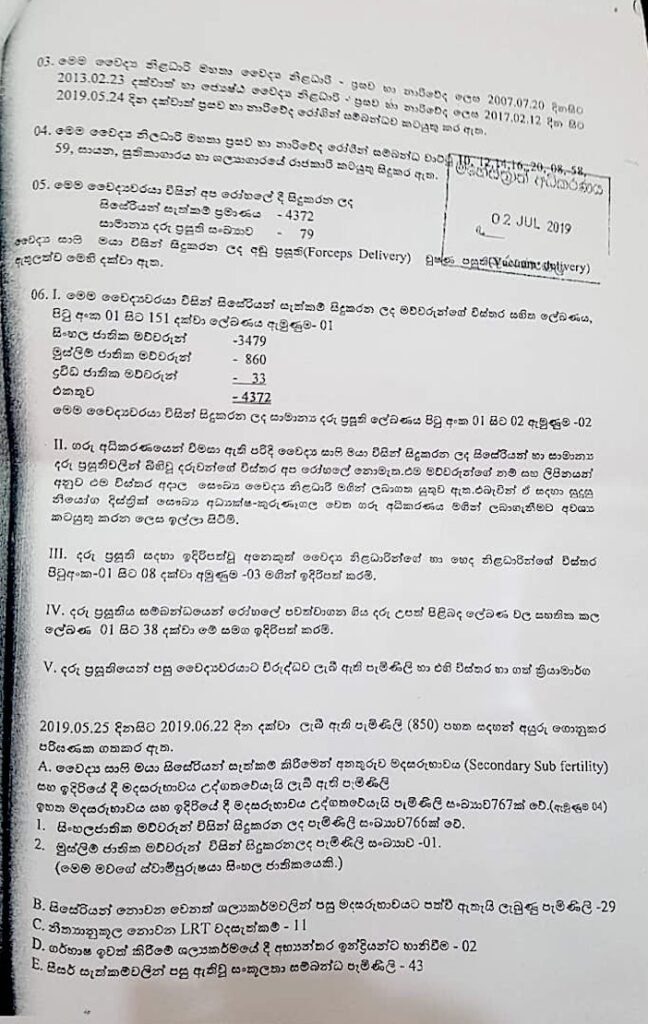
කුරුණෑගල රෝහල සිදුකළ පරීක්ෂණය අනුව වෛද්‍ය ශාෆි සිසේරියන් සැත්කම් 4372ක් සහ සාමාන්‍ය දරු ප්‍රසුති 79ක් සිදු කර ඇත. මේ අතුරින් සිංහල මව්වරුන් 3479ක්, මුස්ලිම් මව්වරුන් 860 ක් සහ දෙමල මව්වරුන් 33ක් ඔහු යටතේ සිසේරියානු සැත්කම්වලට භාජනය වී ඇත. විමර්ශනයෙන් හෙළි වූ වැදගත් කරුණු,

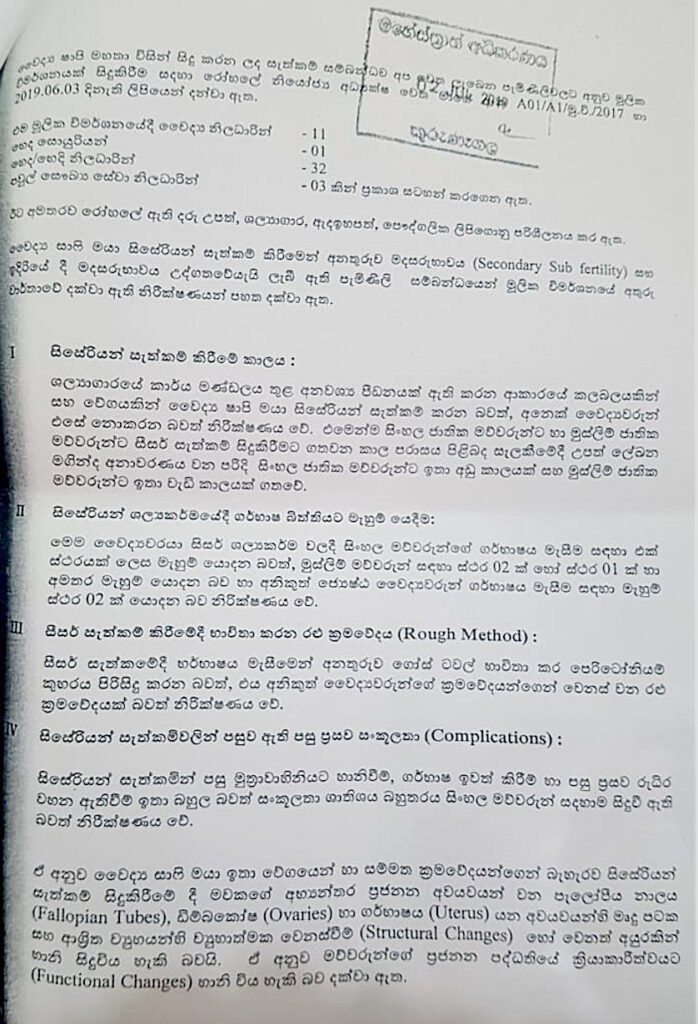
*ශල්‍යාගාරයේ කාර්ය මණ්ඩලය තුළ අනවශ්‍ය පීඩනයක් ඇතිවන ආකාරයේ කලබලයකින් සහ වේගයකින් ෂාපි වෛද්‍යවරයා සිසේරියන් සැත්කම් සිදු කර ඇත.

*සිංහල මව්වරුන්ට ඉතා අඩු කාලයකින් සිසේරියන් සැත්කම් සිදු කර ඇත. මුස්ලිම් මව්වරුන්ට ඊට වඩා සැලකිය යුතු කාලයක් ගත කර ඇත.

*සිසේරියන් සැත්කම්වලදී සිංහල මව්වරුන්ගේ ගර්භාෂය මැසීමට එක ස්ථරයක් ලෙස මැහුම් යොදයි. මුස්ලිම් මව්වරුන්ට ස්ථර දෙකක මැහුම් යොදයි. කෙසේ වෙතත් රෝහලේ අනෙකුත් ජ්‍යෙෂ්ඨ වෛද්‍යවරු ගර්භාෂය මැසීමට ස්ථර 2ක් මැහුම් යොදයි.

*සිසේරියන් සැත්කමේදී ගර්භාෂය මැසීමෙන් පසුව පෙරිටෝනියම් කුහරය අනෙක් වෛද්‍යවරුන්ට වඩා රළු ආකාරයට පිරිසිදු කරයි.

*ෂාපි වෛද්‍යවරයාගේ සිසේරියන් සැත්කම්වලින් පසු මුත්‍රවාහිනී හානි වීම්, ගර්භාෂ ඉවත් කිරීම් හා පසු රුධිර වහනයවීම් වැනි සංකුලතා ඉහලය. ඒවා සාතිශය බහුතරය සිංහල මව්වරුන් සදහාම සිදු වී ඇත.

*මවගේ හෝ පියාගේ අනුමැතියකින් තොරව මව්වරුන් 11 දෙනකුට නීතිවිරෝධී ආකාරයට LRT සැත්කම් සිදු කර ඇත. ඒ බව ඇද ඉහපත් වාර්තා මගින් සනාථ වී ඇත.

මහත්තයාගේ බෙල්ලට පිහිය තියලා ආගමට හැරෙන්න කිව්වා… මාව කූඩුවට දාන්න එපා කියලා දරුවන් පොලිසියේ අයගේ කකුල් අල්ලා වැන්දා!! මහත්තයා අතහැරියොත් මාව හජ්ජියාර්ලා භාරගන්නම් කීවා!!!

July 3rd, 2019

සිරිමන්ත රත්නසේකර දිවයින උපුටා ගැන්ම

තමන් කැමැති අයකු සමග විවාහ වීමේ අයිතිය මුස්ලිම් කාන්තාවන්ටත් තිබිය යුතුයි…  පූජ්‍ය ගලගොඩඅත්තේ ඥානසාර හිමියෝ 

galag555

“…බබා හම්බවෙන්න ගමට ආ විට තර්ජනය කළා…. පොලිසියට පැමිණිලි අටක් දැම්මත් විමර්ශනයක් කළේ නෑ…”

ඕනෑම කාන්තාවකට හෝ පුරුෂයකුට ඕනෑම ආගමක, ජාතියක අයකු සමඟ විවාහ වීමට අයිතියක් තිබිය යුතු බවත් එය මුස්ලිම් කාන්තාවන්ට පමණක් වෙනස් විය යුතු නැති බවත් බොදුබල සේනා සංවිධානයේ මහ ලේකම් රාජකීය පණ්ඩිත පූජ්‍ය ගලගොඩඅත්තේ ඥානසාර හිමියෝ කීහ.

 බණ්ඩාරගම අටලූගම මුස්ලිම් කාන්තාවක් මුහුණ දී ඇති මනුෂ්‍යත්වයට නිගාදෙන අවාසනාවන්ත තත්ත්වය රට දැනගත යුත්තක් බවත් සැබෑ අන්තවාදය, ජාතිවාදය ඇත්තේ කොතැනද යන්න මින් තහවුරුවනු ඇති බවත් උන්වහන්සේ කීහ.

බොදුබල සේනා සංවිධානයේ මහ ලේකම් පූජ්‍ය  ගලගොඩඅත්තේ ඥානසාර හිමියෝ ඊයේ (02 වැනිදා* එම අදහස් පළ කළේ කිරුළපන බෝධි බෞද්ධ මන්දිරයේ පැවැති විශේෂ මාධ්‍ය හමුවේදීය. මෙහිදී බණ්ඩාරගම අටලූගම මුස්ලිම් ජාතික කාන්තාවක් වන අබ්දුල් හසම් ෆාතිමා හයිෆාම් මහත්මියද එක්වී සිටි අතර එහිදී ඇය විශේෂ හෙළිදරව්වක් කළාය.

 මෙහිදී වැඩිදුරටත් අදහස් දැක්වූ පූජ්‍ය ගලගොඩඅත්තේ ඥානසාර හිමියෝ මෙසේද කියා සිටියේය.

 අද අපි විශේෂ හෙළිදරව්වක් වශයෙන් කරන අටලූගම ගමේ යුවළ පිළිබඳ තොරතුරු රටට කියන්නේ කිසිදු ජාතිවාදී හෝ ආගමික ඝට්ටනයක් ඇතිවීම සඳහා නොවේ. රටේ නීතිය හරිහමන් ලෙස කි‍්‍රයාත්මක නොවීම නිසා රටේ පුරවැසියන් විඳින අනේකවිධ කම්කටොලූ හෙළිකිරීම සහ ඔවුන් හමුවේ පවතින ජීවිත තර්ජන ගැන හෙළිකිරීමයි.

 බණ්ඩාරගම අටලූගම ගමේ මේ වන විටත් කි‍්‍රයාත්මක උම්මත්තක අන්තවාදී සැහැසිකම්, වාර්ගික, ආගමික නීති රට දැන ගත යුතුයි. මේ යුවළ අප සංවිධානයට පැමිණ මේ ගැන කියන්න ඉල්ලීම් කරන්නේ බොහෝ කාලයකට පෙර සිටයි. අප ඒ ගැන අවශ්‍ය තැන්වලට දැනුවත් කළා. නමුත් ඒ යුවළ දැනටමත් ඒ අනේකවිධ දුක්කම්කටොලූවලට මුහුණ දෙනවා.

 මේ හෙළිකිරීම මුස්ලිම් ජනතාවට හෝ එම ආගමිකයන්ට කරන එරෙහිවීමක් නොවෙයි. මේ දරුවෝ දෙදෙනෙක්ගේ මවක්. මුස්ලිම් සමාජයෙන් මතුව ඇති ඉස්ලාමික වහබ්වාදී අන්තවාදය නිසා ඒ සමාජය කෙතරම් අවාසනාවන්ත තත්ත්වයකට ඇදවැටිලාද කියලා මේ සිදුවීමෙන් තේරුම් ගන්න පුළුවන්.

 සමාජ ඒකාබද්ධතාවය, සංහිඳියාව ගැන කතා කරන සැමට අද අපි උත්තරයක් දෙනවා කොතැනද මේ අන්තවාදය තියෙන්නේ කියලා. ආගම්වාදය කොතැනද කියලා අන්න ජාතිවාදය ආගම්වාදය තිබෙන්නේ අපි තුළ ද කියලා රටට දැන් හිතාගන්න පුළුවන්. මනුෂ්‍යත්වයට නිගාදෙන සැහැසිකම් ඇත්තේ කොතැනකද යන්න මේ කතාවෙන් හිතාගන්න පුළුවන් වේවි. අප පෙළගැසිය යුත්තේ කා වෙනුවෙන්ද යන්න මේ මාතාවගේ කතාව ඇසීමෙන් ඔබට තේරුම් ගන්න පුළුවන් වේවි. 

 බණ්ඩාරගම අටලූගම ගම්පිටින් අපහරණය කරන හජ්ජියාර්ලා ගැන අපි දන්නවා. පරිස්සමෙන් ඉන්න කියලා. ඒ අයට අපි දැනුම් දෙනවා. අපිට හමුදා අධිකරණ ඕන නැහැ. නීති හදන උදවිය නීති කි‍්‍රයාත්මක කරන අය මේ ප‍්‍රශ්න ගැන බලන්න ඕනෑ. ඕන කෙනකුට ඕන කෙනෙක් විවාහ කරගන්න පුළුවන්. අපේ කෙනෙක් වෙන කෙනෙක් සමඟ විවාහ වුණොත් අපි උන්ව මරාගෙන කන්න හදනවද? අපි එහෙම නැහැ. මුස්ලිම් අන්තවාදය රට විනාශ කර තිබෙනවා.

 වහබ්වාදය හා අන්තවාදය පැතිරවීම සඳහා මොවුන් අල් ටකියාව භාවිතා කරනවා. අල් ටකියා කියන්නේ ශුද්ධවූ රැුවටීමයි. සාම්ප‍්‍රදායික මුස්ලිම්වරුන් මෙහි ගොදුරු බවට පත්වෙලා. මේ පවුලට ගල් කැටයකින් හෝ හානියක් නොවිය යුතු බව ආගමෙන් පිස්සු වැටුණු අටලූගමේ උම්මත්තකයන්ට අපි කියනවා. අපි කියන දේ කරන්න බැරිනම් සේරම අකුලගෙන බණ්ඩාරනායක ගුවන්තොටුපළෙන් කැමති රටකට ඔවුන්ට යා හැකි බවත් අප සිහිපත් කරනවා. මේක අපේ රට… මීට වඩා සිංහලයන්ගේ ඉවසීම පරීක්‍ෂා කරන්න එපා. 

 මෙහිදී අදහස් දැක්වූ බණ්ඩාරගම අටලූගම පදිංචි අබ්දුල් හසට් ෆාතිමා හයිෆාම් (38* මහත්මිය මෙසේද කීවාය.

 2008 මම සිංහල බෞද්ධ මහත්මයෙක් සමඟ විවාහ වුණා. ඒ විවාහවෙලා අටලූගම නිවසට ගියාම පල්ලියේ සේරම සහ ගමේ සේරම ඇවිත් සිංහල කෙනෙක් බැඳලා ඉන්නේ කියලා අපිව එලවන්න හැදුවා. මහත්තයාට තර්ජනය කළා. පසුව අපි පොලිසියේ පැමිණිල්ලක් කරලා මාලබේ පදිංචියට ගියා. එහි සිටි ටික කාලයකදී මම ගැබිණියක් වුණා. බබා හම්බවෙන්න ඕන නිසා අටලූගම අම්මගේ ගෙදර ගියා. එහිදී ගමේ සේරම ඇවිත් අපිට තර්ජනය කළා. මහත්තයාව ගමෙන් එළෙව්වා. 

 මහත්තයට ආගමට එන්න කියලා තර්ජනය කළා. බබා හම්බවුණාම මහත්තයා අපේ ගෙදරට ආවා. ඒ ආ පසු පල්ලියේ අය ඇවිත් ඔයාට වාහන දෙන්නම් ගෙවල් දෙන්නම් ආගමට එන්න කියල දිගටම බලපෑම් කළා. මහත්තයා ඒකට කැමති වුණේ නැහැ. මහත්තයාට අපේ ආගමට එන්න ඕන වුණේ නැහැ. එයාට මාව බෞද්ධ ආගමට ගන්නවත් ඕන වුණේ නැහැ. අපි දෙන්න අපි දෙන්නගෙම ආගම් අනුව ඉන්න තමයි කටයුතු කළේ.

 පසුව පල්ලියෙන් ඇවිත් මහත්තයාගේ බෙල්ලට උල් ආයුධයක් තියලා ආගමට හැරෙන ලෙස බලපෑම් කළා. මෙයා අපේ ගෙදර පැමිණි හැම වෙලාවෙම දාහක විතර පිරිසක් අපේ ගෙදර ඇවිත් තර්ජනය කරනවා. පසුව එයා රට ගියා. මහත්තයා රට ගියාම පල්ලියේ අය මට කිව්වේ එයා ගැන ආසාව අතහරින්න කියලයි. මුස්ලිම් කෙනෙක්ව හොයලා දෙන්නම් එයාව බඳින්න කිව්වා. ඉන් පසු ළමයි ඇතුව හෝ නැතුව මාව ගන්නම් කිව්වා. හජ්ජියාර්ලත් මට කතාකර භාර ගන්නම් කිව්වා. ඒ අයගේ නම් වුණත් මට කියන්න පුළුවන්.

 පල්ලියේ අය මහත්තයට සීඞී තැටි ගොඩාක් එව්වා. අවුරුදු 32 ක් මහණවෙලා සිටි හාමුදුරුවෝ නමක් දැන් ඉස්ලාම් ආගමට ඇවිත් පූජකයෙක් වෙලා ඉන්නවා කියලා එම සීඞීවල සඳහන් වෙනවා. ලෝකේ උතුම්ම ආගම ඉස්ලාම් ආගමට එන්නේ නැත්තේ ඇයි කියලා ඔවුන් ප‍්‍රශ්න කළා. මම බයිසිකලයේ ගමන් යනවා. එයට හැමෝම එරෙහි වුණා.

 පසුව දවසක රාති‍්‍රයෙත් පල්ලියෙන් ආව කියලා දොරවල් කඩන්න හැදුවා. මමයි අම්මයි ළමයි අඬන එක ඔවුන් වීඩියෝ කළා. පසුව අපි පොලිසියට කතා කළා. නමුත් පොලිසිය ඒ වෙලාවේ ආවේ නැහැ. පසුව පොලිසිය සමඟ ඔවුන් අපේ ගෙදරට දොරවල් කඩාගෙන ආවා. පොලිසියේ හතරදෙනෙක් හිටියදී ඔවුන් මටත් ළමයිටත් ගැහුවා. පසුව පල්ලියේ අනිත් අය අපිව පාරට ඇදගෙන ගියා. එතකොට ගල් මුල්වලින් ගැහුවා. ඔවුන් පල්ලියේ නීතිය කි‍්‍රයාත්මක කරන්නද පොලිසිය නීතිය කි‍්‍රයාත්මක කරනවද ඇහුවා.

 පසුව අපිව පොලිසියට අරන් ගියා. මාව කූඩුවට දාන්න හදනකොට ළමයි පොලිසියේ අයගේ කකුල් අල්ලලා වැන්දා. අම්මව කූඩු කරන්න එපා කියල. පසුව මහත්තයා පාන්දර 2.00 ට පොලිසියට ආවා. පසුවදා තමයි ඇප දුන්නේ. අපි පොලිසියට පැමිණිලි 8 ක් දැම්මා. නමුත් විමර්ශන කළේ නැහැ. මේ සිදුවීම වුණේ මාර්තු විසිහතරවැනිදායි. අපේ‍්‍රල් 06 වැනිදා වෙනකම් විභාග කළේ නැහැ. පසුව ස්ථානාධිපතිවරයා මට කතා කළා. අපි පොලිසියට ගිය පසු ප‍්‍රශ්නය විසඳුවේ පල්ලියේ අයත් ඇවිත් ගම් සභාවක් වගෙයි.

 කැඩිච්ච දොරවල් හදාගන්න රුපියල් විසිඅටදාහක් දෙන්නම් කිව්වා. සල්ලි වගේ නෙමෙයි මාව මැරුවට වඩා හානියක් ඒ අය කළේ. මට ගහපුවා අපි අඬනවා ෆේස් බුක් වට්ස් ඇප්වල පවා දාලා තිබුණා. මම මානව හිමිකම් සංවිධානවලට කොතෙකුත් කතා කළා. නමුත් ජුනි විස්ස වෙනකම් නඩුවක් වැටුනේ නැහැ. මට කිසිම සාධාරණයක් වුණේ නැහැ. ඒ නිසා තමයි මම හාමුදුරුවෝ හොයාගෙන ආවේ. හාමුදුරුවෝ නැත්නම් මේ දේවත් වෙන්නේ නැහැ.

 මගේ අවුරුදු 11 ක් වන ගැහැනු දරුව මුස්ලිම් කෙනකුට බන්දලා දෙන්න කියනවා. අපිට හරියට අඳින්නවත් බැහැ. කළු තමයි අඳින්න කියන්නේ. දරුවෝ දෙන්නා බෞද්ධ පාසල්වලට තමයි යන්නේ. අවුරුදු දහයක පහළොවක කාලයක සිට අපේ සමාජය බරපතළ ලෙස වෙනස් වෙලා. පල්ලිවලින් අපේ සමාජයට බරපතළ බලපෑම් එල්ල වෙනවා. මම මුලින් 

 රැුකියාවට ගිය පසු අපේ තාත්තව දහපාරක් විතර පල්ලියට අරන් ගියා.

 මේ ආගමේ ඉපදුන නිසා මම සෑහෙන කරදරවලට ලක් වුණා. මගේ දරුවන් මේ ආගමට ගෑවෙනවටවත් මම කැමති නැහැ. මොන දේ වුණත් හැම දේටම වඩා මුල ආගමයි. ආගම හැර ඔවුන්ට වෙන කිසි දෙයක් නැහැ. අපේ ගමට පල්ලි හතක් තිබෙනවා. මාරාව පල්ලියෙන් තමයි මේ දේ කළේ.

 මම මේ දේ සඳහා ඉදිරිපත් වුණේ මම වැටුනු තත්ත්වයට තවත් කාන්තාවන් පත් නොවීමටයි. මේ පල්ලියේ කට්ටිය පිටුපස සිංහල, දෙමළ දේශපාලනඥයන් ඉන්නවා. ඥානසාර හාමුදුරුවෝ නැත්නම් මේ ටිකවත් නැහැ.

SOFA and sovereignty: Why US-Lankan pacts are cause for concern

July 3rd, 2019

By P.K.Balachandran Courtesy NewsIn.Asia

SOFA and sovereignty: Why US-Lankan pacts are cause for concern

Sri Lanka is on the verge of signing the highly controversial Status of Forces Agreement (SOFA) with the United States, which, according to strategic experts, could theoretically make the island nation a happy hunting ground of millions” of US servicemen, Defense Department personnel and Defense Department contractors.

On the anvil is another controversial agreement on the US$ 480 million fund from the Millennium Challenge Corporation (MCC), which, if approved by the US Congress and the Lankan cabinet, will include a number of infrastructure projects, but principally the 200 km Colombo-Trincomalee Economic Corridor (CTEC), connecting the West coast with the East coast.

According to Sri Lanka’s former Foreign Secretary, Dr. Palitha Kohona, the MCC requires the government to change land laws to enable peasants to alienate lands given to them by the State. The buyers could be foreign entities. He pointed out that the CTEC will also be violating the Indo-Lanka Accord of 1987 which forbids the Lankan government from giving over any harbor or airport in the island to a foreign power to be used for a military purpose inimical to India. The US does intend to develop Trincomalee as a logistics base, Dr. Kohona said.

President Maithripala Sirisenahas said time and again that he is opposed to SOFA as it seriously erodes the sovereignty of the country. He even instructed Foreign Minister Tilak Maraponato tell the US State Department that SOFA cannot be accepted in the present form. Prime Minister Ranil Wickremesinghe, who is generally pro-US, also has reservations, for without his consent, the Foreign Minister Marapona, who belongs to his party, United National Party (UNP), would not have told the Americans that SOFA has flaws.

Only Finance Minister Mangala Samaraweera is all for SOFA and MCC.

ACSA 2017 and SOFA

Adm. Dr. Jayanath Colombage, formal Lankan navy chief who is a maritime security expert with the Pathfinder Foundation, said thatthe Access and Services Agreement (ACSA) signed in 2007 was a very simple one, meant to facilitate US troops coming here for joint training exercises with the Lankan military.

Dr. Palitha Kohona, Lanka’s Foreign Secretary during the last war with the Tamil Tigers, said that ACSA 2007 was for a fixed period of 10years. When it came up for renewal in 2017, ACSA had become a different kettle of fish. It was an 83-page document with more than 50 annexures. Above all, it was open ended”. In other words, it had no time limit other than a provision for ending it with either party giving 180 days’ notice.

Subsequently, the US proposed to replace ACSA with the comprehensive SOFA. According toSunday Times the US is wanting aircraft and vessels of the US Government to be free from boarding and inspection. This means none of the Lankan state security arms, like the Navy, Coast Guard or the Customs can board any US military vessel or aircraft when it is in a Sri Lankan airport or sea port. They cannot even check vehicles on land, an internationally accepted sovereign right of a country.

The US also wants exemption from licenses, customs duties, taxes and any other charges within Sri Lanka.

The US is seeking authorization for its troops to wear uniforms whilst on duty” in any part of Sri Lanka, and to carry arms and radio communications equipment. But in terms of the Sri Lankan Constitution and normal laws, only the armed forces and the Police have these privileges.

In addition, Washington wants US troops and contractors to be allowed to enter and leave Sri Lanka, individually or collectively, with the use of only their US identification. This will mean they will carry no passports or visas,Sunday Times says.

SOFA would also grant US military personnel, US military contractors and US military suppliers the same perks and privileges granted to technical and administrative officers of the US Embassy.

While Dr. Palitha Kohona drew attention to the social ills arising out of having an American military Rest and Recreating(R and R) Center here, Adm. Colombage pointed to the possibility of US mercenaries coming in the form of US Department of Defense contractors (example the Blackwater military company which was deployed in the Middle East).

Both Kohona and Colombage said that about 2 million US personnel could be authorized to operate in Sri Lanka in one way or the other.

Violates Diplomatic Privileges Act of 1996

SOFA violates the Diplomatic Privileges Act of 1996 which stresses reciprocity. If a country, say the US, gets certain diplomatic rights in Sri Lanka but does not give Sri Lankan diplomatic personnel the same rights in the US, then the Sri Lankan government will deprive the US personnel of those privileges here in the island.

If it appears to the Minister of Foreign Affairs that the privileges and immunities accorded to a Sri Lankan mission in any State abroad, or to persons connected with that mission, are less than those conferred by this Act on the mission of such State or on the persons connected with that mission, the Minister may by Order published in the Gazette, declare that such of the provisions of this Act as are specified In such Order shall, with effect from such date as may be specified in such Order, cease to apply with respect to the mission of that State or to such categories of members of the mission of that State, as is, or are, specified therein,” the Act says.

Therefore,in view of the Diplomatic Privileges Act of 1996, the SOFA signed in 1995 during the Presidency of Chandrika Kumaratunga cannot be extended automatically to the SOFA envisaged in 2019. This was told to the US State and Defense Departments when Lankan Foreign Minister Tilak Marapana was in the US last.

Impairment of Non-Alignment

According to Dr. Kohona, SOFA would seriously impair Lanka’s status as a non-aligned country wanting to be friends with all and enemy of none.

Since we are under no threat from any country, why should we enter into such a wide-ranging agreement with a Super Power, unless the intention of that Super Power is to draw us into a conflict with China by making Sri Lanka a base?” he asked.

Since the US is obsessed with the security of the Indo-Pacific region following the rise of China as a power, SOFA would invariably draw Lanka into an armed Sino-US conflict, Kohona warned.

India’s Silence Intrigues

Adm. Colombage noted that India, which is a dominant power in the Indian Ocean and the South Asian region is silent on the issue of the Lanka’ SOFAwith the US.

He does not believe that India wants the US to dominate Sri Lanka or that it is going along with the US strategy to contain China in the Indo-Pacific region the whole hog.

India wants good relations with China to increase trade and economic cooperation.Therefore, India is concerned and is perhaps taking steps in its own, quiet way. Indian diplomacy achieves its ends quietly,” Adm. Colombage believes.

However, he does worry about the possibility of the past impairing the Indian vision.

In the past, India was maritime blind.It was maritime blindness which made the 26/11 Mumbai attacks possible andit was maritime blindness which made India ignore Chinese incursions into the Indian Ocean until it became manifest,” he recalled.

Dr. Kohona said that the development of Trincomalee as a logistic base under the MCC fund is linked to SOFA. This should worry India, he added.

Kohona pointed out that the Indo-Lanka Accord of 1987 says that Sri Lanka should not give any of its harbors or ports to any other country which might use it for a military purpose in a way inimical to India.

The Indo-Lanka Accord is a bilateral agreement which we cannot ignore,” the veteran diplomat observed.

Economic Argument For SOFA

However, SOFA has a staunch defender in Lankan Finance Minister Mangala Samaraweera. Recently, he refuted the charge that SOFA is dangerous.

In 1995, a SOFA was signed during President Chandrika Kumaratunga’s time. That had done no harm to the country. The present discussions are only about renewing it,” Samaraweera said.

Further, it will not be in Sri Lanka’s economic interest to alienate the US as it annually purchases about US$3.7 billion worth of goods and services. The European Union (EU) is Sri Lanka’s largest export partner. Both the EU and the US purchase a large percentage of the output of Lanka’s US$5 billion garment industry,” he pointed out.

(The featured image at the top shows Lankan Foreign Minister Tilak Marapana meeting US Secretary of State Mike Pompeo in Washington)

Pujith and Hemasiri further remanded

July 3rd, 2019

Courtesy Adaderana

Inspector General of Police (IGP) Pujith Jayasundara and former Defence Secretary Hemasiri Fernando have been further remanded until the 9th of July, says Ada Derana reporter.

The former Defence Secretary was taken into custody by a team of CID officers who visited the hospital earlier yesterday (02). He continued to remain at the hospital under the CIDs custody.

Meanwhile, IGP Pujith Jayasundara was also arrested by the CID while receiving treatment at the Police Hospital yesterday (02).

The former Defence Secretary and the Police Chief were summoned to appear before the Criminal Investigations Department (CID) yesterday, however, they were both admitted to hospital last morning.

Fernando was admitted to the Coronary-Care Unit (CCU) at the General Hospital Colombo while the IGP was admitted to the Police Hospital in Narahenpita.

Colombo Chief Magistrate Lanka Jayaratne later ordered to remand the duo until today.

Attorney General Dappula de Livera, on Monday (01), wrote to the acting police chief urging him to bring charges against his predecessor, IGP Pujith Jayasundara, and the former defence secretary, Hemasiri Fernando.

Investigations to probe police inaction over harassment complaint by Muslim woman

July 3rd, 2019

Courtesy Adaderana

The Special Investigation Unit (SIU) has launched an investigation into the allegations of inaction by the Bandaragama Police over complaints lodged by a Muslim female on harassment against her, stated the Police Media Spokesperson.

A Muslim woman named Abdul Hassan Fathima, speaking at a press conference held with the General Secretary of Bodu Bala Sena (BBS) organization, yesterday (02), stated that the Bandaragama Police did not take necessary legal action on a complaint she filed.

At the press conference, Fathima revealed that she got married to a Sinhala man in 2008 and that he was threatened and harassed by the mosque over the marriage. They had then lodged a complaint at the police and left the area to live in Malabe, she said.

Later, the couple had moved back to Atalugama as they had been expecting a baby.

However, the people from the mosques had chased away the husband stating that a Sinhala man cannot be allowed to live there, she said. Fathima had been allowed to remain in the village as she was pregnant, she added. The husband had then left her at her mother’s home and visited her secretly until she delivered, said Fathima.

Fathima further revealed that the people from the mosque had threatened her husband continuously to convert into Islam and attempted to bribe him with offers of houses and vehicles.

The husband had subsequently left the country and the mosque had informed her not to be bothered to look for him, said Fathima.

According to her, the mosques had told her that she could be married off to a Muslim man if she and the baby leaves husband.

On 24th March, a group from the mosque broke into their home and assaulted her and her husband while the police was looking on, stated Fathima. They had also stoned the children when they cried, she added. They were then jailed until the next morning, she further said.

Fathima further claimed that the Bandaragama Police did not take action on the complaints they had lodged with them.

These harassments had come from a mosque called ‘Marawa’, Fathima further claimed.

Tourism has promising future in Sri Lanka – PM

July 3rd, 2019

Courtesy Adaderana

The Lonely Planet magazine, despite all the troubles Sri Lanka faced due to the attacks, has named Sri Lanka the best destination for tourists to visit, says Prime Minister Ranil Wickremesinghe.

At the beginning of the year, Lonely Planet magazine named Sri Lanka as the world’s best destination to visit. However, after the Easter Sunday bomb blasts, we thought that we had lost this position,” PM Wickremesinghe has said.

The prime minister reiterates that tourism has a promising future in Sri Lanka.

He urges everybody to get together to ensure that the industry thrives and enhances the country’s image in the eyes of the world.

The complete statement by Prime Minister Ranil Wickremesinghe is as follows:

At the beginning of the year, Lonely Planet magazine named Sri Lanka as the world’s best destination to visit. However, after the Easter Sunday bomb blasts, we thought that we had lost this position. Many tourists fled the country. But last week, Lonely Planet stated that despite all the troubles Sri Lanka faced due to the attacks, we still remain the best destination for tourists to visit, the best destination in the world. 

We must all feel proud as they said, We came here and were greeted with a friendly hello by the people. Everyone was friendly and they welcomed us everywhere, we did not see any problems.” This is the view of the Lonely Planet magazine. Therefore, I must emphasize that the Government is taking steps to assist the tourism industry, and will announce further measures soon. I would like to thank all those in the tourism sector – big and small – who helped to keep the industry moving.

I must also thank the members of the security forces who helped us from April 21st, the day of the attacks when I first met them. They set about capturing those responsible, and all are now in custody. They were able to accomplish this mission within just two months. So, I must reiterate that tourism has a promising future in Sri Lanka. I urge everybody to get together to ensure that the industry thrives and enhances our image in the eyes of the world.”

Tourist arrivals in Sri Lanka sharply decline after attack

July 3rd, 2019

COLOMBO, SRI LANKA

Arrival of tourists to Sri Lanka has rapidly declined in June, dealing a severe blow to the Indian Ocean island nation’s lucrative tourism industry in the aftermath of the Easter bombings that killed more than 250 people, the state-run tourism agency said Wednesday.

The Sri Lanka Tourism Development Authority said there were 63,072 tourist visits to Sri Lanka last month, a drop of 57% compared with June 2018, when the number was 146,828.

The authority said the highest number of tourist were from India, followed by the Australia, United Kingdom and China. Almost 97% of tourists arrived by air.

The arrival of tourists for the first six months was 1,008,449, a decline of 13.4 % compared with 2018, when 1,164,647 visitors arrived.

Failure of NTJ’s second spate of orchestrated attacks

July 3rd, 2019

By Piyumi Fonseka Courtesy The Daily Mirror

Much has been spoken of the Easter Sunday terror attacks and the network of National Tawheed Jamaat (NTJ) – the hitherto little known terrorist outfit responsible for the bombings in three churches and several deluxe hotels on April 21. Two days subsequent to the dastardly suicide bombings, Indian security agencies alerted Sri  Lanka that another attack could be carried out by NTJ, the Hindustan Times reported quoting senior officers of the SITE intelligence group. 


  • Lorry driver asked to nap until goods loaded onto vehicle 
  • Explosives transported under pretext of sulphuric acid used in making gold jewellery 
  • NTJ accomplice constantly updated caller on whereabouts en route to Kalmunai 
  • Temple of the Sacred Tooth Relic had been one of the main targets

Plans changed, group split

The NTJ that was formed in Kattankudy was predominantly led by the family members of Zahran. His brothers Zaini and Rilwan were prominent figures in the now proscribed terrorist outfit. A majority of NTJ members were in their twenties. 

Following the February 2018 attack on Muslims in Digana, a group of Muslim youths from Mawanella joined Zahran.  

Naufar Moulavi, one of Zahran’s teachers, was NTJ’s second in command. In February 2019, the faction linked to Naufar Moulavi protested saying Zahran favoured his relations. There was also a tug of war between Zahran and Naufar over NTJ leadership which split the outfit into two factions. 

The second head of TJ Naufar Moulavi and his NTJ allies opined suicide bombings should be carried out at all nine provinces in the country simultaneously. This sketch contrasted with that of Zahran. 

H.M. Ahmad Millan, who was in charge of NTJ’s armed wing, sided with Naufar Moulavi. Police say he was responsible for the killing of two constables at Vavuniya in 2018 – he was arrested in Saudi and extradited on June 14. 

Zahran had appointed his brother Rilwan to organise the second spate of attacks. His other brother Zaini had been tasked with conducting extremist lectures and NTJ propaganda. The Zahrans have reportedly had several safe houses in Panadura, Negombo, Malwana and Kalmunai. They had also rented an apartment in Kollupitiya. Buying and renting of residences for the second spate of attacks had been entrusted to Mohammdu Niyas and Kalmunai Siyam. In early April, the duo had rented five safe houses in the East – one from Sainthamaruthu, one from Sennal Gramam, one from Adalachchanai and two from Nintavur. A warehouse in Sammanthurai had been rented to store explosives. 

After the bombs were systematised for the Easter attacks, the remaining explosives had been dispatched from Negombo and Sammanthurai warehouses. Oblivious to the impending danger, the lorry driver had transported the explosives on April 9 from Negombo to Sammanthurai  

According to reports, a monthly rental of Rs.40,000 had been paid for the house in Sainthamaruthu, while a monthly rental of Rs.50,000 was paid for the warehouse at Sennal Gramam in Sammanthurai. Meanwhile, one of the two houses in Nintavur was rented for Rs.20,000 per month. The house in Addalaichenai had been paid a monthly rental of Rs.15,000. Although the standard monthly rental for houses in these areas average Rs.3,000-5,000, the attackers had paid large sums to retain the abodes in Ampara. 

On April 19, Zahran’s brothers Rilwan and Zaini along with several females attached to the group had purchased white clothes from a shop in Giriulla for Rs. 29,000. According to the police, the clothes were for the second and third attacks targeting Buddhist places of worship – SIS sources state the Temple of the Sacred Tooth Relic had been one of the main targets. Some others are Kaluwanchikudy  Church and several mosques in Ampara. A total of 11 suicide bombers had been prepared for the next spate of attacks. 

According to the police, the clothes were for the second and third attacks targeting Buddhist places of worship – SIS sources state the Temple of the Sacred Tooth Relic in Kandy had been one of the main targets. Some others are Kaluwanchikudy Church and several mosques in Ampara. A total of 11 suicide bombers had been prepared for the next spate of attacks. 

On April 26, the security forces seized a cache of explosives at Sammanthurai in the Eastern Province

The cache of explosives seized by the security forces at Sammanthurai in the Eastern Province on April 26

The State Intelligence Service had established the connection since the safe house was found in Negombo. After a lengthy search, the intelligence unit was able to trace the bomb store in Sammanthurai on April 26.


Lorry driver – National hero

On April 26, the security forces seized a cache of explosives at Sammanthurai in the Eastern Province – ten civilians including six children were among the casualties who were killed in the suicide bombings minutes before the security forces arrived at the scene to raid the residence and arrest them. The raid was launched based on intelligence as reported in the media then. 

However, not much was reported about the lorry driver who transported, from Negombo to Kalmunai, explosives and various items used in manufacturing bombs for the next spate of terror attacks. In the article, the writer uses a pseudonym to refer to the lorry driver on account of security concerns. 

After the bombs were systematised for the Easter attacks at houses in Negombo and Panadura, the remaining explosives had been dispatched from Negombo and Sammanthurai warehouses. Oblivious to the impending danger, lorry driver Prasanna had transported the explosives on April 9 from Negombo to Sammanthurai. 

Prasanna, the national hero who saved the precious lives of thousands of fellow Sri Lankans, toils as a lorry driver at a private taxi service in Colombo. On April 9, he had received a hire from Negombo to Ampara – the destination was later changed to Kalmunai. Empty-pocketed at the time, Prasanna was overjoyed to hear about the long distance hire. When he had inquired as to what was being transported, Prasanna had been told it was a consignment of gold and some other material. The luggage had then been loaded onto the lorry and left for Kalmunai. 

I was asked to arrive near the Katuwapitiya Church in Negombo on April 9 at 10.00 p.m. But I faced several issues on my way. My phone battery had died and diesel in my lorry was almost over by the time I reached their house in Negombo. I was driving on a patched tyre and had no money to even have one meal that day. By the time I reached Negombo, it was around 11.30p.m.The packing finished at 12.30 a.m.and I started the journey with one of the men in the house. As I remember, the one who joined me to Kalmunai was Rilwan, the brother of Zahran. They asked me to nap until they finished loading things onto the lorry. But I didn’t want to sleep so I helped them. There were many heavy cans that were loaded onto the vehicle. 

When I asked why they were heavy, they said the cans were full of sulphuric acid which they use in making gold jewellery. They acted in no suspicious manner, though the one who came with me was always on the phone, constantly updating someone on our whereabouts in a different language. We reached Sammanthurai at 12.30 p.m. After the April 21 attacks, I was shocked. So many questioned were on my mind as to whether the hire I took on April 9 had any link to the terrorists. After discussing with my family, I decided to inform the police through a group of businessmen known to me. I was told by the police that I had saved lives of thousands of Sri Lankans. But I have not been given anything to admire what I did. I am afraid to even go out now. I am afraid about the safety of my family. It will be a great help if the government can support me financially until I feel safe enough to live like before,” Prasanna said. 

When Prasanna informed the police on April 25, investigators and intelligence teams had already found the house in Negombo where bombs were manufactured. 

Investigations are still ongoing with the support of those who were arrested based on information provided by Prasanna to SIS. 

The Major Constraints for Sri Lanka’s Future: The Proportional Representative System of Election, the Provincial Councils and the 19 th Amendment.

July 2nd, 2019

By Garvin Karunaratne

I write in support of the suggestions made by the former Minister Milinda Moragoda. We have to be thankful to Mr Moragoda for his patriotism.

Patriotism is what we need today to save our Motherland. It is sad to say that Sri Lanka is today disintegrating fast. Our economy is in tatters with an international debt that cannot be sustained. We are now in a situation where we have to borrow to repay our debts and in that process we become further  indebted. That was  the path laid for us by the IMF from 1978. Our debt of some $ 60 billion was created through imports for our rich, to finance foreign education for the rich, to import limousines for the rich. Foreign investors also take away their profits in dollars increasing our debt.

 Today our country does not have a single development programme to enable our people to become productive and emerge out of their poverty. All what we see today  in the name of development  are election gimmicks to bribe voters at forthcoming elections.

We have seen the disintegration of a few countries in the past few decades.  In the Fifties, Somalia was a country with a vibrant economy with people in production. Siad Barre the ruler, was first wooed by Russia because Russia wanted control over the strategic Red Sea route. Russia then poured in Aid. Then the United States of America offered more Aid and  Siad Barre  turned to the USA. The local industries, agriculture and animal husbandry were disbanded  and neglected because it was easier to live on borrowed funds. When Russia disintegrated it was no longer necessary for the USA to provide funds to Somalia. Then the  USA reduced Aid. The fallen local economy could not be revived. Poverty and  unemployment reigned supreme.  Warlords started carving out the  land.. The rich migrated to London . In the early Nineties my Somali students at Westminister Institute spoke about the  lost economy- once they were thriving in agriculture and dairy farming. The only employment available today to Somalians is to pirate on the high seas.

 My students were the rich in Somalia who could afford to migrate. Later the rabble scrambled everywhere. There are Somali ghettoes in London, where the whites scramble away from them.

What is happening to Sri Lanka is fairly similar. The economy is in tatters. Everything is imported. There is Salmon to serve the palates of the rich. There is vinegar from the USA, fruit juice from California and Australia.  Plush  Limousines adorn our roads., Everyone that can find money is off abroad, for study hoping to live abroad. The masses live in poverty. The rich live in the lap of luxury, their travel and foreign education for their children taking away foreign exchange that has been borrowed at high interest. It is a fait accompli for sheer disaster. Corruption is rampant.

In the meantime  the USA is forcing security  agreements to send their forces in , because the present leaders have sold the Hambantota Port to a Chinese Company.

Elections are around the corner and it is up to the people to decide to find a leadership that will restore order and build up the lost paradise..

A paradise it can be. I am certain of that.  The writer once worked in the Administrative Service and worked in poverty alleviation programmes that have now been abolished  by the dictates of the IMF. Agriculture that involve over a million is starved of officers. President Premadasa in about 1996 promoted some 2400 overseers as Grama Niladharis and since then the village level does not have a single officer with agricultural training. The Seed Farms that  found high yielding seeds are either privatized or underfunded. The Ministry of Agriculture is unaware that its extension service at the field level is as good as dead. Small industries that once made Sri Lanka self sufficient in textile manufacture is now dead.

We have a ‘sovereign’ country and a Parliament, but it is the IMF that rules and decides what we can do. The IMF tells us to find foreign investors who come in, invest a pittance, trade in local currency and transfer the profits untaxed in our borrowed foreign currency. The Central Bank does not have the knack to handle the foreign exchange that comes in. Its sleuths even fail to find that Tourism is no longer a foreign exchange earner. With hotel bookings mainly done by the internet, the rent being paid in local rupees but the booking agents fee, some fifteen percent being  paid out in foreign currency we are the net loser!

Corruption is rampant. However I can assure that in the Seventies the politicians were not corrupt.

It is in these sad circumstances that the words of patriot Milinda Moragoda comes of great importance.

The 19 th Amendment should be abolished. There is absolutely no point in having a ceremonial president who can only look on while the country is being sold and is being run as a fiefdom of foreign powers. It is the Ambassadors that reign supreme and call the shots today.

Once we had parliamentarians who were responsible to the electors. That was because each parliamentarian  was elected from an electorate. The introduction of Proportional Representation made the parliamentarians corrupt as they had to find finances to do politicking in an entire district to collect a second vote to win. The parliamentarians also lost touch with the people.

The Thirteenth Amendment is of Indian origin. It was forced on us by Rajiv Gandhi who thought that he could satisfy the LTTE. President Jayawardena submitted like a lame duck  and we are saddled with Nine Provincial Councils, with Ministers and councilors  who  are a drain on our budget and act the goat. Key ministries and departments are devolved at the provincial level and the Ministers have to be cajoled and pleaded of to get development work done.

When Mr PC Imbulana, the Governor of the Central Province approved my programme to alleviate poverty  in the Central Province and convened all provincial ministers and officials  for a conference, none of the ministers attended.  Sri Lanka is a small country  and  when nine provincial ministers and officials have to be wooed to get any programme of development done, it is impossible for any development programme to be implemented.  Earlier all Government Agents were summoned to a conference and were given order to proceed. They had full powers and need not go behind councilors to agree. When I as Senior Assistant Commissioner of Agrarian Services sent out a circular on fertlizer use to all my staff- the Assistant Commissioners of the districts, the divisional officers and the overseers at thefield level the circular had immediate effect.  My officers had to act on the instructions immediately. That was how we implemented the green revolution and now any ministry that wants to attend to any development task has to resort to wooing provincial  ministers, who have their own agendas. Sri Lanka is too small a country to have provincial councils.

An important fact is that President Jayawardena had obtained undated letters of resignation from all Members of Parliament other than Ronnie de Mel, had incarcerated all of them in a hotel and when he wanted them to vote in Parliament would escort them to parliament and force them to vote as he decided on pain of dissolving parliament if they did not carry his orders. That was how President Jayawardena got the 13 th Amendment passed. The  undemocratic manner in which the Act was passed itself militates  the abolition of the 13 th Amendment.  I have never heard of a leader of a country resorting to holding elected representatives of a country to ransom to force them to vote in the annals of politics.  President Jayawardena’s curse on this country- the Thirteenth Amendment has to be abolished someday.

The Provincial Councils deserve to be abolished  for development to become a reality.

Minister Milinda Moragoda has also suggested a Senate comprising professionals and patriots as a second house. This is an ideal suggestion if unwanted and rejected people are not nominated.

It is not necessary to panic.

Our Armed Forces can be trusted. The problem is that the Police are detailed to look after politicians and not to look after the people. Even news of the 21/4 attacks were informed to politicians and no action taken to safeguard the people. Our Cardinal has uttered words of wisdom which are worth following.

We have a country blessed with ample resources, an intelligent people and able administrators.  Let me tell a few truths to prove that our economy can be won. Once we had the Marketing Department that purchased veg and fruit from all producer fairs, at prices higher than what the traders offered. Tripoli Market in Maradana its headquarters was a hive of activity every morning with twenty wagon loads and some thirty lorry loads of produce. All that was checked and sent off to retail units in Colombo to be sold keeping a margin of fifteen percent to cover handling and wastage. The MD shops sold at low prices. That is how we provided profits to the farmers and also controlled inflation in cities. We had a Canning Factory that exported pineapple. The IMF disbanded that Marketing Department. We have to bring it back. Once for a full year I was in charge of Tripoli Market. Now we even import veg and fruits!

In Industries we have the ability to make all  what we import.

Once we had Powerlooms and Handlooms run by Small Industries Department and the Divisional Secretaries.  We were self sufficient in textiles. The IMF disbanded the Small Industries. I can assure anyone that we did well. My Powerloom at Hakmana made suiting that was in high demand even in London. My books: How the IMF Ruined Sri Lanka(2006) and How the IMF Sabotaged Third World Development(Kindle/Godages(2017) detail how our economy was ruined..

Let me tell another detail to prove that we can be a success.. The Ministry of Plan Implementation  did not approve my doing any new industries when as the GA at Matara I was charged with creating employment in 1971. I wanted to teach the Ministry a lesson. I commandeered the science lab at Rahula College Matara every evening from six till midnight. My Planning Officer, a raw chemistry graduate supported by the science teachers did a myriad experiments to find the art of making crayons. We found the method  and made it to be equal in quality to the Crayola crayons of today, accomplished in three months. In league with the Morawaka Cooperative Union under Sumanapala Dahanayake the member of parliament who was its president, we got down to produce crayons- done  in two weeks working day and night. The Minister of Industries was stunned to see the quality of our crayons and came to open up sales and with that the Ministry had to eat humble pie. Sumanapala developed CoopCrayon  to have islandwide sales. It was the best industry that was ever run,  proved because President Jayawardena in 1978  sent a special officer, A.T.Ariyaratne a Deputy Director of Cooperative Development to find some fault with the Crayon factory. That Deputy Director spent days and reported that it was a well run industry. That saved Sumanapala from prison..

We now import everything we can make. We can make most of our Paper from waster paper which we throw away now and from straw which farmers burn to get rid of. It can easily be done within six months. Our economic pundits will come up with  a hundred provisos- economics of scale and lack of foreign exchange criteria which industrial giants India and China do not follow. They are all paper qualified who have never established an industry in their lives. We can provide full employment to our people by banning imports and making them in our country.

Let me tell  how we can build industries by cutting imports. Our CoopCrayon  required a permit to import dyes, the only imported ingredient in making crayons.  The Ministry of Industries refused as ours was a cooperative venture.  The Controller of Imports had separated foreign exchange to import crayons.  I pointed out to Harry Guneratne, the Controller of Imports  that he could save foreign exchange by allowing us some of that foreign exchange to import dyes. because we will be making the crayons that he was hoping to import. He  was immediately convinced. Minister Illangaratne who approved it even wanted me to establish a crayon factory at Kolonnawa, his electorate. A small allocation of foreign exchange to import dyes enabled the Ministry of Imports to cut the import of crayons. That is how we have to cut our imports and make things ourselves. A crayon is a sophisticated product. If we could have made crayons, which we did,, there is no item that we cannot make.

. ‘We have to get parliamentarians in the caliber of Sumanapala Dahanayake  to our Houses of Parliament today.

While fully supporting Milinda Moragoda I have added proof that we can win the battle to develop our country and alleviate poverty.

Thanks to patriot Milinda Moragoda for his  words of wisdom.

Garvin Karunaratne 28/06/2019

Former Government Agent, Matara District

Author of

How the IMF Ruined Sri Lanka and Alternative Programmes of success(Godages) 2006

How the IMF Sabotages Third World Development (Kindle/Godages)2017

HUMAN DIVERSITY, RELIGIOUS HATE AND DEMOGRAPHIC TRENDS IN SRI LANKA PART 1

July 2nd, 2019

BY EDWARD THEOPHILUS

Archaeological discoveries in Sri Lanka have proven that human settlements had been in the country since prehistoric era and the country had a long history of living humans who were at the civilized level or not.  Archaeologists and anthropologists attempted to give a clear picture of the beginning humans based on the traces in the country and the historical evidence also give conflicting views on the ancient population of Sri Lanka. The conflicting opinion seems to be concerned with the ethnic identity and it also appears that conflicting views of ethnic identity have involved in political beliefs of historical analysts.  My focus of this article is to mainly consider the demographical trends related issues in Sri Lanka.  Current Sri Lanka has misunderstandings about the population structure, its trend, and the patterns of growth.  The statistics published in this article are official statistics of the population of Sri Lanka which were published by the Census and Statistics Department and they are reliable statistics found from official census with less than 0.05% of errors.  Before I enter to the focus, I would like to discuss in brief, some controversial issues in relation to ethnic identity and some significant historical factors that had been influenced to the shape of the population of Sri Lanka.

According to historical evidence given in the Mahavansa, the ethnic group of Sinhala began with effect from the arrival of Vijaya and his associates but historical evidence in the same book confirms that there were groups of humans called Devils in the country, when Vijaya embarked (Please read Chapter 1, the Visit of the Thathagatha in Mahavansa).  Further, the Mahavansa described that when Lord Buddha visited the country there were other groups of humans called Nagas and Devas. When we read the book, a doubt creates in our minds whether so-called devils and nagas or devas were humans or animals or spirits of real devils. If so-called devils were demons, they were supposed to exist in all over the world in terms of general beliefs of people, not only in Sri Lanka according to religious mythology.  The book further indicates that human arrived under the leadership of Vijaya and the group of Vijaya associated with devils.  As a result of this union, a mixed-race people were originated in the country, they were called Sinhala.  My understanding is that so-called devils, nagas, and devas were humans, but they were religiously associated with the worship of devils, cobras, and Gods. The diversity of population had existed in Sri Lanka since the beginning of settlements in the country. The settlements don’t mean that the beginning of a new civilization and a culture after the embarkation of Vijaya and his followers but people who settled before them had a civilization and a culture and Vijaya and his associate mixing with domestic people open for a new civilization and a culture.

The significant point we need to consider is that Sri Lanka was not an empty land (Terra Nolias) when Vijaya and his associates embarked to the country.  Whatever the religious beliefs people had, there were humans in the country and the arrival of Vijaya and his associates subjected to alloying with existed people and to generate new groups of people, they were called Sinhala.  There is an international wide story that a King called Ravana ruled the country with a large human population and the devils, who were described in the Mahavansa would have related to them. The rule and the stories of Ravana have a historical controversy and some historians claim that Lanka of Ravana was not Sri Lanka, where we called now.  When we think in that line, indigenous people of Sri Lanka were a community mixed with ancient humans and the group of Vijaya.

There is another issue relates to the beginning of Sinhala race. The historic book, the Mahavansa attempted to interpret the ethnic group (Sinhala) began from a lady Suppa Devi who was forcefully eloped by Sinha (Lion), while she was going with cart traders. Suppa Devi was born to a couple, Princes of Kalinga who married to a Wanga King.  Two kids were born to Suppa Devi, they were named as Sinhabahu and Sinhasevali and Sinhabahu killed his father Sinha and build a city called Sinhapura where was the origin of Vijay and associates.  Archaeological researchers found that there was a town called Sinhapura in the Orissa Province in India. However, there is a clear doubt whether Sinha was a lion (animal) or a human called Sinha, which means according to the Sinhala language is a Strongman. (This Sinha name widely used in India and the former Indian High Commissioner to Sri Lanka also got the same name) The biological truth leads us to assume that Sinha was not an animal but a human who was named as Sinha based on his characteristics and the behaviour.  Recently I read a book titled The People of The Lion”, which was published by Verite Research Organization in Colombo.  The book is mainly focused on a debate in relation to the people of the lion, between Prof RALH Gunawardane and Prof KNO Dharmadasa. Many interesting points were discussed in the book, but they were not authentic facts because no archaeological evidence has found in relation to the arguments.  The debate leads us to further thinking and investigation requirements based on various assumptions on this matter.

When we read many historical books in Sri Lanka, they help us to understand a significant fact on the population history of the country. Sri Lanka was a place of living humans before Prince Vijay arrived in the country.  Anthropologically they were a group of humans, who had a root of Indians or mixed with Indian and Mongolians. Most probably they were with dark and light skin colours. Human diversity was a remarkable characteristic of the population and the human diversity has contributed to developing an assorted culture in Sri Lanka.  This situation can be seen in other countries of the world.

Another vital fact is that Indian population has contributed to maintaining the population level of Sri Lanka and the ethnic identity of the population of Sri Lanka was strongly influenced by Indian population and characteristics of them.  Indian people migrated to Sri Lanka legally or illegally and Indian people bought to Sri Lanka as mercenaries, slavers and for other purposes such as to participate in economic and military activities. The obvious information from historical evidence is that Sri Lankan authorities brought Indians to Sri Lanka to perform work, which was unwilling or unskilled to be performed by Sinhala people.  It has recorded that seven or seventy thousand people were brought to Sri Lanka during the reign of King Gajaba and people were brought by King Vijayaba too from India and settled them in seaside area.

During the British rule, many Indian labourers brought to work in the plantation industry and to work as coolies in public offices in urban areas.  Poor Indians illegally came to Sri Lanka and worked as tody tappers in a coconut plantation and later these illegal Indian migrants engaged in retail trades in rural areas. Many of Indians migrated to rural villages converted to Sinhala race by changing their names. The Illegal arrival of Indian migrants stopped mainly because of the JVP Insurrection in 1971.  There was a strong opposition to Indian expansionism by JVP leaders in 1971. In this way, human diversity of the population of Sri Lanka incurred from time to time.

Muslim people were also allowed to settle in Sri Lanka after Polonnaruwa era and some Christians in Assyrian Sect also were in Anuradhapura era, but religious diversity was not an issue in the history as the prime objectives of Christians arrived at the country was to engaged in business rather than religious missions. According to the experiences of Robert Knox, Sri Lanka’s king Rajasinghe 11 (Senkadagala Rajasinghe 1635 -1687) treated well Muslims and Christians, however, some Muslim persons’ behaviour appeared to be cunning or questionable to the Sinhala king and people. It also noted that Senerat praised Portuguese attacking to Muslim settlements. 

The Muslim religion was not an issue in Sri Lanka in the history except Sinhala Muslim conflict in early 1900, even in Europe it was not a problem.  The European history clearly indicates that Muslim religion contributed lots to the culture of Spain and there was no opposition from Christianity for Muslim activities as they were peaceful purposes.  There was not developing ideas against the expansion of Muslim religion in Europe.  However, the issues between Israel and Palestinians and wars in the Middle East supported to develop opinions against the Muslims in the world.  After the emerging of Islam fundamentalism and the activities of these fundamentalists in the name of religion also created a reasonable suspicion on the behaviour of Islam fundamentalists.  Many peace-loving religious communities have questioned the unacceptable behaviour of some Islam persons. Many Islam countries have attempted to use oil as an instrument of building economic and religious hegemony over oil using countries.  Developed nations in the west formulated strategies to successfully respond to oil hegemony, but developing countries tremendously suffered and the oil hegemony reasonably contributed to religious hate in many countries.  People in developing countries were not happy about the strategy. Naturally, the actions of oil-producing countries created an opposition to the Muslim community. 

Sri Lanka has a close relationship with Islam countries and Muslim people. After the oil crisis in 1973, Sri Lanka used a variety of economic strategies to deal with the economic disadvantages, which were incurred with the result of increasing oil prices. Economic strategies concerned with the diversification of export earning concentrating on invisible exports such as tourism and export of skills and knowledge. The Middle East oil producing countries became a good market for invisible exports and the country was to increase its export revenue to the US $ 8 billion. 

In this background, Sri Lanka and its people must be diplomatic when dealing with religious groups and religious mentality contains the priority of the life to religion.  This mentality relates to Christian, Jew, Muslim, Buddhist, Hindus and other major religions. Nobody can specifically blame a religious community as all these people seem to be blind with religion rather than really thinking about religious philosophy which preaches life after the death that we cannot test like living humans.  Therefore, hating each other based on unknown matters reflects the unwise behaviour rather than logically thinking of human values.

The major reason to create hate between Sinhala Buddhist and Muslim people could be considered the misunderstanding of each other and the current problematic environment in the country created because the religious practice of Muslim religion is very closed process and non-Muslim have no idea about what is going on in Mosques but other religions in Sri Lanka are opened to outsiders. Christian population in Sri Lanka had not specific hate for Muslim people but the Easter Sunday attacks to Christian churches and tourist hotel has created a specific distance between Islam and Christianity. The personal laws in Sri Lanka, where has ample types of personal laws as Muslim Law, Upcountry Law, Buddhist Vihara and Property Law, and Thesawalamai law have created some suspicious feelings to Sinhala majority.  These personal laws purposed to ensure various rights of community groups and there is a common law, which is applicable when there is a problem in the application of personal laws.  Many Sinhala Buddhists consider that the Muslim community was given specific rights over the other communities in relation to marriage, school management, and various matters. However, this issue is a purely legal matter that needs to be resolved by legal professionals and relevant community representatives without discriminating people in other religion. The universal principle of the law is that all humans are equal before the law irrespective of race, religion, caste, belief or individual policies.  It is seen that in Western countries have not specific personal laws and the law means them is equal to everybody in the country,         because of a person is a Buddhist or, Sinhala or Christian or Tamil or Muslim the application of Law does not vary and law treat equally all and the method of application of law in Sri Lanka has created tremendous problems in Sri Lanka.

If people of Islam religion in Sri Lanka consider that they should be allowed to do whatever they wish over the other ethnic and religious groups, it is against the fundamental rights of other religious or ethnic groups that ensured in the constitution. No ethnic group or religion of the country can enjoy fundamental rights over others despite the constitutional clauses.  Because of Sri Lanka economy gained advantages from Muslim majority countries in the Middle East, it is not a valid reason to gain advantages over other ethnic and religious groups to discriminate Non-Muslim people in Sri Lanka.  Similarly, Buddhists also cannot work against people belonging to other religious and ethnic groups despite the constitutional safeguard for the prominence of Buddhism. 

We can see that America, UK, Australia, Canada, Russia, Europe and China punish Muslims and other religious people if they violate law and order or do wrong things against the humanity.  Middle East Muslim countries where to have a harsh punishment system do not safeguard wrongdoers because they are a Muslim and similar way if Muslim people do the wrong thing in Sri Lanka, the economic relationship of the country with Muslim countries would not be a reason to allow Muslims in Sri Lanka to do wrong things.  Muslims, Buddhists, Hindus, and Christians in Sri Lanka must respect the law and order of the country.

It seems that misinformation in Sri Lanka travels through news media and social media in relation to the population and the trend of population growth.  Most of the information is fabricated by a variety of individuals and groups without using the statistics published by the government of Sri Lanka.  Although the official statistics on the population began in 1881, the human diversity of population has remained for centuries with a clear broadening of the diversity since the European rule beginning in 1505.

HUMAN DIVERSITY, RELIGIOUS HATE AND DEMOGRAPHIC TREND IN SRI LANKA PART 2

July 2nd, 2019

BY EDWARD THEOPHILUS

The ethnic base population of Sri Lankan since 1881 census to latest reported census is given in the Table (a) in which clearly indicates that Sinhala ethnic group[G1]  has gradually increased as a ratio of population and Sri Lankan Tamils’ ratio has notably declined from 26.69% to 12.86% in 1911, I assume that the major reason to change was the beginning of the Tamil population classification as Sri Lanka Tamils, Indian Tamils, and Indian Moors.  Why such a change was done for a single ethnic group of Tamil[G2]  is difficult to assume. However, it can postulate that the Census Authority wished to show a greater diversity in Tamil population.

The population of Sri Lanka in terms of the ethnical base is given in the following (Table a)

Source: United Nations Estimates based on Census of Sri Lanka  

The total population of Sri Lanka in 2017 according to the United Nations estimates based on the census conducted in the past and estimates of the Central Bank report was 20920934, which was equivalent to 0.028% of the World Population. From this population, 19.4% are living in urban areas and 80.6% of the population is living in rural and semi-urban areas. Another vital factor is nearly 3 Million of Sri Lanka’s population are living exile, however, these statistics are not reliable because those who have gone overseas and change the citizenship could not be regarded as a part of the population of Sri Lanka though they born in the country unless all take dual citizenship.  

Table (a) further indicates the ethnic base of total population. Historically, the first census of Sri Lanka conducted in 1881 in which the ethnic mix of the population was 69.91% Sinhala, 24.9% Sri Lankan Tamils, 6.69% Sri Lankan Moor, 0.65% Burghers or Eurasians and 0.32% Sri Lankan Malays.  The ethnic mixture has changed in 1911 census because Indian Tamils (12.93%) and Indian Moors (5.70%) added to the ethnic mixture of the population. Since 1911, statistics demonstrate that Indian Tamils and Moors in Sri Lanka have increased decreasing the ratio of Sri Lankan Tamils but since 1963 the situation has dramatically changed by the Indo-Lanka Agreement, which allowed the government of Sri Lanka to deport a part of Indian population back to India. The notable display is that Indian Moors have vanished from Sri Lanka’s soil as a result of Indo-Lanka agreement.

The other significant trend in the ethnic population is that Sinhala population has been increased from 66.91% in 1881 to 74.9% in 2011 and the estimate for 2017 indicates that current ratio of Sinhala population might 76% in Sri Lanka. The population of Sri Lankan Tamils in 1881 was 24.9% but it has dramatically declined to 11.15% in 2011.  Indian Tamil population reflected an increase from 12.93% in 1911 to 15.43% in 1931 then Indian Tamil population has declined to 4.12% in 2011. The Muslim population has increased to 1892638 (9.30%) from 184500 (6.69%) in 1881 [G3] and the increase in Muslim population 2.49% between 1881 to 2011 is very much lesser than the 8.5% of the increase in Sinhala population in the same period.  Therefore, some information in social media is mere fabrications than the actual statics in the country.[G4] 

The changes in ethnic population in Sri Lanka from 1911 was contributed by many factors.  There is no doubt that Sinhala population has naturally increased and many population studies lead us to assume that migration of Sinhala population to overseas countries after 1963 was in a negligible volume and Sinhala rural people have economically established in the country as a result of the expansion of education[G5] . They have entered public and private offices and took over the power of administration to a reasonable extent of the country.[G6] 

Sri Lankan Tamil population was dramatically declined probably contributing several factors.  The major contributory factor was a migration of Sri Lankan Tamils to overseas countries. A large volume of Sri Lankan Tamils migrated to India, UK, Canada, Europe, Australia and New Zealand.  The trend for going overseas began in the early 1970s and LTTE war encouraged to leave Tamils from the country.  The major reasons for them to leave the country was economic factors called green pastures. After finishing the LTTE war in 2009, Sri Lankan Tamils did not come back and still it seems that they attempt to go overseas.

When we analyse the trend of the population in Sri Lanka, the next significant factor is the religious association of people.  Table (b) indicates the population by religions from 1881 to 2012.  In Sri Lanka, Muslim religion treats as an ethnic group despite the ethnic classifications in other countries in the world.  Muslim religious groups in Middle East countries do not classify as an ethnic group but they treat as a religious group.  Tamil ethnic group in Sri Lanka includes Hindus and Christians whilst Sinhala ethnic groups include Buddhists and Christians.  In fact, when originally classify ethnic population, Muslim population should have included to two major ethnic groups as Sinhala speaking Muslims and Tamil speaking Muslims.  If the classification was done so, the picture of the ethnic population would have dramatically changed.  

The Population of Sri Lanka by Religion (Table b)

Source: United Nations Estimates based on Census of Sri Lanka      

The trend of change in the religious population indicates that Buddhists in 1881 was 61.53% of total population has increased to 70.10% in 2012 while Hindus have declined to 12.58% in 2012 from 21.51% in 1881. Muslim religious group has increased to 9.66% in 2012 from 7.17% in 1881 and Christian population has declined to 7.62% in 2012 from 9.71% in 1881.  Other religious groups have seriously declined to 0.03% in 2012 from 0.08% in 1881. When generally considers the trend of religious population, Buddhists have the highest increase (12.58%) followed by Muslims 2.49% during 1881 to 2012.

The population report of 2012 clearly indicates that the growth of population in relation to ethnic communities and religious communities have not been calculated and it might be a racist practice and may be subject to communal disharmony. It might be difficulty in identifying birth and death of people in each religious group.  The rate of population growth is the difference between birth rate and death rate, which are calculated how many to per thousands of people and the difference between the birth and the death rate consider as a percentage of population growth.  Sri Lanka’s annual population growth from 1953 to 1971 remained at 2.8% to 2.2%, which was a higher rate of growth.  Economic policymakers concerned on this matter because if the population growth rate is higher than economic growth rate, it would be a reason to create macroeconomic, social and family problems.  However, since 1971 population growth rate has been declined and in 2012, it was 0.7%.  The control of population growth is an essential economic policy requirement for small countries like Sri Lanka.  As we fully aware, China had implemented one child for a family policy considering economic issues irrespective of ethnic or religious factors.

When we observe the trends of population growth in Sri Lanka, a significant point needs to be considered is the fertility of women because the fertility rate is the most influential factor, which impacts on the growth of population.  According to the Census Report of 2012, the average fertility rate of women in Sri Lanka is 2.4%, which includes all women irrespective of different ethnic and religious communities.  The disaggregate data for each community, the report presents as Sinhala women 2.3%, Sri Lanka Tamil 2.3%, Indian Tamil 2.9% and Muslim 3.3%.  This might be a disturbing factor for Sinhala and Sri Lankan Tamils in Sri Lanka. Why is the fertility rate of Muslim women and Indian Tamil women higher than the national average? The education level of women and other family and social issues might be contributing to this situation.   [G7] 

The fertility of women is influenced by many factors, which could be categorized as social, economic, cultural, religious, education and behavioural reasons and it concerns with the general health of women. There was more research in Sri Lanka in relation to this area.  The higher fertility might be a problem to a country.[G8] [G9] [G10] 

People need to understand demographic trends looking at actual statistics rather than listening to fabricated stories.   I read various articles in internet about women fertility trend in Sri Lanka and the reliability of information is questionable and the rate of growth of population in religious group may be required to control although it might treat as a racist act. The best action is to calculate it and keep confidential for policy or referencing purpose. 

35 Brutal facts of Goa Inquisition (Christian Terrorism) – Portuguese Colonial period

July 2nd, 2019

navrangindia.blogspot.com


Inquisition in Goa, India.www.maayboli.com

Hindu, Muslim, Jews, &Christians…  bharatabharati.wordpress.com

In the annals of world history, the period of  “The Inquisition” introduced by Portuguese rulers of Goa, India was  the worst and scary chapter no body can ever think of, all in the  name of Christ, an embodiment of love and compassion. In 1542, Fr. Francis Xavier, co-founder of the Society of Jesus, arrived in Goa  with a view to taking  the message of Christ among the native Indians who followed altogether different religions. He observed that the newly converted Christians were still practicing their old customs and traditions and were not serious about  following the true Christian faith. Indian Christians, having turned  a deaf ear to the European missionaries’ clarion call and subsequent warning, kept joyfully following their traditional Indian customs. Terribly disappointed, Fr. Francis Xavier took the  extreme recourse available for him and he, at last, asked the Portuguese government in Portugal to introduce the most dreaded Inquisition in Goa, then a citadel of Portuguese power in India.  He urged King John the III of Portugal to set up the Inquisition in Goa  also to suppress Judaism  because Jews refused to reconvert to Roman Catholicism. There was also Jewish population present in the other colonies in the west like Cochin and Goa. 


Pope to apologise Protest in New York city.. 09/2015 Goan  inquisition www.justiceforhindus.org

relics of St Francis Xavier,Basilica of Bom Jesus church Goa. 
ians.in

Fr. Francis Xavier’s embalmed mortal remains are today kept in a silver casket inside the Bom Jesus Basilica in Goa and are taken out for public viewing every ten years. It is unfortunate that those thousands who come there to do their prayers reverentially to get his blessings had no idea whatsoever about him, who was responsible for the horrible atrocities he had let lose on the innocent people in ten of thousands, including Muslims, Jews and Hindus, many of whom were tortured to death and whose families underwent untold miseries  and pain in the loss of their loved ones.
The following are the disgusting and, nauseating facts of Goa Inquisition during the Portuguese colonial period:

01.  It is estimated that by the end of the 17th century,  the Portuguese carried out ethnic cleansing of Hindus and Muslims  who constituted  less than 20,000 people who were non-Christians out of the total Goan population of 2,50,000. Among the severely punished – 4,046, out of whom 3,034 were men and 1,012 were women.

02.  Indigenous people  were  forced to adhere to Portuguese religious beliefs, abandoning their faith.

03. The  new  Christian Missionaries from Portugal mandated that all Hindu temples be closed by 1541. 

04. By 1559 Portuguese  missionaries ordered the destruction of  Hindu temples in that region. In 1567, in Bardez  300 Hindu temples  were destroyed. From 1567 on Hindu rituals, including marriages and cremations, were banned for good. Everyone above 15 years of age was compelled to listen to Christian preaching, on pain of punishment.

05. With the introduction of Goa Inquisition-religious tribunal for suppression of heresy and punishment of heretics, whose prime architect was Fr. Francis Xavier, the situation turned worse for Hindus, Muslims and also  for Jews. The latter were mostly traders.

06. Goa Inquisition was almost on par with Inquisition in Spain -1478 in terms of  gory treatment and violence let lose in the name of religion.

07. Introduced in 1560, both Indian Christians and non-Christians went through hell and mental agony caused by  Portuguese  preachers in their mother land.

08. The beautiful Goa enclave  with fine beaches and azure waters,  in particular, became a horrible place of horrors of unimaginable proportion just for the simple reason that the natives refused to accept Portuguese religious beliefs and refused to get converted under compulsion or duress to Christianity.

09.  Xavier commented “The Hindus are an unholy race. They are liars and cheats to the very backbone. Their idols are black—as black as black can be— ugly and horrible to look at , smeared with oil and smell in a evil manner…” 

10.  It is a paradox that  Francis Xavier, the devil in the guise of a priest, who forced the King of Portugal to legally introduce the Inquisition in  Goa and ordering the torture of tens of thousands of Hindus and Jews, using various innovative methods, was canonized by Pope Gregory XV in 1622.

11. Numerous Jewish families came to India to lead a peaceful life. Earlier they faced Inquisition in Spain and later in Portugal. They never thought the same fate would drive them to the wall here in India.

12. The preachers used many dreaded methods of torture to force the innocent people to swallow their preaching of Gospel . According to Richard Zimler, who wrote “Guardian of the Dawn” on Inquisition in Goa mentioned the missionaries used the machinery of death” for forceful conversion.

  Portuguese Water boarding. bharatabharati.wordpress.com

13. Using torture, people were required to pass the ‘act of faith’ (auto-da-fe) by being stretched out on the rack.  If not they would be  burnt at the stake.

14. The following are the disgusting, brutal, inhuman punishments the faithfuls gave the gullible – tearing off the tongues,  skinning of the accused alive, blinding the victim with sharp sticks or red-hot iron spikes, pulling of the flesh of victims hard with pliers and quartering – hammering a stake hard through the body (avoiding vital organs). Not be content with the above methods they used sharp iron fork  to mangle breasts, red hot pincers to tear off flesh and red hot irons to insert up vagina and rectums.

15. Dismembering children limb by limb in front of their parents whose eyes were taped continued till they agreed to convert was the most cruel method used by the catholic faithfuls and they found this method very effective. 

16. According to Zimler ” Over that period of 252 years, any man, woman, or child living in Goa could be arrested and tortured for simply whispering a prayer or keeping a small idol at home. Many Hindus — and some former Jews, as well — languished in special Inquisitional prisons, some for four, five, or six years at a time.”

17. In the Portuguese colonies, the government provided incentives for baptized Christians – rice donations for the poor, good positions in the Portuguese colonies for the middle class and military support for local rulers. Missionaries of the Society of Jesus acted as agents. 

18. Even before Fr. Francis Xavier’s own letters about  Inquisition sent to the king, missionaries, with glee, encouraged the destruction of Hindu temples and religious artifacts.

19. The Jews who secretly practiced Judaism, feigning Catholics were very much affected by Goa inquisition, in particular,  Cochin Jews who began to migrate to deeper parts of Present day Kerala for survival. 

20. The palace of Adil Shah, former ruler of Bijapur became the “palace of horror” where the Hindus who tried to flee the place with their deities were punished severely. There were special Inquisition prisons for the offenders of religion. Aleixo Dias Falcão and Francisco Marques were the ones who chose the palace as their venue to punish the apostates and heretics as well.

21. Possession of a small idol of a Hindu God, or a whispering prayer in Hebrew by the small Jewish community means serious trouble. Even Muslims had similar fate awaiting them.

22. Death awaited those non Christians or heretics  (kept in shackles by priests) who refused to give up their faith or divulge the names of those who are non Christians. Death was by strangulation or burning alive in public Acts of Faith. These atrocities continued till 1812 until inquisition was finally abolished.

23. Hindus were not allowed to have Tulsi (basil plant, considered holy by the Hindus) maadam in their houses. Brahmin’s were forced to remove their tuft. The Portuguese colonial administration enacted anti-Hindu laws aimed at  encouraging conversions to Christianity. The public worship of Hindu gods was made unlawful.

24. As for converted Christians, they were forced to say the prayers in Portuguese. Indian preachers were compelled to learn Portuguese to give their services in that language, not in their mother tongue – Konkani.Konkani language faced decline.

25. Numerous  Gowda Saraswat Brahmins were forced to become Christians and were compelled to follow the western diets. Consequently numerous converted  Gowda Saraswat Brahmins migrated to Mangalore (in Karnataka) and other regions. The Hindu  Gowda Saraswat Brahmins, who escaped the religious persecution, also  moved over to southern Canara. Part of the community moved farther down to Kochi and settled down there in places like Mattancherry.. 

26. Francis Buchanan, a Scottish physician, who visited Canara in 1801, in his book, ‘A Journey from Madras through the Countries of Mysore, Canara and Malabar (1807)’,  stated that ” Goan Christians – roughly 8000 left Goa, came and settled in South Canara at the invitation of the King of Bednore.
In 1664 and later, the Maratha rulers’ invasions also one of the causes of exodus of Indian Christians. The Marathas were under the wrong impression that the native Christians were hostile to the Hindu population and forced them to convert to Christianity.

28. The inquisition was headed by a judge from Portugal who was answerable to (and only to) the General Counsel of the Lisbon Inquisition. He handed down  punishments in line with the Rules that governed that Inquisition. The Inquisition was used as an instrument of social control, aiming at spreading Christian faith as followed by the Portuguese and  Inquisition proceedings were conducted in secret.

29. Because of secrecy maintained by the Inquisition council and subsequent destruction of the records, numerous instances of atrocities inflicted by the Portuguese God men on  Indian natives were not brought to light.

 30. Da Fonseca  recorded the violence and brutality of the inquisition. He mentioned the need for hundreds of prison cells to accommodate the accused.  Those convicted of lesser crimes had  to work in  ship galleys and gunpowder factories.

31. Hindus were not allowed to enter the capital city on horseback or palanquins. Nor were they allowed to keep Hindu Gods’  images or idols at home. Christians were instructed not to employ Hindus for any purpose. Violations against the royal orders resulted in imprisonment.

32. Viceroy António de Noronha issued an order which applied to the entire area under Portuguese rule: 
 “I hereby order that in any area owned by my master, the king, nobody should construct a Hindu temple and such temples already constructed should not be repaired without my permission. If this order is transgressed, such temples shall be, destroyed and the goods in them shall be used to meet expenses of holy deeds, as punishment of such transgression.”

33. In 1620, legislation was passed prohibiting  the Hindus from performing weddings. At the instigation of  Franciscans, the PortugueseViceroy  banned the use of Konkani in 1684,  decreeing that within three years, the local people should speak the Portuguese tongue and use it in all their dealings in Portuguese territories. If not obeyed, people will face imprisonment.

34. Those who persistently refused to give up their ancient Hindu practices were declared apostates or heretics and condemned to death. In 1736, over 42 Hindu practices were prohibited.

35. The Inquisition did not leave the  local Jews and Syrian Christians in Kerala, representatives of an early Christian tradition older than Roman Catholicism, that survives today as the Jacobite Christianity. In 1599 the Synod of Diamper authorized the forceful conversion of the “Syriac Saint Thomas Christians.”St. Thomas established the first seven and half churches in the coastal Kerala way back in 52 AD. The St. Thomas Christians also became the victims of Goa Inquisition because Syriac Christians later swore the “Coonan Cross Oath,” severing relations with the Catholic Church.

Ref:

Salomon, H. P. and Sassoon, I. S. D., in Saraiva, Antonio Jose. The Marrano Factory. The Portuguese Inquisition and Its New Christians, 1536–1765 (Brill, 2001), pp. 345–7.

T. R. de Souza. “The Goa Inquisition”. VG Web. Retrieved 1 November 2012.

“බොරු ප්‍රදර්ශන එපා, මරණ දඩුවම ප්‍රකාශිත නීතියෙන් ඉවත් කරන්න.”

July 2nd, 2019

ශ්‍රී ලංකා මානව හිමිකම් කේන්ද්‍රයේ වැඩබලන විධායක අධ්‍යක්ෂිකා සුරංගි ආරියවංශ

මරණ දඩුවම ක්‍රියාත්මක කිරීම සඳහා විධායක ජනාධිපතිවරයා වෙත පැවරී ඇති බලතල අහෝසි කර දැමිය යුතු බව ශ්‍රී ලංකා මානව හිමිකම් කේන්ද්‍රය කියයි. ආණ්ඩු ක්‍රම ව්‍යවස්ථාව යටතේ විධායක ජනාධිපතිවරයකුට පැවරී ඇති බලතල අතර ඇති මරණ දඩුවම ක්‍රියාත්මක කිරීමට ලැබෙන බලතල අතිශය භයානක බව ශ්‍රී ලංකා මානව හිමිකම් කේන්ද්‍රයේ වැඩබලන විධායක අධ්‍යක්ෂිකා සුරංගී ආරියවංශ මහත්මිය පවසයි.

මානව හිමිකම් ස්වේච්ඡා ක්‍රියාකාරිකයින් පිරිසක් සමඟ ඊයේ (30)රාජගිරියේ පිහිටි ශ්‍රී ලංකා මානව හිමිකම් කේන්ද්‍රයේ දී පැවැති වැඩමුළුවක් අමතමින් ඇය මේ බව කියා සිටියාය. එහිදී ඇය පෙන්වා දුන්නේ මරණ දඩුවම ක්‍රියාත්මක කිරීමේ විධායක බලතල සීමා කිරීමේ හැකියාව ව්‍යවස්ථාදායකය සතුවන බවයි. පාර්ලිමේන්තුවේ බහුතර කැමැත්ත මත මෙම බලතලය අහෝසි කළ හැකි බව ඇය සඳහන් කළාය.

1976 වසරින් පසුව ශ්‍රී ලංකාව මරණ දඩුවම ක්‍රියාත්මක නොකිරීම හේතුවෙන් ජාත්‍යන්තර පැසසුමට පාත්‍ර වී ඇති අතර මරණ දඩුවම ක්‍රියාත්මක නොකිරීම සම්බන්ධයෙන් 2016 වසරේදී එක්සත් ජාතීන්ගේ මහා මණ්ඩලය ඉදිරිපත් කළ යෝජනාවකට ද පක්ෂව ශ්‍රී ලංකාව ඡන්දය ප්‍රකාශ කර තිබේ. ලොව ශිෂ්ට සම්පන්න ප්‍රජාතන්ත්‍රික රටවල් සියල්ලම පාහේ මරණ දඩුවම අහෝසි කර දමා ඇති වකවානුවක යළි මරණ දඩුවම ක්‍රියාත්මක කිරීමට ගෙන ඇති තීරණය කිසිසේත්ම අනුමත කළ නොහැකි බව ආරියවංශ මහත්මිය පෙන්වා දුන්නාය.

සෞදි ආරාබිය වැනි රටවල මරණ දඩුවම ක්‍රියාත්මක කරන නමුත් අපරාධ සිදුවීම නතරවී නොමැති බව පෙන්වා දුන් ආරියවංශ මහත්මිය කියා සිටියේ ලොව අනිකුත් රටවල් දිනෙන් දින සමාජයීය වශයෙන් වේගයෙන් ඉදිරියට යමින් සිටින යුගයක ශිෂ්ටත්වයේ සිට අශිෂ්ටත්වය දක්වා සමාජය පසුපසට රැගෙන යාමේ තීන්දුවක් ලෙස මෙම තිරණය සැලකිය හැකි බවයි. මත් උවදුර සහ ළමා අපචාර බරපතල සමාජයීය ගැටළුවක් බවත් මරණ දඩුවම වැනි ක්ෂණික විසඳුම් මඟින් ඊට පිළියම් සෙවිය නොහැකි බවත් ඇය සඳහන් කරයි.

මත්ද්‍රව්‍ය ජාවාරම මැඩලීම සඳහා පවතින නීති රීති පද්ධතිය විධිමත් කිරීමේ වගකීම පසෙක තබා වරදකරුවන් එල්ලා මැරීමෙන් විසඳුම් අපේක්ෂා කළ නොහැකි බව ශ්‍රී ලංකා මානව හිමිකම් කේන්ද්‍රය අවධාරණය කරයි. ලොව කිසිදු රටක එල්ලා මැරීමෙන් හො ඝාතනය කිරීමෙන් මත්ද්‍රව්‍ය වැනි ජාවාරම් මර්ධනය කර ඇති බවට කිසිදු සාක්ෂියක් නෙමැති බව සඳහන් කරන ඇය කියා සිටින්නේ මත් ජාවාරම් පසුපස සිටින දේශපාලඥයින් පිළිබඳ සොයා බලා කටයුතු කිරීම පසෙක තබා වරදකරුවන් එල්ලා මැරීමට තීරණය කිරීම හුදු ජනප්‍රියත්වය සඳහා ගත් දේශපාලනික තීන්දුවක් බවයි.

ශ්‍රී ලංකාව තුළ යුක්තිය පසිදලීමේ ක්‍රමවේදය පිළිබඳව වන විශ්වාසය පළුදු වී ඇති මෙවන් වකවානුවක මරණ දඩුවම ක්‍රියාත්මක කිරීම පසුපස ඇති පක්ෂපාතීත්වය පිළිබඳව බරපතල සැකයක් මතුවිය හැකි බව පෙන්වාදෙන සුරංගී ආරියවංශ මහත්මිය අවධාරණය කරන්නේ ඕනෑම පාලකයෙකුට සිය විරුද්ධවාදියෙකු වරදකරුවෙකු කර මරා දැමීමේ අත්තනෝමතික බලයක් මේ ඔස්සේ ගොඩනැගෙන බවයි.

මාධ්‍ය ඒකකය
ශ්‍රී ලංකා මානව හිමිකම් ‍කේන්ද්‍රය
2019/07/02

The ship that has lost its bearings; of both the helm and the helmsman-The metaphor

July 2nd, 2019

Laksiri Warnakula

What would you expect from an unfortunate ship that has lost its helm and the helmsman, owing to bearing-malfunctioning, of the helm and the head of the helmsman, as well? Inevitably, it will become uncontrollable and lose all sense of direction resulting in becoming incapable of sailing safely and soundly along mapped-out lanes towards its desired destination. It won’t be seaworthy anymore.


It will become an ailing ship that will be tossed to and fro by the waves, battered from all sides by the water and the wind and sooner or later will succumb to the inevitable. It will sink.


Now leaving aside the above passage that I have written with a somewhat metaphorical slant and tone, let’s muse about what our country has been going through, particularly since ‘Yahapalanaya’ took over the reins, even though this has already been done, most likely for an umpteenth number of times by an equally umpteenth number of people.


We all know that it came in with lots of fanfare and full of pledges and promises. And the people probably may have sighed in relief, telling themselves; ‘Oh at last the bright lights of decency, fair play, justice and eventual prosperity in sight at the end of the tunnel, which was kept dark far too long. Now no more to white vans, cronyism, nepotism, deals, plots and thuggery, so on and so forth’.


And just four years on, we find ourselves on a cursed ship, which has lost direction in every conceivable sense and is adrift, left to float on its own, in stormy seas bereft of accountability and responsibility, full of chaos, disarray and lies. And to top it off, it is, having been already hit hard with the massacre of more than two hundred and fifty innocent worshipers including children, now facing a new form of threat, different from what Mr MR fought and finished off. (The good part of him, in spite of the bad and the ugly justifiably attributed to his conduct during his tenure as president for the second time, in particular).


In fact, there is hardly anything new that I could add here. Many concerned citizens including the editor himself have voiced their opinion on paper without mincing words and many times over, at that. Almost everything is in the doldrums. The accusation, denial, denigration, manipulation, you name it and it’s there, but fair play, sensible, sustainable and far-sighted economic plans, policies without political bias, law enforcement, much needed reforms in many a sector and industry-building, to mention a few.


Yet, the corrupt, dirty deals of the nation builders and their cronies continue uninterrupted, with scant regard for decency and honesty. And the perpetrators are frolicking amidst the riches with gay abandon, enjoying what has already been gained and salivating at what is in the offing and yet to come. Their adventures are too numerous and so varied, one would find it hard to assign an identity to each one of them, whether it’s betrayal, corruption, sell-off, mischief, theft, sheer daylight robbery or whatever.


And there is always something to keep people busy; blabbering, discussing, dissecting and guessing. There is a mind-boggling array of events and happenings so varied and weird, akin to a kaleidoscope, an ugly one though, that it’s hard to keep track of them, let alone make any sensible analysis of each one, as one becomes lost amidst hearsay, rumour and divided expert-opinion. 


From inexplicable silence that many of the Diyawanna Oya inhabitants maintained, yet knew in advance of an impending terrorist attack, through a case relating to female reproductive system, then onto a Ven. monk going into a ‘fast unto death’ protest and now to the current hot topic of ‘whether to hang them or let the noose rest in peace’, we are never short of drama, be it comic, tragic or downright stupid. Perhaps, this is how they want it; keep us busy arguing, debating, fighting and fuming over who, what, where and why and make us forget that we are in reality being ceremoniously, yet cunningly led down the garden path by them.

All in all, anything and everything is possible in ‘la-la land cruise ship’ helmed by ‘la comedian’, who seems to have lost few bearings in his head and helm too.

Laksiri Warnakula

Why did Army Commander make contradictory statements on Bathidueen’s call – Gammanpila (English)

July 2nd, 2019

Ada Derana

THE SHEEP IS HANGED AS A LAMB

July 2nd, 2019

RANJITH SOYSA

A number of prominent personalities who pounce on the Sinhala Buddhists at the drop of a hat, has denounced vehemently Mahanayke thero of Asgiriya regarding his recent statement alleging that he wanted ‘ the Muslims to be stoned . Among, those who reviled was one prominent NGO activist  who wanted legal action be taken against the Mahanyake for his ‘hate speech’!.  Some leading Muslim spokespersons such as Assad Sally too adverted to the allegation that Muslims should be stoned and condemned the Mahanyake thero,

But, a very few had listened properly to Maha Nyake thero’s said speech. He DOES NOT AT ALL mention that the Muslims should be stoned. Instead he refers to the suspected actions of some Muslim shop owners and a doctor in Matale who are involved in questionable practices and said that some women have  said that they should be stoned to death. He immediately continued his speech and said THAT HE DOES NOT AGREE WITH THE PRPOSITION. He also said that if some are involved in such unsavoury practices he thinks that they deserve this punishment. He appealed to the Sinhala Buddhists to get together to protect themselves. He mentioned that if such crimes  were committed against another ethnic group by the Sinhala Buddhists. the offenders will be sliced to death.

Maha Nyake thero NEVER MENTIONED THAT THE MUSLIMS SHOULD BE STONED. But, he said that if some are guilty of criminal acts they have to be punished.

It is unfortunate that the killing of nearly 300 people and injuring over 500 persons by the Islamic terrorists have been pushed into the oblivion and the main focus of the anti Sinhala Buddhist individuals and organizations is continuing to fly off the handle.

Where a sheep is hanged as a lamb , the white sepulchres rule unabated,

RANJITH SOYSA

Eye witnesses at executions

July 2nd, 2019

By Dr. P. G. Punchihewa
Of the former Ceylon Civil Service

July 2, 2019, 9:08 pm 

(A shorter version of this article appeared in the Sunday Island August 5,2018)

Why do we kill people who kill people to show people that killing people is wrong? — R. Chandrasoma

Since the announcement was made by the government recently to reintroduce the capital punishment much has been written in support or against the move.

But I wonder whether there is anybody from either group who would have seen the penalty being implemented and convicts executed? There are two such reports from two officials who witnessed the event.

Let me reproduce them. The first from Chandrasoma as reported in his “Vignettes of the Ceylon Civil Service 1938 -1957” and the second from Leonard Woolf in his autobiography “Growing”. I quote from Chandrasoma first as it gives the background for his presence at the execution.

“Why do we kill people who kill people to show people that killing people is wrong? The cadet had to officiate at every fifth hanging. The GA took the first, the AGA the second, the OA third, the Extra OA the fourth and if you were the cadet, [it was] your baby. Mine had been three days ago. I was given two days’ notice of my ordeal ….

“Representing the fiscal I was the last to speak to the condemned man. He was a Tamil from an estate in the district and it was some little consolation to me that I then had not enough Tamil to speak to him except through an interpreter. In the cold Kandy dawn, he was in a sweat shivering and his teeth chattering, as he stood at the door of the condemned cell. I was in little better state. I had to ask him whether he was the man condemned to death in the Supreme Court in case number so and so, presumably to make sure that the wrong man was not killed. He nodded speechlessly It was then my duty to ask him whether he wished to make a will, make any disposition, or convey any message to anybody. That was the sum of it and then I stepped back to see him hooded and walked to the gallows. I had finally to witness and certify that he was duly hanged by the neck till he was dead.

“I scratched my signature on the official paper and staggered away. Despite the superintendent of the prison telling me the grisly details of how this man had hacked his young wife to death and showing me the knife with which the deed was done in a vain attempt to help me regain my composure, I had not been able to eat and sleep.” (Pages 2-3) This was in 1938.

Woolf’s account in his biography “Growing” is more detailed and gruesome.

“In Kandy executions took place in the Bogambara Prison in the early morning before breakfast. To be present at them was a horrifying experience and the more I had to witness, the more horrible I found them – and I think this was the experience of almost everyone who had to be present … The procedure was that I first went to the condemned man’s cell, read over to him the warrant of execution, and asked him whether he had anything to say. Some said no; several of them asked that their bodies after execution should be handed to their relatives. After I read the warrant, the condemned man was led out of the cell, clothed in white, on his head a curious white hat which at the last moment was drawn down to hide his face. In most cases they seemed to be quite unmoved as they walked to the scaffold, but one man in a state of terror and collapse and had to be almost carried to the gallows by the warders and all the way he kept repeating some words of a Sinhalese, prayer, over and over again, and even as he stood with the rope round his neck waiting for the drop. The man was led on to the scaffold by the warders, his arms were pinioned, and the hat drawn over his face. I had to stand immediately facing him on a kind of verandah where I could see the actual hanging. In two out of the six or seven hangings which I had to certify something went wrong.

In one case the man appeared not to die immediately; the body went on twitching violently and the executioner went and pulled on the legs. In the other case four men had to hang one morning and they were hanged two by two. The first two were hanged correctly, but either they gave one of the second two too big a drop or something else went wrong for his head was practically torn from his body and a great jet of blood spurted up three or four feet, covering the gallows and the priest praying on the steps.

“I give these repulsive details because those who support capital punishment in the 20th century pretend that it is a necessary, humane, civilized form of punishment. As a form of punishment, it is disgusting and as I saw it disgustingly inefficient. From the point of view of society and criminology, in my opinion, it is completely useless. The men whom I saw executed had all committed unpremeditated crimes of violence, killing from passion, anger or in a quarrel. Not one of them was deterred from killing by the fact that hundreds of other men in Ceylon had been hanged for precisely similar killings. All the evidence, in all countries and at all times goes to show that capital punishment is not a deterrent of crime; in fact ,by the mystique horror which creates it tends to induce the crimes for which men have recently been executed.” — p 167 and 168 (italics mine)

This was in 1905. The CCS cadets who came after 1958, appreciated the humane decision taken by the then Minister of Justice , M. W. H. de Silva, who did away with the capital punishment as they did not have to go through the agony of witnessing a human being hanged in their presence as Chadrasoma and Woolf explained above.


Copyright © 2026 LankaWeb.com. All Rights Reserved. Powered by Wordpress