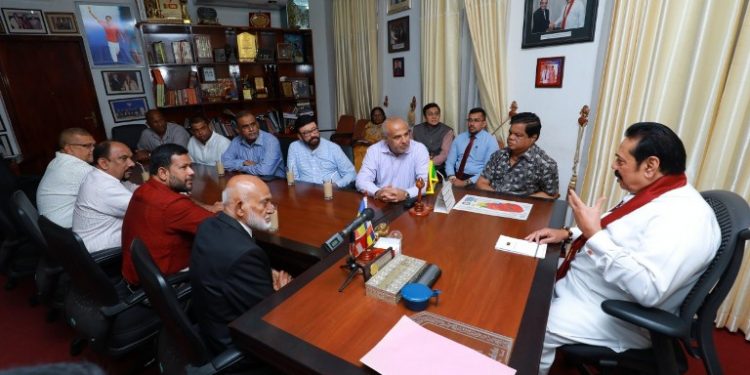
The Sri Lankan security forces had turned from being hunters to fishermen during the last few years and the spirit of the security forces had been crushed since 2015, expert on terrorism Rohan Gunaratna told a meeting organised by the Mahinda Rajapaksa Centre yesterday in Colombo.
Gunaratna said that the Easter Sunday attack was not an intelligence failure but a failure of political leadership. Sri Lankan forces provided the government with accurate information, Gunaratna said.
“The forces had gone from being hunters to fishermen,” he said, reflecting on the attitudinal change. Earlier the security forces would have hunted people like Zahran and eliminated the threat. However now they waited until such actors came to them. This is like a fishermen who waited after casting his fishing line.
Gunaratna said that the security forces had successfully eradicated the group that carried out Easter Bombings. However, such groups were compartmentalised, secretive and acted in cells. “Thus, there might be some more cells left. So, the intelligence agencies must be careful,” he said.
The academic said that the US and Israeli intelligence operatives who had come to Sri Lanka had reported that there were no local groups with links to the ISIS. However, Zahran kept in touch with ISIS through Abdul Jameel Mohammad, who had become radicalised during his time at Kingston University between 2006 and 2007. Jameel later went to Australia, where he developed contacts with Australian ISIS cells. Australian intelligence agencies have told Sri Lanka that Jameel was communicating with Australian Jihadists in 2015.
Gunaratna noted that the divided political leadership of the country further demoralised the security forces and it was the responsibility of the 225 MPs to pass legislations that would address the issue. “This happened on your watch,” he said.
Gunaratna also proposed a national security Act, criminalising hate speech, regulating religious space among other things.
It is a possibility that Athureliye Rathana Thera delivered a doosra when he launched a fast-unto-death to force the Government to remove Minister Rishad Bathiudeen, Eastern Province Governor M.L.A.M Hizbullah and Western Province Governor Azath Salley. Having had supported the Yahapalana Government that failed spectacularly, Rathana Thera was in a political limbo and needed a strategy to regain his former political status. The Opposition in the meantime had thrown the Government into a classic catch 22 by passing a No- Confidence-Motion against Cabinet Minister Rishad Bathiudeen.
The Government worthies obviously do not want to see Bathiudeen as a possible extremist element, but more as a block vote. In the upcoming Presidential election that is just months away, the minority block votes may prove to be the decisive factor – especially for a Government that had antagonised basically every sector of the voter base.
They had thus, been showing a remarkable reluctance to investigate the circumstantial and other evidence that is getting stacked against Bathiudeen, implicating him as the possible hand behind the recent violent incidents. Navin Dissanayake, whose own father was killed by a suicide bomber, earned the public’s opprobrium for his insensitive and immature stance on the matter. The situation became even more difficult for the Government with its own MPs, mostly the Christian and Tamil MPs from the TNA also calling for Bathiudeen’s removal from the Government. Tamils in the Eastern Province had never got along well with its Governor, Hizbullah. This thus, has become an important opportunity for them to get rid of their much detested Governor.
The No Confidence Motion brought in by the JVP against the Government had been ridiculed by many quarters as an attempt to unite Government Forces that were pulling in different directions over the matter of Bathiudeen. It was while the attention was thus on the two No- Confidence- Motions, one NCM by the Opposition against Bathiudeen and the NCM by the JVP against the Government, that Rathana Thera decided on a fast unto death protest until these three Muslim politicians were removed from the Government.
Government MP Rathana Thera’s protest was unique because as a UNP National List MP, he is a member of the incumbent Government. Therefore, in effect Rathana Thera was basically protesting was as a member of the Government against his own Government. Usually, the popular venue for these kinds of protests is Vihara Maha Devi Park. However, Rathana Thera chose Sri Dalada Maligawa, which is the most sacred of places to all Buddhists around the world.
In fact one sarcastic social media post pointed out that the most appropriate venue for Rathana Thera’s protest is not in front of the Sri Dalada Maligawa, but in front of Sirikotha. Clearly, not all had been fooled by Rathana Thera’s performance. However, to the larger segment of the society Rathana Thera’s single handed protest was apt and timely.
This protest against these three Muslim politicians which started as a single action by an individual quickly gathered traction. While some including former TNA MP S. Viyalendran, launched their own fast unto death campaigns, others staged hartals. Even in Kandy town, which had always been an unwavering UNP bastion, the shop owners shut their businesses in show of support for Rathana Thera. This protest that quickly became a movement is an indictment against these three Muslim politicians.
Non-conformity
One of the main reasons for Rathana Thera’s protest to receive the level of support and applause that it did is also because of the ever widening gap of trust between the Muslims and non-Muslims. This animosity against the Muslims may have come out into the open in the aftermath of the Easter Sunday massacres. However, it did not begin with these massacres; nor did it form after the statues of the Buddha were vandalised. Until very recently, Muslims were very much an integral part of Sri Lankan society. They may have opted to wear a particular type of sarong, or loosely cover their heads with the sari fold or favoured the shalwar kameez, these dress codes were not threatening. Unlike the large groups of Muslims that had recently migrated to Europe who are refusing to integrate with the rest of the society, Sri Lankan Muslims were always part of Sri Lankan society.
Yet, since of late, they on their own had opted to alienate themselves from the rest of the society. The black garb that the women, now, wear and the long unruly beards the men sport, now, are definitely intimidating. Even the less radical Muslim women, who never covered their heads, now do so with a scarf, albeit often a colourful one. One such lady explained to this writer that this change was brought on as a protest against the US’s position against the Muslims. If that is indeed the case, then it is deeply ironic that almost the entire Sri Lankan Muslim community supported the US sponsored regime change in 2014.
Two of a kind
Either way, the non-Muslims now feel a need to unite against the Muslims. That need compelled many to overlook Rathana Thera’s political past that is both unsavory and opportunistic. This is not the first time that Rathana Thera or his erstwhile political pal Champika Ranawaka had become politically destitute. After the repeated fiascos while in the Sihala Urumaya and then later the Jathika Hela Urumaya, not many took notice of them even when they supported Mahinda Rajapaksa’s 2005 Presidential campaign.
However, they were able to turn events around over the Mavil Aru issue. They touted their march to Marvil Aru for its worth and portrayed that it was they who pushed the Rajapaksa Administration into taking a military approach to the terrorist issue. With that small drama, they managed to ensure powerful portfolios for themselves.
Rathana Thera’s protest against the Muslim politician is not that different to the Mavil Aru drama. On the third day of the fasting, not only these three Muslim politicians but all Muslim politicians in Parliament issued a joint statement to the effect that they would be resigning from their portfolios to enable investigations to continue unhindered.
On that mere pledge to resign from their portfolios, Rathana Thera ended his fast – even though resigning from portfolios is not the same thing as resigning from the Government. Rathana Thera was hospitalised immediately after ending his fast and released about two days later. However, even at the time of his release, the Muslim Ministers had not followed their statement with letters of resignation, nor have they handed over their ministerial vehicles, nor have their Parliamentary privileges been revoked, nor have they taken the backbenches as promised.
In fact, security for some had been enhanced and Bathiudeen, Rauff Hakeem and Kabir Hashim had been assigned front bench seats on the argument that the first two are Party leaders and the third is the UNP Chairman. This is a privilege Deputy Leader of the UNP Ravi Karunanayaka did not receive when he lost his portfolio. The Joint Opposition had taken exception to this stance, for party leaders Udaya Gammanpila, Chandrasiri Gajadeera, V. Radhakrishnan and Palani Digambara have not been recognised in this manner. Rathana Thera’s hunger strike appears to be a trick engineered by the Government, itself. Whether people will choose to get fooled or not remains to be seen.
If this plot fails, the consequences can be quite dire – especially with complaints against the sterilisation doctor rising daily, which can be construed as a genocide attempt of the Sinhalese. We are in effect sitting very comfortably atop a rumbling volcano and the only hope Sri Lanka has is that the people will have the patience to wait for elections to transfer power peacefully from a Government that plays the number game to a patriotic and a visionary government.
Duty of Muslims
At that time Muslims too have a larger role to play in securing a safer nation for all. The destruction of National assets, such as Wilpattu, was a taboo topic just because the alleged hand behind it is a Muslim. It is futile to disown perpetrators after tragedies such as the Easter Sunday Massacres if before they were protected by a block vote.
Parliamentarian S.B. Dissanayake told a Media briefing yesterday (6) that 10 complaints against former Minister Rishad Bathiudeen will be handed over to the three-member committee at Police Headquarters today (7).
Dissanayake said there were complaints related to Bathiudeen’s alleged links with extremists, scams carried out by him, information about two alleged murders in Mannar and forcible takeover of lands.
The President should use his executive powers to bring the whole country under one law, states UNP MP Athuraliye Rathana Thero.
The Thero mentioned this speaking to the media personnel in Kandy, today (09).
According to him, there are many steps that the government should take regarding the Muslim extremism that is prevailing in the country.
The first step is ‘one country, one law’. One education policy. Preventing land acquisition by using arbitrary means of public power. An environment policy that protects the environment”, said Thero.
An education system should be built to send children to a common school system in the country, states the Thero.
I hope all races would become one force and will stand up to defeat this extremism”, added Thero.
The Thero further speaking stated that he is sending out an open invitation to all Muslims who are against extremism to join with the common community.
Colombo, June 8 (newsin.asia): The Leader of the Opposition and former Sri Lankan President, Mahinda Rajapaksa, on Saturday called upon the island’s Muslim community to stop the Arabization of their culture and return to the traditional Sri Lankan Muslim culture.
Rajapaksa said this at a meeting with the nine Muslim leaders who had quit the Council of Ministers in protest against the persecution of their community following the April 21 suicide bombings carried out by the Jehadi National Tawheed Jamath (NTJ).
Rajapaksa said that while the Sirsena-Wickremsinghe government has failed to protect innocent Muslims, the Muslims as a community should also do some introspection and ask what they themselves had done to incur the people’s wrath.
When the ex-Ministers pointed out that they had complained about the extremists to the police, Rajapaksa said that the problem was deeper than the activities of a few Jehadists. It grew as a result of the increasing Arabization of the community and the gradual loss of the community’s Sri Lankan identity, he argued.
Arabization had alienated the Muslim community from the other communities in Sri Lanka, he said. He made it clear that the distancing brought about by Arabization would hamper reconciliation.
When the Muslim leaders said that the Arabic element is part of Muslim culture, Rajapaksa said that Sri Lankan Muslims had their own indigenous culture and its Arabization started only ten or 15 years ago. He said he knows what traditional Muslim culture is, because in his home district Hambantota, there is a significant Muslim community.
The ex-Ministers (their resignations had been accepted by the government and gazetted) slurred over the issue but appealed to Rajapaksa, who they described as a powerful and influential” leader, to lend his voice to the call for protecting the Muslims from persecution.
To this Rajapaksa said that he is already doing it, but pointed out that the task of protecting the people is that of the government.
En-masse Resignation Slammed
However, Rajapaksa told the ex-Muslim ministers that they should also cooperate. In this context he pointed out that by resigning en-masse, the Ministers had further communalized the issue and increased the rift between the Muslims and other communities.
The four Mahanayakes or chiefs of the Buddha Sasana have also appealed to the Muslim Ministers to get back to their posts.
Former Defence Secretary Hemasiri Fernando says that the Director of the
State Intelligence Service (SIS) had sent him a message on WhatsApp the day
before the Easter attacks took place.
Testifying
before the Special Parliament Select Committee appointed to look into the
Easter attack yesterday (06), the former defence secretary stated that he was
not well on the day the message was received.
He said he was
not well that day and that he was sleeping, as he had a very bad headache”.
Fernando says he received a call from the director of SIS asking him to check
the WhatsApp message the latter had sent, which contained information on a
possible attack.
Normally I
don’t like WhatsApp, but I read it,” the former defence secretary told the
select committee.
The director
of SIS had said, during the telephone conversation, that he had already spoken
to the IGP on the relevant information and asked Hemasiri Fernando to put some
pressure” on the IGP in this regard.
The former
defence secretary says that he subsequently contacted the IGP on the matter and
confirmed that the IGP was already aware of it.
The IGP has
told that he was already making arrangements regarding the information
received.
The former
defence secretary says that he tried to contact the director of the SIS
afterwards but he could not be contacted. I sent him a message and he spoke to
the IGP.”
He further
stated that the director of SIS had contacted him hours before the attacks
querying him on the number of Methodist churches in Colombo, as the forewarning
has said the target of the attack is not Catholic Churches
These few days people have been watching the
proceedings of select committee appointed by the parliament to inquire about
the Easter Sunday attacks my Saharan – the devil
You see how IGP and defence secretary playing the role of
devil ( garayaka) and various healers ( yakaduro) posing hilarious questions
about the Easter Sunday incident.
Just like the audience in the Gara Yasa ritual I am sure
that people keep laughing about the questions and the hilarious answers.
Funniest answer was from defence secretary when he mentioned
that chief of intelligence asked him about the location of Mehodist churches in
Colombo .i
He opted to ask a friend option as in Lahshpathi reality
show .His friend told him where the Methodist churches where Devil May attack .
Is that all ?
IGP and both Defence secretary were the unwanted children in
the family
People will say Anae pow”
Yakadoro like the chief field marshal was giving the answers
to the questions posed to get reply what they want in order crucify ( sorry in
Sinhala Bill Puja) of the president who was preaching another foreign god in
Thirupathi.
Finally tree in which Gara Yaka keeps shaking will collapse
and the humour of the public will remain.
Yesterday the main devil called a meeting of the yakaduro
and warned them
By Noor Nizam – Peace and Political Activist, Political Communications Researcher, SLFP Stalwart and Convener – The Muslim Voice”, June 8th., 2019.
Rauf Hakeem and the 9 Muslims Mp’s who
enjoyed the office of Ministers, Deputy Ministers, and Stateministers because of
the “VOTE BANK TRADING” of the Muslims votes hoodwinked and
“CHEATED” the Muslim community and the Nation at large, when Rauf
Hakemm made a public statement that they have tendered there resignation from
the portfilios they were holding. WHAT RAUF HAKEEM and the 8 Muslim Mp’s told
at a hurriedly called press conference which was given wide media coverage on
Monday the 3rd., June 2019 was a “TOTAL LIE”. It was only when the
opposition demanded the “TRUTH”, that they submitted their individual
letters of resignation on to the PM on 7th., June, 2019. This shows the cunning
and deceptive hoodwinking nature and culture of these Muslim politicians and
so-called political party leaders who have been “DUPING” the humble
“PAMARAMAKKAL”/”POORALIGAL” and the Muslim vote bank
throughout these years to trade with the Muslim vote bank and enjoy portfolios
and positions and perks in whatever the government that is at the end formed
after a general or presidential elections in Sri Lanka.
Added to this, the All Ceylon Jamiyathul Ulema,
a bunch of deceptive and “munaafikk” group (not all) led by an
opprtunistic so-called “MUFTHI” fans and lobbies for the Muslim Vote
Bank support for these “deceptive” Muslim politicians at the
elections and who have been well taken by the unscrupuluous Muslim politicians
to amaze illicit weath at the cost of selling the “DIGNITY and
HONOUR” of the Religion of Islam, by indulging in the issue of so-called
“HALAL CERTIFICATIONS” for the payment of large amounts of money to
promote “HARAM” products to Muslims and to Muslim word nations. THE
PRESIDENT SHOULD SET IN MOTION A PROBE TO LOOK INTO THE AFFAIRS OF THE ALL
CEYLON JAMIYATHUL ULEMA TOO, IMMEDIATELY.
The incidents of Aluthgama and Beruwela, blamed as violence instigated by the then government via the BBS was to be probed by the “Yahapalana government” when it comes to power – Then 20014/2015. A presidential commission was to be set in motion. THIS DID NOT HAPPEN UP TO NOW. The FRUSTATION and AGONY of the Muslims being betrayed by the “Yahapalana Government”, followed by more incidents against Muslims in Digana and other areas and attacks on a few Muslim mosques which were smoke screened by Muslim politicians for their personal gains, may have driven some of the the Muslim youth to gather around an EVIL force of destruction that we saw let loose on April Good Friday in our recently peacefull Island. Was there more to this, or was it the “THREACHERY” that the Muslim politicians and Political leaders and ULEMA – failed of politically serving the “ASPIRATIONS and INSPIRATIONS” of the Muslims, especially the “YOUTH”, that drove these youth to what they have now ended up with – that it was NOT wealth, position, elite way of living, be politically successfull or the goodies of well-to-do-lives or “RELIGIOUS DECEPTION” but NOT – politically serving the “ASPIRATIONS and INSPIRATIONS” of the Muslim Community since the Muslim political leaders started “TRADING” their vote banks with National Political Parties/Alliances for their selfish needs since the advent of the Sri Lanka Muslim Congress – SLMC in Kattankudy in 1981. The duped and hoodwinked Muslim voters who were made to vote” the Hansaya” have begun to understand the treachery of these Muslim Civil Society Leaders, Community Leaders, and ACJU/Ulema Sabai Leaders by the action of the Yahapalana Government” against themn. They are disgruntled” and they have begun to show their displeasure and have begun to retaliate against these so-called deceptive, hoodwinking and opportunistic Muslim Politicians, Muslim Political parties and their leaders, Muslim Civil Society Leaders, Community Leaders and Ulema Sabai Leaders to safeguard their legitimate Muslim Rights” and work towards National Reconciliation”. They are no more willing to be duped by the press releases and media dramas staged by these stooges of the Yahapalana Government” anymore. The Muslim Youth and the young professionals of the community have begun to use SOCIAL MEDIA” to challenge these scroundels. In the next elections, surely the Muslims are contemplating to vote the Joint Opposition” to power. THEY WILL VOTE GOTABAYA RAJAPAKSA TO BECOME THE NEXT PRESIDENT OF SRI LANKA BECAUSE THEY CAN TRUST HIM TO ERADICATE MUSLIM TERRORISM TOO, Insha Allah.
Threats by Sirisena to derail probe risk placing personal pride before thepublic good
Sri Lankan President Maithripala Sirisena attending a naval ceremony in Colombo. Dinuka Liyanawatte / Reuters
The wounds of Sri Lanka’s Easter bombings, which left 250 people dead on a single bloody day in April, have yet to heal. Reminded of the very worst atrocities of the country’s decades-long civil war, the Sri Lankan people showed remarkable solidarity and resilience in the aftermath. Within hours of the last blast, emergency blood banks across the nation were full. However, the same cannot be said of the nation’s leaders.
On Friday, President Maithripala Sirisena threatened to end a parliamentary investigation – launched by his political nemesis, Prime Minister Ranil Wickremensinghe – designed to identify security lapses that allowed April’s attacks to happen. His threats followed two high-profile testimonies that accused Mr Sirisena of mishandling the nation’s security.
In one, the inspector general of police told parliament that the president had offered him a diplomatic posting if he quit his job and took the fall for the attacks. When the inspector general refused, he was put on leave. Rather than seeking to stifle an investigation, Mr Sirisena should be doing all he can to help identify security gaps and take urgent action to plug them.
Despite repeated warnings from Indian intelligence agents to Sri Lankan authorities of the possibility that an ISIS-linked plot was under way, Colombo was slow to act. According to his allies, Mr Wickremesinghe had been kept out of security council meetings altogether by the president. The deteriorating relationship between the two men followed the sacking and subsequent reinstatement of Mr Wickremesinghe by Mr Sirisena late last year. The Easter bombings were a day of reckoning for Sri Lanka’s warring leaders, who had to contend with the possibility that pride and politics had indirectly cost hundreds of Sri Lankan lives.
This context makes Mr Sirisena’s latest actions all the more irresponsible. Politically motivated investigations help no one, but the flaws in Sri Lanka’s security apparatus enabled a local group to commit indescribable atrocities, with the help of an international terrorist network. This must be addressed and those responsible held to account. In the aftermath of the attack, Sri Lanka’s leaders fought hard to deny that their negligence had played a part. Judging by his behaviour on Friday, it appears Mr Sirisena is losing that battle
President Sirisena fires chief of national intelligence for suggesting he had been forewarned about Easter bombings.
Sirisena’s move could escalate political tensions over the ongoing parliamentary probe [File: Dinuka Liyanawatte/Reuters]
Sri Lanka‘s President Maithripala Sirisena has fired the country’s chief of national intelligence after he suggested that the president was forewarned about the deadly Easter bombings.
Indian intelligence agents sent several warnings to Sri Lankan authorities that a plot was under way, but Sirisena and Prime Minister Ranil Wickremesinghe have both said they were not briefed about the warnings before the April 21 attacks, claimed by the Islamic State of Iraq and the Levant (ISIL, also known as ISIS).READ MORE
A parliamentary select committee, led by allies of Sirisena’s rival Wickremesinghe, is investigating possible lapses that allowed the fighters to target hotels and churches, in which over 250 people were killed.
In his May 29 testimony before the parliamentary committee, intelligence boss Sisira Mendis said security council meetings were irregular, making it difficult to properly protect the island nation.
Mendis said that when he brought up the warnings during a meeting on April 9, director of the State Intelligence Service Nilantha Jayawardena, who has a direct link to the president, told him Sirisena had already been briefed.
Jayasundara said that Sirisena, who is also the minister of defence and police, asked him to resign to take responsibility for the blasts and ensure that he would have his name cleared in any subsequent inquiry.
Hemasiri Fernando, former secretary to the defence ministry who resigned after the blasts, told the committee that Sirisena, as his minister, was not easily accessible for private discussions.
On Friday, a day after the two critical testimonies were made, Sirisena announced the removal of Mendis.
“Everybody who testified before the select committee are the officers whom I removed. We have sacked Sisira Mendis also,” Sirisena said late on Friday evening.READ MORE
Al Jazeera’s Minelle Fernandez, reporting from Colombo, on Saturday said Mendis’s removal could escalate political tensions over the parliamentary probe.
“Everyone knows that Sirisena had been livid about the parliamentary committee. Right on the very first day, we had the Chief of National Intelligence going before the committee, and giving testimony and evidence on the lackadaisical attitude of the president towards national security.”
“Now on the second day, we heard that there were efforts to try and stop the committee session and that the president was unhappy with all the information that is coming out. He also ordered a stop to a live telecast of the proceedings,” she said.
Sirisena opposed to police testifying
On Saturday, Sirisena’s media unit said in a statement that the president was opposed to police testifying before the parliamentary inquiry.
Sirisena met senior officers on Friday evening and told them he was not in favour of intelligence officers being summoned by the parliamentary committee to discuss sensitive details in the presence of the media, the president’s media unit said in a statement.
Sri Lanka president pardons hardline Buddhist monk
Sirisena promised to protect the officers who refused to attend the committee hearings, the statement said.
Sirisena said there were five cases being heard at the Supreme Court in relation to the blasts, and that the attorney general had informed him that the parliamentary hearing might be a hindrance to the court cases.
Sri Lankan leaders and the security establishment are under fire for not acting upon near-specific information ahead of the blasts on possible attacks on churches.
President Sirisena has vowed to restore normalcy in the country which is still emerging from a 37-year Tamil separatist war that ended almost a decade ago.
Sri Lanka’s police said last month they had either killed or arrested all those responsible for the bombings, but that the threat of further attacks persisted.
President Maithripala Sirisena, at a hurriedly summoned special Cabinet meeting last night, has warned the Government to immediately stop the Parliamentary Select Committee proceedings on the Easter Sunday attacks.
President Sirisena has also threatened that he will not hold Cabinet meetings if the Government is determined to continue with the PSC proceedings. He had threatened to do so following a heated argument with a few Ministers during the Cabinet meeting.
You have appointed Malalgoda Committee to probe this. It was also promised to submit the report in two weeks. Forget about making it public, the report has not even been presented to Parliament,” one Minister had pointed out.
The President has said that the report would come to Parliament at the right time.
Those reports will be presented in Parliament in due course. There are five cases filed in the Supreme Court in connection with the Easter Sunday bomb attacks, and I have also been connected to it. If this is the way you are going to act by opening PSC proceedings to media and divulging sensitive security information to public, I will not hold the Cabinet meeting hereafter. I will also not attend any of the Government functions or programmes. You act on your own accord and I shall not support the Government,” the President has reprimanded the Cabinet.
He has also said that it is absolutely unacceptable for the intelligence officers to be summoned before the PSC and he would not let information pertaining to national security be compromised through the media.
He had also taken Speaker Karu Jayasuriya to task for not presenting a memorandum he sent, in which the President had shared the sentiments expressed by the Attorney General. He pointed out that the Attorney General had informed him about the implications the information revealed in the PSC could have on the pending cases and had requested necessary action.
I sent it to the Speaker but it is disappointing that he chose not to present it in Parliament,” he added.
He also said that he can even give the information he has to all the MPs even if the 225 of them came to him seeking that information.
He also said that he could not understand why the Government Ministers do not understand the gravity of information being revealed in this manner and what threat it poses to national security.
The Chief of National Intelligence Sisira Mendis has resigned from his post with immediate effect.
Mendis, Director of Sri Lanka’s Centre for National Intelligence under the Ministry of Defense, had served as DIG of the Criminal Investigation Department (CID) and was also head of the Terrorism Investigation Division (TID) from 2008 to 2009.
The national intelligence chief’s resignation comes after testifying last week to the parliamentary select committee that the April 21 attacks could have been averted.
President Maithripala Sirisena summoned an emergency cabinet meeting on Friday night and has refused to allow any police, military or intelligence personnel to testify before the committee.
The President’s office did not comment on the meeting, but said the president had told senior police officers on Friday that he will not allow any serving officer to testify, AFP reported.
The President said last week that he met with the national police chief and his top brass 13 days before the attacks but no officer raised warnings passed on by India and based on information from a detained jihadist.
Former minister Rauff Hakeem says that the Muslim MPs who quit their government posts will use the leverage they have in order to see that their grievances will be addressed in the proper way, without affecting the national unity and cohesion among communities.
He made these comments while speaking to journalists after meeting with Opposition Leader Mahinda Rajapaksa along with the other Muslim parliamentarians who recently resigned from their ministerial portfolios.
The Sri Lanka Muslim Congress (SLMC) leader said that they explained to the Opposition Leader the reasons for their collective resignation and also requested him to understand it in the correct context.
He said they also requested Rajapaksa to assists them in trying to build reconciliation and understanding about the Muslim community’s plight as well as to see that whatever they do collectively for the sake of this nation and its reputation internationally.
We have assured him that whatever action we have taken is limited to the immediate risks that our community faced and that we would collectively take forward our agenda to appraise other party leaders as well as the religious leadership of the country in order to bring about national consensus on the proper manner in which we should work towards eradicating terrorism forever from this country.”
Hakeem said that they will be meeting a variety of different political leaders as well as the religious leadership of the country, particularly the Maha Sangha.
He said they also intend to meet important civil society leaders and important emissaries of the foreign governments and explain to them the situation in which they had to take this drastic decision.
But hopefully things will settle down soon,” he said.
Asked whether they will now sit among the government backbencher MPs, he said: We are right now without our portfolios. Some of us may occupy the frontbenches. It may literally not mean the backbenches.”
He said that party leaders will occupy the frontbenches according to parliamentary traditions, but apart from that they will not be holding any privileged office in the executive.
Nevertheless we will use the leverage we have in order to see that the grievances we have will be addressed in the proper way without affecting the national unity and cohesion among communities,” he said.
The
Parliamentary Select Committee is hunting down the President in an
unprecedented manner. If the witnesses are telling the truth, then any
ordinary citizen could form an independent opinion.
The
President systematically dismantled the Security Council. He changed
Prime Minister with a most trusted man, Mahinda Rajapakse. But even when MR was
the Prime Minister, he has also not been invited for the Security Council
Meetings. So, President neither trusted Ranil nor Mahinda. At what
cost?
It
is noteworthy that Jayampathy Wickremaratne is a member of the PSC and
continuing his line of questioning leading to cornering the President to the
wall.
We
should not be surprised, if the findings of the PSC in some way find
recommendations to impeach the President. If MR also agrees, 2/3 votes
can be obtained for such a resolution under Article 38 (2) and 38 (b) (2). It
is extremely doubtful MR will support such a resolution, paving way for the
complete take over of SLFP by SLPP.
To
avoid such distressing set of circumstances, the President might call for an
early Presidential Election.
The term Non-governmental organization” (NGO)
came into existence in 1945 when the United Nations was set up. The UN granted
‘observer status’ to approved ‘International non-state agencies’ (INGOs) and
permitted them to attend UN assemblies and meetings. In July 2018, there were 5,081 NGOs in
consultative status with ECOSOC. These consisted of 134 organizations in
general consultative status, 3,974 in special consultative status and 973 on a
third list known as Roster.
There are several categories of NGOs. Some
NGOs are funded by foreign governments and act like extensions of
government (GONGOs). It is alleged that they are used for hidden political
agendas. USA’s National Endowment for Democracy is said to be a CIA front. Some NGOs, such Berghof Foundation are
quasi–government (QUANGOs). They
receive state subsidies.
NGOs
such as ‘Human Rights Watch’, ‘Transparency International’ and ‘Amnesty International’,
are international NGOs, with branches worldwide ((INGOs). These NGOs are funded by private
financiers having strong links to the US government, such
as Soros,
Rockefeller, and Ford Foundation. These
funding agencies are considered warmongering agencies and the grants
carry political agendas.
‘International Crisis group’, ‘Human Rights
Watch’, and the ‘Open Society ‘ have
been described as ‘shady INGOs’ funded by George Soros.George Soros started Human Rights Watch
with specific instructions to develop field offices staffed by local operatives.
He gave a fresh grant of 10 million to ‘Human Rights
Watch’ in 2010.
There are other NGOs, registered as private,
but they too are set up and funded from outside the country they work in. Some
NGOs have misleading names. ‘Asian Human Rights Commission’ suggests a
dignified supra government organization set up by sovereign states. Instead it
is a Hong Kong based, private NGO. Rajiva Wijesinha referred to it as
the ‘bizarrely named’ Asian Human Rights
Commission.
Today,
practically every sovereign state has a huge number of GONGOS, QUANGOS and
INGOS
working
inside it. They have been introduced into these countries by the west. This sudden
rise of NGOs is a part of the western policy of world dominance, say analysts,
which starts with interference in the internal politics of countries. NGOs
intervene in domestic politics and help to install puppet governments. NGOs
are used to brainwash people, to make them revolt against democratically
elected governments, to cause regime changes.
They
encourage citizens to challenge elected government, usually under the guise of
‘protesting’ against something. They
clamor for foreign intervention and work toward changing public opinion.
They charge governments with corruption and human rights violations on flimsy
grounds.They draw media
and political attention onto selected countries, which are fighting to maintain
their territorial integrity. They find HR abuses in these countries and clamor
for western government intervention through the UN.
They
are also used for intelligence gathering, to obtain data against national governments. NGOs are also used to support
terrorism against legitimately elected democratic regimes. Some dubious NGOs
have been front groups for weapons purchases. Many countries have found that the NGOs create
difficulties for the government, by their conduct, their mission, methods of
work and sometimes through their connections to government.
NGOs funded by
the west have been used to topple governments and destabilize countries.
Critics say NGOs helped to split Sudan and create South Sudan in 2011. Foreign
funded NGOs were thought to be fomenting revolution in Russia and many believe
they did so successfully in Georgia, Ukraine, Moldova, and Kyrgyzstan. . NGOs in Mozambique are accused of ruining the
local health system.
The
media reported in 2016 that more than 100 countries, from Algeria to Zimbabwe,
have started to register and monitor NGOs. These countries accuse the US and
European countries of using NGOs to support political unrest in the guise of
supporting democracy, rule of law and Human Rights.
Armenia,
India, Egypt, Cambodia, Russia, China, Israel and Uganda in the past year have
enforced draconian laws to regulate NGO activities, the media said in2016.
Mostly on suspicion that they are agents of foreign governments interfering in
their internal affairs.
In 2012, UAE shut down the local office of the
National Democratic Institute, a US based NGO, whose mission is to promote
democracy around the globe. It also
shut down Conrad Adenaur Stiftung office.
Egypt, in 2012, arrested members of a number
of NGOs promoting democracy saying they were meddling in Egypt’s internal
affairs. Egypt said that three US NGOs,
‘National Democratic Institute’, ‘Freedom House’ and ‘International Republican
Institute’ had received USD 65 million to influence Egypt’s politics.
The ALBA bloc in Latin America issued a
statement in 2012 to say that USAID (US Agency for International
Development) openly meddles in
sovereign countries domestic affairs, sponsors NGOs and supports activities
intended to destabilize legitimate governments. The statement was signed by
Bolivia, Cuba, Ecuador, Dominican Republic, Nicaragua and Venezuela.
Cambodia has some 5000 NGOs, many providing
key services to the country. In 2015
Cambodia passed a controversial NGO law, which said all domestic and
international NGOs must report their activities and finance to government. NGOs
can be disbanded if they jeopardize peace, stability, public order or harm
national security, unity culture and traditions of Cambodian society. The law
was passed, despite boycott by opposition and protests by NGOs.
In July 2017, Hungary passed a law where NGOs that receive
more than 23,000 euros ($24,000) annually from a foreign source had to register
as a “foreign-supported
organization.” The law, first mooted in January, had been
delayed after widespread criticism, including opposition by the European
Commission and United Nations experts who urged its withdrawal.
Russia said that the west is using NGOs to
destabilize Russia. USAID was ordered
out of Russia In 2012 on charge of distributing grants to anti-Putin political
groups in order to influence politics. UNICEF was also
asked to leave.
In 2015 Russia passed the Undesirable NGOs Law
which gave Russia the power to declare any NGO as undesirable, if it acted
against Russians interests.
NGOs receiving finances from abroad would now be known as, ‘Foreign government
organizations” (FGO). All monies beyond a certain sum must be
reported to Russian authorities. If they engaged in political activities they would be treated
as spies. Russia blacklisted seven US based NGOs as
‘Undesirable’ in 2016. ( continued)
In Sri Lanka too,
the GONGOs, QUANGOs and INGOs are engaged in meddling with political matters. This
essay looks briefly at some of these NGOs.
The National Endowment for Democracy (NED) is a U.S. non-profit organization
for promoting democracy abroad. It is
funded by the US Congress. It is supposed to be a tool of the CIA as well. The ‘umbrella
protests’ in Hong Kong were funded by the NED.
In Sri Lanka Bar Association of Sri Lanka was accused of being funded by
the NED which was a CIA arm”. The National Peace Council, Centre for Policy Alternatives, Centre for
Monitoring election violence, Campaign for free and fair elections (Caffe), and
People action for Free and fair Elections (PAFFREL) were also said to have received funds from NED.
NED is today
funding several projects
in Sri Lanka. They are listed in the NED website. The focus of
these projects is very clear.
Local NGOs are paid to indoctrinate the public about ‘democracy’, ‘human
rights,’ ‘good governance’. They are also paid to encourage citizen participation
in politics, and train youth ‘to assume leadership roles in their communities.’
Here is one example.
Viluthu, Ltd was given $70,000 for Strengthening Civil Society Networks for
Active Political Participation”organize a series of community
discussions and learning workshops aimed at engaging youth, including
university students, and women’s network leaders on democracy, good governance,
and transitional justice.
Here
are two other grants.
Law and Society Trust was given $50,000T
for Improving Legal Literacy on
Land Rights”The organization will manage a nationwide network of
organizations focused on land rights, convene government officials and citizens
on land laws and policies, document land disputes, and advocate for new,
equitable laws.
Verite Research was given $65,000 for Parliamentary Tracking Tool for
Accountability and Good Governance”. The organization will, inter alia,
maintain and refine an online platform that documents the biographical
information and political activities of Members of Parliament and conduct
outreach to promote its usage by the media and civil society.
Amnesty International (est. 1961) is a London-based non-governmental
organization
focusing on human rights. It has branches in dozens of countries
including India, but not in Sri Lanka. . It has a high profile and is well known,
but it is no longer highly regarded.
Amnesty International has been described by
one of its former officials as ‘highly political, highly coercive. If you get out of line, they get rid
of you. You can’t trust
them”. Amnesty International’s founder resigned in
1967, saying Amnesty International had been infiltrated by British intelligence
agents. Others said the Central Intelligence Agency was also inside it.
Amnesty International’s agenda fits nicely
with the political needs of the United States and Great Britain, said critics,
contemptuously. AI draws attention to Human rights violations in countries that
are not allied to USA or UK. But it is extremely reluctant to draw attention to
Human rights violations by USA or UK.
Amnesty International is the only human rights
organization in the entire world to have refused to condemn apartheid in South
Africa, said critics. Amnesty
International has not supported Palestine and has not charged Israel
with war crimes.
Amnesty International regularly issued adverse
statements on Sri Lanka. The most serious critique of Sri Lanka at the 6th
session of UN HR Council session at Geneva in 2007 was by Amnesty
International. Amnesty launched its
“Sri Lanka, Play by the Rules” campaign, timed to coincide with the 2007 cricket
World Cup held in the
Caribbean islands, to focus on Sri Lanka’s alleged
human rights violations. In 2006 and
2007 it said that human rights were affected, the government was attacking civilians,
there was no mention of LTTE.
Amnesty
International has openly supported the LTTE. A delegation of Amnesty
International came to Sri Lanka on
invitation from LTTE for a two week visit in 2002 government of Sri Lanka facilitated
the meeting. They met in the Vanni.LTTE
and Amnesty International had discussed
training for ‘Thamil Eelam police’, and ‘Thamil Eelam judiciary’. Amnesty International
said that LTTE must be ready to take over law and order operation as soon as
the ISGA came in.
Transparency International is an international
non-governmental organization focusing on corruption. It has local chapters
to carry out this work. In
USA, Transparency International
funded by multinational corporations, such as Citigroup, ExxonMobil, General
Electric, Lockheed Martin. Transparency
International gave its Integrity Award to Hillary Clinton in 2012. Transparency
International has its own transparency issues with respect to donor funds. It accepted
money from Siemens, while Siemens was under investigation for corruption.
Transparency International, Sri Lanka, received
USD 79,000 from NORAD to look into the work of the Sri Lanka Police. It
thereafter issued a report titled ‘The Police of Sri Lanka, which critics
charged, affected national security.
Human Rights
Watch (HRW) is an international non-governmental organization, headquartered in New York City, dealing with Human rights around the world.
HRW was formed from the earlier America
Watch, Asia Watch, Africa Watch and Middle East Watch. HRW is seen and heard ever
where, but it is not highly regarded. HRW has carried out information and propaganda
work for USA and NATO, charged critics. It helped to break up Yugoslavia. Milosevic was brought before Hague on the uncorroborated
evidence of HRW. HRW has sanitized Israel war crimes.
HRW has loudly supported Eelam in Sri Lanka. HRW supported the UNHRC resolution on Sri Lanka and in March 2019 wanted a time-bound plan for
implementing it. HRW Annual Report
of 2008 was critical of Sri Lanka.
Government
of Sri Lanka responding observed that the HRW had failed to distinguish between
a democratically elected government and the LTTE. Further that it is the government
that is running the schools in north and east, paying salaries of teachers,
there are no private schools in the area. State hospitals are run by the state that
funds them. Sri Lanka armed forces are
fully trained to take every precaution against harming civilians. The government
is actively delivering all essential services in the LTTE controlled areas even
today the GA of Kilinochchi and Mullaitivu are actively deliver in all
essential services. The salaries and pensions are fully met with by government .
The International Crisis Group is a
transnational non-profit, non-governmental
organization
founded in 1995 by George Soros. It is supported by the governments of UK,
Norway, Sweden, Canada, Denmark, France, Germany and Australia as well as Ford and
Carnegie. 23% of the ICG’s budget comes from the government of Qatar in 2019.
International
Crisis Group sent a petition to
the UN Secretary General in September 2008 that was deeply critical of the Sri
Lanka government. In May 17 2010,
it published a monograph on ‘war crimes in Sri Lanka.’
Solidar is a European network of NGOs working to advance social justice in the
world. The three SOLIDAR NGOs in
Sri Lanka were the German organization known as ASB, a Swiss one called SAH and
Norwegian People’s Aid. Norwegian Peoples
Aid had allowed the LTTE to use 38 of their vehicles including heavy earth
moving machines that were used to build up the wall that cost so many lives in
the final assault.
Solidar’s Country Representative for Sri Lanka,
Guy Rhodes had compiled reports from various NGOs which had maintain a presence on
the ground in the conflict zone, such as
Oxfam, care, Danish refugee Council, Forut, ZOA refugee care, World University Service
of Canada and Save the children Fund. Rhodes had challenged the government order to
leave the Wanni at the start of the final offensive.
Rajiva Wijesinha has spoken of a Coffee club
of international NGO personnel” who attended gatherings designed to subvert
government policy. In August 2008 they were busy drafting allegations to be
sent to the UN by local NGOs, said Rajiva. The Head of Solidar had taken a lead
role in this activity. Benjamin Dix who was working for
Solidar was featured in the Channel 4 film on the Eelam war.
FORUT
is a Norwegian aid organization for social work. FORUT has project activities in Sri Lanka,
Nepal, India, Sierra Leone, Malawi and Zambia. FORUT has a
framework agreement with NORAD, The Norwegian Agency for Development
Cooperation, which ensures long-term financing of the programmes and projects
in each country. The work and commitment to Sri Lanka’s development has always
been the largest part of FORUT’s portfolio.
Until 2012, FORUT
had its own organization called FORUT-Sri Lanka. FORUT Sri Lanka has helped create several smaller local organizations
in all parts of the country. These organizations have since become independent ‘and
fully dedicated to the development of Sri Lanka’. Some of these organizations
have signed partnership agreements with FORUT-Norway. Wikileaks has established the link between
the FORUT and Solidar. These two
organizations seem to have been engaged in plotting against the Sri Lanka government,
said critics.
Rajiva Wijesinha reported that R.Tveitnes,
former country director for FORUT had told the American ambassador that FORUT
and a number of other INGOs had local staff on the ground [in the war zone], with satellite telephones, providing
brief but consistent situation reports. Tveitnes
also would text specific questions to the contact and receive response.
In August 2008, three
FORUT vehicles were detained in Omanthai checkpoint by the LTTE till it
was dark. Then they left, proceeding at high speed to Kilinochchi. Soon after they left the checkpoint, the middle
car was caught up in a claymore blast. Wijesinha thought that this was a trick
to launch a massive attack on the military, using harm to NGOs as the cause.
The INGO officers were a sort of cabal, drifting
between the US bureaucracy, UN agencies and the INGO circuit, observed
analysts. Almost without exception INGOs recruits were trained operatives who had earlier lived in a
developing country under NGO, UN or journalist cover. Human Rights Watch
officers often had a previous UN involvement, usually in Cambodia and
Indonesia. Charulata Hogg was a former HRW staffer. She had worked in Sri Lanka
as a foreign reporter for media organizations like BBC.
Gareth Evans, and
Charulata Hogg, knew each other. Louise Arbour has taken over from Evans at ICG.
Suzanne Nossel was Deputy assistant Secretary for international organization s
at the US Department of State before she became Executive Director of Amnesty
International. Attitudes and values are also relevant. Gareth Evans, CEO International Crisis Group had earlier supported Suharto, downplayed Jemmah Isalamiyah and backed
immunity for Khmer Rouge. He signed the Timor Gap Treaty which allowed
international oil companies to exploit the seabed off East Timor.
INGOs and NGOs clearly supported the Eelam
War. That is why they were there in Sri Lanka in the first place. NGOs were
functioning in the Wanni along with UN agencies during the Eelam war. Most of them worked primarily through local
staff, reported the media. INGOs played
a role during the Vanni offensives in
2009. INGOs thought that the government
should not and could not interfere with its operations, said Shamindra
Ferdinando.
In 2008 a Select committee of Parliament for
investigation of the operations of NGOs and their impact was set up. This committee said in its interim
report that many NGO were working for Tamil Separatism and the LTTE. They said
that International Alert had published a map which shows half the country as
belong to Tamils. In this map they have marked a large are of land in the
central hills and in the south as Tamil areas. This extent is even larger than
in the map prepare by the LTTE.
ZOA and World Vision had in 2005 built400 houses and these had
been distributed to the elite cadres of the LTTE. Ministry of Defence had received credible
intelligence reports that Medicine Sans Frontiers, Medicine du Monde, and
Doctors of the world (U.S.A.)
carried out acts which have threatened National Security and state
policies.A certificate issued by MDM at a health education project, had
the emblem of the government as well as LTTE.
The ‘UK
Peace Building strategy’ operated , without consent of the GOSL, a ‘monitoring centre’ in eastern province for
intelligence gathering on a daily basis and a network of support to local level
NGOs known to be infiltrated by the LTTE . UK based
NGO ‘Act Now’ , working in the north
and east during the Eelam wars, wanted the UN to push for a Sudan type
referendum in Sri Lanka.
‘Sri Lanka Kolping Society’ , A Catholic society with a parent
organization in Germany, a social commitment, had provided the LTTE with
funds during 1996-1999.
The
Berghof Foundation for conflict
studies was invited into the country by the government of Sri Lanka on a Memorandum
of understanding between the governments of Sri Lanka, Germany and Switzerland.
It was signed by Ministry of Constitutional
affairs and national integration, Sri Lanka . Swiss Federal department of Foreign affairs and German Federal Ministry
of Economic cooperation and development. Berghof Foundation had entered into
MOUs with government in 2001 and 2006. Berghof Foundation worked in Sri Lanka
from 2001-2008. Berghof‘s work in
security reform was carried out from 2002-2004 with the knowledge
of the Ministry of Defence. Berghof also wanted to assess
the High Security Zones.
Berghof was also expected to facilitate
workshops between the military and civil society ‘to help them understand each
other’. Former chief of Defense, Dennis
Perera and the Defense secretary had invited BF to initiate a dialogue between
security forces and civil society. This project met with hostile criticism. There was a
proposal for a workshop of air force personnel. This was shot down after the Defense
authorities heard of it.
Concerned observers shouted that Berghof was
engaged in ‘security reform’ of
military, paramilitary and police forces. Berghof wanted to ‘right size’ the armed forces,
and bring it under foreign control. Berghof
Foundation vehemently denied this charge. However, SPUR
(Society for Peace, Unity and Human Rights for Sri Lanka) said that Berghof Foundation had consistently
interfered in the island’s national security affairs. It had promoted the
unconditional dismantling or resizing of High Security Zones, and had also
wanted the Sri Lanka Armed Forces to change its thinking. SPUR asked the
government to send Berghof away. Berghof terminated its work on security related issues
in 2004 due to hostile criticism. In
2008 Berghof Foundation was asked to leave Sri Lanka.
The Select Committee of Parliament
investigating into the operation of NGOs
set up in 2008, (PSC) had made a deep,
penetrating study into the work of the Berghof Foundation and found that Berghof had links with the LTTE and the
armed forces. This had serious implications for national security. This well researched document has not
received the public acclaim it deserves, said Chandraprema.
Berghof had resisted appearing before
this Committee and instead had attempted to exert international pressure to squash the Committee. This is a grave intervention,
said the Committee. PSC noted that former Chief of staff Denis
Perera had invited Dr Rophers to build bonds with the security officers in
order to initiate a dialogue. PSC observed that this enabled access to sensitive military matters.
This was detrimental to national security.
Berghof had contact with both LTTE and army.
Director of Berghof, Norbert Rophers
had direct links with Balasingham in
London and with Pulidevan in Kilinochchi. Berghof sent a delegation of LTTEers to Europe on a study tour of
federalism, on the instruction of Eric Solheim. Critics wanted to know whether Solheim had
the authority to do this and whether Berghof had the authority to implement
this. This is outside the Memorandum of
Understating that Berghof had signed with the government . LTTE is a designated
terrorist outfit.
Berghof had also told PSC that Berghof was there to introduce power sharing through
various means. Berghof supported self determination and has
accepted the notion of Tamil homelands. The
PSC objected to the fact that Berghof promoted only federalism. Also that
Berghof had its own agenda. ( Continued)
(Unsolicited verbatim translation by Rohana R. Wasala without any commitment to the veracity of its contents.)
It has now been revealed that, in the recent past, there were safe
houses that provided security for Wahhabist terrorists in the Muslim villages
established by the person called Rishad Bathiuddeen in the thousands of acres
of land cleared in the Wilachchikulam forest reserve. Member of Parliament
Udayashantha Gunasekera, Secretary for Youth Affairs, Jathika Nidahas
Peramuna/National Freedom Front (NLF), pointed this out during a press briefing
held at the NLF Headquarters at Pitakotte.
Following the Easter Sunday terrorist attack, Muslim politicians
Rishad Bathiuddeen, Azath Salley, A.M.L.M. Hizbullah, and Mujibur Rahman met
with strong public opposition because they were identified as a pack of cunning
foxes who spread Wahhabist terrorism, thereby shielding the terrorists it bred.
Mr Gunasekera questioned why other Muslim Ministers who faced no such
allegations issued a joint statement and resigned from their positions. He
charged that, though there were many (gravely critical) situations in which
they ought to have issued such joint statements and behaved responsibly, they
just spent their time, enjoying their perks to the fullest, without doing
anything about them.
Let alone resign from their posts, these politicians did not at
least issue a joint statement in respect of such instances of extremist
terrorism as the vandalizing of Buddha statues at Mawanella, shooting at
Minister Kabir Hasheem’s liaison officer by Wahhabist terrorists, discovery of
a Wahhabist terrorist camp with a haul of high explosives at Wanathawilluwa,
and the killing of more than 400 people on April 21, Mr Gunasekera recalled.
But, he further stated, the resignation of these Muslim ministers
who stood by the extremist who fostered Wahhabist terrorism, in order to
protect him, endangers (the lives of) not only Sinhalese and Tamil people, but
also the moderate Muslim community. Mr Gunasekera added that it was most
unfortunate that the nineteen Mustim politicians including Rauf Hakeem and
Kabir Hasheem, by siding with the Saharans (i.e., potential suicide bombers),
made the whole Muslim community capitulate to Wahhabist terrorism.
He revealed that Wahhabist extremism is spreading dangerously in
Sri Lanka. Extremists have travelled throughout the country indoctrinating
their disciples with such extremist teachings as that Allah has encouraged his
followers to acquire all large scale resources and land from non-Muslims and to
possess land still not trodden on by people of other religions. These doctrines
could lead to much bloodshed in this country.
When I read the statement made by the President I wonder whether words
are uttered by politicians without thinking about the repercussions .Mangala
also made some statements about Monks and The Cardinal which not accepted by
the public positively .
Whether it is religion or trade craft which are traditional areas politicians should be weary of treading
?
It reminded me of Buddha’s first words
where he said that he demolished the house built by the builder .He
broke the rafters and purlins so that he can never build again .
It looks to me that President is also of the same path and wants to break
the backbone of house builders like carpenters.?
Underline message that the President achieved his Nibbana in Politics and
will never be reborn as a politician?
Please enlighten yourself by
watching the video by the Guru Goenka..
The Buddha’s first words after enlightenment were these:
“Seeking but not finding the house builder, I traveled through the round of countless births. Oh, painful is birth ever and again! House builder, you have now been seen. You shall not build the house again. Your rafters have been broken down; your ridge-pole is demolished too. My mind has now attained the unformed nirvana and reached the end of every kind of craving.” (Dh. 153-54.)
In this video, Sri SN Goenka explains it in more detail. Please listen to this in full:
New evidence suggests that the government of Saudi Arabia not only had foreknowledge of the brutal bombings (and did nothing to stop them) but may have played a more active and direct role in the bloodshed
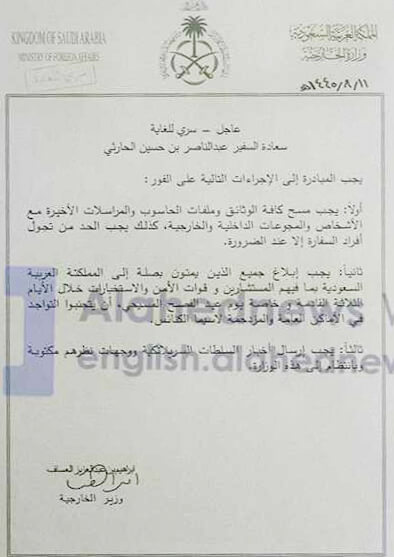
COLOMBO, SRI LANKA — A leaked Saudi diplomatic memo obtained by Lebanese outlet Alahed News claims that the government of Saudi Arabia had foreknowledge of the Easter bombings that occurred last month in three cities on the island nationof Sri Lanka, killing nearly 300 and wounding over 500 more. The contents of the memo, which additionally suggests Saudi complicity in the attacks, are supported by the connections recently uncoveredby Sri Lankan authorities, that the alleged ringleader of the bombings, Zahran Hashim, had to Saudi Arabia.
The document carries the Islamic calendar (Hijri) date of 11/8/1440, which equates to April 17, 2019 in the Gregorian calendar — just a few days before the bombings — and is addressed to the Saudi ambassador to Sri Lanka, Abdul Nasser bin Hussein al-Harethi, and authored by Saudi Foreign Minister Ibrahim bin Abdul Aziz al-Assaf. It carries the labels urgent” and top secret.”
The brief memo states the following (translated from Arabic):
His Excellency Ambassador Abdul Nasser bin Hussein al-Harethi
You should carry out the following measures immediately:
First: You should delete all documents, computer data and latest correspondence with domestic and foreign members and groups, in addition to imposing a curfew for the embassy personnel unless [travel] is necessary;
Second: You should inform all those related to the Kingdom of Saudi Arabia — including counselors, security forces and intelligence during the three coming days, especially on the Christian Easter Day — to avoid presence in public and crowded places, namely churches;
Third: You should send written news about the Sri Lankan authorities and their viewpoints regularly to this ministry
Ibrahim bin Abdul Aziz al-Assaf
Foreign Minister
The memo, seen here, carries the seal of Saudi Arabia, conforms with the format of other leaked Saudi diplomatic memos, and carries two watermarks. MintPress was unable to obtain a copy for independent confirmation of its authenticity.
The memo dovetails with other new evidence
The contents of the memo from the Saudi foreign minister to the Saudi ambassador to Sri Lanka, particularly its indication of prior knowledge of danger in crowded places and churches on Easter Sunday, have taken on a new significance following the arrest last Friday of Mohamed Aliyar, a 60-year-old, Saudi-educated Wahhabi scholar who operated the Center for Islamic Guidance in Zahran Hashim’s hometown of Kattankudy. According to a plaque outside of the Wahhabi religious center operated by Aliyar, the center is funded by unnamed Saudi and Kuwaiti donors.
A statement released by Sri Lankan police stated that Information has been revealed that the suspect arrested [Mohamed Aliyar] had a close relationship with … Zahran and had been operating financial transactions” on his behalf and was also involved” in the training of the suicide bombers responsible for the massacres on Easter Sunday.
A group of board members of the center, who spoke to the South China Morning Post prior to Aliyar’s arrest, stated that the center was funded by local donations, student fees, and private donors who were classmates of Aliyar’s in Riyadh;” denounced Zahran Hashim as a troublemaker;” and could not recall having seen him at the center recently. However, the police statement that followed Aliyar’s arrest suggested that his relationship with Zahran Hashim was not a part of his public persona.
Of key interest in the police statement is the mention of Aliyar’s operating of financial transactions” on Zahran Hashim’s behalf in the lead-up to the attacks. Several reports, such as this one from the BBC, noted that the attacks required detailed planning, safe houses, an extensive network of planners and handlers, expertise on bomb-making, and significant funding.” Aliyar’s connections to wealthy Saudi donors and to Zahran suggest that he may have been a liaison for much of that funding.
In addition, the leaked memo’s instruction for the Saudi ambassador to delete all documents, computer data and latest correspondence with domestic and foreign members and groups,” suggests that the Saudi Embassy in Sri Lanka may have been aware or party to these or other transactions related to the Zahran-led attacks.
While it is possible that funding had come from elsewhere, the fact that Zahran’s sister, Mohammad Hashim Madaniya, had been sent 2 million Sri Lankan rupees (around $12,000) from Zahran just days before the blast suggests that the amount of money involved in funding this operation was significant indeed and likely of foreign origin.
Extent of Saudi role
The fact that the Islamic State quickly claimed responsibility for the bombings — and that Zahran pledged loyalty to the group just hours before the attack — further suggests a Saudi role, since the Saudi government was revealed to be funding and logistically aiding the terror group in 2014. Leaked emails from former Secretary of State Hillary Clinton revealed that the U.S. government has long known that Saudi Arabia and other Gulf states are among the main financiers of the international terror group.
The leaked memo contained in the email to Clinton states:
We need to use our diplomatic and more traditional intelligence assets to bring pressure on the governments of Qatar and Saudi Arabia, which are providing clandestine financial and logistic support to ISIS and other radical groups in the region.”
While mainstream reports have long asserted that it was private Saudi donors funding the terror group, this email revealed that U.S. intelligence had determined that the Saudi government was funding the group and also providing them it logistical assistance.
The Islamic State’s widely acknowledged role in the attacks and its known relationship to the Saudis — in combination with the recent arrest and role of Mohamed Aliyar in the attacks and the contents of the memo from the Saudi Foreign Minister — strongly suggest that the government of Saudi Arabia not only had foreknowledge of the brutal bombings (and did nothing to stop them) but may have also played a more active role in the bloodshed.
Feature photo | A screenshot from an ISIS video shows Zahran Hashim, alleged ringleader of the Sri Lanka Easter Bombings.
Whitney Webb is a MintPress News journalist based in Chile. She has contributed to several independent media outlets including Global Research, EcoWatch, the Ron Paul Institute and 21st Century Wire, among others. She has made several radio and television appearances and is the 2019 winner of the Serena Shim Award for Uncompromised Integrity in Journalism.
The Foreign Office has changed its advice for Sri Lanka and no longer advises against all but essential travel to the country.
It is currently low season for Sri Lanka, meaning very few people will have had holidays booked for this time.
Travel providers will now review the advice and make decisions as to when they will resume their programmes. Customers who are due to travel in the coming months should contact their travel company for more information.
If you have booked your travel arrangements independently, you will be able to go ahead with your trip as planned.
Microplastics and overfishing are the leading causes of extensive marine pollution in Sri Lanka, a new survey has found.
The survey, the first of its kind carried out in 40 years, showed that the island’s fish stock had dropped drastically by about 80 percent, in part due to high levels of microplastic contamination.
The island’s northwestern seas recorded the highest levels of marine pollution, while seas to the east remain rich with marine life and should be made a conservation priority, researchers say.
Plummeting fish stocks and crisis-level volumes of plastic pollution should spur Sri Lanka to adopt new regulations and mechanisms to prevent further contamination of the seas around it, experts say.
The call comes in the wake of findings from a 2018 survey — commissioned by the National Aquatic Resources Agency (NARA) and supported by Norway’s Institute of Marine Research (IMR) and carried out on the Norwegian research vessel Fridtjof Nansen — that were published in January.
The survey, the first of its kind in 40 years, found that nearly four-fifths of small pieces of the plastic waste in Sri Lanka’s territorial waters arrived via rivers and canals, said Terney Pradeep Kumara, general manager of the Marine Environment Protection Authority (MEPA).
This means, only about one fifth of waste is sea-originated microsplastic [MPs] wastage, caused by fishermen dumping plastic in mid-sea and oil spills from ships,” he said.
The Nansen survey also highlighted that seas around Sri Lanka were polluted by second category” microplastics, such as fishing gear and packaging material.
Kumara called for collective and effective waste management mechanisms to avoid extensive marine pollution. Making coastal regions of Sri Lanka polythene-free and campaigning to reduce domestic use of plastics are essential to avert a further crisis, he said.
The severity of the microplastic contamination has contributed to a nearly 80 percent depletion in fish stocks, according to the Nansen survey findings.
In the last fisheries stock survey, carried out from 1978 to 1980, it was estimated that fish resources at the seabed level were likely between 250,000 and 350,000 tonnes. In contrast, the Nansen survey showed a plummeting of the fish stock to around 53,000 tonnes.
The drivers are overfishing, microplastic contamination and unauthorized fishing,” Prabath Jayasinghe, co-cruise leader and senior scientist with NARA, told Mongabay. This has happened over a period of time and now it has reached crisis proportions. Besides affecting fish exports, this also means Sri Lankans will have not have the benefit of their main source of protein.”
He added that the number of fishermen has also increased, putting pressure on the country’s fish stock. Aquaculture is a main source of income in the northwest, as well as coastal tourism. These industries have not grown in a sustainable manner, increasing the stress on the marine environment.
Our marine ecosystems are now at deep risk, be they the mangroves, coral reefs or estuaries,” Jayasinghe added. Pollution threat is amplified by climate change.”
Regional disparities
The survey was carried out over one complete fishing season in 2018. Throughout the study, microplastic particles were found in all the sampling stations along the Sri Lankan coast; the highest concentrations were discovered in the northwestern seas, while eastern and southern regions recorded lower levels of pollution.
The total swept area biomass estimated from the survey was 53,000 tonnes, excluding jellyfish, garbage, coral debris and sponges. The lowest biomass estimate came from the northwest (967 tonnes) and the highest on the continental shelf off Batticaloa in the east (8,173 tonnes), the preliminary findings showed.
The eastern coast showed so much promise,” Jayasinghe said. Its waters comprise rich marine resources, including fish larvae and baby fish, unlike the other regions surveyed. This region deserves a special conservation and management plan.”
In June 2018, Sri Lanka joined UNEP’s CleanSeas campaign, a global movement to tackle plastic pollution in the ocean.
A 2017 report by the U.K.-based Ellen McArtur Foundation warns that plastics in the oceans will outweigh fish by 2050, as the use of plastics has increased more than twentyfold in the past half a century. The U.S.-based Ocean Conservancy estimates that more than 150 million tonnes of plastic are currently circulating in the ocean, with another 8 million tonnes added annually. In 2016, South Asia, including Sri Lanka, generated 26 million tonnes of plastic waste into the ocean.
Sri Lanka’s exclusive economic zone (EEZ), which stretches up to 200 nautical miles (370 kilometers) off its coast and spans about 510,000 square kilometers (197,000 square miles), is eight times larger than the island’s landmass and is highly vulnerable to pollution. As a preventive measure, Kumara said, the country’s Marine Pollution Environment Act No. 35 of 2008 must be amended to impose strict punishment against polluters.
Then we need extensive awareness creation among the people. They need to share this journey,” he said
The indictments against ten suspects including Central Bank’s former governor Arjuna Mahendran, Perpetual Treasuries Ltd., owner Arjun Aloysius and its CEO Kasun Palisena have been prepared and will be filed in the High Court by the Attorney General in connection with Treasury bond scam.
The Attorney General’s Co-ordinating Officer, State Counsel Nishara Jayaratne said that having considered the nature and the gravity of the case, the AG had requested the Chief Justice to direct the institution of Criminal Proceedings in the Colombo High Court before a trial-at-bar comprising three judges.
No sooner the directive is received from the Chief Justice, the AG will file the indictments on 23 counts against the ten suspects under sections of the Penal Code, the Public Property Act and the Registered Stocks and Securities Ordinance.
The suspects to be indicted are — Lakshman Arjun Mahendran, CBSL’s former deputy governor Paththinige Samarasiri, the Perpetual Treasuries Ltd, Arjun Joseph Aloysius, Kasun Oshadhee Palisena, PTL directors Jeffery Joseph Aloysius, Pushya Mithra Gunawardane, Chitta Ranjan Hulugalla, Muthuraja Surendran and Ajahn Gardiya Punchchihewa.
The suspects will be indicted in connection with the charges arising out of the Treasury Bond auction held on February 27, 2015 (in respect of the face value of Rs.10.058 billion) causing a Rs.688 million loss to the government.
Following are the charges:
1. Conspiracy to commit criminal misappropriation in respect of Treasury Bonds to the face value of Rs.10.058 billion.
2. Criminal breach of trust against the 1st and 2nd suspects and causing a loss to the Government of Rs.688,762,100.
3. Aiding and Abetting the 1st suspect to commit criminal breach of trust.
4. Criminal misappropriation in respect of Treasury Bonds to the face value of Rs.5 billion against the 3rd suspect.
5. Aiding and Abetting the 3rd suspect to commit criminal misappropriation.
6. Committing insider dealing by 3rd suspect.
7. Aiding and abetting the 3rd suspect to commit insider dealing against all the other suspects.
The above charges have been formulated considering all the evidence presented during the Bond Commission Inquiry conducted by the Commission of Inquiry appointed by the President and also considering the material disclosed during the investigation conducted by the CID.
According to the Auditor General, the estimated avoidable loss suffered by the government at this auction alone (on February 27, 2015) was approximately Rs. 688,762,100.
According to Co-coordinating Officer to the Attorney General, State Counsel Nishara Jayaratne, it has been a painstaking approach by the prosecutors to study thousands of pages of evidence and thereafter consider and present charges against the accused which has been so far the largest organized financial crime perpetrated in this country by any person or person which had an impact on the Financial Markets and the country’s economy.
More indictments are expected to be presented on the basis of the evidence revealed at the Bond Commission Inquiry and investigations conducted by the CID. (