Whatever truth that may come into light with the ongoing
investigations, one thing for sure is this government is utterly disjointed
powerless and headless. Heart is crying for the loss of lives and limbs and as
the opposition has rightly pointed out, it is due to the presence of
this inept and incompetent bunch at the helm.
The blame game has started towards the officials as a good escape
route to disown their own failures as a cohesive government. A big compensation
package to the victims though may look very timely but is just
another way to hoodwink the public anger.
What is more sad is to come to realize it is the fault
of us who brought this Yahapalanaya government into power. What a tragedy being
misguided by information, fake or not on personal wealth,Lamborghinis
and frauds. Now considering the damage the country will incur by various sorts
of damages, compensations but more importantly by way of the loss of revenue
from the tourist industry alone they would become insignificant. The good name
and the proud record the country gained from successfully terminating the
war is over bringing shame & disrepute in abundance.
Further by delaying the release of the right information to the
media of the identity of the perpetrators, it was implied world over the
preparators as the country’s majority Buddhists. Government
bungling was all over the place. It has to be horses for courses, what is
right for the West is not right for us with such internal conflicts at hand.
The government should have been clever to know there are elements to bring
Buddhists into disrepute.
Only one thing will win the confidence & heart of the
nation now whether you like it or
not.
I honestly request all the country men, irrespective of your colour race
or religion, please do your utmost to bring Gota to the President Office at
your earliest. Otherwise this country is doomed.
And let me also plead Ahimsa, despite whatever injustice happened
to you from the Rajapaksha regime in the past, please think
compassionately at the millions of our lives at danger and withdraw your
cases or other hurdles you have set about preventing him coming to the office.
This is not the time for personal grudges but to be patriotic to your mother
country. Hundreds of Christian lives of your faith who died due to this
massacre will not go down the drain in vain.
As per the
headline news item appeared in The Island
dated 23rd April, Petroleum Resource Development Minister Kabir
Hashim has revealed that following some incidents in the Mawanella area,
Intelligence had unearthed cache of explosives at Lacktowatta in
Wanathawilluwa, Puttalam. During the raid two key suspects were captured.
However, due to the intervention of a powerful politician, they had been
released and one of them had been involved in Sunday’s attacks, the Minister
said.
The powerful
politician who could interfere with an investigation carried by police should
definitely be one of the politicians attached to the current Ranil-Sirisena
administration. The release of the captured suspects has caused a serious
disaster and hence the citizens of the country have a right to know who this
powerful politician is and what his
interests are with those criminals?
As The Island
editorial ‘ Kabir’s bombshell‘ quite
rightly suggested, a high-level probe should be conducted into the very serious allegation made
by a Minister of the same ruling clan and
name the politician who intervened to secure the release of the two
high-profile suspects from police custody.
Action must be taken to arrest him immediately to prevent interference with
the current investigation and further loss of lives of innocent people.
We are gathered here today, to discuss the
future of our country following the bomb attacks that took place on Easter
Sunday. More than 300 people were killed and more than 500 people were injured
in those attacks. I wish to take this opportunity to once again convey my
heartfelt condolences to the families of all those who have lost their lives
and to wish those injured a speedy recovery.
After we ended
the 30 year war on 19 May 2009, we all thought we had seen the last of such
attacks. We were to mark the 10th anniversary of the ending of
terrorism next month. Even during that 30 year war, no single attack carried
out by the terrorists targeting civilians ever resulted in as much carnage as
the Easter Sunday attacks. The LTTE also carried out co-ordinated simultaneous
attacks on multiple targets but even they were not able to wreak the same
amount of destruction. The Easter Sunday attacks in Sri Lanka is said to be the
biggest single terrorist attack targeting civilians ever to take place in South
Asia. So many people did not lose their lives even in the Mumbai attacks of
2008.
This House has
to look into the circumstances that enabled terrorism to once again raise its
head in this country with such virulence. In November 2005, when I became
President for the first time, there was a nominal ceasefire in operation. But
the LTTE was carrying out attacks on a daily basis and killing two or three armed
forces personnel in each attack. During that period a bomb attack on a bus
resulted in a large number of civilian deaths.
When I went to St Anthony’s Church last Sunday following the attacks, I
was reminded of the Kebithogollewa incident. The people of that area expressed
a great deal resentment at our government over the Kebithogollewa incident.
The people
have no use for a government that cannot assure them of the safety of their
lives. In July 2006, we recommenced the war because the LTTE closed the
Mavilaru anicut and blocked the water supply to a large number of villages in
that area. It is the duty of the government to at the very minimum, to uphold the right of the
people to live and to create an environment where they will be able to go about
their day to day lives. That is why we never looked back after recommencing the
war following the Mavilaru incident.
In January
2015, I handed over a completely secure and peaceful country to the new
President. We had strengthened the intelligence services so that there would be
absolutely no threat to the national security of the country. Our intelligence
services worked closely with other intelligence services of neighbouring
countries and other international intelligence services to ensure the security of the
country. Whenever we got wind of a threat to national security, we acted on it. The
Easter Sunday attacks would never have taken place under our government.
The present
government is squarely responsible for the terrorist attacks that took place
last Sunday. The police had issued early warnings of an impending attack. However what action did the government take
with regard to those warnings? They never informed the Church leaders about
those warnings and neither did they provide extra security to the possible
targets. All that the leaders of the present government did was to ensure that
they themselves were nowhere near a possible target. On important occasion such
as Easter, representatives of the government usually attend Mass, but this time
there were no such representatives in the Churches.
When I went to
the scenes of the attacks on Sunday, one government minister said that the
opposition is trying to make political capital of the situation. I must remind
them that I also visited Kebithigollewa in the same way in 2006. I am not
speaking here as someone spewing forth empty words but as the individual who
gave leadership to the government that defeated the terrorists that no one
thought could ever be defeated. From
the moment this government came into power in January 2015, they have been
persecuting the members of the armed forces and the intelligence services that ended
that war. How many of our armed forces
personnel have they jailed over the past four years? How many times have they
hauled former army commanders and commanders of the navy and airforce to the
CID to be questioned?
Our war time
defence secretary was relentlessly persecuted because he was my brother. They
were not able to imprison him due to the intervention of the courts.
I have told
this government on many occasions that this is not the armed forces of the
Rajapaksas but the armed forces and intelligence services of the Republic of
Sri Lanka. Regardless of which political party is in power, it is they who will
have to ensure the security of the nation. This government never understood the
point. Due to the political leadership that we gave them, our armed froces were
able to win the war that was deemed unwinnable.
The armed
forces personnel who carried out their duties on behalf of the nation were harassed and
hunted down by this government. The government should at least now realise that you cannot
run this country according to the dictates coming from foreign countries. We have
to solve our own problems. The government was preparing to repeal the
Prevention of Terrorism Act on the instructions of their foreign masters. If
that Act had been repealed, what kind of a position would we be in today? Because
the government was engaged in relenetlessly persecuting its own armed forces,
we became an easy target for terrorists. No other country in the world has
persecuted and weakened their own armed forces and intelligence services in
this manner. Terrorists observe these things and plan accordingly.
The Sunday
attacks did not take place due to the negligence of one or two officials. We can now see that the government is
preparing to sacrifice some official and wash their hands of the matter. This
incident occurred because of the conduct of this government from the time they
came into power in January 2015. If anyone is to resign over these incidents,
it should be the government. Despite the persecution that the intelligence
services had been subject to, they did obtain prior intelligence relating to
this attack and conveyed the information to certain quarters. But nothing
happened thereafter. That warning had
been sent to my security officers as well, but they did not keep me informed
about the threat.
If I had known
that there was an imminent threat of this nature, I would have immediately
informed His Eminence Malcolm Cardinal Ranjith and also curtailed my own movements.
Instructing officials on the manner in which they should conduct themselves in
relation to matters involving national security, is the task of the government.
That is what people
elect governments for. The signal sent by this government to officials at all
levels is that national security is not important.That is the reason for all
this mayhem. These incidents did not
occur without warning. The recent destruction of Buddha statues in Mawanella,
the attempt on the life of a close supporter of a Muslim Minister from that
area, the discovery of over 100 kilos of explosives from Puttlam, are all
connected. So this attack did not just come from the blues. Having received
information that an attack can take place, all that the government did was to
ensure that they themselves were safe.
This terrorist
attck is very different to similar attacks that took place during the 30 year
war. The terrorists of that time did not target foreigners because they had
people living in those countries and funding the terrorist campaign in Sri
Lanka. But this new terrorism targets locals as well as foreigners. That
strikes a death blow not only to the tourist industry but to foreign investment
as well. This terrorism has to be conclusively defeated. I request the government to halt the
persecution of the armed forces at least now. The Council of Religions headed
by the Ven. Ittepane Dammalankara Mahanayake Thera and His Eminence Malcolm Cardinal Ranjith has
also called upon the government to desist from weakening the intelligence
services further.
The arrests of
armed forces and intelligence services personnel that took place after this
government came into power was very often not based on solid evidence. In order
to please the yahapalana government the CID obtains statements from certain
people using various stratagems and then uses these statements to arrest members of
the armed forces and intelligence services. Some of these so called witnesses
have made special statements to Magistrates explaining how the CID obtained
statements from them implicating various people. Stop this filthy practice at least
now.
As the
opposition, we will extend our fullest cooperation to the law enforcements
authorities and the armed forces to ensure national security. I request the
people not to take the law into their own hands and to extend their fullest
cooperation to the law enforcement authorities and the armed forces to solve
this problem. We must remember that terrorists have no religion. The public needs more
information about some matters and I would like to address the following
questions to the government.
When did the SIS and the Security Concil first get to know of the organisation that is said to be behind these attacks?
According to the information available to the government, since when has this organization taken to terrorism?
What action was taken in respect of these reports?
Who investigated the Wanathaviluawa incident where over 100 kilos of explosives were found?
Who were the suspects arrested in this regard? Was this brought to the notice of the Security Council? If so when and by whom? What action was taken in this regard?
How many persons were arrested in this regard? Who were they? How many of them sere produced in courts? How many were released?
Were any of these suspects released at the request of any person? If so who was the person who made such a request?
Was there an intelligence report of a threat to national security in the month of April? Was this brought to the notice of the Security Council? If so, when and by whom? Who attended the security council on that day?
Has the involvement of a foreign party in these attacks been established? If so what is the foreign party involved?
Media Statement Federation of University Teachers’ Associations
Easter Sunday of 2019 is destined to be yet another day of devastation
that our country will have to remember in the years to come. As we approach 10
years living in a country that is not at war with itself, we were hopeful that
we had put the days of mass destruction, bomb blasts and explosions, behind us
for good. Yes, there were problems; yes, there was much we could do better;
yes, there was lot more work needed for ensuring reconciliation, justice and
peace, but we did believe that the worst was behind us. The tragic events of
yesterday, have proved otherwise.
As university teachers, we appeal to our fellow citizens, not to
let the incidents of yesterday define who we are. We can be better than this
and we will be better than this. Let us reach out first and foremost to the
victims of yesterday, their families and communities and to our neighbours and
all our fellow citizens. Let us come together in our moment of grief and do
what we can to comfort and support each other. As the long lines at the
National Blood Bank showed yesterday, and on numerous occasions before, we are
more than capable of coming together in times of crisis and tragedy. Let us not
allow the rhetoric of hatred, division and communalism to keep us apart.
We appeal strongly to our leaders to rise above petty political
divisions, and to demonstrate genuine statesmanship. We have suffered too long
because of the squabbles and power struggles of our leaders. Indeed, power
struggles and pettiness of the political leadership in this country is responsible
for much of the suffering of our people. We urge you not to use the tragic
events of yesterday for political advantages but rather to reveal the truth to
the people and to ensure that victims and their families are supported. There
is much work to be done to recover and move forward from this tragedy and that
and nothing else, should be the priority for our leaders. As the university
community, we appeal to all students, teachers, non-academic staff and administrators
to come together and stand against violence and extremism in all its forms
within and outside our universities.
We express our sincere condolences to those who lost their lives
in the Easter Sunday attacks and extend our best wishes for the speedy recovery
of all those who are injured. We also extend our support and appreciation to
the medical and security personnel who are working on our behalf during these
difficult times.
Did Japan contribute
to Sri Lanka and India gaining independence from British colonial rule?”
by
Senaka Weeraratna
On
Monday
29th April 2019 at 5.00 p.m.
at
the
Gamini
Dissanayake Auditorium
No.
96, Ananda Coomaraswamy Mawatha, Colombo 07
ALL
ARE WELCOME
Abstract
The time
has come to challenge the hype that Sri Lanka won independence from Britain in
1948 exclusively by our own local efforts through an exchange of correspondence
and political negotiations without any supportive foreign factor. This British
centric – friendly narrative is increasingly unsustainable in the light of new
evidence.
Moreover,
it is political correctness and tendency to please our former colonial rulers
that has prevented an objective appraisal being undertaken taking into account
the external factors that contributed substantially towards the gaining of
freedom from colonial rule.
It is
indisputable that Japan struck the greatest decisive blow ever by any non – white
country or non – white people to European power in Asia with the attack on
Pearl Harbour. In about 90 days beginning on December 8, 1941, Japan
overran the possessions of Britain, the US and the Netherlands in east and
south-east Asia, taking the Philippines, Singapore, Malaya, Hong Kong, the
Dutch East Indies; much of Siam and French Indochina and Burma with bewildering
swiftness to stand poised at the borders of India by early 1942.
Within less
than a decade of the Japanese attack on Pearl Harbour on Dec. 7, 1941, India,
Burma and Ceylon were granted independence. At the commencement of the Second
World War on Sept. 03, 1939, there was not even an empty promise or hint on the
part of Britain to give freedom to its colonies. We were lucky.
Freedom came to Ceylon on a platter. How?
What are
the factors that pushed Britain to withdraw hastily from India and in turn
discard its control over Burma and Ceylon having lost the Jewel in the British
crown?
After over 10 years of Peace & Harmony, in the Island Paradise, sudden blasts killing innocent Easter Sunday worshippers, shocked the World.
The
well planned, organised, coordinated attack on three Churches and several
hotels in different locations, add to the fact, that, the attacks were
professionally managed & executed.
It
is dangerous to jump into hasty conclusions on the perpetrators, before
investigations delve into details.
Furthermore,
people should refrain from taking the Law into their own hands, but leave it to
the Law Enforcement professionals to deal with it and offer maximum support.
Quite
frankly speaking, the retaliation against the Mosque attack was expected, even
after the reaction of the New Zealand Prime Minister showed immense empathy and
love for those who suffered from the attack.
However,
Sri Lankan Buddhists or Hindu or Catholics had nothing to do with the New
Zealand Mosque attack, and it is not in the nature of the Sri Lankans to cause
such unnecessary pain, death and destruction.
This
was a massacre, an un-necessary tragedy on the innocent humans, specially on a
Sacred Easter Sunday.
St.
Anthony’s Church in Colombo is a Miraculous Shrine visited & revered by All
Faiths, Buddhists, Muslim, Hindu, who visit to Pray, Weep, Beg and Contemplate
for a Miracle.
I
have no doubt that the entire Island of Sri Lanka will now Unite to Rebuild the
Miraculous Church of St. Anthony, as a Shrine of All Faiths.
Express Your Opinion – Read What Others Say!
The Independent Interactive Voice of Sri Lanka on the Internet.
The world renowned Israeli Professor Yuval
Noah Harari, a historian, philosopher and author
of the international bestsellers translated into 50+ languages and sold
worldwide with his book Sapiens: A Brief History of Humankind” (2014)
looking deep into our past, his second book Homo Deus: A Brief History
of Tomorrow” (2016) considering far-future scenarios, and 21 Lessons for the
21st Century (2018)” zooming-in on the biggest questions the world is faced
with at the present moment, commenting on counter terrorism says –
If we want to fight terrorism effectively we must realise
that nothing the terrorists do can defeat us. We are the only ones who can
defeat ourselves, if we overreact in a misguided way to terrorist
provocations.” Terrorists
function by capturing our imagination, turning our imagination against us, and
causing us to overreact”. In
a way, a terrorist is like a fly that tries to destroy a china shop. The fly is
so small and weak. It cannot move even a single teacup. So how does a fly
destroy a china shop? The fly finds a bull, gets into the ear of the bull and
starts buzzing. The bull becomes so enraged that it loses its temper and
destroys the china shop. This is what happened in the middle east over the last
15 years”.
Terrorism today has far greater
political effect because people live in a far safer world. This may sound
paradoxical, but it isn’t. For terrorism is a psychological weapon used by very
weak parties. Terrorists lack the power to conquer countries and cities, so
they stage a terrifying spectacle of violence that captures our imagination and
turns it against us. By killing hundreds of people, terrorists cause hundreds
of millions to fear for their lives, which often leads to overreaction, such as
the US invasion of Afghanistan and Iraq. Al-Qaeda could never
destroy Iraq by itself. It got into the ear of the United States and the United
States went wild and destroyed the middle eastern china shop for Al-Qaeda. This
is how terrorism functions. And if you want to fight terrorism you should start
with your own imagination.”
The most efficient answer to terrorism will be good intelligence
and clandestine action or in other words, covert undercover action, against the
networks of money that feed terrorism.
What
happened on April 21, 2019 was no accident. It was going to happen based on
what happens around the world and in Sri Lanka. Explosives were unearthed,
Buddhist shrines were vandalized, hate material were found and even
intelligence reports indicated of an impending Islamic terrorist attack. The
parliament was told that at least 35 Muslims from Sri Lanka had travelled to
Syria to join the Islamic State (ISIS) terrorist group. Peaceful Syrian Shia
government reported recently that at least 36 to 50 ISIS terrorists from Sri
Lanka were in Syria. Unfortunately, not all of them died in war. These should
have opened the eyes of the incompetent government to the impending doom.
This
happened on the exact day of the massacre of Karbala by Wahhabis led by
Abdul-Aziz Bin Muhammad in 1802.
Islamic
terrorism in Sri Lanka was foretold by the BBS leader Venerable Galabodaaththe
Gnanasara Thero. However, instead of taking heed, the government arrested him
and condemned to prison. Most Sri Lankans including yours truly were skeptical.
Sadly, it costed the lives of over 290 persons, mostly Christians; initiated
the destruction of Sri Lanka’s economy due to the collapse of the tourism
industry at a desperate time when the nation needs foreign currency to repay
loans and attracted worldwide attention. At least 44 foreigners were killed.
Even if Sri Lanka fails to take action, their host nations will take action
against Islamic terrorists in Sri Lanka. Some terrorist suspects were Indian
and Pakistani. However, they have found willing accomplices in Sri Lanka.
Islamic
terrorism in Sri Lanka born a few years ago silently attained adulthood with a
loud bang on April 21, 2019.
The
Easter Sunday Islamic terrorist attack is the worse civilian killing on a day
in Sri Lanka’s history. It is also one of the worst terrorist attacks outside
Muslim countries.
However,
the series of attacks seem testing the waters. Islamic terrorists picked the
smallest creed of the country (just 7% of the population) only to test the
waters. Subsequent finding of 87 detonators from a Colombo bus stand indicates
the full horror of their motives. Until and unless Islamic terrorists in the
island are exterminated mercilessly, no one is safe. It must be done resolutely
and quickly.
An
Indian intelligence agency had warned Sri Lanka police of an impending Islamic
terrorist attack on Easter Sunday. The police head publicized it on April 11.
However, no action was taken possibly to save the twisted reconciliation model
Sri Lanka follows that has weakened the island nation’s security. If the BBS
leader was not silenced, he could have taken up the matter on April 11 itself
forcing authorities to act.
Sri
Lankan government plays word games with the dastardly Islamic terrorist act by
not calling it as such. However, world media have reported it already. People
must know the nature of this creature. That is to their own safety and for
public-military co-operation which is essential to defeat terrorism. The
government is stuck for words and action. The least this government must do now
is to hold presidential and parliamentary elections soon so that a responsible
government can take over and save the lives of innocent people from Satanic
Cults.
New Zealand Society for Peace, Unity and Human Rights in Sri Lanka (SPUR – NZ)
New Zealand Society for Peace, Unity and
Human Rights in Sri Lanka (SPUR – NZ) vehemently condemns the reprehensible and
shameful terrorist attack on innocent people attending to their religious
activities on Easter Sunday at several locations including holy places of
worship in Sri Lanka.
At this moment of national grief, on
behalf of all New Zealanders, especially the Community of NZ Citizens of Sri
Lankan descent, we wish to offer our heartfelt condolences and extend the arms
of solidarity, love and affection to all affected families and relatives.
We strongly believe that the strongest
defense against terrorism is a cohesive and inclusive society and strongly
appeal to all Sri Lankans to unite together casting away religious, racial and
all other differences and confront the threat of evil terrorism as one united
nation.
Issued by the Management Committee of
SPUR-NZ on 22 April 2019
Society for Peace, Unity and Human Rights in Sri Lanka (SPUR) NSW Inc Australia
Our Society expresses its
profound and heartfelt sorrow on the senseless killing of innocents in Sri
Lanka. Our thoughts are with the families and persons affected by the deaths,
grievous injury and destruction of property by terrorists who have caused fear
and terror in the people of Sri Lanka and to the visitors to the island.
We give our condolences to
the Christians who had been targetted on their Holiest Day of Easter Sunday
whilst at prayer with sacred thoughts and goodwill at heart. This is a heinous
crime our Society condemns unreservedly.
Our Society has been in the
forefront of anti-terrorism in the 30 years of terrorism, conflict and the
carnage in Sri Lanka which ended in 2009. Such an ending was possible due to
the selfless life sacrifices made by members of our valiant defence forces. We
will continue to assist in Sri Lankans to overcome the scourge of terrorism foisted
on them once again this Easter Sunday.
Our Society also condemns
multiple policy weaknesses of the present government in Sri Lanka that has
contributed to the carnage. The government has deliberately let the guard down
from 2015 in Sri Lanka even when surrounded by a world of enhanced extremist
ideology, expansionist ethnic and religious greed, indoctrination through
re-constructed histories, fake news, malicious propaganda, uncontrolled
undisciplined social media and by open terrorism.
The government of Sri Lanka
has again started bending backwards to please terrorist fronts who manipulate
and operate through national and international agencies both government and
non-government. Our security forces had been belittled, then witch-hunted time
and again, and its moral broken and almost equated to terrorists themselves.
Our intelligence agencies treated step-motherly, politicised, disbanded or
their funding cut.
In this time of great
sorrow let us pray and wish for the speedy recovery of all injured, the
recovery from physical, mental and emotional damage caused to themselves and to
those near and dear. Our respect and thoughts lie with the three members of the
security forces and their families for the selfless sacrifice made in
apprehending the suspects to this crime. It is once again time for those who
deliberately forgot the security forces to reflect their undeniable worth and
valour. Our thoughts are also with all Sri Lankans and others affected by these
barbaric acts.
Let us also urge the
persons in power or had been in power in Sri Lanka, not to find escape routes
and hide behind flimsy excuses being made to the citizens, but to reflect upon
their own deliberate actions in the past few years that contributed to this
debacle, and take responsibility like leaders.
They will need to work for
the good of the people, and to immediately stop working for their own selves and
for their own political survival only.
With the terror attack on Easter Sunday, the death toll had risen
to 290. Nearly 500 being injured. It had been reported that 24 suspects are in
custody and details about them are not known. The suspicion is on a Muslim
terrorist organisation. However, on the day of the attack, Human Right
Activists pointed the finger on Buddhists and quoted chapter and verse about
attacks on Churches allegedly by Buddhists. They tried in vain to blame the
Buddhists for the Easter attack.
As everyone knows, we had similar experiences prior to 2009 by
LTTE terrorists. Bombs exploded in buses, trains, bus stations, at Sri Maha
Bodiya Anuradhapura, Temple of the Tooth in Kandy, Arantalawa and so on. But
the LTTE never attacked a single Catholic Church because their sympathies were
with the LTTE. When the LTTE was having a field day attacking Buddhists
and the country, the Church was silent and never condemned the LTTE. It is an
open secret that the Catholic Church had their sympathies with the LTTE. Some
perspective observers have publicly accused the church of being the invisible
hand supporting the LTTE’s violent campaign to destroy the unitary state,
establish another sovereign state called ‘Eelam’ and in turn reduce the power
of the majority Sinhalese and that of the Buddhists. Before the General
Election in 2000, it was reported that the Catholic Bishop of Jaffna had
requested all Tamil political parties to cease functioning so that the LTTE
could act as the sole representative of the Tamil people.
We know of instances where the LTTE paid Christian Clerics from
western countries to visit Sri Lanka for short visits to study the ground
situation and then go back and preach in seminars about Sinhalese
Buddhists attacking ‘Tamils’ and that the ethnic crisis is a conflict between
Buddhists and Tamils and not between the State and terrorists! These Clerics
wrote adverse reports heavily tilted in favour of the LTTE. Funds collected by
the Clerics from these charities, seminars and functions went to the
terrorists.
This Easter, for the first time, the Catholic Church had
experienced getting attacked by terrorists and given a taste of terrorism.
Buddhists experienced this for 30 years. However, today Sri Lanka condemns the
cowardly attack on innocent civilians.
After over 10 years of Peace &
Harmony, in the Island Paradise, sudden blasts killing innocent Easter
Sunday worshippers, shocked the World.
The well planned, organised,
coordinated attack on three Churches and several hotels in different locations,
add to the fact, that, the attacks were professionally managed & executed.
It is dangerous to jump into hasty
conclusions on the perpetrators, before investigations delve into details.
Furthermore, people should refrain
from taking the Law into their own hands, but leave it to the Law Enforcement
professionals to deal with it and offer maximum support.
Quite frankly speaking, the
retaliation against the Mosque attack was expected, even after the reaction of
the New Zealand Prime Minister showed immense empathy and love for those who
suffered from the attack.
However, Sri Lankan Buddhists or
Hindu or Catholics had nothing to do with the New Zealand Mosque attack, and it
is not in the nature of the Sri Lankans to cause such unnecessary pain, death
and destruction.
This was a massacre, an un-necessary
tragedy on the innocent humans, specially on a Sacred Easter Sunday.
St. Anthony’s Church in Colombo is a
Miraculous Shrine visited & revered by All Faiths, Buddhists, Muslim,
Hindu, who visit to Pray, Weep, Beg and Contemplate for a Miracle.
I have no doubt that the entire Island
of Sri Lanka will now Unite to Rebuild the Miraculous Church of St. Anthony, as
a Shrine of All Faiths.
Express Your Opinion – Read What
Others Say!
The Independent Interactive Voice of Sri Lanka on the Internet.
Ilyas Haniffa, President Asiff Hussein, Vice President- Outreach Centre for Islamic Studies
Sri Lanka’s Muslims woke up to a rude
shock on Easter Sunday, 21st April and reacted with disbelief to the
news that churches and hotels had been bombed while our Christian brothers and
sisters were celebrating Easter.
As Muslims we are expected to show
utmost compassion and tolerance to people of other faiths. Christians
especially occupy a very dear place in Muslim hearts, being the followers of
one of the most revered prophets of Islam, Jesus (Peace Be Upon Him). In the
Qur’an Christians are called the nearest to Muslims and praised for their piety
and devotion, while we know from the life story of Prophet Muhammad (Peace Be
Upon Him) how he was assisted in his mission by Christians and how far he went
to win their trust including giving a covenant guaranteeing their religious
rights for all time.
As such, it is shocking that a group
of misguided extremists purporting to represent our noble and tolerant faith
have chosen to commit this sacrilege in a place of worship and a holy day held
dear by Christians all over the world, taking over two hundred innocent lives.
What is also deplorable is the manner the terrorists struck in suicide attacks,
especially since we all know that suicide, like the taking of innocent lives,
is completely prohibited in Islam.
We reach out to our fellow countrymen
and countrywomen and our dear Christian brothers and sisters and join them in
this time of grief and pray that no more such vile acts in the name of any
religion sullies the holy ground we stand on and this beautiful country we live
in.
At the same time, we call on the
government to clamp down on all forms of extremism and terrorism and take
severe action to annihilate these hate cults at the earliest. We also call on
the government to investigate as to who were behind these barbaric attacks
since there are many vested interests intent on harming the image of Islam and
giving Muslims a bad name. Totally annihilating extremism in all its devious
form, whether in the name of religion or nationalism, is the only way we can
live in peace and harmony with one another.
It
is a Muslim Jihad attack on other communities and a threat, which the damn
govt. is impotent to accept, yet they are talking damn reconciliation.
What
was notable yesterday 21st April is that Muslims were new it very
well, they kept their shops and businesses closed but with no any indication of
such.
Immediately
after attacks took place, Muslim youths in and around Majestic City, Colombo 04
were rejoicing, taking selfies and in very jovial mode.
Need
not to say more.
We
told this five year ago, that we are under Islamic attack and conquer, but we
were labeled as racists by Foolish, Silly Impotent Sinhela people and Politicos
alike, threatened to be arrested and proceed to legality, so we decided wait
till the consequences instead.
Do
you understand now what we said. 21st April was just a test and the
beginning only, a tip of a iceberg, the monster is ahead!
The Sri Lanka suicide bombers had planned an attack on a fourth luxury hotel, but for some reason it never occurred, officials said Tuesday.
Prime Minister Ranil Wickremesinghe revealed the plot on the unnamed luxury hotel without saying why it failed, according to the New York Times.
This man had also checked into the hotel the previous day,” an official source told Agence France-Presse of the terrorist.
The source claimed that hotel staff became suspicious after news broke of the other hotel attacks and the would-be bomber fled the hotel. He was soon tracked to a small inn on the outskirts of the capital Colombo.
He blew himself up when confronted by police, with two bystanders also killed, according to AFP.
That blast at the Tropical Inn opposite Dehiwala Zoo was the seventh on Easter Sunday, following near-simultaneous attacks on three churches and three luxury hotels. An eighth explosion later killed three police officers as they raided a safe house used by members of the cell.
(CNN)The first time I traveled to Sri Lanka, in 2010, a ghastly civil war had just ended. Military officers still manned checkpoints along major roads.
Frida GhitisWhether we were passengers in a rickety tuk-tuk in Colombo, the bustling, leafy capital, or riding in an air-conditioned car across the countryside, armed men in olive-green uniforms would routinely order us to stop. They would check for explosives or for any sign that the violence that had plagued the country over nearly three decades might again threaten the peace won at such an appalling cost.Those scenes seemed relegated to the past — until this week when terrorists killed hundreds of people, attacking churches and major hotels on Easter Sunday. At last count, more than 320 people are confirmed dead and hundreds more injured.A decade ago, it made sense to me that travel brochures routinely referred to the country as a “teardrop shaped island.” Tears and Sri Lanka seemed to belong in the same sentence. I thought that had changed.Up to 100,000 people died in a horrific civil war that ended in 2009. All wars are awful, but there was something particularly macabre about Sri Lanka’s — with its wave of suicide bombings by the fanatical Tamil Tigers; with its gruesome final battle — a civilian massacre by the government; with the still-visible scars in Jaffna, the capital of the Northern Province, and the rest of the battered war zones, where the radical members of the Tamil minority launched their brutal bid for independence, drawing a crushing response from the state.
I lived through Sri Lankan terrorism. Here’s my adviceI returned over the years, witnessing a country emerge from tragedy. On my most recent trip, 16 months ago, I stayed at Colombo’s lively Cinnamon Grand Hotel, one of the targets of the Easter Sunday attacks. I had breakfast every day — fish curry and chilled coconut juice — in the same restaurant where a suicide bomber detonated his explosives. I watched the lavish weddings in the cavernous rear lobby, soaking up performances from traditional Sinhalese musicians and trying to understand the symbolism of the rituals.I rejoiced as a witness to Sri Lankans enjoying the fruits of peace: a normal life.For the rest of the world, peace meant that the wonders of the small island in the crosscurrents of history were open and inviting. Tourists started arriving by the millions. But all was not well on the island known before independence as Ceylon, and before that as Serendib, the inspiration for the word “serendipity.”After the war, Sri Lanka moved haltingly along the path of transitional justice, drawing international support but also criticism. Separately, domestic political battles reached dangerous levels. Last year, a constitutional clash between rival politicians left the country with competing prime ministers amid warnings that the country risked plunging back into a bloodbath. The police canceled vacations just in case.The country’s giant neighbors, China and India, have vied for influence. Former President Mahinda Rajapaksa, close to China and accused of massive corruption, signed a gargantuan deal with Beijing for construction of a new port. Rajapaksa has denied the accusations. The cost was so high that Beijing ended up taking possession of the strategic facility, infuriating Sri Lankans.
Mystery surrounds the source of the Sri Lanka attacksChina’s presence is inescapable. I once visited what would become another target of Sunday’s terrorists, the Shangri-La Hotel, a massive, luxurious structure facing the seashore, where Chinese workers are building yet another mammoth controversial project, this one building up in the sea. (China generally sends its own laborers to work on its foreign infrastructure projects.)The economy has been performing well since peace returned. Gross domestic product, the poverty rate and life expectancy have all been moving in the right direction. And yet not long ago I noted that “the march toward a stable, peaceful and prosperous future is threatened” by the government’s hesitancy in dealing with the past and its reluctance to tackle emerging tensions.Those new tensions include friction between Buddhists and Muslims, which burst to the surfaceduring one of my visits.According to the 2012 census, some 75% of Sri Lankans are ethnic Sinhalese, most of them Buddhists. Ethnic Tamils, the largest minority, make up little more than 11%. Most of the them practice Hinduism. Muslims make up just under 10% of the population, and Christians, most of them Catholic, are 7.6 % of the population.Clearly, it’s a complicated country, shaped by the sweep of empires and merchants who brought their religions with them. For the most part, the different groups have and continue to live in peace, but the exceptions have proven catastrophic enough to warrant alarm.Authorities are blaming an Islamist group, National Tawheed Jamath, for the carnage, saying it probably had help from abroad. Multiple warnings of an impending attack suggest that line of thinking is reasonable, and now ISIS has claimed responsibility.
Concerns terror cell in Sri Lanka large and well-connected 05:11One of the greatest risks now is that in its fully justified effort to uproot the organization that carried out Sunday’s attacks, the authorities may further spread the seeds of extremism, giving terrorists precisely what they want. Fanatics intent on sparking unrest, on boosting recruitment and weakening the state like nothing more than to see the state make life worse for their potential supporters.Decisive action is required, but let’s hope cool thinking prevails. Sri Lanka’s peace is fragile.Authorities were wise to block much of social media after the attacks. Fueled by rumors in Facebook posts, mobs of nationalist Buddhist extremists (you read that correctly) have clashed against Muslim groups. The government, dominated by Sinhalese Buddhists, has been slow to act. After one such attack, in 2017, the Sri Lankan human rights lawyer Gehan Gunatilleke told me that the government’s inadequate response is “legitimizing ultra-conservative” Muslim groups, noting that some of the Muslim groups are trying to outdo each on their radicalism to please their Middle Eastern backers.Follow CNN Opinion
Join us on Twitter and FacebookIt’s the perfect brew for extremism to thrive.Over the years I’ve met heroic Sri Lankans who fought to bring peace to their country. I’ve met Sinhalese and Tamils working for reconciliation. And I’ve heard worried Sri Lankans concerned about politicians squandering the country’s future. The checkpoints have been lifted. Peace has made inroads, but the shadow of the long war has not completely faded. Sri Lankans, heartbroken after the bombings, understand better than anyone how much is at stake.This commentary has been updated from an earlier version to add that China often sends its own laborers to work on Chinese infrastructure projects in other countries.
Parliamentarian Wijeyadasa Rajapakshe stated that the government including United National Party (UNP) MP Mujibur Rahman should bear the responsibility for the series of explosions which occurred around the country on Easter Sunday (21).
MP Rajapakshe mentioned this at the special parliamentary meeting held today (23).
According to him, on November 18th, 2016, he stated that 32 persons from 4 families in the National Thowheed Jamath (NTJ) organization had received ISIS training and is preparing for a terror attack in the country.
But government Ministers held a press conference and called me a liar. Mujibur Rahman cursed me. Those ministers and Mujibur Rahman should take the responsibility of these attacks”, said Rajapakshe.
The parliament convened at this afternoon (23) to discuss the security situation of the country following the Easter Day attacks which left 321 dead including 38 foreigners. Over 500 persons have been injured in the attacks.
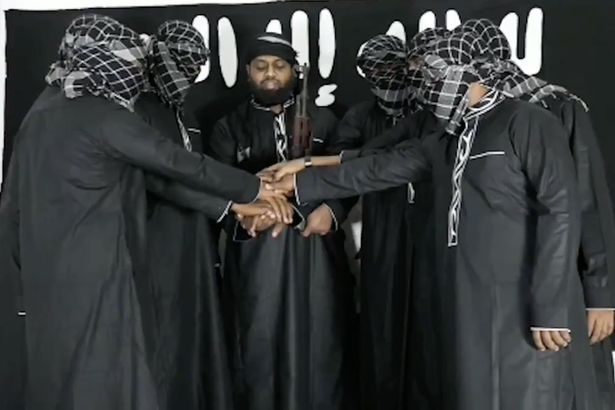
An image released by the Amaq news agency shows alleged mastermind Zahran Hashim with seven men claimed to have carried out the bombings
ISIS has released a picture which it claims shows seven suicide bombers alongside the mastermind who co-ordinated the Easter Sunday atrocity in Sri Lanka.
The image was released by the Amaq news agency – Daesh’s official mouthpiece – and is said to show extremist cleric Zahran Hashim, who has been identified as the man who planned the attacks.
It later released a video which is claimed to show the killers pledging their allegiance to the terror group.
Seven fantatics have their faces covered, but the terror group earlier named the bombers as Abu Ubayda, Abu al-Mukhtar, Abu Khalil, Abu al-Bara’a, Abu Muhammad and Abu Abdullah.
The men in the picture are all seen standing in front of an ISIS flag.
The blasts killed 321 people, including eight Britons.
In an earlier statement, the extremist organisation said: “The perpetrators of the attack that targeted nationals of the countries of the coalitions and Christians in Sri Lanka before yesterday are fighters from the Islamic State.”
The terror group claims “the executors of the attack that targeted citizens of coalition states & Christians in Sri Lanka two days ago were with ISIS”.
There were six explosions on the morning of Easter Sunday, three at churches and three at luxury hotels.
A planned fourth bombing, near the airport, failed.
The death cult has repeatedly called for assaults on churches, particularly since the New Zealand mosque attacks.
It did not provide any evidence to support its claim, which is being investigated by Sri Lankan authorities.
Citing the US-led military campaign against ISIS in the Middle East, the claim stated: “The attackers who targeted citizens of the coalition state members and Christians in Sri Lanka the day before yesterday were fighters of the Islamic State.”
Some of the bombers had travelled abroad and returned home to Sri Lanka, Prime Minister Ranil Wickremesinghe told reporters, adding that he believes there may be “some links” between the attacks and ISIS.
He said it was “possible” that the bombings were revenge for the New Zealand terror shootings, and that Sri Lankans who returned after joining ISIS in Syria are being monitored.
Both ISIS and al-Qaeda had called on revenge attacks after the Christchurch mosque attacks.
Sri Lanka’s prime minister says more attacks are possible, as the government blames two domestic Islamist extremist groups suspected of receiving help from foreign militants.
The early findings of the investigation have found that the attacks were committed in revenge for the mosque shootings in Christchurch, New Zealand, a month ago, a junior minister told parliament.
The FBI is assisting Sri Lankan authorities with their investigation of the bomb attacks over the Easter weekend on three churches and four hotels, a spokeswoman for the US law enforcement agency said on Tuesday.
The Washington Post earlier had reported that the FBI had offered expertise to test evidence and that analysts were scouring databases for information regarding the attacks.
Sri Lanka’s prime minister warned there were more explosives and militants “out there” after the Easter suicide bombings.
Ranil Wickremesinghe made the comment at a news conference, and said some officials are likely to lose their jobs over intelligence lapses surrounding the attack.
Mr Wickremesinghe acknowledged there was a prior warning, and said India’s embassy was eyed as a possible target.
He told reporters that the government’s security agencies were monitoring Sri Lankans who had joined Islamic State and returned home.
“We will be following up on IS claims, we believe there may be links,” he said.
Indian intelligence officers contacted their Sri Lankan counterparts two hours before the first attack to warn of a specific threat on churches, one Sri Lankan defence source and an Indian government source told Reuters.
Another Sri Lankan defence source said a warning came “hours before” the first strike
One of the Sri Lankan sources said a warning was also sent by the Indians on Saturday night.
The Indian government source said similar messages had been given to Sri Lankan intelligence agents on April 4 and April 20.
Sri Lanka’s presidency and the Indian foreign ministry both did not respond to requests for comment.
Prime Minister Ranil Wickremesinghe says that investigators have made good progress in identifying the suspects involved in the Easter Day attacks.
Speaking in a media briefing for the foreign correspondents today (23), the Prime minister also said it is possible” the Easter bombings were retaliation for the Christchurch attacks, but did not provide any evidence.
He says that there were foreign links behind the attack and that it could not have been done just locally. There has been training given and coordination which we have not seen earlier”, he said. He added that some of the bombers had traveled abroad and then returned home.
The government’s security agencies were monitoring Sri Lankans who had joined IS and returned home, he added.
He stated that many of the suicide bombers have been identified already.
Sri Lanka has had offers of help from several countries and that several countries have sent down teams to assist in the investigations; however, the police will decide with whom and how they are going to work, stated the Prime Minister.
Stating that they are trying to identify all the nationals affected by the bombings, Wickremesinghe said that some countries will also have to undertake their own investigation because their nationals have been affected by the blast.
We, if it was known, certainly could have prevented many of the attacks in the churches and have more security in the hotels,” Wickremesinghe said.
The Prime Minister refused to disclose the number of suspects arrested over the attacks; however, when asked if a Syrian national has been taken into custody, he stated that only Sri Lankans have been arrested so far.
Wickremesinghe stated that terrorists do not belong to any faith and that Sri Lanka will continue their policy of ensuring unity and religious harmony within the country while tracking down global terrorism.
When asked about the continued threat, he said:
There are a few people on the run, somehow on the run, so we’ve got to detain them. We have an unknown number of suspects on the run.”
Speaking on the relationship between the President and the Prime Minister having affected public security, Wickremesinghe stated that they have put behind their differences of opinion to face this issue. He said that the top priority of them was to apprehend the offenders.
When questioned on the social media ban Premier stated that it will be discussed tomorrow and that this was done to ensure communal harmony in the first days of the attack. He said, We went through these exercises earlier in Digana. We didn’t want to take another chance.”
Wickremesinghe said that the security apparatus is of the view that there are foreign links behind this attack and that they had suspicions of an ISIS involvement as well.
Prime Minister refused to name the local group which had carried out these attacks. But he stated that they are concerned by it despite it being a smaller group in size.
A vast majority of Muslims condemn this. They are as angry as the Sinhalese and the Tamils as to what has happened”, the Prime Minister added.
(CNN) Early warnings from India’s intelligence services to Sri Lankan officials ahead of the Easter Sunday bombings were based on information gleaned from an ISIS suspect, CNN has learned.
Delhi passed on unusually specific intelligence in the weeks and days leading up to the attacks, Sri Lankan officials have said, and at least some of it was gleaned from material obtained during interrogations of an ISIS suspect arrested in India, an Indian official told CNN.
The revelation comes as ISIS claimed responsibility for the bombings, which killed 321 people and injured more than 500. In a statement published by the ISIS-affiliated news agency Amaq, the group said the attackers were fighters of the Islamic State.”
The involvement of a foreign organization would explain how a previously marginal domestic extremist group blamed for the attacks, National Tawheed Jamath (NTJ), could have pulled off one of the worst terrorist atrocities since 9/11.
The number of casualties could have been even higher. Authorities said Tuesday that a fourth hotel was among the original targets, but the attack at that location failed. Officials previously said they found an unexploded pipe bomb near Colombo’s international airport.
As investigators scrambled to track down the bombers’ associates, there was growing anger in Sri Lanka at the failure to heed the warnings of India’s intelligence service.
Dehli’s information came from the interrogation of an ISIS suspect, the Indian source told CNN. After being interrogated, the suspect gave investigators the name of a man he trained in Sri Lanka, who is associated with the local extremist group, the NTJ, the source said.
While we were investigating ISIS cases, during the interrogation of an accused, he disclosed the name of a man, Zahran Hashim, who is one of the suicide bombers and is associated with NTJ,” said the intelligence source in India. The suspect said that he played a role in his (Hashim’s) radicalization.”
The Indian intelligence source did not specify when the arrest was made. Indian intelligence agencies shared their information with their counterparts in Sri Lanka,” the source said.
Hashim’s name appears on a memo dated April 11 and signed by Sri Lanka’s Deputy Inspector General of Police. The memo, a copy of which has been seen by CNN, named Hashim as the leader of the NTJ.
A certain foreign intelligence service has reported that the leader of the National Tawheed Jamath — NTJ, Mohamed Cassim Mohamed Zahran, also known as Zahran Hashim and his followers — have been planning for suicide attacks within Sri Lanka,” the memo reads. It was circulated widely to a range of security services and some government ministries.
On Tuesday, a video released by ISIS showed eight men purported to be the Sri Lankan attackers pledging allegiance to the terror group. All of the men have their hands placed together and are masked, except one. That man, identified as Zahran Hashim, is leading them,” according to the caption provided by the Amaq news agency.
President Maithripala Sirisena says that he hopes to affect changes among the heads of the country’s security forces within the next 24 hours.
He stated this during his address to the nation, in the wake of Sunday’s devastating bombings targeting multiple churches and hotels in Sri Lanka.
President Sirisena pointed out that various discussions, dialogues, debates, and criticisms on these attacks are currently ongoing in the country and that he considers this a fundamental characteristic of a free and democratic society.
President stated that it is his responsibility to clarify the true situation of this national tragedy and that it is also his duty and responsibility to reveal everything without hiding anything.
According to him, the security forces were reported of this terrorist campaign since 2017. They had also observed that these persons received training and guidance by joining international terrorist organizations.
Our security forces constantly followed them and monitored them. However, the security forces did not possess enough evidence and clear information to take legal action against them. The activities of these persons were closely monitored at National Security Council meetings in the past years”, stated the President.
He also stated that these persons carried out these attacks under the guidance, support, and leadership of an international terrorist organization.
President Sirisena appreciated the discipline and patience displayed by the Christian community during this painful and tragic event. He saluted all Catholic and Christian community of Sri Lanka, led by Archbishop Cardinal Malcolm Ranjith, for their calm and peaceful behavior during this turbulent time.
We now have to enter into a process of establishing a free and peaceful tomorrow in the country,” said the President.
President Sirisena stated that he expects to completely restructure the security forces within the upcoming week. He says that he hopes to affect changes among the heads of the country’s security forces within the next 24 hours.
During the 1980s, the Sinhala and Muslim communities in the country perceived every Tamil person as a terrorist. Later on, the public became aware that every Tamil person is not an LTTE terrorist. This helped to establish harmony and reconciliation among the communities without suspicion, fear or distrust.
Therefore, I request all Sinhala and Tamil communities not to perceive the Muslim community in Sri Lanka with suspicion, fear or distrust. We should remember that not every Muslim person is a terrorist. Only a very few persons have joined these terrorist groups,” said the President.
It is important to establish harmony and reconciliation between the Sinhala, Tamil and Muslim communities in the country. We need to with trust in everybody”, said President Sirisena.
The state of emergency was implemented with the aim of curbing the terrorist activities and the police and the tri-forces have been granted power to act on this by gazetting regulations on preventing terrorism, stated the President.
According to him, had this not been gazetted, the police would have lacked the necessary power they need to act on these events and the tri-forces could not have come into action.
I personally take the responsibility that these regulations will not be used to hinder or challenge a democratic and free way of living,” added the President.
President stated that more information has been uncovered about the suspects, criminals and respondents in connection with the attacks.
He added that considering this situation, the capacity to act on preventing the occurrence of such calamities is certainly there.
One of our friendly country and seven to eight other powerful countries had assured to provide maximum support to the government of Sri Lanka to eradicate terrorist movements,” President Sirisena said.
The public raises questions as to why the security divisions in the country failed to act on the information given by the state intelligence service of a diplomatic country regarding the attacks.
The President commented that the responsible high-profile authorities of security divisions have not informed him on the attacks. He says he could have taken the necessary actions to prevent the attacks had he been informed on the attacks.
Stern actions will be taken on the security officials for not taking the necessary actions ahead of the attacks.
The tri-forces and the police, as well as their intelligence services, will undergo complete reconstruction.
Colombo, April 23: The Islamic State and the Jamaat al-Tawhid al-Watania group have both claimed responsibility for the terrorist attacks carried out in Sri Lanka on Sunday.
Reuters quoted the Islamic State’s AMAQ news agency to say that the organization has claimed responsibility for the multiple suicide bombings which took the lives of more than 300 people including 38 foreign nationals.
Earlier, Rita Katz, Director of the respected terror monitoring SITE Intelligence Group, said that Islamic State (IS) supporters have been applauding the attacks on social media, and celebrating the casualties”.
Katz said that the IS media channels are ‘posting rampantly’ about the blasts and praying ‘may Allah accept’ the suicide bombers.
She claimed that the online praise indicated that the group may be preparing to take responsibility for the attacks.
The Russian news agency TASS quoted the Al-Arabiya TV channel to say that Jamaat al-Tawhid al-Watania, a little known group, has claimed responsibility. The channel had given no details about the organization.
Sri Lanka police spokesman, Ruwan Gunasekera, said that 40 persons have been detained for questioning, 26 of them are with the Criminal Investigation Department (CID) and three are under the custody of the Terrorism Investigation Department (TID).
Homegrown Group
However, in Sri Lanka itself, the government and even the leaders of the Muslims, are saying that the suspects are a new Sri Lankan outfit called ‘National Tawheed Jamaat” headed by Moulavi Mohammad Zahran of Kathankudy, Sri Lanka’s only 100% Muslim town which is located in the Eastern province
According to Hilmy Ahamad a leader of the Muslim Council of Sri Lanka (MCSL), the National Tawheed Jamaat headed by Moulavi Zahran had broken away from the older Sri Lanka Tawheed Jamaat after the December 26, 2018 incidents in Mawanella in Kandy district in which Muslim radicals had desecrated scores of Buddha’s Statues.
Ahamad said that Zahran fled to various towns in Sri Lanka and at one stage crossed over to India. Some said he was living in Chennai and others said he was in Bengaluru. He has been absconding since then.
Moulavi Zahran was a teacher in a Kathankudy Madrassah. He was a powerful speaker and therefore sought after. Said Hilmy Ahamad: Parents were happy that their children were learning the Quran. But they did not know that Zahran was teaching radicalism.”
Zahran disconnected himself from the Sri Lanka Tawheed Jamaat and also all other Jamaats, including the Tamil Nadu Tawheed Jammat, and became a lone wolf in hiding. His name suddenly emerged after the Easter Sunday blasts in Colombo. The Lankan government had publicly named him as the mastermind of the carnage. One report said that he was the suicide bomber who blew himself up in Shangri-La hotel in Colombo.
In order to distance themselves from Zahran and the National Tawheed Jamaat, the Sri Lanka and Tamil Nadu Tawheed Jamaats issued statements saying that they had nothing to do with Zahran and his organization.
Intelligence Was There
According to Lankan government minister Harin Fernando, Indian intelligence service had got wind of Zahran’s plans to stage suicide attacks on posh hotels, churches and other targets, including the Indian High Commission in Sri Lanka.
This was shared with the Lankan authorities on April 4 and 11. A Deputy Inspector General of Police had sent up a memo to the top brass in the Lankan Establishment about the intelligence input and sought follow up measures.
The Muslim Council Sri Lanka headed by N.M.Ameen and Hilmy Ahamad had also warned about the hate speech and radicalism of Zaharan after the desecration of Buddha statues in Mawanella in December 2018. Ahamad had informed the authorities about radical elements in his community three years earlier, supported by documents.
We had warned about Zahran as part of our complaint about hate speech by Buddhist and Islamic leaders and produced evidence including videos of Zahran’s speech. But no action was taken perhaps because there was insufficient evidence,” Hilmy Ahamad said.
Huge Cache of Arms Found
Dr. Ranga Jayasuriya, a security expert in a Colombo-based think tank, writing in Daily Mirror on April 23, recalled that after the desecration of Buddha’s statues in Mawanella on December 26, 2018, interrogation of seven suspects had led to an 80 acre-coconut farm in Wanathawillu in Puttalam district not far from Colombo,where a large cache of explosives was found.
The cache included 100kg of C4 explosives, 75 kg ammonium nitrate and potassium chloride and 6 cans of 20 liter nitrate acid, which investigators believed were meant to make explosive devices. Four individuals were arrested. However, the key suspects, who were not in the plantation at the time, have remained at large.”
An un-named Muslim leader had offered to arrange the surrender of an extremist preacher who was in hiding in return for an assurance, Dr.Jayasuriya wrote.
It now transpires that the extremist preacher was Moulavi Zaharan.
Minister Kabir Hashim has now told a media conference that one or two persons who were arrested at Wanathawillu were released due to political pressure. One of the released suspects is now being identified as an Easter Sunday suicide bomber, Dr.Jayasuriya notes. says.
The Daily Mirror article reveals that in mid-March 2019, Mohamed Razak Taslim (37), the Coordinating secretary of Highways and Investment Promotions Minister Kabir Hashim was shot at a point blank range at his residence in Dhanagama Mawatha, Kandy, by two assailants. Taslim had helped the CID investigations to nab the Mawanella attackers.
As in the previous cases, in this case too, there was no follow up action.
Analyzing the reasons for inaction, Dr.Jayasuriya says that for many in political circles and among Muslim community leaders, the prospect of an armed and violent Islamic extremism has been a bitter pill to swallow. Their immediate concerns have led to the threats being downplayed or ignored. But this has been at the expense of lives of many hundreds of Sri Lankans, he points out.
However, the involvement of Moulvi Zahran’s brother Rilwan came to light. Mohammed Milhan has been found to be active on social media, instigating followers against other faiths.
First Muslim Suicide Bombers in Lanka
The Easter Sunday blasts are noteworthy for another point of view. In Sri Lanka, suicide bombings are known to be an exclusive preserve of the Tamil Tigers. But the Easter Sunday bombings show that even Lankan Islamic extremists are capable of indulging in this deadly act.
The Government Analyst has reportedly confirmed that seven suicide bombers had taken part in the attacks on Easter Sunday. Two were deployed in Shangri-La hotel and one each in other locations. And all the suicide bombers are reportedly Sri Lankans.
Foreign Involvement
As Prime Minister Ranil Wickremesinghe said, serial blasts on this wide and destructive scale could not have been arranged by a newly founded small group and that a foreign involvement and expertise are a distinct possibility.
The government is saying that investigations would be conducted into this aspect. But a renowned Sri Lankan security expert, Dr.Rohan Gunaratna, Professor of Security Studies at the Rajaratnam Center for International Studies at Nanyang University in Singapore, has said that the attacks have the signature of the Islamic State (IS). The IS had conducted it with the help of its Sri Lankan branch”. The National Tawheed Jamaat could well be a branch of the Islamic State.
According to Dr.Gunaratna the choice of targets is a give-away. The targets were top-end hotels frequented by White foreigners and Christian churches . These indicate that the attackers had animosity towards the West and its religion Christianity.
Remember, it was a West-led coalition which ousted the IS from Iraq and Syria, and Christianity is seen as the West’s ideological under pinning,” Dr.Gunaratna said.
However, while not ruling out IS’ involvement, locals add other theories such as a Buddhist cum nationalist plot to overthrow the present pro-West regime of Prime Minister Ranil Wickremesinghe by showing it as being too weak and ineffective to protect the country. The other theory is that Mossad or the agency of another anti-Muslim country could have carried out the strikes to stir up Buddhist antagonism towards Muslims.
Lankan Muslims Abhor Terror
Members of other communities in Sri Lanka complain that the enlightened sections of the Muslim community are not doing anything to stem encroaching fundamentalism and radicalism in their community, and are in a perpetual mode of denial, But Muslim leaders say that they are doing their bit and deny that the Muslims at large are supporters of violence.
Radical groups like the National Tawheed Jamaat are very very distant from the vast majority of Muslims in Sri Lanka,” says Hilmy Ahamad.
N.M.Ameen, President of the Muslim Council of Sri Lanka, said in a statement that the Easter Sunday attacks were meant to create divides between religious and ethnic groups.
This is a deliberate attempt to create panic and disrupt life,” Ameen said while appealing to Muslims to provide any assistance that the government might require in conducting the on-going probe to find the perpetrators of the heinous crime” and bring them to justice.
Sri Lanka police spokesman, Ruwan Gunasekera, said that 40 persons have been detained for questioning, 26 of them are with the Criminal Investigation Department (CID) and three are under the custody of the Terrorism Investigation Department (TID
Colombo, April 23 (Reuters): A whole Sri Lankan Muslim family, comprising two brothers and the wife of one of them, was involved in the serial suicide bombings which ripped through Colombo on Sunday, police said.
The brothers, whose names have not been revealed, carried out two of the three hotel suicide blasts.
The featured image at the top shows a suicide bomber walking to the Church in Negombo along with other worshipers
An attack on a fourth hotel failed. But this helped lead the police to the Islamist group National Tawheed Jamaat which is now blamed for the assault, police said.
The brothers were in their late twenties and operated their own family cell”, an investigating officer said.
They were key members of the Islamist National Towheed Jama’ath (NTJ) group which the government has blamed for the attacks.
One of the brothers checked into the Cinnamon Grand hotel and the other at the Shangri-La on Saturday. The next morning, at virtually the same time, they went to the hotels’ Easter Sunday breakfast buffets and blew up explosives-laden backpacks, the officer said.
One of the brothers had given false identity details when he checked into the hotel. The other had given the a address which led police commandos to their family home in a commercial area of Colombo.
When the Special Task Force went there to investigate, one brother’s wife set off explosives killing herself and her two children,” the officer said.
It was a single terror cell operated by one family,” the investigator said.
They had the cash and the motivation. They influenced their extended family too.”
Three police commandos were killed in the blast, Several extended family members are among the 40 in detention.
The brothers had been involved in their father’s lucrative spice export business, and yet they decided to blow themselves up for their version of Islam, investigators said.
A focus of the inquiry will be to find out whether there was a foreign influence in their radicalisation and how the children of such a wealthy family had become involved, an official source said.
What we have gathered so far is that they had indicated to their close family what they were going to do. And it looks like they were inspired by foreign terrorist groups, but to what extent they had direct links is still unclear.”
What we have seen from the CCTV footage is that all the suicide bombers were carrying very heavy backpacks. These appear to be crude devices made locally,” the source said.
Another would-be suicide bomber walked into a fourth luxury hotel in Colombo on Sunday. But he did not set off a blast. It was not known if his explosives failed or he had a change of heart.
But after the Shangri-La blast, staff at the unnamed hotel became suspicious and the man was tracked to a lodge near the capital. He blew himself up there when confronted by police, the source said. Two bystanders were also killed.
Mawanella Muslims Complained
The whereabouts of the NTJ leader, Moulvi Mohammad Zahran Hashmi, is also unknown.
He was linked to the vandalizing of Buddha statues on December 26 ,2018 at the central Lankan town of Mawanella.
The local Muslim community had been complaining to authorities about Hashmi since 2017.
Residents of the village in the east of the country where he lived had demanded police action against him over his radical comments and acts, community leaders told AFP.
He was a threat to moderate Muslims in the east and we had made several complaints,” one Muslim leader told AFP.
The police chief’s warnings about the NTJ were not passed to top ministers. A separate investigation is underway into why more was not done to stop the brothers and the other attackers.