History of Tibetan influence on Chinese politics

April 8th, 2019

By P.K.Balachandran/Ceylon Today Courtesy NewsIn.Asia

Relations between Tibet and the rest of China to back to ancient times. Tibetans and Tibetan Buddhism had influenced the beliefs, political systems and art forms of several Chinese dynasties.

Karl Debreczeny, author of Faith and Empire: Art and Politics in Tibetan Buddhism (The University of Washington Press) says that from the 7 th., to early 20 th., century, Tibetan Buddhism had offered to Chinese and other East Asian dynasties, a divine means to power and legitimacy to rule.

And through tantric rituals, which are a part of Tibetan Buddhism, the ability to seize and retain power was attained.

Debreczeny, who is Curator at Rubin Museum in New York, says in an interview to James Blake Wiener of the Ancient History Encyclopaedia (AHE) that between the 7 th.,and the 9 th., centuries AD, Tibet had dramatically” established an empire, which became one of the great military powers of Asia. The Tibetan Empire’s principal rival was the Tang Dynasty of China (618 AD to 907 AD).

The Tibetan empire included the Hexi area of present-day Gansu province in North Western China, including Dunhuang, which at that time, was an important centre of international Buddhism and a trading hub at the eastern end of the Silk Route.

However, the culture of the Tibetan Empire was not purely Tibetan but hybrid. It’s writing was based on Sanskrit derived from India; it got it’s Buddhism from the monks of Khotan in Central Asia and scholars from India; its Greek medicine came via Persia; it got it’s record-keeping system from Tang China; and it’s silver-working techniques from Persia, Debreczeny points out.

Interestingly, when the Tibetan Empire took control of Dunhuang, the centre of Buddhist activity in 781 AD, Tibetan Buddhism and Tibetan art were themselves in their formative stages. The first Tibetan monastery, Samyé, had been founded only two years earlier in 779 AD, coinciding with the adoption of Buddhism as Tibet’s state religion.

Thus, the scriptural translation and artistic activities at Dunhuang had a significant impact on what was to become Tibetan Buddhism”, the art historian says.

However, generations of the Tibetan Empire’s largely Chinese inhabitants, learned to speak and write Tibetan and were subject to Tibetan laws and overseen by Tibetan officials, Debreczeny says.

The Tibetans’ impact on Dunhuang was deep and long-standing, culturally, linguistically, and ideologically. The impact outlived the Tibetan occupation, which ended in 848 AD. Tibetan influence could be seen in the administrative, diplomatic, scriptural, and artistic areas. Tibetan language was in widespread use till well into the 10th century AD, he stresses.

Kublai Khan being initiated into Buddhism

Emergence of Tantrics

After the collapse of the Tibetan Empire in 848 AD, there was chaos. However, order was brought about by local tantric masters” who exercised authority between the 9th and 12th centuries AD.

Tantric master, Lama Zhang (1123-1193 AD) directly involved himself in political and military affairs, ruled territory, and enforced secular law. He even sent his own students into battle to work siege engines as part of their religious practice. Equipped not only with conventional weapons, Lama Zhang also employed a ritualized warfare of magic spells, purportedly aided by powerful protector deities such as Shri Devi and Mahakala,” Debreczeny says.

Lama Zhang’s tutelage led to the Tangut Empire of Xi Xia (1038-1227 AD) adopting the cult of the wrathful protector deity, Mahakala. The Mahakala cult was used as an instrument for power.

The Tangut were a Sino-Tibetan tribal people who inhabited North Western China. The Tangut Empire was a small but powerful multi-ethnic kingdom along the Silk Road. It adopted many of the court rituals of Tibetan Buddhism and aspects of Tibetan art.

Imperial Preceptors

Tibetan Buddhists, known for their expertise in ritual magic, served the Tangut court as Imperial Preceptors.” A cleric who was tied to the Tangut imperial line, Tsami Lotsawa, is linked to a work entitled: The Instructions of Shri Mahakala: The Usurpation of Government, which dwelt on ways to overthrow a government by invoking Mahakala.

When Genghis Khan, the Mongol marauder, laid siege to the Tangut capital in 1210 AD, the Tangut’s last Tibetan Buddhist Imperial Preceptor, Tishri Repa (1164-1236 AD), invoked Mahakala to break dams and drown the invading Mongols. This impressed the Mongols who wanted to know more about Mahakala.

In 1270 CE, Kublai Khan, the Mongol, appointed the Tibetan cleric, Phakpa as his Imperial Preceptor, the highest religious authority in the land, just prior to the founding of the Yuan dynasty(1271-1368 AD). The Yuan emperors also followed the practice of appointing Tibetans as Imperial Preceptors.

While the title ‘Imperial Preceptor’ was never revived after the fall of the Yuan dynasty, the practice of appointing Tibetan monks as advisors and using the wrathful deity of Mahakala in politics and war, lasted for centuries. In the 13th century, Mahakala became a Mongol State protector. Mahakala was credited with intervening in several key battles, and temples dedicated to this deity were built throughout the empire, Debreczeny points out.

Most famously, during the campaign to conquer Southern China, Kublai asked Phakpa for Mahakala to intervene against the Chinese Southern Song. In 1275 CE, Kublai’s Nepalese court artist Anige (1244-1306 CE) constructed a temple with its statue facing south, Phakpa performed the rituals, and soon after the Song capital fell, he adds.
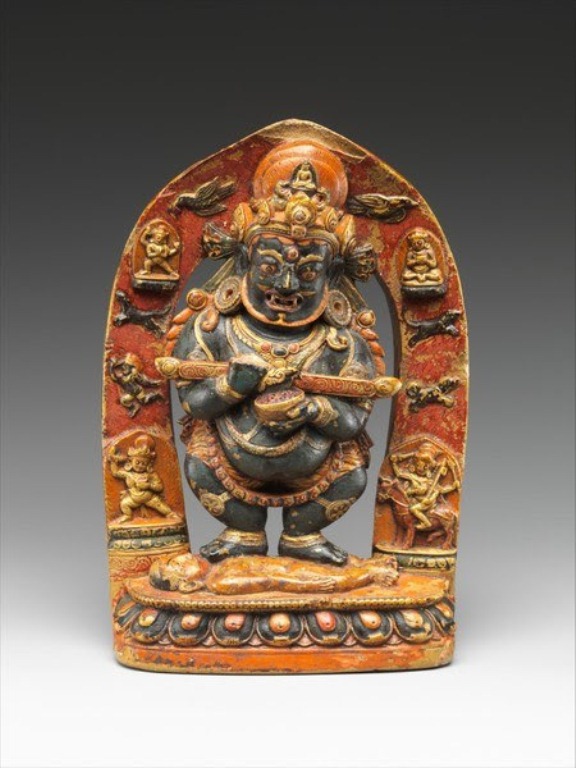
Panjaranatha Mahakala

The Song dynasty ruled China from 960 AD to 1279 AD

Debreczeny further says: This sculpture (made by Kublai Khan’s Nepalese sculptor) became a potent symbol of both Kublai’s rule and the Yuan imperial lineage. This association was so strong that four centuries later the Manchus, lacking the proper bloodlines, traced their own spiritual ancestry to Kublai Khan as the rightful inheritors of his Yuan legacy.”

The Yongle Emperor (1402-1424 CE) was the first Ming emperor to establish significant ties with Tibetan patriarchs. The Mings ruled from 1368 AD to 1644 AD.

Yongle had seized the throne, thus a cloud hung over his legitimacy. As part of his strategy to bolster his right to rule, Yongle invited the Tibetan hierarch, the Fifth Karmapa (1384-1415 CE), to the early Ming capital of Nanjing. After the Karmapa’s visit, Yongle styled himself a universal sacral ruler (Chakravartin).”

The Manchus, like the Mongols, were a people from north of the Great Wall who conquered China and assumed Tibetan Buddhism as a means of political legitimacy in ruling a vast multi-ethnic empire. Under the Manchus the focus was on the cult of the Bodhisattva of Wisdom Manjushri” Debreczeny says.

The Manchu emperors (1644 AD to 1912 AD), lacking the proper bloodlines to the Mongol ruling house, traced their own spiritual ancestry to Kublai Khan through the Tibetan succession mechanism of reincarnation. By promoting themselves as emanations of Manjushri, they declared themselves Kublai Khan reborn and the rightful inheritors of his Yuan legacy, the historian says.

It was the Qianlong emperor (1736-1795 CE) more than any other Manchu ruler who realized the potential of patronizing Tibetan Buddhism, as is evidenced by the incredible volume of Tibetan Buddhist images produced by the imperial workshops.

Debreczeny however makes it a point to clarify that the various Chinese empires’ engagement with Buddhism did not necessarily signify that the leaders ruled on Buddhistic principles.

Their employment of religious rhetoric was part of their claim to legitimacy, and their deployment of religious ritual was one of the means by which they sought to take and maintain power,” he says.

The Manchus, like the Mongols, were a people from north of the Great Wall who conquered China and assumed Tibetan Buddhism as a means of political legitimacy in ruling a vast multi-ethnic empire. Under the Manchus the focus was on the cult of the Bodhisattva of Wisdom Manjushri” Debreczeny says.

The Manchu emperors (1644 AD to 1912 AD), lacking the proper bloodlines to the Mongol ruling house, traced their own spiritual ancestry to Kublai Khan through the Tibetan succession mechanism of reincarnation. By promoting themselves as emanations of Manjushri, they declared themselves Kublai Khan reborn and the rightful inheritors of his Yuan legacy, the historian says.

It was the Qianlong emperor (1736-1795 CE) more than any other Manchu ruler who realized the potential of patronizing Tibetan Buddhism, as is evidenced by the incredible volume of Tibetan Buddhist images produced by the imperial workshops.

Debreczeny however makes it a point to clarify that the various Chinese empires’ engagement with Buddhism did not necessarily signify that the leaders ruled on Buddhistic principles.

Their employment of religious rhetoric was part of their claim to legitimacy, and their deployment of religious ritual was one of the means by which they sought to take and maintain power,” he says.

(The featured image at the top shows Lama Zhang)

Scrapping Presidency will solve everybody’s problems

April 8th, 2019

N.A.DE S. AMARATUNGA Courtesy The Island

article_image

Presidential system is a burden on the country and its people, and when it is like the present arrangement where the president and the parliament do not see eye to eye, it could be disastrous as being proved now. During the last four and a half years, nothing was done to develop the country as consensus was not possible on any issue, and investors sensing the discord would not take a chance with their money. At present the president is trying to enhance his image and the prime minister his, in view of the elections that hover in the horizon. The two have conflicting interests, and nothing gets done except heaps and heaps of promises. Therefore, the people would be better off without an executive presidency, and the burden of maintaining a more or less useless institution. The recent budget allocation for the president shows the magnitude of this issue. Further, a presidential election would cost about Rs. 500 Million, which this almost bankrupt country can ill afford. Moreover, the parliament is also proving to be ineffective in solving the country’s problems as it depends on minority ethnic parties for its existence, and has to dance to their tune forgetting the people’s woes. We need a stable government instead of a weak president and a tottering parliament.

There is no guarantee that future elections would bring in a better arrangement. Future elections too could result in a situation such as the present, with the president and prime minister belonging to two rival political parties with opposing national policies. It has happened in the past and may happen in the future. Consequently there will be two heads vying for supremacy and they will be eternally at loggerheads, and the country would slowly decay. This weakness will be exploited by corrupt politicians to make money, minority political parties to demand the moon, separatists to plot for a separate state, and foreign powers to pursue their geopolitical agenda, with the president and the prime minister tripping each other to please these devils.

The argument in support of an executive presidency is that the central control it has on the provincial council system is essential, without which the tendency for secession could be high. We must remember that the presidency came before the provincial councils, and neither made the other compulsory. One problem cannot be solved by another problem as clearly seen. We realize this after a long haul and great expense. Provincial councils are worse than the presidency, both in terms of cost and benefit. Our small economy cannot carry this dead wood any longer. However, an attempt to get rid of both at the same time might jeopardize the whole project and end up in total failure. Until Tamils realize that PCs are an “Anna round the neck” our poor people may have to carry the Tamils’ burden as well.

Another argument is that the war would not have been won if not for the presidency. On the contrary, a strong government and a determined prime minister would have done the job equally well. We have had presidents before, but none had the determination and the courage to fight to a finish. The preservation of the unitary nature of the state is said to be dependent on an executive president elected by the entire country. On the contrary, a strong parliament with a good majority, and with crossing over of MPs prevented by law, would be able to achieve whatever that an executive president could achieve.

Scrapping the presidency would solve the problems that the present political leaders face. All of them seem to be in a quandary and weighed down by their personal vendettas and ambitions, and unable to take a decision that is good for the country. If none of them take a step backward and all of them enter the fray, a chaotic and uncertain situation could result and the country could get into anarchy. To avoid such a situation all of them could get together and pool their resources to get rid of the inimical presidency, revise the electoral system according to the recommendations of the Dinesh Gunawardena Committee, bring the PCs under the control of the parliament, in the same way that the president has control over them at present, and enact necessary laws to prevent cross-overs by MPs.

Such an action plan would solve the problem of the incumbent president and also those who are vying to get presidential nomination and their supporters, who are waging a battle within their parties to the consternation of all concerned. These battles, if they continue in their present intensity and venom, have the potential to divide these composite parties irreparably, which in effect would be a tremendous loss to the country at large. Abolition of the presidency would also pave the way for an easier merging of fractions of like minded parties and forge stronger alliances to face the common foe. Also, a stronger common front against separatism and foreign interference could be coalesced if the intra-party bone of contention is removed. These parties must realize that their personal differences had not only cleaved their parties, but it had created an opportunity for separatists and foreign powers to exploit the political weakness thus created. And at present the country is in such peril due to the personal weaknesses of our leaders. To pursue with a presidential system, with all its immediate destructive possibilities and its long term cost to the people is to court disaster.

Small political parties may want the presidential system to continue for they fear that an abolition of the presidency would have concomitant electoral reforms, with a change in the present PR system which they think would be disadvantageous to their parties. This is a selfish attitude. If these leaders of small parties cannot win on their own, but has a role to play in the country’s politics and governance, the best for them would be to be absorbed into their respective patron parties; instead of holding those parties to ransom and forcing them to follow a policy inimical to the country. After all it is the votes of the patron party that carry them through, their inability to win on their own prove the point.

Abolition of the presidency, changing the electoral system, and enactment of other laws mentioned above would entail a constitutional reform. Time may not be enough to do all that before the declaration of the next presidential election. Yet, it may be possible to postpone the presidential election by a few months to find the time to do what is good for the country and all the present leaders. Let the leaders get together and do themselves a favour.

N.A.DE S. AMARATUNGA

‘War was not an ethnic issue, it was a conflict between terrorism and democracy’ Ammaipillai Yogamoorthy

April 8th, 2019

Courtesy The Island

April 8, 2019, 8:06 pm 

article_image

At the risk of sounding cliché, he started showing artistic talent at an early age, like most cartoonists featured in Pen Pricks. Although his childhood ambition was to become a doctor, his first comics were published in Veerakesari and the Indian newspaper, Swadesamitran when he was in year 9 at school.

He had his primary education in Sithivinayagar Vidyalayam, Point Pedro and secondary education at Puloly Boys’ School, Jaffna. He had an uncanny knack for cartoonizing his teachers and school mates, which was encouraged by his teachers. He learned Sinhala under Sumanananda Thera at Jaffna Naga Vihara. “My main source of income is translations and my Sinhala lessons at Naga Vihara was influential,” said the veteran.

Thinakkural political cartoonist Ammaipillai Yogamoorthy, Moorthy for short, is one of the longest standing political cartoonists of the country. He joined Thinakkural in 1997 and has done some 5,000 daily political cartoons to date. He won gold medals from Sri Lanka Asian Media Foundation in 2008 and 2010; Tamil Media Alliance, Best Cartoonist award in 2004 and runner-up in Tamil medium Best Cartoonist of the Year award in 2004, conferred by the Sri Lanka Press Institute and The Editors’ Guild of Sri Lanka. Moorthy was a member of the London Political cartoon society from 2004 to 2010.

He tried his hand at professional cartoons when he joined the fortnightly Tamil satirical magazine, Siritharan, back in the 60’s. The magazine’s founding Editor, R. Sundaralingam became Moorthy’s mentor, influential in him later deciding to follow in Sundar’s footsteps. “Sundar insisted I continue to cartoon even after he dies,” said Moorthy, reminiscing his mentors words.

Moorthy joined the government clerical service in 1966, stationed in Chavakachcheri, Jaffna. In 1984, he started his own agribusiness, while freelancing for Tamil papers. After his business collapsed he joined Thinakkural in 1997 and has never looked back since. He pioneered Tamil political cartoons, a medium not featured in Tamil newspapers until then. He still works at Thinakkural as a political cartoonist and translator.

However, he by no means restricts himself to political cartoons. “Rural Tamil community believes that retired clerks get around a lot, therefore are erudite,” Moorthy explained the basis of Clerk Kandasami, his social criticism cartoon. Clerk Kandasami, is a social reformer, who discusses social phenomena that have an immediate impact on Tamil culture. “For example most Tamils work abroad and send money to their parents in Sri Lankan. The parents waste their children’s hard earned money to maintain their bad habits such as alcoholism.”

His common man, unlike Camillus’ Silibibiris, Thalangama Jayasinghe’s A-Thuma, Hapuwalana’s Suwaris or Saradam and Wijesoma’s Punchi Sinno or Citizen Silva, is nameless.

Moorthy has an inherent Tamil cartoon style, that is unique in that it is flat and two dimensional. His characters are crude, yet readily identifiable and the facial expressions vivid. Although his earlier cartoons were rife with text he has reduced it to a minimum, keeping in step with the times.

When asked how the industry climate has changed in the two decades, Moorthy said that unlike the old days, cartoons and graphics can be computer generated. “But what’s important is not the method of drawing, but the message, specifically the political message a cartoon attempts to convey.” Moorthy observed that most of today’s cartoons are superficial. “They have substituted cheap humour for serious political message.”

When asked about the level of political influence exercised today as compared to the 90’s, Moorthy said that he is hardly intimidated by political influence and only reacts to the existing political situation in the country, in his cartoons. Moorthy plays no favourites but has a soft spot for Mahinda Rajapaksa, who he says had a good rapport with artists. Moorthy has drawn over 1,000 cartoons of MR.

“Cartoons are illustrated comments,” said Moorthy, when asked why cartoons are important. He pointed out that the significance of cartoons is never more evident than in the daily cartoon readings of newspaper reading TV shows. “Irrespective of social stature or cast, everybody’s interested in politics and the public, in general, is well-informed. And the message in any cartoon can be easily grasped at a glance by even the least educated person.”

He reiterated that a cartoonist must not be politically influenced or driven. “A cartoon must reflect the country’s real political situation. A cartoonist must mediate political issues in a neutral manner.”

When asked whether there is there freedom of expression, specially for a Tamil cartoonist, in Sri Lanka, Moorthy pointed out that Cartoons in itself is a result of freedom of expression. “Not even my Editor interferes with my cartoons.”

When asked how he deals with racism and religion, being a Tamil cartoonist, Moorthy said, “For any conflict, ethnic or otherwise, the spiritual approach is more effective than the political.” Moorthy considers himself a spiritual man than a political animal. Extremist ideals have no place in his cartoons.

When asked whether Sinhala and Tamil cartoons differ, Moorthy said, “Not much. They deal with the same politics. Cartoons differ according to the cartoonist’s political ideologies rather than his race or religion.” He pointed out that even war has been blown out of proportion. “It’s not an ethnic problem, it’s not even a political problem. The war was a conflict between terrorism and democracy.” He pointed out that the exact nature of the conflict has been ignored by Sri Lankan cartoons, giving it a satirical spin.

Present power crisis – The Chinese factor

April 8th, 2019

By Dr. Janaka Ratnasiri Courtesy The Island

article_image

In response to the writer’s previous articles on the present power crisis published in the Island of March 28th and April 05th, he has received from an investor some new information which would shed light on the real party behind the present power crisis. This investor claims that he has submitted a proposal in response to a call for proposals published in the press by the Sri Lanka Ports Authority (SLPA) for setting up business ventures at Hambantota Port.

The information to be revealed hereunder could be considered confidential as they refer to Cabinet discussions. Since much misinformation about the present power crisis is being circulated by people in authority including politicians (which includes the President himself), ministry officials, professionals in the field and the media, to put the record straight, the writer feels that this information should be revealed in the public interest.

Proposal to build 1200 MW LNG power plant at Hambantota

A press notice calling for proposals says the investor is required to design, build, finance, manage and operate the business venture to be set up at the Hambantota Port, where 17 m deep jetty and a 610 m long berth for oil and gas projects are available. The closing date for receiving proposals was 24. 08. 2012. In response, the investor has submitted a proposal to build an LNG receiving terminal at the Hambantota Port along with a 1200 MW natural gas fired power plant in the Port premises, which has been accepted by the SLPA.

After evaluating the proposals and short-listing them, which took about one and a half years, the said proposal was recommended to the Cabinet by the then Minister of Ports and Shipping in March 2014 and was taken up at the Cabinet meeting on 03. 04. 2014. The Cabinet memorandum has recommended the construction of a 1200 MW of LNG power plants phased out over a period of eight years, subject to the investor entering into a Joint Venture Company (JVC) with the CEB and BOI and 10% shares issued to the Treasury. The power purchase agreement was to be entered by CEB with the JVC.

Subsequent to the recommendations made at this cabinet meeting, Secretary to the Treasury summoned a meeting of representatives of the Ministry of Ports & Shipping, Ministry of Power & Energy, Ministry of Investment Promotion and other relevant officials. According to a report, dated 09. 10. 2014 circulated as a follow-up to this meeting by the Secretary of Ministry of Ports & Shipping among all the stakeholders, the following observations were made at the meeting:

Need for a power plant at Hambantota

About 10 industrial/commercial projects were approved during 2011 and 2013, but work on any of them did not commence mainly because no assurance could be given of an uninterruptible power supply. Hence, building the proposed power plants would be a prerequisite for the development of the industrial zone associated with the Hambantota Port. It has also been reported that the existing industries are very enthusiastic about having an LNG power plant at Hambantota as it will not cause pollution including coal ash.

The investor present at the meeting gave the assurance that he could supply uninterrupted power as required and build an LNG terminal hub, which meant the re-exporting of LNG as well as extending its use in other sectors locally in transport. The Investor agreed to form a JVC as suggested and the SLPA agreed to lease out the necessary extent of land within the Port premises to set up the LNG storage tanks and the power plant.

Cheapest offer for power generation

One critical factor referred to at this meeting was that only the energy cost would be charged at not more than UScts 7 per kWh of electricity, and that no capacity charges or other hidden costs would be levied. This is very important because capacity charges are payable whether the plant runs or not. It was reported in media that the CEB had been paying billions of rupees as capacity charges for the controversial diesel power plant in Jaffna even during the period when it remained shut down.

The outcome of the above meeting, along with the observations of the Ministry of Finance was again submitted to the Cabinet for consideration at its meeting held on 30. 10. 2014. Subsequent to receiving the concurrence of the Cabinet, the Secretary ofthe Ministry of Ports & Shipping wrote to the Chairman of SLPA on 02.12.2014 directing him to implement the project. This was followed up by the SLPA writing to the Investor on 20. 04. 2015, releasing 30 ha of land within the Port premises requesting him to take necessary follow up action.

Cancellation of the project by CCEM

The Investor subsequently commenced preliminaries such as getting the environment impact assessment report prepared. Then to his surprise, he received a copy of a letter dated 21. 06. 2016 from the Chairman of SLPA, addressed to the Secretary to the President, informing him that the project had been disallowed by the Cabinet Committee on Economic Management (CCEM) on a decision taken at a meeting on 25. 05. 2016. The reason given was that the CCEM had decided to put on hold all the projects planned under the RFPs because the government had decided to hand over the Hambantota Port to the Chinese!

Would a similar thing happen anywhere else in the world? The government invites proposals from investors to set up business ventures at their own expense and approves a project from an investor who has submitted a proposal to generate clean power at a rate cheaper than what the government spends currently and gives the green light for him to proceed after releasing land also. Then China comes in and demands ownership of the Port in exchange for the debt the government owes China. The government meekly agrees to cancel all commitments it has made to investors. Isn’t this a shameful act done with no self-respect? The government could have handed over the Port but without cancelling the projects it had already agreed to. This is after the BOI collecting over LKR 9 million from the investor as application processing fee. What signals would this action send to new investors?

One-stop centre for BOI projects at Hambantota – a farce?

It was reported in the media recently that the BOI has opened on March 23, 2019, a one-stop service centre for the benefit of businessmen who wish to invest in projects at the Hambantota Port. The new centre was reported to be a joint venture between the BOI and the new Port Authority, to provide all information about Sri Lanka’s investment policies to those interested in investing in Hambantota. The Hambantota Port was targeting port-related investments within the 3.5 square km area allocated for the Hambantota Port’s development. However, when the potential investors come to know of the government’s decision to cancel projects which had already been granted approval, under pressure from a foreign government, won’t any sane party think twice before deciding whether to come to Hambantota?

Had the project not been aborted by the government, it would have commenced in mid-2016 after completing the EIA within one year. With the fuel being natural gas, there would not have been any pollution unlike in the case of a coal-fired power plant, and the location has already been set up, EIA approval would not have taken much time. With the construction of the plant to be undertaken by the investor, there would not have been any ministry tender procedures which could have delayed the process. The time span could have been further reduced if the proposal had not been referred to the Cabinet twice.

Loss due to cancellation of project

Consequently, the first phase of simple cycle operation generating 200 MW of power could have been completed by the end of 2017 and the balance work generating additional 100 MW of power generation by the end of 2018, generating a total of 300 MW of clean power in 2019 at a cost of LKR 12.25 a unit (@ LKR 175 per USD). CEB’s Statistical Digest for 2017 has reported that the average fuel cost alone for operating the CEB’s thermal power plants to be LKR 12.22 a unit in 2017.

With overheads and cost of operation and maintenance added, the cost of generation would likely to exceed LKR 20 a unit. The other important factor is that there wouldn’t be any external costs as there is no pollution caused by natural gas. Under such circumstances, wouldn’t the proposed LNG-operated power plant, expected to generate about 2000 GWh annually, been a wind-fall to the CEB, helping it save around LKR 15 Billion annually? This is the loss to the country by cancelling the proposed LNG project.

Parties responsible for cancelling the project

Now, who is responsible for killing this clean power project when it was about to take off the ground with no financial burden on the government? Was it the President or the Prime Minister or the line Minister or the Cabinet or the CCEM? Somebody should take the responsibility. Apparently, this matter has been questioned even in the Parliament, recently. They cannot get away by trying to put the blame on the PUCSL for not approving the CEB plan promptly, which has no relevance to the present crisis.

A lot of people talk about the President killing the Sampur project but even if it had been allowed to proceed it wouldn’t have solved today’s crisis as explained in the earlier articles by this writer. But the general public does not seem aware that the government killed the LNG project, which could have generated clean and cheap power by now if it had been allowed to proceed. It is sad that the government did so, disregarding the national priorities just to make the Chinese happy.

In his previous article written on April 5th, the writer said that Sri Lanka didn’t have the courage to say ‘no to India when it offered to build a coal’-fired power plant at Sampur with conditions when the CEB had already called for proposals for setting up power plants with no financial commitment. All these proposals were set aside in favour of the Indian offer and that was the first mistake Sri Lanka made.

Second instance of yielding to pressure

from a foreign country

Now, this is the second mistake made by the government when it cancelled the LNG project, which was about to commence. In so doing, Sri Lanka demonstrated to the world that it had no backbone to tell China that the country had to give priority to its national needs. Why is the country so subservient to foreign powers? Why do our leaders allow these foreign powers to bully Sri Lanka in this manner? This has resulted in everyone being troubled by power interruptions which affect the day-to-day activities as well as the economy of the country?

Instead of owning up to their own mistakes responsible for killing the power projects planned earlier or trying to find out what has happened in the past, the country’s leaders seem happy to bash officials referring to their conflicts which have no relevance to the current power crisis. If the leaders are not capable of logical thinking, how can they run a country?

Conclusion

It appears that several factors have contributed to the present power crisis.

=Firstly, the undue long delay in selecting an investor to build the 300 MW combined cycle power plant at Kerawalapitiya, for which proposals were invited in November 2016. The CEB’s procurement division is totally responsible for this as described in a previous article.

=Secondly, the undue long delay of over 10 years for finalizing the plans to build the coal power plant at Sampur, for which CEB and NTPC delegates who took part in the negotiations are responsible.

=Thirdly, the cancellation of the BOO project inviting proposals in November 2006 to build 4×300 MW coal power plants on the Southern coast during 2012 – 2020, for which the line ministry and CEB are collectively responsible.

=Fourthly, the cancellation of the BOO project to build a 1200 MW LNG power plant at Hambantota, initially with 300 MW capacity, when it was about to commence work in 2015, for which the Government including CCEM was responsible.

In summary, it can be said that politicians, government policymakers, economic advisers, CEB engineering professionals and the government procurement committees are equally responsible for the present power crisis.

Mangala Samaraweera gets nothing out of licking Bachelet’s boots.

April 7th, 2019

H. L. D. Mahindapala

Mangala Samaraweera’s speech apologising to UNHRC High Commissioner, Michelle Bachelet was rather difficult to read on my PC because my screen was blurred with his crocodile tears shed for human rights. Simultaneously, his tears were interspersed with scorn and anger against the Sri Lankan delegates who dared to challenge the questionable and unworkable foundations of his Resolution 30/1. He had also pitched his speech at a high spiritual and moral level to make it sound as if he was the New Messiah standing on Mt. Sinai, announcing the New Commandments, in addition to the existing Ten Commandments, for universal human conduct. But beneath the pretentious piety was his humiliating and unwarranted political objective: to prostrate before Bachelet and let her know that he has not abandoned (1) her, (2) Samantha Power, his patron saint in US, and (3) his Resolution 30/1 selling the nation down the river. It is apparent that the speech was written more to appease his masters/mistresses abroad than to find solutions for the victims referred to in Resolution 30/1 at home.

Taking up cudgels on behalf of those in the UNHRC cesspool”, already abandoned with utter contempt by Samantha Power, he says: As the person who held the portfolio of Foreign Affairs when resolution 30/1 of 01 October 2015 was adopted, I feel that it is my duty to respond to some of the malicious arguments being made and misrepresentation of facts.” Here the knight in shining armour from Matara was announcing his battle cry in defence of the damsel in distress at the UNHRC. With that pronouncement he engages in a lengthy exercise to paint himself as an obedient abith-thaya, bending in two, to please Ms. Bachelet. He says:” I offer an apology to High Commissioner Michelle Bachelet, a true friend of Sri Lanka’s people, a champion of the Global South, and herself a survivor of the horrors of torture. (” Really! A true friend of Sri Lanka?). Why should we apologise to Bachelet for exercising the right to challenge the myths, inaccuracies and fictitious numbers which she is touting to push her anti-Sri Lankan offensive?

And then – hold your breath! — he adds: High Commissioner Bachelet, you did not deserve the misrepresentation of your statements.”  OMG! This friend of Sri Lanka” accuses and indicts the Sri Lankan forces as murderers of 40,000 Tamils – a fabricated figure challenged and disproved by Lord Naseby who has established on British documentary evidence that those killed in the last stages of the war were around 5,000 – 7,000. So who is misrepresenting” the facts and figures? Since Ms.Bachelet refuses to accept the most reliable figures documented in the unimpeachable British secret files I personally would like to tell her: High Commissioner Bachelet, like everyone else, you deserve every bit of the consequences of your refusal to accept the facts / truth staring in your face!.”

One of the consequences of her intransigent refusal to accept the verifiable facts and figures is to place the future of UNHRC in jeopardy. Already America, one of the sponsors of the Resolution 30/1 has left UNHRC condemning it as a cesspool”. Ms. Bachelet is facing an uphill task in restoring the UNHRC as a moral agency capable of living up to the expected  standards of decency and morality  – i.e., defend and protect human rights with facts and truth. She cannot win the confidence of the international community with lies. The first step she should take to maintain the dignity, integrity and the credibility of her office is to get her facts and figures right.

By now she should have enough incontrovertible evidence on her table to know that she cannot defend, promote or protect human rights in Sri Lanka on unchecked figures packaged by Darusman whose sources have not been made transparent for the accused parties to check and accept his secret documents as the legal basis to pursue a case against Sri Lanka. That medieval system of accusing and punishing the accused on anonymous and secret sources went out with the Star Chamber and the Inquisition. That pernicious and unfair practice of convicting accused people violates all basic principles of human rights.

Besides, the fact that the figure of 40,000 mentioned in a UN report doesn’t make it true or reliable. UN reports, particularly those that are secret, are not the final repositories of the truth / facts necessary to formulate constructive policies, or to initiate legal action for violating human rights. She must be aware that the biggest crime against humanity committed by the UN was when it accepted the lies of Colin Powell accusing Iraq of being in possession of WMDs. It was also on a UN-sponsored resolution that a naval cordon was thrown round Iraq to block the supply of medical and other essentials – a criminal act that killed 600,000 children of that ill-fated nation.

Lies are vital for Big Powers and institutions like UNHRC manipulated by Big Powers, to bully small nations. For instance,  Ms. Bachelet who is so worked up about Sri Lanka is not likely to work with the same urgency and perseverance  to take action Israel’s war crimes in Palestine or India’s violations of human right in oppressing the people of Kashmir. Nor will she open up a file to investigate the brutal massacre of unarmed doctors, nurses, and helpless patients in the Jaffna hospital by the Indian army – an incident well documented. Her bravado will be directed only at a small like Sri Lanka. Besides, Ms. Bachelet, who has brilliant academic record, should know by now that she could never leave behind a legacy of being a defender of human right if she pursues a partisan agenda that ignore the facts and truths. She should know that the UN charter was set up to achieve its noble objective only through scientific and verifiable truths and not on voodoo lies.

 In fairness to her it must be mentioned that she has been a progressive leader of Chile. She was a popular leader who was elected twice as President by the Chileans. There was, of course, the case of her romantic relationship with Alex Vijokovic Trier of Manuel Rodriguez Patriotic Front, an armed group which was engaged in violence against the military dictator, Gen.Pinochet. When she was accused of being an activist in this Front she denied engaging in violence. And when she was President her son was accused of getting a bank loan of $10 million dollars to finance a land investment of his wife. Once again she denied knowing anything about it. But her popularity plummeted to a new low.

She was also at the receiving end of Gen. Pinochet’s brutal violence. So she should be equipped with ample knowledge not only to receive violence but also to give it back. She also knows how to dispense politicised justice like the way she goes after the Sri Lankan soldiers on fake figures. But all this is acceptable to Samaraweera. because he thinks she is a friend of Sri Lanka”. Backing her, he says, quite blithely:: The Human Rights Council is not a court of law. That is not the place to argue and debate over the number of dead or missing. All these including the information obtained by Lord Naseby are matters for Sri Lankan processes including the Sri Lankan justice system.”

There are two arguments here: 1. UNHRC is not the place to argue and debate the numbers dead or missing (Where in the UNHRC is this written?) and  2.Lord Naseby’s figures are matters for Sri Lankan processes and not for discussion in international fora. . (Really!)

 Re.1: He is craftily attempting to remove, or downplay the impact of numbers from the international debate now that  Lord Naseby had exposed the fact that the Sri Lankan forces had not killed 40,000 Tamils in the last days of the longest running war in Asia. Resolution 30/1, which he co-sponsored, would gain credibility only if the figures are inflated to prove that the Sri Lanka forces have been brutal killers of Tamils on a mass scale – somewhere in the region of tens of thousands. Anything less than ten thousand doesn’t carry weight to convince the public that there has been a genocidal massacre” – the line plugged by the Tamil lobby to gain political mileage. In fact, Resolution 30/1 gained international attention on the fictitious figure of 40,000.Even the international community will sit up and take notice only if the dead are in the region of tens of thousands and not below 10,000.

The INGOs ignored the thousands killed throughout the 34-year-old war and focused only on the last three months because the Tamil lobby and their allied NGOs, who attempted to save Prabhakaran from humiliating defeat, raised the bogus cry of a mass massacre in the final assault. And when the end came the NGOs had nothing to fall on except to run berserk with their own cooked up figure of 40,000 dead. A typical example is the UN Representative in Colombo, Gordon Weiss, who estimated the dead to be 7,000 when he was in Colombo and jacked it up to 40,000 when he returned to his home in Australia to market his book, The Cage. Later, when questioned, he reduced the figure to 10,000. I e-mailed him and requested an interview. He agreed at first and then backed out like all pro-Tamil propagandists. Even M. Sumanthiram and C. V. Wigneswaran who distort history, politics, and facts and figures backed off when they were pressed for a debate or an interview.

It is Lord Naseby’s figures dug out from the British secret files that nailed the Tamil propagandist and Resolution 30/1. His figures punctured the hot air balloon floated by the Tamil propagandists. His figures do not fit into their fiction of a genocidal war”, or anti-Sri Lankan resolution at the UNHRC.  The political agenda of Samaraweera too demands a figure of 40,000 or more. Now that he does not have the figures to prove the Tamil claim of a genocidal massacre” he says figures are not valid for debates at the UNHRC.

If the UNHRC is not the place to debate the numbers dead or missing in the armed conflict in Sri Lanka then why did Samaraweera go all out to sponsor the UNHRC Resolution 30/1 which, among other things, is aimed at setting up judicial mechanism with foreign judges to take punitive action against Sri Lankan soldiers accused by him, his friend” Bachelet, and also his friends in the Tamil Diaspora, of violating human rights? He didn’t agree to hybrid courts to judge a cricket match between the warring parties, did he? His Resolution refers to investigation of serious crimes involving human rights violations, or violations of international humanitarian laws”?  These charges cannot be prosecuted or tried without counting the dead and the missing.

That is also the central issue in the Resolution raised and pushed hard by the anti-Sri Lankan Tamil and Western lobbies. Samaraweera too was quick to pick the fictitious figures of the dead and missing to justify the sponsoring of his Resolution. Embarrassed by Lord Naseby’s revelations he is now on his back foot struggling to save his face. He is now singing a different tune. He is saying UNHRC is not the place to argue and debate the numbers dead or missing. Ha! Ha!

It is the fictitious figure of 40,000 cooked up by Darusman, a man with a grouse against Sri Lanka, that clinched the argument for the anti-Sri Lankan lobby to vote against us. The case against Sri Lanka would not have got off the ground if the figures of Lord Naseby figures were available in 2015 when Resolution 30 /1 was passed by UNHRC. Lord Naseby’s figures have been an embarrassment to Ranil-Mangala move to tie the hands of Sri Lanka and parade the nation as genocidal killers who must tried in hybrid courts. In fact, the Ranil-Samaraweera government refused to revise or, reject Resolution 30/1 based on the hard evidence of  Lord Naseby’s figures invalidating the rationale on which they co-sponsored the Resolution in 2015. Besides, it is the fake numbers accepted by Samaraweera which makes him and his Resolution 30/1 a total betrayal of Sri Lanka’s national interests. If he thinks he can build peace, reconciliation and stability on fake figures then he got another think coming!

Re.2: In the same breath, he says that figures are matters for Sri Lankan processes and not the UNHRC. According to him the local Truth Commission is going to be a Sri Lankan made instrument for Sri Lankans to confess their crimes.  If and when it begins it is likely to question him on the various causes and events  the war, including the last stages which has become the critical focus of human rights activists. Will not the dead and the missing feature prominently in that process? And when that issues is raised whose figure will he present? Darunu-man’s or Lord Knows-be’s? The Tamil lobby is having a field day, nationally and internationally, gaining maximum political mileage by vilifying and denigrating the nation with the fictitious figure of 40,000. And what does he do? Sweet llaregub!. (This neologism was created by one of my favourite poet’s, Dylan Thomas, to be read backwards).

One has to go way back in time to Don Juan Dharmapala, to find stooges of the West like the Ranil-Mangala combo. They are two masochistic maniacs who are prostrating at the feet of the Western masters and mistresses pleading with them to whip them more and more. Their appetite to receive humiliating whippings from the West is insatiable. The history of post-Independent foreign policy, however, runs contrary to the cringing roles of this duo.

Let’s begin with the role of Sir. John Kotelawela at the famous Bandung  Non-aligned meeting. When Pandit Nehru asked Sir. John Kotelawela why he didn’t show his pro-American speech before it was delivered he retorted: You didn’t show me yours. Why should I show you mine if you didn’t show me yours!” (This is only a paraphrasing!).

Now that’s how he asserted his status as the leader of a proud nation, though small. Tarzie Vittachi, who was my first editor in The Observer, won the plaudits of even the Marxist Left when he threw out the American embassy press attaché from his office when the Yankee walked into to dictate the editorial policy. President Ranasinghe Premadasa taught India a lesson in foreign policy when it decided to boycott the SAARC meeting hosted by him because the Indians were plotting for a regime change. Instead of going begging to India he got on the phone and persuaded all other regional nations to attend. When they agreed to follow President Premadasa’s lead India had no option but to join, though humiliated by his courageous counter-move. He is also the first leader of the nation who dared to kick Britain in the butt by declaring David Gladstone, the British High Commissioner who was a descendant of the famous British Prime Minister, William Gladstone, persona non grata, for attempting to interfere in the domestic elections. Lakshman Kadirgamar also threw out two diplomats for overstepping their mark.

But Ranil-Mangala duo are behaving like two political ponies who take great delight in giving their backs for the West to ride on. What is worse, they seem to enjoy every minute of giving the White men a free ride on their backs!. The people are entitled to ask one straightforward question: Are they political leaders, or are they political poltroons ever willing to sell the country to foreigners?

In his speech Samaraweera makes a farcical attempt to impress that he is a man of high moral values with a scholarly background. Though his speech is sprinkled with reference to Buddha, Jesus, Mohammed and Mani, the founder of Manichean doctrine, there is a touch of starchy artificiality in the laboured attempts to impress his greatness and nobility. He fails because the facts facing him debunk his own fictions. One can see through the pompous attempts of Samaraweera to pose as an intellectual when he quotes Mani, the founder of Manichean doctrine. But those who know Samaraweera will agree that no light has come out of the black hole in his head.

Though in his speech he invokes the values of the highest moral and spiritual authorities it can never erase the hypocrisy of a man who stood on the floor of the House and abused Sri Lanka’s first female Olympian in humiliating filth. Sprinter Susanthika Jayasinghe, the Olympian bronze medallist, was ridiculed in abusive language for not yielding to one of his Cabinet colleagues’ sexual appetites. He treats a Sri Lankan heroine with utter contempt, but he crawls on his fours to lick the boots of anti-Sri Lankan apparatchik at UNHRC who has no compunction in whipping Sri Lankans

He piously preaches human rights to create feel good sounds in the ears of Samantha Power and Bachelet. In the same breath he has no reservations about condemning his mate Mahinda Rajapakse, accusing him of operating a white van culture”. However, he slyly omits the role played by Sudath Chandrasekera, who described himself as Ranil’s rathu thol pook kolla (red-lipped ass boy). Chandrasekera has confessed in his letter of resignation how he thrashed with kurundu polu” (cinnamon poles) the opposition activists marching through Samaraweera’s electorate in Matara. Did Samaraweera utter one word in sympathy with the victims of his leader’s thugs going on the rampage, attacking political activists protesting against his leader and his corrupt government? He allows his leader’s thugs to beat the day lights out of their political opponents in his own backyard and expects us to believe that he is a compassionate disciple of Lord Buddha. Does he expect us to believe his  hypocrisy as one of the four noble truths?

With all this boru-shoke” doesn’t Samaraweera’s ali-keli fit neatly into the old Sinhala adage: Lo-keta pera-kashay; gedetta mara-gar-thay”?

UN Torture Prevention Body visits HRCSL

April 7th, 2019

Dr Sudath Gunasekara

April 6, 2019   11:53 pm

The delegation of the United Nations Subcommittee on Prevention of Torture (SPT) has visited the Human Rights Commission of Sri Lanka.

The SPT Delegation met with Dr. Deepika Udagama, Chairperson of the Commission and Commissioners Ms. Ramani Muttetuwegama and Ms. Ambika Satkunanathan and discussed issues of mutual concern and interest on 04 April.

The delegation is composed of Victor Zaharia, Head of Delegation (Republic of Moldova), Satyabhooshun Gupt Domah (Mauritius), Petros Michaelides (Cyprus), and June Lopez (Philippines).

The UN’s torture prevention body is visiting Sri Lanka from 2 to 12 April to examine the treatment of people deprived of their liberty and the safeguards in place for their protection against torture and ill-treatment.

In addition to meeting with the Human Rights Commission and civil society organizations, the four-member delegation will also meet government officials and hold discussions with relevant ministries.

Their talks in Colombo will focus on advising and assisting the Sri Lankan authorities regarding the measures they must take to be in compliance with the obligations contained in the Optional Protocol to the UN Convention against Torture.

The Subcommittee will be visiting places of deprivation of liberty and will hold discussions on Sri Lanka establishing an independent National Preventive Mechanism.

The Optional Protocol, which Sri Lanka ratified in 2017, requires such a mechanism to be established with the authority and capacity to undertake preventive visits to any place where persons may be deprived of their liberty.

During our visit we will be exploring the steps Sri Lanka needs to take to effectively prevent torture and ill-treatment of people deprived of their liberty,” said Victor Zaharia

Comments by Dr Sudath Gunasekara.

I suspect this to be another attempt to interfere with the internal affairs of this country where the Western groups with vested interests in collaboration with Tamil Diaspora is trying to collect cooked up data against the Government of this country.

Why does the Government allow this type of biased delegations to visit this country to create more headache in addition to damages done by such groups visited in the recent past. Their itinerary and the list of people they intend to meet clearly shows their hidden motives.

Why cant the Government ask them to go home without interfering in our internal matters.

Why do these people come only now to find faults with the government?. Why didn’t they come when the LTTE was murdering and torturing thousands for 30 long years. Where were they then.

 These are serious issues the Government takes immediately, if there is one in this country.

‘Tripitakabhivandana’ celebration in Geneva highlights ‘Tripitaka’ as a shared global intellectual treasure

April 7th, 2019

Permanent Mission of Sri Lanka to the United Nations Geneva

An interactive scholarly discussion on the significance of the Tripitaka as a world heritage took place at the World Intellectual Property Office (WIPO) headquarters in Geneva, continuing the week-long celebrations-‘Tripitakabivandana‘. The event was also intended to raise awareness among States that follow the Buddhist traditions, as well as other States, to join hands with Sri Lanka in realising the initiative taken by President Maithripala Sirisena, to inscribe the Tripitaka on the UNESCO ‘Memory of the World’ Register. 

Organized by the Permanent Mission of Sri Lanka in Geneva, the event brought together several erudite members of the Maha Sangha, members of the diplomatic community as well as Sri Lankans living in Geneva, to reflect on the spiritual, historical as well as global value of the Tripitaka-the foremost doctrine of Buddhist teaching. A strong call for the recognition of the Tripitaka as a shared heritage of mankind was echoed.

A scholarly presentation on the topic Why the Pali Tripitaka Should Be a World Heritage?: Sri Lanka’s Contributions to the Buddha vacana” was delivered by Venerable Deegalle Mahinda Thera, Professor in Study of Religions, Philosophies and Ethics, College of Liberal Arts of the University of Bath Spa in the United Kingdom. The eminent scholar monk eloquently elaborated on a number of landmark events and key personalities involved in preserving this intrinsic body of Dhamma through centuries.   

Ven. Walpola Kalyanatissa Thera, Spiritual Advisor to the Geneva Buddhist Vihara and the Zurich Buddhist Vihara, and Ven. Halyale Wimalarathana Thera, the President of the International Buddhist Foundation in Geneva and the Chief Incumbent of the Geneva Buddhist Vihara, addressed the audience on the value of the Buddhist doctrine and the significance of the Tripitaka, while Ven. Dr. Thawalama Dhammika Thera, Chief Sanghanayake of Switzerland and Chief Incumbent of the Geneva International Buddhist Centre, moderated the discussion with the participants and speakers. Ven. Keembiela Kassapa thera, the Chief Incumbent of the Toronto Buddhist Vihara also participated in the event. The intellectual contributions made by the members of the Maha Sangha and the interactive dialogue that ensued with Ambassadors and diplomatic representatives of several countries sharing their views and perspectives enabled an incisive and insightful dhamma discourse,  appreciated by all participants. 

Among Heads of Missions and senior diplomats who graced the event were Ambassadors of Myanmar, Bhutan, Thailand, Laos, Viet Nam, Mongolia, the United Kingdom, India, and Pakistan and the Representative of Nepal.

Addressing the event, Sri Lanka’s Permanent Representative to the UN in Geneva, Ambassador A.L.A. Azeez underscored the significance of the Tripitaka as the foremost compilation of Buddhist philosophy and as a repository of spiritual knowledge that is close to the hearts and minds of Sri Lankans as well as millions of people over the world. He made these remarks underlining the need for collaboration among all Member States in recognizing it as a world heritage. 

For millennia, the Tripitaka has been a shared heritage of the Asian communities, and over the years, there is growing worldwide interest in the study of Buddhism, most notably in Europe, North America and Australia. This is because there is increasing recognition that Buddhism, in essence, is a way of life and a philosophy that could be easily related to and practiced by anyone anywhere”,  he stated.

Delivering concluding remarks and vote of thanks, Deputy Permanent Representative of Sri Lanka, Samantha Jayasuriya elaborated on the strong inter-linkages existing between the fundamental values of Buddhism such as equality and loving kindness for all living beings, and the modern day discourses on protection and promotion of human rights and non-discrimination, gender equality, for which Geneva serves as the global center. She stressed that the teachings of Lord Buddha, which the Tripitaka reflects with authenticity, enshrined at its core, the values of equality and non-discrimination, that underpin human rights. 

The event commenced with the lighting of the traditional oil lamp by the members of the diplomatic corps and the screening of a documentary depicting the historical events pertaining to the Tripitaka, its declaration as a national heritage on 5 January 2019 and the importance of formally recognizing it as a world heritage. It concluded on a spiritual note, with the venerable monks chanting ‘seth pirith’ and participants were treated to Sri Lankan refreshments arranged by the Mission.

Permanent Mission of Sri Lanka to the United Nations

Geneva

More Than 100 Apply for the Job of a Hangman in Sri Lanka Including an American.

April 7th, 2019

Dr Sarath obeysekera

I wonder what questions were asked during interview 

If I was in the interview I would have posed following questions

Was he a politician  ever ?( if GCE is required he cannot be a politician!)

Is he a Buddhist ( disqualification!)

Has he ever killed an animal ( I not he cannot kill

Humans )

Would he look for annual bonus for out put ( he can get 1000 rs incentive for killing the person in one try)

Does hi drink ( if not he cannot be the hangman)

Does he know Wele suda Makanudure Mahesh Kinjipani Imran ?( if he knew he cannot be the hangman)

Has he ever cried for something ever ( is he had he cannot be hang man)

Is he a vegetarian ( if yes he is ok )

Does he believe in any religion ( if he is atheist he is ok )

Does he ever see dreams ( if no he is ok )

Is he married ?( if yes not suitable )

Dr Sarath obeysekera

පරාක‍්‍රමබාහු රජතුමාත් VAT බදු ගැහුවා.. ගොවීන්ට ලාබ වැඩි නිසා දෙතුන් වතාව බදු ගත්තා..- අගමැති

April 7th, 2019

 lanka C news

පැරණි කාලයේ රජරට සමාජය සම්පූර්ණයෙන්ම ගොඩනැගුනේ වී වලින් බව අගමැති රනිල් වික්‍රමසිංහ මහතා පවසයි.

එමගින් විශාල වශයෙන් ලාභ ලැබූ බවද පැවසූ අගමැතිවරයා එනිසාම රජවරුන් දෙතුන් වතාවක් බදු අයකල බවද පැවසීය.

පරාක්‍රමබාහු රජතුමා ද වැට් බදු පැනවූ බව පැවසූ අගමැතිවරයා වත්මන් ආණ්ඩුවට දොස් පැවරීමට පෙර ඒ බව ද සිහි තබා ගන්නැයිද කියා සිටියේය.

අගමැතිවරයා මේ බව කියා සිටියේ 52 ජාතික අලුත් සහල් මංගල්‍යය අමතමිනි.

ජය ශ්‍රී මහා බෝධිය අභියසදී මෙම අලුත් සහල් මංගල්‍යය පැවැත්වින.

At the Event Horizon: Astrophysicists Set to Reveal First Photos of Black Holes

April 7th, 2019

Courtesy Sputnik News

artist impression of the surroundings of a supermassive black hole

In a milestone for cosmological research, astronomers have announced that they will reveal on Wednesday the first-ever photographic image of a black hole.

Space

CC0Space is Common Heritage of Mankind, Every Nation Responsible For Avoiding Militarisation of Space – IslamabadIn what is being heralded as a key scientific breakthrough, scientists from around the world will release the first-ever images of a black hole — celestial behemoths so dense that their gravitational field swallows everything, including light, that it comes in contact with.

In an announcement scheduled for Wednesday, April 10, at 9 a.m. EDT (1300 GMT), the US National Science Foundation in Washington will release a “groundbreaking result from the Event Horizon Telescope (EHT) project,” according to multiple reports.

The EHT project, an international scientific collaboration, was formed in 2012 as a means of directly observing the area immediately surrounding a black hole.

Concurrent announcements are set to occur in Tokyo, Brussels, Taipei, Santiago, and Shanghai, according to the EHT website.

One of the most intriguing of spacetime environments, the region around a black hole — described as the ‘event horizon’ — is also one of the most violent in the known universe, as matter inexorably hurtling into the dark maw is mangled to what scientists guess to be the subatomic level, while light itself is rendered permanently captive, leading to the celestial singularity’s picturesque name.

Supernova remnant Cassiopeia A

© PHOTO: NASA/JPL-CALTECH/STSCI/CXC/SAOGalaxy Full of Gigantic ‘Bubbles’ May Be Bombarding Earth With Cosmic RaysThe international team of over 200 globally-synched scientists, researchers and astrophysicists have not offered a peep about what will be shown on Wednesday, although they are not shy about the project and its implications.

“It’s a visionary project to take the first photograph of a black hole. We are a collaboration of over 200 people internationally,” asserted astrophysicist Sheperd Doeleman, EHT director at the Center for Astrophysics, Harvard & Smithsonian, in March, cited by Reuters.

The new findings will test legendary physicist Albert Einstein’s theory of general relativity, according to EHT project astrophysicist Dimitrios Psaltis.

To conduct their discoveries, the EHT looked at two supermassive black holes: Sagittarius A* at the center of our Milky Way galaxy and M87, at the center of nearby galaxy Virgo A.

Sagittarius A* is measured as being some 26,000 light years from Earth and massing approximately 4 million times that of our sun. Virgo A is calculated to be some 3.5 billion times the mass of our sun and situated about 54 million light-years from our solar system.

Quantum century

© SPUTNIK / ALINA POLYANINAThere’s No Proof That Parallel Universes Don’t Exist – Quantum PhysicistRecently revealed to represent a wide array of sizes — from tiny pinpricks to objects large enough to swallow a galactic cluster — black holes are formed when extremely large stars die, collapsing in upon themselves with a gravity so high that all matter and radiation — including light — is trapped inside the event horizon boundary layer.

The new observations will be used to detect evidence of what happens at the edge, or shadow, of a black hole, particularly as Einstein’s predictions — if correct — permit accurate measurements of the object’s size and shape.

“The shape of the shadow will be almost a perfect circle in Einstein’s theory,” Psaltis stated, adding, however, that “if we find it to be different than what the theory predicts, then we go back to square one and we say, ‘Clearly, something is not exactly right,'” cited by Reuters.

People were taxed even during the time of King Parakramabahu: PM

April 7th, 2019

Yohan Perera and Athula Bandara in Anuradhapura Courtesy The Daily Mirror

People were taxed even during the time of King Parakramabahu, although it was criticized today, Prime Minister Ranil Wickremesinghe said at the 52nd Aluth Sahal Mangalaya at Jaya Srimaha Bodhi in Anurdhapura this morning.

King Parakramabahu used impose tax on people, especially when harvest was high. Therefore, remember that King Parakramabahu also imposed VAT before criticising,” he said in a lighter vein.

The Prime Minister stressed Sri Lanka’s paddy production had been 3 million metric tons this year. This he said was one of the highest harvests in the history.

President Maithripala Sirisena was the chief guest of the event although he did not address the gathering.

Heated Exchanges Between Ranjan Ramanayake & Nimal Lanza on ETI Investments

April 7th, 2019

Sri Lankan News

සිංහල නීති වාර්තා (ශ්‍රේෂ්ඨාධිකරණ සහ අභියාචනාධිකරණ නඩු තීන්දු සිංහලෙන්)

April 7th, 2019

කිහිප දෙනෙකුට නොව බහුතර ජනතාවට තේරෙන භාෂාවෙන් උපරිමාධිකරණ නඩු තීන්දු ලබාගැනීමේ උත්සාහයේ තවත් එක් පියවරක් ලෙස සිංහල නීති වාර්තා දැක්විය හැකිය.

ශ්‍රේෂ්ඨාධිකරණය සහ අභියාචනාධිකරණය විසින් ලබා දෙන නඩු තීන්දු රෙජිස්ට්‍රාර්වරයාගේ නිල මුද්‍රාව සහ අත්සන සහිතව සිංහල භාෂාවෙන් ලබාගෙන ඒවා නීති සංග්‍රහයක් ආකාරයට සිංහල නීති වාර්තා ලෙස ඉදිරිපත් කර ඇත.

යටත් විජිත යුගයේ සිට මේ දක්වාම ශ්‍රේෂ්ඨාධිකරණය සහ අභියාචනාධිකරණය නඩු තීන්දු ඉංග්‍රීසි භාෂාවෙන් පමණක් ලබා දෙන අතර එය සිංහල ජනතාවගේ නෛතික සාක්ෂරතාවය වර්ධනය නොවීමට ප්‍රධාන හේතුව විය.

ඉංග්‍රීසියෙන් සිය වැඩකටයුතු කරන සුලුතරයක් වූ කණ්ඩායම විසින් උපරිමාධිකරණවල අත දරා සිටින ඉංග්‍රීසි භාෂා අධිකාරිය  හේතුවෙන් වරප්‍රසාද සහ ප්‍රයෝජන ගත් අතර රටේ පංති විෂමතාවය වර්ධනය කිරීමට සහ විදේශීය රටවලට ලංකාවේ කටයුතු වලට තීරණාත්මක ලෙස මැදිහත්වීමටත් මෙමගින් අවස්ථාව ලැබුණි. 

මේ නිසාම සීමිත නීතිඥවරුන් සංඛ්‍යාවකගේ ඒකාධිකාරයෙන් යුත් නඩු විසදන ක්‍රියාපටිපාටියක් උපරිමාධිකරණවල පවතී.

භාෂා විෂමතාවයෙන් / භාෂා වෙනස්කමකින් යුත් එවන් නෛතික පරිසරයක් තුළ වුවත් රටේ සංවර්ධනයට සියලු ජනතාවට සහභාගීවිය හැකිවන ලෙස ජනතාවගේ නෛතික සාක්ෂරතාවය වර්ධනය කිරීම වෙනුවෙන් සහ උපරිමාධිකරණ නඩු තීන්දු සිංහල භාෂාවෙන් ලබා ගැනීම සදහා අනවරත උත්සහයක් නීතියේ පාලනය වෙනුවෙන් අදහස් ඇති සහ විශ්වාසය තබන නීතිඥවරුන් අතුලු විද්වතුන් විසින් ආරම්භ කර ක්‍රියාත්මකකර තිබුණි.

එහිදී ජයග්‍රහණයන් මෙන්ම පරජයන්ද එම පිරිසට අත් වූ  අතර ඇතම්හු මේ හේතුව මත සිය ජීවිතයද පුදකර ඇති බවද, නින්දා අපහාස වලට ලක්වී ඇති බවද බොහෝ දෙනෙක් නොදන්නවා විය හැකිය.

ඒ කවර තත්ත්වයක් යටතේ වුවද උපරිමාධිකරණවල පවතින සුලු පිරිසකගේ භාෂා ඒකාධිකාරය නොව රටේ බහුතර ජනතාවගේ අයිතිවාසිකම් සුරකින ආකාරයට එකී ශ්‍රේෂ්ඨාධිකරණය සහ අභියාචනාධිකරණය විසින් නඩු තීන්දු ලබා දීමේ අවශ්‍යතාවය අවධාරණය කරමින් ක්‍රියාකරන, පුද්ගලික ලාභ අපේක්ෂා නොකරන බුද්ධිමය සහ නෛතික බලවන්ත අප්‍රතිහත අරගලයක් නොනවත්වාම

ක්‍රියාත්මකවිය. 

නීතියේ නිදහස උදෙසාවන එකී අරගලයේ දී එනම් නිදහස, සමානත්මතාව, යුක්තිය සහ මූලික මානව අයිතිවාසිකම් හා අධිකරණයේ ස්වාධීනත්වය සියලු ජනතාවට සහතික කරන්නා වූ ප්‍රජාතාන්ත්‍රික රාජ්‍යක් බවට ශ්‍රී ලංකාව පත්කිරීමේ තීරණාත්මක සංධිස්ථානයකට මේ වන ලාංකික නීති ක්ෂේත්‍රය පැමිණ ඇති අතර එහිදී ශ්‍රේෂ්ඨාධිකරණය විසින් සිංහල භාෂාවෙන් නඩු තීන්දු කිහිපයක් ලබා දිමට මේ වනවිටත් නියෝග කර ඇත.

ඒ අනුව ශ්‍රේෂ්ඨාධිකරණයේ රෙජිස්ට්‍රාර්වරයා විසින් ශ්‍රේෂ්ඨාධිකරණ නිල මුද්‍රාව යටතේ සහ ශ්‍රේෂ්ඨාධිකරණ රෙජිස්ට්‍රාර්වරයාගේ අත්සන යටතේ උපරිමාධිකරණ නඩු තීන්දු දෙකක් සිංහල භාෂාවෙන් ලබා ගැනීමට ජනතාවට අවස්ථාව ලැබී ඇත.

සිංහල නීති වාර්තා (ශ්‍රේෂ්ඨාධිකරණ සහ අභියාචනාධිකරණ නඩු තීන්දු සිංහලෙන්) ඔබ අතට පත්වන්නේ පුද්ගල අභිමානය සහ නිදහස සහතික කෙරෙන සාධාරණ සමාජ, ආර්ථික සහ සංස්කෘතික පදනමක් මත ස්වකීය අයිතිවාසිකම් සහ වරප්‍රසාද යළි දිනාගෙන ආරක්ෂා කරගැනීම පිණිස ජනතාව කළ වීරෝදාර සහ අප්‍රතිහත අරගලයේ සහ උත්සාහයේ ප්‍රතිඵල අනුවය.

මේ ආකාරයට ඉදිරියේදී තව තවත් ශ්‍රේෂ්ඨාධිකරණ සහ අභියාචනාධිකරණ නඩු තීන්දු සිංහල භාෂාවෙන් ලබා ගැනීම රටට සහ ජනතාවට ආදරය ඇති අයගේ වගකීමක් සහ යුතුකම බවත් නීතියේ පාලනය වෙනුවන් පුරවැසියන්ගේ වගවීම බවත් පෙන්වා දෙමි.

අරුණ ලක්සිරි උණවටුන

BSc(Col), PGDC(Col), නීතිඥ 

විද්‍යුත් ලිපිනය arunaunawatuna@gmail.com 

BUDGET AND COW MILK

April 6th, 2019

Dr Sarath Obeysekera

Being predominantly a agricultural nation, it is a worthy cause initiated by the government of  to develop agriculture at home garden level  as well as in National Level, due to the fact that Industrial Revolution Initiated by Previous Regimes have miserably failed.

I read the budget proposals with a keen interest and noted a worthy cause initiated by the government to import 20,000 cows to Sri Lanka to enhance milk production, which I think is timely action.

Few questions is still remaining to be answered?

  • In order to provide milk, cows require a stud bull to make them productive to have calves ,hence are we importing foreign bulls or trying to manage with Local Stud bulls  ??( we have plenty in some selected Pradesheeya Sabha’s !!)
  • Cows from Australia and New Zealand have been imported to Sri Lanka ,but their milking yield has been low due to stress emanated from the high heat in Sri Lanka ,unless they all are placed in Nuwaraeliya
  • If they have to be kept so far away we require milk chilling facilities as milk extracted nee cooling within 2-3 hours and transport.
  • These cows cannot survive long in dry zones to give optimum milk output of 20-30  litres like in those countries  due to heat stress
  • Chillers with Solar power ice making facilities are also required  and they are quite expensive.
  • Government shall consider bringing Buffaloes ( though we have many in various Pradesheeya Sabhas!!) who can provide milk with high fat content and the buffaloes have more endurance to survive.
  • Pakistan and India is self-sufficient in Milk despite the hot climate as they use many chillers using diesel power operated ice making plant and the cows from these countries have more endurance and able to withstand the excessive heat.
  • COWS TO BE IMPORTED SHOULD BE FROM INDIA OR PAKISTAN IF SRI LANKA IS SERIOUSLY CONTEMPLATING DEVLOP DAIRY INDUSTRY
  • I AM SURE WORLD BANK OR ASEAN DEVELOPMENT BANK CAN PROVIDE FUNDING FOR ABOVE
  • THERE MAY BE AGENTS IN THE COW-BUSINESS WHO MAY BE EITHER PURSUING THE SUPPLY OF COWS FROM AUSTRALIA TO MILK” AND MAKE  FEW MILLION DOLLARS WHICH  H E PRESIDENT SHOULD BE AWARE OF .

Dr Sarath Obeysekera

Last month’s foreign debt repayment costs $ 813M

April 6th, 2019

PANEETHA AMERESEKERE Courtesy Ceylon Today

Government of Sri Lanka’s (GoSL’s) foreign debt payments cost the country’s foreign reserves US$ 813.26 million last month (March) alone, latest official data showed.

Additionally, this month (April), at least one foreign debt amounting to $ 500 million which also matures has to be repaid. This is a $ 500 million sovereign bond (SB) raised in April 2014 and of a five year tenure borrowed during the last year of the Mahinda Rajapaksa regime.

Last month, Sri Lanka raised $ 2.4 billion by selling SBs. Consequently, the country’s foreign reserves, last month over February; increased by $ 1,586.74 million to $ 7,621.90 million. An increase of $ 2,400 million ($ 2.4 billion), equivalent to the sum raised by selling SBs was not possible, because of last month’s $ 813.26 million foreign repayment.

Australian dairy cattle imports end in a disaster

April 6th, 2019

Courtesy The Island

The Australian Broadcasting Corporation (ABC) has last week run a news documentary presented as an “exclusive” with investigative reporting from its South Asia Correspondent about Australian cattle exported to Sri Lanka dying and being malnourished.

The report said that about 500 Australian and New Zealand dairy cows, shipped to Sri Lanka, under an AUD 100 million loan underwritten by the Australian government had died. Vivid visuals of dying, dead and malnourished cows were part of the documentary.

This subject got an airing in Parliament last week during the committee stage discussion on the budget. “Angry Sri Lankan farmers have told the ABC the ‘high yielding, pregnant dairy cows’ they were promised were over-priced, unhealthy and infertile and 10 percent of the 5,000 cattle imported so far had died and many were diseased.

However, a spokesman for West Australian live export company responsible for the animals said that only a ‘handful’ of 68 farmers selected to receive the cattle had problems attributed to their ignoring herd management advice that had been given.

He claimed that the animals were checked be veterinarians both at the Australian and Sri Lanka ends and alleged bad management practices.

A further 15,000 cattle are due under the scheme and there is pressure that it be stopped. However, under terms of the agreement covering the deal it must be concluded some reports said.

One dairy farmer who had been affected had reportedly committed suicide.

Amal Suriyage, owner of a dairy farm at Lammermoor Estate, Hapugastenne, had said that he lost about 160 cows and 180 calves at his dairy farm. He said that he would have to cull the remaining 40 animals as some had a highly contagious disease.

He was quoted in the program saying “What I have now are carcasses of those dead cows and calves. I think I have a cemetery, not a farm anymore.”

Suriyage who has gone to PRECIFAC, the sitting Presidential Commission on Fraud and Abuse of State Power, alleged that he had been threatened.

The deal to bring the 20,000 cows was entered into by the previous regime but implementer by the current incumbents.

Novelist arrested over gay plot line about bhikkus

April 6th, 2019

Courtesy The Island

(Colombo, AFP) – A Sri Lankan novelist has been arrested for writing about homosexuality in the Buddhist clergy and charged with violating international human rights law, officials said Tuesday, outraging free speech advocates.

Shakthika Sathkumara, 33, was arrested in Polgahawela on Monday and remanded in custody for nine days after monks complained about his writing.

The short story contained indirect references to homosexuality among the clergy, who hold considerable sway in the Buddhist-majority nation of 21 million.

The story was published on Sathkumara’s Facebook page and in local Sinhalese language publications.

“A group of monks complained that the reference to homosexual activities among the clergy insulted Buddhism,” a police spokesman said.

Buddhist monks are expected to be celibate. Homosexuality is also outlawed in Sri Lanka under an 1883 colonial-era law, but it is rarely enforced.

The police spokesman said the monks who complained refused to settle the matter out of court and insisted on Sathkumara being prosecuted.

He was taken before a local magistrate who charged him with inciting “religious hatred” under the United Nation’s international human rights treaty, to which Sri Lanka is a signatory.

Local activists decried what they called abuse of the International Covenant on Civil and Political Rights to clamp down on free speech.

“The police have abused their powers and carried out an arbitrary arrest,” the Free Media Movement, a local watchdog, said in a statement.

“We condemn this action of the police.”

THE REIGN OF MAHINDA RAJAPAKSE (Part 5)

April 5th, 2019

KAMALIKA PIERIS

C.A .Chandraprema writing on the Joint Opposition May Day rally of   2017 observed that ‘crowds at meetings have always been a way of judging which way the political winds are blowing. Those above their mid-fifties and above remember the 1977 May Day held in Maradana which at that time had been considered the mother of all political meetings. But at that time, the roads in Maradana were not even as wide as they are today.    (Island 4.5.17)

Chandraprema  said that ‘back in 2016 when I arrived at the May Day rally of the Joint Opposition in Kirulapone at around 5.00 p.m. and told friends over the phone that the crowd there was much bigger than the UNP and JVP rallies both put together, none of them believed me.’

 I had arrived at the Joint Opposition rally after having observed the other two rallies from about 4.00 in the afternoon when the rallies are usually at their peak. To say that an opposition grouping had drawn a bigger crowd than the UNP and JVP put together was at that time considered to be an extravagant statement. This was especially so because the drone footage of that meeting did not show what I had seen.

I arrived at that rally from the side of the Kirulapone police station but was never able to push through the crowd to observe how far it extended towards the Nugegoda end. Nor was I able to see how far the crowd extended towards Narahenpita along Baseline Road. At Kirulapone, the majority of the participants went away without having got even a glimpse of the stage. The crowd, that got stuck on Baseline Road, never got to look even in the direction in which the stage was situated and the crowd was so dense that it was an exhausting effort to push one’s way through it.

The crowd at the Joint Opposition rally held in Nugegoda in January 2017 was much larger than the crowd that attended the first ‘Mahinda sulanga’ rally in Nugegoda in February 2015. The fact that there was such a turnout despite overcast skies the whole day and torrential rains in many parts of the country was telling. The large crowd at Nugegoda proved the unpopularity of the present government.

Unlike at previous such meetings that this writer has observed, this was an uncommunicative and almost unfriendly crowd. Attempts to engage people in conversation elicited only grunts and monosyllables. Everybody wanted to listen to the speeches that were being made even though nothing new was being said.

At previous meetings, people did not look as though they had come to listen to speeches but to express solidarity with a cause. But this time, in January 2017, people were very serious, with hardly a smile on their faces. They were listening to the speeches as if their lives depended on it. A request to raise their hands and cheer elicited a single minded response even from the fringes of the crowd on the Nawala and Pagoda Roads with people lustily bellowing their allegiance to the cause. Each person seemed to be bound to the stage, not to his fellows around him.  

The Galle Face rally of May 2017 however is in a class of its own. Though I usually observe all the major rallies being held in Colombo, this year, there was no need to do that. Whatever happened at Galle Face would be the defining event,  observed Chandraprema.

The Yahapalana government underestimated the Joint Opposition and gave them Galle Face green thinking they would never be able to fill it. The government even went to the extent of dictating where the stage should be constructed so as to increase the embarrassment of the Joint Opposition when they were not able to muster sufficient crowds. But with the UNP, SLFP and JVP all actively openly opposing the Galle Face rally, the Joint Opposition managed to outdo everyone else.

The day before May Day, I took a drive along Galle Face to see whether the Joint Opposition would be able to fill it with crowds and my own assessment was that they may not be able to do it. This was on the assumption that Galle Face green meant only the ‘green’ part of it without the broad tarred walkway towards the sea side or the Galle Road.

But what we saw on May Day 2017 was a phenomenon that no one has ever seen in this country. The Galle Face green, the broad walkway on the seaside and the main road were just one sea of heads from the Galle Face Hotel to the Bandaranaike statue on the other side of the esplanade and beyond. There were people lining the road up to the roundabout near the Kingsbury and Galadari hotels.

This was not a crowd that had been transported there to put on a show. Every one of those people there were die hard supporters of Mahinda Rajapaksa. They were motivated and enthusiastic. They had come in private coaches and smaller vehicles since state run buses were not hired to SLPP. Buses may have been deployed, but no bus service can transport a crowd of that size. There was a continuous arrival of people from both ends of Galle Face.

The fact that two elderly participants died in the crush at Galle Face green was significant. If anybody was to get crushed or suffocated, that should have been at the Kirulapone rally in 2016, where the crowd was so dense that one could not even push through it. Galle Face on the other hand is a wide open space. The fact that anyone can get crushed in such a place is a clear indication of how dense the crowd was at its peak.

Thinking that there would be no crowd in Fort because the entrance to the Galle Face meeting was supposed to be from the Kollupitiya side, I went to Fort and got stuck in the middle of a river of people near the Fort YMBA, all marching purposefully to enter Galle Face through Lotus Road. The number of people that passed my vehicle near the YMBA would by itself have sufficed for a separate May Day rally. It is quite clear that tens of thousands of people at that meeting had come there entirely on their own.

When I was walking down Lotus Road on my way to observe the rally at around 5.00 pm, thousands of people were leaving the meeting. Usually people start leaving such meetings at around 6.00 pm. This time they would have started leaving earlier because everything began earlier. Usually the peak of a rally would be around 5.00 pm to 6.00 pm. This time the peak of the Galle Face rally would have been around 4.00 pm to 4.30 pm. By the time Wimal Weerawansa and Mahinda Rajapaksa made their speeches, large numbers of exhausted people had left. The intolerable heat would have been an additional reason for people to start leaving early.

According to Surveyor General, the Galle Face Green (together with the adjacent roads) is 18 acres in extent. The Campbell Park, (where the United National Party (UNP) held its rally) was only 3.5 acres and the Municipal playground in Getambe (where the pro-Maithripala Sirisena SLFP rally was held) was only 2.5 acres, The extents itself give one an idea of the numbers each venue could hold, said an analyst.

Government intelligence agencies estimated the crowd at Galle Face Green to be well over 100,000 perhaps equaling the crowds that had gathered during the visit to Sri Lanka by Pope Francis in January 2015. During that visit, the 40 foot wide Galle Face Centre Road (from the Galle Face Hotel roundabout end to near the Kingsbury Hotel) was blocked for use by the pontiff’s motorcade. However, during the ‘JO’ rally, crowds jam-packed the roads too. (Sunday Times 7.5.17)

The UNP rally in Campbell Park, according to intelligence assessments, came a second with an estimated turnout of 45,000 whilst at Getambe the turnout was around 40,000.  The estimated figures show that the crowds at Galle Face Green had surpassed both the UNP and the pro-Maithripala SLFP crowds put together.

That the large turnout at the Galle Face Green on May Day has come as a wakeup call to the Government is not in doubt, said analysts.   There is also little doubt, judging by their reactions, that both the SLFP and the UNP are shaken by the developments. The reactions of Ministers and MPs of both sides underscore this.

The news of substantial crowds at Galle Face Green had jolted Government leaders. This is how a senior Sri Lanka Freedom Party (SLFP) Minister, who did not wish to be identified for obvious reasons, described it: The turnout at the ‘JO’ rally was unexpectedly good and shows there is anti-Government feeling in the country. We have to accept that. This is food for thought. We should not underestimate what took place. The fact that they were able to muster a vast crowd and have a good media strategy makes them a force to reckon with. It is time we get our act together and stop criticizing each other.

Prime Minister Ranil Wickremasinghe had ordered the police to provide security to Mahinda Rajapaksa during the rally.  However, President Sirisena ordered the withdrawal of 42 Police officers, including an Assistant Superintendent, from Mahinda Rajapaksa‘s personal protection group as news trickled in of the massive gathering. The Director of the Ministerial Security Division (MSD) sent a letter withdrawing these Police officers. 

The letter came past 5 p.m. on Tuesday asking them to withdraw before 9 pm,” Mahinda Rajapaksa said. He did not wish to make public comments on matters relating to his personal security. However, he said, I cannot understand how threat perceptions against me have reduced immediately after the May Day. Orders also went out to   state investigation units to proceed with Court action against members of the Rajapaksa family in cases where probes have been concluded. 

In the near two and half years of the Government’s existence, former President Mahinda Rajapaksa had not made a significant impact against the Government on any major issue, except for some utterances  at public events, said the Sunday Times analyst. Therefore it is clear that Rajapaksa and his group have been benefiting and earning bonus points from the Government’s misdeeds, inactions, the spiraling cost of living and even allegations of widespread corruption.  The May Day rally showed that this has snowballed in Mahinda Rajapaksa‘s favor and bolstered his political position.

It is not just the large crowds at the Galle Face Green that was cause for worry for Government leaders. Some took comfort in the perception that they would not all translate into votes at an election. However, as the SLFP minister conceded, it demonstrated the anti-Government feeling in the country” or in other words the Sirisena-Wickremesinghe alliance had become unpopular.

The turnout showed that the Sri Lanka Podujana Party (SLPP) had come to stay and now has a substantial following. The Sri Lanka Podujana Party which they formed to contest future elections is just a year old, yet they have already broken all records as a crowd puller not once but on multiple occasions in different locations, Galle Face being the most impressive show of strength yet. The entire political future of this country is being determined by a political force that has taken shape outside the main political parties in the country, concluded Chandraprema. Clearly the SLFP organizations are cracking countrywide into two groups, the larger one now supporting Rajapaksa and the relatively smaller group backing Sirisena. The Sirisena-led SLFP is being pushed to a lower ranking.  (Continued)

වසර 08 ක් ගත වූ 2011 මැයි 30 වන දින කටුනායක පොලිස් ප‍්‍රහාරය මූලික අයිතිවාසිකම් කඩ කිරීමක් ’ ශ්‍රේෂ්ඨාධිකරණය තීරණය කරයි. වින්දිතයින්ට වන්දි රජයෙන් ගෙවිය යුතුයි.

April 5th, 2019

මාධ්‍ය නිවේදනය.නිදහස් වෙළ`ද කලාප සහ පොදු සේවා සේවක සංගමය

2019 අපේ‍්‍රල් මස 05 වන දින

ප‍්‍රවෘත්ති අධ්‍යක්‍ෂ/කතෘ,
සිය`ඵම විද්්‍යුත් මාධ්‍ය ආයතන හා පුවත් පත් වෙත,
ප‍්‍රවෘත්ති අධ්‍යක්‍ෂකතුමනි/ප‍්‍රධාන ප‍්‍රවෘත්ති කතෘතුමනි,

‘වසර 08 ක් ගත වූ 2011 මැයි 30 වන දින කටුනායක පොලිස් ප‍්‍රහාරය මූලික අයිතිවාසිකම් කඩ කිරීමක් ’ ශ්‍රේෂ්ඨාධිකරණය තීරණය කරයි.
වින්දිතයින්ට වන්දි රජයෙන් ගෙවිය යුතුයි.

පසුගිය ආණ්ඩුව විසින් 2011 වසරේ දී ගෙන ඒමට උත්සාහ කළ පුද්ගලික අංශයේ සේවකයින් ස`දහා වූ ඊනියා විශ‍්‍රාම වැටුප් ක‍්‍රමය පුද්ගලික අංශයේ සේවකයින්ගේ සේවක අර්ථසාධක අරමුදල මංකොල්ල කෑමට කරන ලද සැලසුමක් ලෙස අප සංගමය ඇතුළු අනෙකුත් වෘත්තීය සමිති තීන්දු කළ බැව් මාධ්‍ය ද දන්නා කරුණකි.

යෝජිත එම විශ‍්‍රාම වැටුප් ක‍්‍රමය ප‍්‍රතික්‍ෂෙප කරමින් ඊට විරුද්ධව දියත් කළ උද්ඝෝෂණ ව්‍යාපාරයේ උච්චතම අවස්ථාව වූයේ අප සංගමය නායකත්වය දුන් 2011 මැයි මස 24 වන දින කටුනායක නිදහස් වෙළද කලාපයේ 40,000 ට අධික සේවක සේවිකාවන් පිරිසකගේ ඉතාම සටන්කාමී, සාර්ථක විරෝධය විය. එම විරෝධතාවය ඉදිරියේ ඔවුන් ගෙන ආ විශ‍්‍රාම වැටුප් යෝජනාව නිල වශයෙන් ආණ්ඩුව ඉල්ලා අස් කර ගන්නා ලදී. එනමුත් එදින කටුනායක නිදහස් වෙළද කලාපයේ සේවක උද්ඝෝෂණයෙන් උරණ වූ ප‍්‍රදේශයේ දේශපාලනඥයින් කිහිප දෙනෙකු සේවකයින්ගෙන් පළිගැනීම සදහා 2011 මැයි 30 වන දින ඉතා ප‍්‍රකෝපකාරී කි‍්‍රයාවන් සංවිධානය කළහ. ඒ සමග ඉතා අමානුෂික පොලිස් ප‍්‍රහාර එල්ල කරන ලදී. එම පොලිස් ප‍්‍රහාරයට කටුනායක නිදහස් වෙළද කලාපයේ සේවක සේවිකාවන් විශාල පිරිසක් ගොදුරු වී රෝහල්ගත කරන ලද අතර එම වෙඩි ප‍්‍රහාරයට මැදි වූ රොෂේන් චානක නමැති තරුණ සේවකයා මිය ගියේය.

පසුගිය ආණ්ඩුවේ මෙම මැර ප‍්‍රහාරය සම්බන්‍ධයෙන් රට පුරා මෙන්ම ලොව පුරා ද විරෝධතා මතු විය. එම විරෝධතා මගහරවා ගැනීම ස`දහා හිටපු ජනාධිපති මහින්ද රාජපක්‍ෂ විසින් විශ‍්‍රාමලත් විනිසුරු මහානාම තිලකරත්න මහතාගේ මූලිකත්වයෙන් ඒක පුද්ගල ජනාධිපති කොමිසමක් පත් කළේය. එම කොමිසමේ නිර්දේශ ද සමග 2011 ජූලි මස 15 වන දින කොමිසම් වාර්තාව හිටපු ජනාධිපති වෙත භාර දෙනු ලැබුණි. එහෙත් එම ජනාධිපති කොමිසම් වාර්තාව පසුගිය ආණ්ඩුව අනෙක් සියළු වාර්තා මෙන් ප‍්‍රසිද්ධ නොකළේය. 2015 ජනවාරියේ බලයට පත් වත්මන් ජනාධිපති හා යහපාලන ආණ්ඩුව යටතේ ද එම කොමිසම් වාර්තාව ප‍්‍රසිද්ධියට පත් නොකළේය. එම කොමිසමේ නිල නොවන වාර්තාවක් අප සංගමයට ලැබී තිබූ හෙයින් එහි වූ කරුණු හුවා දක්වමින් ද අපි එම කොමිසම් වාර්තාව ප‍්‍රකාශයට පත් කරන මෙන් ජනාධිපතිගෙන් කිහිපවර ඉල්ලා
සිටියෙමු. තොරතුරු දැනගැනීමේ පනත යටතේ අප සංගමය 2017 මැයි මස 02 වන දින දරණ ලිපිය මගින් එම කොමිසම් වාර්තාවේ පිටපතක් ඉල්ලා සිටි අතර එය ලබා නොදෙන්නේ නම් අප සංගමය සතුව පවතින වාර්තාව ප‍්‍රසිද්ධ කරන බවට අප දන්වා සිටියෙමු. එම වාර්තාවේ පිටපතක් ඉන් පසුව නිල වශයෙන් අප සංගමය වෙත එවා තිබුණි.

තව ද 2011 මැයි මස 30 වන දින ඇති වූ එම පොලිස් ප‍්‍රහාරය නිසා විවිධ ශාරීරික ආබාධයන්ට ලක්වූ සේවකයින් 13 දෙනෙකු වෙනුවෙන් අප සංගමයේ මූලිකත්වයෙන් මූලික අයිතිවාසිකම් නඩු 13 ක් උපරිමාධිකරණයේ ගොනු කර තිබණි.

මෙම ජනාධිපති කොමිසමේ වාර්තාව එම නඩුවේ සාක්‍ෂියක් ලෙස ද අපගේ නීතිඥ මහත්වරුන් ඉදිරිපත් කර තිබුණි.

2011 වසරේ ශ්‍රේෂ්ඨාධිකරණයේ පවරන ලද මෙම නඩු විභාග කිරීමෙන් පසු 2019 අපේ‍්‍රල් 05 වන අද දින එම නඩු 13 අංක ීක්‍ත්‍ඍ 265/2011 සිට ීක්‍ත්‍ඍ 274/2011 දක්වා ද ීක්‍ත්‍ඍ 346/2011 සිට ීක්‍ත්‍ඍ 348/2011 දක්වා යන නඩු අංක නඩුවලට අදාල නියෝග නිකුත් කරමින් 2011 මැයි 30 වන දින පොලිස් ප‍්‍රහාරය නිසා එම සේවකයින්ගේ මූලික අයිතිවාසිකම් උල්ලංඝණය කිරීමක් සිදු කර ඇති බවට තීරණය කළ බව ප‍්‍රකාශ කළ ශ්‍රේෂ්ඨාධිකරණය එම වින්දිතයින් ස`දහා වන්දි ගෙවිය යුතු බවට ද එකී වන්දි මුදල් රජය විසින් ගෙවිය යුතු බවට ද නියෝග කරන ලදී.

මෙම නඩු සදහා ජ්‍යෙෂ්ඨ නීතිඥ ජේ.සී. වැලිඅමුණ මහතා ප‍්‍රමුඛ ජ්‍යෙෂ්ඨ නීතිඥයින් 13 දෙනෙකු කිසිදු අය කිරීමකින් තොරව පෙනී සිටින ලදී. ඕනෑම ආණ්ඩුවක් ගනු ලබන ජනතා විරෝධී කි‍්‍රයාවන්ට එරෙහිව විරෝධය පෑම ආණ්ඩුක‍්‍රම ව්‍යවස්ථාව යටතේ අප රටේ පුරවැසියාට හිමි මූලික අයිතියක් වුව ද එවැනි විරෝධයන් මර්දනය කිරීමට පොලීසිය කටයුතු කරන ආකාරය දිනපතා සිදුවන සාමාන්‍ය සිද්ධියක් බවට පත්වී ඇති මෙම වකවානුවේ ශ්‍රේෂ්ඨාධිකරණය ලබා දුන් මෙම නියෝගය අප රටේ කම්කරු පන්තිය මෙන්ම ජනතාව ලැබූ ජයග‍්‍රහණයක් ලෙස නිදහස් වෙළද කලාප සහ පොදු සේවා සේවක සංගමය සළකන්නෙමු.

ඇන්ටන් මාකස්
 සමලේකම්

නිදහස් වෙළ`ද කලාප සහ
පොදු සේවා සේවක සංගමය

මේ අයවැය හුදු ලියවිල්ලක් මිස ඉදිරි දශකය සදහා කළ ආයෝජනයක් ලෙස අපි දකින්නේ නැහැ.

April 5th, 2019

අද දින (05) පැවැති මාධ්‍ය හමුවට සහභාගි වූ නියෝජිතයින් පාර්ලිමේන්තු මන්ත්‍රී රංජිත් සොයිසා මහතා පාර්ලිමේන්තු මන්ත්‍රී දිලුම් අමුණුගම මහතා

පාර්ලිමේන්තු මන්ත්‍රී රංජිත් සොයිසා මහතා

මාසයක් පුරා සාකච්ඡාවට ලක්වුනු 2019 සදහා වූ අයවැය ලේඛණයට ඡන්දය විමසීමට නියමිතව තියෙනවා. රටේ ආර්ථික දේශපාලන තත්ත්වයත් සමග මේ අයවැය හුදු ලියවිල්ලක් මිස ඉදිරි දශකය සදහා කළ ආයෝජනයක් ලෙස අපි දකින්නේ නැහැ. රට මුහුණ දී සිටින සමාජ ආර්ථික ප්‍රශ්නවලට මේ අයවැයෙන් කිසිදු සහනයක් ලැබෙන්නේ නැහැ. ඒ වගේම අයවැය ඉදිරිපත් කළ දිනයේ සිට මේ දක්වා ආණ්ඩුව පැත්තෙන් අයවැය සම්බන්ධයෙන් උනන්දුවක් දක්වන බව පේන්නේ නැහැ. අපි ආන්ඩු පක්ෂයේ ඉදලා තියෙනවා. ඒ කාලේ අයවැය ගැන තිබුනේ පුදුම උනන්දුවක්. රටේ ජනතාව හිටියේ පුදුම උනන්දුවකින්. අද ඒ දේවල් පේන්නේ නැහැ. අයවැය ගැන වැඩිම උනන්දුවකින් බලාගෙන හිටිය පිරිස වුනේ විපක්ෂය. එහි ප්‍රතිඵලයක් නිසා පසුගිය සතියේ අපිට වැයශීර්ෂ දෙකක් පරාජය කරන්න පුලුවන් වුනා. අඩුම තරමේ ශ්‍රේෂ්ඨාධිකරණයට, රටට  තමන්ට බහුතර බලයක් තිබෙන බව ඔප්පු කරපු ආණ්ඩු පක්ෂයට තමන්ගේ අමාත්‍යංශ දෙකක වැය ශීර්ෂ පරාජය වීමෙන් ගලවා ගැනීමේ හැකියාවක් තිබුනේ නැහැ. ඒ පරාජය වීමට පසු දින ලක්ෂ්මන් කිරිඇල්ල ඇවිත් කියනවා මේක පරාජය වුනාට ප්‍රශ්නයක් නැහැ. රුපියල් 360ක් අඩුවෙනවා විතරයි කිව්වා. ඊට පහුවෙනිදා අගමැතිවරයා කියනවා සේවකයින් ලක්ෂ තුනකට වැටුප් ගෙවීමේ හැකියාවක් නැහැ. පළාත් පාලන ආයතන සියයට 90ට වැටුප් ගෙවා ගන්න විදියක් නැහැ. මේක පොහොට්ටුවේ අය හිතා මතාම කරපු දෙයක් කියලා. ඔව්. අපි මේක හිතාමතාම තමයි කලේ. සැලසුම්සහගතවයි කලේ. ජනතාවගේ ප්‍රජාතන්ත්‍රවාදයට බාධා කරමින් මැතිවරණ කල් දැමීමට එරෙහිව කරපු උද්ඝෝෂණයේ එක පියවරක් විදියට, උද්ධච්චකාරි, ද්වේශ සහගත හැගීම් ප්‍රකාශ කරන චම්පික රණවකට අනතුරු ඇගවිමටත් තමයි අපි මේ දේ කලේ. අද දවසේ මේ වැය ශීර්ෂ දෙකටත් සමස්ත අයවැයටත් නැවත ඡන්දය විමසීමක් සිදුවෙනවා. විපක්ෂ නායක මහින්ද රාජපක්ෂ මැතිතුමාගේ ප්‍රධානත්වයෙන් විපක්ෂයේ කණ්ඩායම විදියට අපි තීන්දුවක් ගත්තා. රටේ දේපල විකුණන, කිසිම හරයක් නැති, ජාතිය විජාතික කරන මේ ආන්ඩුවට එරෙහිව ඔවුන්ගේ අයවැය පරාජය කරන්න අපේ ඡන්දය ප්‍රකාශ කරනවා. ඒ සදහා විපක්ෂයේ අනෙකුත් කණ්ඩායම්වල සහායත් අවශයයි. ජනතා විමුක්ති පෙරමුණ අයවැයට විරුද්ධව ඡන්දය ප්‍රකාශ කරන බව කියලා තියෙනවා. ඒ වගේම එක්සත් ජනතා නිදහස් සන්ධානයේ මන්ත්‍රීවරුන් අද දවසේ අයවැයට විරුද්ද ඔබේ ඡන්දය ප්‍රකාශ කරන්න. මේ සදහා ජනාධිපති මෛත්‍රීපාල සිරිසේන මහතාත්, විපක්ෂ නායක මහින්ද රාජපක්ෂ මහතාත් සහභාගිත්වයෙන් සන්ධාන මන්ත්‍රීවරුන්ගේ සාකච්ඡාවක් පැවැත්වුනා. එතැනදි ජනාධිපතිතුමා ප්‍රකාශ කලේ අද දවල් 12ට ඡන්දය සම්බන්ධයෙන් එක්සත් ජනතා නිදහස් සන්ධාන මන්ත්‍රීවරුන් ගන්න තීන්දුව ප්‍රකාශයට පත්කරනවා කියලා. අපි බලාපොරොත්තු වෙනවා මේ අයවැයට එරෙහිව ඡන්දය ප්‍රකාශ කරයි කියලා. යම් ආකාරයකින් අයවැය දෙවන වර කියවීමේදී සිදුවූ ආකාරයට ඡන්දය ප්‍රකාශ නොකිරිම හෝ අයවැයට පක්ෂය ඡන්දය ප්‍රකාශ කිරීමක් සිදුවුවහොත් එය ශ්‍රීලනීප මන්ත්‍රීවරුන්ගේ ඉදිරි අනාගතයට බරපතල ලෙස බලපාන සාධයකයක් බවට පත්වෙනවා. ජන්දය දීමෙන් හෝ නොදීමෙන් අයවැය දිනවන්න සහාය දැක්වූවොත් ඒක මේ රටේ ජනතාවට කරන අසාධාරණයක්. අද මේ රටේ ජනතාවට කන්න නැහැ. සිංහල අලුත් අවුරුද්ද එනවා. ඒ වුනාට අද බලන්න නගරවල කඩසාප්පු සියල්ල වේලිලා. කිසිම වෙලදාමක් නැහැ. මිනිස්සුන්ට විදුලිය නැහැ. වතුර නැහැ. අද කොළඹ නගරයත් එක්ක මුලු රටේම ජනතාව කරවෙලා පිච්චිලා ඉන්නේ. දවල් දවසේ වැඩක් කරගන්න බැහැ. රාත්‍රී කාලයේ කෑමක් හදාගන්න ඇදුමක් මැද ගන්න විදියක් නැහැ. සාමාන්‍ය ජන ජිවිතය සම්පූර්ණයෙන් කඩා වැටිලා. මේ වෙද්දි විදුලිය දෙන්න කිසිම වැඩපිළීවෙලක් ආන්ඩුවට නැහැ. ජනතාවට එපා වුනා තිත්ත වුනු මේ ආන්ඩුව වෙනුවෙන් සෘජුව හෝ වක්‍රව සහාය දීමක් ශ්‍රීලනීප මන්ත්‍රීවරුන් අතින් සිදුවුනොත් ඒක ඛේදවාචකයක් වෙනවා. විපක්ෂ නායක මහින්ද රාජපක්ෂ මහතාගේ නායකත්වයෙන් මේ ආන්ඩුව පෙරළීමට ගත හැකි සෑම පියවරක්ම අපි ගන්නවා.මේ සැබෑ වුවමනාවට අවශ්‍යතාවයක් තිබේ නම් අද දවසේ අයවැයට එරෙහිව ඡන්දය ප්‍රකාශ කරන්න කියලා අපි ඉල්ලා සිටිනවා. මේ වෙද්දි සමහර මන්ත්‍රීවරු ප්‍රකාශ කරලා තියෙනවා පක්ෂය මොන තින්දුව ගත්තත් ඔවුන් අයවැයට එරෙහිව ඡන්දය ප්‍රකාශ කරන බව. අයවැයට ඡන්දය දුන්නොත් හෝ ඡන්දය නොදී පළා යාමෙන් මේ රටේ ප්‍රගතිශීලී, ආන්ඩු විරෝධී , එජාප විරෝධී ජනතාවගෙන් නම් කිසිම සහනයක් ලැබෙන්නේ නැහැ.

පාර්ලිමේන්තු මන්ත්‍රී දිලුම් අමුණුගම මහතා

තව දින කිහිපයකින් සිංහල හින්දු අලුත් අවුරුද්ද උදා වුනත් ජනතාව ඉන්නේ එදා වේල ගැටගසා ගන්න බැරිව. දරුවන්ට රෙදි කෑල්ලක් ගන්න, නෑගම් යන්න, විනෝද ගමනක් යන්න බැරි තත්ත්වයට අද මේ රටේ ජනතාව පත්වෙලා ඉන්නවා. මේක සම්පූර්ණයෙන්ම රජය වගකිව යුතු තත්ත්වයක්. පොලොන්නරුවේ වී කිලෝව රුපියල් 25යි. වී දාන මල්ල රුපියල් 55යි. වී කිලෝ දෙකක් විකුණන්න වෙනවා වි මල්ල ගන්න.2015 වි මිල තිබුනේ රුපියල් 35ට. හාල් කිලෝව තිබුනේ රුපියල් 60ට. අද වීකිලෝව රුපියල් 25යි. හාල් කිලෝව රුපියල් 100ට වැඩියි. වි ගොවියාට අස්වැන්න අරන් ජිවත් වෙන්නත් බැහැ. ගොවියෝ නොවෙන අයට ලාබෙට හාල් අරන් කාලා බිලා ඉන්න විදියක් නැහැ.

සුලු අපනයන බෝගවලින් මහනුවර ප්‍රදේශයේ ජනතාව ජිවත් වෙනවා. අද ගම්මිරිස් මිල ඉතාම පහත වැටිමක් වෙලා තියෙනවා. එදා කිලෝව 800ක් විතර වුන ගම්මිරිස් අද රුපියල් 300ට බැහැලා.කරාබු මිලත් ඒ වගේමයි. මම දන්නේ නැහැ මේ ආන්ඩුව කොහොමද කරන්නේ කියලා. අද රබර් කිරි මැලේසියාවෙන් ගෙන්වීම නිසා රබර් කර්මාන්තය පහත වැටෙමින් තිබෙනවා. බදු පිට බදු පනවලා ලයිසන් ගන්න ගියාම බද්දක් තියෙනවා. ඊට වැඩියි කාබන් බද්ද. අයෙත් දුම් සහතිකයකුත් ගන්න වෙනවා. මේ ඇමතිතුමා තව ටික දවසකින් රෝදවලට හුලං ගහනවා කියලා හුලං බද්දකුත් පනවයිද කියලා කියන්න බැහැ. මේ වගේ ජනතාව පීඩාවට පත්කරලා. තමන්ගේ දරුවාට ඇදුමක් ගන්න බැරි තත්ත්වයට ගොවියා පත්වෙලා. විනෝද ගමනක් නෑගමනක් යන්න බැරි තැනට ජනතාව පත්වෙලා. මේ අයවැය පරාජය කිරීමටඅපි සෑම උත්සාහයක්ම ගන්නවා. අපේ මන්ත්‍රීවරු වැය ශීර්ෂ දෙකක් පරාජය කළා. ශ්‍රී ලංකා නිදහස් පක්ෂය අද මොනවගේ තීන්දුවක් ගනියිද කියන්න අපි දන්නේ නැහැ. මොන දේ කළත් වෙන්නේ විහිලු සැපයිමයි. එක දවසකට විරුද්ධව ඡන්දය දෙනවා. තව දවසට පක්ෂව ඡන්දය දෙනවා. ආයෙත් පැනලා යනවා. මේ ප්‍රතිපත්ති මොනවාද කියලා අපිට තේරෙන්නේ නැහැ. කෙසේ වෙතත් මේ රජය ගෙදර යා යුතුයි කියන තැනයි ජනතාව ඉන්නේ. බලහත්කාරයෙන් තමි රැදී ඉන්නේ. මෙවැනි වියලි කාලගුණික තත්ත්වයන් මීට පෙරත් තිබුණා. හැබැයි හැම තිස්සෙම බැන්නේ රාජපක්ෂ ණය රාජපක්ෂ ණය කියලයි. ඉහළ කොත්මලේ, නොරොච්චෝලේ තියෙනවා ඔය ගත්ත ණය. අද මේවා හදලා නොතිබුණානම් වෙන්නේ කලුවරේම ඉන්නයි.

ඊයේ පෙරේදා අසන්දිමිත්තා කියලා චිත්‍රපටයක් සම්මානයට පාත්‍රවුනා. අපි දැක්කා විදුලි බල ඇමැතිතුමාට සමාජ ජාලා වල විසන්දි මුත්තා කියලා දාලා තියෙනවා. මේවිසන්දි මුත්තලා එක්ක රට ඉදිරියට ගෙනියන්න බැරි නිසා විසන්දි මුත්තලා ටික විසන්දි කරලාම දාන්න මැතිවරණයක් ලබා දෙන්න කියලයි අපි කියන්නේ

මාධ්‍ය – අයවැයෙන් ජනතාවට ණය දෙන්න සූදාම් වෙනවා.

දිලුම් අමුණුගම – ඔව්. ජනතාව තවත් ණය කරන එක ගැන ජනතාව තින්දුවක් ගනියි. තාම එක ණයක් දීපු තැනක් පෙන්වන්න. එහෙම තැනක් නැහැ. වික්‍රමසිංහ මහත්තයා එන්ටර්ප්‍රයිස් එන්ටප්‍රයිස් කියලා කෑ ගහනවා.නමුත් කරාබුවලට, ගම්මිරිස්වලට, රබර්වලට, හාල්වලට කිසිම ප්‍රයිස් එකක් නැහැ. බදුවලට විතරයි ප්‍රයිස් තියෙන්නේ. ඒක තමයි එතුමාගේ ප්‍රයිස් එක.

රංජිත් සොයිසා – දේශීයව රට ඇතුලේ තියෙන මුදල් ටික ණය විදියට දුන්නා කියලා රටේ ආර්ථිකය කොයි විදියටද ප්‍රසාරණය වෙන්නේ කියන්න වෙනවා. අනිත් එක මේකෙන් දේශීය රාජ්‍ය බැංකු ටික කඩා වැටීමේ අවධානමක් තියෙනවා. මේවා ජනතාවගේ මුදල්.

මාධ්‍ය – ඔය කියන විදියට ණය දෙන්න බැංකු සූදානම්ද

රංජිත් සොයිසා –  මේ අය කියන විදියට බැංකු ණය දීලා නැහැ. බැංකුවල නිර්ණායක අනුව ඇප තියාගෙන තමයි ණය දේනනේ. බැංකුවල තියෙන්නේ ජනතාවගේ මුදල්. මේ අය කියන විදියට අඥාන වෙලා බැංකු වැඩ කරන්නේ නැහැ.

දිලුම් අමුණුගම – පොලියෙන් එක කොටසක් ආන්ඩුව බැංකුවට දෙන බවයි කියන්නේ. පහුගිය අවුරුද්දේ පොලිය බැංකුවලට ගෙවන්නේ නැතිව බිලියන ගාණක් තියෙනවා. එහෙම වෙලා මේ අවුරුද්දේ ණය දෙයි කියලා හිතන්න බැහැ. ණය අරන් මොනවාද කරන්න පුලුවන්. ණය අරන් ණය කාරයෙක් වෙලා  කාලා බීලා බෙල්ලේ වැල දාගන්න එක තමයි කරන්න වෙන්නේ. අද කොන්ඩේ කපන මිනිහාට කොන්ඩේ කපන්න විදුලිය නැහැ. රෙදි හොදන ලොන්ඩරියකට වැඩ කරගන්න විදියක් නැහැ. සරවිස්ටේෂන්වල වාහනක හොදගන්න බැහැ. දවසේ පැය ගාණක් අක්‍රිය වෙලයි තියනේනේ. මිට වඩා පායන කාලවල් තිබුණා. මේවාට පෙර සූදානමක් තියෙන්න වෙනවා. මහින්ද රාජපක්ෂ මහතා රට භාරගන්න අවස්ථාවේ විදුලිය තිබුනේ ජනතාවගෙන් සියයට 70ටයි. මහින්ද මහත්තයා ජනතාවගෙන් සියයට 95ටම විදුලිය දෙන්න අවශ්‍ය පියවර ගත්තා. දැන් අලුත් සම්බන්ධතාවයක් දෙනවා තියා දීලා තියෙන සම්බන්ධතාවයන් ටිකවත් පවත්වා ගෙන යන්නේ නැහැ. කරන්නේ වෙන වැඩනේ. දිවුරුම් දෙනවා. ඒවගේ කරන්න තියෙන දේවල් නොකර වෙනවෙන දේ කරපුවාම මෙහෙම තමයි වෙන්නේ.

මාධ්‍ය – මාධ්‍ය වාර්තා කරනවා කොළඹටත් විදුලිය කැපීමේ සූදානමක් තියෙන බව. ඇැතිවරයාකියනවා අවුරුද්දෙදි කලුවරේ තියෙන්නේම නැහැ කිව්වා.

දිලුම් අමුණුගම – ඔය කතාවෙන්ම පේනවා නේ මේ අයගේ ප්‍රතිපත්තිය. කොළඹ විතරක් අදුරේ නොතිබුනොත් ඇතිද. එතකොට ගම. කොළඹට කිරි ගමට කැකිරි පුතිපත්තියක් . කොළඹ එලියේ තියෙද්දි ගම අදුරේ. කොළඹ එන්ටර්ප්‍රයිස් තියෙනවා. ගම වී විකුණ ගන්න බැහැ.

මාධ්‍ය – අවුරුද්දට කපන්නෙම නැහැ කිව්වා.

රංජිත් සොයිසා – මේ අය ජෙරේටර් නැවක් ඇණවුම් කරලාතියෙනවා. ඒ කියන්නේ මේ අය පායන කොටම මේක කරලා කියලා නොයෙකුත් කතන්දර තියෙනවා. අවුරුද්දට කොමිස් එකක් හොයා ගන්න  හදන බව පේනවා. නිලධාරීන්ට හොදටයි. මල්ල කරේ.

මාධ්‍ය – ලංකාවේ හදන තැන්වලින් විදුලිය නොගෙන ඇයි මේ නැව් වලින් ගන්නේ.

රංජිත් සොයිසා – ප්‍රමාණවත් නැහැ කියන මතයේ ඉන්නවා ඇති. තුර්කියෙන් නැවක් ගෙන්වලා විදුලිය දෙන්න ප්ලෑන් කරන වෙලේ කාලගුණ විද්‍යා දෙපාර්තමේන්තුවෙන් දත්ත අරන් විදුලිය අඛණ්ඩව දෙන්න පියවරක් ගන්න තිබුණා.

දිලුම් අමුණුගම- රබර්කිරිත් පිටරටින් ගෙන්වන කාලයක්. ලංකාවේ මිනිස්සු වතුරයි විදුලියයි විතරයි ලංකාවේ කියලා දෙයක් පාවිච්චි කලේ. විදුලියත් තුර්කියෙන් ගෙනත් විතුරත් ගෙනාවනාම් සියයට සියයක් විදේශ රටවල් මත යැපෙන්නේ.ඒ සම්මානයත් ලැබෙයි. අපි දැක්කානේ පහුගිය කාලයේ ස්වාමින් වහන්සේලාට සලකපු අයට එහෙම සම්මාන ලැබෙන හැටි. මේ අයටත් සියලු දේ රටින් ගෙන්වන තත්ත්වයට පත්කිරීමේ සම්මානය හමුවෙයි.

රංජිත් සොයිසා – අපි යෝජනාව කරනවා ශ්‍රි මුඛ මදුර භාෂීනී සම්මානය ලක්ෂ්මන් කිරිඇල්ල ඇමැතිවරයාට දෙන්න කියලා.

මාධ්‍ය –  හදිසි මිලදි ගැනීම් වලට පනතේ අවසර තියෙනවා.

දිලුම් අමුනුගම –  පනතේ වගන්ති තියෙන්නේ හදිසි අවස්ථා සදහානේ. නිත්‍යානුකූල නොවන දෙයක් වෙනවා කියලා අපි චෝදනා කරන්නේ නැහැ. ඒ වගේම රවී කරුණානායක මහත්තයා ආපු මාස කිහිපයේ නෙවෙයි මේක වුනෙත් නැහැ. ජනාධිපතිවරයාගේ සිට මේ කැබිනට් මණ්ඩලයේ හිටපු සහ ඉන්න සියලු දෙනා මේ රටට අත්වෙලා තියෙන තත්ත්වයට වගකිවයුතුයි.බැරිනම් ගෙදර යායුතුය්. නැත්නම් මැතිවරණයකින් ගෙදර යැවීමට ජනතාව සූදානමින් සිටින බව වටහා ගත යුතුයි.

මාධ්‍ය – හදිසි මිලදී ගැනීමේ යටතේ නැවෙන් විදුලිය මිලදි ගන්න කොට වාසි තියෙනවාද

දිලුම් අමුණූගම – මොනවා හරි වෙනවා. හදිසි මිලදී ගැනීම්වලින් වාසි තියෙන නිසානේ පෙර සූදානමක් නැතිව හදිසි මිලදිගැනීම් කරන්න වෙනකල් බලන් ඉන්නේ. පස්සේ මේ දේවල් එළියට එයි.

රංජිත් සොයිසා – නිති විරෝධී මත් ද්‍රව්‍ය අත් අඩංගුවට ගැනීම් වෙනවා. ඒ සදහා නවින තාක්ෂණය උපයෝගි කරගත්තේ නැහැ කියලා ජනාධීපතිතුමා ප්‍රකාශ කරලා තියෙනවා. දැන් මත්ද්‍රව්‍ය වැටලිම් අපකරණ හදසි මිලදී ගැනීම් යටතේ මිලදි ගන්න සූදානම් වෙන බවට අපි ලග ලිපි ලේඛණ තියෙනවා. රුපියල් බිලියන ගානක් වැය කරමින් මේ හදිසි මිලදිගැනිම් කිරිම පිටුපස්සේ දේශපාලන හස්තයක් ක්‍රියාත්මක වෙනවා.

 මාධ්‍ය – මේ අය රටට වැඩක් කරනවා වෙනුවට හදිසි මිලදි ගැනෟම් කරමින් සිටිනවා කියලාද කියන්නේ.

රංජිත් සොයිසා- තව හය මාසේනේ තියෙන්නේ. දැන් ඉන්නේ ගෙදර යන ගමන්. මේ කරන්නේ ගෙදර යන ගමන් කීයක් හරි සාක්කුවට දාගන්න එකයි

මාධ්‍ය -අයවැය සම්බන්ධයෙන් ශ්‍රිලනිපයේ තීන්දුවත් එක්ක ඉදිරියේ ගොඩනැගෙන සන්ධානයට මොනවගේ බලපෑමක්ද වෙන්නේ.

දිලුම් අමුණුගම – එදා පැනලා ගියා. අද මොනවා කරයිද දන්නේ නැහැ. සන්ධානගතවිම කෙසේවෙතත් අවුරුද්දට නැවත ගම්වලට යාමේ ප්‍රශ්නයක් ශ්‍රිලනිප මන්ත්‍රීවරුන්ට ඇතිවෙලා තියෙනවා මේ පැනලා යාම නිසා. විරුද්ධ නම් විරුද්දයි. පක්ෂ නම් පක්ෂයි. හැංගෙන්න පැනලා යන්න දෙයක් නැහැනේ. අවුරැද්දට ගෙදර යාමේ එකම හැකියාව ලැබෙන්නේ අයවැයට විරුද්දව ජන්දය භාවිතා කිරිමයි.

මාධ්‍ය – ශ්‍රීලනිපයේ මොනවගේ අයද සැක කියලා කියන්න පුලුවන්ද

දිලුම් අමුණුගම – එහෙම නම් කියන්න වුවමනාවක් නැහැ. අපි හොයන්න කලඹල වෙන්නෙත් නැහැ. වැඩි හරියක් ඇවිත් තියෙන්නේ ලයිස්තුවෙන්. ඡන්දෙන් ආපු අය නම් ටිකක් කළඹල විය යුතුයි. ඒ අයට දිස්ත්‍රික්කයෙන් ඡන්ද ලැබිලා තියෙන නිසා.

මාධ්‍ය -ජනතාවට නම් මේ අය ගැන දැන ගන්න අවශ්‍යයි.

දිලුම් අමුණුගම – අද රෑ අටේ ප්‍රවෘත්ති විකාශය යද්දි ජනතාවට දැන ගන්න ලැබෙයි.

මාධ්‍ය – අපි බැලුවේ දෙක තුනවෙද්දි මේ අය යනවා කියලා කියන්නයි.

දිලුම් අමුණුගම – ගිය වතාවේ පහ වෙනකලුත් හිටියානේ. හය වෙද්දිනේ නැතිවුනේ. ඒ නිසා දැන්ම කිව්වාට වැඩක් නැහැ.

ALAN KEENAN OF INTERNATIONAL CRISIS GROUP CAUGHT LYING

April 5th, 2019

A NOTE from Retd Brigadier Hiran N. Halangode (of Gemunu Watch)

Michael   [Alan Keenan’s recent press release] is a typical tale of the sort of stories peddled in the Northern and Eastern Provinces of Sri Lanka. The socio-economic conditions prevailing in the neighbouring districts of Uva and the North Central Provinces are very similar.  These INGOs spread unfavourable messages about the country when the government is bending backwards to Reconcile. It is the Tamil politicians and INGOs that spread distorted versions of the state of the country in those regions without doing any productive work themselves. I have attached a website reference http://www.cimicjaffna.com/Cimicnews_2019_04_04.php to show you what the Army is doing in the North to bring about  resettlement, rehabilitation and reconciliation.

Where is the Tamil Diaspora in this effort for the past 10 years!!!

Please tell the truth to the world we have suffered for over 30 years due to death, destruction, terror and conflict brought about by Tamil terrorists in Sri Lanka. Where were the Keenan’s and his ilk then, probably enjoying the good life in the UK, now belittling the efforts of a country striving to maintain peace and harmony.

I am sad the government doesn’t give publicity to the truth — thereby allowing the Keenan’s and their ilk to spread discord, disunity and polarisation of the communities in the country to the rest of the world. Sadly he too has visited the military in the North and met the Army officials on the 03rd of April 2019 as shown below.

ශ්‍රේෂ්ඨාධිකරණයෙන් තවත් ඓතිහාසික තීන්දුවක්

April 5th, 2019

Dr. Sarath Obeysekera

චුන්නාකම් ප්‍රදේශයේ භූගත ජලයට හානි වි ඇති හෙයින් එම ප්‍රදේශයේ ජනතාව රුපියල් ලක්ෂ 200ක වන්දියක් ගෙවන ලෙස චුන්නාකම් විදුලි බලාගාර පාලනාධිකාරියට ශ්‍රේෂ්ඨාධිකරණය නියෝග කළේය.

ඒ පාරිසරික ක්‍රියාකාරිකයෙකු වන ආචාර්ය රවින්ද්‍ර කාරියවසම් මහතා ගොනු කළ පෙත්සමක තීන්දුව ප්‍රකාශ කරමිනි. 

එම විදුලි බලාගාරය හේතුවෙන් භූගත ජලයට තෙල් හා ග්‍රීස් මිශ්‍රණය වී ඇති හෙයින් ප්‍ර දේශවාසීන් 500ක් වෙනුවෙන් උපරිමය රැපියල් 40000ක් දක්වා මෙම වන්දි මුදල ගෙවන ලෙසට ශ්‍රේෂ්ඨාධිකරණය නියෝග කර තිබේ.

I whole heartedly agree with the ruling of the Supreme Court

Big companies should practice social and corporate responsibility when they execute such projects

In this subsidiary of a large company there have been various corruptive practices and the heads have left with no punishment

Twenty million Rs penalty should be paid by the directors of the company

When any company decides to invest in a rural area local people ,clergy, politicians should have been consulted

Management has failed in their duty 

This may lead to snowballing effect like the one in Rathupaswela  where the blue chip company got way with no sizable penalty 

Only few youngsters gave their life

There may be punitive action by the people who are affected and companies should be weary about it 

Admirable feature in this land mark case ox that all the judges were Sinhalese

God bless our judiciary

Dr Sarath obeysekera

Sri Lanka’s national air carrier to kick off 5-year strategic business plan

April 5th, 2019

Source: Xinhua| Editor: Shi Yinglun Courtesy Xinhua

COLOMBO, April 5 (Xinhua) — Sri Lanka’s national air carrier, Sri Lankan Airlines, on Friday said it had formulated a five-year strategic business plan to transform the island country into a strategic hub for air travel and air cargo in the Asia-Africa-Middle East region.

The plan will be implemented this year and will be carried out till 2024.

Vipula Gunatilleka, CEO of Sri Lankan Airlines said that it was important for the airline to have a sound strategy plan and a clear vision for it to become a financial viable entity.

A key aspect of the Strategic Business Plan includes developing a route network to match customer demand and market opportunities, including new destinations in Europe, Africa, the Middle East, South Asia, the Far East and Australia.

The airline will also focus on selecting a fleet that is cost effective and best matches the requirements of the route network, adopting best practices to improve productivity and growing online sales to reach a wider market in a more cost effective manner.

Digital transformation and technology adoption to transform processes across the Airline have also been identified as top priorities.

Sri Lankan Airlines has in recent years been facing high debts and has been searching for an international investor to run the carrier on a private public partnership.

In 2017, Prime Minister Ranil Wickremesinghe had said the airline had recorded a massive debt of 3.25 billion U.S. dollars and the government 

Asian Infrastructure Investment Bank puts $320m towards projects in Sri Lanka and Laos

April 5th, 2019

By GCR Staff Courtesy  Global Construction Review

The Asian Infrastructure Investment Bank (AIIB) has announced funding for projects worth $280m in Sri Lanka and $40m in Laos.

In the case of Sri Lanka, $200m will go towards low-income housing in Colombo. Some 5,500 homes will be given to people living in dilapidated housing with poor sewerage and garbage management.

DJ Pandian, the AIIB’s vice president, said: Smarter urban planning will also enable the city to attract more foreign investment and increase its potential as an economic hub for the country.”

An further $80m investment will be used to reduce the risk of landslides and fund a review of regulatory systems intended to prevent them.

In Laos, a $40m loan will be used to improve a 58km section of National Road 13, which it is hoped will benefit 471 villages and 11 districts in the province of Vientiane. 

Pandian said of this project: This investment will improve one of the most vital transport routes in the country. The updates to the road will enable quicker and safer transportation of goods and people, which will promote socio-economic development within the country and improve connectivity with its neighbours.”

Sri Lanka dairy scheme blamed for cow deaths unlikely to send more from NZ

April 5th, 2019

Esther Taunton Courtesy Stuff

The Australian company behind a live export programme which allegedly left hundreds of cattle dead says it is unlikely to ship any more animals from New Zealand under the scheme.

The Australian company behind a live export programme which allegedly left hundreds of cattle dead says it is unlikely to ship any more animals from New Zealand under the scheme.

Animal export company Wellard is contracted to deliver 20,000 dairy cows to Sri Lanka under a programme set up to improve the country’s fresh milk supply. 

It has so far shipped 2000 cattle from New Zealand and a further 3000 from Australia. About 500 of the 5000 animals are reported to have died

Six cattle from New Zealand died on the voyage to Sri Lanka, data from the Ministry for Primary Industries (MPI) shows.

A spokesperson for the Western Australian company said it was unlikely any more cattle would be sent from New Zealand under the programme.

“Any future consignments of cattle, which will only occur after changes have been made to the programme, are likely to be from Australia,” a spokesperson for the company said.

It would not confirm which farm in New Zealand supplied the cows, but the shipment reportedly left from Napier.

Although the scheme was backed by the Australian government, MPI said it had no direct involvement.

There had been no shipments of cattle to Sri Lanka since 2017 and no further applications for exports there had been made, a spokesperson said.

Of the eight live sheep and cattle shipments in 2017 the Sri Lanka voyage had the highest number of deaths proportional to the number of stock being transported.

Live cattle shipments in 2017 led to 19 deaths.

Cattle exported from New Zealand and Australia to Sri Lanka are being housed in horrific conditions, a programme broadcast in Australia alleges.
ABCCattle exported from New Zealand and Australia to Sri Lanka are being housed in horrific conditions, a programme broadcast in Australia alleges.

“This shipment was subject to all of our usual export approval procedures. Our verification services inspectors were involved in our usual role ensuring animal welfare requirements were met before and during transport.

“We are of course very concerned to hear of any animals in poor conditions, and it’s even more worrying to hear of people living in poor conditions and struggling to care for animals that are their livelihood.”

However, the ministry had no jurisdiction to address either of those issues outside New Zealand beyond its role in ensuring export requirements for animal welfare were met before and during export.

In a tweet on Thursday, Minister of Agriculture Damien O’Connor said he had instructed MPI to conduct a “thorough review” of all proposed live exports from New Zealand to ensure animal welfare obligations would be met.

But animal welfare group Safe said it was time O’Connor stopped “sitting on his hands” and put a stop to live exports of breeding animals.

“O’Connor has a choice. He can choose whether New Zealand continues to export vulnerable cows into such appalling conditions,” Safe ambassador Hans Kriek said

“Wellard is planning to export a further 15,000 cows, but O’Connor can choose to protect New Zealand’s reputation and refuse to export any more cows.”

In 2018 there were four live cattle shipments, all to China, with eight fatalities.

New Zealand’s largest company Fonterra contracts a number of Sri Lankan farmers to supply it with milk, although there is no suggestion these farmers are involved in animal maltreatment.

Wellard said it would check with its Sri Lanka representative as to whether any of the exported cows ended up on Fonterra supply farms.

New Zealand cows sent to Sri Lanka diseased, dying, failing to produce milk – report

April 5th, 2019

Dan Satherley Courtesy Newshub

Sri Lankan farmers are reportedly suicidal after going broke in a dairy deal with Australia and New Zealand that’s turned sour.

Out of 5000 imported cattle so far, hundreds have died and the rest have turned out “overpriced, unhealthy and infertile”, according to report by Australia’s ABC News. 

One Sri Lankan farmer who bought 200 cattle told ABC they were in a poor condition on arrival.

“My staff said it looks like they have not come from Australia. Looks like they come from Ethiopia,” said Amal Suriyage.

He lost 160 of the cows he bought and another 180 calves, and the rest will have to be culled because they’ve got Mycoplasma bovis.

“I think I have a cemetery, not a farm anymore.”

Others are reportedly suicidal after mortgaging their homes to buy cattle, which are producing less than promised and costing twice as much to feed. 

Animal rights groups are now calling for the deal, reportedly sanctioned by the previous New Zealand Government, to be called off and live exports to be ended.

“Live export corporations are sending animals to far-flung countries where untold horrors could await them. The horrific images from ABC today prove that,” said Hans Kriek of New Zealand’s SAFE. 

“Once a cow leaves New Zealand shores, we have no idea what happens to her. The European Union is ahead of New Zealand on this. They voted in February to end the live export of animals to countries that fall below their animal welfare standards. We need to follow their lead. 

“Our reputation is at risk if the Government allows animals to be exported into such appalling conditions.”

The cows were shipped by Australian company Wellard, which told ABC the scheme was a success, and the “handful” of farmers having problems were ignoring advice on how to run their farms.

“They were all passed fit for purpose, and in terms of the pregnancy issue, all the dairy heifers were signed off as pregnant when they went onto the ship,” said executive chairman John Klepec. 

“What happens post-delivery of the cattle is subject to the farm management. Poor farm management practices will produce poor outcomes.”

Another 15,000 cows are expected to be shipped over in the next 12 months, despite critics saying the climate in Sri Lanka is unsuitable.

“It’s been, from what we can see, a fairly unmitigated disaster from a human and animal welfare perspective,” Animals Australia spokesman Tim Vasudeva told ABC.

“We do have formal frameworks for the export of cattle for slaughter, but not for dairy and breeder cattle – so basically that means those welfare protections just aren’t there.”

Local group the Ceylon Cattle Farmers Association wants farmers to be reimbursed for their losses and the scheme halted.

Meanwhile, the Ministry for Primary Industries (MPI) told RNZ that the New Zealand shipment was subject to all usual export approval procedures.

In a statement, it said: “All exporters are expected to meet high standards to receive an Animal Welfare Exports Certificate. An MPI veterinarian will only issue the certificate if all requirements for the welfare of the animals have been met.

“These requirements include the health status of animals before departure, meet requirements around water, food, space, and facilities during the voyage and having suitably experienced stockmen and/or veterinarians on board.

“They must also have medicines and equipment for treating any animals that become unwell during the journey.”

The statement said MPI does not have jurisdiction after the animals arrived at their destination.

It said there have been no repeat shipments of cattle to Sri Lanka after controversy surrounding the fate of 2000 cows shipped there in 2017, and there had been no applications for any subsequent shipments.

Fonterra has confirmed that it was not involved in the deal, a spokesperson saying it does not export cows to Sri Lanka. 

“Our focus is working with local small-scale farmers in Sri Lanka who have herd sizes of 5-15 cows to ensure they can produce high quality milk from healthy, well cared for cows,” they said.

Ways for Sri Lanka to fix its healthcare

April 5th, 2019

SUBMITTED BY DEEPIKA ATTYGALLE Courtesy The World Bank

Ways for Sri Lanka to fix its healthcare

Nurses in Sri Lanka. Photo: World Bank

Today on World Health Day, we can say with confidence that Sri Lanka’s healthcare system has delivered on many of its promises.

This year’s focus on universal health care is a timely reminder that Sri Lanka is still reaping the benefits of far-thinking health policies implemented as early as the 1800s.  

Many of these measures were designed to address what were then considered the key challenges of previous centuries, such as high maternal and child mortality rates and infectious diseases that claimed the health and lives of thousands.
 
Successes in lowering maternal and child mortality rates and introducing effective vaccination programs have made Sri Lanka’s low-cost model one worth emulating in the rest of South Asia.  
 
Sri Lanka’s healthcare faces new challenges
 
However, we can no longer afford to rest on our laurels. Our policies and systems must now evolve to address the country’s urgent concerns.
 
The island must also now contend with a worrying rise in non-communicable diseases such as cardiovascular diseases (CVD), ischemic heart disease and stroke, cancers, diabetes, and respiratory conditions such as asthma.
 
Fertility decline and increasing longevity have resulted in a demographic transition in Sri Lanka and this is taking place while the country is aspiring to become an upper middle-income country. 

Population projections show that the proportion of Sri Lankans above the age of 60 years will increase from 14 percent in 2017 to 22 percent by the year 2037.
 
With such a rapidly aging population in Sri Lanka, it is imperative for policymakers to ensure that social and economic institutions in the country are ready to face the health challenges and social consequences ahead.
 
In response, Sri Lanka is undertaking an ambitious agenda that will strengthen and expand primary healthcare services from the ground up. Documented in Re-Organizing Primary Healthcare in Sri Lanka, preserving our progress preparing our future”   this approach is backed by strong evidence.

The report captures the findings of wide-ranging conversations among hundreds of stakeholders from every level of the country’s healthcare system.

Facilitated by the Ministry of Health, Nutrition and Indigenous Medicine, and supported by the World Bank, the report makes a case for why, and how, Sri Lanka must re-imagine its primary healthcare systems in order to attain the goals of universal healthcare. 

Ways for Sri Lanka to fix its healthcare
Photo: World Bank

Why focus on primary healthcare?
 
In theory, any Sri Lankan can find a healthcare service provider within 5km – 10km of wherever they are.

Yet, in practice, gaps in the quality of investigative services, a shortage of qualified personnel and some medications mean that people pass by such primary health care institutions and seek help at larger, tertiary care institutions instead.
 
This is not ideal – in fact, as the Director General of Health Services, Dr. Anil Jasinghe notes, 70‐80% of all care should be delivered at the primary care level, with 10‐15% of care provided at the secondary level and only the most advanced cases treated at the tertiary level.
 
This is of particular concern when it comes to treating non-communicable disease (NCDs) – in an aging population, NCDs can impede new progress and even reverse the gains made.
 
As we pursue the vision of reliable and affordable universal healthcare for all, a re-haul of our primary healthcare system becomes essential.
 
Ways to improve Sri Lanka’s healthcare 
 
We have identified three general areas for action: re-organizing primary health care to meet Sri Lanka’s future needs; using data and information to improve people-centered service provision and strengthening the health sector.
 
Tackling these challenges will require a complex and ambitious plan, with many moving parts. For instance, we could integrate prevention and treatment of service delivery for NCDs, including developing Healthy Life Centres and locating community-based NCD screening in Primary Medical Care Institutions (PMCIs).

Another focus should be on improving the efficiency and reliability of supply chain management systems for pharmaceuticals and medical supplies.  
 
We will also have to continue to invest in and expand the country’s capacity of human resources for health, ensuring all providers have the skills, time and supplies necessary to provide quality, people-centered primary health care to Sri Lankans throughout their lives.
 
These are only some of the measures that are being discussed, but they all hold the potential to save lives and improve the experiences of Sri Lankans in the moments when they are most vulnerable and in need of help.
 
On January 23, 2019, the Government of Sri Lanka and the World Bank signed a $200 million loan agreement to help increase the use and quality of Sri Lanka’s primary healthcare services.

 By rising to the challenge today, Sri Lanka can ensure it remains a model of how to provide healthcare for all its citizens in a way that is effective, affordable, accessible and above all, humane.

US$280 million funding for Sri Lanka

April 5th, 2019

Andy Brown Courtesy International Construction

Colombo

Colombo is the largest city in Sri Lanka

The Asian Infrastructure Investment Bank (AIIB) has announced funding of US$280 million for two projects in Sri Lanka.

The money is for two projects – US$200 million for improving housing conditions for low-income communities in Colombo by constructing affordable housing and redeveloping land and US$80 million to reduce the risk and damage from landslides.

Colombo is the largest city in Sri Lanka. The US$200 million project will support the construction of about 5,500 housing units and other related infrastructure.

Providing affording housing will improve the quality of life for those in need in Colombo,” said AIIB vice president and chief investment officer, D.J. Pandian.

Smarter urban planning will also enable the city to attract more foreign investment and increase its potential as an economic hub for the country.”

The investment to reduce landslide risk will support the design and construction of mitigation or protection measures where landslides have already occurred or are at risk of occurring.

The investment will also support the review and strengthening of the policy and regulatory systems for landslide management at the local and national level.

The AIIB began operation in 2016 and is located in Beijing, China. The bank invests in sustainable infrastructure projects in Asia.

Tory MEP linked to water pollution scandal in Sri Lanka

April 5th, 2019

Courtesy Morning Star (UK)

Nirj Deva (left) at the European Parliament

THE owners of a power station in Sri Lanka linked to a Tory MEP have been fined tens of thousands of pounds by the country’s supreme court for polluting local water supplies.

Nirj Deva, Conservative MEP for South East England, was a director of Northern Power Station’s parent company MTD Walkers plc for six years from February 2012 to August 2018.

His declarations of financial interests filed at the European Parliament show that at times he received up to €5,000 (about £4,300) a month from the firm.

On Thursday, Sri Lanka’s supreme court ordered Northern Power to pay 20 million rupees (about £87,000) in compensation within the next three months.

The power plant, which uses diesel and heavy fuel oil, is based in Chunnakam on the island’s Jaffna peninsula.

The judges said the penalty was designed to offset at least a part of the substantial loss, harm and damage caused to the residents of the Chunnakam area by the contamination of groundwater.”

The judges found that much of the pollution took place between 2008 and 2012.

This was before Mr Deva joined the parent company, and the power station then took steps to reduce pollution.

The judges noted that by October 2012, the station had installed Oil Traps, Gravity Oil Separators and a Sludge Tank which were designed to remove oil content from wastewater prior to
wastewater being discharged into the surrounding environs.”

However, they said the station still had shortcomings in the waste management system” as late as July 2015.

The flaws were exacerbated during periods of rain” when runoff could bypass the plant’s waste management system and directly enter the storm water drains which were then discharged onto adjacent lands.”

The petition before the supreme court was brought by Ravindra Gunawardena Kariyawasam, chairman of the Centre for Environment and Nature Studies.

The pay-out will go to at least 500 local residents although judges said a larger number of people may have been affected.

They said: This is an appropriate case to apply the ‘Polluter Pays’ principle.”

Mr Deva and MTD Walkers are not named in the judgment and there is no suggestion that Mr Deva is personally responsible for any pollution.

Mr Deva said in a statement: I had no knowledge of this matter.

I resigned from the company some time ago as I was dissatisfied with the way it was being run by the Malaysian owners. Ninety-five per cent of the company is owned by a Malaysian family, who dominate the board of directors.

As an independent director I sadly found it impossible to assert my 40 years of knowledge of good governance in business practice upon the company. And therefore I resigned.

There have been erroneous claims that I own this company, these are totally wrong.”

Duty free vehicles – Public servants can open LCs after June 1

April 5th, 2019

Ajith Siriwardana and Yohan Perera Courtesy The Daily Mirror

Public servants who were inconvenienced by the suspension of duty free vehicle imports will be allowed to open Letters of Credits (LCs) after June 1, 2019, Finance Minister Mangala Samaraweera said today.

He told parliament that the issuance of vehicle permits were suspended as a practical measure to protect our foreign reserves.

The minister said this in response to a question asked by JVP leader Anura Kumara Dissanayake some months ago.

He said those who had obtained vehicle permits before December 31, 2018 were allowed to open LCs after May 1 and added that permit holders would be able to open LCs after June 1 except for retired permit holders.

“Those who obtained permits before September 30, 2018 will be allowed to open LCs after June 1, 2019 and those who obtained permits before November 30, 2018 will be allowed to open LCs after July 1, 2019. Those who obtained permits before February 28, 2018 will get the opportunity to open LCs after August 1, 2019,” the minister said.

He said the others who will get their permits before July 30, 2019 will be allowed to open LCs after September 1, 2019, while others are issued with permits at any day, will be able to open LCs after October 1, 2019. (


Copyright © 2026 LankaWeb.com. All Rights Reserved. Powered by Wordpress